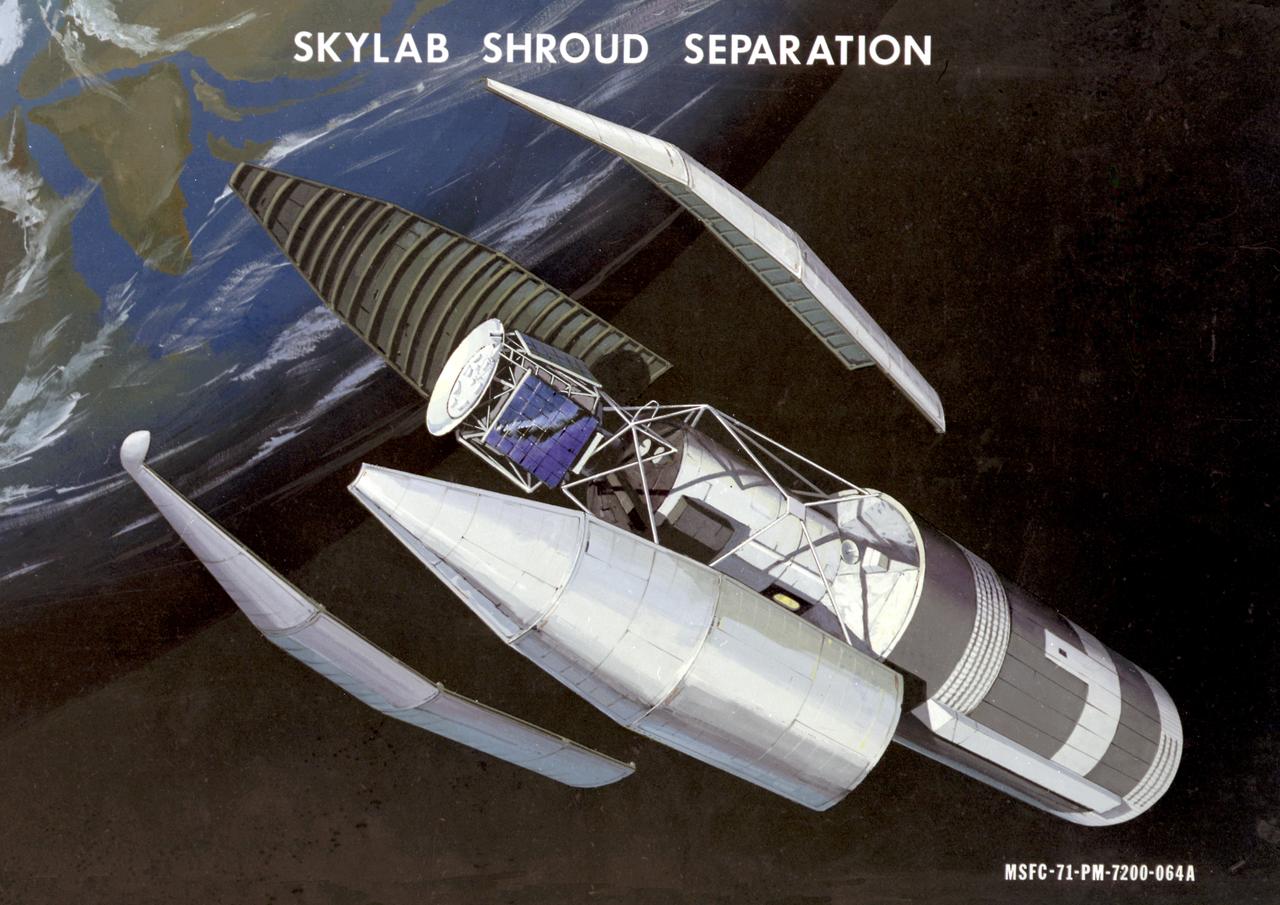
This artist's concept depicts the separation of the Skylab payload shroud. The payload shroud was both an environmental shield and an aerodynamic fairing. Attached to the forward end of the fixed airlock shroud, it protected the airlock, the docking adapter, and the solar observatory before and during launch. It also provided structural support for the solar observatory in the launch configuration. The payload shroud was jettisoned once Skylab reached orbit after separation of the S-II second stage of the Saturn V vehicle. Five major assemblies clustered together made up the orbiting space station called Skylab. The largest of these was the orbital workshop, that housed the crew quarters and a major experiment area. The airlock module, attached to the forward end of the workshop, enabled crewmembers to make excursions outside Skylab. The docking adapter, attached to the forward end of the airlock module, provided the docking port for the Apollo command and service module. The Apollo Telescope Mount was the first marned astronomical observatory designed for solar research from Earth orbit.
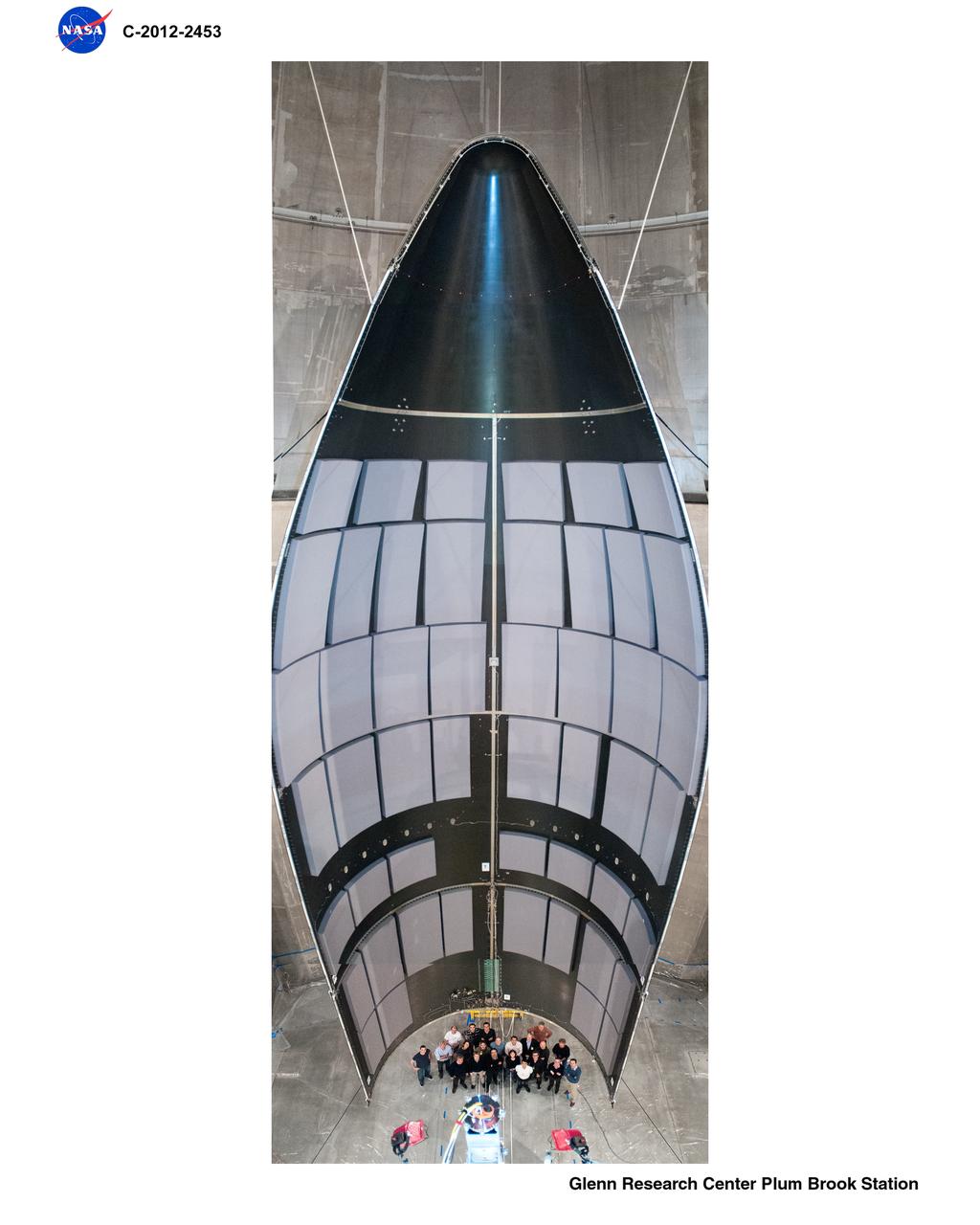
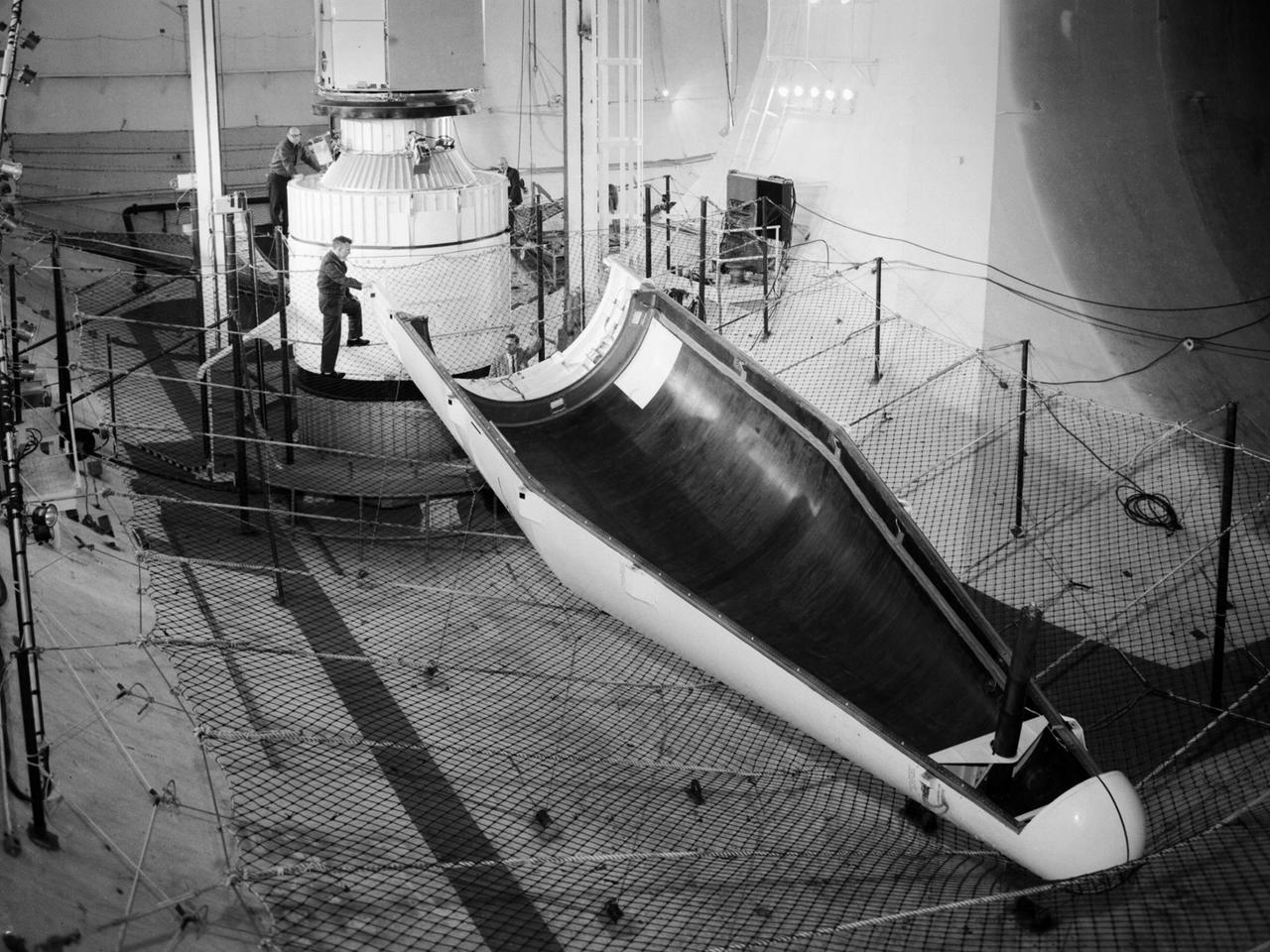
Space Power Facility at Plum Brook Station, RUAG Ariane 5 Shroud Separation Tests. GRC has the world's largest vacuum chamber in the world. This world class facility is host to many space launch vehicle systems tests from customer's in this country and from around the world. Shown here is the post test of a successful rocket shroud separation test. The shroud, or top of a rocket, is jettisoned into two halves with explosive charges to allow the payload to be exposed for deployment. The payload, often time is a satellite, would be sitting atop the center white section shown in the middle of the photo. This photo was taken from on top of the rocket holding the payload and both halves of the rocket shroud looking down at one of the shroud halves and the test crew at the bottom.
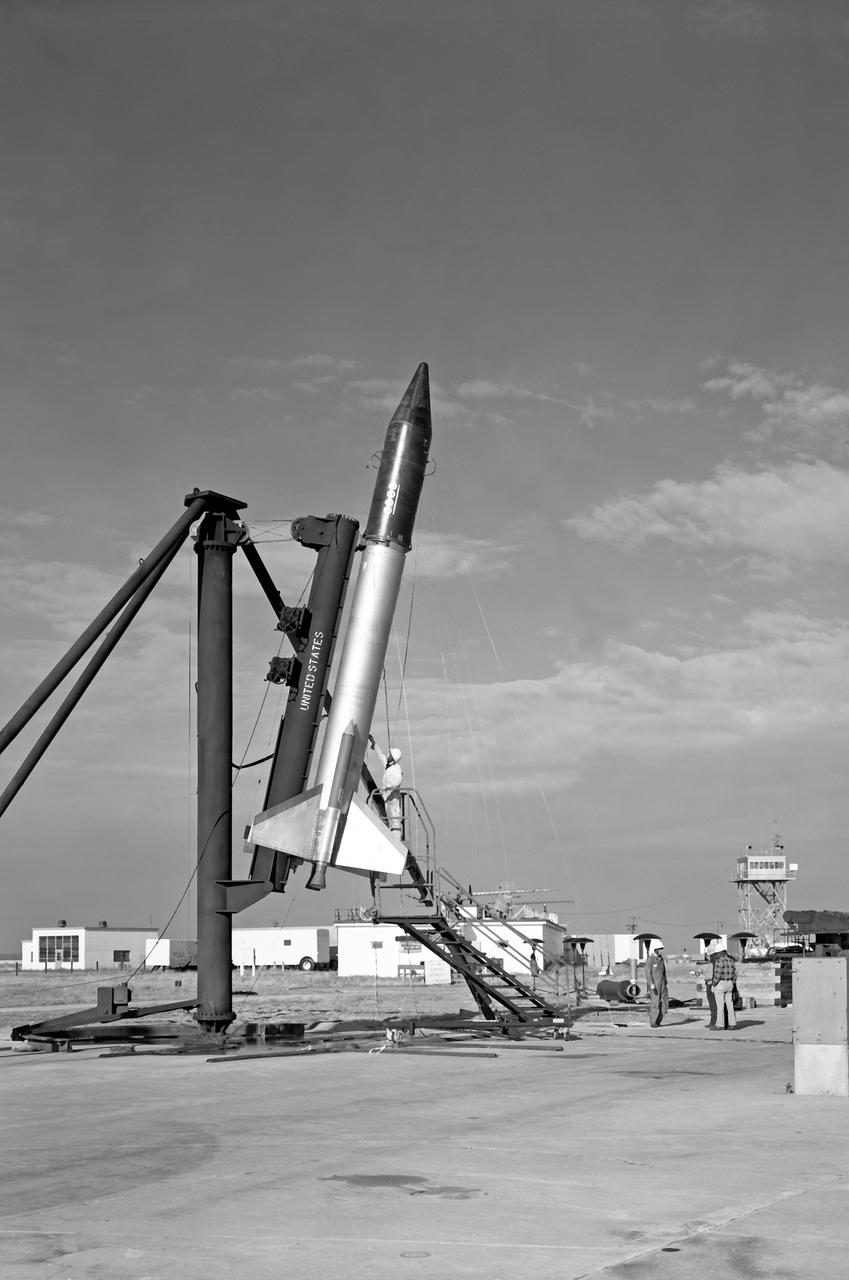
Shot put with shroud over payload - carried early Echo satellite (which burst before achieving orbit). This was the first attempt to launch the Echo satellite.
The Centaur Standard Shroud prepared for a jettison test in the Space Power Facility at the National Aeronautics and Space Administration’s (NASA) Plum Brook Station. In the late 1960s NASA engineers were planning the ambitious new Viking mission to send two rover vehicles to the surface of Mars. The Viking rovers were the heaviest payloads ever attempted by the Centaur second-stage rocket. Each Viking was over three times the weight of the Atlas-Centaur’s previous heaviest payload. Consequently, NASA engineers sought to mate the Centaur with the more powerful Titan III booster for the launches. General Dynamics created a new version of the Centaur, D-1T, specifically for Titan. The D-1T’s most significant modification was a completely new shroud designed by Lockheed, called the Centaur Standard Shroud. The conical two-piece covering encapsulated the payload to protect it against adverse conditions and improve the aerodynamics as the launch vehicle passed through the atmosphere. The shroud would be jettisoned when the vehicle reached the edge of space. A string of tests were conducted in Plum Brook’s Nuclear Rocket Dynamics and Control Facility (B-3) during 1973 and 1974. The new shroud performed flawlessly during the actual Viking launches in 1975. Viking 1 and 2 operated on the Martian surface until November 1982 and April 1980, respectively.

Fiber-Reinforced-Foam (FRF) Core Composite Sandwich Panel Concept for Advanced Composites Technologies Project - Preliminary Manufacturing Demonstration Articles for Ares V Payload Shroud Barrel Acreage Structure

Fiber-Reinforced-Foam (FRF) Core Composite Sandwich Panel Concept for Advanced Composites Technologies Project - Preliminary Manufacturing Demonstration Articles for Ares V Payload Shroud Barrel Acreage Structure

Fiber-Reinforced-Foam (FRF) Core Composite Sandwich Panel Concept for Advanced Composites Technologies Project - Preliminary Manufacturing Demonstration Articles for Ares V Payload Shroud Barrel Acreage Structure
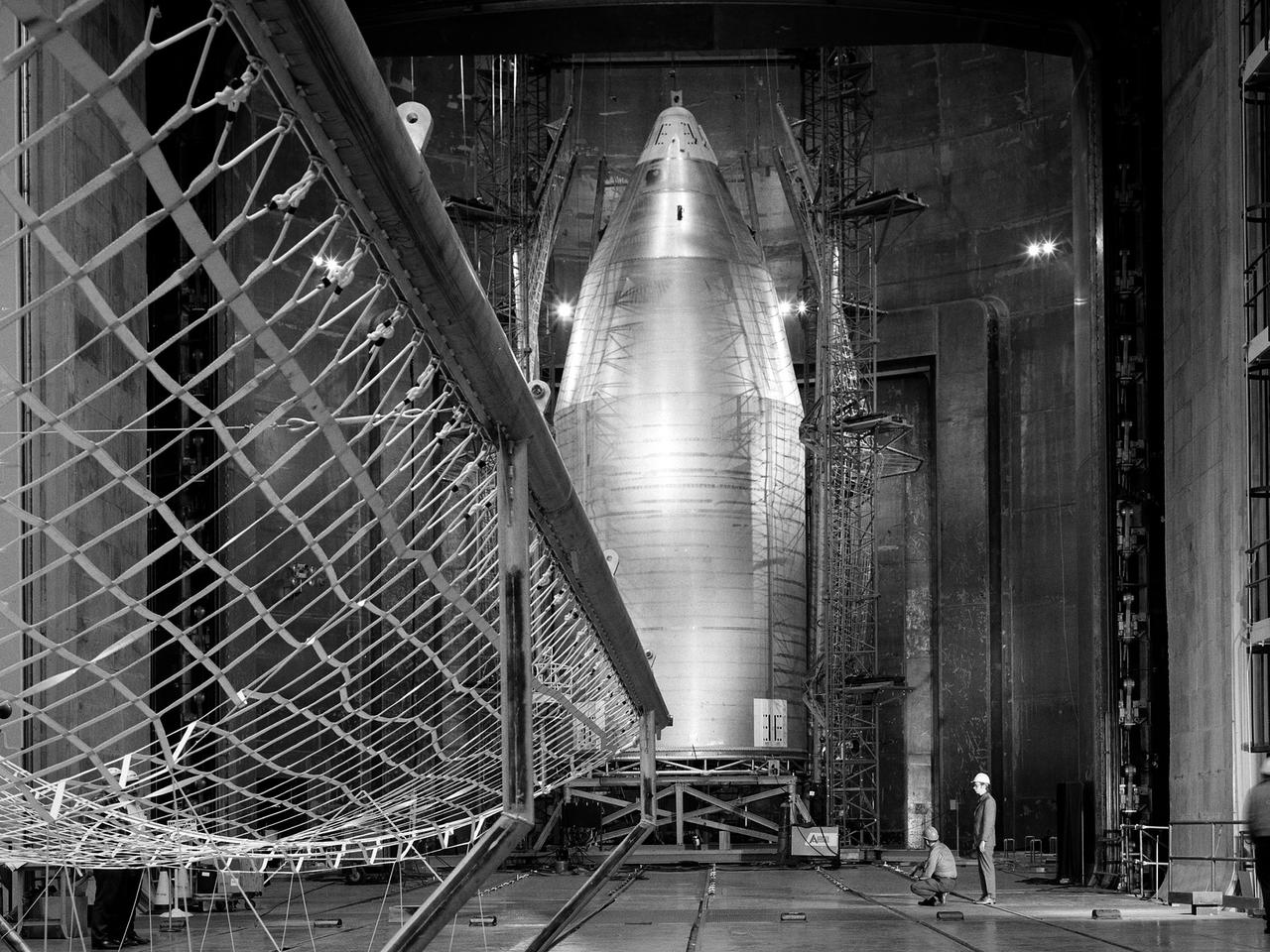
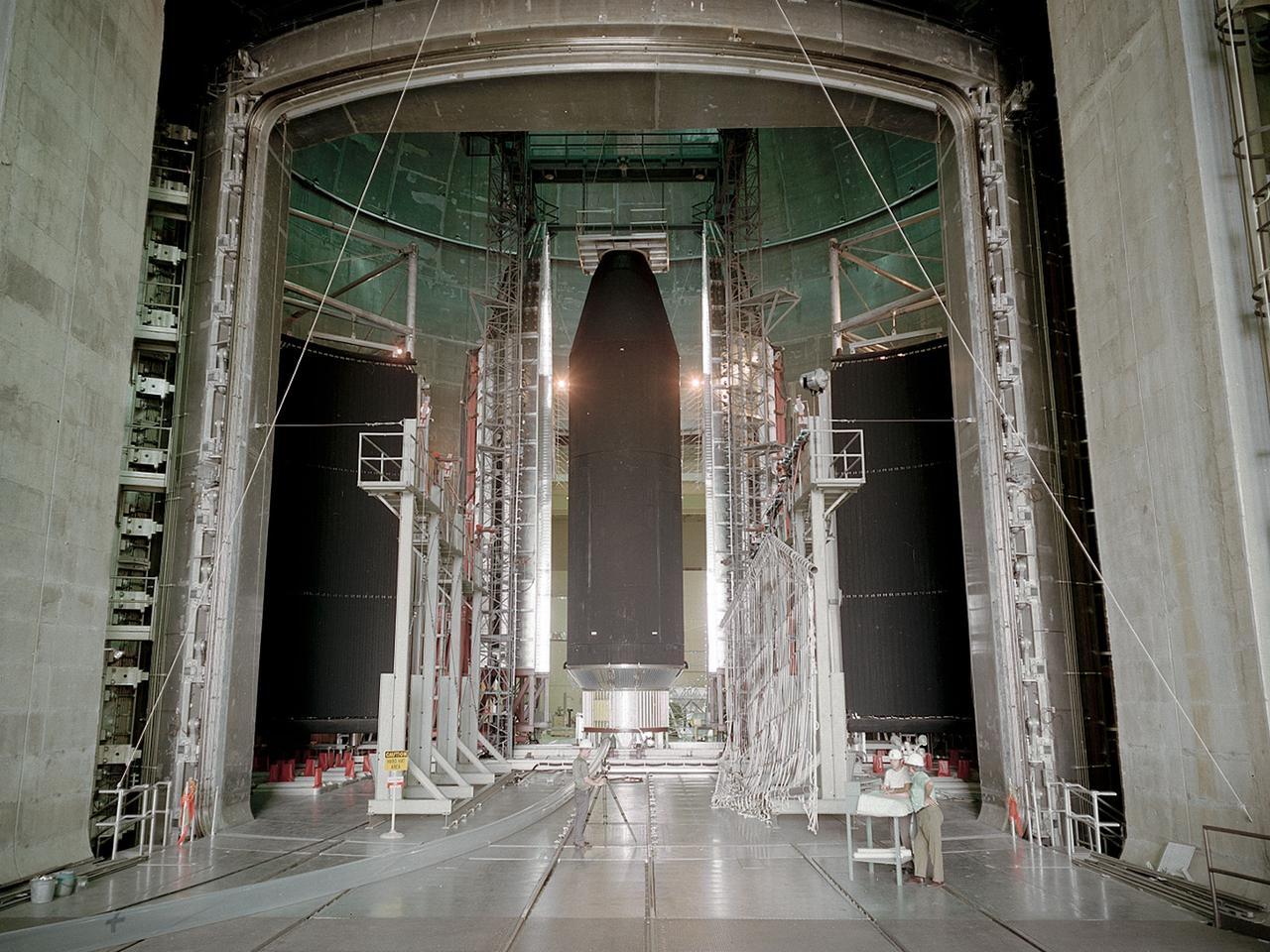
The 56-foot tall, 24,400-pound Skylab shroud installed in the Space Power Facility’s vacuum chamber at the National Aeronautics and Space Administration’s (NASA) Plum Brook Station. The Space Power Facility, which began operations in 1969, is the largest high vacuum chamber ever built. The chamber is 100 feet in diameter and 120 feet high. It can produce a vacuum deep enough to simulate the conditions at 300 miles altitude. The Space Power Facility was originally designed to test nuclear-power sources for spacecraft during long durations in a space atmosphere, but it was never used for that purpose. Payload shrouds are aerodynamic fairings to protect the payload during launch and ascent to orbit. The Skylab mission utilized the largest shroud ever attempted. Unlike previous launches, the shroud would not be jettisoned until the spacecraft reached orbit. NASA engineers designed these tests to verify the dynamics of the jettison motion in a simulated space environment. Fifty-four runs and three full-scale jettison tests were conducted from mid-September 1970 to June 1971. The shroud behaved as its designers intended, the detonators all fired, and early design issues were remedied by the final test. The Space Power Facility continues to operate today. The facility can sustain a high vacuum; simulate solar radiation via a 4-megawatt quartz heat lamp array, solar spectrum by a 400-kilowatt arc lamp, and cold environments. Test programs at the facility include high-energy experiments, shroud separation tests, Mars Lander system tests, deployable Solar Sail tests and International Space Station hardware tests.
Researchers at the National Aeronautics and Space Administration (NASA) Lewis Research Center conducted a series of shroud jettison tests for the second Orbiting Astronomical Observatory (OAO-2) in the Space Power Chambers during April 1968. The Orbiting Astronomical Observatory satellites were designed by Goddard Space Flight Center to study and retrieve ultraviolet data on stars and galaxies which earthbound and atmospheric telescopes could not view due to ozone absorption. The shroud jettison system was tested in the Space Power Chambers. In 1961, NASA Lewis management decided to convert its Altitude Wind Tunnel into two large test chambers and later renamed it the Space Power Chambers. The conversion, which took over two years, included removing the tunnel’s internal components and inserting bulkheads to seal off the new chambers. The larger chamber, seen here, could simulate altitudes of 100,000 feet. These chambers were used for a variety of tests on the Centaur second-stage rocket until the early 1970s. The first OAO mission in 1965 failed due to problems with the satellite. OAO-2 would be launched on an Atlas/Centaur with a modified Agena shroud. The new shroud was 18 feet longer than the normal Centaur payload shrouds. This new piece of hardware was successfully qualified during three tests at 90,000 feet altitude in the Space Power Chambers in April 1968. For the first time, x-rays were used to verify the payload clearance once the shroud was sealed. OAO-2 was launched on December 7, 1968 and proved to be an extremely successful mission.
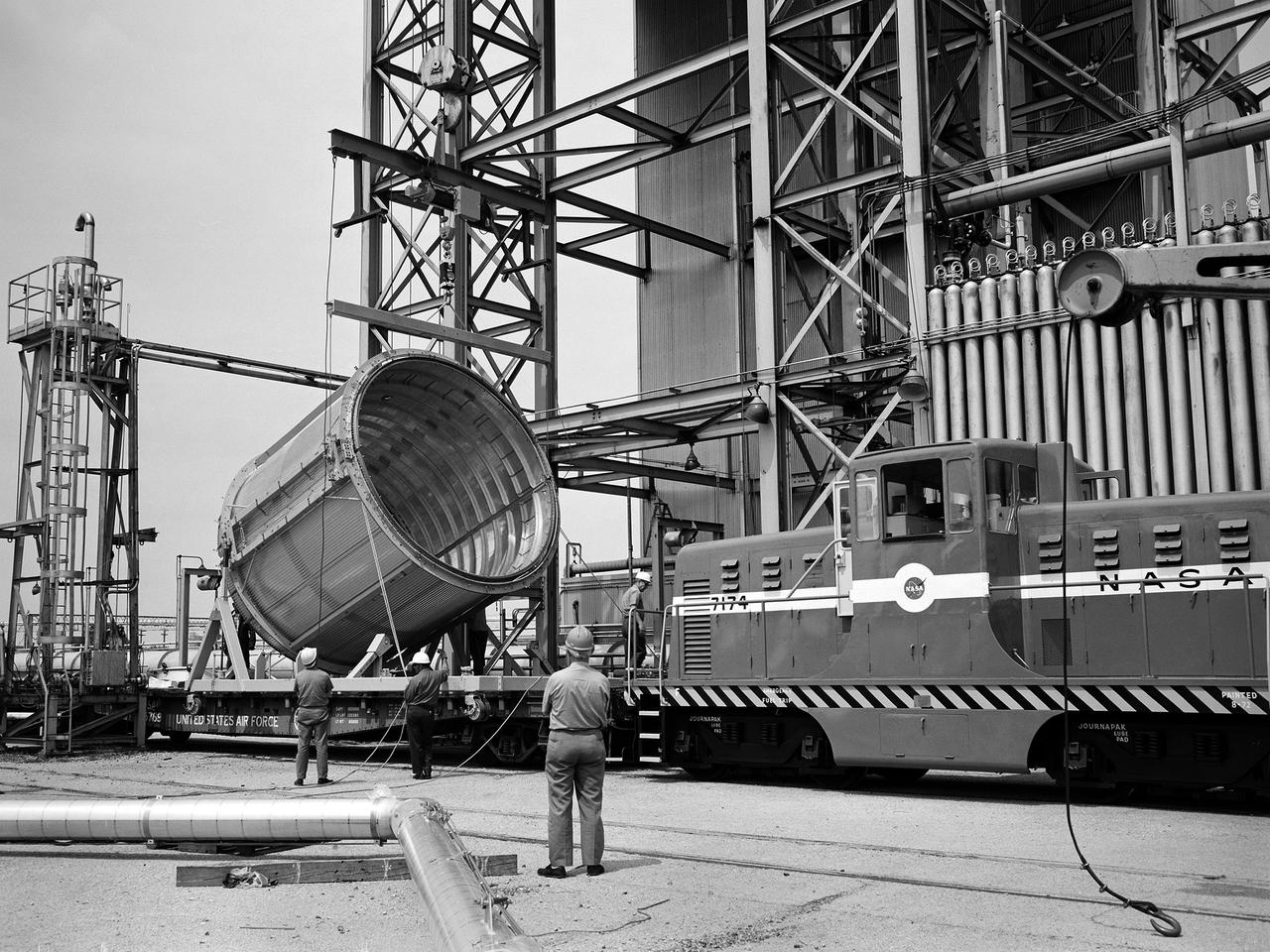
A section of the Centaur Standard Shroud transported to Nuclear Rocket Dynamics and Control Facility, or B-3 Test Stand, at the National Aeronautics and Space Administration’s (NASA) Plum Brook Station. B-3 was built in the early 1960s to test full-scale liquid hydrogen fuel systems in simulated altitude conditions. The facility was used in 1972, however, for testing of the Centaur Standard Shroud’s ejection system. In the late 1960s NASA engineers were planning the ambitious new Viking mission to send two rover vehicles to the surface of Mars. The Viking rovers were the heaviest payloads ever attempted and were over three times the weight of Atlas-Centaur’s previous heaviest payload. Consequently, NASA engineers selected the more powerful the Titan III rocket booster to mate with the Centaur. Concurrently, General Dynamics was in the process of introducing a new Centaur model for Titan—the D-1T. The biggest change for the D-1T was a completely new shroud designed by Lockheed, called the Centaur Standard Shroud. The shroud, its insulation, the Centaur ground-hold purge system, and the hydrogen tank venting system were all studied in B-3. After more than two years of preparations, the tests were run between April and July 1973. The tests determined the ultimate flight loads on two axes, established the Centaur’s load sharing, the level of propellant boiloff during launch holds, and the vent system capacity. The Centaur Standard Shroud performed flawlessly during the August 20 and September 9, 1975 launches of Viking 1 and 2.
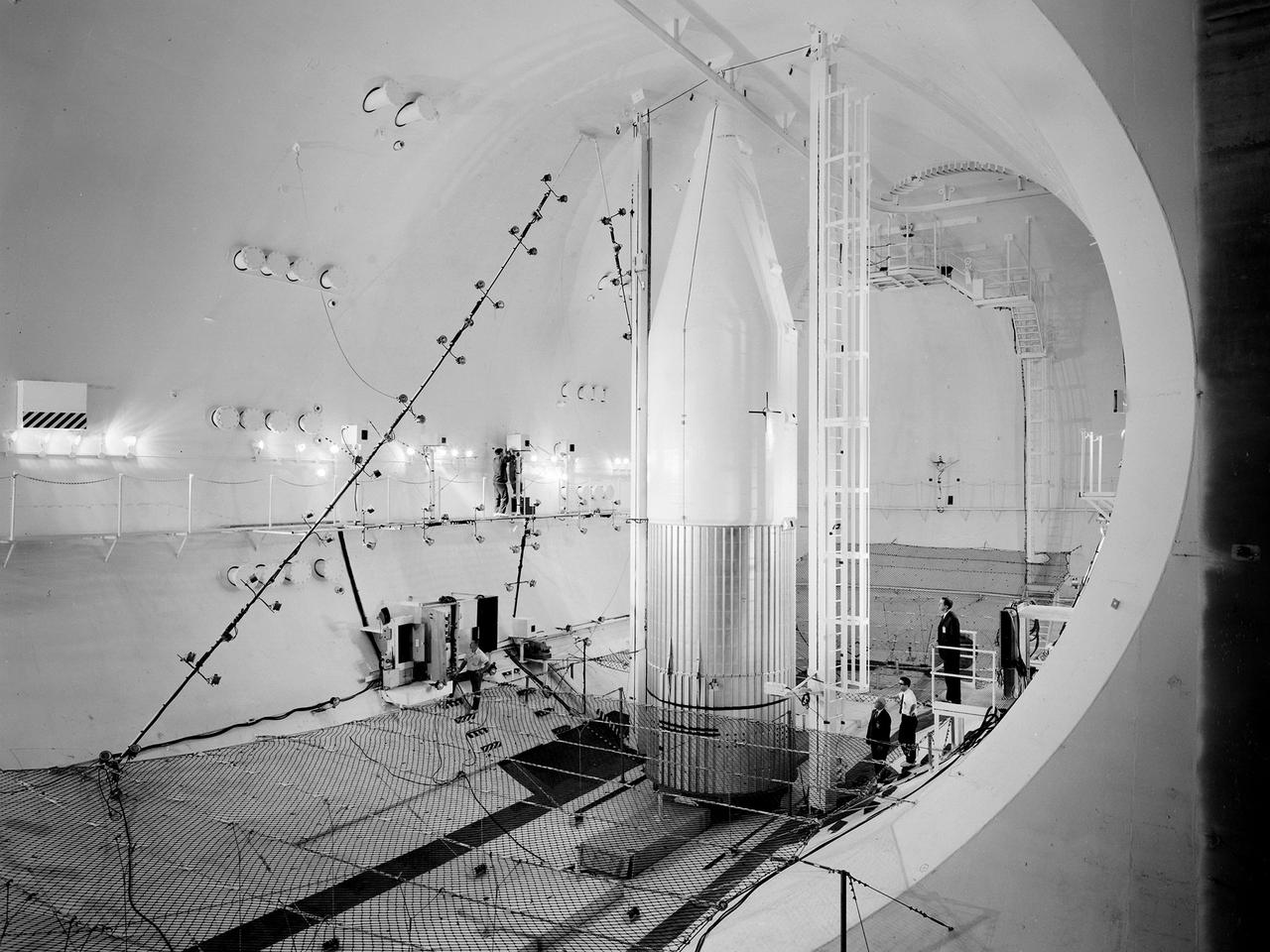
Preparations for a shroud jettison test for the Orbiting Astronomical Observatory-1 (OAO-1) satellite in the Space Power Chambers facility at the National Aeronautics and Space Administration (NASA) Lewis Research Center. The satellite was to be launched on an Atlas-Agena rocket in the spring of 1966. The 3900-pound payload was the heaviest ever attempted by Agena. The satellite was the first of three equipped with powerful telescopes to study ultraviolet data from specific stars and galaxies. In-depth observations were not possible from Earth-bound telescopes because of the filtering and distortion of the atmosphere. The OAO-1 satellite was wider in diameter than the Agena stage, so a new clamshell shroud was created to enclose both the satellite and the Agena. The clamshell shroud consisted of three sections that enclosed both the Agena and OAO-1: a fiberglass nose fairing and aluminum mid and aft fairings. The upper two fairings separated when the Atlas engines stopped, and the aft fairing fell away with the Atlas upon separation from the upper stages The large altitude tank in the Space Power Chambers could simulate altitudes up to 100,000 feet. Three shroud jettison tests were run in July 1965 and the first week of August at a simulated altitude of 20 miles. The April 8, 1966 launch from Cape Canaveral went smoothly, but the OAO-1 satellite failed after only 90 minutes due to a battery failure.
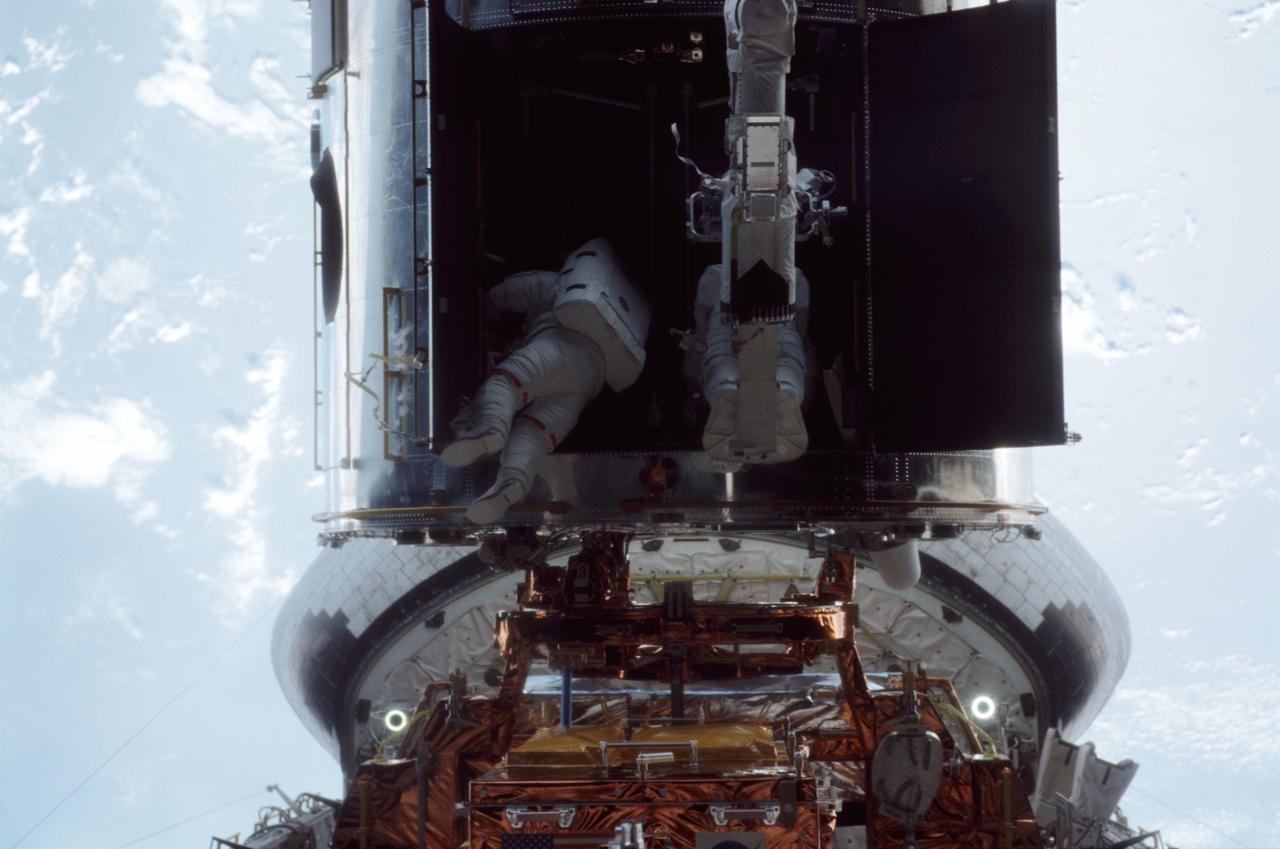
STS109-315-005 (8 March 2002) --- Barely visible within the Hubble Space Telescope's heavily shadowed shroud doors, astronauts John M. Grunsfeld (left) and Richard M. Linnehan participate in the final space walk of the STS-109 mission. The crew of the space shuttle Columbia completed the last of its five ambitious space walks early on March 8, 2002, with the successful installation of an experimental cooling system for Hubble’s Near-Infrared Camera and Multi-Object Spectrometer (NICMOS). The NICMOS has been dormant since January 1999 when its original coolant ran out. Astronauts Grunsfeld and Linnehan began their third spacewalk of the mission at 2:46 a.m. CST. Linnehan was given a ride on the shuttle’s robotic arm to the aft shroud doors by astronaut Nancy J. Currie, working from the aft flight deck of Columbia. After the shroud doors were open, Linnehan was moved back to Columbia’s payload bay to remove the NICMOS cryocooler from its carrier. Grunsfeld and Linnehan then installed the cryocooler inside the aft shroud and connected cables from its Electronics Support Module (ESM). That module was installed on March 7 during a spacewalk by astronauts James H. Newman and Michael J. Massimino.

Researcher Bobby Sanders examines a 0.10-scale model of the Mariner-C shroud and Agena rocket in the 8- by 6-Foot Supersonic Wind Tunnel at the National Aeronautics and Space Administration (NASA) Lewis Research Center. Mariner-C and Mariner-D were identical spacecraft designed by the Jet Propulsion Laboratory to flyby Mars and photograph the Martian surface. The two Mariner spacecraft were launched by Atlas-Agena-D rockets. Lewis had taken over management of the Agena Program in October 1962. Lewis researchers investigated two different types of shrouds for the Mariner missions—an over-the-nose design and a backup pyrotechnic design. The new shroud was wider in diameter than the Agena rocket, so there was concern that this disparity might create air flow instability that could damage the shroud or destroy the vehicle. The tests in the 8- by 6 tunnel simulated launch speeds from Mach 0.56 to 1.96. Afterwards the Agena-Mariner-C model was studied in the 10- by 10-Foot Supersonic Wind Tunnel at speeds of Mach 2.0 to 3.5. Mariner-C was launched on November 4, 1964, but the payload shroud did not jettison properly and the spacecraft’s battery power did not function. The mission ended unsuccessfully two days later. Mariner-D was launched on November 28, 1964 and became the first successful mission to Mars. It was the first time a planet was photographed from space. Mariner-D’s 21 photographs revealed an inhospitable and barren landscape.
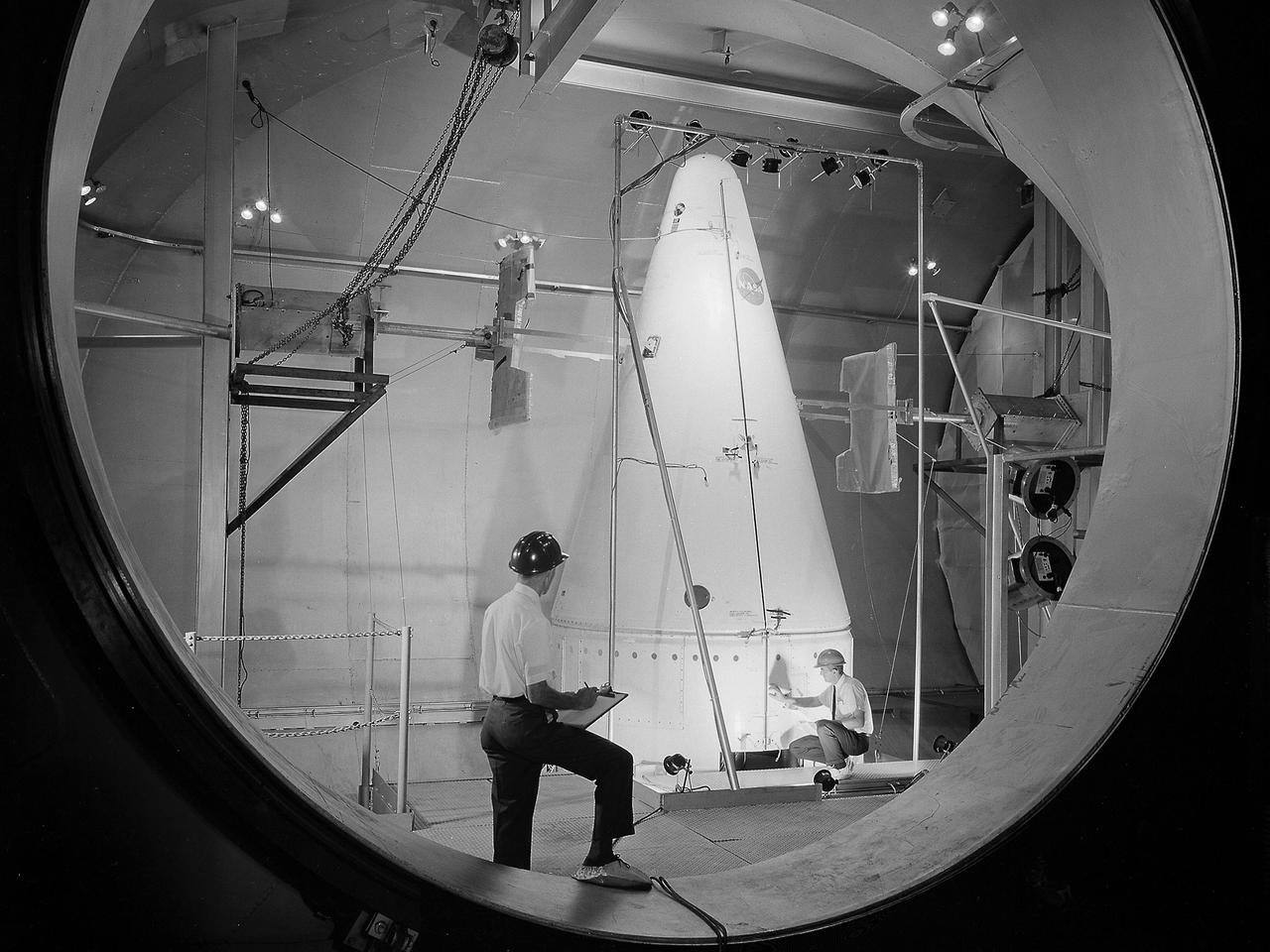
Researchers prepare a Centaur-Surveyor nose cone shroud for a separation test in the Space Power Chambers at the National Aeronautics and Space Administration (NASA) Lewis Research Center. Lewis was in the midst of an extensive effort to prepare the Centaur second-stage rocket for its missions to send the Surveyor spacecraft to the moon as a precursor to the Apollo missions. The nose fairing provided an aerodynamic shield for the payload, guidance system, and electronics package as the rocket traveled through the Earth’s atmosphere. Upon entering space, the thruster near the tip of the fairing forced the two pieces away from the space vehicle. The June 30, 1964 launch of Atlas-Centaur-3 was successful. Within a month of the launch, a Centaur shroud was obtained and installed in the Space Power Chambers. The facility was the only space tank in the country large enough to accommodate the hardware. The two halves of the fiberglass fairing were mounted vertically to a platform. Aluminum pads were set up on either side to catch the shroud halves as they were jettisoned, and a myriad of high-speed cameras were installed to record the tests. The shroud was badly damaged during the first test. It was replaced, and the test equipment redesigned. Over the course of 11 runs during the summer of 1964, the redesigned bulkhead was retested and the new fairing was validated by the final jettison on November 24, 1964. Just over two weeks later, Atlas-Centaur-4 successfully launched a mock-up Surveyor spacecraft into orbit. It was the first Centaur mission to have an error-free shroud jettison.
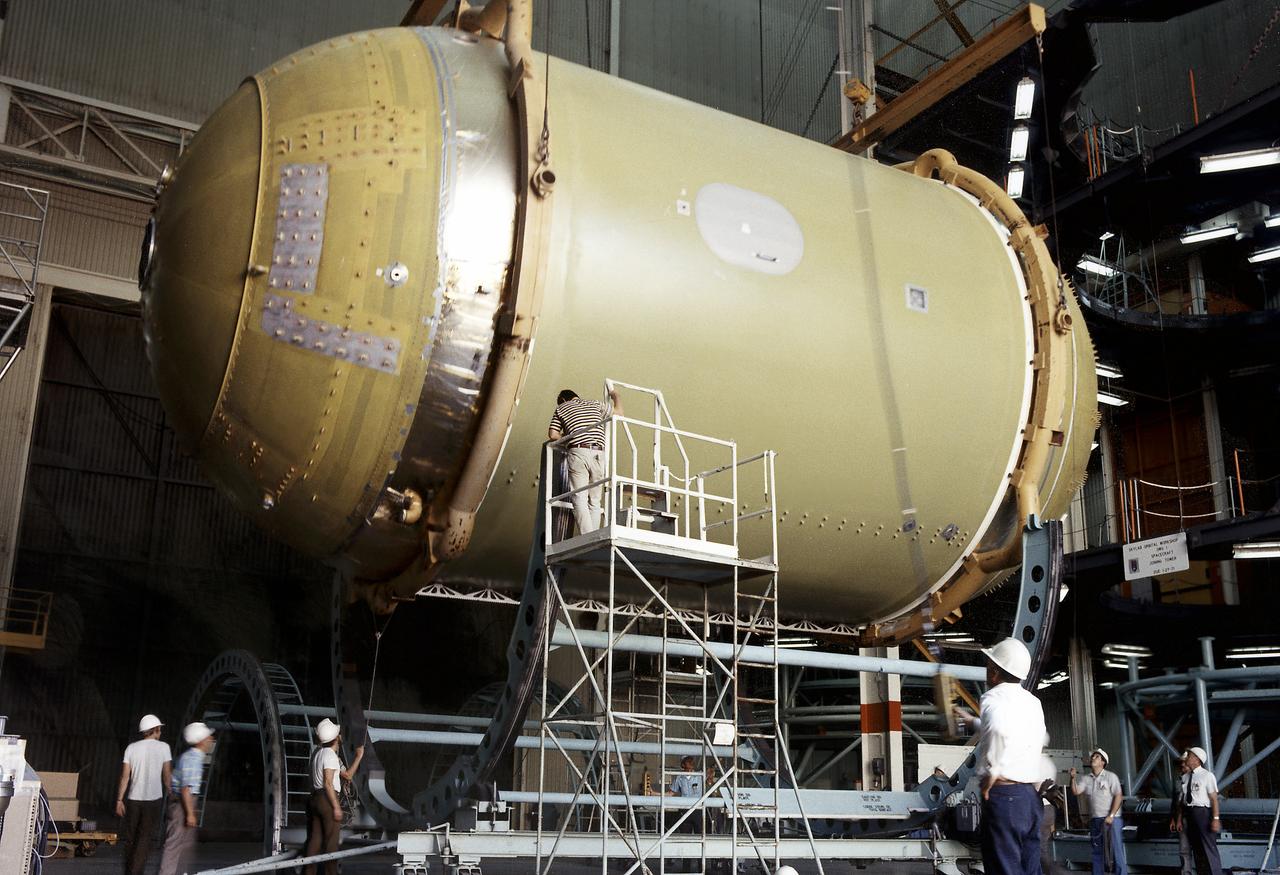
This photographs shows technicians positioning the Skylab Orbital Workshop (OWS) on a rotating work dolly during the assembly phase of the OWS at the McDornell Douglas facility in California. The OWS was the living and working quarters for the astronauts. The Marshall Space Flight Center (MSFC) had responsibility for developing and integrating most of the major components of the Skylab: the Orbital Workshop (OWS), Airlock Module (AM), Multiple Docking Adapter (MDA), Apollo Telescope Mount (ATM), Payload Shroud (PS), and most of the experiments.
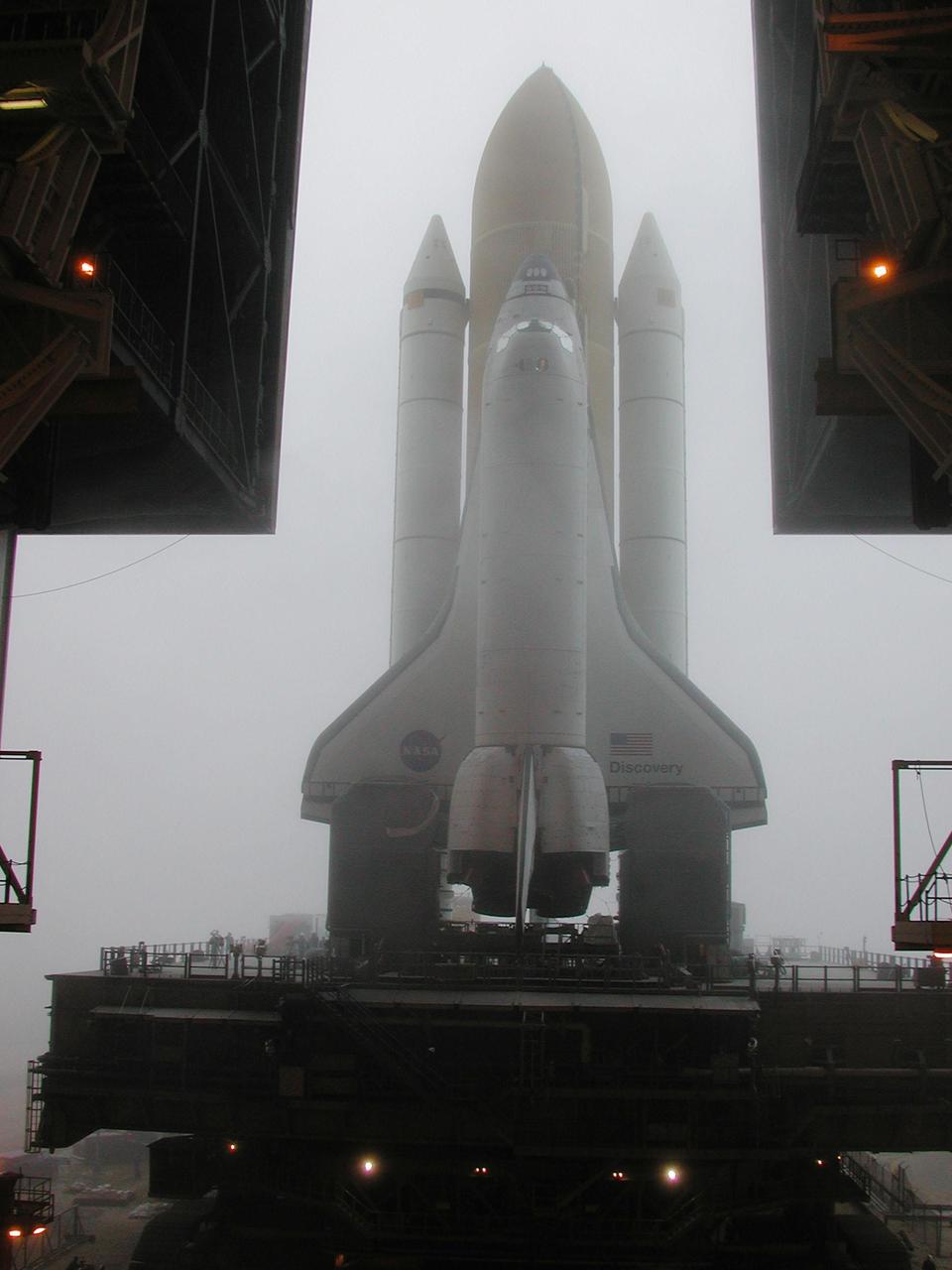
KENNEDY SPACE CENTER, Fla. -- Space Shuttle Discovery begins rolling into the fog that shrouds Kennedy Space Center. Discovery is on its way from the Vehicle Assembly Building to Launch Pad 39B and mission STS-102 to the International Space Station. Its payload is the Multi-Purpose Logistics Module Leonardo, a “moving van,” to carry laboratory racks filled with equipment, experiments and supplies to and from the Space Station aboard the Space Shuttle. The flight will also carry the Expedition Two crew up to the Space Station, replacing Expedition One, who will return to Earth on Discovery. Launch is scheduled for March 8 at 6:45 a.m. EST
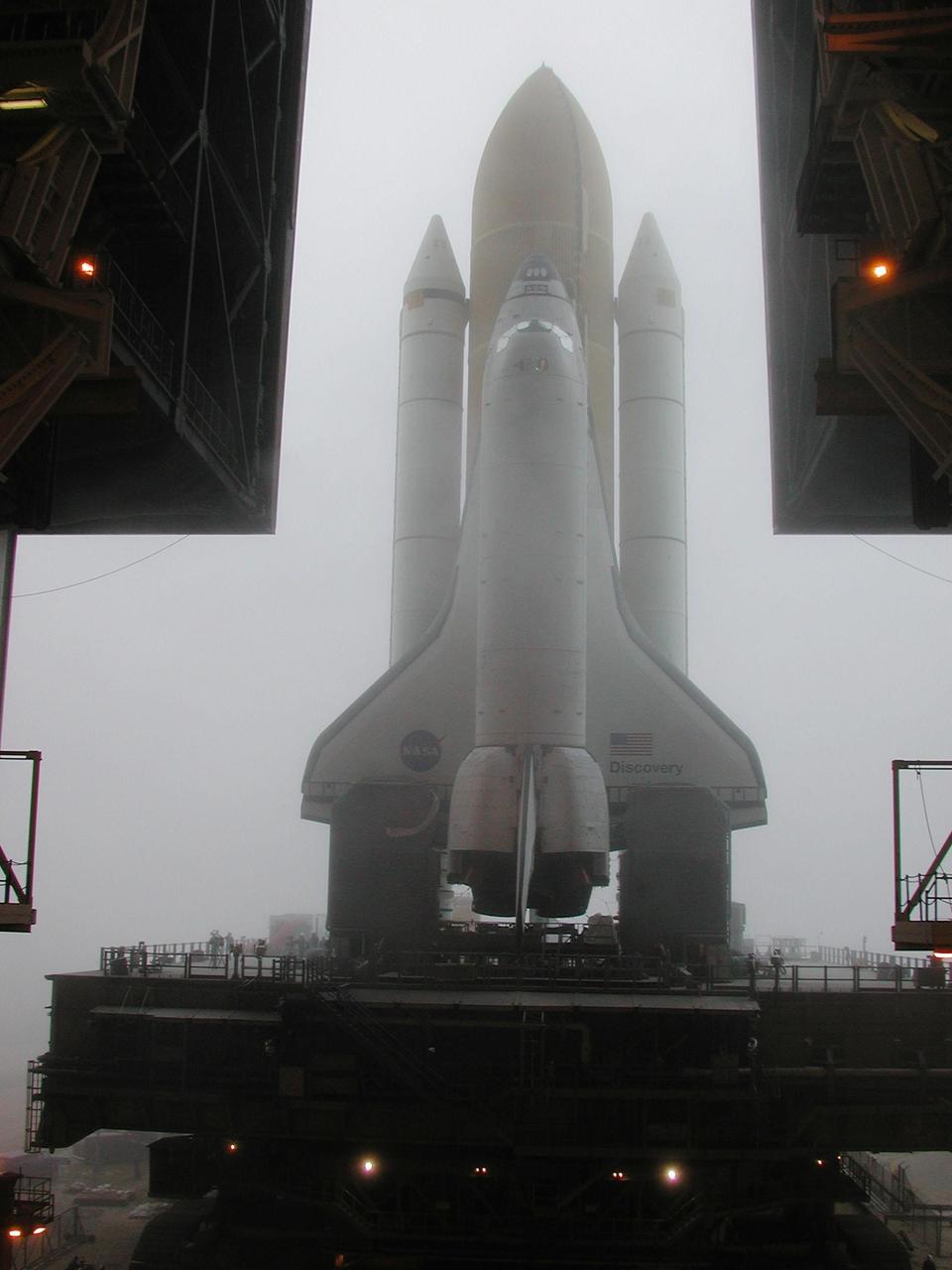
KENNEDY SPACE CENTER, Fla. -- Space Shuttle Discovery begins rolling into the fog that shrouds Kennedy Space Center. Discovery is on its way from the Vehicle Assembly Building to Launch Pad 39B and mission STS-102 to the International Space Station. Its payload is the Multi-Purpose Logistics Module Leonardo, a “moving van,” to carry laboratory racks filled with equipment, experiments and supplies to and from the Space Station aboard the Space Shuttle. The flight will also carry the Expedition Two crew up to the Space Station, replacing Expedition One, who will return to Earth on Discovery. Launch is scheduled for March 8 at 6:45 a.m. EST
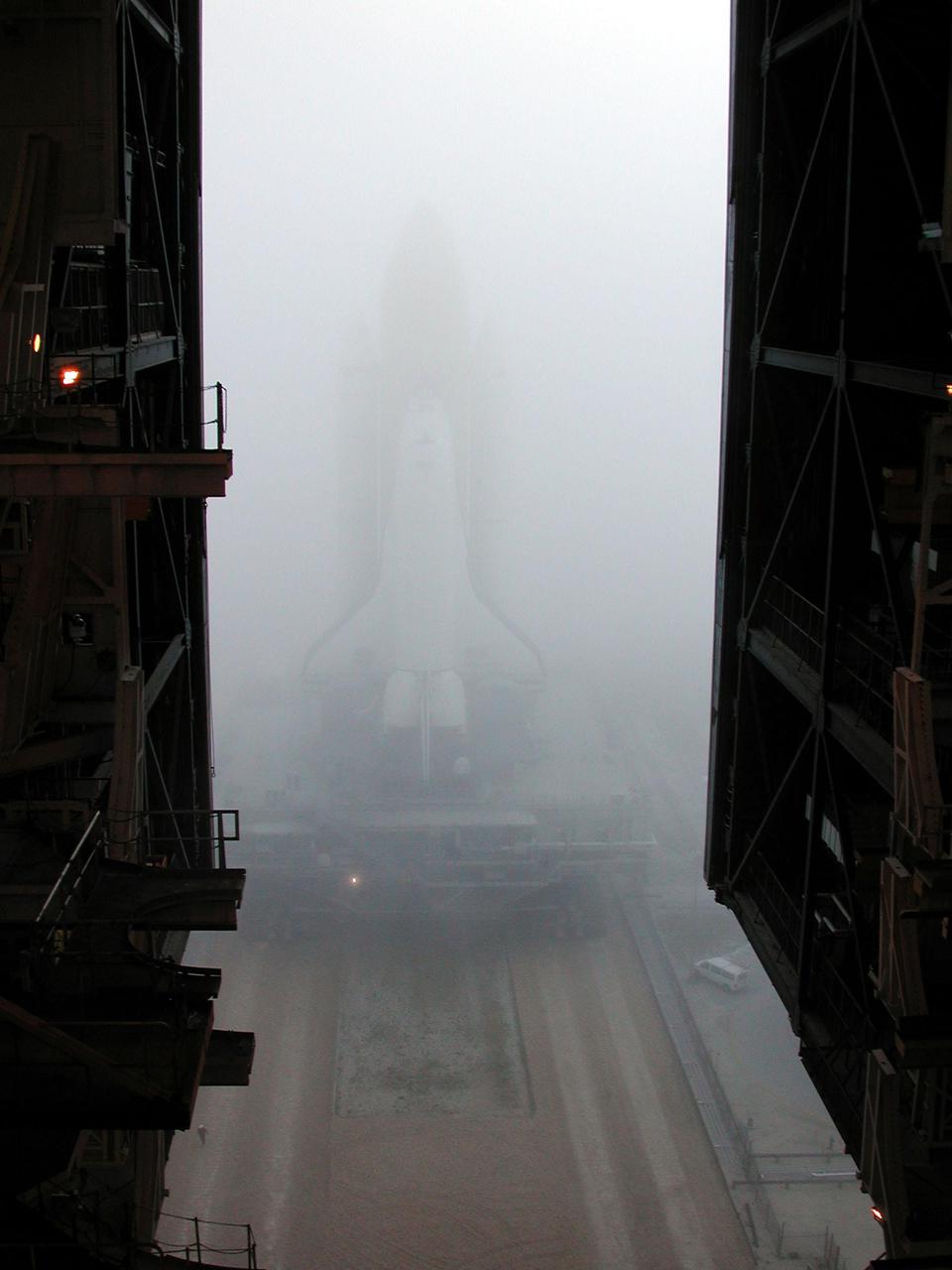
KENNEDY SPACE CENTER, Fla. -- An early morning fog that shrouds Kennedy Space Center almost renders Space Shuttle Discovery invisible as it rolls out from the Vehicle Assembly Building to Launch Pad 39B and mission STS-102 to the International Space Station. Its payload is the Multi-Purpose Logistics Module Leonardo, a “moving van,” to carry laboratory racks filled with equipment, experiments and supplies to and from the Space Station aboard the Space Shuttle. The flight will also carry the Expedition Two crew up to the Space Station, replacing Expedition One, who will return to Earth on Discovery. Launch is scheduled for March 8 at 6:45 a.m. EST
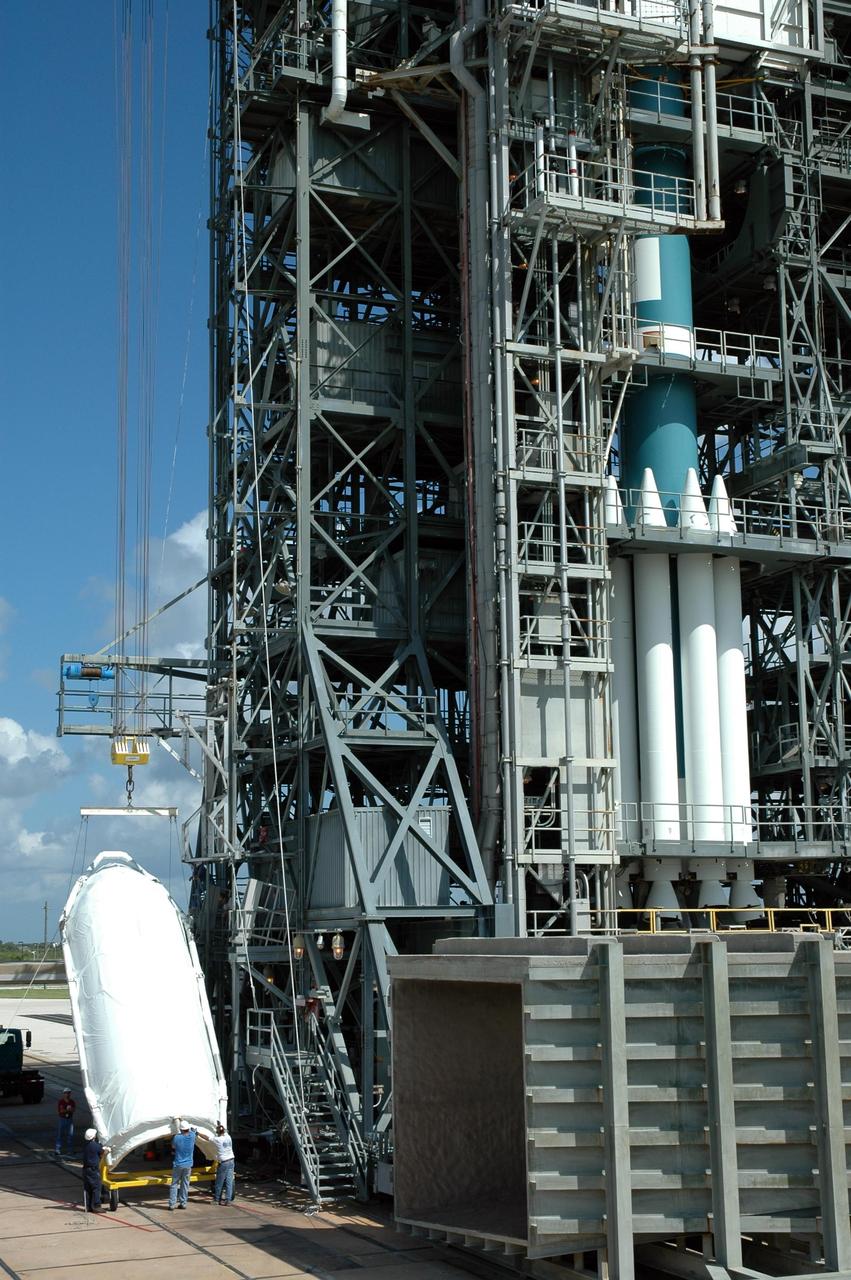
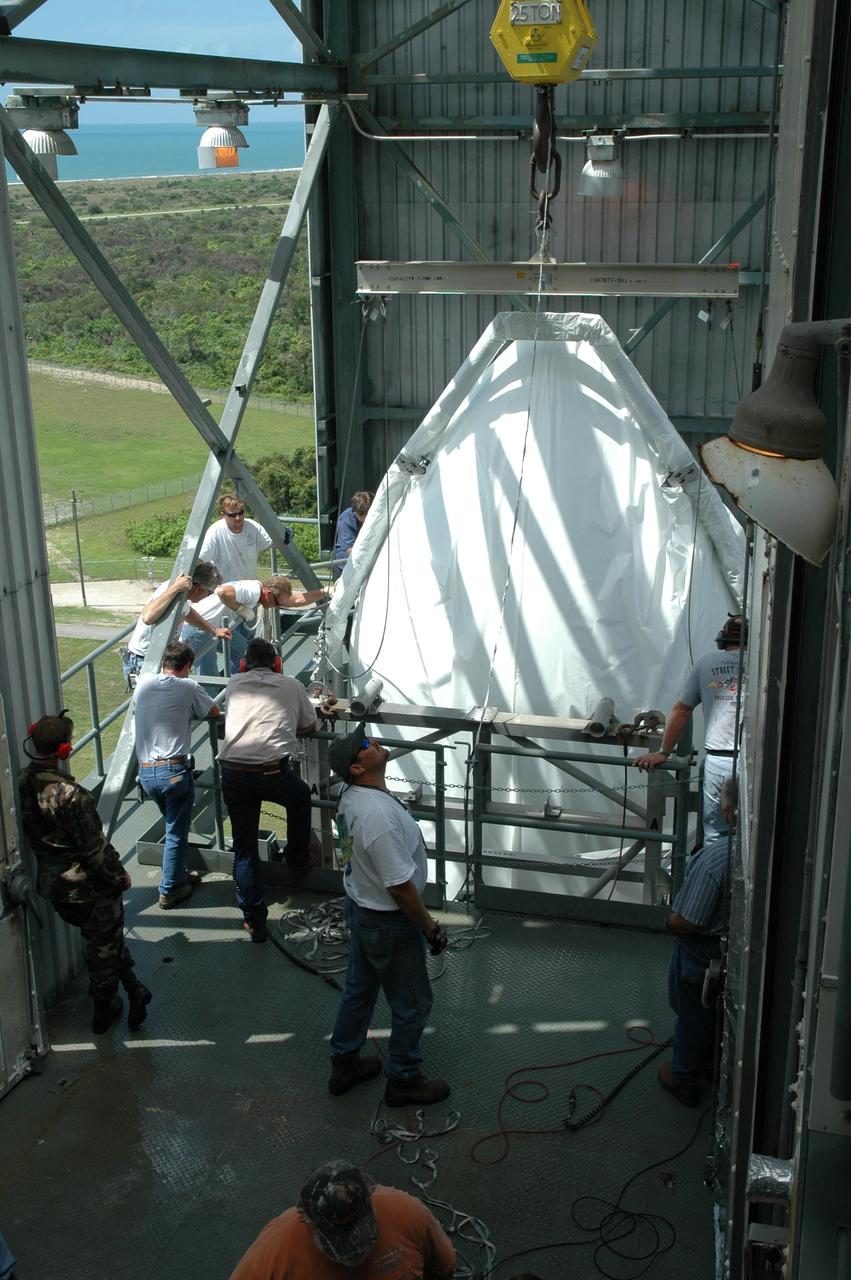
KENNEDY SPACE CENTER, FLA. - Shrouded with a protective cover, half of the payload fairing for the STEREO spacecraft is raised off its transporter on Launch Pad 17-B at Cape Canaveral Air Force Station in Florida. The payload fairing will be lifted into the clean room in the mobile service tower and later installed around the spacecraft for protection during launch. The fairing is a molded structure that fits flush with the outside surface of the Delta II upper stage booster and forms an aerodynamically smooth nose cone, protecting the spacecraft during launch and ascent. STEREO, which stands for Solar Terrestrial Relations Observatory, comprises two spacecraft. The STEREO mission is the first to take measurements of the sun and solar wind in 3-dimension. This new view will improve our understanding of space weather and its impact on the Earth. STEREO is expected to lift off aboard a Boeing Delta II rocket in August 2006. Photo credit: NASA/Jim Grossmann

KENNEDY SPACE CENTER, FLA. - Shrouded with a protective cover, half of the payload fairing for the STEREO spacecraft arrives on Launch Pad 17-B at Cape Canaveral Air Force Station in Florida. The payload fairing will be lifted into the clean room in the mobile service tower and later installed around the spacecraft for protection during launch. The fairing is a molded structure that fits flush with the outside surface of the Delta II upper stage booster and forms an aerodynamically smooth nose cone, protecting the spacecraft during launch and ascent. STEREO, which stands for Solar Terrestrial Relations Observatory, comprises two spacecraft. The STEREO mission is the first to take measurements of the sun and solar wind in 3-dimension. This new view will improve our understanding of space weather and its impact on the Earth. STEREO is expected to lift off aboard a Boeing Delta II rocket in August 2006. Photo credit: NASA/Jim Grossmann
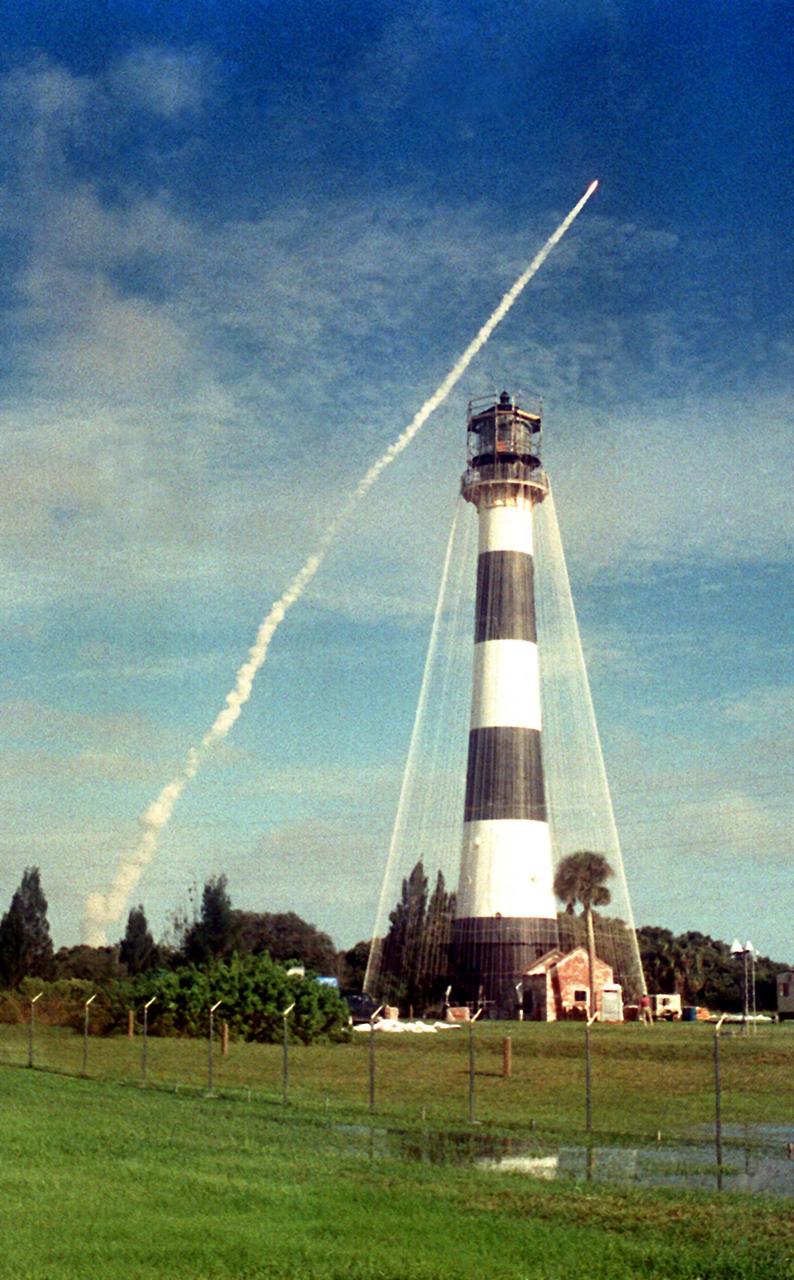
KENNEDY SPACE CENTER, FLA. -- Space Shuttle Columbia soars into the cloud-washed sky above Cape Canaveral Lighthouse. After six scrubs from the original Sept. 25 launch date, liftoff occurred Oct. 20 at 9:53 a.m. EDT. The crew of seven comprises Commander Ken Bowersox, Pilot Kent Rominger, Mission Specialists Kathy Thornton (Payload Commander), Catherine Coleman and Michael Lopez-Alegria, plus Payload Specialists Fred Leslie and Albert Sacco. The 72nd Shuttle mission, STS-73 marks the second flight of the U.S. Microgravity Laboratory. Research is being conducted in five areas: fluid physics, materials science, biotechnology, combustion science, and commercial space processing. The lighthouse, undergoing refurbishment and upgrade, is shown with a network of nylon lines ready for canvas panels to be attached. The canvas shroud will protect the surrounding area during sand-blasting of the lead-based paint.
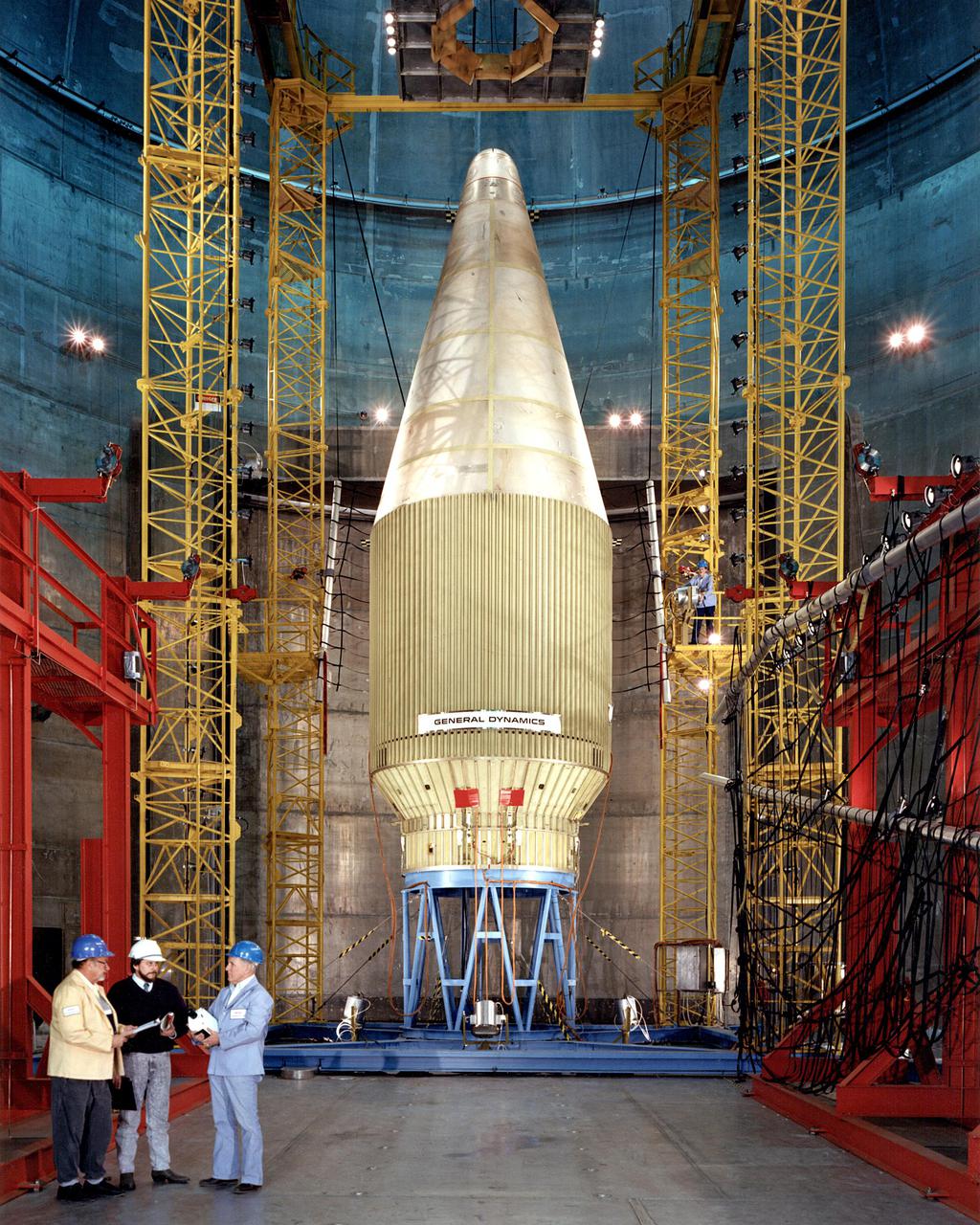
Employees at the Space Power Facility (SPF) at Plum Brook Station tested a new generation of Atlas/Centaur launch vehicles. General Dynamics conducted the tests December 22 and January 3, 1990 to determine the flight readiness of a new 14-foot diameter payload fairing. The fairing will accommodate new weather satellites, the U.S. Air Force Combined Release and Radiation Effects (CRRES) satellite, and other future payloads. At a simulated altitude of 85,000 feet, the cone-shaped fairing separated in half from a hinge at the bottom. Half of the fairing was then released from the test stack and recovered in a catch-net. The payload fairing separations were the first tests of major space hardware to be conducted in the SPF in more than 15 years.
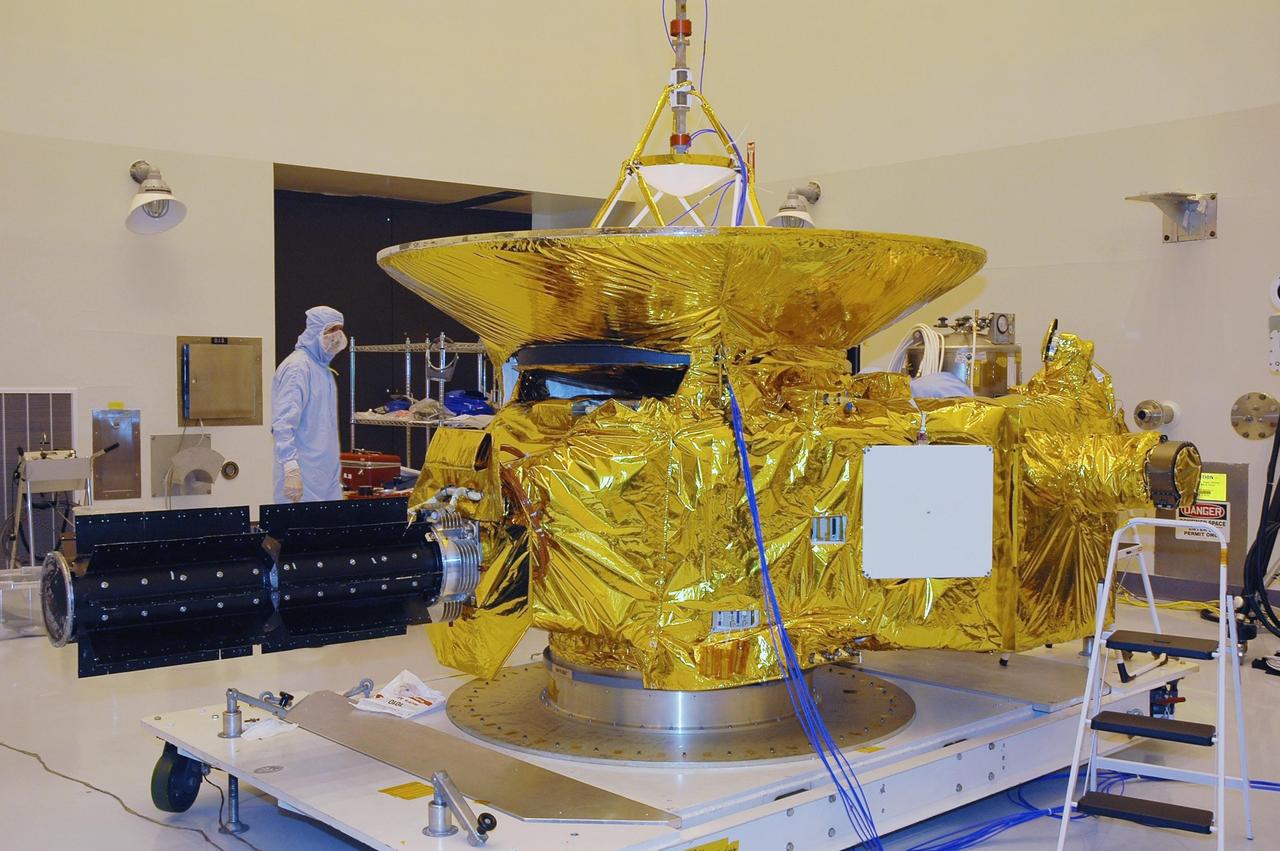
KENNEDY SPACE CENTER, FLA. - At NASA Kennedy Space Center’s Payload Hazardous Servicing Facility, the New Horizons spacecraft is shrouded in insulating blankets that were installed to serve as a heat shield. Carrying seven scientific instruments, the compact 1,060-pound New Horizons probe will characterize the global geology and geomorphology of Pluto and its moon Charon, map their surface compositions and temperatures, and examine Pluto's complex atmosphere. After that, flybys of Kuiper Belt objects from even farther in the solar system may be undertaken in an extended mission. New Horizons is the first mission in NASA's New Frontiers program of medium-class planetary missions. The spacecraft, designed for NASA by the Johns Hopkins University Applied Physics Laboratory in Laurel, Md., will fly by Pluto and Charon as early as summer 2015.
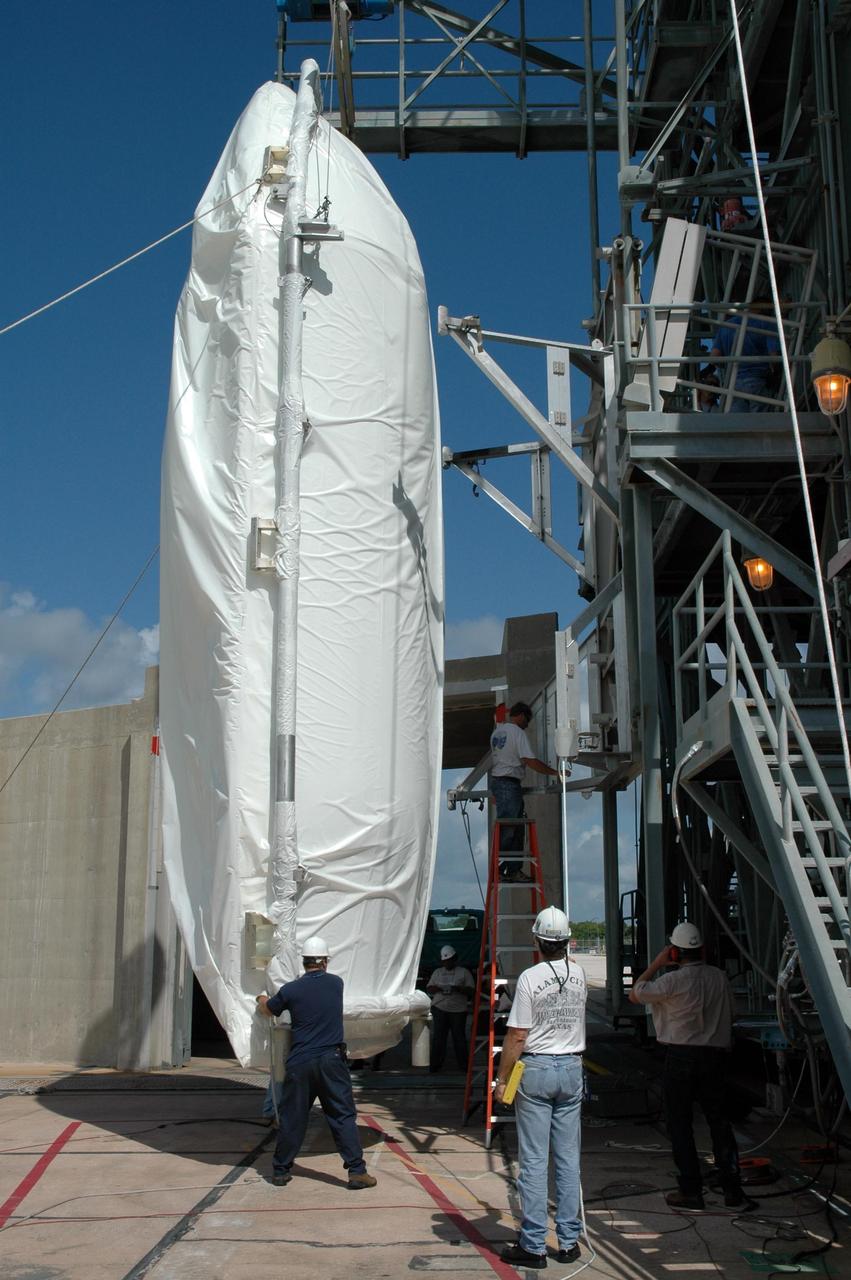
KENNEDY SPACE CENTER, FLA. - Shrouded with a protective cover, half of the payload fairing for the STEREO spacecraft has been raised to a vertical position in front of the mobile service tower on Launch Pad 17-B at Cape Canaveral Air Force Station in Florida. The fairing will be lifted into the clean room in the tower and later installed around the spacecraft for protection during launch. The fairing is a molded structure that fits flush with the outside surface of the Delta II upper stage booster and forms an aerodynamically smooth nose cone, protecting the spacecraft during launch and ascent. STEREO, which stands for Solar Terrestrial Relations Observatory, comprises two spacecraft. The STEREO mission is the first to take measurements of the sun and solar wind in 3-dimension. This new view will improve our understanding of space weather and its impact on the Earth. STEREO is expected to lift off aboard a Boeing Delta II rocket in August 2006. Photo credit: NASA/Jim Grossmann
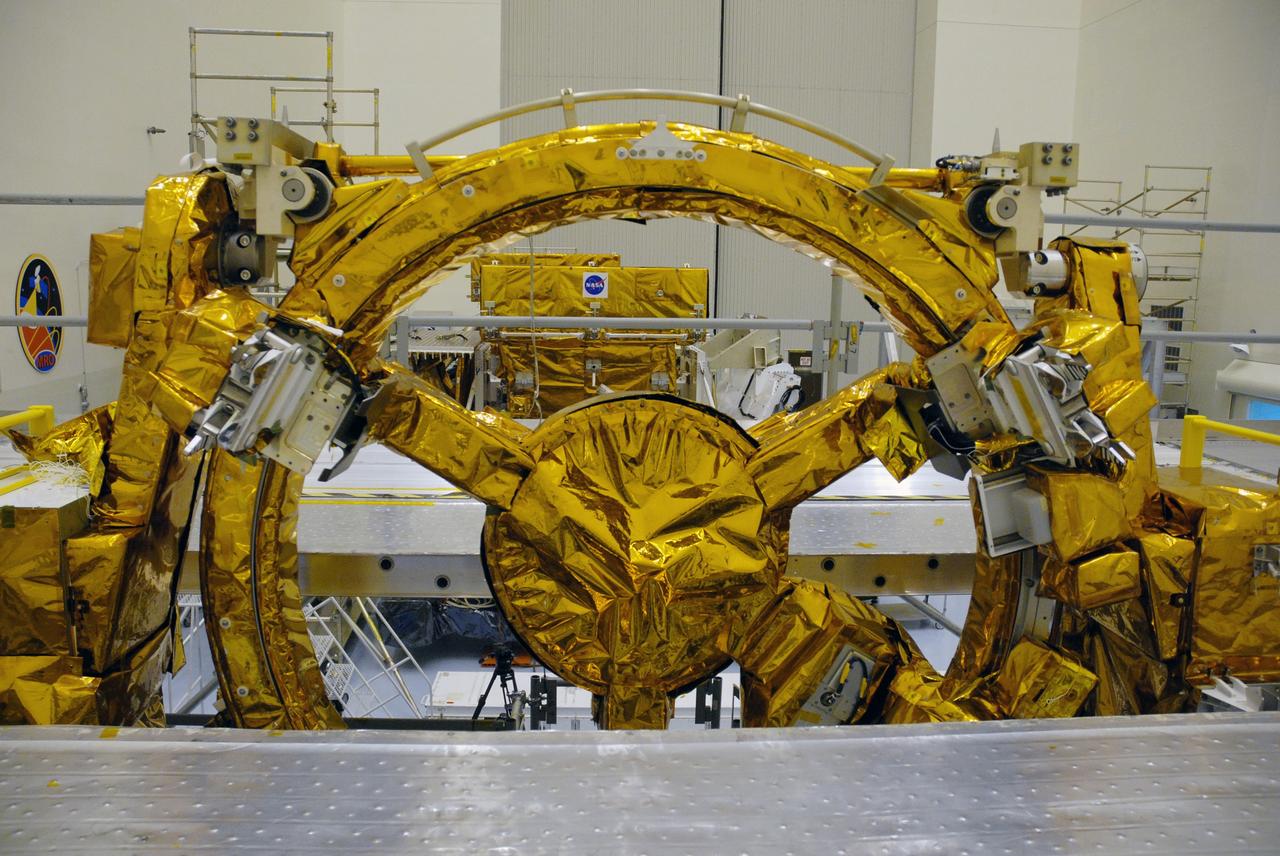
CAPE CANAVERAL, Fla. – In the high bay of the Payload Hazardous Servicing Facility at NASA's Kennedy Space Center, three of four carriers supporting the space shuttle Atlantis STS-125 Hubble Space Telescope servicing mission have been unwrapped for final launch processing. The Super Lightweight Interchangeable Carrier and the Orbital Replacement Unit Carrier can be seen through the distinctive soft capture mechanism, or SCM, of the Flight Support System. The SCM will be permanently attached to Hubble’s aft shroud by spacewalking astronauts and will provide a rendezvous and docking target that can be easily seen and recognized by a docking vehicle. The Multi-Use Lightweight Equipment carrier will be delivered in early August. The carriers will be prepared for the integration of telescope science instruments, both internal and external replacement components, as well as the flight support equipment to be used by the astronauts during the Hubble servicing mission, targeted for launch Oct. 8. Photo credit: NASA/Jack Pfaller
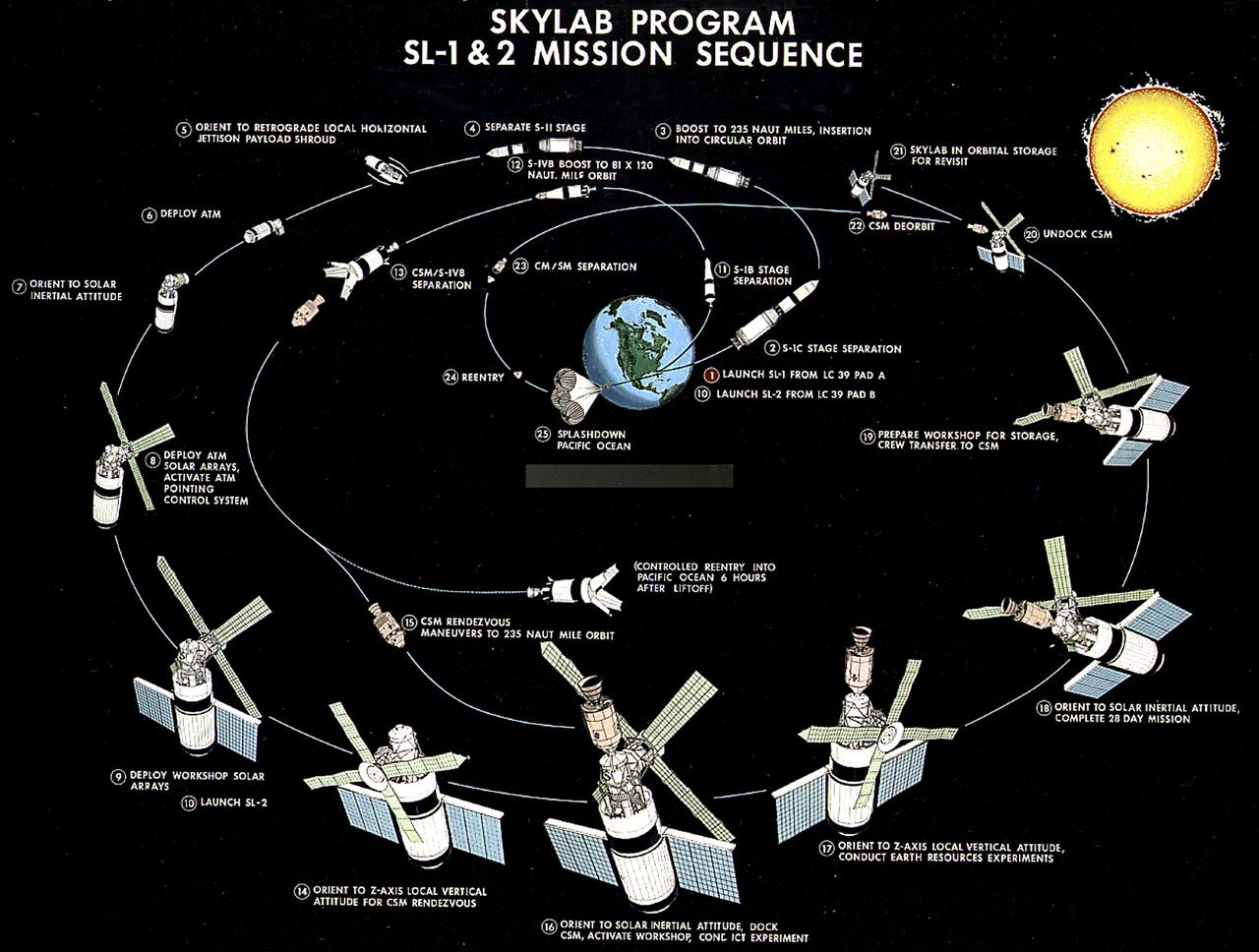
This illustration depicts the Skylab-1 and Skylab-2 mission sequence. The goals of the Skylab were to enrich our scientific knowledge of the Earth, the Sun, the stars, and cosmic space; to study the effects of weightlessness on living organisms, including man; to study the effects of the processing and manufacturing of materials utilizing the absence of gravity; and to conduct Earth resource observations. The Skylab also conducted 19 selected experiments submitted by high school students. Skylab's 3 different 3-man crews spent up to 84 days in Earth orbit. The Marshall Space Flight Center (MSFC) had responsibility for developing and integrating most of the major components of the Skylab: the Orbital Workshop (OWS), Airlock Module (AM), Multiple Docking Adapter (MDA), Apollo Telescope Mount (ATM), Payload Shroud (PS), and most of the experiments. MSFC was also responsible for providing the Saturn IB launch vehicles for three Apollo spacecraft and crews and a Saturn V launch vehicle for the Skylab.
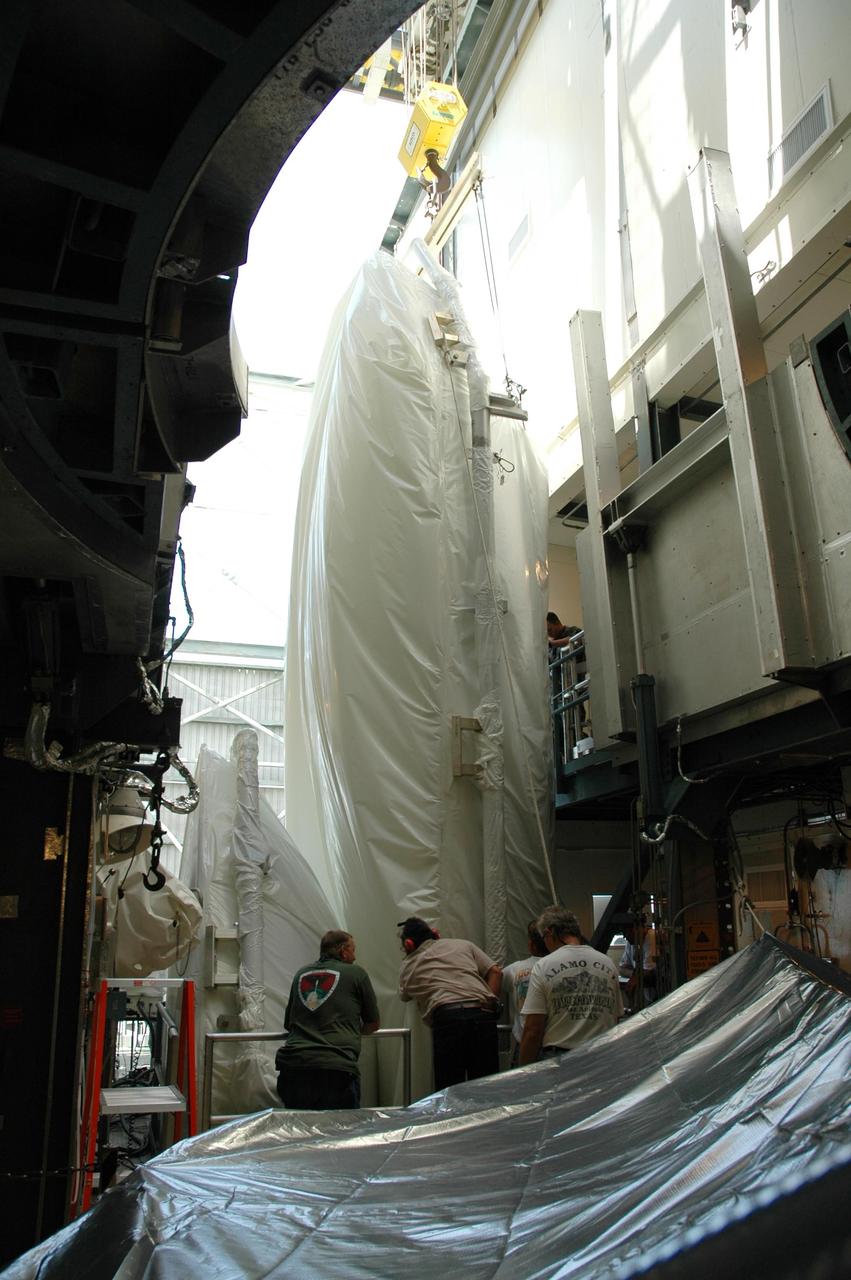
KENNEDY SPACE CENTER, FLA. - Inside the mobile service tower on Launch Pad 17-B at Cape Canaveral Air Force Station in Florida, the shrouded second half of the payload fairing (background) for the STEREO spacecraft is moved beside the first half. Both halves will later be installed around the spacecraft for protection during launch. The fairing is a molded structure that fits flush with the outside surface of the Delta II upper stage booster and forms an aerodynamically smooth nose cone, protecting the spacecraft during launch and ascent. STEREO, which stands for Solar Terrestrial Relations Observatory, comprises two spacecraft that will be launched as one. The STEREO mission is the first to take measurements of the sun and solar wind in 3-dimension. This new view will improve our understanding of space weather and its impact on the Earth. STEREO is expected to lift off aboard a Boeing Delta II rocket in August 2006. Photo credit: NASA/Jim Grossmann
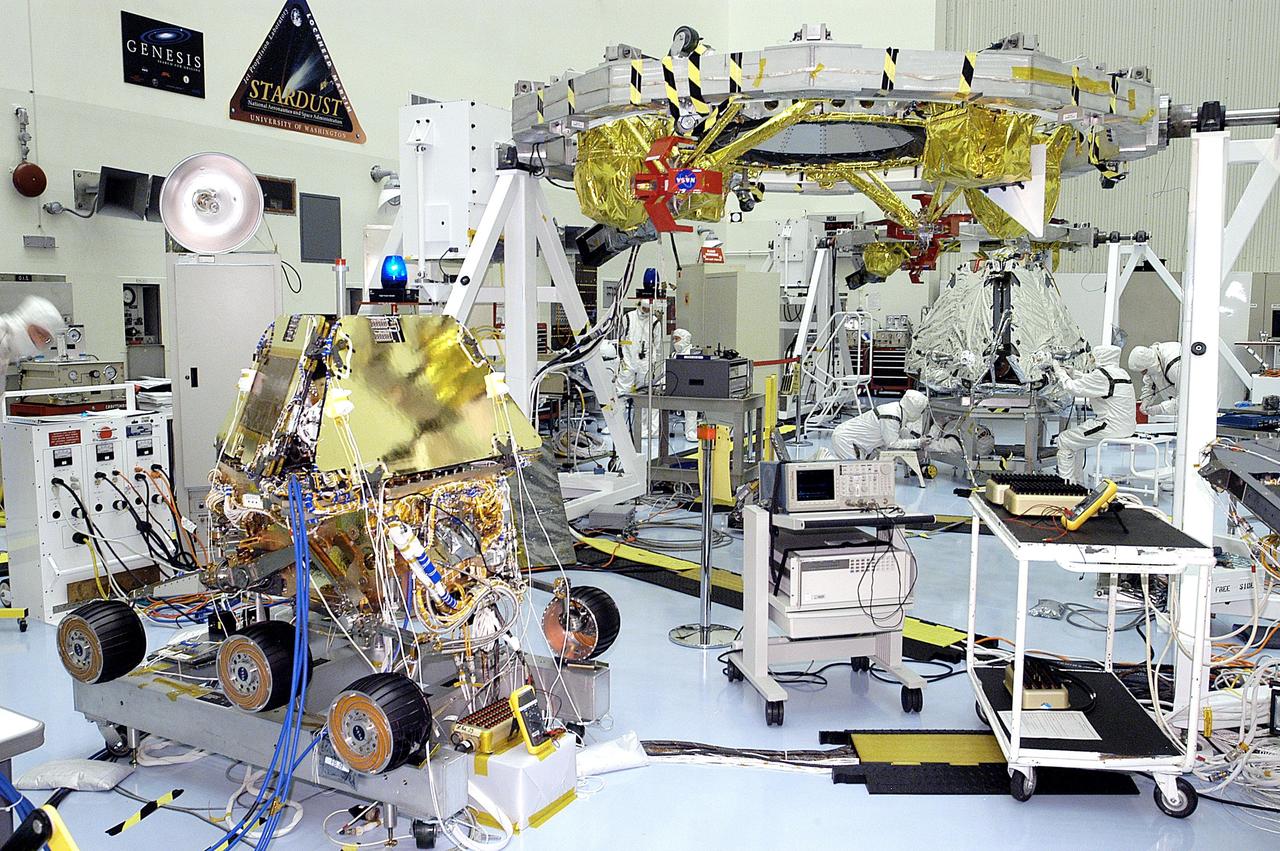
KENNEDY SPACE CENTER, FLA. - In the Payload Hazardous Servicing Facility, both Mars Exploration Rovers (MER) can be seen, MER-1 at left and MER-2 in the background. Workers are preparing the shrouded MER-2 for mating to the lander. Set to launch in Spring 2003, the MER Mission consists of two identical rovers, landing at different regions of Mars, designed to cover roughly 110 yards each Martian day over various terrain. Each rover will carry five scientific instruments that will allow it to search for evidence of liquid water that may have been present in the planet's past. The first rover has a launch window opening May 30, and the second rover a window opening June 25.
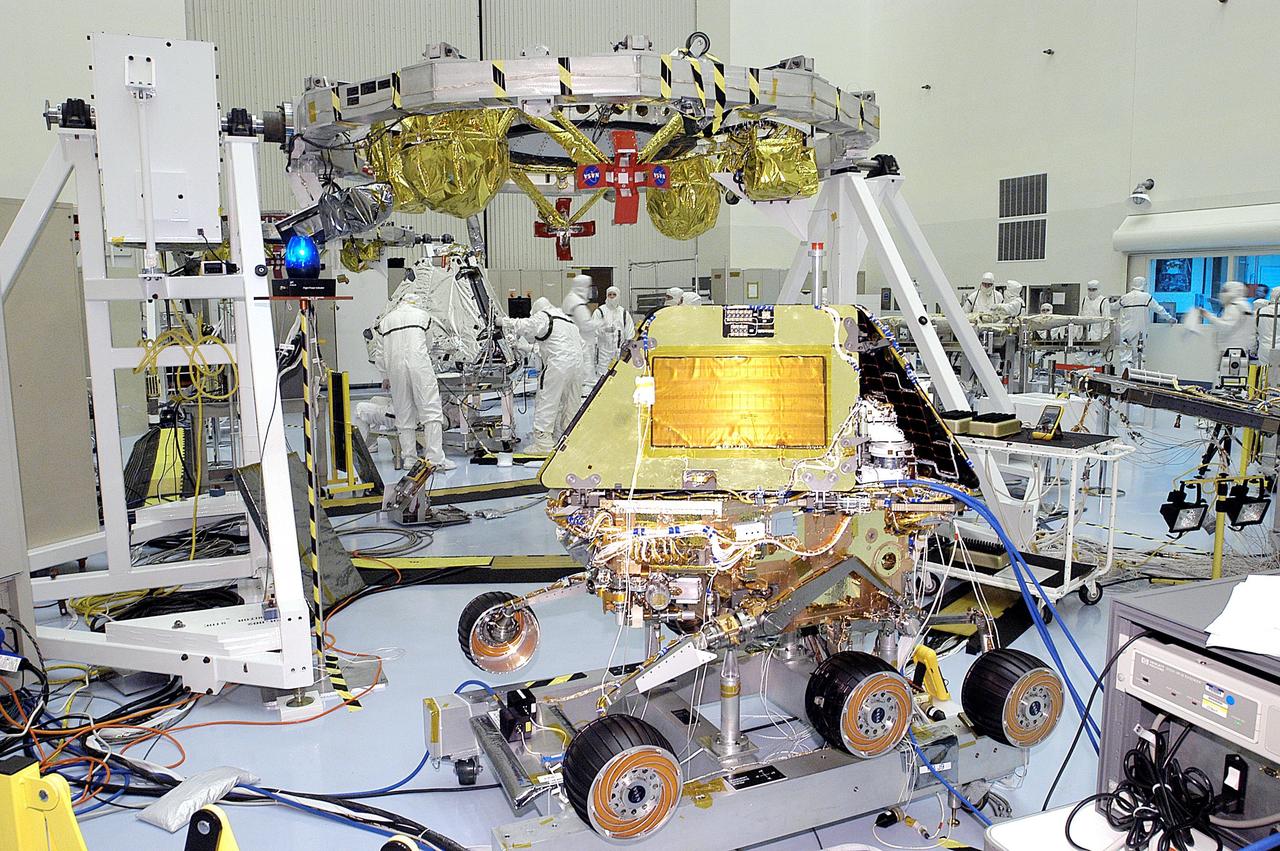
KENNEDY SPACE CENTER, FLA. - In the Payload Hazardous Servicing Facility, both Mars Exploration Rovers (MER) can be seen, MER-1 in the foreground and MER-2 in the background. Workers are preparing the shrouded MER-2 for mating to the lander. Set to launch in Spring 2003, the MER Mission consists of two identical rovers, landing at different regions of Mars, designed to cover roughly 110 yards each Martian day over various terrain. Each rover will carry five scientific instruments that will allow it to search for evidence of liquid water that may have been present in the planet's past. The first rover has a launch window opening May 30, and the second rover a window opening June 25.
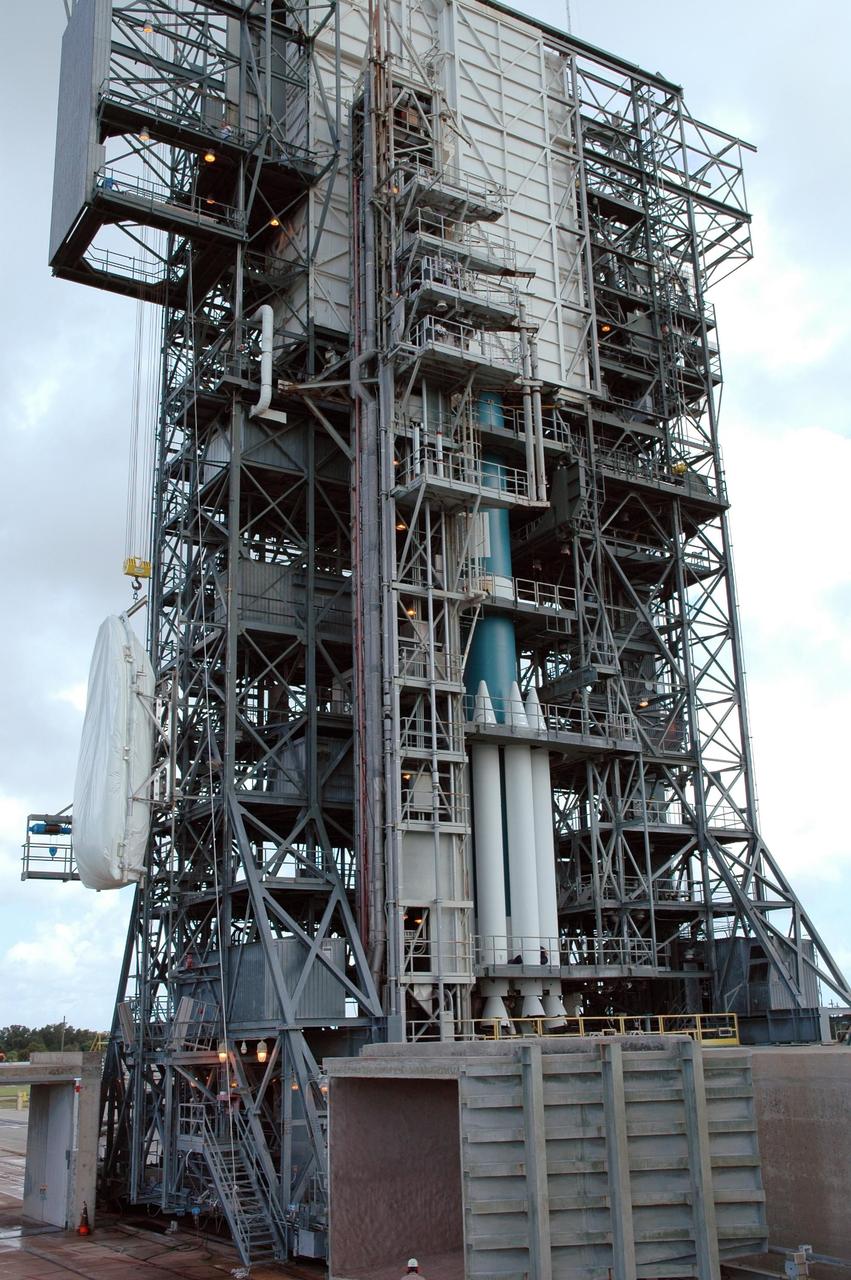
KENNEDY SPACE CENTER, FLA. - Shrouded with a protective cover, half of the payload fairing (far left) for the STEREO spacecraft is lifted up alongside the mobile service tower on Launch Pad 17-B at Cape Canaveral Air Force Station in Florida. At right, on the other side of the tower, can be seen the Boeing Delta II rocket with its solid rocket boosters in place. The fairing will be moved into the clean room in the tower and later installed around the spacecraft for protection during launch. The fairing is a molded structure that fits flush with the outside surface of the Delta II upper stage booster and forms an aerodynamically smooth nose cone, protecting the spacecraft during launch and ascent. STEREO, which stands for Solar Terrestrial Relations Observatory, comprises two spacecraft. The STEREO mission is the first to take measurements of the sun and solar wind in 3-dimension. This new view will improve our understanding of space weather and its impact on the Earth. STEREO is expected to lift off aboard a Boeing Delta II rocket in August 2006. Photo credit: NASA/Jim Grossmann
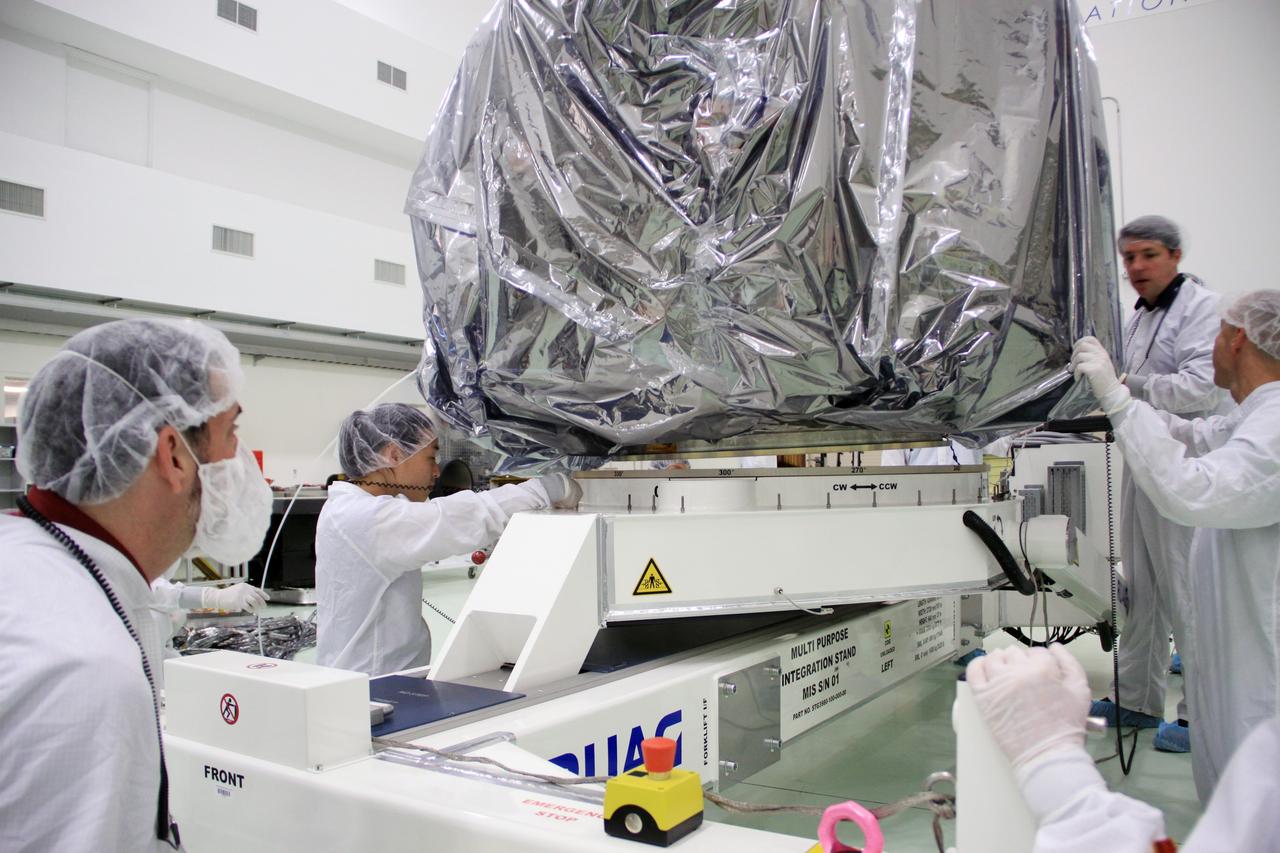
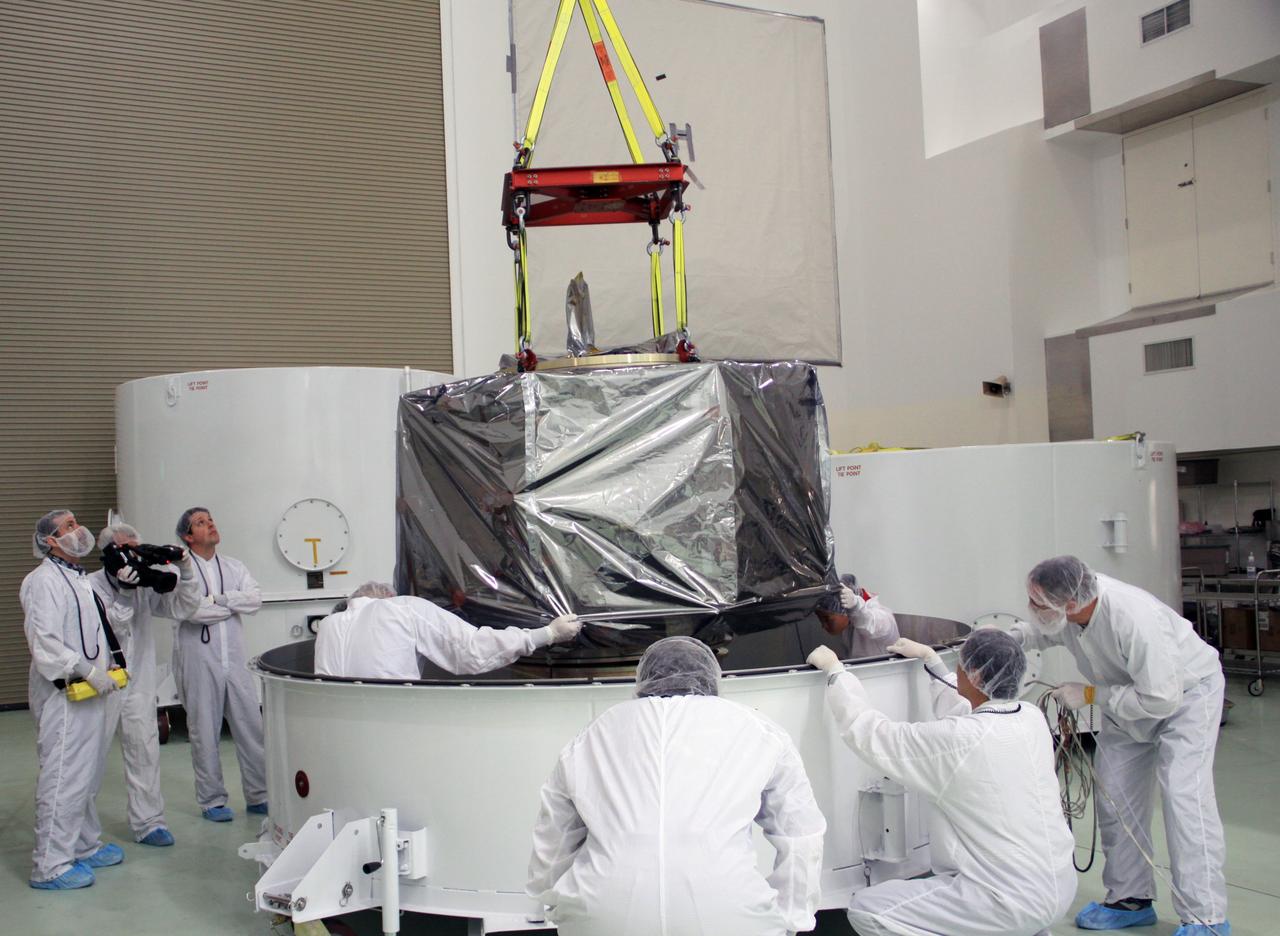
CAPE CANAVERAL, Fla. – In the clean room high bay at the Astrotech payload processing facility near NASA’s Kennedy Space Center in Florida, Applied Physics Laboratory technicians secure NASA's Radiation Belt Storm Probe A, wrapped in a protective shroud, on a test stand. Prelaunch preparations and spacecraft testing will follow. The Radiation Belt Storm Probes, or RBSP, mission will help us understand the sun’s influence on Earth and near-Earth space by studying the Earth’s radiation belts on various scales of space and time. RBSP instruments will provide the measurements needed to characterize and quantify the plasma processes that produce very energetic ions and relativistic electrons. The mission is part of NASA’s broader Living With a Star Program that was conceived to explore fundamental processes that operate throughout the solar system, particularly those that generate hazardous space weather effects in the vicinity of Earth and phenomena that could impact solar system exploration. RBSP will begin its mission of exploration of Earth's Van Allen radiation belts and the extremes of space weather after launch. Launch aboard a United Launch Alliance Atlas V rocket is scheduled for August 23. For more information, visit http://www.nasa.gov/rbsp. Photo credit: NASA/Jim Grossmann
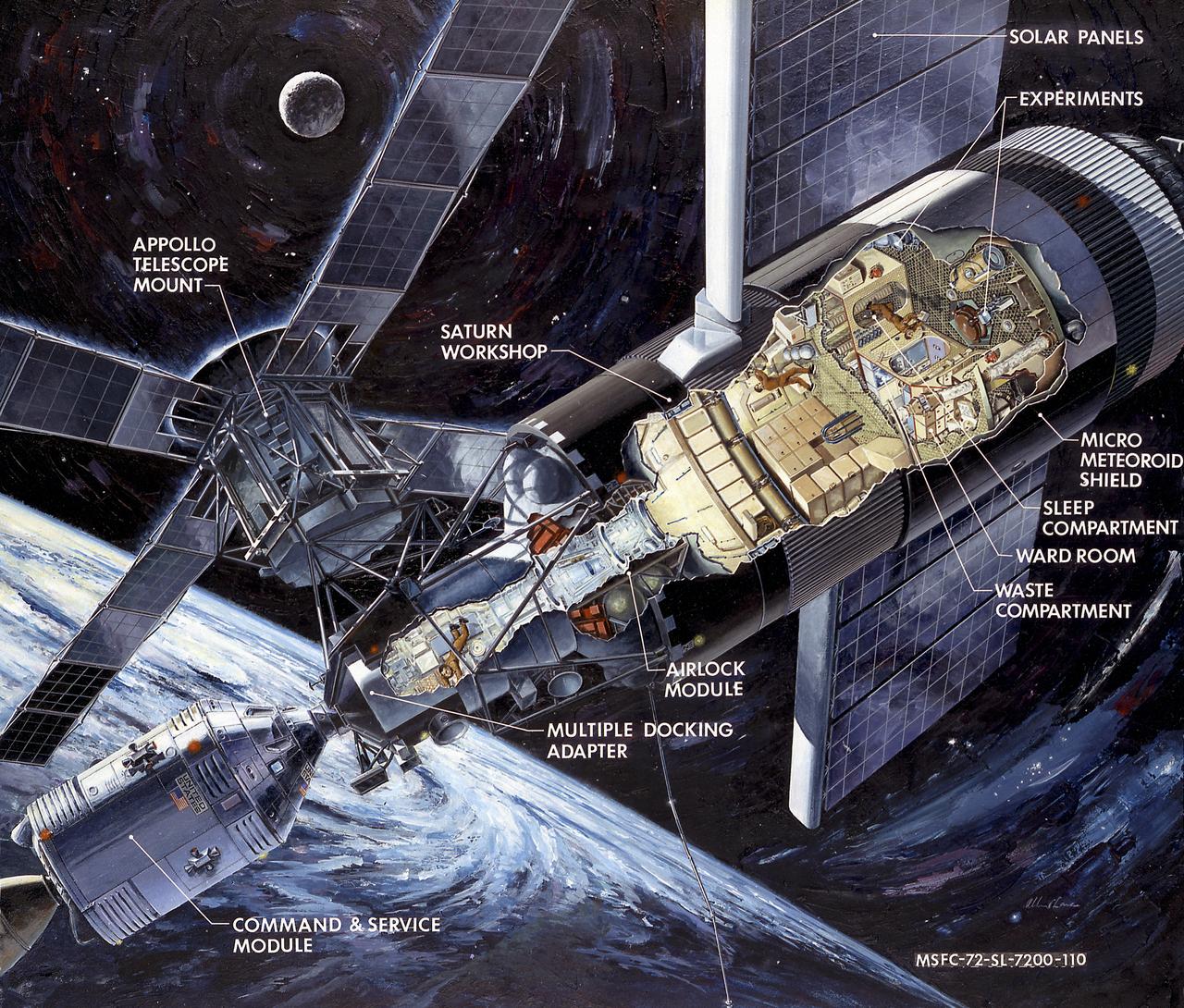
This artist's concept is a cutaway illustration of the Skylab with the Command/Service Module being docked to the Multiple Docking Adapter. In an early effort to extend the use of Apollo for further applications, NASA established the Apollo Applications Program (AAP) in August of 1965. The AAP was to include long duration Earth orbital missions during which astronauts would carry out scientific, technological, and engineering experiments in space by utilizing modified Saturn launch vehicles and the Apollo spacecraft. Established in 1970, the Skylab Program was the forerurner of the AAP. The goals of the Skylab were to enrich our scientific knowledge of the Earth, the Sun, the stars, and cosmic space; to study the effects of weightlessness on living organisms, including man; to study the effects of the processing and manufacturing of materials utilizing the absence of gravity; and to conduct Earth resource observations. The Skylab also conducted 19 selected experiments submitted by high school students. Skylab's 3 different 3-man crews spent up to 84 days in Earth orbit. The Marshall Space Flight Center (MSFC) had responsibility for developing and integrating most of the major components of the Skylab: the Orbital Workshop (OWS), Airlock Module (AM), Multiple Docking Adapter (MDA), Apollo Telescope Mount (ATM), Payload Shroud (PS), and most of the experiments. MSFC was also responsible for providing the Saturn IB launch vehicles for three Apollo spacecraft and crews and a Saturn V launch vehicle for the Skylab.
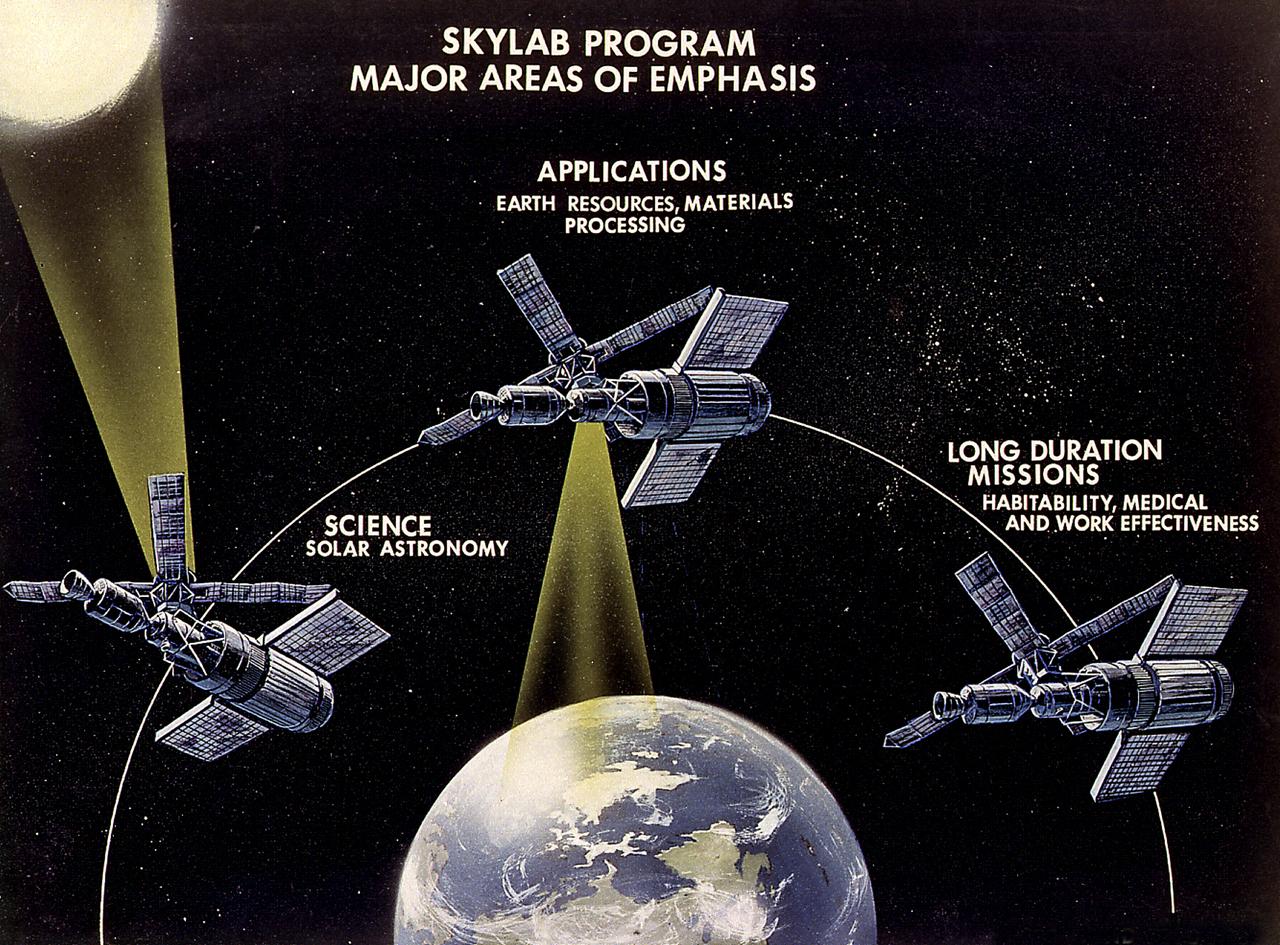
This image illustrates major areas of emphasis of the Skylab Program. In an early effort to extend the use of Apollo for further applications, NASA established the Apollo Applications Program (AAP) in August of 1965. The AAP was to include long duration Earth orbital missions during which astronauts would carry out scientific, technological, and engineering experiments in space by utilizing modified Saturn launch vehicles and the Apollo spacecraft. Established in 1970, the Skylab Program was the forerurner of the AAP. The goals of the Skylab were to enrich our scientific knowledge of the Earth, the Sun, the stars, and cosmic space; to study the effects of weightlessness on living organisms, including man; to study the effects of the processing and manufacturing of materials utilizing the absence of gravity; and to conduct Earth resource observations. The Skylab also conducted 19 selected experiments submitted by high school students. Skylab's 3 different 3-man crews spent up to 84 days in Earth orbit. The Marshall Space Flight Center (MSFC) had responsibility for developing and integrating most of the major components of the Skylab: the Orbital Workshop (OWS), Airlock Module (AM), Multiple Docking Adapter (MDA), Apollo Telescope Mount (ATM), Payload Shroud (PS), and most of the experiments. MSFC was also responsible for providing the Saturn IB launch vehicles for three Apollo spacecraft and crews and a Saturn V launch vehicle for the Skylab.
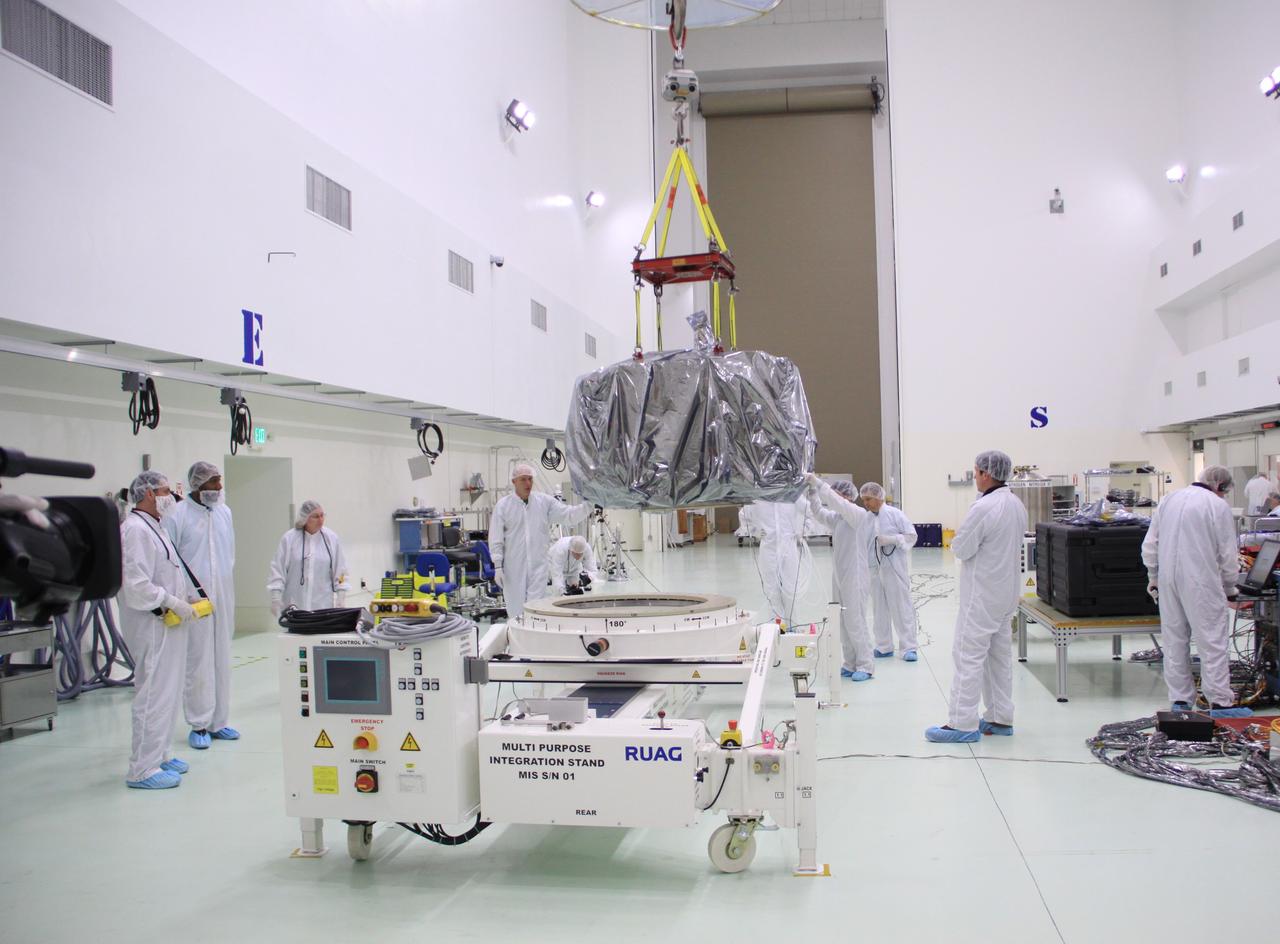
CAPE CANAVERAL, Fla. – In the clean room high bay at the Astrotech payload processing facility near NASA’s Kennedy Space Center in Florida, Applied Physics Laboratory technicians lift NASA's Radiation Belt Storm Probe A, wrapped in a protective shroud, onto a test stand. Prelaunch preparations and spacecraft testing will follow. The Radiation Belt Storm Probes, or RBSP, mission will help us understand the sun’s influence on Earth and near-Earth space by studying the Earth’s radiation belts on various scales of space and time. RBSP instruments will provide the measurements needed to characterize and quantify the plasma processes that produce very energetic ions and relativistic electrons. The mission is part of NASA’s broader Living With a Star Program that was conceived to explore fundamental processes that operate throughout the solar system, particularly those that generate hazardous space weather effects in the vicinity of Earth and phenomena that could impact solar system exploration. RBSP will begin its mission of exploration of Earth's Van Allen radiation belts and the extremes of space weather after launch. Launch aboard a United Launch Alliance Atlas V rocket is scheduled for August 23. For more information, visit http://www.nasa.gov/rbsp. Photo credit: NASA/Jim Grossmann
KENNEDY SPACE CENTER, FLA. - Inside the mobile service tower on Launch Pad 17-B at Cape Canaveral Air Force Station in Florida, the shrouded first half of the payload fairing for the STEREO spacecraft is lowered into a clean room. It will later be installed around the spacecraft for protection during launch. The fairing will be moved into the clean room in the tower and later installed around the spacecraft for protection during launch. The fairing is a molded structure that fits flush with the outside surface of the Delta II upper stage booster and forms an aerodynamically smooth nose cone, protecting the spacecraft during launch and ascent. STEREO, which stands for Solar Terrestrial Relations Observatory, comprises two spacecraft. The STEREO mission is the first to take measurements of the sun and solar wind in 3-dimension. This new view will improve our understanding of space weather and its impact on the Earth. STEREO is expected to lift off aboard a Boeing Delta II rocket in August 2006. Photo credit: NASA/Jim Grossmann
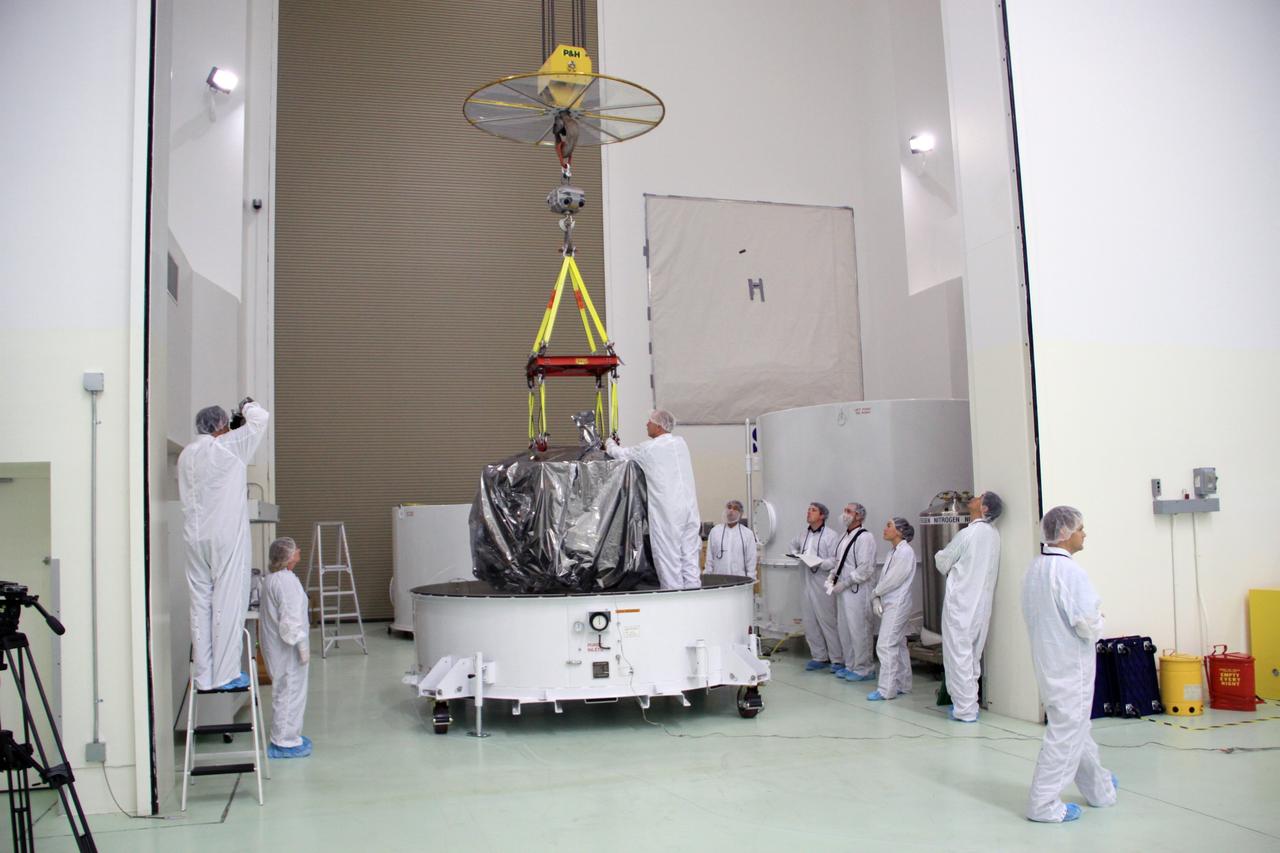
CAPE CANAVERAL, Fla. – In the clean room high bay at the Astrotech payload processing facility near NASA’s Kennedy Space Center in Florida, Applied Physics Laboratory technicians prepare to lift NASA's Radiation Belt Storm Probe A, wrapped in a protective shroud, from the bottom of its shipping container. Prelaunch preparations and spacecraft testing will follow. The Radiation Belt Storm Probes, or RBSP, mission will help us understand the sun’s influence on Earth and near-Earth space by studying the Earth’s radiation belts on various scales of space and time. RBSP instruments will provide the measurements needed to characterize and quantify the plasma processes that produce very energetic ions and relativistic electrons. The mission is part of NASA’s broader Living With a Star Program that was conceived to explore fundamental processes that operate throughout the solar system, particularly those that generate hazardous space weather effects in the vicinity of Earth and phenomena that could impact solar system exploration. RBSP will begin its mission of exploration of Earth's Van Allen radiation belts and the extremes of space weather after launch. Launch aboard a United Launch Alliance Atlas V rocket is scheduled for August 23. For more information, visit http://www.nasa.gov/rbsp. Photo credit: NASA/Jim Grossmann
CAPE CANAVERAL, Fla. – In the clean room high bay at the Astrotech payload processing facility near NASA’s Kennedy Space Center in Florida, Applied Physics Laboratory technicians lift NASA's Radiation Belt Storm Probe B, wrapped in a protective shroud, from the bottom of its shipping container. Prelaunch preparations and spacecraft testing will follow. The Radiation Belt Storm Probes, or RBSP, mission will help us understand the sun’s influence on Earth and near-Earth space by studying the Earth’s radiation belts on various scales of space and time. RBSP instruments will provide the measurements needed to characterize and quantify the plasma processes that produce very energetic ions and relativistic electrons. The mission is part of NASA’s broader Living With a Star Program that was conceived to explore fundamental processes that operate throughout the solar system, particularly those that generate hazardous space weather effects in the vicinity of Earth and phenomena that could impact solar system exploration. RBSP will begin its mission of exploration of Earth's Van Allen radiation belts and the extremes of space weather after launch. Launch aboard a United Launch Alliance Atlas V rocket is scheduled for August 23. For more information, visit http://www.nasa.gov/rbsp. Photo credit: NASA/Jim Grossmann
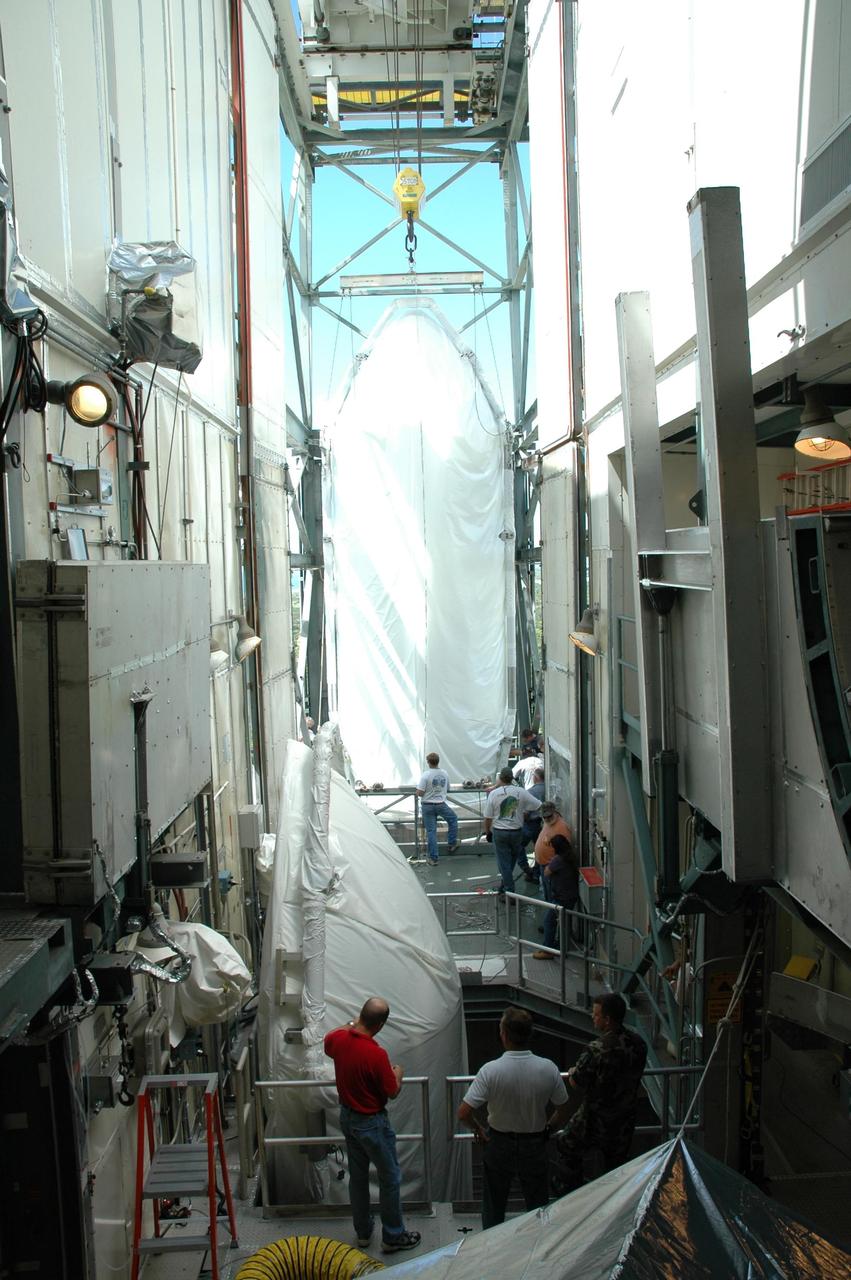
KENNEDY SPACE CENTER, FLA. - Inside the mobile service tower on Launch Pad 17-B at Cape Canaveral Air Force Station in Florida, the shrouded second half of the payload fairing (background) for the STEREO spacecraft is joining the first half waiting in the foreground. Both halves will later be installed around the spacecraft for protection during launch. The fairing will be moved into the clean room in the tower and later installed around the spacecraft for protection during launch. The fairing is a molded structure that fits flush with the outside surface of the Delta II upper stage booster and forms an aerodynamically smooth nose cone, protecting the spacecraft during launch and ascent. STEREO, which stands for Solar Terrestrial Relations Observatory, comprises two spacecraft. The STEREO mission is the first to take measurements of the sun and solar wind in 3-dimension. This new view will improve our understanding of space weather and its impact on the Earth. STEREO is expected to lift off aboard a Boeing Delta II rocket in August 2006. Photo credit: NASA/Jim Grossmann
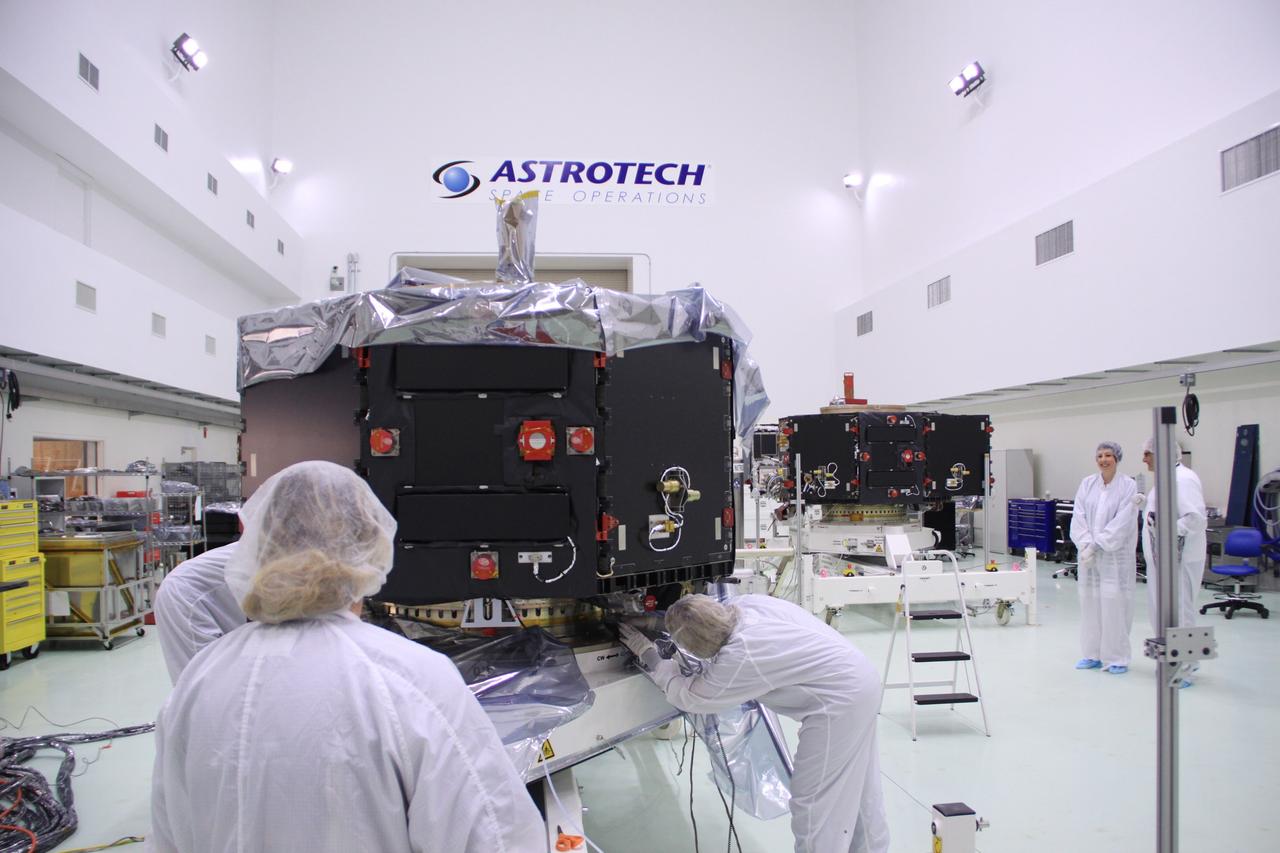
CAPE CANAVERAL, Fla. – In the clean room high bay at the Astrotech payload processing facility near NASA’s Kennedy Space Center in Florida, Applied Physics Laboratory technicians remove the protective shroud from around NASA's Radiation Belt Storm Probe B. Its twin, Radiation Belt Storm Probe A, in the background, has already been uncovered. The Radiation Belt Storm Probes, or RBSP, mission will help us understand the sun’s influence on Earth and near-Earth space by studying the Earth’s radiation belts on various scales of space and time. RBSP instruments will provide the measurements needed to characterize and quantify the plasma processes that produce very energetic ions and relativistic electrons. The mission is part of NASA’s broader Living With a Star Program that was conceived to explore fundamental processes that operate throughout the solar system, particularly those that generate hazardous space weather effects in the vicinity of Earth and phenomena that could impact solar system exploration. RBSP will begin its mission of exploration of Earth's Van Allen radiation belts and the extremes of space weather after launch. Launch aboard a United Launch Alliance Atlas V rocket is scheduled for August 23. For more information, visit http://www.nasa.gov/rbsp. Photo credit: NASA/Jim Grossmann
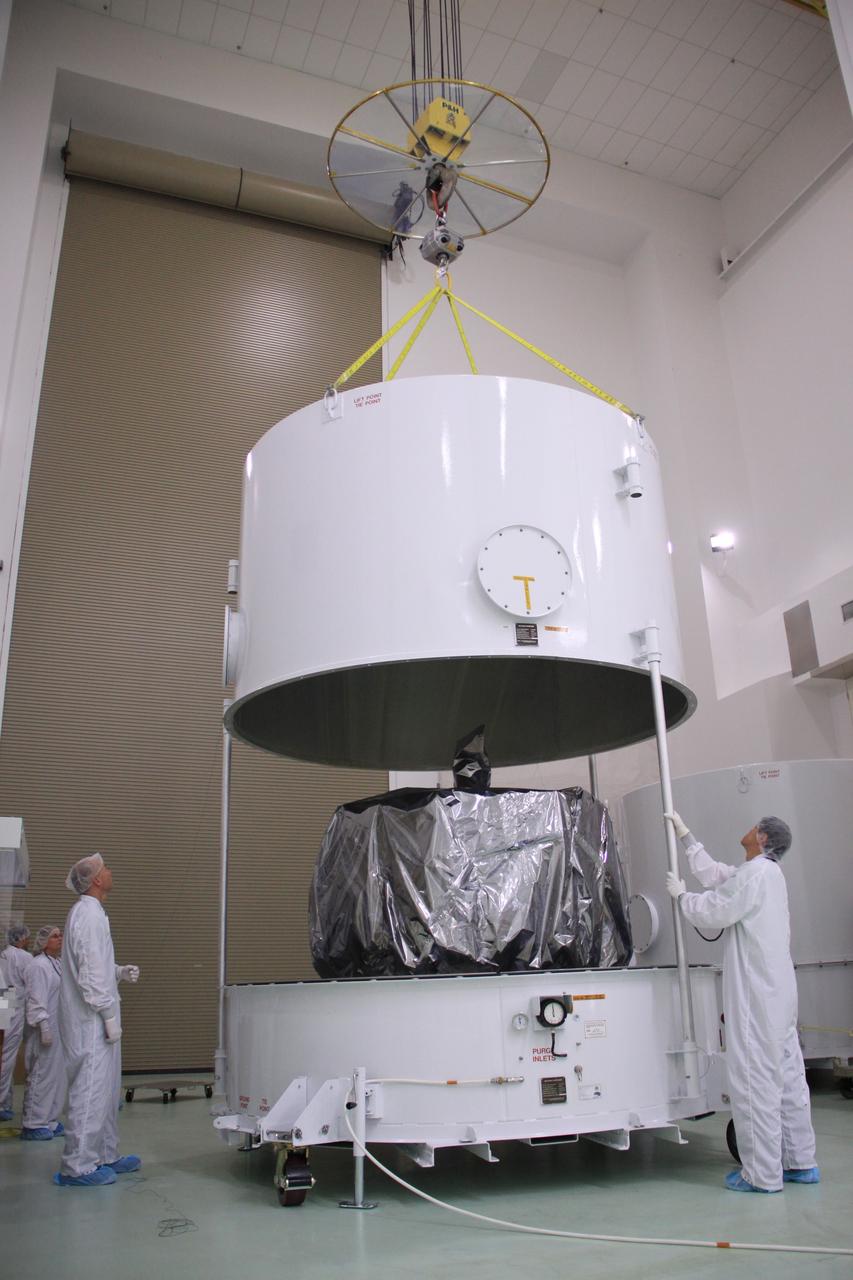
CAPE CANAVERAL, Fla. – In the clean room high bay at the Astrotech payload processing facility near NASA’s Kennedy Space Center in Florida, Applied Physics Laboratory technicians lift the shipping container from around NASA's Radiation Belt Storm Probe A, wrapped in a protective shroud. Prelaunch preparations and spacecraft testing will follow. The Radiation Belt Storm Probes, or RBSP, mission will help us understand the sun’s influence on Earth and near-Earth space by studying the Earth’s radiation belts on various scales of space and time. RBSP instruments will provide the measurements needed to characterize and quantify the plasma processes that produce very energetic ions and relativistic electrons. The mission is part of NASA’s broader Living With a Star Program that was conceived to explore fundamental processes that operate throughout the solar system, particularly those that generate hazardous space weather effects in the vicinity of Earth and phenomena that could impact solar system exploration. RBSP will begin its mission of exploration of Earth's Van Allen radiation belts and the extremes of space weather after launch. Launch aboard a United Launch Alliance Atlas V rocket is scheduled for August 23. For more information, visit http://www.nasa.gov/rbsp. Photo credit: NASA/Jim Grossmann
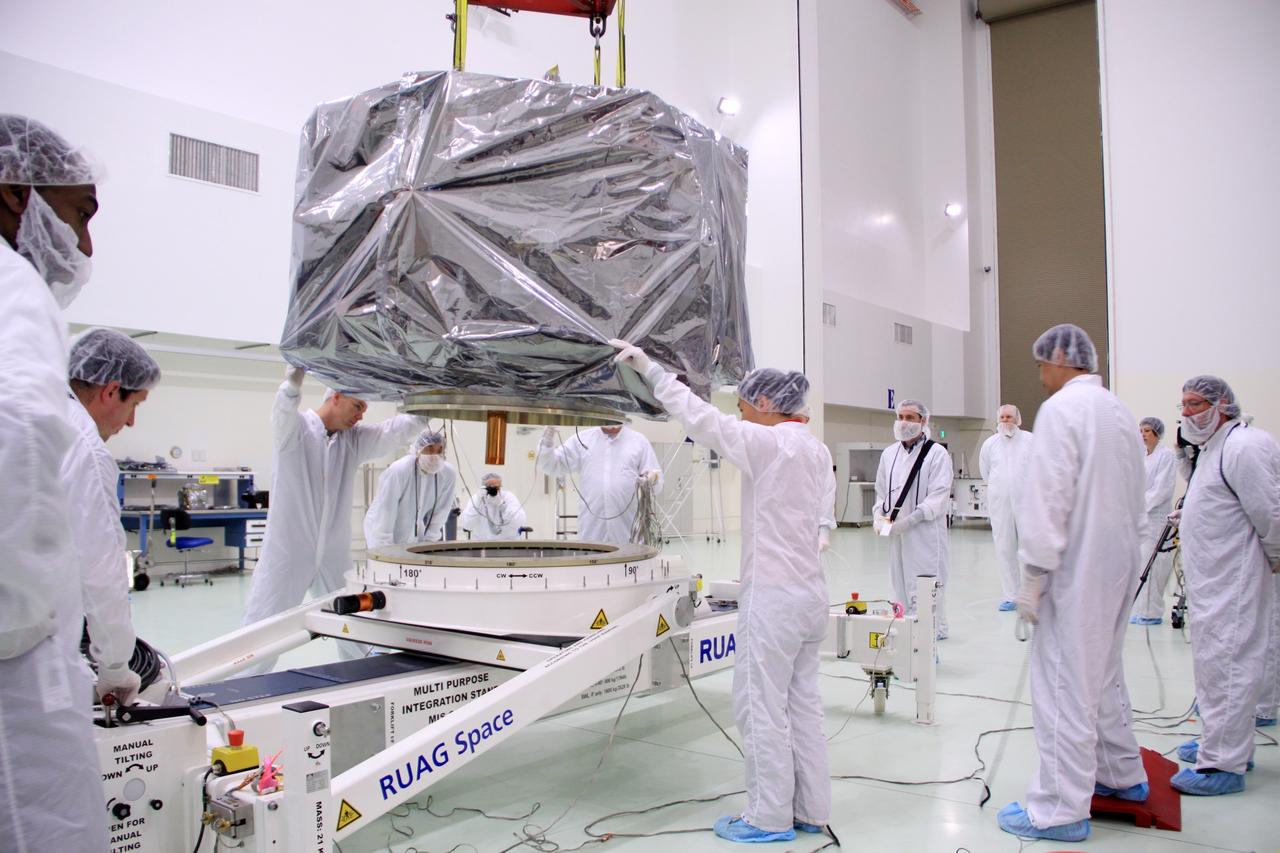
CAPE CANAVERAL, Fla. – In the clean room high bay at the Astrotech payload processing facility near NASA’s Kennedy Space Center in Florida, Applied Physics Laboratory technicians lower NASA's Radiation Belt Storm Probe B, wrapped in a protective shroud, onto a test stand. Prelaunch preparations and spacecraft testing will follow. The Radiation Belt Storm Probes, or RBSP, mission will help us understand the sun’s influence on Earth and near-Earth space by studying the Earth’s radiation belts on various scales of space and time. RBSP instruments will provide the measurements needed to characterize and quantify the plasma processes that produce very energetic ions and relativistic electrons. The mission is part of NASA’s broader Living With a Star Program that was conceived to explore fundamental processes that operate throughout the solar system, particularly those that generate hazardous space weather effects in the vicinity of Earth and phenomena that could impact solar system exploration. RBSP will begin its mission of exploration of Earth's Van Allen radiation belts and the extremes of space weather after launch. Launch aboard a United Launch Alliance Atlas V rocket is scheduled for August 23. For more information, visit http://www.nasa.gov/rbsp. Photo credit: NASA/Jim Grossmann
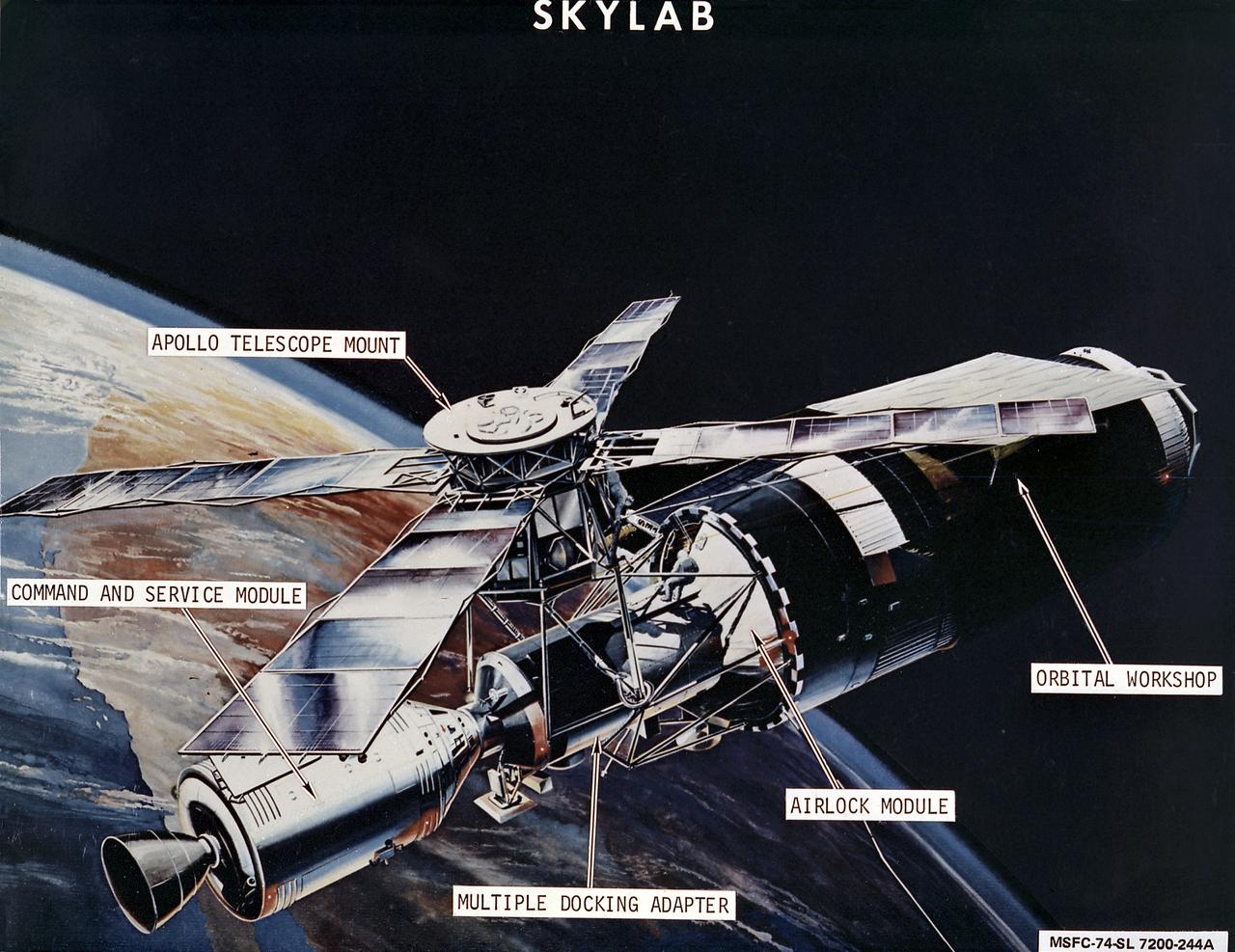
This image is an artist's concept of the Skylab in orbit with callouts of its major components. In an early effort to extend the use of Apollo for further applications, NASA established the Apollo Applications Program (AAP) in August of 1965. The AAP was to include long duration Earth orbital missions during which astronauts would carry out scientific, technological, and engineering experiments in space by utilizing modified Saturn launch vehicles and the Apollo spacecraft. Established in 1970, the Skylab Program was the forerurner of the AAP. The goals of the Skylab were to enrich our scientific knowledge of the Earth, the Sun, the stars, and cosmic space; to study the effects of weightlessness on living organisms, including man; to study the effects of the processing and manufacturing of materials utilizing the absence of gravity; and to conduct Earth resource observations. The Skylab also conducted 19 selected experiments submitted by high school students. Skylab's 3 different 3-man crews spent up to 84 days in Earth orbit. The Marshall Space Flight Center (MSFC) had responsibility for developing and integrating most of the major components of the Skylab: the Orbital Workshop (OWS), Airlock Module (AM), Multiple Docking Adapter (MDA), Apollo Telescope Mount (ATM), Payload Shroud (PS), and most of the experiments. MSFC was also responsible for providing the Saturn IB launch vehicles for three Apollo spacecraft and crews and a Saturn V launch vehicle for the Skylab.
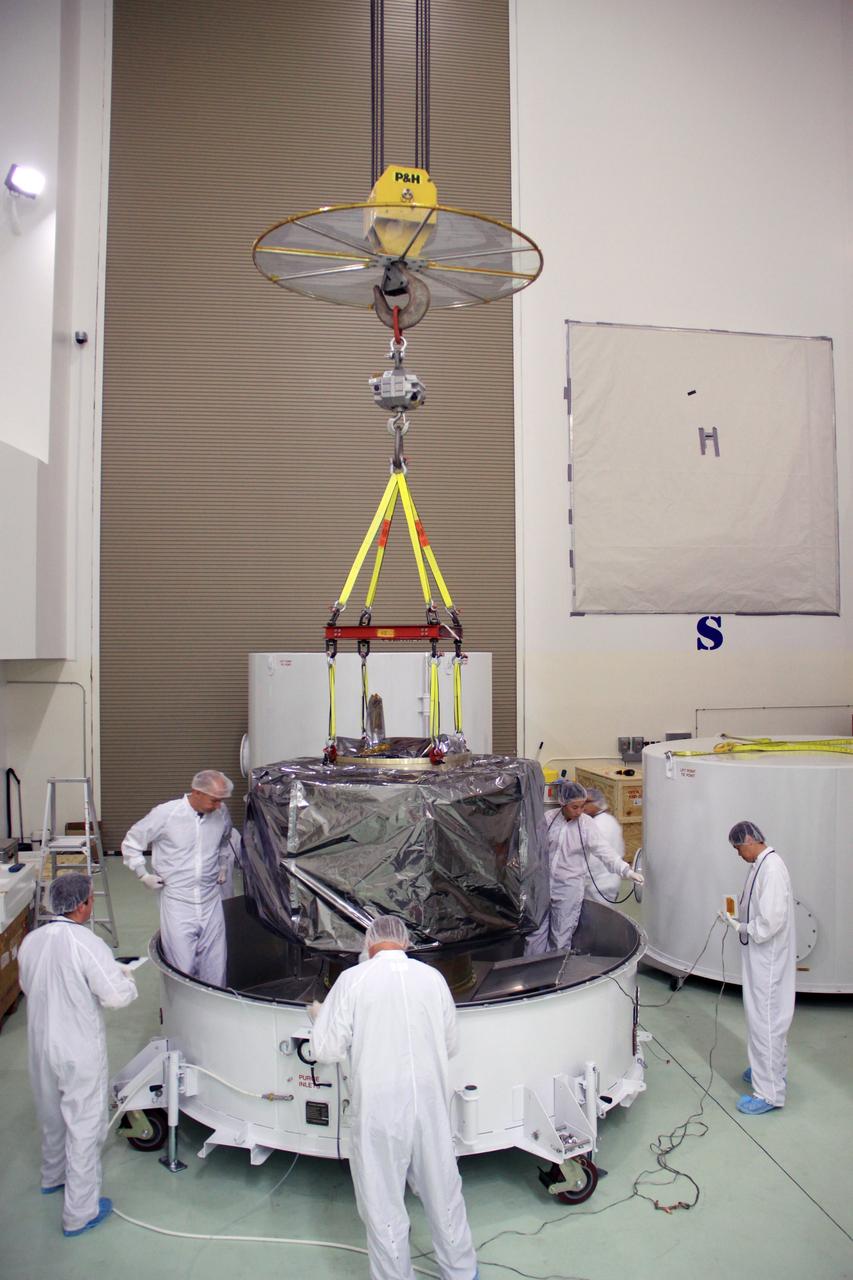
CAPE CANAVERAL, Fla. – In the clean room high bay at the Astrotech payload processing facility near NASA’s Kennedy Space Center in Florida, Applied Physics Laboratory technicians prepare to lift NASA's Radiation Belt Storm Probe B, wrapped in a protective shroud, from the bottom of its shipping container. Prelaunch preparations and spacecraft testing will follow. The Radiation Belt Storm Probes, or RBSP, mission will help us understand the sun’s influence on Earth and near-Earth space by studying the Earth’s radiation belts on various scales of space and time. RBSP instruments will provide the measurements needed to characterize and quantify the plasma processes that produce very energetic ions and relativistic electrons. The mission is part of NASA’s broader Living With a Star Program that was conceived to explore fundamental processes that operate throughout the solar system, particularly those that generate hazardous space weather effects in the vicinity of Earth and phenomena that could impact solar system exploration. RBSP will begin its mission of exploration of Earth's Van Allen radiation belts and the extremes of space weather after launch. Launch aboard a United Launch Alliance Atlas V rocket is scheduled for August 23. For more information, visit http://www.nasa.gov/rbsp. Photo credit: NASA/Jim Grossmann
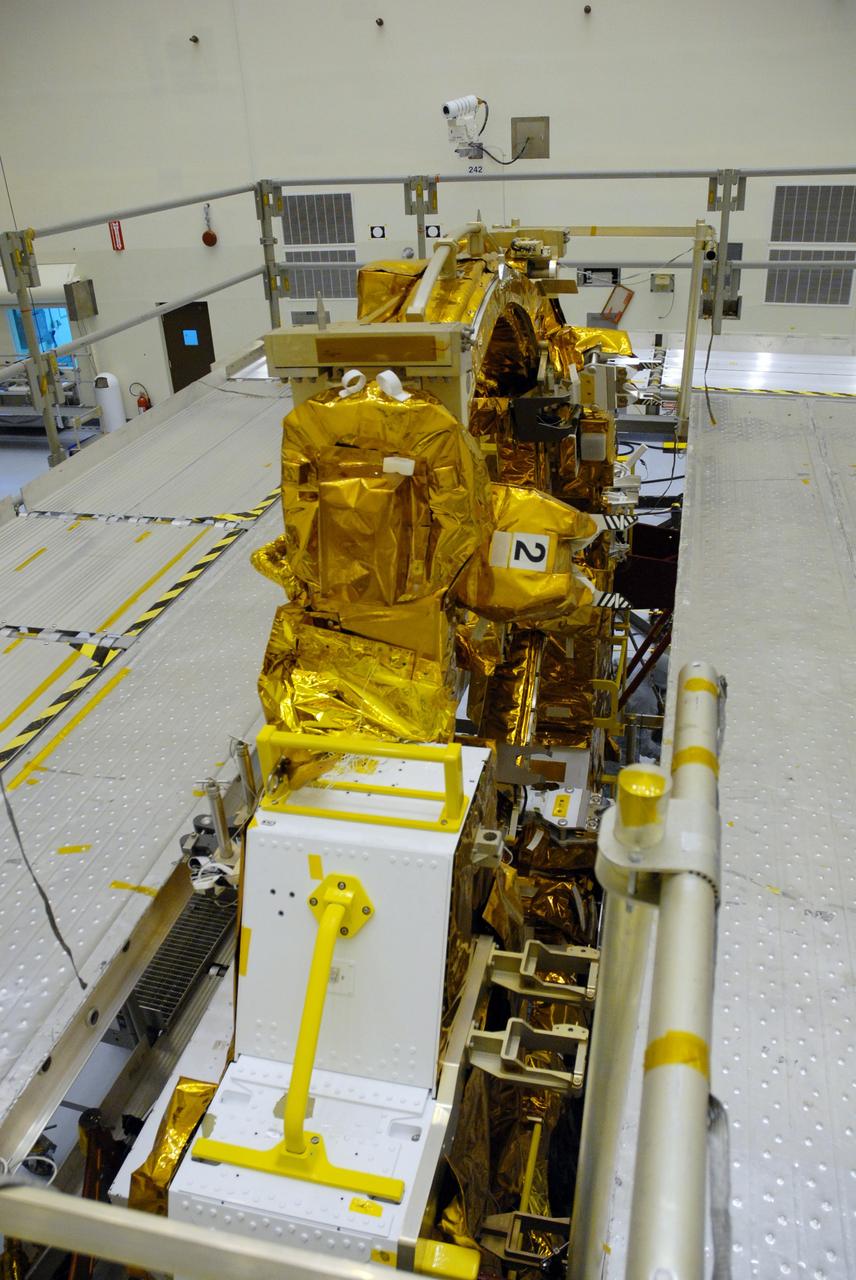
CAPE CANAVERAL, Fla. – In the high bay of the Payload Hazardous Servicing Facility at NASA's Kennedy Space Center, the protective wrapping has been removed from the Flight Support System for the Hubble Space Telescope revealing the soft capture mechanism , or SCM. The SCM will be permanently attached to Hubble’s aft shroud by spacewalking astronauts and will provide a rendezvous and docking target that can be easily seen and recognized by a docking vehicle. The Flight Support System, or FSS, is one of four carriers supporting hardware for space shuttle Atlantis' STS-125 mission to service the telescope. The Super Lightweight Interchangeable Carrier, or SLIC, and the Orbital Replacement Unit Carrier, or ORUC, have also arrived at Kennedy. The Multi-Use Lightweight Equipment carrier will be delivered in early August. The carriers will be prepared for the integration of telescope science instruments, both internal and external replacement components, as well as the flight support equipment to be used by the astronauts during the Hubble servicing mission, targeted for launch Oct. 8. Photo credit: NASA/Jack Pfaller
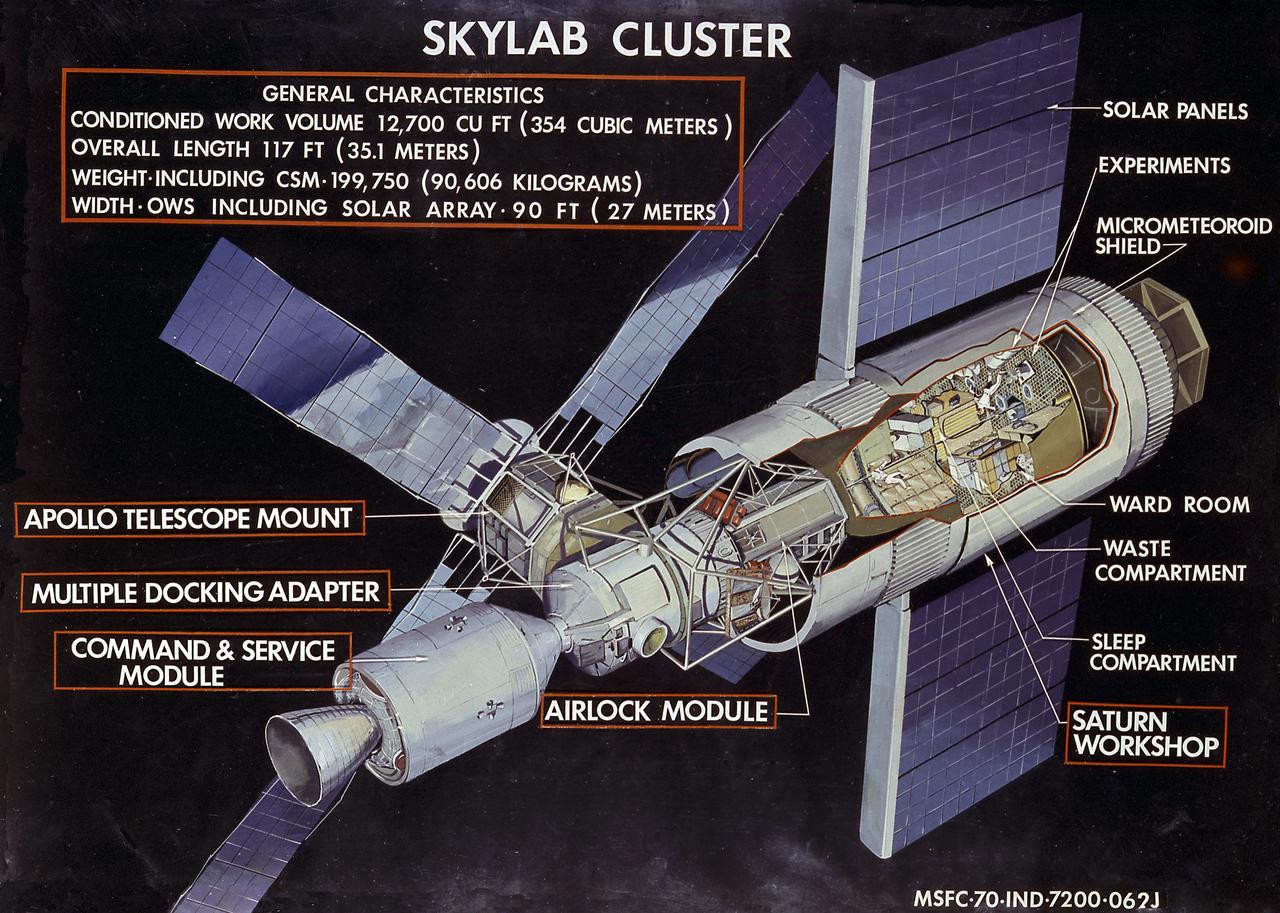
This illustration shows general characteristics of the Skylab with callouts of its major components. In an early effort to extend the use of Apollo for further applications, NASA established the Apollo Applications Program (AAP) in August of 1965. The AAP was to include long duration Earth orbital missions during which astronauts would carry out scientific, technological, and engineering experiments in space by utilizing modified Saturn launch vehicles and the Apollo spacecraft. Established in 1970, the Skylab Program was the forerurner of the AAP. The goals of the Skylab were to enrich our scientific knowledge of the Earth, the Sun, the stars, and cosmic space; to study the effects of weightlessness on living organisms, including man; to study the effects of the processing and manufacturing of materials utilizing the absence of gravity; and to conduct Earth resource observations. The Skylab also conducted 19 selected experiments submitted by high school students. Skylab's 3 different 3-man crews spent up to 84 days in Earth orbit. The Marshall Space Flight Center (MSFC) had responsibility for developing and integrating most of the major components of the Skylab: the Orbital Workshop (OWS), Airlock Module (AM), Multiple Docking Adapter (MDA), Apollo Telescope Mount (ATM), Payload Shroud (PS), and most of the experiments. MSFC was also responsible for providing the Saturn IB launch vehicles for three Apollo spacecraft and crews and a Saturn V launch vehicle for the Skylab.
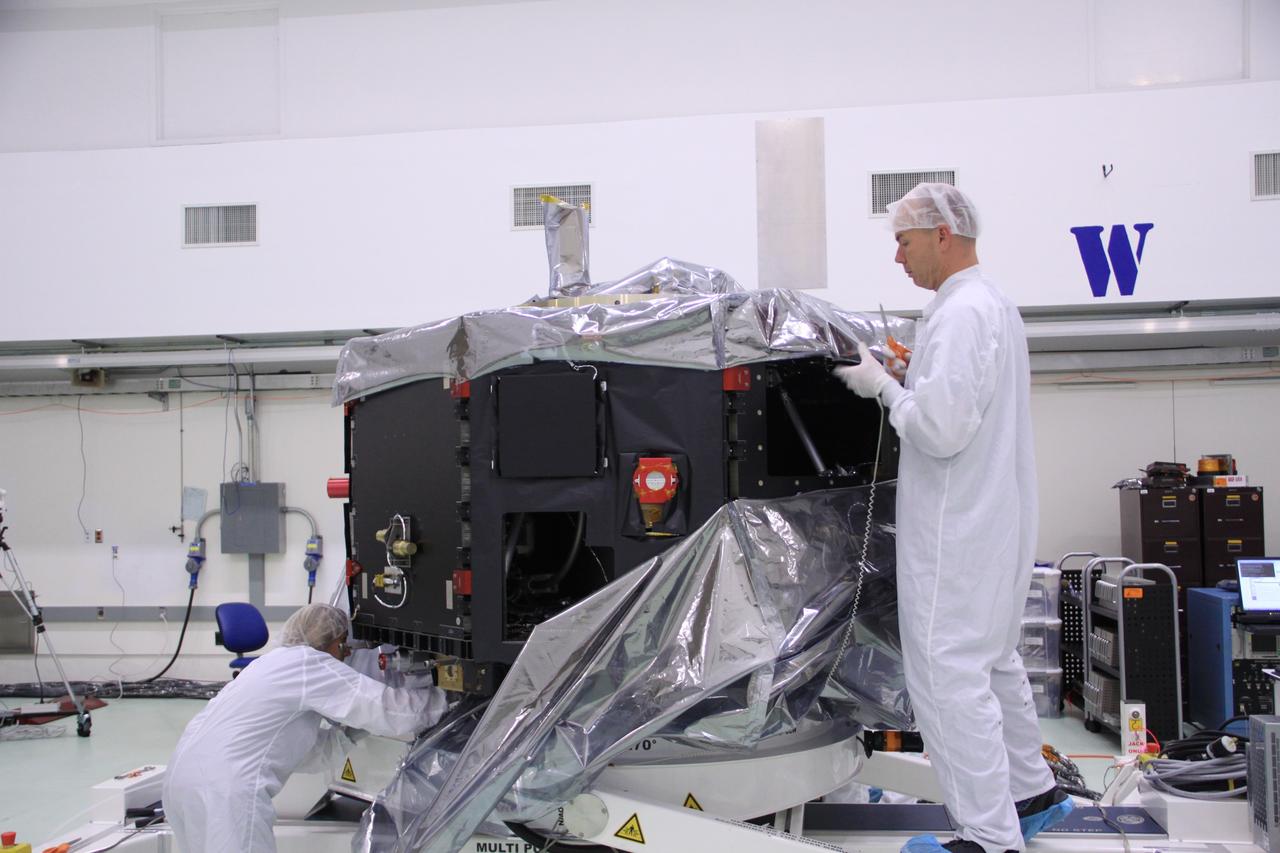
CAPE CANAVERAL, Fla. – In the clean room high bay at the Astrotech payload processing facility near NASA’s Kennedy Space Center in Florida, Applied Physics Laboratory technicians remove the protective shroud from around NASA's Radiation Belt Storm Probe B. Prelaunch preparations and spacecraft testing will follow. The Radiation Belt Storm Probes, or RBSP, mission will help us understand the sun’s influence on Earth and near-Earth space by studying the Earth’s radiation belts on various scales of space and time. RBSP instruments will provide the measurements needed to characterize and quantify the plasma processes that produce very energetic ions and relativistic electrons. The mission is part of NASA’s broader Living With a Star Program that was conceived to explore fundamental processes that operate throughout the solar system, particularly those that generate hazardous space weather effects in the vicinity of Earth and phenomena that could impact solar system exploration. RBSP will begin its mission of exploration of Earth's Van Allen radiation belts and the extremes of space weather after launch. Launch aboard a United Launch Alliance Atlas V rocket is scheduled for August 23. For more information, visit http://www.nasa.gov/rbsp. Photo credit: NASA/Jim Grossmann
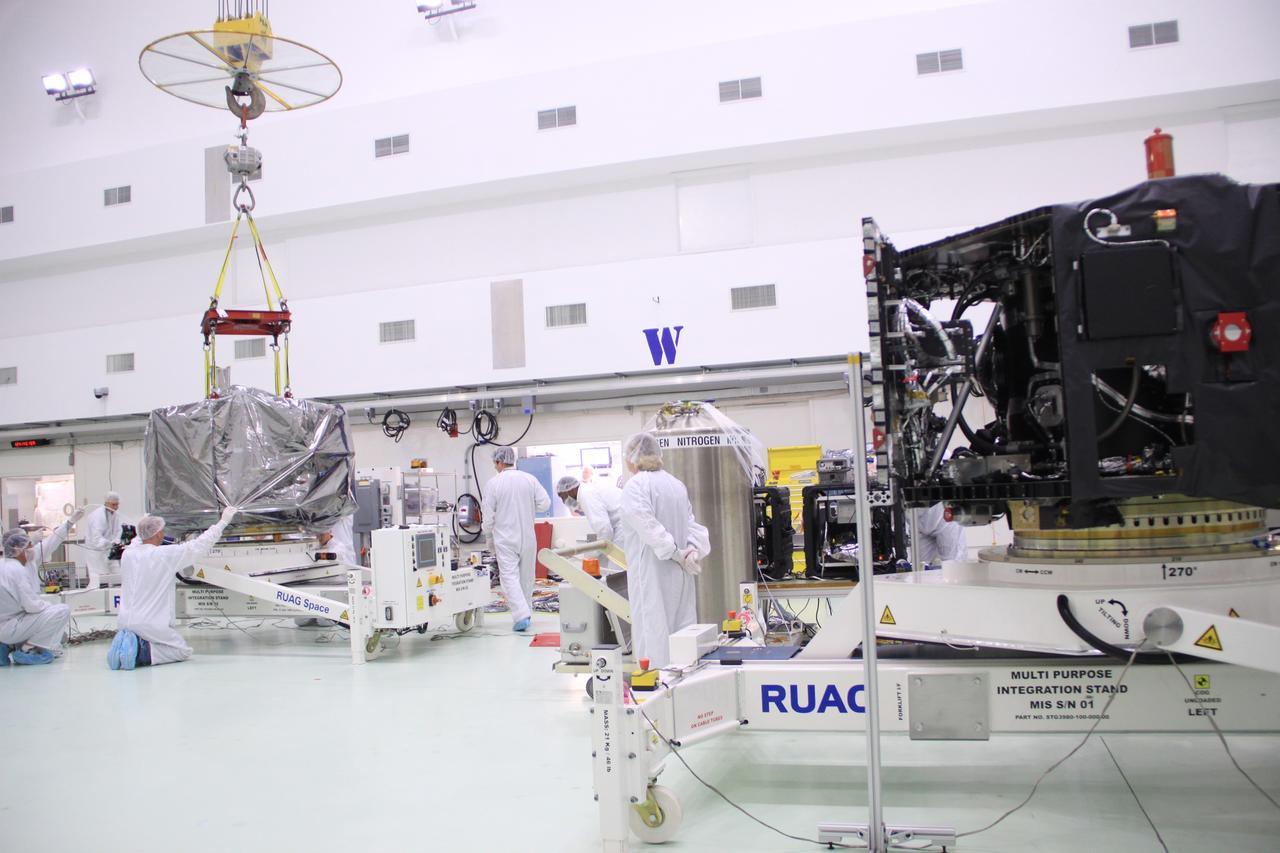
CAPE CANAVERAL, Fla. – In the clean room high bay at the Astrotech payload processing facility near NASA’s Kennedy Space Center in Florida, Applied Physics Laboratory technicians position NASA's Radiation Belt Storm Probe B, wrapped in a protective shroud, on a test stand. Prelaunch preparations and spacecraft testing will follow. The Radiation Belt Storm Probes, or RBSP, mission will help us understand the sun’s influence on Earth and near-Earth space by studying the Earth’s radiation belts on various scales of space and time. RBSP instruments will provide the measurements needed to characterize and quantify the plasma processes that produce very energetic ions and relativistic electrons. The mission is part of NASA’s broader Living With a Star Program that was conceived to explore fundamental processes that operate throughout the solar system, particularly those that generate hazardous space weather effects in the vicinity of Earth and phenomena that could impact solar system exploration. RBSP will begin its mission of exploration of Earth's Van Allen radiation belts and the extremes of space weather after launch. Launch aboard a United Launch Alliance Atlas V rocket is scheduled for August 23. For more information, visit http://www.nasa.gov/rbsp. Photo credit: NASA/Jim Grossmann
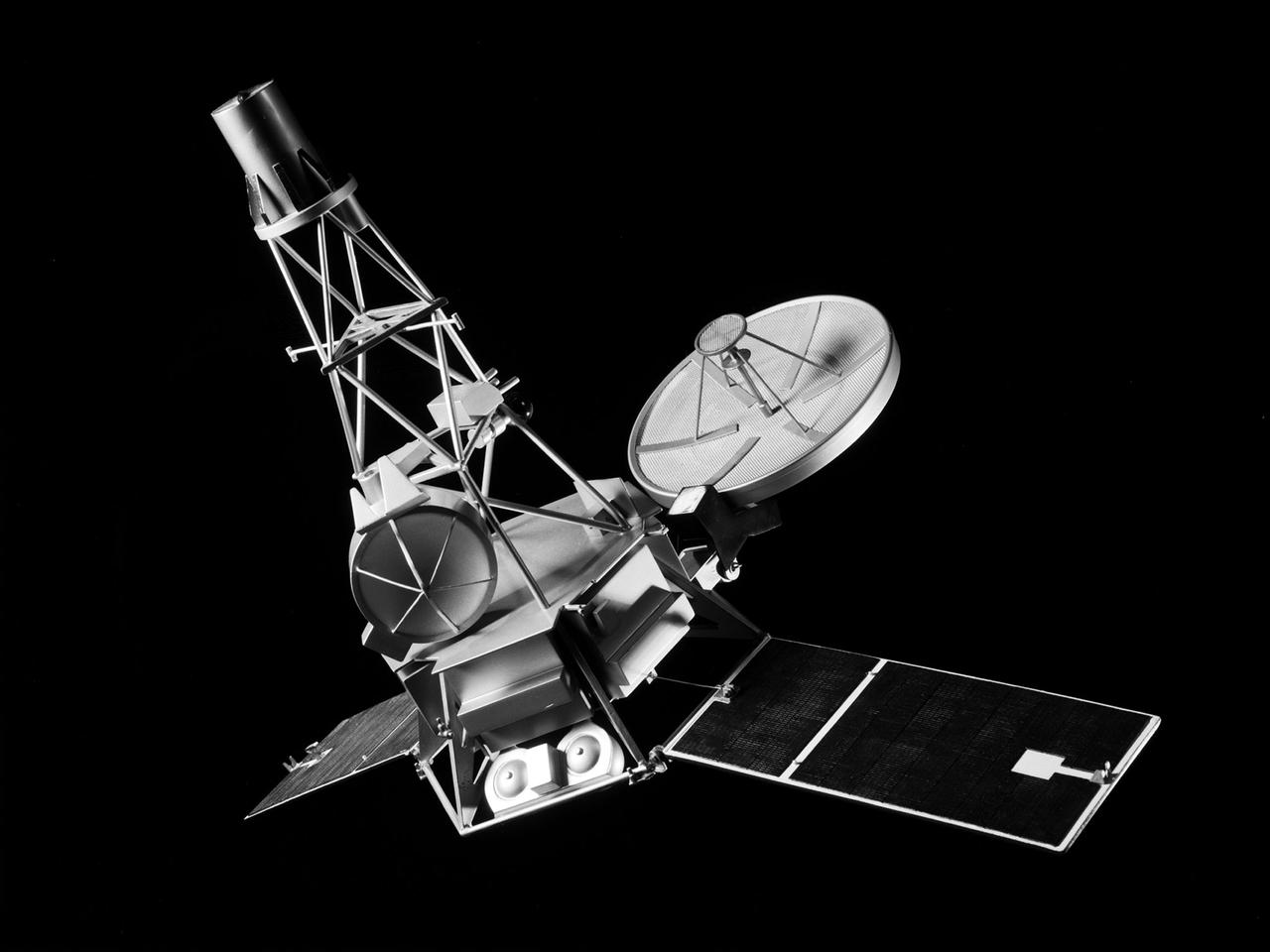
A model of the Mariner-C spacecraft at the National Aeronautics and Space Administration (NASA) Lewis Research Center for a June 1964 Conference on New Technology. Mariner-C and Mariner-D were identical spacecraft designed by the Jet Propulsion Laboratory to flyby Mars and photograph the Martian surface. Mariner-C was launched on November 4, 1964, but the payload shroud did not jettison properly and the spacecraft’s battery power did not function. The mission ended unsuccessfully two days later. Mariner-D was launched as designed on November 28, 1964 and became the first successful mission to Mars. It was the first time a planet was photographed from space. Mariner-D’s 21 photographs revealed an inhospitable and barren landscape. The two Mariner spacecraft were launched by Atlas-Agena-D rockets. Lewis had taken over management of the Agena Program in October 1962. There had been five failures and two partial failures in the 17 Agena launches before being taken over by NASA Lewis. Lewis, however, oversaw 28 successful Agena missions between 1962 and 1968, including several Rangers and the Mariner Venus '67.
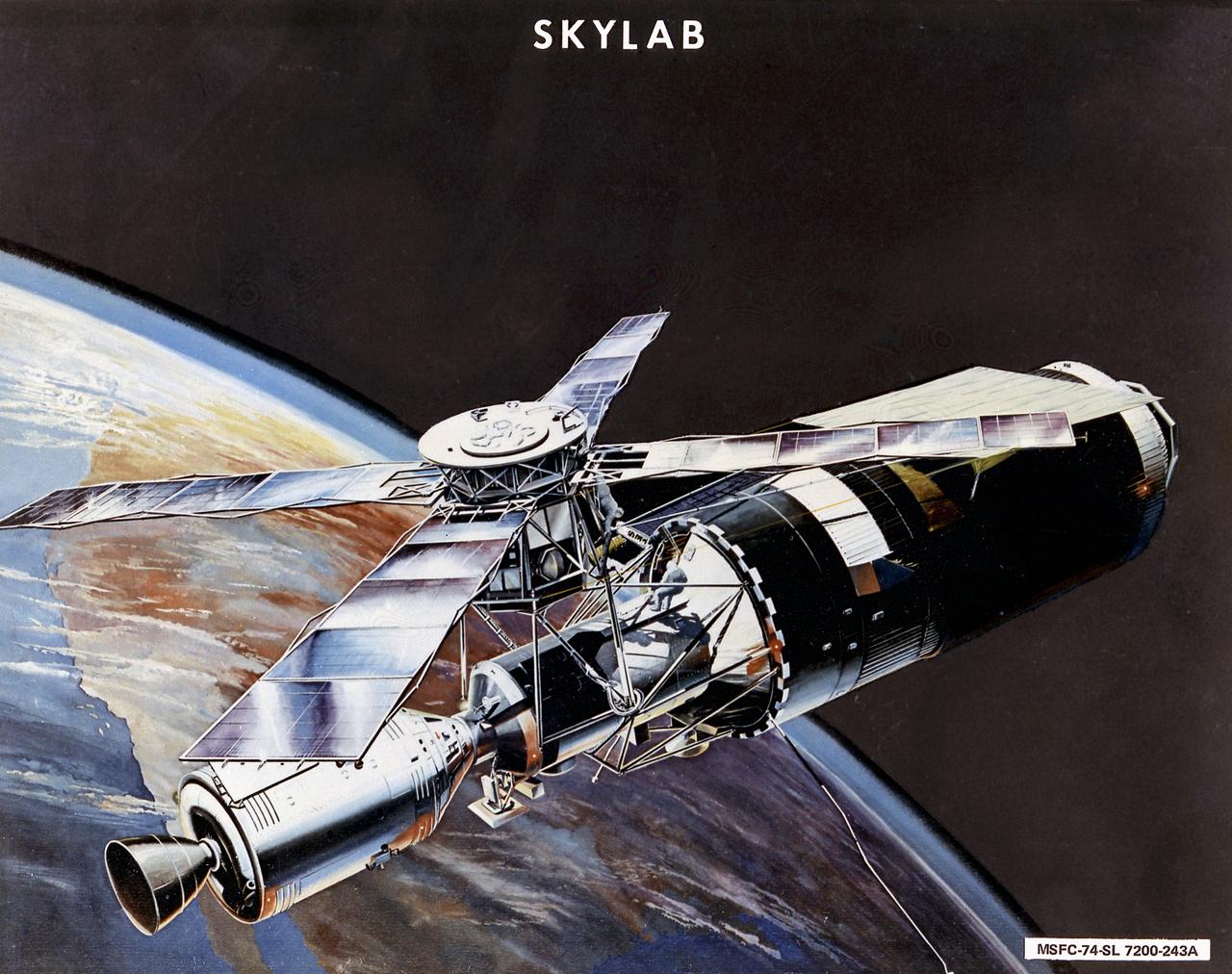
This image is an artist's concept of the Skylab in orbit. In an early effort to extend the use of Apollo for further applications, NASA established the Apollo Applications Program (AAP) in August of 1965. The AAP was to include long duration Earth orbital missions during which astronauts would carry out scientific, technological, and engineering experiments in space by utilizing modified Saturn launch vehicles and the Apollo spacecraft. Established in 1970, the Skylab program was the forerurner of the AAP. The goals of the Skylab were to enrich our scientific knowledge of the Earth, the Sun, the stars, and cosmic space; to study the effects of weightlessness on living organisms, including man; to study the effects of the processing and manufacturing of materials utilizing the absence of gravity; and to conduct Earth resource observations. The Skylab also conducted 19 selected experiments submitted by high school students. Skylab's 3 different 3-man crews spent up to 84 days in Earth orbit. The Marshall Space Flight Center (MSFC) had responsibility for developing and integrating most of the major components of the Skylab: the Orbital Workshop (OWS), Airlock Module (AM), Multiple Docking Adapter (MDA), Apollo Telescope Mount (ATM), Payload Shroud (PS), and most of the experiments. MSFC was also responsible for providing the Saturn IB launch vehicles for three Apollo spacecraft and crews and a Saturn V launch vehicle for the Skylab.
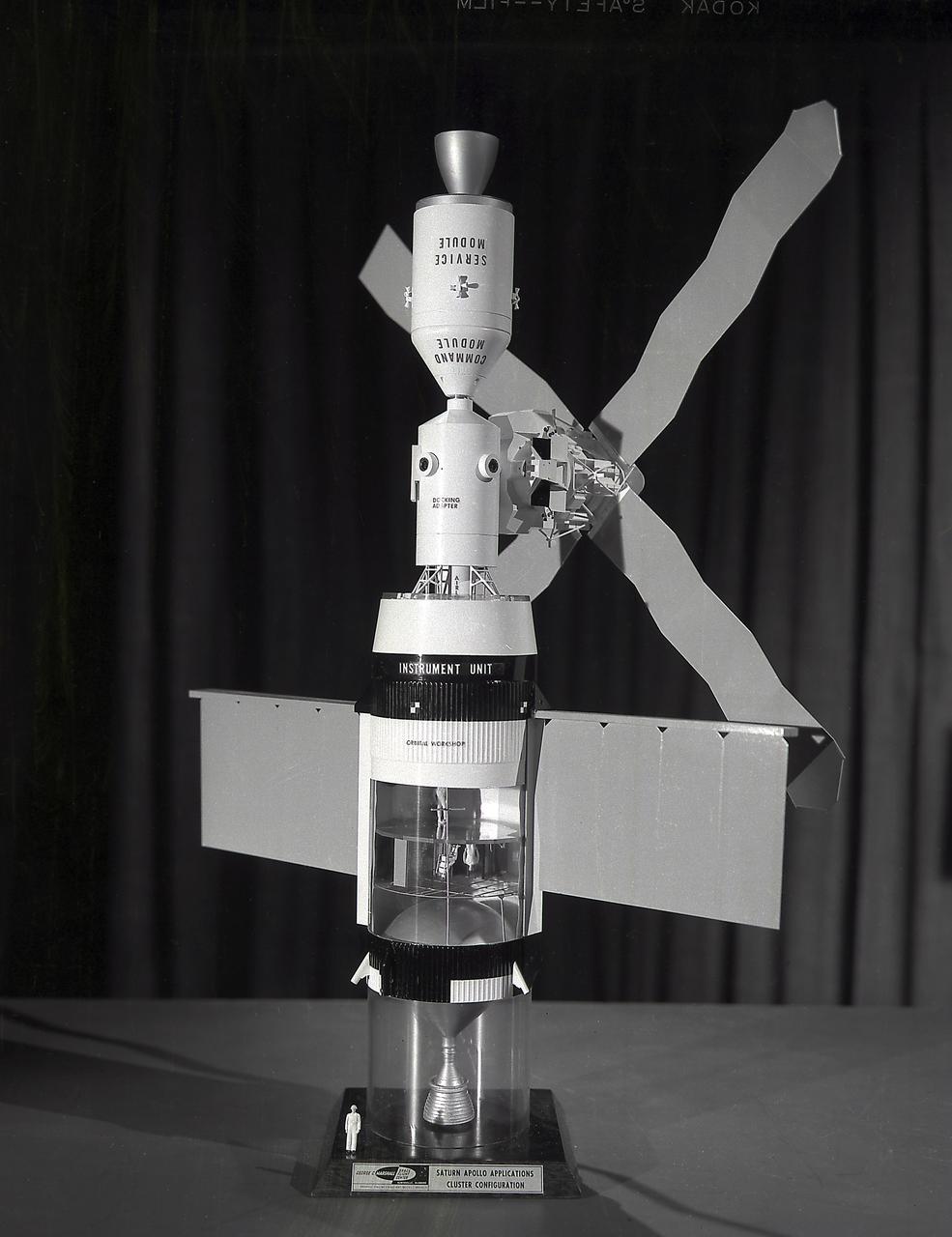
This photograph is of a model of the Skylab with the Command/Service Module being docked. In an early effort to extend the use of Apollo for further applications, NASA established the Apollo Applications Program (AAP) in August of 1965. The AAP was to include long duration Earth orbital missions during which astronauts would carry out scientific, technological, and engineering experiments in space by utilizing modified Saturn launch vehicles and the Apollo spacecraft. Established in 1970, the Skylab Program was the forerurner of the AAP. The goals of the Skylab were to enrich our scientific knowledge of the Earth, the Sun, the stars, and cosmic space; to study the effects of weightlessness on living organisms, including man; to study the effects of the processing and manufacturing of materials utilizing the absence of gravity; and to conduct Earth resource observations. The Skylab also conducted 19 selected experiments submitted by high school students. Skylab's 3 different 3-man crews spent up to 84 days in Earth orbit. The Marshall Space Flight Center (MSFC) had responsibility for developing and integrating most of the major components of the Skylab: the Orbital Workshop (OWS), Airlock Module (AM), Multiple Docking Adapter (MDA), Apollo Telescope Mount (ATM), Payload Shroud (PS), and most of the experiments. MSFC was also responsible for providing the Saturn IB launch vehicles for three Apollo spacecraft and crews and a Saturn V launch vehicle for the Skylab.
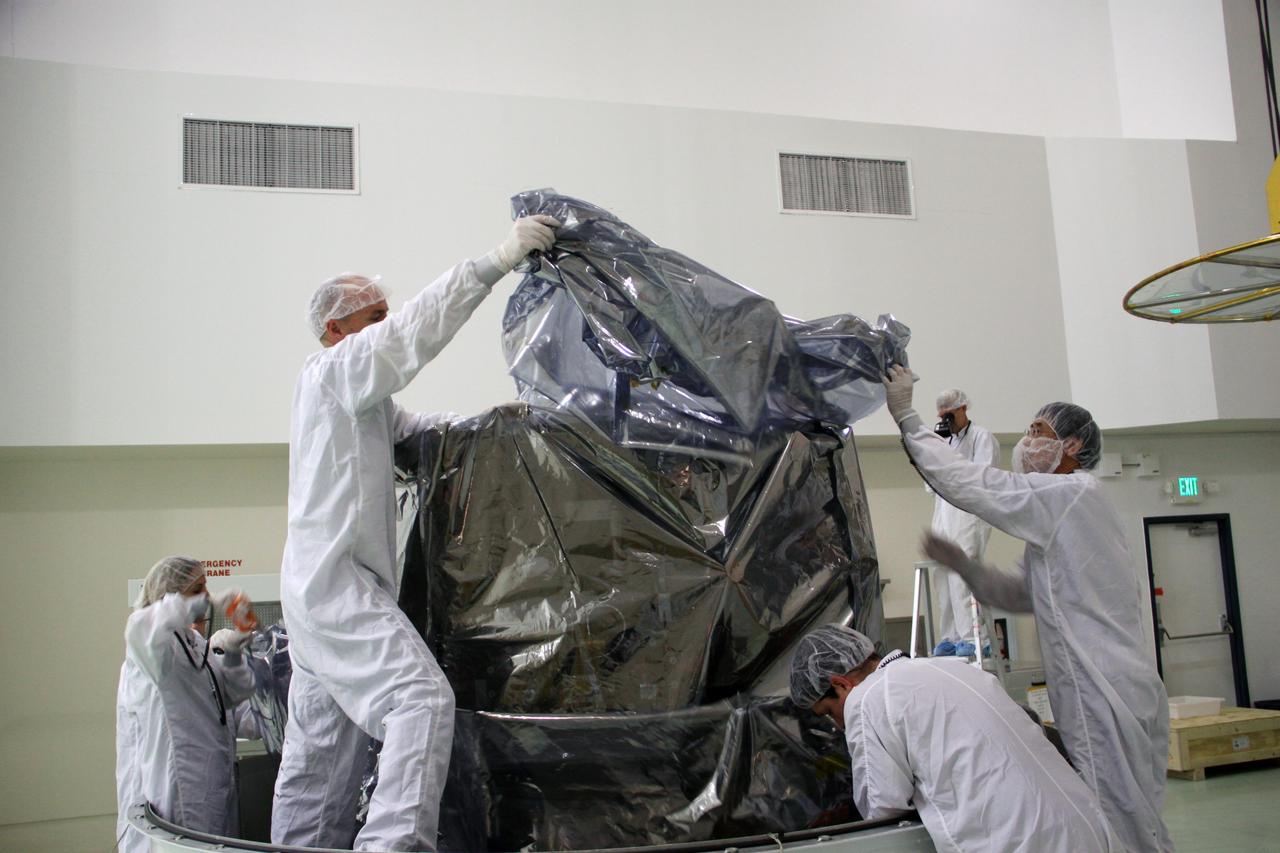
CAPE CANAVERAL, Fla. – In the clean room high bay at the Astrotech payload processing facility near NASA’s Kennedy Space Center in Florida, Applied Physics Laboratory technicians prepare NASA's Radiation Belt Storm Probe B, wrapped in a protective shroud, to be lifted from the bottom of its shipping container. Prelaunch preparations and spacecraft testing will follow. The Radiation Belt Storm Probes, or RBSP, mission will help us understand the sun’s influence on Earth and near-Earth space by studying the Earth’s radiation belts on various scales of space and time. RBSP instruments will provide the measurements needed to characterize and quantify the plasma processes that produce very energetic ions and relativistic electrons. The mission is part of NASA’s broader Living With a Star Program that was conceived to explore fundamental processes that operate throughout the solar system, particularly those that generate hazardous space weather effects in the vicinity of Earth and phenomena that could impact solar system exploration. RBSP will begin its mission of exploration of Earth's Van Allen radiation belts and the extremes of space weather after launch. Launch aboard a United Launch Alliance Atlas V rocket is scheduled for August 23. For more information, visit http://www.nasa.gov/rbsp. Photo credit: NASA/Jim Grossmann
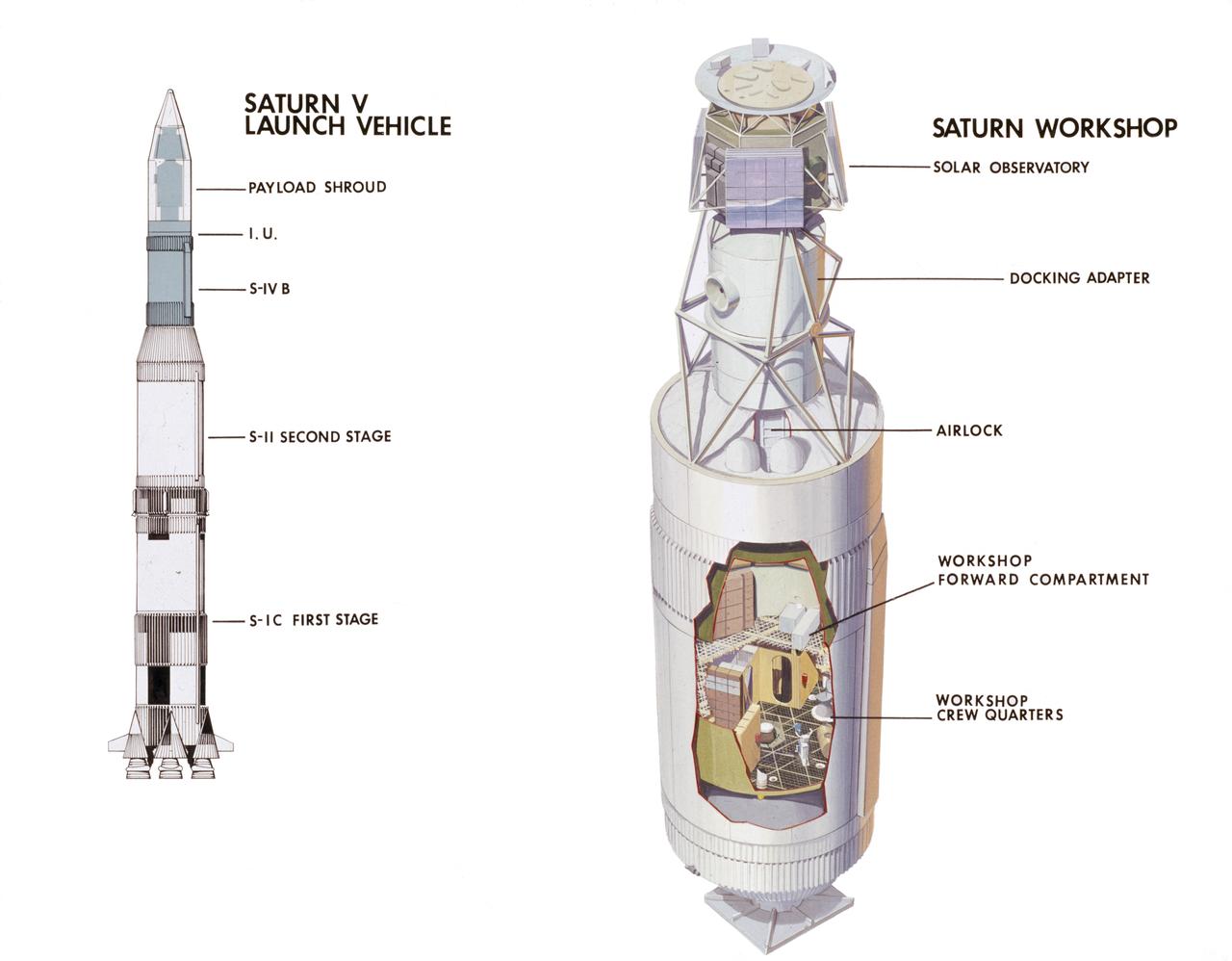
This cutaway drawing illustrates major Skylab components in launch configuration on top of the Saturn V. In an early effort to extend the use of Apollo for further applications, NASA established the Apollo Applications Program (AAP) in August of 1965. The AAP was to include long duration Earth orbital missions during which astronauts would carry out scientific, technological, and engineering experiments in space by utilizing modified Saturn launch vehicles and the Apollo spacecraft. Established in 1970, the Skylab Program was the forerurner of the AAP. The goals of the Skylab were to enrich our scientific knowledge of the Earth, the Sun, the stars, and cosmic space; to study the effects of weightlessness on living organisms, including man; to study the effects of the processing and manufacturing of materials utilizing the absence of gravity; and to conduct Earth resource observations. The Skylab also conducted 19 selected experiments submitted by high school students. Skylab's 3 different 3-man crews spent up to 84 days in Earth orbit. The Marshall Space Flight Center (MSFC) had responsibility for developing and integrating most of the major components of the Skylab: the Orbital Workshop (OWS), Airlock Module (AM), Multiple Docking Adapter (MDA), Apollo Telescope Mount (ATM), Payload Shroud (PS), and most of the experiments. MSFC was also responsible for providing the Saturn IB launch vehicles for three Apollo spacecraft and crews and a Saturn V launch vehicle for the Skylab.
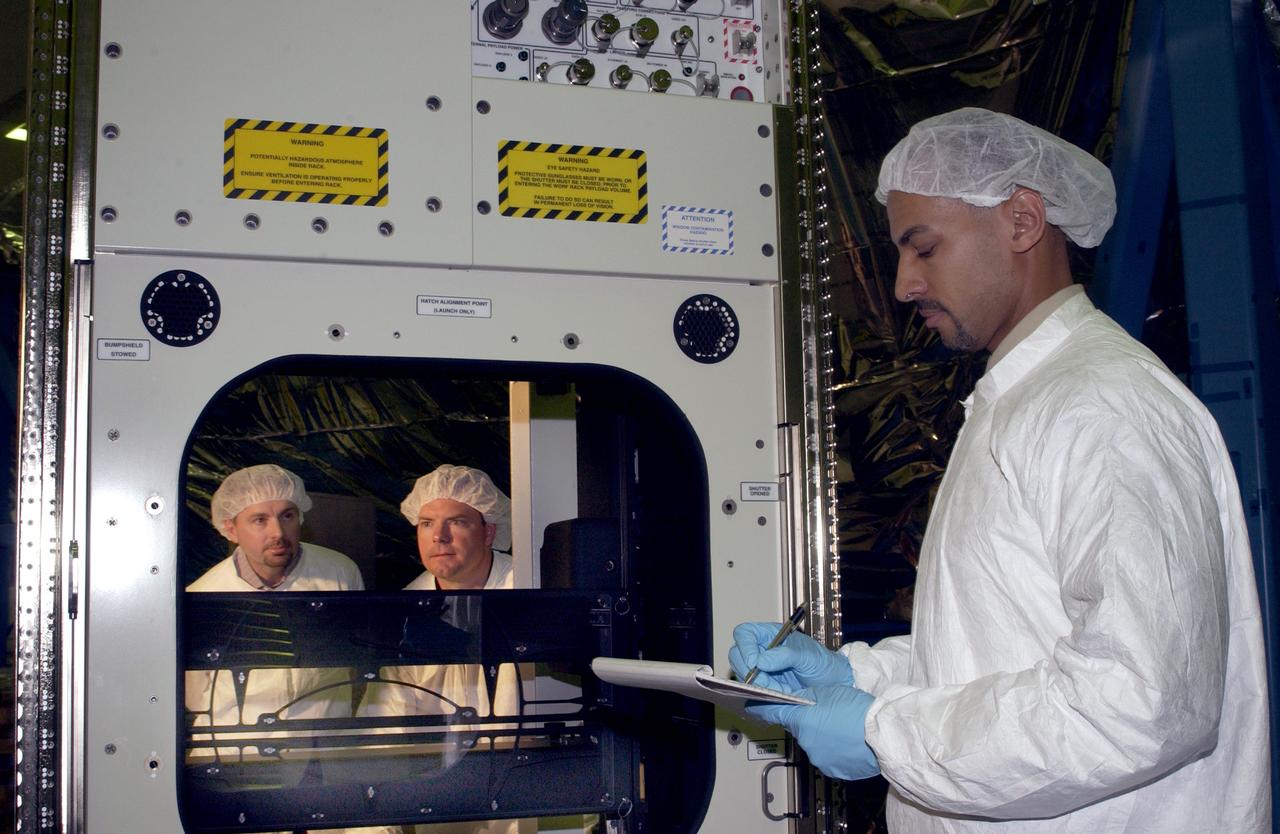
Developed by Boeing, at the Marshall Space Flight Center (MSFC) Space Station Manufacturing building, the Window Observational Rack Facility (WORF) will help Space Station crews take some of the best photographs ever snapped from an orbiting spacecraft by eliminating glare and allowing researchers to control their cameras and other equipment from the ground. The WORF is designed to make the best possible use of the high-quality research window in the Space Station's U.S. Destiny laboratory module. Engineers at the MSFC proposed a derivative of the EXPRESS (Expedite the Processing of Experiments to the Space Station) Rack already used on the Space Station and were given the go-ahead. The EXPRESS rack can hold a wide variety of experiments and provide them with power, communications, data, cooling, fluids, and other utilities - all the things that Earth-observing experiment instruments would need. WORF will supply payloads with power, data, cooling, video downlink, and stable, standardized interfaces for mounting imaging instruments. Similar to specialized orbital observatories, the interior of the rack is sealed against light and coated with a special low-reflectant black paint, so payloads will be able to observe low-light-level subjects such as the faint glow of auroras. Cameras and remote sensing instruments in the WORF can be preprogrammed, controlled from the ground, or operated by a Station crewmember by using a flexible shroud designed to cinch tightly around the crewmember's waist. The WORF is scheduled to be launched aboard the STS-114 Space Shuttle mission in the year 2003.
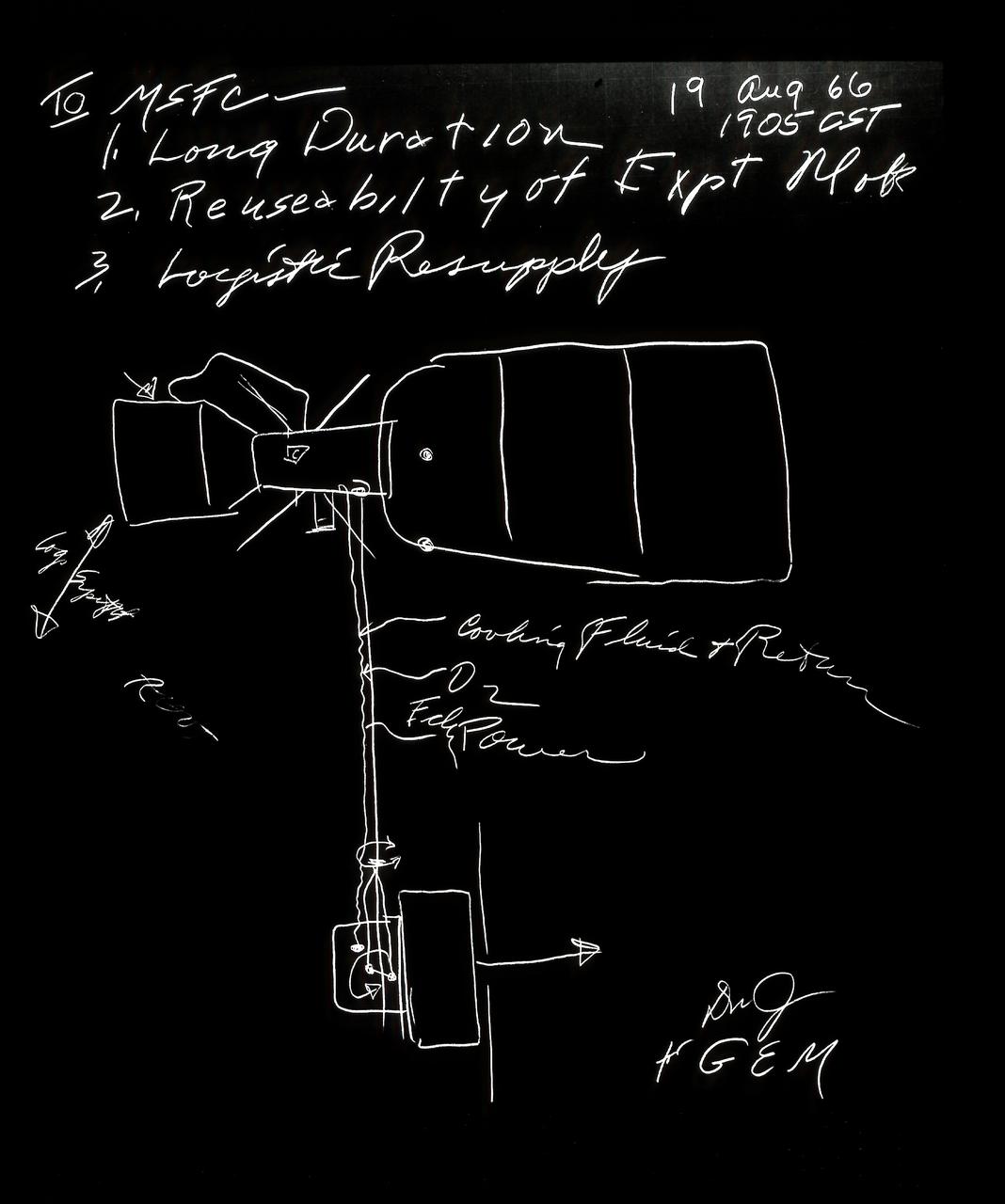
Seldom in aerospace history has a major decision been as promptly and concisely recorded as with the Skylab shown in this sketch. At a meeting at the Marshall Space Flight Center on August 19, 1966, George E. Mueller, NASA Associate Administrator for Marned Space Flight, used a felt pen and poster paper to pin down the final conceptual layout for the budding space station's (established as the Skylab in 1970) major elements. General Davy Jones, first program director, added his initials and those of Dr. Mueller in the lower right corner. The goals of the Skylab were to enrich our scientific knowledge of the Earth, the Sun, the stars, and cosmic space; to study the effects of weightlessness on living organisms, including man; to study the effects of the processing and manufacturing of materials utilizing the absence of gravity; and to conduct Earth resource observations. The Skylab also conducted 19 selected experiments submitted by high school students. Skylab's 3 different 3-man crews spent up to 84 days in Earth orbit. The Marshall Space Flight Center (MSFC) had responsibility for developing and integrating most of the major components of the Skylab: the Orbital Workshop (OWS), Airlock Module (AM), Multiple Docking Adapter (MDA), Apollo Telescope Mount (ATM), Payload Shroud (PS), and most of the experiments. MSFC was also responsible for providing the Saturn IB launch vehicles for three Apollo spacecraft and crews and a Saturn V launch vehicle for the Skylab.