
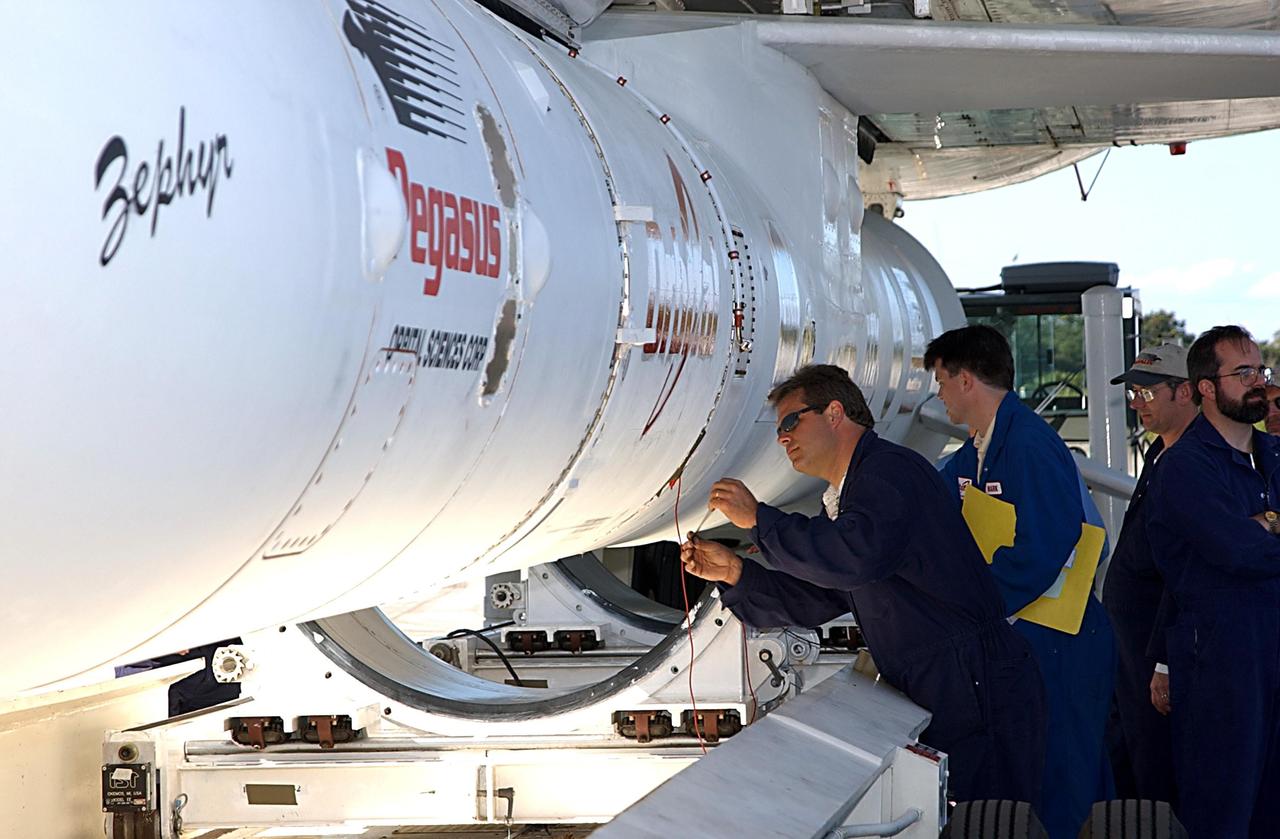
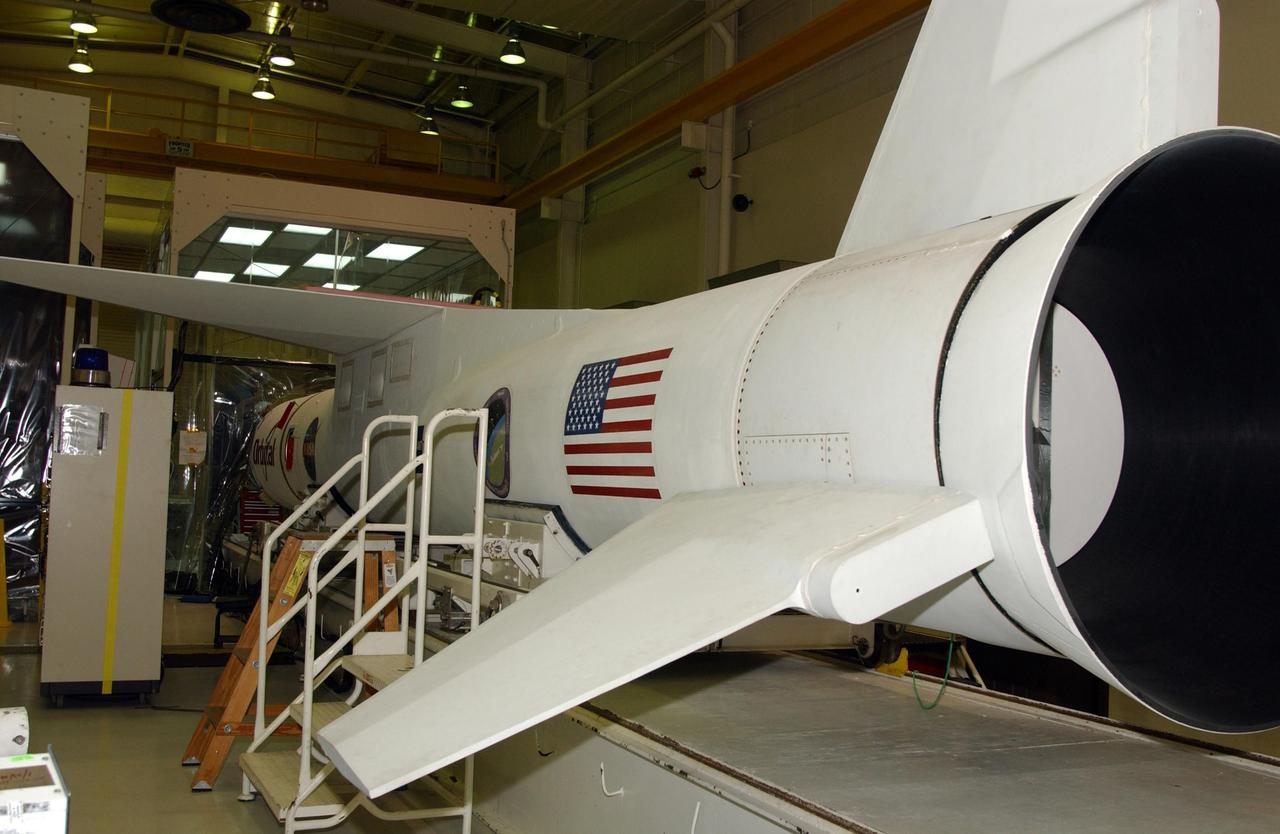
Flight simulation No. 3 is on the schedule for the Pegasus XL launch vehicle, seen here in Building 1555 on North Vandenberg Air Force Base in California. AIM, which stands for Aeronomy of Ice in the Mesosphere, is being prepared for integrated testing and a flight simulation. The AIM spacecraft will fly three instruments designed to study polar mesospheric clouds located at the edge of space, 50 miles above the Earth's surface in the coldest part of the planet's atmosphere. The mission's primary goal is to explain why these clouds form and what has caused them to become brighter and more numerous and appear at lower latitudes in recent years. AIM's results will provide the basis for the study of long-term variability in the mesospheric climate and its relationship to global climate change. AIM is scheduled to be mated to its launch vehicle, Orbital Sciences' Pegasus XL, during the second week of April, after which final inspections will be conducted. Launch is scheduled for April 25.
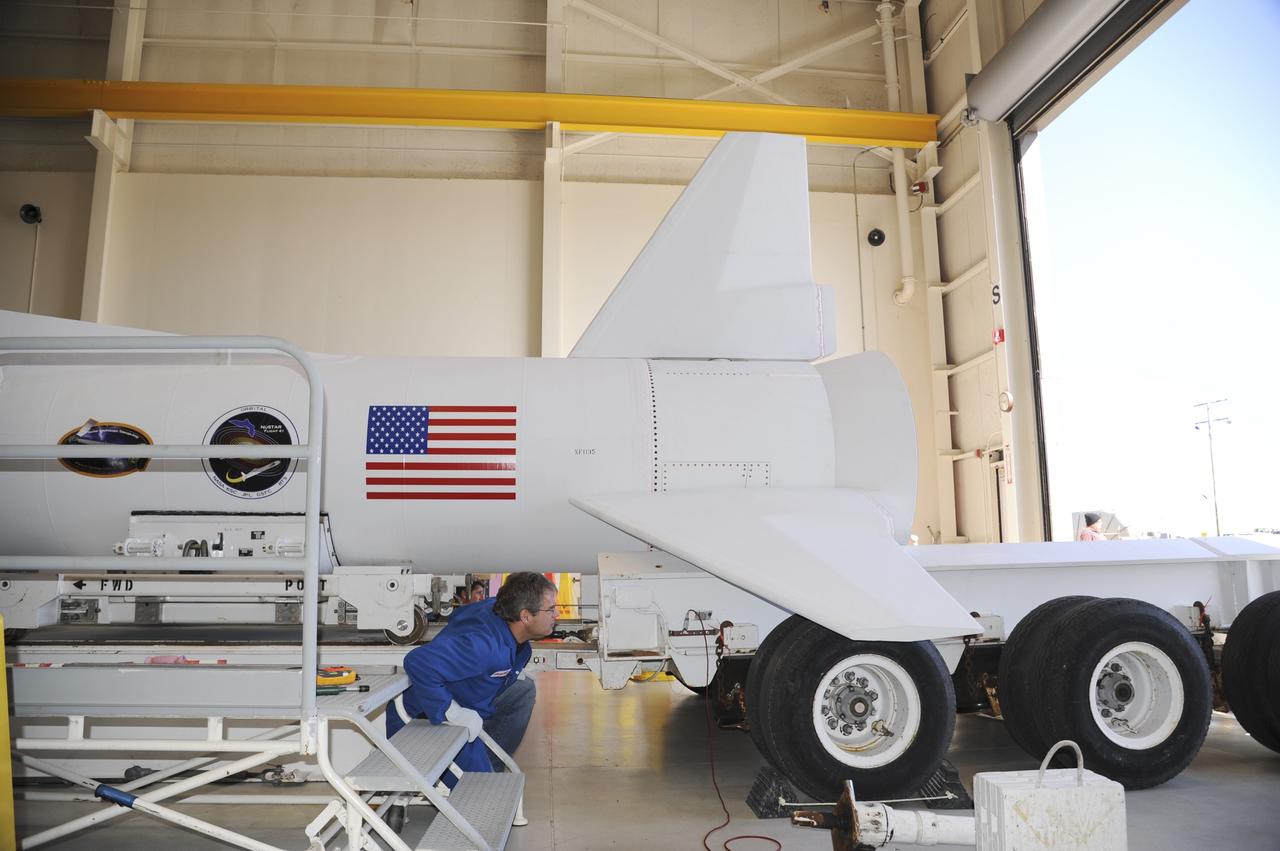
VANDENBERG AIR FORCE BASE, Calif. – At Vandenberg Air Force Base in California, a technician monitors the progress as a transporter is moved underneath the Orbital Science’s Pegasus XL inside Orbital’s hangar. The rocket is mated to NASA’s encapsulated Nuclear Spectroscopic Telescope Array, or NuSTAR, out of sight inside the hangar. The transporter will move them to the runway ramp where they will be attached to the underside of Orbital’s L-1011 carrier aircraft. The aircraft will fly the pair from Vandenberg to the Ronald Reagan Ballistic Missile Defense Test Site on the Pacific Ocean’s Kwajalein Atoll for launch. A revised launch date is expected to be set at the Flight Readiness Review. The high-energy X-ray telescope will conduct a census of black holes, map radioactive material in young supernovae remnants, and study the origins of cosmic rays and the extreme physics around collapsed stars. For more information, visit http://www.nasa.gov/nustar. Photo credit: NASA/Mark Mackiey
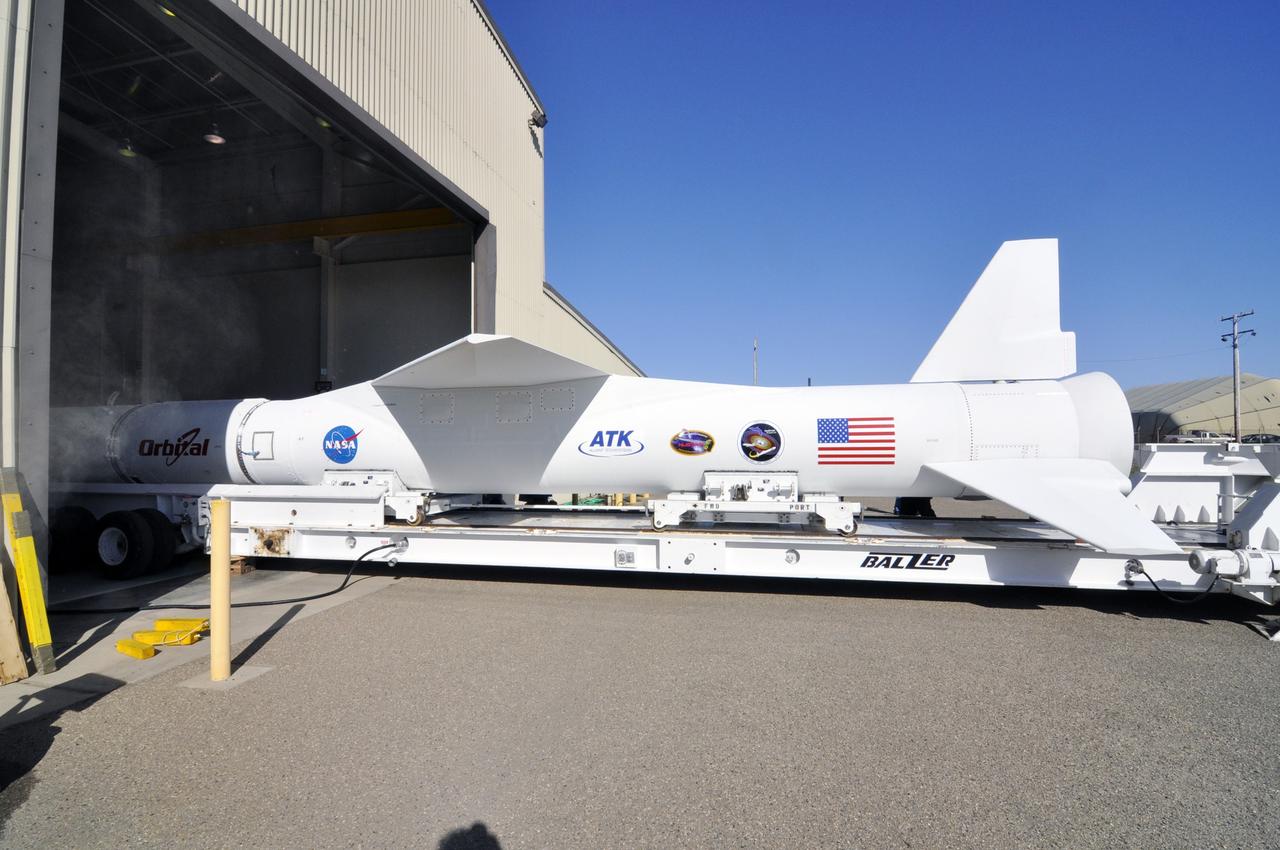
VANDENBERG AIR FORCE BASE, Calif. – At Vandenberg Air Force Base in California, a transporter has been positioned underneath the Orbital Science’s Pegasus XL at Orbital’s hangar. The rocket is mated to NASA’s encapsulated Nuclear Spectroscopic Telescope Array, or NuSTAR, partially out of sight inside the hangar. The transporter will move them to the runway ramp where they will be attached to the underside of Orbital’s L-1011 carrier aircraft. The aircraft will fly the pair from Vandenberg to the Ronald Reagan Ballistic Missile Defense Test Site on the Pacific Ocean’s Kwajalein Atoll for launch. A revised launch date is expected to be set at the Flight Readiness Review. The high-energy X-ray telescope will conduct a census of black holes, map radioactive material in young supernovae remnants, and study the origins of cosmic rays and the extreme physics around collapsed stars. For more information, visit http://www.nasa.gov/nustar. Photo credit: NASA/Randy Beaudoin
VANDENBERG AIR FORCE BASE, Calif. – At Vandenberg Air Force Base in California, the Orbital Science’s Pegasus LX has been moved onto a transporter inside Orbital’s hangar. The rocket is mated to NASA’s encapsulated Nuclear Spectroscopic Telescope Array, or NuSTAR, spacecraft. The transporter will move them to the runway ramp where they will be attached to the underside of Orbital’s L-1011 carrier aircraft. The aircraft will fly the pair from Vandenberg to the Ronald Reagan Ballistic Missile Defense Test Site on the Pacific Ocean’s Kwajalein Atoll for launch. A revised launch date is expected to be set at the Flight Readiness Review. The high-energy X-ray telescope will conduct a census of black holes, map radioactive material in young supernovae remnants, and study the origins of cosmic rays and the extreme physics around collapsed stars. For more information, visit http://www.nasa.gov/nustar. Photo credit: NASA/Mark Mackiey
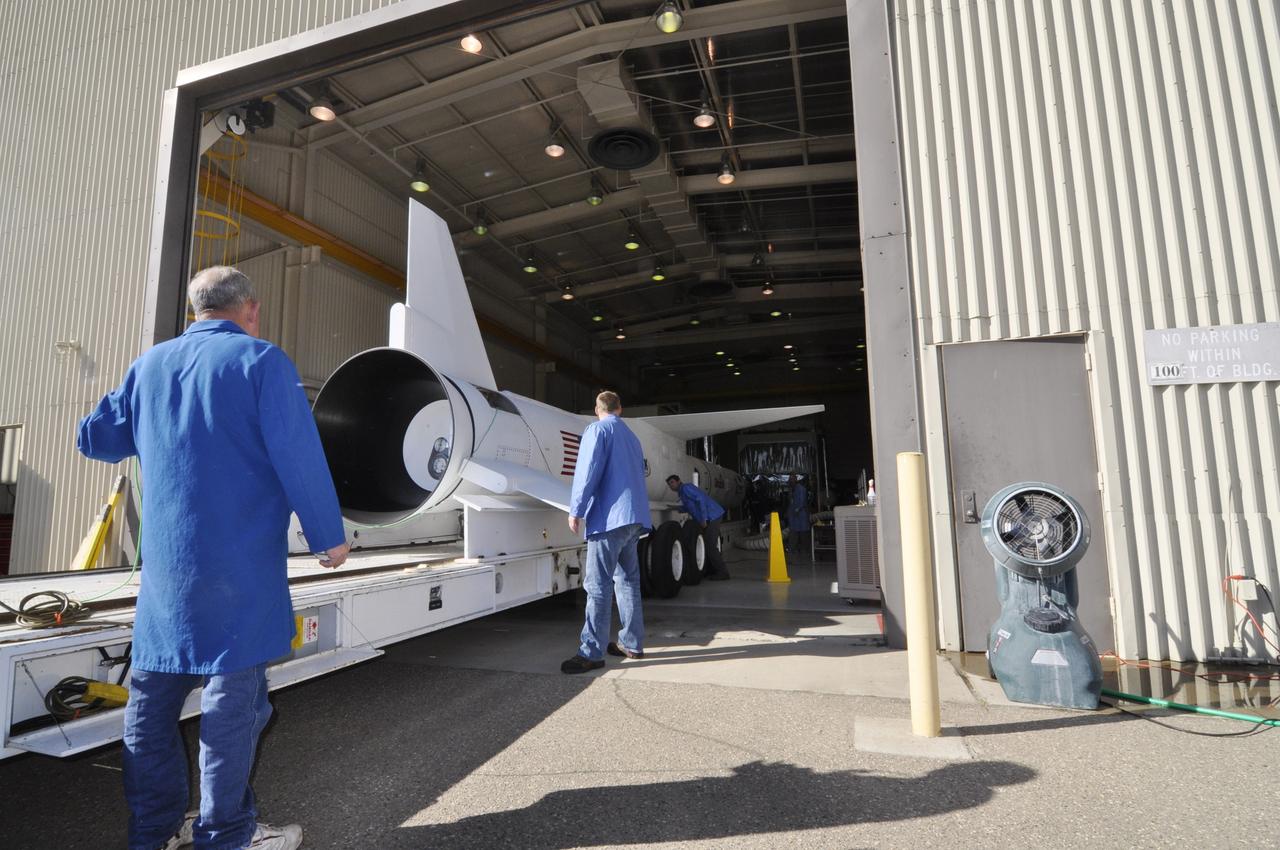
VANDENBERG AIR FORCE BASE, Calif. – At Vandenberg Air Force Base in California, technicians monitor the progress as a transporter is moved underneath the Orbital Science’s Pegasus XL inside Orbital’s hangar. The rocket is mated to NASA’s encapsulated Nuclear Spectroscopic Telescope Array, or NuSTAR, out of sight inside the hangar. The transporter will move them to the runway ramp where they will be attached to the underside of Orbital’s L-1011 carrier aircraft. The aircraft will fly the pair from Vandenberg to the Ronald Reagan Ballistic Missile Defense Test Site on the Pacific Ocean’s Kwajalein Atoll for launch. A revised launch date is expected to be set at the Flight Readiness Review. The high-energy X-ray telescope will conduct a census of black holes, map radioactive material in young supernovae remnants, and study the origins of cosmic rays and the extreme physics around collapsed stars. For more information, visit http://www.nasa.gov/nustar. Photo credit: NASA/Randy Beaudoin

VANDENBERG AIR FORCE BASE, Calif. – At Vandenberg Air Force Base in California, a transporter is moved toward the Orbital Science’s Pegasus XL inside Orbital’s hangar. The rocket is mated to NASA’s encapsulated Nuclear Spectroscopic Telescope Array, or NuSTAR, out of sight inside the hangar. The transporter will move them to the runway ramp where they will be attached to the underside of Orbital’s L-1011 carrier aircraft. The aircraft will fly the pair from Vandenberg to the Ronald Reagan Ballistic Missile Defense Test Site on the Pacific Ocean’s Kwajalein Atoll for launch. A revised launch date is expected to be set at the Flight Readiness Review. The high-energy X-ray telescope will conduct a census of black holes, map radioactive material in young supernovae remnants, and study the origins of cosmic rays and the extreme physics around collapsed stars. For more information, visit http://www.nasa.gov/nustar. Photo credit: NASA/Mark Mackiey
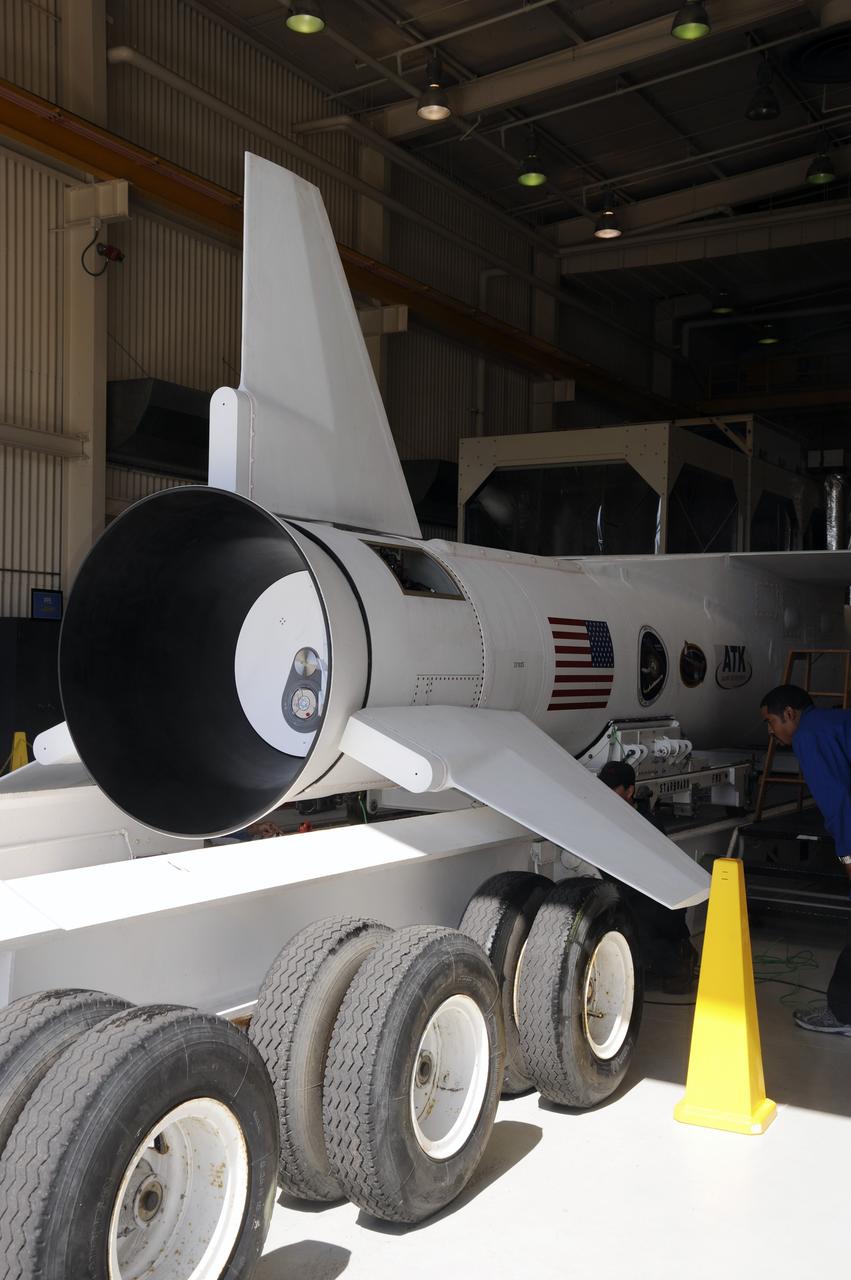
VANDENBERG AIR FORCE BASE, Calif. – At Vandenberg Air Force Base in California, a transporter is moved underneath the Orbital Science’s Pegasus XL inside Orbital’s hangar. The rocket is mated to NASA’s encapsulated Nuclear Spectroscopic Telescope Array, or NuSTAR, out of sight inside the hangar. The transporter will move them to the runway ramp where they will be attached to the underside of Orbital’s L-1011 carrier aircraft. The aircraft will fly the pair from Vandenberg to the Ronald Reagan Ballistic Missile Defense Test Site on the Pacific Ocean’s Kwajalein Atoll for launch. A revised launch date is expected to be set at the Flight Readiness Review. The high-energy X-ray telescope will conduct a census of black holes, map radioactive material in young supernovae remnants, and study the origins of cosmic rays and the extreme physics around collapsed stars. For more information, visit http://www.nasa.gov/nustar. Photo credit: NASA/Mark Mackiey
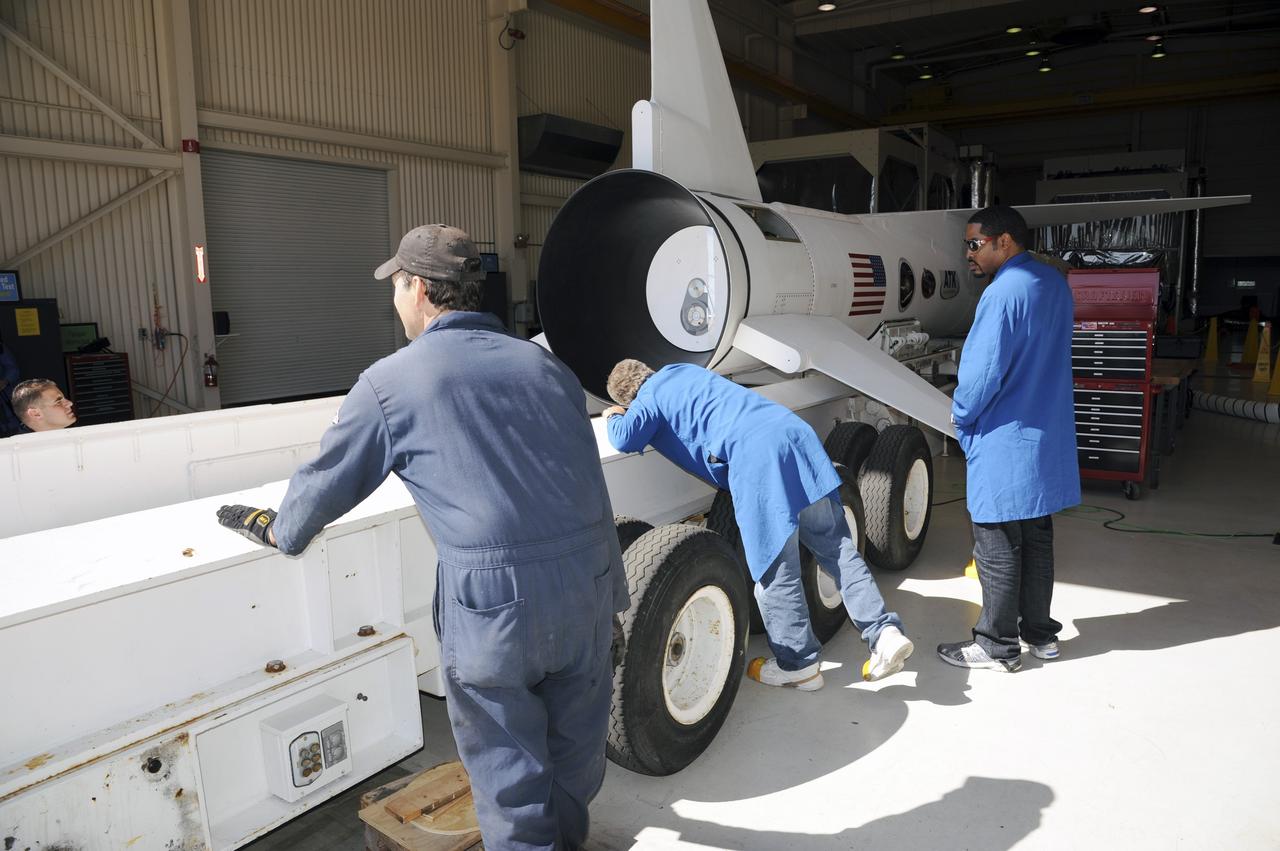
VANDENBERG AIR FORCE BASE, Calif. – At Vandenberg Air Force Base in California, technicians monitor the progress as a transporter is moved underneath the Orbital Science’s Pegasus XL inside Orbital’s hangar. The rocket is mated to NASA’s encapsulated Nuclear Spectroscopic Telescope Array, or NuSTAR, out of sight inside the hangar. The transporter will move them to the runway ramp where they will be attached to the underside of Orbital’s L-1011 carrier aircraft. The aircraft will fly the pair from Vandenberg to the Ronald Reagan Ballistic Missile Defense Test Site on the Pacific Ocean’s Kwajalein Atoll for launch. A revised launch date is expected to be set at the Flight Readiness Review. The high-energy X-ray telescope will conduct a census of black holes, map radioactive material in young supernovae remnants, and study the origins of cosmic rays and the extreme physics around collapsed stars. For more information, visit http://www.nasa.gov/nustar. Photo credit: NASA/Mark Mackiey
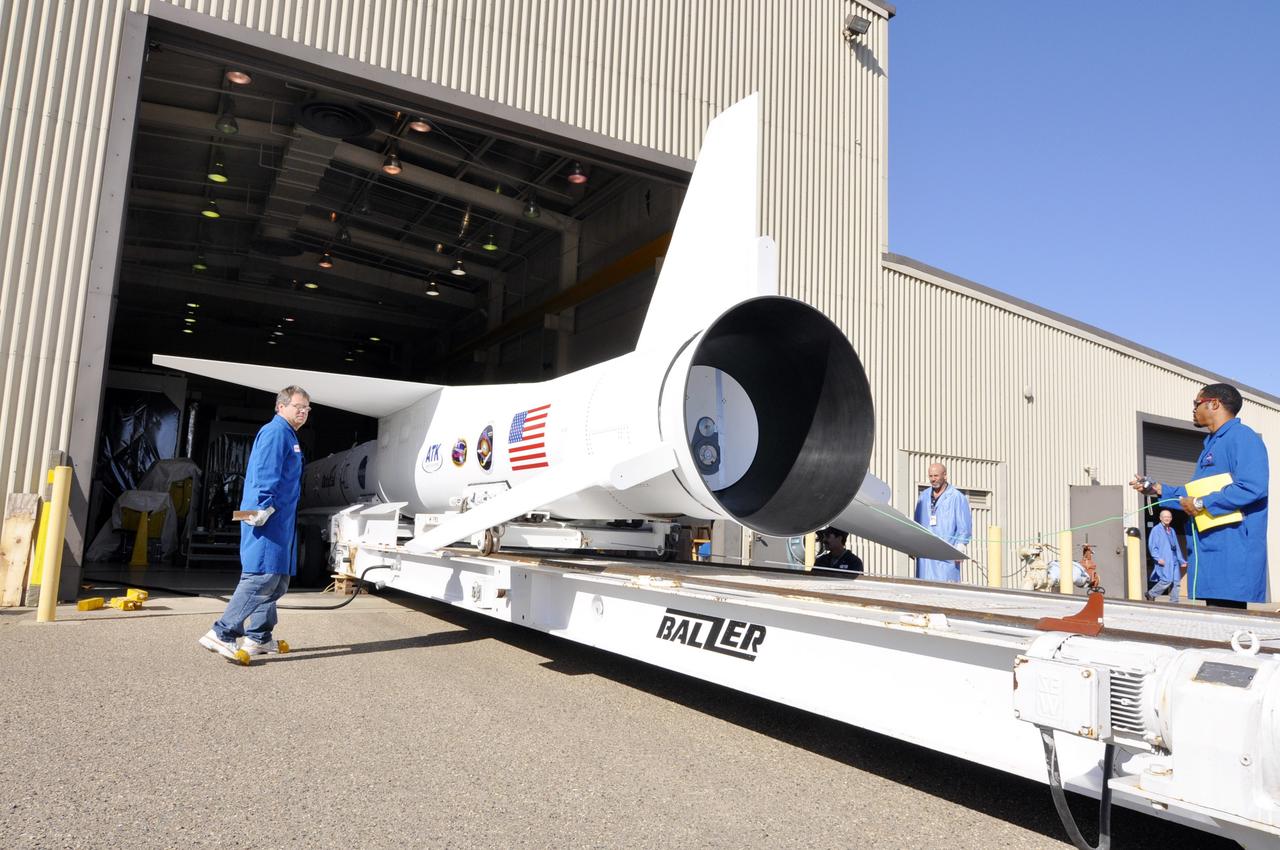
VANDENBERG AIR FORCE BASE, Calif. – At Vandenberg Air Force Base in California, technicians monitor the progress as a transporter is moved underneath the Orbital Science’s Pegasus XL at Orbital’s hangar. The rocket is mated to NASA’s encapsulated Nuclear Spectroscopic Telescope Array, or NuSTAR, spacecraft. The transporter will move them to the runway ramp where they will be attached to the underside of Orbital’s L-1011 carrier aircraft. The aircraft will fly the pair from Vandenberg to the Ronald Reagan Ballistic Missile Defense Test Site on the Pacific Ocean’s Kwajalein Atoll for launch. A revised launch date is expected to be set at the Flight Readiness Review. The high-energy X-ray telescope will conduct a census of black holes, map radioactive material in young supernovae remnants, and study the origins of cosmic rays and the extreme physics around collapsed stars. For more information, visit http://www.nasa.gov/nustar. Photo credit: NASA/Randy Beaudoin
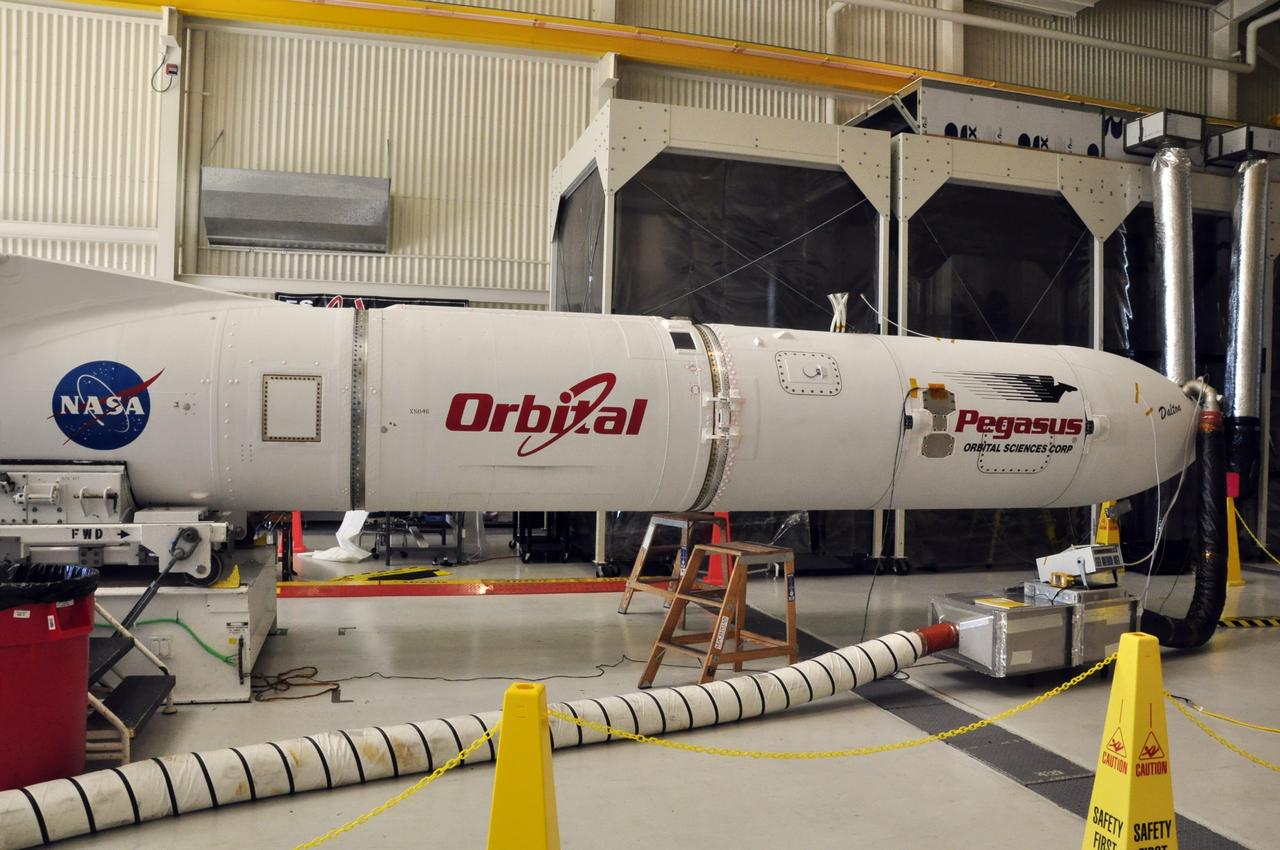
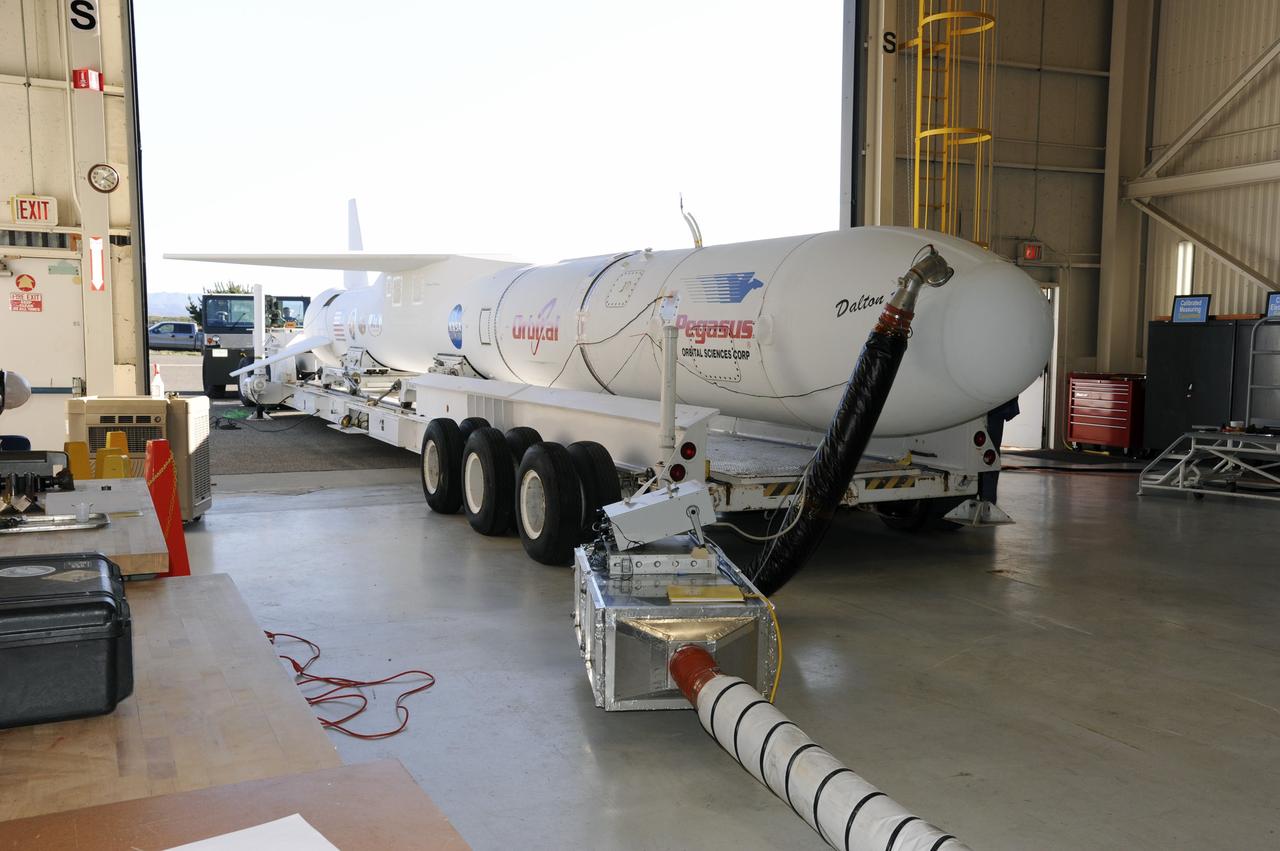
VANDENBERG AIR FORCE BASE, Calif. – At Vandenberg Air Force Base in California, an Orbital Science’s Pegasus XL sits inside Orbital’s hangar before it is prepared to be loaded on to a transporter. The rocket is mated to NASA’s encapsulated Nuclear Spectroscopic Telescope Array, or NuSTAR, spacecraft. The transporter will move them to the runway ramp where they will be attached to the underside of Orbital’s L-1011 carrier aircraft. The aircraft will fly the pair from Vandenberg to the Ronald Reagan Ballistic Missile Defense Test Site on the Pacific Ocean’s Kwajalein Atoll for launch. A revised launch date is expected to be set at the Flight Readiness Review. The high-energy X-ray telescope will conduct a census of black holes, map radioactive material in young supernovae remnants, and study the origins of cosmic rays and the extreme physics around collapsed stars. For more information, visit http://www.nasa.gov/nustar. Photo credit: NASA/Randy Beaudoin
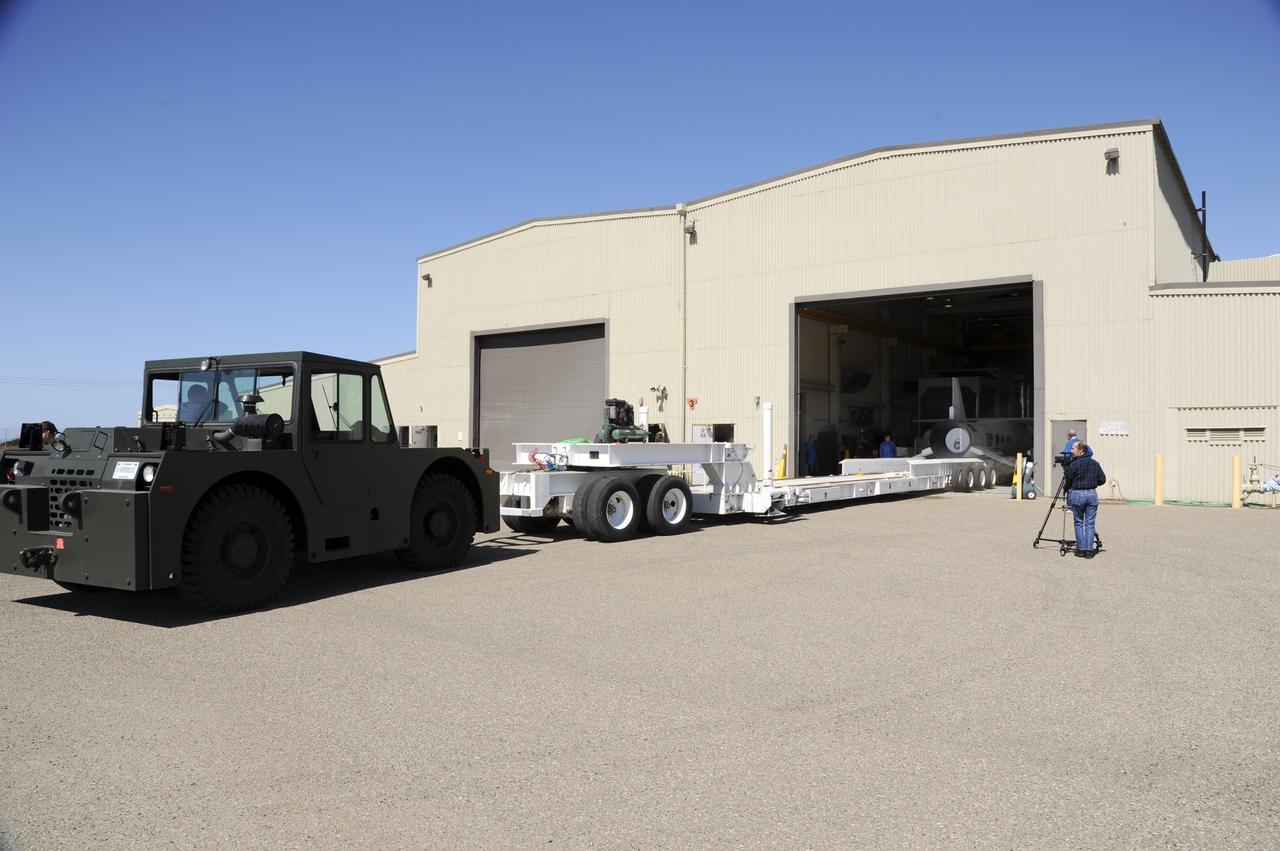
VANDENBERG AIR FORCE BASE, Calif. – At Vandenberg Air Force Base in California, a transporter is moved toward the Orbital Science’s Pegasus XL inside Orbital’s hangar. The rocket is mated to NASA’s encapsulated Nuclear Spectroscopic Telescope Array, or NuSTAR, out of sight inside the hangar. The transporter will move them to the runway ramp where they will be attached to the underside of Orbital’s L-1011 carrier aircraft. The aircraft will fly the pair from Vandenberg to the Ronald Reagan Ballistic Missile Defense Test Site on the Pacific Ocean’s Kwajalein Atoll for launch. A revised launch date is expected to be set at the Flight Readiness Review. The high-energy X-ray telescope will conduct a census of black holes, map radioactive material in young supernovae remnants, and study the origins of cosmic rays and the extreme physics around collapsed stars. For more information, visit http://www.nasa.gov/nustar. Photo credit: NASA/Mark Mackiey
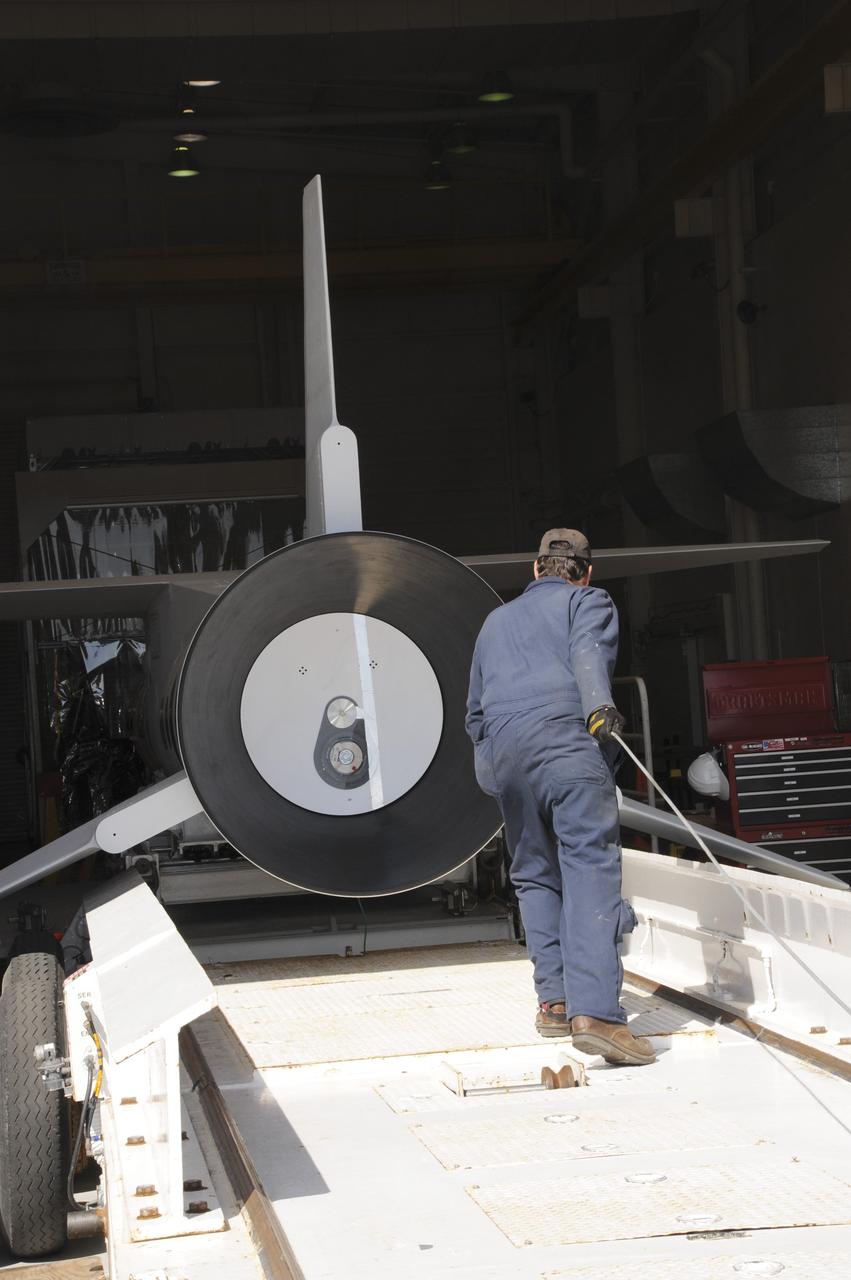
VANDENBERG AIR FORCE BASE, Calif. – At Vandenberg Air Force Base in California, a technician monitors the progress as a transporter is moved underneath the Orbital Science’s Pegasus XL inside Orbital’s hangar. The rocket is mated to NASA’s encapsulated Nuclear Spectroscopic Telescope Array, or NuSTAR, out of sight inside the hangar. The transporter will move them to the runway ramp where they will be attached to the underside of Orbital’s L-1011 carrier aircraft. The aircraft will fly the pair from Vandenberg to the Ronald Reagan Ballistic Missile Defense Test Site on the Pacific Ocean’s Kwajalein Atoll for launch. A revised launch date is expected to be set at the Flight Readiness Review. The high-energy X-ray telescope will conduct a census of black holes, map radioactive material in young supernovae remnants, and study the origins of cosmic rays and the extreme physics around collapsed stars. For more information, visit http://www.nasa.gov/nustar. Photo credit: NASA/Mark Mackiey
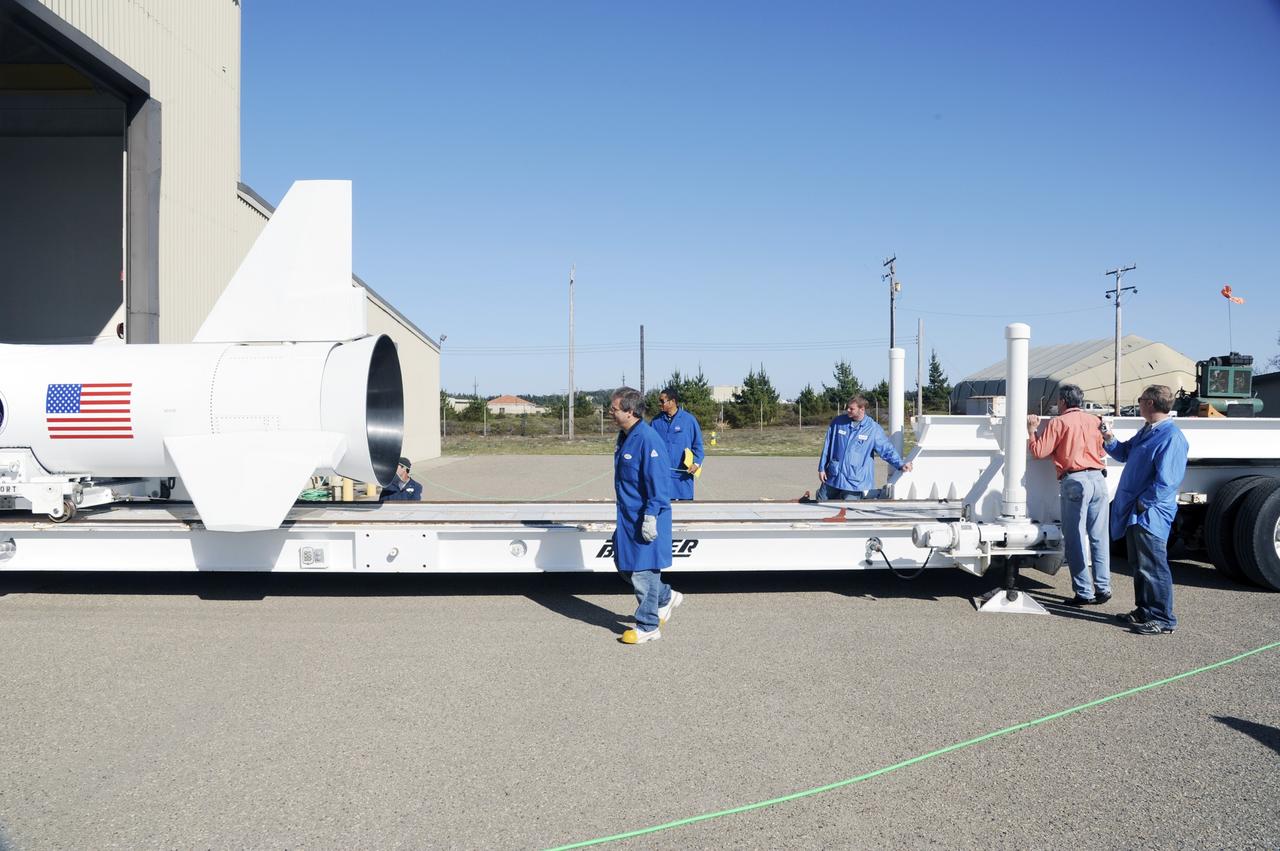
VANDENBERG AIR FORCE BASE, Calif. – At Vandenberg Air Force Base in California, technicians monitor the progress as the Orbital Science’s Pegasus XL is moved onto a transporter inside Orbital’s hangar. The rocket is mated to NASA’s encapsulated Nuclear Spectroscopic Telescope Array, or NuSTAR, out of sight inside the hangar. The transporter will move them to the runway ramp where they will be attached to the underside of Orbital’s L-1011 carrier aircraft. The aircraft will fly the pair from Vandenberg to the Ronald Reagan Ballistic Missile Defense Test Site on the Pacific Ocean’s Kwajalein Atoll for launch. A revised launch date is expected to be set at the Flight Readiness Review. The high-energy X-ray telescope will conduct a census of black holes, map radioactive material in young supernovae remnants, and study the origins of cosmic rays and the extreme physics around collapsed stars. For more information, visit http://www.nasa.gov/nustar. Photo credit: NASA/Mark Mackiey
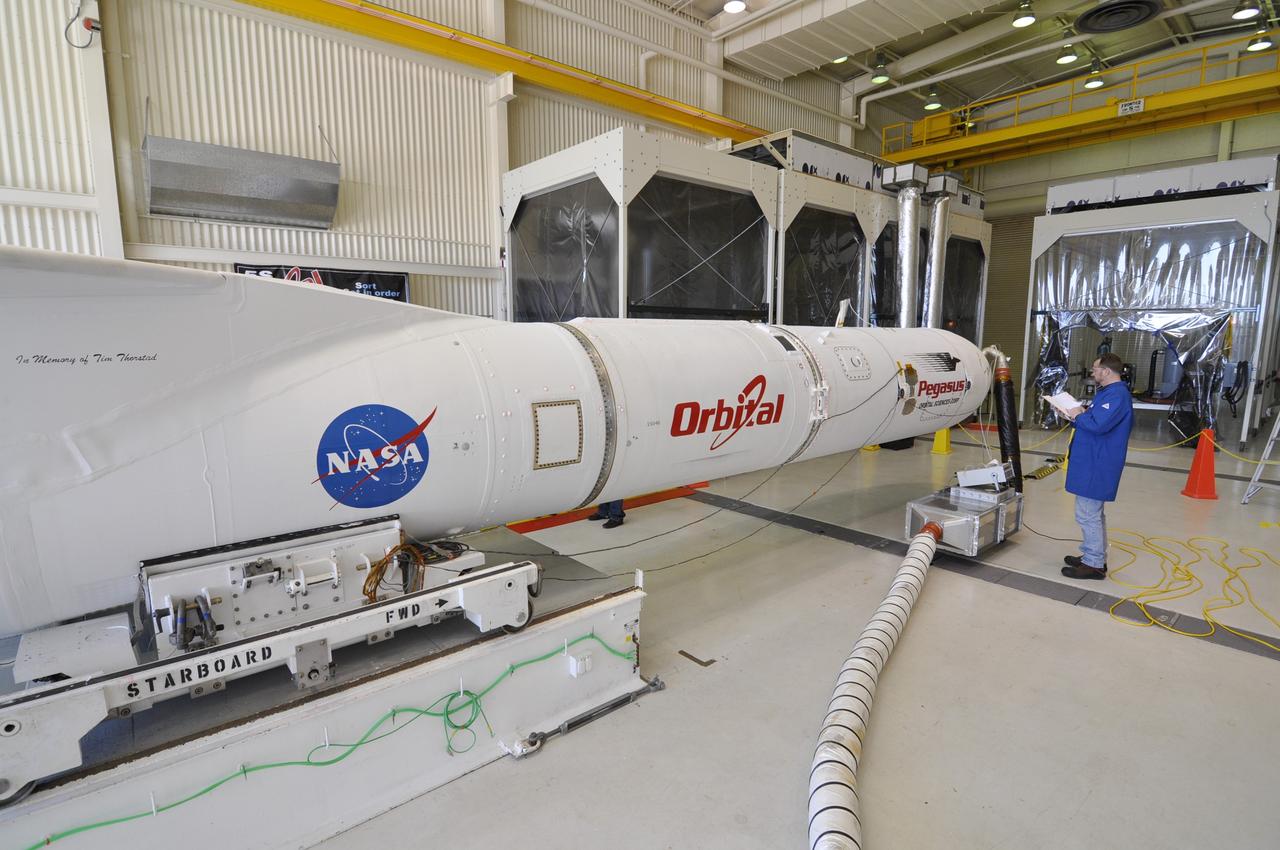
VANDENBERG AIR FORCE BASE, Calif. – At Vandenberg Air Force Base in California, a technician checks on the status of the Orbital Science’s Pegasus XL inside Orbital’s hangar. The rocket is mated to NASA’s encapsulated Nuclear Spectroscopic Telescope Array, or NuSTAR, spacecraft. A transporter will be used to move them to the runway ramp where they will be attached to the underside of Orbital’s L-1011 carrier aircraft. The aircraft will fly the pair from Vandenberg to the Ronald Reagan Ballistic Missile Defense Test Site on the Pacific Ocean’s Kwajalein Atoll for launch. A revised launch date is expected to be set at the Flight Readiness Review. The high-energy X-ray telescope will conduct a census of black holes, map radioactive material in young supernovae remnants, and study the origins of cosmic rays and the extreme physics around collapsed stars. For more information, visit http://www.nasa.gov/nustar. Photo credit: NASA/Randy Beaudoin
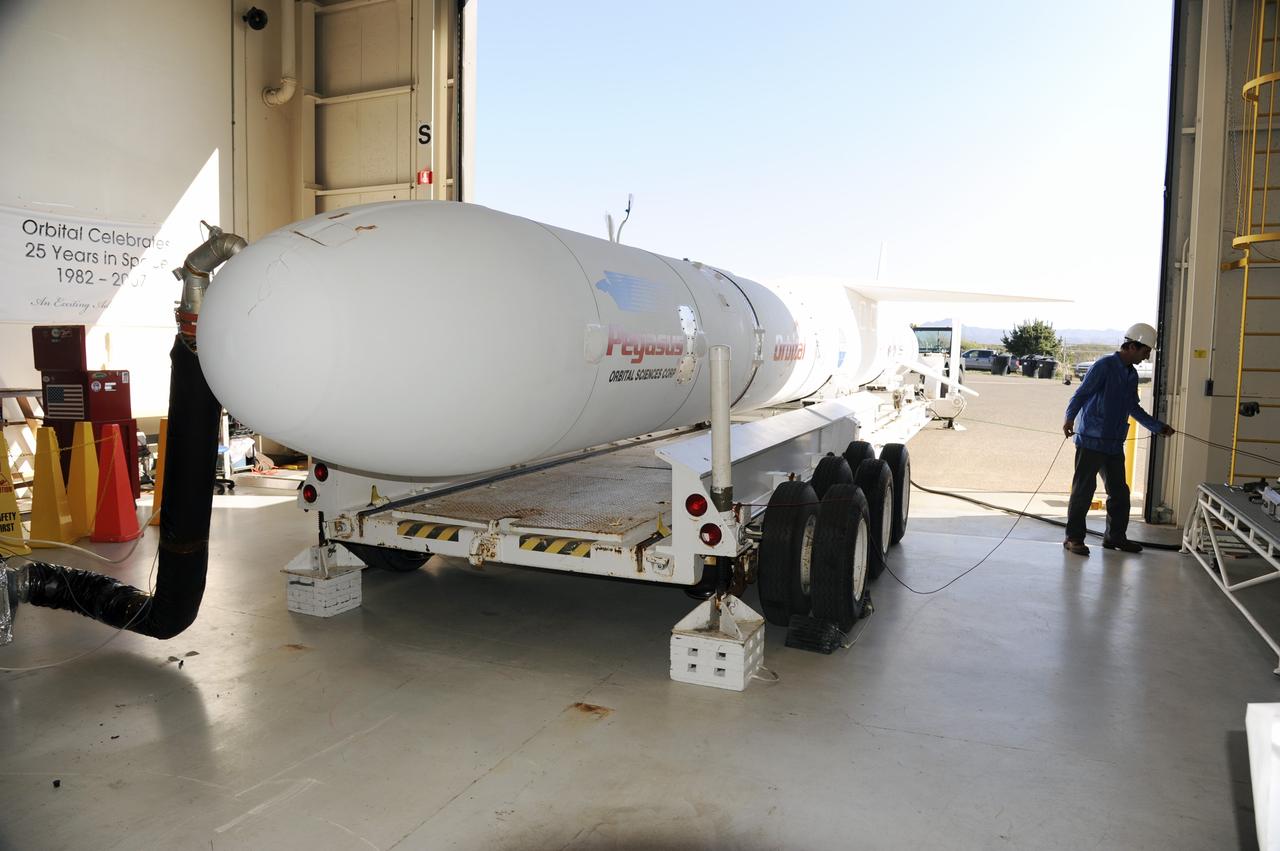
VANDENBERG AIR FORCE BASE, Calif. – At Vandenberg Air Force Base in California, the Orbital Science’s Pegasus LX has been moved onto a transporter inside Orbital’s hangar. The rocket is mated to NASA’s encapsulated Nuclear Spectroscopic Telescope Array, or NuSTAR, spacecraft. The transporter will move them to the runway ramp where they will be attached to the underside of Orbital’s L-1011 carrier aircraft. The aircraft will fly the pair from Vandenberg to the Ronald Reagan Ballistic Missile Defense Test Site on the Pacific Ocean’s Kwajalein Atoll for launch. A revised launch date is expected to be set at the Flight Readiness Review. The high-energy X-ray telescope will conduct a census of black holes, map radioactive material in young supernovae remnants, and study the origins of cosmic rays and the extreme physics around collapsed stars. For more information, visit http://www.nasa.gov/nustar. Photo credit: NASA/Mark Mackiey
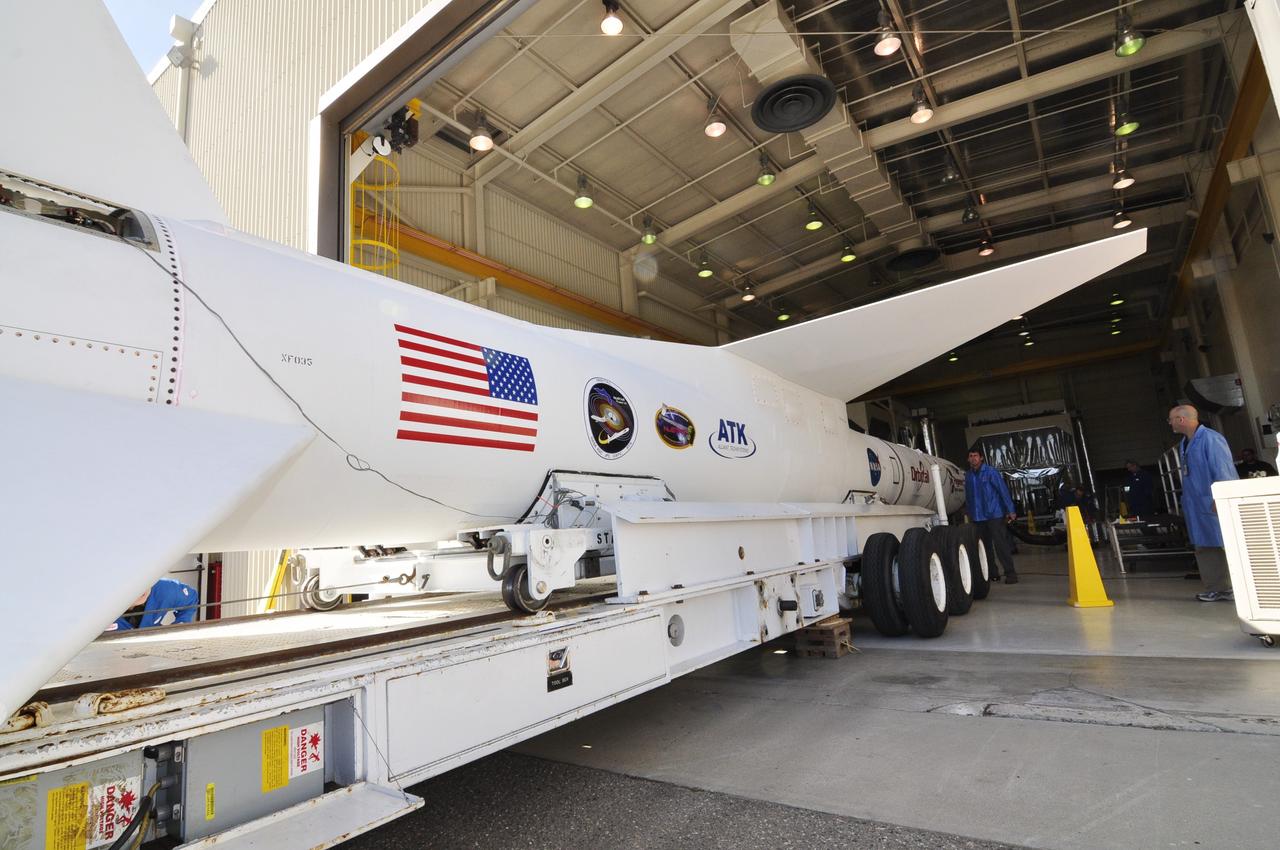
VANDENBERG AIR FORCE BASE, Calif. – At Vandenberg Air Force Base in California, technicians monitor the progress as a transporter is moved underneath the Orbital Science’s Pegasus XL inside Orbital’s hangar. The rocket is mated to NASA’s encapsulated Nuclear Spectroscopic Telescope Array, or NuSTAR, spacecraft. The transporter will move them to the runway ramp where they will be attached to the underside of Orbital’s L-1011 carrier aircraft. The aircraft will fly the pair from Vandenberg to the Ronald Reagan Ballistic Missile Defense Test Site on the Pacific Ocean’s Kwajalein Atoll for launch. A revised launch date is expected to be set at the Flight Readiness Review. The high-energy X-ray telescope will conduct a census of black holes, map radioactive material in young supernovae remnants, and study the origins of cosmic rays and the extreme physics around collapsed stars. For more information, visit http://www.nasa.gov/nustar. Photo credit: NASA/Randy Beaudoin
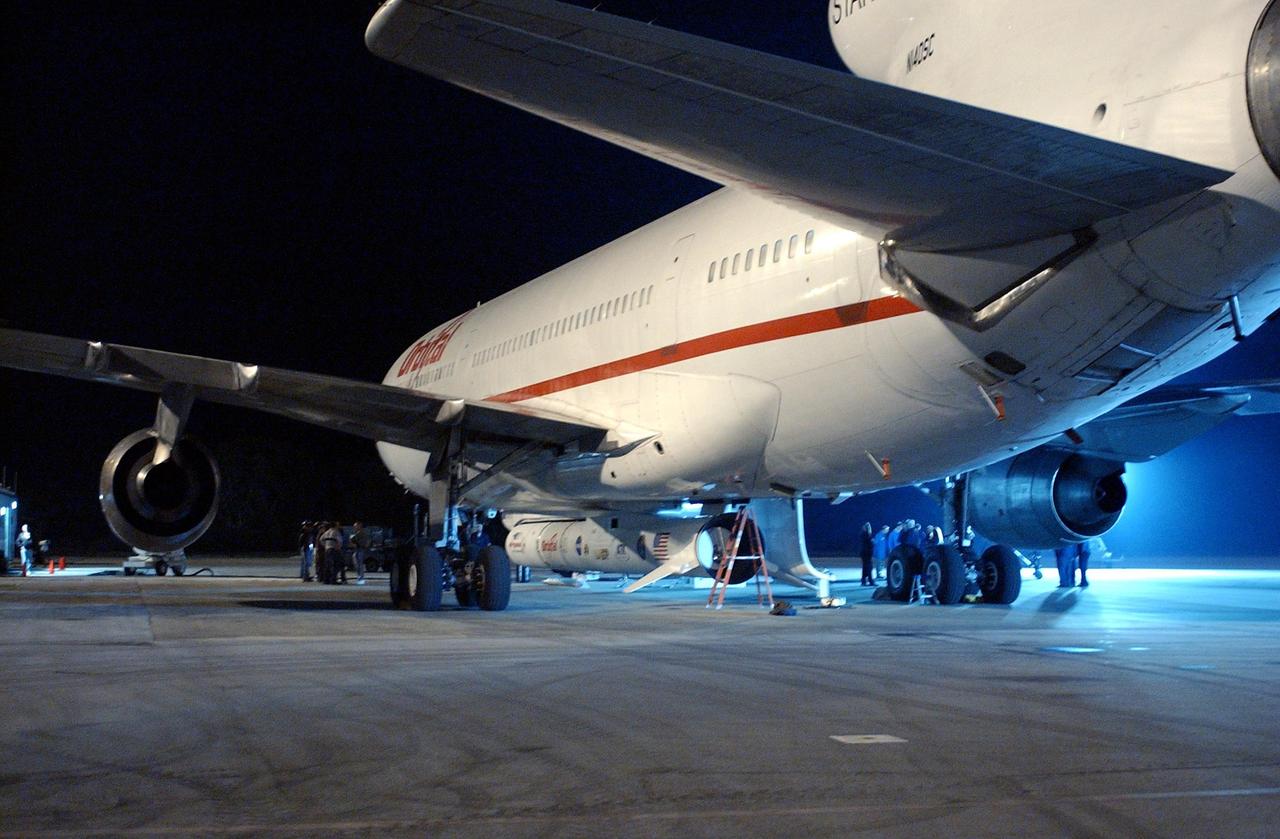
KENNEDY SPACE CENTER, FLA. -- Attached underneath the Orbital Sciences L-1011 aircraft is the Pegasus XL Expendable Launch Vehicle, which will be transported to the Multi-Payload Processing Facility for testing and verification. The Pegasus will undergo three flight simulations prior to its scheduled launch in late January 2003. The Pegasus XL will carry NASA's Solar Radiation and Climate Experiment (SORCE) into orbit. Built by Orbital Sciences Space Systems Group, SORCE will study and measure solar irradiance as a source of energy in the Earth's atmosphere. .
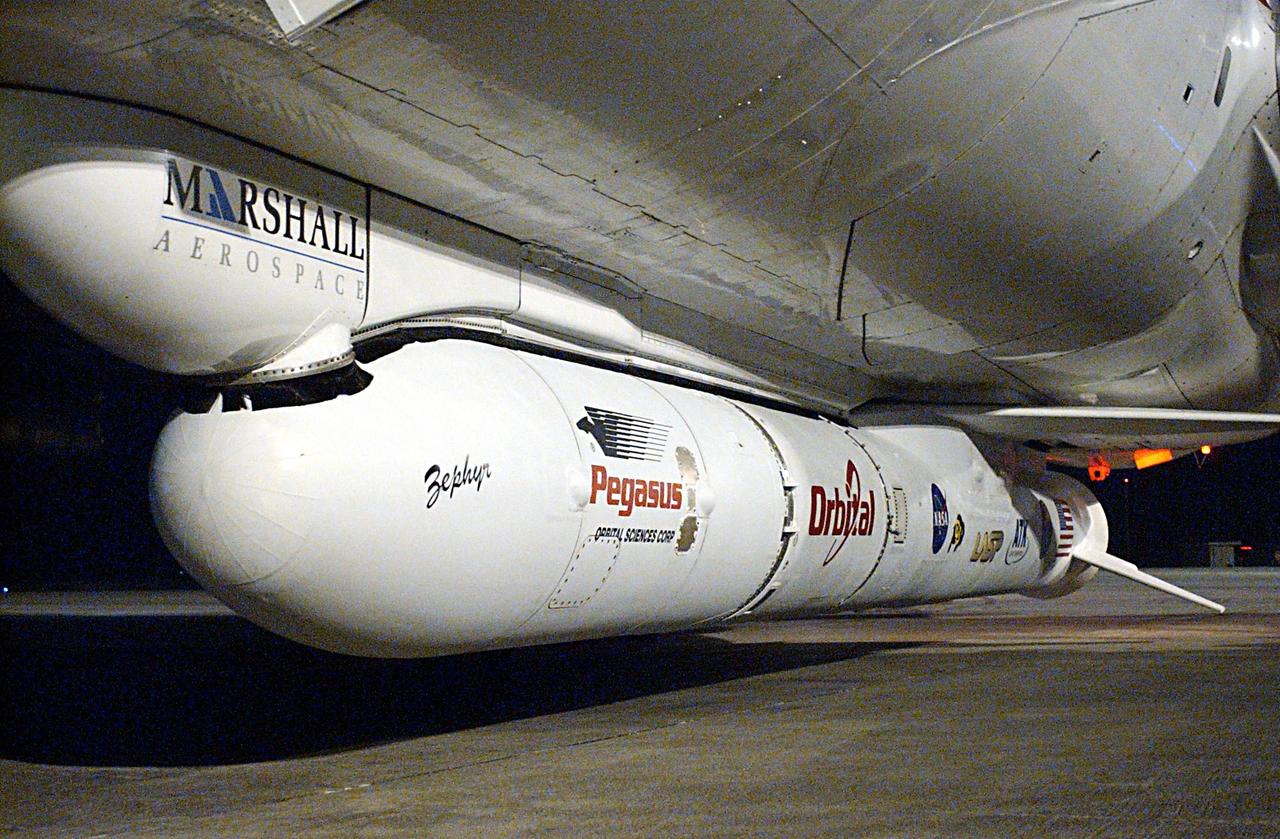
KENNEDY SPACE CENTER, FLA. -- Attached underneath the Orbital Sciences L-1011 aircraft is the Pegasus XL Expendable Launch Vehicle, which will be transported to the Multi-Payload Processing Facility for testing and verification. The Pegasus will undergo three flight simulations prior to its scheduled launch in late January 2003. The Pegasus XL will carry NASA's Solar Radiation and Climate Experiment (SORCE) into orbit. Built by Orbital Sciences Space Systems Group, SORCE will study and measure solar irradiance as a source of energy in the Earth's atmosphere. .
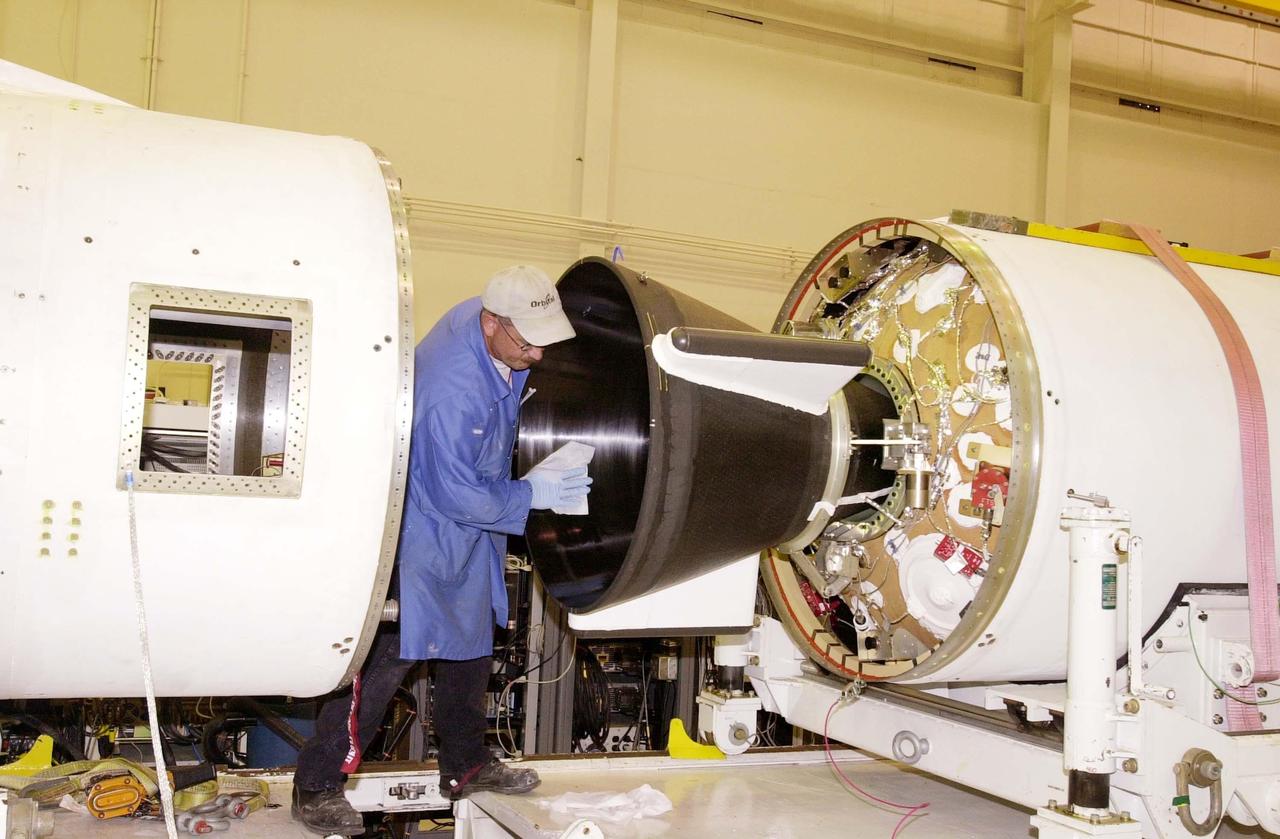
KENNEDY SPACE CENTER, FLA. - At Vandenberg Air Force Base in California, a worker prepares the second and third stages of the Orbital Sciences Pegasus XL launch vehicle for mating. The Pegasus XL will launch the Demonstration of Autonomous Rendezvous Technology (DART) spacecraft. DART was designed and built for NASA by Orbital Sciences Corporation as an advanced flight demonstrator to locate and maneuver near an orbiting satellite. DART weighs about 800 pounds and is nearly 6 feet long and 3 feet in diameter. The Pegasus XL will launch DART into a circular polar orbit of approximately 475 miles. DART is designed to demonstrate technologies required for a spacecraft to locate and rendezvous, or maneuver close to, other craft in space. Results from the DART mission will aid in the development of NASA’s Crew Exploration Vehicle and will also assist in vehicle development for crew transfer and crew rescue capability to and from the International Space Station.
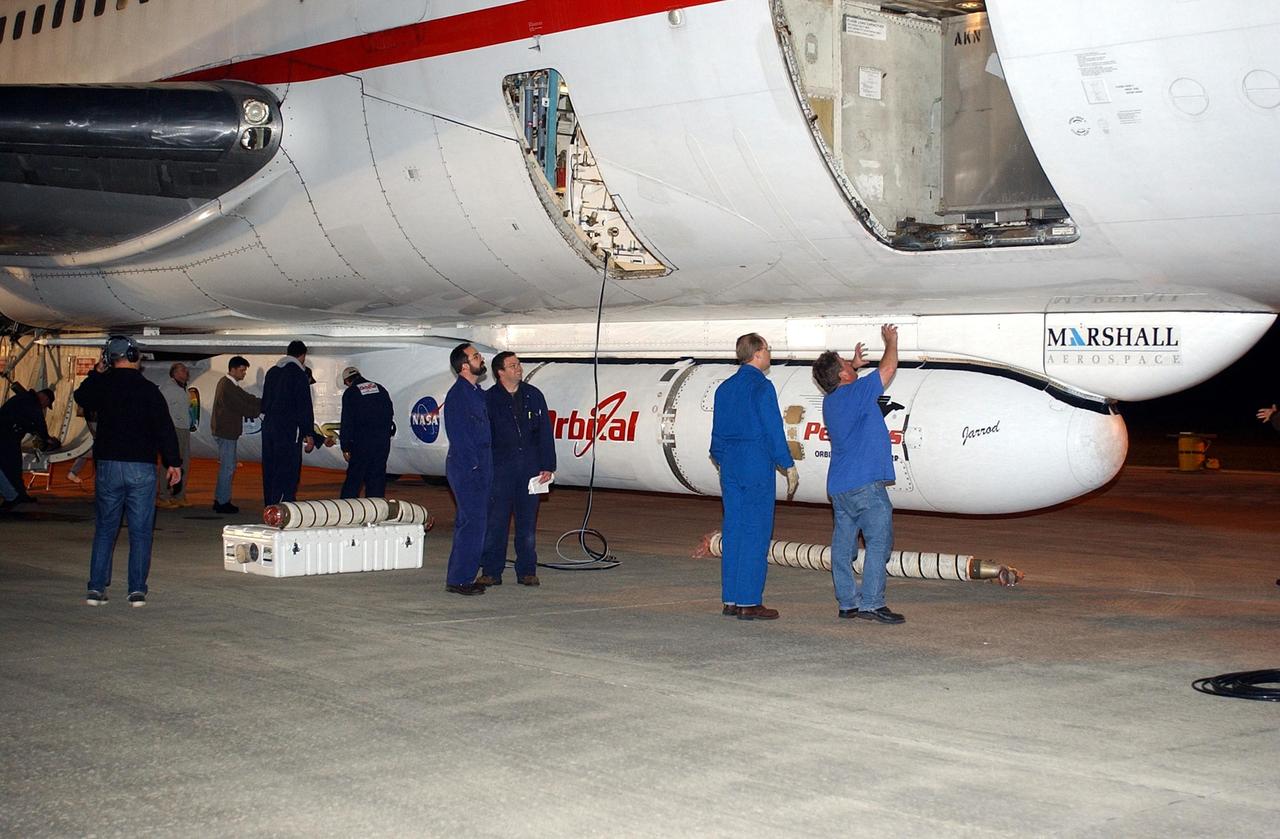
KENNEDY SPACE CENTER, FLA. -- Workers at the Cape Canaveral Air Force Station Skid Strip get ready to remove the Pegasus XL Expendable Launch Vehicle attached underneath the Orbital Sciences L-1011 aircraft. The Pegasus will be transported to the Multi-Payload Processing Facility for testing and verification. The Pegasus will undergo three flight simulations prior to its scheduled launch in late January 2003. The Pegasus XL will carry NASA's Solar Radiation and Climate Experiment (SORCE) into orbit. Built by Orbital Sciences Space Systems Group, SORCE will study and measure solar irradiance as a source of energy in the Earth's atmosphere. .
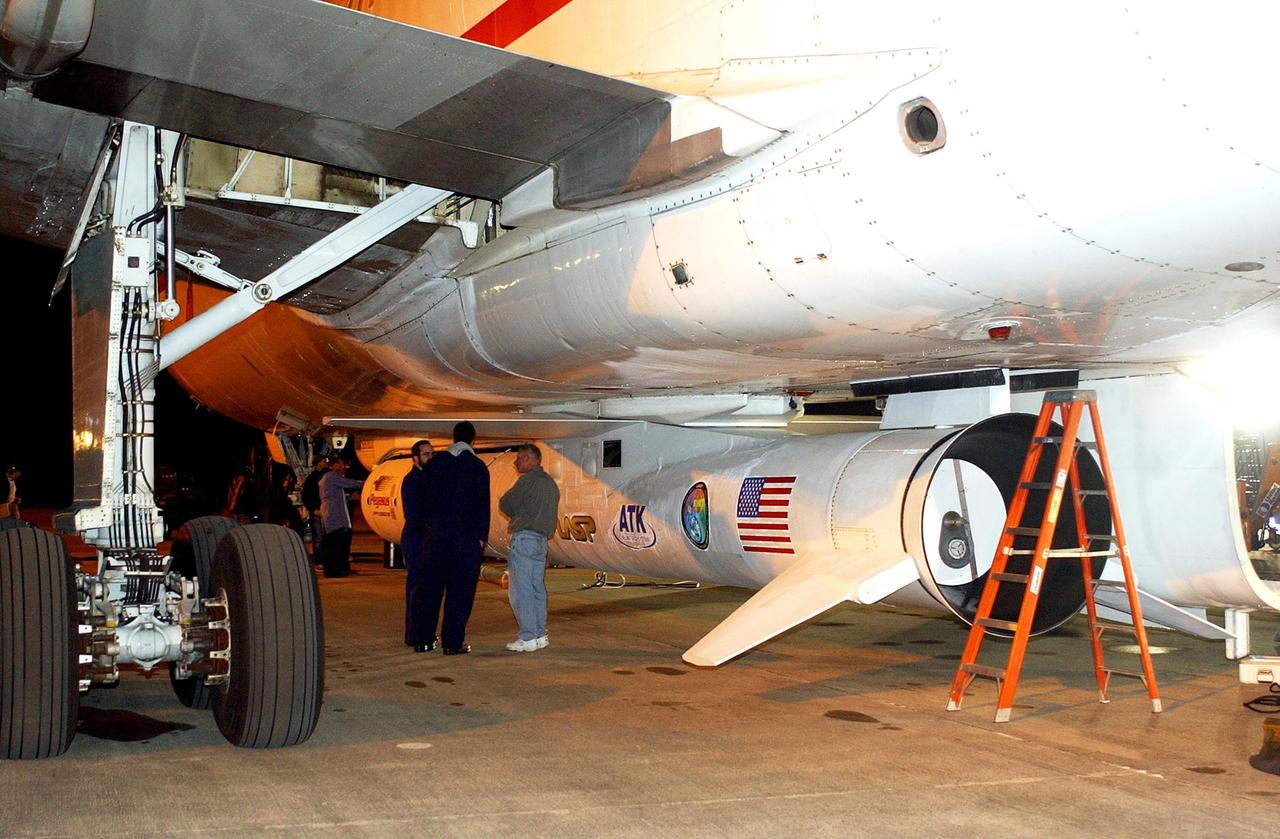
KENNEDY SPACE CENTER, FLA. -- Workers at the Cape Canaveral Air Force Station Skid Strip stand next to the Pegasus XL Expendable Launch Vehicle underneath the Orbital Sciences L-1011 aircraft. The Pegasus will be transported to the Multi-Payload Processing Facility for testing and verification. The Pegasus will undergo three flight simulations prior to its scheduled launch in late January 2003. The Pegasus XL will carry NASA's Solar Radiation and Climate Experiment (SORCE) into orbit. Built by Orbital Sciences Space Systems Group, SORCE will study and measure solar irradiance as a source of energy in the Earth's atmosphere. .
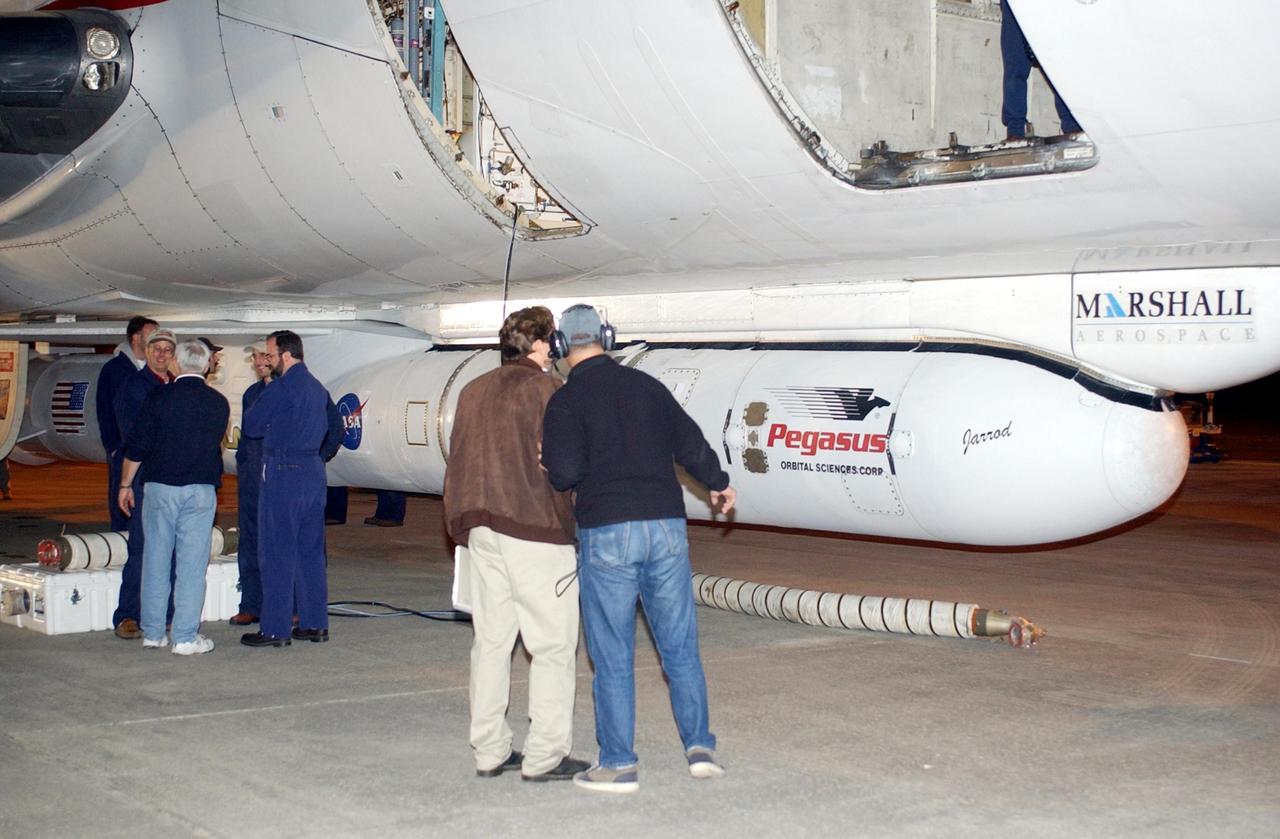
KENNEDY SPACE CENTER, FLA. -- Workers at the Cape Canaveral Air Force Station Skid Strip look over the Pegasus XL Expendable Launch Vehicle attached underneath the Orbital Sciences L-1011 aircraft. The Pegasus will be transported to the Multi-Payload Processing Facility for testing and verification. The Pegasus will undergo three flight simulations prior to its scheduled launch in late January 2003. The Pegasus XL will carry NASA's Solar Radiation and Climate Experiment (SORCE) into orbit. Built by Orbital Sciences Space Systems Group, SORCE will study and measure solar irradiance as a source of energy in the Earth's atmosphere. .
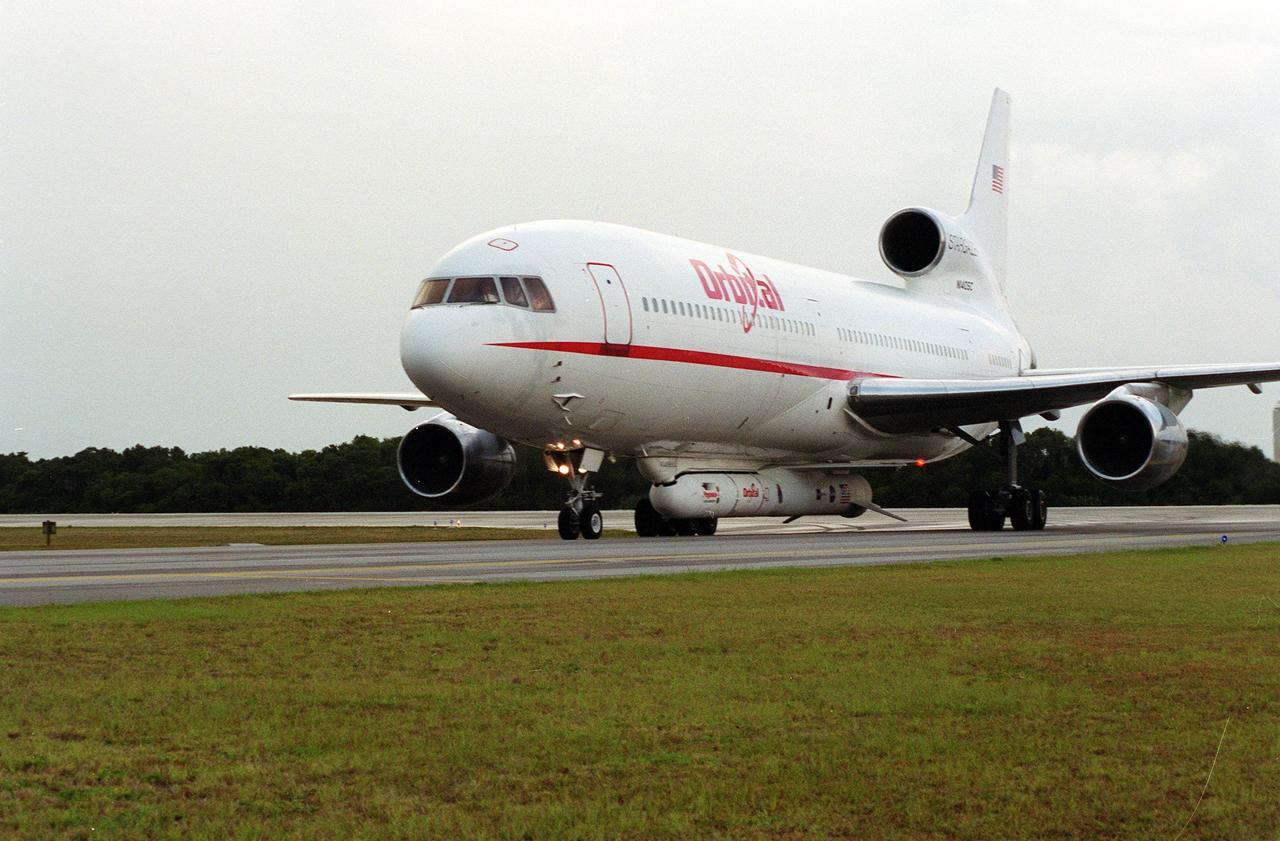
KENNEDY SPACE CENTER, Fla. -- An L-1011 aircraft called the Stargazer lands at the Skid Strip, Cape Canaveral Air Force Station. Underneath its belly it carries the Orbital Sciences Corp. Pegasus XL launch vehicle with the High Energy Solar Spectroscopic Imager (HESSI) attached. The Pegasus XL will launch the HESSI no earlier than June 12 from CCAFS. The primary mission of HESSI is to explore the basic physics of particle acceleration and energy release in solar flares
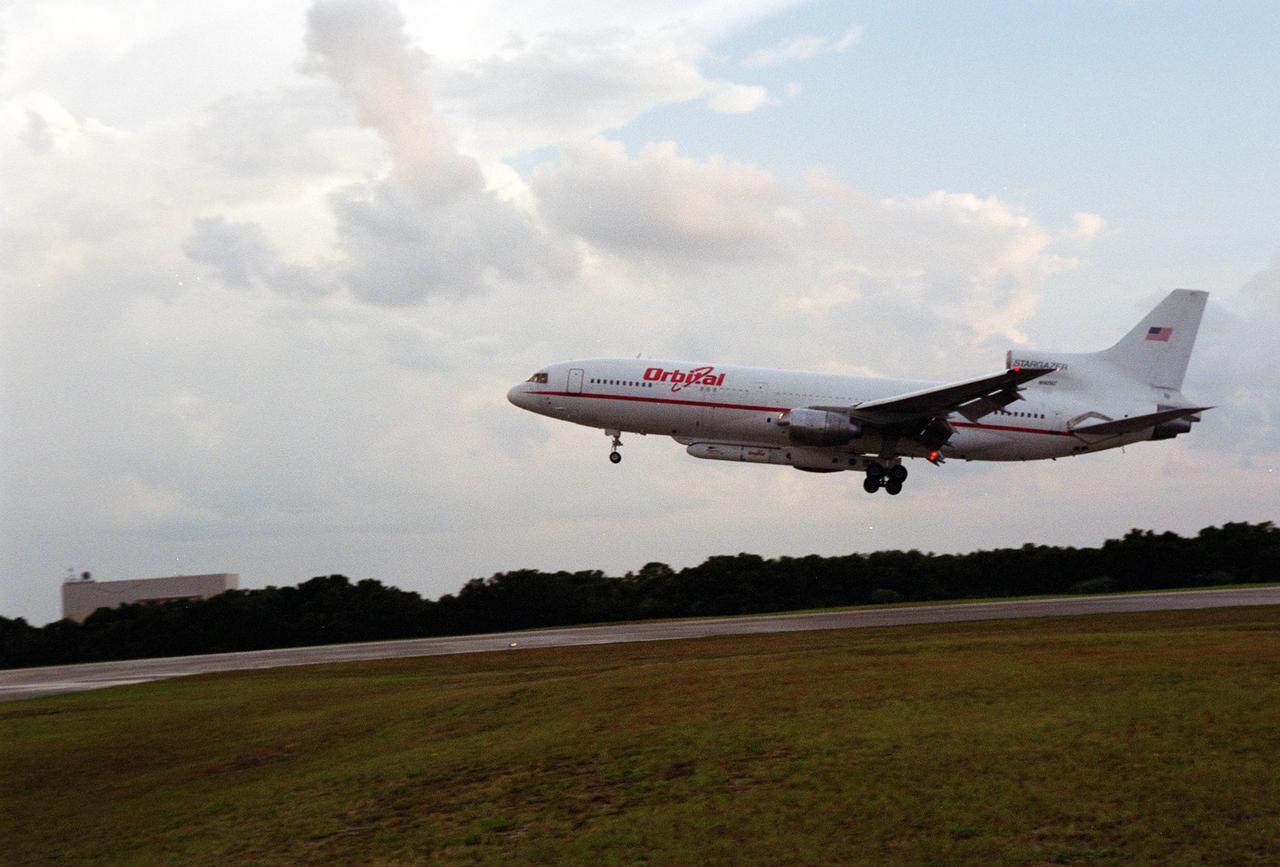
KENNEDY SPACE CENTER, Fla. -- An L-1011 aircraft called the Stargazer gets ready to land at the Skid Strip, Cape Canaveral Air Force Station. Underneath its belly it carries the Orbital Sciences Corp. Pegasus XL launch vehicle with the High Energy Solar Spectroscopic Imager (HESSI) attached. The Pegasus XL will launch the HESSI no earlier than June 12 from CCAFS. The primary mission of HESSI is to explore the basic physics of particle acceleration and energy release in solar flares
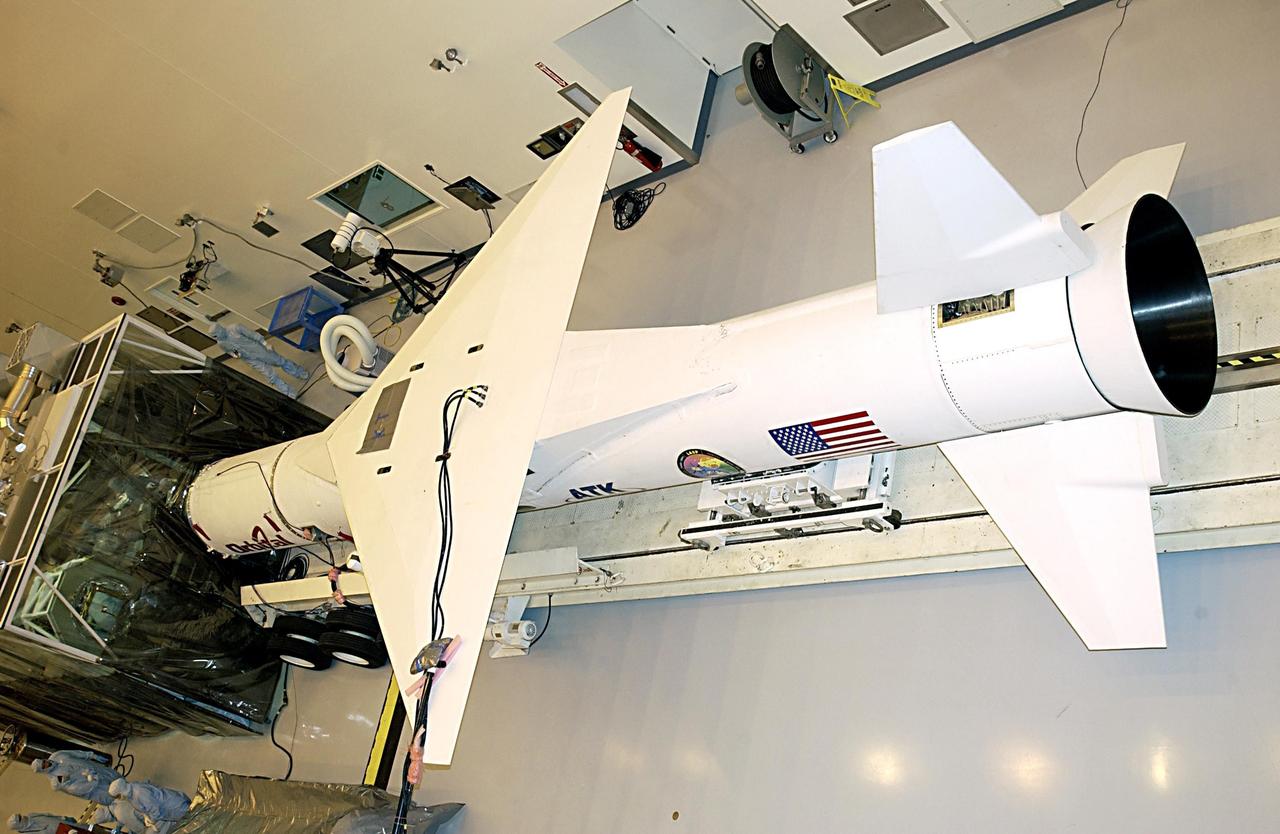
KENNEDY SPACE CENTER, FLA. -- The Pegasus XL Expendable Launch Vehicle is on a workstand in the Multi-Purpose Processing Facility. The Pegasus XL will carry NASA's Solar Radiation and Climate Experiment (SORCE) into orbit. Built by Orbital Sciences Space Systems Group, SORCE will study and measure solar irradiance as a source of energy in the Earth's atmosphere. The launch of SORCE is scheduled for Jan. 25 at 3:14 p.m. from Cape Canaveral Air Force Station, Fla.
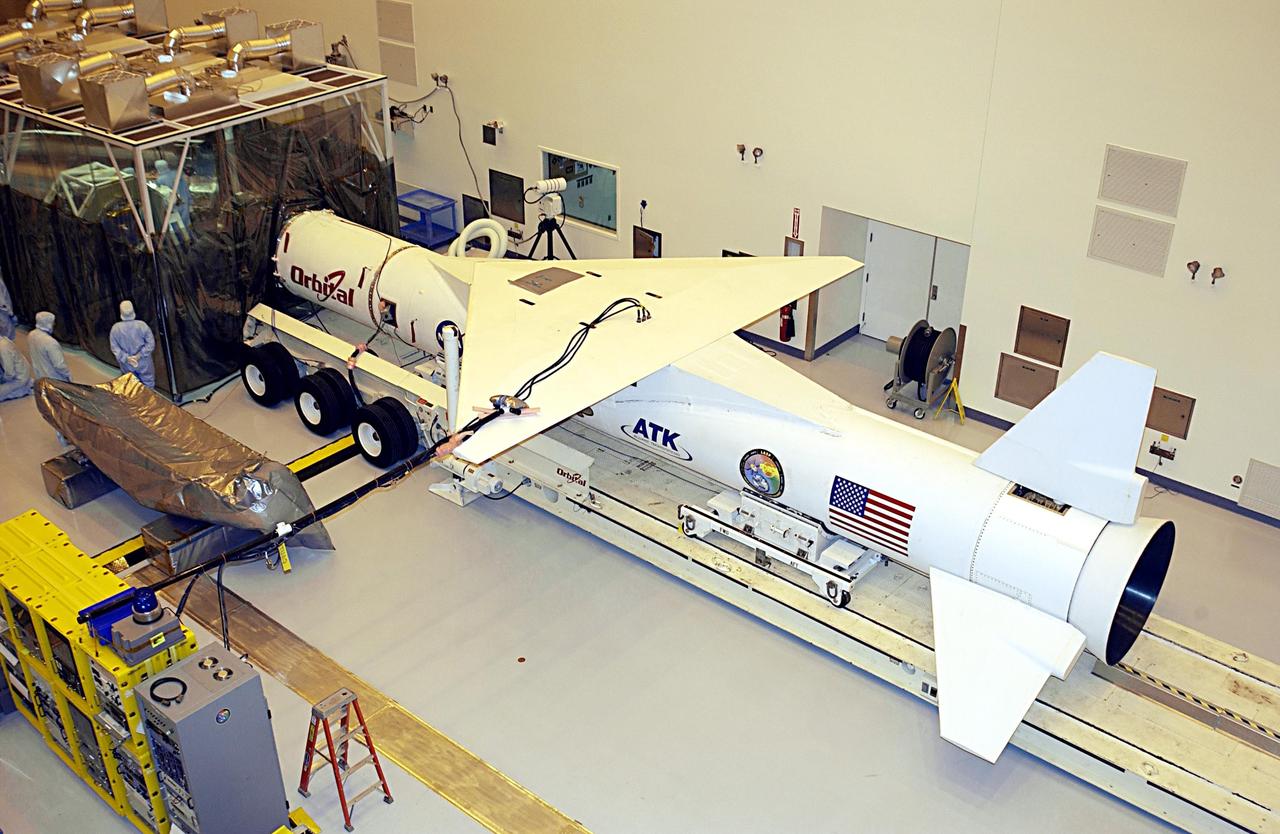
KENNEDY SPACE CENTER, FLA. -- The Pegasus XL Expendable Launch Vehicle is on a workstand in the Multi-Purpose Processing Facility. The Pegasus XL will carry NASA's Solar Radiation and Climate Experiment (SORCE) into orbit. Built by Orbital Sciences Space Systems Group, SORCE will study and measure solar irradiance as a source of energy in the Earth's atmosphere. The launch of SORCE is scheduled for Jan. 25 at 3:14 p.m. from Cape Canaveral Air Force Station, Fla.
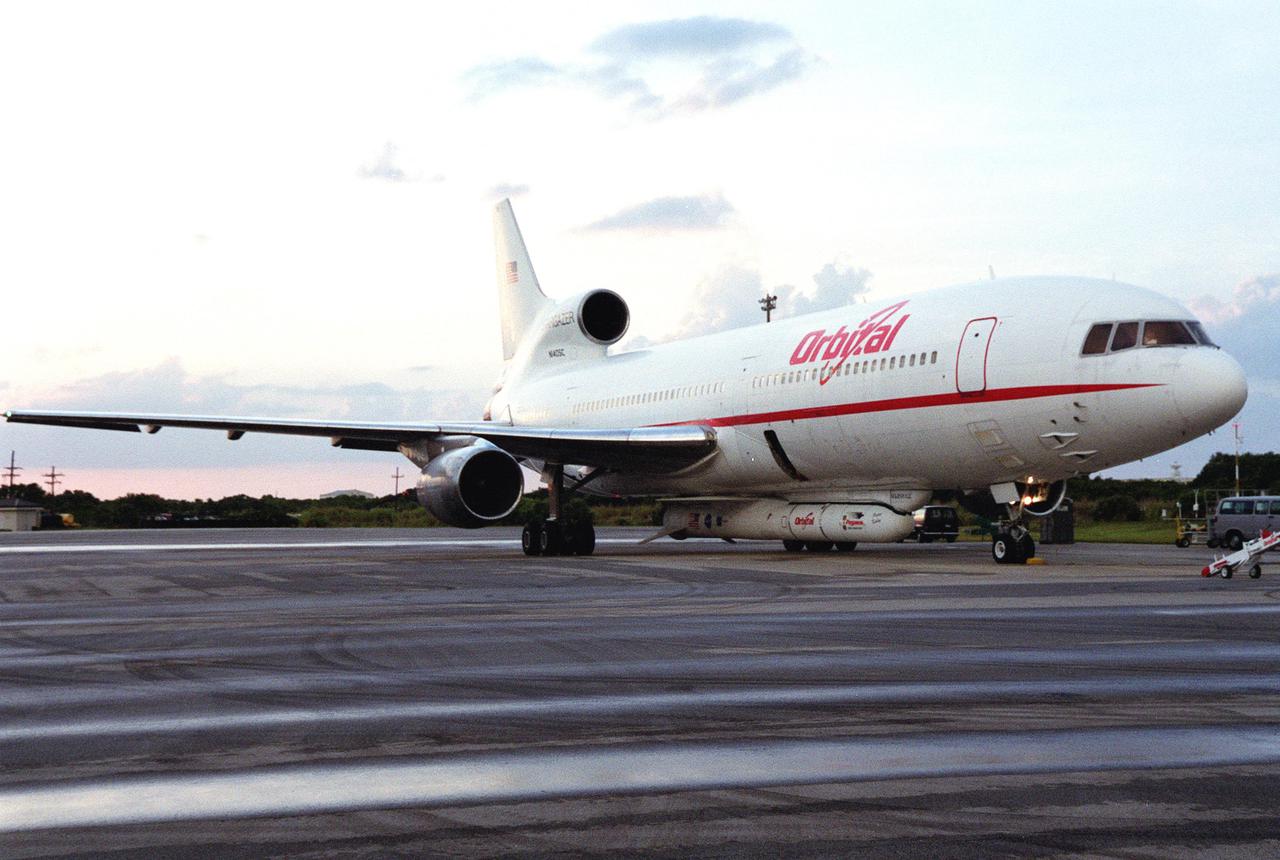
KENNEDY SPACE CENTER, Fla. -- An L-1011 aircraft called the Stargazer is parked after landing at the Skid Strip, Cape Canaveral Air Force Station. Underneath its belly it carries the Orbital Sciences Corp. Pegasus XL launch vehicle with the High Energy Solar Spectroscopic Imager (HESSI) attached. The Pegasus XL will launch the HESSI no earlier than June 12 from CCAFS. The primary mission of HESSI is to explore the basic physics of particle acceleration and energy release in solar flares
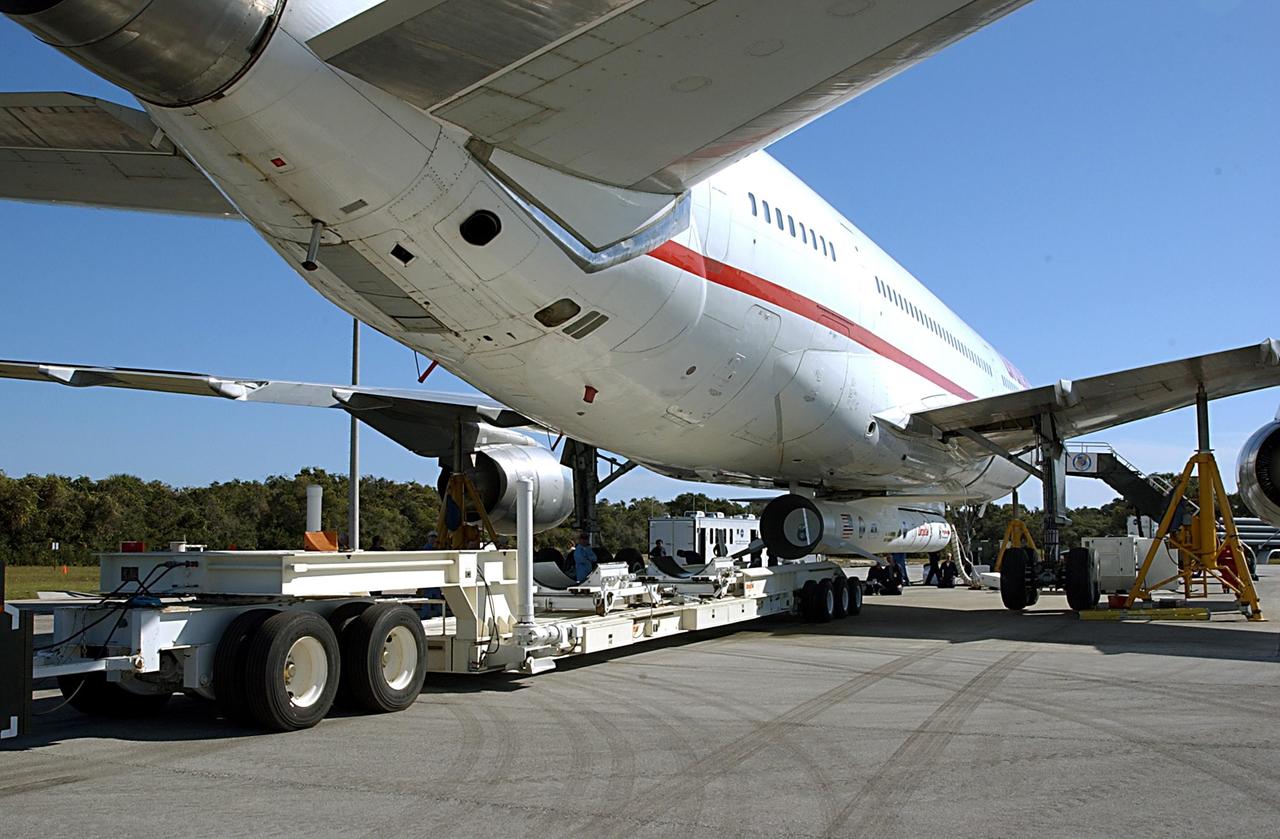
KENNEDY SPACE CENTER, FLA. -- A transporter is positioned below a Pegasus XL Expendable Launch Vehicle before its detachment from the underside of an Orbital Sciences L-1011 aircraft. The aircraft, with the launch vehicle nestled beneath, arrived at the Cape Canaveral Air Force Station Skid Strip on Dec. 17. The Pegasus XL will undergo three flight simulations prior to its scheduled launch in late January 2003. It will carry NASA's Solar Radiation and Climate Experiment (SORCE) spacecraft into orbit. Built by Orbital Sciences Space Systems Group, SORCE will study and measure solar irradiance as a source of energy in the Earth's atmosphere with instruments built by the University of Colorado's Laboratory for Atmospheric and Space Physics (LASP).
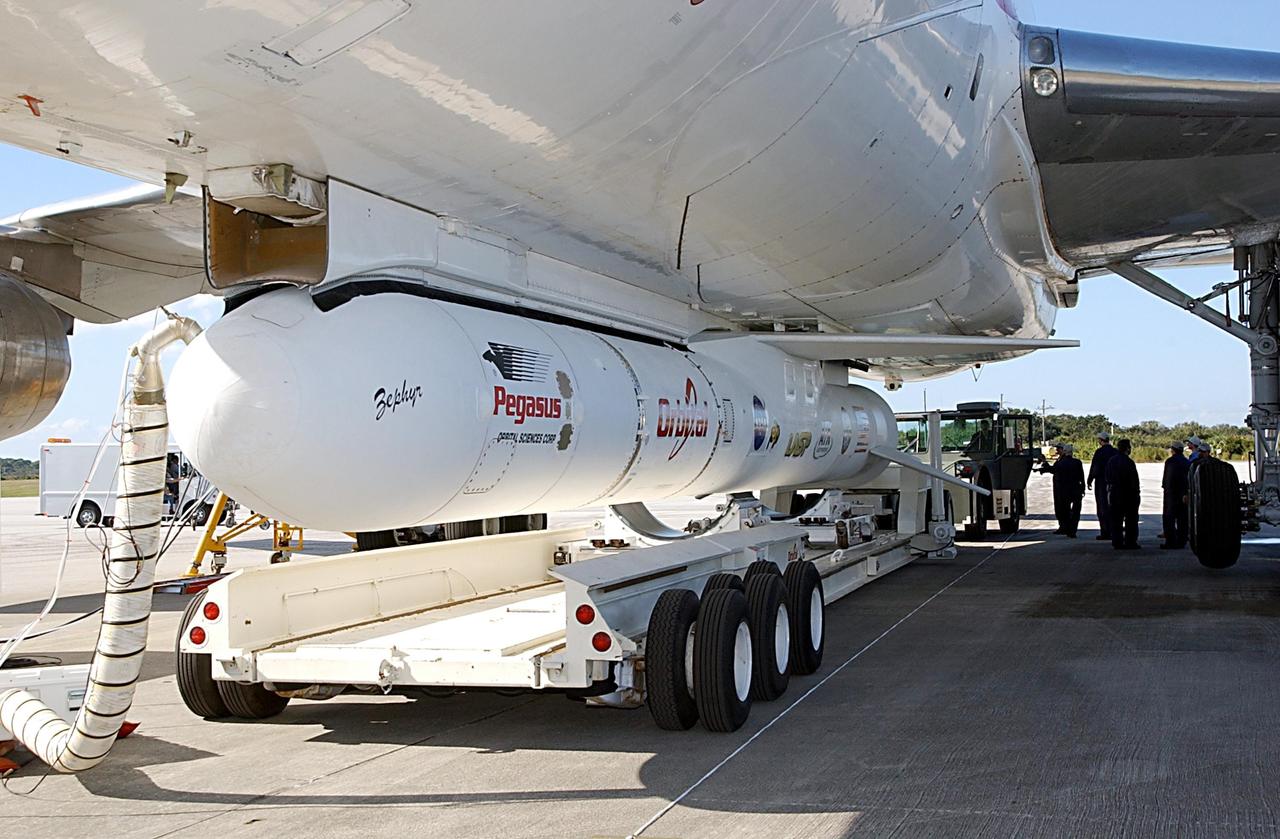
KENNEDY SPACE CENTER, FLA. -- A transporter is repositioned below a Pegasus XL Expendable Launch Vehicle before it is detached from the underside of an Orbital Sciences L-1011 aircraft. The aircraft, with the launch vehicle nestled beneath, arrived at the Cape Canaveral Air Force Station Skid Strip on Dec. 17. The Pegasus XL will undergo three flight simulations prior to its scheduled launch in late January 2003. It will carry NASA's Solar Radiation and Climate Experiment (SORCE) spacecraft into orbit. Built by Orbital Sciences Space Systems Group, SORCE will study and measure solar irradiance as a source of energy in the Earth's atmosphere with instruments built by the University of Colorado's Laboratory for Atmospheric and Space Physics (LASP).
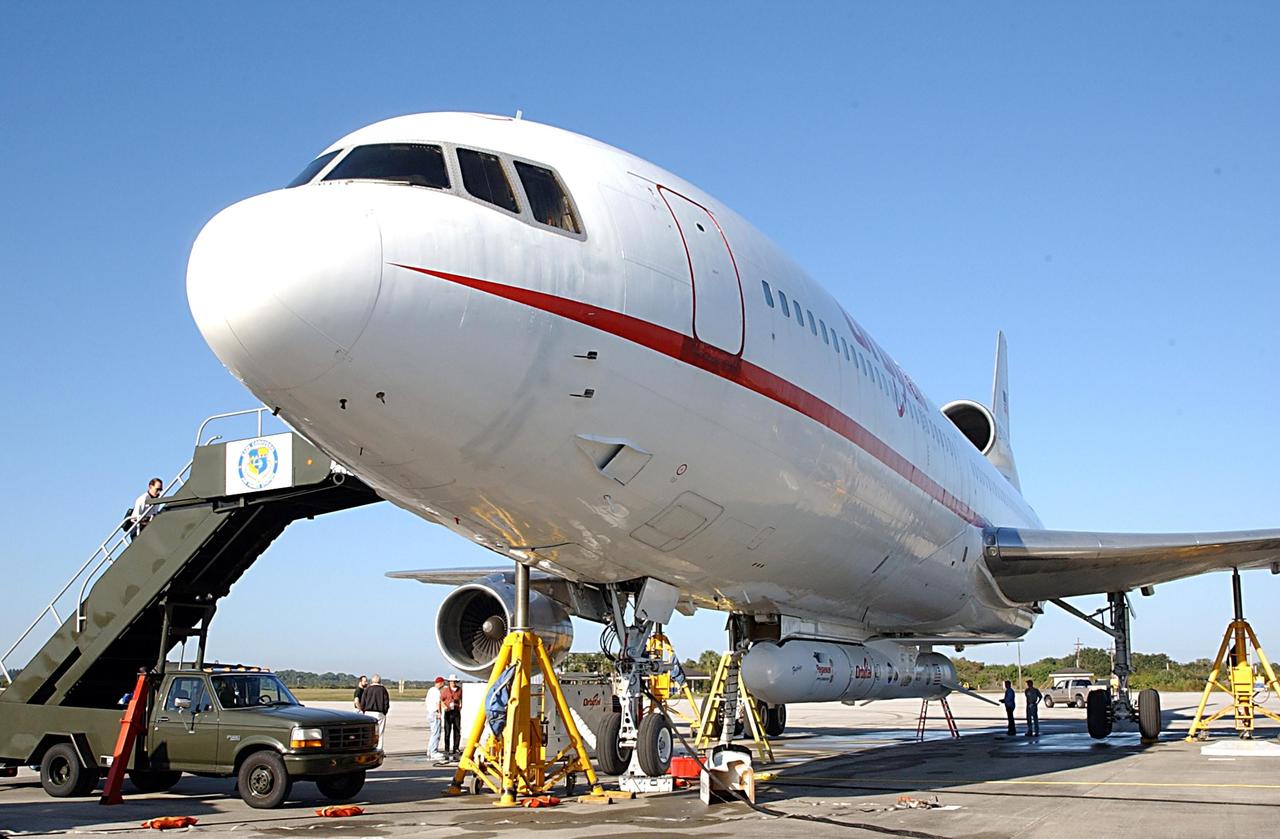
KENNEDY SPACE CENTER, FLA. -- Workers prepare to remove a Pegasus XL Expendable Launch Vehicle from the underside of an Orbital Sciences L-1011 aircraft. The aircraft, with the launch vehicle attached, arrived at the Cape Canaveral Air Force Station Skid Strip on Dec. 17. The Pegasus XL will undergo three flight simulations prior to its scheduled launch in late January 2003. It will carry NASA's Solar Radiation and Climate Experiment (SORCE) spacecraft into orbit. Built by Orbital Sciences Space Systems Group, SORCE will study and measure solar irradiance as a source of energy in the Earth's atmosphere with instruments built by the University of Colorado's Laboratory for Atmospheric and Space Physics (LASP).

KENNEDY SPACE CENTER, FLA. -- Workers prepare a Pegasus XL Expendable Launch Vehicle for detachment from the underside of an Orbital Sciences L-1011 aircraft. The aircraft, with the launch vehicle nestled beneath, arrived at the Cape Canaveral Air Force Station Skid Strip on Dec. 17. The Pegasus XL will undergo three flight simulations prior to its scheduled launch in late January 2003. It will carry NASA's Solar Radiation and Climate Experiment (SORCE) spacecraft into orbit. Built by Orbital Sciences Space Systems Group, SORCE will study and measure solar irradiance as a source of energy in the Earth's atmosphere with instruments built by the University of Colorado's Laboratory for Atmospheric and Space Physics (LASP).
KENNEDY SPACE CENTER, FLA. -- Workers complete the final steps to detach a Pegasus XL Expendable Launch Vehicle from the underside of an Orbital Sciences L-1011 aircraft. The aircraft, with the launch vehicle nestled beneath, arrived at the Cape Canaveral Air Force Station Skid Strip on Dec. 17. The Pegasus XL will undergo three flight simulations prior to its scheduled launch in late January 2003. It will carry NASA's Solar Radiation and Climate Experiment (SORCE) spacecraft into orbit. Built by Orbital Sciences Space Systems Group, SORCE will study and measure solar irradiance as a source of energy in the Earth's atmosphere with instruments built by the University of Colorado's Laboratory for Atmospheric and Space Physics (LASP).
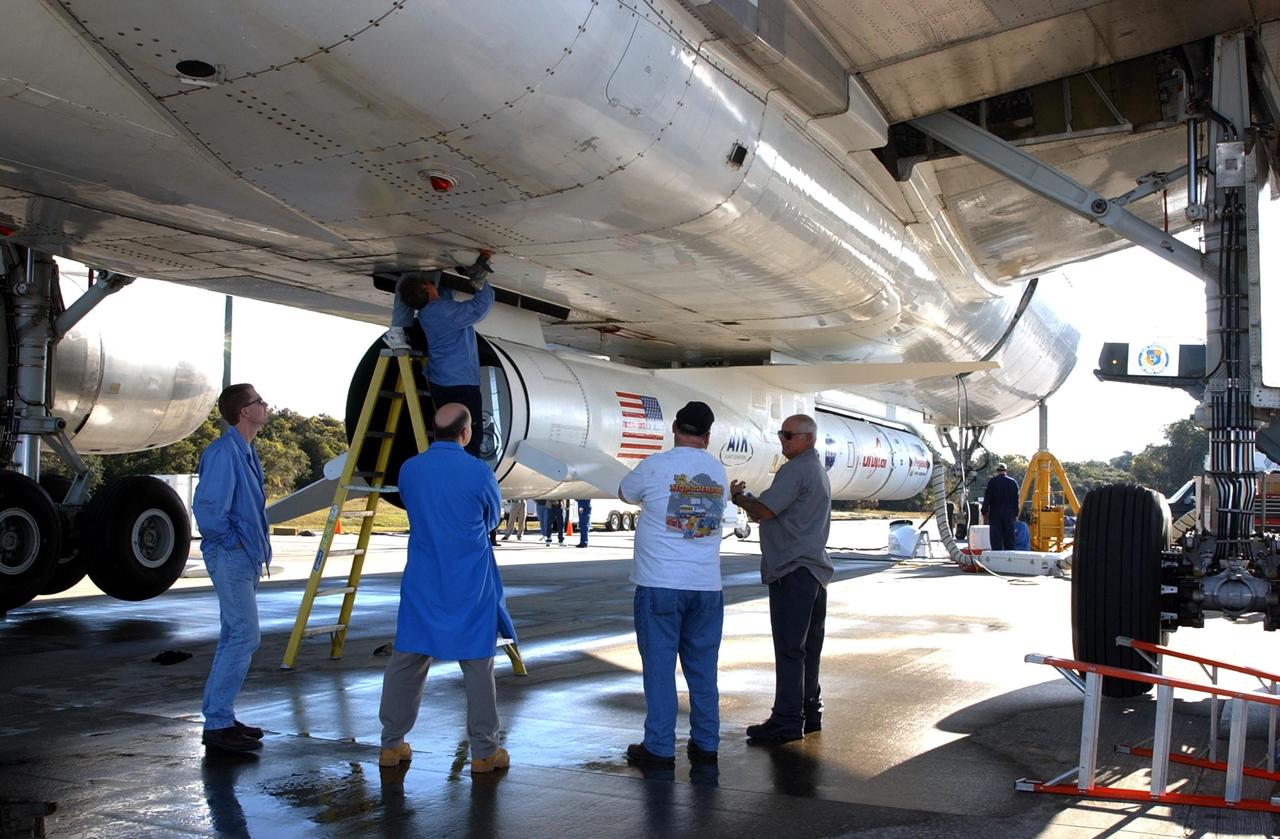
KENNEDY SPACE CENTER, FLA. -- Workers begin the process to remove a Pegasus XL Expendable Launch Vehicle from the underside of an Orbital Sciences L-1011 aircraft. The aircraft, with the launch vehicle attached, arrived at the Cape Canaveral Air Force Station Skid Strip on Dec. 17. The Pegasus XL will undergo three flight simulations prior to its scheduled launch in late January 2003. It will carry NASA's Solar Radiation and Climate Experiment (SORCE) spacecraft into orbit. Built by Orbital Sciences Space Systems Group, SORCE will study and measure solar irradiance as a source of energy in the Earth's atmosphere with instruments built by the University of Colorado's Laboratory for Atmospheric and Space Physics (LASP).
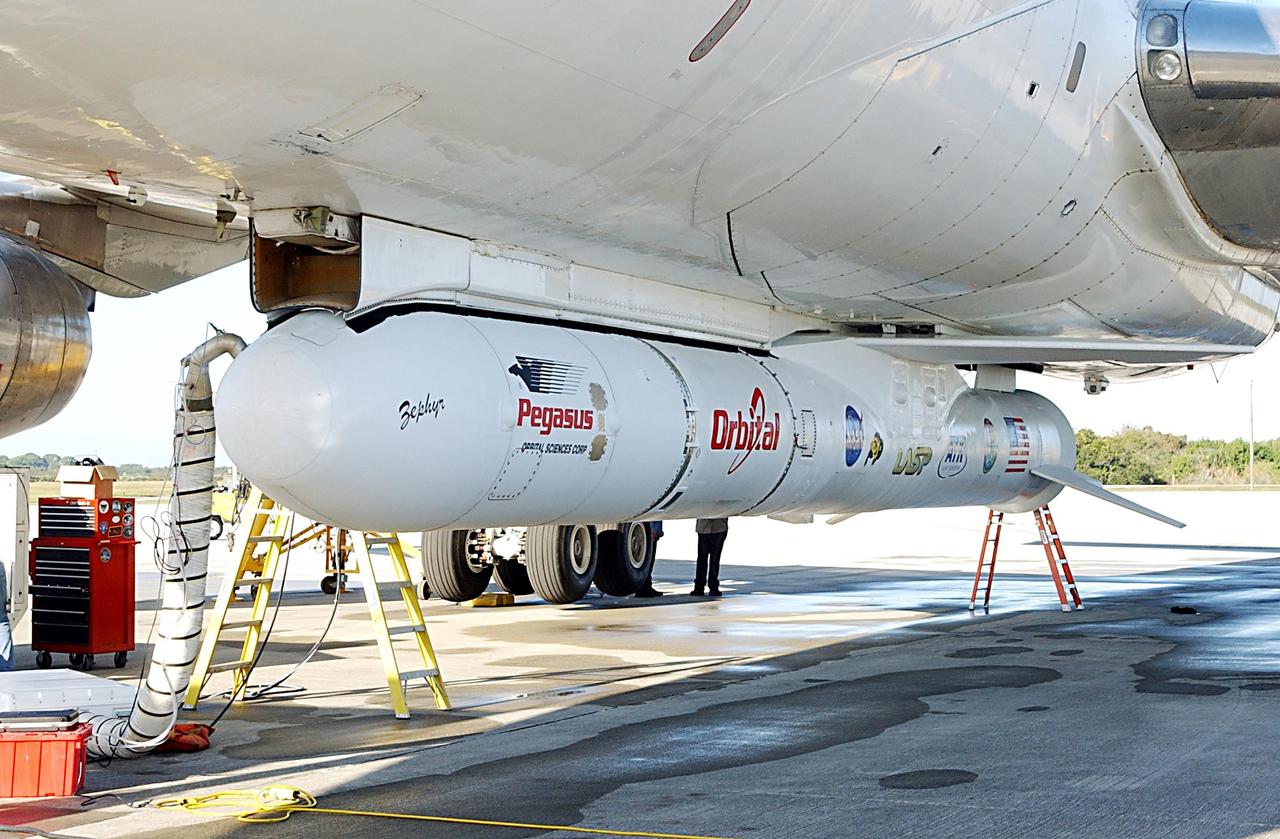
KENNEDY SPACE CENTER, FLA. -- A Pegasus XL Expendable Launch Vehicle is moments away from being removed from the underside of an Orbital Sciences L-1011 aircraft. The aircraft, with the launch vehicle attached, arrived at the Cape Canaveral Air Force Station Skid Strip on Dec. 17. The Pegasus XL will undergo three flight simulations prior to its scheduled launch in late January 2003. It will carry NASA's Solar Radiation and Climate Experiment (SORCE) spacecraft into orbit. Built by Orbital Sciences Space Systems Group, SORCE will study and measure solar irradiance as a source of energy in the Earth's atmosphere with instruments built by the University of Colorado's Laboratory for Atmospheric and Space Physics (LASP).
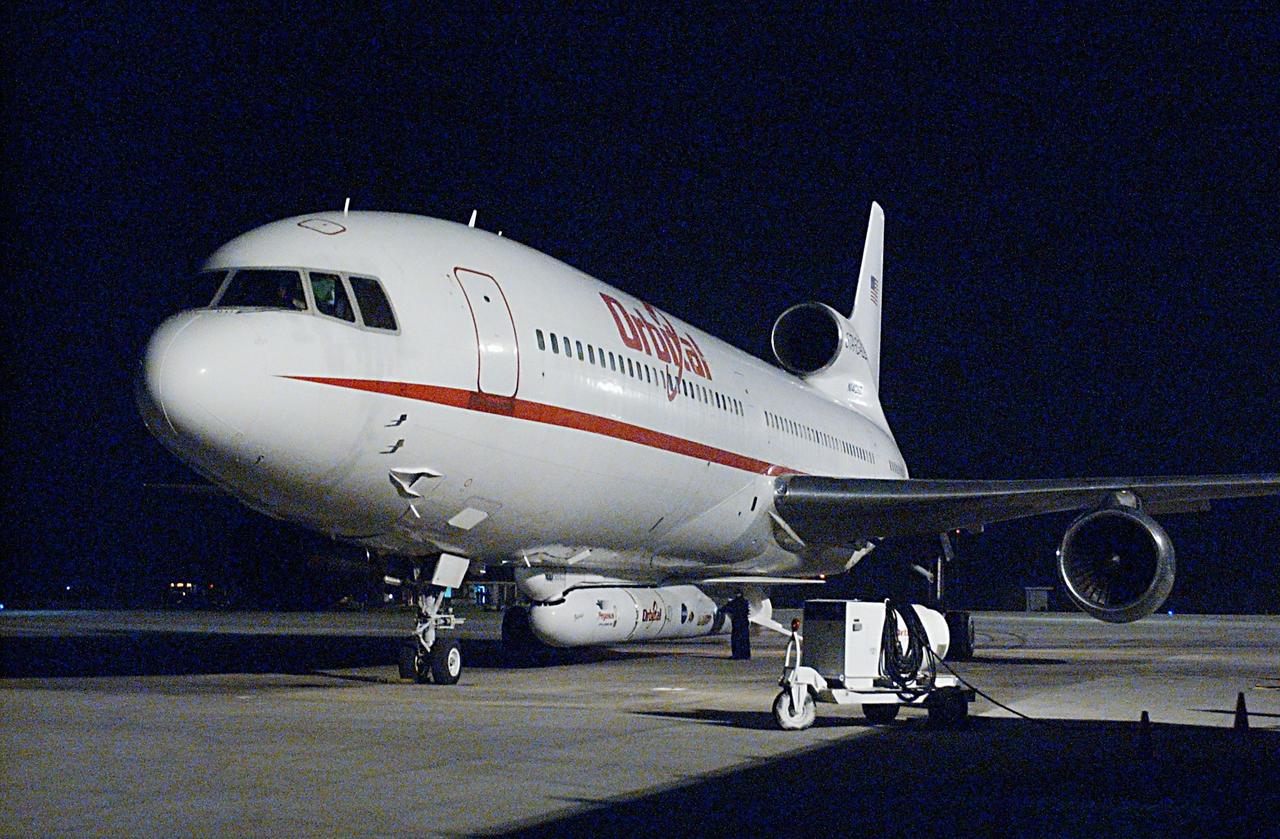
KENNEDY SPACE CENTER, FLA. - An Orbital Sciences L-1011 aircraft arrives at the Cape Canaveral Air Force Station Skid Strip. Attached underneath the aircraft is the Pegasus XL Expendable Launch Vehicle, which will be transported to the Multi-Payload Processing Facility for testing and verification. The Pegasus will undergo three flight simulations prior to its scheduled launch in late January 2003. The Pegasus XL will carry NASA's Solar Radiation and Climate Experiment (SORCE) into orbit. Built by Orbital Sciences Space Systems Group, SORCE will study and measure solar irradiance as a source of energy in the Earth's atmosphere. .
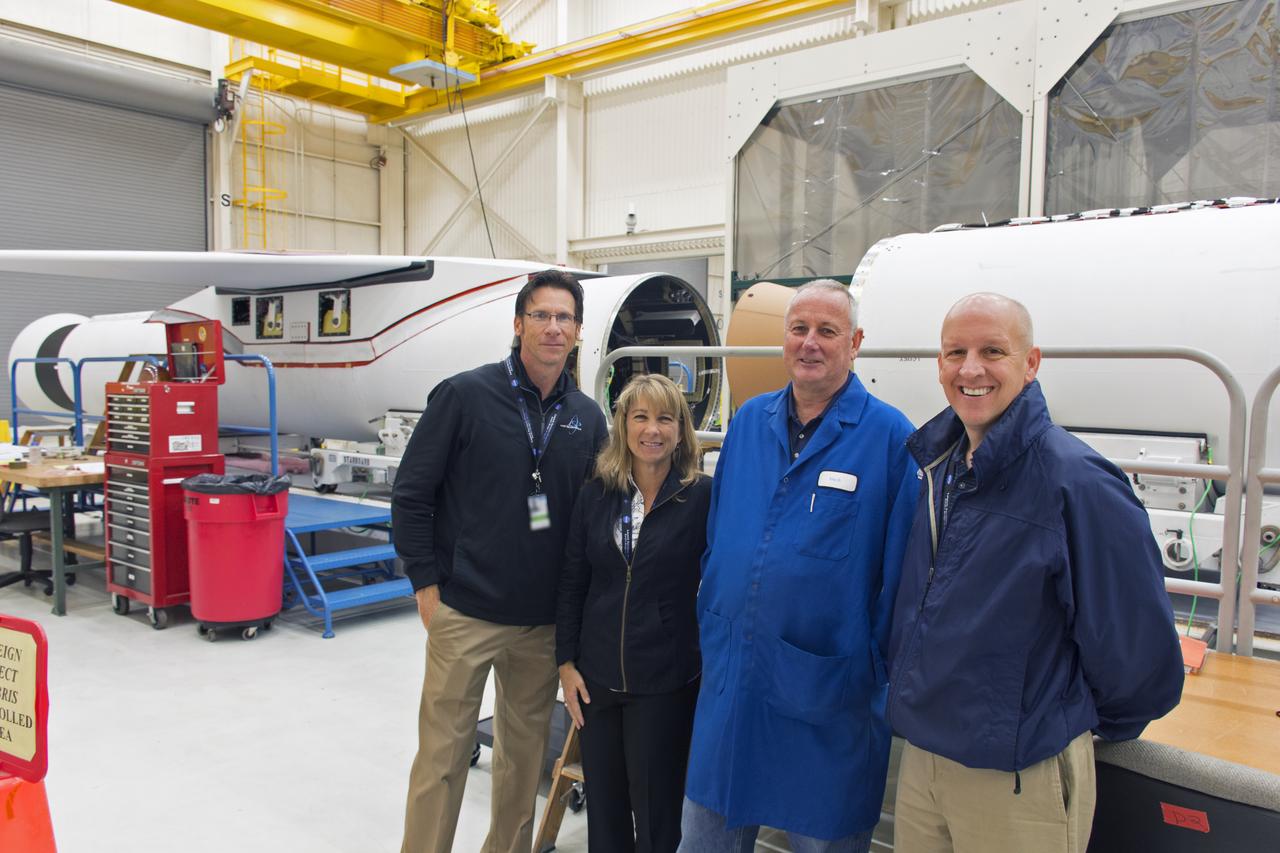
Managers of NASA's Launch Services Program (LSP) at Kennedy Space Center visit the processing facility for the Pegasus XL rocket at Vandenberg Air Force Base in California. From left, are Chuck Dovale, deputy manager; Amanda Mitskevich, manager; Eric Denbrook, launch vehicle processing at VAFB; and Tim Dunn, NASA assistant launch manager for ICON. The Pegasus XL rocket is being prepared for the agency's Ionospheric Connection Explorer, or ICON, mission. ICON will launch from the Kwajalein Atoll aboard the Pegasus XL on Dec. 8, 2017. ICON will study the frontier of space - the dynamic zone high in Earth's atmosphere where terrestrial weather from below meets space weather above. The explorer will help determine the physics of Earth's space environment and pave the way for mitigating its effects on our technology, communications systems and society.
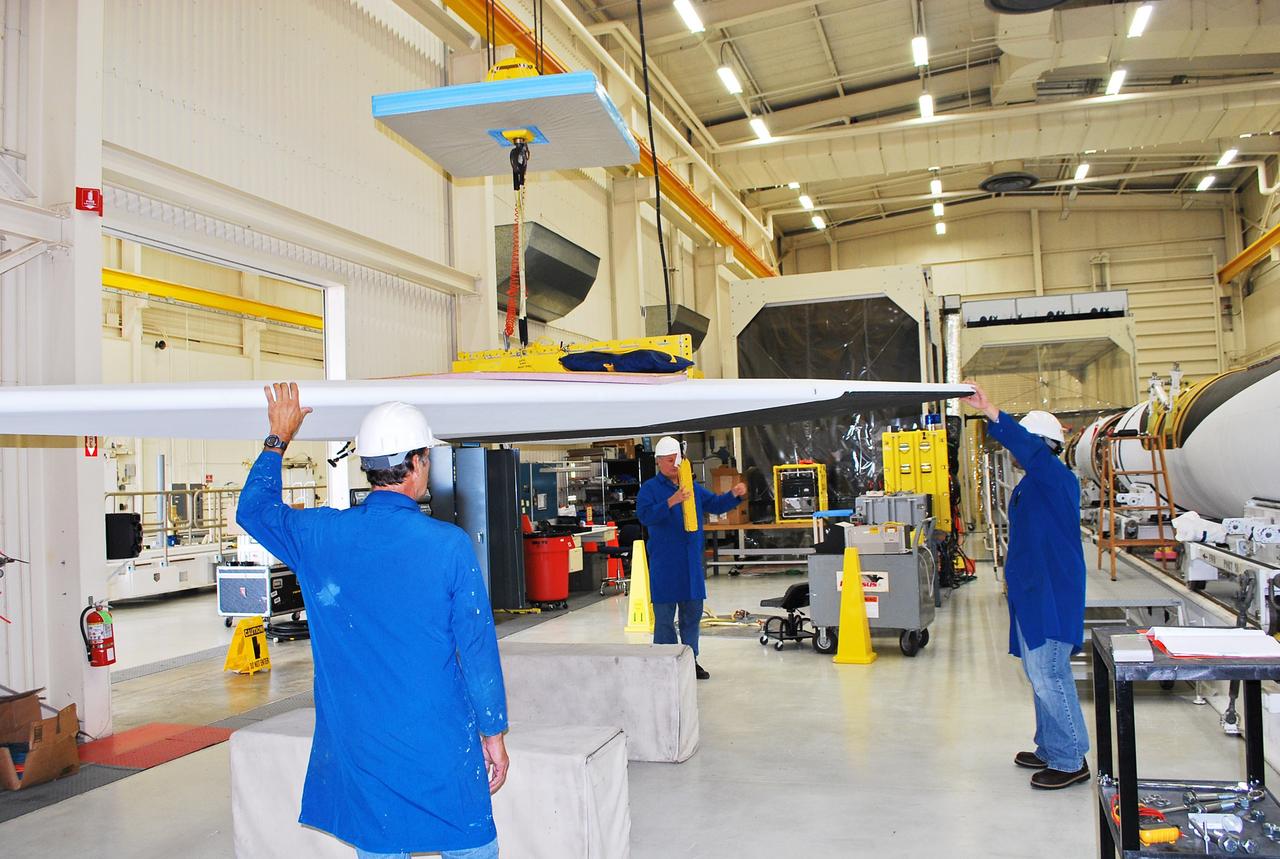
Vandenberg Air Force Base, Calif. – Inside a processing facility at Vandenberg Air Force Base in California, technicians prepare the wing for a fit check with the Orbital Sciences Pegasus XL launch vehicle. NASA’s Interface Region Imaging Spectrograph, or IRIS, spacecraft will launch aboard the Pegasus XL in late 2012. IRIS will open a new window of discovery by tracing the flow of energy and plasma through the chromospheres and transition region into the sun’s corona using spectrometry and imaging. IRIS fills a crucial gap in our ability to advance studies of the sun-to-Earth connection by tracing the flow of energy and plasma through the foundation of the corona and heliosphere, or region around the sun. Photo credit: NASA/Randy Beaudoin
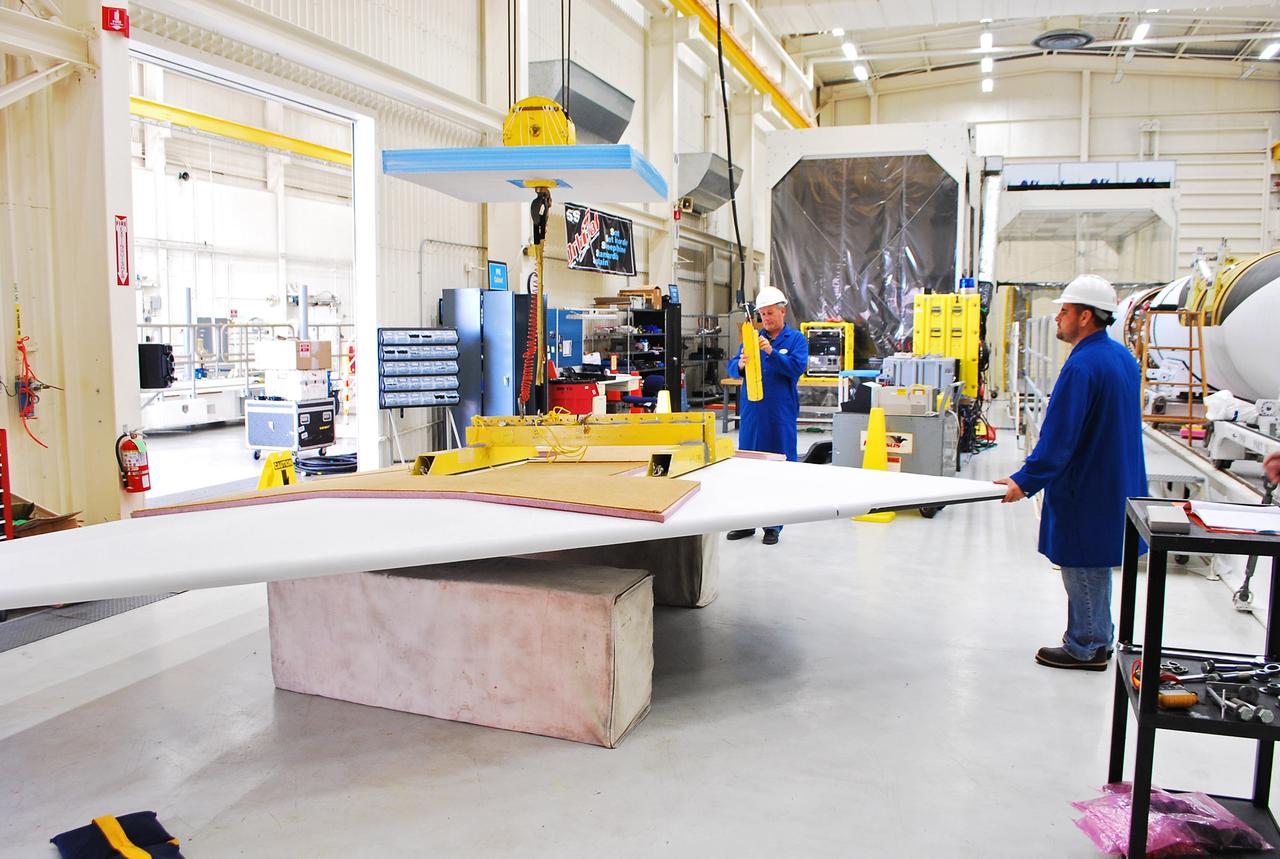
Vandenberg Air Force Base, Calif. – Inside a processing facility at Vandenberg Air Force Base in California, technicians prepare the wing for a fit check with the Orbital Sciences Pegasus XL launch vehicle. NASA’s Interface Region Imaging Spectrograph, or IRIS, spacecraft will launch aboard the Pegasus XL in late 2012. IRIS will open a new window of discovery by tracing the flow of energy and plasma through the chromospheres and transition region into the sun’s corona using spectrometry and imaging. IRIS fills a crucial gap in our ability to advance studies of the sun-to-Earth connection by tracing the flow of energy and plasma through the foundation of the corona and heliosphere, or region around the sun. Photo credit: NASA/Randy Beaudoin
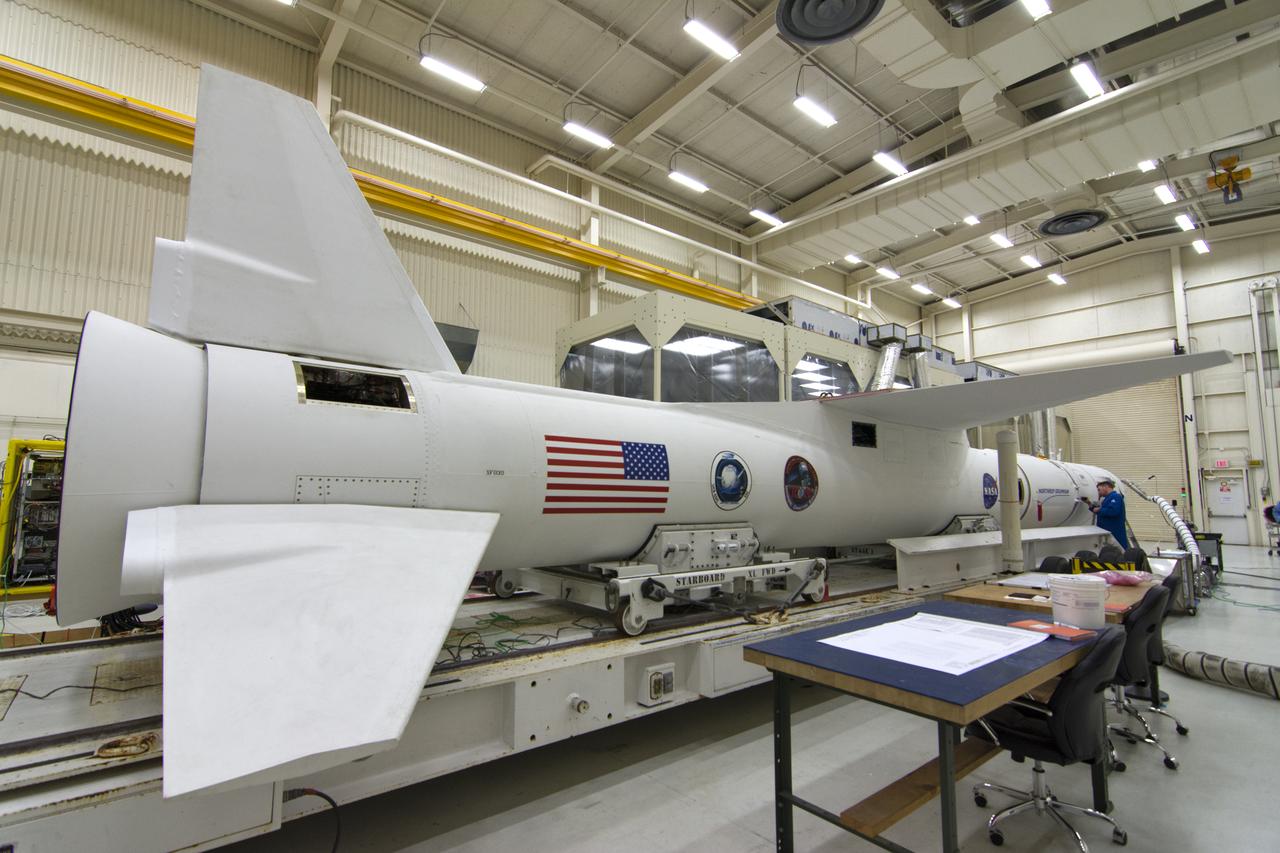
The Northrop Grumman Pegasus XL vehicle is inside Building 1555 at Vandenberg Air Force Base in California, on Oct. 8, 2018. The payload fairing is installed around NASA's Ionospheric Connection Explorer (ICON). The Pegasus XL, attached to the company's L-1011 Stargazer aircraft, will launch from the Skid Strip at Cape Canaveral Air Force Station in Florida. Launch is scheduled for Oct. 26. ICON will study the frontier of space - the dynamic zone high in Earth's atmosphere where terrestrial weather from below meets space weather above. The explorer will help determine the physics of Earth's space environment and pave the way for mitigating its effects on our technology, communications systems and society.
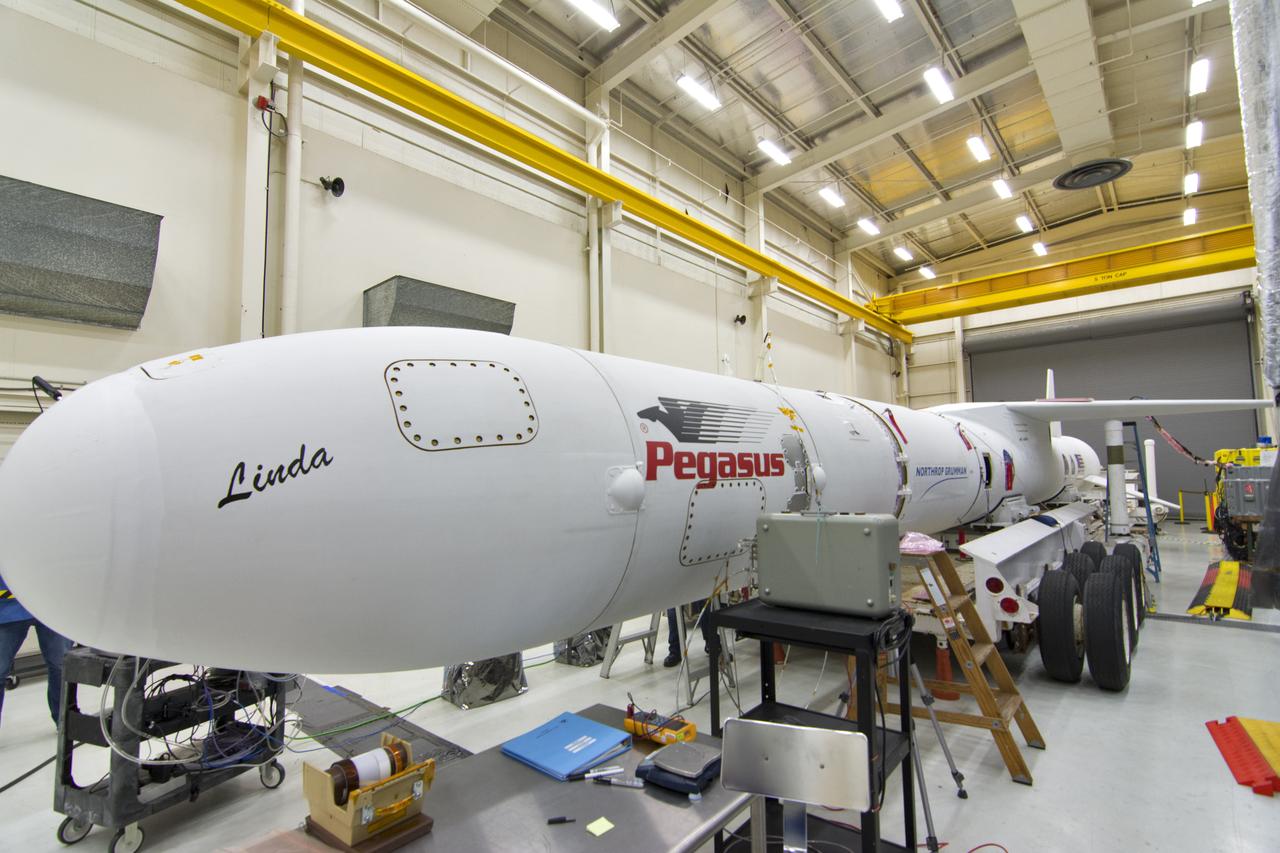
The Northrop Grumman Pegasus XL vehicle is inside Building 1555 at Vandenberg Air Force Base in California, on Oct. 8, 2018. The payload fairing is installed around NASA's Ionospheric Connection Explorer (ICON). The Pegasus XL, attached to the company's L-1011 Stargazer aircraft, will launch from the Skid Strip at Cape Canaveral Air Force Station in Florida. Launch is scheduled for Oct. 26. ICON will study the frontier of space - the dynamic zone high in Earth's atmosphere where terrestrial weather from below meets space weather above. The explorer will help determine the physics of Earth's space environment and pave the way for mitigating its effects on our technology, communications systems and society.
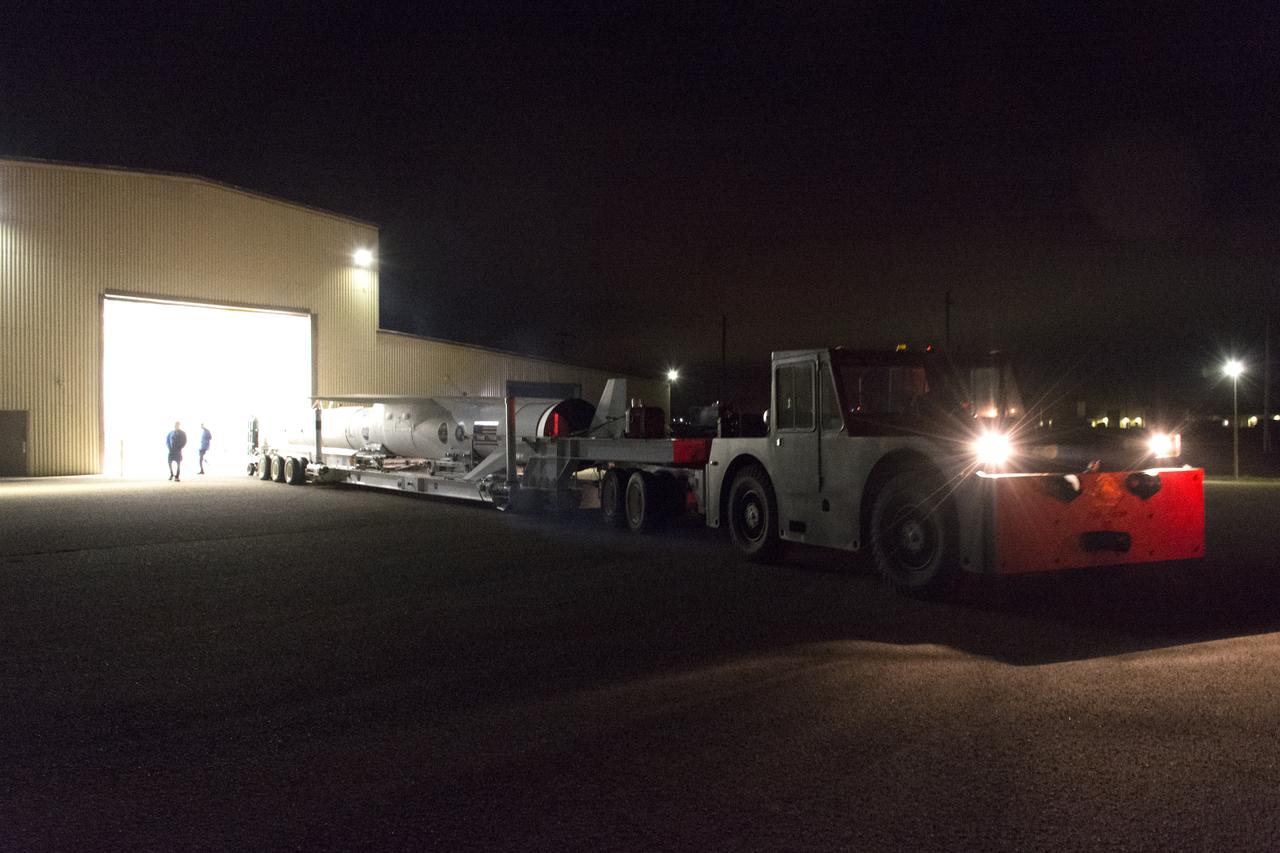
The Northrop Grumman Pegasus XL vehicle is transported from Building 1555 to the hot pad at Vandenberg Air Force Base in California, on Oct. 14, 2018. NASA's Ionospheric Connection Explorer (ICON) is secured inside the rocket's payload fairing. The Pegasus XL rocket will be attached beneath the company's L-1011 Stargazer aircraft, and travel to the Skid Strip at Cape Canaveral Air Force Station in Florida. ICON will launch aboard the Pegasus XL rocket on Oct. 26, 2018, from the Skid Strip at the Cape. ICON will study the frontier of space - the dynamic zone high in Earth's atmosphere where terrestrial weather from below meets space weather above. The explorer will help determine the physics of Earth's space environment and pave the way for mitigating its effects on our technology, communications systems and society.
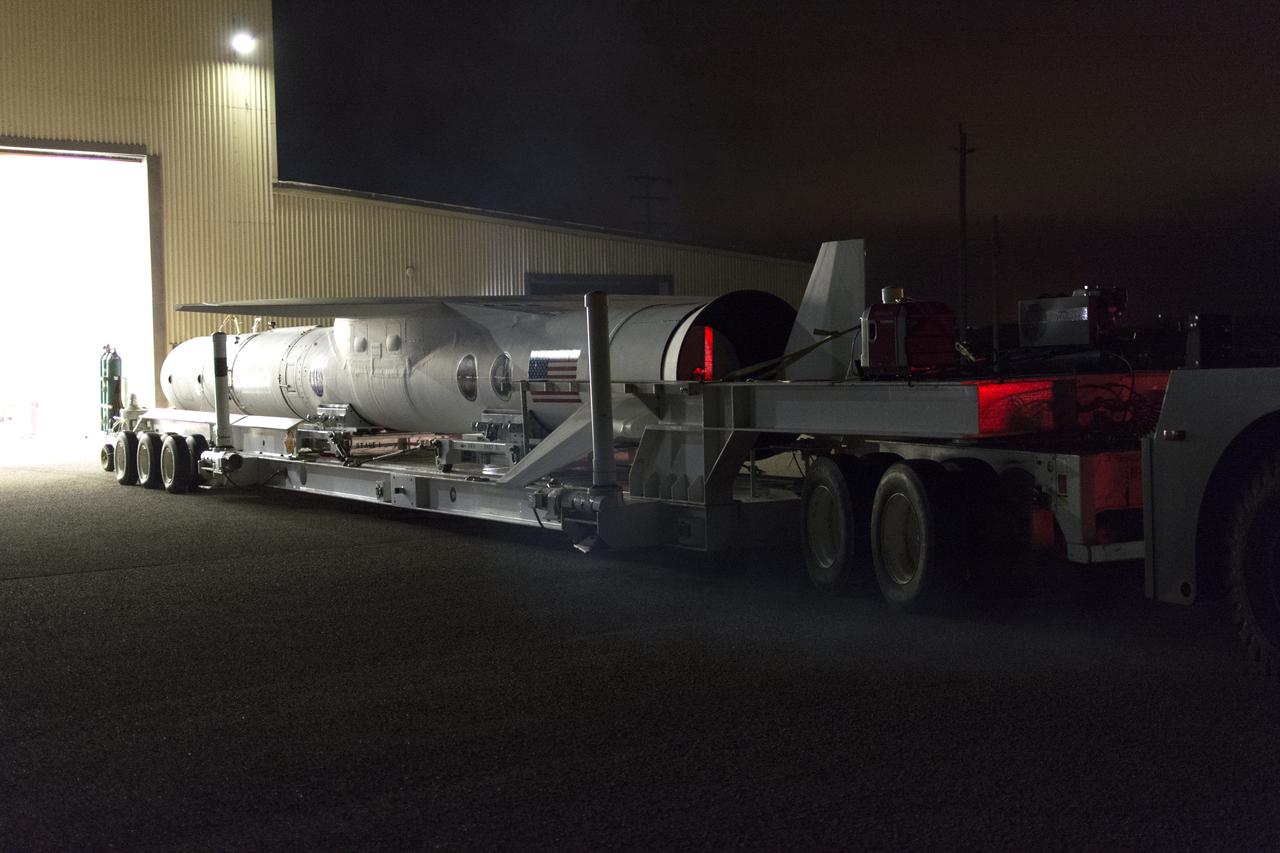
The Northrop Grumman Pegasus XL vehicle is transported from Building 1555 to the hot pad at Vandenberg Air Force Base in California, on Oct. 14, 2018. NASA's Ionospheric Connection Explorer (ICON) is secured inside the rocket's payload fairing. The Pegasus XL rocket will be attached beneath the company's L-1011 Stargazer aircraft, and travel to the Skid Strip at Cape Canaveral Air Force Station in Florida. ICON will launch aboard the Pegasus XL rocket on Oct. 26, 2018, from the Skid Strip at the Cape. ICON will study the frontier of space - the dynamic zone high in Earth's atmosphere where terrestrial weather from below meets space weather above. The explorer will help determine the physics of Earth's space environment and pave the way for mitigating its effects on our technology, communications systems and society.
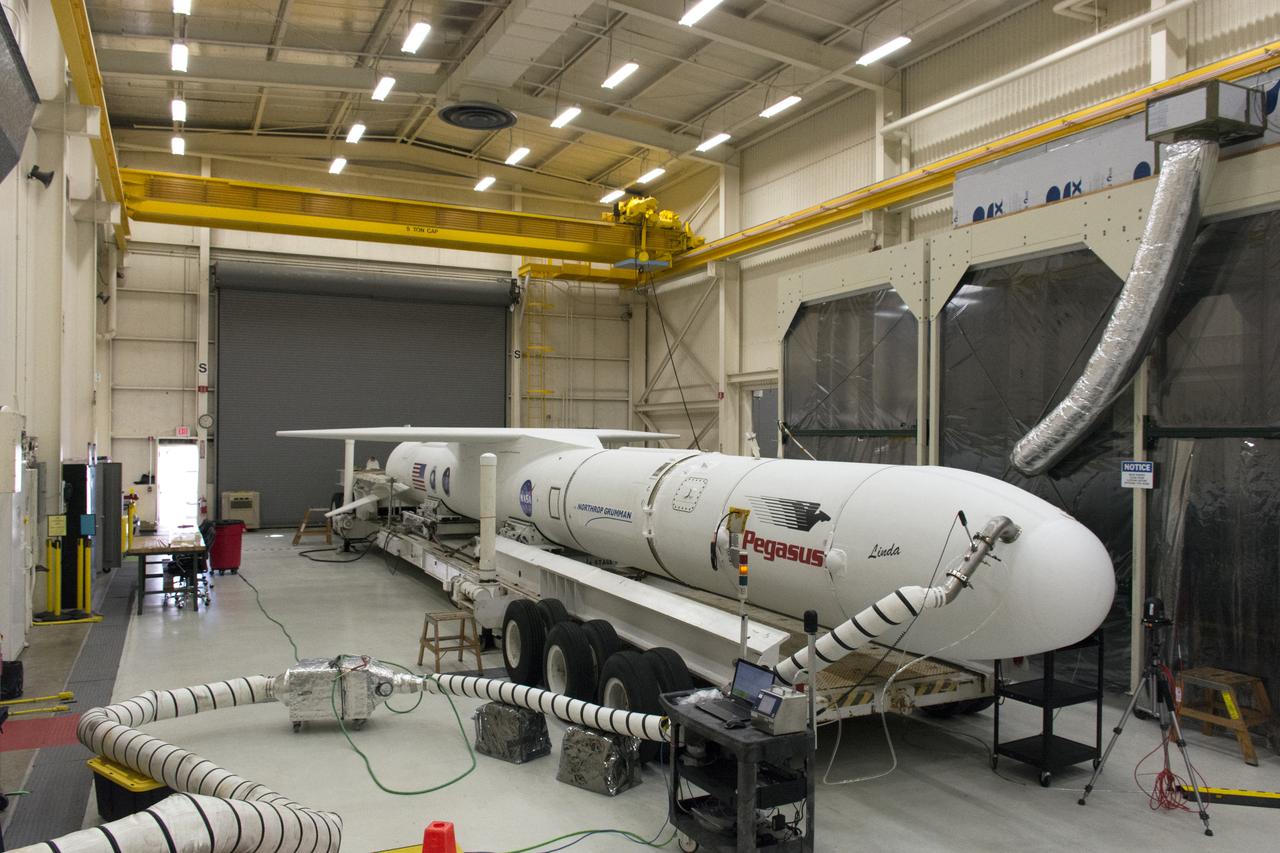
The Northrop Grumman Pegasus XL vehicle is being prepared for its move from Building 1555 to the hot pad at Vandenberg Air Force Base in California, on Oct. 14, 2018. NASA's Ionospheric Connection Explorer (ICON) is secured inside the rocket's payload fairing. The Pegasus XL rocket will be attached beneath the company's L-1011 Stargazer aircraft, and travel to the Skid Strip at Cape Canaveral Air Force Station in Florida. ICON will launch aboard the Pegasus XL rocket on Oct. 26, 2018, from the Skid Strip at the Cape. ICON will study the frontier of space - the dynamic zone high in Earth's atmosphere where terrestrial weather from below meets space weather above. The explorer will help determine the physics of Earth's space environment and pave the way for mitigating its effects on our technology, communications systems and society.

KENNEDY SPACE CENTER, FLA. - At Vandenberg Air Force Base in California, workers begin mating the second and third stages of the Orbital Sciences Pegasus XL launch vehicle that will launch the Demonstration of Autonomous Rendezvous Technology (DART) spacecraft. DART was designed and built for NASA by Orbital Sciences Corporation as an advanced flight demonstrator to locate and maneuver near an orbiting satellite. DART weighs about 800 pounds and is nearly 6 feet long and 3 feet in diameter. The Pegasus XL will launch DART into a circular polar orbit of approximately 475 miles. DART is designed to demonstrate technologies required for a spacecraft to locate and rendezvous, or maneuver close to, other craft in space. Results from the DART mission will aid in the development of NASA's Crew Exploration Vehicle and will also assist in vehicle development for crew transfer and crew rescue capability to and from the International Space Station.
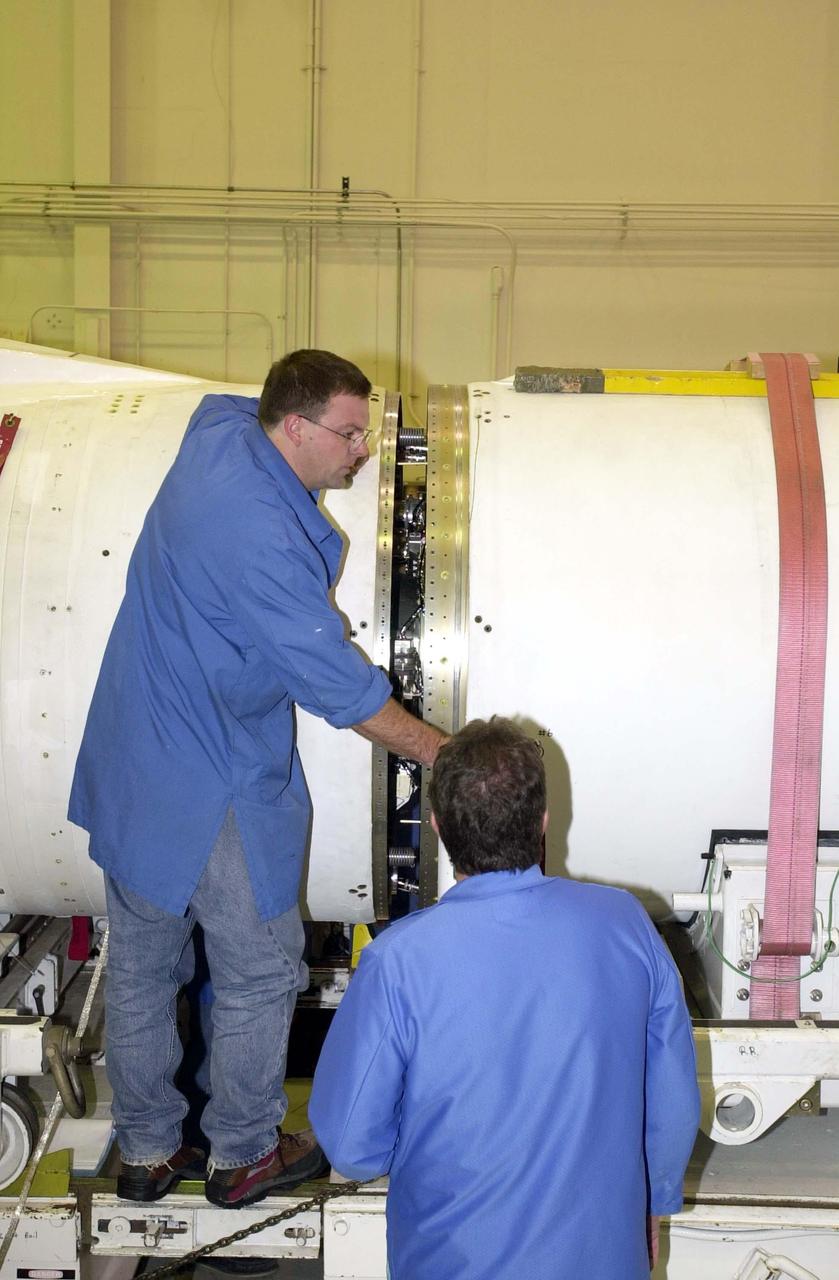
KENNEDY SPACE CENTER, FLA. - At Vandenberg Air Force Base in California, workers begin closing the gap between the second and third stages of the Orbital Sciences Pegasus XL launch vehicle that will launch the Demonstration of Autonomous Rendezvous Technology (DART) spacecraft. DART was designed and built for NASA by Orbital Sciences Corporation as an advanced flight demonstrator to locate and maneuver near an orbiting satellite. DART weighs about 800 pounds and is nearly 6 feet long and 3 feet in diameter. The Pegasus XL will launch DART into a circular polar orbit of approximately 475 miles. DART is designed to demonstrate technologies required for a spacecraft to locate and rendezvous, or maneuver close to, other craft in space. Results from the DART mission will aid in the development of NASA's Crew Exploration Vehicle and will also assist in vehicle development for crew transfer and crew rescue capability to and from the International Space Station.
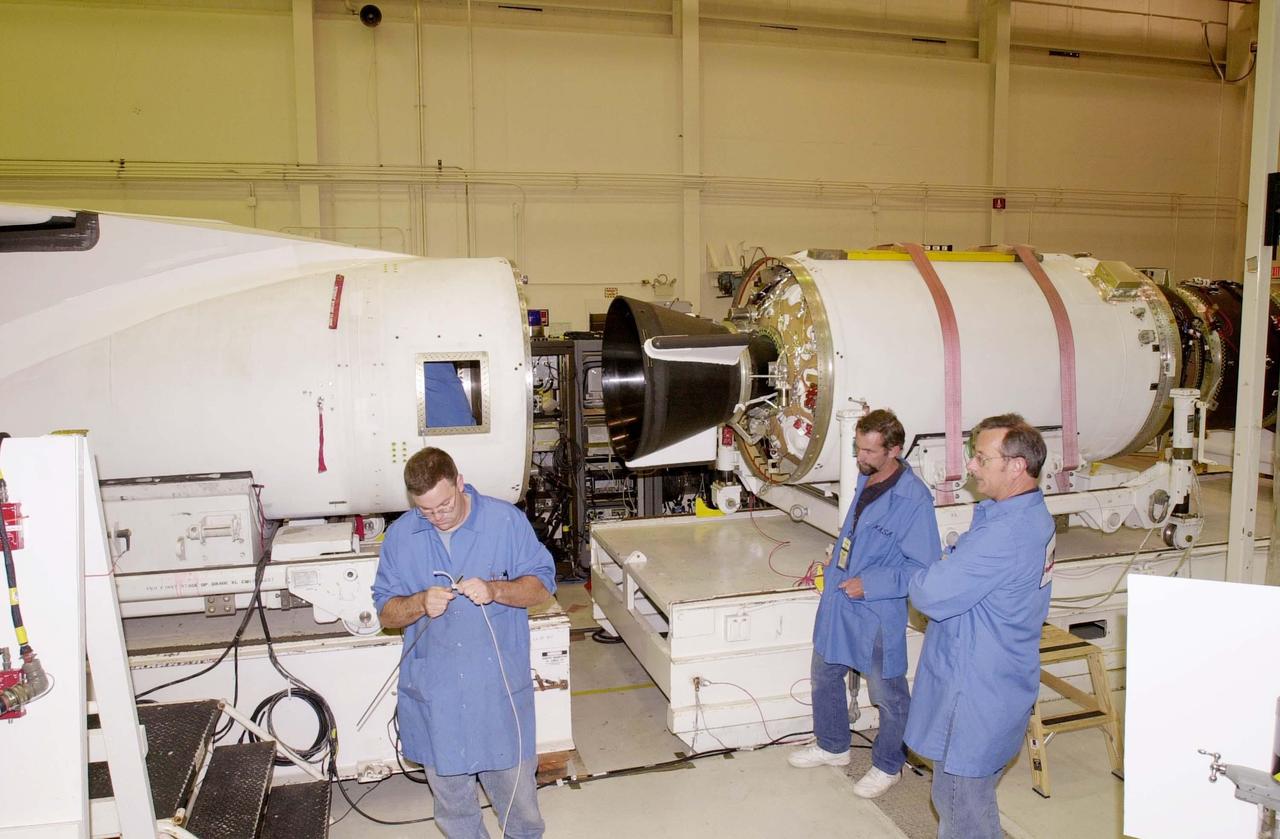
KENNEDY SPACE CENTER, FLA. - At Vandenberg Air Force Base in California, workers prepare to mate the second and third stages of the Orbital Sciences Pegasus XL launch vehicle that will launch the Demonstration of Autonomous Rendezvous Technology (DART) spacecraft. DART was designed and built for NASA by Orbital Sciences Corporation as an advanced flight demonstrator to locate and maneuver near an orbiting satellite. DART weighs about 800 pounds and is nearly 6 feet long and 3 feet in diameter. The Pegasus XL will launch DART into a circular polar orbit of approximately 475 miles. DART is designed to demonstrate technologies required for a spacecraft to locate and rendezvous, or maneuver close to, other craft in space. Results from the DART mission will aid in the development of NASA's Crew Exploration Vehicle and will also assist in vehicle development for crew transfer and crew rescue capability to and from the International Space Station.
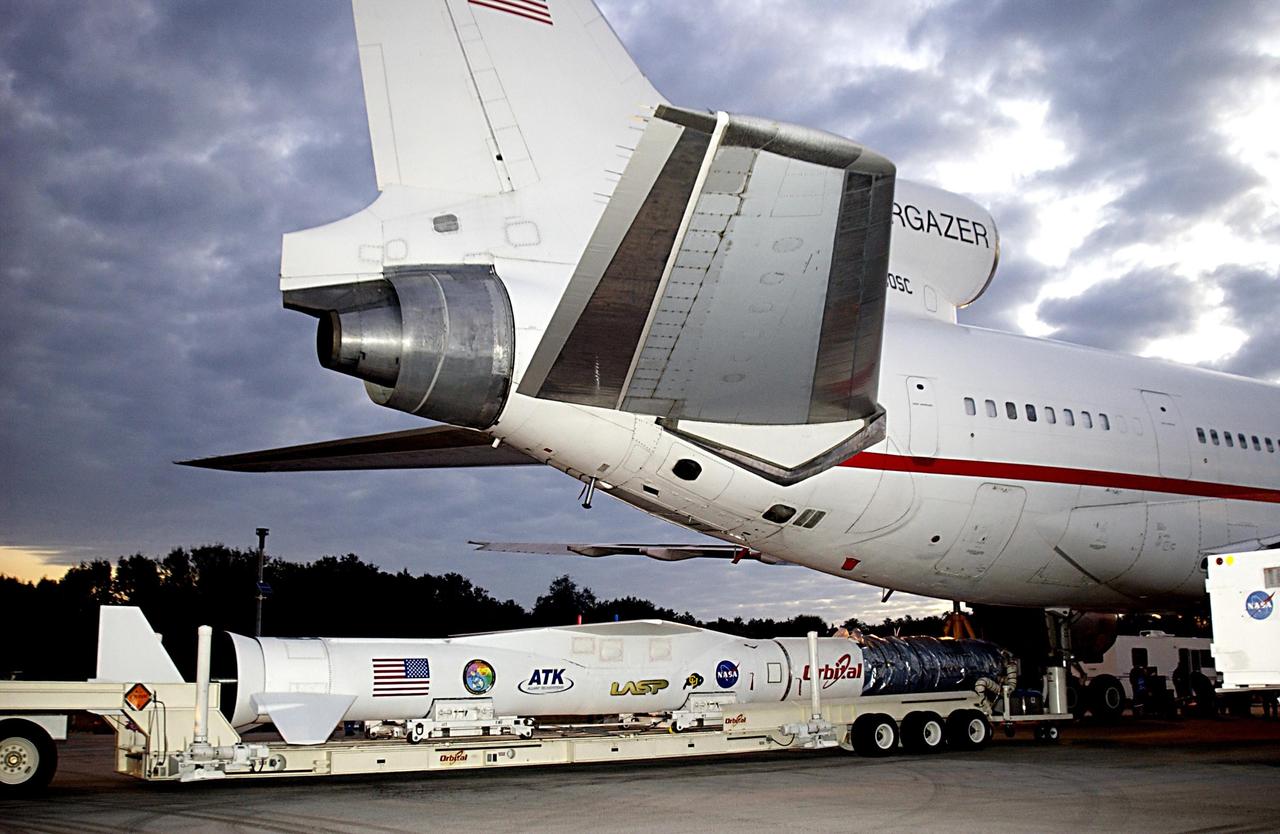
KENNEDY SPACE CENTER, FLA. - The Pegasus XL launch vehicle, with the Solar Radiation and Climate Experiment (SORCE) satellite aboard, is moved underneath the L-1011 aircraft that will carry the Pegasus to the launch altitude of 39,000 feet over the Atlantic Ocean approximately 100 miles east-southeast of Cape Canaveral. SORCE, built by Orbital Sciences Corporation, will study and measure solar irradiance as a source of energy in the Earth's atmosphere. The launch of SORCE is scheduled for Jan. 25 at 3:14 p.m. from CCAFS.
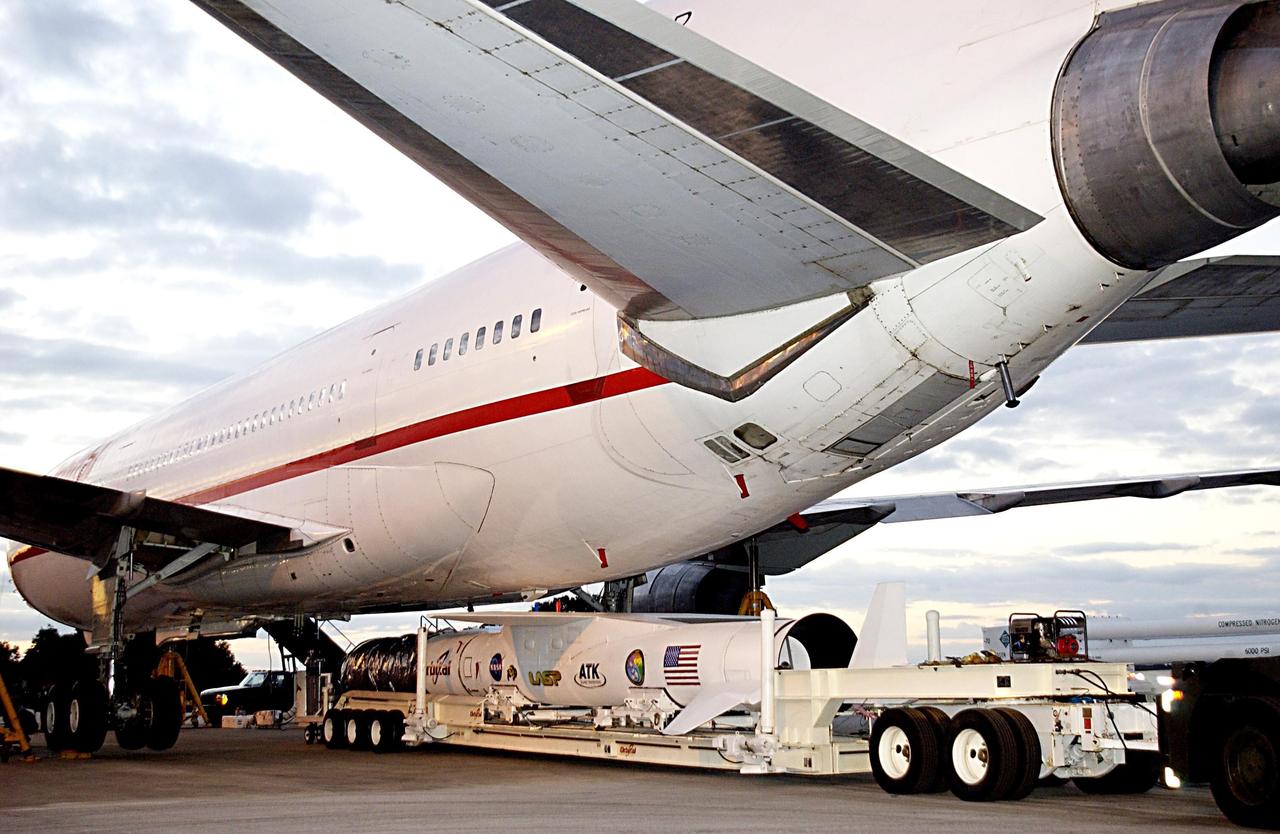
KENNEDY SPACE CENTER, FLA. - The Pegasus XL launch vehicle, with the Solar Radiation and Climate Experiment (SORCE) satellite aboard, is moved underneath the L-1011 aircraft that will carry the Pegasus to the launch altitude of 39,000 feet over the Atlantic Ocean approximately 100 miles east-southeast of Cape Canaveral. SORCE, built by Orbital Sciences Corporation, will study and measure solar irradiance as a source of energy in the Earth's atmosphere. The launch of SORCE is scheduled for Jan. 25 at 3:14 p.m. from CCAFS.

VANDENBERG AIR FORCE BASE, CALIF. - Inside Orbital Sciences Building 1555 at Vandenberg Air Force Base in California, workers move the aft skirt toward the Pegasus XL launch vehicle for mating. The Pegasus will launch the Space Technology 5 spacecraft later this month. ST5 contains three micro-satellites that will be positioned in a "string of pearls" constellation to perform simultaneous multi-point measurements of the Earth's magnetic field using highly sensitive magnetometers. The scheduled launch date is Feb. 28.
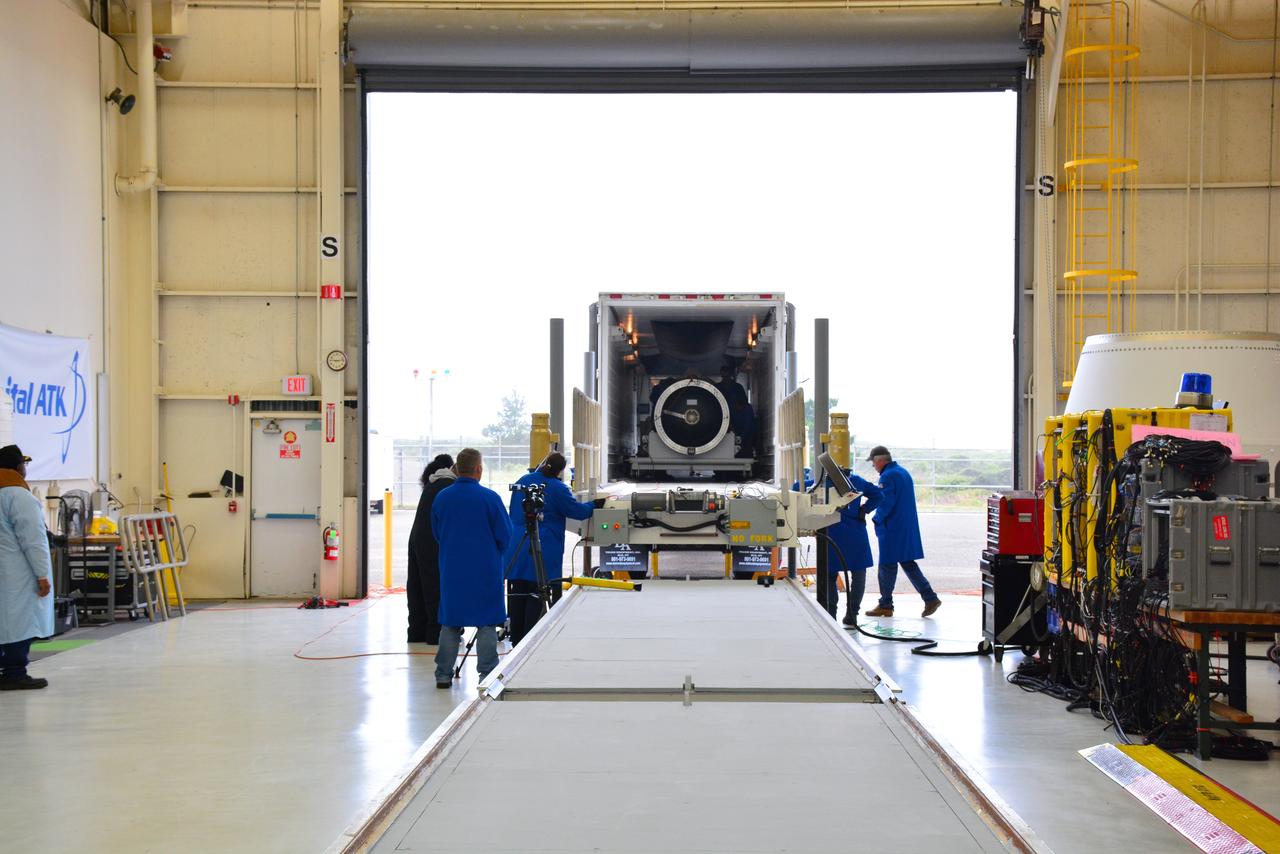
Workers prepare to offload the second and third stages of the Orbital ATK Pegasus XL rocket from a transport vehicle at Building 1555 at Vandenberg Air Force Base in California. The rocket is being prepared for NASA's Ionospheric Connection Explorer, or ICON, mission. ICON will launch from the Kwajalein Atoll aboard the Pegasus XL on Dec. 8, 2017. ICON will study the frontier of space - the dynamic zone high in Earth's atmosphere where terrestrial weather from below meets space weather above. The explorer will help determine the physics of Earth's space environment and pave the way for mitigating its effects on our technology, communications systems and society.
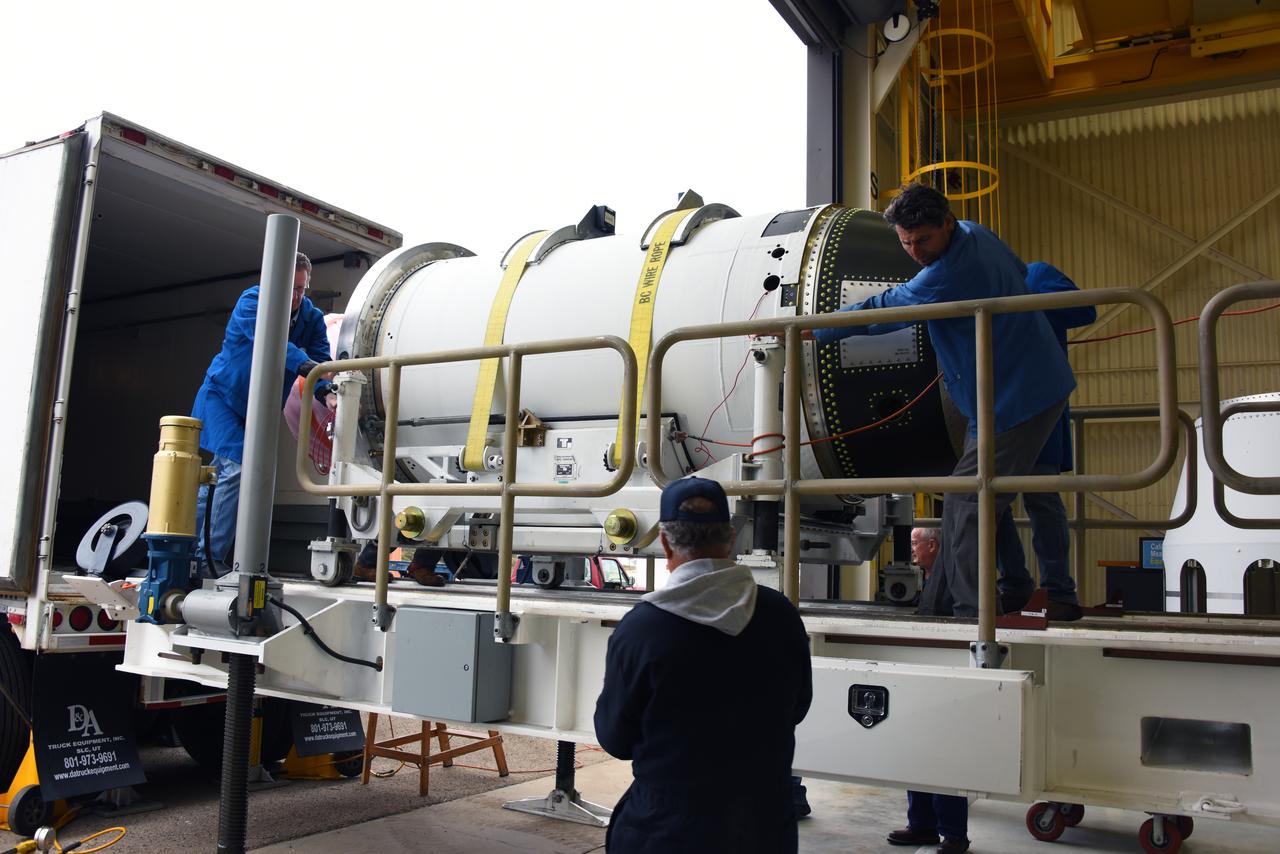
The third stage of the Orbital ATK Pegasus XL rocket is offloaded from a transport vehicle at Building 1555 at Vandenberg Air Force Base in California. The rocket is being prepared for NASA's Ionospheric Connection Explorer, or ICON, mission. ICON will launch from the Kwajalein Atoll aboard the Pegasus XL on Dec. 8, 2017. ICON will study the frontier of space - the dynamic zone high in Earth's atmosphere where terrestrial weather from below meets space weather above. The explorer will help determine the physics of Earth's space environment and pave the way for mitigating its effects on our technology, communications systems and society.
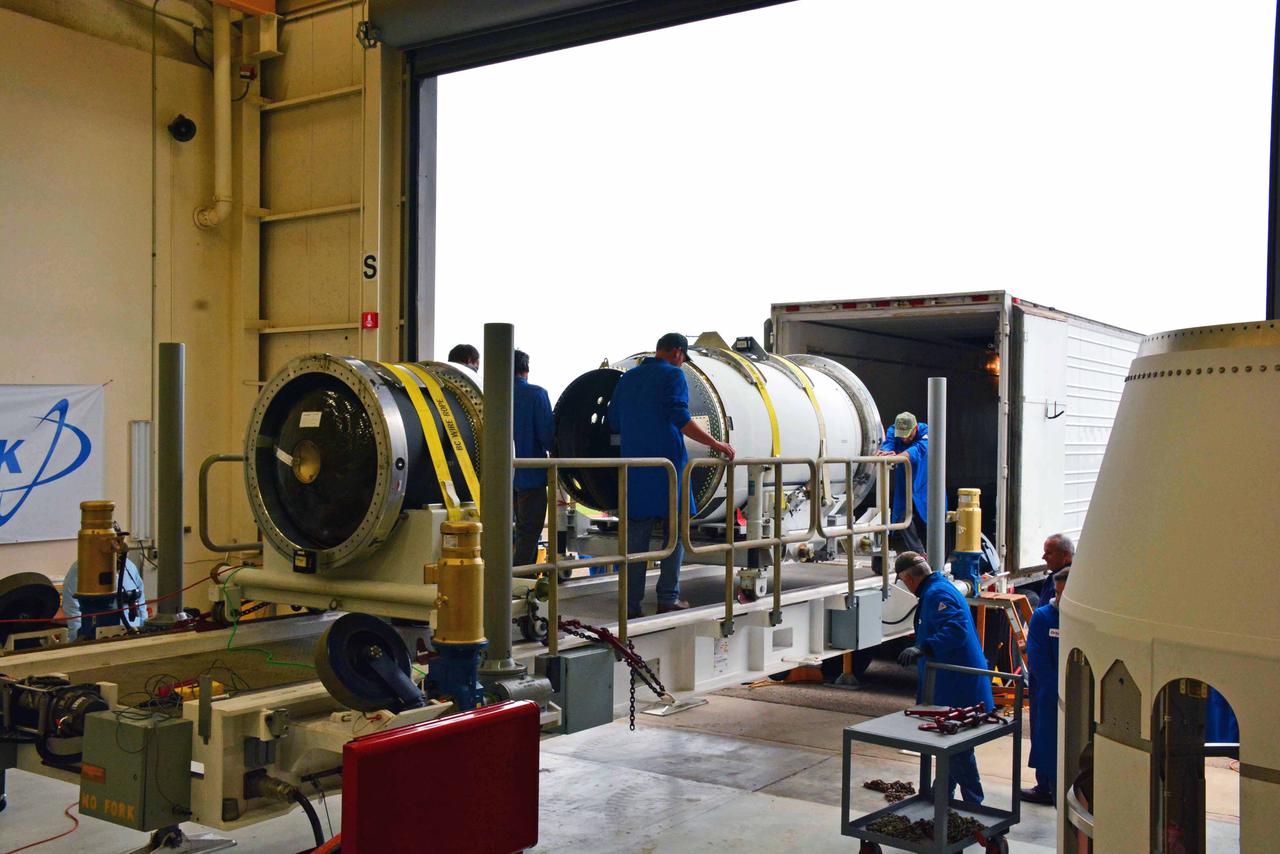
The second and third stages of the Orbital ATK Pegasus XL rocket are offloaded from a transport vehicle at Building 1555 at Vandenberg Air Force Base in California. The rocket is being prepared for NASA's Ionospheric Connection Explorer, or ICON, mission. ICON will launch from the Kwajalein Atoll aboard the Pegasus XL on Dec. 8, 2017. ICON will study the frontier of space - the dynamic zone high in Earth's atmosphere where terrestrial weather from below meets space weather above. The explorer will help determine the physics of Earth's space environment and pave the way for mitigating its effects on our technology, communications systems and society.
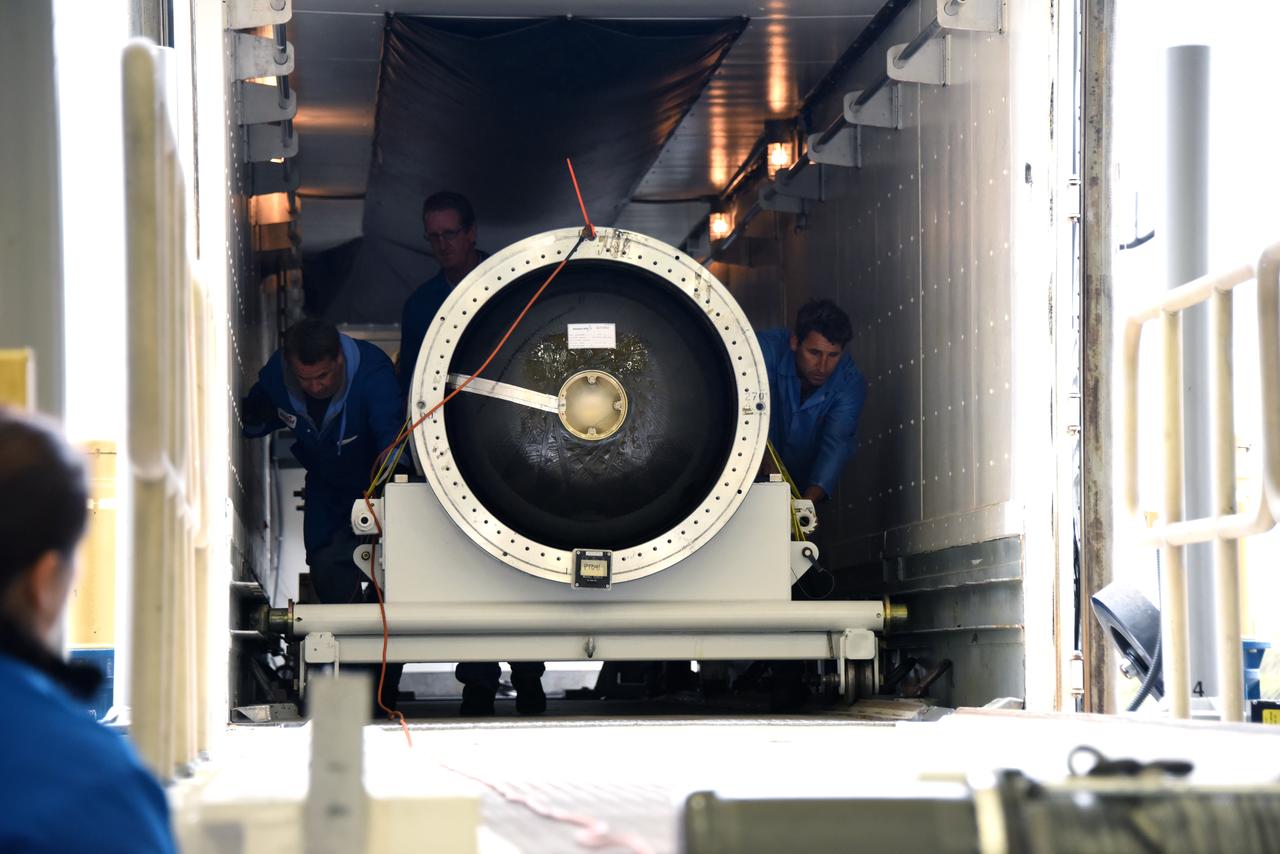
The third stage of the Orbital ATK Pegasus XL rocket is offloaded from a transport vehicle at Building 1555 at Vandenberg Air Force Base in California. The rocket is being prepared for NASA's Ionospheric Connection Explorer, or ICON, mission. ICON will launch from the Kwajalein Atoll aboard the Pegasus XL on Dec. 8, 2017. ICON will study the frontier of space - the dynamic zone high in Earth's atmosphere where terrestrial weather from below meets space weather above. The explorer will help determine the physics of Earth's space environment and pave the way for mitigating its effects on our technology, communications systems and society.
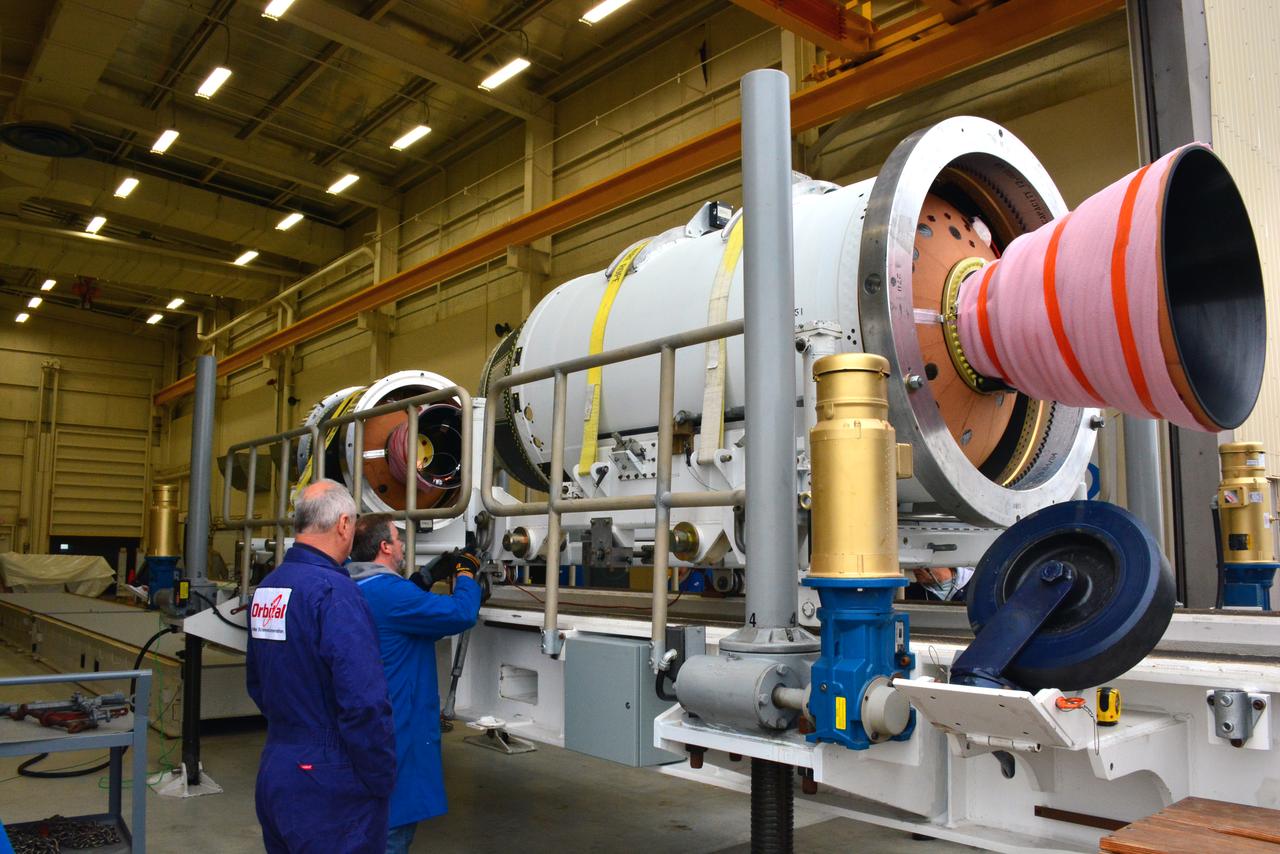
The second and third stages of the Orbital ATK Pegasus XL rocket are offloaded from a transport vehicle at Building 1555 at Vandenberg Air Force Base in California. The rocket is being prepared for NASA's Ionospheric Connection Explorer, or ICON, mission. ICON will launch from the Kwajalein Atoll aboard the Pegasus XL on Dec. 8, 2017. ICON will study the frontier of space - the dynamic zone high in Earth's atmosphere where terrestrial weather from below meets space weather above. The explorer will help determine the physics of Earth's space environment and pave the way for mitigating its effects on our technology, communications systems and society.
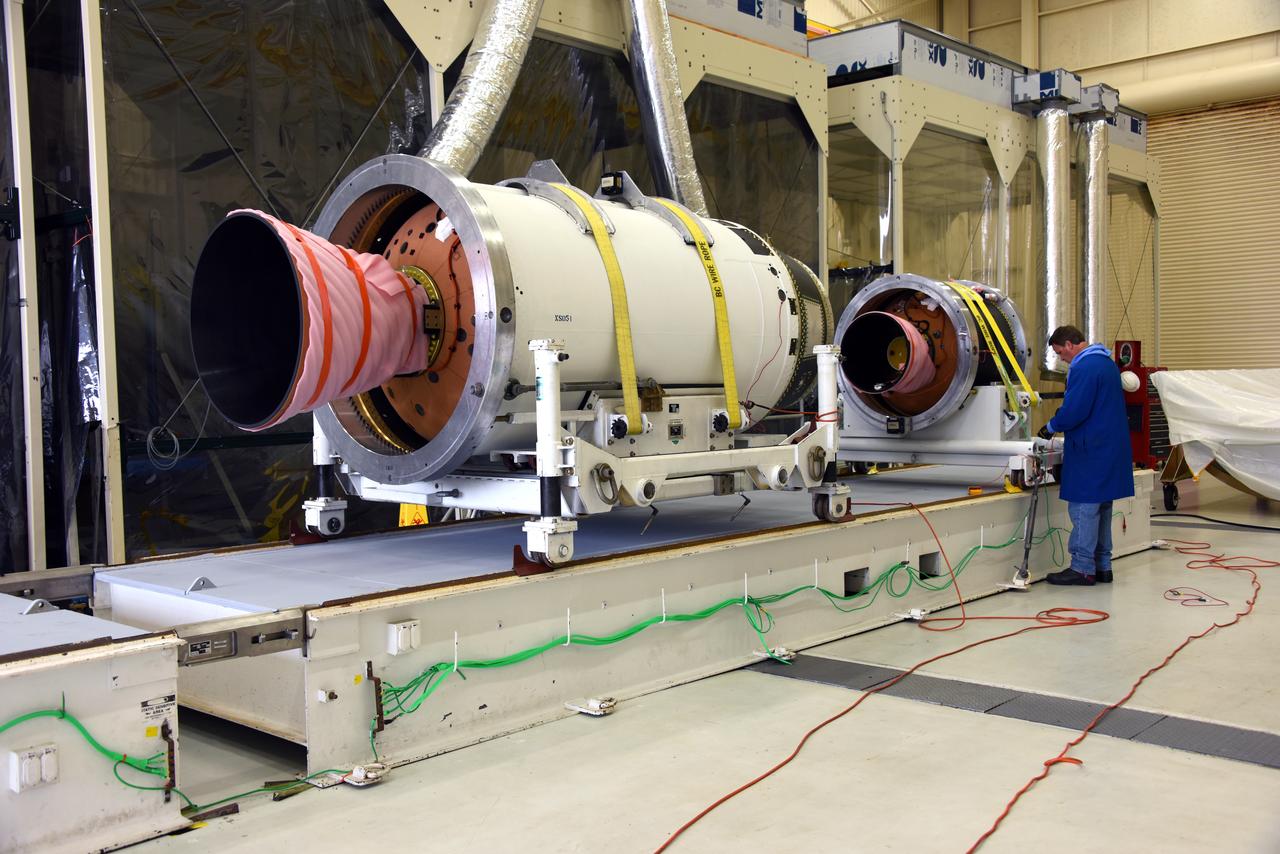
The second and third stages of the Orbital ATK Pegasus XL rocket are offloaded from a transport vehicle at Building 1555 at Vandenberg Air Force Base in California. The rocket is being prepared for NASA's Ionospheric Connection Explorer, or ICON, mission. ICON will launch from the Kwajalein Atoll aboard the Pegasus XL on Dec. 8, 2017. ICON will study the frontier of space - the dynamic zone high in Earth's atmosphere where terrestrial weather from below meets space weather above. The explorer will help determine the physics of Earth's space environment and pave the way for mitigating its effects on our technology, communications systems and society.
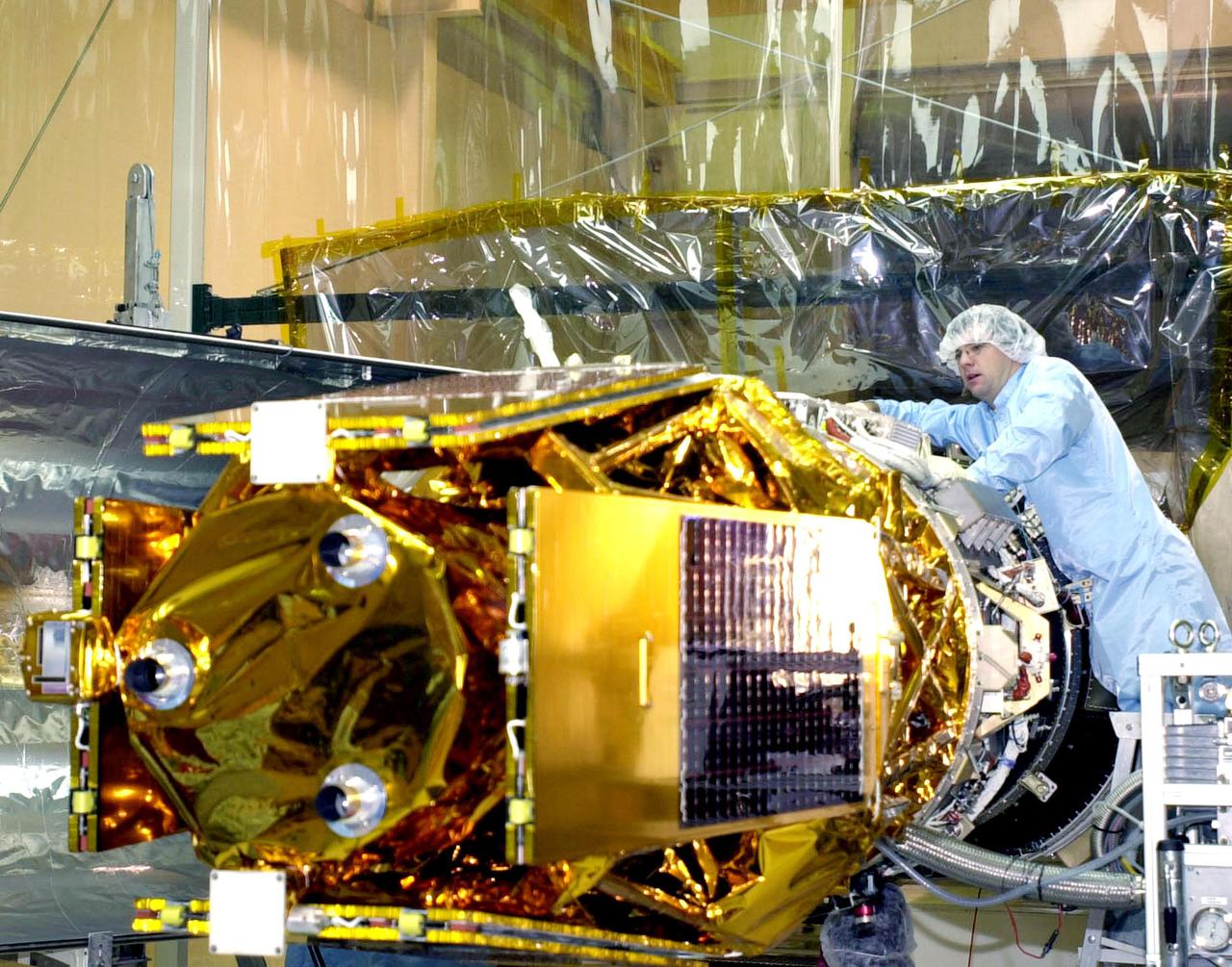
VANDENBERG AFB, CALIF. - A worker prepares the High Energy Solar Spectroscopic Imager (HESSI) for encapsulation atop the Pegasus XL rocket before its transport to Florida. The Pegasus is the vehicle that will launch HESSI on its primary mission to explore the basic physics of particle acceleration and energy release in solar flares. The launch of PegasusXL_HESSI is scheduled for Feb. 5, 2002, from beneath an Orbital Sciences Corp. L-1011 aircraft over the Atlantic Ocean
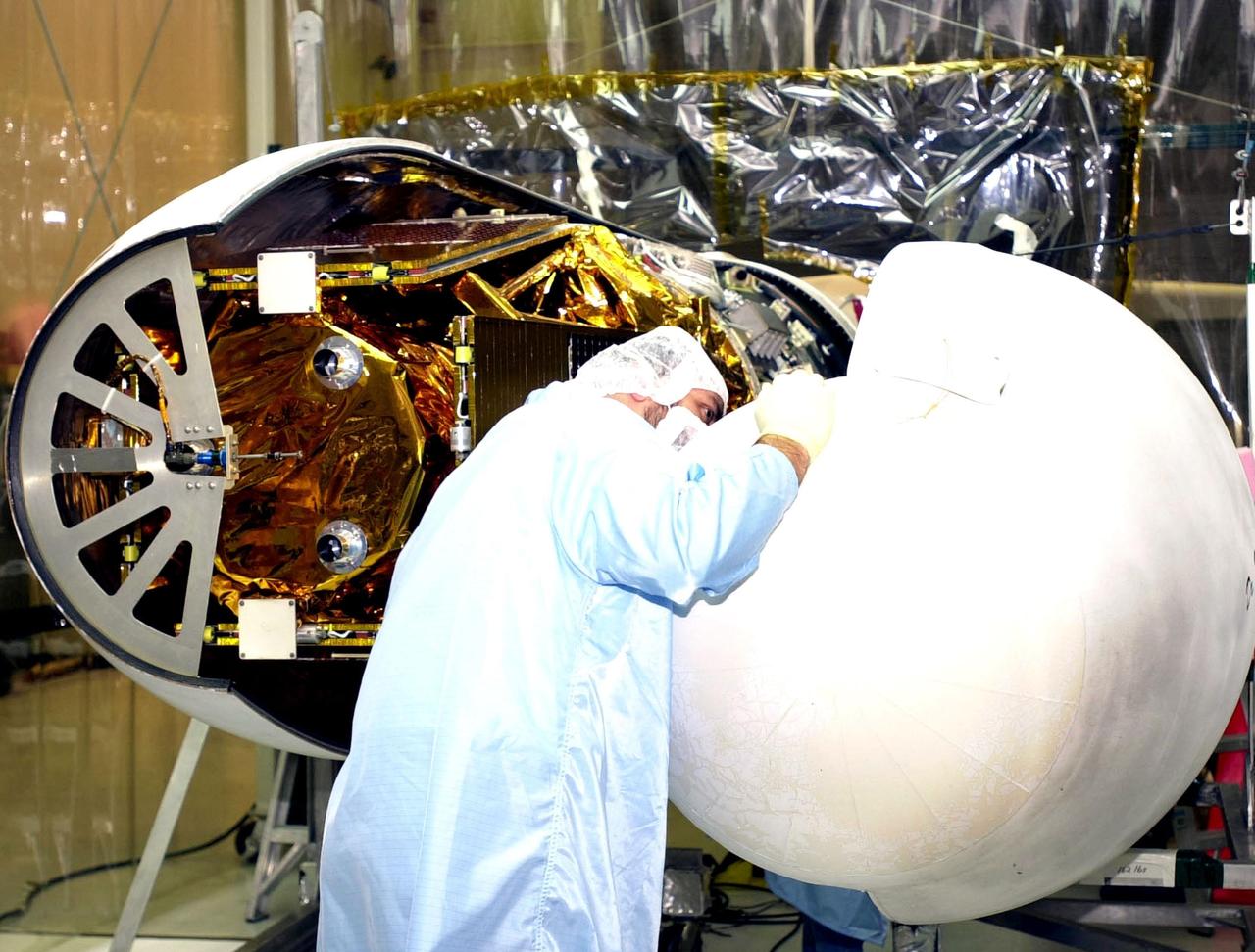
VANDENBERG AFB, CALIF. -- A worker helps guide the second half of the encapsulation around the High Energy Solar Spectroscopic Imager (HESSI) atop the Pegasus XL rocket before its transport to Florida. The Pegasus is the vehicle that will launch HESSI on its primary mission to explore the basic physics of particle acceleration and energy release in solar flares. The launch of PegasusXL/HESSI is scheduled for Feb. 5, 2002, from beneath an Orbital Sciences Corp. L-1011 aircraft over the Atlantic Ocean
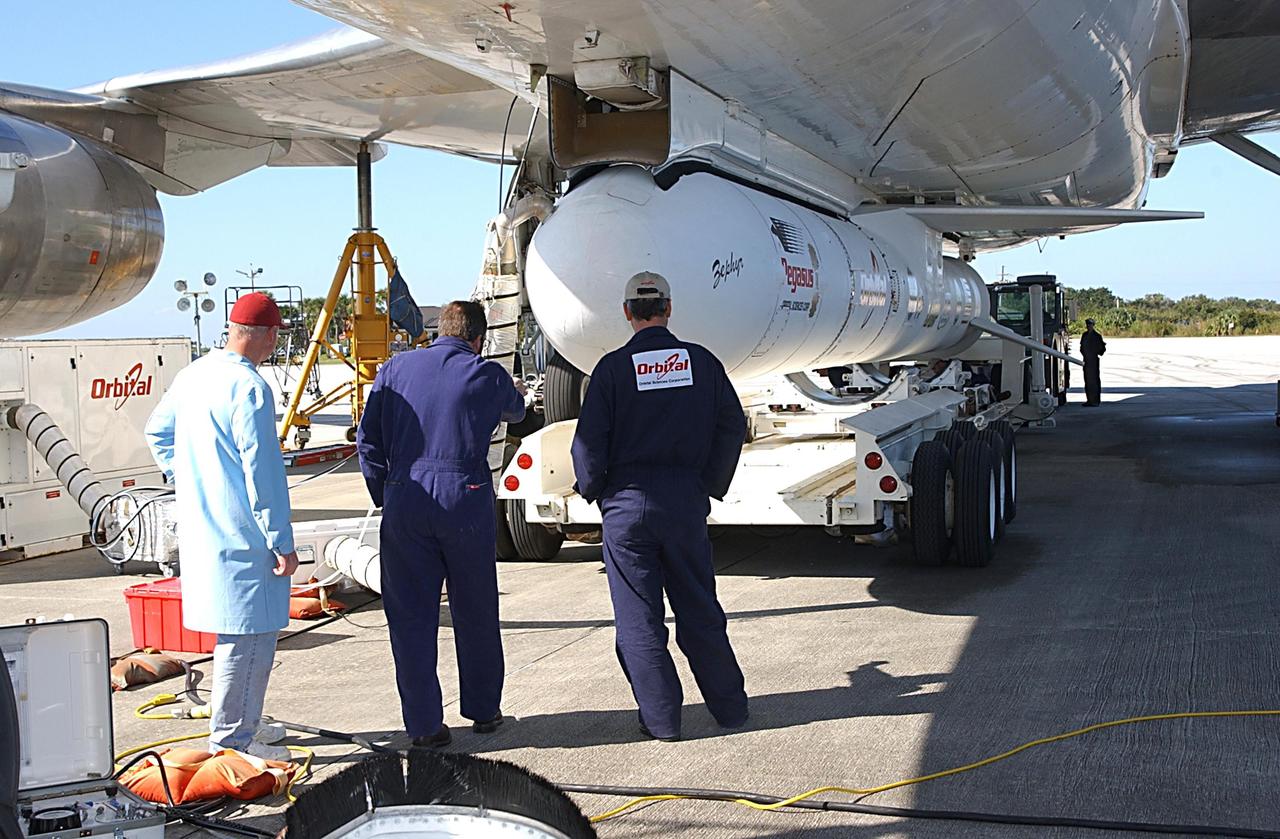
KENNEDY SPACE CENTER, FLA. -- Workers evaluate the placement of a transporter below a Pegasus XL Expendable Launch Vehicle before its detachment from the underside of an Orbital Sciences L-1011 aircraft. The aircraft, with the launch vehicle nestled beneath, arrived at the Cape Canaveral Air Force Station Skid Strip on Dec. 17. The Pegasus XL will undergo three flight simulations prior to its scheduled launch in late January 2003. It will carry NASA's Solar Radiation and Climate Experiment (SORCE) spacecraft into orbit. Built by Orbital Sciences Space Systems Group, SORCE will study and measure solar irradiance as a source of energy in the Earth's atmosphere with instruments built by the University of Colorado's Laboratory for Atmospheric and Space Physics (LASP).
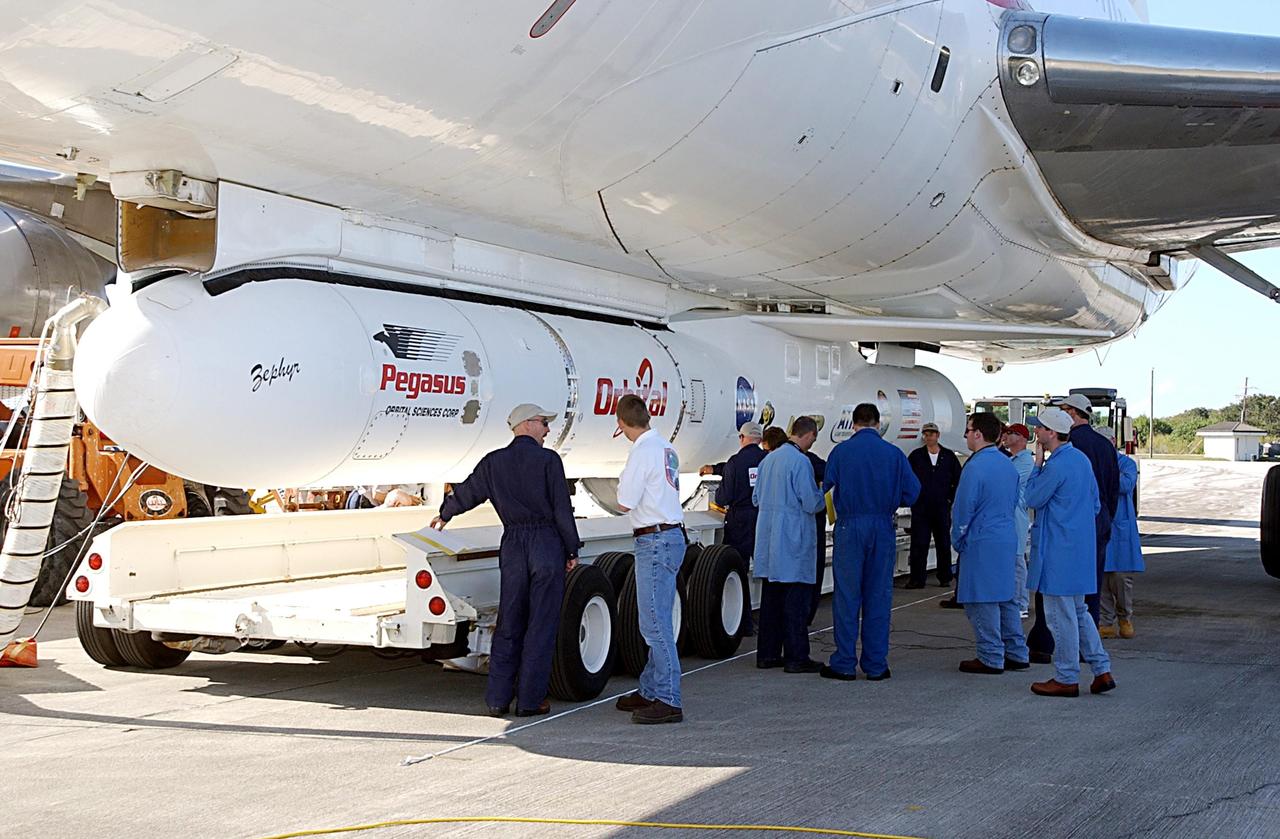
KENNEDY SPACE CENTER, FLA. -- Workers reevaluate the placement of a transporter below a Pegasus XL Expendable Launch Vehicle before its detachment from the underside of an Orbital Sciences L-1011 aircraft. The aircraft, with the launch vehicle nestled beneath, arrived at the Cape Canaveral Air Force Station Skid Strip on Dec. 17. The Pegasus XL will undergo three flight simulations prior to its scheduled launch in late January 2003. It will carry NASA's Solar Radiation and Climate Experiment (SORCE) spacecraft into orbit. Built by Orbital Sciences Space Systems Group, SORCE will study and measure solar irradiance as a source of energy in the Earth's atmosphere with instruments built by the University of Colorado's Laboratory for Atmospheric and Space Physics (LASP).
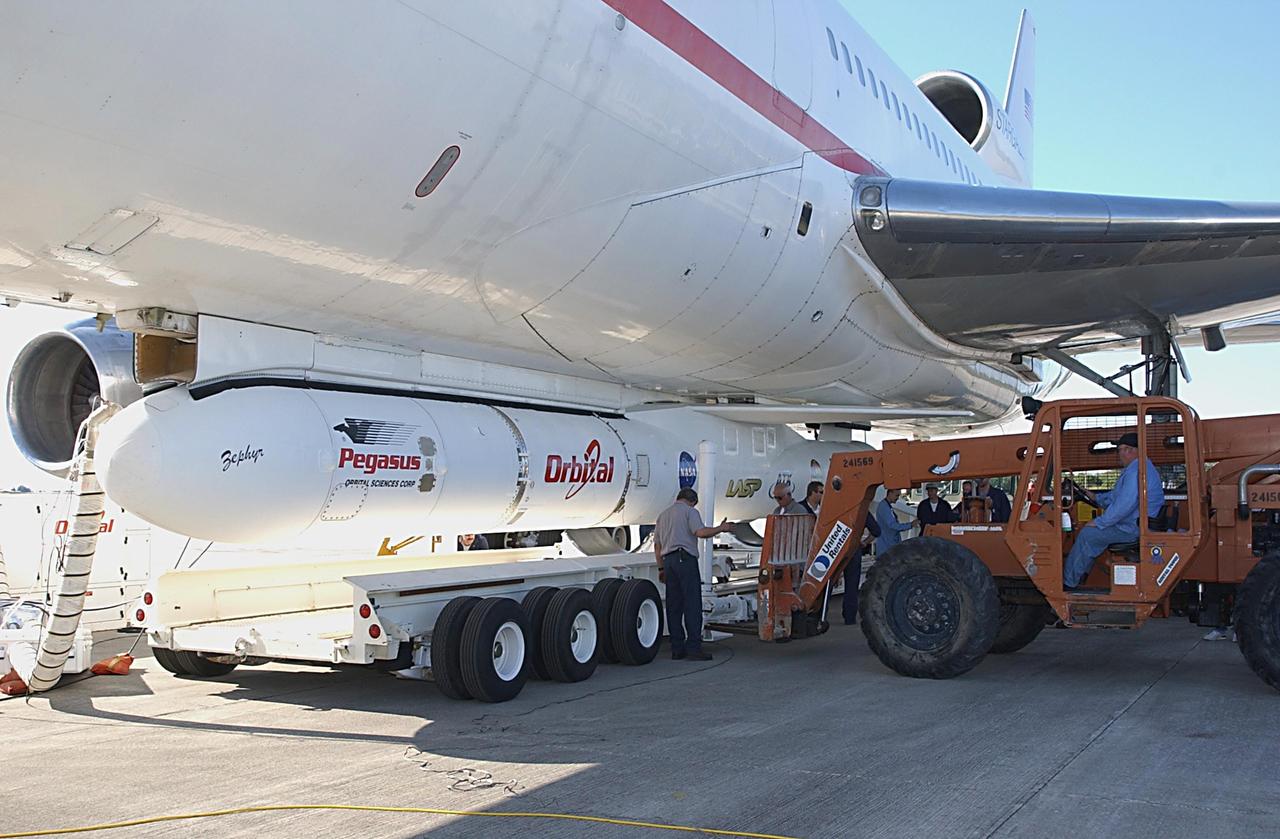
KENNEDY SPACE CENTER, FLA. -- Workers complete the process to detach a Pegasus XL Expendable Launch Vehicle from the underside of an Orbital Sciences L-1011 aircraft and lower it onto a transporter. The aircraft, with the launch vehicle nestled beneath, arrived at the Cape Canaveral Air Force Station Skid Strip on Dec. 17. The Pegasus XL will undergo three flight simulations prior to its scheduled launch in late January 2003. It will carry NASA's Solar Radiation and Climate Experiment (SORCE) spacecraft into orbit. Built by Orbital Sciences Space Systems Group, SORCE will study and measure solar irradiance as a source of energy in the Earth's atmosphere with instruments built by the University of Colorado's Laboratory for Atmospheric and Space Physics (LASP).
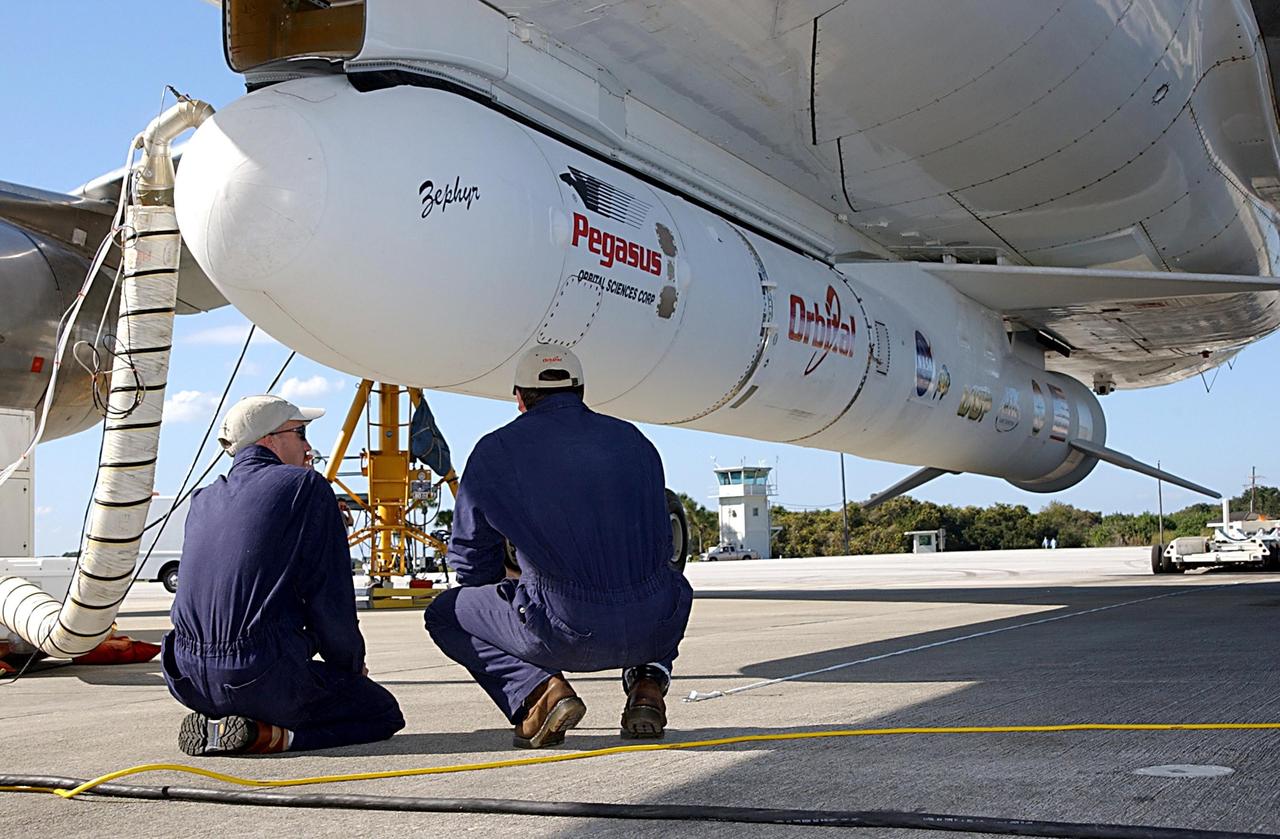
KENNEDY SPACE CENTER, FLA. -- Workers oversee the repositioning of a transporter below a Pegasus XL Expendable Launch Vehicle before its detachment from the underside of an Orbital Sciences L-1011 aircraft. The aircraft, with the launch vehicle nestled beneath, arrived at the Cape Canaveral Air Force Station Skid Strip on Dec. 17. The Pegasus XL will undergo three flight simulations prior to its scheduled launch in late January 2003. It will carry NASA's Solar Radiation and Climate Experiment (SORCE) spacecraft into orbit. Built by Orbital Sciences Space Systems Group, SORCE will study and measure solar irradiance as a source of energy in the Earth's atmosphere with instruments built by the University of Colorado's Laboratory for Atmospheric and Space Physics (LASP).
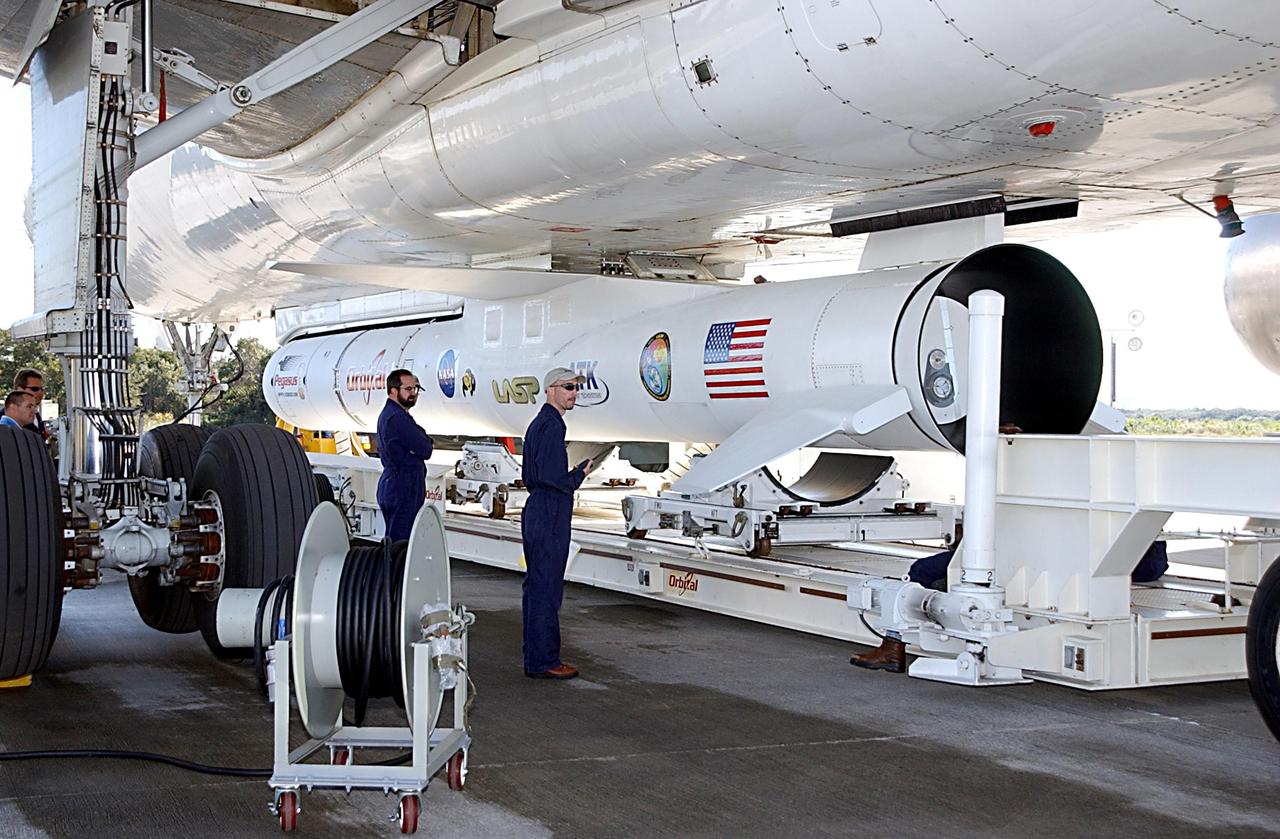
KENNEDY SPACE CENTER, FLA. -- Workers supervise the placement of a transporter below a Pegasus XL Expendable Launch Vehicle before its detachment from the underside of an Orbital Sciences L-1011 aircraft. The aircraft, with the launch vehicle nestled beneath, arrived at the Cape Canaveral Air Force Station Skid Strip on Dec. 17. The Pegasus XL will undergo three flight simulations prior to its scheduled launch in late January 2003. It will carry NASA's Solar Radiation and Climate Experiment (SORCE) spacecraft into orbit. Built by Orbital Sciences Space Systems Group, SORCE will study and measure solar irradiance as a source of energy in the Earth's atmosphere with instruments built by the University of Colorado's Laboratory for Atmospheric and Space Physics (LASP).
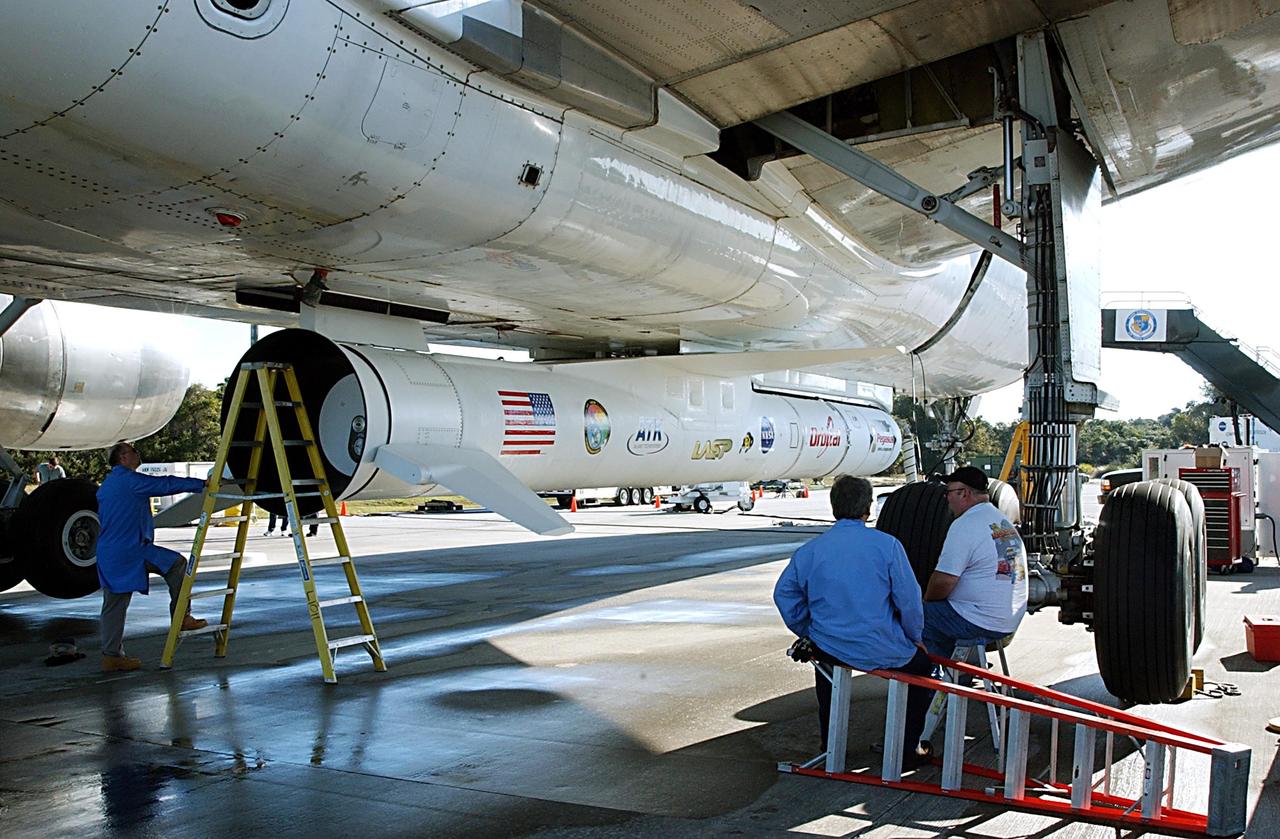
KENNEDY SPACE CENTER, FLA. -- A Pegasus XL Expendable Launch Vehicle is prepared for its removal from the underside of an Orbital Sciences L-1011 aircraft as onlooking workers await their turns in the process. The aircraft, with the launch vehicle attached, arrived at the Cape Canaveral Air Force Station Skid Strip on Dec. 17. The Pegasus XL will undergo three flight simulations prior to its scheduled launch in late January 2003. It will carry NASA's Solar Radiation and Climate Experiment (SORCE) spacecraft into orbit. Built by Orbital Sciences Space Systems Group, SORCE will study and measure solar irradiance as a source of energy in the Earth's atmosphere with instruments built by the University of Colorado's Laboratory for Atmospheric and Space Physics (LASP).
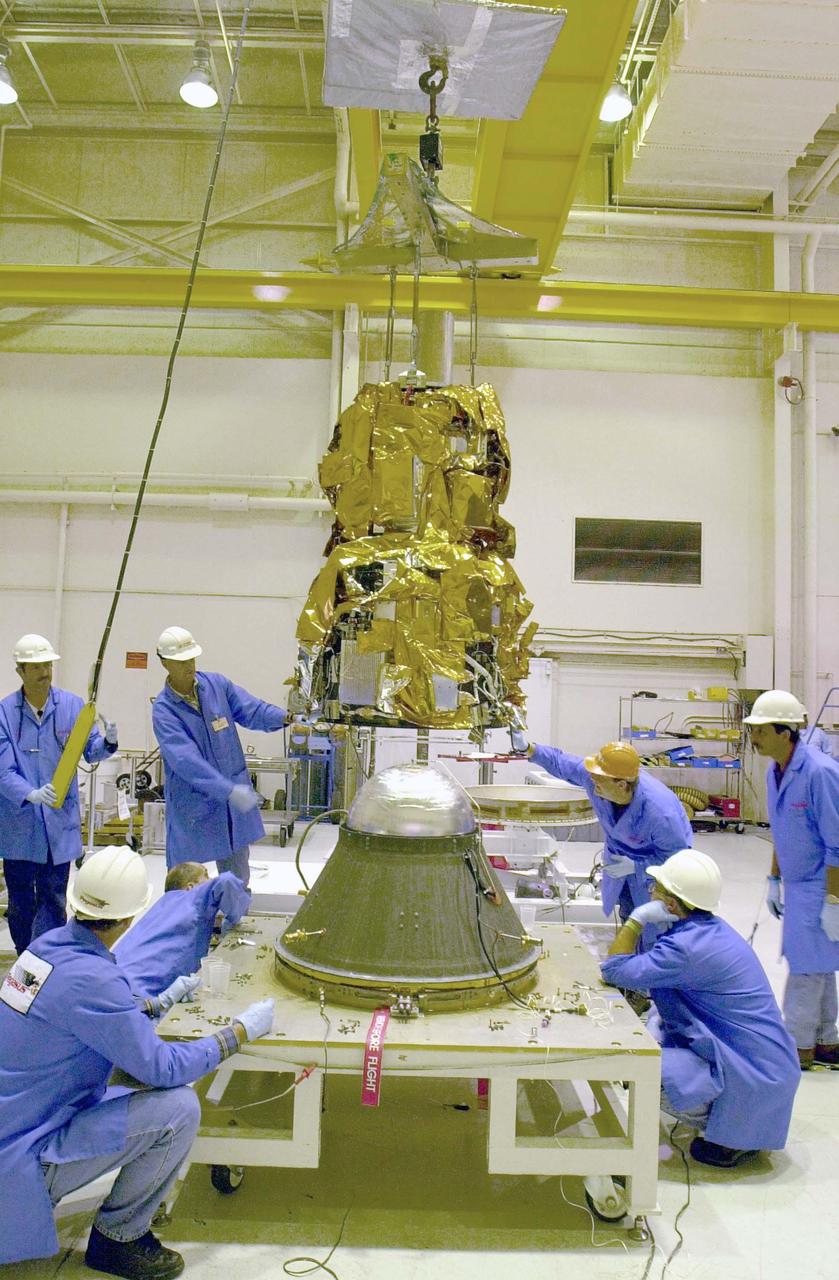
KENNEDY SPACE CENTER, FLA. - At Vandenberg Air Force Base in California, workers maneuver the Demonstration of Autonomous Rendezvous Technology (DART) spacecraft, suspended by a crane, over the upper stage in preparation for launch on the Orbital Sciences Pegasus XL. The Pegasus XL will launch DART into a circular polar orbit of approximately 475 miles. Built for NASA by Orbital Sciences Corporation, DART was designed as an advanced flight demonstrator to locate and maneuver near an orbiting satellite. DART weighs about 800 pounds and is nearly 6 feet long and 3 feet in diameter. DART is designed to demonstrate technologies required for a spacecraft to locate and rendezvous, or maneuver close to, other craft in space. Results from the DART mission will aid in the development of NASA’s Crew Exploration Vehicle and will also assist in vehicle development for crew transfer and crew rescue capability to and from the International Space Station.

KENNEDY SPACE CENTER, FLA. - At Vandenberg Air Force Base in California, the Demonstration of Autonomous Rendezvous Technology (DART) spacecraft (right) is ready for mating with the upper stage (behind it) in preparation for launch on the Orbital Sciences Pegasus XL. DART was designed and built for NASA by Orbital Sciences Corporation as an advanced flight demonstrator to locate and maneuver near an orbiting satellite. DART weighs about 800 pounds and is nearly 6 feet long and 3 feet in diameter. The Pegasus XL will launch DART into a circular polar orbit of approximately 475 miles. DART is designed to demonstrate technologies required for a spacecraft to locate and rendezvous, or maneuver close to, other craft in space. Results from the DART mission will aid in the development of NASA’s Crew Exploration Vehicle and will also assist in vehicle development for crew transfer and crew rescue capability to and from the International Space Station.

KENNEDY SPACE CENTER, FLA. - At Vandenberg Air Force Base in California, the Demonstration of Autonomous Rendezvous Technology (DART) spacecraft (right) is ready for mating with the upper stage (foreground) in preparation for launch on the Orbital Sciences Pegasus XL. DART was designed and built for NASA by Orbital Sciences Corporation as an advanced flight demonstrator to locate and maneuver near an orbiting satellite. DART weighs about 800 pounds and is nearly 6 feet long and 3 feet in diameter. The Pegasus XL will launch DART into a circular polar orbit of approximately 475 miles. DART is designed to demonstrate technologies required for a spacecraft to locate and rendezvous, or maneuver close to, other craft in space. Results from the DART mission will aid in the development of NASA’s Crew Exploration Vehicle and will also assist in vehicle development for crew transfer and crew rescue capability to and from the International Space Station.
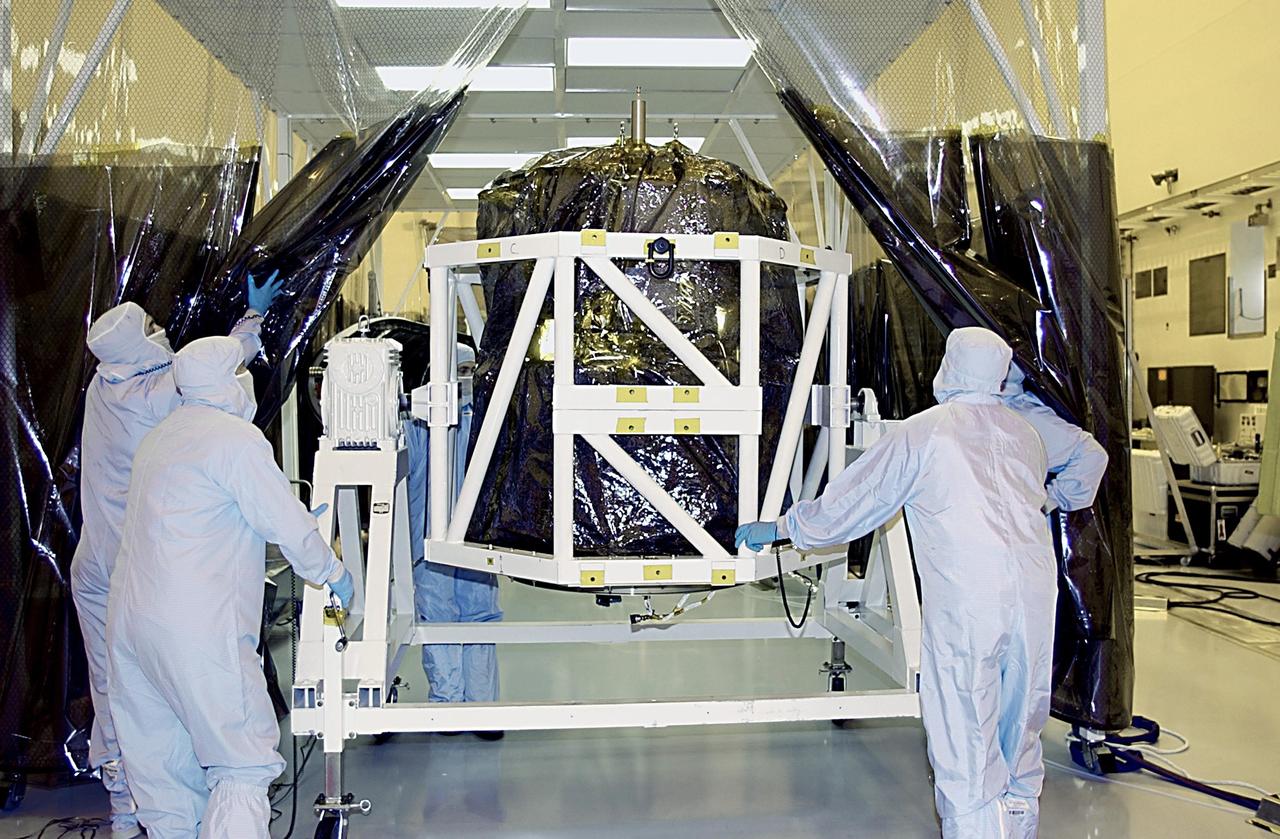
KENNEDY SPACE CENTER, FLA. - Workers move the SORCE satellite back under the protective canopy for mating to the Pegasus launch vehicle. The satellite will be rotated before the mating to Pegasus. SORCE is equipped with four instruments that will measure variations in solar radiation and observe some spectral properties of solar radiation for the first time. With data from NASA's SORCE mission, researchers should be able to follow how the Sun affects our climate now and in the future. Launch of SORCE aboard the Pegasus XL rocket is scheduled for Jan. 25, 2003, at approximately 3:14 p.m. EST, from Cape Canaveral Air Force Station, Fla.
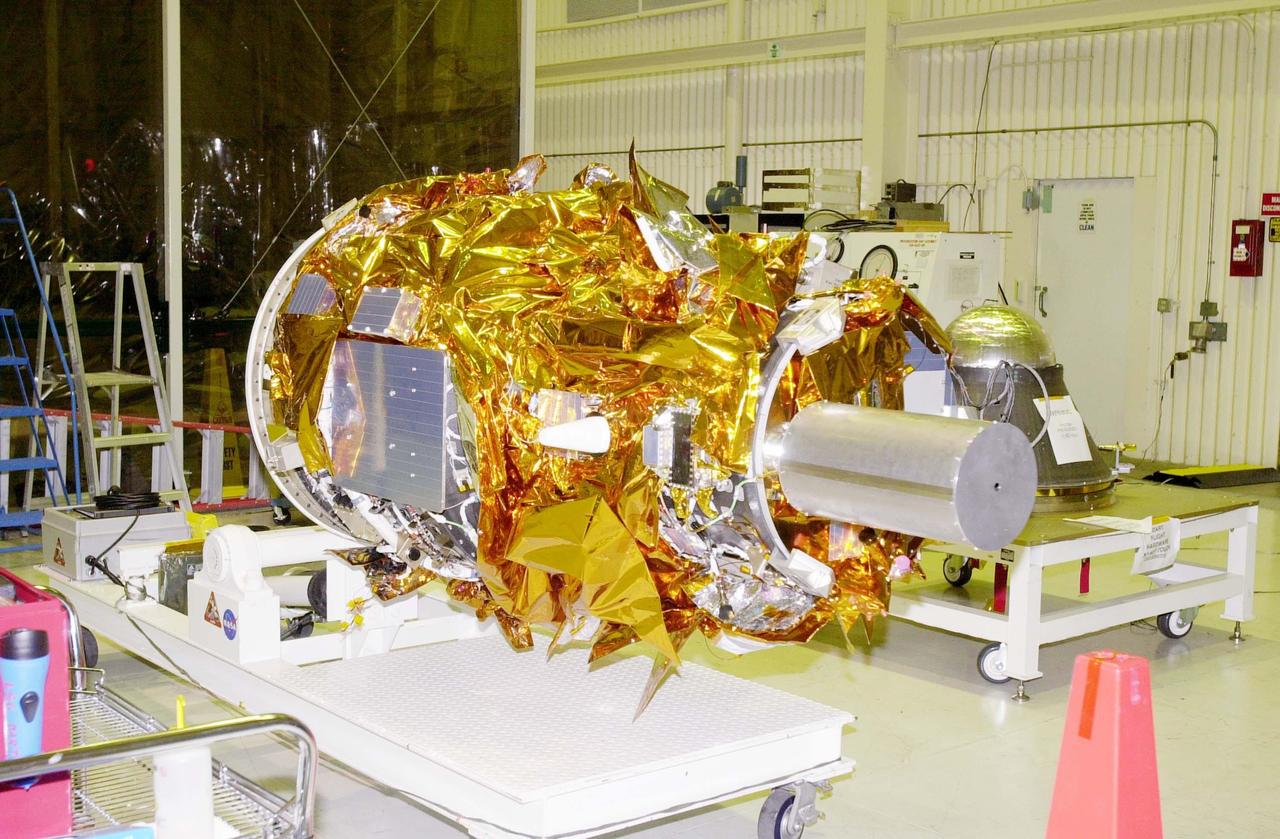
KENNEDY SPACE CENTER, FLA. - At Vandenberg Air Force Base in California, the Demonstration of Autonomous Rendezvous Technology (DART) spacecraft is ready for mating with the upper stage of the Orbital Sciences Pegasus XL behind it (right). DART was designed and built for NASA by Orbital Sciences Corporation as an advanced flight demonstrator to locate and maneuver near an orbiting satellite. DART weighs about 800 pounds and is nearly 6 feet long and 3 feet in diameter. The Pegasus XL will launch DART into a circular polar orbit of approximately 475 miles. DART is designed to demonstrate technologies required for a spacecraft to locate and rendezvous, or maneuver close to, other craft in space. Results from the DART mission will aid in the development of NASA’s Crew Exploration Vehicle and will also assist in vehicle development for crew transfer and crew rescue capability to and from the International Space Station.
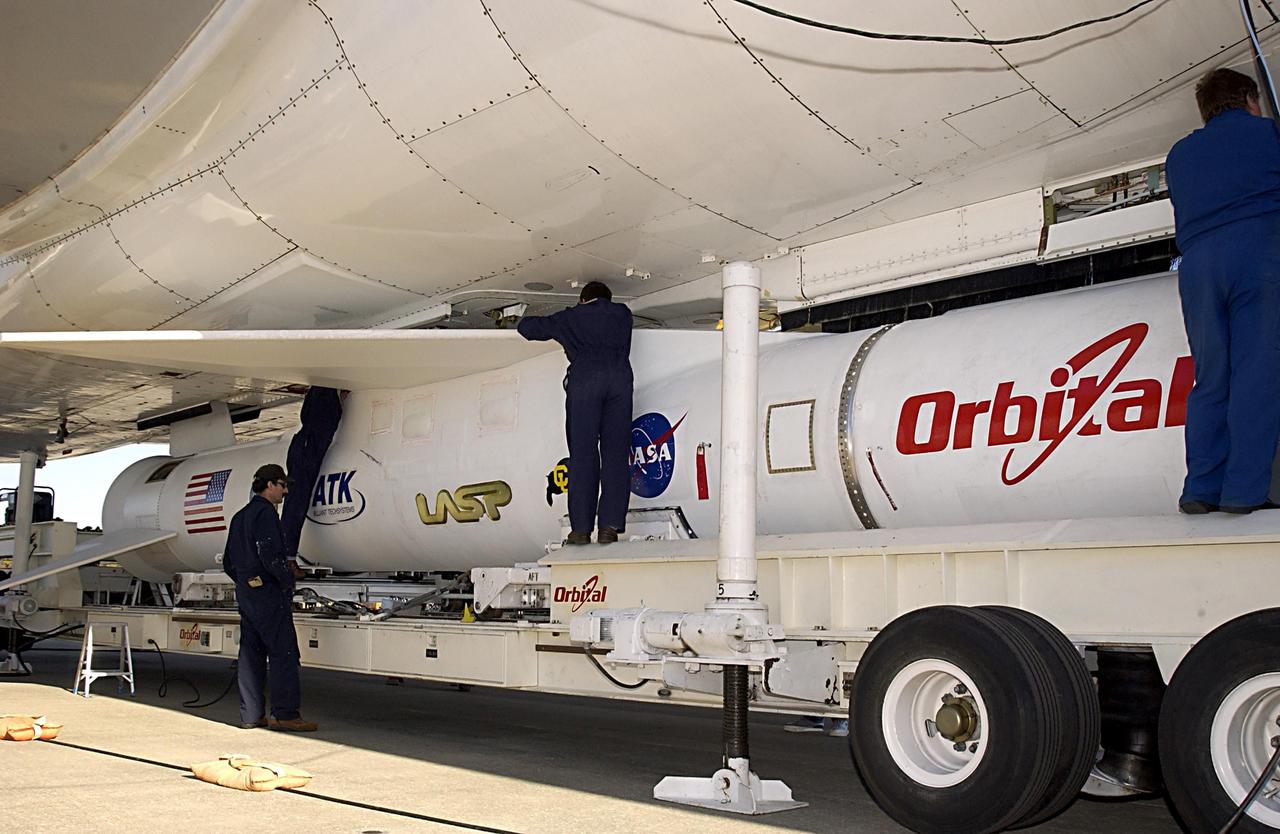
KENNEDY SPACE CENTER, FLA. - Technicians on Cape Canaveral Air Force Station, Fla., work to attach the Pegasus XL launch vehicle and Solar Radiation and Climate Experiment (SORCE) to the L-1011 aircraft. The L-1011 will carry the Pegasus to the launch altitude of 39,000 feet over the Atlantic Ocean approximately 100 miles east-southeast of Cape Canaveral. SORCE, built by Orbital Sciences Corporation, will study and measure solar irradiance as a source of energy in the Earth's atmosphere. The launch of SORCE is scheduled for Jan. 25 at 3:14 p.m. from CCAFS.
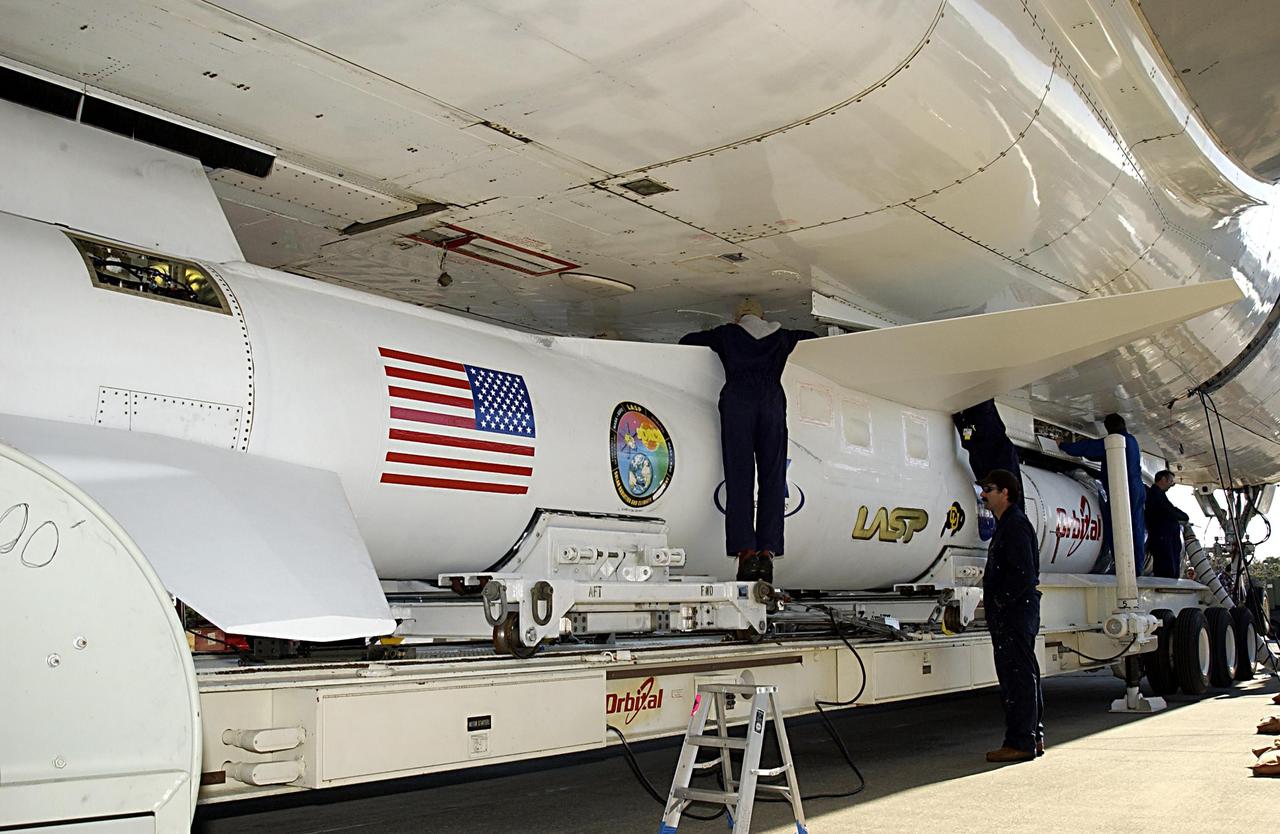
KENNEDY SPACE CENTER, FLA. - Technicians on Cape Canaveral Air Force Station, Fla., work to attach the Pegasus XL launch vehicle and Solar Radiation and Climate Experiment (SORCE) to the L-1011 aircraft. The L-1011 will carry the Pegasus to the launch altitude of 39,000 feet over the Atlantic Ocean approximately 100 miles east-southeast of Cape Canaveral. SORCE, built by Orbital Sciences Corporation, will study and measure solar irradiance as a source of energy in the Earth's atmosphere. The launch of SORCE is scheduled for Jan. 25 at 3:14 p.m. from CCAFS.
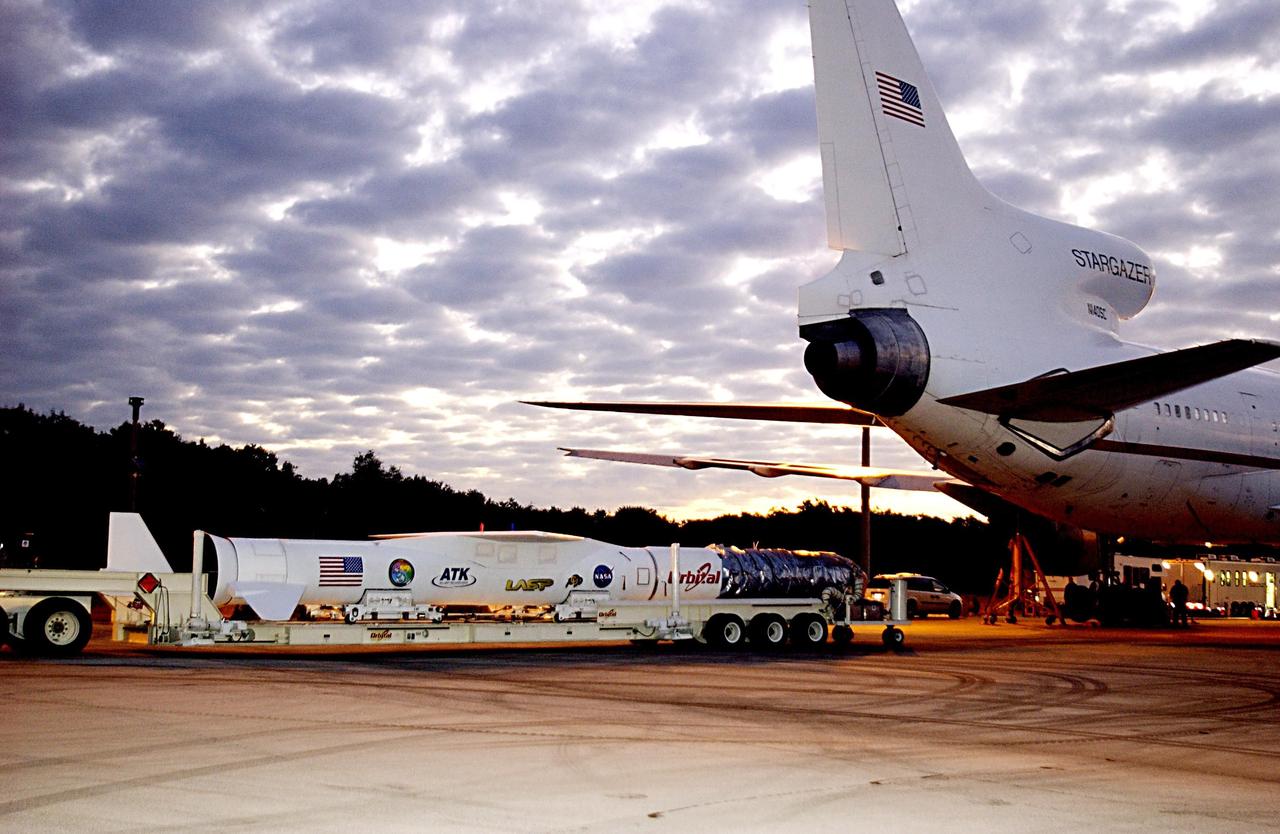
KENNEDY SPACE CENTER, FLA. - The Pegasus XL launch vehicle, with the Solar Radiation and Climate Experiment (SORCE) satellite aboard, arrives at Cape Canaveral Air Force Station (CCAFS), Fla. At right is the L-1011 aircraft that will carry the Pegasus to the launch altitude of 39,000 feet over the Atlantic Ocean approximately 100 miles east-southeast of Cape Canaveral. SORCE, built by Orbital Sciences Corporation, will study and measure solar irradiance as a source of energy in the Earth's atmosphere. The launch of SORCE is scheduled for Jan. 25 at 3:14 p.m. from CCAFS.
VANDENBERG AIR FORCE BASE, CALIF. -Inside Orbital Sciences’ Building 1555 at Vandenberg Air Force Base in California is the Pegasus XL launch vehicle and the Space Technology 5 (ST5) spacecraft being prepared for encapsulation before launch. The ST5, mated to Orbital Sciences' Pegasus XL launch vehicle, contains three microsatellites with miniaturized redundant components and technologies. Each will validate New Millennium Program selected technologies, such as the Cold Gas Micro-Thruster and X-Band Transponder Communication System. After deployment from the Pegasus, the micro-satellites will be positioned in a “string of pearls” constellation that demonstrates the ability to position them to perform simultaneous multi-point measurements of the magnetic field using highly sensitive magnetometers. The data will help scientists understand and map the intensity and direction of the Earth’s magnetic field, its relation to space weather events, and affects on our planet. With such missions, NASA hopes to improve scientists’ ability to accurately forecast space weather and minimize its harmful effects on space- and ground-based systems. Launch of ST5 is scheduled from the belly of an L-1011 carrier aircraft no earlier than March 14 from Vandenberg Air Force Base.
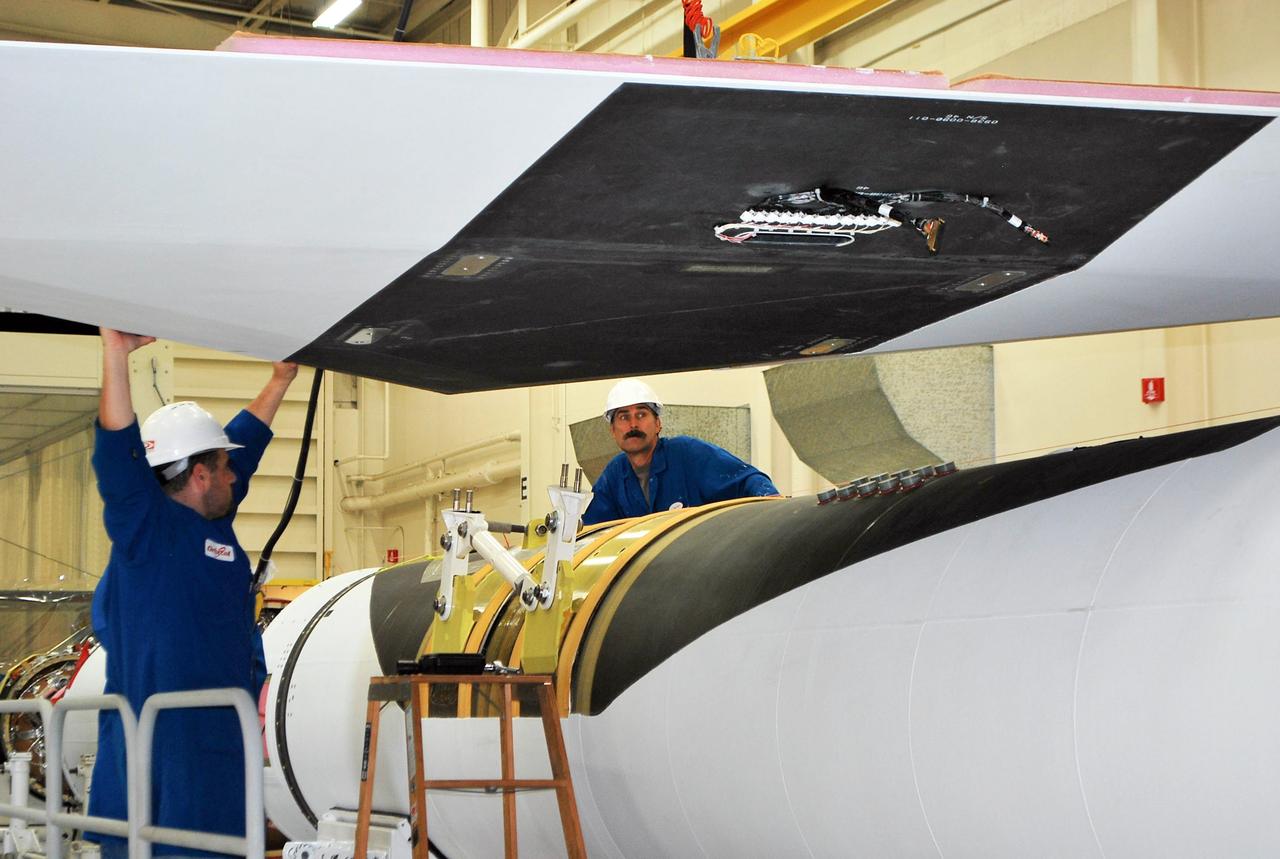
Vandenberg Air Force Base, Calif. – Inside a processing facility at Vandenberg Air Force Base in California, technicians assist as a crane lowers the wing closer for a fit check with the Orbital Sciences Pegasus XL launch vehicle. NASA’s Interface Region Imaging Spectrograph, or IRIS, spacecraft will launch aboard the Pegasus XL in late 2012. IRIS will open a new window of discovery by tracing the flow of energy and plasma through the chromospheres and transition region into the sun’s corona using spectrometry and imaging. IRIS fills a crucial gap in our ability to advance studies of the sun-to-Earth connection by tracing the flow of energy and plasma through the foundation of the corona and heliosphere, or region around the sun. Photo credit: NASA/Randy Beaudoin
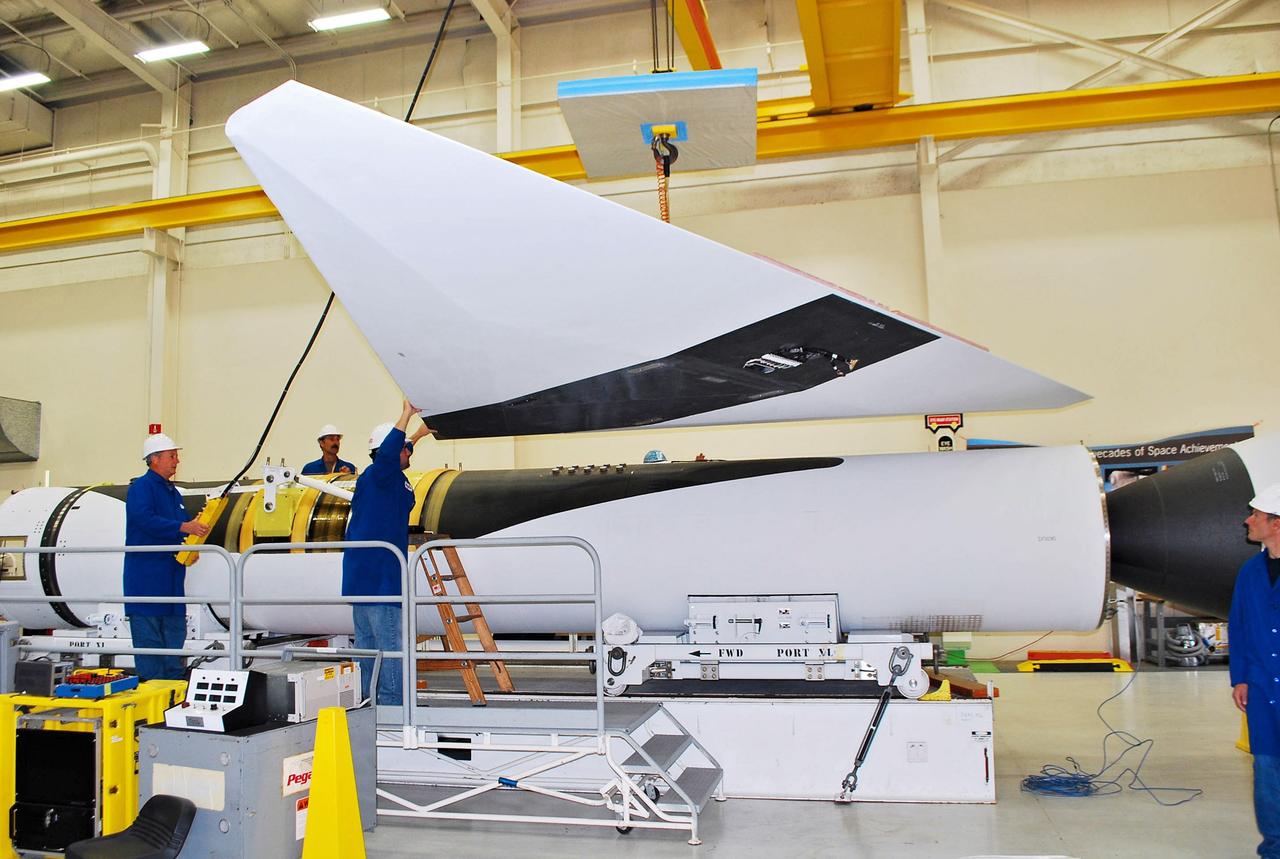
Vandenberg Air Force Base, Calif. – Inside a processing facility at Vandenberg Air Force Base in California, technicians assist as a crane lowers the wing closer for a fit check with the Orbital Sciences Pegasus XL launch vehicle. NASA’s Interface Region Imaging Spectrograph, or IRIS, spacecraft will launch aboard the Pegasus XL in late 2012. IRIS will open a new window of discovery by tracing the flow of energy and plasma through the chromospheres and transition region into the sun’s corona using spectrometry and imaging. IRIS fills a crucial gap in our ability to advance studies of the sun-to-Earth connection by tracing the flow of energy and plasma through the foundation of the corona and heliosphere, or region around the sun. Photo credit: NASA/Randy Beaudoin
Vandenberg Air Force Base, Calif. – Inside a processing facility at Vandenberg Air Force Base in California, technicians assist as a crane lowers the wing closer for a fit check with the Orbital Sciences Pegasus XL launch vehicle. NASA’s Interface Region Imaging Spectrograph, or IRIS, spacecraft will launch aboard the Pegasus XL in late 2012. IRIS will open a new window of discovery by tracing the flow of energy and plasma through the chromospheres and transition region into the sun’s corona using spectrometry and imaging. IRIS fills a crucial gap in our ability to advance studies of the sun-to-Earth connection by tracing the flow of energy and plasma through the foundation of the corona and heliosphere, or region around the sun. Photo credit: NASA/Randy Beaudoin
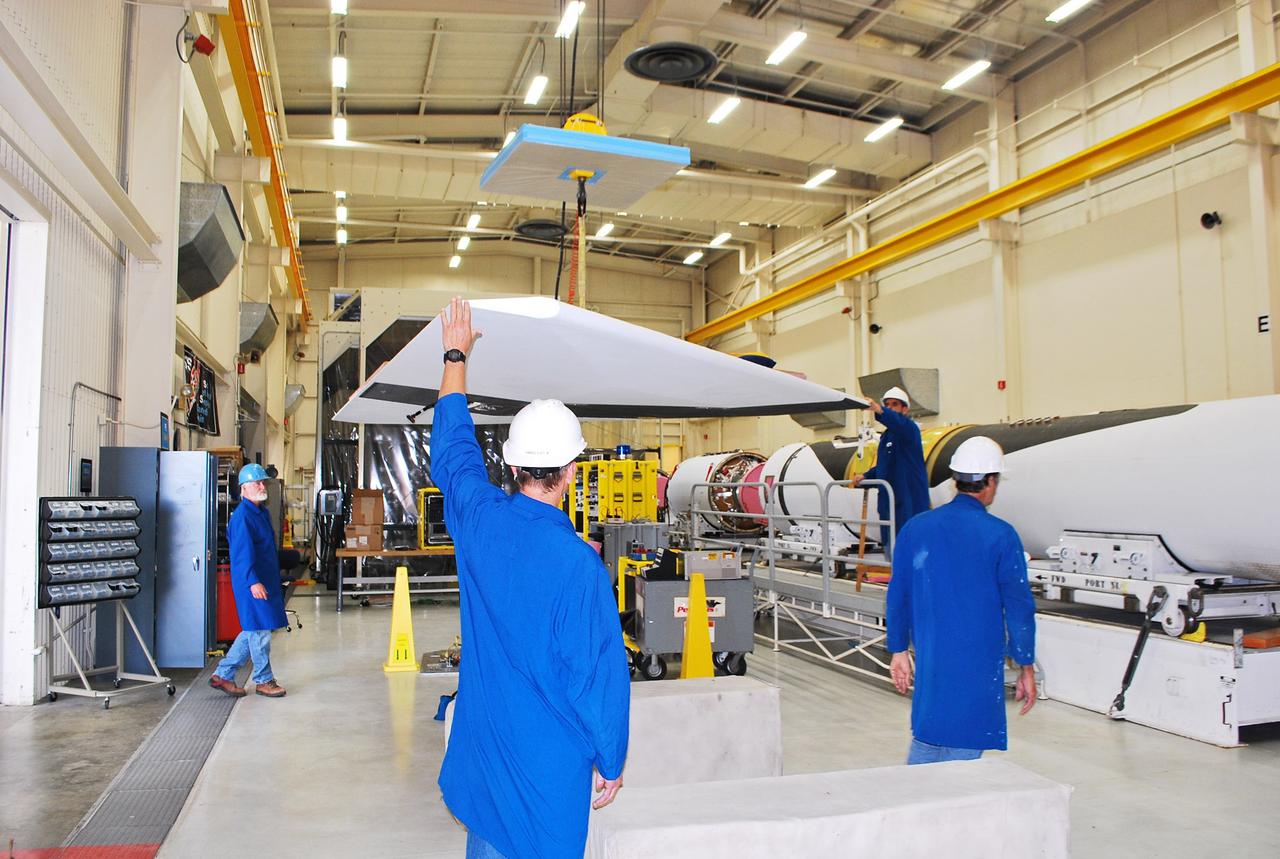
Vandenberg Air Force Base, Calif. – Inside a processing facility at Vandenberg Air Force Base in California, technicians assist as a crane moves the wing closer for a fit check with the Orbital Sciences Pegasus XL launch vehicle. NASA’s Interface Region Imaging Spectrograph, or IRIS, spacecraft will launch aboard the Pegasus XL in late 2012. IRIS will open a new window of discovery by tracing the flow of energy and plasma through the chromospheres and transition region into the sun’s corona using spectrometry and imaging. IRIS fills a crucial gap in our ability to advance studies of the sun-to-Earth connection by tracing the flow of energy and plasma through the foundation of the corona and heliosphere, or region around the sun. Photo credit: NASA/Randy Beaudoin
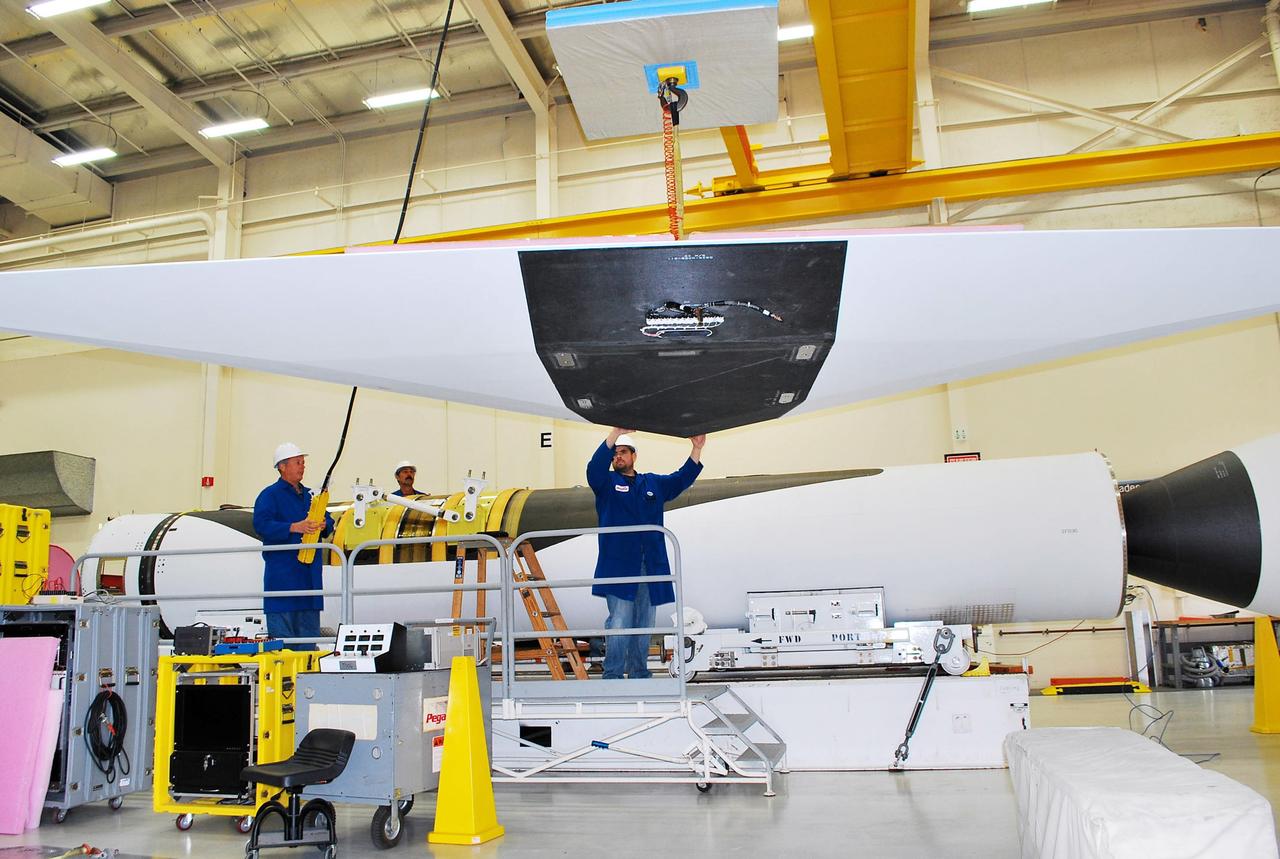
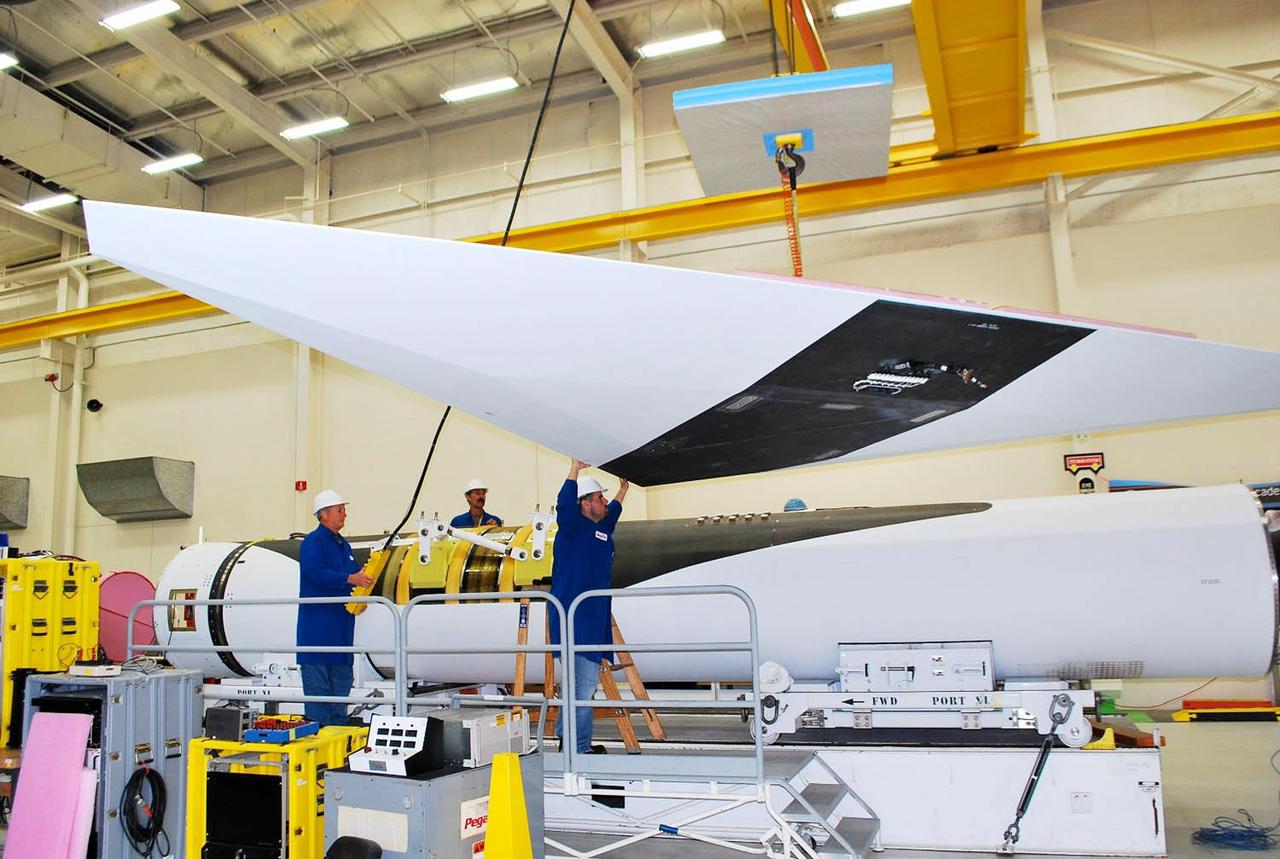
Vandenberg Air Force Base, Calif. – Inside a processing facility at Vandenberg Air Force Base in California, technicians assist as a crane moves the wing closer for a fit check with the Orbital Sciences Pegasus XL launch vehicle. NASA’s Interface Region Imaging Spectrograph, or IRIS, spacecraft will launch aboard the Pegasus XL in late 2012. IRIS will open a new window of discovery by tracing the flow of energy and plasma through the chromospheres and transition region into the sun’s corona using spectrometry and imaging. IRIS fills a crucial gap in our ability to advance studies of the sun-to-Earth connection by tracing the flow of energy and plasma through the foundation of the corona and heliosphere, or region around the sun. Photo credit: NASA/Randy Beaudoin
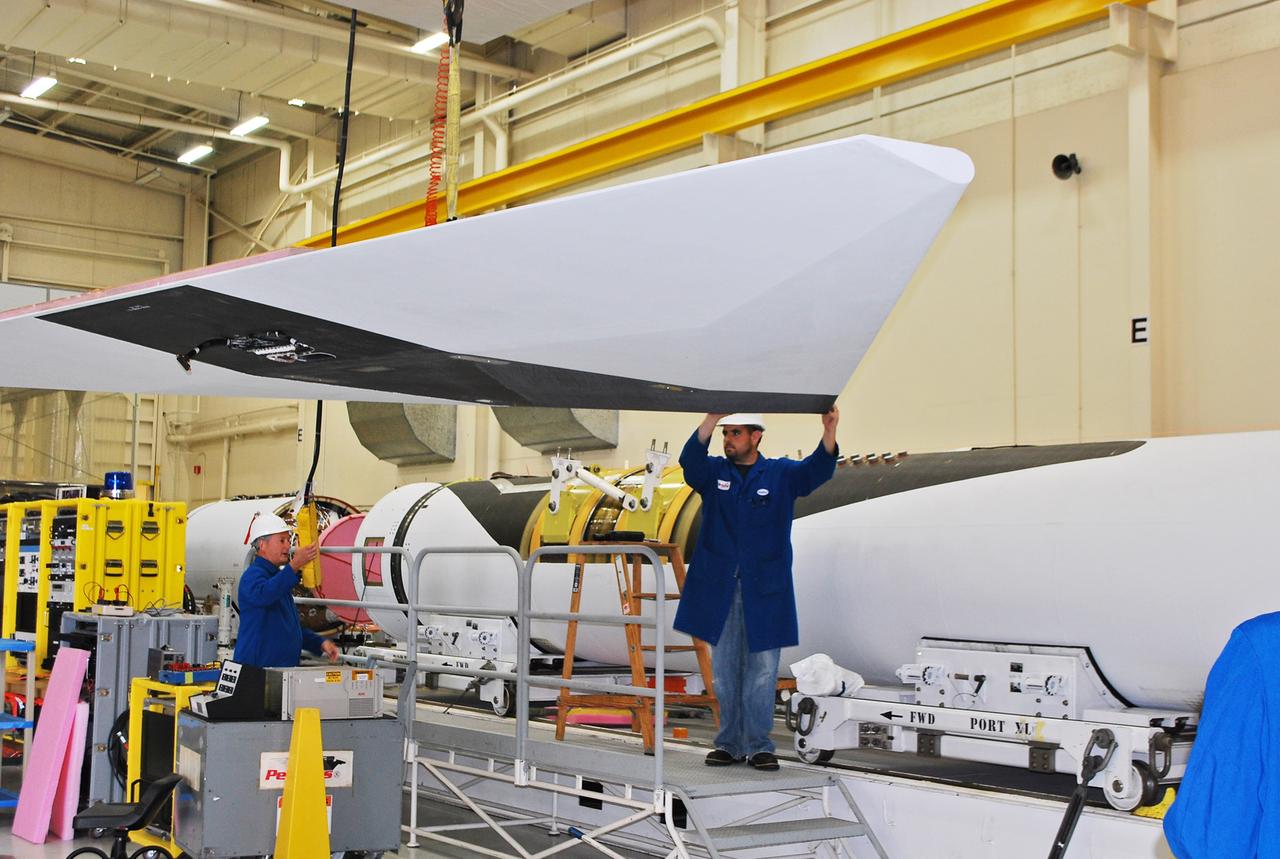
Vandenberg Air Force Base, Calif. – Inside a processing facility at Vandenberg Air Force Base in California, technicians assist as a crane moves the wing closer for a fit check with the Orbital Sciences Pegasus XL launch vehicle. NASA’s Interface Region Imaging Spectrograph, or IRIS, spacecraft will launch aboard the Pegasus XL in late 2012. IRIS will open a new window of discovery by tracing the flow of energy and plasma through the chromospheres and transition region into the sun’s corona using spectrometry and imaging. IRIS fills a crucial gap in our ability to advance studies of the sun-to-Earth connection by tracing the flow of energy and plasma through the foundation of the corona and heliosphere, or region around the sun. Photo credit: NASA/Randy Beaudoin
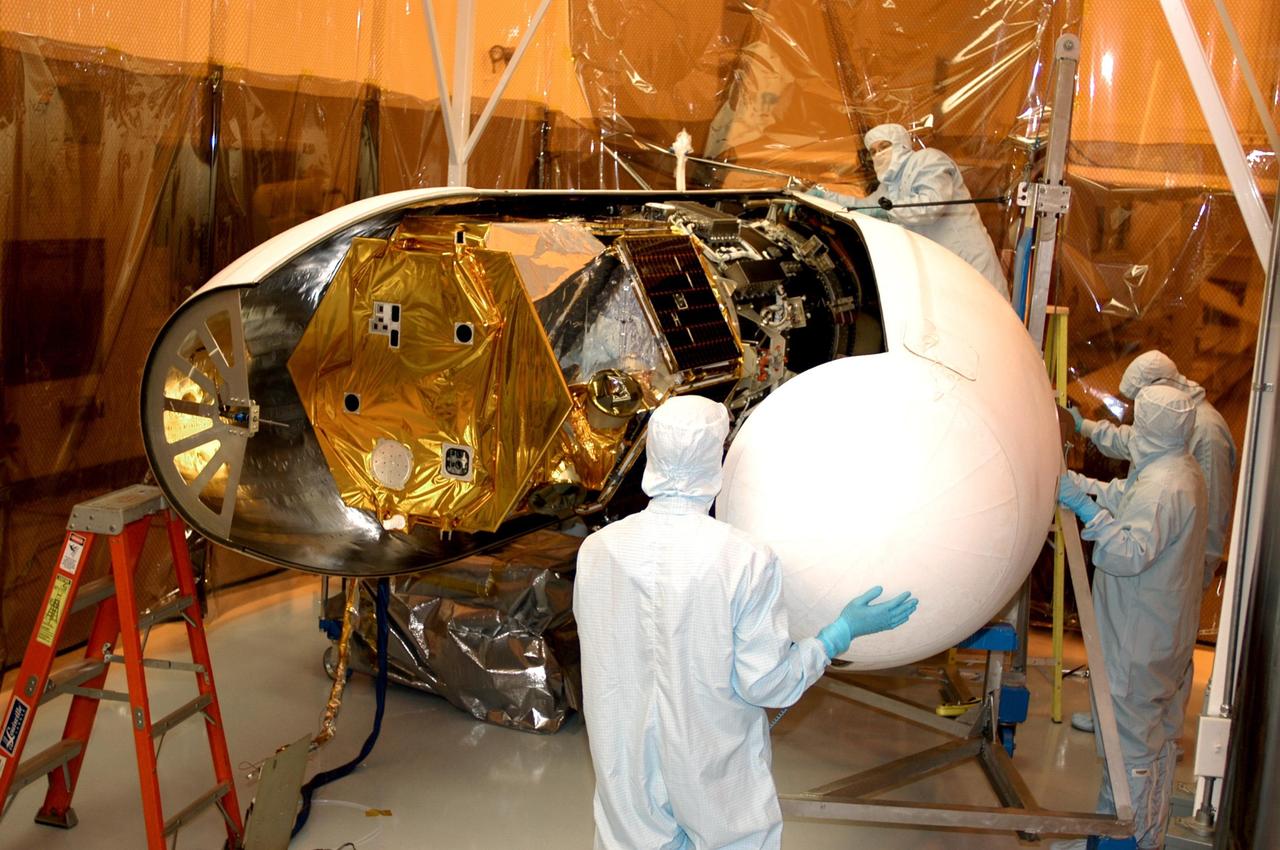
KENNEDY SPACE CENTER, FLA. -- Workers in the Multi-Purpose Processing Facility move the second half of the fairing into place around the Solar Radiation and Climate Experiment (SORCE) satellite (left). When complete, the satellite will be installed in the Pegasus XL launch vehicle. Built by Orbital Sciences Corporation (OSC), SORCE will study and measure solar irradiance as a source of energy in the Earth's atmosphere. The launch of SORCE is scheduled for Jan. 25 at 3:14 p.m. from Cape Canaveral Air Force Station, Fla. The drop of the Pegasus will be from OSC's L-1011 aircraft at an altitude of 39,000 feet over the Atlantic Ocean approximately 100 miles east-southeast of Cape Canaveral.
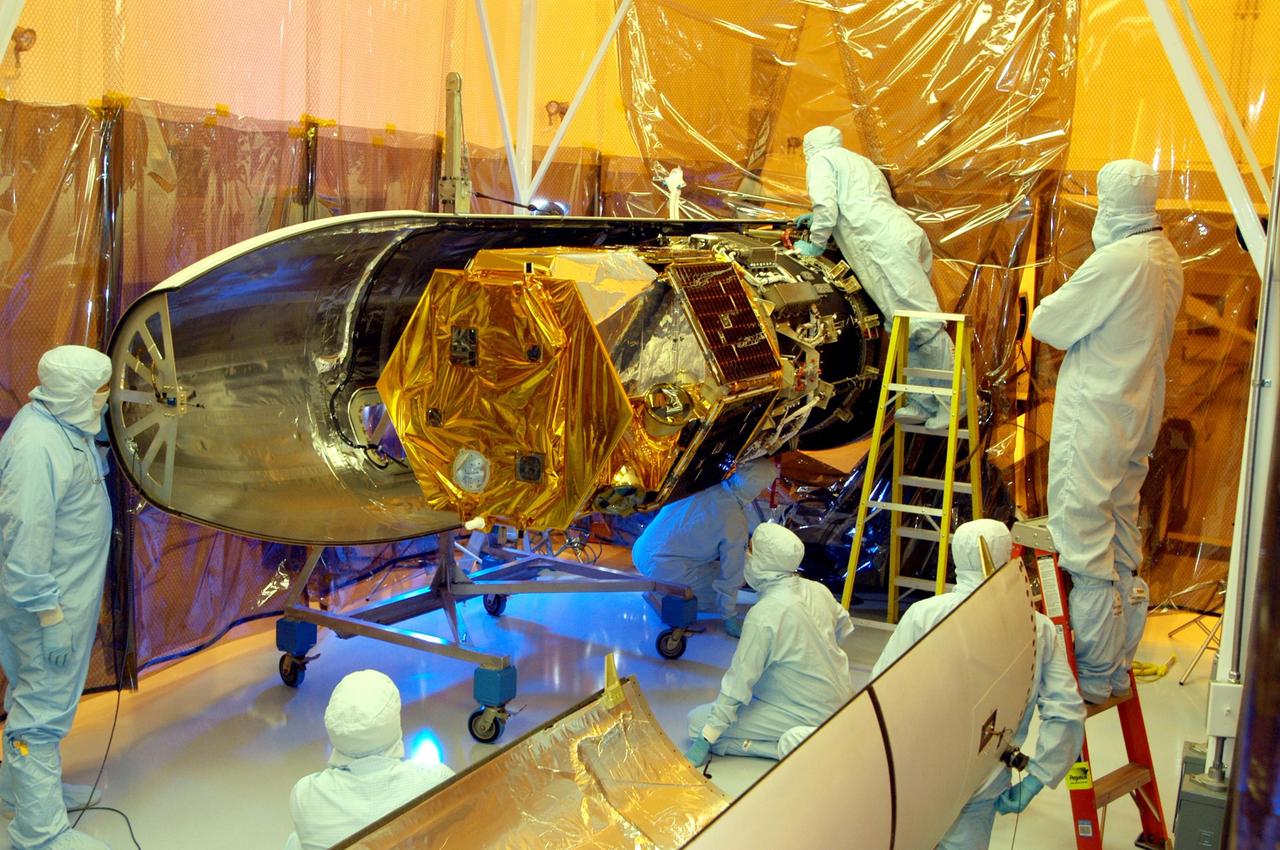
KENNEDY SPACE CENTER, FLA. - Workers in the Multi-Purpose Processing Facility look over the Solar Radiation and Climate Experiment (SORCE) satellite as the first half of the fairing is put in place. When completely encapsulated, the satellite will be installed in the Pegasus XL launch vehicle. Built by Orbital Sciences Corporation (OSC), SORCE will study and measure solar irradiance as a source of energy in the Earth's atmosphere. The launch of SORCE is scheduled for Jan. 25 at 3:14 p.m. from Cape Canaveral Air Force Station, Fla. The drop of the Pegasus will be from OSC's L-1011 aircraft at an altitude of 39,000 feet over the Atlantic Ocean approximately 100 miles east-southeast of Cape Canaveral.
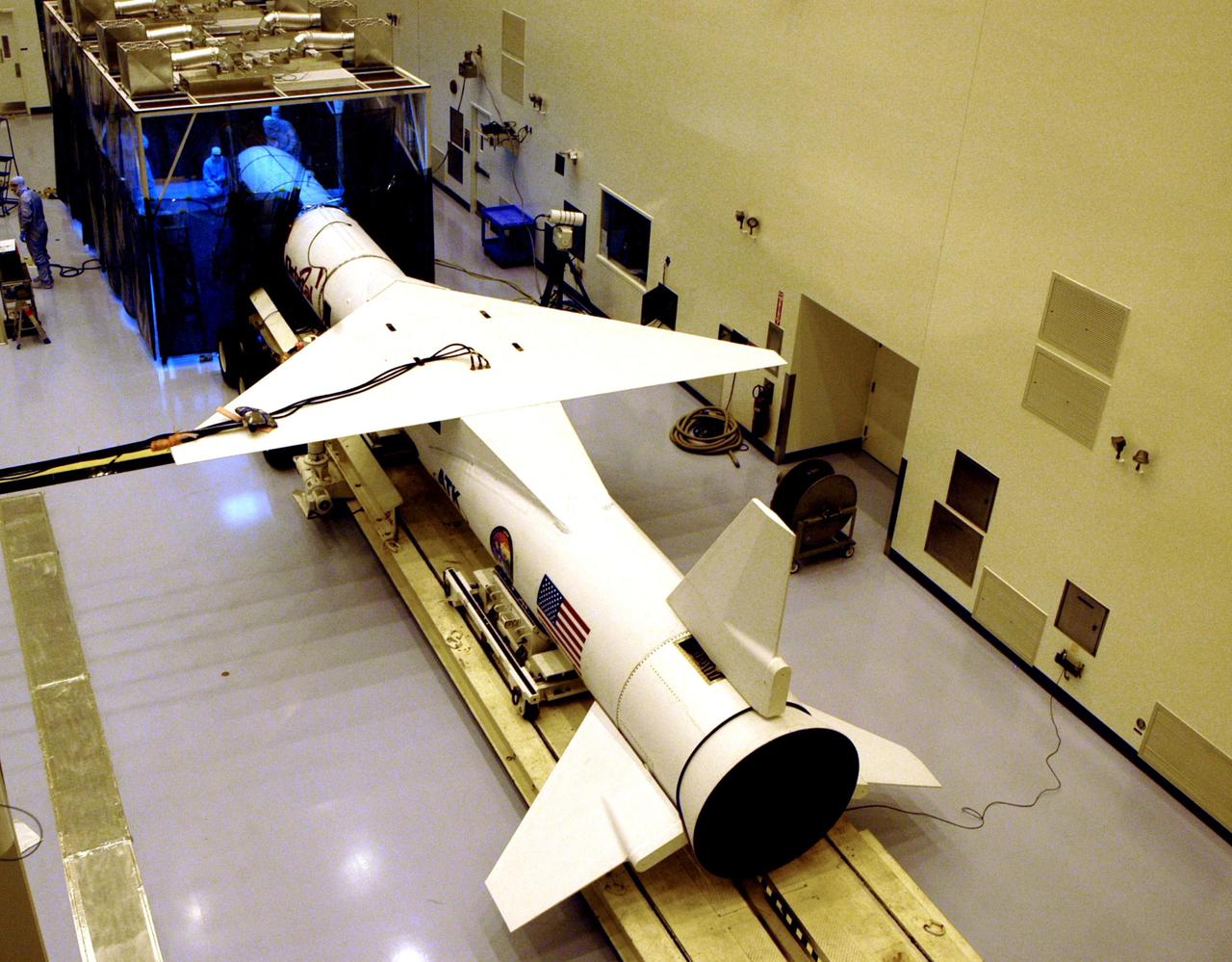
KENNEDY SPACE CENTER, FLA. -- In the Multi-Purpose Processing Facility, the Pegasus XL launch vehicle is ready to be moved toward the Solar Radiation and Climate Experiment (SORCE) satellite in front of it. Built by Orbital Sciences Corporation (OSC), SORCE will study and measure solar irradiance as a source of energy in the Earth's atmosphere. The launch of SORCE is scheduled for Jan. 25 at 3:14 p.m. from Cape Canaveral Air Force Station, Fla. The drop of the Pegasus will be from OSC's L-1011 aircraft at an altitude of 39,000 feet over the Atlantic Ocean approximately 100 miles east-southeast of Cape Canaveral.
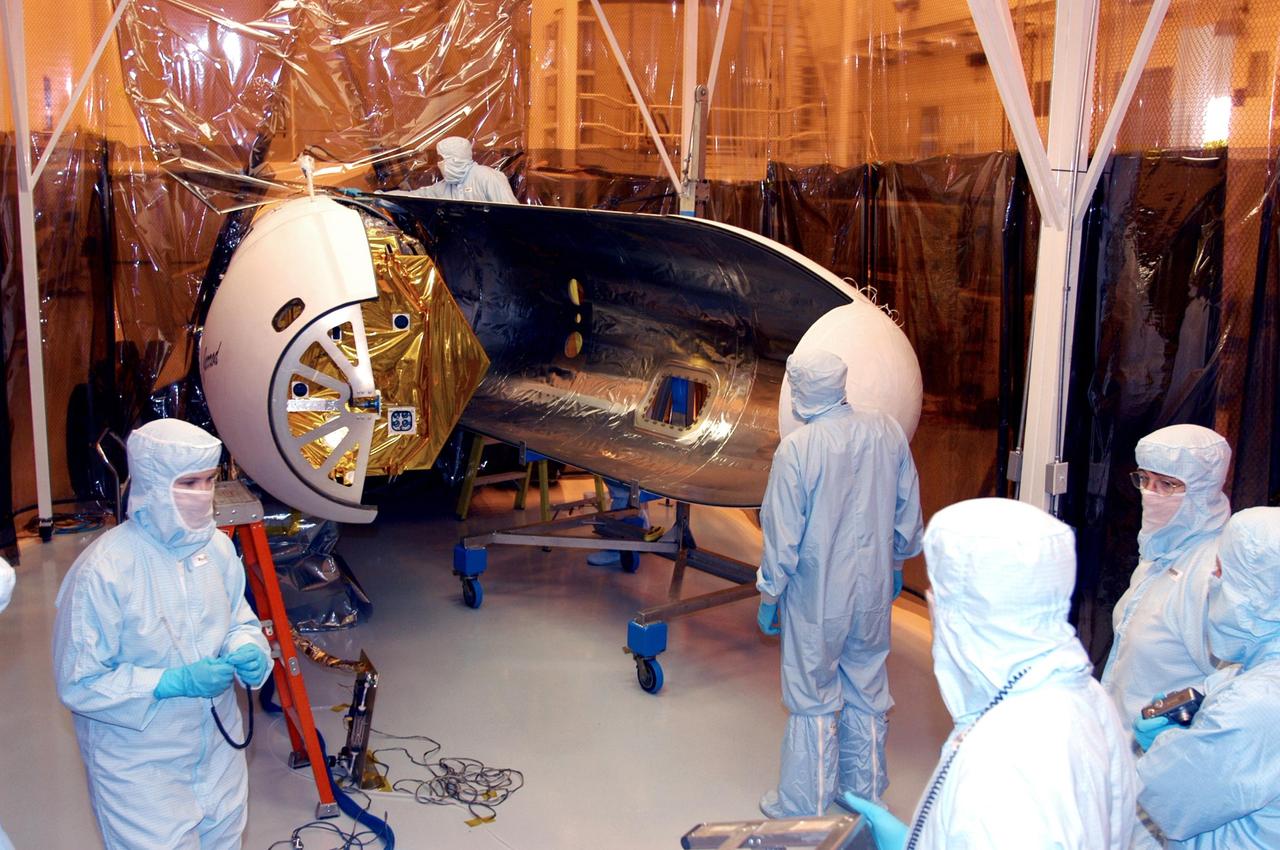
KENNEDY SPACE CENTER, FLA. - The second half of the fairing is moved toward the Solar Radiation and Climate Experiment (SORCE) satellite (left). Built by Orbital Sciences Corporation (OSC), SORCE will study and measure solar irradiance as a source of energy in the Earth's atmosphere. The launch of SORCE is scheduled for Jan. 25 at 3:14 p.m. from Cape Canaveral Air Force Station, Fla., from a Pegasus XL launch vehicle. The drop of the Pegasus will be from OSC's L-1011 aircraft at an altitude of 39,000 feet over the Atlantic Ocean approximately 100 miles east-southeast of Cape Canaveral.
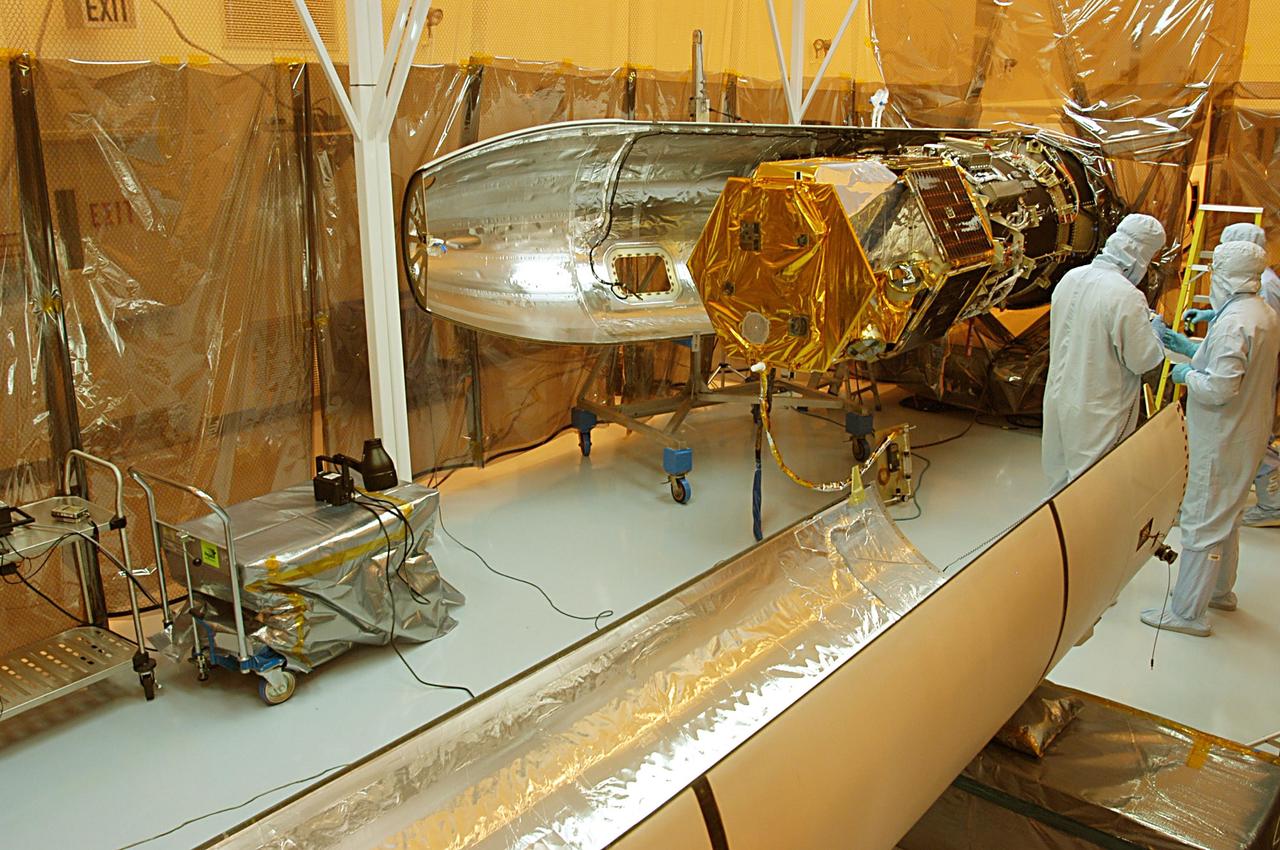
KENNEDY SPACE CENTER, FLA. -- The first half of the fairing is placed around the Solar Radiation and Climate Experiment (SORCE) satellite in the Multi-Purpose Processing Facility. When completely encapsulated, the satellite will be installed in the Pegasus XL launch vehicle. Built by Orbital Sciences Corporation (OSC), SORCE will study and measure solar irradiance as a source of energy in the Earth's atmosphere. The launch of SORCE is scheduled for Jan. 25 at 3:14 p.m. from Cape Canaveral Air Force Station, Fla. The drop of the Pegasus will be from OSC's L-1011 aircraft at an altitude of 39,000 feet over the Atlantic Ocean approximately 100 miles east-southeast of Cape Canaveral.

KENNEDY SPACE CENTER, FLA. - Workers carefully rotate the SORCE satellite for mating to the Pegasus launch vehicle. SORCE is equipped with four instruments that will measure variations in solar radiation and observe some spectral properties of solar radiation for the first time. With data from NASA's SORCE mission, researchers should be able to follow how the Sun affects our climate now and in the future. Launch of SORCE aboard the Pegasus XL rocket is scheduled for Jan. 25, 2003, at approximately 3:14 p.m. EST, from Cape Canaveral Air Force Station, Fla.
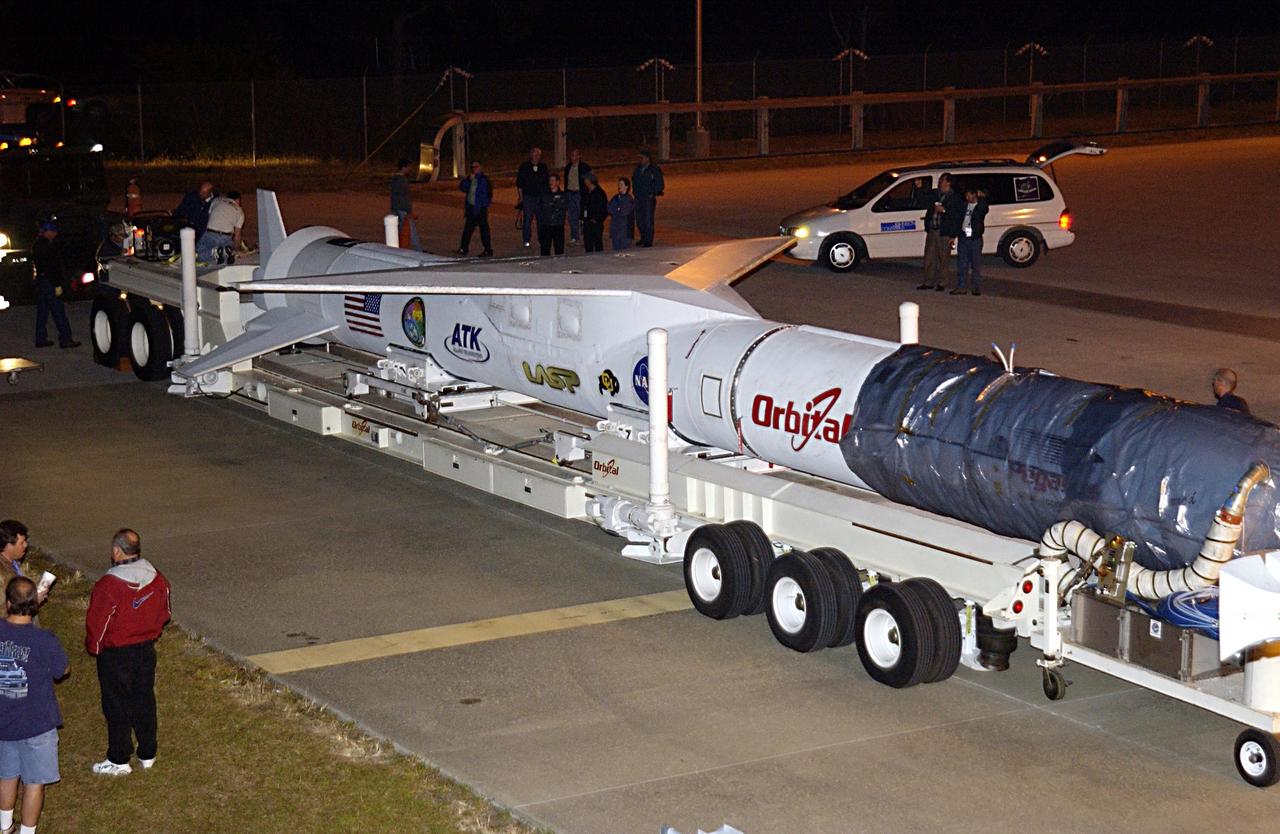
KENNEDY SPACE CENTER, FLA. - The Pegasus XL launch vehicle, with the Solar Radiation and Climate Experiment (SORCE) satellite aboard, is ready for transfer to Cape Canaveral Air Force Station (CCAFS), Fla. Built by Orbital Sciences Corporation (OSC), SORCE will study and measure solar irradiance as a source of energy in the Earth's atmosphere. The launch of SORCE is scheduled for Jan. 25 at 3:14 p.m. from CCAFS. The drop of the Pegasus will be from OSC's L-1011 aircraft at an altitude of 39,000 feet over the Atlantic Ocean approximately 100 miles east-southeast of Cape Canaveral.
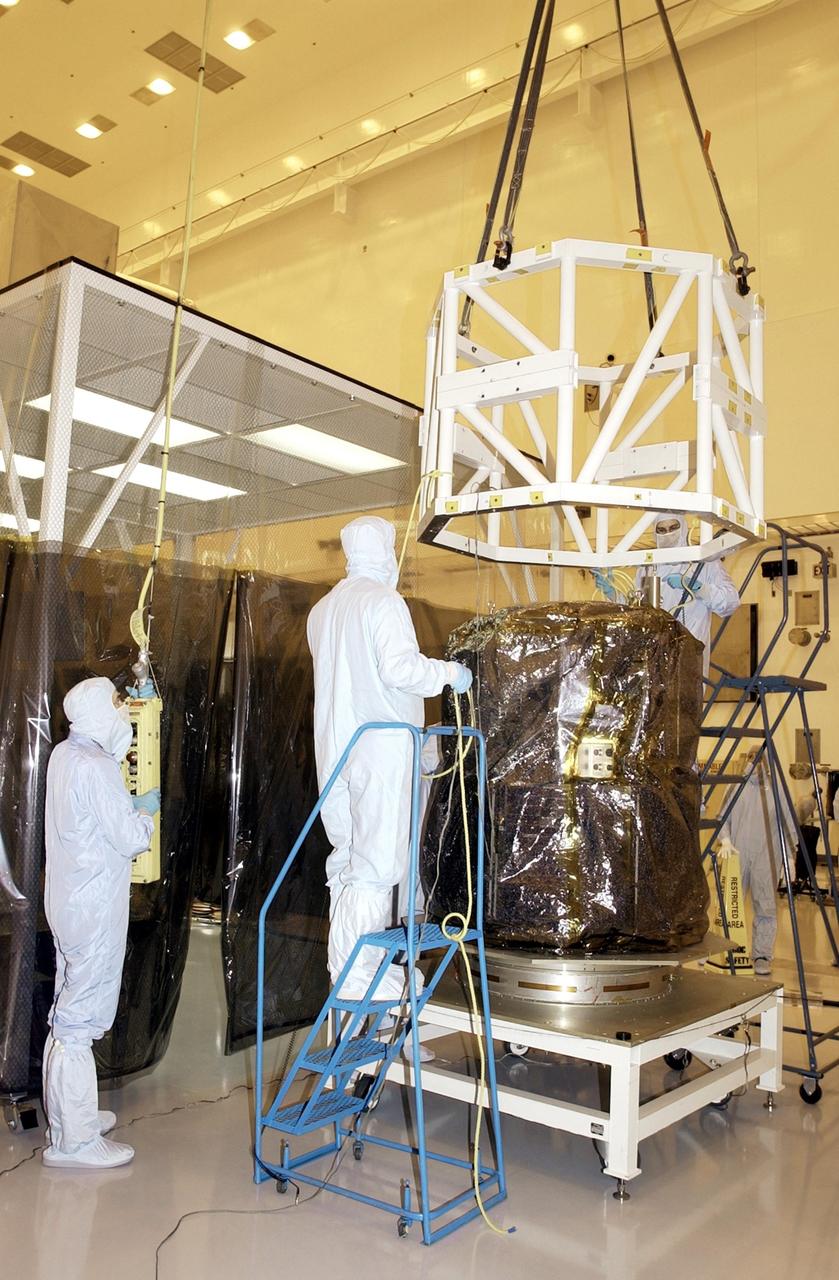
KENNEDY SPACE CENTER, FLA. - Workers guide equipment as it lowers over the SORCE satellite. The equipment will rotate the satellite for mating to the Pegasus launch vehicle. SORCE is equipped with four instruments that will measure variations in solar radiation and observe some spectral properties of solar radiation for the first time. With data from NASA's SORCE mission, researchers should be able to follow how the Sun affects our climate now and in the future. Launch of SORCE aboard the Pegasus XL rocket is scheduled for Jan. 25, 2003, at approximately 3:14 p.m. EST, from Cape Canaveral Air Force Station, Fla.
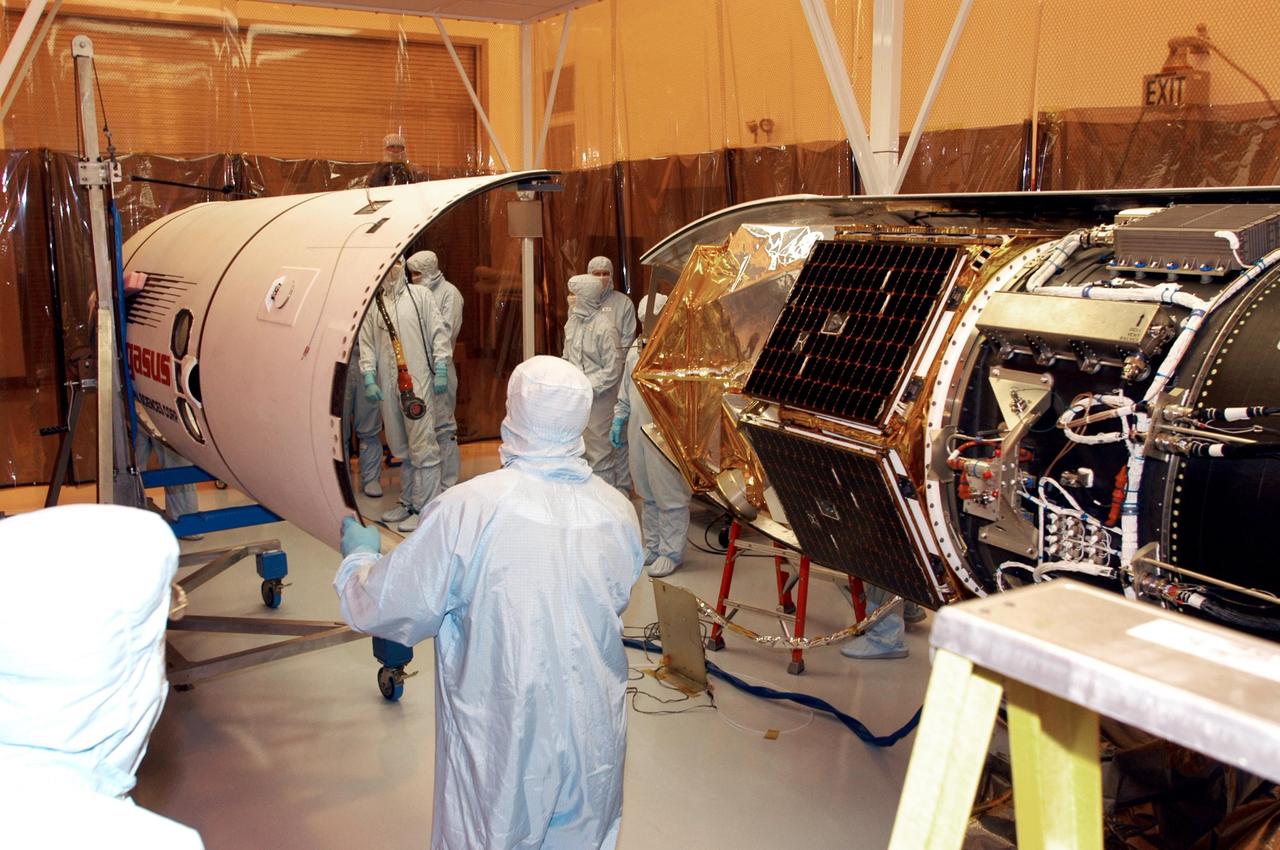
KENNEDY SPACE CENTER, FLA. - The second half of the fairing is ready to be installed on the Solar Radiation and Climate Experiment (SORCE) satellite (at right). Built by Orbital Sciences Corporation (OSC), SORCE will study and measure solar irradiance as a source of energy in the Earth's atmosphere. The launch of SORCE is scheduled for Jan. 25 at 3:14 p.m. from Cape Canaveral Air Force Station, Fla., from a Pegasus XL launch vehicle. The drop of the Pegasus will be from OSC's L-1011 aircraft at an altitude of 39,000 feet over the Atlantic Ocean approximately 100 miles east-southeast of Cape Canaveral.
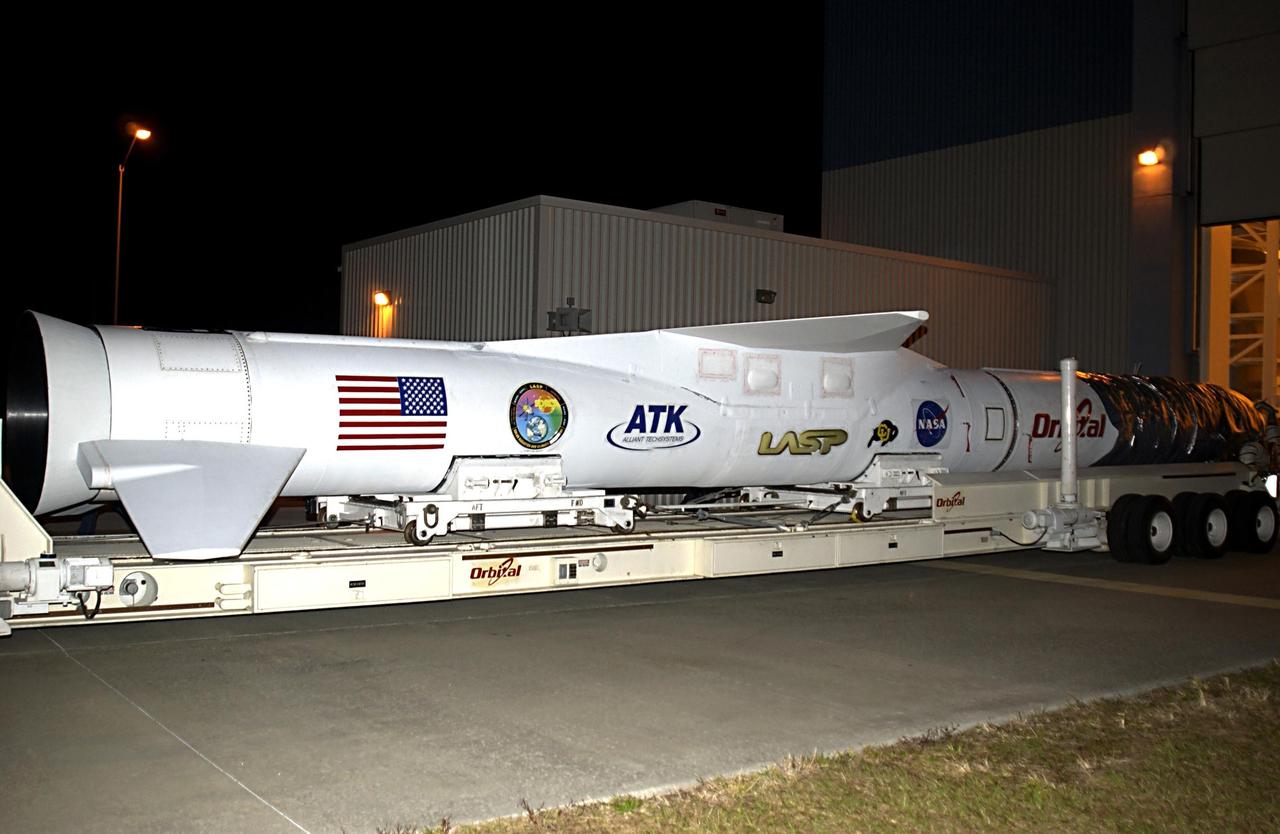
KENNEDY SPACE CENTER, FLA. - The Pegasus XL launch vehicle, with the Solar Radiation and Climate Experiment (SORCE) satellite aboard, is ready for transfer to Cape Canaveral Air Force Station (CCAFS), Fla. Built by Orbital Sciences Corporation (OSC), SORCE will study and measure solar irradiance as a source of energy in the Earth's atmosphere. The launch of SORCE is scheduled for Jan. 25 at 3:14 p.m. from CCAFS. The drop of the Pegasus will be from OSC's L-1011 aircraft at an altitude of 39,000 feet over the Atlantic Ocean approximately 100 miles east-southeast of Cape Canaveral.
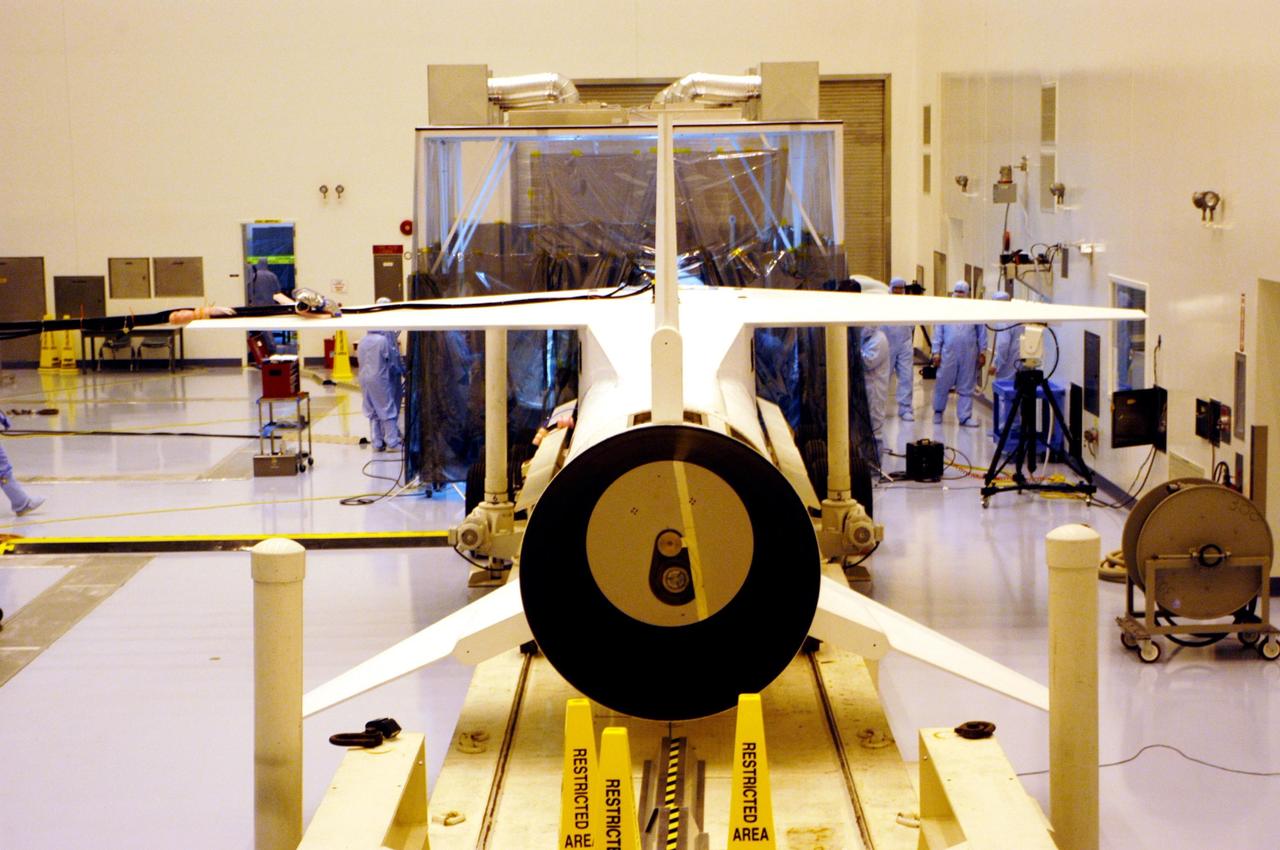
KENNEDY SPACE CENTER, FLA. -- In the Multi-Purpose Processing Facility, the Pegasus XL launch vehicle is ready for installation of the Solar Radiation and Climate Experiment (SORCE) satellite after encapsulation. Built by Orbital Sciences Corporation (OSC), SORCE will study and measure solar irradiance as a source of energy in the Earth's atmosphere. The launch of SORCE is scheduled for Jan. 25 at 3:14 p.m. from Cape Canaveral Air Force Station, Fla. The drop of the Pegasus will be from OSC's L-1011 aircraft at an altitude of 39,000 feet over the Atlantic Ocean approximately 100 miles east-southeast of Cape Canaveral.
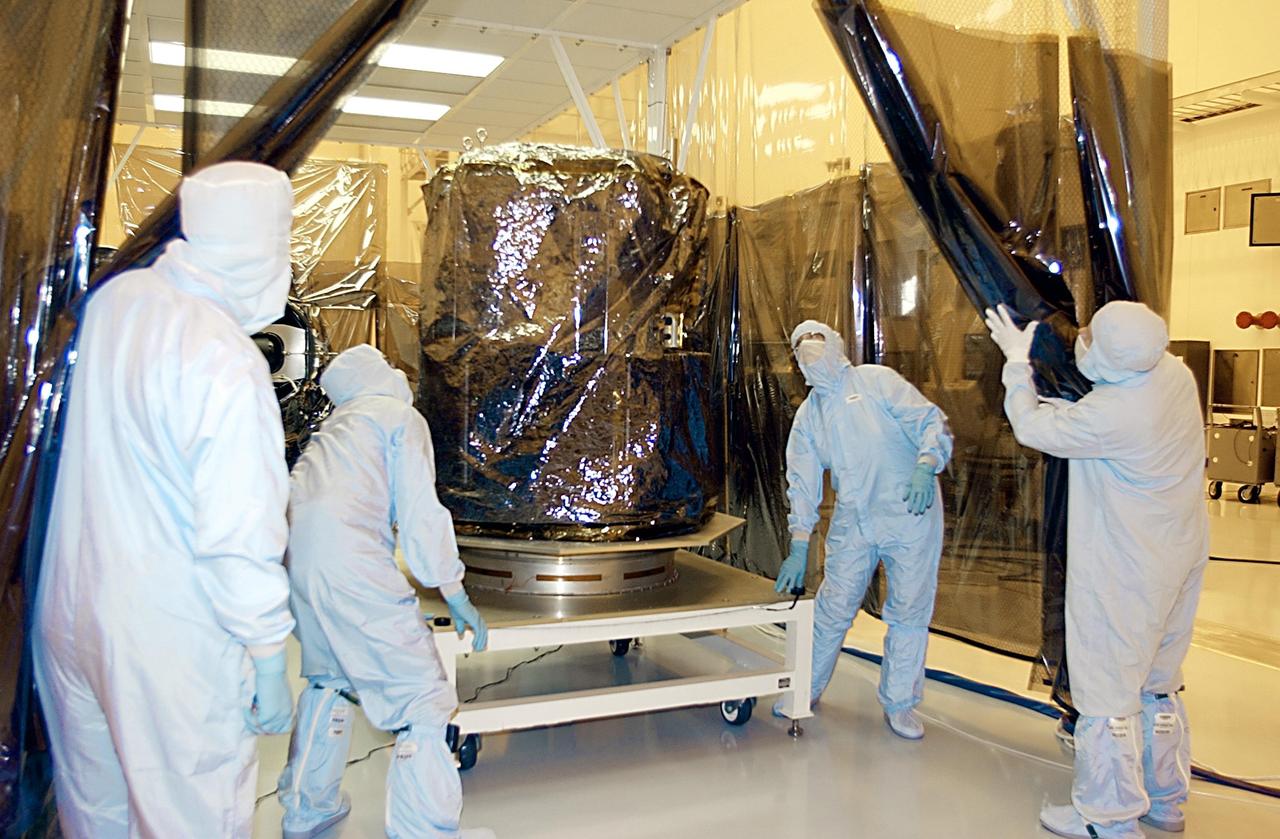
KENNEDY SPACE CENTER, FLA. - Workers move the SORCE satellite from underneath a canopy during its transfer to a rotating workstand for mating to the Pegasus launch vehicle. SORCE is equipped with four instruments that will measure variations in solar radiation and observe some spectral properties of solar radiation for the first time. With data from NASA's SORCE mission, researchers should be able to follow how the Sun affects our climate now and in the future. Launch of SORCE aboard the Pegasus XL rocket is scheduled for Jan. 25, 2003, at approximately 3:14 p.m. EST, from Cape Canaveral Air Force Station, Fla.
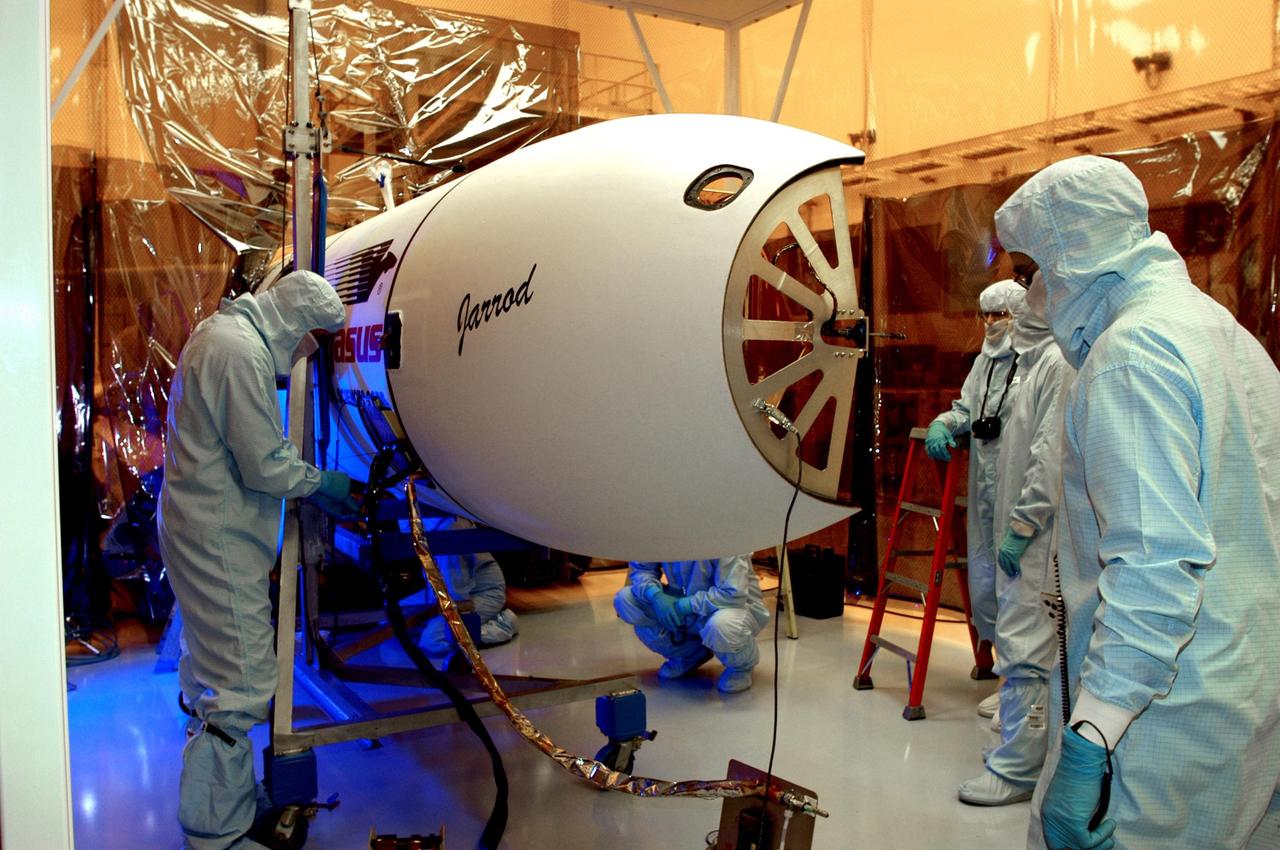
KENNEDY SPACE CENTER, FLA. - Workers in the Multi-Purpose Processing Facility check the outside of the fairing around the Solar Radiation and Climate Experiment (SORCE) satellite. When completely encapsulated, the satellite will be installed in the Pegasus XL launch vehicle. Built by Orbital Sciences Corporation (OSC), SORCE will study and measure solar irradiance as a source of energy in the Earth's atmosphere. The launch of SORCE is scheduled for Jan. 25 at 3:14 p.m. from Cape Canaveral Air Force Station, Fla. The drop of the Pegasus will be from OSC's L-1011 aircraft at an altitude of 39,000 feet over the Atlantic Ocean approximately 100 miles east-southeast of Cape Canaveral.

KENNEDY SPACE CENTER, FLA. -- The Pegasus XL launch vehicle is ready for installation of the Solar Radiation and Climate Experiment (SORCE) satellite after encapsulation. Built by Orbital Sciences Corporation (OSC), SORCE will study and measure solar irradiance as a source of energy in the Earth's atmosphere. The launch of SORCE is scheduled for Jan. 25 at 3:14 p.m. from Cape Canaveral Air Force Station, Fla. The drop of the Pegasus will be from OSC's L-1011 aircraft at an altitude of 39,000 feet over the Atlantic Ocean approximately 100 miles east-southeast of Cape Canaveral.
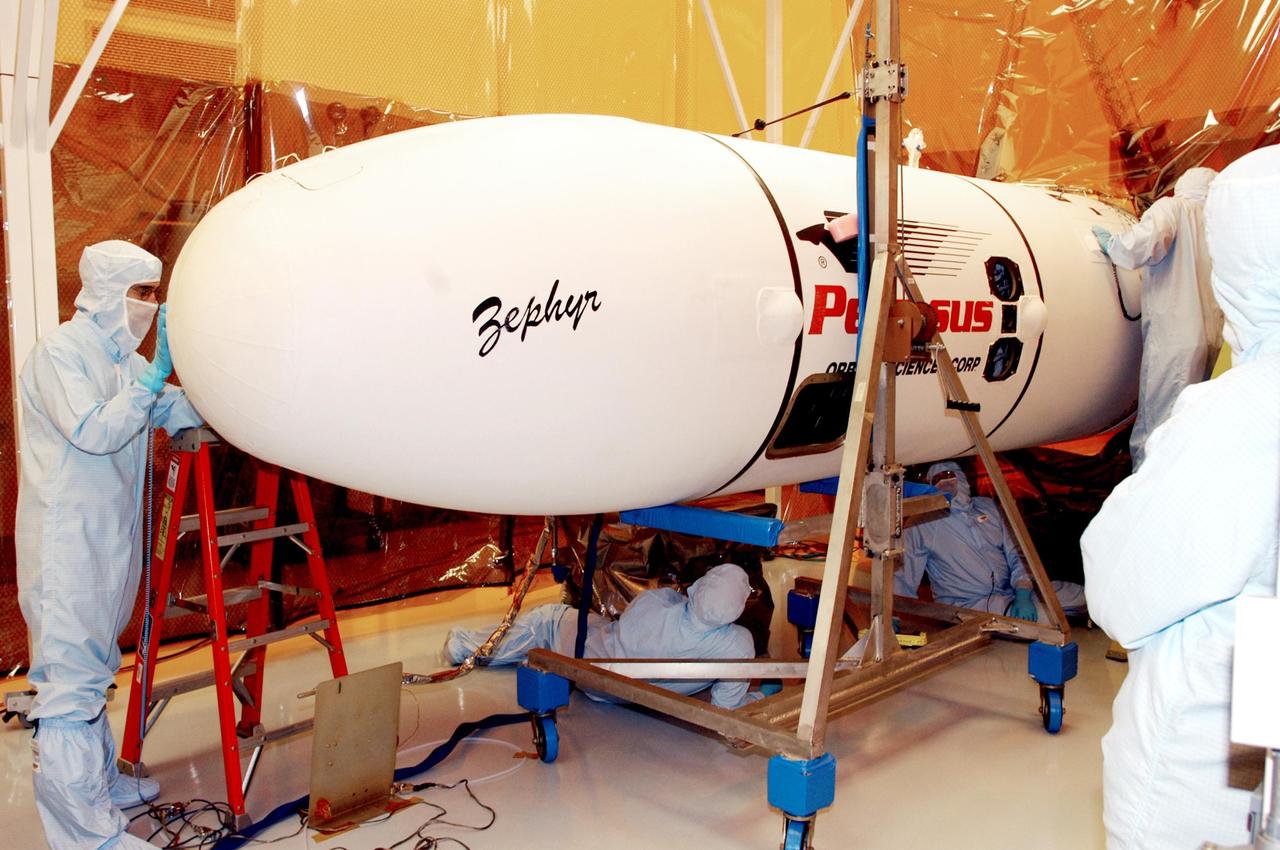
KENNEDY SPACE CENTER, FLA. -- Workers in the Multi-Purpose Processing Facility look over the encapsulation of the Solar Radiation and Climate Experiment (SORCE) satellite. The satellite will next be installed in the Pegasus XL launch vehicle. Built by Orbital Sciences Corporation (OSC), SORCE will study and measure solar irradiance as a source of energy in the Earth's atmosphere. The launch of SORCE is scheduled for Jan. 25 at 3:14 p.m. from Cape Canaveral Air Force Station, Fla. The drop of the Pegasus will be from OSC's L-1011 aircraft at an altitude of 39,000 feet over the Atlantic Ocean approximately 100 miles east-southeast of Cape Canaveral.
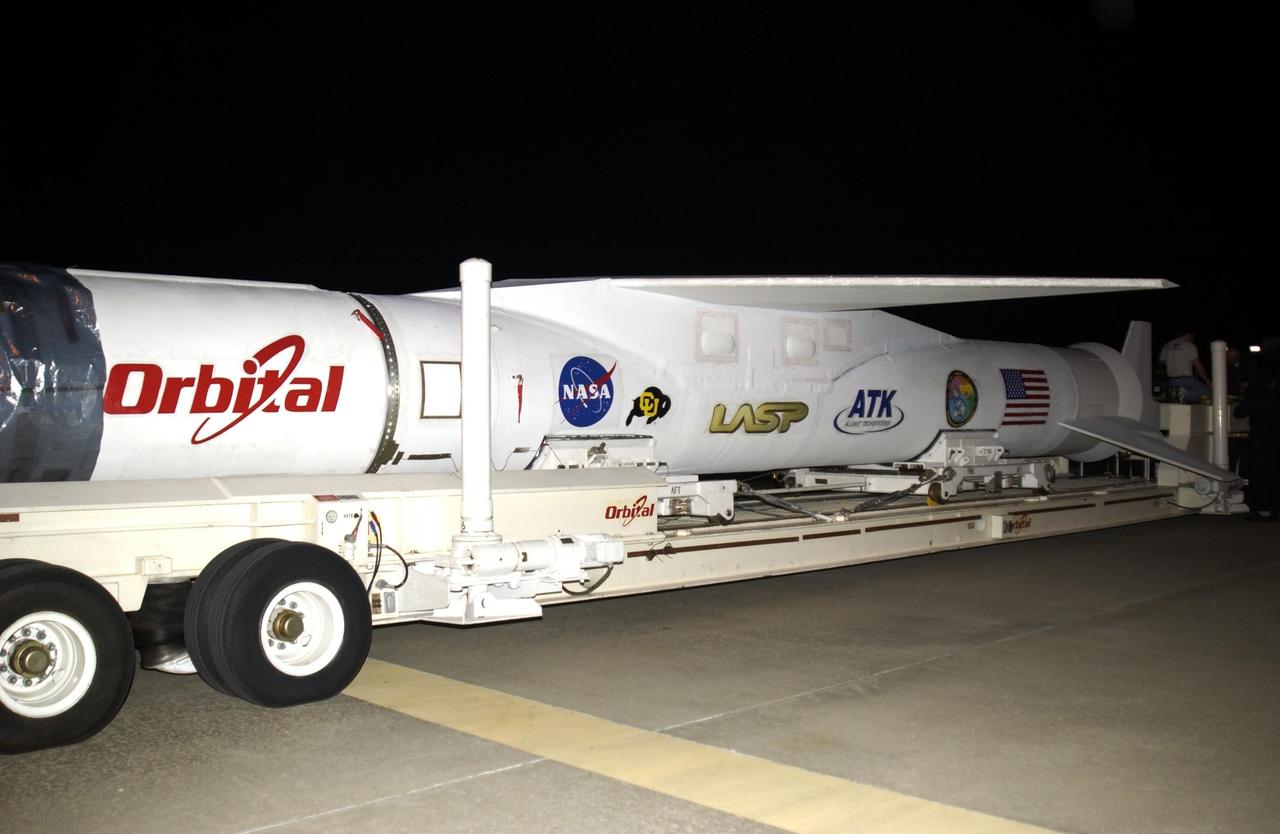
KENNEDY SPACE CENTER, FLA. - The Pegasus XL launch vehicle, with the Solar Radiation and Climate Experiment (SORCE) satellite aboard, begins its transfer to Cape Canaveral Air Force Station (CCAFS), Fla. Built by Orbital Sciences Corporation (OSC), SORCE will study and measure solar irradiance as a source of energy in the Earth's atmosphere. The launch of SORCE is scheduled for Jan. 25 at 3:14 p.m. from CCAFS. The drop of the Pegasus will be from OSC's L-1011 aircraft at an altitude of 39,000 feet over the Atlantic Ocean approximately 100 miles east-southeast of Cape Canaveral.
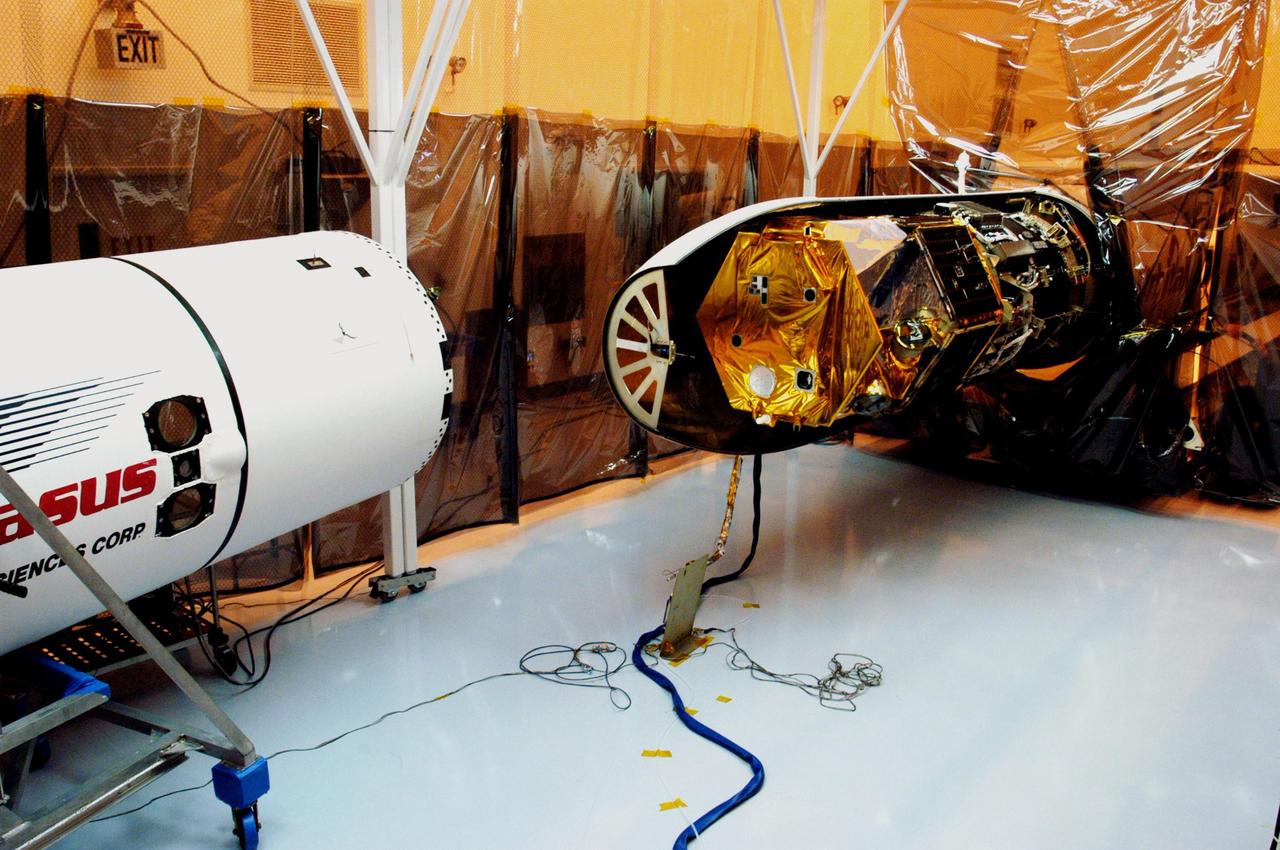
KENNEDY SPACE CENTER, FLA. - Both the Pegasus XL launch vehicle (left) and the Solar Radiation and Climate Experiment (SORCE) satellite are seen prior to encapsulation and installation. Built by Orbital Sciences Corporation (OSC), SORCE will study and measure solar irradiance as a source of energy in the Earth's atmosphere. The launch of SORCE is scheduled for Jan. 25 at 3:14 p.m. from Cape Canaveral Air Force Station, Fla. The drop of the Pegasus will be from OSC's L-1011 aircraft at an altitude of 39,000 feet over the Atlantic Ocean approximately 100 miles east-southeast of Cape Canaveral.
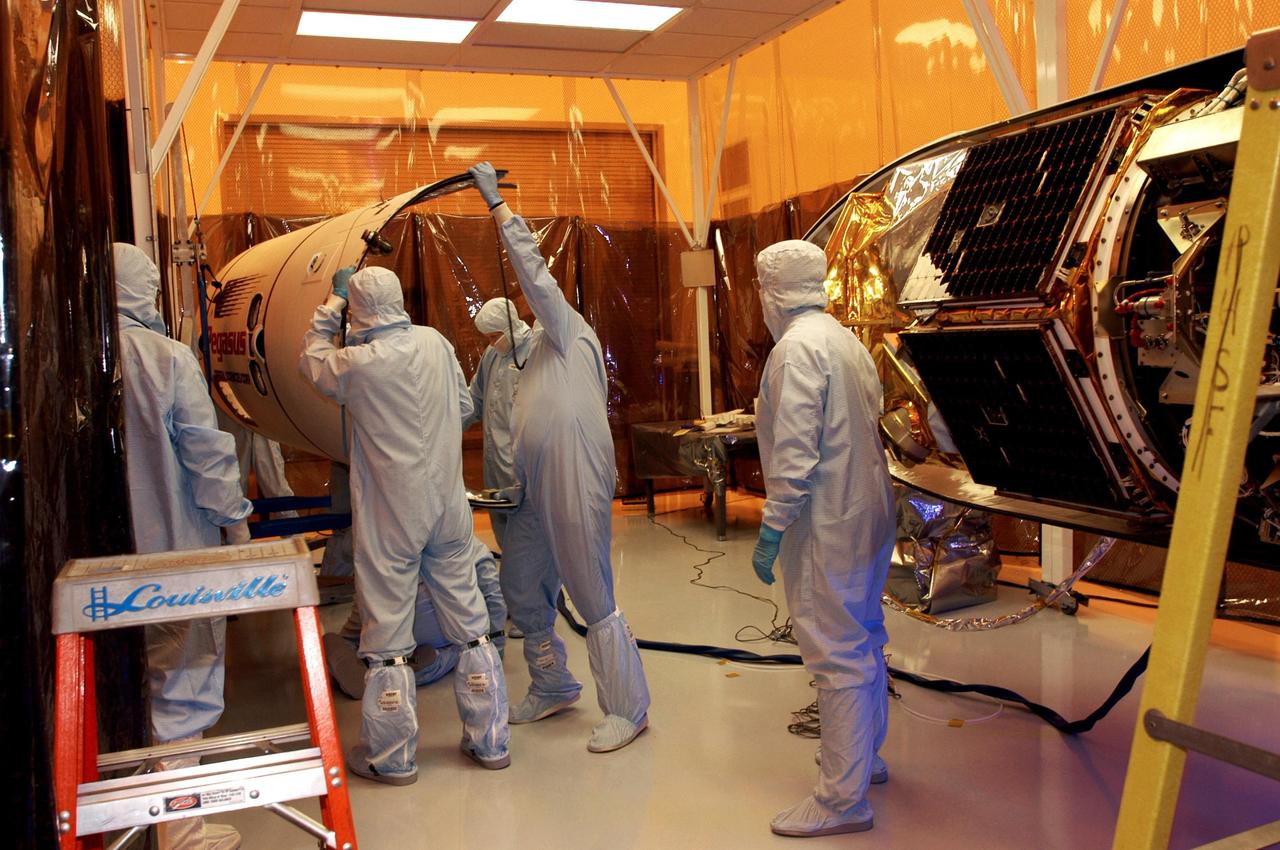
KENNEDY SPACE CENTER, FLA. -- Workers in the Multi-Purpose Processing Facility move part of the fairing toward the Solar Radiation and Climate Experiment (SORCE) satellite for encapsulation. The satellite will be installed in the Pegasus XL launch vehicle. Built by Orbital Sciences Corporation (OSC), SORCE will study and measure solar irradiance as a source of energy in the Earth's atmosphere. The launch of SORCE is scheduled for Jan. 25 at 3:14 p.m. from Cape Canaveral Air Force Station, Fla. The drop of the Pegasus will be from OSC's L-1011 aircraft at an altitude of 39,000 feet over the Atlantic Ocean approximately 100 miles east-southeast of Cape Canaveral.

KENNEDY SPACE CENTER, FLA. - The SORCE satellite is ready for mating to the Pegasus launch vehicle. SORCE is equipped with four instruments that will measure variations in solar radiation and observe some spectral properties of solar radiation for the first time. With data from NASA's SORCE mission, researchers should be able to follow how the Sun affects our climate now and in the future. Launch of SORCE aboard the Pegasus XL rocket is scheduled for Jan. 25, 2003, at approximately 3:14 p.m. EST, from Cape Canaveral Air Force Station, Fla.
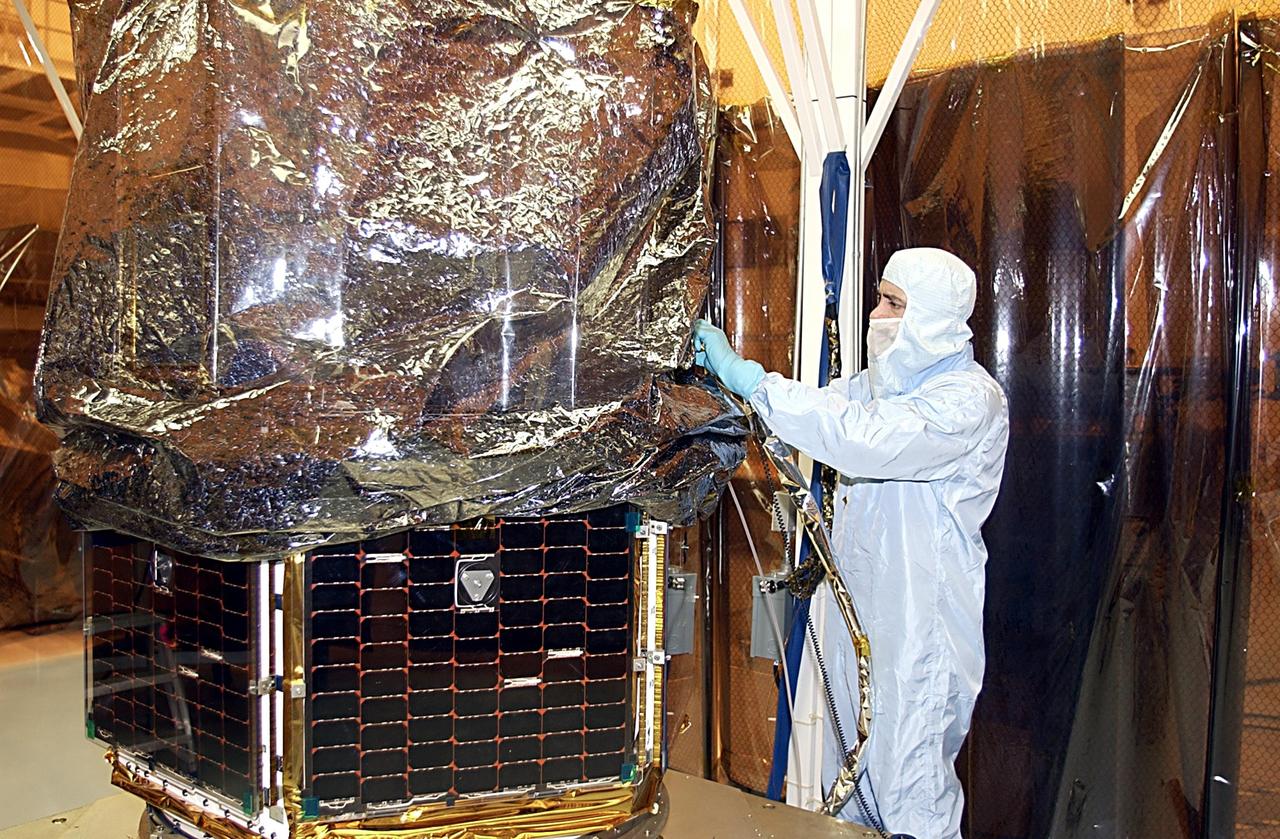
KENNEDY SPACE CENTER, FLA. - A worker adjusts the protective cover on the SORCE satellite before its move to a rotating workstand and mating to the Pegasus launch vehicle. SORCE is equipped with four instruments that will measure variations in solar radiation and observe some spectral properties of solar radiation for the first time. With data from NASA's SORCE mission, researchers should be able to follow how the Sun affects our climate now and in the future. Launch of SORCE aboard the Pegasus XL rocket is scheduled for Jan. 25, 2003, at approximately 3:14 p.m. EST, from Cape Canaveral Air Force Station, Fla.
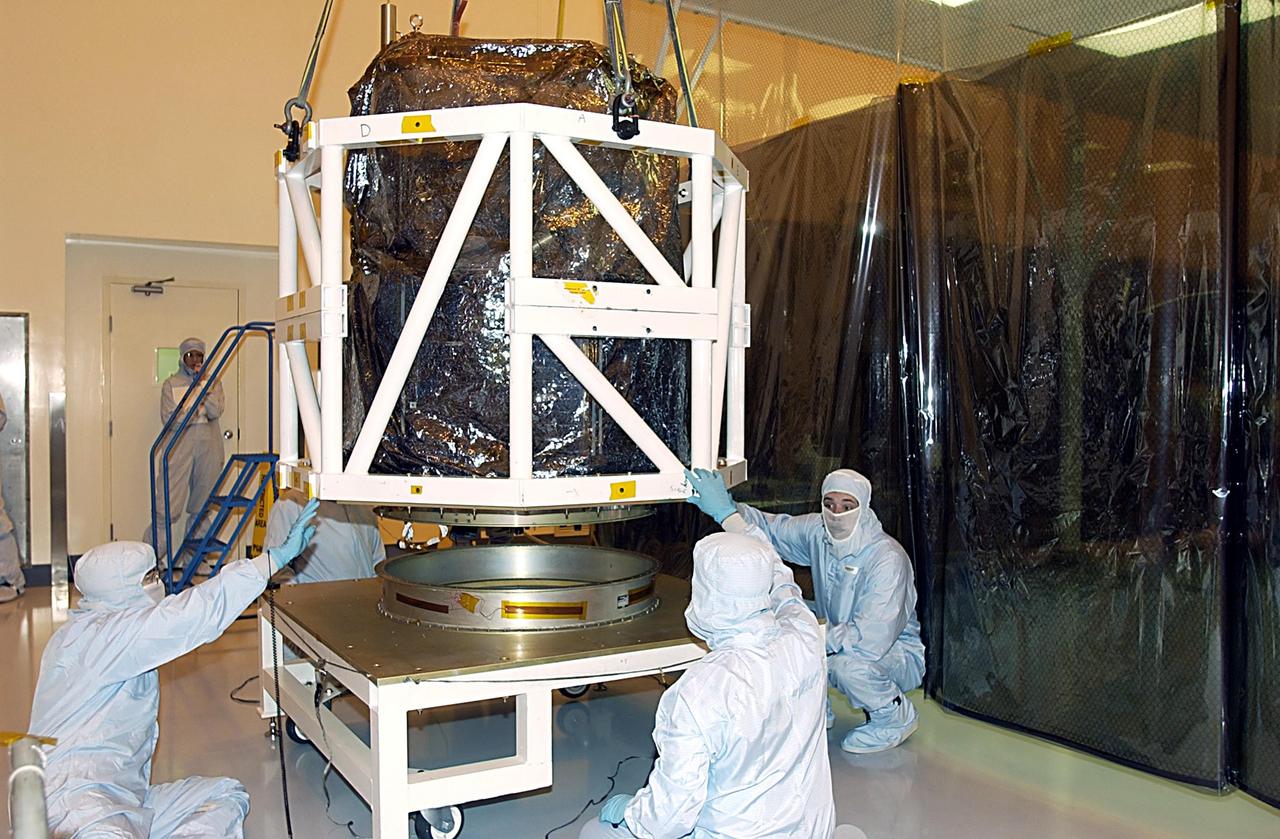
KENNEDY SPACE CENTER, FLA. - Workers keep watch as the SORCE satellite is lifted off its workstand. The equipment will rotate the satellite for mating to the Pegasus launch vehicle. SORCE is equipped with four instruments that will measure variations in solar radiation and observe some spectral properties of solar radiation for the first time. With data from NASA's SORCE mission, researchers should be able to follow how the Sun affects our climate now and in the future. Launch of SORCE aboard the Pegasus XL rocket is scheduled for Jan. 25, 2003, at approximately 3:14 p.m. EST, from Cape Canaveral Air Force Station, Fla.
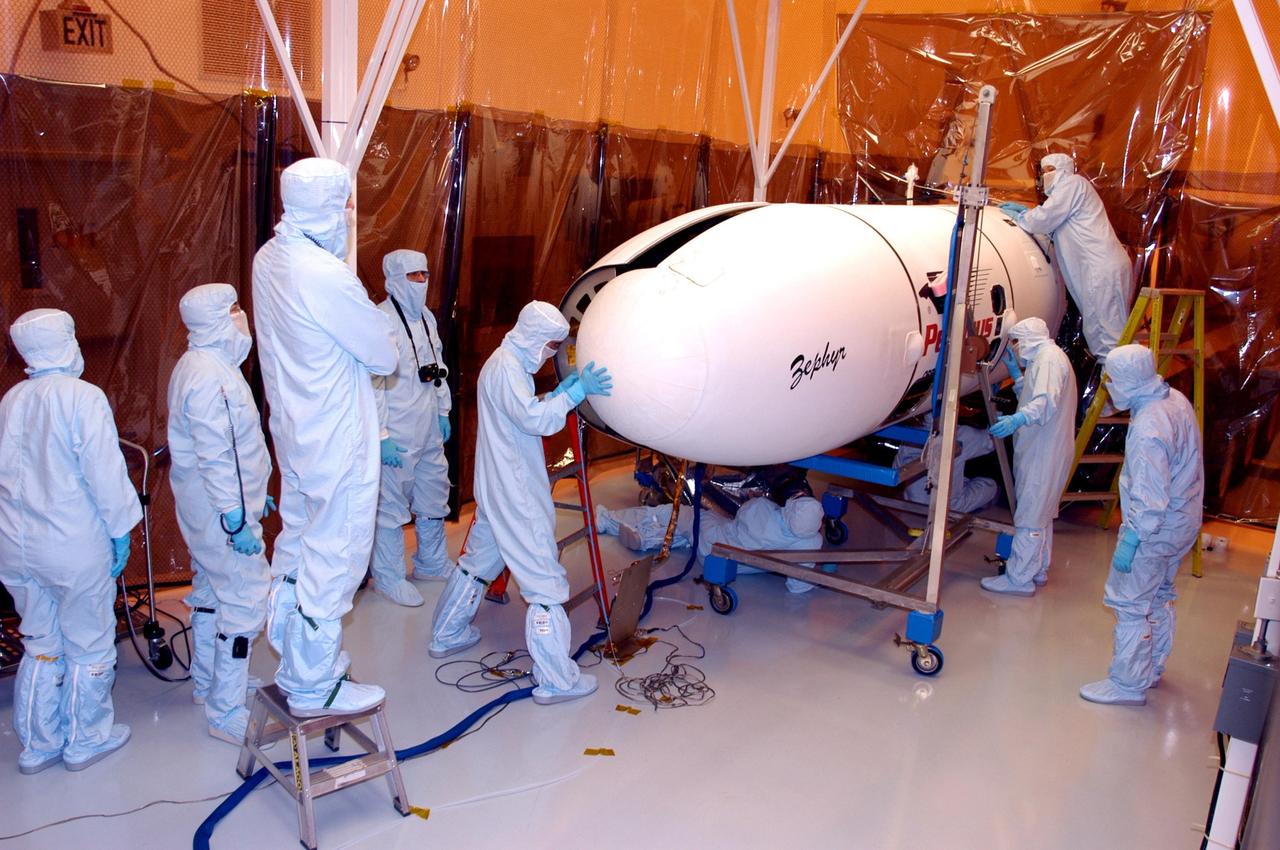
KENNEDY SPACE CENTER, FLA. -- Workers in the Multi-Purpose Processing Facility check the fairing placed around the Solar Radiation and Climate Experiment (SORCE) satellite. When fully encapsulated, the satellite will be installed in the Pegasus XL launch vehicle. Built by Orbital Sciences Corporation (OSC), SORCE will study and measure solar irradiance as a source of energy in the Earth's atmosphere. The launch of SORCE is scheduled for Jan. 25 at 3:14 p.m. from Cape Canaveral Air Force Station, Fla. The drop of the Pegasus will be from OSC's L-1011 aircraft at an altitude of 39,000 feet over the Atlantic Ocean approximately 100 miles east-southeast of Cape Canaveral.