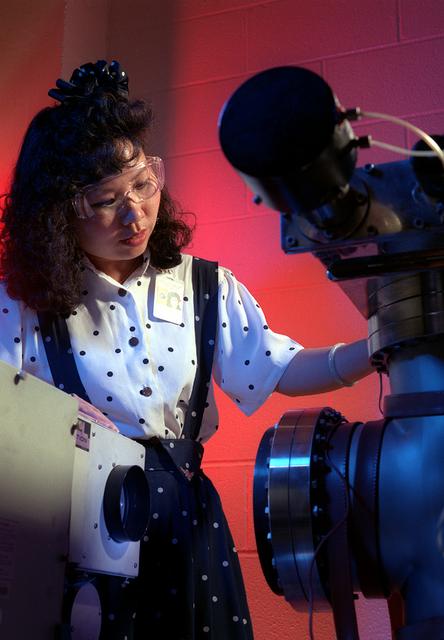
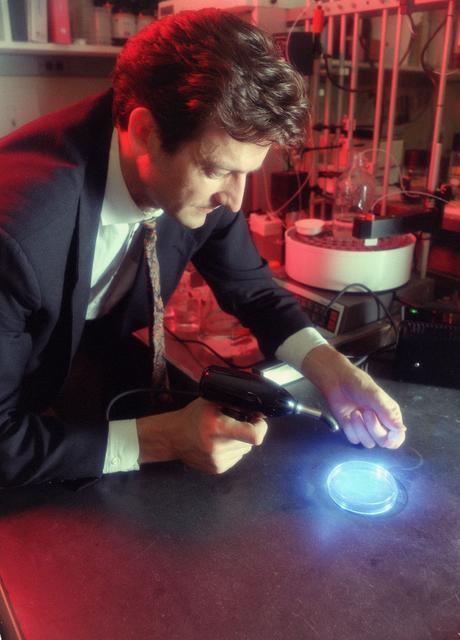
A pigment (phthalocyanine) is studied at the Marshall Materials and Processes Lab. The pigment has the ability to protect spacecraft against the harmful effects of the Sun's ultraviolet rays, and to increase the efficiency and life of solar cells.
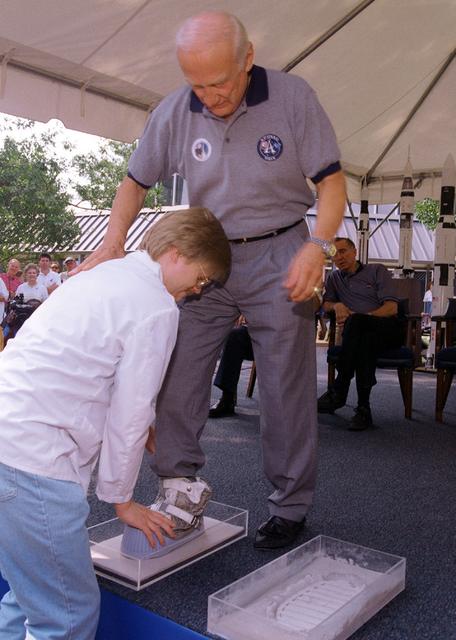
Apollo 11 Astronaut Buzz Aldrin has his footprints casted during the dedication ceremony of the rocket fountain at Building 4200 at Marshall Space Flight Center. The casts of Aldrin's footprints will be placed in the newly constructed Von Braun courtyard representing the accomplishments of the Apollo 11 lunar landing.

Prior to the commencement of Apollo 11th's 30th arniversary festivities at Marshall Space Flight Center, visiting Saturn astronauts take a tour of the Center. Pictured are (L/R): Dick Gordon, Owen Garriott and Edgar Mitchell
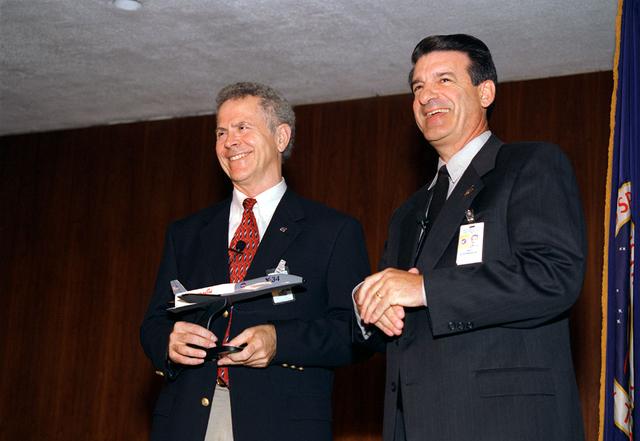
Author of Rocket Boys Homer Hickam, Jr. (left) and Marshall Space Flight Center Director Art Stephenson during a conference at Morris Auditorium. Homer Hickam worked at MSFC during the Apollo project years. As a young man, Mr. Hickam always dreamed of becoming a rocket scientist and following in the footsteps fo Wernher von Braun. Years later he would see his dream realized and had written Rocket Boys commemorating his life and the people at MSFC.
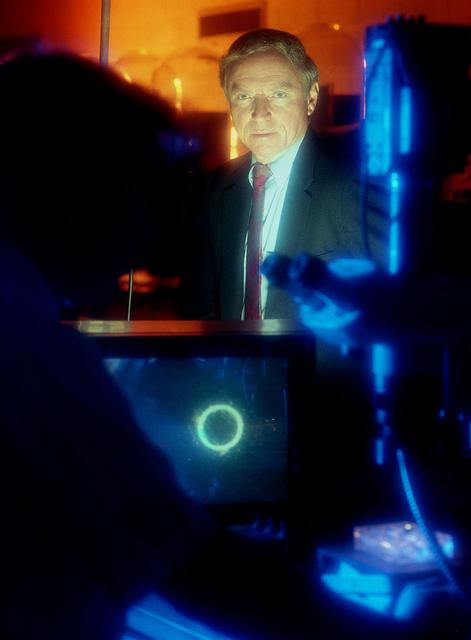
Test of bearing and seal materials in order to develop improved life bearing designs for operating in liquid turbomachinery.
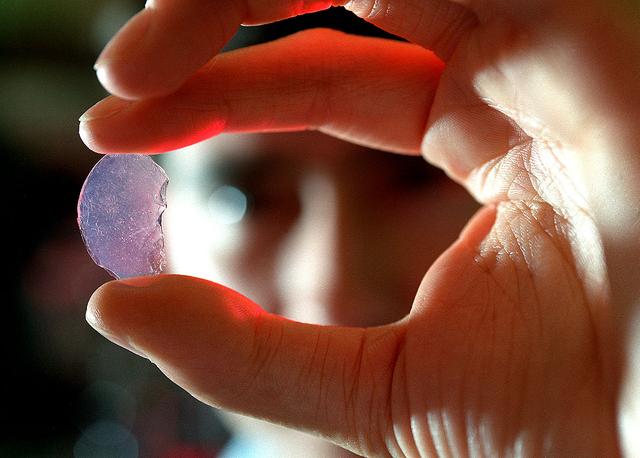
Sceintist at Marshall Space Flight Center have been studying the properties of Aerogel for several years. Aerogel, the lightest solid known to man, has displayed a high quality for insulation. Because of its smoky countenance, it has yet to be used as an insulation on windows, but has been used in the space program on the rover Sojourner, and has been used as insulation in the walls of houses and in automobile engine compartments. MSFC is one of the many research facilities conducting experiments to unlock the smoky properties of Aerogel and make it a clear substance. Recent experimentations in microgravity have resulted in the microstructure of the material. Research on these changes is being continued.
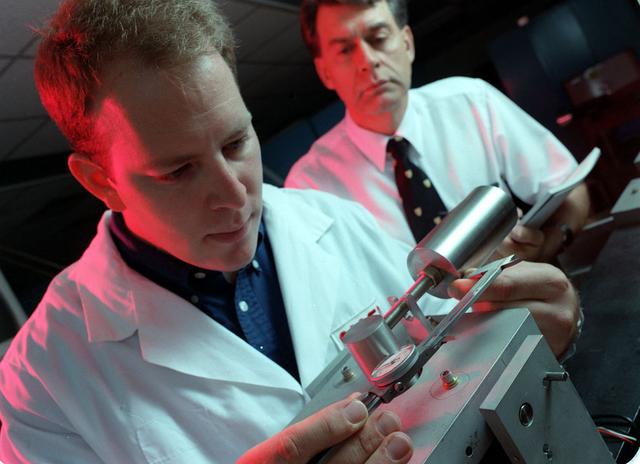
Marshall researchers, in the Astrionics lab, study rotating unbalanced mass devices. These require less power, and are lighter than current devices used for scanning images, a slice at a time. They have a wide range of space-based applications.
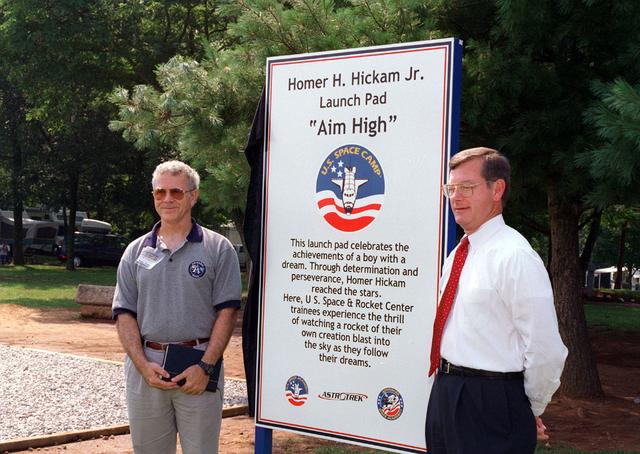
Noted author and previous Marshall Space Flight Center employee Mr. Homer Hickam Jr. poses in front of a placque commemorating his achievement in realizing his dreams of becoming a rocket scientist. The dedication site is located at the U. S. Space and Rocket Center in Huntsville, AL, and is used by amature rocket builders attending the Space Camp to launch their self-made rockets like Mr. Hickam did as a youth growing up in rural West Virginia. Posing with Mr. Hickam is the Madison County Commissioner Mr. Mike Gillispie.
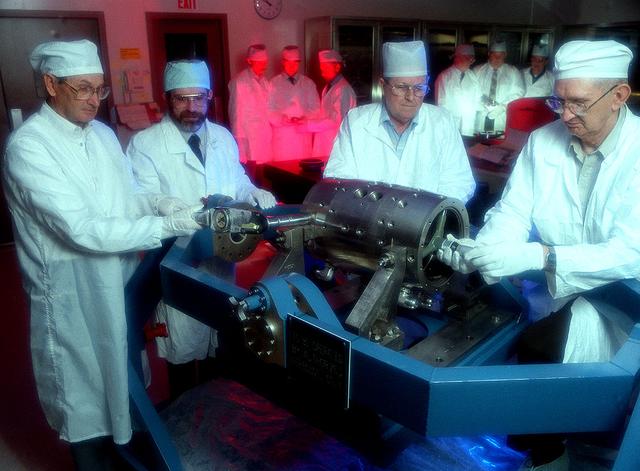
Test of bearing and seal materials in order to develop improved life bearing designs for operating in liquid turbomachinery.
Scientists at MSFC have been studying the properties of Aerogel for several years. Aerogel, the lightest solid known to man, has displayed a high quality for insulation. Because of its smoky countenance it has yet to be used as an insulation on windows, but has been used to insulate the walls of houses and engine compartments in cars. It was also used in the space program as insulating material on the rover Sojourner, aboard the Mars Pathfinder. MSFC is one of the many research facilities conducting experiments to unlock the smoky properties of aerogel and make it a clear substance. MSFC researchers believe that by taking this research to space, they can resolve the problem of making aerogel transparent enough to see through. So far, recent space experiments have been encouraging. The samples produced in microgravity indicate a change in the microstructure of the material as compared to ground samples. MSFC scientists continue to study the effects of microgravity on Aerogel as their research is space continues.
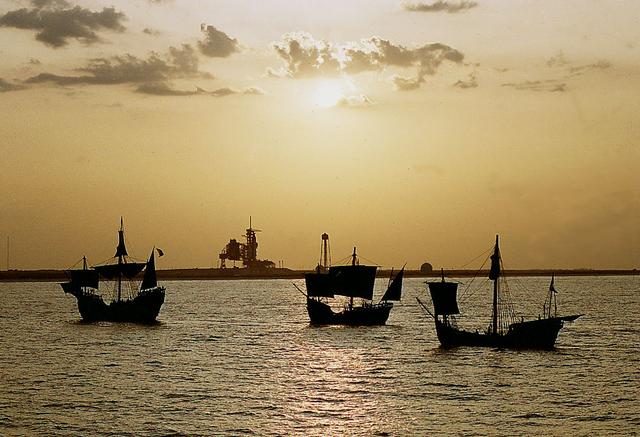
On the 500th arniversary of Christopher Columbus' discovery of the New World, replicas of his three ships sailed past the launch pad at the Kennedy Space Center (KSC) while the space shuttle Columbia sat poised for lift off.
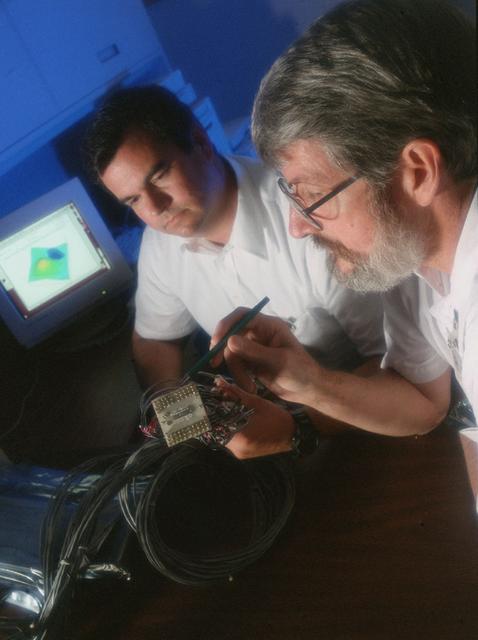
Researchers at Marshall's Space Science Laboratory successfully demonstrate that linear arrays of Hall probes can be constructed in high Hall coefficient films and used to digitally image magnetic fields. This research is beneficial to visually imaging any magnetic field.
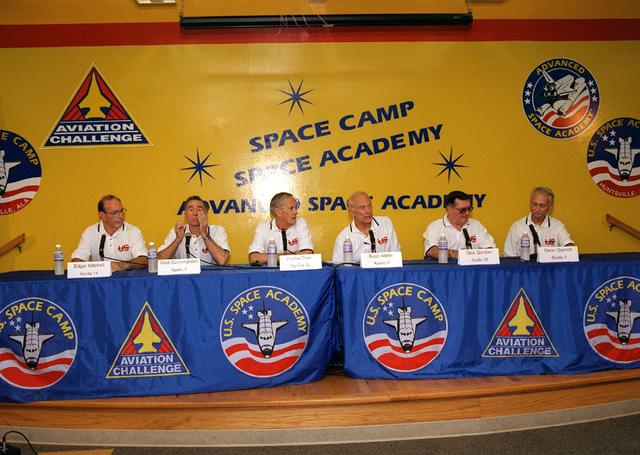
Marking the occasion of the Apollo 11 30th Anniversary, members of the Apollo and Saturn astronaut programs attended festivities at Marshall Space Flight Center in Huntsville, AL. A press conference was held at the U. S. Space and Rocket Center for the visiting astronauts. Pictured are (L/R): Edgar Mitchell, Walt Cunningham, Charlie Duke, Buzz Aldrin, Dick Gordon and Owen Garriott.
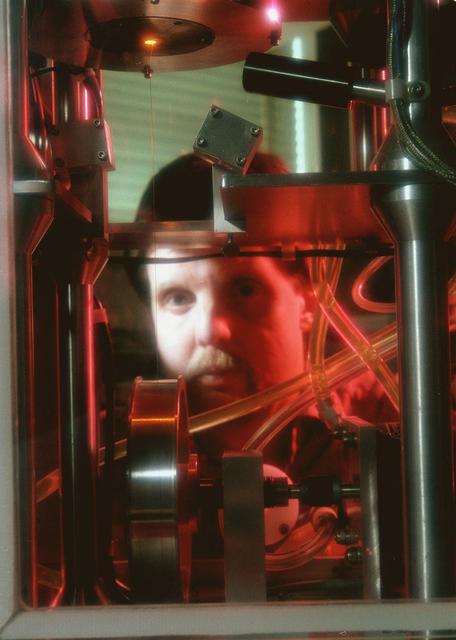
Scientists at Marshall's Materials and Processes Lab are pulling glass fibers from simulated lunar soil. This technology could lead to the building of thermally protected lunar buildings made of materials already there.
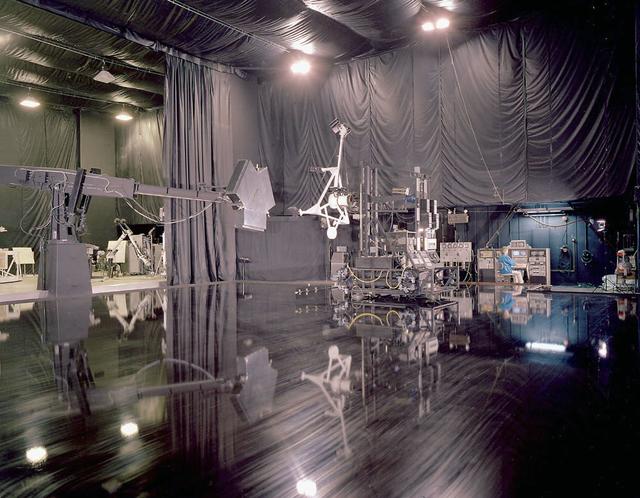
Marshall employees conduct tests on the simulated rendezvous docking mechanism (SRDM)as depicted in this photo of the flat floor area in building 4619.
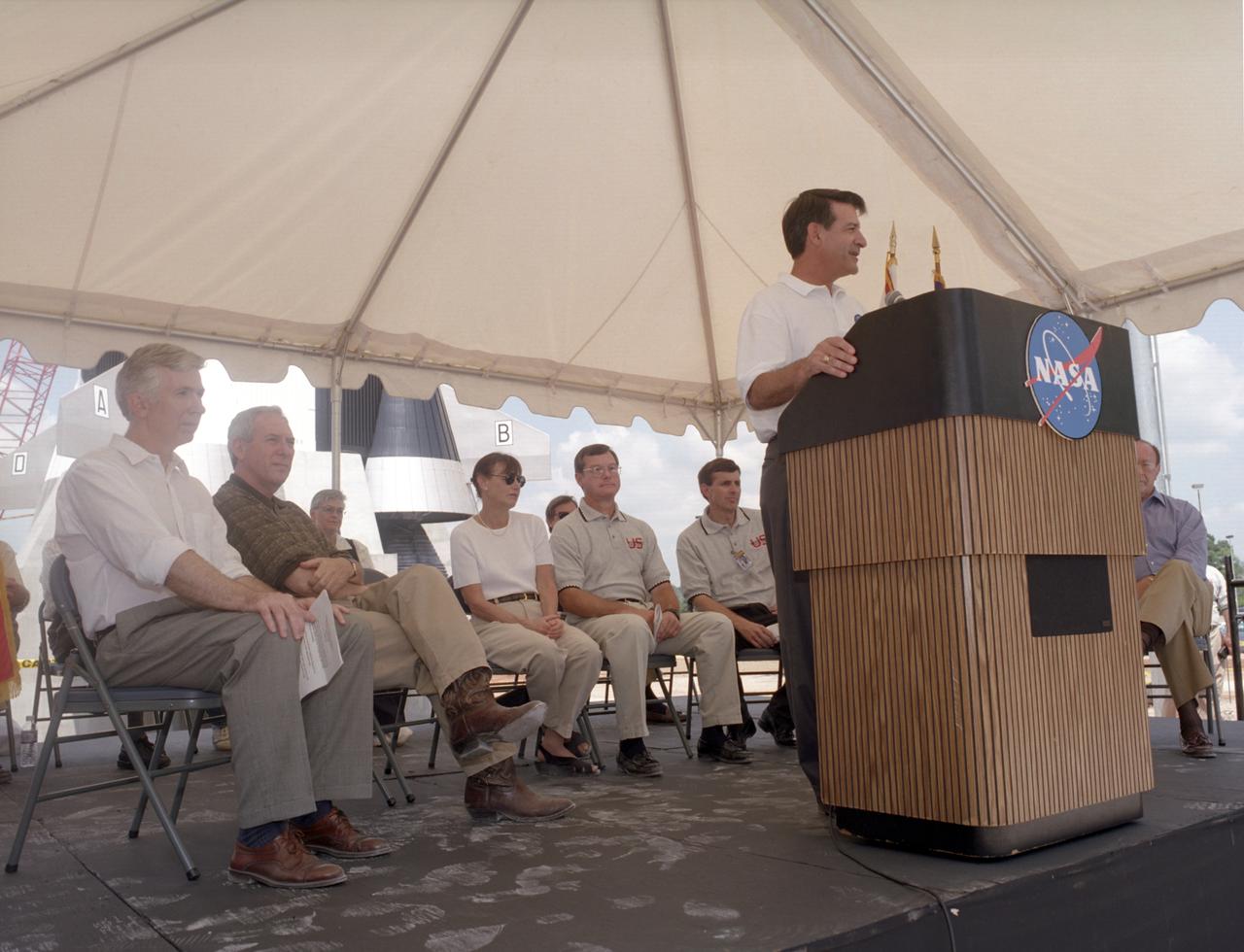
A replica of the Saturn V rocket that propelled man from the confines of Earth's gravity to the surface of the Moon was built on the grounds of the U. S. Space and Rocket Center in Huntsville, AL. in time for the 30th arniversary celebration of that historic occasion. Marshall Space Flight Center and its team of German rocket scientists headed by Dr. Wernher von Braun were responsible for the design and development of the Saturn V rocket. Pictured are MSFC's current Center Director Art Stephenson, Alabama Congressman Bud Cramer, and NASA Administrator Dan Goldin during the dedication ceremony.
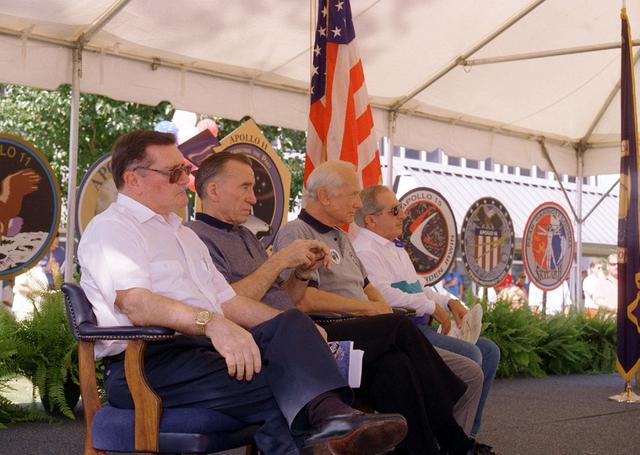
Outside of Building 4200 at Marshall Space Flight Center, a courtyard was constructed in memory of Dr. Wernher von Braun and his contributions to the U. S. Space program. In the middle of the courtyard a fountain was built. The fountain was made operational prior to the 30th arniversary celebration of the Apollo 11 lunar landing. Attending the dedication ceremony were visiting Apollo astronauts and NASA's Safety and Assurance Director Rothenberg.

A replica of the Saturn V rocket that propelled man from the confines of Earth's gravity to the surface of the Moon was built on the grounds of the U. S. Space and Rocket Center in Huntsville, AL. in time for the 30th arniversary celebration of that historic occasion. Marshall Space Flight Center and its team of German rocket scientists headed by Dr. Wernher von Braun were responsible for the design and development of the Saturn V rocket. Pictured are MSFC's current Center Director Art Stephenson, Alabama Congressman Bud Cramer, NASA Administrator Dan Goldin, and director of the U. S. Space and Rocket Center Mike Wing during the dedication ceremony.
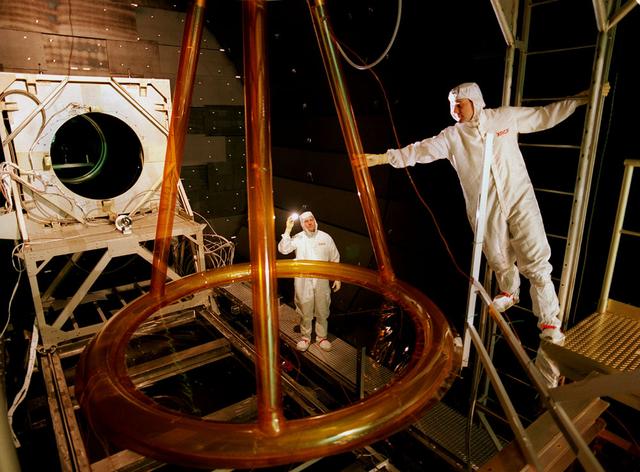
The Shooting Star Experiment (SSE) is designed to develop and demonstrate the technology required to focus the sun's energy and use the energy for inexpensive space Propulsion Research. Pictured is an engineering model (Pathfinder III) of the Shooting Star Experiment (SSE). This model was used to test and characterize the motion and deformation of the structure caused by thermal effects. In this photograph, alignment targets are being placed on the engineering model so that a theodolite (alignment telescope) could be used to accurately measure the deformation and deflections of the engineering model under extreme conditions, such as the coldness of deep space and the hotness of the sun as well as vacuum. This thermal vacuum test was performed at the X-Ray Calibration Facility because of the size of the test article and the capabilities of the facility to simulate in-orbit conditions
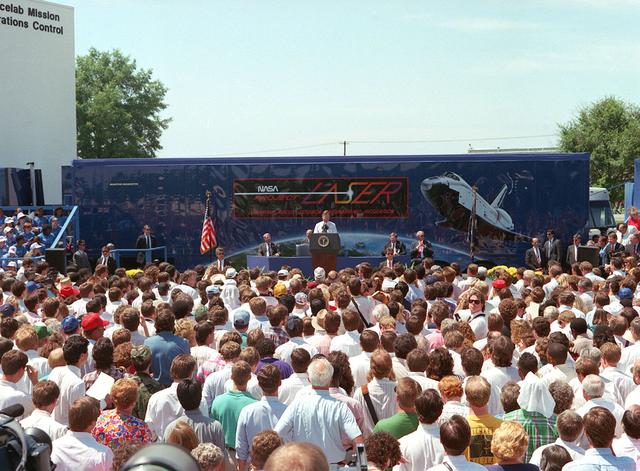
President George Bush delivers an address to Marshall Space Flight Center (MSFC) employees during his visit to the center. President Bush gave NASA employees an objective to send missions back to the moon to stay then continue on to Mars, referring to the Space Station project.
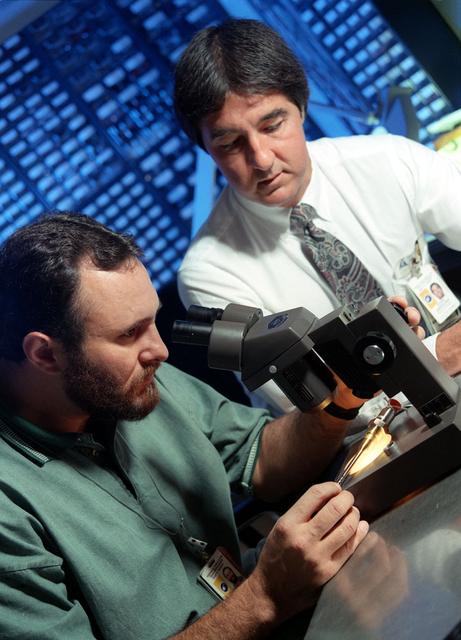
A rugged, highly accurate, low-temperature sensor is developed by NASA researchers. A new sensor allows accurate, quick low-temperature measurements in rugged environments. This is especially useful in piping with very cold liquids under high pressure, and high flow rate conditions.
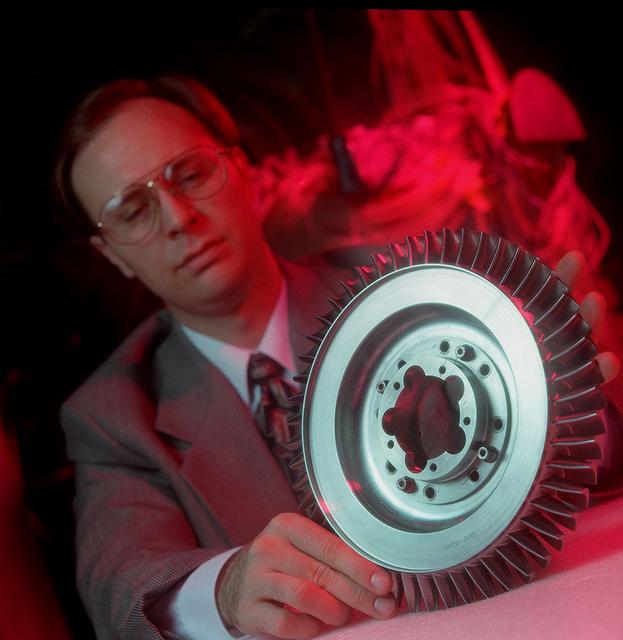
A NASA scientist displays Space Shuttle Main Engine (SSME) turbine component which underwent air flow tests at Marshall's Structures and Dynamics Lab. Such studies could improve efficiency of aircraft engines, and lower operational costs.
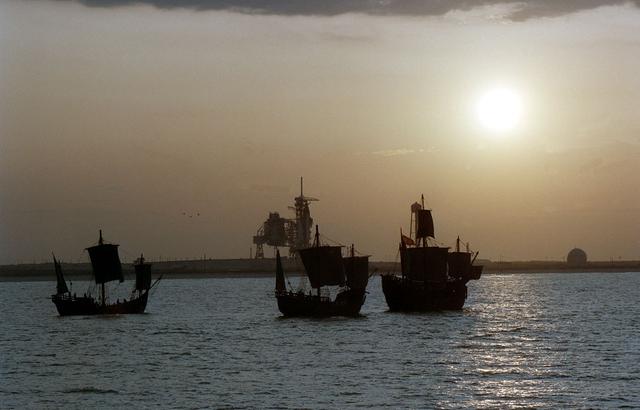
On the 500th arniversary of Christopher Columbus' discovery of the New World, replicas of his three ships sailed past the launch pad at the Kennedy Space Center (KSC) while the space shuttle Columbia sat poised for lift off.
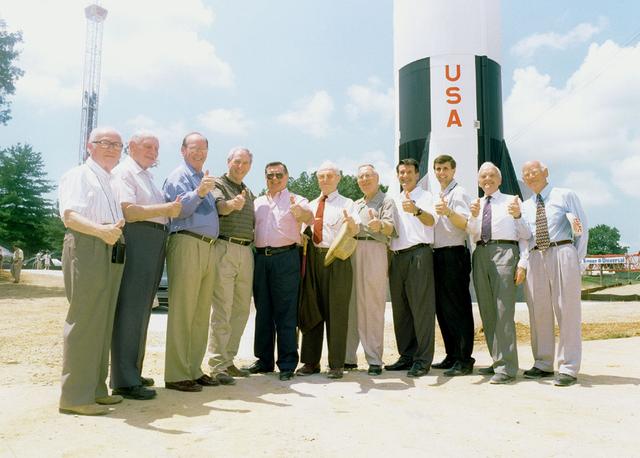
Members of the original Von Braun german rocket team participate in the Saturn V replica didication ceremony at the U. S. Space and Rocket Center in Huntsville, AL. Pictured are (L/R): Walter Jacobi, Konrad Dannenberg, Apollo 14's Edgar Mitchell, NASA Administrator Dan Goldin, Apollo 12's Dick Gordon, Gerhard Reisig, Werner Dahm, MSFC Director Art Stephenson, Director of the U. S. Space and Rocket Center Mike Wing, Walter Haeusserman, and Ernst Stuhlinger.
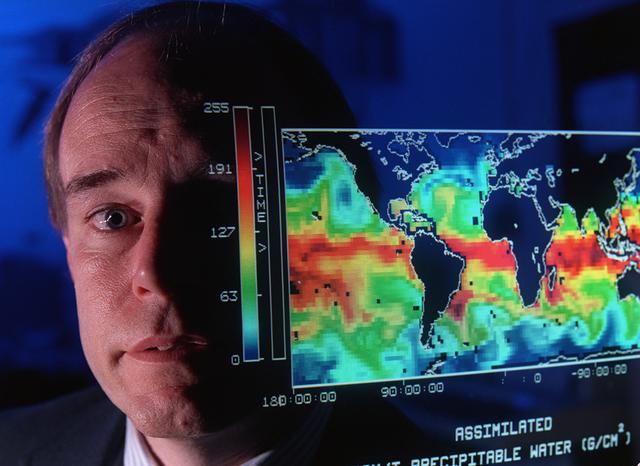
This map shows the presence of water vapor over global oceans. The imagery was produced by combining Special Sensor Microwave Imager measurements and computer models. This data will help scientists better understand how weather systems move water vapor from the tropics toward the poles producing precipitation.
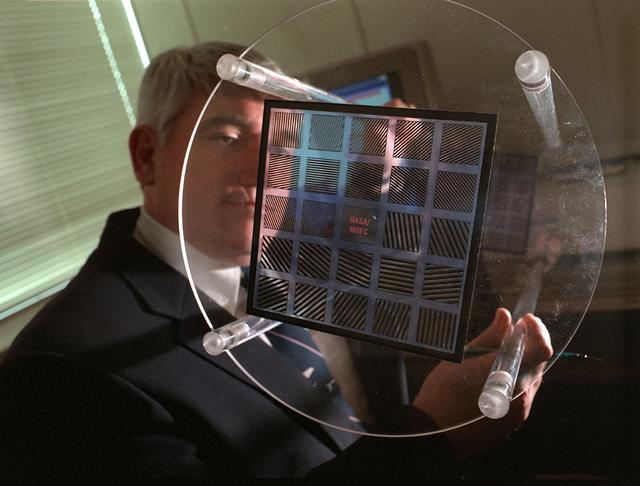
Marshall's wirner of a Research Technology Award, worked with the Fourier telescope. This project has developed new technology with the aid of today's advanced computers by allowing an object to be x-rayed using an absorption pattern, then sending this data to the computer where it calculates the data into pixels which inturn develops an image. This new technology is being used in fields like astronomy, astrophysics and medicine.
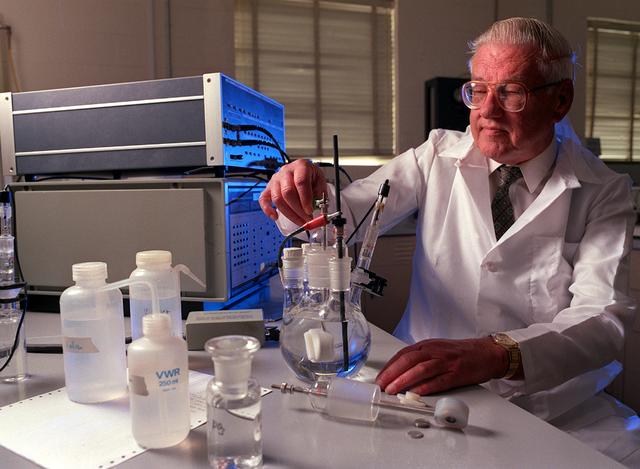
Marshall researcher studies hydrogen diffusion and corrosion effects on metals.
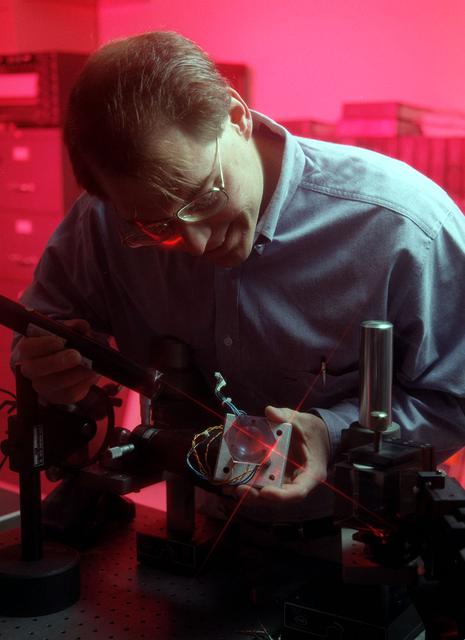
The SELENE Optics project was designed to send powerful laser beams into space to repower satellites and to recharge their batteries, as well as sending laser beams to the moon for the same purpose instead of relying on solar power. This project also was intended to be used for repowering extended space flights.
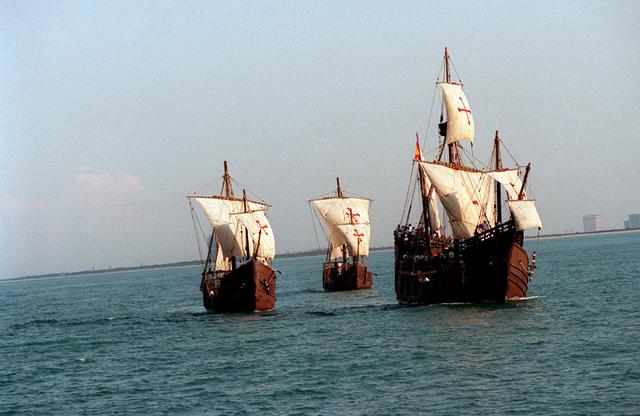
On the 500th arniversary of Christopher Columbus' discovery of the New World, replicas of his three ships sailed past the launch pad at the Kennedy Space Center (KSC) while the space shuttle Columbia sat poised for lift off.
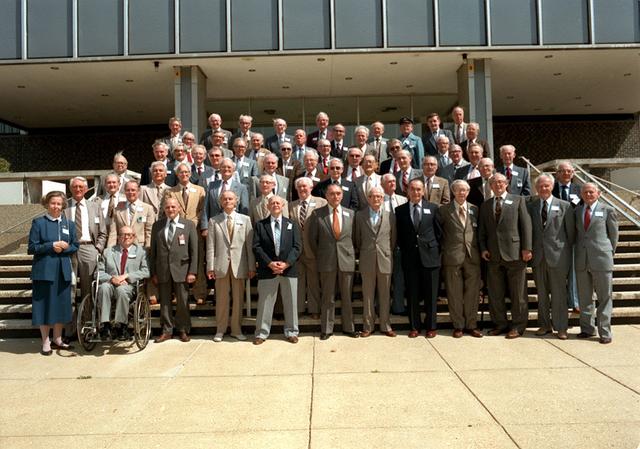
The Peenemunde Rocket Team reunited on the steps of Marshall Space Flight Center's (MSFC) Headquarter Building 4200 for a reunion. The Peenemunde Rocket team were first assembled in Germany prior to World War II. They came to the United States at the end of the War and became the nucleus of the United States Army's rocket program.

The Andromeda Galaxy, also known as M31 since it is the 31st object on Messier's list of diffuse sky objects, is the nearest large galaxy to our own Milky Way galaxy. Our galaxy is thought to look much like Andromeda, but it is about four times as massive as the Milky Way. Together these two galaxies dominate the Local Group of galaxies. The diffused light from Andromeda is caused by hundreds of billions of stars that compose it. The several distinct stars that surround Andromeda's image are actually stars in our galaxy that are well in front of the background object. Andromeda is so distant that it takes approximately two millions years for light to reach us from there.
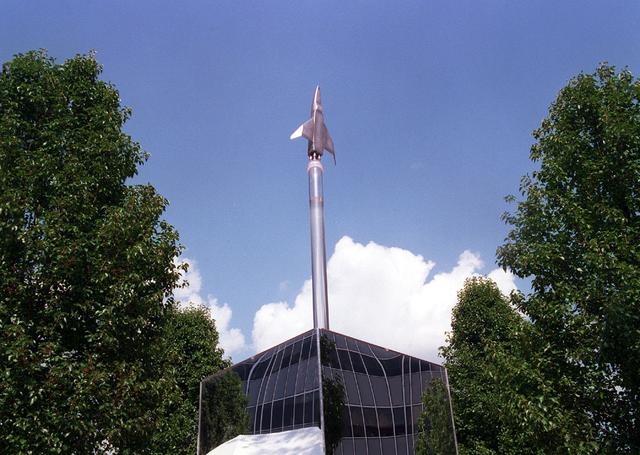
A fountain representing a rocket launch was dedicated in the Von Braun courtyard outside of Building 4200 at Marshall Space Flight Center during the weekend celebrating the 30th arniversary of the Apollo 11 lunar landing. On hand for the festivities were many of the Saturn and Apollo astronauts.

On the 500th arniversary of Christopher Columbus' discovery of the New World, replicas of his three ships sailed past the launch pad at the Kennedy Space Center (KSC) while the space shuttle Columbia sat poised for lift off.
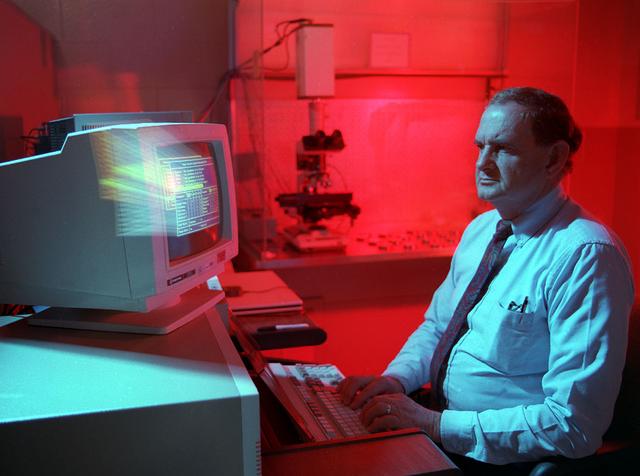
A NASA scientist operates the image analyzer to determine if telescope mirrors have become contaminated in the Materials and Processes lab at Marshall.
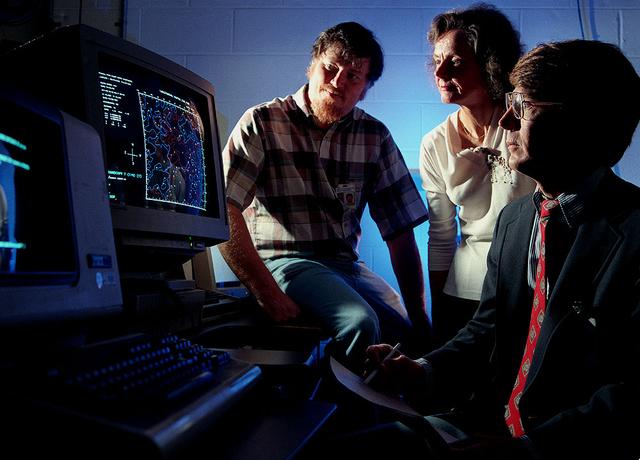
Solar Vector Magnetograph is used to predict solar flares, and other activities associated with sun spots. This research provides new understanding about weather on the Earth, and solar-related conditions in orbit.
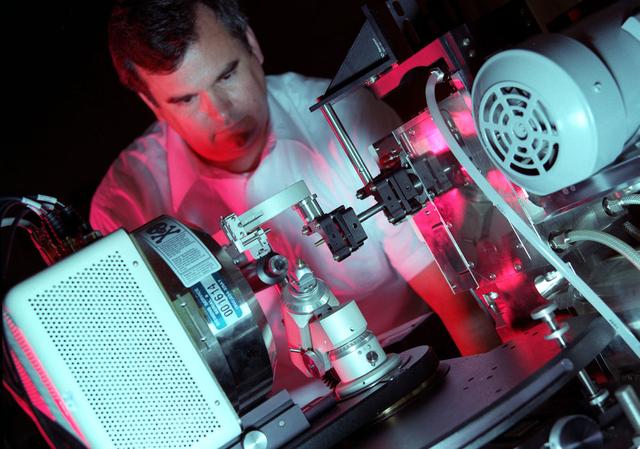
NASA scientist, in the Space Sciences lab at Marshall, works with capillary optics that generate more intense X-rays than conventional sources. This capability is useful in studying the structure of important proteins.
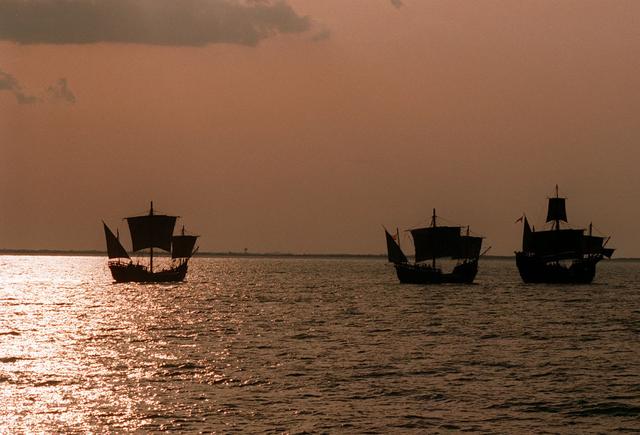
On the 500th arniversary of Christopher Columbus' discovery of the New World, replicas of his three ships sailed past the launch pad at the Kennedy Space Center (KSC) while the space shuttle Columbia sat poised for lift off.
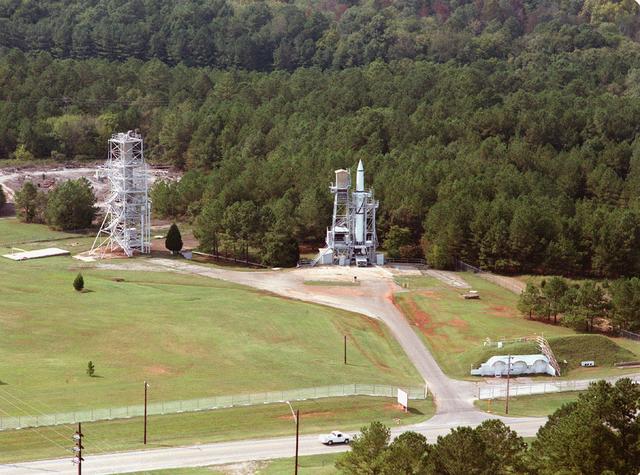
The Redstone Test Stand, shown here, was used throughout the 1950s to test the Redstone missionile, including the modified Redstone that launched America's first astronaut, Alan Shepard. The U. S. Department of the Interior's Park Services designated the Test Stand as a National Historic Landmark January 22, 1986.
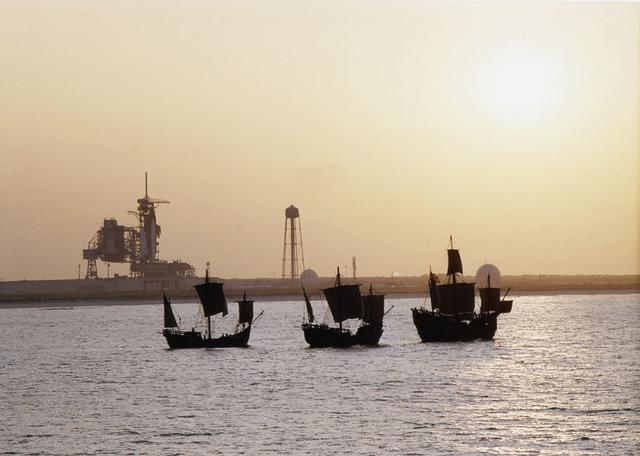
On the 500th arniversary of Christopher Columbus' discovery of the New World, replicas of his three ships sailed past the launch pad at the Kennedy Space Center (KSC) while the space shuttle Columbia sat poised for lift off.
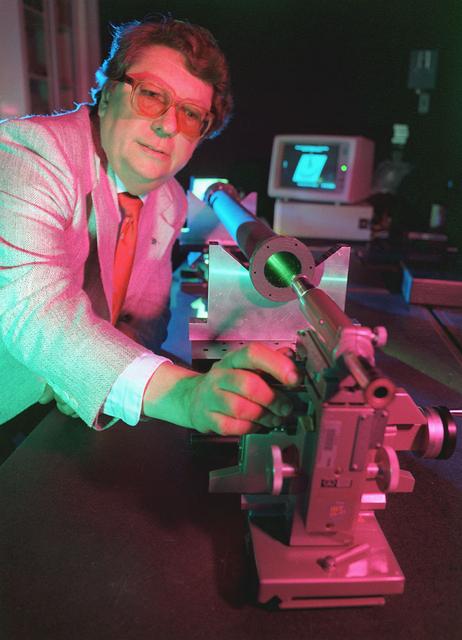
Marshall's 1992 Inventor of the Year demonstrates his multi-layer water window imaging x-ray microscope.
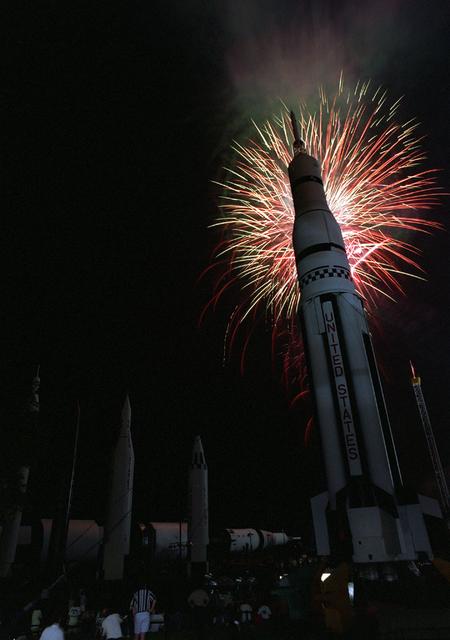
The evening skies over the U. S. Space and Rocket Center in Huntsville, AL burst into life as members of the Huntsville community gathered to celebrate the 30th arniversary of the Lunar Landing. Commerating this historical achievement for NASA and the US Space Program, a replica of the original Saturn V rocket was built on the grounds of the U. S. Space and Rocket Center in Huntsville, AL. On the evening of the anniversary thousands of onlookers cheered as fireworks lit up the night sky behind the massive Saturn V rocket.
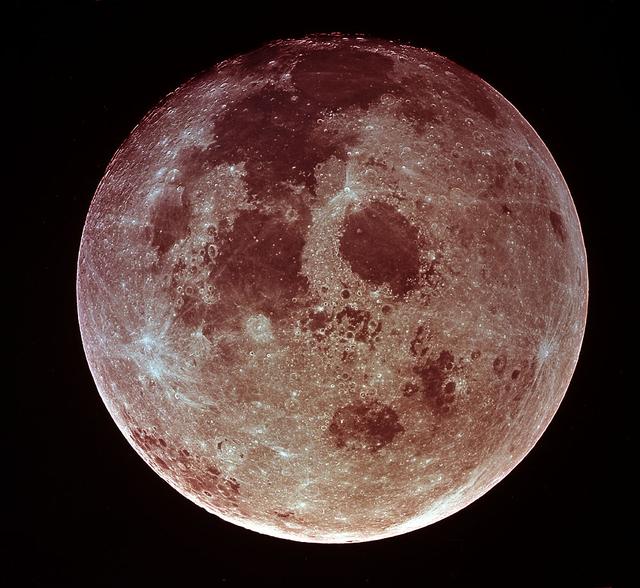
On July 21, 1969, only days after walking on the Moon's surface, Neil Armstrong and Buzz Aldrin leave lunar orbit and begin the journey back to the space ship Columbia and its return to Earth. As they leave the Moon's orbit, a look back gives them a new perspective of where they were and where man's future lies. This was their final sight of the moon before they began docking procedures with Columbia.
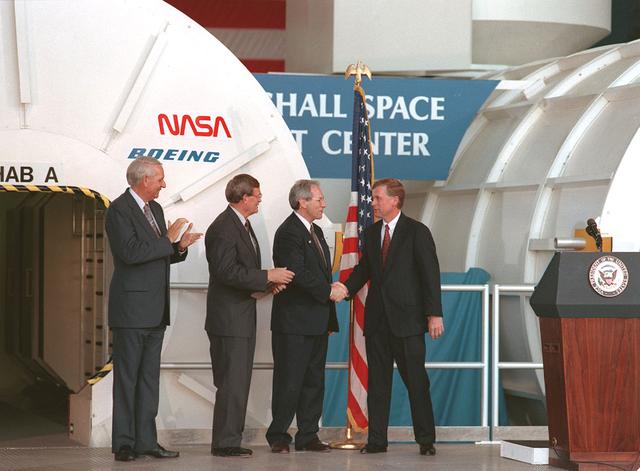
Vice-president Dan Quayle and Alabama Governor Guy Hunt are greeted by Marshall Center Director Thomas J. Lee (1989-1994) (center) and NASA Administrator Dan Goldin (shaking hands with Vice-president Quayle) at the space station engineering mock-up.
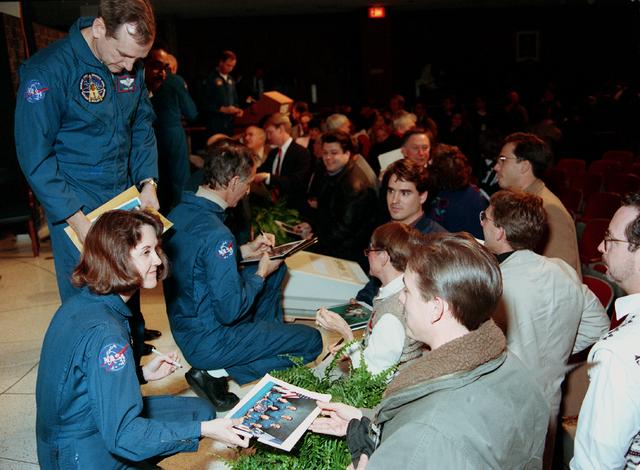
STS-61 astronauts Kathryn Thornton, Jeffrey Hoffman and Thomas Akers (standing) sign autographs in Marshall Space Flight Center's Morris Auditorium, January 19, 1994. Space Shuttle crews traditionally visited NASA field centers following each mission to present mission highlights and recognize employees who made contributions to the Shuttle program. Many of the techniques used during the STS-61 Hubble Space Telescope Servicing mission were rehearsed at the Center's Neutral Buoyancy Simulator.
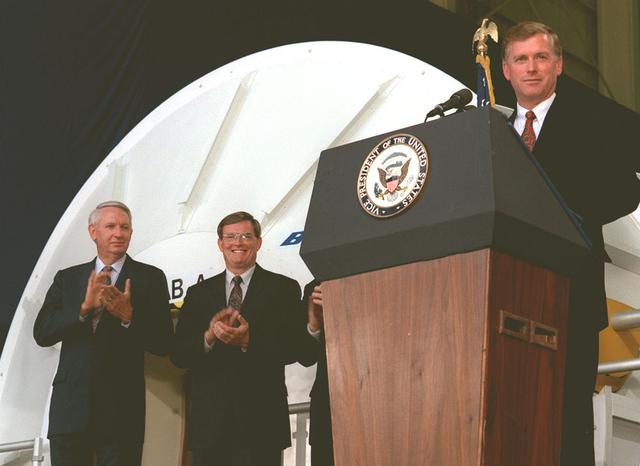
Vice-president Dan Quayle and Alabama Governor Guy Hunt with Marshall's sixth Center Director Thomas J. Lee (1989-1994) visit a model of the space station.
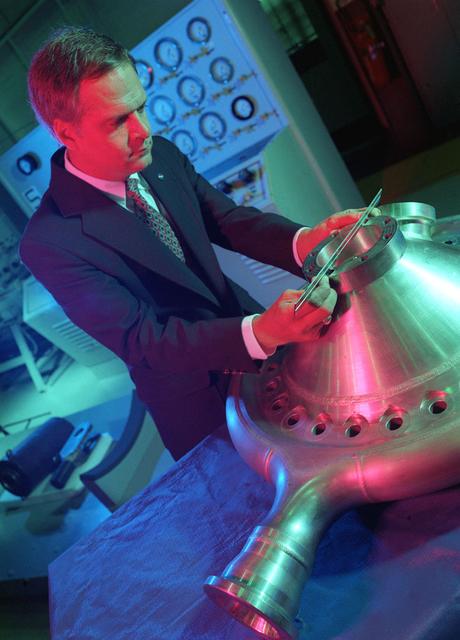
Research to lower the cost of thrust chamber assembly is conducted by Marshall scientist to significantly reduce the costs associated with thrust chamber/injector development and fabrication.
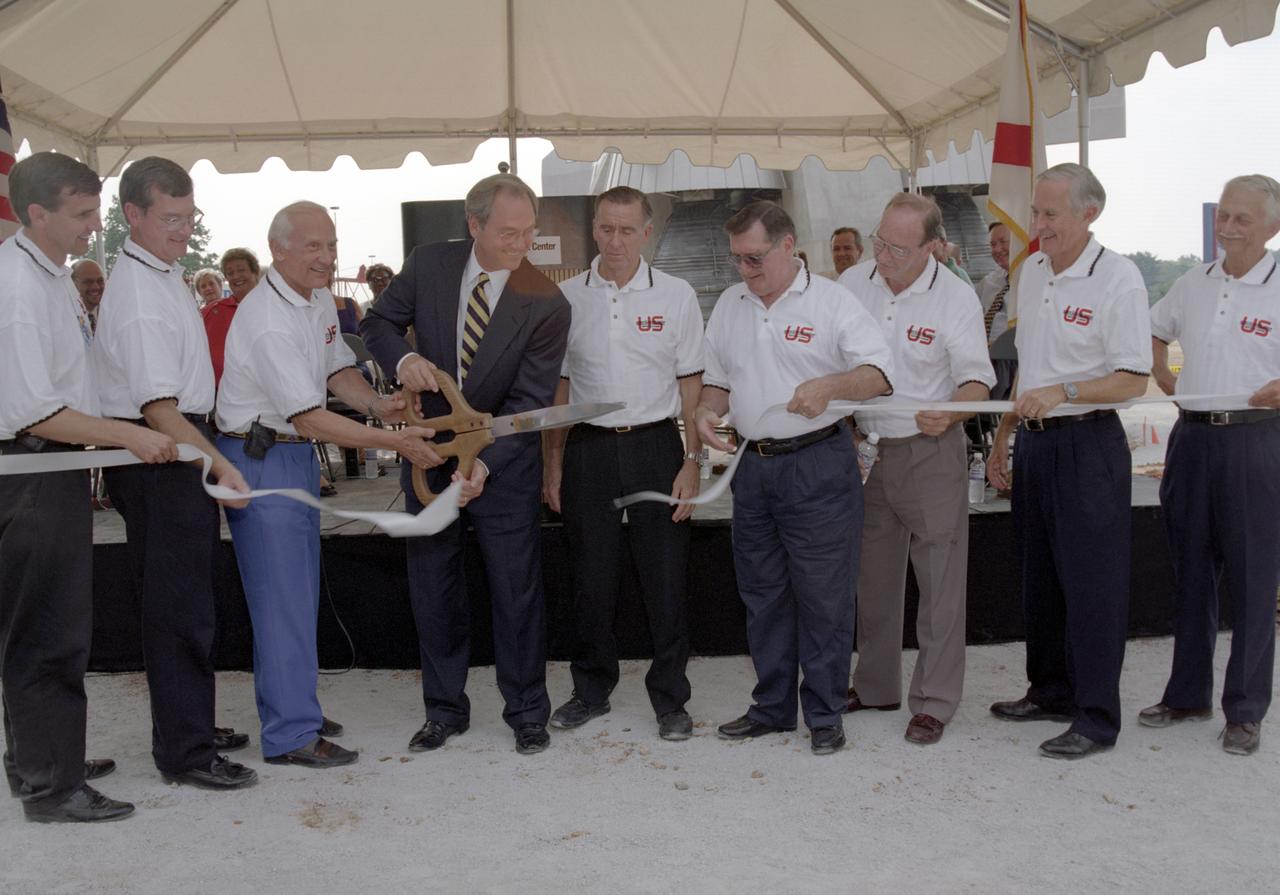
Alabama Governor Don Seigleman cuts the ribbon marking the dedication of the Saturn V rocket replica that was constructed at the U. S. Space and Rocket Center in honor of the 30th arniversary of the lunar landing. Accompanying the Governor are (L/R): Mike Wing, CEO US Space Rocket Center; Mike Gillespie, Madison County Commissioner, Dist. Seven; Buzz Aldrin, Apollo 11 Astronaut; Governor Seigleman; Walt Cunningham, Apollo 7 Astronaut; Dick Gordon, Apollo 12 Astronaut; Ed Mitchell, Apollo 14 Astronaut; Charlie Duke, Apollo 16 Astronaut; and Owen Garriott, Skylab 3 Astronaut.

A Marshall researcher examines a sample from the Solar Array Passive Long Duration Exposure Facility (LDEF). LDEF, which flew in space, measured the number, severity, and effects of micrometeroid hits on various materials. The data will lead to improved spacecraft design in the future.
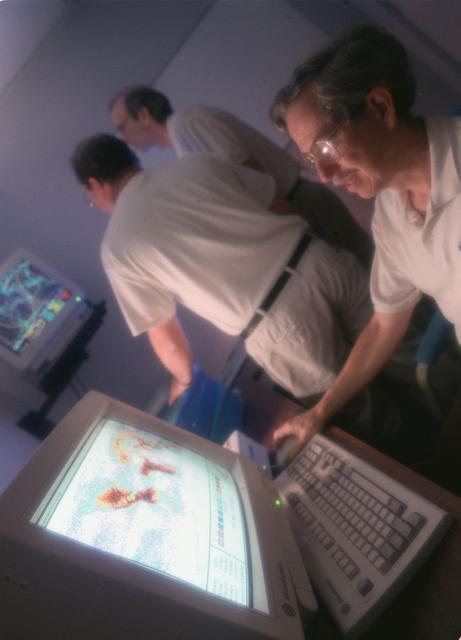
Marshall researchers conduct extensive analysis of weather patterns by using remote sensing on lightning and thunderstorms from outer space for the Mission to Planet Earth program.
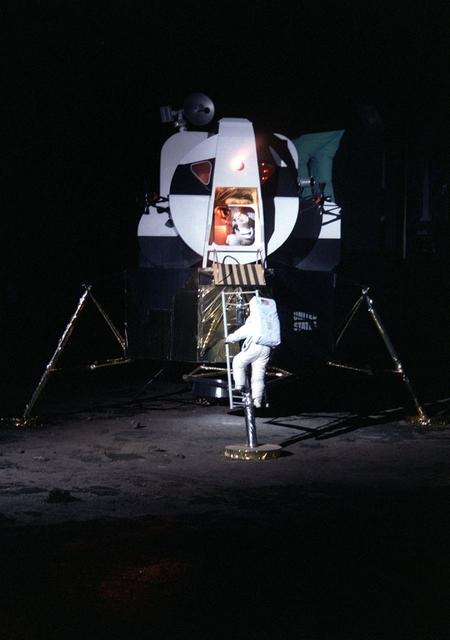
The re-enactment of astronaut Neil Armstrong's first steps off the lunar lander provided quite the occasion for many of the on-lookers at the U. S. Space and Rocket Center in Huntsville, AL, during the celebration of the 30th arniversary of the Apollo 11 lunar landing. The celebration in Huntsville lasted over the weekend with visitors including Buzz Aldrin and other Apollo astronauts.
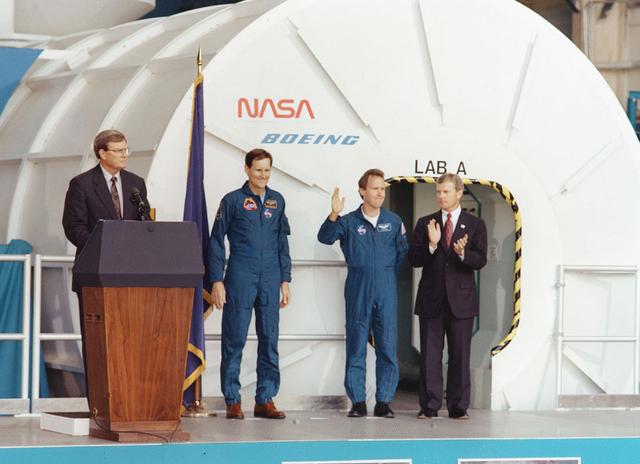
Vice-president Dan Quayle tours the model space station with astronauts Kerneth Reightler Jr. and Dr. Thomas Jones at Marshall Space Flight Center (MSFC). The first deployment of the space station module is scheduled for Spring of 1999.
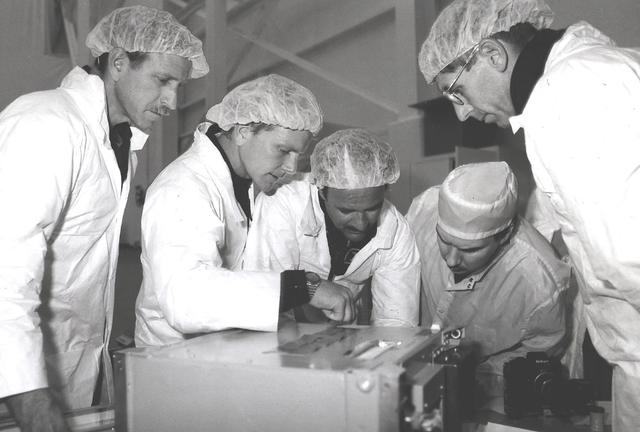
Space Shuttle Discovery (STS-26) astronauts George Nelson, John Lounge, and Richard Covey are pictured training on protein crystal growth (PCG) experiment in Marshall's Building 4708's clean room.
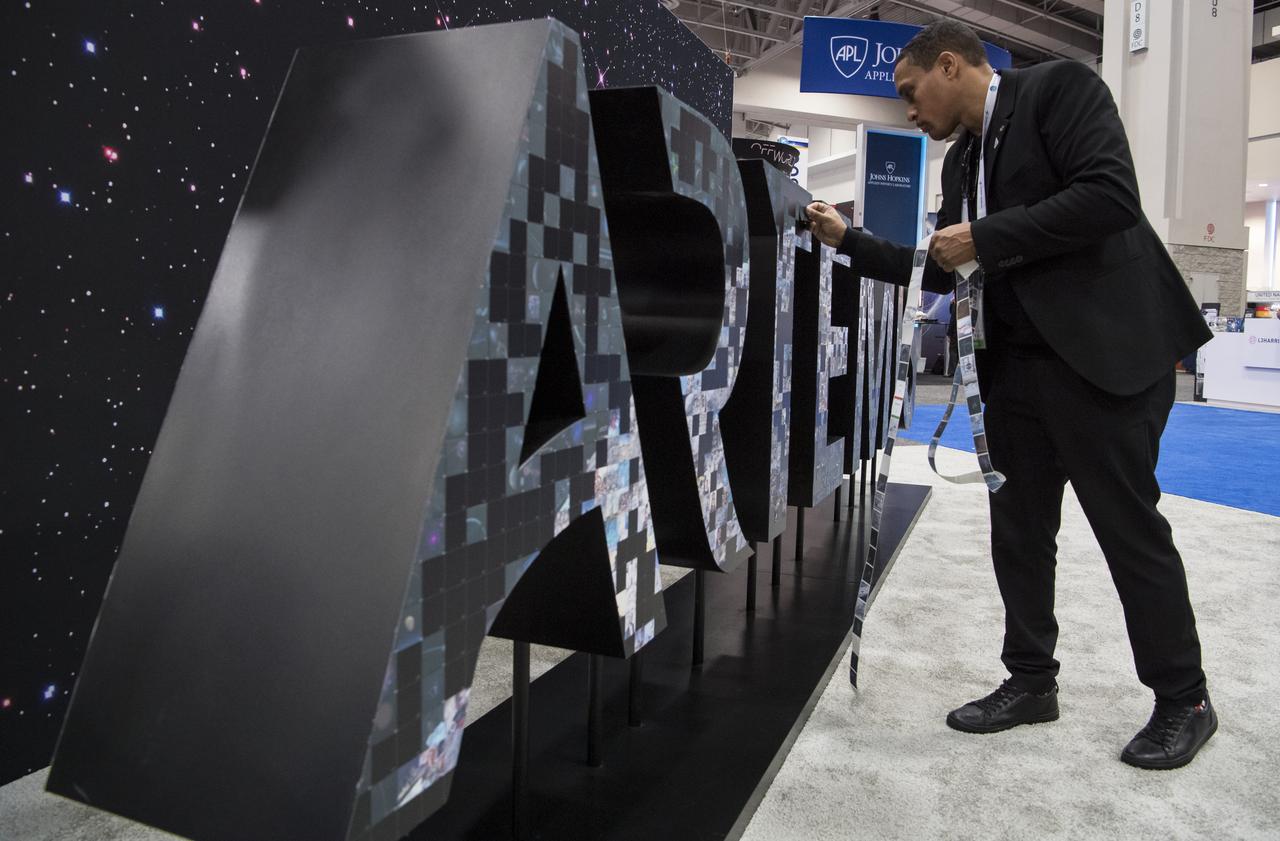
Photos of people who have visited the NASA exhibit are placed on the Artemis sign during the 70th International Astronautical Congress, Wednesday, Oct. 23, 2019 at the Walter E. Washington Convention Center in Washington. Photo credit: (NASA/Aubrey Gemignani)
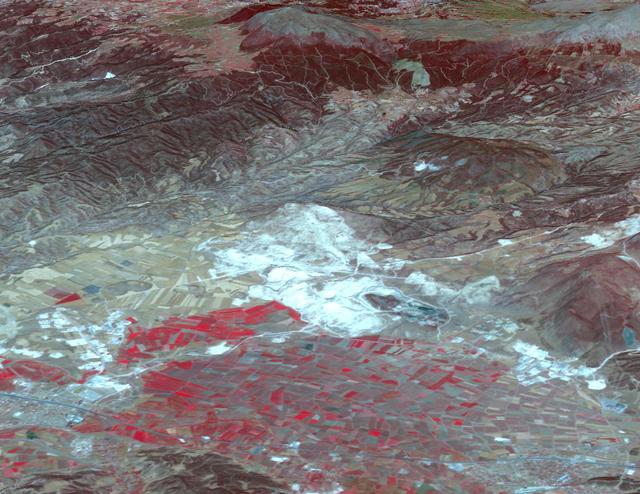
In western Turkey, Pamukkale travertine pools and terraces form the largest such complex in the world. For thousands of years, people have visited the area due to the attraction of the thermal pools. The ancient Greco-Roman city of Hierapolis was built on top of the travertine formation. The volcanic activity which causes the hot springs, forced carbon dioxide into a cave, which was called the place of the god Pluto, and instantly killed any animals (and people) that ventured in. The perspective image was acquired May 25, 2021, and is located at 37.9 degrees north, 29.1 degrees east. https://photojournal.jpl.nasa.gov/catalog/PIA24868
"When I left college, I went to go work in investment banking on Wall Street. It was one of these experiences where people said, ‘that’s the most awesome job ever. How did you manage to do that?’ But once I was inside that world, I felt very disconnected from people. I felt like the world was passing me by while I was inside cars going to business meetings and dinners. And I really wasn’t interacting with people, or understanding the challenges they were going through. So I applied to a number of medical schools. Once I got my letters of acceptance, I just chose one and I went. Then I felt like I was really doing what I wanted to do. I had a tremendous experience in my training and my classes. I just felt like, ‘wow. This is what I’m meant to do.’ Everybody has their thing. Everybody has a place where they shine. And for me, it’s being a physician, helping people heal, solving medical problems. Helping people feel better in their own bodies, no matter what that looks like." NASA Headquarters Medical Director, Dr. Andrea Fore, poses for a portrait while working from home during the COVID-19 pandemic, Monday, July 13, 2020 in Maryland. Photo Credit: (NASA/Aubrey Gemignani)
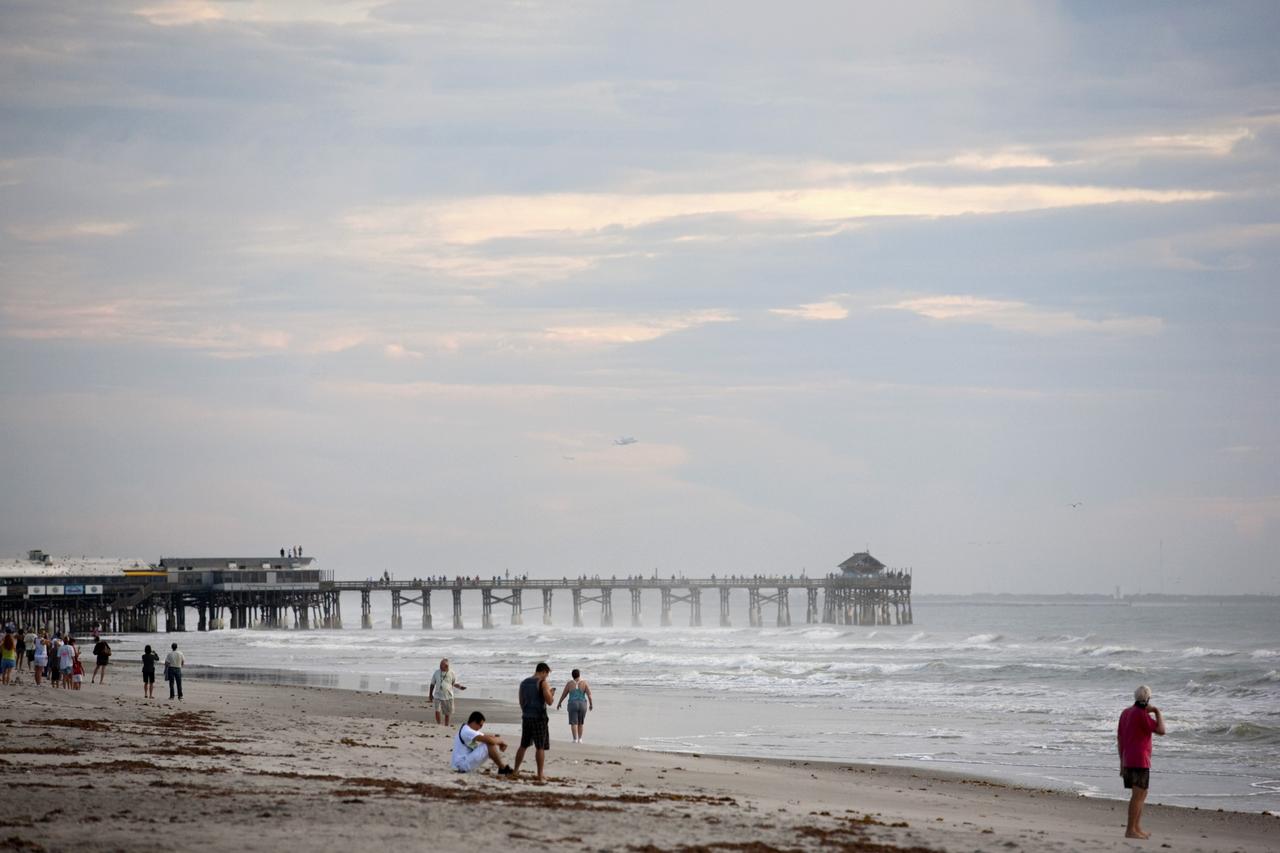
COCOA BEACH, Fla. – People lined the shore along Cocoa Beach to get an early-morning view of NASA's Shuttle Carrier Aircraft, or SCA, with the space shuttle Endeavour mounted atop. The SCA, a modified 747 jetliner, will fly Endeavour to Los Angeles where it will be placed on public display at the California Science Center. This is the final ferry flight scheduled in the Space Shuttle Program era. For more information on the shuttles' transition and retirement, visit http://www.nasa.gov/transition. Photo credit: NASA/Alan Ault
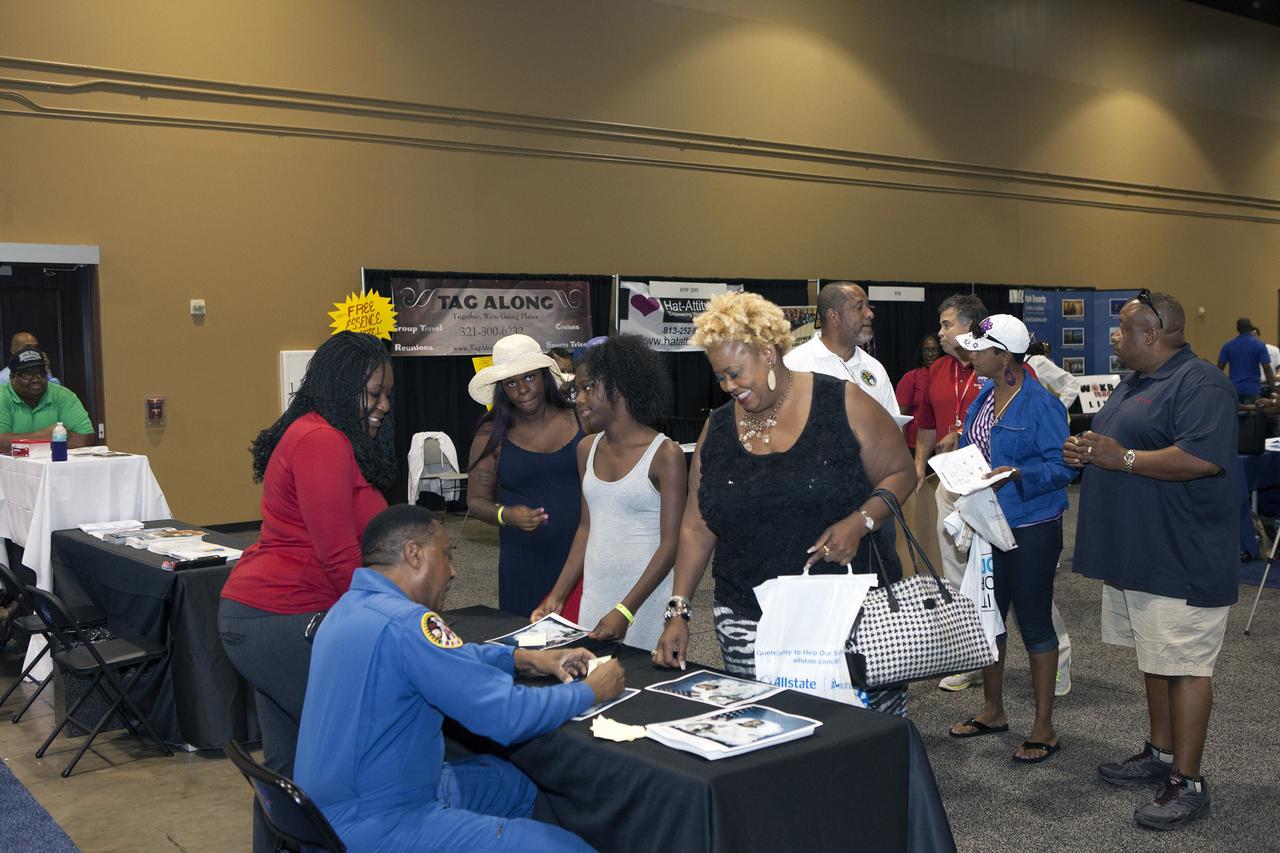
KISSIMMEE, Fla. – Former NASA astronaut Winston Scott signed autographs and posed for pictures with guests at the agency exhibit during the Tom Joyner Family Reunion. Now a senior vice president at the Florida Institute of Technology, he said that he likes to emphasize to young people how important a good education is in preparation for the future. The Tom Joyner Family Reunion is designed to present uplifting programs, entertainment and information about growing, diverse communities. An annual event of the nationally-syndicated Tom Joyner Morning Show, the many exhibits included NASA's participation focusing on encouraging young people to consider studies and careers in STEM -- science, technology, engineering and math. NASA's Education Division promoted the benefits of math and scientific learning along with career opportunities offered by the space agency. The activities took place at the Gaylord Palms Resort in Kissimmee, Florida, during the Labor Day weekend. Photo credit: NASA/Daniel Casper
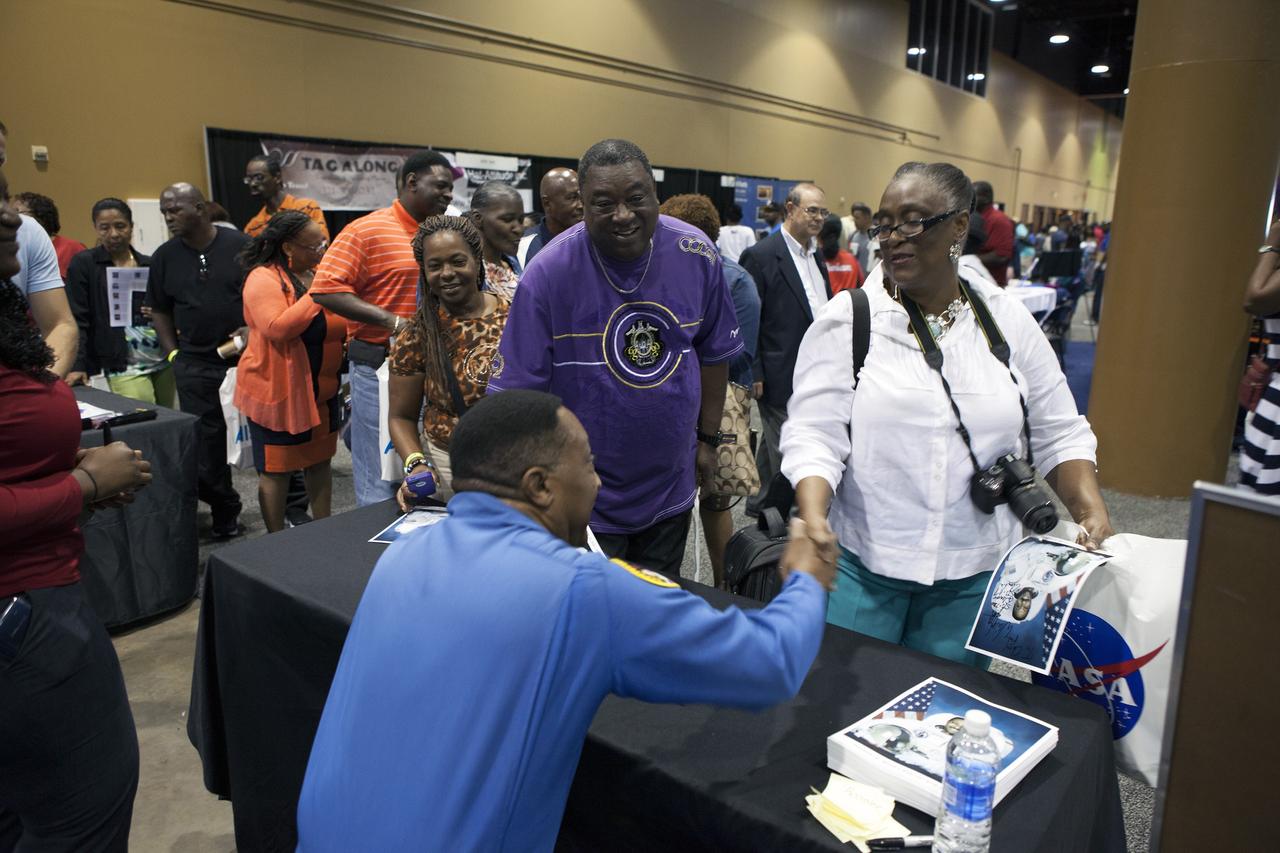
KISSIMMEE, Fla. – Former NASA astronaut Winston Scott signed autographs and posed for pictures with guests at the agency exhibit during the Tom Joyner Family Reunion. Now a senior vice president at the Florida Institute of Technology, he said that he likes to emphasize to young people how important a good education is in preparation for the future. The Tom Joyner Family Reunion is designed to present uplifting programs, entertainment and information about growing, diverse communities. An annual event of the nationally-syndicated Tom Joyner Morning Show, the many exhibits included NASA's participation focusing on encouraging young people to consider studies and careers in STEM -- science, technology, engineering and math. NASA's Education Division promoted the benefits of math and scientific learning along with career opportunities offered by the space agency. The activities took place at the Gaylord Palms Resort in Kissimmee, Florida, during the Labor Day weekend. Photo credit: NASA/Daniel Casper
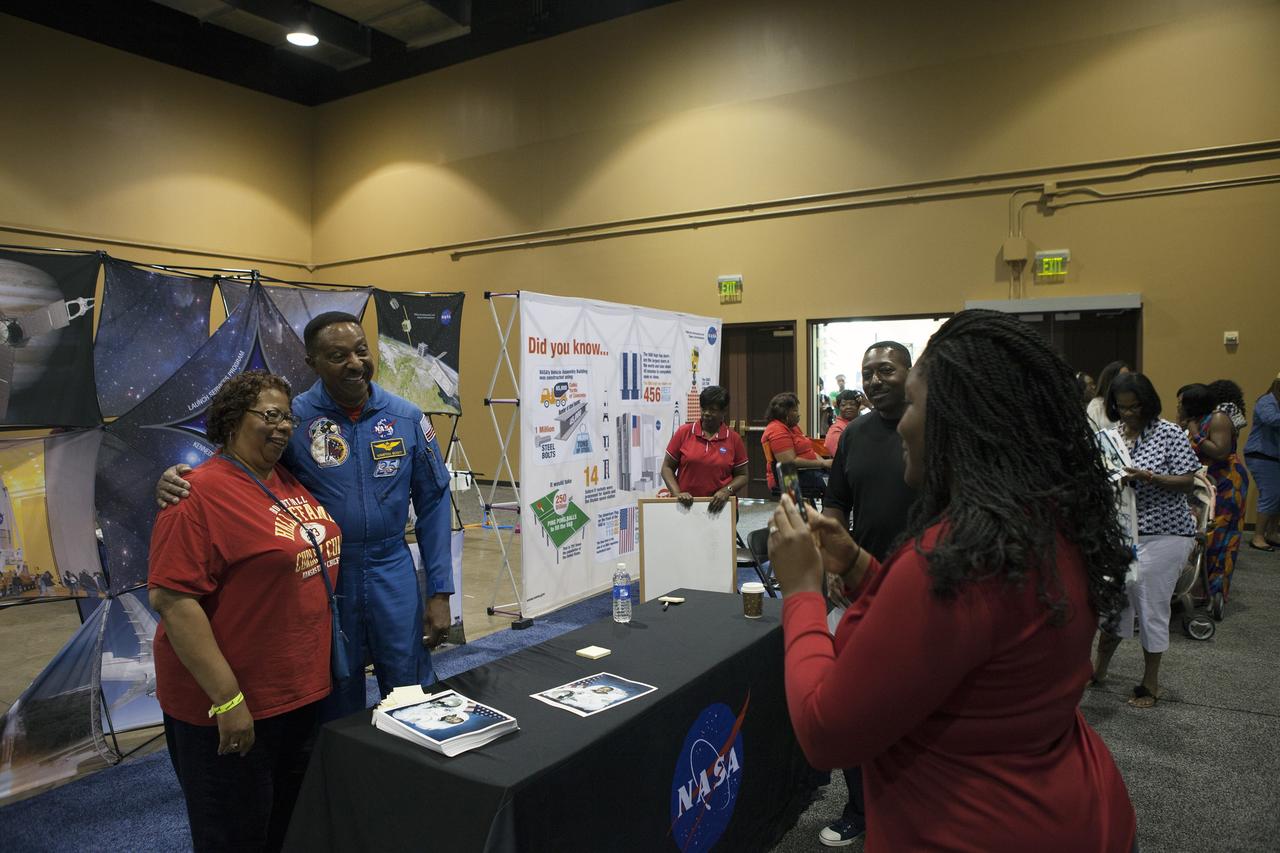
KISSIMMEE, Fla. – Former NASA astronaut Winston Scott signed autographs and posed for pictures with guests at the agency exhibit during the Tom Joyner Family Reunion. Now a senior vice president at the Florida Institute of Technology, he said that he likes to emphasize to young people how important a good education is in preparation for the future. The Tom Joyner Family Reunion is designed to present uplifting programs, entertainment and information about growing, diverse communities. An annual event of the nationally-syndicated Tom Joyner Morning Show, the many exhibits included NASA's participation focusing on encouraging young people to consider studies and careers in STEM -- science, technology, engineering and math. NASA's Education Division promoted the benefits of math and scientific learning along with career opportunities offered by the space agency. The activities took place at the Gaylord Palms Resort in Kissimmee, Florida, during the Labor Day weekend. Photo credit: NASA/Daniel Casper
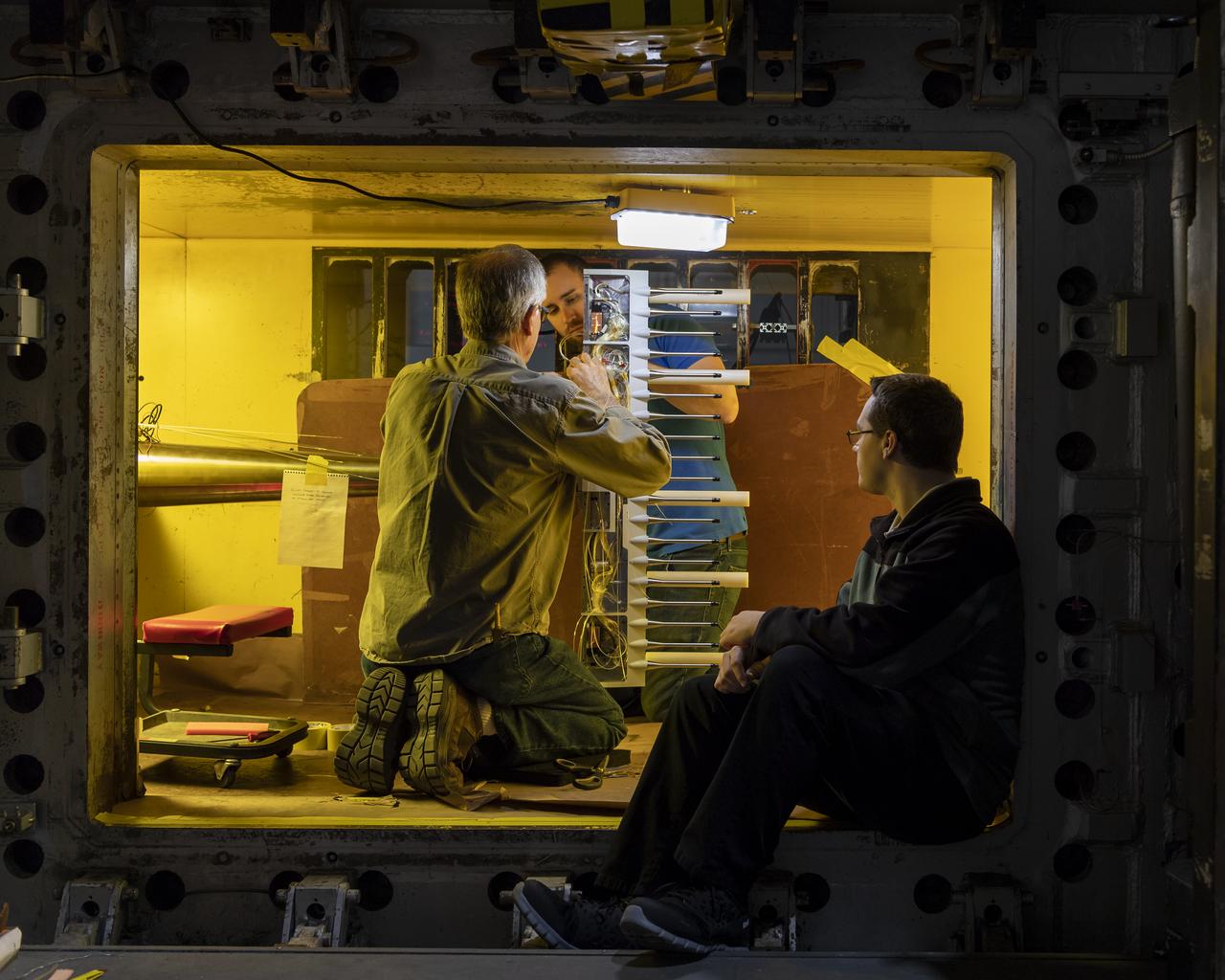
LaRC OCIO's Media Solutions Branch Photographer Harlen Capen photographed the installation of a new flow survey rake for the supersonic Unitary Plan Wind Tunnel (UPWT). The hardware – shown installed in the 4-foot, high-Mach-number Test Section 2 with a coating of Pressure Sensitive Paint – consists of a purpose-built sting, rake body, and two different types of pressure measurement probes. The survey rake will be used to characterize the flow in the test section in support of the "CFD Central Flight Dynamics as a Surrogate for High Speed Supersonic Tests" People in the photo L to R are, Ricky L. Hall, Jacobs Technology, Inc.,Supersonic/Hypersonic Testing Branch - Group A, Alexander (Alex) Moore Jacobs Technology, Inc, Supersonic/Hypersonic Testing Branch and Mathew A. (Alec) Reed, Jacobs Technology, In. NASA photographer Harlen Capen won First Place in the NASA's 2019 Still Photographer of the Year competition in the "People" category with this image.
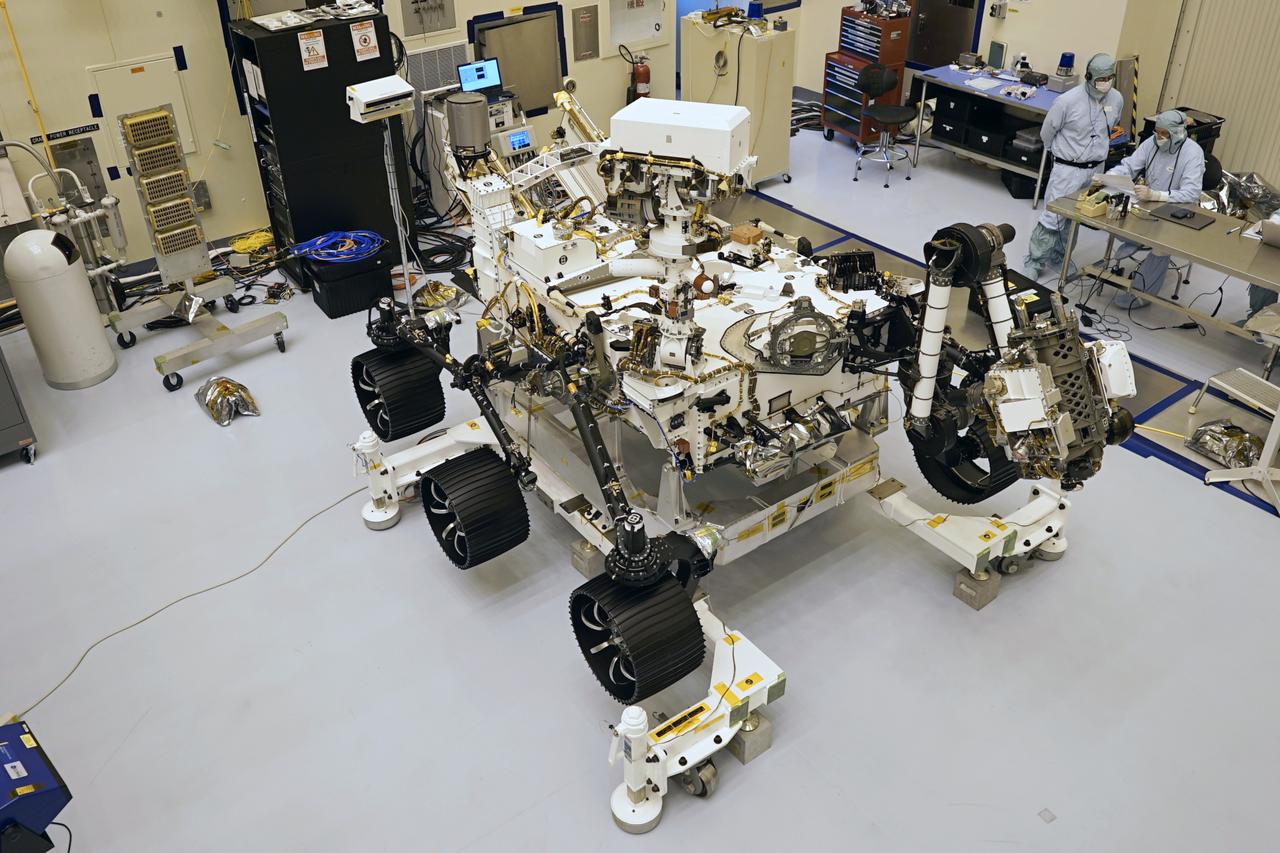
The “Send Your Name to Mars” logo is installed on the Mars Perseverance rover on March 16, 2020, inside the Payload Hazardous Servicing Facility at NASA’s Kennedy Space Center in Florida. When the rover lands on the Red Planet on Feb. 18, 2021, it will be carrying the names of more than 10 million people throughout the world. Those names were etched onto a microchip, which was placed aboard Perseverance. Liftoff aboard a United Launch Alliance Atlas V 541 rocket is targeted for mid-July from Cape Canaveral Air Force Station. NASA’s Launch Services Program based at Kennedy is managing the launch.The “Send Your Name to Mars” logo is installed on the Mars Perseverance rover on March 16, 2020, inside the Payload Hazardous Servicing Facility at NASA’s Kennedy Space Center in Florida. When the rover lands on the Red Planet on Feb. 18, 2021, it will be carrying the names of more than 10 million people throughout the world. Those names were etched onto a microchip, which was placed aboard Perseverance. Liftoff aboard a United Launch Alliance Atlas V 541 rocket is targeted for mid-July from Cape Canaveral Air Force Station. NASA’s Launch Services Program based at Kennedy is managing the launch.
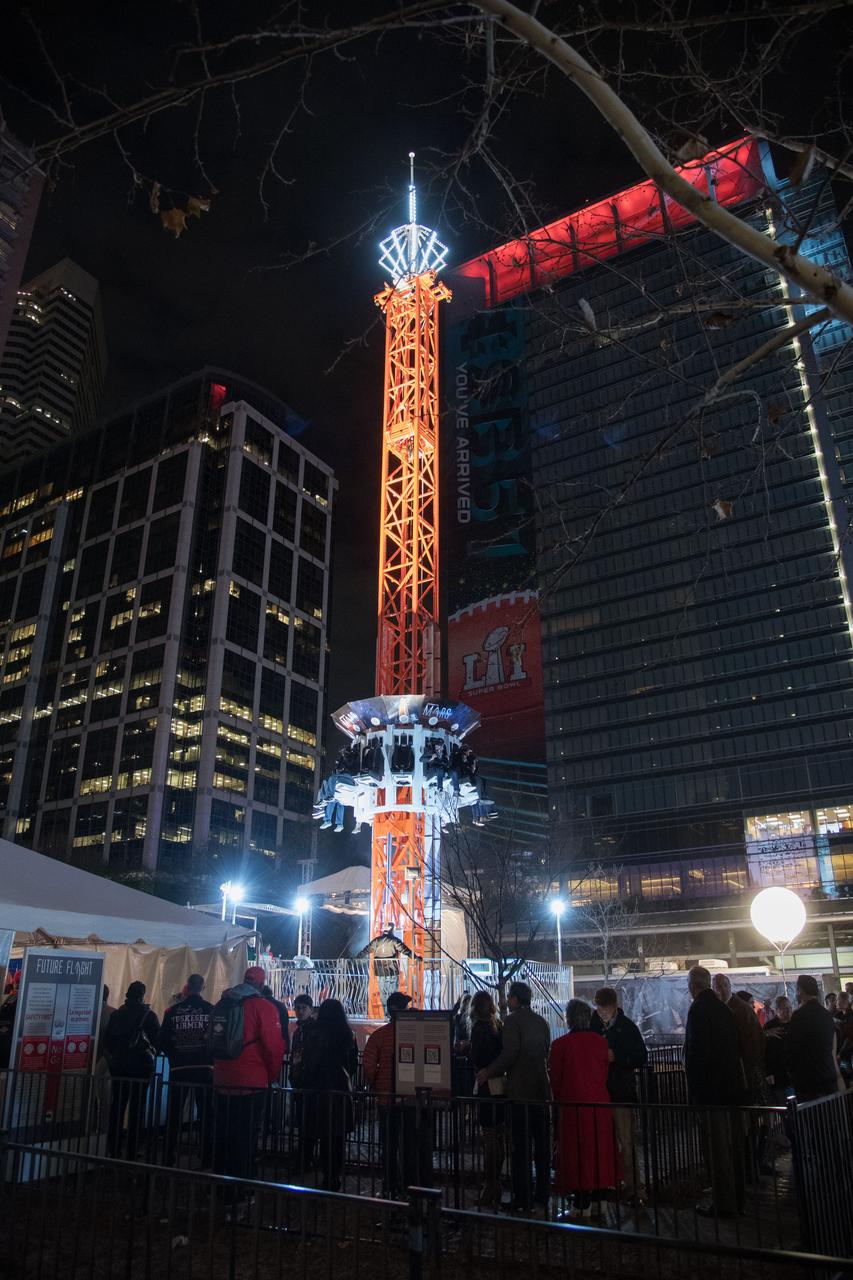
jsc2017e011279 (01/27/2017) --- Crowds of visitors line up for the NASA Orion Journey to Mars ride at the Houston Texas NFL Live Super Bowl LI event on Discovery Green Jan. 27, 2017. With people safely seated and virtual googles in place the ride pulls the Orion capsule up 90 feet then drops them suddenly to the bottom providing a physical experience as well as a visual one while experiencing the trip to Mars and back. The virtual reality trip is a popular no cost feature as part of NASA’s Future Flight area which also houses many other NASA space exploration and science exhibits. NASA PHOTOGRAPHER: Robert Markowitz
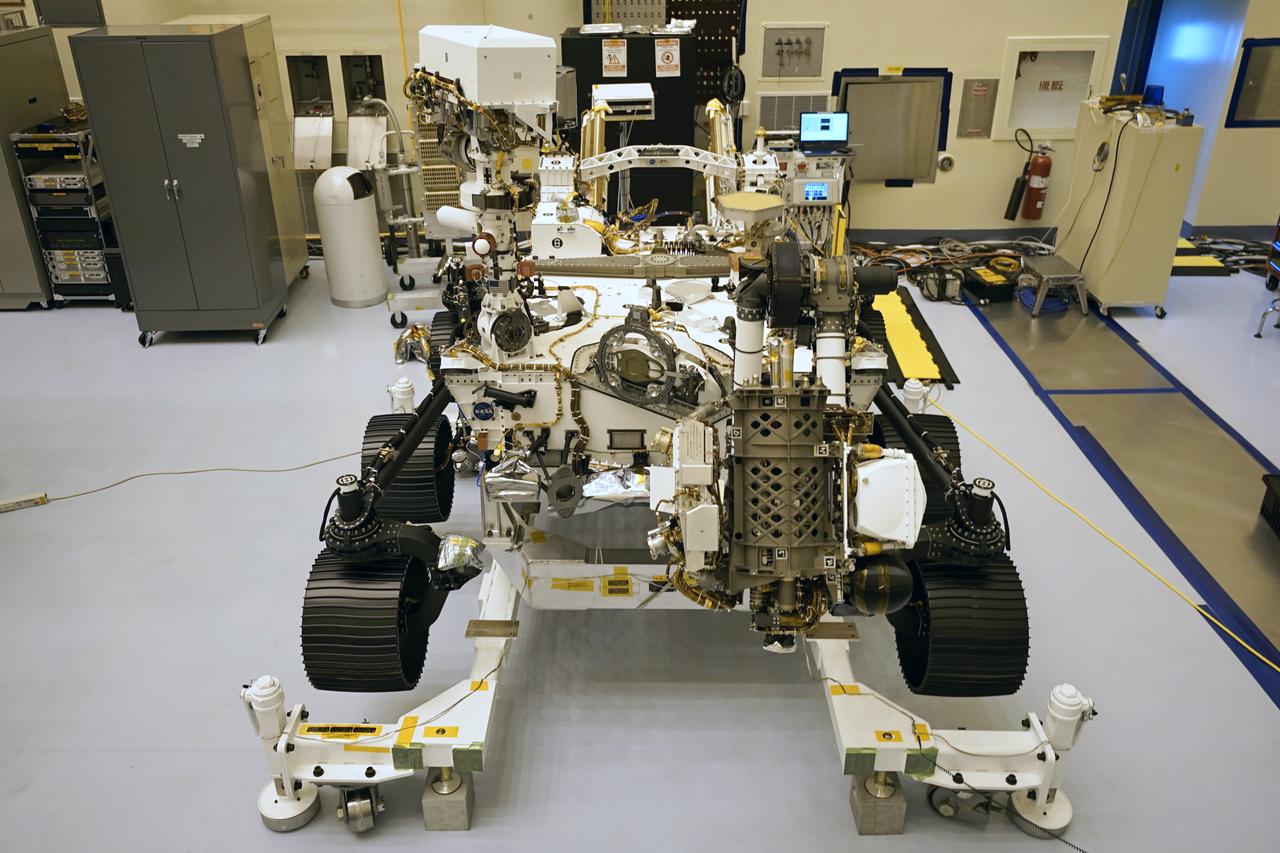
The “Send Your Name to Mars” logo is installed on the Mars Perseverance rover on March 16, 2020, inside the Payload Hazardous Servicing Facility at NASA’s Kennedy Space Center in Florida. When the rover lands on the Red Planet on Feb. 18, 2021, it will be carrying the names of more than 10 million people throughout the world. Those names were etched onto a microchip, which was placed aboard Perseverance. Liftoff aboard a United Launch Alliance Atlas V 541 rocket is targeted for mid-July from Cape Canaveral Air Force Station. NASA’s Launch Services Program based at Kennedy is managing the launch.
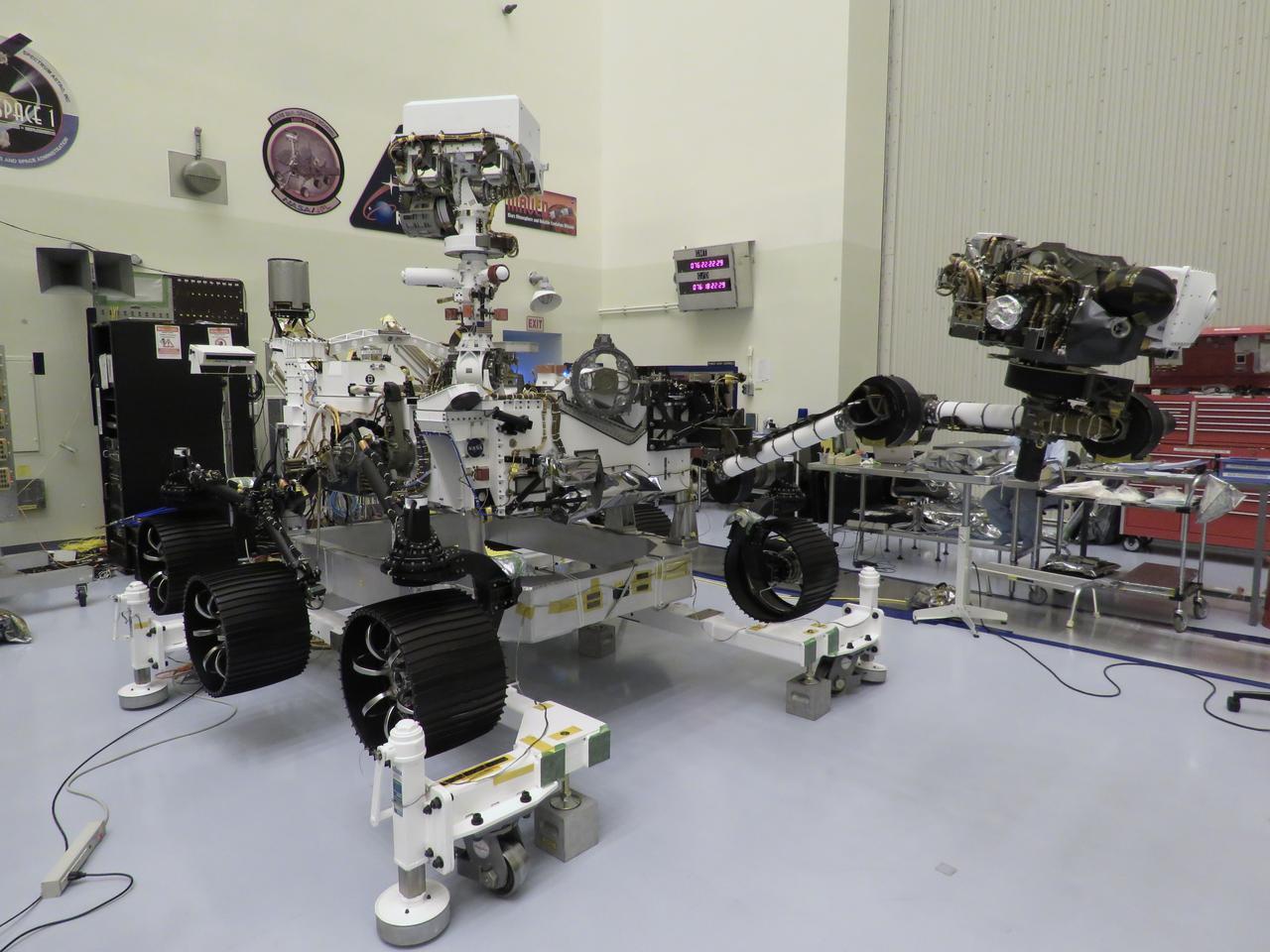
The “Send Your Name to Mars” logo is installed on the Mars Perseverance rover on March 16, 2020, inside the Payload Hazardous Servicing Facility at NASA’s Kennedy Space Center in Florida. When the rover lands on the Red Planet on Feb. 18, 2021, it will be carrying the names of more than 10 million people throughout the world. Those names were etched onto a microchip, which was placed aboard Perseverance. Liftoff aboard a United Launch Alliance Atlas V 541 rocket is targeted for mid-July from Cape Canaveral Air Force Station. NASA’s Launch Services Program based at Kennedy is managing the launch.
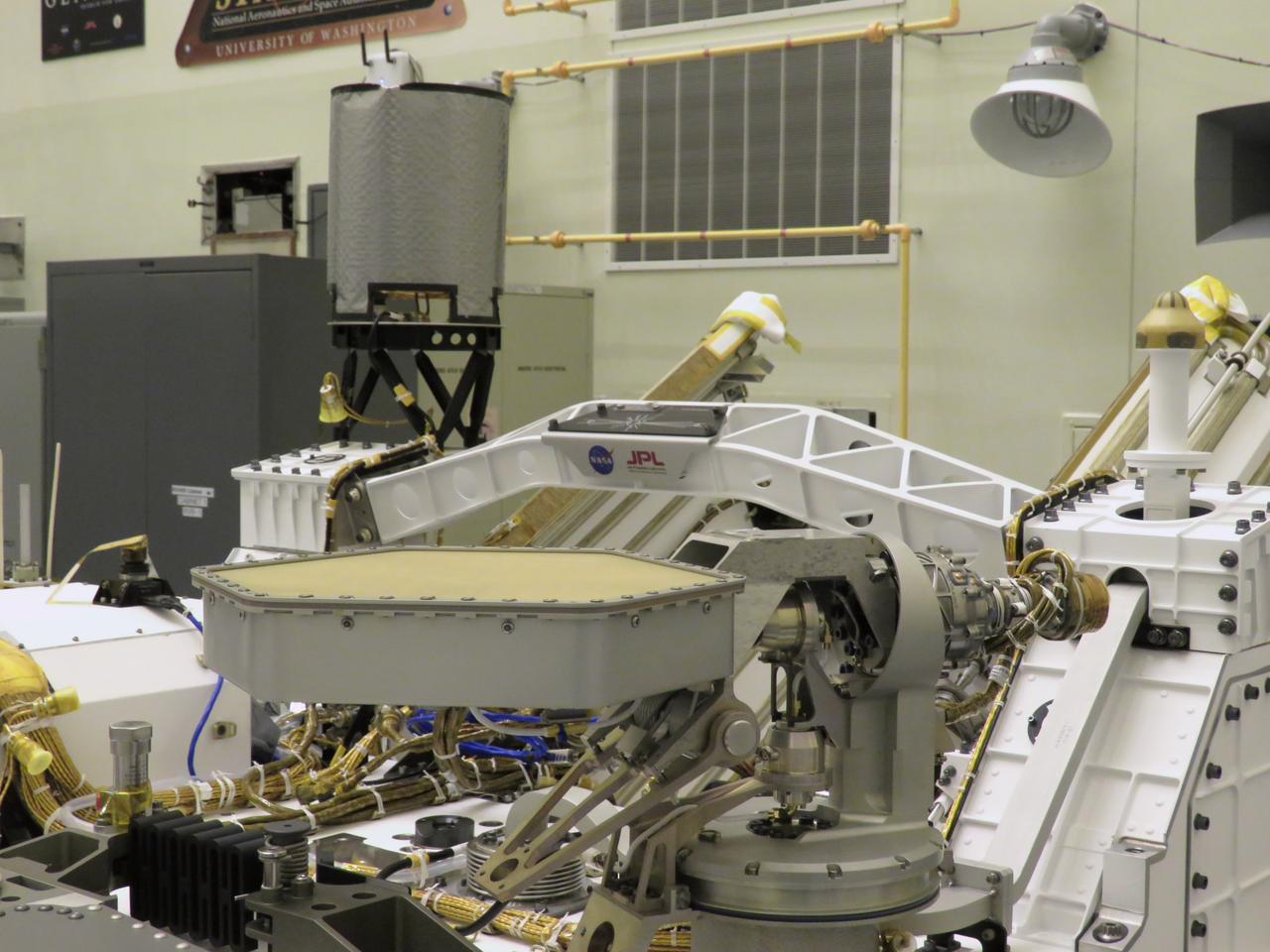
The “Send Your Name to Mars” logo is installed on the Mars Perseverance rover on March 16, 2020, inside the Payload Hazardous Servicing Facility at NASA’s Kennedy Space Center in Florida. When the rover lands on the Red Planet on Feb. 18, 2021, it will be carrying the names of more than 10 million people throughout the world. Those names were etched onto a microchip, which was placed aboard Perseverance. Liftoff aboard a United Launch Alliance Atlas V 541 rocket is targeted for mid-July from Cape Canaveral Air Force Station. NASA’s Launch Services Program based at Kennedy is managing the launch.

The “Send Your Name to Mars” logo is installed on the Mars Perseverance rover on March 16, 2020, inside the Payload Hazardous Servicing Facility at NASA’s Kennedy Space Center in Florida. When the rover lands on the Red Planet on Feb. 18, 2021, it will be carrying the names of more than 10 million people throughout the world. Those names were etched onto a microchip, which was placed aboard Perseverance. Liftoff aboard a United Launch Alliance Atlas V 541 rocket is targeted for mid-July from Cape Canaveral Air Force Station. NASA’s Launch Services Program based at Kennedy is managing the launch.
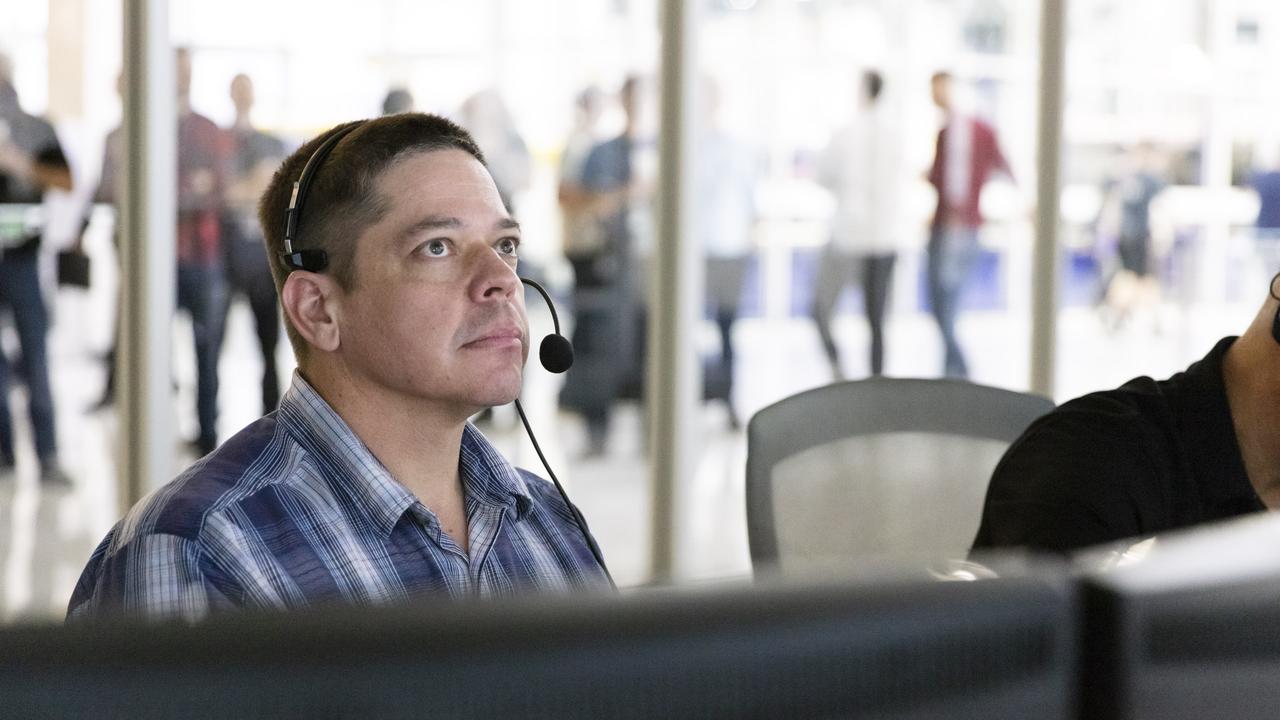
NASA astronaut Bob Behnken, seated at a console inside SpaceX Mission Control in Hawthorne, California, monitors the Crew Dragon spacecraft static fire engine tests taking place at Cape Canaveral Air Force Station in Florida on Nov. 13, 2019. The tests will help validate the Crew Dragon’s launch escape system ahead of the upcoming in-flight abort demonstration as part of NASA’s Commercial Crew Program. Behnken and NASA astronaut Doug Hurley will be the first people to fly aboard Crew Dragon in SpaceX’s Demo-2 mission to the International Space Station.

"About 10 years ago, I started taking improv comedy classes when I lived back in Atlanta. It really teaches you how to go with the flow, to be present in a situation, to be ready for things to go wrong, and to be able to jump in and save a conversation or help somebody who is struggling to find the right words. These are things we do in our everyday lives that we can also do on stage, and I love that aspect of it. "I started using the tools of comedy to rewrite popular songs – such as from the musical Hamilton – to be about space. I love making people laugh and smile and think there’s something really special about finding things funny or amusing in a respectful way. It is a different level of connection than, ‘Oh, that's interesting.’ It ignites a different emotional response in you, and I think there’s a place for that in science communication as well. "Often in popular culture, there’s a bit of a stigma around people who enjoy learning about space and science; that it’s only for nerds. But if you insert it into a genre that you wouldn't normally find it in, like music or comedy, then suddenly you’re connecting with people on a different level. They might not go out and read a textbook, but they might come away from a song or a comedy show thinking, ‘Huh, I thought I was just going to this event for entertainment, but I actually learned something.’ That’s cool! It’s like you’re seasoning it or putting a little sugar in it. "Something improv comedy taught me is: When you start to let go and not take yourself too seriously and embrace the spontaneity of a situation, that’s really freeing, and people respond well to that." Elizabeth Landau, Senior Communications Specialist for NASA’s Science Mission Directorate, poses for a portrait, Friday, July 30, 2021, in Washington. Photo Credit: (NASA/Bill Ingalls)
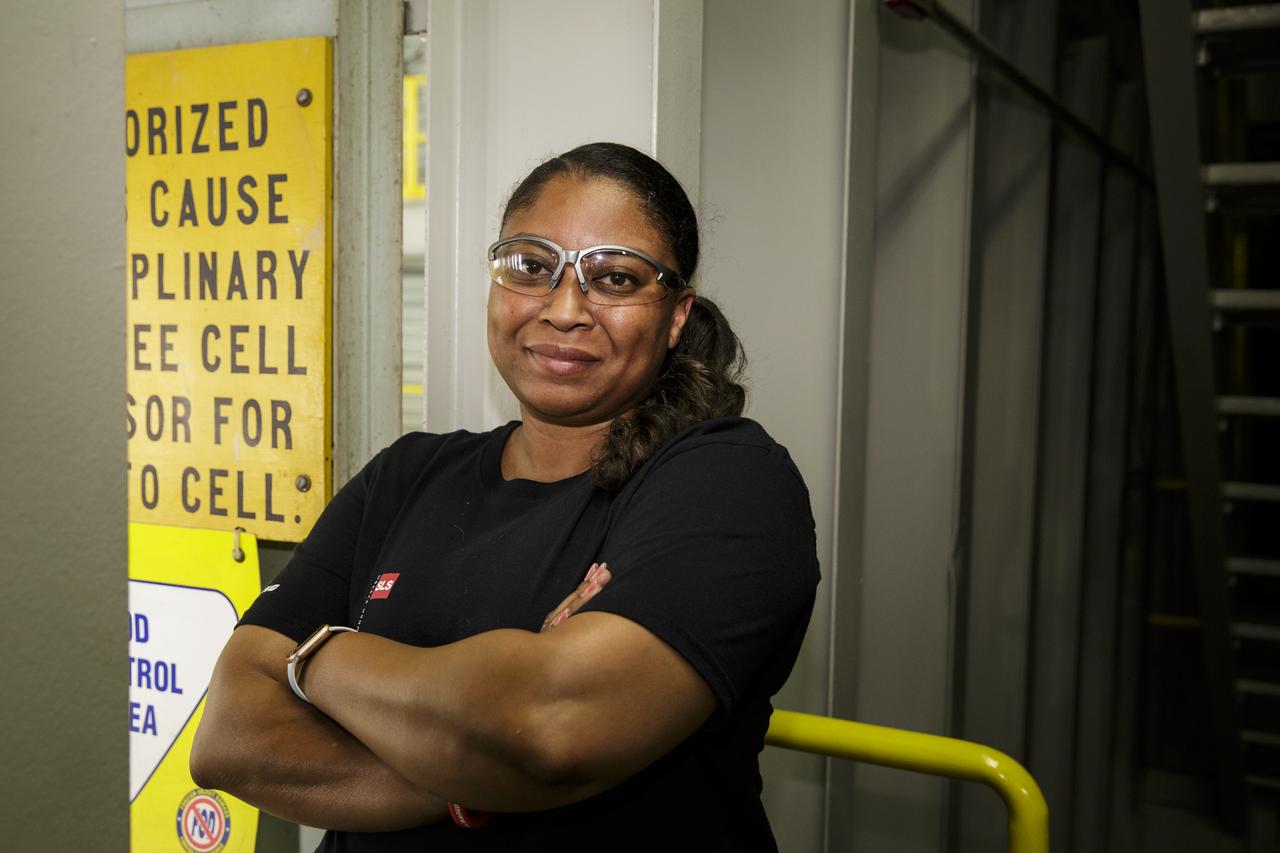
"On my first day, I felt like I did not belong. I felt like I was unqualified. That’s the thing: the people around here, I don’t know if it’s just the culture or the area where we are, but these people around here, they just encourage you: 'You can do it!' and 'Let me show you this, there’s nothing to it!' I mean, really, they forced me out of my element, even into where I am right now. I belong now. I definitely belong now. I don’t feel out of place. I feel like I have a better handle on things compared to when I was younger and easily intimidated. I feel like I belong now. "My goal right now is to find a need and fill it. That’s my thing. And that’s all through life. Any job, any position. That’s the goal. Find the need. Find what you’re good at. And you fill that need." Candis Hills, Facilities and Asset Management, Boeing, Friday, June 28, 2019 at Michoud Assembly Facility, New Orleans, LA. Photo Credit: (NASA/Aubrey Gemignani)
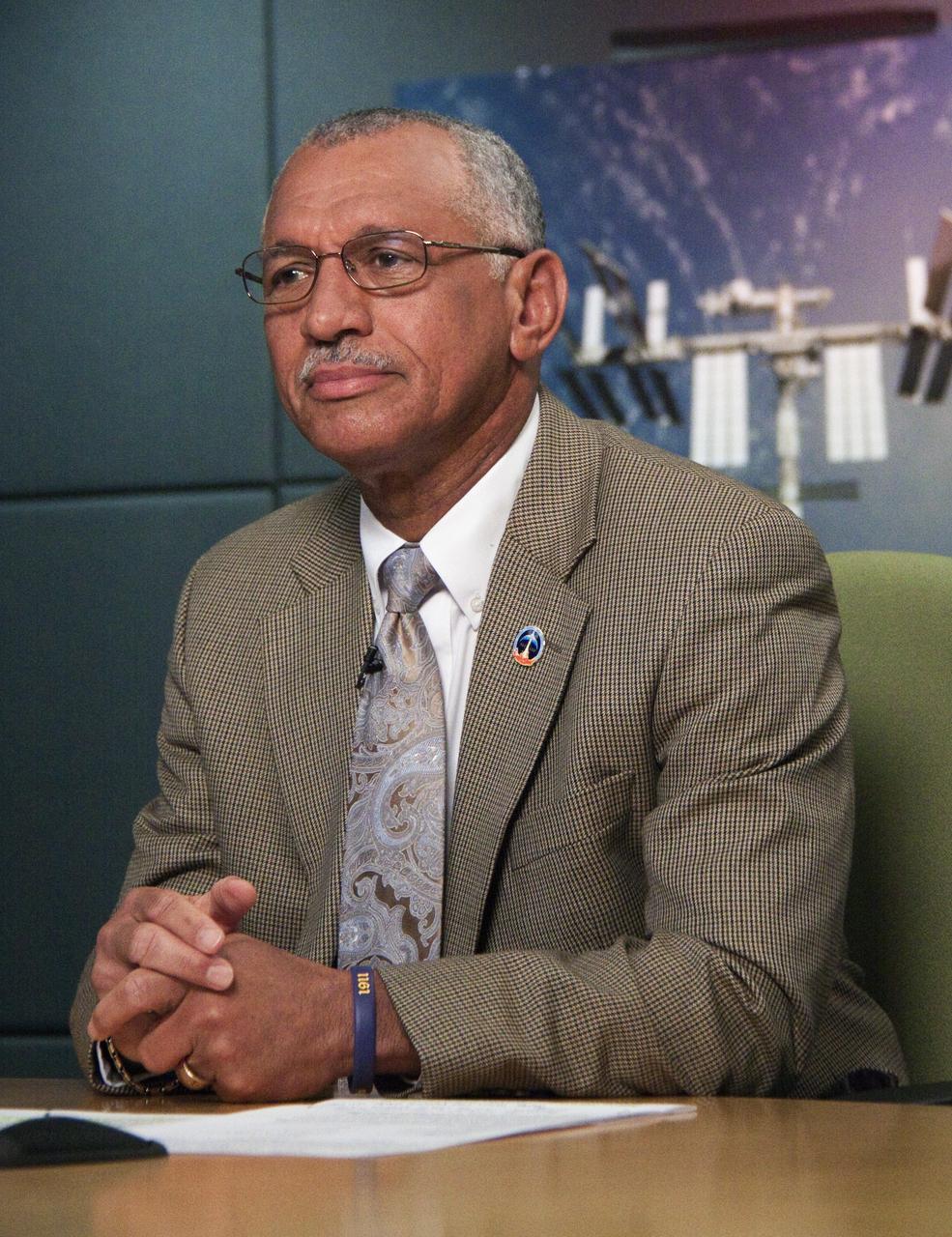
CAPE CANAVERAL, Fla. -- NASA Administrator Charlie Bolden talks to the International Space Station's Expedition 25 crew from the Operations Support Building II at NASA's Kennedy Space Center in Florida. The call to the station is part of a global celebration of 10 years of continuous human presence aboard the orbiting laboratory. More than 196 people have visited the station, which has completed more than 57,000 orbits of Earth and traveled about 1.5 billion miles. The station is a venture of international cooperation among NASA, the Russian Federal Space Agency, Canadian Space Agency, Japan Aerospace Exploration Agency (JAXA), and 11 members of the European Space Agency (ESA): Belgium, Denmark, France, Germany, Italy, the Netherlands, Norway, Spain, Sweden, Switzerland and the United Kingdom. More than 100,000 people in space agencies and contractor facilities in 37 U.S. states and throughout the world are involved in this endeavor. For more information about the work and experiments taking place aboard the station today, visit www.nasa.gov/mission_pages/station/main/index.html. Photo credit: NASA/Jack Pfaller
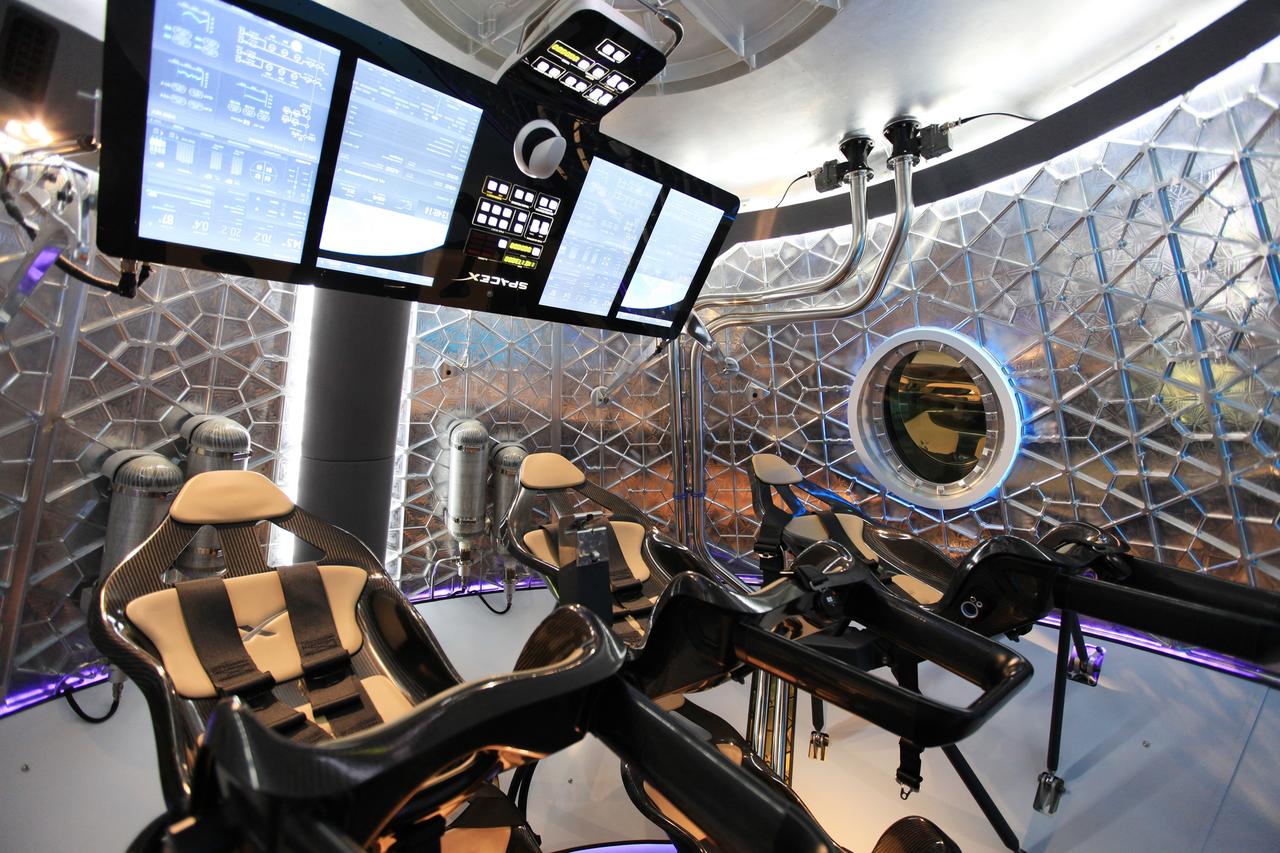
HAWTHORNE, Calif. - The Dragon V2 spacecraft's seating arrangement with the control panel swung up to allow crewmembers to get into their seats. Once the crew is in place, the control panel swings down and locks in launch position. SpaceX unveiled the new spacecraft during a ceremony at its headquarters in Hawthorne, Calif. The Dragon V2 is designed to carry people into Earth's orbit and was developed in partnership with NASA's Commercial Crew Program under the Commercial Crew Integrated Capability agreement. SpaceX is one of NASA's commercial partners working to develop a new generation of U.S. spacecraft and rockets capable of transporting humans to and from Earth's orbit from American soil. Ultimately, NASA intends to use such commercial systems to fly U.S. astronauts to and from the International Space Station. Photo credit: NASA/Dimitri Gerondidakis
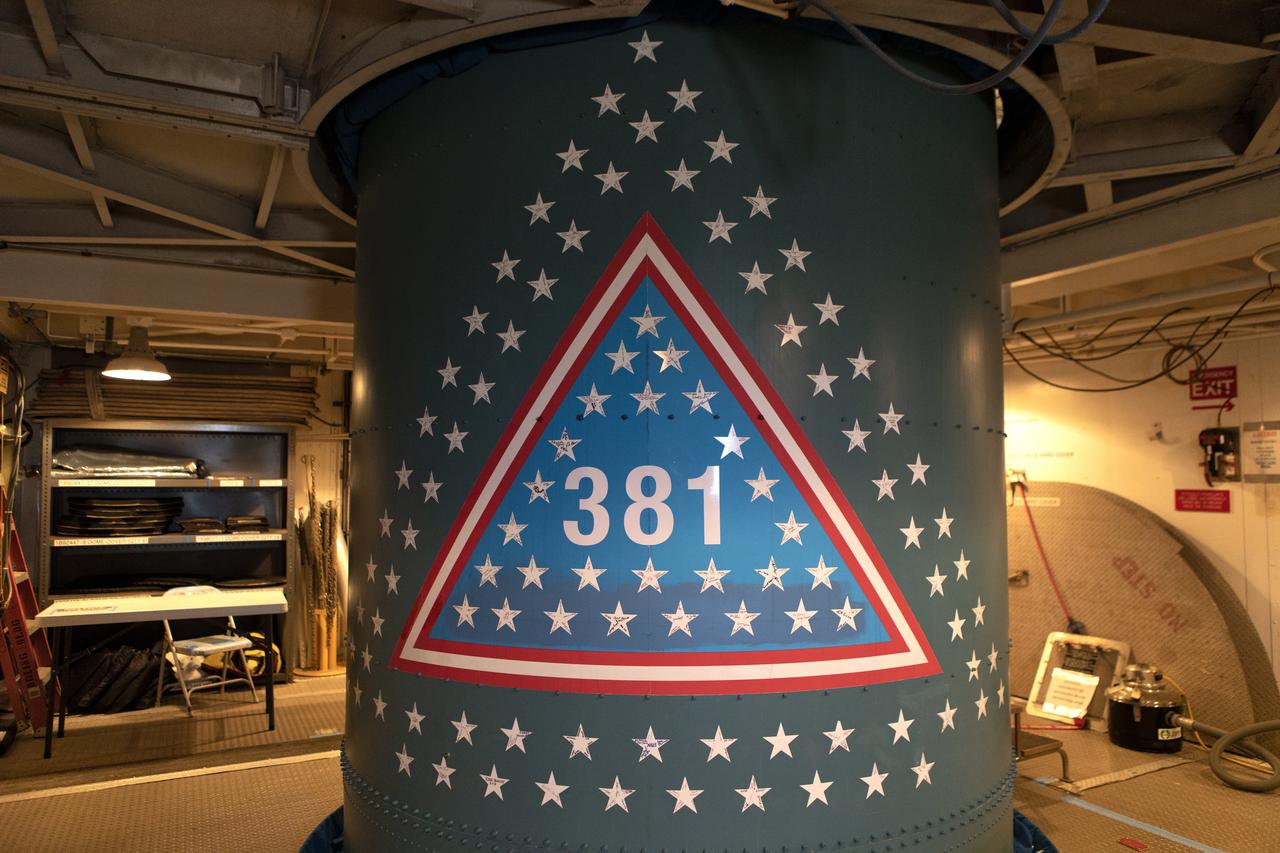
Stars are in view on the first stage of the United Launch Alliance Delta II rocket at Space Launch Complex 2 at Vandenberg Air Force Base in California, on Sept. 13, 2018. Historically, each Delta rocket used to notate the number of launches within the program, beginning in May, 1960, with the first Delta I. This practice was brought back for the final Delta II launch of ICESat-2. The “381” on the rocket signifies that this will be the 381st flight in the Delta family. A star traditionally was placed on the rocket to recognize each mission. For the final Delta II, stars were sent to team members and partners throughout the nation. This rocket boasts more than 150 stars with over 800 signatures of people who have been part of the Delta II program.
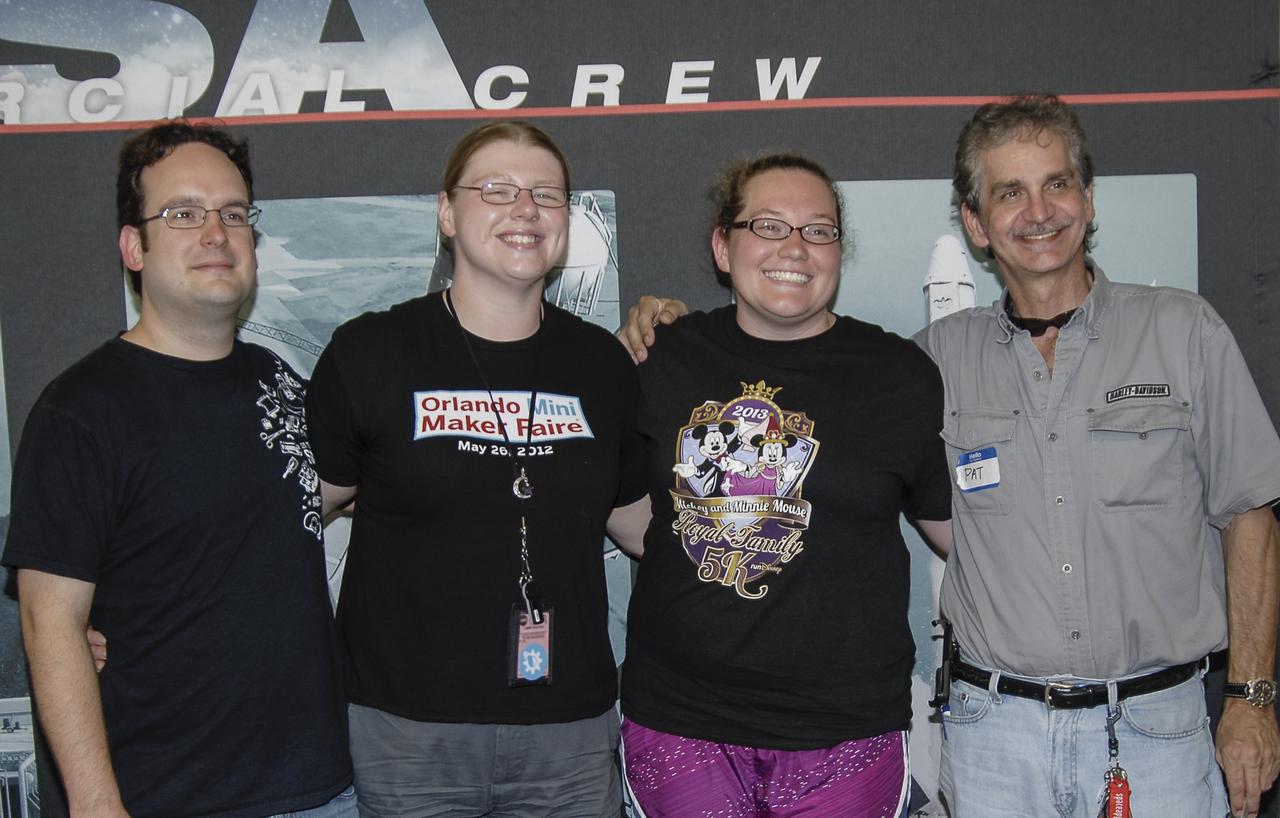
CAPE CANAVERAL, Fla. – Space enthusiasts Mike King, at left, Jamie Szafran, Jessica King and Pat Starace, were first-place winners from Kennedy Space Center during the 2013 International Space Apps Challenge held at the Center for Space Education at the Kennedy Space Center Visitor Complex in Florida. During the worldwide two-day challenge, more than 9,000 people and 484 organizations came together in 83 cities across 44 countries, as well as online, to develop new ways of solving challenges that NASA faces. At Kennedy, four teams brainstormed ideas with subject matter experts and others and worked nearly 32 hours straight to present their concepts to a panel of three technical and non-technical judges. Challenges tackled at Kennedy were: Deployable Greenhouse, Kennedy Space Center 2040, Seven Minutes of Science, and Moonville – Lunar Industry Game. Photo credit: NASA_Charisse Nahser
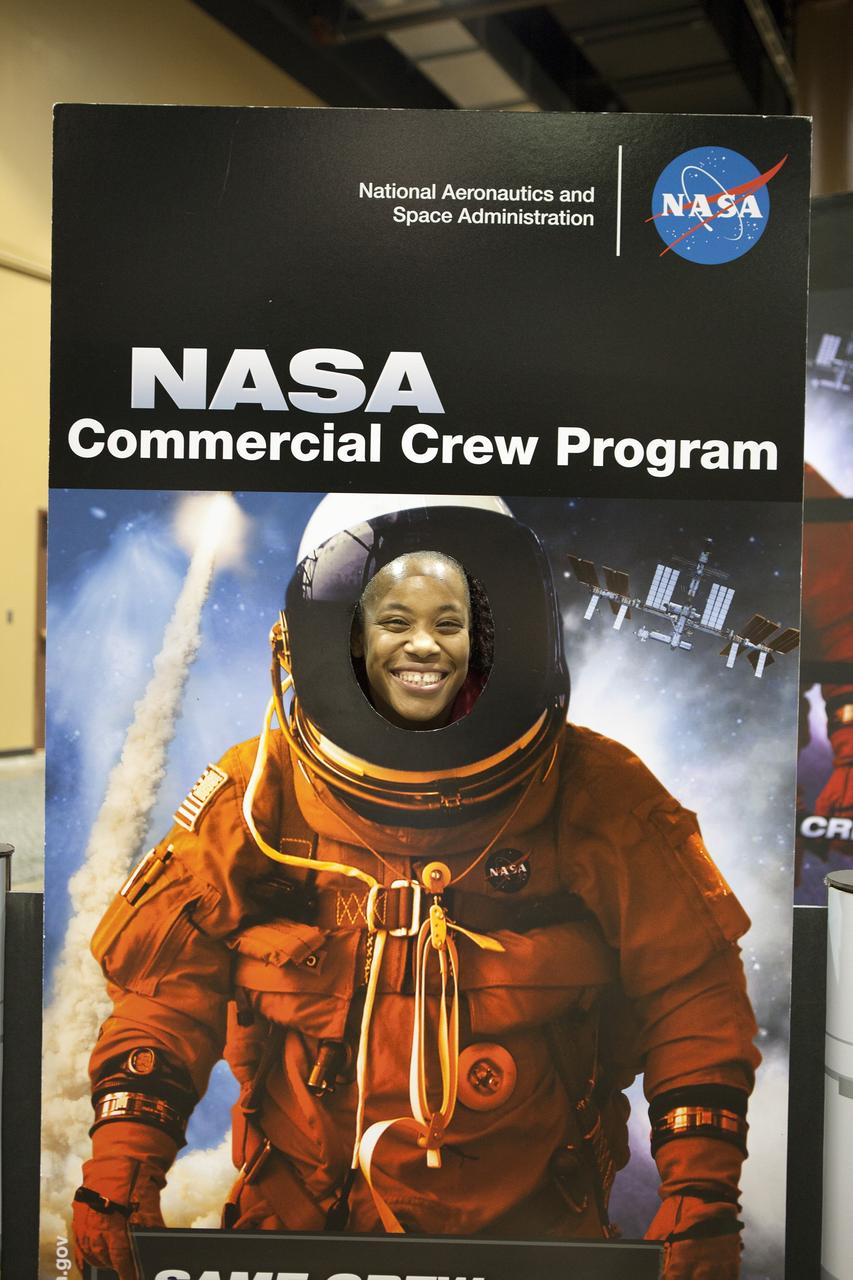
KISSIMMEE, Fla. – A guest at the Tom Joyner Family Reunion is photographed with a Commercial Crew Program exhibit during the five-day event. Thousands of visitors spoke with agency representatives who explained the agency’s efforts with CCP, the International Space Station, Ground Systems Development and Operations Program, as well as the Launch Services Program. The Tom Joyner Family Reunion is designed to present uplifting programs, entertainment and information about growing, diverse communities. An annual event of the nationally-syndicated Tom Joyner Morning Show, the many exhibits included NASA's participation focusing on encouraging young people to consider studies and careers in STEM -- science, technology, engineering and math. NASA's Education Division promoted the benefits of math and scientific learning along with career opportunities offered by the space agency. The activities took place at the Gaylord Palms Resort in Kissimmee, Florida, during the Labor Day weekend. Photo credit: NASA/Daniel Casper
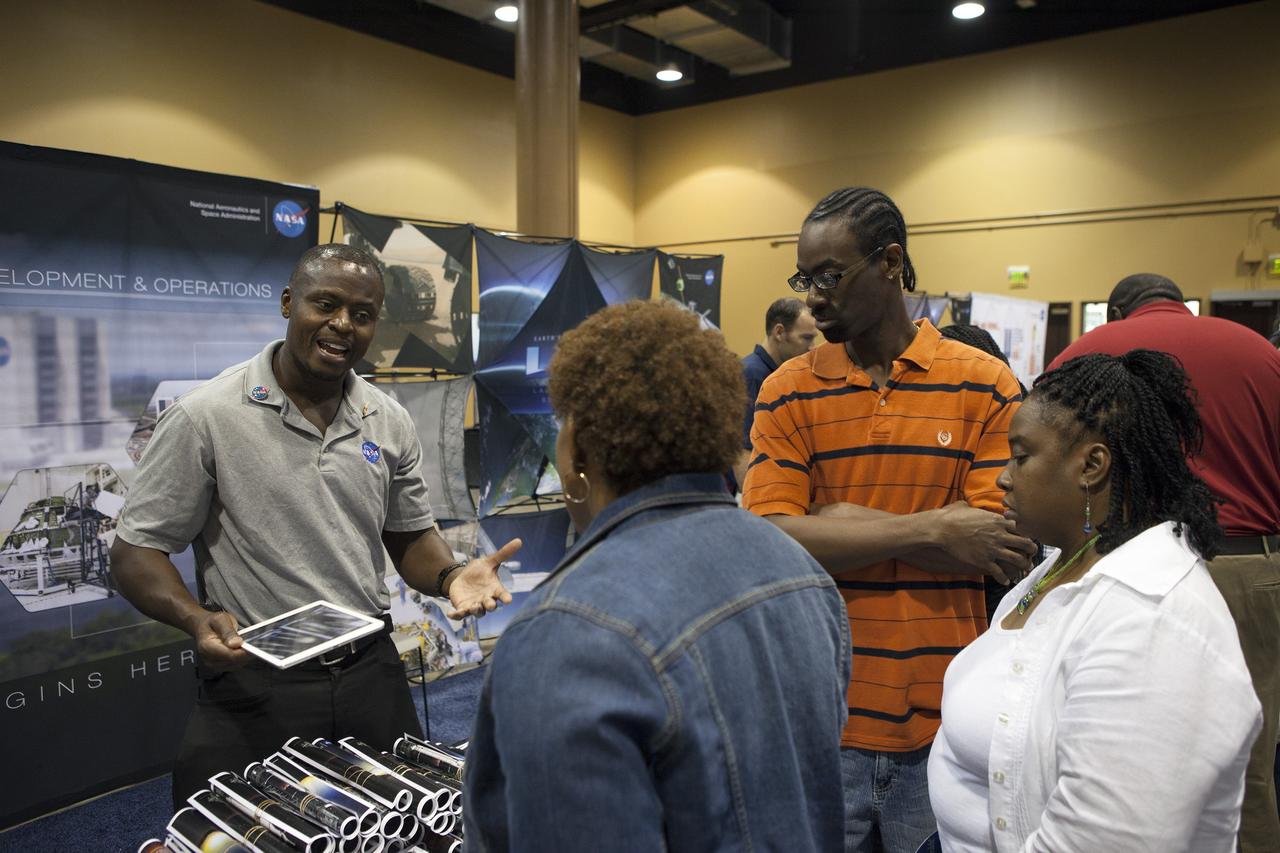
KISSIMMEE, Fla. – Yves Lamothe of the NASA Technical Management Branch of Ground Systems Development and Operations Program speaks with guests at the Tom Joyner Family Reunion about ongoing work to convert the Kennedy Space Center into a 21st century spaceport. The Tom Joyner Family Reunion is designed to present uplifting programs, entertainment and information about growing, diverse communities. An annual event of the nationally-syndicated Tom Joyner Morning Show, the many exhibits included NASA's participation focusing on encouraging young people to consider studies and careers in STEM -- science, technology, engineering and math. NASA's Education Division promoted the benefits of math and scientific learning along with career opportunities offered by the space agency. The activities took place at the Gaylord Palms Resort in Kissimmee, Florida, during the Labor Day weekend. Photo credit: NASA/Daniel Casper
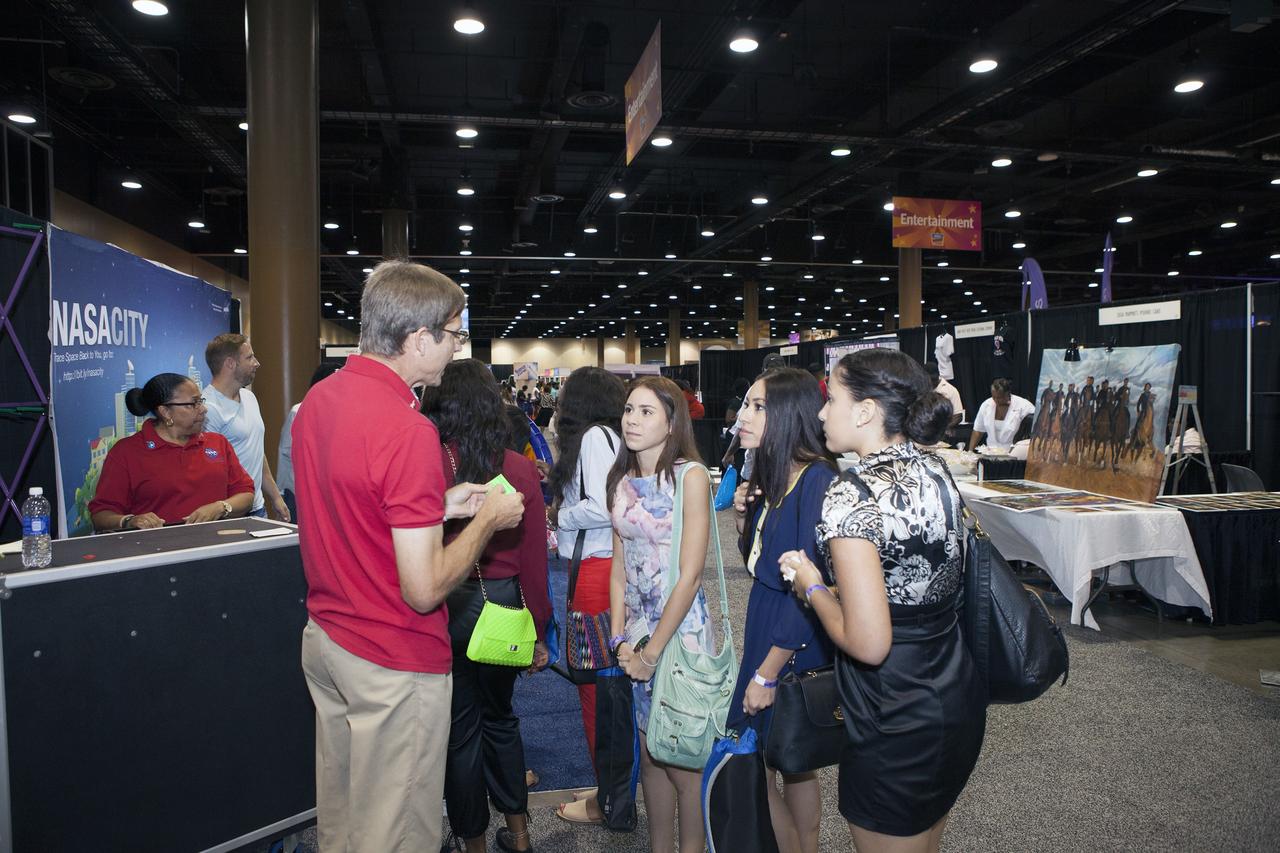
KISSIMMEE, Fla. – Guests at the Tom Joyner Family Reunion participate in "Learn and Spin Challenge," an opportunity to answer questions related to science, technology, engineering and math. Robert Smith asks a question as part of NASA’s educational theme during the five-day event. Behind Smith, to the left, is Debbie Houston who also supported the "Learn and Spin Challenge." The Tom Joyner Family Reunion is designed to present uplifting programs, entertainment and information about growing, diverse communities. An annual event of the nationally-syndicated Tom Joyner Morning Show, the many exhibits included NASA's participation focusing on encouraging young people to consider studies and careers in STEM -- science, technology, engineering and math. NASA's Education Division promoted the benefits of math and scientific learning along with career opportunities offered by the space agency. The activities took place at the Gaylord Palms Resort in Kissimmee, Florida, during the Labor Day weekend. Photo credit: NASA/Daniel Casper
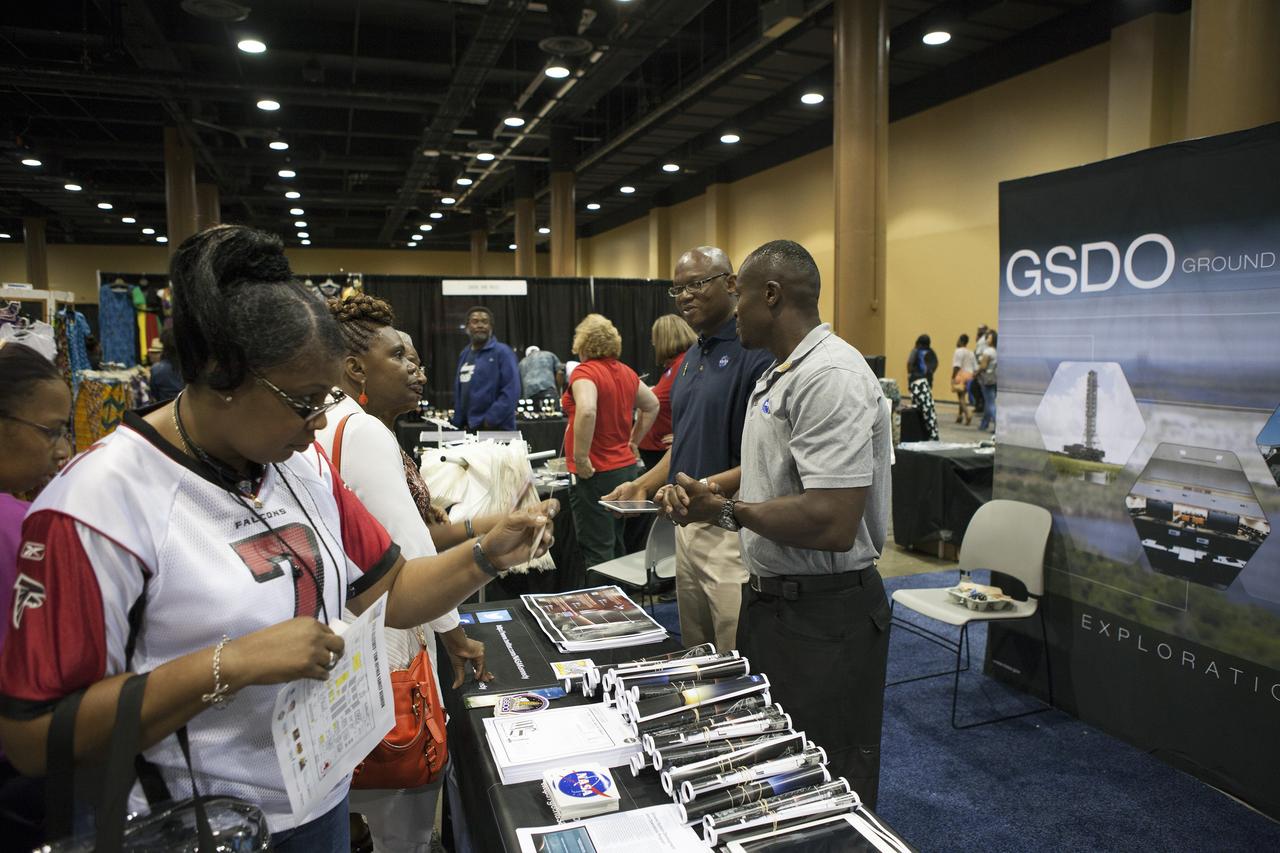
KISSIMMEE, Fla. – During the Tom Joyner Family Reunion, Ken Fullwood of Booz-Allen-Hamilton, left, and Yves Lamothe of the NASA Technical Management Branch of the Ground Systems Development and Operations Program talk to guests about ongoing work to convert the Kennedy Space Center into a 21st century spaceport. The Tom Joyner Family Reunion is designed to present uplifting programs, entertainment and information about growing, diverse communities. An annual event of the nationally-syndicated Tom Joyner Morning Show, the many exhibits included NASA's participation focusing on encouraging young people to consider studies and careers in STEM -- science, technology, engineering and math. NASA's Education Division promoted the benefits of math and scientific learning along with career opportunities offered by the space agency. The activities took place at the Gaylord Palms Resort in Kissimmee, Florida, during the Labor Day weekend. Photo credit: NASA/Daniel Casper
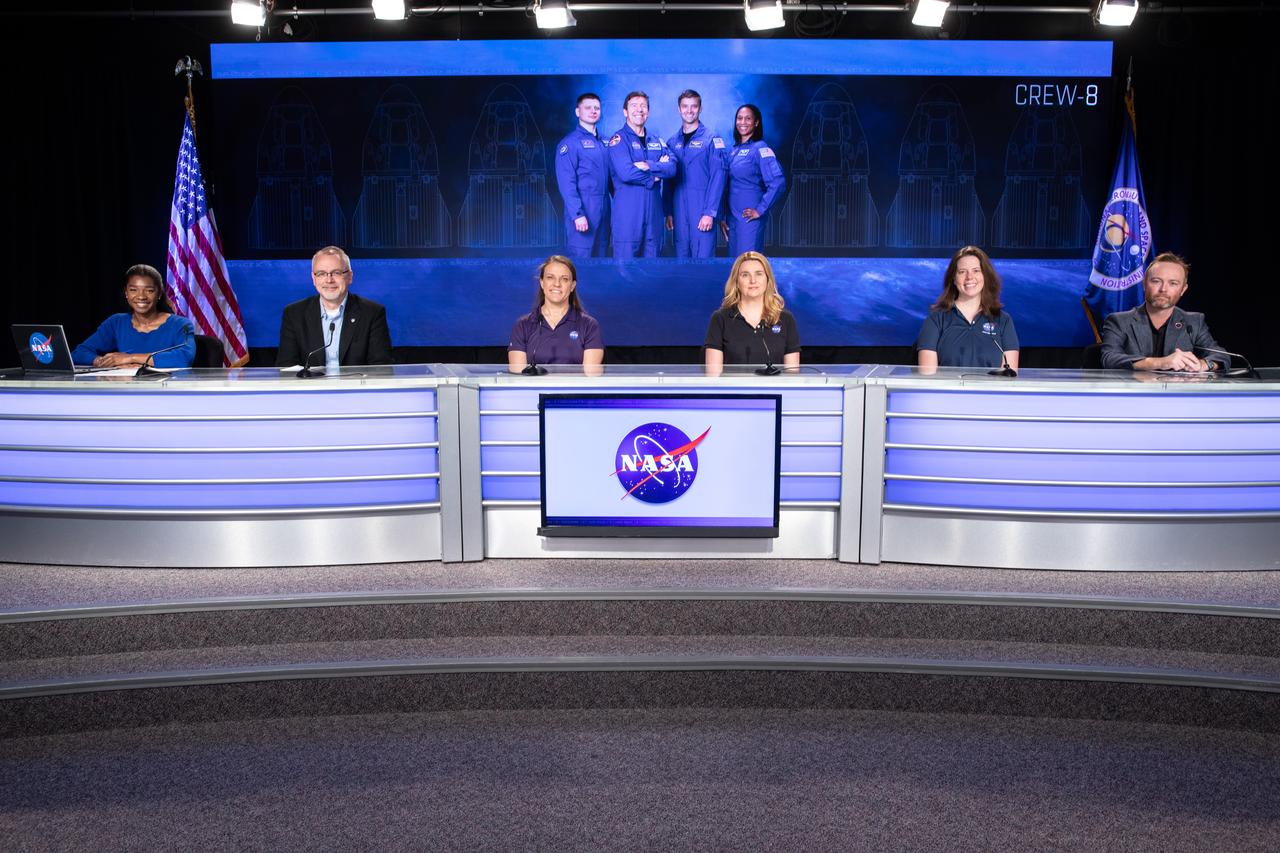
A social media panel discussion takes place inside the John Holliman Auditorium of the News Center at NASA’s Kennedy Space Center in Florida on Wednesday, Feb. 28, 2024, ahead of NASA’s SpaceX Crew-8 mission to the International Space Station. Participants, from left to right are Jasmine Hopkins, NASA Communications; NASA Associate Administrator Jim Free; Carla Koch, mission manager of NASA’s Commercial Crew Program; Jennifer Buchli, chief scientist, International Space Station; Kristin Fabre, deputy chief scientist of NASA’s Human Research Program; and Patrick O’Neill, public affairs and outreach lead of the ISS National Laboratory. Liftoff of the eighth crew rotation mission with SpaceX to the station and the ninth flight of Dragon with people as part of the agency’s Commercial Crew Program from Kennedy’s Launch Complex 39A is targeted for 12:04 a.m. on Friday, March 1.
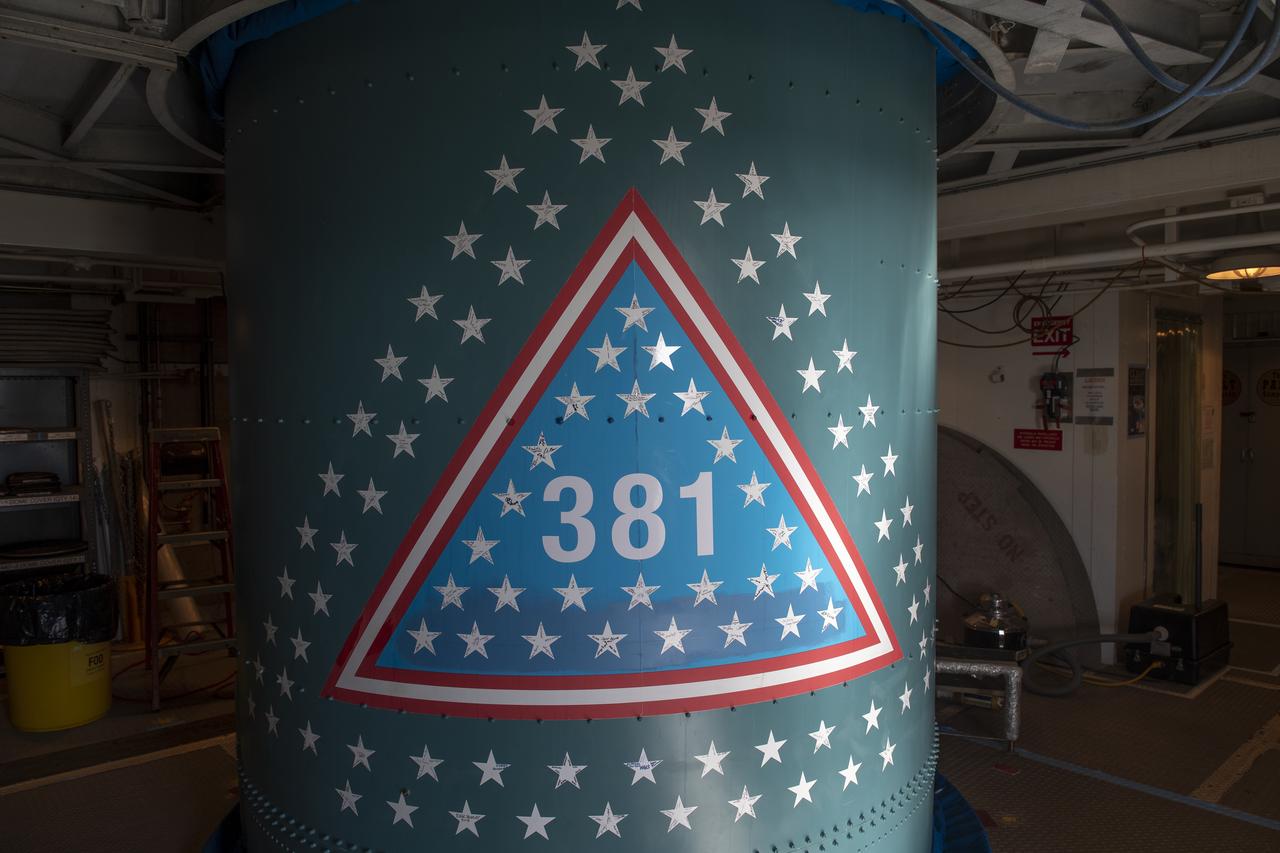
An emblem signifying the 381st flight of the United Launch Alliance Delta family is seen on the Delta II rocket, with the NASA Ice, Cloud and land Elevation Satellite-2 (ICESat-2) onboard, Wednesday, Sept. 12, 2018, at Vandenberg Air Force Base in California. The first Delta I was launched in May 1960. A star traditionally was placed on the rocket to recognize each mission. For the final Delta II, stars were sent to team members and partners throughout the nation. This rocket boasts more than 150 stars with over 800 signatures of people who have been part of the Delta II program. The ICESat-2 mission will measure the changing height of Earth's ice. Photo Credit: (NASA/Bill Ingalls)
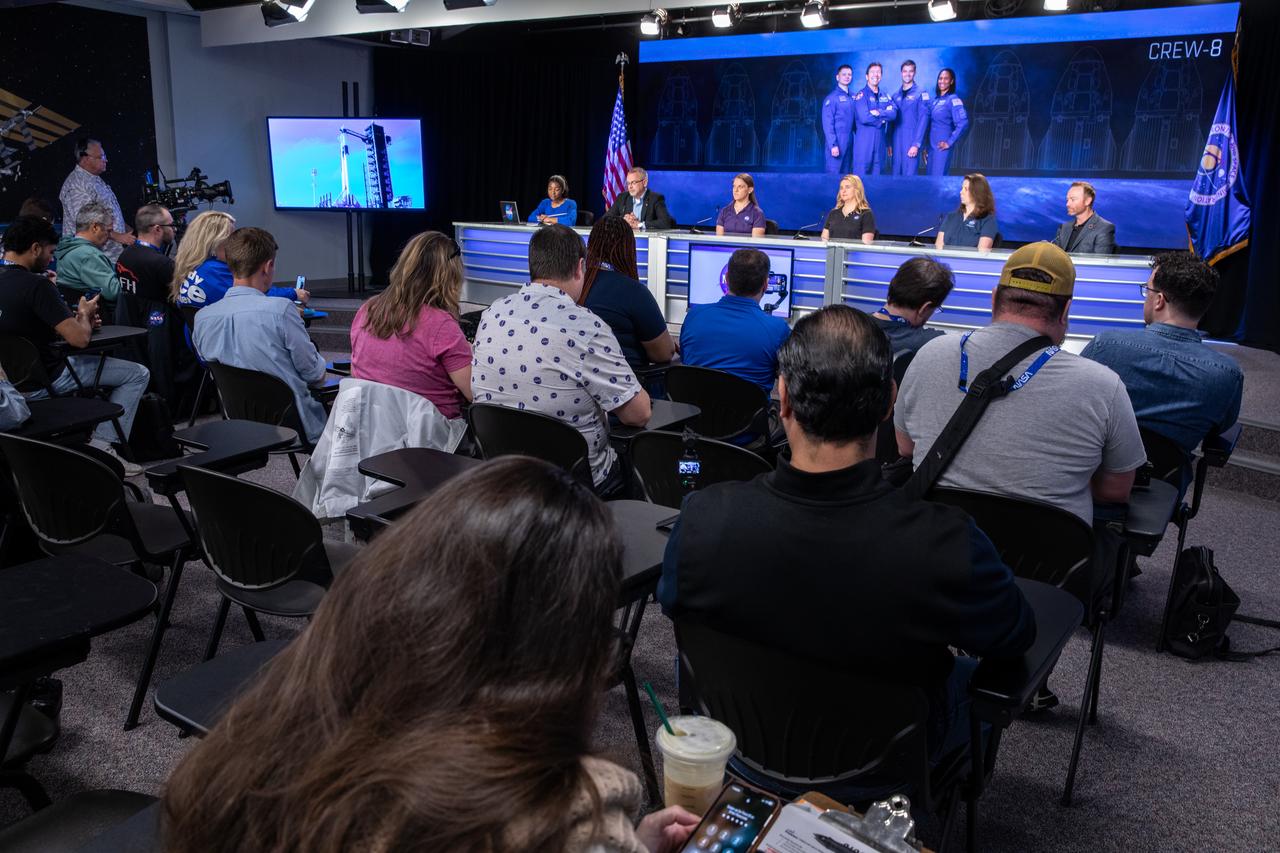
A social media panel discussion takes place inside the John Holliman Auditorium of the News Center at NASA’s Kennedy Space Center in Florida on Wednesday, Feb. 28, 2024, ahead of NASA’s SpaceX Crew-8 mission to the International Space Station. Participants, from left to right are Jasmine Hopkins, NASA Communications; NASA Associate Administrator Jim Free; Carla Koch, mission manager of NASA’s Commercial Crew Program; Jennifer Buchli, chief scientist, International Space Station; Kristin Fabre, deputy chief scientist of NASA’s Human Research Program; and Patrick O’Neill, public affairs and outreach lead of the ISS National Laboratory. Liftoff of the eighth crew rotation mission with SpaceX to the station and the ninth flight of Dragon with people as part of the agency’s Commercial Crew Program from Kennedy’s Launch Complex 39A is targeted for 12:04 a.m. on Friday, March 1.
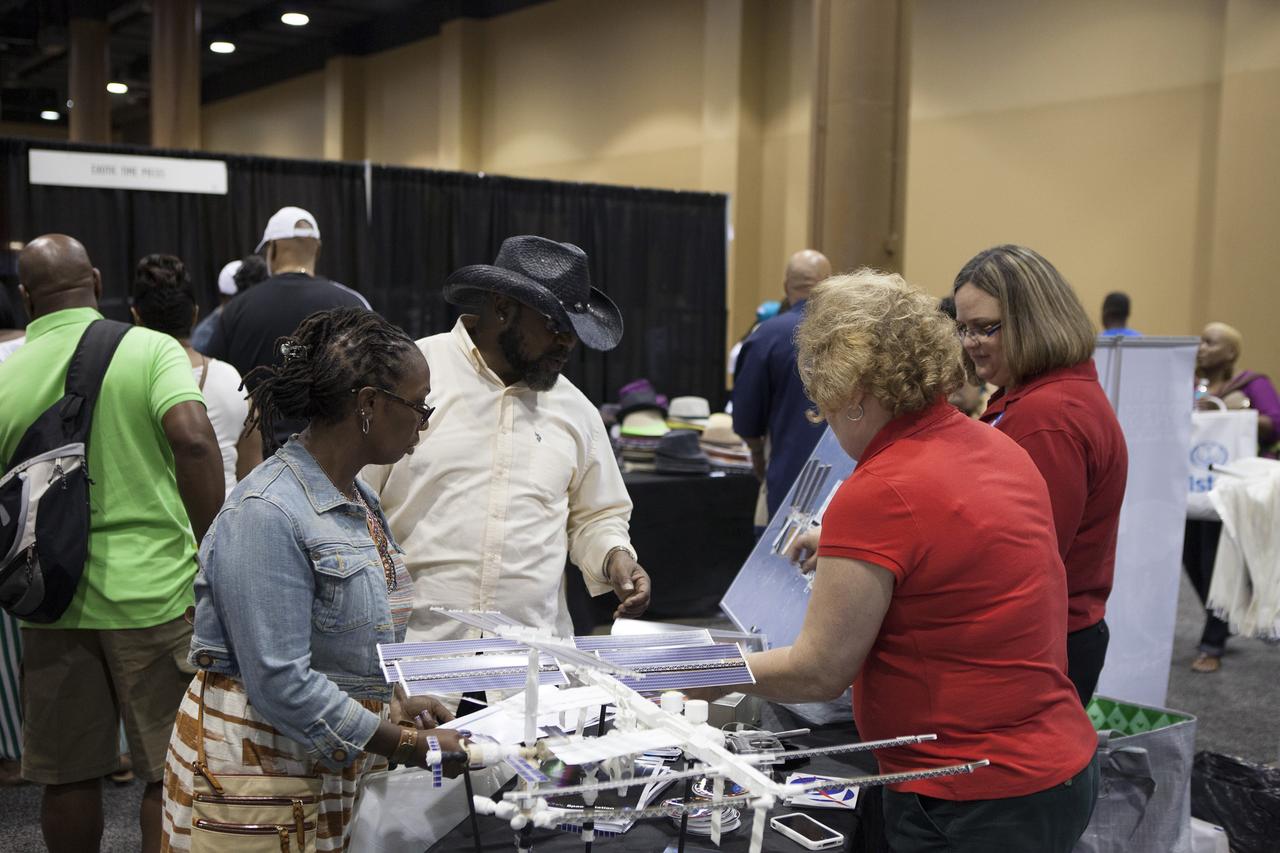
KISSIMMEE, Fla. – Guests at the Tom Joyner Family Reunion learn about NASA activities during the five-day event. Thousands of visitors spoke with agency representatives who explained the NASA’s efforts with the International Space Station, Commercial Crew Program, Ground Systems Development and Operations Program, as well as the Launch Services Program. The Tom Joyner Family Reunion is designed to present uplifting programs, entertainment and information about growing, diverse communities. An annual event of the nationally-syndicated Tom Joyner Morning Show, the many exhibits included NASA's participation focusing on encouraging young people to consider studies and careers in STEM -- science, technology, engineering and math. NASA's Education Division promoted the benefits of math and scientific learning along with career opportunities offered by the space agency. The activities took place at the Gaylord Palms Resort in Kissimmee, Florida, during the Labor Day weekend. Photo credit: NASA/Daniel Casper
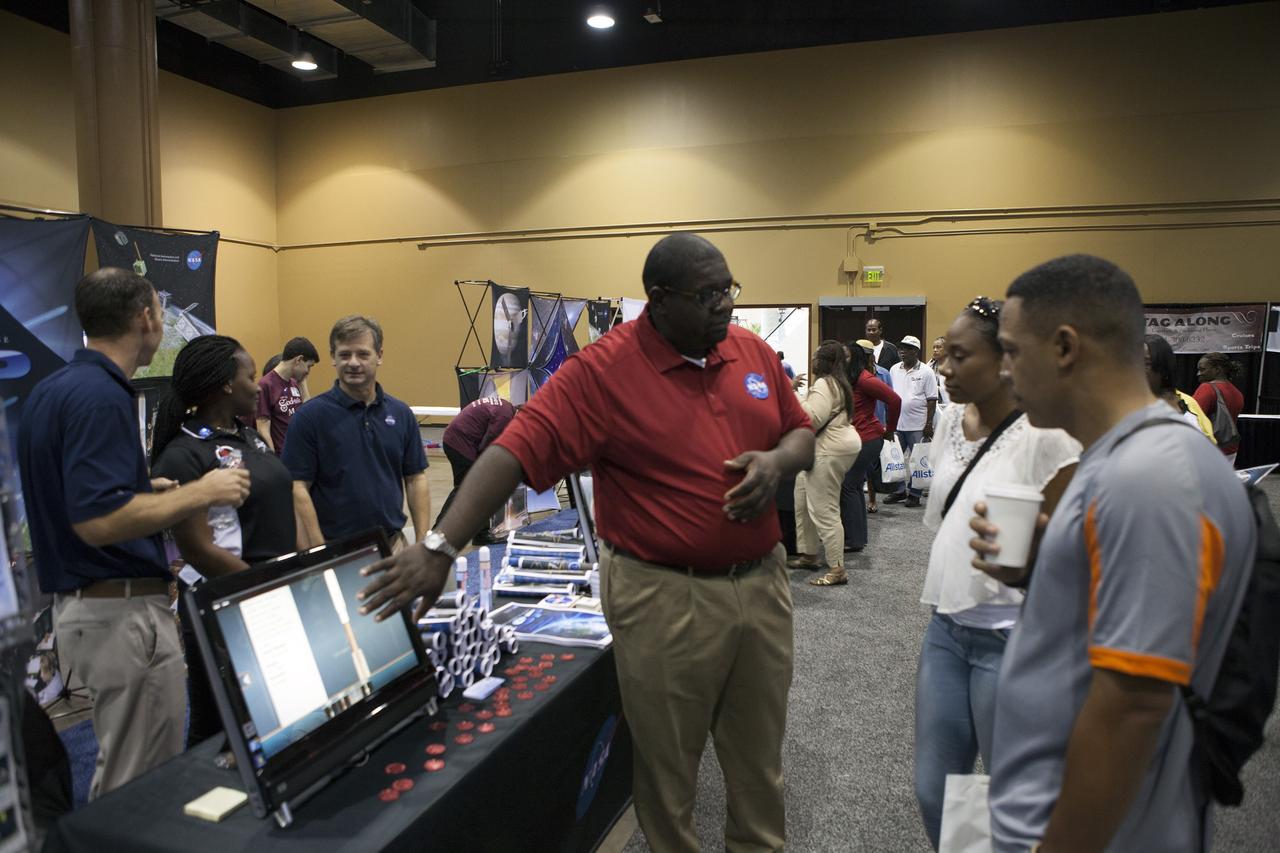
KISSIMMEE, Fla. – Guests at the Tom Joyner Family Reunion listen as Malcom Boston of the Fleet System Integration Branch of the Launch Services Program LSP explains a computer demonstration on rockets. Behind the table, from the left, are Brian Norton, Emily Fields and Randy Mizelle, all from the Program Planning Office in LSP. The Tom Joyner Family Reunion is designed to present uplifting programs, entertainment and information about growing, diverse communities. An annual event of the nationally-syndicated Tom Joyner Morning Show, the many exhibits included NASA's participation focusing on encouraging young people to consider studies and careers in STEM -- science, technology, engineering and math. NASA's Education Division promoted the benefits of math and scientific learning along with career opportunities offered by the space agency. The activities took place at the Gaylord Palms Resort in Kissimmee, Florida, during the Labor Day weekend. Photo credit: NASA/Daniel Casper
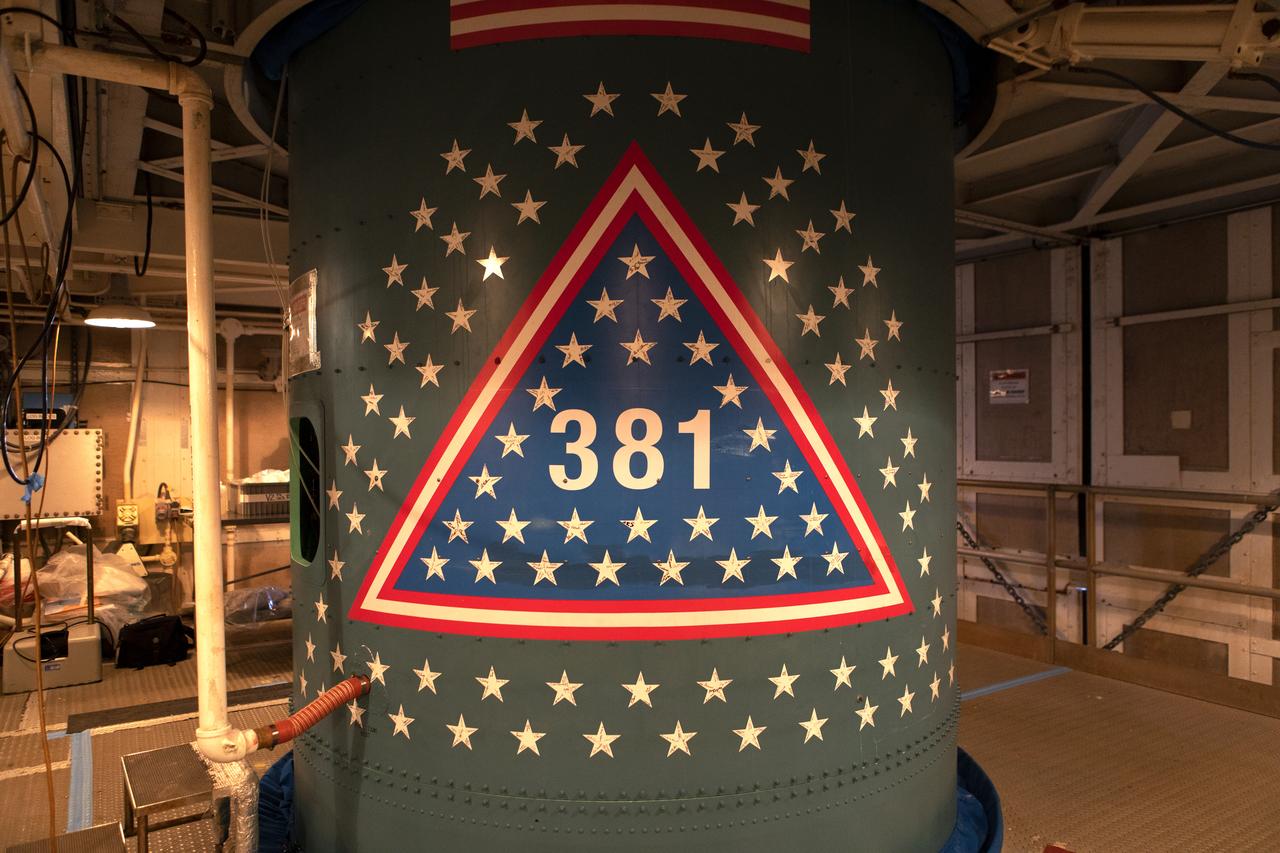
Stars are in view on the first stage of the United Launch Alliance Delta II rocket at Space Launch Complex 2 at Vandenberg Air Force Base in California, on Sept. 13, 2018. Historically, each Delta rocket used to notate the number of launches within the program, beginning in May, 1960, with the first Delta I. This practice was brought back for the final Delta II launch of ICESat-2. The “381” on the rocket signifies that this will be the 381st flight in the Delta family. A star traditionally was placed on the rocket to recognize each mission. For the final Delta II, stars were sent to team members and partners throughout the nation. This rocket boasts more than 150 stars with over 800 signatures of people who have been part of the Delta II program.
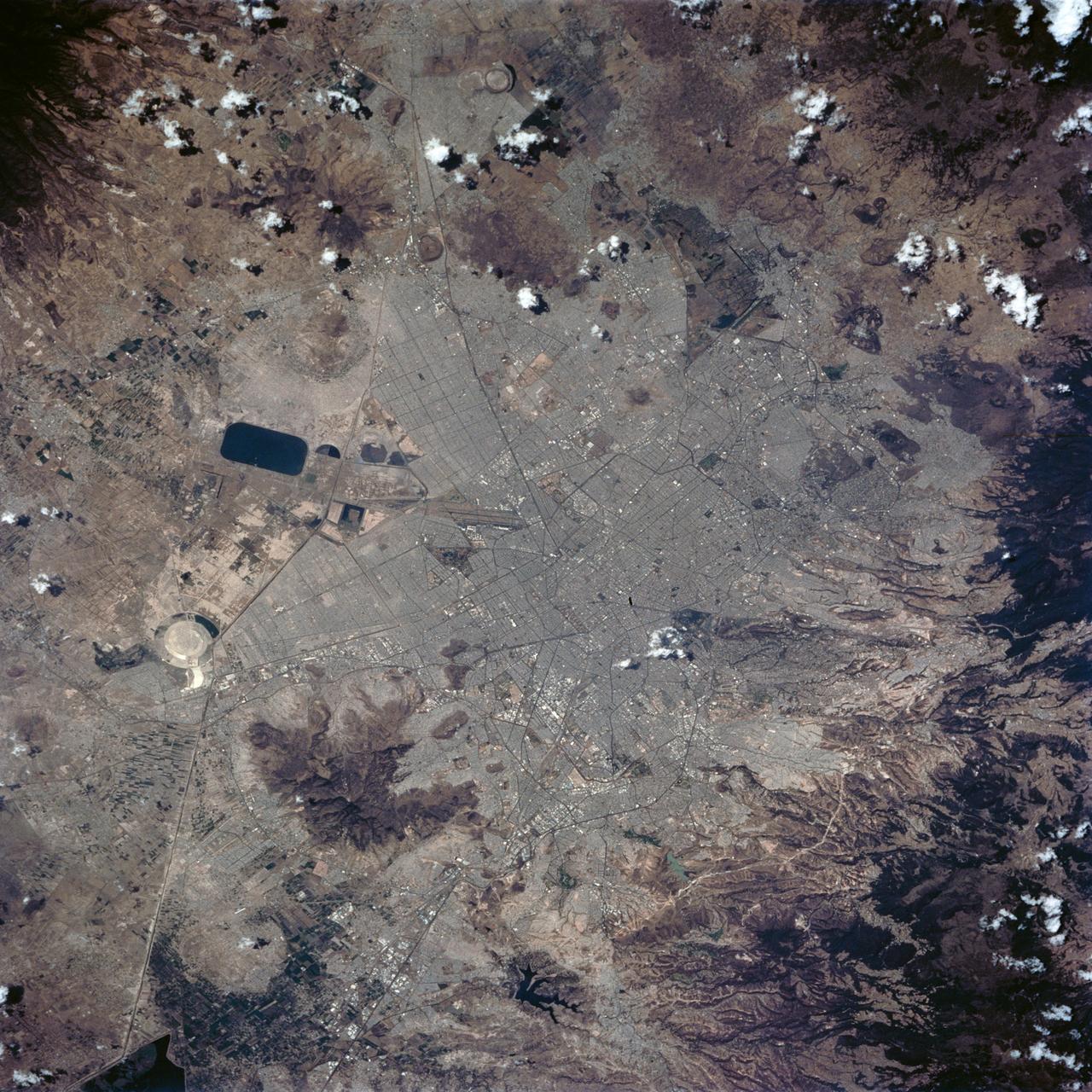
STS062-84-028 (4-18 March 1994) --- According to NASA scientists this image is the clearest photo of Mexico City taken from United States manned spacecraft. North is to the upper right. Mexico City sits in a basin surrounded by large volcanoes. The restricted atmospheric circulation in the basin, coupled with the inevitable air emissions produced by a city of 20 million people has created a critical air pollution problem for the city. In most photographs of the region, Mexico City is obscured by haze. Scientists feel the clear atmosphere in this photograph may be due, in part, to the stringent air emission restrictions now in place. The clarity of the photograph allows many key cultural features to be identified, including all of the major boulevards, the horse track (western part of the city), the university (south of the city), and the museum areas. Large, man-made ponds east of the city also stand out.
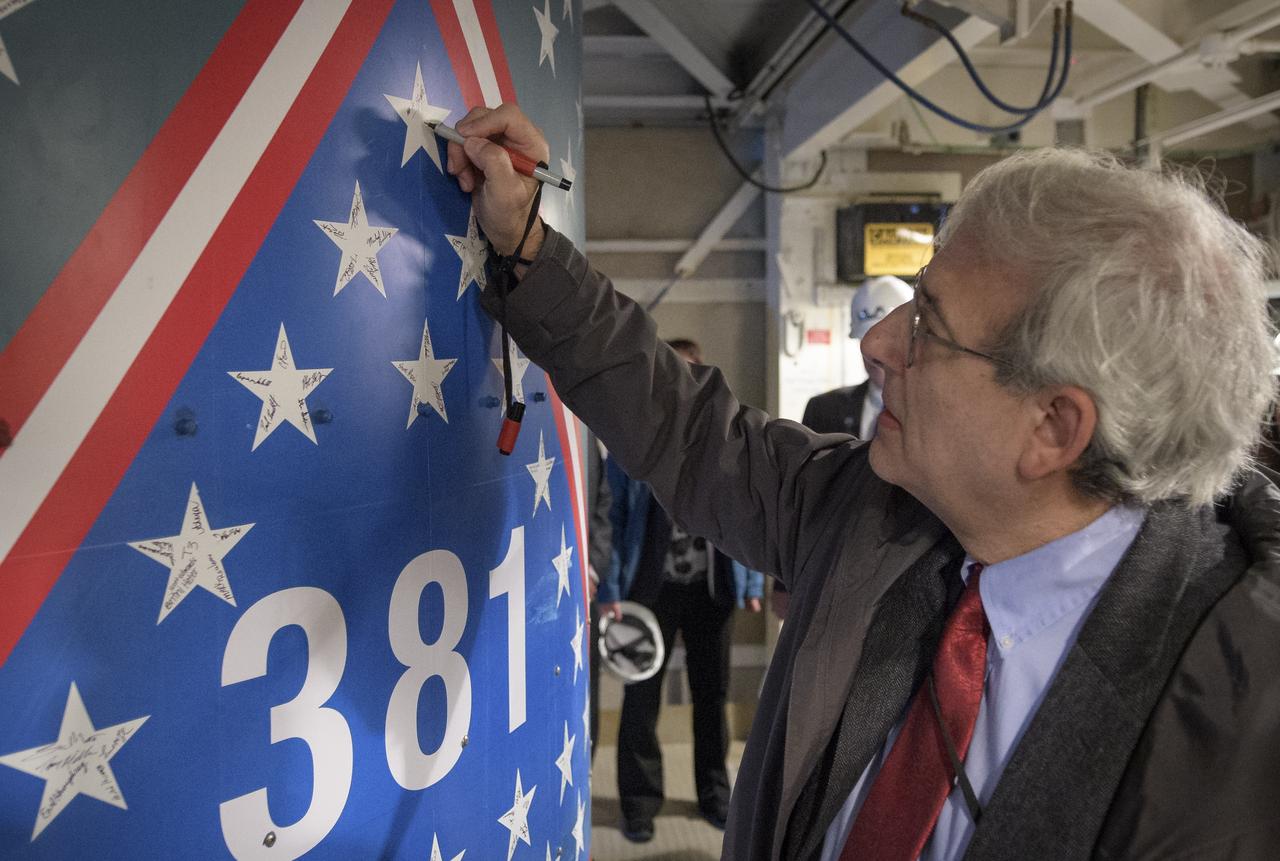
Michael Freilich, director of NASA’s Earth Science Division, NASA Headquarters, signs a star on the United Launch Alliance Delta II with the NASA Ice, Cloud and land Elevation Satellite-2 (ICESat-2) onboard, Thursday, Sept. 13, 2018, at Vandenberg Air Force Base in California. This will be the final launch of a Delta II rocket. The “381” on the rocket signifies that this is the 381st flight in the Delta family. The first Delta I was launched in May 1960. A star traditionally was placed on the rocket to recognize each mission. For the final Delta II, stars were sent to team members and partners throughout the nation. This rocket boasts more than 150 stars with over 800 signatures of people who have been part of the Delta II program. The ICESat-2 mission will measure the changing height of Earth's ice. Photo Credit: (NASA/Bill Ingalls)
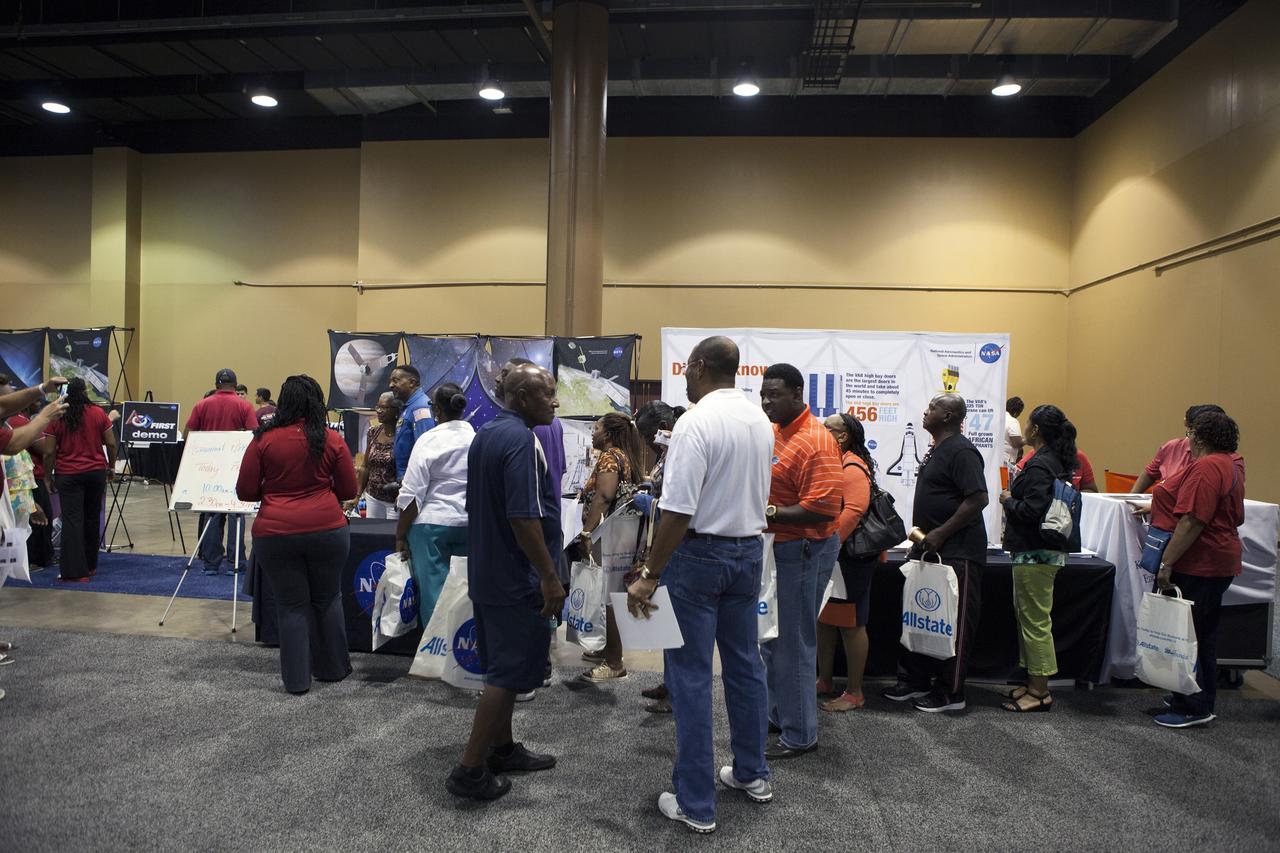
KISSIMMEE, Fla. – Guests at the Tom Joyner Family Reunion learn about NASA activities during the five-day event. Thousands of visitors spoke with agency representatives who explained the agency’s efforts with the International Space Station, Commercial Crew Program, Ground Systems Development and Operations Program, as well as the Launch Services Program. The Tom Joyner Family Reunion is designed to present uplifting programs, entertainment and information about growing, diverse communities. An annual event of the nationally-syndicated Tom Joyner Morning Show, the many exhibits included NASA's participation focusing on encouraging young people to consider studies and careers in STEM -- science, technology, engineering and math. NASA's Education Division promoted the benefits of math and scientific learning along with career opportunities offered by the space agency. The activities took place at the Gaylord Palms Resort in Kissimmee, Florida, during the Labor Day weekend. Photo credit: NASA/Daniel Casper
![“I’ve always been creative. I was always in dance class and taking violin lessons. I would say, ‘Hey Dad, I don't wanna take ballet anymore. Can I take African dance? Dad, I don't wanna take African dance anymore. Can I take Irish clog dancing? Can I take swing ballroom?’ [As an adult] I began studying Brazilian Samba. Then, COVID happened. There were no more dance classes. No more bars. No more Pilates. Everything is closed. So, I just started writing more. I started pitching scripts because I didn’t have anything else to do. I just enter contests and see what happens. I don’t always place, but I always get really good feedback. I like [writing] because it helps me be able to create good strategic campaigns for NASA. I'm thinking outside of my own thought processes. I'm thinking about how average people experience stories, how they expect them to go. This helps when producing videos for NASA. It helps with developing campaigns for programs people might not otherwise know about. I think all my creative passions meet somewhere in the middle of the road. I can draw on those tools, I can learn from other things, and I can deal with difficult people or situations. I get a chance to figure out how to tell this story.” NASA Public Affairs Specialist, Aubree Hill, poses for a portrait, Thursday, Jan. 20, 2021 at the Mary W. Jackson NASA Headquarters building in Washington. Photo Credit: (NASA/Aubrey Gemignani)](https://images-assets.nasa.gov/image/NHQ202201200001/NHQ202201200001~medium.jpg)
“I’ve always been creative. I was always in dance class and taking violin lessons. I would say, ‘Hey Dad, I don't wanna take ballet anymore. Can I take African dance? Dad, I don't wanna take African dance anymore. Can I take Irish clog dancing? Can I take swing ballroom?’ [As an adult] I began studying Brazilian Samba. Then, COVID happened. There were no more dance classes. No more bars. No more Pilates. Everything is closed. So, I just started writing more. I started pitching scripts because I didn’t have anything else to do. I just enter contests and see what happens. I don’t always place, but I always get really good feedback. I like [writing] because it helps me be able to create good strategic campaigns for NASA. I'm thinking outside of my own thought processes. I'm thinking about how average people experience stories, how they expect them to go. This helps when producing videos for NASA. It helps with developing campaigns for programs people might not otherwise know about. I think all my creative passions meet somewhere in the middle of the road. I can draw on those tools, I can learn from other things, and I can deal with difficult people or situations. I get a chance to figure out how to tell this story.” NASA Public Affairs Specialist, Aubree Hill, poses for a portrait, Thursday, Jan. 20, 2021 at the Mary W. Jackson NASA Headquarters building in Washington. Photo Credit: (NASA/Aubrey Gemignani)
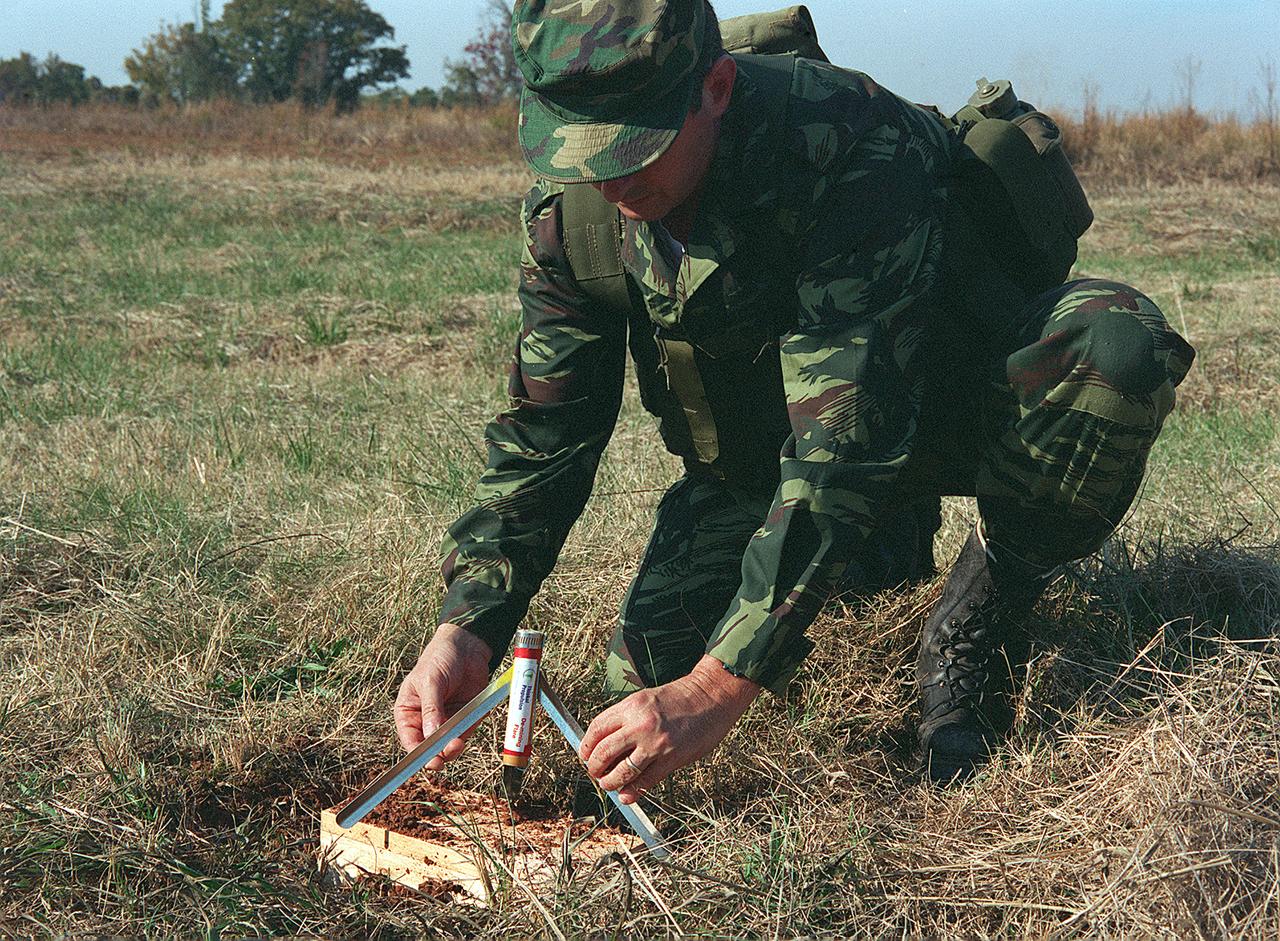
The same rocket fuel that helps power the Space Shuttle as it thunders into orbit will now be taking on a new role, with the potential to benefit millions of people worldwide. Leftover rocket fuel from NASA is being used to make a flare that destroys land mines where they were buried, without using explosives. The flare is safe to handle and easy to use. People working to deactivate the mines simply place the flare next to the uncovered land mine and ignite it from a safe distance using a battery-triggered electric match. The flare burns a hole in the land mine's case and ignites its explosive contents. The explosive burns away, disabling the mine and rendering it harmless. Using leftover rocket fuel to help destroy land mines incurs no additional costs to taxpayers. To ensure enough propellant is available for each Shuttle mission, NASA allows for a small percentage of extra propellant in each batch. Once mixed, surplus fuel solidifies and carnot be saved for use in another launch. In its solid form, it is an ideal ingredient for the new flare. The flare was developed by Thiokol Propulsion in Brigham City, Utah, the NASA contractor that designs and builds rocket motors for the Solid Rocket Booster Space Shuttle. An estimated 80 million or more active land mines are scattered around the world in at least 70 countries, and kill or maim 26,000 people a year. Worldwide, there is one casualty every 22 minutes
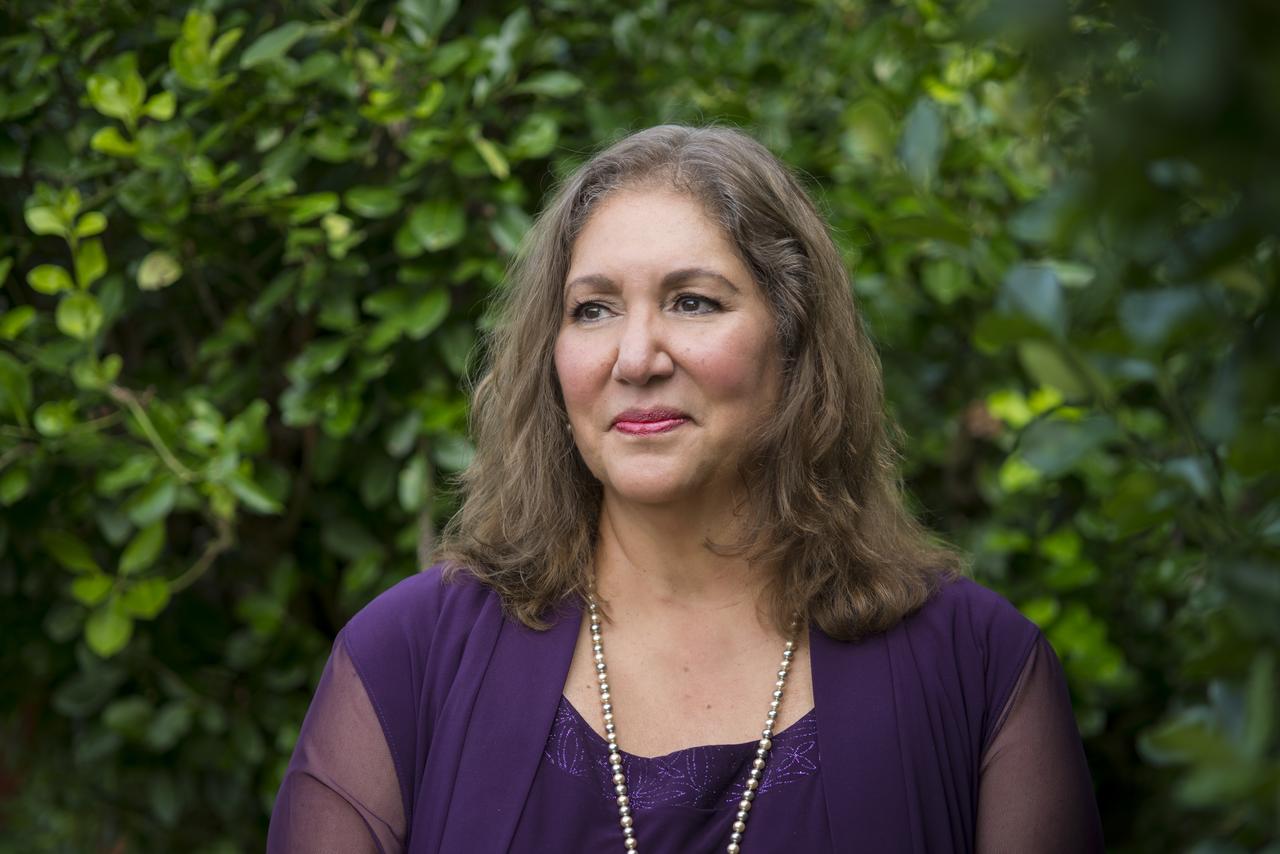
“I grew up in Venezuela and studied in the military high school Gran Mariscal de Ayacucho. They would frequently bring in speakers, usually professional that were doing important work. Here comes Dr. Humberto Fernandez-Moran, a Venezuelan scientist working at NASA He was speaking to us about teamwork and he told an anecdote about this janitor that was mopping the floors in one of the NASA installations, when someone asked the man what he was doing. The janitor turned around and said “I’m sending people to the Moon.” In that moment I thought, “Wow, NASA is a really inclusive place to work because they value all the contributions of the people that work for them.” When I immigrated to the United States, I didn’t start my career at NASA. I worked in various positions in the private and public sector. When I saw this position open and applied, I was reminded of that story. Later on, I worked for NASA as part of the new employee orientation team for a little over a year I would share that story with the new hires to let them know that NASA was extremely inclusive and that their work would matter. Regardless of the scope of their contribution you were part of a team working toward the same goal. When someone asks me about my job? I respond with immense pride I am part of the Office of the General Counsel – International Law Practice Group and I send astronauts into space." NASA Legal Administrative Specialist, Linda Perozo, poses for a portrait outside her home in Maryland, Wednesday, Sept. 16, 2020. Photo Credit: (NASA/Aubrey Gemignani)
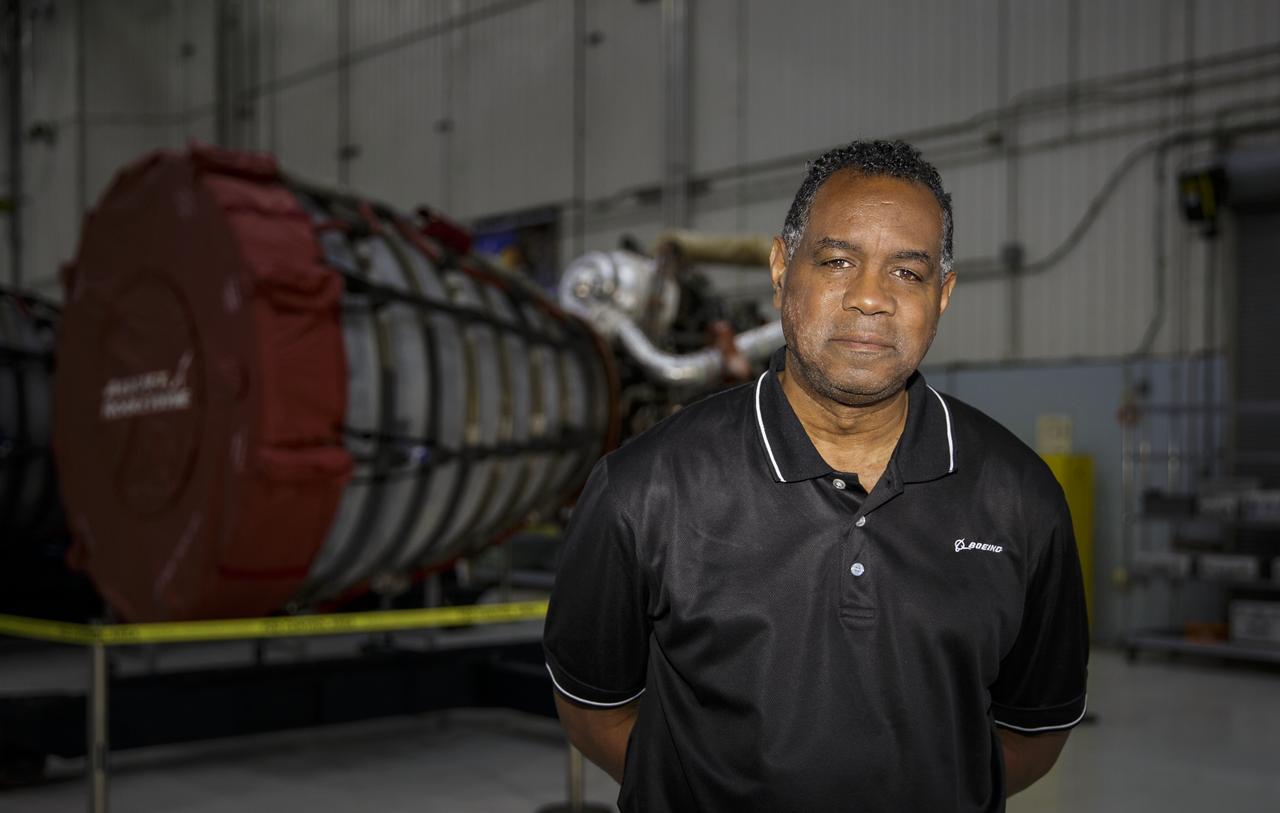
"When I got on the Shuttle program, there were a lot of people that worked the tail-end of the Apollo missions. I would have conversations with them. I asked them, 'Is there anything similar between what we’re today and what you first started working on?' They were happy to talk about it. And it was interesting to me. Working on this program is the closest thing to something like Apollo. I think we’re doing a great thing here, remaking history. "And I think I’ve helped put in place a future for younger engineers that are here that have the same interests and the same kind of passion and desire that I had when I first started. I know what it feels like when I first started, and I would ask those questions of the people that had the history behind them. You get excited by it because you start to make analogies in terms of what you’re experiencing today. I don’t force how to go about doing things. I just make suggestions: 'I encountered something similar. This is how I went about it. Maybe you could think about going about it that way. If you need anything further — help or assistance — feel free to come and talk to me.' And they do." Greg Ffolkes, Boeing, Friday, June 28, 2019 at Michoud Assembly Facility, New Orleans, LA. Photo Credit: (NASA/Aubrey Gemignani)
![“I feel that my larger purpose at NASA, which I've felt since I came on as an intern, is to leave NASA a better place than I found it. I know there are so many people who are just like myself, who have had this big, huge dream of being at NASA from some sort of spark in their childhood. I have a privilege as a well-spoken, affable, femme, white woman and I’m compelled to use this privilege for good — to advocate for others. I feel like this dream should be achievable for anyone who has the merit to be here without wondering 'Are my needs going [to] be met?' Or, 'If I'm a part of a particular community, will I be faced with any sort of backlash because of the culture?' As an Agency, we're trying to do incredibly hard things moving forward. And going forward, I choose to use the privilege of being at HQ and being very close to leadership as a vessel for progress to help ensure we get closer to everybody having the right to achieve their dream here." NASA Management and Program Analyst Mallory Carbon, poses for a portrait, Wednesday, May 29, 2024, outside the NASA Headquarters Mary W. Jackson Building in Washington. Photo Credit: (NASA/Bill Ingalls)](https://images-assets.nasa.gov/image/NHQ202405290001/NHQ202405290001~medium.jpg)
“I feel that my larger purpose at NASA, which I've felt since I came on as an intern, is to leave NASA a better place than I found it. I know there are so many people who are just like myself, who have had this big, huge dream of being at NASA from some sort of spark in their childhood. I have a privilege as a well-spoken, affable, femme, white woman and I’m compelled to use this privilege for good — to advocate for others. I feel like this dream should be achievable for anyone who has the merit to be here without wondering 'Are my needs going [to] be met?' Or, 'If I'm a part of a particular community, will I be faced with any sort of backlash because of the culture?' As an Agency, we're trying to do incredibly hard things moving forward. And going forward, I choose to use the privilege of being at HQ and being very close to leadership as a vessel for progress to help ensure we get closer to everybody having the right to achieve their dream here." NASA Management and Program Analyst Mallory Carbon, poses for a portrait, Wednesday, May 29, 2024, outside the NASA Headquarters Mary W. Jackson Building in Washington. Photo Credit: (NASA/Bill Ingalls)
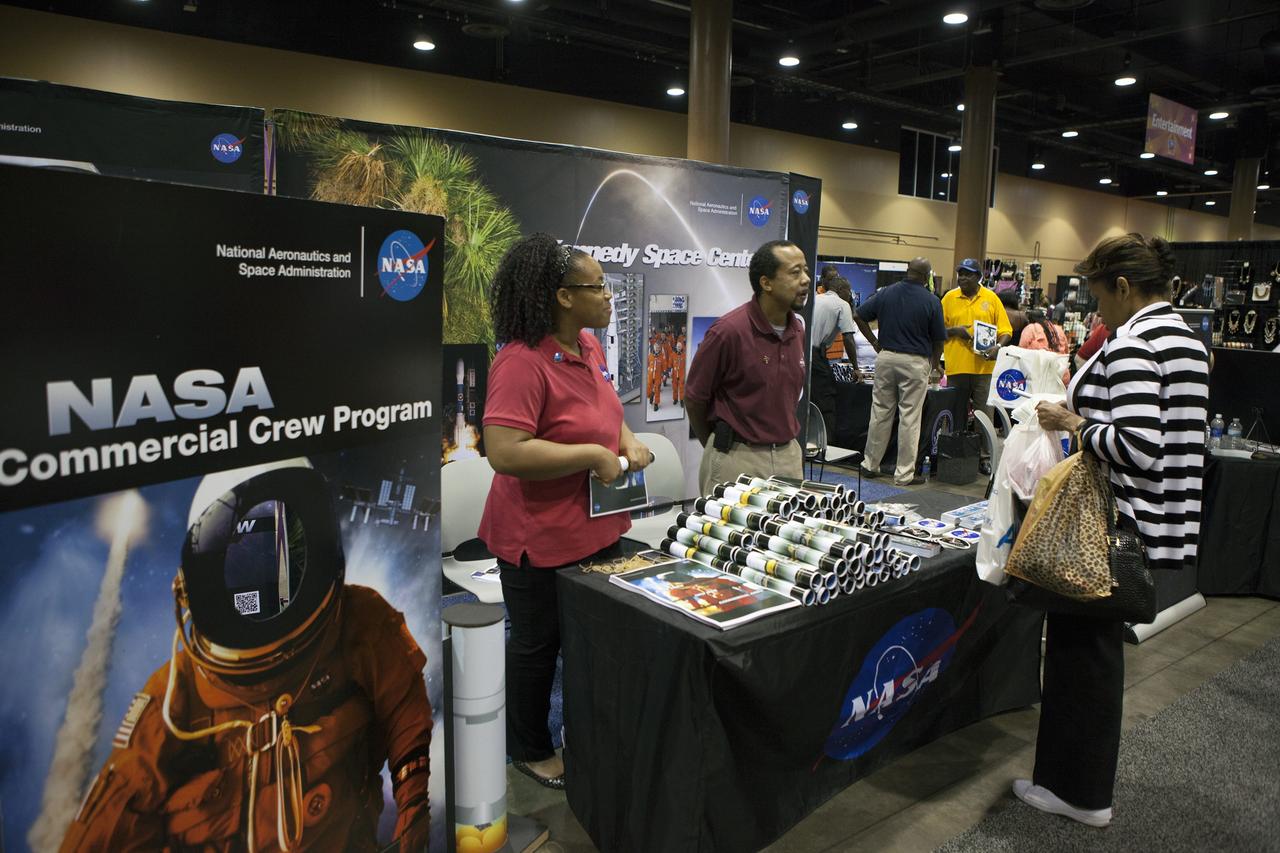
KISSIMMEE, Fla. – A guest at the Tom Joyner Family Reunion talks with Brittani Sims, left, and Sheldon Lauderdale, both work in the Program Control and Integration Office of the Commercial Crew Program. They explained that the program is facilitating development of American commercial crew space transportation capability to achieve safe, reliable and cost-effective access to and from the International Space Station and low-Earth orbit. The Tom Joyner Family Reunion is designed to present uplifting programs, entertainment and information about growing, diverse communities. An annual event of the nationally-syndicated Tom Joyner Morning Show, the many exhibits included NASA's participation focusing on encouraging young people to consider studies and careers in STEM -- science, technology, engineering and math. NASA's Education Division promoted the benefits of math and scientific learning along with career opportunities offered by the space agency. The activities took place at the Gaylord Palms Resort in Kissimmee, Florida, during the Labor Day weekend. Photo credit: NASA/Daniel Casper
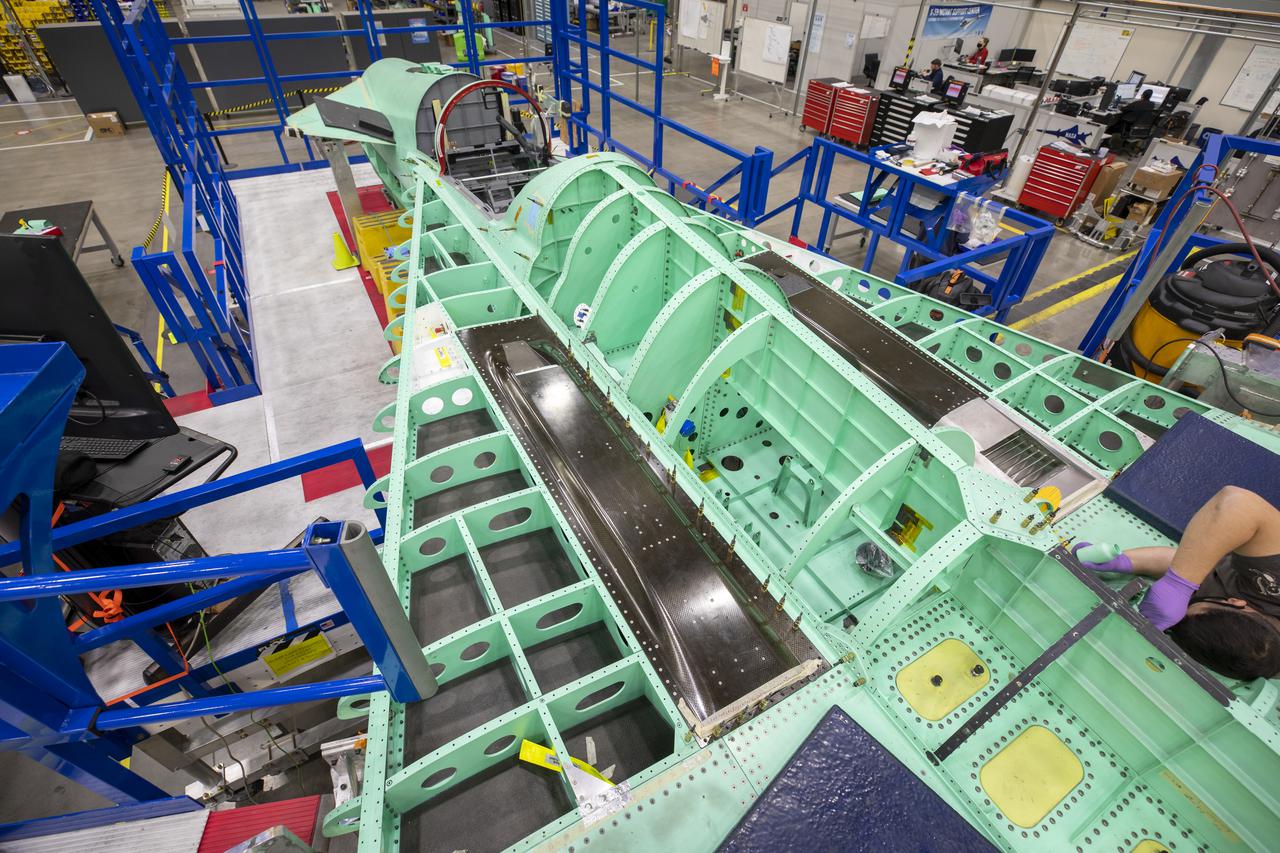
NASA is targeting 2022 for the first flight of the X-59 Quiet SuperSonic Technology (QueSST) research aircraft. Its mission – fly over communities to collect data that could cut passenger travel time in half without disturbing people on the ground. NASA’s X-59 is equipped with supersonic technologies that aid in lowering the sound of the sonic boom. In this picture, the black rectangle panels are the air intakes for the environmental control system (ECS) that regulates the temperature, cabin pressure, and air distribution. The silver grate located at the rear of one of the ECS panels is the exhaust — both of these sections are traditionally housed on the underside of the plane. By placing these features on top of the X-59 wing, the wing blocks and prevents the ECS exhaust from interacting with the shock waves on the bottom of the aircraft. This unique design approach to re-shaping the shock wave pattern substantially reduces the sonic boom to more of a sonic “thump” when it reaches the ground. Lockheed Martin Photography By Garry Tice 1011 Lockheed Way, Palmdale, Ca. 93599 Event: SEG 210 Forebody Date: 1/19/2021 Additional Info:
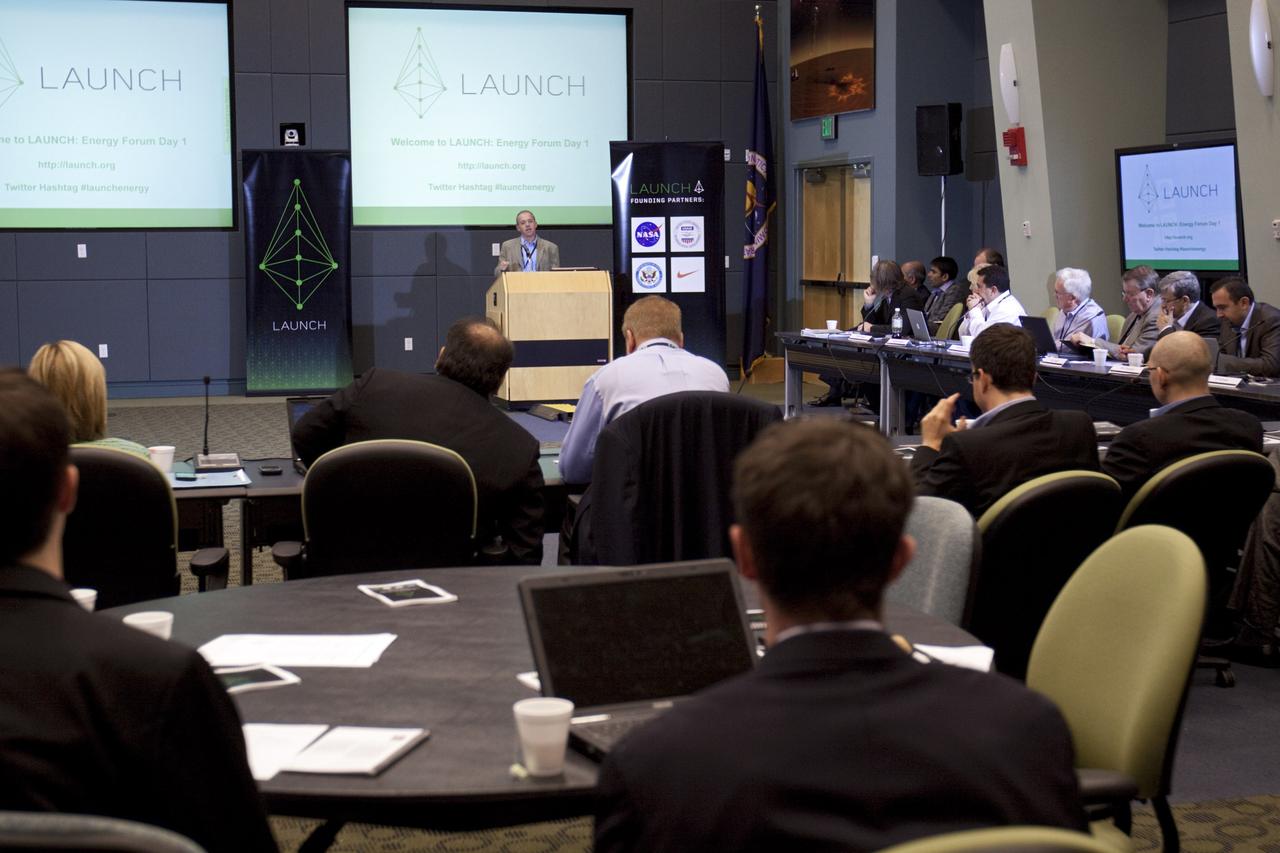
CAPE CANAVERAL, Fla. – In the Operations Support Building (OSB) II at NASA's Kennedy Space Center in Florida, one of the many speakers discusses innovative ideas with NASA and partners during a three-day LAUNCH: Energy forum Nov. 11-13. This third in a series of forums is part of an ongoing initiative to identify, showcase and support innovative approaches to sustainability challenges. LAUNCH allows NASA to propel innovative solutions that help those outside the agency make the connection between our lives on Earth and how we live and work in space. Through the U.S. Agency for International Development (USAID)'s involvement, LAUNCH places a special emphasis on accelerating innovations poised for large scale impact in improving the lives of people in the developing world. During the forum, 10 international participants will showcase new innovations that could address energy problems on Earth and in space. NASA, USAID, Nike Inc., and the U.S. Department of State are LAUNCH founding partners. The partners all contributed to planning the forum, selecting innovators and recruiting other event participants. Photo credit: NASA/Kim Shiflett
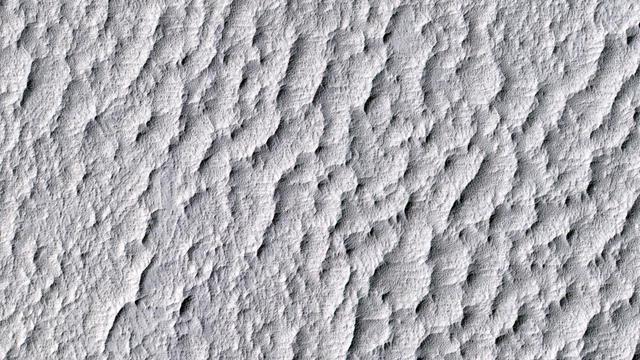
This image from the High Resolution Imaging Science Experiment (HiRISE) camera on NASA's Mars Reconnaissance Orbiter shows a location on Mars associated with the best-selling novel and Hollywood movie, "The Martian." It is the science-fiction tale's planned landing site for the Ares 4 mission. The novel placed the Ares 4 site on the floor of a very shallow crater in the southwestern corner of Schiaparelli Crater. This HiRISE image shows a flat region there entirely mantled by bright Martian dust. There are no color variations, just uniform reddish dust. A pervasive, pitted texture visible at full resolution is characteristic of many dust deposits on Mars. No boulders are visible, so the dust is probably at least a meter thick. Past Martian rover and lander missions from NASA have avoided such pervasively dust-covered regions for two reasons. First, the dust has a low thermal inertia, meaning that it gets extra warm in the daytime and extra cold at night, a thermal challenge to survival of the landers and rovers (and people). Second, the dust hides the bedrock, so little is known about the bedrock composition and whether it is of scientific interest. This view is one image product from HiRISE observation ESP_042014_1760, taken July 14, 2015, at 3.9 degrees south latitude, 15.2 degrees east longitude. http://photojournal.jpl.nasa.gov/catalog/PIA19914
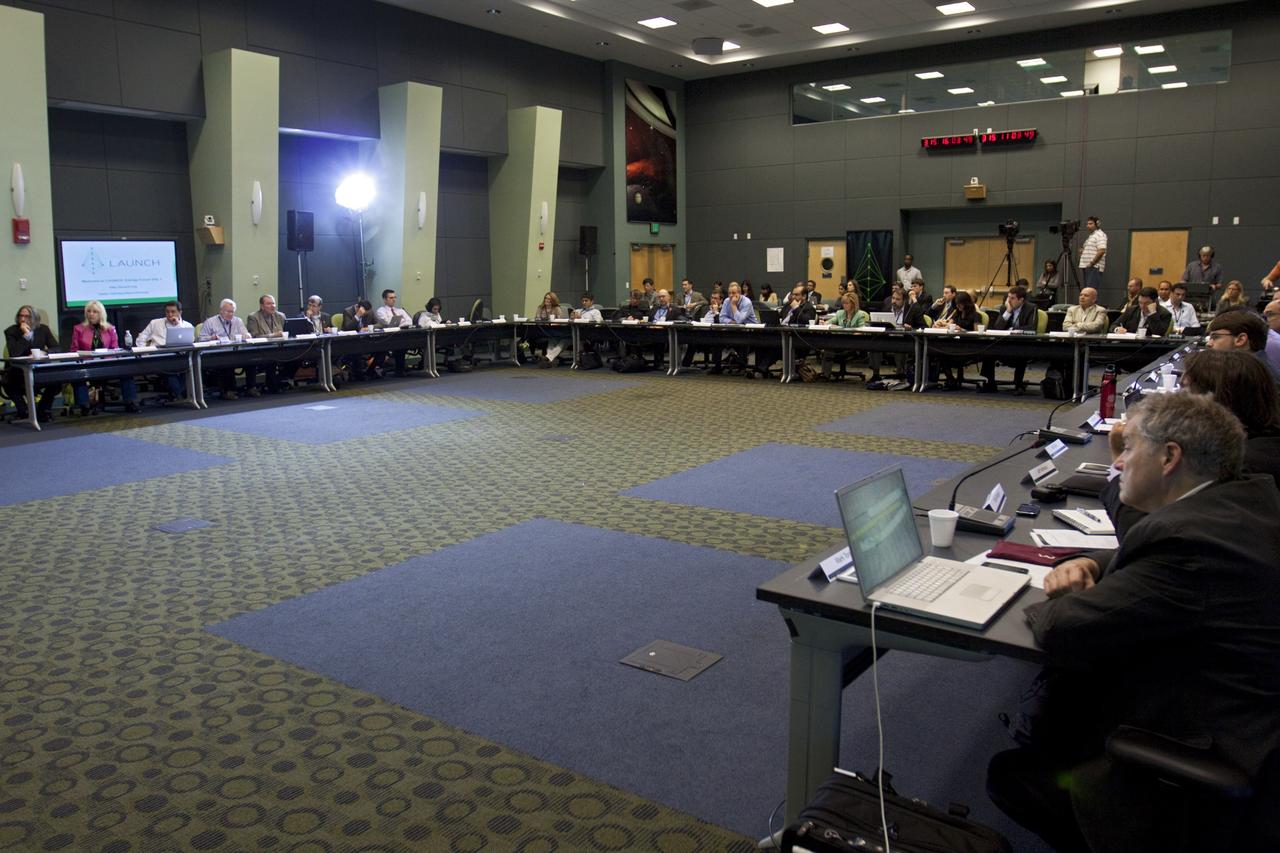
CAPE CANAVERAL, Fla. – In the Operations Support Building (OSB) II at NASA's Kennedy Space Center in Florida, participants listen as speakers discuss innovative ideas with NASA and partners during a three-day LAUNCH: Energy forum Nov. 11-13. This third in a series of forums is part of an ongoing initiative to identify, showcase and support innovative approaches to sustainability challenges. LAUNCH allows NASA to propel innovative solutions that help those outside the agency make the connection between our lives on Earth and how we live and work in space. Through the U.S. Agency for International Development (USAID)'s involvement, LAUNCH places a special emphasis on accelerating innovations poised for large scale impact in improving the lives of people in the developing world. During the forum, 10 international participants will showcase new innovations that could address energy problems on Earth and in space. NASA, USAID, Nike Inc., and the U.S. Department of State are LAUNCH founding partners. The partners all contributed to planning the forum, selecting innovators and recruiting other event participants. Photo credit: NASA/Kim Shiflett
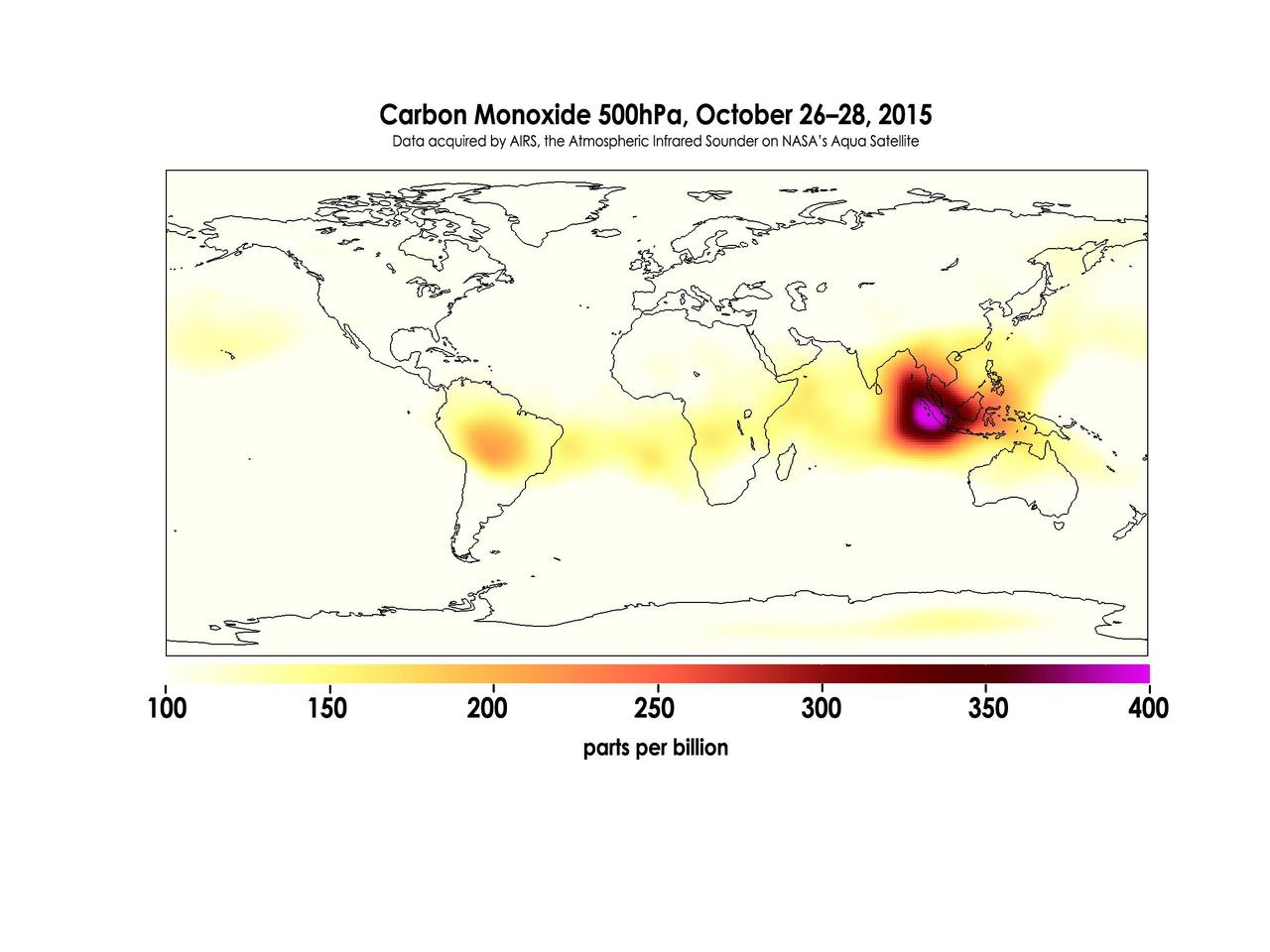
Widespread forest fires across Indonesia have burned tens of thousands of acres over three months, causing high levels of pollution, loss of life, and billions of dollars to the Indonesian government. It is estimated that more than 43 million people have been inhaling toxic fumes, and large parts of Indonesia have been placed in a state of emergency. Most of the fires are believed to have been set to clear farmland during the dry season, but a long term drought enhanced by El Niño conditions have contributed to the fires remaining unchecked due to lack of rain. These images made with data acquired by AIRS, the Atmospheric Infrared Sounder on NASA's Aqua Satellite, show the global concentration of carbon monoxide at the 500hPa pressure level, or approximately 18,000 feet (5,500 meters) altitude. The data are an average of measurements taken over three days, from October 14 through 16, and October 26 through 28, and the high concentration and large extent of the fires over Indonesia are quite apparent. While the scale for this image extends to 400 parts per billion, local values of carbon monoxide can be significantly higher. http://photojournal.jpl.nasa.gov/catalog/PIA20042

HOUSTON, Texas -- STS119-S-001: The shape of the STS-119/15A patch comes from the shape of a solar array viewed at an angle. The International Space Station (ISS), which is the destination of the mission, is placed accordingly in the center of the patch just below the gold astronaut symbol. The gold solar array of the ISS highlights the main cargo and task of STS-119/15A -- the installation of the S6 truss segment and deployment of the S6's solar arrays, the last to be delivered to the ISS. Under the Japanese Kibo module, marked by a red circle, is the name of Japanese astronaut Koichi Wakata, who goes up to the ISS to serve as flight engineer representing JAXA. The rest of the STS-119/15A crew members are denoted on the outer band of the patch. The 17 white stars on the patch represent, in the crew's words, "the enormous sacrifice the crews of Apollo1, Challenger, and Columbia have given to our space program." The U.S. flag flowing into the Space Shuttle signifies the support the people of the United States have given our space program over the years, along with pride the U.S. astronauts have in representing the United States on this mission. The NASA insignia for design for Shuttle flights is reserved for use by the astronauts and for other official use as the NASA Administrator may authorize. Public availability has been approved only in the form of illustrations by the various news media. When and if there is any change in this policy, it will be publicly announced.
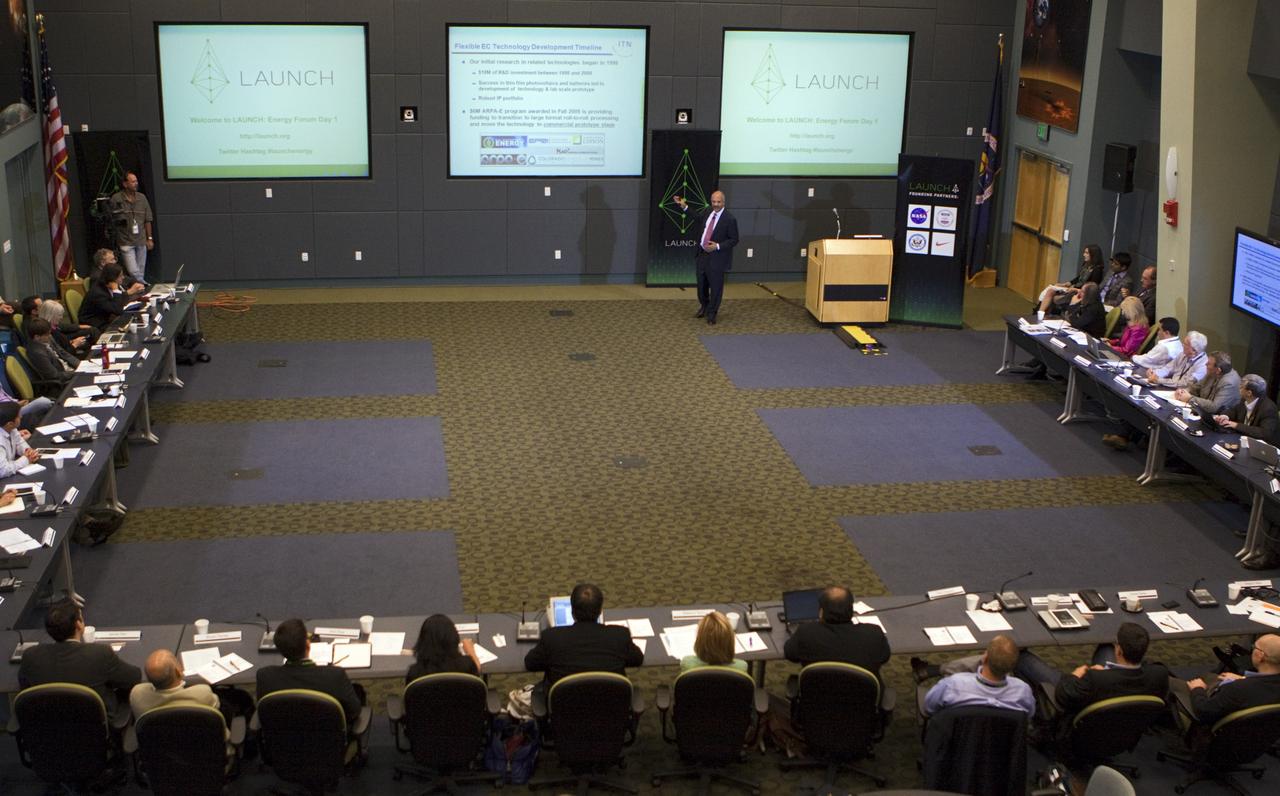
CAPE CANAVERAL, Fla. – In the Operations Support Building (OSB) II at NASA's Kennedy Space Center in Florida, one of the many speakers discusses innovative ideas with NASA and partners during a three-day LAUNCH: Energy forum Nov. 11-13. This third in a series of forums is part of an ongoing initiative to identify, showcase and support innovative approaches to sustainability challenges. LAUNCH allows NASA to propel innovative solutions that help those outside the agency make the connection between our lives on Earth and how we live and work in space. Through the U.S. Agency for International Development (USAID)'s involvement, LAUNCH places a special emphasis on accelerating innovations poised for large scale impact in improving the lives of people in the developing world. During the forum, 10 international participants will showcase new innovations that could address energy problems on Earth and in space. NASA, USAID, Nike Inc., and the U.S. Department of State are LAUNCH founding partners. The partners all contributed to planning the forum, selecting innovators and recruiting other event participants. Photo credit: NASA/Kim Shiflett

NASA image acquired August 4, 2010 Though many areas in northwest Pakistan were bracing for heavy rain and additional flash flooding on August 4, 2010, the city of Kheshgi, in northwest Pakistan, had clear skies. This image, taken by the Advanced Spaceborne Thermal Emission and Reflection Radiometer (ASTER) on NASA’s Terra satellite reveals a city awash in flood water. Thick with mud, the Kabul River is pale green in this false color image. Clearer water is dark blue. The river flows through its usual channel, but in places, water seeps over the channel and across the landscape. The buildings and roads of Kheshgi are silver. Spots of turquoise blue—shallow, muddy water or water-logged ground—covers several sections of the city. On the south side of the Kabul River, water flows down the hills, washing over neighborhoods. The bare ground in the hills is brown and tan. Plant-covered land, red in this image, is divided into long, narrow rectangles, pointing to agriculture. Geometric shapes under the water near the river are probably submerged fields of crops. Thousands of acres of crops had been lost in floods throughout Pakistan, said the United Nations. Kheshgi is in the Nowshera district in the Khyber Pakhutnkhwa province. As of August 2, Khyber Pakhutnkhwa was the hardest hit province in Pakistan, said the United Nations, and Nowshera was the most impacted district in the province. Nowshera reported 500,000 people displaced with 161 dead, said the Government of Khuber Pakhtunkhwa. The floods affected communities throughout Pakistan. More than 1,100 people had died, 15,000 homes were damaged or destroyed, and at least one million people were in need of emergency assistance throughout Pakistan, said the United Nations on August 2. The floods occurred as unusually heavy monsoon rains fell over Pakistan. NASA image courtesy NASA/GSFC/MITI/ERSDAC/JAROS, and U.S./Japan ASTER Science Team. Caption by Holli Riebeek. Instrument: Terra - ASTER Credit: <b><a href="#//earthobservatory.nasa.gov/" rel="nofollow"> NASA’s Earth Observatory</a></b> To learn more about this image go here: <a href="http://earthobservatory.nasa.gov/NaturalHazards/view.php?id=45050" rel="nofollow">earthobservatory.nasa.gov/NaturalHazards/view.php?id=45050</a> Or here: <a href="http://earthobservatory.nasa.gov/NaturalHazards/view.php?id=45343" rel="nofollow">earthobservatory.nasa.gov/NaturalHazards/view.php?id=45343</a> <b><a href="http://www.nasa.gov/centers/goddard/home/index.html" rel="nofollow">NASA Goddard Space Flight Center</a></b> is home to the nation's largest organization of combined scientists, engineers and technologists that build spacecraft, instruments and new technology to study the Earth, the sun, our solar system, and the universe. <b>Follow us on <a href="http://twitter.com/NASA_GoddardPix" rel="nofollow">Twitter</a></b> <b>Join us on <a href="http://www.facebook.com/pages/Greenbelt-MD/NASA-Goddard/395013845897?ref=tsd" rel="nofollow">Facebook</a></b>