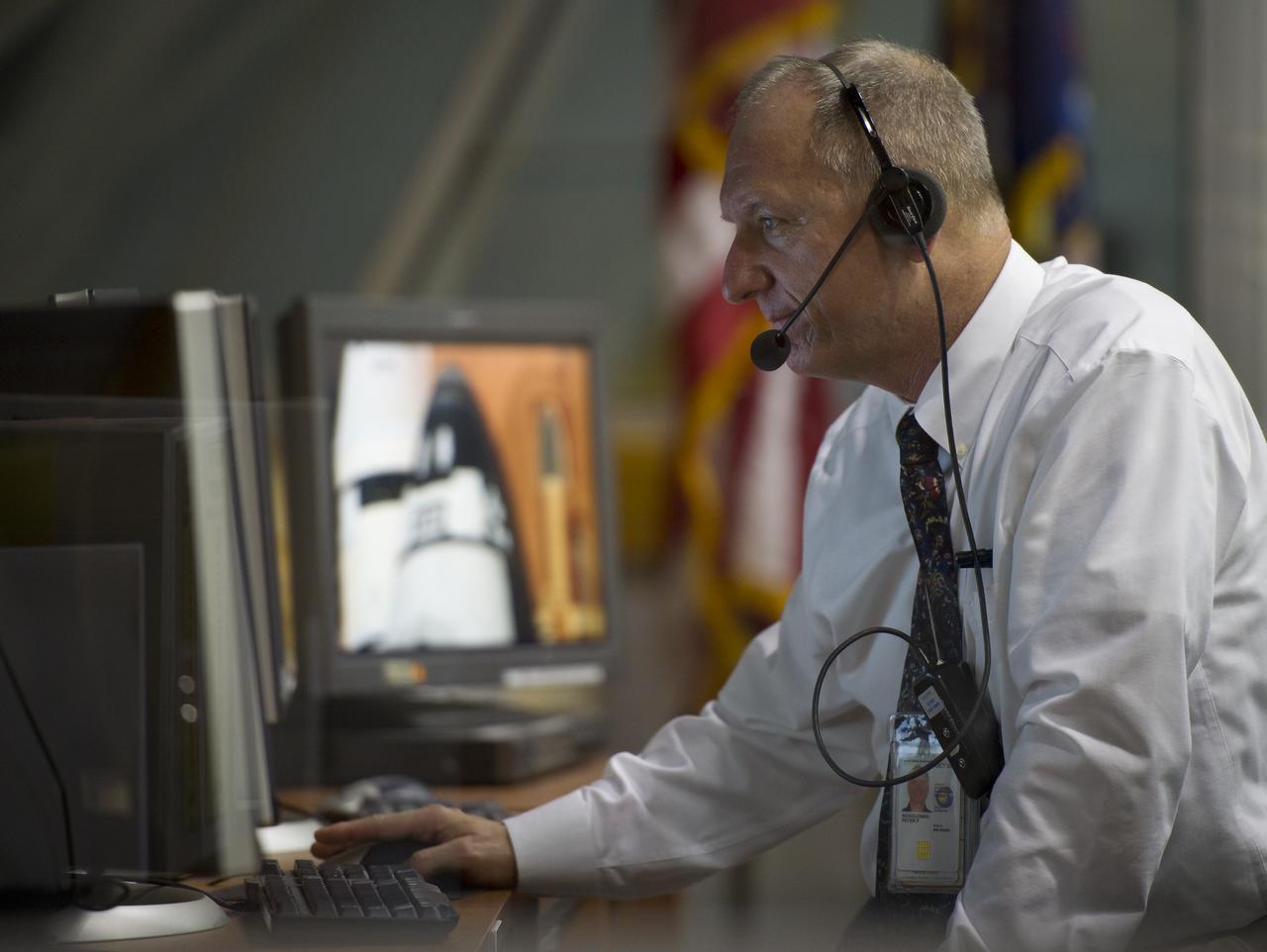
NASA Kennedy Space Center Assistant Launch Director Pete Nickolenko monitors the countdown to the launch of the space shuttle Endeavour (STS-134) from Firing Room Four of the Launch Control Center (LCC), Monday May 16, 2011, at the Kennedy Space Center in Cape Canaveral, Fla. During the mission, Endeavour and the STS-134 crew will deliver the Alpha Magnetic Spectrometer (AMS) and spare parts including two S-band communications antennas, a high-pressure gas tank and additional spare parts for Dextre. Photo Credit: (NASA/Bill Ingalls)
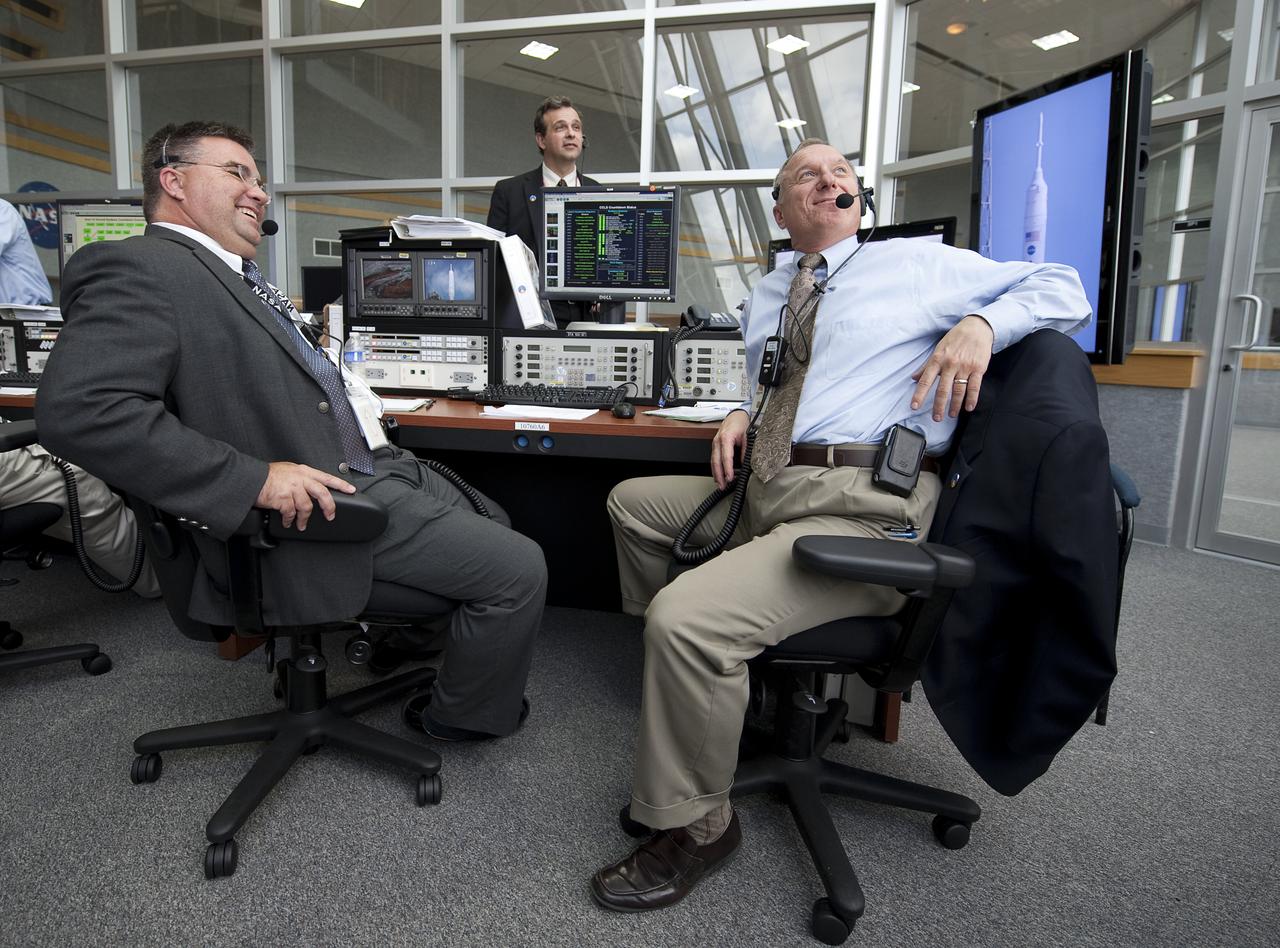
NASA Ares I-X Launch Director Ed Mango, left, laughs as NASA Ares I-X Assistant Launch Director Pete Nickolenko looks out the window of Firing Room One of the Launch Control Center (LCC) at the Kennedy Space Center prior to the launch of the Ares I-X rocket from pad 39b at the Kennedy Space Center in Cape Canaveral, Fla., Wednesday, Oct. 28, 2009. The flight test of Ares I-X will provide NASA with an early opportunity to test and prove flight characteristics, hardware, facilities and ground operations associated with the Ares I. Photo Credit: (NASA/Bill Ingalls)
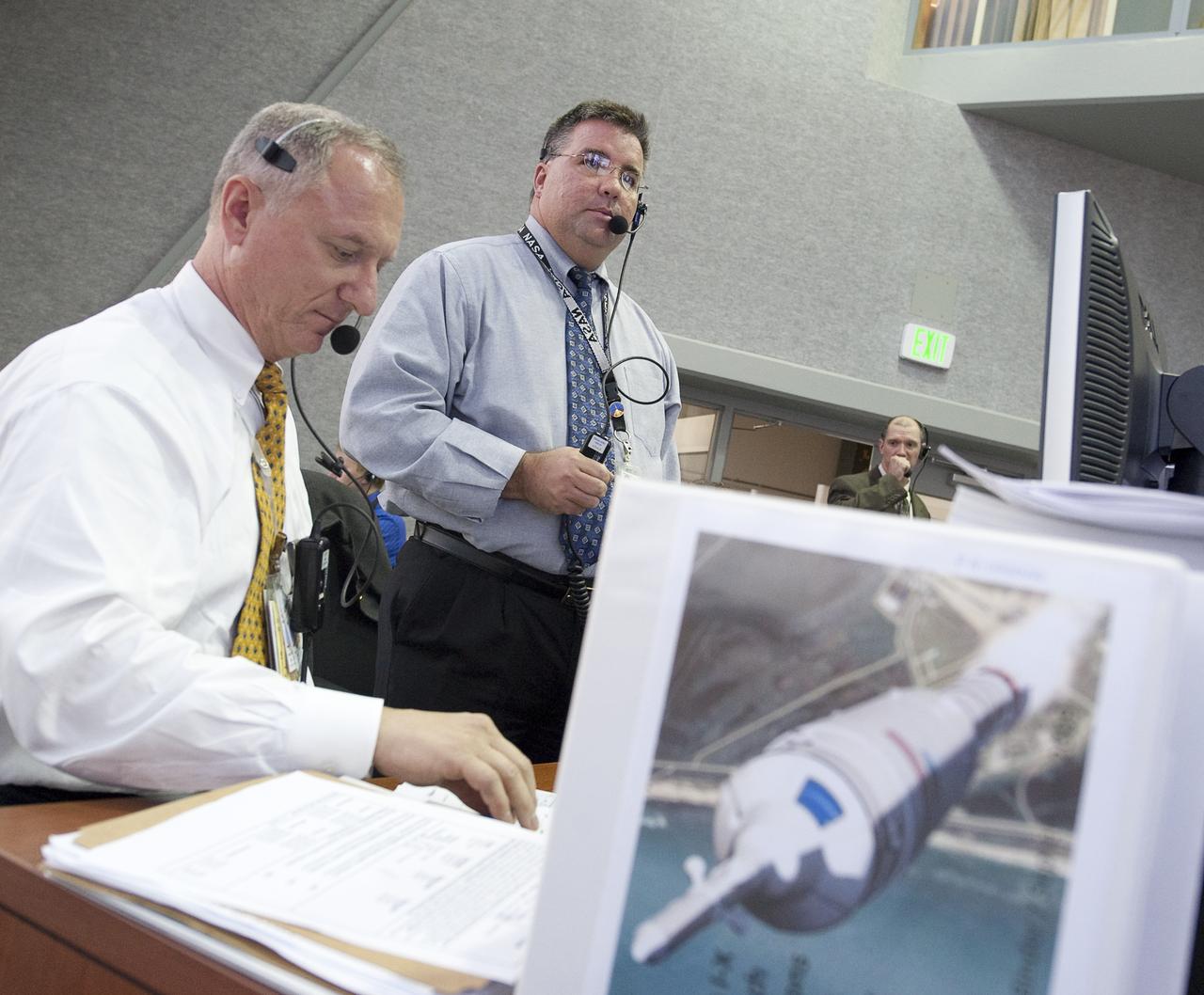
NASA Ares I-X Assistant Launch Director Pete Nickolenko, left, and NASA Ares I-X Launch Director Ed Mango monitor the launch countdown from Firing Room One of the Launch Control Center (LCC) at the Kennedy Space Center during the planned launch of the Ares I-X rocket from pad 39b at the Kennedy Space Center in Cape Canaveral, Fla., Tuesday, Oct. 27, 2009. The flight test of Ares I-X will provide NASA with an early opportunity to test and prove flight characteristics, hardware, facilities and ground operations associated with the Ares I. Photo Credit: (NASA/Bill Ingalls)
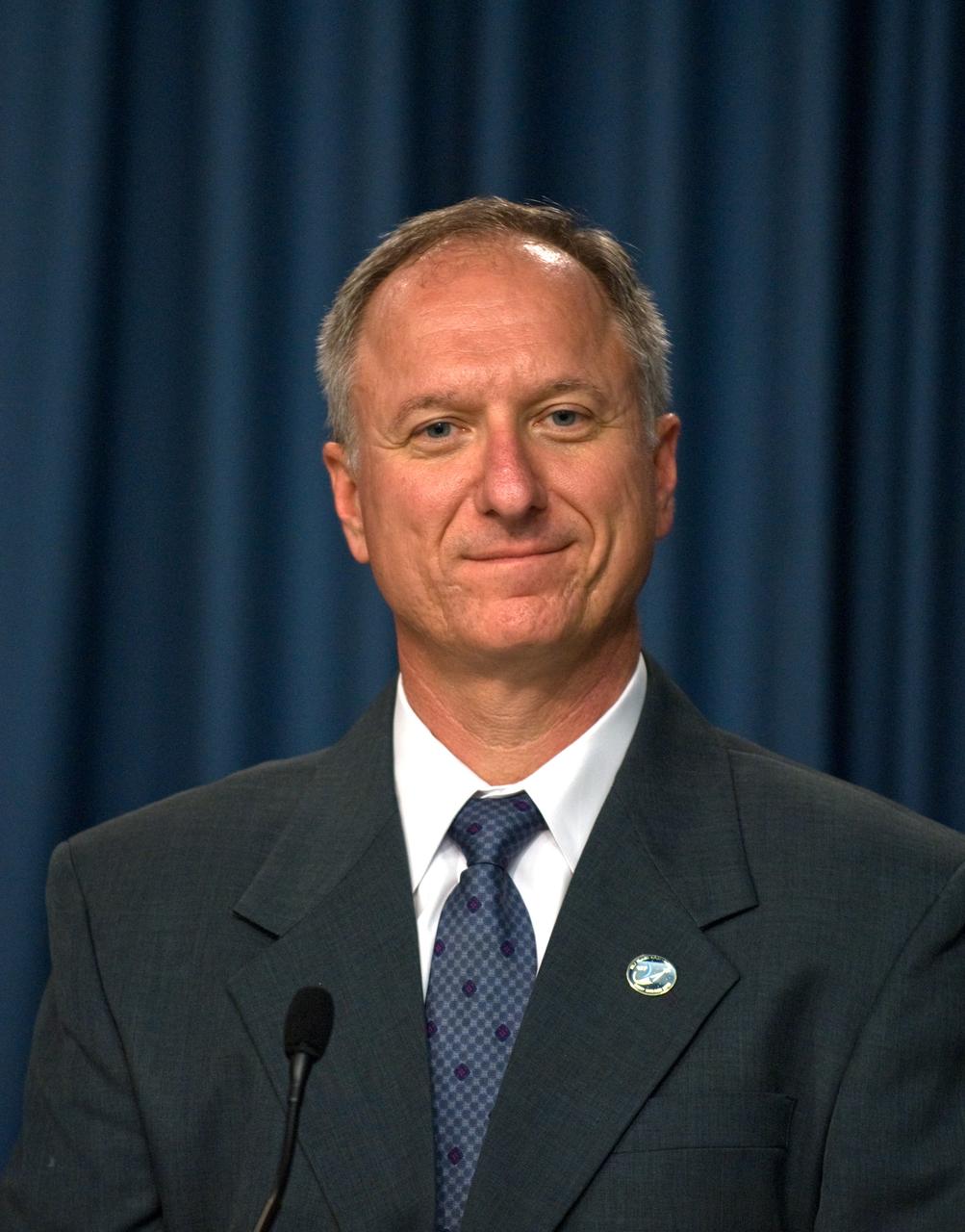
CAPE CANAVERAL, Fla. – Pete Nickolenko is the STS-127 shuttle launch director. Photo credit: NASA/Kim Shiflett
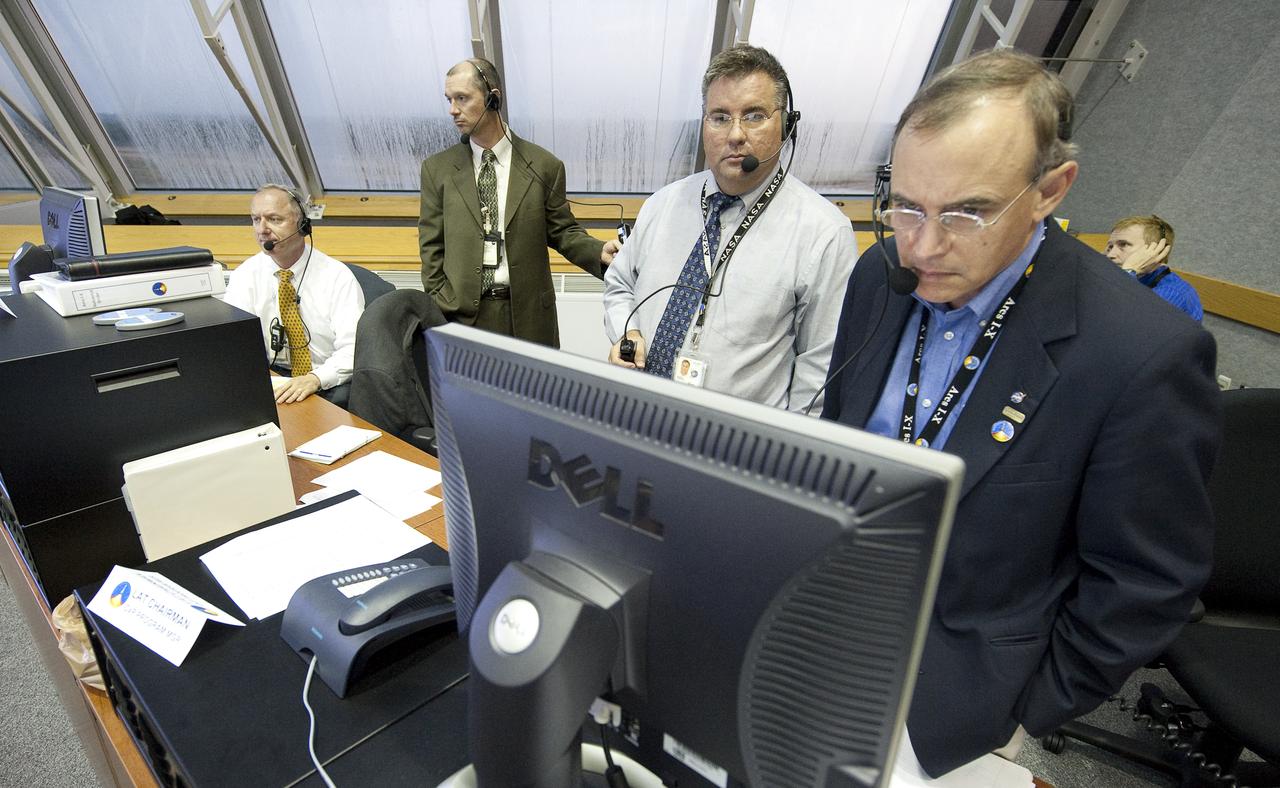
Mission managers, from left, NASA Ares I-X Assistant Launch Director Pete Nickolenko, Ground Operations Manager Philip "Pepper" Phillips, Ares I-X Launch Director Ed Mango, and Constellation Program manager Jeff Hanley review the latest weather radar from Firing Room One of the Launch Control Center (LCC) at the Kennedy Space Center during the launch countdown of the Ares I-X rocket in Cape Canaveral, Fla., Tuesday, Oct. 27, 2009. The flight test of Ares I-X will provide NASA with an early opportunity to test and prove flight characteristics, hardware, facilities and ground operations associated with the Ares I. Photo Credit: (NASA/Bill Ingalls)
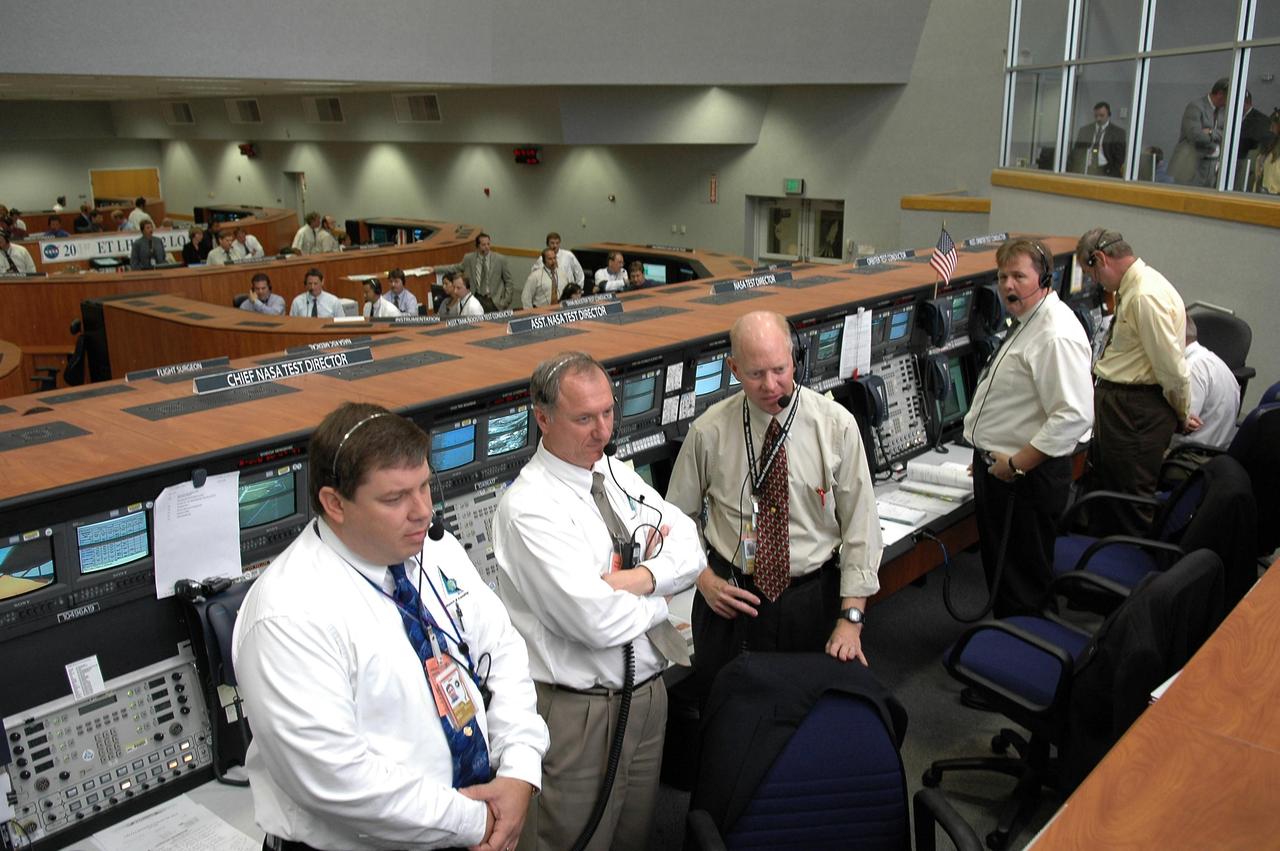
KENNEDY SPACE CENTER, FLA. - Inside the Launch Control Center, KSC officials turn from their computers to watch through the broad windows the launch of Space Shuttle Atlantis on mission STS-115. Second from left is NASA Test Director Pete Nickolenko. Mission STS-115 is the 116th space shuttle flight, the 27th flight for orbiter Atlantis, and the 19th U.S. flight to the International Space Station. sts-115 is scheduled to last 11 days with a planned landing at KSC. Photo credit: NASA/Kim Shiflett
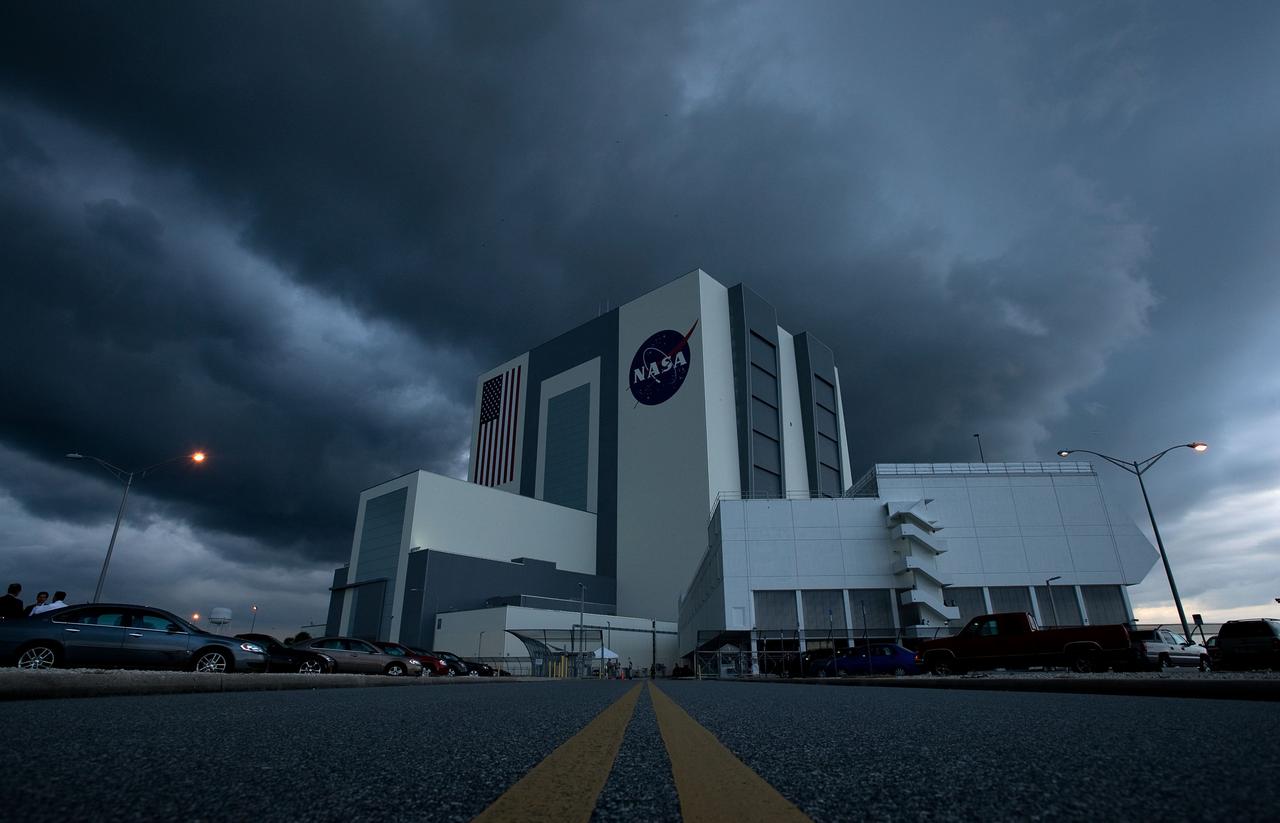
Storm clouds roll in over the NASA Vehicle Assembly building moments after STS-127 Space Shuttle Launch Director Pete Nickolenko and the launch team called the launch a "No Go" due to weather conditions at the NASA Kennedy Space Center in Cape Canaveral, Florida, Sunday, July 12, 2009. Endeavour will be launching with the crew of STS-127 on a 16-day mission that will feature five spacewalks and complete construction of the Japan Aerospace Exploration Agency's Kibo laboratory. Photo Credit: (NASA/Bill Ingalls)
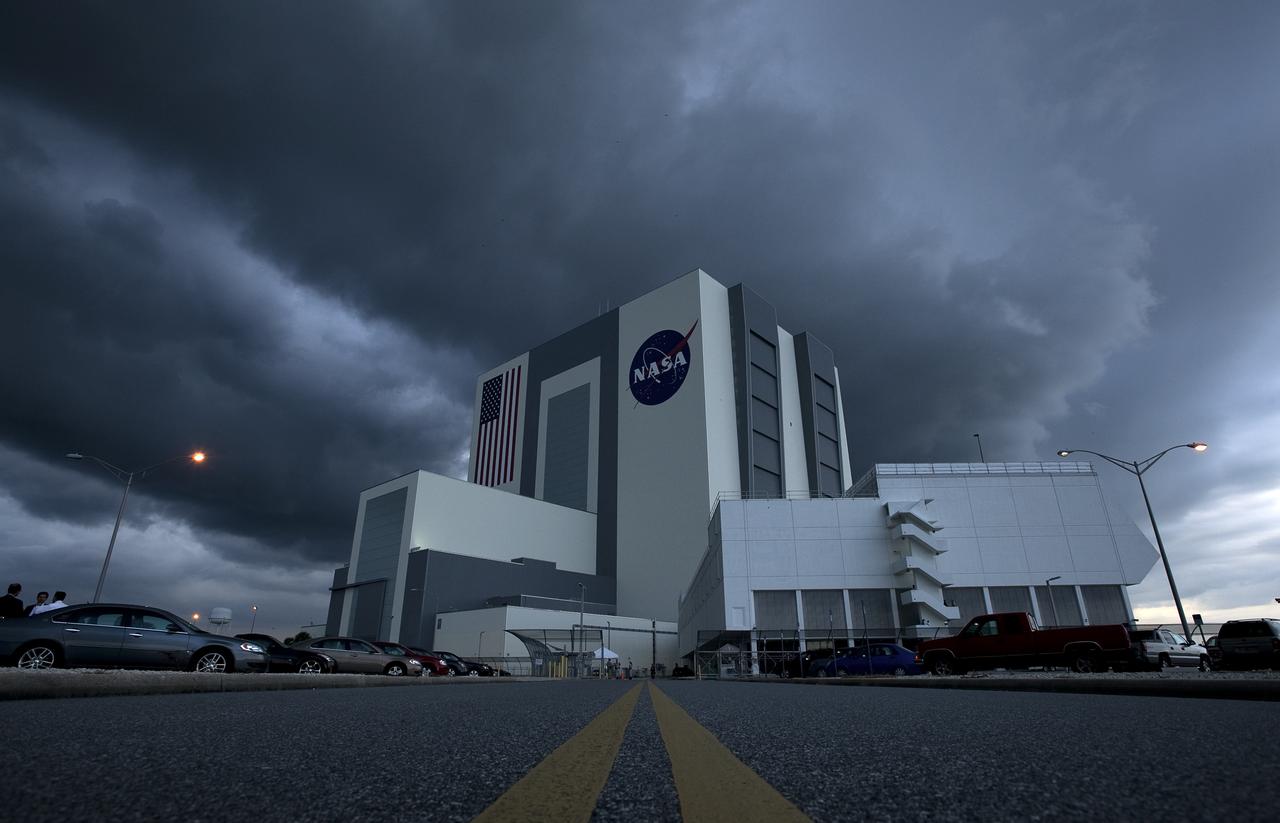
Storm clouds roll in over the NASA Vehicle Assembly building moments after STS-127 Space Shuttle Launch Director Pete Nickolenko and the launch team called the launch a "No Go" due to weather conditions at the NASA Kennedy Space Center in Cape Canaveral, Florida, Sunday, July 12, 2009. Endeavour will be launching with the crew of STS-127 on a 16-day mission that will feature five spacewalks and complete construction of the Japan Aerospace Exploration Agency's Kibo laboratory. Photo Credit: (NASA/Bill Ingalls)
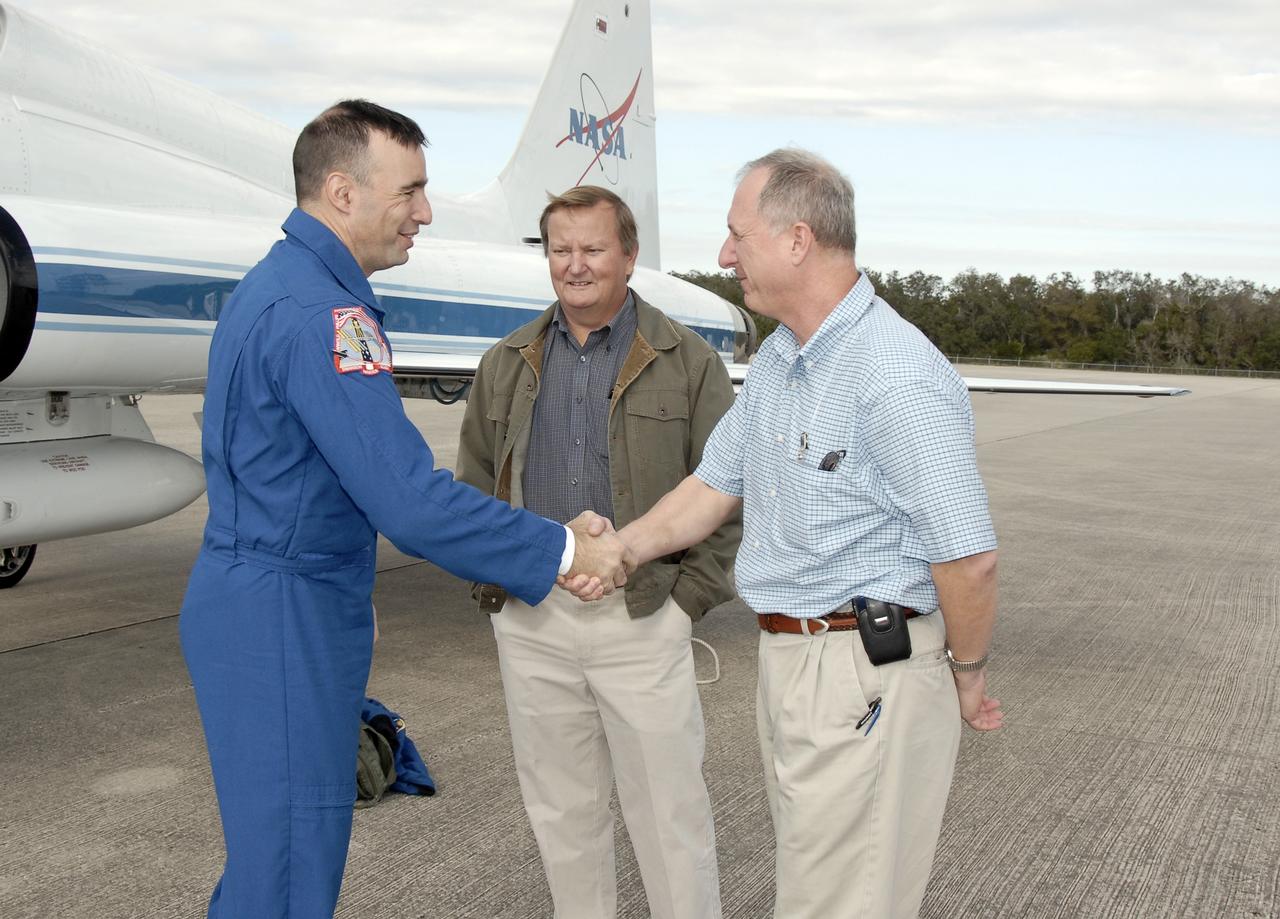
CAPE CANAVERAL, Fla. – After arriving at NASA's Kennedy Space Center in Florida on a T-38 jet training aircraft, STS-119 Commander Lee Archambault (left) is greeted by Pete Nickolenko, chief of the NASA Launch and Landing Division. Between them is Shuttle Launch Director Mike Leinbach. The crew flew to Kennedy to take part in terminal countdown demonstration test activities, which include equipment familiarization and emergency exit training and culminate in a simulated launch countdown. Photo credit: NASA/Kim Shiflett
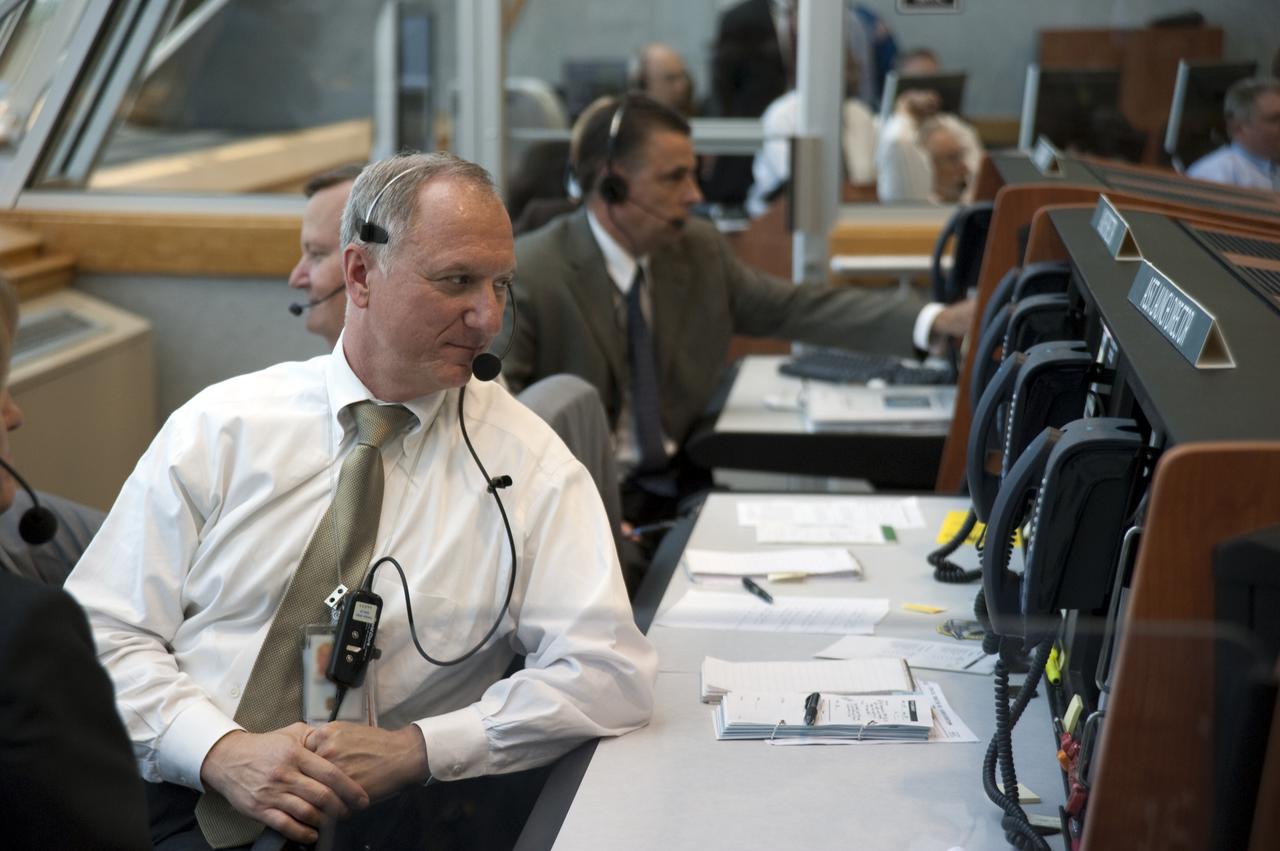
CAPE CANAVERAL, Fla. -- In Firing Room 4 of the Launch Control Center at NASA's Kennedy Space Center in Florida, Assistant Launch Director Pete Nickolenko keeps track of the imminent launch of space shuttle Atlantis on its STS-132 mission to the International Space Station. The launch team worked very few issues during the countdown and picture-perfect weather led to an on-time launch at 2:20 p.m. EDT on May 14. STS-132 is the 132nd shuttle flight, the 32nd for Atlantis and the 34th shuttle mission dedicated to station assembly and maintenance. For more information on the STS-132 mission objectives, payload and crew, visit www.nasa.gov_mission_pages_shuttle_shuttlemissions_sts132_index.html. Photo credit: NASA_Kim Shiflett
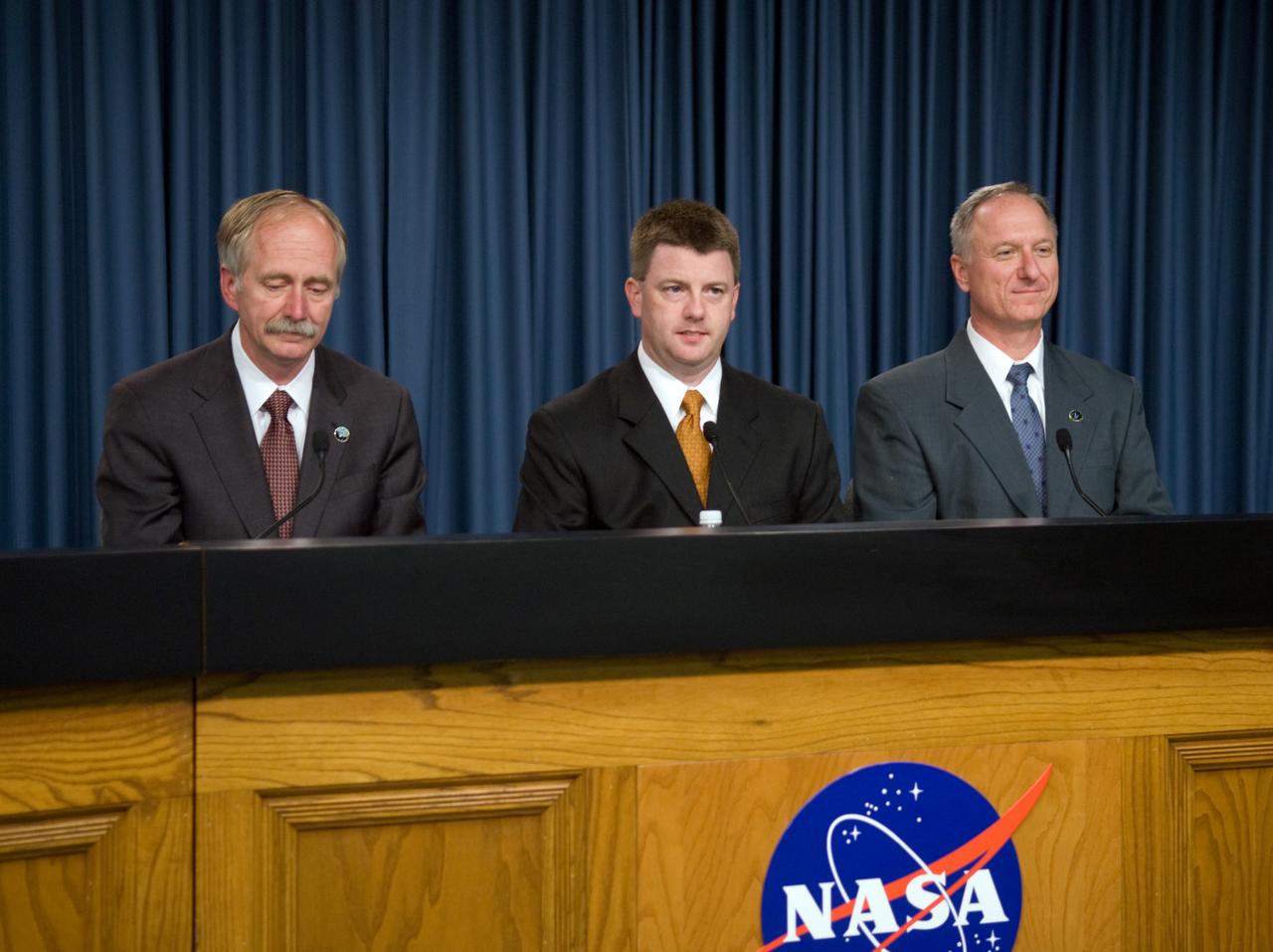
CAPE CANAVERAL, Fla. – In the post-Flight Readiness Review news conference for the STS-127 mission, Bill Gerstenmaier, associate administrator for Space Operations, Mike Moses, Space Shuttle Program launch integration manager, and Pete Nickolenko, STS-127 shuttle launch director, present the items discussed by managers. They confirmed a June 13 launch date for space shuttle Endeavour and its crew of seven on the STS-127 mission. The mission is the final of three flights dedicated to the assembly of the Japanese Kibo laboratory complex on the International Space Station. Photo credit: NASA/Kim Shiflett

CAPE CANAVERAL, Fla. -- In the Launch Control Center at NASA's Kennedy Space Center in Florida, STS-133 Assistant Launch Director Pete Nickolenko sits at his console in Firing Room 4 along with other launch team members to rehearse procedures for the liftoff of space shuttle Discovery's final mission. The team at Kennedy also participated in launch simulations with personnel at NASA's Johnson Space Center in Houston. Discovery's next launch opportunity to the International Space Station on the STS-133 mission is planned for no earlier than Feb. 24. For more information on STS-133, visit www.nasa.gov/mission_pages/shuttle/shuttlemissions/sts133/. Photo credit: NASA/Kim Shiflett
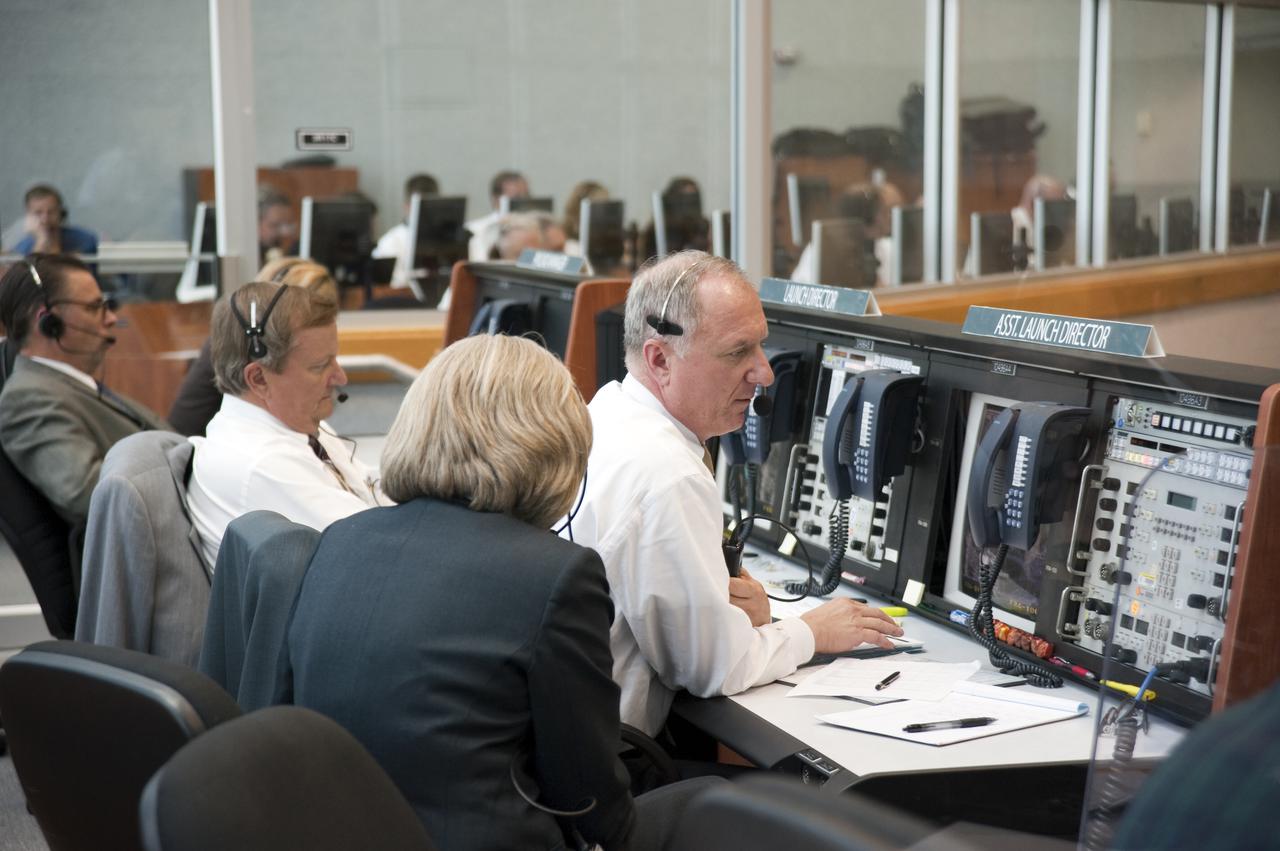
CAPE CANAVERAL, Fla. -- In Firing Room 4 of the Launch Control Center at NASA's Kennedy Space Center in Florida, Shuttle Launch Director Mike Leinbach, Assistant Launch Director Pete Nickolenko and Atlantis Flow Director Angie Brewer keep track of the imminent launch of space shuttle Atlantis on its STS-132 mission to the International Space Station. The launch team worked very few issues during the countdown and picture-perfect weather led to an on-time launch at 2:20 p.m. EDT on May 14. STS-132 is the 132nd shuttle flight, the 32nd for Atlantis and the 34th shuttle mission dedicated to station assembly and maintenance. For more information on the STS-132 mission objectives, payload and crew, visit www.nasa.gov_mission_pages_shuttle_shuttlemissions_sts132_index.html. Photo credit: NASA_Kim Shiflett
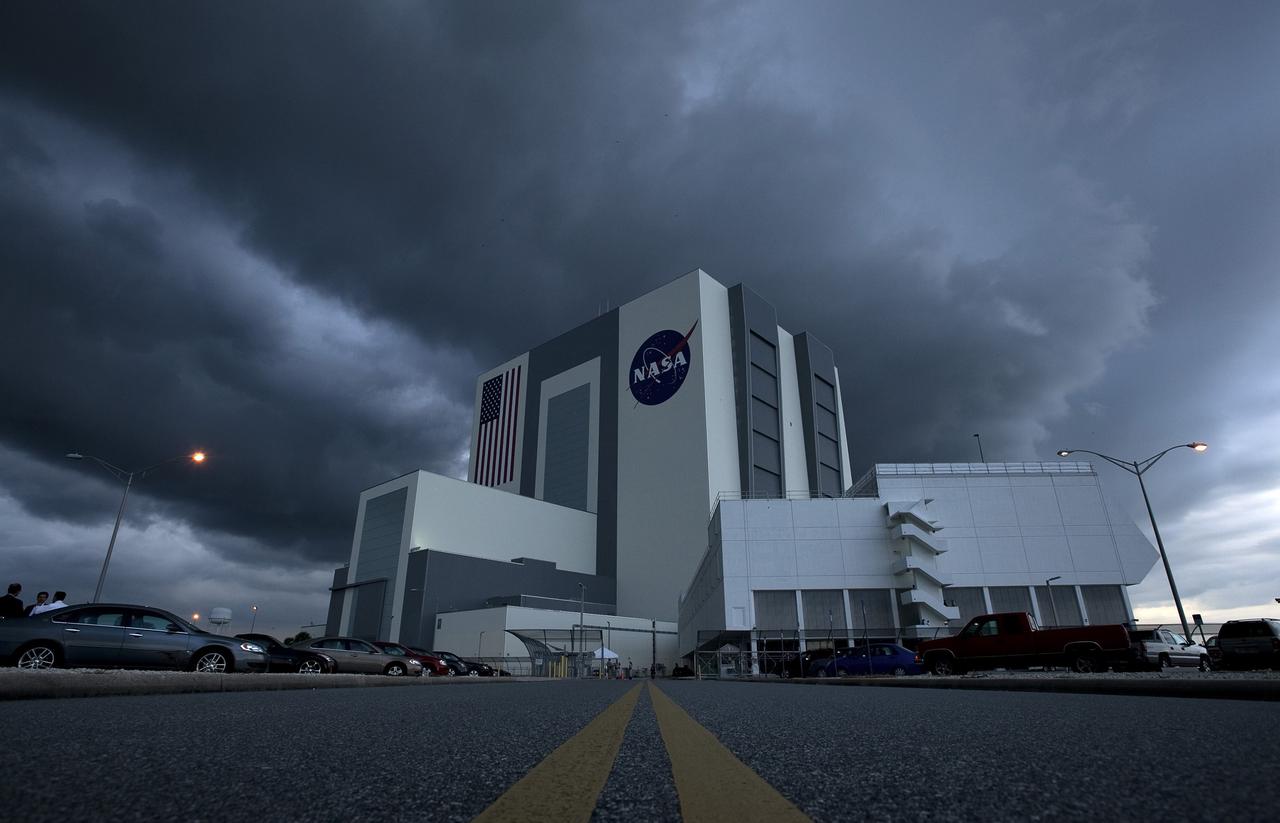
CAPE CANAVERAL, Fla. – Storm clouds roll in over the NASA Vehicle Assembly Building moments after STS-127 Space Shuttle Launch Director Pete Nickolenko and the launch team called the launch a "No Go" due to weather conditions at the NASA Kennedy Space Center in Cape Canaveral, Fla. Endeavour will be launching with the crew of STS-127 on a 16-day mission that will feature five spacewalks and complete construction of the Japan Aerospace Exploration Agency's Kibo laboratory. Endeavour will deliver the Japanese Experiment Module's Exposed Facility, or JEM-EF, and the Experiment Logistics Module-Exposed Section, or ELM-ES, in the final of three flights dedicated to the assembly of the Japan Aerospace Exploration Agency's Kibo laboratory complex on the International Space Station. STS-127 is the 29th flight for the assembly of the space station. Photo credit: NASA/Bill Ingalls
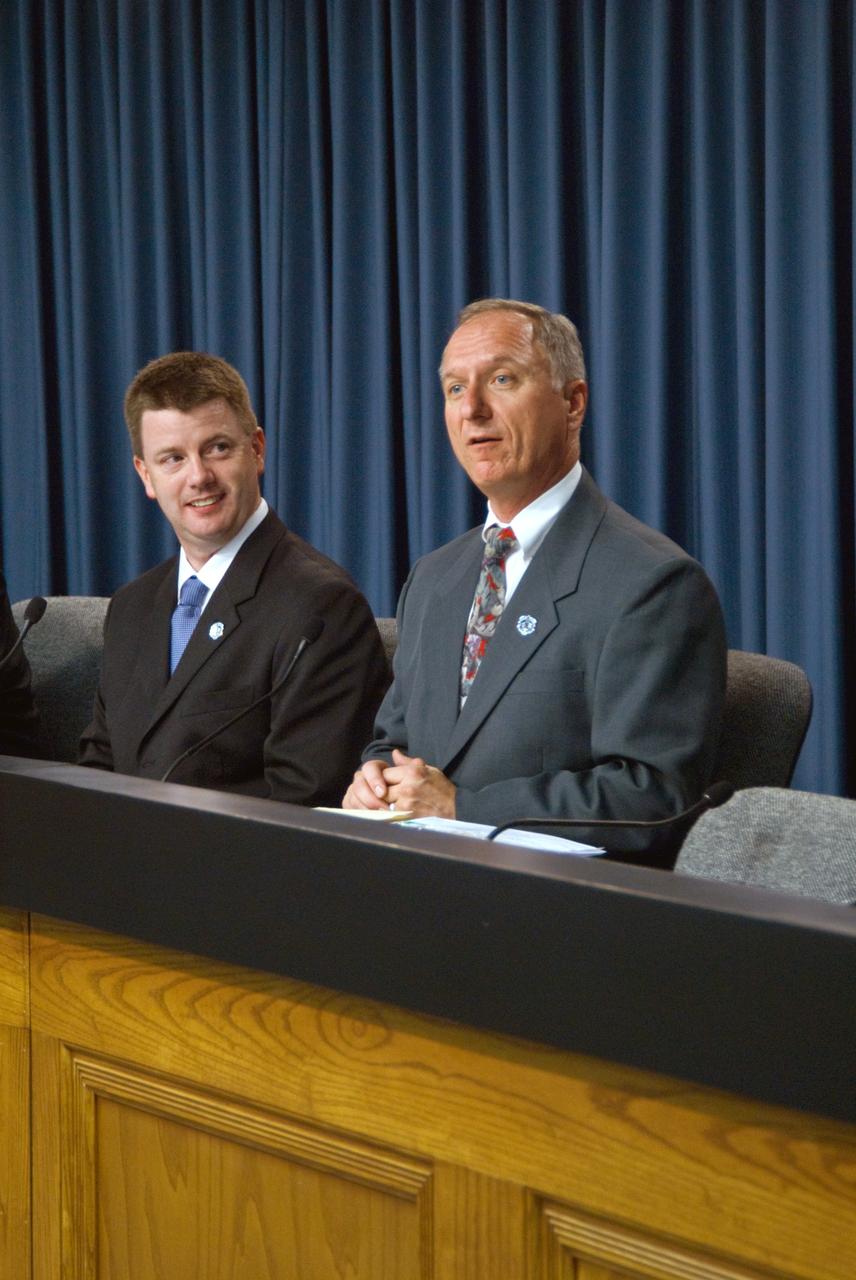
CAPE CANAVERAL, Fla. – In the Press Site auditorium at NASA's Kennedy Space Center in Florida, NASA managers brief the media following the scrub of a launch attempt of space shuttle Discovery. From left are Mission Management Team Chair Mike Moses and STS-128 Launch Director Pete Nickolenko. The launch attempt was scrubbed due to a problem with a liquid hydrogen valve in the main propulsion system. Liftoff now is no earlier than 12:22 a.m. EDT on Aug. 28.The 13-day STS-128 mission will deliver more than seven tons of supplies, science racks and equipment, as well as additional environmental hardware to sustain six crew members on the International Space Station. The equipment includes a freezer to store research samples, a new sleeping compartment and the COLBERT treadmill. The mission is the 128th in the Space Shuttle Program, the 37th flight of Discovery and the 30th station assembly flight. Photo credit: NASA/Cory Huston
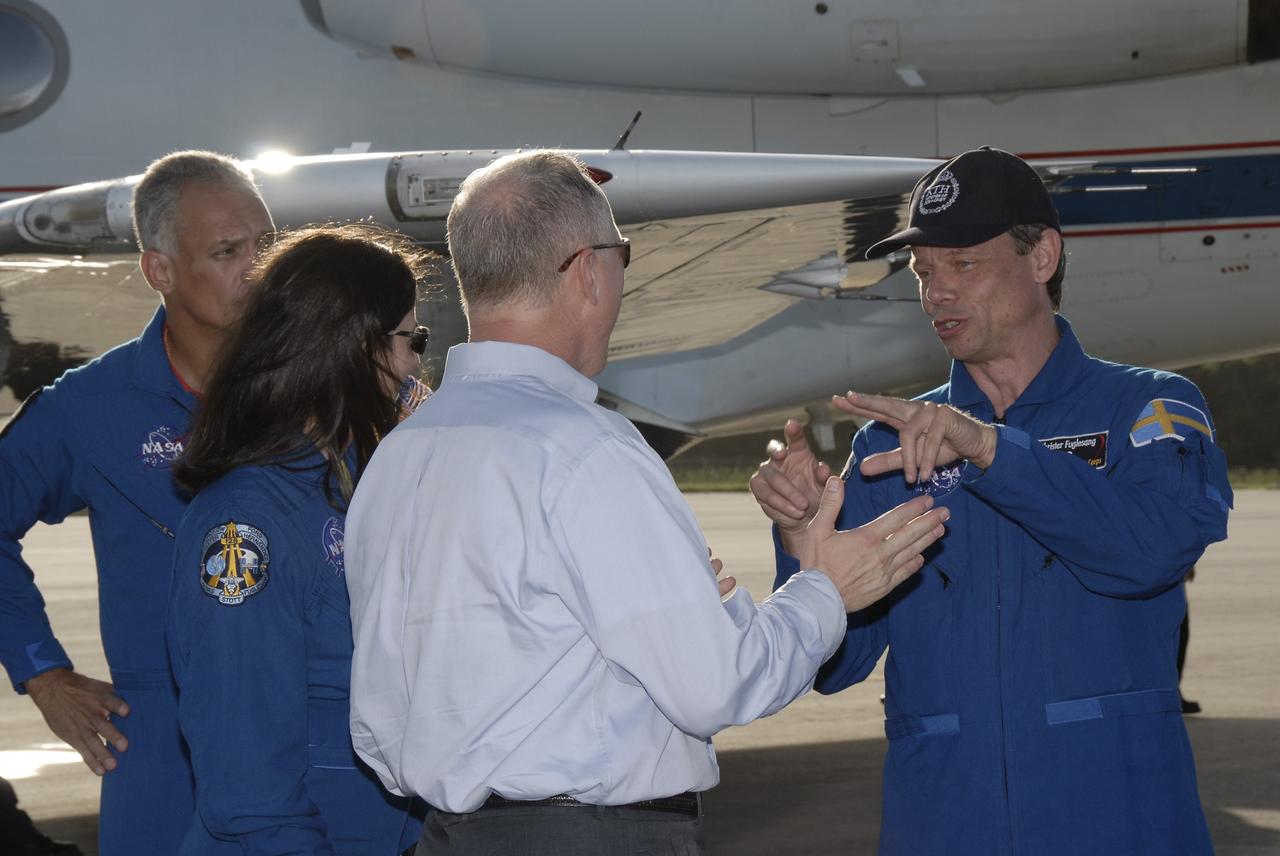
CAPE CANAVERAL, Fla. – STS-128 Launch Director Pete Nickolenko welcomes members of space shuttle Discovery's STS-128 crew to Kennedy Space Center. The crew arrived in a NASA Shuttle Training Aircraft, the modified Gulfstream II jet behind them, at Kennedy's Shuttle Landing Facility at 6:34 p.m. EDT. The astronauts are, from left, Mission Specialists John "Danny" Olivas, Nicole Stott who will remain on the International Space Station as flight engineer for Expedition 20, and Swedish astronaut Christer Fuglesang of the European Space Agency. The crew has returned to Kennedy to prepare for launch on Aug. 25 at 1:36 a.m. EDT. The 13-day mission will deliver a new crew member and 33,000 pounds of equipment to the International Space Station. The equipment includes science and storage racks, a freezer to store research samples, a new sleeping compartment and the COLBERT treadmill. Photo credit: NASA/Kim Shiflett

CAPE CANAVERAL, Fla. - Shuttle Launch Director Pete Nickolenko (right) and Mike Leinbach, assistant launch director, prepare for the liftoff of space shuttle Discovery on the STS-131 mission in Firing Room 4 in the Launch Control Center at NASA's Kennedy Space Center in Florida. The seven-member STS-131 crew will deliver the multi-purpose logistics module Leonardo, filled with supplies, a new crew sleeping quarters and science racks that will be transferred to the International Space Station's laboratories. The crew also will switch out a gyroscope on the station’s truss, install a spare ammonia storage tank and retrieve a Japanese experiment from the station’s exterior. STS-131 is the 33rd shuttle mission to the station and the 131st shuttle mission overall. For information on the STS-131 mission and crew, visit http:__www.nasa.gov_mission_pages_shuttle_shuttlemissions_sts131_index.html. Photo credit: NASA_Kim Shiflett
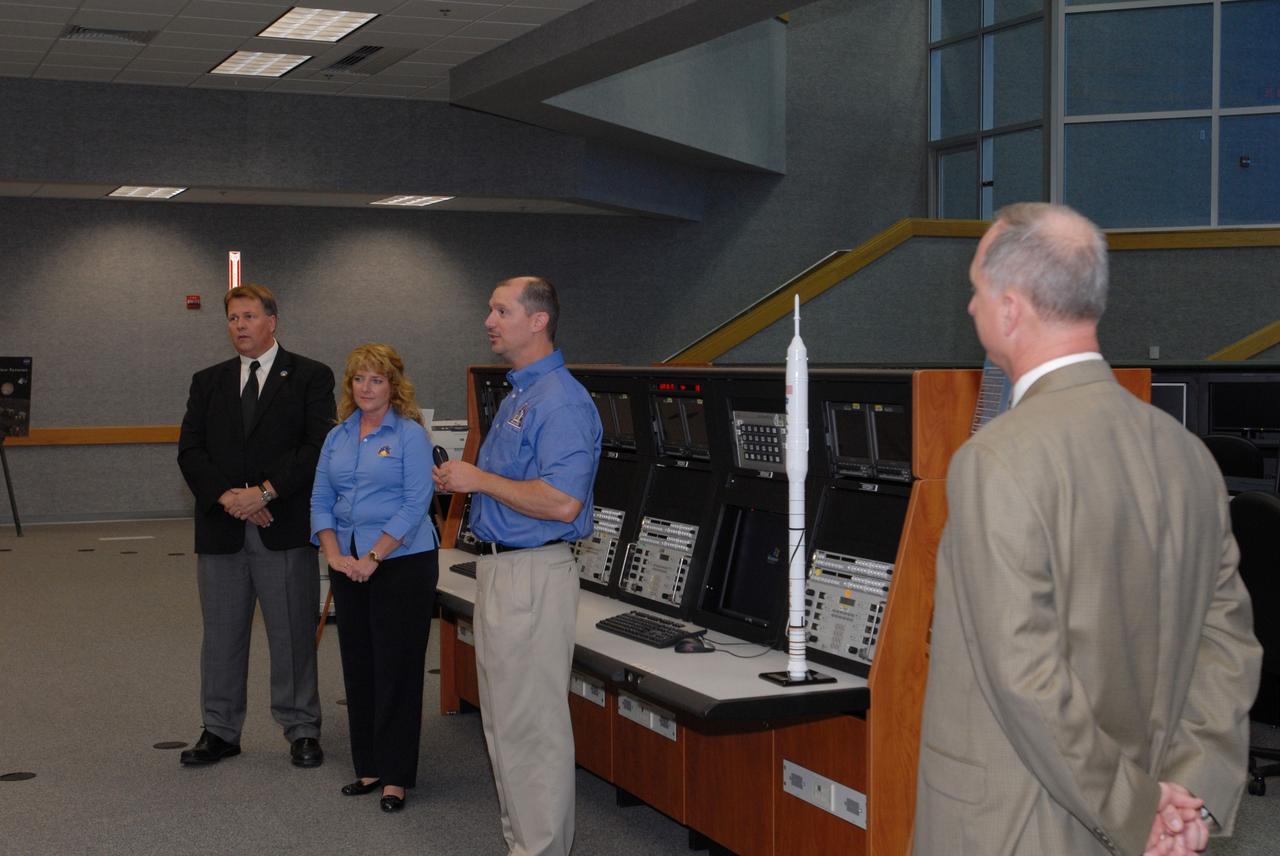
CAPE CANAVERAL, Fla. – At a media event in Firing Room 1 of the Launch Control Center, NASA management talk about the Ares I-X being assembled at NASA's Kennedy Space Center in Florida. From left are Shuttle Test Director Jeff Spaulding, Deputy Mission Manager Carol Scott, Constellation Projects Office Director Pepper Phillips and Chief of the NASA Launch and Landing Division Pete Nickolenko. The upper stage simulators will be used in the test flight identified as Ares I-X in 2009. The segments will simulate the mass and the outer mold line and will be more than 100 feet of the total vehicle height of 327 feet. The simulator comprises 11 segments that are approximately 18 feet in diameter. Most of the segments will be approximately 10 feet high, ranging in weight from 18,000 to 60,000 pounds, for a total of approximately 450,000 pounds. Photo credit: NASA/Jim Grossmann
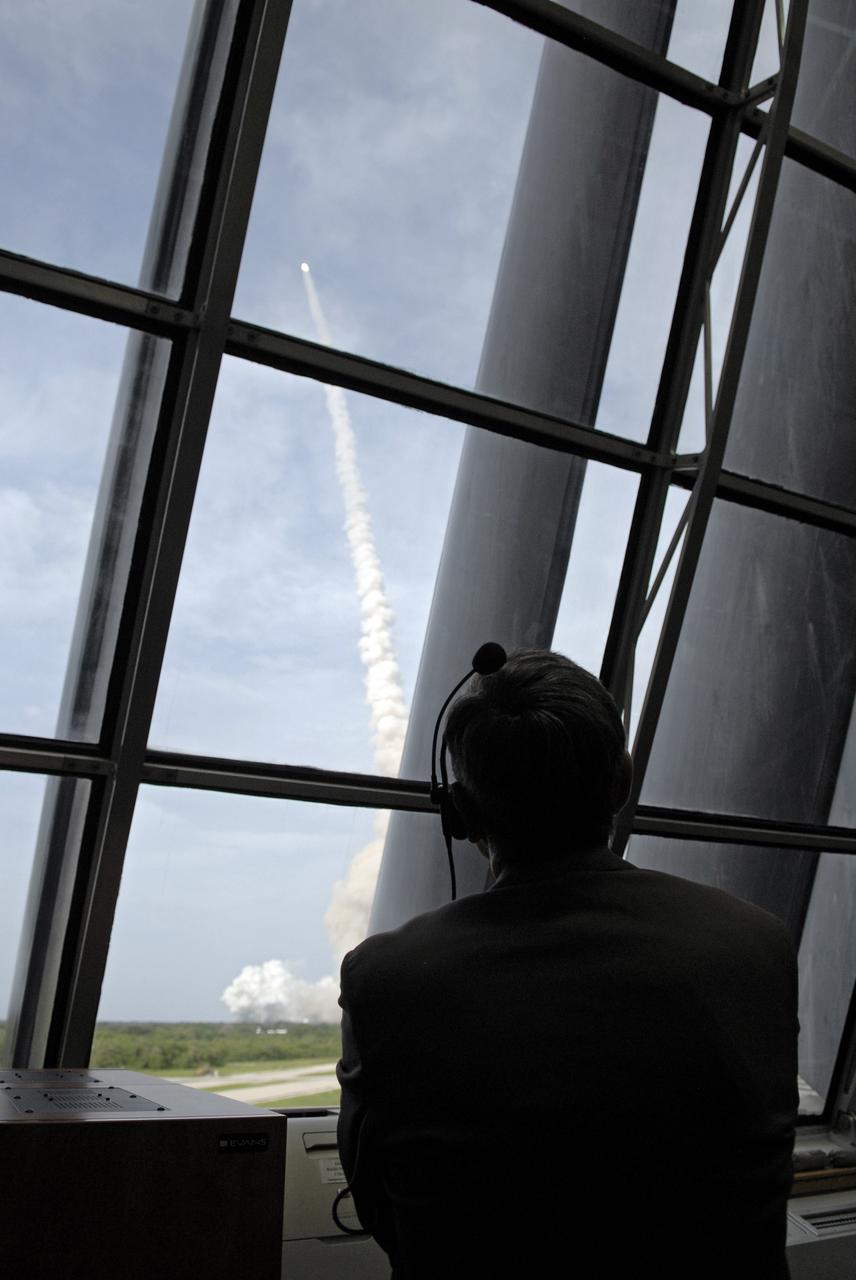
CAPE CANAVERAL, Fla. – In the Firing Room at NASA's Kennedy Space Center in Florida, STS-127 Shuttle Launch Director Pete Nickolenko follows the path of space shuttle Endeavour as it roars into space on the STS-127 mission. Liftoff was on-time at 6:03 p.m. EDT. Today was the sixth launch attempt for the STS-127 mission. The launch was scrubbed on June 13 and June 17 when a hydrogen gas leak occurred during tanking due to a misaligned Ground Umbilical Carrier Plate. The mission was postponed July 11, 12 and 13 due to weather conditions near the Shuttle Landing Facility at Kennedy that violated rules for launching, and lightning issues. Endeavour will deliver the Japanese Experiment Module's Exposed Facility and the Experiment Logistics Module-Exposed Section in the final of three flights dedicated to the assembly of the Japan Aerospace Exploration Agency's Kibo laboratory complex on the International Space Station. Photo credit: NASA/Kim Shiflett
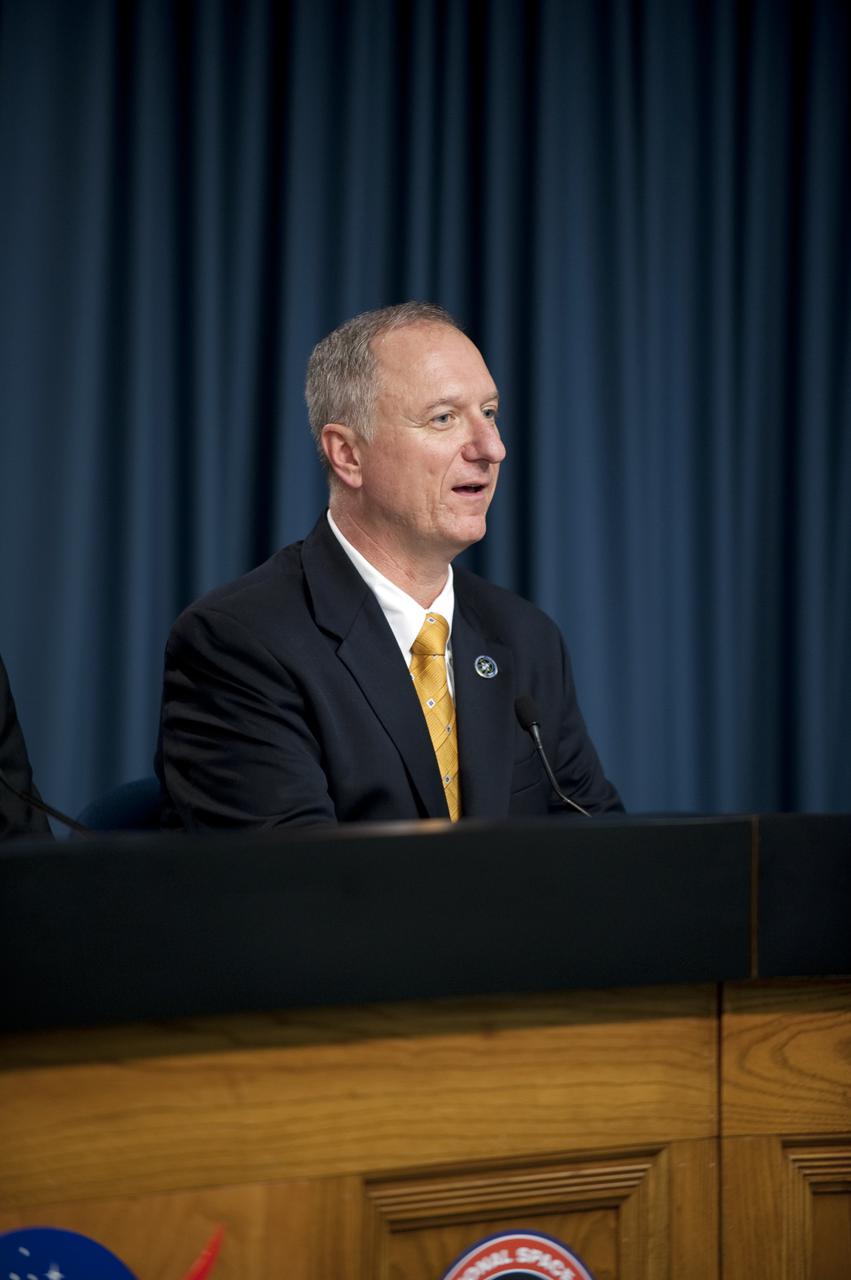
CAPE CANAVERAL, Fla. - Pete Nickolenko, STS-131 launch director, addresses the media from the Press Site auditorium at NASA's Kennedy Space Center in Florida media after the successful launch of space shuttle Discovery. Shuttle Discovery lifted off at 6:21 a.m. EDT on April 5, 2010. The seven-member STS-131 crew will deliver the multi-purpose logistics module Leonardo, filled with supplies, a new crew sleeping quarters and science racks that will be transferred to the International Space Station's laboratories. The crew also will switch out a gyroscope on the station’s truss, install a spare ammonia storage tank and retrieve a Japanese experiment from the station’s exterior. STS-131 is the 33rd shuttle mission to the station and the 131st shuttle mission overall. For information on the STS-131 mission and crew, visit http:__www.nasa.gov_mission_pages_shuttle_shuttlemissions_sts131_index.html. Photo credit: NASA_Kim Shiflett

CAPE CANAVERAL, Fla. – At NASA's Kennedy Space Center in Florida, Center Director Bob Cabana (left) listens to STS-127 Shuttle Launch Director Pete Nickolenko (right) about the need to postpone the launch of space shuttle Endeavour because of lightning and thunderstorms within the 20-nautical-mile circle around the launch pad. The fifth launch attempt for the STS-127 mission was scrubbed at 6:39 p.m. EDT. The STS-127 launch was rescheduled for July 15 at 6:03 p.m. EDT. Endeavour will deliver the Japanese Experiment Module's Exposed Facility, or JEM-EF, and the Experiment Logistics Module-Exposed Section, or ELM-ES, in the final of three flights dedicated to the assembly of the Japan Aerospace Exploration Agency's Kibo laboratory complex on the International Space Station. STS-127 is the 29th flight for the assembly of the space Photo credit: NASA/Kim Shiflett
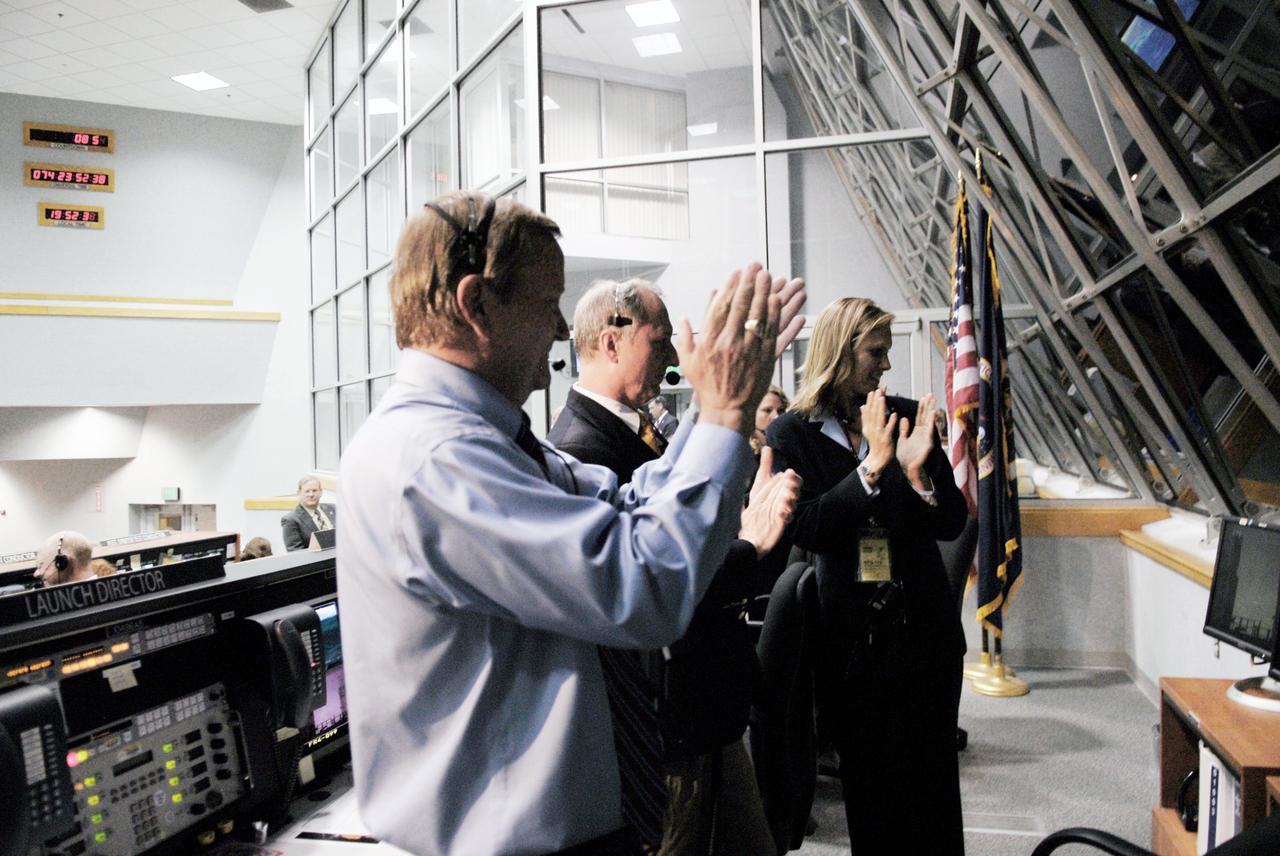
CAPE CANAVERAL, Fla. – In Firing Room 4 of the Launch Control Center at NASA's Kennedy Space Center in Florida, Shuttle Launch Director Mike Leinbach, Assistant Launch Director Pete Nickolenko and Flow Director for space shuttle Discovery Stephanie Stilson applaud the successful launch of space shuttle Discovery on the STS-119 mission. Launch was on time at 7:43 p.m. EDT. The STS-119 mission is the 28th to the space station and Discovery's 36th flight. Discovery will deliver the final pair of power-generating solar array wings and the S6 truss segment. Installation of S6 will signal the station's readiness to house a six-member crew for conducting increased science. Photo credit: NASA/Kim Shiflett
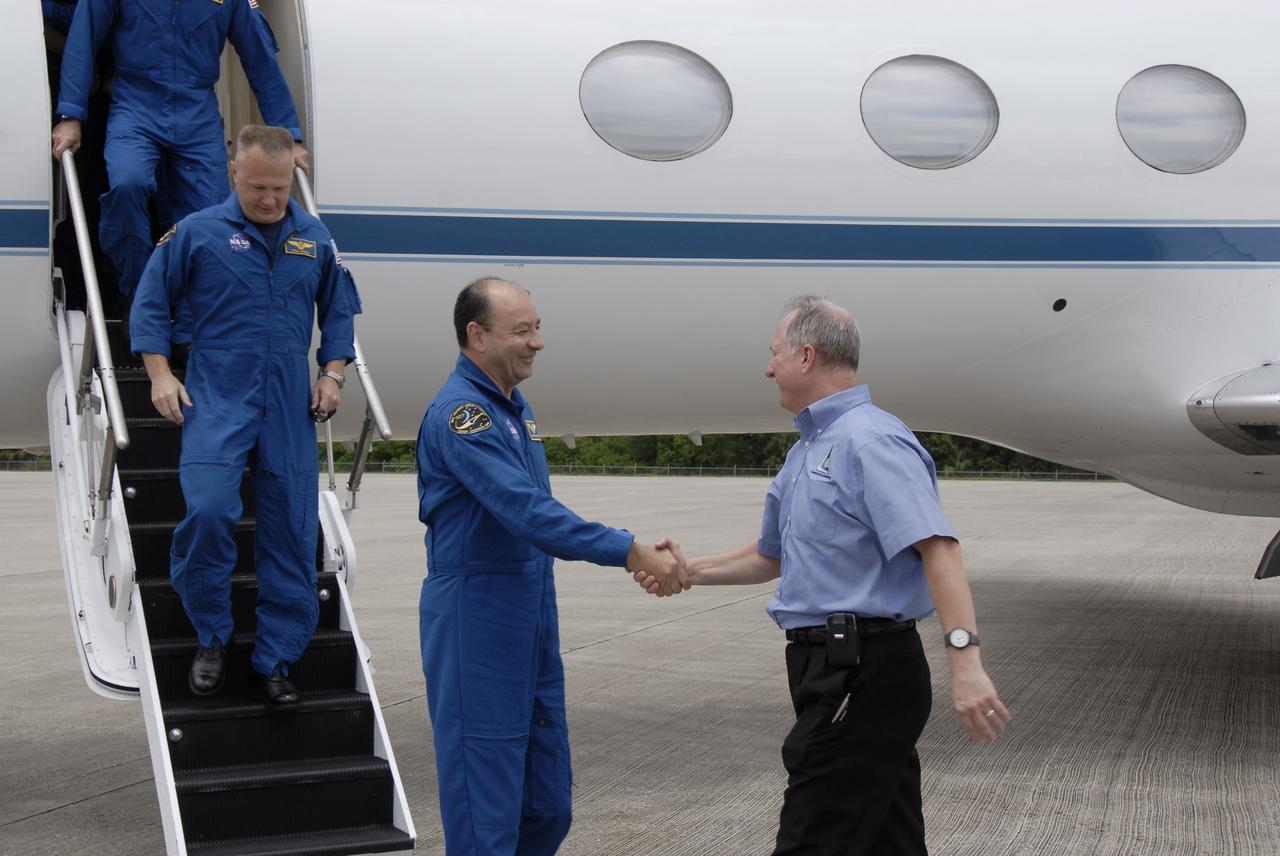
CAPE CANAVERAL, Fla. – – The STS-127 crew members arrive at NASA's Kennedy Space Center in Florida to prepare for space shuttle Endeavour's July 11 launch on the 29th assembly flight to the International Space Station. Leading the way, Commander Mark Polansky is greeted by the STS-127 Launch Director Pete Nickolenko. Behind Polansky is Pilot Doug Hurley. Polansky will be making his third shuttle flight and Hurley his first. This will be the third launch attempt due to the leak of hydrogen gas at the Ground Umbilical Carrier Plate during tanking on two previous attempts, June 13 and June 17. The STS-127 mission is the final of three flights dedicated to the assembly of the Japan Aerospace Exploration Agency's Kibo laboratory complex. Endeavour will deliver the Japanese Experiment Module's Exposed Facility, or JEM-EF, and the Experiment Logistics Module-Exposed Section, or ELM-ES. Photo credit: NASA/Kim Shiflett
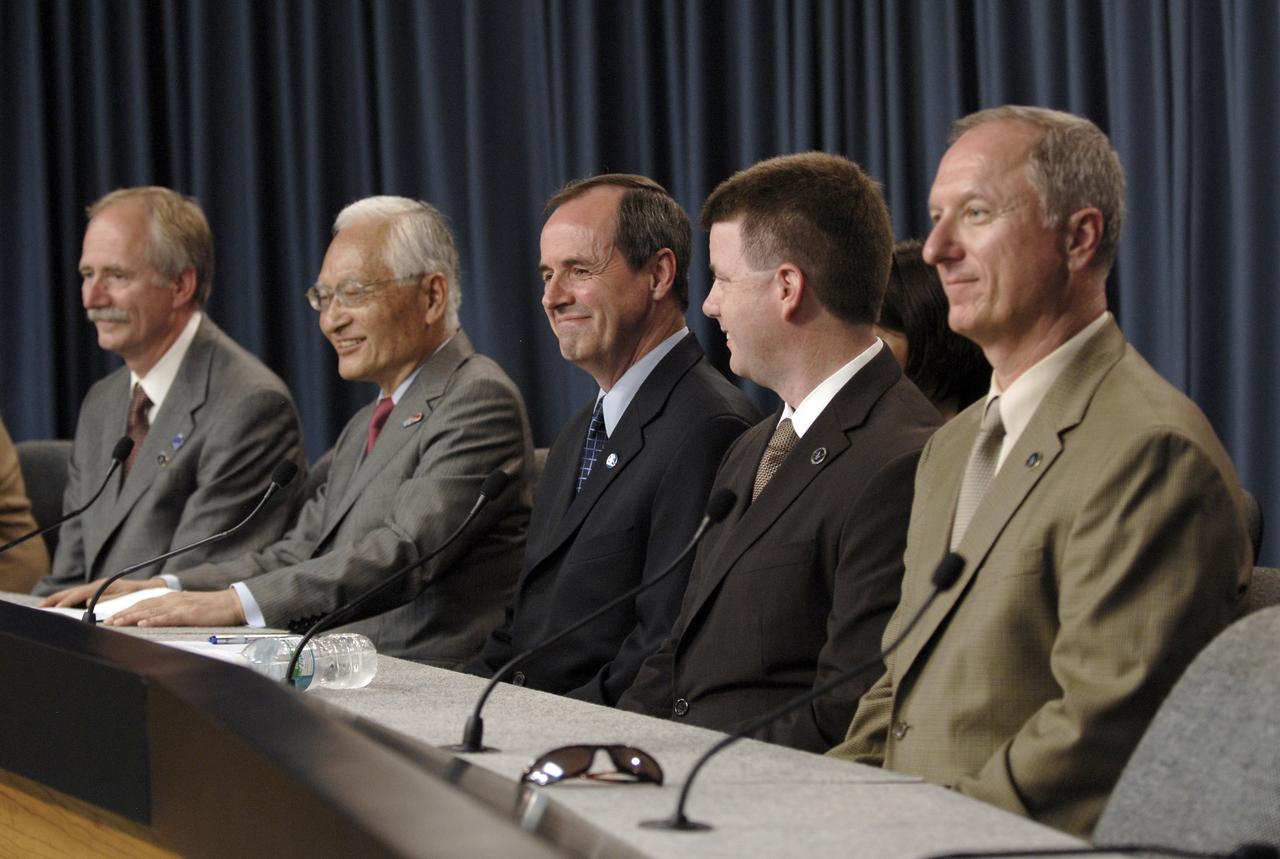
CAPE CANAVERAL, Fla. – At a post-landing news conference at NASA's Kennedy Space Center in Florida, participants respond with smiles to a question from the media. From left are NASA Associate Administrator for Space Operations William Gerstenmaier, President of the Japan Aerospace Exploration Agency Keiji Tachikawa, Director General of Operations in the Canadian Space Agency Benoit Marcotte, space shuttle Launch Integration Manager Mike Moses and STS-127 Launch Director Pete Nickolenko. Space shuttle Endeavour and crew returned to Earth at 10:48 a.m. EDT to conclude the STS-127 mission. Endeavour delivered the Japanese Experiment Module's Exposed Facility and the Experiment Logistics Module-Exposed Section to the International Space Station. The mission was the 29th flight to the station, the 23rd flight of Endeavour and the 127th in the Space Shuttle Program, as well as the 71st landing at Kennedy. Photo credit: NASA/Kim Shiflett
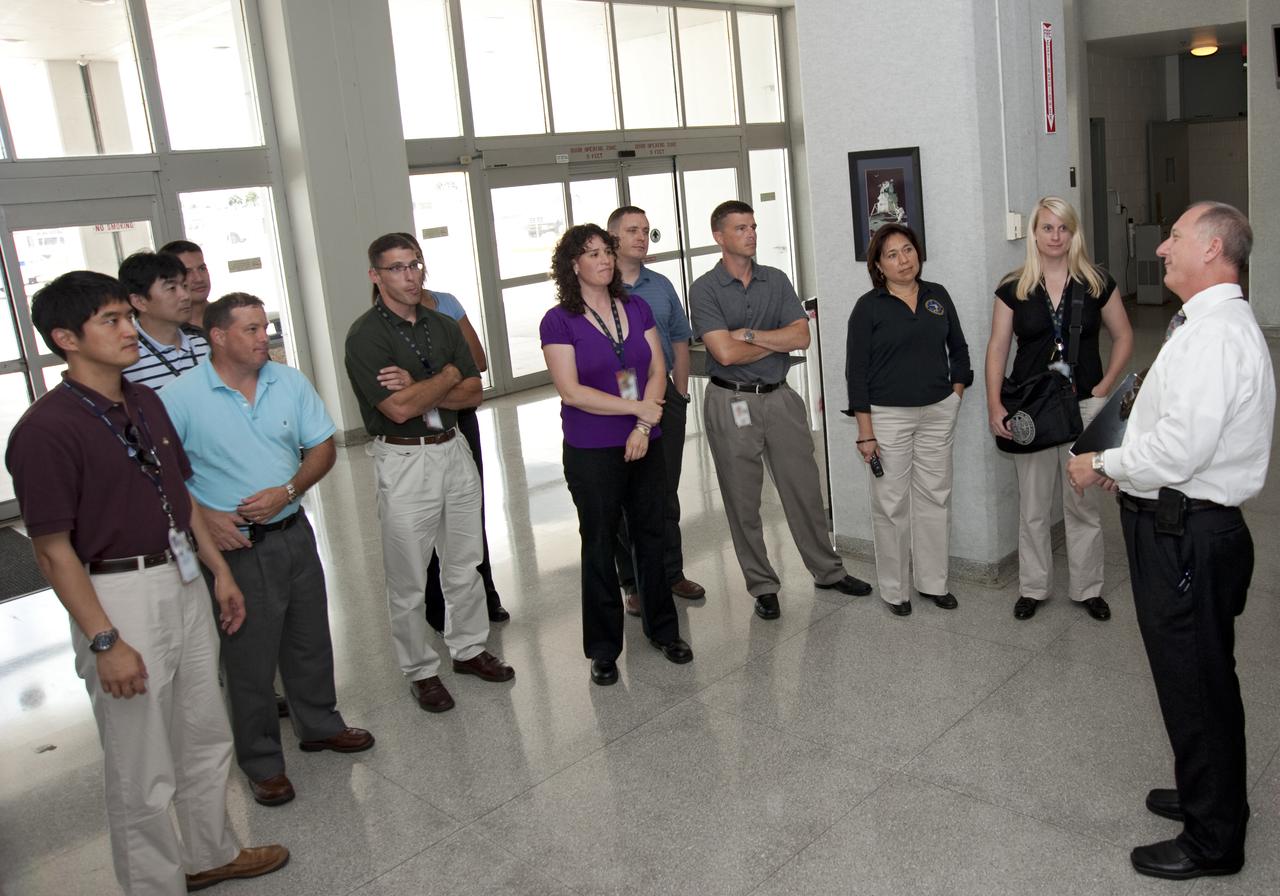
CAPE CANAVERAL, Fla. --- At NASA's Kennedy Space Center in Florida, Deputy Director for Kennedy's Launch Vehicle Processing Directorate Pete Nickolenko, right, greets the Class of 2009 Astronaut Candidates, also called ASCANs, before taking them on a tour of the Launch Control Center. The new astronaut candidates for NASA are Serena M. Aunon, Jeanette J. Epps, Air Force Maj. Jack D. Fischer, Air Force Lt. Col. Michael S. Hopkins, Kjell N. Lindgren, Kathleen 'Kate' Rubins, Navy Cmdr. Scott D. Tingle, Army Lt. Col. Mark T. Vande, and Navy Lt. Cmdr. Gregory R. 'Reid' Wiseman. The new astronaut candidates for the Japan Aerospace Exploration Agency, or JAXA, are Norishige Kanai, Takuya Onishi and Kimiya Yui. The new astronaut candidates for the Canadian Space Agency, or CSA, are Jeremy Hansen and David Saint-Jacques. Photo Credit: NASA_Kim Shiflett
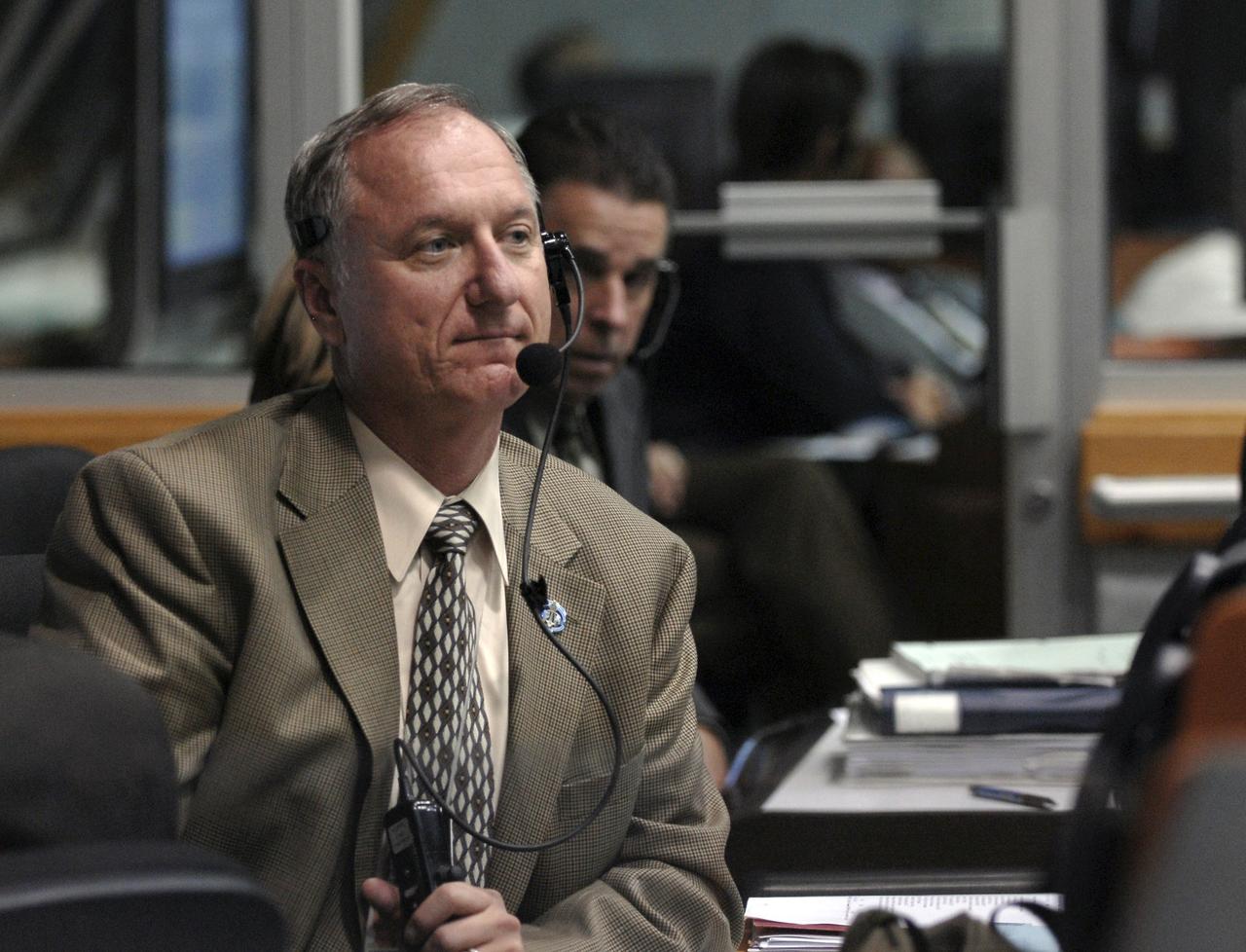
CAPE CANAVERAL, Fla. – In NASA Kennedy Space Center's Firing Room 4, STS-128 Launch Director Pete Nickolenko waits for the launch of space shuttle Discovery on the STS-128 mission. Liftoff from Launch Pad 39A was on time at 11:59 p.m. EDT. The first launch attempt on Aug. 24 was postponed due to unfavorable weather conditions. The second attempt on Aug. 25 also was postponed due to an issue with a valve in space shuttle Discovery's main propulsion system. The STS-128 mission is the 30th International Space Station assembly flight and the 128th space shuttle flight. The 13-day mission will deliver more than 7 tons of supplies, science racks and equipment, as well as additional environmental hardware to sustain six crew members on the International Space Station. The equipment includes a freezer to store research samples, a new sleeping compartment and the COLBERT treadmill. Photo credit: NASA/Kim Shiflett
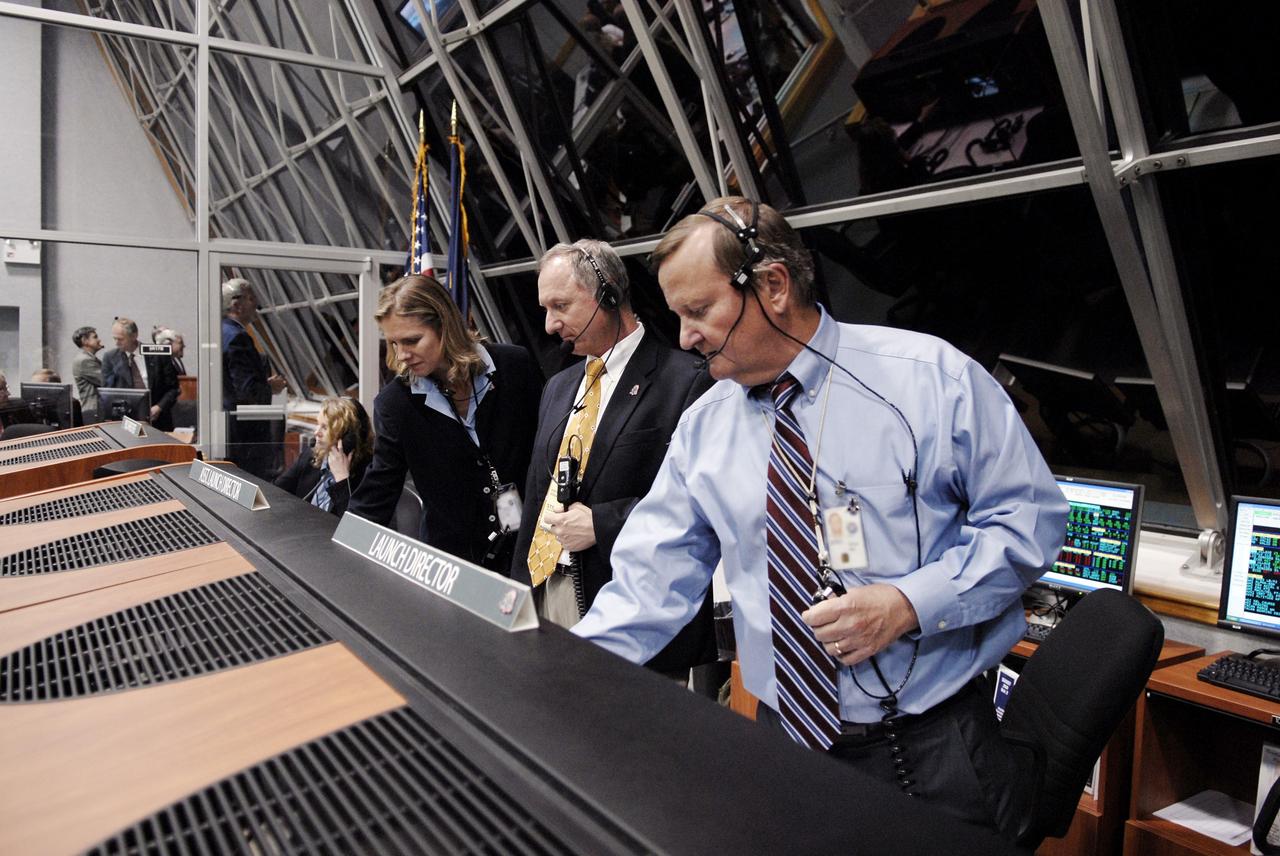
CAPE CANAVERAL, Fla. – In Firing Room 4 of the Launch Control Center at NASA's Kennedy Space Center in Florida, Flow Director for space shuttle Discovery Stephanie Stilson, Assistant Launch Director Pete Nickolenko and Shuttle Launch Director Mike Leinbach check the computers for follow-up images of the launch of space shuttle Discovery on the STS-119 mission. Launch was on time at 7:43 p.m. EDT. The STS-119 mission is the 28th to the space station and Discovery's 36th flight. Discovery will deliver the final pair of power-generating solar array wings and the S6 truss segment. Installation of S6 will signal the station's readiness to house a six-member crew for conducting increased science. Photo credit: NASA/Kim Shiflett
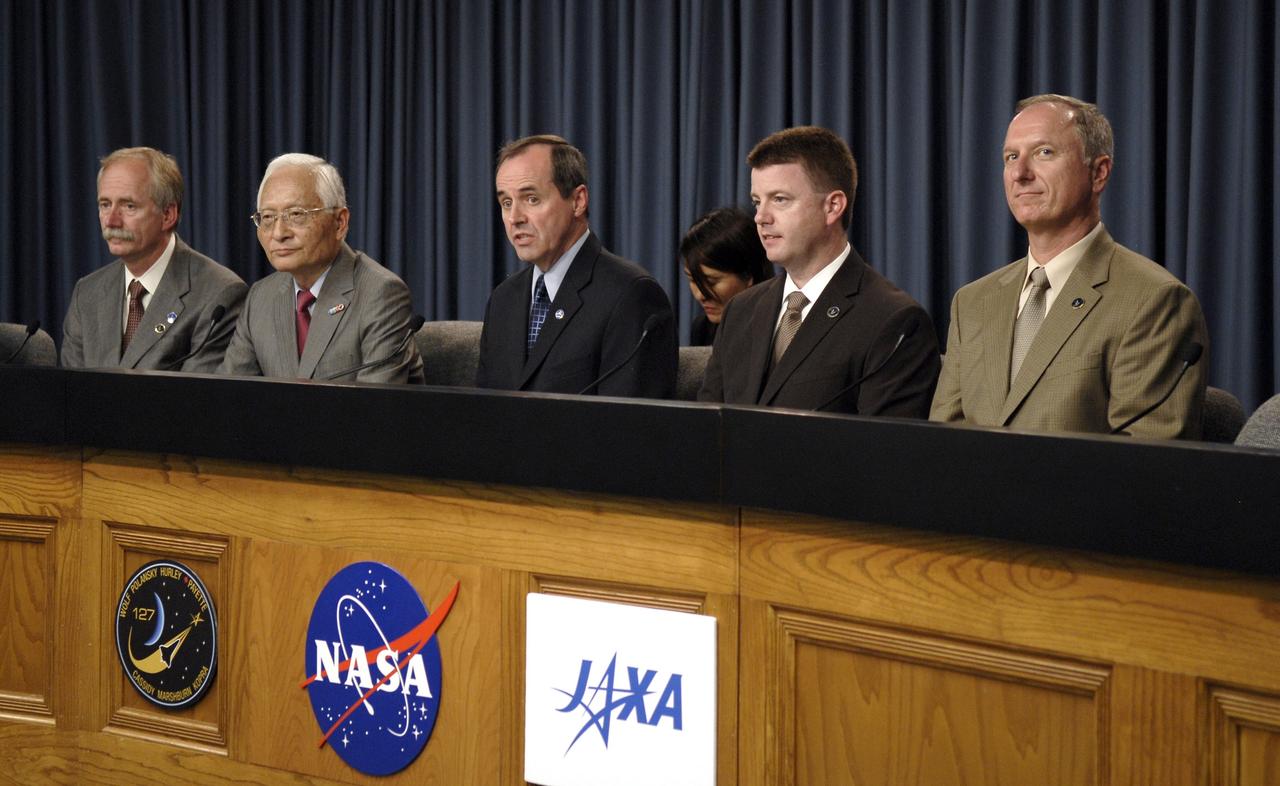
CAPE CANAVERAL, Fla. – At a post-landing news conference at NASA's Kennedy Space Center in Florida, NASA Associate Administrator for Space Operations William Gerstenmaier, President of the Japan Aerospace Exploration Agency Keiji Tachikawa, Director General of Operations in the Canadian Space Agency Benoit Marcotte, space shuttle Launch Integration Manager Mike Moses and STS-127 Launch Director Pete Nickolenko comment about the STS-127 mission and space shuttle Endeavour's return to Earth at 10:48 a.m. EDT. Endeavour delivered the Japanese Experiment Module's Exposed Facility and the Experiment Logistics Module-Exposed Section to the International Space Station. The mission was the 29th flight to the station, the 23rd flight of Endeavour and the 127th in the Space Shuttle Program, as well as the 71st landing at Kennedy. Photo credit: NASA/Kim Shiflett
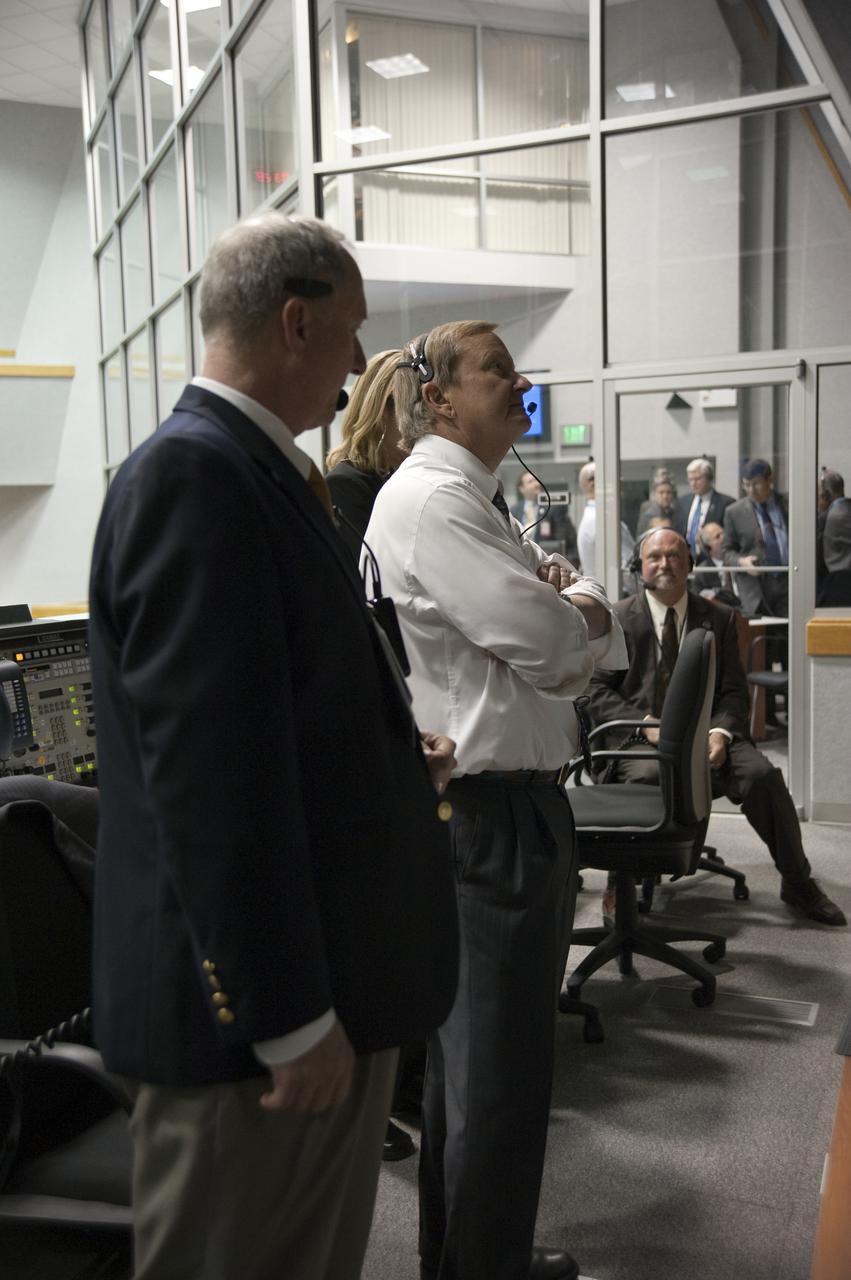
CAPE CANAVERAL, Fla. - NASA Launch Director Pete Nickolenko (left) and Assistant Launch Director Mike Leinbach, standing in Firing Room 4 in the Launch Control Center at NASA's Kennedy Space Center in Florida, watch space shuttle Discovery's liftoff off from Launch Pad 39A. Shuttle Discovery lifted off at 6:21 a.m. EDT on April 5, 2010. The seven-member STS-131 crew will deliver the multi-purpose logistics module Leonardo, filled with supplies, a new crew sleeping quarters and science racks that will be transferred to the International Space Station's laboratories. The crew also will switch out a gyroscope on the station’s truss, install a spare ammonia storage tank and retrieve a Japanese experiment from the station’s exterior. STS-131 is the 33rd shuttle mission to the station and the 131st shuttle mission overall. For information on the STS-131 mission and crew, visit http:__www.nasa.gov_mission_pages_shuttle_shuttlemissions_sts131_index.html. Photo credit: NASA_Kim Shiflett
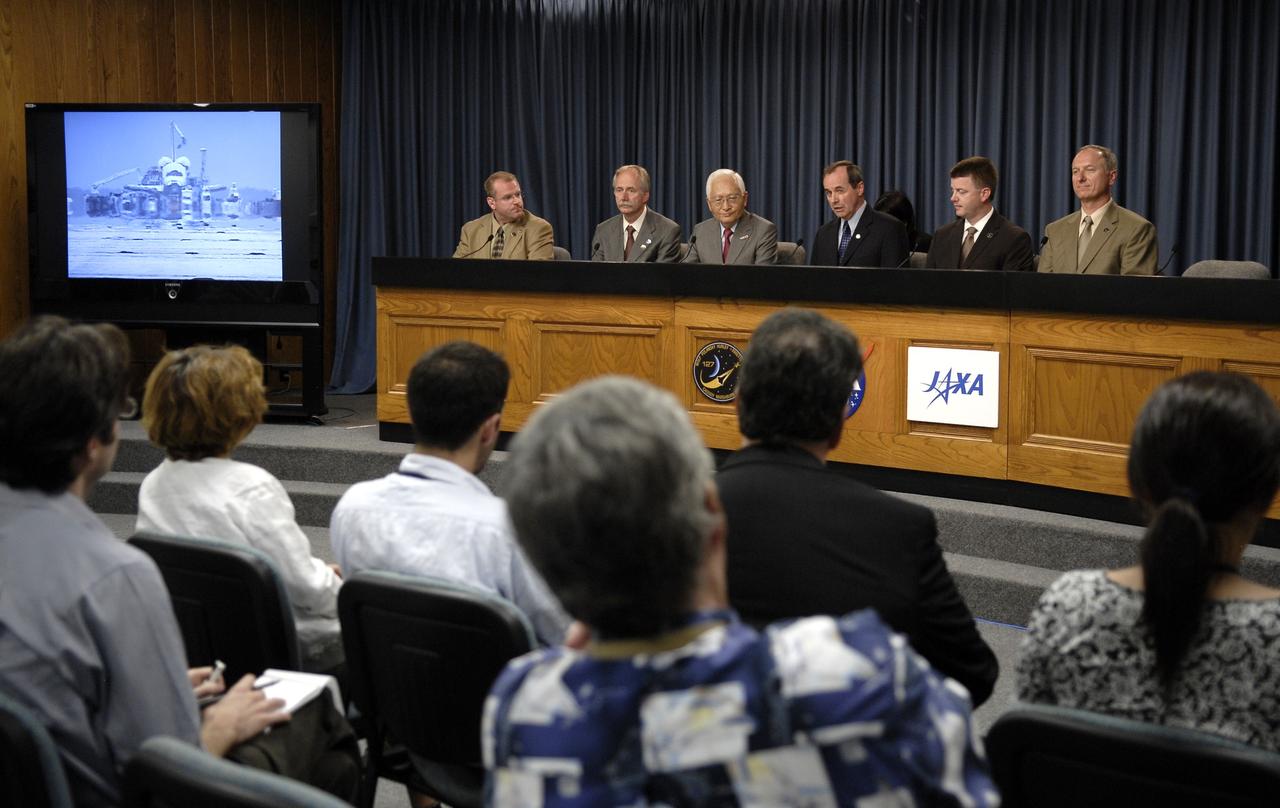
CAPE CANAVERAL, Fla. – At a post-landing news conference, Public Affairs Officer Allard Beutel (far left) moderates the question-and-answer session with NASA Associate Administrator for Space Operations William Gerstenmaier, President of the Japan Aerospace Exploration Agency Keiji Tachikawa, Director General of Operations in the Canadian Space Agency Benoit Marcotte, space shuttle Launch Integration Manager Mike Moses and STS-127 Launch Director Pete Nickolenko. Space shuttle Endeavour and crew returned to Earth at 10:48 a.m. EDT to conclude the STS-127 mission. Endeavour delivered the Japanese Experiment Module's Exposed Facility and the Experiment Logistics Module-Exposed Section to the International Space Station. The mission was the 29th flight to the station, the 23rd flight of Endeavour and the 127th in the Space Shuttle Program, as well as the 71st landing at Kennedy. Photo credit: NASA/Kim Shiflett
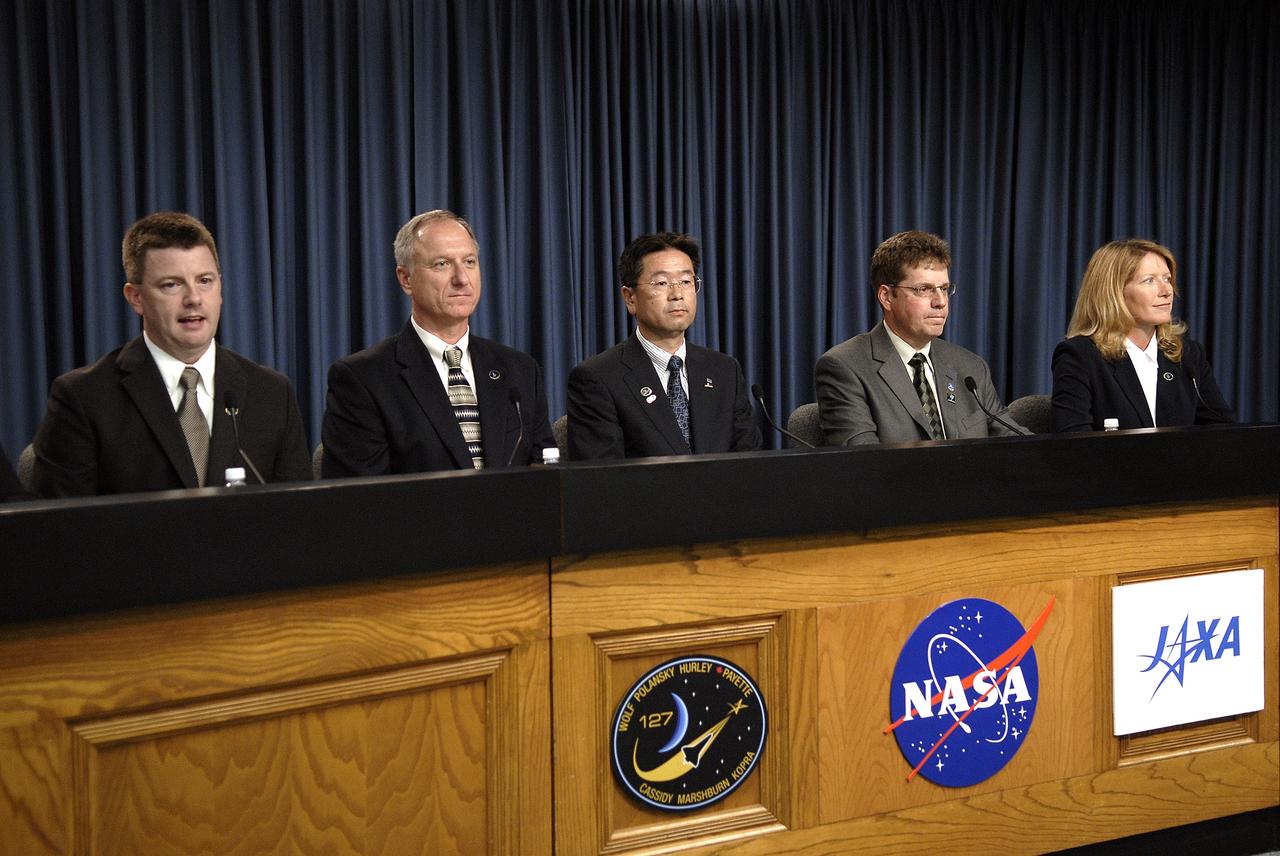
CAPE CANAVERAL, Fla. – Taking part in a prelaunch news conference at NASA's Kennedy Space Center in Florida about the STS-127 mission are (from left) Mike Moses, launch integration manager and chair of the Mission Management Team; Pete Nickolenko, STS-127 shuttle launch director; Koki Oikawa, Japan Experiment Module, or JEM, Project Team function manager; Pierre Jean, director of Operations Engineering and program manager for the Canadian Space Station Program, Canadian Space Agency; and Kathy Winters, shuttle weather officer. In the final of three flights dedicated to the assembly of the Japan Aerospace Exploration Agency's Kibo laboratory complex on the International Space Station, space shuttle Endeavour will deliver the JEM Exposed Facility and the Experiment Logistics Module-Exposed Section, or ELM-ES. STS-127 is the 29th flight for the assembly of the space station and the 127th flight in the Space Shuttle Program. Photo credit: NASA/Kim Shiflett
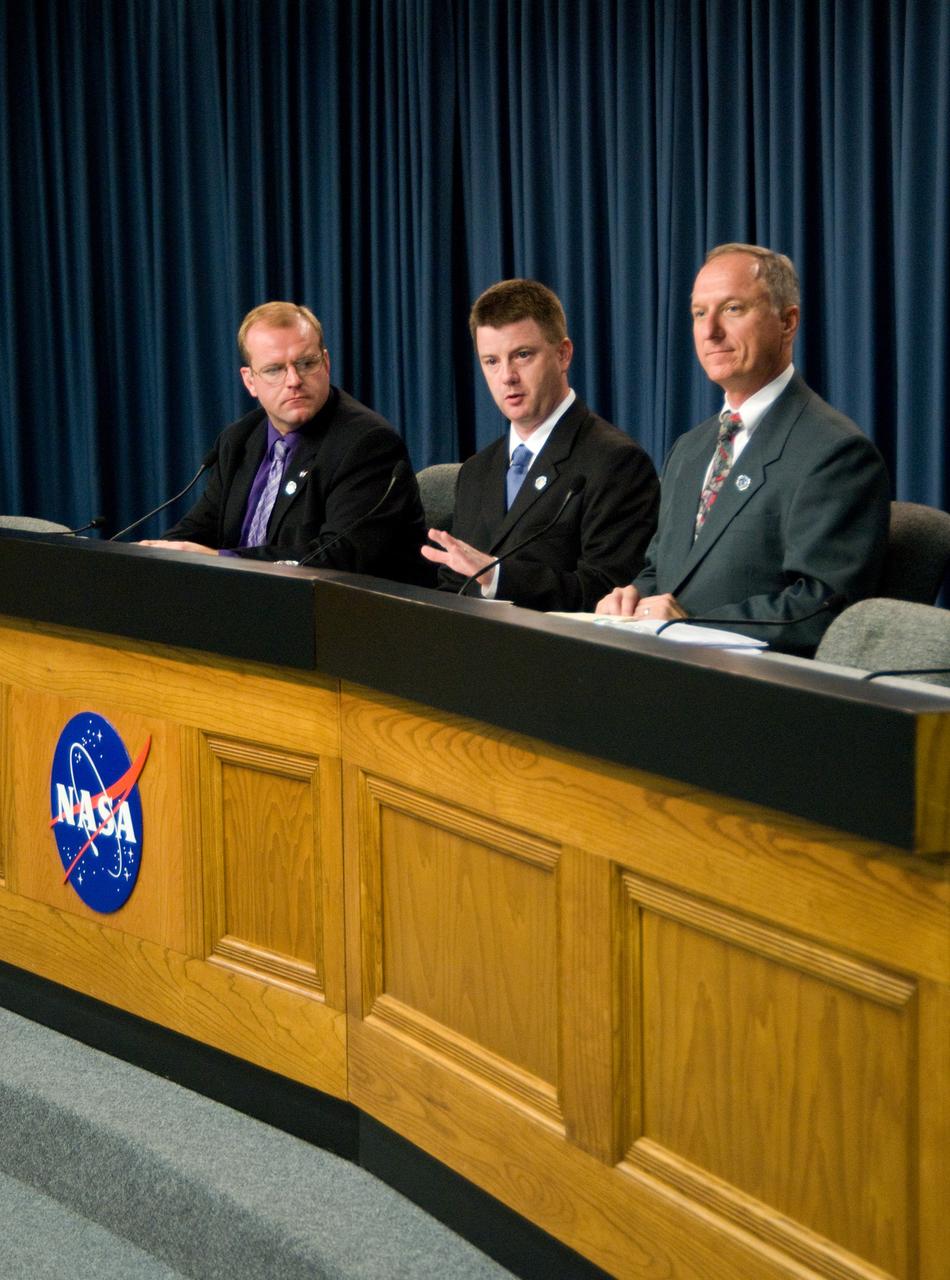
CAPE CANAVERAL, Fla. – In the Press Site auditorium at NASA's Kennedy Space Center in Florida, NASA managers brief the media following the scrub of a launch attempt of space shuttle Discovery. From left are briefing moderator Allard Beutel, Mission Management Team Chair Mike Moses and STS-128 Launch Director Pete Nickolenko. The launch attempt was scrubbed due to a problem with a liquid hydrogen valve in the main propulsion system. Liftoff now is no earlier than 12:22 a.m. EDT on Aug. 28.The 13-day STS-128 mission will deliver more than seven tons of supplies, science racks and equipment, as well as additional environmental hardware to sustain six crew members on the International Space Station. The equipment includes a freezer to store research samples, a new sleeping compartment and the COLBERT treadmill. The mission is the 128th in the Space Shuttle Program, the 37th flight of Discovery and the 30th station assembly flight. Photo credit: NASA/Cory Huston
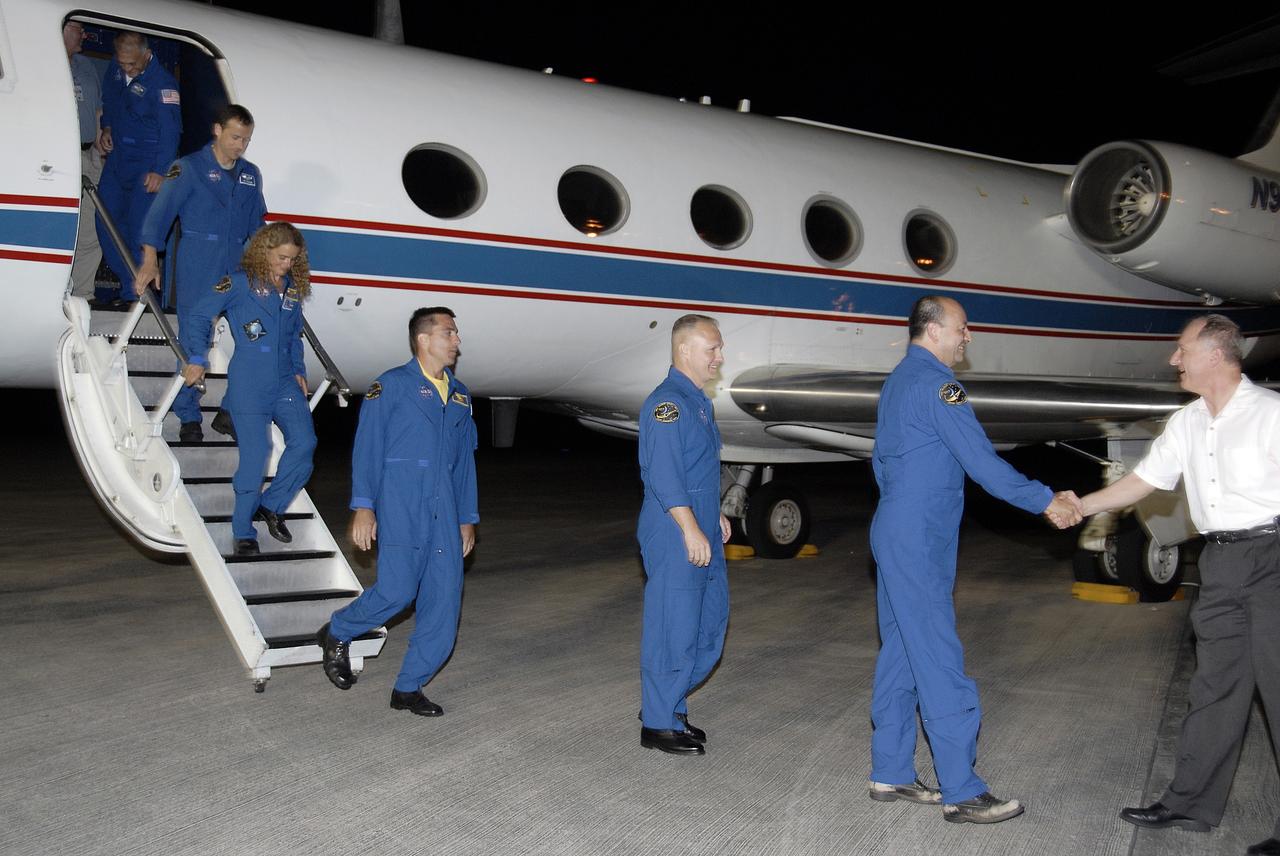
CAPE CANAVERAL, Fla. – Members of the STS-127 crew are greeted by STS-127 Launch Director Pete Nickolenko, at right, as they disembark from a Shuttle Training Aircraft at the Shuttle Landing Facility at NASA's Kennedy Space Center in Florida. From right to left are Commander Mark Polansky, Pilot Doug Hurley, and Mission Specialists Christopher Cassidy, Julie Payette of the Canadian Space Agency, Tom Marshburn and Dave Wolf. Polansky will be making his third shuttle flight. Hurley, Cassidy, and Marshburn will be making their first shuttle flights; Wolf, his fourth, and Payette, her second. The crew arrived aboard the aircraft from Houston to prepare for launch on space shuttle Endeavour on June 13. The STS-127 mission is the final of three flights dedicated to the assembly of the Japan Aerospace Exploration Agency's Kibo laboratory complex on the International Space Station. Endeavour will deliver the Japanese Experiment Module's Exposed Facility, or JEM-EF, and the Experiment Logistics Module-Exposed Section, or ELM-ES, to the space station on STS-127. Photo credit: NASA/Kim Shiflett
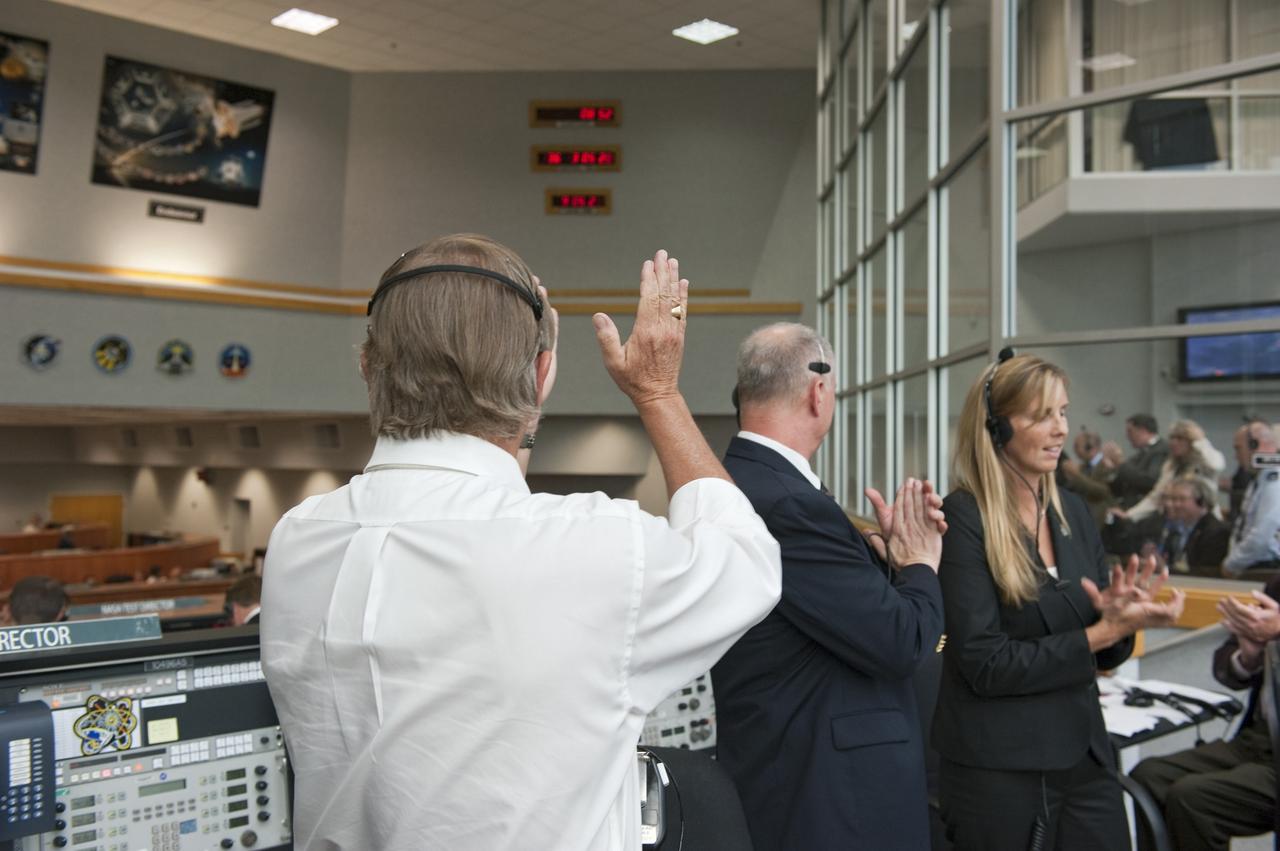
CAPE CANAVERAL, Fla. - Shuttle Launch Director Mike Leinbach, left, STS-134 Assistant Launch Director Pete Nickolenko and Endeavour's NASA Flow Director Dana Hutcherson give a round of applause to the launch controllers in Firing Room 4 of the Launch Control Center at NASA's Kennedy Space Center in Florida. Endeavour lifted off on its STS-134 mission to the International Space Station on time at 8:56 a.m. EDT on May 16. The shuttle and its six-member crew are embarking on a mission to deliver the Alpha Magnetic Spectrometer-2 (AMS), Express Logistics Carrier-3, a high-pressure gas tank and additional spare parts for the Dextre robotic helper to the space station. Endeavour's first launch attempt on April 29 was scrubbed because of an issue associated with a faulty power distribution box called the aft load control assembly-2 (ALCA-2). For more information visit, www.nasa.gov/mission_pages/shuttle/shuttlemissions/sts134/index.html. Photo credit: NASA/Kim Shiflett
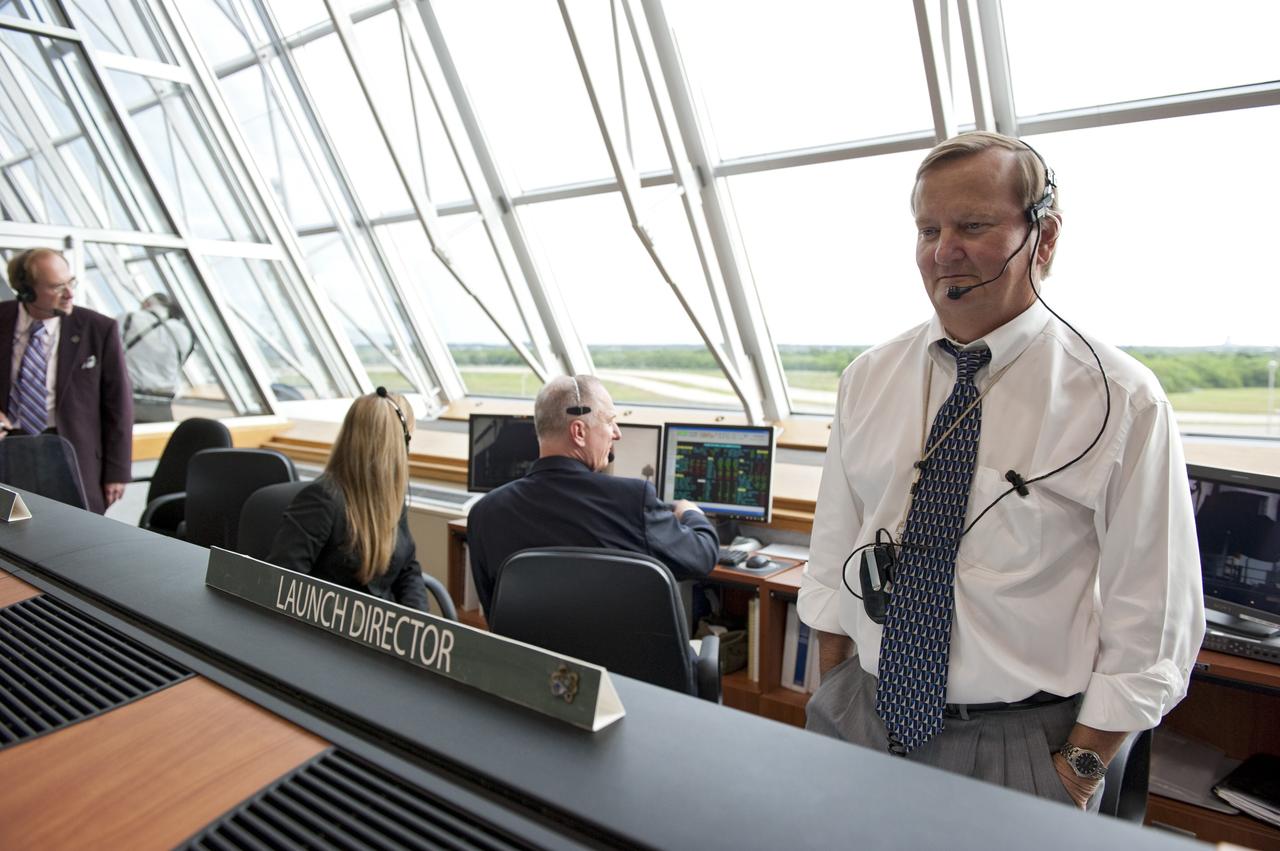
CAPE CANAVERAL, Fla. - Shuttle Launch Director Mike Leinbach monitors the countdown to liftoff of space shuttle Endeavour in Firing Room 4 of the Launch Control Center at NASA's Kennedy Space Center in Florida. Behind Leinbach, from left, are STS-134 Launch Commentator George Diller, Endeavour's NASA Flow Director Dana Hutcherson and STS-134 Assistant Launch Director Pete Nickolenko. Endeavour lifted off on its STS-134 mission to the International Space Station on time at 8:56 a.m. EDT on May 16. The shuttle and its six-member crew are embarking on a mission to deliver the Alpha Magnetic Spectrometer-2 (AMS), Express Logistics Carrier-3, a high-pressure gas tank and additional spare parts for the Dextre robotic helper to the space station. Endeavour's first launch attempt on April 29 was scrubbed because of an issue associated with a faulty power distribution box called the aft load control assembly-2 (ALCA-2). For more information visit, www.nasa.gov/mission_pages/shuttle/shuttlemissions/sts134/index.html. Photo credit: NASA/Kim Shiflett
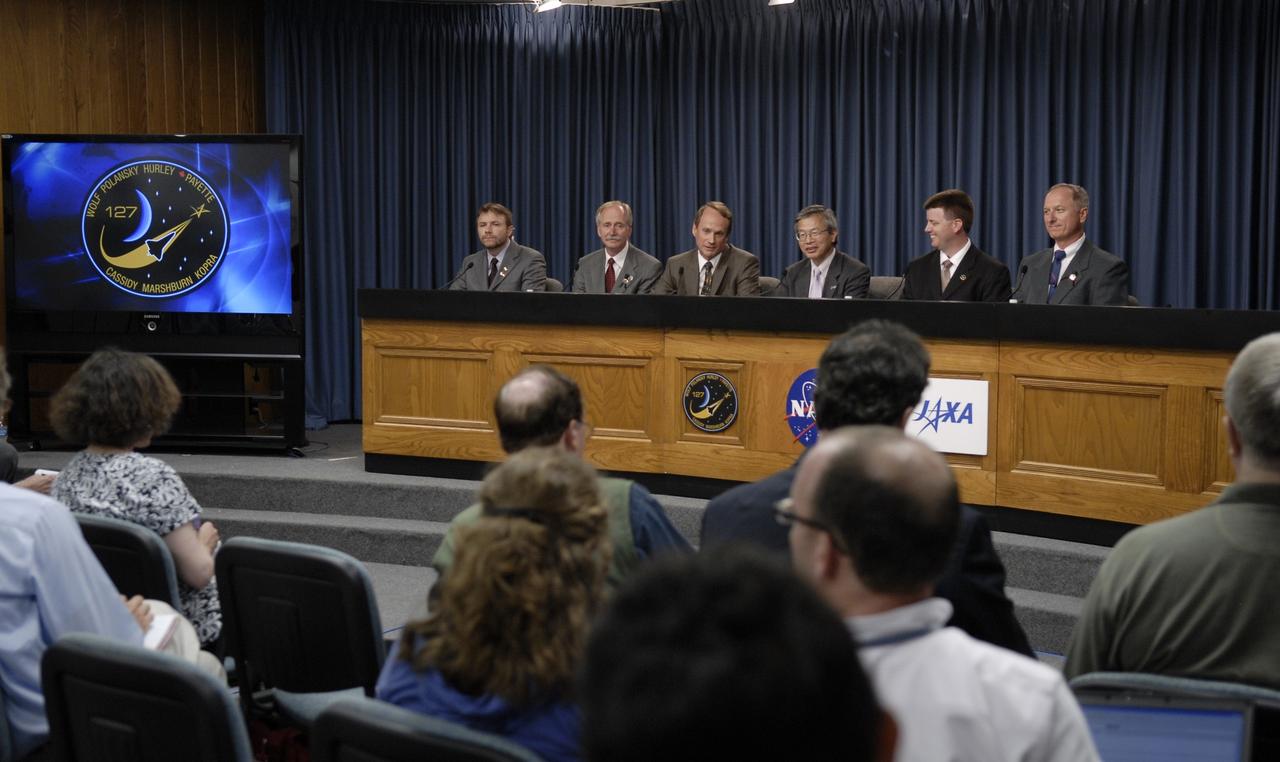
CAPE CANAVERAL, Fla. – Answering questions from the media at a press conference held at NASA's Kennedy Space Center in Florida are (second from left) Associate Administrator for NASA's Space Operations Directorate William Gerstenmaier, Canadian Space Agency President Steve MacLean, Japan Aerospace Exploration Agency Executive Director of Human Space Systems and Utilization Kuniaki Shiraki, Shuttle Launch Integration Manager Mike Moses and STS-127 Shuttle Launch Director Pete Nickolenko. At far left is moderator John Yembrick from NASA Public Affairs. The conference followed the successful launch of space shuttle Endeavour on the STS-127 mission. This was the sixth launch attempt for the STS-127 mission. The launch was scrubbed on June 13 and June 17 when a hydrogen gas leak occurred during tanking due to a misaligned Ground Umbilical Carrier Plate. The mission was postponed July 11, 12 and 13 due to weather conditions near the Shuttle Landing Facility at Kennedy that violated rules for launching, and lightning issues. Endeavour will deliver the Japanese Experiment Module's Exposed Facility and the Experiment Logistics Module-Exposed Section in the final of three flights dedicated to the assembly of the Japan Aerospace Exploration Agency's Kibo laboratory complex on the International Space Station. Photo credit: NASA/Kim Shiflett
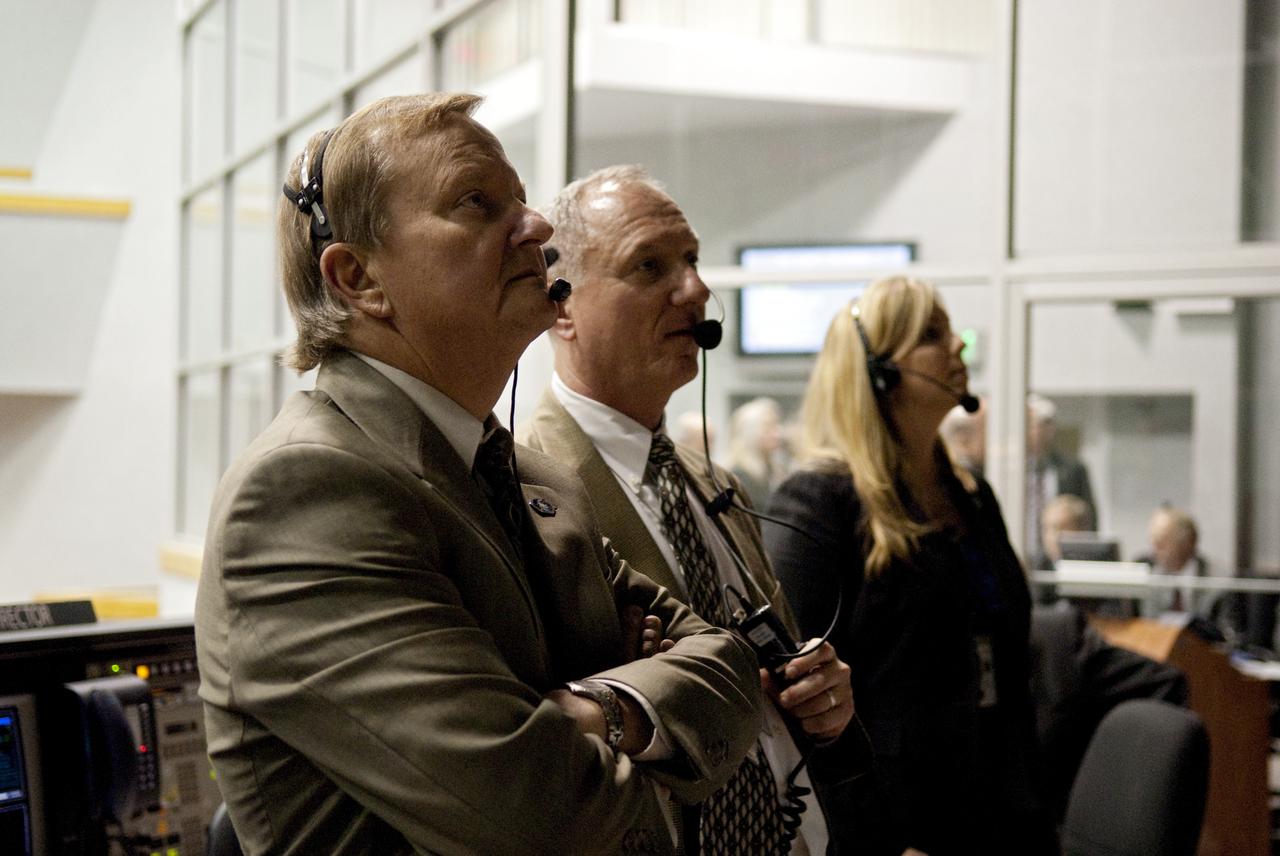
CAPE CANAVERAL, Fla. - From left, Mike Leinbach, shuttle launch director; Pete Nickolenko, assistant launch director; and Dana Hutcherson, flow director for space shuttle Endeavour, watch the liftoff of Endeavour through the windows of Firing Room 4 in the Launch Control Center at NASA's Kennedy Space Center in Florida. Launch of Endeavour on the STS-130 mission to the International Space Station was at 4:14 a.m. EST. This was the second launch attempt for space shuttle Endeavour's STS-130 crew and the final scheduled space shuttle night launch. The first attempt on Feb. 7 was scrubbed due to unfavorable weather. The primary payload for the STS-130 mission to the International Space Station is the Tranquility node, a pressurized module that will provide additional room for crew members and many of the station's life support and environmental control systems. Attached to one end of Tranquility is a cupola, a unique work area with six windows on its sides and one on top. The cupola resembles a circular bay window and will provide a vastly improved view of the station's exterior. The multi-directional view will allow the crew to monitor spacewalks and docking operations, as well as provide a spectacular view of Earth and other celestial objects. The module was built in Turin, Italy, by Thales Alenia Space for the European Space Agency. For information on the STS-130 mission and crew, visit http:__www.nasa.gov_mission_pages_shuttle_shuttlemissions_sts130_index.html. Photo credit: NASA_Kim Shiflett
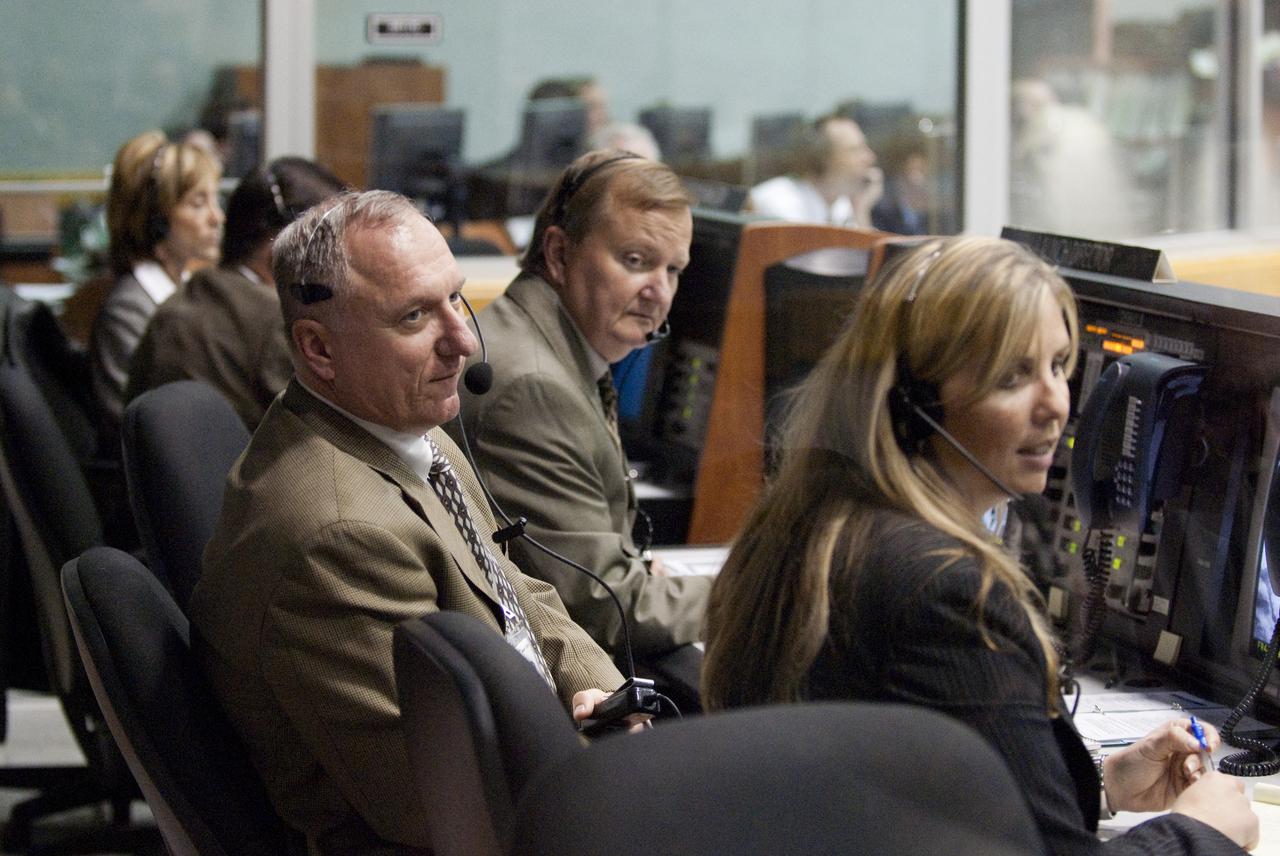
CAPE CANAVERAL, Fla. - In Firing Room 4 in the Launch Control Center at NASA's Kennedy Space Center in Florida, from top, Mike Leinbach, shuttle launch director; Pete Nickolenko, assistant launch director; and Dana Hutcherson, flow director for space shuttle Endeavour, manage the countdown to liftoff of Endeavour. Launch of Endeavour on the STS-130 mission to the International Space Station was at 4:14 a.m. EST. This was the second launch attempt for space shuttle Endeavour's STS-130 crew and the final scheduled space shuttle night launch. The first attempt on Feb. 7 was scrubbed due to unfavorable weather. The primary payload for the STS-130 mission to the International Space Station is the Tranquility node, a pressurized module that will provide additional room for crew members and many of the station's life support and environmental control systems. Attached to one end of Tranquility is a cupola, a unique work area with six windows on its sides and one on top. The cupola resembles a circular bay window and will provide a vastly improved view of the station's exterior. The multi-directional view will allow the crew to monitor spacewalks and docking operations, as well as provide a spectacular view of Earth and other celestial objects. The module was built in Turin, Italy, by Thales Alenia Space for the European Space Agency. For information on the STS-130 mission and crew, visit http:__www.nasa.gov_mission_pages_shuttle_shuttlemissions_sts130_index.html. Photo credit: NASA_Kim Shiflett
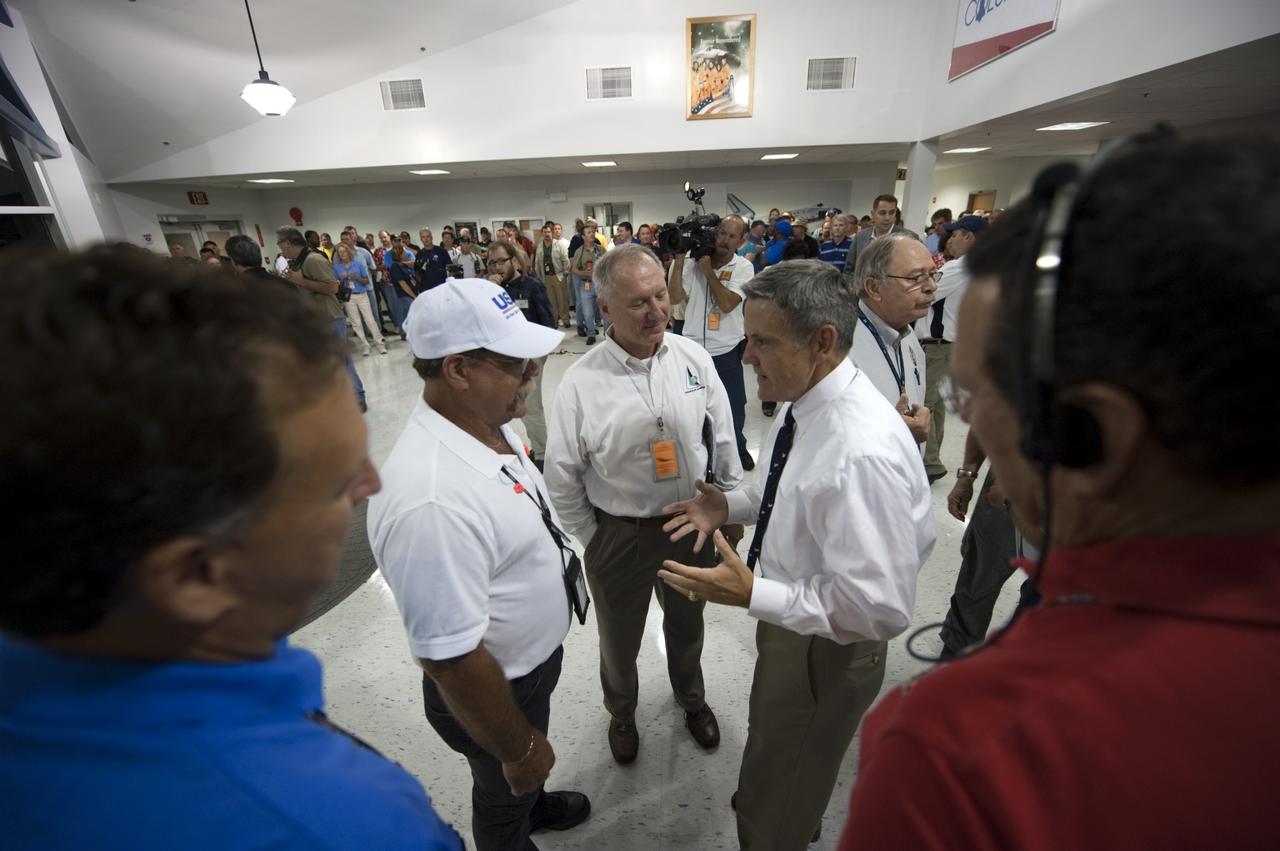
CAPE CANAVERAL, Fla. -- In the Flight Vehicle Support Building at NASA Kennedy Space Center's Shuttle Landing Facility (SLF), Kennedy Center Director Bob Cabana speaks with Closeout Crew lead Travis Thompson (left), and STS-135 Assistant Launch Director Pete Nickolenko during a prelanding convoy meeting. A Convoy Command Center vehicle will be positioned near shuttle Atlantis on the SLF. The command vehicle is equipped to control critical communications between the crew still aboard Atlantis and the Launch Control Center. The team will monitor the health of the orbiter systems and direct convoy operations made up of about 40 vehicles, including 25 specially designed vehicles to assist the crew in leaving the shuttle, and prepare the vehicle for towing from the SLF to its processing hangar. Securing the space shuttle fleet's place in history, Atlantis will mark the 26th nighttime landing of NASA's Space Shuttle Program and the 78th landing at Kennedy. Atlantis and its crew delivered to the International Space Station the Raffaello multi-purpose logistics module packed with more than 9,400 pounds of spare parts, equipment and supplies that will sustain station operations for the next year. STS-135 is the 33rd and final flight for Atlantis and final mission of the Space Shuttle Program. For more information, visit www.nasa.gov/mission_pages/shuttle/shuttlemissions/sts135/index.html. Photo credit: NASA/Kim Shiflett
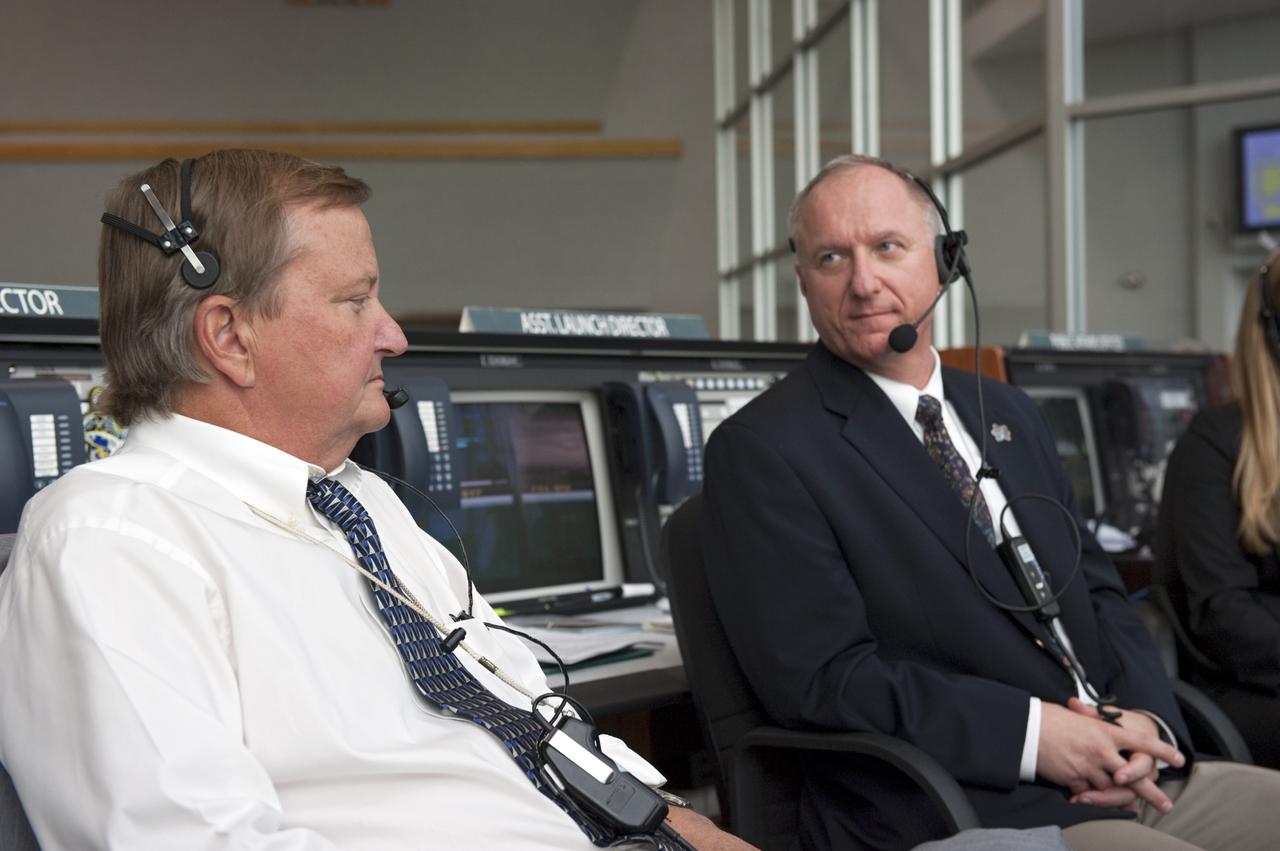
CAPE CANAVERAL, Fla. - Shuttle Launch Director Mike Leinbach, left, and STS-134 Assistant Launch Director Pete Nickolenko monitor the countdown to liftoff of space shuttle Endeavour in Firing Room 4 of the Launch Control Center at NASA's Kennedy Space Center in Florida. Endeavour lifted off on its STS-134 mission to the International Space Station on time at 8:56 a.m. EDT on May 16. The shuttle and its six-member crew are embarking on a mission to deliver the Alpha Magnetic Spectrometer-2 (AMS), Express Logistics Carrier-3, a high-pressure gas tank and additional spare parts for the Dextre robotic helper to the space station. Endeavour's first launch attempt on April 29 was scrubbed because of an issue associated with a faulty power distribution box called the aft load control assembly-2 (ALCA-2). For more information visit, www.nasa.gov/mission_pages/shuttle/shuttlemissions/sts134/index.html. Photo credit: NASA/Kim Shiflett

STS130-S-025 (8 Feb. 2010) --- From left, Mike Leinbach, shuttle launch director; Pete Nickolenko, assistant launch director; and Dana Hutcherson, flow director for space shuttle Endeavour, watch the liftoff of Endeavour through the windows of Firing Room 4 in the Launch Control Center at NASA's Kennedy Space Center in Florida. Launch of Endeavour on the STS-130 mission to the International Space Station was at 4:14 a.m. (EST) on Feb. 8, 2010. This was the second launch attempt for Endeavour's STS-130 crew and the final scheduled space shuttle night launch. The first attempt on Feb. 7 was scrubbed due to unfavorable weather. The primary payload for the STS-130 mission to the International Space Station is the Tranquility node, a pressurized module that will provide additional room for crew members and many of the station's life support and environmental control systems. Attached to one end of Tranquility is the Cupola, a unique work area with six windows on its sides and one on top. The Cupola resembles a circular bay window and will provide a vastly improved view of the station's exterior. The multi-directional view will allow the crew to monitor spacewalks and docking operations, as well as provide a spectacular view of Earth and other celestial objects. The module was built in Turin, Italy, by Thales Alenia Space for the European Space Agency.
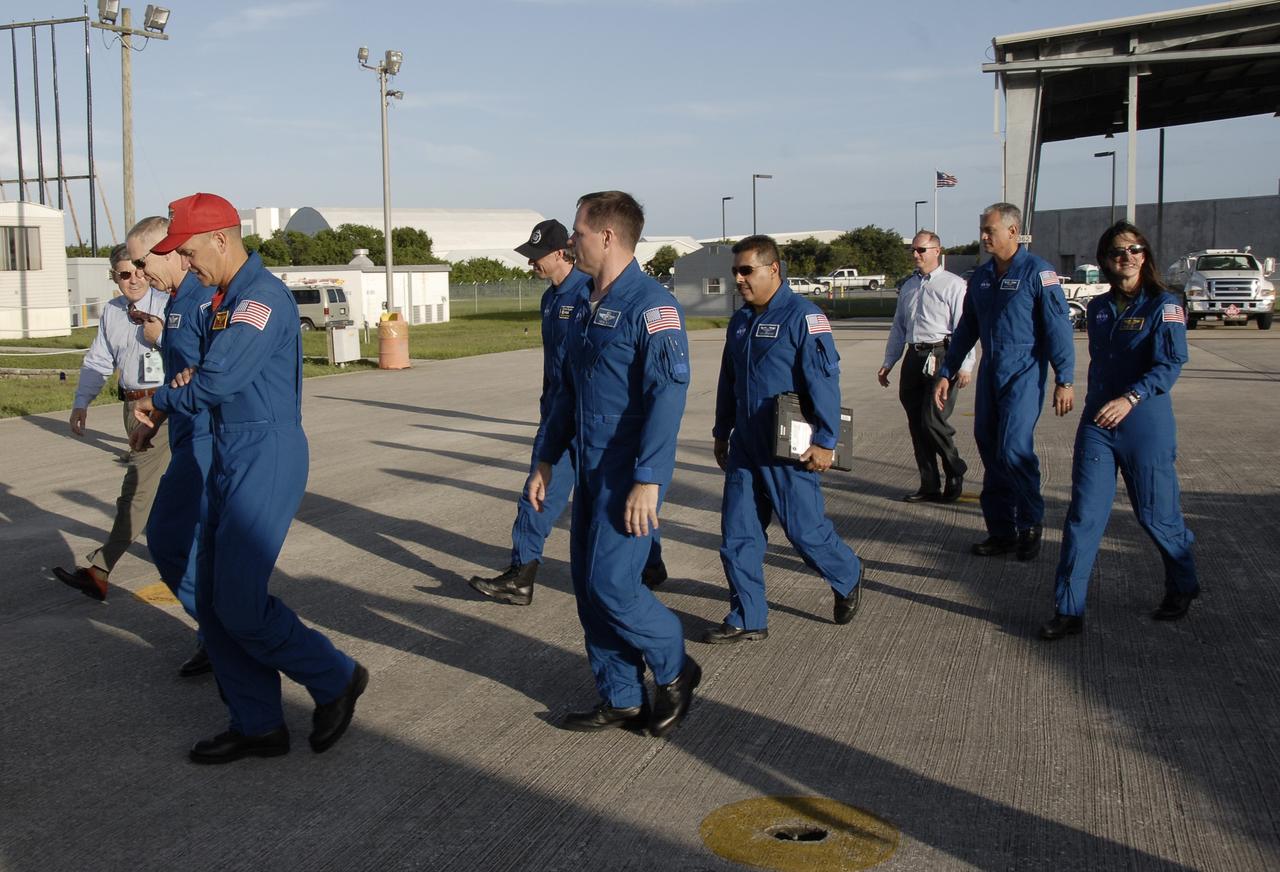
CAPE CANAVERAL, Fla. – At NASA's Kennedy Space Center, members of space shuttle Discovery's STS-128 crew depart the Shuttle Landing Facility for crew quarters in the Operations and Checkout Building. The crew arrived in a NASA Shuttle Training Aircraft at Kennedy's Shuttle Landing Facility at 6:34 p.m. EDT. From left are Kennedy's Center Director Bob Cabana, a former astronaut himself; Mission Specialist Patrick Forrester; Commander Rick Sturckow; Mission Specialist Christer Fuglesang, a Swedish astronaut with the European Space Agency; Pilot Kevin Ford; Mission Specialist Jose Hernandez; STS-128 Launch Director Pete Nickolenko; and Mission Specialists John "Danny" Olivas and Nicole Stott who will remain on the International Space Station as flight engineer for Expedition 20. The crew has returned to Kennedy to prepare for launch on Aug. 25 at 1:36 a.m. EDT. The 13-day mission will deliver a new crew member and 33,000 pounds of equipment to the International Space Station. The equipment includes science and storage racks, a freezer to store research samples, a new sleeping compartment and the COLBERT treadmill. Photo credit: NASA/Kim Shiflett
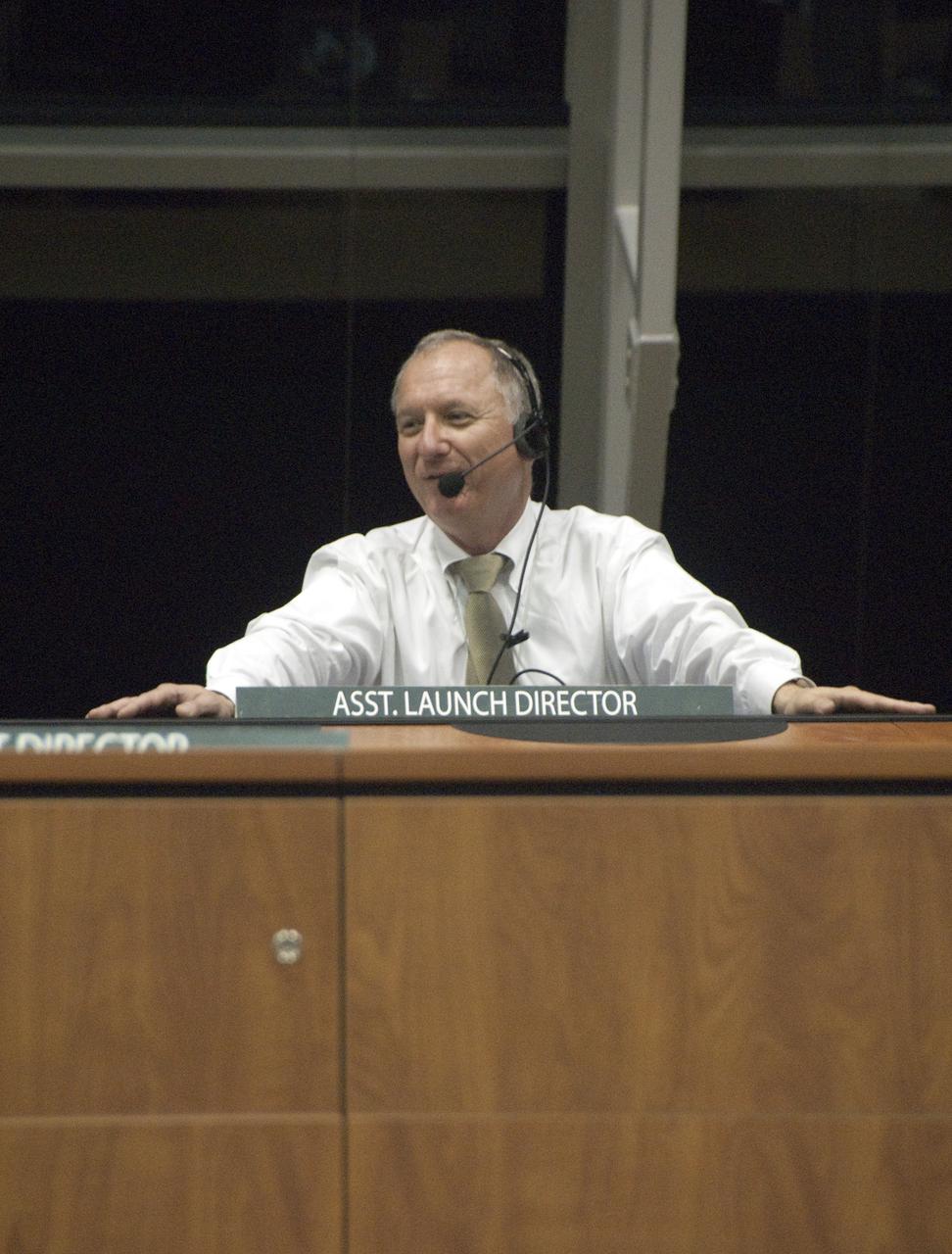
CAPE CANAVERAL, Fla. - In the Launch Control Center at NASA's Kennedy Space Center in Florida, NASA Assistant Launch Director Pete Nickolenko is pleased with the outcome of the tanking operations for space shuttle Atlantis' STS-132 mission being conducted from Firing Room 4. Liftoff of the STS-132 mission is set for 2:20 p.m. EDT on May 14. The six-member STS-132 crew will deliver the Russian-built Mini Research Module-1 to the International Space Station. Named Rassvet, Russian for 'dawn,' the module is the second in a series of new pressurized components for Russia and will be permanently attached to the Earth-facing port of the Zarya control module. Rassvet will be used for cargo storage and will provide an additional docking port to the station. Also aboard Atlantis is an Integrated Cargo Carrier, or ICC, an unpressurized flat bed pallet and keel yoke assembly used to support the transfer of exterior cargo from the shuttle to the station. STS-132 is the 34th mission to the station and the last scheduled flight for Atlantis. For more information on the STS-132 mission objectives, payload and crew, visit http:__www.nasa.gov_mission_pages_shuttle_shuttlemissions_sts132_index.html. Photo Credit: NASA_Cory Huston
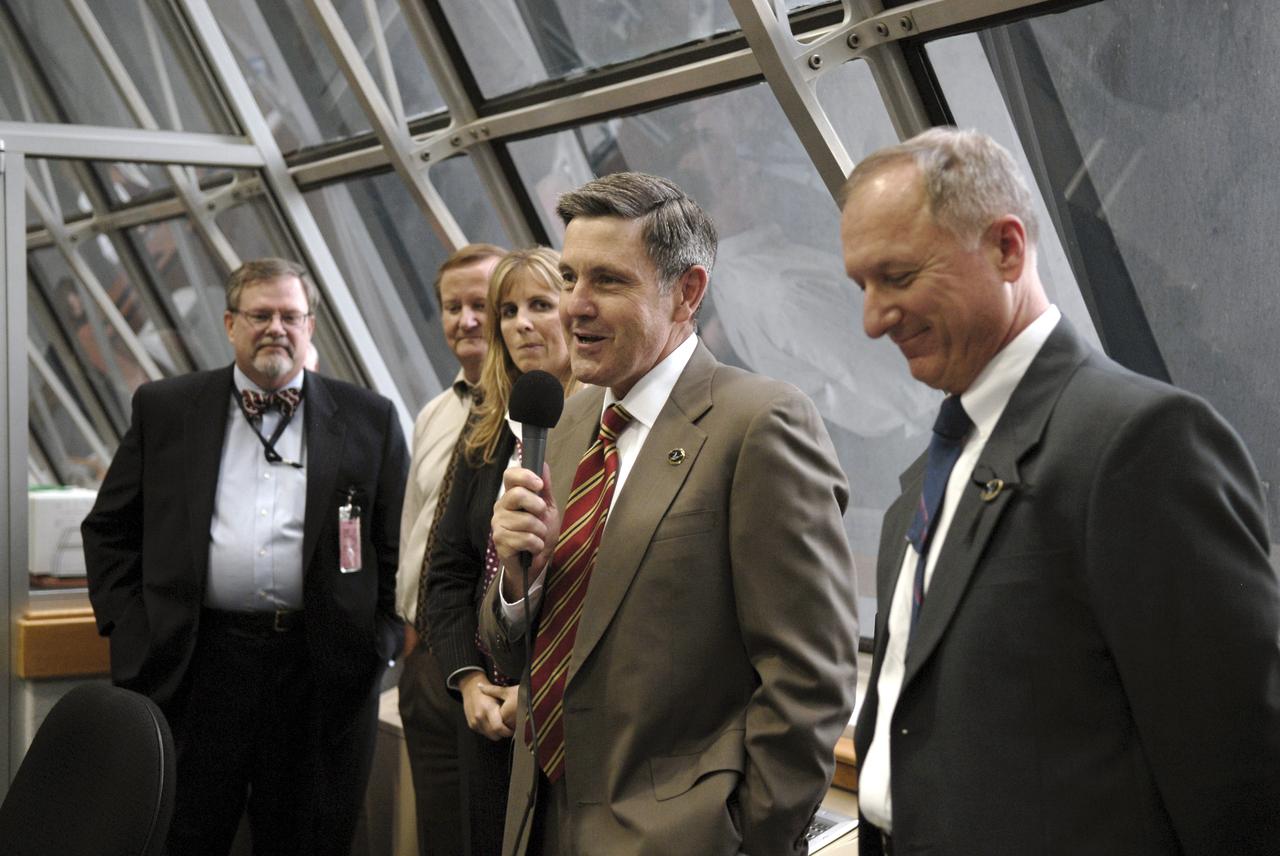
CAPE CANAVERAL, Fla. – In the Firing Room at NASA's Kennedy Space Center in Florida, Center Director Bob Cabana congratulates the mission team for the successful launch of space shuttle Endeavour on the STS-127 mission. Liftoff was on-time at 6:03 p.m. EDT. Looking on at left are Associate Administrator of Program Analysis & Evaluation at NASA Dr. Michael Hawes, Shuttle Launch Director Mike Leinbach and Endeavour Flow Director Dana Hutcherson , and at right, STS-127 Shuttle Launch Director Pete Nickolenko. Today was the sixth launch attempt for the STS-127 mission. The launch was scrubbed on June 13 and June 17 when a hydrogen gas leak occurred during tanking due to a misaligned Ground Umbilical Carrier Plate. The mission was postponed July 11, 12 and 13 due to weather conditions near the Shuttle Landing Facility at Kennedy that violated rules for launching, and lightning issues. Endeavour will deliver the Japanese Experiment Module's Exposed Facility and the Experiment Logistics Module-Exposed Section in the final of three flights dedicated to the assembly of the Japan Aerospace Exploration Agency's Kibo laboratory complex on the International Space Station. Photo credit: NASA/Kim Shiflett
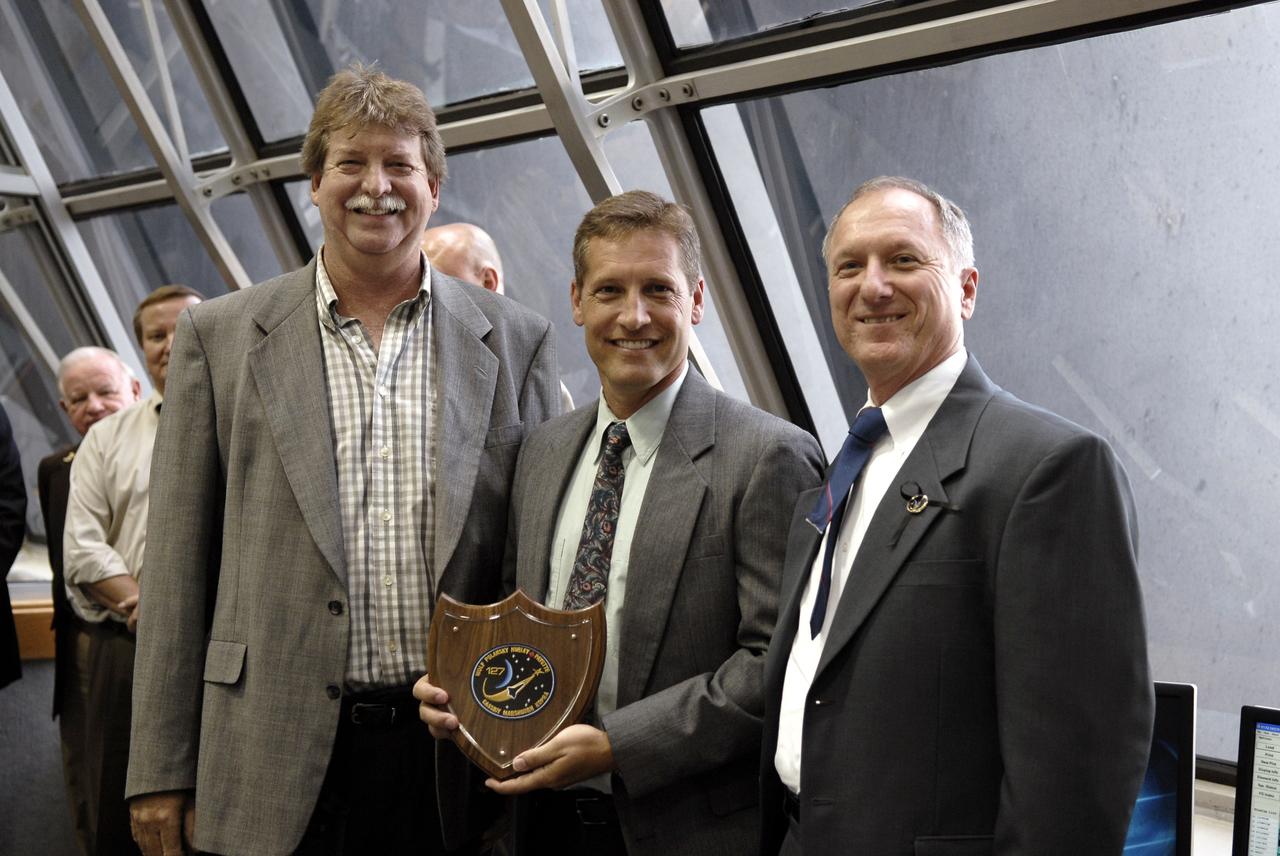
CAPE CANAVERAL, Fla. – In the Firing Room at NASA's Kennedy Space Center in Florida, Tom Mears (left) and David Sutherland (center) receive a plaque for their efforts in the successful launching of space shuttle Endeavour on the STS-127 mission. At right is the STS-127 Shuttle Launch Director Pete Nickolenko. Endeavour lifted off on-time at 6:03 p.m. EDT. This was the sixth launch attempt for the STS-127 mission. The launch was scrubbed on June 13 and June 17 when a hydrogen gas leak occurred during tanking due to a misaligned Ground Umbilical Carrier Plate. The mission was postponed July 11, 12 and 13 due to weather conditions near the Shuttle Landing Facility at Kennedy that violated rules for launching, and lightning issues. Endeavour will deliver the Japanese Experiment Module's Exposed Facility and the Experiment Logistics Module-Exposed Section in the final of three flights dedicated to the assembly of the Japan Aerospace Exploration Agency's Kibo laboratory complex on the International Space Station. Photo credit: NASA/Kim Shiflett
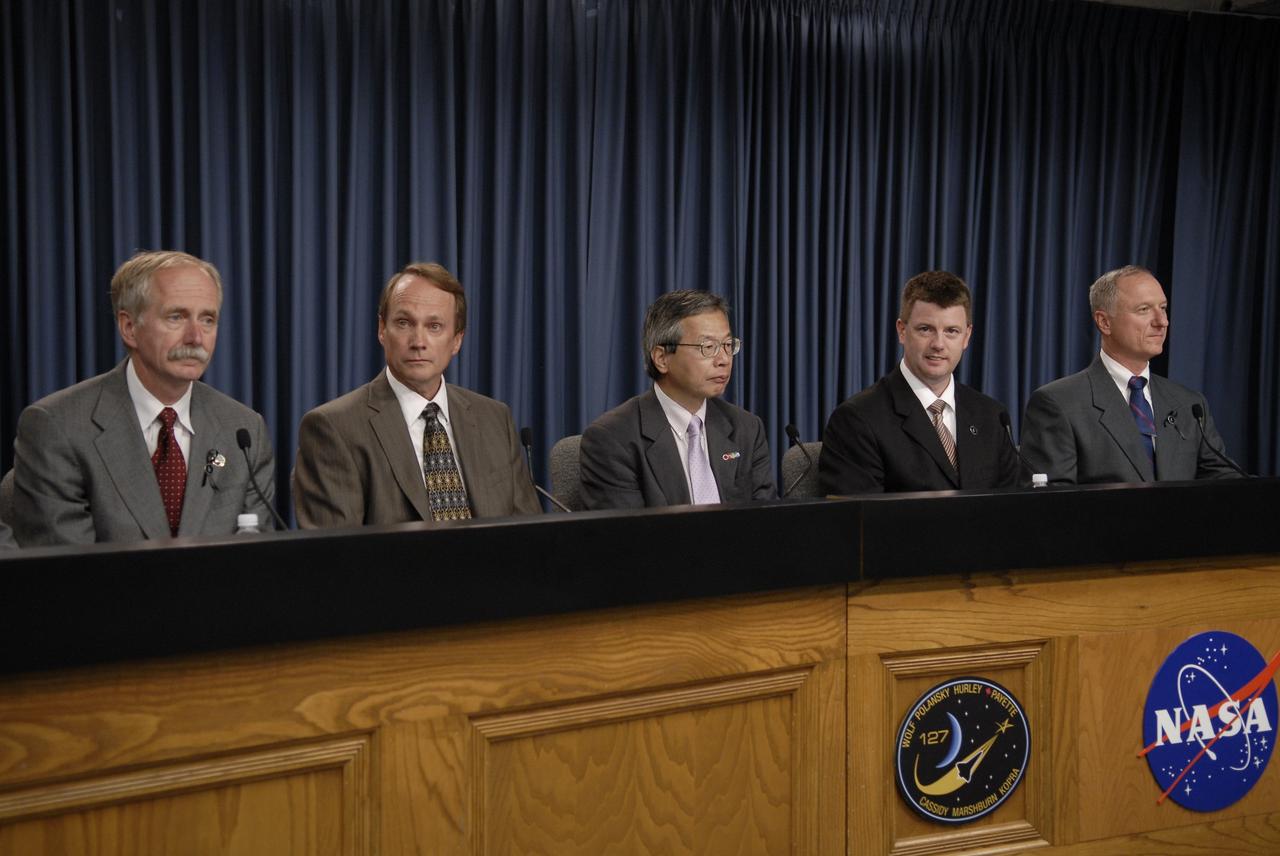
CAPE CANAVERAL, Fla. – At NASA's Kennedy Space Center in Florida, a press conference following the successful launch of space shuttle Endeavour on the STS-127 mission featured (from left) Associate Administrator for NASA's Space Operations Directorate William Gerstenmaier, Canadian Space Agency President Steve MacLean, Japan Aerospace Exploration Agency Executive Director of Human Space Systems and Utilization Kuniaki Shiraki, Shuttle Launch Integration Manager Mike Moses and STS-127 Shuttle Launch Director Pete Nickolenko. This was the sixth launch attempt for the STS-127 mission. The launch was scrubbed on June 13 and June 17 when a hydrogen gas leak occurred during tanking due to a misaligned Ground Umbilical Carrier Plate. The mission was postponed July 11, 12 and 13 due to weather conditions near the Shuttle Landing Facility at Kennedy that violated rules for launching, and lightning issues. Endeavour will deliver the Japanese Experiment Module's Exposed Facility and the Experiment Logistics Module-Exposed Section in the final of three flights dedicated to the assembly of the Japan Aerospace Exploration Agency's Kibo laboratory complex on the International Space Station. Photo credit: NASA/Kim Shiflett
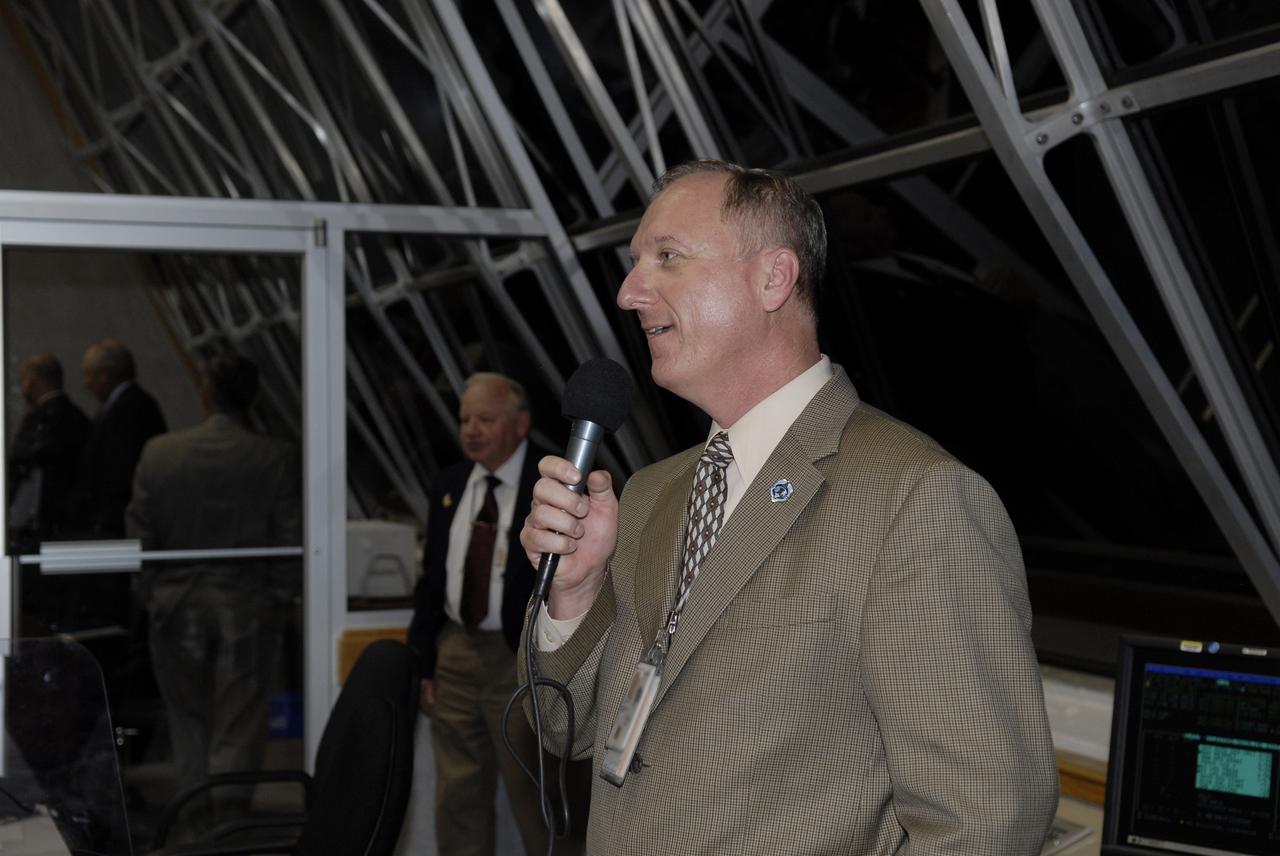
CAPE CANAVERAL, Fla. – In NASA Kennedy Space Center's Firing Room 4, STS-128 Launch Director Pete Nickolenko congratulates and thanks the mission team for the successful launch of space shuttle Discovery on the STS-128 mission. Liftoff from Launch Pad 39A was on time at 11:59 p.m. EDT. The first launch attempt on Aug. 24 was postponed due to unfavorable weather conditions. The second attempt on Aug. 25 also was postponed due to an issue with a valve in space shuttle Discovery's main propulsion system. The STS-128 mission is the 30th International Space Station assembly flight and the 128th space shuttle flight. The 13-day mission will deliver more than 7 tons of supplies, science racks and equipment, as well as additional environmental hardware to sustain six crew members on the International Space Station. The equipment includes a freezer to store research samples, a new sleeping compartment and the COLBERT treadmill. Photo credit: NASA/Kim Shiflett
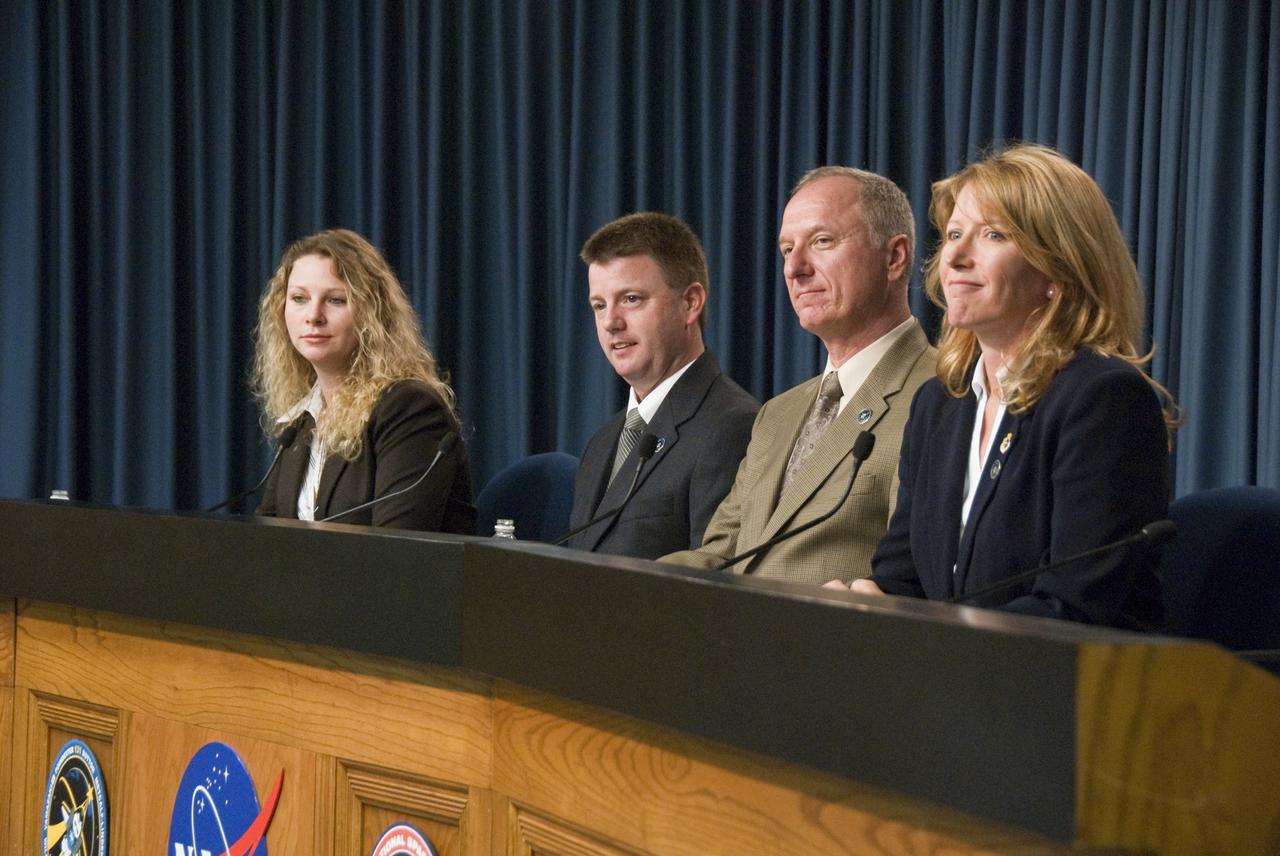
CAPE CANAVERAL, Fla. - In the Press Site auditorium at NASA's Kennedy Space Center in Florida, NASA managers participate in a prelaunch news conference for space shuttle Discovery's STS-131 mission. From left are Candrea Thomas, NASA Public Affairs moderator; Mike Moses, chair, Mission Management Team; Pete Nickolenko, STS-131 launch director; and Kathy Winters, shuttle weather officer. Liftoff of the STS-131 mission is set for 6:21 a.m. EDT on April 5. On STS-131, the seven-member crew will deliver the multi-purpose logistics module Leonardo, filled with supplies, a new crew sleeping quarters and science racks that will be transferred to the International Space Station's laboratories. The crew also will switch out a gyroscope on the station’s truss, install a spare ammonia storage tank and retrieve a Japanese experiment from the station’s exterior. STS-131 is the 33rd shuttle mission to the station and the 131st shuttle mission overall. For information on the STS-131 mission and crew, visit http:__www.nasa.gov_mission_pages_shuttle_shuttlemissions_sts131_index.html. Photo credit: NASA_Ben Smegelsky
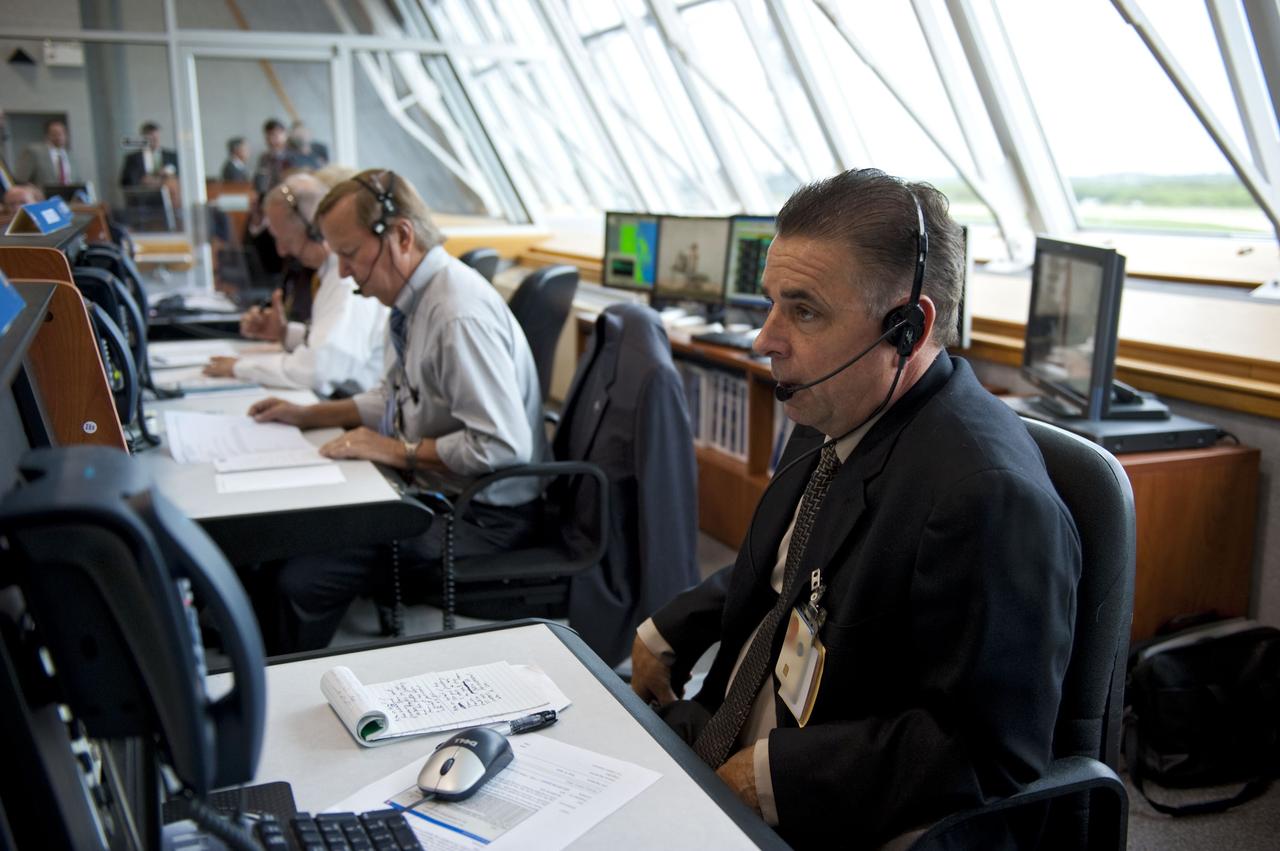
CAPE CANAVERAL, Fla. -- In Firing Room 4 of the Launch Control Center at NASA's Kennedy Space Center in Florida, launch team members monitor the countdown to the launch of space shuttle Atlantis on its STS-135 mission to the International Space Station. Seen here are Assistant Launch Director Pete Nickolenko (background) Shuttle Launch Director Mike Leinbach and Payloads Launch Manager and Deputy Director of ISS and Spacecraft Processing at Kennedy, Bill Dowdell. Atlantis with its crew of four; Commander Chris Ferguson, Pilot Doug Hurley, Mission Specialists Sandy Magnus and Rex Walheim, lifted off at 11:29 a.m. EDT on July 8, 2011 to deliver the Raffaello multi-purpose logistics module packed with supplies and spare parts for the station. Atlantis also will fly the Robotic Refueling Mission experiment that will investigate the potential for robotically refueling existing satellites in orbit. In addition, Atlantis will return with a failed ammonia pump module to help NASA better understand the failure mechanism and improve pump designs for future systems. STS-135 will be the 33rd flight of Atlantis, the 37th shuttle mission to the space station, and the 135th and final mission of NASA's Space Shuttle Program. For more information, visit www.nasa.gov/mission_pages/shuttle/shuttlemissions/sts135/index.html. Photo credit: NASA/Kim Shiflett
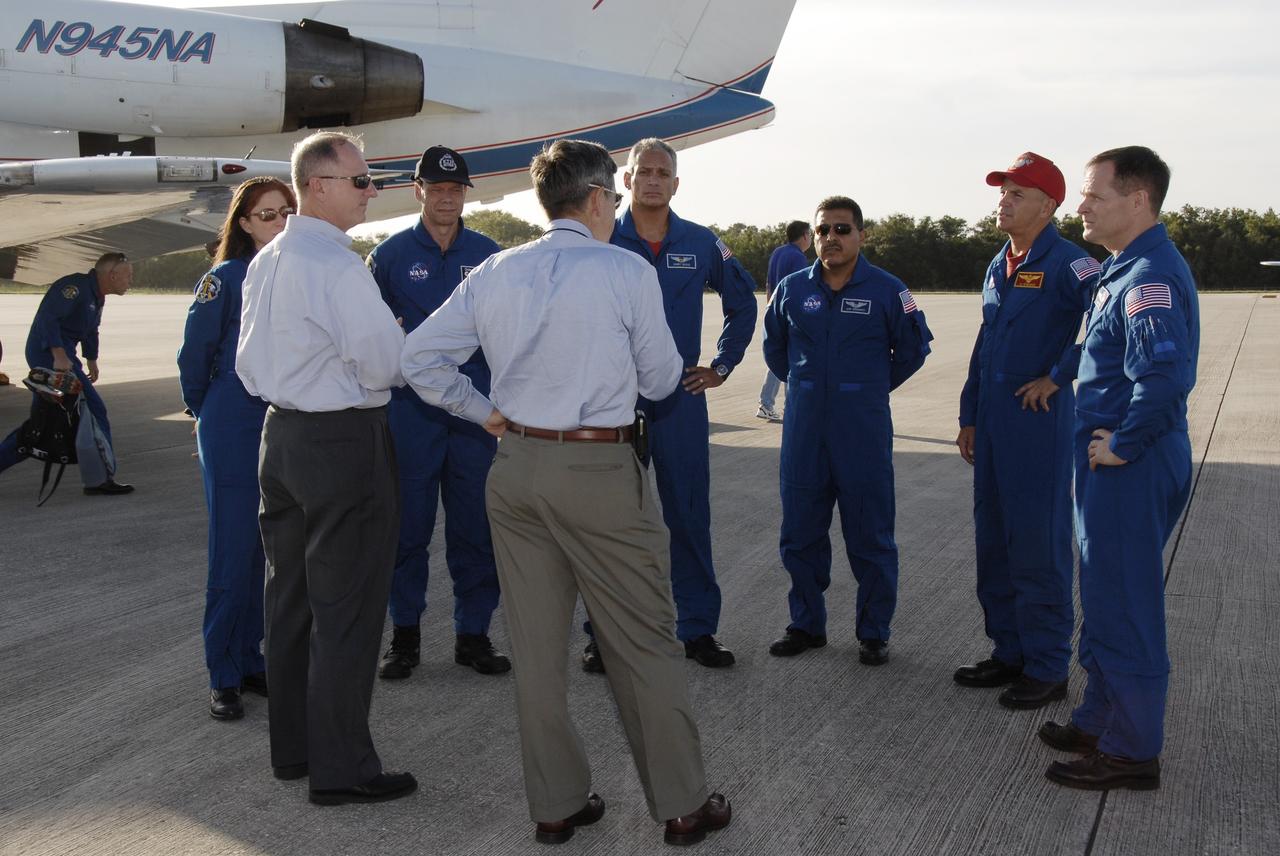
CAPE CANAVERAL, Fla. – Members of space shuttle Discovery's STS-128 crew are welcomed to Kennedy Space Center by STS-128 Launch Director Pete Nickolenko, at left, and Center Director Bob Cabana, a former astronaut himself. The crew arrived in a NASA Shuttle Training Aircraft, a modified Gulfstream II jet, at Kennedy's Shuttle Landing Facility at 6:34 p.m. EDT. The astronauts are, from left, Mission Specialists Patrick Forrester (under the aircraft), Nicole Stott who will remain on the International Space Station as flight engineer for Expedition 20, Swedish astronaut Christer Fuglesang of the European Space Agency, John "Danny" Olivas, and Jose Hernandez; Commander Rick Sturckow; and Pilot Kevin Ford. The crew has returned to Kennedy to prepare for launch on Aug. 25 at 1:36 a.m. EDT. The 13-day mission will deliver a new crew member and 33,000 pounds of equipment to the International Space Station. The equipment includes science and storage racks, a freezer to store research samples, a new sleeping compartment and the COLBERT treadmill. Photo credit: NASA/Kim Shiflett
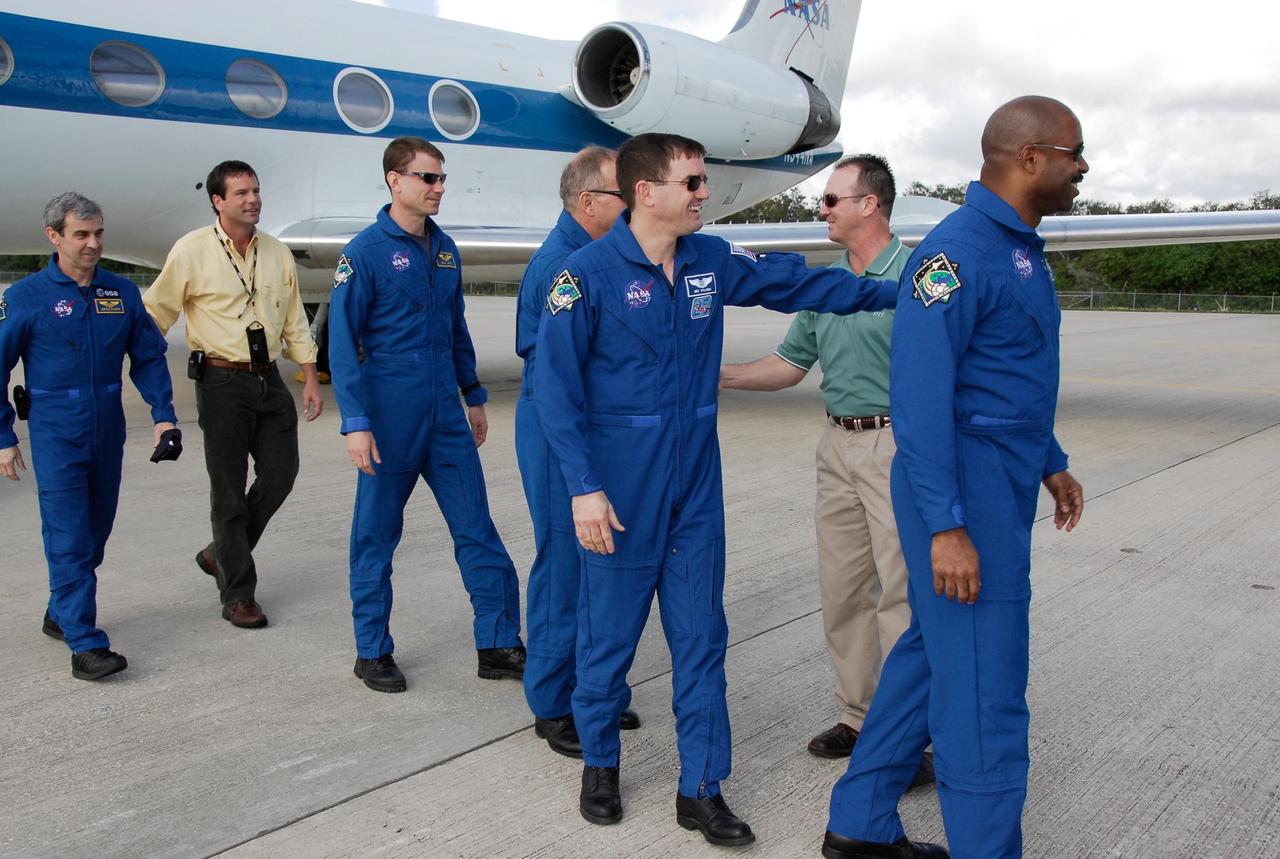
KENNEDY SPACE CENTER, FLA. -- At NASA's Kennedy Space Center, members of the STS-122 crew arrive for launch. From left are Mission Specialists Leopold Eyharts, Stanley Love, Hans Schlegel, Rex Walheim and Leland Melvin. They were greeted by Doug Lyons (left, yellow shirt), launch director for the mission, and Pete Nickolenko (right, green shirt), lead shuttle test director. Eyharts and Schlegel represent the European Space Agency. The crew's arrival signals the imminent launch of space shuttle Atlantis' STS-122 mission, at 2:45 p.m. Feb. 7. This will be the third launch attempt for the mission. Some of the tank's ECO sensors gave failed readings during propellant tanking for launch attempts on Dec. 6 and Dec. 9, subsequently scrubbing further attempts until the cause could be found and repairs made. Atlantis will carry the Columbus module, Europe's largest contribution to the construction of the International Space Station. It will support scientific and technological research in a microgravity environment. Columbus is a multifunctional, pressurized laboratory that will be permanently attached to the Harmony module of the space station to carry out experiments in materials science, fluid physics and biosciences, as well as to perform a number of technological applications. Photo credit: NASA/Kim Shiflett
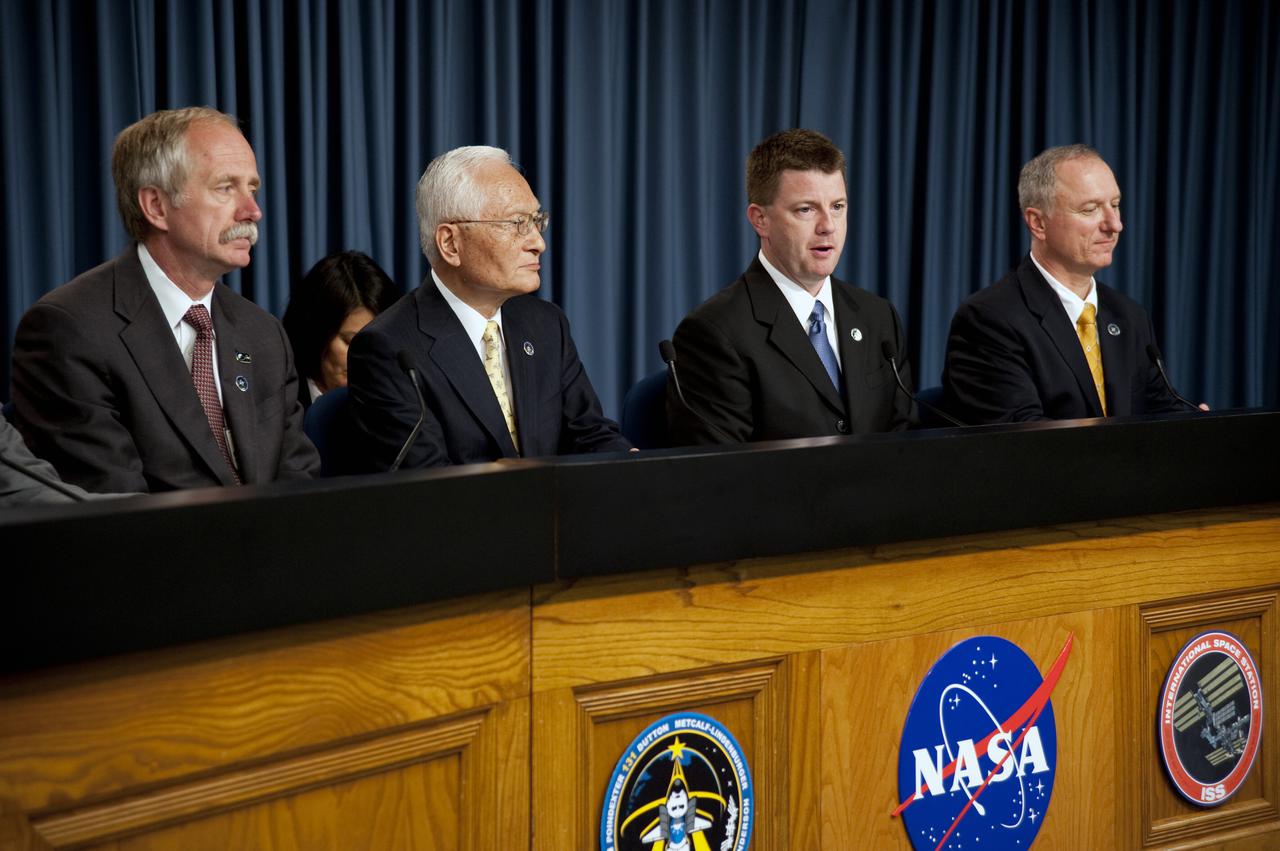
CAPE CANAVERAL, Fla. - NASA managers participate in a news conference in the Press Site auditorium at NASA's Kennedy Space Center in Florida following the successful launch of space shuttle Discovery. From left are Bill Gerstenmaier, associate administrator for Space Operations; Japan Aerospace Exploration Agency President Keiji Tachikawa; Mike Moses, shuttle launch integration manager; and Pete Nickolenko, STS-131 launch director. Shuttle Discovery lifted off at 6:21 a.m. EDT on April 5, 2010. The seven-member STS-131 crew will deliver the multi-purpose logistics module Leonardo, filled with supplies, a new crew sleeping quarters and science racks that will be transferred to the International Space Station's laboratories. The crew also will switch out a gyroscope on the station’s truss, install a spare ammonia storage tank and retrieve a Japanese experiment from the station’s exterior. STS-131 is the 33rd shuttle mission to the station and the 131st shuttle mission overall. For information on the STS-131 mission and crew, visit http:__www.nasa.gov_mission_pages_shuttle_shuttlemissions_sts131_index.html. Photo credit: NASA_Kim Shiflett
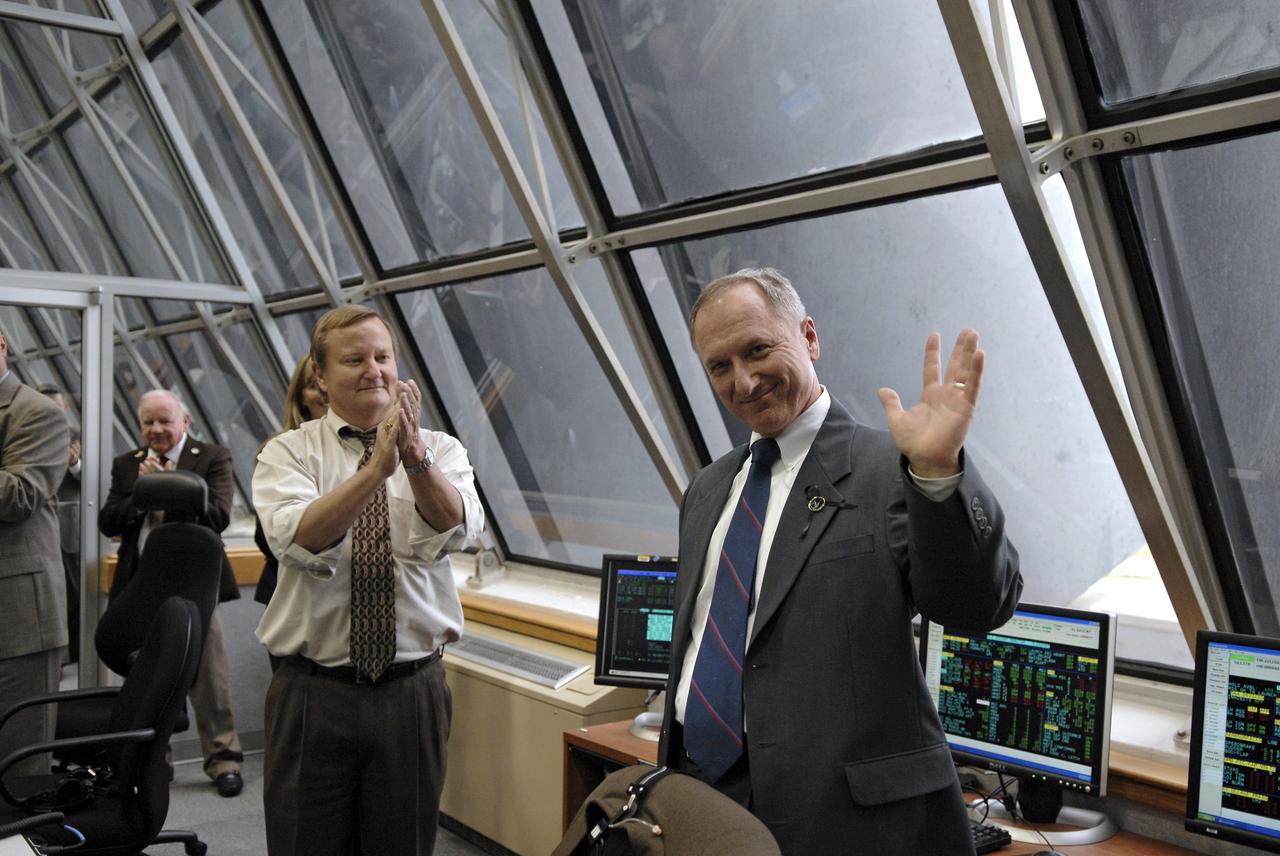
CAPE CANAVERAL, Fla. – In the Firing Room at NASA's Kennedy Space Center in Florida, Shuttle Launch Director Mike Leinbach (center) applauds STS-127 Shuttle Launch Director Pete Nickolenko for his role in the successful launch of space shuttle Endeavour on the STS-127 mission. Liftoff was on-time at 6:03 p.m. EDT. Today was the sixth launch attempt for the STS-127 mission. The launch was scrubbed on June 13 and June 17 when a hydrogen gas leak occurred during tanking due to a misaligned Ground Umbilical Carrier Plate. The mission was postponed July 11, 12 and 13 due to weather conditions near the Shuttle Landing Facility at Kennedy that violated rules for launching, and lightning issues. Endeavour will deliver the Japanese Experiment Module's Exposed Facility and the Experiment Logistics Module-Exposed Section in the final of three flights dedicated to the assembly of the Japan Aerospace Exploration Agency's Kibo laboratory complex on the International Space Station. Photo credit: NASA/Kim Shiflett
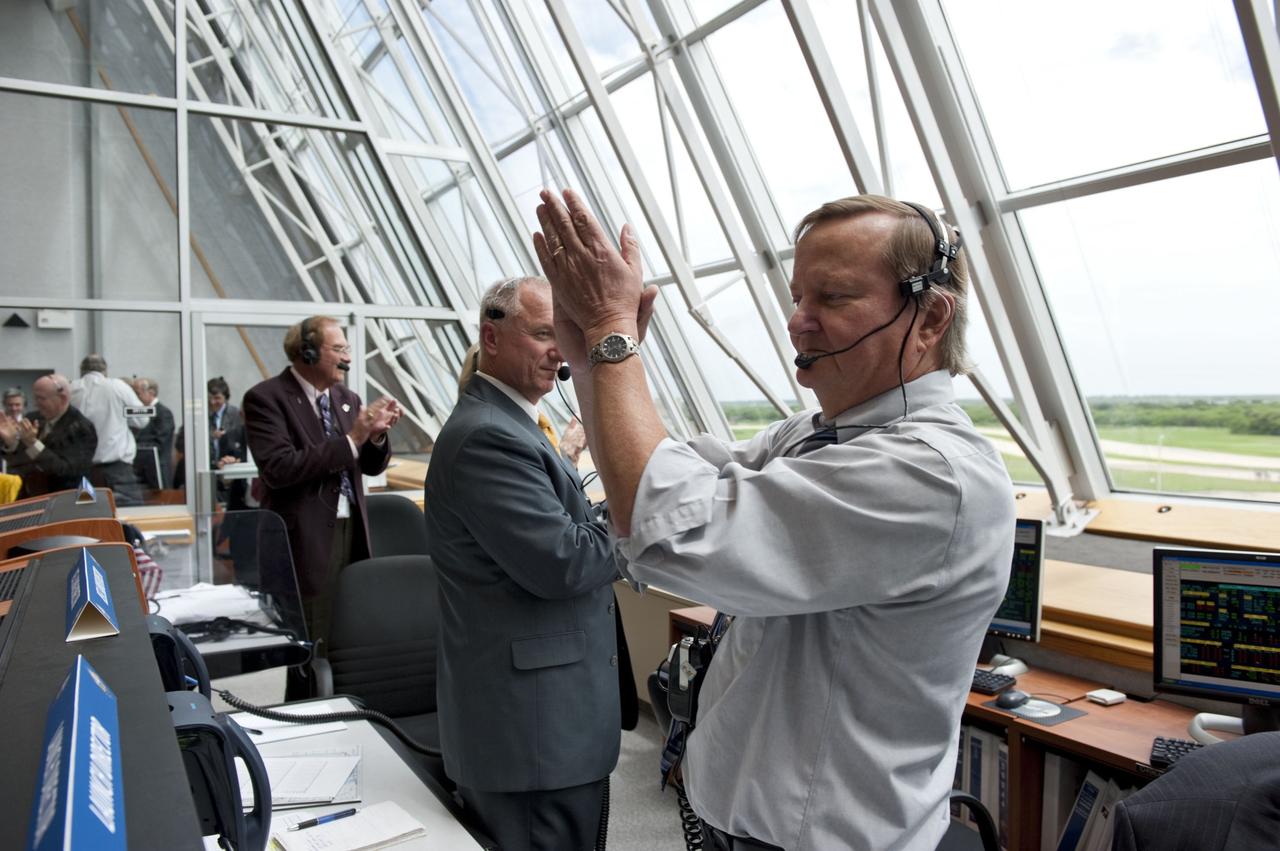
CAPE CANAVERAL, Fla. -- In Firing Room 4 of the Launch Control Center at NASA's Kennedy Space Center in Florida, Shuttle Launch Director Mike Leinbach (right), Assistant Launch Director Pete Nickolenko and NASA Commentator and Public Affairs Officer George Diller applaud the successful launch of space shuttle Atlantis on its STS-135 mission to the International Space Station. Atlantis with its crew of four; Commander Chris Ferguson, Pilot Doug Hurley, Mission Specialists Sandy Magnus and Rex Walheim, lifted off at 11:29 a.m. EDT on July 8, 2011 to deliver the Raffaello multi-purpose logistics module packed with supplies and spare parts for the station. Atlantis also will fly the Robotic Refueling Mission experiment that will investigate the potential for robotically refueling existing satellites in orbit. In addition, Atlantis will return with a failed ammonia pump module to help NASA better understand the failure mechanism and improve pump designs for future systems. STS-135 will be the 33rd flight of Atlantis, the 37th shuttle mission to the space station, and the 135th and final mission of NASA's Space Shuttle Program. For more information, visit www.nasa.gov/mission_pages/shuttle/shuttlemissions/sts135/index.html. Photo credit: NASA/Kim Shiflett
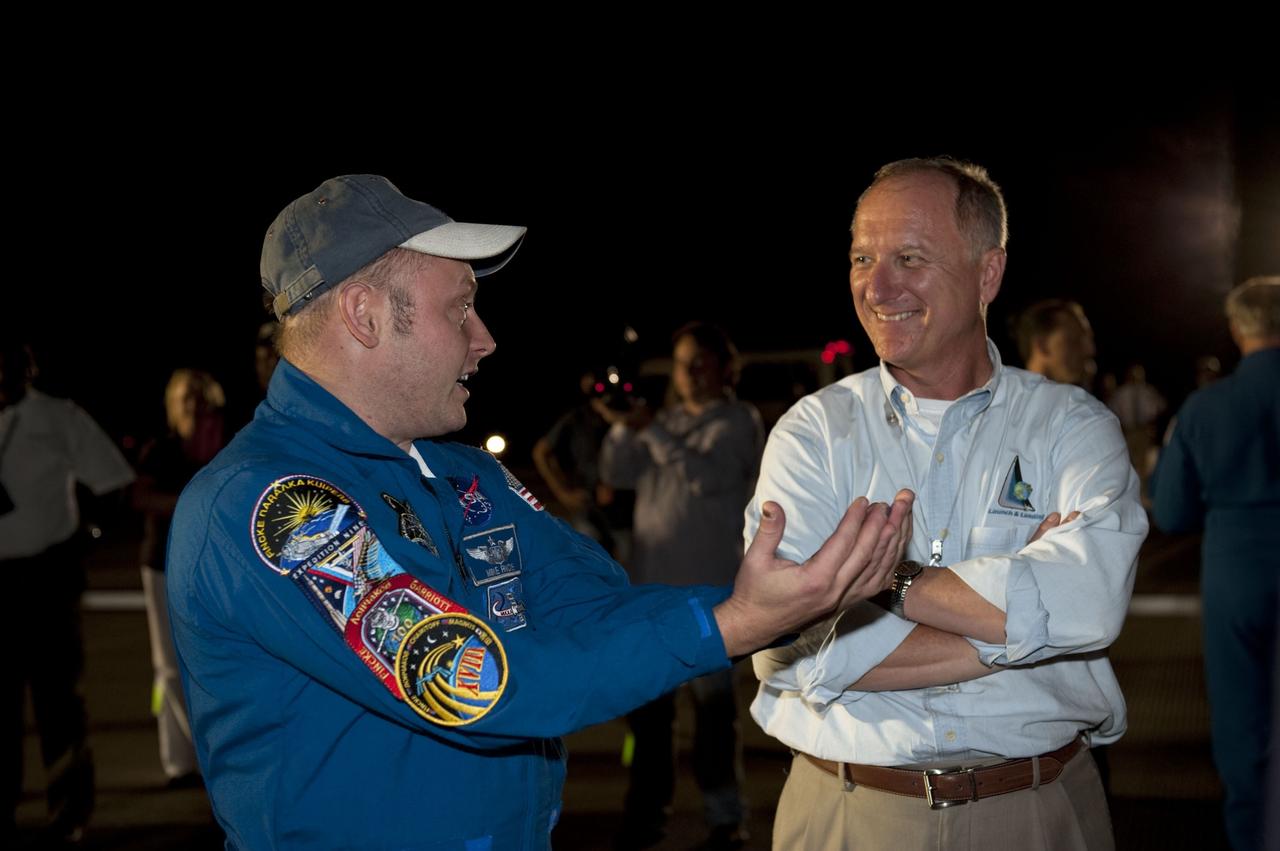
CAPE CANAVERAL, Fla. -- STS-134 Mission Specialists Mike Fincke, left, chats with STS-134 Assistant Launch Director Pete Nickolenko following the successful return of space shuttle Endeavour to NASA's Kennedy Space Center in Florida. Endeavour's final return from space completed the 16-day, 6.5-million-mile STS-134 mission. Main gear touchdown on the Shuttle Landing Facility's Runway 15 was at 2:34:51 a.m. EDT, followed by nose gear touchdown at 2:35:04 a.m., and wheelstop at 2:35:36 a.m. STS-134 delivered the Alpha Magnetic Spectrometer-2 (AMS) and the Express Logistics Carrier-3 (ELC-3) to the International Space Station. AMS will help researchers understand the origin of the universe and search for evidence of dark matter, strange matter and antimatter from the station. ELC-3 carried spare parts that will sustain station operations once the shuttles are retired from service. STS-134 was the 25th and final flight for Endeavour, which spent 299 days in space, orbited Earth 4,671 times and traveled 122,883,151 miles. Photo credit: NASA/Kim Shiflett
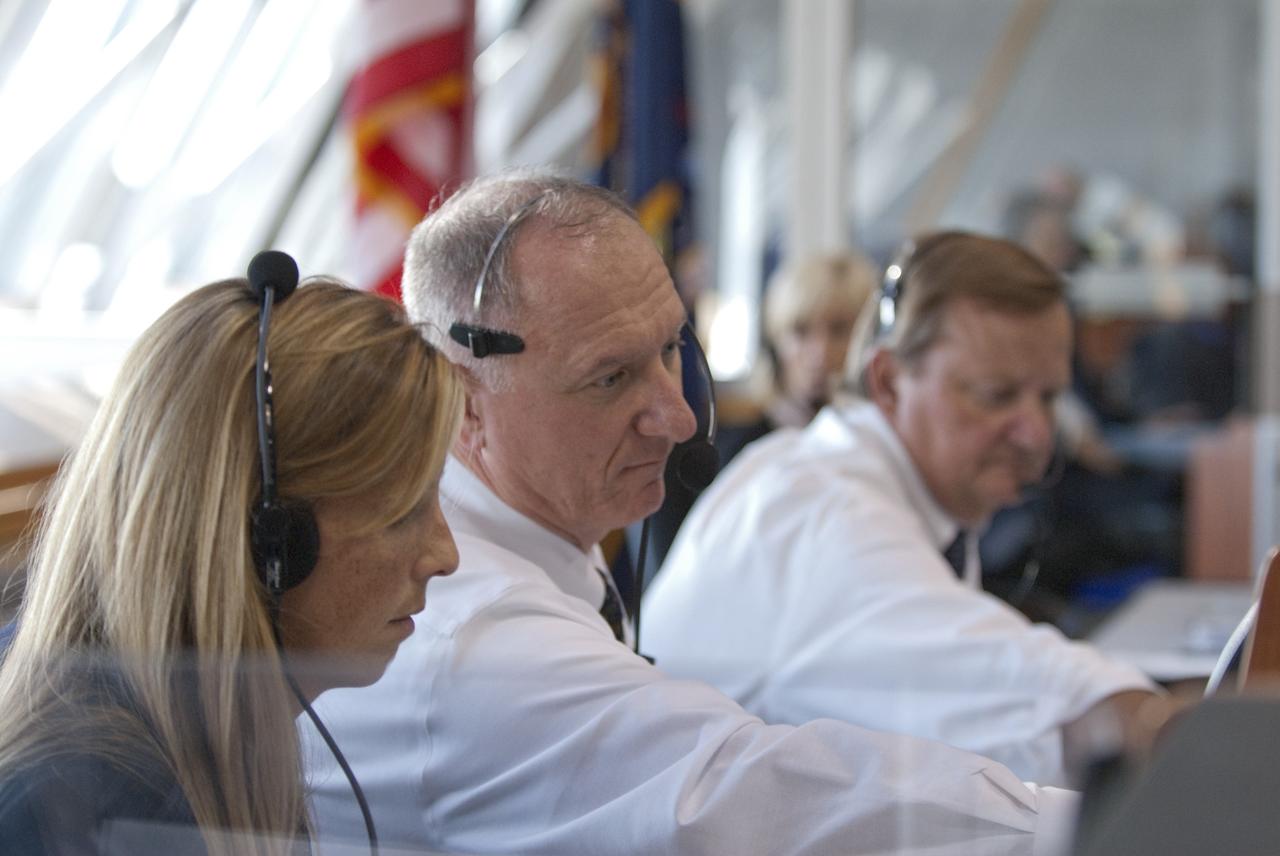
CAPE CANAVERAL, Fla. - Space shuttle Endeavour NASA Flow Director Dana Hutcherson, left, STS-134 Assistant Launch Director Pete Nickolenko and Shuttle Launch Director Mike Leinbach monitor the STS-134 countdown in Firing Room 4 of the Launch Control Center at NASA's Kennedy Space Center in Florida. Endeavour lifted off on its STS-134 mission to the International Space Station on time at 8:56 a.m. EDT on May 16. The shuttle and its six-member crew are embarking on a mission to deliver the Alpha Magnetic Spectrometer-2 (AMS), Express Logistics Carrier-3, a high-pressure gas tank and additional spare parts for the Dextre robotic helper to the space station. Endeavour's first launch attempt on April 29 was scrubbed because of an issue associated with a faulty power distribution box called the aft load control assembly-2 (ALCA-2). For more information, visit www.nasa.gov/mission_pages/shuttle/shuttlemissions/sts134/index.html. Photo credit: NASA/Kim Shiflett
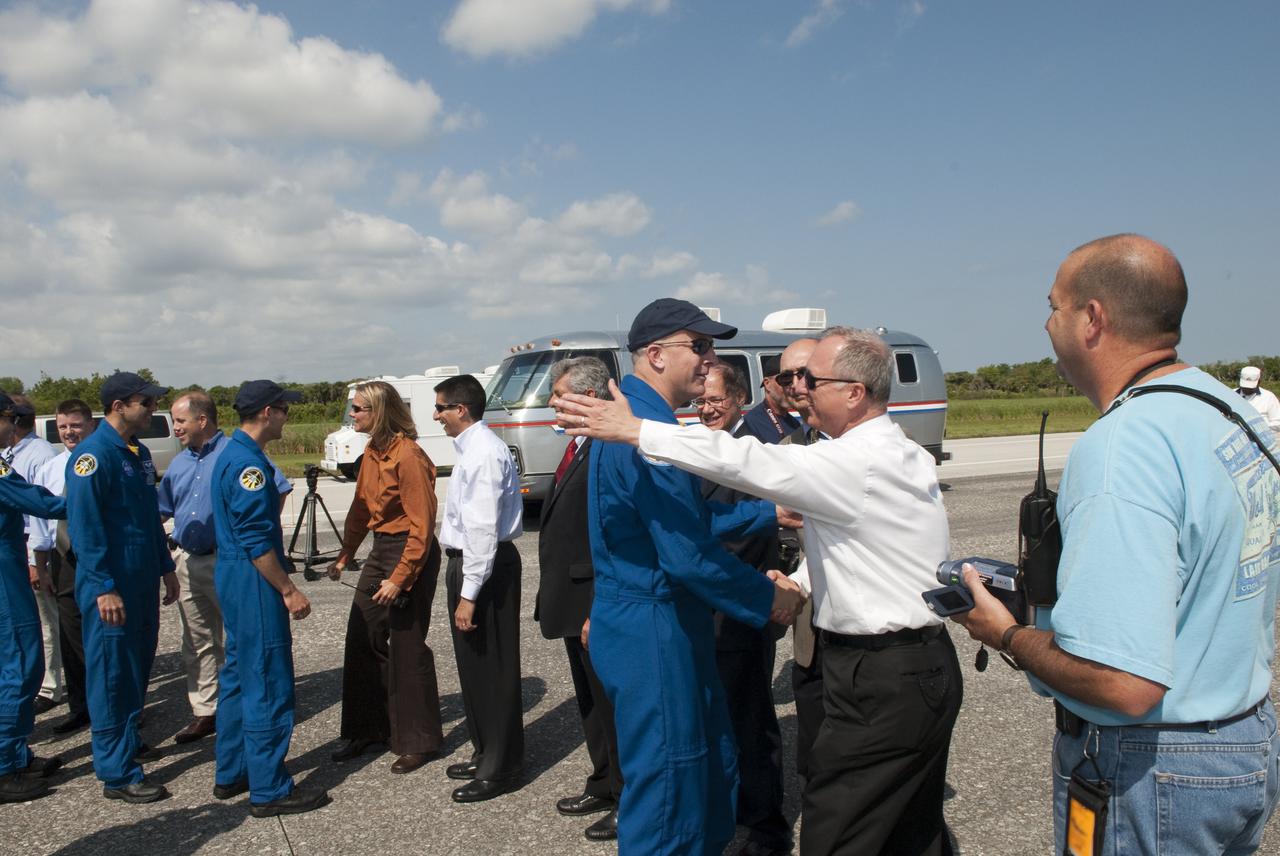
CAPE CANAVERAL, Fla. - At the Shuttle Landing Facility at NASA's Kennedy Space Center in Florida, STS-131 Launch Director Pete Nickolenko, second from right, congratulates STS-131 Commander Alan Poindexter on a successful mission following landing of space shuttle Discovery on Runway 33. Other members of the STS-131 crew are, from left, Mission Specialist Rick Mastracchio and Pilot James P. Dutton Jr. Discovery landed at Kennedy after 15 days in space, completing the more than 6.2-million-mile STS-131 mission on orbit 238. Main gear touchdown was at 9:08:35 a.m. EDT followed by nose gear touchdown at 9:08:47 a.m. and wheelstop at 9:09:33 a.m. The seven-member STS-131 crew carried the multi-purpose logistics module Leonardo, filled with supplies, a new crew sleeping quarters and science racks that were transferred to the International Space Station's laboratories. The crew also switched out a gyroscope on the station’s truss, installed a spare ammonia storage tank and retrieved a Japanese experiment from the station’s exterior. STS-131 is the 33rd shuttle mission to the station and the 131st shuttle mission overall. For information on the STS-131 mission and crew, visit http:__www.nasa.gov_mission_pages_shuttle_shuttlemissions_sts131_index.html. Photo credit: NASA_Jim Grossmann
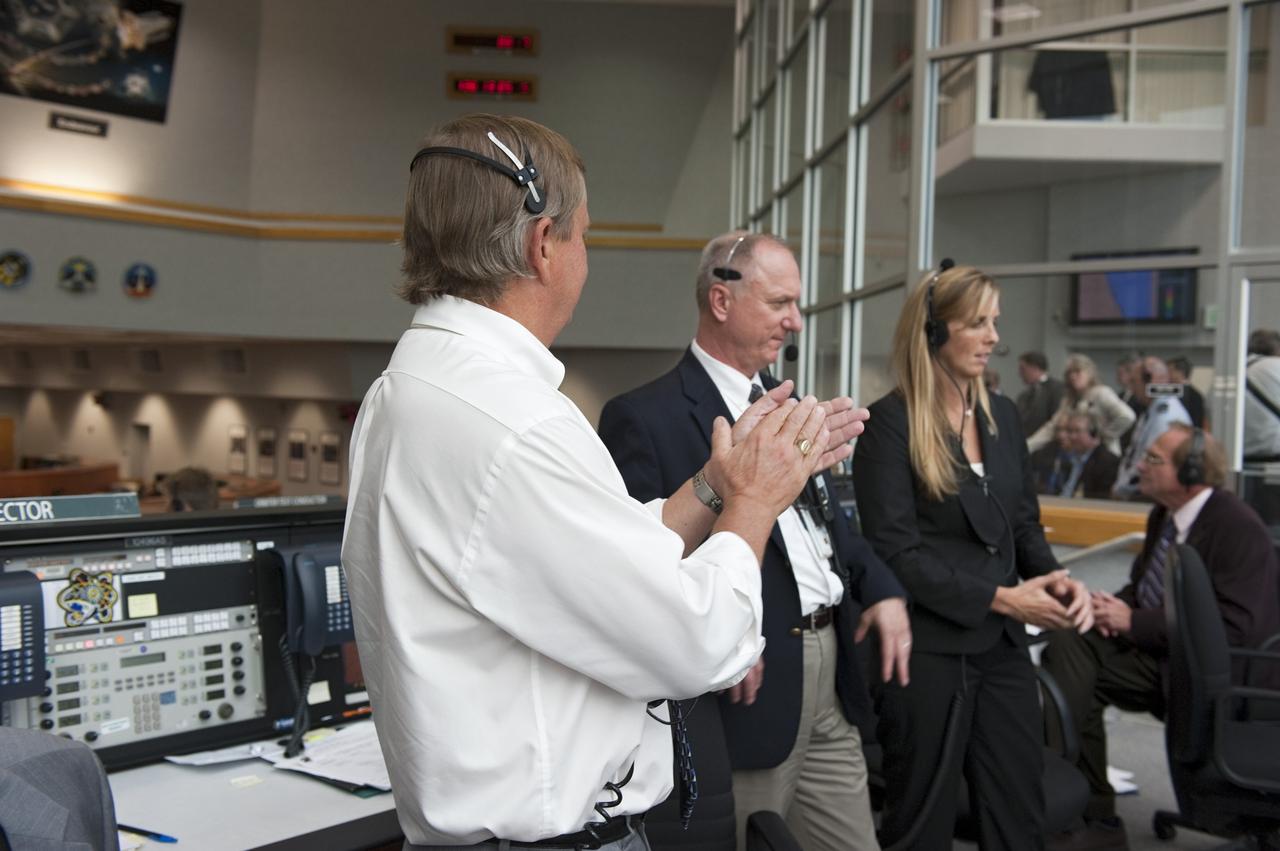
CAPE CANAVERAL, Fla. - Shuttle Launch Director Mike Leinbach, left, STS-134 Assistant Launch Director Pete Nickolenko and Endeavour's NASA Flow Director Dana Hutcherson give a round of applause to the launch controllers in Firing Room 4 of the Launch Control Center at NASA's Kennedy Space Center in Florida. Endeavour lifted off on its STS-134 mission to the International Space Station on time at 8:56 a.m. EDT on May 16. The shuttle and its six-member crew are embarking on a mission to deliver the Alpha Magnetic Spectrometer-2 (AMS), Express Logistics Carrier-3, a high-pressure gas tank and additional spare parts for the Dextre robotic helper to the space station. Endeavour's first launch attempt on April 29 was scrubbed because of an issue associated with a faulty power distribution box called the aft load control assembly-2 (ALCA-2). For more information visit, www.nasa.gov/mission_pages/shuttle/shuttlemissions/sts134/index.html. Photo credit: NASA/Kim Shiflett
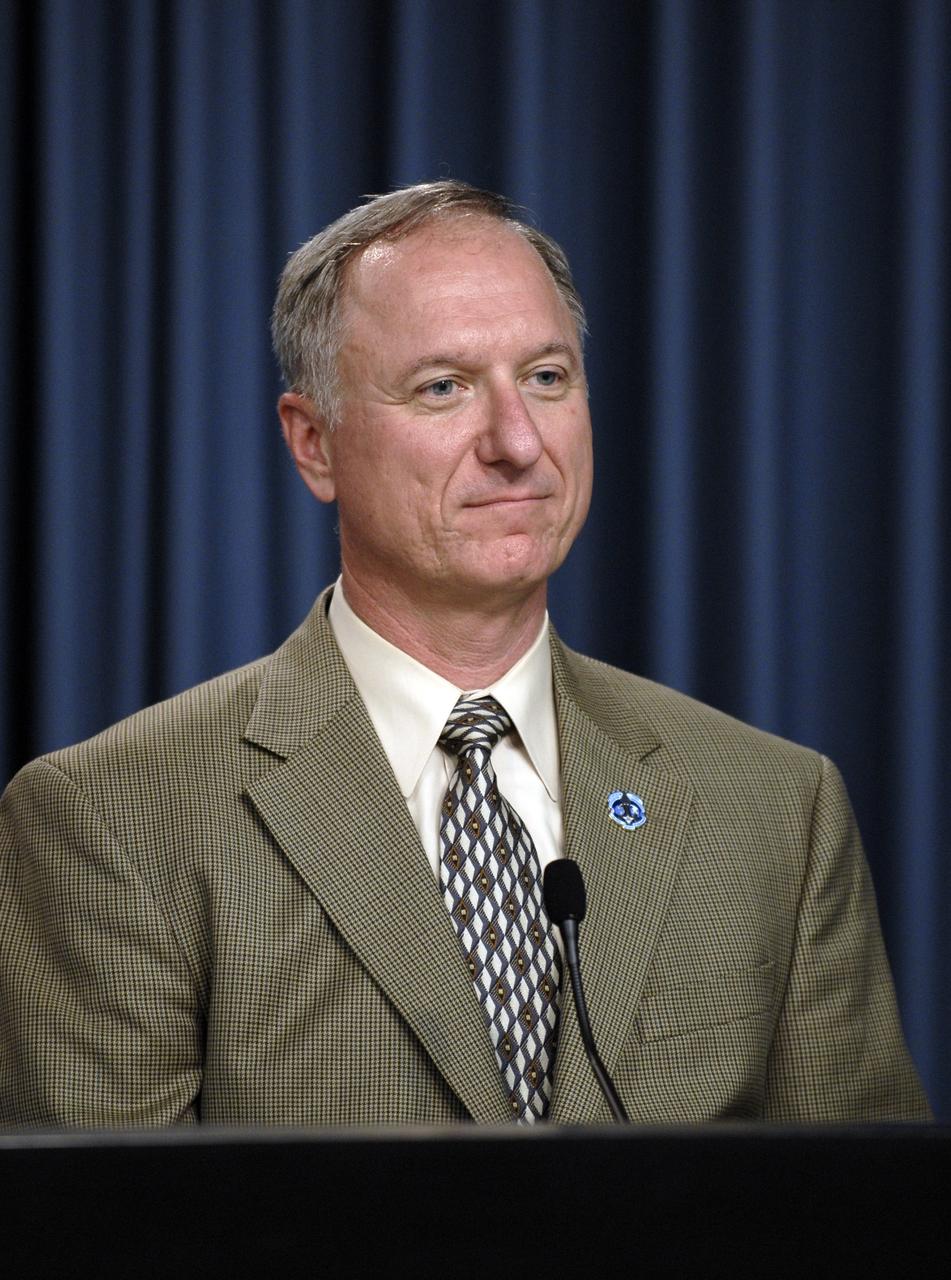
CAPE CANAVERAL, Fla. – In the Press Site auditorium at NASA's Kennedy Space Center in Florida, STS-128 Launch Director Pete Nickolenko answers questions about the launch of space shuttle Discovery on the STS-128 mission. Liftoff from Launch Pad 39A was on time at 11:59 p.m. EDT. The first launch attempt on Aug. 24 was postponed due to unfavorable weather conditions. The second attempt on Aug. 25 also was postponed due to an issue with a valve in space shuttle Discovery's main propulsion system. The STS-128 mission is the 30th International Space Station assembly flight and the 128th space shuttle flight. The 13-day mission will deliver more than 7 tons of supplies, science racks and equipment, as well as additional environmental hardware to sustain six crew members on the International Space Station. The equipment includes a freezer to store research samples, a new sleeping compartment and the COLBERT treadmill. Photo credit: NASA/Kim Shiflett
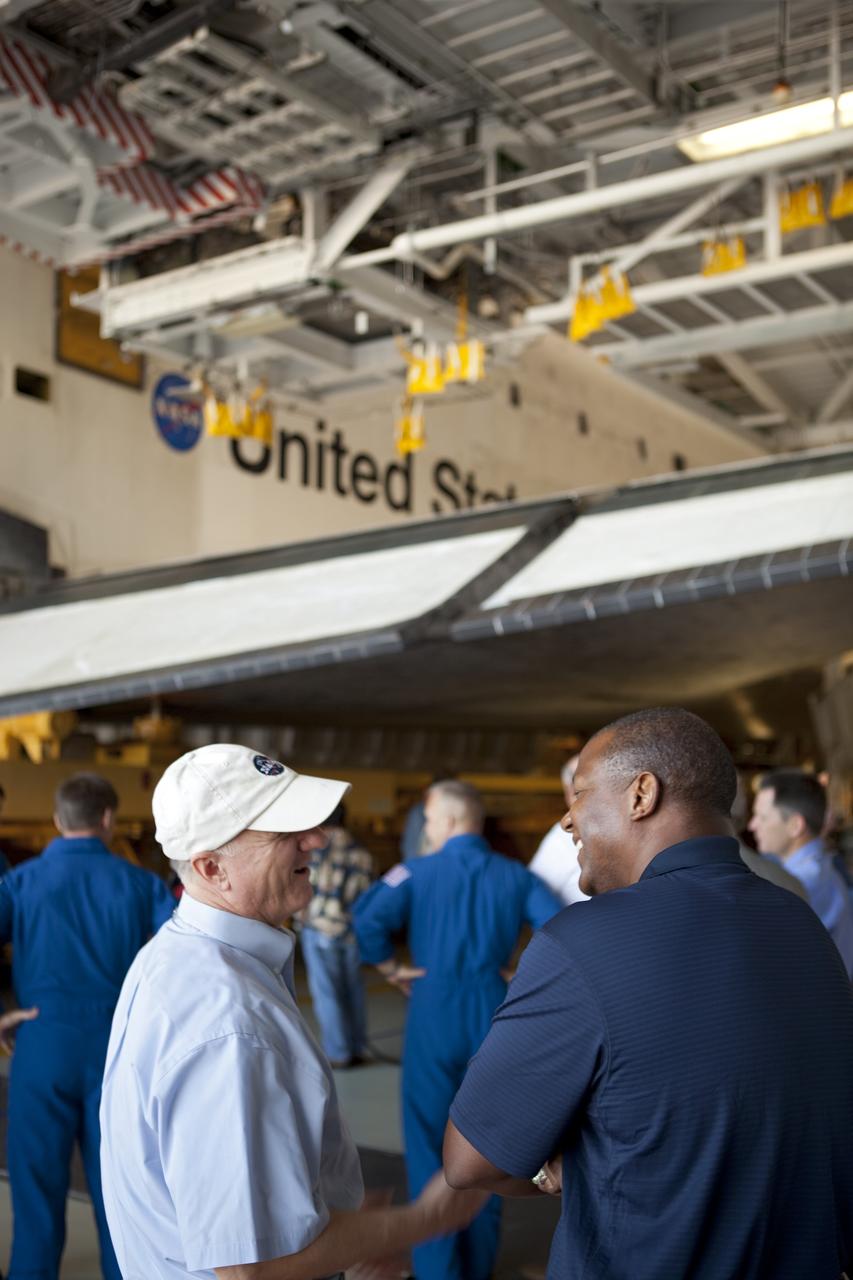
CAPE CANAVERAL, Fla. -- STS-135 Assistant Launch Director Pete Nickolenko and Kennedy's Associate Director for Business Operations Kelvin Manning, enjoy a lighthearted moment while watching shuttle Atlantis as it slowly backs out of Orbiter Processing Facility-1 during its final planned move to the Vehicle Assembly Building (VAB) at NASA's Kennedy Space Center in Florida. The move called "rollover" is a major milestone in processing for the STS-135 mission to the International Space Station. Inside the VAB, the shuttle will be attached to its external fuel tank and solid rocket boosters. Commander Chris Ferguson, Pilot Doug Hurley and Mission Specialists Sandra Magnus and Rex Walheim are expected to launch in mid July, taking with them the Raffaello multipurpose logistics module packed with supplies, logistics and spare parts. The STS-135 mission also will fly a system to investigate the potential for robotically refueling existing spacecraft and return a failed ammonia pump module to help NASA better understand the failure mechanism and improve pump designs for future systems. STS-135 will be the 33rd flight of Atlantis, the 37th shuttle mission to the space station, and the 135th and final mission of NASA's Space Shuttle Program. For more information visit, www.nasa.gov/mission_pages/shuttle/shuttlemissions/sts135/index.html. Photo credit: NASA/Dimitri Gerondidakis
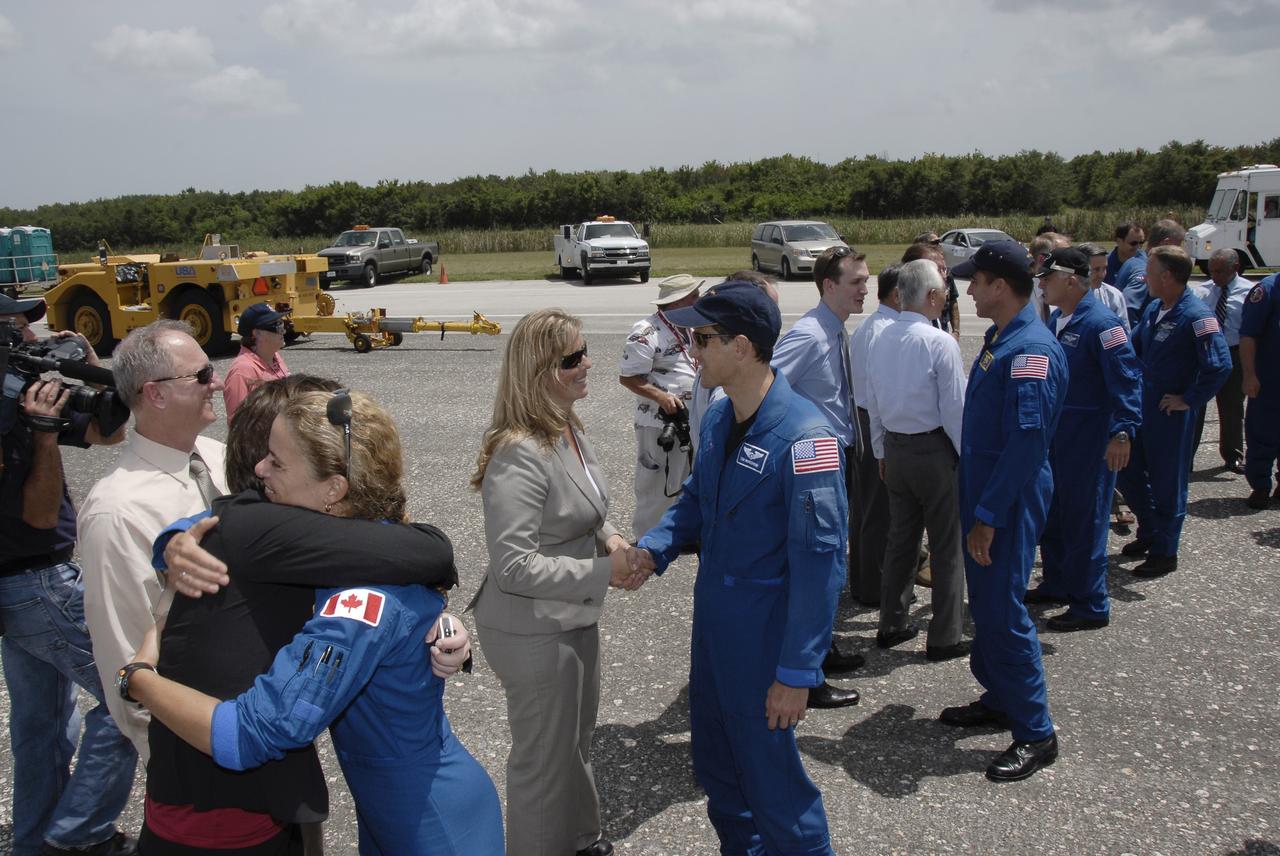
CAPE CANAVERAL, Fla. – At NASA's Kennedy Space Center in Florida, STS-127 crew members are greeted by NASA officials. From left are STS-127 Launch Director Pete Nickolenko, Mission Specialist Julie Payette, Endeavour Flow Director Dana Hutcherson, Mission Specialist Tom Marshburn, Chief of Staff in the Office of the Administrator George Whitesides, President of the Japan Aerospace Exploration Agency Keiji Tachikawa (back to camera), Mission Specialists Christopher Cassidy and Dave Wolf, Kennedy Center Director Bob Cabana and astronaut Steven Lindsey. The crew returned to Earth on space shuttle Endeavour to complete the 16-day, 6.5-million mile journey on the STS-127 mission to the International Space Station. Endeavour's main gear touchdown was at 10:48:08 a.m. EDT. Nose gear touchdown was at 10:48:21 a.m. and wheels stop was at 10:49:13 a.m. Endeavour delivered the Japanese Experiment Module's Exposed Facility and the Experiment Logistics Module-Exposed Section to the International Space Station. The mission was the 29th flight to the station, the 23rd flight of Endeavour and the 127th in the Space Shuttle Program, as well as the 71st landing at Kennedy. Photo credit: NASA/Kim Shiflett
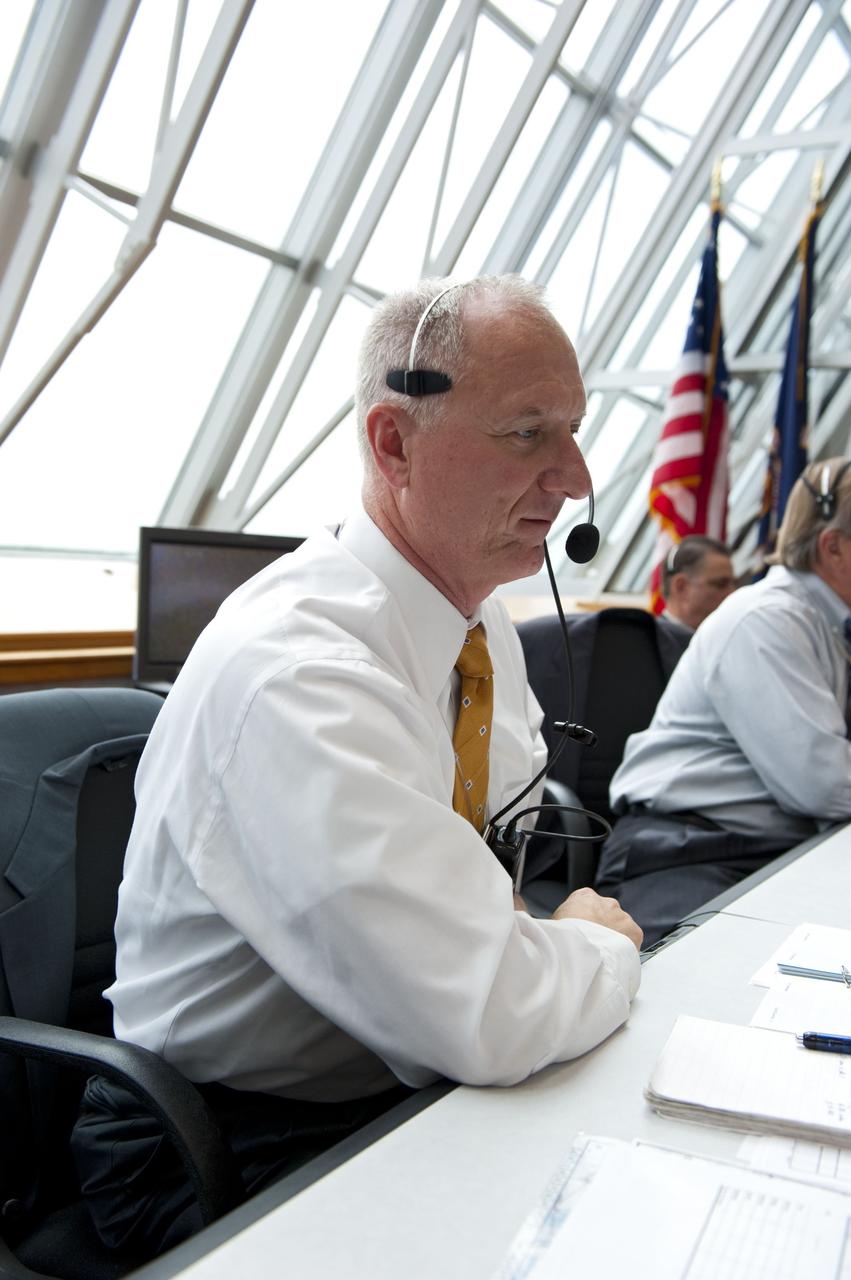
CAPE CANAVERAL, Fla. -- In Firing Room 4 of the Launch Control Center at NASA's Kennedy Space Center in Florida, launch team members monitor the countdown to the launch of space shuttle Atlantis on its STS-135 mission to the International Space Station. Seen here is Assistant Launch Director Pete Nickolenko. Atlantis with its crew of four; Commander Chris Ferguson, Pilot Doug Hurley, Mission Specialists Sandy Magnus and Rex Walheim, lifted off at 11:29 a.m. EDT on July 8, 2011 to deliver the Raffaello multi-purpose logistics module packed with supplies and spare parts for the station. Atlantis also will fly the Robotic Refueling Mission experiment that will investigate the potential for robotically refueling existing satellites in orbit. In addition, Atlantis will return with a failed ammonia pump module to help NASA better understand the failure mechanism and improve pump designs for future systems. STS-135 will be the 33rd flight of Atlantis, the 37th shuttle mission to the space station, and the 135th and final mission of NASA's Space Shuttle Program. For more information, visit www.nasa.gov/mission_pages/shuttle/shuttlemissions/sts135/index.html. Photo credit: NASA/Kim Shiflett
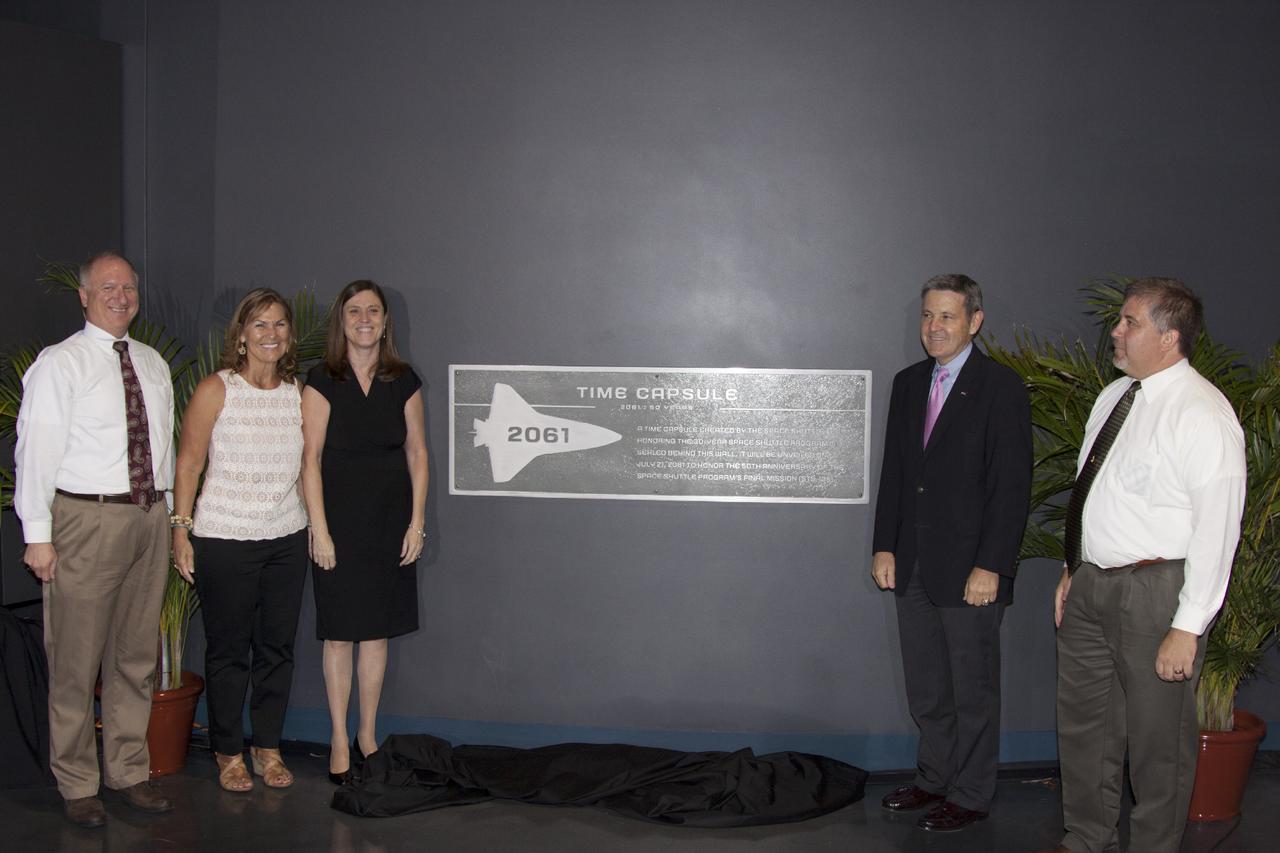
CAPE CANAVERAL, Fla. -- At the Kennedy Space Center Visitor Complex in Florida, officials pose at the site where a Shuttle Program time capsule has been secured vault within the walls of the Space Shuttle Atlantis home at the Kennedy Space Center Visitor Complex. From the left are: Pete Nickolenko, deputy director of NASA Ground Processing at Kennedy, Patty Stratton of Abacus Technology, currently program manager for the Information Management Communications Support Contract. During the Shuttle Program she was deputy director of Ground Operations for NASA's Space Program Operations Contractor, United Space Alliance, Rita Wilcoxon, NASA's now retired director of Shuttle Processing, Bob Cabana, director of the Kennedy Space Center and George Jacobs, deputy director of Center Operations, who was manager of the agency's Shuttle Transition and Retirement Project Office. The time capsule, containing artifacts and other memorabilia associated with the history of the program is designated to be opened on the 50th anniversary of the shuttle's final landing, STS-135. The new $100 million "Space Shuttle Atlantis" facility includes interactive exhibits that tell the story of the 30-year Space Shuttle Program and highlight the future of space exploration. Photo credit: NASA/Jim Grossmann
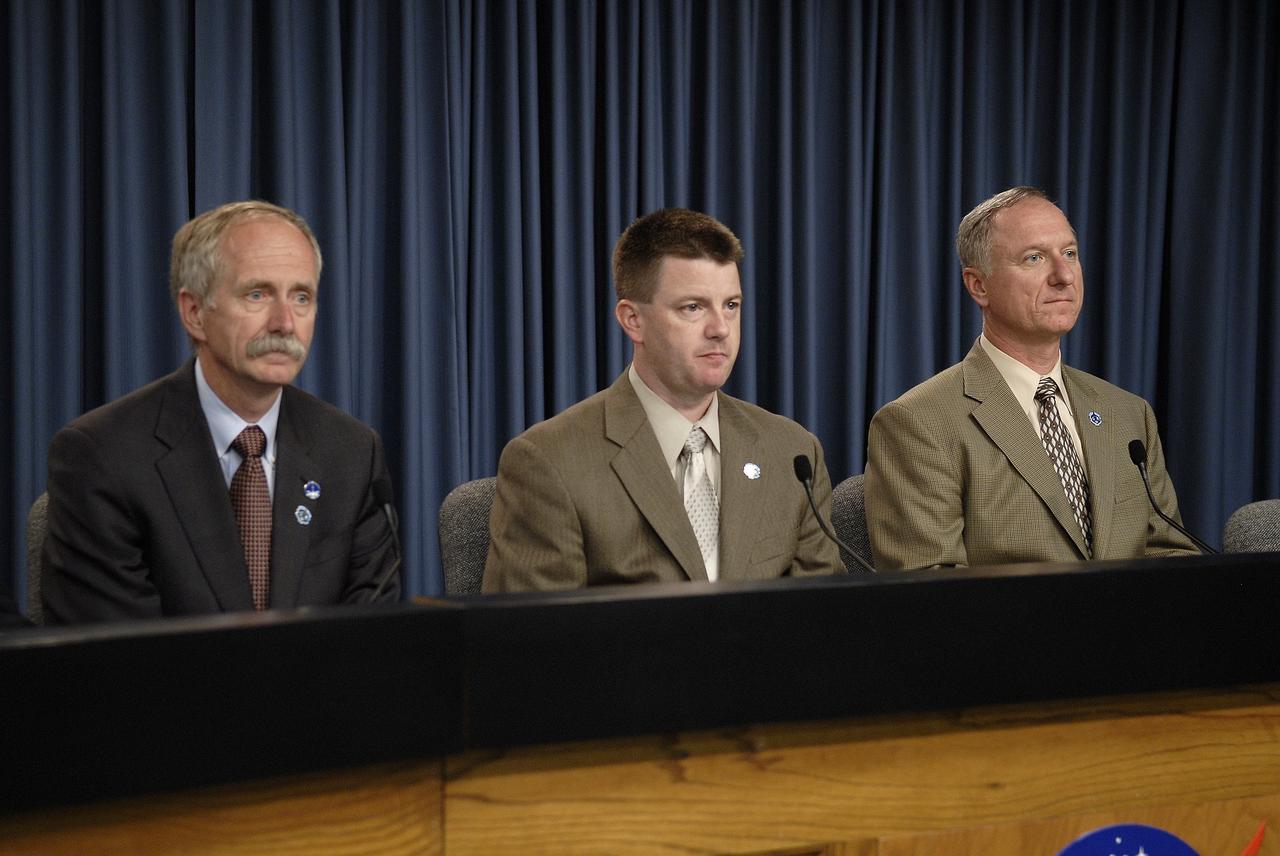
CAPE CANAVERAL, Fla. – In the Press Site auditorium at NASA's Kennedy Space Center in Florida, NASA managers brief the media about the successful launch of space shuttle Discovery on the STS-128 mission. From left are Associate Administrator for NASA Space Operations Bill Gerstenmaier, Mission Management Team Chair Mike Moses and STS-128 Launch Director Pete Nickolenko. Liftoff from Launch Pad 39A was on time at 11:59 p.m. EDT. The first launch attempt on Aug. 24 was postponed due to unfavorable weather conditions. The second attempt on Aug. 25 also was postponed due to an issue with a valve in space shuttle Discovery's main propulsion system. The STS-128 mission is the 30th International Space Station assembly flight and the 128th space shuttle flight. The 13-day mission will deliver more than 7 tons of supplies, science racks and equipment, as well as additional environmental hardware to sustain six crew members on the International Space Station. The equipment includes a freezer to store research samples, a new sleeping compartment and the COLBERT treadmill. Photo credit: NASA/Kim Shiflett
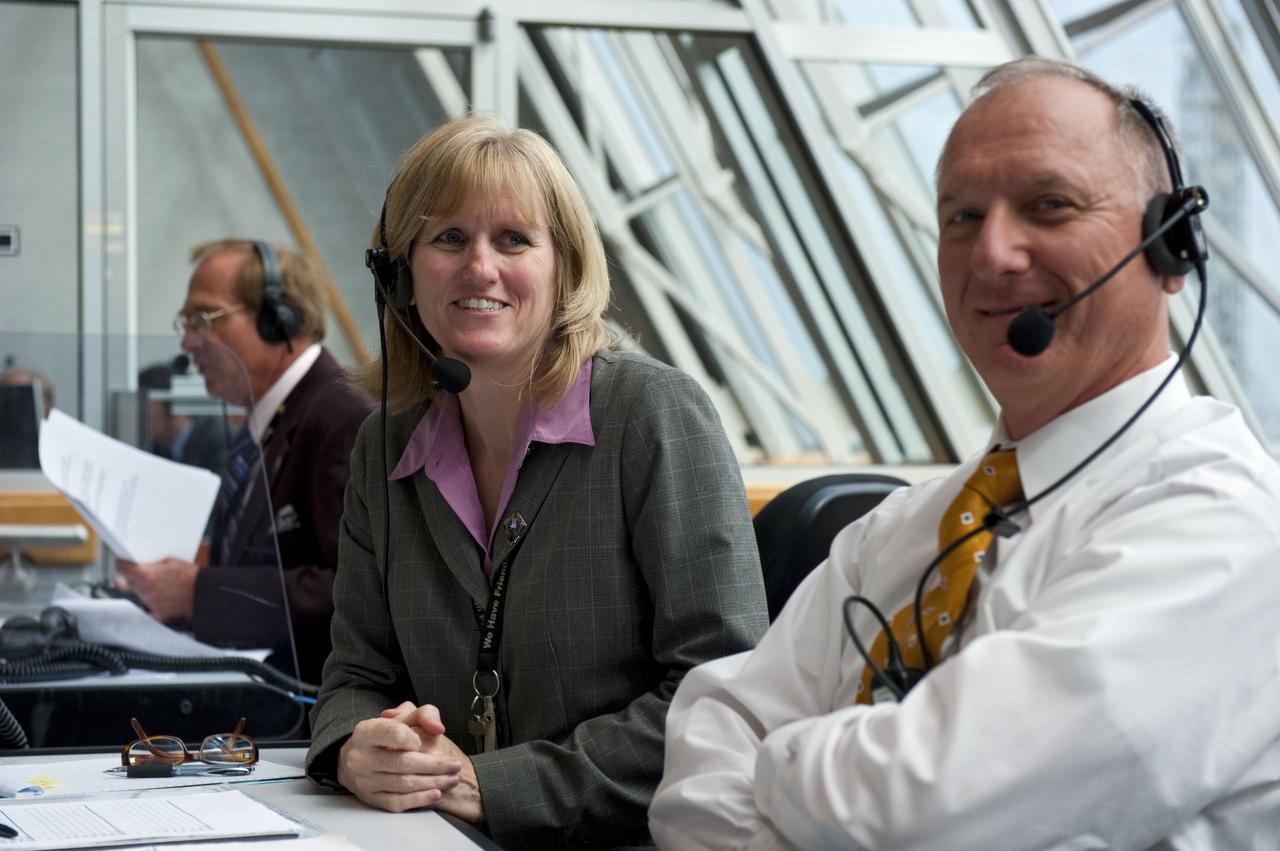
CAPE CANAVERAL, Fla. -- In Firing Room 4 of the Launch Control Center at NASA's Kennedy Space Center in Florida, launch team members monitor the countdown to the launch of space shuttle Atlantis on its STS-135 mission to the International Space Station. Seen here are Assistant Launch Director Pete Nickolenko (right), Atlantis NASA Flow Director Angie Brewer and NASA Commentator and Public Affairs Officer George Diller. Atlantis with its crew of four; Commander Chris Ferguson, Pilot Doug Hurley, Mission Specialists Sandy Magnus and Rex Walheim, lifted off at 11:29 a.m. EDT on July 8, 2011 to deliver the Raffaello multi-purpose logistics module packed with supplies and spare parts for the station. Atlantis also will fly the Robotic Refueling Mission experiment that will investigate the potential for robotically refueling existing satellites in orbit. In addition, Atlantis will return with a failed ammonia pump module to help NASA better understand the failure mechanism and improve pump designs for future systems. STS-135 will be the 33rd flight of Atlantis, the 37th shuttle mission to the space station, and the 135th and final mission of NASA's Space Shuttle Program. For more information, visit www.nasa.gov/mission_pages/shuttle/shuttlemissions/sts135/index.html. Photo credit: NASA/Kim Shiflett
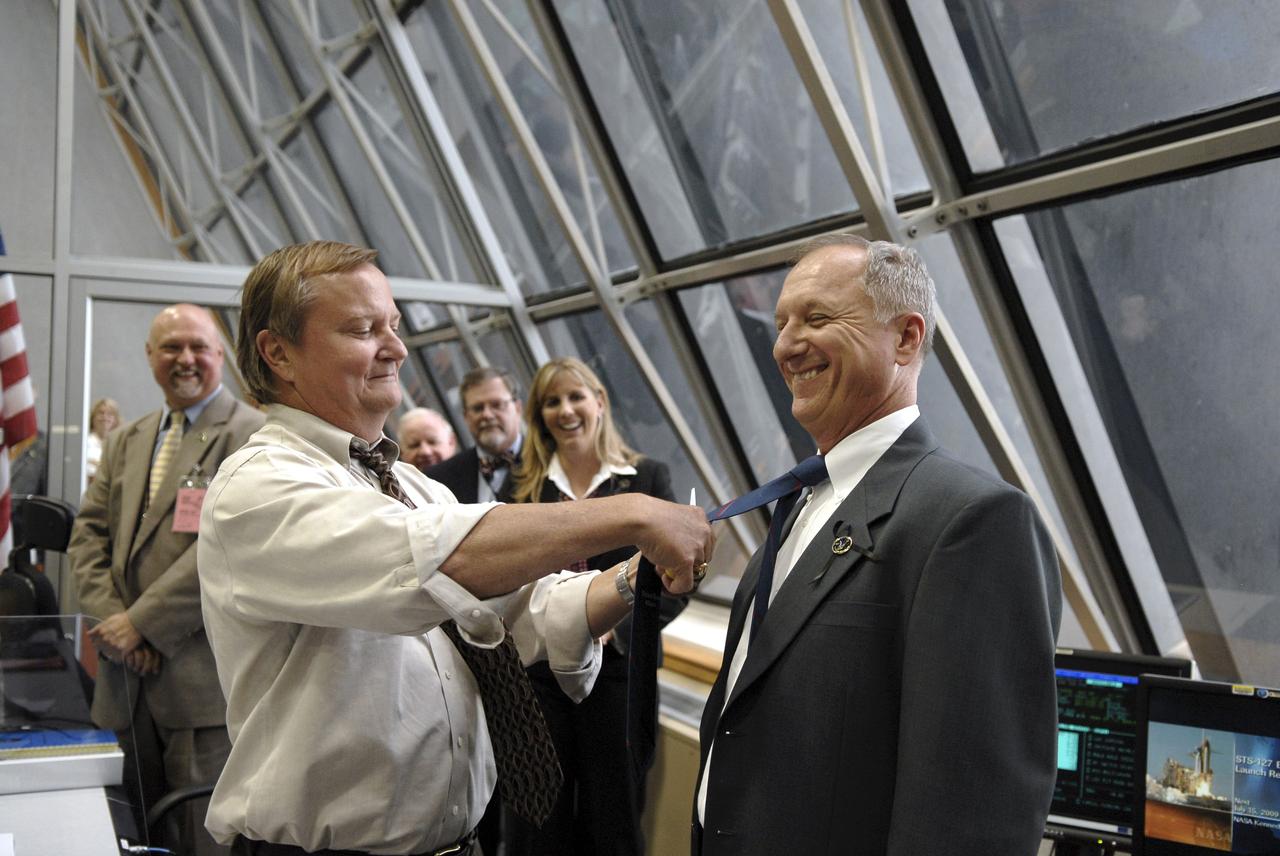
CAPE CANAVERAL, Fla. – In the Firing Room at NASA's Kennedy Space Center in Florida, Shuttle Launch Director Mike Leinbach performs the traditional tie-cutting of the inaugural launch for STS-127 Shuttle Launch Director Pete Nickolenko . Liftoff of space shuttle Endeavour on the STS-127 mission was on-time at 6:03 p.m. EDT. Today was the sixth launch attempt for the STS-127 mission. The launch was scrubbed on June 13 and June 17 when a hydrogen gas leak occurred during tanking due to a misaligned Ground Umbilical Carrier Plate. The mission was postponed July 11, 12 and 13 due to weather conditions near the Shuttle Landing Facility at Kennedy that violated rules for launching, and lightning issues. Endeavour will deliver the Japanese Experiment Module's Exposed Facility and the Experiment Logistics Module-Exposed Section in the final of three flights dedicated to the assembly of the Japan Aerospace Exploration Agency's Kibo laboratory complex on the International Space Station. Photo credit: NASA/Kim Shiflett
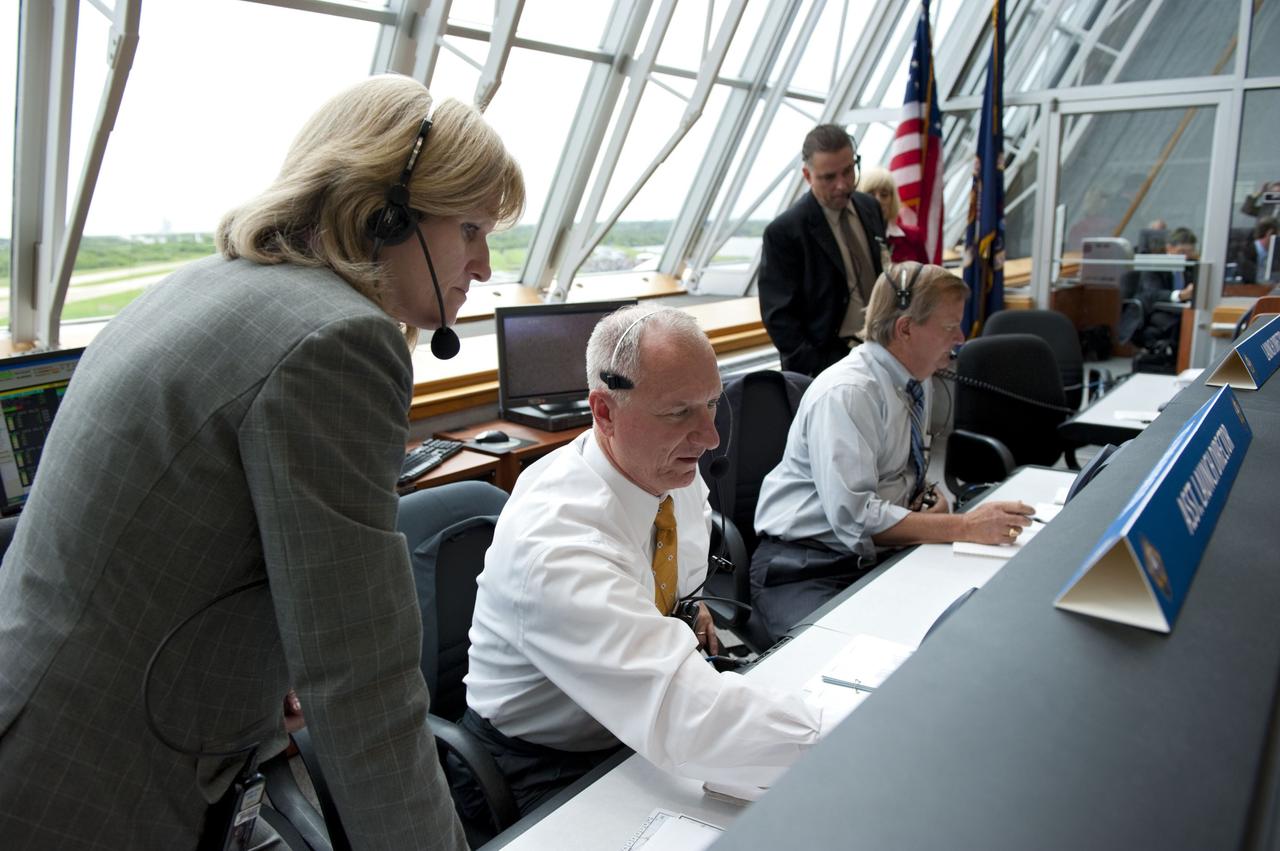
CAPE CANAVERAL, Fla. -- In Firing Room 4 of the Launch Control Center at NASA's Kennedy Space Center in Florida, launch team members monitor the countdown to the launch of space shuttle Atlantis on its STS-135 mission to the International Space Station. Seen here are Atlantis NASA Flow Director Angie Brewer, Assistant Launch Director Pete Nickolenko, Shuttle Launch Director Mike Leinbach and Payloads Launch Manager and Deputy Director of ISS and Spacecraft Processing at Kennedy, Bill Dowdell. Atlantis with its crew of four; Commander Chris Ferguson, Pilot Doug Hurley, Mission Specialists Sandy Magnus and Rex Walheim, lifted off at 11:29 a.m. EDT on July 8, 2011 to deliver the Raffaello multi-purpose logistics module packed with supplies and spare parts for the station. Atlantis also will fly the Robotic Refueling Mission experiment that will investigate the potential for robotically refueling existing satellites in orbit. In addition, Atlantis will return with a failed ammonia pump module to help NASA better understand the failure mechanism and improve pump designs for future systems. STS-135 will be the 33rd flight of Atlantis, the 37th shuttle mission to the space station, and the 135th and final mission of NASA's Space Shuttle Program. For more information, visit www.nasa.gov/mission_pages/shuttle/shuttlemissions/sts135/index.html. Photo credit: NASA/Kim Shiflett
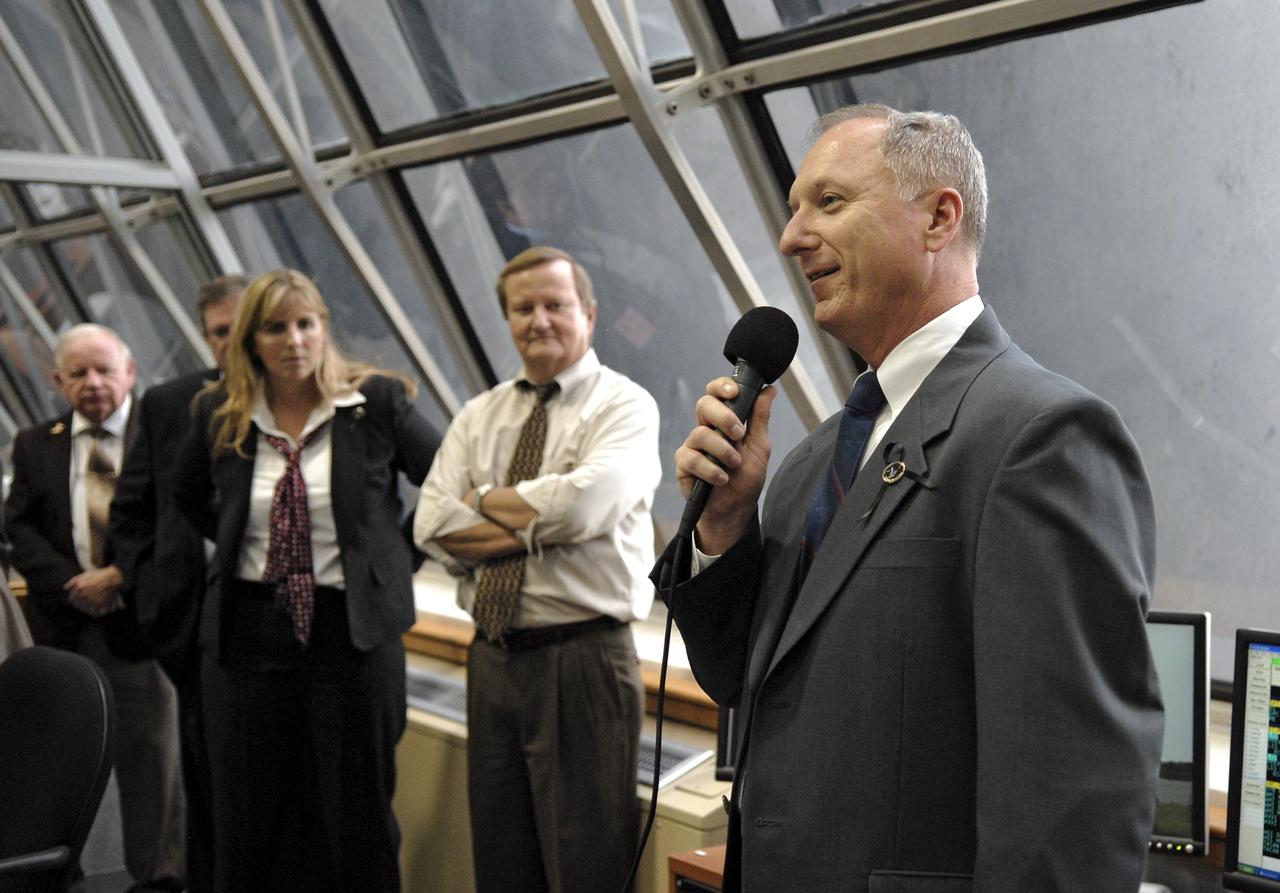
CAPE CANAVERAL, Fla. – In the Firing Room at NASA's Kennedy Space Center in Florida, STS-127 Shuttle Launch Director Pete Nickolenko (right) congratulates the mission team for the successful launch of space shuttle Endeavour on the STS-127 mission. Liftoff was on-time at 6:03 p.m. EDT. At left are Endeavour Flow Director Dana Hutcherson and Shuttle Launch Director Mike Leinbach. Today was the sixth launch attempt for the STS-127 mission. The launch was scrubbed on June 13 and June 17 when a hydrogen gas leak occurred during tanking due to a misaligned Ground Umbilical Carrier Plate. The mission was postponed July 11, 12 and 13 due to weather conditions near the Shuttle Landing Facility at Kennedy that violated rules for launching, and lightning issues. Endeavour will deliver the Japanese Experiment Module's Exposed Facility and the Experiment Logistics Module-Exposed Section in the final of three flights dedicated to the assembly of the Japan Aerospace Exploration Agency's Kibo laboratory complex on the International Space Station. Photo credit: NASA/Kim Shiflett

Ronnie Rigney (r), chief of the Propulsion Test Office in the Project Directorate at Stennis Space Center, stands with agency colleagues to receive the prestigious American Institute of Aeronautics and Astronautics George M. Low Space Transportation Award on Sept. 12. Rigney accepted the award on behalf of the NASA and contractor team at Stennis for their support of the Space Shuttle Program that ended last summer. From 1975 to 2009, Stennis Space Center tested every main engine used to power 135 space shuttle missions. Stennis continued to provide flight support services through the end of the Space Shuttle Program in July 2011. The center also supported transition and retirement of shuttle hardware and assets through September 2012. The 2012 award was presented to the space shuttle team 'for excellence in the conception, development, test, operation and retirement of the world's first and only reusable space transportation system.' Joining Rigney for the award ceremony at the 2012 AIAA Conference in Pasadena, Calif., were: (l to r) Allison Zuniga, NASA Headquarters; Michael Griffin, former NASA administrator; Don Noah, Johnson Space Center in Houston; Steve Cash, Marshall Space Flight Center in Huntsville, Ala.; and Pete Nickolenko, Kennedy Space Center in Florida.
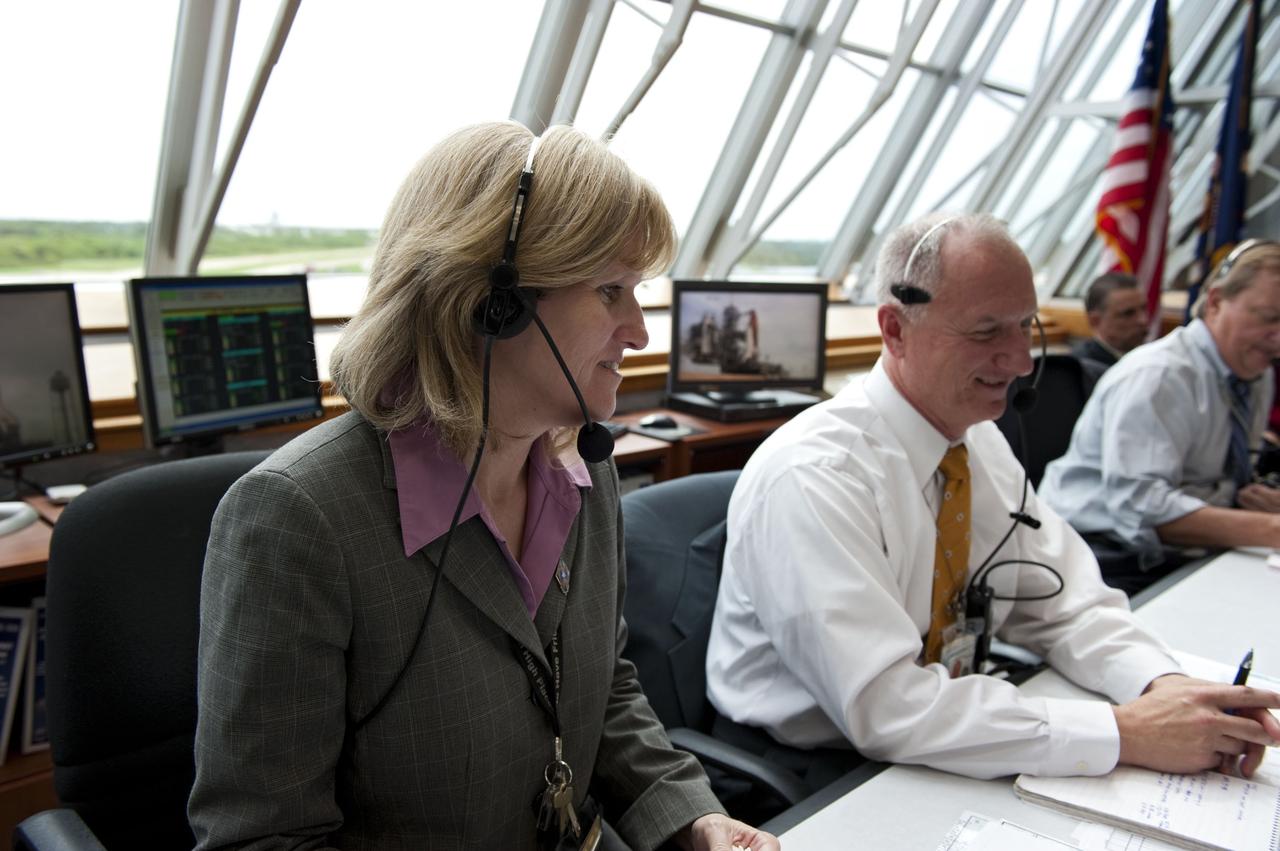
CAPE CANAVERAL, Fla. -- In Firing Room 4 of the Launch Control Center at NASA's Kennedy Space Center in Florida, launch team members monitor the countdown to the launch of space shuttle Atlantis on its STS-135 mission to the International Space Station. Seen here are Atlantis NASA Flow Director Angie Brewer, Assistant Launch Director Pete Nickolenko and Shuttle Launch Director Mike Leinbach (far right). Atlantis with its crew of four; Commander Chris Ferguson, Pilot Doug Hurley, Mission Specialists Sandy Magnus and Rex Walheim, lifted off at 11:29 a.m. EDT on July 8, 2011 to deliver the Raffaello multi-purpose logistics module packed with supplies and spare parts for the station. Atlantis also will fly the Robotic Refueling Mission experiment that will investigate the potential for robotically refueling existing satellites in orbit. In addition, Atlantis will return with a failed ammonia pump module to help NASA better understand the failure mechanism and improve pump designs for future systems. STS-135 will be the 33rd flight of Atlantis, the 37th shuttle mission to the space station, and the 135th and final mission of NASA's Space Shuttle Program. For more information, visit www.nasa.gov/mission_pages/shuttle/shuttlemissions/sts135/index.html. Photo credit: NASA/Kim Shiflett
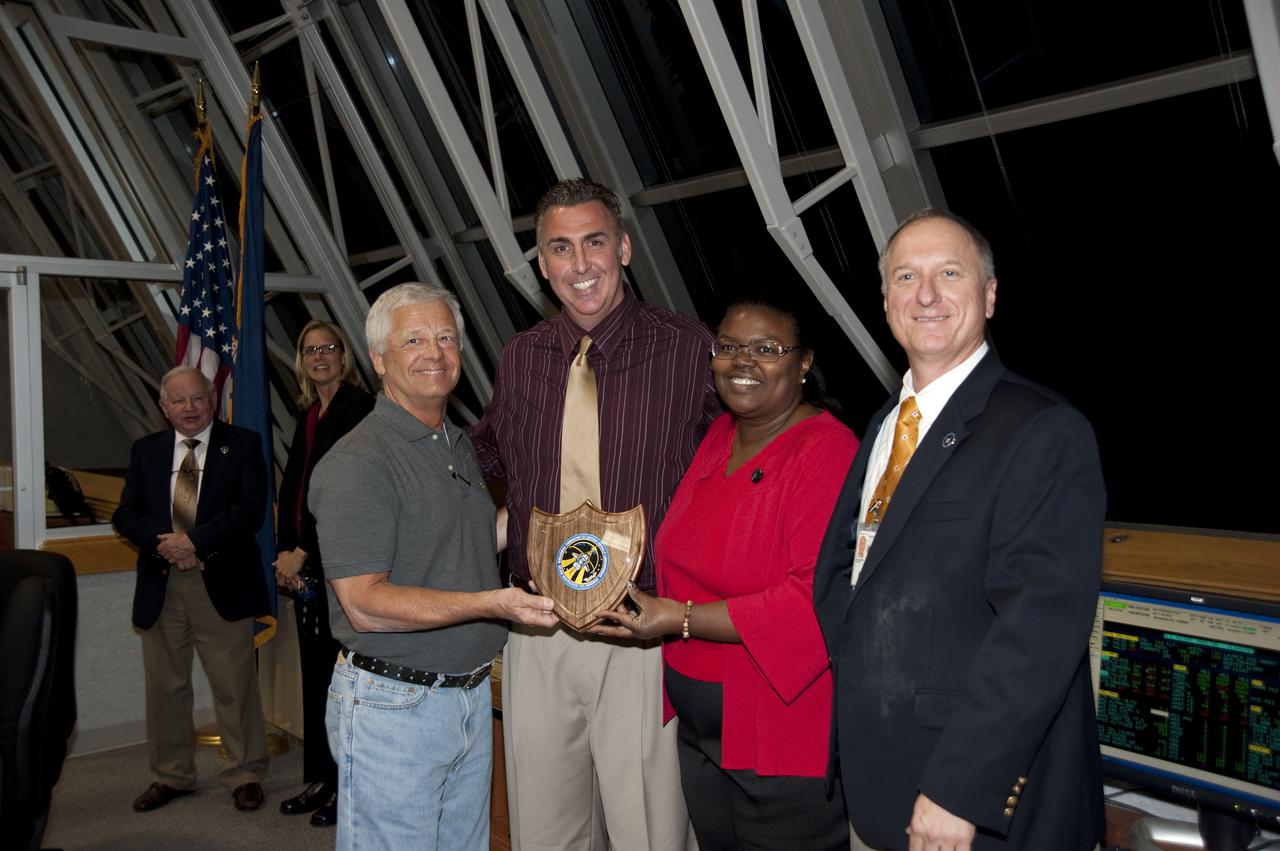
CAPE CANAVERAL, Fla. - STS-131 Launch Director Pete Nickolenko (right) proudly stands next to Nita Collins with USA Firing Room Quality Control, Dallas McCarter, NASA Safety and Jim Marczak with USA Logistics, after presenting them with the Launch Director’s Flow award after the liftoff of shuttle Discovery on the STS-131 mission. Shuttle Discovery lifted off at 6:21 a.m. EDT on April 5, 2010. The seven-member STS-131 crew will deliver the multi-purpose logistics module Leonardo, filled with supplies, a new crew sleeping quarters and science racks that will be transferred to the International Space Station's laboratories. The crew also will switch out a gyroscope on the station’s truss, install a spare ammonia storage tank and retrieve a Japanese experiment from the station’s exterior. STS-131 is the 33rd shuttle mission to the station and the 131st shuttle mission overall. For information on the STS-131 mission and crew, visit http:__www.nasa.gov_mission_pages_shuttle_shuttlemissions_sts131_index.html. Photo credit: NASA_Kim Shiflett

KENNEDY SPACE CENTER, FLA. -- At NASA's Kennedy Space Center, members of the STS-122 crew are greeted by Doug Lyons (left, yellow shirt), launch director for the mission, and Pete Nickolenko (right, green shirt), lead shuttle test director, after their arrival. Crew members from left are Mission Specialists Stanley Love, Hans Schlegel, Rex Walheim and Leland Melvin, and Pilot Alan Poindexter. Schlegel represents the European Space Agency. The crew's arrival signals the imminent launch of space shuttle Atlantis' STS-122 mission, at 2:45 p.m. Feb. 7. This will be the third launch attempt for the mission. Some of the tank's ECO sensors gave failed readings during propellant tanking for launch attempts on Dec. 6 and Dec. 9, subsequently scrubbing further attempts until the cause could be found and repairs made. Atlantis will carry the Columbus module, Europe's largest contribution to the construction of the International Space Station. It will support scientific and technological research in a microgravity environment. Columbus is a multifunctional, pressurized laboratory that will be permanently attached to the Harmony module of the space station to carry out experiments in materials science, fluid physics and biosciences, as well as to perform a number of technological applications. Photo credit: NASA/Kim Shiflett
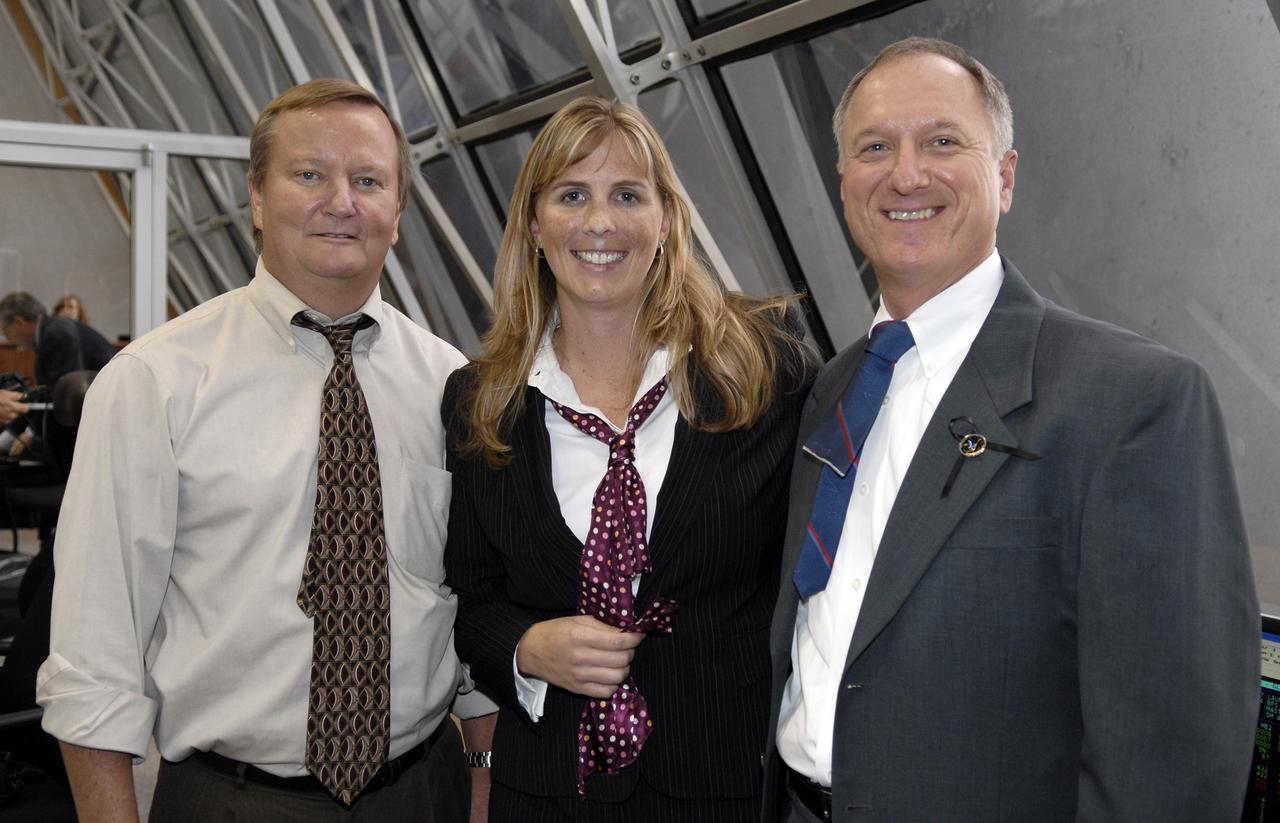
CAPE CANAVERAL, Fla. – In the Firing Room at NASA's Kennedy Space Center in Florida, Shuttle Launch Director Mike Leinbach, Endeavour Flow Director Dana Hutcherson and STS-127 Shuttle Launch Director Pete Nickolenko bask in the successful launch of space shuttle Endeavour on the STS-127 mission. Liftoff was on-time at 6:03 p.m. EDT. Today was the sixth launch attempt for the STS-127 mission. The launch was scrubbed on June 13 and June 17 when a hydrogen gas leak occurred during tanking due to a misaligned Ground Umbilical Carrier Plate. The mission was postponed July 11, 12 and 13 due to weather conditions near the Shuttle Landing Facility at Kennedy that violated rules for launching, and lightning issues. Endeavour will deliver the Japanese Experiment Module's Exposed Facility and the Experiment Logistics Module-Exposed Section in the final of three flights dedicated to the assembly of the Japan Aerospace Exploration Agency's Kibo laboratory complex on the International Space Station. Photo credit: NASA/Kim Shiflett

Ronnie Rigney (r), chief of the Propulsion Test Office in the Project Directorate at Stennis Space Center, stands with agency colleagues to receive the prestigious American Institute of Aeronautics and Astronautics George M. Low Space Transportation Award on Sept. 12. Rigney accepted the award on behalf of the NASA and contractor team at Stennis for their support of the Space Shuttle Program that ended last summer. From 1975 to 2009, Stennis Space Center tested every main engine used to power 135 space shuttle missions. Stennis continued to provide flight support services through the end of the Space Shuttle Program in July 2011. The center also supported transition and retirement of shuttle hardware and assets through September 2012. The 2012 award was presented to the space shuttle team 'for excellence in the conception, development, test, operation and retirement of the world's first and only reusable space transportation system.' Joining Rigney for the award ceremony at the 2012 AIAA Conference in Pasadena, Calif., were: (l to r) Allison Zuniga, NASA Headquarters; Michael Griffin, former NASA administrator; Don Noah, Johnson Space Center in Houston; Steve Cash, Marshall Space Flight Center in Huntsville, Ala.; and Pete Nickolenko, Kennedy Space Center in Florida.
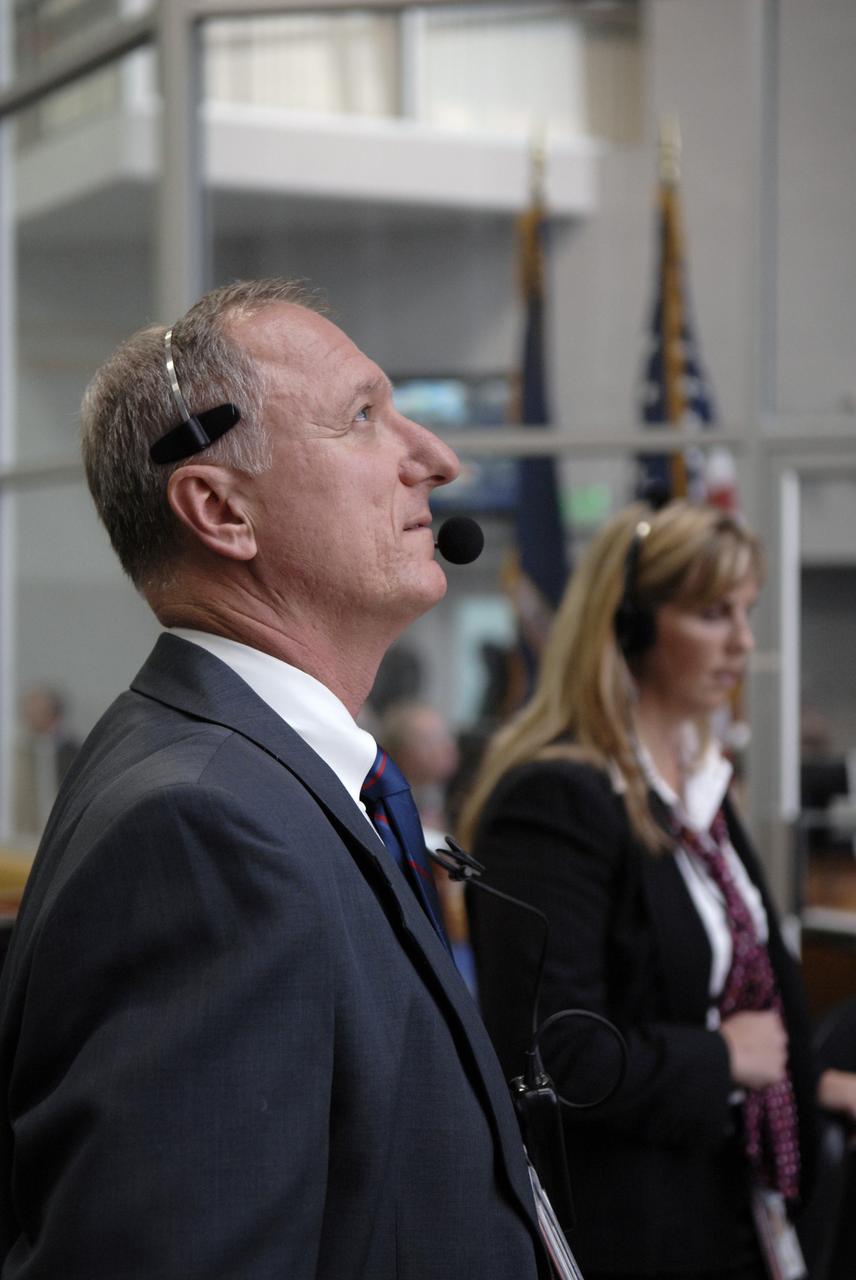
CAPE CANAVERAL, Fla. – In the Firing Room at NASA's Kennedy Space Center in Florida, STS-127 Shuttle Launch Director Pete Nickolenko watches the launch of space shuttle Endeavour as it roars into space on the STS-127 mission. Liftoff was on-time at 6:03 p.m. EDT. At right is Dana Hutcherson, Endeavour flow director. Today was the sixth launch attempt for the STS-127 mission. The launch was scrubbed on June 13 and June 17 when a hydrogen gas leak occurred during tanking due to a misaligned Ground Umbilical Carrier Plate. The mission was postponed July 11, 12 and 13 due to weather conditions near the Shuttle Landing Facility at Kennedy that violated rules for launching, and lightning issues. Endeavour will deliver the Japanese Experiment Module's Exposed Facility and the Experiment Logistics Module-Exposed Section in the final of three flights dedicated to the assembly of the Japan Aerospace Exploration Agency's Kibo laboratory complex on the International Space Station. Photo credit: NASA/Kim Shiflett
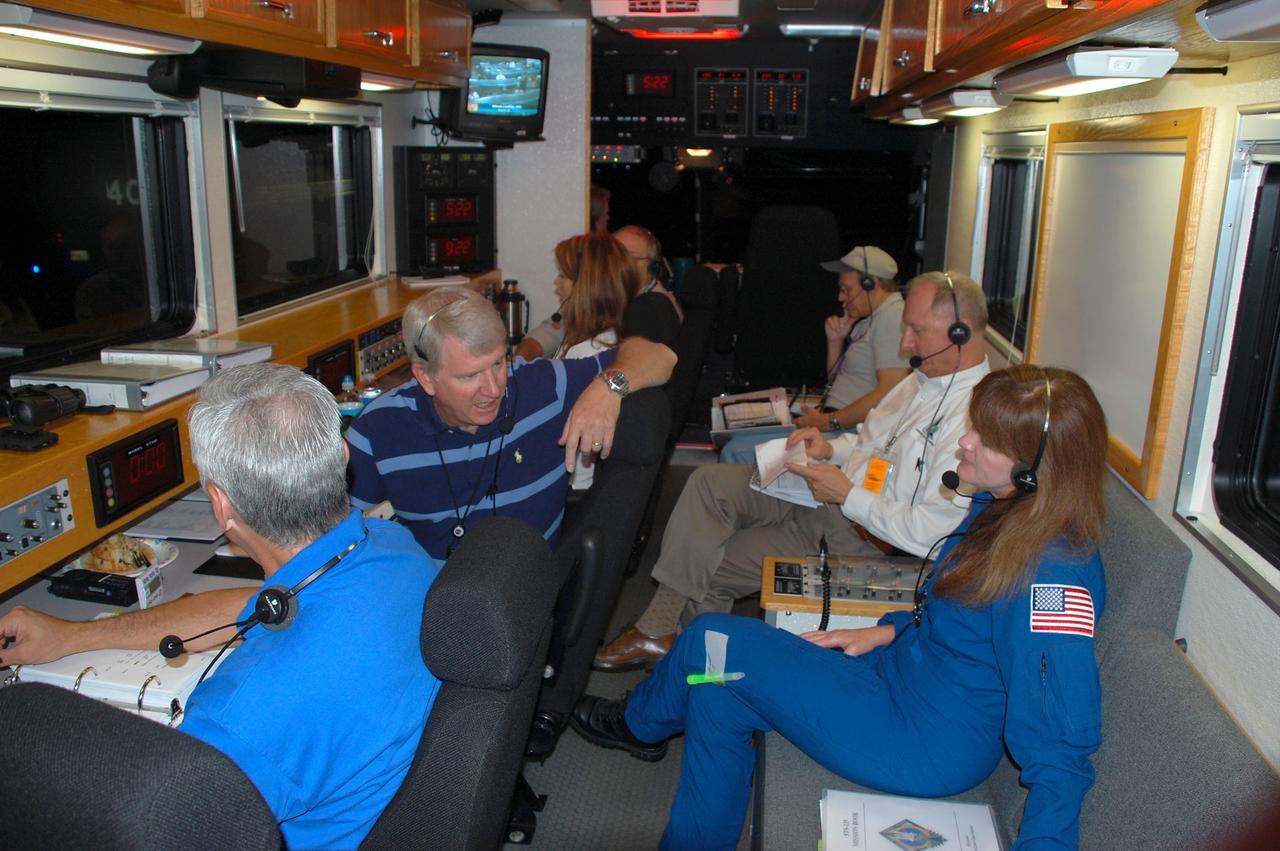
CAPE CANAVERAL, Fla. -- The Convoy Command Center vehicle is positioned on the Shuttle Landing Facility (SLF) at NASA's Kennedy Space Center in Florida awaiting the landing of space shuttle Atlantis. The command vehicle is equipped to control critical communications between the crew still aboard Atlantis and the Launch Control Center. The team will monitor the health of the orbiter systems and direct convoy operations made up of about 40 vehicles, including 25 specially designed vehicles to assist the crew in leaving the shuttle, and prepare the vehicle for towing from the SLF to its processing hangar. Accompanying the command convoy team are STS-135 Assistant Launch Director Pete Nickolenko (right), NASA astronaut Janet Kavandi and Chris Hasselbring, USA Operations Manager (left). Securing the space shuttle fleet's place in history, Atlantis marks the 26th nighttime landing of NASA's Space Shuttle Program and the 78th landing at Kennedy. Atlantis and its crew delivered to the International Space Station the Raffaello multi-purpose logistics module packed with more than 9,400 pounds of spare parts, equipment and supplies that will sustain station operations for the next year. STS-135 is the 33rd and final flight for Atlantis and the final mission of the Space Shuttle Program. For more information, visit www.nasa.gov/mission_pages/shuttle/shuttlemissions/sts135/index.html. Photo credit: NASA/Ben Smegelsky
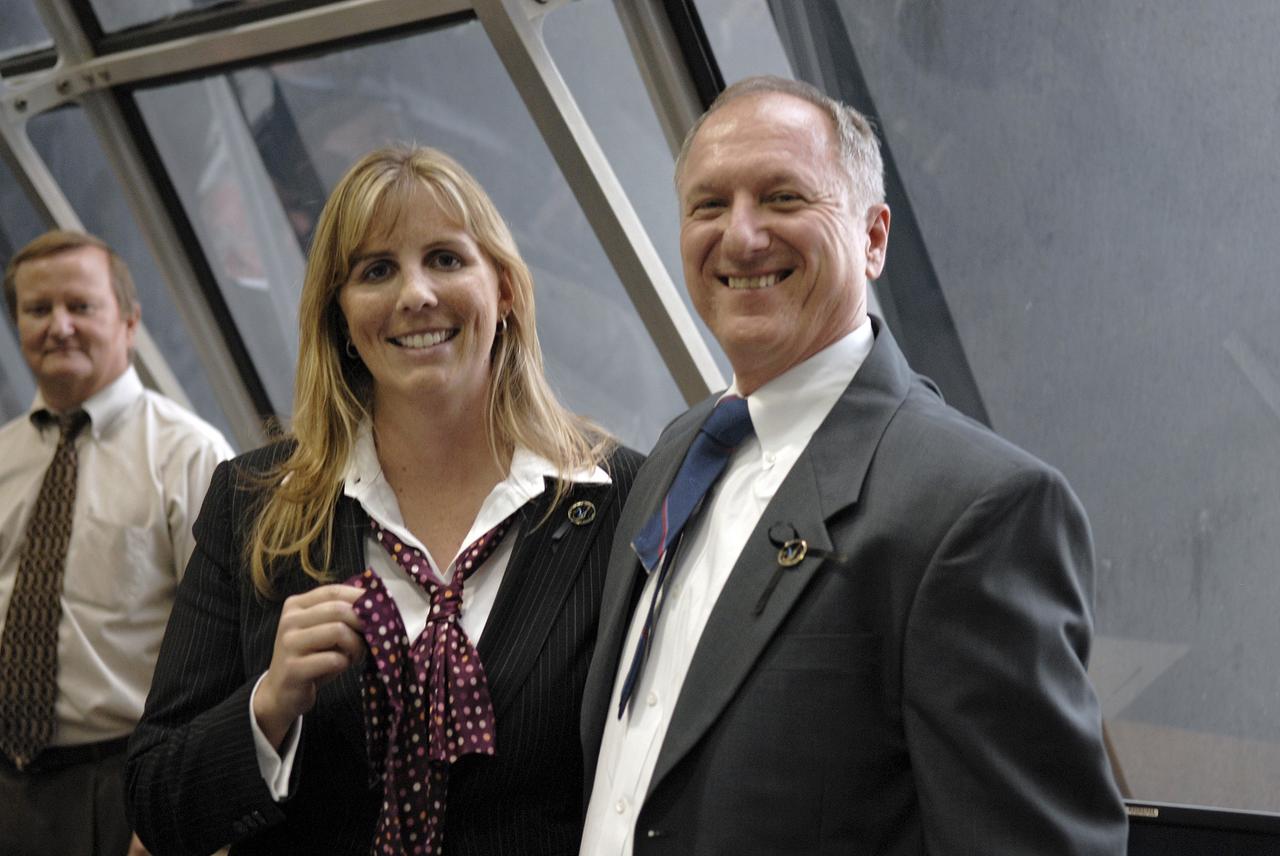
CAPE CANAVERAL, Fla. – In the Firing Room at NASA's Kennedy Space Center in Florida, Endeavour Flow Director Dana Hutcherson and STS-127 Shuttle Launch Director Pete Nickolenko shared in the tie-cutting ceremony for their inaugural launch. At left is Shuttle Launch Director Mike Leinbach. Space shuttle Endeavour lifted off on-time at 6:03 p.m. EDT on the STS-127 mission. Today was the sixth launch attempt for the STS-127 mission. The launch was scrubbed on June 13 and June 17 when a hydrogen gas leak occurred during tanking due to a misaligned Ground Umbilical Carrier Plate. The mission was postponed July 11, 12 and 13 due to weather conditions near the Shuttle Landing Facility at Kennedy that violated rules for launching, and lightning issues. Endeavour will deliver the Japanese Experiment Module's Exposed Facility and the Experiment Logistics Module-Exposed Section in the final of three flights dedicated to the assembly of the Japan Aerospace Exploration Agency's Kibo laboratory complex on the International Space Station. Photo credit: NASA/Kim Shiflett
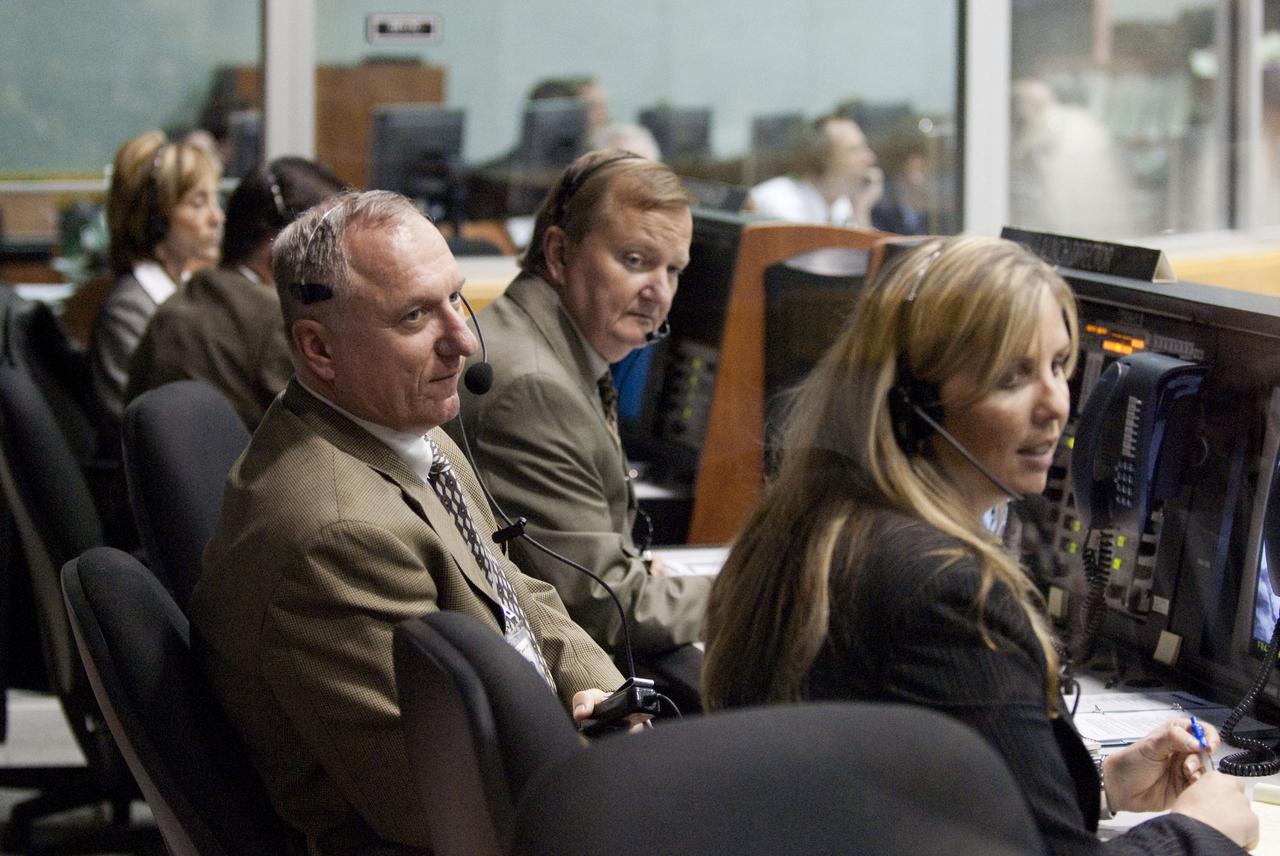
STS130-S-022 (8 Feb. 2010) --- In Firing Room 4 in the Launch Control Center at NASA's Kennedy Space Center in Florida, from top, Mike Leinbach, shuttle launch director; Pete Nickolenko, assistant launch director; and Dana Hutcherson, flow director for space shuttle Endeavour, manage the countdown to liftoff of Endeavour. Launch of Endeavour on the STS-130 mission to the International Space Station was at 4:14 a.m. (EST) on Feb. 8, 2010. This was the second launch attempt for Endeavour's STS-130 crew and the final scheduled space shuttle night launch. The first attempt on Feb. 7 was scrubbed due to unfavorable weather. The primary payload for the STS-130 mission to the International Space Station is the Tranquility node, a pressurized module that will provide additional room for crew members and many of the station's life support and environmental control systems. Attached to one end of Tranquility is the Cupola, a unique work area with six windows on its sides and one on top. The Cupola resembles a circular bay window and will provide a vastly improved view of the station's exterior. The multi-directional view will allow the crew to monitor spacewalks and docking operations, as well as provide a spectacular view of Earth and other celestial objects. The module was built in Turin, Italy, by Thales Alenia Space for the European Space Agency.
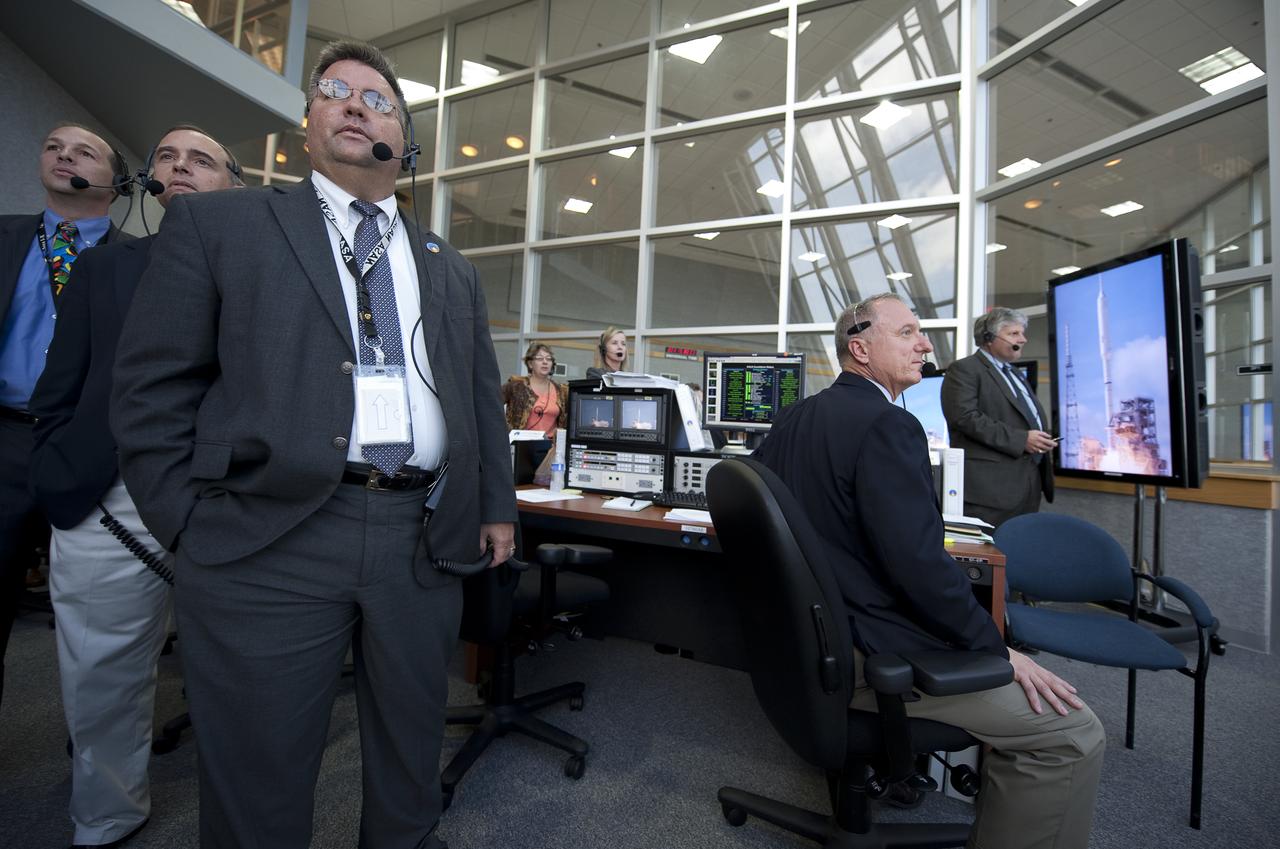
NASA Ares I-X Launch Director Ed Mango, 3rd from left, along with other mission managers watches the launch of the Ares I-X rocket from Firing Room One of the Launch Control Center (LCC) at the Kennedy Space Center in Cape Canaveral, Fla., Wednesday, Oct. 28, 2009. The flight test of Ares I-X will provide NASA with an early opportunity to test and prove flight characteristics, hardware, facilities and ground operations associated with the Ares I. Photo Credit: (NASA/Bill Ingalls)
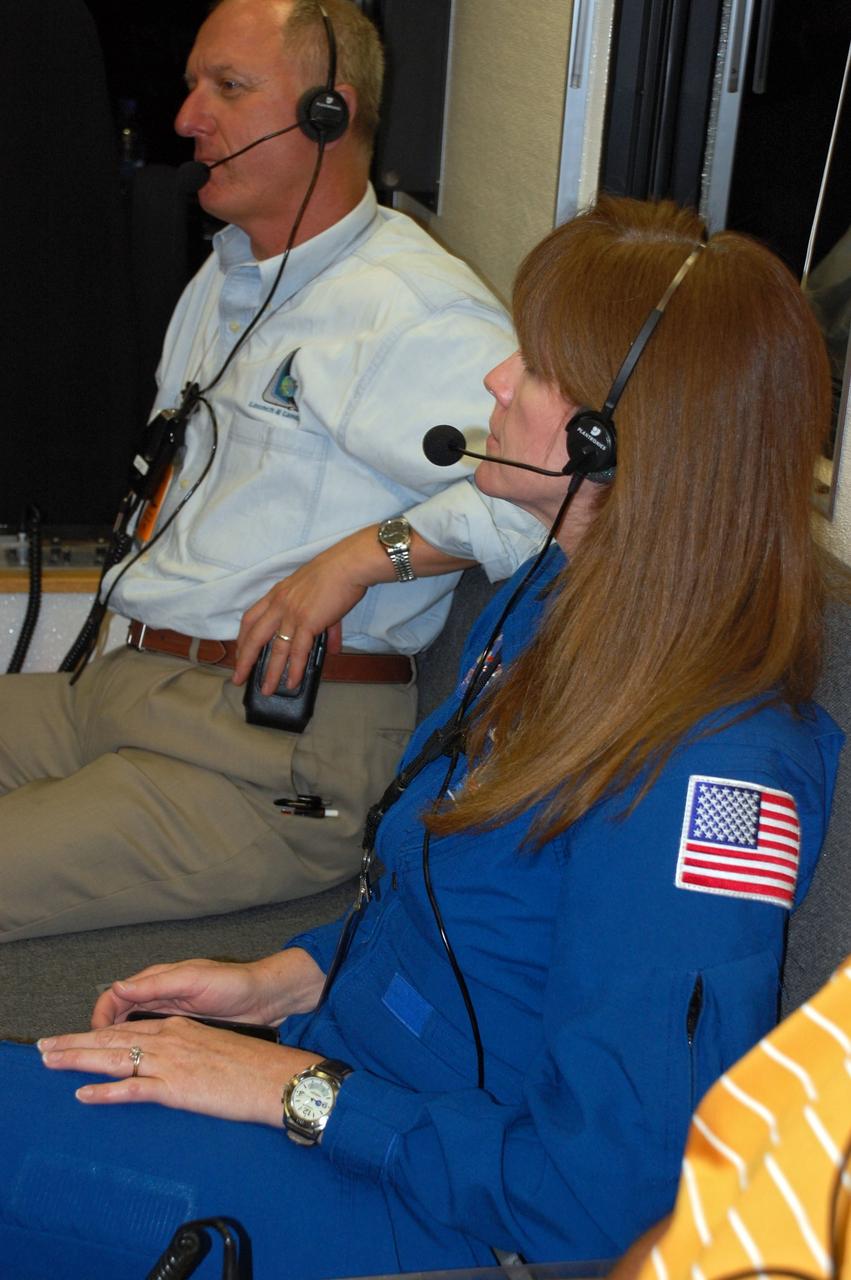
CAPE CANAVERAL, Fla. -- At NASA's Kennedy Space Center in Florida, a team of highly trained personnel inside the Convoy Command Vehicle is ready to "safe" shuttle Endeavour. The command vehicle is equipped to control critical communications between the crew still aboard Endeavour and the Launch Control Center. The team will monitor the health of the orbiter systems and direct convoy operations made up of about 40 vehicles, including 25 specially designed vehicles to assist the crew in leaving the shuttle, and prepare the vehicle for towing from the Shuttle Landing Facility to Orbiter Processing Facility-1. Accompanying the command convoy team are STS-134 assistant launch director Pete Nickolenko and NASA astronaut Janet Kavandi. Endeavour's final return from space completed the 16-day, 6.5-million-mile STS-134 mission. Main gear touchdown was at 2:34:51 a.m. EDT, followed by nose gear touchdown at 2:35:04 a.m., and wheelstop at 2:35:36 a.m. STS-134 delivered the Alpha Magnetic Spectrometer-2 (AMS) and the Express Logistics Carrier-3 (ELC-3) to the International Space Station. AMS will help researchers understand the origin of the universe and search for evidence of dark matter, strange matter and antimatter from the station. ELC-3 carried spare parts that will sustain station operations once the shuttles are retired from service. STS-134 was the 25th and final flight for Endeavour, which spent 299 days in space, orbited Earth 4,671 times and traveled 122,883,151 miles. Photo credit: NASA/Ben Smegelsky
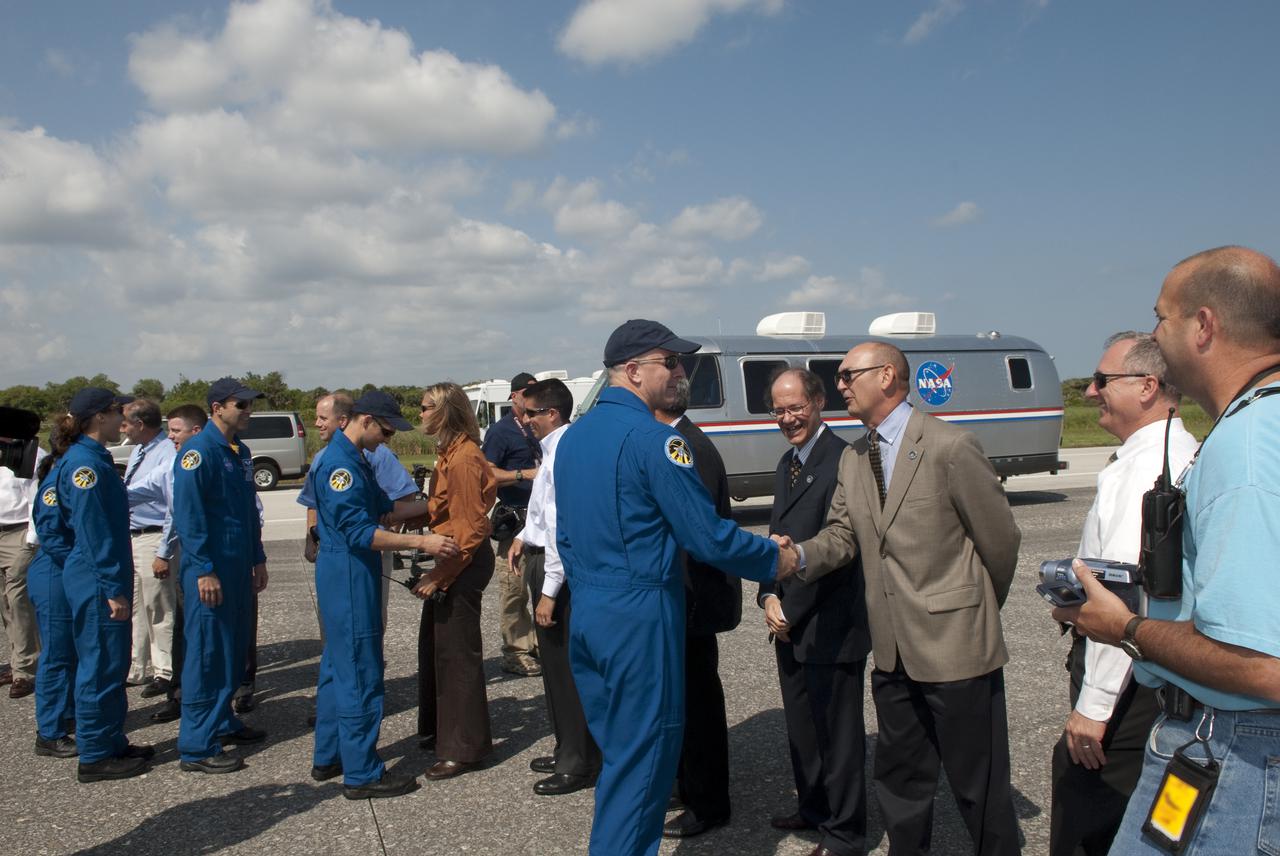
CAPE CANAVERAL, Fla. - At the Shuttle Landing Facility at NASA's Kennedy Space Center in Florida, James Cawby, director of Manufacturing and Processing, Launch and Recovery Systems, United Space Alliance, congratulates STS-131 Commander Alan Poindexter on a successful mission following the landing of space shuttle Discovery on Runway 33. On Cawby's right in the receiving line is Mike Orr, director of Launch and Recovery Systems Engineering, United Space Alliance. Pete Nickolenko, NASA's STS-131 launch director is on Cawby's left. The astronauts are, from left, Mission Specialists Naoko Yamazaki of the Japan Aerospace Exploration Agency, Dorothy Metcalf-Lindenburger and Rick Mastracchio; Pilot James P. Dutton Jr.; and Poindexter. Discovery landed at Kennedy after 15 days in space, completing the more than 6.2-million-mile STS-131 mission on orbit 238. Main gear touchdown was at 9:08:35 a.m. EDT followed by nose gear touchdown at 9:08:47 a.m. and wheelstop at 9:09:33 a.m. The seven-member STS-131 crew carried the multi-purpose logistics module Leonardo, filled with supplies, a new crew sleeping quarters and science racks that were transferred to the International Space Station's laboratories. The crew also switched out a gyroscope on the station’s truss, installed a spare ammonia storage tank and retrieved a Japanese experiment from the station’s exterior. STS-131 is the 33rd shuttle mission to the station and the 131st shuttle mission overall. For information on the STS-131 mission and crew, visit http:__www.nasa.gov_mission_pages_shuttle_shuttlemissions_sts131_index.html. Photo credit: NASA_Jim Grossmann
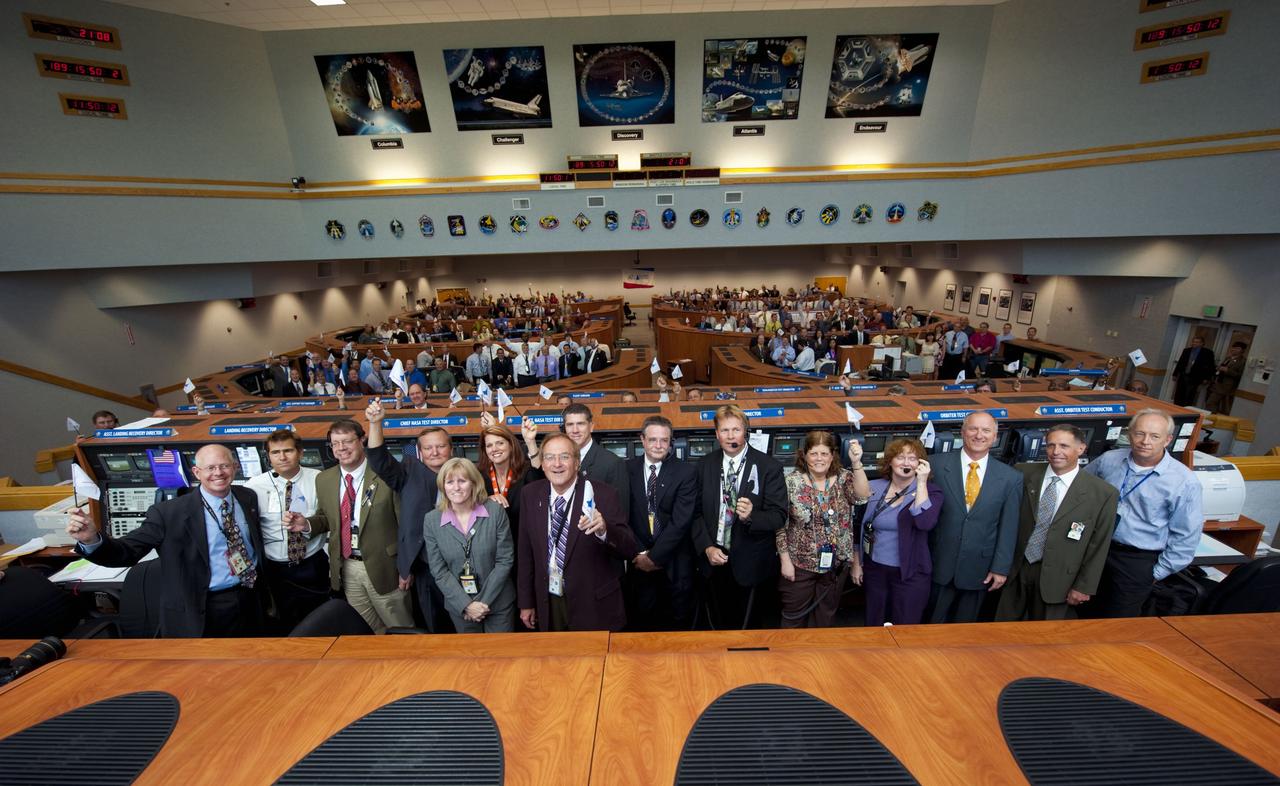
CAPE CANAVERAL, Fla. -- Launch controllers wave their STS-135 shuttle launch team member flags and cheer in Firing Room 4 of the Launch Control Center following the successful launch of space shuttle Atlantis from NASA's Kennedy Space Center in Florida. In the foreground, from left, are NASA Test Directors Steve Payne and Bob Holl; Landing and Recovery Director Greg Gaddis; Shuttle Launch Director Mike Leinbach; Atlantis' NASA Flow Director Angie Brewer; NASA Test Director Charlie Blackwell-Thompson; STS-135 Launch Commentator George Diller; NASA Test Directors Jeremy Graeber, Tim Potter, and Jeff Spaulding; Orbiter Test Conductor Roberta Wyrick; Assistant Orbiter Test Conductor Laurie Sally; Assistant Launch Director Pete Nickolenko; United Space Alliance Vice President of Launch and Recovery Systems Mark Nappi; and United Space Alliance Test Conductor Mark Paxton. Atlantis began its final flight, the STS-135 mission to the International Space Station, at 11:29 a.m. EDT on July 8. STS-135 will deliver the Raffaello multi-purpose logistics module packed with supplies and spare parts for the International Space Station. Atlantis also is flying the Robotic Refueling Mission experiment that will investigate the potential for robotically refueling existing satellites in orbit. In addition, Atlantis will return with a failed ammonia pump module to help NASA better understand the failure mechanism and improve pump designs for future systems. STS-135 is the 33rd flight of Atlantis, the 37th shuttle mission to the space station, and the 135th and final mission of NASA's Space Shuttle Program. For more information, visit www.nasa.gov/mission_pages/shuttle/shuttlemissions/sts135/index.html. Photo credit: NASA/Kim Shiflett