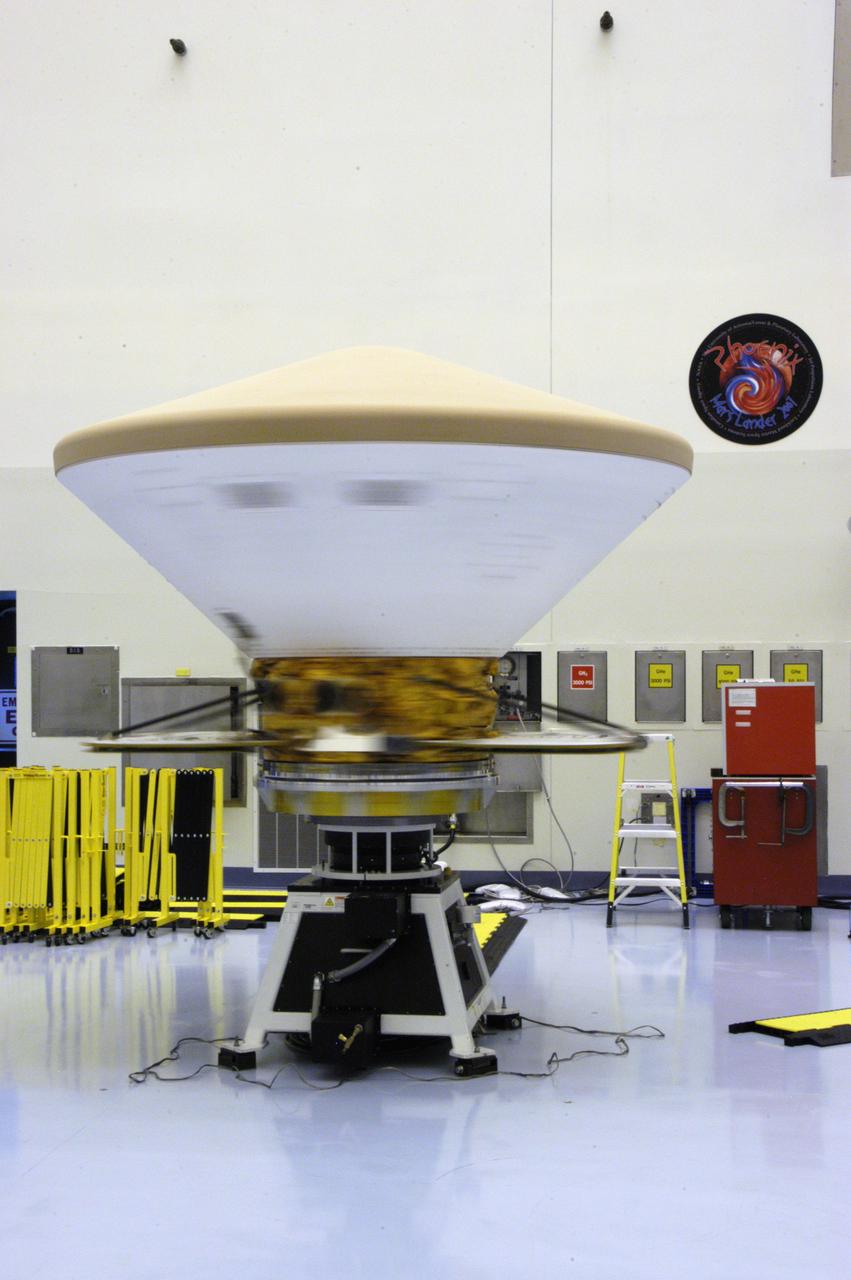
In the Payload Hazardous Servicing Facility, the Phoenix Mars Lander spacecraft undergoes spin testing. The Phoenix mission is the first project in NASA's first openly competed program of Mars Scout missions. Phoenix will land in icy soils near the north polar permanent ice cap of Mars and explore the history of the water in these soils and any associated rocks, while monitoring polar climate. Landing is planned in May 2008 on arctic ground where a mission currently in orbit, Mars Odyssey, has detected high concentrations of ice just beneath the top layer of soil. It will serve as NASA's first exploration of a potential modern habitat on Mars and open the door to a renewed search for carbon-bearing compounds, last attempted with NASA's Viking missions in the 1970s. A stereo color camera and a weather station will study the surrounding environment while the other instruments check excavated soil samples for water, organic chemicals and conditions that could indicate whether the site was ever hospitable to life. Microscopes can reveal features as small as one one-thousandth the width of a human hair. Launch of Phoenix aboard a Delta II rocket is targeted for Aug. 3 from Cape Canaveral Air Force Station in Florida.
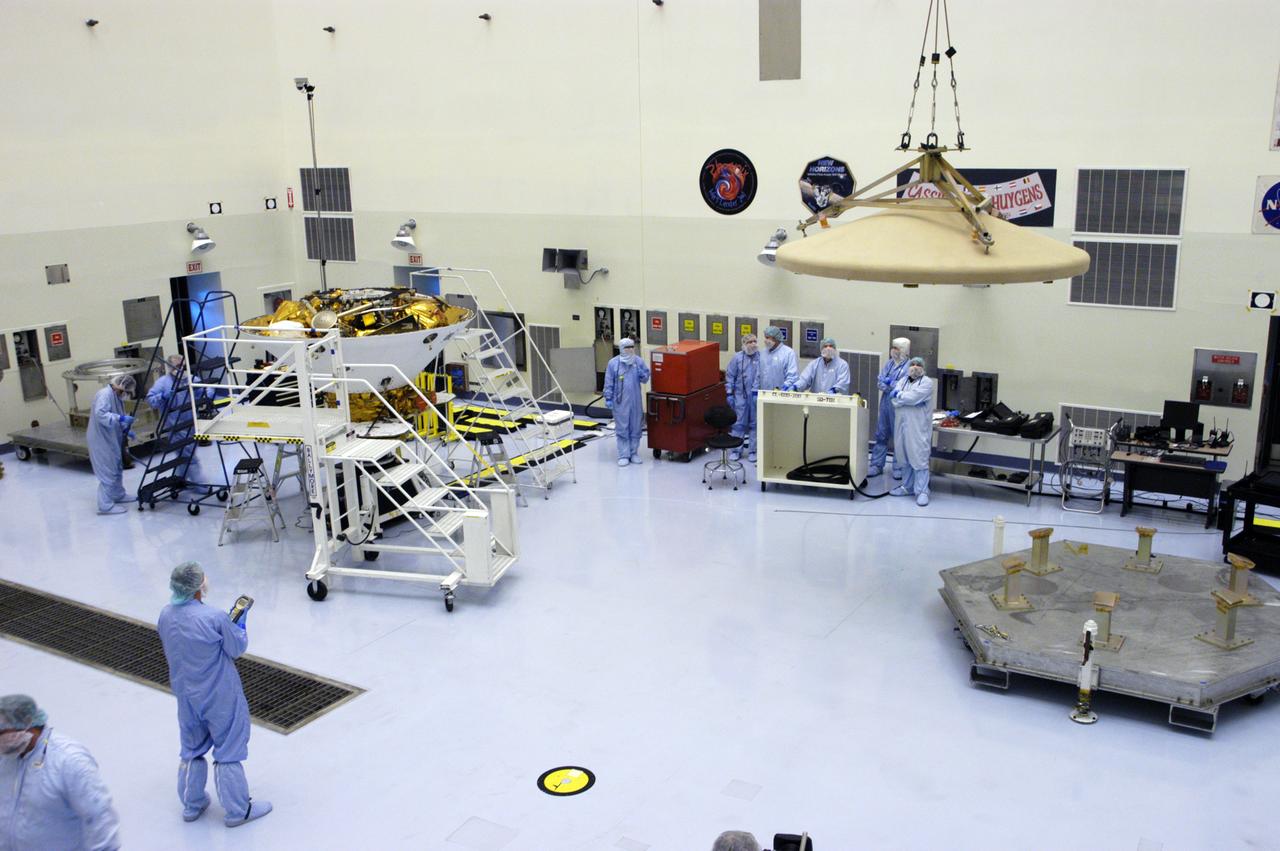
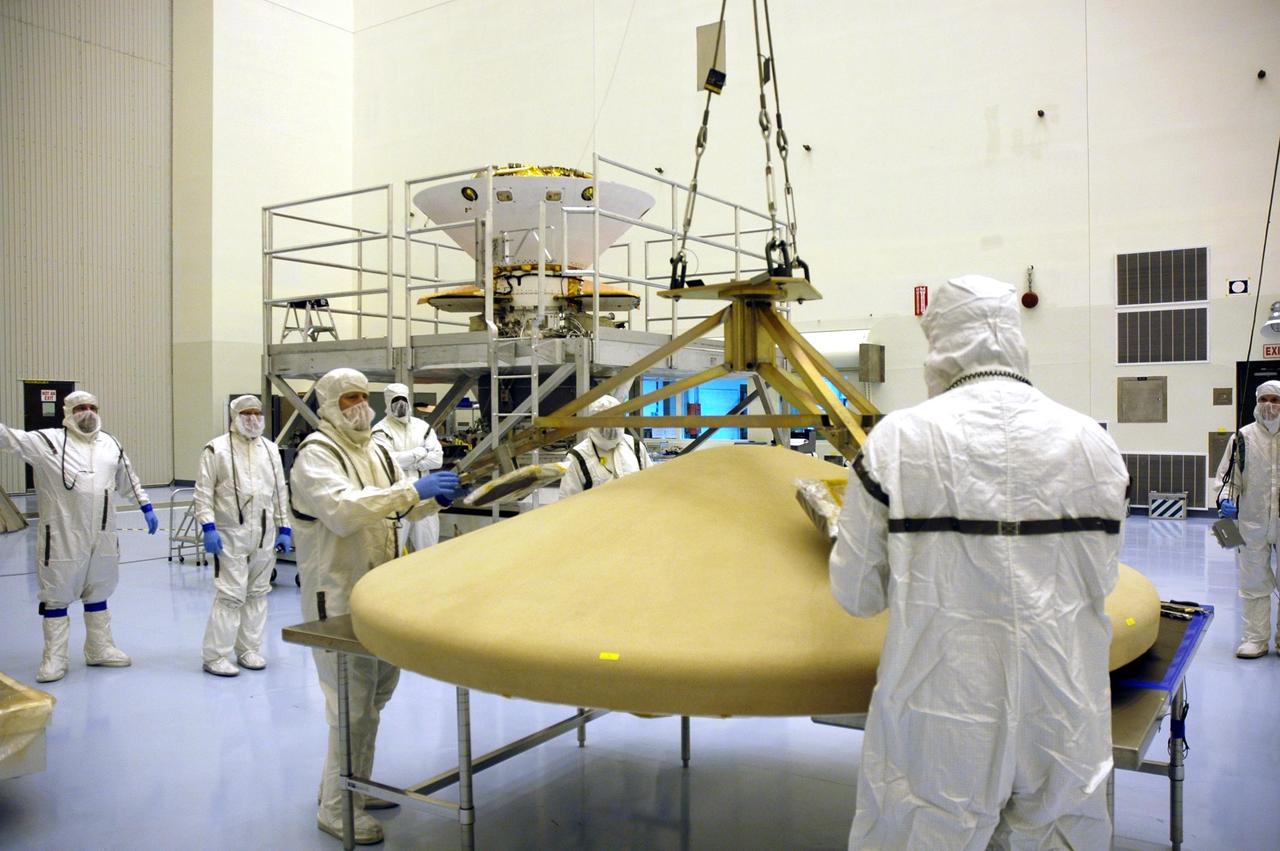
In the Payload Hazardous Servicing Facility, the heat shield for the Phoenix Mars Lander is moved into position for installation on the spacecraft. The Phoenix mission is the first project in NASA's first openly competed program of Mars Scout missions. Phoenix will land in icy soils near the north polar permanent ice cap of Mars and explore the history of the water in these soils and any associated rocks, while monitoring polar climate. Landing is planned in May 2008 on arctic ground where a mission currently in orbit, Mars Odyssey, has detected high concentrations of ice just beneath the top layer of soil. It will serve as NASA's first exploration of a potential modern habitat on Mars and open the door to a renewed search for carbon-bearing compounds, last attempted with NASA's Viking missions in the 1970s. A stereo color camera and a weather station will study the surrounding environment while the other instruments check excavated soil samples for water, organic chemicals and conditions that could indicate whether the site was ever hospitable to life. Microscopes can reveal features as small as one one-thousandth the width of a human hair. Launch of Phoenix aboard a Delta II rocket is targeted for Aug. 3 from Cape Canaveral Air Force Station in Florida.
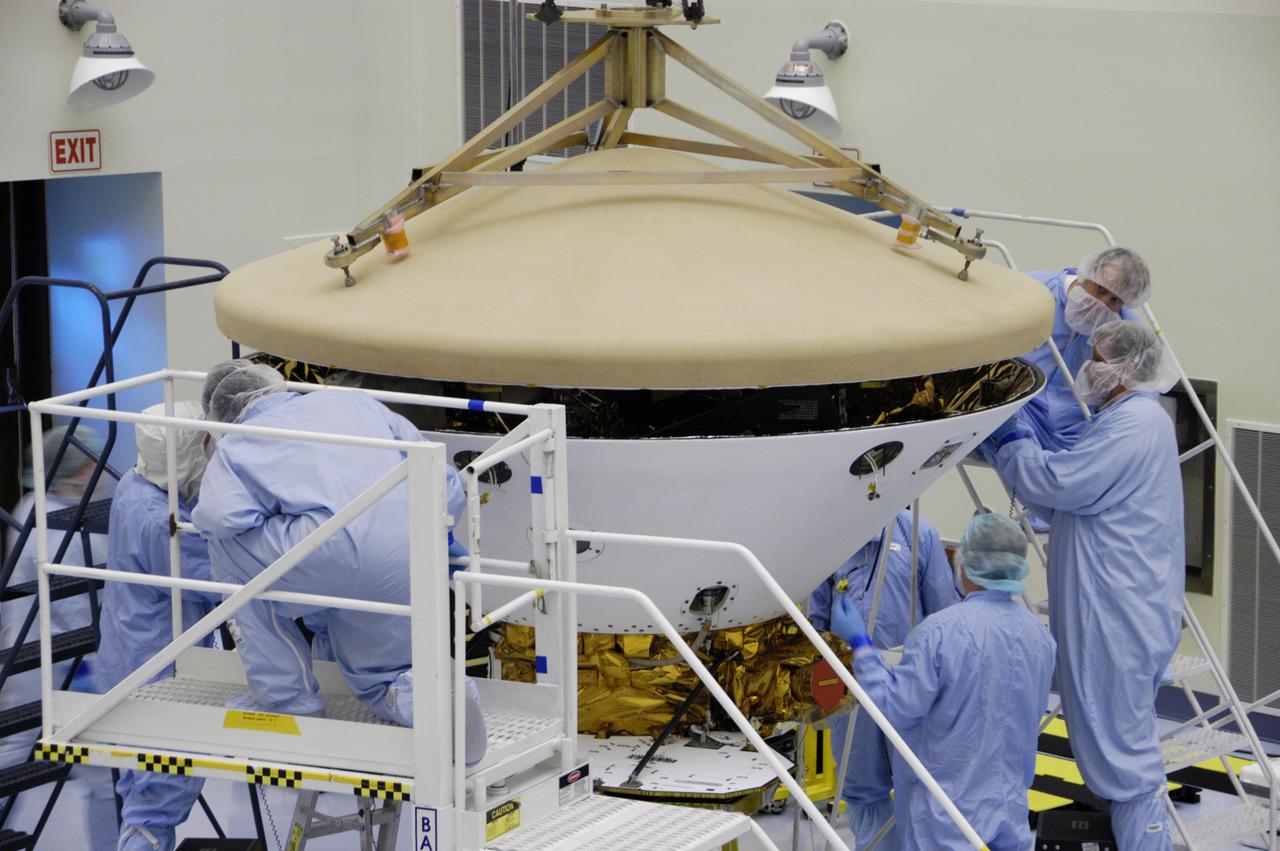
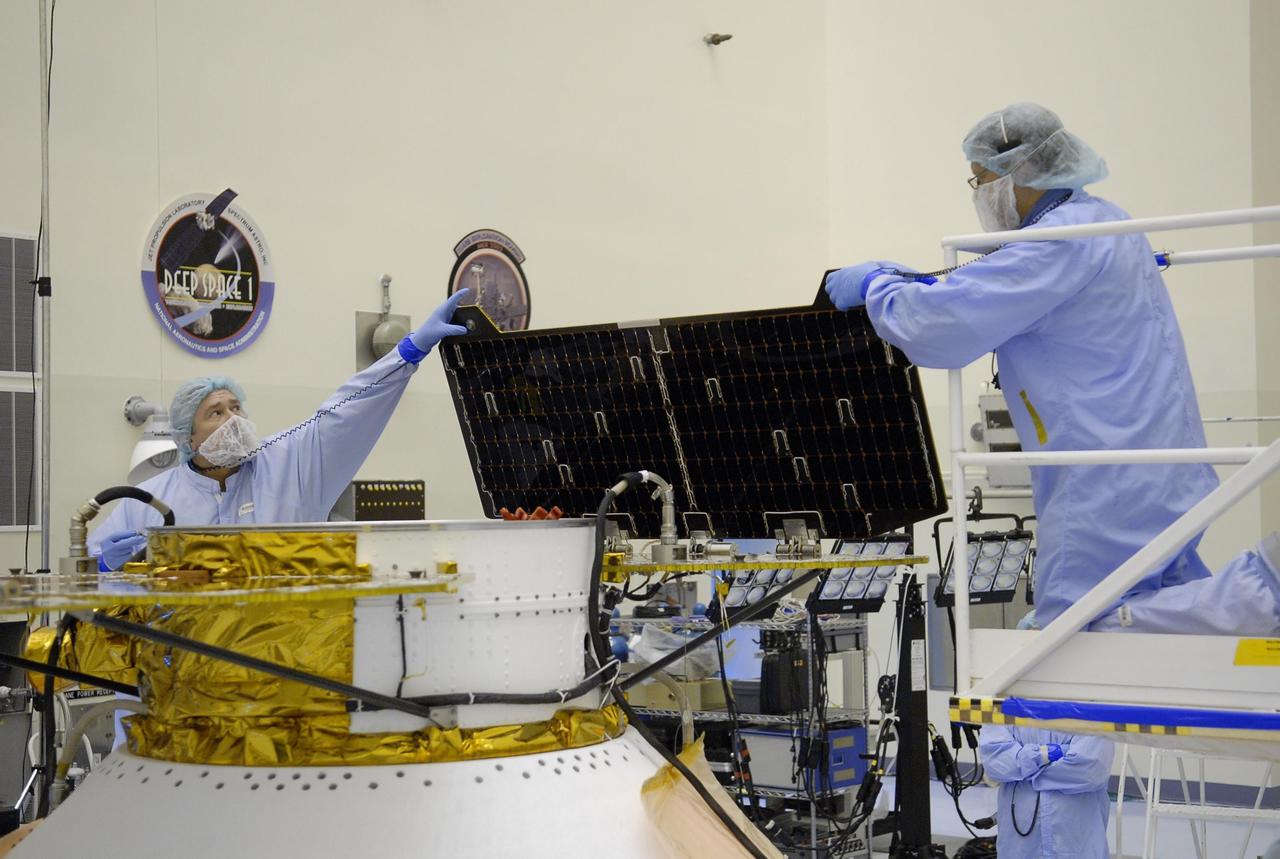
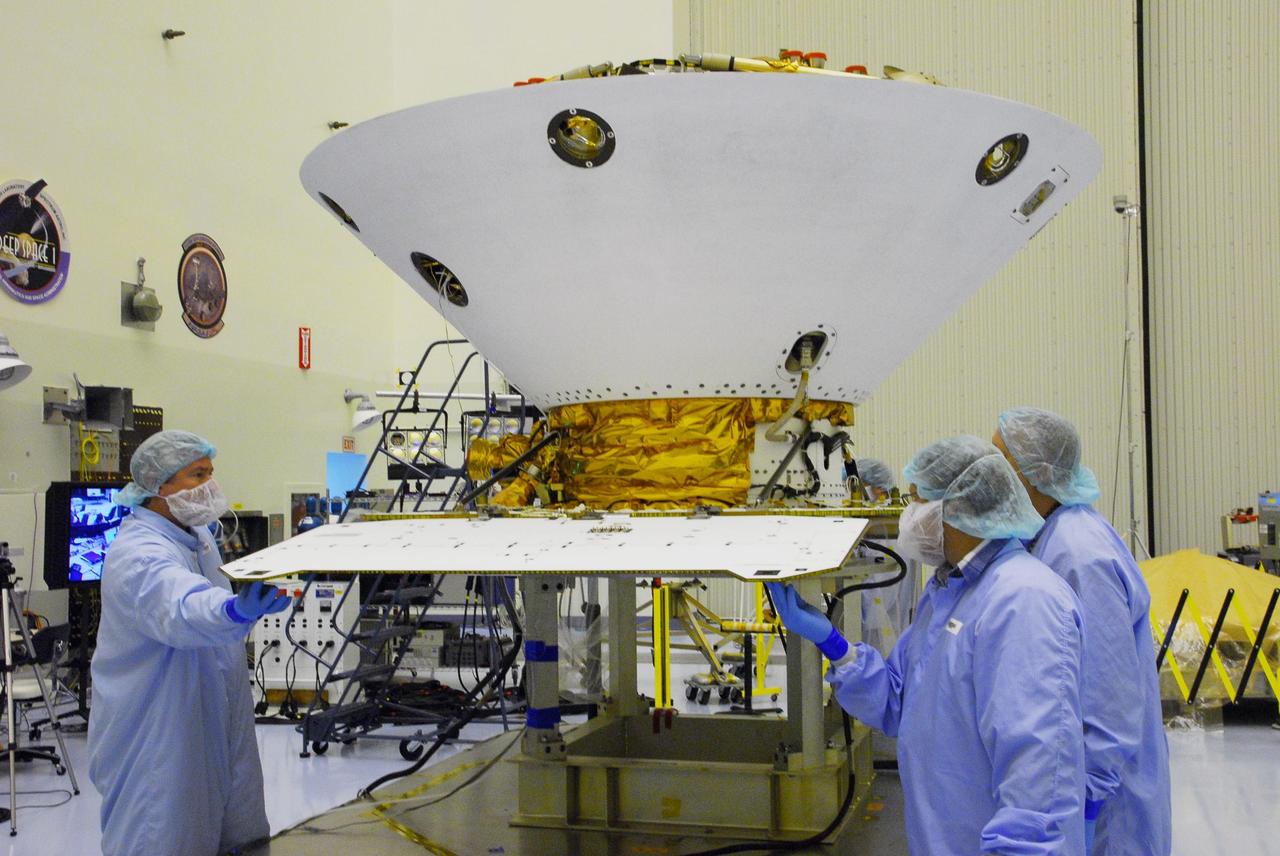
In the Payload Hazardous Servicing Facility, technicians prepare to install the heat shield on the Phoenix Mars Lander spacecraft. The Phoenix mission is the first project in NASA's first openly competed program of Mars Scout missions. Phoenix will land in icy soils near the north polar permanent ice cap of Mars and explore the history of the water in these soils and any associated rocks, while monitoring polar climate. Landing is planned in May 2008 on arctic ground where a mission currently in orbit, Mars Odyssey, has detected high concentrations of ice just beneath the top layer of soil. It will serve as NASA's first exploration of a potential modern habitat on Mars and open the door to a renewed search for carbon-bearing compounds, last attempted with NASA's Viking missions in the 1970s. A stereo color camera and a weather station will study the surrounding environment while the other instruments check excavated soil samples for water, organic chemicals and conditions that could indicate whether the site was ever hospitable to life. Microscopes can reveal features as small as one one-thousandth the width of a human hair. Launch of Phoenix aboard a Delta II rocket is targeted for Aug. 3 from Cape Canaveral Air Force Station in Florida.
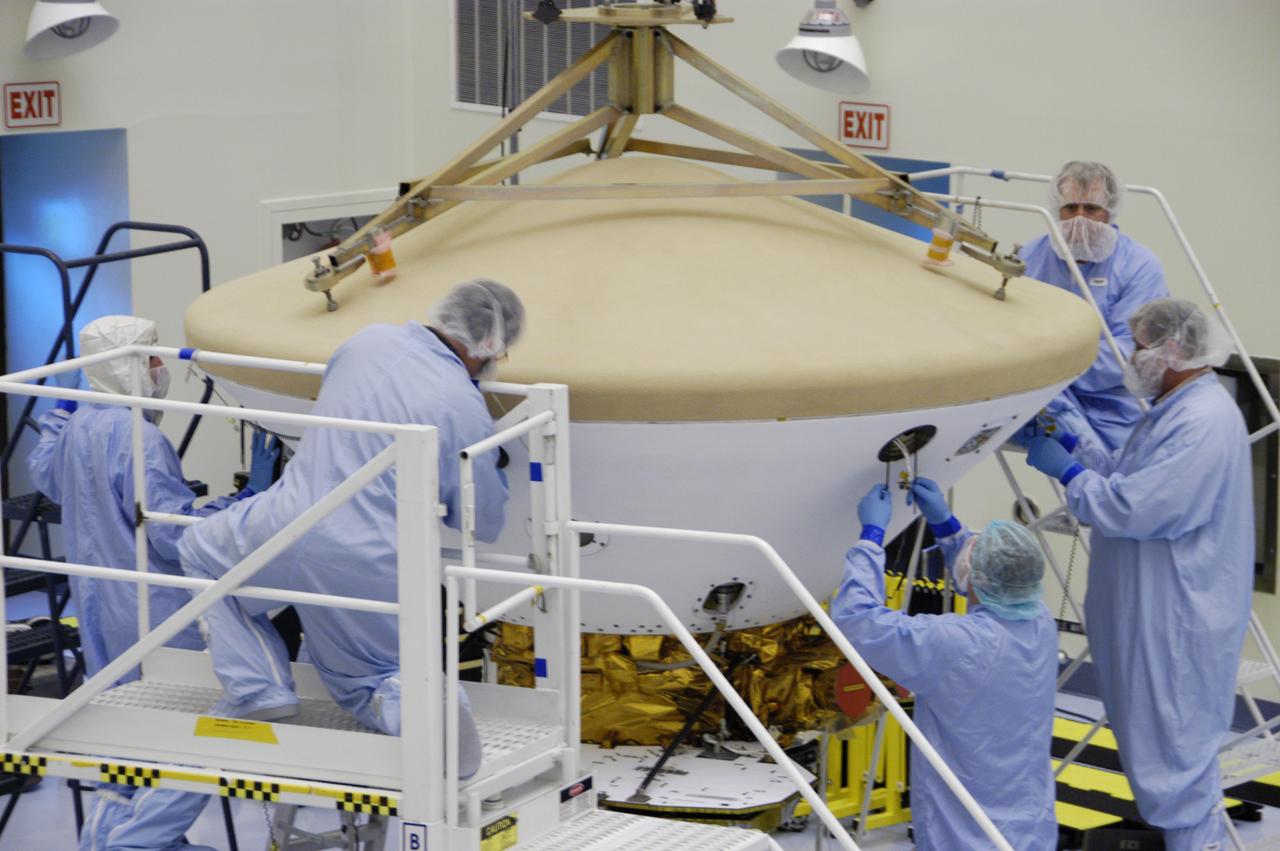
In the Payload Hazardous Servicing Facility, technicians install the heat shield on the Phoenix Mars Lander spacecraft. The Phoenix mission is the first project in NASA's first openly competed program of Mars Scout missions. Phoenix will land in icy soils near the north polar permanent ice cap of Mars and explore the history of the water in these soils and any associated rocks, while monitoring polar climate. Landing is planned in May 2008 on arctic ground where a mission currently in orbit, Mars Odyssey, has detected high concentrations of ice just beneath the top layer of soil. It will serve as NASA's first exploration of a potential modern habitat on Mars and open the door to a renewed search for carbon-bearing compounds, last attempted with NASA's Viking missions in the 1970s. A stereo color camera and a weather station will study the surrounding environment while the other instruments check excavated soil samples for water, organic chemicals and conditions that could indicate whether the site was ever hospitable to life. Microscopes can reveal features as small as one one-thousandth the width of a human hair. Launch of Phoenix aboard a Delta II rocket is targeted for Aug. 3 from Cape Canaveral Air Force Station in Florida.
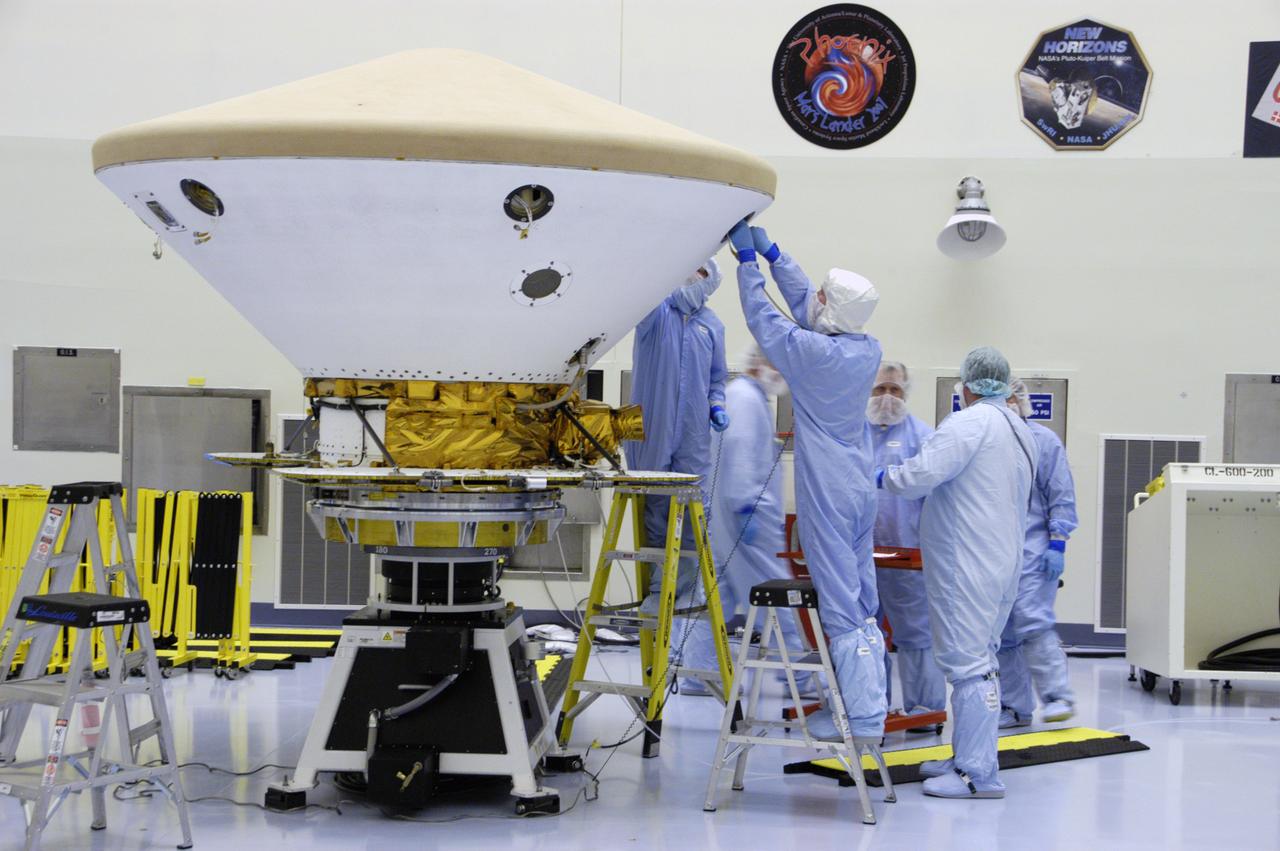
In the Payload Hazardous Servicing Facility, technicians complete the installation of the heat shield on the Phoenix Mars Lander spacecraft. The Phoenix mission is the first project in NASA's first openly competed program of Mars Scout missions. Phoenix will land in icy soils near the north polar permanent ice cap of Mars and explore the history of the water in these soils and any associated rocks, while monitoring polar climate. Landing is planned in May 2008 on arctic ground where a mission currently in orbit, Mars Odyssey, has detected high concentrations of ice just beneath the top layer of soil. It will serve as NASA's first exploration of a potential modern habitat on Mars and open the door to a renewed search for carbon-bearing compounds, last attempted with NASA's Viking missions in the 1970s. A stereo color camera and a weather station will study the surrounding environment while the other instruments check excavated soil samples for water, organic chemicals and conditions that could indicate whether the site was ever hospitable to life. Microscopes can reveal features as small as one one-thousandth the width of a human hair. Launch of Phoenix aboard a Delta II rocket is targeted for Aug. 3 from Cape Canaveral Air Force Station in Florida.
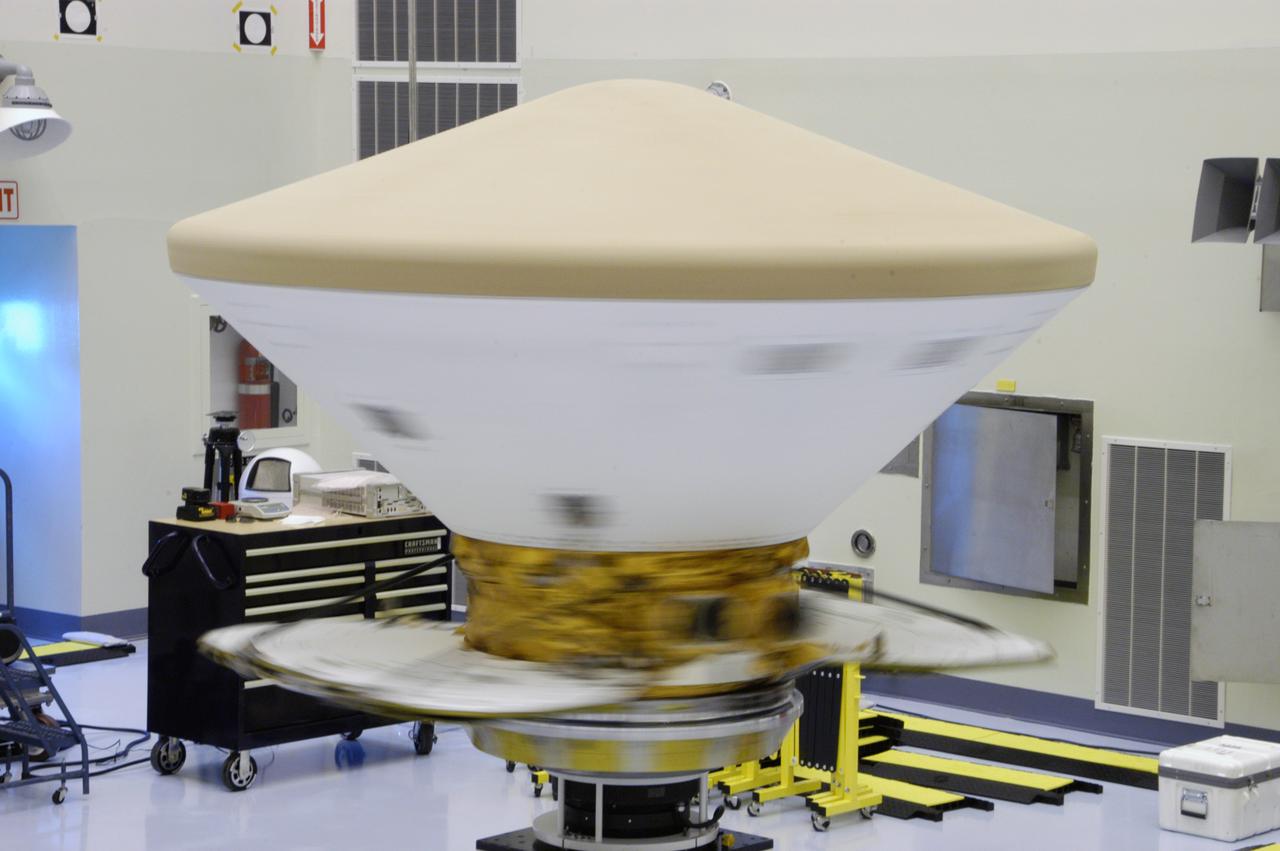
In the Payload Hazardous Servicing Facility, the Phoenix Mars Lander spacecraft undergoes spin testing. The Phoenix mission is the first project in NASA's first openly competed program of Mars Scout missions. Phoenix will land in icy soils near the north polar permanent ice cap of Mars and explore the history of the water in these soils and any associated rocks, while monitoring polar climate. Landing is planned in May 2008 on arctic ground where a mission currently in orbit, Mars Odyssey, has detected high concentrations of ice just beneath the top layer of soil. It will serve as NASA's first exploration of a potential modern habitat on Mars and open the door to a renewed search for carbon-bearing compounds, last attempted with NASA's Viking missions in the 1970s. A stereo color camera and a weather station will study the surrounding environment while the other instruments check excavated soil samples for water, organic chemicals and conditions that could indicate whether the site was ever hospitable to life. Microscopes can reveal features as small as one one-thousandth the width of a human hair. Launch of Phoenix aboard a Delta II rocket is targeted for Aug. 3 from Cape Canaveral Air Force Station in Florida.
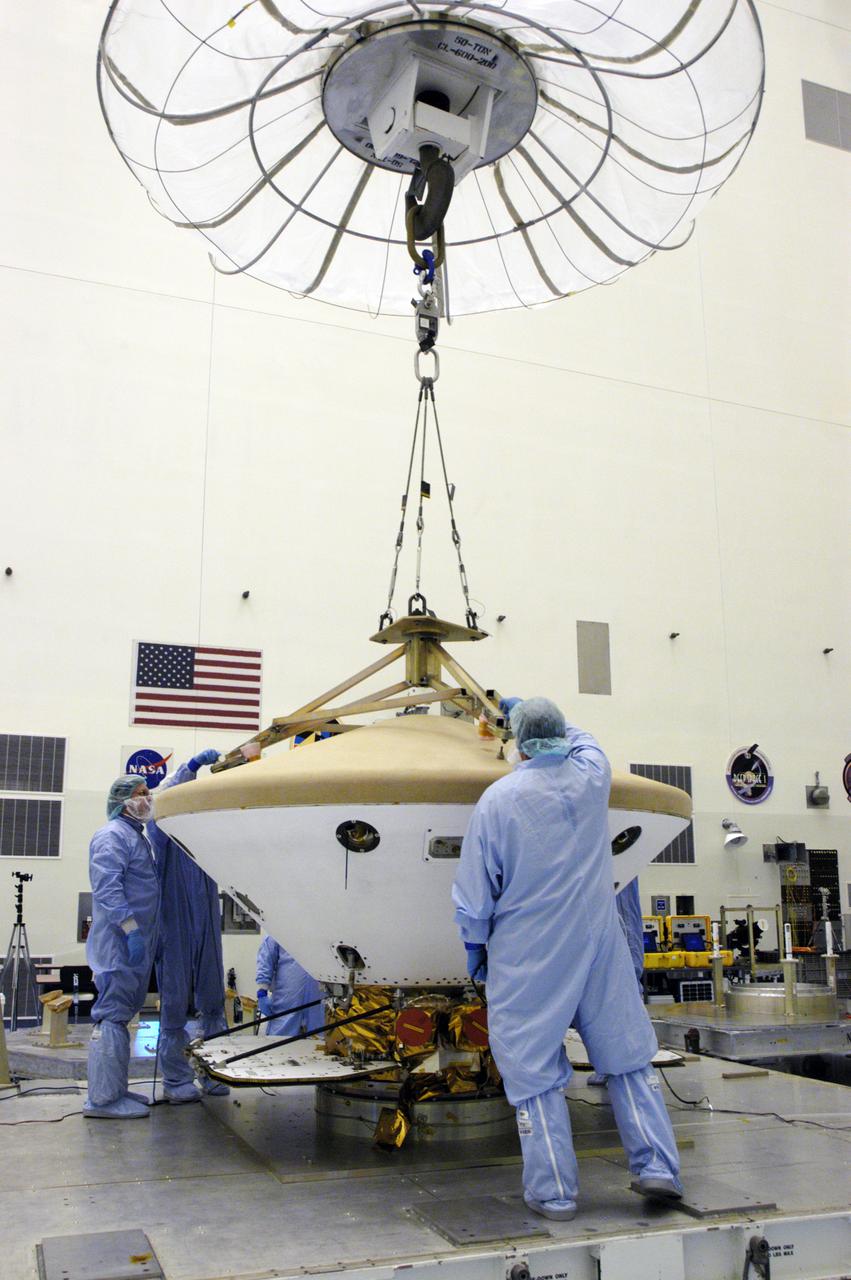
In the Payload Hazardous Servicing Facility, technicians attach a crane to the Phoenix Mars Lander spacecraft. The crane will be used to remove the heat shield from around the Phoenix. The Phoenix mission is the first project in NASA's first openly competed program of Mars Scout missions. Phoenix will land in icy soils near the north polar permanent ice cap of Mars and explore the history of the water in these soils and any associated rocks, while monitoring polar climate. Landing is planned in May 2008 on arctic ground where a mission currently in orbit, Mars Odyssey, has detected high concentrations of ice just beneath the top layer of soil. It will serve as NASA's first exploration of a potential modern habitat on Mars and open the door to a renewed search for carbon-bearing compounds, last attempted with NASA’s Viking missions in the 1970s. A stereo color camera and a weather station will study the surrounding environment while the other instruments check excavated soil samples for water, organic chemicals and conditions that could indicate whether the site was ever hospitable to life. Microscopes can reveal features as small as one one-thousandth the width of a human hair. Launch of Phoenix aboard a Delta II rocket is targeted for Aug. 3 from Cape Canaveral Air Force Station in Florida.
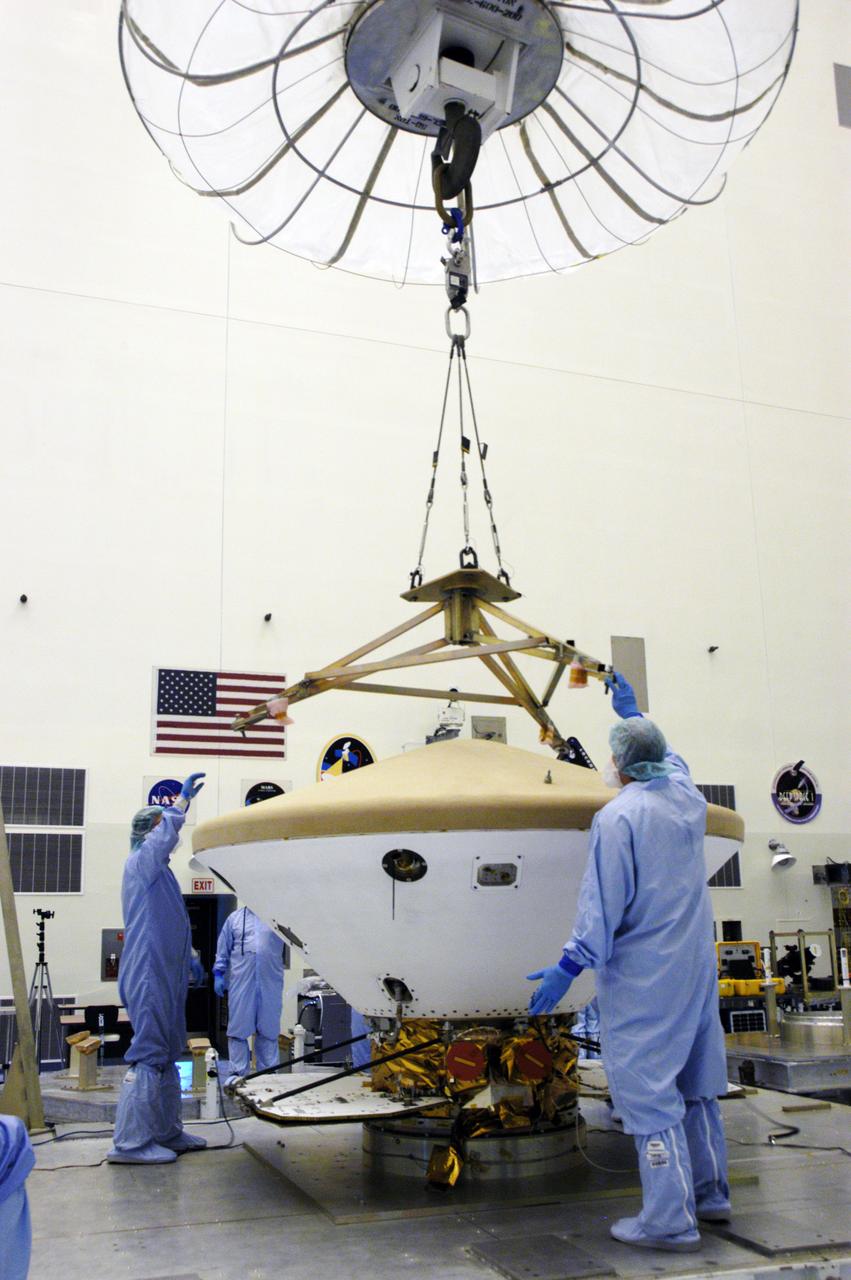
In the Payload Hazardous Servicing Facility, technicians lower a crane over the Phoenix Mars Lander spacecraft. The crane will be used to remove the heat shield from around the Phoenix. The Phoenix mission is the first project in NASA's first openly competed program of Mars Scout missions. Phoenix will land in icy soils near the north polar permanent ice cap of Mars and explore the history of the water in these soils and any associated rocks, while monitoring polar climate. Landing is planned in May 2008 on arctic ground where a mission currently in orbit, Mars Odyssey, has detected high concentrations of ice just beneath the top layer of soil. It will serve as NASA's first exploration of a potential modern habitat on Mars and open the door to a renewed search for carbon-bearing compounds, last attempted with NASA’s Viking missions in the 1970s. A stereo color camera and a weather station will study the surrounding environment while the other instruments check excavated soil samples for water, organic chemicals and conditions that could indicate whether the site was ever hospitable to life. Microscopes can reveal features as small as one one-thousandth the width of a human hair. Launch of Phoenix aboard a Delta II rocket is targeted for Aug. 3 from Cape Canaveral Air Force Station in Florida.
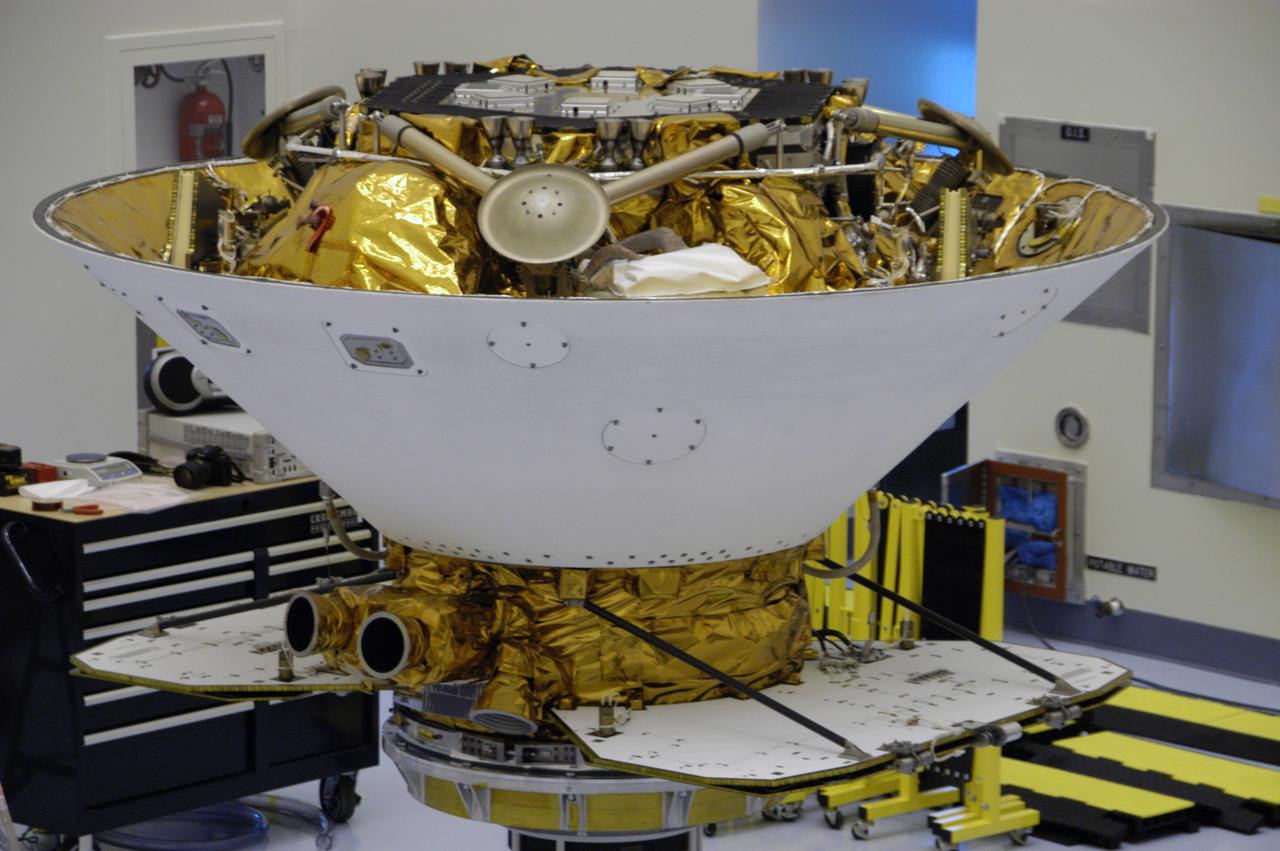
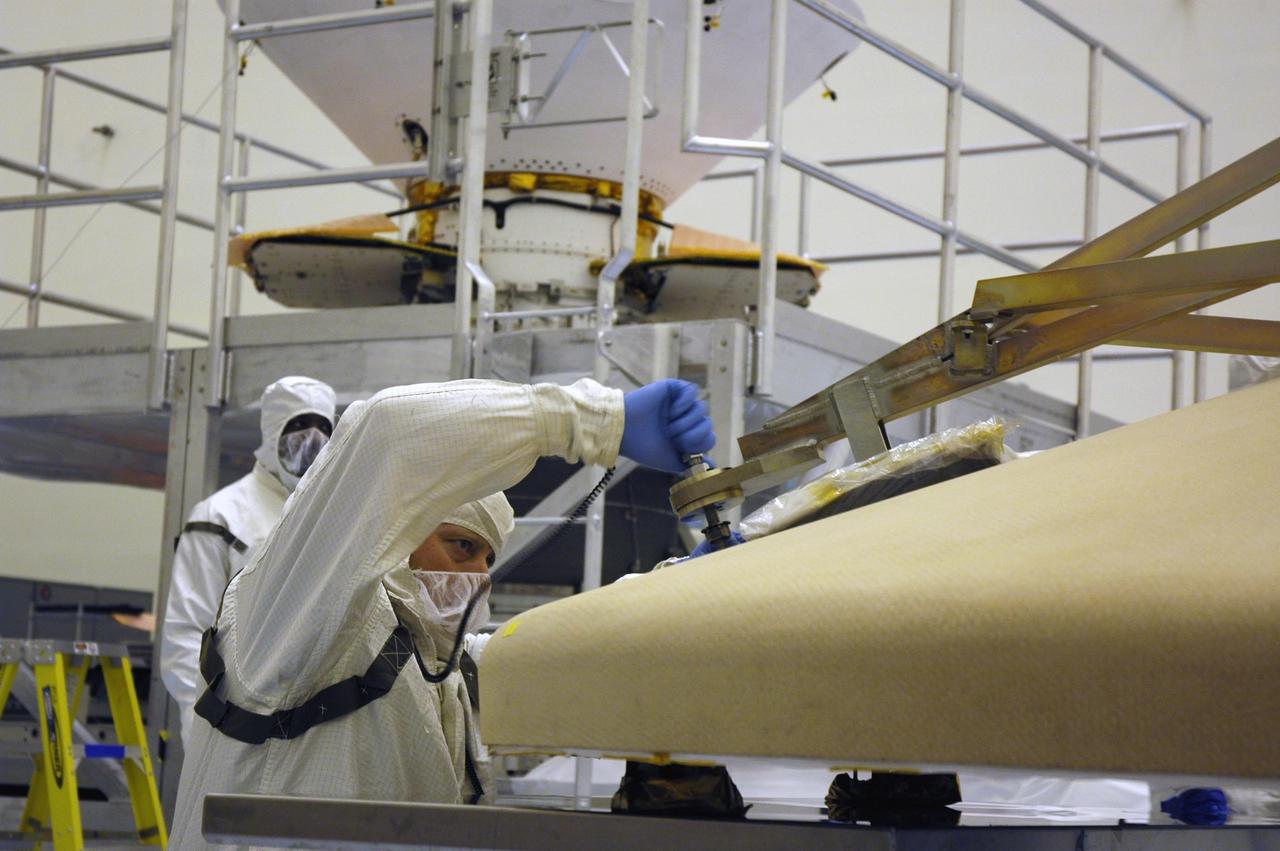
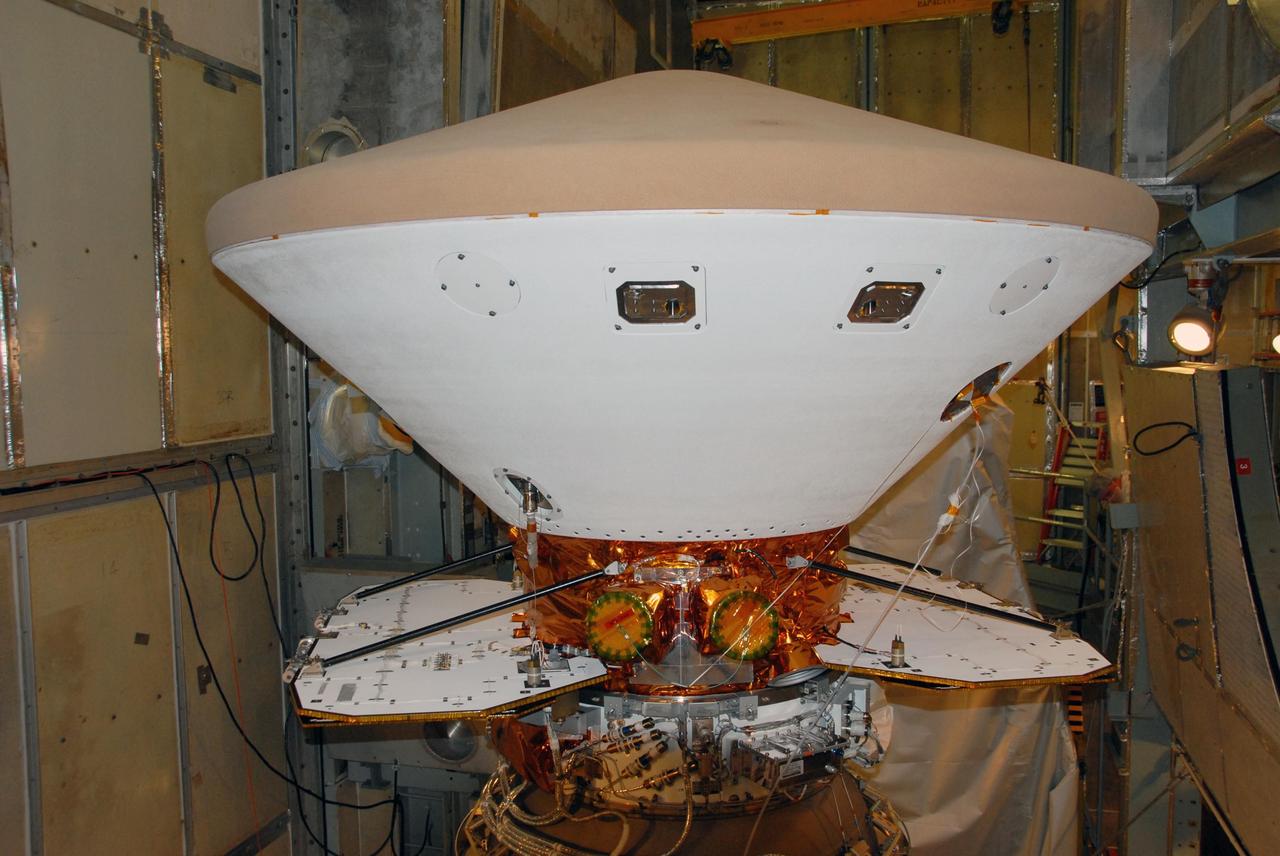
This closeup shows the Phoenix Mars Lander spacecraft nestled inside the backshell. The spacecraft is ready for spin testing on the spin table to which it is attached in the Payload Hazardous Servicing Facility. The Phoenix mission is the first project in NASA's first openly competed program of Mars Scout missions. Phoenix will land in icy soils near the north polar permanent ice cap of Mars and explore the history of the water in these soils and any associated rocks, while monitoring polar climate. Landing is planned in May 2008 on arctic ground where a mission currently in orbit, Mars Odyssey, has detected high concentrations of ice just beneath the top layer of soil. It will serve as NASA's first exploration of a potential modern habitat on Mars and open the door to a renewed search for carbon-bearing compounds, last attempted with NASA’s Viking missions in the 1970s. A stereo color camera and a weather station will study the surrounding environment while the other instruments check excavated soil samples for water, organic chemicals and conditions that could indicate whether the site was ever hospitable to life. Microscopes can reveal features as small as one one-thousandth the width of a human hair. Launch of Phoenix aboard a Delta II rocket is targeted for Aug. 3 from Cape Canaveral Air Force Station in Florida.
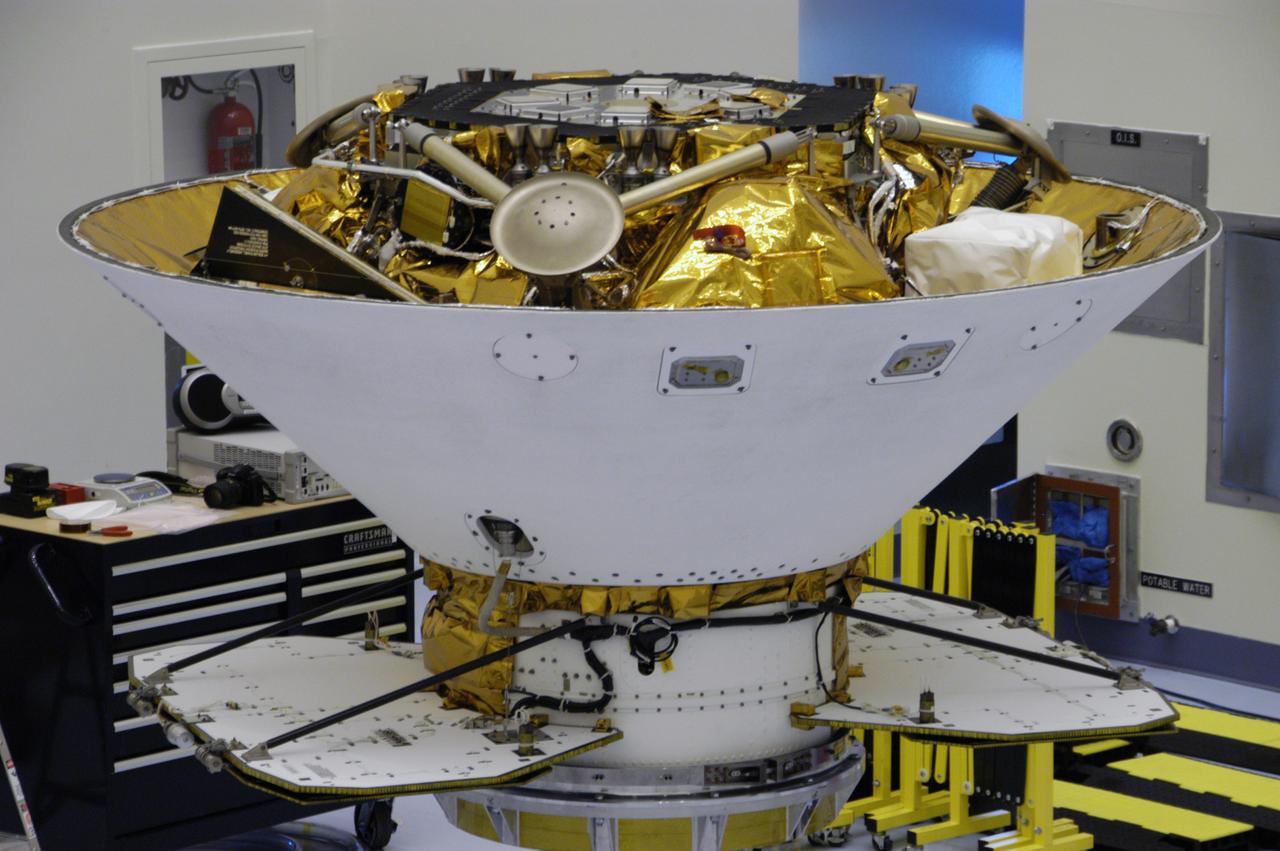
This closeup shows the Phoenix Mars Lander spacecraft nestled inside the backshell. The spacecraft will undergo spin testing on the spin table to which it is attached in the Payload Hazardous Servicing Facility. The Phoenix mission is the first project in NASA's first openly competed program of Mars Scout missions. Phoenix will land in icy soils near the north polar permanent ice cap of Mars and explore the history of the water in these soils and any associated rocks, while monitoring polar climate. Landing is planned in May 2008 on arctic ground where a mission currently in orbit, Mars Odyssey, has detected high concentrations of ice just beneath the top layer of soil. It will serve as NASA's first exploration of a potential modern habitat on Mars and open the door to a renewed search for carbon-bearing compounds, last attempted with NASA’s Viking missions in the 1970s. A stereo color camera and a weather station will study the surrounding environment while the other instruments check excavated soil samples for water, organic chemicals and conditions that could indicate whether the site was ever hospitable to life. Microscopes can reveal features as small as one one-thousandth the width of a human hair. Launch of Phoenix aboard a Delta II rocket is targeted for Aug. 3 from Cape Canaveral Air Force Station in Florida.
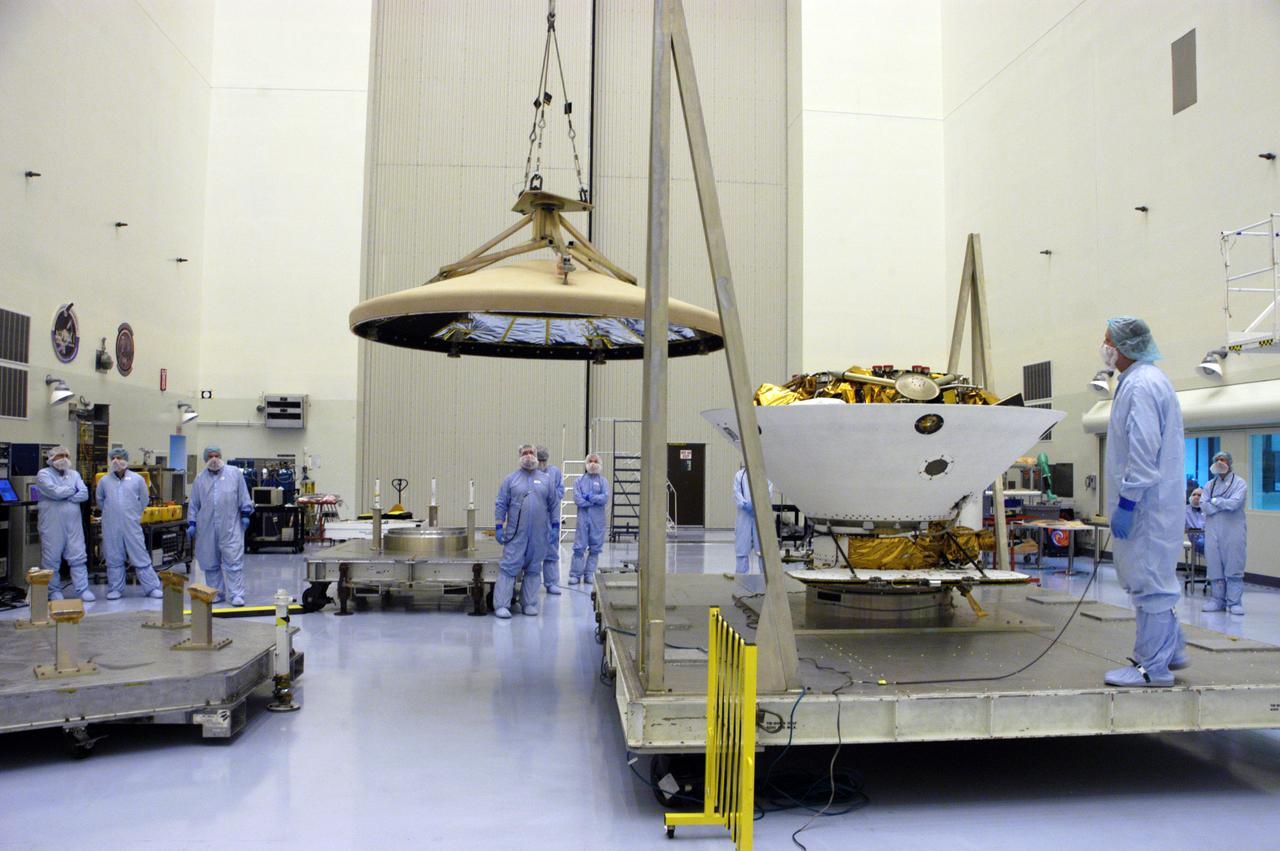
In the Payload Hazardous Servicing Facility, an overhead crane moves the heat shield toward a platform at left. The heat shield was removed from the Phoenix Mars Lander spacecraft at right. The Phoenix mission is the first project in NASA's first openly competed program of Mars Scout missions. Phoenix will land in icy soils near the north polar permanent ice cap of Mars and explore the history of the water in these soils and any associated rocks, while monitoring polar climate. Landing is planned in May 2008 on arctic ground where a mission currently in orbit, Mars Odyssey, has detected high concentrations of ice just beneath the top layer of soil. It will serve as NASA's first exploration of a potential modern habitat on Mars and open the door to a renewed search for carbon-bearing compounds, last attempted with NASA’s Viking missions in the 1970s. A stereo color camera and a weather station will study the surrounding environment while the other instruments check excavated soil samples for water, organic chemicals and conditions that could indicate whether the site was ever hospitable to life. Microscopes can reveal features as small as one one-thousandth the width of a human hair. Launch of Phoenix aboard a Delta II rocket is targeted for Aug. 3 from Cape Canaveral Air Force Station in Florida.
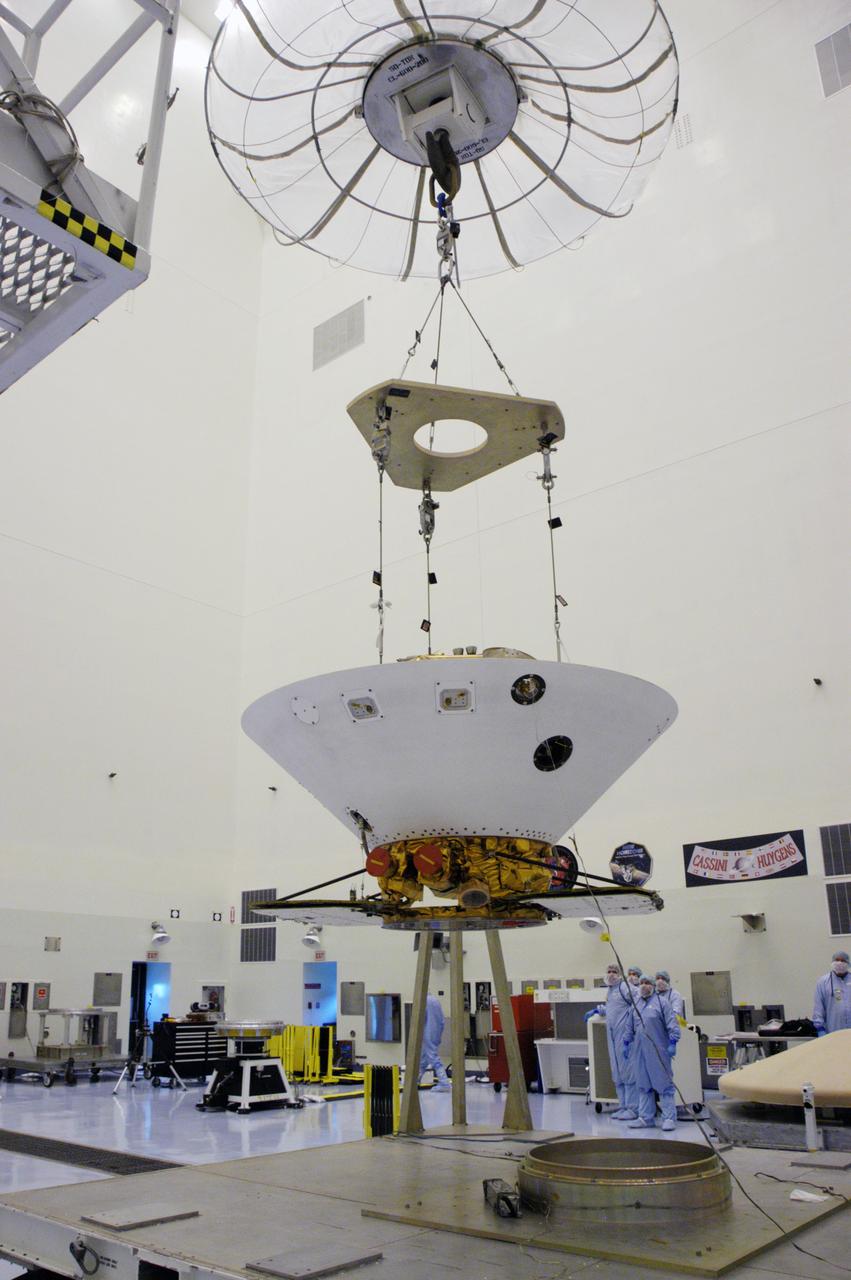
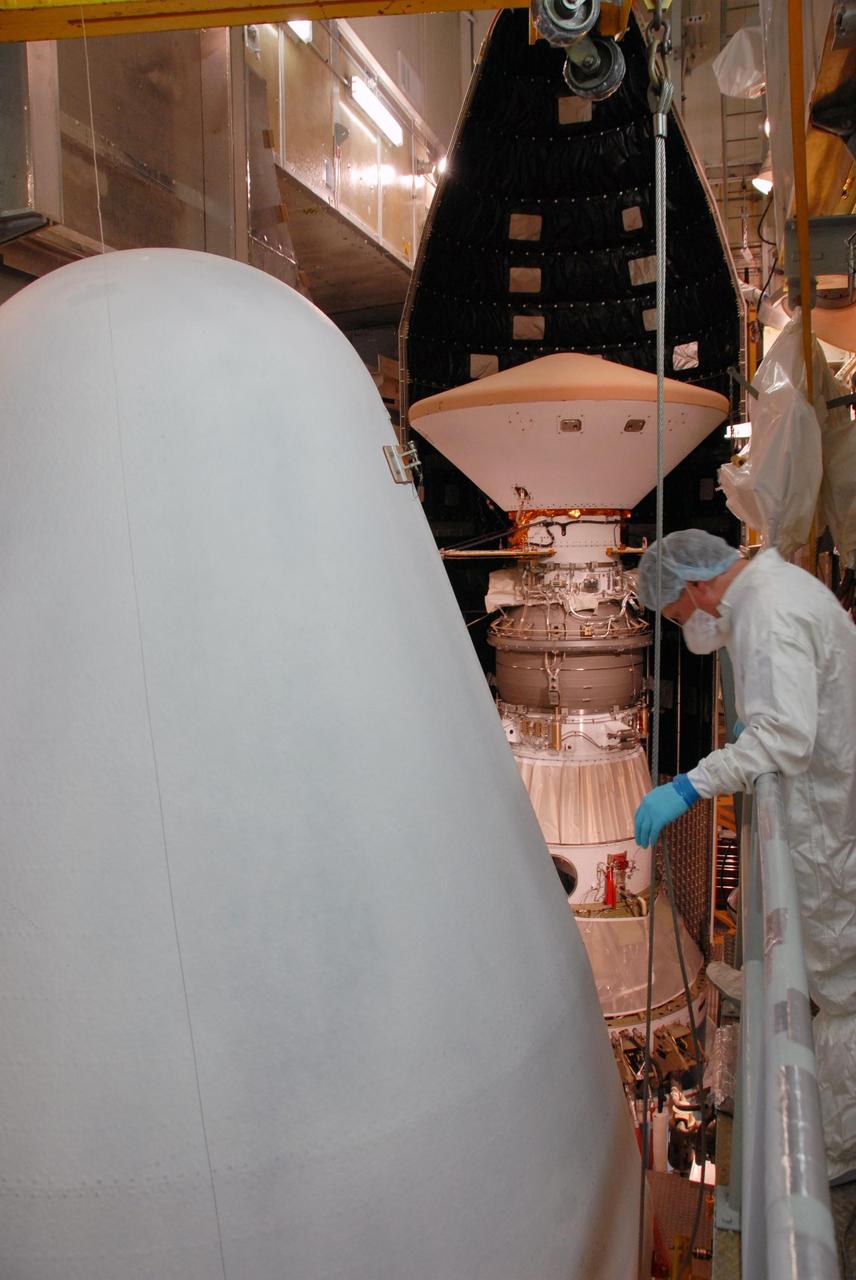
An overhead crane lifts the backshell with the Phoenix Mars Lander inside off its work stand in the Payload Hazardous Servicing Facility. The spacecraft is being moved to a spin table (back left) for spin testing. The Phoenix mission is the first project in NASA's first openly competed program of Mars Scout missions. Phoenix will land in icy soils near the north polar permanent ice cap of Mars and explore the history of the water in these soils and any associated rocks, while monitoring polar climate. Landing is planned in May 2008 on arctic ground where a mission currently in orbit, Mars Odyssey, has detected high concentrations of ice just beneath the top layer of soil. It will serve as NASA's first exploration of a potential modern habitat on Mars and open the door to a renewed search for carbon-bearing compounds, last attempted with NASA’s Viking missions in the 1970s. A stereo color camera and a weather station will study the surrounding environment while the other instruments check excavated soil samples for water, organic chemicals and conditions that could indicate whether the site was ever hospitable to life. Microscopes can reveal features as small as one one-thousandth the width of a human hair. Launch of Phoenix aboard a Delta II rocket is targeted for Aug. 3 from Cape Canaveral Air Force Station in Florida.
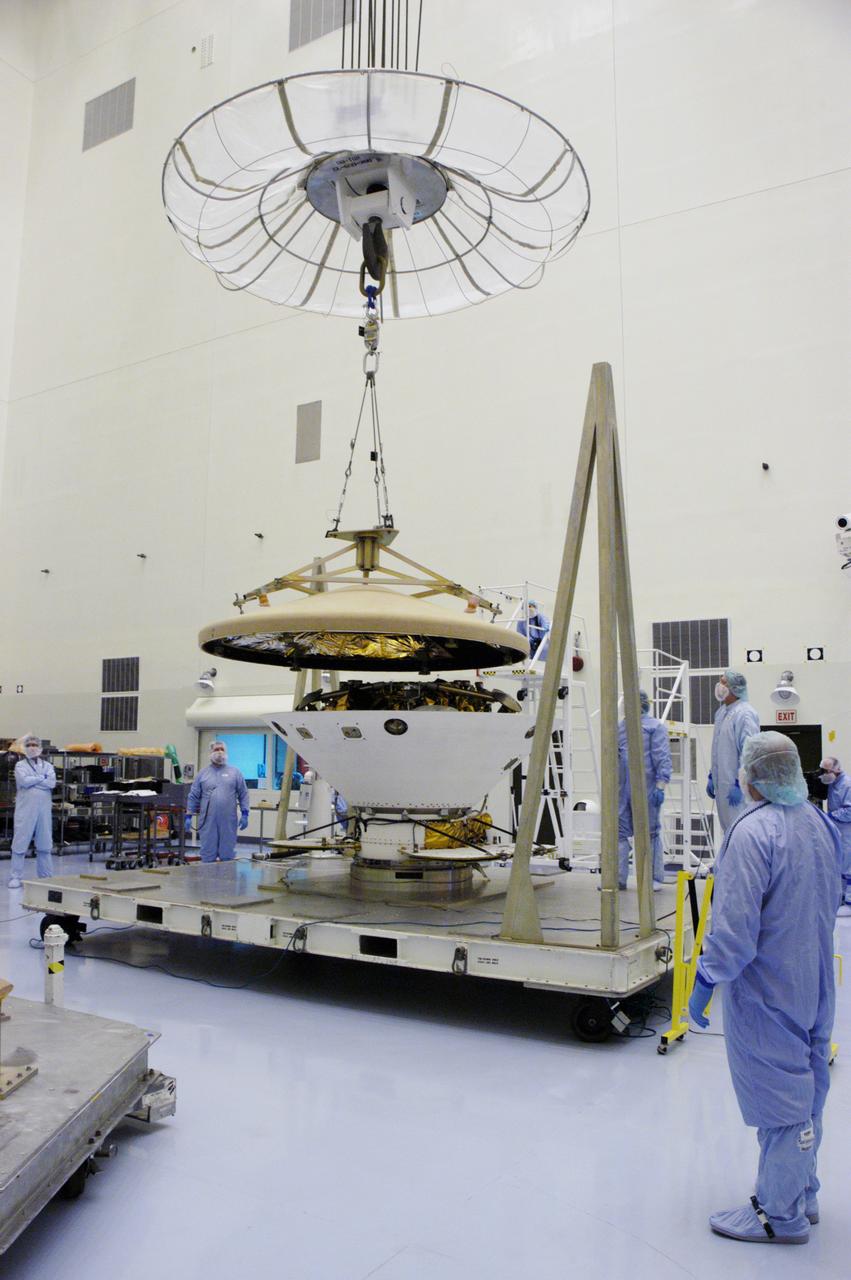
In the Payload Hazardous Servicing Facility, an overhead crane lifts the heat shield from the Phoenix Mars Lander spacecraft. The Phoenix mission is the first project in NASA's first openly competed program of Mars Scout missions. Phoenix will land in icy soils near the north polar permanent ice cap of Mars and explore the history of the water in these soils and any associated rocks, while monitoring polar climate. Landing is planned in May 2008 on arctic ground where a mission currently in orbit, Mars Odyssey, has detected high concentrations of ice just beneath the top layer of soil. It will serve as NASA's first exploration of a potential modern habitat on Mars and open the door to a renewed search for carbon-bearing compounds, last attempted with NASA’s Viking missions in the 1970s. A stereo color camera and a weather station will study the surrounding environment while the other instruments check excavated soil samples for water, organic chemicals and conditions that could indicate whether the site was ever hospitable to life. Microscopes can reveal features as small as one one-thousandth the width of a human hair. Launch of Phoenix aboard a Delta II rocket is targeted for Aug. 3 from Cape Canaveral Air Force Station in Florida.
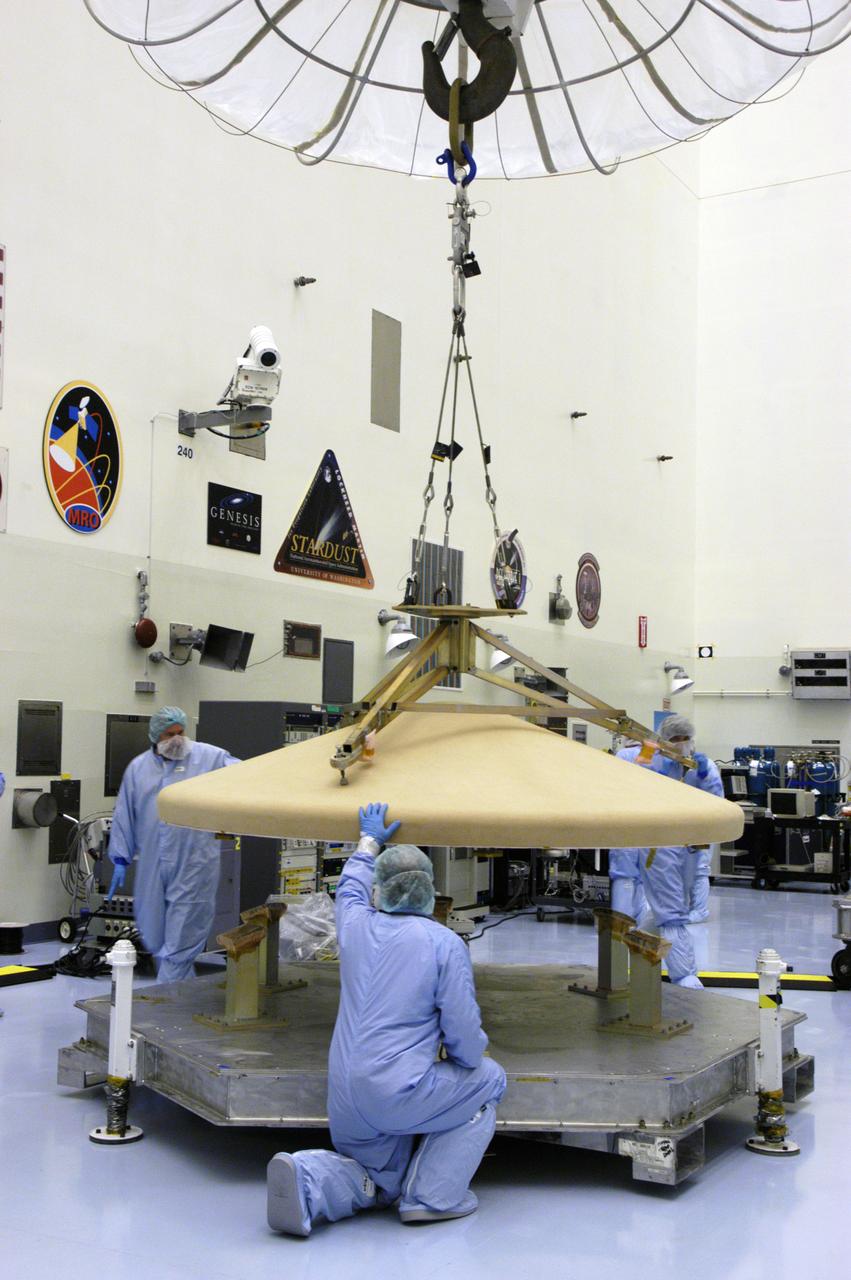
In the Payload Hazardous Servicing Facility, workers help guide the heat shield onto a platform. The heat shield was removed from the Phoenix Mars Lander spacecraft.. The Phoenix mission is the first project in NASA's first openly competed program of Mars Scout missions. Phoenix will land in icy soils near the north polar permanent ice cap of Mars and explore the history of the water in these soils and any associated rocks, while monitoring polar climate. Landing is planned in May 2008 on arctic ground where a mission currently in orbit, Mars Odyssey, has detected high concentrations of ice just beneath the top layer of soil. It will serve as NASA's first exploration of a potential modern habitat on Mars and open the door to a renewed search for carbon-bearing compounds, last attempted with NASA’s Viking missions in the 1970s. A stereo color camera and a weather station will study the surrounding environment while the other instruments check excavated soil samples for water, organic chemicals and conditions that could indicate whether the site was ever hospitable to life. Microscopes can reveal features as small as one one-thousandth the width of a human hair. Launch of Phoenix aboard a Delta II rocket is targeted for Aug. 3 from Cape Canaveral Air Force Station in Florida.
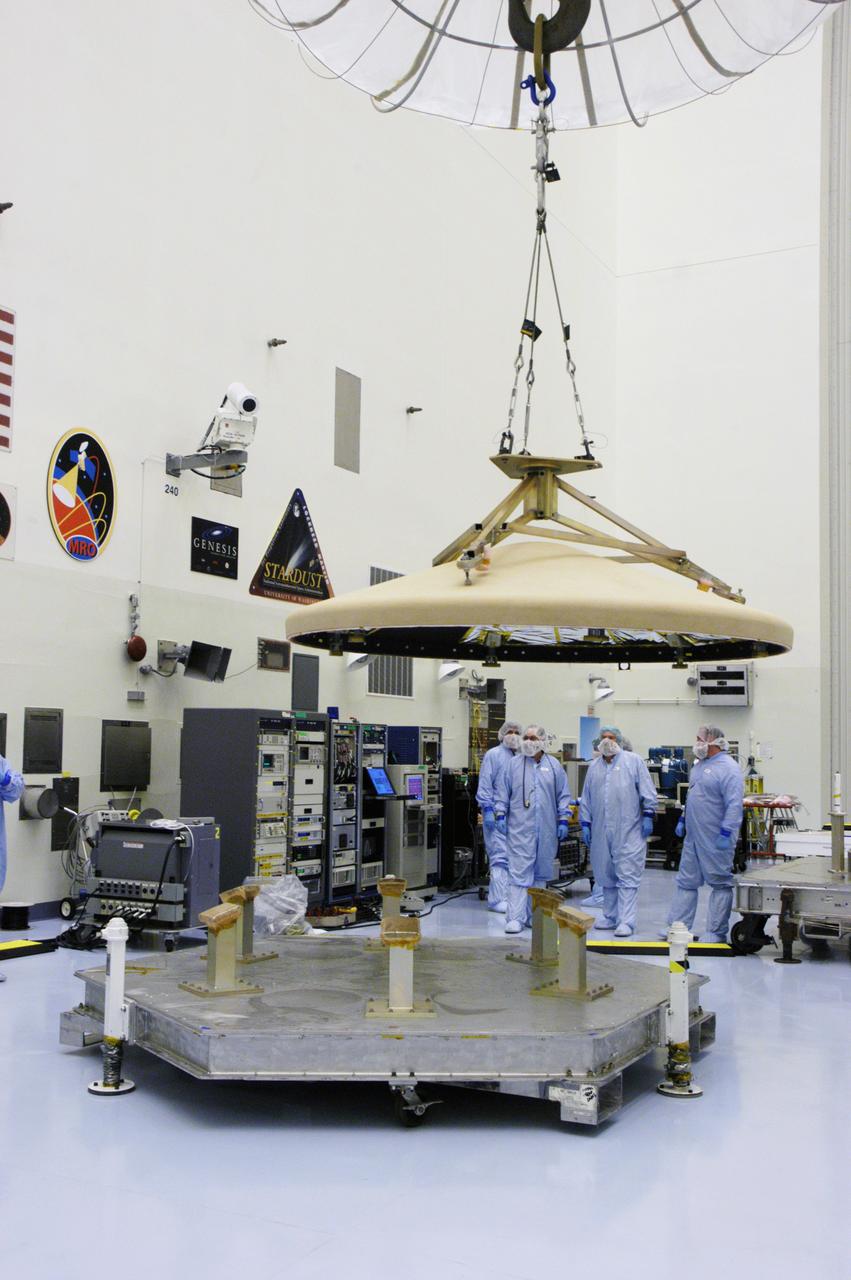
In the Payload Hazardous Servicing Facility, workers watch as an overhead crane lowers the heat shield toward a platform. The heat shield was removed from the Phoenix Mars Lander spacecraft. The Phoenix mission is the first project in NASA's first openly competed program of Mars Scout missions. Phoenix will land in icy soils near the north polar permanent ice cap of Mars and explore the history of the water in these soils and any associated rocks, while monitoring polar climate. Landing is planned in May 2008 on arctic ground where a mission currently in orbit, Mars Odyssey, has detected high concentrations of ice just beneath the top layer of soil. It will serve as NASA's first exploration of a potential modern habitat on Mars and open the door to a renewed search for carbon-bearing compounds, last attempted with NASA’s Viking missions in the 1970s. A stereo color camera and a weather station will study the surrounding environment while the other instruments check excavated soil samples for water, organic chemicals and conditions that could indicate whether the site was ever hospitable to life. Microscopes can reveal features as small as one one-thousandth the width of a human hair. Launch of Phoenix aboard a Delta II rocket is targeted for Aug. 3 from Cape Canaveral Air Force Station in Florida.
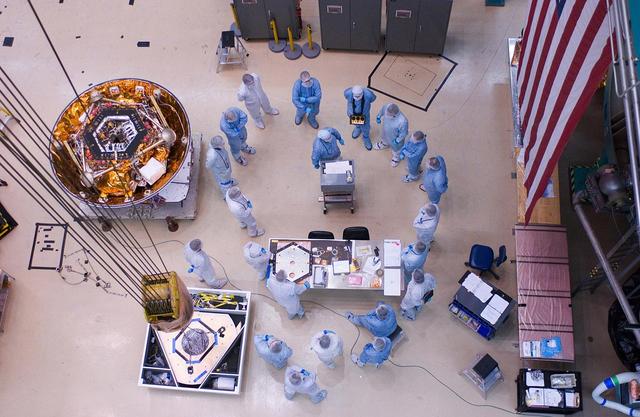
Spacecraft specialists huddle to discuss the critical lift of NASA Phoenix Mars Lander into a thermal vacuum chamber
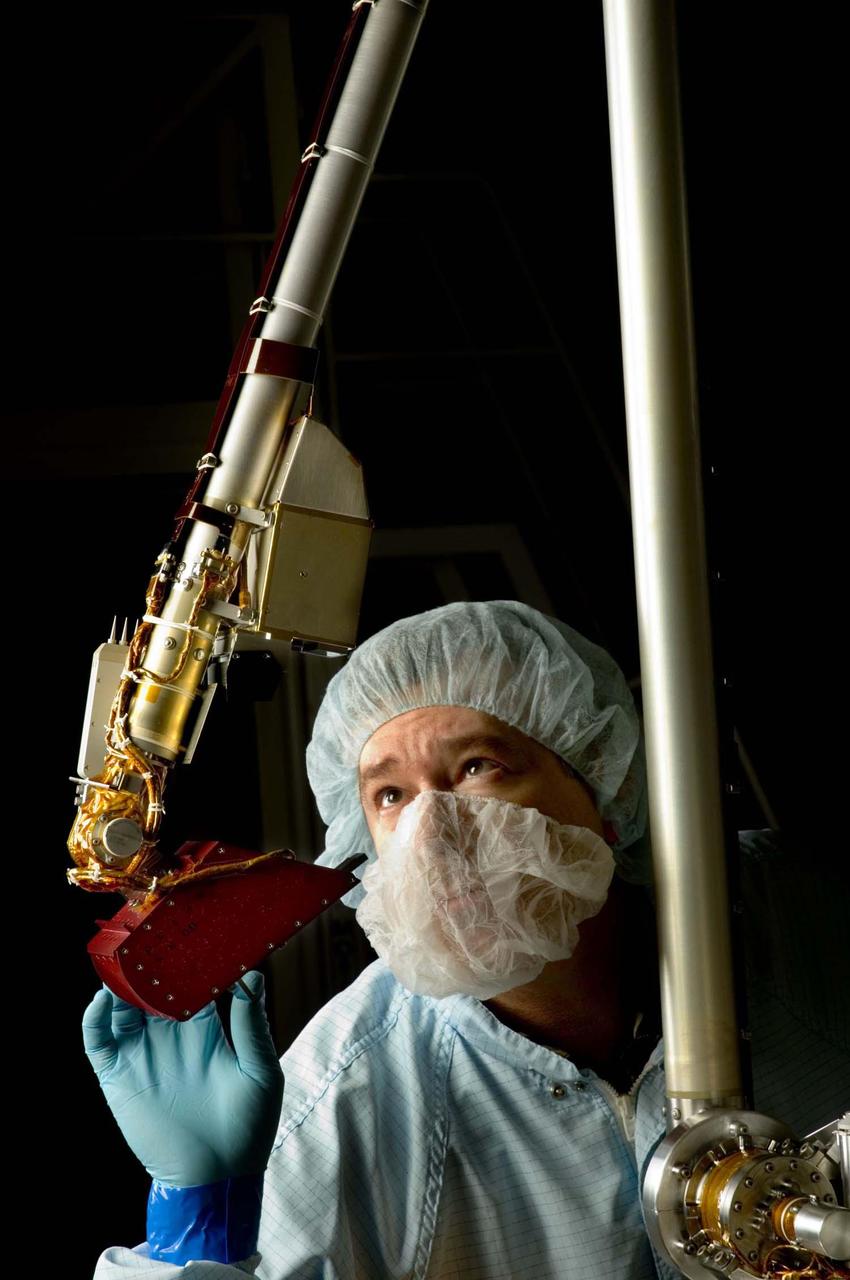
A spacecraft technician inspected the vital robotic arm of NASA Phoenix Mars Lander during the assembly phase of the mission
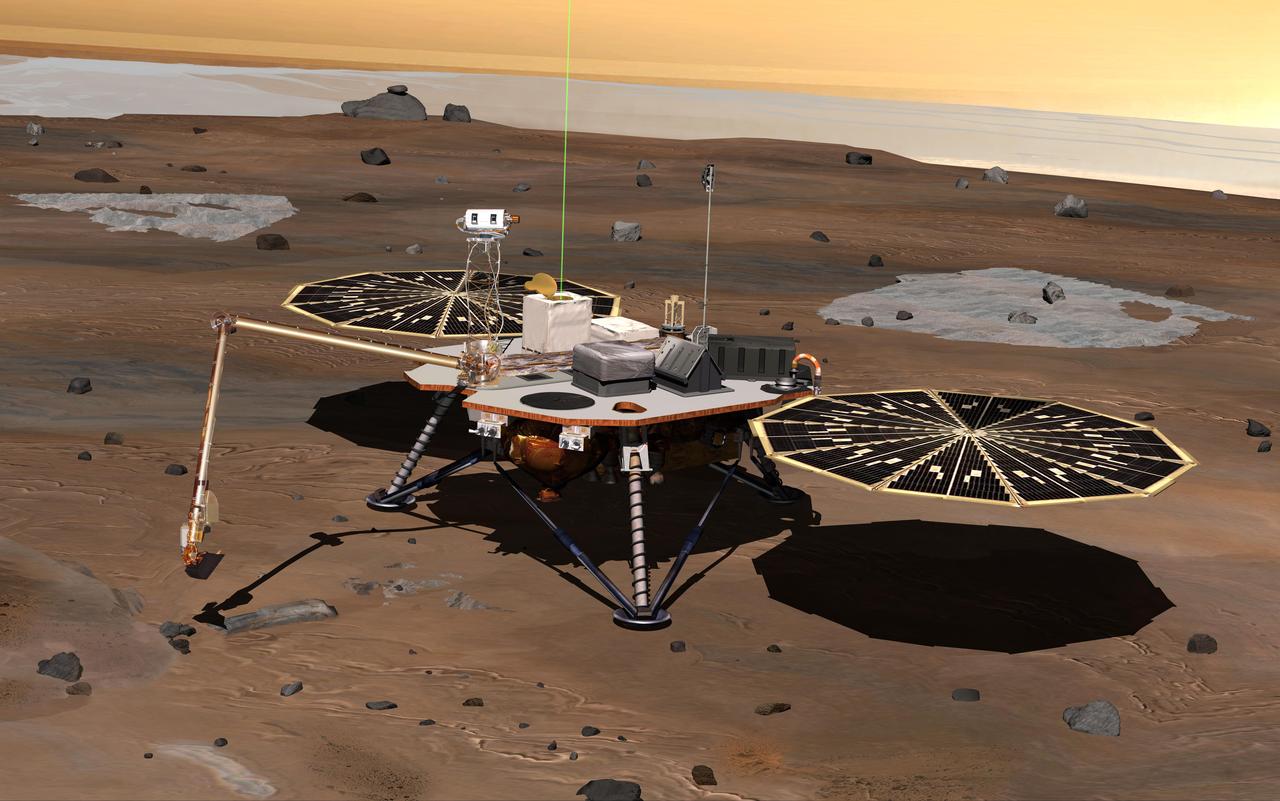
NASA Phoenix Mars Lander monitors the atmosphere overhead and reaches out to the soil below in this artist depiction of the spacecraft fully deployed on the surface of Mars.
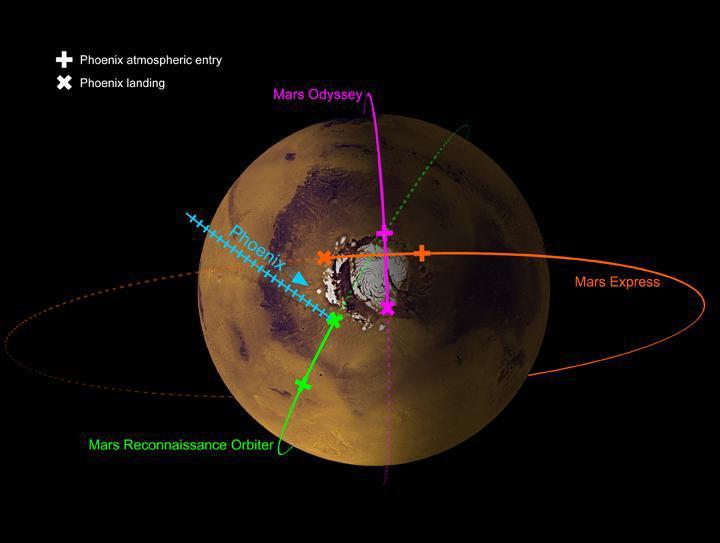
This image shows the paths of three spacecraft currently in orbit around Mars, as well as the path by which NASA Phoenix Mars Lander will approach and land on the planet.
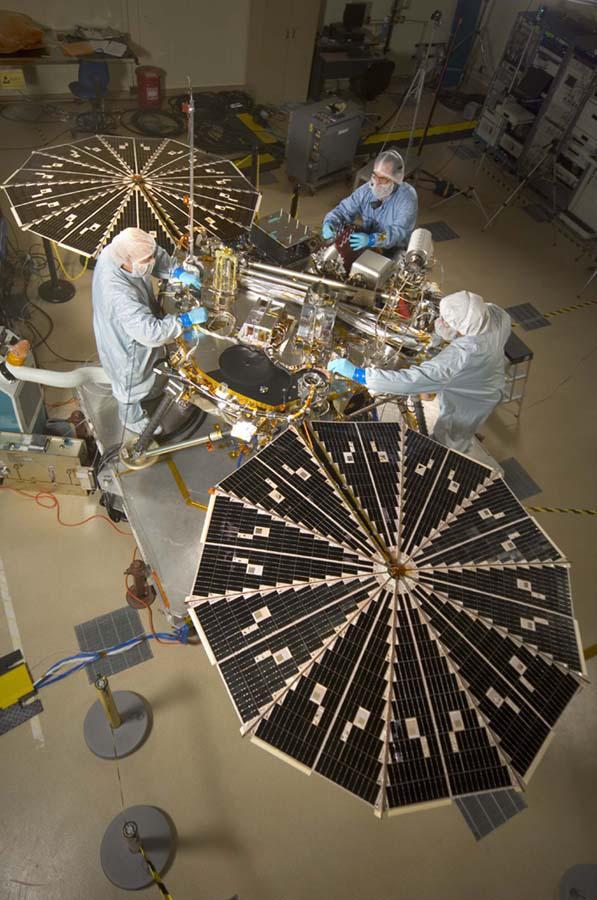
NASA next Mars-bound spacecraft, the Phoenix Mars Lander, partway through assembly and testing at Lockheed Martin Space Systems, Denver, in September 2006.
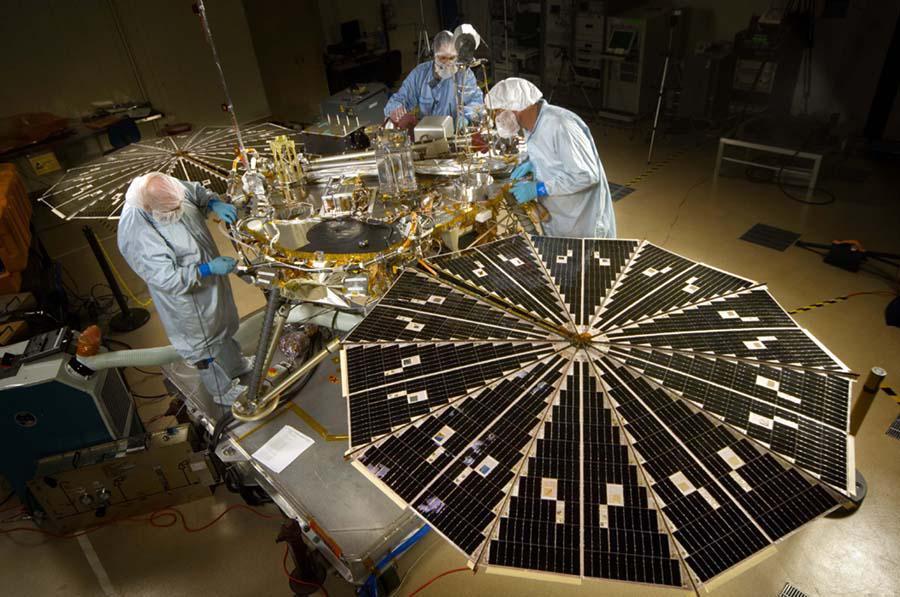
NASA next Mars-bound spacecraft, the Phoenix Mars Lander, partway through assembly and testing at Lockheed Martin Space Systems, Denver, in September 2006.
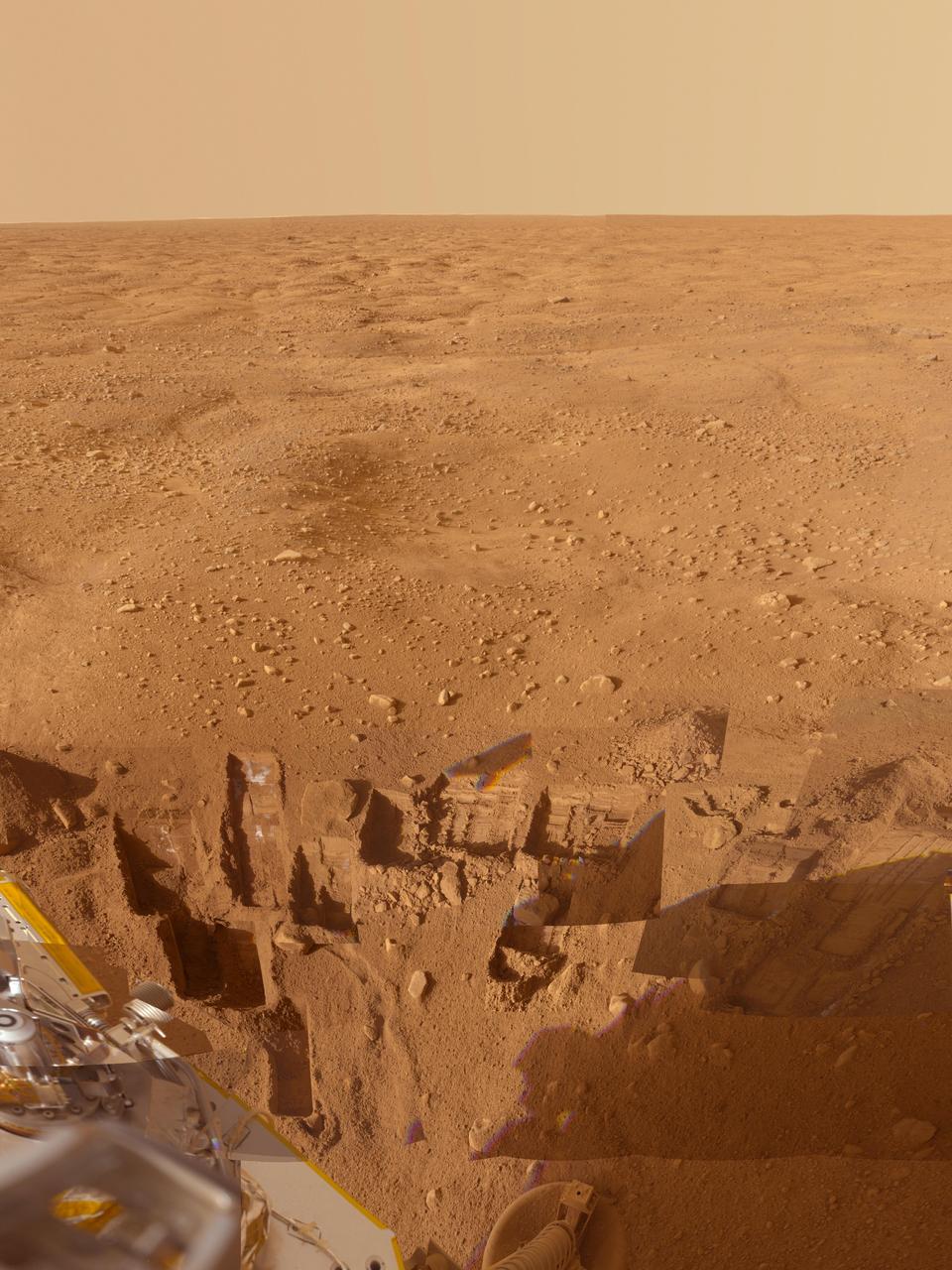
This mosaic of images from the Surface Stereo Imager camera on NASA Phoenix Mars Lander shows several trenches dug by Phoenix, plus a corner of the spacecraft deck and the Martian arctic plain stretching to the horizon.
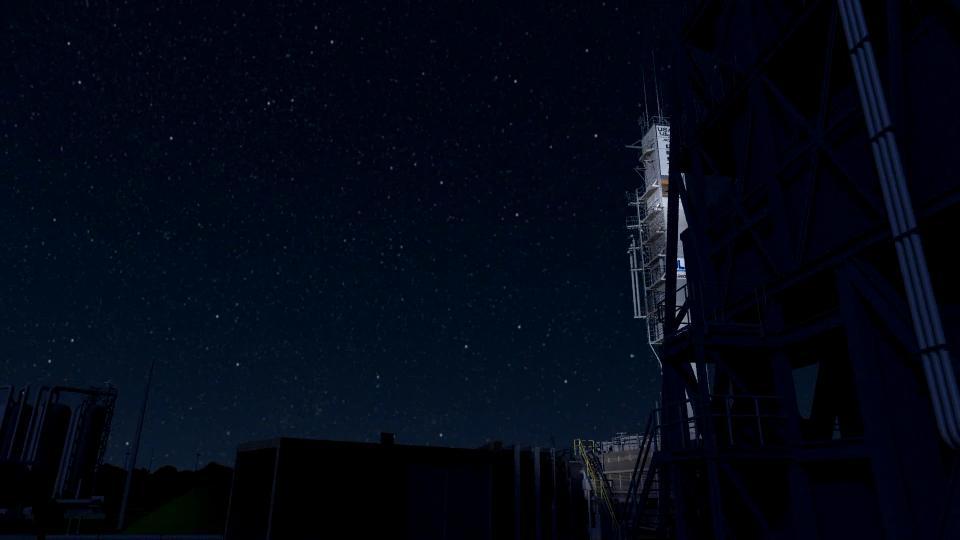
A camera view zooms in from NASA Phoenix Mars Lander launch site all the way to Phoenix Microscopy and Electrochemistry and Conductivity Analyzer MECA aboard the spacecraft on the Martian surface.
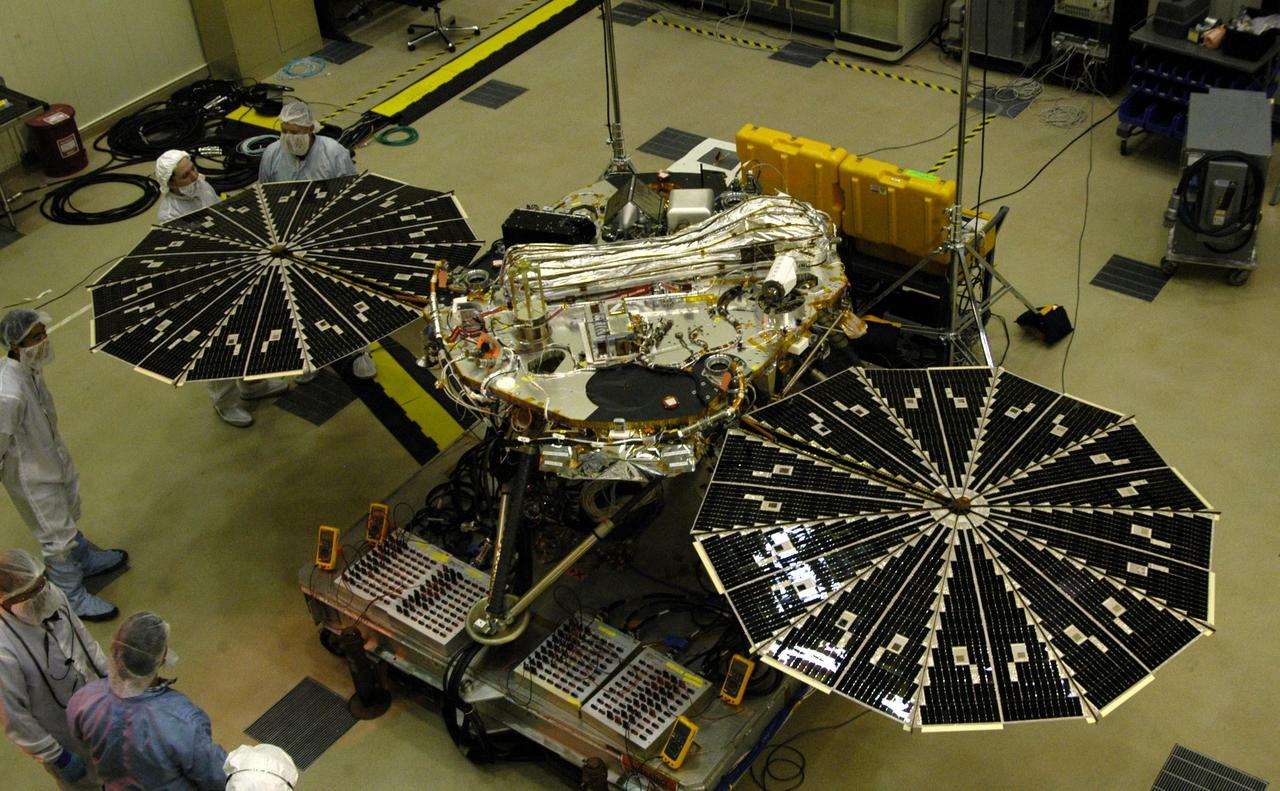
In this photograph of NASA Phoenix Mars Lander, the spacecraft specialists worked on the lander after its fan-like circular solar arrays had been spread open for testing.
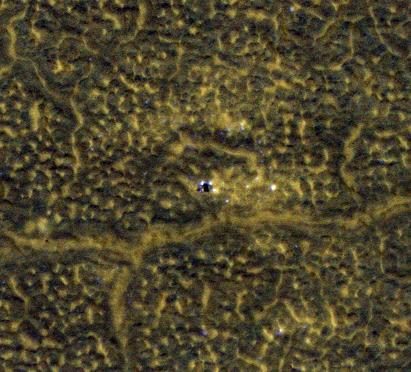
This image, taken Jan. 26, 2012, shows NASA no-longer-active Phoenix Mars Lander spacecraft after its second Martian arctic winter.
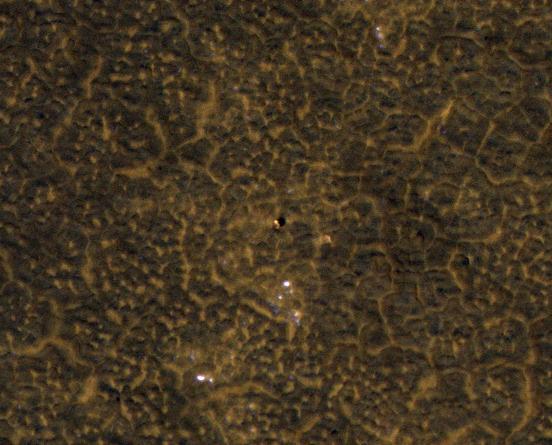
This image, taken Jan. 26, 2012, shows the back shell of NASA Phoenix Mars Lander spacecraft after its second Martian arctic winter.
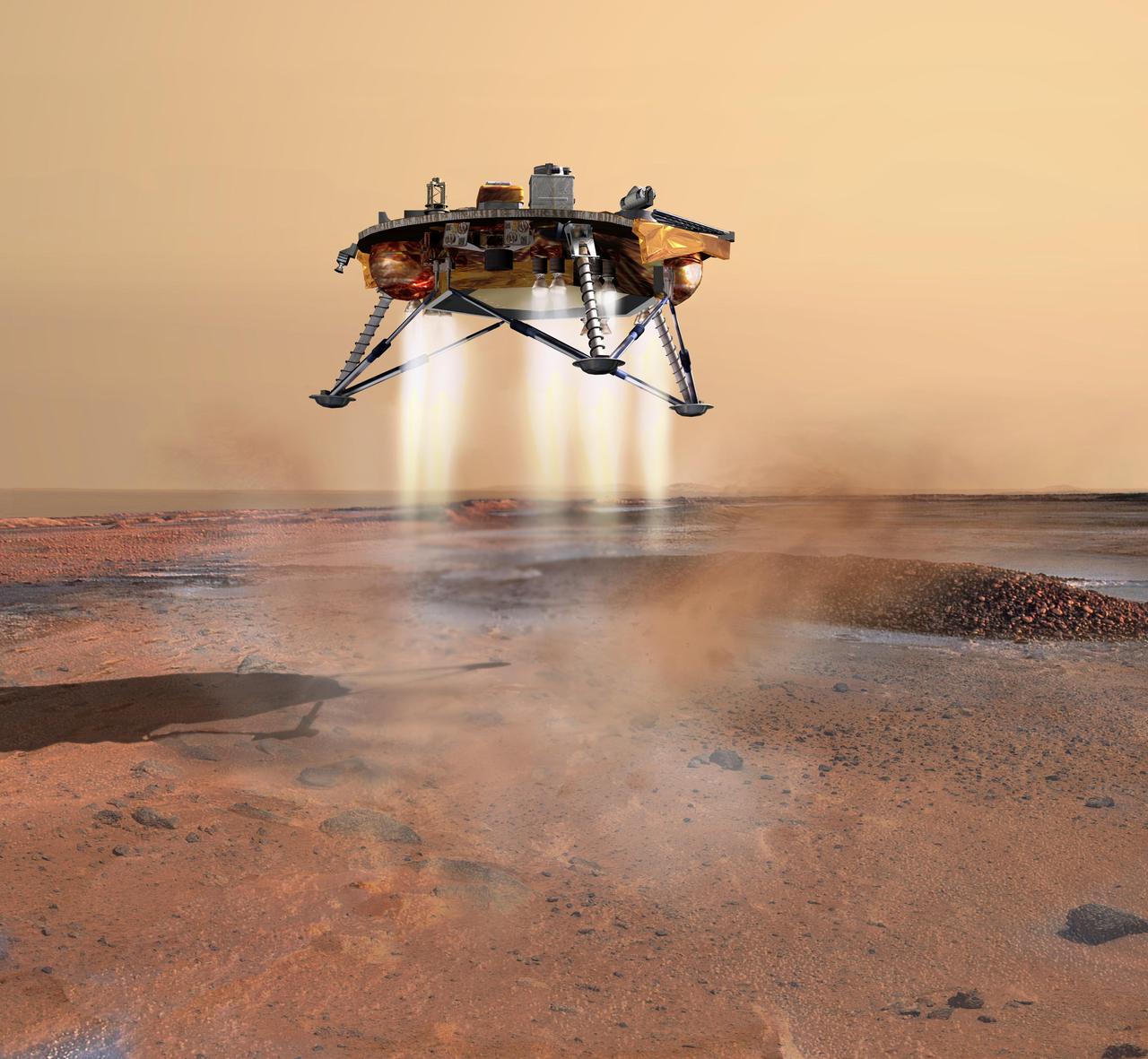
This artist concept depicts NASA Phoenix Mars Lander a moment before its 2008 touchdown on the arctic plains of Mars. Pulsed rocket engines control the spacecraft speed during the final seconds of descent.
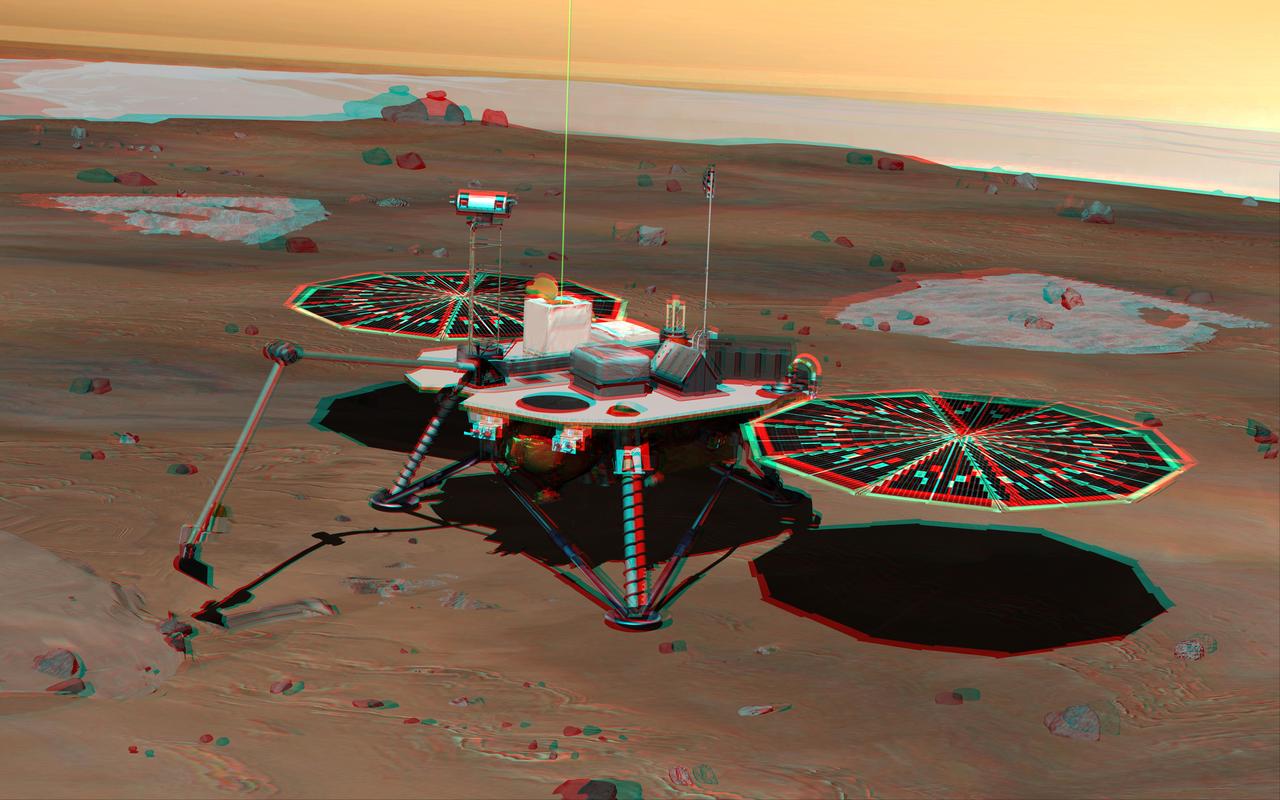
NASA Phoenix Mars Lander monitors the atmosphere overhead and reaches out to the soil below in this stereo illustration of the spacecraft fully deployed on the surface of Mars. 3D glasses are necessary to view this image.

This chart plots the minimum daily atmospheric temperature measured by NASA Phoenix Mars Lander spacecraft since landing on Mars. As the temperature increased through the summer season, the atmospheric humidity also increased.
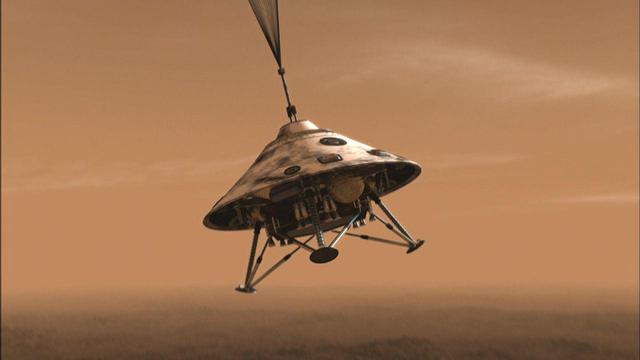
During the first 25 seconds after NASA Phoenix Mars Lander deploys its parachute, the spacecraft will jettison its heat shield and extend its three legs.
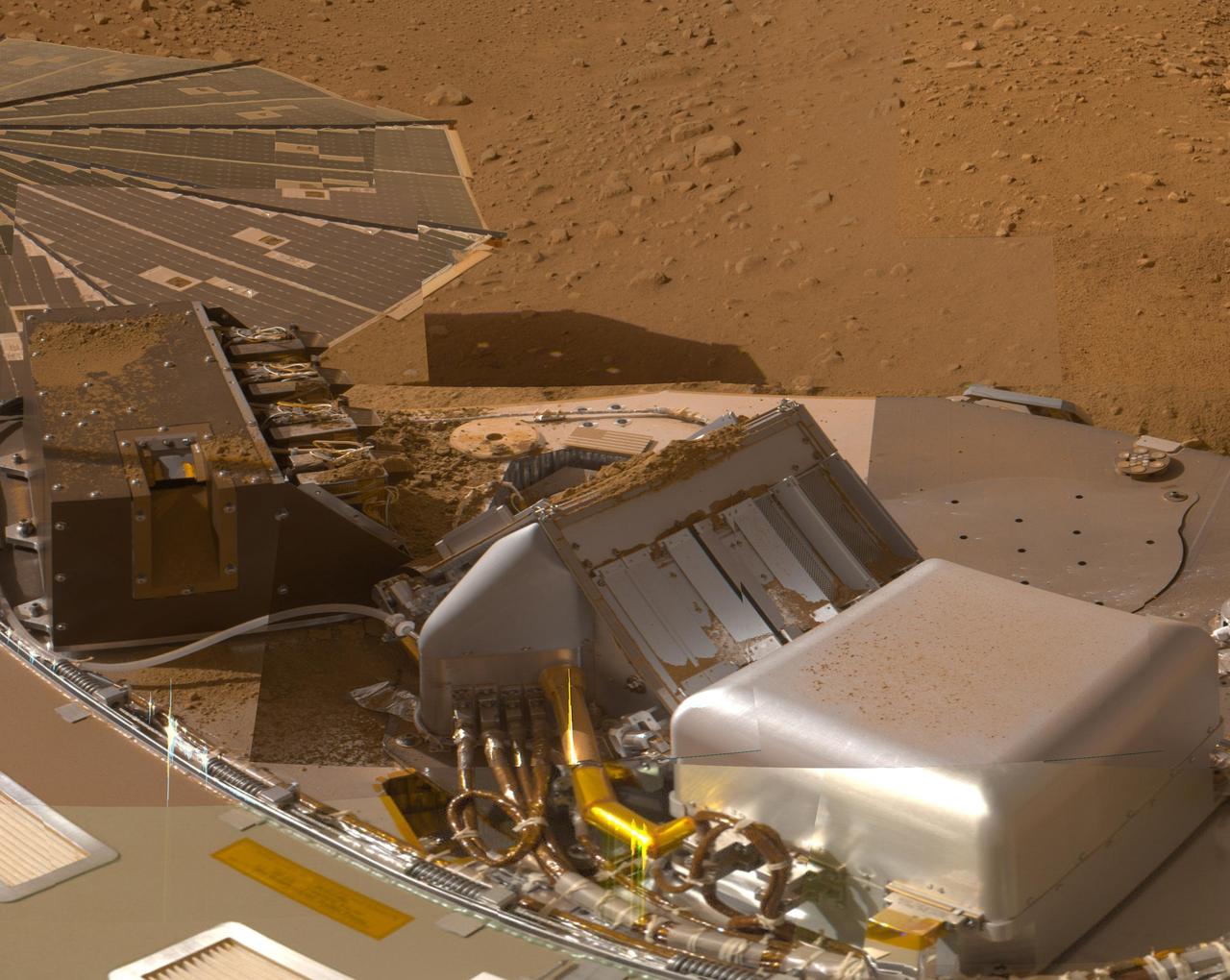
This mosaic of images from the Surface Stereo Imager camera on NASA Phoenix Mars Lander shows a portion of the spacecraft deck after deliveries of several Martian soil samples to instruments on the deck.
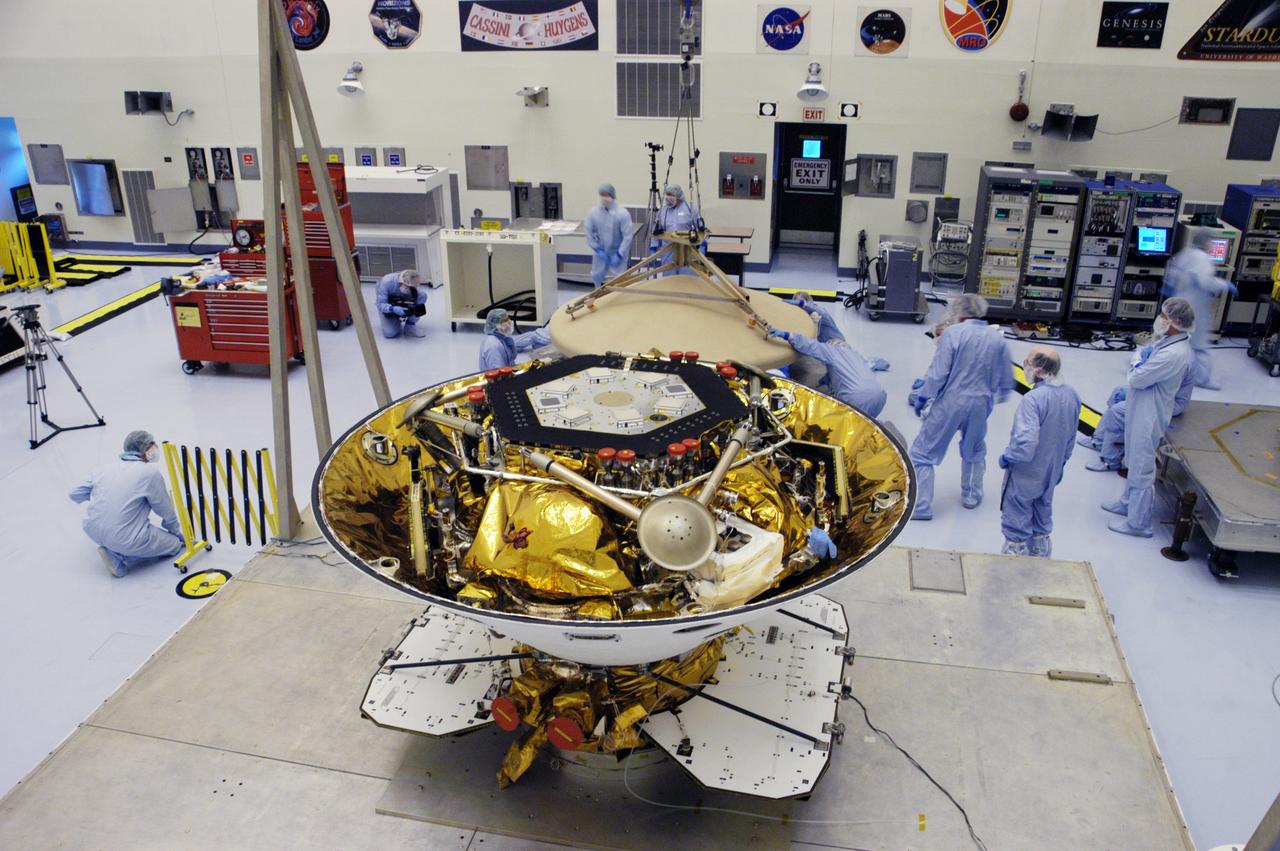
In the Payload Hazardous Servicing Facility, the Phoenix Mars Lander (foreground) can be seen inside the backshell. In the background, workers are helping place the heat shield, just removed from the Phoenix, onto a platform. The Phoenix mission is the first project in NASA's first openly competed program of Mars Scout missions. Phoenix will land in icy soils near the north polar permanent ice cap of Mars and explore the history of the water in these soils and any associated rocks, while monitoring polar climate. Landing is planned in May 2008 on arctic ground where a mission currently in orbit, Mars Odyssey, has detected high concentrations of ice just beneath the top layer of soil. It will serve as NASA's first exploration of a potential modern habitat on Mars and open the door to a renewed search for carbon-bearing compounds, last attempted with NASA’s Viking missions in the 1970s. A stereo color camera and a weather station will study the surrounding environment while the other instruments check excavated soil samples for water, organic chemicals and conditions that could indicate whether the site was ever hospitable to life. Microscopes can reveal features as small as one one-thousandth the width of a human hair. Launch of Phoenix aboard a Delta II rocket is targeted for Aug. 3 from Cape Canaveral Air Force Station in Florida.
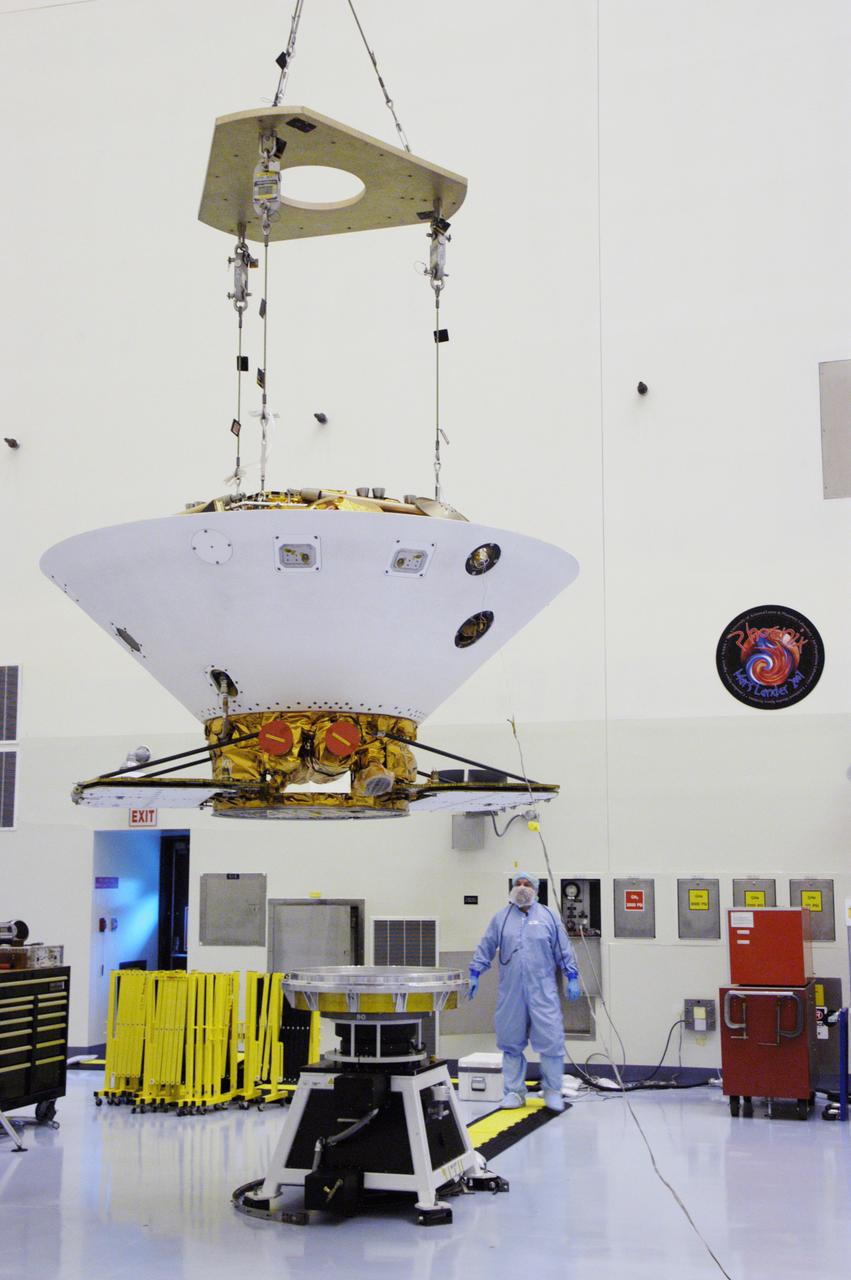
An overhead crane lowers the backshell with the Phoenix Mars Lander inside toward a spin table for spin testing in the Payload Hazardous Servicing Facility. The Phoenix mission is the first project in NASA's first openly competed program of Mars Scout missions. Phoenix will land in icy soils near the north polar permanent ice cap of Mars and explore the history of the water in these soils and any associated rocks, while monitoring polar climate. Landing is planned in May 2008 on arctic ground where a mission currently in orbit, Mars Odyssey, has detected high concentrations of ice just beneath the top layer of soil. It will serve as NASA's first exploration of a potential modern habitat on Mars and open the door to a renewed search for carbon-bearing compounds, last attempted with NASA’s Viking missions in the 1970s. A stereo color camera and a weather station will study the surrounding environment while the other instruments check excavated soil samples for water, organic chemicals and conditions that could indicate whether the site was ever hospitable to life. Microscopes can reveal features as small as one one-thousandth the width of a human hair. Launch of Phoenix aboard a Delta II rocket is targeted for Aug. 3 from Cape Canaveral Air Force Station in Florida.
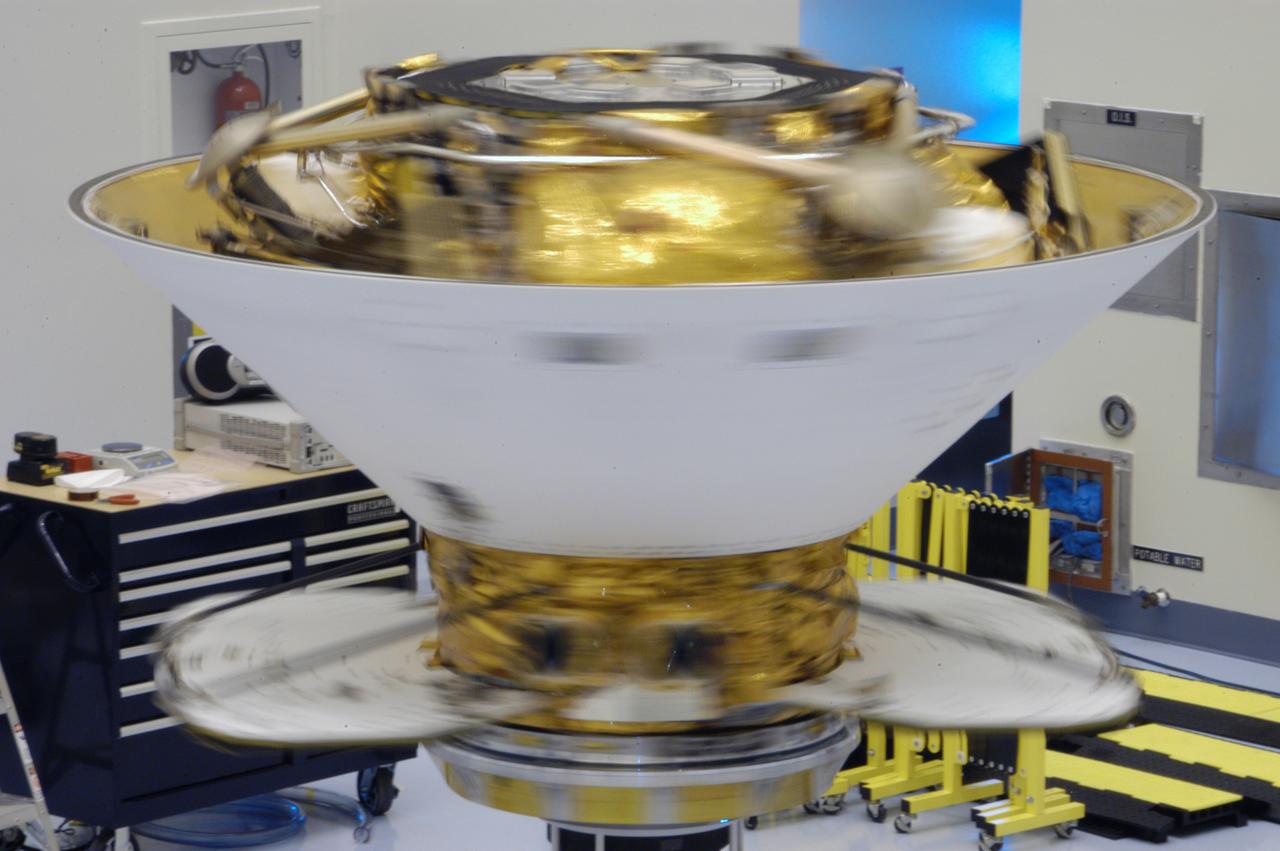
This closeup shows the spin test of the Phoenix Mars Lander in the Payload Hazardous Servicing Facility. The Phoenix mission is the first project in NASA's first openly competed program of Mars Scout missions. Phoenix will land in icy soils near the north polar permanent ice cap of Mars and explore the history of the water in these soils and any associated rocks, while monitoring polar climate. Landing is planned in May 2008 on arctic ground where a mission currently in orbit, Mars Odyssey, has detected high concentrations of ice just beneath the top layer of soil. It will serve as NASA's first exploration of a potential modern habitat on Mars and open the door to a renewed search for carbon-bearing compounds, last attempted with NASA’s Viking missions in the 1970s. A stereo color camera and a weather station will study the surrounding environment while the other instruments check excavated soil samples for water, organic chemicals and conditions that could indicate whether the site was ever hospitable to life. Microscopes can reveal features as small as one one-thousandth the width of a human hair. Launch of Phoenix aboard a Delta II rocket is targeted for Aug. 3 from Cape Canaveral Air Force Station in Florida.
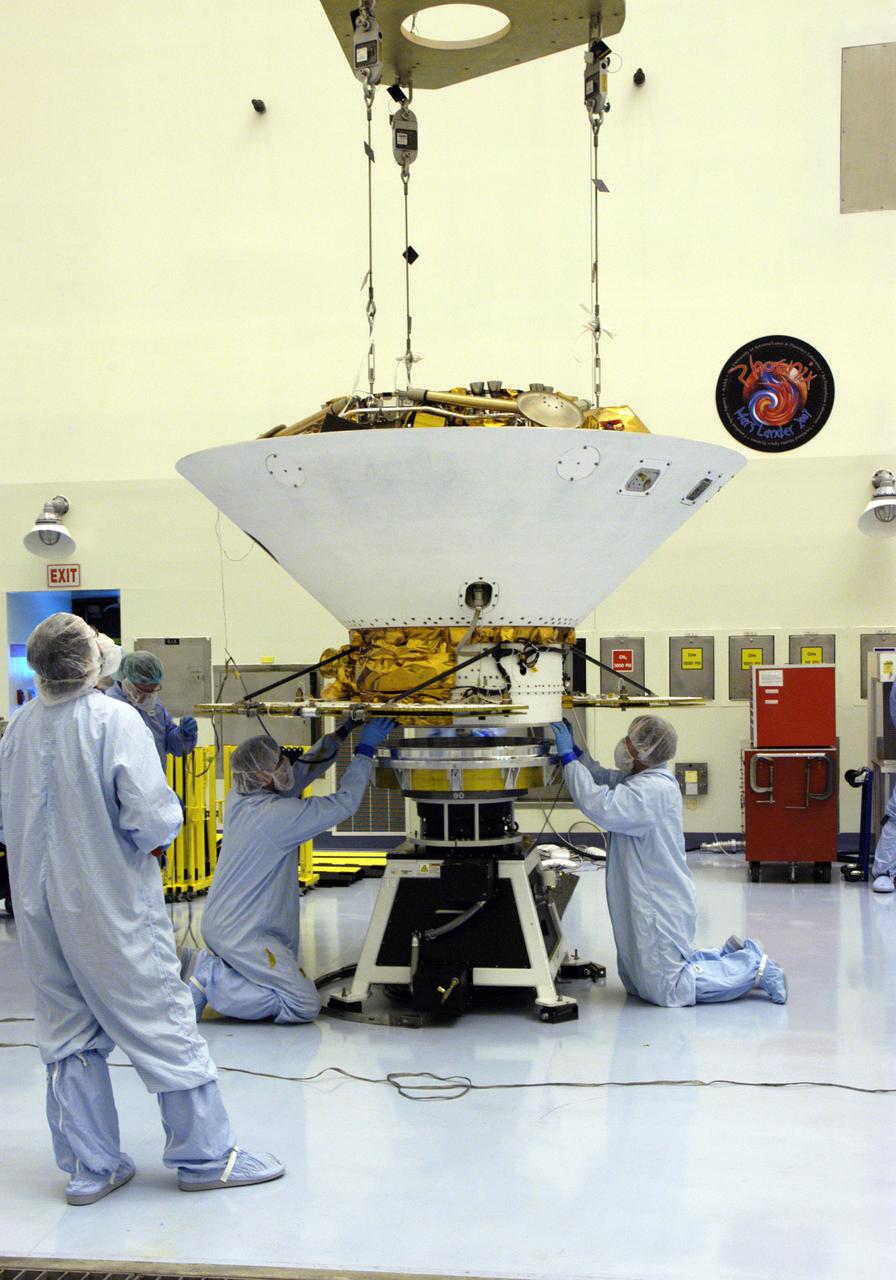
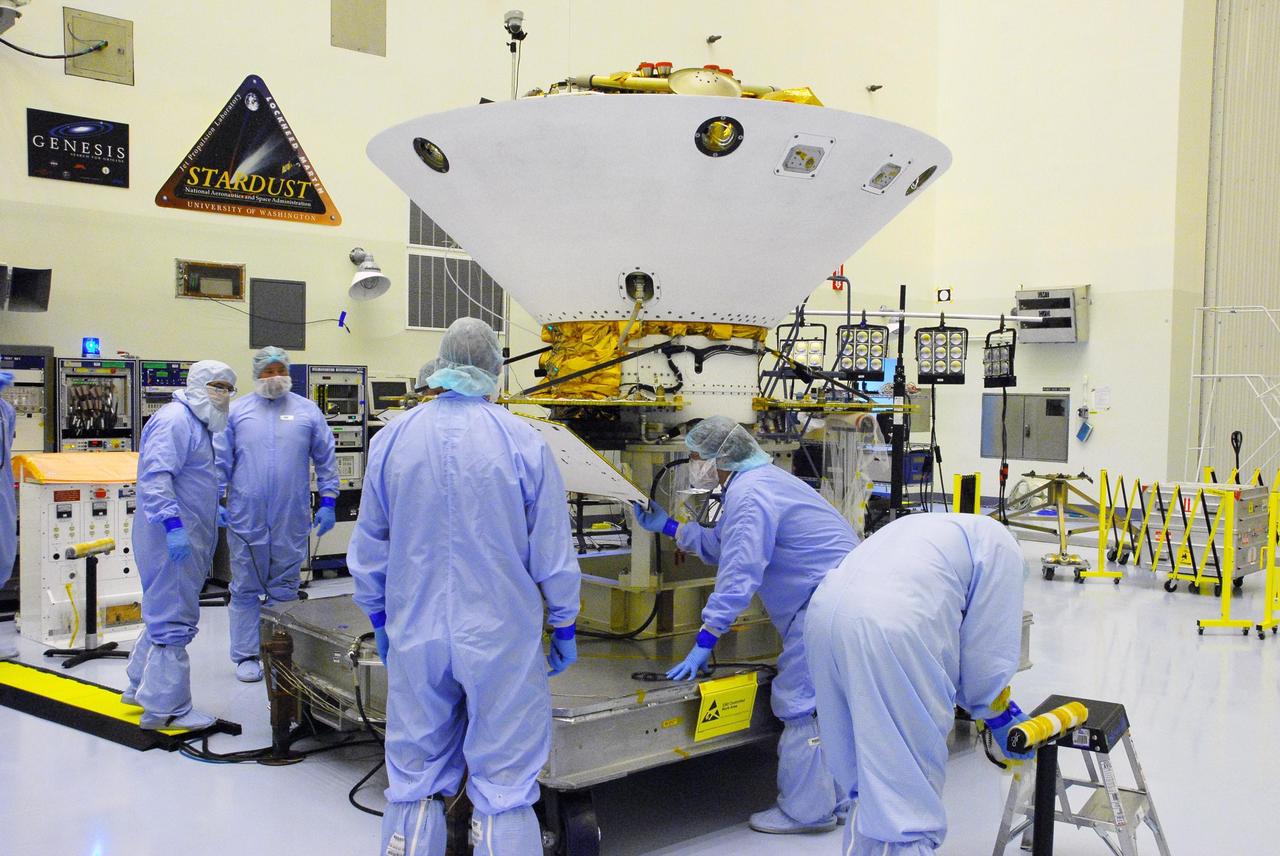
In the Payload Hazardous Servicing Facility, technicians secure the backshell with the Phoenix Mars Lander inside onto a spin table for spin testing. The Phoenix mission is the first project in NASA's first openly competed program of Mars Scout missions. Phoenix will land in icy soils near the north polar permanent ice cap of Mars and explore the history of the water in these soils and any associated rocks, while monitoring polar climate. Landing is planned in May 2008 on arctic ground where a mission currently in orbit, Mars Odyssey, has detected high concentrations of ice just beneath the top layer of soil. It will serve as NASA's first exploration of a potential modern habitat on Mars and open the door to a renewed search for carbon-bearing compounds, last attempted with NASA’s Viking missions in the 1970s. A stereo color camera and a weather station will study the surrounding environment while the other instruments check excavated soil samples for water, organic chemicals and conditions that could indicate whether the site was ever hospitable to life. Microscopes can reveal features as small as one one-thousandth the width of a human hair. Launch of Phoenix aboard a Delta II rocket is targeted for Aug. 3 from Cape Canaveral Air Force Station in Florida.
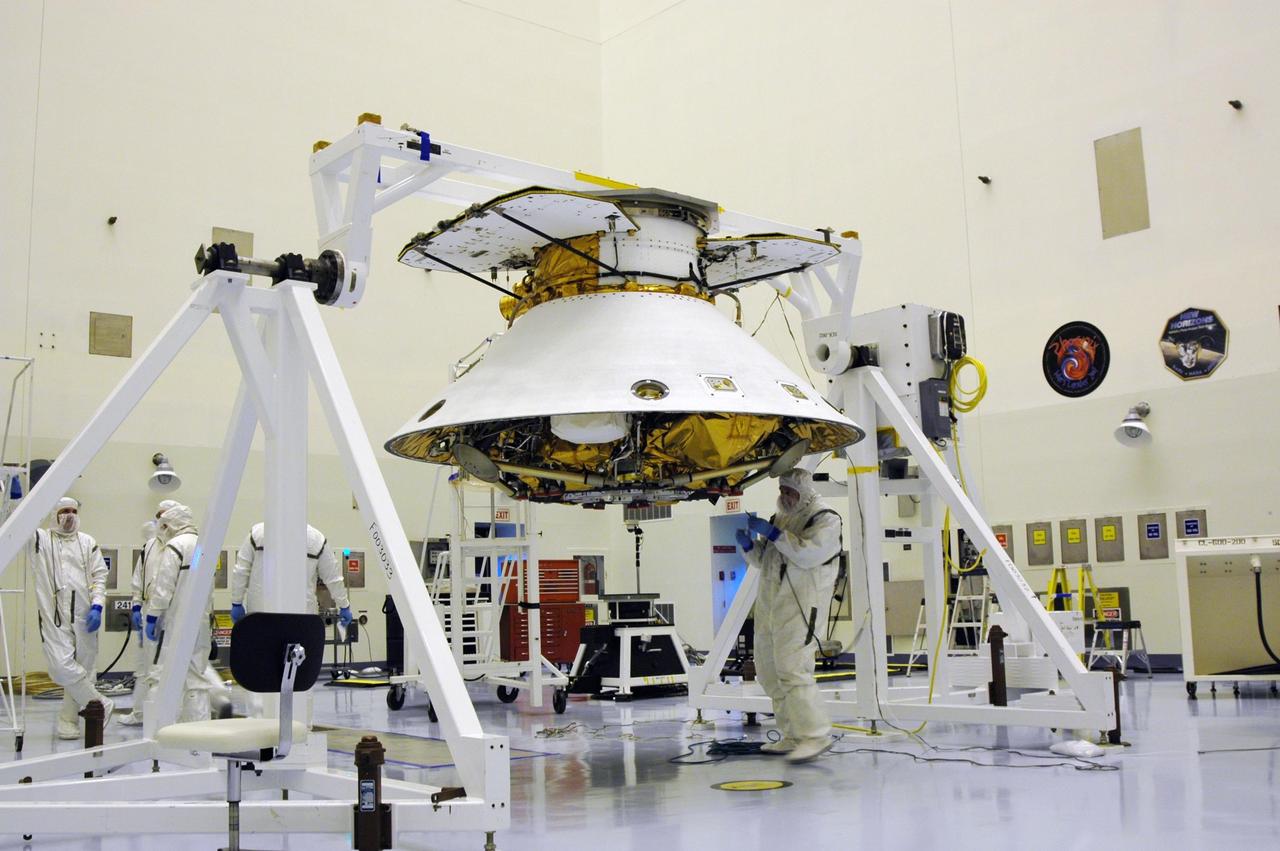
KENNEDY SPACE CENTER, Fla. -- In the Payload Hazardous Servicing Facility, workers prepare the Phoenix Mars Lander spacecraft for rotation. After rotation, the Phoenix will be mated with the upper stage booster. Targeted for launch from Cape Canaveral Air Force Station on Aug. 3, Phoenix will land in icy soils near the north polar permanent ice cap of Mars and explore the history of the water in these soils and any associated rocks, while monitoring polar climate. Landing on Mars is planned in May 2008 on arctic ground where a mission currently in orbit, Mars Odyssey, has detected high concentrations of ice just beneath the top layer of soil. NASA/Dimitri Gerondidakis
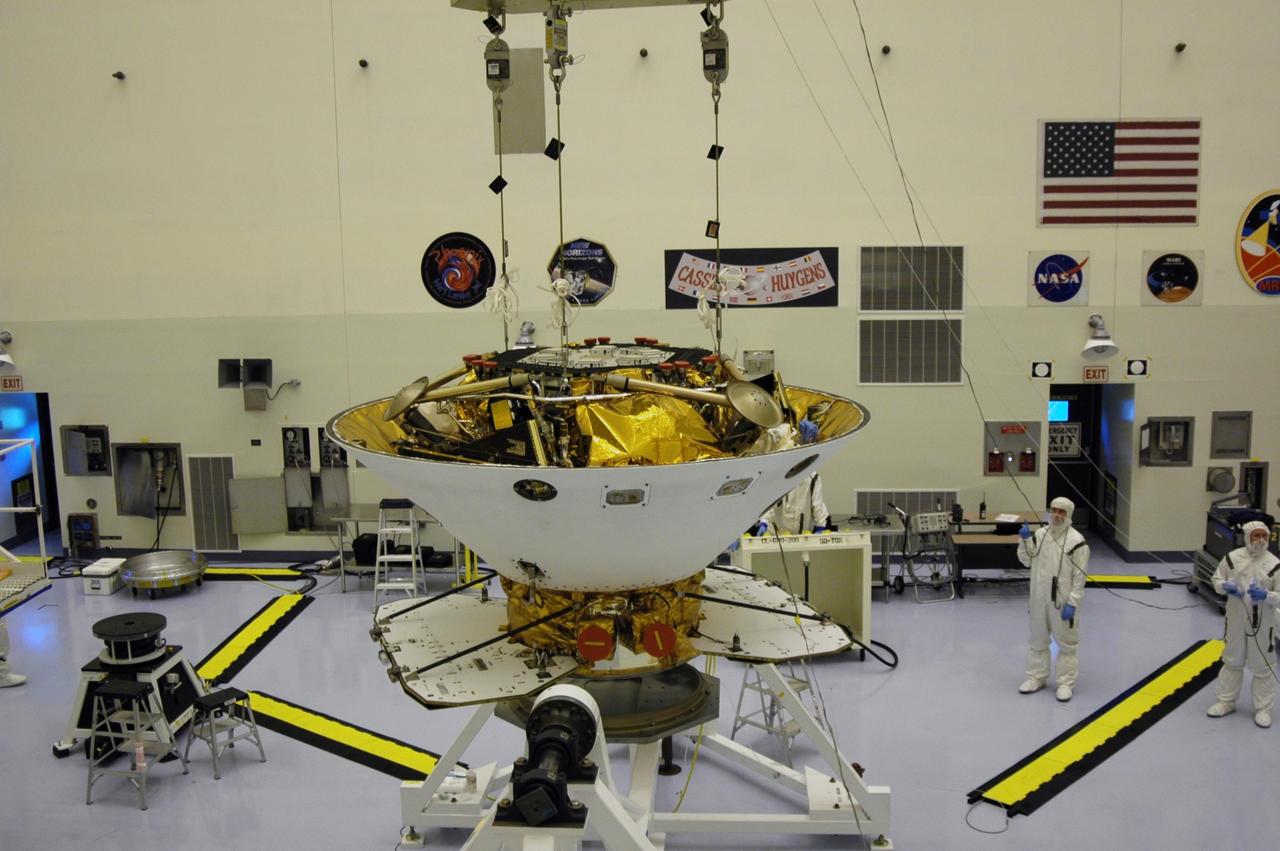
KENNEDY SPACE CENTER, Fla. -- In the Payload Hazardous Servicing Facility, the Phoenix Mars Lander spacecraft is lifted from its stand. The Phoenix will be moved to the upper stage booster for mating. Targeted for launch from Cape Canaveral Air Force Station on Aug. 3, Phoenix will land in icy soils near the north polar permanent ice cap of Mars and explore the history of the water in these soils and any associated rocks, while monitoring polar climate. Landing on Mars is planned in May 2008 on arctic ground where a mission currently in orbit, Mars Odyssey, has detected high concentrations of ice just beneath the top layer of soil. Photo credit: NASA/Dimitri Gerondidakis
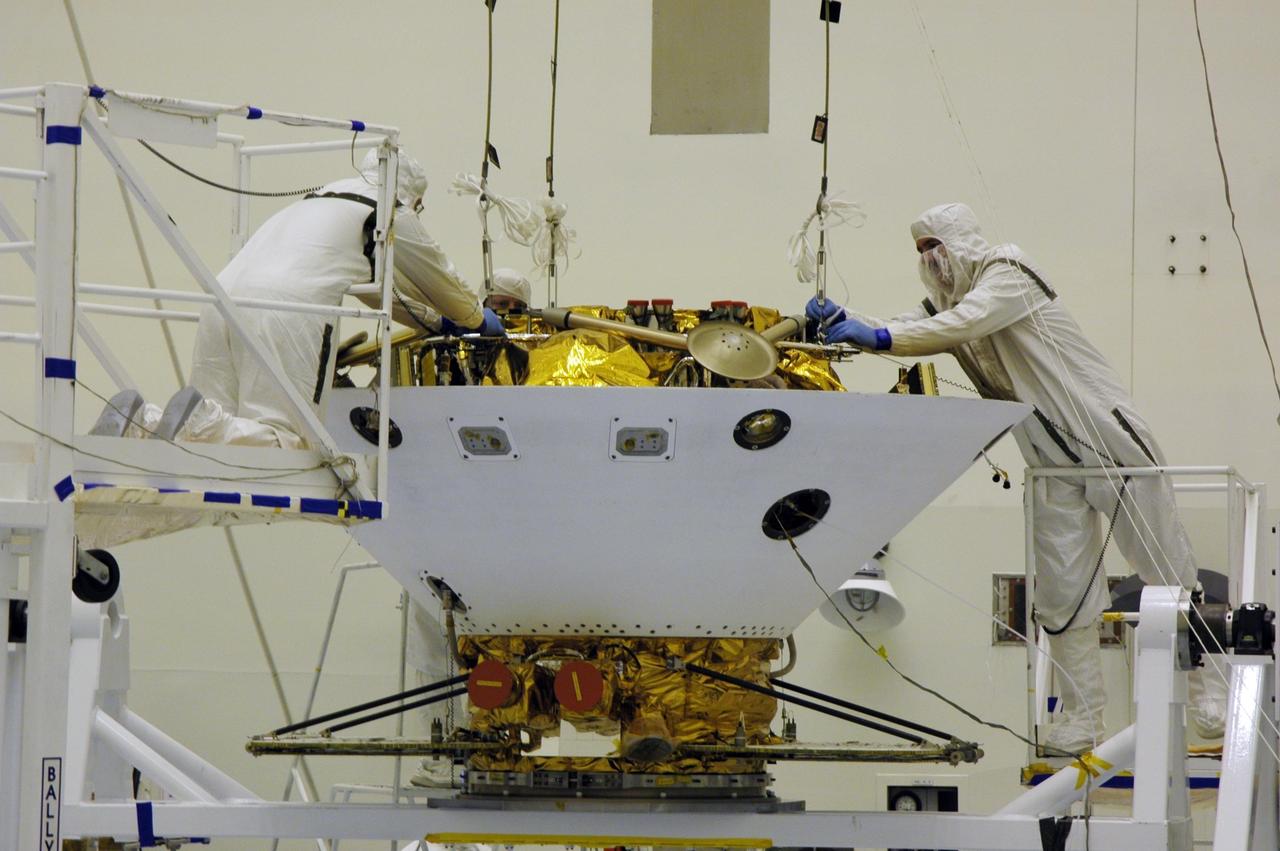
KENNEDY SPACE CENTER, Fla. -- In the Payload Hazardous Servicing Facility, workers attach an overhead crane to the Phoenix Mars Lander spacecraft. The Phoenix will be lifted and moved to the upper stage booster for mating. Targeted for launch from Cape Canaveral Air Force Station on Aug. 3, Phoenix will land in icy soils near the north polar permanent ice cap of Mars and explore the history of the water in these soils and any associated rocks, while monitoring polar climate. Landing on Mars is planned in May 2008 on arctic ground where a mission currently in orbit, Mars Odyssey, has detected high concentrations of ice just beneath the top layer of soil. NASA/Dimitri Gerondidakis
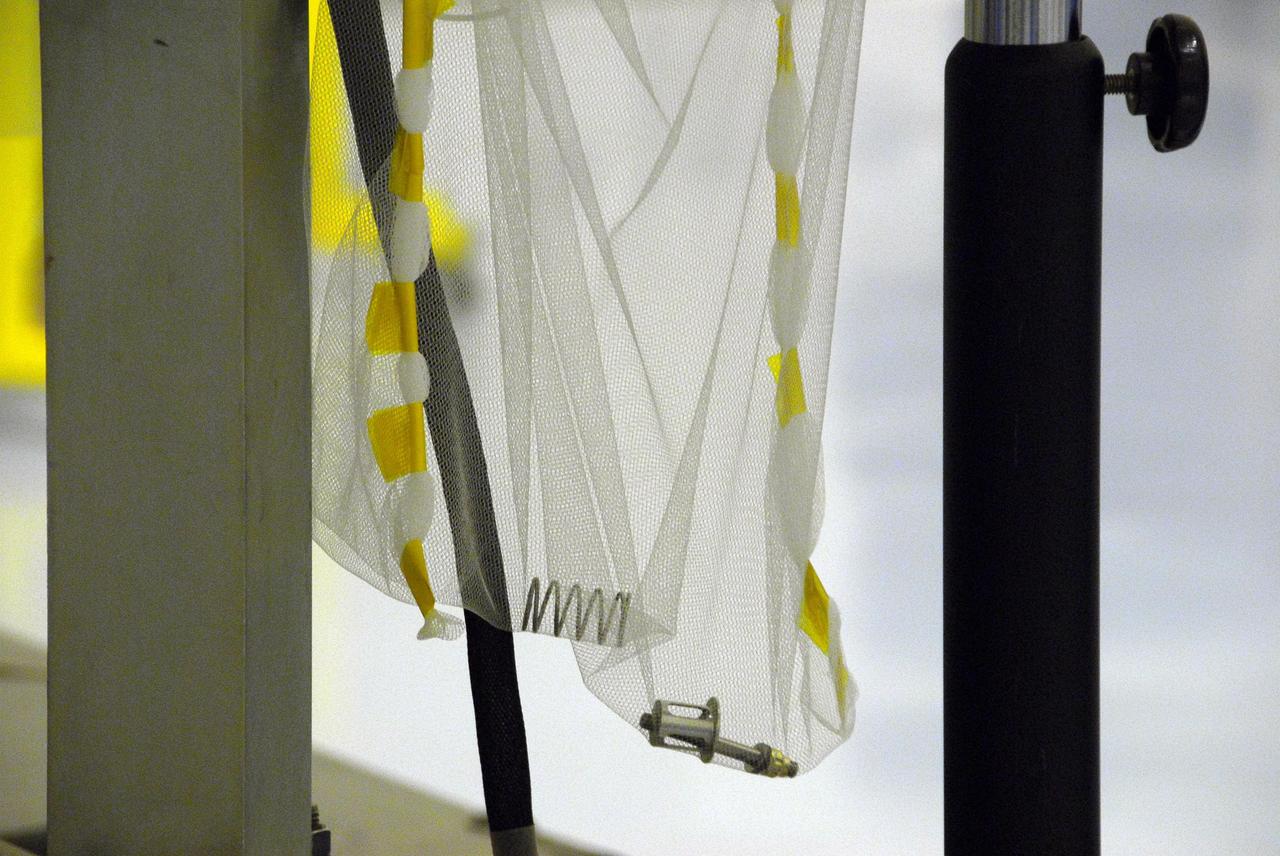
KENNEDY SPACE CENTER, FLA. -- In the Payload Hazardous Servicing Facility at Cape Canaveral Air Force Station, this mesh bag holds the spring and bolt from the test firing to deploy the solar panels on the Phoenix Mars Lander spacecraft. Phoenix will land in icy soils near the north polar permanent ice cap of Mars and explore the history of the water in these soils and any associated rocks, while monitoring polar climate. Landing on Mars is planned in May 2008 on arctic ground where a mission currently in orbit, Mars Odyssey, has detected high concentrations of ice just beneath the top layer of soil. Phoenix is scheduled to launch Aug. 3. Photo credit: NASA/George Shelton
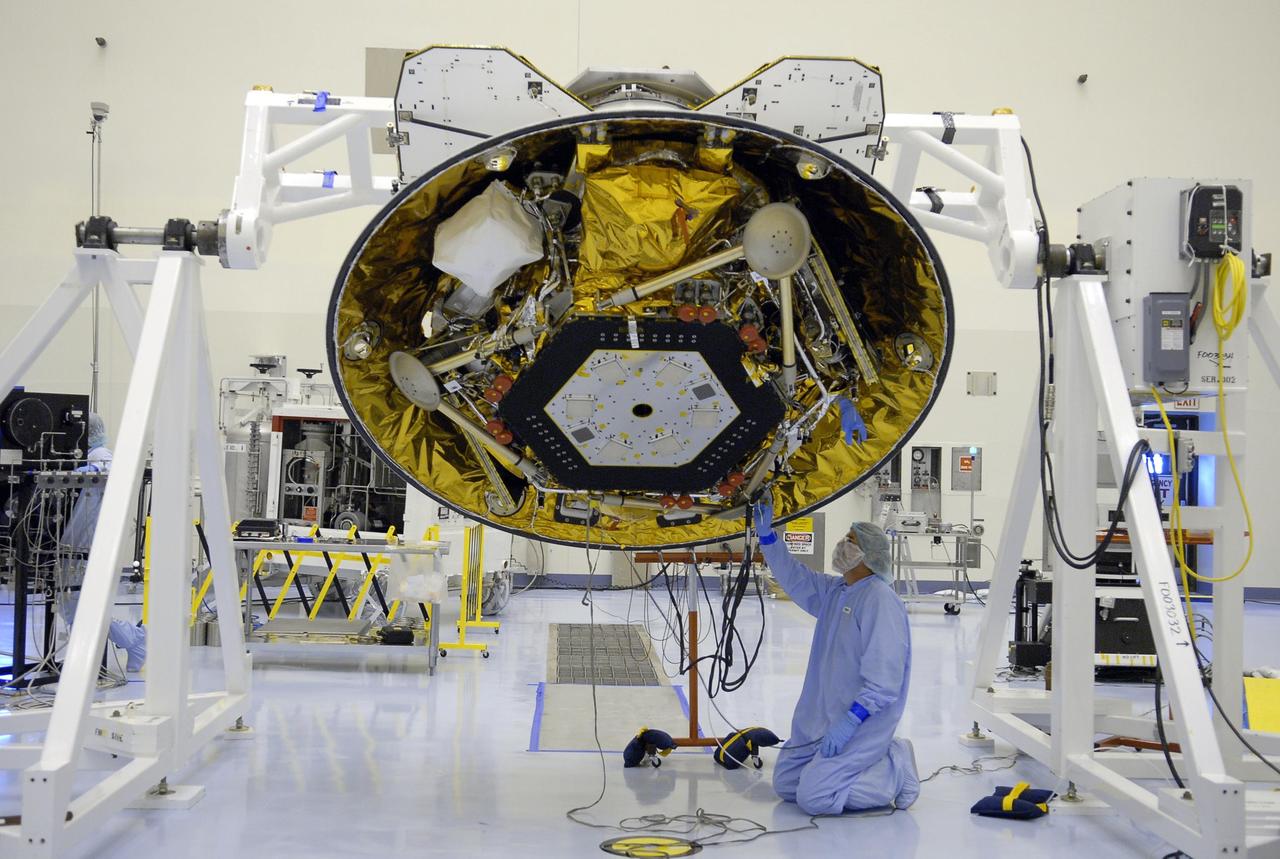
KENNEDY SPACE CENTER, FLA. -- In the Payload Hazardous Servicing Facility, a technician takes a measurement on the Phoenix Mars Lander. The spacecraft is on display for the media. Phoenix is scheduled to launch Aug. 3 from Launch Pad 17-A at Cape Canaveral Air Force Station. Phoenix will land in icy soils near the north polar permanent ice cap of Mars and explore the history of the water in these soils and any associated rocks, while monitoring polar climate. Landing on Mars is planned in May 2008 on arctic ground where a mission currently in orbit, Mars Odyssey, has detected high concentrations of ice just beneath the top layer of soil. Photo credit: NASA/Kim Shiflett
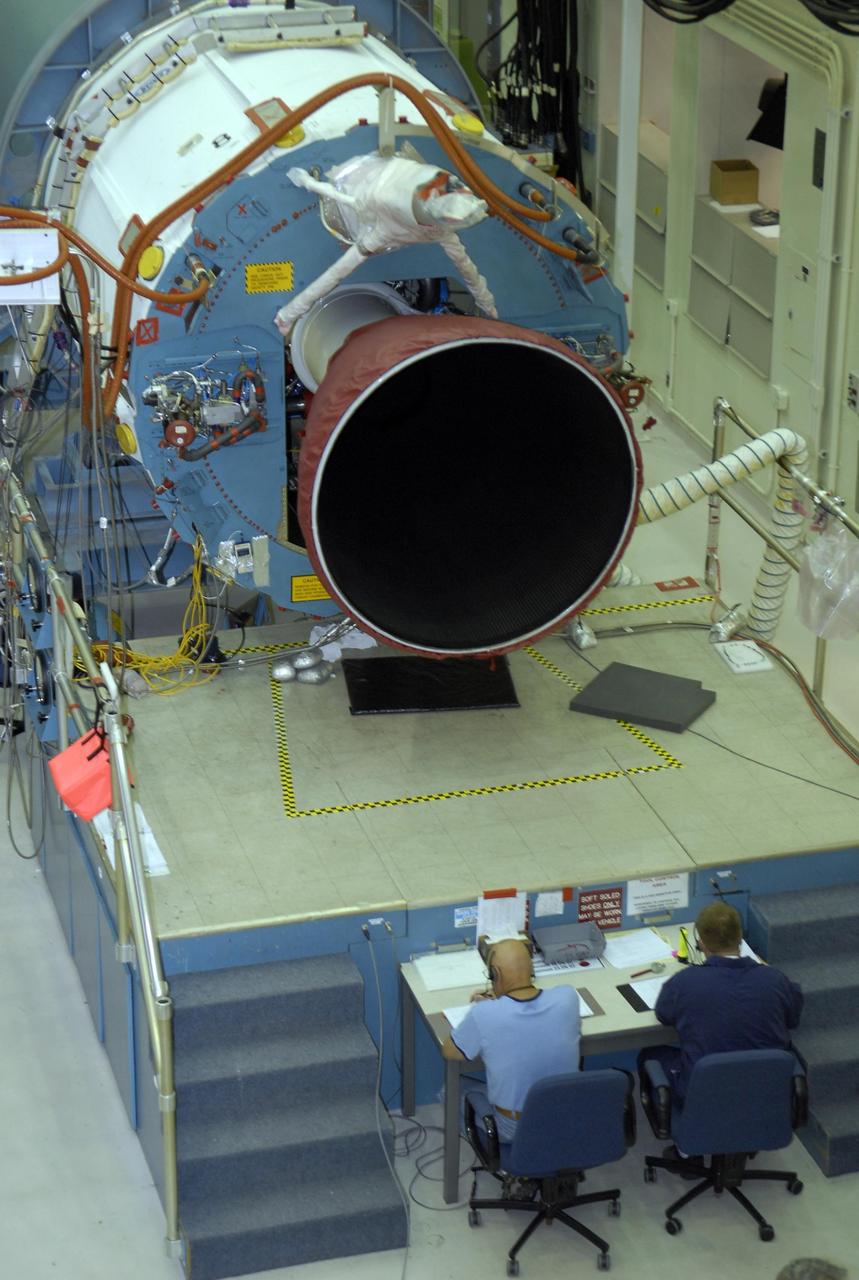
KENNEDY SPACE CENTER, FLA. -- In Hangar A&O on Cape Canaveral Air Force Station in Florida, workers conduct a steering test on the first stage of a Delta II rocket. The rocket is designated for the launch of the Phoenix Mars Lander spacecraft. Phoenix will land in icy soils near the north polar permanent ice cap of Mars and explore the history of the water in these soils and any associated rocks, while monitoring polar climate. Landing is planned in May 2008 on arctic ground where a mission currently in orbit, Mars Odyssey, has detected high concentrations of ice just beneath the top layer of soil. Launch of Phoenix is targeted for Aug. 3. Photo credit: NASA/Kim Shiflett
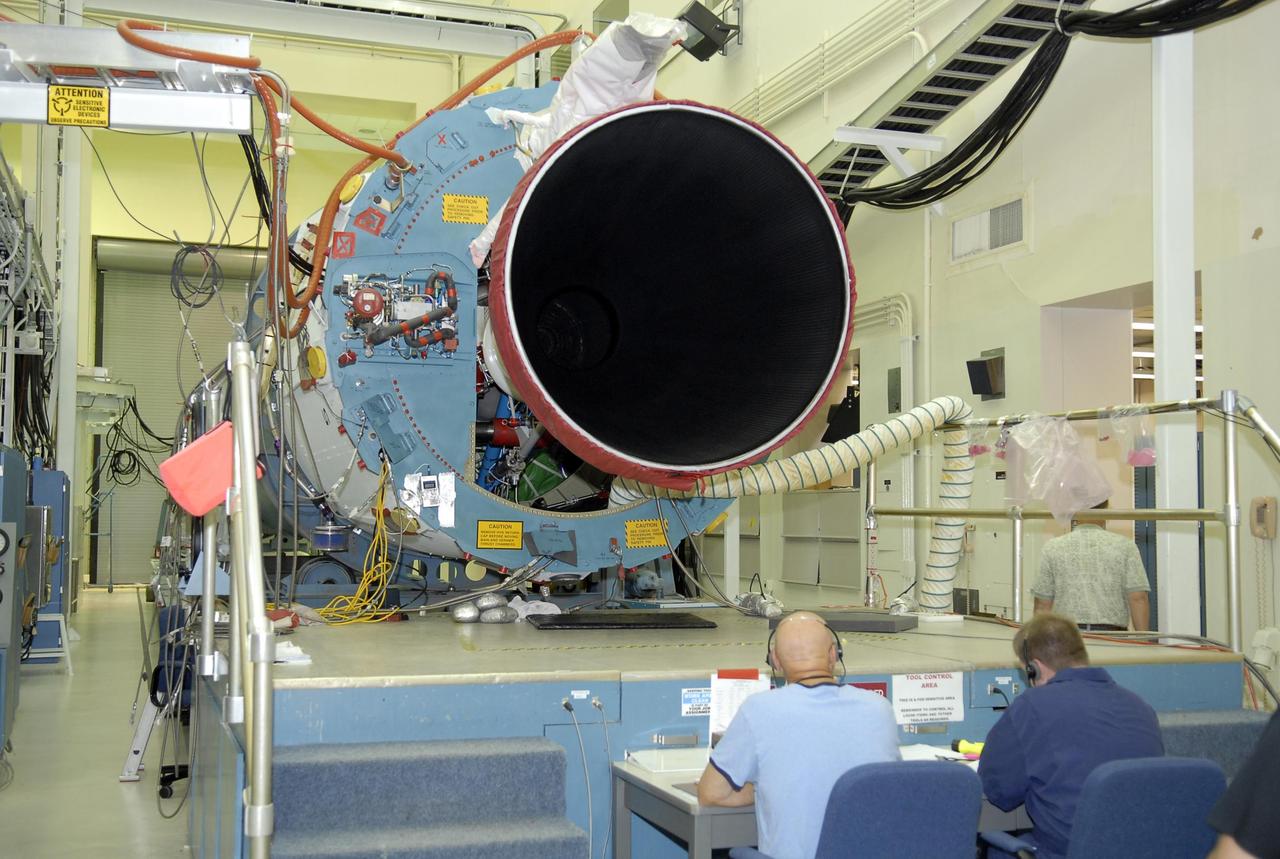
KENNEDY SPACE CENTER, FLA. -- In Hangar A&O on Cape Canaveral Air Force Station in Florida, workers conduct a steering test on the first stage of a Delta II rocket. The rocket is designated for the launch of the Phoenix Mars Lander spacecraft. Phoenix will land in icy soils near the north polar permanent ice cap of Mars and explore the history of the water in these soils and any associated rocks, while monitoring polar climate. Landing is planned in May 2008 on arctic ground where a mission currently in orbit, Mars Odyssey, has detected high concentrations of ice just beneath the top layer of soil. Launch of Phoenix is targeted for Aug. 3. Photo credit: NASA/Kim Shiflett
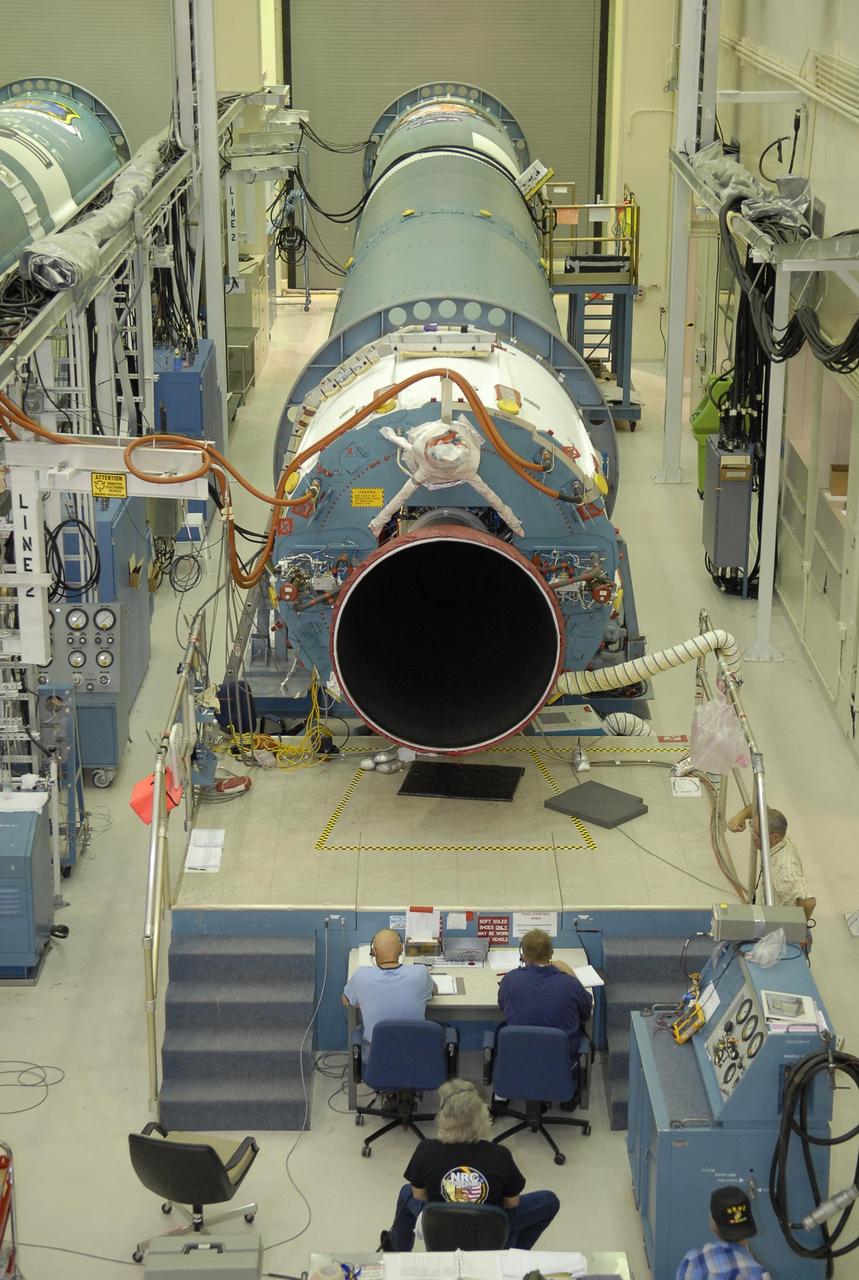
KENNEDY SPACE CENTER, FLA. -- In Hangar A&O on Cape Canaveral Air Force Station in Florida, workers conduct a steering test on the first stage of a Delta II rocket, at right. The rocket is designated for the launch of the Phoenix Mars Lander spacecraft. Phoenix will land in icy soils near the north polar permanent ice cap of Mars and explore the history of the water in these soils and any associated rocks, while monitoring polar climate. Landing is planned in May 2008 on arctic ground where a mission currently in orbit, Mars Odyssey, has detected high concentrations of ice just beneath the top layer of soil. Launch of Phoenix is targeted for Aug. 3. Photo credit: NASA/Kim Shiflett
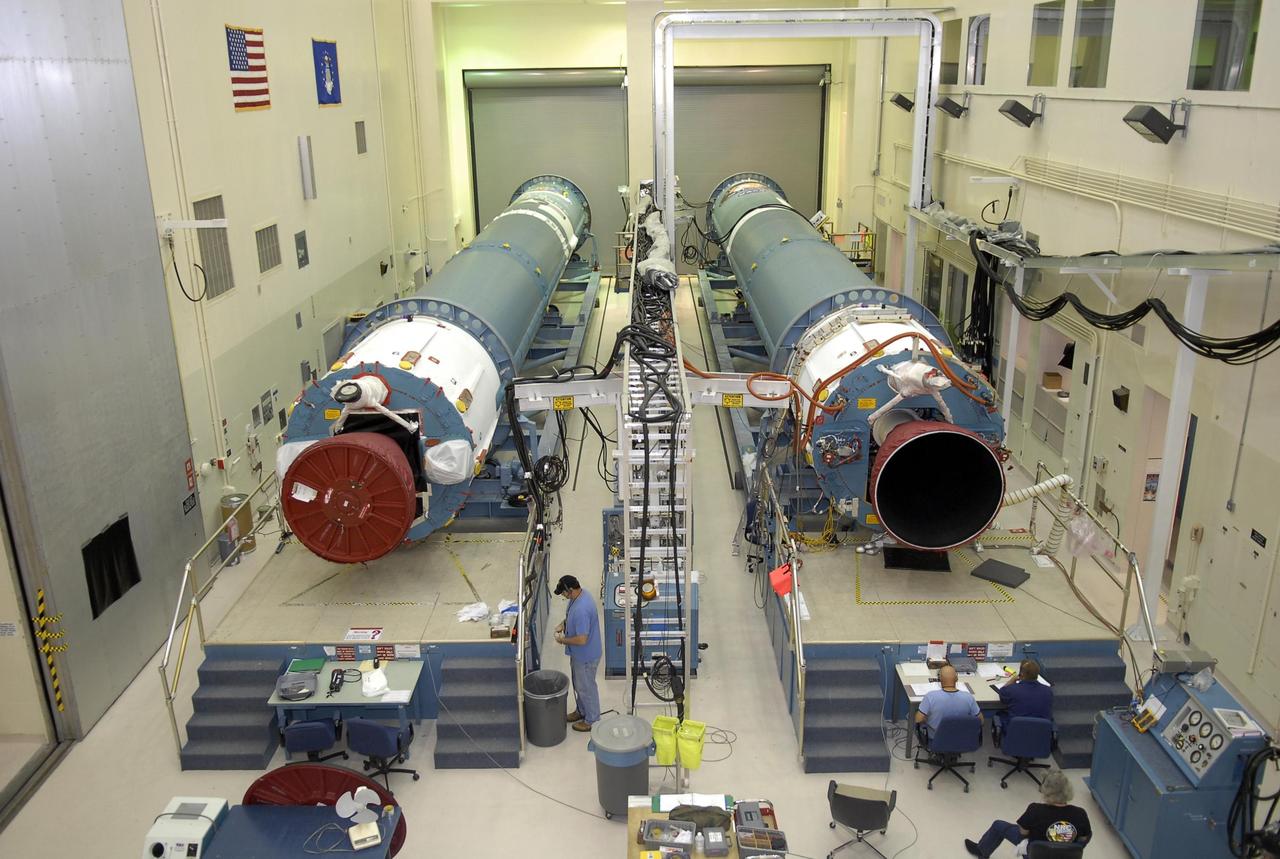
KENNEDY SPACE CENTER, FLA. -- In Hangar A&O on Cape Canaveral Air Force Station in Florida, workers conduct a steering test on the first stage of a Delta II rocket, at right. The rocket is designated for the launch of the Phoenix Mars Lander spacecraft. Phoenix will land in icy soils near the north polar permanent ice cap of Mars and explore the history of the water in these soils and any associated rocks, while monitoring polar climate. Landing is planned in May 2008 on arctic ground where a mission currently in orbit, Mars Odyssey, has detected high concentrations of ice just beneath the top layer of soil. Launch of Phoenix is targeted for Aug. 3. Photo credit: NASA/Kim Shiflett

KENNEDY SPACE CENTER, Fla. -- In the Payload Hazardous Servicing Facility, workers help guide the suspended Phoenix Mars Lander spacecraft toward the upper stage booster in the center. The spacecraft and booster will be mated for launch. Targeted for launch from Cape Canaveral Air Force Station on Aug. 3, Phoenix will land in icy soils near the north polar permanent ice cap of Mars and explore the history of the water in these soils and any associated rocks, while monitoring polar climate. Landing on Mars is planned in May 2008 on arctic ground where a mission currently in orbit, Mars Odyssey, has detected high concentrations of ice just beneath the top layer of soil. NASA/Dimitri Gerondidakis
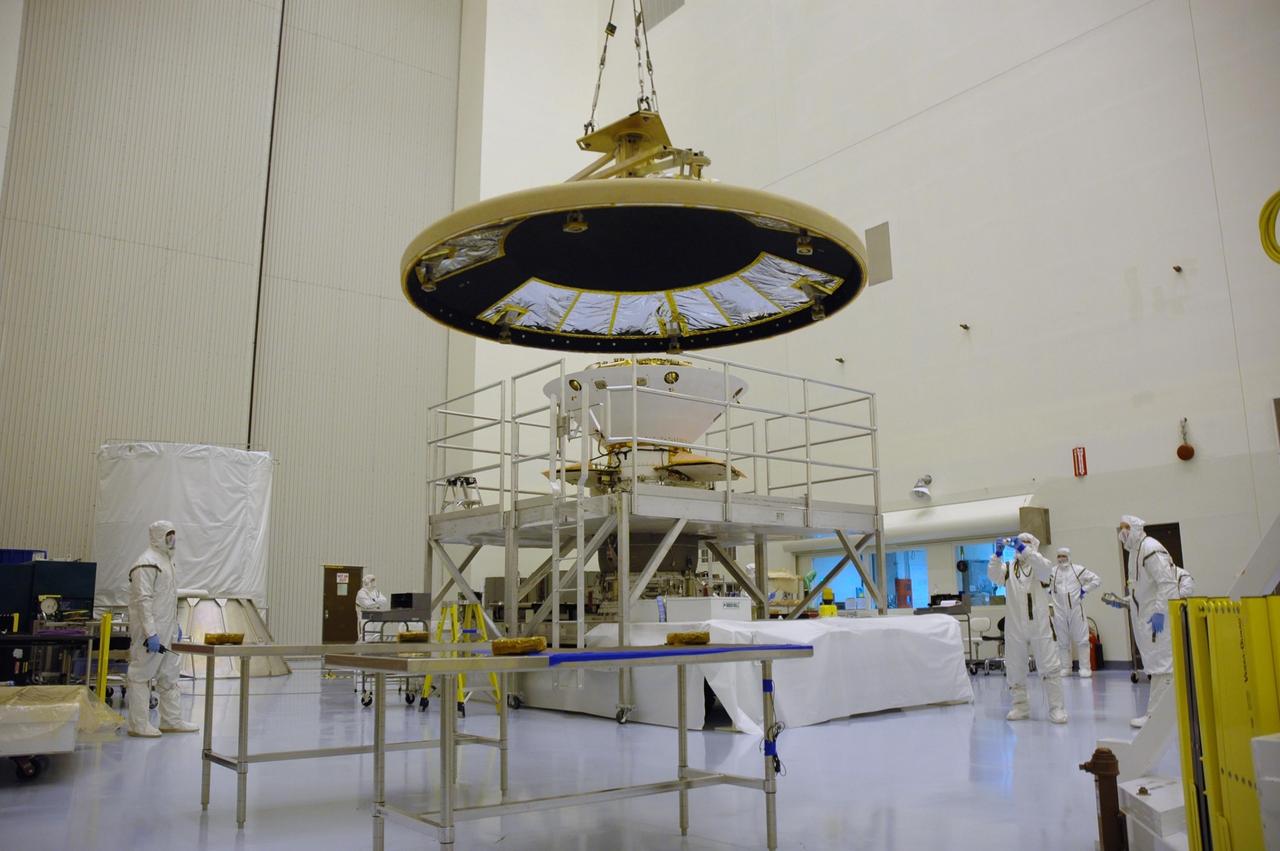
KENNEDY SPACE CENTER, Fla. --In the Payload Hazardous Servicing Facility, the heat shield for the Phoenix Mars Lander spacecraft is moved toward the spacecraft, in the background. Targeted for launch from Cape Canaveral Air Force Station on Aug. 3, Phoenix will land in icy soils near the north polar permanent ice cap of Mars and explore the history of the water in these soils and any associated rocks, while monitoring polar climate. Landing on Mars is planned in May 2008 on arctic ground where a mission currently in orbit, Mars Odyssey, has detected high concentrations of ice just beneath the top layer of soil. Photo credit: NASA/Troy Cryder
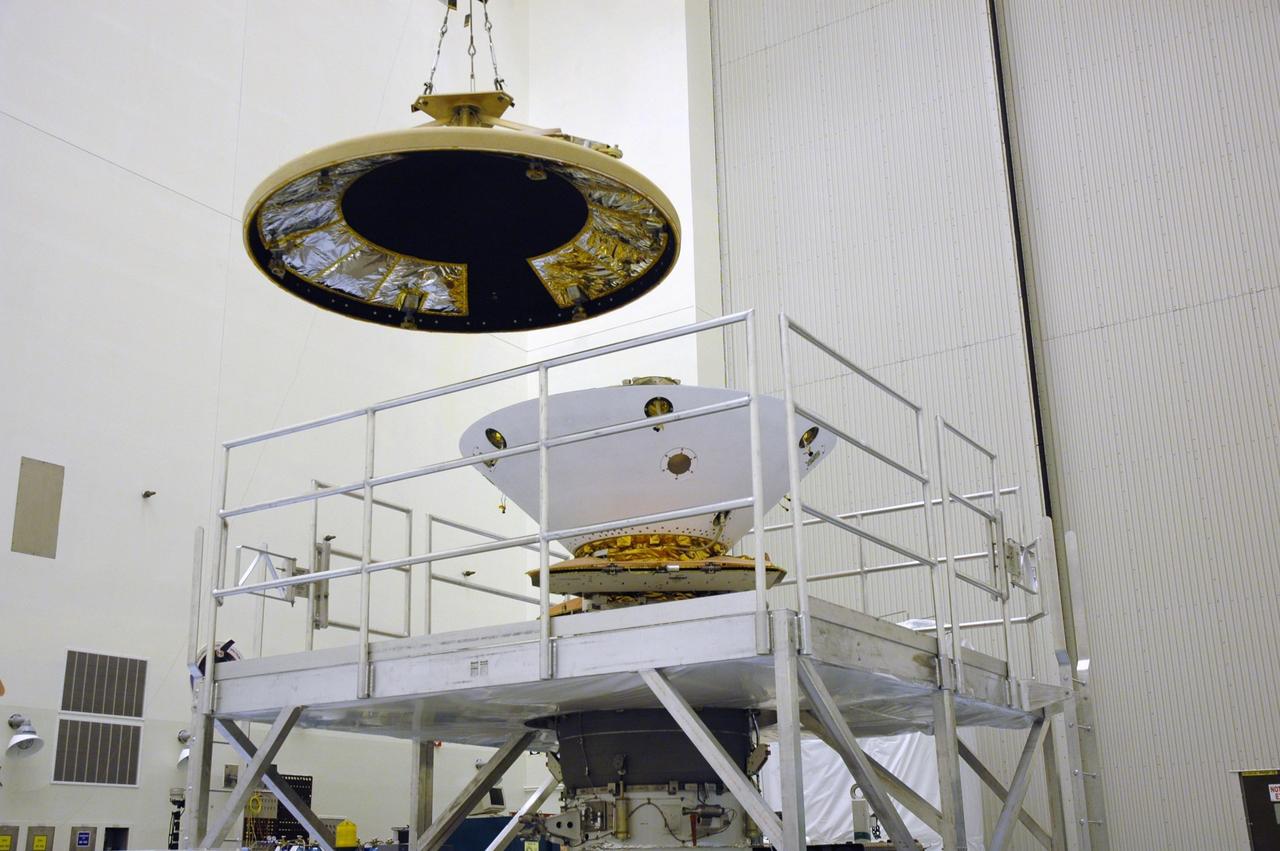
KENNEDY SPACE CENTER, Fla. --In the Payload Hazardous Servicing Facility, the heat shield for the Phoenix Mars Lander spacecraft is moved toward the spacecraft. Targeted for launch from Cape Canaveral Air Force Station on Aug. 3, Phoenix will land in icy soils near the north polar permanent ice cap of Mars and explore the history of the water in these soils and any associated rocks, while monitoring polar climate. Landing on Mars is planned in May 2008 on arctic ground where a mission currently in orbit, Mars Odyssey, has detected high concentrations of ice just beneath the top layer of soil. Photo credit: NASA/Troy Cryder
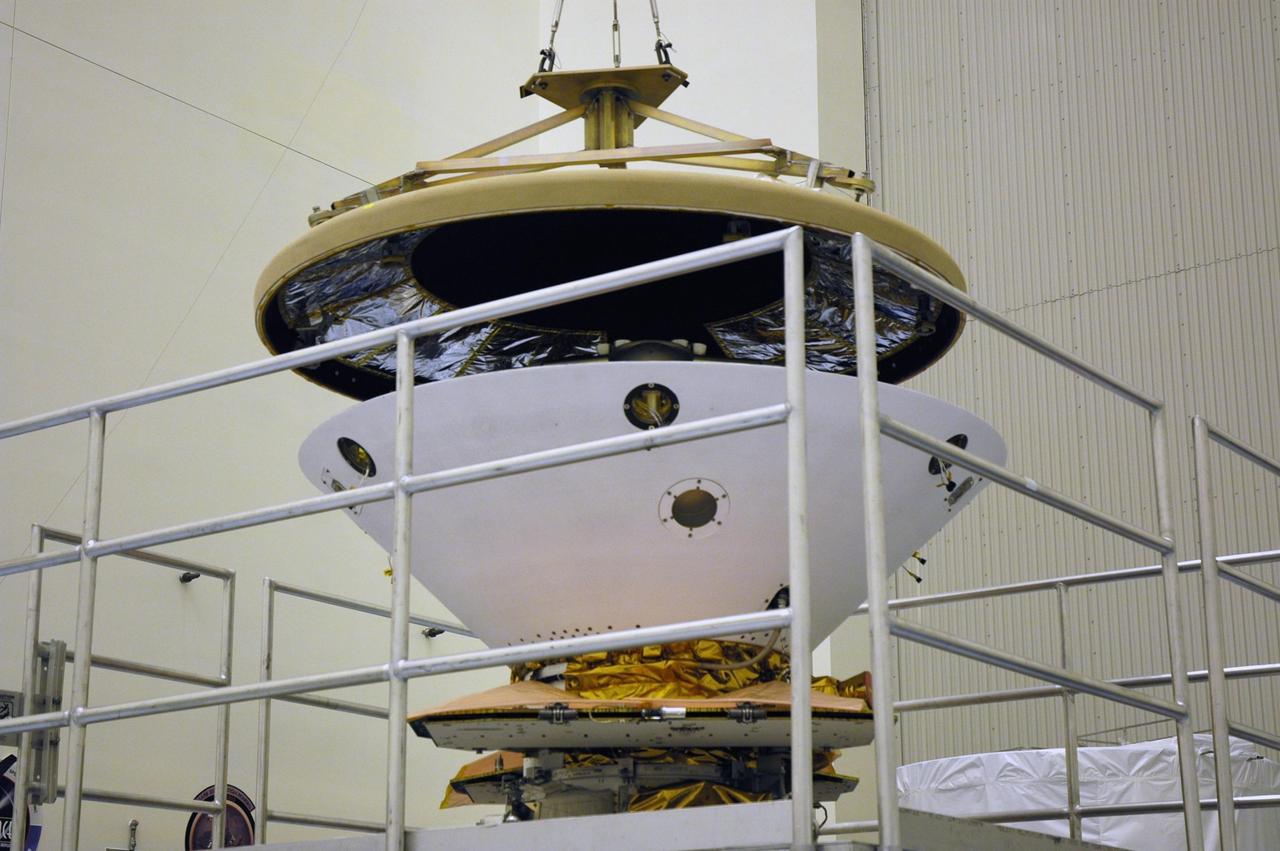
KENNEDY SPACE CENTER, Fla. -- In the Payload Hazardous Servicing Facility, the heat shield for the Phoenix Mars Lander spacecraft is lowered onto the spacecraft. Targeted for launch from Cape Canaveral Air Force Station on Aug. 3, Phoenix will land in icy soils near the north polar permanent ice cap of Mars and explore the history of the water in these soils and any associated rocks, while monitoring polar climate. Landing on Mars is planned in May 2008 on arctic ground where a mission currently in orbit, Mars Odyssey, has detected high concentrations of ice just beneath the top layer of soil. Photo credit: NASA/Troy Cryder
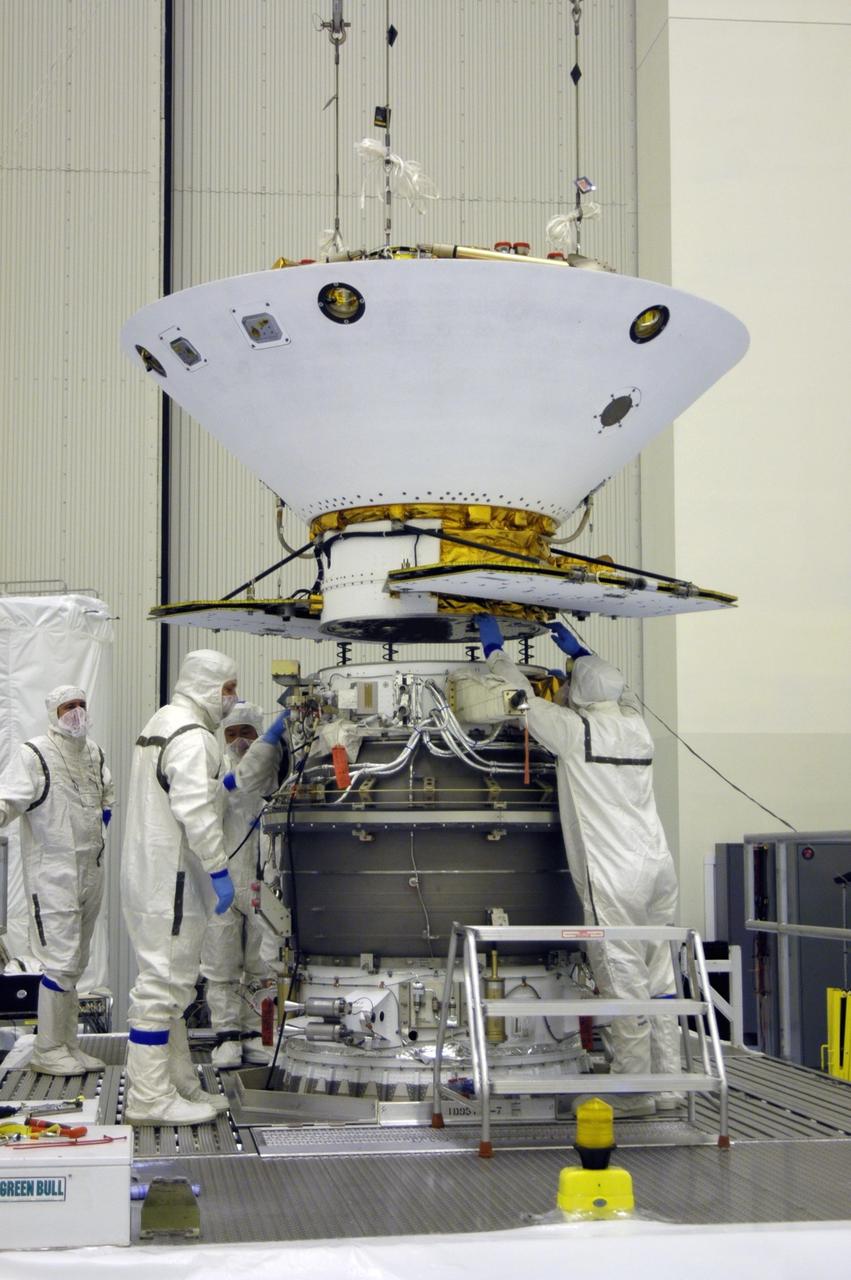
KENNEDY SPACE CENTER, Fla. -- In the Payload Hazardous Servicing Facility, workers guide the Phoenix Mars Lander spacecraft onto the upper stage booster. The spacecraft and booster will be mated for launch. Targeted for launch from Cape Canaveral Air Force Station on Aug. 3, Phoenix will land in icy soils near the north polar permanent ice cap of Mars and explore the history of the water in these soils and any associated rocks, while monitoring polar climate. Landing on Mars is planned in May 2008 on arctic ground where a mission currently in orbit, Mars Odyssey, has detected high concentrations of ice just beneath the top layer of soil. NASA/Dimitri Gerondidakis
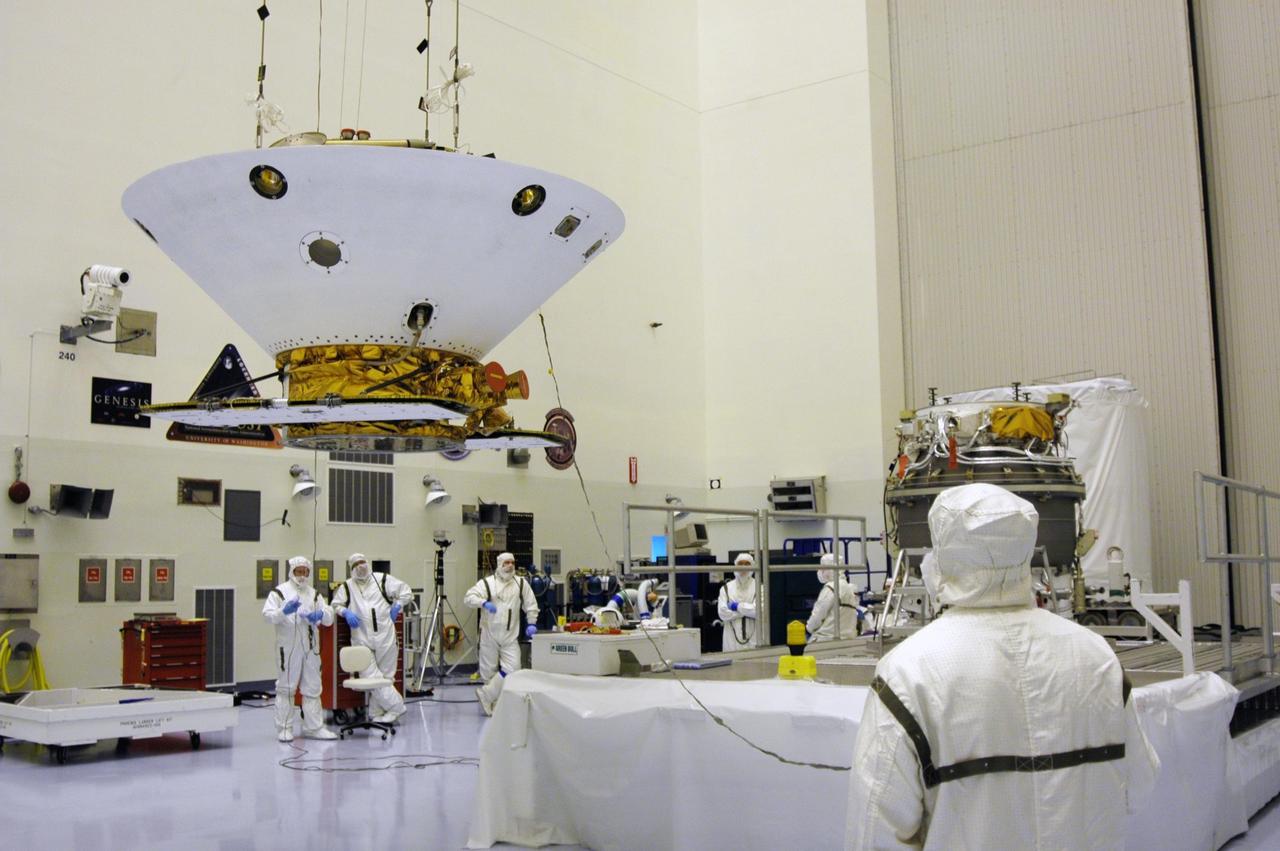
KENNEDY SPACE CENTER, Fla. -- In the Payload Hazardous Servicing Facility, the Phoenix Mars Lander spacecraft is moved across the area toward the upper stage booster at right. The spacecraft and booster will be mated for launch. Targeted for launch from Cape Canaveral Air Force Station on Aug. 3, Phoenix will land in icy soils near the north polar permanent ice cap of Mars and explore the history of the water in these soils and any associated rocks, while monitoring polar climate. Landing on Mars is planned in May 2008 on arctic ground where a mission currently in orbit, Mars Odyssey, has detected high concentrations of ice just beneath the top layer of soil. NASA/Dimitri Gerondidakis

KENNEDY SPACE CENTER, FLA. -- In the Payload Hazardous Servicing Facility at Cape Canaveral Air Force Station, the backshell of the Phoenix Mars Lander spacecraft is nestled inside the cruise stage (at top). The solar array panels on the Phoenix will be deployed for pre-launch testing. Phoenix will land in icy soils near the north polar permanent ice cap of Mars and explore the history of the water in these soils and any associated rocks, while monitoring polar climate. Landing on Mars is planned in May 2008 on arctic ground where a mission currently in orbit, Mars Odyssey, has detected high concentrations of ice just beneath the top layer of soil. Phoenix is scheduled to launch Aug. 3. Photo credit: NASA/George Shelton

This frame a movie from NASA's Phoenix Mars Lander shows the spacecraft's robotic arm in its stowed configuration, with its biobarrier unpeeled. The arm is still folded up, with its "elbow" shown at upper left and its scoop at bottom right. The biobarrier is the shiny film seen to the left of the arm in this view. The barrier is an extra precaution to protect Mars from contamination with any bacteria from Earth. While the whole spacecraft was decontaminated through cleaning, filters and heat, the robotic arm was given additional protection because it is the only spacecraft part that will directly touch the ice below the surface of Mars. Before the arm was heated, it was sealed in the biobarrier, which is made of a trademarked film called Tedlar that holds up to baking like a turkey-basting bag. This ensures that any new bacterial spores that might have come about during the final steps before launch, and during the journey to Mars, will not contact the robotic arm. After Phoenix landed, springs were used to pop back the barrier, giving it room to deploy. The arm is scheduled to begin to unlatch on the second Martian day of the mission, or Sol 3 (May 28, 2008). This image was taken on Sol 1 (May 26, 2008) by the spacecraft's Surface Stereo Imager. http://photojournal.jpl.nasa.gov/catalog/PIA10708
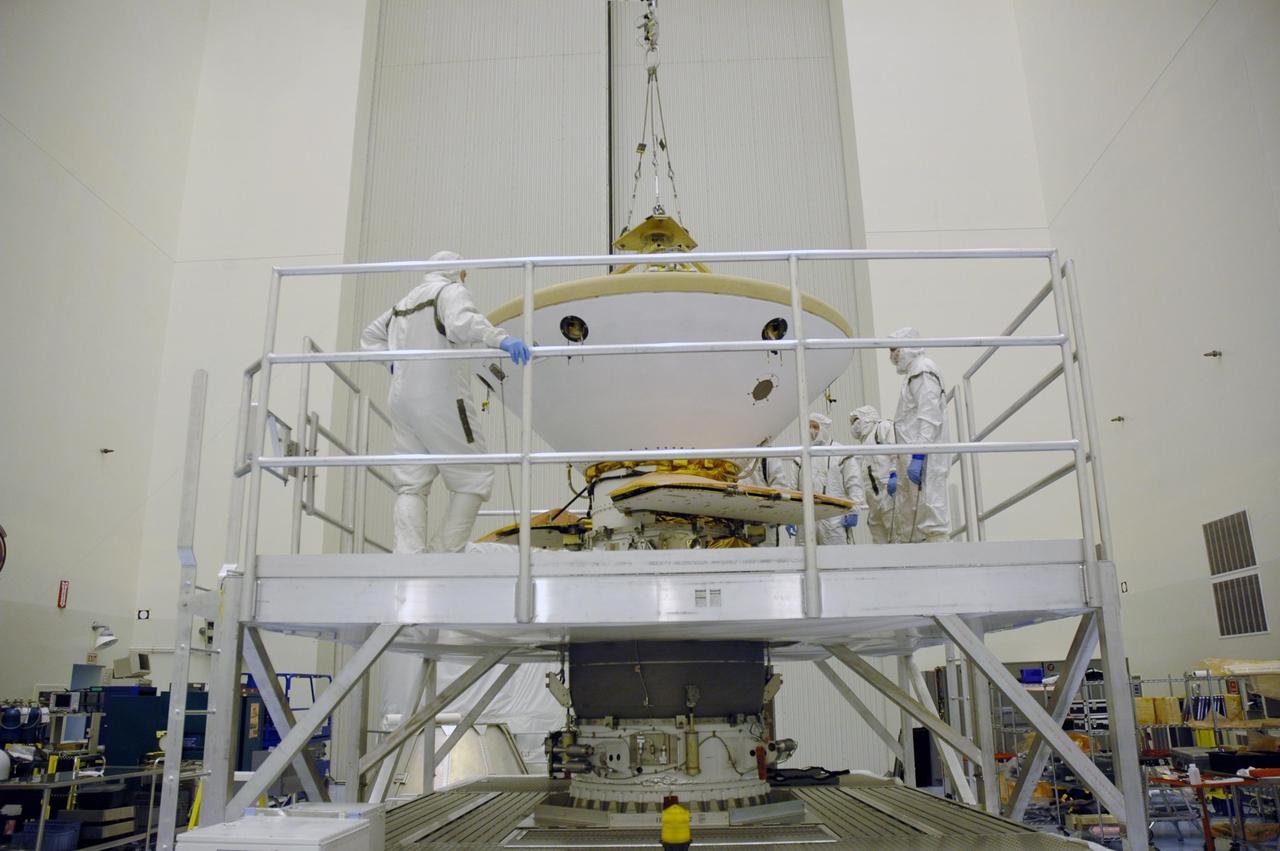
KENNEDY SPACE CENTER, Fla. -- In the Payload Hazardous Servicing Facility, workers observe the installation of the heat shield onto the Phoenix Mars Lander spacecraft. Targeted for launch from Cape Canaveral Air Force Station on Aug. 3, Phoenix will land in icy soils near the north polar permanent ice cap of Mars and explore the history of the water in these soils and any associated rocks, while monitoring polar climate. Landing on Mars is planned in May 2008 on arctic ground where a mission currently in orbit, Mars Odyssey, has detected high concentrations of ice just beneath the top layer of soil. Photo credit: NASA/Troy Cryder
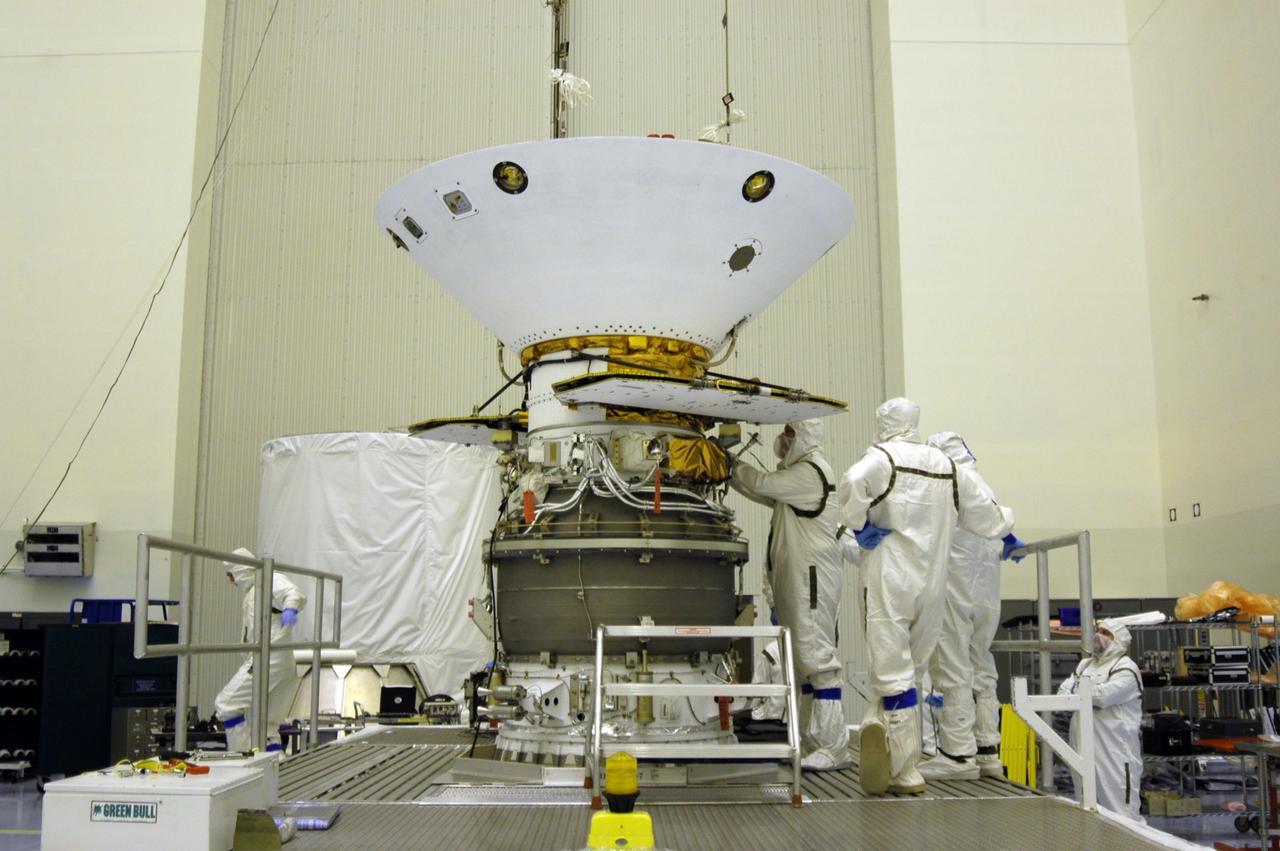
KENNEDY SPACE CENTER, Fla. -- In the Payload Hazardous Servicing Facility, workers secure the Phoenix Mars Lander spacecraft onto the upper stage booster. Targeted for launch from Cape Canaveral Air Force Station on Aug. 3, Phoenix will land in icy soils near the north polar permanent ice cap of Mars and explore the history of the water in these soils and any associated rocks, while monitoring polar climate. Landing on Mars is planned in May 2008 on arctic ground where a mission currently in orbit, Mars Odyssey, has detected high concentrations of ice just beneath the top layer of soil. NASA/Dimitri Gerondidakis
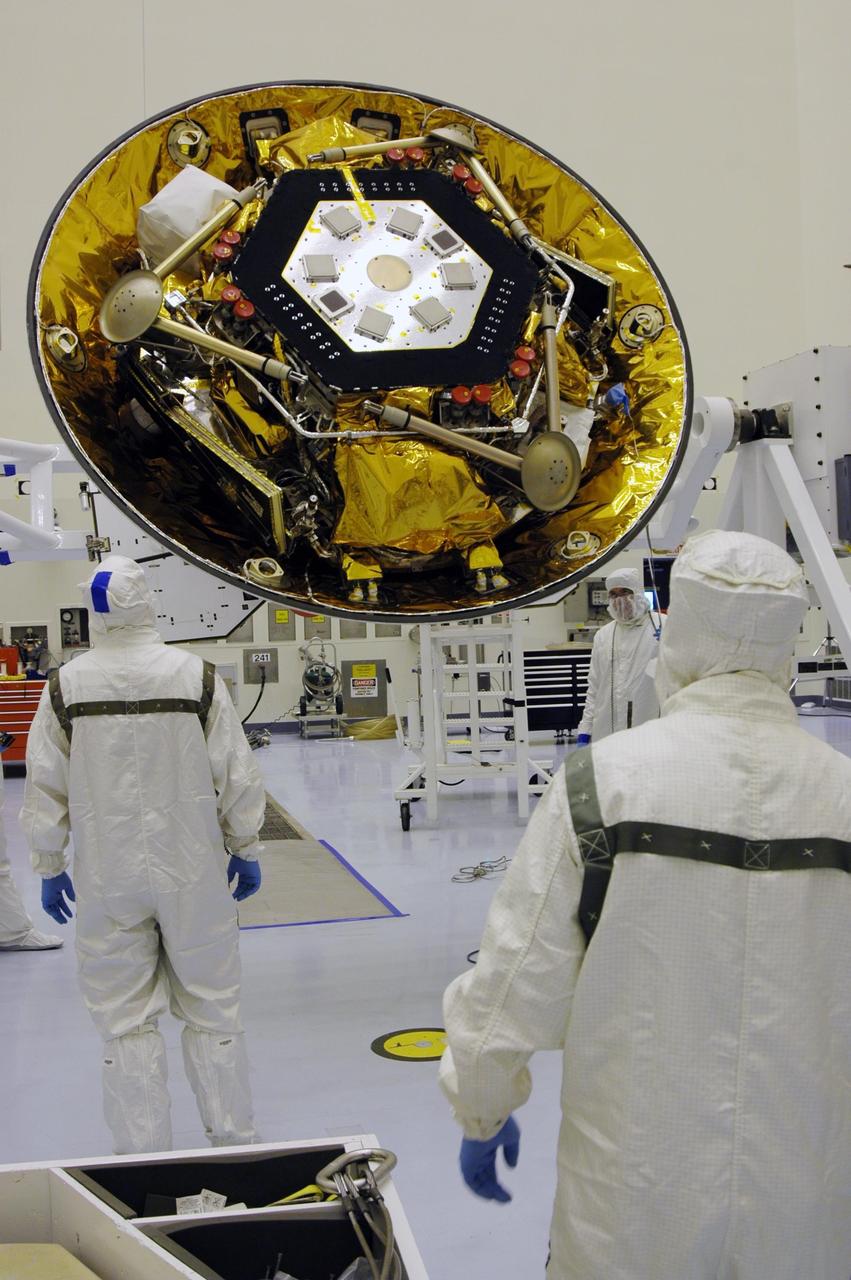
KENNEDY SPACE CENTER, Fla. -- In the Payload Hazardous Servicing Facility, workers rotate the Phoenix Mars Lander spacecraft to move it for mating to the upper stage booster. Targeted for launch from Cape Canaveral Air Force Station on Aug. 3, Phoenix will land in icy soils near the north polar permanent ice cap of Mars and explore the history of the water in these soils and any associated rocks, while monitoring polar climate. Landing on Mars is planned in May 2008 on arctic ground where a mission currently in orbit, Mars Odyssey, has detected high concentrations of ice just beneath the top layer of soil. NASA/Dimitri Gerondidakis
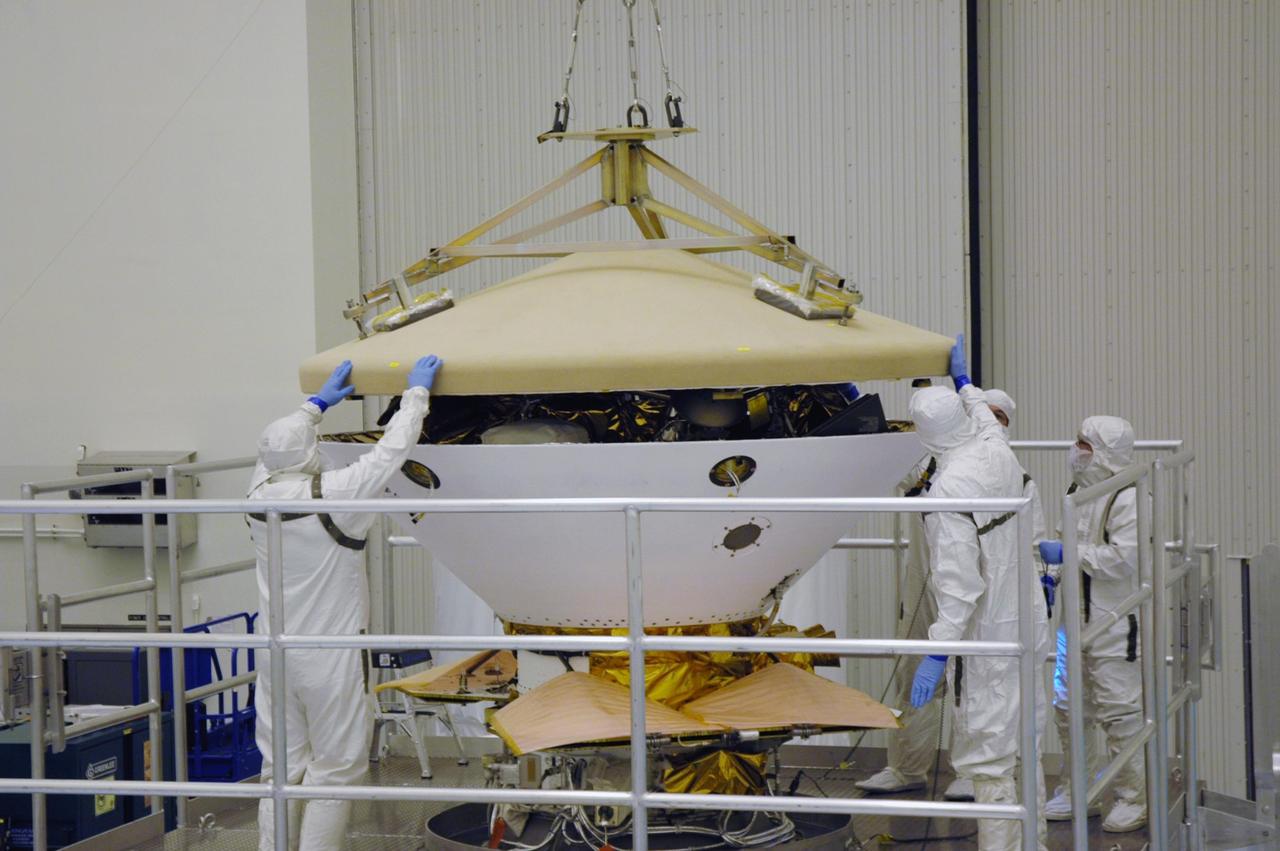
KENNEDY SPACE CENTER, Fla. -- In the Payload Hazardous Servicing Facility, workers guide the heat shield onto the Phoenix Mars Lander spacecraft. Targeted for launch from Cape Canaveral Air Force Station on Aug. 3, Phoenix will land in icy soils near the north polar permanent ice cap of Mars and explore the history of the water in these soils and any associated rocks, while monitoring polar climate. Landing on Mars is planned in May 2008 on arctic ground where a mission currently in orbit, Mars Odyssey, has detected high concentrations of ice just beneath the top layer of soil. Photo credit: NASA/Troy Cryder
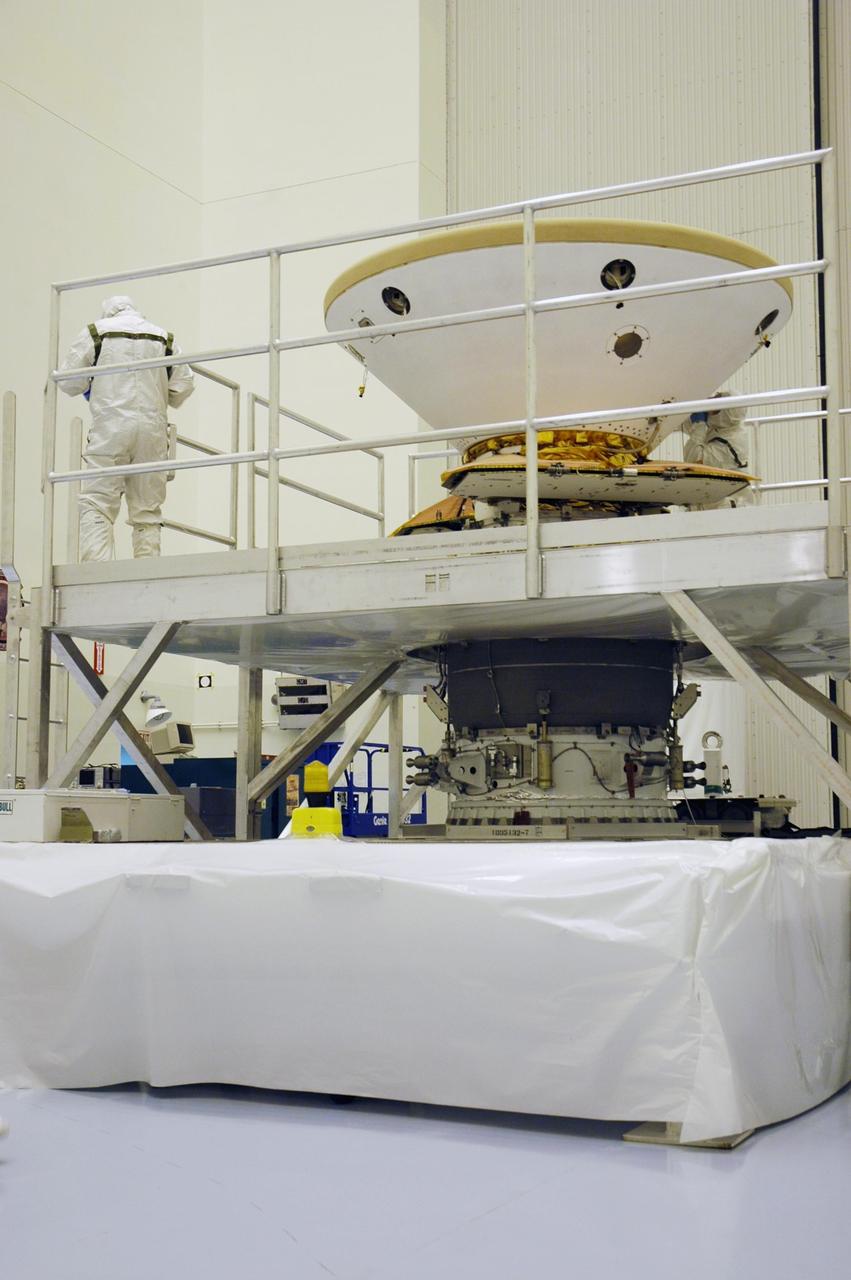
KENNEDY SPACE CENTER, Fla. -- In the Payload Hazardous Servicing Facility, the Phoenix Mars Lander spacecraft rests with its heat shield installed. Targeted for launch from Cape Canaveral Air Force Station on Aug. 3, Phoenix will land in icy soils near the north polar permanent ice cap of Mars and explore the history of the water in these soils and any associated rocks, while monitoring polar climate. Landing on Mars is planned in May 2008 on arctic ground where a mission currently in orbit, Mars Odyssey, has detected high concentrations of ice just beneath the top layer of soil. Photo credit: NASA/Troy Cryder
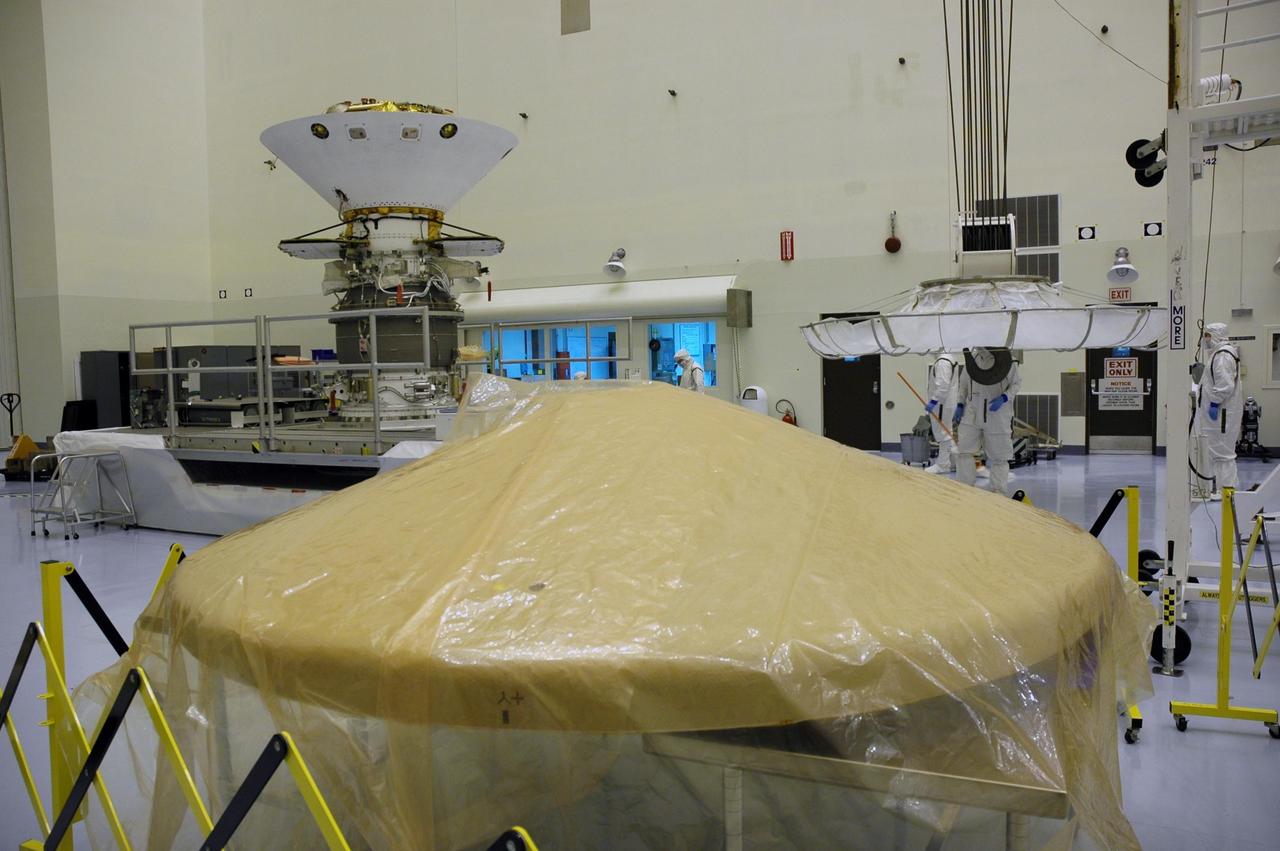
KENNEDY SPACE CENTER, Fla. -- In the Payload Hazardous Servicing Facility, the heat shield (foreground) for the Phoenix Mars Lander spacecraft is ready for installation. Targeted for launch from Cape Canaveral Air Force Station on Aug. 3, Phoenix will land in icy soils near the north polar permanent ice cap of Mars and explore the history of the water in these soils and any associated rocks, while monitoring polar climate. Landing on Mars is planned in May 2008 on arctic ground where a mission currently in orbit, Mars Odyssey, has detected high concentrations of ice just beneath the top layer of soil. Photo credit: NASA/Troy Cryder

KENNEDY SPACE CENTER, Fla. -- In the Payload Hazardous Servicing Facility, workers prepare the upper stage booster to be mated to the Phoenix Mars Lander spacecraft. Targeted for launch from Cape Canaveral Air Force Station on Aug. 3, Phoenix will land in icy soils near the north polar permanent ice cap of Mars and explore the history of the water in these soils and any associated rocks, while monitoring polar climate. Landing on Mars is planned in May 2008 on arctic ground where a mission currently in orbit, Mars Odyssey, has detected high concentrations of ice just beneath the top layer of soil. NASA/Dimitri Gerondidakis
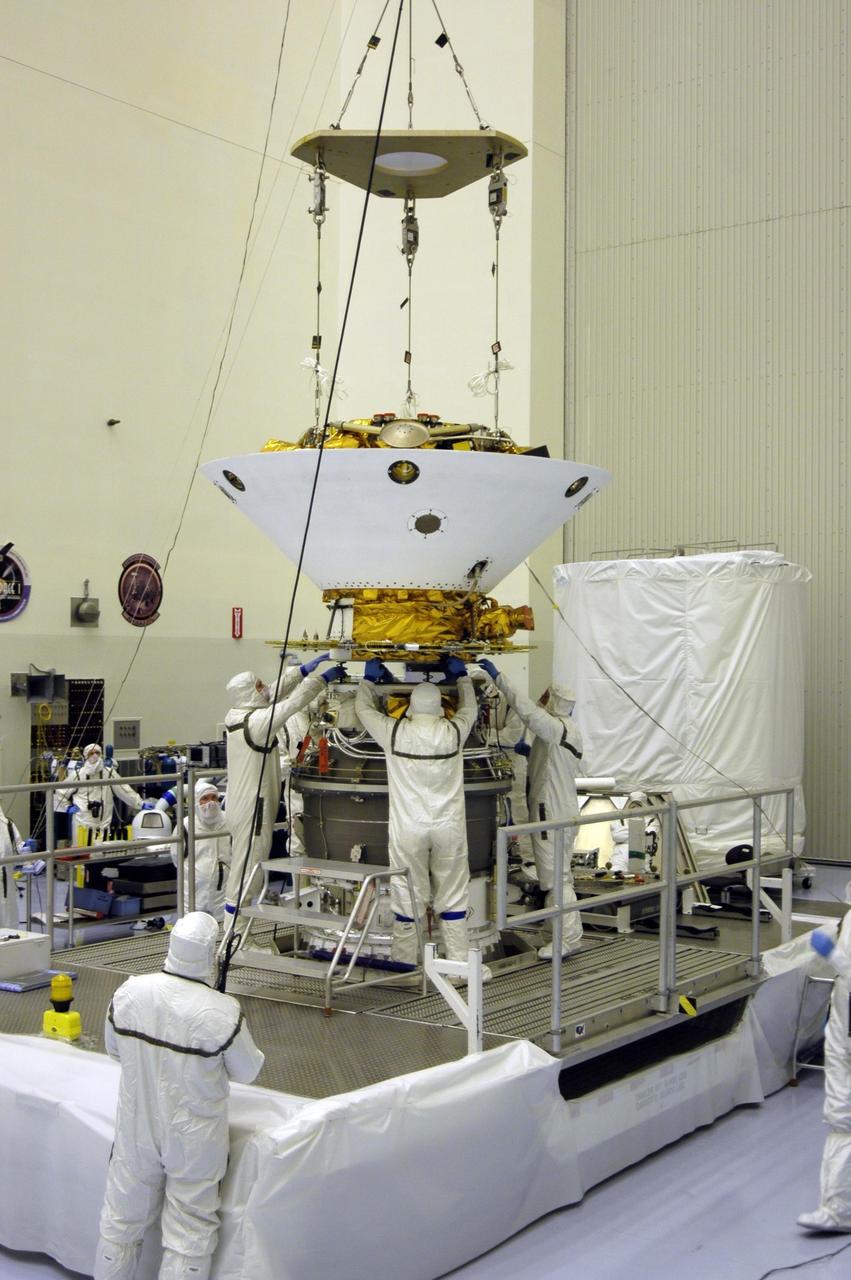
KENNEDY SPACE CENTER, Fla. -- In the Payload Hazardous Servicing Facility, workers attach the Phoenix Mars Lander spacecraft onto the upper stage booster. Targeted for launch from Cape Canaveral Air Force Station on Aug. 3, Phoenix will land in icy soils near the north polar permanent ice cap of Mars and explore the history of the water in these soils and any associated rocks, while monitoring polar climate. Landing on Mars is planned in May 2008 on arctic ground where a mission currently in orbit, Mars Odyssey, has detected high concentrations of ice just beneath the top layer of soil. NASA/Dimitri Gerondidakis
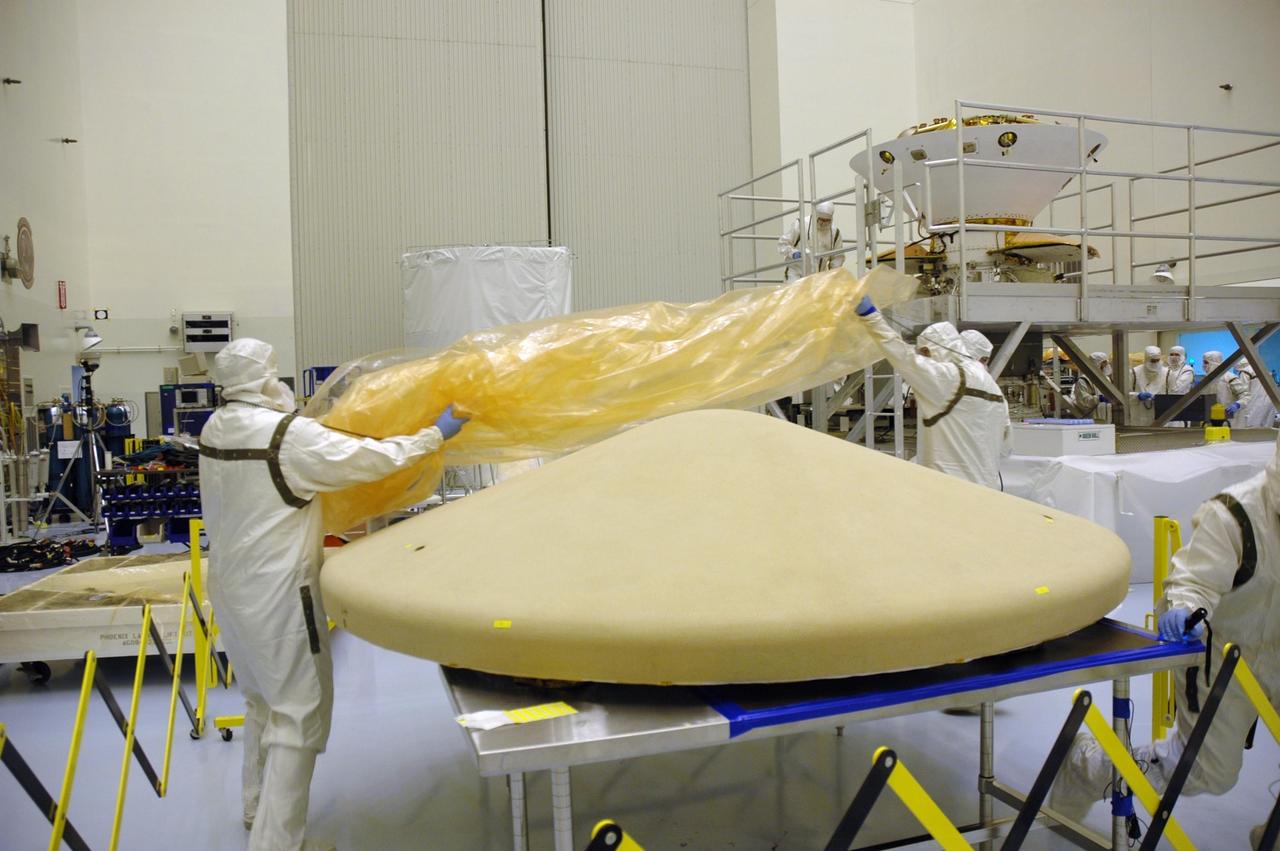
KENNEDY SPACE CENTER, Fla. -- In the Payload Hazardous Servicing Facility, workers remove the covering over the heat shield (foreground) for the Phoenix Mars Lander spacecraft before installation. Targeted for launch from Cape Canaveral Air Force Station on Aug. 3, Phoenix will land in icy soils near the north polar permanent ice cap of Mars and explore the history of the water in these soils and any associated rocks, while monitoring polar climate. Landing on Mars is planned in May 2008 on arctic ground where a mission currently in orbit, Mars Odyssey, has detected high concentrations of ice just beneath the top layer of soil. Photo credit: NASA/Troy Cryder
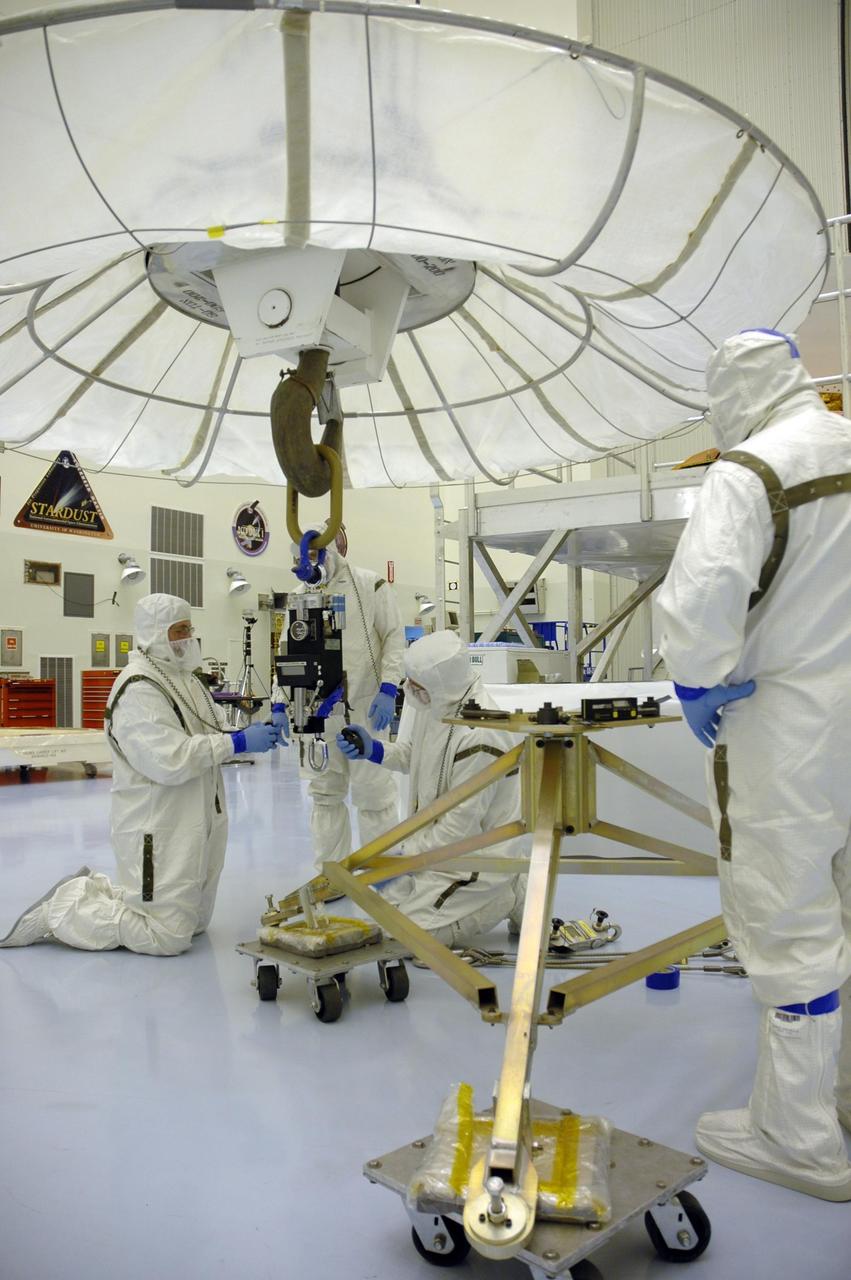
KENNEDY SPACE CENTER, Fla. -- In the Payload Hazardous Servicing Facility, workers prepare a crane that will be attached to the heat shield for the Phoenix Mars Lander spacecraft. The crane will lift and move the heat shield for installation over the lander within the cruise stage. Targeted for launch from Cape Canaveral Air Force Station on Aug. 3, Phoenix will land in icy soils near the north polar permanent ice cap of Mars and explore the history of the water in these soils and any associated rocks, while monitoring polar climate. Landing on Mars is planned in May 2008 on arctic ground where a mission currently in orbit, Mars Odyssey, has detected high concentrations of ice just beneath the top layer of soil. Photo credit: NASA/Troy Cryder
KENNEDY SPACE CENTER, Fla. -- In the Payload Hazardous Servicing Facility, workers attach a crane to the heat shield for the Phoenix Mars Lander spacecraft. The crane will lift and move the heat shield for installation over the lander within the cruise stage. Targeted for launch from Cape Canaveral Air Force Station on Aug. 3, Phoenix will land in icy soils near the north polar permanent ice cap of Mars and explore the history of the water in these soils and any associated rocks, while monitoring polar climate. Landing on Mars is planned in May 2008 on arctic ground where a mission currently in orbit, Mars Odyssey, has detected high concentrations of ice just beneath the top layer of soil. Photo credit: NASA/Troy Cryder
KENNEDY SPACE CENTER, Fla. -- In the Payload Hazardous Servicing Facility, workers attach a crane to the heat shield for the Phoenix Mars Lander spacecraft. The crane will lift and move the heat shield for installation over the lander within the cruise stage. Targeted for launch from Cape Canaveral Air Force Station on Aug. 3, Phoenix will land in icy soils near the north polar permanent ice cap of Mars and explore the history of the water in these soils and any associated rocks, while monitoring polar climate. Landing on Mars is planned in May 2008 on arctic ground where a mission currently in orbit, Mars Odyssey, has detected high concentrations of ice just beneath the top layer of soil. Photo credit: NASA/Troy Cryder
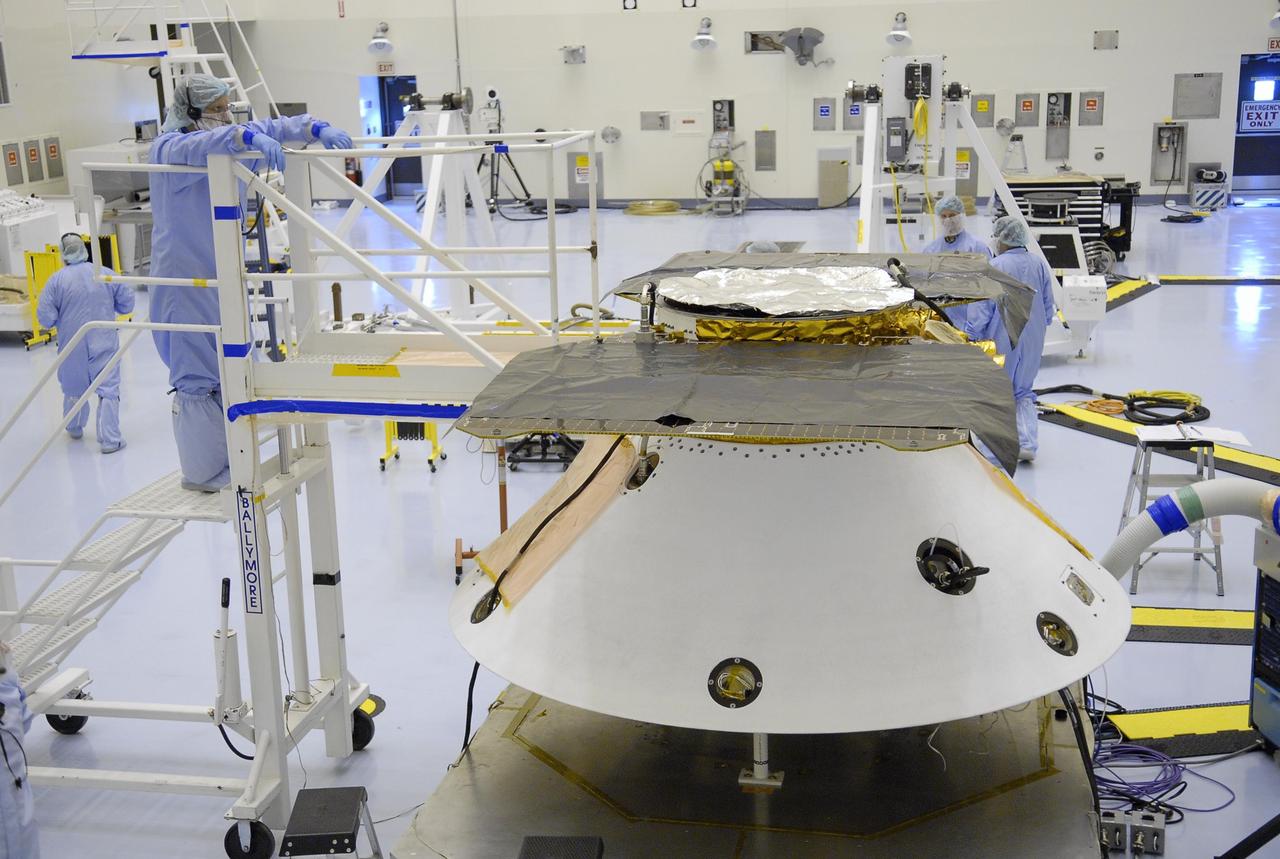
KENNEDY SPACE CENTER, FLA. -- In the Payload Hazardous Servicing Facility, the Phoenix Mars Lander spacecraft is prepared for illumination testing of its solar array panels. The Phoenix will be launched toward Mars to land in icy soils near the north polar permanent ice cap of Mars. It will explore the history of the water in these soils and any associated rocks, while monitoring polar climate. Landing on Mars is planned in May 2008 on arctic ground where a mission currently in orbit, Mars Odyssey, has detected high concentrations of ice just beneath the top layer of soil. Phoenix is scheduled to launch Aug. 3 from Pad 17-A at Cape Canaveral Air Force Station . Photo credit: NASA/Kim Shiflett
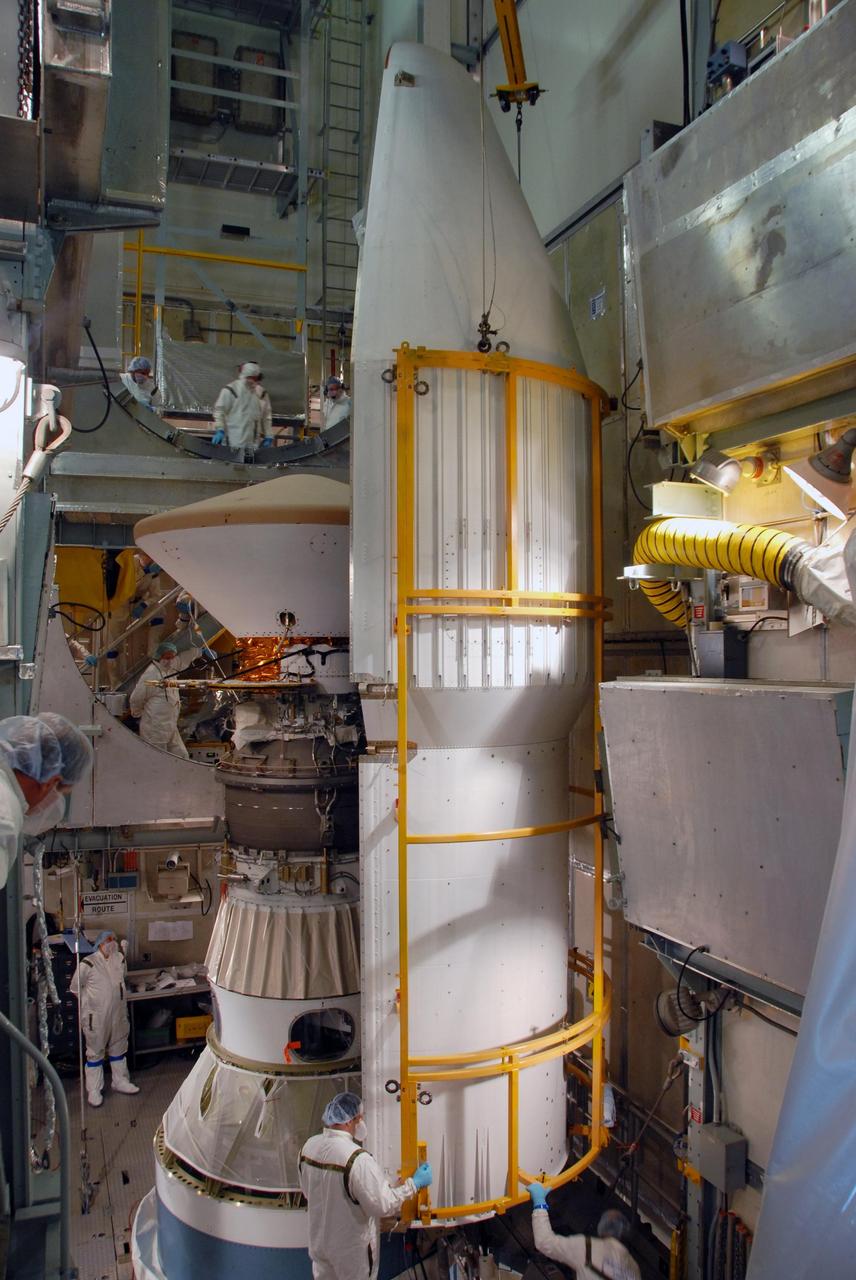
KENNEDY SPACE CENTER, FLA. -- On Launch Pad 17-A at Cape Canaveral Air Force Station, the first half of the fairing is moved toward the Phoenix Mars Lander for installation. Phoenix is targeted for launch on Aug. 3 aboard a Delta II rocket. The fairing is a molded structure that fits flush with the outside surface of the Delta II upper stage booster and forms an aerodynamically smooth nose cone, protecting the spacecraft during launch and ascent. Phoenix will land in icy soils near the north polar, permanent ice cap of Mars and explore the history of the water in these soils and any associated rocks, while monitoring polar climate. Landing on Mars is planned in May 2008 on arctic ground where a mission currently in orbit, Mars Odyssey, has detected high concentrations of ice just beneath the top layer of soil. NASA/George Shelton
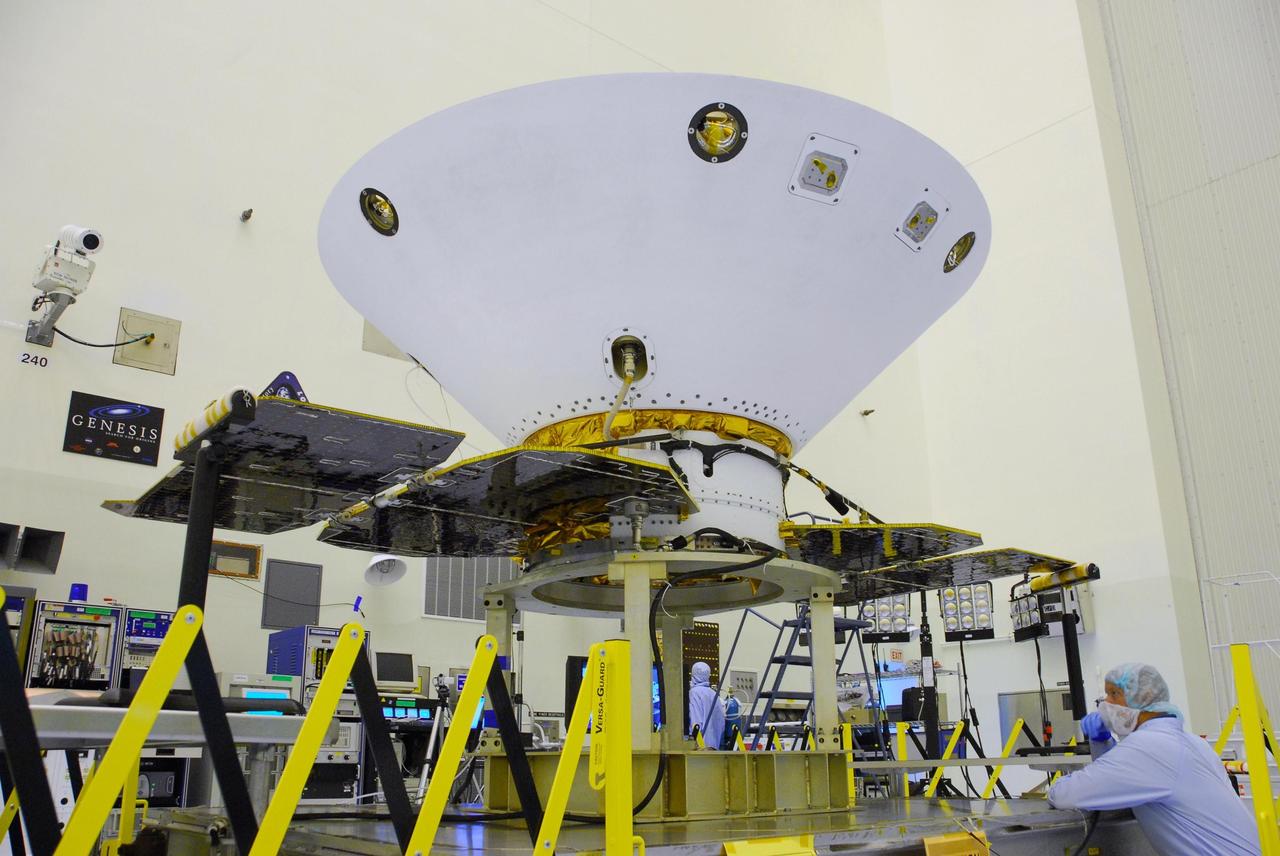
KENNEDY SPACE CENTER, FLA. -- In the Payload Hazardous Servicing Facility at Cape Canaveral Air Force Station, the solar array panels have been unfolded around the Phoenix Mars Lander spacecraft. The deployment of the panels is part of the pre-launch testing under way. Phoenix will land in icy soils near the north polar permanent ice cap of Mars and explore the history of the water in these soils and any associated rocks, while monitoring polar climate. Landing on Mars is planned in May 2008 on arctic ground where a mission currently in orbit, Mars Odyssey, has detected high concentrations of ice just beneath the top layer of soil. Phoenix is scheduled to launch Aug. 3. Photo credit: NASA/George Shelton
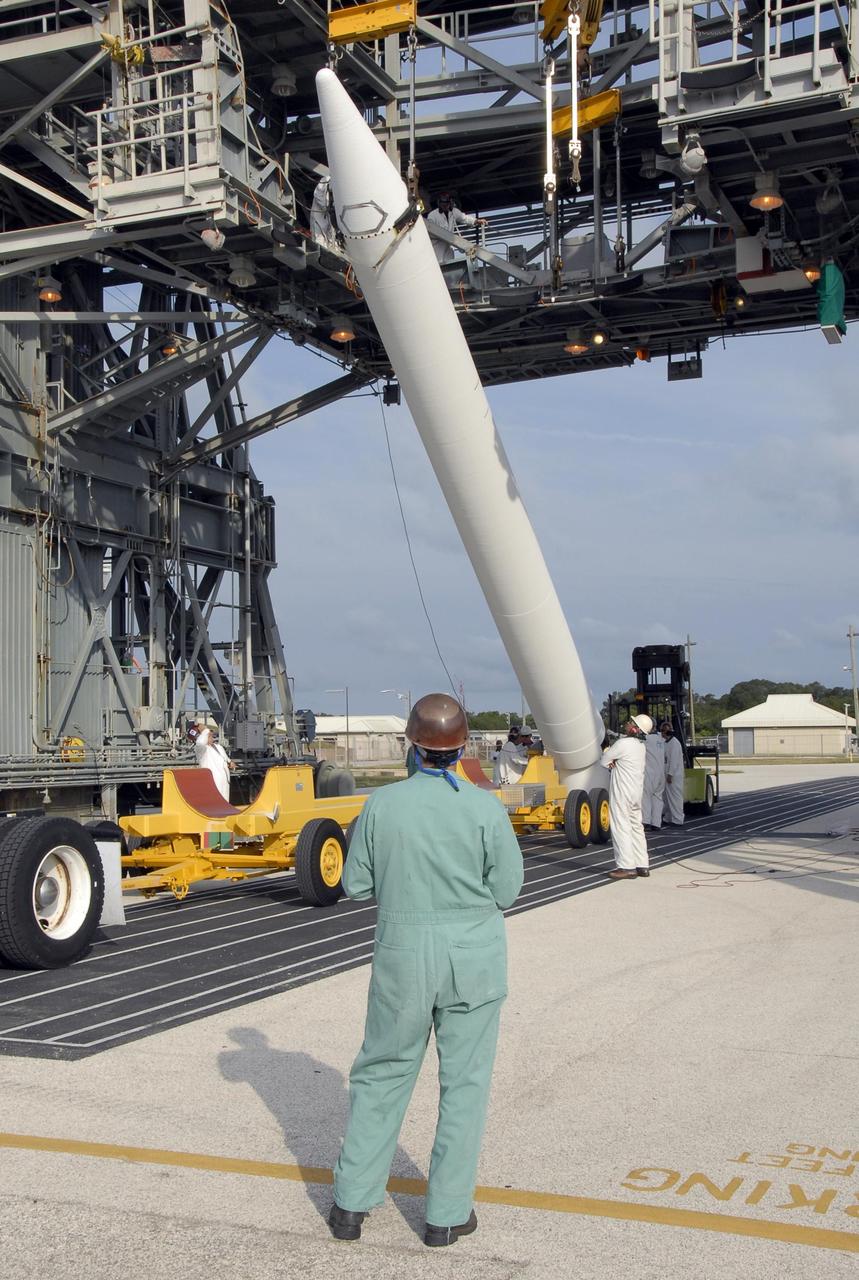
KENNEDY SPACE CENTER, FLA. -- On Pad 17-A at Cape Canaveral Air Force Station, the solid rocket booster is raised off its transporter. The SRB will be lifted into the mobile service tower for mating with the Delta II first stage. The Delta is the launch vehicle for the Phoenix Mars Lander spacecraft. Phoenix will land in icy soils near the north polar permanent ice cap of Mars and explore the history of the water in these soils and any associated rocks, while monitoring polar climate. Landing on Mars is planned in May 2008 on arctic ground where a mission currently in orbit, Mars Odyssey, has detected high concentrations of ice just beneath the top layer of soil. Phoenix is scheduled to launch Aug. 3. Photo credit: NASA/Kim Shiflett

KENNEDY SPACE CENTER, FLA. -- On Launch Pad 17-A at Cape Canaveral Air Force Station, the first half of the fairing is moved into place around the Phoenix Mars Lander for installation. Phoenix is targeted for launch on Aug. 3 aboard a Delta II rocket. The fairing is a molded structure that fits flush with the outside surface of the Delta II upper stage booster and forms an aerodynamically smooth nose cone, protecting the spacecraft during launch and ascent. Phoenix will land in icy soils near the north polar, permanent ice cap of Mars and explore the history of the water in these soils and any associated rocks, while monitoring polar climate. Landing on Mars is planned in May 2008 on arctic ground where a mission currently in orbit, Mars Odyssey, has detected high concentrations of ice just beneath the top layer of soil. NASA/George Shelton
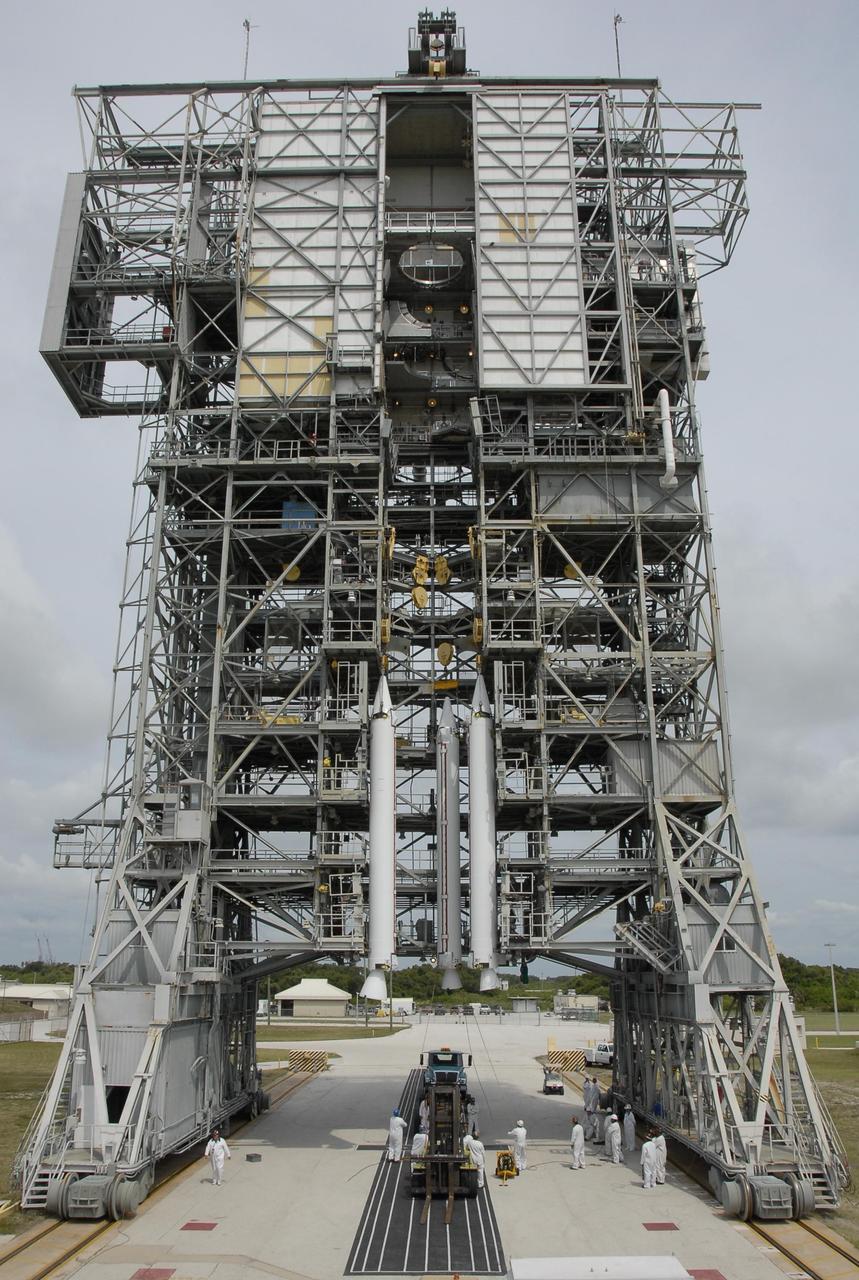
KENNEDY SPACE CENTER, FLA. -- On Pad 17-A at Cape Canaveral Air Force Station, three solid rocket boosters wait for the Delta II first stage to arrive at the mobile service tower. The SRBs will be mated with the Delta, which is the launch vehicle for the Phoenix Mars Lander spacecraft. Phoenix will land in icy soils near the north polar permanent ice cap of Mars and explore the history of the water in these soils and any associated rocks, while monitoring polar climate. Landing on Mars is planned in May 2008 on arctic ground where a mission currently in orbit, Mars Odyssey, has detected high concentrations of ice just beneath the top layer of soil. Phoenix is scheduled to launch Aug. 3. Photo credit: NASA/Kim Shiflett
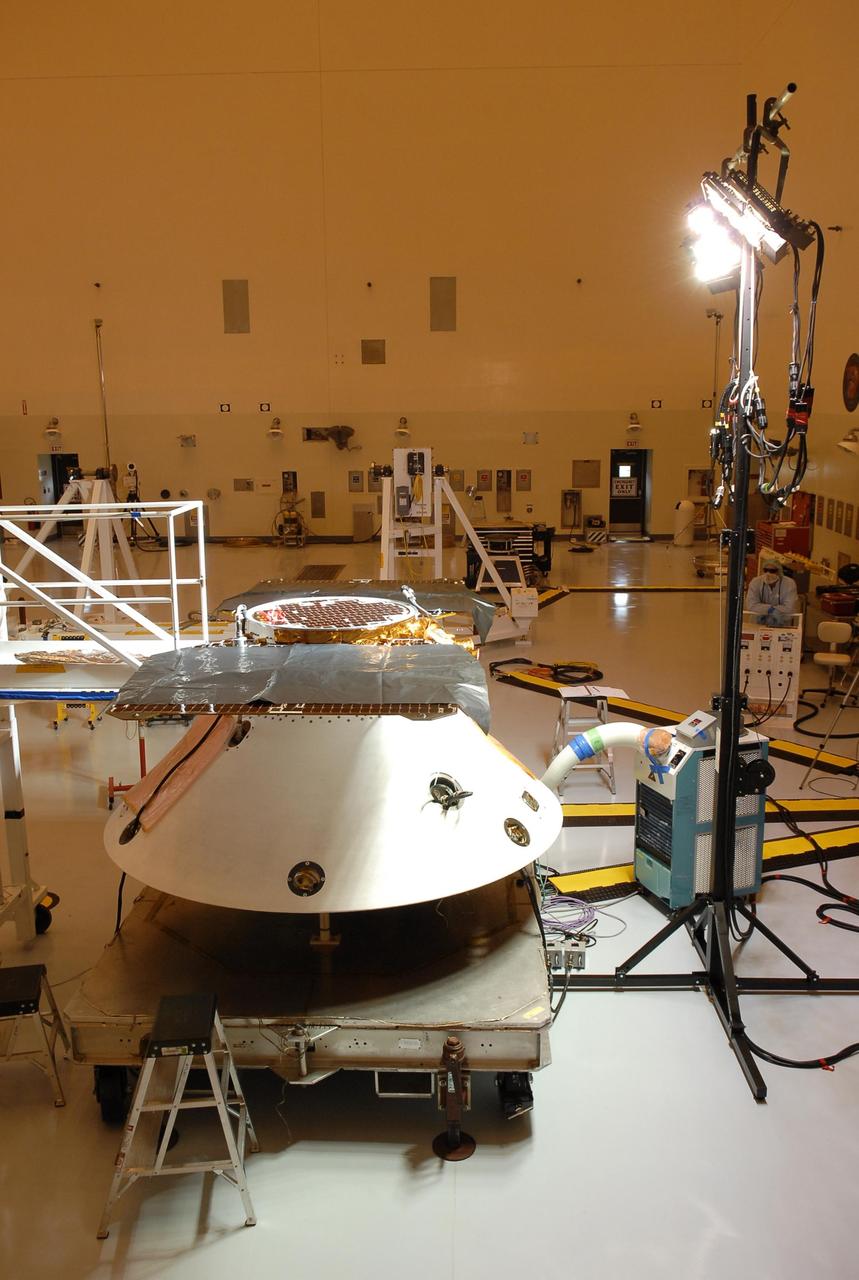
KENNEDY SPACE CENTER, FLA. -- In the Payload Hazardous Servicing Facility, the Phoenix Mars Lander spacecraft undergoes illumination testing of its solar array panels. The Phoenix will be launched toward Mars to land in icy soils near the planet's north polar permanent ice cap. It will explore the history of the water in these soils and any associated rocks, while monitoring polar climate. Landing on Mars is planned in May 2008 on arctic ground where a mission currently in orbit, Mars Odyssey, has detected high concentrations of ice just beneath the top layer of soil. Phoenix is scheduled to launch Aug. 3 from Pad 17-A at Cape Canaveral Air Force Station . Photo credit: NASA/Kim Shiflett
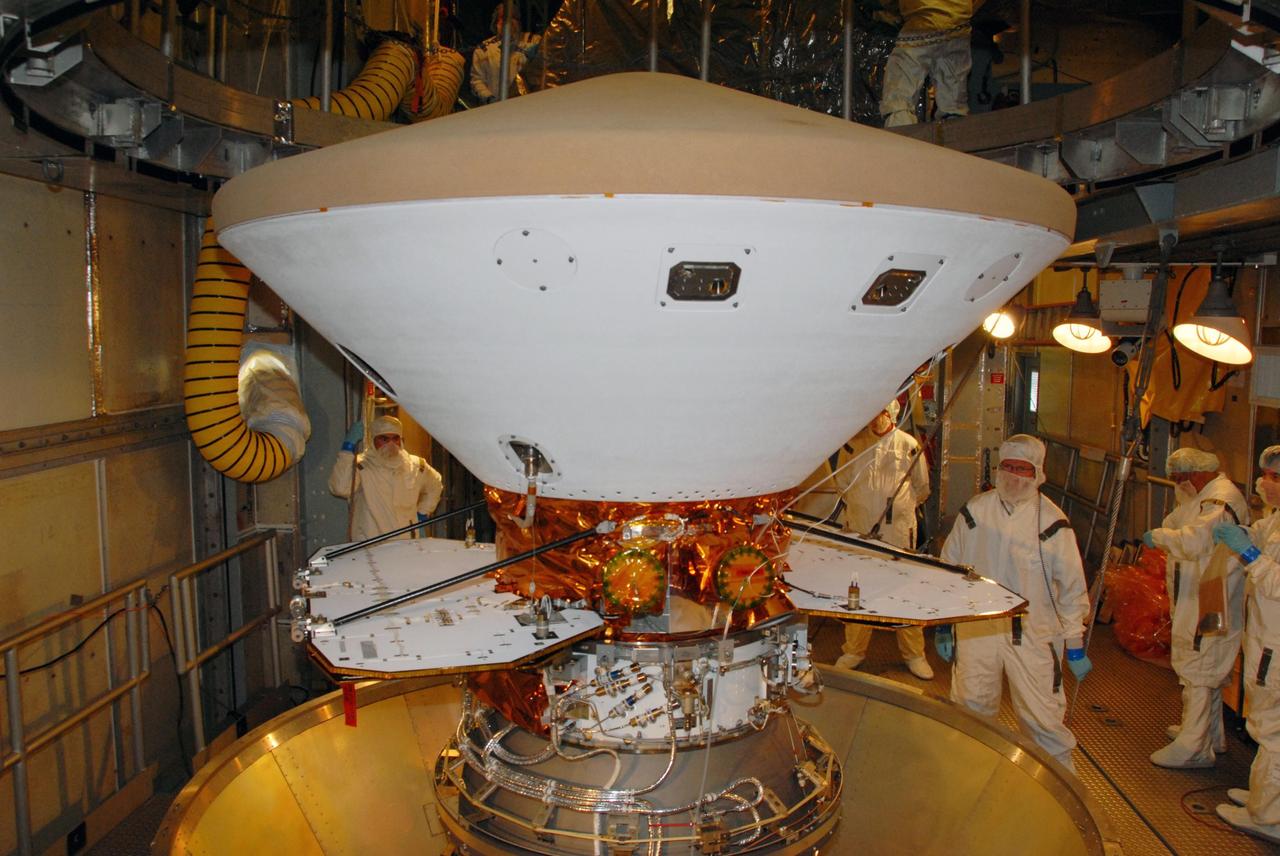
KENNEDY SPACE CENTER, FLA. -- NASA's Phoenix Mars Lander is revealed inside the mobile service tower of Launch Pad 17-A at Cape Canaveral Air Force Station in Florida, after workers removed the coverings protecting the spacecraft. Launch of Phoenix on a Delta II launch vehicle is scheduled for no earlier than Aug. 3. Phoenix will land in icy soils near the north polar permanent ice cap of Mars and explore the history of the water in these soils and any associated rocks, while monitoring polar climate. Landing on Mars is planned in May 2008 on arctic ground where a mission currently in orbit, Mars Odyssey, detected high concentrations of ice just beneath the top layer of soil. NASA/George Shelton
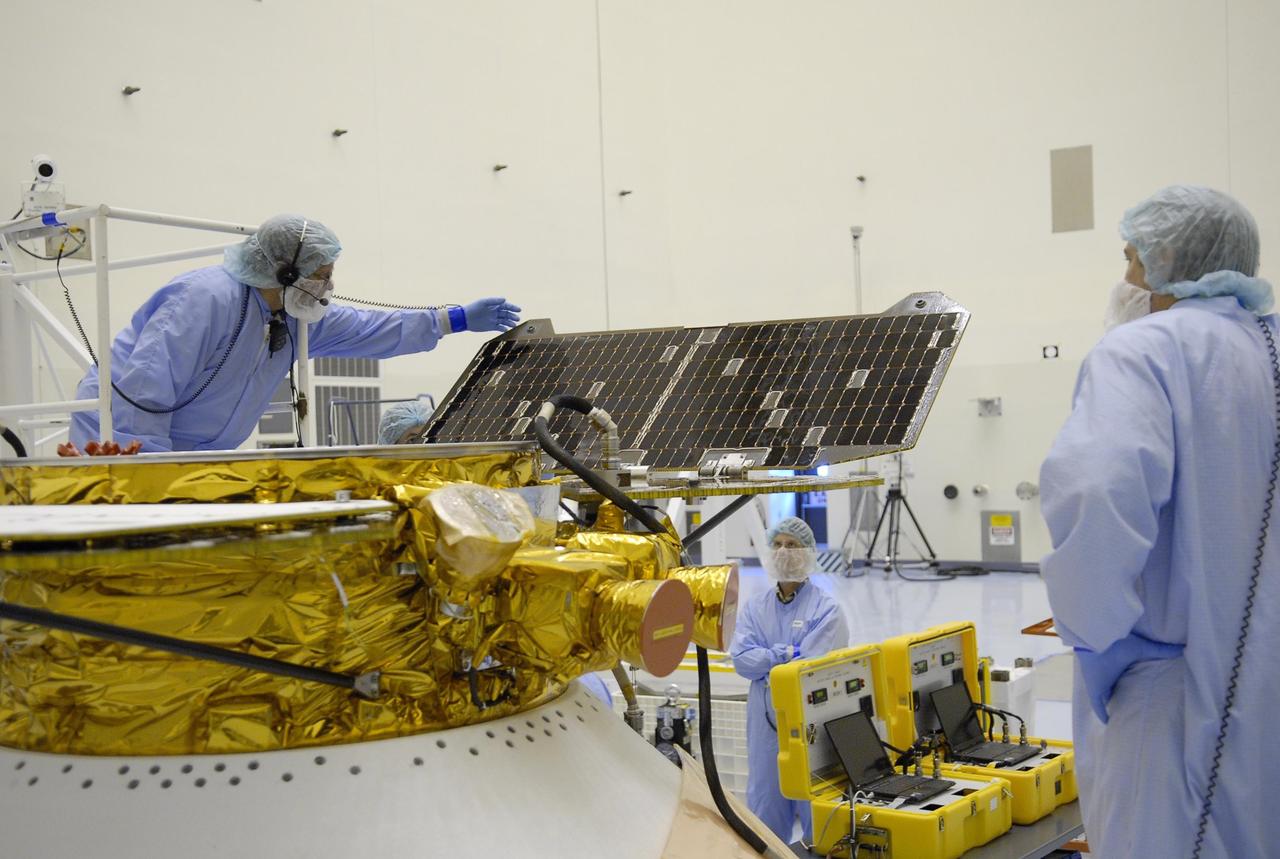
KENNEDY SPACE CENTER, FLA. -- After illumination testing of the solar array panels, technicians begin stowing the panels on the Phoenix Mars Lander spacecraft. The Phoenix will be launched toward Mars to land in icy soils near the planet's north polar permanent ice cap. It will explore the history of the water in these soils and any associated rocks, while monitoring polar climate. Landing on Mars is planned in May 2008 on arctic ground where a mission currently in orbit, Mars Odyssey, has detected high concentrations of ice just beneath the top layer of soil. Phoenix is scheduled to launch Aug. 3 from Pad 17-A at Cape Canaveral Air Force Station . Photo credit: NASA/Kim Shiflett

KENNEDY SPACE CENTER, FLA. -- On Pad 17-A at Cape Canaveral Air Force Station, the first of nine solid rocket boosters arrives at the mobile service tower. The SRB will be lifted into the tower for mating with the Delta II first stage. The Delta is the launch vehicle for the Phoenix Mars Lander spacecraft. Phoenix will land in icy soils near the north polar permanent ice cap of Mars and explore the history of the water in these soils and any associated rocks, while monitoring polar climate. Landing on Mars is planned in May 2008 on arctic ground where a mission currently in orbit, Mars Odyssey, has detected high concentrations of ice just beneath the top layer of soil. Phoenix is scheduled to launch Aug. 3. Photo credit: NASA/Kim Shiflett

KENNEDY SPACE CENTER, FLA. -- On Pad 17-A at Cape Canaveral Air Force Station, the Delta II first stage is rolling back to the mobile service tower for mating with the solid rocket boosters waiting there. The Delta is the launch vehicle for the Phoenix Mars Lander spacecraft. Phoenix will land in icy soils near the north polar permanent ice cap of Mars and explore the history of the water in these soils and any associated rocks, while monitoring polar climate. Landing on Mars is planned in May 2008 on arctic ground where a mission currently in orbit, Mars Odyssey, has detected high concentrations of ice just beneath the top layer of soil. Phoenix is scheduled to launch Aug. 3. Photo credit: NASA/Kim Shiflett
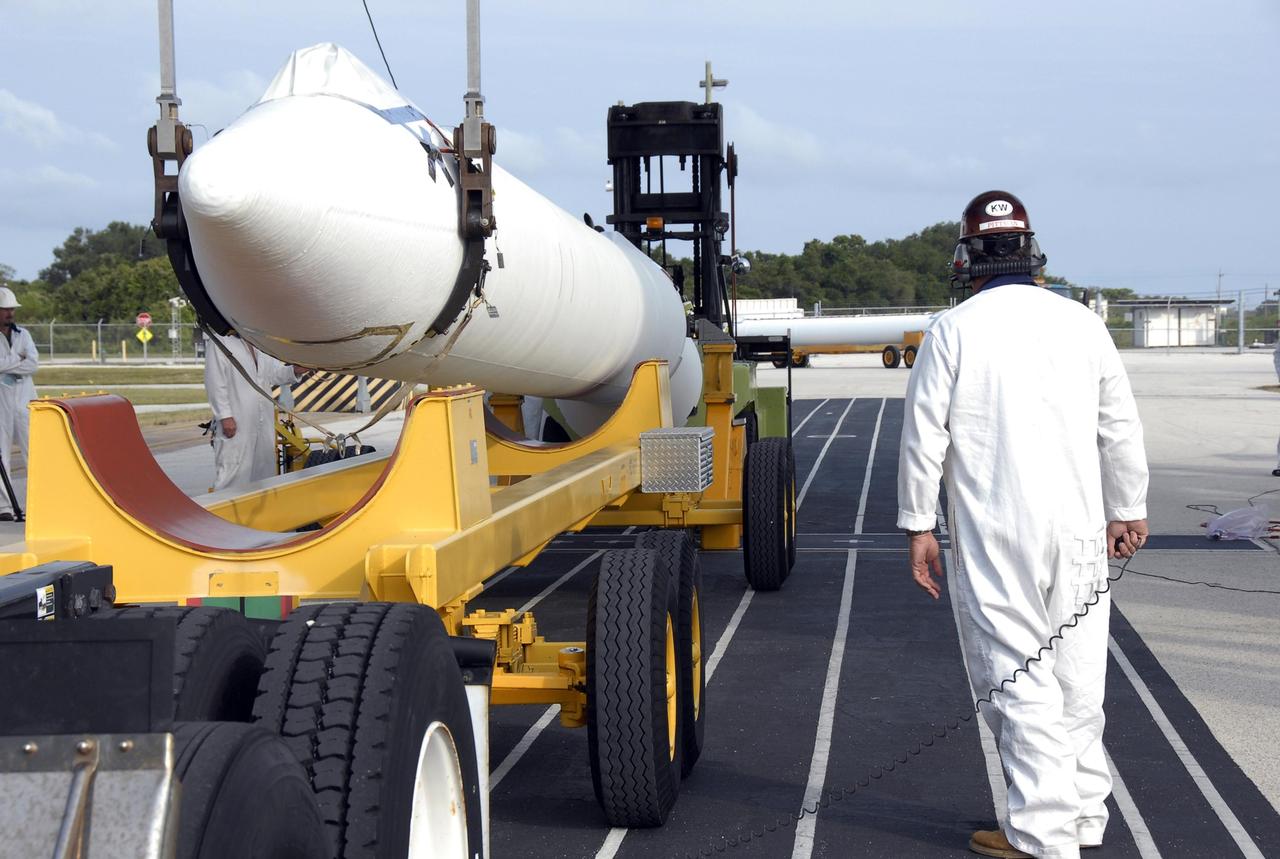
KENNEDY SPACE CENTER, FLA. -- On Pad 17-A at Cape Canaveral Air Force Station, the solid rocket booster is raised off its transporter. The SRB will be lifted into the mobile service tower for mating with the Delta II first stage. The Delta is the launch vehicle for the Phoenix Mars Lander spacecraft. Phoenix will land in icy soils near the north polar permanent ice cap of Mars and explore the history of the water in these soils and any associated rocks, while monitoring polar climate. Landing on Mars is planned in May 2008 on arctic ground where a mission currently in orbit, Mars Odyssey, has detected high concentrations of ice just beneath the top layer of soil. Phoenix is scheduled to launch Aug. 3. Photo credit: NASA/Kim Shiflett
KENNEDY SPACE CENTER, FLA. -- After illumination testing of the solar array panels, technicians begin stowing the panels on the Phoenix Mars Lander spacecraft. The Phoenix will be launched toward Mars to land in icy soils near the planet's north polar permanent ice cap. It will explore the history of the water in these soils and any associated rocks, while monitoring polar climate. Landing on Mars is planned in May 2008 on arctic ground where a mission currently in orbit, Mars Odyssey, has detected high concentrations of ice just beneath the top layer of soil. Phoenix is scheduled to launch Aug. 3 from Pad 17-A at Cape Canaveral Air Force Station . Photo credit: NASA/Kim Shiflett
KENNEDY SPACE CENTER, FLA. -- On Launch Pad 17-A at Cape Canaveral Air Force Station, the second half of the fairing (in the foreground) moves toward the Phoenix Mars Lander for installation. Phoenix is targeted for launch on Aug. 3 aboard a Delta II rocket. The fairing is a molded structure that fits flush with the outside surface of the Delta II upper stage booster and forms an aerodynamically smooth nose cone, protecting the spacecraft during launch and ascent. Phoenix will land in icy soils near the north polar, permanent ice cap of Mars and explore the history of the water in these soils and any associated rocks, while monitoring polar climate. Landing on Mars is planned in May 2008 on arctic ground where a mission currently in orbit, Mars Odyssey, has detected high concentrations of ice just beneath the top layer of soil. NASA/George Shelton
KENNEDY SPACE CENTER, FLA. -- On Launch Pad 17-A at Cape Canaveral Air Force Station, the Phoenix Mars Lander waits for he fairing installation. Phoenix is targeted for launch on Aug. 3 aboard a Delta II rocket. The fairing is a molded structure that fits flush with the outside surface of the Delta II upper stage booster and forms an aerodynamically smooth nose cone, protecting the spacecraft during launch and ascent. Phoenix will land in icy soils near the north polar, permanent ice cap of Mars and explore the history of the water in these soils and any associated rocks, while monitoring polar climate. Landing on Mars is planned in May 2008 on arctic ground where a mission currently in orbit, Mars Odyssey, has detected high concentrations of ice just beneath the top layer of soil. NASA/George Shelton
KENNEDY SPACE CENTER, FLA. -- In the Payload Hazardous Servicing Facility at Cape Canaveral Air Force Station, workers prepare the Phoenix Mars Lander spacecraft for solar panel deployment. The deployment of the panels is part of the pre-launch testing under way. Phoenix will land in icy soils near the north polar permanent ice cap of Mars and explore the history of the water in these soils and any associated rocks, while monitoring polar climate. Landing on Mars is planned in May 2008 on arctic ground where a mission currently in orbit, Mars Odyssey, has detected high concentrations of ice just beneath the top layer of soil. Phoenix is scheduled to launch Aug. 3. Photo credit: NASA/George Shelton
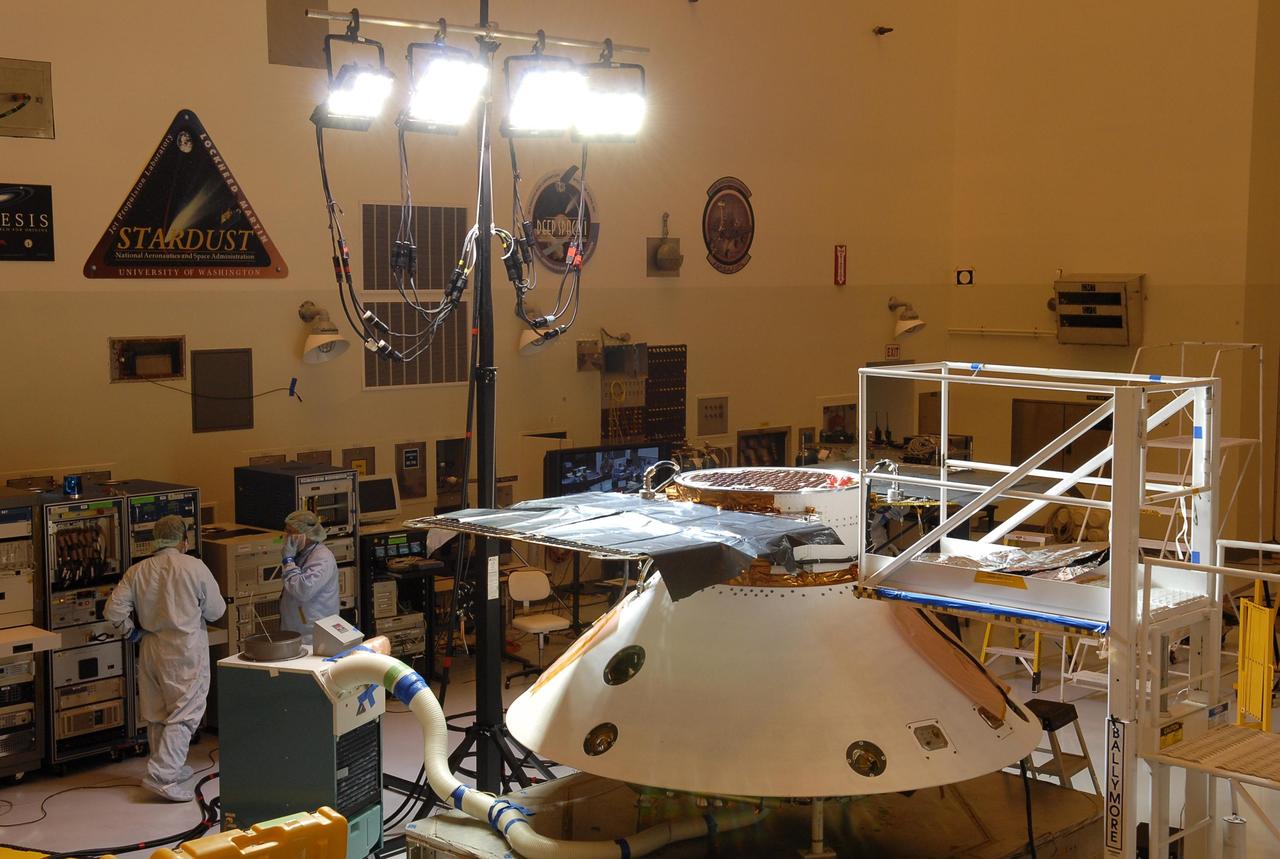
KENNEDY SPACE CENTER, FLA. -- In the Payload Hazardous Servicing Facility, the Phoenix Mars Lander spacecraft undergoes illumination testing of its solar array panels. The Phoenix will be launched toward Mars to land in icy soils near the planet's north polar permanent ice cap. It will explore the history of the water in these soils and any associated rocks, while monitoring polar climate. Landing on Mars is planned in May 2008 on arctic ground where a mission currently in orbit, Mars Odyssey, has detected high concentrations of ice just beneath the top layer of soil. Phoenix is scheduled to launch Aug. 3 from Pad 17-A at Cape Canaveral Air Force Station . Photo credit: NASA/Kim Shiflett
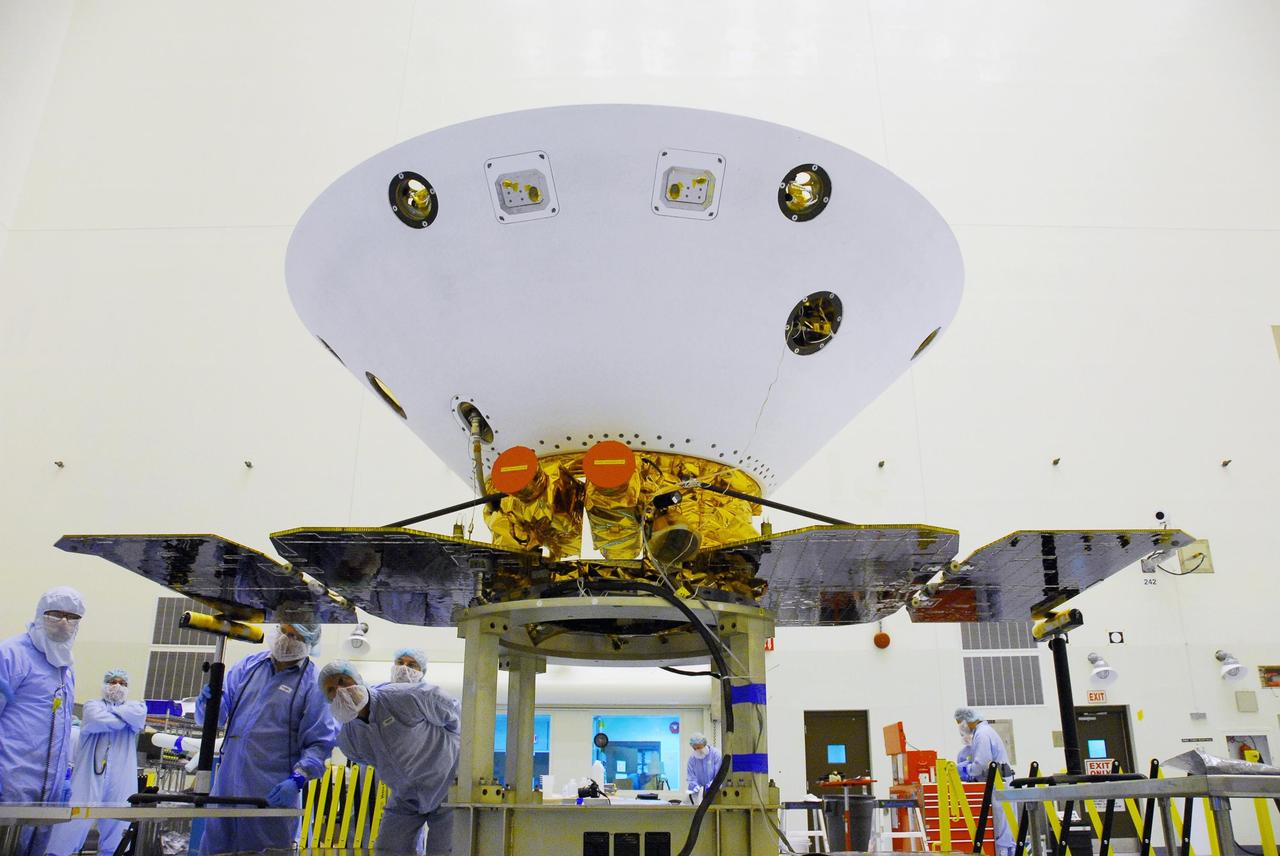
KENNEDY SPACE CENTER, FLA. -- In the Payload Hazardous Servicing Facility at Cape Canaveral Air Force Station, the solar array panels on the Phoenix Mars Lander spacecraft are unfolded. The deployment of the panels is part of the pre-launch testing under way. Phoenix will land in icy soils near the north polar permanent ice cap of Mars and explore the history of the water in these soils and any associated rocks, while monitoring polar climate. Landing on Mars is planned in May 2008 on arctic ground where a mission currently in orbit, Mars Odyssey, has detected high concentrations of ice just beneath the top layer of soil. Phoenix is scheduled to launch Aug. 3. Photo credit: NASA/George Shelton

KENNEDY SPACE CENTER, FLA. -- On Pad 17-A at Cape Canaveral Air Force Station, one solid rocket booster is lifted into the mobile service tower while another, below, is raised from its transporter. The SRBs will be mated with the Delta II first stage. The Delta is the launch vehicle for the Phoenix Mars Lander spacecraft. Phoenix will land in icy soils near the north polar permanent ice cap of Mars and explore the history of the water in these soils and any associated rocks, while monitoring polar climate. Landing on Mars is planned in May 2008 on arctic ground where a mission currently in orbit, Mars Odyssey, has detected high concentrations of ice just beneath the top layer of soil. Phoenix is scheduled to launch Aug. 3. Photo credit: NASA/Kim Shiflett
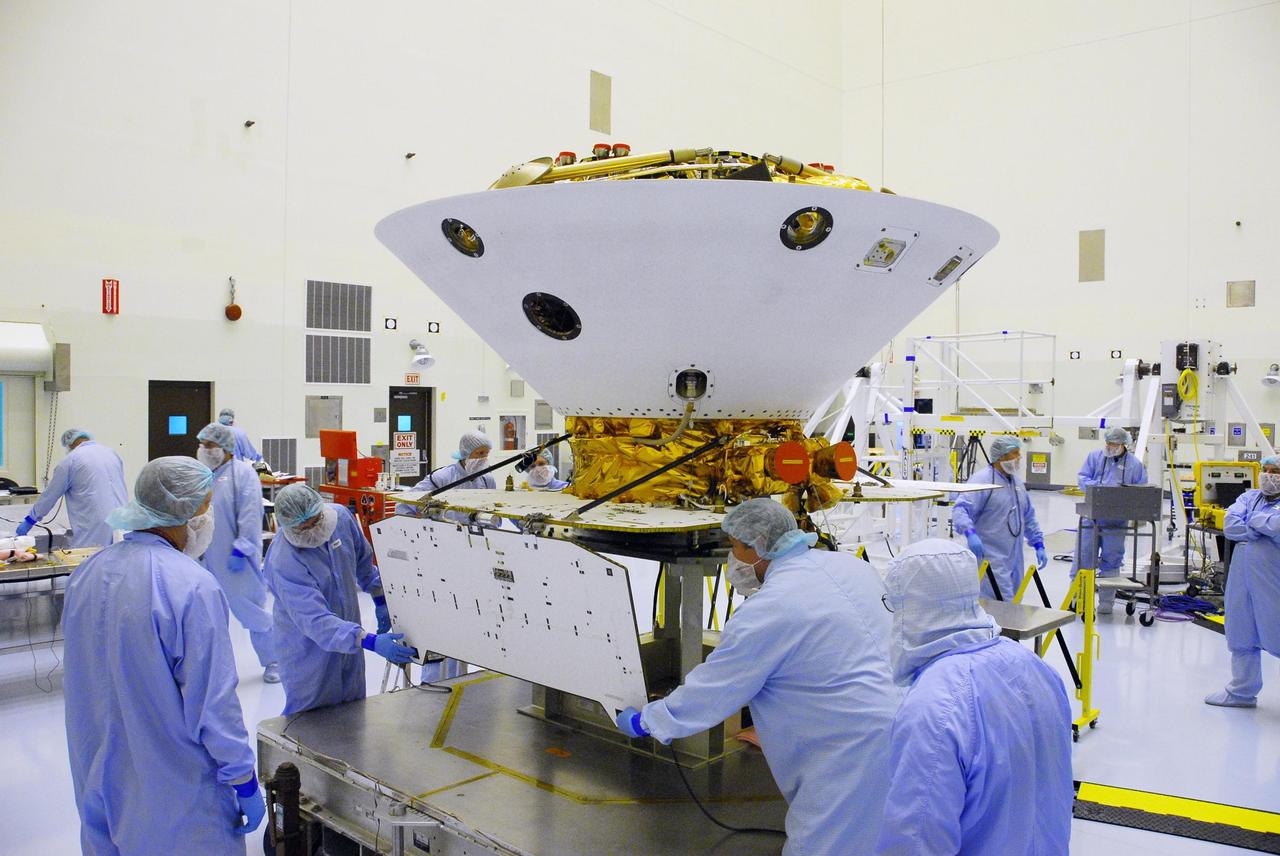
KENNEDY SPACE CENTER, FLA. -- In the Payload Hazardous Servicing Facility at Cape Canaveral Air Force Station, workers begin unfolding the solar array panels on the Phoenix Mars Lander spacecraft. The deployment of the panels is part of the pre-launch testing under way. Phoenix will land in icy soils near the north polar permanent ice cap of Mars and explore the history of the water in these soils and any associated rocks, while monitoring polar climate. Landing on Mars is planned in May 2008 on arctic ground where a mission currently in orbit, Mars Odyssey, has detected high concentrations of ice just beneath the top layer of soil. Phoenix is scheduled to launch Aug. 3. Photo credit: NASA/George Shelton
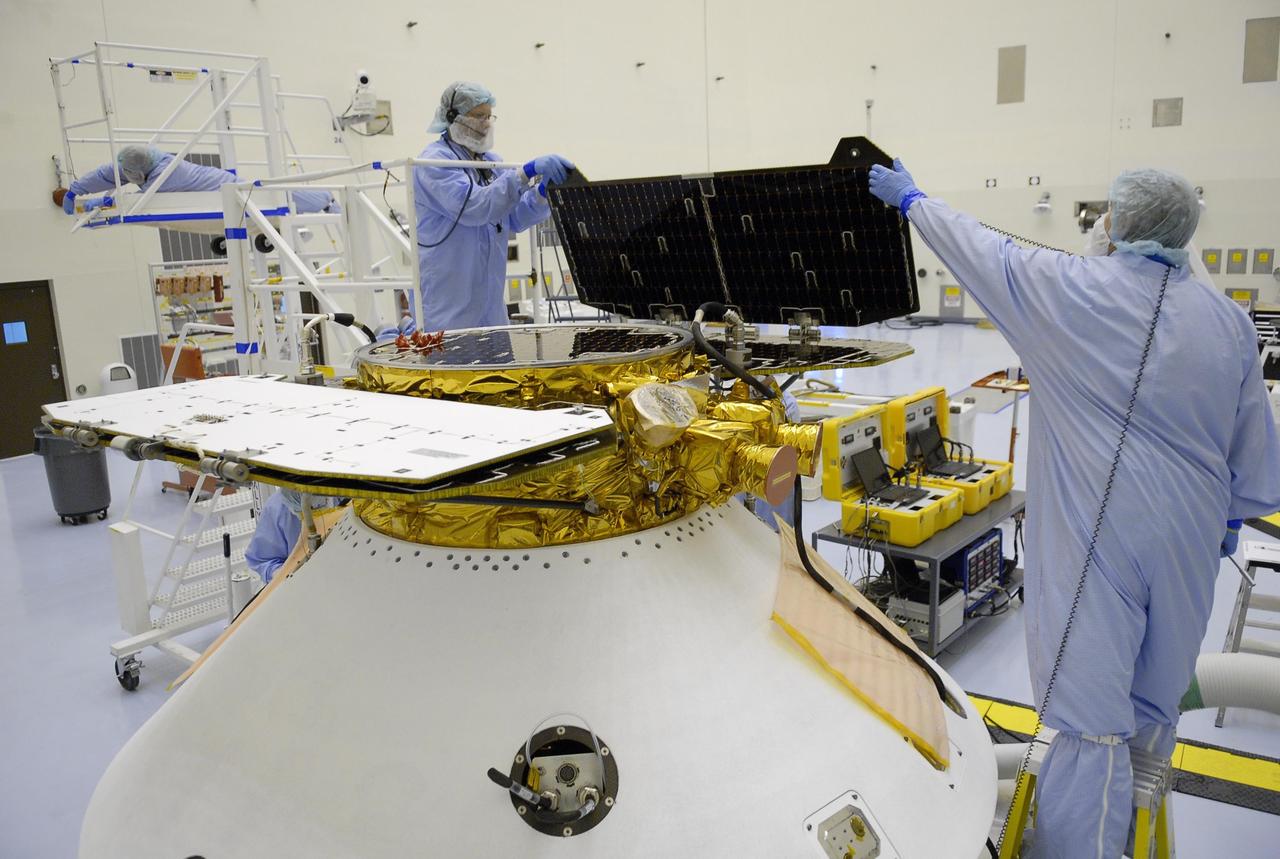
KENNEDY SPACE CENTER, FLA. -- After illumination testing of the solar array panels, technicians begin stowing the panels on the Phoenix Mars Lander spacecraft. The Phoenix will be launched toward Mars to land in icy soils near the planet's north polar permanent ice cap. It will explore the history of the water in these soils and any associated rocks, while monitoring polar climate. Landing on Mars is planned in May 2008 on arctic ground where a mission currently in orbit, Mars Odyssey, has detected high concentrations of ice just beneath the top layer of soil. Phoenix is scheduled to launch Aug. 3 from Pad 17-A at Cape Canaveral Air Force Station . Photo credit: NASA/Kim Shiflett
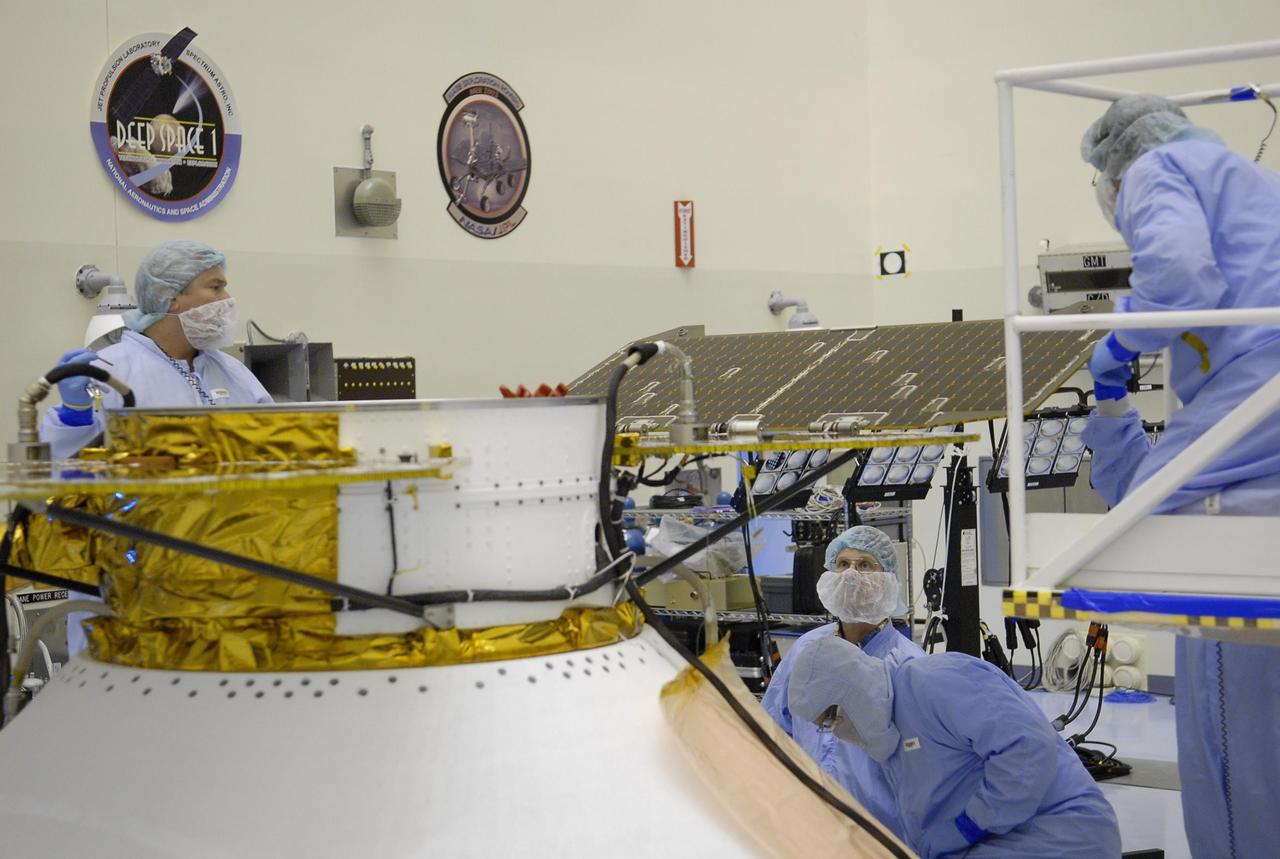
KENNEDY SPACE CENTER, FLA. -- After illumination testing of the solar array panels, technicians begin stowing the panels on the Phoenix Mars Lander spacecraft. The Phoenix will be launched toward Mars to land in icy soils near the planet's north polar permanent ice cap. It will explore the history of the water in these soils and any associated rocks, while monitoring polar climate. Landing on Mars is planned in May 2008 on arctic ground where a mission currently in orbit, Mars Odyssey, has detected high concentrations of ice just beneath the top layer of soil. Phoenix is scheduled to launch Aug. 3 from Pad 17-A at Cape Canaveral Air Force Station . Photo credit: NASA/Kim Shiflett

KENNEDY SPACE CENTER, FLA. -- On Pad 17-A at Cape Canaveral Air Force Station, one solid rocket booster is lifted into the mobile service tower while another, below, is raised from its transporter. The SRBs will be mated with the Delta II first stage. The Delta is the launch vehicle for the Phoenix Mars Lander spacecraft. Phoenix will land in icy soils near the north polar permanent ice cap of Mars and explore the history of the water in these soils and any associated rocks, while monitoring polar climate. Landing on Mars is planned in May 2008 on arctic ground where a mission currently in orbit, Mars Odyssey, has detected high concentrations of ice just beneath the top layer of soil. Phoenix is scheduled to launch Aug. 3. Photo credit: NASA/Kim Shiflett

KENNEDY SPACE CENTER, FLA. -- On Pad 17-A at Cape Canaveral Air Force Station, a third solid rocket booster is raised from its transporter to be lifted into the mobile service tower, where two others wait. The SRBs will be mated with the Delta II first stage. The Delta is the launch vehicle for the Phoenix Mars Lander spacecraft. Phoenix will land in icy soils near the north polar permanent ice cap of Mars and explore the history of the water in these soils and any associated rocks, while monitoring polar climate. Landing on Mars is planned in May 2008 on arctic ground where a mission currently in orbit, Mars Odyssey, has detected high concentrations of ice just beneath the top layer of soil. Phoenix is scheduled to launch Aug. 3. Photo credit: NASA/Kim Shiflett
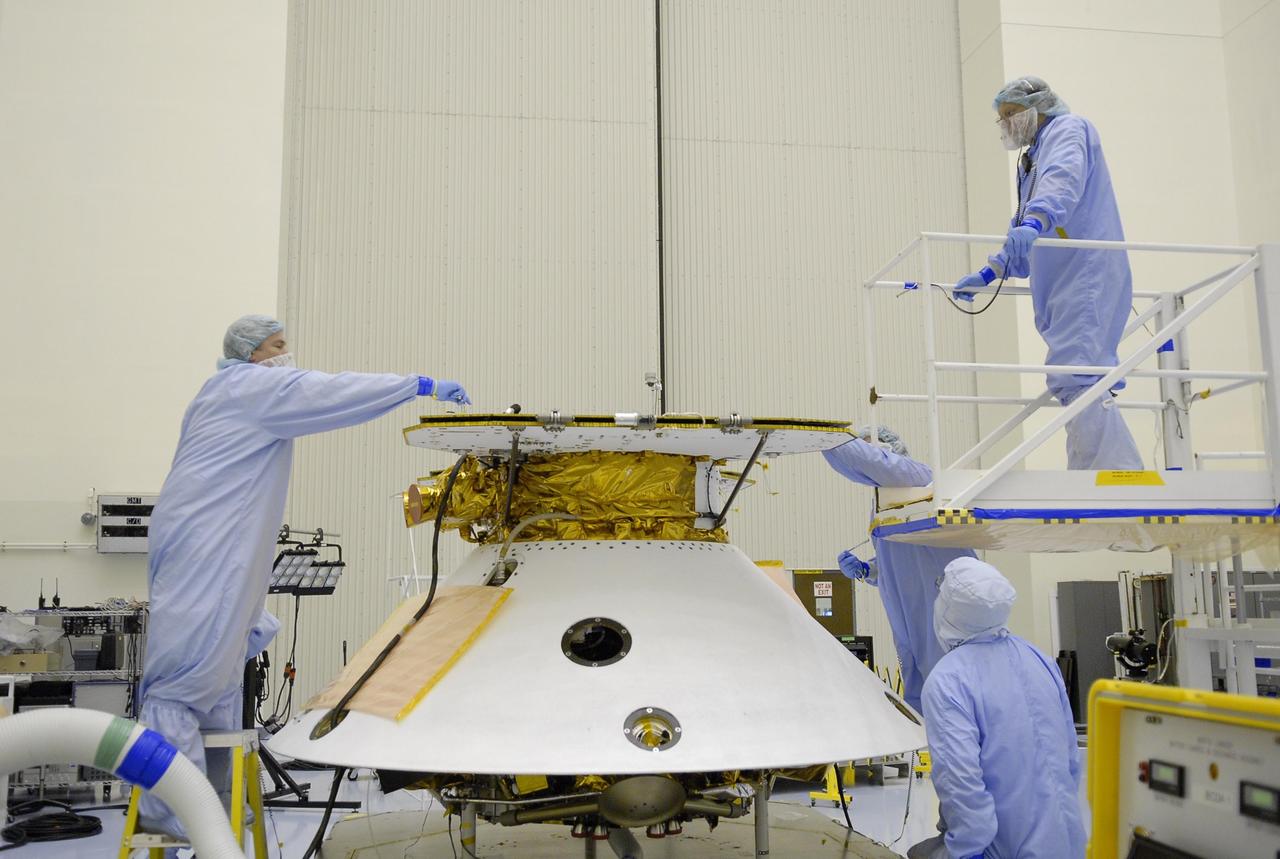
KENNEDY SPACE CENTER, FLA. -- After illumination testing of the solar array panels, technicians complete stowing the panels on the Phoenix Mars Lander spacecraft. The Phoenix will be launched toward Mars to land in icy soils near the planet's north polar permanent ice cap. It will explore the history of the water in these soils and any associated rocks, while monitoring polar climate. Landing on Mars is planned in May 2008 on arctic ground where a mission currently in orbit, Mars Odyssey, has detected high concentrations of ice just beneath the top layer of soil. Phoenix is scheduled to launch Aug. 3 from Pad 17-A at Cape Canaveral Air Force Station . Photo credit: NASA/Kim Shiflett
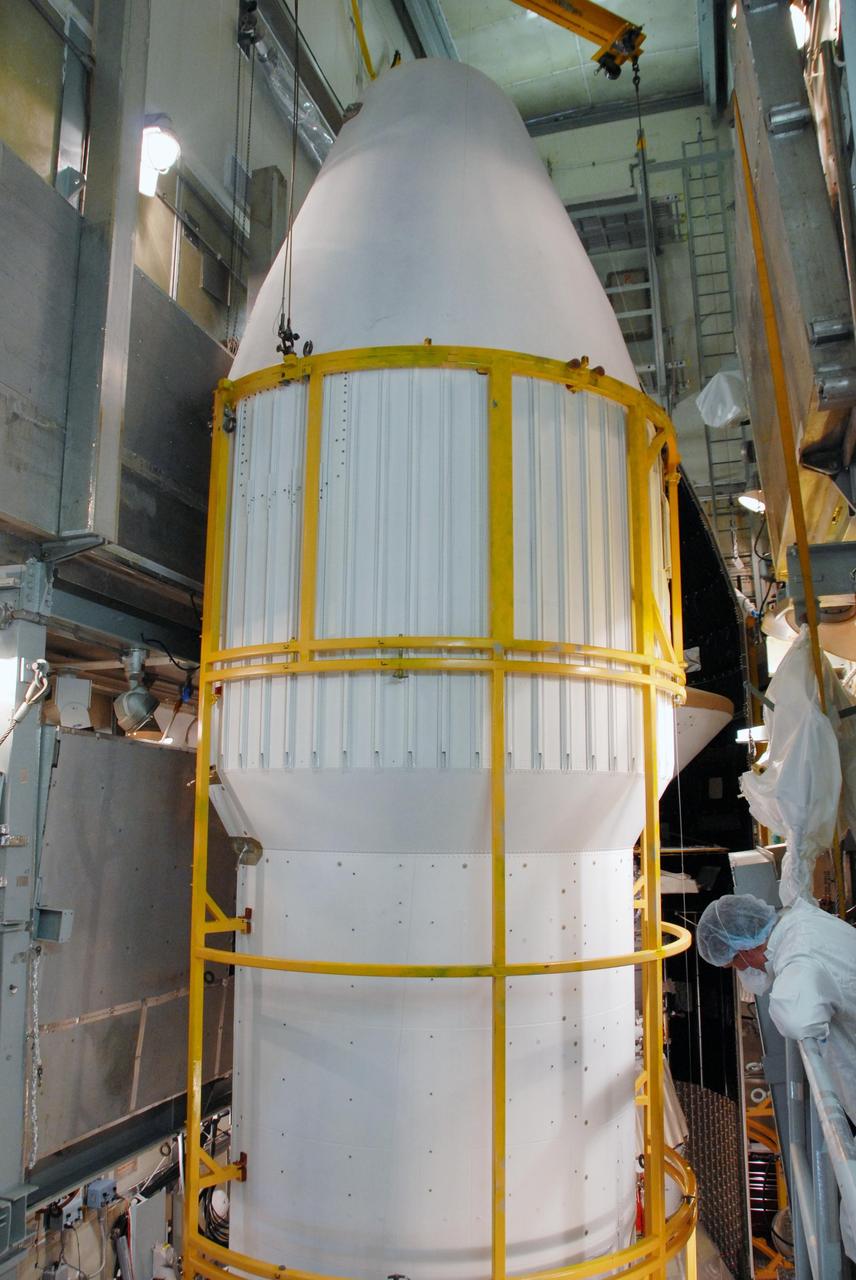
KENNEDY SPACE CENTER, FLA. -- On Launch Pad 17-A at Cape Canaveral Air Force Station, the second half of the fairing (in the foreground) moves closer to the Phoenix Mars Lander for installation toward the first half. Phoenix is targeted for launch on Aug. 3 aboard a Delta II rocket. The fairing is a molded structure that fits flush with the outside surface of the Delta II upper stage booster and forms an aerodynamically smooth nose cone, protecting the spacecraft during launch and ascent. Phoenix will land in icy soils near the north polar, permanent ice cap of Mars and explore the history of the water in these soils and any associated rocks, while monitoring polar climate. Landing on Mars is planned in May 2008 on arctic ground where a mission currently in orbit, Mars Odyssey, has detected high concentrations of ice just beneath the top layer of soil. NASA/George Shelton
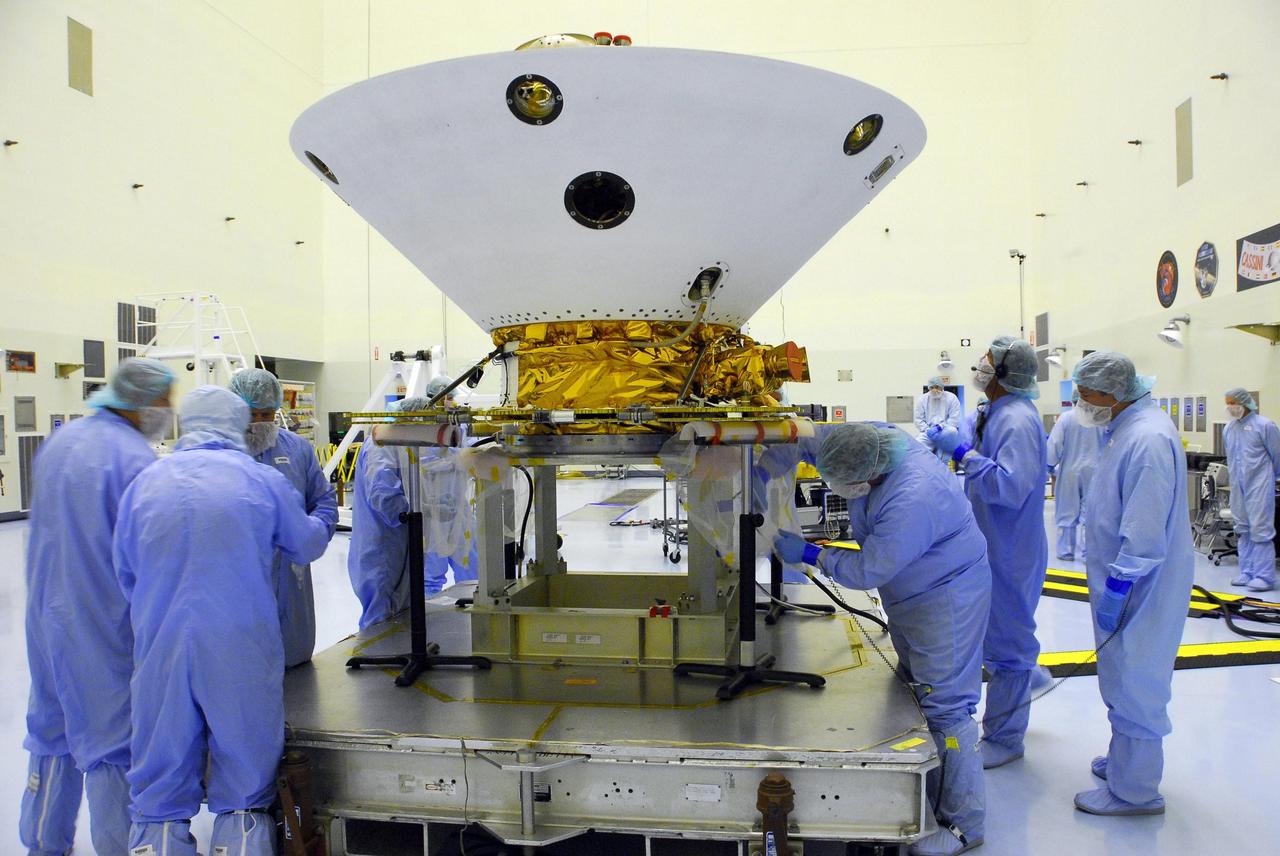
KENNEDY SPACE CENTER, FLA. -- In the Payload Hazardous Servicing Facility at Cape Canaveral Air Force Station, workers retrieve the springs and bolts from the test firing on the Phoenix Mars Lander spacecraft to deploy the solar panels. The deployment of the panels is part of the pre-launch testing under way. Phoenix will land in icy soils near the north polar permanent ice cap of Mars and explore the history of the water in these soils and any associated rocks, while monitoring polar climate. Landing on Mars is planned in May 2008 on arctic ground where a mission currently in orbit, Mars Odyssey, has detected high concentrations of ice just beneath the top layer of soil. Phoenix is scheduled to launch Aug. 3. Photo credit: NASA/George Shelton
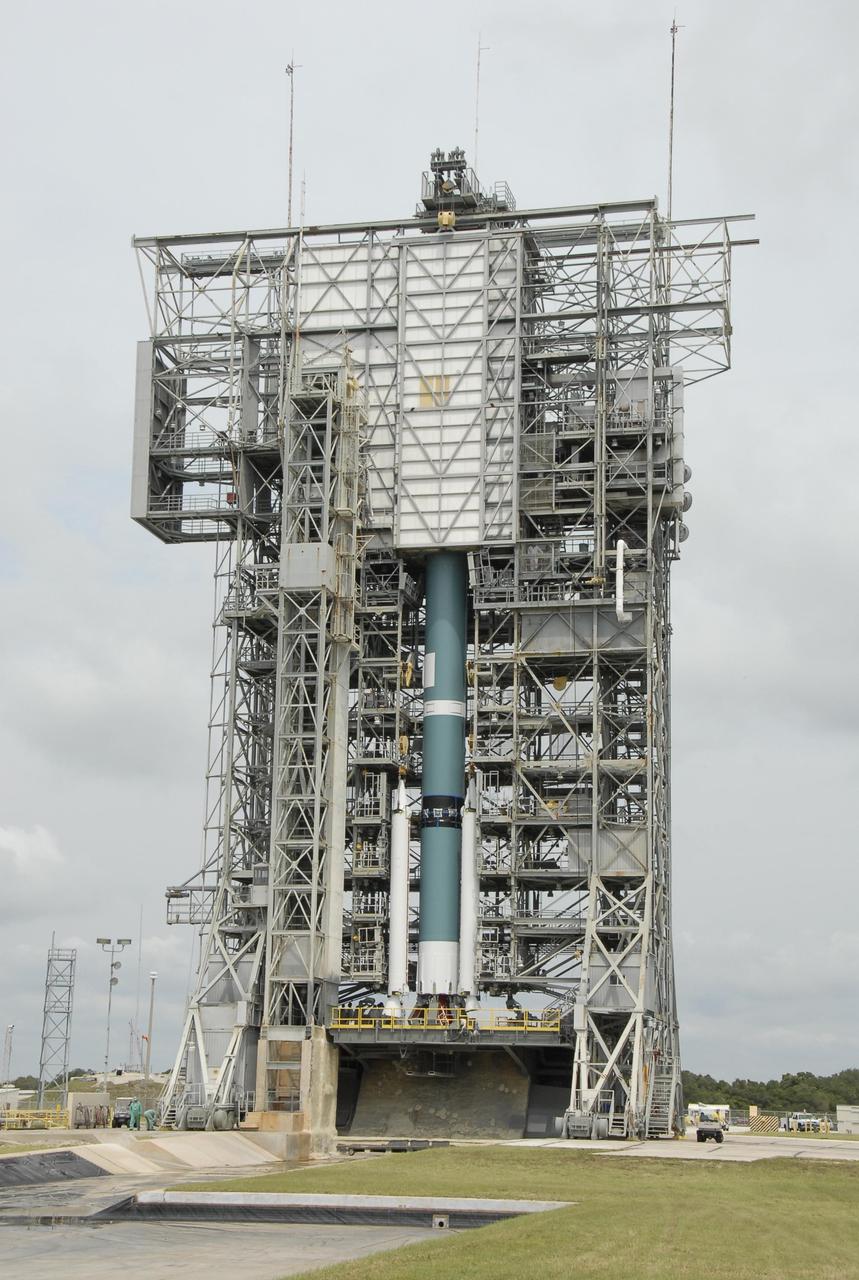
KENNEDY SPACE CENTER, FLA. -- On Pad 17-A at Cape Canaveral Air Force Station, three solid rocket boosters and the Delta II first stage are ready for mating inside the mobile service tower. The Delta is the launch vehicle for the Phoenix Mars Lander spacecraft. Phoenix will land in icy soils near the north polar permanent ice cap of Mars and explore the history of the water in these soils and any associated rocks, while monitoring polar climate. Landing on Mars is planned in May 2008 on arctic ground where a mission currently in orbit, Mars Odyssey, has detected high concentrations of ice just beneath the top layer of soil. Phoenix is scheduled to launch Aug. 3. Photo credit: NASA/Kim Shiflett
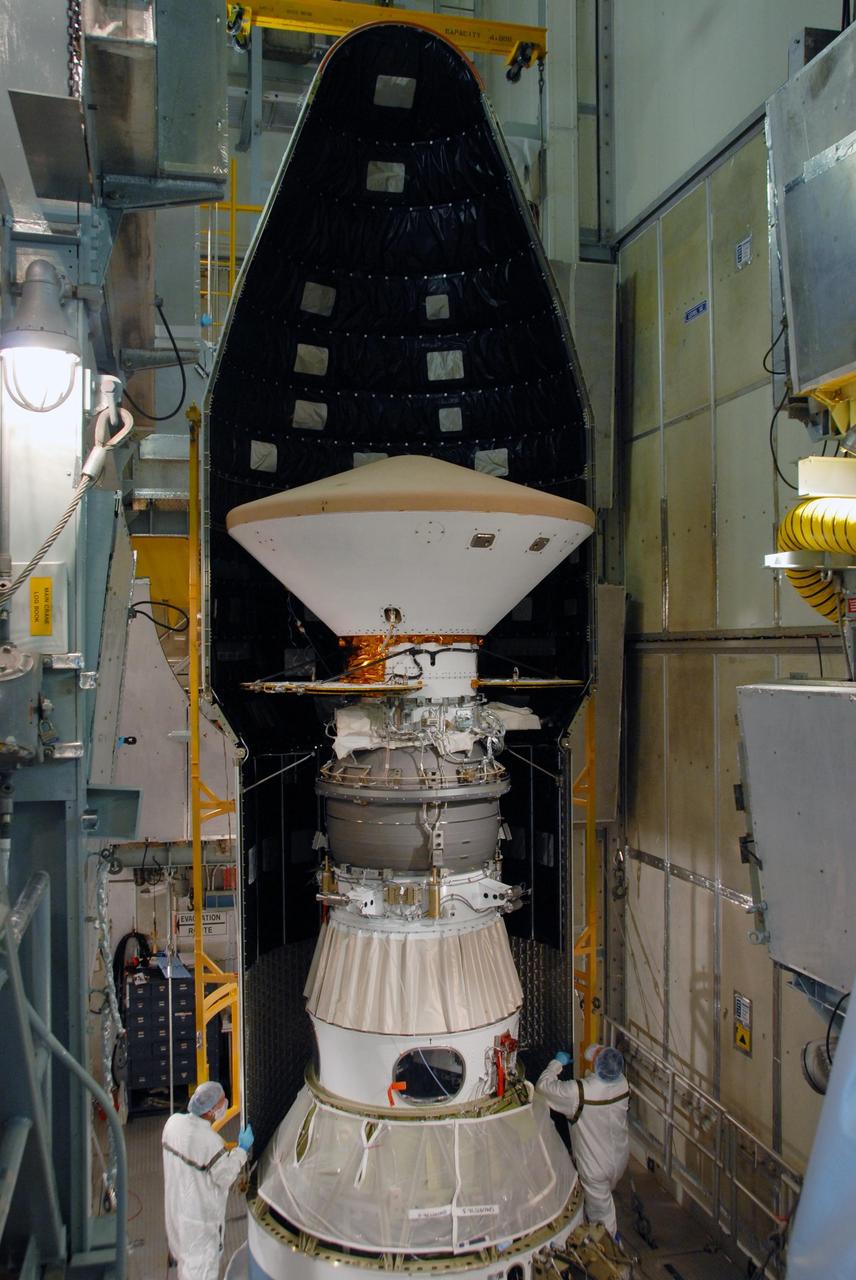
KENNEDY SPACE CENTER, FLA. -- On Launch Pad 17-A at Cape Canaveral Air Force Station, the first half of the fairing is moved into place around the Phoenix Mars Lander for installation. Phoenix is targeted for launch on Aug. 3 aboard a Delta II rocket. The fairing is a molded structure that fits flush with the outside surface of the Delta II upper stage booster and forms an aerodynamically smooth nose cone, protecting the spacecraft during launch and ascent. Phoenix will land in icy soils near the north polar, permanent ice cap of Mars and explore the history of the water in these soils and any associated rocks, while monitoring polar climate. Landing on Mars is planned in May 2008 on arctic ground where a mission currently in orbit, Mars Odyssey, has detected high concentrations of ice just beneath the top layer of soil. NASA/George Shelton

KENNEDY SPACE CENTER, FLA. -- In the Payload Hazardous Servicing Facility, the Phoenix Mars Lander spacecraft undergoes illumination testing of its solar array panels. The Phoenix will be launched toward Mars to land in icy soils near the planet's north polar permanent ice cap. It will explore the history of the water in these soils and any associated rocks, while monitoring polar climate. Landing on Mars is planned in May 2008 on arctic ground where a mission currently in orbit, Mars Odyssey, has detected high concentrations of ice just beneath the top layer of soil. Phoenix is scheduled to launch Aug. 3 from Pad 17-A at Cape Canaveral Air Force Station . Photo credit: NASA/Kim Shiflett
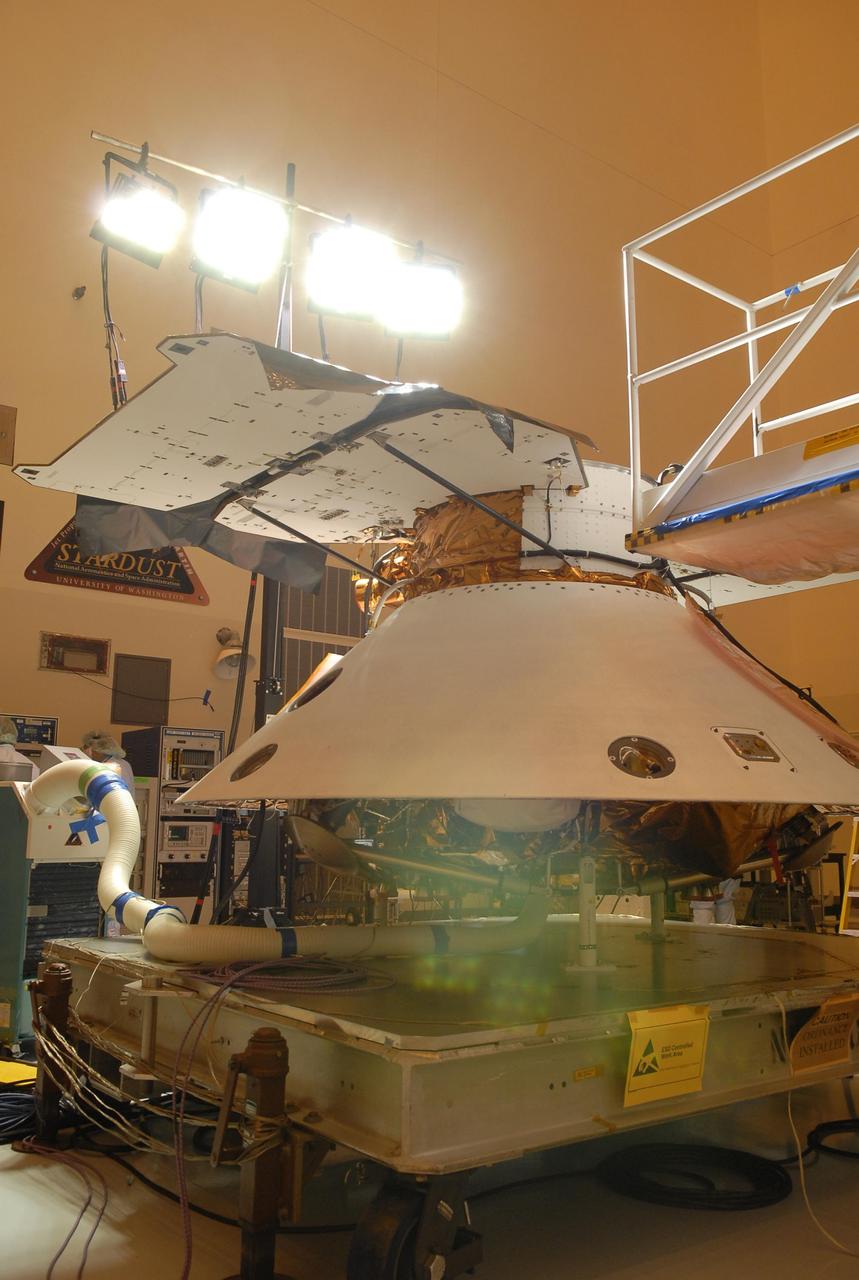
KENNEDY SPACE CENTER, FLA. -- In the Payload Hazardous Servicing Facility, the Phoenix Mars Lander spacecraft undergoes illumination testing of its solar array panels. The Phoenix will be launched toward Mars to land in icy soils near the planet's north polar permanent ice cap. It will explore the history of the water in these soils and any associated rocks, while monitoring polar climate. Landing on Mars is planned in May 2008 on arctic ground where a mission currently in orbit, Mars Odyssey, has detected high concentrations of ice just beneath the top layer of soil. Phoenix is scheduled to launch Aug. 3 from Pad 17-A at Cape Canaveral Air Force Station . Photo credit: NASA/Kim Shiflett
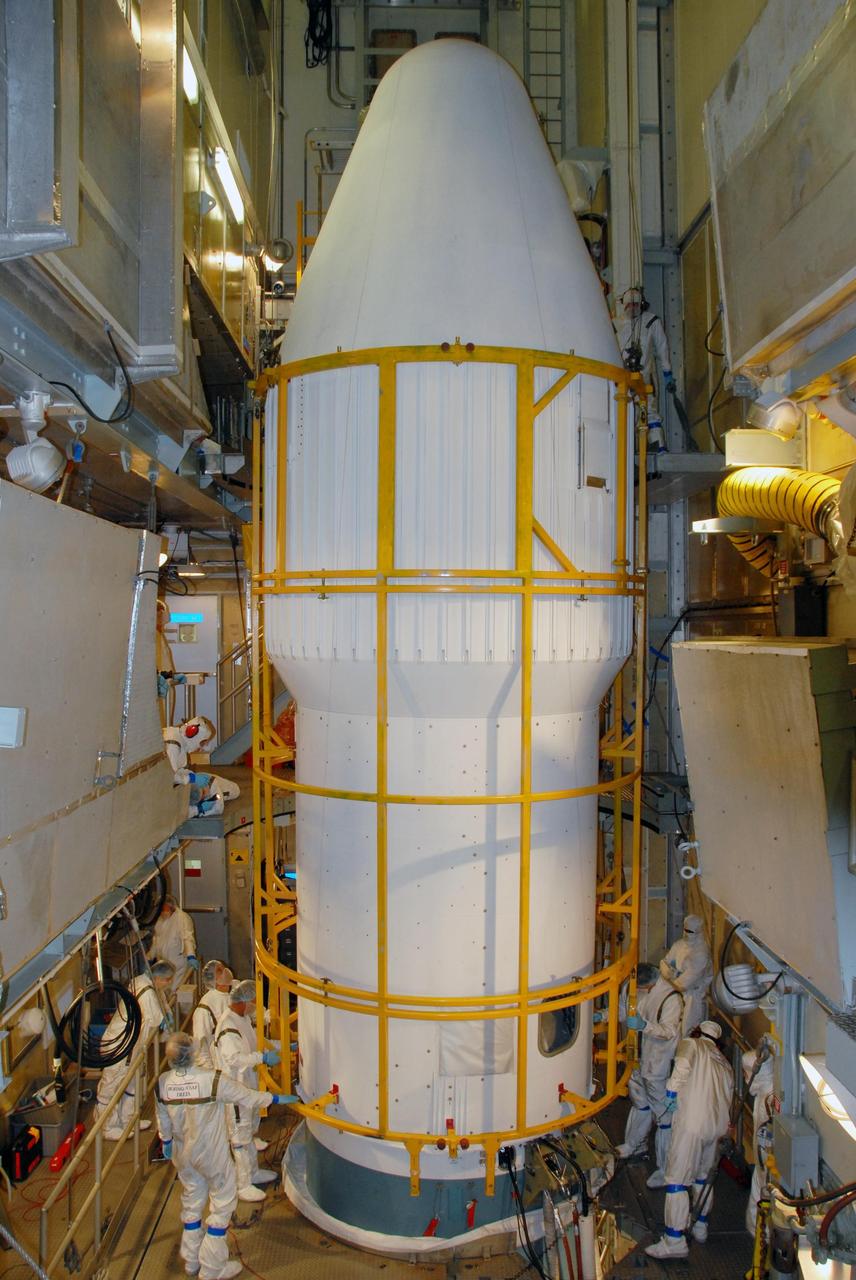
KENNEDY SPACE CENTER, FLA. -- On Launch Pad 17-A at Cape Canaveral Air Force Station, the two halves of the fairing come together for installation around the Phoenix Mars Lander. Phoenix is targeted for launch on Aug. 3 aboard a Delta II rocket. The fairing is a molded structure that fits flush with the outside surface of the Delta II upper stage booster and forms an aerodynamically smooth nose cone, protecting the spacecraft during launch and ascent. Phoenix will land in icy soils near the north polar, permanent ice cap of Mars and explore the history of the water in these soils and any associated rocks, while monitoring polar climate. Landing on Mars is planned in May 2008 on arctic ground where a mission currently in orbit, Mars Odyssey, has detected high concentrations of ice just beneath the top layer of soil. NASA/George Shelton
KENNEDY SPACE CENTER, FLA. -- In the Payload Hazardous Servicing Facility at Cape Canaveral Air Force Station, workers begin unfolding the solar array panels on the Phoenix Mars Lander spacecraft. The deployment of the panels is part of the pre-launch testing under way. Phoenix will land in icy soils near the north polar permanent ice cap of Mars and explore the history of the water in these soils and any associated rocks, while monitoring polar climate. Landing on Mars is planned in May 2008 on arctic ground where a mission currently in orbit, Mars Odyssey, has detected high concentrations of ice just beneath the top layer of soil. Phoenix is scheduled to launch Aug. 3. Photo credit: NASA/George Shelton
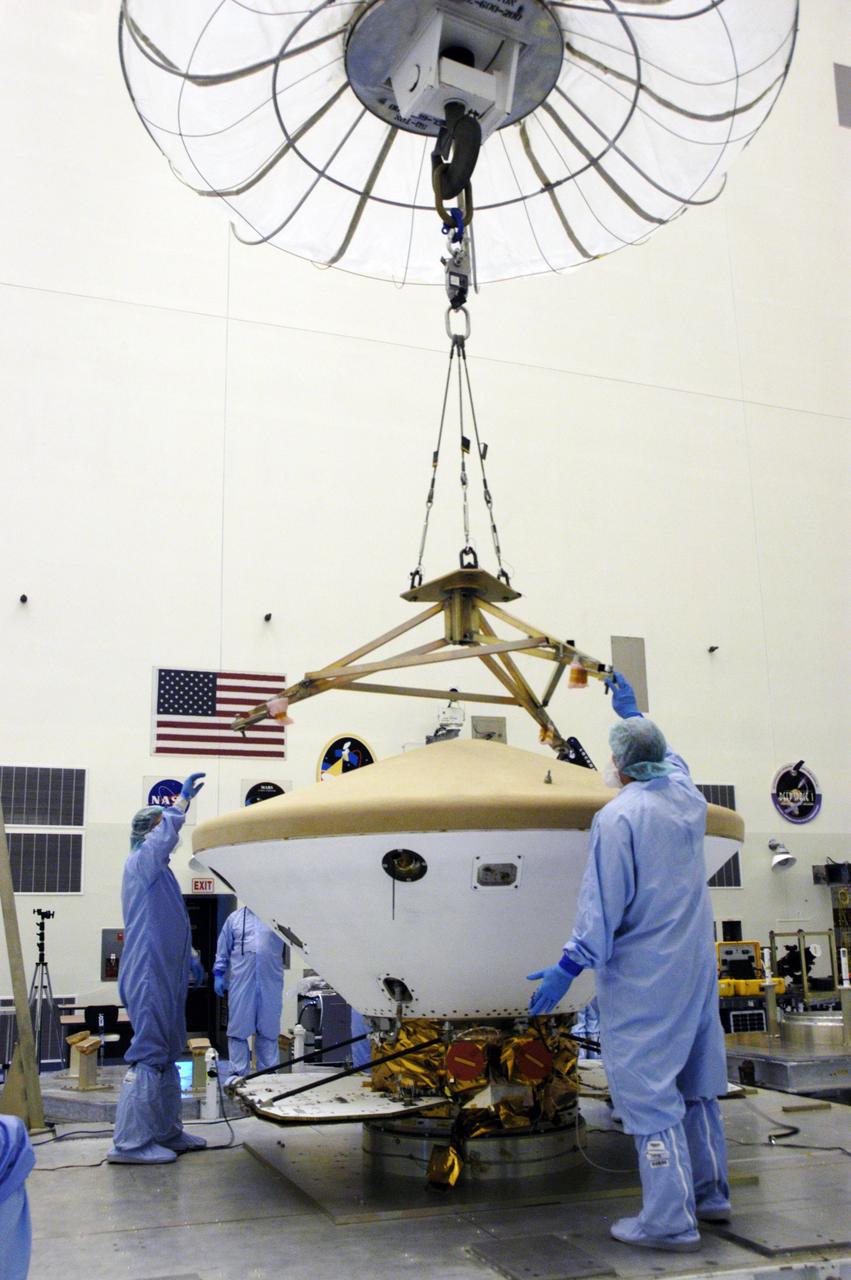
KENNEDY SPACE CENTER, FLA. -- In the Payload Hazardous Servicing Facility, technicians lower a crane over the Phoenix Mars Lander spacecraft. The crane will be used to remove the heat shield from around the Phoenix. The Phoenix mission is the first project in NASA's first openly competed program of Mars Scout missions. Phoenix will land in icy soils near the north polar permanent ice cap of Mars and explore the history of the water in these soils and any associated rocks, while monitoring polar climate. Landing is planned in May 2008 on arctic ground where a mission currently in orbit, Mars Odyssey, has detected high concentrations of ice just beneath the top layer of soil. It will serve as NASA's first exploration of a potential modern habitat on Mars and open the door to a renewed search for carbon-bearing compounds, last attempted with NASA’s Viking missions in the 1970s. A stereo color camera and a weather station will study the surrounding environment while the other instruments check excavated soil samples for water, organic chemicals and conditions that could indicate whether the site was ever hospitable to life. Microscopes can reveal features as small as one one-thousandth the width of a human hair. Launch of Phoenix aboard a Delta II rocket is targeted for Aug. 3 from Cape Canaveral Air Force Station in Florida. Photo credit: NASA/George Shelton
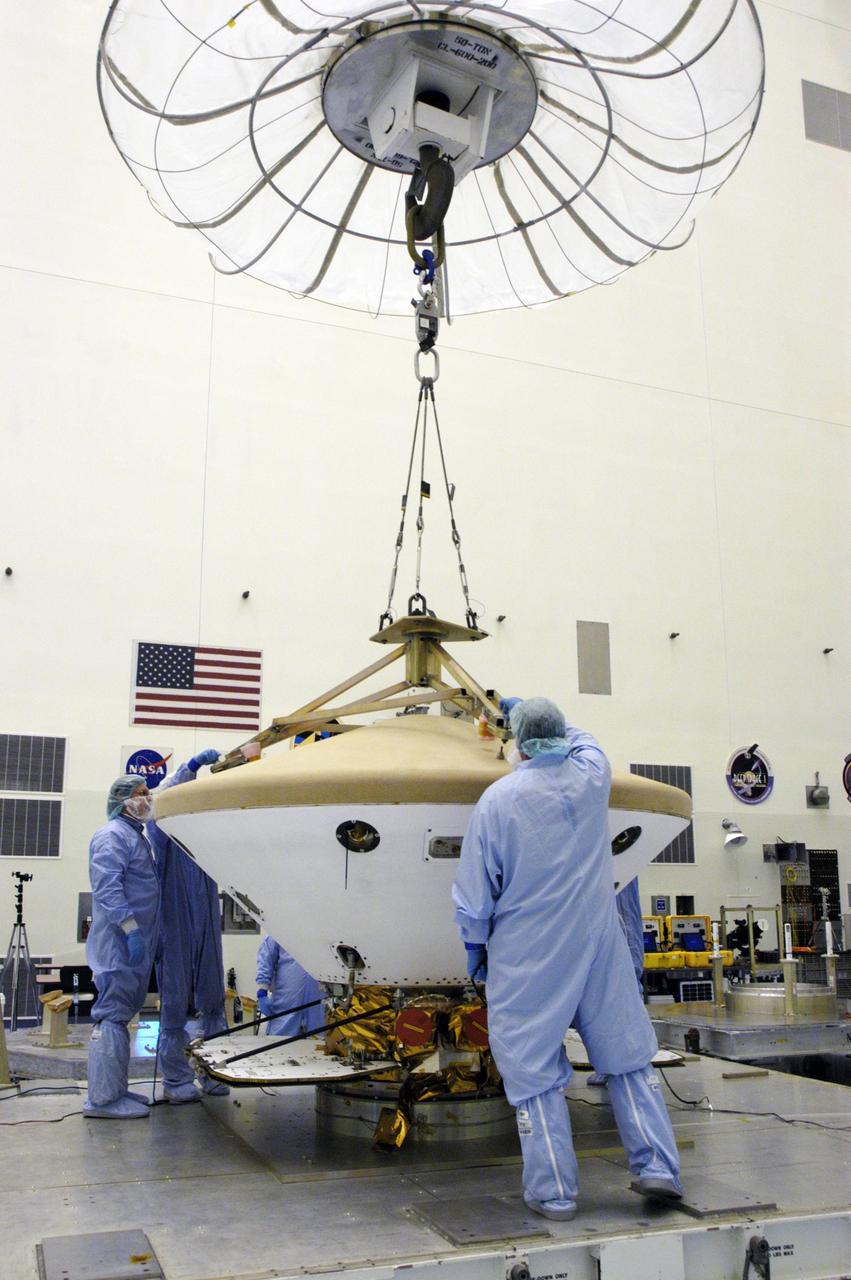
KENNEDY SPACE CENTER, FLA. -- In the Payload Hazardous Servicing Facility, technicians attach a crane to the Phoenix Mars Lander spacecraft. The crane will be used to remove the heat shield from around the Phoenix. The Phoenix mission is the first project in NASA's first openly competed program of Mars Scout missions. Phoenix will land in icy soils near the north polar permanent ice cap of Mars and explore the history of the water in these soils and any associated rocks, while monitoring polar climate. Landing is planned in May 2008 on arctic ground where a mission currently in orbit, Mars Odyssey, has detected high concentrations of ice just beneath the top layer of soil. It will serve as NASA's first exploration of a potential modern habitat on Mars and open the door to a renewed search for carbon-bearing compounds, last attempted with NASA’s Viking missions in the 1970s. A stereo color camera and a weather station will study the surrounding environment while the other instruments check excavated soil samples for water, organic chemicals and conditions that could indicate whether the site was ever hospitable to life. Microscopes can reveal features as small as one one-thousandth the width of a human hair. Launch of Phoenix aboard a Delta II rocket is targeted for Aug. 3 from Cape Canaveral Air Force Station in Florida. Photo credit: NASA/George Shelton
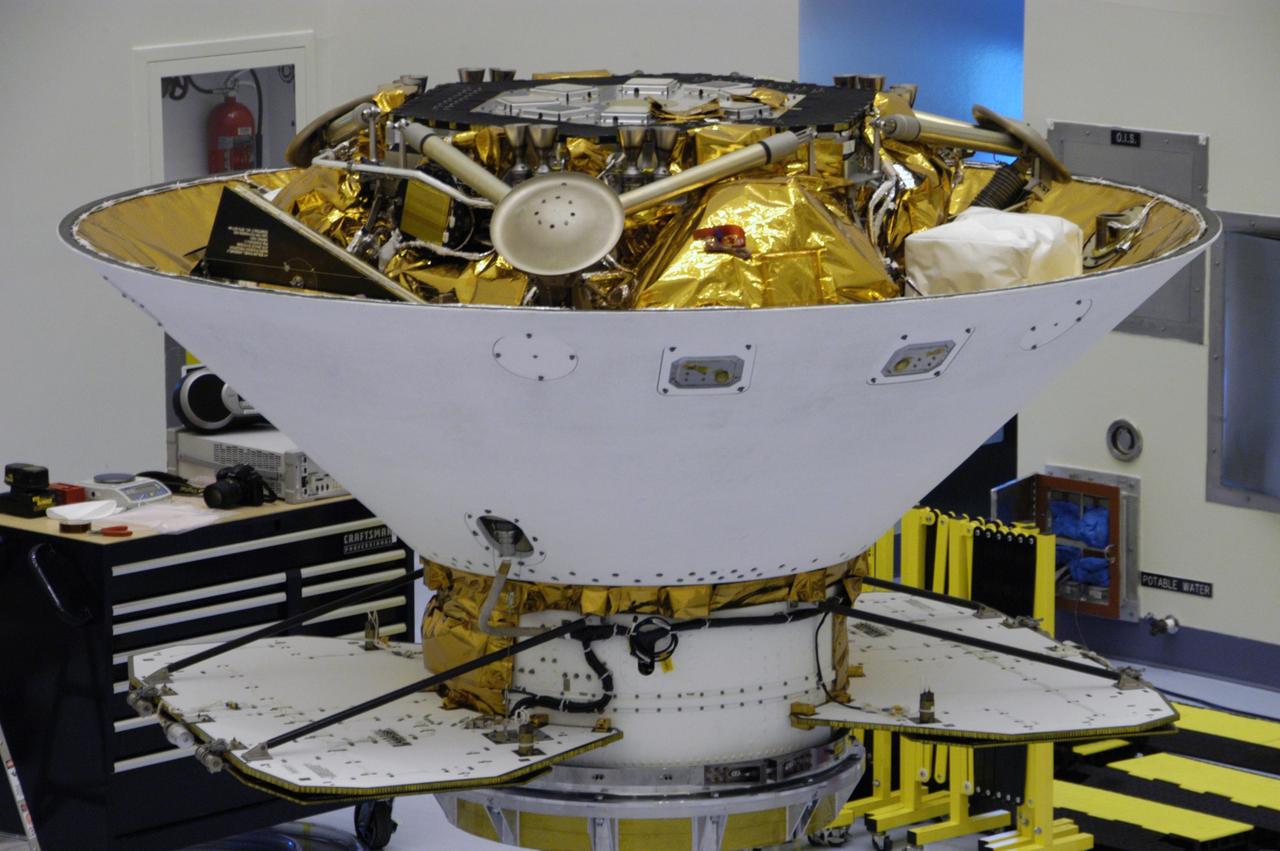
KENNEDY SPACE CENTER, FLA. -- This closeup shows the Phoenix Mars Lander spacecraft nestled inside the backshell. The spacecraft will undergo spin testing on the spin table to which it is attached in the Payload Hazardous Servicing Facility. The Phoenix mission is the first project in NASA's first openly competed program of Mars Scout missions. Phoenix will land in icy soils near the north polar permanent ice cap of Mars and explore the history of the water in these soils and any associated rocks, while monitoring polar climate. Landing is planned in May 2008 on arctic ground where a mission currently in orbit, Mars Odyssey, has detected high concentrations of ice just beneath the top layer of soil. It will serve as NASA's first exploration of a potential modern habitat on Mars and open the door to a renewed search for carbon-bearing compounds, last attempted with NASA’s Viking missions in the 1970s. A stereo color camera and a weather station will study the surrounding environment while the other instruments check excavated soil samples for water, organic chemicals and conditions that could indicate whether the site was ever hospitable to life. Microscopes can reveal features as small as one one-thousandth the width of a human hair. Launch of Phoenix aboard a Delta II rocket is targeted for Aug. 3 from Cape Canaveral Air Force Station in Florida. Photo credit: NASA/George Shelton