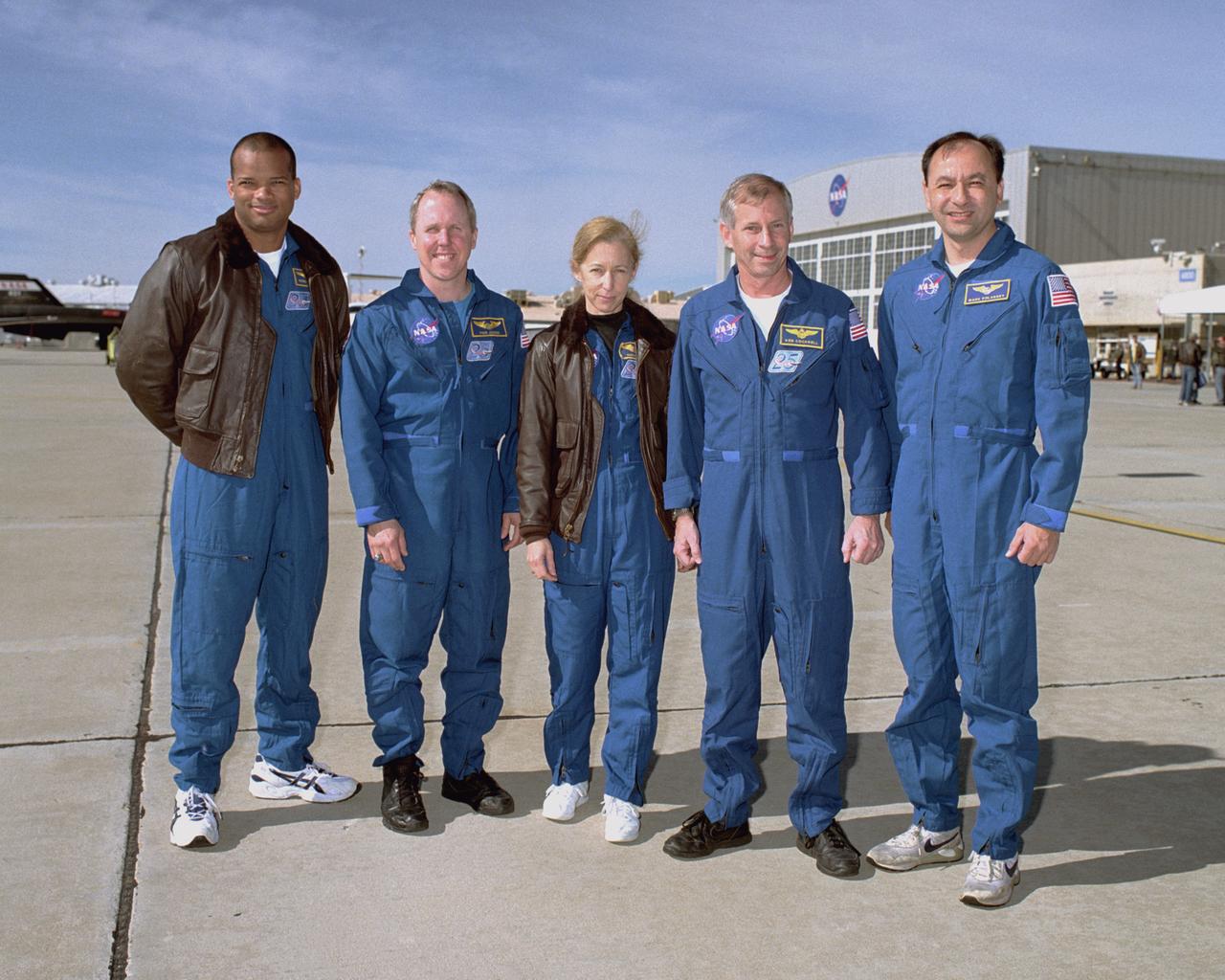
The crew of STS-98 poses for a group photo shortly before leaving NASA's Dryden Flight Research Center after a successful landing of the Space Shuttle Atlantis the day before. L to R: Mission Specialists Robert L. Curbeam, Thomas D. Jones, and Marsha S. Ivins, Commander Kenneth D. Cockrell, and Pilot Mark L. Polansky.
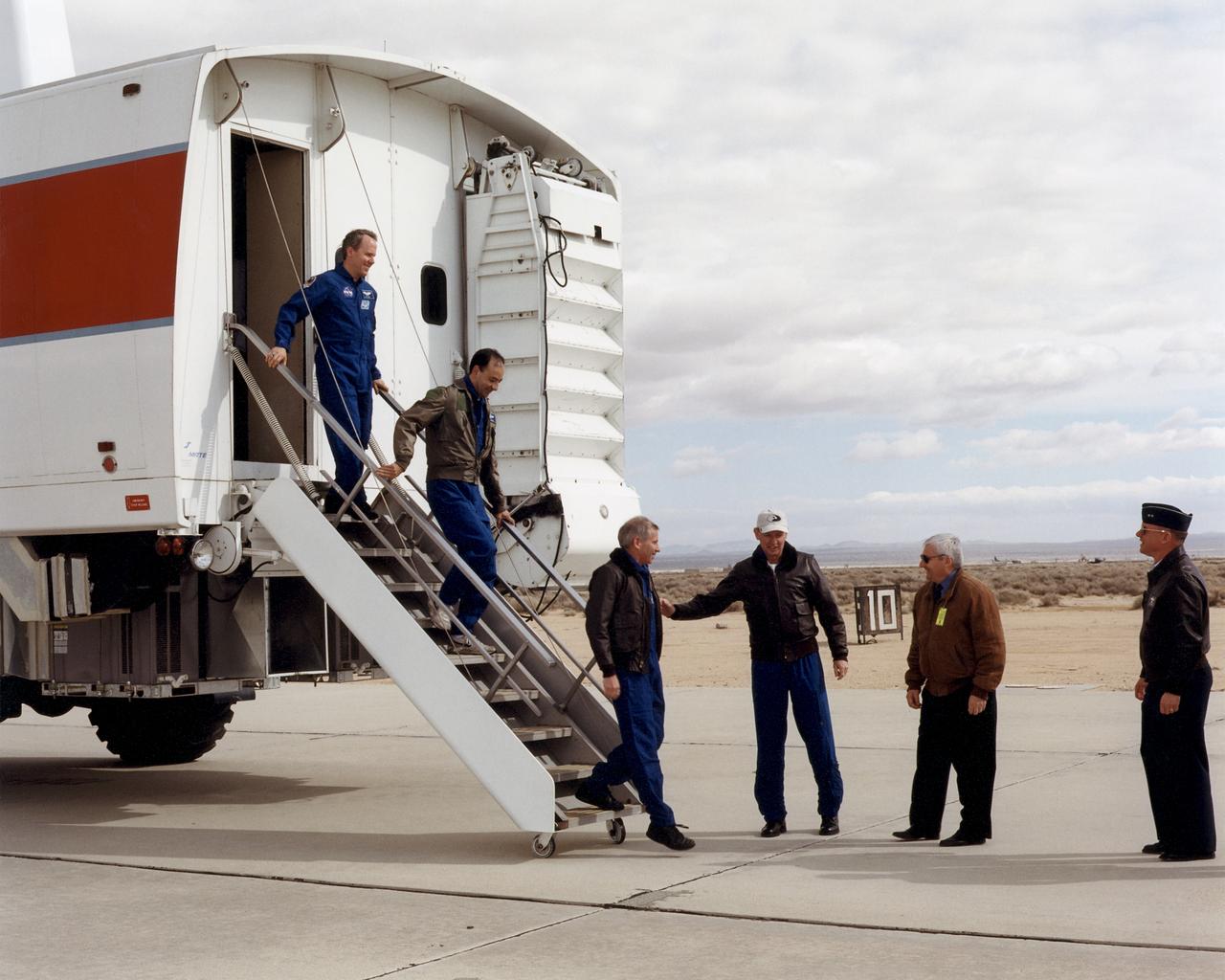
L to R: STS-98 Mission Specialist Thomas Jones, Pilot Mark Polansky, and Commander Kenneth Cockrell greet STS-92 Commander Brian Duffy, Dryden Center Director Kevin Petersen, and AFFTC Commander Major General Richard Reynolds after landing on the runway at Edwards Air Force Base, California, where NASA's Dryden Flight Research Center is located.
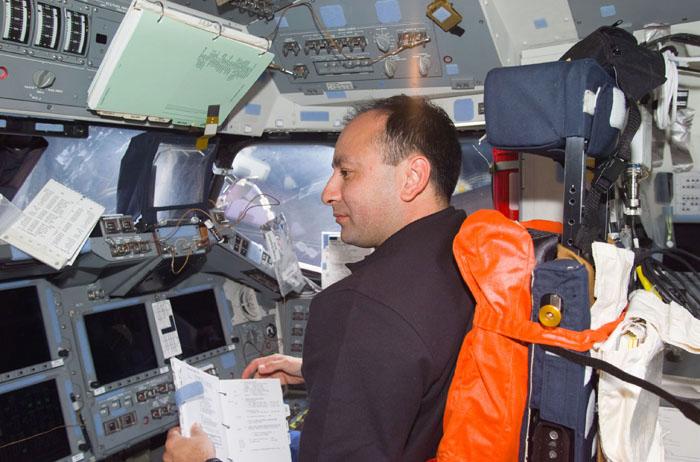
STS98-E-5015 (8 February 2001) --- Astronaut Mark L. Polansky, pilot, is pictured at the pilot's station on the flight deck of the Space Shuttle Atlantis during Flight Day 1. The scene was recorded with a digital still camera.
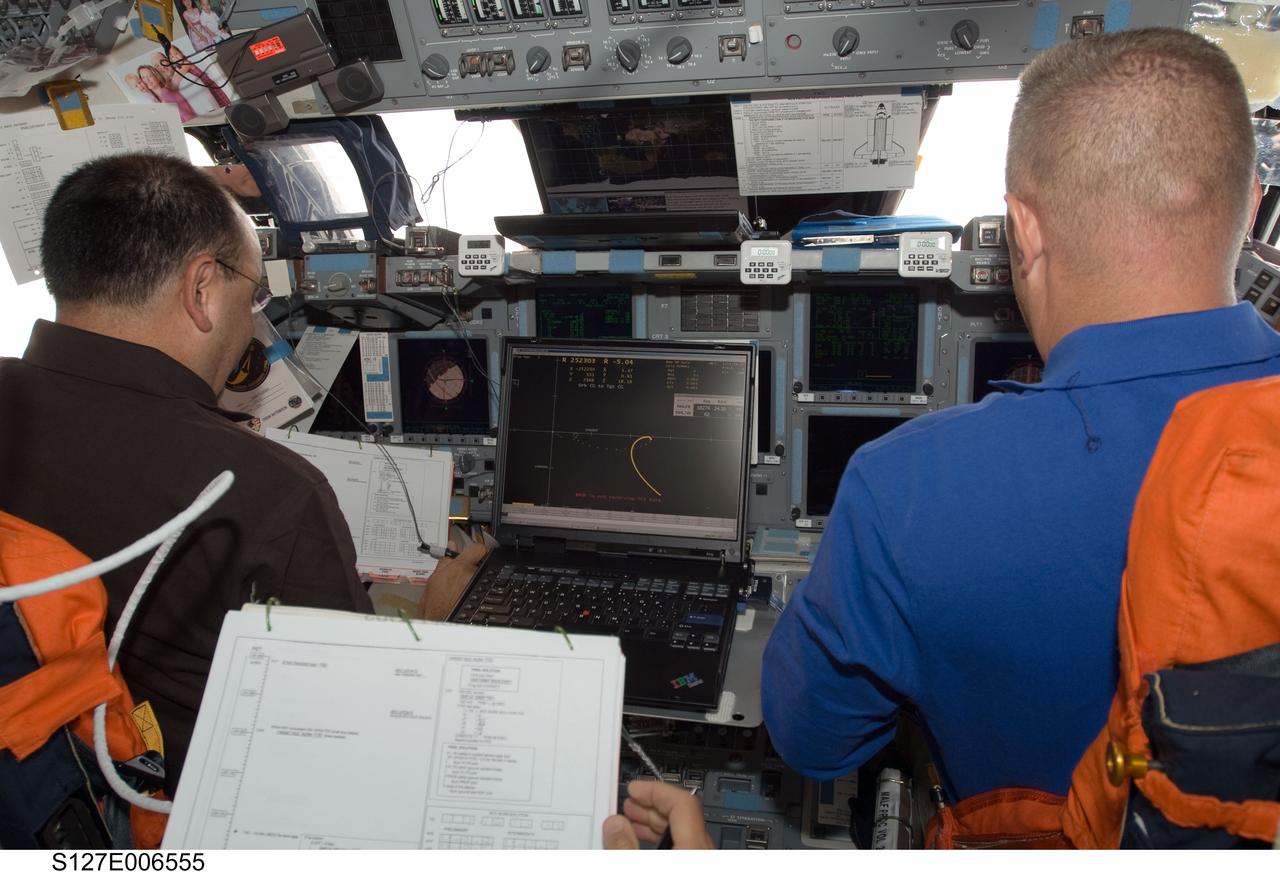
S127-E-006555 (17 July 2009) --- Astronauts Mark Polansky (left) and Doug Hurley, at the commander and pilot stations, respectively, do their part to safely dock the Space Shuttle Endeavour with the International Space Station.
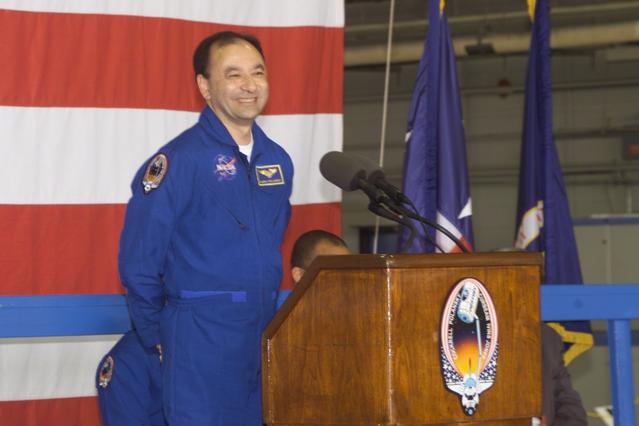
JSC2001-E-04807 (21 February 2001) --- Astronaut Mark L. Polansky, pilot, shares a few thoughts about his first space mission with well wishers on hand at the STS-98 crew's return at Ellington Field.
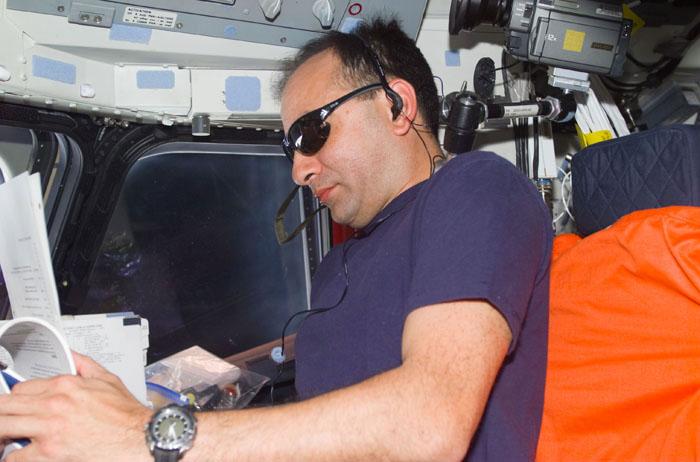
STS98-E-5203 (13 February 2001) --- Astronaut Mark L. Polansky, STS-98 pilot, checks out a detail in a flight plan at the pilot's station on the Space Shuttle Atlantis on February 13. This scene was recorded with a digital still camera.
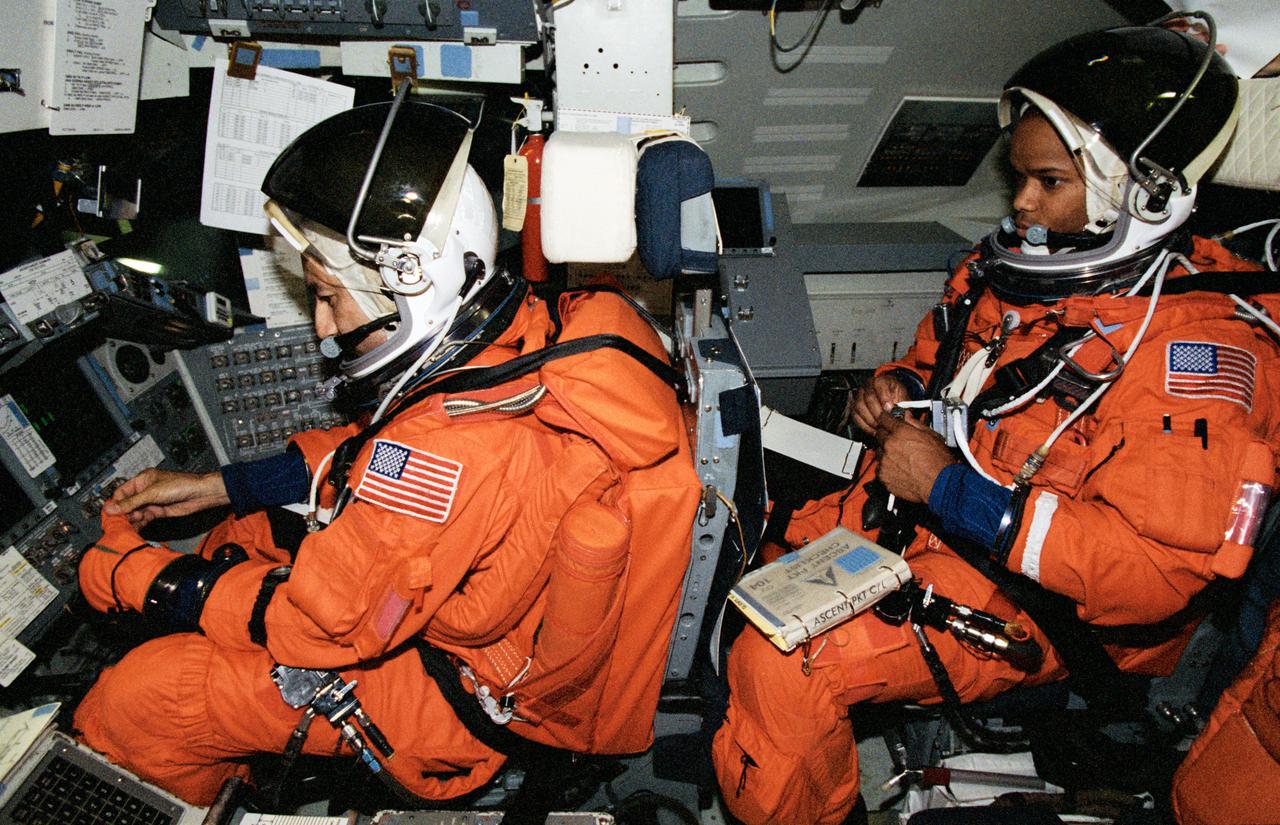
Photographic documentation showing STS-98 crewmembers engaging in preflight training in bldg. 5. Views include: STS-98 mission commander Kenneth D. Cockrell, wearing a Launch Entry Suit (LES) and a helmet, sits in the commanders station on the flight deck of the mobile-based Shuttle Mission Simulator (SMS) (04774); STS-98 pilot Mark L. Polansky, wearing LES and helmet, sits in the pilots station, with STS-98 Mission Specialist (MS) Robert L. Curbeam seated behind him on the flight deck (04775); Polansky in the pilots station (04776); Curbeam in a LES and wearing a Communications Carrier Assembly (CCA) (04777); Polansky and Curbeam pose, wearing LES and no helmets, in bldg. 5 (04778); Polansky, wearing a LES, fastens his CCA (04779); Cockrell, Polansky, Curbeam and STS-98 MS Marsha S. Ivins, wearing LES, sit in locker room (04780); Ivins and suit techs (04781); suit techs and Polansky (04782); suit techs and Cockrell (04783).
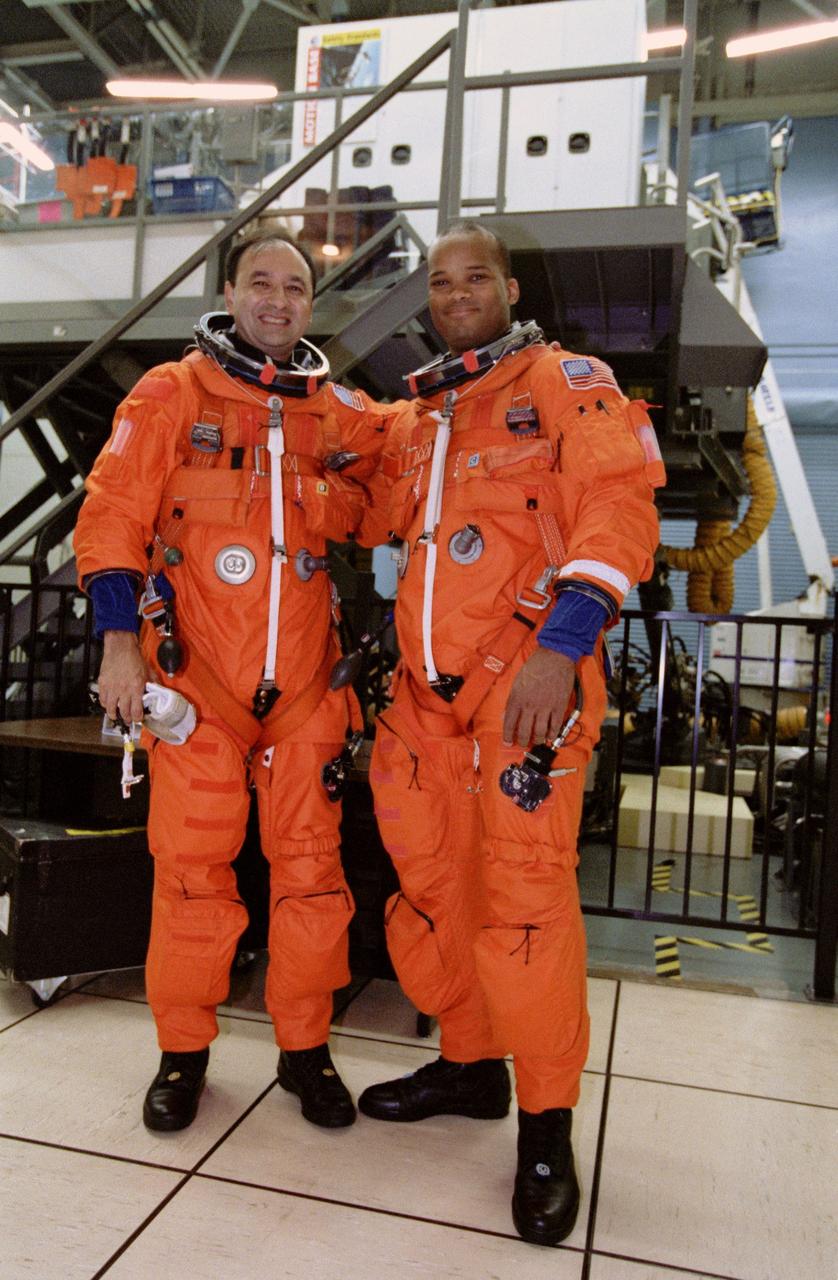
JSC2000-04778 (16 June 2000) --- Attired in training versions of the shuttle launch and entry garment, astronauts Mark Polansky (left) and Robert L. Curbeam take a break from a simulation exercise in the motion-base shuttle mission simulator (seen in the background) at the Johnson Space Center (JSC). Polansky is STS-98 pilot and Curbeam doubles as a mission specialist and flight engineer for the scheduled January 2000 5a mission to the International Space Station (ISS).
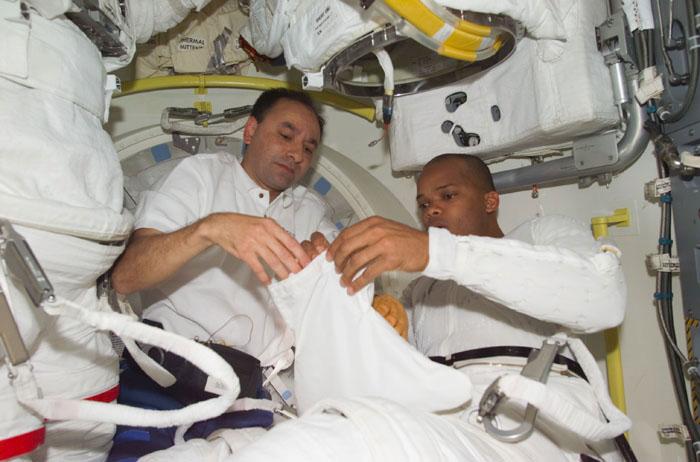
STS98-E-5179 (12 February 2001) --- Astronaut Robert L. Curbeam (right), STS-98 mission specialist, with the aid of astronaut Mark L. Polansky, pilot, dons his extravehicular mobility unit for the upcoming space walk on the International Space Station on February 12. This scene was recorded with a digital still camera.
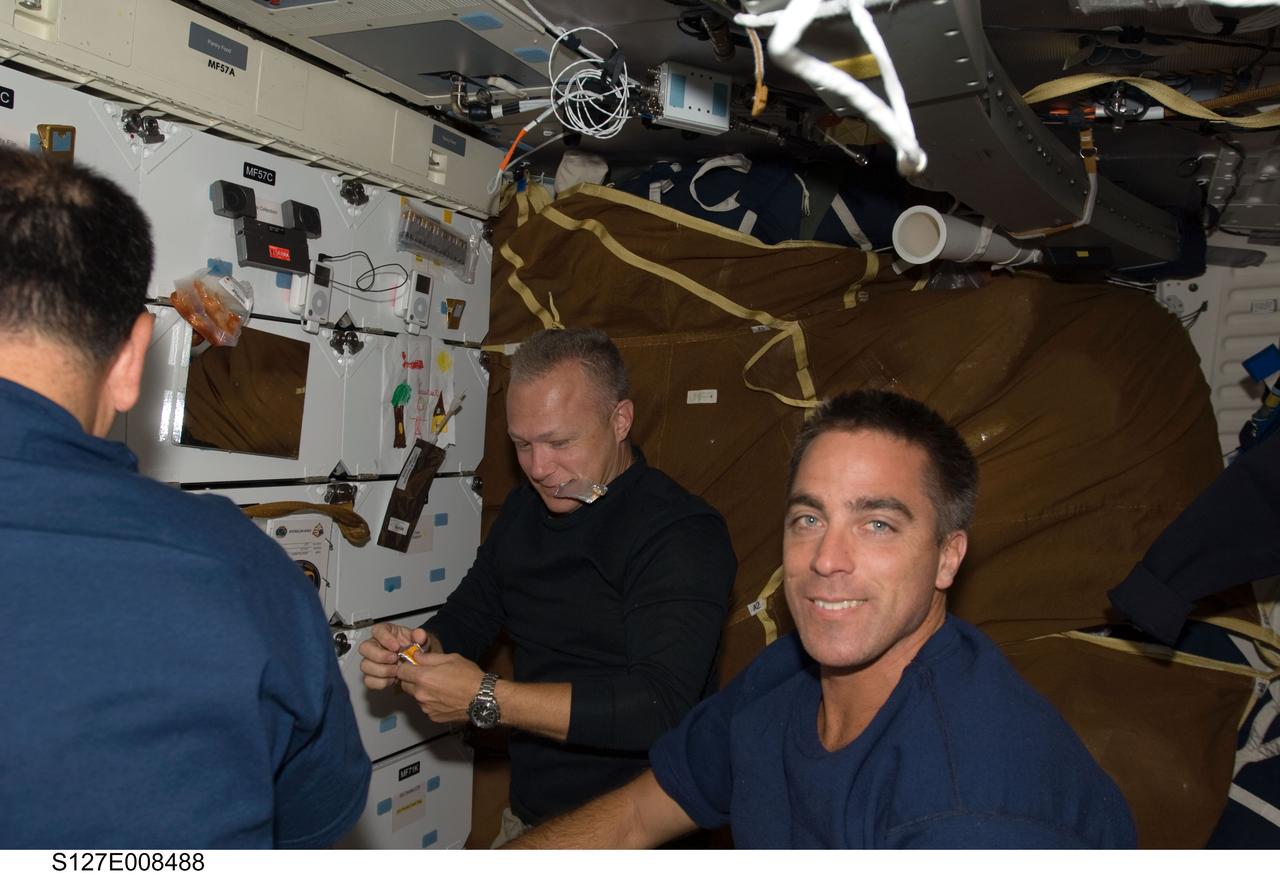
S127-E-008488 (25 July 2009) --- From the left, astronauts Mark Polansky (partially out of frame), STS-127 commander, Doug Hurley, pilot, and Christopher Cassidy, mission specialist, take some leisure time on the mid deck of the Space Shuttle Endeavour while it is linked up to the International Space Station.
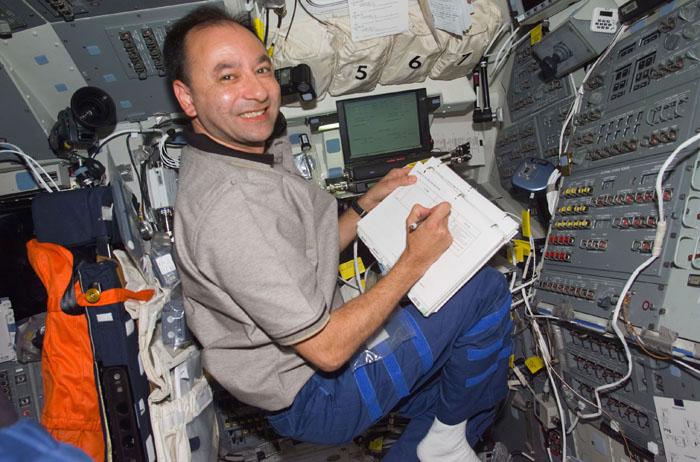
STS98-E-5084 (10 February 2001) --- Astronaut Mark L. Polansky, STS-98 pilot, takes notes on the aft flight deck of the Space Shuttle Atlantis. The scene was recorded with a digital still camera during Flight Day 4 activities.
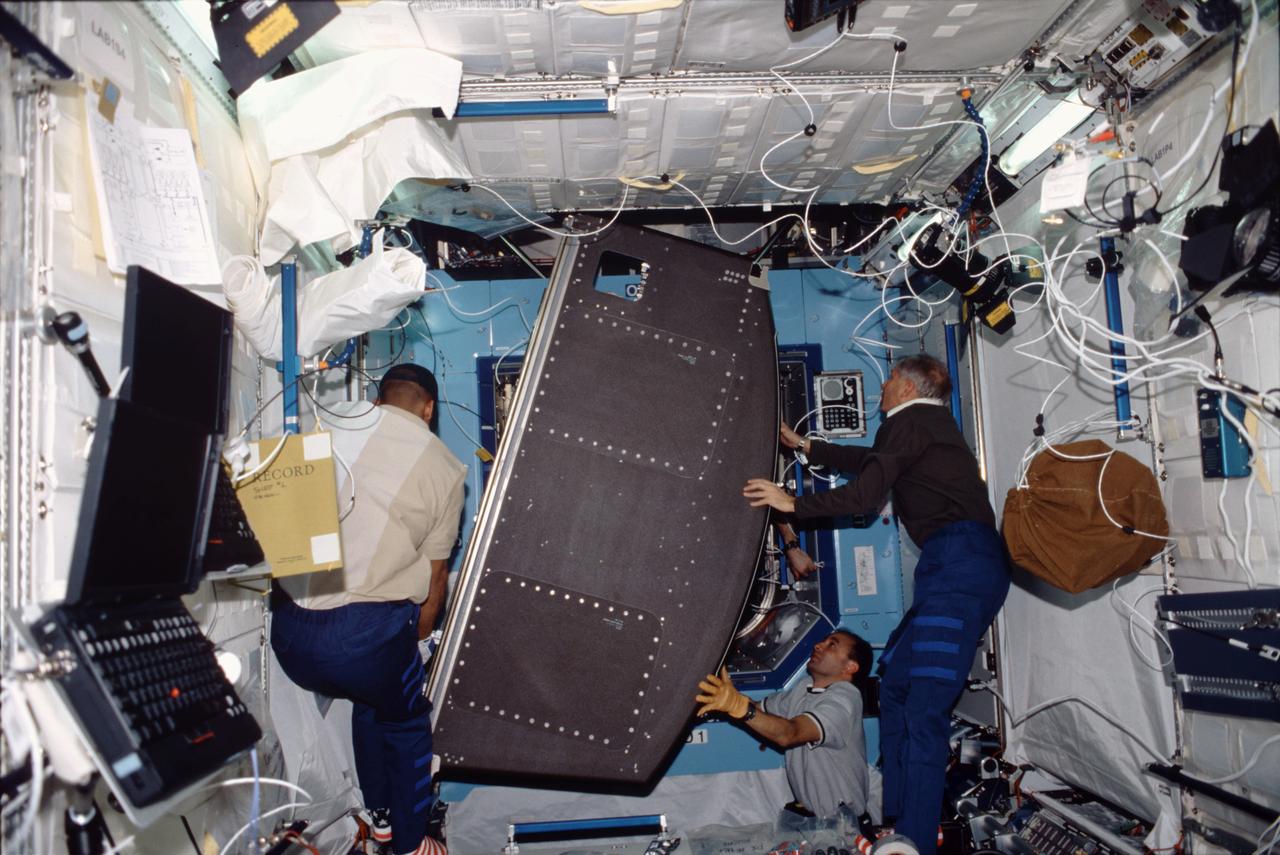
STS098-322-0001 (7-20 February 2001) --- Three STS-98 astronauts move a rack into position aboard the newly attached Destiny laboratory. From the left to right are astronauts Robert L. Curbeam, mission specialist; Mark L. Polansky, pilot; and Kenneth D. Cockrell, mission commander.
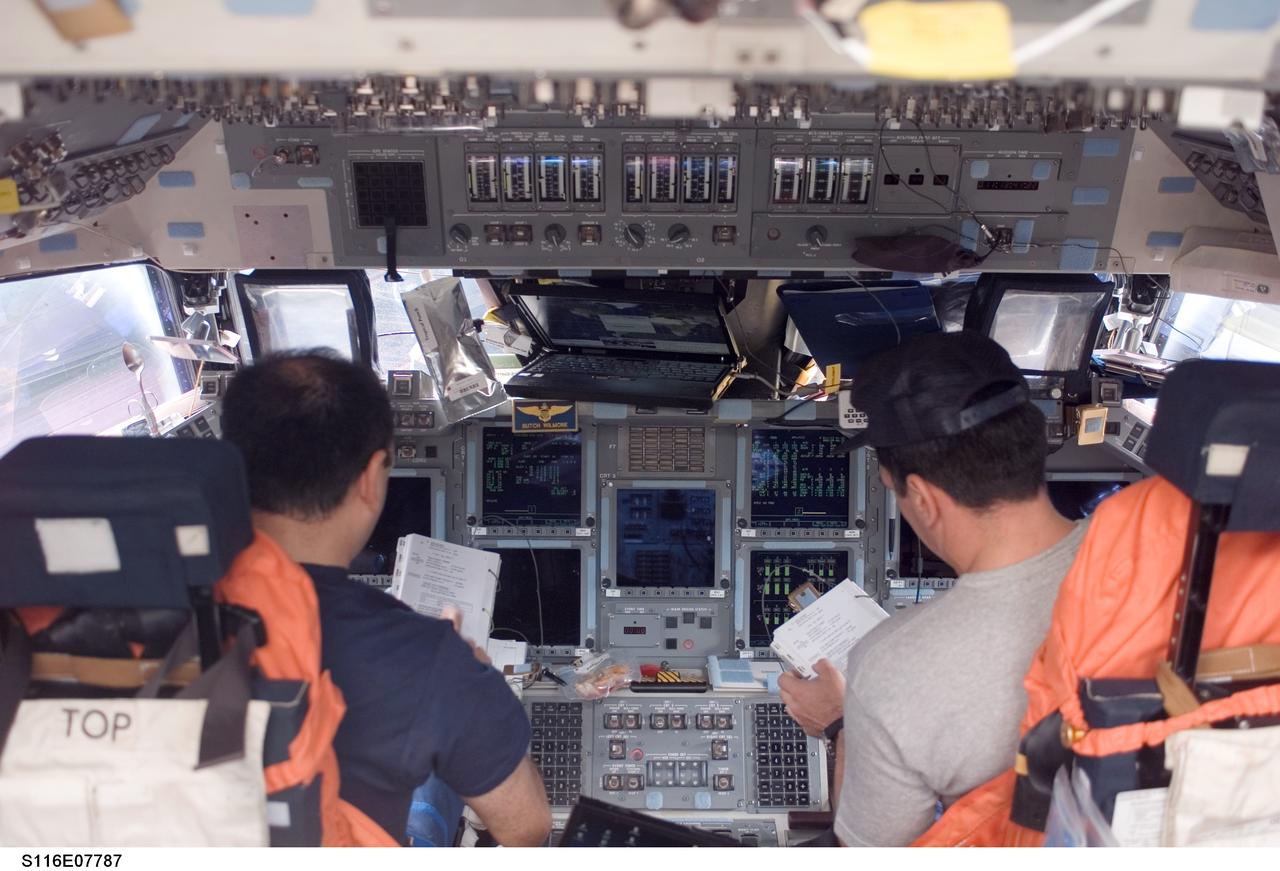
S116-E-07787 (21 Dec. 2006) --- Astronauts Mark L. Polansky (left) and William A. (Bill) Oefelein, STS-116 commander and pilot, respectively, look over procedures checklists on the forward flight deck of Space Shuttle Discovery during flight day 13 activities.
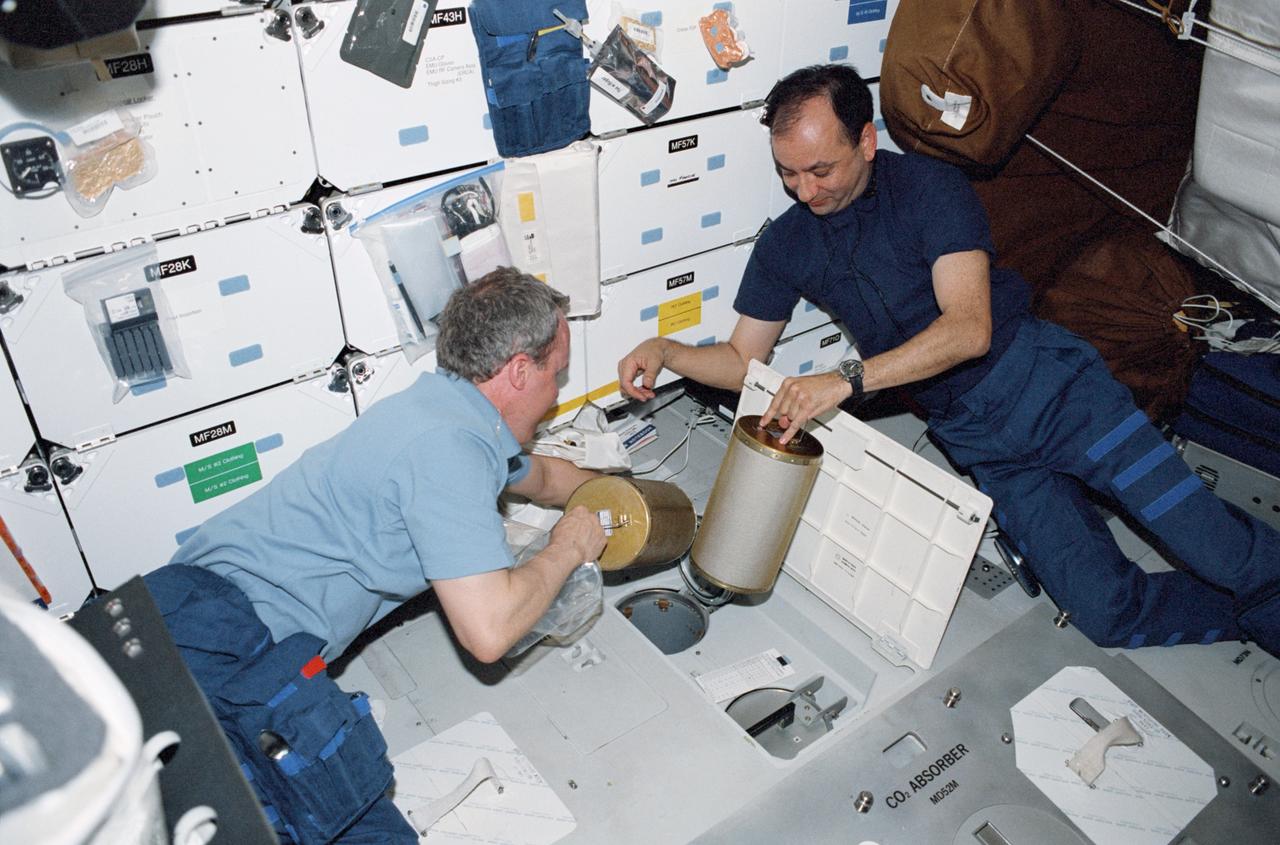
STS098-345-028 (7-20 February 2001) --- Astronauts Thomas D. Jones, mission specialist, and Mark L. Polansky, pilot, change out lithium hydroxide canisters on the mid deck of the Earth-orbiting Space Shuttle Atlantis.
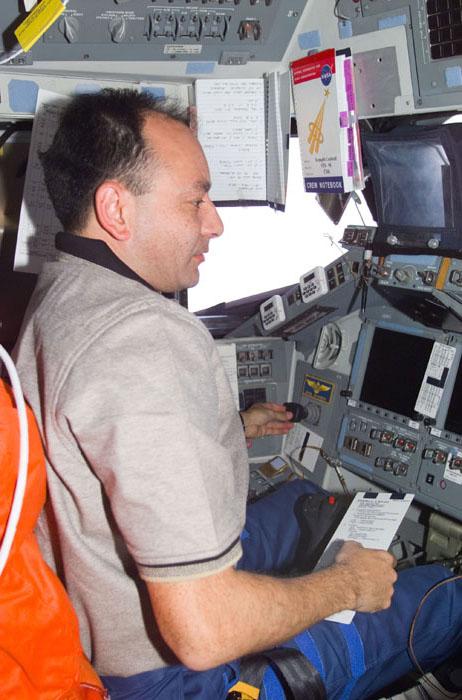
STS98-E-5024 (9 February 2001) --- Astronaut Mark L. Polansky, pilot, temporarily mans the commander's station on the flight deck of the Space Shuttle Atlantis during STS-98 Flight Day 2 maneuvers. The photograph was recorded with a digital still camera.
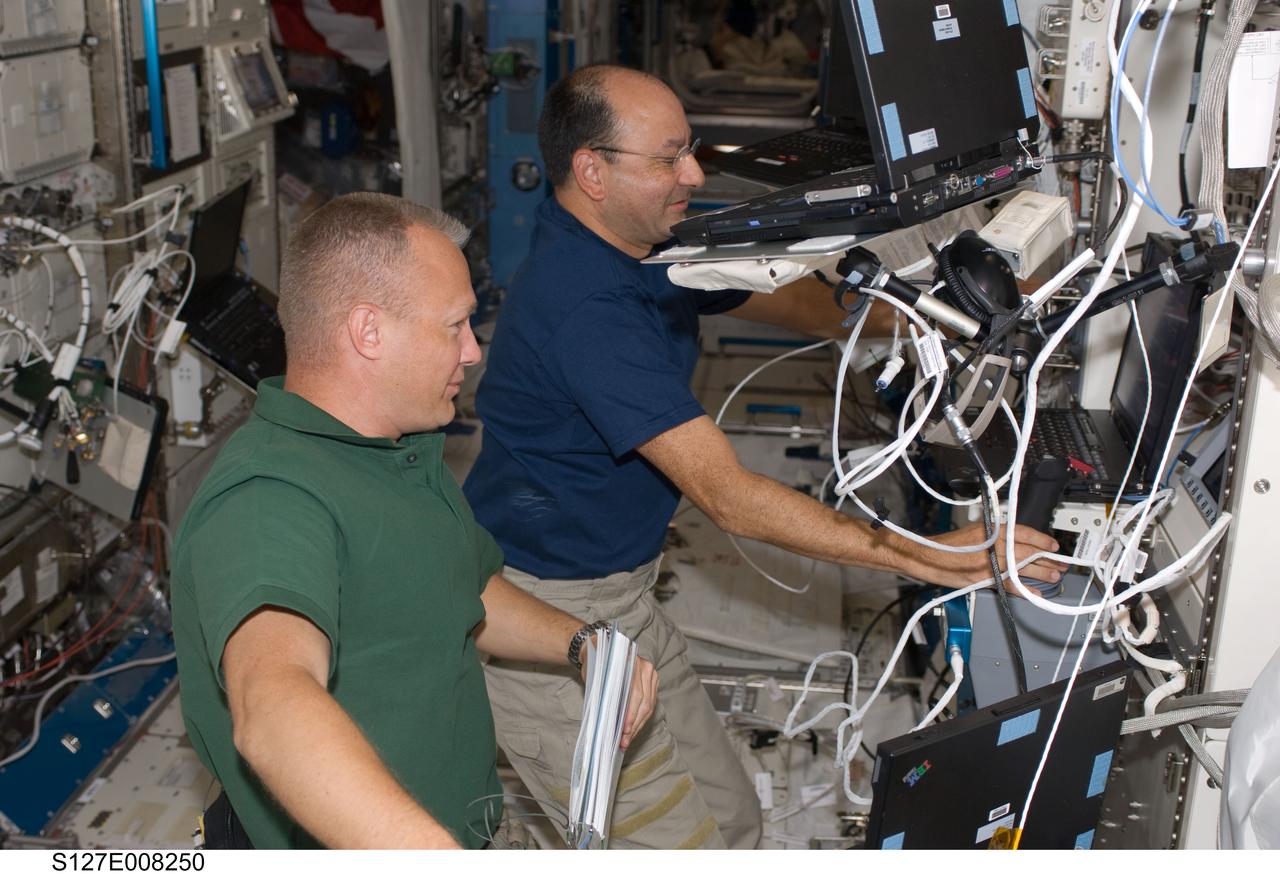
S127-E-008250 (23 July 2009) --- Astronauts Mark Polansky (right) STS-127 commander; and Dooug Hurley, pilot, are pictured in the Japaense Experiment Module or Kibo during flight day 9 activities on the International Space Station.
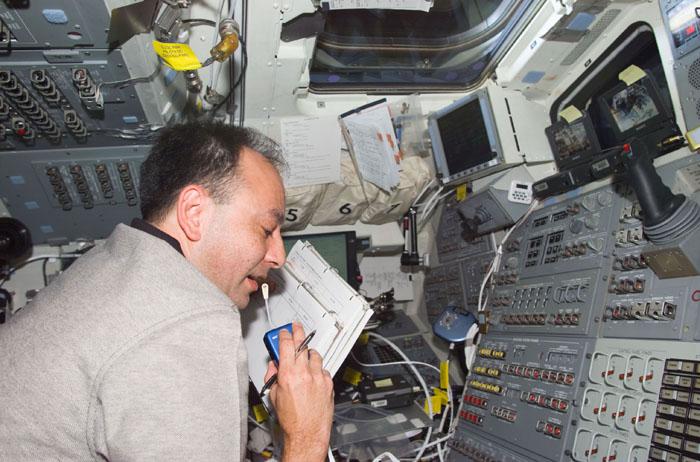
STS98-E-5086 (10 February 2001) --- Astronaut Mark L. Polansky, STS-98 pilot, communicates with ground controllers from his post at the aft flight deck controls on the Space Shuttle Atlantis. The scene was recorded with a digital still camera.
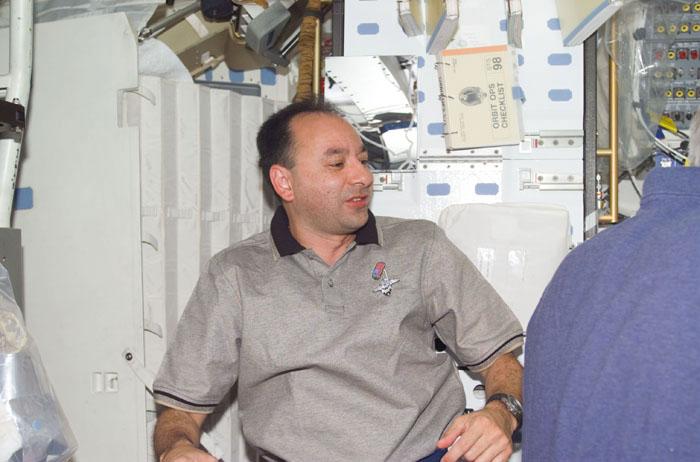
STS98-E-5016 (9 February 2001) --- Astronaut Mark L. Polansky, pilot for STS-98, is pictured on the mid deck of the Earth-orbiting Space Shuttle Atlantis prior to the start of a busy Flight Day 2 itinerary. The scene was recorded with a digital still camera.

STS98-E-5073 (10 February 2001) --- Astronauts Kenneth D. Cockrell (foreground), STS-98 mission commander, and Mark L. Polansky, pilot, share a mirror in order to shave their faces on the mid deck of the Space Shuttle Atlantis. The scene was recorded with a digital still camera.
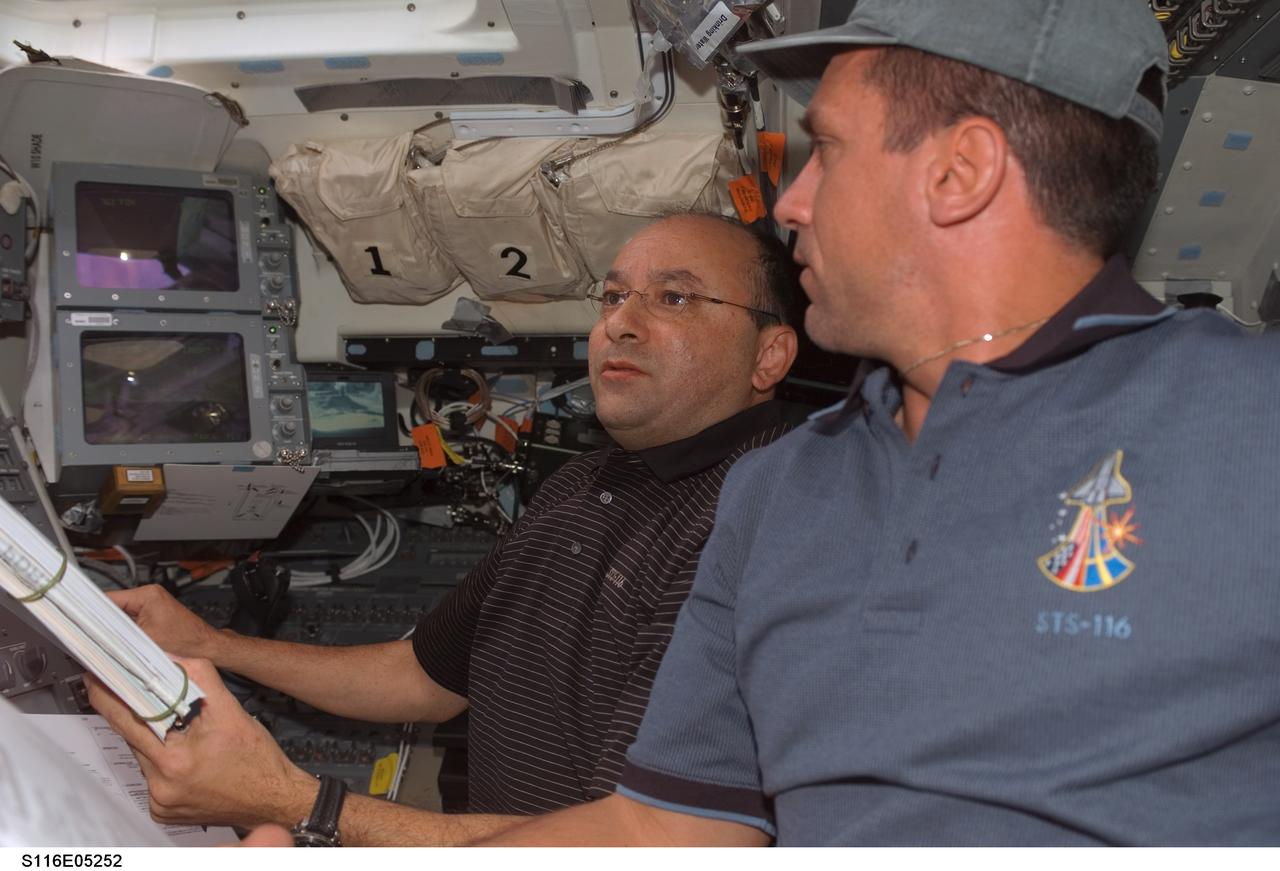
S116-E-05252 (10 Dec. 2006) --- Astronauts Mark L. Polansky (background) and William A. (Bill) Oefelein, STS-116 commander and pilot, respectively, look over procedures checklists on the flight deck of Space Shuttle Discovery during flight day two activities.
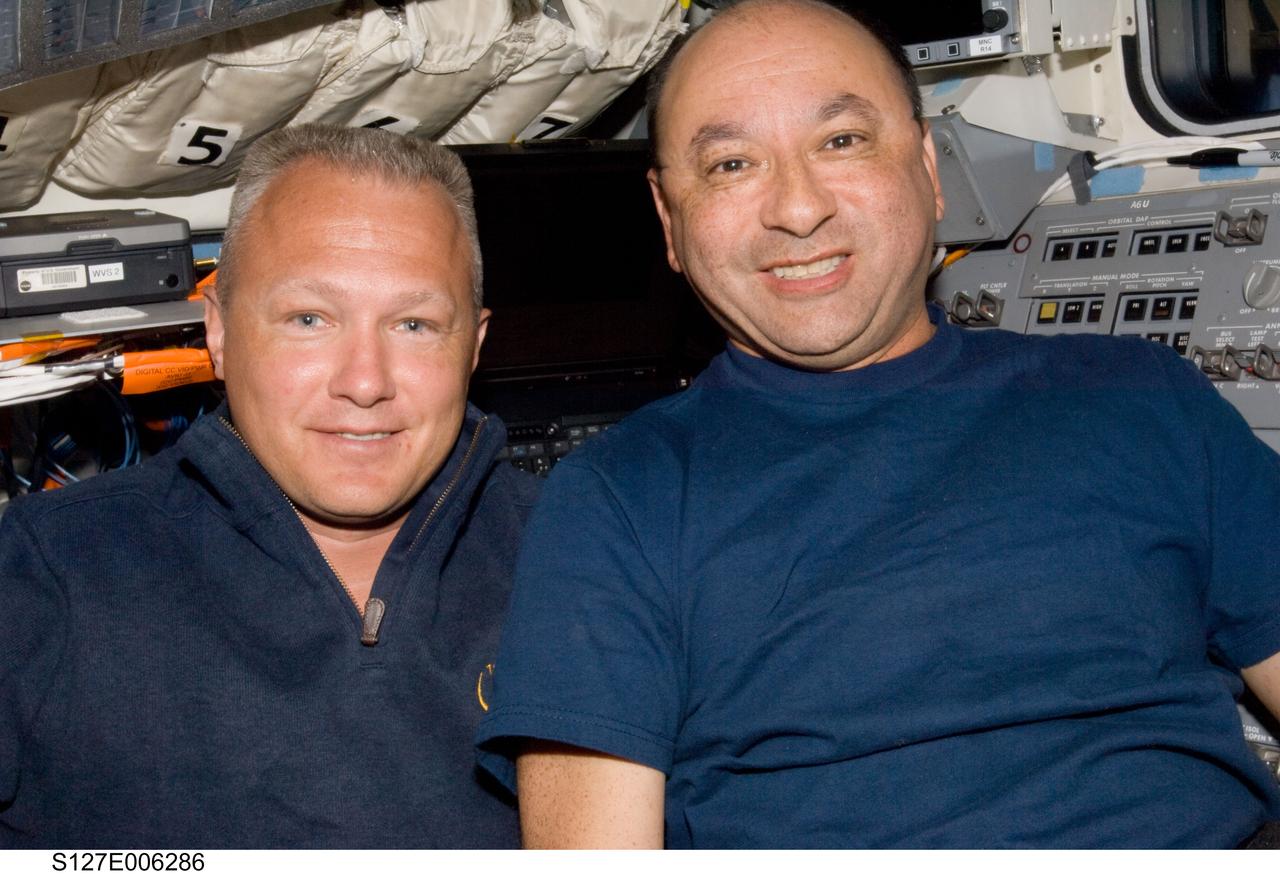
S127-E-006286 (16 July 2009) --- Astronauts Mark Polansky (right), STS-127 commander; and Doug Hurley, pilot, take a moment for a photo on the flight deck of Space Shuttle Endeavour during flight day two activities.
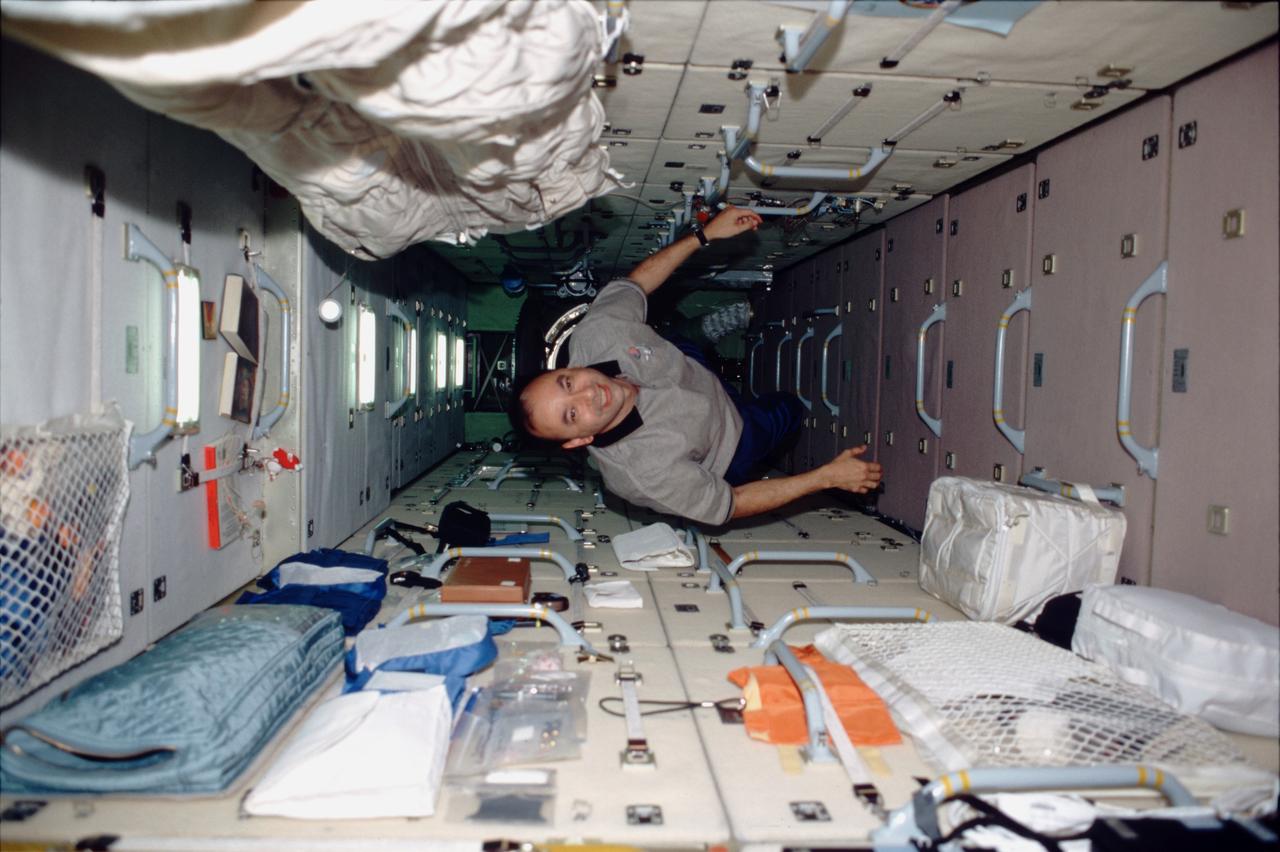
STS098-320-008 (7-20 February 2001) --- Astronaut Mark L. Polansky, STS-98 pilot, translates through the Zarya functional cargo block (FGB) while visiting and working aboard the International Space Station (ISS).
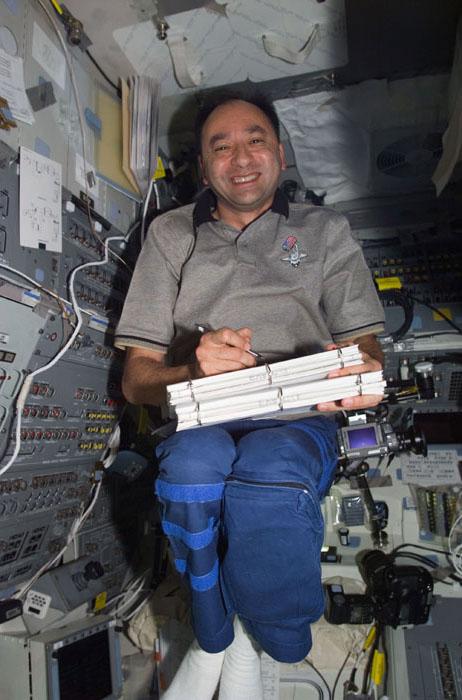
S98-E-5085 (10 February 2001) --- Astronaut Mark L. Polansky, STS-98 pilot, makes marginal notes on flight procedures tablets on the aft flight deck of the Space Shuttle Atlantis. The scene was recorded with a digital still camera during Flight Day 4 activities.
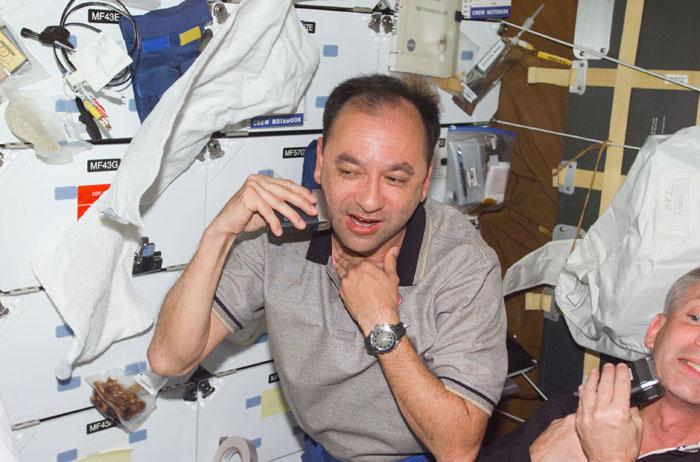
STS98-E-5071 (10 February 2001) --- Astronauts Mark L. Polansky, STS-98 pilot, and Kenneth D. Cockrell (partially visible at right), mission commander, shave their faces on the mid deck of the Space Shuttle Atlantis. The scene was recorded with a digital still camera.
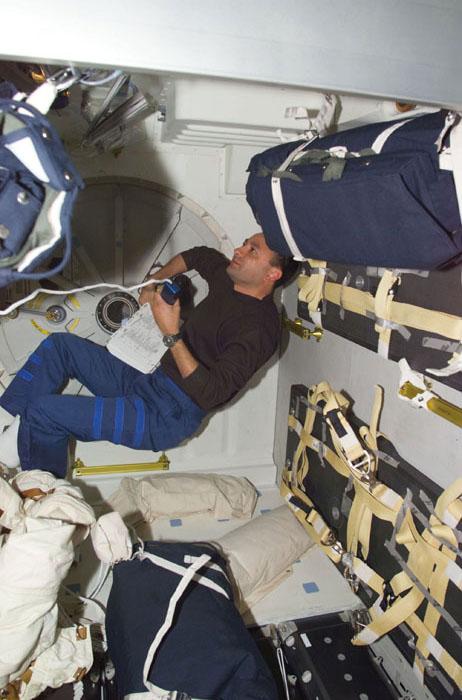
STS98-E-5088 (10 February 2001) --- Astronaut Mark L. Polansky, SS-98 pilot, communicates with ground controllers from the mid deck of the Space Shuttle Atlantis. Parts of at least two sleep stations are visible in the digital still camera's scene.
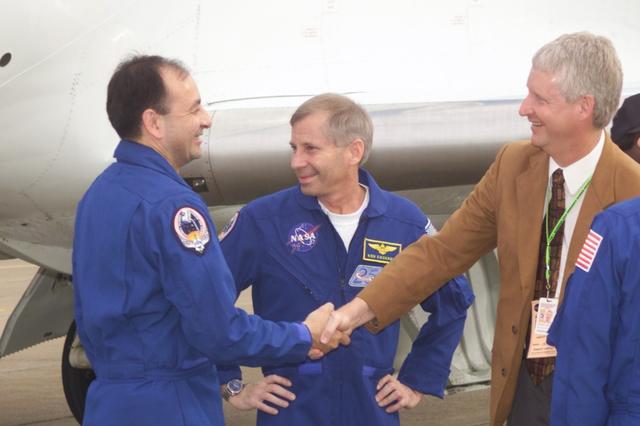
JSC2001-E-04804 (21 February 2001) --- Astronauts Mark L. Polansky (left) and Kenneth D. Cockrell (center), pilot and commander, respectively, for the STS-98 mission, are greeted by Steven A. Hawley of the Flight Crew Operations Directorate upon their return to Houston. The greetings took place prior to a welcoming ceremony at Ellington Field.
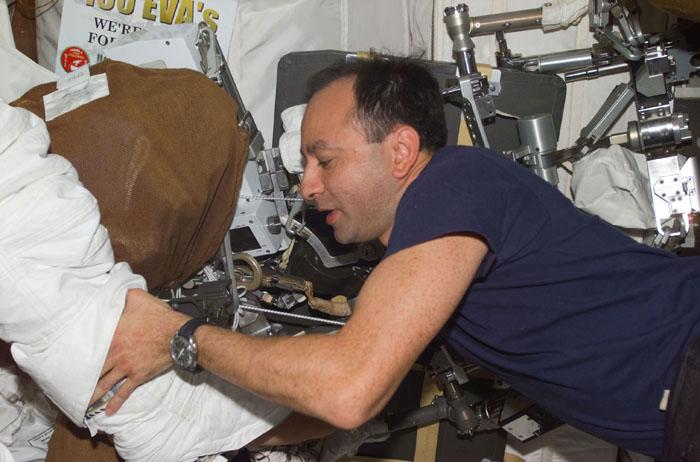
STS98-E-5220 (14 February 2001) --- Astronaut Mark L. Polansky, pilot, assists one of the STS-98 space walkers with his boot during suit donning aboard the Space Shuttle Atlantis. The scene was recorded with a digital still camera.
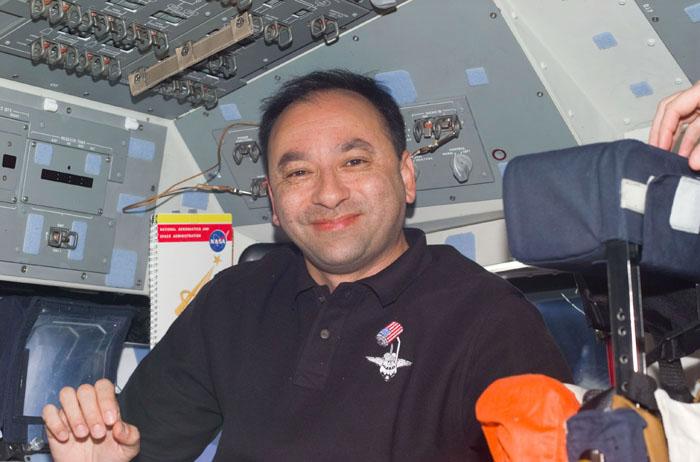
STS98-E-5002 (8 February 2001) -- Astronaut Mark L. Polansky, STS-98 pilot, is seen on the flight deck of the Earth-orbiting Space Shuttle Atlantis in one of the first digital still camera scenes to be down linked from the shuttle.
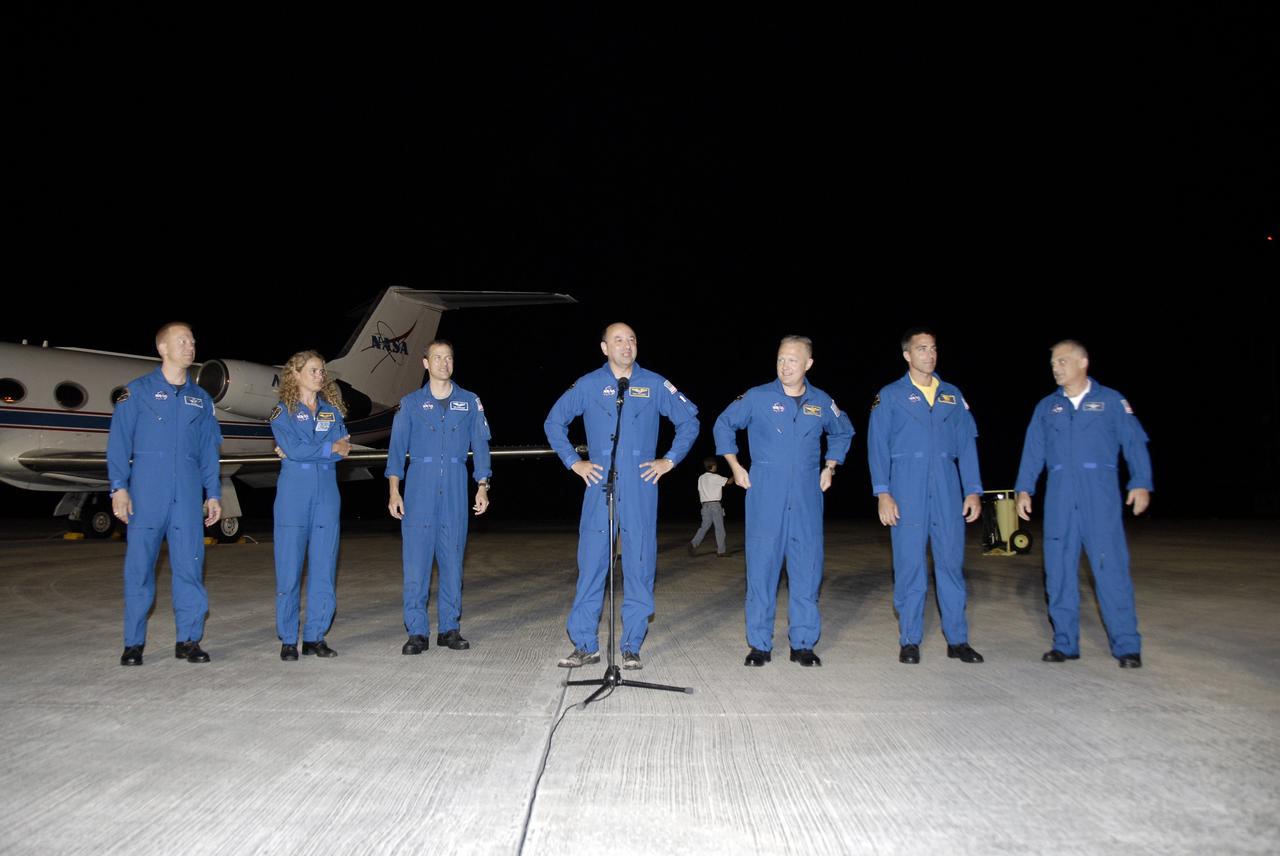
CAPE CANAVERAL, Fla. – At the Shuttle Landing Facility, STS-127 Commander Mark Polansky, at microphone, addresses the media and those on hand to welcome the STS-127 crew to NASA's Kennedy Space Center in Florida. Polansky and the other members of the crew arrived from Houston aboard the Shuttle Training Aircraft in the background to get ready for launch on space shuttle Endeavour on June 13. From left are Mission Specialists Tim Kopra, Julie Payette of the Canadian Space Agency, and Tom Marshburn; Commander Mark Polansky; Pilot Doug Hurley; and Mission Specialists Christopher Cassidy and Dave Wolf. The STS-127 mission is the final of three flights dedicated to the assembly of the Japan Aerospace Exploration Agency's Kibo laboratory complex on the International Space Station. Endeavour will deliver the Japanese Experiment Module's Exposed Facility, or JEM-EF, and the Experiment Logistics Module-Exposed Section, or ELM-ES, to the space station on STS-127. Photo credit: NASA/Kim Shiflett
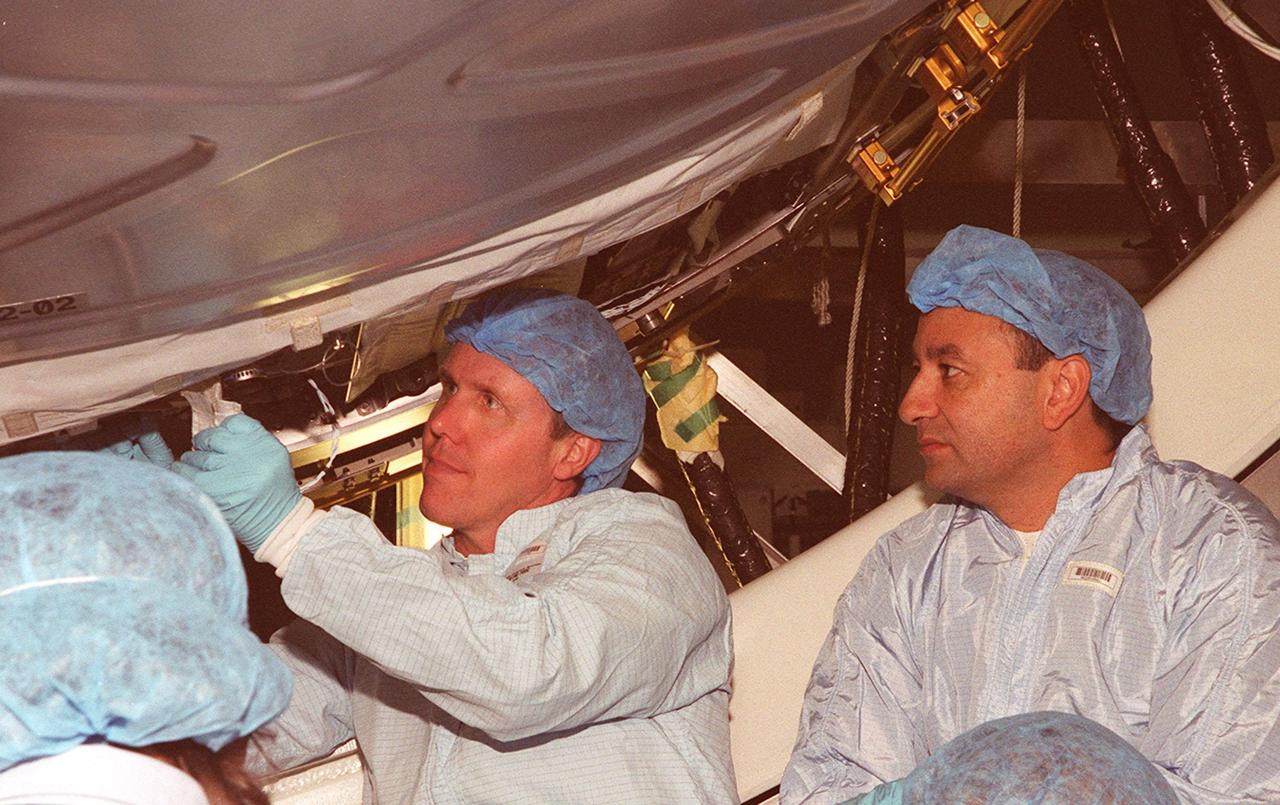
In the Space Station Processing Facility, STS-98 Mission Specialist Thomas Jones works on a part of the U.S. Lab, Destiny. Watching at right is Pilot Mark Polansky. Jones and Polansky, along with other crew members, are taking part in Crew Equipment Interface Test activities to become familiar with equipment they will be handling during the mission. Others in the crew are Commander Ken Cockrell and Mission Specialists Robert Curbeam and Marsha Ivins. The mission will be transporting the Lab to the International Space Station with five system racks already installed inside of the module. With delivery of electronics in the lab, electrically powered attitude control for Control Moment Gyroscopes will be activated. The STS-98 launch is scheduled for Jan. 18, 2001
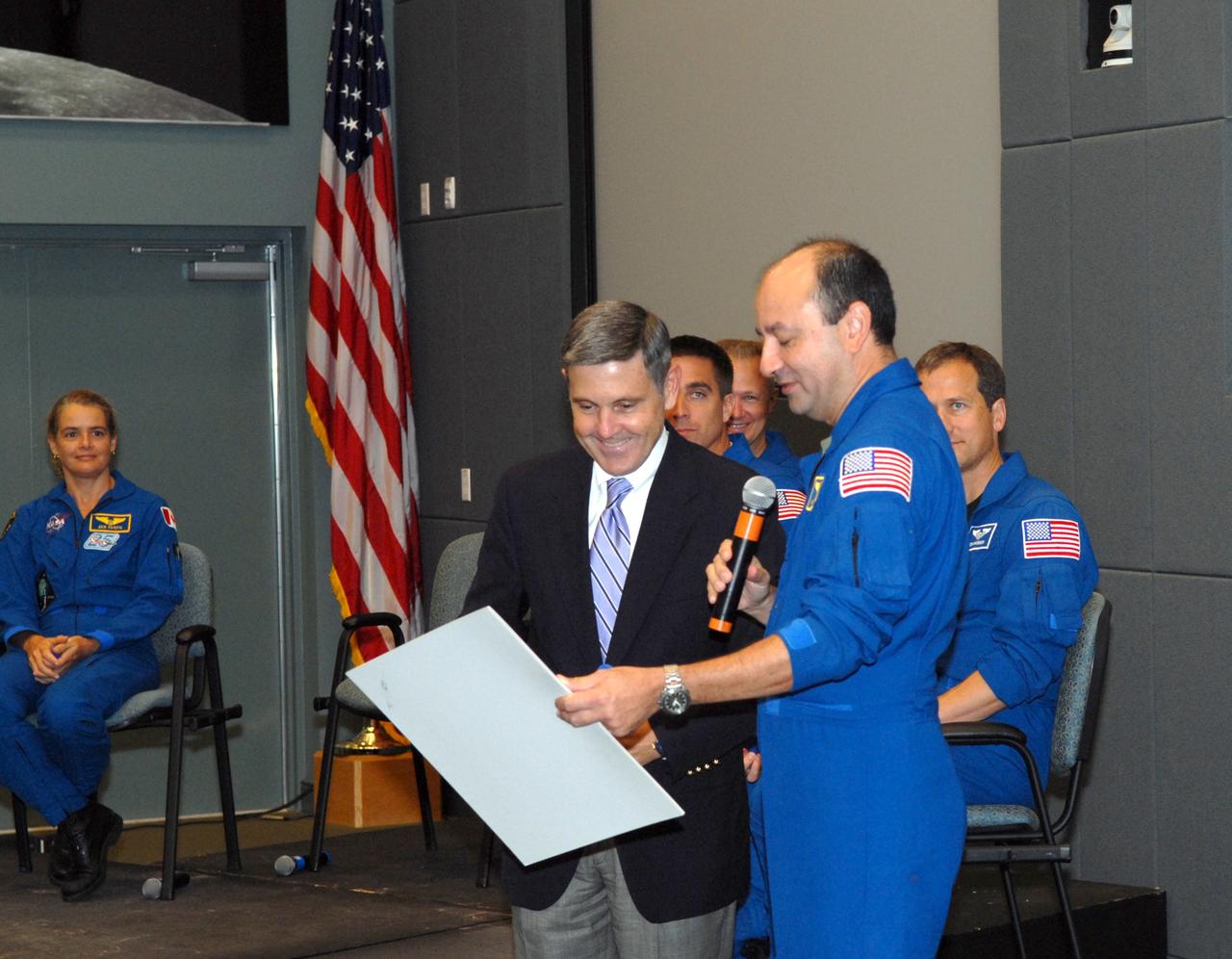
CAPE CANAVERAL, Fla. – Following a presentation by the STS-127 crew members about their experiences on the mission, Commander Mark Polansky (right) presents a plaque commemorating the mission to Kennedy Space Center Director Bob Cabana. At far left is Mission Specialist Julie Payette. Behind Cabana are Mission Specialist Christopher Cassidy and Pilot Doug Hurley. Behind Polansky is Mission Specialist Tom Marshburn. The STS-127 mission was the final of three flights dedicated to the assembly of the Japanese Kibo laboratory complex on the International Space Station. The crew launched on space shuttle Endeavour on July 15 and returned July 31. Photo credit: NASA/Jim Grossmann
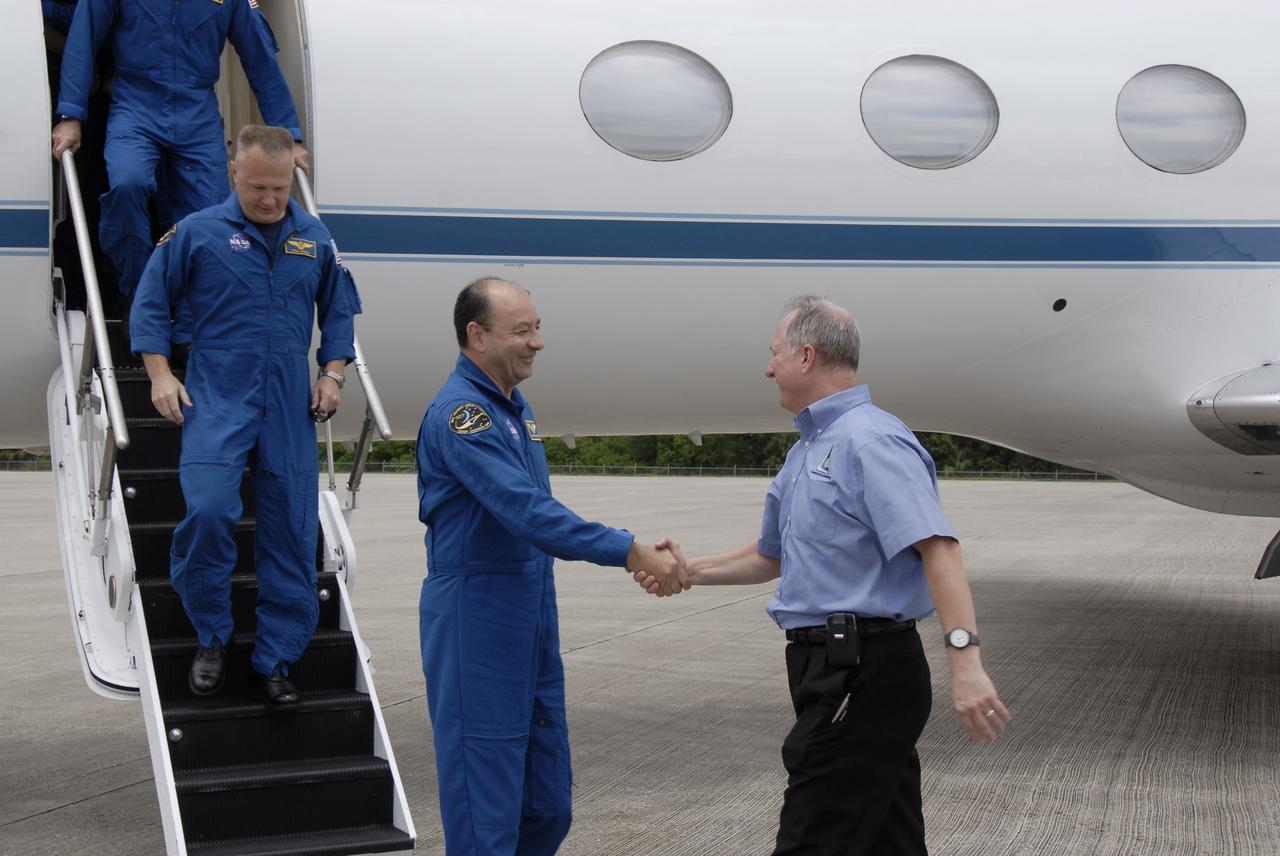
CAPE CANAVERAL, Fla. – – The STS-127 crew members arrive at NASA's Kennedy Space Center in Florida to prepare for space shuttle Endeavour's July 11 launch on the 29th assembly flight to the International Space Station. Leading the way, Commander Mark Polansky is greeted by the STS-127 Launch Director Pete Nickolenko. Behind Polansky is Pilot Doug Hurley. Polansky will be making his third shuttle flight and Hurley his first. This will be the third launch attempt due to the leak of hydrogen gas at the Ground Umbilical Carrier Plate during tanking on two previous attempts, June 13 and June 17. The STS-127 mission is the final of three flights dedicated to the assembly of the Japan Aerospace Exploration Agency's Kibo laboratory complex. Endeavour will deliver the Japanese Experiment Module's Exposed Facility, or JEM-EF, and the Experiment Logistics Module-Exposed Section, or ELM-ES. Photo credit: NASA/Kim Shiflett
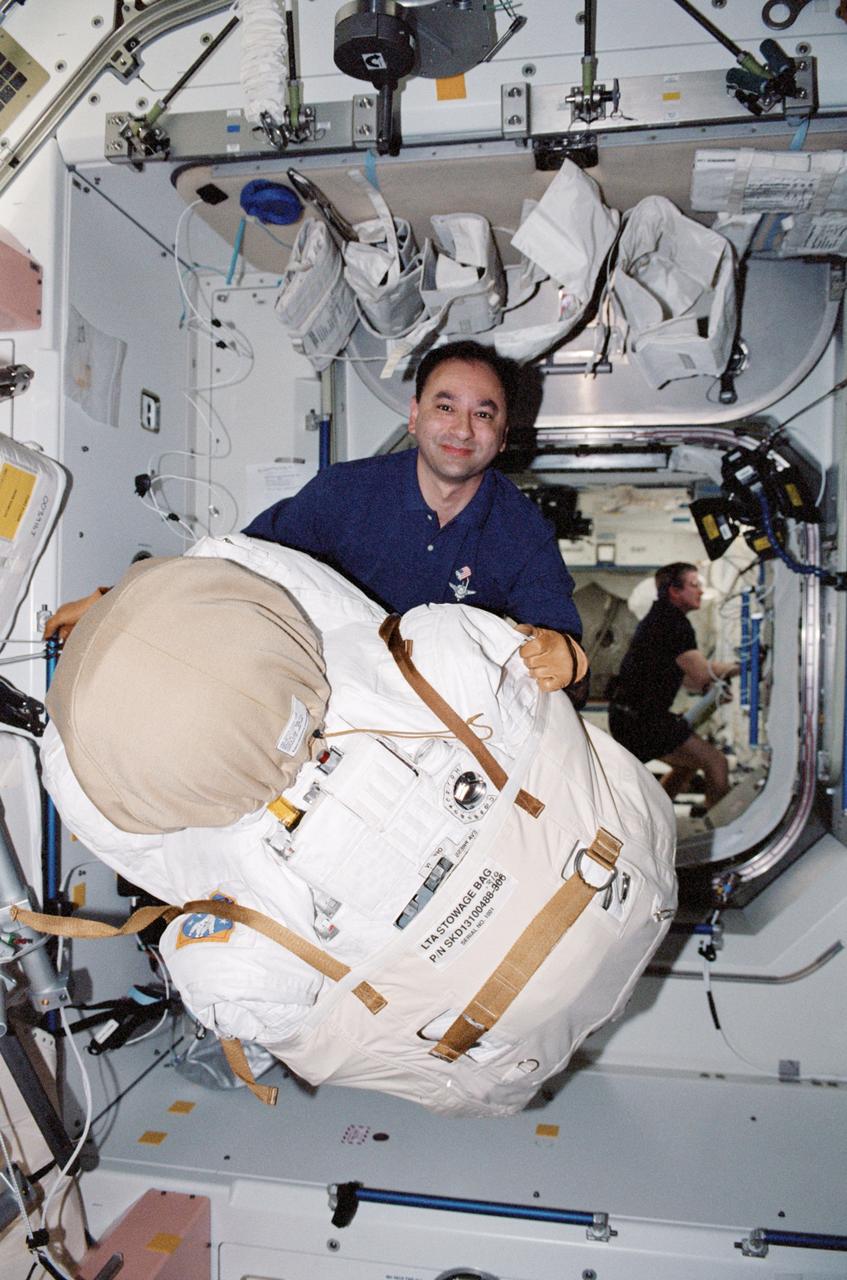
STS098-361-016 (7-20 February 2001) --- Astronaut Mark L. Polansky, STS-98 pilot, moves one of the Extravehicular Mobility Unit (EMU) space suits in its storage bag onboard the International Space Station (ISS). William M. (Bill) Shepherd, Expedition One mission commander, can be seen as he works in the background.

CAPE CANAVERAL, Fla. –STS-127 crew members autograph mementos for attendees following a presentation about the astronauts' experiences on the mission. Seated from left are Mission Specialist Christopher Cassidy, Pilot Doug Hurley and Commander Mark Polansky. The STS-127 mission was the final of three flights dedicated to the assembly of the Japanese Kibo laboratory complex on the International Space Station. The crew launched on space shuttle Endeavour on July 15 and returned July 31. Photo credit: NASA/Jim Grossmann
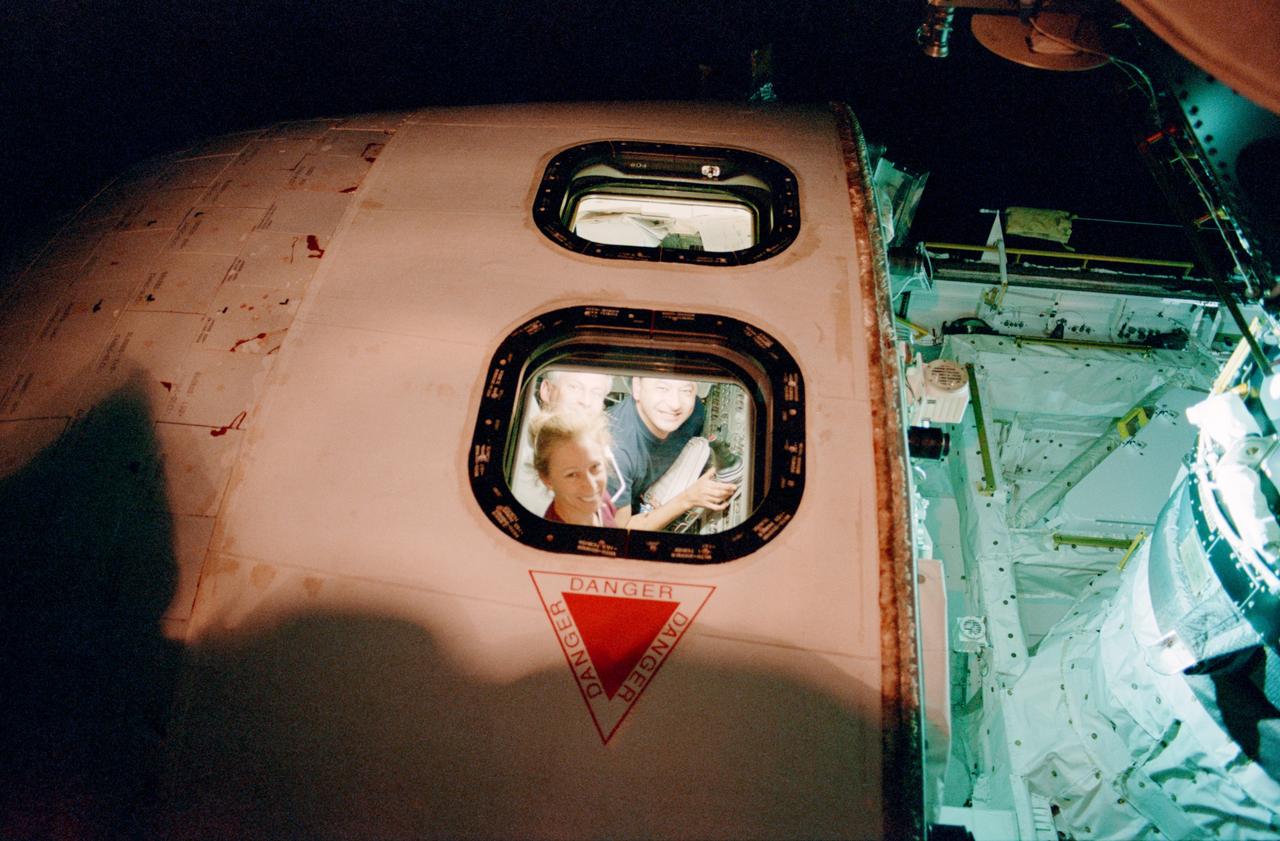
STS098-335-0028 (7-20 February 2001) --- From the aft flight deck of the Space Shuttle Atlantis, astronaut Marsha S. Ivins, STS-98 mission specialist, looks through an overhead window toward her space walking colleagues, who exposed this 35mm frame. Also visible in the window are astronauts Kenneth D. Cockrell and Mark L. Polansky, commander and pilot for the STS-98/5a mission.
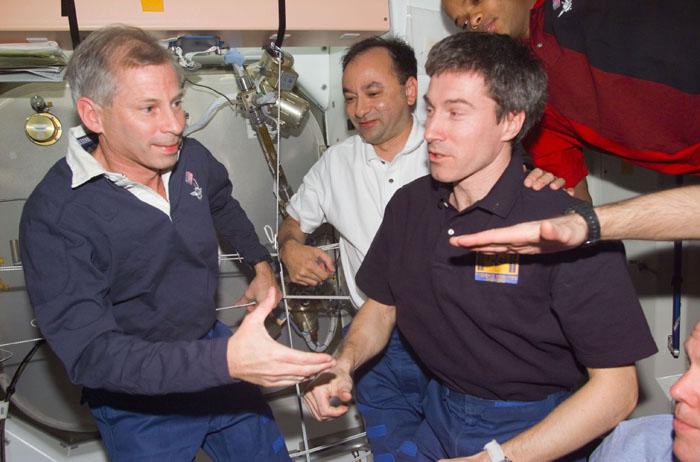
STS98-E-5295 (16 February 2001) --- Astronaut Kenneth D. Cockrell (left), STS-98 mission commander, participates in farewells with Expedition One crew members. Cosmonaut Sergei K. Krikalev (right foreground), Expedition One flight engineer, is one of three crew members who will stay behind for several weeks prior to return to Earth. Astronauts Mark L. Polansky, STS-98 pilot, and Robert L. Curbeam, mission specialist, are also pictured. The scene was recorded with a digital still camera.
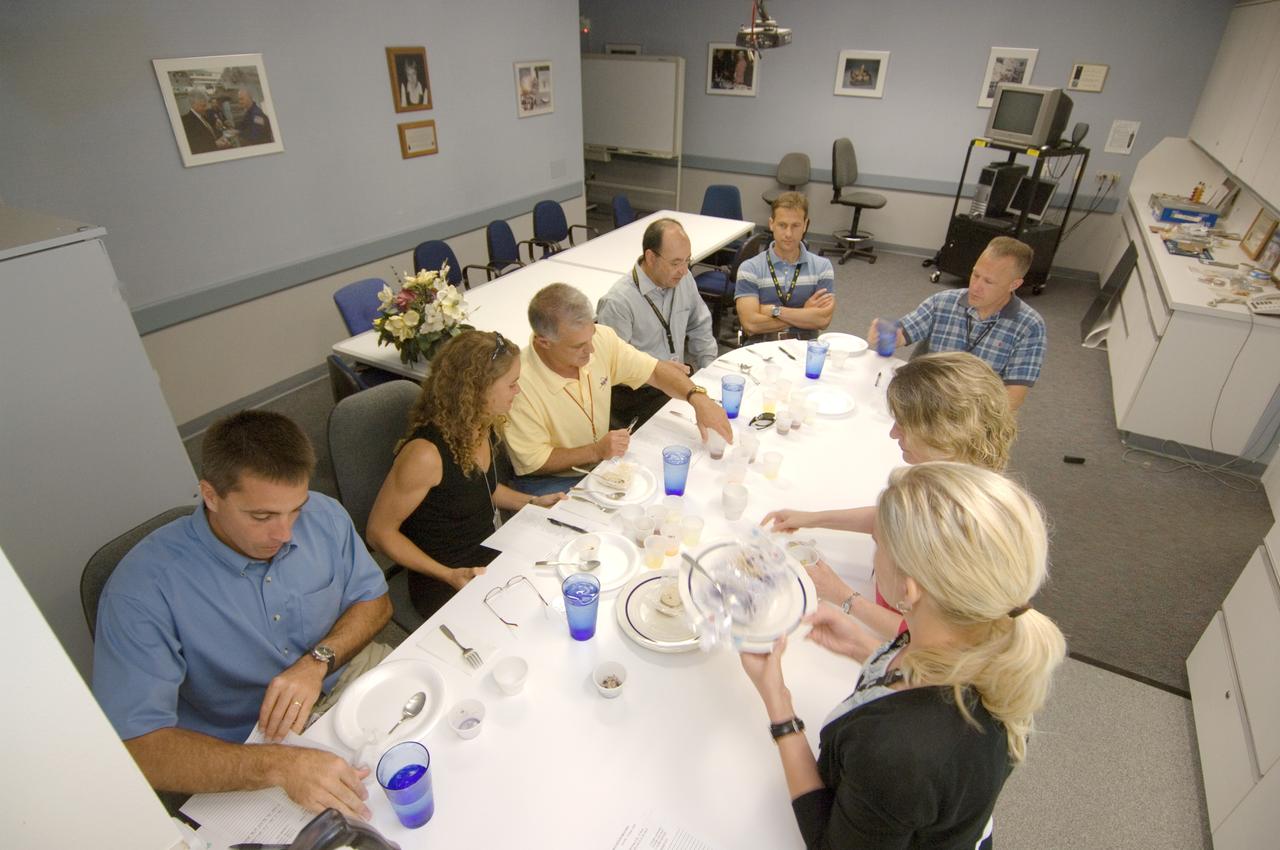
JSC2008-E-047936 (19 June 2008) --- STS-127 crewmembers participate in a food tasting session in the Flight Projects Division Laboratory at NASA's Johnson Space Center. Seated from the left are NASA astronaut Christopher J. Cassidy, Canadian Space Agency astronaut Julie Payette, NASA astronauts David A. Wolf, all mission specialists; Mark L. Polansky, commander; Thomas H. Marshburn, mission specialist; and Douglas G. Hurley, pilot. Dieticians (right foreground) assisted the crewmembers.
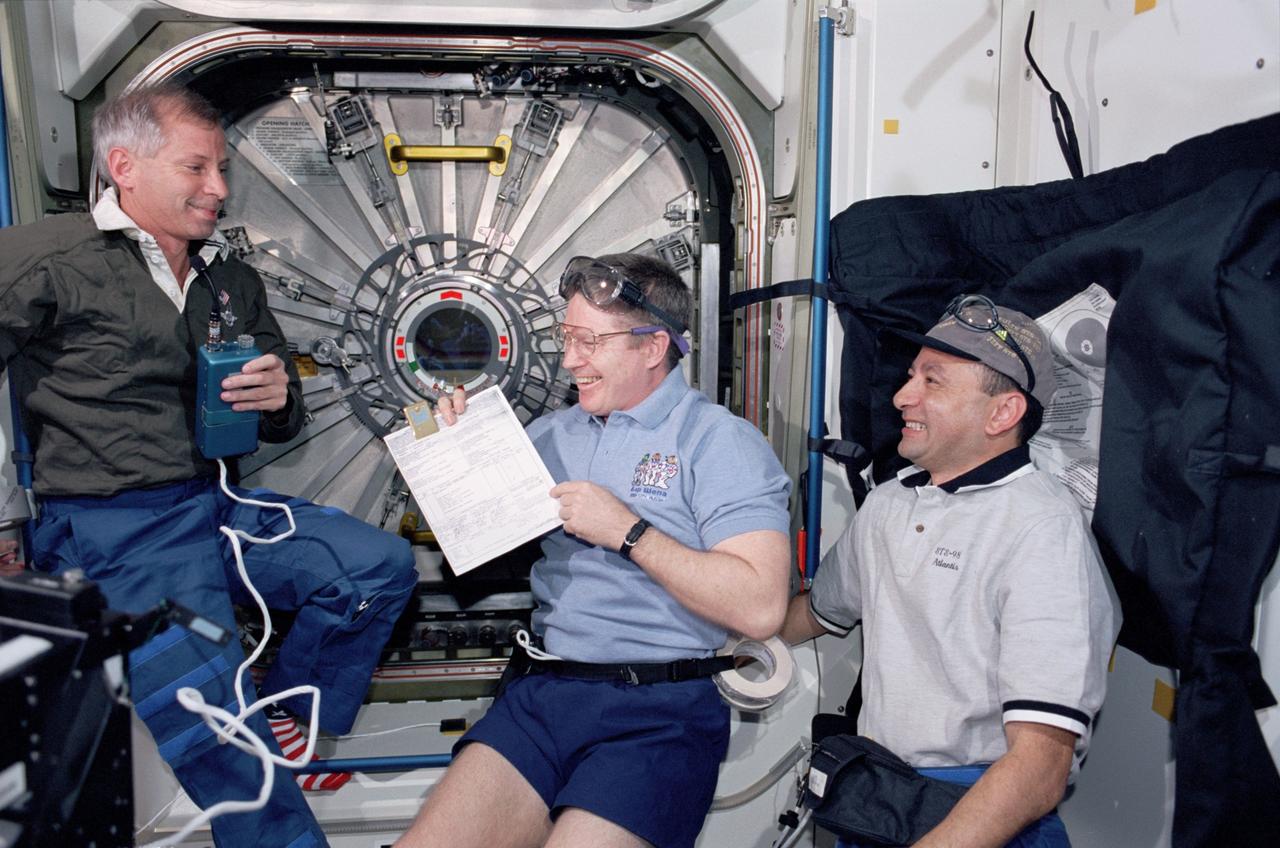
STS098-352-0019 (11 February 2001) --- Inside the Unity node, astronaut William M. (Bill) Shepherd (center), Expedition One commander, holds a document of receipt of the U.S. laboratory, called Destiny, as part of the International Space Station (ISS). Looking on are astronauts Kenneth D. Cockrell (left) and Mark L. Polansky, commander and pilot, respectively, for STS-98. The hatch to Destiny, not yet opened, is in the background.
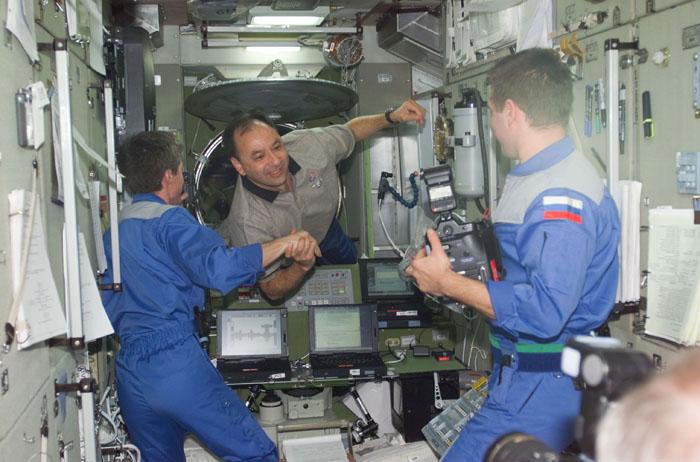
STS98-E-5056 (9 February 2001) --- Cosmonauts Sergei K. Krikalev (left), Expedition One flight engineer, and Yuri P. Gidzenko (left), Soyuz commander for the first station expedition crew, welcome astronaut Mark L. Polansky, STS-98 pilot, aboard the International Space Station. The scene was recorded with a digital still camera shortly after the hatches were opened on STS-98 Flight Day 3.
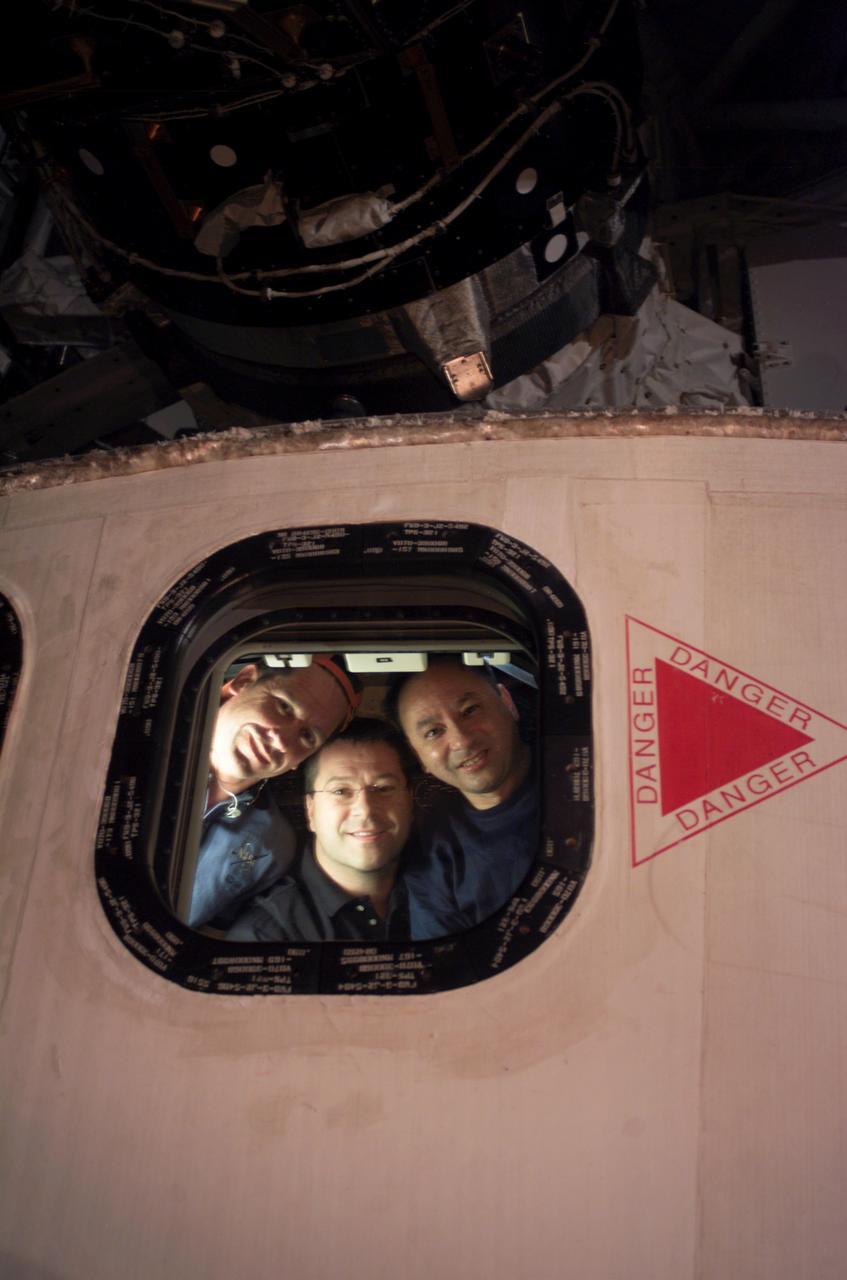
ISS014-E-09804 (14 Dec. 2006) --- From the aft flight deck on Space Shuttle Discovery, astronauts William A. (Bill) Oefelein (left), STS-116 pilot; Nicholas J. M. Patrick, mission specialist; and Mark L. Polansky, commander, look through an overhead window toward their spacewalking crewmembers, who captured the image during the mission's second of three planned sessions of extravehicular activity (EVA).
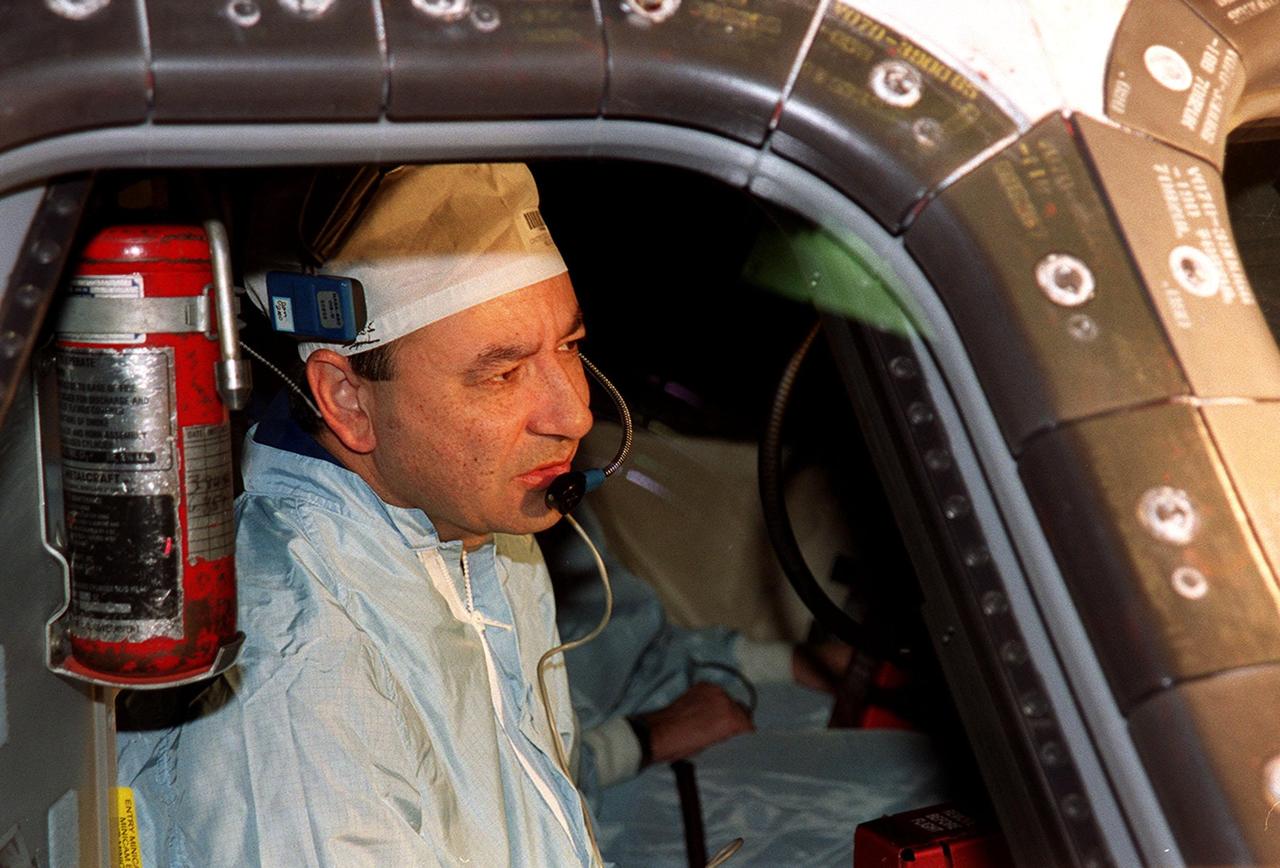
KENNEDY SPACE CENTER, FLA. -- In Orbiter Processing Facility bay 3, STS-98 Pilot Mark Polansky inspects the window in the cockpit of Atlantis. He and the rest of the crew are at KSC for Crew Equipment Interface Test activities. Launch on mission STS-98 is scheduled for Jan. 18, 2001. It will be transporting the U.S. Lab, Destiny, to the International Space Station with five system racks already installed inside of the module. After delivery of electronics in the lab, electrically powered attitude control for Control Moment Gyroscopes will be activated

JSC2000-04779 (16 June 2000) --- Astronaut Mark Polansky, STS-98 pilot, secures the head gear on a training version of the shuttle full-pressure launch and entry garment. He was about to join his crew mates for a simulation exercise in the motion-base shuttle mission simulator in the Johnson Space Center's Mission Simulation and Training Facility. Launch for STS-98 is scheduled for early next year.
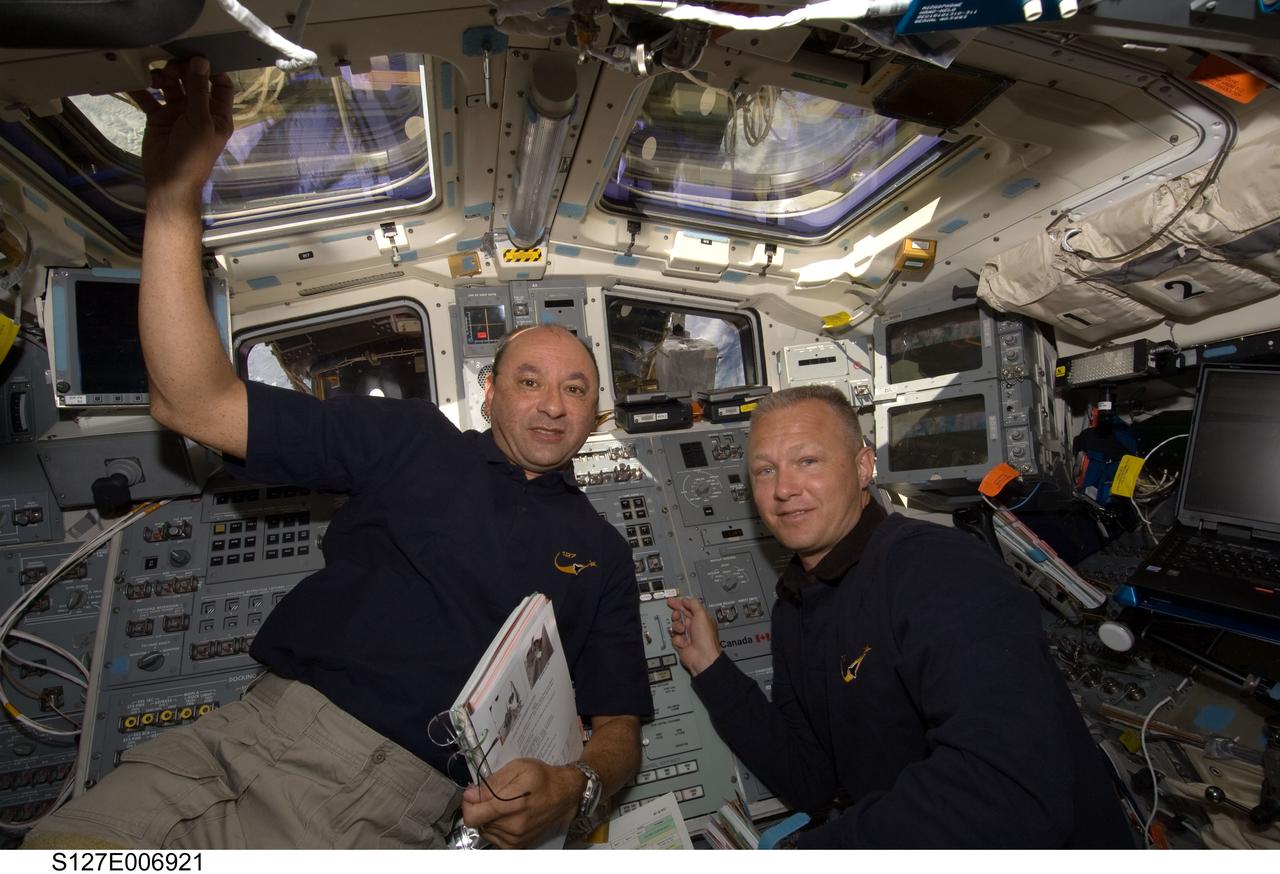
S127-E-006921 (19 July 2009) --- Astronauts Mark Polansky (left), commander, and Doug Hurley, pilot, are pictured at Endeavour's aft flight deck controls during flight day five operations with hardware on the International Space Station. The hardware moves will enable the second pair of spacewalkers--mission specialists Dave Wolf and Tom Marshburn--to perform its spacewalk assignment on July 20.
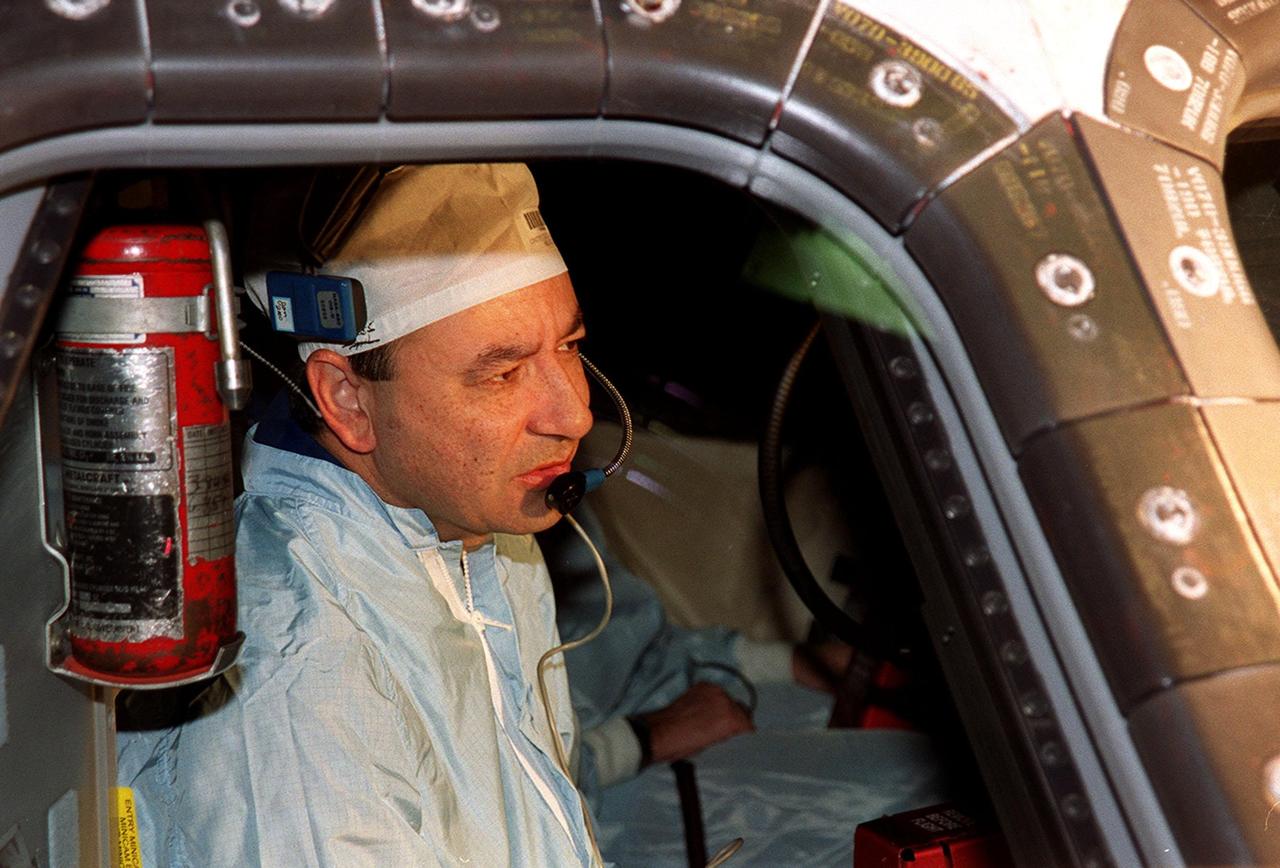
KENNEDY SPACE CENTER, FLA. -- In Orbiter Processing Facility bay 3, STS-98 Pilot Mark Polansky inspects the window in the cockpit of Atlantis. He and the rest of the crew are at KSC for Crew Equipment Interface Test activities. Launch on mission STS-98 is scheduled for Jan. 18, 2001. It will be transporting the U.S. Lab, Destiny, to the International Space Station with five system racks already installed inside of the module. After delivery of electronics in the lab, electrically powered attitude control for Control Moment Gyroscopes will be activated
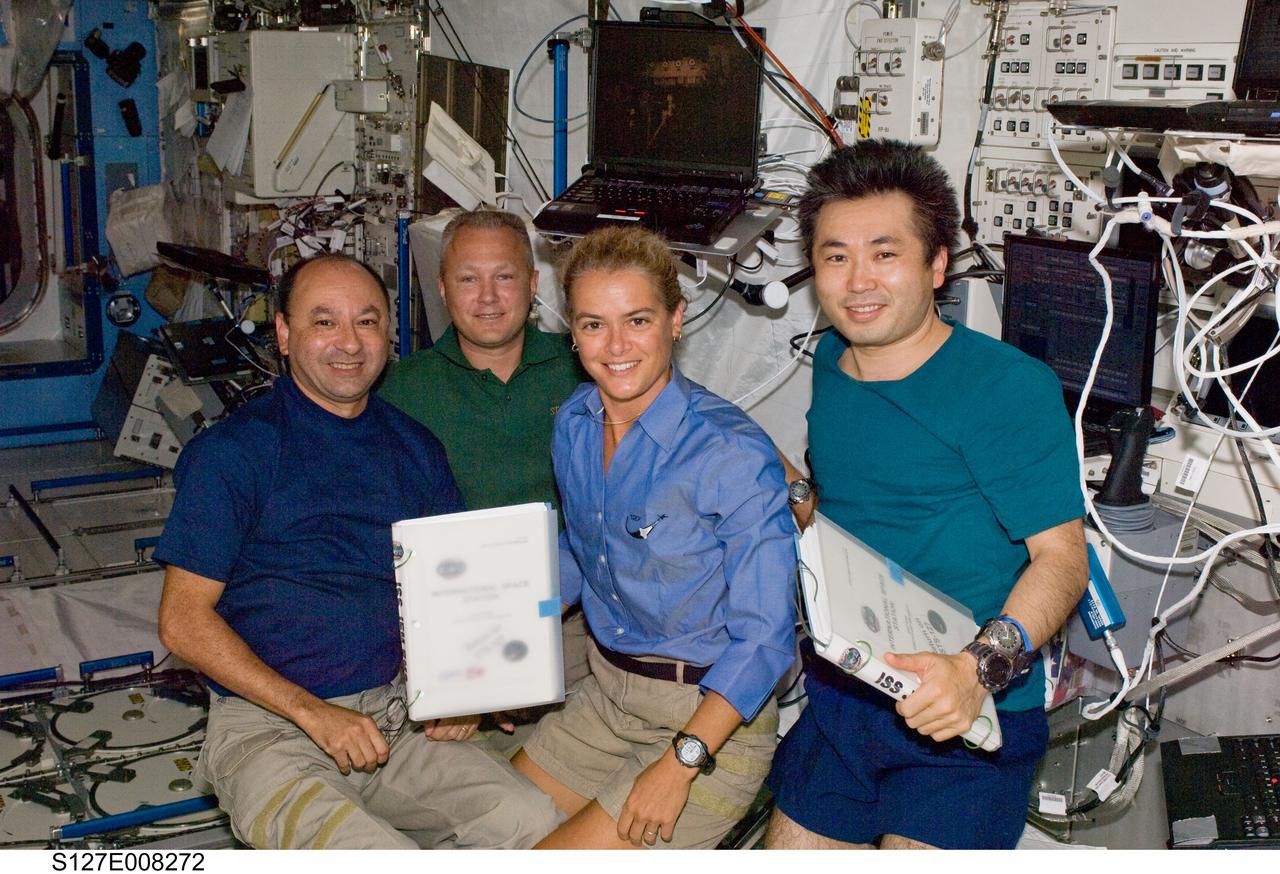
S127-E-008272 (23 July 2009) --- From left, astronauts Mark Polansky, STS-127 commander; and Doug Hurley, pilot; with Canadian Space Agency astronaut Julie Payette and Japanese Aerospace Exploration Agency astronaut Koichi Wakata, both mission specialists, assemble in the Japanese Experiment Module or Kibo during flight day 9 activities on the International Space Station.
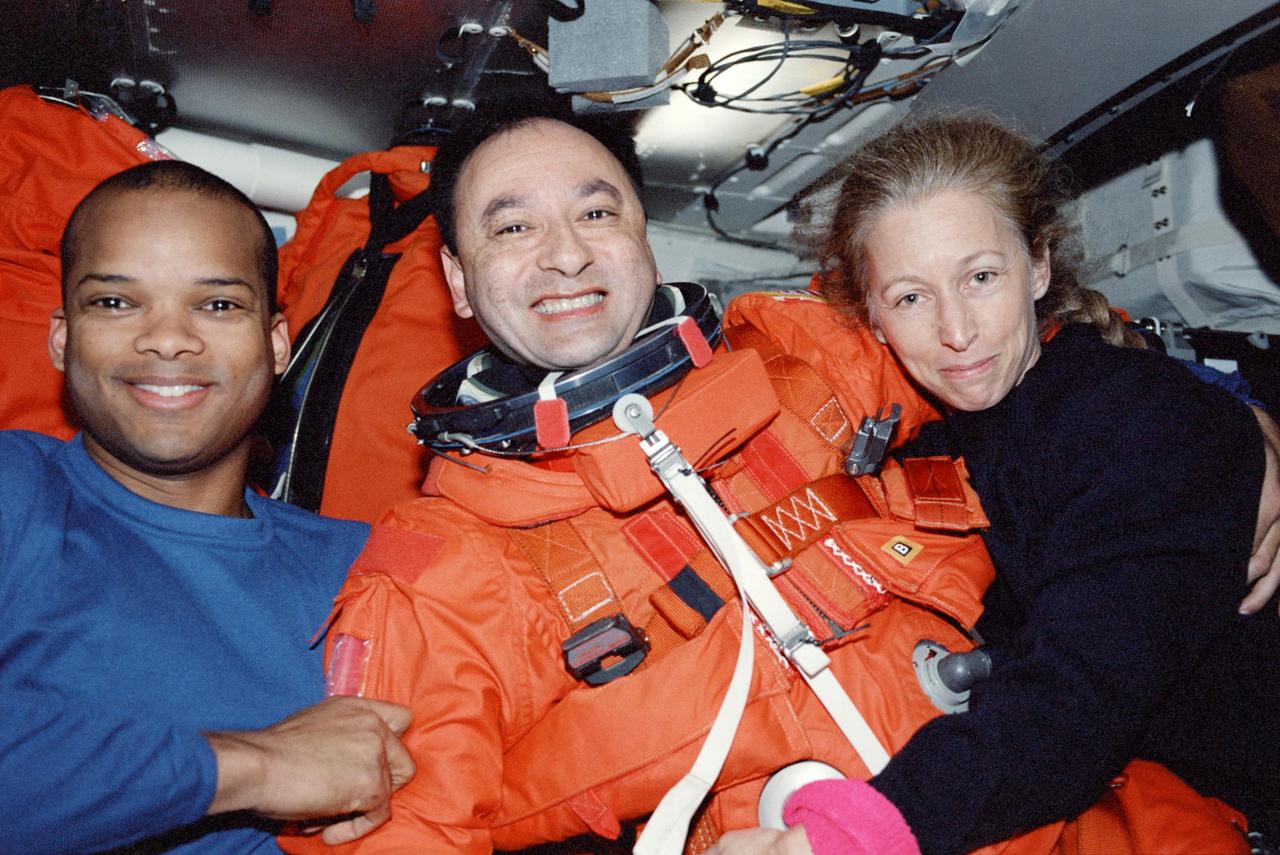
STS098-358-005 (7-20 February 2001) --- Astronauts Mark L. Polansky (center), pilot, Robert L. Curbeam, and Marsha S. Ivins, both mission specialists, paused for this photograph as they prepared to suit up in their full-pressure launch and entry suits on the mid deck of the Space Shuttle Atlantis during de-orbit preparations.
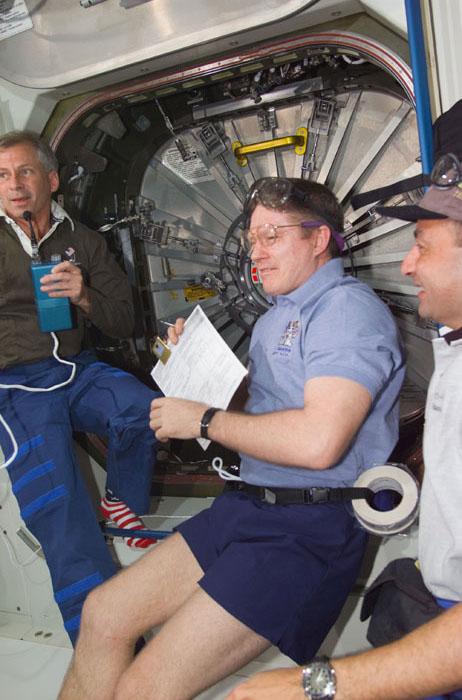
STS98-E-5127 (11 February 2001) --- Inside the Unity node, astronaut William M. (Bill) Shepherd (center), Expedition One commander, prepares to sign a document of receipt of the U.S. laboratory, called Destiny, as part of the International Space Station (ISS). Looking on are astronauts Kenneth D. Cockrell (left) and Mark L. Polansky, commander and pilot, respectively, for STS-98. The hatch to Destiny, not yet opened, is in the background. This scene was recorded with a digital still camera.
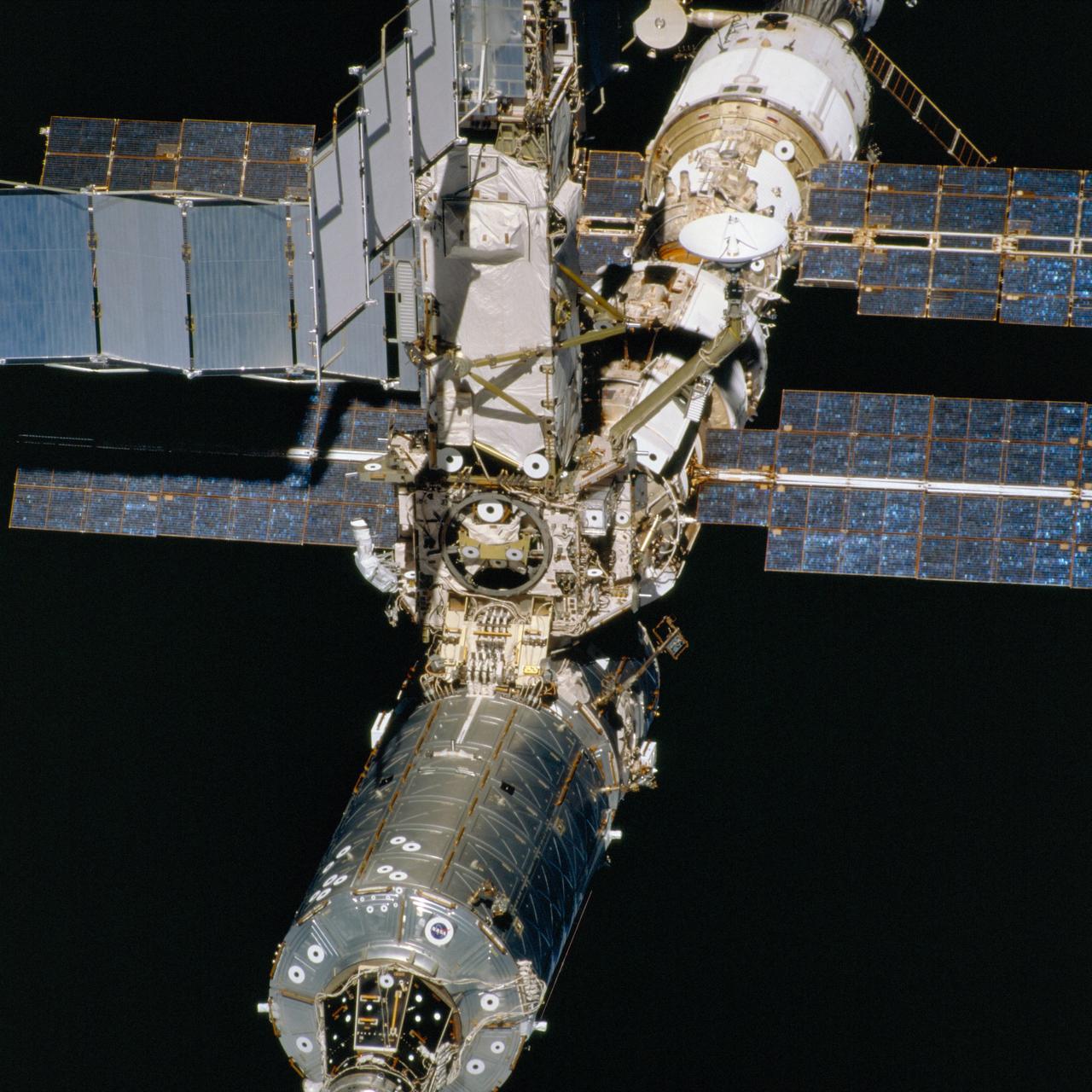
STS098-706-004 (16 February 2001) --- The International Space Station (ISS)is backdropped against the blackness of space in this medium-distance, 70mm frame, as photographed from the departing Space Shuttle Atlantis. The newly installed Destiny laboratory is in the left foreground. The crews of the Space Shuttle Atlantis and the International Space Station parted company at 8:06 a.m. (CST), Febraury 16, as astronaut Mark L. Polansky, pilot, flew the shuttle halfway around the station and its new Destiny laboratory before moving off.
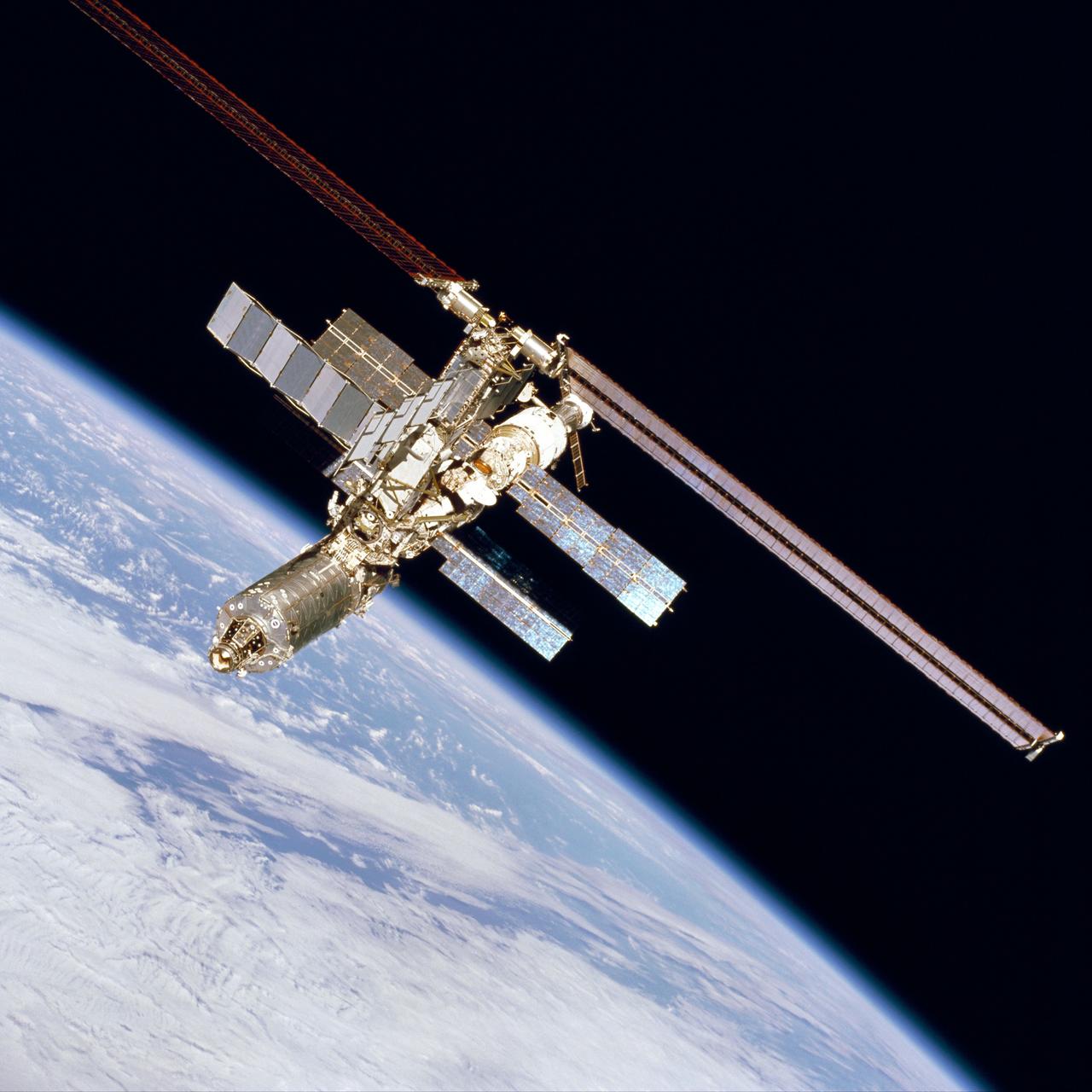
STS09-713a-004 (16 February 2001) --- With its new Destiny laboratory contrasted over a blue and white Earth, the International Space Station (ISS) was photographed by one of the STS-98 crew members aboard Atlantis following separation of the shuttle and the outpost at the end of several days of joint activities. The crews of Atlantis and the station parted company at 8:06 a.m. (CST), Feb. 16, as astronaut Mark L. Polansky, pilot, flew the shuttle halfway around the outpost and its new Destiny laboratory before moving off.
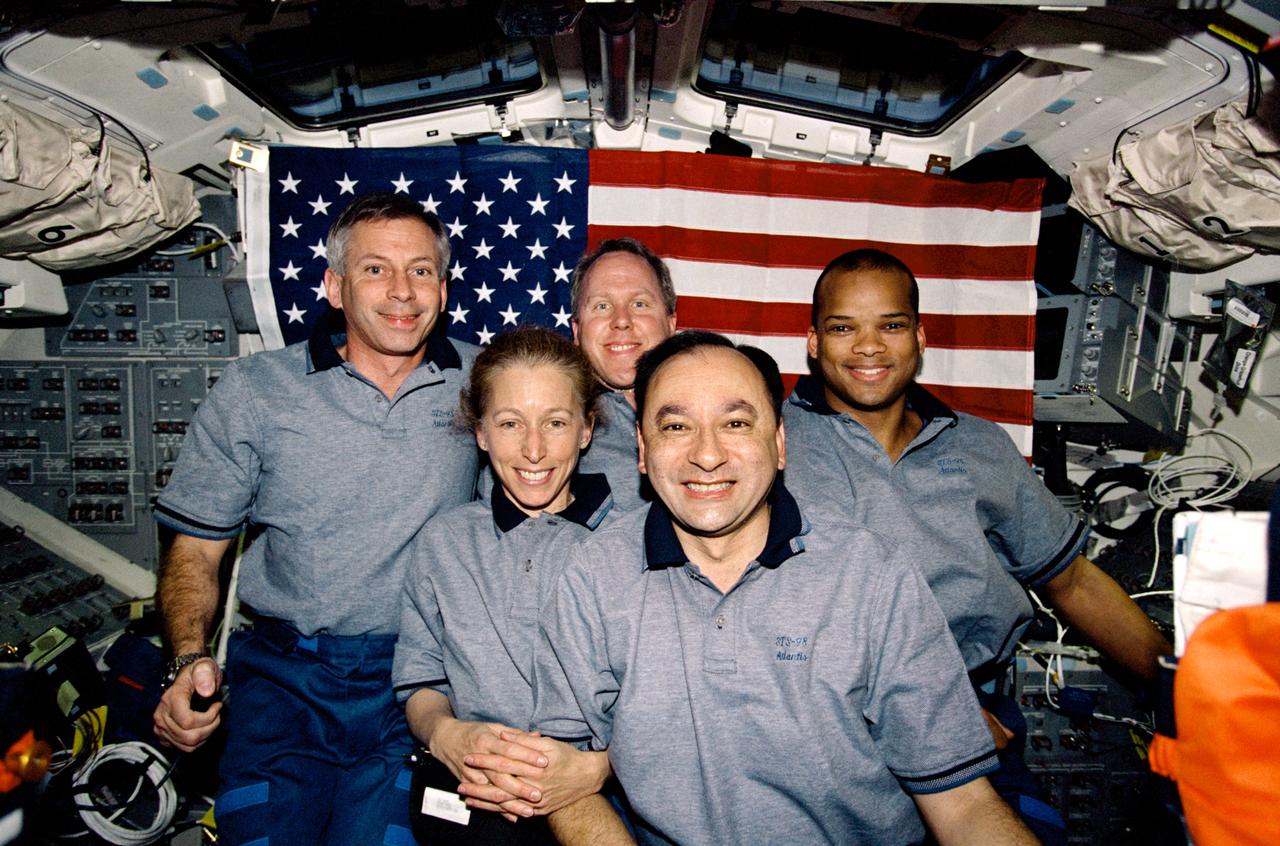
STS098-365-0034 (7-20 February 2001) --- The crew of the STS-98 mission poses for the traditional inflight portrait on the flight deck of the Space Shuttle Atlantis. From left are astronauts Kenneth D. Cockrell, mission commander; Marsha S. Ivins, mission specialist; Thomas D. Jones, mission specialist; Mark L. Polansky, pilot; and Robert L. Curbeam, mission specialist.
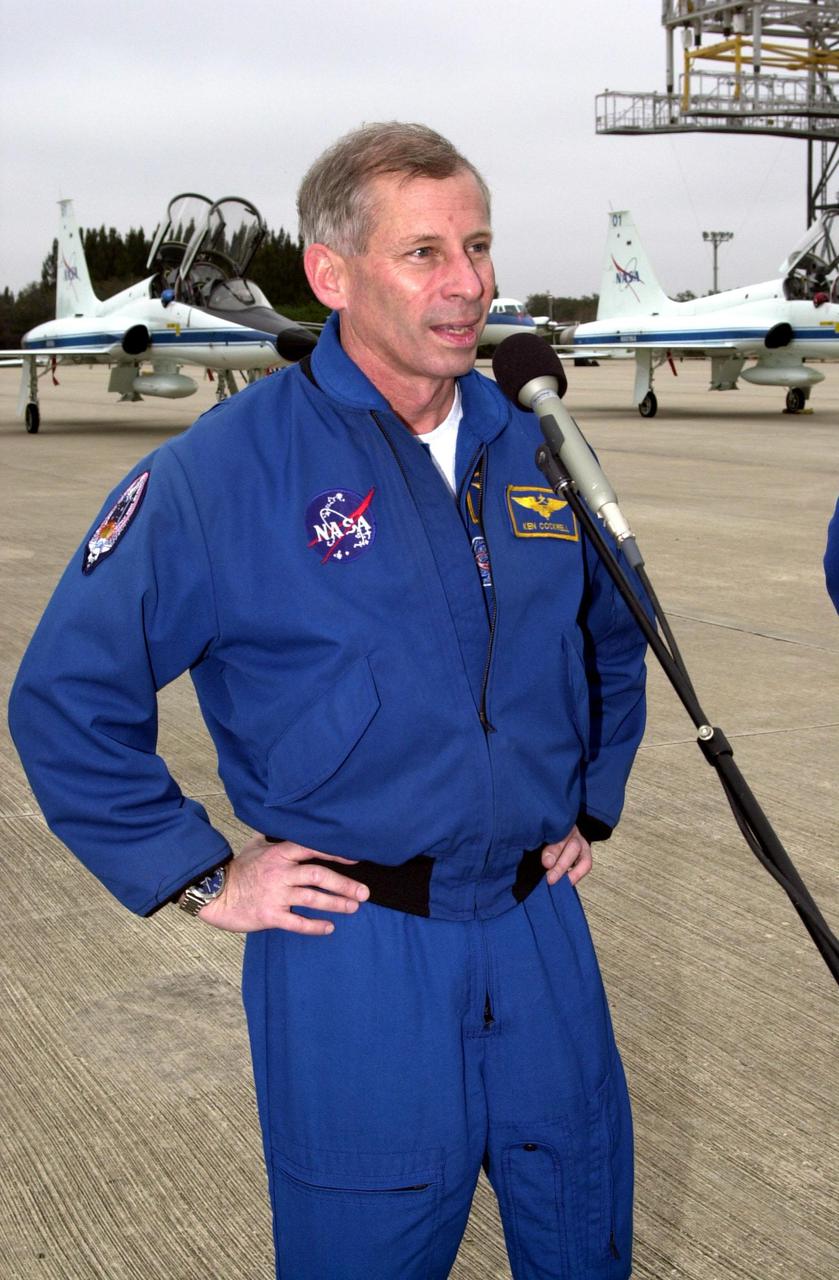
KENNEDY SPACE CENTER, FLA. -- STS-98 Mission Commander Kenneth Cockrell speaks to the media at the Shuttle Landing Facility after the crew's arrival Sunday to complete preparations for launch. The crew also includes Pilot Mark Polansky and Mission Specialists Thomas Jones, Marsha Ivins and Robert Curbeam.; STS-98 is the seventh construction flight to the International Space Station, carrying as payload the U.S. Lab Destiny, a key element in the construction of the ISS. Launch of STS-98 is scheduled for Feb. 7 at 6:11 p.m. EST
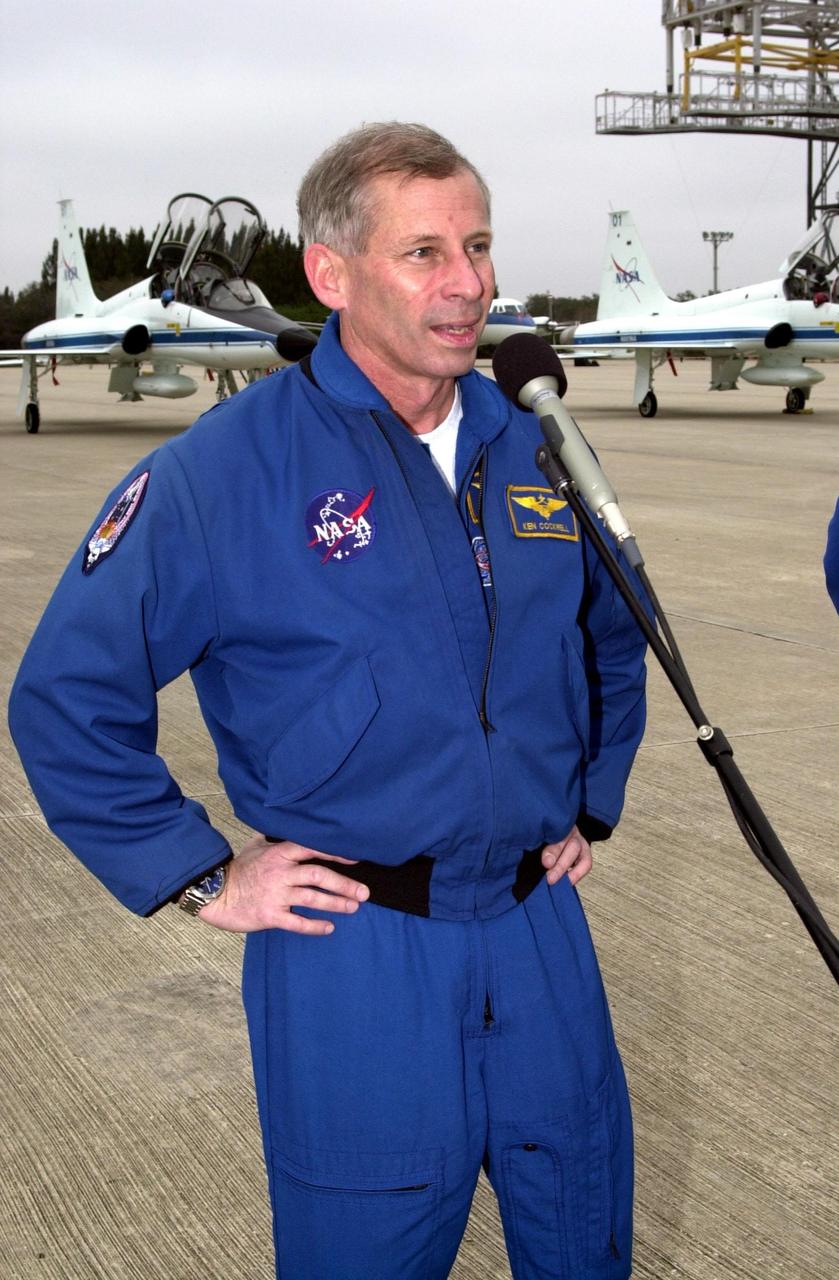
KENNEDY SPACE CENTER, FLA. -- STS-98 Mission Commander Kenneth Cockrell speaks to the media at the Shuttle Landing Facility after the crew's arrival Sunday to complete preparations for launch. The crew also includes Pilot Mark Polansky and Mission Specialists Thomas Jones, Marsha Ivins and Robert Curbeam.; STS-98 is the seventh construction flight to the International Space Station, carrying as payload the U.S. Lab Destiny, a key element in the construction of the ISS. Launch of STS-98 is scheduled for Feb. 7 at 6:11 p.m. EST
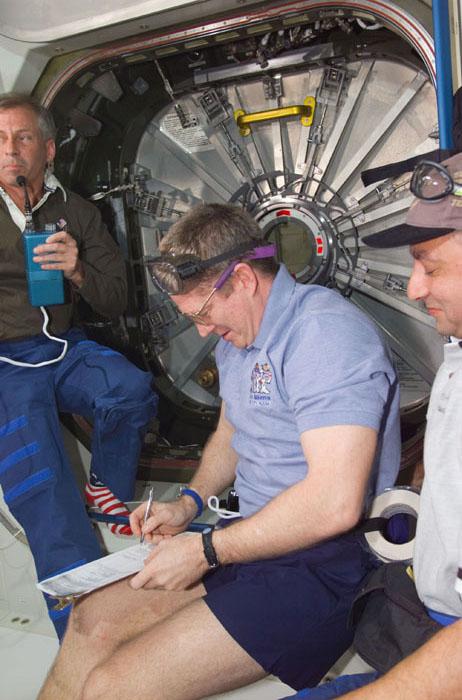
STS98-E-5125 (11 February 2001) --- Inside the Unity node, astronaut William M. (Bill) Shepherd (center), Expedition One commander, signs a document of receipt of the U.S. laboratory, called Destiny, as part of the International Space Station (ISS). Looking on are astronauts Kenneth D. Cockrell (left) and Mark L. Polansky, commander and pilot, respectively, for STS-98. The hatch to Destiny, not yet opened, is in the background. This scene was recorded with a digital still camera.
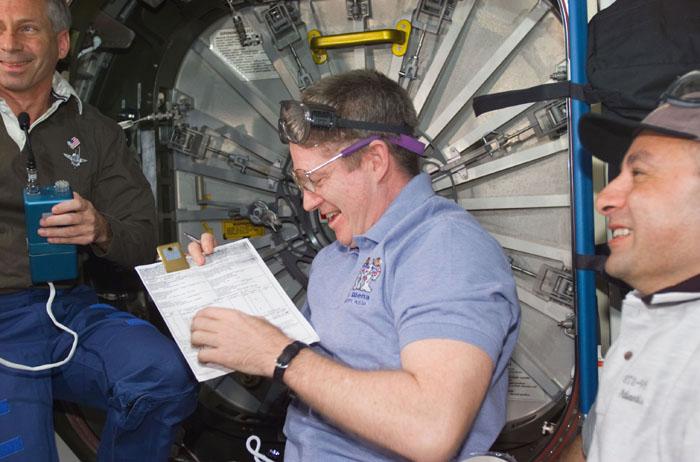
STS98-E-5129 (11 February 2001) --- Inside the Unity node, astronaut William M. (Bill) Shepherd (center), Expedition One commander, signs a document of receipt of the U.S. laboratory, called Destiny, as part of the International Space Station (ISS). Looking on are astronauts Kenneth D. Cockrell (left) and Mark L. Polansky, commander and pilot, respectively, for STS-98. The hatch to Destiny, not yet opened, is in the background. This scene was recorded with a digital still camera.
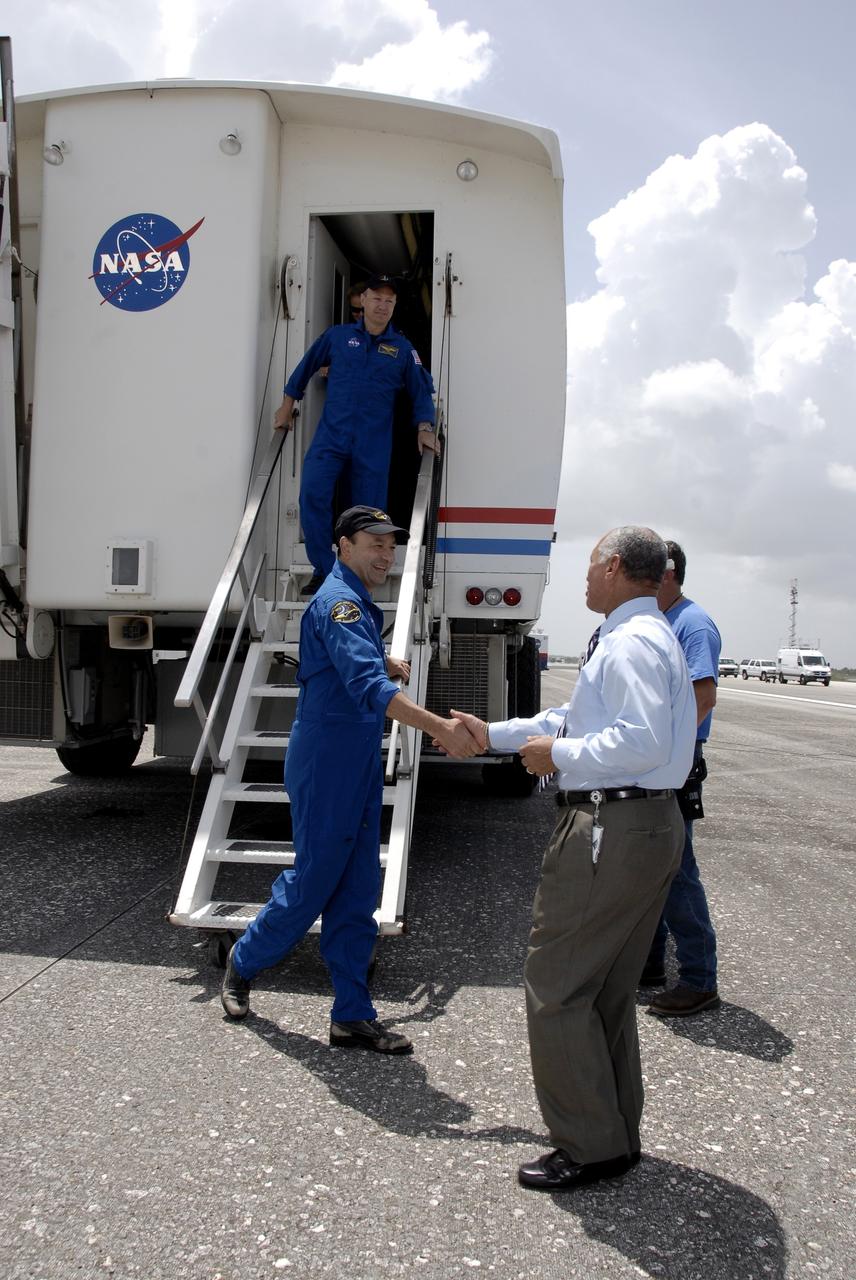
CAPE CANAVERAL, Fla. – Exiting from the crew transport vehicle at NASA's Kennedy Space Center in Florida, STS-127 Commander Mark Polansky is greeted by NASA Administrator Charles Bolden. Behind Polansky is Pilot Doug Hurley. The crew returned to Earth on space shuttle Endeavour to complete the 16-day, 6.5-million mile journey on the STS-127 mission to the International Space Station. Main gear touchdown was at 10:48:08 a.m. EDT. Nose gear touchdown was at 10:48:21 a.m. and wheels stop was at 10:49:13 a.m. Endeavour delivered the Japanese Experiment Module's Exposed Facility and the Experiment Logistics Module-Exposed Section to the International Space Station. The mission was the 29th flight to the station, the 23rd flight of Endeavour and the 127th in the Space Shuttle Program, as well as the 71st landing at Kennedy. Photo credit: NASA/Kim Shiflett
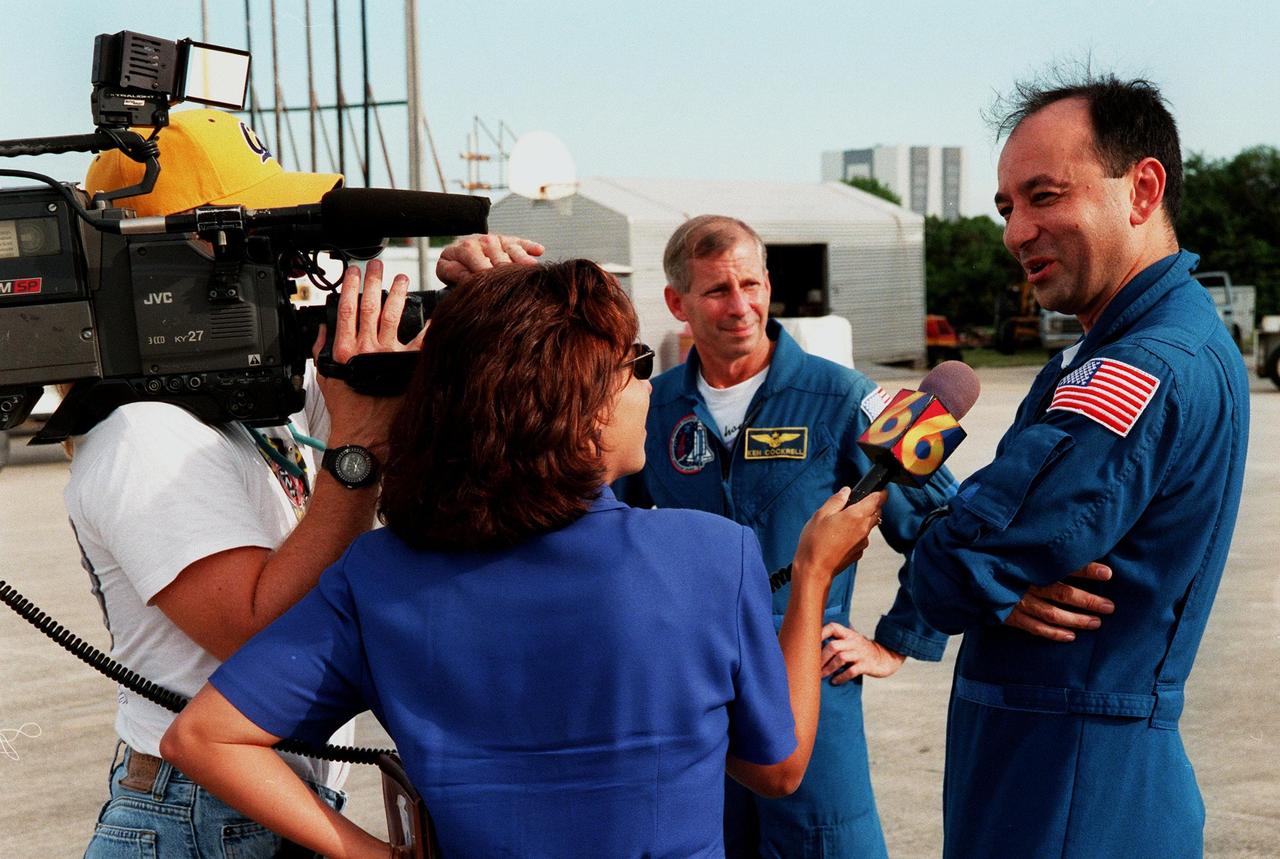
KENNEDY SPACE CENTER, FLA. -- After landing at the Shuttle Landing Facility aboard T-38 trainers, STS-98 Pilot Mark Polansky (right) and Mission Commander Ken Cockrell (center, background) are interviewed by media representatives. Polansky, Cockrell and Mission Specialist Marsha Ivins (not shown) accompanied the U.S. Laboratory module on its transport from Marshall Space Flight Center, Huntsville, to Kennedy aboard NASA's "Super Guppy" aircraft. Scheduled for launch aboard the Shuttle Endeavour on mission STS-98, the laboratory comprises three cylindrical sections with two end cones. Each end-cone contains a hatch opening for entering and exiting the lab. The lab will provide a shirtsleeve environment for research in the areas of life science, microgravity science, Earth science and space science. Designated Flight 5A, this mission is targeted for launch in early 2000
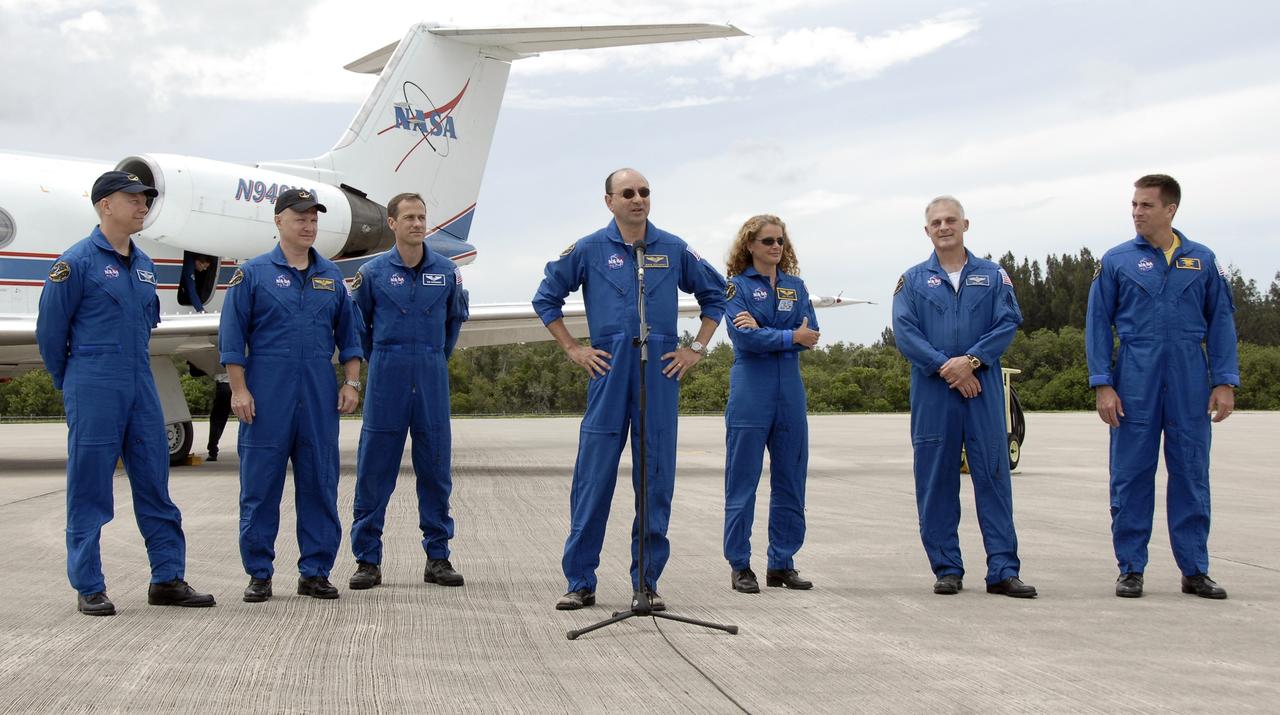
CAPE CANAVERAL, Fla. – Space shuttle Endeavour's STS-127 mission crew members greet the media after arriving at NASA's Kennedy Space Center in Florida. At the microphone is Commander Mark Polansky, who explained they were at Kennedy for the Terminal Countdown Demonstration Test, or TCDT. The other crew members behind Polansky are, from left, Mission Specialist Tim Kopra, Pilot Doug Hurley, and Mission Specialists Tom Marshburn, Julie Payette, Dave Wolf and Christopher Cassidy. Payette represents the Canadian Space Agency. The astronauts will be taking part in Terminal Countdown Demonstration Test activities that include equipment familiarization and emergency egress training, and culminates in a simulated launch countdown aboard Endeavour. The STS-127 mission is the final of three flights dedicated to the assembly of the Japanese Kibo laboratory complex. Launch is targeted for June 13. Photo credit: NASA/Kim Shiflett
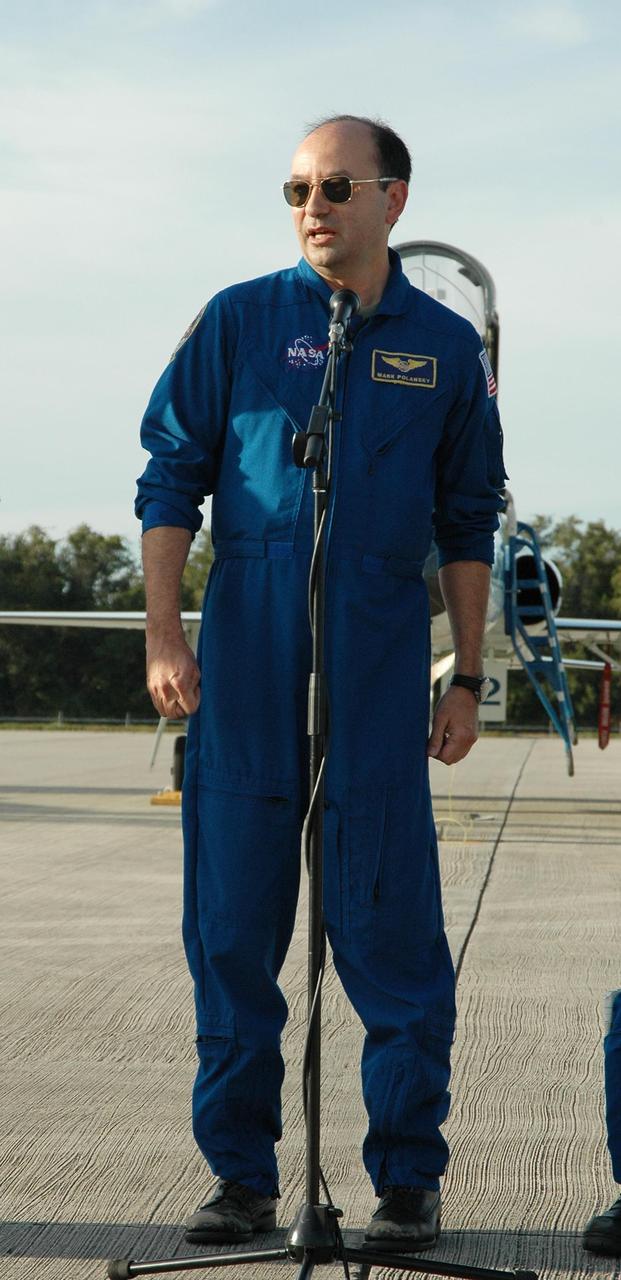
KENNEDY SPACE CENTER, FLA. -- After arrival at the Shuttle Landing Facility, STS-116 Commander Mark Polansky talks to the media. He and Mission Specialists Sunita Williams, Joan Higginbotham and Nicholas Patrick, Polansky, Pilot William Oefelein, and Mission Specialists Robert Curbeam and Christer Fuglesang have returned to KSC for the terminal countdown demonstration test, which are prelaunch preparations that include a simulated launch countdown. Fugelsang, who is from Sweden, represents the European Space Agency. The mission is No. 20 to the International Space Station and construction flight 12A.1. The mission payload is the SPACEHAB module, the P5 integrated truss structure and other key components. Launch is scheduled for no earlier than Dec. 7. Photo credit: NASA/Kim Shiflett
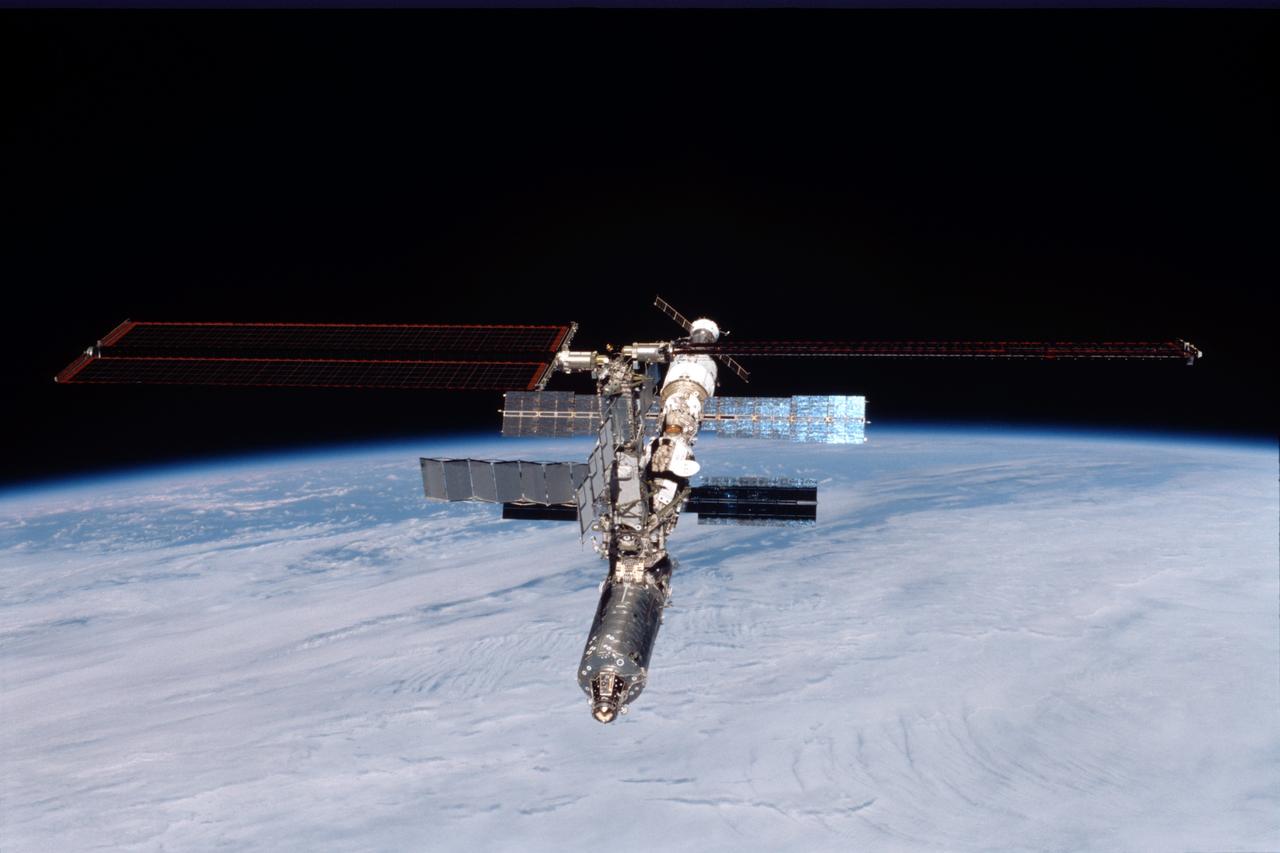
STS098-312-0025 (16 February 2001) --- Backdropped against heavy cloud cover, the International Space Station (ISS) was photographed with a 35mm camera by one of the astronauts onboard Atlantis. The crew of the station, onboard the outpost since early November 2000, is made up of astronaut William M. (Bill) Shepherd, mission commander; Yuri P. Gidzenko, Soyuz commander; and Sergei K. Krikalev, flight engineer. Krikalev and Gidzenko represent the Russian Aviation and Space Agency. On Atlantis were astronauts Kenneth D. Cockrell, mission commander; Mark L. Polansky, pilot; and Marsha S. Ivins, Robert L. Curbeam and Thomas D. Jones, all mission specialists. The shuttle and the station parted company at 8:06 a.m. (CST), Feb. 16, as Polansky flew the shuttle halfway around the outpost and its new Destiny laboratory before moving off.
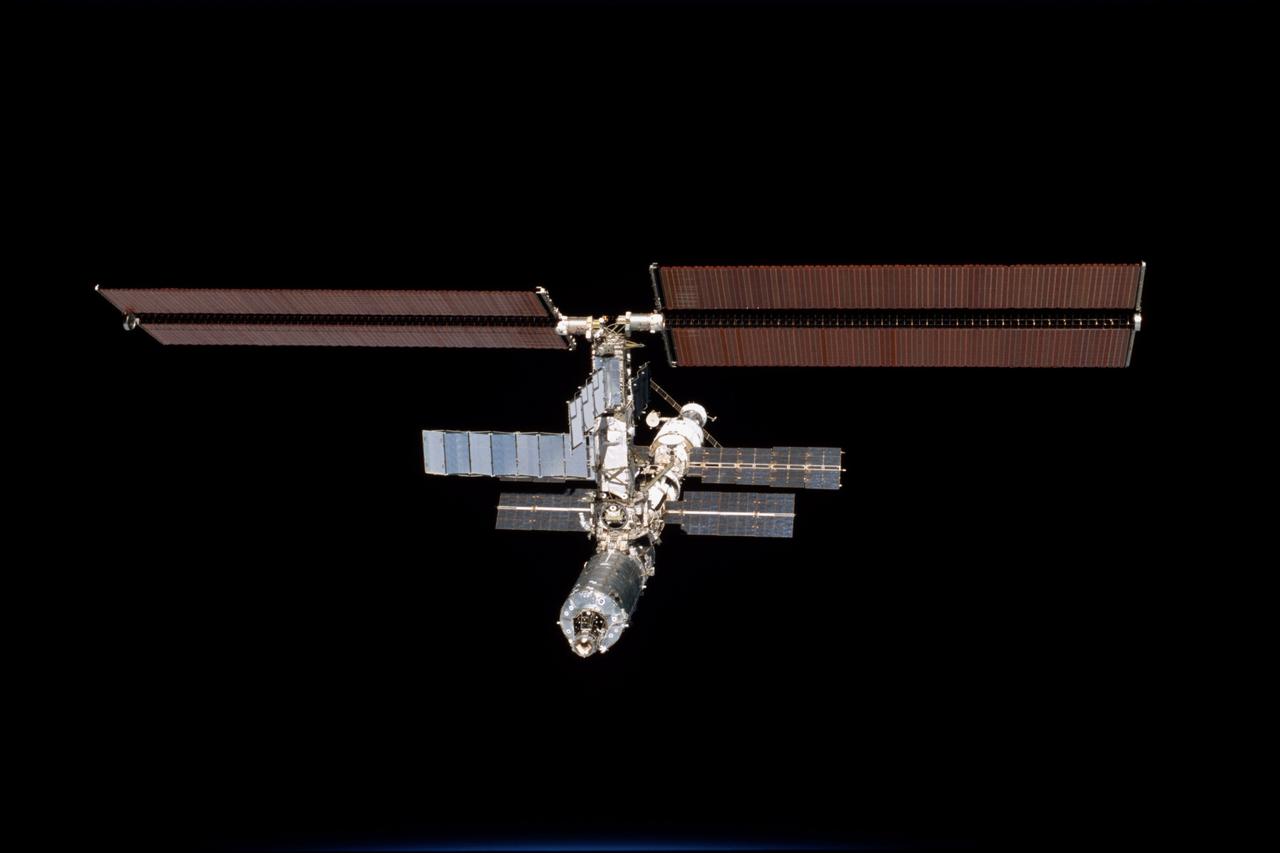
STS098-312-0020 (16 February 2001) --- Backdropped against the blackness of space, the International Space Station (ISS)was photographed with a 35mm camera by one of the astronauts onboard Atlantis. The crew of the station, onboard the outpost since early November 2000, is made up of astronaut William M. (Bill) Shepherd, mission commander; Yuri P. Gidzenko, Soyuz commander; and Sergei K. Krikalev, flight engineer. Krikalev and Gidzenko represent the Russian Aviation and Space Agency. On Atlantis were astronauts Kenneth D. Cockrell, mission commander; Mark L. Polansky, pilot; and Marsha S. Ivins, Robert L. Curbeam and Thomas D. Jones, all mission specialists. The shuttle and the station parted company at 8:06 a.m. (CST), Feb. 16, as Polansky flew the shuttle halfway around the outpost and its new Destiny laboratory before moving off.
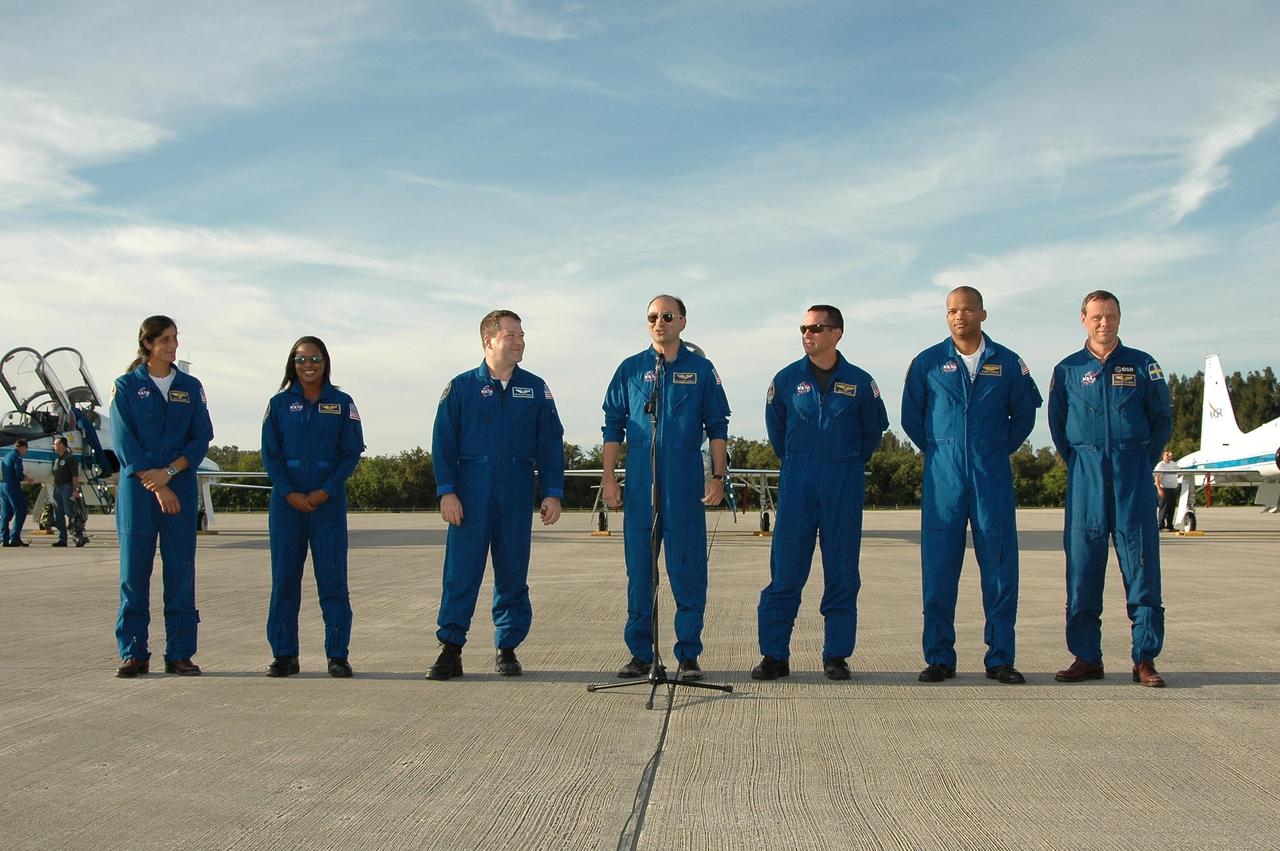
KENNEDY SPACE CENTER, FLA. -- The STS-116 crew pauses for the media at the Shuttle Landing Facility after their arrival. At the microphone is Mission Commander Mark Polansky. The crew members (from left) are Mission Specialists Sunita Williams, Joan Higginbotham and Nicholas Patrick, Polansky, Pilot William Oefelein, and Mission Specialists Robert Curbeam and Christer Fuglesang. The crew has returned to KSC for the terminal countdown demonstration test, which are prelaunch preparations that include a simulated launch countdown. The mission is No. 20 to the International Space Station and construction flight 12A.1. The mission payload is the SPACEHAB module, the P5 integrated truss structure and other key components. Launch is scheduled for no earlier than Dec. 7. Photo credit: NASA/Kim Shiflett
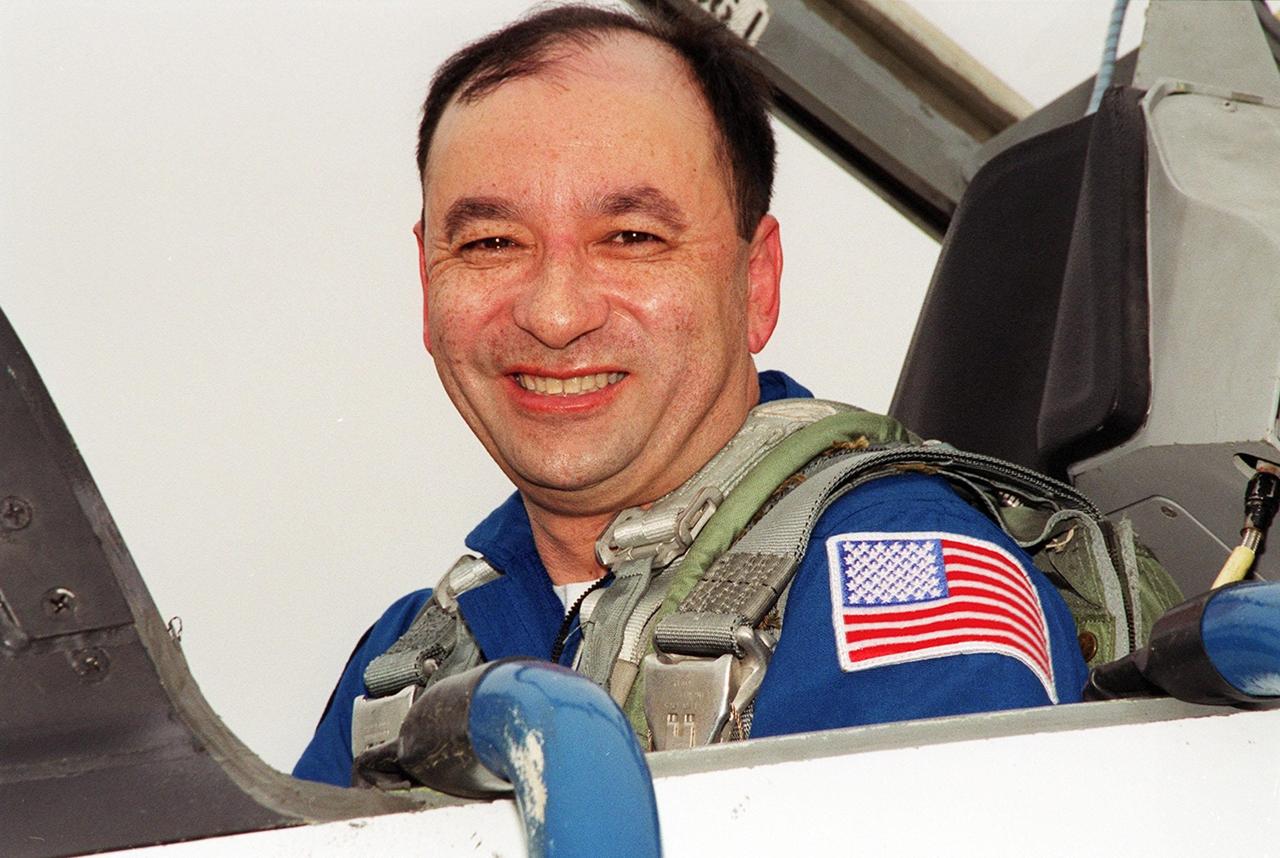
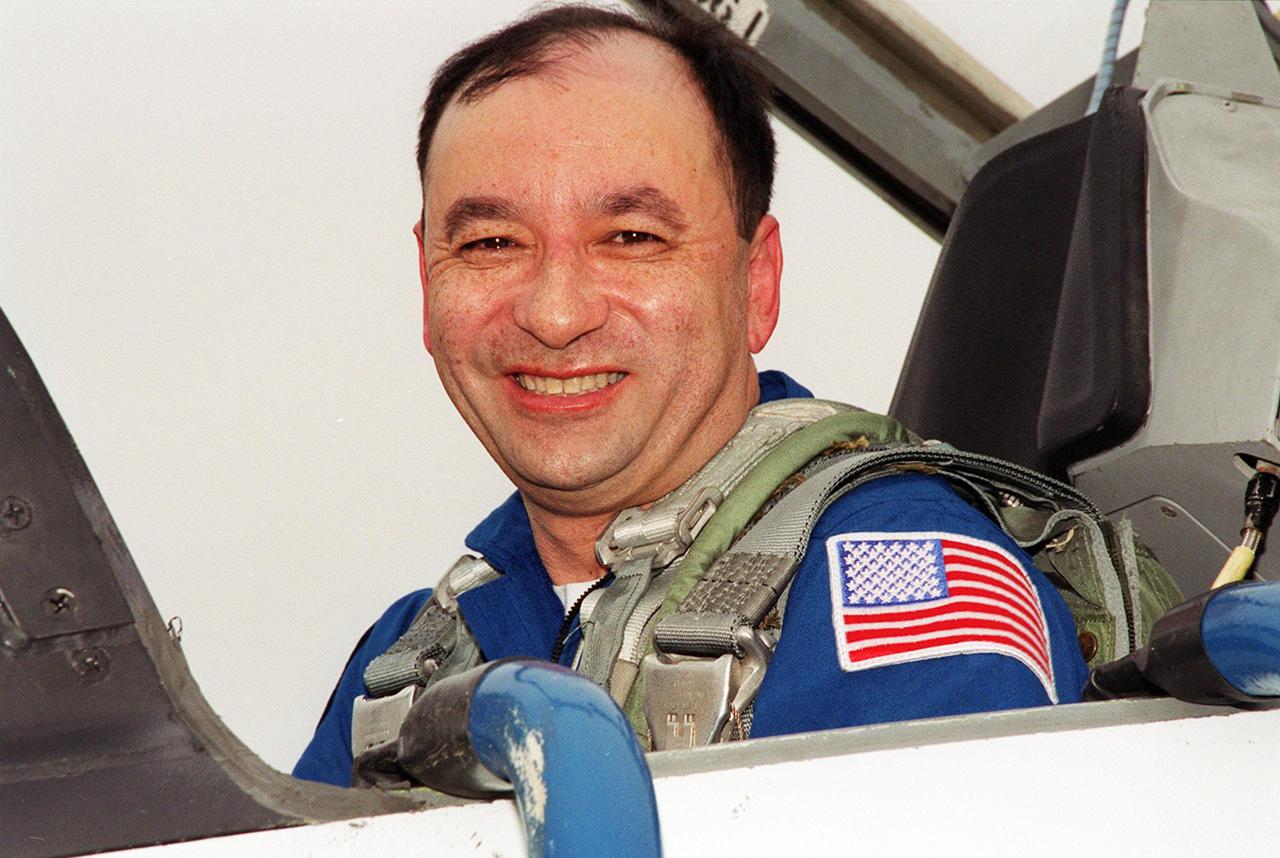
STS-98 Pilot Mark Polansky grins on his arrival at the Shuttle Landing Facility in a T-38 jet aircraft. He and other crew members Commander Ken Cockrell and Mission Specialists Robert Curbeam, Thomas Jones and Marsha Ivins have returned to KSC to prepare for their launch to the International Space Station. The seventh construction flight to the Space Station, STS-98 will carry the U.S. Laboratory Destiny, a key module for space experiments. The 11-day mission includes three spacewalks to complete outside assembly and connection of electrical and plumbing lines between the laboratory, Station and a relocated Shuttle docking port. STS-98 is Polansky’s first space flight. Launch is targeted for Feb. 7 at 6:11 p.m. EST
STS-98 Pilot Mark Polansky grins on his arrival at the Shuttle Landing Facility in a T-38 jet aircraft. He and other crew members Commander Ken Cockrell and Mission Specialists Robert Curbeam, Thomas Jones and Marsha Ivins have returned to KSC to prepare for their launch to the International Space Station. The seventh construction flight to the Space Station, STS-98 will carry the U.S. Laboratory Destiny, a key module for space experiments. The 11-day mission includes three spacewalks to complete outside assembly and connection of electrical and plumbing lines between the laboratory, Station and a relocated Shuttle docking port. STS-98 is Polansky’s first space flight. Launch is targeted for Feb. 7 at 6:11 p.m. EST
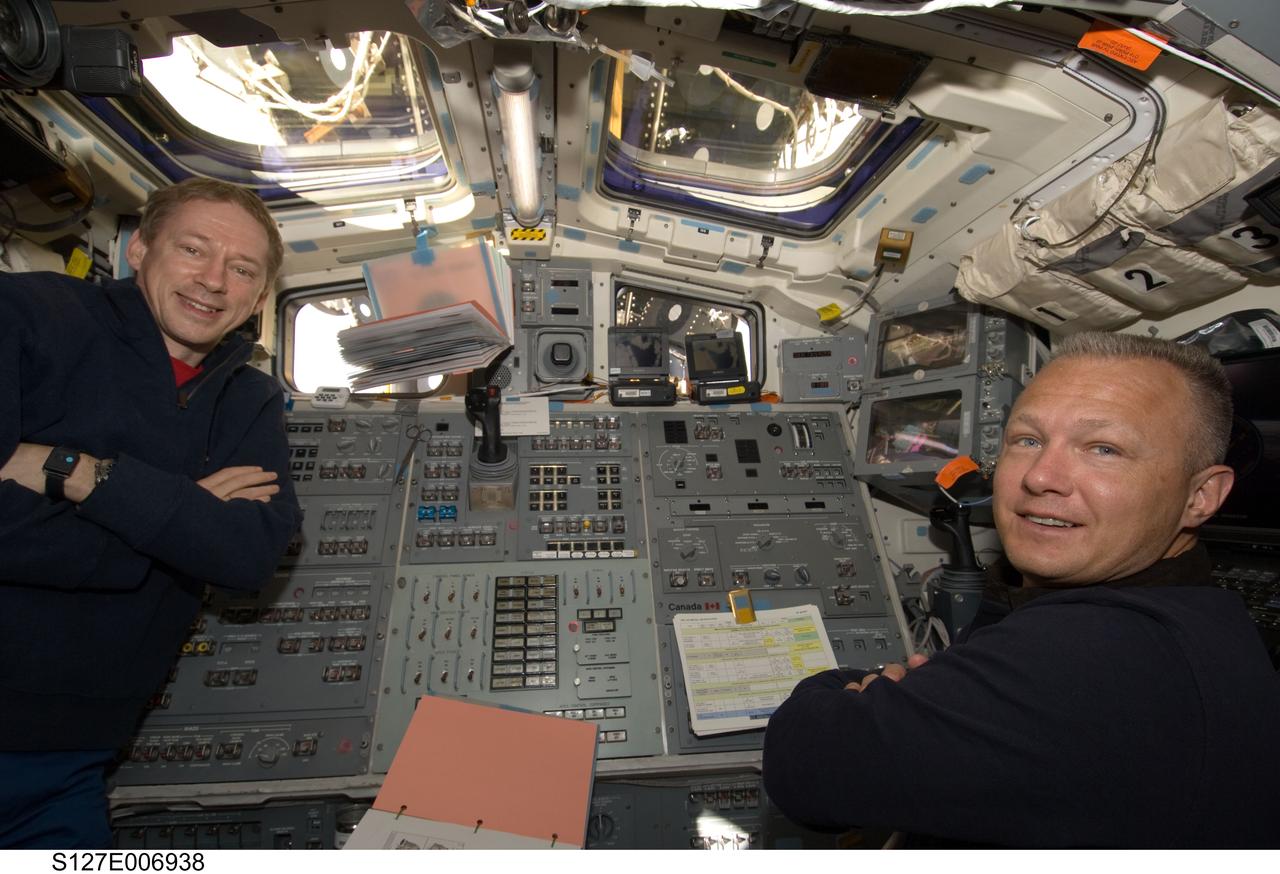
S127-E-006938 (19 July 2009) --- European Space Agency astronaut Frank De Winne (left), Expedition 20 flight engineer, and Doug Hurley, STS-127 pilot, are pictured at Endeavour's aft flight deck controls during flight day five operations with hardware on the International Space Station. The hardware moves conducted by astronauts Mark Polansky (out of frame), commander, and Hurley, in tandem with crew members onboard the station, will enable the second pair of spacewalkers--mission specialists Dave Wolf and Tom Marshburn--to perform its spacewalk assignment on July 20.

In the Space Station Processing Facility, STS-98 Mission Specialist Marsha Ivins wields a tool on part of the U.S. Lab, Destiny. The crew is checking out equipment inside the lab as part of Crew Equipment Interface Test activities, becoming familiar with equipment it will be handling during the mission. Others in the crew are Commander Ken Cockrell, Pilot Mark Polansky and Mission Specialists Robert Curbeam and Thomas Jones. The mission will be transporting the Lab to the International Space Station with five system racks already installed inside of the module. With delivery of electronics in the lab, electrically powered attitude control for Control Moment Gyroscopes will be activated. The STS-98 launch is scheduled for Jan. 18, 2001
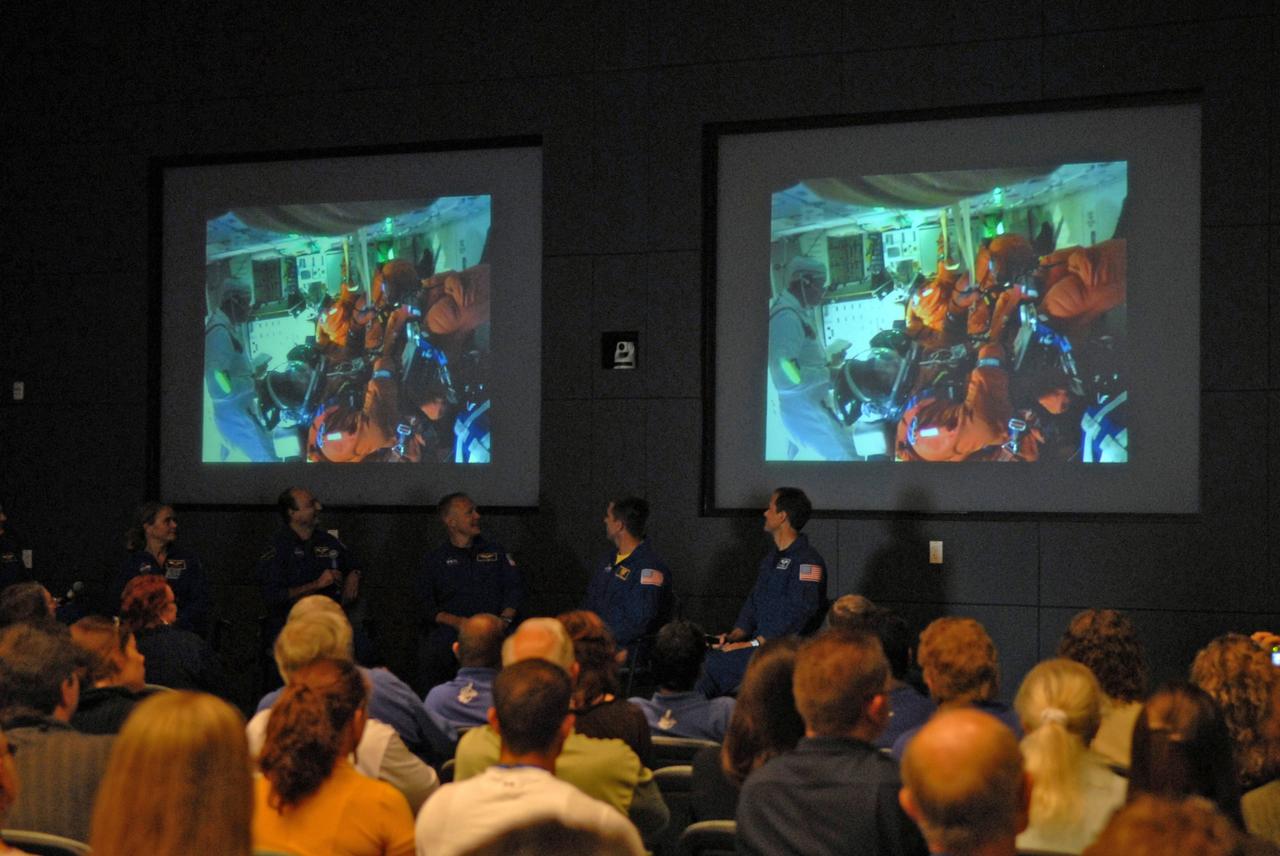
CAPE CANAVERAL, Fla. – Crew members of the STS-127 mission return to NASA's Kennedy Space Center in Florida to share stories, photos and videos of their experiences on the mission. Seen seated beneath the video screens are Mission Specialist Julie Payette, Commander Mark Polansky, Pilot Doug Hurley, and Mission Specialists Christopher Cassidy and Tom Marshburn. Not seen at far left is Mission Specialist Dave Wolf. The STS-127 mission was the final of three flights dedicated to the assembly of the Japanese Kibo laboratory complex on the International Space Station. The crew launched on space shuttle Endeavour on July 15 and returned July 31. Photo credit: NASA/Jim Grossmann
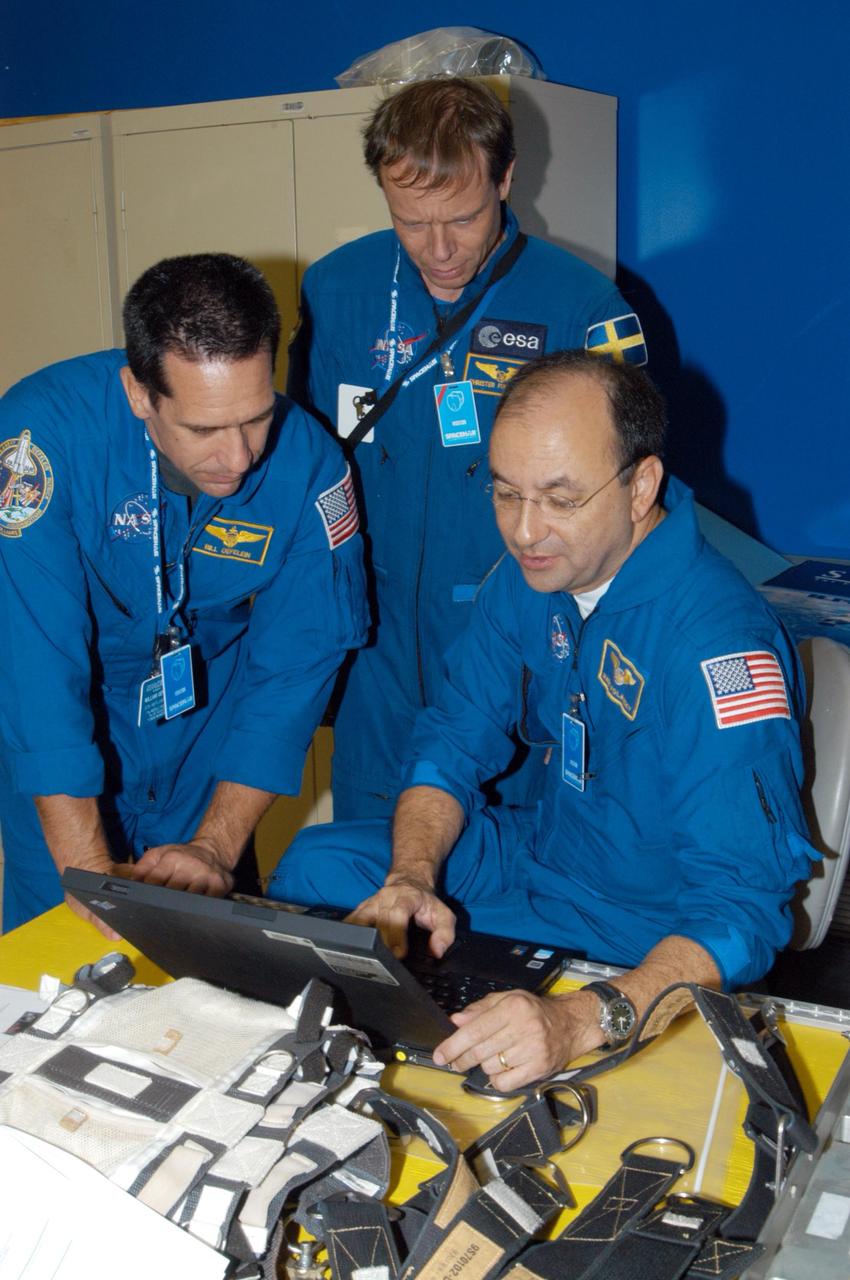
KENNEDY SPACE CENTER, FLA. - At SPACEHAB in Cape Canaveral, Fla., STS-116 Pilot William Oefelein, Mission Specialist Christer Fuglesang and Commander Mark Polansky check data on a computer while examining the rack front stowage trays that are used inside the SPACEHAB module. Mission crews make frequent trips to the Space Coast to become familiar with the equipment and payloads they will be using. STS-116 will be mission number 20 to the International Space Station and construction flight 12A.1. The mission payload is the SPACEHAB module, the P5 integrated truss structure and other key components. Launch is scheduled for no earlier than Dec. 7. Photo credit: NASA/George Shelton
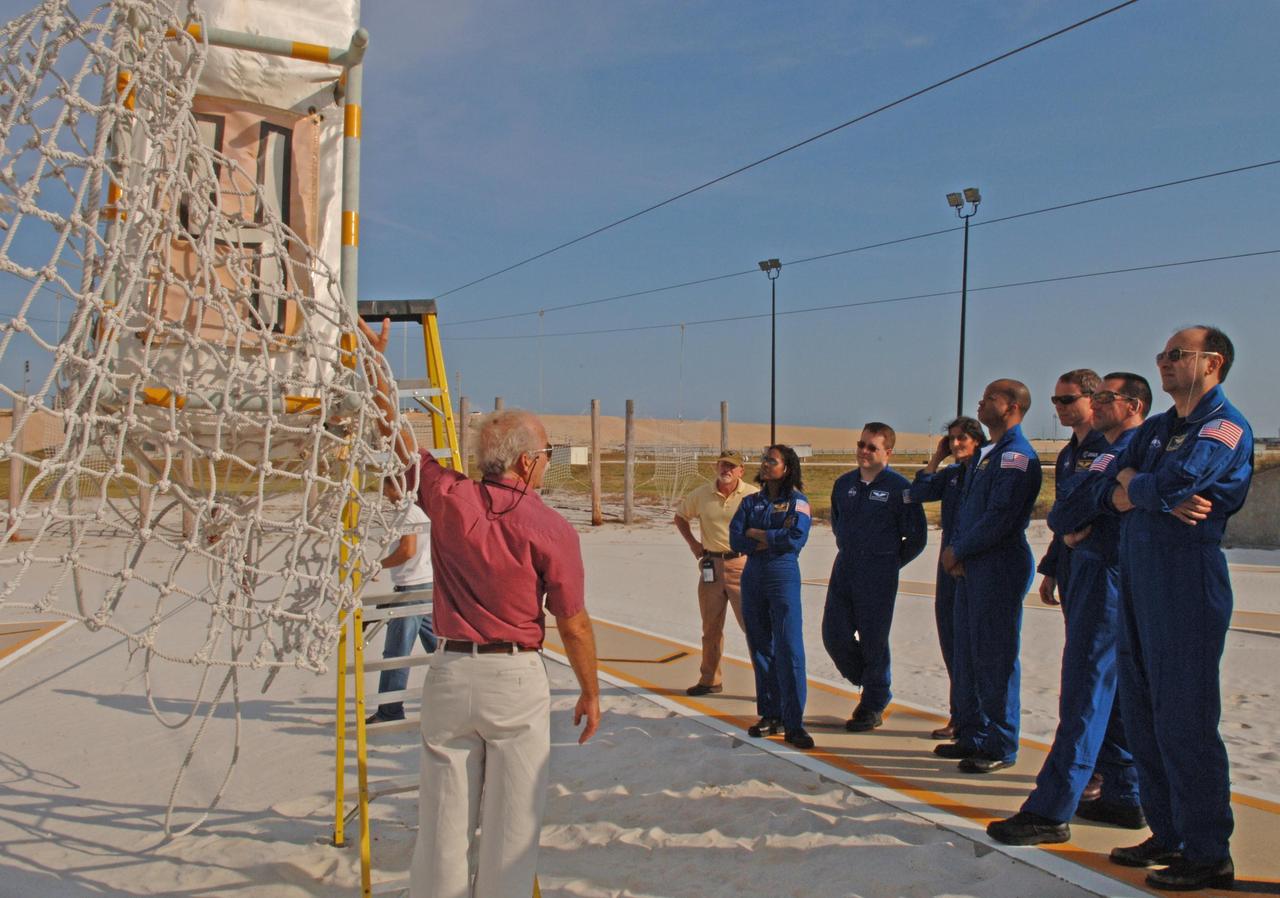
KENNEDY SPACE CENTER, FLA. -- At the slidewire basket landing area at Launch Pad 39B, STS-116 crew members get instructions for exiting the baskets used for emergency egress from the orbiter. Standing at right are (from left) Mission Specialists Joan Higginbotham, Nicholas Patrick, Sunita Williams, Robert Curbeam and Christer Fuglesang; Pilot William Oefelein; and Commander Mark Polansky. The STS-116 mission is No. 20 to the International Space Station and construction flight 12A.1. The mission payload is the SPACEHAB module, the P5 integrated truss structure and other key components. Launch is scheduled for no earlier than Dec. 7. Photo credit: NASA/Kim Shiflett
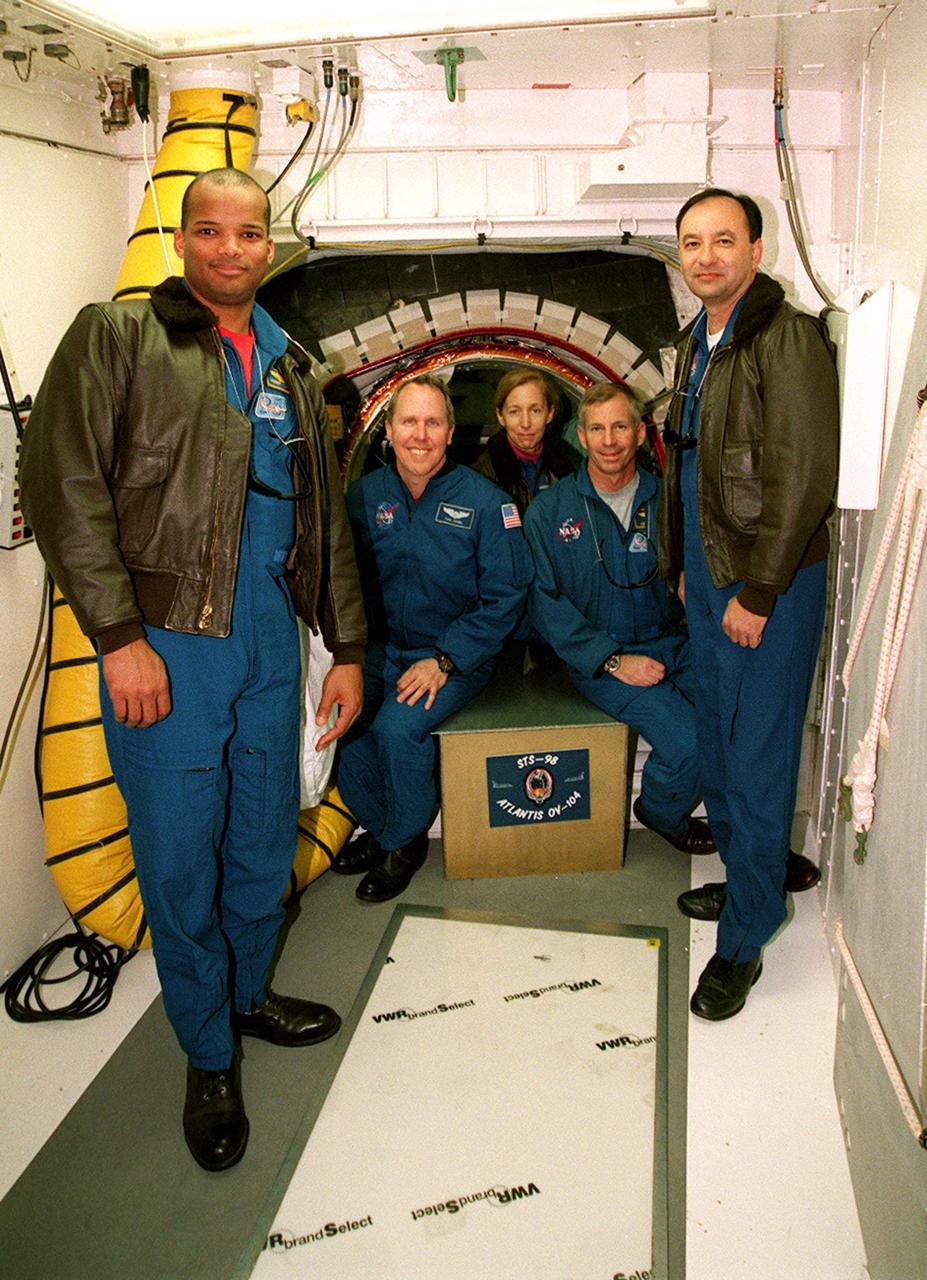
KENNEDY SPACE CENTER, FLA. -- Sitting in the entrance to the orbiter Atlantis are (left to right) STS-98 Mission Specialists Thomas Jones and Marsha Ivins and Commander Ken Cockrell. Below them is the mission patch just placed there by Cockrell. Standing at left is Mission Specialist Robert Curbeam and at right Pilot Mark Polansky. The crew is at KSC to take part in Terminal Countdown Demonstration Test activities, which include emergency egress training and a simulated launch countdown. STS-98 is the seventh construction flight to the International Space Station, carrying as payload the U.S. Lab Destiny, a key element in the construction of the ISS. Launch of STS-98 is scheduled for Jan. 19 at 2:11 a.m

KENNEDY SPACE CENTER, FLA. -- In the Space Station Processing Facility, workers and the STS-98 crew gather for a ceremony that turns over the “key” for the U.S. Lab Destiny to NASA. Holding the key (left) is STS-98 Commander Ken Cockrell. To his left is Mission Specialist Thomas Jones; at right (in uniform) is Mission Specialist Marsha Ivins. Also in the group are Pilot Mark Polansky and Mission Specialist Robert Curbeam. . Launch of mission STS-98 on Space Shuttle Atlantis is scheduled for Jan. 18, 2001. The mission will carry the U.S. Lab Destiny to the International Space Station with five system racks and experiments already installed inside the module
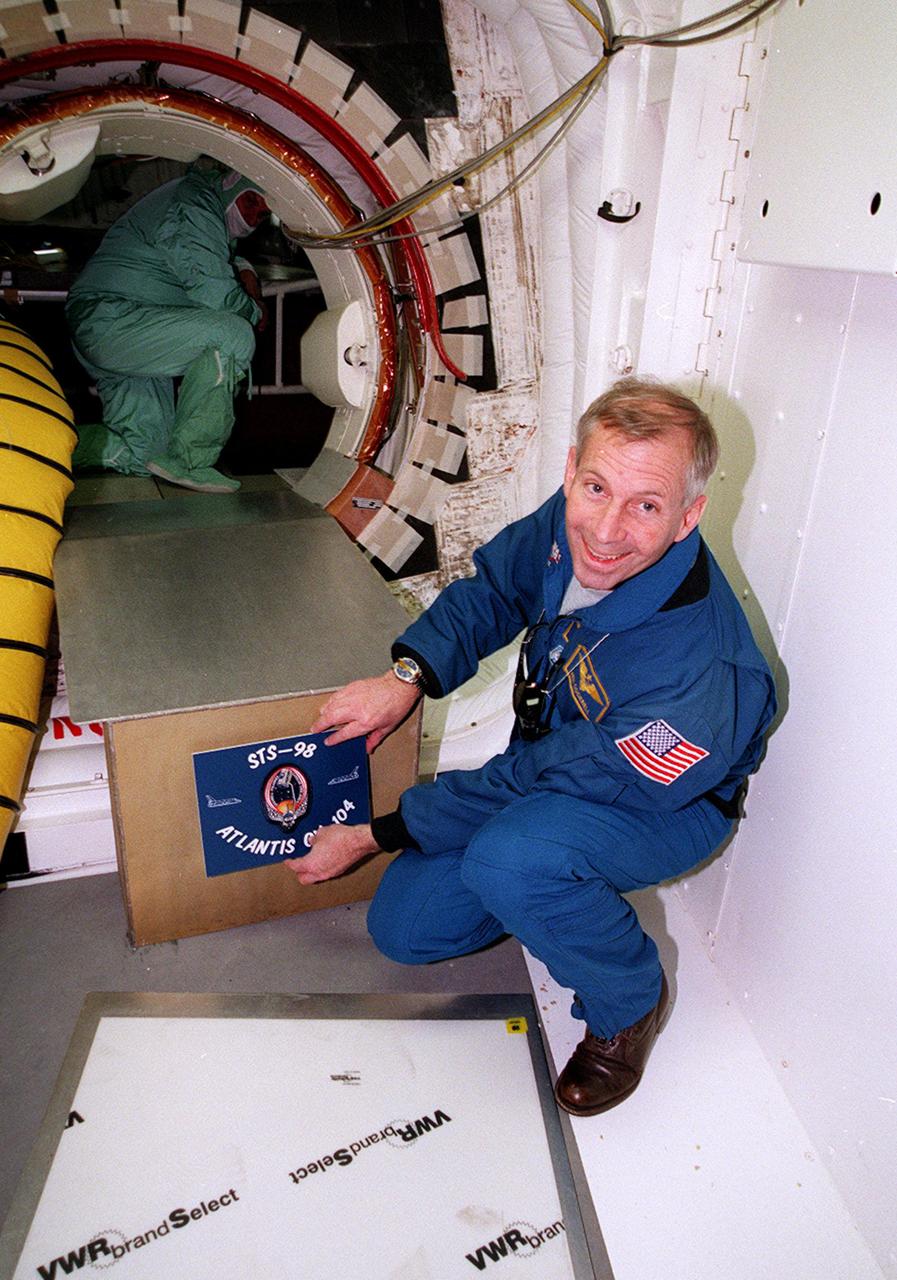
KENNEDY SPACE CENTER, FLA. -- STS-98 Commander Ken Cockrell places the mission patch on the entrance to the orbiter Atlantis. He and the rest of the crew Pilot Mark Polansky and Mission Specialists Thomas Jones, Marsha Ivins and Robert Curbeam are t KSC to take part in Terminal Countdown Demonstration Test activities, which include emergency egress training and a simulated launch countdown. STS-98 is the seventh construction flight to the International Space Station, carrying as payload the U.S. Lab Destiny, a key element in the construction of the ISS. Launch of STS-98 is scheduled for Jan. 19 at 2:11 a.m
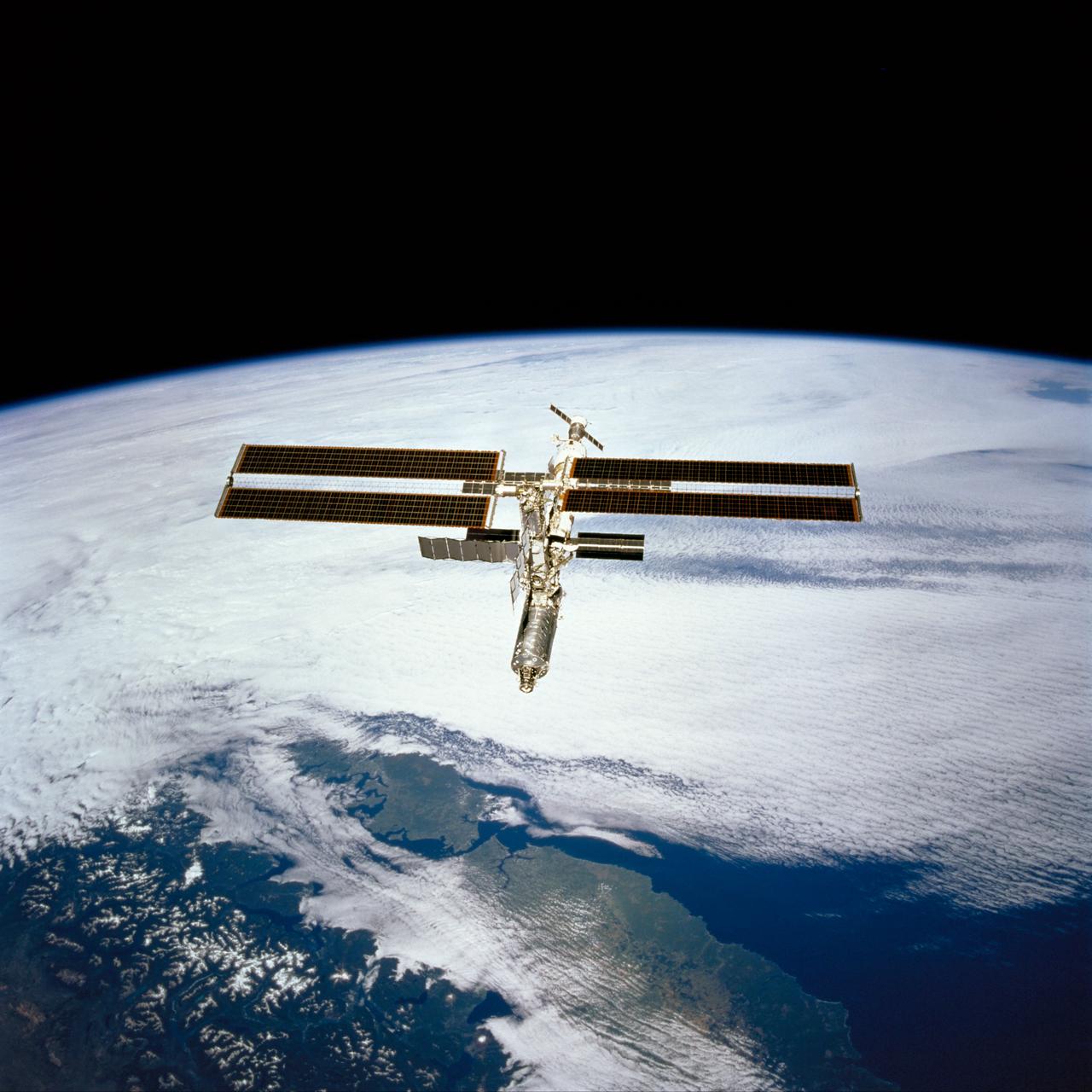
STS098-713a-016 (16 February 2001) --- The International Space Station is backdropped over clouds, water and land in South America. South central Chile shows up at bottom of the frame. Just below the Destiny laboratory, the Chacao Channel separates the large island of Chiloe from the mainland and connects the Gulf of Coronados on the Pacific side with the Gulf of Ancud southwest of the city of Puerto Montt. The crews of the Space Shuttle Atlantis and the International Space Station parted company at 8:06 a.m. (CST), February 16, as astronaut Mark L. Polansky, pilot, flew the shuttle halfway around the station and its new Destiny laboratory before moving off.
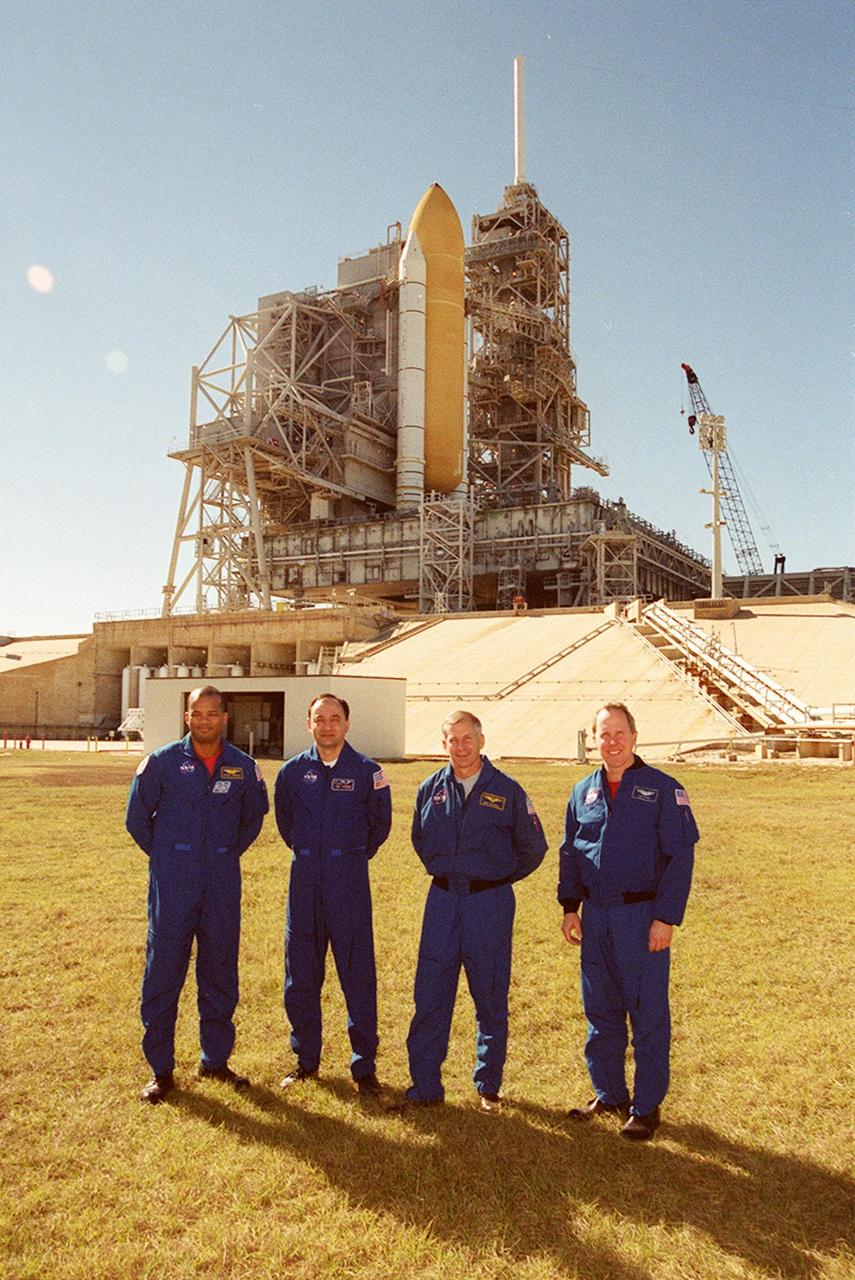
KENNEDY SPACE CENTER, FLA. -- Four members of the STS-98 crew pose for a photo at Launch Pad 39A. Standing, left to right, are Mission Specialist Robert Curbeam, Pilot Mark Polansky, Commander Ken Cockrell and Mission Specialist Thomas Jones. Not pictured is Mission Specialist Marsha Ivins. The crew is at KSC to take part in Terminal Countdown Demonstration Test activities, which include emergency egress training and a simulated launch countdown. STS-98 is the seventh construction flight to the International Space Station, carrying as payload the U.S. Lab Destiny, a key element in the construction of the ISS. Launch of STS-98 is scheduled for Jan. 19 at 2:11 a.m
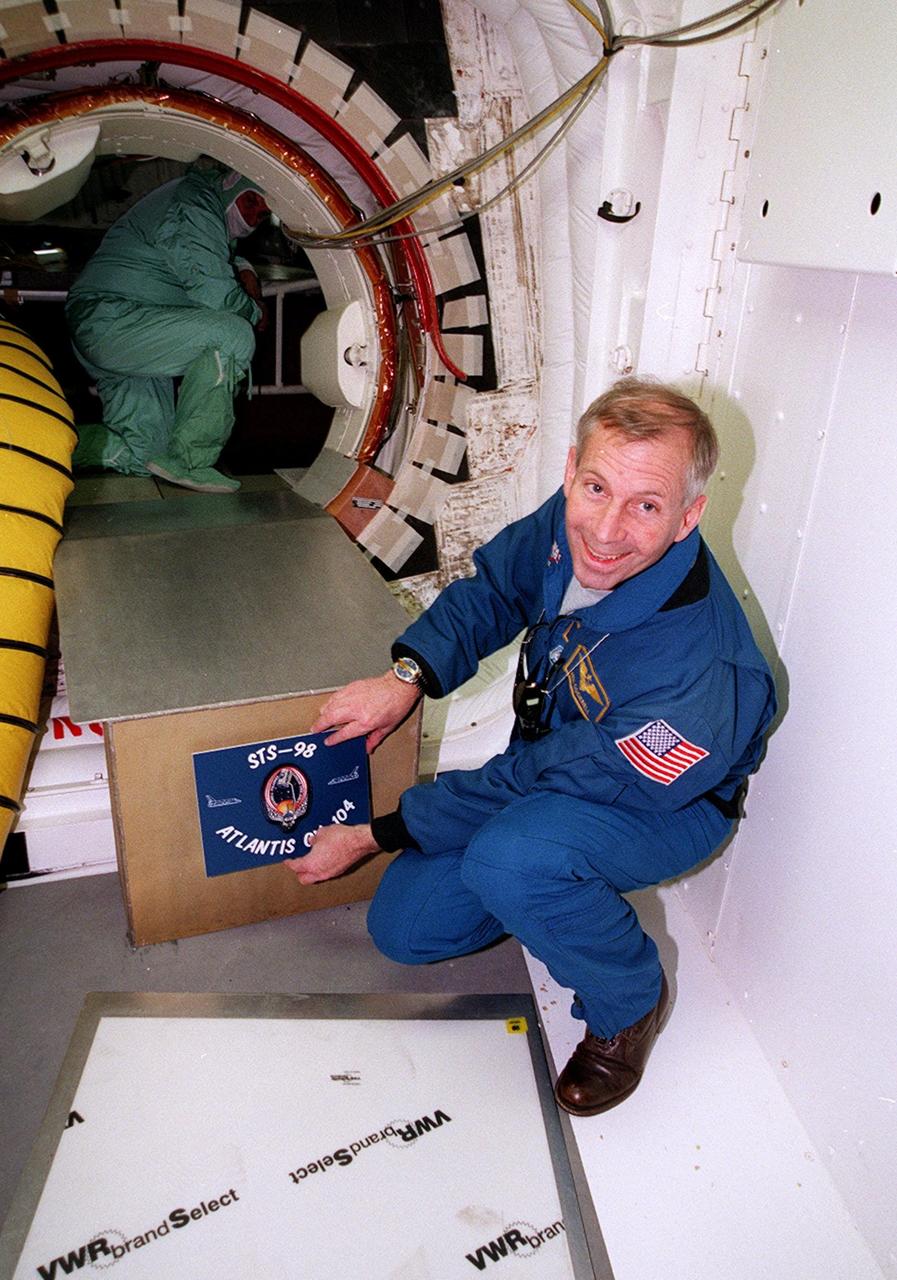
KENNEDY SPACE CENTER, FLA. -- STS-98 Commander Ken Cockrell places the mission patch on the entrance to the orbiter Atlantis. He and the rest of the crew Pilot Mark Polansky and Mission Specialists Thomas Jones, Marsha Ivins and Robert Curbeam are t KSC to take part in Terminal Countdown Demonstration Test activities, which include emergency egress training and a simulated launch countdown. STS-98 is the seventh construction flight to the International Space Station, carrying as payload the U.S. Lab Destiny, a key element in the construction of the ISS. Launch of STS-98 is scheduled for Jan. 19 at 2:11 a.m
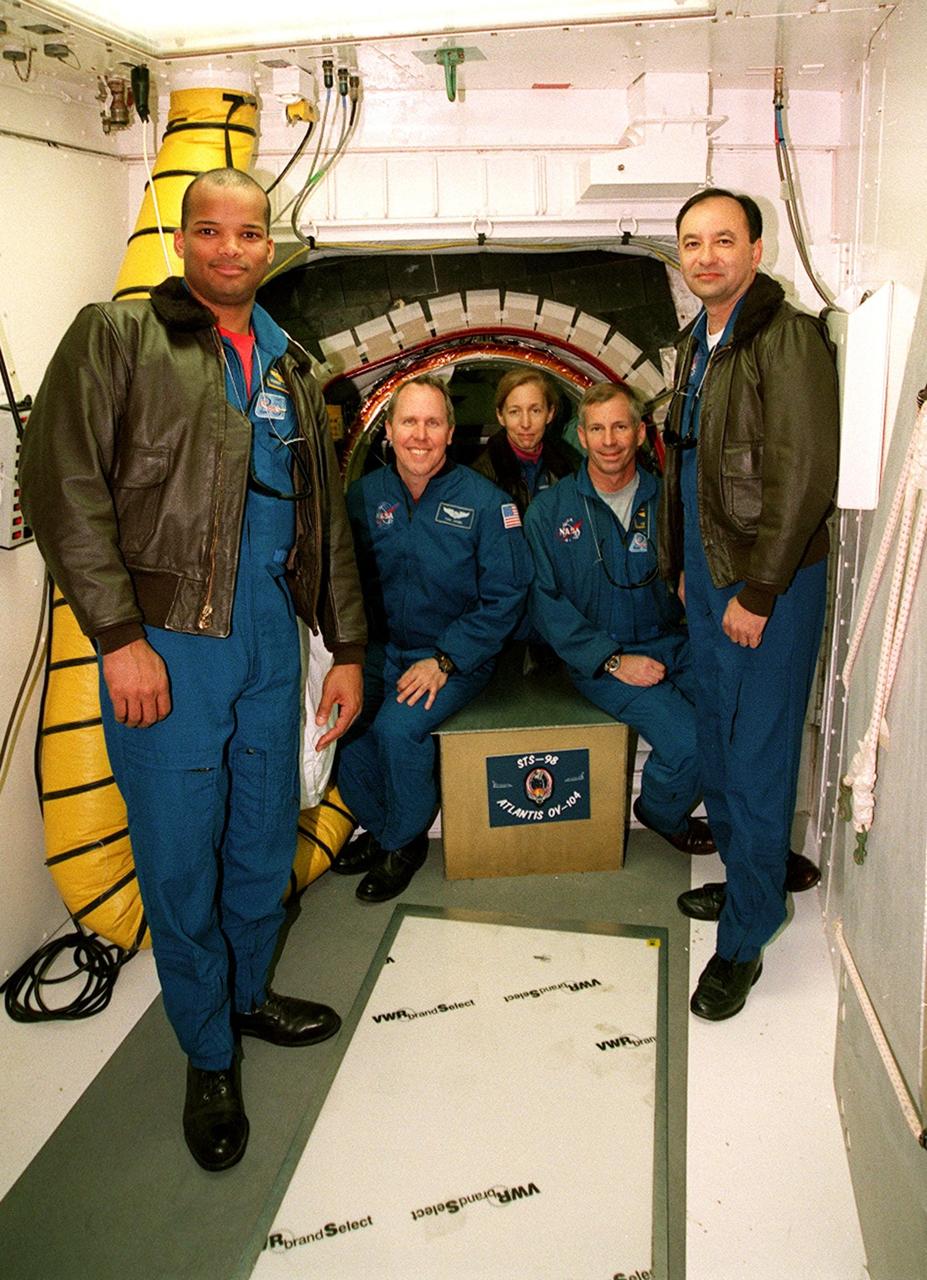
KENNEDY SPACE CENTER, FLA. -- Sitting in the entrance to the orbiter Atlantis are (left to right) STS-98 Mission Specialists Thomas Jones and Marsha Ivins and Commander Ken Cockrell. Below them is the mission patch just placed there by Cockrell. Standing at left is Mission Specialist Robert Curbeam and at right Pilot Mark Polansky. The crew is at KSC to take part in Terminal Countdown Demonstration Test activities, which include emergency egress training and a simulated launch countdown. STS-98 is the seventh construction flight to the International Space Station, carrying as payload the U.S. Lab Destiny, a key element in the construction of the ISS. Launch of STS-98 is scheduled for Jan. 19 at 2:11 a.m
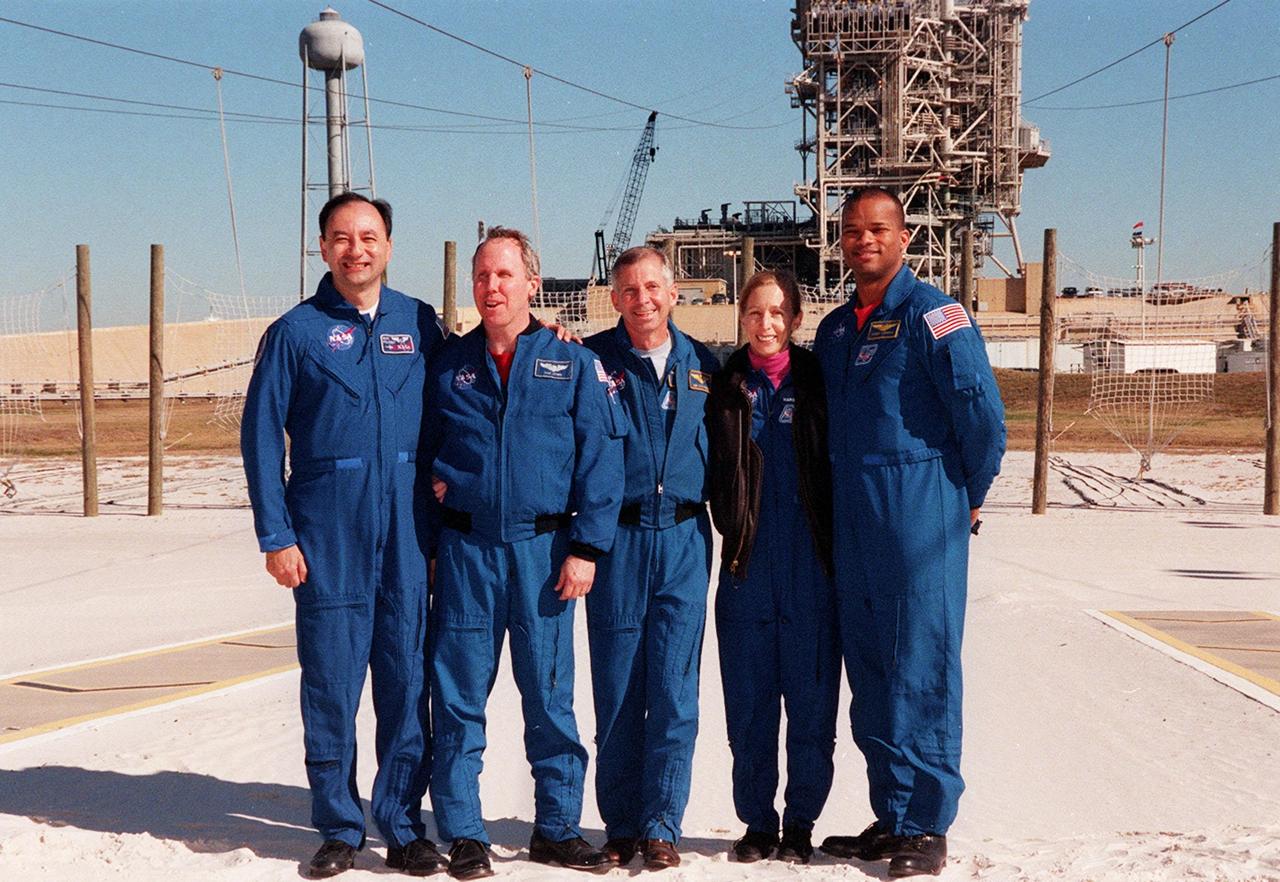
KENNEDY SPACE CENTER, FLA -- After a media briefing at Launch Pad 39A, the STS-98 crew poses in the slidewire basket landing zone. Standing, left to right, are Pilot Mark Polansky, Mission Specialist Thomas Jones, Commander Ken Cockrell and Mission Specialists Marsha Ivins and Robert Curbeam. All are at KSC to take part in Terminal Countdown Demonstration Test activities, which include emergency egress training and a simulated launch countdown. STS-98 is the seventh construction flight to the International Space Station, carrying as payload the U.S. Lab Destiny, a key element in the construction of the ISS. Launch of STS-98 is scheduled for Jan. 19 at 2:11 a.m
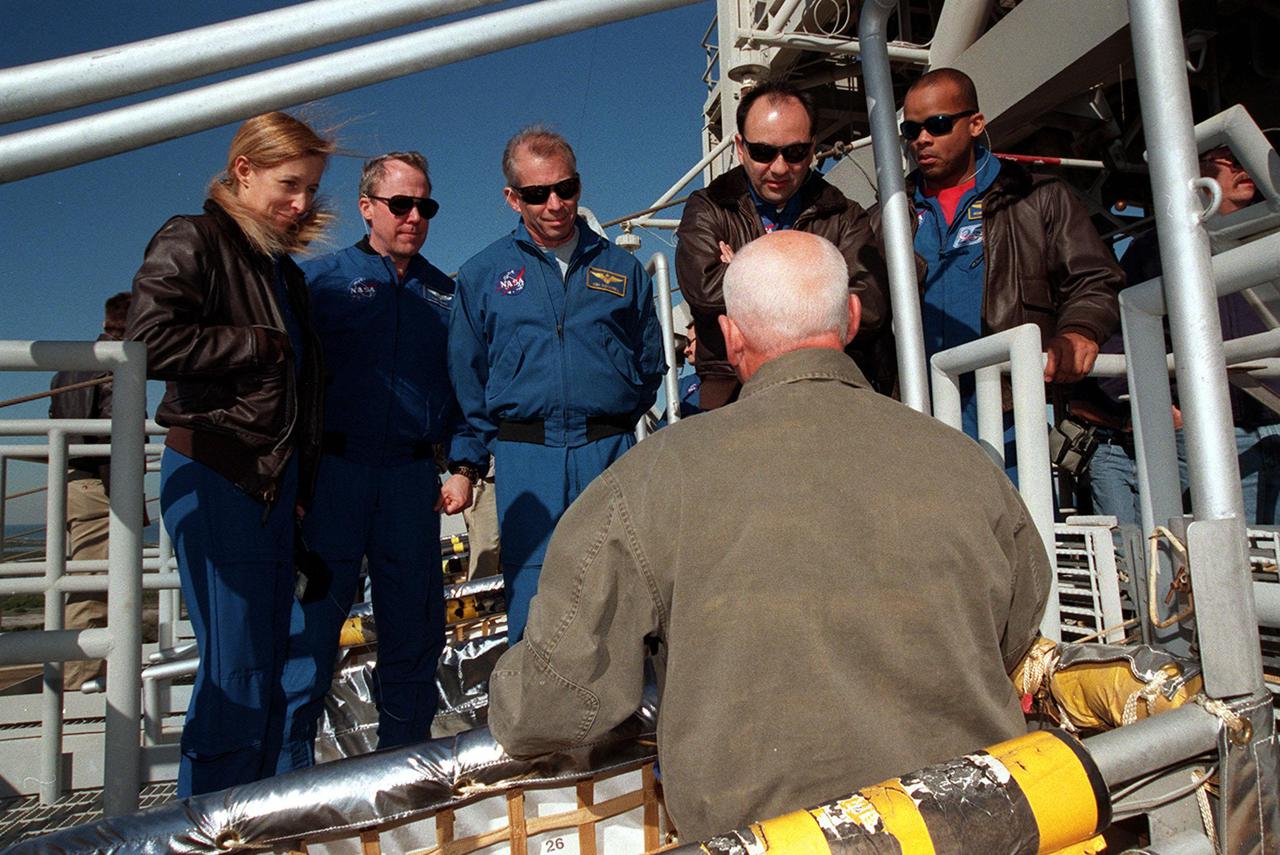
The STS-98 crew listens to instructions on use of the slidewire basket, part of emergency egress equipment from the launch pad. At the 195-foot level of the Fixed Service Structure are Mission Specialists Marsha Ivins and Thomas Jones, Commander Ken Cockrell, Pilot Mark Polansky and Mission Specialist Robert Curbeam. The crew is at KSC to take part in Terminal Countdown Demonstration Test activities, which include emergency egress training and a simulated launch countdown at the pad. STS-98 is the seventh construction flight to the International Space Station, carrying as payload the U.S. Lab Destiny, a key element in the construction of the ISS. Launch of STS-98 is scheduled for Jan. 19 at 2:11 a.m
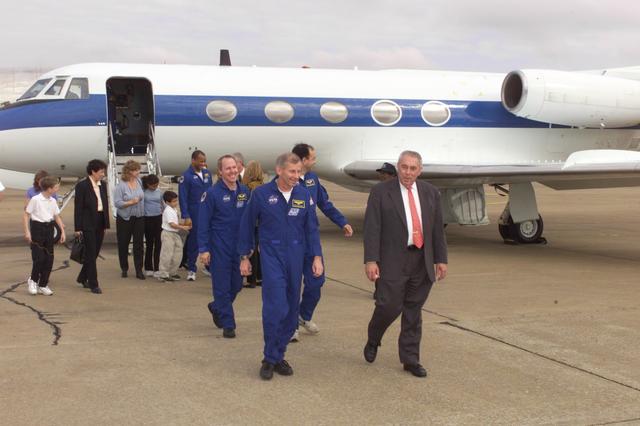
JSC2001-E-04805 (21 February 2001) --- JSC director George W.S. Abbey talks with the STS-98 crew members following the arrival of the Gulfstream Aircraft which transported the astronauts from their landing at Dryden Flight Research Center (DFRC) in Edwards, California. Pictured along side Mr. Abbey is astronaut Kenneth D. Cockrell, mission commander. Behind him (from the left distant background) are astronauts Robert L. Curbeam and Thomas D. Jones (both mission specialists) and Mark L. Polansky, pilot. Astronaut Marsha S. Ivins, mission specialist, is out of the frame.
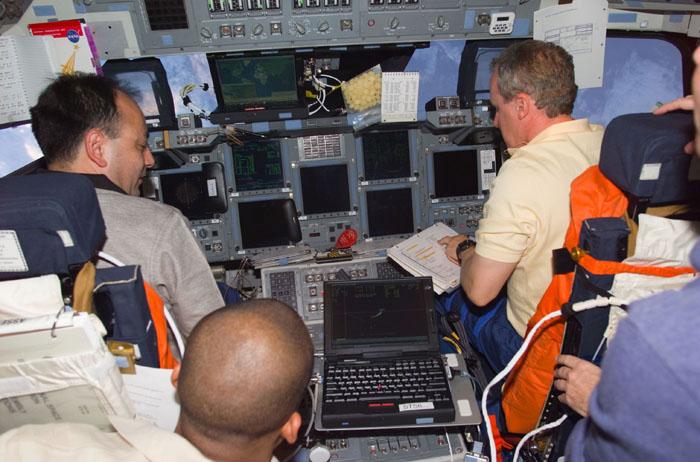
STS98-E-5030 (9 February 2001) --- Three members of the STS-98 crew prepare for rendezvous with the International Space Station (ISS). Astronaut Thomas D. Jones (right), mission specialist, temporarily mans the pilot's station on the flight deck of the Space Shuttle Atlantis. Astronaut Mark L. Polansky, left, sits at the commander's station for this maneuver. At lower left is Astronaut Robert L. Curbeam, mission specialist. Astronaut Kenneth D. Cockrell, mission commander, is just out of frame at right. The photograph was recorded with a digital still camera.
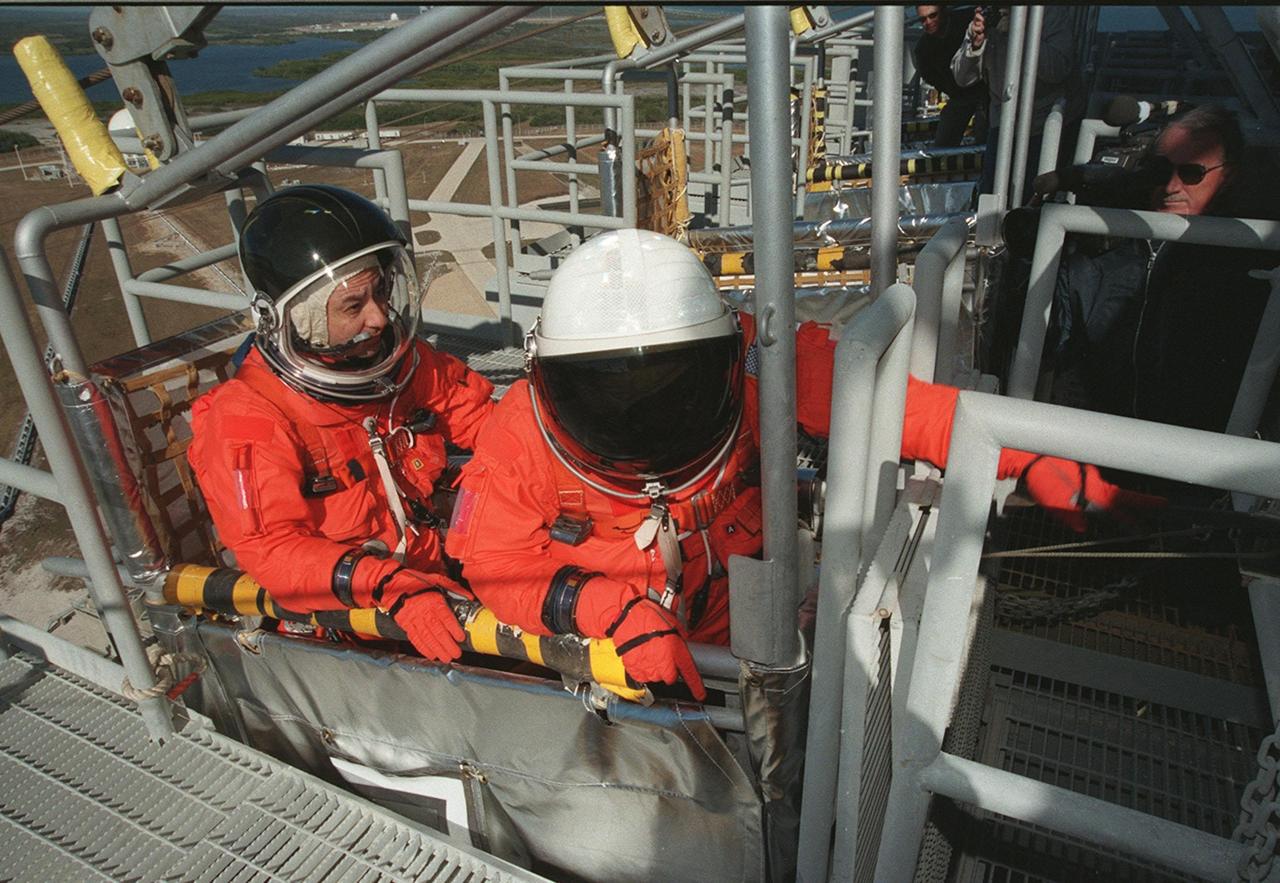
During emergency egress training at the 195-foot level of the Fixed Service Structure, Pilot Mark Polansky settles in the slidewire basket while Commander Ken Cockrell reaches for the release handle. The basket slides along a 1200-foot wire to the landing zone below and nearby bunker. The crew has been taking part in Terminal Countdown Demonstration Test activities, which include the simulated countdown and emergency egress training at the pad. STS-98 is the seventh construction flight to the International Space Station, carrying as payload the U.S. Lab Destiny, a key element in the construction of the ISS. Launch of STS-98 is scheduled for Jan. 19 at 2:11 a.m. EST
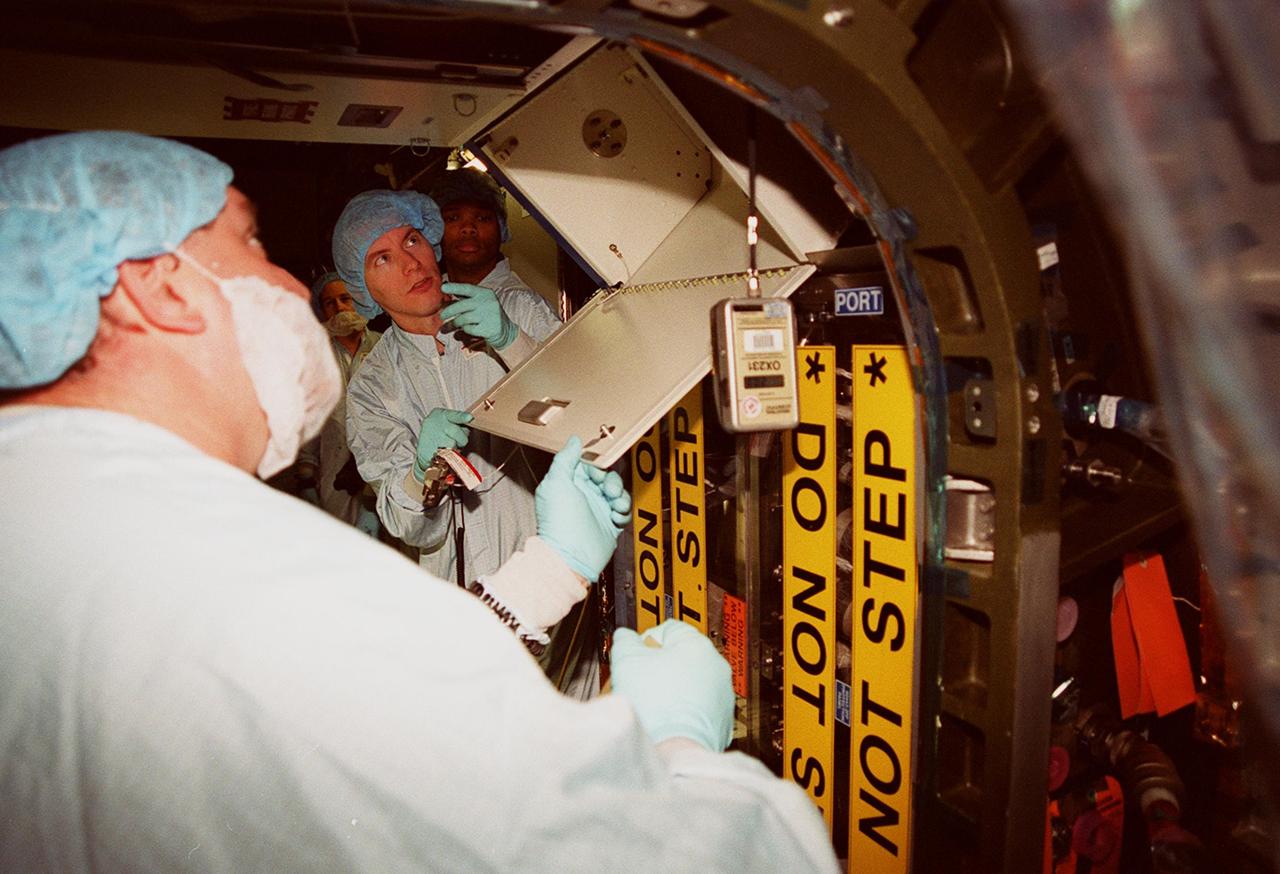
In the Space Station Processing Facility, members of the STS-98 crew check out components inside the U.S. Lab, Destiny, under the watchful eye of trainers. The crew comprises Commander Ken Cockrell, Pilot Mark Polansky and Mission Specialists Robert Curbeam, Thomas Jones and Marsha Ivins. They are taking part in Crew Equipment Interface Test activities, becoming familiar with equipment they will be handling during the mission. The mission will be transporting the Lab to the International Space Station with five system racks already installed inside of the module. With delivery of electronics in the lab, electrically powered attitude control for Control Moment Gyroscopes will be activated. The STS-98 launch is scheduled for Jan. 18, 2001
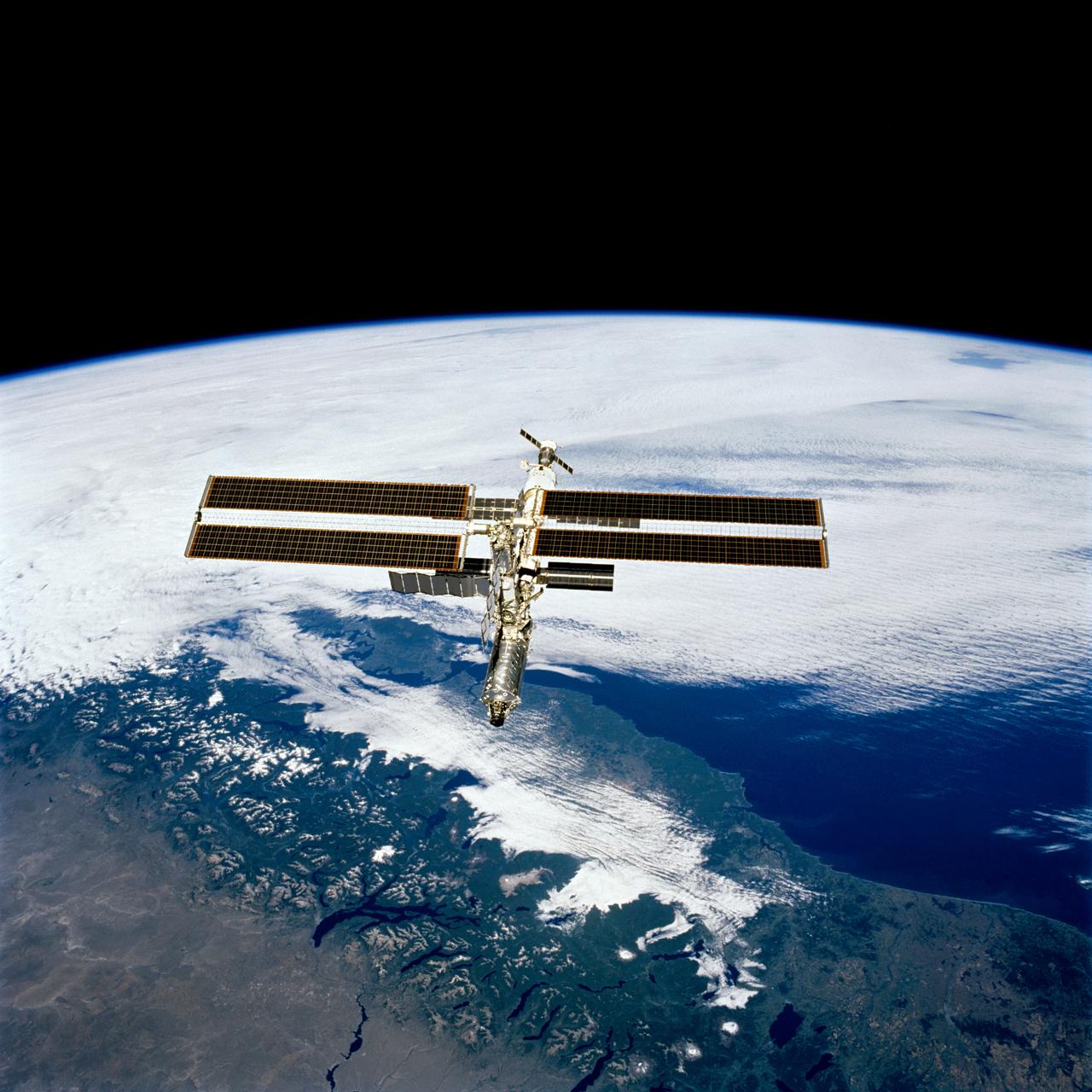
STS098-713a-019 (16 February 2001) --- The International Space Station is backdropped over clouds, water and land in South America. South central Chile shows up at bottom of the frame. Just below the Destiny laboratory, the Chacao Channel separates the large island of Chiloe from the mainland and connects the Gulf of Coronados on the Pacific side with the Gulf of Ancud southwest of the city of Puerto Montt. The crews of the Space Shuttle Atlantis and the International Space Station parted company at 8:06 a.m. (CST), February 16, as astronaut Mark L. Polansky, pilot, flew the shuttle halfway around the station and its new Destiny laboratory before moving off.
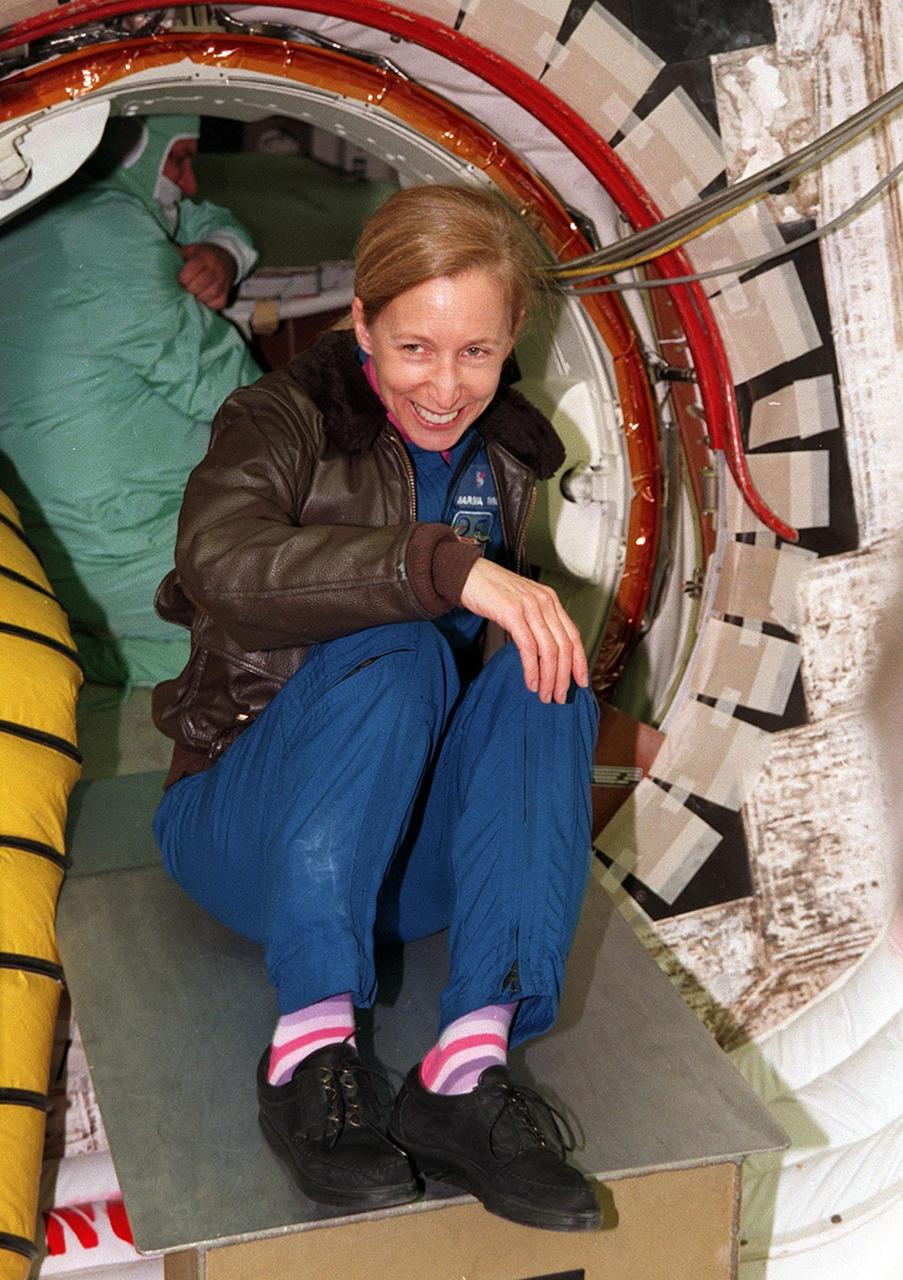
STS-98 Mission Specialist Marsha Ivins waits in the White Room outside the entrance into Atlantis. The crew is at KSC to take part in Terminal Countdown Demonstration Test activities, which include emergency egress training and a simulated launch countdown. The other crew members are Pilot Mark Polansky, Mission Specialist Thomas Jones, Commander Ken Cockrell and Mission Specialist Robert Curbeam. STS-98 is the seventh construction flight to the International Space Station, carrying as payload the U.S. Lab Destiny, a key element in the construction of the ISS. Launch of STS-98 is scheduled for Jan. 19 at 2:11 a.m
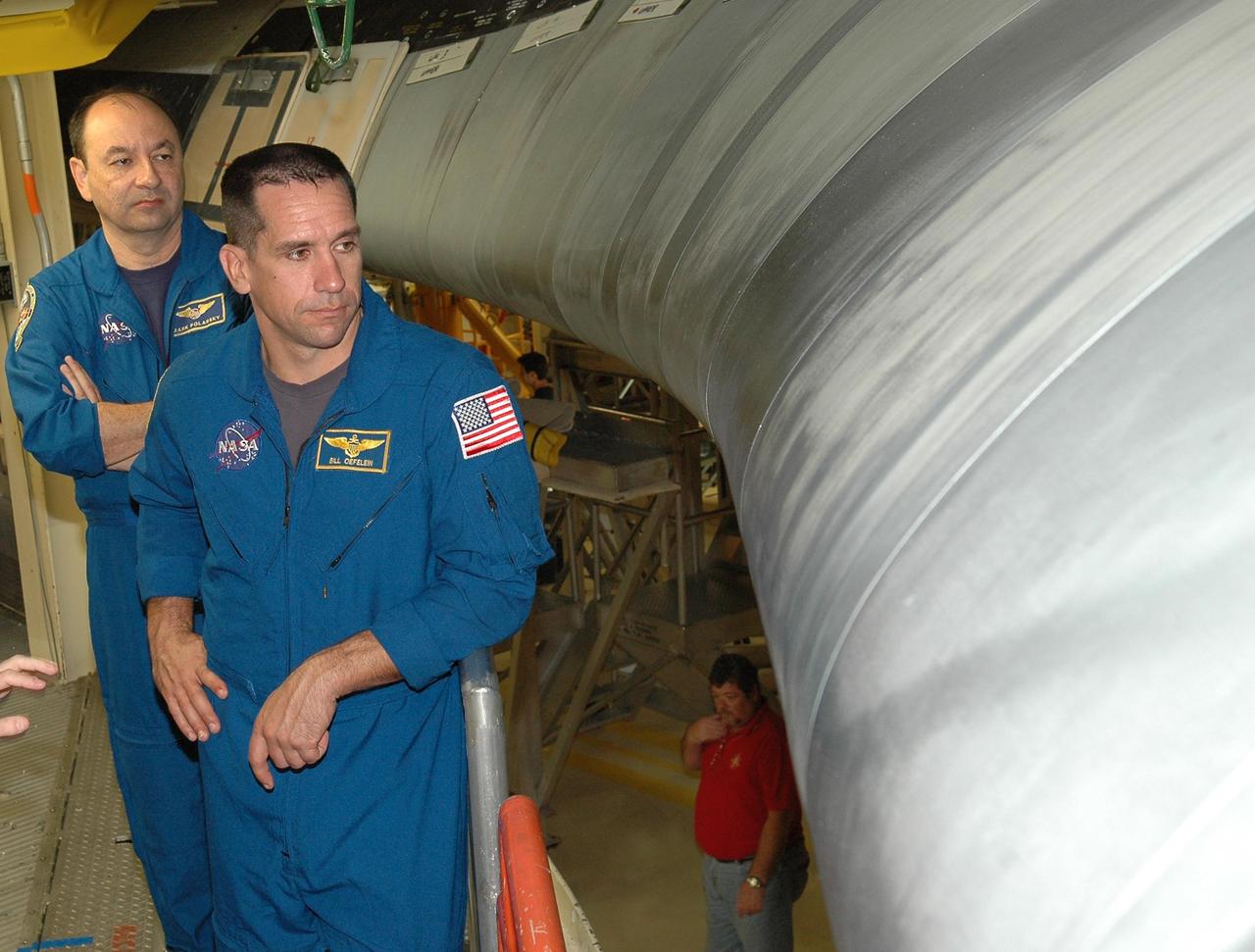
KENNEDY SPACE CENTER, FLA. - From a platform in the Orbiter Processing Facility, STS-116 Commander Mark Polansky (left) and Pilot William Oefelein look at one of Discovery’s reinforced carbon-carbon wing leading edge. They and other crew members are at KSC for a Crew Equipment Interface Test. Mission crews make frequent trips to the Kennedy Space Center to become familiar with the equipment and payloads they will be using. STS-116 will be mission No. 20 to the International Space Station and construction flight 12A.1. The mission payload is the SPACEHAB module, the P5 integrated truss structure and other key components. Launch is scheduled for no earlier than Dec. 7. Photo credit: NASA/Kim Shiflett
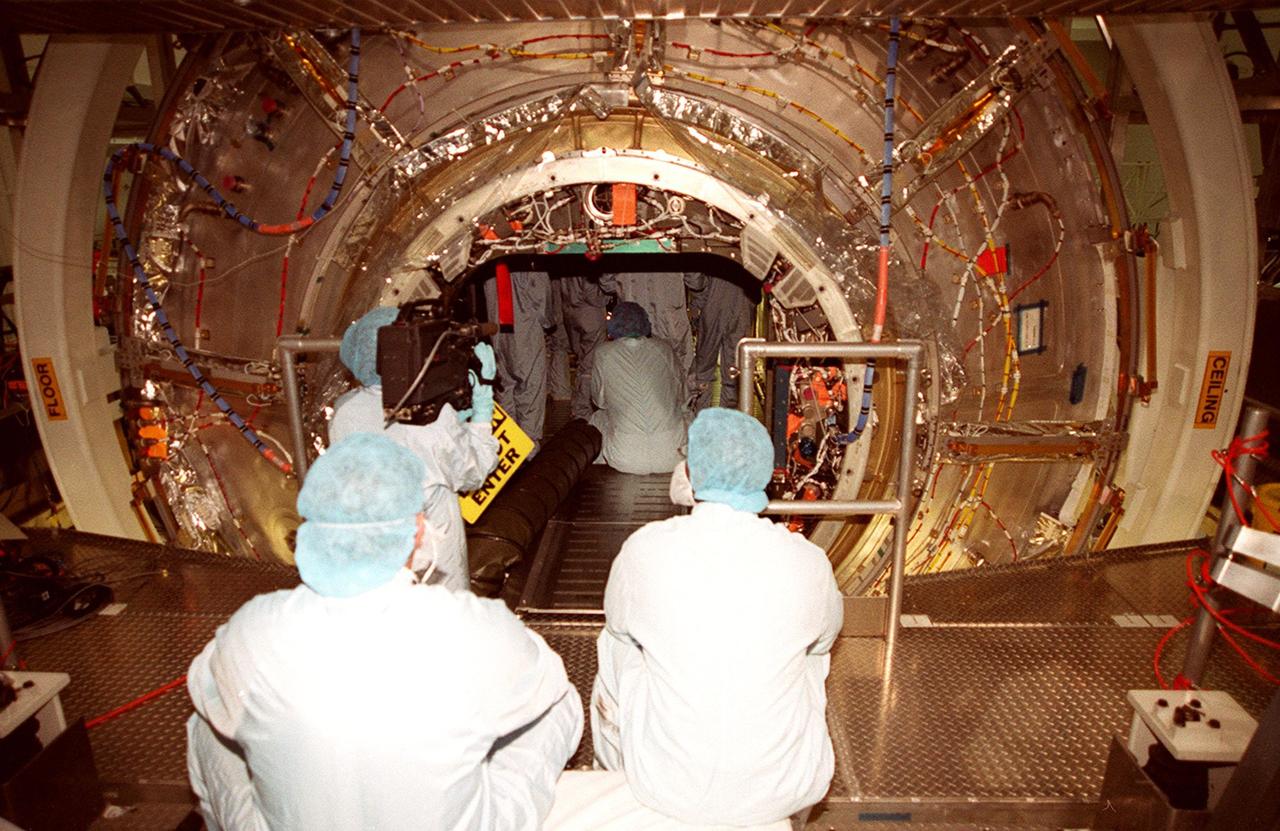
In the Space Station Processing Facility, workers in the foreground watch and wait while members of the STS-98 crew check out the U.S. Lab, Destiny in the background. The crew comprises Commander Ken Cockrell, Pilot Mark Polansky and Mission Specialists Robert Curbeam, Thomas Jones and Marsha Ivins. They are taking part in Crew Equipment Interface Test activities, becoming familiar with equipment they will be handling during the mission. The mission will be transporting the Lab to the International Space Station with five system racks already installed inside of the module. With delivery of electronics in the lab, electrically powered attitude control for Control Moment Gyroscopes will be activated. The STS-98 launch is scheduled for Jan. 18, 2001
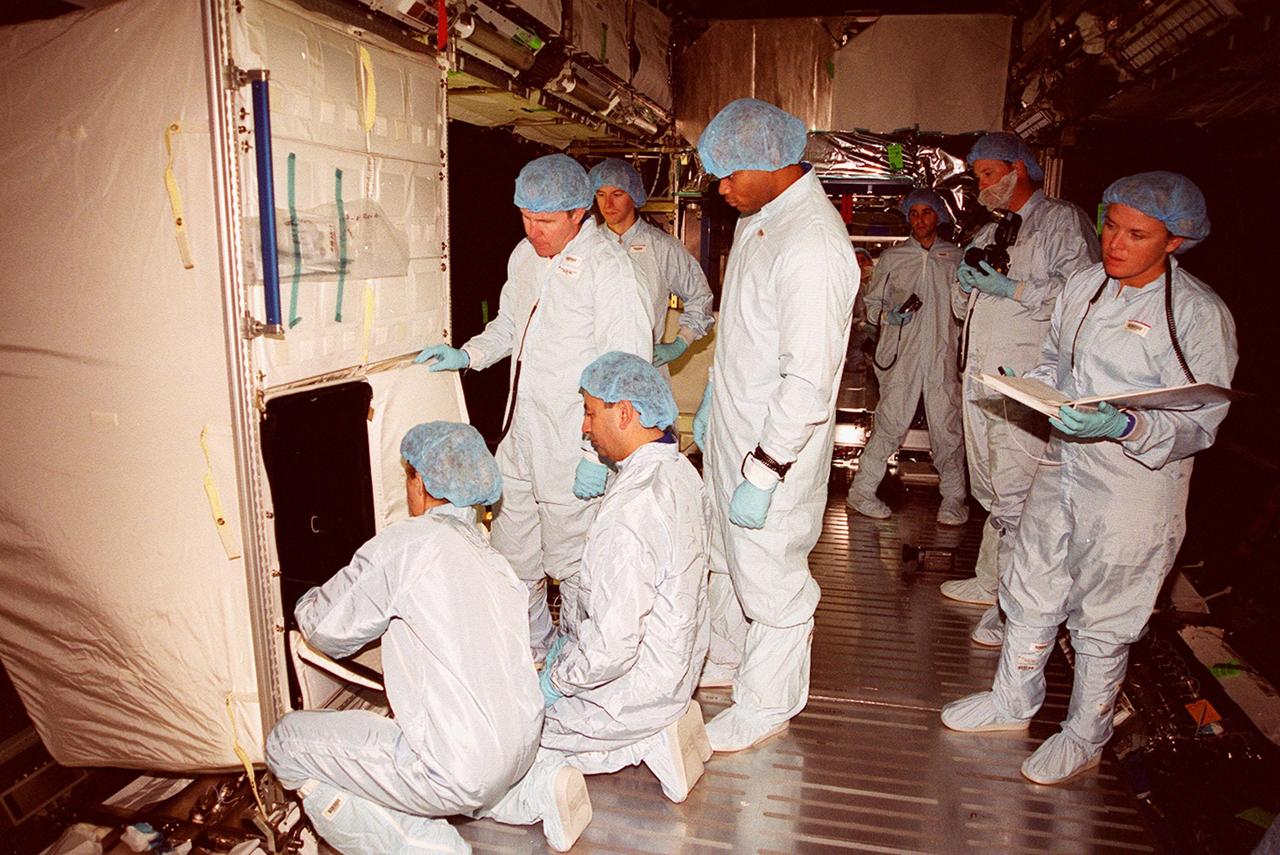
Inside the U.S. Lab, Destiny, members of the STS-98 crew work with technicians (in the background) to learn more about the equipment in the module. They are taking part in Crew Equipment Interface Test activities. At left, back to camera, is Mission Specialist Marsha Ivins. Standing are Mission Specialists Thomas Jones (left) and Robert Curbeam (right). Other crew members not seen are Commander Ken Cockrell and Pilot Mark Polansky. The mission will be transporting the Lab to the International Space Station with five system racks already installed inside of the module. With delivery of electronics in the lab, electrically powered attitude control for Control Moment Gyroscopes will be activated. The STS-98 launch is scheduled for Jan. 18, 2001

A smiling Mark Polansky, the pilot on STS-98, gets ready to take the driver’s seat in an M-113 armored carrier, part of emergency egress training at Launch Pad 39A. In the event of an emergency at the pad prior to launch, the carrier could be used to transport the crew to a nearby bunker or farther. The STS-98 crew is at KSC to take part in Terminal Countdown Demonstration Test activities, which also includes a simulated launch countdown. STS-98 is the seventh construction flight to the International Space Station, carrying as payload the U.S. Lab Destiny, a key element in the construction of the ISS
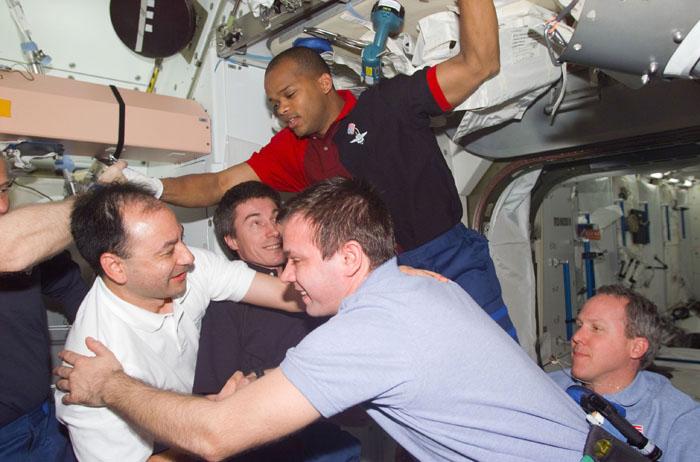
STS98-E-5297 (16 February 2001) --- Goodbyes are plentiful as five astronauts prepare to depart the International Space Station (ISS) and return to the Space Shuttle Atlantis. Cosmonauts Sergei K. Krikalev, Expedition One flight engineer; and Yuri P. Gidzenko, Soyuz commander for the station crew, appear in the center of the scene. They are surrounded by astronauts Mark L. Polansky, STS-98 pilot; and Robert L. Curbeam (top) and Thomas D. Jones, right, both shuttle mission specialists. The cosmonauts, along with astronaut William M. (Bill) Shepherd (out of frame), Expedition One commander, will stay aboard the outpost for several more weeks and return to Earth with the next shuttle visitors.
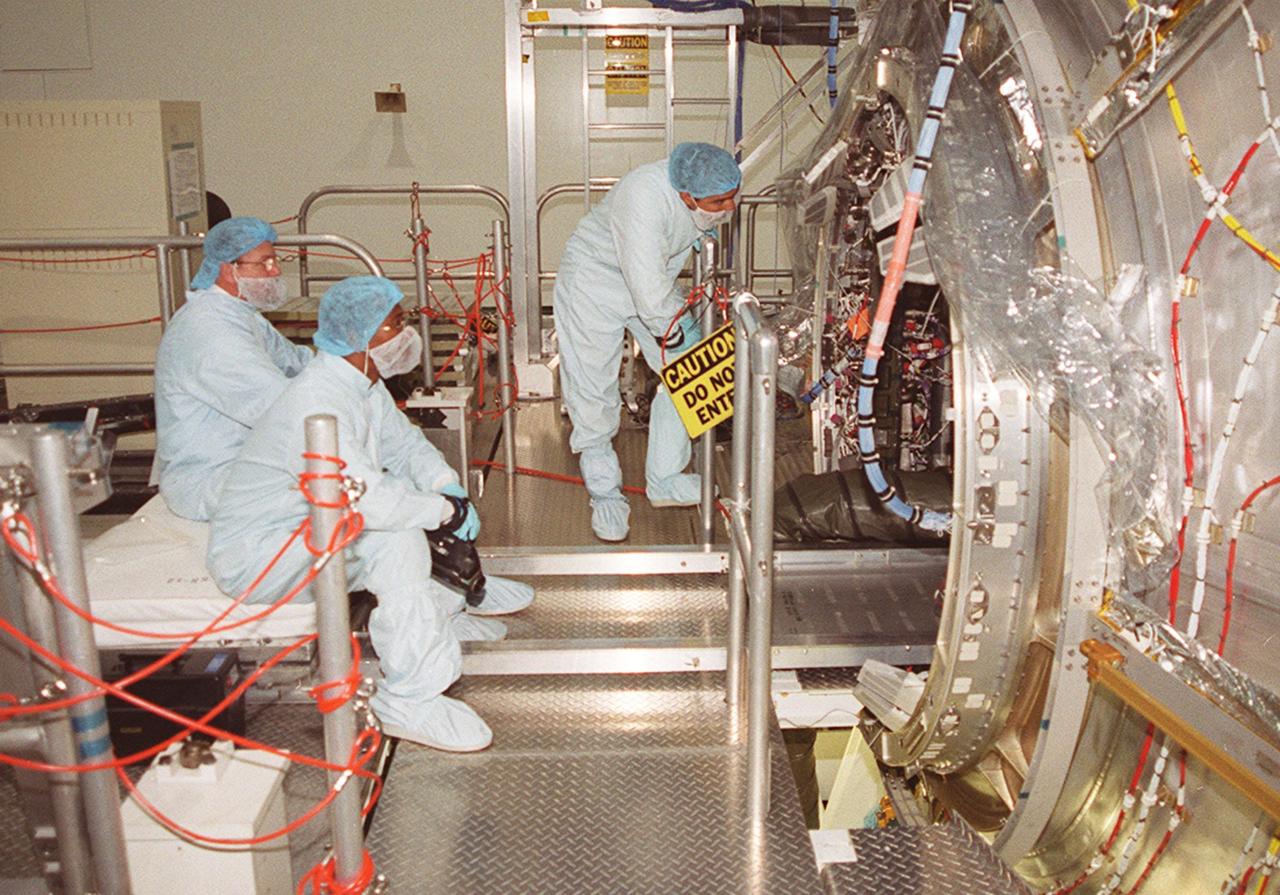
In the Space Station Processing Facility, workers at left watch while members of the STS-98 crew check out equipment inside the U.S. Lab, Destiny (at right). The crew comprises Commander Ken Cockrell, Pilot Mark Polansky and Mission Specialists Robert Curbeam, Thomas Jones and Marsha Ivins. They are taking part in Crew Equipment Interface Test activities, becoming familiar with equipment they will be handling during the mission. The mission will be transporting the Lab to the International Space Station with five system racks already installed inside of the module. With delivery of electronics in the lab, electrically powered attitude control for Control Moment Gyroscopes will be activated. The STS-98 launch is scheduled for Jan. 18, 2001
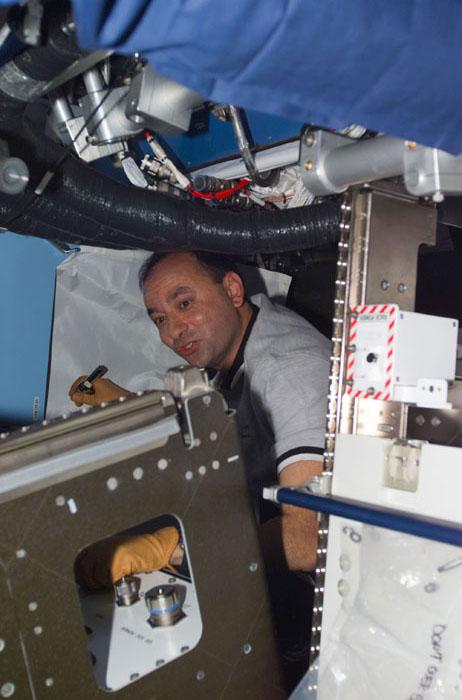
STS98-E-5159 (11 February 2001) --- Astronaut Mark L. Polansky, STS-98 pilot, works inside the newly attached Destiny laboratory onboard the International Space Station (ISS). After the Destiny hatch was opened early in the day, members of both the shuttle and station crews went to work quickly inside the new module, activating air systems, fire extinguishers, alarm systems, computers and internal communications. The crews also took some photos and continued equipment transfers from the shuttle to the station. The scene was taken with a digital still camera.
![KENNEDY SPACE CENTER, FLA. -- STS-98 Commander Ken Cockrell answers a question from the media during a briefing at Launch Pad 39A. Other crew members present are Pilot Mark Polansky, Mission Specialist Thomas Jones, [Cockrell], and Mission Specialists Marsha Ivins and Robert Curbeam. All are at KSC to take part in Terminal Countdown Demonstration Test activities, which include emergency egress training and a simulated launch countdown. STS-98 is the seventh construction flight to the International Space Station, carrying as payload the U.S. Lab Destiny, a key element in the construction of the ISS. Launch of STS-98 is scheduled for Jan. 19 at 2:11 a.m](https://images-assets.nasa.gov/image/01pp0044/01pp0044~medium.jpg)
KENNEDY SPACE CENTER, FLA. -- STS-98 Commander Ken Cockrell answers a question from the media during a briefing at Launch Pad 39A. Other crew members present are Pilot Mark Polansky, Mission Specialist Thomas Jones, [Cockrell], and Mission Specialists Marsha Ivins and Robert Curbeam. All are at KSC to take part in Terminal Countdown Demonstration Test activities, which include emergency egress training and a simulated launch countdown. STS-98 is the seventh construction flight to the International Space Station, carrying as payload the U.S. Lab Destiny, a key element in the construction of the ISS. Launch of STS-98 is scheduled for Jan. 19 at 2:11 a.m
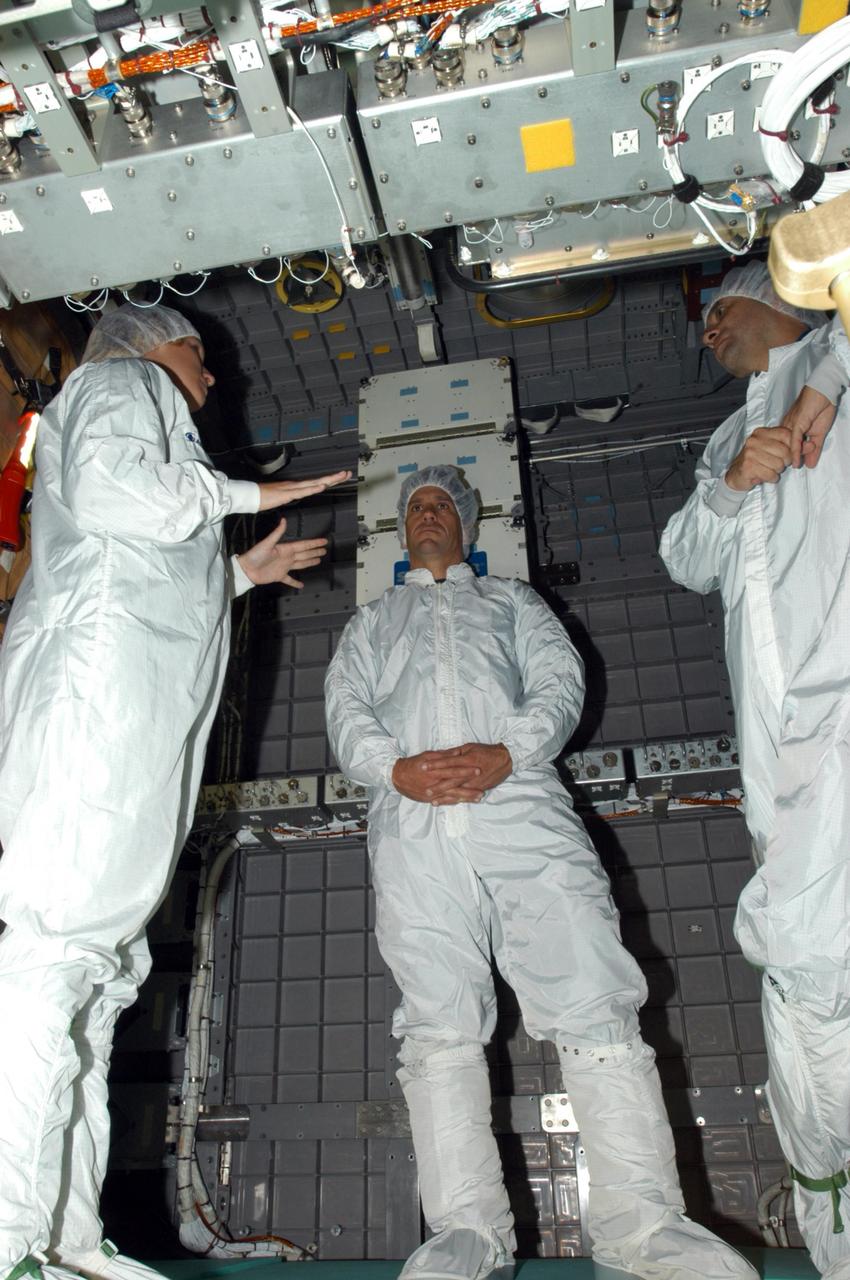
KENNEDY SPACE CENTER, FLA. - At SPACEHAB in Cape Canaveral, Fla., STS-116 Pilot William Oefelein (center) and Commander Mark Polansky (right) listen to information about the contents of the SPACEHAB module they are standing in. Mission crews make frequent trips to the Space Coast to become familiar with the equipment and payloads they will be using. STS-116 will be mission number 20 to the International Space Station and construction flight 12A.1. The mission payload is the SPACEHAB module, the P5 integrated truss structure and other key components. Launch is scheduled for no earlier than Dec. 7. Photo credit: NASA/George Shelton
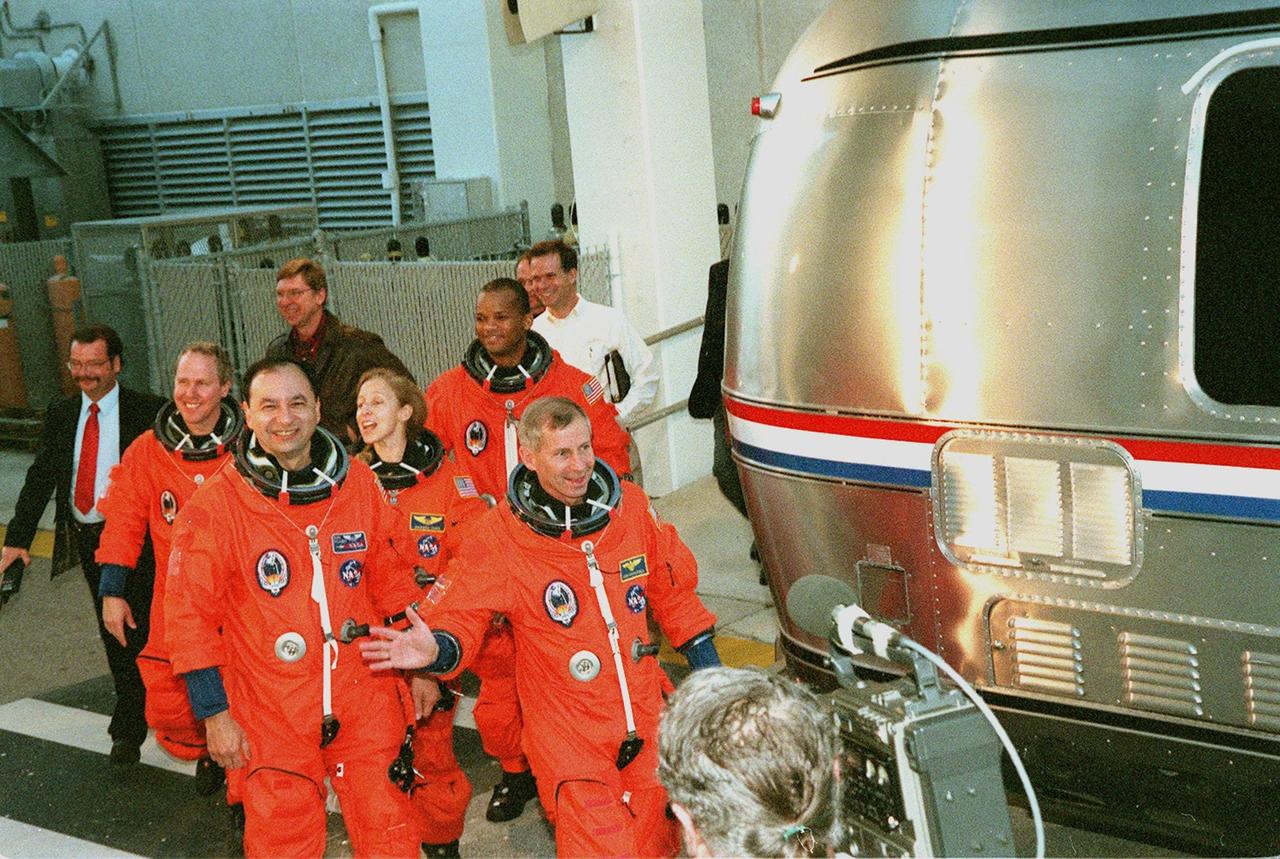
The STS-98 crew wave to onlookers as they walk out of the Operations and Checkout Building dressed for a simulated launch countdown at Launch Pad 39A. From left to right, they are Mission Specialist Thomas Jones, Pilot Mark Polansky, Mission Specialists Marsh Ivins and Robert Curbeam, being led by Commander Ken Cockrell. The crew is taking part in Terminal Countdown Demonstration Test activities, which include the countdown and emergency egress training at the pad. STS-98 is the seventh construction flight to the International Space Station, carrying as payload the U.S. Lab Destiny, a key element in the construction of the ISS. Launch of STS-98 is scheduled for Jan. 19 at 2:11 a.m. EST
![KENNEDY SPACE CENTER, Fla. -- The STS-98 crew talks to the press at a briefing at Launch Pad 39A. With the microphone is Commander Ken Cockrell, who discusses the EVAs on the mission. The other crew members are (left to right) Pilot Mark Polansky, Mission Specialist Thomas Jones, [Cockrell], and Mission Specialists Marsha Ivins and Robert Curbeam. They are at KSC to take part in Terminal Countdown Demonstration Test activities, which also include a simulated launch countdown. STS-98 is the seventh construction flight to the International Space Station, carrying as payload the U.S. Lab Destiny, a key element in the construction of the ISS. Launch of STS-98 is scheduled for Jan. 19 at 2:11 a.m](https://images-assets.nasa.gov/image/KSC01padig014/KSC01padig014~medium.jpg)
KENNEDY SPACE CENTER, Fla. -- The STS-98 crew talks to the press at a briefing at Launch Pad 39A. With the microphone is Commander Ken Cockrell, who discusses the EVAs on the mission. The other crew members are (left to right) Pilot Mark Polansky, Mission Specialist Thomas Jones, [Cockrell], and Mission Specialists Marsha Ivins and Robert Curbeam. They are at KSC to take part in Terminal Countdown Demonstration Test activities, which also include a simulated launch countdown. STS-98 is the seventh construction flight to the International Space Station, carrying as payload the U.S. Lab Destiny, a key element in the construction of the ISS. Launch of STS-98 is scheduled for Jan. 19 at 2:11 a.m
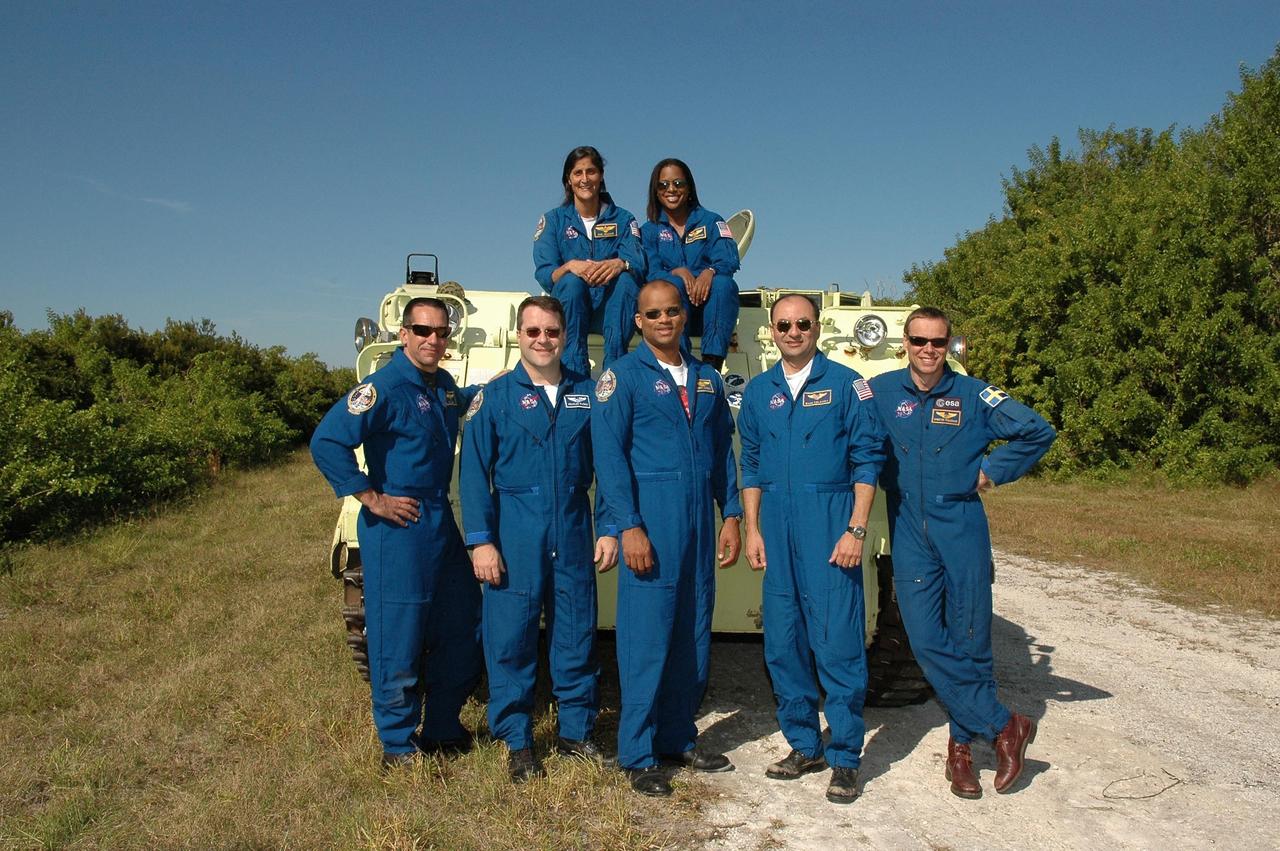
KENNEDY SPACE CENTER, FLA. -- The STS-116 crew gathers for a photo after their successful training on the M-113 armored personnel carrier. On top are Mission Specialists Sunita Williams (left) and Joan Higginbotham. In front are (left to right) Pilot William Oefelein, Mission Specialists Nicholas Patrick and Robert Curbeam, Commander Mark Polansky and Mission Specialist Christer Fuglesang, who represents the European Space Agency. The STS-116 mission is No. 20 to the International Space Station and construction flight 12A.1. The mission payload is the SPACEHAB module, the P5 integrated truss structure and other key components. Launch is scheduled for no earlier than Dec. 7. Photo credit: NASA/Kim Shiflett
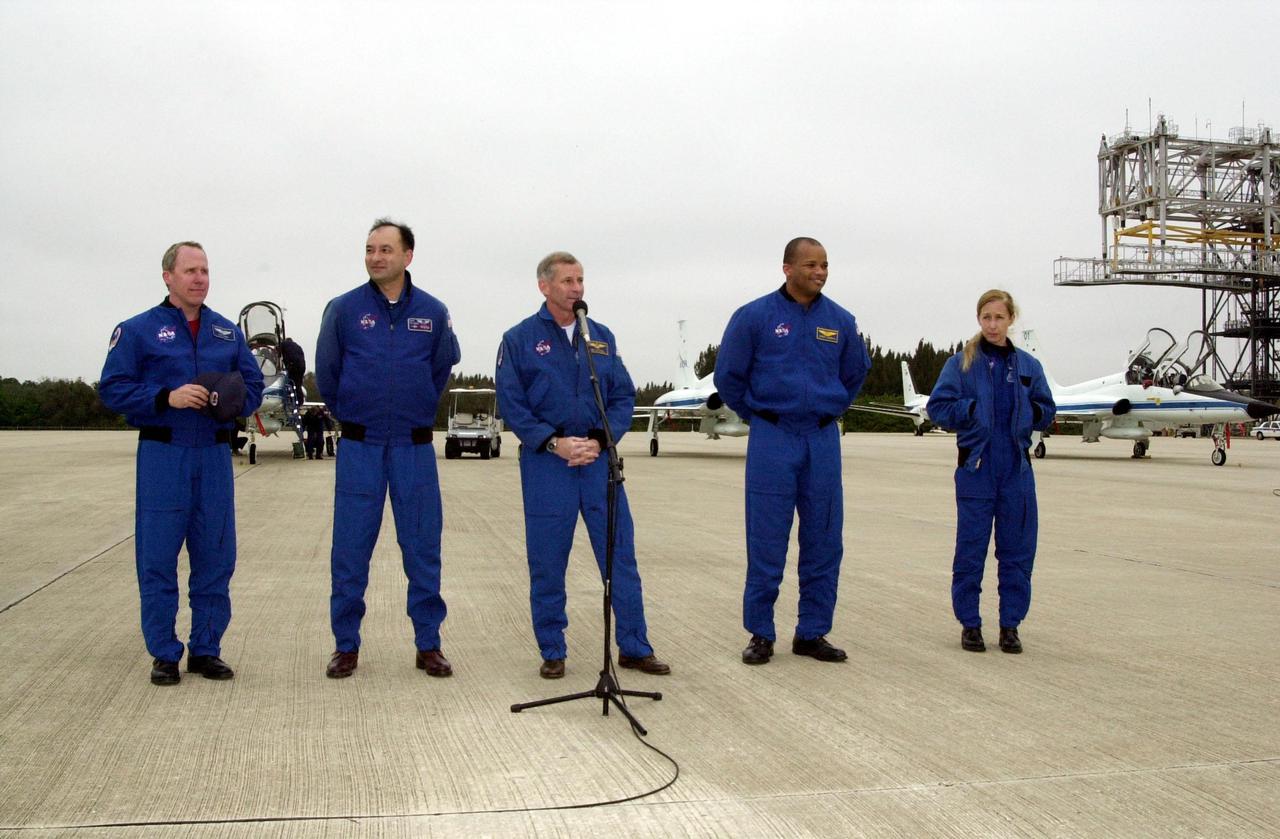
KENNEDY SPACE CENTER, FLA. -- STS-98 Mission Commander Kenneth Cockrell (center at microphone) speaks to the media at the Shuttle Landing Facility after the crew's arrival Sunday to complete preparations for launch.; The crew also includes, from left to right, Mission Specialist Thomas Jones, Pilot Mark Polansky and Mission Specialists Robert Curbeam and Marsha Ivins. STS-98 is the seventh construction flight to the International Space Station, carrying as payload the U.S. Lab Destiny, a key element in the construction of the ISS. Launch of STS-98 is scheduled for Feb. 7 at 6:11 p.m. EST
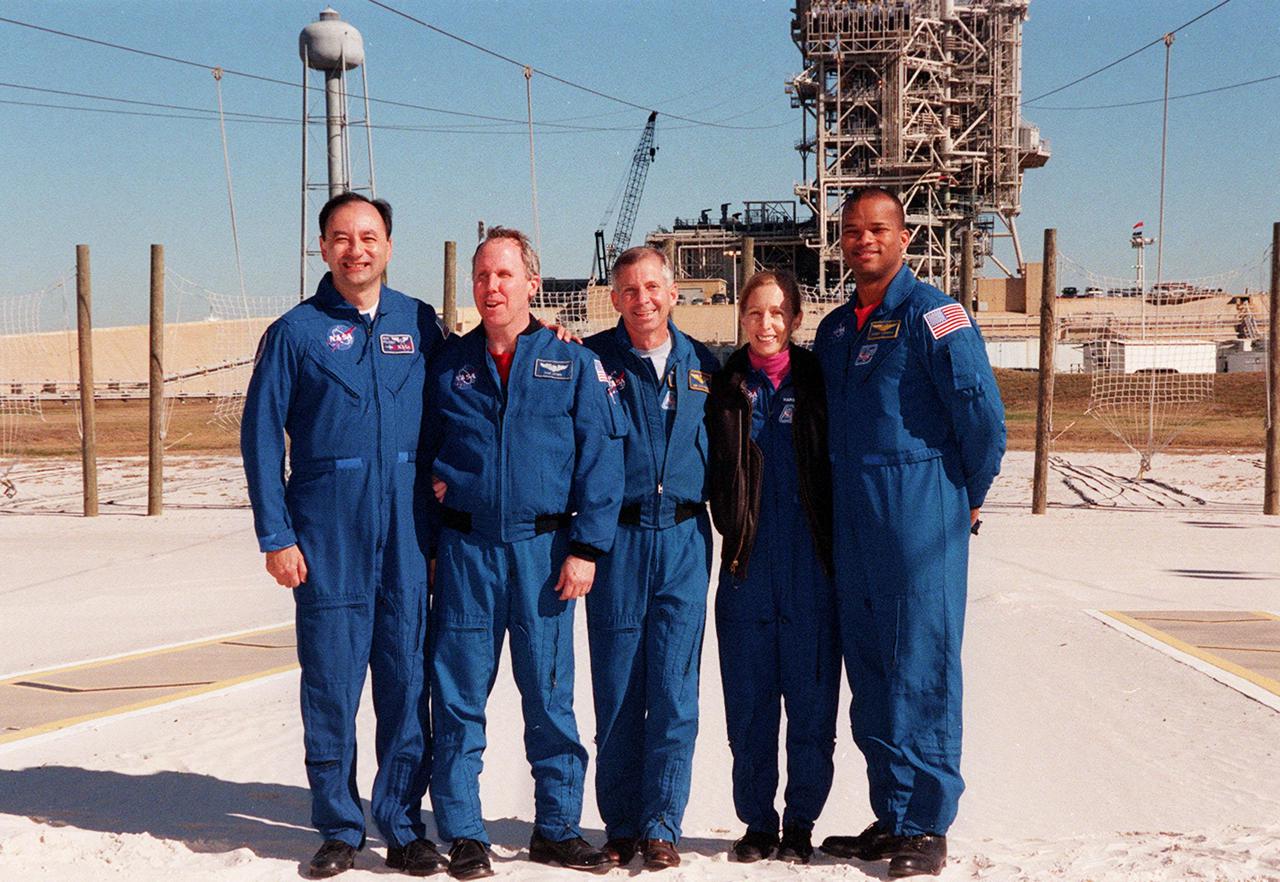
KENNEDY SPACE CENTER, FLA -- After a media briefing at Launch Pad 39A, the STS-98 crew poses in the slidewire basket landing zone. Standing, left to right, are Pilot Mark Polansky, Mission Specialist Thomas Jones, Commander Ken Cockrell and Mission Specialists Marsha Ivins and Robert Curbeam. All are at KSC to take part in Terminal Countdown Demonstration Test activities, which include emergency egress training and a simulated launch countdown. STS-98 is the seventh construction flight to the International Space Station, carrying as payload the U.S. Lab Destiny, a key element in the construction of the ISS. Launch of STS-98 is scheduled for Jan. 19 at 2:11 a.m
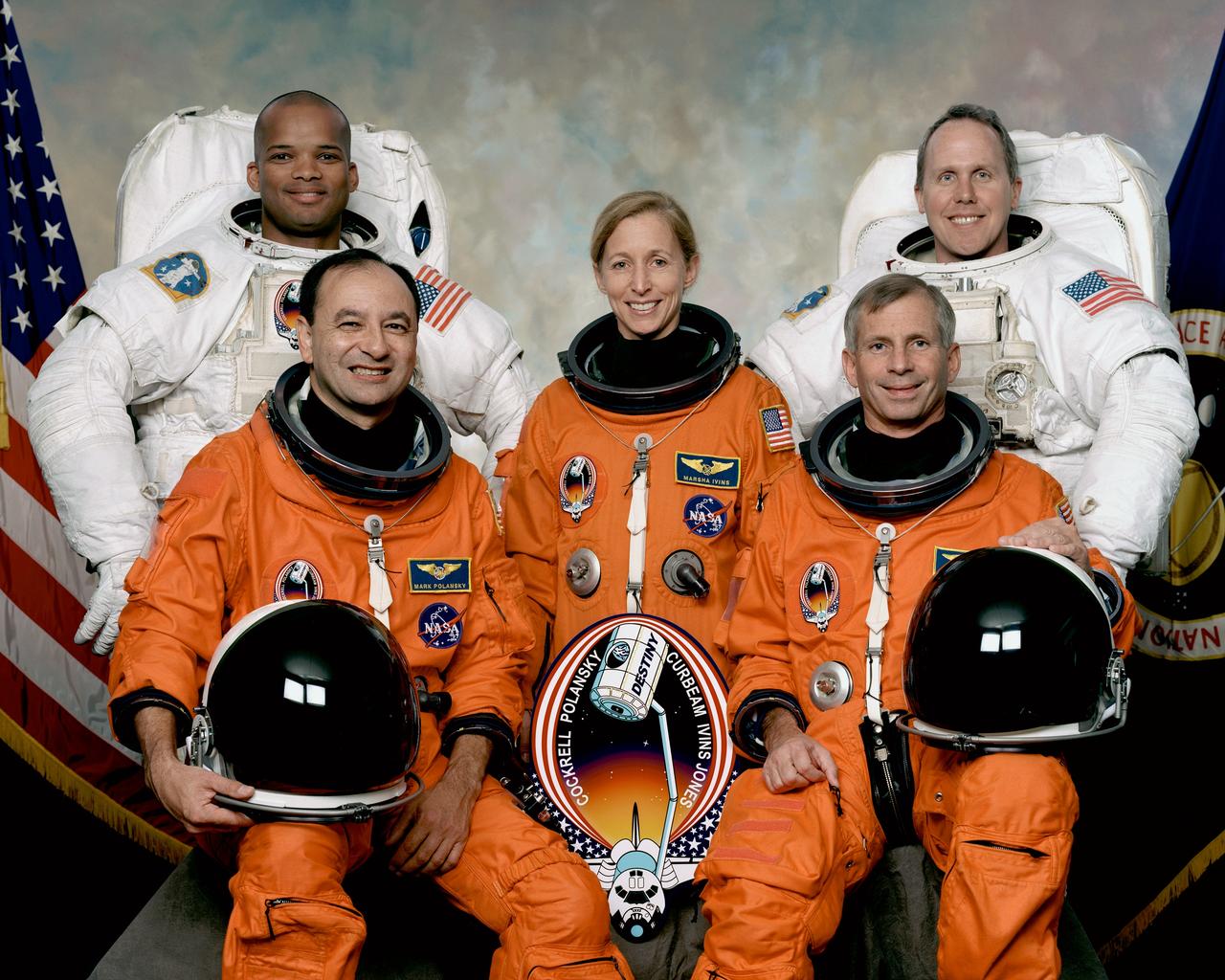
STS098-S-002 (December 2000) --- These five astronauts have been in training for the STS-98 mission, scheduled for launch aboard the Space Shuttle Atlantis in January of 2001. The crew is composed of astronauts Kenneth D. Cockrell (right front), mission commander; and Mark L. Polansky (left front), pilot; along with astronauts Marsha S. Ivins, Robert L. Curbeam, Jr., (left rear) and Thomas D. Jones (right rear), all mission specialists. Curbeam and Jones are the scheduled extravehicular activity (EVA) participants for the International Space Station's 5a mission.

JOHNSON SPACE CENTER, Houston -- STS127-S-002 (10 Oct. 2008) --- Attired in training versions of their shuttle launch and entry suits, these seven astronauts take a break from training to pose for the STS-127 crew portrait. Pictured on the front row are astronauts Mark Polansky (right), commander, and Doug Hurley, pilot. Remaining crew members, pictured from left to right, are astronauts Dave Wolf, Christopher Cassidy, Canadian Space Agency's Julie Payette, Tom Marshburn and Tim Kopra, all mission specialists. Kopra is scheduled to join Expedition 20 as flight engineer after launching to the International Space Station with the STS-127 crew.
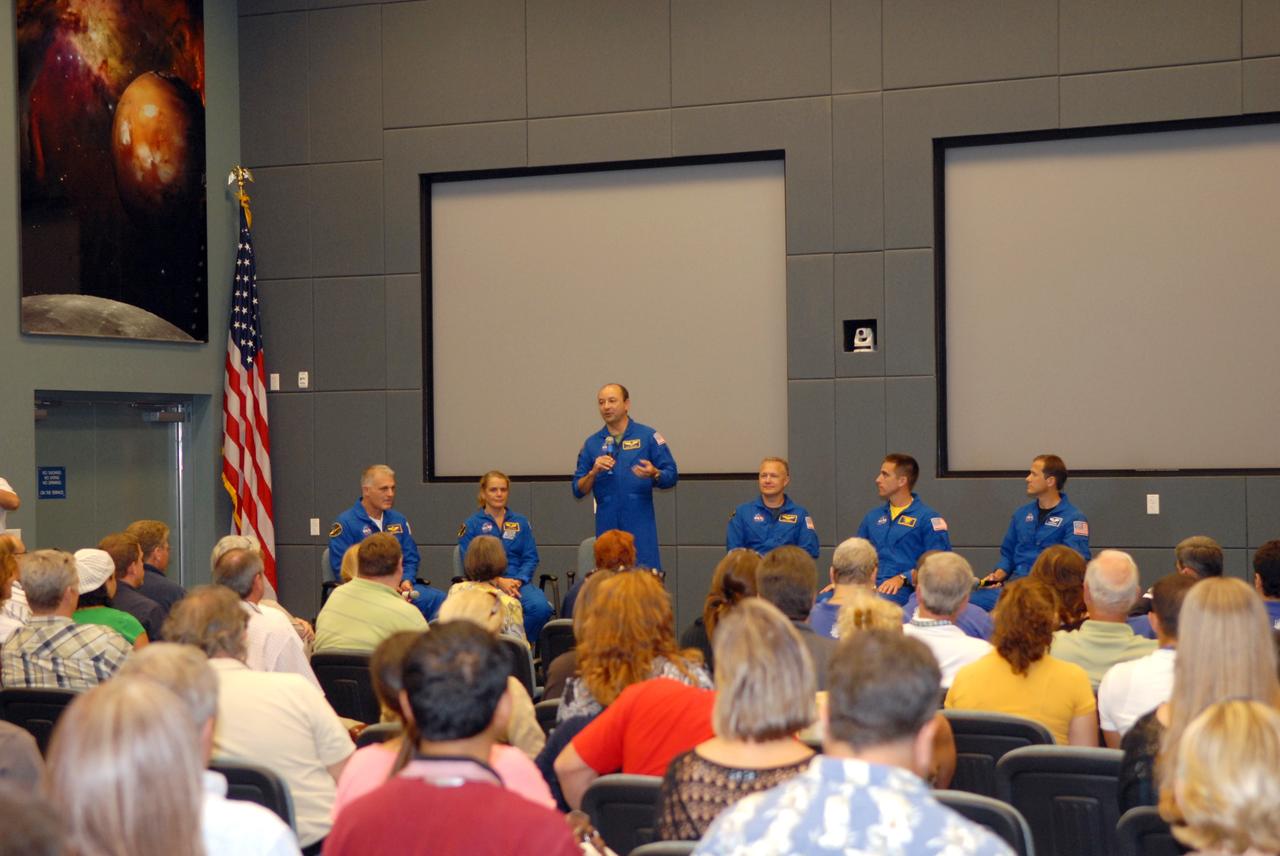
CAPE CANAVERAL, Fla. – Crew members of the STS-127 mission return to NASA's Kennedy Space Center in Florida to share stories, photos and videos of their experiences on the mission. Seated from left are Mission Specialists Dave Wolf and Julie Payette, Commander Mark Polansky (standing), Pilot Doug Hurley, and Mission Specialists Christopher Cassidy and Tom Marshburn. The STS-127 mission was the final of three flights dedicated to the assembly of the Japanese Kibo laboratory complex on the International Space Station. The crew launched on space shuttle Endeavour on July 15 and returned July 31. Photo credit: NASA/Jim Grossmann