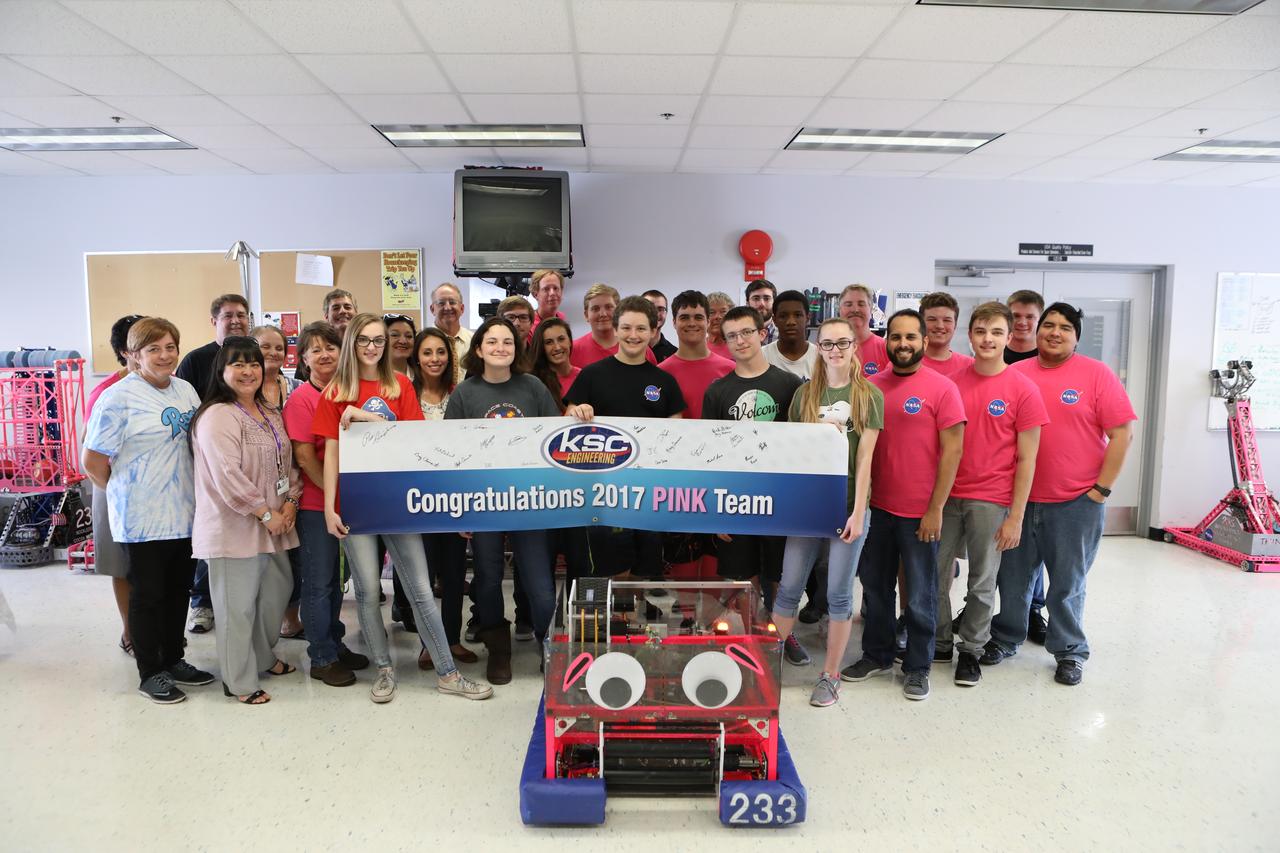
Comprised of students from Cocoa Beach, Rockledge, Viera and Space Coast high schools, the robotics group known as the "Pink Team," its mentors and support personnel celebrated a successful season near the Shuttle Landing Facility at NASA's Kennedy Space Center on April 5. The Pink Team fared well in the two regionals it competed in this year in West Palm Beach, Florida, and the University of Central Florida in Orlando.
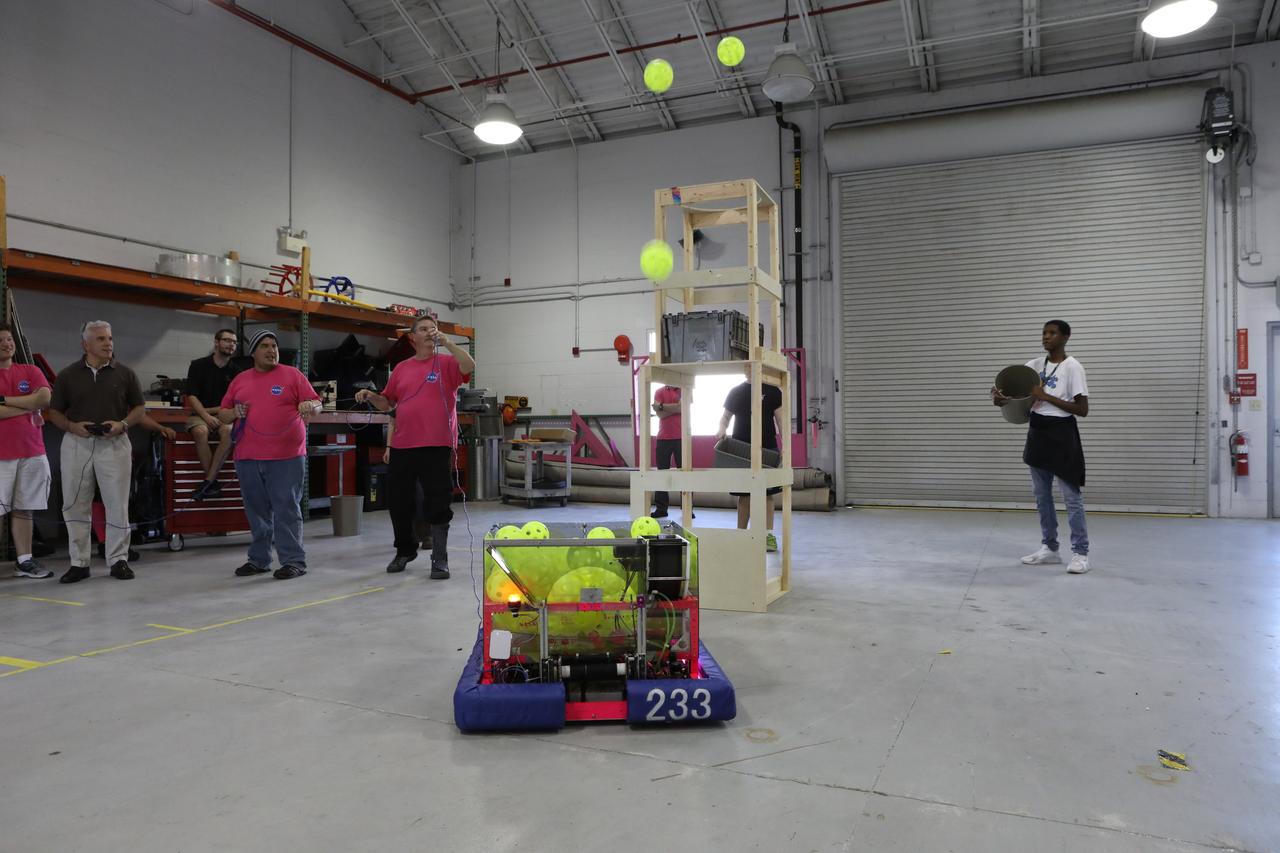
Comprised of students from Cocoa Beach, Rockledge, Viera and Space Coast high schools, the robotics group known as the "Pink Team," its mentors and support personnel celebrated a successful season near the Shuttle Landing Facility at NASA's Kennedy Space Center on April 5. The Pink Team fared well in the two regionals it competed in this year in West Palm Beach, Florida, and the University of Central Florida in Orlando.
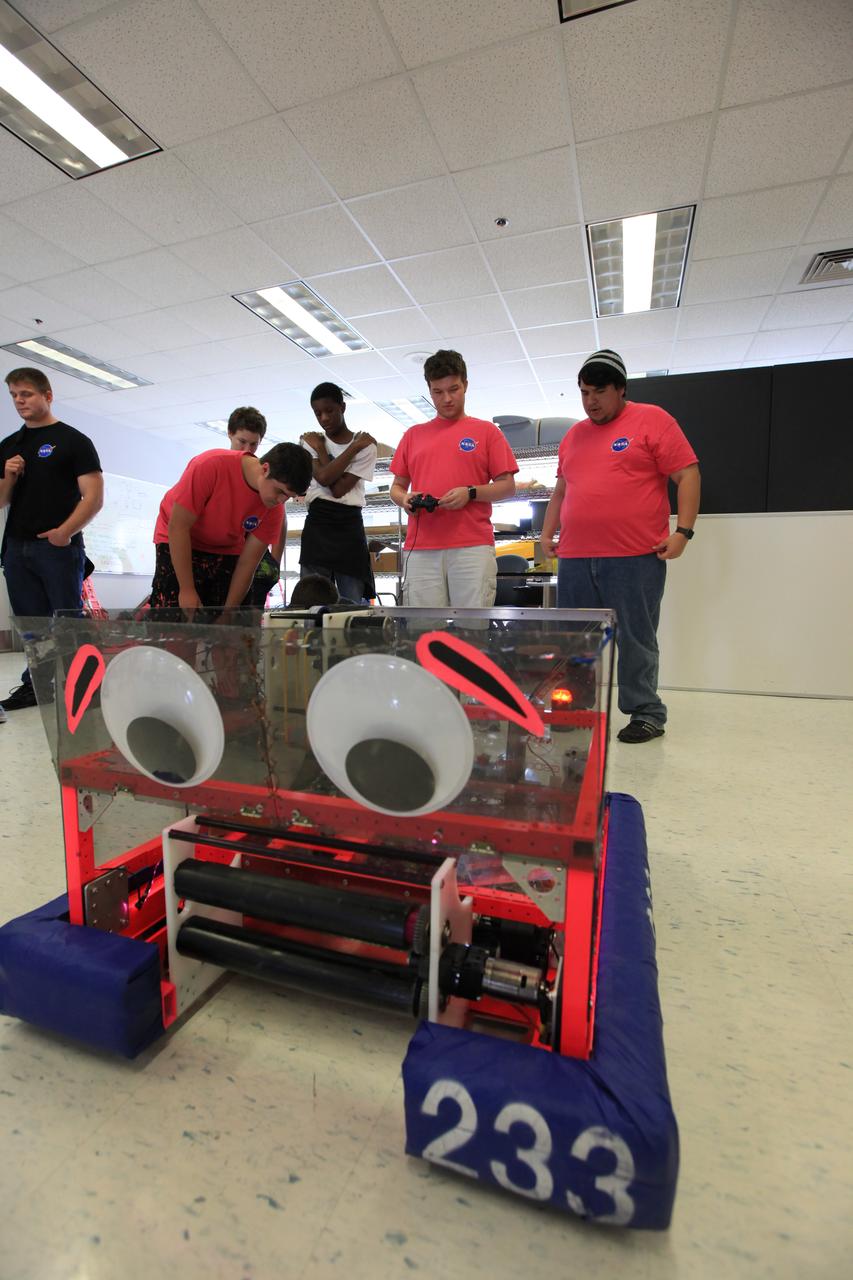
Comprised of students from Cocoa Beach, Rockledge, Viera and Space Coast high schools, the robotics group known as the "Pink Team," its mentors and support personnel celebrated a successful season near the Shuttle Landing Facility at NASA's Kennedy Space Center on April 5. The Pink Team fared well in the two regionals it competed in this year in West Palm Beach, Florida, and the University of Central Florida in Orlando.
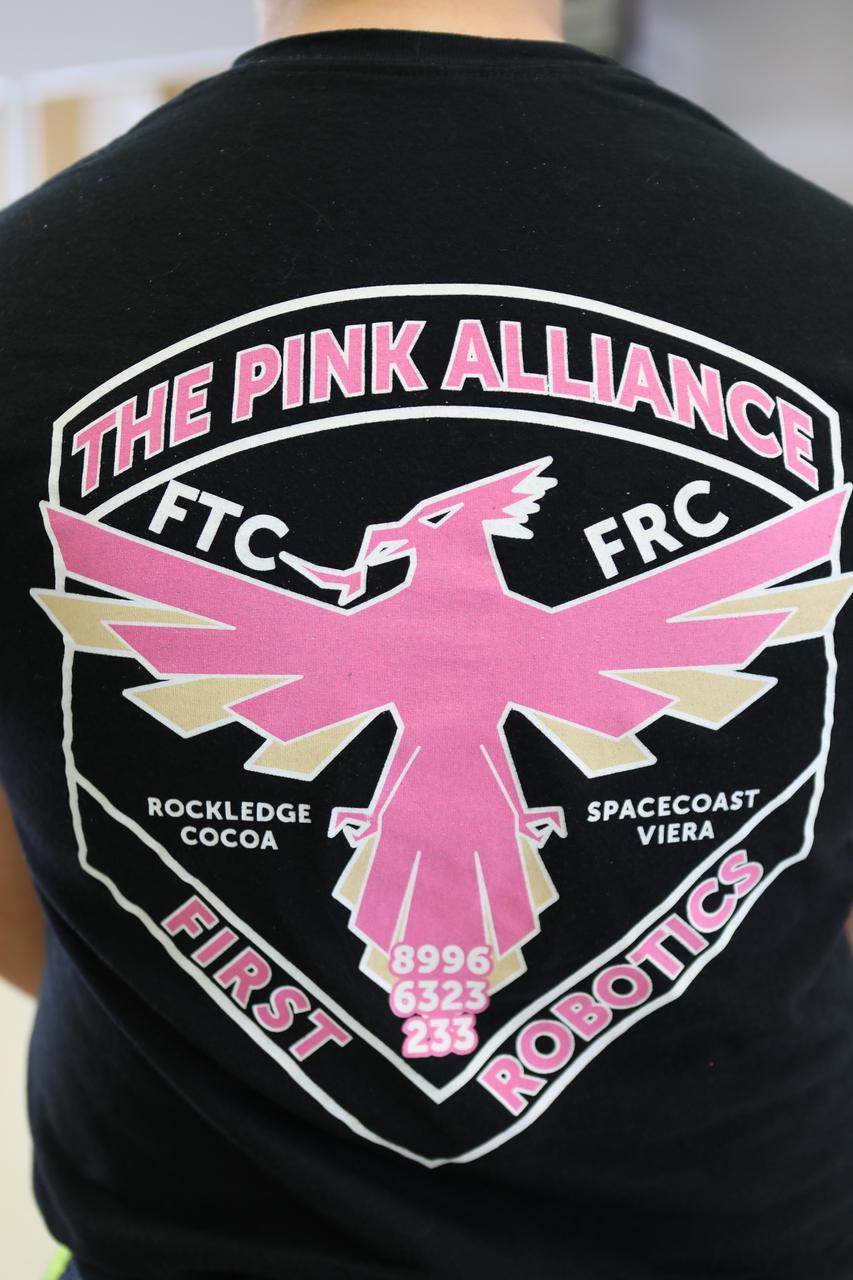
Comprised of students from Cocoa Beach, Rockledge, Viera and Space Coast high schools, the robotics group known as the "Pink Team," chose the phoenix as its mascot for the 2016 season. The group, its mentors and support personnel celebrated a successful season near the Shuttle Landing Facility at NASA's Kennedy Space Center on April 5.
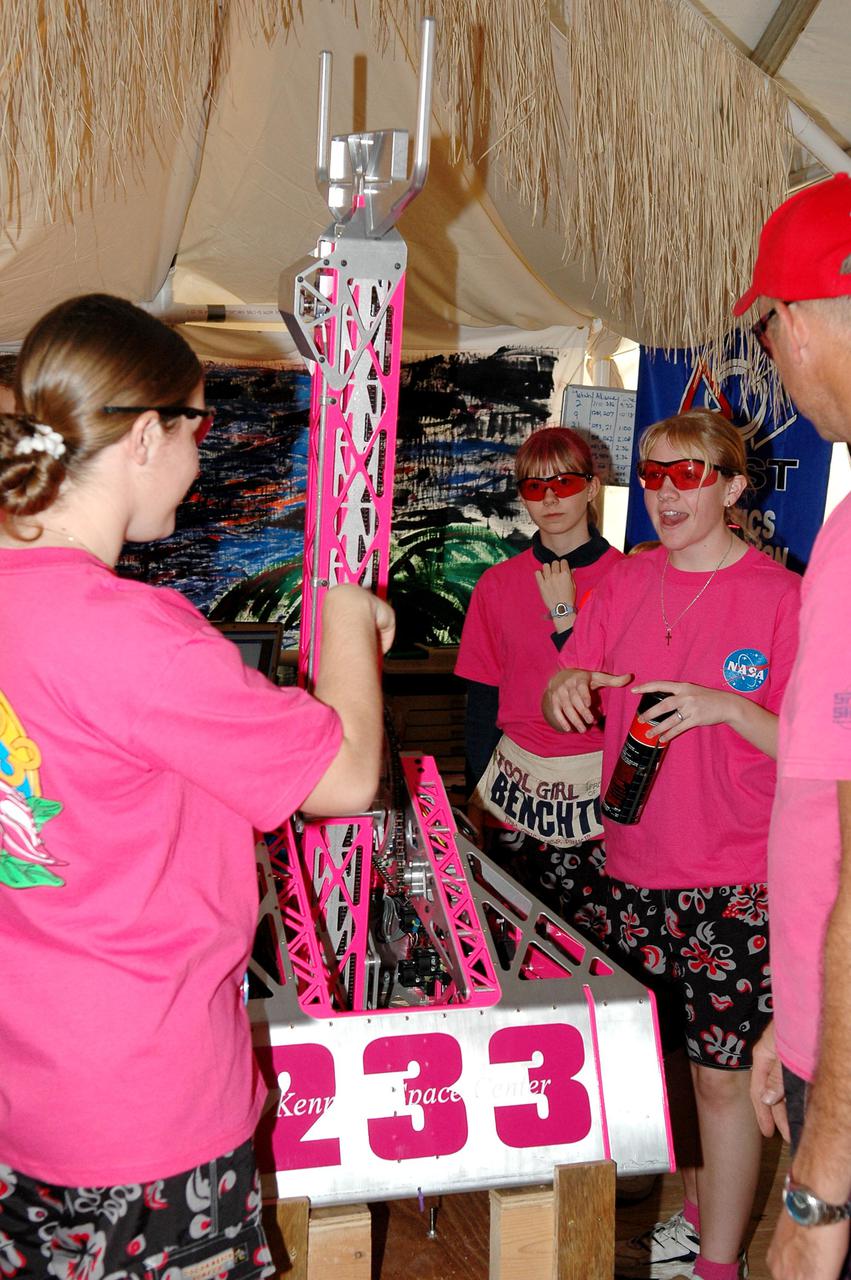
KENNEDY SPACE CENTER, FLA. - Members of the Space Coast FIRST Robotics Team, known as the Pink Team, display their robot, Roccobot, at the 2005 FIRST Robotics Regional Competition held at the University of Central Florida March 10-12. The NASA-sponsored Pink Team took first place in the competition as part of a three-team alliance and advances to the Championship in Atlanta in April. The Pink Team comprises students from Rockledge High School and Cocoa Beach Junior_Senior High School.

KENNEDY SPACE CENTER, FLA. - Pink T-shirt-clad friends and family cheer for the Space Coast FIRST Robotics Team, known as the Pink Team, at the 2005 FIRST Robotics Regional Competition held at the University of Central Florida March 10-12. The NASA-sponsored Roccobots took first place in the competition as part of a three-team alliance and advances to the Championship in Atlanta in April. The Pink Team comprises students from Rockledge High School and Cocoa Beach Junior_Senior High School.
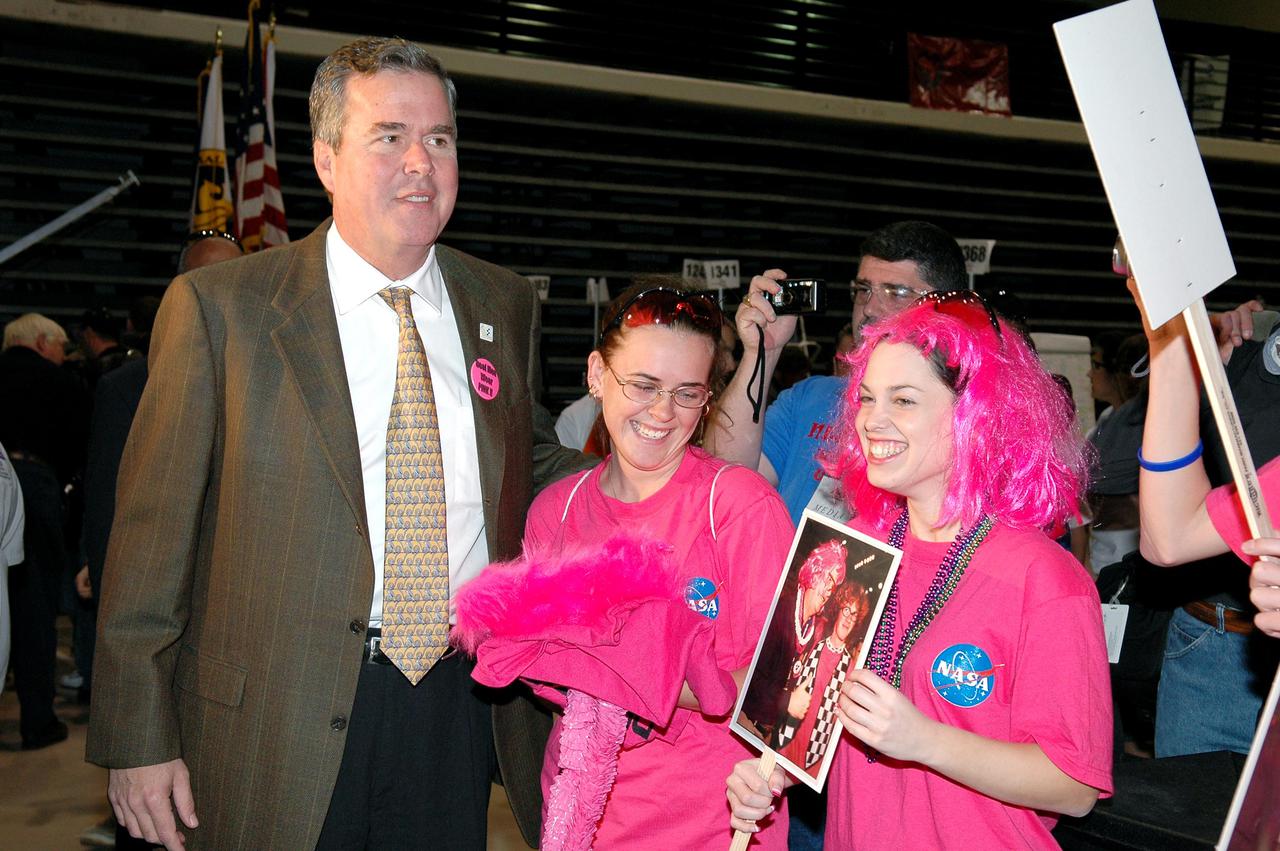
KENNEDY SPACE CENTER, FLA. - At the 2005 FIRST Robotics Regional Competition held at the University of Central Florida March 10-12, Florida Gov. Jeb Bush meets members of the Space Coast FIRST Robotics Team, known as the Pink Team. The NASA-sponsored Roccobots took first place in the competition as part of a three-team alliance and advances to the Championship in Atlanta in April. The Pink Team comprises students from Rockledge High School and Cocoa Beach Junior_Senior High School.
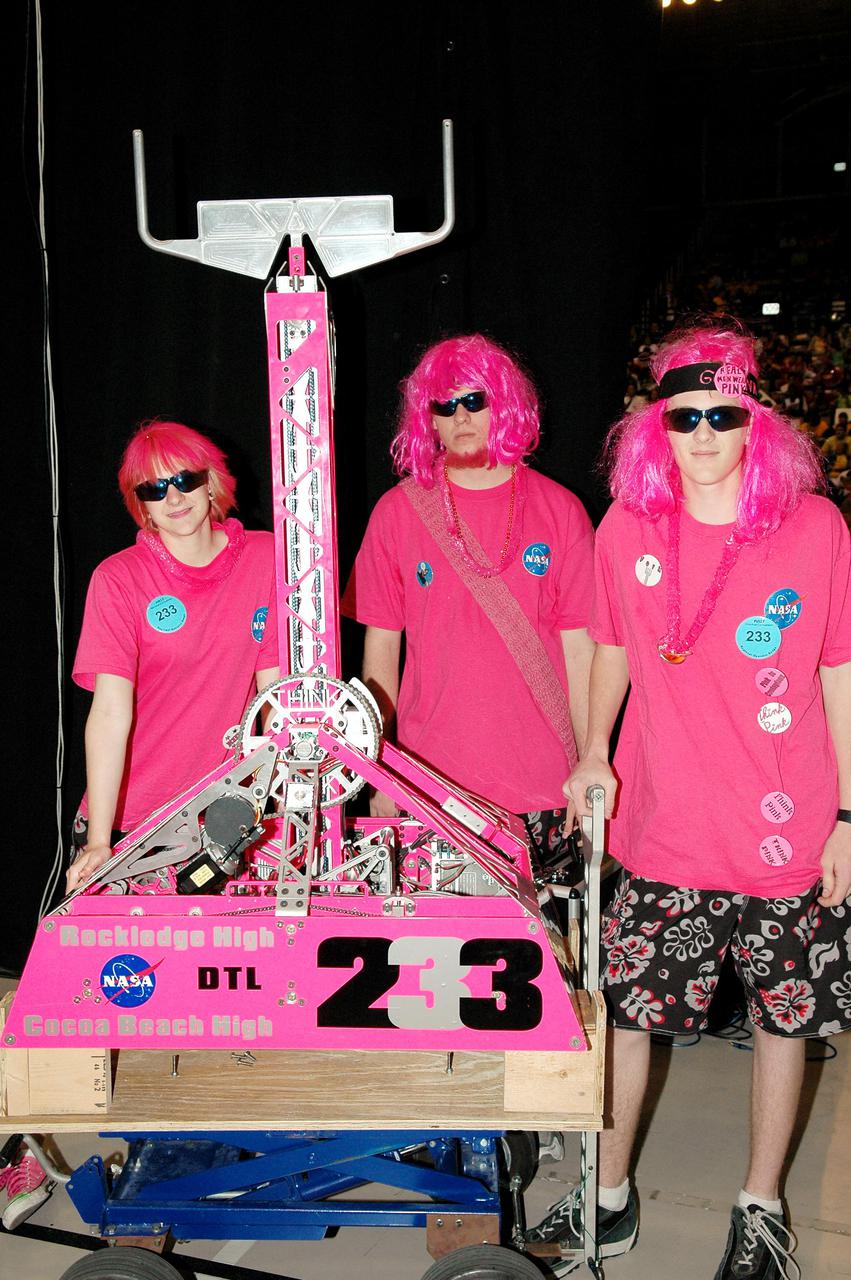
KENNEDY SPACE CENTER, FLA. - Members of the Space Coast FIRST Robotics Team, known as the Pink Team, display their robot, Roccobot, at the 2005 FIRST Robotics Regional Competition held at the University of Central Florida March 10-12. The NASA-sponsored Roccobots took first place in the competition as part of a three-team alliance and advances to the Championship in Atlanta in April. The Pink Team comprises students from Rockledge High School and Cocoa Beach Junior_Senior High School.
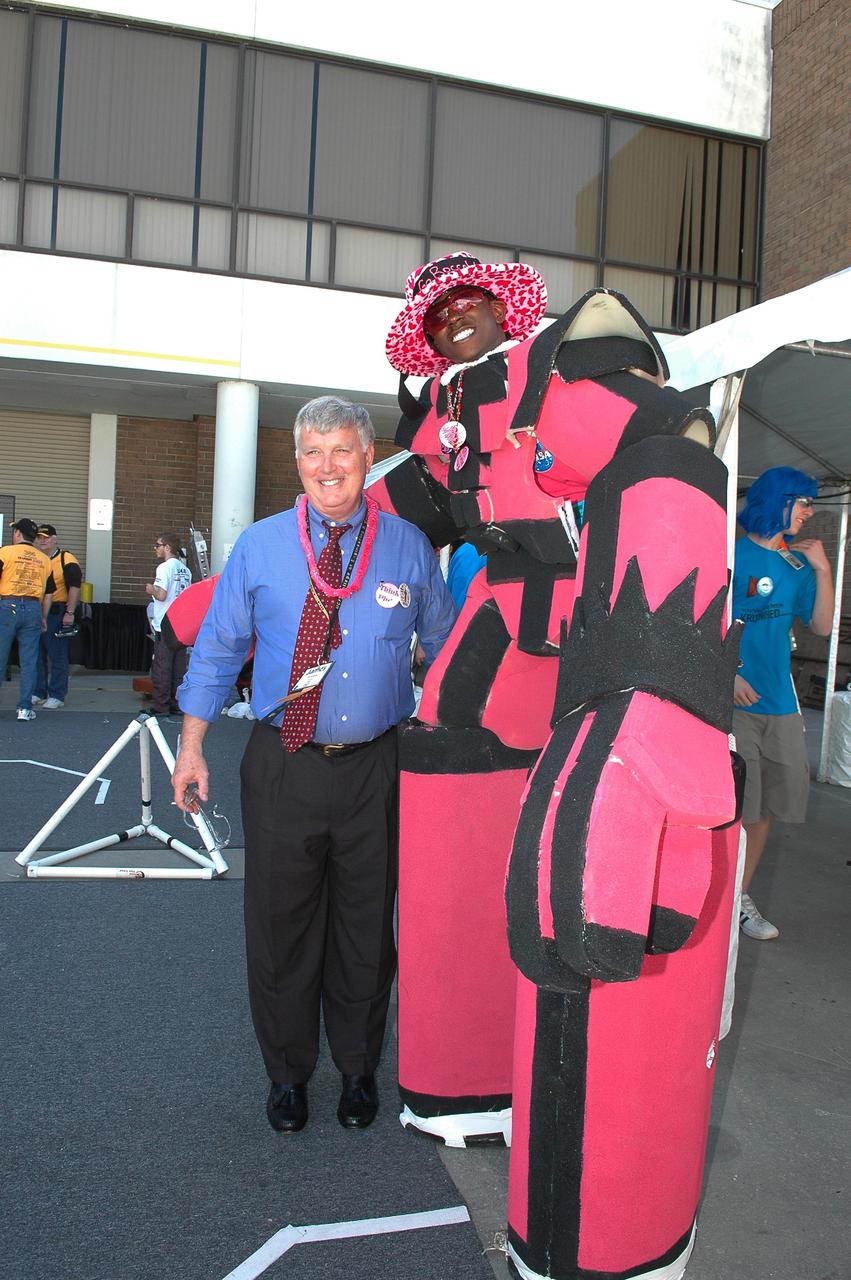
KENNEDY SPACE CENTER, FLA. - During the 2005 FIRST Robotics Regional Competition held at the University of Central Florida March 10-12, Center Director Jim Kennedy (left) meets members of the NASA-sponsored Space Coast FIRST Robotics Team, known as the Pink Team. The Pink Team took first place in the competition as part of a three-team alliance and advances to the Championship in Atlanta in April. The Pink Team comprises students from Rockledge High School and Cocoa Beach Junior_Senior High School. NASA and the University of Central Florida are co-hosts of the regional event. The competition stages short games played by remote-controlled robots, which are designed and built in six weeks by a team of high school students and a handful of engineers-mentors. The students control the robots on the playing field.
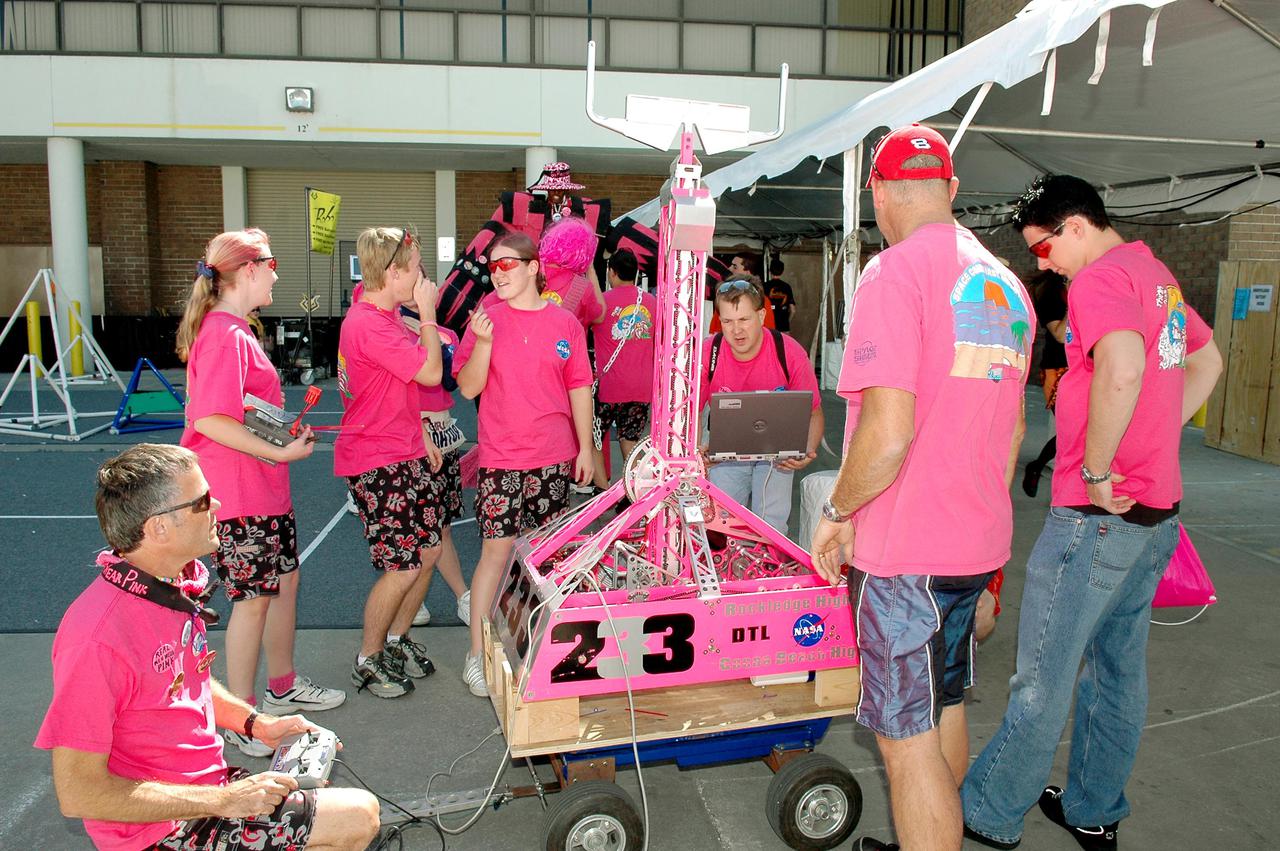
KENNEDY SPACE CENTER, FLA. - Members of the NASA-sponsored Space Coast FIRST Robotics Team, known as the Pink Team, prepare to compete with their robot, Roccobot. The competition was part of the 2005 FIRST Robotics Regional Competition held at the University of Central Florida March 10-12, 2005. The Pink Team took first place in the competition as part of the three-team winning alliance and advances to the Championship in Atlanta in April. The Pink Team comprises students from Rockledge High School and Cocoa Beach Junior_Senior High School, and was joined by the Bionic Tigers from Cocoa High School, sponsored by Analex Corp., and Children of the Swamp from Inlet Grove Community High School in West Palm Beach, sponsored by UTC-Pratt and Whitney-SP. NASA and the University of Central Florida are co-hosts of the regional event. The competition stages short games played by remote-controlled robots, which are designed and built in six weeks by a team of high school students and a handful of engineers-mentors. The students control the robots on the playing field.
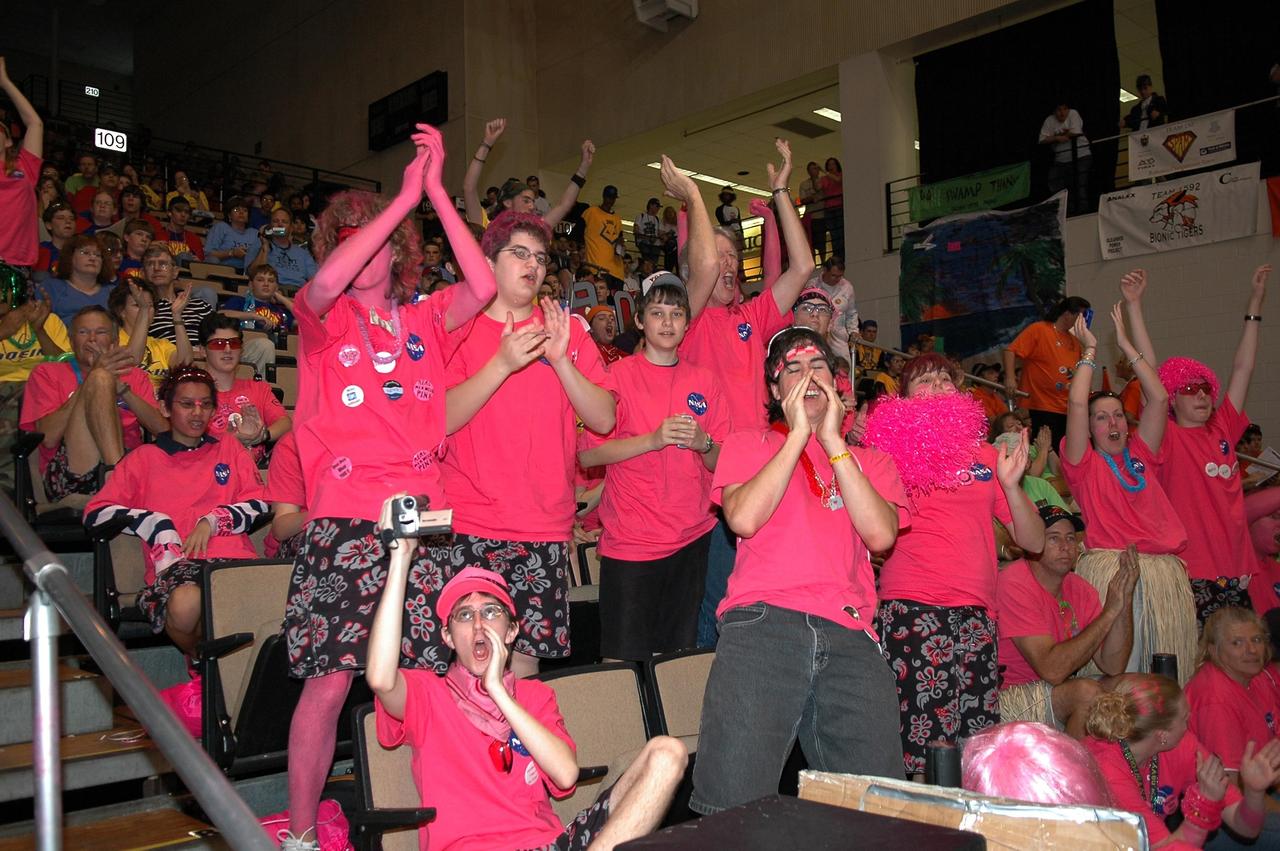
KENNEDY SPACE CENTER, FLA. - Members of the "Pink Team" cheer on their robot, Roccobot, during matches at the 2006 FIRST Robotics Regional Competition held March 9-11 at the University of Central Florida in Orlando. The Pink Team comprises students from Rockledge High and Cocoa Beach High Schools and is co-sponsored by NASA KSC. The team received the Regional Chairman's Award, described as going to the team judged to have created the best partnership effort among team participants and to have best exemplified the true meaning of FIRST. The FIRST Robotics Competition challenges teams of young people and their mentors to solve a common problem in a six-week timeframe using a standard "kit of parts" and a common set of rules. Teams build robots from the parts and enter them in a series of competitions. FIRST, which is based on "For Inspiration and Recognition of Science and Technology," redefines winning for these students. Teams are rewarded for excellence in design, demonstrated team spirit, gracious professionalism and maturity, and ability to overcome obstacles. Scoring the most points is a secondary goal. Winning means building partnerships that last. NASA and the University of Central Florida are co-sponsors of the regional event, which this year included more than 50 teams. Photo credit: NASA/Kim Shiflett
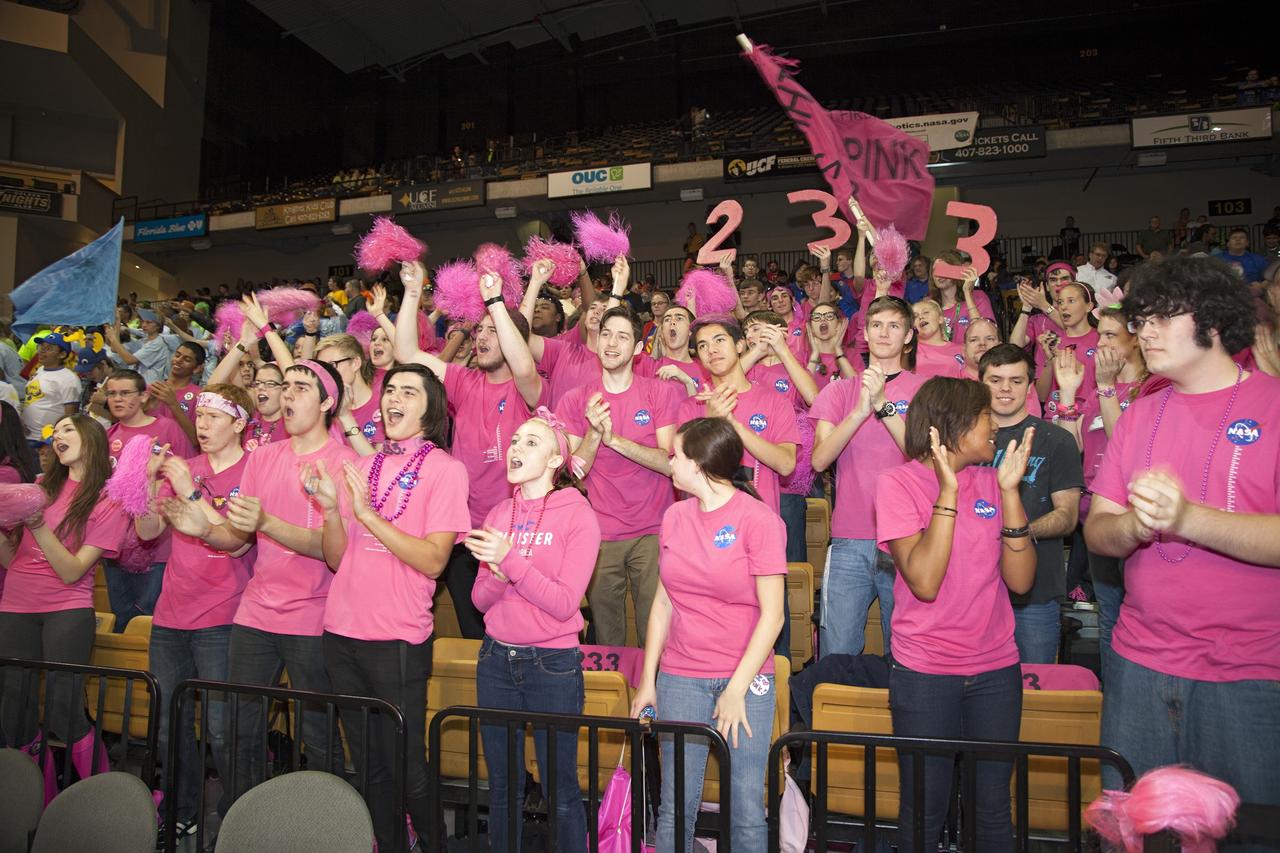
ORLANDO, Fla. – The Pink Team cheers as their robot competes in the University of Central Florida Arena as part of the FIRST Robotics Competition's 2013 Orlando Regional. The student-built robots were required to throw discs into boxes or make climbs to score points. Photo credit: NASA/Frankie Martin
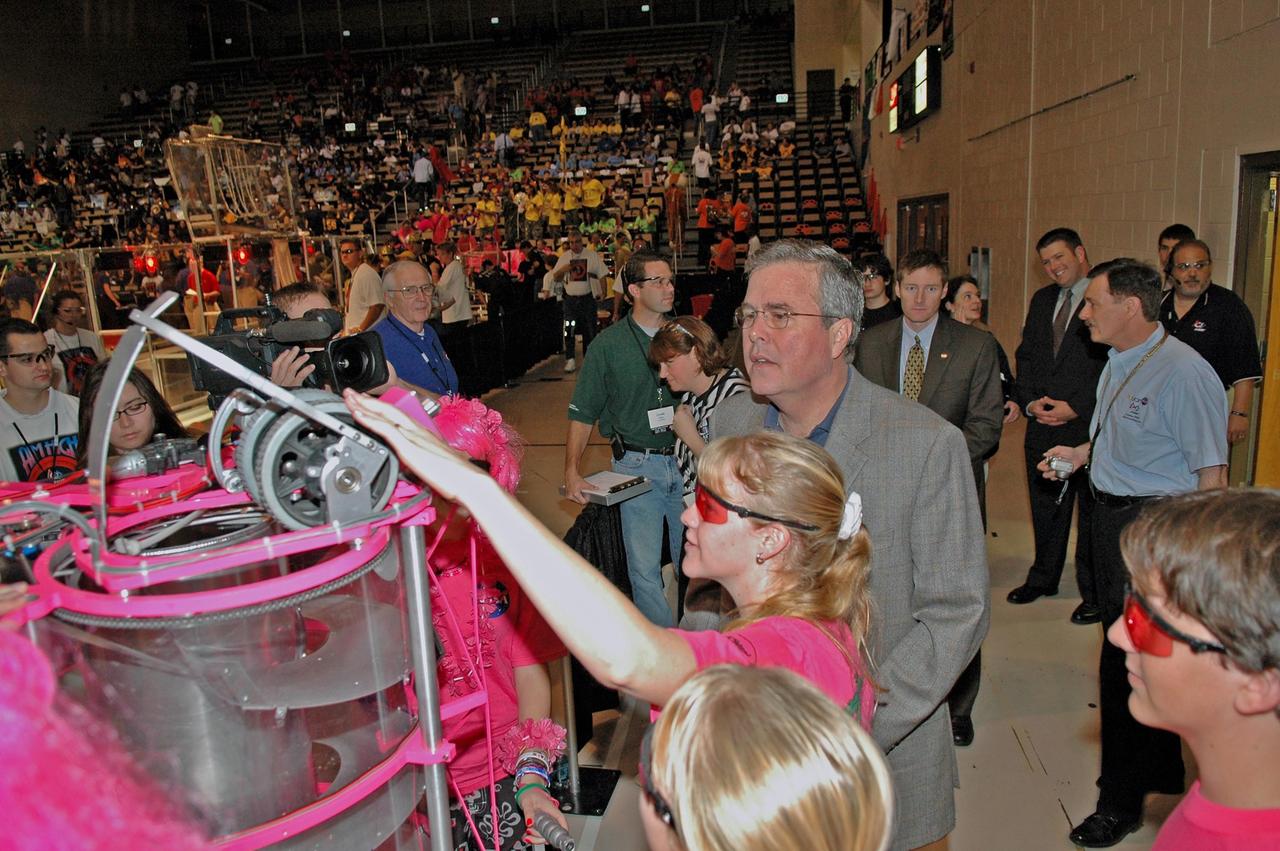
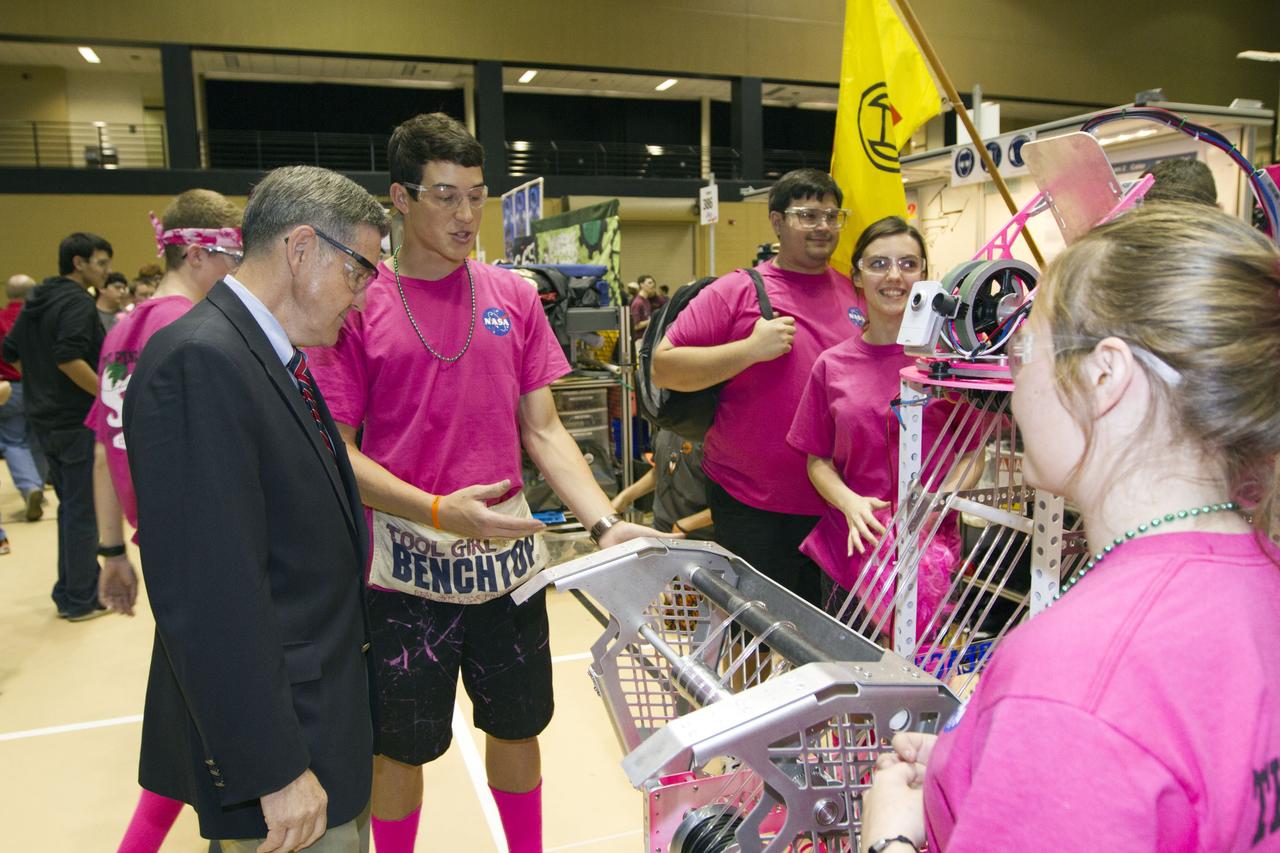
KENNEDY SPACE CENTER, FLA. - Members of the "Pink Team" explain their robot to Florida Governor Jeb Bush at the 2006 FIRST Robotics Regional Competition held March 9-11 at the University of Central Florida in Orlando. The Pink Team, whose robot is named Roccobot, is co-sponsored by NASA KSC. At least four teams in the competition were sponsored by KSC, NASA and contractors. The FIRST Robotics Competition challenges teams of young people and their mentors to solve a common problem in a six-week timeframe using a standard "kit of parts" and a common set of rules. Teams build robots from the parts and enter them in a series of competitions. FIRST, which is based on "For Inspiration and Recognition of Science and Technology," redefines winning for these students. Teams are rewarded for excellence in design, demonstrated team spirit, gracious professionalism and maturity, and ability to overcome obstacles. Scoring the most points is a secondary goal. Winning means building partnerships that last. NASA and the University of Central Florida are co-sponsors of the regional event, which this year included more than 50 teams. Photo credit: NASA/Kim Shiflett
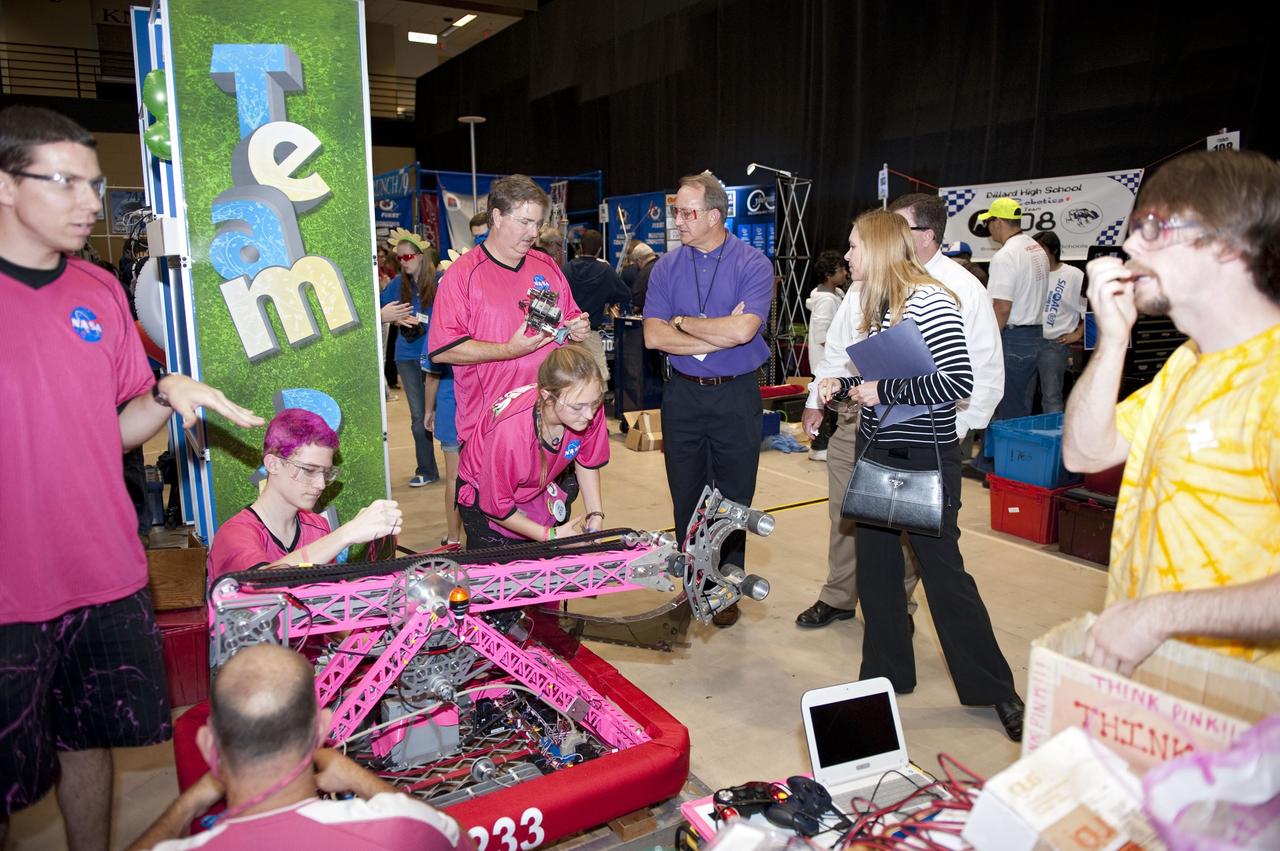
ORLANDO, Fla. – The Pink Team participates in the regional FIRST robotics competition at the University of Central Florida in Orlando. The team is made up of students from Rockledge, Cocoa Beach and Viera high schools along the Space Coast of Florida. NASA’s Kennedy Space Center is a sponsor of the team. The Pink Team finished sixth in the competition called "For Inspiration and Recognition of Science and Technology," or FIRST, among about 60 high school teams hoping to advance to the national robotics championship. The team also took home the Industrial Design Award sponsored by General Motors. Kennedy's Deputy Director Janet Petro and Engineering Director Pat Simpkins also stopped by the competition to encourage the teams. FIRST, founded in 1989, is a non-profit organization that designs accessible, innovative programs to build self-confidence, knowledge and life skills while motivating young people to pursue academic opportunities. The robotics competition challenges teams of high school students and their mentors to solve a common problem in a six-week timeframe using a standard kit of parts and a common set of rules. Photo credit: NASA/Glenn Benson
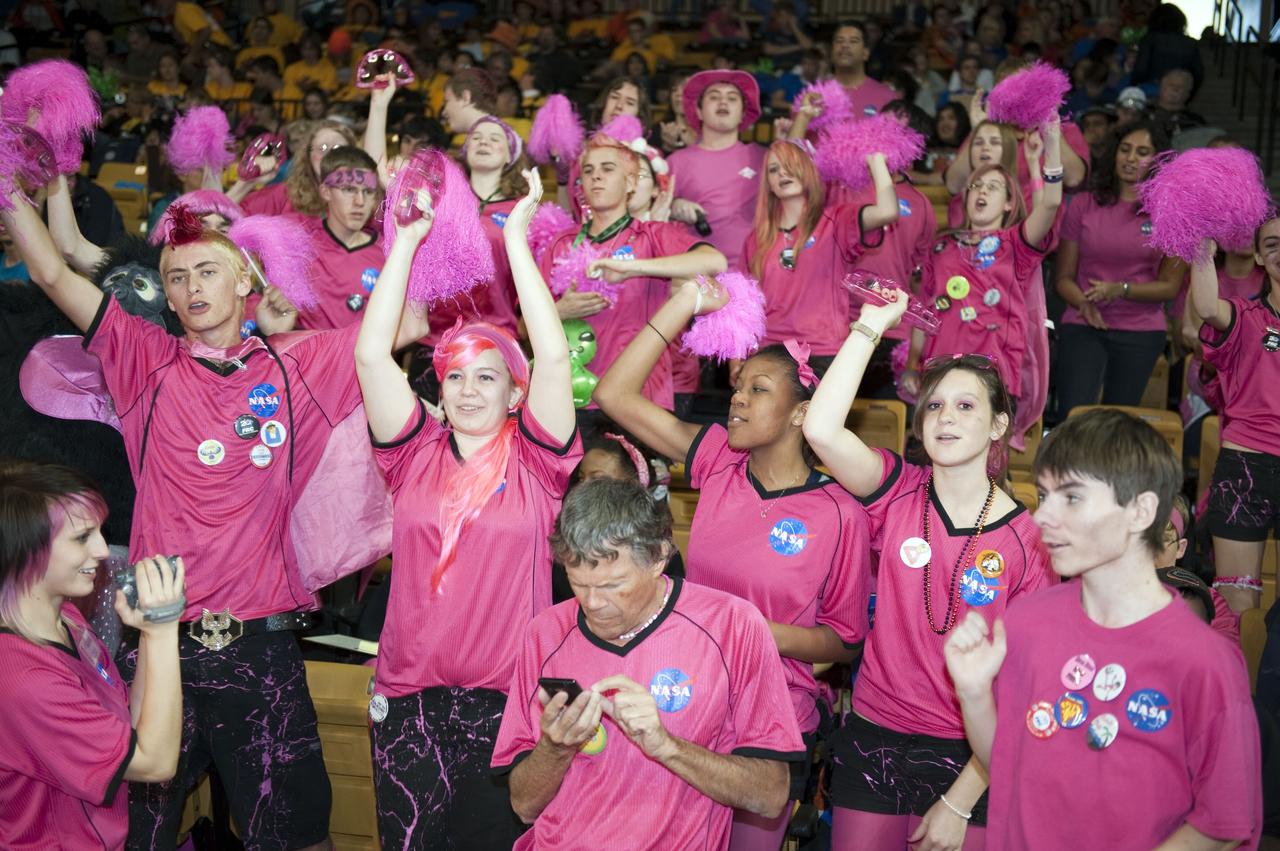
ORLANDO, Fla. – The Pink Team participates in the regional FIRST robotics competition at the University of Central Florida in Orlando. The team is made up of students from Rockledge, Cocoa Beach and Viera high schools along the Space Coast of Florida. NASA’s Kennedy Space Center is a sponsor of the team. The Pink Team finished sixth in the competition called "For Inspiration and Recognition of Science and Technology," or FIRST, among about 60 high school teams hoping to advance to the national robotics championship. The team also took home the Industrial Design Award sponsored by General Motors. FIRST, founded in 1989, is a non-profit organization that designs accessible, innovative programs to build self-confidence, knowledge and life skills while motivating young people to pursue academic opportunities. The robotics competition challenges teams of high school students and their mentors to solve a common problem in a six-week timeframe using a standard kit of parts and a common set of rules. Photo credit: NASA/Glenn Benson
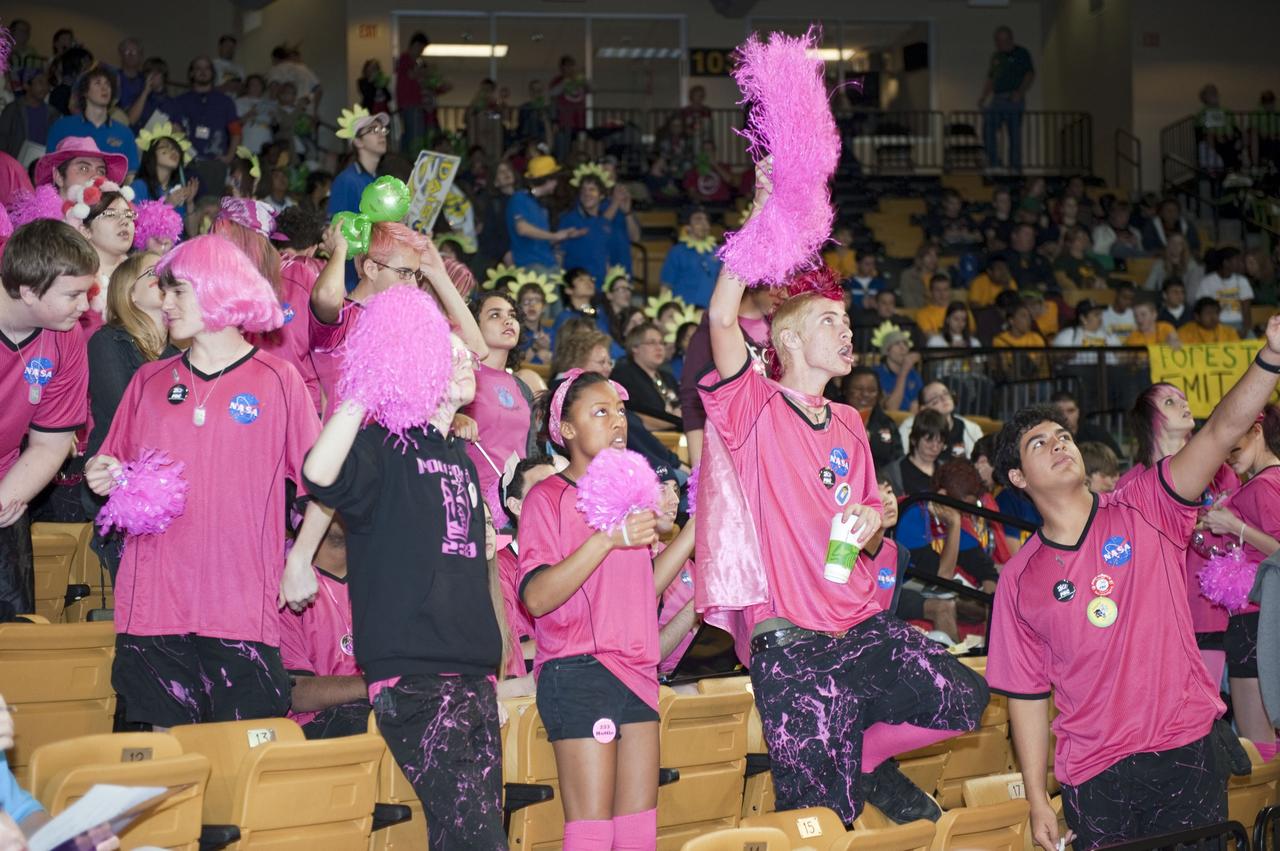
ORLANDO, Fla. – The Pink Team participates in the regional FIRST robotics competition at the University of Central Florida in Orlando. The team is made up of students from Rockledge, Cocoa Beach and Viera high schools along the Space Coast of Florida. NASA’s Kennedy Space Center is a sponsor of the team. The Pink Team finished sixth in the competition called "For Inspiration and Recognition of Science and Technology," or FIRST, among about 60 high school teams hoping to advance to the national robotics championship. The team also took home the Industrial Design Award sponsored by General Motors. FIRST, founded in 1989, is a non-profit organization that designs accessible, innovative programs to build self-confidence, knowledge and life skills while motivating young people to pursue academic opportunities. The robotics competition challenges teams of high school students and their mentors to solve a common problem in a six-week timeframe using a standard kit of parts and a common set of rules. Photo credit: NASA/Glenn Benson
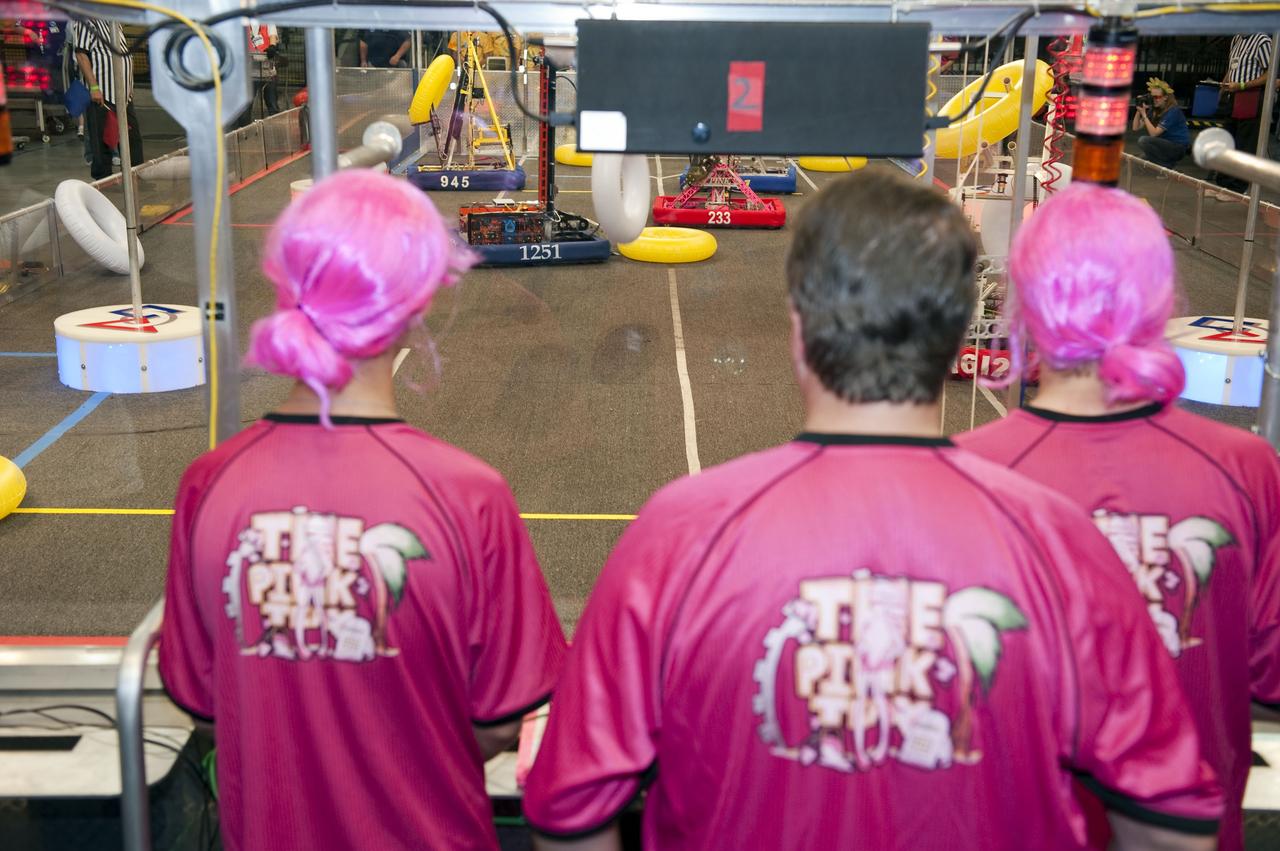
ORLANDO, Fla. – The Pink Team participates in the regional FIRST robotics competition at the University of Central Florida in Orlando. The team is made up of students from Rockledge, Cocoa Beach and Viera high schools along the Space Coast of Florida. NASA’s Kennedy Space Center is a sponsor of the team. The Pink Team finished sixth in the competition called "For Inspiration and Recognition of Science and Technology," or FIRST, among about 60 high school teams hoping to advance to the national robotics championship. The team also took home the Industrial Design Award sponsored by General Motors. FIRST, founded in 1989, is a non-profit organization that designs accessible, innovative programs to build self-confidence, knowledge and life skills while motivating young people to pursue academic opportunities. The robotics competition challenges teams of high school students and their mentors to solve a common problem in a six-week timeframe using a standard kit of parts and a common set of rules. Photo credit: NASA/Glenn Benson
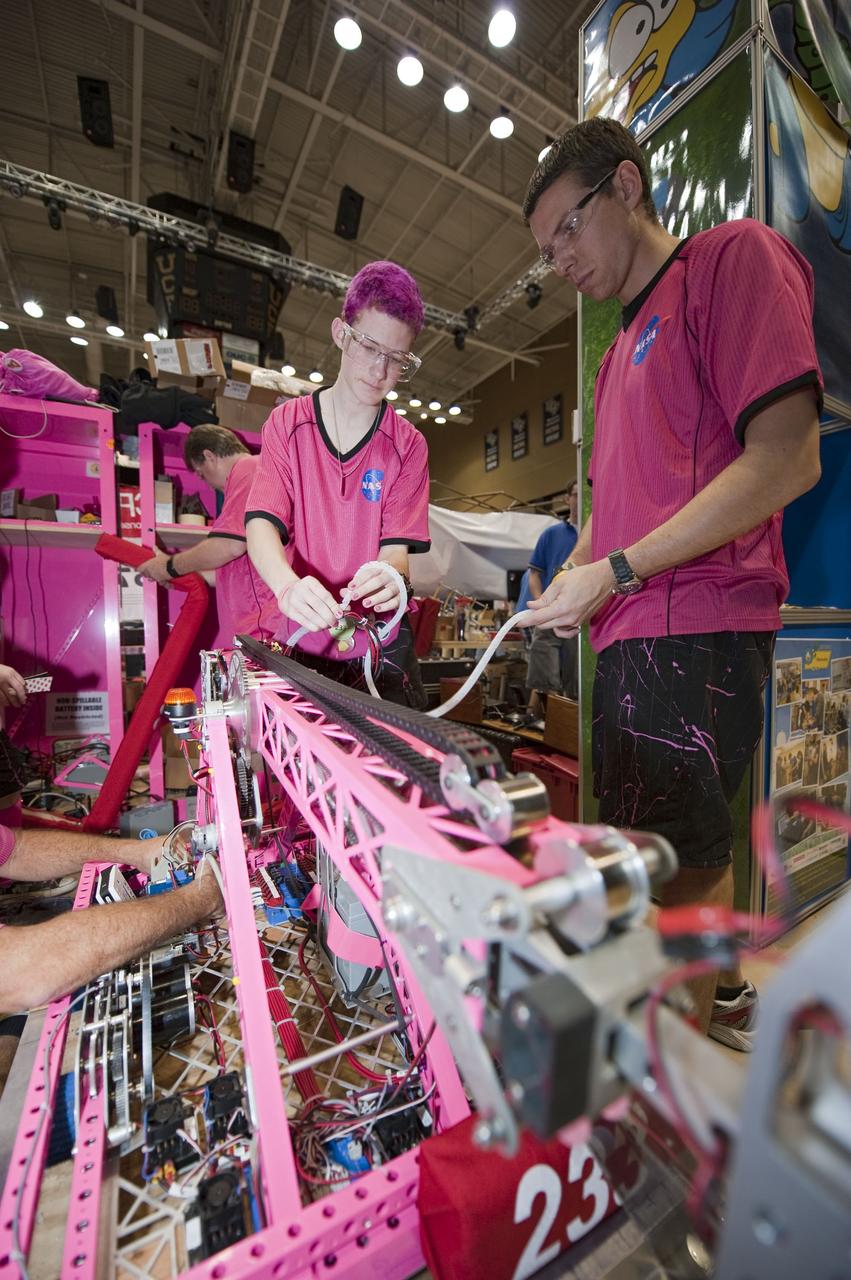
KENNEDY SPACE CENTER, FLA. - During the 2006 FIRST Robotics Regional Competition held March 9-11 at the University of Central Florida in Orlando, members of the "Pink Team" prepare their robot, Roccobot. The Pink Team comprises students from Rockledge High and Cocoa Beach High Schools and is co-sponsored by NASA KSC. The FIRST Robotics Competition challenges teams of young people and their mentors to solve a common problem in a six-week timeframe using a standard "kit of parts" and a common set of rules. Teams build robots from the parts and enter them in a series of competitions. FIRST, which is based on "For Inspiration and Recognition of Science and Technology," redefines winning for these students. Teams are rewarded for excellence in design, demonstrated team spirit, gracious professionalism and maturity, and ability to overcome obstacles. Scoring the most points is a secondary goal. Winning means building partnerships that last. NASA and the University of Central Florida are co-sponsors of the regional event, which this year included more than 50 teams. Photo credit: NASA/Kim Shiflett
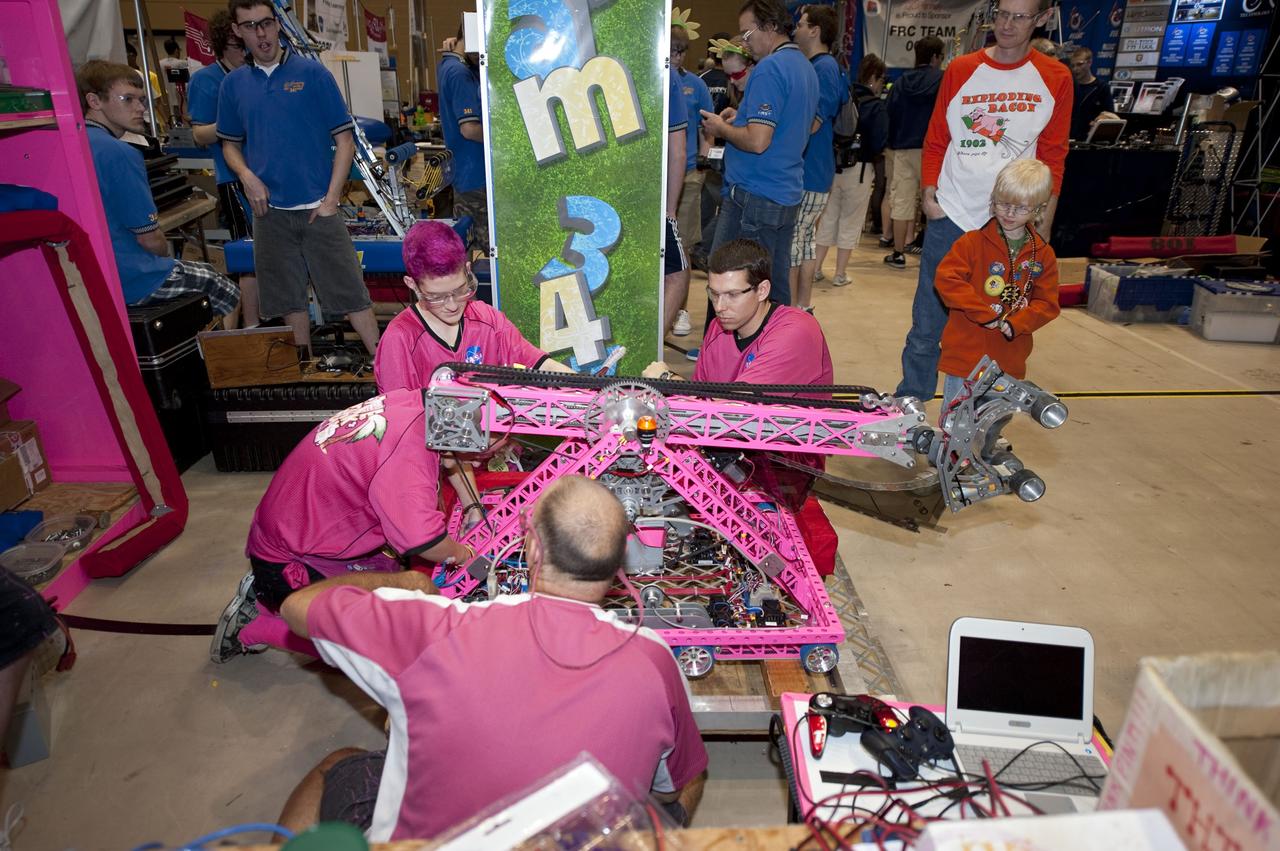
ORLANDO, Fla. – The Pink Team participates in the regional FIRST robotics competition at the University of Central Florida in Orlando. The team is made up of students from Rockledge, Cocoa Beach and Viera high schools along the Space Coast of Florida. NASA’s Kennedy Space Center is a sponsor of the team. The Pink Team finished sixth in the competition called "For Inspiration and Recognition of Science and Technology," or FIRST, among about 60 high school teams hoping to advance to the national robotics championship. The team also took home the Industrial Design Award sponsored by General Motors. FIRST, founded in 1989, is a non-profit organization that designs accessible, innovative programs to build self-confidence, knowledge and life skills while motivating young people to pursue academic opportunities. The robotics competition challenges teams of high school students and their mentors to solve a common problem in a six-week timeframe using a standard kit of parts and a common set of rules. Photo credit: NASA/Glenn Benson
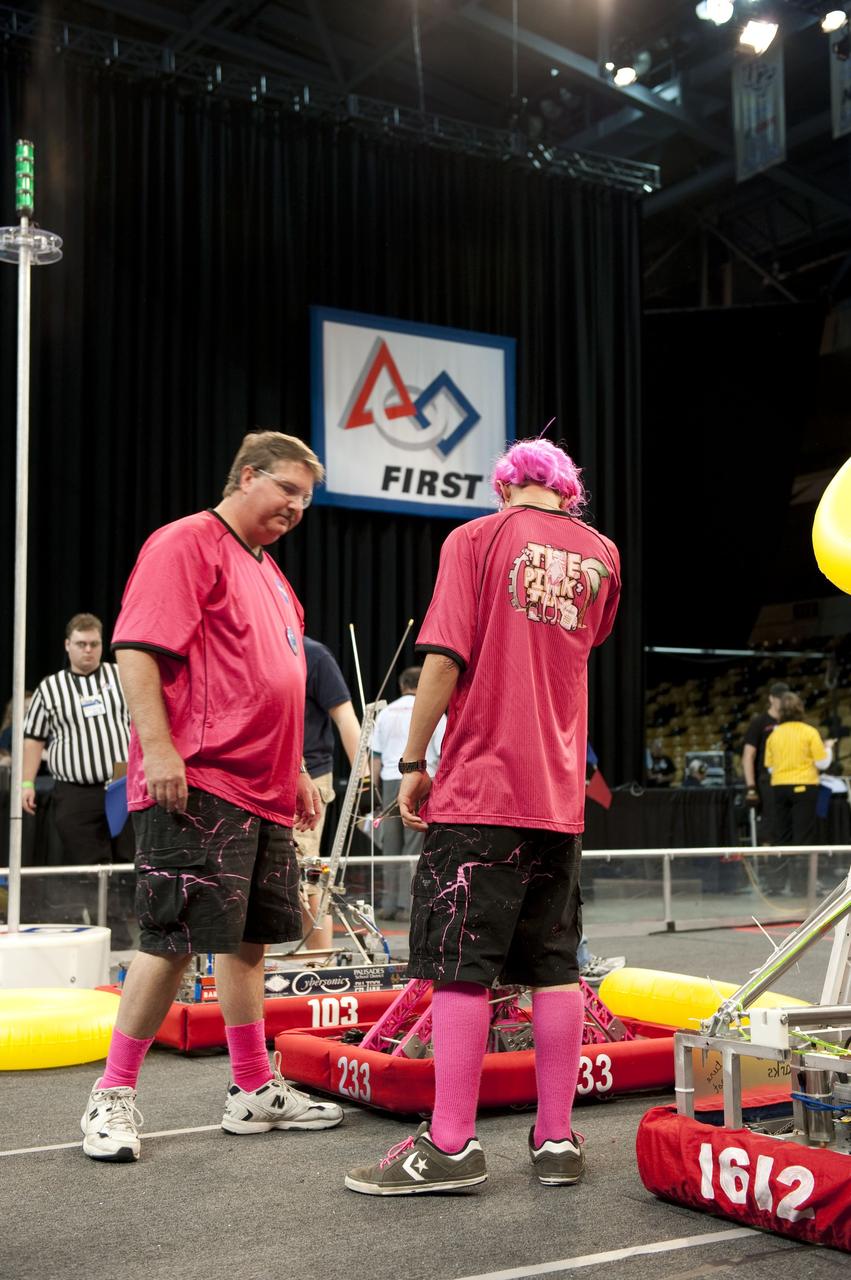
ORLANDO, Fla. – The Pink Team participates in the regional FIRST robotics competition at the University of Central Florida in Orlando. The team is made up of students from Rockledge, Cocoa Beach and Viera high schools along the Space Coast of Florida. NASA’s Kennedy Space Center is a sponsor of the team. The Pink Team finished sixth in the competition called "For Inspiration and Recognition of Science and Technology," or FIRST, among about 60 high school teams hoping to advance to the national robotics championship. The team also took home the Industrial Design Award sponsored by General Motors. FIRST, founded in 1989, is a non-profit organization that designs accessible, innovative programs to build self-confidence, knowledge and life skills while motivating young people to pursue academic opportunities. The robotics competition challenges teams of high school students and their mentors to solve a common problem in a six-week timeframe using a standard kit of parts and a common set of rules. Photo credit: NASA/Glenn Benson
ORLANDO, Fla. – The Pink Team participates in the regional FIRST robotics competition at the University of Central Florida in Orlando. The team is made up of students from Rockledge, Cocoa Beach and Viera high schools along the Space Coast of Florida. NASA’s Kennedy Space Center is a sponsor of the team. The Pink Team finished sixth in the competition called "For Inspiration and Recognition of Science and Technology," or FIRST, among about 60 high school teams hoping to advance to the national robotics championship. The team also took home the Industrial Design Award sponsored by General Motors. FIRST, founded in 1989, is a non-profit organization that designs accessible, innovative programs to build self-confidence, knowledge and life skills while motivating young people to pursue academic opportunities. The robotics competition challenges teams of high school students and their mentors to solve a common problem in a six-week timeframe using a standard kit of parts and a common set of rules. Photo credit: NASA/Glenn Benson

KENNEDY SPACE CENTER, FLA. - Rey More, senior vice president and general manager of Motorola’s iDEN® Subscriber Group, and Kennedy Space Center Director Jim Kennedy (right) get together at the 2005 FIRST Robotics Regional Competition held at the University of Central Florida March 10-12. Motorola sponsored the SigmaC@T team, from Ft. Lauderdale and was a major sponsor of the competition. NASA sponsored the Pink Team, Roccobot, from Rockledge and Cocoa Beach.
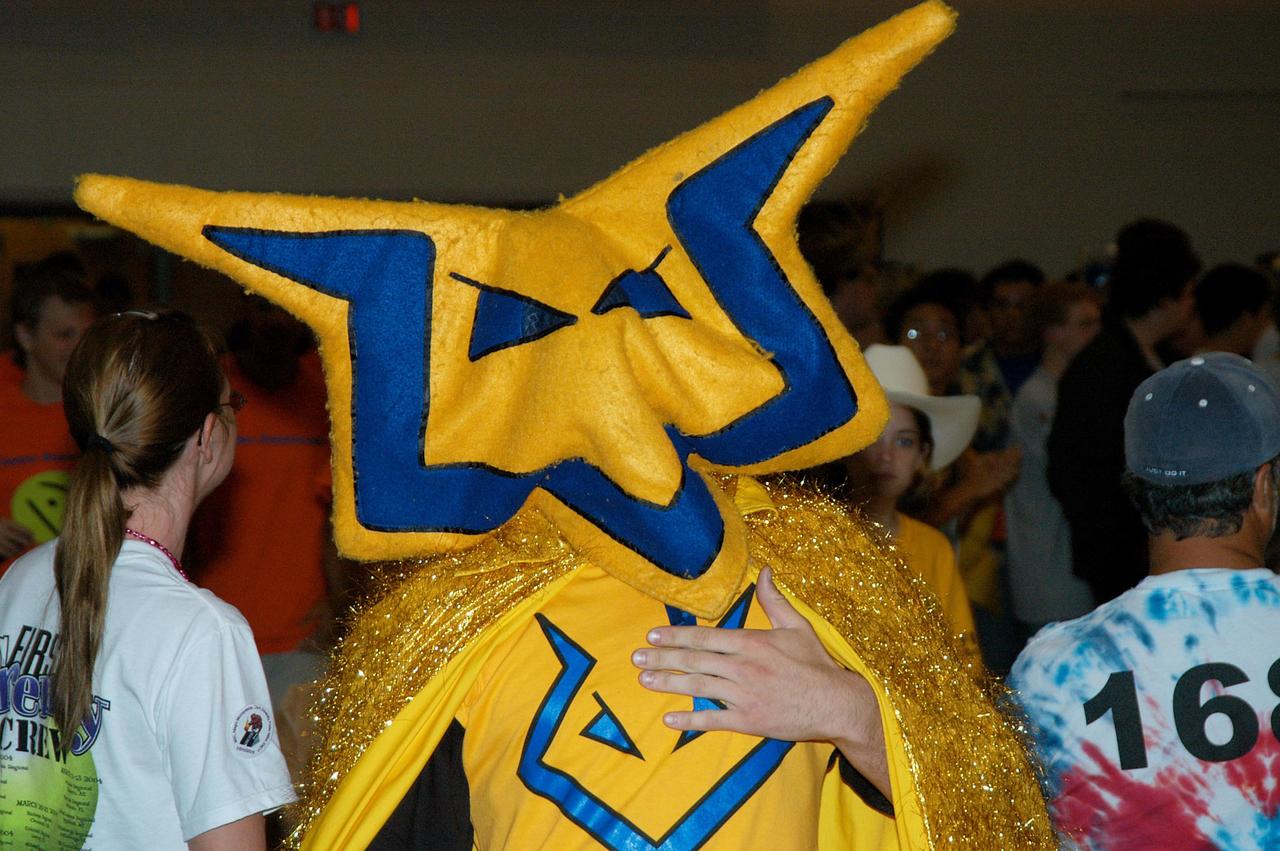
KENNEDY SPACE CENTER, FLA. - A closeup of the team mascot of the Central Florida robotic team “Voltage” at the 2004 Florida Regional FIRST competition, held at the University of Central Florida. Among the 41 teams competing from Canada, Brazil, Great Britain and the United States is the KSC-sponsored “Pink” team. FIRST is a nonprofit organization, For Inspiration and Recognition of Science and Technology, that sponsors the event pitting robots against each other in an athletic-style competition. The FIRST robotics competition is designed to provide students with a hands-on, inside look at engineering and other professional careers, pairing high school students with engineer mentors and corporations.
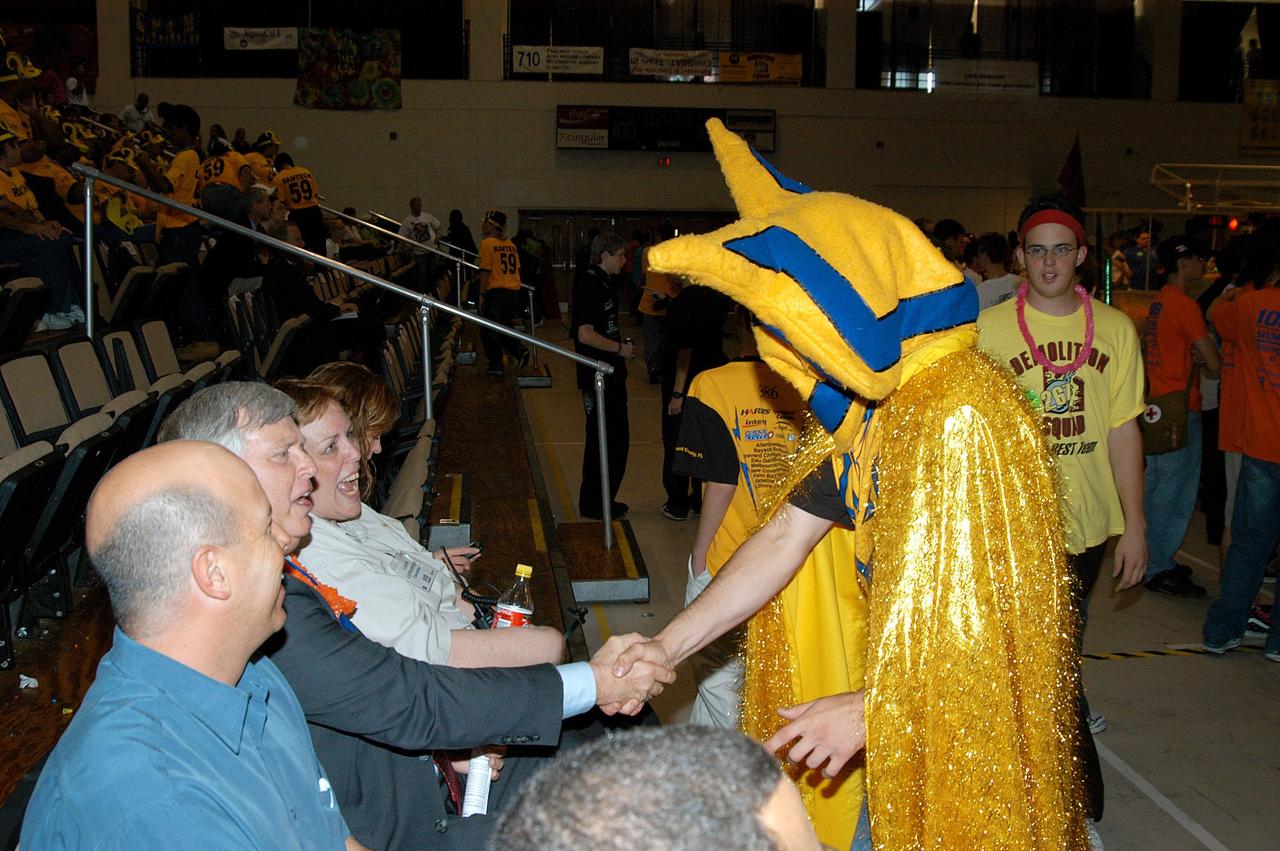
KENNEDY SPACE CENTER, FLA. - The team mascot of the Central Florida robotic team “Voltage” greets Center Director Jim Kennedy during a match at the 2004 Florida Regional FIRST competition, held at the University of Central Florida. Among the 41 teams competing from Canada, Brazil, Great Britain and the United States is the KSC-sponsored “Pink” team. FIRST is a nonprofit organization, For Inspiration and Recognition of Science and Technology, that sponsors the event pitting robots against each other in an athletic-style competition. The FIRST robotics competition is designed to provide students with a hands-on, inside look at engineering and other professional careers, pairing high school students with engineer mentors and corporations.
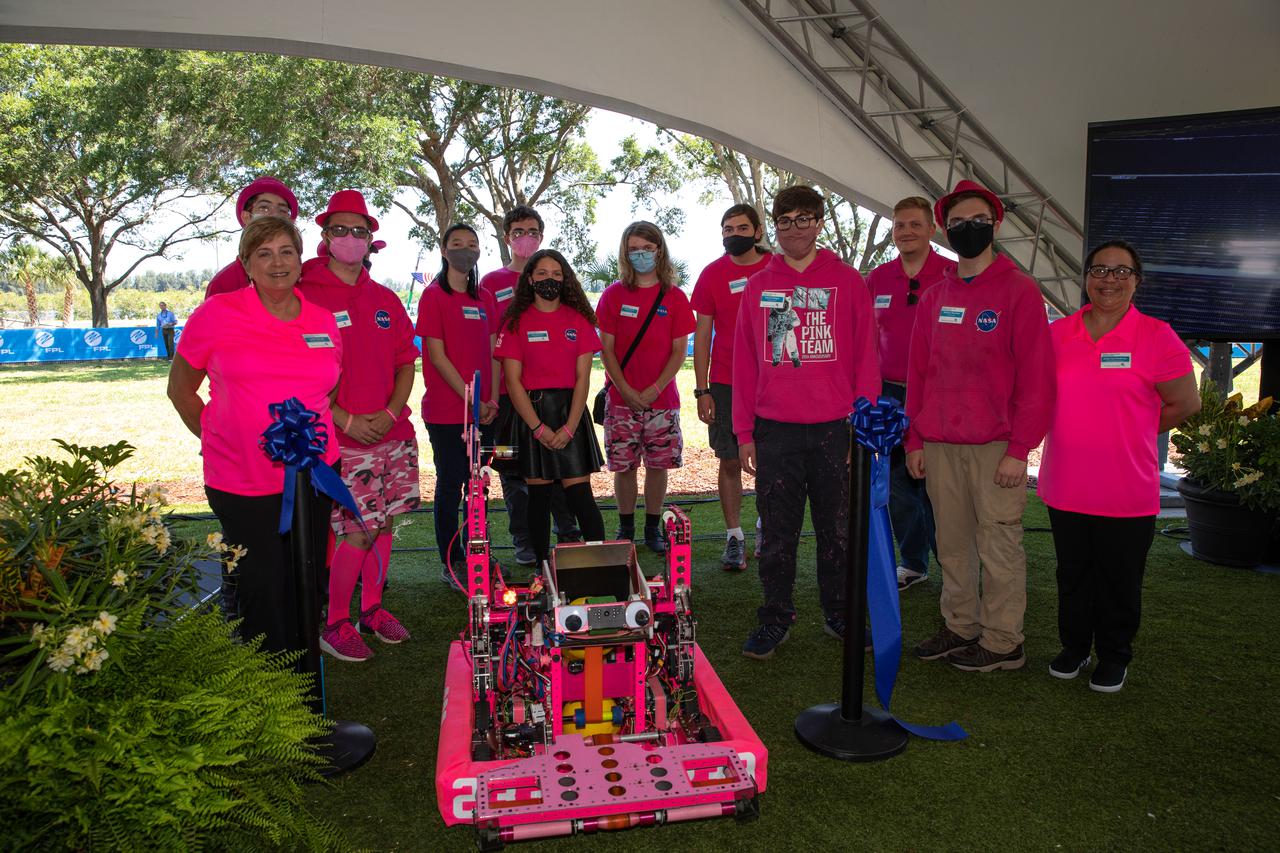
Students and faculty from Rockledge High School’s Pink Team, a robotics team mentored by NASA engineers, pose for a photo at NASA’s Kennedy Space Center Visitor Complex in Florida on June 11, 2021. Using the school’s 2021 competition robot – affectionately named “Pinky” – the Pink Team re-engineered their robot to carry a large pair of scissors to cut the ceremonial ribbon for the Florida Power and Light’s (FPL) Discovery Solar Energy Center becoming operational at the center. Discovery Solar Energy Center is a 74.5-megawatt solar site, spanning 491 acres at the spaceport. The site contains about 250,000 solar panels in total, producing enough energy to power approximately 15,000 homes. Harnessing energy from the Sun, the panels do not directly power anything at Kennedy, but rather, send energy directly to FPL's electricity grid for distribution to existing customers. Construction began in spring 2020, and the energy center became fully operational on May 30, 2021.
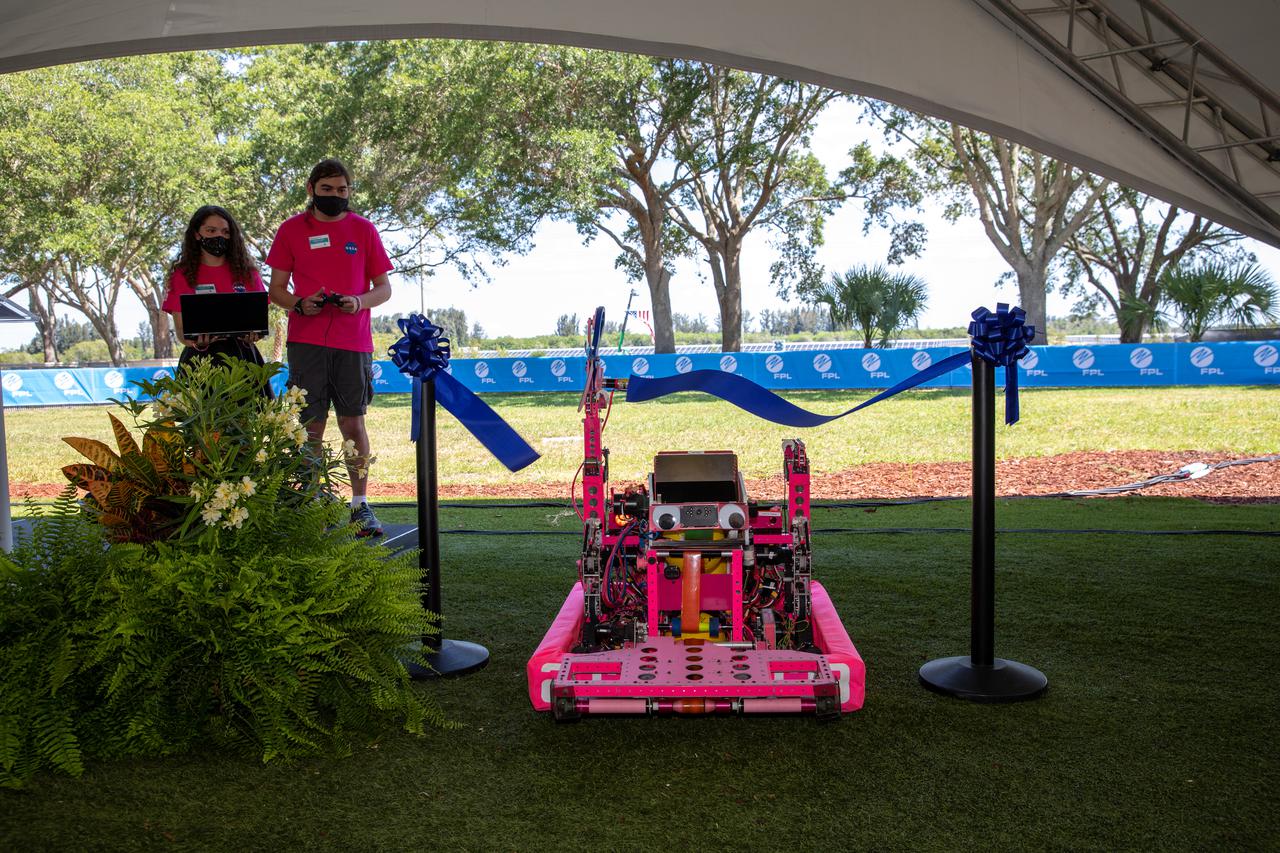
Students from Rockledge High School’s Pink Team, a robotics team mentored by NASA engineers, control the school’s 2021 competition robot – affectionately named “Pinky” – as it cuts the ceremonial ribbon to commemorate the Florida Power and Light’s (FPL) Discovery Solar Energy Center becoming operational at NASA’s Kennedy Space Center in Florida on June 11, 2021. The Pink Team re-engineered their robot to carry a large pair of scissors specifically for the ceremony, which took place at the center’s Visitor Complex. Discovery Solar Energy Center is a 74.5-megawatt solar site, spanning 491 acres at the spaceport. The site contains about 250,000 solar panels in total, producing enough energy to power approximately 15,000 homes. Harnessing energy from the Sun, the panels do not directly power anything at Kennedy, but rather, send energy directly to FPL's electricity grid for distribution to existing customers. Construction began in spring 2020, and the energy center became fully operational on May 30, 2021.

KENNEDY SPACE CENTER, FLA. - During the 2006 FIRST Robotics Regional Competition held March 9-11 at the University of Central Florida in Orlando, the "Pink Team," whose robot is named Roccobot and is co-sponsored by NASA KSC, stands for recognition. The FIRST Robotics Competition challenges teams of young people and their mentors to solve a common problem in a six-week timeframe using a standard "kit of parts" and a common set of rules. Teams build robots from the parts and enter them in a series of competitions. FIRST, which is based on "For Inspiration and Recognition of Science and Technology," redefines winning for these students. Teams are rewarded for excellence in design, demonstrated team spirit, gracious professionalism and maturity, and ability to overcome obstacles. Scoring the most points is a secondary goal. Winning means building partnerships that last. NASA and the University of Central Florida are co-sponsors of the regional event, which this year included more than 50 teams. Photo credit: NASA/Kim Shiflett
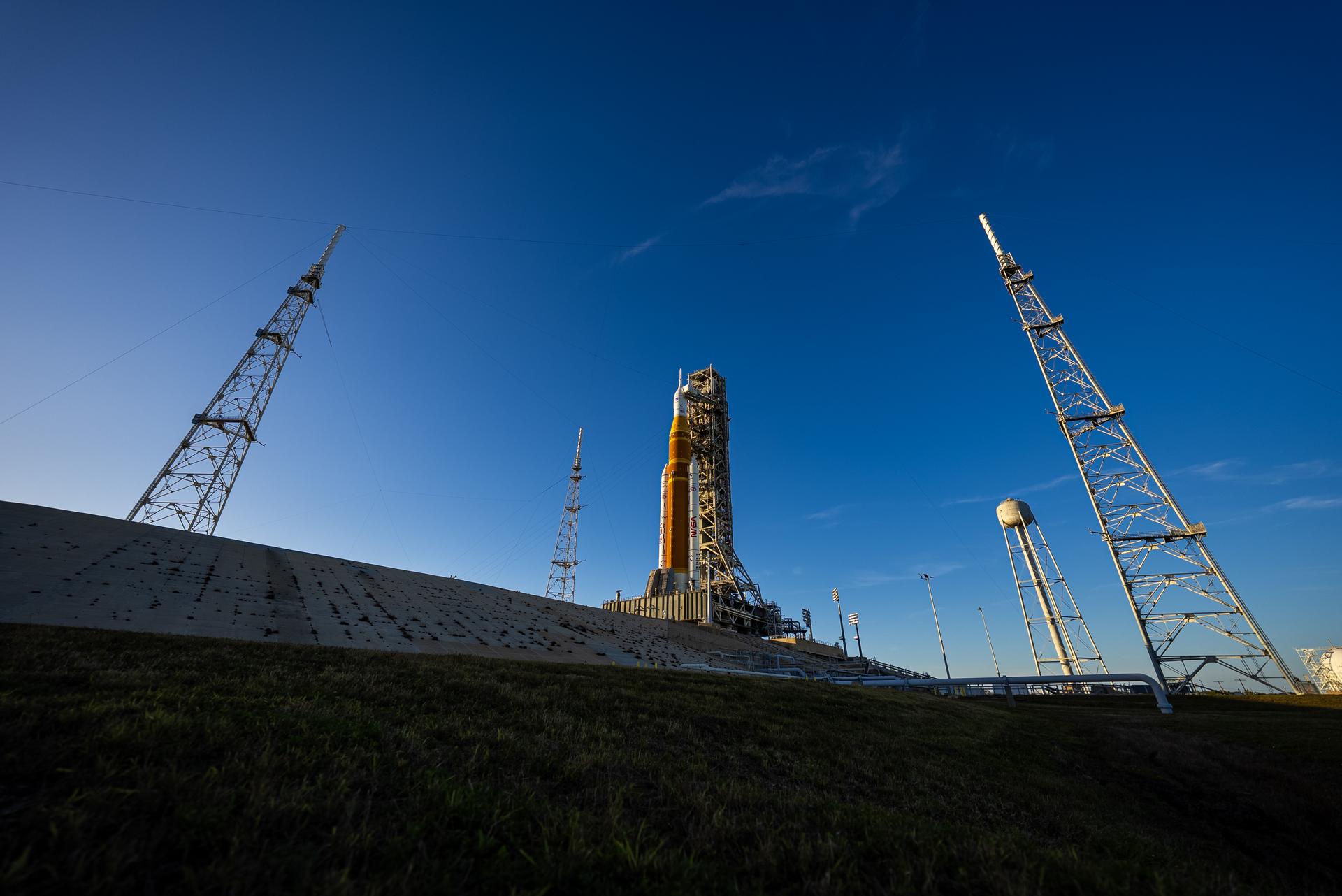
The sun sets on NASA’s Space Launch System (SLS) rocket and Orion spacecraft as they stand fully assembled atop the mobile launcher at Launch Pad 39B at NASA’s Kennedy Space Center in Florida. The sky glows with warm shades of orange and pink, silhouetting the towering rocket and its solid rocket boosters against the fading light. Photographed on January 31, 2026, the scene captures teams preparing for a wet dress rehearsal for the Artemis II mission, rehearsing launch countdown timelines and procedures as day turns to night.
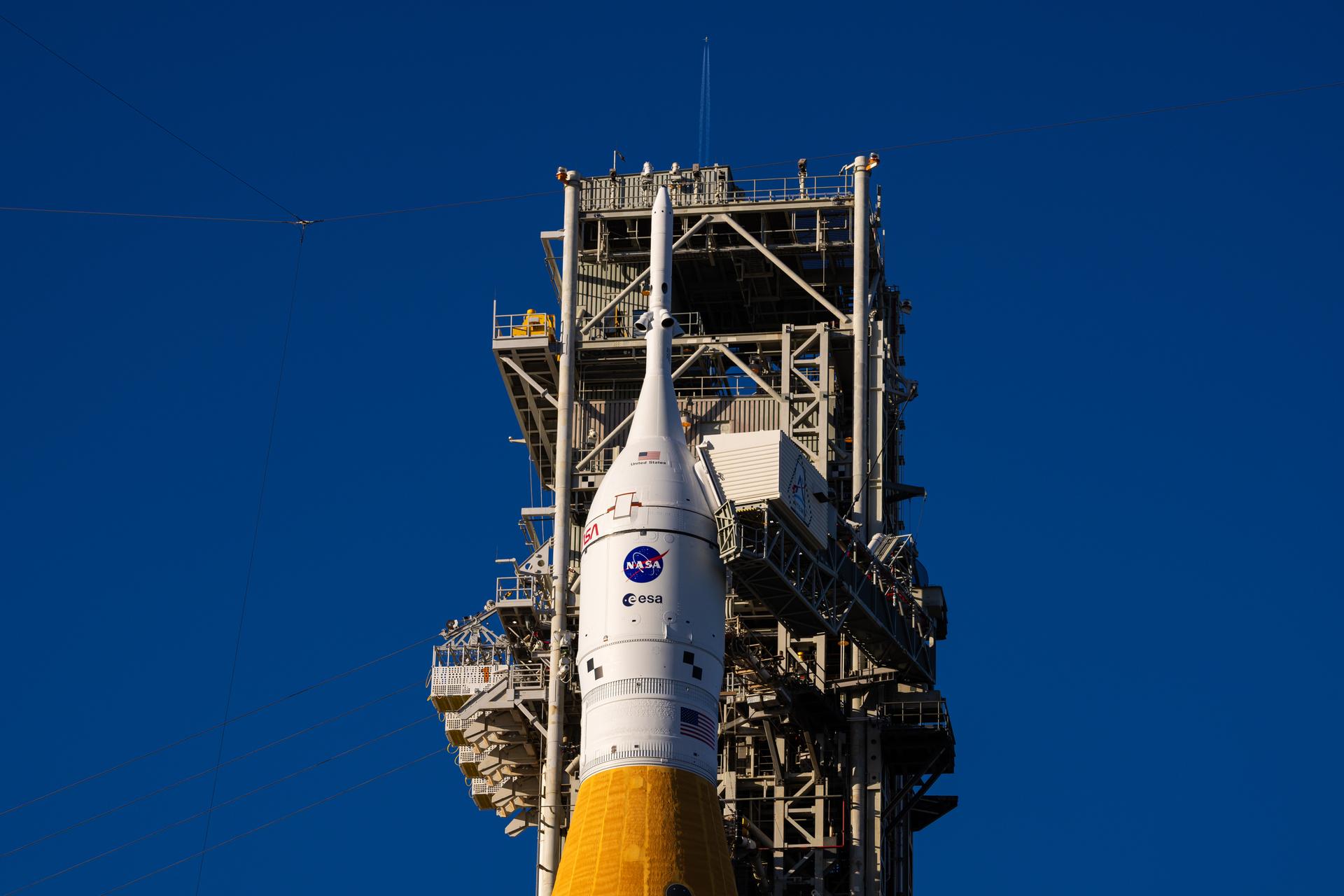
The sun sets on NASA’s Space Launch System (SLS) rocket and Orion spacecraft as they stand fully assembled atop the mobile launcher at Launch Pad 39B at NASA’s Kennedy Space Center in Florida. The sky glows with warm shades of orange and pink, silhouetting the towering rocket and its solid rocket boosters against the fading light. Photographed on January 31, 2026, the scene captures teams preparing for a wet dress rehearsal for the Artemis II mission, rehearsing launch countdown timelines and procedures as day turns to night.
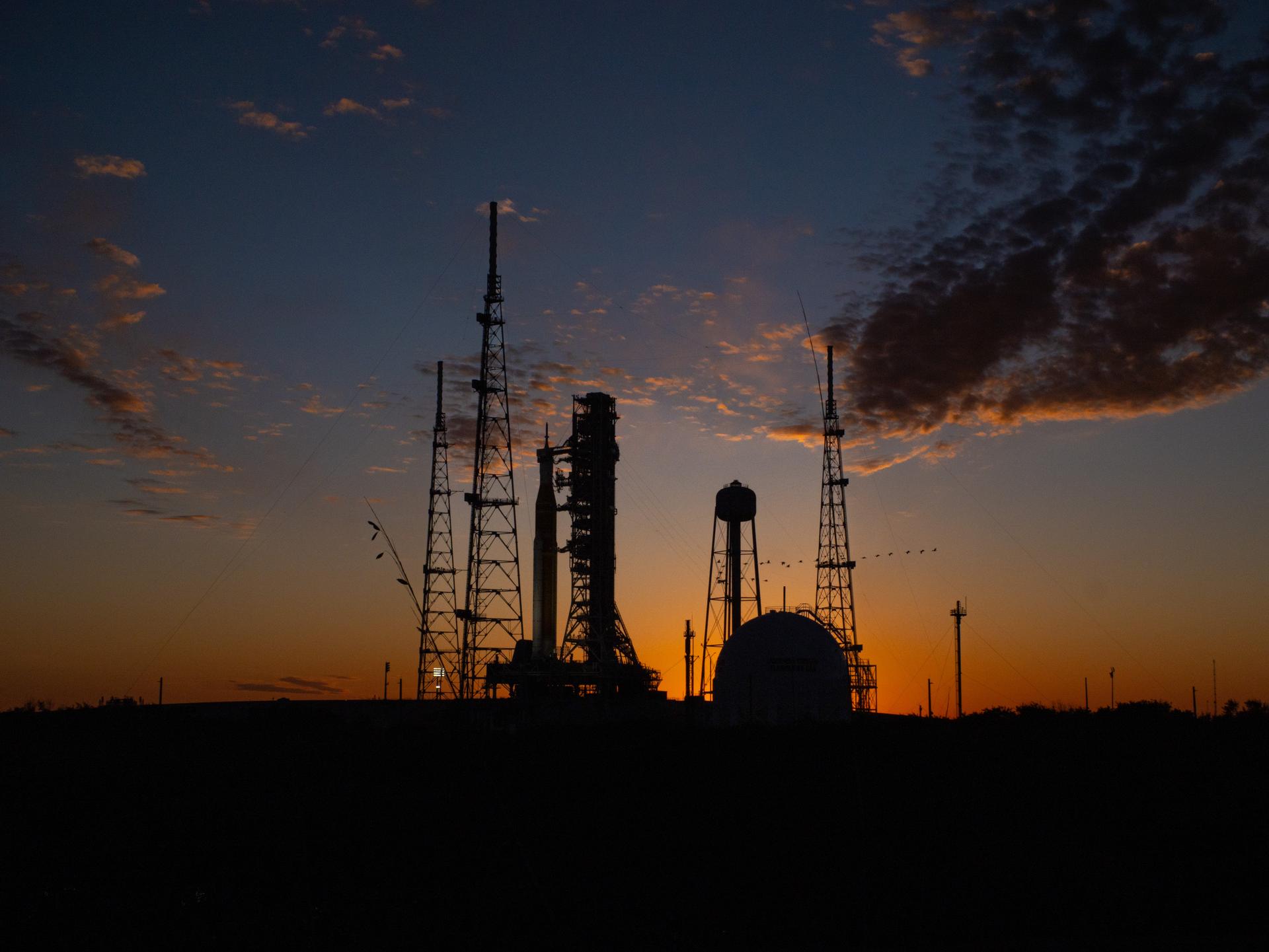
The sun sets behind NASA’s Space Launch System (SLS) rocket and Orion spacecraft as they stand fully assembled atop the mobile launcher at Launch Pad 39B at NASA’s Kennedy Space Center in Florida. The sky glows with warm shades of orange and pink, silhouetting the towering rocket and its solid rocket boosters against the fading light. Photographed on January 31, 2026, the scene captures teams preparing for a wet dress rehearsal for the Artemis II mission, rehearsing launch countdown timelines and procedures as day turns to night.
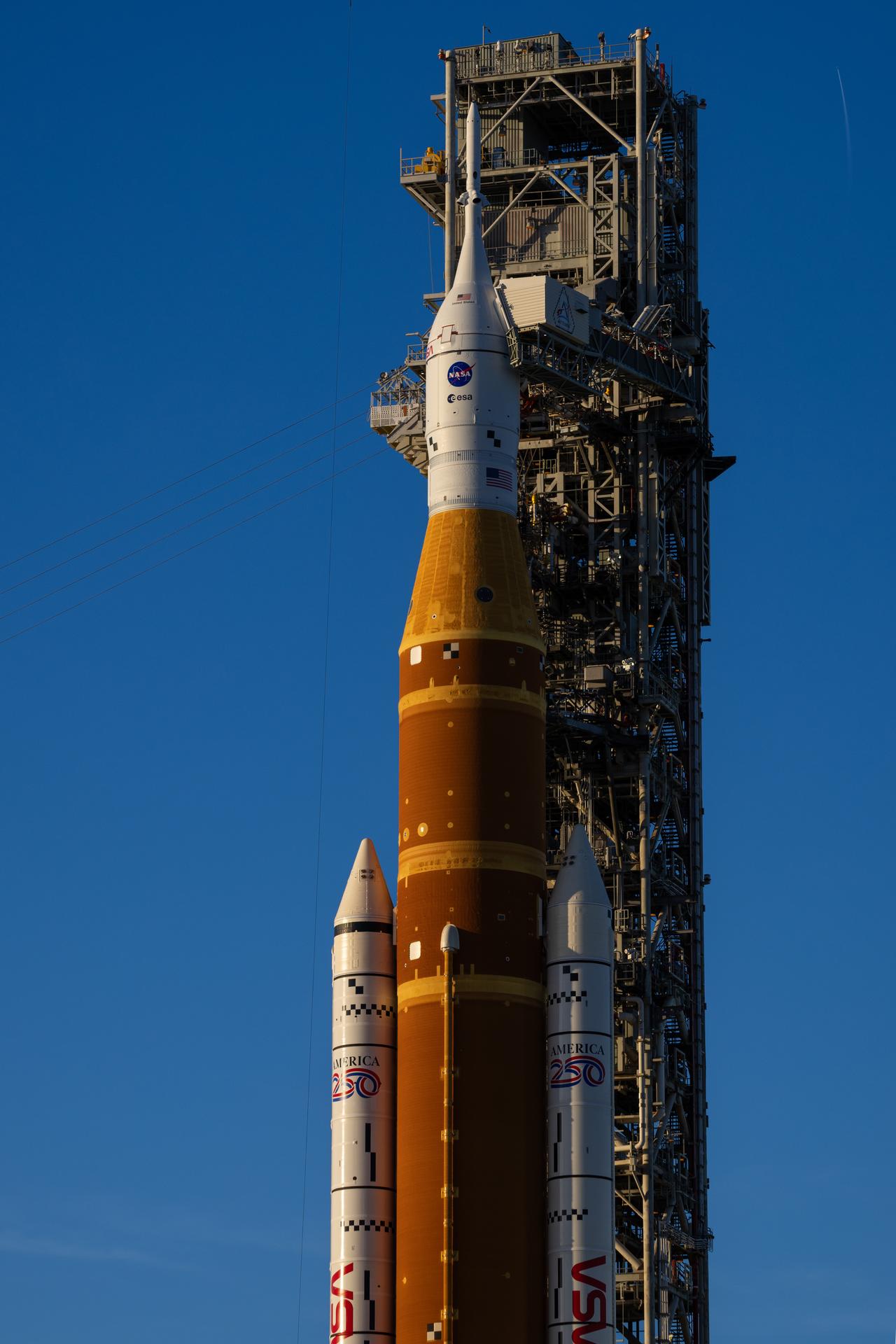
The sun sets on NASA’s Space Launch System (SLS) rocket and Orion spacecraft as they stand fully assembled atop the mobile launcher at Launch Pad 39B at NASA’s Kennedy Space Center in Florida. The sky glows with warm shades of orange and pink, silhouetting the towering rocket and its solid rocket boosters against the fading light. Photographed on January 31, 2026, the scene captures teams preparing for a wet dress rehearsal for the Artemis II mission, rehearsing launch countdown timelines and procedures as day turns to night.
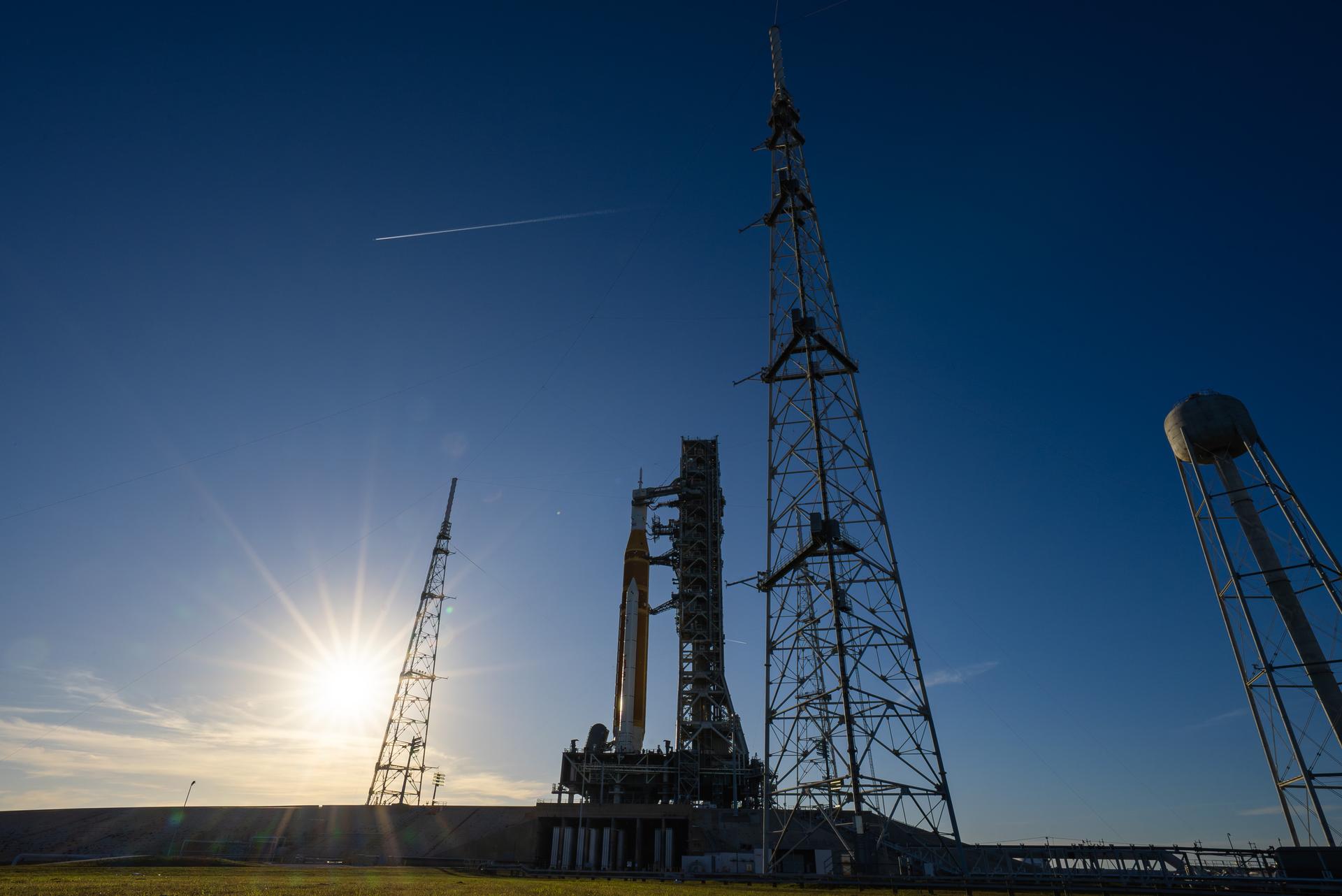
The sun sets on NASA’s Space Launch System (SLS) rocket and Orion spacecraft as they stand fully assembled atop the mobile launcher at Launch Pad 39B at NASA’s Kennedy Space Center in Florida. The sky glows with warm shades of orange and pink, silhouetting the towering rocket and its solid rocket boosters against the fading light. Photographed on January 31, 2026, the scene captures teams preparing for a wet dress rehearsal for the Artemis II mission, rehearsing launch countdown timelines and procedures as day turns to night.
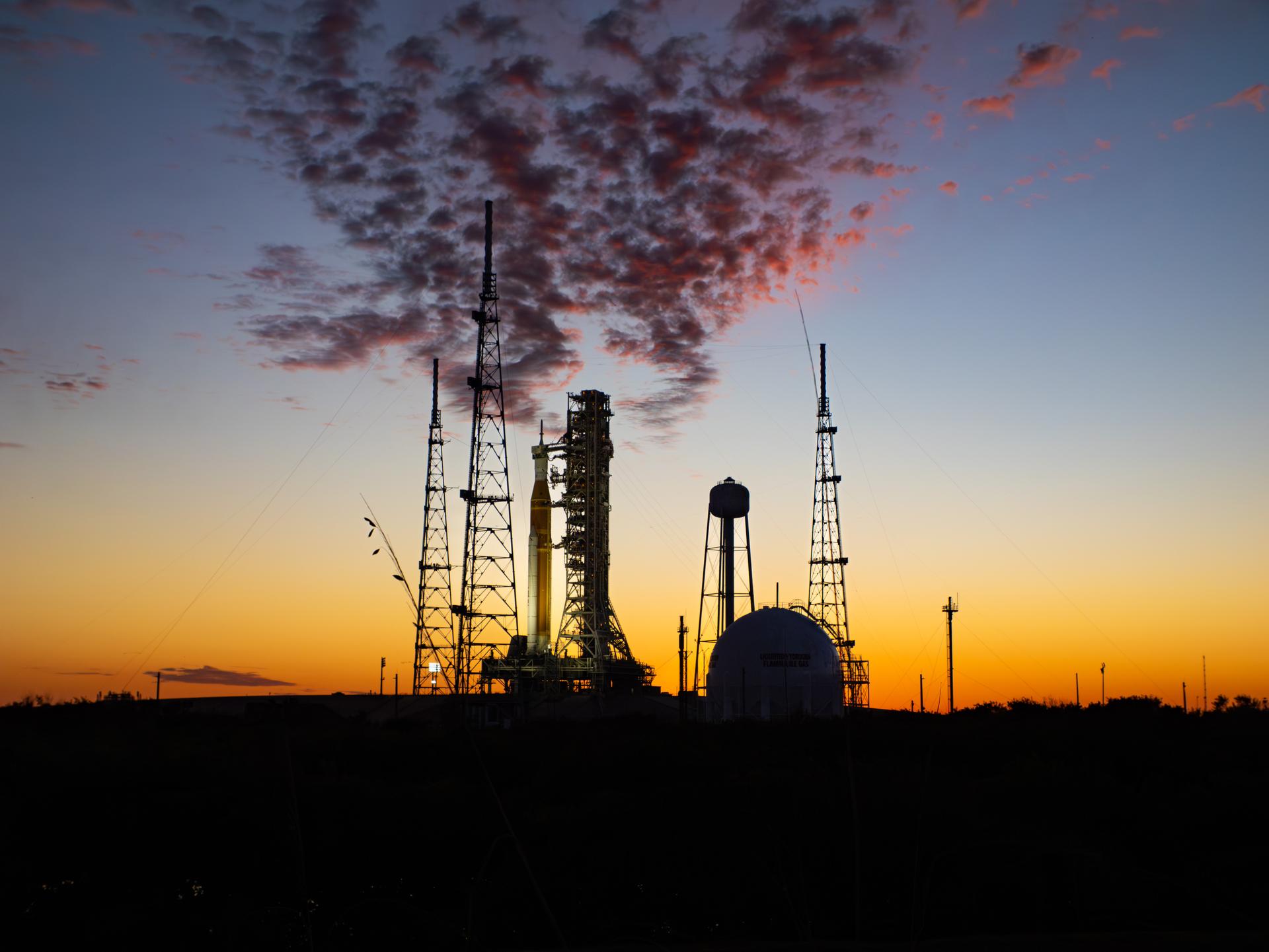
The sun sets behind NASA’s Space Launch System (SLS) rocket and Orion spacecraft as they stand fully assembled atop the mobile launcher at Launch Pad 39B at NASA’s Kennedy Space Center in Florida. The sky glows with warm shades of orange and pink, silhouetting the towering rocket and its solid rocket boosters against the fading light. Photographed on January 31, 2026, the scene captures teams preparing for a wet dress rehearsal for the Artemis II mission, rehearsing launch countdown timelines and procedures as day turns to night.
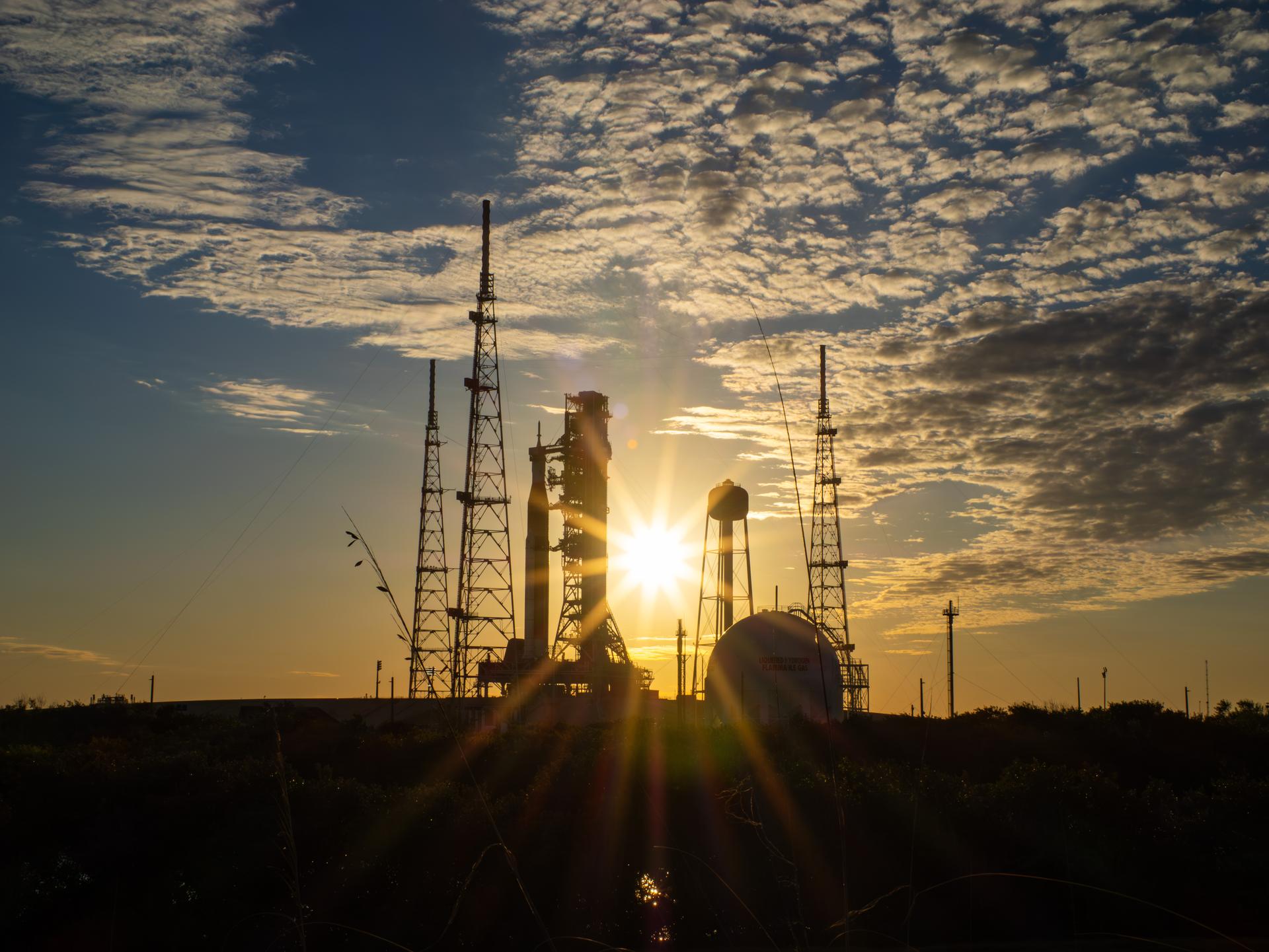
The sun sets behind NASA’s Space Launch System (SLS) rocket and Orion spacecraft as they stand fully assembled atop the mobile launcher at Launch Pad 39B at NASA’s Kennedy Space Center in Florida. The sky glows with warm shades of orange and pink, silhouetting the towering rocket and its solid rocket boosters against the fading light. Photographed on January 31, 2026, the scene captures teams preparing for a wet dress rehearsal for the Artemis II mission, rehearsing launch countdown timelines and procedures as day turns to night.
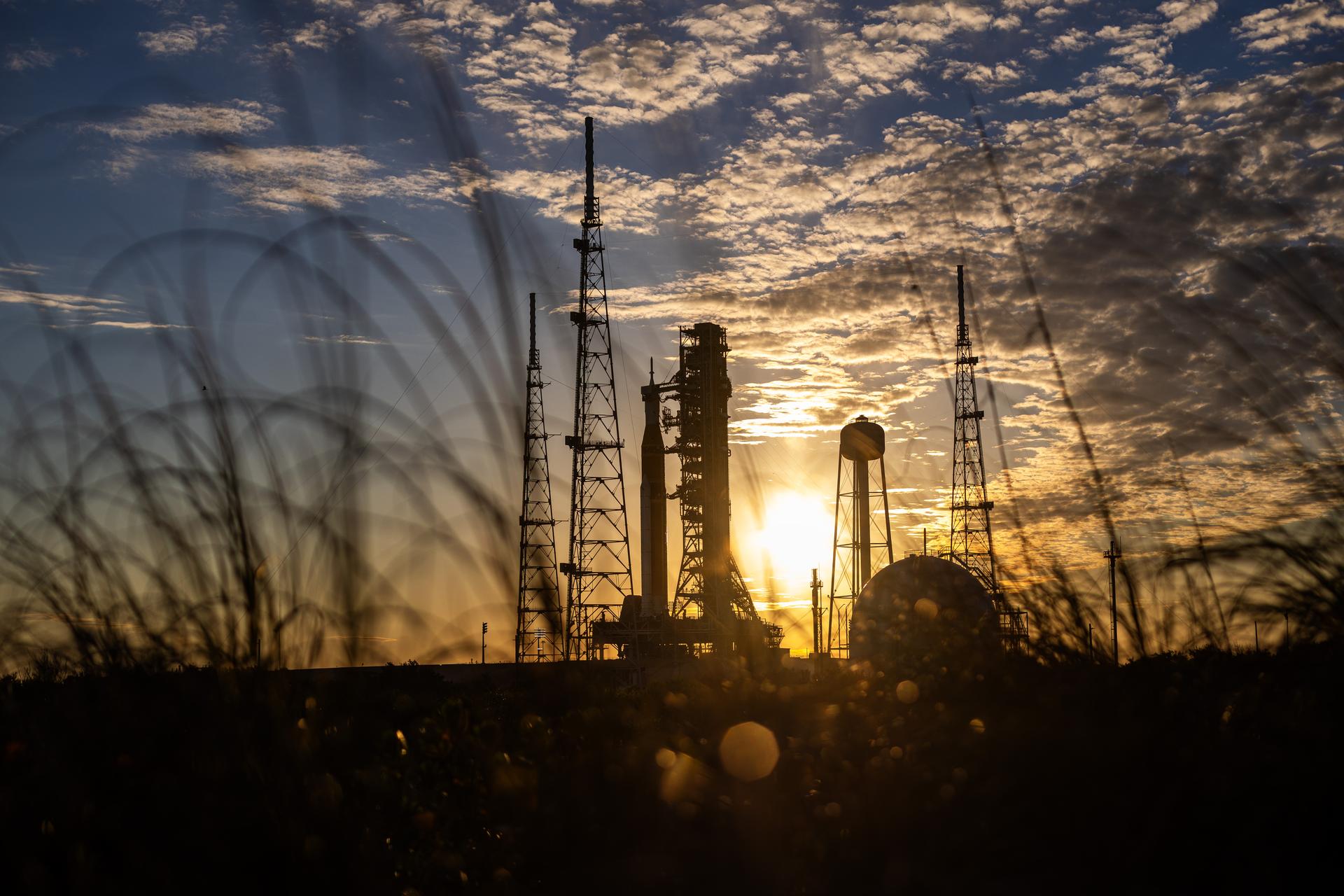
The sun sets behind NASA’s Space Launch System (SLS) rocket and Orion spacecraft as they stand fully assembled atop the mobile launcher at Launch Pad 39B at NASA’s Kennedy Space Center in Florida. The sky glows with warm shades of orange and pink, silhouetting the towering rocket and its solid rocket boosters against the fading light. Photographed on January 31, 2026, the scene captures teams preparing for a wet dress rehearsal for the Artemis II mission, rehearsing launch countdown timelines and procedures as day turns to night.
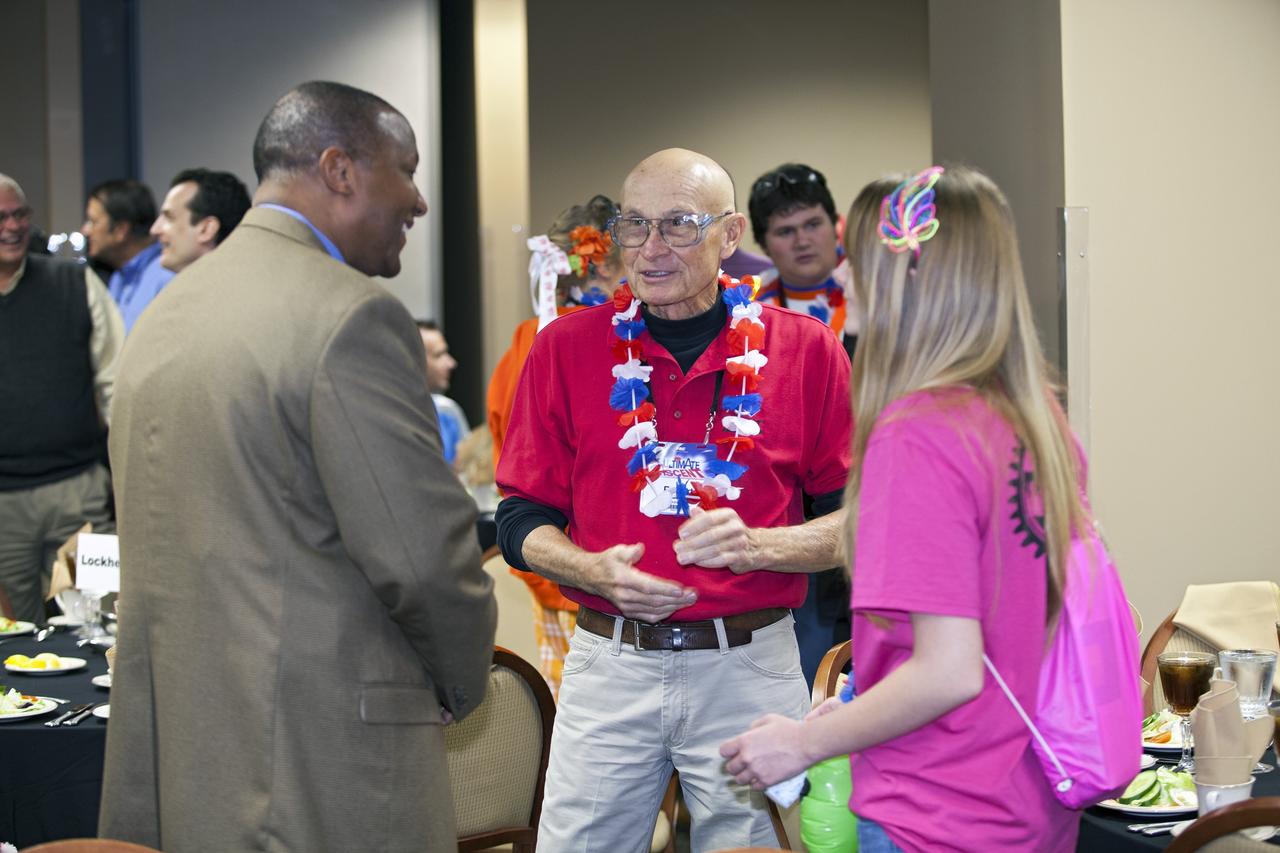
ORLANDO, Fla. – Kelvin Manning, associate director of NASA's Kennedy Space Center in Florida, left, and Bob Seick, former shuttle launch director, talk with a member of The Pink Team taking part in the FIRST Robotics Competition's 2013 Orlando Regional in the University of Central Florida Arena. The student-built robots were required to throw discs into boxes or make climbs to score points. Photo credit: NASA/Frankie Martin
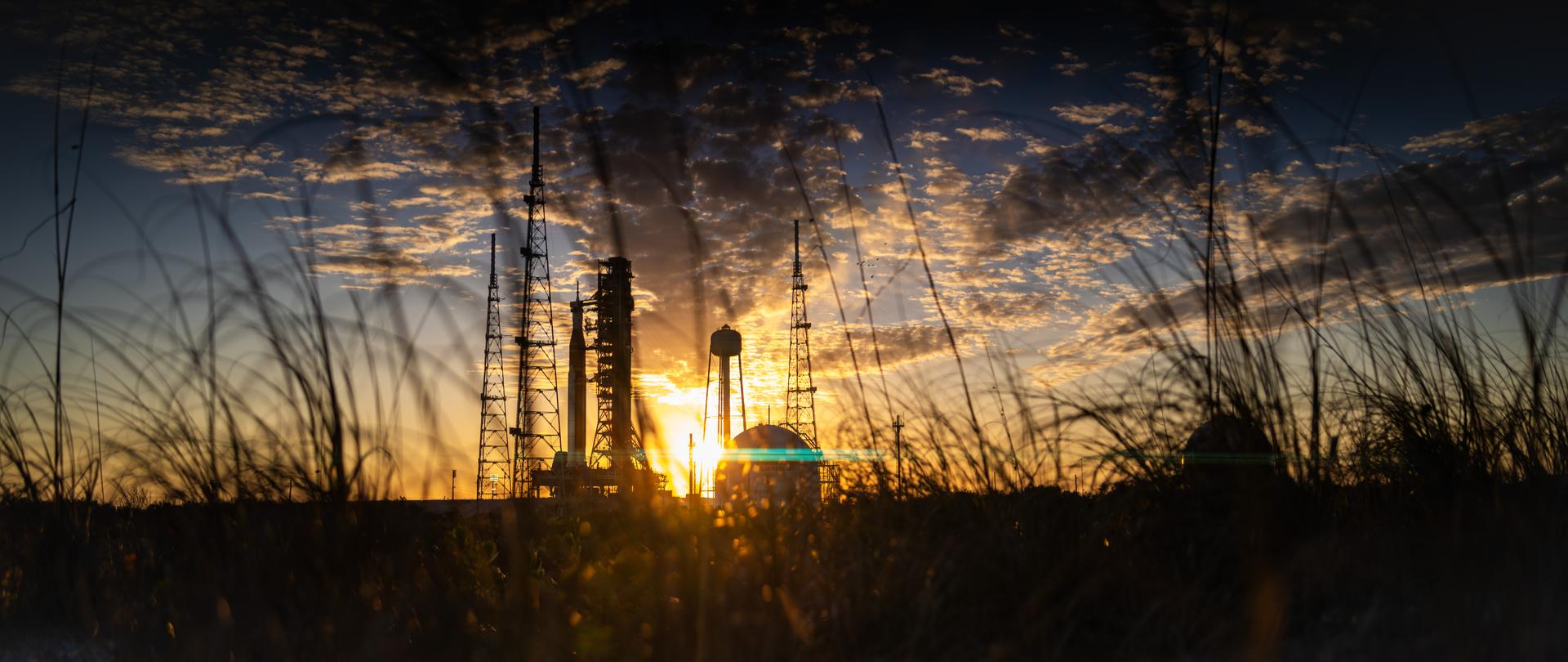
The sun sets behind NASA’s Space Launch System (SLS) rocket and Orion spacecraft as they stand fully assembled atop the mobile launcher at Launch Pad 39B at NASA’s Kennedy Space Center in Florida. The sky glows with warm shades of orange and pink, silhouetting the towering rocket and its solid rocket boosters against the fading light. Photographed on January 31, 2026, the scene captures teams preparing for a wet dress rehearsal for the Artemis II mission, rehearsing launch countdown timelines and procedures as day turns to night.
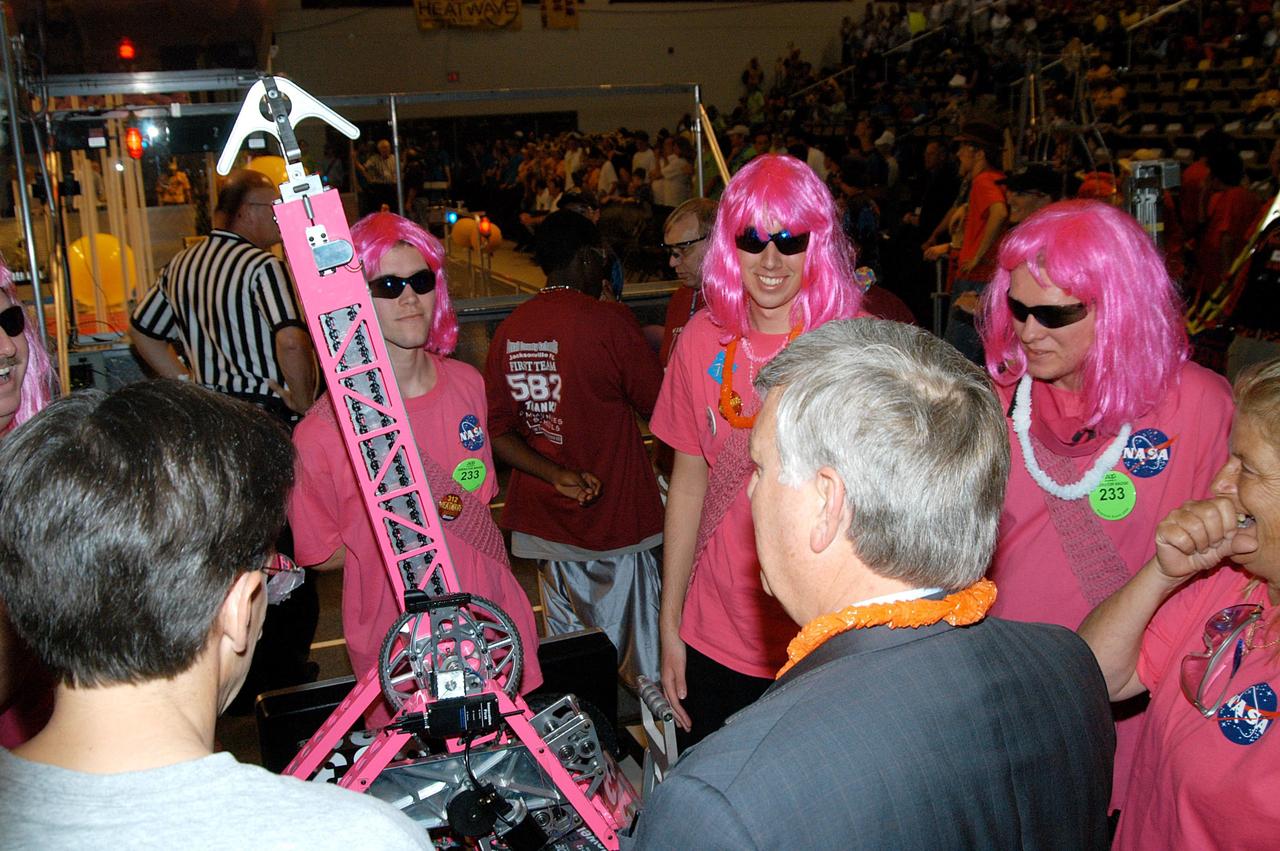
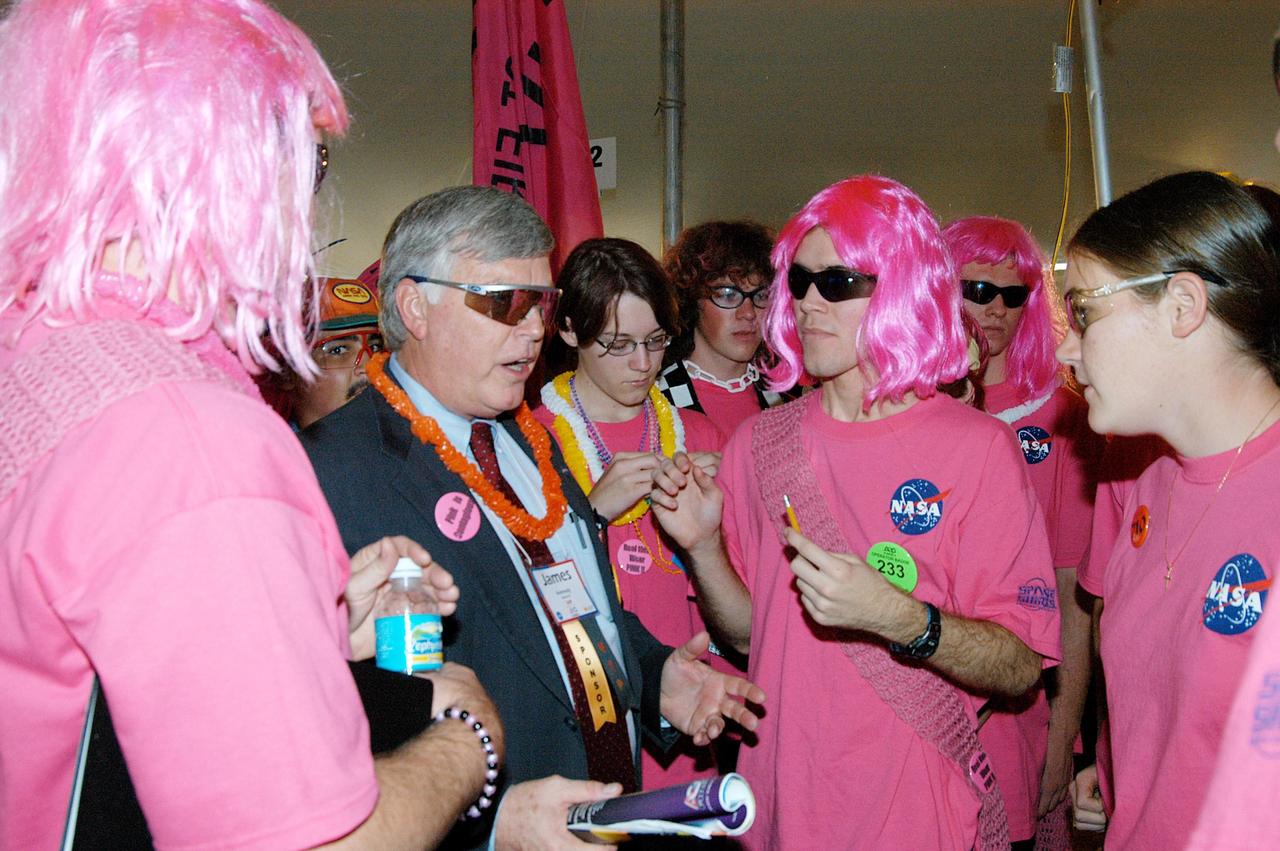
KENNEDY SPACE CENTER, FLA. - Center Director Jim Kennedy (right, back to camera) talks to members of the KSC-sponsored “Pink” team at the 2004 Florida Regional FIRST competition, held at the University of Central Florida. The annual event is hosting 41 teams from Canada, Brazil, Great Britain and the United States. FIRST is a nonprofit organization, For Inspiration and Recognition of Science and Technology, that sponsors the event pitting robots against each other in an athletic-style competition. The FIRST robotics competition is designed to provide students with a hands-on, inside look at engineering and other professional careers, pairing high school students with engineer mentors and corporations.
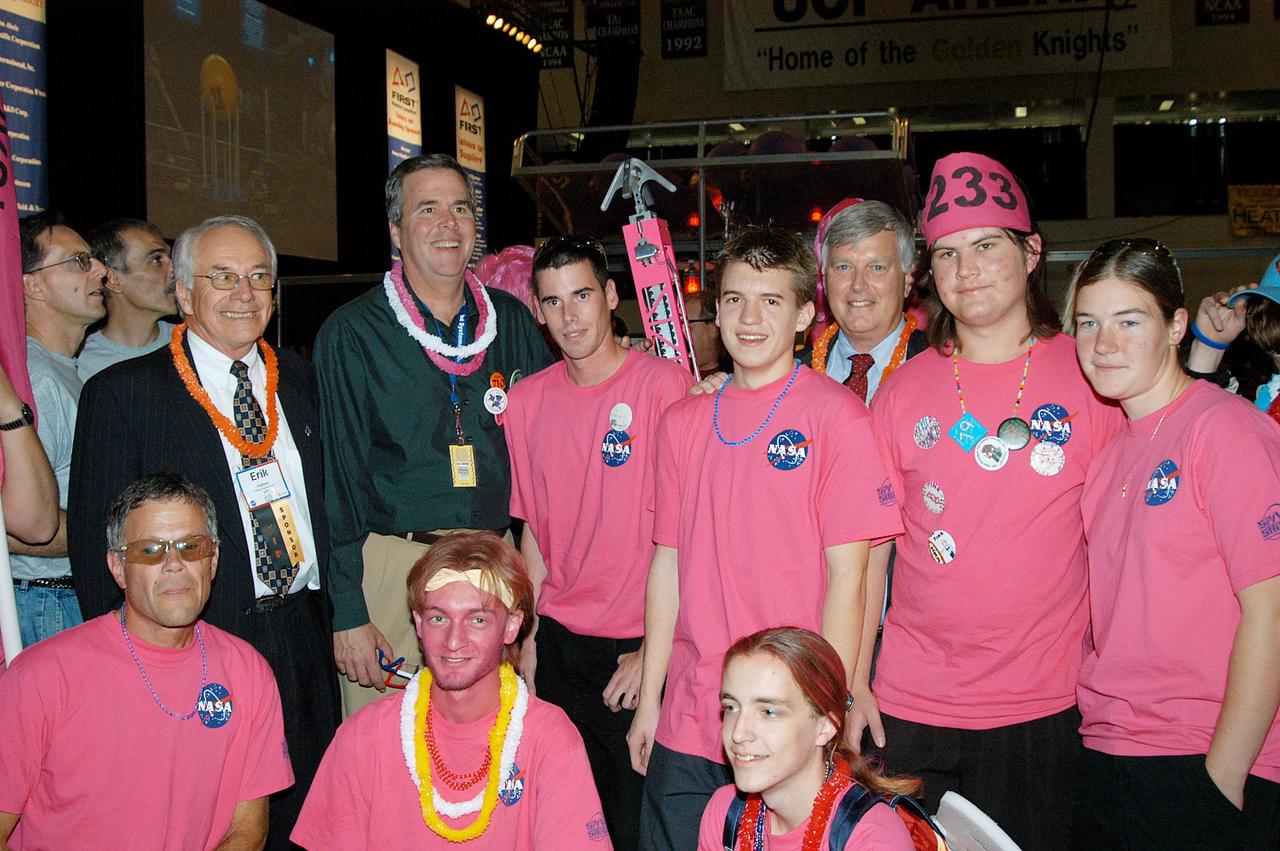
KENNEDY SPACE CENTER, FLA. - The KSC-sponsored “Pink” team poses for a photo with Florida Gov. Jeb Bush (second from left) during a break at the 2004 Florida Regional FIRST competition, held at the University of Central Florida. The annual event is hosting 41 teams from Canada, Brazil, Great Britain and the United States. FIRST is a nonprofit organization, For Inspiration and Recognition of Science and Technology, that sponsors the event pitting robots against each other in an athletic-style competition. The FIRST robotics competition is designed to provide students with a hands-on, inside look at engineering and other professional careers, pairing high school students with engineer mentors and corporations.
KENNEDY SPACE CENTER, FLA. - Center Director Jim Kennedy joins students on the KSC-sponsored “Pink” team at the 2004 Florida Regional FIRST competition, held at the University of Central Florida. The annual event is hosting 41 teams from Canada, Brazil, Great Britain and the United States. FIRST is a nonprofit organization, For Inspiration and Recognition of Science and Technology, that sponsors the event pitting robots against each other in an athletic-style competition. The FIRST robotics competition is designed to provide students with a hands-on, inside look at engineering and other professional careers, pairing high school students with engineer mentors and corporations.
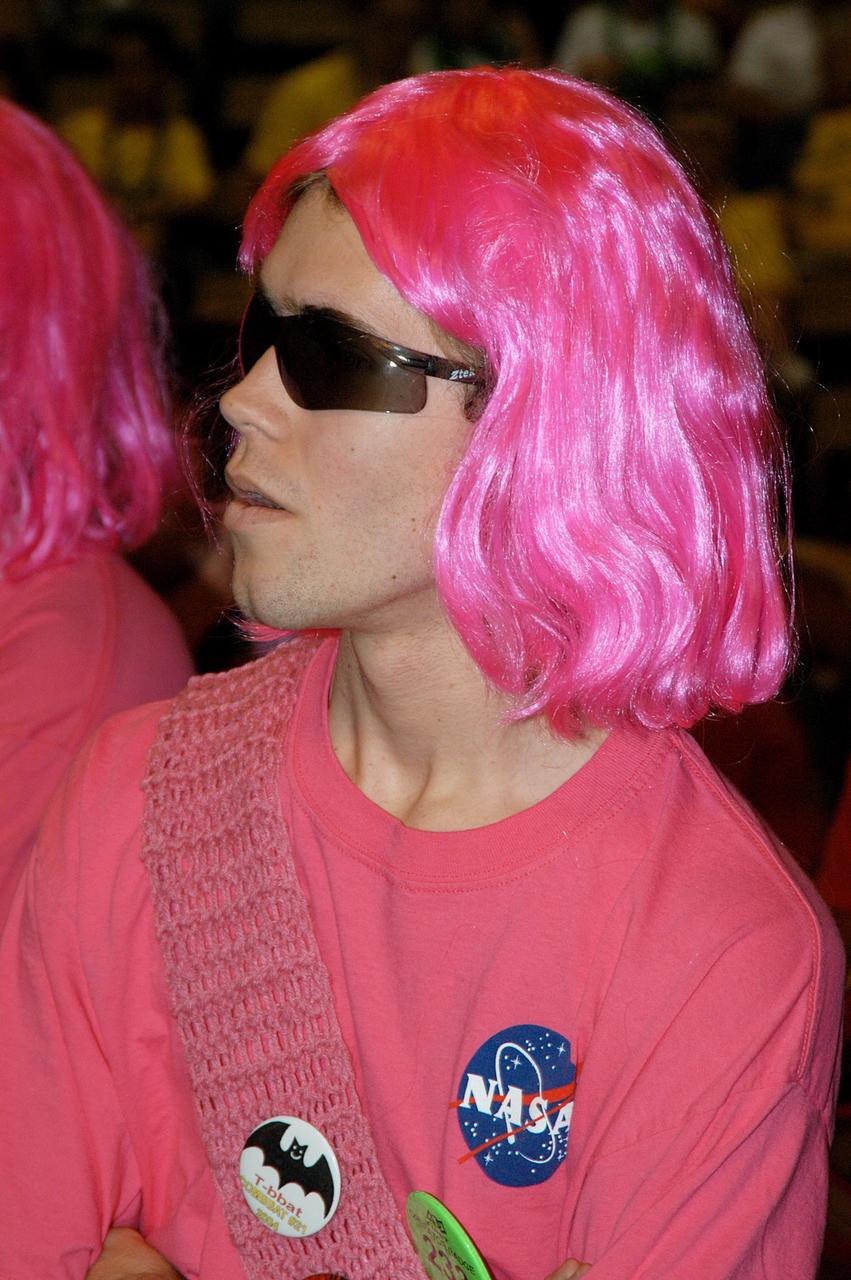
KENNEDY SPACE CENTER, FLA. - A member of the KSC-sponsored “Pink” team watches a match during the 2004 Florida Regional FIRST competition, held at the University of Central Florida. The annual event is hosting 41 teams from Canada, Brazil, Great Britain and the United States. FIRST is a nonprofit organization, For Inspiration and Recognition of Science and Technology, that sponsors the event pitting robots against each other in an athletic-style competition. The FIRST robotics competition is designed to provide students with a hands-on, inside look at engineering and other professional careers, pairing high school students with engineer mentors and corporations.
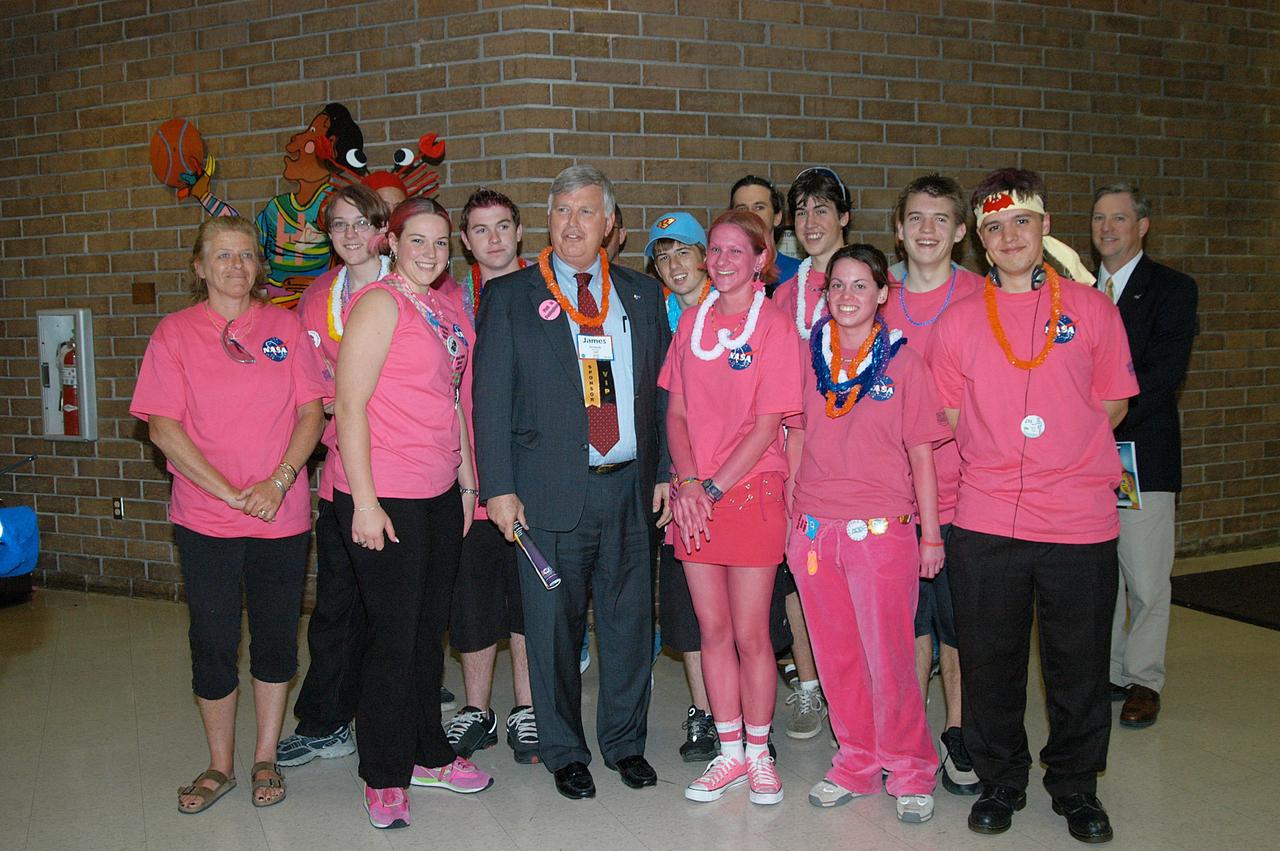
KENNEDY SPACE CENTER, FLA. - Center Director Jim Kennedy (center) poses for a photo amid the members of the KSC-sponsored “Pink” team at the 2004 Florida Regional FIRST competition, held at the University of Central Florida. The annual event is hosting 41 teams from Canada, Brazil, Great Britain and the United States. FIRST is a nonprofit organization, For Inspiration and Recognition of Science and Technology, that sponsors the event pitting gladiator robots against each other in an athletic-style competition. The FIRST robotics competition is designed to provide students with a hands-on, inside look at engineering and other professional careers, pairing high school students with engineer mentors and corporations.

KENNEDY SPACE CENTER, FLA. - Center Director Jim Kennedy (right) talks to members of the KSC-sponsored “Pink” team at the 2004 Florida Regional FIRST competition, held at the University of Central Florida. The annual event is hosting 41 teams from Canada, Brazil, Great Britain and the United States. FIRST is a nonprofit organization, For Inspiration and Recognition of Science and Technology, that sponsors the event pitting robots against each other in an athletic-style competition. The FIRST robotics competition is designed to provide students with a hands-on, inside look at engineering and other professional careers, pairing high school students with engineer mentors and corporations.
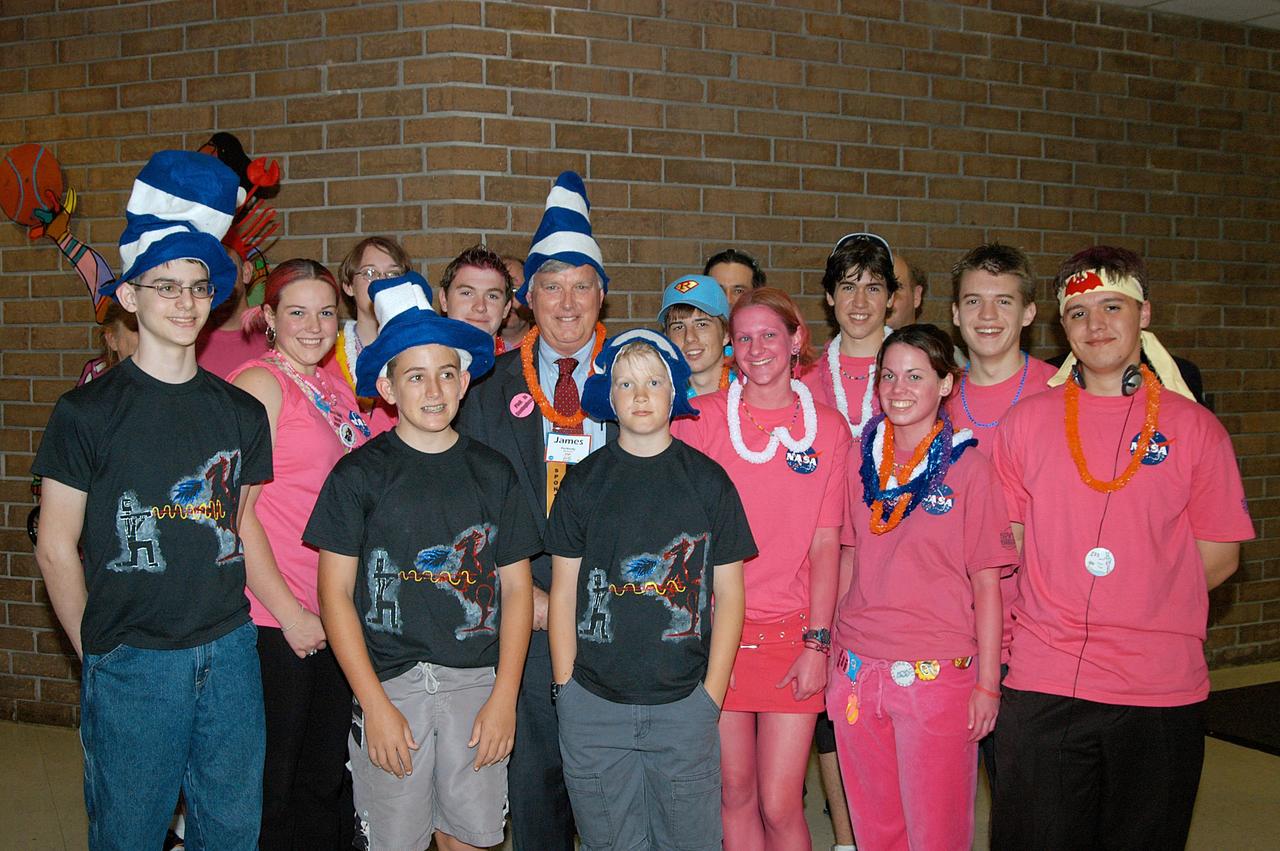
KENNEDY SPACE CENTER, FLA. - Center Director Jim Kennedy (center) poses for a photo amid the members of the KSC-sponsored “Pink” team and the FIRST LEGO™ League at the 2004 Florida Regional FIRST competition, held at the University of Central Florida. The annual event is hosting 41 teams from Canada, Brazil, Great Britain and the United States. FIRST is a nonprofit organization, For Inspiration and Recognition of Science and Technology, that sponsors the event pitting gladiator robots against each other in an athletic-style competition. The FIRST robotics competition is designed to provide students with a hands-on, inside look at engineering and other professional careers, pairing high school students with engineer mentors and corporations.
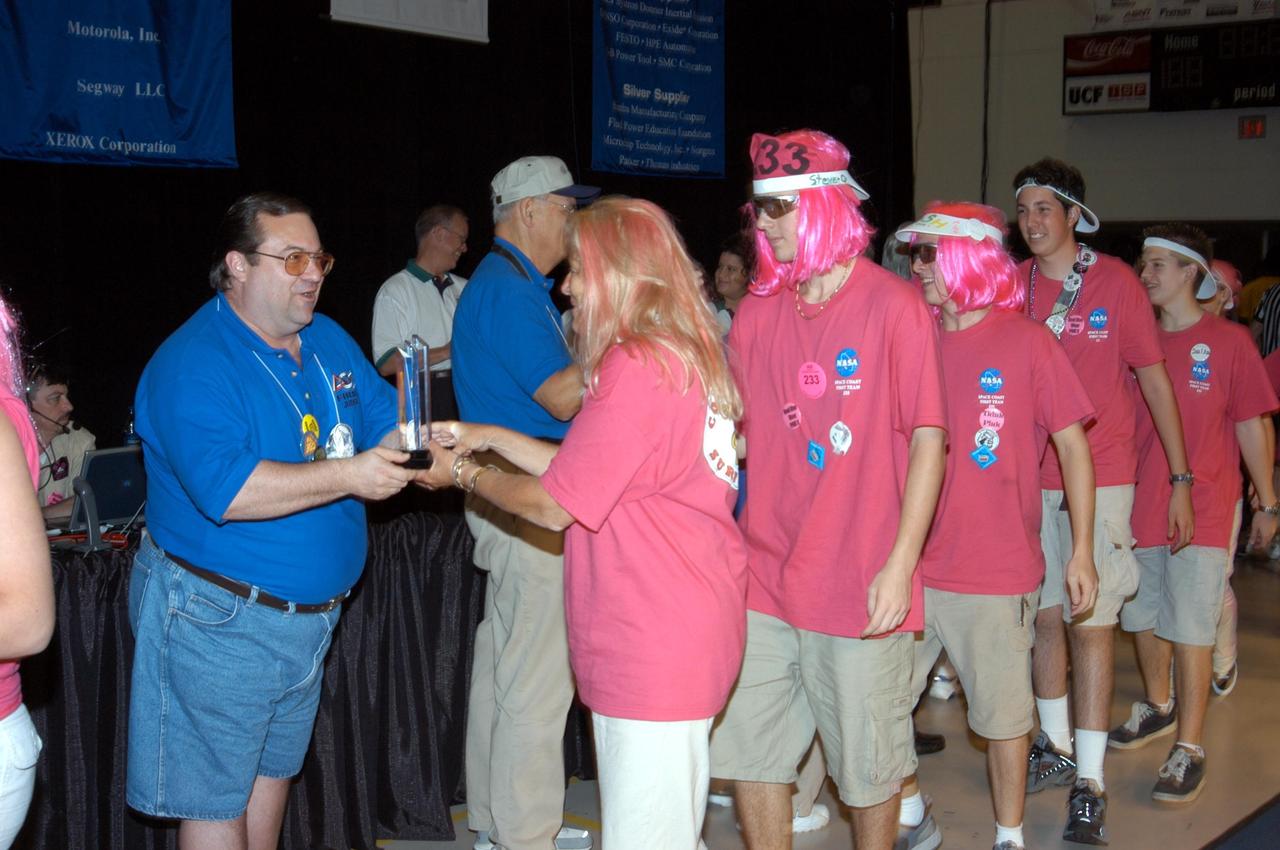
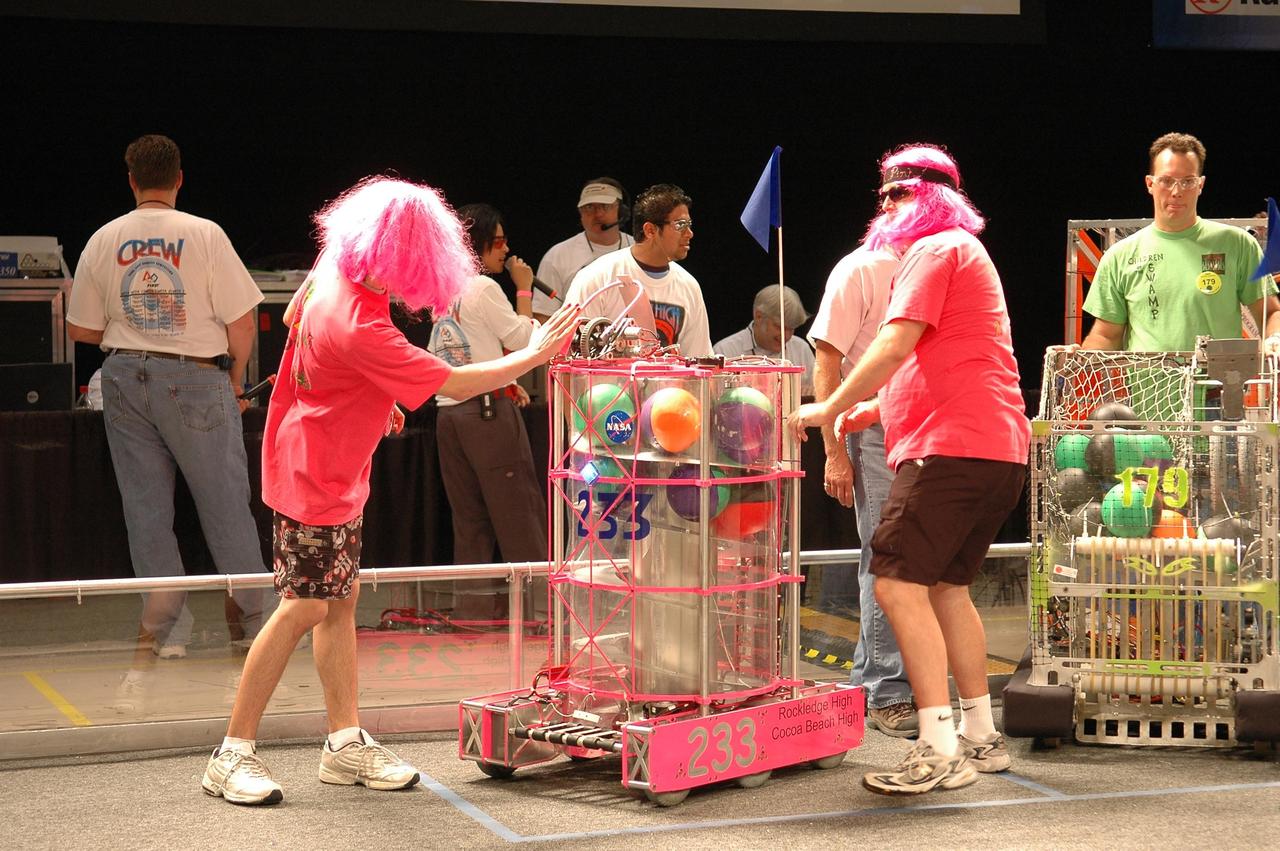
KENNEDY SPACE CENTER, FLA. - The NASA/Kennedy Space Center-sponsored student team (in pink wigs) is congratulated by the judges of the 2003 Southeastern Regional FIRST Robotic Competition. The competition is being held at the University of Central Florida (UCF) in Orlando, March 20-23. The team won awards for Regional Finalist 2, GM Industrial Design and the Imagery Award. Forty student teams from around the country are participating in the event that pits team-built gladiator robots against each other in an athletic-style competition. The teams are sponsored by NASA/Kennedy Space Center, The Boeing Company/Brevard Community College, and Lockheed Martin Space Operations/Mission Systems for the nonprofit organization For Inspiration and Recognition of Science and Technology, known as FIRST. The vision of FIRST is to inspire in the youth of our nation an appreciation of science and technology and an understanding that mastering these disciplines can enrich the lives of all mankind.
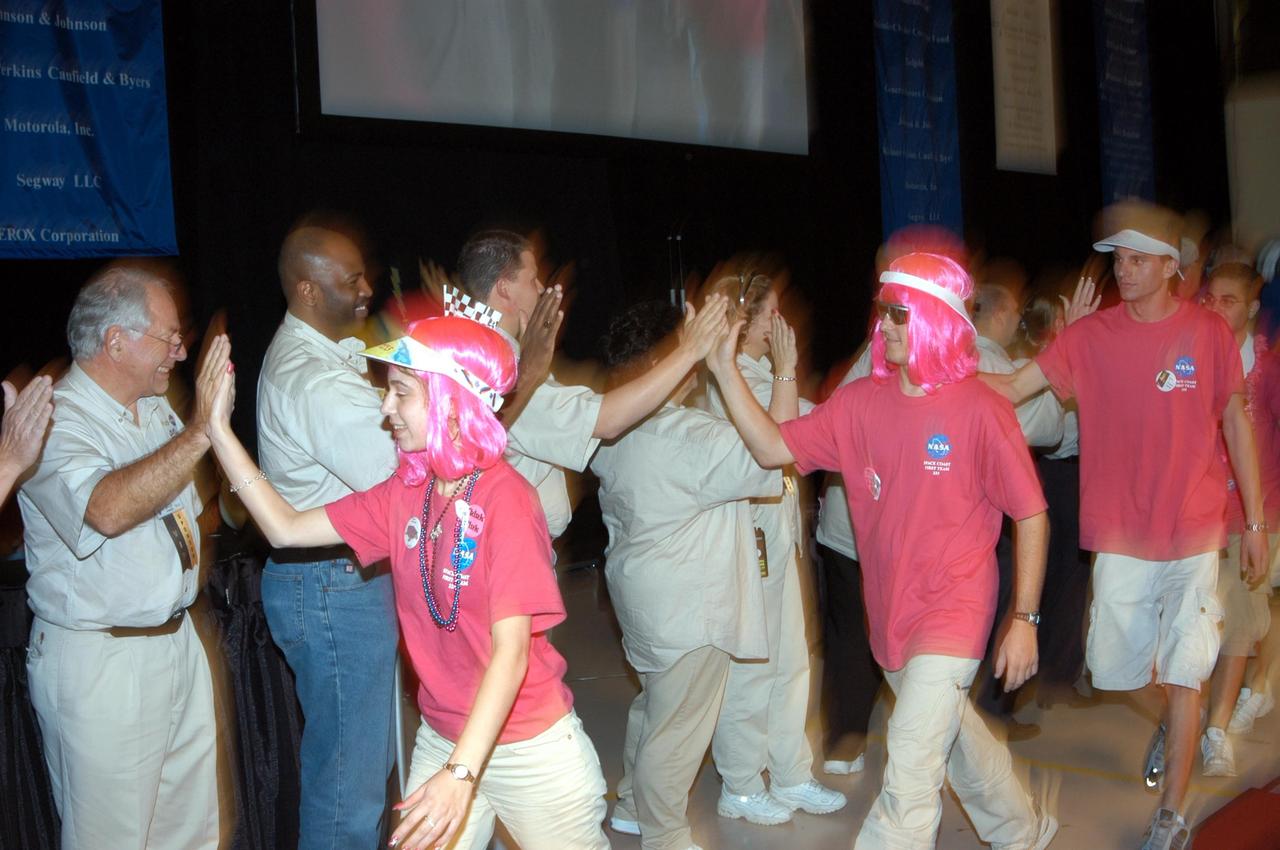
KENNEDY SPACE CENTER, FLA. - The NASA/Kennedy Space Center-sponsored student team (in pink wigs) is congratulated by the mentors and support staff of the 2003 Southeastern Regional FIRST Robotic Competition. The competition is being held at the University of Central Florida (UCF) in Orlando, March 20-23. The team won awards for Regional Finalist 2, GM Industrial Design and the Imagery Award. Forty student teams from around the country are participating in the event that pits team-built gladiator robots against each other in an athletic-style competition. The teams are sponsored by NASA/Kennedy Space Center, The Boeing Company/Brevard Community College, and Lockheed Martin Space Operations/Mission Systems for the nonprofit organization For Inspiration and Recognition of Science and Technology, known as FIRST. The vision of FIRST is to inspire in the youth of our nation an appreciation of science and technology and an understanding that mastering these disciplines can enrich the lives of all mankind.
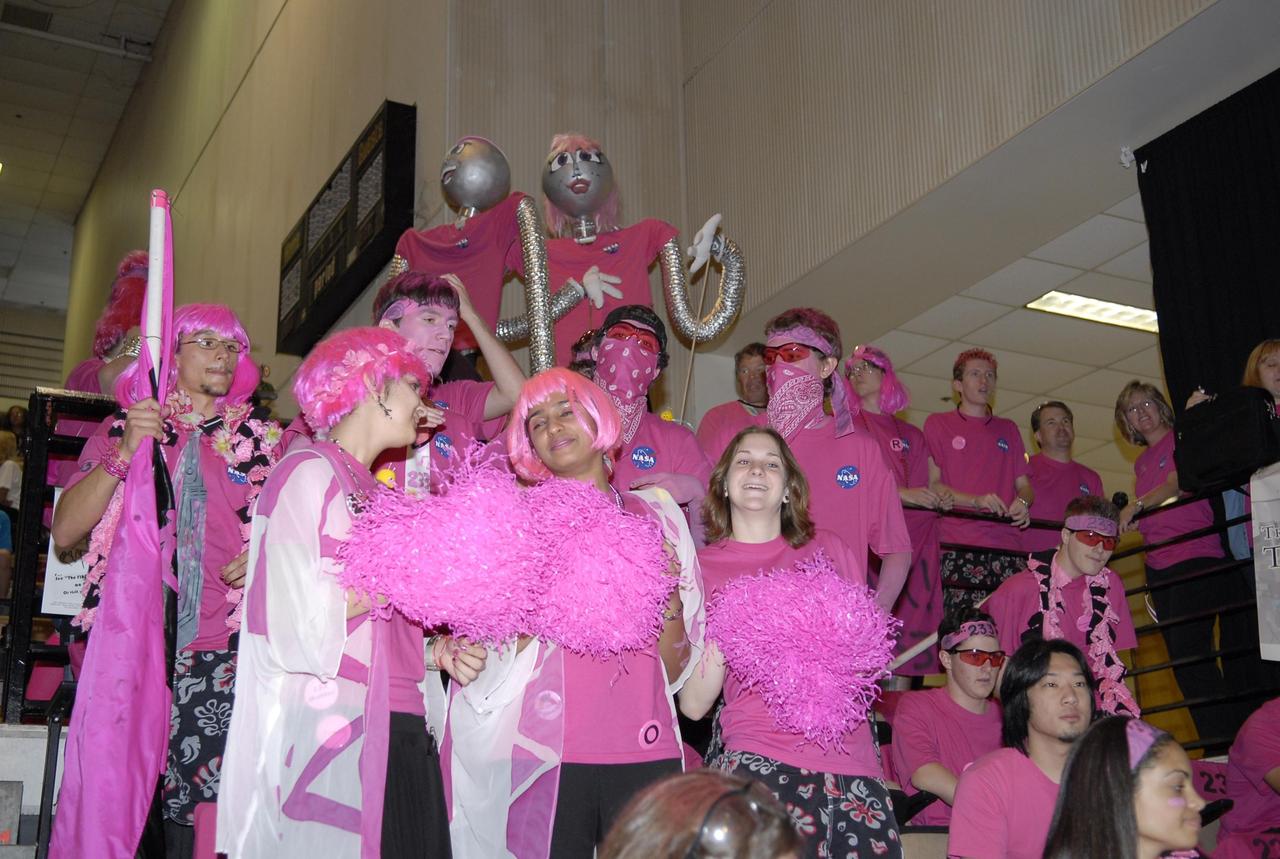
KENNEDY SPACE CENTER, FLA. -- The student team dressed in pink is a coordinated effort cosponsored by NASA KSC and representing Rockledge, Cocoa Beach and Viera High Schools in Central Florida. The FIRST, or For Inspiration and Recognition of Science and Technology, Robotics Competition challenges teams of young people and their mentors to solve a common problem in a six-week timeframe using a standard "kit of parts" and a common set of rules. Teams build robots from the parts and enter them in a series of competitions designed by FIRST founder Dean Kamen and Dr. Woodie Flowers, chairman and vice chairman of the Executive Advisory Board respectively, and a committee of engineers and other professionals. FIRST redefines winning for these students. Teams are rewarded for excellence in design, demonstrated team spirit, gracious professionalism and maturity, and ability to overcome obstacles. Scoring the most points is a secondary goal. Winning means building partnerships that last. Photo credit: NASA/Kim Shiflett
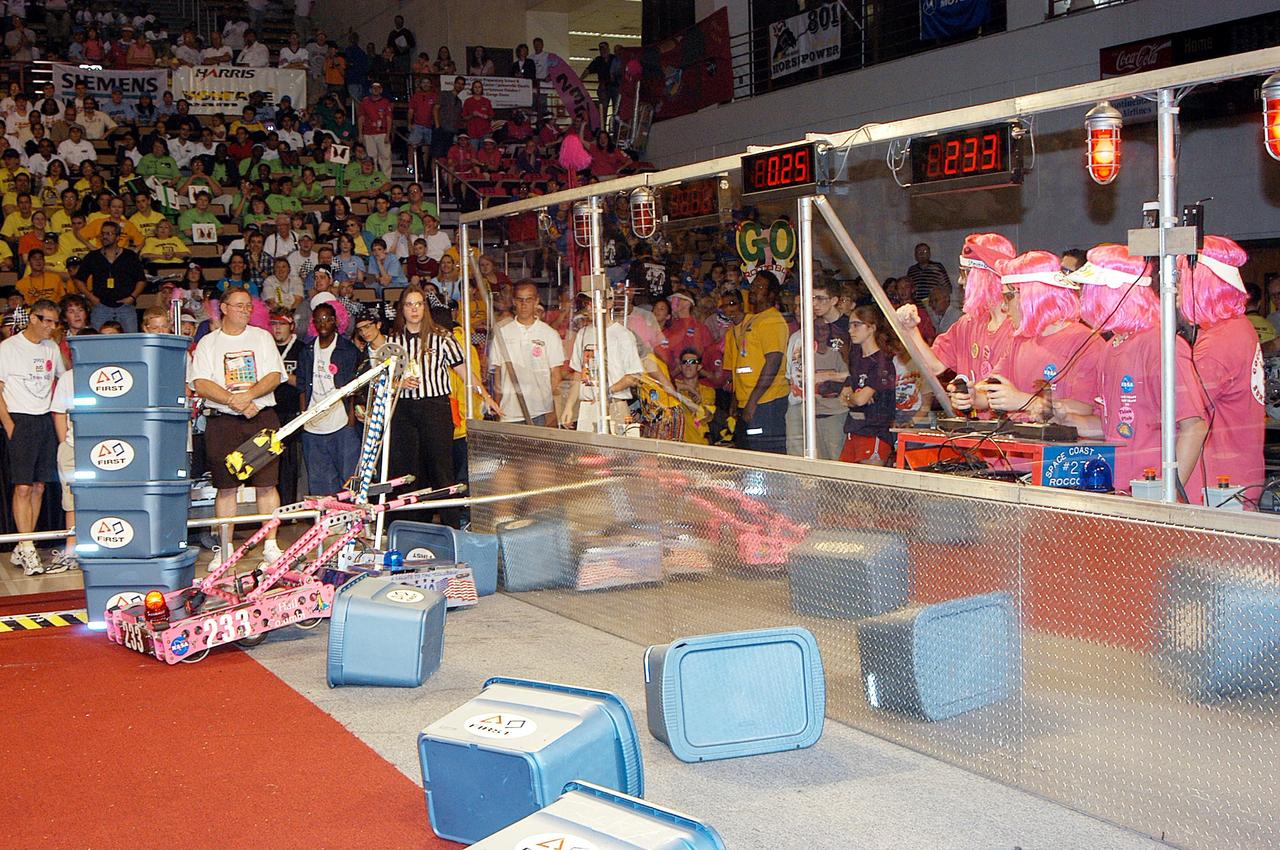
KENNEDY SPACE CENTER, FLA. - The NASA/Kennedy Space Center-sponsored student team (in pink wigs, right) demonstrates their robot's abilities during the 2003 Southeastern Regional FIRST Robotic Competition. The competition is being held at the University of Central Florida (UCF) in Orlando, March 20-23. Forty student teams from around the country are participating in the event that pits team-built gladiator robots against each other in an athletic-style competition. The teams are sponsored by NASA/Kennedy Space Center, The Boeing Company/Brevard Community College, and Lockheed Martin Space Operations/Mission Systems for the nonprofit organization For Inspiration and Recognition of Science and Technology, known as FIRST. The vision of FIRST is to inspire in the youth of our nation an appreciation of science and technology and an understanding that mastering these disciplines can enrich the lives of all mankind.
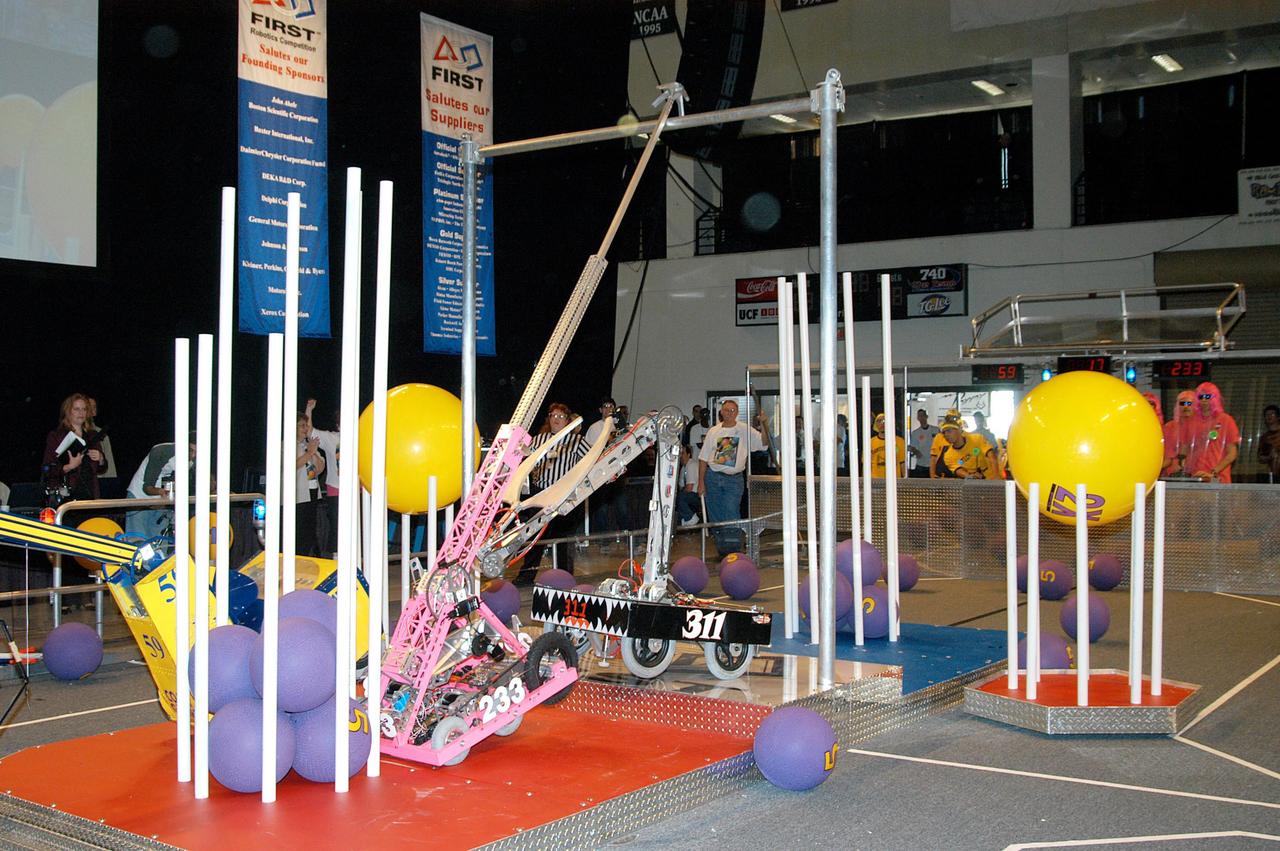
KENNEDY SPACE CENTER, FLA. - Robots of the KSC-sponsored “Pink” team and yellow-clad Central Florida team vie for points on the floor of the University of Central Florida Arena during the 2004 Florida Regional FIRST competition. The event hosted 41 teams from Canada, Brazil, Great Britain and the United States. Among observers at the annual event were Center Director Jim Kennedy and Florida Gov. Jeb Bush, who spoke at the event luncheon. FIRST is a nonprofit organization, For Inspiration and Recognition of Science and Technology, that sponsors the event pitting gladiator robots against each other in an athletic-style competition. The FIRST robotics competition is designed to provide students with a hands-on, inside look at engineering and other professional careers, pairing high school students with engineer mentors and corporations.
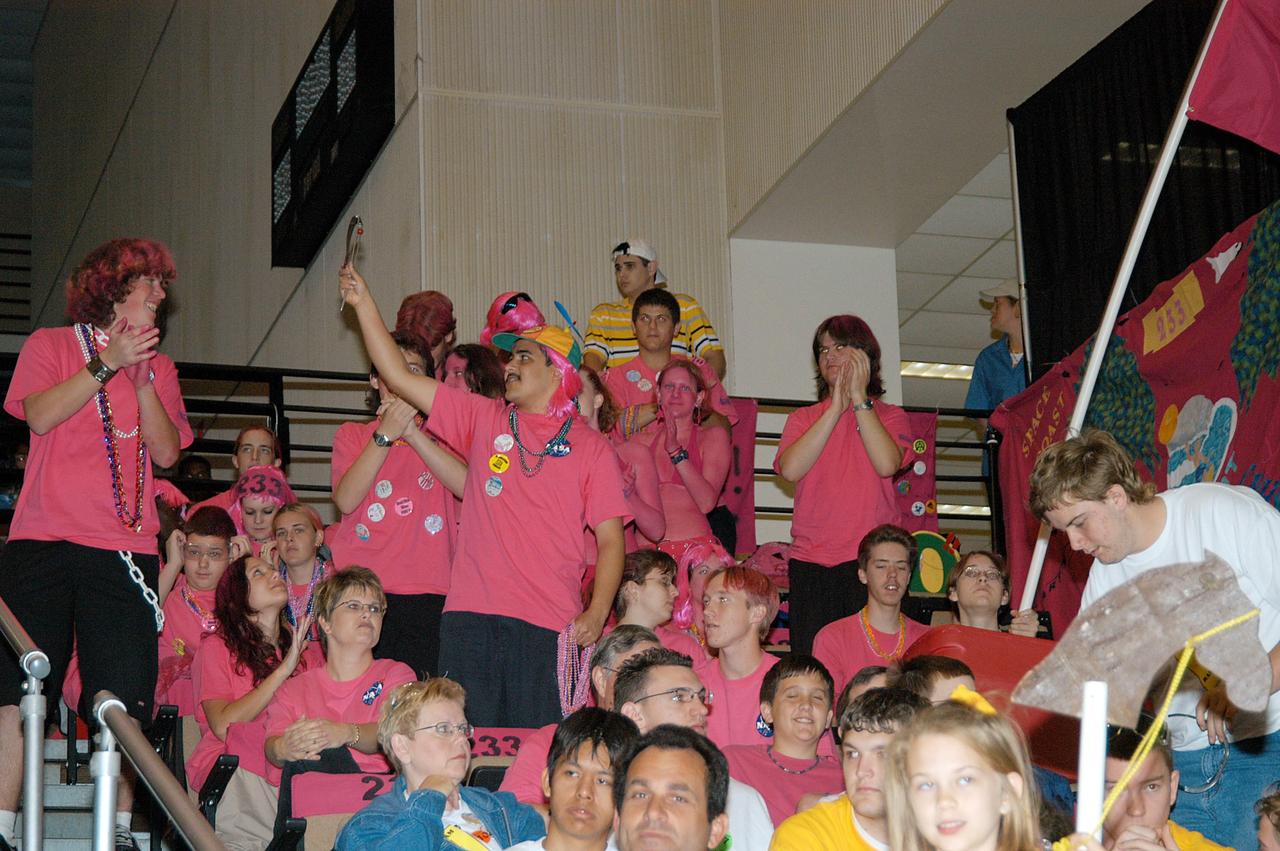
KENNEDY SPACE CENTER, FLA. - At the University of Central Florida, friends and families of the KSC-sponsored “Pink” team lend support from the stands during the 2004 Florida Regional FIRST competition. The KSC team is composed of Cocoa Beach and Rockledge High School students. The event hosted 41 teams from Canada, Brazil, Great Britain and the United States. Among observers at the annual event were Center Director Jim Kennedy and Florida Gov. Jeb Bush, who spoke at the event luncheon. FIRST is a nonprofit organization, For Inspiration and Recognition of Science and Technology, that sponsors the event pitting gladiator robots against each other in an athletic-style competition. The FIRST robotics competition is designed to provide students with a hands-on, inside look at engineering and other professional careers, pairing high school students with engineer mentors and corporations.
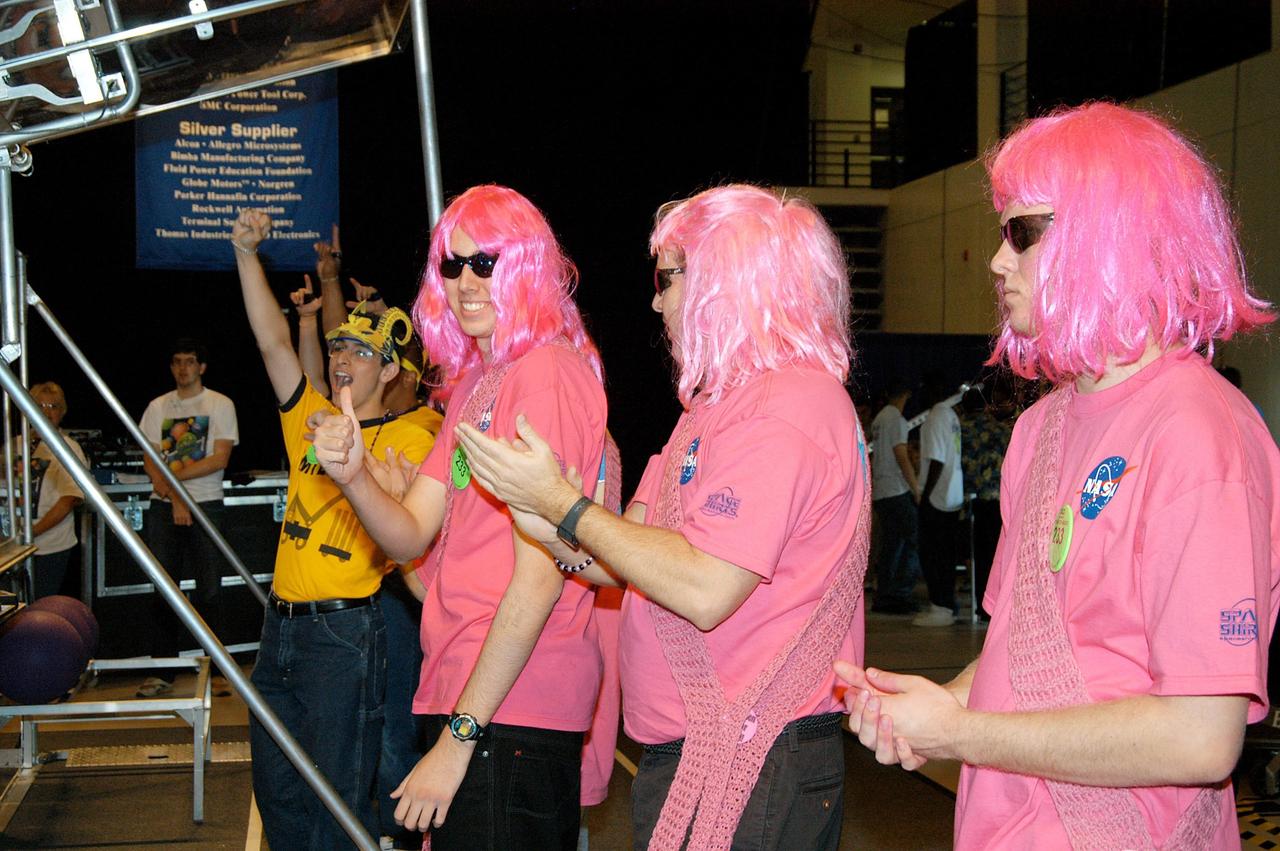
KENNEDY SPACE CENTER, FLA. - During the 2004 Florida Regional FIRST competition in the University of Central Florida Arena, the KSC-sponsored “Pink” team applauds a win by the yellow-clad Central Florida team. The event hosted 41 teams from Canada, Brazil, Great Britain and the United States. Among observers at the annual event were Center Director Jim Kennedy and Florida Gov. Jeb Bush, who spoke at the event luncheon. FIRST is a nonprofit organization, For Inspiration and Recognition of Science and Technology, that sponsors the event pitting gladiator robots against each other in an athletic-style competition. The FIRST robotics competition is designed to provide students with a hands-on, inside look at engineering and other professional careers, pairing high school students with engineer mentors and corporations.
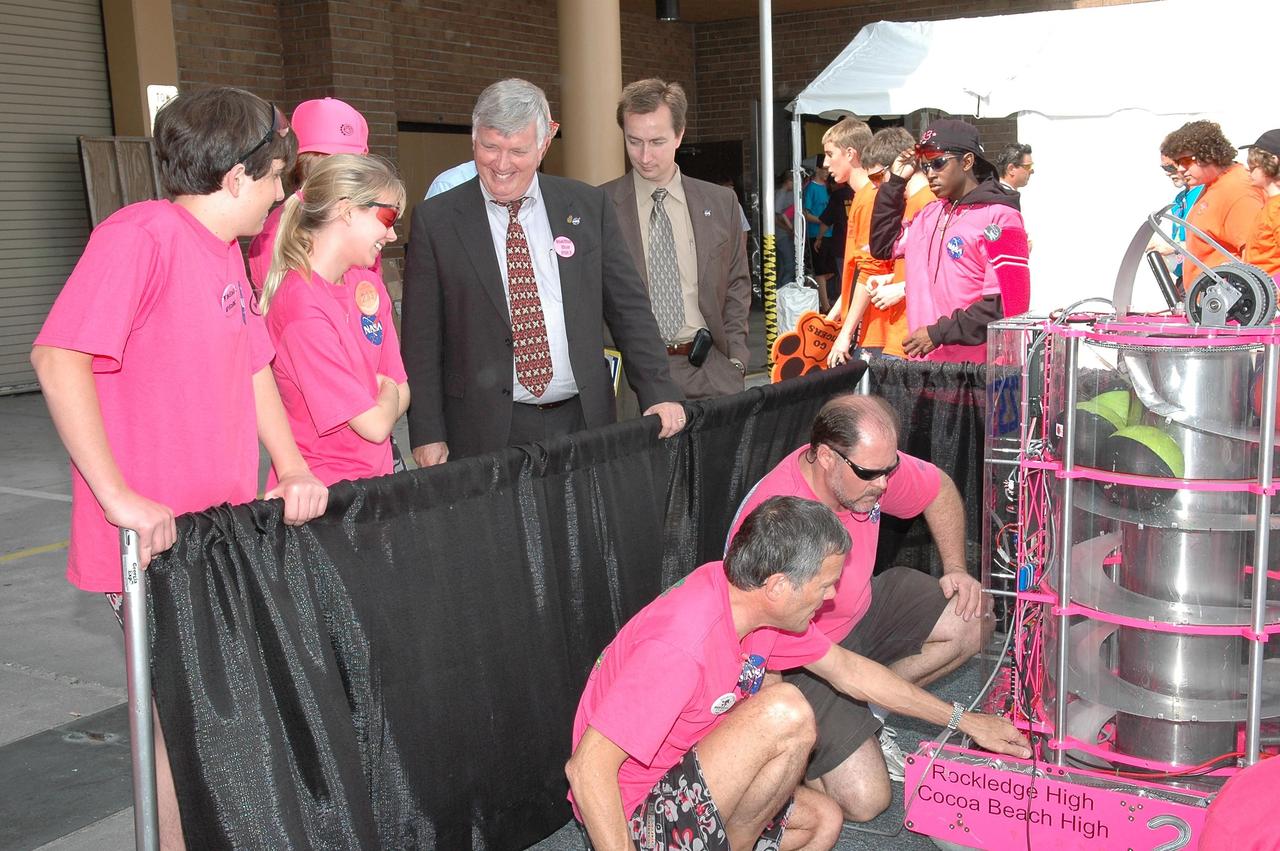
KENNEDY SPACE CENTER, FLA. - During the 2006 FIRST Robotics Regional Competition held March 9-11 at the University of Central Florida in Orlando, Kennedy Space Center Director Jim Kennedy and his intern Neil Berger talk with students on the Cocoa Beach High School-Rockledge High School robotic team known as the "Pink Team," which was co-sponsored by NASA KSC. The team's robot, at right, is called Roccobot. At least four teams in the competition were sponsored by KSC, NASA and contractors. The FIRST Robotics Competition challenges teams of young people and their mentors to solve a common problem in a six-week timeframe using a standard "kit of parts" and a common set of rules. Teams build robots from the parts and enter them in a series of competitions. FIRST, which is based on "For Inspiration and Recognition of Science and Technology," redefines winning for these students. Teams are rewarded for excellence in design, demonstrated team spirit, gracious professionalism and maturity, and ability to overcome obstacles. Scoring the most points is a secondary goal. Winning means building partnerships that last. NASA and the University of Central Florida are co-sponsors of the regional event, which this year included more than 50 teams. Photo credit: NASA/Kim Shiflett
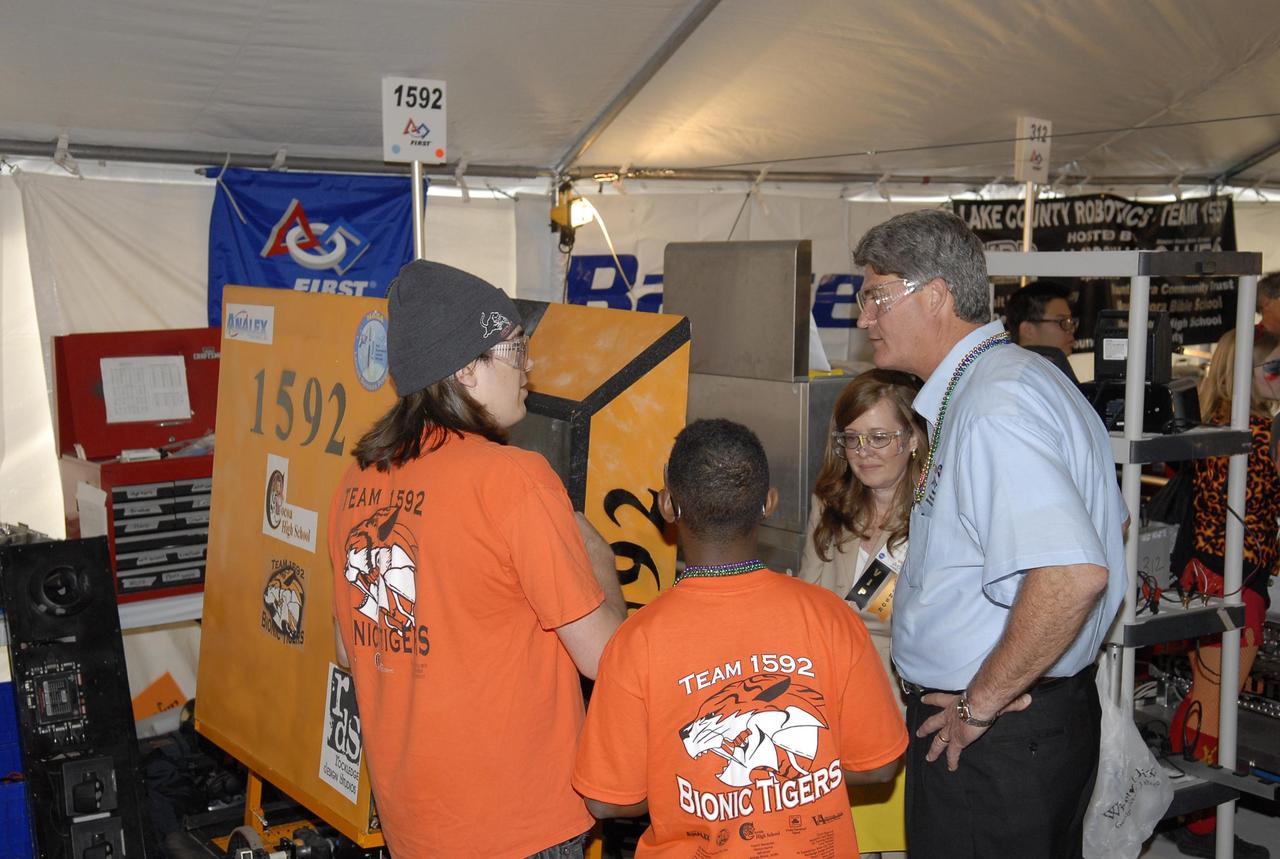
KENNEDY SPACE CENTER, FLA. -- Center Director Bill Parsons (right) talks with students of another NASA-sponsored robotic team during the FIRST robotics event held at the University of Central Florida Arena March 8-10. Next to Parsons is Lisa Malone, director of External Relations at Kennedy Space Center. The students of team 1592, the Bionic Tigers, represent the cosponsors Analex Corporation and NASA Launch Services Program and Cocoa High School in Central Florida. Participating since 2005, this is the first year for this team to receive NASA financial support. They were mentored by the Pink Team. The FIRST, or For Inspiration and Recognition of Science and Technology, Robotics Competition challenges teams of young people and their mentors to solve a common problem in a six-week timeframe using a standard "kit of parts" and a common set of rules. Teams build robots from the parts and enter them in a series of competitions designed by FIRST founder Dean Kamen and Dr. Woodie Flowers, chairman and vice chairman of the Executive Advisory Board respectively, and a committee of engineers and other professionals. FIRST redefines winning for these students. Teams are rewarded for excellence in design, demonstrated team spirit, gracious professionalism and maturity, and ability to overcome obstacles. Scoring the most points is a secondary goal. Winning means building partnerships that last. Photo credit: NASA/Kim Shiflett
ORLANDO, Fla. -- NASA Kennedy Space Center Director Bob Cabana talks with members of Team 233, "The Pink Team," which is participating in the regional FIRST robotics competition at the University of Central Florida in Orlando, Fla. The team is made up of students from Rockledge, Cocoa Beach and Viera high schools along the Space Coast of Florida. Kennedy is a sponsor of the team. More than 60 high school teams took part in the competition called "For Inspiration and Recognition of Science and Technology," or FIRST, in hopes of advancing to the national robotics championship. This year, the competition resembled a basketball game and was dubbed "Rebound Rumble." The game measured the effectiveness of each robot, the power of collaboration and the determination of the teams. FIRST, founded in 1989, is a non-profit organization that designs accessible, innovative programs to build self-confidence, knowledge and life skills while motivating young people to pursue academic opportunities. The robotics competition challenges teams of high school students and their mentors to solve a common problem in a six-week timeframe using a standard kit of parts and a common set of rules. NASA is the largest sponsor of the international program. Kennedy Space Center is a sponsor of the regional event. For more information on Kennedy's education events and initiatives, go to http://www.nasa.gov/offices/education/centers/kennedy/home/index.html. Photo credit: NASA/Kim Shiflett
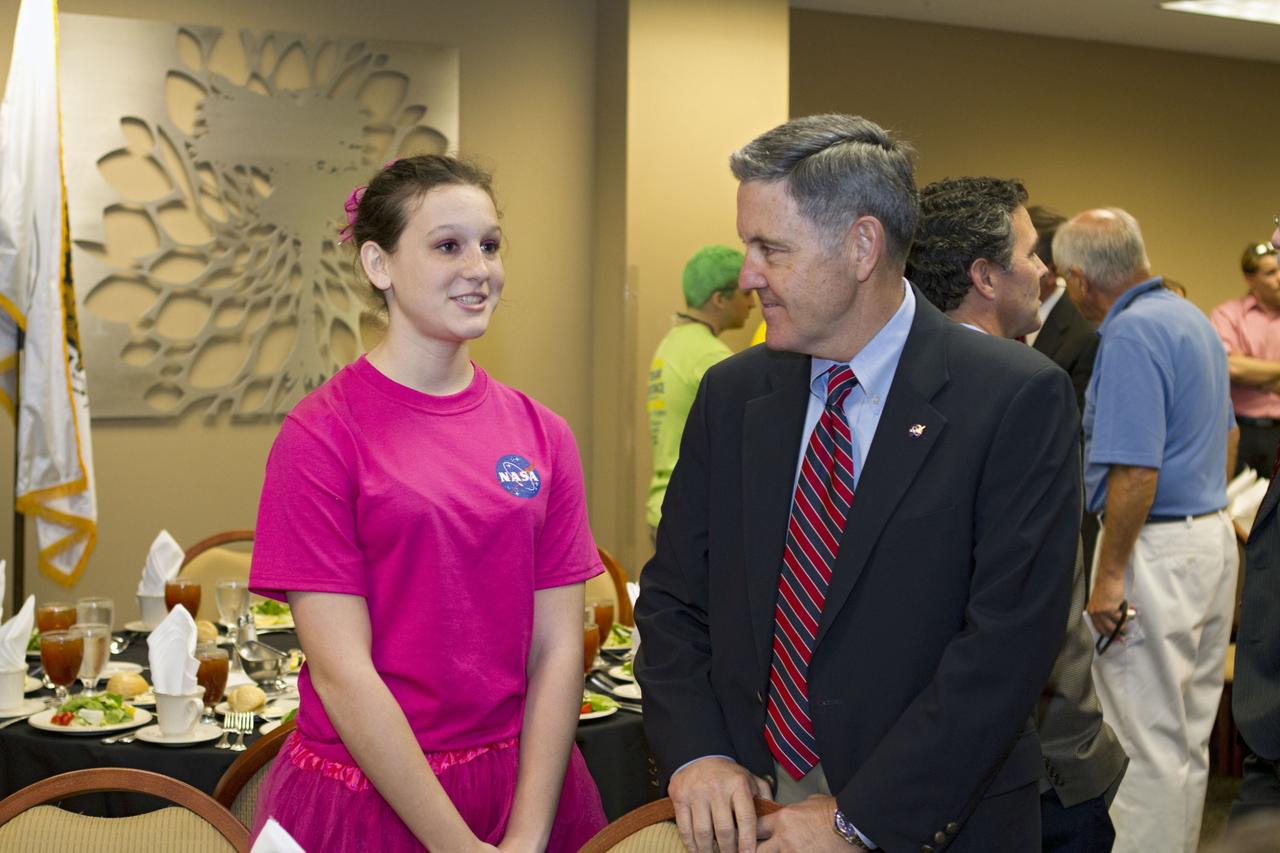
ORLANDO, Fla. -- NASA Kennedy Space Center Director Bob Cabana talks with a member of Team 233, "The Pink Team," which is participating in the regional FIRST robotics competition at the University of Central Florida in Orlando, Fla. The team is made up of students from Rockledge, Cocoa Beach and Viera high schools along the Space Coast of Florida. Kennedy is a sponsor of the team. More than 60 teams took part in the competition called "For Inspiration and Recognition of Science and Technology," or FIRST, in hopes of advancing to the national robotics championship. This year, the competition resembled a basketball game and was dubbed "Rebound Rumble." The game measured the effectiveness of each robot, the power of collaboration and the determination of the teams. FIRST, founded in 1989, is a non-profit organization that designs accessible, innovative programs to build self-confidence, knowledge and life skills while motivating young people to pursue academic opportunities. The robotics competition challenges teams of high school students and their mentors to solve a common problem in a six-week timeframe using a standard kit of parts and a common set of rules. NASA is the largest sponsor of the international program. Kennedy Space Center is a sponsor of the regional event. For more information on Kennedy's education events and initiatives, go to http://www.nasa.gov/offices/education/centers/kennedy/home/index.html. Photo credit: NASA/Kim Shiflett

KENNEDY SPACE CENTER, FLA. - During the 2006 FIRST Robotics Regional Competition held March 9-11 at the University of Central Florida in Orlando, Kennedy Space Center Director Jim Kennedy (left) greets members of the "Pink Team," whose robot is named Roccobot and is co-sponsored by NASA KSC. At least four teams in the competition were sponsored by KSC, NASA and contractors. The FIRST Robotics Competition challenges teams of young people and their mentors to solve a common problem in a six-week timeframe using a standard "kit of parts" and a common set of rules. Teams build robots from the parts and enter them in a series of competitions. FIRST, which is based on "For Inspiration and Recognition of Science and Technology," redefines winning for these students. Teams are rewarded for excellence in design, demonstrated team spirit, gracious professionalism and maturity, and ability to overcome obstacles. Scoring the most points is a secondary goal. Winning means building partnerships that last. NASA and the University of Central Florida are co-sponsors of the regional event, which this year included more than 50 teams. Photo credit: NASA/Kim Shiflett

ORLANDO, Fla. -- "The Pink Team," Team 233, tinkers with its robot during the regional FIRST robotics competition at the University of Central Florida in Orlando, Fla. The team is made up of students from Rockledge, Cocoa Beach and Viera high schools along the Space Coast of Florida. NASA’s Kennedy Space Center is a sponsor of the team. More than 60 high school teams took part in the competition called "For Inspiration and Recognition of Science and Technology," or FIRST, in hopes of advancing to the national robotics championship. This year, the competition resembled a basketball game and was dubbed "Rebound Rumble." The game measured the effectiveness of each robot, the power of collaboration and the determination of the teams. FIRST, founded in 1989, is a non-profit organization that designs accessible, innovative programs to build self-confidence, knowledge and life skills while motivating young people to pursue academic opportunities. The robotics competition challenges teams of high school students and their mentors to solve a common problem in a six-week timeframe using a standard kit of parts and a common set of rules. NASA is the largest sponsor of the international program. Kennedy Space Center is a sponsor of the regional event. For more information on Kennedy's education events and initiatives, go to http://www.nasa.gov/offices/education/centers/kennedy/home/index.html. Photo credit: NASA/Kim Shiflett
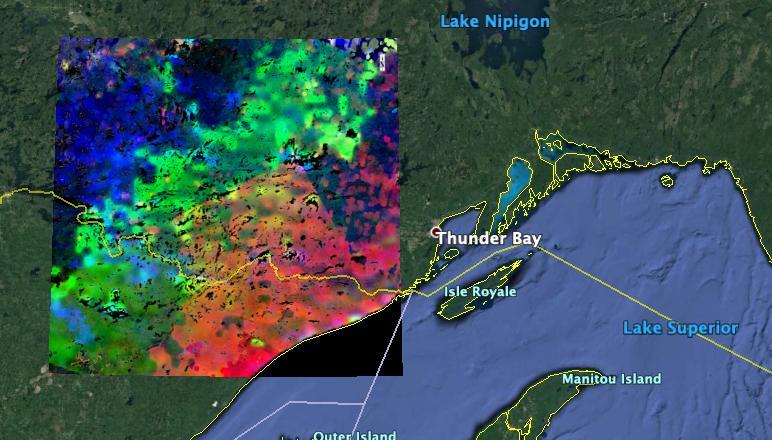
The image shows plants "waking up" west of Lake Superior near the U.S.-Canada border. Plants in the red and pink areas began to wake up around 7 a.m. local time. Those in green areas became active closer to 8 am., while those in blue areas did so closer to 9 a.m. The mission team collected and combined all of ECOSTRESS's morning data for the summer season. In doing so, they observed that the earliest risers were near the lake, with plant activity spreading gradually northwestward as the morning progressed. https://photojournal.jpl.nasa.gov/catalog/PIA23430
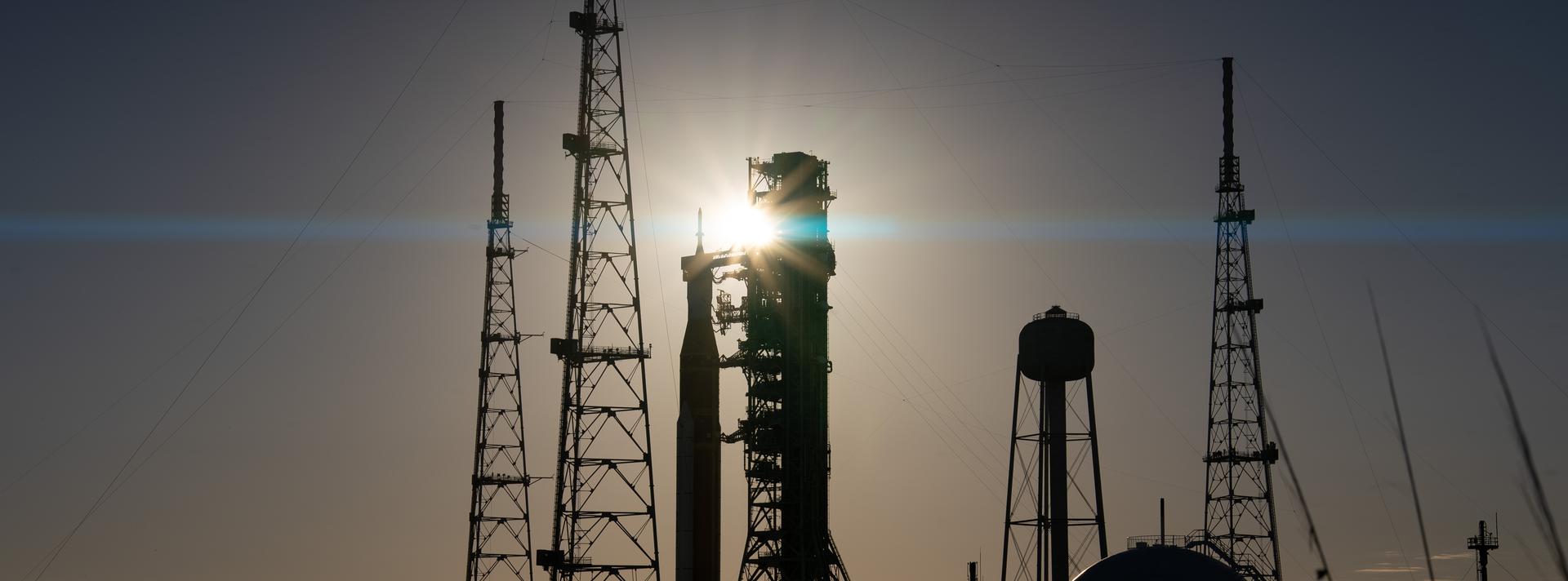
508 DESCRIPTION: The sun sets behind NASA’s Space Launch System (SLS) rocket and Orion spacecraft as they stand fully assembled atop the mobile launcher at Launch Pad 39B at NASA’s Kennedy Space Center in Florida. The sky glows with warm shades of orange and pink, silhouetting the towering rocket and its solid rocket boosters against the fading light. Photographed on January 31, 2026, the scene captures teams preparing for a wet dress rehearsal for the Artemis II mission, rehearsing launch countdown timelines and procedures as day turns to night.
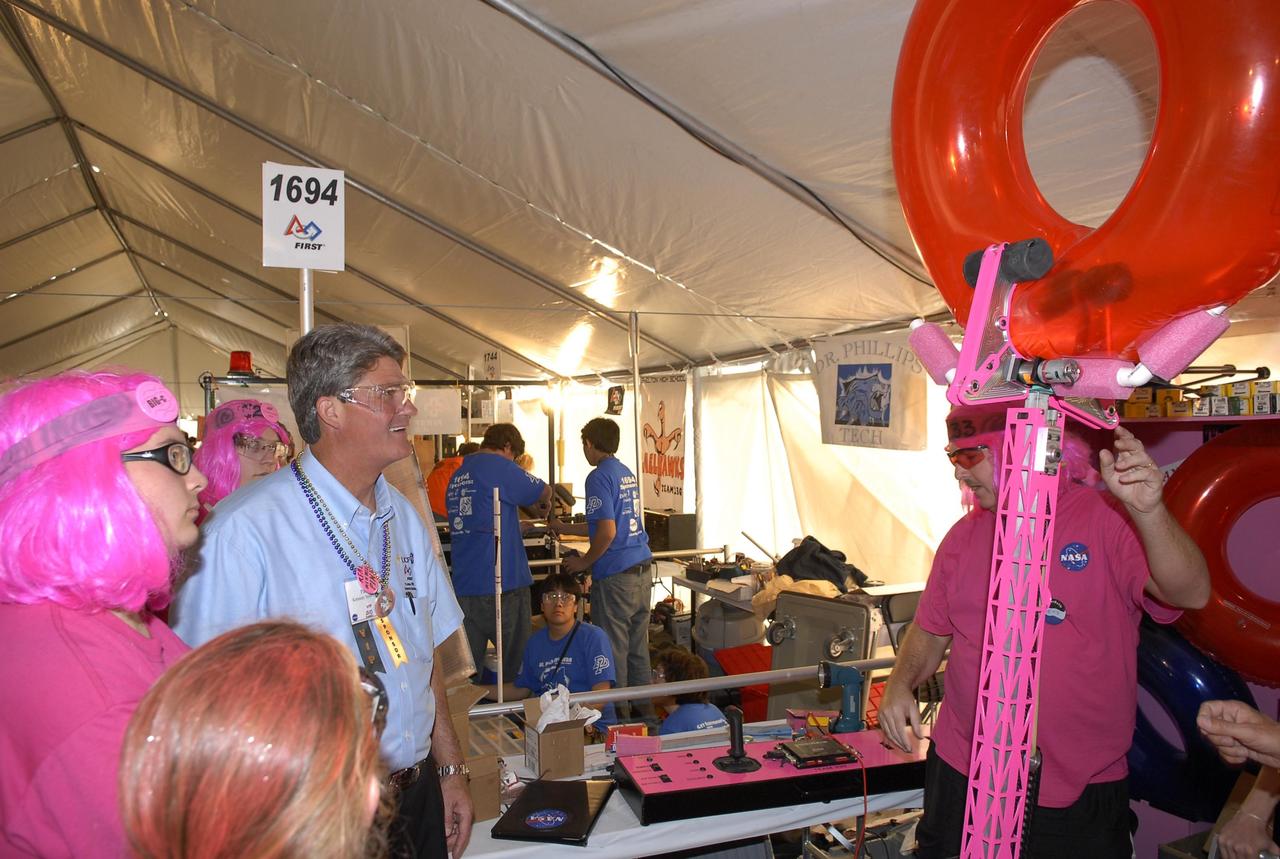
KENNEDY SPACE CENTER, FLA. -- During the FIRST robotics event held at the University of Central Florida Arena March 8-10, Center Director Bill Parsons talks to the NASA-sponsored team, known as the Pink Team, from Rockledge, Cocoa Beach and Viera High Schools in Central Florida. The FIRST, or For Inspiration and Recognition of Science and Technology, Robotics Competition challenges teams of young people and their mentors to solve a common problem in a six-week timeframe using a standard "kit of parts" and a common set of rules. Teams build robots from the parts and enter them in a series of competitions designed by FIRST founder Dean Kamen and Dr. Woodie Flowers, chairman and vice chairman of the Executive Advisory Board respectively, and a committee of engineers and other professionals. FIRST redefines winning for these students. Teams are rewarded for excellence in design, demonstrated team spirit, gracious professionalism and maturity, and ability to overcome obstacles. Scoring the most points is a secondary goal. Winning means building partnerships that last. Photo credit: NASA/Kim Shiflett
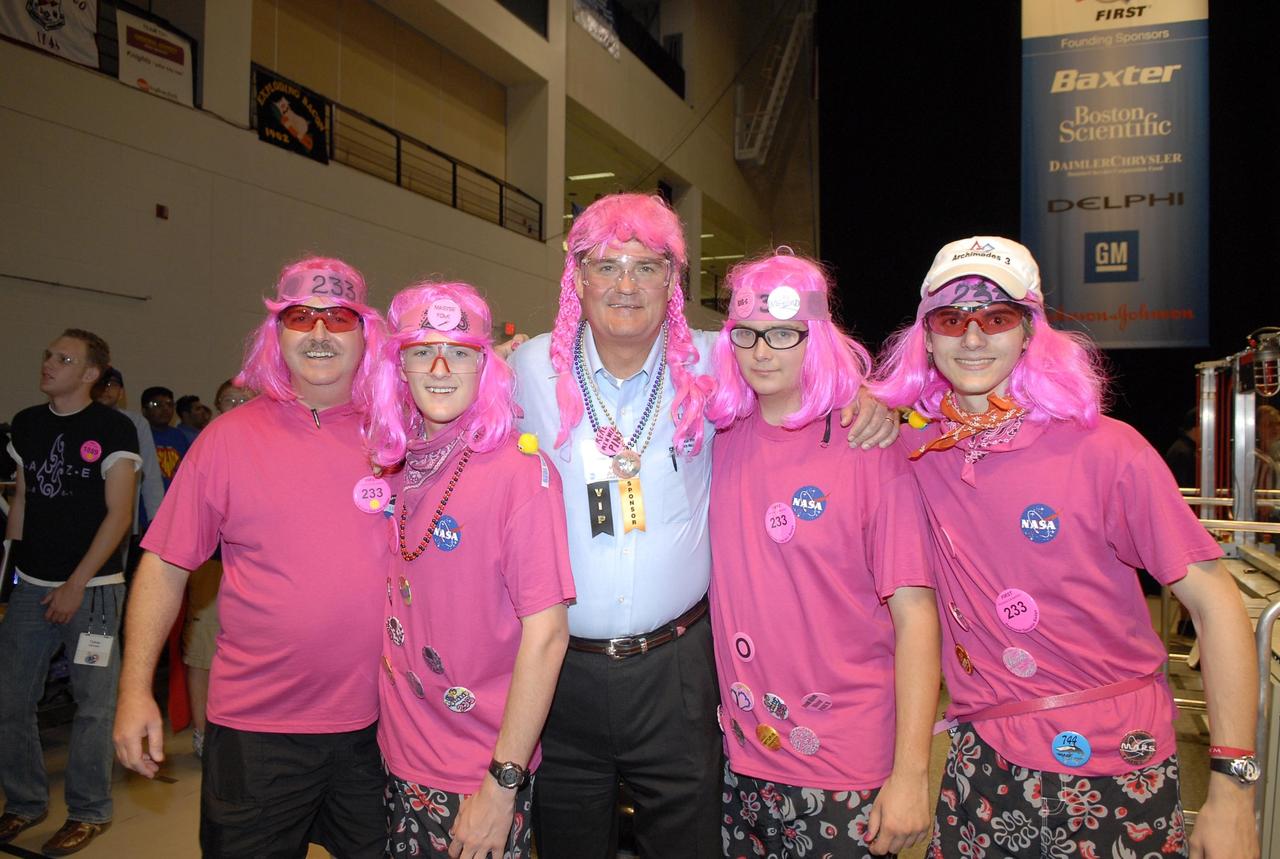
KENNEDY SPACE CENTER, FLA. -- During the FIRST robotics event held at the University of Central Florida Arena March 8-10, Center Director Bill Parsons (center) dons the pink wig that represents team no. 233, composed of students from Rockledge, Cocoa Beach and Viera High Schools in Central Florida. The team is cosponsored by NASA KSC. The FIRST, or For Inspiration and Recognition of Science and Technology, Robotics Competition challenges teams of young people and their mentors to solve a common problem in a six-week timeframe using a standard "kit of parts" and a common set of rules. Teams build robots from the parts and enter them in a series of competitions designed by FIRST founder Dean Kamen and Dr. Woodie Flowers, chairman and vice chairman of the Executive Advisory Board respectively, and a committee of engineers and other professionals. FIRST redefines winning for these students. Teams are rewarded for excellence in design, demonstrated team spirit, gracious professionalism and maturity, and ability to overcome obstacles. Scoring the most points is a secondary goal. Winning means building partnerships that last. Photo credit: NASA/Kim Shiflett
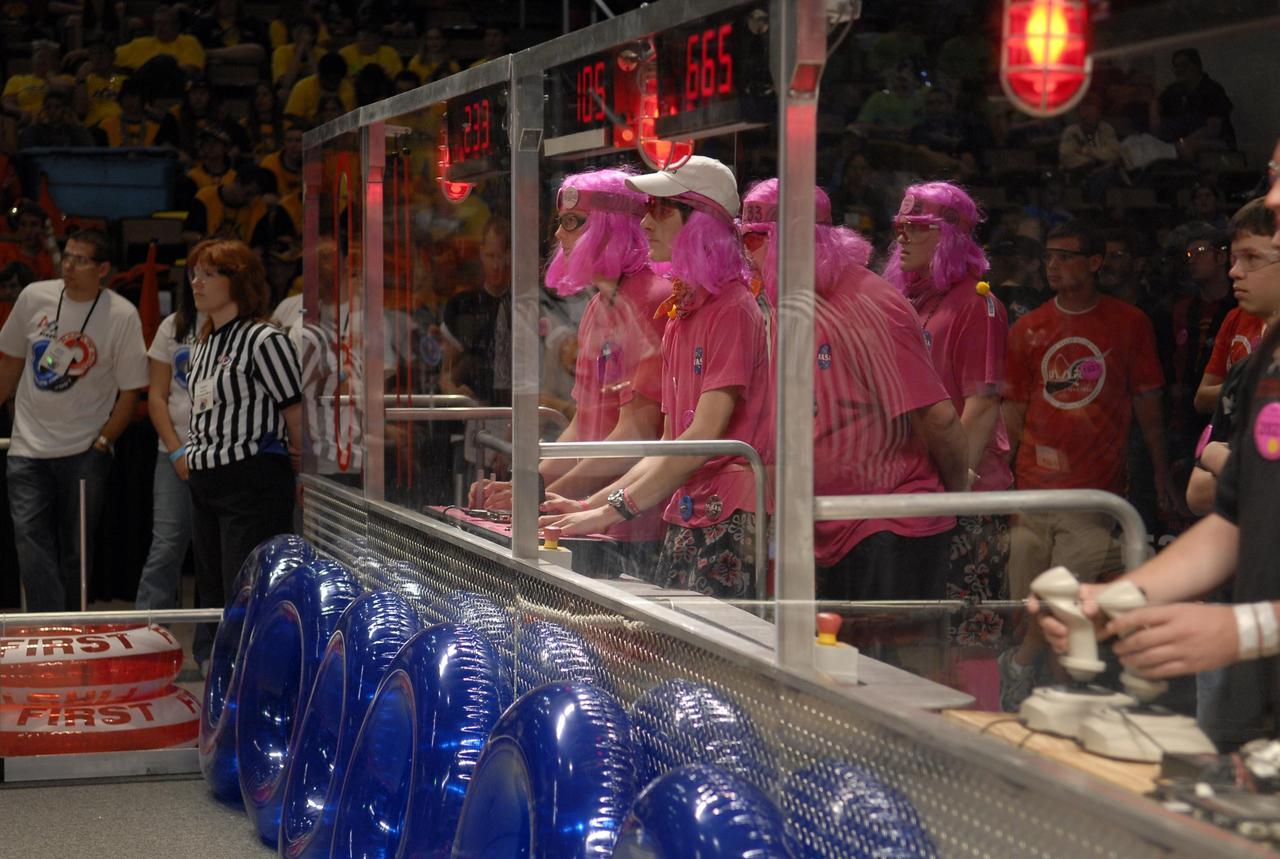
KENNEDY SPACE CENTER, FLA. -- The student team no. 233 dressed in pink controls its robot during competition in the FIRST robotics event held at the University of Central Florida Arena March 8-10. The team is a coordinated effort co-sponsored by NASA KSC and representing Rockledge, Cocoa Beach and Viera High Schools in Central Florida. The FIRST, or For Inspiration and Recognition of Science and Technology, Robotics Competition challenges teams of young people and their mentors to solve a common problem in a six-week timeframe using a standard "kit of parts" and a common set of rules. Teams build robots from the parts and enter them in a series of competitions designed by FIRST founder Dean Kamen and Dr. Woodie Flowers, chairman and vice chairman of the Executive Advisory Board respectively, and a committee of engineers and other professionals. FIRST redefines winning for these students. Teams are rewarded for excellence in design, demonstrated team spirit, gracious professionalism and maturity, and ability to overcome obstacles. Scoring the most points is a secondary goal. Winning means building partnerships that last. Photo credit: NASA/Kim Shiflett
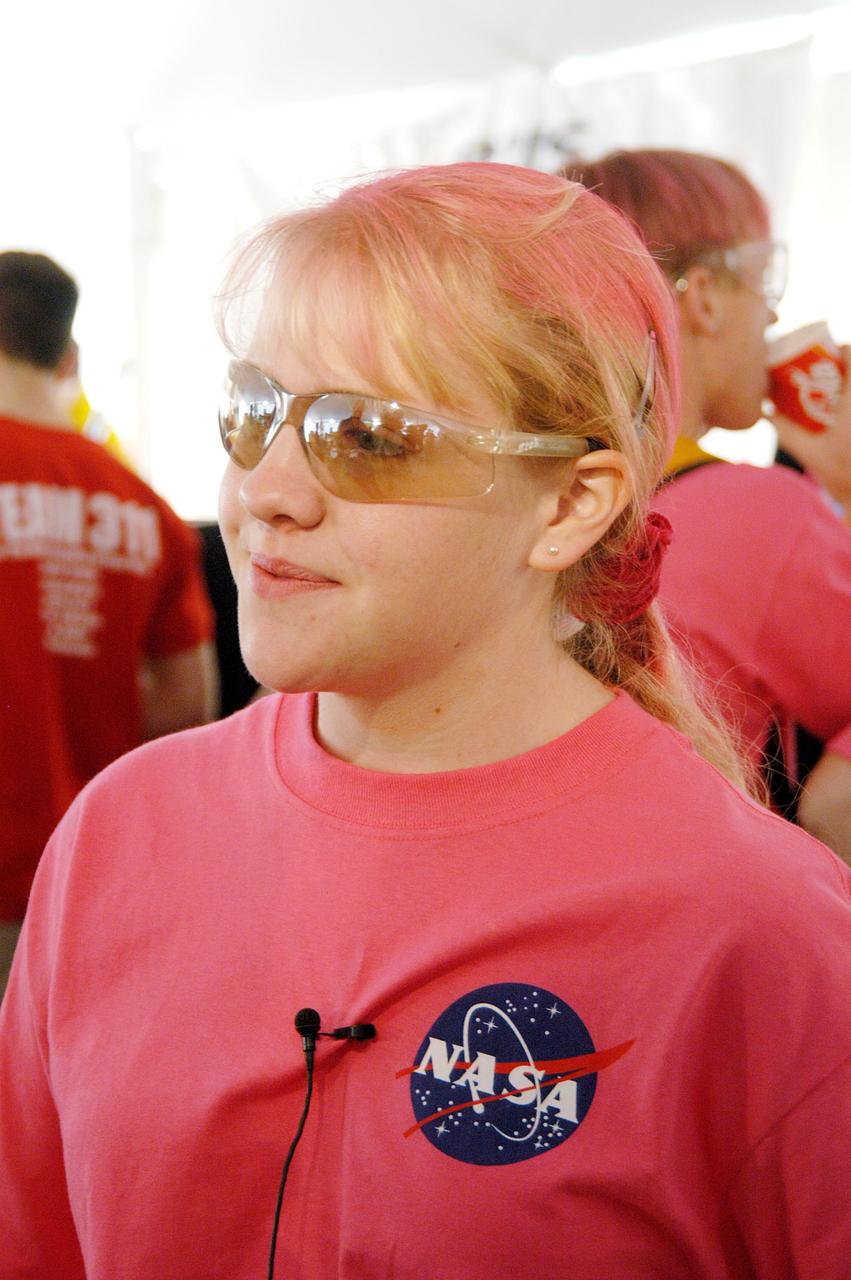
KENNEDY SPACE CENTER, FLA. - Dressed for the part, a student on the KSC-sponsored “Pink” team waits during a break in the matches at the 2004 Florida Regional FIRST competition in the University of Central Florida Arena. The event hosted 41 teams from Canada, Brazil, Great Britain and the United States. Among observers at the annual event were Center Director Jim Kennedy and Florida Gov. Jeb Bush, who spoke at the event luncheon. FIRST is a nonprofit organization, For Inspiration and Recognition of Science and Technology, that sponsors the event pitting gladiator robots against each other in an athletic-style competition. The FIRST robotics competition is designed to provide students with a hands-on, inside look at engineering and other professional careers, pairing high school students with engineer mentors and corporations.
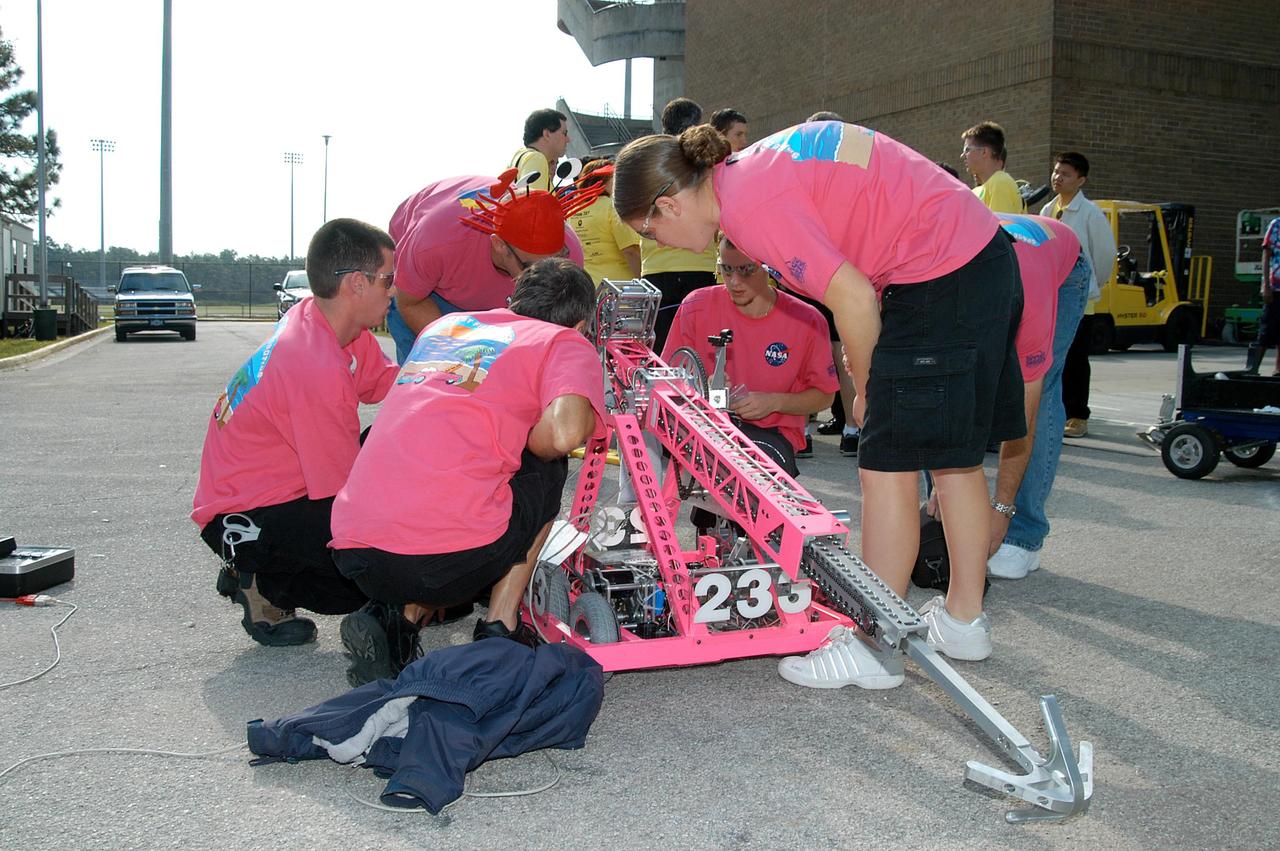
KENNEDY SPACE CENTER, FLA. - On the grounds of the University of Central Florida, the KSC-sponsored “Pink” team checks out its robot for the 2004 Florida Regional FIRST competition. The event hosted 41 teams from Canada, Brazil, Great Britain and the United States. Among observers at the annual event were Center Director Jim Kennedy and Florida Gov. Jeb Bush, who spoke at the event luncheon. FIRST is a nonprofit organization, For Inspiration and Recognition of Science and Technology, that sponsors the event pitting gladiator robots against each other in an athletic-style competition. The FIRST robotics competition is designed to provide students with a hands-on, inside look at engineering and other professional careers, pairing high school students with engineer mentors and corporations.
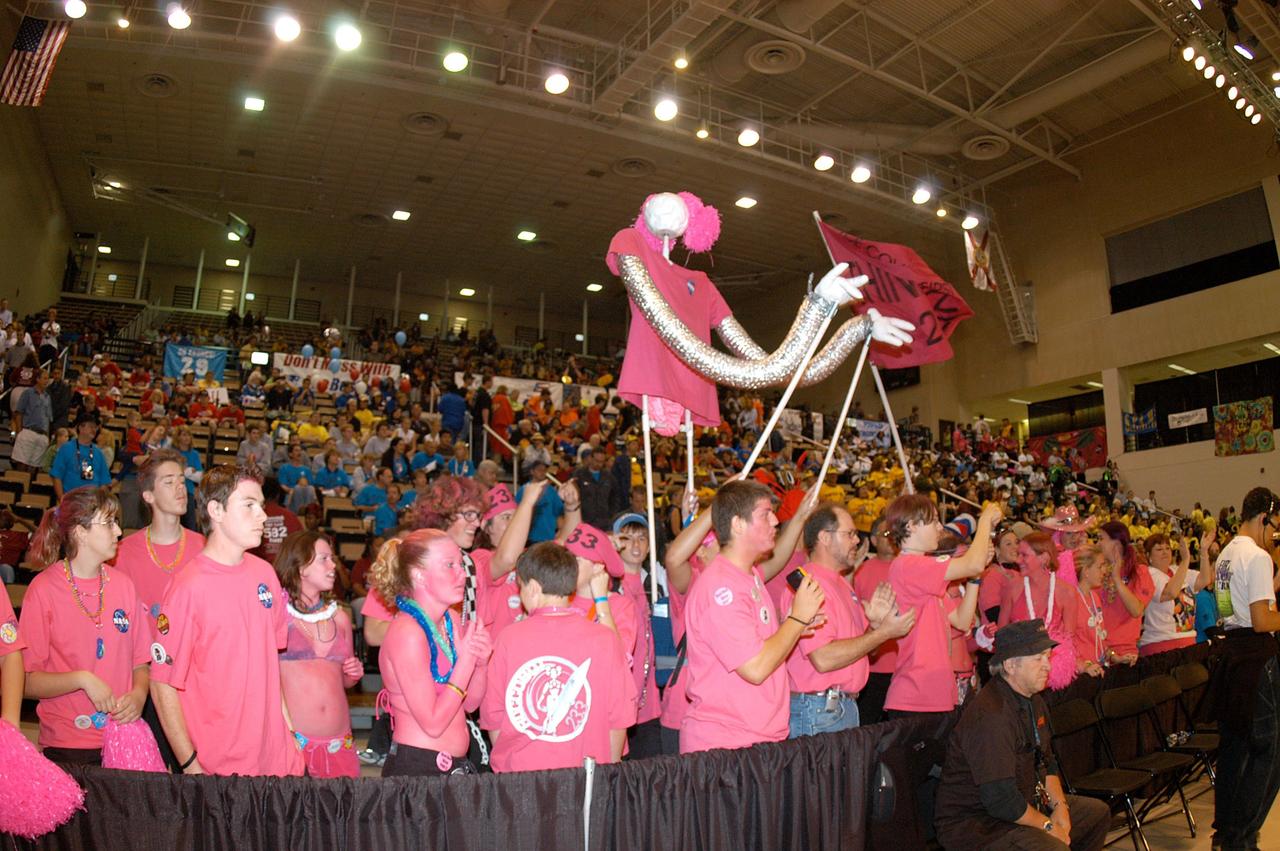
KENNEDY SPACE CENTER, FLA. - Friends and families root for the KSC-sponsored “Pink” team during the 2004 Florida Regional FIRST competition in the University of Central Florida Arena. The event hosted 41 teams from Canada, Brazil, Great Britain and the United States. Among observers at the annual event were Center Director Jim Kennedy and Florida Gov. Jeb Bush, who spoke at the event luncheon. FIRST is a nonprofit organization, For Inspiration and Recognition of Science and Technology, that sponsors the event pitting gladiator robots against each other in an athletic-style competition. The FIRST robotics competition is designed to provide students with a hands-on, inside look at engineering and other professional careers, pairing high school students with engineer mentors and corporations.
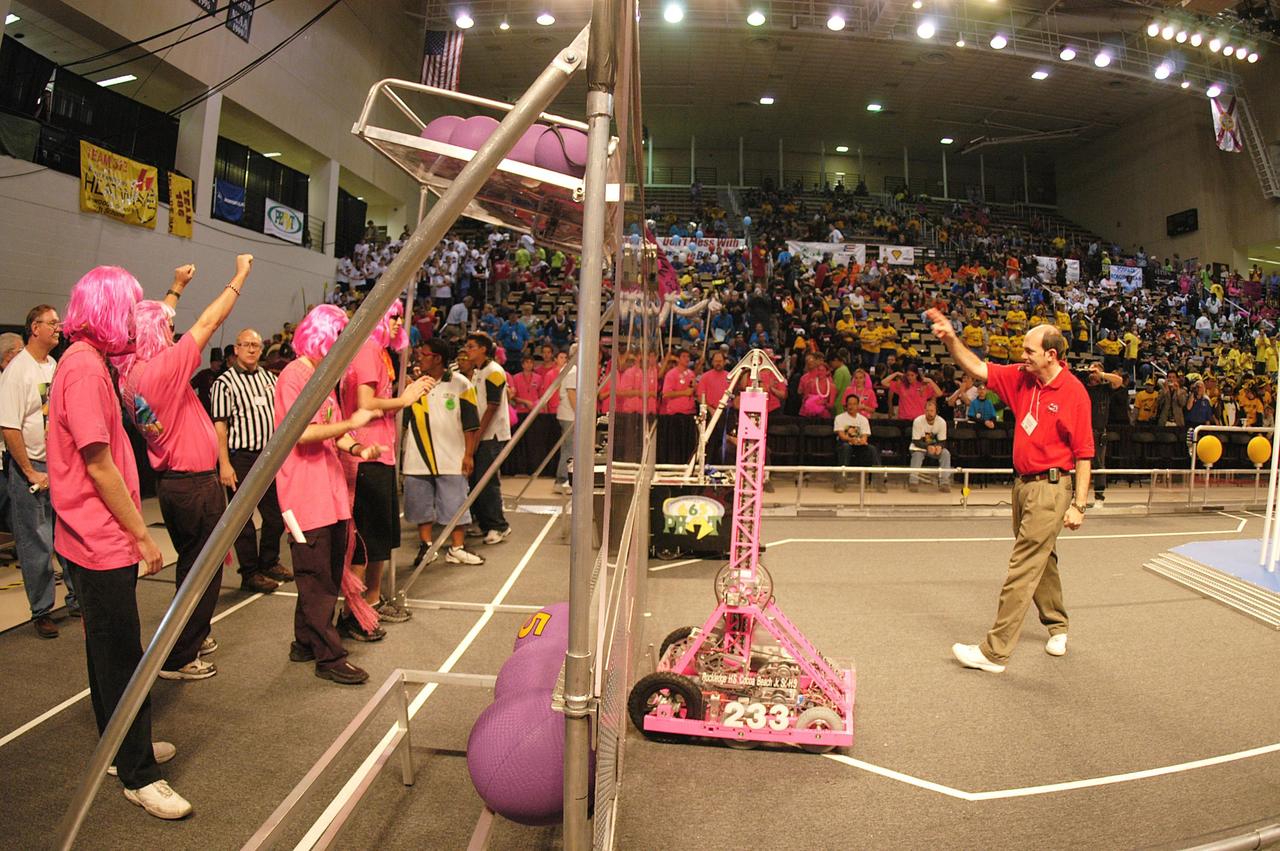
KENNEDY SPACE CENTER, FLA. - During the 2004 Florida Regional FIRST competition in the University of Central Florida Arena, the KSC-sponsored “Pink” team scores. The event hosted 41 teams from Canada, Brazil, Great Britain and the United States. Among observers at the annual event were Center Director Jim Kennedy and Florida Gov. Jeb Bush, who spoke at the event luncheon. FIRST is a nonprofit organization, For Inspiration and Recognition of Science and Technology, that sponsors the event pitting gladiator robots against each other in an athletic-style competition. The FIRST robotics competition is designed to provide students with a hands-on, inside look at engineering and other professional careers, pairing high school students with engineer mentors and corporations.

KENNEDY SPACE CENTER, FLA. - Students on one of the 41 teams competing in the 2004 Florida Regional FIRST competition at the University of Central Florida are led in a “wave” in the stands. KSC sponsored the “Pink” team of Cocoa Beach and Rockledge High School students. Among observers at the annual event were Center Director Jim Kennedy and Florida Gov. Jeb Bush, who spoke at the event luncheon. FIRST is a nonprofit organization, For Inspiration and Recognition of Science and Technology, that sponsors the event pitting gladiator robots against each other in an athletic-style competition. The FIRST robotics competition is designed to provide students with a hands-on, inside look at engineering and other professional careers, pairing high school students with engineer mentors and corporations.
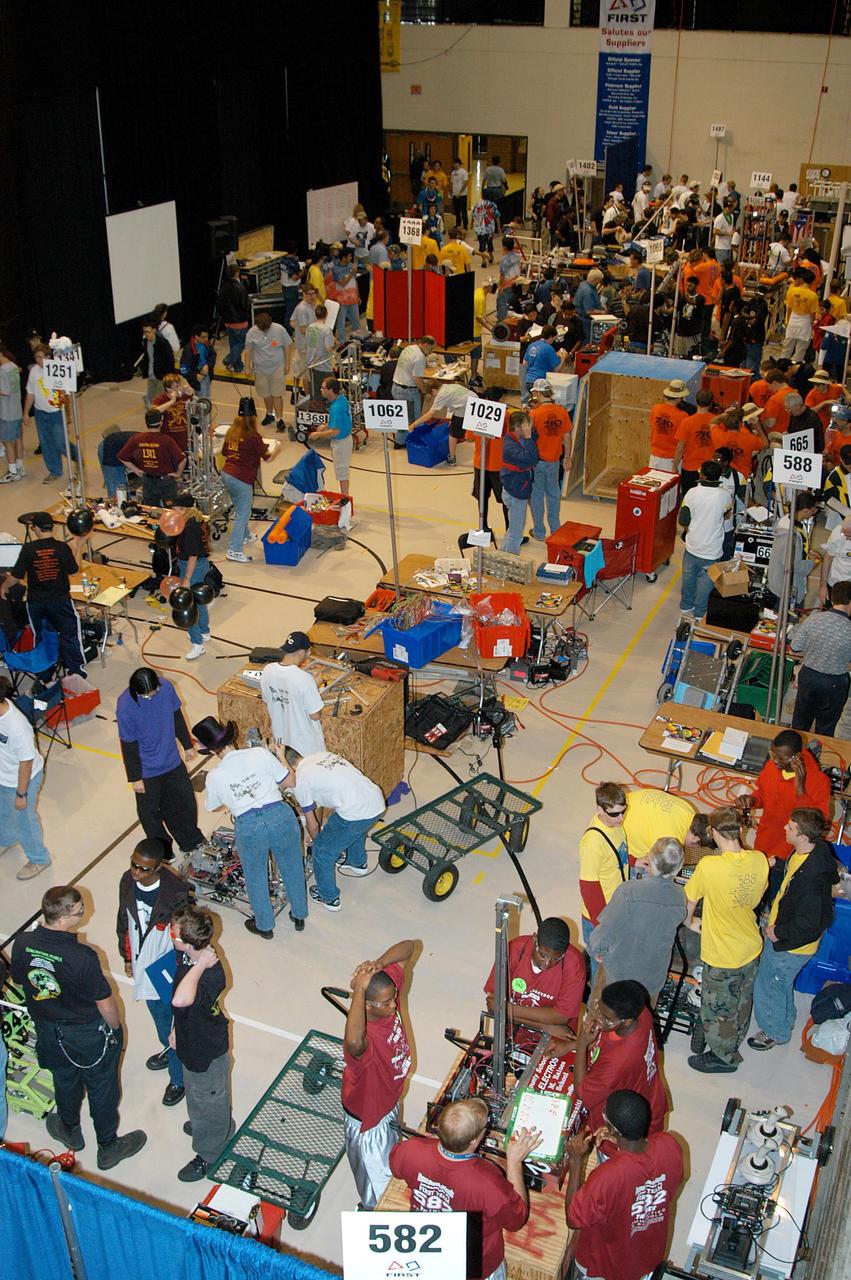
KENNEDY SPACE CENTER, FLA. - Many of the 41 teams competing in the 2004 Florida Regional FIRST competition at the University of Central Florida are seen here preparing their robots for a match. KSC sponsored the “Pink” team of Cocoa Beach and Rockledge High School students. Among observers at the annual event were Center Director Jim Kennedy and Florida Gov. Jeb Bush, who spoke at the event luncheon. FIRST is a nonprofit organization, For Inspiration and Recognition of Science and Technology, that sponsors the event pitting gladiator robots against each other in an athletic-style competition. The FIRST robotics competition is designed to provide students with a hands-on, inside look at engineering and other professional careers, pairing high school students with engineer mentors and corporations.
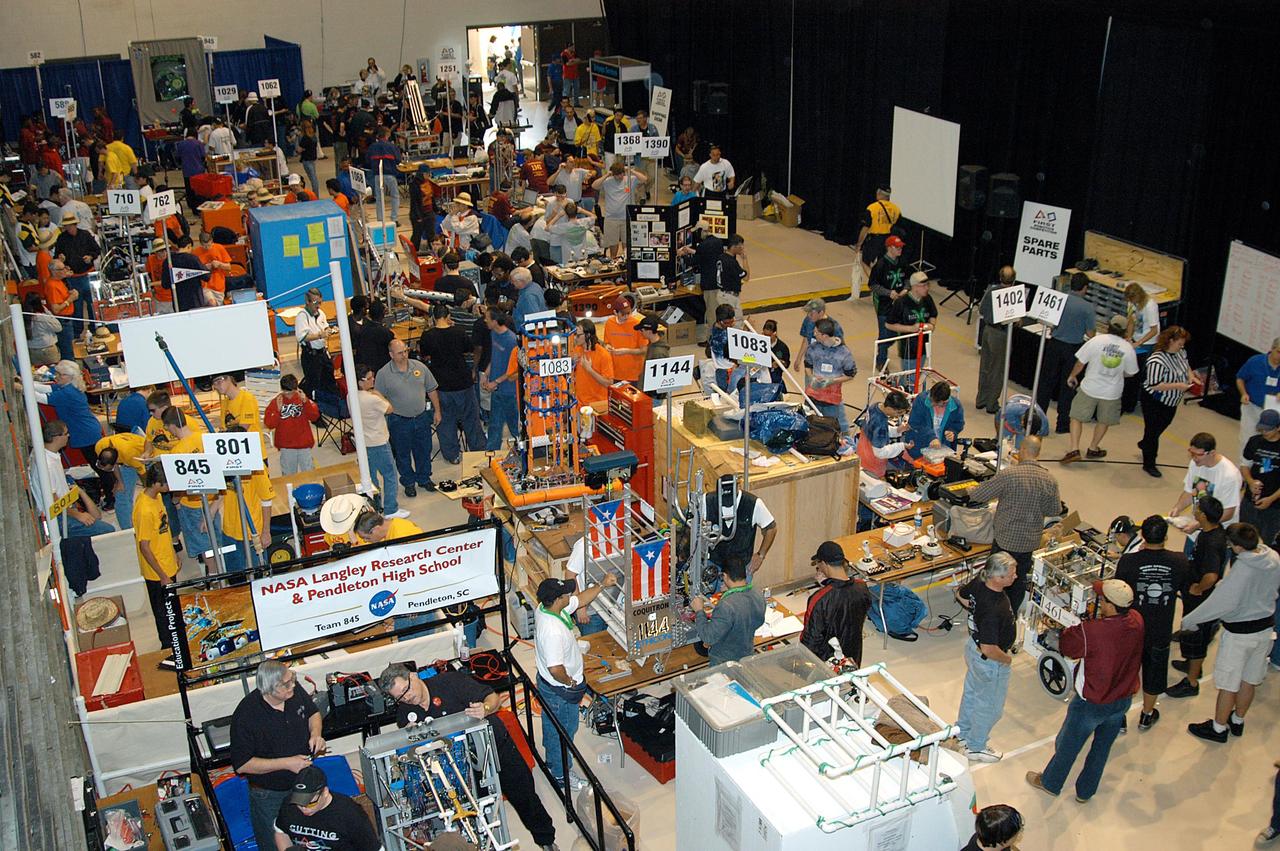
KENNEDY SPACE CENTER, FLA. - Many of the 41 teams competing in the 2004 Florida Regional FIRST competition at the University of Central Florida are seen here preparing their robots for a match. KSC sponsored the “Pink” team of Cocoa Beach and Rockledge High School students. Among observers at the annual event were Center Director Jim Kennedy and Florida Gov. Jeb Bush, who spoke at the event luncheon. FIRST is a nonprofit organization, For Inspiration and Recognition of Science and Technology, that sponsors the event pitting gladiator robots against each other in an athletic-style competition. The FIRST robotics competition is designed to provide students with a hands-on, inside look at engineering and other professional careers, pairing high school students with engineer mentors and corporations.
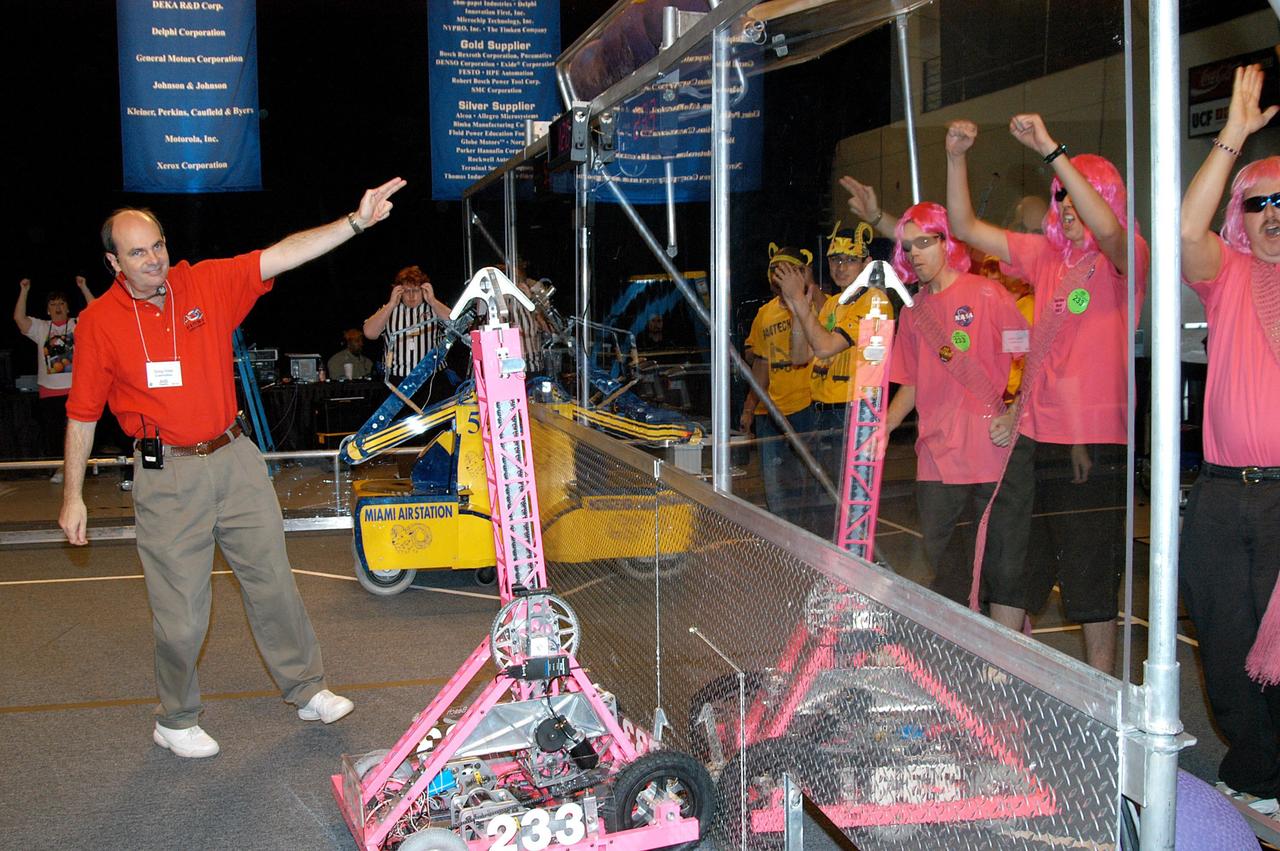
KENNEDY SPACE CENTER, FLA. - During the 2004 Florida Regional FIRST competition in the University of Central Florida Arena, a judge names the KSC-sponsored “Pink” team winner of the match. The event hosted 41 teams from Canada, Brazil, Great Britain and the United States. Among observers at the annual event were Center Director Jim Kennedy and Florida Gov. Jeb Bush, who spoke at the event luncheon. FIRST is a nonprofit organization, For Inspiration and Recognition of Science and Technology, that sponsors the event pitting gladiator robots against each other in an athletic-style competition. The FIRST robotics competition is designed to provide students with a hands-on, inside look at engineering and other professional careers, pairing high school students with engineer mentors and corporations.
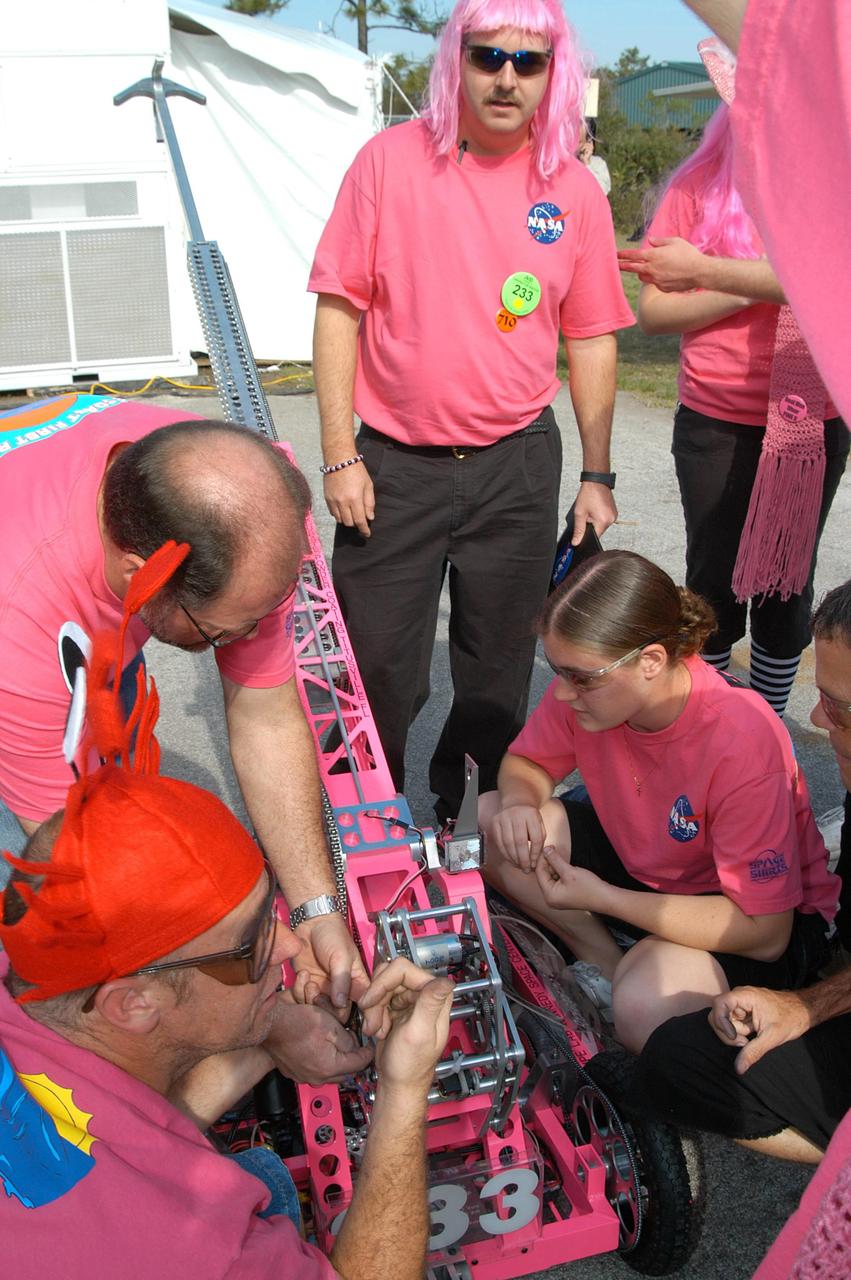
KENNEDY SPACE CENTER, FLA. - On the grounds of the University of Central Florida, the KSC-sponsored “Pink” team checks out its robot for the 2004 Florida Regional FIRST competition. The event hosted 41 teams from Canada, Brazil, Great Britain and the United States. Among observers at the annual event were Center Director Jim Kennedy and Florida Gov. Jeb Bush, who spoke at the event luncheon. FIRST is a nonprofit organization, For Inspiration and Recognition of Science and Technology, that sponsors the event pitting gladiator robots against each other in an athletic-style competition. The FIRST robotics competition is designed to provide students with a hands-on, inside look at engineering and other professional careers, pairing high school students with engineer mentors and corporations.
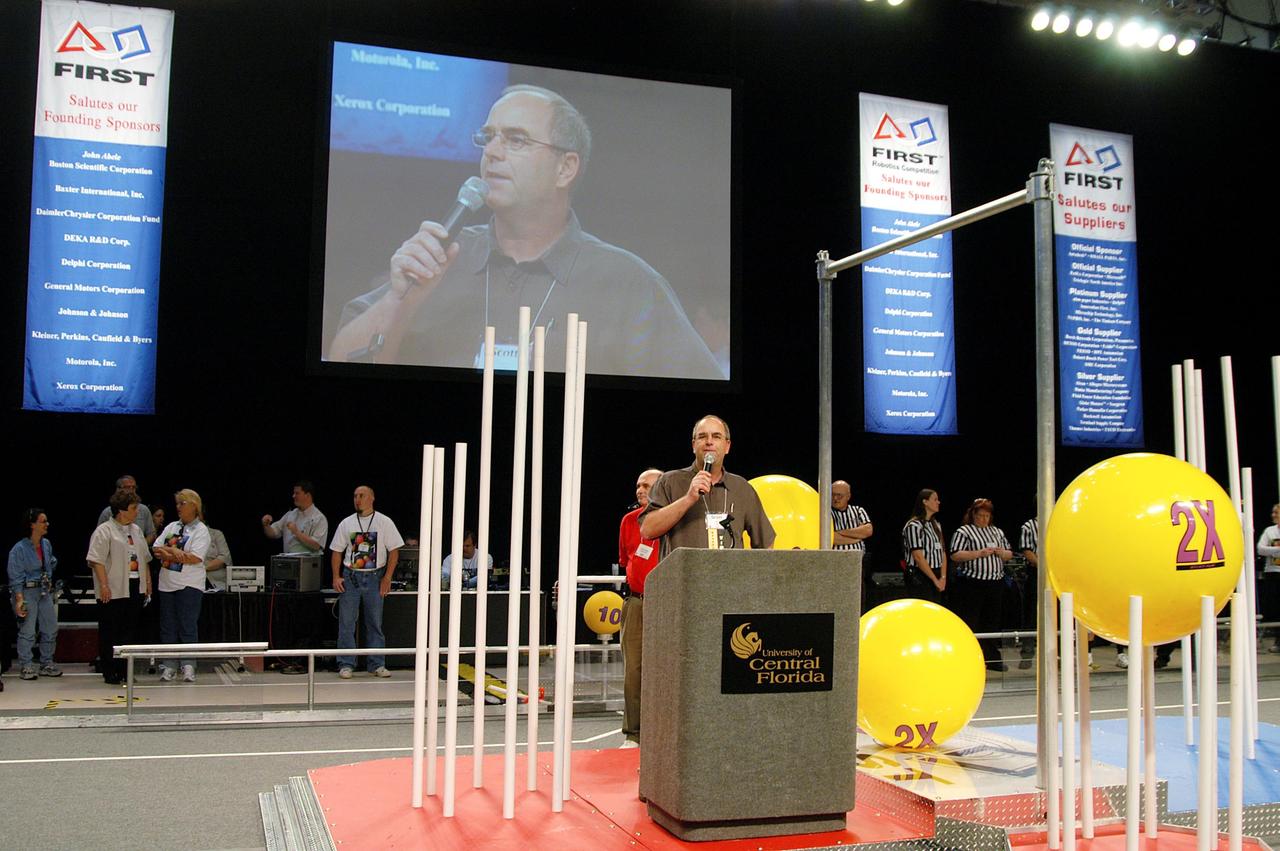
KENNEDY SPACE CENTER, FLA. - Scott Kerr, director of Spaceport Services at KSC, speaks to students and attendees at the 2004 Florida Regional FIRST competition, held at the University of Central Florida Arena. KSC sponsored the “Pink” team of Cocoa Beach and Rockledge High School students. Among observers at the annual event were Center Director Jim Kennedy and Florida Gov. Jeb Bush, who spoke at the event luncheon. FIRST is a nonprofit organization, For Inspiration and Recognition of Science and Technology, that sponsors the event pitting gladiator robots against each other in an athletic-style competition. The FIRST robotics competition is designed to provide students with a hands-on, inside look at engineering and other professional careers, pairing high school students with engineer mentors and corporations.
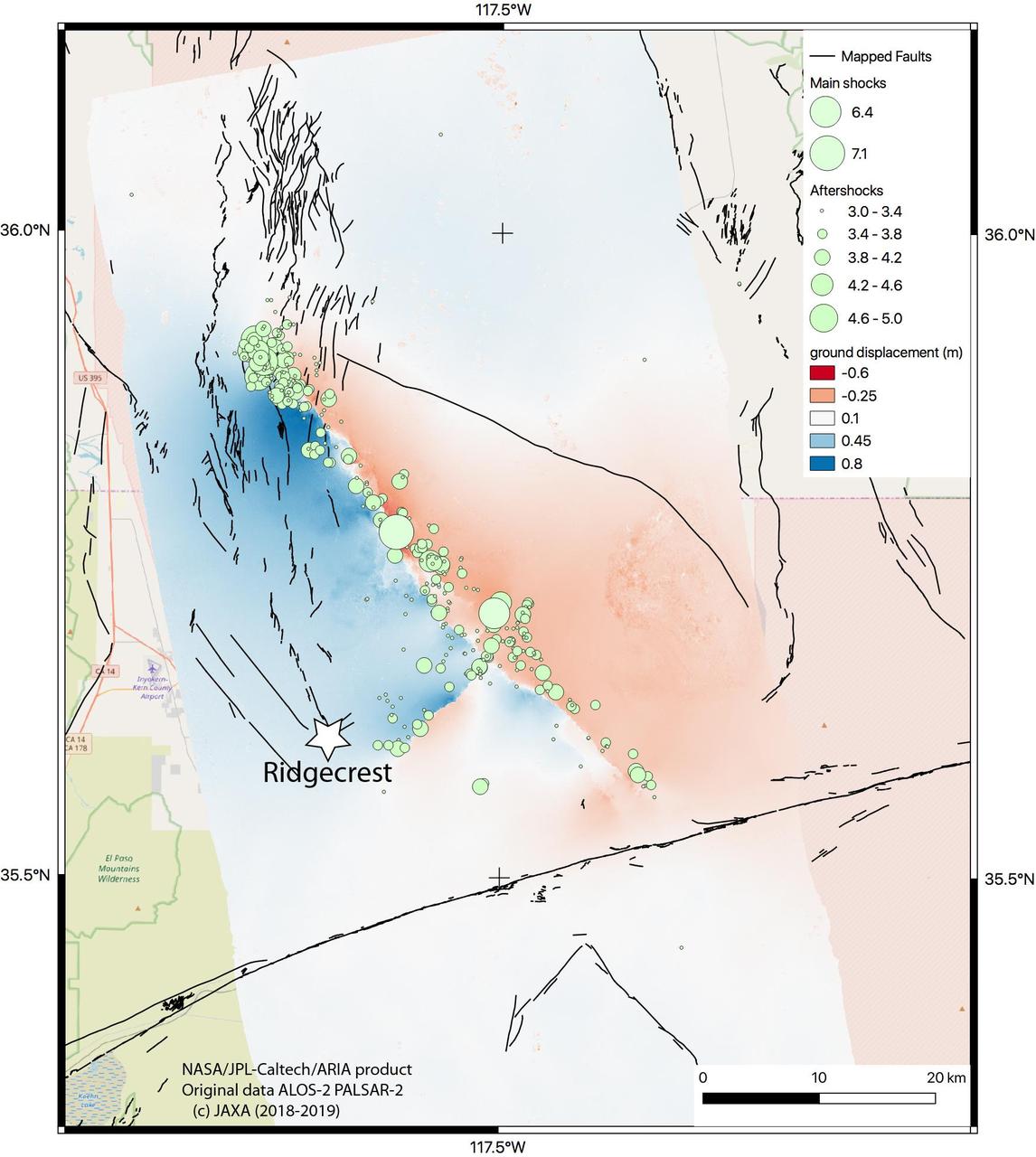
The Advanced Rapid Imaging and Analysis (ARIA) team at NASA's Jet Propulsion Laboratory in Pasadena, California, created this map of the Ridgecrest area of Southern California following two strong earthquakes — a magnitude 6.4 on July 4 and a magnitude 7.1 on July 5, 2019. The map shows how much and in what direction the ground moved in various places, displayed in meters. The blue tones show that the ground west of the main fault rupture, which runs from the lower right to the upper left, moved toward the northwest by as much as 0.8 meters (2.7 feet) during the 7.1-magnitude quake. The ground in the red and pink areas moved southeast by as much as 0.6 meters (2 feet). Black lines show faults that were mapped before the 2019 earthquakes. The 6.4-magnitude quake moved a shorter fault that runs perpendicular to the main fault — shown slightly down and to the left of center on the map. The colors in this area show that the north side of the fault moved to the west (blue) and the south side moved to the east (pink). The green circles correspond to aftershocks of a magnitude of 3.0 or higher, which were detected along both faults, between July 4 and July 9. The larger the circle, the stronger the aftershock. The ARIA team used interferometric synthetic aperture radar (InSAR) analysis of data from the ALOS-2 satellite, operated by the Japan Aerospace Exploration Agency (JAXA) to create the map. They used images captured before the quakes (on April 16, 2018) and after the quakes (on July 8, 2019) for this analysis. https://photojournal.jpl.nasa.gov/catalog/PIA23351
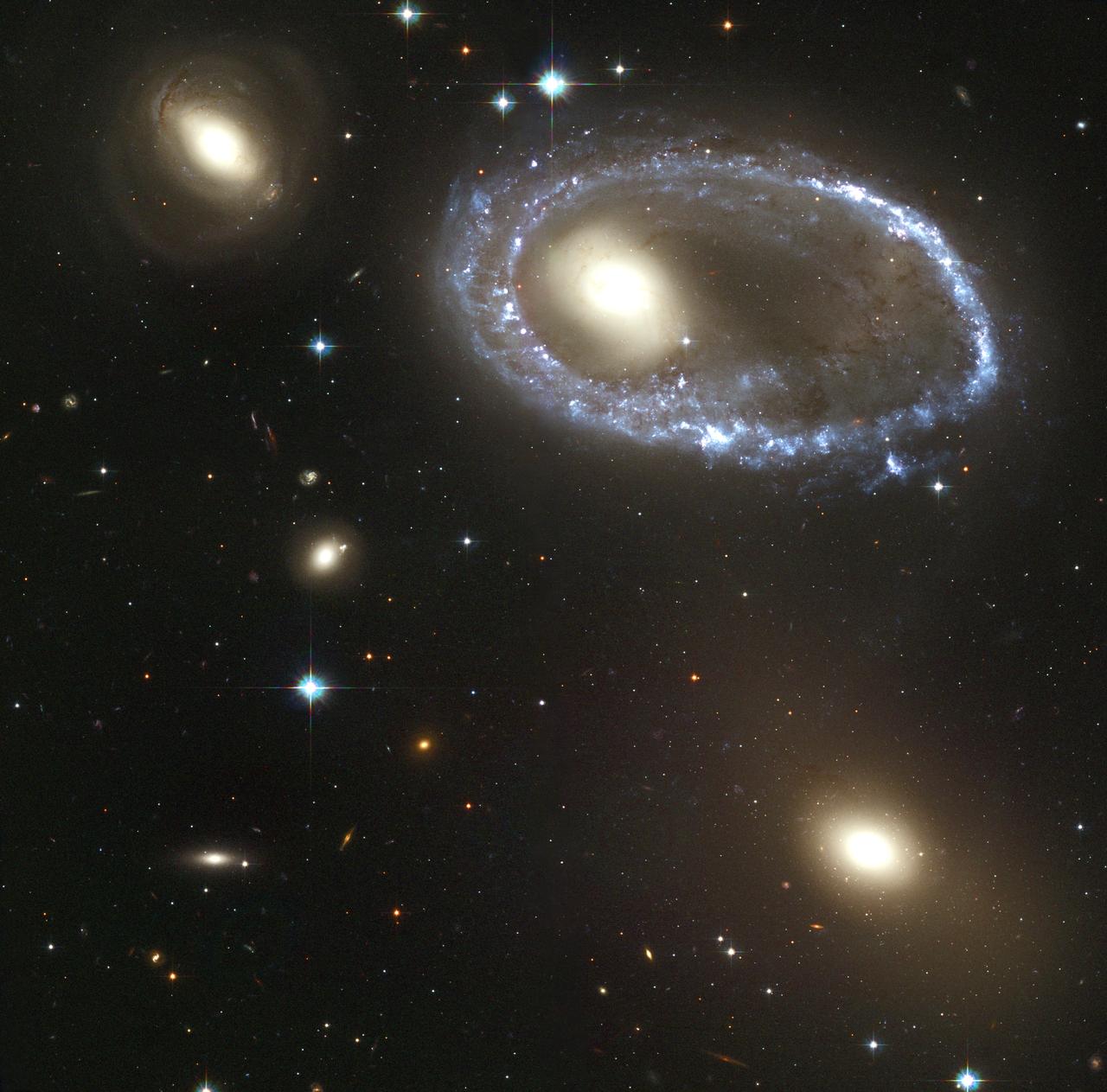
Released to commemorate the 14th anniversary of NASA’s Hubble Space Telescope (HST) is the image of a galaxy cataloged as AM 0644-741. Resembling a diamond encrusted bracelet, the ring of brilliant blue star clusters wraps around a yellowish nucleus of what was once a normal spiral galaxy. Located 300 million light years away in the direction of the southern constellation Dorado, the sparkling blue ring is 150,000 light years in diameter, making it larger than our entire home galaxy, the Milky Way. Ring galaxies are a striking example of how collisions between galaxies can dramatically change their structure, while triggering the formation of new stars. Typically one galaxy plunges directly into the disk of another one. The ring that pierced through this galaxy’s ring is out of the image but is visible in larger-field images. The soft galaxy visible to the left of the ring galaxy is a coincidental background galaxy which is not interacting with the ring. Rampant star formation explains why the ring is so blue. It is continuously forming massive, young, hot stars. Another sign of robust star formation is the pink regions along the ring. These are rare clouds of glowing hydrogen gas, fluorescing because of the strong ultraviolet light from the newly formed stars. The Hubble Heritage Team used the Hubble Advanced Camera for Surveys to take this image using a combination of four separate filters that isolate blue, green, red, and near-infrared light to create the color image.
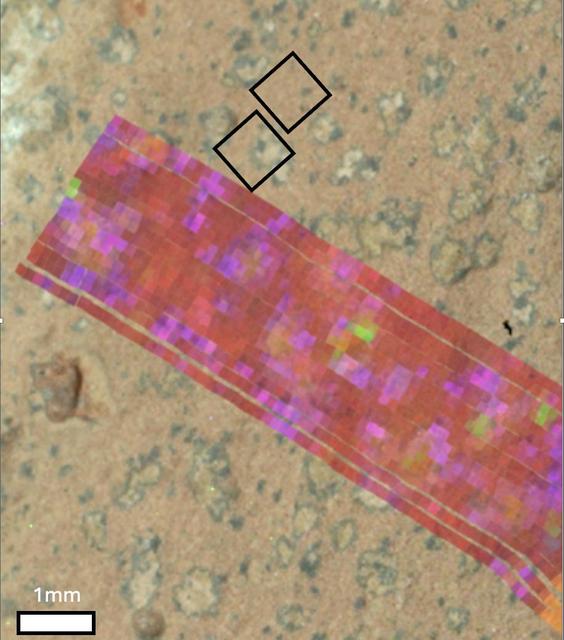
NASA's Perseverance Mars rover generated this mineral map showing the presence of two minerals – vivianite (purple and pink) and greigite (dull yellow and green) – on the surface of a rock nicknamed "Cheyava Falls." The data helped scientists determine the rock contained a potential biosignature, which is a substance or structure that might have a biological origin but requires more data or further study before a conclusion can be reached about the absence or presence of life. Perseverance's PIXL (Planetary Instrument for X-ray Lithochemistry) and SHERLOC (Scanning Habitable Environments with Raman & Luminescence for Organics & Chemicals)instruments found a distinct pattern of minerals arranged into reaction fronts (points of contact where chemical and physical reactions occur) that the team called "leopard spots." The leopard spots carried the signature of vivianite (hydrated iron phosphate) and greigite (iron sulfide). Vivianite appears within black spots mission scientists refer to as "poppy seeds" and in the dark rims of the larger "leopard spots." Greigite is seen within the interiors of the leopard spots, which could have been left behind by microbial life if it had used the raw ingredients – the organic carbon, sulfur, and phosphorus – in the rock as an energy source. Vivianite is frequently found on Earth in sediments and peat bogs and around decaying organic matter. Similarly, certain forms of microbial life on Earth can produce greigite. The combination of these minerals, which appear to have formed by electron-transfer reactions between the sediment and organic matter, is a potential "fingerprint" for microbial life, which would use these reactions to produce energy for growth. The minerals can also be generated abiotically, or without the presence of life. https://photojournal.jpl.nasa.gov/catalog/PIA26640
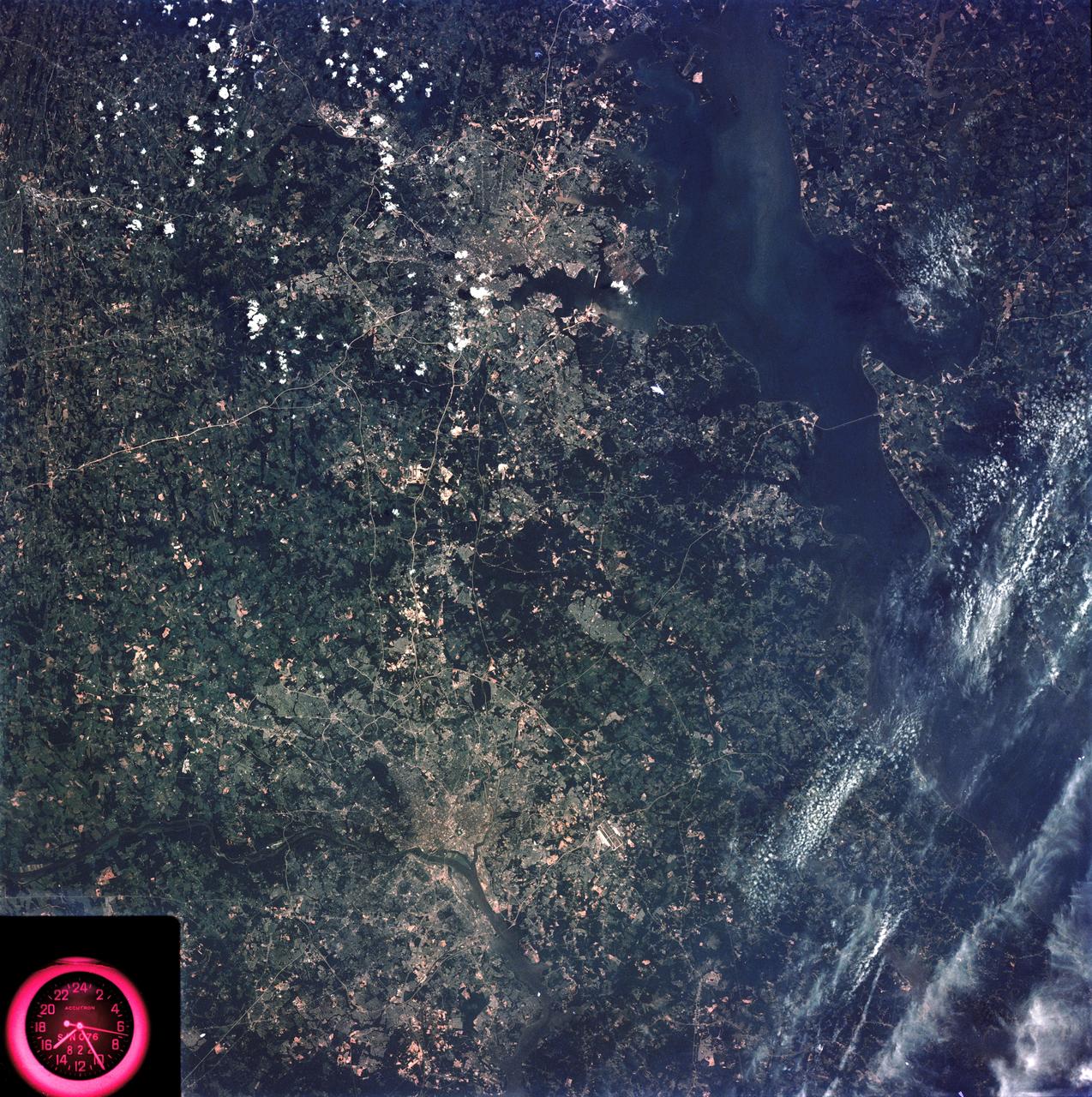
SL3-83-166 (July-September 1973) --- A vertical view of the Washington D.C. and the Baltimore, Maryland area is seen in the Skylab 3 Earth Resources Experiments Package S190-B (five-inch Earth terrain camera) photograph taken from the Skylab space station in Earth orbit. The Chesapeake Bay is on the right (east) side of the picture. The Potomac River flows through the Washington area in the lower left (southwest) corner of the photograph. Several transportation routes and major highways stand out very distinctly. Especially conspicuous are the beltways around the cities, Interstate 95 between Baltimore and the nation?s capitol and Interstate 70N leading west from Baltimore. The tunnel and harbor facilities in Baltimore show clearly, also. Identifiable features in the Washington area include the Capitol Building, the Mall area, Robert F. Kennedy Stadium (white circle), the five bridges across the Potomac, Andrews Air Force Base (on east loop), and the smaller Anacostia River. The extent of the urbanization in this area is dramatically illustrated in this picture. The photograph has sufficient resolution that the housing patterns for individual suburban areas are clearly defined with the houses shown as pink gray, wooded areas as dark green and cleared areas light green. Chesapeake Bay circulation patterns are indicated by contrast of dark and light blue. Sediment plumes (red) are seen entering the bay north and east of Baltimore. The bay bridge stands out white against the blue water. The detailed information contained in this one photograph will be of direct use to several EREP investigator teams in land use analysis, sedimentation and circulation patterns in the bay, and resource surveys of Maryland. All EREP photography is available to the public through the Department of Interior?s Earth Resources Observations Systems Data Center, Sioux Falls, South Dakota, 57198. Photo credit: NASA
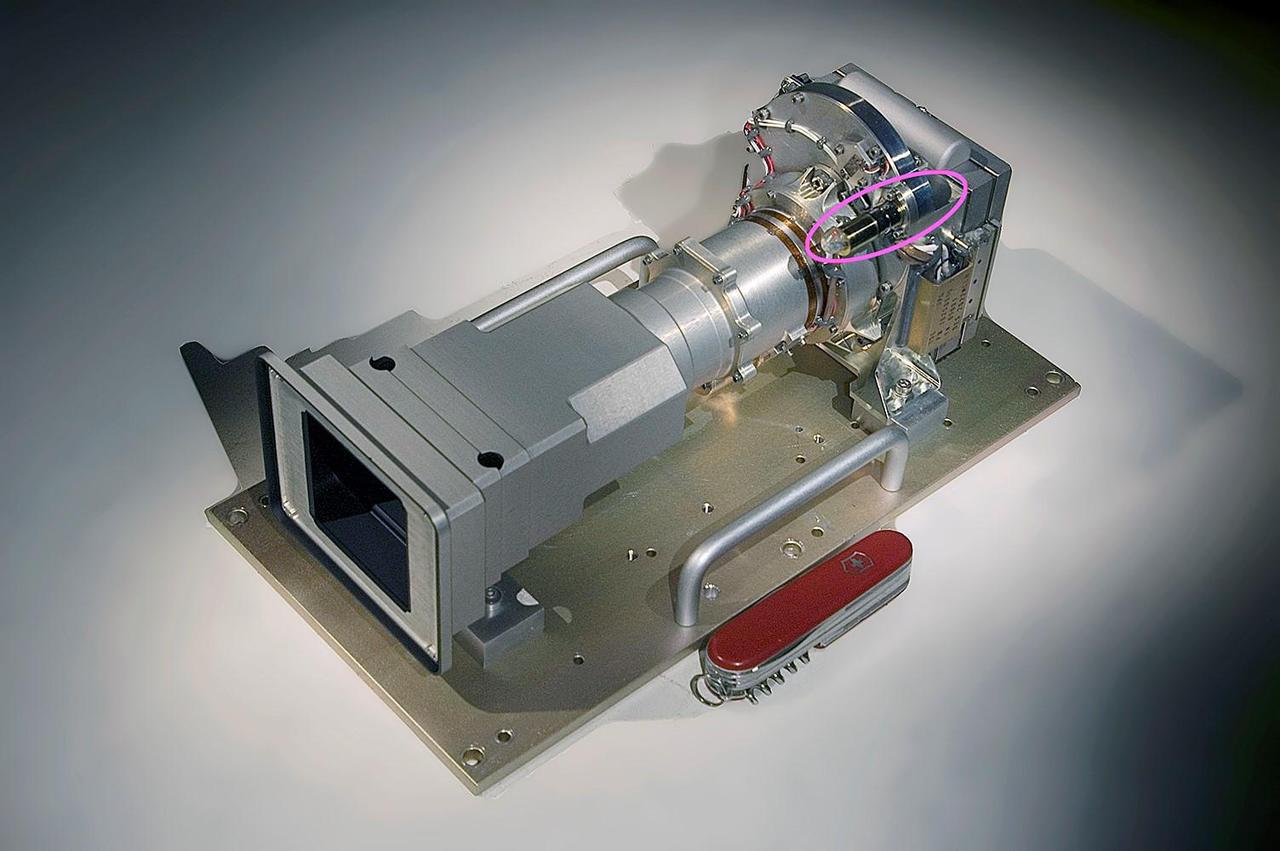
The Mast Camera, or Mastcam, aboard NASA's Curiosity Mars rover is built with two cameras – the left has a 34 mm focal length; the right, a 100 mm focal length. Behind each lens is a rotating wheel (circled in pink) arranged with filters. In addition to providing color images of the rover's surroundings, the cameras and their filters help scientists determine from afar the composition of rocks by the wavelengths of light, or spectra, they reflect in different colors. On Sept. 19, 2023, the left camera's filter wheel became stuck between the green and clear filter positions, the effects of which can be seen on the mission's raw, or unprocessed, images. The filter wheel is part of a spur-and-pinion mechanism, with the spur teeth around the filter wheel. The actuation uses a small motor that drives the pinion gear both forward and backward. Despite having been commanded at more than twice its normal torque, this motor has been unable to move in the counterclockwise direction. If unable to nudge the wheel back to the clear filter, the mission would rely on the higher resolution 100 mm right camera as the primary color-imaging system. The camera needs to take nine times more images than the left to cover the same area, which could affect how the team scouts for science targets and rover routes. The ability to observe detailed color spectra of rocks from afar would also be degraded. https://photojournal.jpl.nasa.gov/catalog/PIA26043
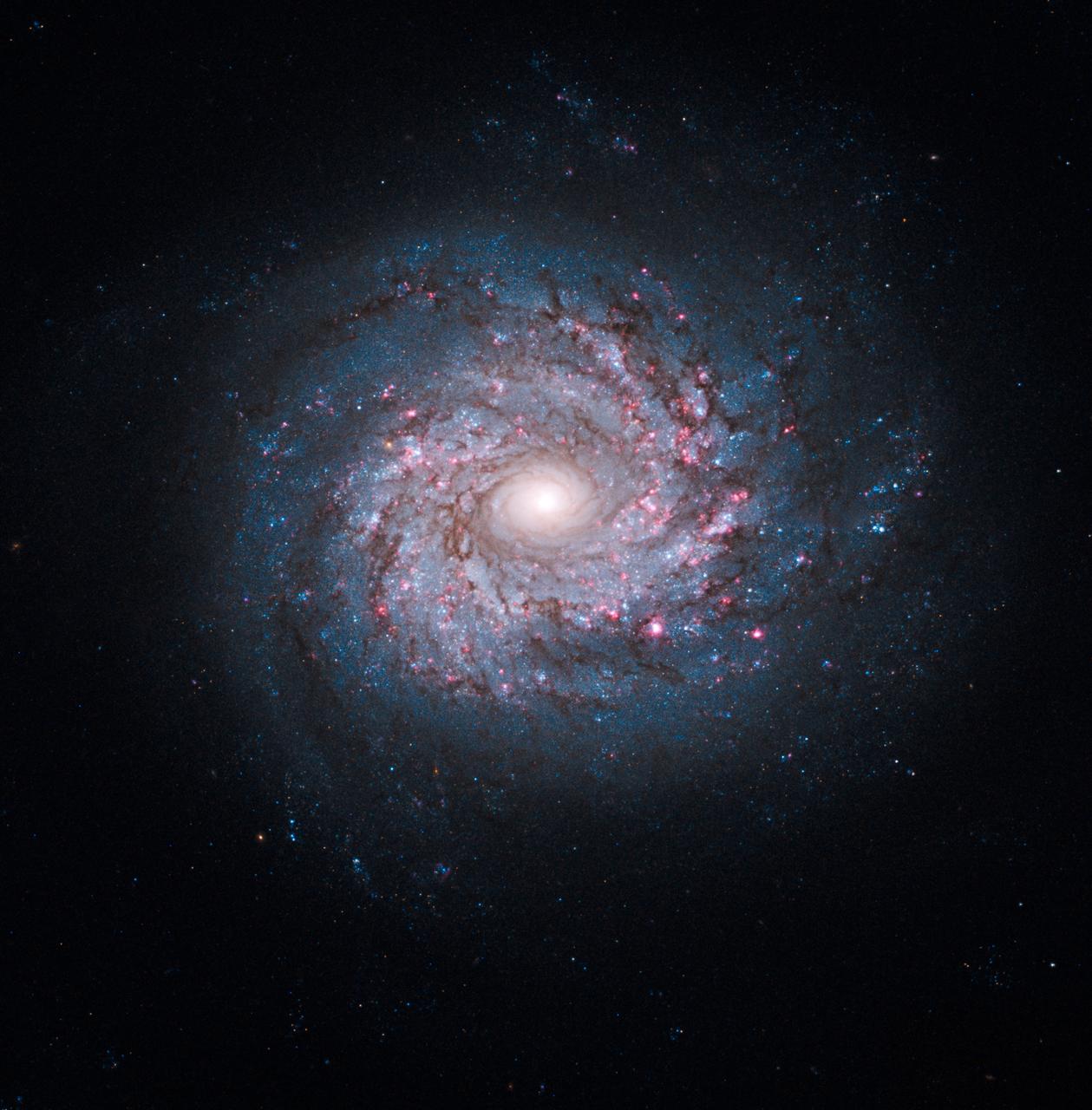
NASA image release October 19, 2010 Though the universe is chock full of spiral-shaped galaxies, no two look exactly the same. This face-on spiral galaxy, called NGC 3982, is striking for its rich tapestry of star birth, along with its winding arms. The arms are lined with pink star-forming regions of glowing hydrogen, newborn blue star clusters, and obscuring dust lanes that provide the raw material for future generations of stars. The bright nucleus is home to an older population of stars, which grow ever more densely packed toward the center. NGC 3982 is located about 68 million light-years away in the constellation Ursa Major. The galaxy spans about 30,000 light-years, one-third of the size of our Milky Way galaxy. This color image is composed of exposures taken by the Hubble Space Telescope's Wide Field Planetary Camera 2 (WFPC2), the Advanced Camera for Surveys (ACS), and the Wide Field Camera 3 (WFC3). The observations were taken between March 2000 and August 2009. The rich color range comes from the fact that the galaxy was photographed invisible and near-infrared light. Also used was a filter that isolates hydrogen emission that emanates from bright star-forming regions dotting the spiral arms. The Hubble Space Telescope is a project of international cooperation between NASA and the European Space Agency. NASA's Goddard Space Flight Center manages the telescope. The Space Telescope Science Institute (STScI) conducts Hubble science operations. STScI is operated for NASA by the Association of Universities for Research in Astronomy, Inc. in Washington, D.C. Credit: NASA, ESA, and the Hubble Heritage Team (STScI/AURA) Acknowledgment: A. Riess (STScI) <b><a href="http://www.nasa.gov/centers/goddard/home/index.html" rel="nofollow">NASA Goddard Space Flight Center</a></b> enables NASA’s mission through four scientific endeavors: Earth Science, Heliophysics, Solar System Exploration, and Astrophysics. Goddard plays a leading role in NASA’s accomplishments by contributing compelling scientific knowledge to advance the Agency’s mission. <b>Follow us on <a href="http://twitter.com/NASA_GoddardPix" rel="nofollow">Twitter</a></b> <b>Join us on <a href="http://www.facebook.com/pages/Greenbelt-MD/NASA-Goddard/395013845897?ref=tsd" rel="nofollow">Facebook</a></b>
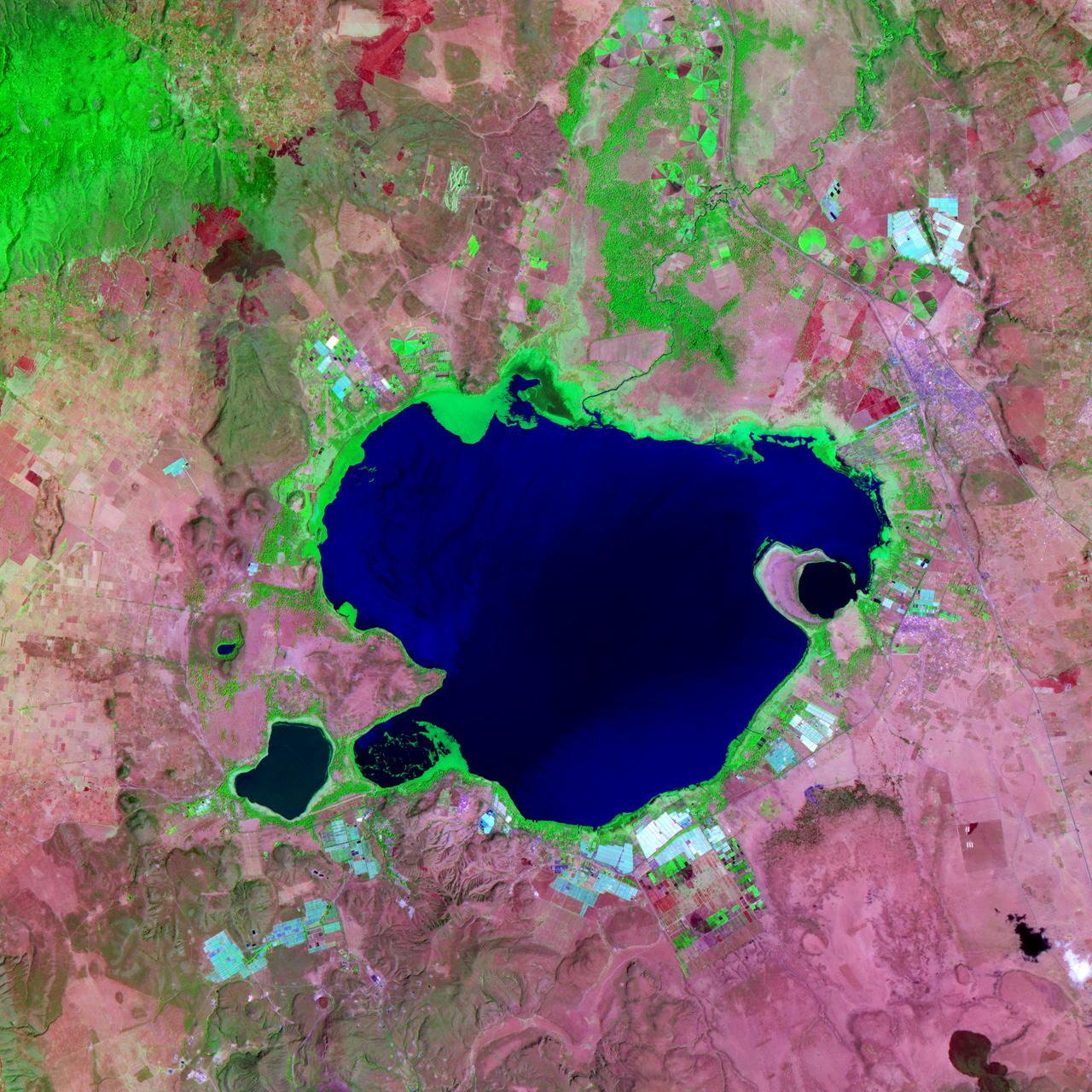
NASA satellite image acquired February 2, 2008. Outside the ground is frozen, quite possibly covered in snow and ice, and yet, stroll through a supermarket in North America or Europe in February, and you’ll be confronted with large displays of roses. We expect flowers in winter, and equatorial countries meet those expectations. A quarter of the cut flowers sold in Europe are grown in Kenya. Straddling the equator, Kenya gets steady sunlight dealt out in days that vary little in length. It’s the perfect climate for flowers year-round. The center of Kenya’s flower industry is Lake Naivasha, shown here. The Advanced Spaceborne Thermal Emission and Reflection Radiometer (ASTER) flying on NASA’s Terra satellite captured this image of Lake Naivasha on February 2, 2008. Bright white squares mix with fields of green, tan, and purple along the shores of the lake. Sunlight glints off the long rows of glass greenhouses, turning them silvery blue and white in this view from space. Fallow fields are tan and pink, while growing plants turn the ground bright green. Roses, lilies, and carnations are the most common flowers grown in the greenhouses and fields scattered around the lake. The large-scale industry shown here extends into small-scale rural farms elsewhere in Kenya, where smaller filler flowers are grown. The flowers provide an important source of income to Kenya, but the industry comes with a price. Flowers are not held to the same standards for chemical residues as food products, which are tightly regulated. Strong chemical pesticides can be used on the flowers to produce the perfect, pest-free bloom, and this could pose a health risk to workers and local wildlife, including hippos, environmental groups told the Food and Agriculture Organization of the United Nations in 2002. The chemicals may also have threatened the water quality of Lake Naivasha, one of Kenya’s few freshwater lakes. The Kenya Flower Council instituted a code of conduct establishing guidelines for pesticide that phases out the use of one of the most toxic pesticides. NASA image created by Jesse Allen, using data provided courtesy of NASA/GSFC/METI/ERSDAC/JAROS, and U.S./Japan ASTER Science Team. Caption by Holli Riebeek. Instrument: Terra - ASTER <b><a href="http://www.nasa.gov/centers/goddard/home/index.html" rel="nofollow">NASA Goddard Space Flight Center</a></b> is home to the nation's largest organization of combined scientists, engineers and technologists that build spacecraft, instruments and new technology to study the Earth, the sun, our solar system, and the universe.
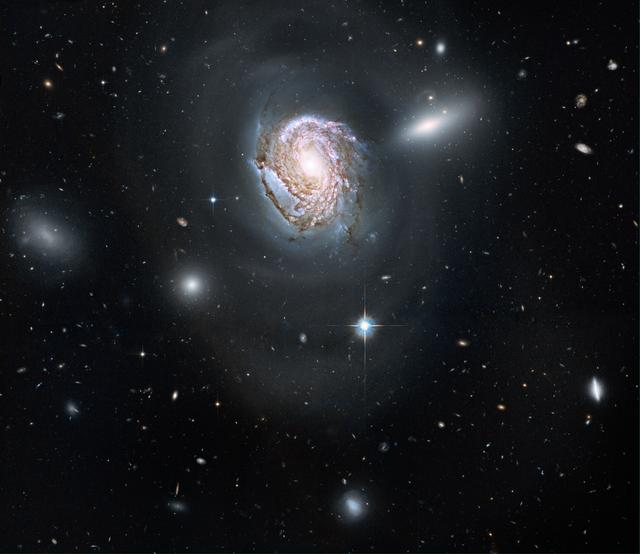
NASA image release August 10, 2010 A long-exposure Hubble Space Telescope image shows a majestic face-on spiral galaxy located deep within the Coma Cluster of galaxies, which lies 320 million light-years away in the northern constellation Coma Berenices. The galaxy, known as NGC 4911, contains rich lanes of dust and gas near its center. These are silhouetted against glowing newborn star clusters and iridescent pink clouds of hydrogen, the existence of which indicates ongoing star formation. Hubble has also captured the outer spiral arms of NGC 4911, along with thousands of other galaxies of varying sizes. The high resolution of Hubble's cameras, paired with considerably long exposures, made it possible to observe these faint details. NGC 4911 and other spirals near the center of the cluster are being transformed by the gravitational tug of their neighbors. In the case of NGC 4911, wispy arcs of the galaxy's outer spiral arms are being pulled and distorted by forces from a companion galaxy (NGC 4911A), to the upper right. The resultant stripped material will eventually be dispersed throughout the core of the Coma Cluster, where it will fuel the intergalactic populations of stars and star clusters. The Coma Cluster is home to almost 1,000 galaxies, making it one of the densest collections of galaxies in the nearby universe. It continues to transform galaxies at the present epoch, due to the interactions of close-proximity galaxy systems within the dense cluster. Vigorous star formation is triggered in such collisions. Galaxies in this cluster are so densely packed that they undergo frequent interactions and collisions. When galaxies of nearly equal masses merge, they form elliptical galaxies. Merging is more likely to occur in the center of the cluster where the density of galaxies is higher, giving rise to more elliptical galaxies. This natural-color Hubble image, which combines data obtained in 2006, 2007, and 2009 from the Wide Field Planetary Camera 2 and the Advanced Camera for Surveys, required 28 hours of exposure time. The Hubble Space Telescope is a project of international cooperation between NASA and the European Space Agency. NASA's Goddard Space Flight Center manages the telescope. The Space Telescope Science Institute (STScI) conducts Hubble science operations. STScI is operated for NASA by the Association of Universities for Research in Astronomy, Inc. in Washington, D.C. Credit: NASA, ESA, and the Hubble Heritage Team (STScI/AURA) Acknowledgment: K. Cook (Lawrence Livermore National Laboratory) To learn more about Hubble go to: <a href="http://www.nasa.gov/mission_pages/hubble/main/index.html" rel="nofollow">www.nasa.gov/mission_pages/hubble/main/index.html</a> <b><a href="http://www.nasa.gov/centers/goddard/home/index.html" rel="nofollow">NASA Goddard Space Flight Center</a></b> is home to the nation's largest organization of combined scientists, engineers and technologists that build spacecraft, instruments and new technology to study the Earth, the sun, our solar system, and the universe. <b>Follow us on <a href="http://twitter.com/NASA_GoddardPix" rel="nofollow">Twitter</a></b> <b>Join us on <a href="http://www.facebook.com/pages/Greenbelt-MD/NASA-Goddard/395013845897?ref=tsd" rel="nofollow">Facebook</a><b></b></b>
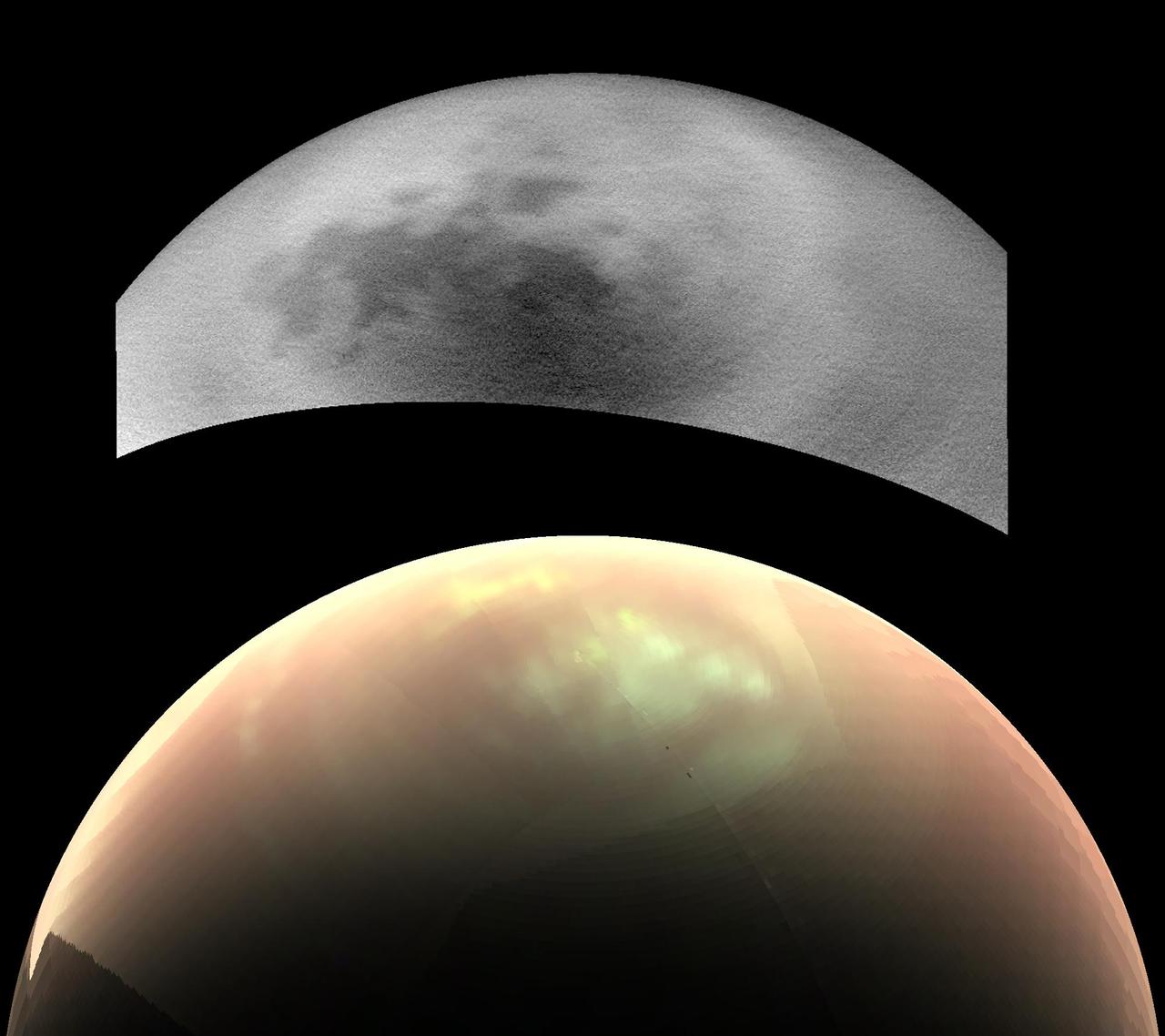
This comparison of two views from NASA's Cassini spacecraft, taken fairly close together in time, illustrates a peculiar mystery: Why would clouds on Saturn's moon Titan be visible in some images, but not in others? In the top view, a near-infrared image from Cassini's imaging cameras, the skies above Saturn's moon Titan look relatively cloud free. But in the bottom view, at longer infrared wavelengths, Cassini sees a large field of bright clouds. Even though these views were taken at different wavelengths, researchers would expect at least a hint of the clouds to show up in the upper image. Thus they have been trying to understand what's behind the difference. As northern summer approaches on Titan, atmospheric models have predicted that clouds will become more common at high northern latitudes, similar to what was observed at high southern latitudes during Titan's late southern summer in 2004. Cassini's Imaging Science Subsystem (ISS) and Visual and Infrared Mapping Spectrometer (VIMS) teams have been observing Titan to document changes in weather patterns as the seasons change, and there is particular interest in following the onset of clouds in the north polar region where Titan's lakes and seas are concentrated. Cassini's "T120" and "T121" flybys of Titan, on June 7 and July 25, 2016, respectively, provided views of high northern latitudes over extended time periods -- more than 24 hours during both flybys. Intriguingly, the ISS and VIMS observations appear strikingly different from each other. In the ISS observations (monochrome image at top), surface features are easily identifiable and only a few small, isolated clouds were detected. In contrast, the VIMS observations (color image at bottom) suggest widespread cloud cover during both flybys. The observations were made over the same time period, so differences in illumination geometry or changes in the clouds themselves are unlikely to be the cause for the apparent discrepancy: VIMS shows persistent atmospheric features over the entire observation period and ISS consistently detects surface features with just a few localized clouds. The answer to what could be causing the discrepancy appears to lie with Titan's hazy atmosphere, which is much easier to see through at the longer infrared wavelengths that VIMS is sensitive to (up to 5 microns) than at the shorter, near-infrared wavelength used by ISS to image Titan's surface and lower atmosphere (0.94 microns). High, thin cirrus clouds that are optically thicker than the atmospheric haze at longer wavelengths, but optically thinner than the haze at the shorter wavelength of the ISS observations, could be detected by VIMS and simultaneously lost in the haze to ISS -- similar to trying to see a thin cloud layer on a hazy day on Earth. This phenomenon has not been seen again since July 2016, but Cassini has several more opportunities to observe Titan over the last months of the mission in 2017, and scientists will be watching to see if and how the weather changes. These two images were taken as part of the T120 flyby on June 7 (VIMS) and 8 (ISS), 2016. The distance to Titan was about 28,000 miles (45,000 kilometers) for the VIMS image and about 398,000 miles (640,000 kilometers) for the ISS image. The VIMS image has been processed to enhance the visibility of the clouds; in this false-color view, clouds appear nearly white, atmospheric haze is pink, and surface areas would appear green. http://photojournal.jpl.nasa.gov/catalog/PIA21054

NASA image release January 13, 2011 <b><a href="http://www.flickr.com/photos/gsfc/5352962836">These images</a></b> by NASA's Hubble Space Telescope show off two dramatically different face-on views of the spiral galaxy M51, dubbed the Whirlpool Galaxy. <b>The image above,</b> taken in visible light, highlights the attributes of a typical spiral galaxy, including graceful, curving arms, pink star-forming regions, and brilliant blue strands of star clusters. <b><a href="http://www.flickr.com/photos/gsfc/5352344517">In the image here,</a></b> most of the starlight has been removed, revealing the Whirlpool's skeletal dust structure, as seen in near-infrared light. This new image is the sharpest view of the dense dust in M51. The narrow lanes of dust revealed by Hubble reflect the galaxy's moniker, the Whirlpool Galaxy, as if they were swirling toward the galaxy's core. To map the galaxy's dust structure, researchers collected the galaxy's starlight by combining images taken in visible and near-infrared light. The visible-light image captured only some of the light; the rest was obscured by dust. The near-infrared view, however, revealed more starlight because near-infrared light penetrates dust. The researchers then subtracted the total amount of starlight from both images to see the galaxy's dust structure. The red color in the near-infrared image traces the dust, which is punctuated by hundreds of tiny clumps of stars, each about 65 light-years wide. These stars have never been seen before. The star clusters cannot be seen in visible light because dense dust enshrouds them. The image reveals details as small as 35 light-years across. Astronomers expected to see large dust clouds, ranging from about 100 light-years to more than 300 light-years wide. Instead, most of the dust is tied up in smooth and diffuse dust lanes. An encounter with another galaxy may have prevented giant clouds from forming. Probing a galaxy's dust structure serves as an important diagnostic tool for astronomers, providing invaluable information on how the gas and dust collapse to form stars. Although Hubble is providing incisive views of the internal structure of galaxies such as M51, the planned James Webb Space Telescope (JWST) is expected to produce even crisper images. Researchers constructed the image by combining visible-light exposures from Jan. 18 to 22, 2005, with the Advanced Camera for Surveys (ACS), and near-infrared light pictures taken in December 2005 with the Near Infrared Camera and Multi-Object Spectrometer (NICMOS). Credit: NASA, ESA, S. Beckwith (STScI), and the Hubble Heritage Team (STScI/AURA) The Hubble Space Telescope is a project of international cooperation between NASA and the European Space Agency. NASA's Goddard Space Flight Center manages the telescope. The Space Telescope Science Institute (STScI) conducts Hubble science operations. STScI is operated for NASA by the Association of Universities for Research in Astronomy, Inc., in Washington, D.C. <b><a href="http://www.nasa.gov/centers/goddard/home/index.html" rel="nofollow">NASA Goddard Space Flight Center</a></b> enables NASA’s mission through four scientific endeavors: Earth Science, Heliophysics, Solar System Exploration, and Astrophysics. Goddard plays a leading role in NASA’s accomplishments by contributing compelling scientific knowledge to advance the Agency’s mission. <b>Follow us on <a href="http://twitter.com/NASA_GoddardPix" rel="nofollow">Twitter</a></b> <b>Join us on <a href="http://www.facebook.com/pages/Greenbelt-MD/NASA-Goddard/395013845897?ref=tsd" rel="nofollow">Facebook</a></b>
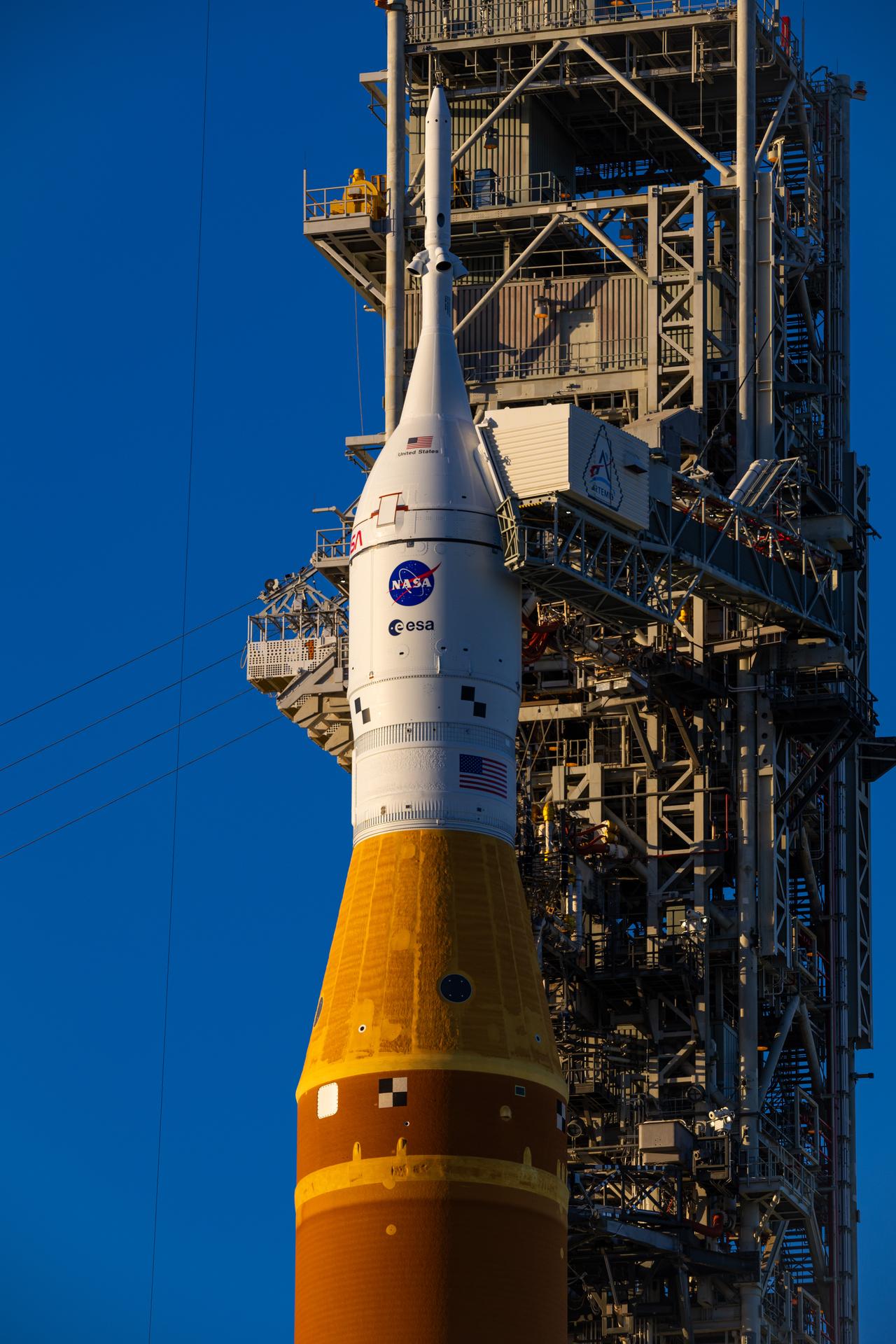
The sun setting NASA’s SLS (Space Launch System) and Orion spacecraft, atop the mobile launcher on January 31, 2026. The rocket is currently at Launch Pad 39B at NASA’s Kennedy Space Center in Florida, as teams are preparing for a wet dress rehearsal to practice timelines and procedures for the launch of Artemis II.