
This image from March 2, 1959 shows engineers from NASA's Jet Propulsion Laboratory checking NASA's Pioneer 4 spacecraft, the gold-and-black-colored cone sitting atop the white fourth-stage motor of the Juno II launch vehicle in Florida. Launched on March 3, 1959, NASA's Pioneer 4 was the first American mission to escape Earth orbit and the second of two early attempts by the United States to send a spacecraft to the Moon. The spacecraft achieved its primary objective — to put itself on a trajectory from Earth to the Moon. While it flew farther away from the Moon than expected and didn't take the images of the Moon as intended, Pioneer 4 did provide extensive and valuable data on Earth's radiation belt and the tracking of space objects. After 82 hours of transmissions from Pioneer 4's tiny radio and 655,000 miles (1.05 million kilometers) of travel — the farthest tracking distance for a human-made object at the time — contact is lost on March 6, 1959. Pioneer 4 is still in orbit around the Sun. The mission was carried out while JPL was transitioning from being part of the Army Ballistic Missile Agency to NASA. It marked the end of the U.S. Army's pioneering space program and the beginning of NASA's lunar program. JPL, in Pasadena, California, was responsible for mission design and management for both agencies. More information about Pioneer 4 can be found at: https://solarsystem.nasa.gov/missions/pioneer-4/in-depth/ https://photojournal.jpl.nasa.gov/catalog/PIA23497
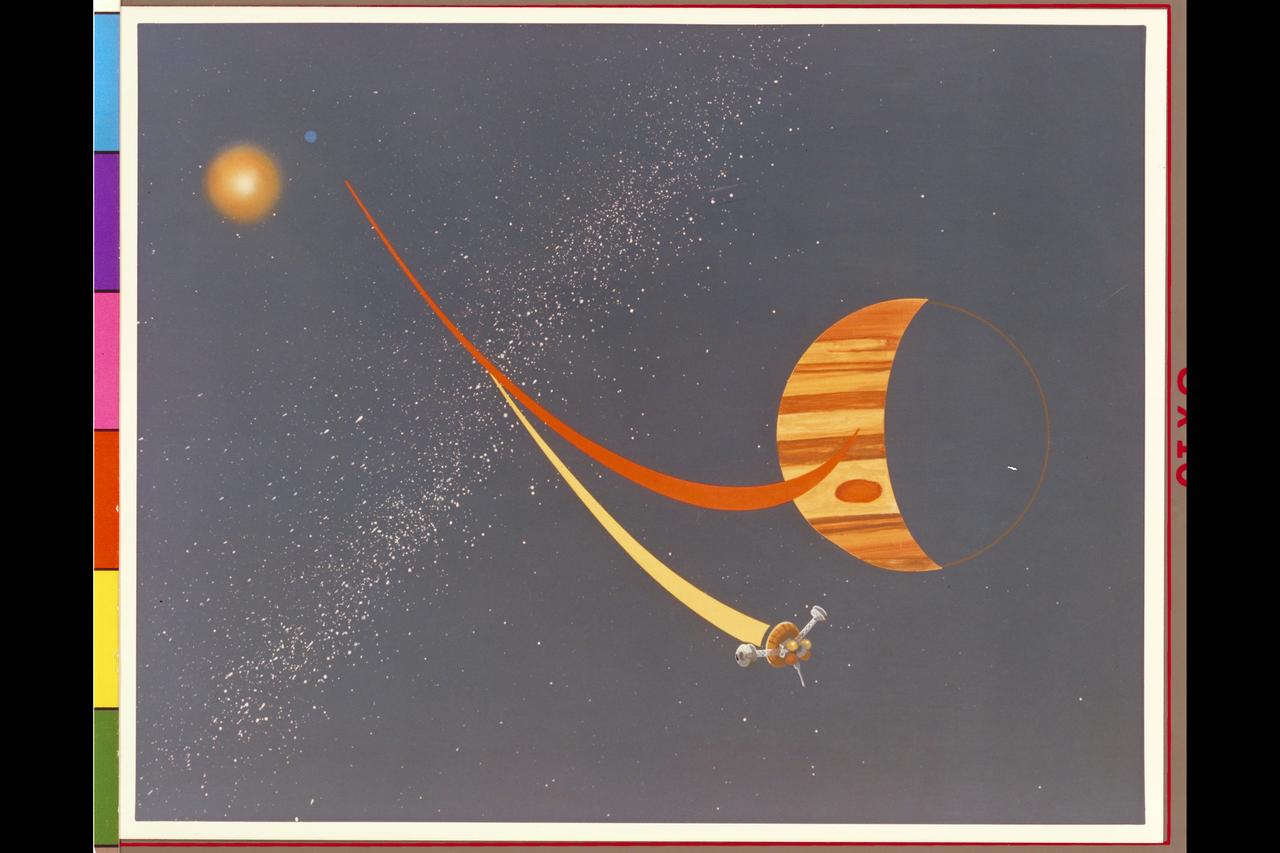
Pioneer Galileo mission trajectory artwork (ref: McDonnell Douglas May, 77 # D4C-117575-4)
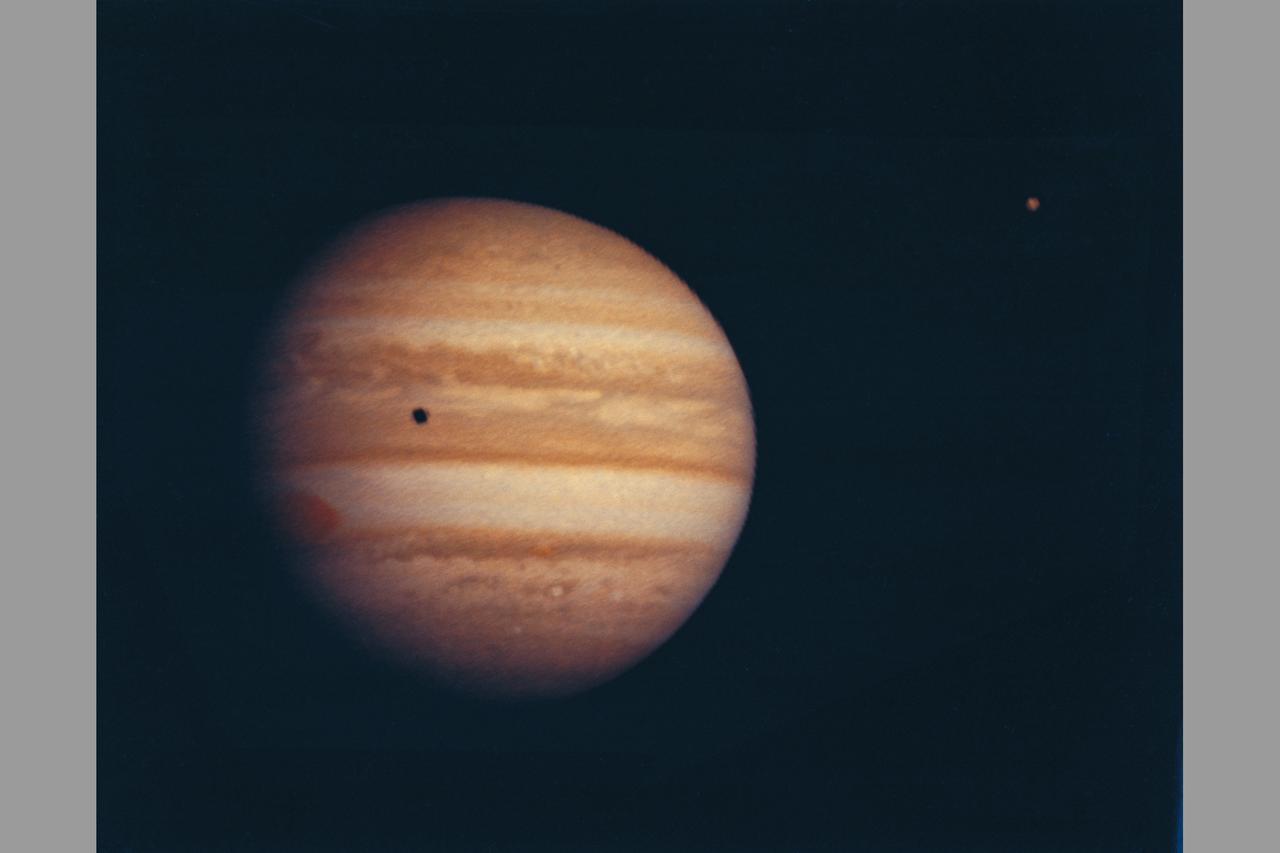
Photograph by Pioneer 10 Jupiter at a range of 2584000km (ref: image number sequence A-51 (before) during the 4 days on either side of closest approach) moon seen on upper right on image.
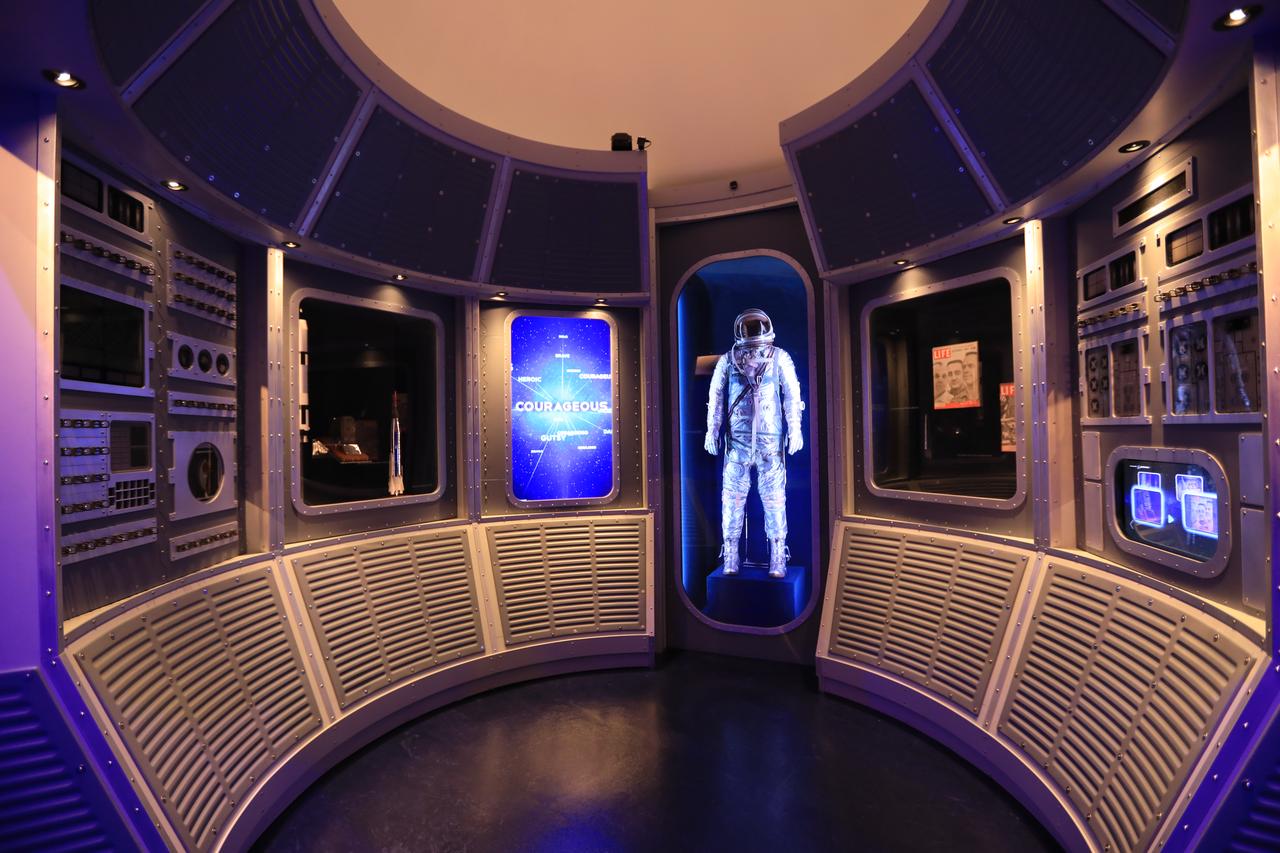
Inside the Heroes and Legends attraction at the Kennedy Space Center Visitor Complex, this display includes the spacesuit worn by astronaut Gus Grissom during his Mercury 4 suborbital flight of July 21, 1961. The new facility looks back to the pioneering efforts of Mercury, Gemini and Apollo. It sets the stage by providing the background and context for space exploration and the legendary men and women who pioneered the nation's journey into space.
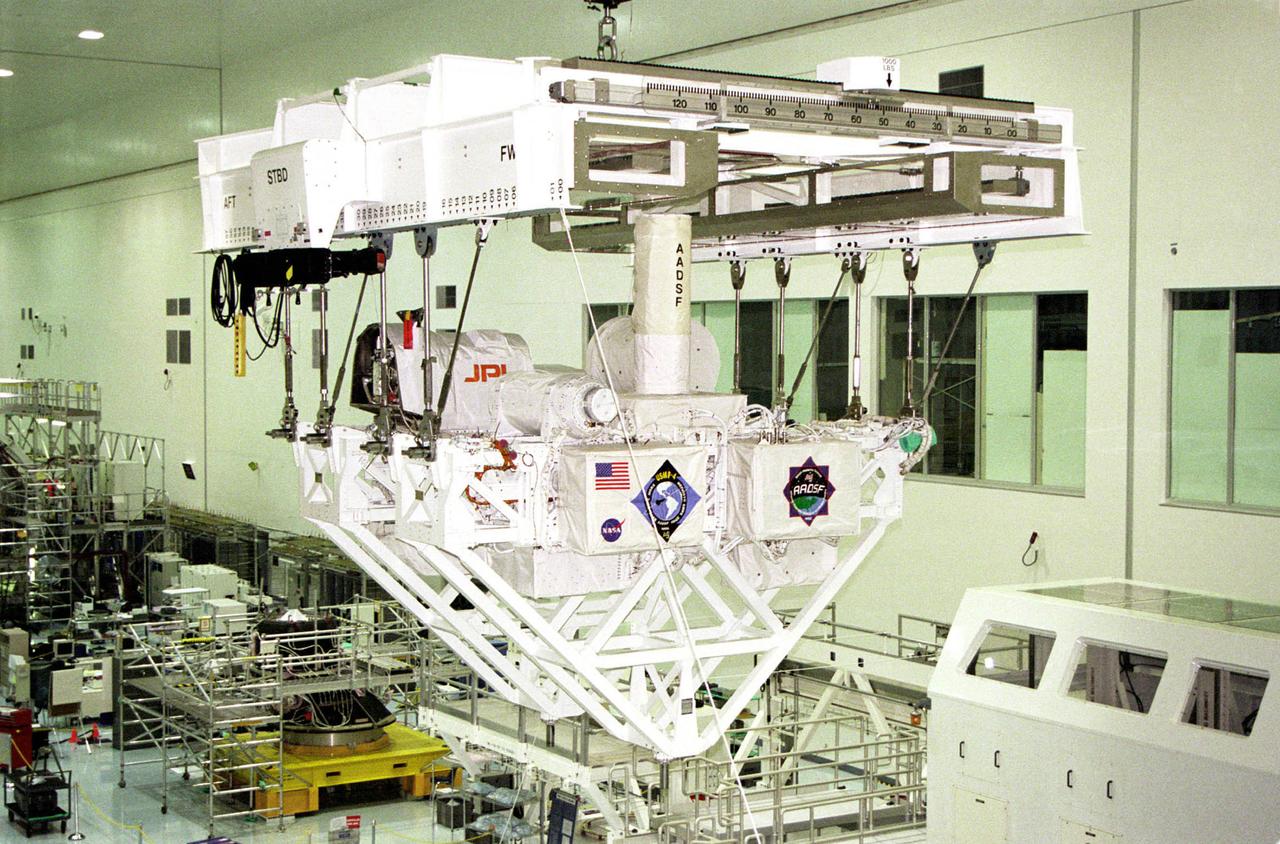
The USMP mission series pioneered sophisticated telescience technology to control experiments in the open cargo bay of the space shuttle. At Kennedy Space Center, the system of trusses that supported the USMP-4 experiments was loaded into the cargo bay. The bay doors were closed during launch but were opened in orbit.
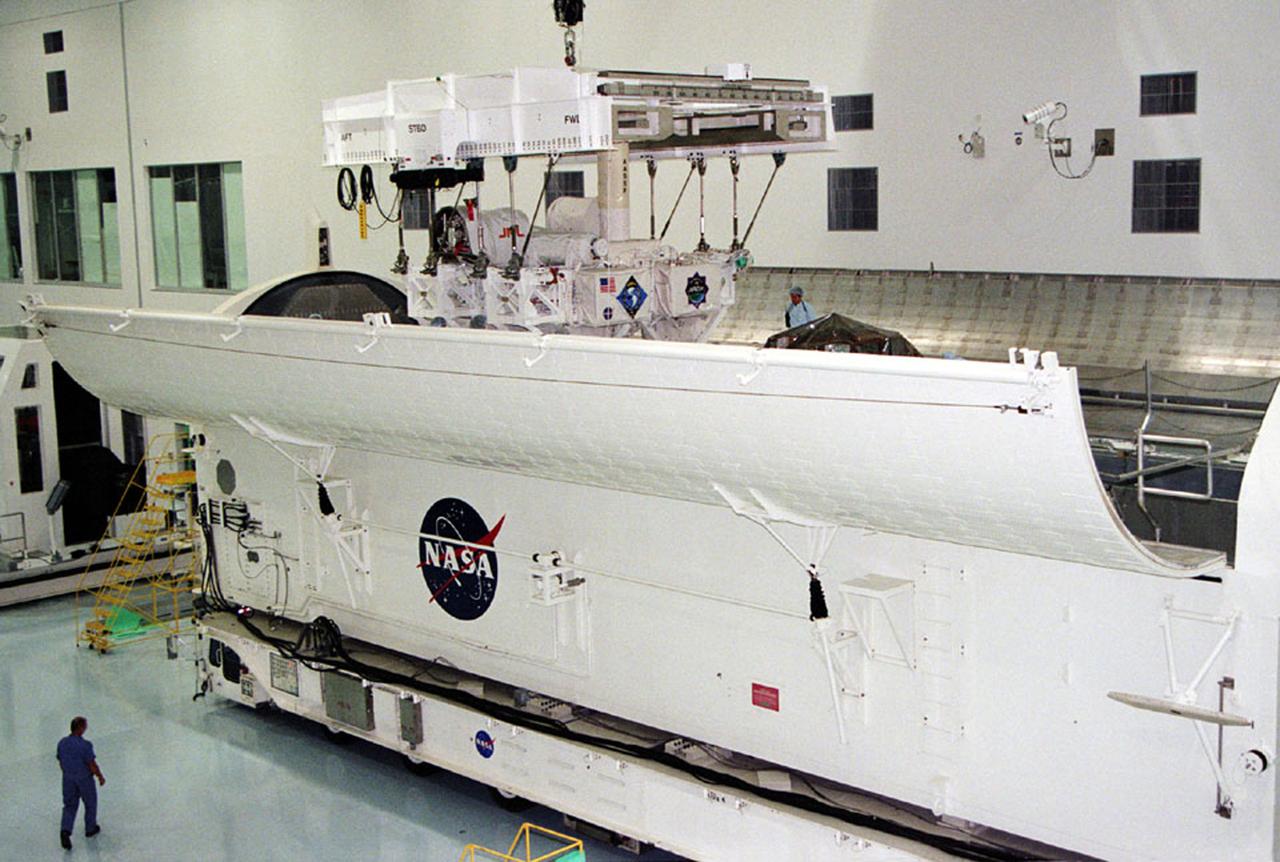
The USMP mission series pioneered sophisticated telescience technology to control experiments in the open cargo bay of the space shuttle. At Kennedy Space Center, the system of trusses that supported the USMP-4 experiments was loaded into the cargo bay. The bay doors were closed during launch but were opened in orbit.
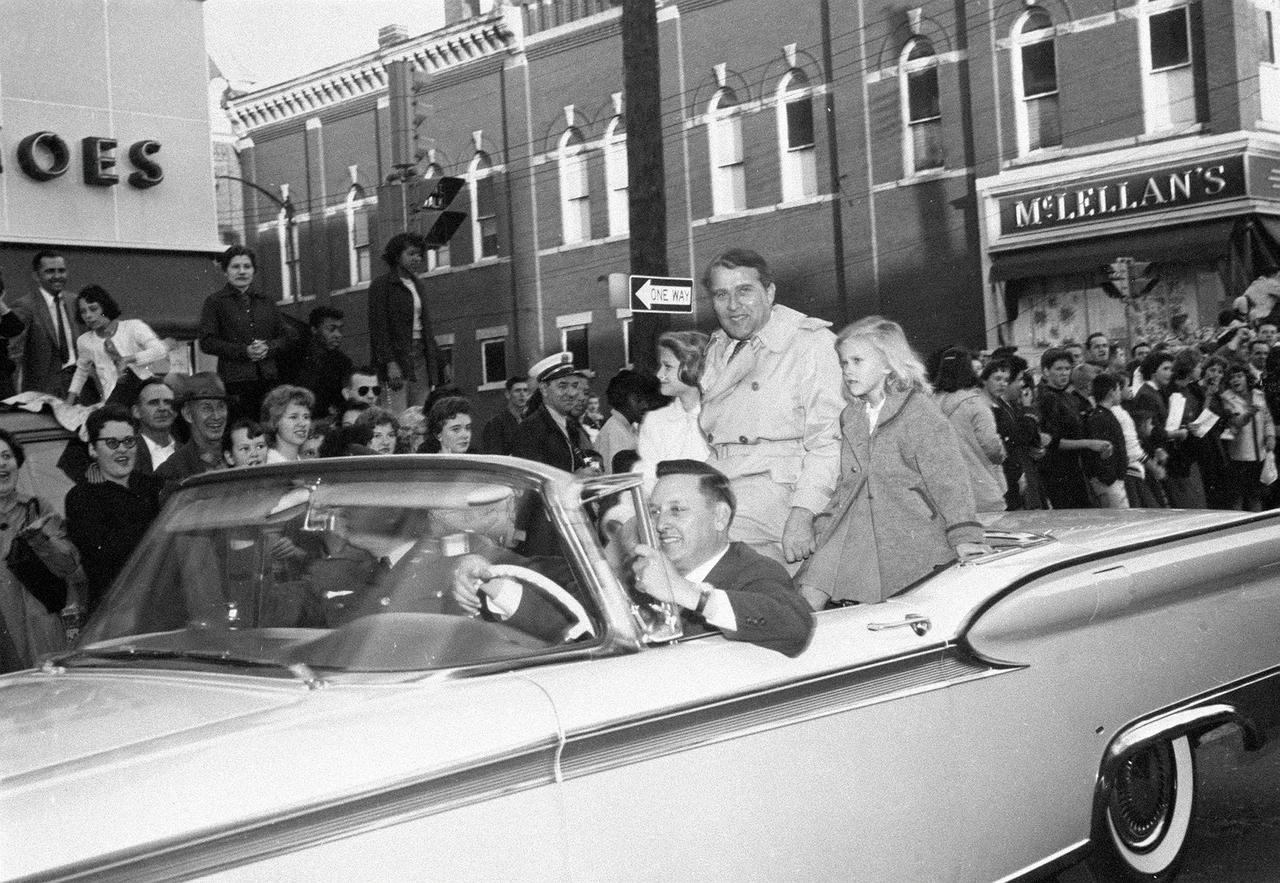
Dr. Wernher von Braun, Director of the U.S. Army Ballistic Missile Agency's (ABMA) Development Operations Division, rides with his two daughters, Margrit and Iris, in a parade in downtown Huntsville, Alabama, March 4, 1959. Although the official occasion had been plarned a "Moon Day" weeks before, it was the successful launch of the sun probe Pioneer IV two days previously that increased the celebratory atmosphere.
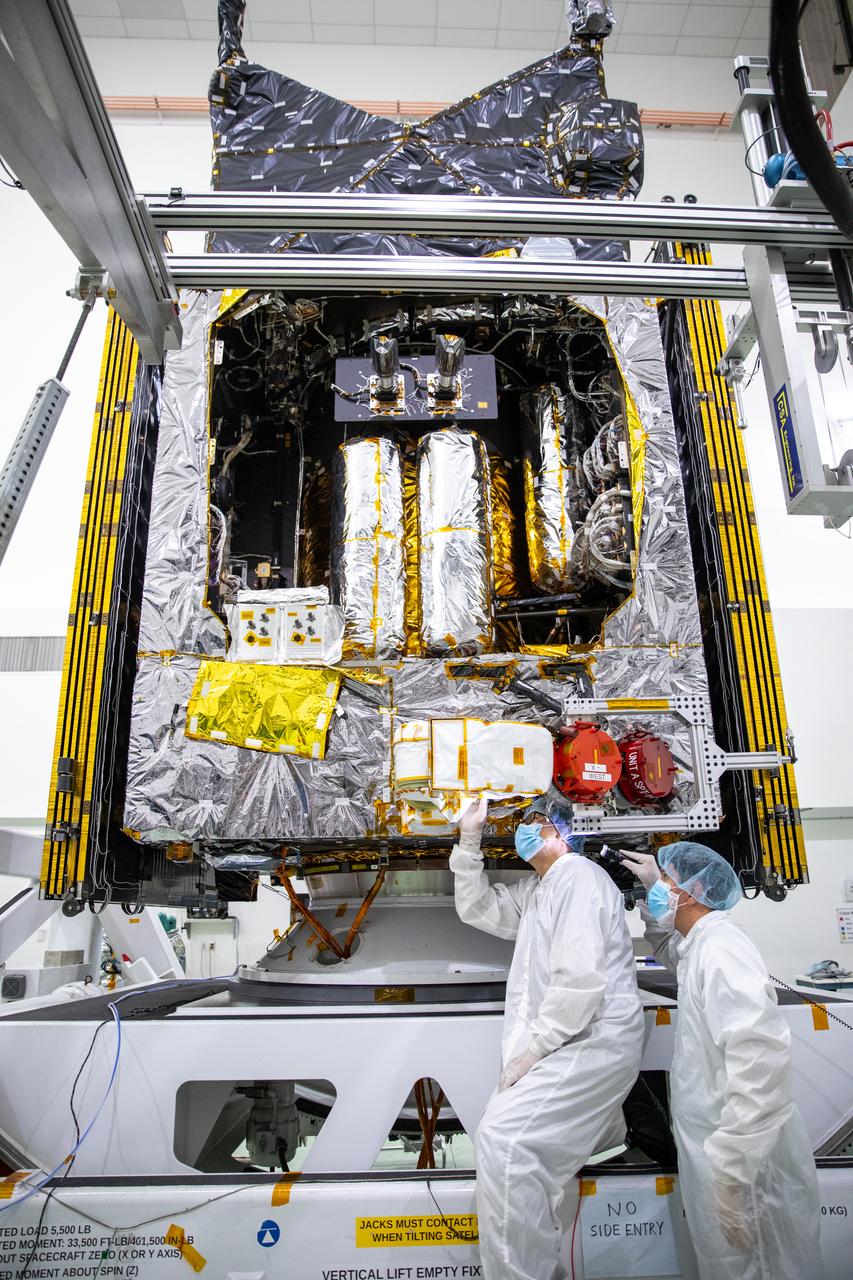
A team of engineers and technicians work on deploying and stowing stationary plasma thrusters (SPT) on NASA's Psyche spacecraft inside the Astrotech Space Operations Facility near the agency’s Kennedy Space Center in Florida on Aug. 4, 2023. This is part of the assembly, test, and launch operations preparations. The SPT are on a dual axis positioning mechanism (DAPM), and together they make a DSM, or DAPM-actuated SPT module. Psyche will launch atop a SpaceX Falcon Heavy rocket from Launch Complex 39A at Kennedy. Launch is targeted for Oct. 5, 2023. Riding with Psyche is a pioneering technology demonstration, NASA’s Deep Space Optical Communications (DSOC) experiment.
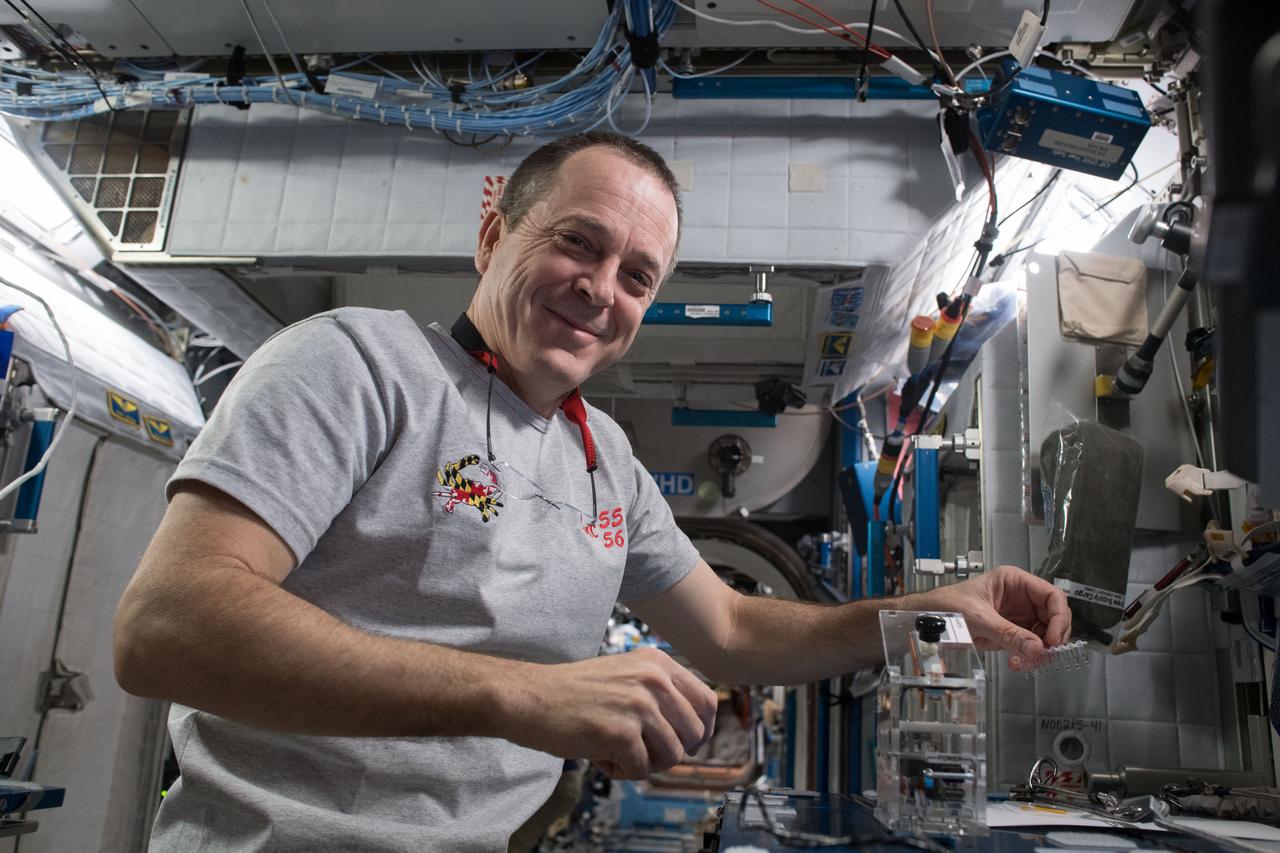
iss055e016053 (4/11/2018) --- NASA astronaut Ricky Arnold works with the student-designed Genes in Space-5 experiment inside the Harmony module. The genetic research is helping scientists understand the relationship between DNA alterations and weakened immune systems possibly caused by living in space. Genes in Space is an innovation challenge including students and teachers across the United States from grades 7 through 12. Students design a pioneering DNA-related experiment to fly on the ISS, providing real-world training in science, technology, engineering and math (STEM) fields and connecting students to the space program.
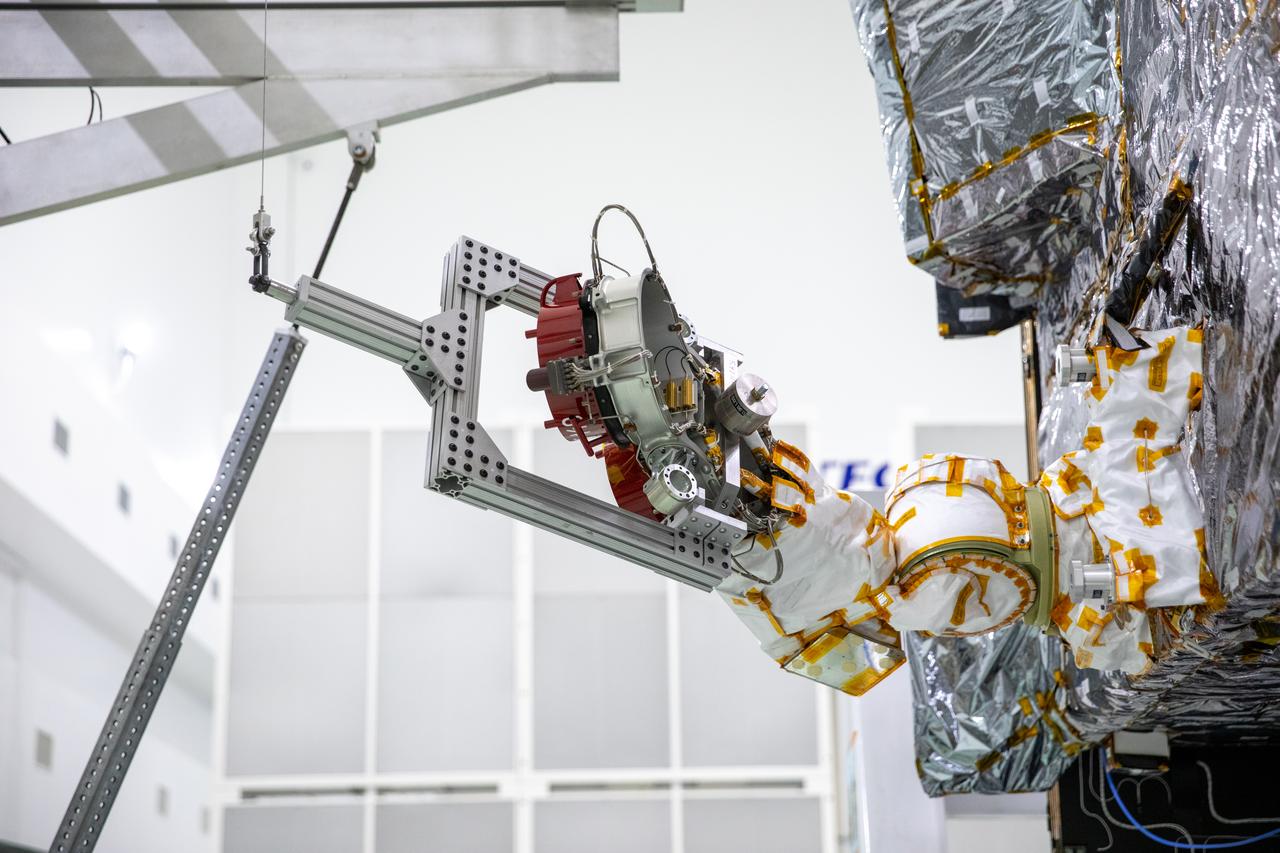
A team of engineers and technicians work on deploying and stowing stationary plasma thrusters (SPT) on NASA's Psyche spacecraft inside the Astrotech Space Operations Facility near the agency’s Kennedy Space Center in Florida on Aug. 4, 2023. This is part of the assembly, test, and launch operations preparations. The SPT are on a dual axis positioning mechanism (DAPM), and together they make a DSM, or DAPM-actuated SPT module. Psyche will launch atop a SpaceX Falcon Heavy rocket from Launch Complex 39A at Kennedy. Launch is targeted for Oct. 5, 2023. Riding with Psyche is a pioneering technology demonstration, NASA’s Deep Space Optical Communications (DSOC) experiment.
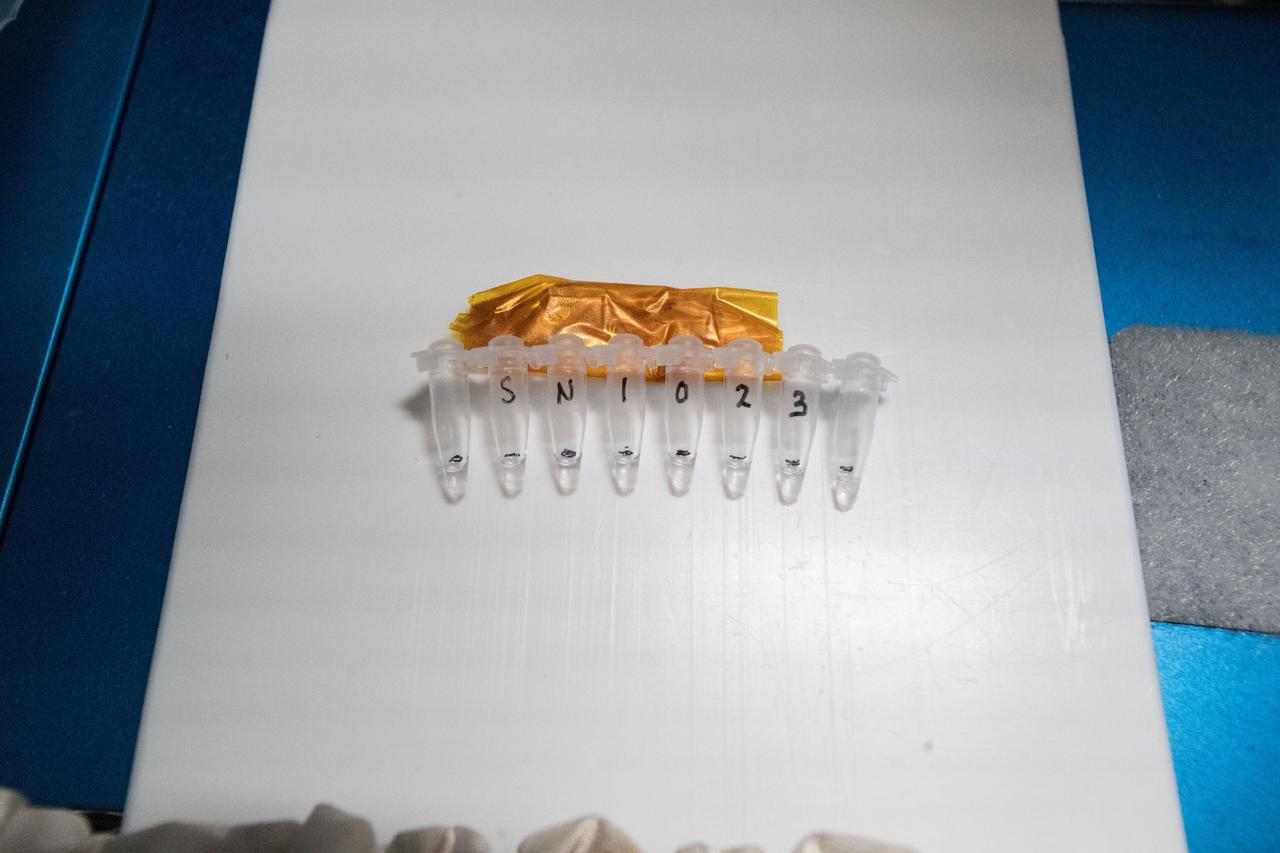
iss055e020316 (4/13/2018) --- Photographic documentation taken during processing of samples in the Miniature Polymerase Chain Reaction (miniPCR) for the Genes In Space-5 experiment onboard the International Space Station (ISS). The genetic research is helping scientists understand the relationship between DNA alterations and weakened immune systems possibly caused by living in space. Genes in Space is an innovation challenge including students and teachers across the United States from grades 7 through 12. Students design a pioneering DNA-related experiment to fly on the ISS, providing real-world training in science, technology, engineering and math (STEM) fields and connecting students to the space program.
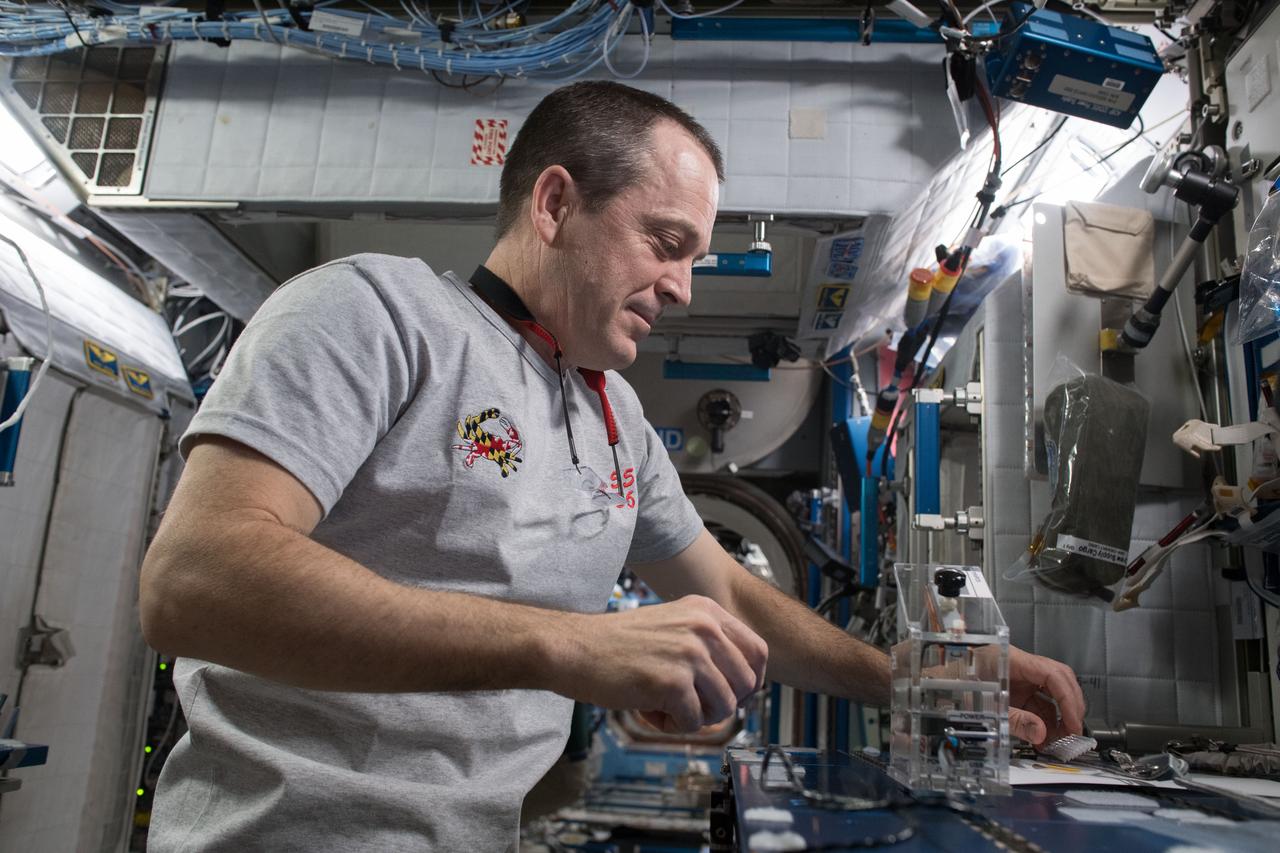
iss055e016052 (4/11/2018) --- NASA astronaut Ricky Arnold works with the student-designed Genes in Space-5 experiment inside the Harmony module. The genetic research is helping scientists understand the relationship between DNA alterations and weakened immune systems possibly caused by living in space. Genes in Space is an innovation challenge including students and teachers across the United States from grades 7 through 12. Students design a pioneering DNA-related experiment to fly on the ISS, providing real-world training in science, technology, engineering and math (STEM) fields and connecting students to the space program.
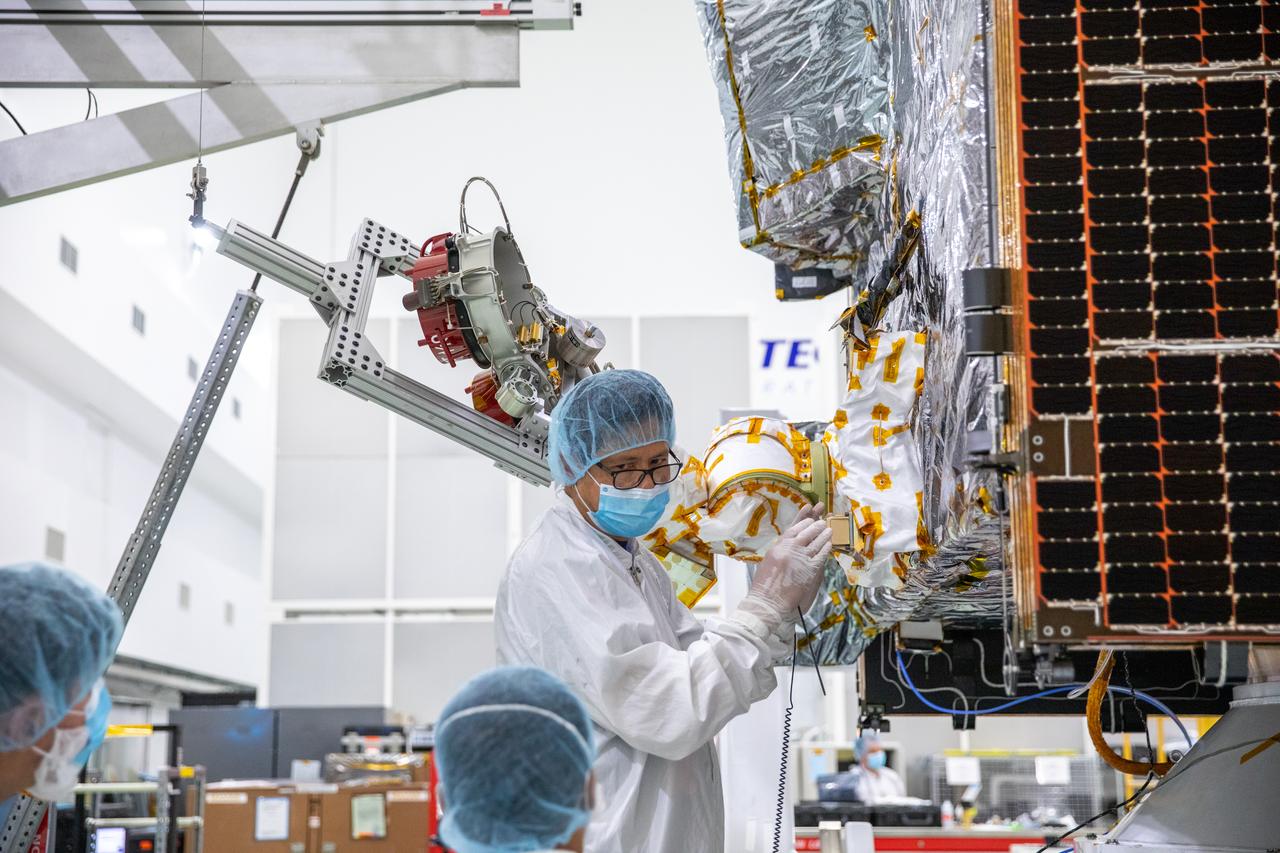
A team of engineers and technicians work on deploying and stowing stationary plasma thrusters (SPT) on NASA's Psyche spacecraft inside the Astrotech Space Operations Facility near the agency’s Kennedy Space Center in Florida on Aug. 4, 2023. This is part of the assembly, test, and launch operations preparations. The SPT are on a dual axis positioning mechanism (DAPM), and together they make a DSM, or DAPM-actuated SPT module. Psyche will launch atop a SpaceX Falcon Heavy rocket from Launch Complex 39A at Kennedy. Launch is targeted for Oct. 5, 2023. Riding with Psyche is a pioneering technology demonstration, NASA’s Deep Space Optical Communications (DSOC) experiment.
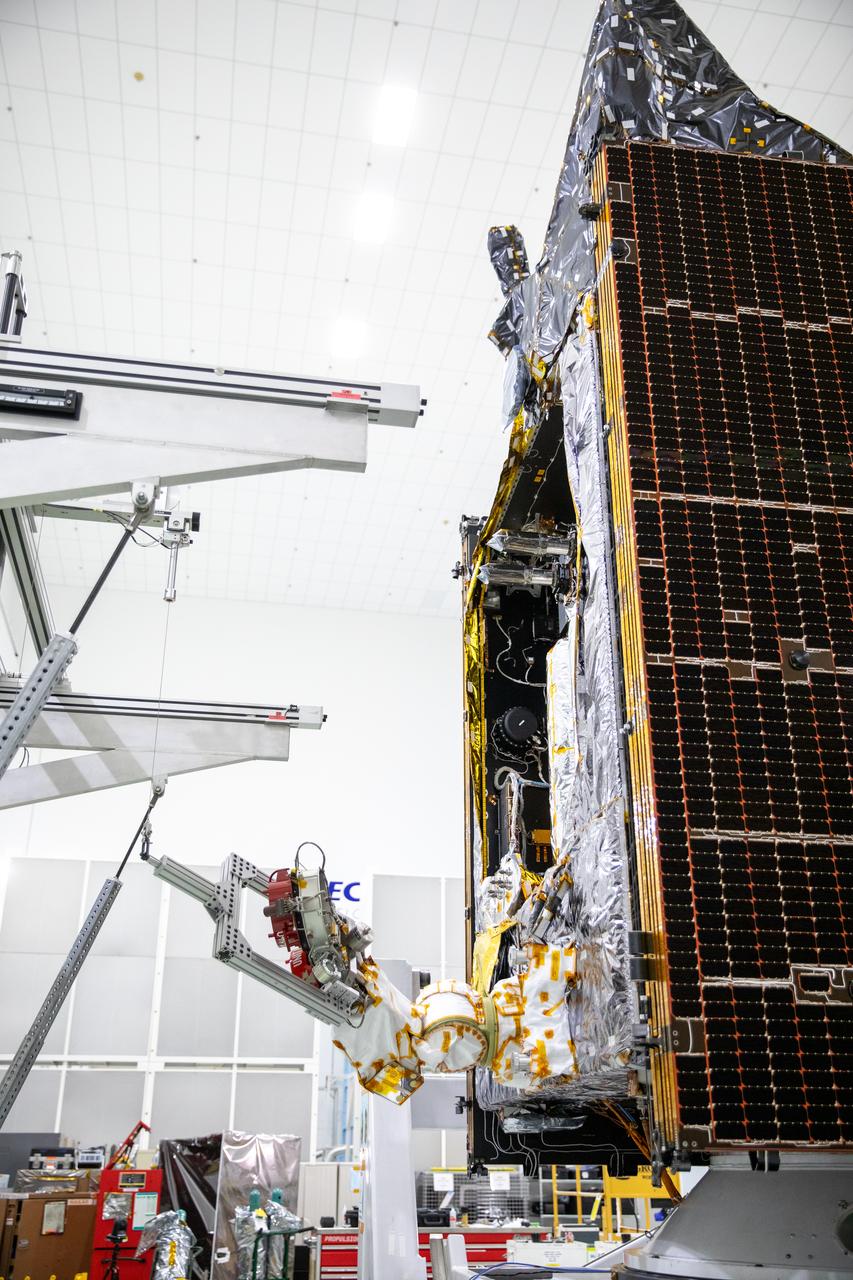
A team of engineers and technicians work on deploying and stowing stationary plasma thrusters (SPT) on NASA's Psyche spacecraft inside the Astrotech Space Operations Facility near the agency’s Kennedy Space Center in Florida on Aug. 4, 2023. This is part of the assembly, test, and launch operations preparations. The SPT are on a dual axis positioning mechanism (DAPM), and together they make a DSM, or DAPM-actuated SPT module. Psyche will launch atop a SpaceX Falcon Heavy rocket from Launch Complex 39A at Kennedy. Launch is targeted for Oct. 5, 2023. Riding with Psyche is a pioneering technology demonstration, NASA’s Deep Space Optical Communications (DSOC) experiment.
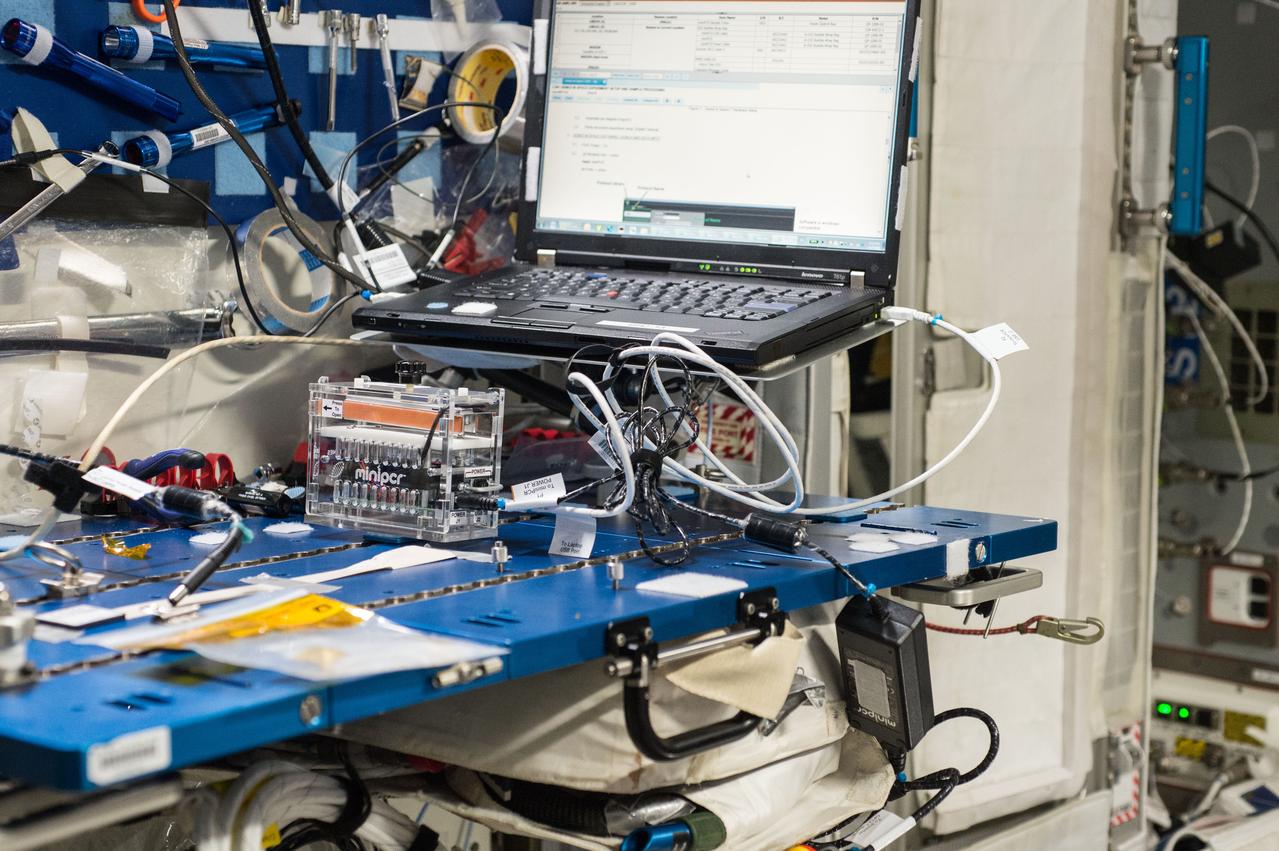
iss047e083547 (4/27/2016) --- Photographic documentation during the Genes in Space experiment showing the polymerase chain reaction (PCR) and miniPCR system as a way to amplify deoxyribonucleic acid (DNA) in space and make it possible to measure and monitor telomere changes during spaceflight. Genes in Space is an innovation challenge including students and teachers across the United States from grades 7 through 12. Students design a pioneering DNA-related experiment to fly on the ISS, providing real-world training in science, technology, engineering and math (STEM) fields and connecting students to the space program.
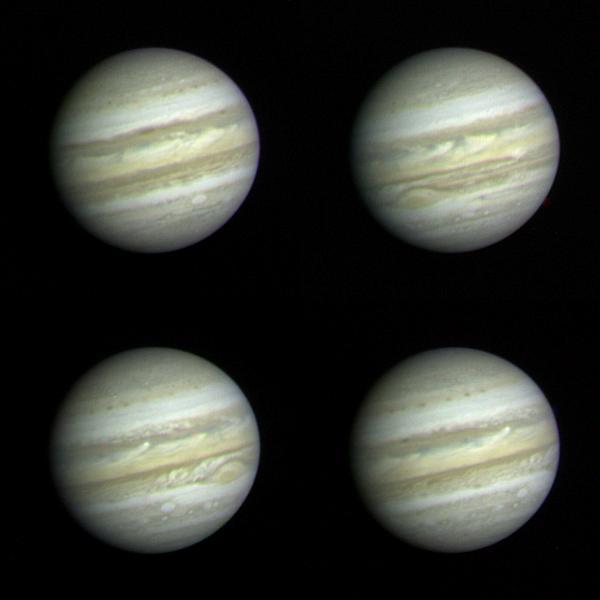
These Jupiter photographs are part of a set taken by NASA Voyager 1 on December 10 and 11, 1978 from a distance of 83 million km 52 million miles or more than half the distance from the Earth to the sun. At this range, Voyager 1 is able to record more detail on the giant planet than the very best ground-based telescopes. The highest resolution ever obtained on the Jovian disk was recorded by Pioneer 11 four years ago. Voyager, however, has longer focal-length optics than Pioneer, and while nearly three months from encounter (~ March 1979) was able to achieve higher resolution than that obtained by Pioneer only 24 hours from its encounter on 3 December 1974. Jupiter's colorful and turbulent atmosphere is evident in these photographs. The entire visible surface of the planet is made up of multiple layers of clouds, composed primarily of ammonia ice crystals colored by small amounts of materials of unknown composition. The Great Red Spot, seen to the lower left of 2 and lower right of 3, is now recovering from a period of relative inconspicuousness. An atmospheric system larger than the Earth and more than 100 years old, the Great Red Spot remains a mystery and a challenge to Voyager instruments. A bright convective cloud (center of and right of center in 4) displays a plume which has been swept westward (to the left) by local currents in the planet's equatorial wind system. Below and to the left and right of the Great Red Spot are a pair of white oval clouds; a third can be seen in 1. All three were formed almost 40 years ago and are the second oldest class of discrete features identified in the Jovian atmosphere. Each of the pictures was produced from blue, green, and orange originals in JPL's Image Processing Laboratory. http://photojournal.jpl.nasa.gov/catalog/PIA00454
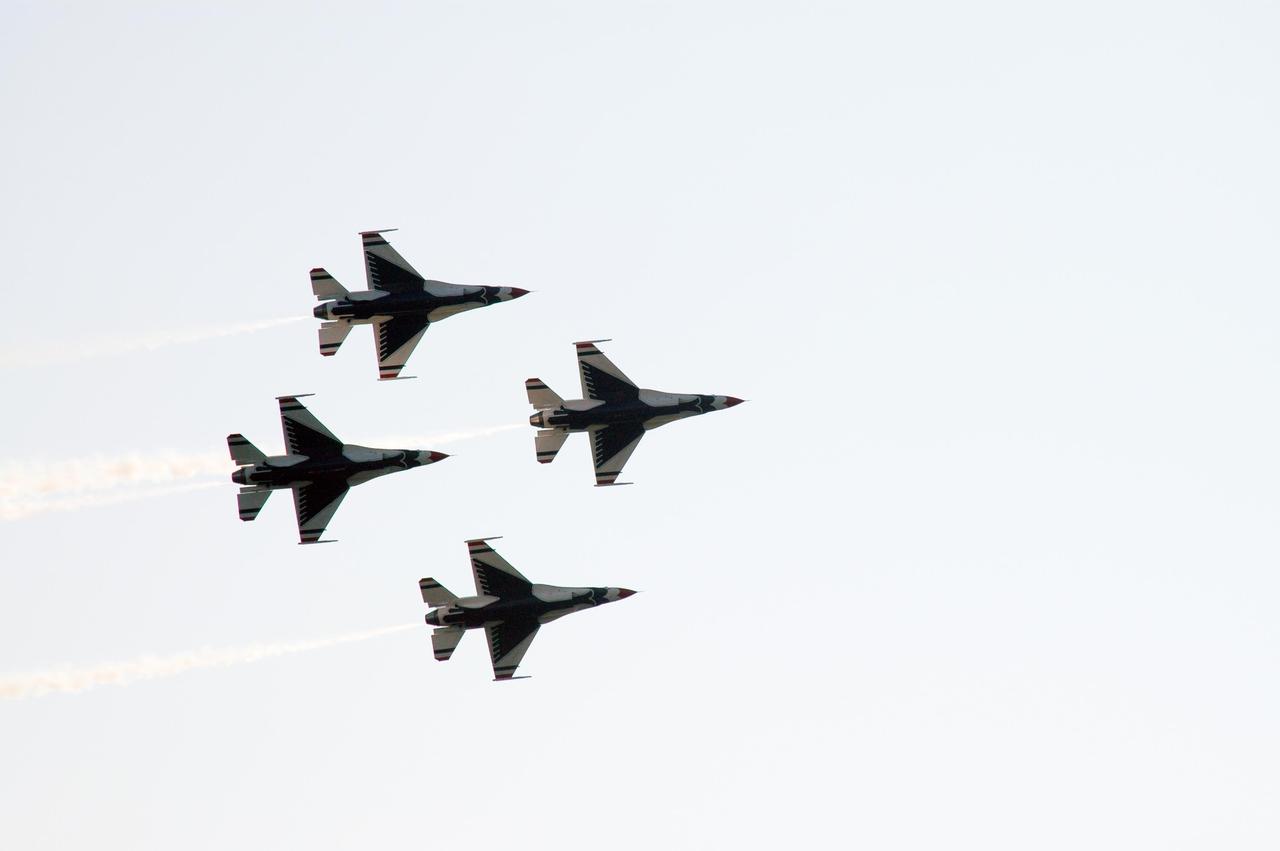
KENNEDY SPACE CENTER, FLA. -- At NASA's Kennedy Space Center, the U.S. Air Force Thunderbirds Demonstration Squadron performs during the World Space Expo aerial salute. Other aircraft joining in the expo salute include the U.S. Navy F-18 Super Hornets, U.S. Air Force F-22 Raptor, U.S. Air Force F-15 Eagle, P-51 Mustang Heritage Flight, U.S. Air Force 920th Rescue wing, which was responsible for Mercury and Gemini capsule recovery, and the U.S. Army Golden Knights demonstrating precision skydiving. The World Space Expo held Nov. 1-4 was an event commemorating humanity's first 50 years in space while looking forward to returning people to the moon and exploring beyond. The expo showcased various panels, presentations and educational programs. It also was a part of NASA's 50th anniversary celebrations, highlighting the 45th Anniversary of the Mercury Program celebration featuring original NASA astronauts John Glenn and Scott Carpenter and the Pioneering Women of Aerospace forum featuring Eileen Collins and other prominent female space veterans. The agency was founded Oct. 1, 1958. Photo credit: NASA/Chris Chamberland

KENNEDY SPACE CENTER, FLA. -- Crowds fill the areas along NASA Causeway at NASA's Kennedy Space Center to watch the World Space Expo aerial salute. Aircraft joining in the expo salute include the U.S. Air Force Thunderbirds Demonstration Squadron, the U.S. Navy F-18 Super Hornets, U.S. Air Force F-22 Raptor, U.S. Air Force F-15 Eagle, P-51 Mustang Heritage Flight, the U.S. Air Force 920th Rescue Wing, which was responsible for Mercury and Gemini capsule recovery, and the U.S. Army Golden Knights precision skydivers. The World Space Expo held Nov. 1-4 was an event commemorating humanity's first 50 years in space while looking forward to returning people to the moon and exploring beyond. The expo showcased various panels, presentations and educational programs. It also was a part of NASA's 50th anniversary celebrations, highlighting the 45th Anniversary of the Mercury Program celebration featuring original NASA astronauts John Glenn and Scott Carpenter and the Pioneering Women of Aerospace forum featuring Eileen Collins and other prominent female space veterans. The agency was founded Oct. 1, 1958. Photo credit: NASA/Kim Shiflett
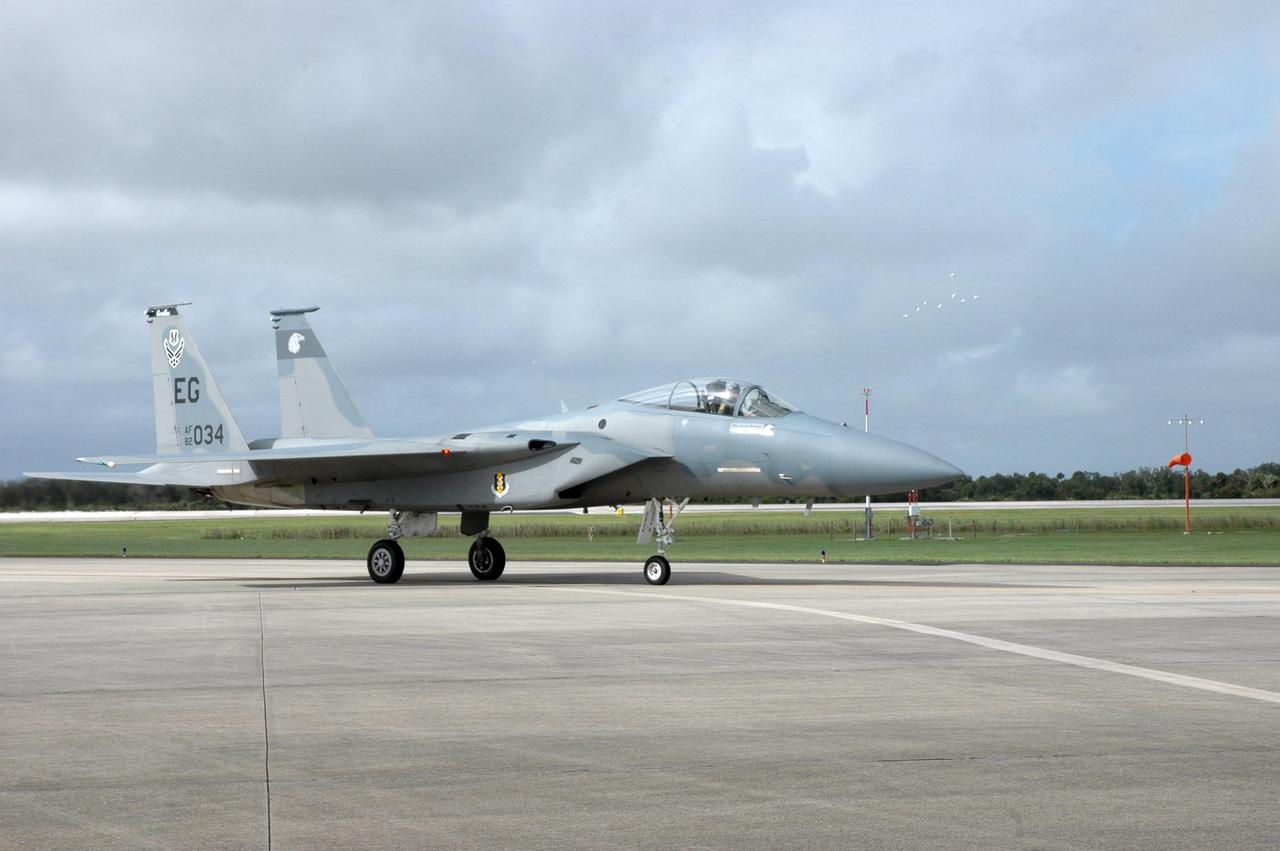
KENNEDY SPACE CENTER, FLA. -- A U.S. Air Force F-15 Eagle arrives at the Shuttle Landing Facility at NASA's Kennedy Space Center. Several of the planes are participating in the World Space Expo being held from Nov. 1 to Nov. 4 at the NASA Kennedy Space Center Visitor Complex. Other aircraft joining in the salute include U.S. Air Force Thunderbirds Aerial Demonstration Squadron, U.S. Navy F-18 Super Hornets, U.S. Air Force F-22 Raptor, the P-51 Mustang Heritage Flight and the U.S. Air Force 920th Rescue Wing, which was responsible for Mercury and Gemini capsule recovery. The U.S. Army Golden Knights also will demonstrate precision skydiving. The World Space Expo is an event to commemorate humanity's first 50 years in space while looking forward to returning people to the moon and exploring beyond. The expo will showcase various panels, presentations and educational programs. It also is a part of NASA's 50th anniversary celebrations, highlighting the 45th Anniversary of the Mercury Program celebration featuring original NASA astronauts John Glenn and Scott Carpenter and the Pioneering Women of Aerospace forum featuring Eileen Collins and other prominent female space veterans. The agency was founded Oct. 1, 1958. Photo credit: NASA/Jack Pfaller
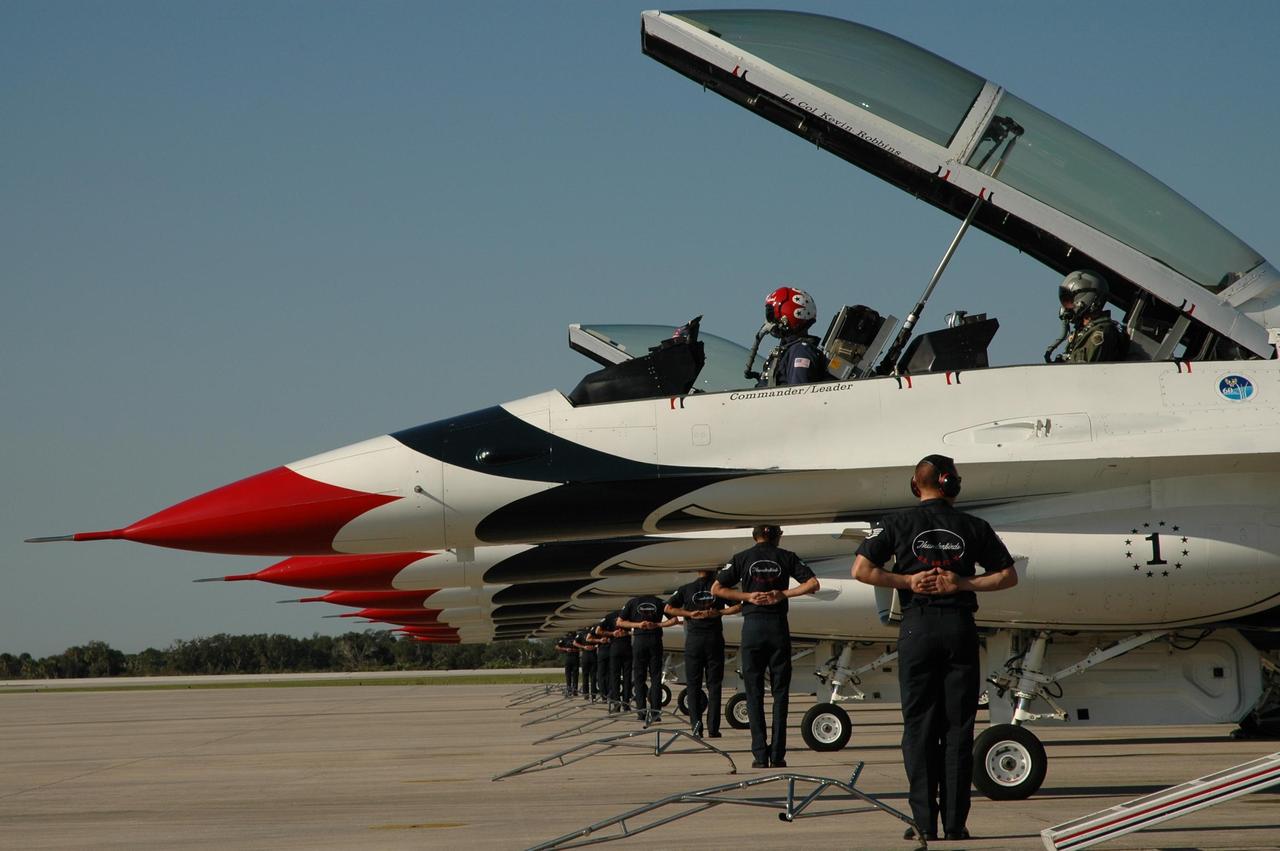
KENNEDY SPACE CENTER, FLA. -- The air crew for the U.S. Air Force Thunderbirds Demonstration Squadron show their precision formation as the pilots get ready to take off from NASA's Kennedy Space Center. The squadron performed for the World Space Expos' aerial salute along with other aircraft that included the U.S. Navy F-18 Super Hornets, U.S. Air Force F-22 Raptor, U.S. Air Force F-15 Eagle, P-51 Mustang Heritage Flight, the U.S. Air Force 920th Rescue Wing, which was responsible for Mercury and Gemini capsule recovery, and the U.S. Army Golden Knights precision skydiving team. The World Space Expo held Nov. 1-4 was an event commemorating humanity's first 50 years in space while looking forward to returning people to the moon and exploring beyond. The expo showcased various panels, presentations and educational programs. It also was a part of NASA's 50th anniversary celebrations, highlighting the 45th Anniversary of the Mercury Program celebration featuring original NASA astronauts John Glenn and Scott Carpenter and the Pioneering Women of Aerospace forum featuring Eileen Collins and other prominent female space veterans. The agency was founded Oct. 1, 1958. Photo credit: NASA/Jim Grossmann
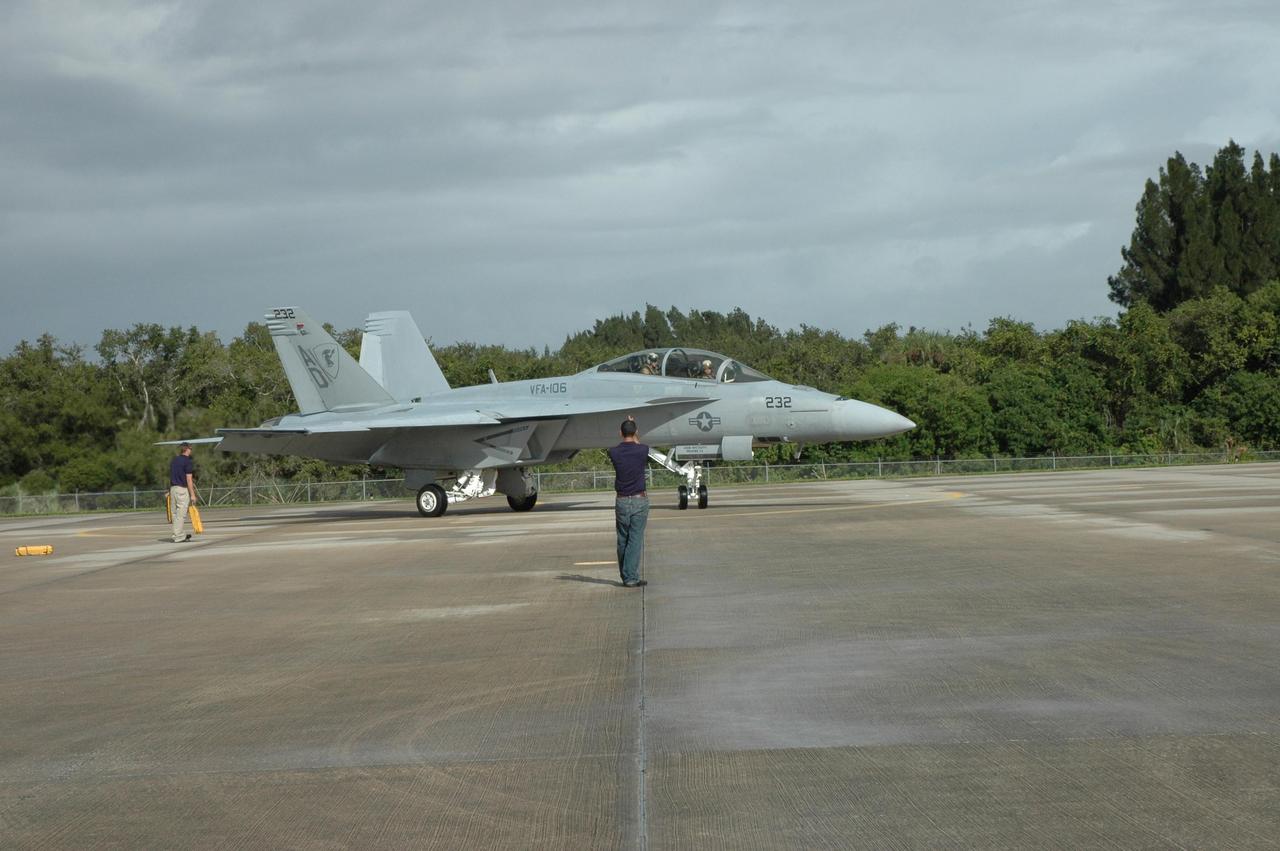
KENNEDY SPACE CENTER, FLA. -- A U.S. Navy F-18 Super Hornet arrives at the Shuttle Landing Facility at NASA's Kennedy Space Center. Several of the planes are participating in the World Space Expo being held from Nov. 1 to Nov. 4 at the NASA Kennedy Space Center Visitor Complex. Other aircraft joining in the salute include U.S. Air Force Thunderbirds Aerial Demonstration Squadron , U.S. Air Force F-22 Raptor, U.S. Air Force F-15 Eagle, the P-51 Mustang Heritage Flight and the U.S. Air Force 920th Rescue Wing, which was responsible for Mercury and Gemini capsule recovery. The U.S. Army Golden Knights also will demonstrate precision skydiving. The World Space Expo is an event to commemorate humanity's first 50 years in space while looking forward to returning people to the moon and exploring beyond. The expo will showcase various panels, presentations and educational programs. It also is a part of NASA's 50th anniversary celebrations, highlighting the 45th Anniversary of the Mercury Program celebration featuring original NASA astronauts John Glenn and Scott Carpenter and the Pioneering Women of Aerospace forum featuring Eileen Collins and other prominent female space veterans. The agency was founded Oct. 1, 1958. Photo credit: NASA/Jack Pfaller
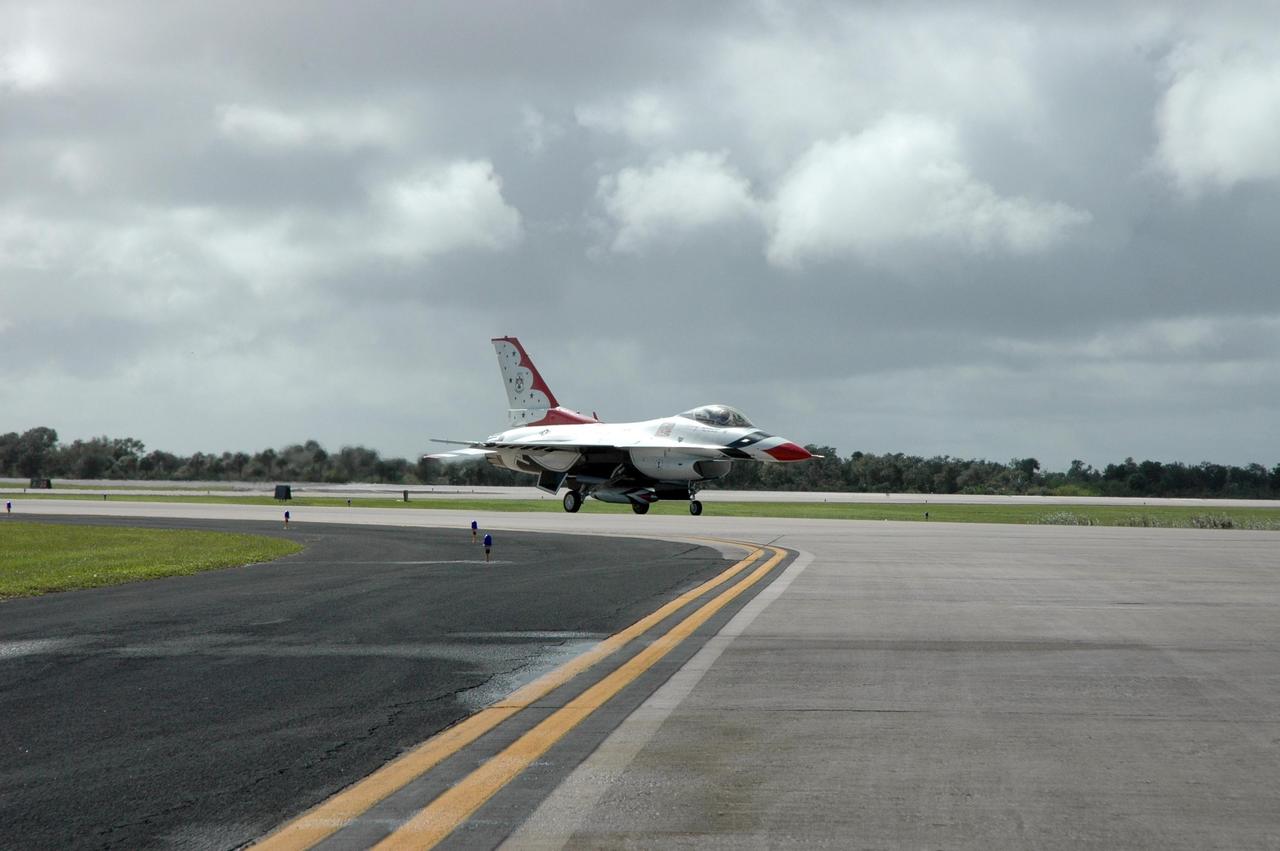
KENNEDY SPACE CENTER, FLA. -- Another of the U.S. Air Force Thunderbirds lands at the Shuttle Landing Facility at NASA's Kennedy Space Center. The aerial demonstration squadron is performing for the World Space Expo being held from Nov. 1 to Nov. 4 at the NASA Kennedy Space Center Visitor Complex. Other aircraft participating in the salute include U.S. Air Force F-22 Raptor, U.S. Navy F-18 Super Hornet, U.S. Air Force F-15 Eagle, the P-51 Mustang Heritage Flight and the U.S. Air Force 920th Rescue Wing, which was responsible for Mercury and Gemini capsule recovery. The U.S. Army Golden Knights also will demonstrate precision skydiving. The World Space Expo is an event to commemorate humanity's first 50 years in space while looking forward to returning people to the moon and exploring beyond. The expo will showcase various panels, presentations and educational programs. It also is a part of NASA's 50th anniversary celebrations, highlighting the 45th Anniversary of the Mercury Program celebration featuring original NASA astronauts John Glenn and Scott Carpenter and the Pioneering Women of Aerospace forum featuring Eileen Collins and other prominent female space veterans. The agency was founded Oct. 1, 1958. Photo credit: NASA/Jack Pfaller
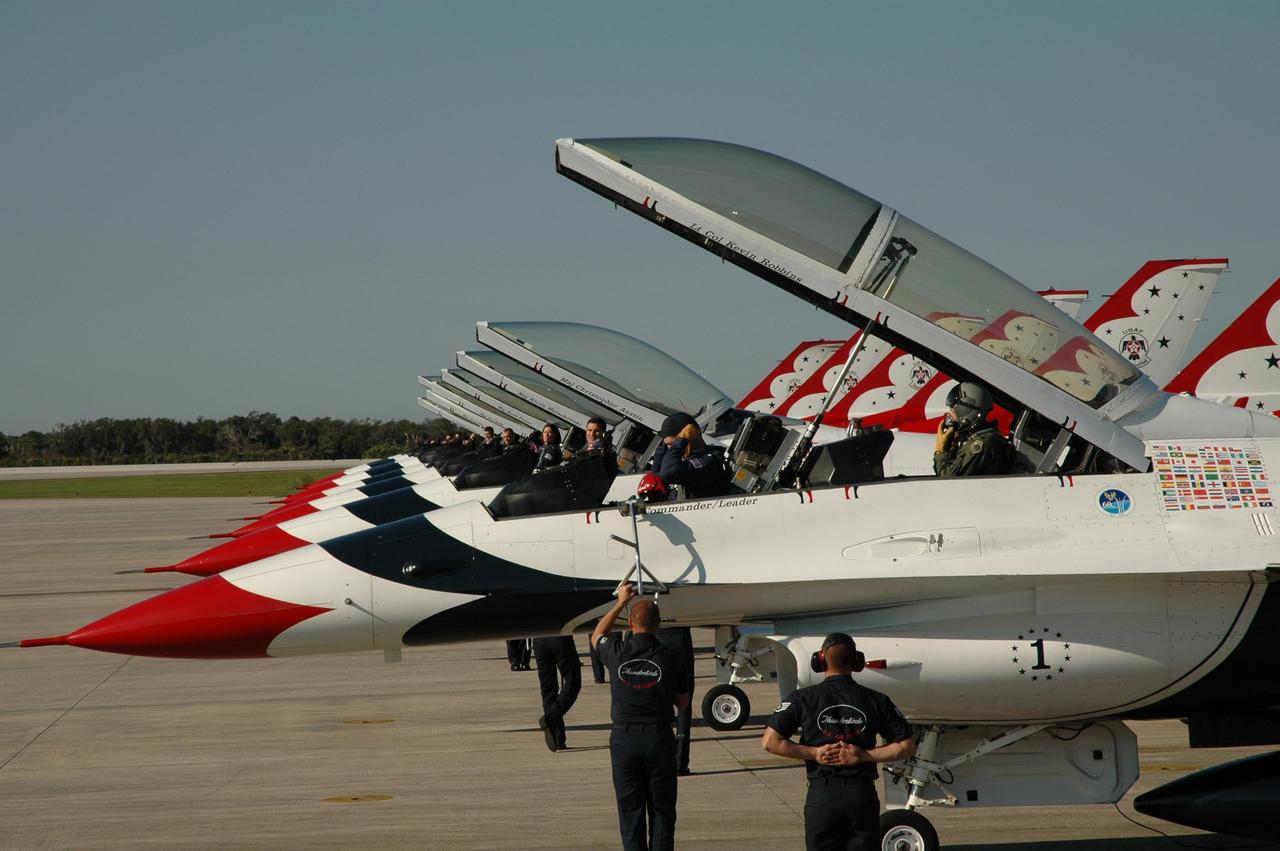
KENNEDY SPACE CENTER, FLA. -- KENNEDY SPACE CENTER, FLA. — Pilots of the U.S. Air Force Thunderbirds Demonstration Squadron get ready to leave NASA's Kennedy Space Center. The squadron performed for the World Space Expos' aerial salute along with other aircraft that included the U.S. Navy F-18 Super Hornets, U.S. Air Force F-22 Raptor, U.S. Air Force F-15 Eagle, P-51 Mustang Heritage Flight, the U.S. Air Force 920th Rescue Wing, which was responsible for Mercury and Gemini capsule recovery, and the U.S. Army Golden Knights precision skydiving team. The World Space Expo held Nov. 1-4 was an event commemorating humanity's first 50 years in space while looking forward to returning people to the moon and exploring beyond. The expo showcased various panels, presentations and educational programs. It also was a part of NASA's 50th anniversary celebrations, highlighting the 45th Anniversary of the Mercury Program celebration featuring original NASA astronauts John Glenn and Scott Carpenter and the Pioneering Women of Aerospace forum featuring Eileen Collins and other prominent female space veterans. The agency was founded Oct. 1, 1958. Photo credit: NASA/Jim Grossmann
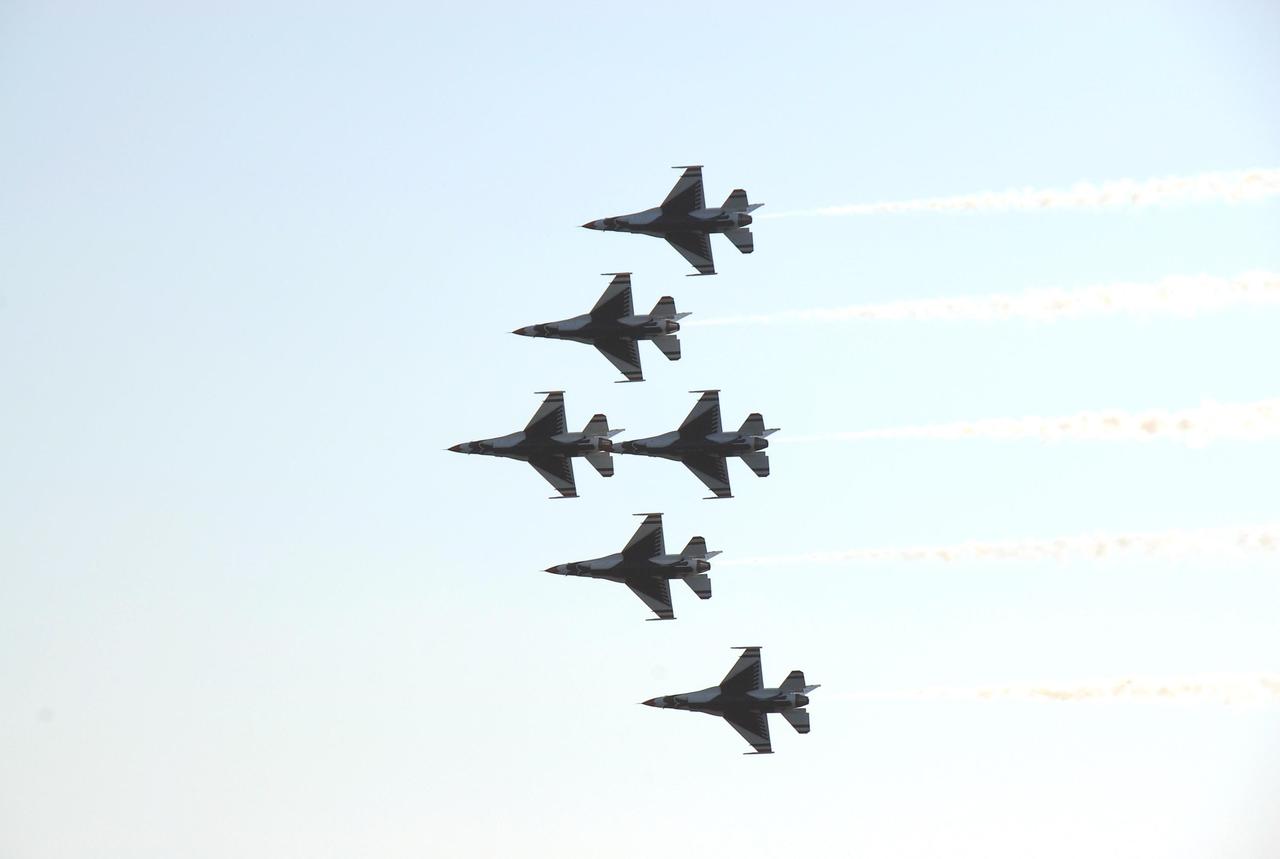
KENNEDY SPACE CENTER, FLA. -- The U.S. Air Force Thunderbirds Demonstration Squadron fly in close formation during the World Space Expo aerial salute. Other aircraft joining in the expo salute include the U.S. Navy F-18 Super Hornets, U.S. Air Force F-22 Raptor, U.S. Air Force F-15 Eagle, P-51 Mustang Heritage Flight, the U.S. Air Force 920th Rescue Wing, which was responsible for Mercury and Gemini capsule recovery, and the U.S. Army Golden Knights precision skydivers. The World Space Expo held Nov. 1-4 was an event commemorating humanity's first 50 years in space while looking forward to returning people to the moon and exploring beyond. The expo showcased various panels, presentations and educational programs. It also was a part of NASA's 50th anniversary celebrations, highlighting the 45th Anniversary of the Mercury Program celebration featuring original NASA astronauts John Glenn and Scott Carpenter and the Pioneering Women of Aerospace forum featuring Eileen Collins and other prominent female space veterans. The agency was founded Oct. 1, 1958. Photo credit: NASA/Kim Shiflett
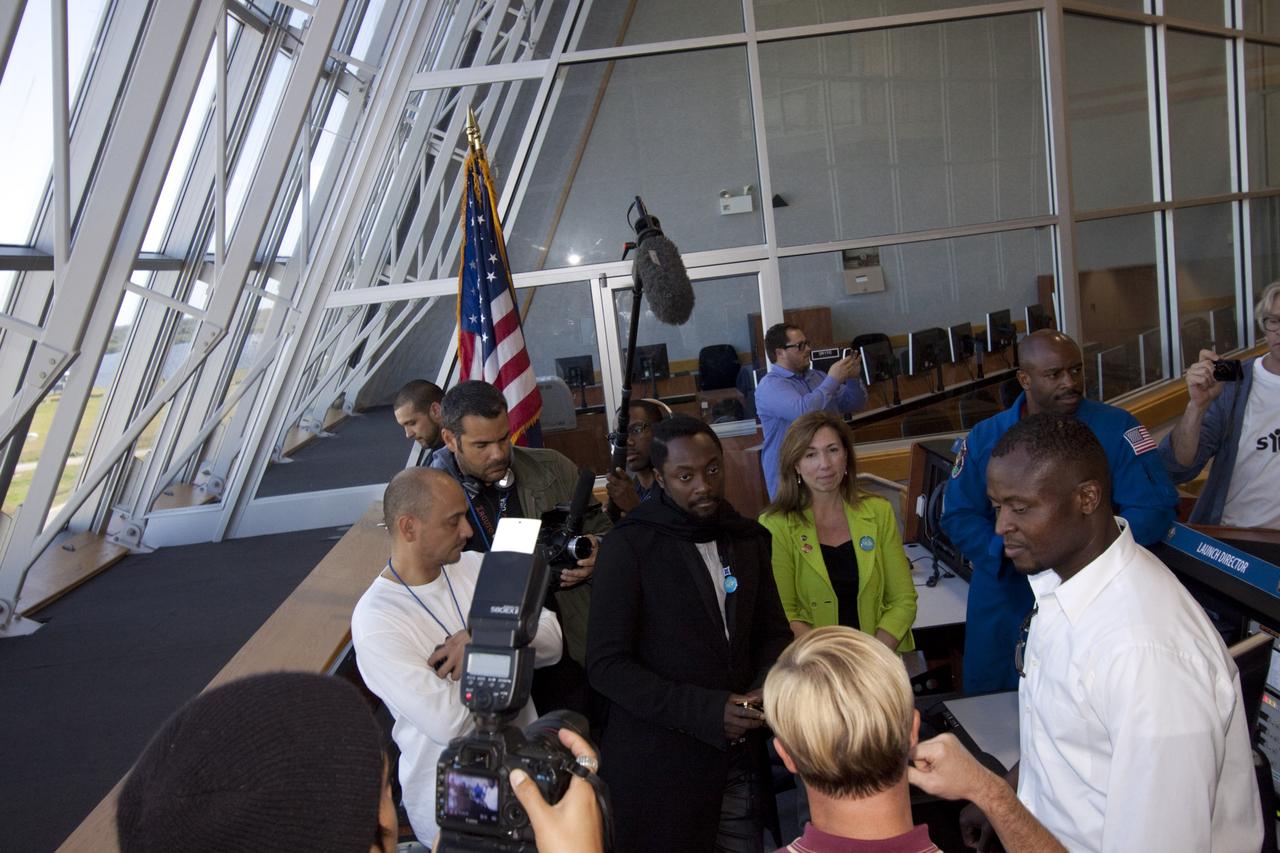
CAPE CANAVERAL, Fla. – At NASA Kennedy Space Center in Florida, Will.i.am (at center), entertainer and member of The Black Eyed Peas, tours Firing Room 4 in the Launch Control Center accompanied by NASA Deputy Administrator Lori Garver (green jacket); former astronaut Leland Melvin, NASA associate administrator for Education (blue flight suit); and Yves Lamothe, lead systems engineer for the 21st Century Ground Systems Program at Kennedy. The visit to the firing room followed their participation in a NASA Tweetup. The Tweetup is part of prelaunch activities for the agency’s Mars Science Laboratory (MSL) launch and provides the opportunity for tweeters will share their experiences with followers through the social networking site Twitter. The MSL mission will pioneer precision landing technology and a sky-crane touchdown to place a car-sized rover, Curiosity, near the foot of a mountain inside Gale Crater on Aug. 6, 2012. During a nearly two-year prime mission after landing, the rover will investigate whether the region has ever offered conditions favorable for microbial life, including the chemical ingredients for life. Liftoff of MSL aboard a United Launch Alliance Atlas V rocket from Space Launch Complex-41 on Cape Canaveral Air Force Station was at 10:02 a.m. EST on Nov. 26. For more information, visit http://www.nasa.gov/msl. Photo credit: NASA/Jim Grossmann
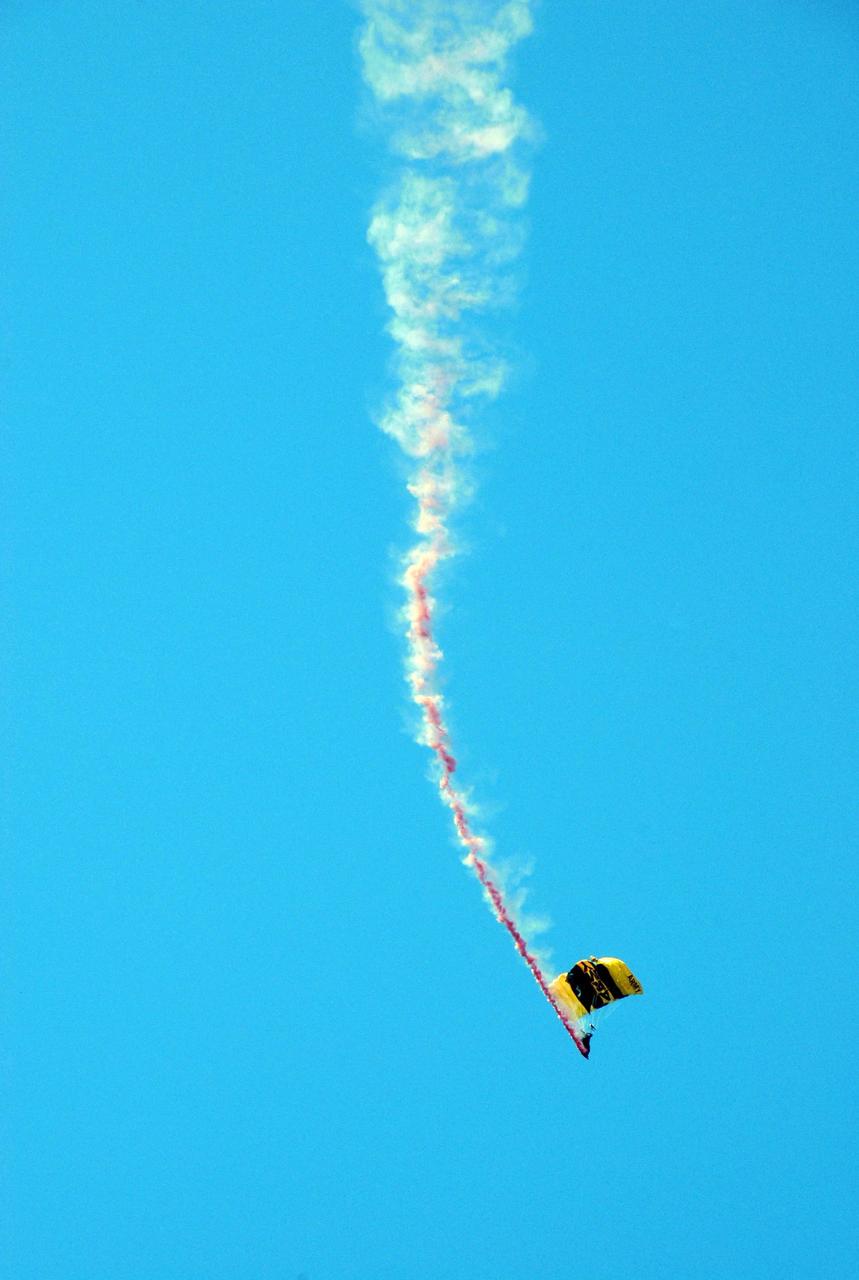
KENNEDY SPACE CENTER, FLA. -- A member of the U.S. Army Golden Knights demonstrates precision skydiving as part of the World Space Expo aerial salute at NASA's Kennedy Space Center. Other aircraft joining in the expo salute include the U.S. Air Force Thunderbirds Demonstration Squadron, the U.S. Navy F-18 Super Hornets, U.S. Air Force F-22 Raptor, U.S. Air Force F-15 Eagle, P-51 Mustang Heritage Flight, and the U.S. Air Force 920th Rescue Wing, which was responsible for Mercury and Gemini capsule recovery. The World Space Expo held Nov. 1-4 was an event commemorating humanity's first 50 years in space while looking forward to returning people to the moon and exploring beyond. The expo showcased various panels, presentations and educational programs. It also was a part of NASA's 50th anniversary celebrations, highlighting the 45th Anniversary of the Mercury Program celebration featuring original NASA astronauts John Glenn and Scott Carpenter and the Pioneering Women of Aerospace forum featuring Eileen Collins and other prominent female space veterans. The agency was founded Oct. 1, 1958. Photo credit: NASA/Kim Shiflett
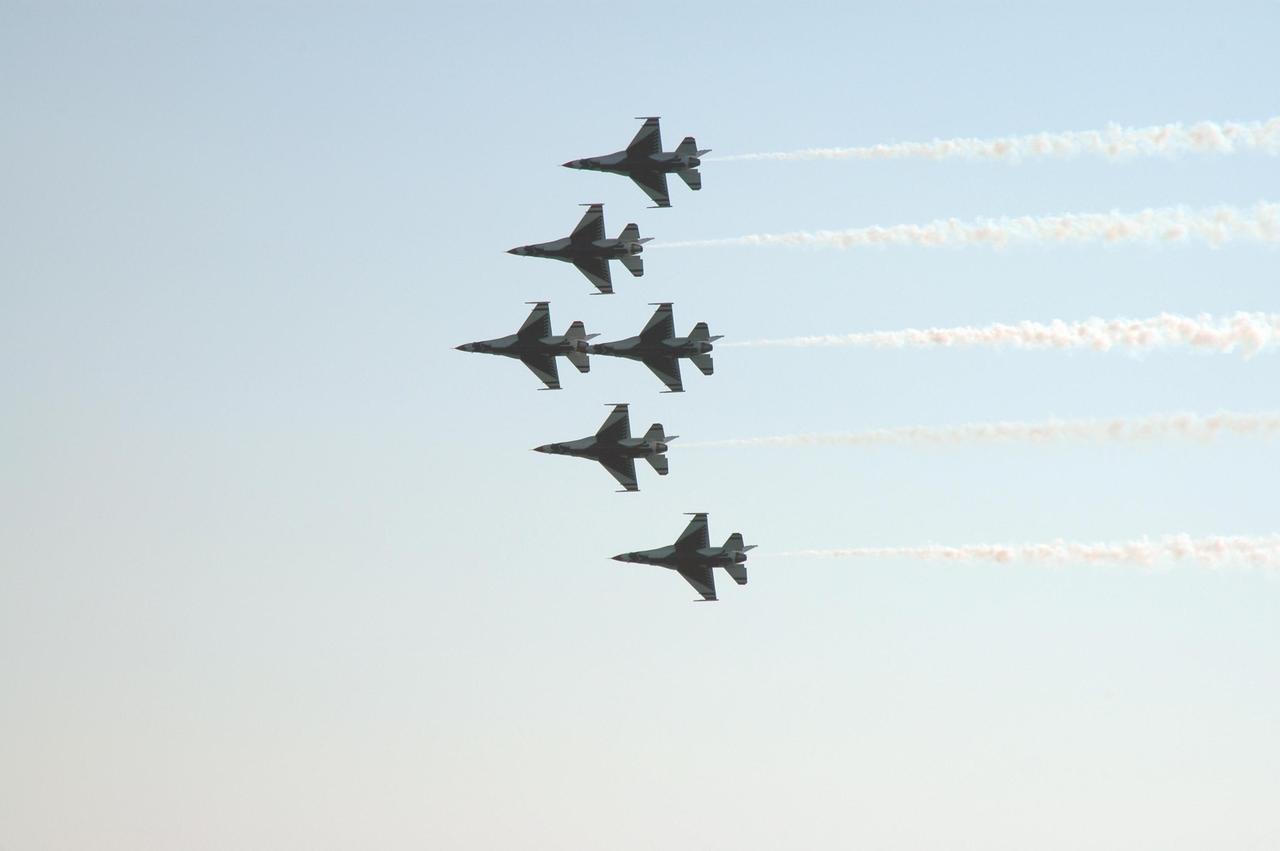
KENNEDY SPACE CENTER, FLA. -- At NASA's Kennedy Space Center, the U.S. Air Force Thunderbirds Demonstration Squadron performs during the World Space Expo aerial salute. Other aircraft joining in the expo salute include the U.S. Navy F-18 Super Hornets, U.S. Air Force F-22 Raptor, U.S. Air Force F-15 Eagle, P-51 Mustang Heritage Flight, U.S. Air Force 920th Rescue wing, which was responsible for Mercury and Gemini capsule recovery, and the U.S. Army Golden Knights demonstrating precision skydiving. The World Space Expo held Nov. 1-4 was an event commemorating humanity's first 50 years in space while looking forward to returning people to the moon and exploring beyond. The expo showcased various panels, presentations and educational programs. It also was a part of NASA's 50th anniversary celebrations, highlighting the 45th Anniversary of the Mercury Program celebration featuring original NASA astronauts John Glenn and Scott Carpenter and the Pioneering Women of Aerospace forum featuring Eileen Collins and other prominent female space veterans. The agency was founded Oct. 1, 1958. Photo credit: NASA/Chris Chamberland
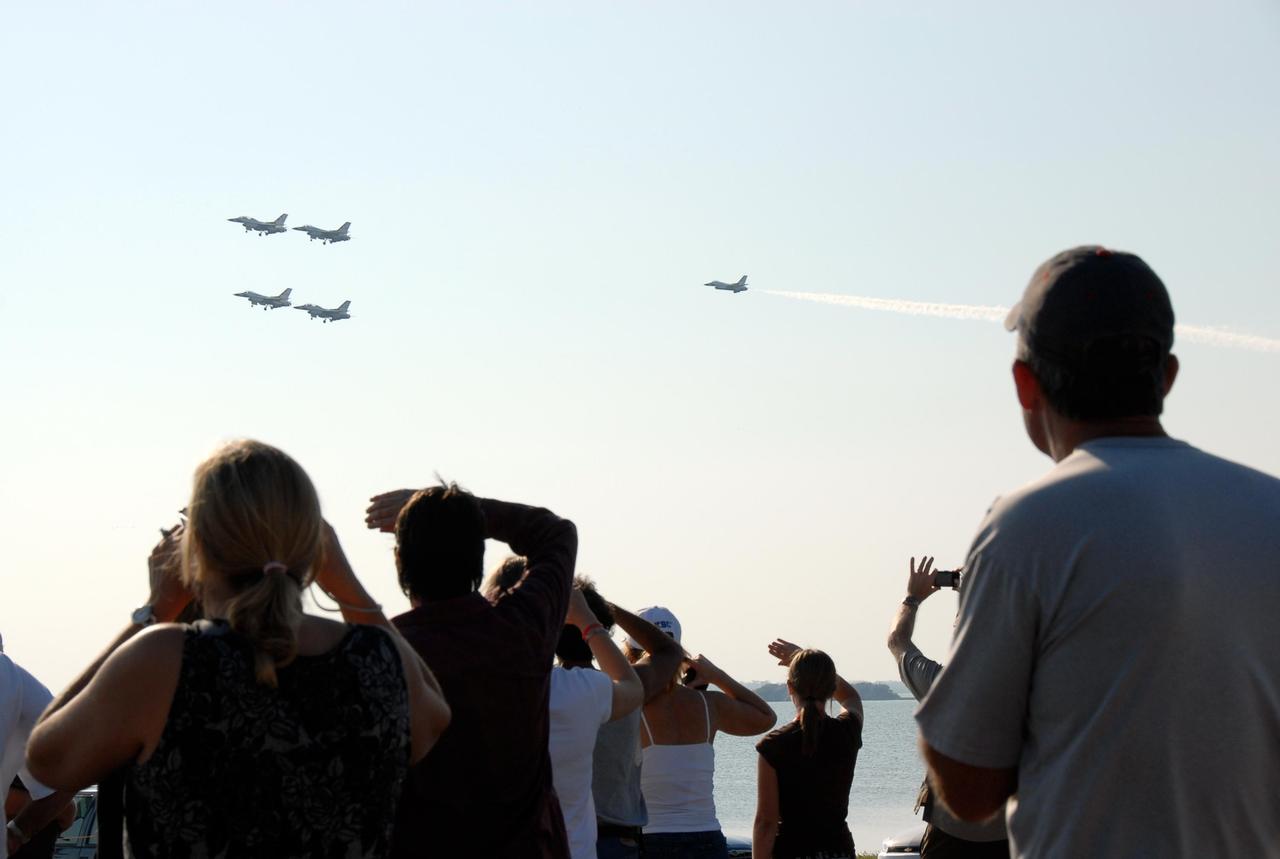
KENNEDY SPACE CENTER, FLA. -- Crowds at NASA's Kennedy Space Center watch the U.S. Air Force Thunderbirds Demonstration Squadron perform during the World Space Expo aerial salute. Other aircraft joining in the expo salute include the U.S. Navy F-18 Super Hornets, U.S. Air Force F-22 Raptor, U.S. Air Force F-15 Eagle, P-51 Mustang Heritage Flight, the U.S. Air Force 920th Rescue Wing, which was responsible for Mercury and Gemini capsule recovery, and the U.S. Army Golden Knights precision skydivers. The World Space Expo held Nov. 1-4 was an event commemorating humanity's first 50 years in space while looking forward to returning people to the moon and exploring beyond. The expo showcased various panels, presentations and educational programs. It also was a part of NASA's 50th anniversary celebrations, highlighting the 45th Anniversary of the Mercury Program celebration featuring original NASA astronauts John Glenn and Scott Carpenter and the Pioneering Women of Aerospace forum featuring Eileen Collins and other prominent female space veterans. The agency was founded Oct. 1, 1958. Photo credit: NASA/Kim Shiflett
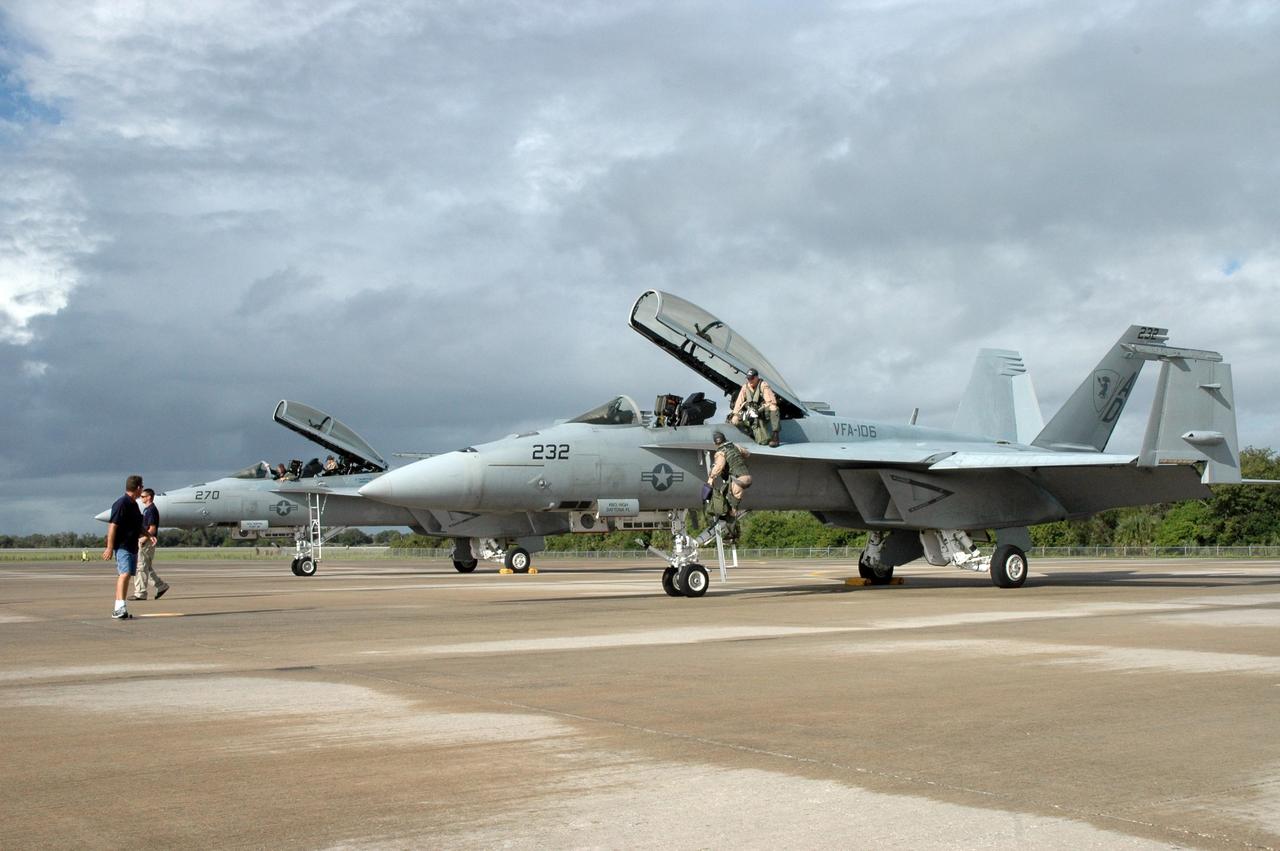
KENNEDY SPACE CENTER, FLA. -- Pilots of several U.S. Navy F-18 Super Hornet jets climb out of the cockpits on the Shuttle Landing Facility at NASA's Kennedy Space Center. Several of the planes are participating in the World Space Expo being held from Nov. 1 to Nov. 4 at the NASA Kennedy Space Center Visitor Complex. Other aircraft joining in the salute include U.S. Air Force Thunderbirds Aerial Demonstration Squadron , U.S. Air Force F-22 Raptor, U.S. Air Force F-15 Eagle, the P-51 Mustang Heritage Flight and the U.S. Air Force 920th Rescue Wing, which was responsible for Mercury and Gemini capsule recovery. The U.S. Army Golden Knights also will demonstrate precision skydiving. The World Space Expo is an event to commemorate humanity's first 50 years in space while looking forward to returning people to the moon and exploring beyond. The expo will showcase various panels, presentations and educational programs. It also is a part of NASA's 50th anniversary celebrations, highlighting the 45th Anniversary of the Mercury Program celebration featuring original NASA astronauts John Glenn and Scott Carpenter and the Pioneering Women of Aerospace forum featuring Eileen Collins and other prominent female space veterans. The agency was founded Oct. 1, 1958. Photo credit: NASA/Jack Pfaller
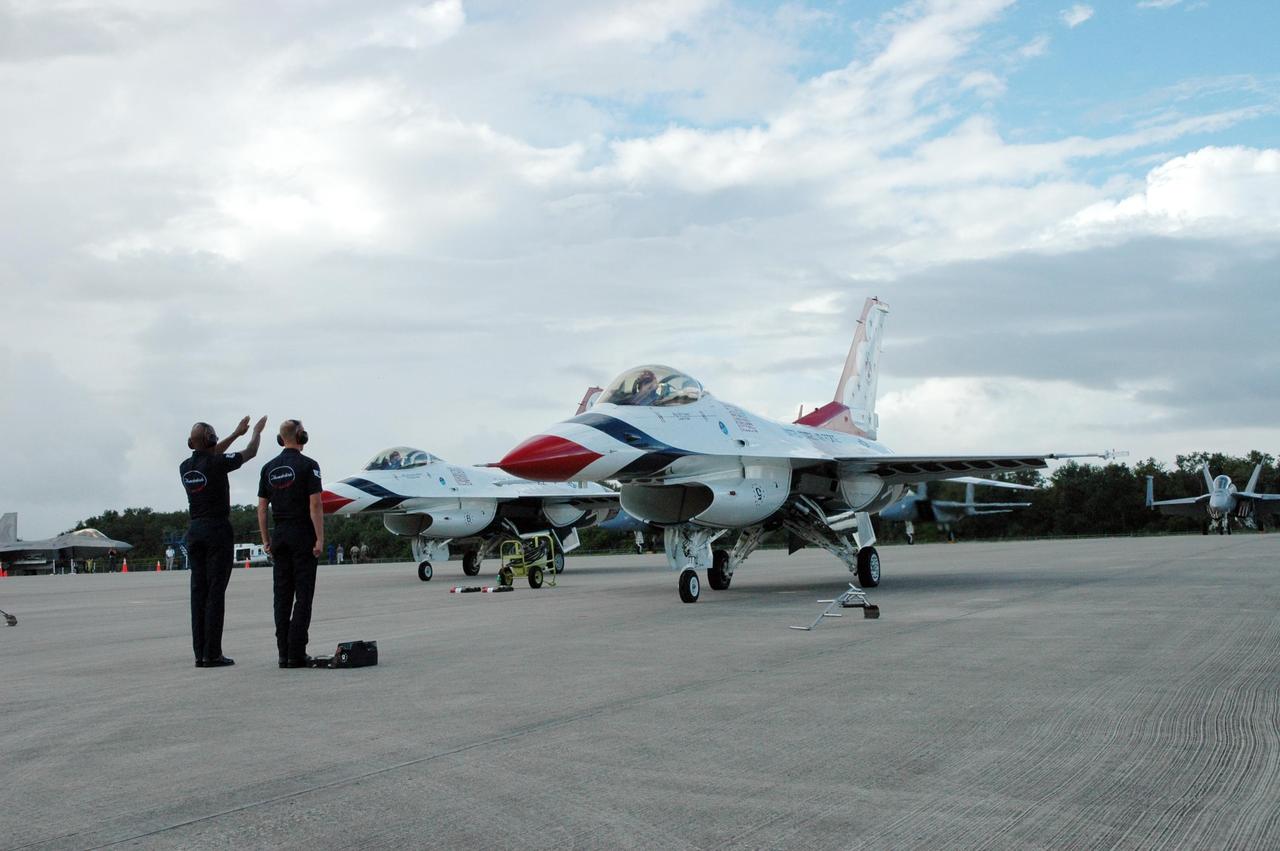
KENNEDY SPACE CENTER, FLA. -- U.S. Air Force Thunderbirds line up on the Shuttle Landing Facility at NASA's Kennedy Space Center. The aerial demonstration squadron is performing for the World Space Expo being held from Nov. 1 to Nov. 4 at the NASA Kennedy Space Center Visitor Complex. Other aircraft participating in the salute include U.S. Air Force F-22 Raptor, U.S. Navy F-18 Super Hornet, U.S. Air Force F-15 Eagle, the P-51 Mustang Heritage Flight and the U.S. Air Force 920th Rescue Wing, which was responsible for Mercury and Gemini capsule recovery. The U.S. Army Golden Knights also will demonstrate precision skydiving. The World Space Expo is an event to commemorate humanity's first 50 years in space while looking forward to returning people to the moon and exploring beyond. The expo will showcase various panels, presentations and educational programs. It also is a part of NASA's 50th anniversary celebrations, highlighting the 45th Anniversary of the Mercury Program celebration featuring original NASA astronauts John Glenn and Scott Carpenter and the Pioneering Women of Aerospace forum featuring Eileen Collins and other prominent female space veterans. The agency was founded Oct. 1, 1958. Photo credit: NASA/Jack Pfaller
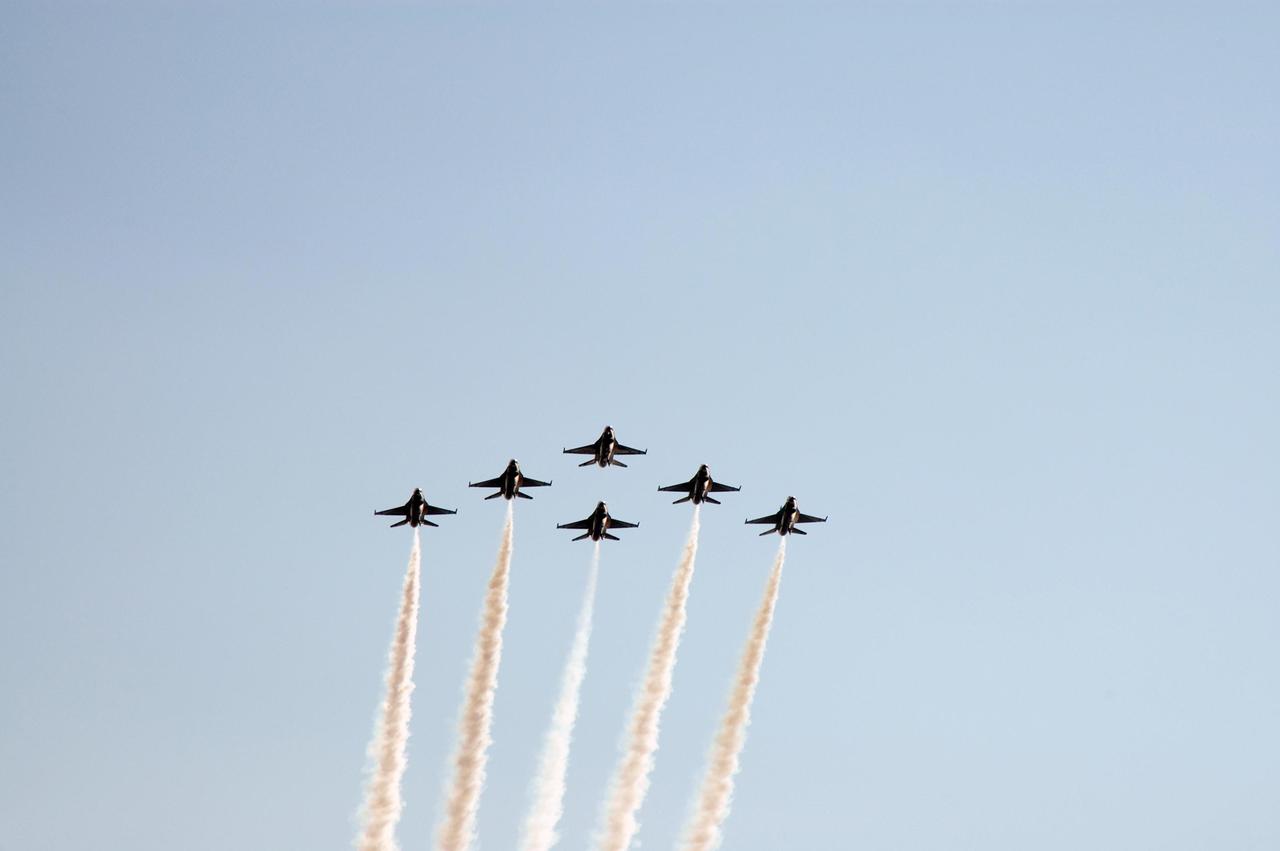
KENNEDY SPACE CENTER, FLA. -- At NASA's Kennedy Space Center, the U.S. Navy F-18 Super Hornets demonstrate their formation flying during the World Space Expo aerial salute. Other aircraft joining in the expo salute include the U.S. Air Force Thunderbirds Demonstration Squadron, U.S. Air Force F-22 Raptor, U.S. Air Force F-15 Eagle, P-51 Mustang Heritage Flight, U.S. Air Force 920th Rescue wing, which was responsible for Mercury and Gemini capsule recovery, and the U.S. Army Golden Knights demonstrating precision skydiving. The World Space Expo held Nov. 1-4 was an event commemorating humanity's first 50 years in space while looking forward to returning people to the moon and exploring beyond. The expo showcased various panels, presentations and educational programs. It also was a part of NASA's 50th anniversary celebrations, highlighting the 45th Anniversary of the Mercury Program celebration featuring original NASA astronauts John Glenn and Scott Carpenter and the Pioneering Women of Aerospace forum featuring Eileen Collins and other prominent female space veterans. The agency was founded Oct. 1, 1958. Photo credit: NASA/Chris Chamberland
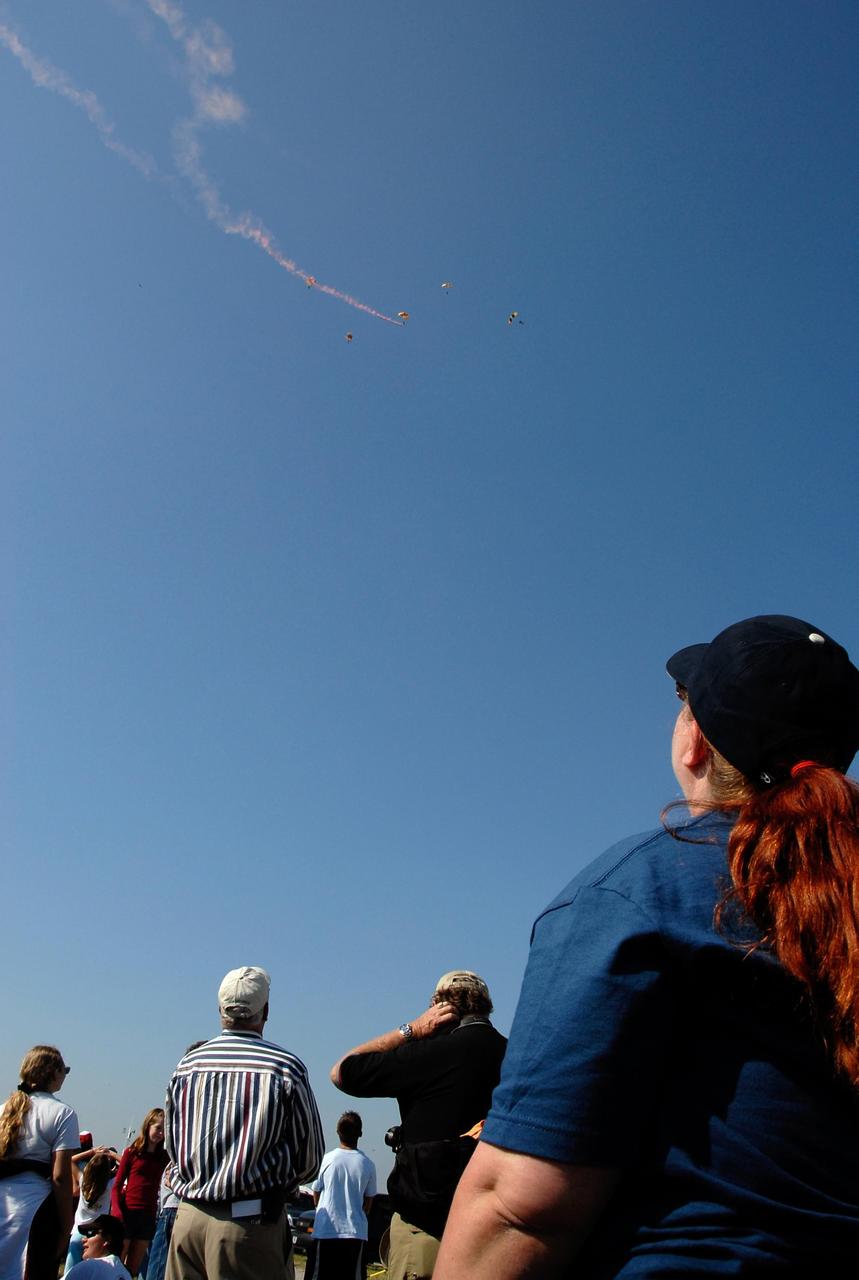
KENNEDY SPACE CENTER, FLA. -- Crowds at NASA's Kennedy Space Center watch the U.S. Army Golden Knights demonstrate precision skydiving as part of the World Space Expo aerial salute. Other aircraft joining in the expo salute include the U.S. Air Force Thunderbirds Demonstration Squadron, the U.S. Navy F-18 Super Hornets, U.S. Air Force F-22 Raptor, U.S. Air Force F-15 Eagle, P-51 Mustang Heritage Flight, and the U.S. Air Force 920th Rescue Wing, which was responsible for Mercury and Gemini capsule recovery. The World Space Expo held Nov. 1-4 was an event commemorating humanity's first 50 years in space while looking forward to returning people to the moon and exploring beyond. The expo showcased various panels, presentations and educational programs. It also was a part of NASA's 50th anniversary celebrations, highlighting the 45th Anniversary of the Mercury Program celebration featuring original NASA astronauts John Glenn and Scott Carpenter and the Pioneering Women of Aerospace forum featuring Eileen Collins and other prominent female space veterans. The agency was founded Oct. 1, 1958. Photo credit: NASA/Kim Shiflett
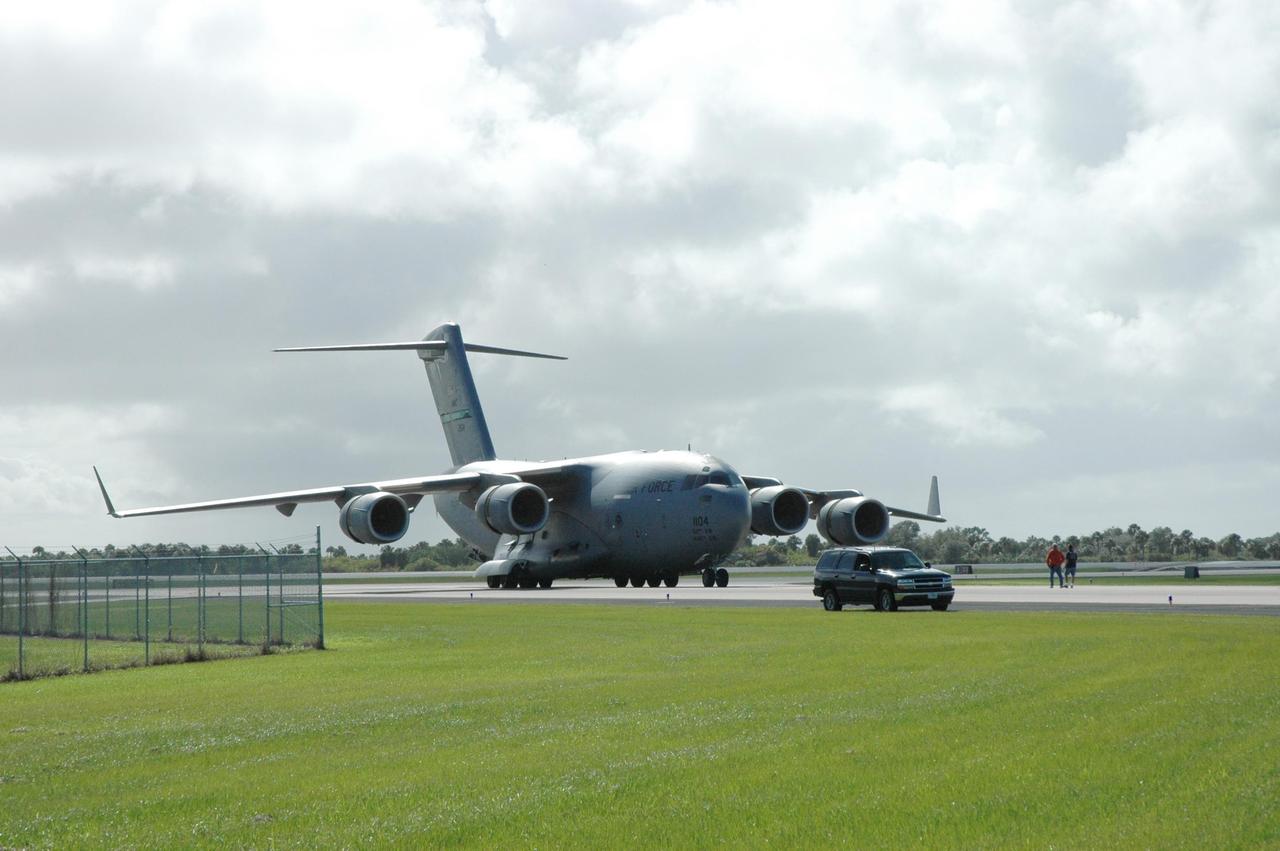
KENNEDY SPACE CENTER, FLA. -- A C-17 lands on the Shuttle Landing Facility at NASA's Kennedy Space Center. The plane is providing support for the aerial show being performed for the World Space Expo being held from Nov. 1 to Nov. 4 at the NASA Kennedy Space Center Visitor Complex. Aircraft participating are the U.S. Air Force Thunderbirds, U.S. Air Force F-22 Raptor, U.S. Navy F-18 Super Hornet, U.S. Air Force F-15 Eagle, the P-51 Mustang Heritage Flight and the U.S. Air Force 920th Rescue Wing, which was responsible for Mercury and Gemini capsule recovery. The U.S. Army Golden Knights also will demonstrate precision skydiving. The World Space Expo is an event to commemorate humanity's first 50 years in space while looking forward to returning people to the moon and exploring beyond. The expo will showcase various panels, presentations and educational programs. It also is a part of NASA's 50th anniversary celebrations, highlighting the 45th Anniversary of the Mercury Program celebration featuring original NASA astronauts John Glenn and Scott Carpenter and the Pioneering Women of Aerospace forum featuring Eileen Collins and other prominent female space veterans. The agency was founded Oct. 1, 1958. Photo credit: NASA/Jack Pfaller
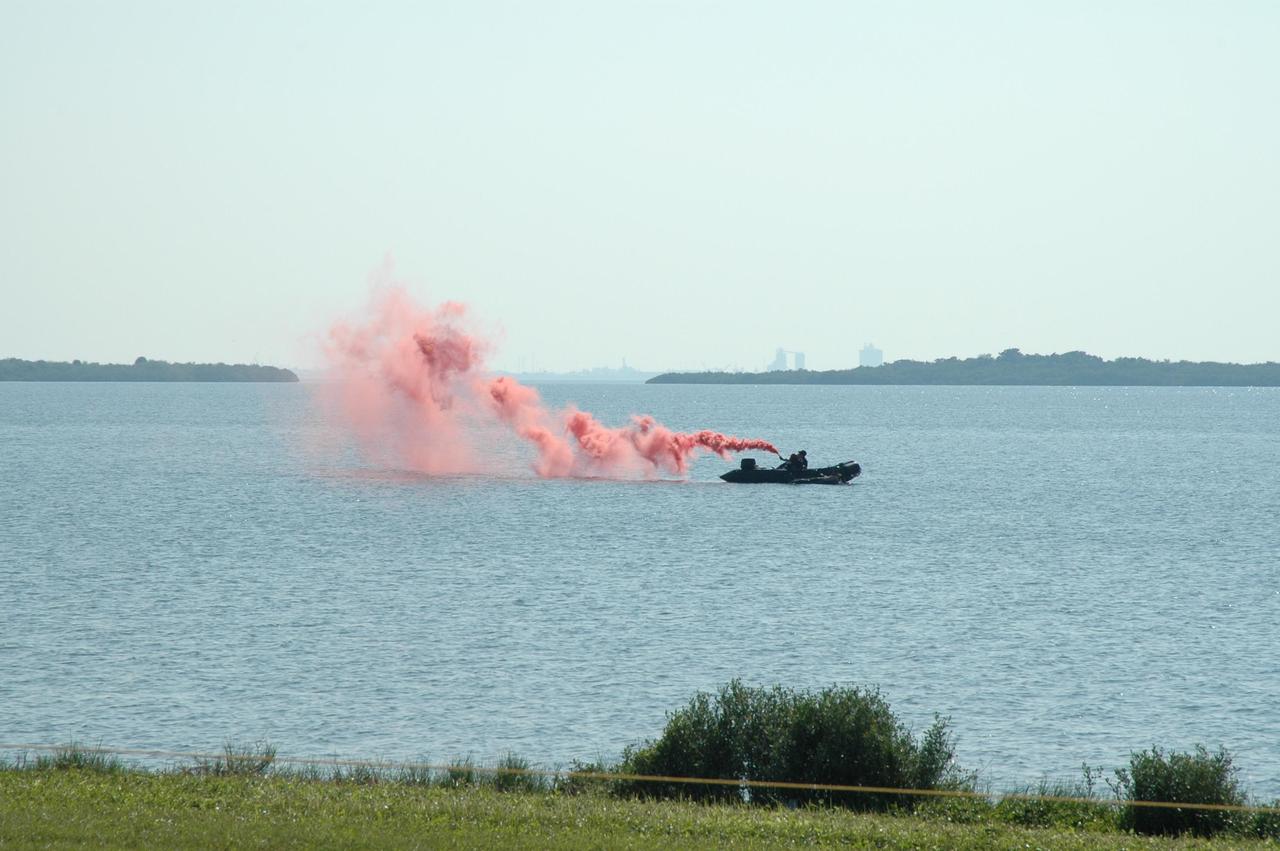
KENNEDY SPACE CENTER, FLA. -- In the water next to the NASA Causeway at NASA's Kennedy Space Center, part of the U.S. Air Force 920th Rescue Wing puts on a demonstration during the World Space Expo aerial salute. This unit was responsible for Mercury and Gemini capsule recovery. Other aircraft joining in the expo salute include the U.S. Air Force Thunderbirds Demonstration Squadron, the U.S. Navy F-18 Super Hornets, U.S. Air Force F-22 Raptor, U.S. Air Force F-15 Eagle, P-51 Mustang Heritage Flight, and the U.S. Army Golden Knights demonstrating precision skydiving. The World Space Expo held Nov. 1-4 was an event commemorating humanity's first 50 years in space while looking forward to returning people to the moon and exploring beyond. The expo showcased various panels, presentations and educational programs. It also was a part of NASA's 50th anniversary celebrations, highlighting the 45th Anniversary of the Mercury Program celebration featuring original NASA astronauts John Glenn and Scott Carpenter and the Pioneering Women of Aerospace forum featuring Eileen Collins and other prominent female space veterans. The agency was founded Oct. 1, 1958. Photo credit: NASA/Chris Chamberland
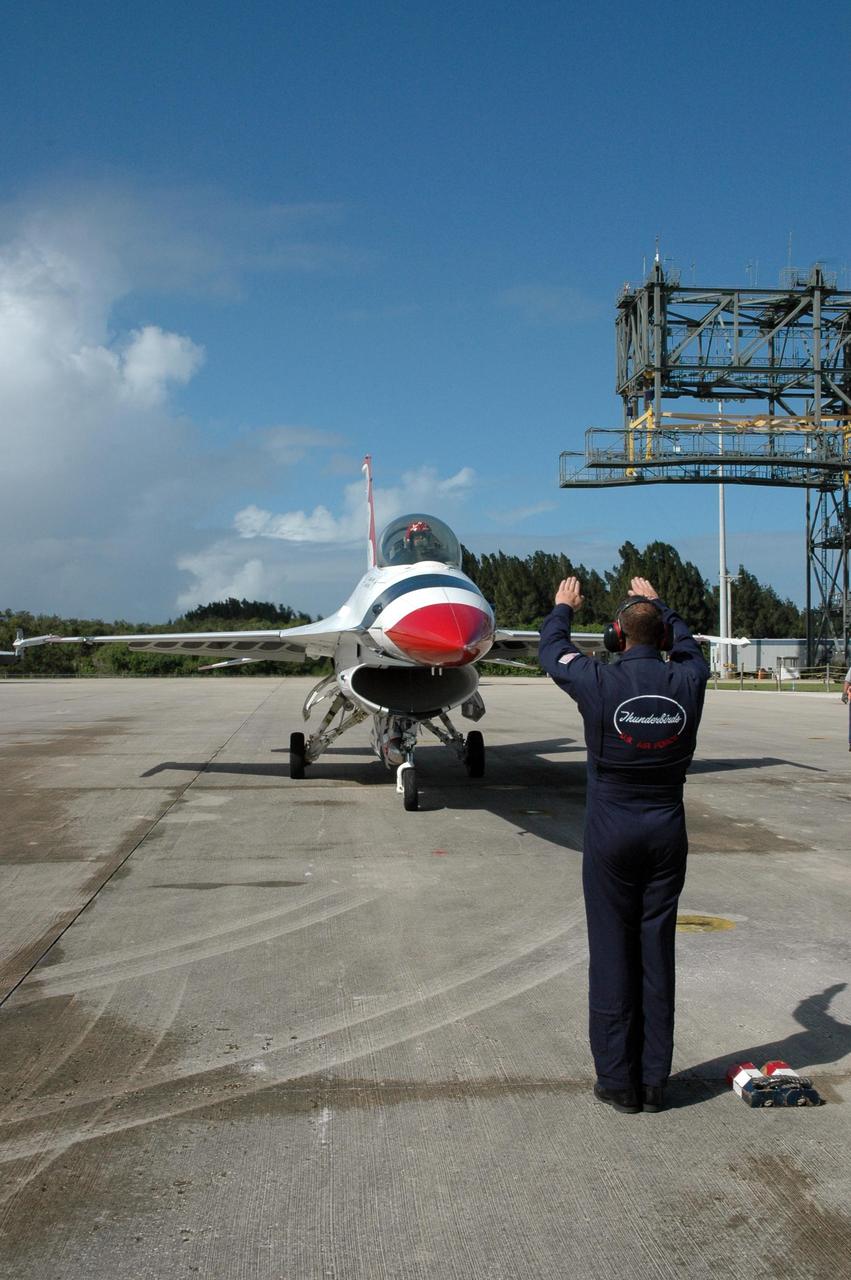
KENNEDY SPACE CENTER, FLA. -- Another of the U.S. Air Force Thunderbirds lands at the Shuttle Landing Facility at NASA's Kennedy Space Center. The aerial demonstration squadron is performing for the World Space Expo being held from Nov. 1 to Nov. 4 at the NASA Kennedy Space Center Visitor Complex. Other aircraft participating in the salute include U.S. Air Force F-22 Raptor, U.S. Navy F-18 Super Hornet, U.S. Air Force F-15 Eagle, the P-51 Mustang Heritage Flight and the U.S. Air Force 920th Rescue Wing, which was responsible for Mercury and Gemini capsule recovery. The U.S. Army Golden Knights also will demonstrate precision skydiving. The World Space Expo is an event to commemorate humanity's first 50 years in space while looking forward to returning people to the moon and exploring beyond. The expo will showcase various panels, presentations and educational programs. It also is a part of NASA's 50th anniversary celebrations, highlighting the 45th Anniversary of the Mercury Program celebration featuring original NASA astronauts John Glenn and Scott Carpenter and the Pioneering Women of Aerospace forum featuring Eileen Collins and other prominent female space veterans. The agency was founded Oct. 1, 1958. Photo credit: NASA/Jack Pfaller
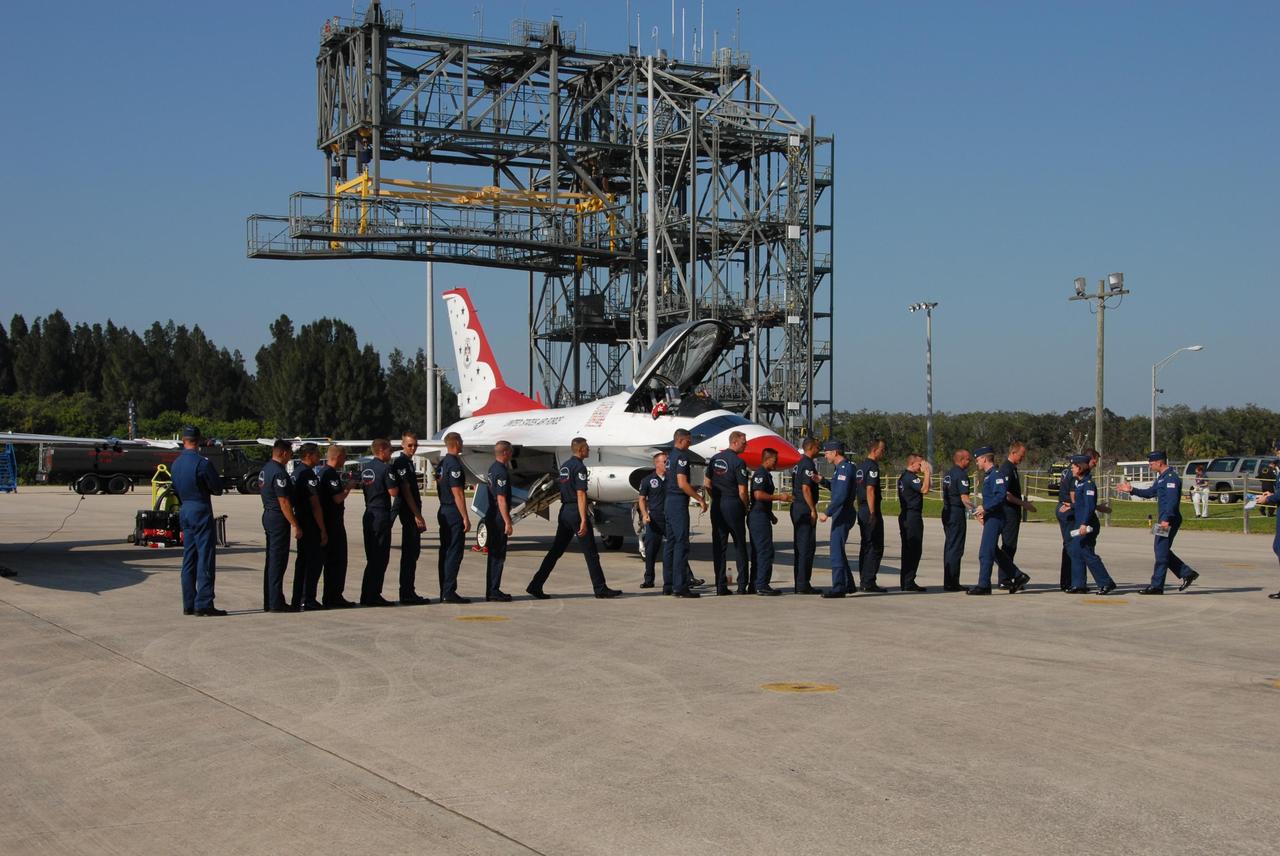
KENNEDY SPACE CENTER, FLA. — At NASA's Kennedy Space Center Shuttle Landing Facility, the air crew for the U.S. Air Force Thunderbirds Demonstration Squadron line up at left for a walkdown with the pilots, at right. The squadron is part of an aerial salute for the World Space Expo held at the center's Visitor Complex. Other aircraft joining in the expo salute include the U.S. Navy F-18 Super Hornets, U.S. Air Force F-22 Raptor, U.S. Air Force F-15 Eagle, P-51 Mustang Heritage Flight, the U.S. Air Force 920th Rescue Wing, which was responsible for Mercury and Gemini capsule recovery, and the U.S. Army Golden Knights demonstrating precision skydiving. The World Space Expo Nov. 1-4 was an event commemorating humanity's first 50 years in space while looking forward to returning people to the moon and exploring beyond. The expo showcased various panels, presentations and educational programs. It also was a part of NASA's 50th anniversary celebrations, highlighting the 45th Anniversary of the Mercury Program celebration featuring original NASA astronauts John Glenn and Scott Carpenter and the Pioneering Women of Aerospace forum featuring Eileen Collins and other prominent female space veterans. The agency was founded Oct. 1, 1958. Photo credit: NASA/George Shelton

KENNEDY SPACE CENTER, FLA. -- A U.S. Air Force F-22 Raptor is parked on the Shuttle Landing Facility at NASA's Kennedy Space Center. The plane is participating in the World Space Expo being held from Nov. 1 to Nov. 4 at the NASA Kennedy Space Center Visitor Complex. Other aircraft joining in the salute include U.S. Air Force Thunderbirds Aerial Demonstration Squadron, U.S. Navy F-18 Super Hornets, the P-51 Mustang Heritage Flight and the U.S. Air Force 920th Rescue Wing, which was responsible for Mercury and Gemini capsule recovery. The U.S. Army Golden Knights also will demonstrate precision skydiving. The World Space Expo is an event to commemorate humanity's first 50 years in space while looking forward to returning people to the moon and exploring beyond. The expo will showcase various panels, presentations and educational programs. It also is a part of NASA's 50th anniversary celebrations, highlighting the 45th Anniversary of the Mercury Program celebration featuring original NASA astronauts John Glenn and Scott Carpenter and the Pioneering Women of Aerospace forum featuring Eileen Collins and other prominent female space veterans. The agency was founded Oct. 1, 1958. Photo credit: NASA/Jack Pfaller
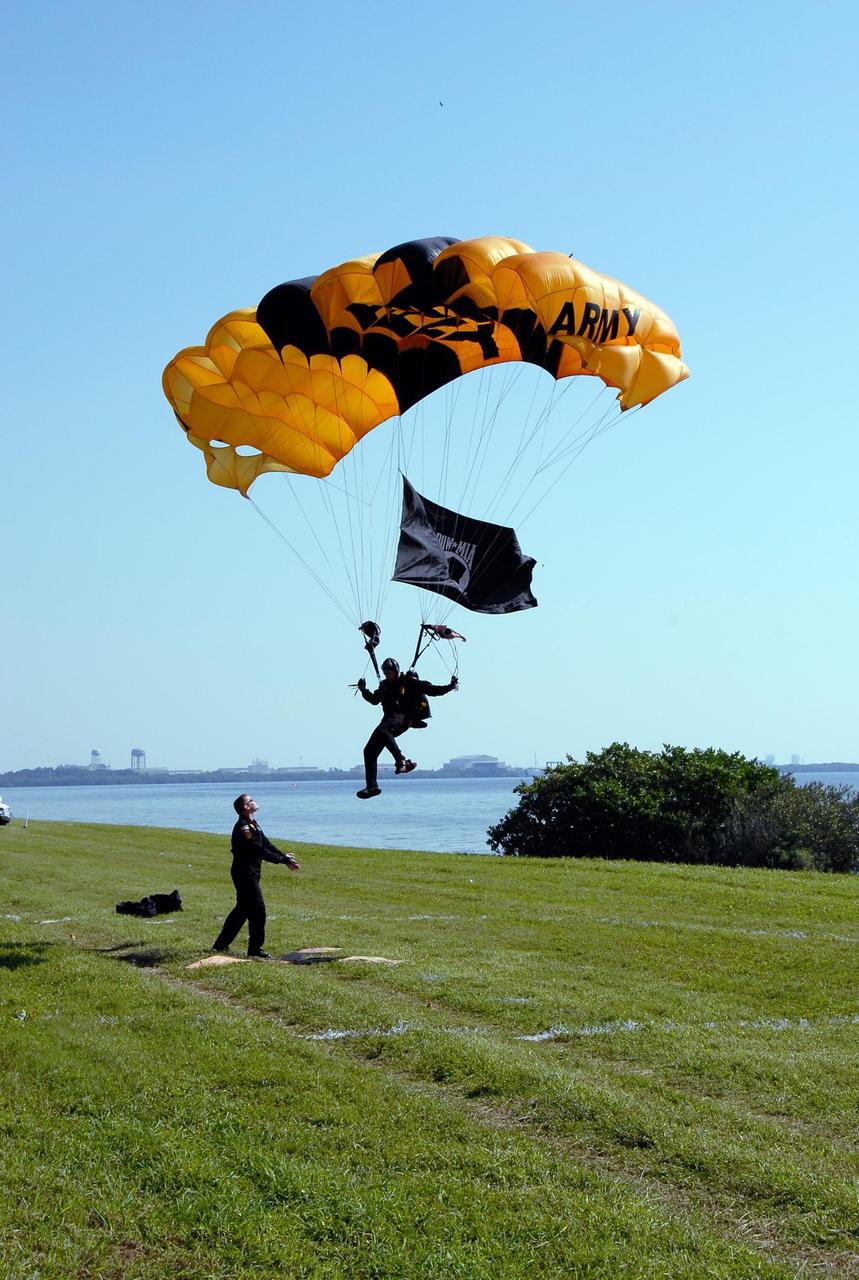
KENNEDY SPACE CENTER, FLA. -- Members of the U.S. Army Golden Knights demonstrate precision skydiving as part of the World Space Expo aerial salute at NASA's Kennedy Space Center. Other aircraft joining in the expo salute include the U.S. Air Force Thunderbirds Demonstration Squadron, the U.S. Navy F-18 Super Hornets, U.S. Air Force F-22 Raptor, U.S. Air Force F-15 Eagle, P-51 Mustang Heritage Flight, and the U.S. Air Force 920th Rescue Wing, which was responsible for Mercury and Gemini capsule recovery. The World Space Expo held Nov. 1-4 was an event commemorating humanity's first 50 years in space while looking forward to returning people to the moon and exploring beyond. The expo showcased various panels, presentations and educational programs. It also was a part of NASA's 50th anniversary celebrations, highlighting the 45th Anniversary of the Mercury Program celebration featuring original NASA astronauts John Glenn and Scott Carpenter and the Pioneering Women of Aerospace forum featuring Eileen Collins and other prominent female space veterans. The agency was founded Oct. 1, 1958. Photo credit: NASA/Kim Shiflett

KENNEDY SPACE CENTER, FLA. -- U.S. Air Force Thunderbirds line up on the Shuttle Landing Facility at NASA's Kennedy Space Center. The aerial demonstration squadron is performing for the World Space Expo being held from Nov. 1 to Nov. 4 at the NASA Kennedy Space Center Visitor Complex. Other aircraft participating in the salute include U.S. Air Force F-22 Raptor, U.S. Navy F-18 Super Hornet, U.S. Air Force F-15 Eagle, the P-51 Mustang Heritage Flight and the U.S. Air Force 920th Rescue Wing, which was responsible for Mercury and Gemini capsule recovery. The U.S. Army Golden Knights also will demonstrate precision skydiving. The World Space Expo is an event to commemorate humanity's first 50 years in space while looking forward to returning people to the moon and exploring beyond. The expo will showcase various panels, presentations and educational programs. It also is a part of NASA's 50th anniversary celebrations, highlighting the 45th Anniversary of the Mercury Program celebration featuring original NASA astronauts John Glenn and Scott Carpenter and the Pioneering Women of Aerospace forum featuring Eileen Collins and other prominent female space veterans. The agency was founded Oct. 1, 1958. Photo credit: NASA/Jack Pfaller
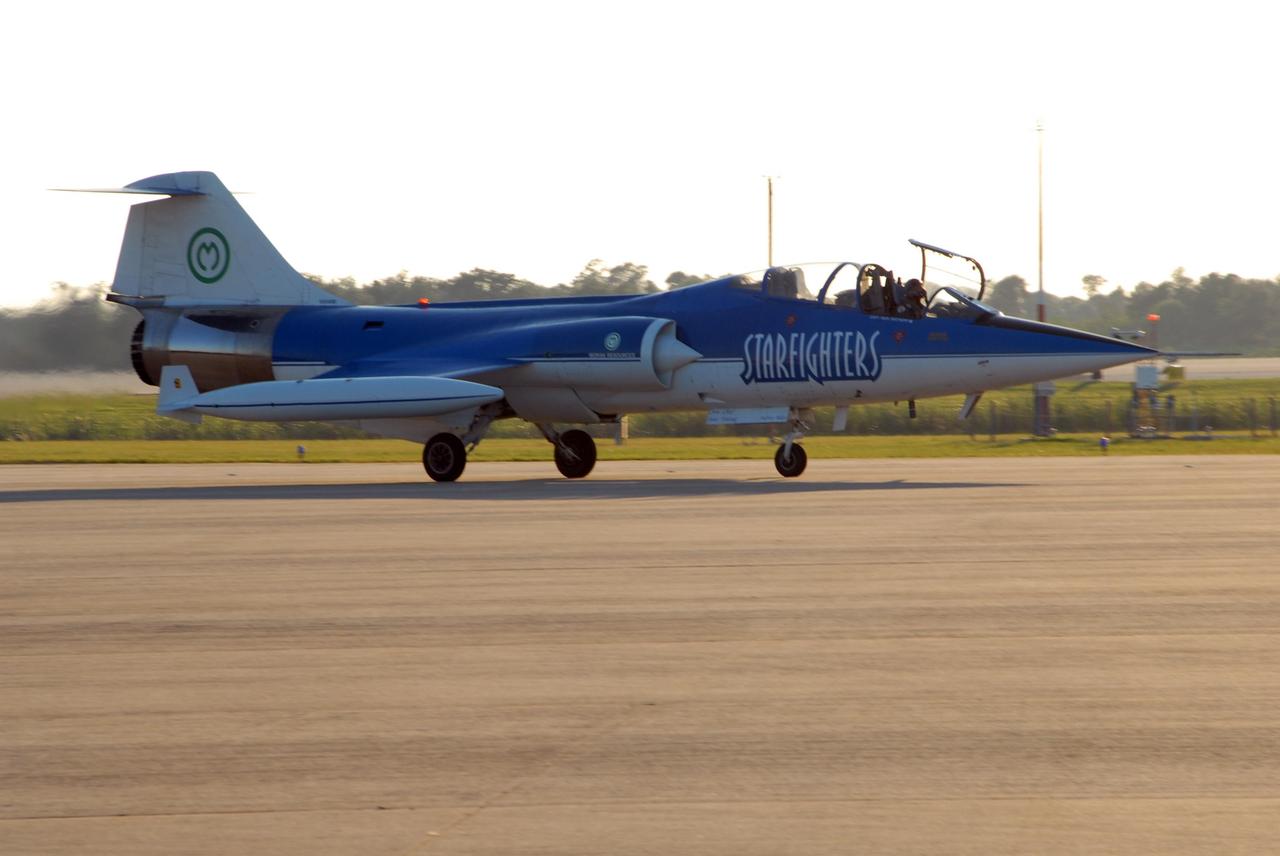
KENNEDY SPACE CENTER, FLA. — One of the Starfighters F-104 Demo Team pays a visit to NASA's Kennedy Space Center. The Starfighters are taking part in an air show in Jacksonville, Fla., and took the time to pay tribute to the World Space Expo at the center. The expo included an aerial salute featuring the U.S. Air Force Thunderbirds Demonstration Squadron, the U.S. Navy F-18 Super Hornets, U.S. Air Force F-22 Raptor, U.S. Air Force F-15 Eagle, P-51 Mustang Heritage Flight, the U.S. Air Force 920th Rescue Wing, which was responsible for Mercury and Gemini capsule recovery, and the U.S. Army Golden Knights demonstrating precision skydiving. The World Space Expo Nov. 1-4 was an event commemorating humanity's first 50 years in space while looking forward to returning people to the moon and exploring beyond. The expo showcased various panels, presentations and educational programs. It also was a part of NASA's 50th anniversary celebrations, highlighting the 45th Anniversary of the Mercury Program celebration featuring original NASA astronauts John Glenn and Scott Carpenter and the Pioneering Women of Aerospace forum featuring Eileen Collins and other prominent female space veterans. The agency was founded Oct. 1, 1958. Photo credit: NASA/George Shelton
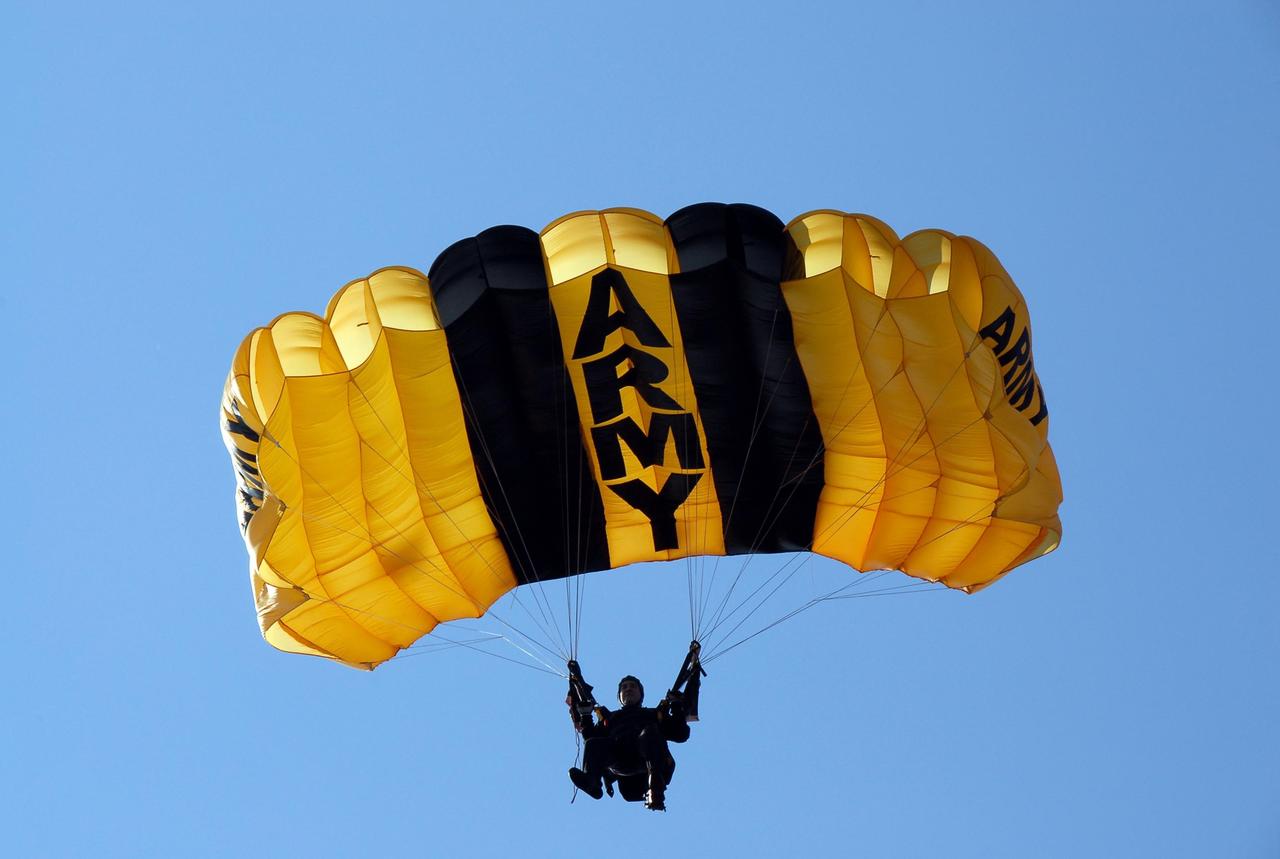
KENNEDY SPACE CENTER, FLA. -- A member of the U.S. Army Golden Knights demonstrates precision landing as part of the World Space Expo aerial salute at NASA's Kennedy Space Center. Other aircraft joining in the expo salute include the U.S. Air Force Thunderbirds Demonstration Squadron, the U.S. Navy F-18 Super Hornets, U.S. Air Force F-22 Raptor, U.S. Air Force F-15 Eagle, P-51 Mustang Heritage Flight, and the U.S. Air Force 920th Rescue Wing, which was responsible for Mercury and Gemini capsule recovery. The World Space Expo held Nov. 1-4 was an event commemorating humanity's first 50 years in space while looking forward to returning people to the moon and exploring beyond. The expo showcased various panels, presentations and educational programs. It also was a part of NASA's 50th anniversary celebrations, highlighting the 45th Anniversary of the Mercury Program celebration featuring original NASA astronauts John Glenn and Scott Carpenter and the Pioneering Women of Aerospace forum featuring Eileen Collins and other prominent female space veterans. The agency was founded Oct. 1, 1958. Photo credit: NASA/Kim Shiflett
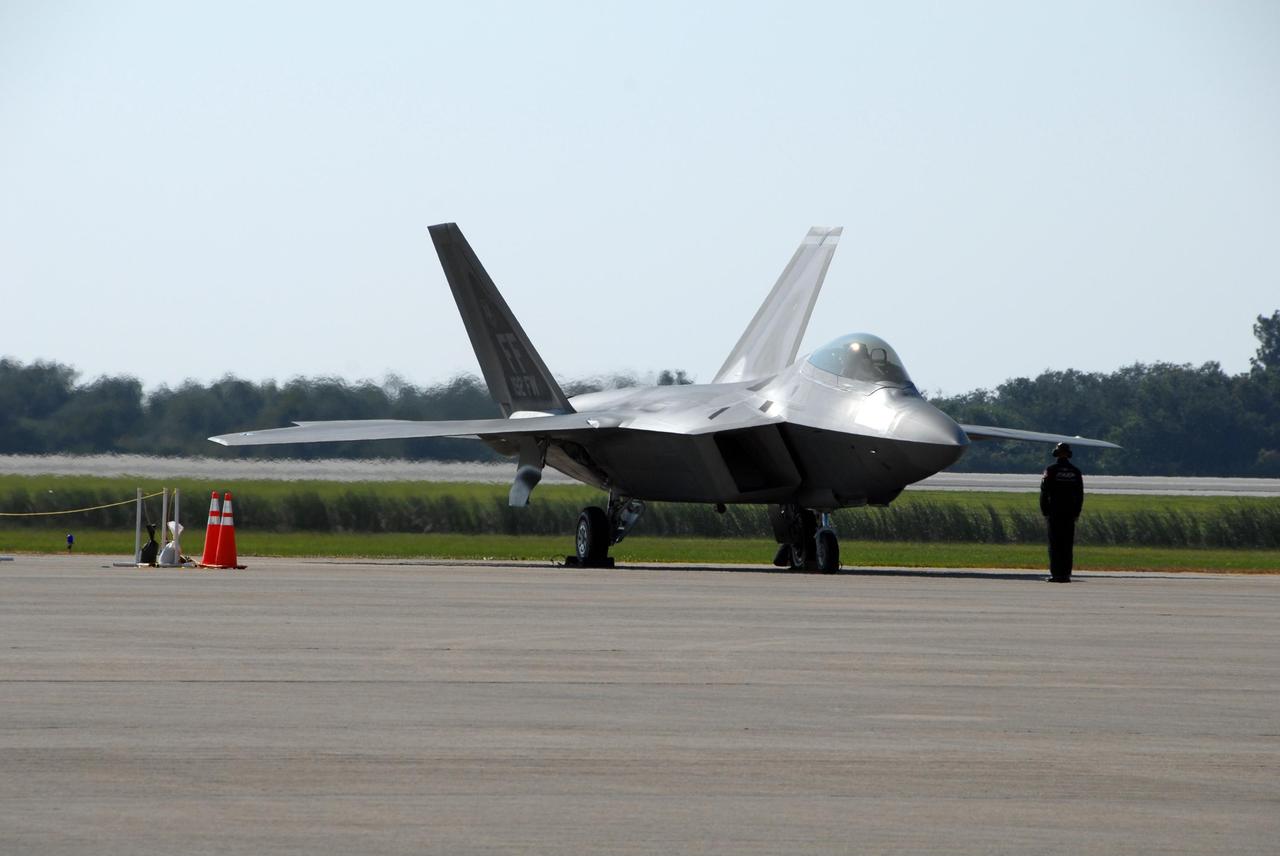
KENNEDY SPACE CENTER, FLA. — This U.S. Air Force F-22 Raptor is part of an aerial salute for the World Space Expo at NASA's Kennedy Space Center Visitor Complex. Other aircraft joining in the expo salute include the U.S. Air Force Thunderbirds Demonstration Squadron, the U.S. Navy F-18 Super Hornets, the U.S. Air Force F-15 Eagle, P-51 Mustang Heritage Flight, the U.S. Air Force 920th Rescue Wing, which was responsible for Mercury and Gemini capsule recovery, and the U.S. Army Golden Knights demonstrating precision skydiving. The World Space Expo Nov. 1-4 was an event commemorating humanity's first 50 years in space while looking forward to returning people to the moon and exploring beyond. The expo showcased various panels, presentations and educational programs. It also was a part of NASA's 50th anniversary celebrations, highlighting the 45th Anniversary of the Mercury Program celebration featuring original NASA astronauts John Glenn and Scott Carpenter and the Pioneering Women of Aerospace forum featuring Eileen Collins and other prominent female space veterans. The agency was founded Oct. 1, 1958. Photo credit: NASA/George Shelton
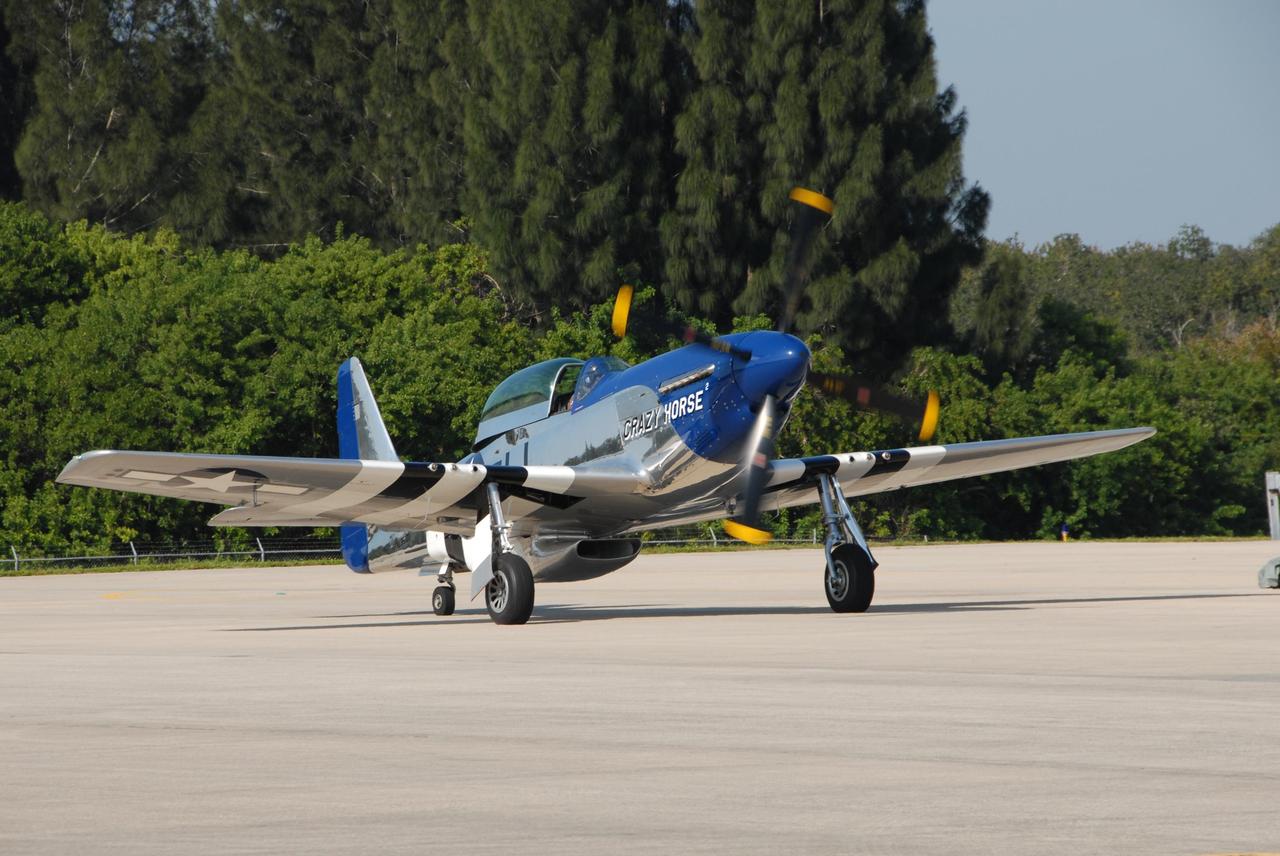
KENNEDY SPACE CENTER, FLA. — A P-51 Mustang, seen here on the Shuttle Landing Facility at NASA's Kennedy Space Center, is part of the World Space Expo aerial salute held at the Center's Visitor Complex. Other aircraft joining in the expo salute include the U.S. Air Force Thunderbirds Demonstration Squadron, the U.S. Navy F-18 Super Hornets, U.S. Air Force F-22 Raptor, U.S. Air Force F-15 Eagle, P-51 Mustang Heritage Flight, the U.S. Air Force 920th Rescue Wing, which was responsible for Mercury and Gemini capsule recovery, and the U.S. Army Golden Knights demonstrating precision skydiving. The World Space Expo Nov. 1-4 was an event commemorating humanity's first 50 years in space while looking forward to returning people to the moon and exploring beyond. The expo showcased various panels, presentations and educational programs. It also was a part of NASA's 50th anniversary celebrations, highlighting the 45th Anniversary of the Mercury Program celebration featuring original NASA astronauts John Glenn and Scott Carpenter and the Pioneering Women of Aerospace forum featuring Eileen Collins and other prominent female space veterans. The agency was founded Oct. 1, 1958. Photo credit: NASA/George Shelton
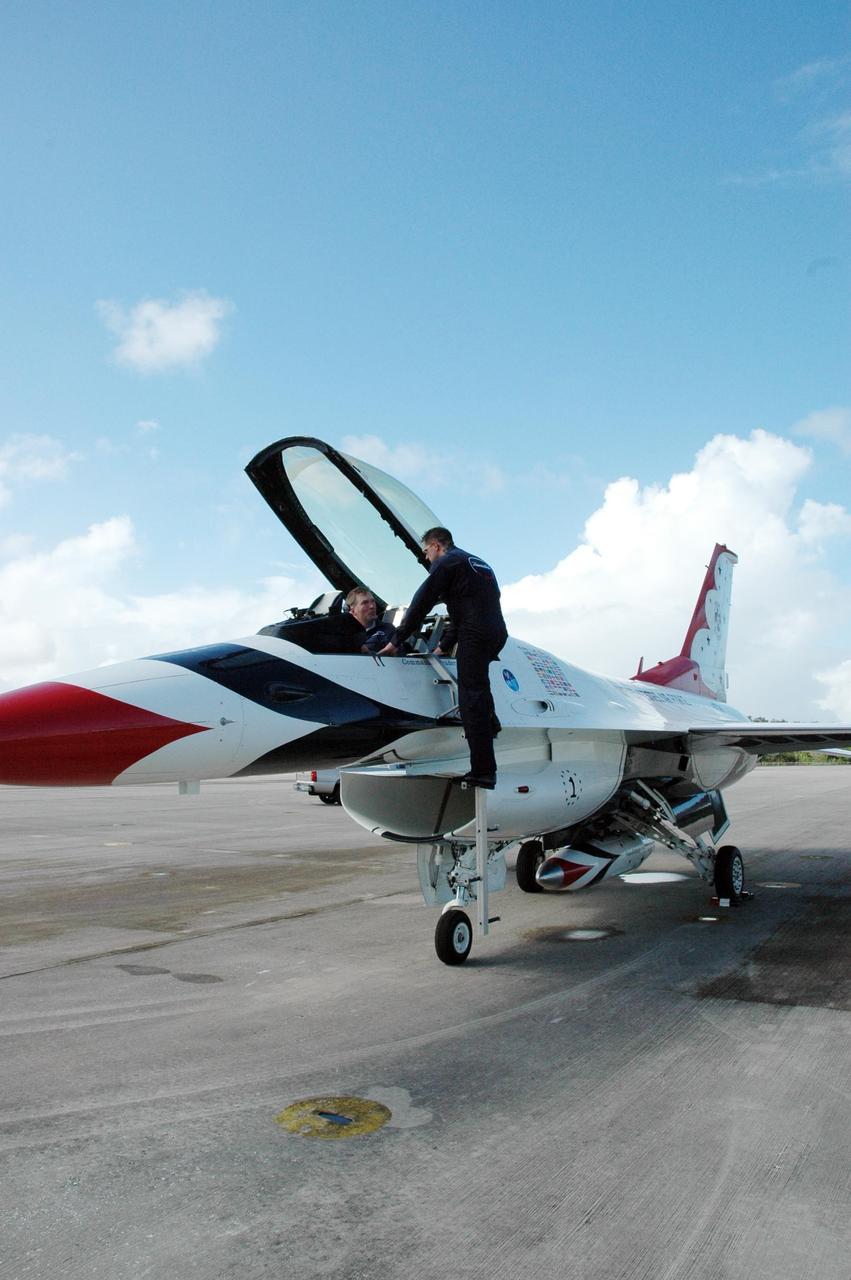
KENNEDY SPACE CENTER, FLA. -- Another of the U.S. Air Force Thunderbirds is parked on the Shuttle Landing Facility at NASA's Kennedy Space Center. The aerial demonstration squadron is performing for the World Space Expo being held from Nov. 1 to Nov. 4 at the NASA Kennedy Space Center Visitor Complex. Other aircraft participating in the salute include U.S. Air Force F-22 Raptor, U.S. Navy F-18 Super Hornet, U.S. Air Force F-15 Eagle, the P-51 Mustang Heritage Flight and the U.S. Air Force 920th Rescue Wing, which was responsible for Mercury and Gemini capsule recovery. The U.S. Army Golden Knights also will demonstrate precision skydiving. The World Space Expo is an event to commemorate humanity's first 50 years in space while looking forward to returning people to the moon and exploring beyond. The expo will showcase various panels, presentations and educational programs. It also is a part of NASA's 50th anniversary celebrations, highlighting the 45th Anniversary of the Mercury Program celebration featuring original NASA astronauts John Glenn and Scott Carpenter and the Pioneering Women of Aerospace forum featuring Eileen Collins and other prominent female space veterans. The agency was founded Oct. 1, 1958. Photo credit: NASA/Jack Pfaller
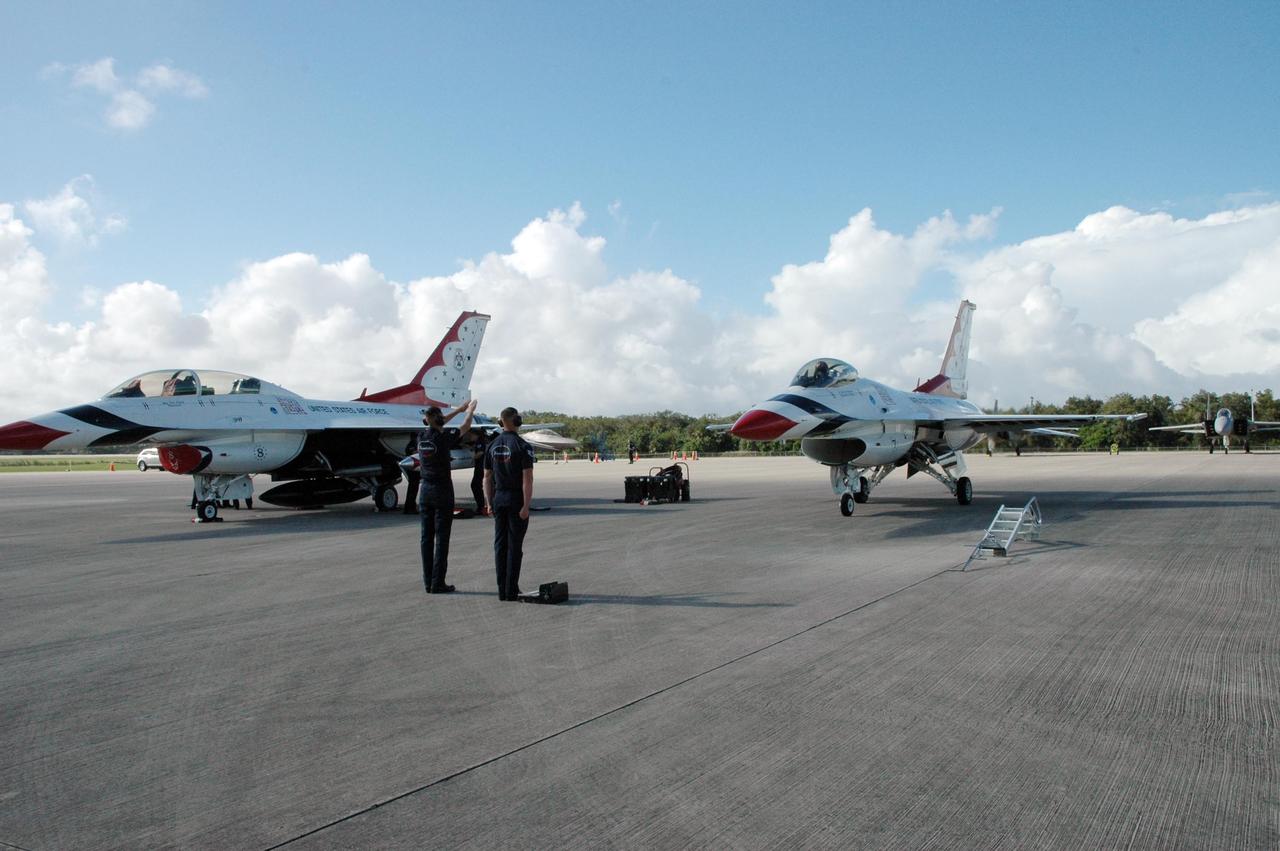
KENNEDY SPACE CENTER, FLA. -- Another of the U.S. Air Force Thunderbirds is parked on the Shuttle Landing Facility at NASA's Kennedy Space Center. The aerial demonstration squadron is performing for the World Space Expo being held from Nov. 1 to Nov. 4 at the NASA Kennedy Space Center Visitor Complex. Other aircraft participating in the salute include U.S. Air Force F-22 Raptor, U.S. Navy F-18 Super Hornet, U.S. Air Force F-15 Eagle, the P-51 Mustang Heritage Flight and the U.S. Air Force 920th Rescue Wing, which was responsible for Mercury and Gemini capsule recovery. The U.S. Army Golden Knights also will demonstrate precision skydiving. The World Space Expo is an event to commemorate humanity's first 50 years in space while looking forward to returning people to the moon and exploring beyond. The expo will showcase various panels, presentations and educational programs. It also is a part of NASA's 50th anniversary celebrations, highlighting the 45th Anniversary of the Mercury Program celebration featuring original NASA astronauts John Glenn and Scott Carpenter and the Pioneering Women of Aerospace forum featuring Eileen Collins and other prominent female space veterans. The agency was founded Oct. 1, 1958. Photo credit: NASA/Jack Pfaller
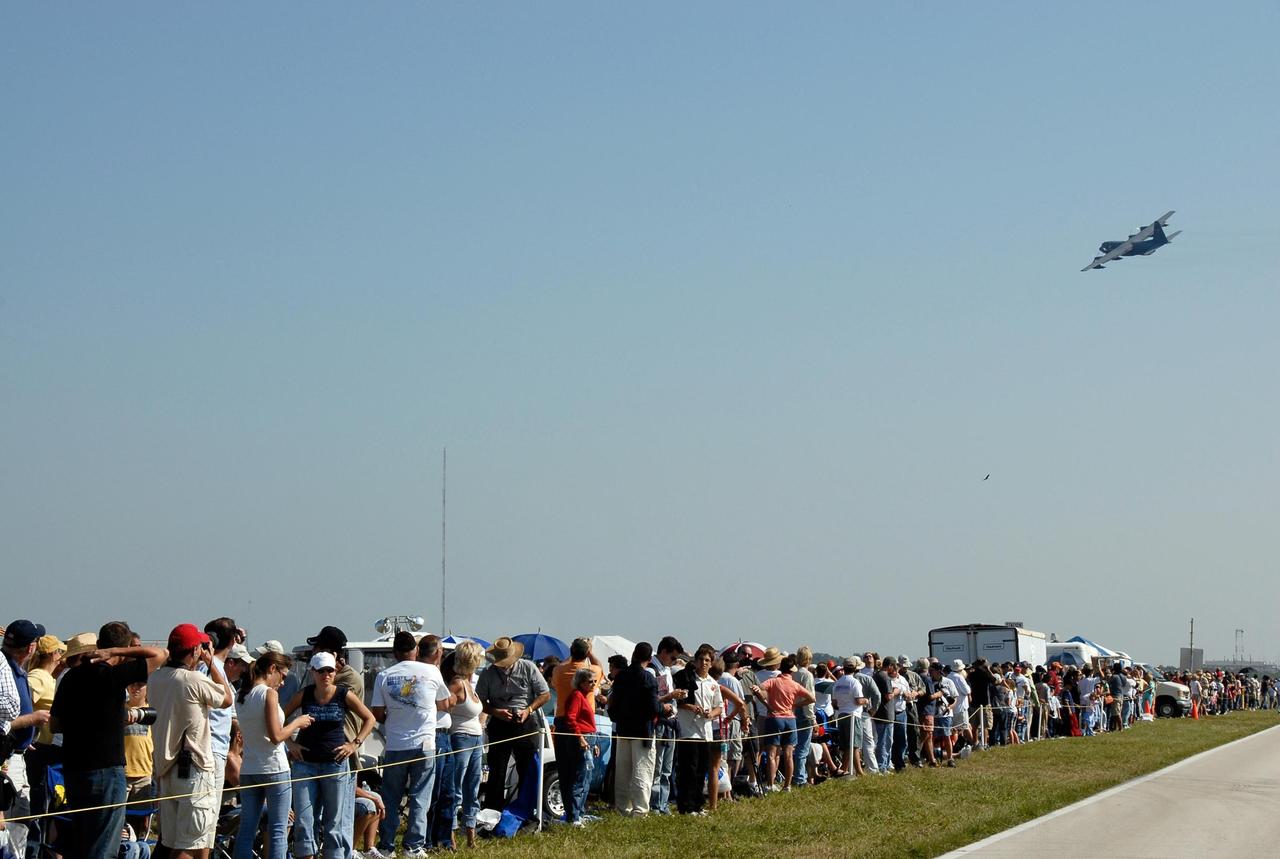
KENNEDY SPACE CENTER, FLA. -- Crowds fill the areas along NASA Causeway at NASA's Kennedy Space Center to watch the World Space Expo aerial salute. Seen in flight is the plane used to refuel rescue helicopters in mid-air. Aircraft joining in the expo salute include the U.S. Air Force Thunderbirds Demonstration Squadron, the U.S. Navy F-18 Super Hornets, U.S. Air Force F-22 Raptor, U.S. Air Force F-15 Eagle, P-51 Mustang Heritage Flight, the U.S. Air Force 920th Rescue Wing, which was responsible for Mercury and Gemini capsule recovery, and the U.S. Army Golden Knights precision skydivers. The World Space Expo held Nov. 1-4 was an event commemorating humanity's first 50 years in space while looking forward to returning people to the moon and exploring beyond. The expo showcased various panels, presentations and educational programs. It also was a part of NASA's 50th anniversary celebrations, highlighting the 45th Anniversary of the Mercury Program celebration featuring original NASA astronauts John Glenn and Scott Carpenter and the Pioneering Women of Aerospace forum featuring Eileen Collins and other prominent female space veterans. The agency was founded Oct. 1, 1958. Photo credit: NASA/Kim Shiflett
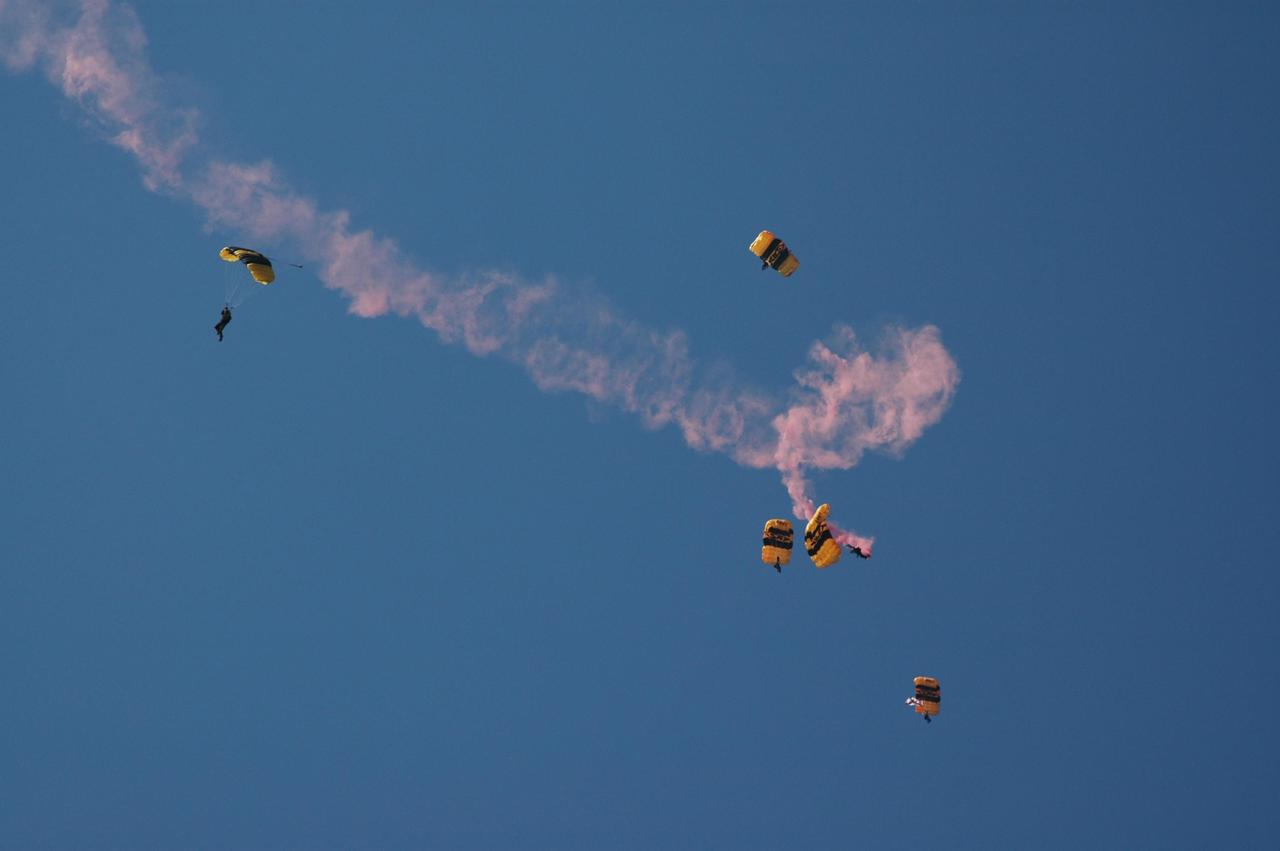
KENNEDY SPACE CENTER, FLA. -- The U.S. Army Golden Knights demonstrate precision skydiving as part of the World Space Expo aerial salute at NASA's Kennedy Space Center. Other aircraft joining in the expo salute include the U.S. Air Force Thunderbirds Demonstration Squadron, the U.S. Navy F-18 Super Hornets, U.S. Air Force F-22 Raptor, U.S. Air Force F-15 Eagle, P-51 Mustang Heritage Flight, and the U.S. Air Force 920th Rescue wing, which was responsible for Mercury and Gemini capsule recovery. The World Space Expo held Nov. 1-4 was an event commemorating humanity's first 50 years in space while looking forward to returning people to the moon and exploring beyond. The expo showcased various panels, presentations and educational programs. It also was a part of NASA's 50th anniversary celebrations, highlighting the 45th Anniversary of the Mercury Program celebration featuring original NASA astronauts John Glenn and Scott Carpenter and the Pioneering Women of Aerospace forum featuring Eileen Collins and other prominent female space veterans. The agency was founded Oct. 1, 1958. Photo credit: NASA/Chris Chamberland
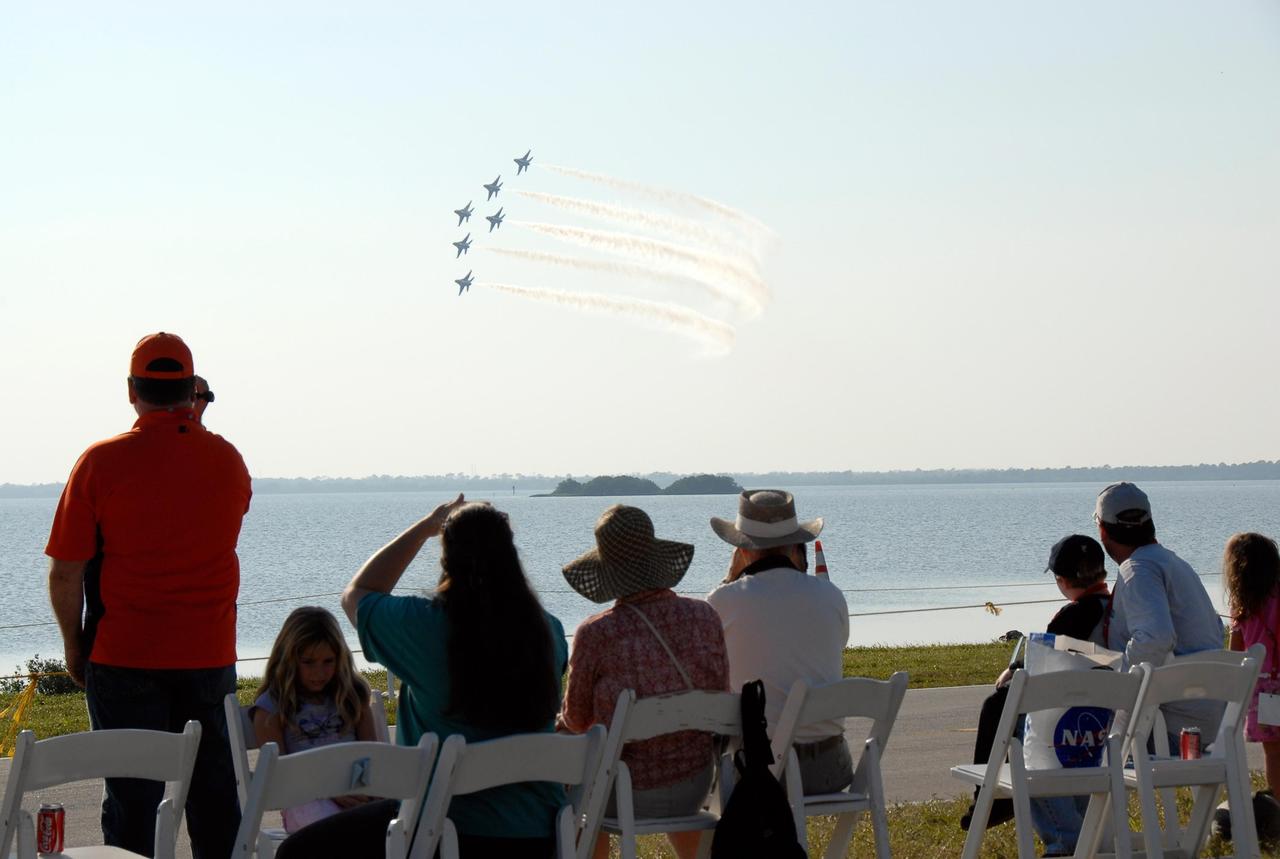
KENNEDY SPACE CENTER, FLA. -- Crowds at NASA's Kennedy Space Center watch the U.S. Air Force Thunderbirds Demonstration Squadron perform during the World Space Expo aerial salute. Other aircraft joining in the expo salute include the U.S. Navy F-18 Super Hornets, U.S. Air Force F-22 Raptor, U.S. Air Force F-15 Eagle, P-51 Mustang Heritage Flight, the U.S. Air Force 920th Rescue Wing, which was responsible for Mercury and Gemini capsule recovery, and the U.S. Army Golden Knights precision skydivers. The World Space Expo held Nov. 1-4 was an event commemorating humanity's first 50 years in space while looking forward to returning people to the moon and exploring beyond. The expo showcased various panels, presentations and educational programs. It also was a part of NASA's 50th anniversary celebrations, highlighting the 45th Anniversary of the Mercury Program celebration featuring original NASA astronauts John Glenn and Scott Carpenter and the Pioneering Women of Aerospace forum featuring Eileen Collins and other prominent female space veterans. The agency was founded Oct. 1, 1958. Photo credit: NASA/Kim Shiflett
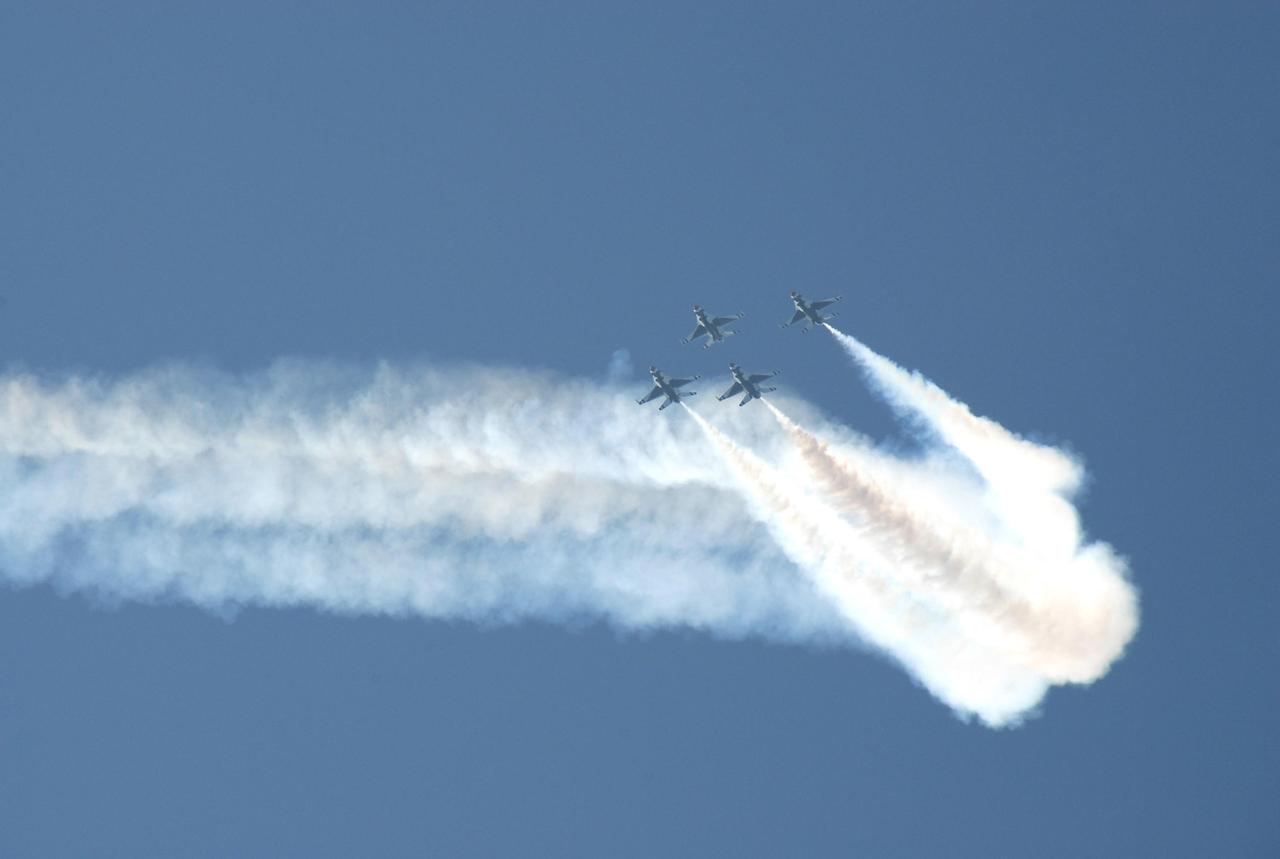
KENNEDY SPACE CENTER, FLA. -- The U.S. Air Force Thunderbirds Demonstration Squadron flies in formation over NASA's Kennedy Space Center as part of the World Space Expo aerial salute. Other aircraft joining in the expo salute include the U.S. Navy F-18 Super Hornets, U.S. Air Force F-22 Raptor, U.S. Air Force F-15 Eagle, P-51 Mustang Heritage Flight, and the U.S. Air Force 920th Rescue Wing, which was responsible for Mercury and Gemini capsule recovery, and the U.S. Army Golden Knights precision skydiving team. The World Space Expo held Nov. 1-4 was an event commemorating humanity's first 50 years in space while looking forward to returning people to the moon and exploring beyond. The expo showcased various panels, presentations and educational programs. It also was a part of NASA's 50th anniversary celebrations, highlighting the 45th Anniversary of the Mercury Program celebration featuring original NASA astronauts John Glenn and Scott Carpenter and the Pioneering Women of Aerospace forum featuring Eileen Collins and other prominent female space veterans. The agency was founded Oct. 1, 1958. Photo credit: NASA/Kim Shiflett
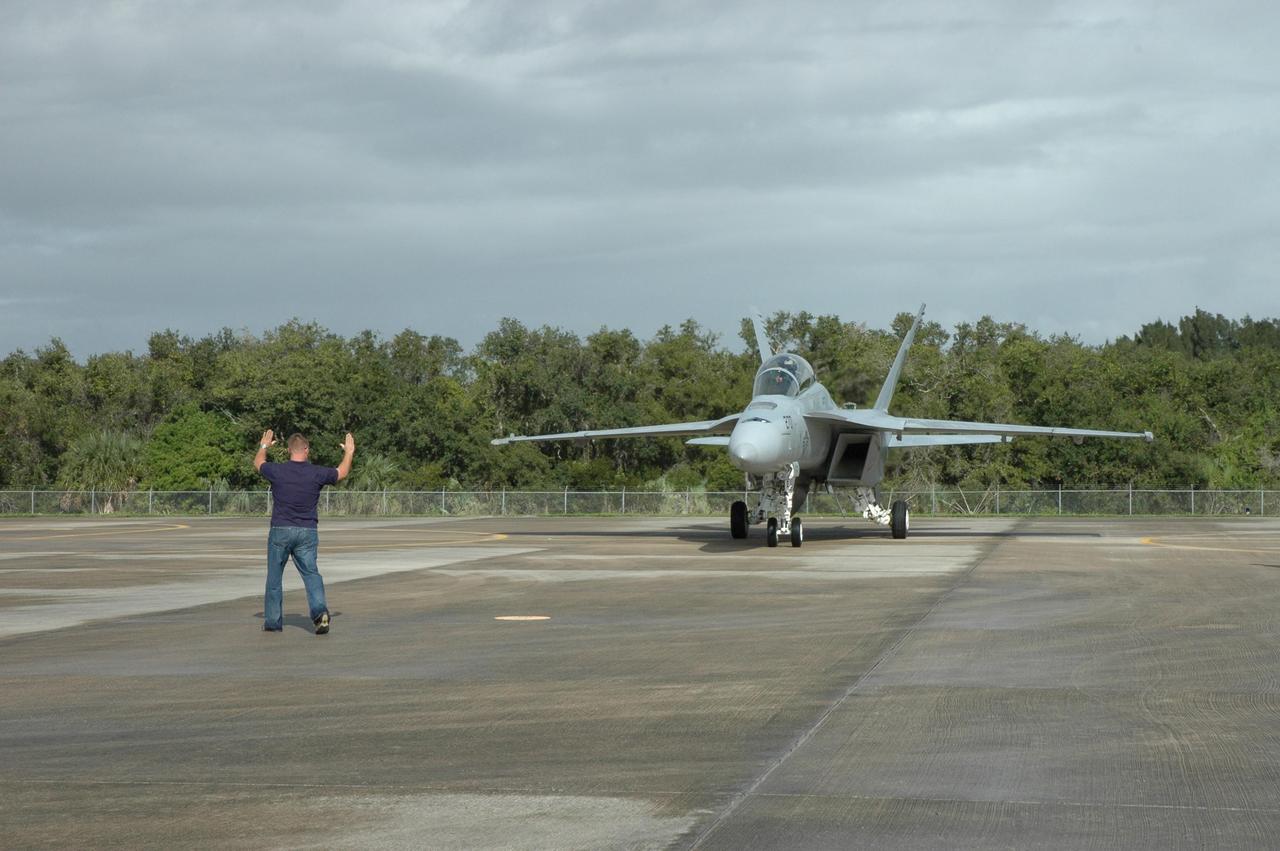
KENNEDY SPACE CENTER, FLA. -- A U.S. Navy F-18 Super Hornet is parked on the Shuttle Landing Facility at NASA's Kennedy Space Center. Several of the planes are participating in the World Space Expo being held from Nov. 1 to Nov. 4 at the NASA Kennedy Space Center Visitor Complex. Other aircraft joining in the salute include U.S. Air Force Thunderbirds Aerial Demonstration Squadron , U.S. Air Force F-22 Raptor, U.S. Air Force F-15 Eagle, the P-51 Mustang Heritage Flight and the U.S. Air Force 920th Rescue Wing, which was responsible for Mercury and Gemini capsule recovery. The U.S. Army Golden Knights also will demonstrate precision skydiving. The World Space Expo is an event to commemorate humanity's first 50 years in space while looking forward to returning people to the moon and exploring beyond. The expo will showcase various panels, presentations and educational programs. It also is a part of NASA's 50th anniversary celebrations, highlighting the 45th Anniversary of the Mercury Program celebration featuring original NASA astronauts John Glenn and Scott Carpenter and the Pioneering Women of Aerospace forum featuring Eileen Collins and other prominent female space veterans. The agency was founded Oct. 1, 1958. Photo credit: NASA/Jack Pfaller
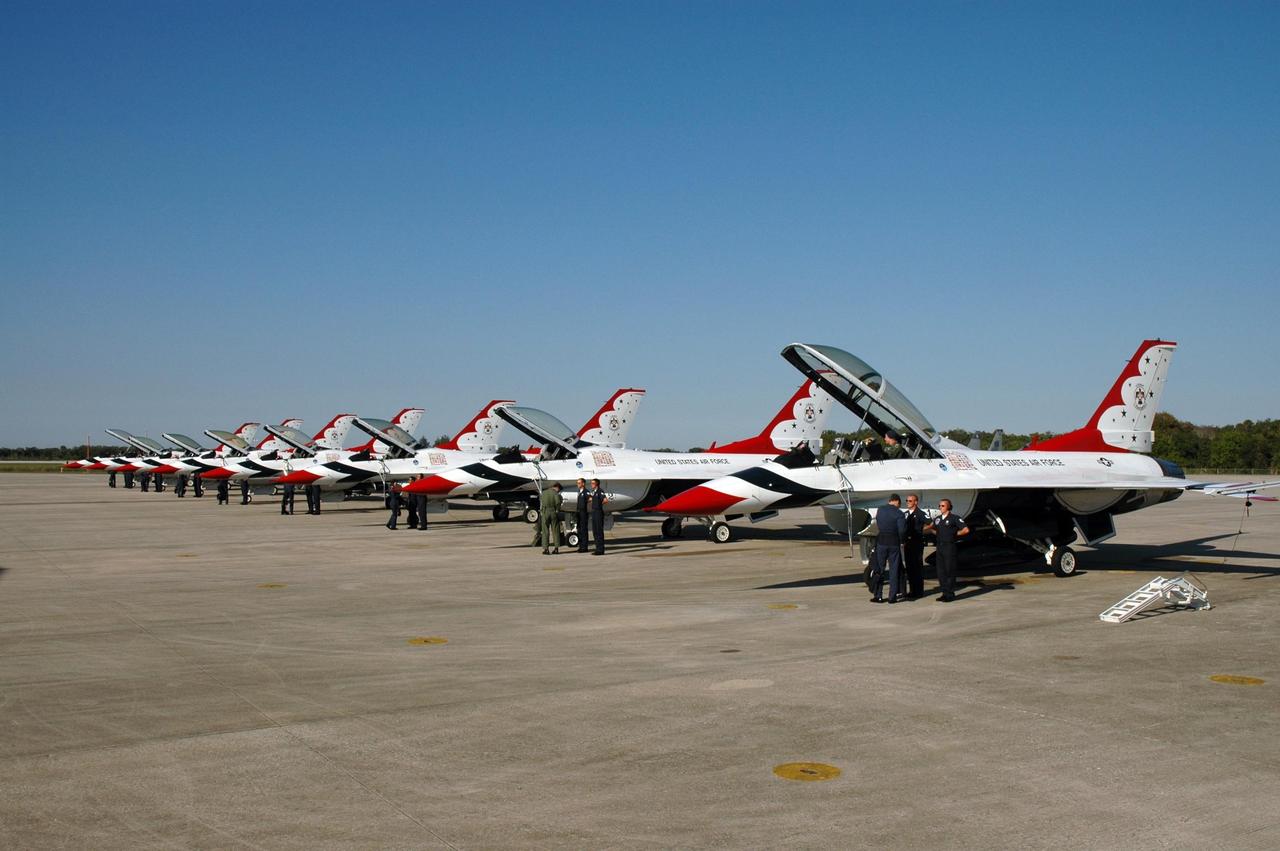
KENNEDY SPACE CENTER, FLA. -- The U.S. Air Force Thunderbirds Demonstration Squadron is lined up on NASA's Kennedy Space Center Shuttle Landing Facility before leaving. The squadron performed for the World Space Expos' aerial salute along with other aircraft that included the U.S. Navy F-18 Super Hornets, U.S. Air Force F-22 Raptor, U.S. Air Force F-15 Eagle, P-51 Mustang Heritage Flight, the U.S. Air Force 920th Rescue Wing, which was responsible for Mercury and Gemini capsule recovery, and the U.S. Army Golden Knights precision skydiving team. The World Space Expo held Nov. 1-4 was an event commemorating humanity's first 50 years in space while looking forward to returning people to the moon and exploring beyond. The expo showcased various panels, presentations and educational programs. It also was a part of NASA's 50th anniversary celebrations, highlighting the 45th Anniversary of the Mercury Program celebration featuring original NASA astronauts John Glenn and Scott Carpenter and the Pioneering Women of Aerospace forum featuring Eileen Collins and other prominent female space veterans. The agency was founded Oct. 1, 1958. Photo credit: NASA/Jim Grossmann
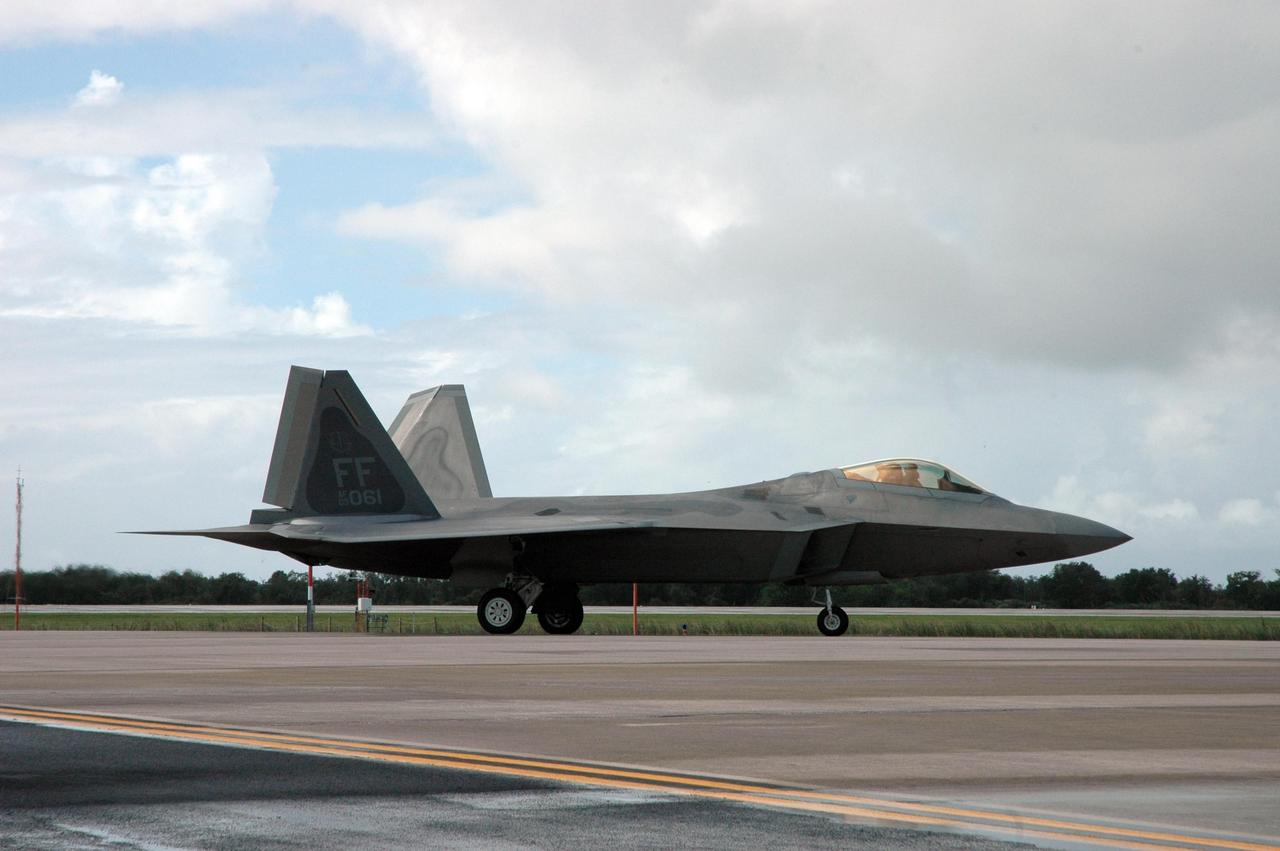
KENNEDY SPACE CENTER, FLA. -- A U.S. Air Force F-22 Raptor arrives at the Shuttle Landing Facility at NASA's Kennedy Space Center. The plane is participating in the World Space Expo being held from Nov. 1 to Nov. 4 at the NASA Kennedy Space Center Visitor Complex. Other aircraft joining in the salute include U.S. Air Force Thunderbirds Aerial Demonstration Squadron, U.S. Navy F-18 Super Hornets, the P-51 Mustang Heritage Flight and the U.S. Air Force 920th Rescue Wing, which was responsible for Mercury and Gemini capsule recovery. The U.S. Army Golden Knights also will demonstrate precision skydiving. The World Space Expo is an event to commemorate humanity's first 50 years in space while looking forward to returning people to the moon and exploring beyond. The expo will showcase various panels, presentations and educational programs. It also is a part of NASA's 50th anniversary celebrations, highlighting the 45th Anniversary of the Mercury Program celebration featuring original NASA astronauts John Glenn and Scott Carpenter and the Pioneering Women of Aerospace forum featuring Eileen Collins and other prominent female space veterans. The agency was founded Oct. 1, 1958. Photo credit: NASA/Jack Pfaller
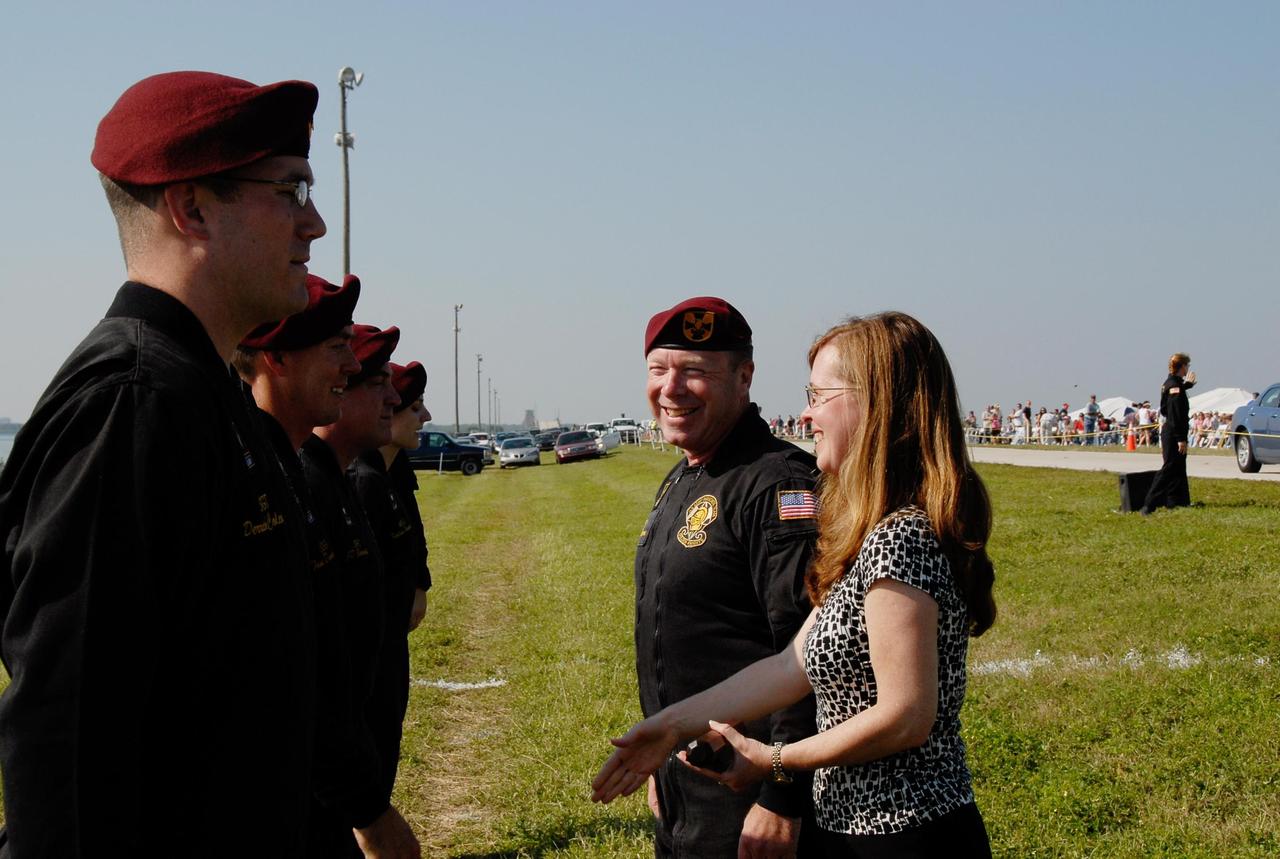
KENNEDY SPACE CENTER, FLA. -- At NASA's Kennedy Space Center, External Relations Director Lisa Malone greets members of the U.S. Army Golden Knights, a precision skydiving team who were part of the World Space Expo aerial salute. Other aircraft joining in the expo salute include the U.S. Air Force Thunderbirds Demonstration Squadron, the U.S. Navy F-18 Super Hornets, U.S. Air Force F-22 Raptor, U.S. Air Force F-15 Eagle, P-51 Mustang Heritage Flight, and the U.S. Air Force 920th Rescue Wing, which was responsible for Mercury and Gemini capsule recovery. The World Space Expo held Nov. 1-4 was an event commemorating humanity's first 50 years in space while looking forward to returning people to the moon and exploring beyond. The expo showcased various panels, presentations and educational programs. It also was a part of NASA's 50th anniversary celebrations, highlighting the 45th Anniversary of the Mercury Program celebration featuring original NASA astronauts John Glenn and Scott Carpenter and the Pioneering Women of Aerospace forum featuring Eileen Collins and other prominent female space veterans. The agency was founded Oct. 1, 1958. Photo credit: NASA/Kim Shiflett
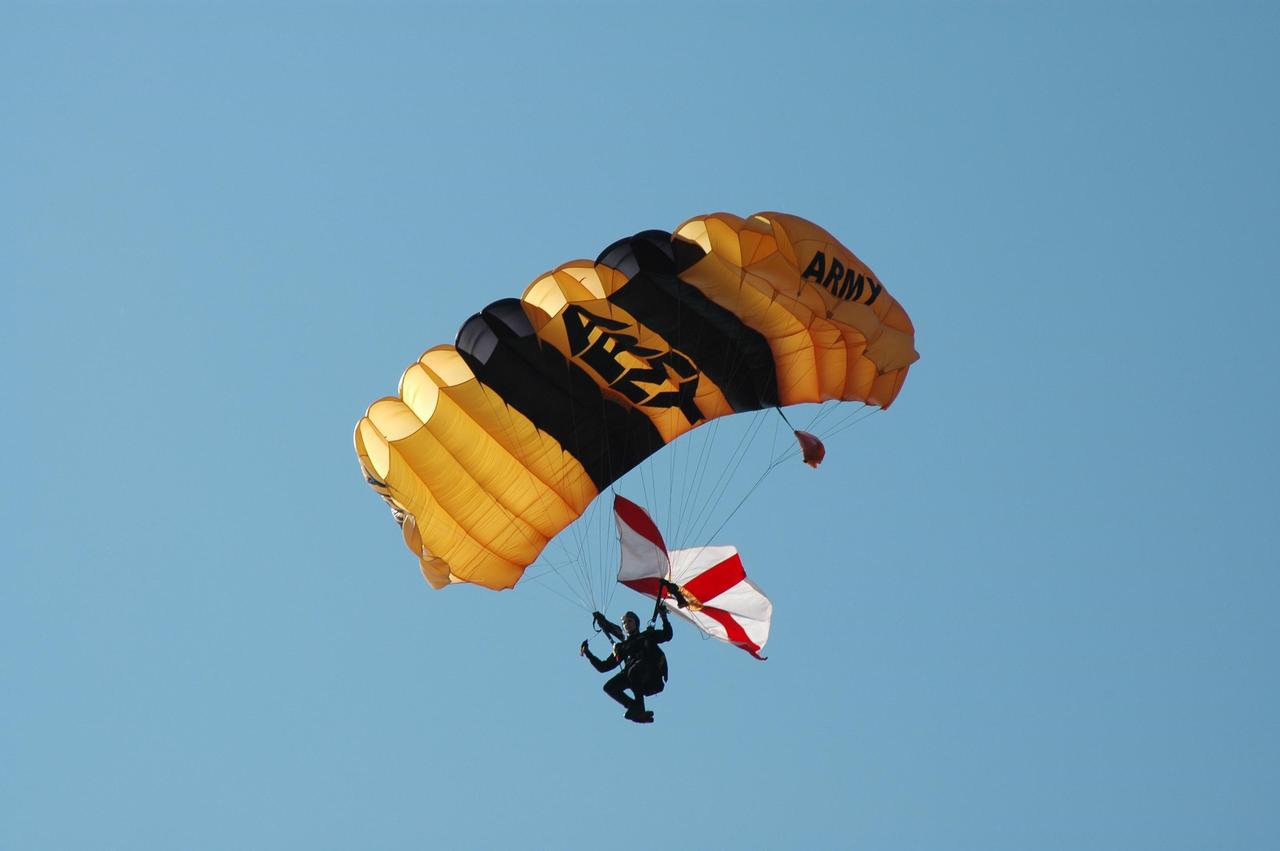
KENNEDY SPACE CENTER, FLA. -- The U.S. Army Golden Knights demonstrate precision skydiving as part of the World Space Expo aerial salute at NASA's Kennedy Space Center. Other aircraft joining in the expo salute include the U.S. Air Force Thunderbirds Demonstration Squadron, the U.S. Navy F-18 Super Hornets, U.S. Air Force F-22 Raptor, U.S. Air Force F-15 Eagle, P-51 Mustang Heritage Flight, and the U.S. Air Force 920th Rescue wing, which was responsible for Mercury and Gemini capsule recovery. The World Space Expo held Nov. 1-4 was an event commemorating humanity's first 50 years in space while looking forward to returning people to the moon and exploring beyond. The expo showcased various panels, presentations and educational programs. It also was a part of NASA's 50th anniversary celebrations, highlighting the 45th Anniversary of the Mercury Program celebration featuring original NASA astronauts John Glenn and Scott Carpenter and the Pioneering Women of Aerospace forum featuring Eileen Collins and other prominent female space veterans. The agency was founded Oct. 1, 1958. Photo credit: NASA/Chris Chamberland
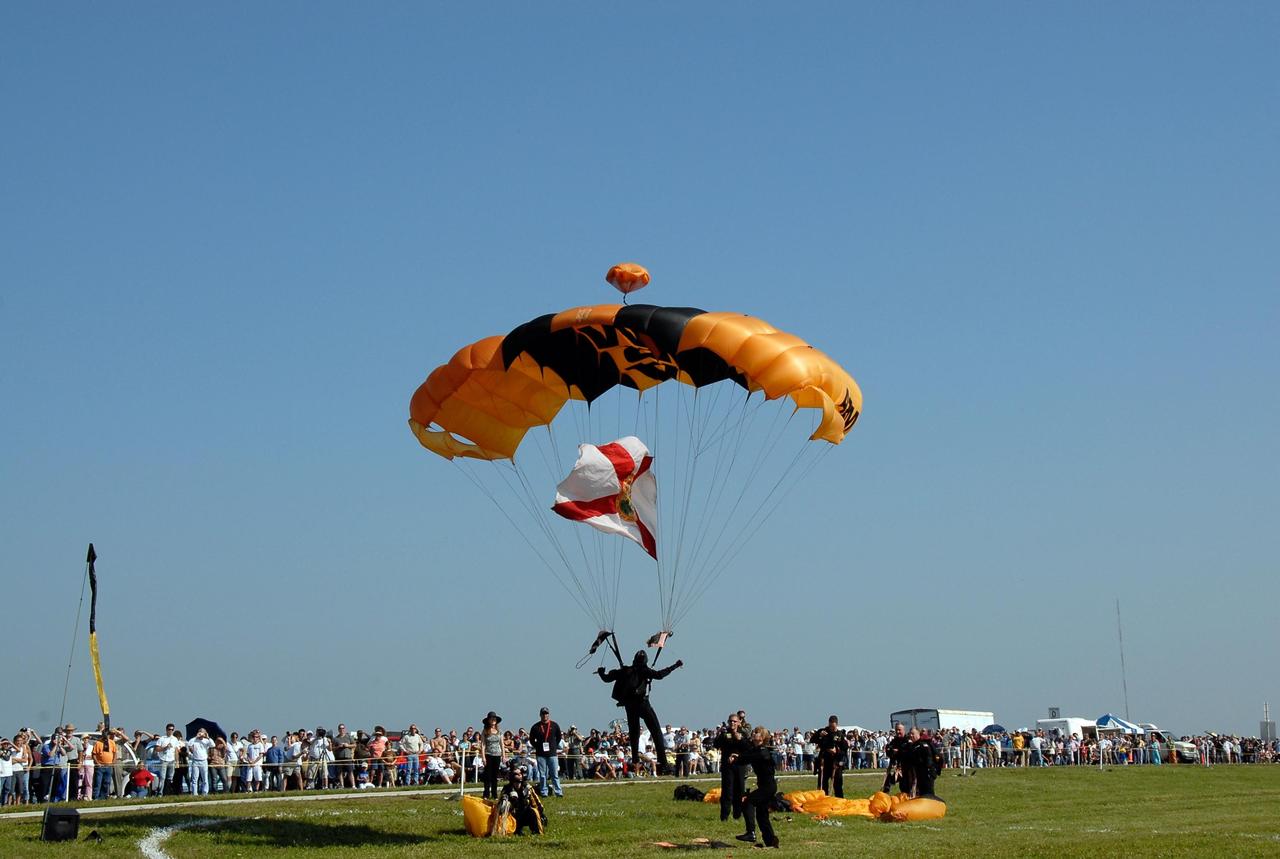
KENNEDY SPACE CENTER, FLA. -- Members of the U.S. Army Golden Knights demonstrate precision landing as part of the World Space Expo aerial salute at NASA's Kennedy Space Center. Other aircraft joining in the expo salute include the U.S. Air Force Thunderbirds Demonstration Squadron, the U.S. Navy F-18 Super Hornets, U.S. Air Force F-22 Raptor, U.S. Air Force F-15 Eagle, P-51 Mustang Heritage Flight, and the U.S. Air Force 920th Rescue Wing, which was responsible for Mercury and Gemini capsule recovery. The World Space Expo held Nov. 1-4 was an event commemorating humanity's first 50 years in space while looking forward to returning people to the moon and exploring beyond. The expo showcased various panels, presentations and educational programs. It also was a part of NASA's 50th anniversary celebrations, highlighting the 45th Anniversary of the Mercury Program celebration featuring original NASA astronauts John Glenn and Scott Carpenter and the Pioneering Women of Aerospace forum featuring Eileen Collins and other prominent female space veterans. The agency was founded Oct. 1, 1958. Photo credit: NASA/Kim Shiflett
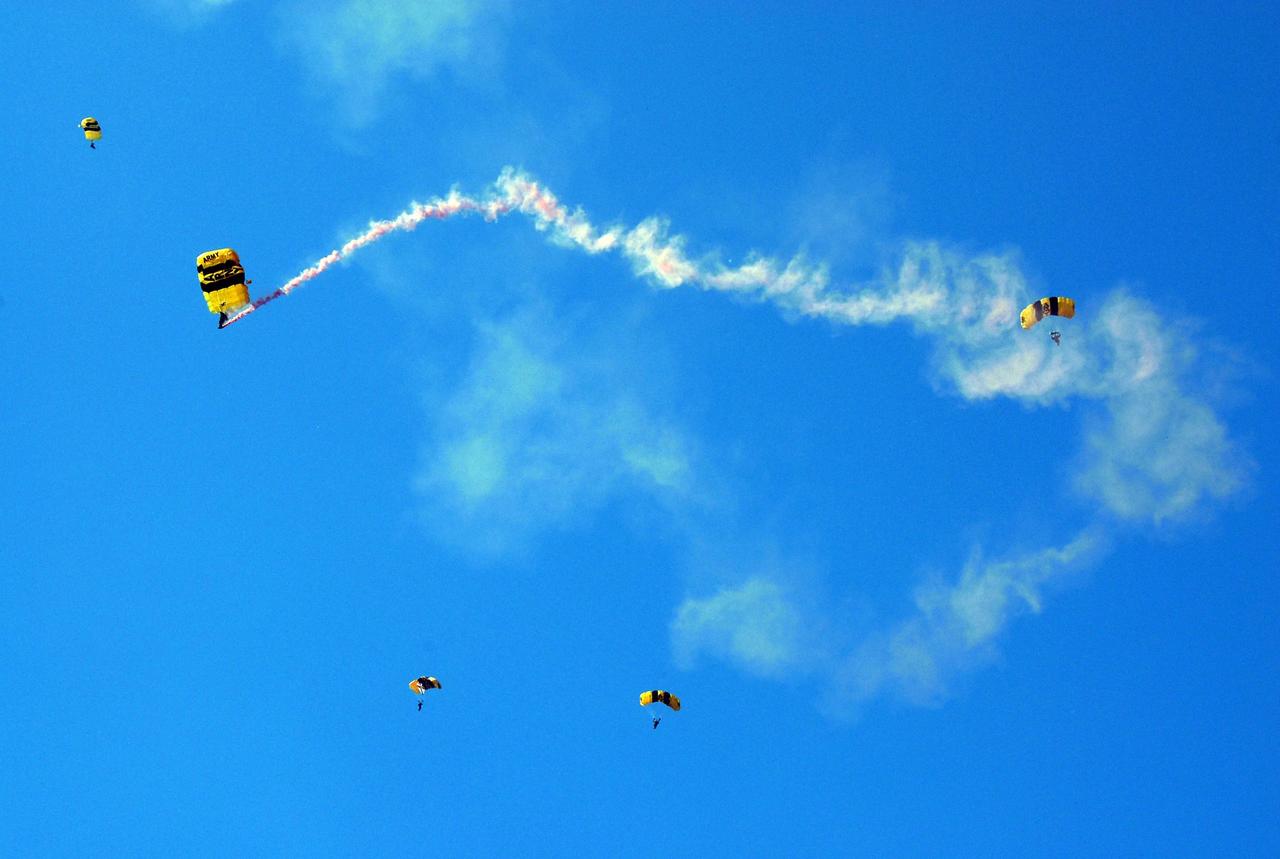
KENNEDY SPACE CENTER, FLA. -- The U.S. Army Golden Knights demonstrate precision skydiving as part of the World Space Expo aerial salute at NASA's Kennedy Space Center. Other aircraft joining in the expo salute include the U.S. Air Force Thunderbirds Demonstration Squadron, the U.S. Navy F-18 Super Hornets, U.S. Air Force F-22 Raptor, U.S. Air Force F-15 Eagle, P-51 Mustang Heritage Flight, and the U.S. Air Force 920th Rescue Wing, which was responsible for Mercury and Gemini capsule recovery. The World Space Expo held Nov. 1-4 was an event commemorating humanity's first 50 years in space while looking forward to returning people to the moon and exploring beyond. The expo showcased various panels, presentations and educational programs. It also was a part of NASA's 50th anniversary celebrations, highlighting the 45th Anniversary of the Mercury Program celebration featuring original NASA astronauts John Glenn and Scott Carpenter and the Pioneering Women of Aerospace forum featuring Eileen Collins and other prominent female space veterans. The agency was founded Oct. 1, 1958. Photo credit: NASA/Kim Shiflett
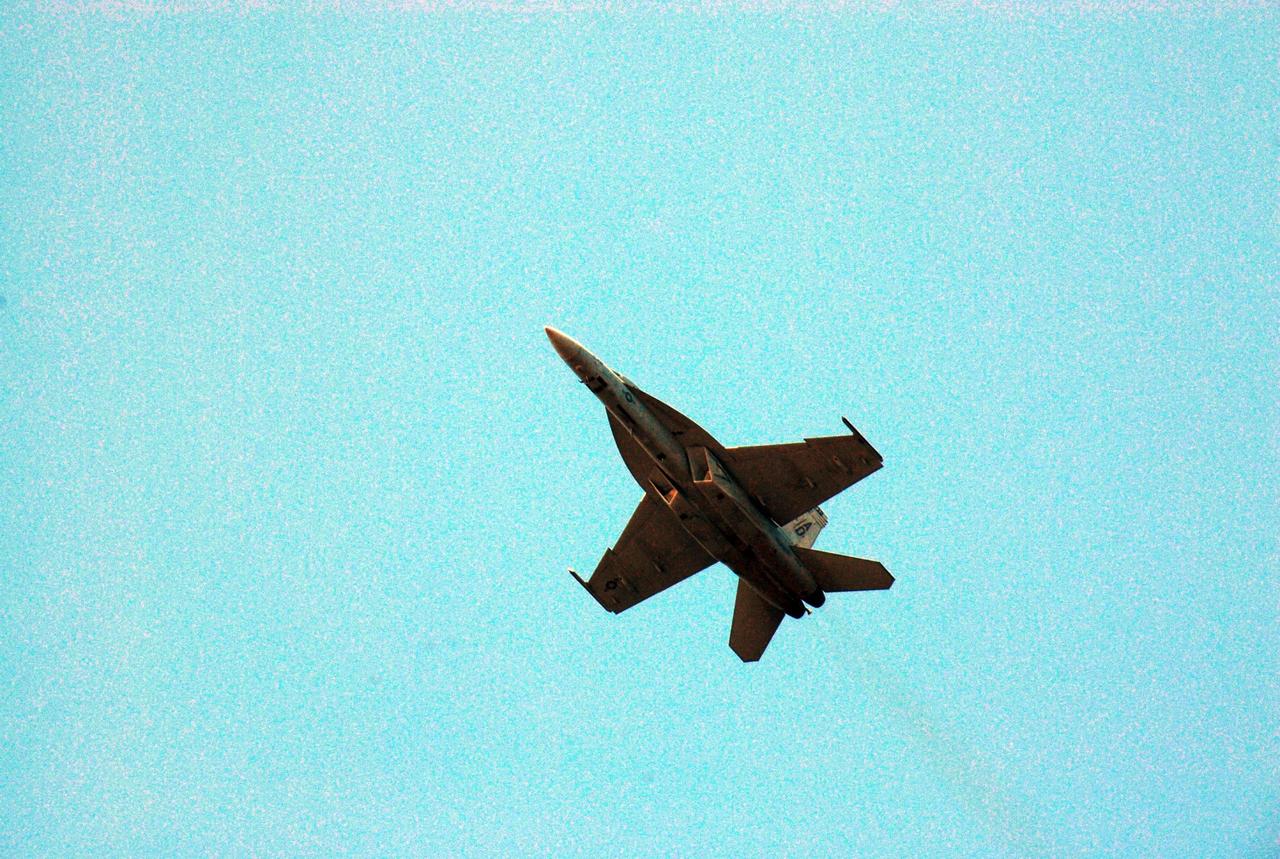
KENNEDY SPACE CENTER, FLA. -- One of the U.S. Navy F-18 Super Hornets flies over NASA's Kennedy Space Center as part of the World Space Expo aerial salute. Other aircraft joining in the expo salute include the U.S. Air Force Thunderbirds Demonstration Squadron, U.S. Air Force F-22 Raptor, U.S. Air Force F-15 Eagle, P-51 Mustang Heritage Flight, and the U.S. Air Force 920th Rescue Wing, which was responsible for Mercury and Gemini capsule recovery, and the U.S. Army Golden Knights precision skydiving team. The World Space Expo held Nov. 1-4 was an event commemorating humanity's first 50 years in space while looking forward to returning people to the moon and exploring beyond. The expo showcased various panels, presentations and educational programs. It also was a part of NASA's 50th anniversary celebrations, highlighting the 45th Anniversary of the Mercury Program celebration featuring original NASA astronauts John Glenn and Scott Carpenter and the Pioneering Women of Aerospace forum featuring Eileen Collins and other prominent female space veterans. The agency was founded Oct. 1, 1958. Photo credit: NASA/Kim Shiflett
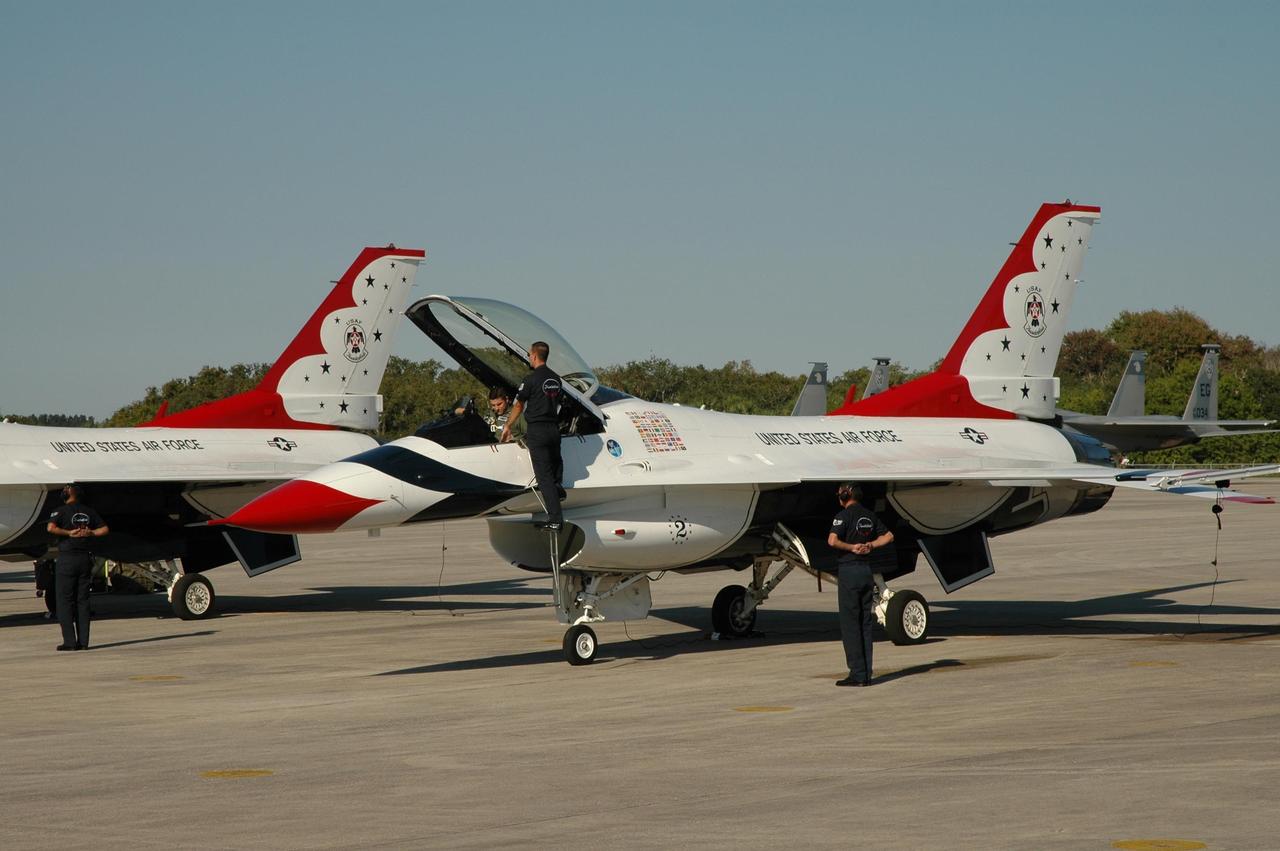
KENNEDY SPACE CENTER, FLA. -- Pilots of the U.S. Air Force Thunderbirds Demonstration Squadron get ready to leave NASA's Kennedy Space Center. The squadron performed for the World Space Expos' aerial salute along with other aircraft that included the U.S. Navy F-18 Super Hornets, U.S. Air Force F-22 Raptor, U.S. Air Force F-15 Eagle, P-51 Mustang Heritage Flight, the U.S. Air Force 920th Rescue Wing, which was responsible for Mercury and Gemini capsule recovery, and the U.S. Army Golden Knights precision skydiving team. The World Space Expo held Nov. 1-4 was an event commemorating humanity's first 50 years in space while looking forward to returning people to the moon and exploring beyond. The expo showcased various panels, presentations and educational programs. It also was a part of NASA's 50th anniversary celebrations, highlighting the 45th Anniversary of the Mercury Program celebration featuring original NASA astronauts John Glenn and Scott Carpenter and the Pioneering Women of Aerospace forum featuring Eileen Collins and other prominent female space veterans. The agency was founded Oct. 1, 1958. Photo credit: NASA/Jim Grossmann
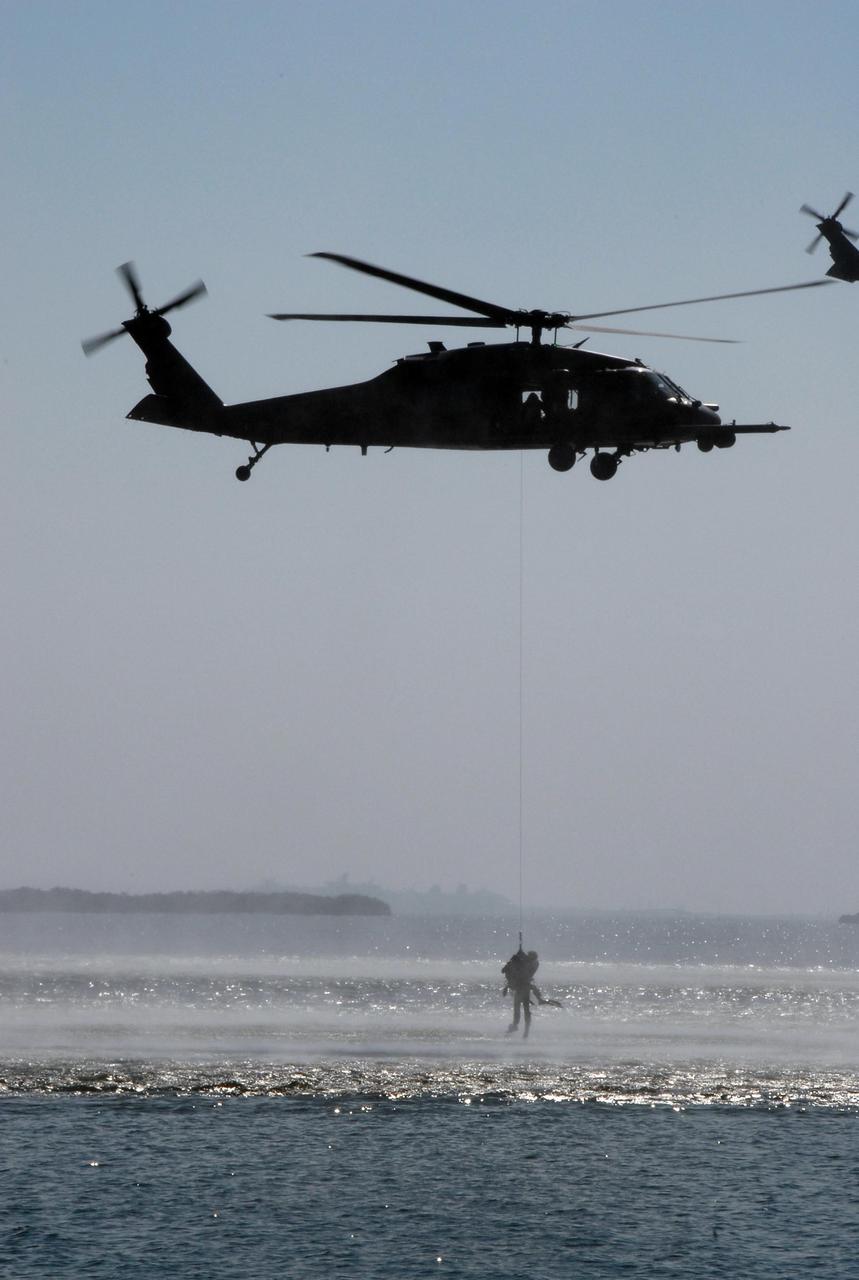
KENNEDY SPACE CENTER, FLA. -- Near the NASA Causeway at NASA's Kennedy Space Center, part of the U.S. Air Force 920th Rescue Wing puts on a rescue demonstration during the World Space Expo aerial salute. This unit was responsible for Mercury and Gemini capsule recovery. Other aircraft joining in the expo salute include the U.S. Air Force Thunderbirds Demonstration Squadron, the U.S. Navy F-18 Super Hornets, U.S. Air Force F-22 Raptor, U.S. Air Force F-15 Eagle, P-51 Mustang Heritage Flight, and the U.S. Army Golden Knights demonstrating precision skydiving. The World Space Expo held Nov. 1-4 was an event commemorating humanity's first 50 years in space while looking forward to returning people to the moon and exploring beyond. The expo showcased various panels, presentations and educational programs. It also was a part of NASA's 50th anniversary celebrations, highlighting the 45th Anniversary of the Mercury Program celebration featuring original NASA astronauts John Glenn and Scott Carpenter and the Pioneering Women of Aerospace forum featuring Eileen Collins and other prominent female space veterans. The agency was founded Oct. 1, 1958. Photo credit: NASA/Kim Shiflett
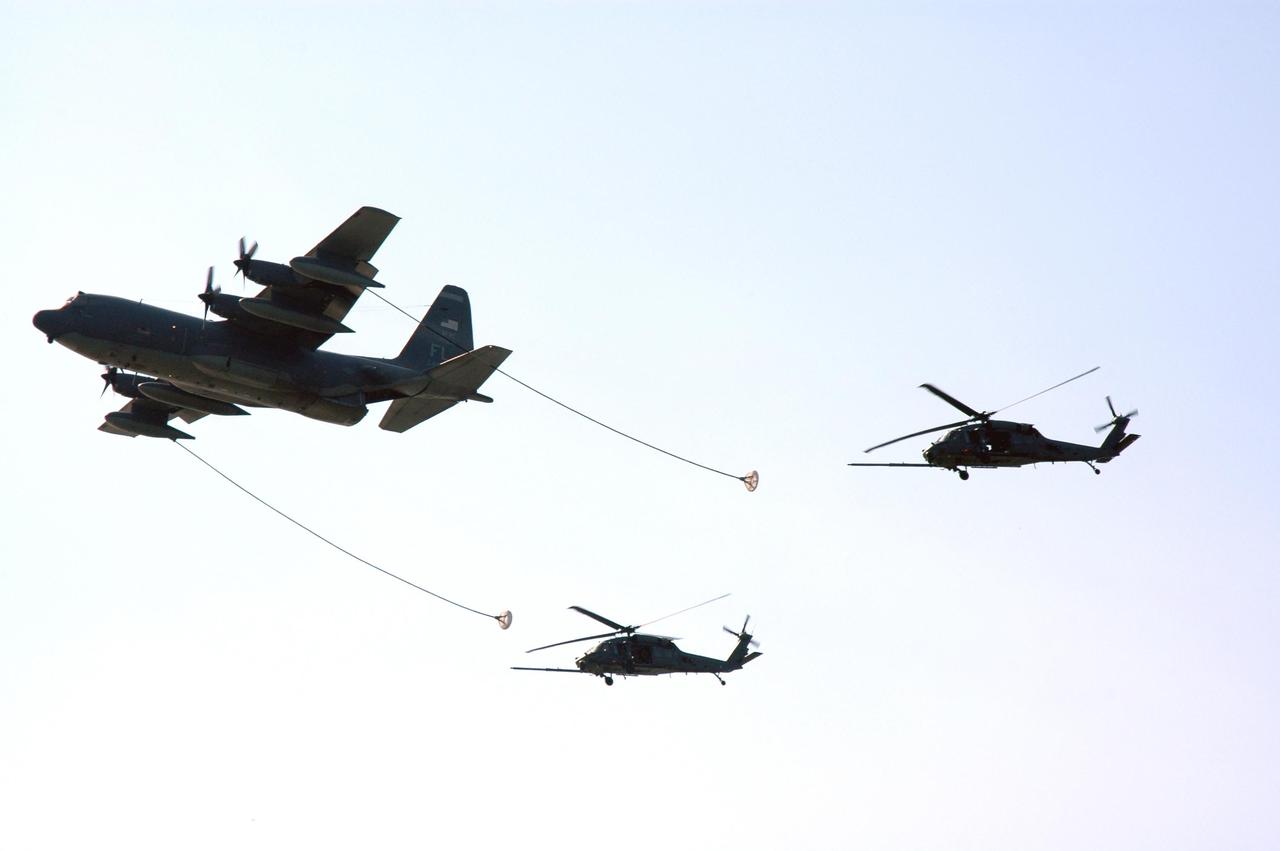
KENNEDY SPACE CENTER, FLA. -- Near the NASA Causeway at NASA's Kennedy Space Center, part of the U.S. Air Force 920th Rescue Wing puts on a demonstration of in-air refueling during the World Space Expo aerial salute. This unit was responsible for Mercury and Gemini capsule recovery. Other aircraft joining in the expo salute include the U.S. Air Force Thunderbirds Demonstration Squadron, the U.S. Navy F-18 Super Hornets, U.S. Air Force F-22 Raptor, U.S. Air Force F-15 Eagle, P-51 Mustang Heritage Flight, and the U.S. Army Golden Knights demonstrating precision skydiving. The World Space Expo held Nov. 1-4 was an event commemorating humanity's first 50 years in space while looking forward to returning people to the moon and exploring beyond. The expo showcased various panels, presentations and educational programs. It also was a part of NASA's 50th anniversary celebrations, highlighting the 45th Anniversary of the Mercury Program celebration featuring original NASA astronauts John Glenn and Scott Carpenter and the Pioneering Women of Aerospace forum featuring Eileen Collins and other prominent female space veterans. The agency was founded Oct. 1, 1958. Photo credit: NASA/Chris Chamberland
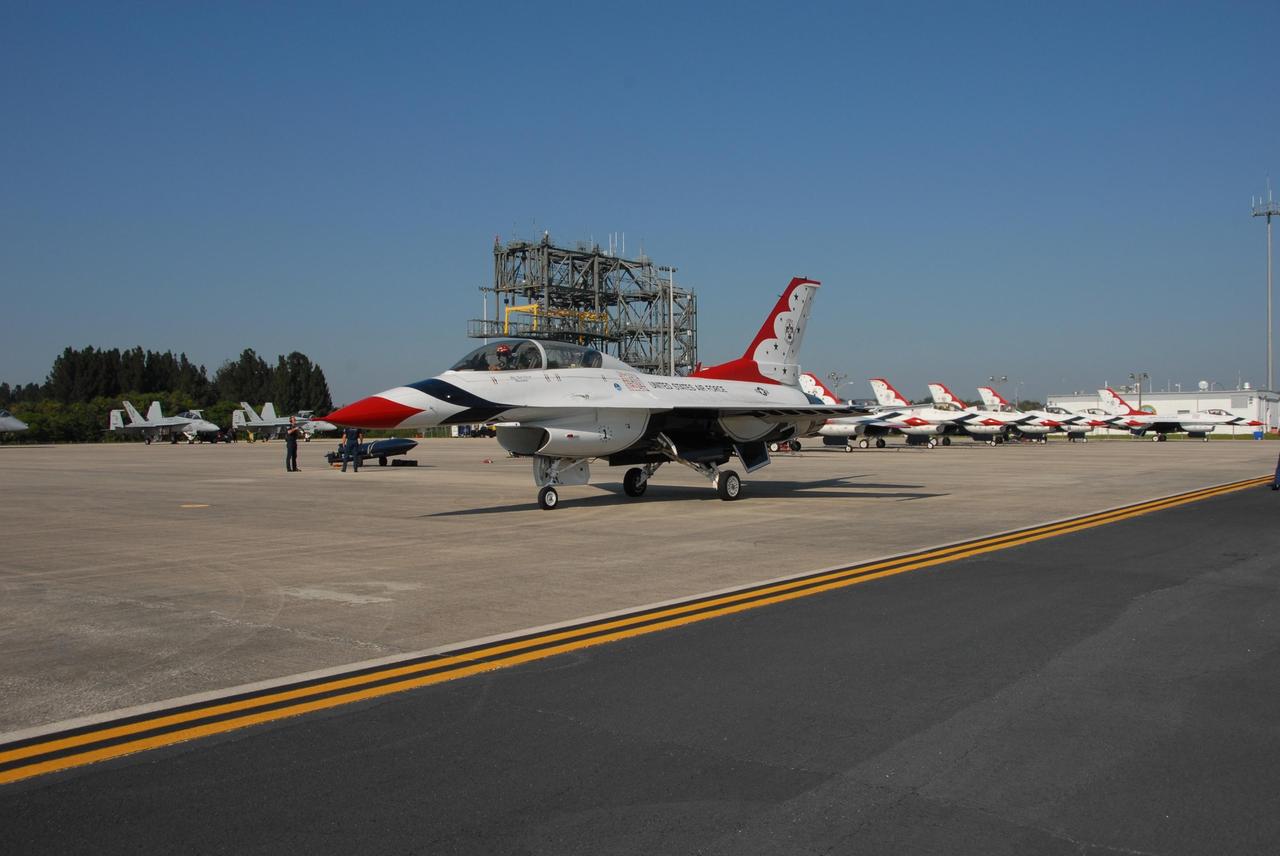
KENNEDY SPACE CENTER, FLA. — At the Shuttle Landing Facility at NASA's Kennedy Space Center, the U.S. Air Force Thunderbirds are ready to take off to participate in an aerial salute for the World Space Expo. Other aircraft joining in the expo salute include the U.S. Navy F-18 Super Hornets, U.S. Air Force F-22 Raptor, U.S. Air Force F-15 Eagle, P-51 Mustang Heritage Flight, the U.S. Air Force 920th Rescue Wing, which was responsible for Mercury and Gemini capsule recovery, and the U.S. Army Golden Knights demonstrating precision skydiving. The World Space Expo Nov. 1-4 was an event commemorating humanity's first 50 years in space while looking forward to returning people to the moon and exploring beyond. The expo showcased various panels, presentations and educational programs. It also was a part of NASA's 50th anniversary celebrations, highlighting the 45th Anniversary of the Mercury Program celebration featuring original NASA astronauts John Glenn and Scott Carpenter and the Pioneering Women of Aerospace forum featuring Eileen Collins and other prominent female space veterans. The agency was founded Oct. 1, 1958. Photo credit: NASA/George Shelton
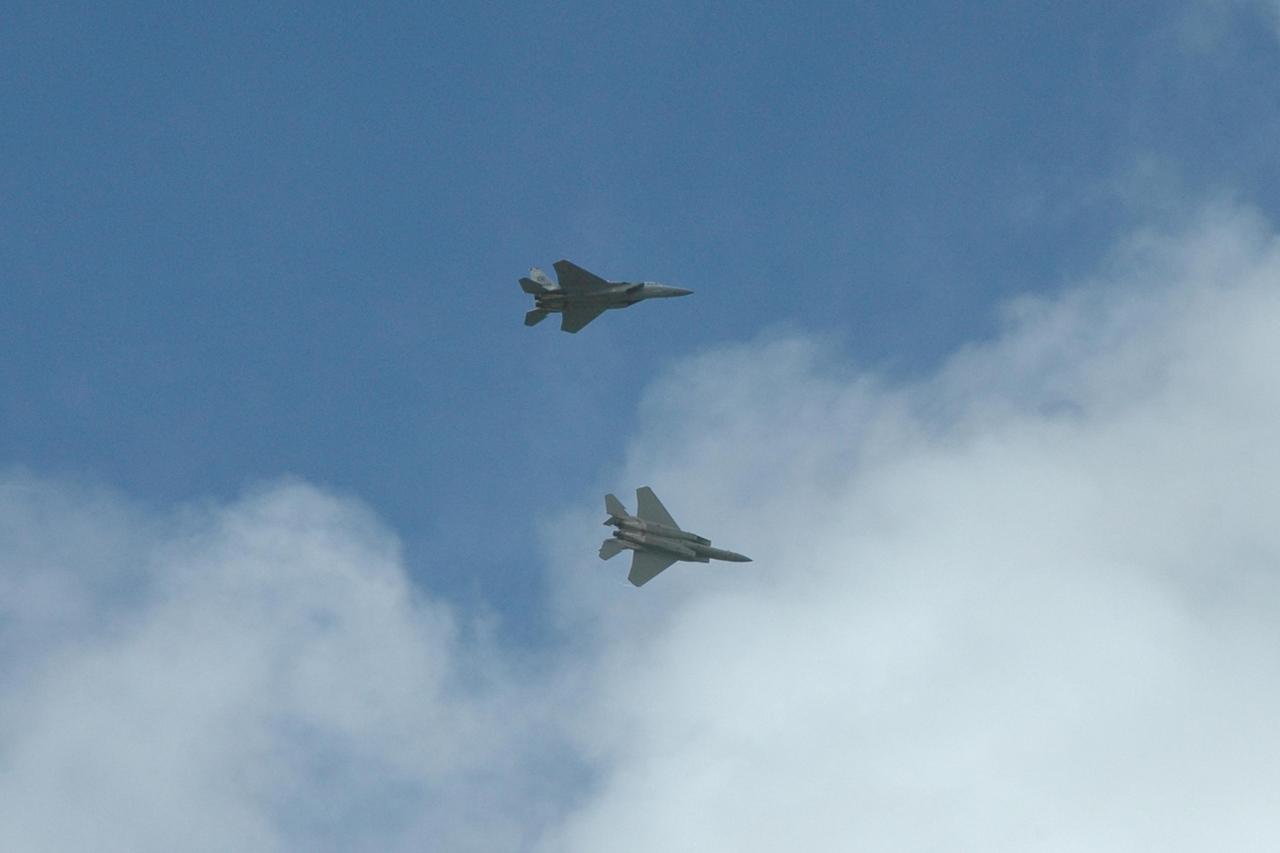
KENNEDY SPACE CENTER, FLA. -- Two of the U.S. Navy F-18 Super Hornets practice their maneuvers over NASA's Kennedy Space Center. The jets are participating in the World Space Expo being held from Nov. 1 to Nov. 4 at the NASA Kennedy Space Center Visitor Complex. Other aircraft joining in the salute include U.S. Air Force Thunderbirds Aerial Demonstration Squadron , U.S. Air Force F-22 Raptor, U.S. Air Force F-15 Eagle, the P-51 Mustang Heritage Flight and the U.S. Air Force 920th Rescue Wing, which was responsible for Mercury and Gemini capsule recovery. The U.S. Army Golden Knights also will demonstrate precision skydiving. The World Space Expo is an event to commemorate humanity's first 50 years in space while looking forward to returning people to the moon and exploring beyond. The expo will showcase various panels, presentations and educational programs. It also is a part of NASA's 50th anniversary celebrations, highlighting the 45th Anniversary of the Mercury Program celebration featuring original NASA astronauts John Glenn and Scott Carpenter and the Pioneering Women of Aerospace forum featuring Eileen Collins and other prominent female space veterans. The agency was founded Oct. 1, 1958. Photo credit: NASA/Jack Pfaller
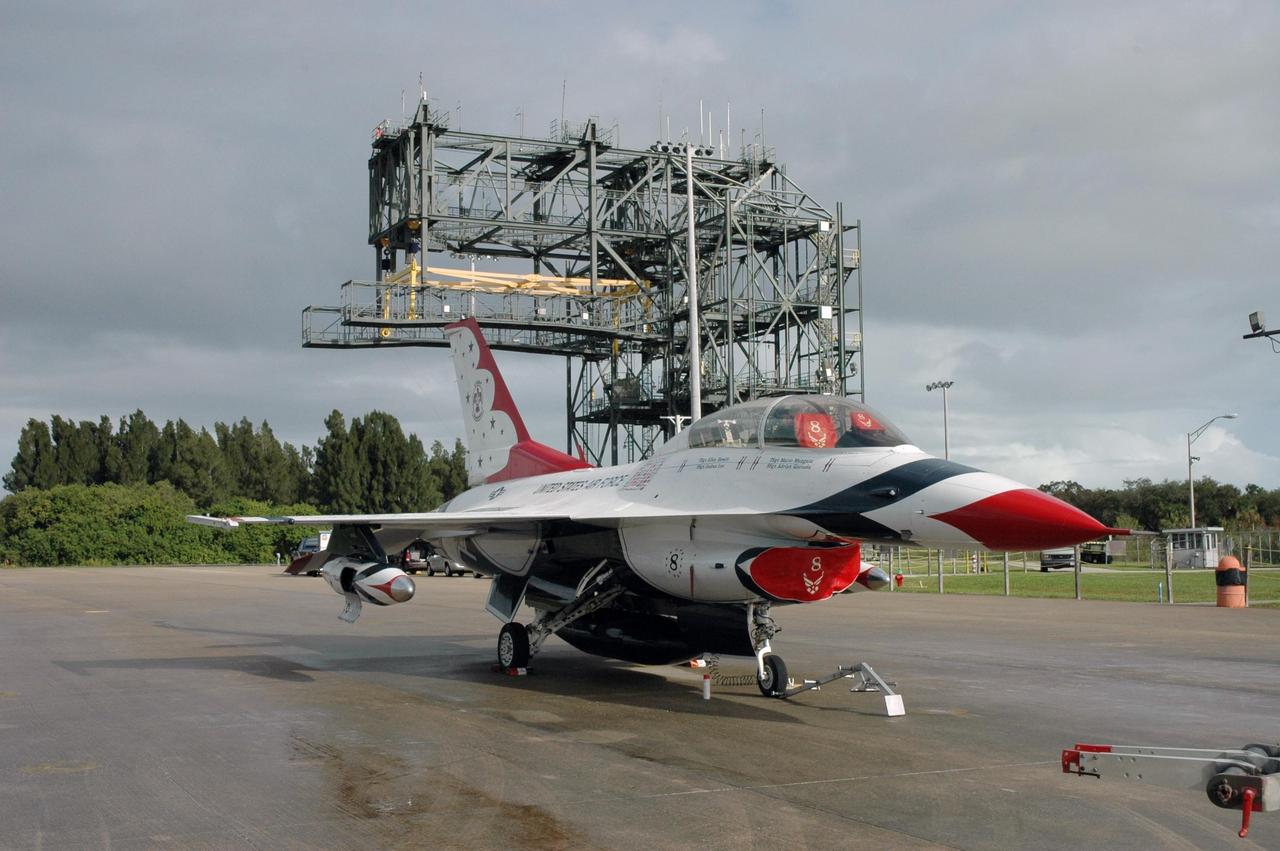
KENNEDY SPACE CENTER, FLA. -- The first of the U.S. Air Force Thunderbirds is parked on the Shuttle Landing Facility at NASA's Kennedy Space Center. The aerial demonstration squadron is performing for the World Space Expo being held from Nov. 1 to Nov. 4 at the NASA Kennedy Space Center Visitor Complex. Other aircraft participating in the salute include U.S. Air Force F-22 Raptor, U.S. Navy F-18 Super Hornet, U.S. Air Force F-15 Eagle, the P-51 Mustang Heritage Flight and the U.S. Air Force 920th Rescue Wing, which was responsible for Mercury and Gemini capsule recovery. The U.S. Army Golden Knights also will demonstrate precision skydiving. The World Space Expo is an event to commemorate humanity's first 50 years in space while looking forward to returning people to the moon and exploring beyond. The expo will showcase various panels, presentations and educational programs. It also is a part of NASA's 50th anniversary celebrations, highlighting the 45th Anniversary of the Mercury Program celebration featuring original NASA astronauts John Glenn and Scott Carpenter and the Pioneering Women of Aerospace forum featuring Eileen Collins and other prominent female space veterans. The agency was founded Oct. 1, 1958. Photo credit: NASA/Jack Pfaller
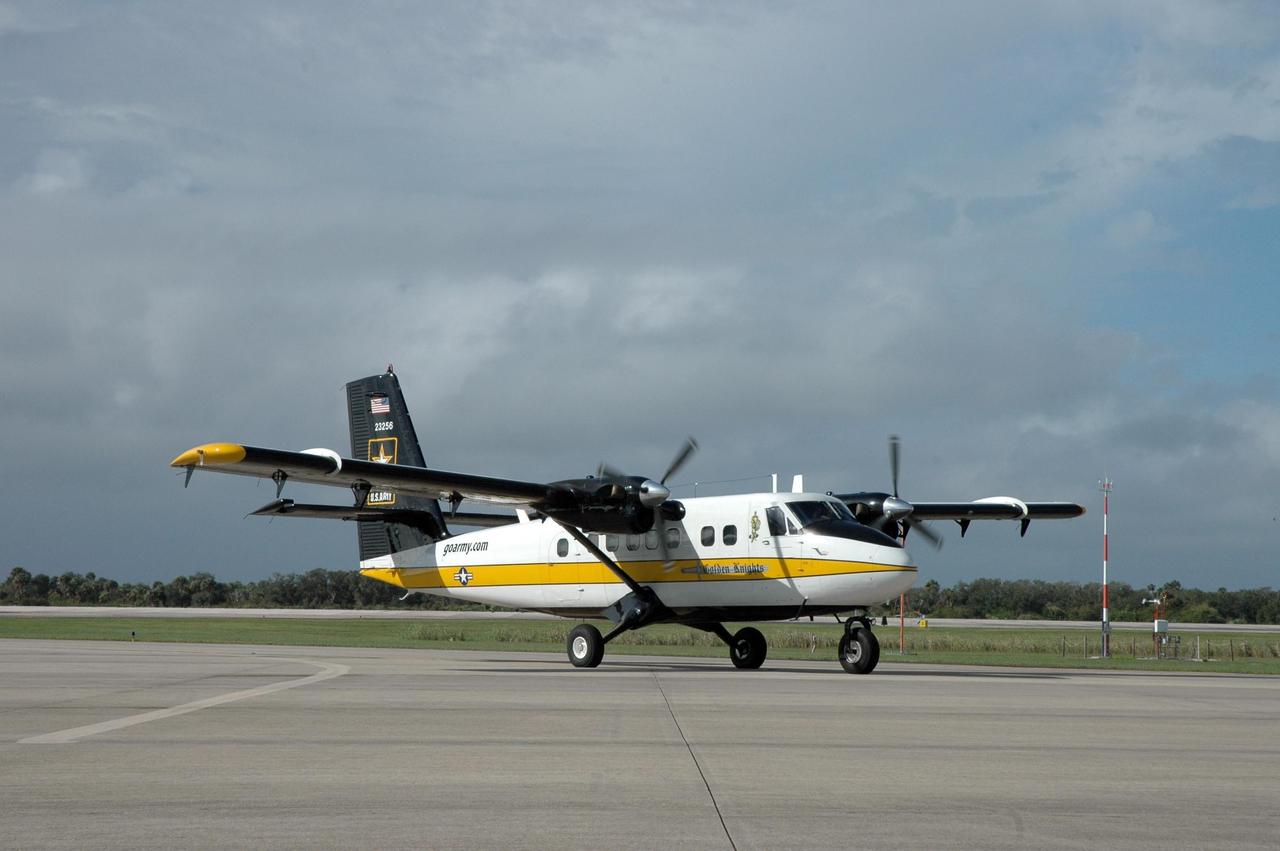
KENNEDY SPACE CENTER, FLA. -- The airplane used by the U.S. Army Golden Knights arrives at the Shuttle Landing Facility at NASA's Kennedy Space Center. The Golden Knights will demonstrate precision skydiving as part of the World Space Expo being held from Nov. 1 to Nov. 4 at the NASA Kennedy Space Center Visitor Complex. Other air demonstrations are planned by the U.S. Air Force Thunderbirds Aerial Demonstration Squadron, the U.S. Navy F-18 Super Hornets, U.S. Air Force F-22 Raptor, U.S. Air Force F-15 Eagle, the P-51 Mustang Heritage Flight and the U.S. Air Force 920th Rescue Wing, which was responsible for Mercury and Gemini capsule recovery. The World Space Expo is an event to commemorate humanity's first 50 years in space while looking forward to returning people to the moon and exploring beyond. The expo will showcase various panels, presentations and educational programs. It also is a part of NASA's 50th anniversary celebrations, highlighting the 45th Anniversary of the Mercury Program celebration featuring original NASA astronauts John Glenn and Scott Carpenter and the Pioneering Women of Aerospace forum featuring Eileen Collins and other prominent female space veterans. The agency was founded Oct. 1, 1958. Photo credit: NASA/Jack Pfaller
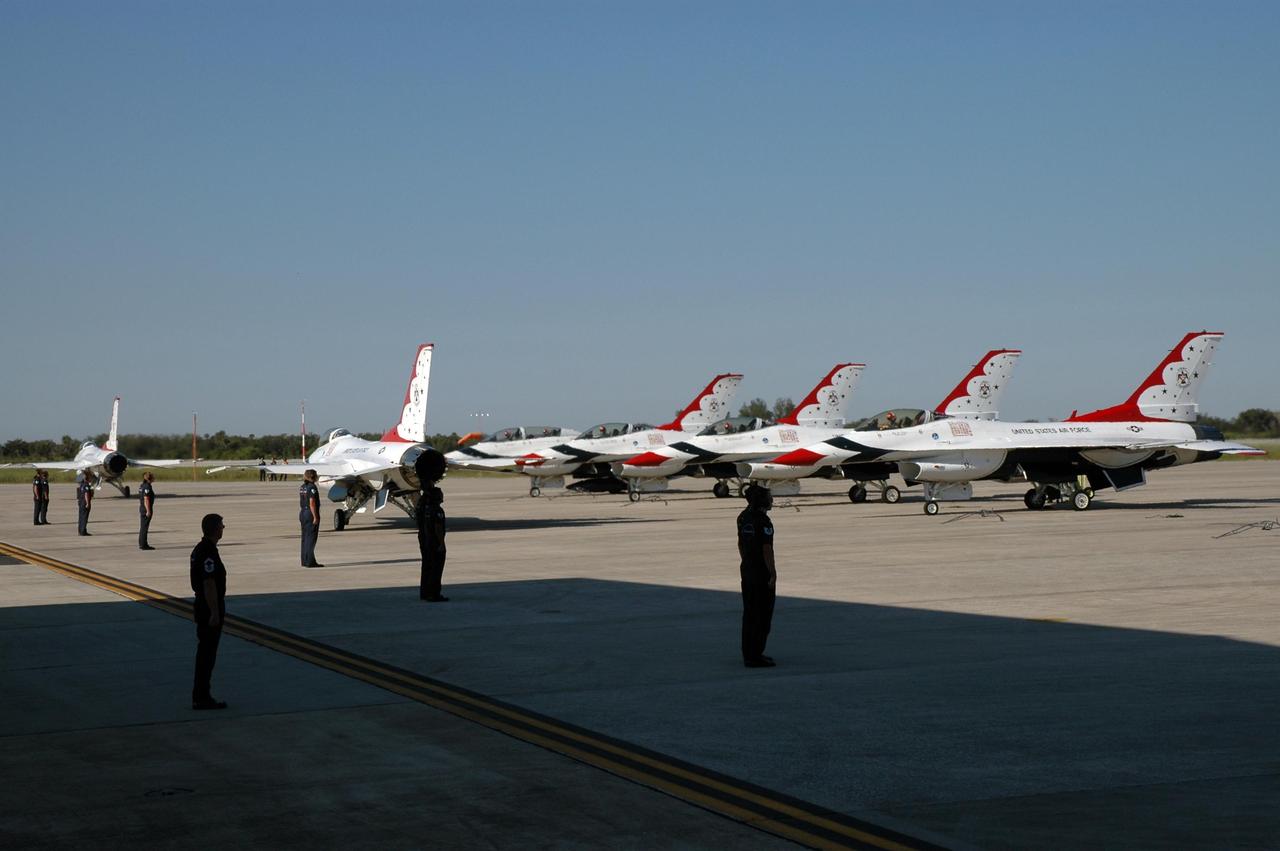
KENNEDY SPACE CENTER, FLA. -- The air crew for the U.S. Air Force Thunderbirds Demonstration Squadron show their precision formation as the planes prepare to take off from NASA's Kennedy Space Center. The squadron performed for the World Space Expos' aerial salute along with other aircraft that included the U.S. Navy F-18 Super Hornets, U.S. Air Force F-22 Raptor, U.S. Air Force F-15 Eagle, P-51 Mustang Heritage Flight, the U.S. Air Force 920th Rescue wing, which was responsible for Mercury and Gemini capsule recovery, and the U.S. Army Golden Knights precision skydiving team. The World Space Expo held Nov. 1-4 was an event commemorating humanity's first 50 years in space while looking forward to returning people to the moon and exploring beyond. The expo showcased various panels, presentations and educational programs. It also was a part of NASA's 50th anniversary celebrations, highlighting the 45th Anniversary of the Mercury Program celebration featuring original NASA astronauts John Glenn and Scott Carpenter and the Pioneering Women of Aerospace forum featuring Eileen Collins and other prominent female space veterans. The agency was founded Oct. 1, 1958. Photo credit: NASA/Jim Grossmann

KENNEDY SPACE CENTER, FLA. -- The air crew for the U.S. Air Force Thunderbirds Demonstration Squadron show their precision formation as the planes prepare to take off from NASA's Kennedy Space Center. The squadron performed for the World Space Expos' aerial salute along with other aircraft that included the U.S. Navy F-18 Super Hornets, U.S. Air Force F-22 Raptor, U.S. Air Force F-15 Eagle, P-51 Mustang Heritage Flight, the U.S. Air Force 920th Rescue wing, which was responsible for Mercury and Gemini capsule recovery, and the U.S. Army Golden Knights precision skydiving team. The World Space Expo held Nov. 1-4 was an event commemorating humanity's first 50 years in space while looking forward to returning people to the moon and exploring beyond. The expo showcased various panels, presentations and educational programs. It also was a part of NASA's 50th anniversary celebrations, highlighting the 45th Anniversary of the Mercury Program celebration featuring original NASA astronauts John Glenn and Scott Carpenter and the Pioneering Women of Aerospace forum featuring Eileen Collins and other prominent female space veterans. The agency was founded Oct. 1, 1958. Photo credit: NASA/Jim Grossmann
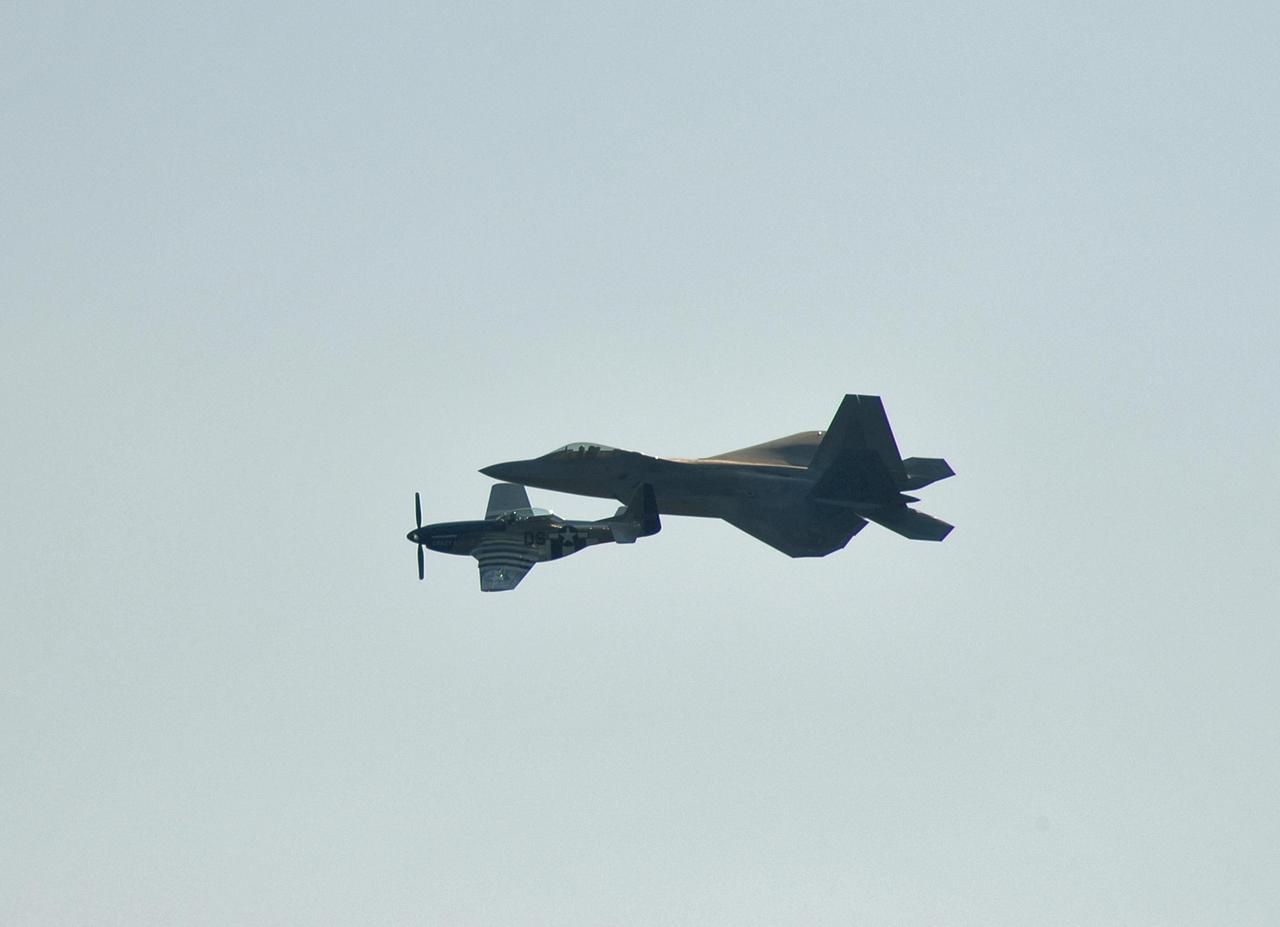
KENNEDY SPACE CENTER, FLA. -- At NASA's Kennedy Space Center, a P-51 Mustang keeps pace with a U.S. Air Force F-22 Raptor during the World Space Expo aerial salute. Other aircraft joining in the expo salute include the U.S. Air Force Thunderbirds Demonstration Squadron, the U.S. Navy F-18 Super Hornets, U.S. Air Force F-15 Eagle, the U.S. Air Force 920th Rescue wing, which was responsible for Mercury and Gemini capsule recovery, and the U.S. Army Golden Knights demonstrating precision skydiving. The World Space Expo held Nov. 1-4 was an event commemorating humanity's first 50 years in space while looking forward to returning people to the moon and exploring beyond. The expo showcased various panels, presentations and educational programs. It also was a part of NASA's 50th anniversary celebrations, highlighting the 45th Anniversary of the Mercury Program celebration featuring original NASA astronauts John Glenn and Scott Carpenter and the Pioneering Women of Aerospace forum featuring Eileen Collins and other prominent female space veterans. The agency was founded Oct. 1, 1958. Photo credit: NASA/Chris Chamberland
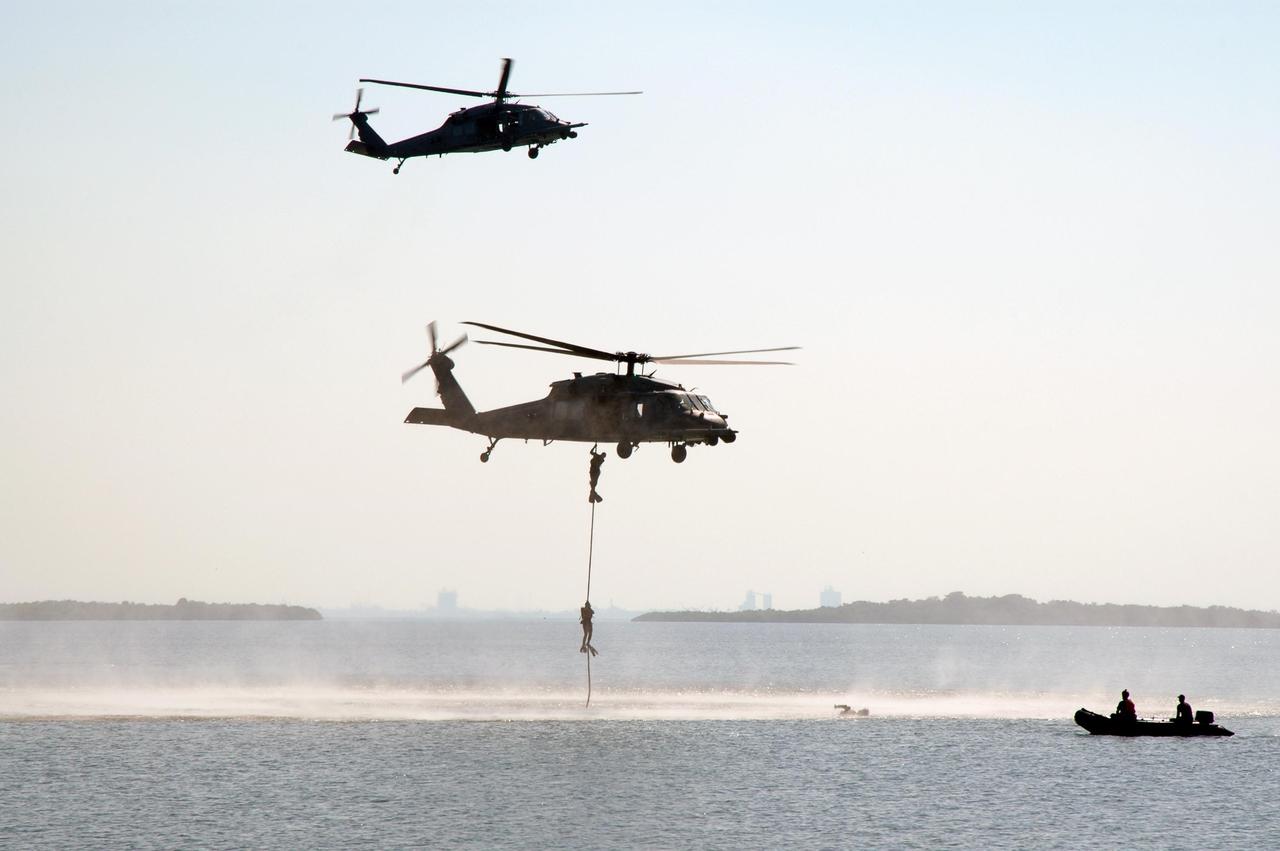
KENNEDY SPACE CENTER, FLA. -- In the water next to the NASA Causeway at NASA's Kennedy Space Center, part of the U.S. Air Force 920th Rescue Wing puts on a demonstration during the World Space Expo aerial salute. This unit was responsible for Mercury and Gemini capsule recovery. Other aircraft joining in the expo salute include the U.S. Air Force Thunderbirds Demonstration Squadron, the U.S. Navy F-18 Super Hornets, U.S. Air Force F-22 Raptor, U.S. Air Force F-15 Eagle, P-51 Mustang Heritage Flight, and the U.S. Army Golden Knights demonstrating precision skydiving. The World Space Expo held Nov. 1-4 was an event commemorating humanity's first 50 years in space while looking forward to returning people to the moon and exploring beyond. The expo showcased various panels, presentations and educational programs. It also was a part of NASA's 50th anniversary celebrations, highlighting the 45th Anniversary of the Mercury Program celebration featuring original NASA astronauts John Glenn and Scott Carpenter and the Pioneering Women of Aerospace forum featuring Eileen Collins and other prominent female space veterans. The agency was founded Oct. 1, 1958. Photo credit: NASA/Chris Chamberland
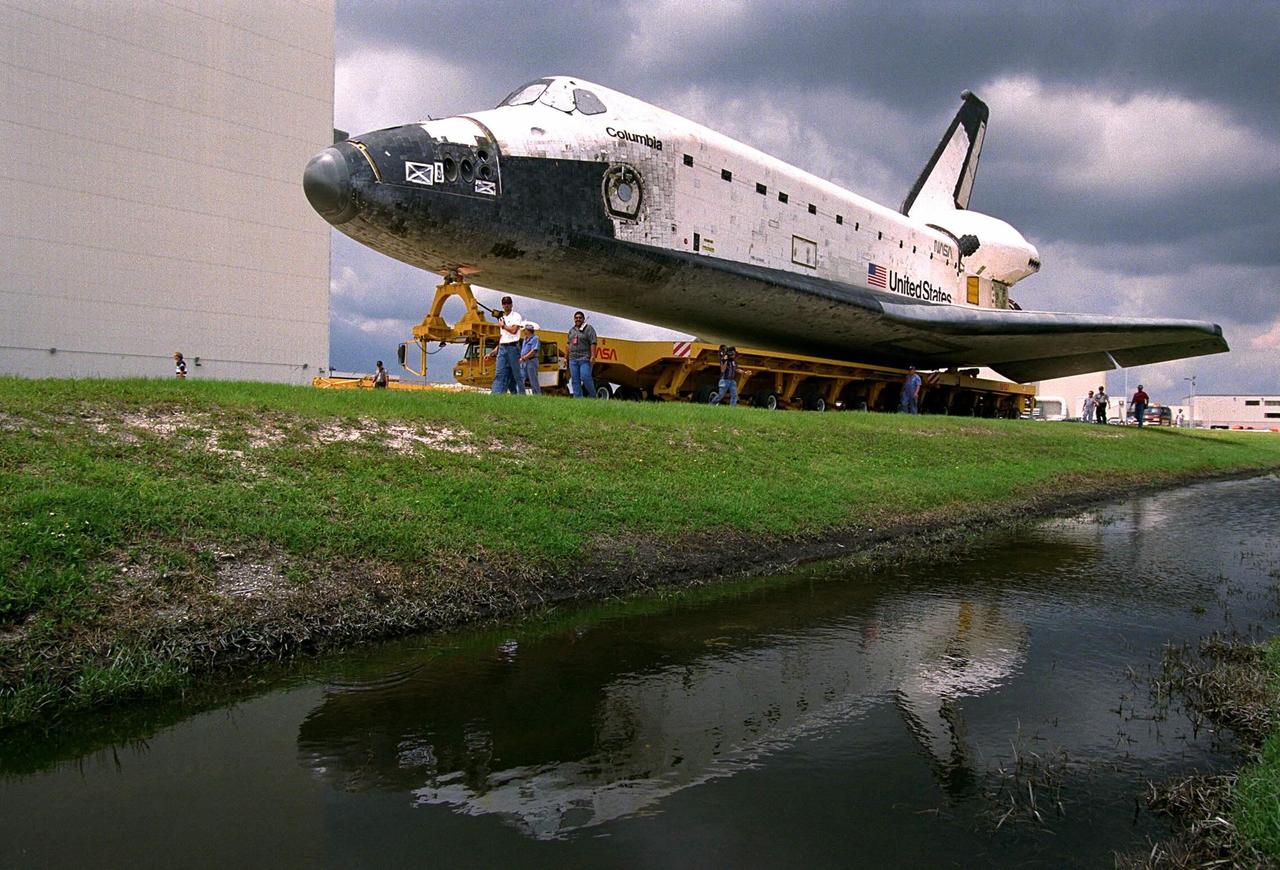
The Space Shuttle Orbiter Columbia is reflected in a nearby pond as it rolls over to the Vehicle Assembly Building (VAB) June 4 from Orbiter Processing Facility (OPF) 1 atop its transporter in preparation for the STS-94 mission. Once inside the VAB, Columbia will be hoisted to be mated with its solid rocket boosters and external tank. Columbia was moved to the OPF April 8 after the completion of the STS-83 mission. KSC payloads processing employees then began work to reservice the Microgravity Science Laboratory-1 (MSL-1) Spacelab module in the orbiter’s payload bay for the STS-94 mission. This was the first time that this type of payload was reserviced without removing it from the payload bay. This new procedure pioneers processing efforts for possible quick relaunch turnaround times for future payloads. The MSL-1 module will fly again with the full complement of STS-83 experiments after that mission was cut short due to indications of a faulty fuel cell. During the scheduled 16-day STS-94 mission, the experiments will be used to test some of the hardware, facilities and procedures that are planned for use on the International Space Station while the flight crew conducts combustion, protein crystal growth and materials processing experiments
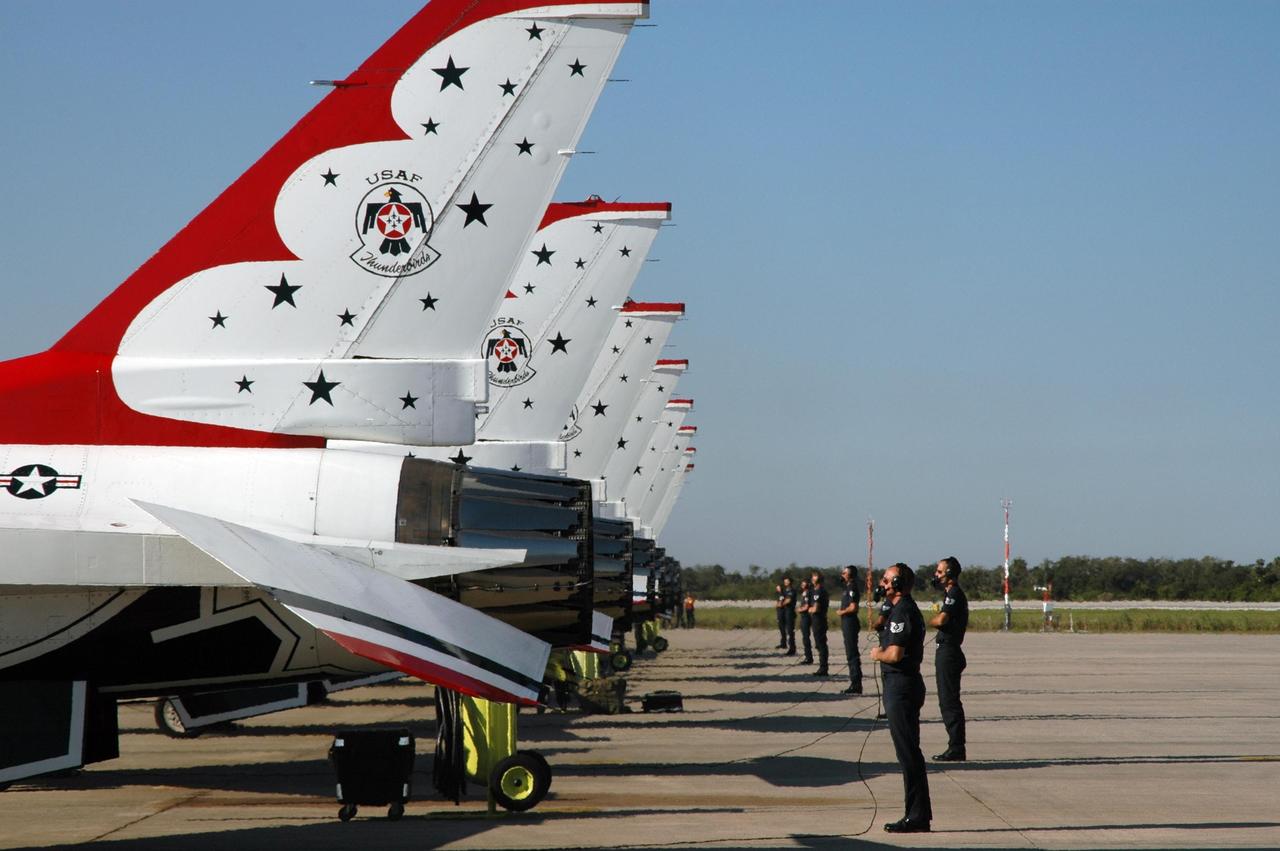
KENNEDY SPACE CENTER, FLA. -- The air crew for the U.S. Air Force Thunderbirds Demonstration Squadron show their precision formation as the planes prepare to take off from NASA's Kennedy Space Center. The squadron performed for the World Space Expos' aerial salute along with other aircraft that included the U.S. Navy F-18 Super Hornets, U.S. Air Force F-22 Raptor, U.S. Air Force F-15 Eagle, P-51 Mustang Heritage Flight, the U.S. Air Force 920th Rescue Wing, which was responsible for Mercury and Gemini capsule recovery, and the U.S. Army Golden Knights precision skydiving team. The World Space Expo held Nov. 1-4 was an event commemorating humanity's first 50 years in space while looking forward to returning people to the moon and exploring beyond. The expo showcased various panels, presentations and educational programs. It also was a part of NASA's 50th anniversary celebrations, highlighting the 45th Anniversary of the Mercury Program celebration featuring original NASA astronauts John Glenn and Scott Carpenter and the Pioneering Women of Aerospace forum featuring Eileen Collins and other prominent female space veterans. The agency was founded Oct. 1, 1958. Photo credit: NASA/Jim Grossmann
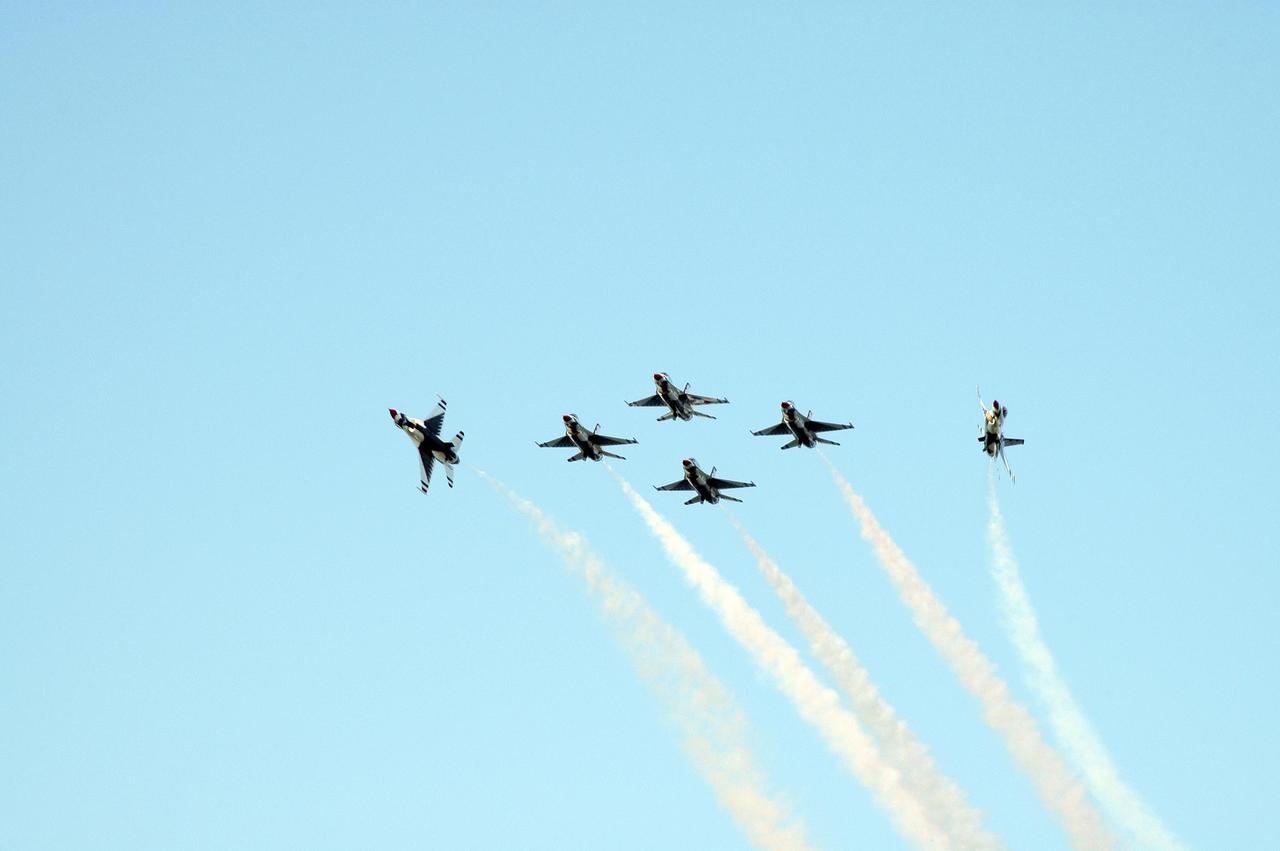
KENNEDY SPACE CENTER, FLA. -- At NASA's Kennedy Space Center, the U.S. Air Force Thunderbirds Demonstration Squadron performs during the World Space Expo aerial salute. Other aircraft joining in the expo salute include the U.S. Navy F-18 Super Hornets, U.S. Air Force F-22 Raptor, U.S. Air Force F-15 Eagle, P-51 Mustang Heritage Flight, U.S. Air Force 920th Rescue wing, which was responsible for Mercury and Gemini capsule recovery, and the U.S. Army Golden Knights demonstrating precision skydiving. The World Space Expo held Nov. 1-4 was an event commemorating humanity's first 50 years in space while looking forward to returning people to the moon and exploring beyond. The expo showcased various panels, presentations and educational programs. It also was a part of NASA's 50th anniversary celebrations, highlighting the 45th Anniversary of the Mercury Program celebration featuring original NASA astronauts John Glenn and Scott Carpenter and the Pioneering Women of Aerospace forum featuring Eileen Collins and other prominent female space veterans. The agency was founded Oct. 1, 1958. Photo credit: NASA/Chris Chamberland
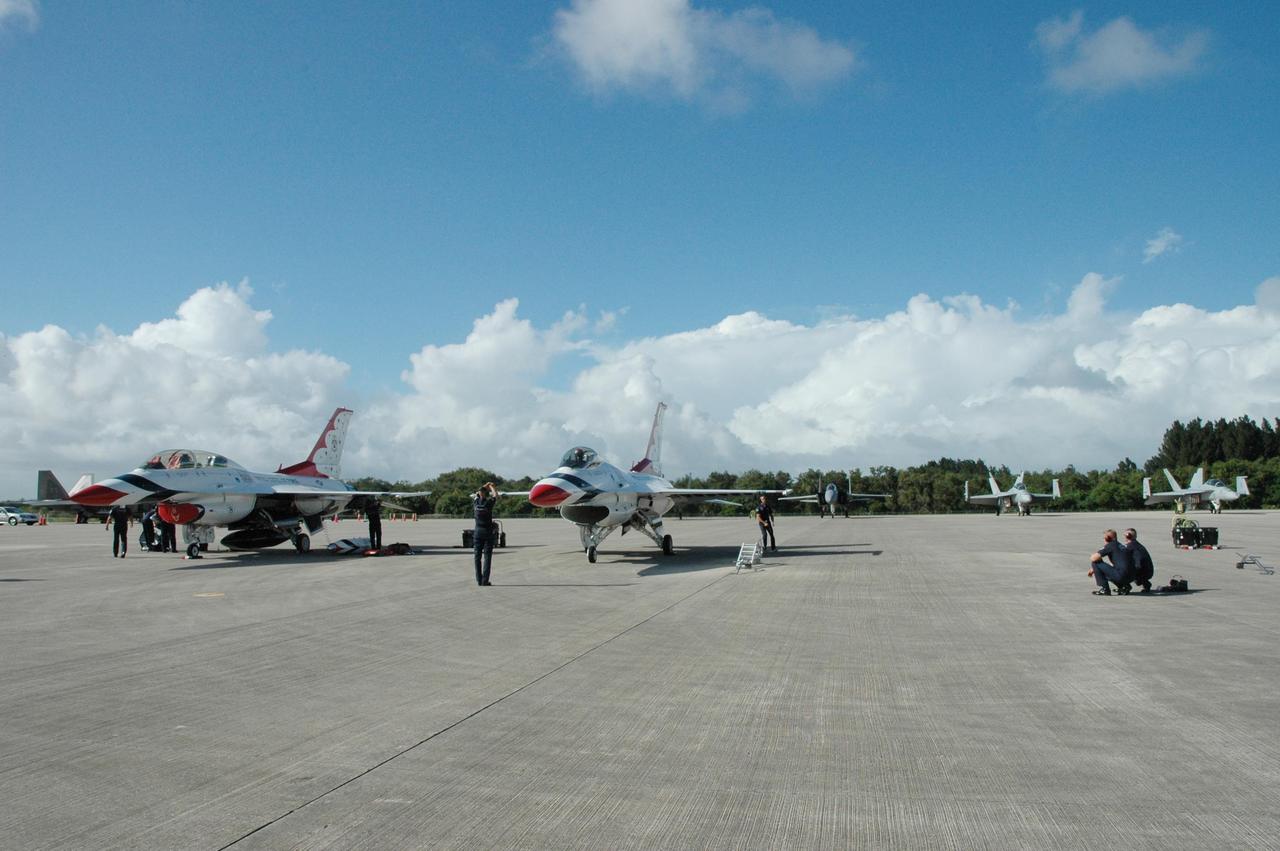
KENNEDY SPACE CENTER, FLA. -- Another of the U.S. Air Force Thunderbirds is parked on the Shuttle Landing Facility at NASA's Kennedy Space Center. The aerial demonstration squadron is performing for the World Space Expo being held from Nov. 1 to Nov. 4 at the NASA Kennedy Space Center Visitor Complex. Other aircraft participating in the salute include U.S. Air Force F-22 Raptor, U.S. Navy F-18 Super Hornet, U.S. Air Force F-15 Eagle, the P-51 Mustang Heritage Flight and the U.S. Air Force 920th Rescue Wing, which was responsible for Mercury and Gemini capsule recovery. The U.S. Army Golden Knights also will demonstrate precision skydiving. The World Space Expo is an event to commemorate humanity's first 50 years in space while looking forward to returning people to the moon and exploring beyond. The expo will showcase various panels, presentations and educational programs. It also is a part of NASA's 50th anniversary celebrations, highlighting the 45th Anniversary of the Mercury Program celebration featuring original NASA astronauts John Glenn and Scott Carpenter and the Pioneering Women of Aerospace forum featuring Eileen Collins and other prominent female space veterans. The agency was founded Oct. 1, 1958. Photo credit: NASA/Jack Pfaller
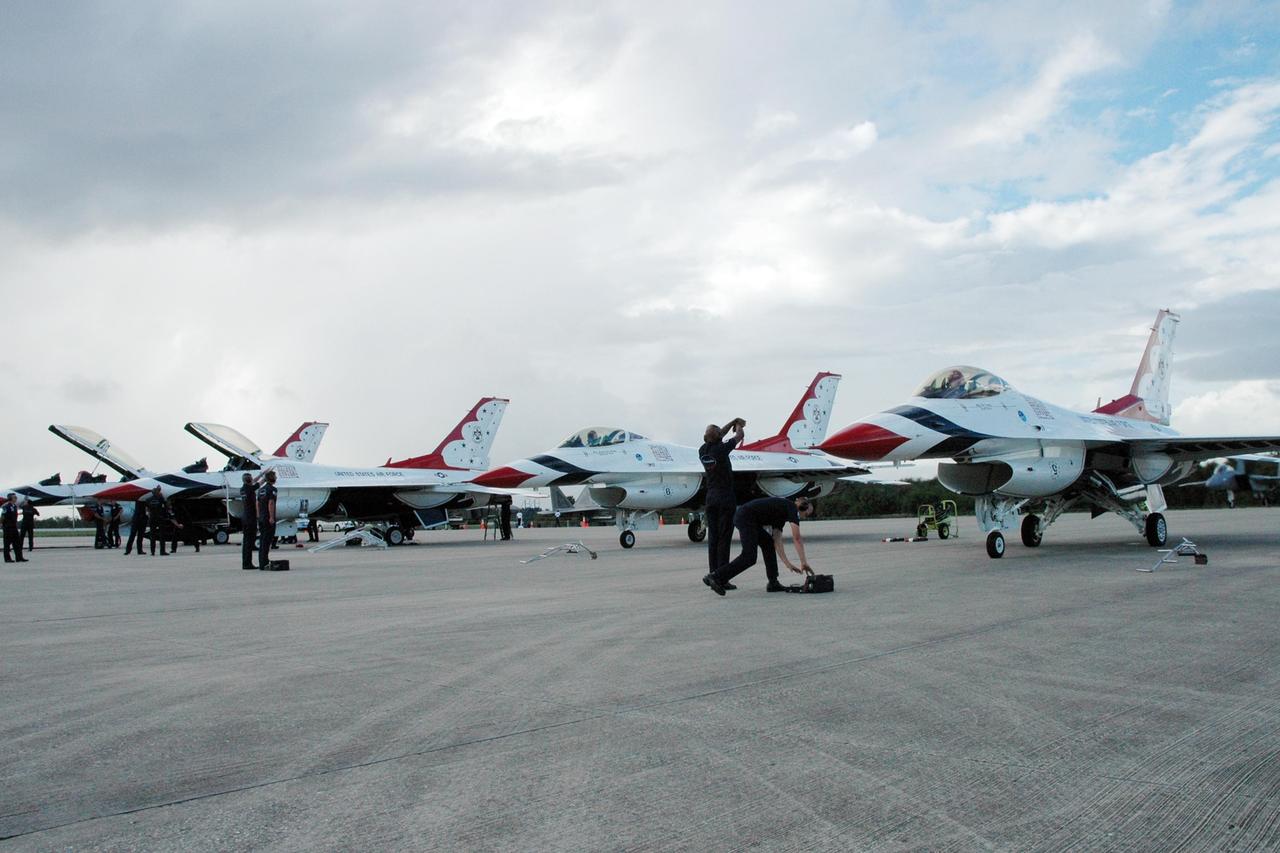
KENNEDY SPACE CENTER, FLA. -- U.S. Air Force Thunderbirds line up on the Shuttle Landing Facility at NASA's Kennedy Space Center. The aerial demonstration squadron is performing for the World Space Expo being held from Nov. 1 to Nov. 4 at the NASA Kennedy Space Center Visitor Complex. Other aircraft participating in the salute include U.S. Air Force F-22 Raptor, U.S. Navy F-18 Super Hornet, U.S. Air Force F-15 Eagle, the P-51 Mustang Heritage Flight and the U.S. Air Force 920th Rescue Wing, which was responsible for Mercury and Gemini capsule recovery. The U.S. Army Golden Knights also will demonstrate precision skydiving. The World Space Expo is an event to commemorate humanity's first 50 years in space while looking forward to returning people to the moon and exploring beyond. The expo will showcase various panels, presentations and educational programs. It also is a part of NASA's 50th anniversary celebrations, highlighting the 45th Anniversary of the Mercury Program celebration featuring original NASA astronauts John Glenn and Scott Carpenter and the Pioneering Women of Aerospace forum featuring Eileen Collins and other prominent female space veterans. The agency was founded Oct. 1, 1958. Photo credit: NASA/Jack Pfaller
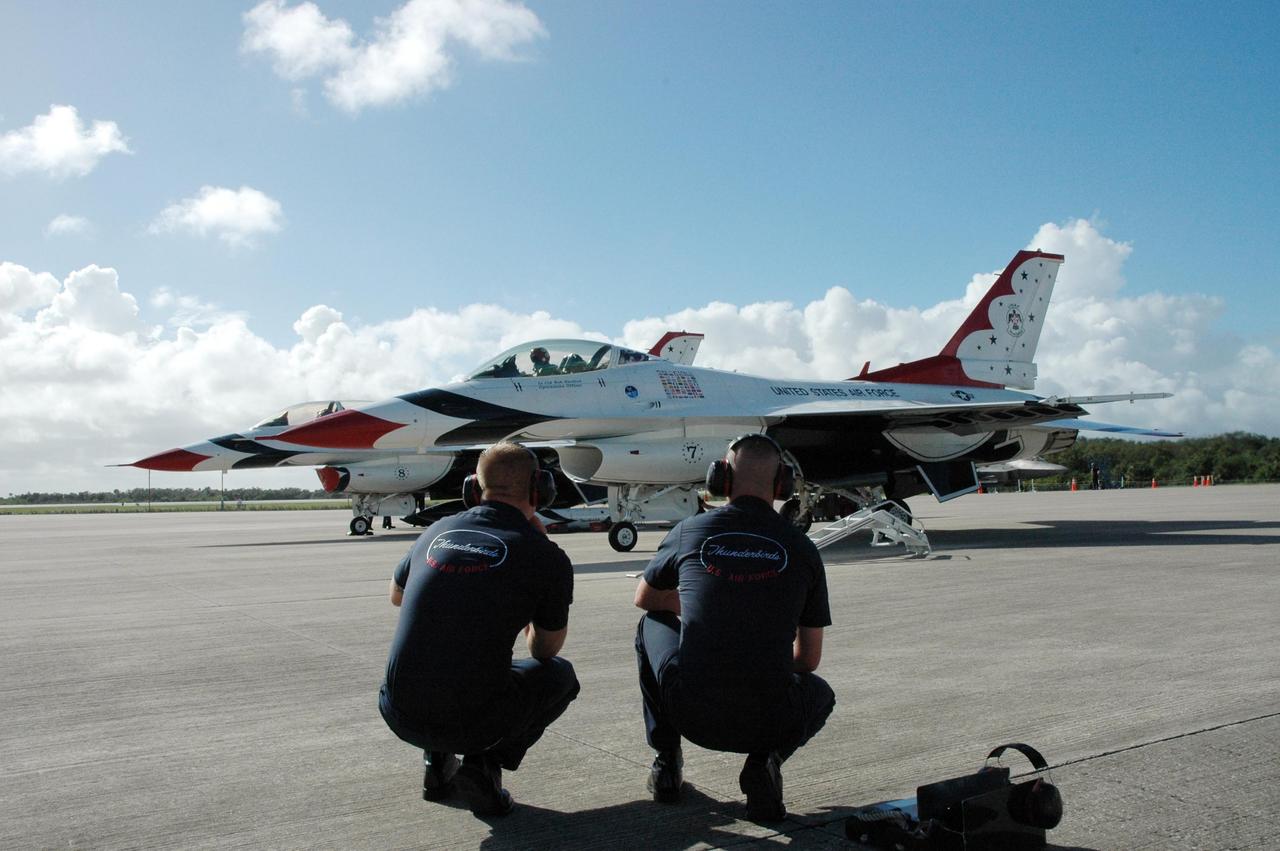
KENNEDY SPACE CENTER, FLA. -- U.S. Air Force Thunderbirds line up on the Shuttle Landing Facility at NASA's Kennedy Space Center. The aerial demonstration squadron is performing for the World Space Expo being held from Nov. 1 to Nov. 4 at the NASA Kennedy Space Center Visitor Complex. Other aircraft participating in the salute include U.S. Air Force F-22 Raptor, U.S. Navy F-18 Super Hornet, U.S. Air Force F-15 Eagle, the P-51 Mustang Heritage Flight and the U.S. Air Force 920th Rescue Wing, which was responsible for Mercury and Gemini capsule recovery. The U.S. Army Golden Knights also will demonstrate precision skydiving. The World Space Expo is an event to commemorate humanity's first 50 years in space while looking forward to returning people to the moon and exploring beyond. The expo will showcase various panels, presentations and educational programs. It also is a part of NASA's 50th anniversary celebrations, highlighting the 45th Anniversary of the Mercury Program celebration featuring original NASA astronauts John Glenn and Scott Carpenter and the Pioneering Women of Aerospace forum featuring Eileen Collins and other prominent female space veterans. The agency was founded Oct. 1, 1958. Photo credit: NASA/Jack Pfaller
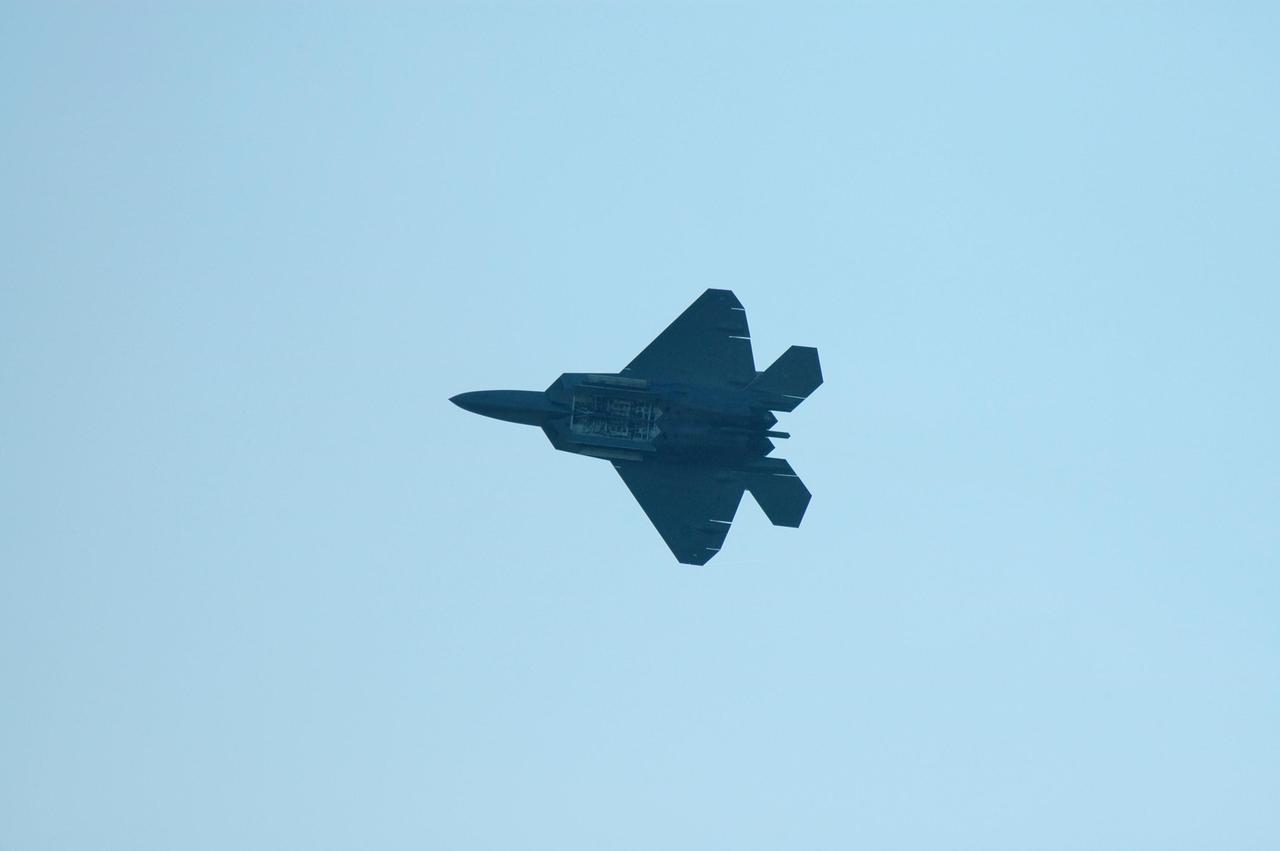
KENNEDY SPACE CENTER, FLA. -- At NASA's Kennedy Space Center, a U.S. Air Force F-22 Raptor flies overhead as part of the World Space Expo aerial salute. Other aircraft joining in the expo salute include the U.S. Air Force Thunderbirds Demonstration Squadron, the U.S. Navy F-18 Super Hornets, U.S. Air Force F-15 Eagle, P-51 Mustang Heritage Flight, the U.S. Air Force 920th Rescue wing, which was responsible for Mercury and Gemini capsule recovery, and the U.S. Army Golden Knights demonstrating precision skydiving. The World Space Expo held Nov. 1-4 was an event commemorating humanity's first 50 years in space while looking forward to returning people to the moon and exploring beyond. The expo showcased various panels, presentations and educational programs. It also was a part of NASA's 50th anniversary celebrations, highlighting the 45th Anniversary of the Mercury Program celebration featuring original NASA astronauts John Glenn and Scott Carpenter and the Pioneering Women of Aerospace forum featuring Eileen Collins and other prominent female space veterans. The agency was founded Oct. 1, 1958. Photo credit: NASA/Chris Chamberland
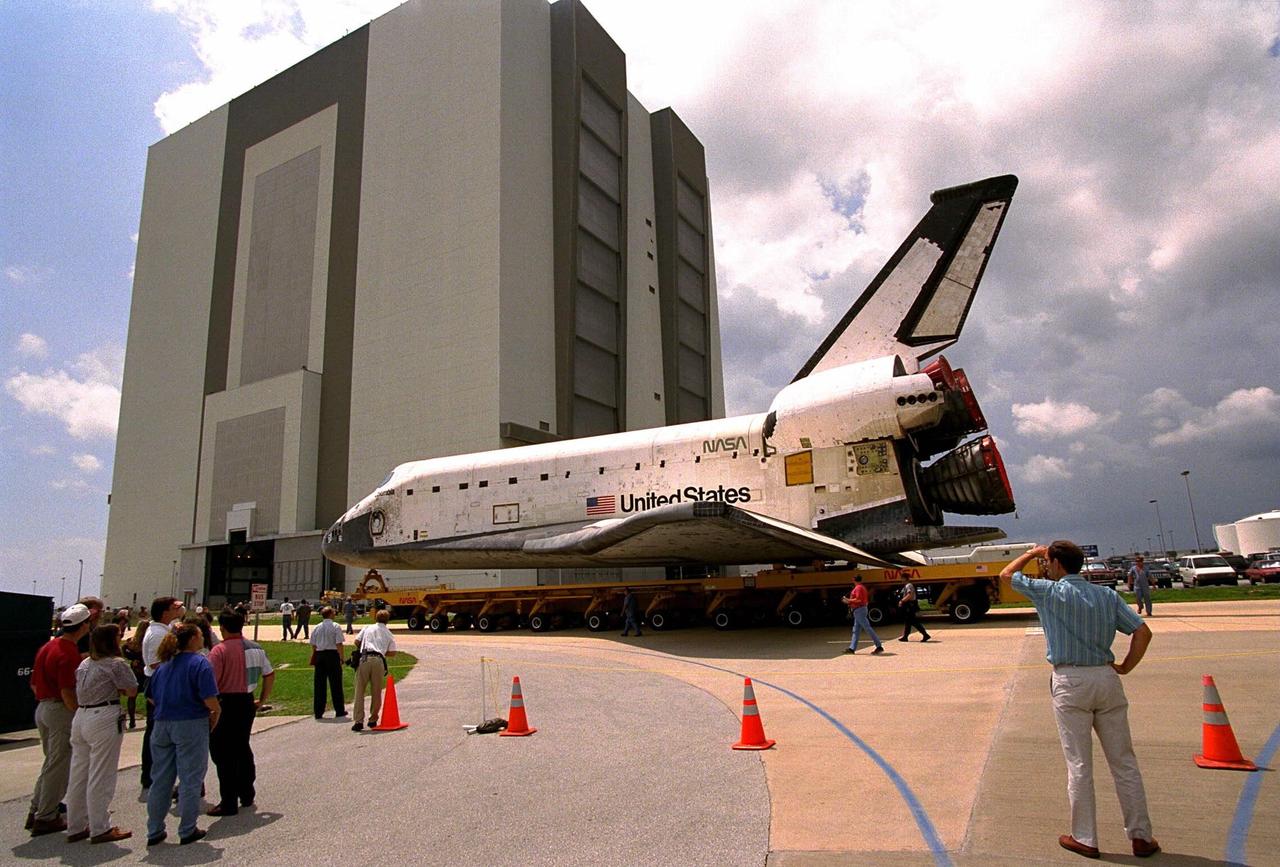
While KSC workers in the Launch Complex 39 Area watch, The Space Shuttle Orbiter Columbia rolls over to the Vehicle Assembly Building (VAB) June 4 from Orbiter Processing Facility (OPF)1 atop its transporter in preparation for the STS-94 mission. Once inside the VAB, Columbia will be hoisted to be mated with its solid rocket boosters and external tank. Columbia was moved to the OPF April 8 after the completion of the STS-83 mission. KSC payloads processing employees then began work to reservice the Microgravity Science Laboratory-1 (MSL-1) Spacelab module in the orbiter’s payload bay for the STS-94 mission. This was the first time that this type of payload was reserviced without removing it from the payload bay. This new procedure pioneers processing efforts for possible quick relaunch turnaround times for future payloads. The MSL-1 module will fly again with the full complement of STS-83 experiments after that mission was cut short due to indications of a faulty fuel cell. During the scheduled 16-day STS-94 mission, the experiments will be used to test some of the hardware, facilities and procedures that are planned for use on the International Space Station while the flight crew conducts combustion, protein crystal growth and materials processing experiments
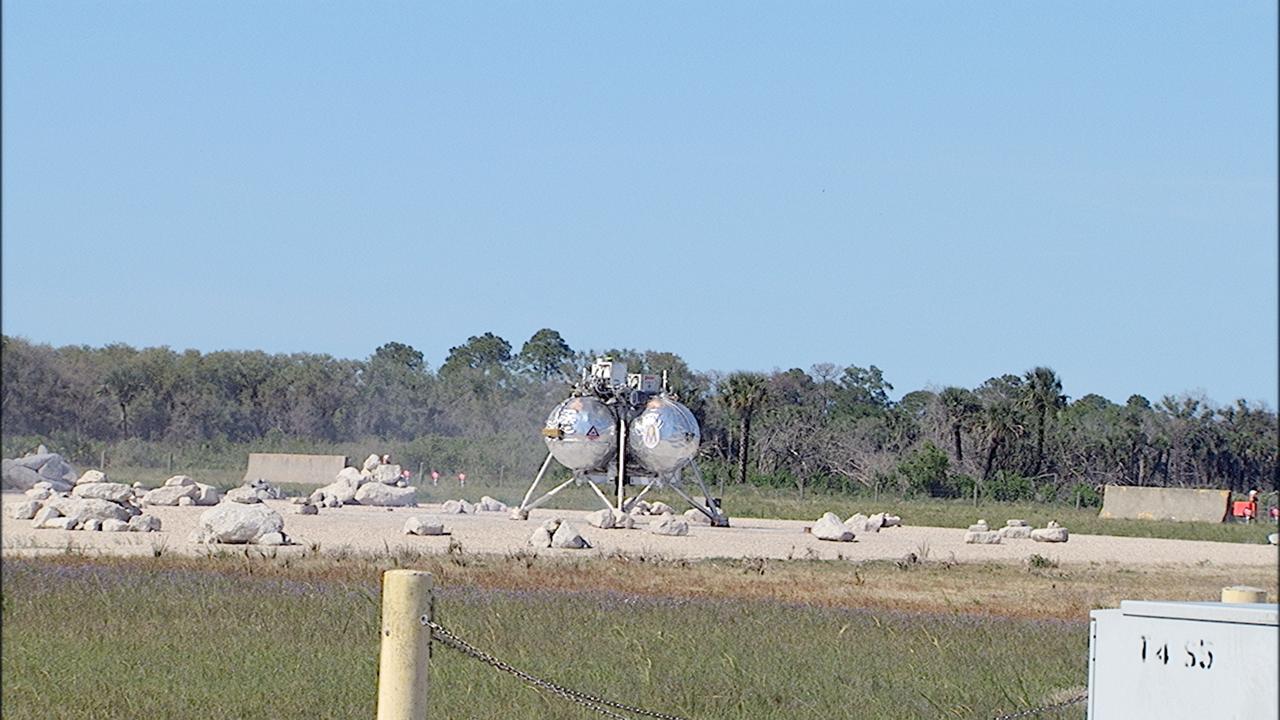
CAPE CANAVERAL, Fla. – NASA's Project Morpheus prototype lander lands inside the autonomous landing and hazard avoidance technology, or ALHAT, hazard field after a free flight test at the north end of the Shuttle Landing Facility at NASA's Kennedy Space Center in Florida. The 96-second test began at 4:21 p.m. EDT with the Morpheus lander launching from the ground over the flame trench at a new launch site and ascending more than 800 feet at a peak speed of 36 mph. The vehicle with its recently installed autonomous landing and hazard avoidance technology, or ALHAT, sensors surveyed the hazard field to determine safe landing sites. Morpheus then flew forward and downward covering 1,300 feet while performing a 78-foot divert to simulate a hazard avoidance maneuver. The lander descended and landed on a dedicated pad inside the ALHAT field. Project Morpheus tests NASA’s ALHAT, and an engine that runs on liquid oxygen and methane, or green propellants, into a fully-operational lander that could deliver cargo to other planetary surfaces. The landing facility provides the lander with the kind of field necessary for realistic testing, complete with rocks, craters and hazards to avoid. Morpheus’ ALHAT payload allows it to navigate to clear landing sites amidst rocks, craters and other hazards during its descent. Project Morpheus is being managed under the Advanced Exploration Systems, or AES, Division in NASA’s Human Exploration and Operations Mission Directorate. The efforts in AES pioneer new approaches for rapidly developing prototype systems, demonstrating key capabilities and validating operational concepts for future human missions beyond Earth orbit. For more information on Project Morpheus, visit http://morpheuslander.jsc.nasa.gov/. Photo credit: NASA/Frankie Martin
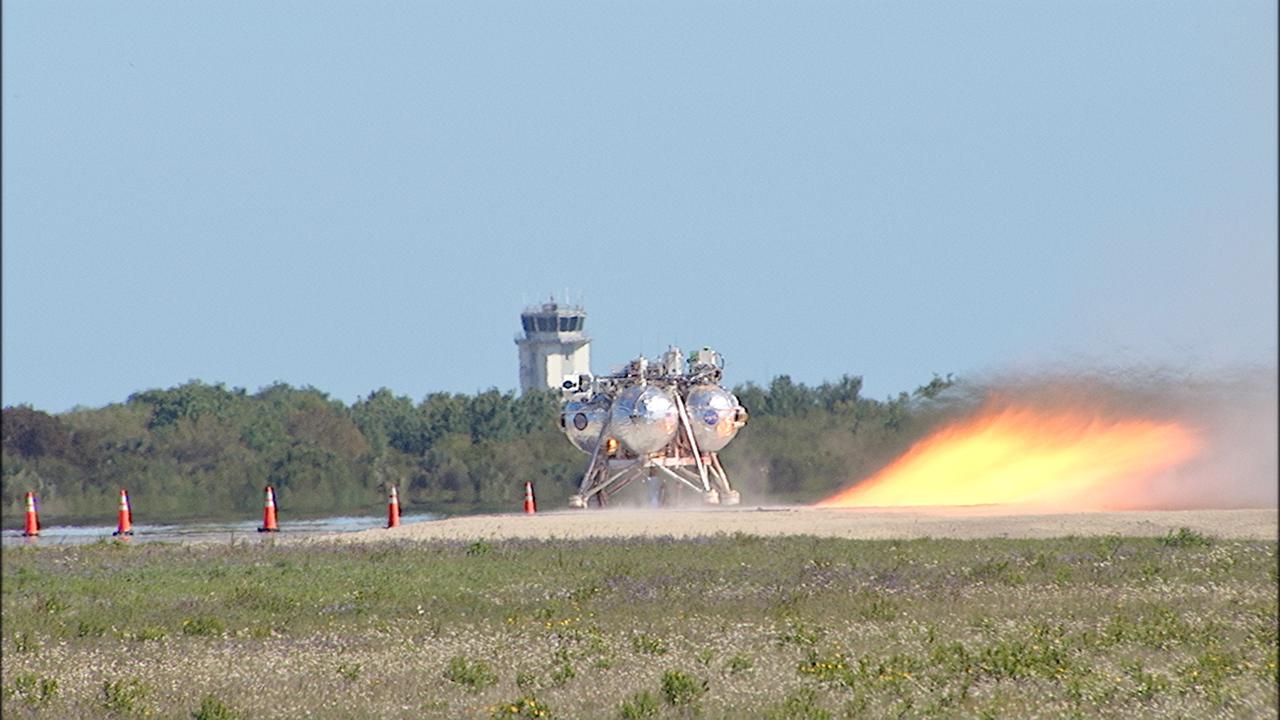
CAPE CANAVERAL, Fla. – A free flight test of NASA's Project Morpheus prototype lander begins at the new launch site at the north end of the Shuttle Landing Facility at NASA’s Kennedy Space Center in Florida. The 96-second test began at 4:21 p.m. EDT with the Morpheus lander launching from the ground over the flame trench and ascending more than 800 feet at a peak speed of 36 mph. The vehicle with its recently installed autonomous landing and hazard avoidance technology, or ALHAT, sensors surveyed the hazard field to determine safe landing sites. Morpheus then flew forward and downward covering 1,300 feet while performing a 78-foot divert to simulate a hazard avoidance maneuver. The lander descended and landed on a dedicated pad inside the ALHAT field. Project Morpheus tests NASA’s ALHAT, and an engine that runs on liquid oxygen and methane, or green propellants, into a fully-operational lander that could deliver cargo to other planetary surfaces. The landing facility provides the lander with the kind of field necessary for realistic testing, complete with rocks, craters and hazards to avoid. Morpheus’ ALHAT payload allows it to navigate to clear landing sites amidst rocks, craters and other hazards during its descent. Project Morpheus is being managed under the Advanced Exploration Systems, or AES, Division in NASA’s Human Exploration and Operations Mission Directorate. The efforts in AES pioneer new approaches for rapidly developing prototype systems, demonstrating key capabilities and validating operational concepts for future human missions beyond Earth orbit. For more information on Project Morpheus, visit http://morpheuslander.jsc.nasa.gov/. Photo credit: NASA/Frankie Martin
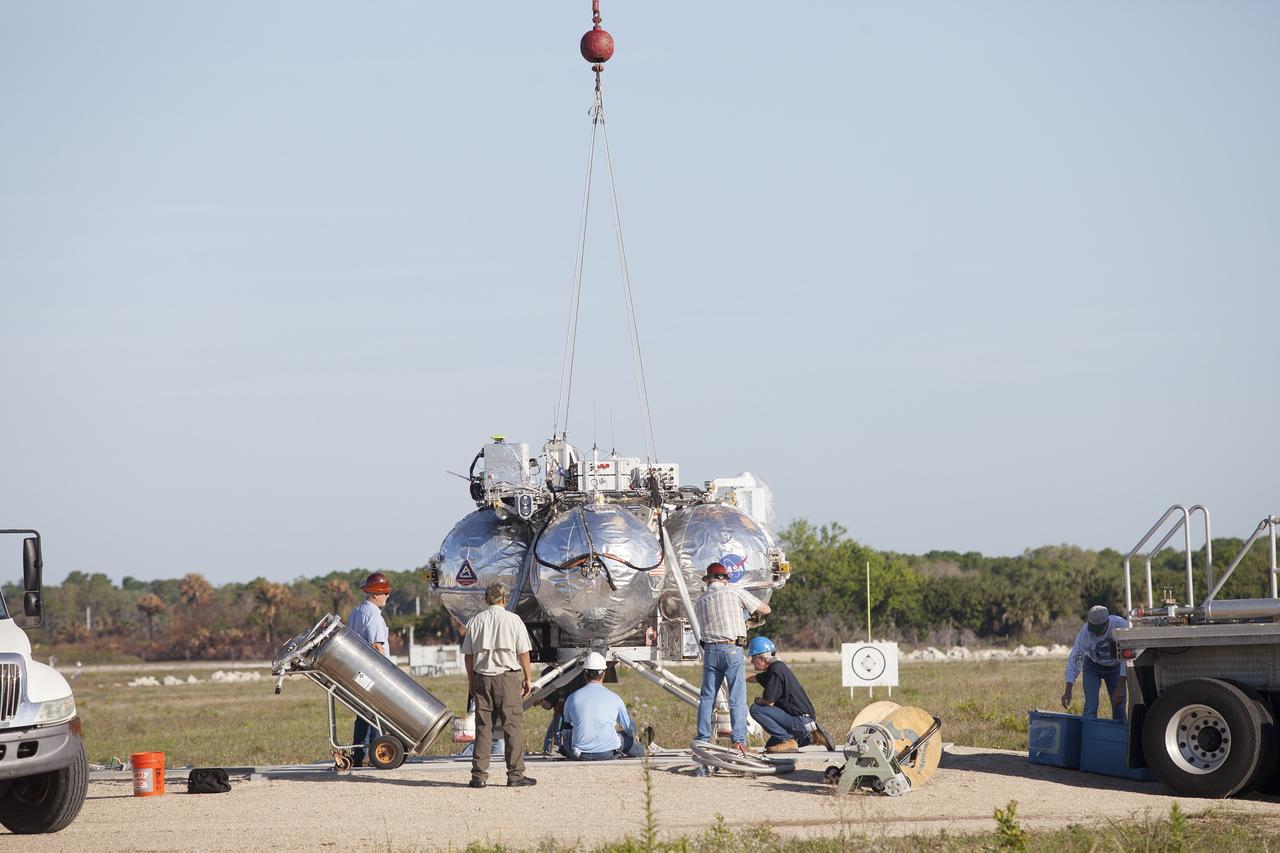
CAPE CANAVERAL, Fla. – Engineers and technicians prepare NASA's Project Morpheus prototype lander for a free flight test at a new launch site at the north end of the Shuttle Landing Facility at NASA’s Kennedy Space Center in Florida. The 96-second test began at 4:21 p.m. EDT with the Morpheus lander launching from the ground over the flame trench and ascending more than 800 feet at a peak speed of 36 mph. The vehicle with its recently installed autonomous landing and hazard avoidance technology, or ALHAT, sensors surveyed the hazard field to determine safe landing sites. Morpheus then flew forward and downward covering 1,300 feet while performing a 78-foot divert to simulate a hazard avoidance maneuver. The lander descended and landed on a dedicated pad inside the ALHAT field. Project Morpheus tests NASA’s ALHAT, and an engine that runs on liquid oxygen and methane, or green propellants, into a fully-operational lander that could deliver cargo to other planetary surfaces. The landing facility provides the lander with the kind of field necessary for realistic testing, complete with rocks, craters and hazards to avoid. Morpheus’ ALHAT payload allows it to navigate to clear landing sites amidst rocks, craters and other hazards during its descent. Project Morpheus is being managed under the Advanced Exploration Systems, or AES, Division in NASA’s Human Exploration and Operations Mission Directorate. The efforts in AES pioneer new approaches for rapidly developing prototype systems, demonstrating key capabilities and validating operational concepts for future human missions beyond Earth orbit. For more information on Project Morpheus, visit http://morpheuslander.jsc.nasa.gov/. Photo credit: NASA/Frankie Martin
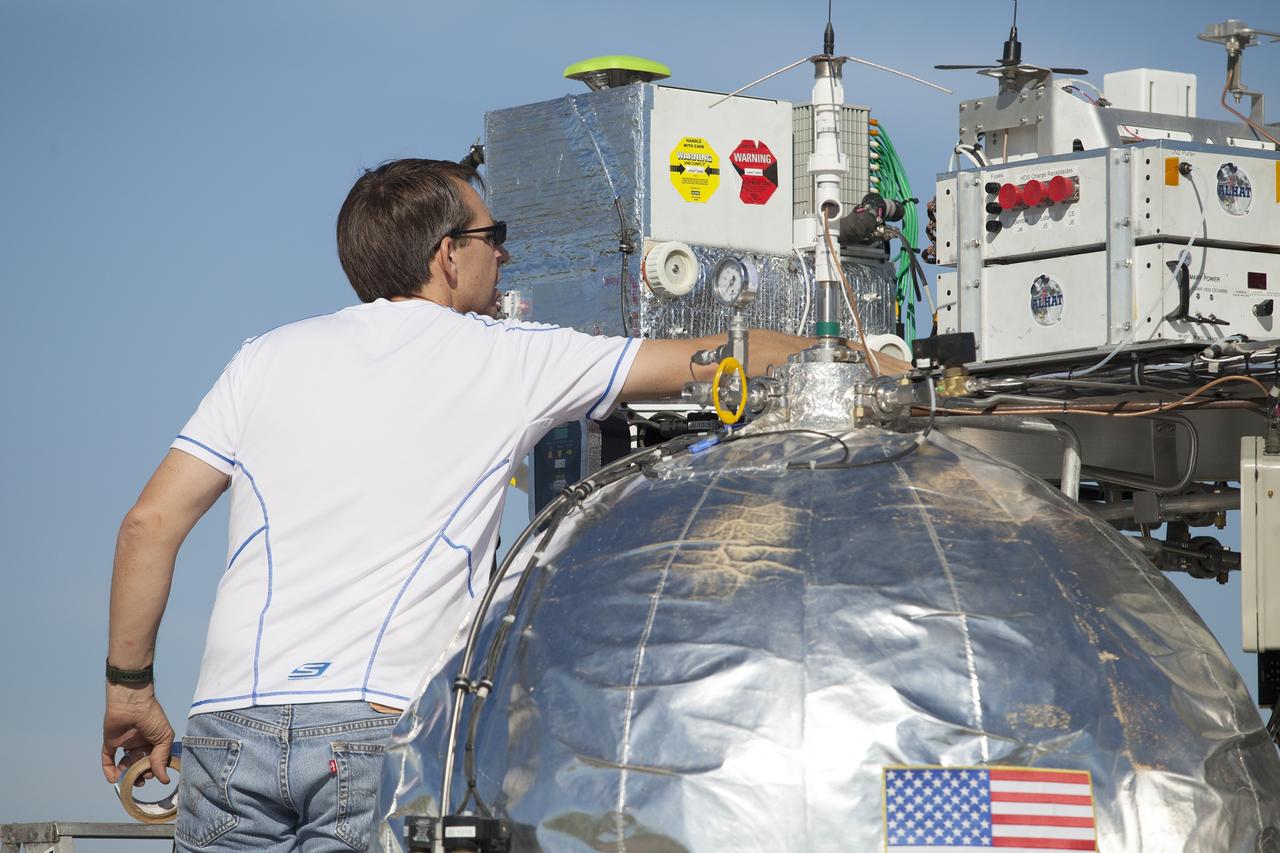
CAPE CANAVERAL, Fla. – An engineer helps prepare NASA's Project Morpheus prototype lander for a free flight test at a new launch site at the north end of the Shuttle Landing Facility at NASA’s Kennedy Space Center in Florida. The 96-second test began at 4:21 p.m. EDT with the Morpheus lander launching from the ground over the flame trench and ascending more than 800 feet at a peak speed of 36 mph. The vehicle with its recently installed autonomous landing and hazard avoidance technology, or ALHAT, sensors surveyed the hazard field to determine safe landing sites. Morpheus then flew forward and downward covering 1,300 feet while performing a 78-foot divert to simulate a hazard avoidance maneuver. The lander descended and landed on a dedicated pad inside the ALHAT field. Project Morpheus tests NASA’s ALHAT, and an engine that runs on liquid oxygen and methane, or green propellants, into a fully-operational lander that could deliver cargo to other planetary surfaces. The landing facility provides the lander with the kind of field necessary for realistic testing, complete with rocks, craters and hazards to avoid. Morpheus’ ALHAT payload allows it to navigate to clear landing sites amidst rocks, craters and other hazards during its descent. Project Morpheus is being managed under the Advanced Exploration Systems, or AES, Division in NASA’s Human Exploration and Operations Mission Directorate. The efforts in AES pioneer new approaches for rapidly developing prototype systems, demonstrating key capabilities and validating operational concepts for future human missions beyond Earth orbit. For more information on Project Morpheus, visit http://morpheuslander.jsc.nasa.gov/. Photo credit: NASA/Frankie Martin
CAPE CANAVERAL, Fla. – NASA's Project Morpheus prototype lander begins its descent toward the autonomous landing and hazard avoidance technology, or ALHAT, hazard field after a free flight test at the north end of the Shuttle Landing Facility at NASA's Kennedy Space Center in Florida. The 96-second test began at 4:21 p.m. EDT with the Morpheus lander launching from the ground over the flame trench at a new launch site and ascending more than 800 feet at a peak speed of 36 mph. The vehicle with its recently installed autonomous landing and hazard avoidance technology, or ALHAT, sensors surveyed the hazard field to determine safe landing sites. Morpheus then flew forward and downward covering 1,300 feet while performing a 78-foot divert to simulate a hazard avoidance maneuver. The lander descended and landed on a dedicated pad inside the ALHAT field. Project Morpheus tests NASA’s ALHAT, and an engine that runs on liquid oxygen and methane, or green propellants, into a fully-operational lander that could deliver cargo to other planetary surfaces. The landing facility provides the lander with the kind of field necessary for realistic testing, complete with rocks, craters and hazards to avoid. Morpheus’ ALHAT payload allows it to navigate to clear landing sites amidst rocks, craters and other hazards during its descent. Project Morpheus is being managed under the Advanced Exploration Systems, or AES, Division in NASA’s Human Exploration and Operations Mission Directorate. The efforts in AES pioneer new approaches for rapidly developing prototype systems, demonstrating key capabilities and validating operational concepts for future human missions beyond Earth orbit. For more information on Project Morpheus, visit http://morpheuslander.jsc.nasa.gov/. Photo credit: NASA/Frankie Martin
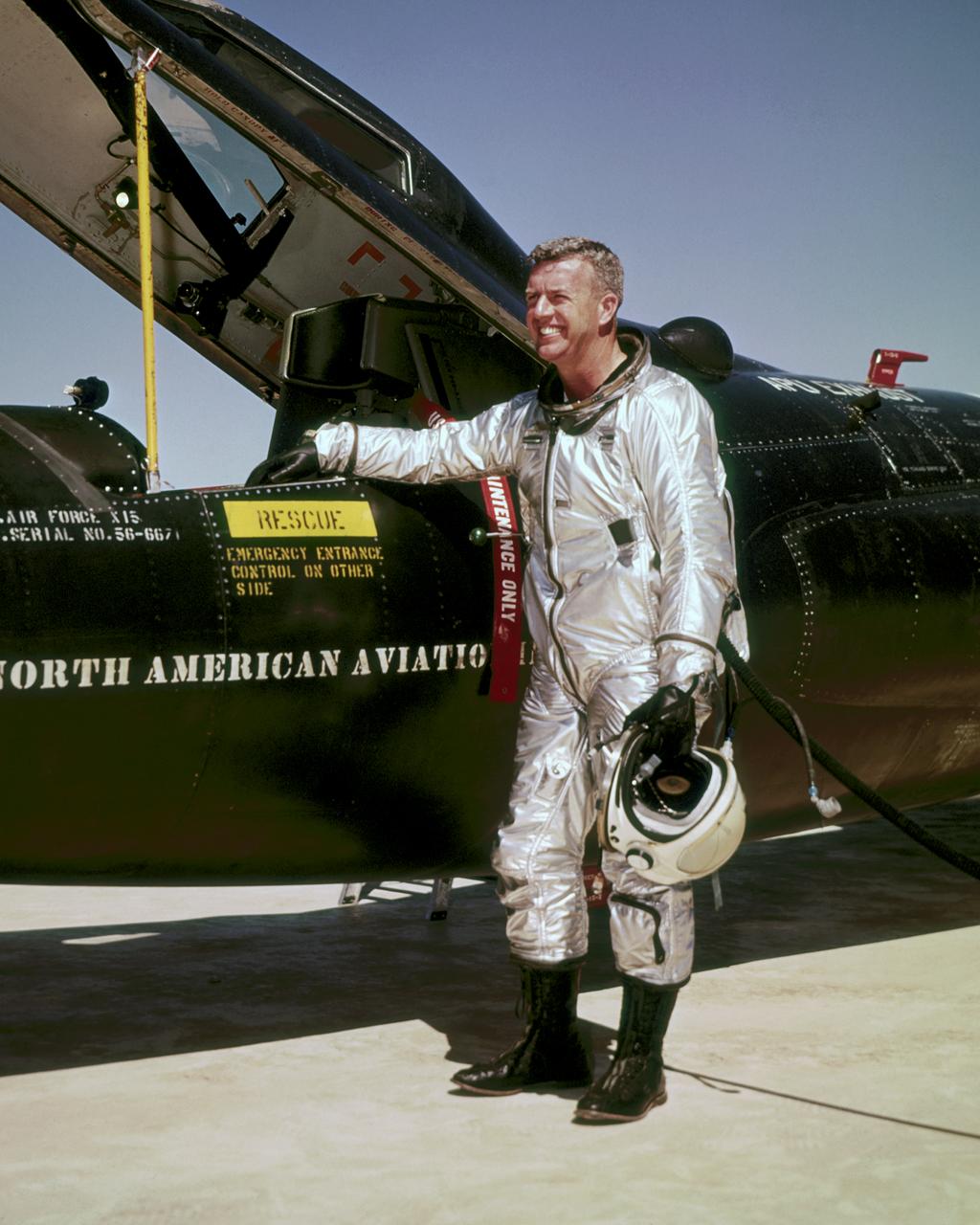
Joseph A. Walker was a Chief Research Pilot at the NASA Dryden Flight Research Center during the mid-1960s. He joined the NACA in March 1945, and served as project pilot at the Edwards flight research facility on such pioneering research projects as the D-558-1, D-558-2, X-1, X-3, X-4, X-5, and the X-15. He also flew programs involving the F-100, F-101, F-102, F-104, and the B-47. Walker made the first NASA X-15 flight on March 25, 1960. He flew the research aircraft 24 times and achieved its fastest speed and highest altitude. He attained a speed of 4,104 mph (Mach 5.92) during a flight on June 27, 1962, and reached an altitude of 354,300 feet on August 22, 1963 (his last X-15 flight). He was the first man to pilot the Lunar Landing Research Vehicle (LLRV) that was used to develop piloting and operational techniques for lunar landings. Walker was born February 20, 1921, in Washington, Pa. He lived there until graduating from Washington and Jefferson College in 1942, with a B.A. degree in Physics. During World War II he flew P-38 fighters for the Air Force, earning the Distinguished Flying Cross and the Air Medal with Seven Oak Clusters. Walker was the recipient of many awards during his 21 years as a research pilot. These include the 1961 Robert J. Collier Trophy, 1961 Harmon International Trophy for Aviators, the 1961 Kincheloe Award and 1961 Octave Chanute Award. He received an honorary Doctor of Aeronautical Sciences degree from his alma mater in June of 1962. Walker was named Pilot of the Year in 1963 by the National Pilots Association. He was a charter member of the Society of Experimental Test Pilots, and one of the first to be designated a Fellow. He was fatally injured on June 8, 1966, in a mid-air collision between an F-104 he was piloting and the XB-70.

CAPE CANAVERAL, Fla. – Engineers and technicians prepare NASA's Project Morpheus prototype lander for a free flight test at a new launch site at the north end of the Shuttle Landing Facility at NASA’s Kennedy Space Center in Florida. The 96-second test began at 4:21 p.m. EDT with the Morpheus lander launching from the ground over the flame trench and ascending more than 800 feet at a peak speed of 36 mph. The vehicle with its recently installed autonomous landing and hazard avoidance technology, or ALHAT, sensors surveyed the hazard field to determine safe landing sites. Morpheus then flew forward and downward covering 1,300 feet while performing a 78-foot divert to simulate a hazard avoidance maneuver. The lander descended and landed on a dedicated pad inside the ALHAT field. Project Morpheus tests NASA’s ALHAT, and an engine that runs on liquid oxygen and methane, or green propellants, into a fully-operational lander that could deliver cargo to other planetary surfaces. The landing facility provides the lander with the kind of field necessary for realistic testing, complete with rocks, craters and hazards to avoid. Morpheus’ ALHAT payload allows it to navigate to clear landing sites amidst rocks, craters and other hazards during its descent. Project Morpheus is being managed under the Advanced Exploration Systems, or AES, Division in NASA’s Human Exploration and Operations Mission Directorate. The efforts in AES pioneer new approaches for rapidly developing prototype systems, demonstrating key capabilities and validating operational concepts for future human missions beyond Earth orbit. For more information on Project Morpheus, visit http://morpheuslander.jsc.nasa.gov/. Photo credit: NASA/Frankie Martin

CAPE CANAVERAL, Fla. – Engineers and technicians prepare NASA's Project Morpheus prototype lander for a free flight test at a new launch site at the north end of the Shuttle Landing Facility at NASA’s Kennedy Space Center in Florida. The 96-second test began at 4:21 p.m. EDT with the Morpheus lander launching from the ground over the flame trench and ascending more than 800 feet at a peak speed of 36 mph. The vehicle with its recently installed autonomous landing and hazard avoidance technology, or ALHAT, sensors surveyed the hazard field to determine safe landing sites. Morpheus then flew forward and downward covering 1,300 feet while performing a 78-foot divert to simulate a hazard avoidance maneuver. The lander descended and landed on a dedicated pad inside the ALHAT field. Project Morpheus tests NASA’s ALHAT, and an engine that runs on liquid oxygen and methane, or green propellants, into a fully-operational lander that could deliver cargo to other planetary surfaces. The landing facility provides the lander with the kind of field necessary for realistic testing, complete with rocks, craters and hazards to avoid. Morpheus’ ALHAT payload allows it to navigate to clear landing sites amidst rocks, craters and other hazards during its descent. Project Morpheus is being managed under the Advanced Exploration Systems, or AES, Division in NASA’s Human Exploration and Operations Mission Directorate. The efforts in AES pioneer new approaches for rapidly developing prototype systems, demonstrating key capabilities and validating operational concepts for future human missions beyond Earth orbit. For more information on Project Morpheus, visit http://morpheuslander.jsc.nasa.gov/. Photo credit: NASA/Frankie Martin
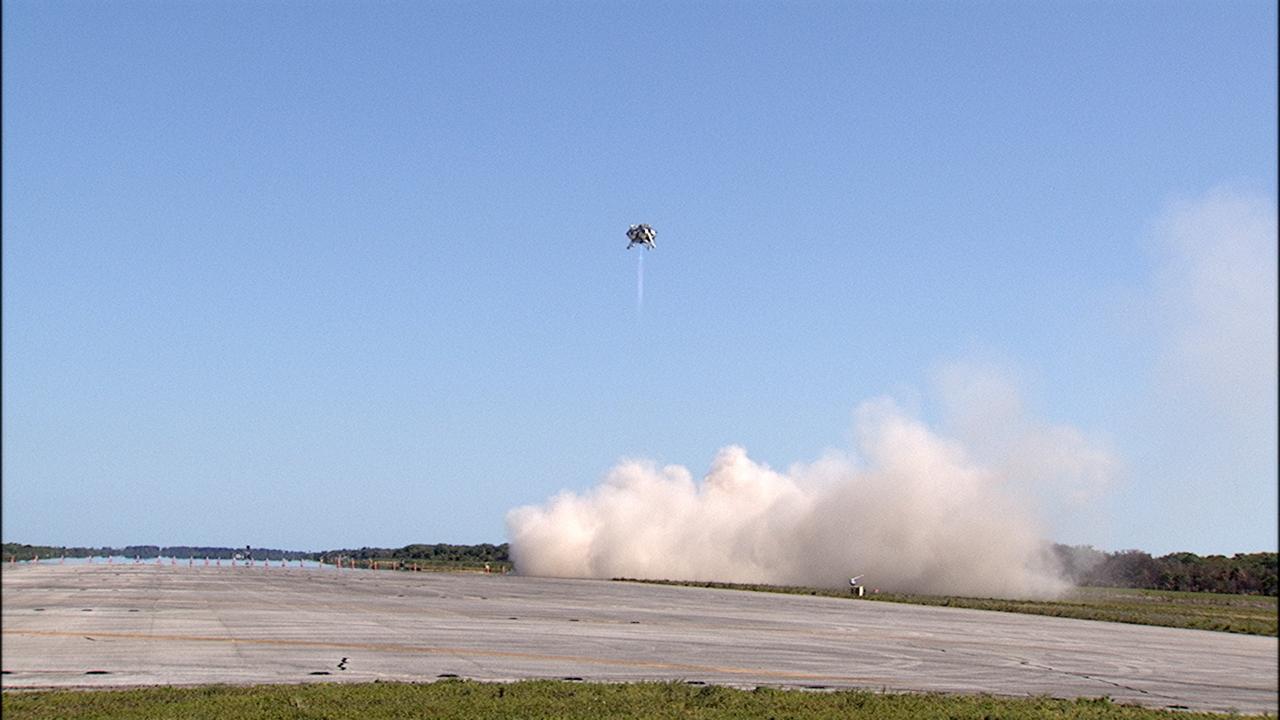
CAPE CANAVERAL, Fla. – NASA's Project Morpheus prototype lander soars high during a free flight test at the north end of the Shuttle Landing Facility at NASA's Kennedy Space Center in Florida. The 96-second test began at 4:21 p.m. EDT with the Morpheus lander launching from the ground over the flame trench at a new launch site and ascending more than 800 feet at a peak speed of 36 mph. The vehicle with its recently installed autonomous landing and hazard avoidance technology, or ALHAT, sensors surveyed the hazard field to determine safe landing sites. Morpheus then flew forward and downward covering 1,300 feet while performing a 78-foot divert to simulate a hazard avoidance maneuver. The lander descended and landed on a dedicated pad inside the ALHAT field. Project Morpheus tests NASA’s ALHAT, and an engine that runs on liquid oxygen and methane, or green propellants, into a fully-operational lander that could deliver cargo to other planetary surfaces. The landing facility provides the lander with the kind of field necessary for realistic testing, complete with rocks, craters and hazards to avoid. Morpheus’ ALHAT payload allows it to navigate to clear landing sites amidst rocks, craters and other hazards during its descent. Project Morpheus is being managed under the Advanced Exploration Systems, or AES, Division in NASA’s Human Exploration and Operations Mission Directorate. The efforts in AES pioneer new approaches for rapidly developing prototype systems, demonstrating key capabilities and validating operational concepts for future human missions beyond Earth orbit. For more information on Project Morpheus, visit http://morpheuslander.jsc.nasa.gov/. Photo credit: NASA/Frankie Martin
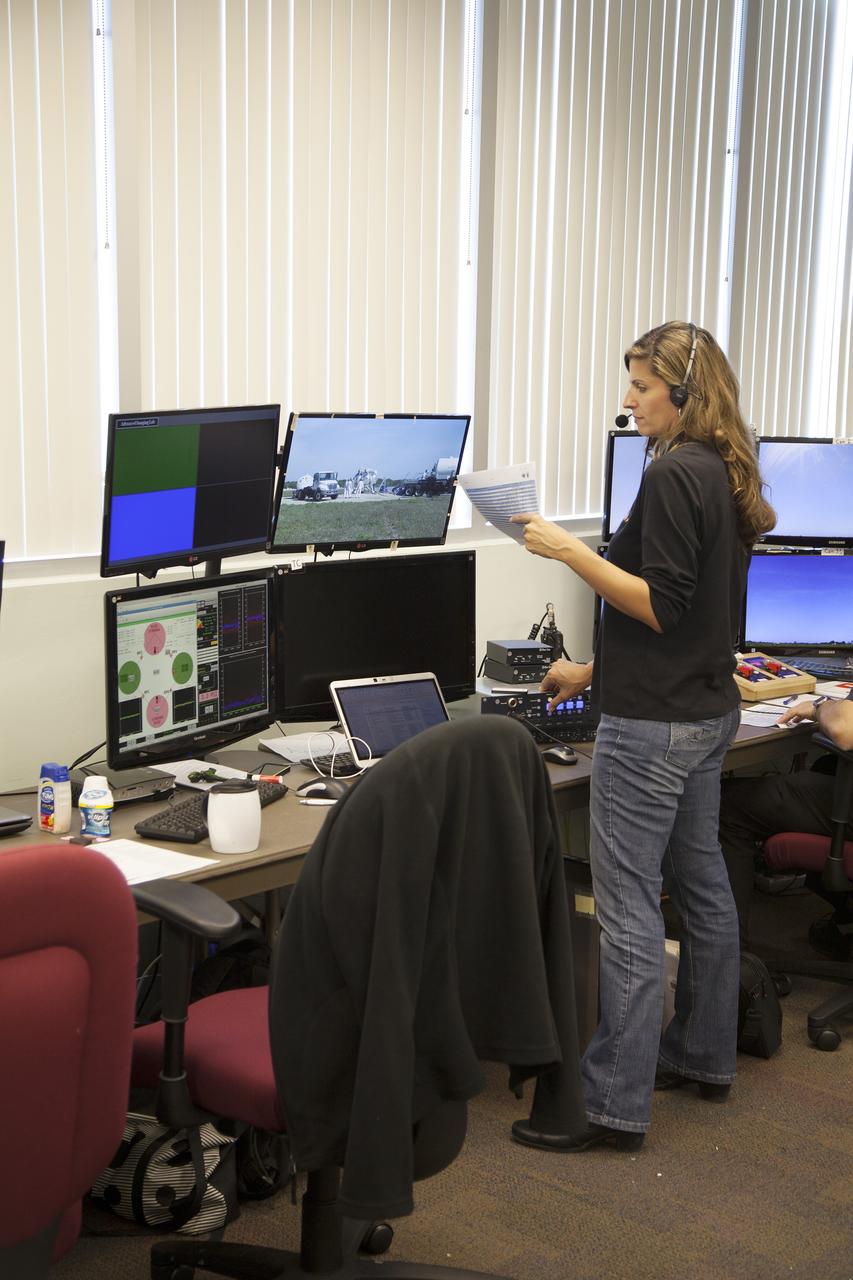
CAPE CANAVERAL, Fla. – Engineers monitor preparations inside a control room for the free flight test of NASA's Project Morpheus prototype lander at a new launch site at the north end of the Shuttle Landing Facility at NASA's Kennedy Space Center in Florida. The 96-second test began at 4:21 p.m. EDT with the Morpheus lander launching from the ground over the flame trench and ascending more than 800 feet at a peak speed of 36 mph. The vehicle with its recently installed autonomous landing and hazard avoidance technology, or ALHAT, sensors surveyed the hazard field to determine safe landing sites. Morpheus then flew forward and downward covering 1,300 feet while performing a 78-foot divert to simulate a hazard avoidance maneuver. The lander descended and landed on a dedicated pad inside the ALHAT field. Project Morpheus tests NASA’s ALHAT, and an engine that runs on liquid oxygen and methane, or green propellants, into a fully-operational lander that could deliver cargo to other planetary surfaces. The landing facility provides the lander with the kind of field necessary for realistic testing, complete with rocks, craters and hazards to avoid. Morpheus’ ALHAT payload allows it to navigate to clear landing sites amidst rocks, craters and other hazards during its descent. Project Morpheus is being managed under the Advanced Exploration Systems, or AES, Division in NASA’s Human Exploration and Operations Mission Directorate. The efforts in AES pioneer new approaches for rapidly developing prototype systems, demonstrating key capabilities and validating operational concepts for future human missions beyond Earth orbit. For more information on Project Morpheus, visit http://morpheuslander.jsc.nasa.gov/. Photo credit: NASA/Frankie Martin
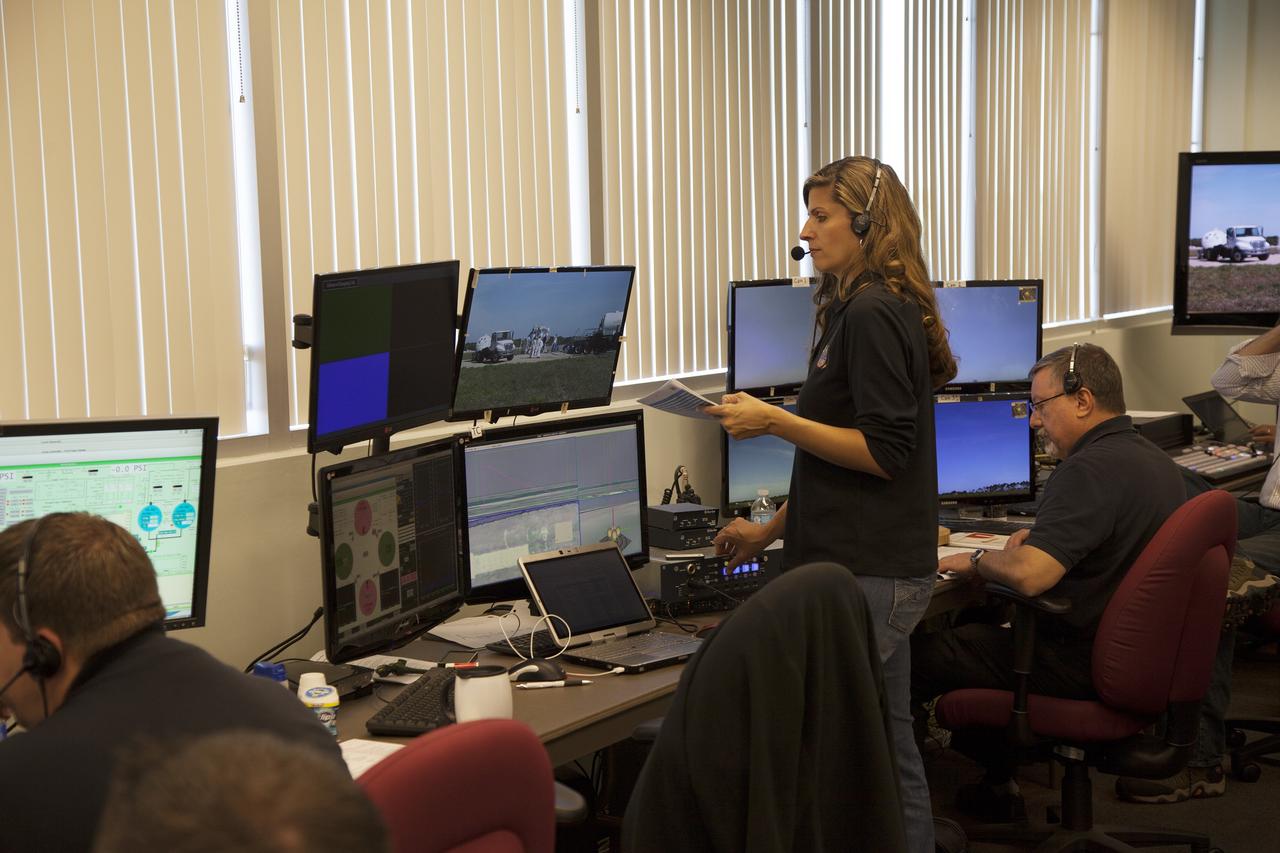
CAPE CANAVERAL, Fla. – Engineers monitor preparations inside a control room for the free flight test of NASA's Project Morpheus prototype lander at a new launch site at the north end of the Shuttle Landing Facility at NASA's Kennedy Space Center in Florida. The 96-second test began at 4:21 p.m. EDT with the Morpheus lander launching from the ground over the flame trench and ascending more than 800 feet at a peak speed of 36 mph. The vehicle with its recently installed autonomous landing and hazard avoidance technology, or ALHAT, sensors surveyed the hazard field to determine safe landing sites. Morpheus then flew forward and downward covering 1,300 feet while performing a 78-foot divert to simulate a hazard avoidance maneuver. The lander descended and landed on a dedicated pad inside the ALHAT field. Project Morpheus tests NASA’s ALHAT, and an engine that runs on liquid oxygen and methane, or green propellants, into a fully-operational lander that could deliver cargo to other planetary surfaces. The landing facility provides the lander with the kind of field necessary for realistic testing, complete with rocks, craters and hazards to avoid. Morpheus’ ALHAT payload allows it to navigate to clear landing sites amidst rocks, craters and other hazards during its descent. Project Morpheus is being managed under the Advanced Exploration Systems, or AES, Division in NASA’s Human Exploration and Operations Mission Directorate. The efforts in AES pioneer new approaches for rapidly developing prototype systems, demonstrating key capabilities and validating operational concepts for future human missions beyond Earth orbit. For more information on Project Morpheus, visit http://morpheuslander.jsc.nasa.gov/. Photo credit: NASA/Frankie Martin
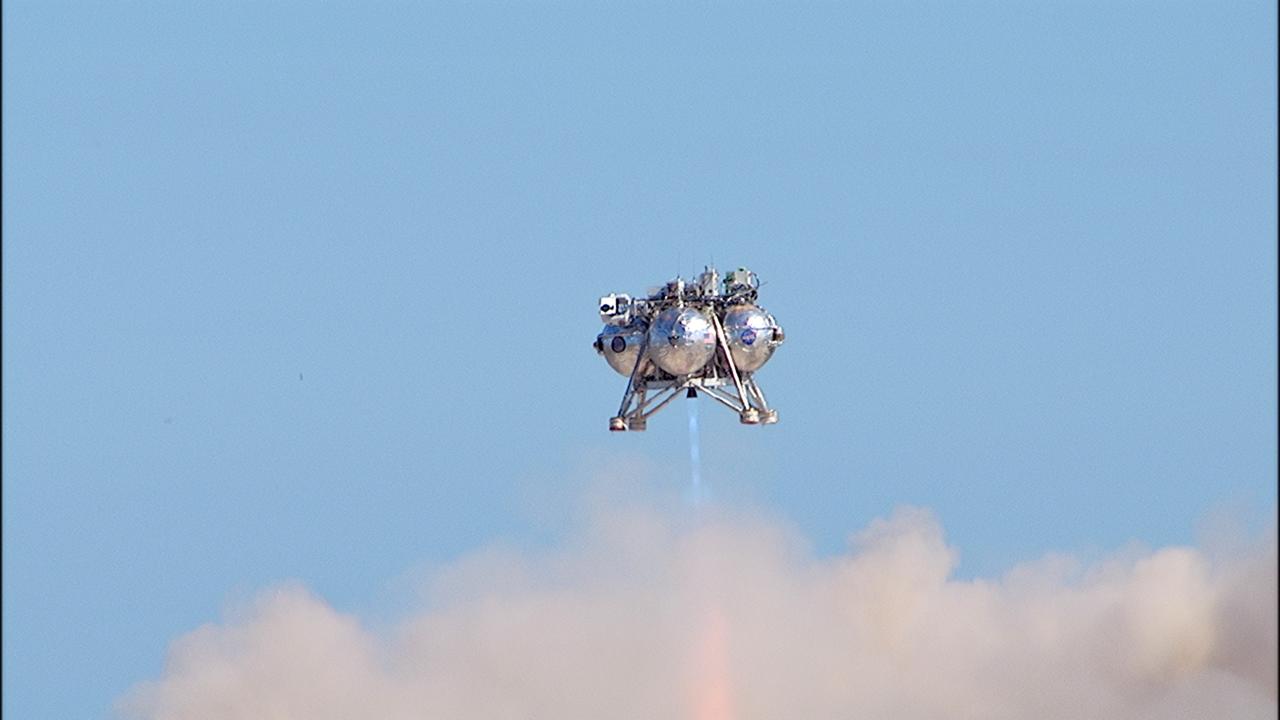
CAPE CANAVERAL, Fla. – NASA's Project Morpheus prototype lander soars high during a free flight test at the north end of the Shuttle Landing Facility at NASA's Kennedy Space Center in Florida. The 96-second test began at 4:21 p.m. EDT with the Morpheus lander launching from the ground over the flame trench at a new launch site and ascending more than 800 feet at a peak speed of 36 mph. The vehicle with its recently installed autonomous landing and hazard avoidance technology, or ALHAT, sensors surveyed the hazard field to determine safe landing sites. Morpheus then flew forward and downward covering 1,300 feet while performing a 78-foot divert to simulate a hazard avoidance maneuver. The lander descended and landed on a dedicated pad inside the ALHAT field. Project Morpheus tests NASA’s ALHAT, and an engine that runs on liquid oxygen and methane, or green propellants, into a fully-operational lander that could deliver cargo to other planetary surfaces. The landing facility provides the lander with the kind of field necessary for realistic testing, complete with rocks, craters and hazards to avoid. Morpheus’ ALHAT payload allows it to navigate to clear landing sites amidst rocks, craters and other hazards during its descent. Project Morpheus is being managed under the Advanced Exploration Systems, or AES, Division in NASA’s Human Exploration and Operations Mission Directorate. The efforts in AES pioneer new approaches for rapidly developing prototype systems, demonstrating key capabilities and validating operational concepts for future human missions beyond Earth orbit. For more information on Project Morpheus, visit http://morpheuslander.jsc.nasa.gov/. Photo credit: NASA/Frankie Martin
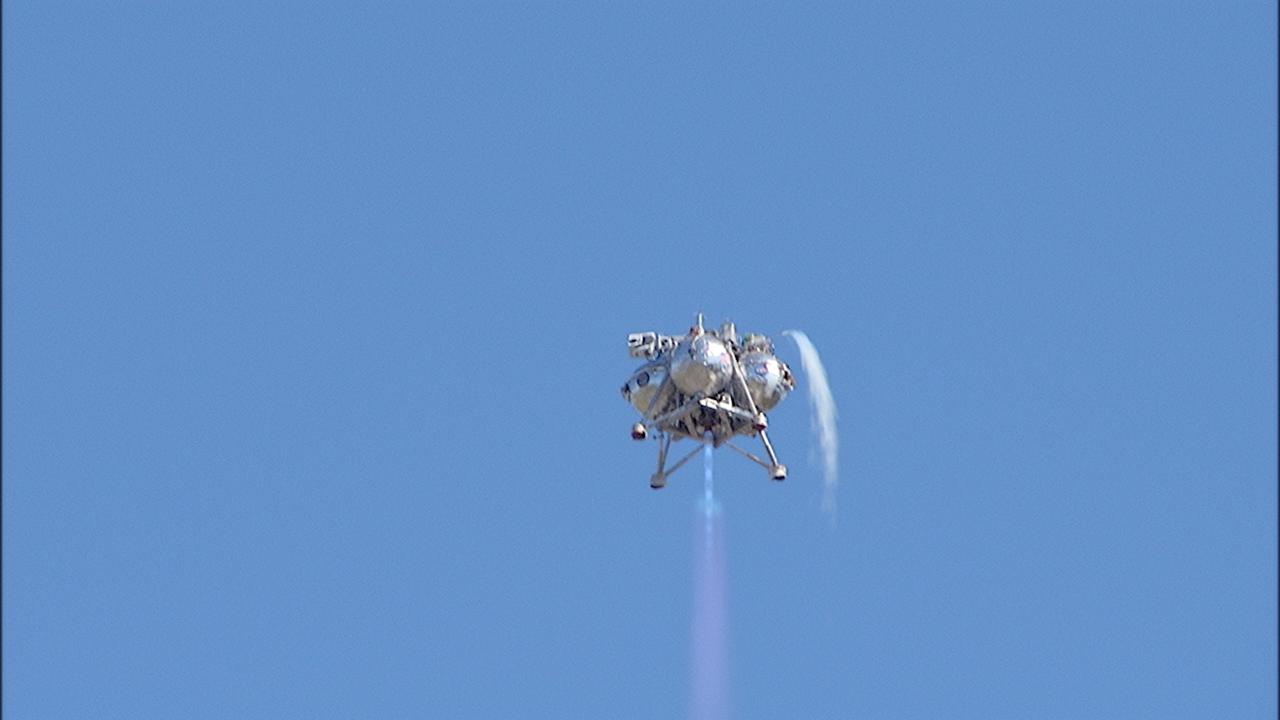
CAPE CANAVERAL, Fla. – NASA's Project Morpheus prototype lander soars high during a free flight test at the north end of the Shuttle Landing Facility at NASA's Kennedy Space Center in Florida. The 96-second test began at 4:21 p.m. EDT with the Morpheus lander launching from the ground over the flame trench at a new launch site and ascending more than 800 feet at a peak speed of 36 mph. The vehicle with its recently installed autonomous landing and hazard avoidance technology, or ALHAT, sensors surveyed the hazard field to determine safe landing sites. Morpheus then flew forward and downward covering 1,300 feet while performing a 78-foot divert to simulate a hazard avoidance maneuver. The lander descended and landed on a dedicated pad inside the ALHAT field. Project Morpheus tests NASA’s ALHAT, and an engine that runs on liquid oxygen and methane, or green propellants, into a fully-operational lander that could deliver cargo to other planetary surfaces. The landing facility provides the lander with the kind of field necessary for realistic testing, complete with rocks, craters and hazards to avoid. Morpheus’ ALHAT payload allows it to navigate to clear landing sites amidst rocks, craters and other hazards during its descent. Project Morpheus is being managed under the Advanced Exploration Systems, or AES, Division in NASA’s Human Exploration and Operations Mission Directorate. The efforts in AES pioneer new approaches for rapidly developing prototype systems, demonstrating key capabilities and validating operational concepts for future human missions beyond Earth orbit. For more information on Project Morpheus, visit http://morpheuslander.jsc.nasa.gov/. Photo credit: NASA/Frankie Martin
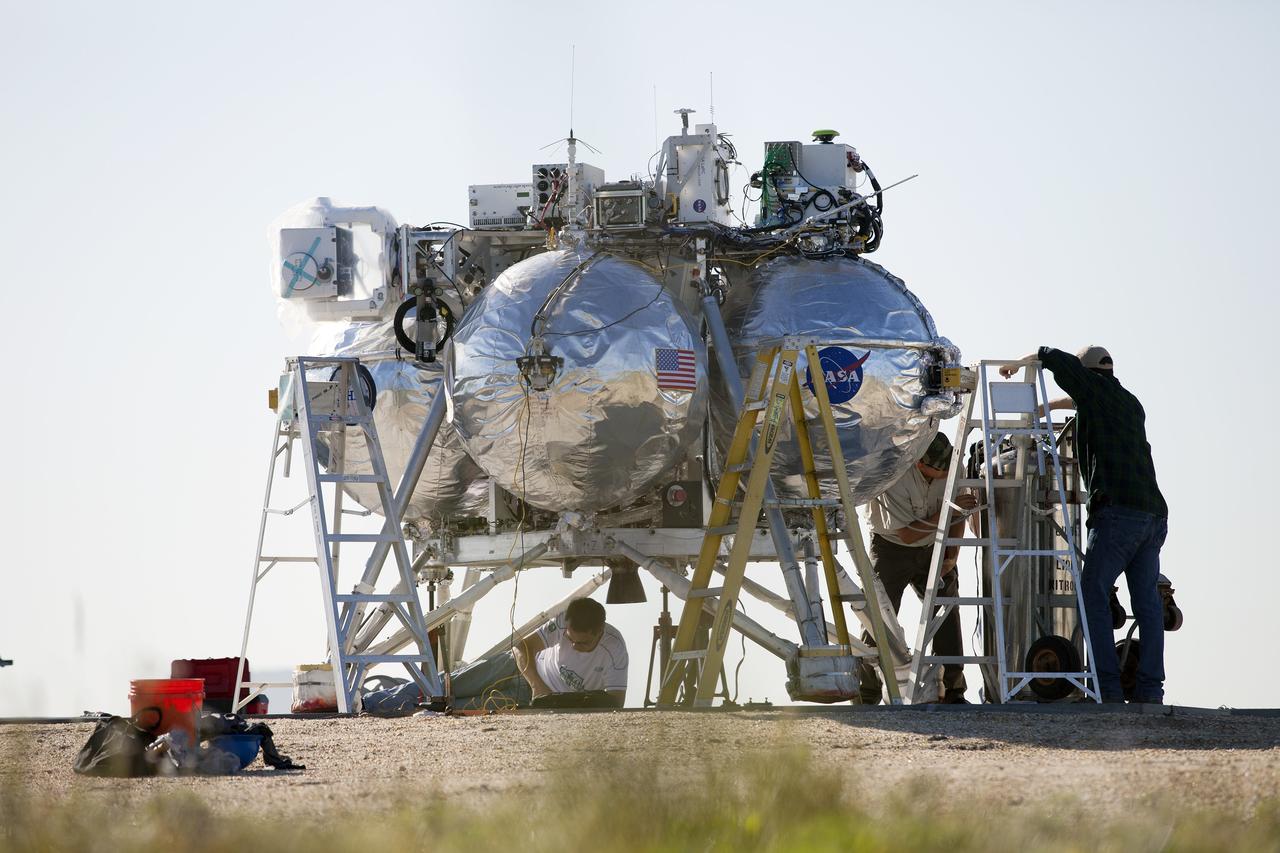
CAPE CANAVERAL, Fla. – Engineers and technicians prepare NASA's Project Morpheus prototype lander for a free flight test at a new launch site at the north end of the Shuttle Landing Facility at NASA’s Kennedy Space Center in Florida. The 96-second test began at 4:21 p.m. EDT with the Morpheus lander launching from the ground over the flame trench and ascending more than 800 feet at a peak speed of 36 mph. The vehicle with its recently installed autonomous landing and hazard avoidance technology, or ALHAT, sensors surveyed the hazard field to determine safe landing sites. Morpheus then flew forward and downward covering 1,300 feet while performing a 78-foot divert to simulate a hazard avoidance maneuver. The lander descended and landed on a dedicated pad inside the ALHAT field. Project Morpheus tests NASA’s ALHAT, and an engine that runs on liquid oxygen and methane, or green propellants, into a fully-operational lander that could deliver cargo to other planetary surfaces. The landing facility provides the lander with the kind of field necessary for realistic testing, complete with rocks, craters and hazards to avoid. Morpheus’ ALHAT payload allows it to navigate to clear landing sites amidst rocks, craters and other hazards during its descent. Project Morpheus is being managed under the Advanced Exploration Systems, or AES, Division in NASA’s Human Exploration and Operations Mission Directorate. The efforts in AES pioneer new approaches for rapidly developing prototype systems, demonstrating key capabilities and validating operational concepts for future human missions beyond Earth orbit. For more information on Project Morpheus, visit http://morpheuslander.jsc.nasa.gov/. Photo credit: NASA/Frankie Martin
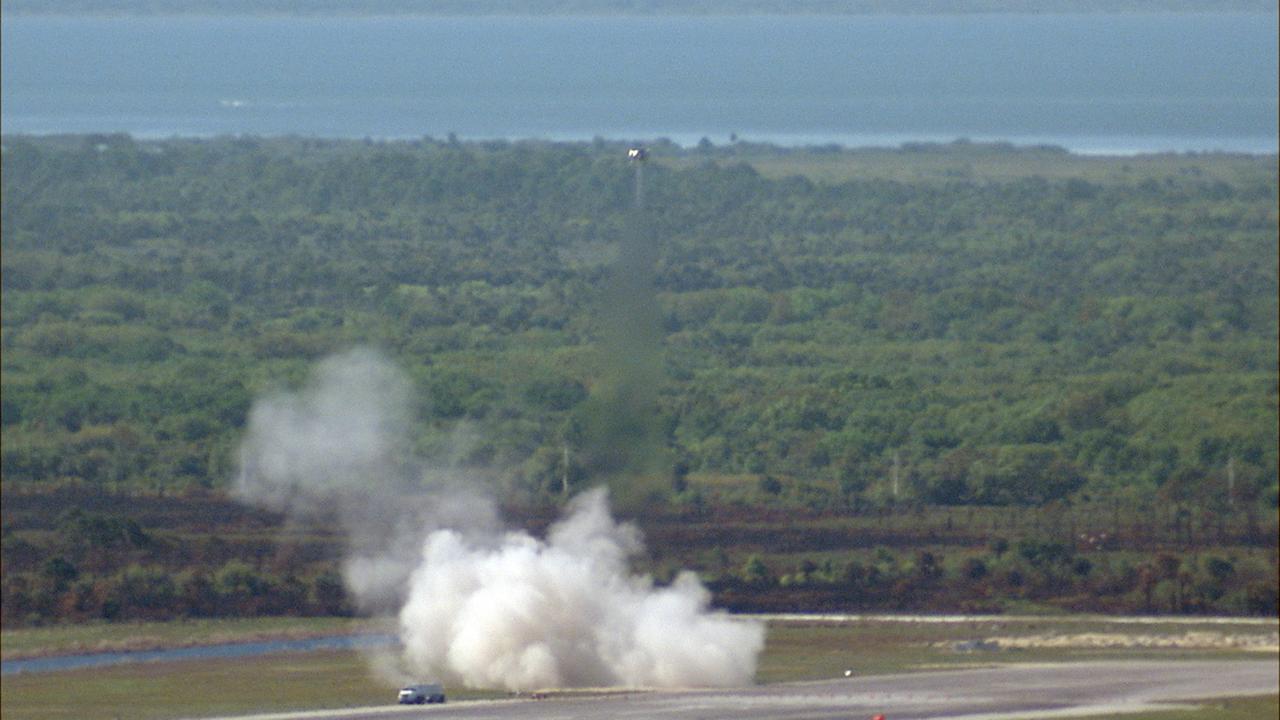
CAPE CANAVERAL, Fla. – NASA's Project Morpheus prototype lander soars high during a free flight test at the north end of the Shuttle Landing Facility at NASA's Kennedy Space Center in Florida. The 96-second test began at 4:21 p.m. EDT with the Morpheus lander launching from the ground over the flame trench at a new launch site and ascending more than 800 feet at a peak speed of 36 mph. The vehicle with its recently installed autonomous landing and hazard avoidance technology, or ALHAT, sensors surveyed the hazard field to determine safe landing sites. Morpheus then flew forward and downward covering 1,300 feet while performing a 78-foot divert to simulate a hazard avoidance maneuver. The lander descended and landed on a dedicated pad inside the ALHAT field. Project Morpheus tests NASA’s ALHAT, and an engine that runs on liquid oxygen and methane, or green propellants, into a fully-operational lander that could deliver cargo to other planetary surfaces. The landing facility provides the lander with the kind of field necessary for realistic testing, complete with rocks, craters and hazards to avoid. Morpheus’ ALHAT payload allows it to navigate to clear landing sites amidst rocks, craters and other hazards during its descent. Project Morpheus is being managed under the Advanced Exploration Systems, or AES, Division in NASA’s Human Exploration and Operations Mission Directorate. The efforts in AES pioneer new approaches for rapidly developing prototype systems, demonstrating key capabilities and validating operational concepts for future human missions beyond Earth orbit. For more information on Project Morpheus, visit http://morpheuslander.jsc.nasa.gov/. Photo credit: NASA/Frankie Martin