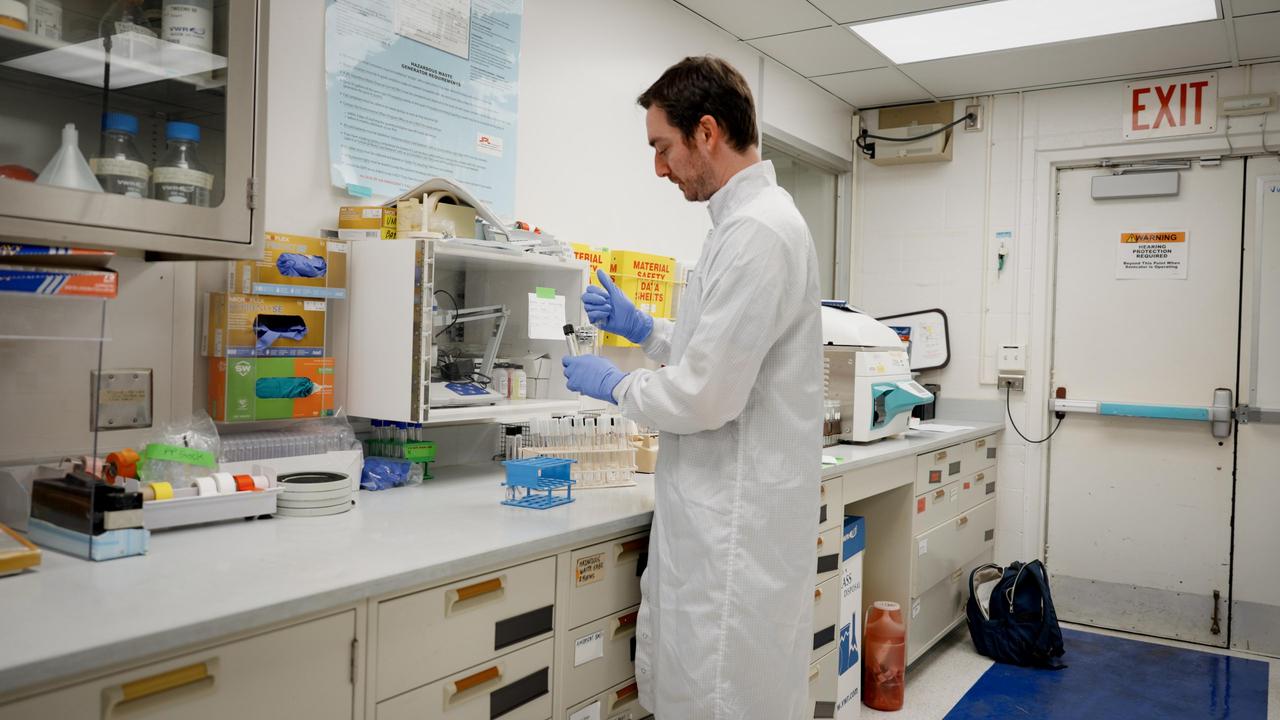
A planetary protection engineer at NASA's Jet Propulsion Laboratory prepares samples for analysis on March 20, 2024. The samples, swabbed from the surfaces of the agency's Europa Clipper spacecraft during its construction, were collected to help monitor the mission's adherence to strict standards for biological cleanliness. Created in keeping with the international 1967 Outer Space Treaty, the mission's planetary protection protocols are designed to minimize the chance that microbes brought from Earth could compromise future scientific investigations at its target destination: Jupiter's icy moon Europa. Europa Clipper's three main science objectives are to determine the thickness of the moon's icy shell and its interactions with the ocean below, to investigate its composition, and to characterize its geology. The mission's detailed exploration of Europa will help scientists better understand the astrobiological potential for habitable worlds beyond our planet. https://photojournal.jpl.nasa.gov/catalog/PIA26441
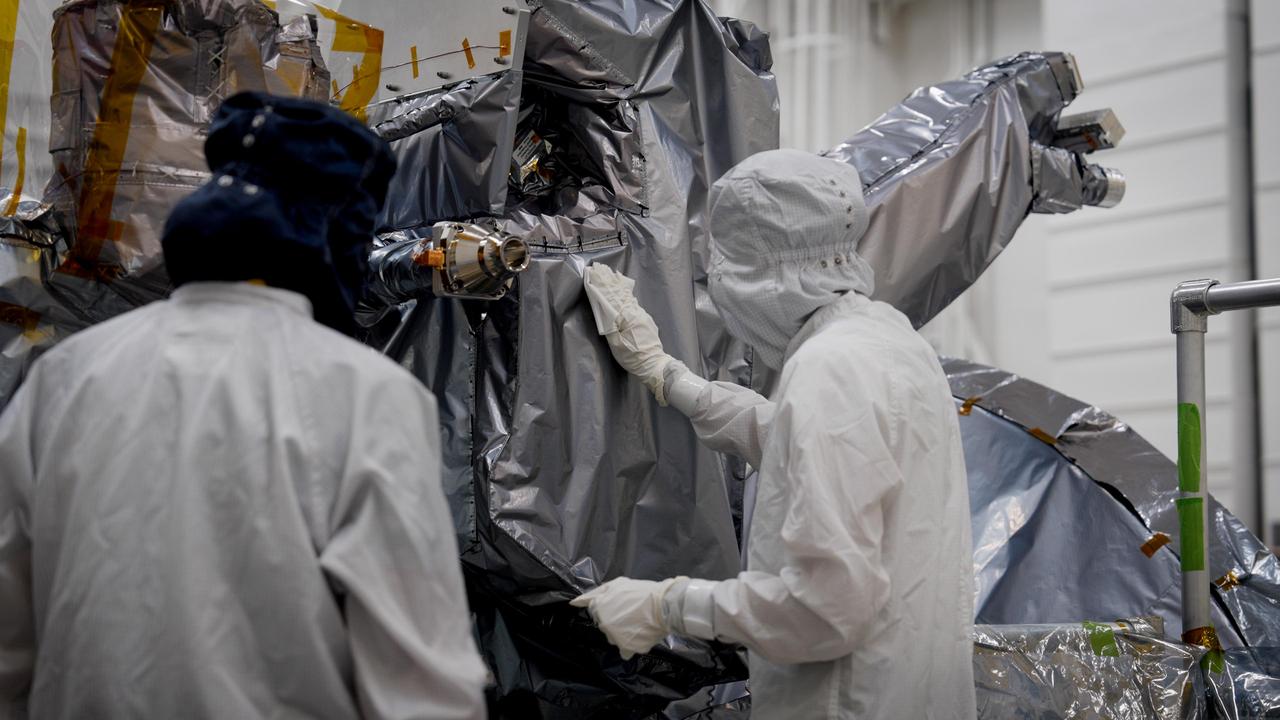
A planetary protection engineer in full-body protective gear carefully collects samples from NASA's Europa Clipper spacecraft to verify its biological cleanliness in a clean room at NASA's Jet Propulsion Laboratory on March 20, 2024. Maintaining and verifying the cleanliness of the spacecraft helps minimize the chance that microbes brought from Earth could compromise future scientific investigations at its destination, Jupiter's moon Europa. This work, referred to as planetary protection, is conducted in keeping with the international 1967 Outer Space Treaty to explore space in a responsible manner that avoids the harmful contamination of celestial bodies. This photo was taken while Europa Clipper was being built in JPL's Spacecraft Assembly Facility. Europa Clipper's three main science objectives are to determine the thickness of the moon's icy shell and its interactions with the ocean below, to investigate its composition, and to characterize its geology. The mission's detailed exploration of Europa will help scientists better understand the astrobiological potential for habitable worlds beyond our planet. https://photojournal.jpl.nasa.gov/catalog/PIA26440

Lisa Pratt, NASA's Planetary Protection Officer, answers a question from the audience during a special session titled “Planetary Protection for the Future: Science, Exploration, and Commerce” at the 70th International Astronautical Congress, Thursday, Oct. 24, 2019, at the Walter E. Washington Convention Center in Washington. Photo Credit: (NASA/Joel Kowsky)

Lisa Pratt, NASA's Planetary Protection Officer, answers a question from the audience during a special session titled “Planetary Protection for the Future: Science, Exploration, and Commerce” at the 70th International Astronautical Congress, Thursday, Oct. 24, 2019, at the Walter E. Washington Convention Center in Washington. Photo Credit: (NASA/Joel Kowsky)
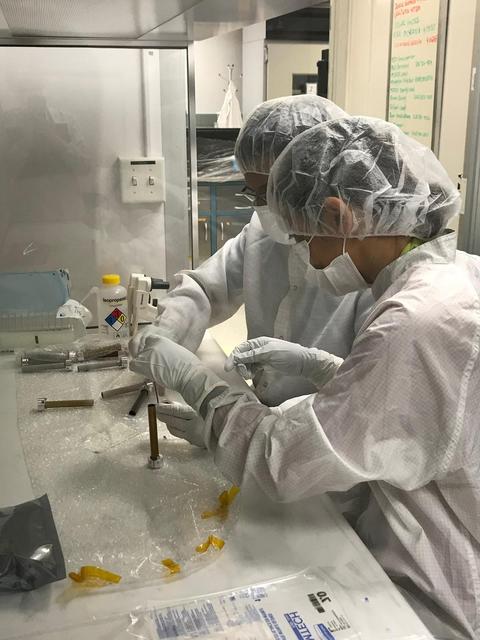
Planetary protection engineers at NASA's Jet Propulsion Laboratory in Southern California swab engineering models of the tubes that will store Martian rock and sediment samples as part of NASA’s Mars 2020 Perseverance mission. Team members wanted to understand the transport of biological particles when the rover is taking rock cores. These measurements helped the rover team design hardware and sampling methods that meet stringent biological contamination control requirements. https://photojournal.jpl.nasa.gov/catalog/PIA23718
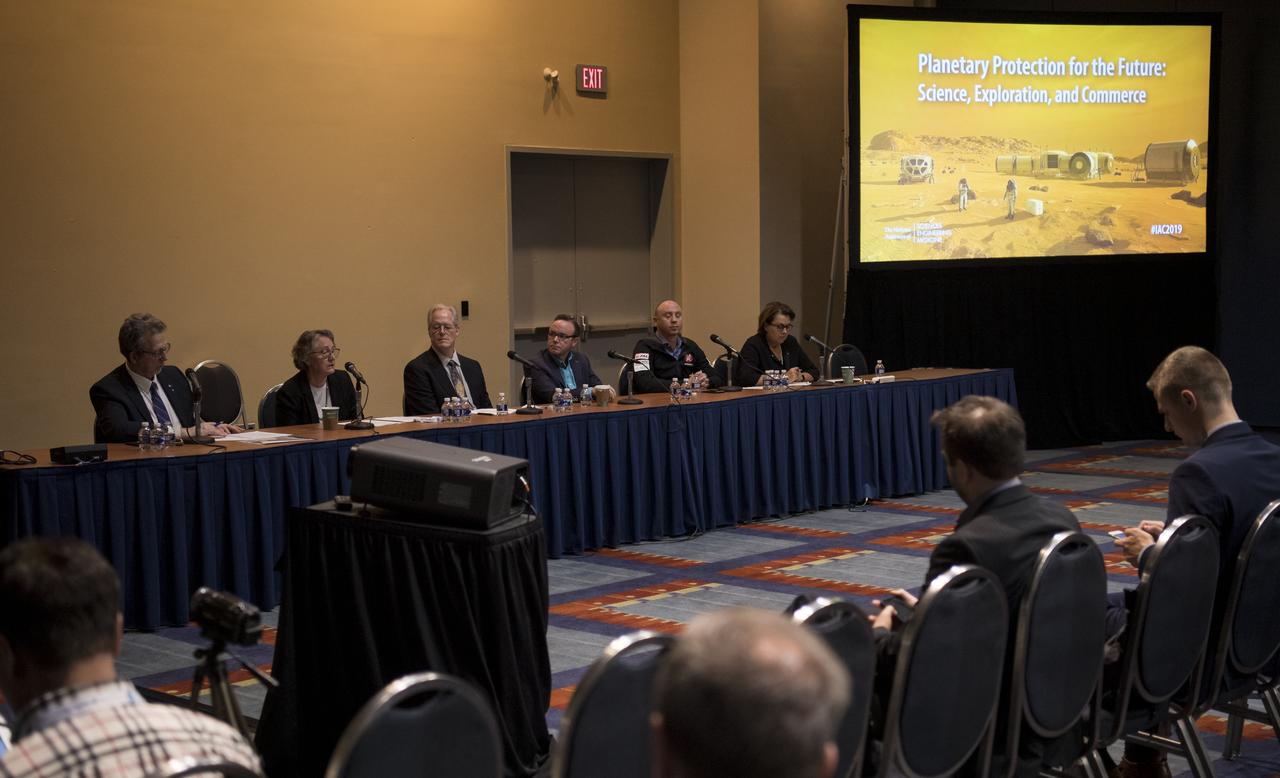
NASA Chief Scientist Jim Green, left, Lisa Pratt, NASA's Planetary Protection Officer, Michael Meyer, Lead Scientist for NASA's Mars Exploration Program, Dan Hendrickson, Vice President of Business Development at Astrobotic Technology, Kyle Acierno, Vice President of Global Sales and Strategy at ispace, and Simonetta Di Pippo, Director of the United Nations Office for Outer Space Affairs, right, are seen during a special session titled “Planetary Protection for the Future: Science, Exploration, and Commerce” at the 70th International Astronautical Congress, Thursday, Oct. 24, 2019, at the Walter E. Washington Convention Center in Washington. Photo Credit: (NASA/Joel Kowsky)

Simonetta Di Pippo, Director of the United Nations Office for Outer Space Affairs, is seen during a special session titled “Planetary Protection for the Future: Science, Exploration, and Commerce” at the 70th International Astronautical Congress, Thursday, Oct. 24, 2019, at the Walter E. Washington Convention Center in Washington. Photo Credit: (NASA/Joel Kowsky)

NASA Chief Scientist Jim Green is seen during a special session titled “Planetary Protection for the Future: Science, Exploration, and Commerce” at the 70th International Astronautical Congress, Thursday, Oct. 24, 2019 at the Walter E. Washington Convention Center in Washington. Photo Credit: (NASA/Joel Kowsky)
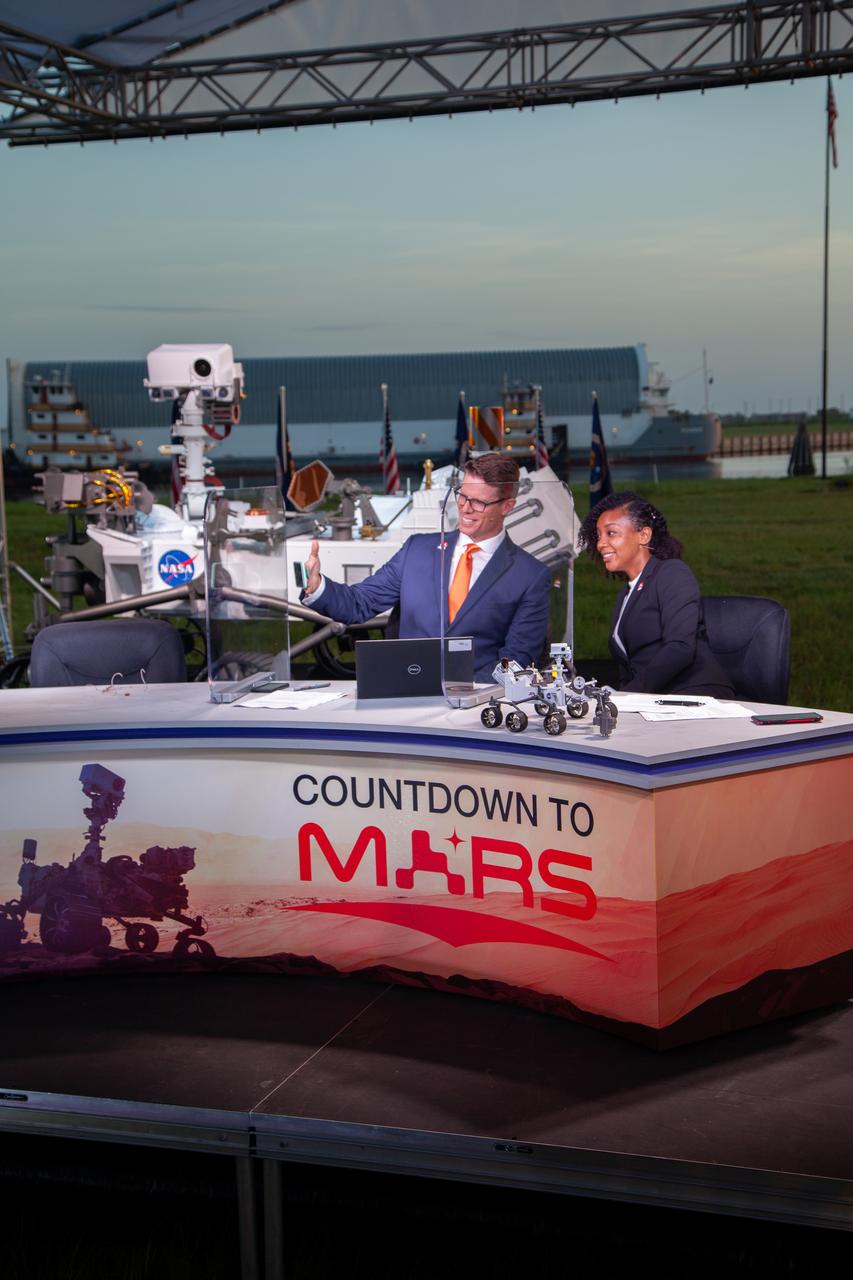
Countdown to Mars live commentary at Kennedy Space Center’s News Center in Florida on July 30, 2020, with hosts Derrol Nail, left, NASA Communications, and Moogega Cooper, Planetary Protection engineer at the agency’s Jet Propulsion Laboratory in California. The Mars Perseverance rover and Ingenuity helicopter are set to launch on a United Launch Alliance Atlas V 541 rocket at 7:50 a.m. EDT.
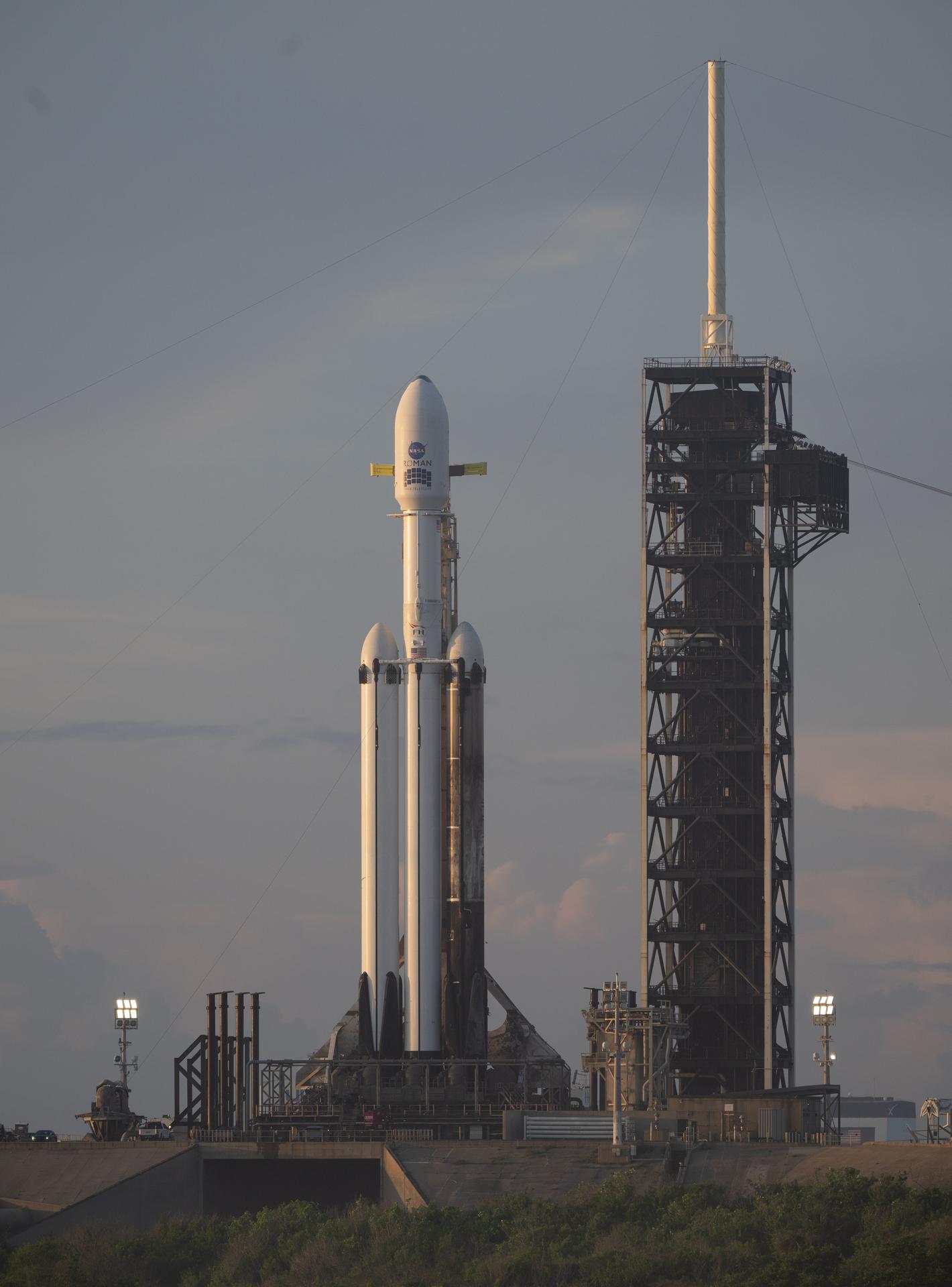
NASA’s Nancy Grace Roman Space Telescope, encapsulated in a protective payload fairing atop a SpaceX Falcon Heavy rocket, is seen at sunrise, Saturday, Aug. 29, 2026, at Launch Complex 39A at NASA’s Kennedy Space Center in Florida. Roman will investigate dark energy and dark matter, conduct a statistical census of planetary systems, and enable a broad range of additional astrophysics research. Liftoff from NASA Kennedy is targeted for Sunday, Aug. 30, 2026. Photo Credit (NASA/Joel Kowsky)
NASA’s Nancy Grace Roman Space Telescope, encapsulated in a protective payload fairing atop a SpaceX Falcon Heavy rocket, is seen at sunrise, Saturday, Aug. 29, 2026, at Launch Complex 39A at NASA’s Kennedy Space Center in Florida. Roman will investigate dark energy and dark matter, conduct a statistical census of planetary systems, and enable a broad range of additional astrophysics research. Liftoff from NASA Kennedy is targeted for Sunday, Aug. 30, 2026. Photo Credit (NASA/Joel Kowsky)
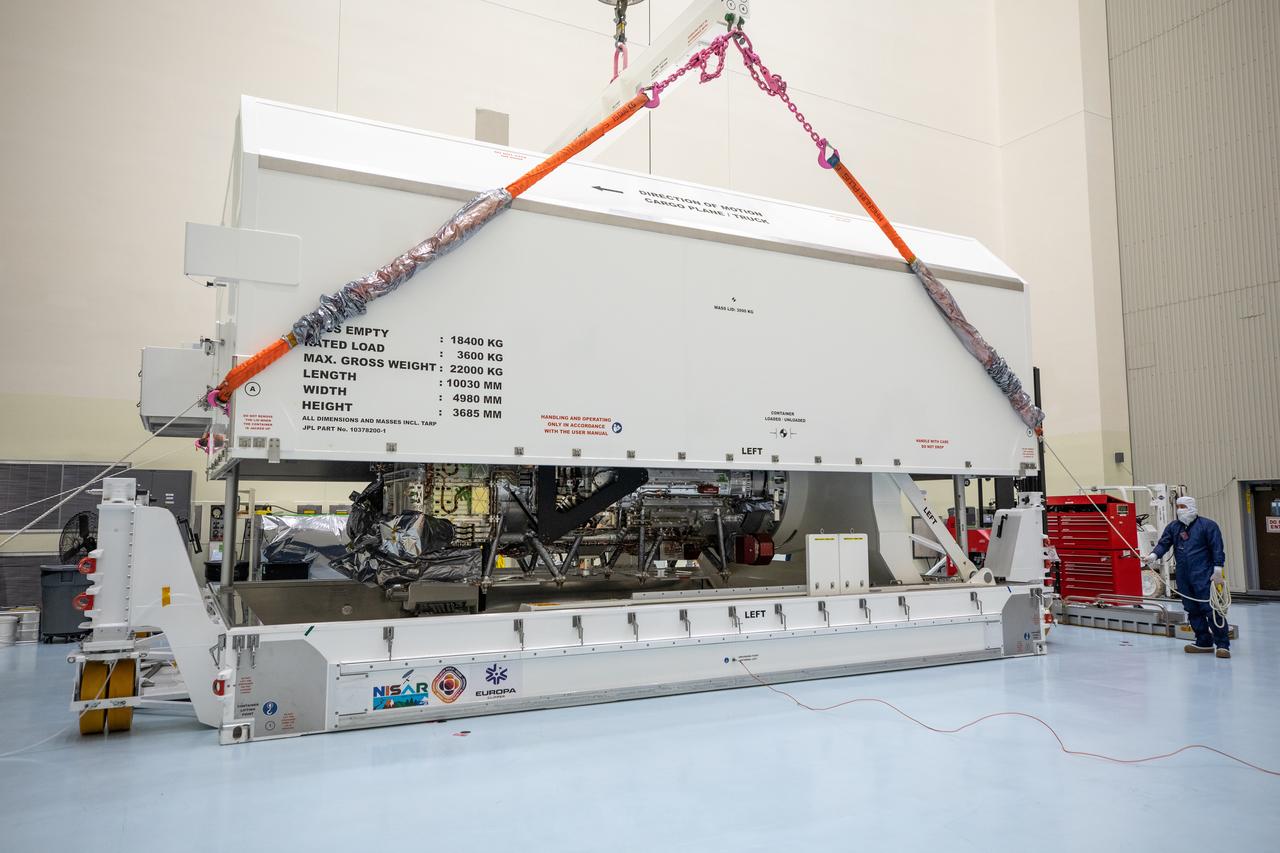
Technicians remove NASA’s largest planetary mission spacecraft, Europa Clipper, from its protective shipping container inside the Payload Hazardous Servicing Facility at the agency’s Kennedy Space Center in Florida on Tuesday, May 28, 2024. Slated to launch aboard a SpaceX Falcon Heavy rocket later this year from Launch Complex 39A at Kennedy, Europa Clipper will help determine if conditions exist below the surface Jupiter’s fourth largest moon, Europa that could support life.
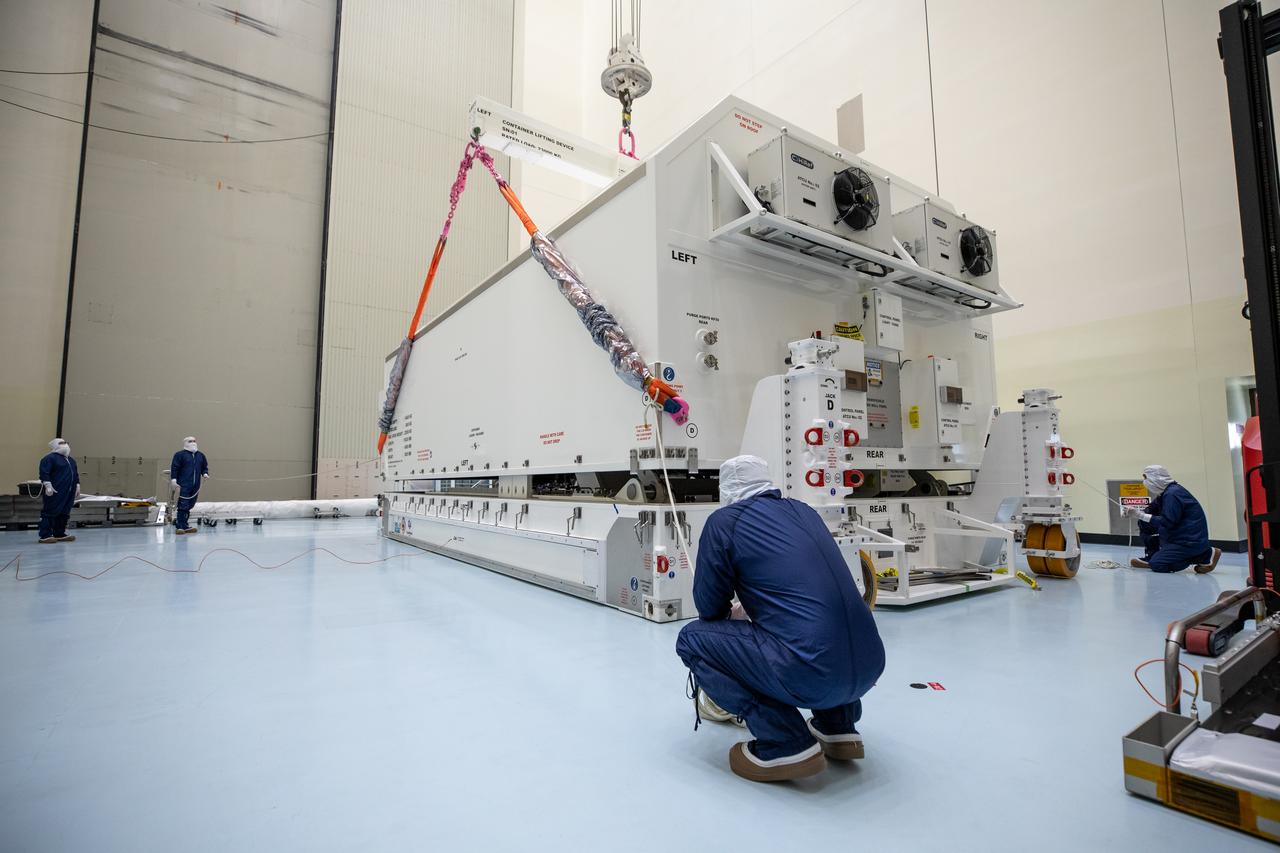
Technicians remove NASA’s largest planetary mission spacecraft, Europa Clipper, from its protective shipping container inside the Payload Hazardous Servicing Facility at the agency’s Kennedy Space Center in Florida on Tuesday, May 28, 2024. Slated to launch aboard a SpaceX Falcon Heavy rocket later this year from Launch Complex 39A at Kennedy, Europa Clipper will help determine if conditions exist below the surface Jupiter’s fourth largest moon, Europa that could support life.
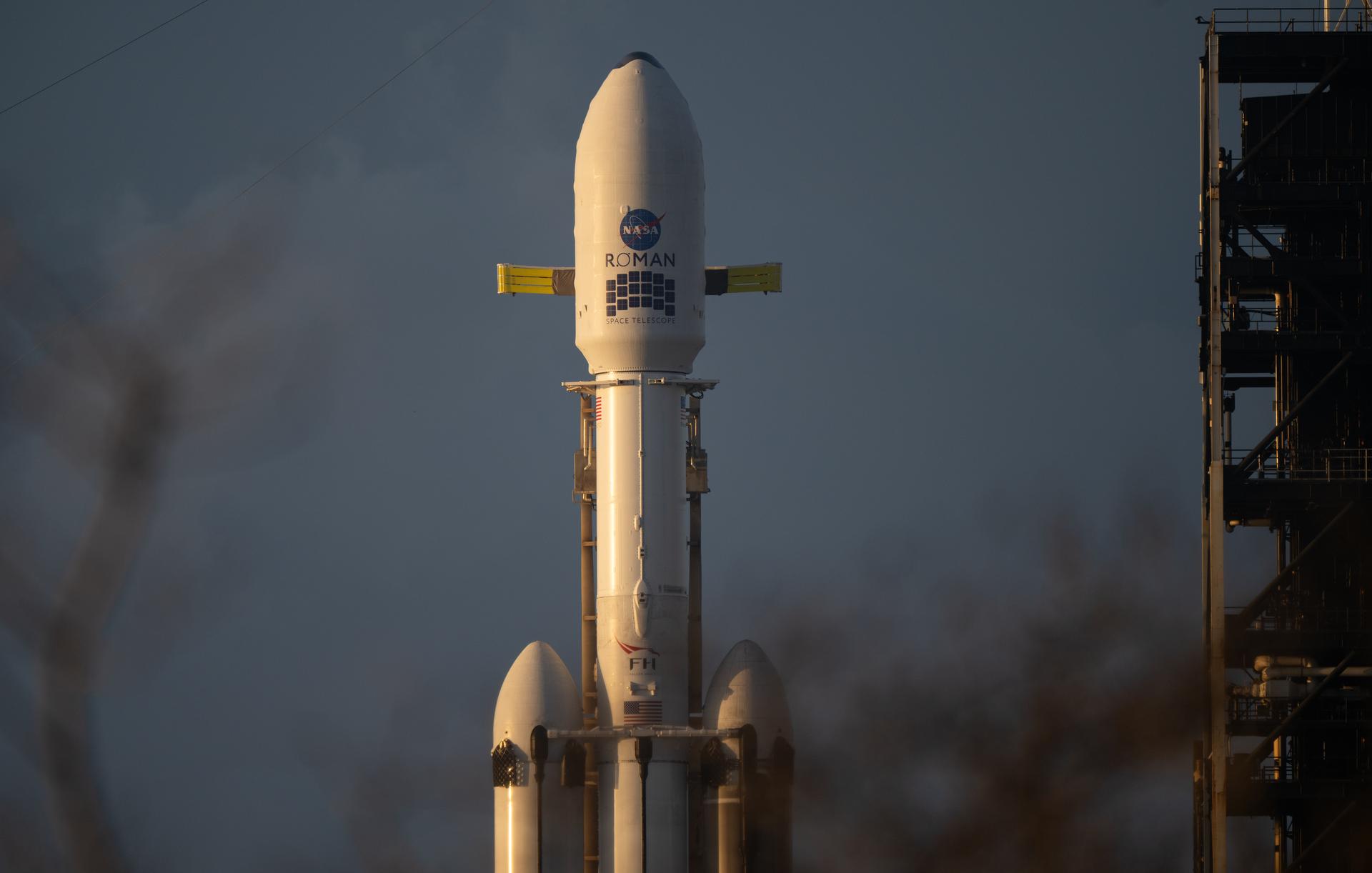
NASA’s Nancy Grace Roman Space Telescope, encapsulated in a protective payload fairing atop a SpaceX Falcon Heavy rocket, is seen at sunrise, Saturday, Aug. 29, 2026, at Launch Complex 39A at NASA’s Kennedy Space Center in Florida. Roman will investigate dark energy and dark matter, conduct a statistical census of planetary systems, and enable a broad range of additional astrophysics research. Liftoff from NASA Kennedy is targeted for Sunday, Aug. 30, 2026. Photo Credit (NASA/Joel Kowsky)

Michael Meyer, Lead Scientist for NASA's Mars Exploration Program, answers a question from the audience during a special session titled “Planetary Protection for the Future: Science, Exploration, and Commerce” at the 70th International Astronautical Congress, Thursday, Oct. 24, 2019, at the Walter E. Washington Convention Center in Washington. Photo Credit: (NASA/Joel Kowsky)
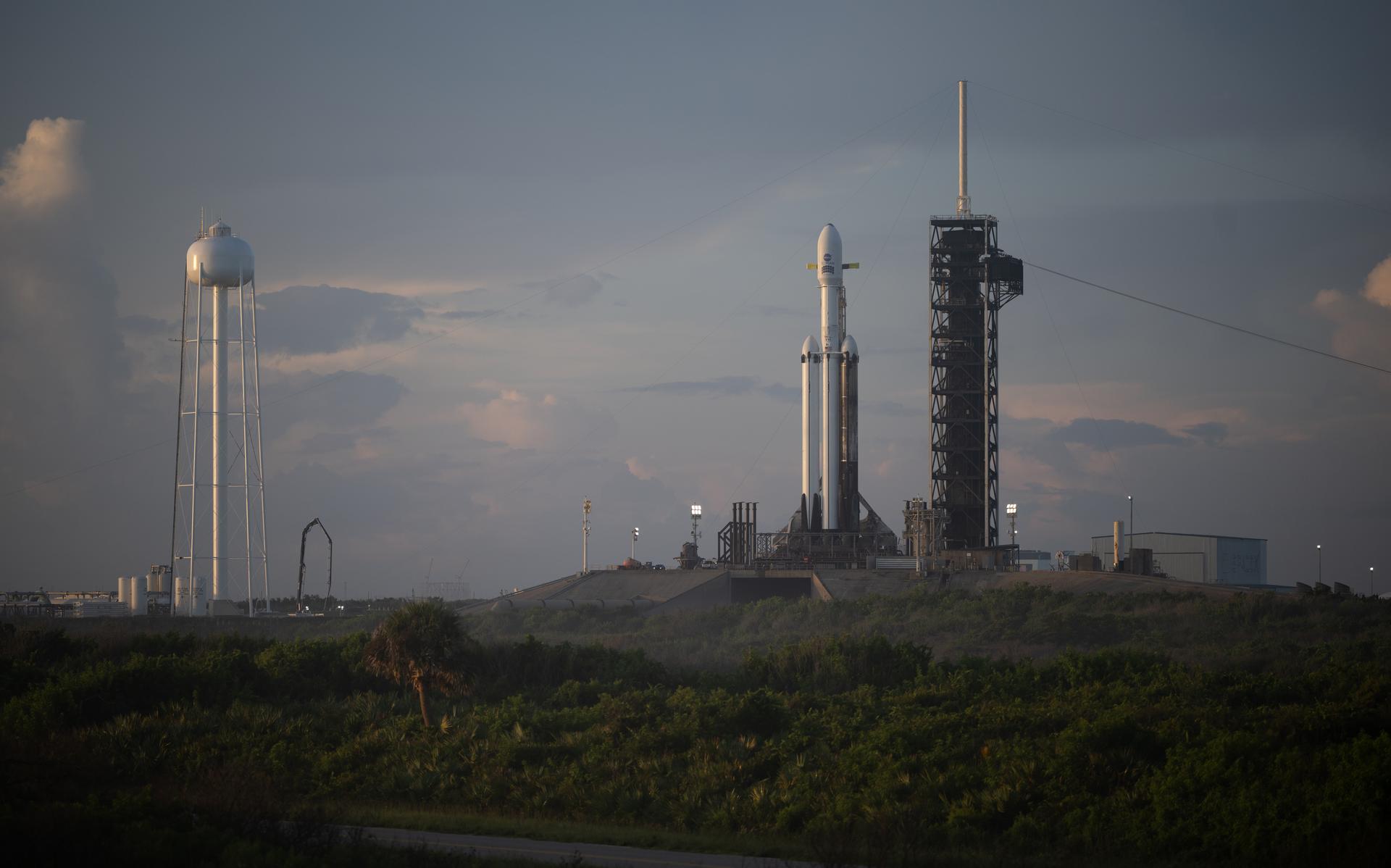
NASA’s Nancy Grace Roman Space Telescope, encapsulated in a protective payload fairing atop a SpaceX Falcon Heavy rocket, is seen at sunrise, Saturday, Aug. 29, 2026, at Launch Complex 39A at NASA’s Kennedy Space Center in Florida. Roman will investigate dark energy and dark matter, conduct a statistical census of planetary systems, and enable a broad range of additional astrophysics research. Liftoff from NASA Kennedy is targeted for Sunday, Aug. 30, 2026. Photo Credit (NASA/Joel Kowsky)
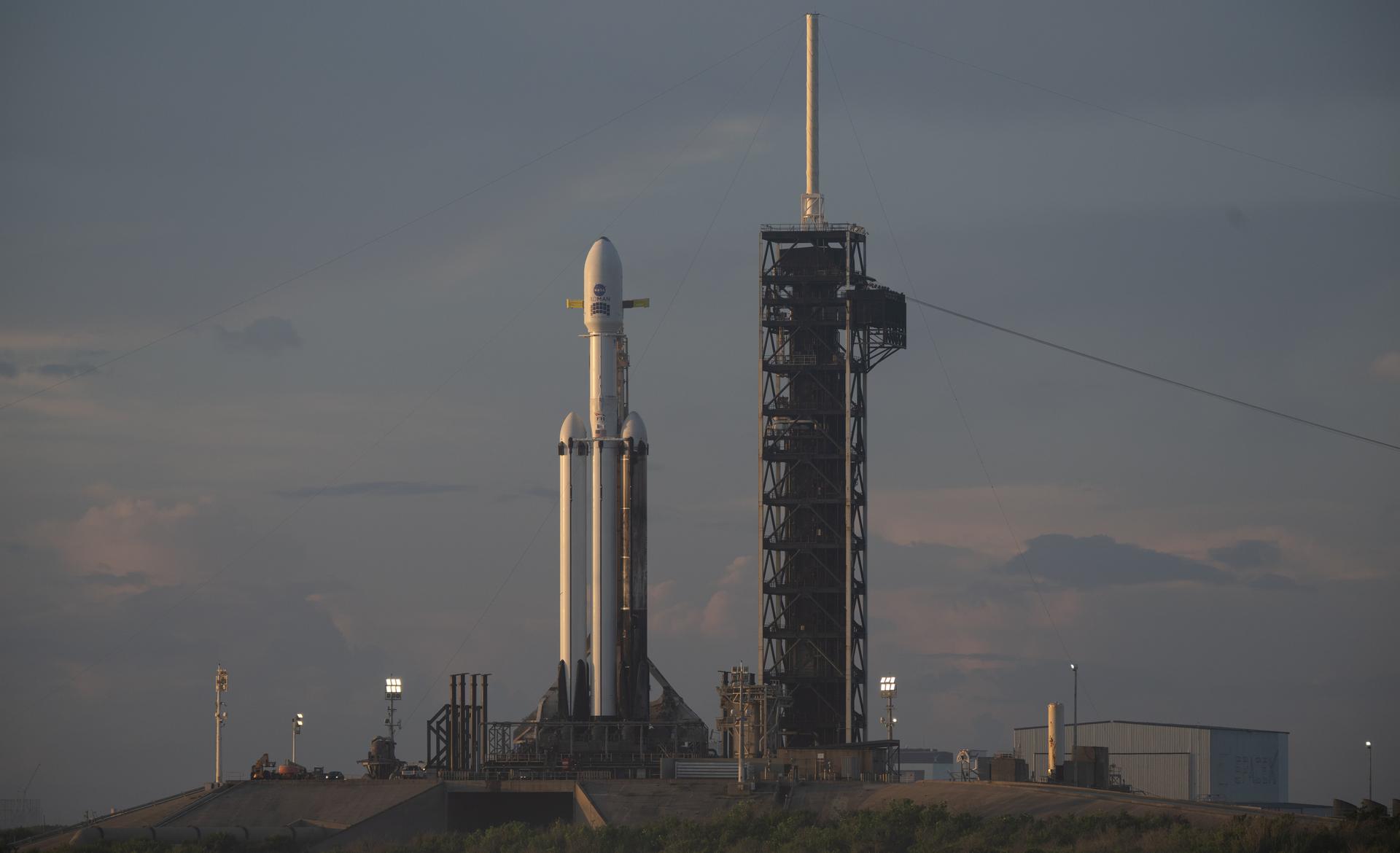
NASA’s Nancy Grace Roman Space Telescope, encapsulated in a protective payload fairing atop a SpaceX Falcon Heavy rocket, is seen at sunrise, Saturday, Aug. 29, 2026, at Launch Complex 39A at NASA’s Kennedy Space Center in Florida. Roman will investigate dark energy and dark matter, conduct a statistical census of planetary systems, and enable a broad range of additional astrophysics research. Liftoff from NASA Kennedy is targeted for Sunday, Aug. 30, 2026. Photo Credit (NASA/Joel Kowsky)
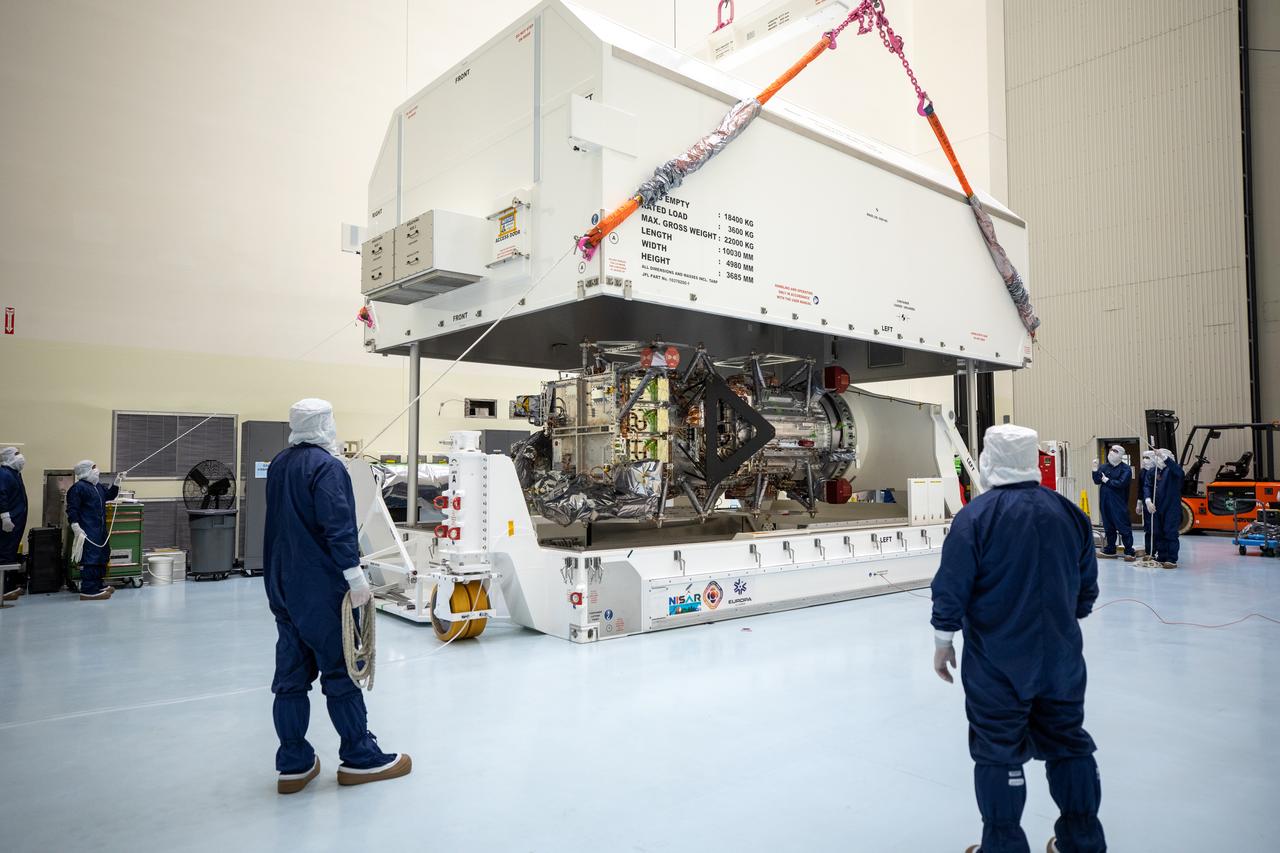
Technicians remove NASA’s largest planetary mission spacecraft, Europa Clipper, from its protective shipping container inside the Payload Hazardous Servicing Facility at the agency’s Kennedy Space Center in Florida on Tuesday, May 28, 2024. Slated to launch aboard a SpaceX Falcon Heavy rocket later this year from Launch Complex 39A at Kennedy, Europa Clipper will help determine if conditions exist below the surface Jupiter’s fourth largest moon, Europa that could support life.
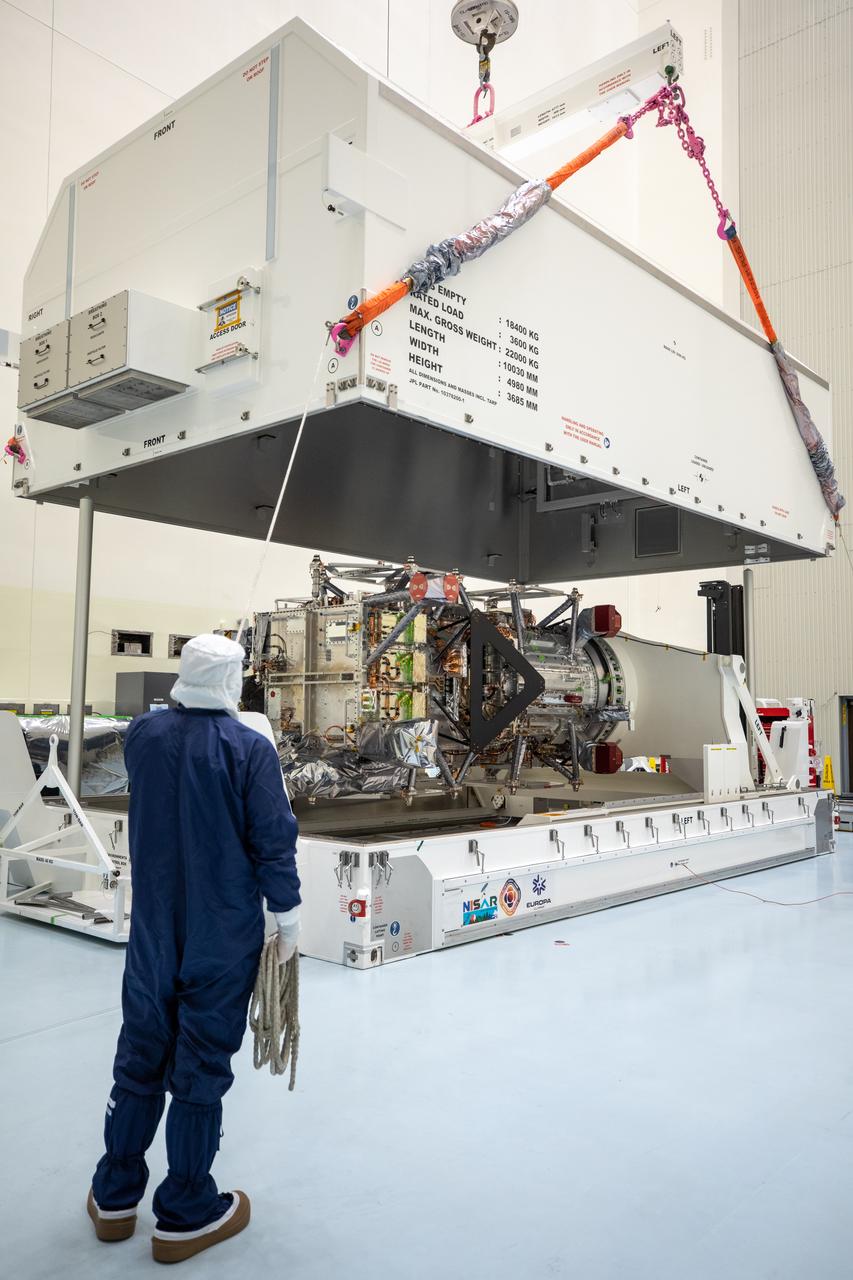
Technicians remove NASA’s largest planetary mission spacecraft, Europa Clipper, from its protective shipping container inside the Payload Hazardous Servicing Facility at the agency’s Kennedy Space Center in Florida on Tuesday, May 28, 2024. Slated to launch aboard a SpaceX Falcon Heavy rocket later this year from Launch Complex 39A at Kennedy, Europa Clipper will help determine if conditions exist below the surface Jupiter’s fourth largest moon, Europa that could support life.
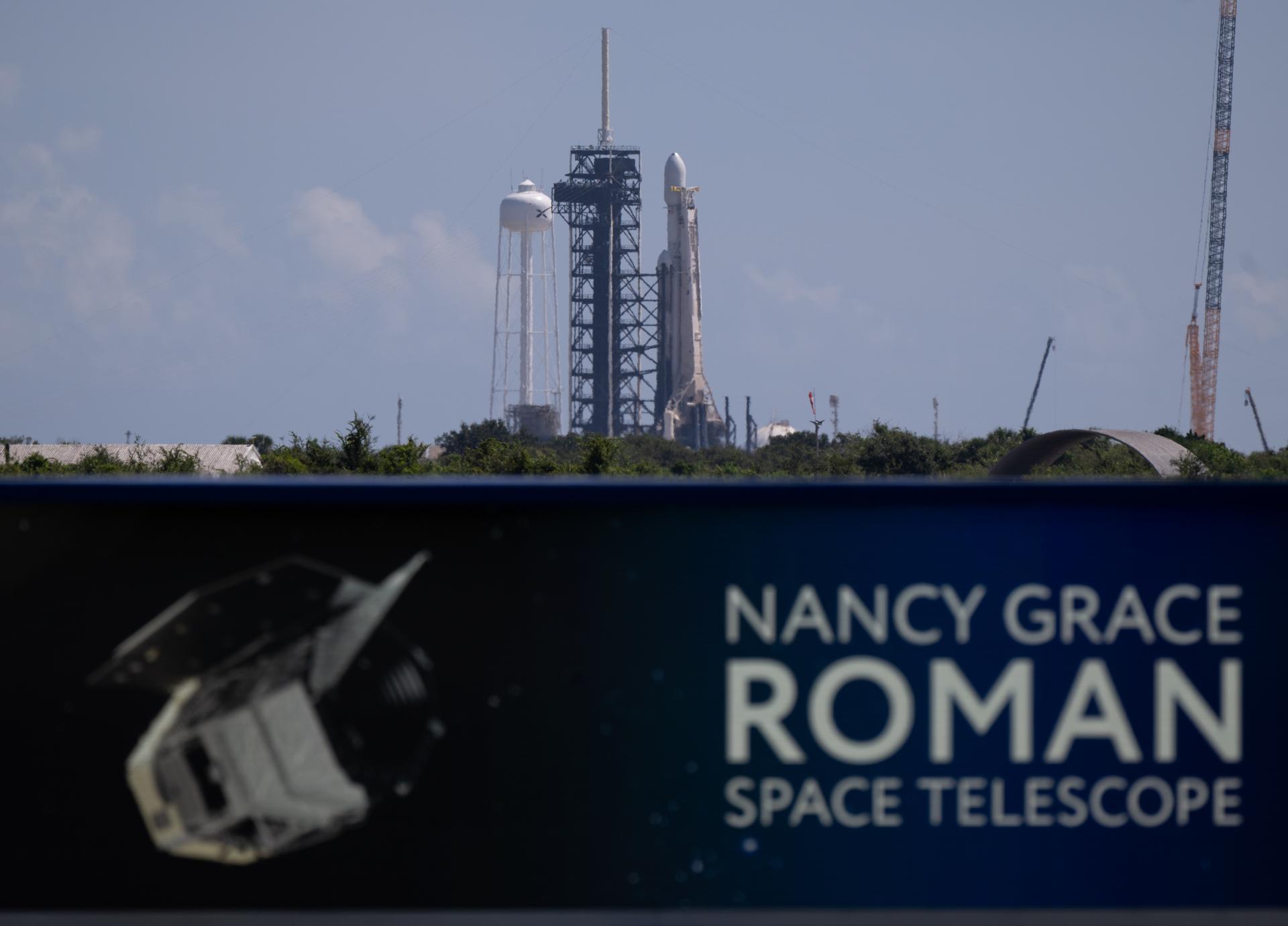
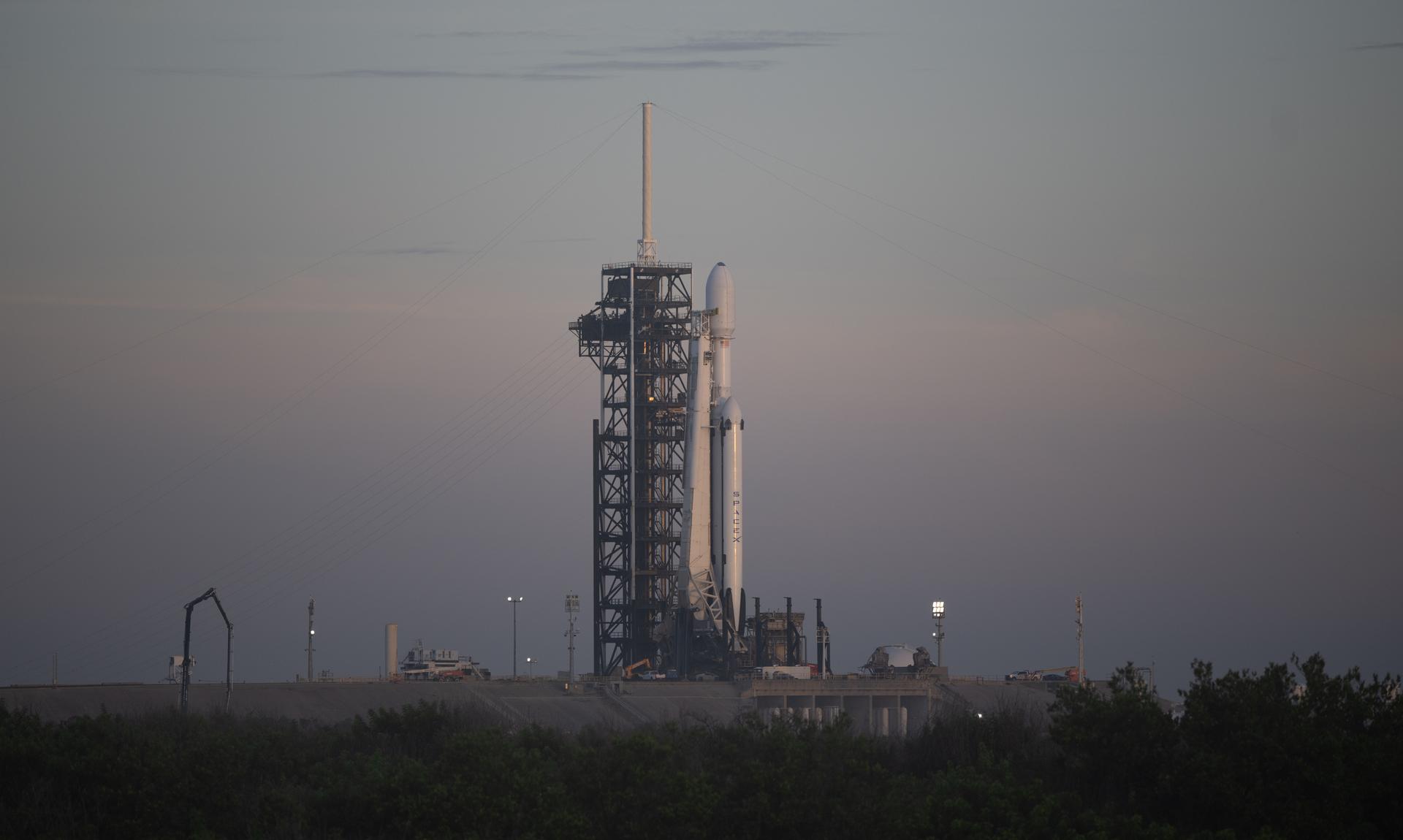
A SpaceX Falcon Heavy rocket with NASA’s Nancy Grace Roman Space Telescope, encapsulated in a protective payload fairing, is seen on the pad at Launch Complex 39A as preparations continue for launch Saturday, Aug. 29, 2026, at NASA Kennedy Space Center in Florida. Roman will investigate dark energy and dark matter, conduct a statistical census of planetary systems, and enable a broad range of additional astrophysics research. Liftoff from NASA Kennedy is targeted for Sunday, Aug. 30, 2026. Photo Credit: (NASA/Joel Kowsky)
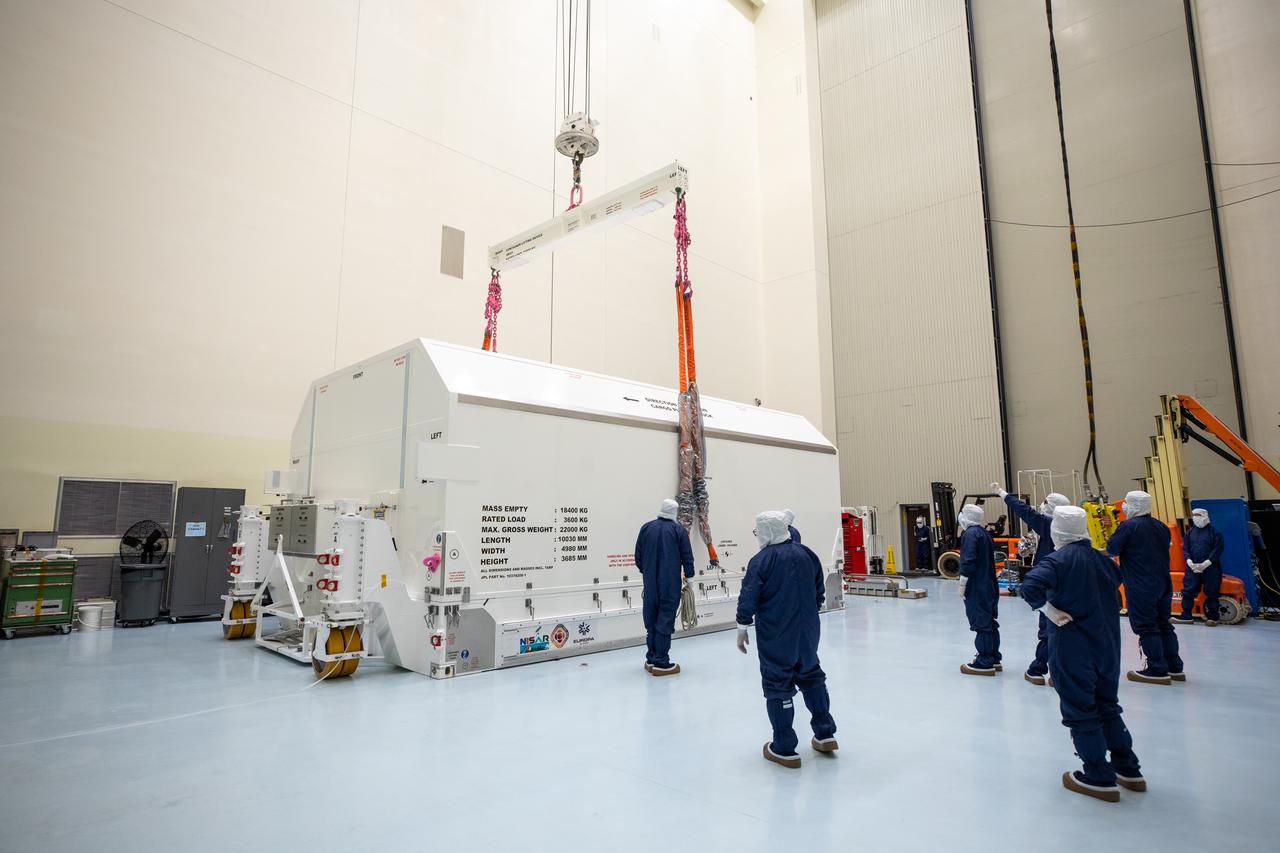
Technicians remove NASA’s largest planetary mission spacecraft, Europa Clipper, from its protective shipping container inside the Payload Hazardous Servicing Facility at the agency’s Kennedy Space Center in Florida on Tuesday, May 28, 2024. Slated to launch aboard a SpaceX Falcon Heavy rocket later this year from Launch Complex 39A at Kennedy, Europa Clipper will help determine if conditions exist below the surface Jupiter’s fourth largest moon, Europa that could support life.
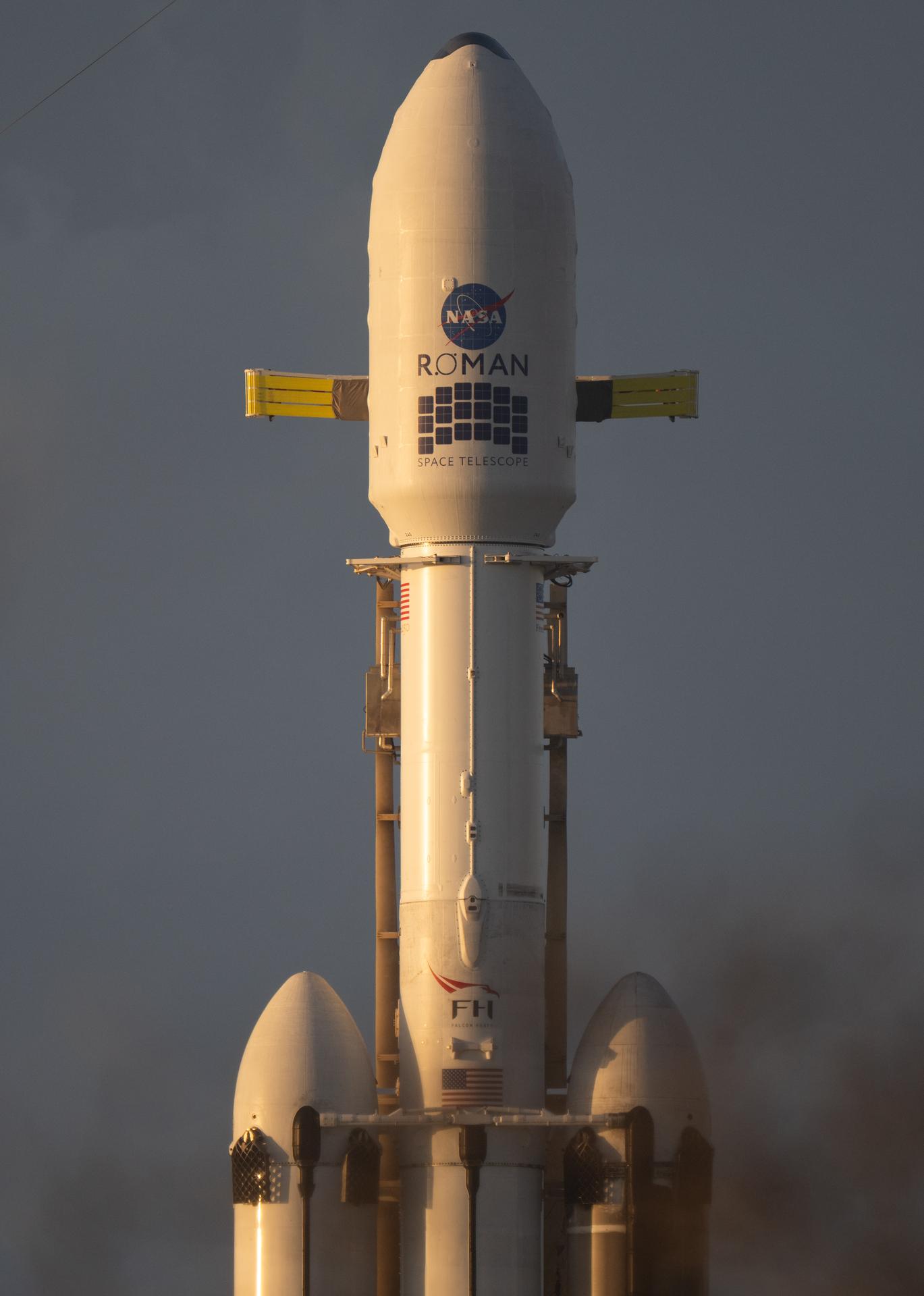
NASA’s Nancy Grace Roman Space Telescope, encapsulated in a protective payload fairing atop a SpaceX Falcon Heavy rocket, is seen at sunrise, Saturday, Aug. 29, 2026, at Launch Complex 39A at NASA’s Kennedy Space Center in Florida. Roman will investigate dark energy and dark matter, conduct a statistical census of planetary systems, and enable a broad range of additional astrophysics research. Liftoff from NASA Kennedy is targeted for Sunday, Aug. 30, 2026. Photo Credit (NASA/Joel Kowsky)

CAPE CANAVERAL, Fla. -- NASA's Juno planetary probe, enclosed in its payload fairing, is moments away from liftoff atop a United Launch Alliance Atlas V rocket. Leaving from Space Launch Complex 41 and its four lightning protection system towers on Cape Canaveral Air Force Station in Florida, the spacecraft will embark on a five-year journey to Jupiter. Liftoff was at 12:25 p.m. EDT Aug. 5. The solar-powered spacecraft will orbit Jupiter's poles 33 times to find out more about the gas giant's origins, structure, atmosphere and magnetosphere and investigate the existence of a solid planetary core. For more information, visit www.nasa.gov/juno. Photo credit: NASA/Tony Gray and Don Kight
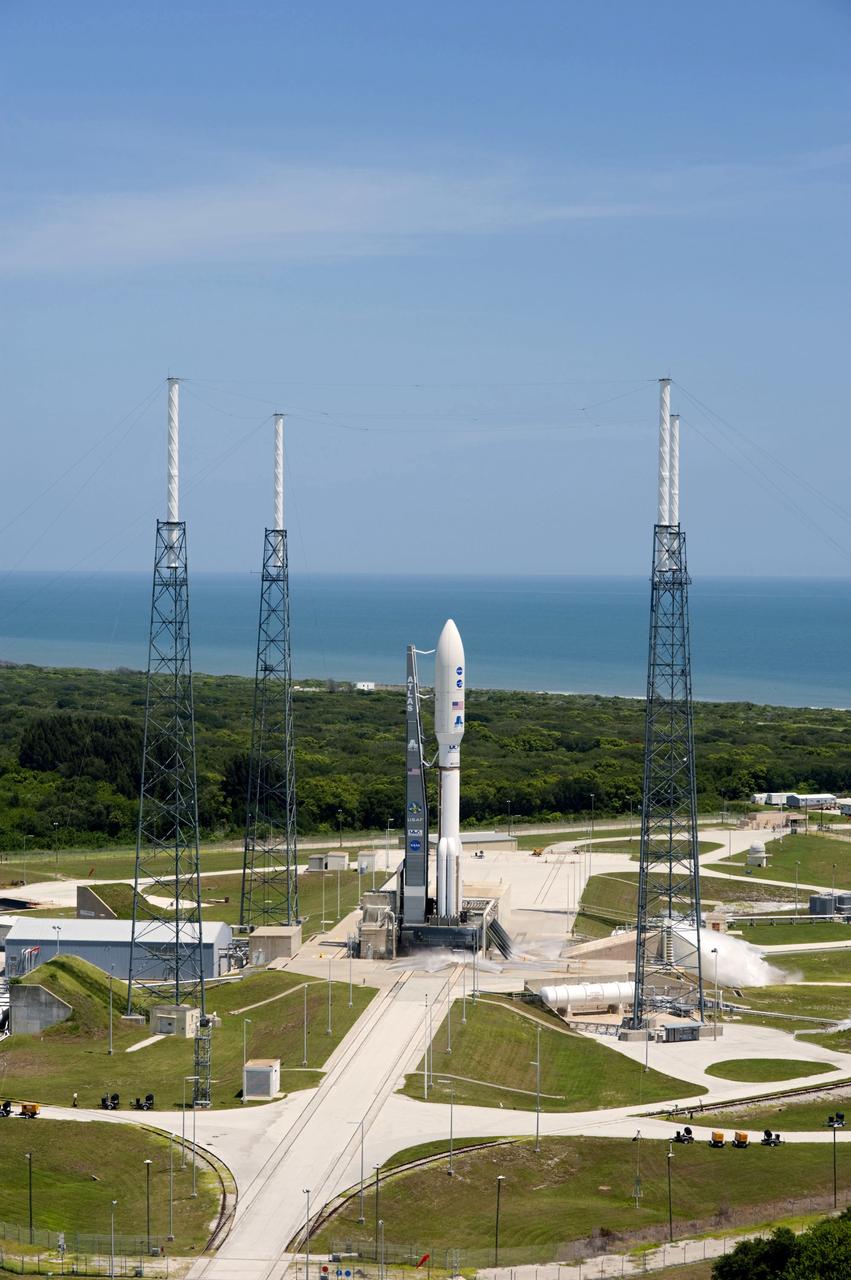
CAPE CANAVERAL, Fla. -- Backdropped by the Atlantic Ocean and surrounded by its four-tower lightning protection system, NASA's Juno planetary probe, enclosed in its payload fairing, is seconds away from liftoff atop a United Launch Alliance Atlas V rocket. Leaving from Space Launch Complex 41 on Cape Canaveral Air Force Station in Florida, the spacecraft will embark on a five-year journey to Jupiter. On the right, water is seen dumping into a flame trench to suppress vibrations at launch. Liftoff was at 12:25 p.m. EDT Aug. 5. The solar-powered spacecraft will orbit Jupiter's poles 33 times to find out more about the gas giant's origins, structure, atmosphere and magnetosphere and investigate the existence of a solid planetary core. For more information, visit www.nasa.gov/juno. Photo credit: NASA/Tony Gray and Tim Powers

CAPE CANAVERAL, Fla. -- Rising from fire and smoke, NASA's Juno planetary probe, enclosed in its payload fairing, launches atop a United Launch Alliance Atlas V rocket. Leaving from Space Launch Complex 41 and its four lightning protection system towers on Cape Canaveral Air Force Station in Florida, the spacecraft will embark on a five-year journey to Jupiter. Liftoff was at 12:25 p.m. EDT Aug. 5. The solar-powered spacecraft will orbit Jupiter's poles 33 times to find out more about the gas giant's origins, structure, atmosphere and magnetosphere and investigate the existence of a solid planetary core. For more information, visit www.nasa.gov/juno. Photo credit: NASA/Tony Gray and Don Kight
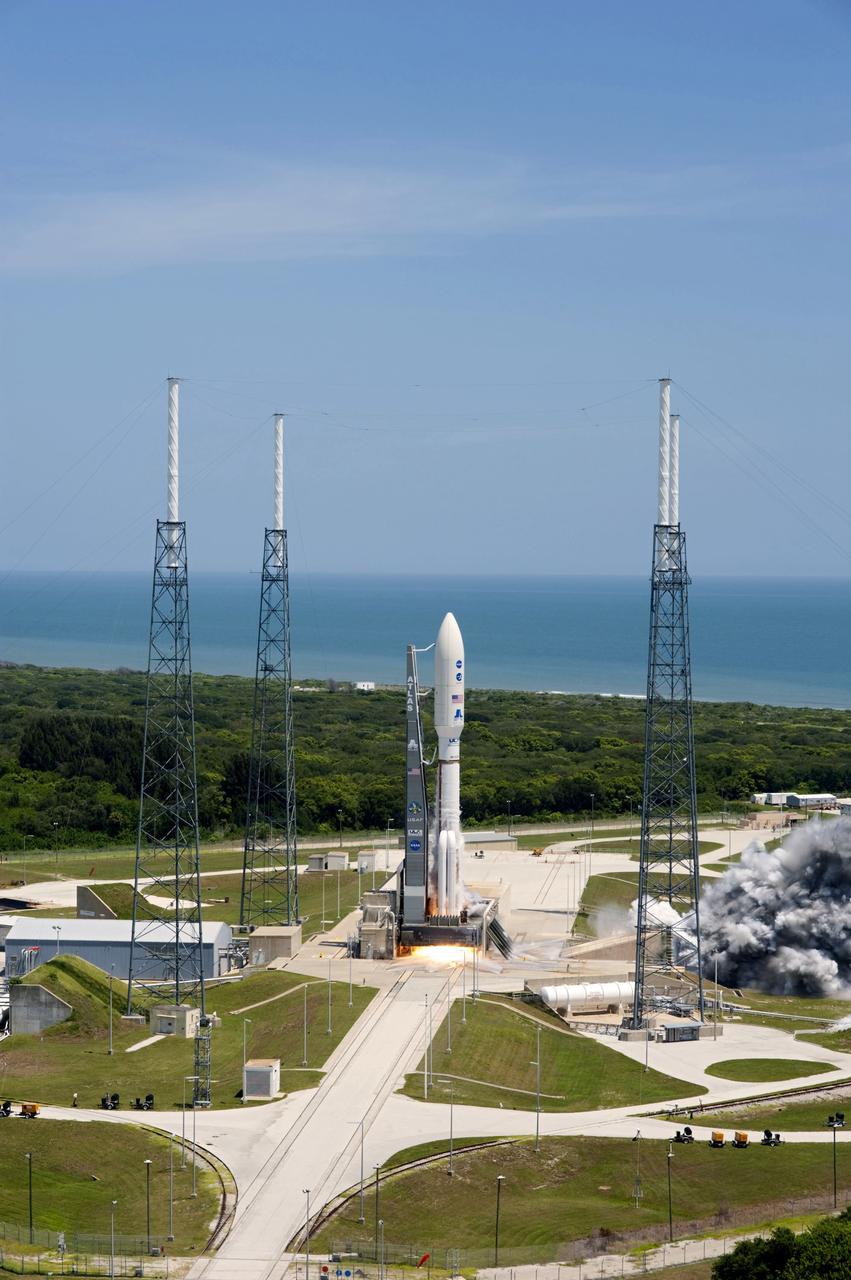
CAPE CANAVERAL, Fla. -- Backdropped by the Atlantic Ocean and surrounded by its four-tower lightning protection system, NASA's Juno planetary probe, enclosed in its payload fairing, is seconds away from liftoff atop a United Launch Alliance Atlas V rocket. Leaving from Space Launch Complex 41 on Cape Canaveral Air Force Station in Florida, the spacecraft will embark on a five-year journey to Jupiter. Liftoff was at 12:25 p.m. EDT Aug. 5. The solar-powered spacecraft will orbit Jupiter's poles 33 times to find out more about the gas giant's origins, structure, atmosphere and magnetosphere and investigate the existence of a solid planetary core. For more information, visit www.nasa.gov/juno. Photo credit: NASA/Tony Gray and Tim Powers
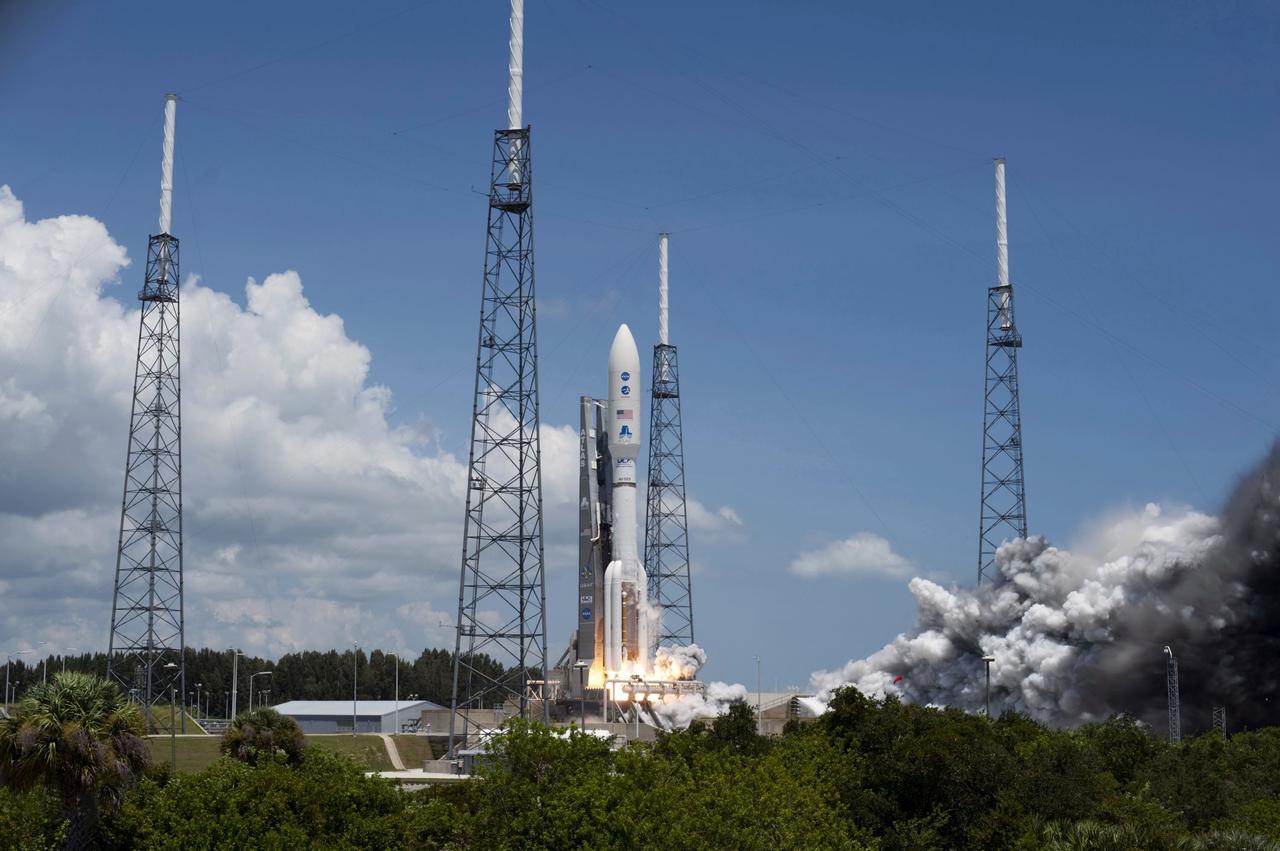
CAPE CANAVERAL, Fla. -- Rising from fire and smoke, NASA's Juno planetary probe, enclosed in its payload fairing, launches atop a United Launch Alliance Atlas V rocket. Leaving from Space Launch Complex 41 and its four lightning protection system towers on Cape Canaveral Air Force Station in Florida, the spacecraft will embark on a five-year journey to Jupiter. Liftoff was at 12:25 p.m. EDT Aug. 5. The solar-powered spacecraft will orbit Jupiter's poles 33 times to find out more about the gas giant's origins, structure, atmosphere and magnetosphere and investigate the existence of a solid planetary core. For more information, visit www.nasa.gov/juno. Photo credit: NASA/Tony Gray and Don Kight
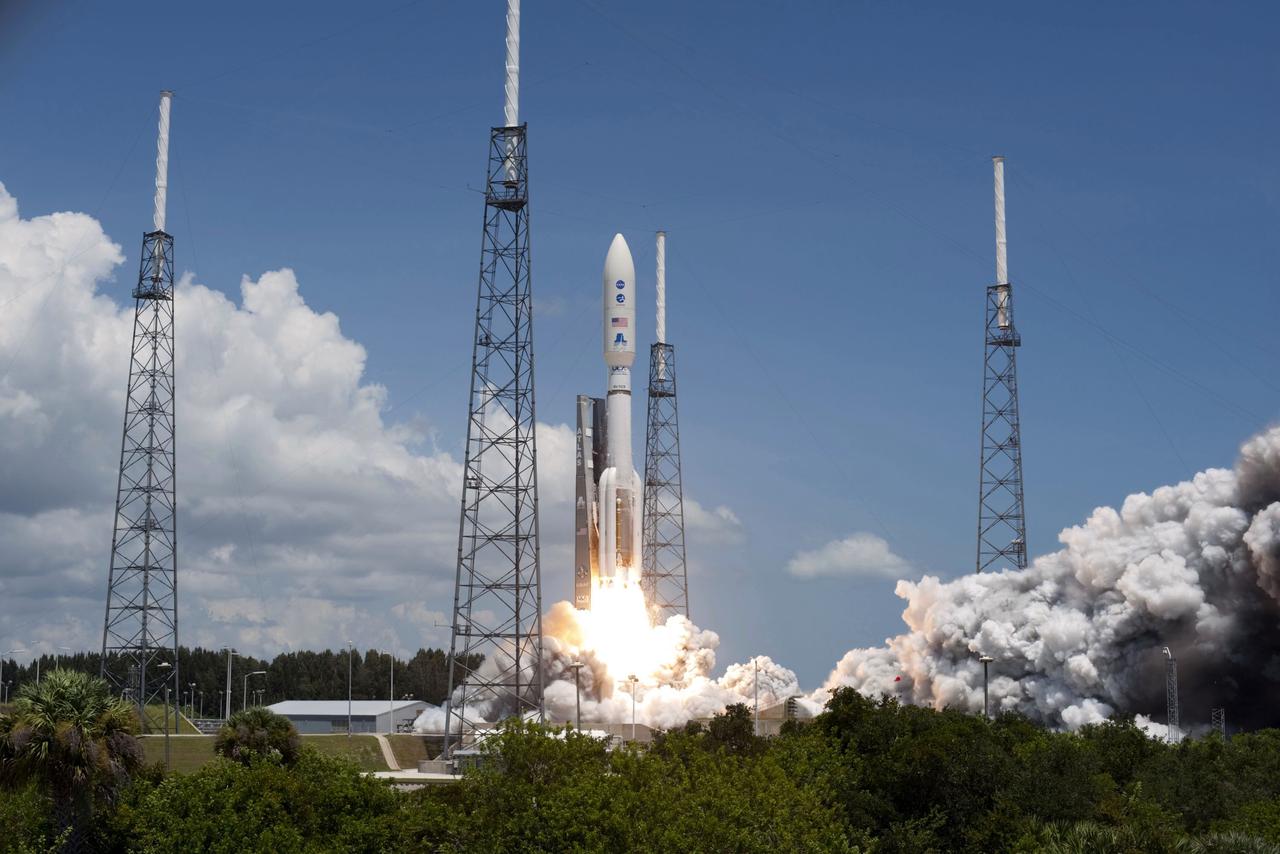
CAPE CANAVERAL, Fla. -- Rising from fire and smoke, NASA's Juno planetary probe, enclosed in its payload fairing, launches atop a United Launch Alliance Atlas V rocket. Leaving from Space Launch Complex 41 and its four lightning protection system towers on Cape Canaveral Air Force Station in Florida, the spacecraft will embark on a five-year journey to Jupiter. Liftoff was at 12:25 p.m. EDT Aug. 5. The solar-powered spacecraft will orbit Jupiter's poles 33 times to find out more about the gas giant's origins, structure, atmosphere and magnetosphere and investigate the existence of a solid planetary core. For more information, visit www.nasa.gov/juno. Photo credit: NASA/Tony Gray and Don Kight
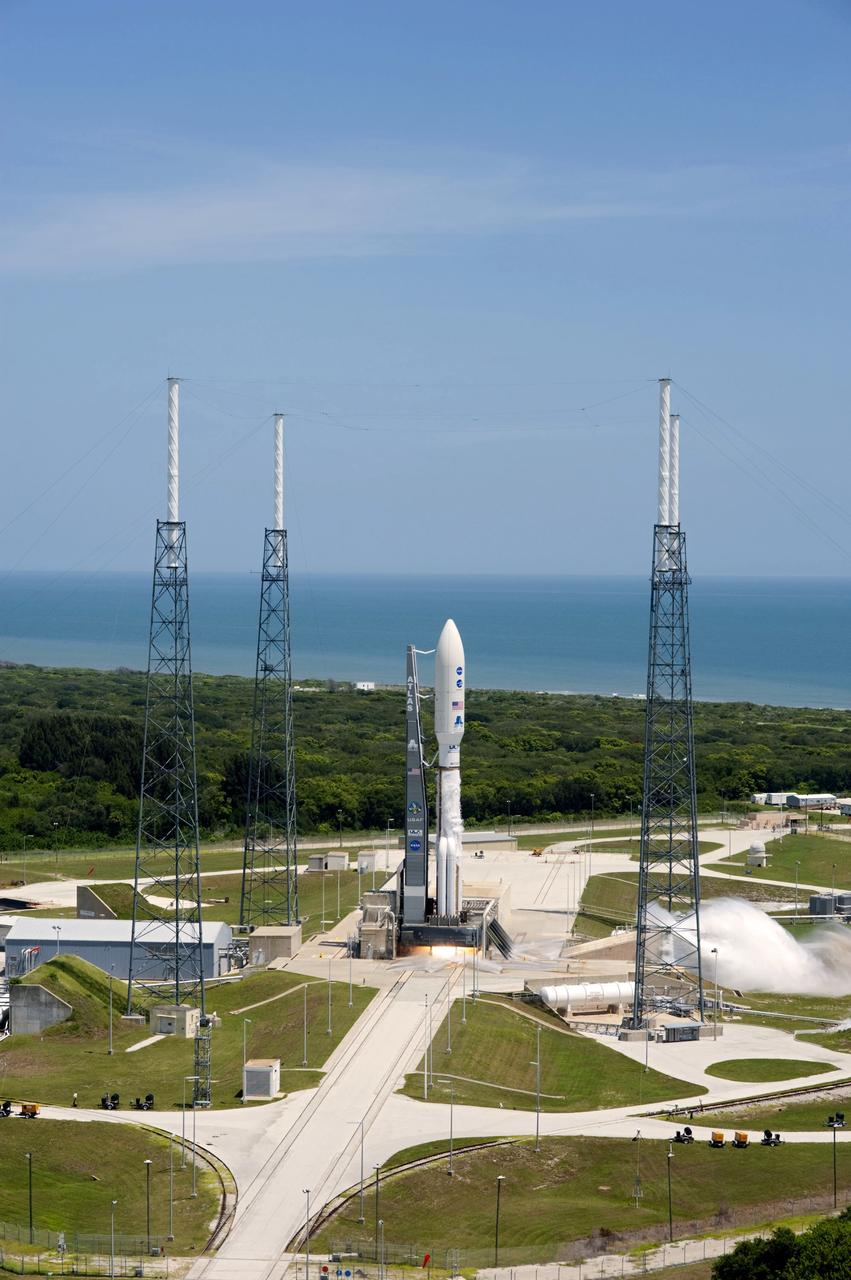
CAPE CANAVERAL, Fla. -- Backdropped by the Atlantic Ocean and surrounded by its four-tower lightning protection system, NASA's Juno planetary probe, enclosed in its payload fairing, is seconds away from liftoff atop a United Launch Alliance Atlas V rocket. Leaving from Space Launch Complex 41 on Cape Canaveral Air Force Station in Florida, the spacecraft will embark on a five-year journey to Jupiter. On the right, water is seen dumping into a flame trench to suppress vibrations at launch. Liftoff was at 12:25 p.m. EDT Aug. 5. The solar-powered spacecraft will orbit Jupiter's poles 33 times to find out more about the gas giant's origins, structure, atmosphere and magnetosphere and investigate the existence of a solid planetary core. For more information, visit www.nasa.gov/juno. Photo credit: NASA/Tony Gray and Tim Powers
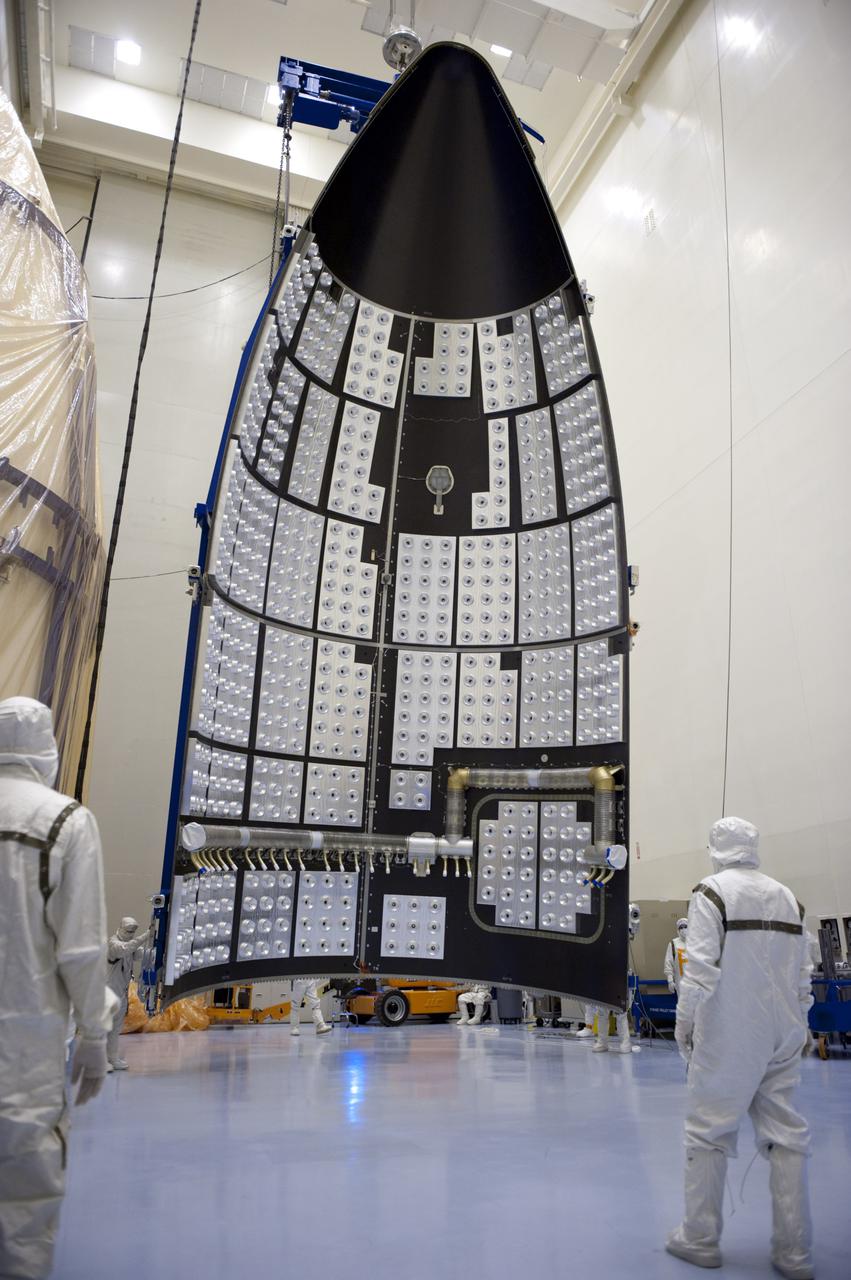
CAPE CANAVERAL, Fla. -- In the Payload Hazardous Servicing Facility at NASA's Kennedy Space Center in Florida, a section of the Atlas V payload fairing for NASA's Mars Science Laboratory (MSL) mission hangs vertically from the ceiling. The fairing has been uncovered, revealing the fairing acoustic protection (FAP) system lining its interior. The FAP protects the payload by dampening the sound created by the rocket during liftoff. Next, the fairing will be cleaned to meet NASA's planetary protection requirements. The fairing will protect the spacecraft from the impact of aerodynamic pressure and heating during ascent. Although jettisoned once the spacecraft is outside the Earth's atmosphere, the fairing must be cleaned to the same exacting standards as the laboratory to avoid the possibility of contaminating it. MSL's components include a compact car-sized rover, Curiosity, which has 10 science instruments designed to search for evidence on whether Mars has had environments favorable to microbial life, including the chemical ingredients for life. The unique rover will use a laser to look inside rocks and release its gasses so that the rover’s spectrometer can analyze and send the data back to Earth. Launch of MSL aboard a United Launch Alliance Atlas V rocket is planned for Nov. 25 from Space Launch Complex 41 on Cape Canaveral Air Force Station. For more information, visit http:__www.nasa.gov_msl. Photo credit: NASA_Kim Shiflett

CAPE CANAVERAL, Fla. -- In the Payload Hazardous Servicing Facility at NASA's Kennedy Space Center in Florida, the fairing acoustic protection (FAP) system lines the inside of the Atlas V payload fairing for NASA's Mars Science Laboratory (MSL) mission. This half of the fairing has been uncovered during preparations to clean it to meet NASA's planetary protection requirements. The FAP protects the payload by dampening the sound created by the rocket during liftoff. The fairing will protect the spacecraft from the impact of aerodynamic pressure and heating during ascent. Although jettisoned once the spacecraft is outside the Earth's atmosphere, the fairing must be cleaned to the same exacting standards as the laboratory to avoid the possibility of contaminating it. MSL's components include a compact car-sized rover, Curiosity, which has 10 science instruments designed to search for evidence on whether Mars has had environments favorable to microbial life, including the chemical ingredients for life. The unique rover will use a laser to look inside rocks and release its gasses so that the rover’s spectrometer can analyze and send the data back to Earth. Launch of MSL aboard a United Launch Alliance Atlas V rocket is planned for Nov. 25 from Space Launch Complex 41 on Cape Canaveral Air Force Station. For more information, visit http://www.nasa.gov/msl. Photo credit: NASA/Kim Shiflett
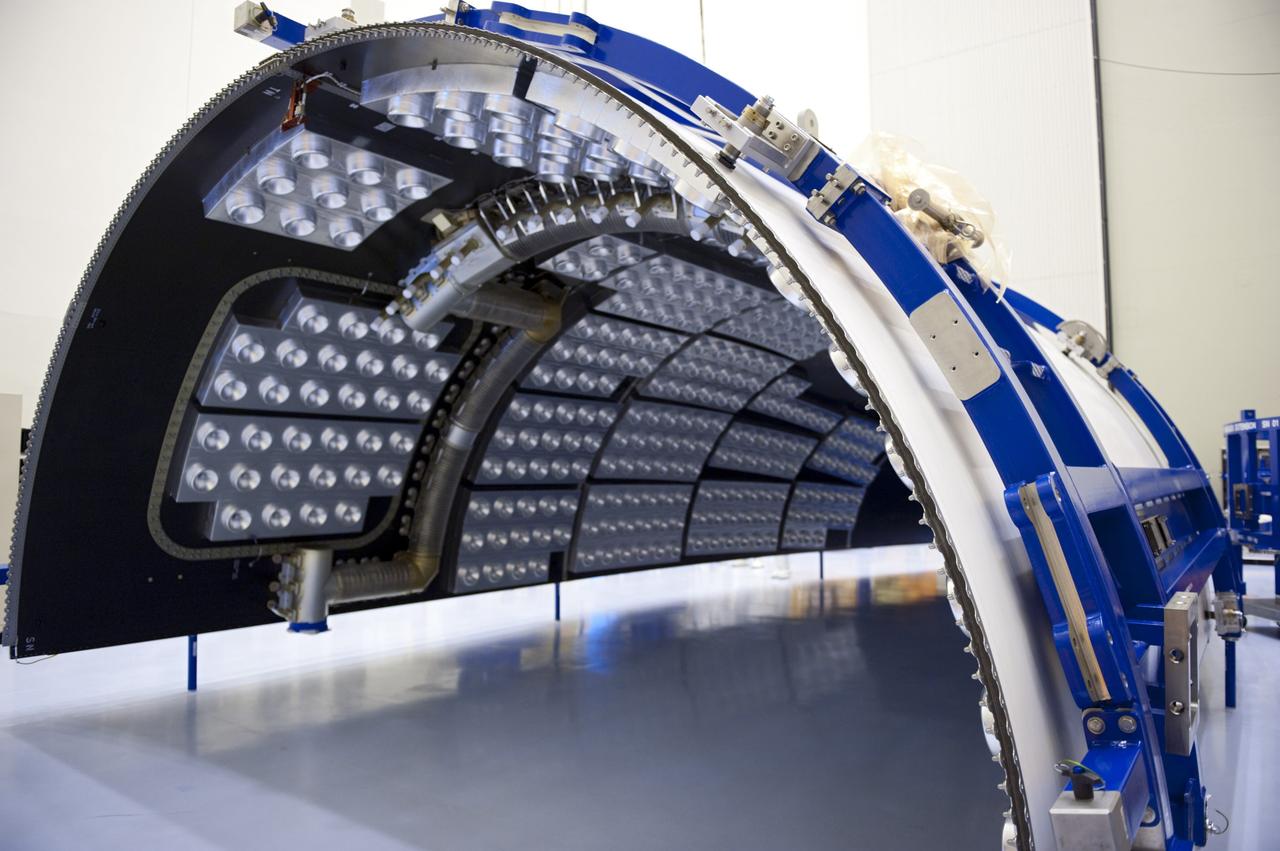
CAPE CANAVERAL, Fla. -- In the Payload Hazardous Servicing Facility at NASA's Kennedy Space Center in Florida, the fairing acoustic protection (FAP) system lining the inside of the Atlas V payload fairing for NASA's Mars Science Laboratory (MSL) mission is visible after the fairing is uncovered during preparations to clean it to meet NASA's planetary protection requirements. The FAP protects the payload by dampening the sound created by the rocket during liftoff. The fairing will protect the spacecraft from the impact of aerodynamic pressure and heating during ascent. Although jettisoned once the spacecraft is outside the Earth's atmosphere, the fairing must be cleaned to the same exacting standards as the laboratory to avoid the possibility of contaminating it. MSL's components include a compact car-sized rover, Curiosity, which has 10 science instruments designed to search for evidence on whether Mars has had environments favorable to microbial life, including the chemical ingredients for life. The unique rover will use a laser to look inside rocks and release its gasses so that the rover’s spectrometer can analyze and send the data back to Earth. Launch of MSL aboard a United Launch Alliance Atlas V rocket is planned for Nov. 25 from Space Launch Complex 41 on Cape Canaveral Air Force Station. For more information, visit http://www.nasa.gov/msl. Photo credit: NASA/Kim Shiflett
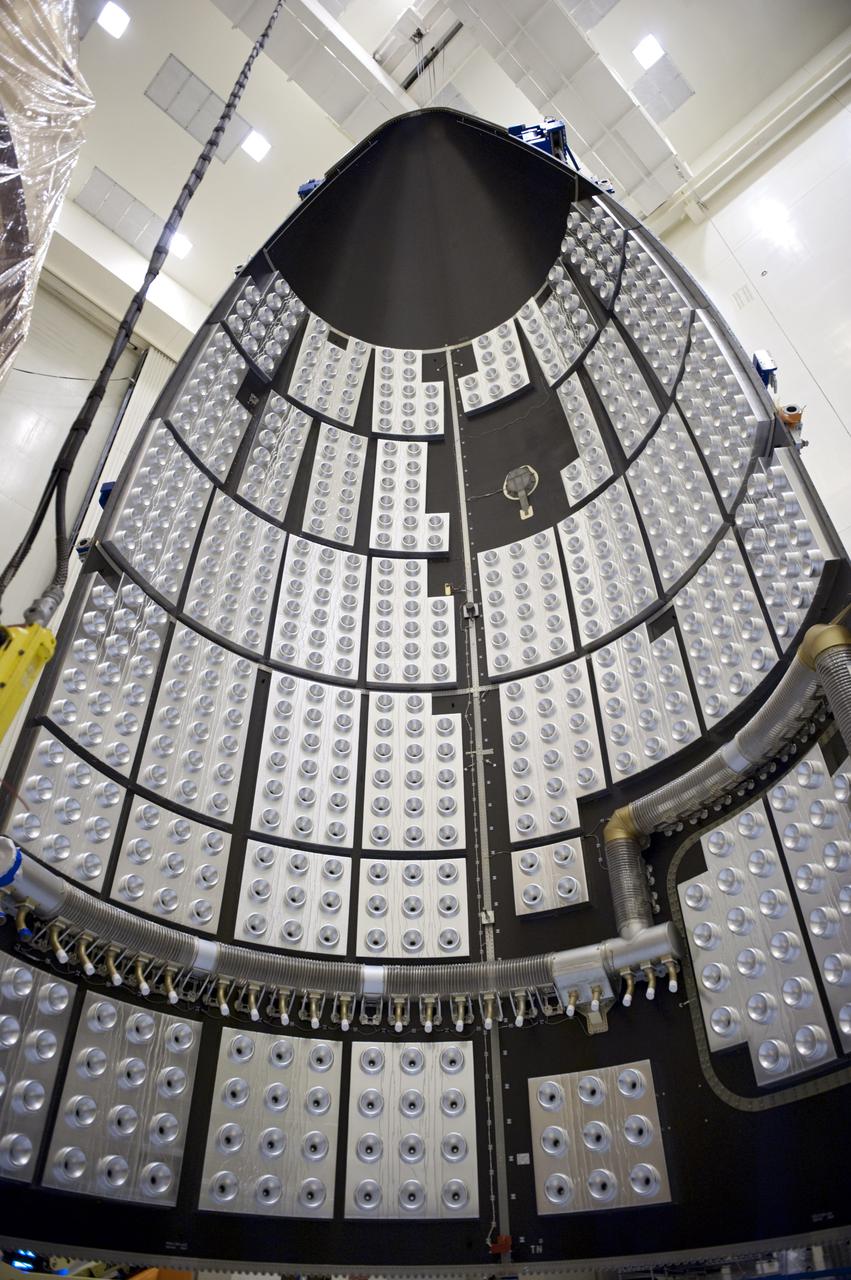
CAPE CANAVERAL, Fla. -- In the Payload Hazardous Servicing Facility at NASA's Kennedy Space Center in Florida, half of the Atlas V payload fairing for NASA's Mars Science Laboratory (MSL) mission hangs vertically from the ceiling. The interior of the fairing is lined with the fairing acoustic protection (FAP) system which protects the payload by dampening the sound created by the rocket during liftoff. As a precaution, the fairing next will be cleaned to meet NASA's planetary protection requirements. The fairing will protect the spacecraft from the impact of aerodynamic pressure and heating during ascent. Although jettisoned once the spacecraft is outside the Earth's atmosphere, the fairing must be cleaned to the same exacting standards as the laboratory to avoid the possibility of contaminating it. MSL's components include a compact car-sized rover, Curiosity, which has 10 science instruments designed to search for evidence on whether Mars has had environments favorable to microbial life, including the chemical ingredients for life. The unique rover will use a laser to look inside rocks and release its gasses so that the rover’s spectrometer can analyze and send the data back to Earth. Launch of MSL aboard a United Launch Alliance Atlas V rocket is planned for Nov. 25 from Space Launch Complex 41 on Cape Canaveral Air Force Station. For more information, visit http:__www.nasa.gov_msl. Photo credit: NASA_Kim Shiflett
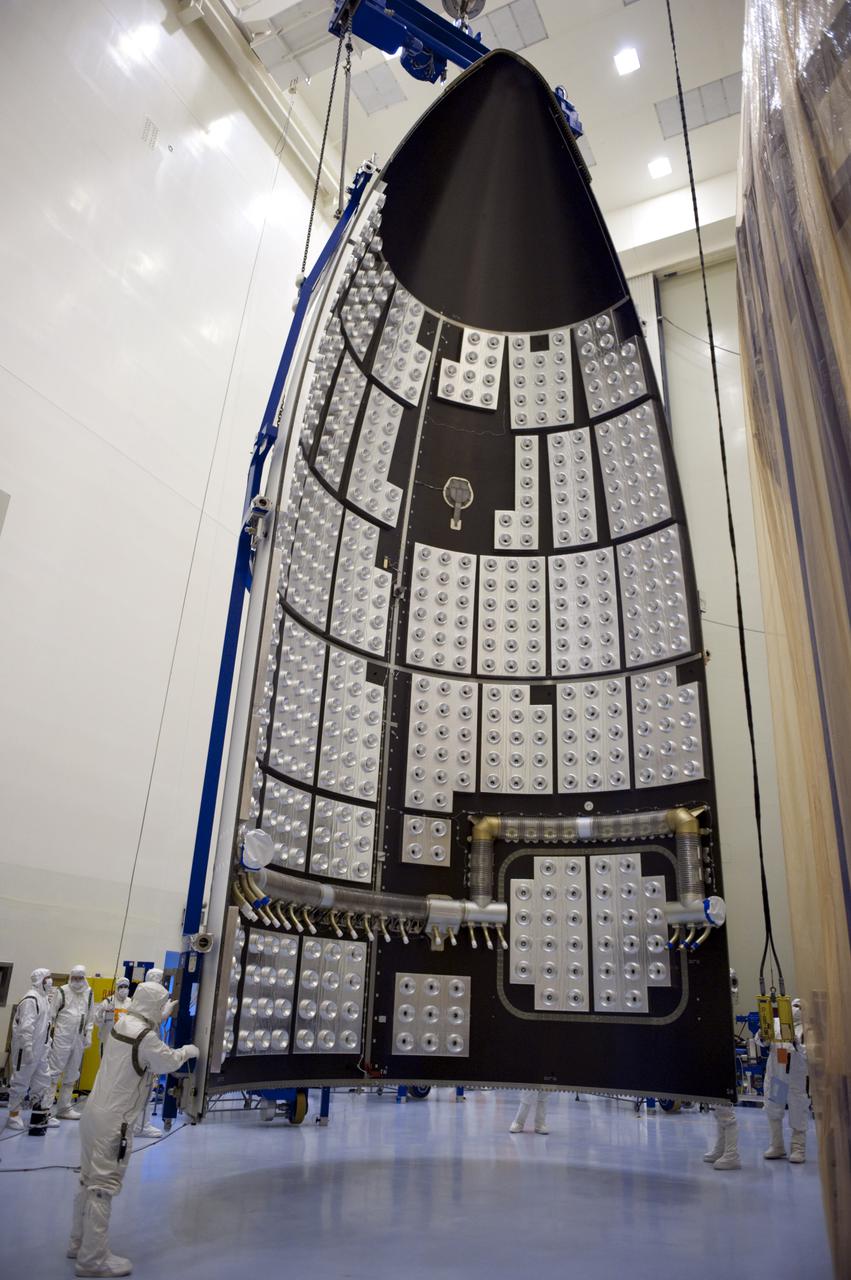
CAPE CANAVERAL, Fla. -- In the Payload Hazardous Servicing Facility at NASA's Kennedy Space Center in Florida, United Launch Alliance technicians steady half of the Atlas V payload fairing for NASA's Mars Science Laboratory (MSL) mission as it hangs vertically from the ceiling. The interior of the fairing is lined with the fairing acoustic protection (FAP) system which protects the payload by dampening the sound created by the rocket during liftoff. As a precaution, the fairing next will be cleaned to meet NASA's planetary protection requirements. The fairing will protect the spacecraft from the impact of aerodynamic pressure and heating during ascent. Although jettisoned once the spacecraft is outside the Earth's atmosphere, the fairing must be cleaned to the same exacting standards as the laboratory to avoid the possibility of contaminating it. MSL's components include a compact car-sized rover, Curiosity, which has 10 science instruments designed to search for evidence on whether Mars has had environments favorable to microbial life, including the chemical ingredients for life. The unique rover will use a laser to look inside rocks and release its gasses so that the rover’s spectrometer can analyze and send the data back to Earth. Launch of MSL aboard a United Launch Alliance Atlas V rocket is planned for Nov. 25 from Space Launch Complex 41 on Cape Canaveral Air Force Station. For more information, visit http:__www.nasa.gov_msl. Photo credit: NASA_Kim Shiflett
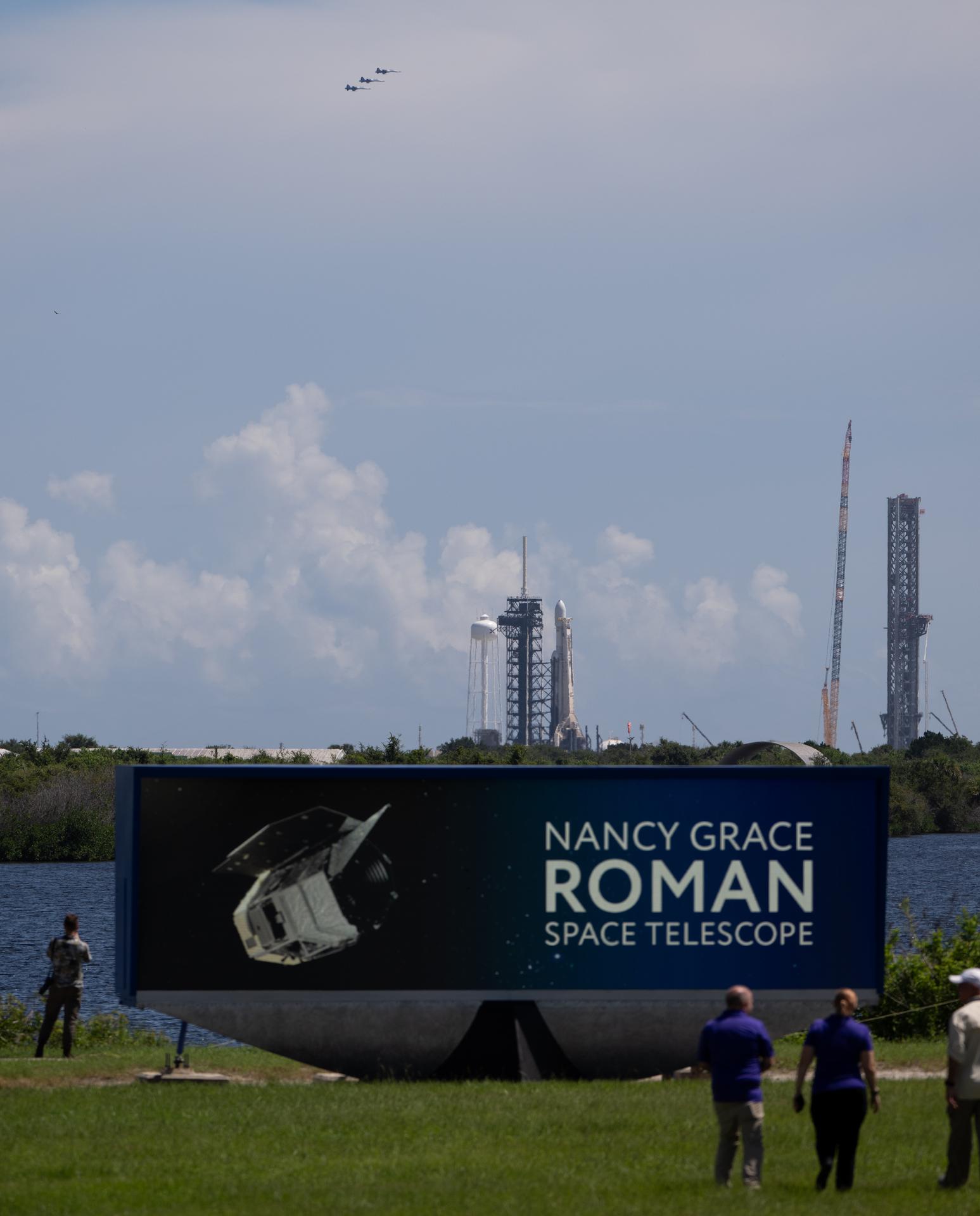
NASA Administrator Jared Isaacman leads a flight of his personally owned F-5 Tiger II aircraft on a flyby of Launch Complex 39A where a SpaceX Falcon Heavy rocket with NASA’s Nancy Grace Roman Space Telescope, encapsulated in a protective payload fairing, is undergoing final launch preparations, Saturday, Aug. 29, 2026, at NASA Kennedy Space Center in Florida. Roman will investigate dark energy and dark matter, conduct a statistical census of planetary systems, and enable a broad range of additional astrophysics research. Liftoff from NASA Kennedy is targeted for Sunday, Aug. 30, 2026. Photo Credit: (NASA/Joel Kowsky)
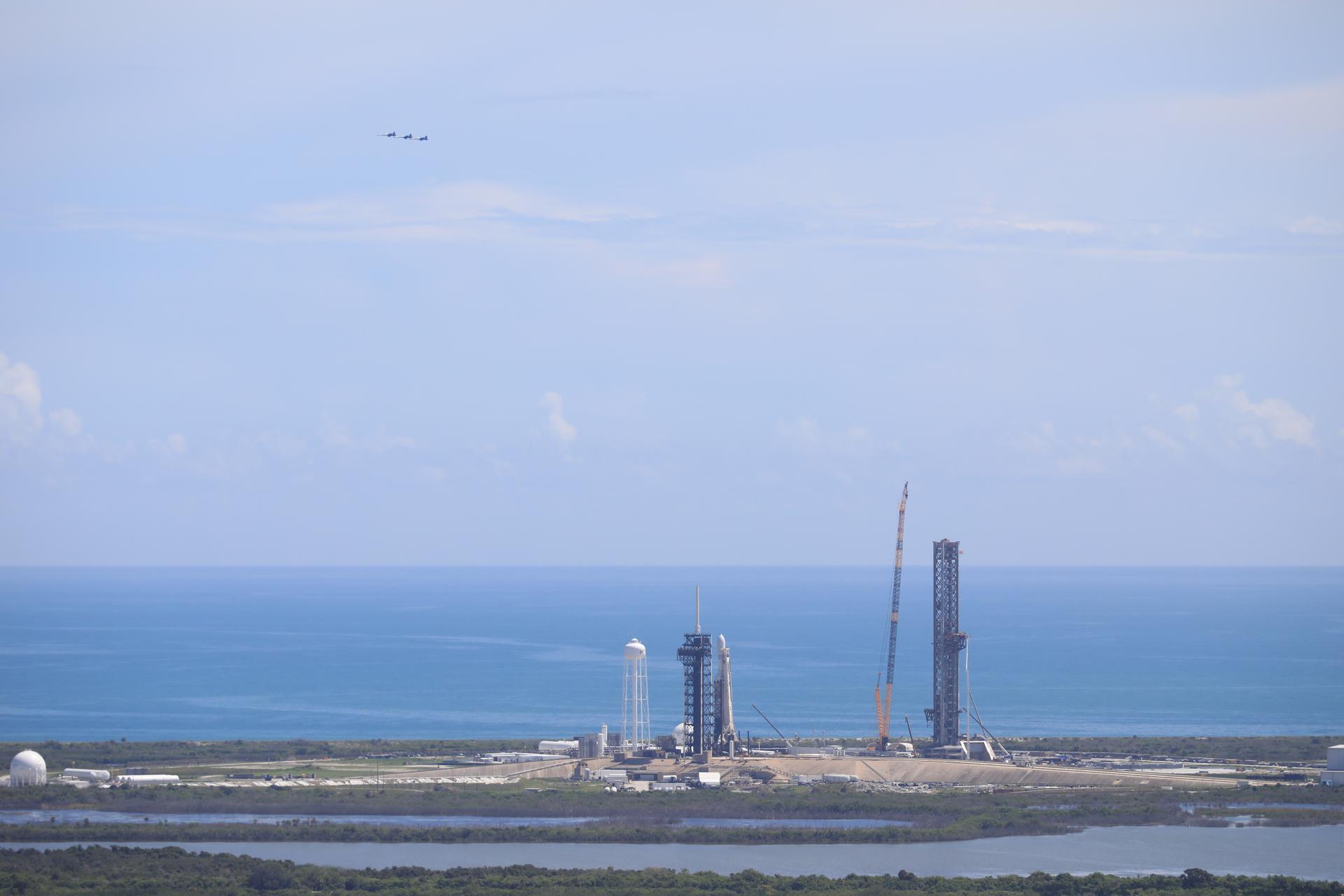
NASA Administrator Jared Isaacman leads a flight of his personally owned F-5 Tiger II aircraft on a flyby of Launch Complex 39A where a SpaceX Falcon Heavy rocket with the agency's Nancy Grace Roman Space Telescope, encapsulated in a protective payload fairing, is undergoing final launch preparations, Saturday, Aug. 29, 2026, at NASA's Kennedy Space Center in Florida. Roman will investigate dark energy and dark matter, conduct a statistical census of planetary systems, and enable a broad range of additional astrophysics research. Liftoff from Kennedy is targeted for no earlier than 7:26 a.m. EDT Sunday, Aug. 30.
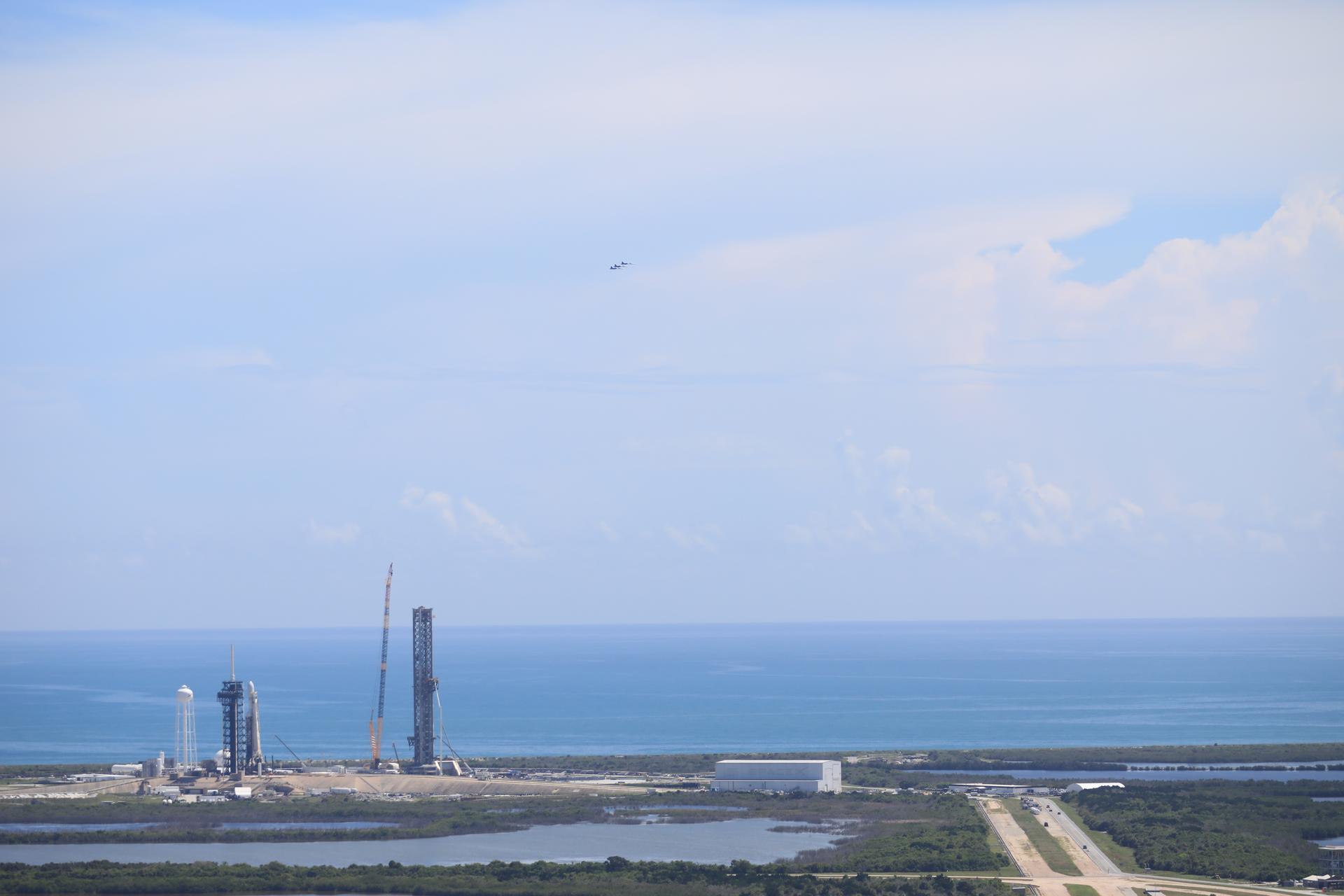
NASA Administrator Jared Isaacman leads a flight of his personally owned F-5 Tiger II aircraft on a flyby of Launch Complex 39A where a SpaceX Falcon Heavy rocket with the agency's Nancy Grace Roman Space Telescope, encapsulated in a protective payload fairing, is undergoing final launch preparations, Saturday, Aug. 29, 2026, at NASA's Kennedy Space Center in Florida. Roman will investigate dark energy and dark matter, conduct a statistical census of planetary systems, and enable a broad range of additional astrophysics research. Liftoff from Kennedy is targeted for no earlier than 7:26 a.m. EDT Sunday, Aug. 30.
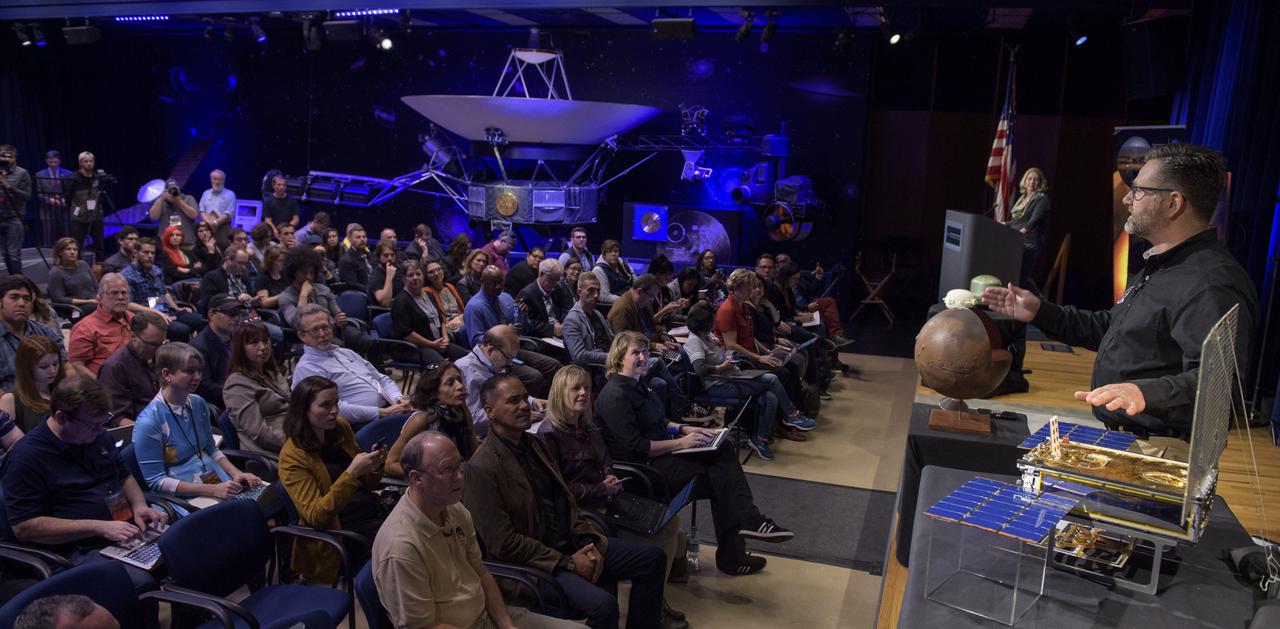
Brian Clement, Planetary Protection lead for MarCO, NASA JPL, talks about Mars Cube One (MarCO) during an Mars InSight pre-landing briefing, Sunday, Nov. 25, 2018 at NASA's Jet Propulsion Laboratory in Pasadena, California. InSight, short for Interior Exploration using Seismic Investigations, Geodesy and Heat Transport, is a Mars lander designed to study the "inner space" of Mars: its crust, mantle, and core. InSight is scheduled to touch down on the Red Planet at approximately noon PST (3 p.m. EST) on Nov. 26. Photo Credit: (NASA/Bill Ingalls)
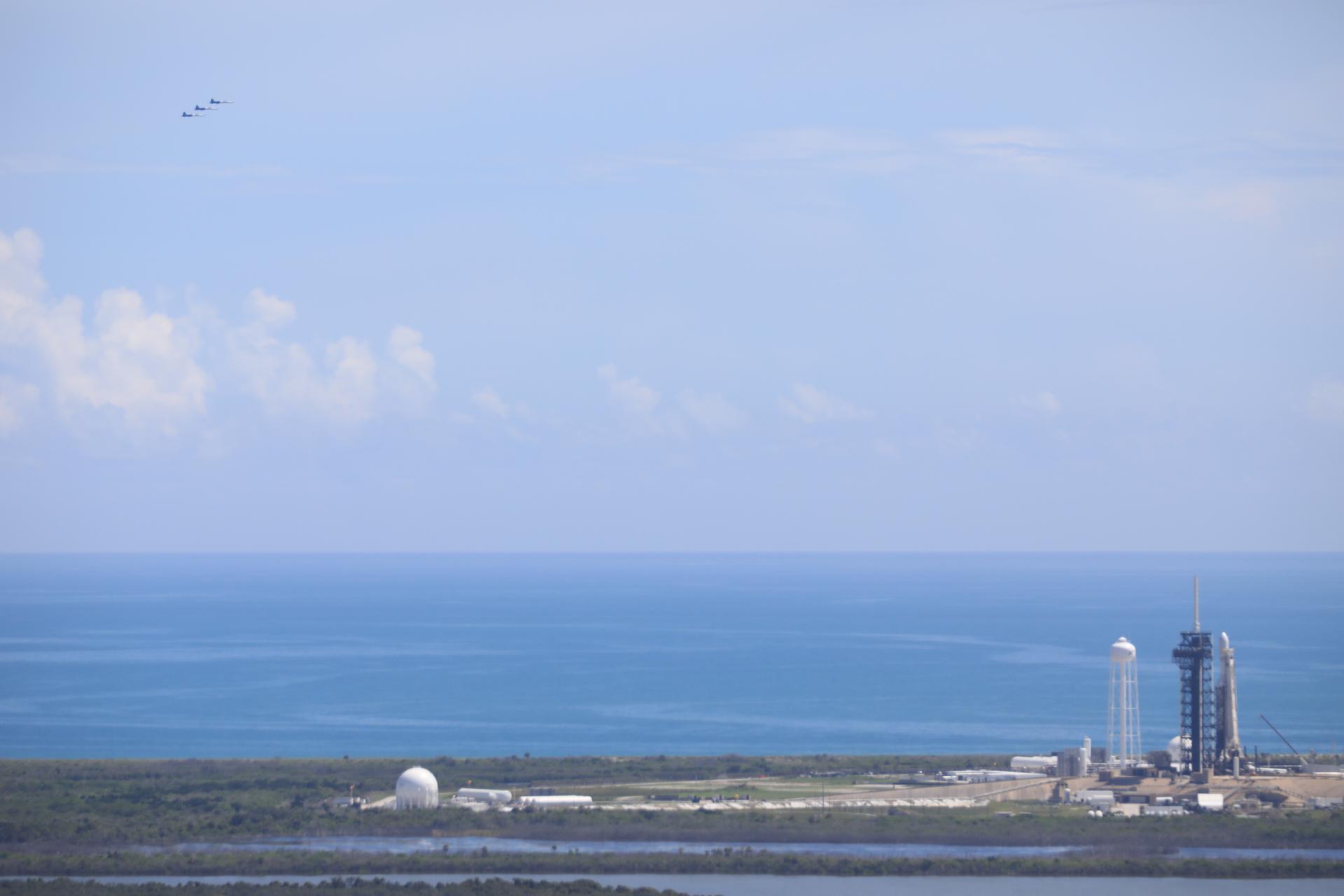
NASA Administrator Jared Isaacman leads a flight of his personally owned F-5 Tiger II aircraft on a flyby of Launch Complex 39A where a SpaceX Falcon Heavy rocket with the agency's Nancy Grace Roman Space Telescope, encapsulated in a protective payload fairing, is undergoing final launch preparations, Saturday, Aug. 29, 2026, at NASA's Kennedy Space Center in Florida. Roman will investigate dark energy and dark matter, conduct a statistical census of planetary systems, and enable a broad range of additional astrophysics research. Liftoff from Kennedy is targeted for no earlier than 7:26 a.m. EDT Sunday, Aug. 30.

NASA Administrator Jared Isaacman leads a flight of his personally owned F-5 Tiger II aircraft on a flyby of Launch Complex 39A where a SpaceX Falcon Heavy rocket with the agency's Nancy Grace Roman Space Telescope, encapsulated in a protective payload fairing, is undergoing final launch preparations, Saturday, Aug. 29, 2026, at NASA's Kennedy Space Center in Florida. Roman will investigate dark energy and dark matter, conduct a statistical census of planetary systems, and enable a broad range of additional astrophysics research. Liftoff from Kennedy is targeted for no earlier than 7:26 a.m. EDT Sunday, Aug. 30.
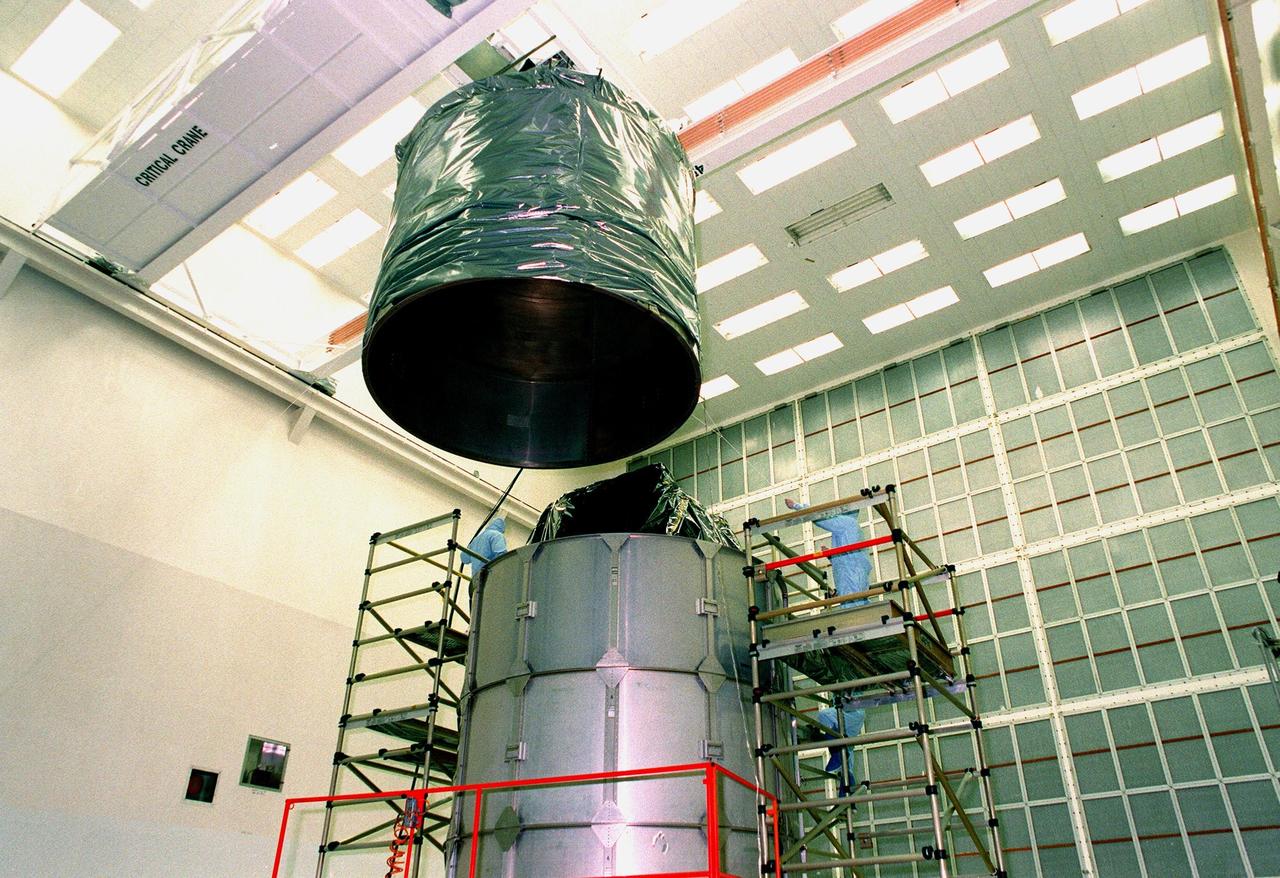
At Hangar AE, Cape Canaveral Air Station (CCAS), the last segment is lifted over the top of NASA's Far Ultraviolet Spectroscopic Explorer (FUSE) satellite already encased in a protective canister. The satellite will next be moved to Launch Pad 17A, CCAS, for its scheduled launch June 23 aboard a Boeing Delta II rocket. FUSE was developed by The Johns Hopkins University under contract to Goddard Space Flight Center, Greenbelt, Md., to investigate the origin and evolution of the lightest elements in the universe hydrogen and deuterium. In addition, the FUSE satellite will examine the forces and process involved in the evolution of the galaxies, stars and planetary systems by investigating light in the far ultraviolet portion of the electromagnetic spectrum
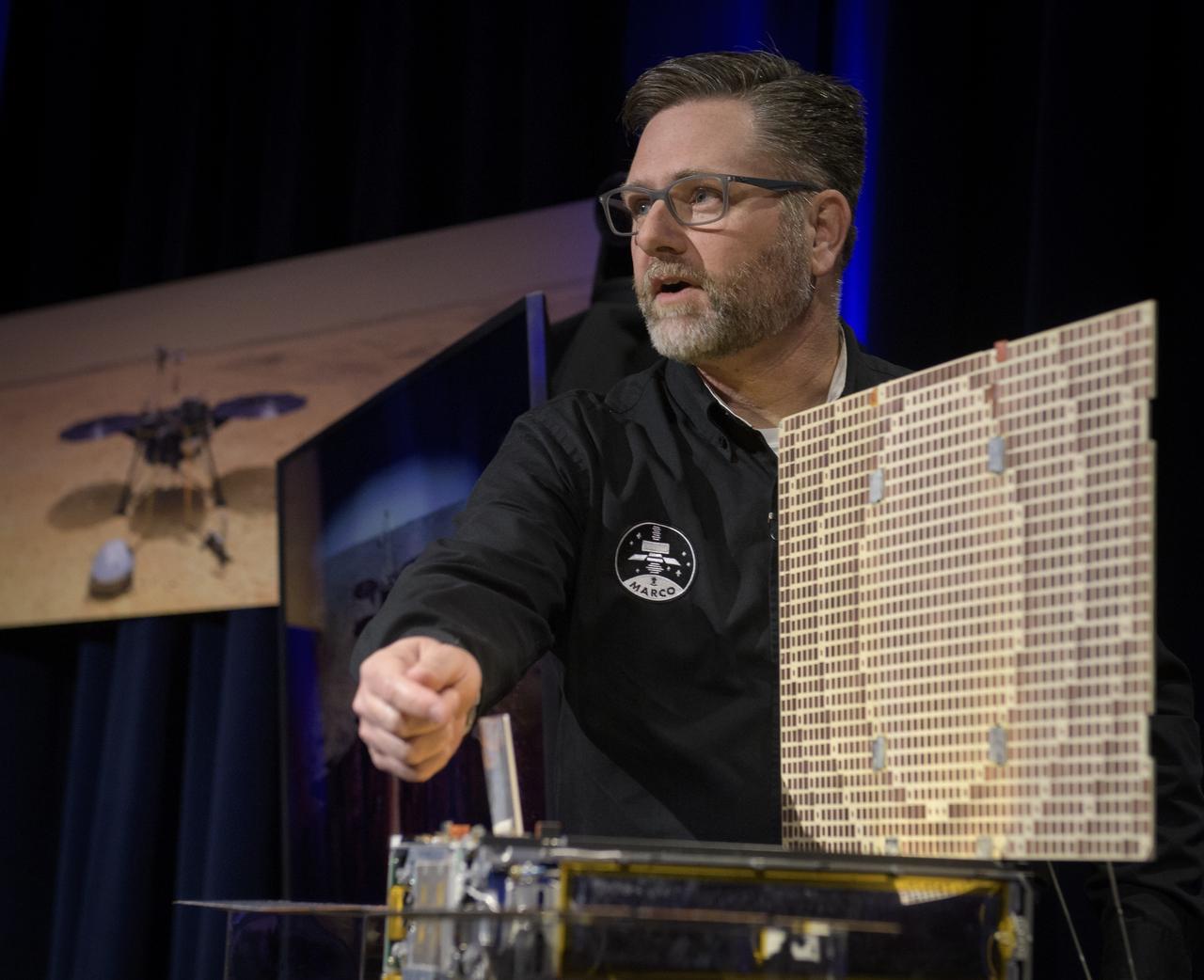
Brian Clement, Planetary Protection lead for MarCO, NASA JPL, talks about Mars Cube One (MarCO) during an Mars InSight pre-landing briefing, Sunday, Nov. 25, 2018 at NASA's Jet Propulsion Laboratory in Pasadena, California. InSight, short for Interior Exploration using Seismic Investigations, Geodesy and Heat Transport, is a Mars lander designed to study the "inner space" of Mars: its crust, mantle, and core. InSight is scheduled to touch down on the Red Planet at approximately noon PST (3 p.m. EST) on Nov. 26. Photo Credit: (NASA/Bill Ingalls)
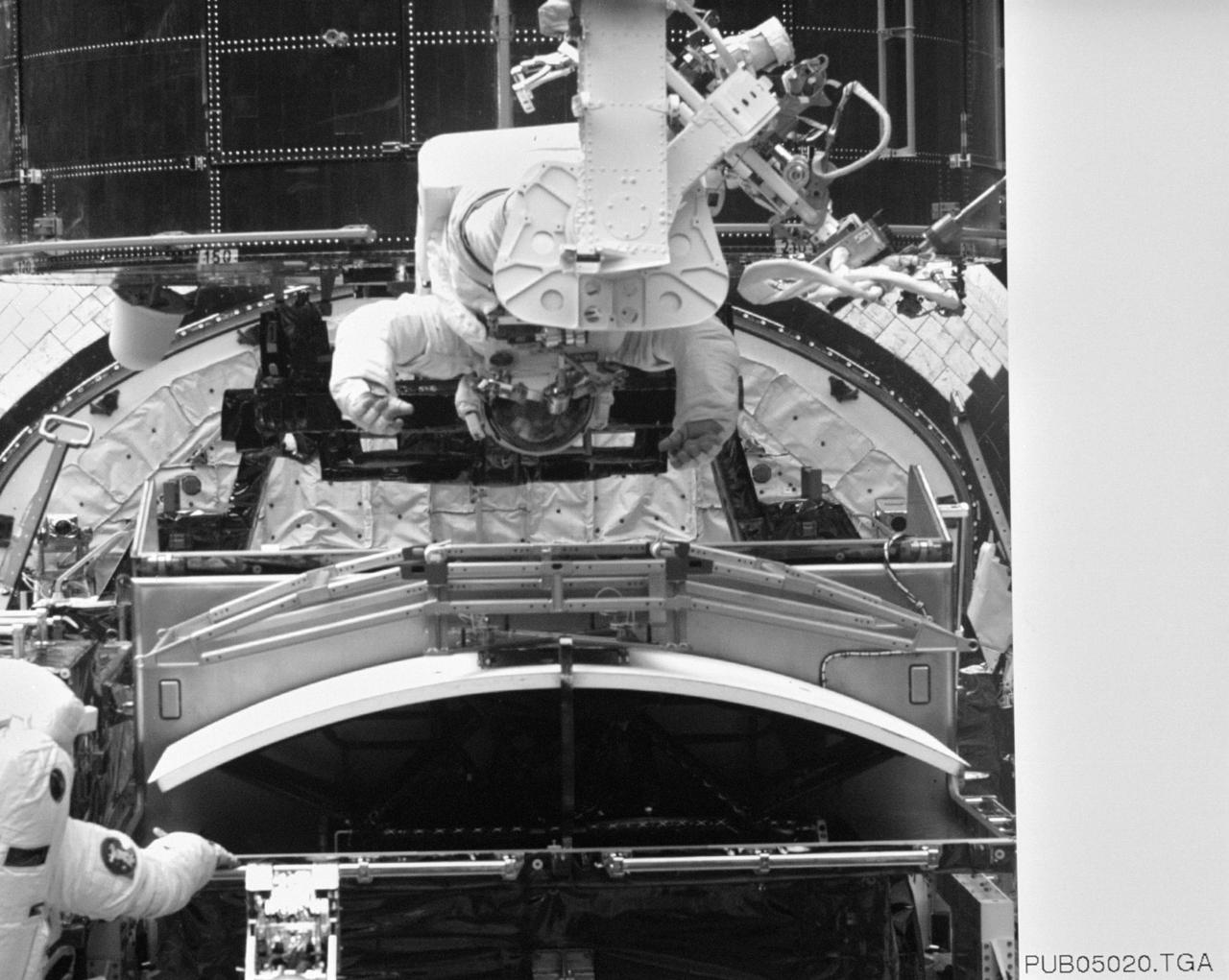
S61-E-016 (6 Dec 1993) --- Astronaut Jeffrey A. Hoffman (frame center) remains secured by his feet on the end of Endeavour's robot arm as he prepares to participate in the replacement of Hubble Space Telescope's Wide Field/Planetary Camera (WF/PC). Astronaut F. Story Musgrave (just in frame at lower left corner) assists Hoffman in removing the new camera (WFPC-II) from the Scientific Instrument Protective Enclosure (SIPE). Electronic still photography is a relatively new technology which provides the means for a handheld camera to electronically capture and digitize an image with resolution approaching film quality. The electronic still camera has flown as an experiment on several other shuttle missions.
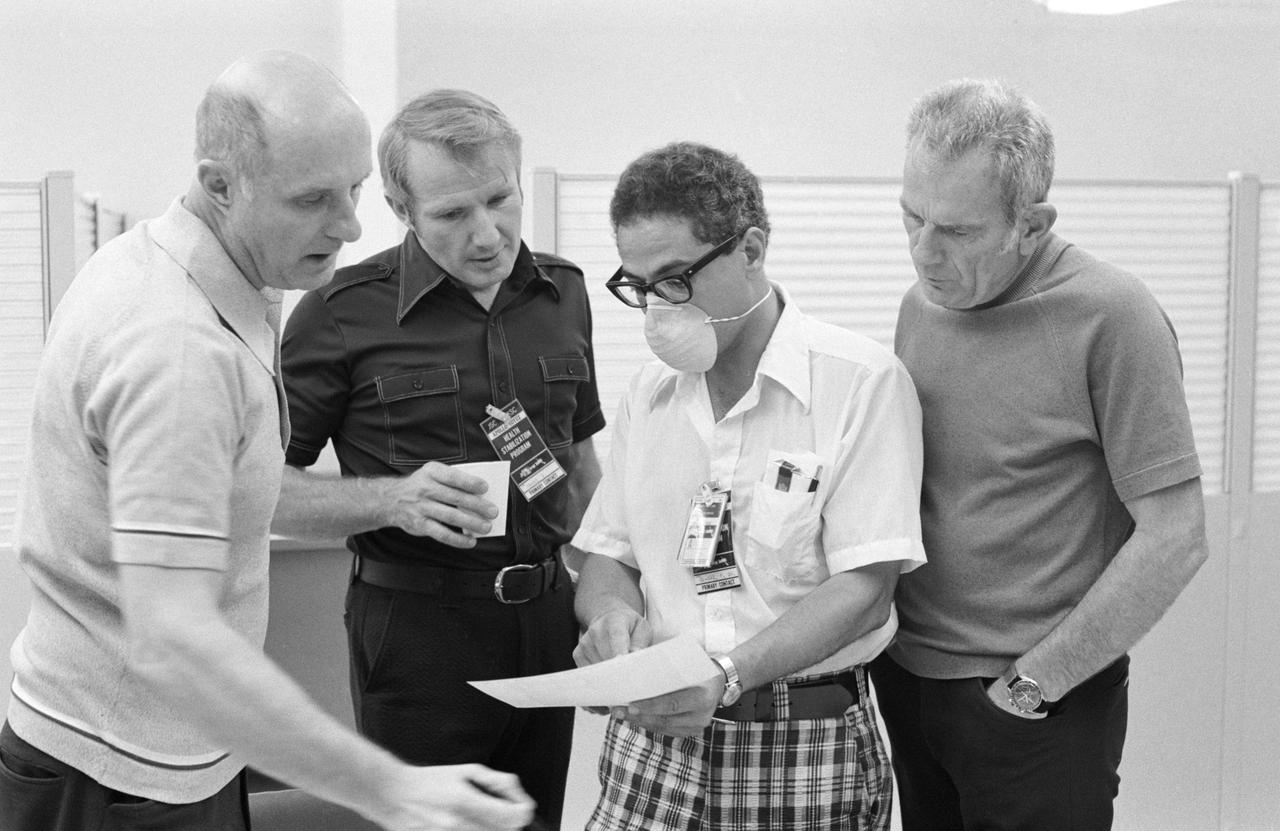
S75-28229 (8 July 1975) --- The three American ASTP prime crew astronauts participate in a photography mission briefing in Building 5 with Dr. Farouk El-Baz (wearing face mask) during Apollo-Soyuz Test Project preflight activity at NASA's Johnson Space Center. They are, left to right, Thomas P. Stafford, commander; Vance D. Brand, command module pilot; Dr. El-Baz; and Donald K. Slayton, docking module pilot. Dr. El-Baz is with the Center for Earth and Planetary Studies, National Air and Space Museum, Smithsonian Institution. The face mask is to protect the crewmen from possible exposure to disease prior to launch time. Photo credit: NASA

NASA Administrator Jared Isaacman leads a flight of his personally owned F-5 Tiger II aircraft on a flyby of Launch Complex 39A where a SpaceX Falcon Heavy rocket with the agency's Nancy Grace Roman Space Telescope, encapsulated in a protective payload fairing, is undergoing final launch preparations, Saturday, Aug. 29, 2026, at NASA's Kennedy Space Center in Florida. Roman will investigate dark energy and dark matter, conduct a statistical census of planetary systems, and enable a broad range of additional astrophysics research. Liftoff from Kennedy is targeted for no earlier than 7:26 a.m. EDT Sunday, Aug. 30.
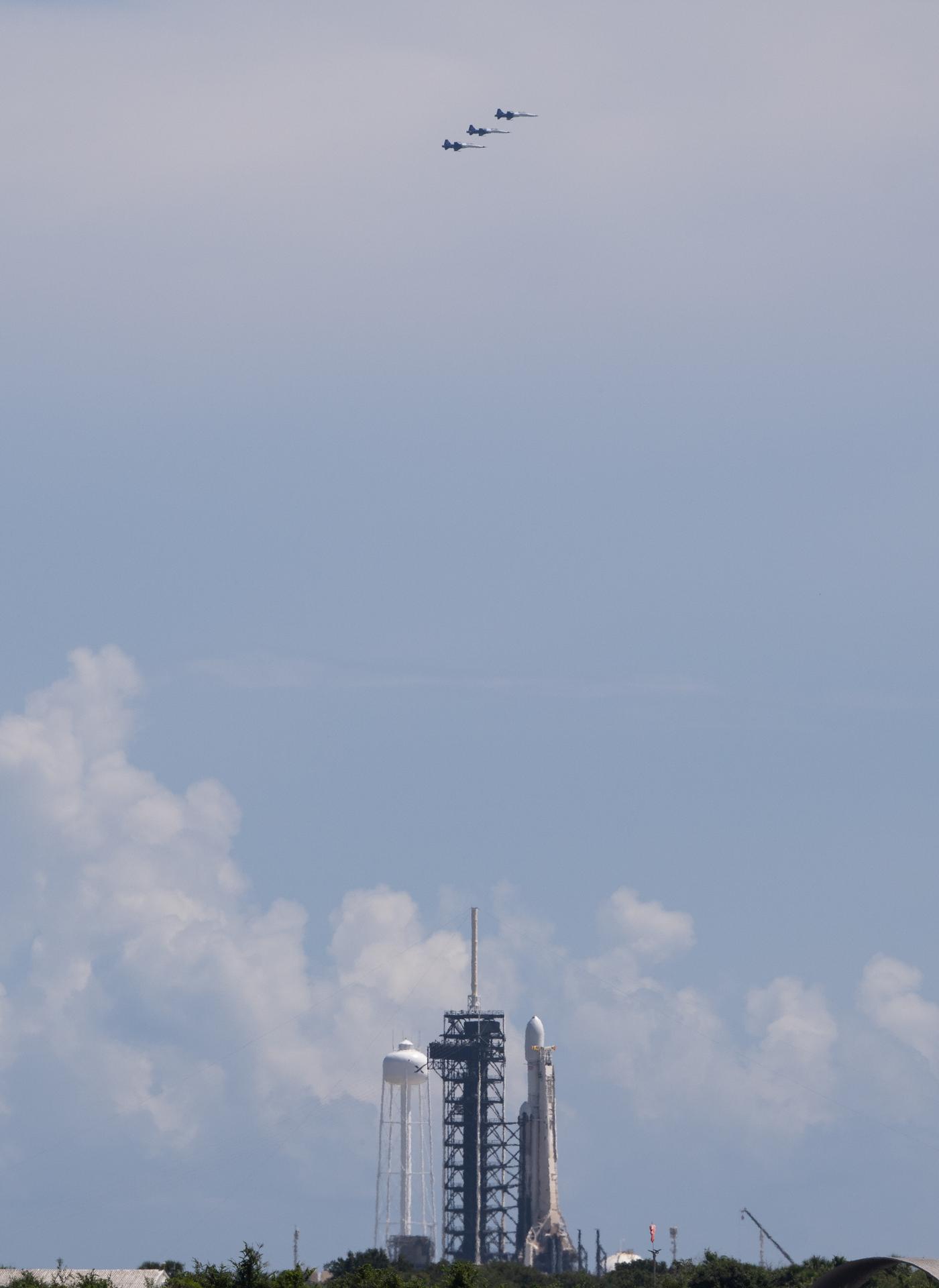
NASA Administrator Jared Isaacman leads a flight of his personally owned F-5 Tiger II aircraft on a flyby of Launch Complex 39A where a SpaceX Falcon Heavy rocket with NASA’s Nancy Grace Roman Space Telescope, encapsulated in a protective payload fairing, is undergoing final launch preparations, Saturday, Aug. 29, 2026, at NASA Kennedy Space Center in Florida. Roman will investigate dark energy and dark matter, conduct a statistical census of planetary systems, and enable a broad range of additional astrophysics research. Liftoff from NASA Kennedy is targeted for Sunday, Aug. 30, 2026. Photo Credit: (NASA/Joel Kowsky)
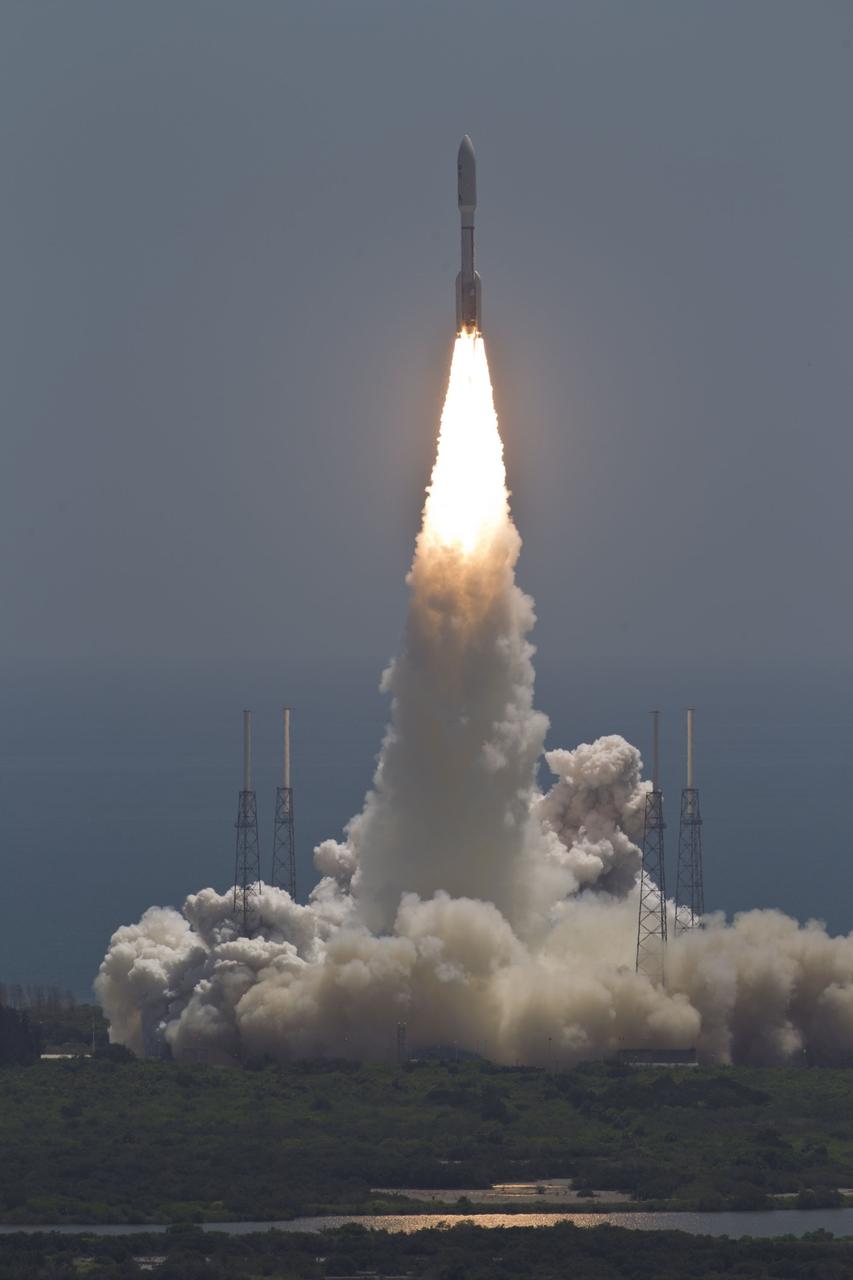
CAPE CANAVERAL, Fla. -- NASA's Juno planetary probe, enclosed in its payload fairing atop a United Launch Alliance Atlas V-551 launch vehicle, rushes above the towers of the lightning protection system at Space Launch Complex 41 on Cape Canaveral Air Force Station in Florida. Liftoff was at 12:25 p.m. EDT Aug. 5. The solar-powered spacecraft will orbit Jupiter's poles 33 times to find out more about the gas giant's origins, structure, atmosphere and magnetosphere and investigate the existence of a solid planetary core. NASA's Jet Propulsion Laboratory, Pasadena, Calif., manages the Juno mission for the principal investigator, Scott Bolton, of Southwest Research Institute in San Antonio. The Juno mission is part of the New Frontiers Program managed at NASA's Marshall Space Flight Center in Huntsville, Ala. Lockheed Martin Space Systems, Denver, built the spacecraft. Launch management for the mission is the responsibility of NASA's Launch Services Program at the Kennedy Space Center in Florida. For more information, visit www.nasa.gov/juno. Photo credit: Courtesy of Scott Andrews
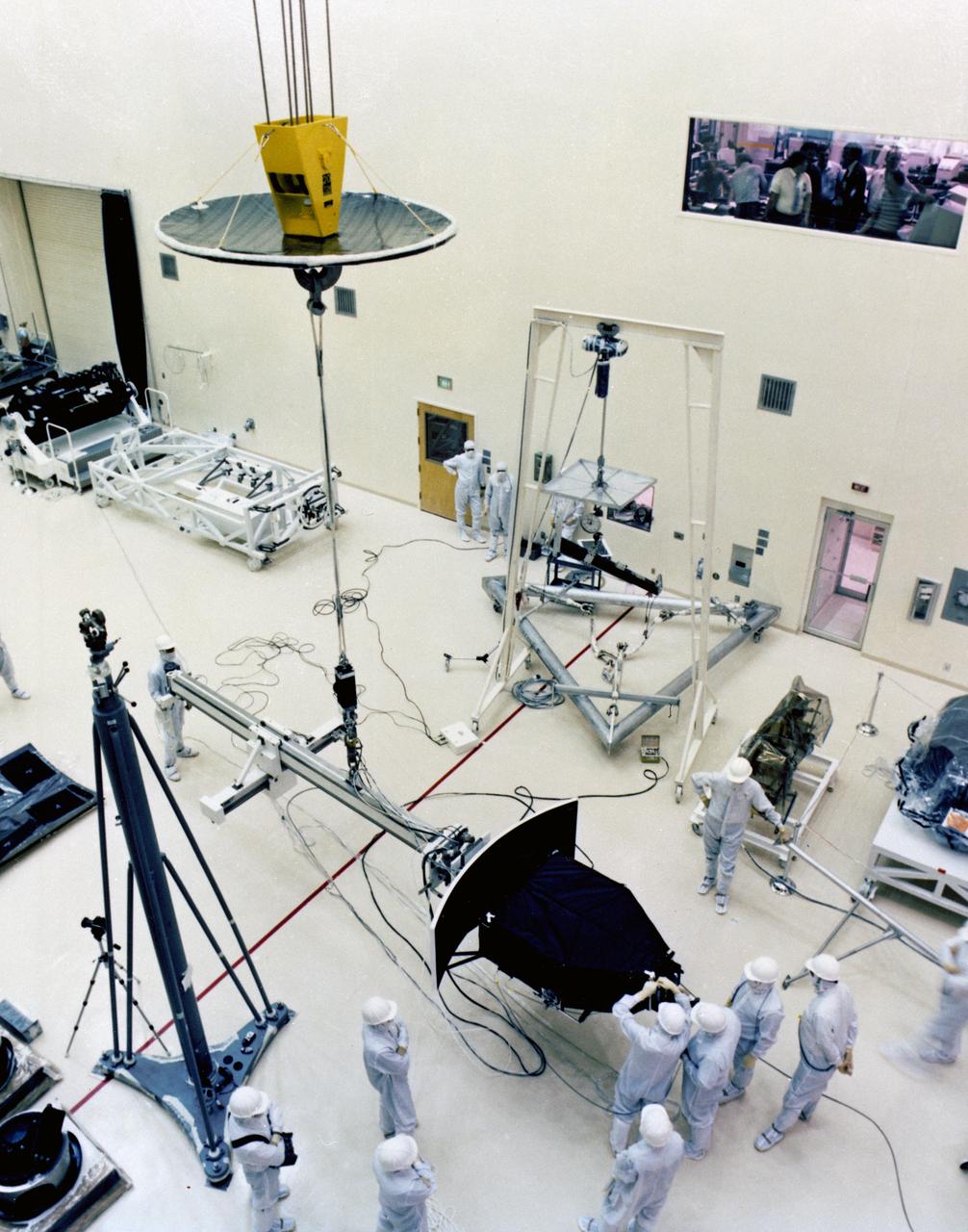
In this photograph, engineers and technicians prepare the Hubble Space Telescope's (HST's) Wide Field and Planetary Camera (WF/PC) for installation at the Lockheed Missile and Space Company. The WF/PC is designed to investigate the age of the universe and to search for new planetary systems around young stars. It takes pictures of large numbers of galaxies and close-ups of planets in our solar system. The HST is the first of NASA's great observatories and the most complex and sensitive optical telescope ever made. The purpose of the HST is to study the cosmos from a low-Earth orbit by placing the telescope in space, enabling astronomers to collect data that is free of the Earth's atmosphere. The HST was deployed from the Space Shuttle Discovery (STS-31 mission) into Earth orbit in April 1990. The Marshall Space Flight Center had overall responsibility for design, development, and construction of the HST. The Perkin-Elmer Corporation, in Danbury, Cornecticut, developed the optical system and guidance sensors. The Lockheed Missile and Space Company, Sunnyvale, California, produced the protective outer shroud and spacecraft systems, and assembled and tested the finished telescope.
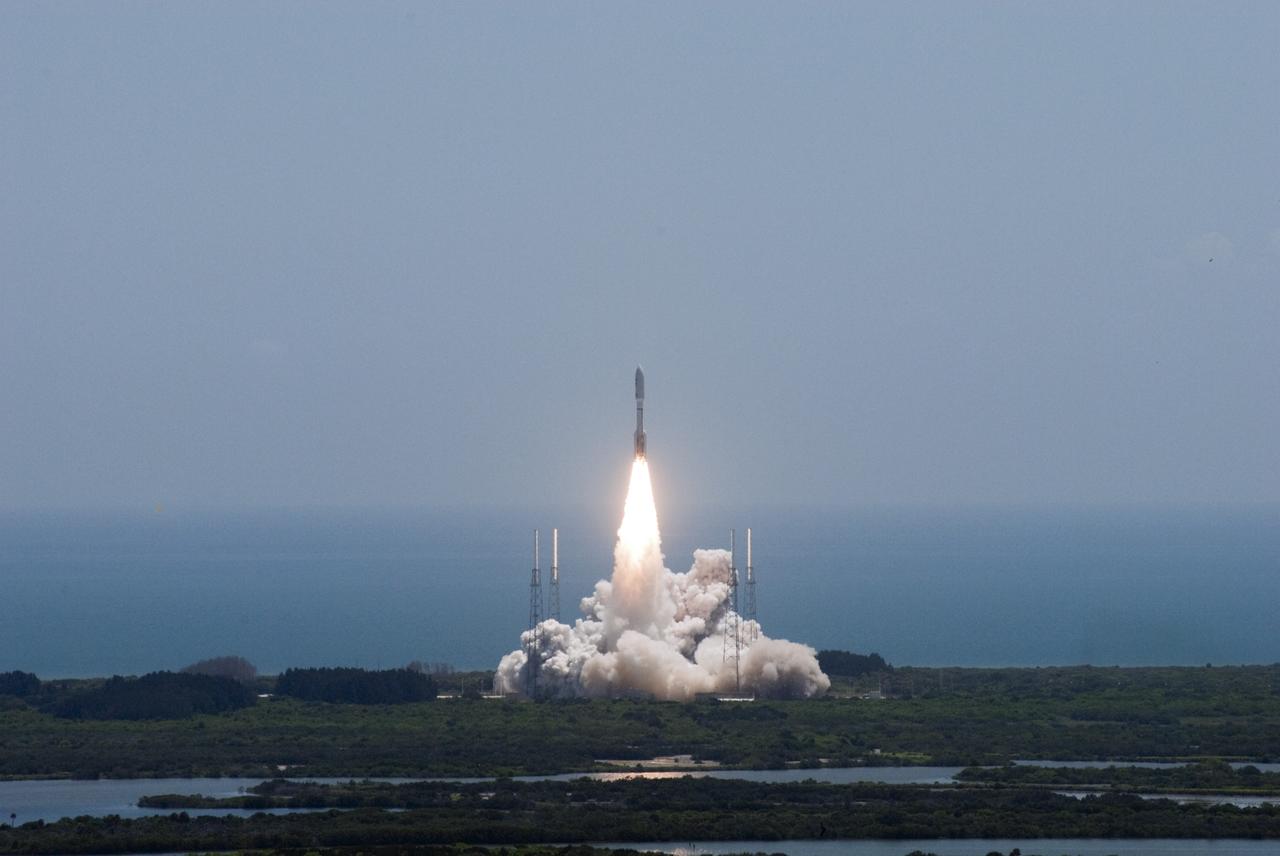
CAPE CANAVERAL, Fla. -- NASA's Juno planetary probe, enclosed in its payload fairing atop a United Launch Alliance Atlas V-551 launch vehicle, rises above the towers of the lightning protection system at Space Launch Complex 41 on Cape Canaveral Air Force Station in Florida. Liftoff was at 12:25 p.m. EDT Aug. 5. The solar-powered spacecraft will orbit Jupiter's poles 33 times to find out more about the gas giant's origins, structure, atmosphere and magnetosphere and investigate the existence of a solid planetary core. NASA's Jet Propulsion Laboratory, Pasadena, Calif., manages the Juno mission for the principal investigator, Scott Bolton, of Southwest Research Institute in San Antonio. The Juno mission is part of the New Frontiers Program managed at NASA's Marshall Space Flight Center in Huntsville, Ala. Lockheed Martin Space Systems, Denver, built the spacecraft. Launch management for the mission is the responsibility of NASA's Launch Services Program at the Kennedy Space Center in Florida. For more information, visit www.nasa.gov/juno. Photo credit: NASA/Jim Grossmann
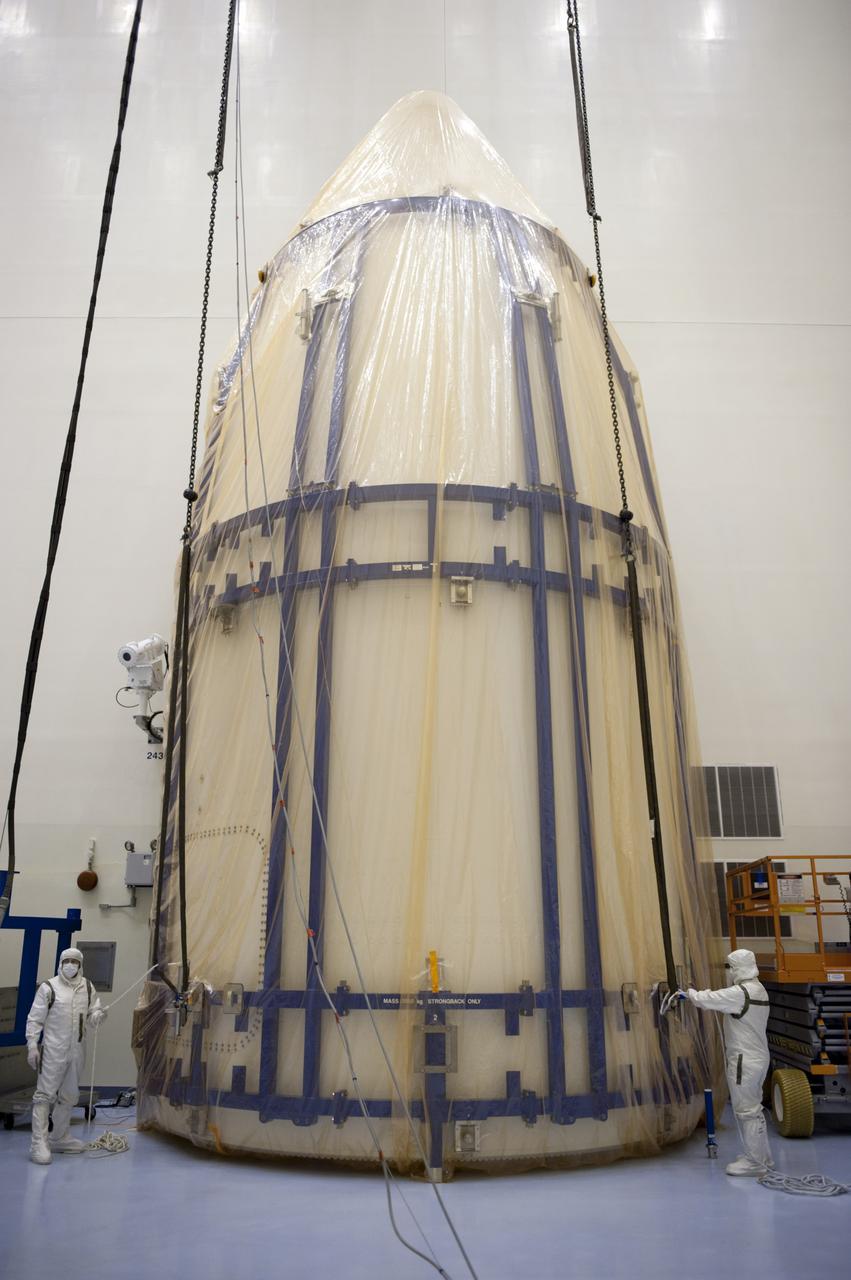
CAPE CANAVERAL, Fla. -- In the Payload Hazardous Servicing Facility at NASA's Kennedy Space Center in Florida, United Launch Alliance technicians prepare to lift half of the Atlas V payload fairing for NASA's Mars Science Laboratory (MSL) mission from the floor. Preparations are under way to lower it into a horizontal position to uncover and then clean it to meet NASA's planetary protection requirements. The fairing will protect the spacecraft from the impact of aerodynamic pressure and heating during ascent. Although jettisoned once the spacecraft is outside the Earth's atmosphere, the fairing must be cleaned to the same exacting standards as the laboratory to avoid the possibility of contaminating it. MSL's components include a compact car-sized rover, Curiosity, which has 10 science instruments designed to search for evidence on whether Mars has had environments favorable to microbial life, including the chemical ingredients for life. The unique rover will use a laser to look inside rocks and release its gasses so that the rover’s spectrometer can analyze and send the data back to Earth. Launch of MSL aboard a United Launch Alliance Atlas V rocket is planned for Nov. 25 from Space Launch Complex 41 on Cape Canaveral Air Force Station. For more information, visit http:__www.nasa.gov_msl. Photo credit: NASA_Kim Shiflett
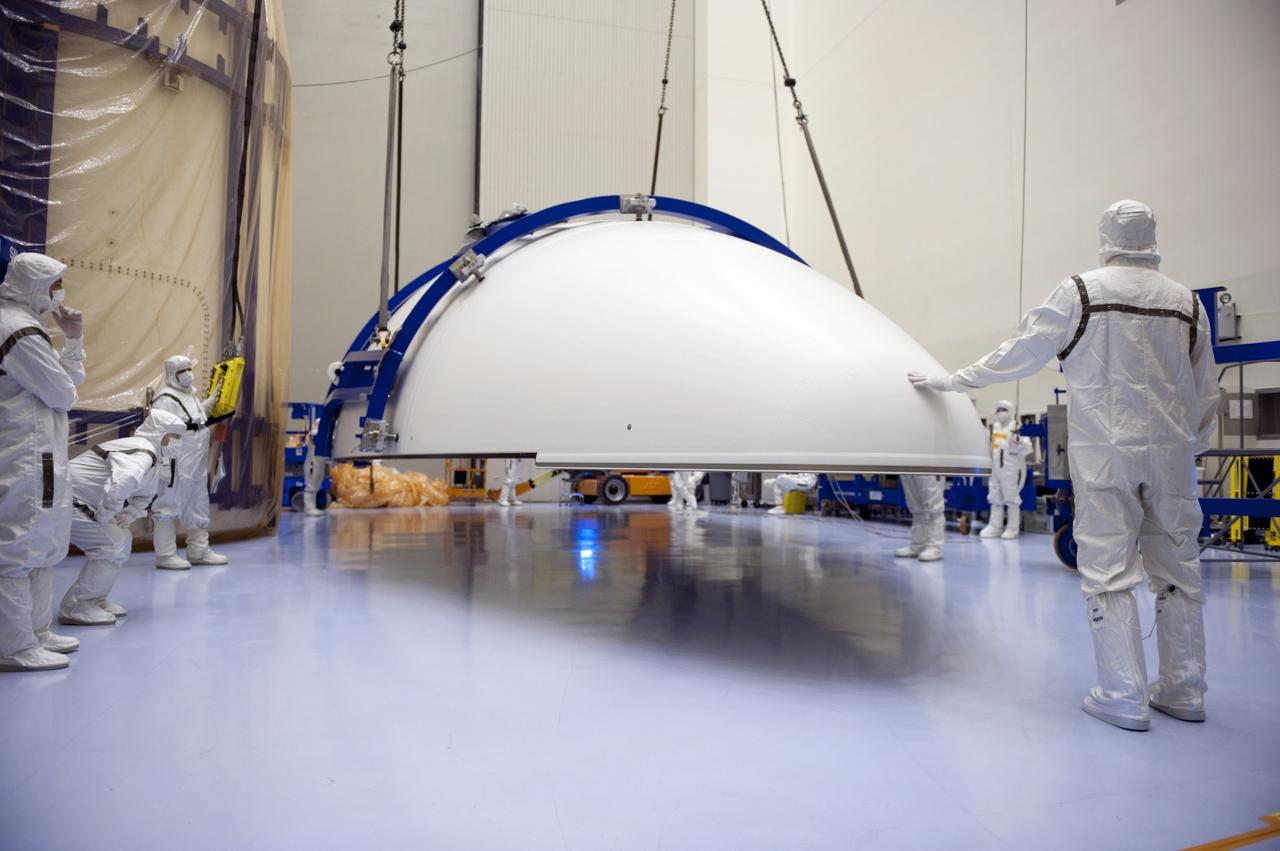
CAPE CANAVERAL, Fla. -- In the Payload Hazardous Servicing Facility at NASA's Kennedy Space Center in Florida, half of the Atlas V payload fairing for NASA's Mars Science Laboratory (MSL) mission hovers above the floor during operations to raise it into a vertical position. The fairing has been uncovered, and preparations are under way to clean it to meet NASA's planetary protection requirements. At left is the other half of the fairing, still uncovered. The fairing will protect the spacecraft from the impact of aerodynamic pressure and heating during ascent. Although jettisoned once the spacecraft is outside the Earth's atmosphere, the fairing must be cleaned to the same exacting standards as the laboratory to avoid the possibility of contaminating it. MSL's components include a compact car-sized rover, Curiosity, which has 10 science instruments designed to search for evidence on whether Mars has had environments favorable to microbial life, including the chemical ingredients for life. The unique rover will use a laser to look inside rocks and release its gasses so that the rover’s spectrometer can analyze and send the data back to Earth. Launch of MSL aboard a United Launch Alliance Atlas V rocket is planned for Nov. 25 from Space Launch Complex 41 on Cape Canaveral Air Force Station. For more information, visit http://www.nasa.gov/msl. Photo credit: NASA/Kim Shiflett
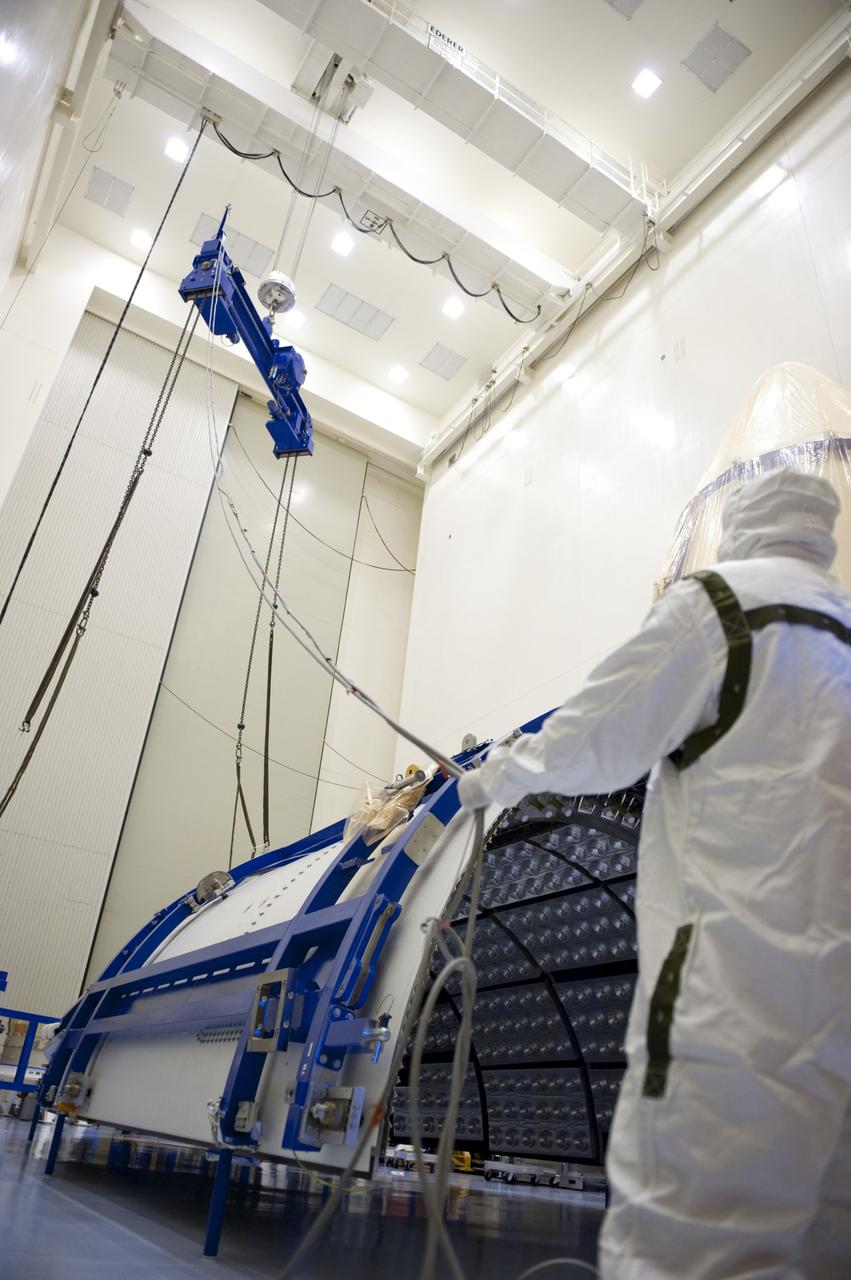
CAPE CANAVERAL, Fla. -- In the Payload Hazardous Servicing Facility at NASA's Kennedy Space Center in Florida, United Launch Alliance technicians lower a lifting device toward half of the Atlas V payload fairing for NASA's Mars Science Laboratory (MSL) mission. The fairing has been uncovered, and preparations are under way to clean it to meet NASA's planetary protection requirements. The fairing will protect the spacecraft from the impact of aerodynamic pressure and heating during ascent. Although jettisoned once the spacecraft is outside the Earth's atmosphere, the fairing must be cleaned to the same exacting standards as the laboratory to avoid the possibility of contaminating it. MSL's components include a compact car-sized rover, Curiosity, which has 10 science instruments designed to search for evidence on whether Mars has had environments favorable to microbial life, including the chemical ingredients for life. The unique rover will use a laser to look inside rocks and release its gasses so that the rover’s spectrometer can analyze and send the data back to Earth. Launch of MSL aboard a United Launch Alliance Atlas V rocket is planned for Nov. 25 from Space Launch Complex 41 on Cape Canaveral Air Force Station. For more information, visit http://www.nasa.gov/msl. Photo credit: NASA/Kim Shiflett
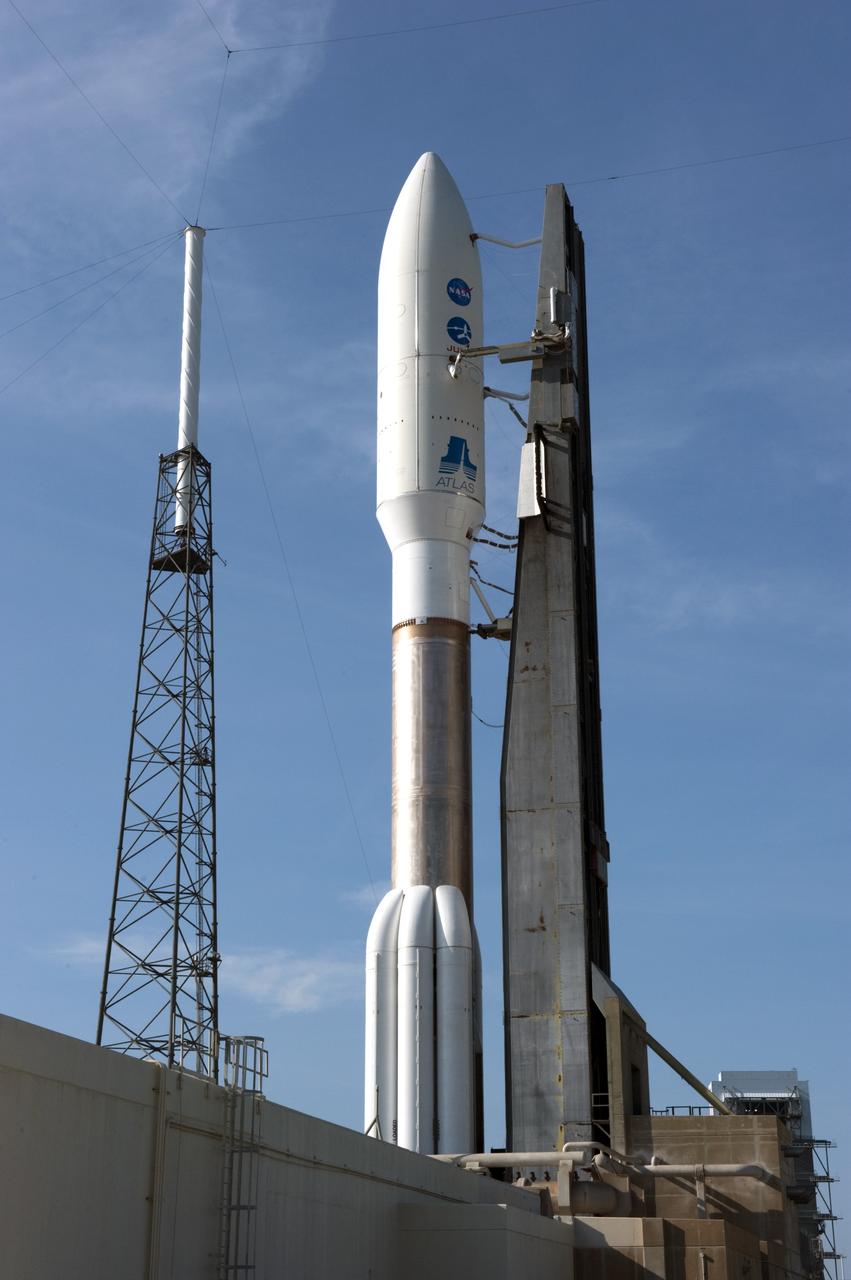
CAPE CANAVERAL, Fla. -- NASA's Juno spacecraft, enclosed in its payload fairing atop a United Launch Alliance Atlas V-551 launch vehicle, is protected from potential stormy weather by the wire catenary system traversing the towers of the lightning protection system at Space Launch Complex 41 on Cape Canaveral Air Force Station in Florida. Launch is planned during a launch window which extends from 11:34 a.m. to 12:43 p.m. EDT on Aug. 5. The solar-powered spacecraft will orbit Jupiter's poles 33 times to find out more about the gas giant's origins, structure, atmosphere and magnetosphere and investigate the existence of a solid planetary core. NASA's Jet Propulsion Laboratory, Pasadena, Calif., manages the Juno mission for the principal investigator, Scott Bolton, of Southwest Research Institute in San Antonio. The Juno mission is part of the New Frontiers Program managed at NASA's Marshall Space Flight Center in Huntsville, Ala. Lockheed Martin Space Systems, Denver, built the spacecraft. Launch management for the mission is the responsibility of NASA's Launch Services Program at the Kennedy Space Center in Florida. For more information, visit www.nasa.gov/juno. Photo credit: NASA/Kim Shiflett
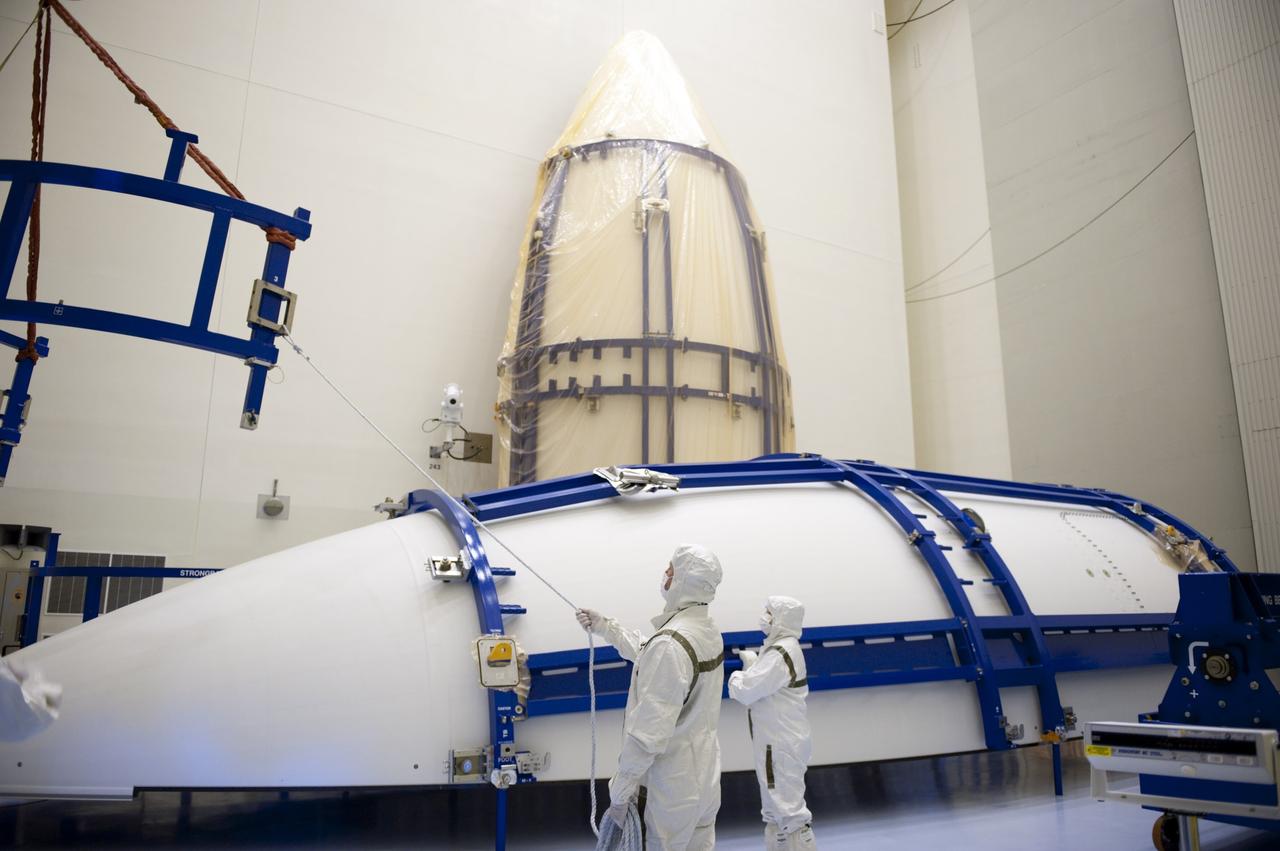
CAPE CANAVERAL, Fla. -- In the Payload Hazardous Servicing Facility at NASA's Kennedy Space Center in Florida, United Launch Alliance technicians guide a lifting device toward half of the Atlas V payload fairing for NASA's Mars Science Laboratory (MSL) mission. The fairing has been uncovered, and preparations are under way to clean it to meet NASA's planetary protection requirements. In the background is the other half of the fairing, still uncovered. The fairing will protect the spacecraft from the impact of aerodynamic pressure and heating during ascent. Although jettisoned once the spacecraft is outside the Earth's atmosphere, the fairing must be cleaned to the same exacting standards as the laboratory to avoid the possibility of contaminating it. MSL's components include a compact car-sized rover, Curiosity, which has 10 science instruments designed to search for evidence on whether Mars has had environments favorable to microbial life, including the chemical ingredients for life. The unique rover will use a laser to look inside rocks and release its gasses so that the rover’s spectrometer can analyze and send the data back to Earth. Launch of MSL aboard a United Launch Alliance Atlas V rocket is planned for Nov. 25 from Space Launch Complex 41 on Cape Canaveral Air Force Station. For more information, visit http://www.nasa.gov/msl. Photo credit: NASA/Kim Shiflett
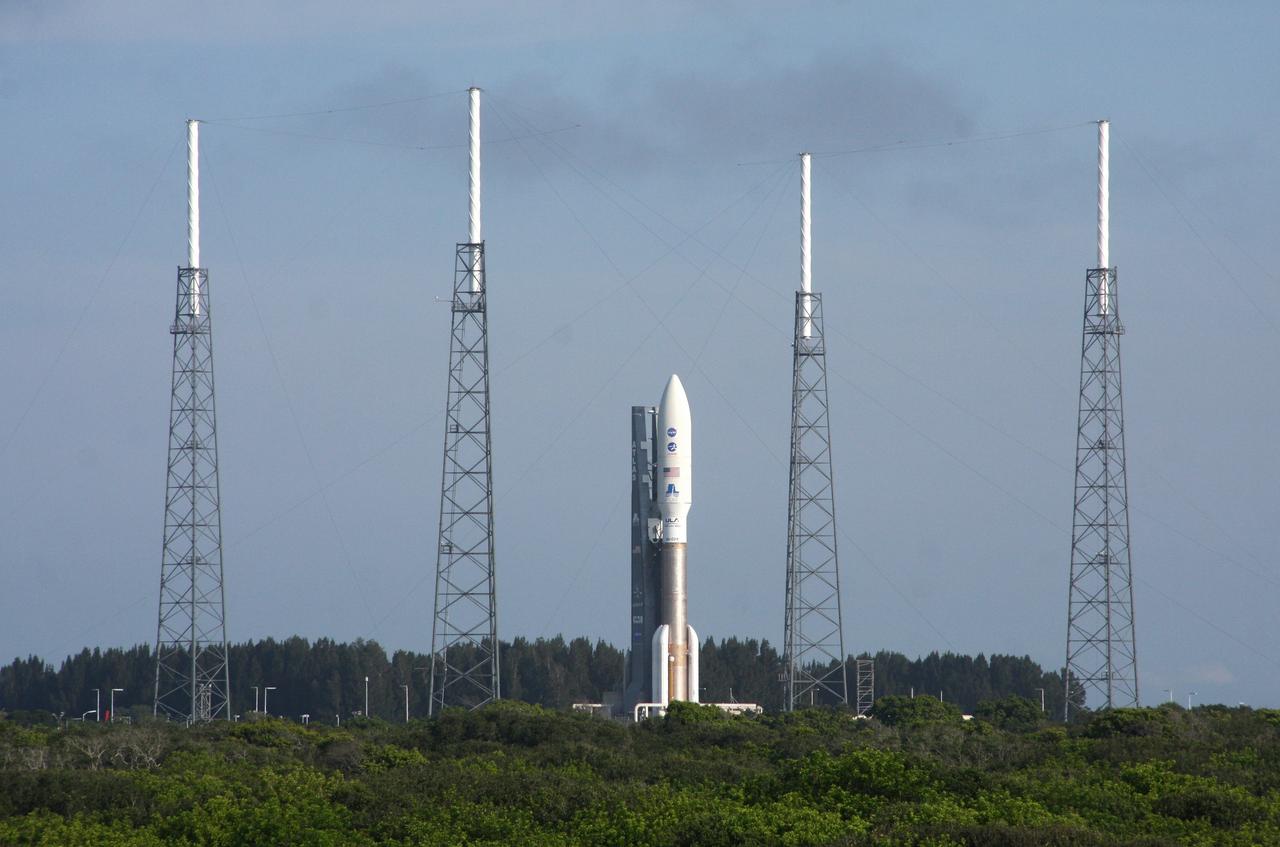
CAPE CANAVERAL, Fla. -- NASA's Juno spacecraft, enclosed in its payload fairing atop a United Launch Alliance Atlas V-551 launch vehicle, is protected from potential stormy weather by the wire catenary system traversing the towers of the lightning protection system at Space Launch Complex 41 on Cape Canaveral Air Force Station in Florida. Liftoff is planned during a launch window which extends from 11:34 a.m. to 12:43 p.m. EDT on Aug. 5. The solar-powered spacecraft will orbit Jupiter's poles 33 times to find out more about the gas giant's origins, structure, atmosphere and magnetosphere and investigate the existence of a solid planetary core. NASA's Jet Propulsion Laboratory, Pasadena, Calif., manages the Juno mission for the principal investigator, Scott Bolton, of Southwest Research Institute in San Antonio. The Juno mission is part of the New Frontiers Program managed at NASA's Marshall Space Flight Center in Huntsville, Ala. Lockheed Martin Space Systems, Denver, built the spacecraft. Launch management for the mission is the responsibility of NASA's Launch Services Program at the Kennedy Space Center in Florida. For more information, visit www.nasa.gov/juno. Photo credit: NASA/Ken Thornsley
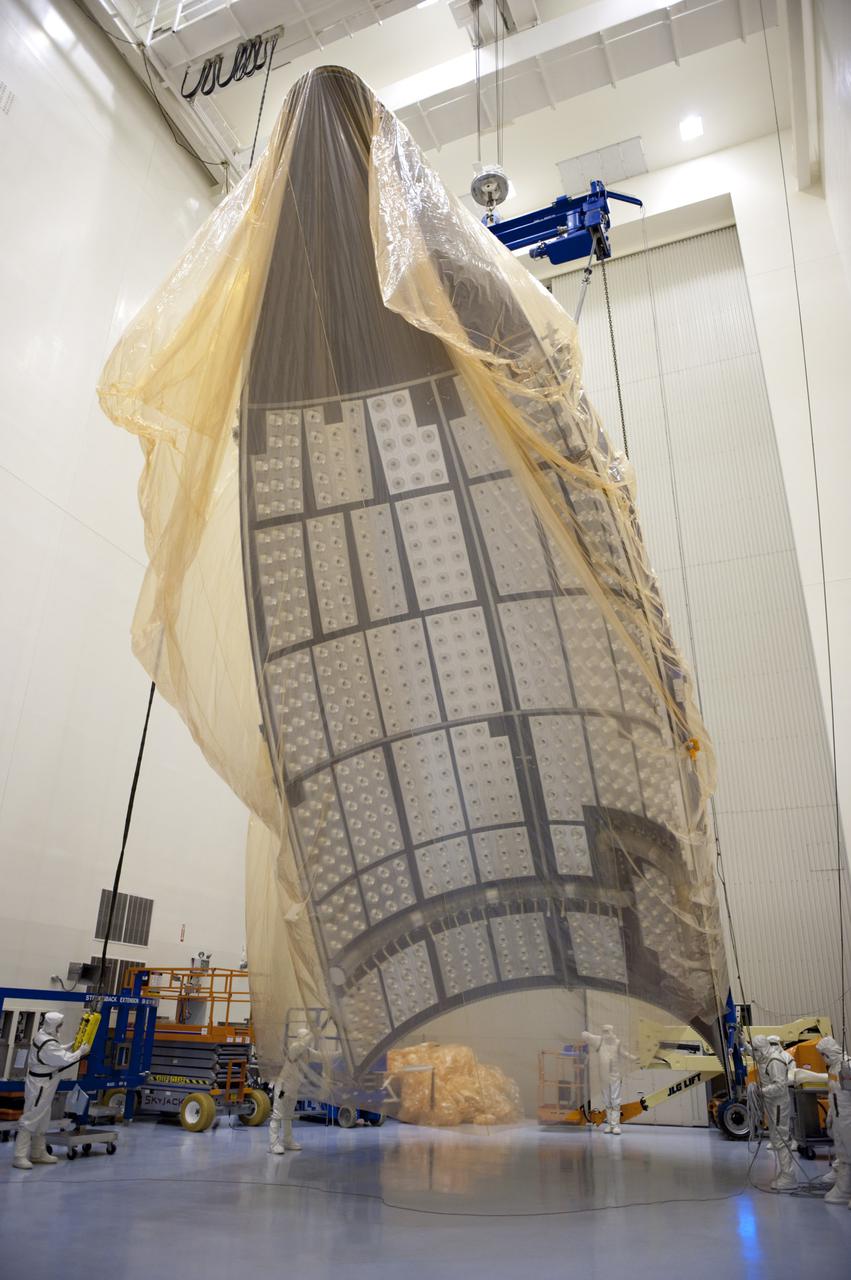
CAPE CANAVERAL, Fla. -- In the Payload Hazardous Servicing Facility at NASA's Kennedy Space Center in Florida, half of the Atlas V payload fairing for NASA's Mars Science Laboratory (MSL) mission is lowered into a horizontal position. It then will be uncovered and cleaned to meet NASA's planetary protection requirements. The fairing will protect the spacecraft from the impact of aerodynamic pressure and heating during ascent. Although jettisoned once the spacecraft is outside the Earth's atmosphere, the fairing must be cleaned to the same exacting standards as the laboratory to avoid the possibility of contaminating it. MSL's components include a compact car-sized rover, Curiosity, which has 10 science instruments designed to search for evidence on whether Mars has had environments favorable to microbial life, including the chemical ingredients for life. The unique rover will use a laser to look inside rocks and release its gasses so that the rover’s spectrometer can analyze and send the data back to Earth. Launch of MSL aboard a United Launch Alliance Atlas V rocket is planned for Nov. 25 from Space Launch Complex 41 on Cape Canaveral Air Force Station. For more information, visit http:__www.nasa.gov_msl. Photo credit: NASA_Kim Shiflett
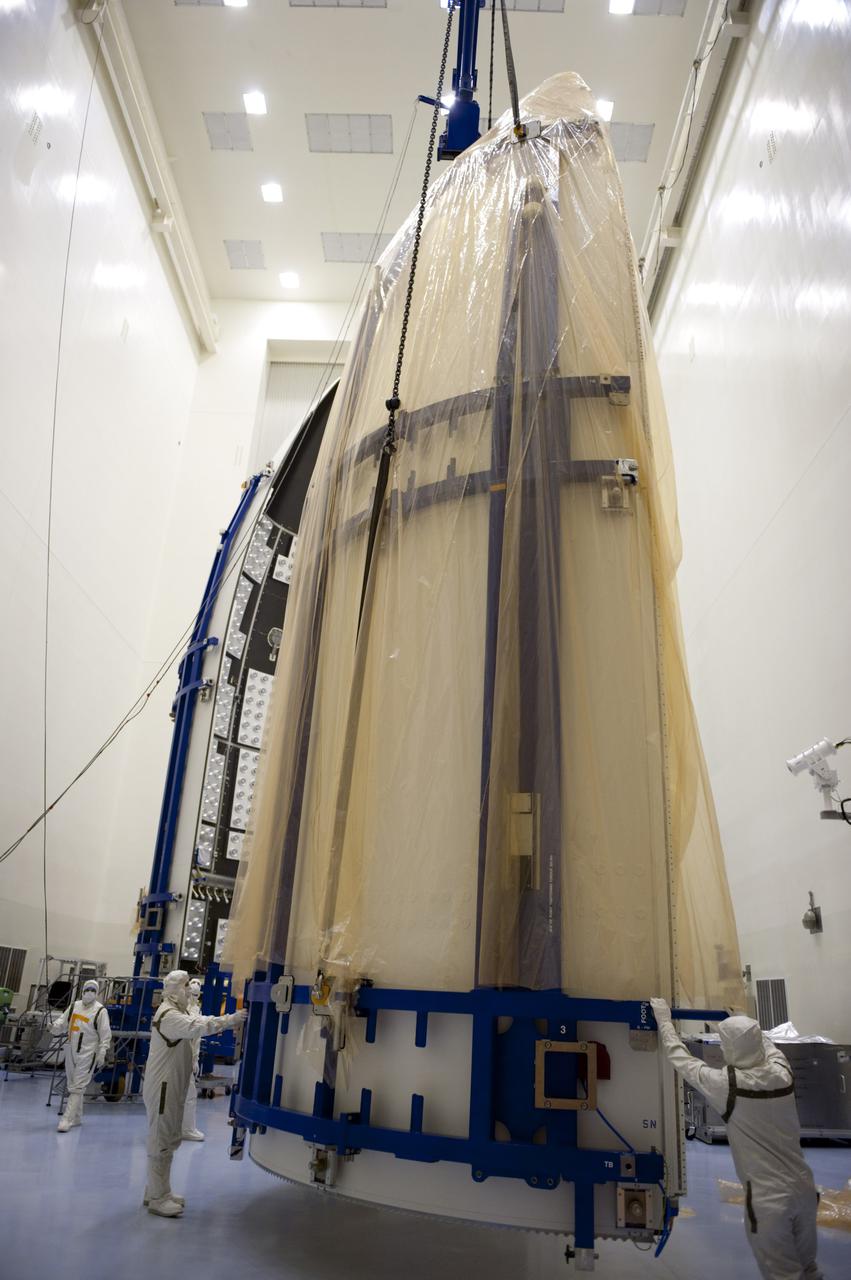
CAPE CANAVERAL, Fla. -- In the Payload Hazardous Servicing Facility at NASA's Kennedy Space Center in Florida, United Launch Alliance technicians steady half of the Atlas V payload fairing for NASA's Mars Science Laboratory (MSL) mission as it is lifted from the floor. Preparations are under way to lower it into a horizontal position to uncover and then clean it to meet NASA's planetary protection requirements. Behind it is the other half of the fairing, already uncovered. The fairing will protect the spacecraft from the impact of aerodynamic pressure and heating during ascent. Although jettisoned once the spacecraft is outside the Earth's atmosphere, the fairing must be cleaned to the same exacting standards as the laboratory to avoid the possibility of contaminating it. MSL's components include a compact car-sized rover, Curiosity, which has 10 science instruments designed to search for evidence on whether Mars has had environments favorable to microbial life, including the chemical ingredients for life. The unique rover will use a laser to look inside rocks and release its gasses so that the rover’s spectrometer can analyze and send the data back to Earth. Launch of MSL aboard a United Launch Alliance Atlas V rocket is planned for Nov. 25 from Space Launch Complex 41 on Cape Canaveral Air Force Station. For more information, visit http:__www.nasa.gov_msl. Photo credit: NASA_Kim Shiflett
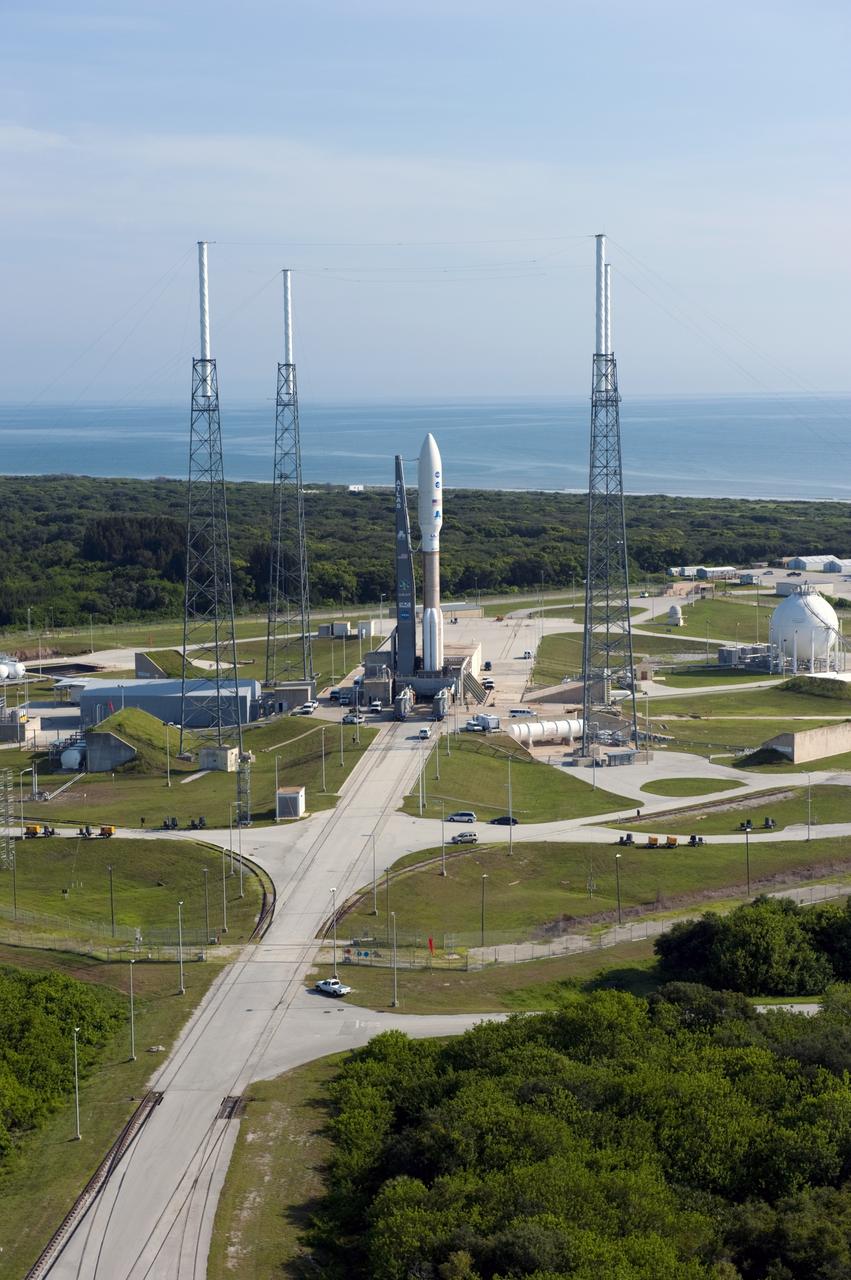
CAPE CANAVERAL, Fla. -- NASA's Juno spacecraft, enclosed in its payload fairing atop a United Launch Alliance Atlas V-551 launch vehicle, is protected from potential stormy weather by the wire catenary system traversing the towers of the lightning protection system at Space Launch Complex 41 on Cape Canaveral Air Force Station in Florida. The Atlantic Ocean behind the pad extends into the distance. Launch is planned during a launch window which extends from 11:34 a.m. to 12:43 p.m. EDT on Aug. 5. The solar-powered spacecraft will orbit Jupiter's poles 33 times to find out more about the gas giant's origins, structure, atmosphere and magnetosphere and investigate the existence of a solid planetary core. NASA's Jet Propulsion Laboratory, Pasadena, Calif., manages the Juno mission for the principal investigator, Scott Bolton, of Southwest Research Institute in San Antonio. The Juno mission is part of the New Frontiers Program managed at NASA's Marshall Space Flight Center in Huntsville, Ala. Lockheed Martin Space Systems, Denver, built the spacecraft. Launch management for the mission is the responsibility of NASA's Launch Services Program at the Kennedy Space Center in Florida. For more information, visit www.nasa.gov/juno. Photo credit: NASA/Kim Shiflett

Part of one of the protective photon shields for NASA's SPHEREx telescope are shown here being assembled at Applied Aerospace Structures in Stockton, California, in July 2023. Short for Specto-Photometer for the History of the Universe, Epoch of Reionization and Ices Explorer, SPHEREx will create a map of the cosmos like no other, imaging the entire sky and gathering information about millions of galaxies. With this map, scientists will study what happened in the first fraction of a second after the big bang, the history of galaxy evolution, and the origins of water in planetary systems in our galaxy. The three concentric photon shields will surround the SPHEREx telescope to protect it from nearby light sources that could overwhelm its detectors. The shields will primarily block light from the Sun and the Earth. They also block heat, because SPHEREx needs to be kept cold – below minus 350 degrees Fahrenheit (about minus 210 degrees Celsius). That's because SPHEREx detects infrared light, which is sometimes called heat radiation because it's emitted by anything warm. The heat from SPHEREx's own detectors could overwhelm their ability to detect faint cosmic objects if they aren't cooled down. https://photojournal.jpl.nasa.gov/catalog/PIA25785
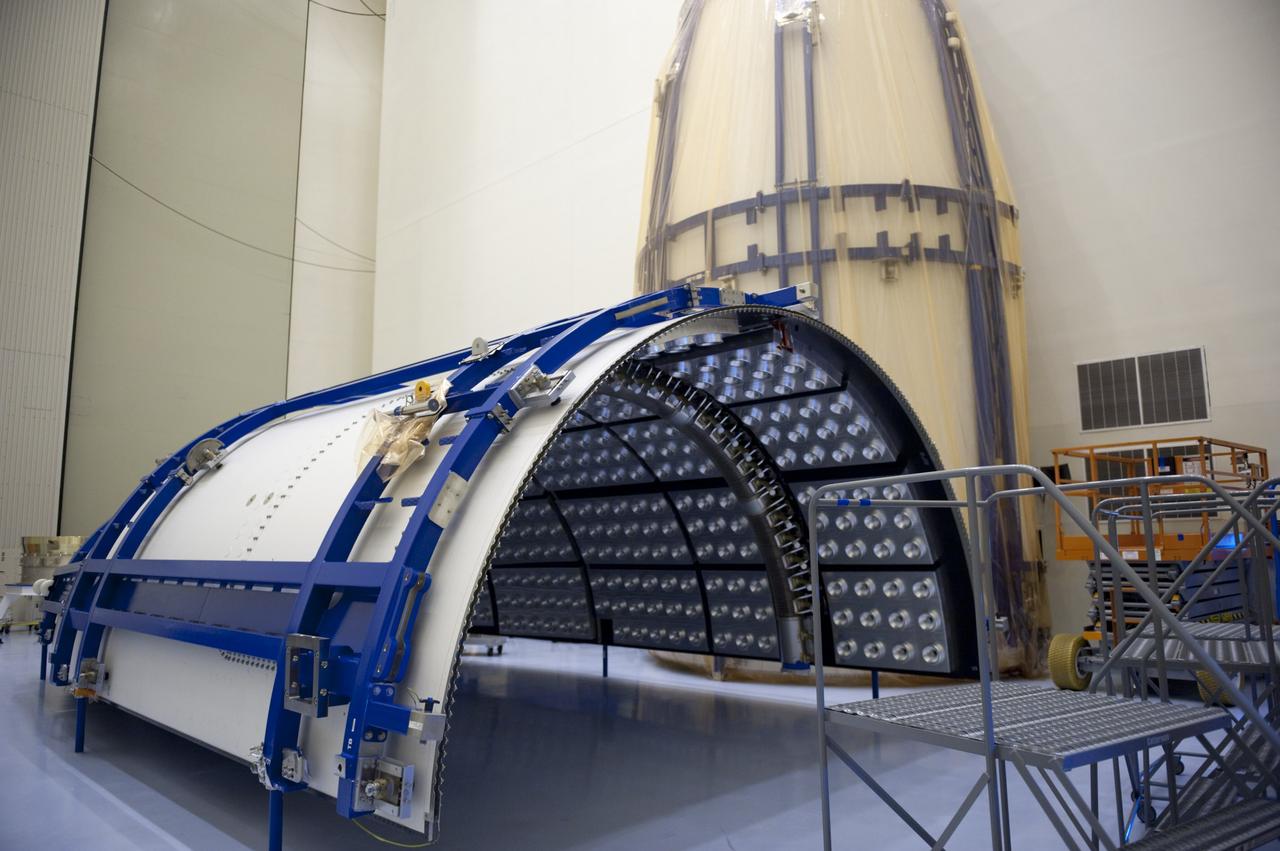
CAPE CANAVERAL, Fla. -- In the Payload Hazardous Servicing Facility at NASA's Kennedy Space Center in Florida, half of the Atlas V payload fairing for NASA's Mars Science Laboratory (MSL) mission is uncovered during preparations to clean it to meet NASA's planetary protection requirements. In the background is the other half of the fairing, still uncovered. The fairing will protect the spacecraft from the impact of aerodynamic pressure and heating during ascent. Although jettisoned once the spacecraft is outside the Earth's atmosphere, the fairing must be cleaned to the same exacting standards as the laboratory to avoid the possibility of contaminating it. MSL's components include a compact car-sized rover, Curiosity, which has 10 science instruments designed to search for evidence on whether Mars has had environments favorable to microbial life, including the chemical ingredients for life. The unique rover will use a laser to look inside rocks and release its gasses so that the rover’s spectrometer can analyze and send the data back to Earth. Launch of MSL aboard a United Launch Alliance Atlas V rocket is planned for Nov. 25 from Space Launch Complex 41 on Cape Canaveral Air Force Station. For more information, visit http://www.nasa.gov/msl. Photo credit: NASA/Kim Shiflett
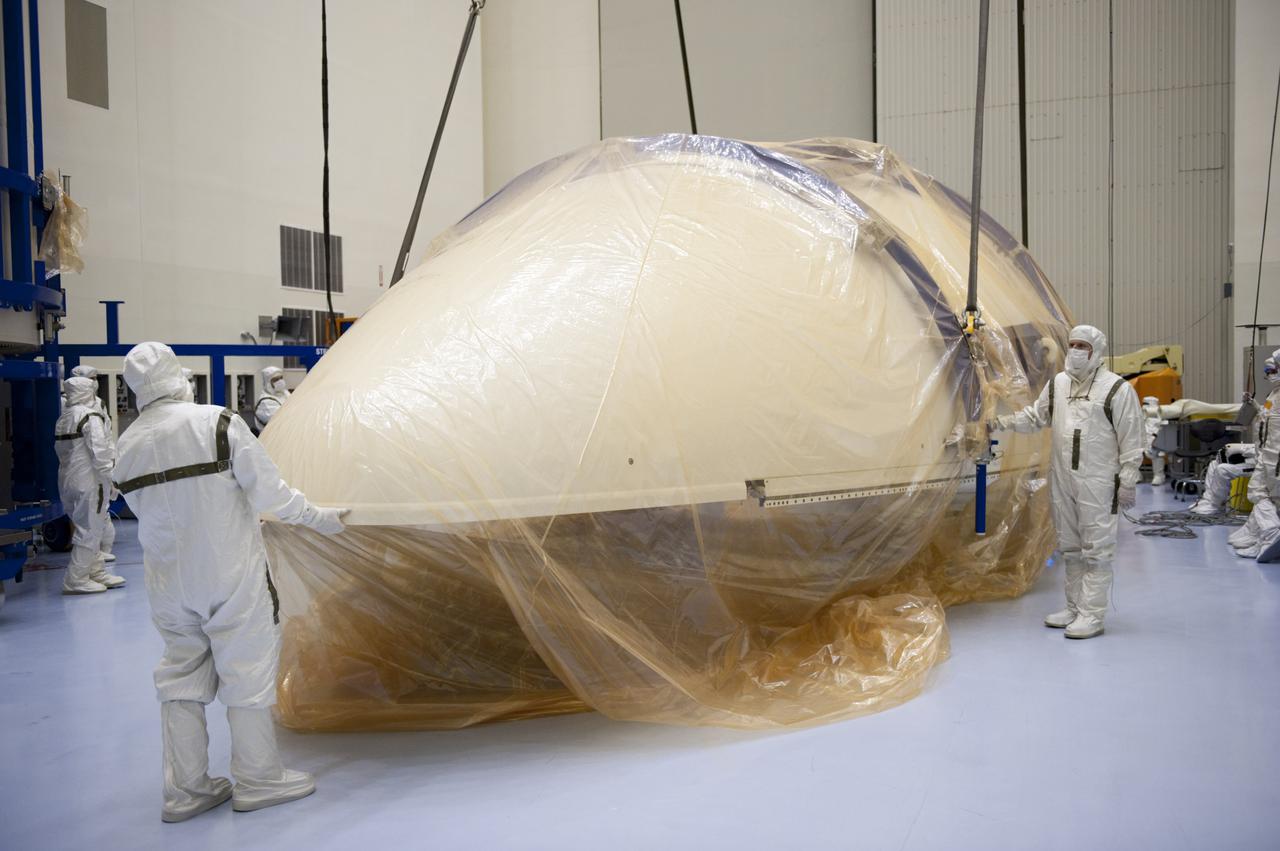
CAPE CANAVERAL, Fla. -- In the Payload Hazardous Servicing Facility at NASA's Kennedy Space Center in Florida, half of the Atlas V payload fairing for NASA's Mars Science Laboratory (MSL) mission comes to rest on the floor in a horizontal position. It next will be uncovered and cleaned to meet NASA's planetary protection requirements. The fairing will protect the spacecraft from the impact of aerodynamic pressure and heating during ascent. Although jettisoned once the spacecraft is outside the Earth's atmosphere, the fairing must be cleaned to the same exacting standards as the laboratory to avoid the possibility of contaminating it. MSL's components include a compact car-sized rover, Curiosity, which has 10 science instruments designed to search for evidence on whether Mars has had environments favorable to microbial life, including the chemical ingredients for life. The unique rover will use a laser to look inside rocks and release its gasses so that the rover’s spectrometer can analyze and send the data back to Earth. Launch of MSL aboard a United Launch Alliance Atlas V rocket is planned for Nov. 25 from Space Launch Complex 41 on Cape Canaveral Air Force Station. For more information, visit http:__www.nasa.gov_msl. Photo credit: NASA_Kim Shiflett
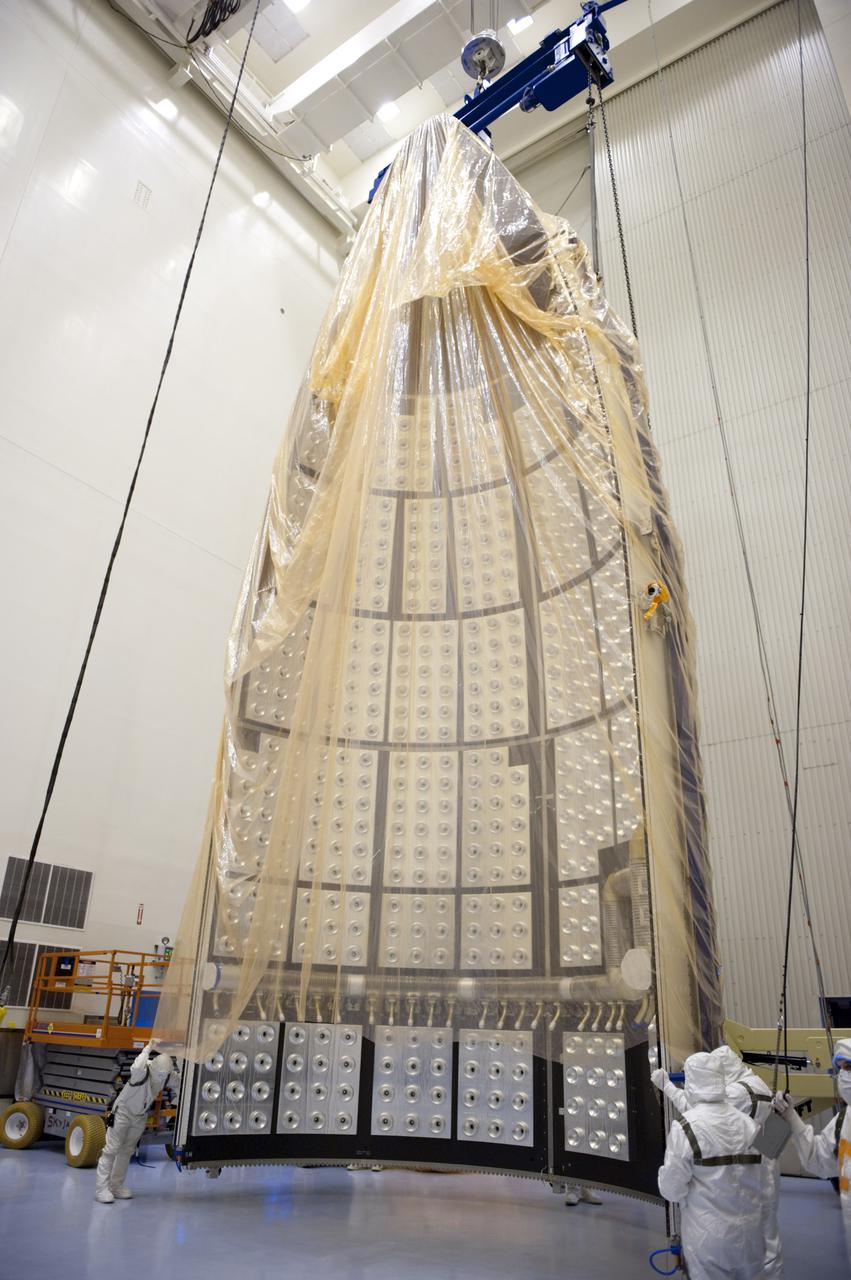
CAPE CANAVERAL, Fla. -- In the Payload Hazardous Servicing Facility at NASA's Kennedy Space Center in Florida, work is under way to lower half of the Atlas V payload fairing for NASA's Mars Science Laboratory (MSL) mission into a horizontal position. It then will be uncovered and cleaned to meet NASA's planetary protection requirements. The fairing will protect the spacecraft from the impact of aerodynamic pressure and heating during ascent. Although jettisoned once the spacecraft is outside the Earth's atmosphere, the fairing must be cleaned to the same exacting standards as the laboratory to avoid the possibility of contaminating it. MSL's components include a compact car-sized rover, Curiosity, which has 10 science instruments designed to search for evidence on whether Mars has had environments favorable to microbial life, including the chemical ingredients for life. The unique rover will use a laser to look inside rocks and release its gasses so that the rover’s spectrometer can analyze and send the data back to Earth. Launch of MSL aboard a United Launch Alliance Atlas V rocket is planned for Nov. 25 from Space Launch Complex 41 on Cape Canaveral Air Force Station. For more information, visit http:__www.nasa.gov_msl. Photo credit: NASA_Kim Shiflett
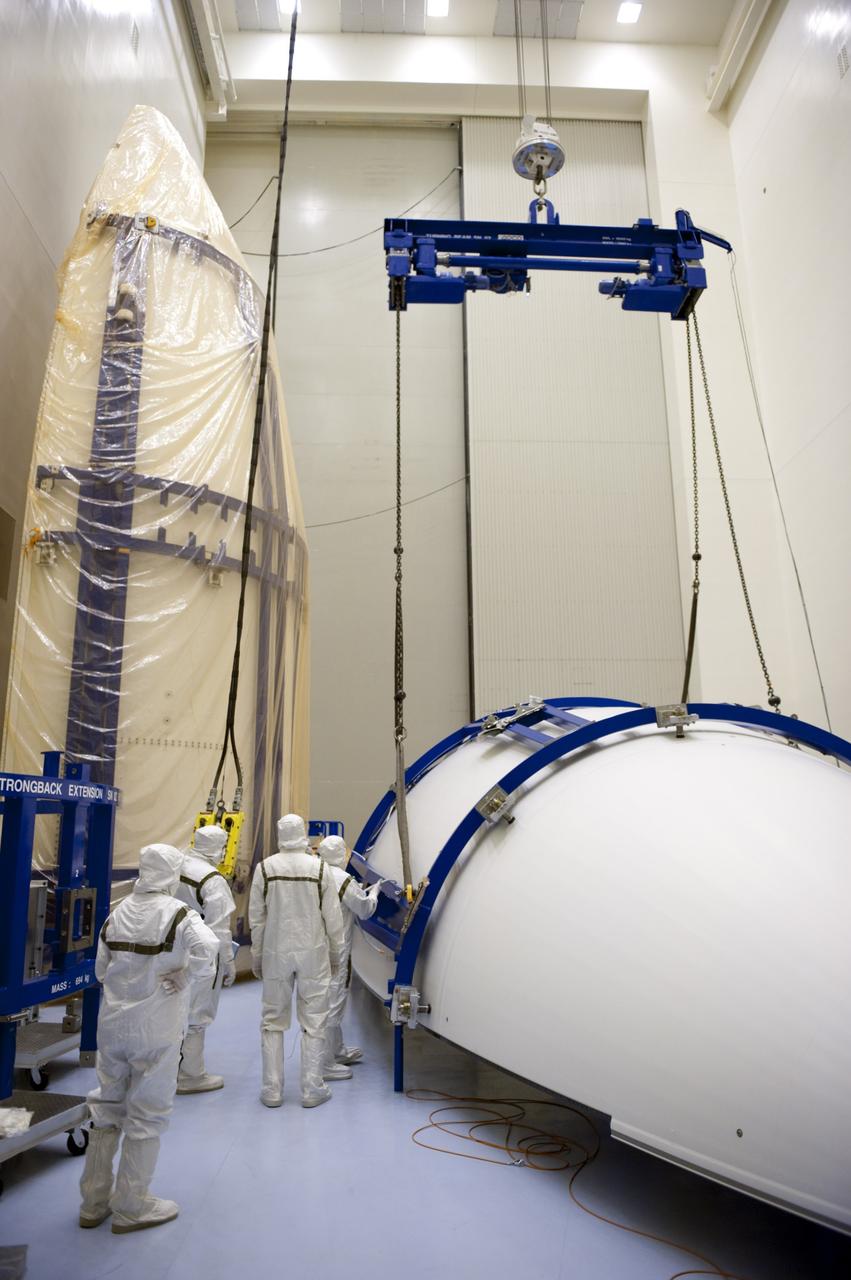
CAPE CANAVERAL, Fla. -- In the Payload Hazardous Servicing Facility at NASA's Kennedy Space Center in Florida, a lifting device is secured to half of the Atlas V payload fairing for NASA's Mars Science Laboratory (MSL) mission. The fairing has been uncovered, and preparations are under way to clean it to meet NASA's planetary protection requirements. At left is the other half of the fairing, still uncovered. The fairing will protect the spacecraft from the impact of aerodynamic pressure and heating during ascent. Although jettisoned once the spacecraft is outside the Earth's atmosphere, the fairing must be cleaned to the same exacting standards as the laboratory to avoid the possibility of contaminating it. MSL's components include a compact car-sized rover, Curiosity, which has 10 science instruments designed to search for evidence on whether Mars has had environments favorable to microbial life, including the chemical ingredients for life. The unique rover will use a laser to look inside rocks and release its gasses so that the rover’s spectrometer can analyze and send the data back to Earth. Launch of MSL aboard a United Launch Alliance Atlas V rocket is planned for Nov. 25 from Space Launch Complex 41 on Cape Canaveral Air Force Station. For more information, visit http://www.nasa.gov/msl. Photo credit: NASA/Kim Shiflett
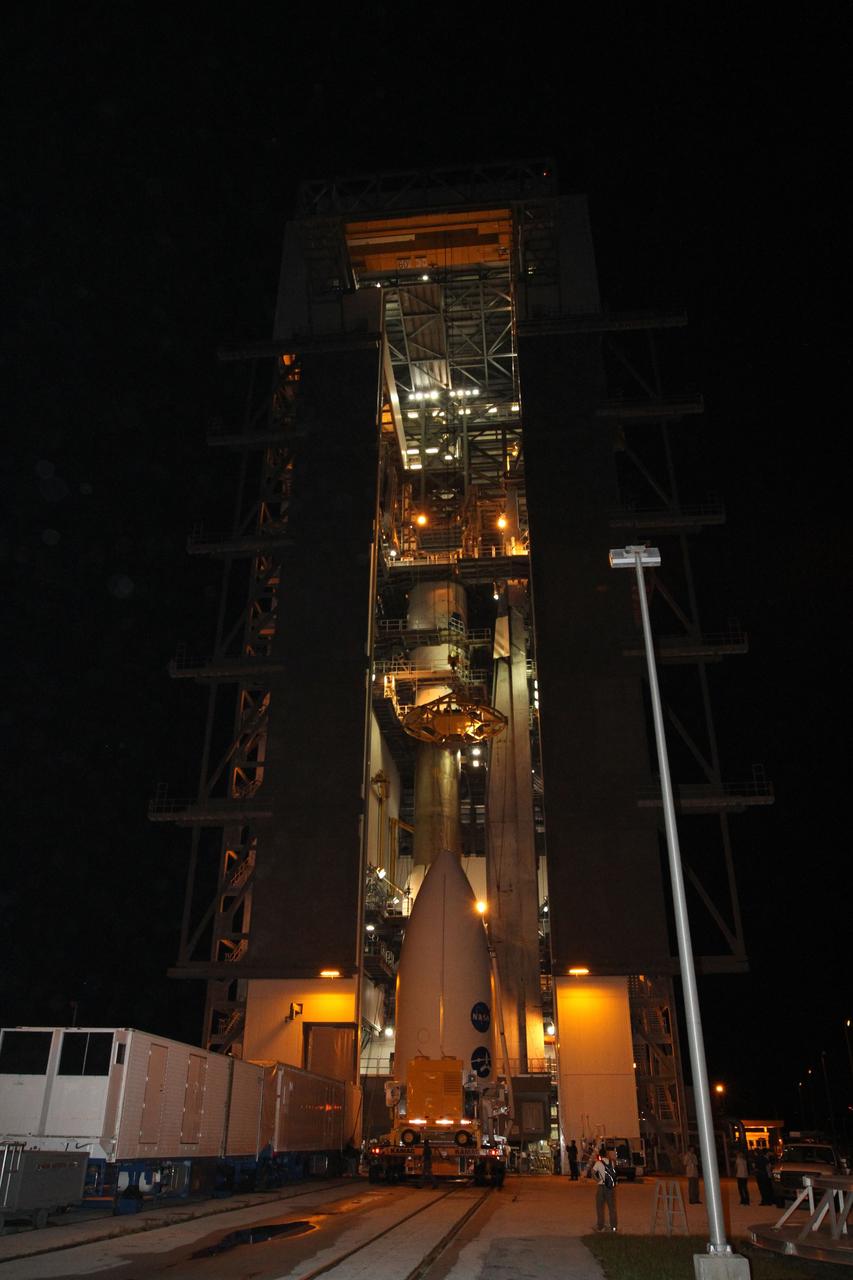
CAPE CANAVERAL, Fla. -- At Space Launch Complex 41, preparations are under way to lift the Juno spacecraft, enclosed in an Atlas payload fairing, on top of the Atlas rocket stacked in the Vertical Integration Facility. The spacecraft was prepared for launch in the Astrotech Space Operations' payload processing facility in Titusville, Fla. The fairing will protect the spacecraft from the impact of aerodynamic pressure and heating during ascent and will be jettisoned once the spacecraft is outside the Earth's atmosphere. Juno is scheduled to launch Aug. 5 aboard a United Launch Alliance Atlas V rocket from Cape Canaveral Air Force Station in Florida. The solar-powered spacecraft will orbit Jupiter's poles 33 times to find out more about the gas giant's origins, structure, atmosphere and magnetosphere and investigate the existence of a solid planetary core. For more information, visit www.nasa.gov/juno. Photo credit: NASA/Cory Huston
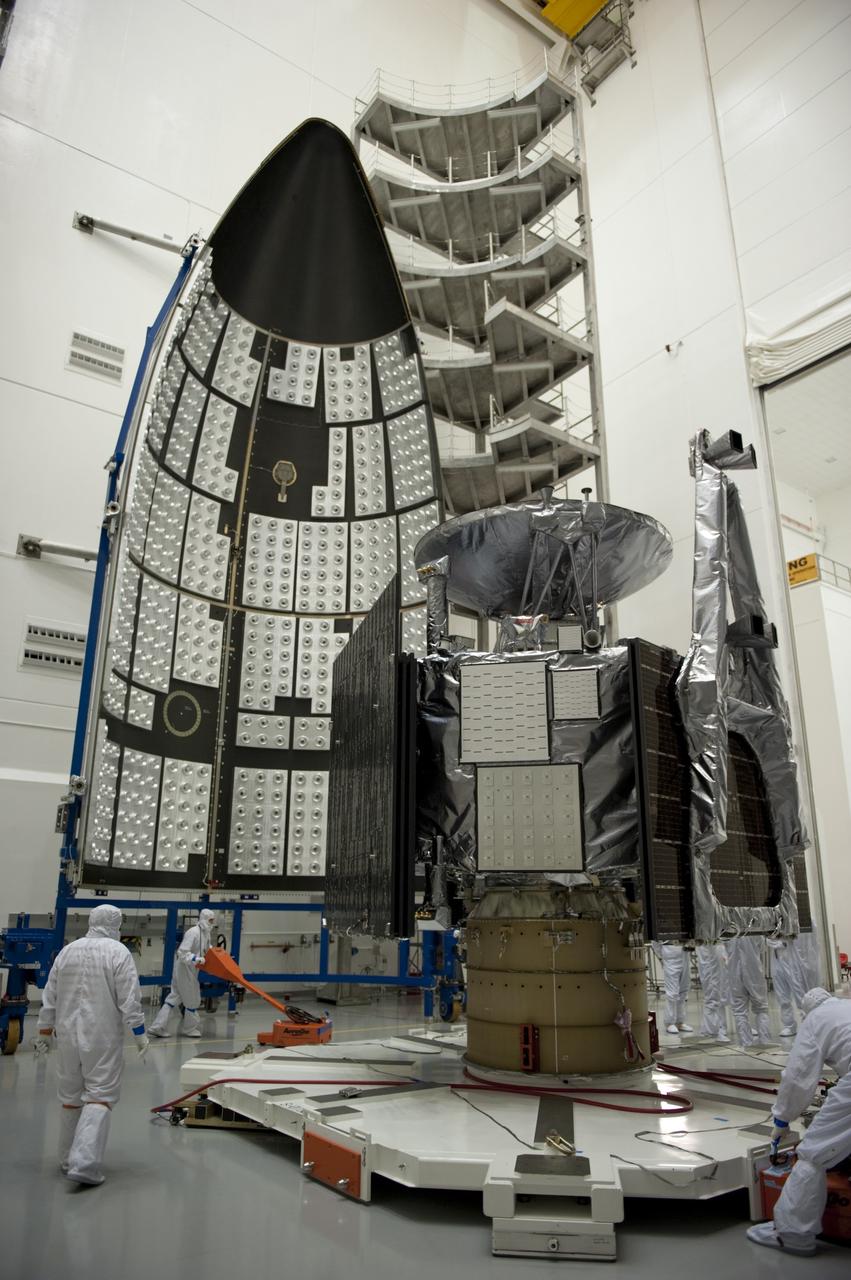
CAPE CANAVERAL, Fla. -- In the Astrotech payload processing facility near Kennedy Space Center in Florida, work has begun to enclose the Juno spacecraft in its Atlas payload fairing for launch. The fairing will protect the spacecraft from the impact of aerodynamic pressure and heating during ascent and will be jettisoned once the spacecraft is outside the Earth's atmosphere. Juno is scheduled to launch aboard a United Launch Alliance Atlas V rocket from Cape Canaveral, Fla., Aug. 5.The solar-powered spacecraft will orbit Jupiter's poles 33 times to find out more about the gas giant's origins, structure, atmosphere and magnetosphere and investigate the existence of a solid planetary core. For more information, visit www.nasa.gov/juno. Photo credit: NASA/Kim Shiflett
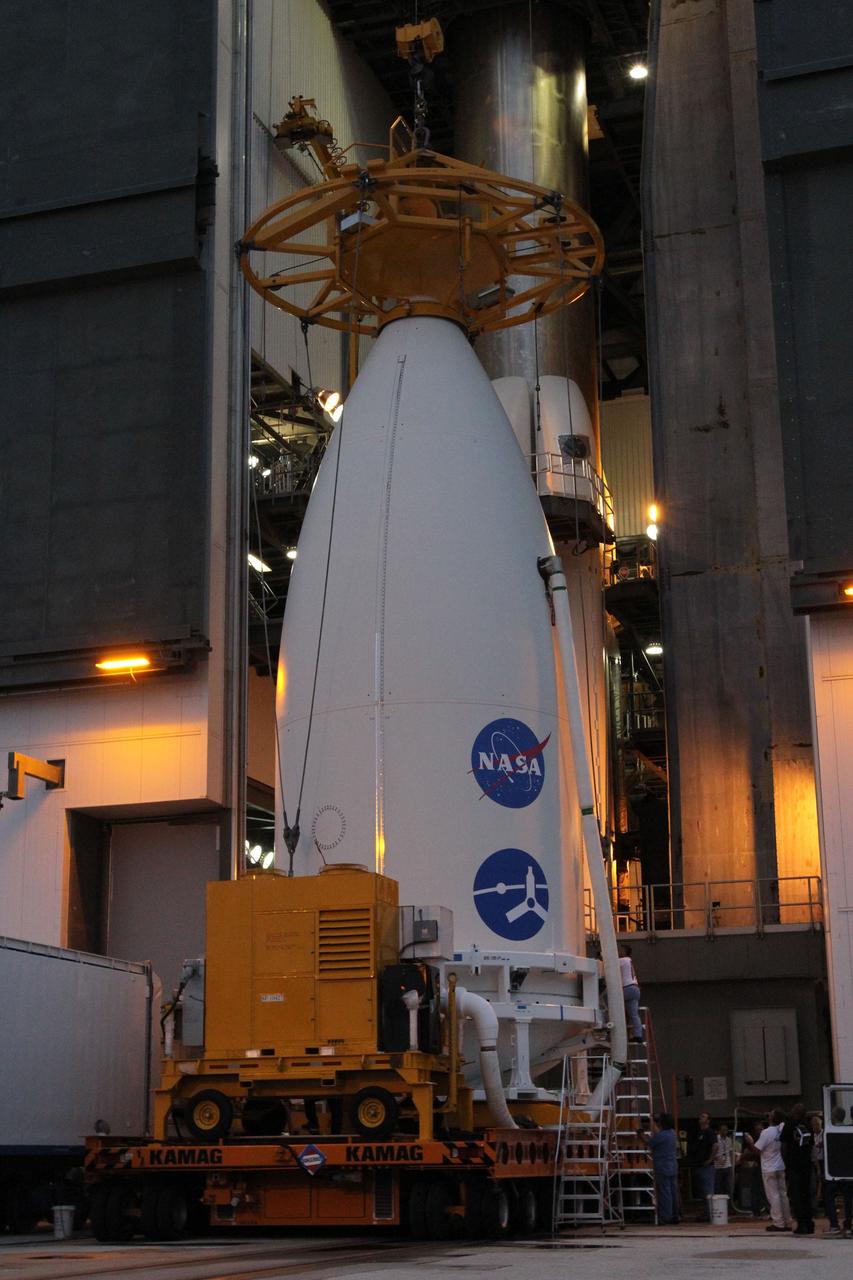
CAPE CANAVERAL, Fla. -- At Space Launch Complex 41, a crane comes to rest on the nose of the Atlas payload fairing enclosing the Juno spacecraft in preparation for its lift to the top of the Atlas rocket stacked in the Vertical Integration Facility. The spacecraft was prepared for launch in the Astrotech Space Operations' payload processing facility in Titusville, Fla. The fairing will protect the spacecraft from the impact of aerodynamic pressure and heating during ascent and will be jettisoned once the spacecraft is outside the Earth's atmosphere. Juno is scheduled to launch Aug. 5 aboard a United Launch Alliance Atlas V rocket from Cape Canaveral Air Force Station in Florida. The solar-powered spacecraft will orbit Jupiter's poles 33 times to find out more about the gas giant's origins, structure, atmosphere and magnetosphere and investigate the existence of a solid planetary core. For more information, visit www.nasa.gov/juno. Photo credit: NASA/Cory Huston
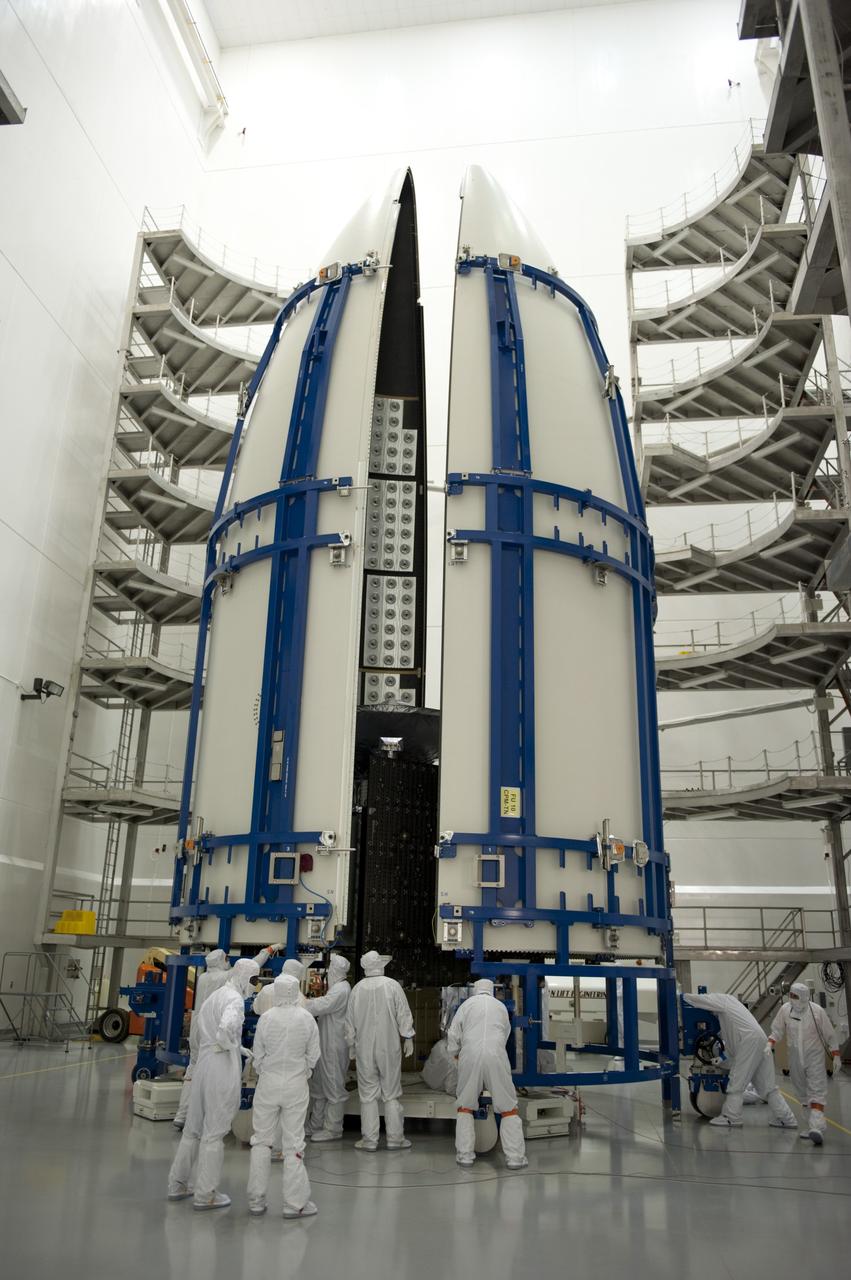
CAPE CANAVERAL, Fla. -- In the Astrotech payload processing facility near Kennedy Space Center in Florida, the Atlas payload fairing nearly obscures the Juno spacecraft from view during work to enclose the spacecraft for launch. The fairing will protect the spacecraft from the impact of aerodynamic pressure and heating during ascent and will be jettisoned once the spacecraft is outside the Earth's atmosphere. Juno is scheduled to launch aboard a United Launch Alliance Atlas V rocket from Cape Canaveral, Fla., Aug. 5.The solar-powered spacecraft will orbit Jupiter's poles 33 times to find out more about the gas giant's origins, structure, atmosphere and magnetosphere and investigate the existence of a solid planetary core. For more information, visit www.nasa.gov/juno. Photo credit: NASA/Kim Shiflett
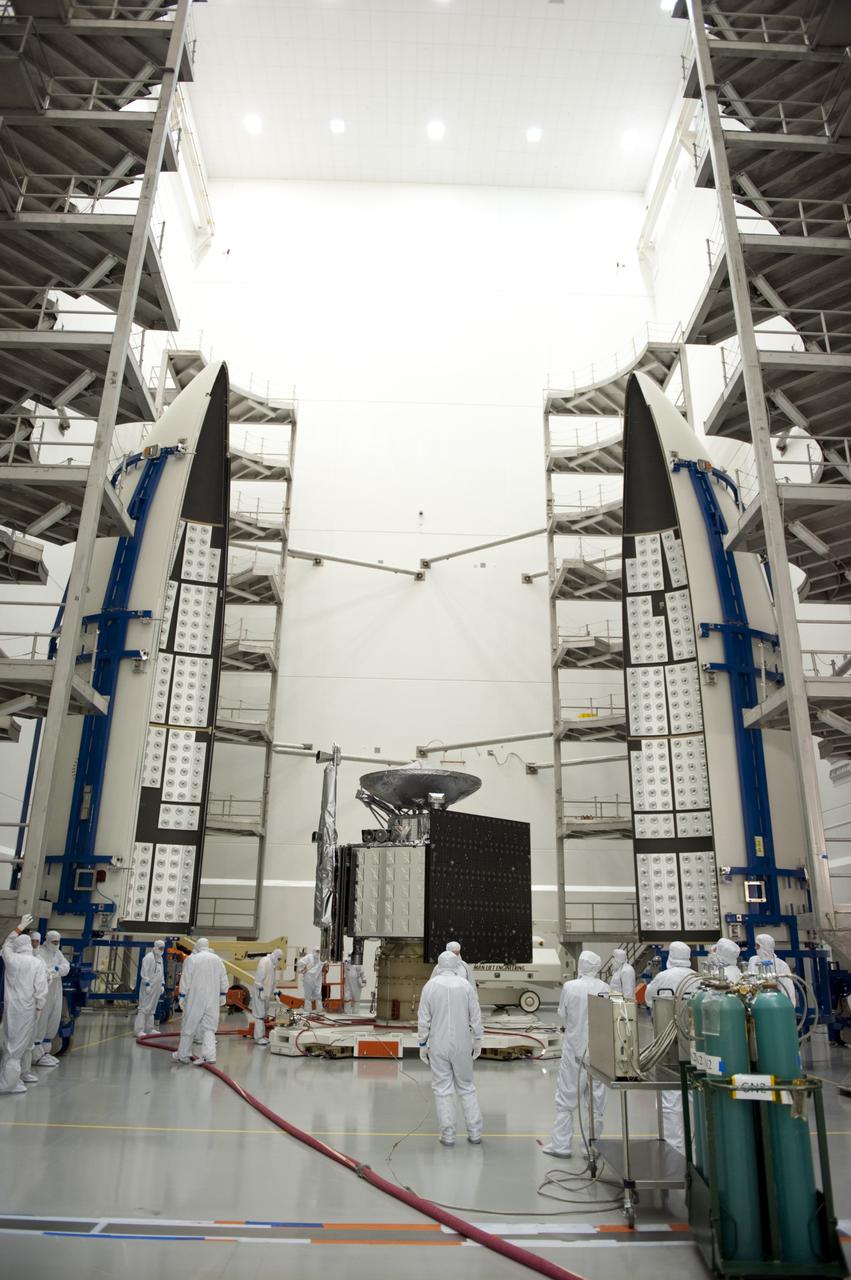
CAPE CANAVERAL, Fla. -- In the Astrotech payload processing facility near Kennedy Space Center in Florida, preparations are under way to enclose the Juno spacecraft in its Atlas payload fairing for launch. The fairing will protect the spacecraft from the impact of aerodynamic pressure and heating during ascent and will be jettisoned once the spacecraft is outside the Earth's atmosphere. Juno is scheduled to launch aboard a United Launch Alliance Atlas V rocket from Cape Canaveral, Fla., Aug. 5.The solar-powered spacecraft will orbit Jupiter's poles 33 times to find out more about the gas giant's origins, structure, atmosphere and magnetosphere and investigate the existence of a solid planetary core. For more information, visit www.nasa.gov/juno. Photo credit: NASA/Kim Shiflett
CAPE CANAVERAL, Fla. -- At Space Launch Complex 41, a crane is lowered toward the Juno spacecraft, enclosed in an Atlas payload fairing, to lift it on top of the Atlas rocket stacked in the Vertical Integration Facility. The spacecraft was prepared for launch in the Astrotech Space Operations' payload processing facility in Titusville, Fla. The fairing will protect the spacecraft from the impact of aerodynamic pressure and heating during ascent and will be jettisoned once the spacecraft is outside the Earth's atmosphere. Juno is scheduled to launch Aug. 5 aboard a United Launch Alliance Atlas V rocket from Cape Canaveral Air Force Station in Florida. The solar-powered spacecraft will orbit Jupiter's poles 33 times to find out more about the gas giant's origins, structure, atmosphere and magnetosphere and investigate the existence of a solid planetary core. For more information, visit www.nasa.gov/juno. Photo credit: NASA/Cory Huston
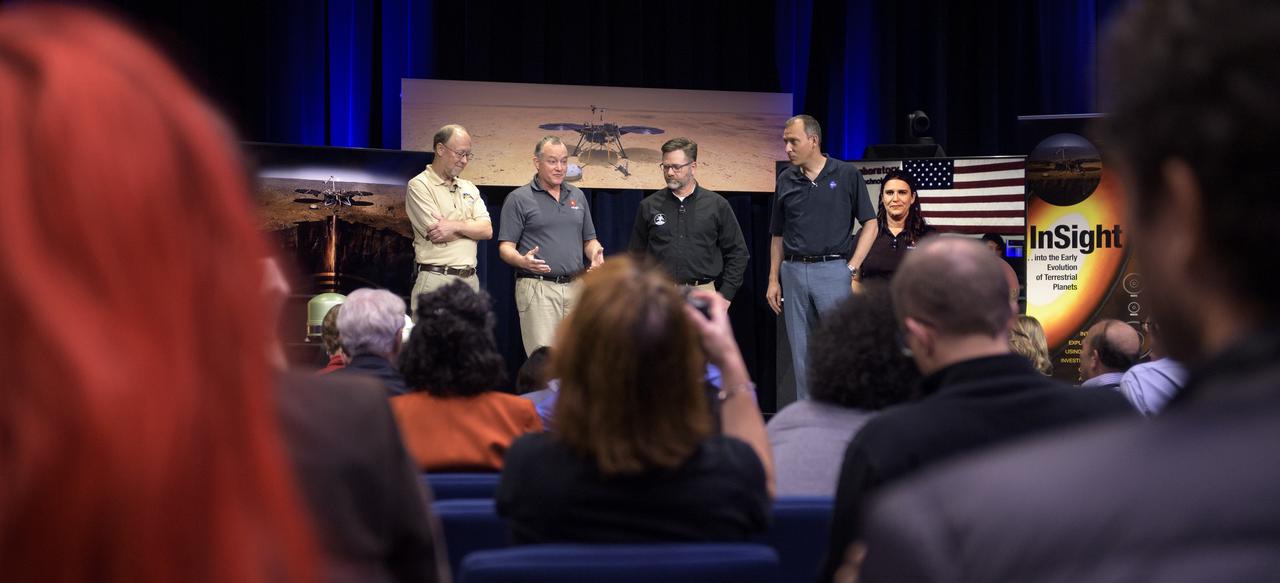
From left to right: Bruce Banerdt, InSight Principal Investigator, NASA JPL; Tom Hoffman, InSight Project Manager, NASA JPL; Brian Clement, Planetary Protection lead for MarCO, NASA JPL; Thomas Zurbuchen, Associate Administrator of NASA’s Science Mission Directorate, NASA Headquarters; and Julie Wertz-Chen, Entry, Descent and Landing systems engineer, NASA JPL, talk about Mars InSight and Mars Cube One (MarCO) during a pre-landing briefing, Sunday, Nov. 25, 2018 at NASA's Jet Propulsion Laboratory in Pasadena, California. InSight, short for Interior Exploration using Seismic Investigations, Geodesy and Heat Transport, is a Mars lander designed to study the "inner space" of Mars: its crust, mantle, and core. InSight is scheduled to touch down on the Red Planet at approximately noon PST (3 p.m. EST) on Nov. 26. Photo Credit: (NASA/Bill Ingalls)
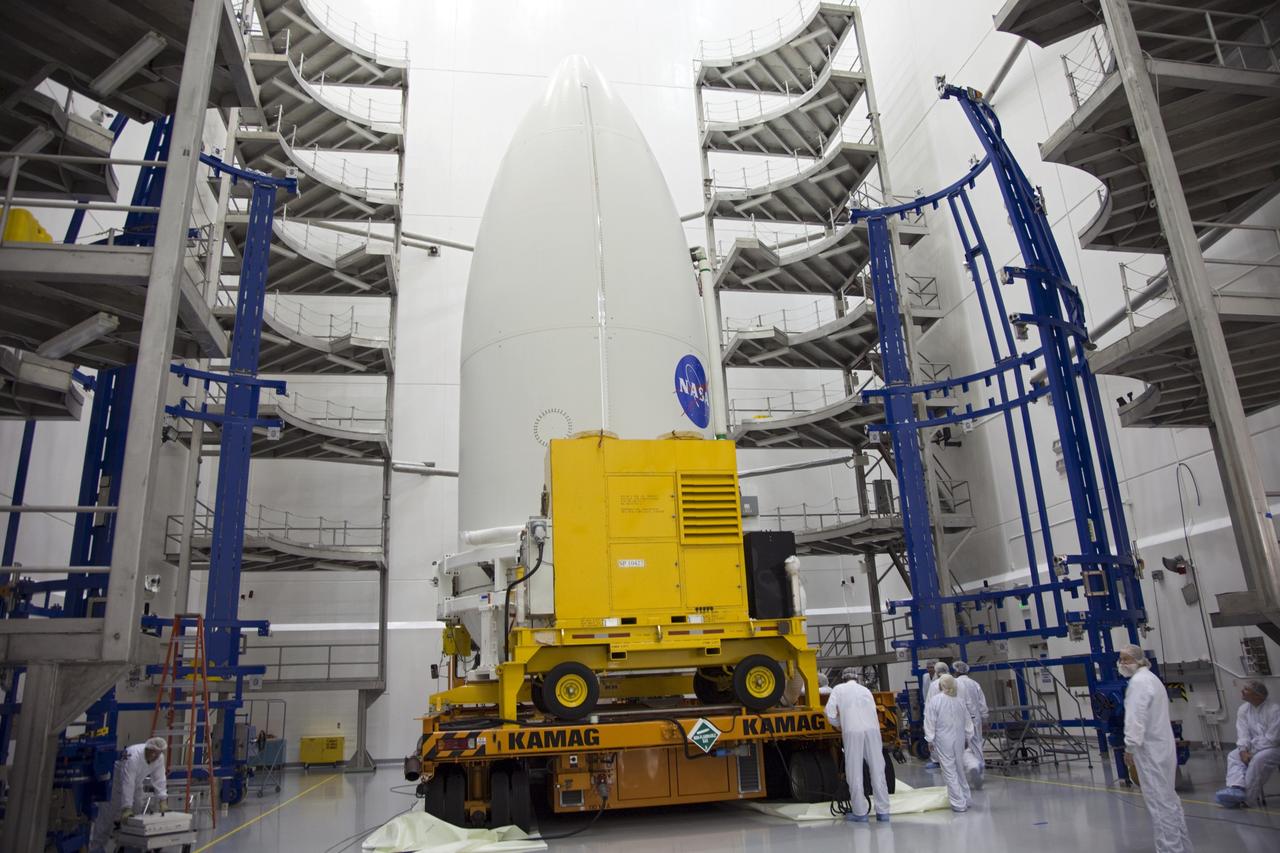
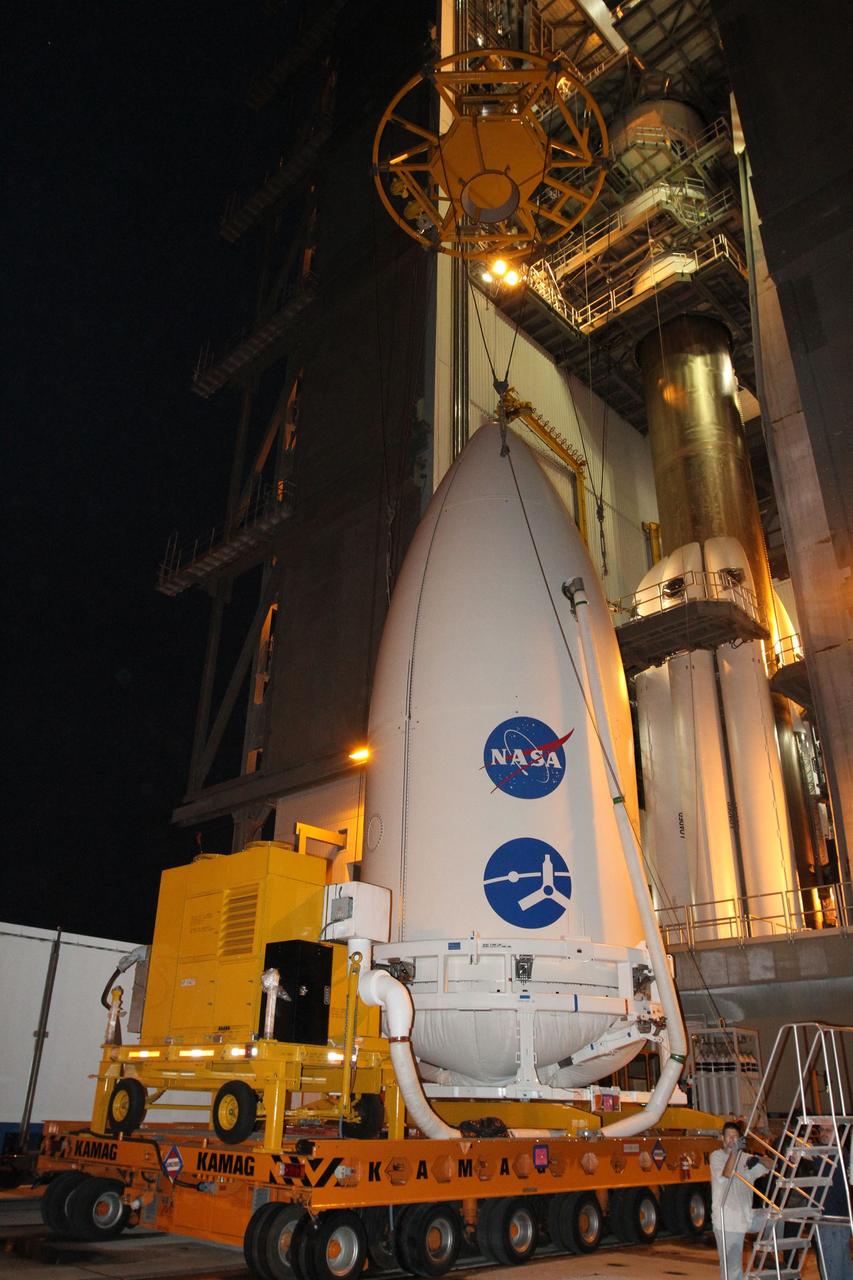
CAPE CANAVERAL, Fla. -- In the Astrotech payload processing facility near Kennedy Space Center in Florida, the Atlas payload fairing enclosing the Juno spacecraft is secured on a transporter and ready for its trip to Space Launch Complex 41. The fairing will protect the spacecraft from the impact of aerodynamic pressure and heating during ascent and will be jettisoned once the spacecraft is outside the Earth's atmosphere. Juno is scheduled to launch aboard a United Launch Alliance Atlas V rocket from Cape Canaveral, Fla., Aug. 5.The solar-powered spacecraft will orbit Jupiter's poles 33 times to find out more about the gas giant's origins, structure, atmosphere and magnetosphere and investigate the existence of a solid planetary core. For more information, visit www.nasa.gov/juno. Photo credit: NASA/Frank Michaux
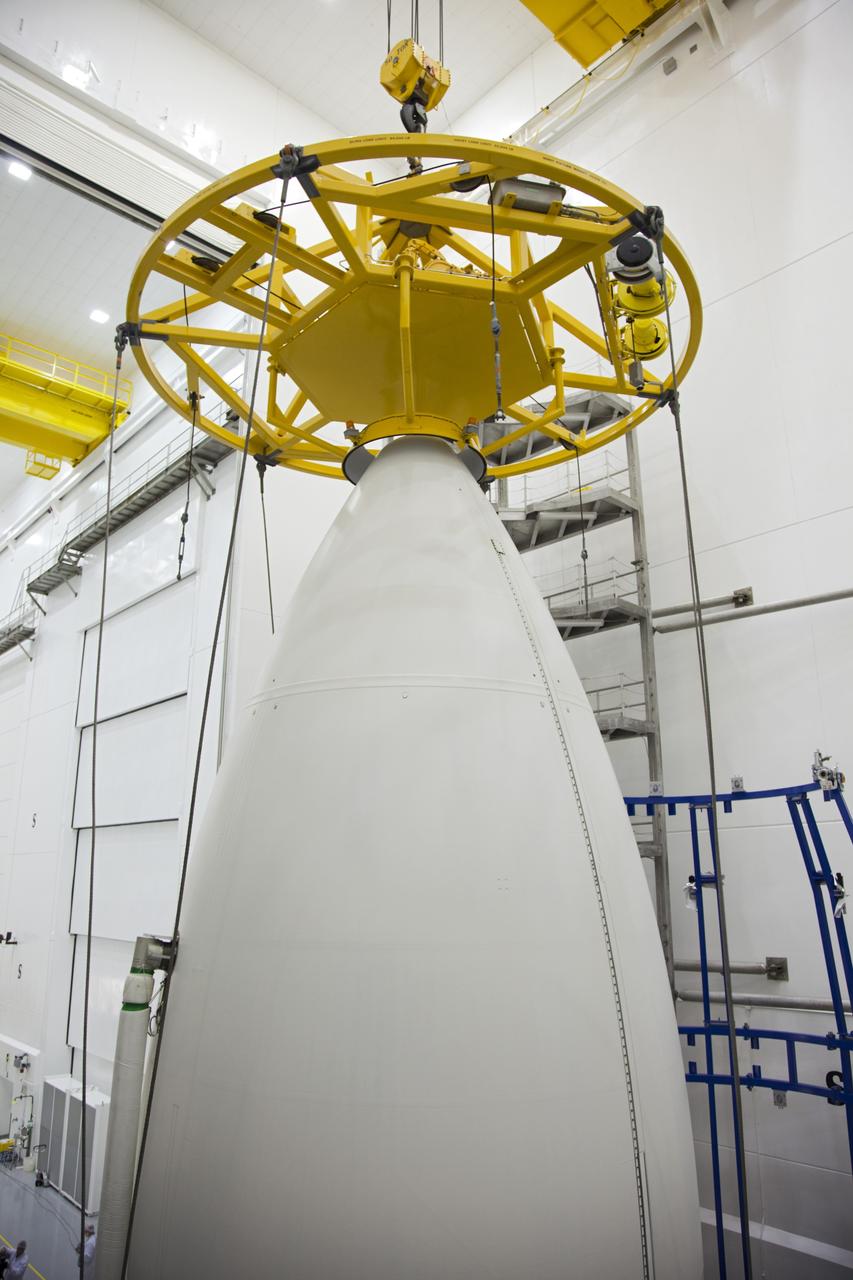
CAPE CANAVERAL, Fla. -- In the Astrotech payload processing facility near Kennedy Space Center in Florida, a lifting device is lowered onto the nose of the Atlas payload fairing enclosing the Juno spacecraft during operations to lift the spacecraft onto a transporter for its trip to Space Launch Complex 41. The fairing will protect the spacecraft from the impact of aerodynamic pressure and heating during ascent and will be jettisoned once the spacecraft is outside the Earth's atmosphere. Juno is scheduled to launch aboard a United Launch Alliance Atlas V rocket from Cape Canaveral, Fla., Aug. 5.The solar-powered spacecraft will orbit Jupiter's poles 33 times to find out more about the gas giant's origins, structure, atmosphere and magnetosphere and investigate the existence of a solid planetary core. For more information, visit www.nasa.gov/juno. Photo credit: NASA/Frank Michaux
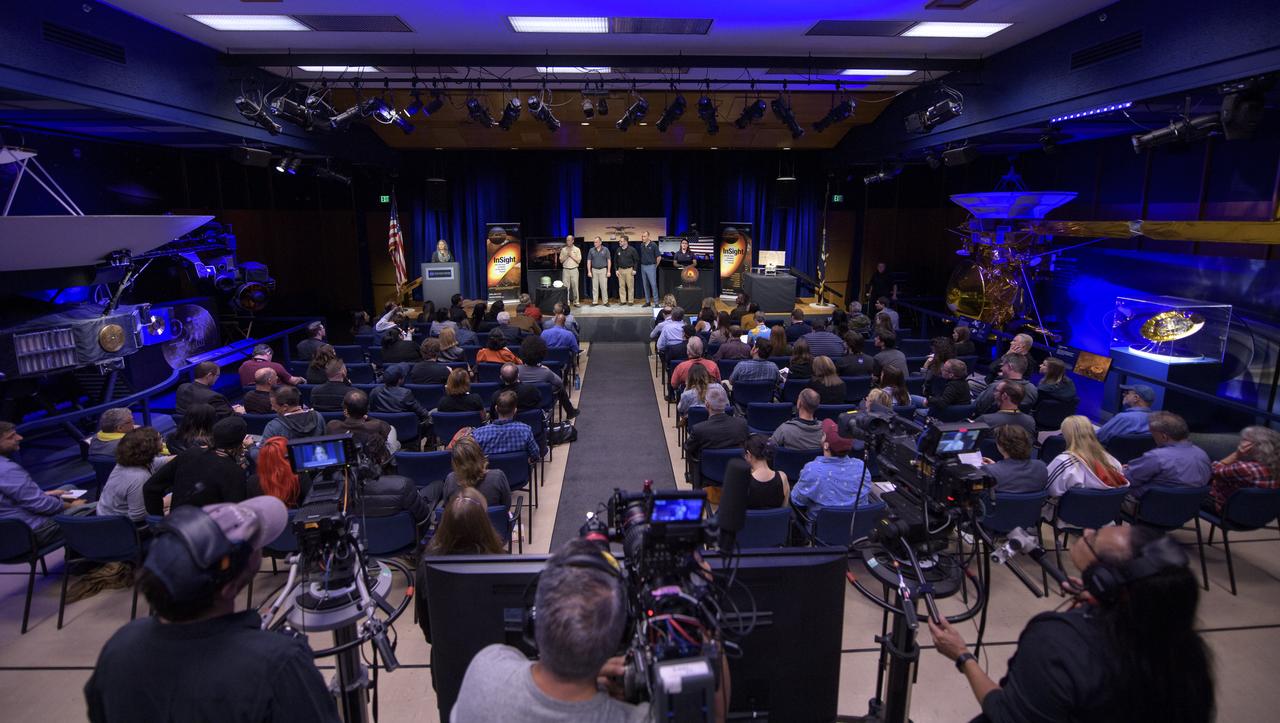
From left to right: Bruce Banerdt, InSight Principal Investigator, NASA JPL; Tom Hoffman, InSight Project Manager, NASA JPL; Brian Clement, Planetary Protection lead for MarCO, NASA JPL; Thomas Zurbuchen, Associate Administrator of NASA’s Science Mission Directorate, NASA Headquarters; and Julie Wertz-Chen, Entry, Descent and Landing systems engineer, NASA JPL, talk about Mars InSight and Mars Cube One (MarCO) during a pre-landing briefing, Sunday, Nov. 25, 2018 at NASA's Jet Propulsion Laboratory in Pasadena, California. InSight, short for Interior Exploration using Seismic Investigations, Geodesy and Heat Transport, is a Mars lander designed to study the "inner space" of Mars: its crust, mantle, and core. InSight is scheduled to touch down on the Red Planet at approximately noon PST (3 p.m. EST) on Nov. 26. Photo Credit: (NASA/Bill Ingalls)
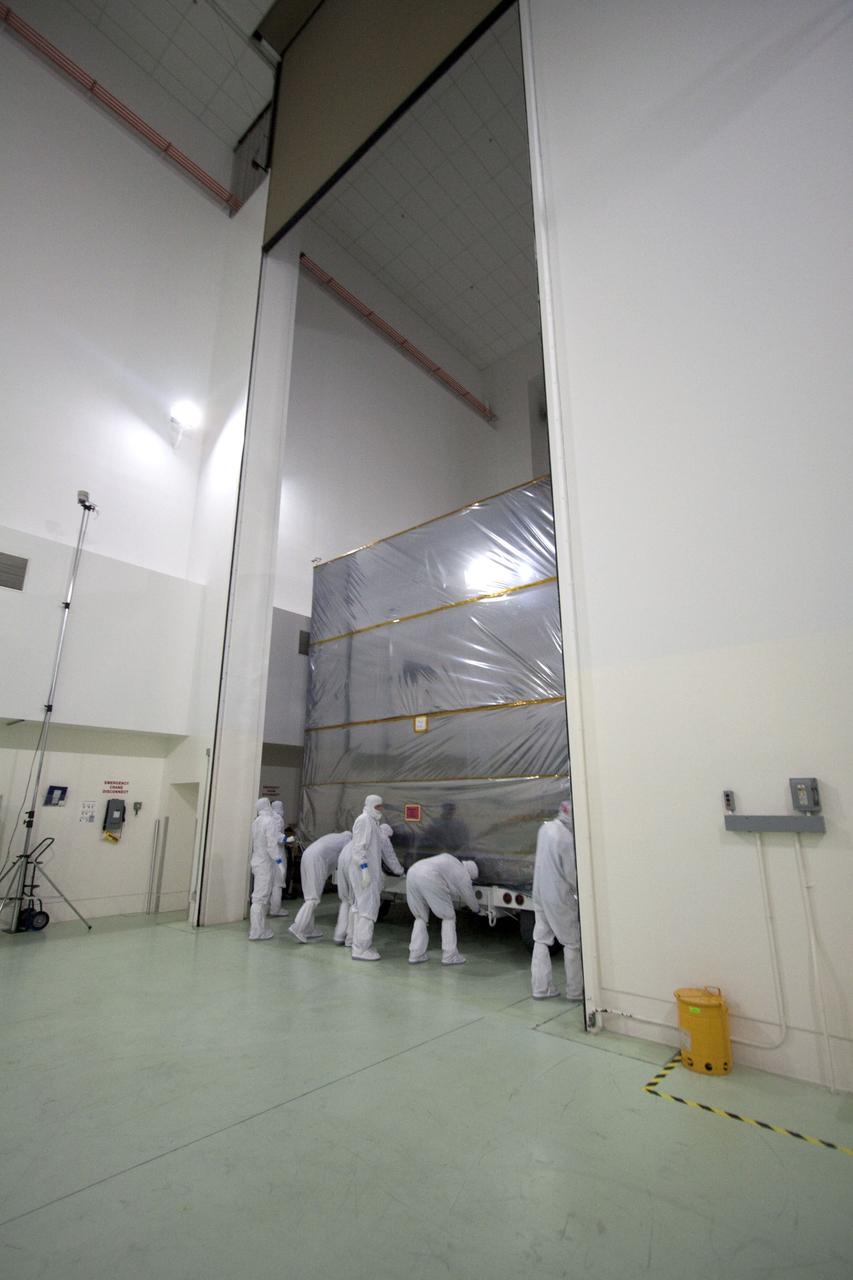
CAPE CANAVERAL, Fla., -- At the Astrotech Payload Processing Facility in Titusville, Fla., technicians stretch a protective cover over NASA's Juno spacecraft. Juno is being prepared for its move to the Hazardous Processing Facility for fueling. The spacecraft will be loaded with the propellant necessary for orbit maneuvers and the attitude control system. Juno is scheduled to launch aboard a United Launch Alliance Atlas V rocket from Cape Canaveral, Fla., Aug. 5.The solar-powered spacecraft will orbit Jupiter's poles 33 times to find out more about the gas giant's origins, structure, atmosphere and magnetosphere and investigate the existence of a solid planetary core. For more information visit: www.nasa.gov/juno. Photo credit: NASA/Troy Cryder
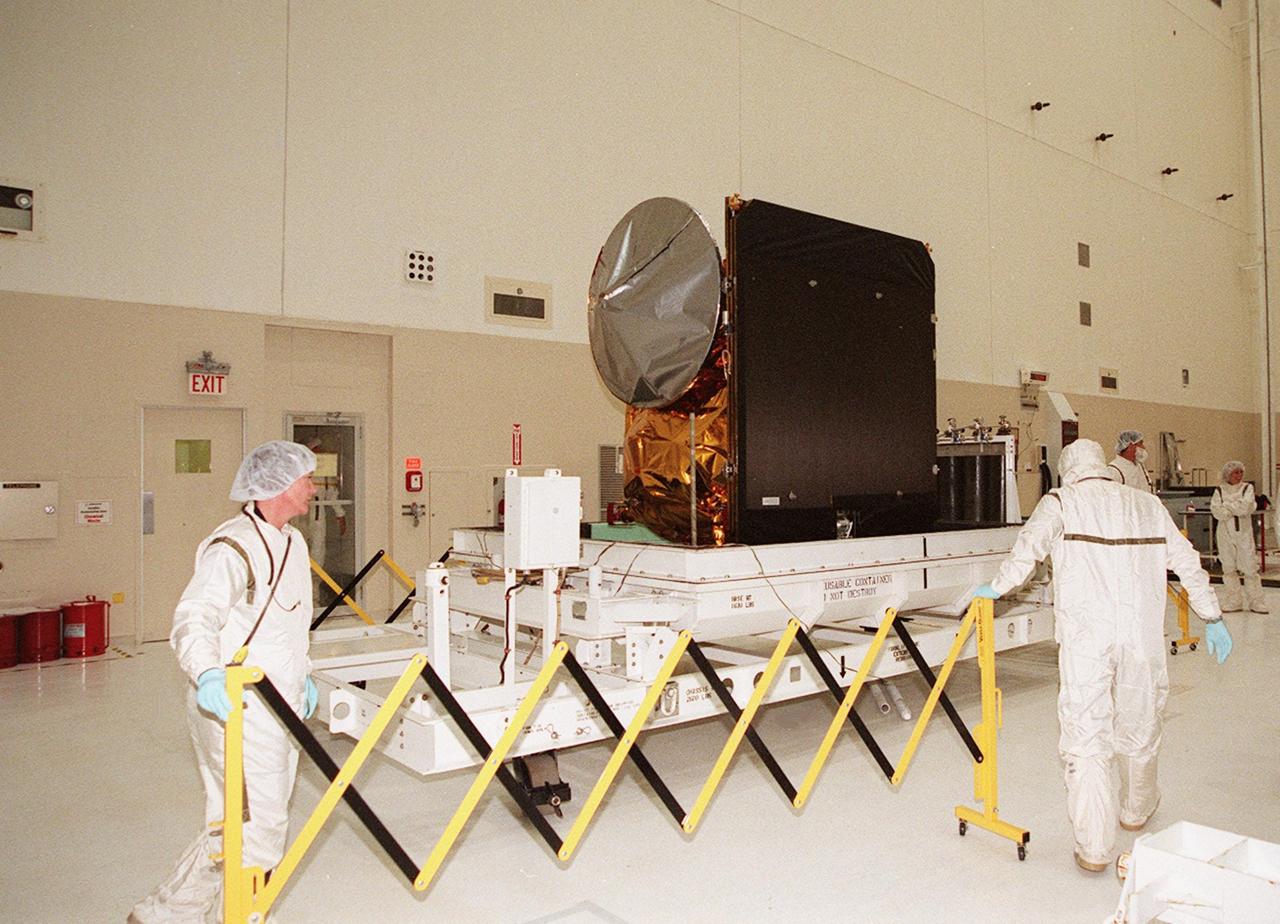
In the Spacecraft Assembly and Encapsulation Facility 2, workers place a protective barrier around the 2001 Mars Odyssey spacecraft. Odyssey will undergo final assembly and checkout in the SAEf-2, which includes installation of two of the three science instruments, integration of the three-panel solar array, and a spacecraft functional test. Odyssey, which arrived from Denver, Colo., Jan. 4, will be launched aboard a Boeing Delta II vehicle from Pad A, Complex 17, CCAFS. Launch is planned for April 7, 2001 the first day of a 21-day planetary window. The spacecraft will arrive at Mars on Oct. 20, 2001, for insertion into an initial elliptical capture orbit. Its final operational altitude will be a 250-mile-high, Sun-synchronous polar orbit. Mars Odyssey will spend two years mapping the planet’s surface and measuring its environment

CAPE CANAVERAL, Fla. -- At Space Launch Complex 41, a crane hoists the Atlas payload fairing enclosing the Juno spacecraft off its transporter for its lift to the top of the Atlas rocket stacked in the Vertical Integration Facility. The spacecraft was prepared for launch in the Astrotech Space Operations' payload processing facility in Titusville, Fla. The fairing will protect the spacecraft from the impact of aerodynamic pressure and heating during ascent and will be jettisoned once the spacecraft is outside the Earth's atmosphere. Juno is scheduled to launch Aug. 5 aboard a United Launch Alliance Atlas V rocket from Cape Canaveral Air Force Station in Florida. The solar-powered spacecraft will orbit Jupiter's poles 33 times to find out more about the gas giant's origins, structure, atmosphere and magnetosphere and investigate the existence of a solid planetary core. For more information, visit www.nasa.gov/juno. Photo credit: NASA/Cory Huston
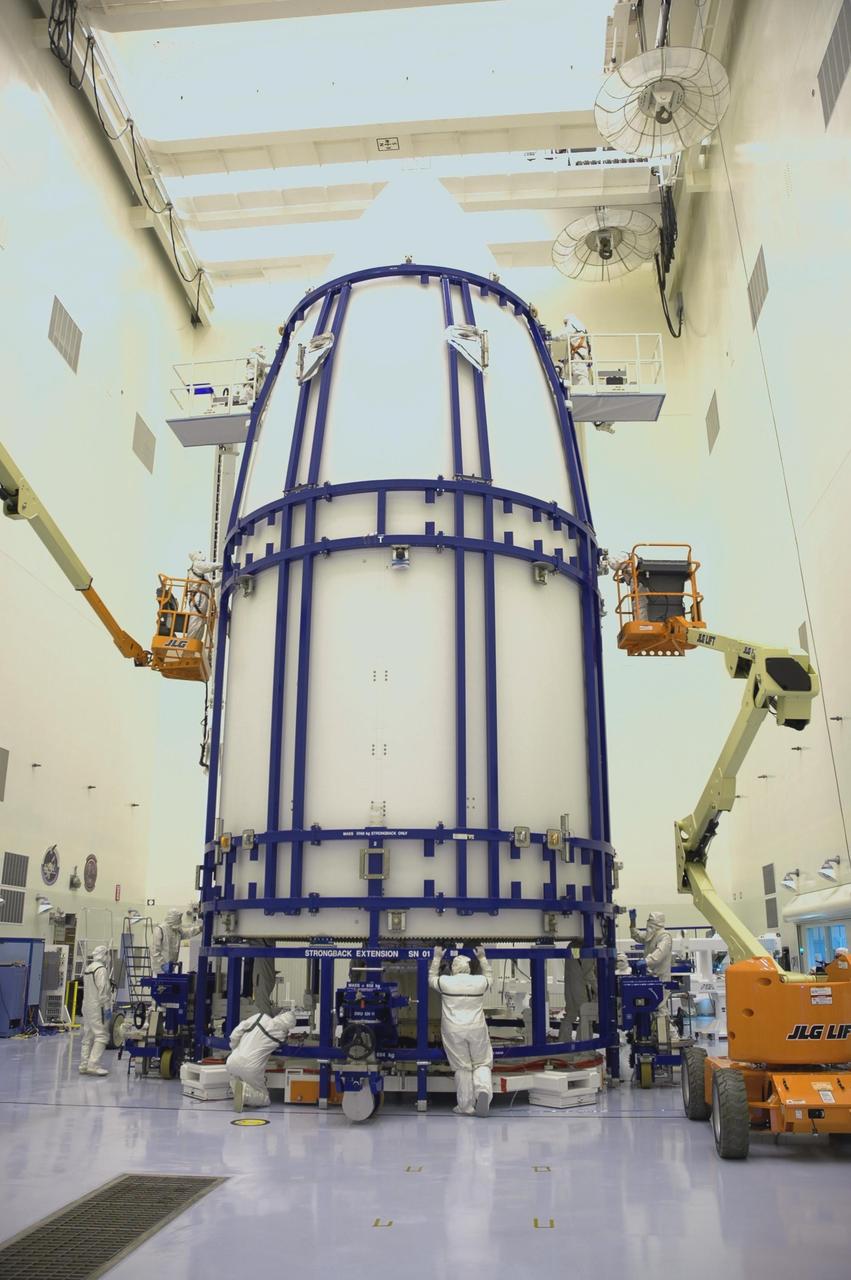
KENNEDY SPACE CENTER, FLA. - In the Payload Hazardous Servicing Facility, clean-suit garbed workers secure the fairing sections around the New Horizons spacecraft for encapsulation. The fairing protects the spacecraft during launch and flight through the atmosphere. Once out of the atmosphere, the fairing is jettisoned. The compact 1,060-pound New Horizons probe carries seven scientific instruments that will characterize the global geology and geomorphology of Pluto and its moon Charon, map their surface compositions and temperatures, and examine Pluto's complex atmosphere. After that, flybys of Kuiper Belt objects from even farther in the solar system may be undertaken in an extended mission. New Horizons is the first mission in NASA's New Frontiers program of medium-class planetary missions. The spacecraft, designed for NASA by the Johns Hopkins University Applied Physics Laboratory in Laurel, Md., will fly by Pluto and Charon as early as summer 2015.
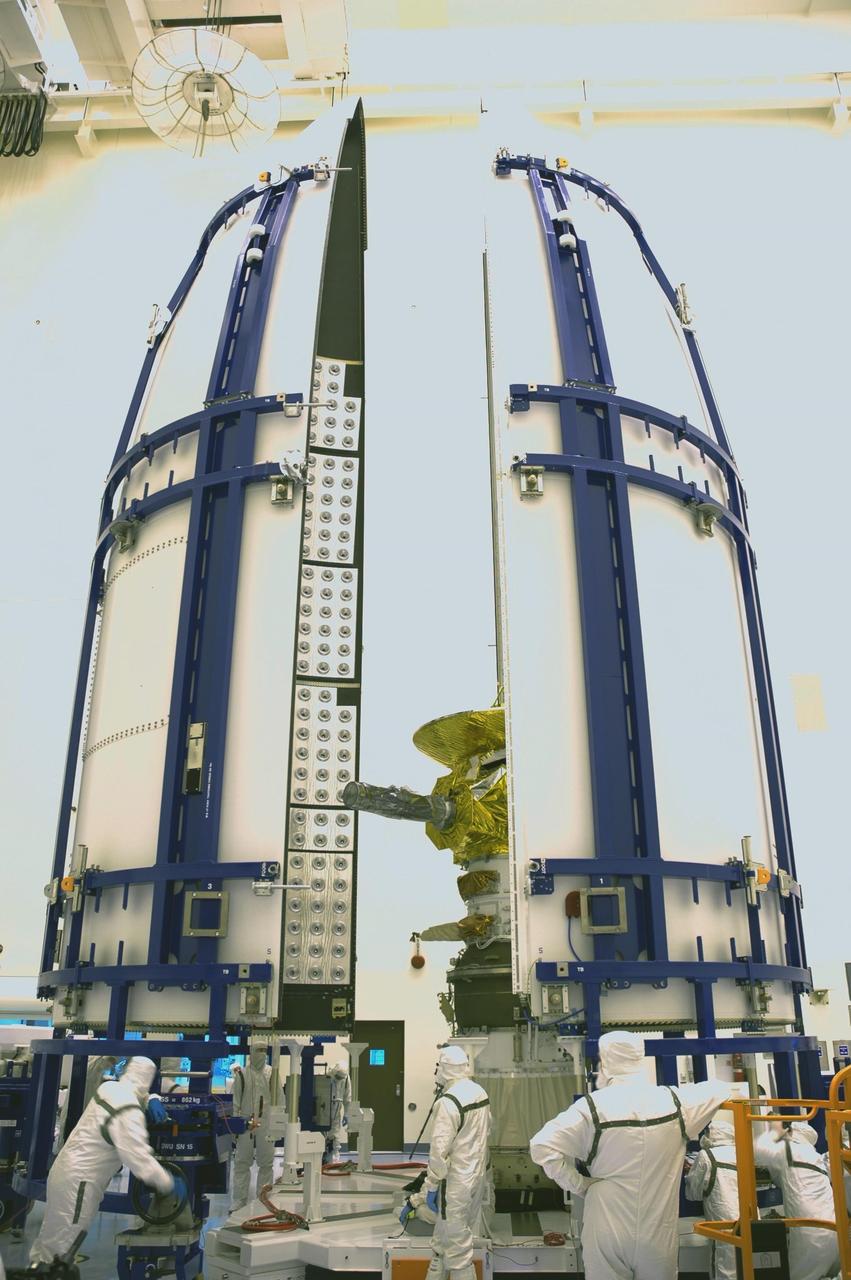
KENNEDY SPACE CENTER, FLA. - In the Payload Hazardous Servicing Facility, the two fairing sections close in around the New Horizons spacecraft to encapsulate it. The fairing protects the spacecraft during launch and flight through the atmosphere. Once out of the atmosphere, the fairing is jettisoned. The compact 1,060-pound New Horizons probe carries seven scientific instruments that will characterize the global geology and geomorphology of Pluto and its moon Charon, map their surface compositions and temperatures, and examine Pluto's complex atmosphere. After that, flybys of Kuiper Belt objects from even farther in the solar system may be undertaken in an extended mission. New Horizons is the first mission in NASA's New Frontiers program of medium-class planetary missions. The spacecraft, designed for NASA by the Johns Hopkins University Applied Physics Laboratory in Laurel, Md., will fly by Pluto and Charon as early as summer 2015.

KENNEDY SPACE CENTER, FLA. - In the Vertical Integration Facility on Launch Complex 41, Cape Canaveral Air Force Station, Hal Weaver, New Horizons project scientist with the Johns Hopkins University Applied Physics Laboratory, signs the fairing enclosing the New Horizons spacecraft. The fairing protects the spacecraft during launch and flight through the atmosphere. Once out of the atmosphere, the fairing is jettisoned. The compact 1,060-pound New Horizons probe carries seven scientific instruments that will characterize the global geology and geomorphology of Pluto and its moon Charon, map their surface compositions and temperatures, and examine Pluto's complex atmosphere. New Horizons is the first mission in NASA's New Frontiers program of medium-class planetary missions. The spacecraft, designed for NASA by the Johns Hopkins University Applied Physics Laboratory in Laurel, Md., will fly by Pluto and Charon as early as summer 2015.
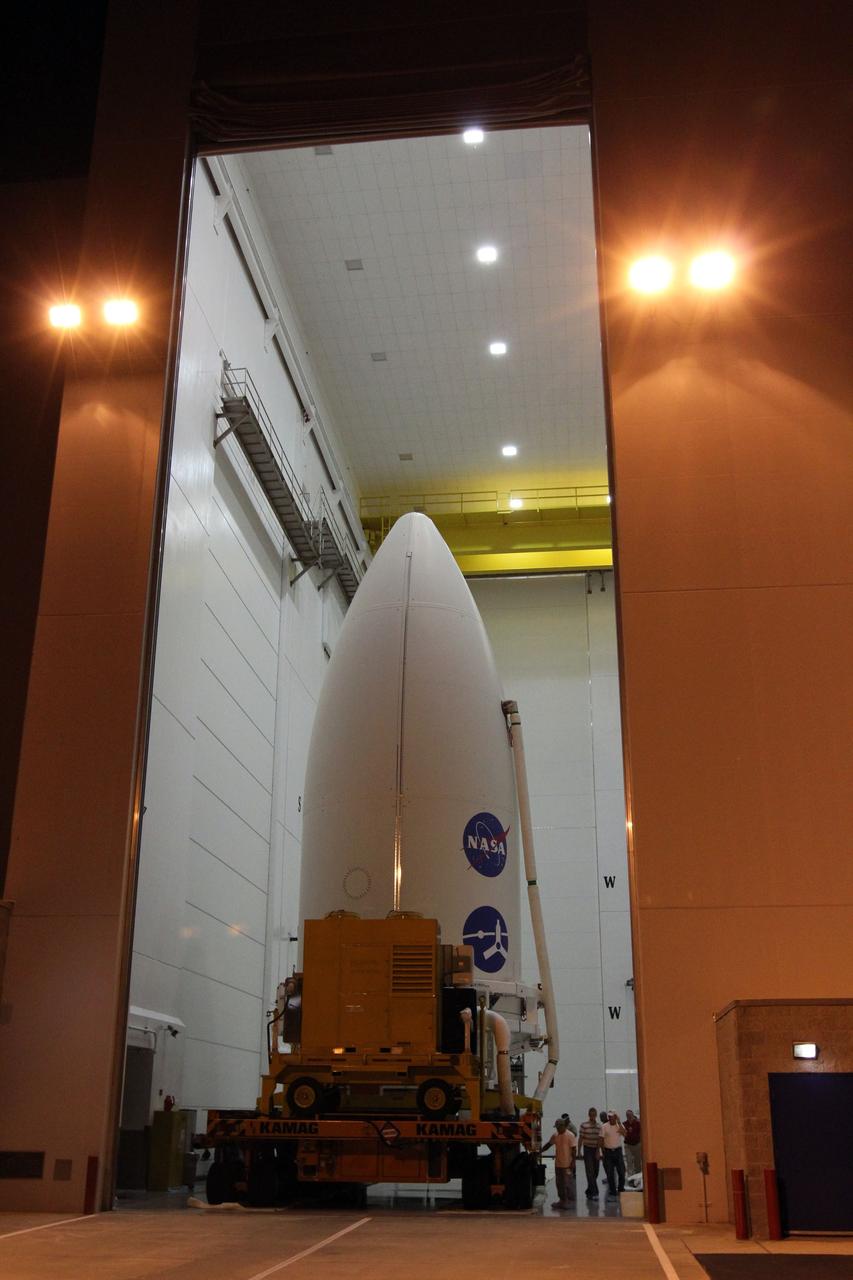
CAPE CANAVERAL, Fla. -- In the Astrotech Space Operations' payload processing facility in Titusville, Fla., preparations are under way to transport the Juno spacecraft, enclosed in an Atlas payload fairing, to Space Launch Complex 41. The fairing will protect the spacecraft from the impact of aerodynamic pressure and heating during ascent and will be jettisoned once the spacecraft is outside the Earth's atmosphere. Juno is scheduled to launch Aug. 5 aboard a United Launch Alliance Atlas V rocket from Cape Canaveral Air Force Station in Florida. The solar-powered spacecraft will orbit Jupiter's poles 33 times to find out more about the gas giant's origins, structure, atmosphere and magnetosphere and investigate the existence of a solid planetary core. For more information, visit www.nasa.gov/juno. Photo credit: NASA/Cory Huston
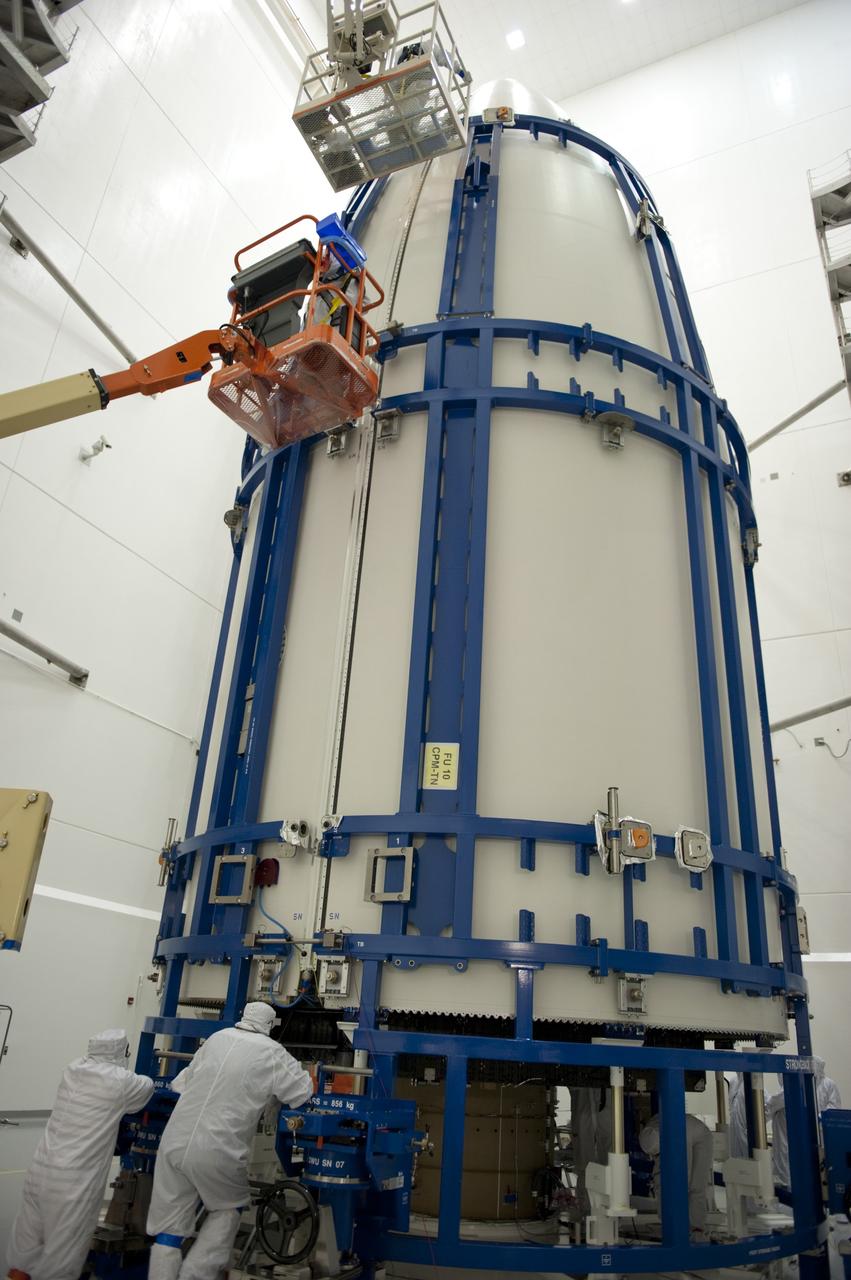
CAPE CANAVERAL, Fla. -- In the Astrotech payload processing facility near Kennedy Space Center in Florida, spacecraft technicians secure the Atlas payload fairing around the Juno spacecraft for launch. The fairing will protect the spacecraft from the impact of aerodynamic pressure and heating during ascent and will be jettisoned once the spacecraft is outside the Earth's atmosphere. Juno is scheduled to launch aboard a United Launch Alliance Atlas V rocket from Cape Canaveral, Fla., Aug. 5.The solar-powered spacecraft will orbit Jupiter's poles 33 times to find out more about the gas giant's origins, structure, atmosphere and magnetosphere and investigate the existence of a solid planetary core. For more information, visit www.nasa.gov/juno. Photo credit: NASA/Kim Shiflett
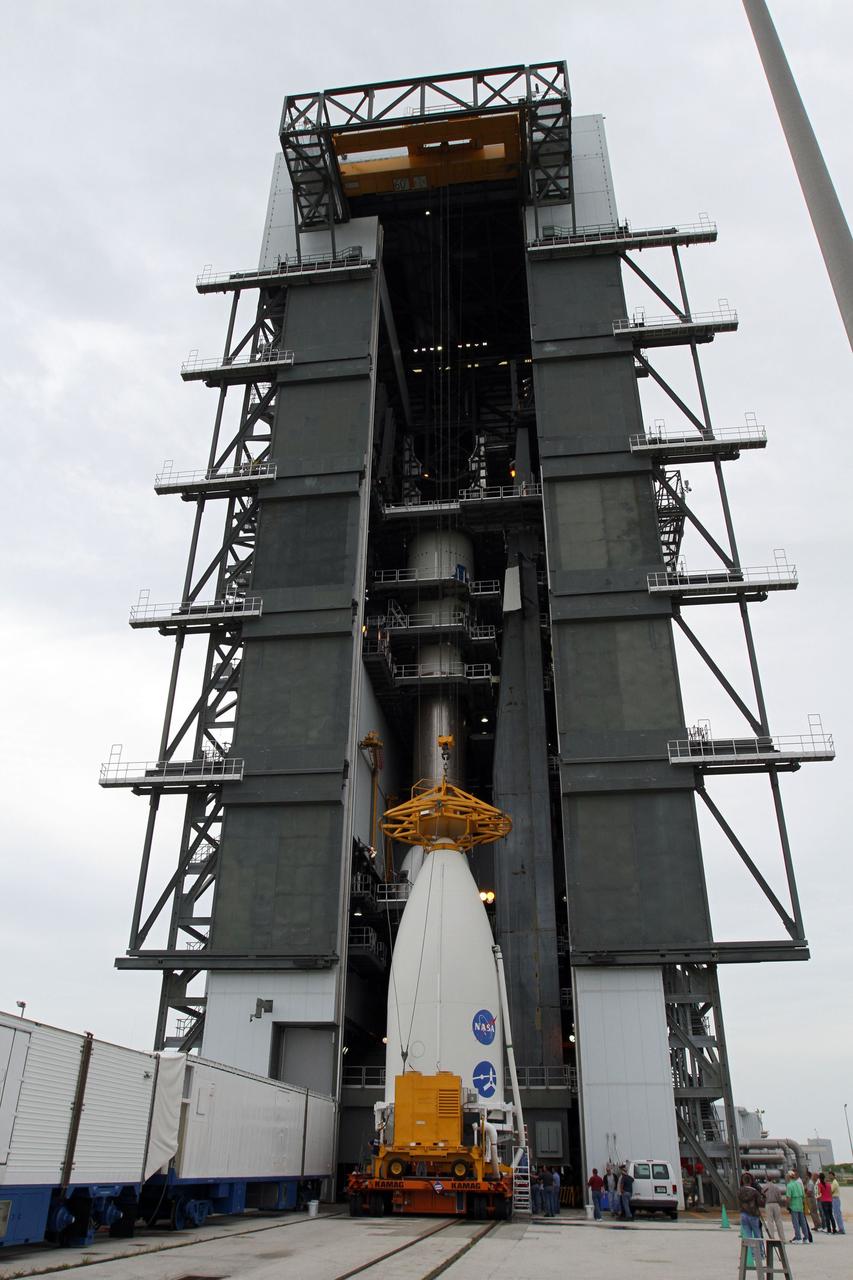
CAPE CANAVERAL, Fla. -- At Space Launch Complex 41, a crane is attached to the nose of the Atlas payload fairing enclosing the Juno spacecraft in preparation for its lift to the top of the Atlas rocket stacked in the Vertical Integration Facility. The spacecraft was prepared for launch in the Astrotech Space Operations' payload processing facility in Titusville, Fla. The fairing will protect the spacecraft from the impact of aerodynamic pressure and heating during ascent and will be jettisoned once the spacecraft is outside the Earth's atmosphere. Juno is scheduled to launch Aug. 5 aboard a United Launch Alliance Atlas V rocket from Cape Canaveral Air Force Station in Florida. The solar-powered spacecraft will orbit Jupiter's poles 33 times to find out more about the gas giant's origins, structure, atmosphere and magnetosphere and investigate the existence of a solid planetary core. For more information, visit www.nasa.gov/juno. Photo credit: NASA/Cory Huston
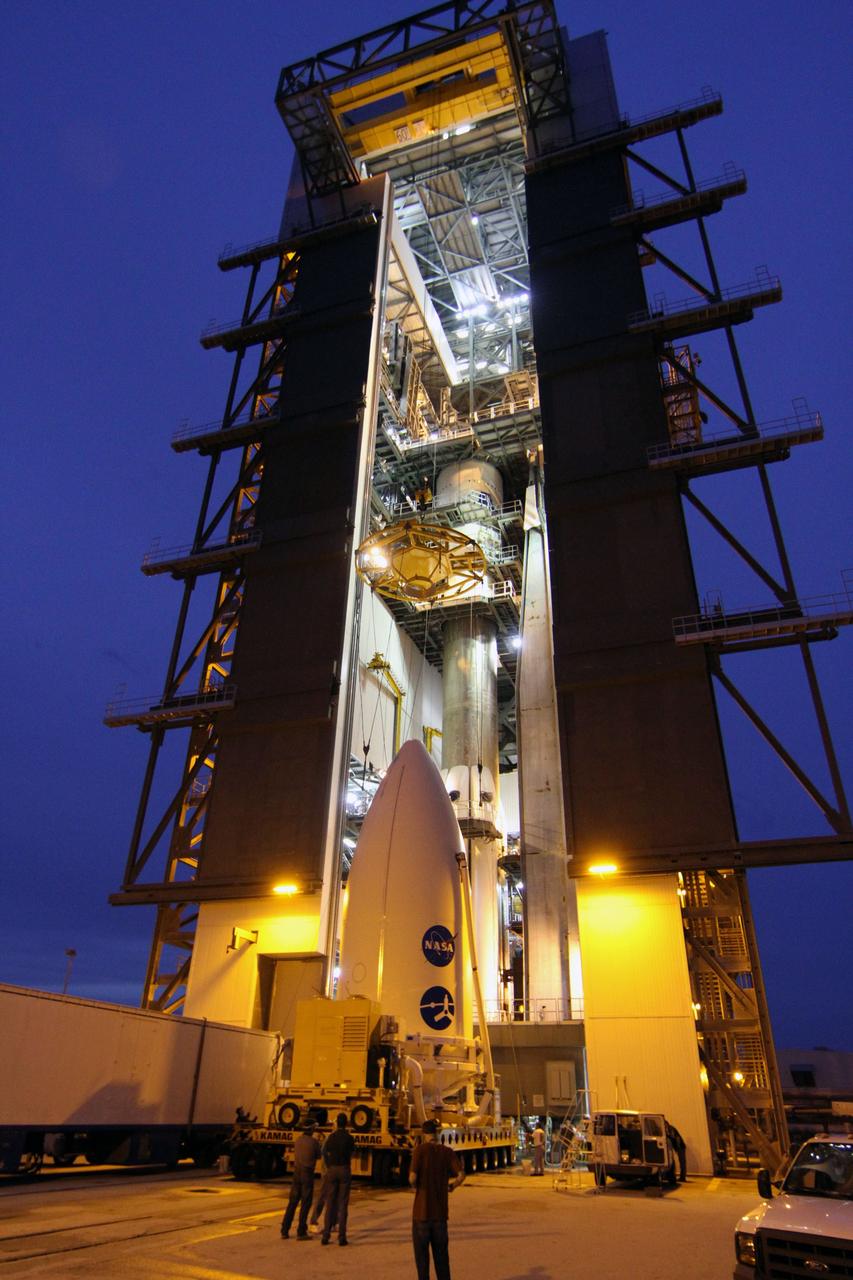
CAPE CANAVERAL, Fla. -- At Space Launch Complex 41, technicians monitor a crane as it is lowered toward the Juno spacecraft, enclosed in an Atlas payload fairing, for its lift to the top of the Atlas rocket stacked in the Vertical Integration Facility. The spacecraft was prepared for launch in the Astrotech Space Operations' payload processing facility in Titusville, Fla. The fairing will protect the spacecraft from the impact of aerodynamic pressure and heating during ascent and will be jettisoned once the spacecraft is outside the Earth's atmosphere. Juno is scheduled to launch Aug. 5 aboard a United Launch Alliance Atlas V rocket from Cape Canaveral Air Force Station in Florida. The solar-powered spacecraft will orbit Jupiter's poles 33 times to find out more about the gas giant's origins, structure, atmosphere and magnetosphere and investigate the existence of a solid planetary core. For more information, visit www.nasa.gov/juno. Photo credit: NASA/Cory Huston
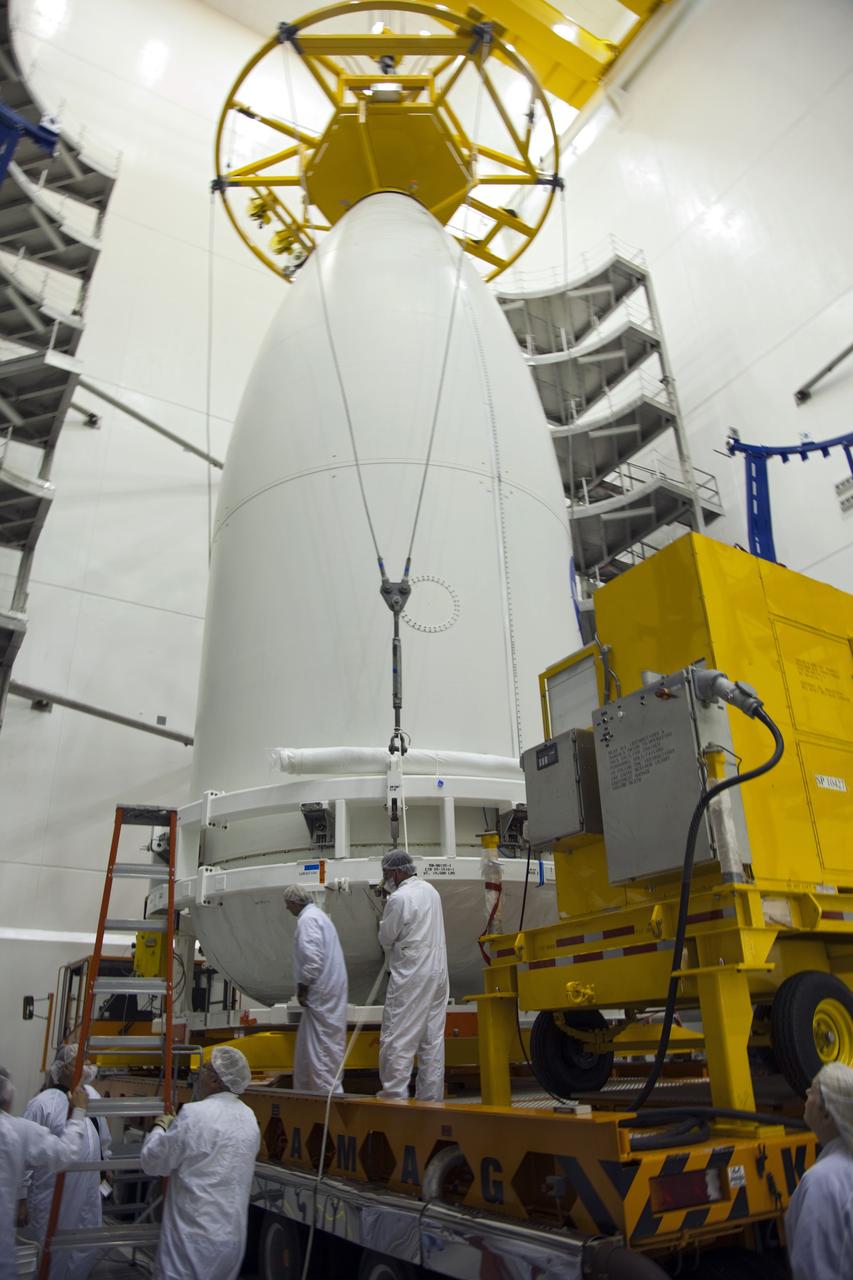
CAPE CANAVERAL, Fla. -- In the Astrotech payload processing facility near Kennedy Space Center in Florida, spacecraft technicians secure the Atlas payload fairing enclosing the Juno spacecraft on a transporter during operations to move the spacecraft to Space Launch Complex 41. The fairing will protect the spacecraft from the impact of aerodynamic pressure and heating during ascent and will be jettisoned once the spacecraft is outside the Earth's atmosphere. Juno is scheduled to launch aboard a United Launch Alliance Atlas V rocket from Cape Canaveral, Fla., Aug. 5.The solar-powered spacecraft will orbit Jupiter's poles 33 times to find out more about the gas giant's origins, structure, atmosphere and magnetosphere and investigate the existence of a solid planetary core. For more information, visit www.nasa.gov/juno. Photo credit: NASA/Frank Michaux
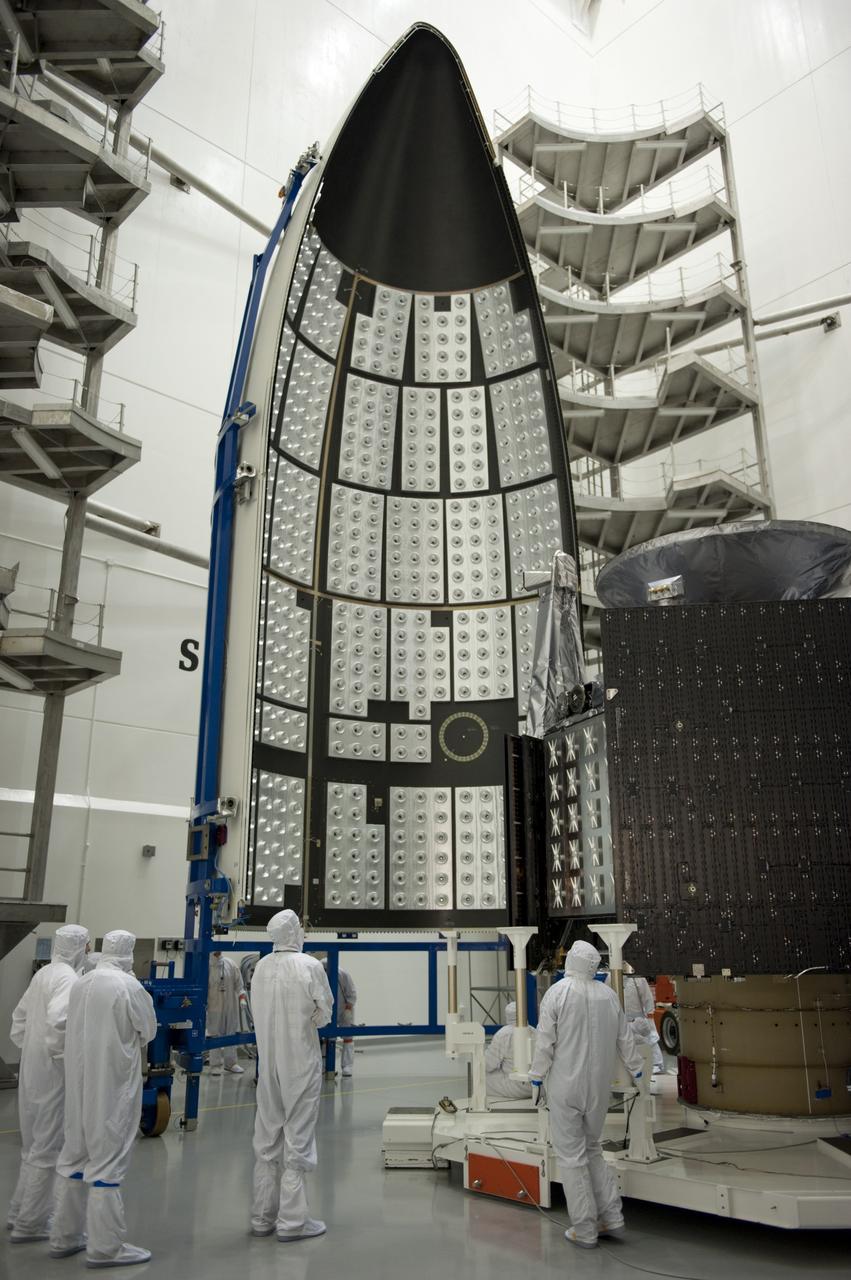
CAPE CANAVERAL, Fla. -- In the Astrotech payload processing facility near Kennedy Space Center in Florida, half of the Atlas payload fairing is moved toward the Juno spacecraft during work to enclose the spacecraft for launch. The fairing will protect the spacecraft from the impact of aerodynamic pressure and heating during ascent and will be jettisoned once the spacecraft is outside the Earth's atmosphere. Juno is scheduled to launch aboard a United Launch Alliance Atlas V rocket from Cape Canaveral, Fla., Aug. 5.The solar-powered spacecraft will orbit Jupiter's poles 33 times to find out more about the gas giant's origins, structure, atmosphere and magnetosphere and investigate the existence of a solid planetary core. For more information, visit www.nasa.gov/juno. Photo credit: NASA/Kim Shiflett
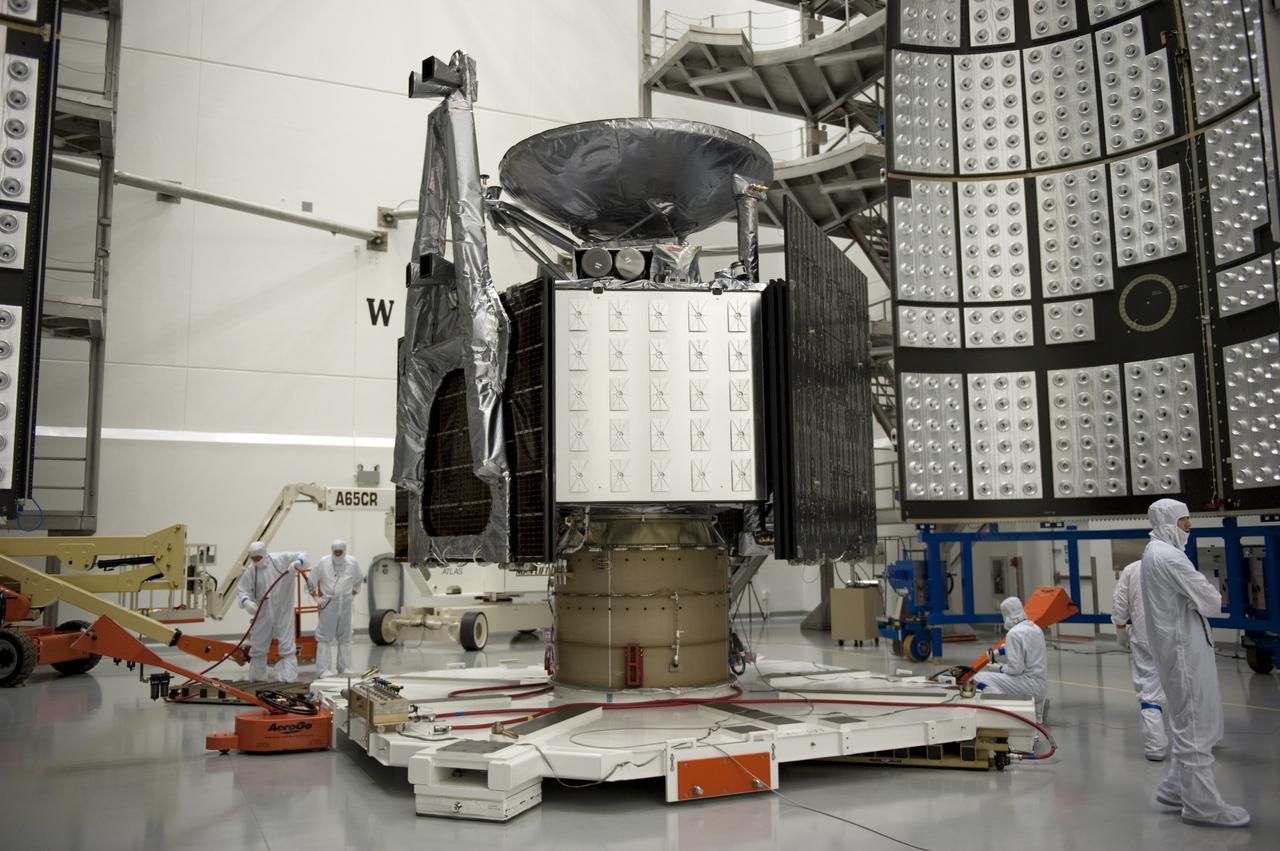
CAPE CANAVERAL, Fla. -- In the Astrotech payload processing facility near Kennedy Space Center in Florida, spacecraft technicians dressed in clean-room attire, known as bunny suits, prepare to enclose the Juno spacecraft in its Atlas payload fairing for launch. The fairing will protect the spacecraft from the impact of aerodynamic pressure and heating during ascent and will be jettisoned once the spacecraft is outside the Earth's atmosphere. Juno is scheduled to launch aboard a United Launch Alliance Atlas V rocket from Cape Canaveral, Fla., Aug. 5.The solar-powered spacecraft will orbit Jupiter's poles 33 times to find out more about the gas giant's origins, structure, atmosphere and magnetosphere and investigate the existence of a solid planetary core. For more information, visit www.nasa.gov/juno. Photo credit: NASA/Kim Shiflett
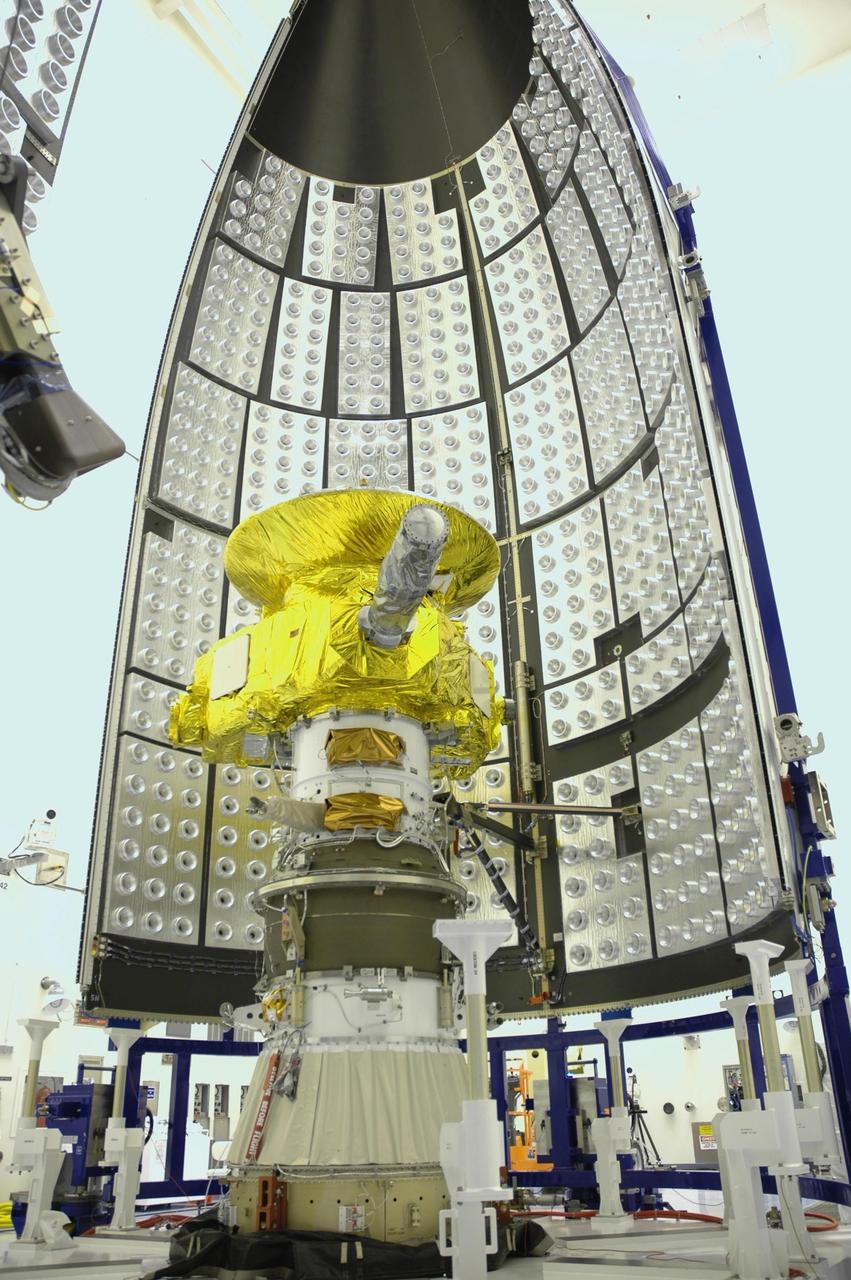
KENNEDY SPACE CENTER, FLA. - In the Payload Hazardous Servicing Facility, the New Horizons spacecraft waits for encapsulation within the fairing sections waiting nearby. The fairing protects the spacecraft during launch and flight through the atmosphere. Once out of the atmosphere, the fairing is jettisoned. The compact 1,060-pound New Horizons probe carries seven scientific instruments that will characterize the global geology and geomorphology of Pluto and its moon Charon, map their surface compositions and temperatures, and examine Pluto's complex atmosphere. After that, flybys of Kuiper Belt objects from even farther in the solar system may be undertaken in an extended mission. New Horizons is the first mission in NASA's New Frontiers program of medium-class planetary missions. The spacecraft, designed for NASA by the Johns Hopkins University Applied Physics Laboratory in Laurel, Md., will fly by Pluto and Charon as early as summer 2015.
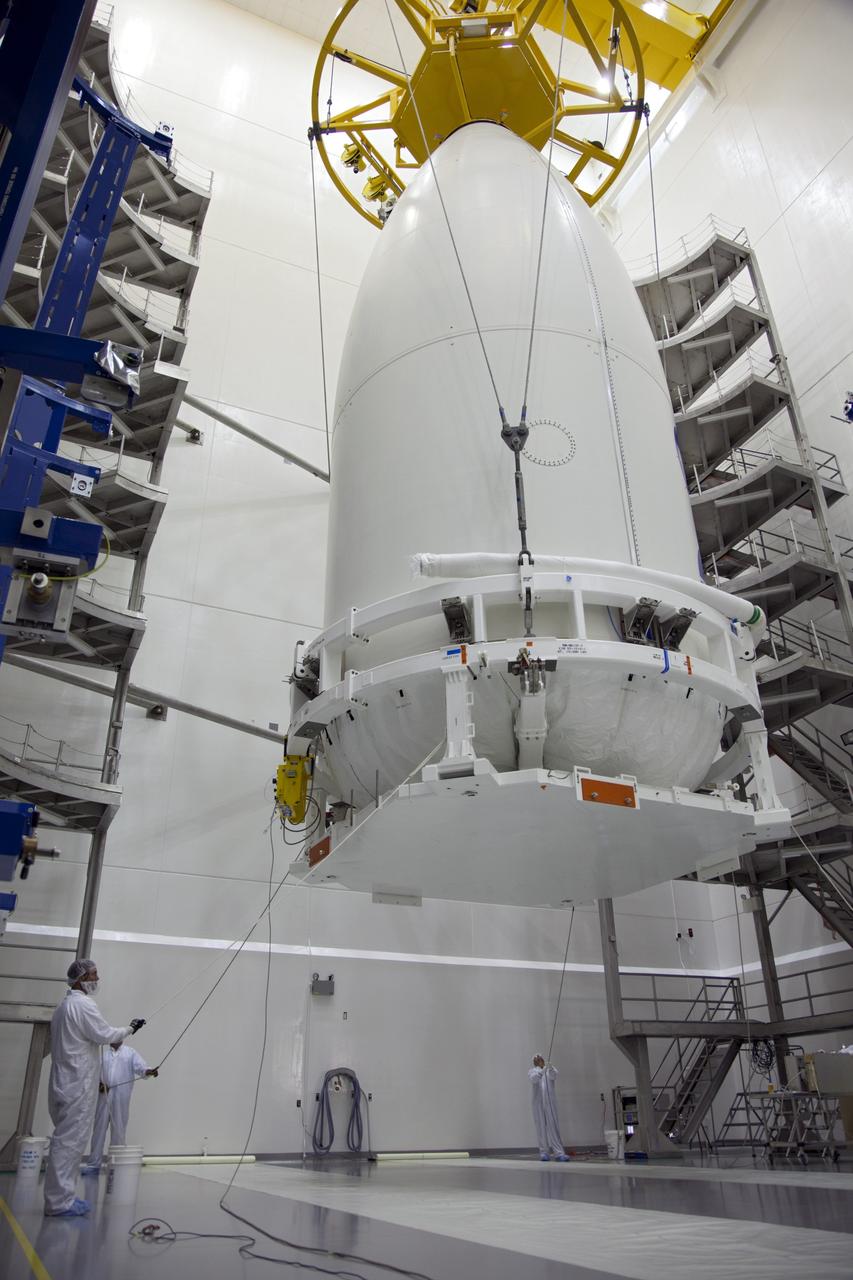
CAPE CANAVERAL, Fla. -- In the Astrotech payload processing facility near Kennedy Space Center in Florida, a lifting device raises the Atlas payload fairing enclosing the Juno spacecraft from the clean-room floor during operations to lift the spacecraft onto a transporter for its trip to Space Launch Complex 41. The fairing will protect the spacecraft from the impact of aerodynamic pressure and heating during ascent and will be jettisoned once the spacecraft is outside the Earth's atmosphere. Juno is scheduled to launch aboard a United Launch Alliance Atlas V rocket from Cape Canaveral, Fla., Aug. 5.The solar-powered spacecraft will orbit Jupiter's poles 33 times to find out more about the gas giant's origins, structure, atmosphere and magnetosphere and investigate the existence of a solid planetary core. For more information, visit www.nasa.gov/juno. Photo credit: NASA/Frank Michaux
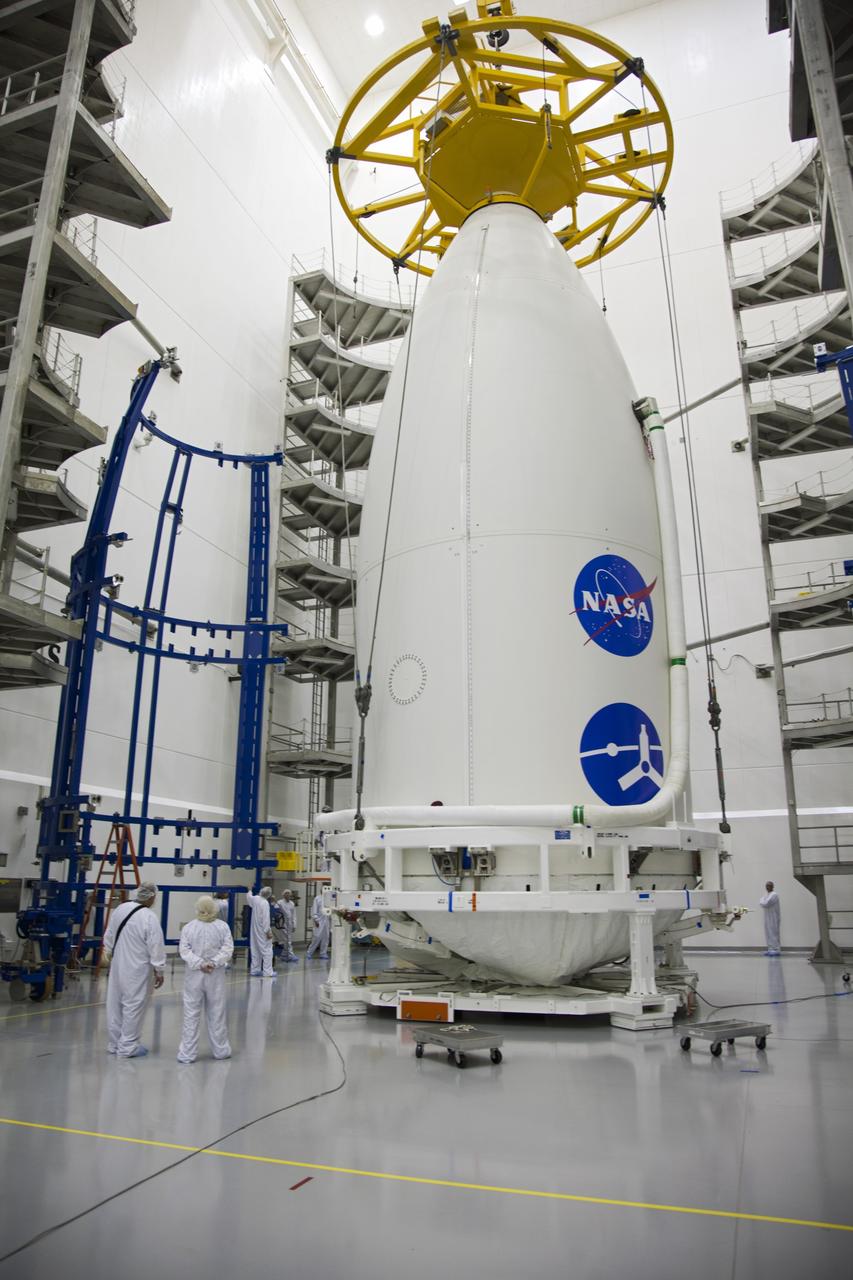
CAPE CANAVERAL, Fla. -- In the Astrotech payload processing facility near Kennedy Space Center in Florida, a lifting device rests atop the nose of the Atlas payload fairing enclosing the Juno spacecraft during operations to lift the spacecraft onto a transporter for its trip to Space Launch Complex 41. The fairing will protect the spacecraft from the impact of aerodynamic pressure and heating during ascent and will be jettisoned once the spacecraft is outside the Earth's atmosphere. Juno is scheduled to launch aboard a United Launch Alliance Atlas V rocket from Cape Canaveral, Fla., Aug. 5.The solar-powered spacecraft will orbit Jupiter's poles 33 times to find out more about the gas giant's origins, structure, atmosphere and magnetosphere and investigate the existence of a solid planetary core. For more information, visit www.nasa.gov/juno. Photo credit: NASA/Frank Michaux
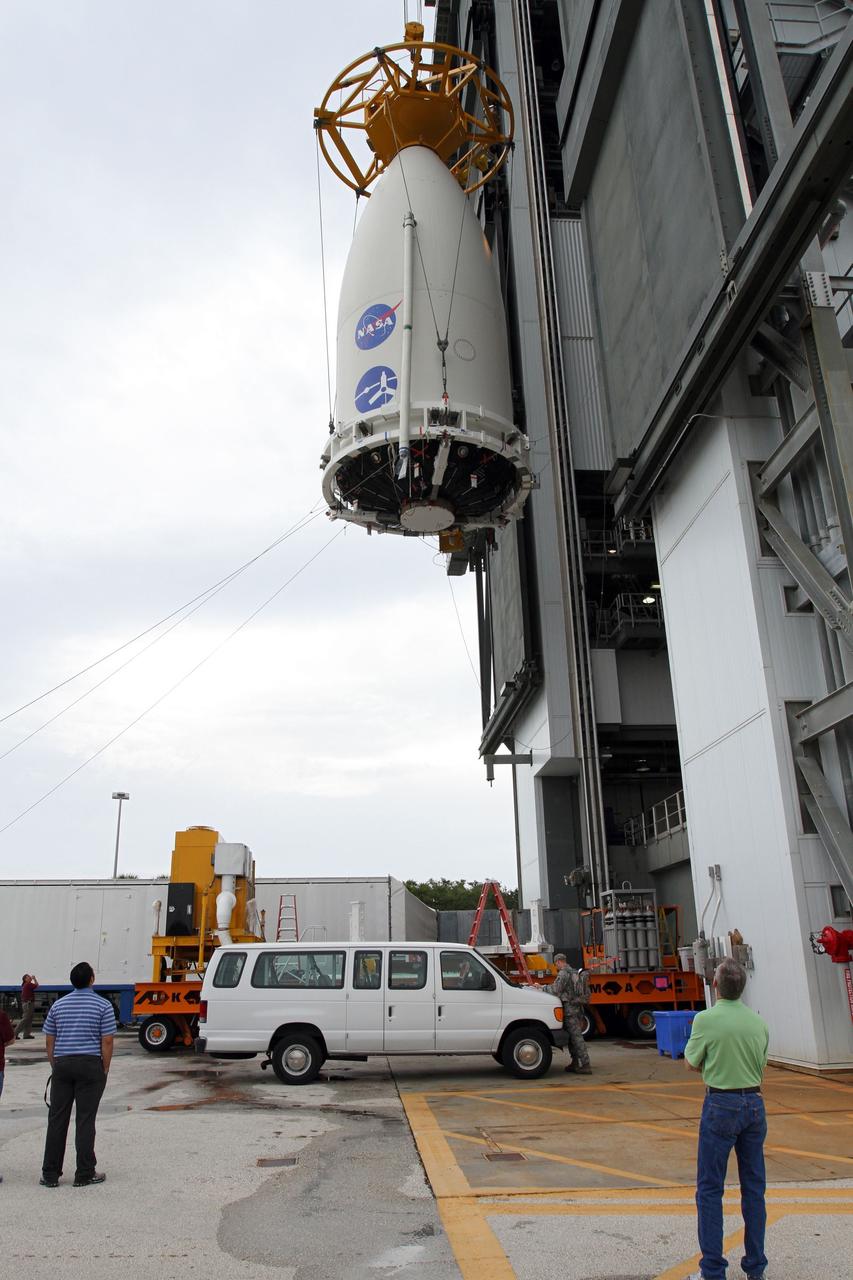
CAPE CANAVERAL, Fla. -- At Space Launch Complex 41, the Juno spacecraft, enclosed in an Atlas payload fairing, appears to hover over its transporter as it is lifted up the side of the Vertical Integration Facility to the top of the Atlas rocket already stacked inside. The spacecraft was prepared for launch in the Astrotech Space Operations' payload processing facility in Titusville, Fla. The fairing will protect the spacecraft from the impact of aerodynamic pressure and heating during ascent and will be jettisoned once the spacecraft is outside the Earth's atmosphere. Juno is scheduled to launch Aug. 5 aboard a United Launch Alliance Atlas V rocket from Cape Canaveral Air Force Station in Florida. The solar-powered spacecraft will orbit Jupiter's poles 33 times to find out more about the gas giant's origins, structure, atmosphere and magnetosphere and investigate the existence of a solid planetary core. For more information, visit www.nasa.gov/juno. Photo credit: NASA/Cory Huston
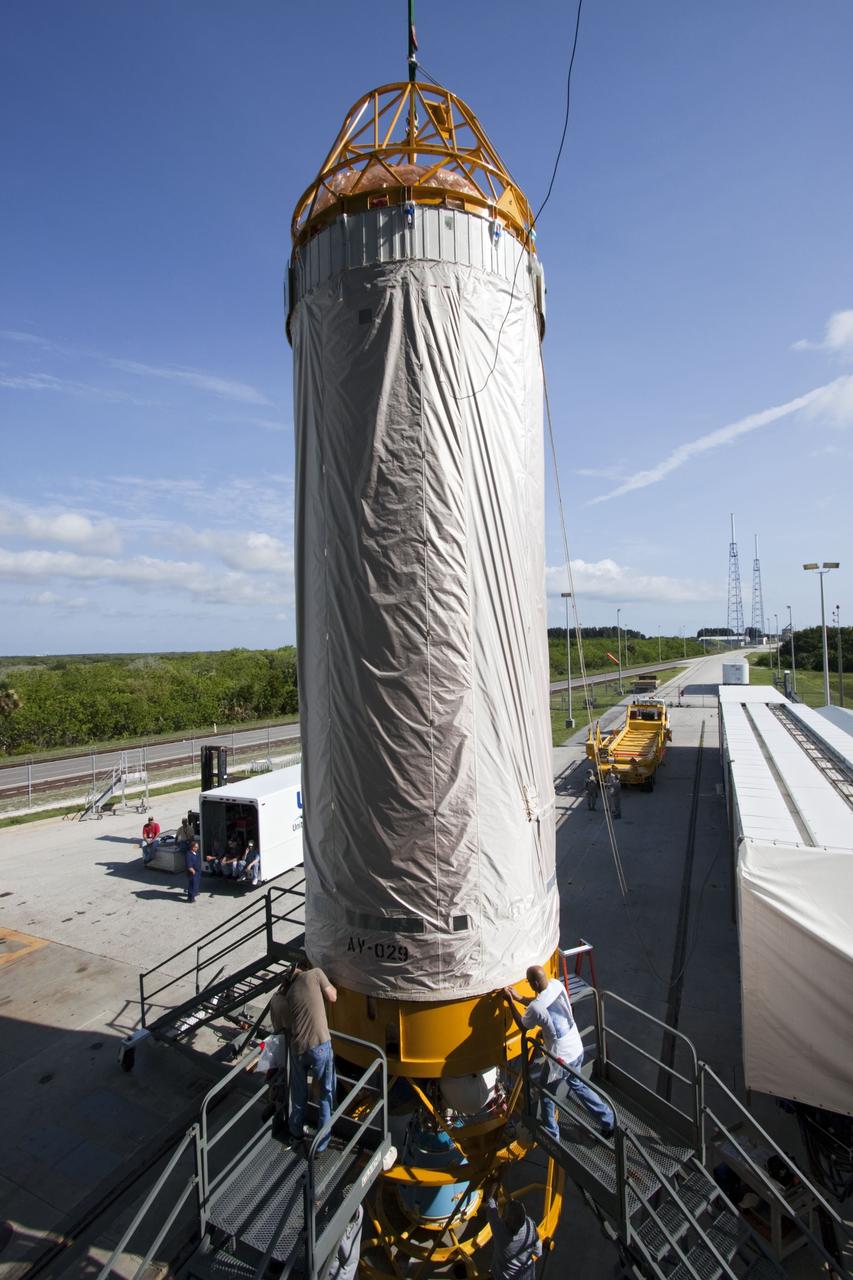
CAPE CANAVERAL, Fla. -- At Launch Complex 41 at Cape Canaveral Air Force Station in Florida, workers roll down the protective cover on the Centaur upper stage for the United Launch Alliance Atlas V, slated to launch NASA's Juno spacecraft, as it lifted into the Vertical Integration Facility (VIF). After in position in the VIF it will be attached to the Atlas V booster stage, already at the pad. Juno is scheduled to launch aboard an Atlas V from Cape Canaveral, Fla. Aug. 5.The solar-powered spacecraft will orbit Jupiter's poles 33 times to find out more about the gas giant's origins, structure, atmosphere and magnetosphere and investigate the existence of a solid planetary core. For more information visit: www.nasa.gov/juno. Photo credit: NASA/Jim Grossmann

CAPE CANAVERAL, Fla. -- Inside the Vertical Integration Facility at Space Launch Complex 41, the Juno spacecraft, enclosed in an Atlas payload fairing, is lowered onto the top of the Atlas rocket stacked beneath it. The spacecraft was prepared for launch in the Astrotech Space Operations' payload processing facility in Titusville, Fla. The fairing will protect the spacecraft from the impact of aerodynamic pressure and heating during ascent and will be jettisoned once the spacecraft is outside the Earth's atmosphere. Juno is scheduled to launch Aug. 5 aboard a United Launch Alliance Atlas V rocket from Cape Canaveral Air Force Station in Florida. The solar-powered spacecraft will orbit Jupiter's poles 33 times to find out more about the gas giant's origins, structure, atmosphere and magnetosphere and investigate the existence of a solid planetary core. For more information, visit www.nasa.gov/juno. Photo credit: NASA/Cory Huston
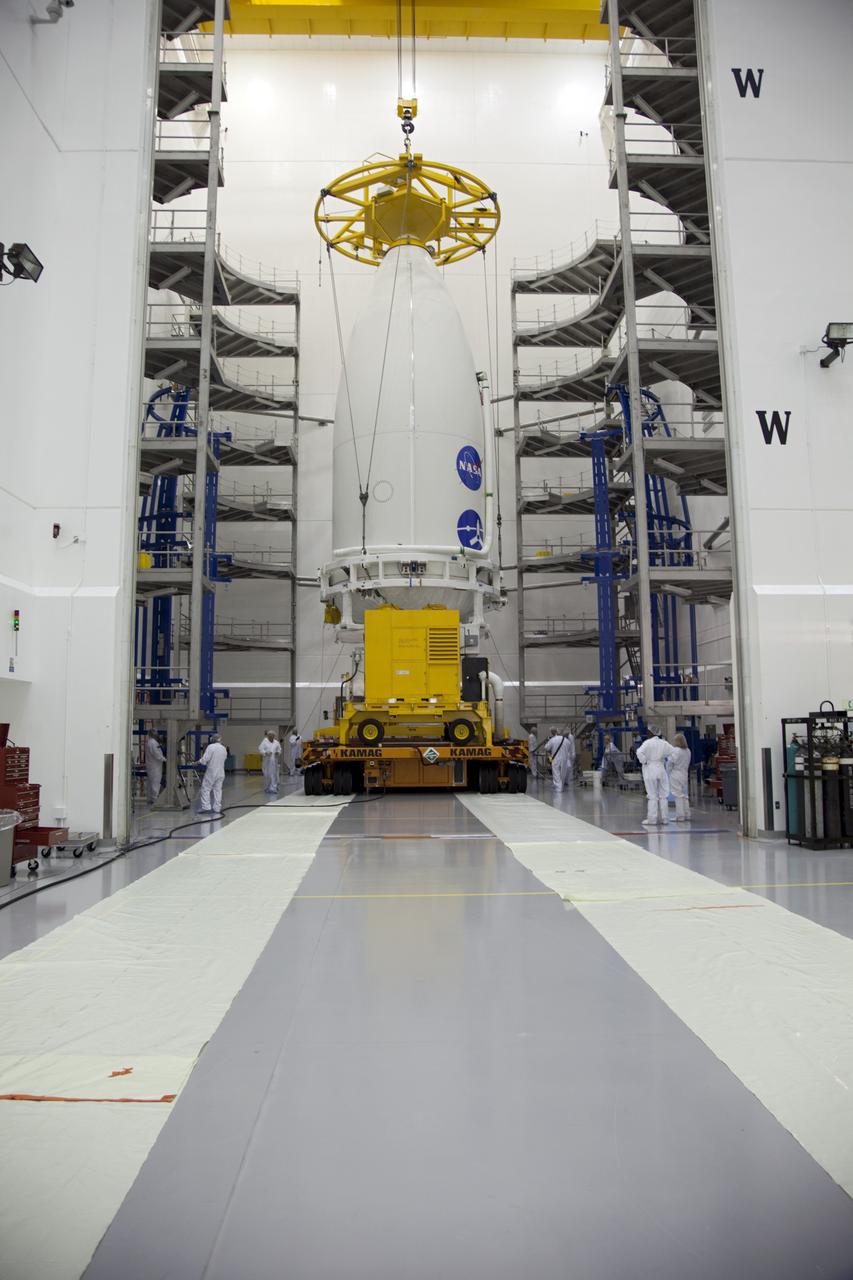
CAPE CANAVERAL, Fla. -- In the Astrotech payload processing facility near Kennedy Space Center in Florida, a lifting device lowers the Atlas payload fairing enclosing the Juno spacecraft onto a transporter during operations to move the spacecraft to Space Launch Complex 41. The fairing will protect the spacecraft from the impact of aerodynamic pressure and heating during ascent and will be jettisoned once the spacecraft is outside the Earth's atmosphere. Juno is scheduled to launch aboard a United Launch Alliance Atlas V rocket from Cape Canaveral, Fla., Aug. 5.The solar-powered spacecraft will orbit Jupiter's poles 33 times to find out more about the gas giant's origins, structure, atmosphere and magnetosphere and investigate the existence of a solid planetary core. For more information, visit www.nasa.gov/juno. Photo credit: NASA/Frank Michaux
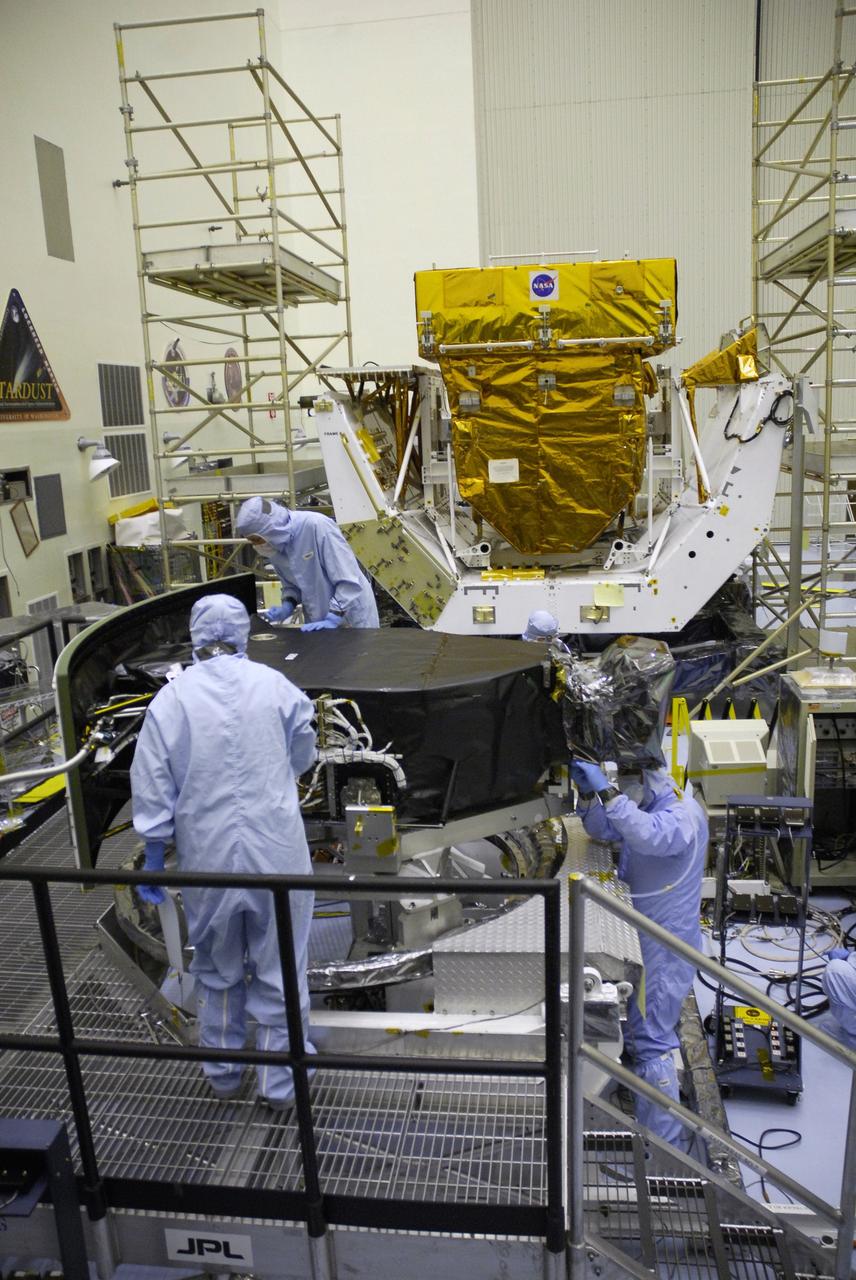
CAPE CANAVERAL, Fla. – Technicians in the Payload Hazardous Servicing Facility complete removal of the protective cover from the Wide Field Camera 3, or WFC3. The WFC3 is part of the payload on space shuttle Atlantis for the fifth and final Hubble servicing mission, STS-125. As Hubble enters the last stage of its life, WFC3 will be Hubble's next evolutionary step, allowing Hubble to peer ever further into the mysteries of the cosmos. WFC3 will study a diverse range of objects and phenomena, from young and extremely distant galaxies, to much more nearby stellar systems, to objects within our very own solar system. WFC3 will take the place of Wide Field Planetary Camera 2, which astronauts will bring back to Earth aboard the shuttle. Launch of Atlantis is targeted at 1:34 a.m. EDT Oct. 8. Photo credit: NASA/Jack Pfaller
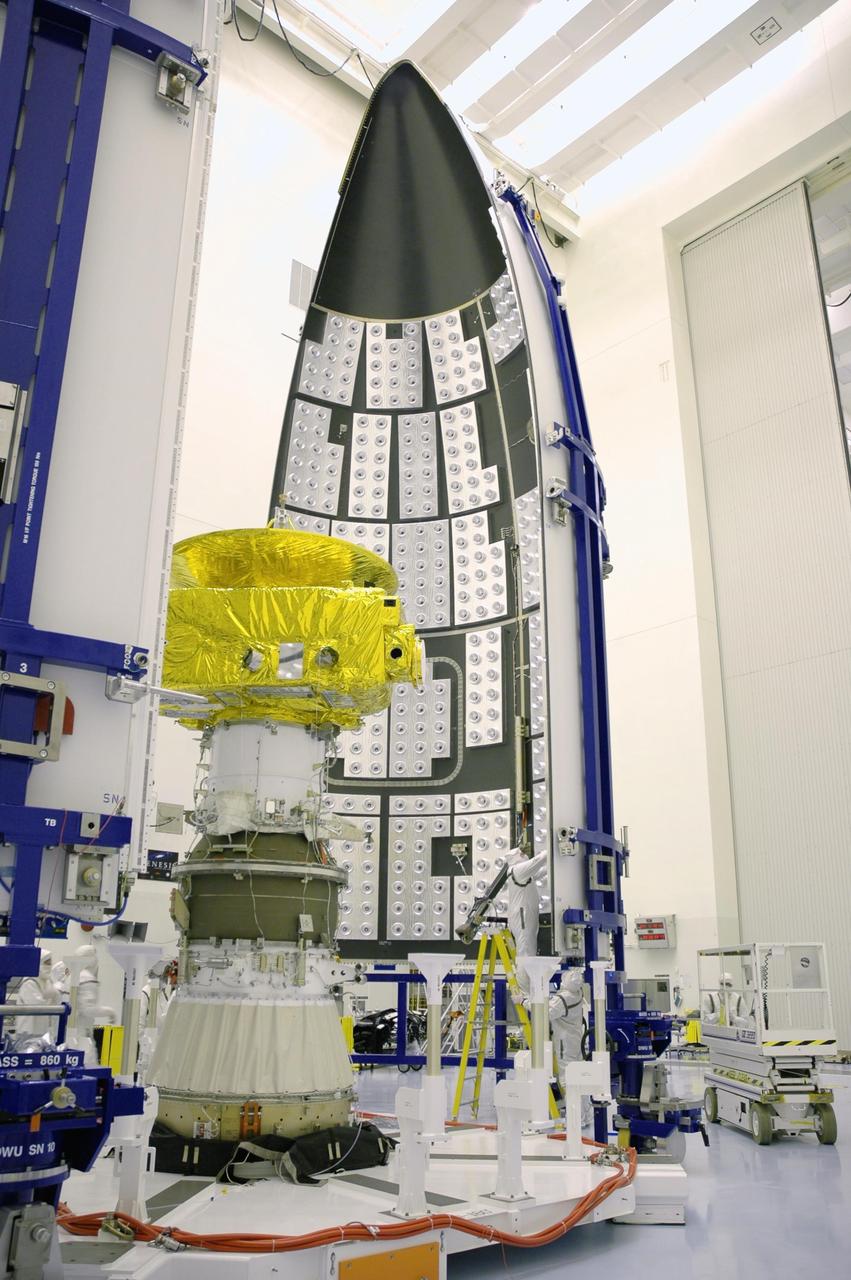
KENNEDY SPACE CENTER, FLA. - In the Payload Hazardous Servicing Facility, clean-suit garbed workers prepare the first fairing section (in the background) that will encapsulate the New Horizons spacecraft at left for flight. The fairing protects the spacecraft during launch and flight through the atmosphere. Once out of the atmosphere, the fairing is jettisoned. The compact 1,060-pound New Horizons probe carries seven scientific instruments that will characterize the global geology and geomorphology of Pluto and its moon Charon, map their surface compositions and temperatures, and examine Pluto's complex atmosphere. After that, flybys of Kuiper Belt objects from even farther in the solar system may be undertaken in an extended mission. New Horizons is the first mission in NASA's New Frontiers program of medium-class planetary missions. The spacecraft, designed for NASA by the Johns Hopkins University Applied Physics Laboratory in Laurel, Md., will fly by Pluto and Charon as early as summer 2015.
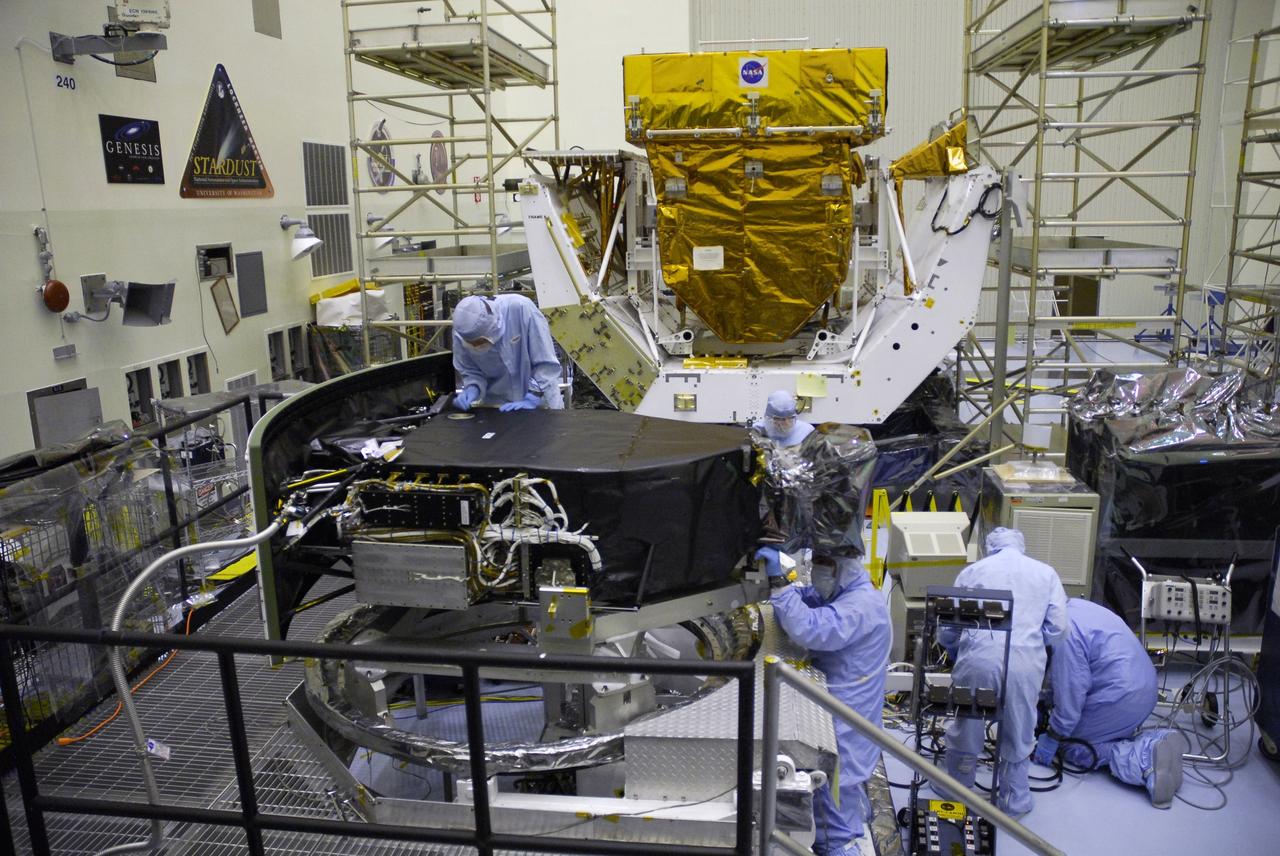
CAPE CANAVERAL, Fla. – Technicians in the Payload Hazardous Servicing Facility complete removal of the protective cover from the Wide Field Camera 3, or WFC3. The WFC3 is part of the payload on space shuttle Atlantis for the fifth and final Hubble servicing mission, STS-125. As Hubble enters the last stage of its life, WFC3 will be Hubble's next evolutionary step, allowing Hubble to peer ever further into the mysteries of the cosmos. WFC3 will study a diverse range of objects and phenomena, from young and extremely distant galaxies, to much more nearby stellar systems, to objects within our very own solar system. WFC3 will take the place of Wide Field Planetary Camera 2, which astronauts will bring back to Earth aboard the shuttle. Launch of Atlantis is targeted at 1:34 a.m. EDT Oct. 8. Photo credit: NASA/Jack Pfaller
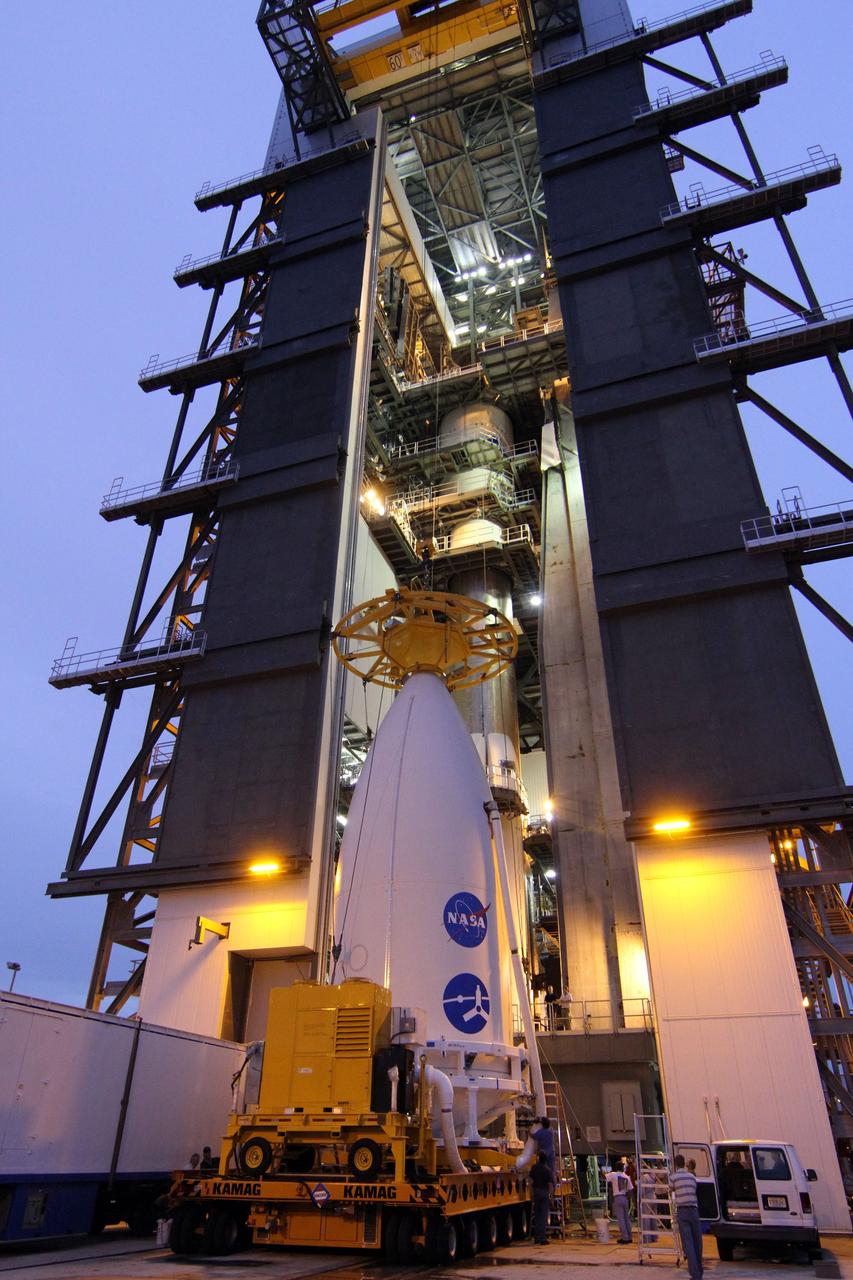
CAPE CANAVERAL, Fla. -- At Space Launch Complex 41, a crane is lowered over the nose of the Atlas payload fairing enclosing the Juno spacecraft in preparation for its lift to the top of the Atlas rocket stacked in the Vertical Integration Facility. The spacecraft was prepared for launch in the Astrotech Space Operations' payload processing facility in Titusville, Fla. The fairing will protect the spacecraft from the impact of aerodynamic pressure and heating during ascent and will be jettisoned once the spacecraft is outside the Earth's atmosphere. Juno is scheduled to launch Aug. 5 aboard a United Launch Alliance Atlas V rocket from Cape Canaveral Air Force Station in Florida. The solar-powered spacecraft will orbit Jupiter's poles 33 times to find out more about the gas giant's origins, structure, atmosphere and magnetosphere and investigate the existence of a solid planetary core. For more information, visit www.nasa.gov/juno. Photo credit: NASA/Cory Huston
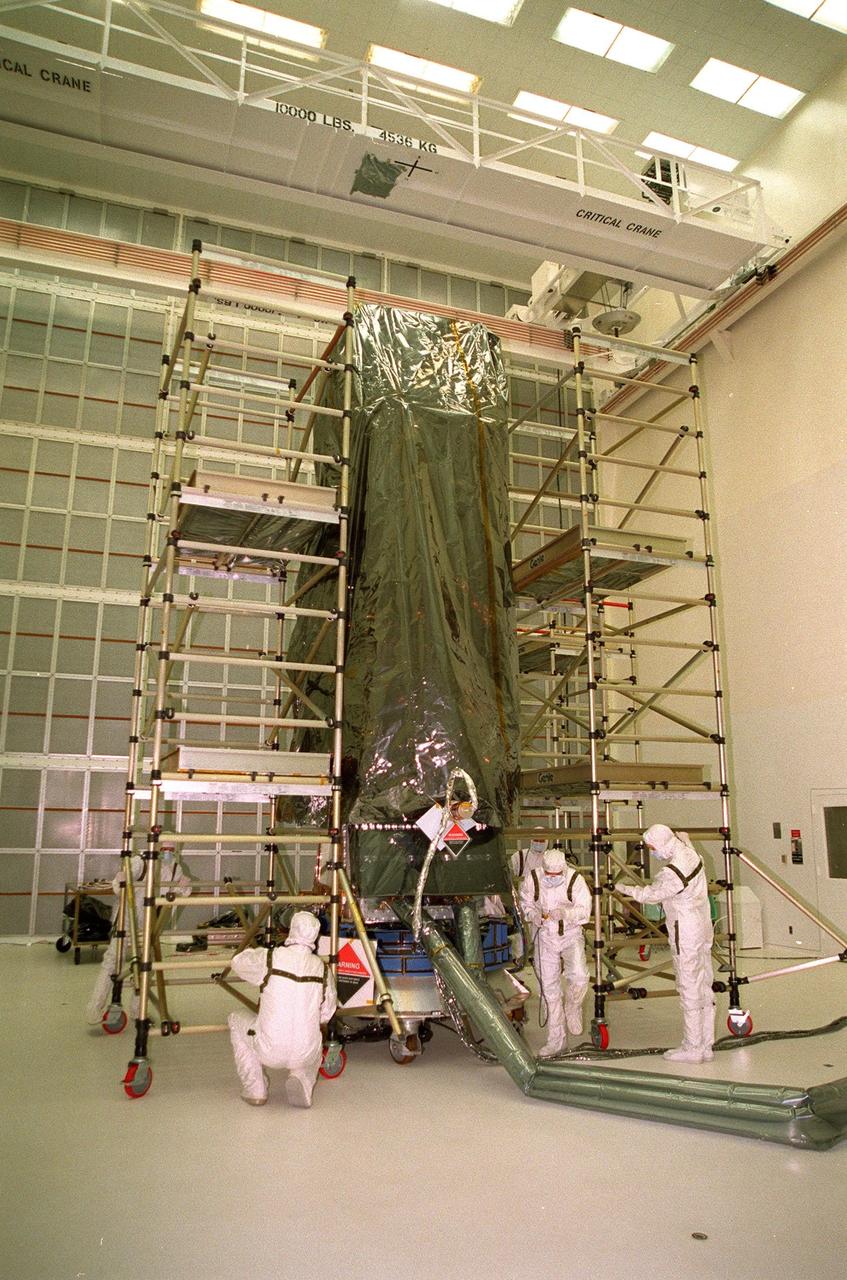
Workers in Hangar AE, Cape Canaveral Air Station, get ready to remove the protective shipping cover from NASA's Far Ultraviolet Spectroscopic Explorer (FUSE) satellite for prelaunch processing. FUSE will undergo a functional test of its systems, followed by installation of the flight batteries and solar arrays. Tests are also scheduled for the communications and data systems linking FUSE with the spacecraft control center at The Johns Hopkins University, Baltimore, Md. FUSE was developed and will be operated by The Johns Hopkins University under contract to Goddard Space Flight Center, Greenbelt, Md. FUSE will investigate the origin and evolution of the lightest elements in the universe hydrogen and deuterium. In addition, the FUSE satellite will examine the forces and process involved in the evolution of the galaxies, stars and planetary systems by investigating light in the far ultraviolet portion of the electromagnetic spectrum. The launch aboard a Boeing Delta II rocket is targeted for May 20 at Launch Complex 17
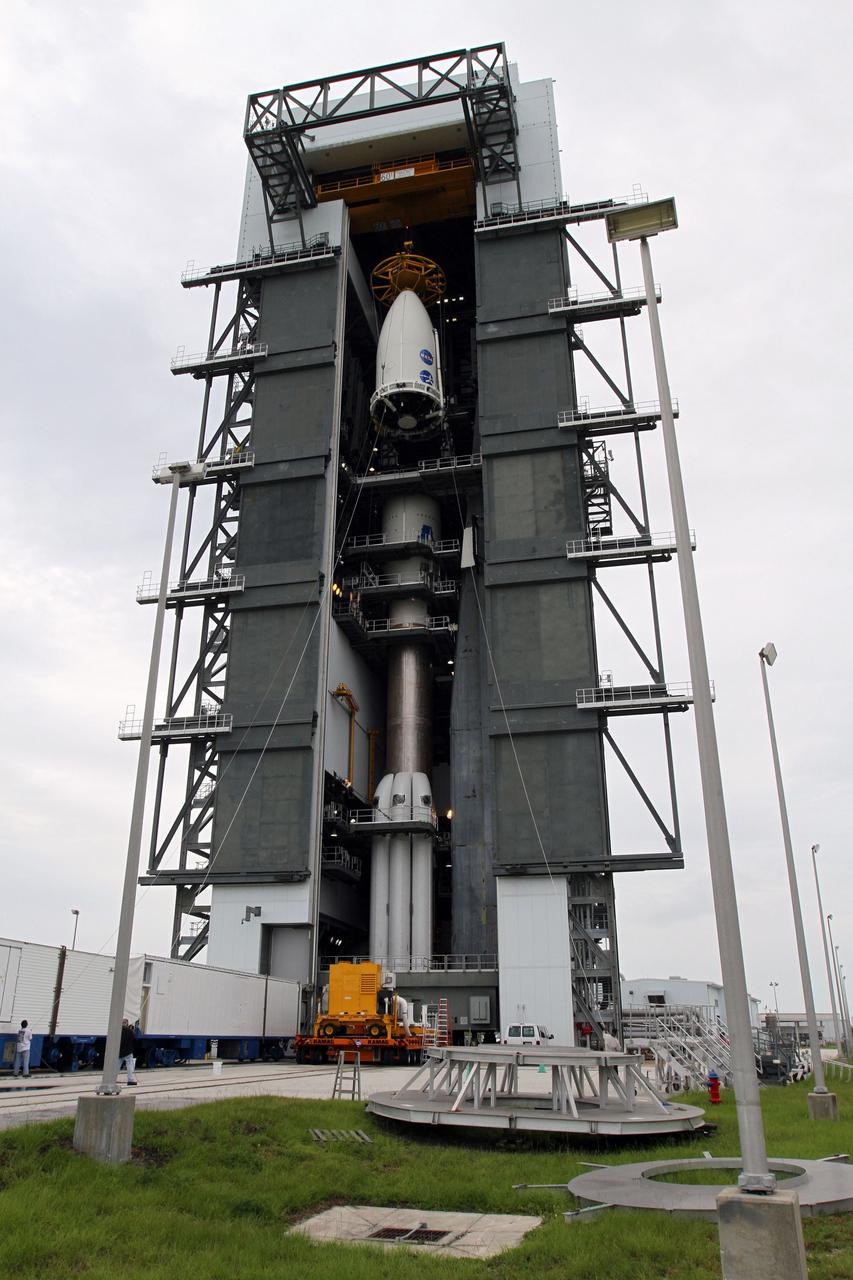
CAPE CANAVERAL, Fla. -- At Space Launch Complex 41, the Atlas rocket stacked inside the Vertical Integration Facility stands ready to receive the Juno spacecraft, enclosed in an Atlas payload fairing. The spacecraft was prepared for launch in the Astrotech Space Operations' payload processing facility in Titusville, Fla. The fairing will protect the spacecraft from the impact of aerodynamic pressure and heating during ascent and will be jettisoned once the spacecraft is outside the Earth's atmosphere. Juno is scheduled to launch Aug. 5 aboard a United Launch Alliance Atlas V rocket from Cape Canaveral Air Force Station in Florida. The solar-powered spacecraft will orbit Jupiter's poles 33 times to find out more about the gas giant's origins, structure, atmosphere and magnetosphere and investigate the existence of a solid planetary core. For more information, visit www.nasa.gov/juno. Photo credit: NASA/Cory Huston
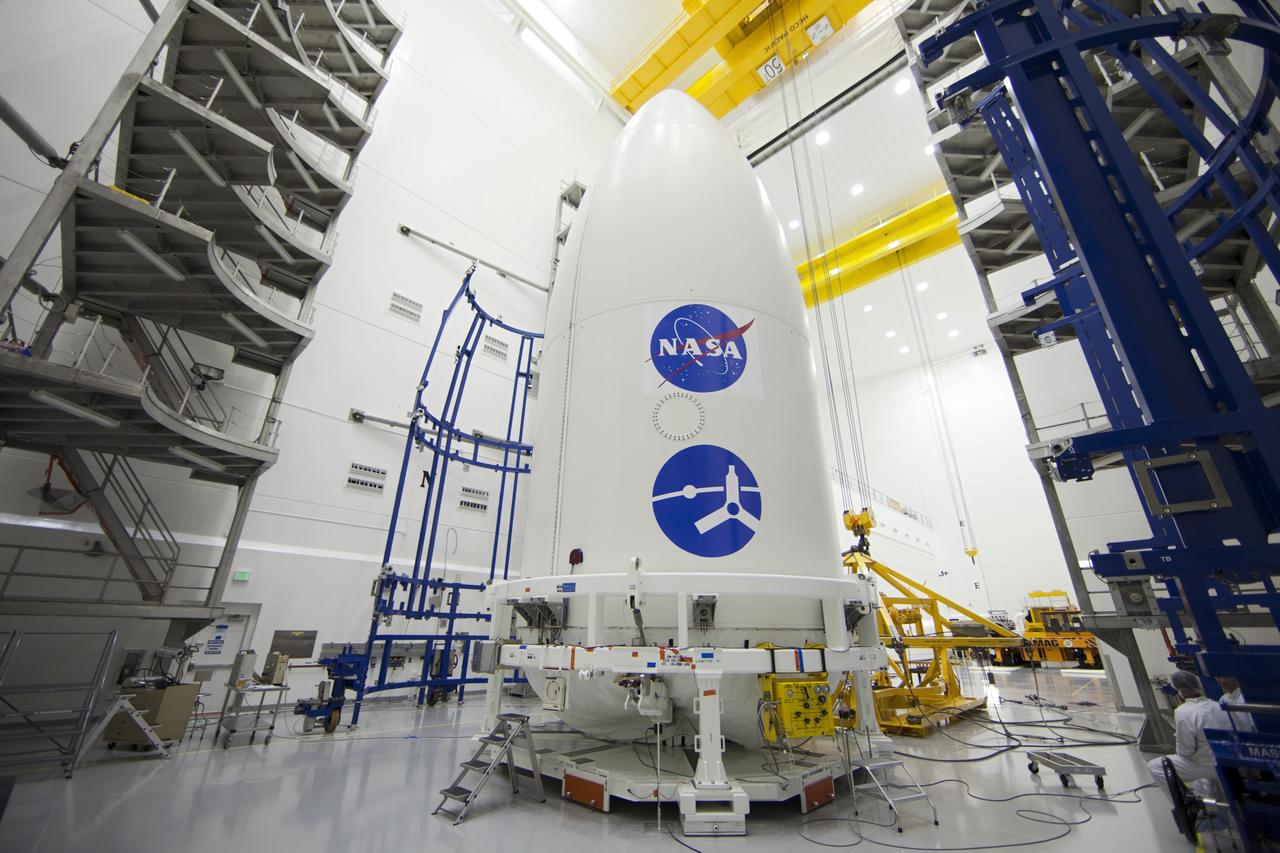
CAPE CANAVERAL, Fla. -- In the Astrotech payload processing facility near Kennedy Space Center in Florida, preparations are under way to lift the Juno spacecraft, enclosed in an Atlas payload fairing, onto a transporter for its trip to Space Launch Complex 41. The fairing will protect the spacecraft from the impact of aerodynamic pressure and heating during ascent and will be jettisoned once the spacecraft is outside the Earth's atmosphere. Juno is scheduled to launch aboard a United Launch Alliance Atlas V rocket from Cape Canaveral, Fla., Aug. 5.The solar-powered spacecraft will orbit Jupiter's poles 33 times to find out more about the gas giant's origins, structure, atmosphere and magnetosphere and investigate the existence of a solid planetary core. For more information, visit www.nasa.gov/juno. Photo credit: NASA/Frank Michaux