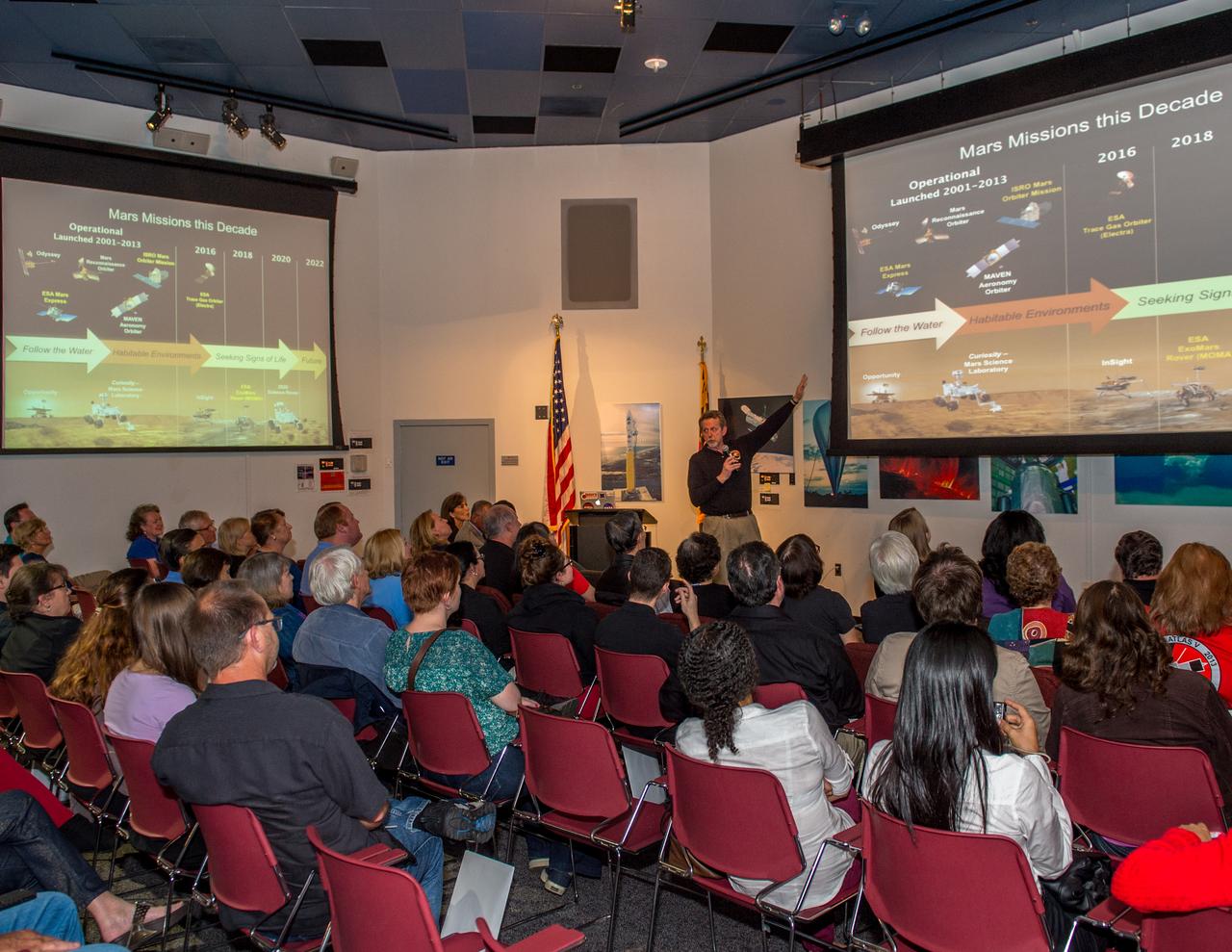
James Green , NASA PLanetary Science Division Director at the Mars Atmosphere and Volatile Evolution Mission (MAVEN) ORBIT INSERTION event
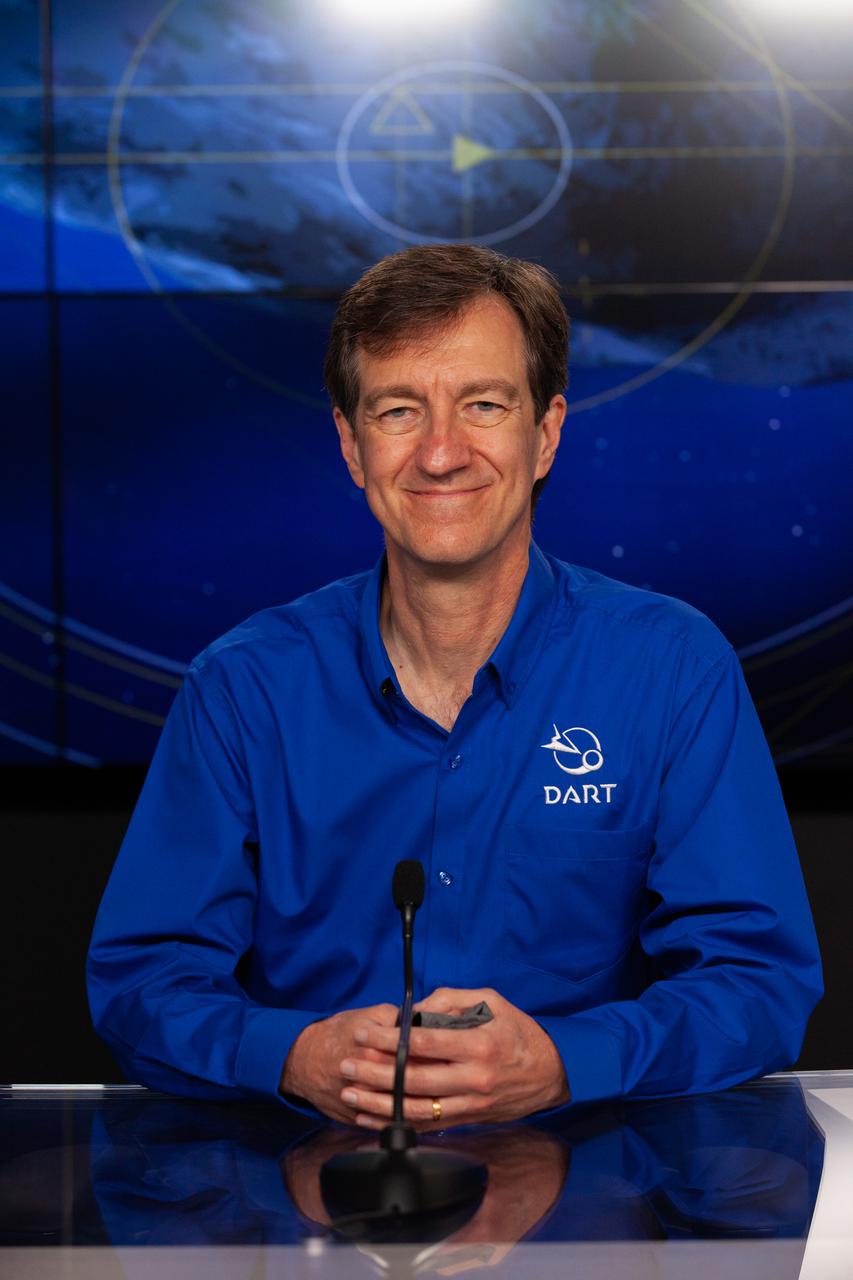
Tom Statler, Double Asteroid Redirection Test (DART) program scientist for NASA’s Science Mission Directorate’s Planetary Science Division, participates in an engineering briefing for the agency’s DART mission at Vandenberg Space Force Base in California on Nov. 21, 2021. DART is the first mission to test technologies for preventing an impact of Earth by a hazardous asteroid. The mission is scheduled to launch no earlier than 1:21 a.m. EST Wednesday, Nov. 24 (10:21 p.m. PST Tuesday, Nov. 23), aboard a SpaceX Falcon 9 rocket from Vandenberg. NASA's Launch Services Program based at Kennedy Space Center in Florida, America's multi-user spaceport, is managing the launch.

Lori Glaze, director of NASA’s Science Mission Directorate’s Planetary Science Division, participates in an engineering briefing for the agency’s Double Asteroid Redirection Test (DART) mission at Vandenberg Space Force Base in California on Nov. 21, 2021. DART is the first mission to test technologies for preventing an impact of Earth by a hazardous asteroid. The mission is scheduled to launch no earlier than 1:21 a.m. EST Wednesday, Nov. 24 (10:21 p.m. PST Tuesday, Nov. 23), aboard a SpaceX Falcon 9 rocket from Vandenberg. NASA's Launch Services Program based at Kennedy Space Center in Florida, America's multi-user spaceport, is managing the launch.

Jim Green, director, Planetary Science Division, NASA Headquarters, Washington, left, is seen with fellow panelists Carey Lisse, senior astrophysicist, Johns Hopkins University Applied Physics Laboratory, Laurel, Maryland, Kelly Fast, program scientist, Planetary Science Division, NASA Headquarters, Washington, and Padma Yanamandra-Fisher, senior research scientist, Space Science Institute, Rancho Cucamonga Branch, California during a media briefing where they outlined how space and Earth-based assets will be used to image and study comet Siding Spring during its Sunday, Oct. 19 flyby of Mars, Thursday, Oct. 9, 2014 at NASA Headquarters in Washington. Photo Credit: (NASA/Joel Kowsky)
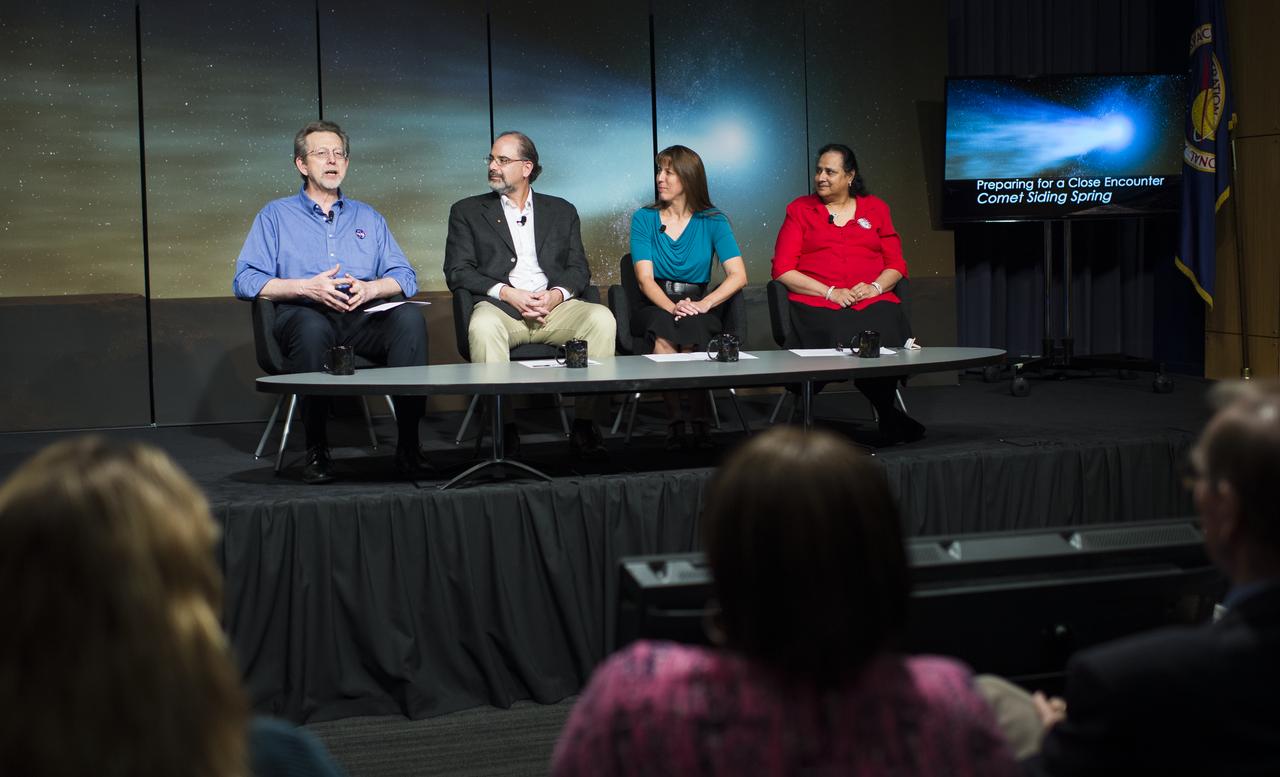
Panelists, from left, Jim Green, director, Planetary Science Division, NASA Headquarters, Washington, Carey Lisse, senior astrophysicist, Johns Hopkins University Applied Physics Laboratory, Laurel, Maryland, Kelly Fast, program scientist, Planetary Science Division, NASA Headquarters, Washington, and Padma Yanamandra-Fisher, senior research scientist, Space Science Institute, Rancho Cucamonga Branch, California, are seen during a media briefing where they outlined how space and Earth-based assets will be used to image and study comet Siding Spring during its Sunday, Oct. 19 flyby of Mars, Thursday, Oct. 9, 2014 at NASA Headquarters in Washington. (Photo credit: NASA/Joel Kowsky)
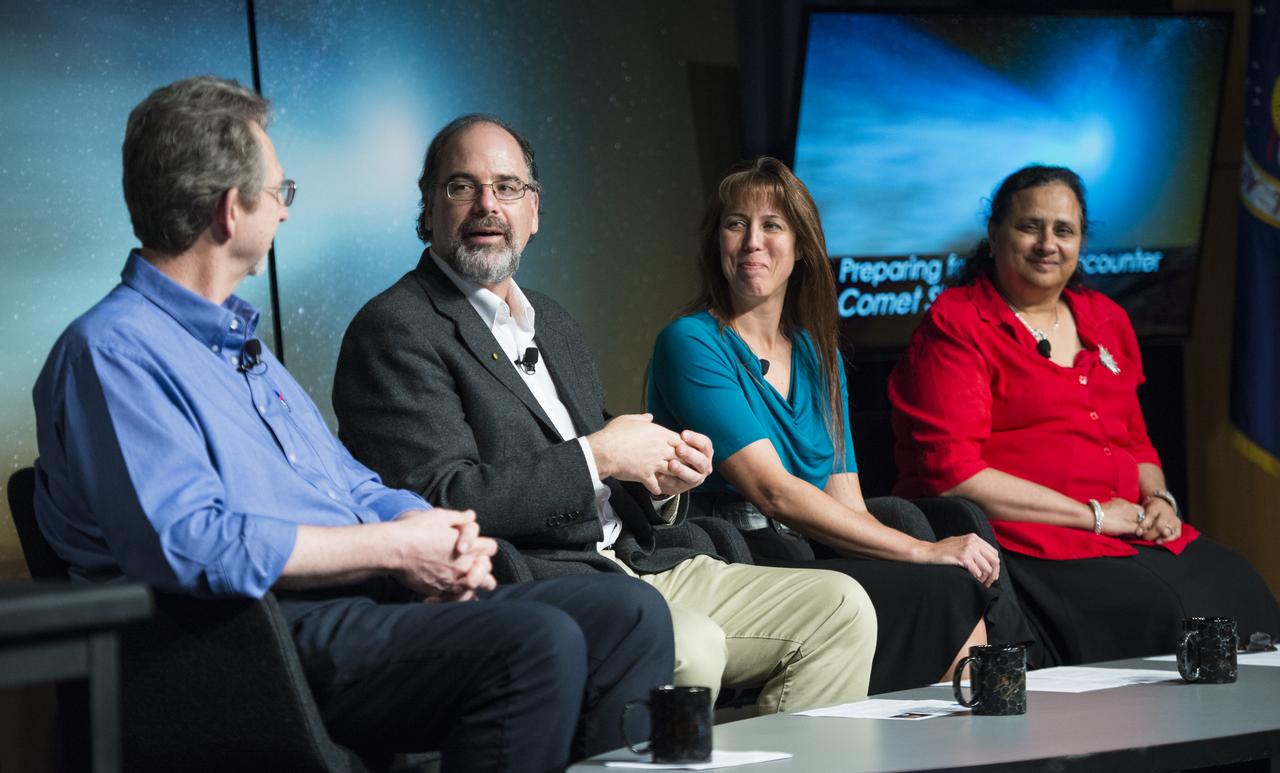
Panelists, from left, Jim Green, director, Planetary Science Division, NASA Headquarters, Washington, Carey Lisse, senior astrophysicist, Johns Hopkins University Applied Physics Laboratory, Laurel, Maryland, Kelly Fast, program scientist, Planetary Science Division, NASA Headquarters, Washington, and Padma Yanamandra-Fisher, senior research scientist, Space Science Institute, Rancho Cucamonga Branch, California, are seen during a media briefing where they outlined how space and Earth-based assets will be used to image and study comet Siding Spring during its Sunday, Oct. 19 flyby of Mars, Thursday, Oct. 9, 2014 at NASA Headquarters in Washington. (Photo credit: NASA/Joel Kowsky)
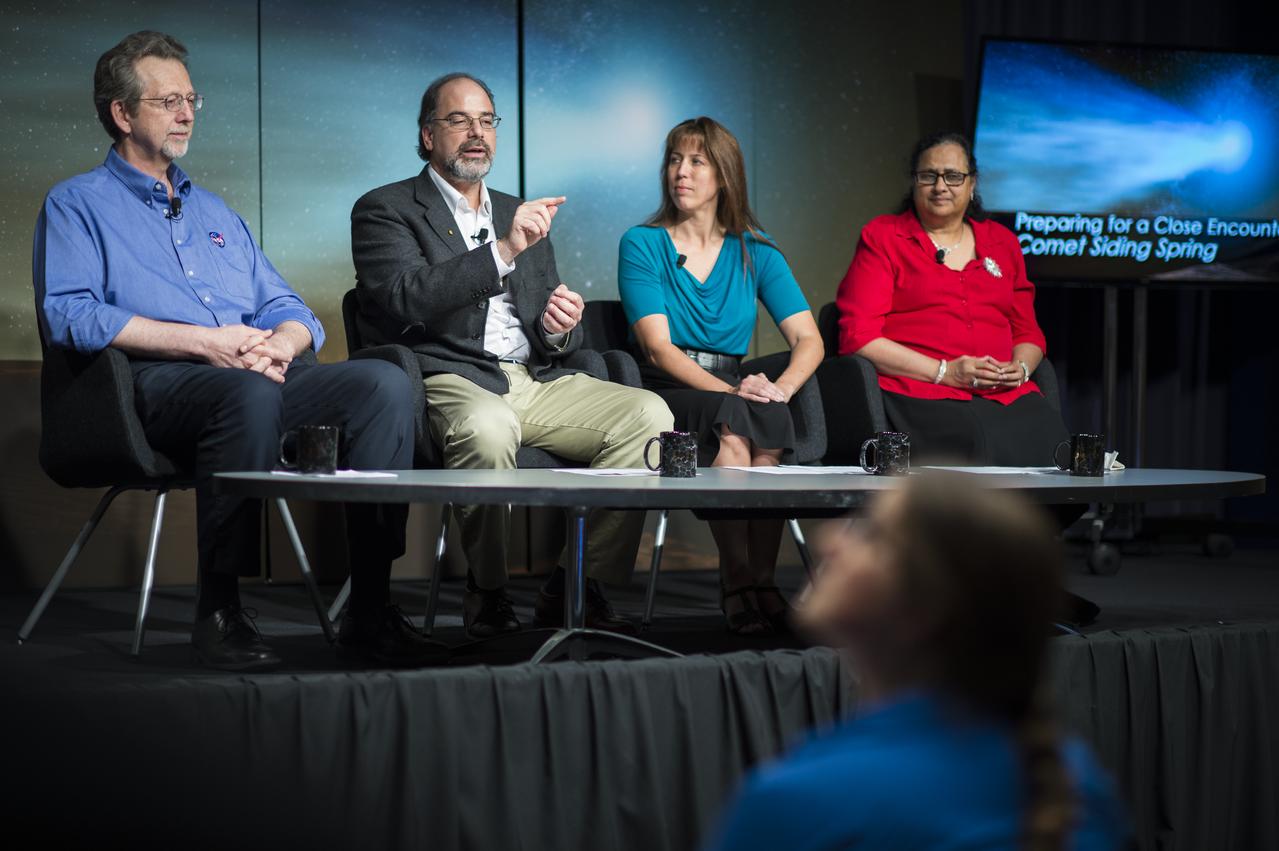
Panelists, from left, Jim Green, director, Planetary Science Division, NASA Headquarters, Washington, Carey Lisse, senior astrophysicist, Johns Hopkins University Applied Physics Laboratory, Laurel, Maryland, Kelly Fast, program scientist, Planetary Science Division, NASA Headquarters, Washington, and Padma Yanamandra-Fisher, senior research scientist, Space Science Institute, Rancho Cucamonga Branch, California, are seen during a media briefing where they outlined how space and Earth-based assets will be used to image and study comet Siding Spring during its Sunday, Oct. 19 flyby of Mars, Thursday, Oct. 9, 2014 at NASA Headquarters in Washington. (Photo credit: NASA/Joel Kowsky)

Yuri's Night at Ames a celebration of the first human in space. Ames Planetary Scientist with the Space Science Division Dr Chris McKay addresses a audience about Mars and life in extreme environments.
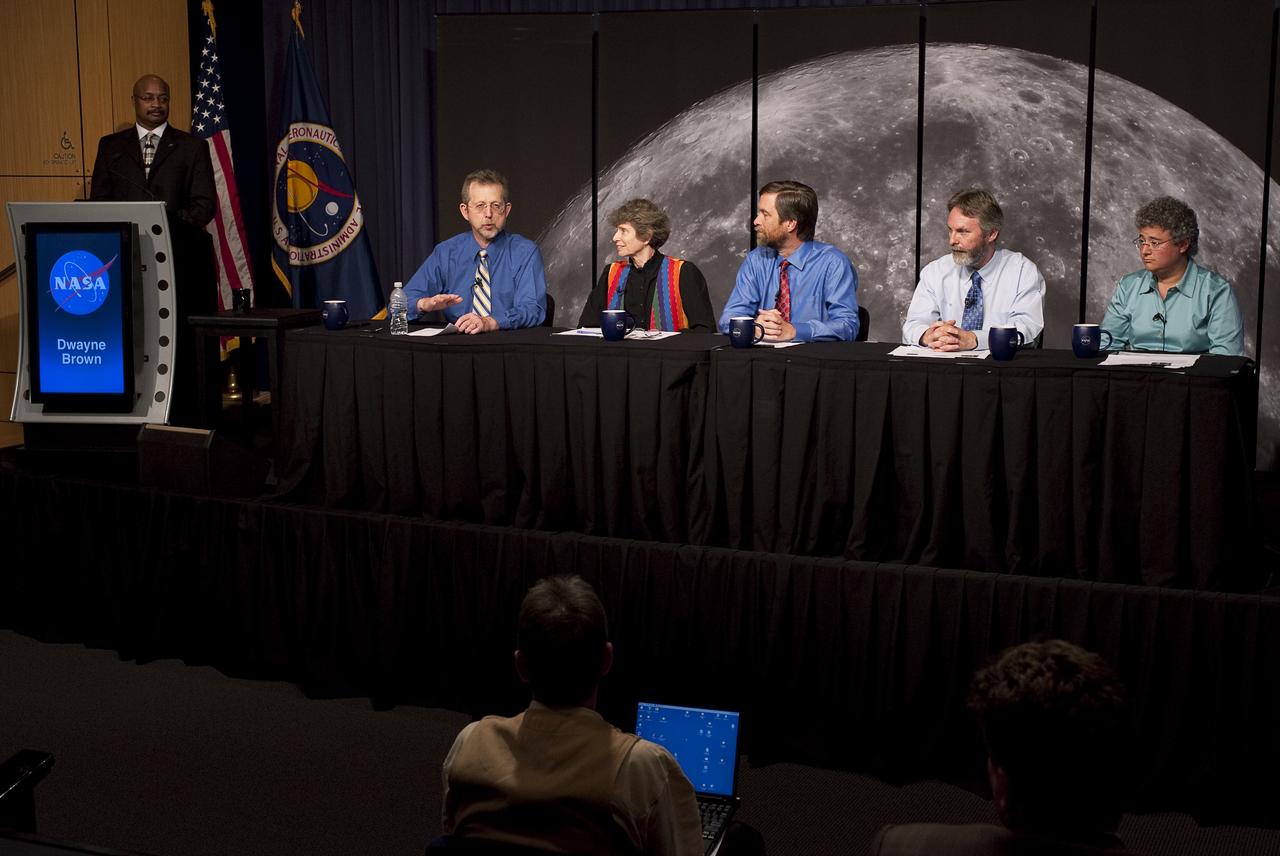
Jim Green (second from left), director, Planetary Science Division, Science Mission Directorate at NASA Headquarters in Washington discusses NASA’s findings of water molecules in the polar regions of the moon at a press conference at NASA Headquarters, September 24, 2009. Photo Credit: (NASA/Carla Cioffi)
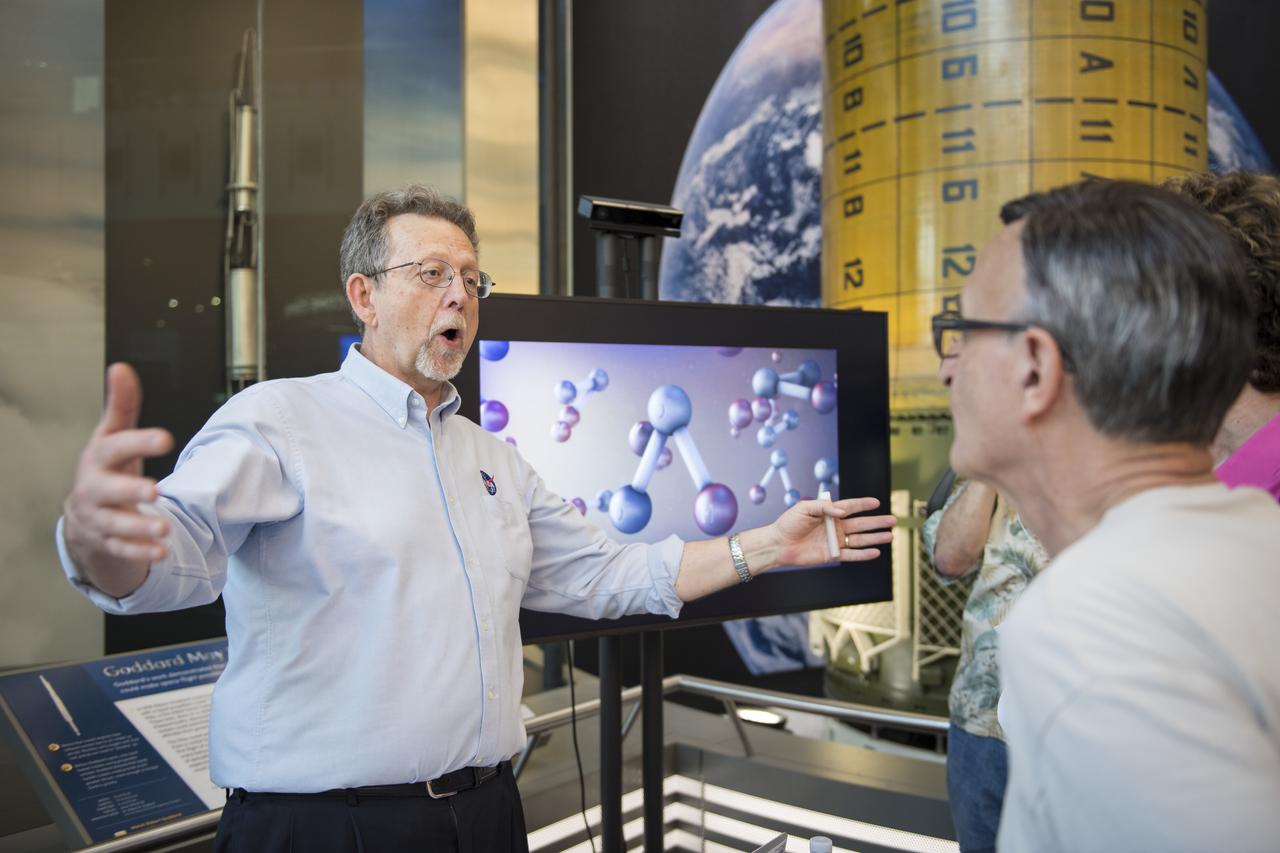
Jim Green, director of NASA’s Planetary Science Division, discusses NASA’s Mars missions with visitors during the Smithsonian Institution’s National Air and Space Museum Mars Day, celebrating the Red Planet with exhibits, speakers, and educational activities, Friday, July 21, 2017 in Washington. Photo Credit: (NASA/Aubrey Gemignani)

Dr. Jim Green, NASA‘s Planetary Science Division Director and Head of Mars Program, discusses what we’ve learned from Curiosity and the other Mars rovers during a “Mars Up Close” panel discussion, Tuesday, August 5, 2014, at the National Geographic Society headquarters in Washington. Photo Credit: (NASA/Bill Ingalls)
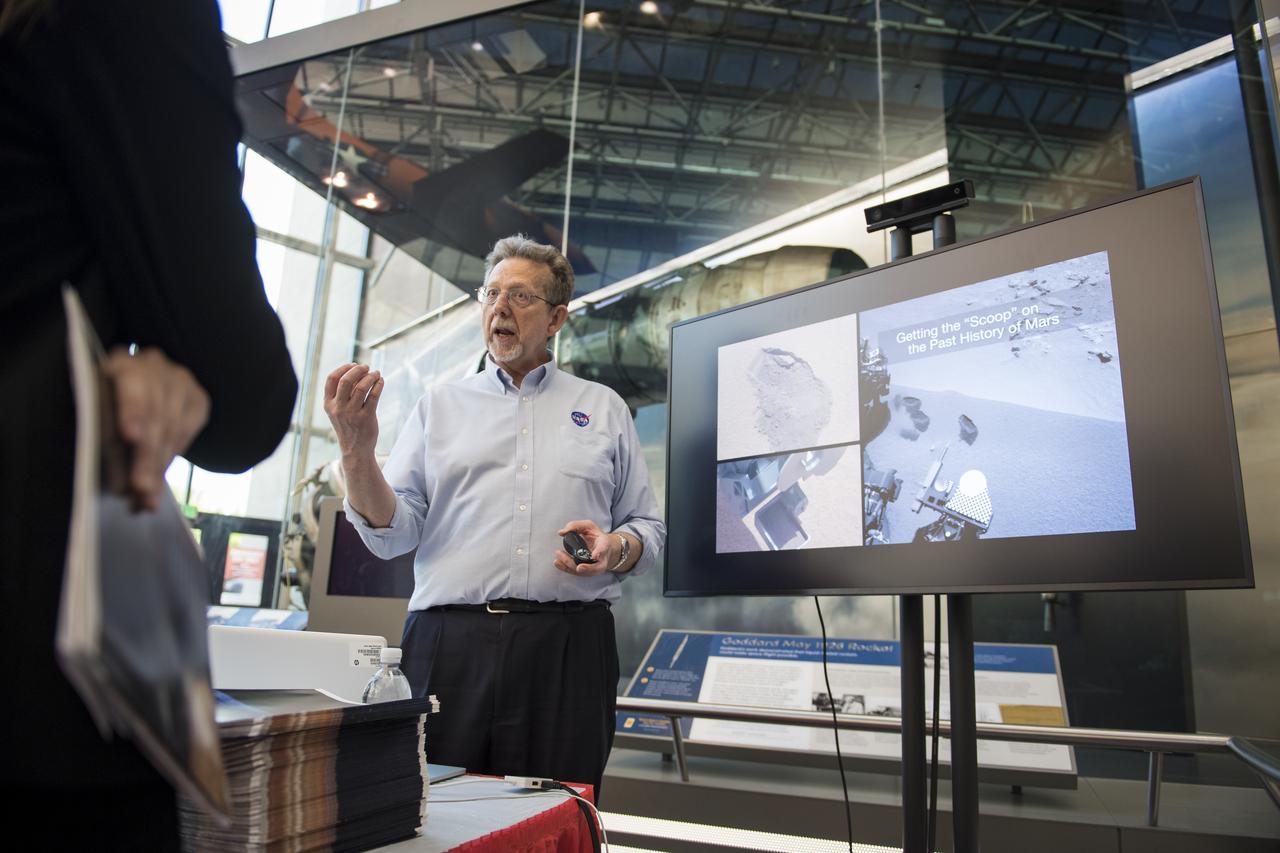
Jim Green, director of NASA’s Planetary Science Division, discusses NASA’s Mars missions with visitors during the Smithsonian Institution’s National Air and Space Museum Mars Day, celebrating the Red Planet with exhibits, speakers, and educational activities, Friday, July 21, 2017 in Washington. Photo Credit: (NASA/Aubrey Gemignani)
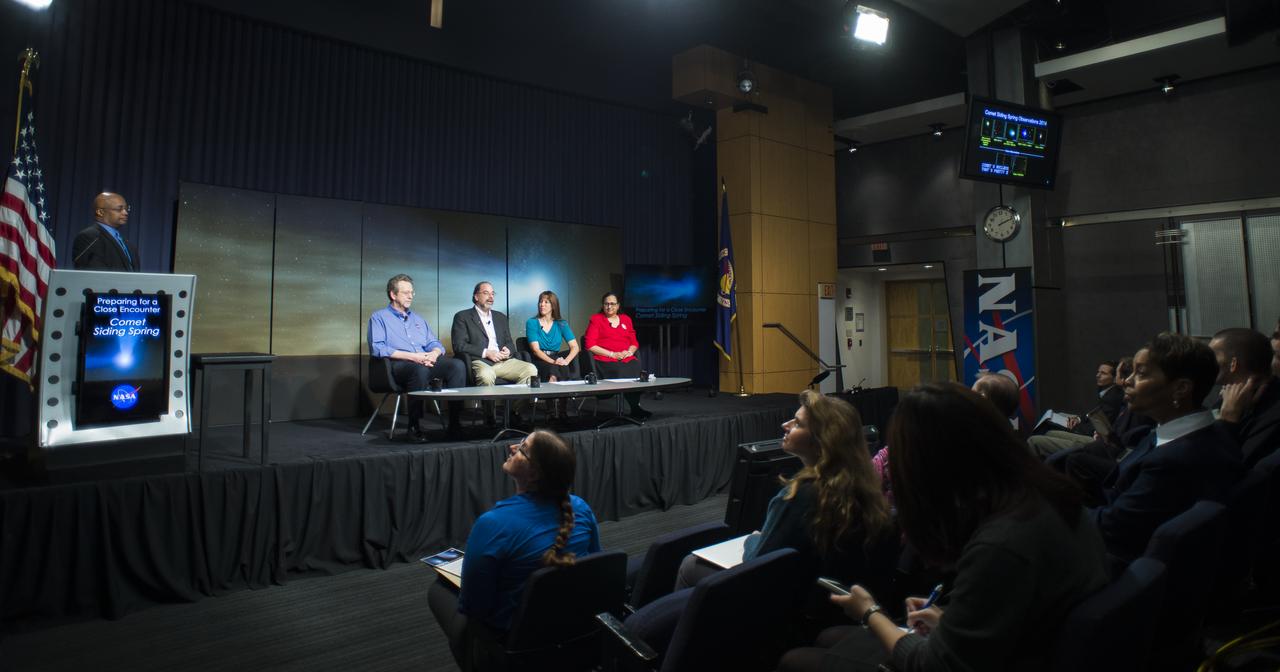
Dwayne Brown, NASA public affairs officer, left, moderates a media briefing where panelist, seated from left, Jim Green, director, Planetary Science Division, NASA Headquarters, Washington, Carey Lisse, senior astrophysicist, Johns Hopkins University Applied Physics Laboratory, Laurel, Maryland, Kelly Fast, program scientist, Planetary Science Division, NASA Headquarters, Washington, and Padma Yanamandra-Fisher, senior research scientist, Space Science Institute, Rancho Cucamonga Branch, California, outlined how space and Earth-based assets will be used to image and study comet Siding Spring during its Sunday, Oct. 19 flyby of Mars, Thursday, Oct. 9, 2014 at NASA Headquarters in Washington. (Photo credit: NASA/Joel Kowsky)

NASA Marshall Space Flight Center’s Science and Technology Office held its 11th annual Science and Technology Jamboree Dec. 8 at Marshall Activities Building 4316. A poster session with around 60 poster presentations highlighted current science and technology topics and the innovative projects underway across the center. Here, Debra Needham, right, talks with coworker Sabrina Savage about one of the presentations. Both Needham and Savage are scientists in the Heliophysics & Planetary Science Branch of the Science Research and Projects Division.

Lori Glaze, acting director of NASA’s Planetary Science Division, right, visited NASA’s Marshall Space Flight Center March 7 to see firsthand the work done by center scientists. Glaze, along with Marshall planetary scientists Renee Weber, left, and Debra Needham, center, and intern James Mavo, second from right, toured multiple facilities at Marshall – including the Deep Space Habitat facility – to discuss how Marshall is working to support astronauts on long-duration missions.

Director of the NASA Science Mission Directorate’s Planetary Science Division, Dr. Lori Glaze, left, accepts the Lifetime Achievement Award on behalf of the agency from director of the National Museum of Nuclear Science and History, Jim Walther, during the Nuclear Science Week event, Tuesday, Oct. 19, 2021, at The Observatory at America’s Square in Washington. Photo Credit: (NASA/Aubrey Gemignani)

The Lifetime Achievement Award is seen at the National Museum of Nuclear Science and History’s Nuclear Science Week event where Director of the NASA Science Mission Directorate’s Planetary Science Division, Dr. Lori Glaze accepted it on behalf of the agency, Tuesday, Oct. 19, 2021, at The Observatory at America’s Square in Washington. Photo Credit: (NASA/Aubrey Gemignani)

From left to right, Principal Deputy Assistant Secretary for Nuclear Energy at the Department of Energy, Dr. Kathryn Huff, Director of the National Museum of Nuclear Science and History, Jim Walther, and Director of the NASA Science Mission Directorate’s Planetary Science Division, Dr. Lori Glaze, pose for a photo after Dr. Huff and Dr. Glaze accepted the Lifetime Achievement Award on behalf of their agencies during the Nuclear Science Week event, Tuesday, Oct. 19, 2021, at The Observatory at America’s Square in Washington. Photo Credit: (NASA/Aubrey Gemignani)

Director of the NASA Science Mission Directorate’s Planetary Science Division, Dr. Lori Glaze, speaks after accepting the Lifetime Achievement Award on behalf of the agency during the National Museum of Nuclear Science and History’s Nuclear Science Week event, Tuesday, Oct. 19, 2021, at The Observatory at America’s Square in Washington. Photo Credit: (NASA/Aubrey Gemignani)

Director of the NASA Science Mission Directorate’s Planetary Science Division, Dr. Lori Glaze, speaks after accepting the Lifetime Achievement Award on behalf of the agency during the National Museum of Nuclear Science and History’s Nuclear Science Week event, Tuesday, Oct. 19, 2021, at The Observatory at America’s Square in Washington. Photo Credit: (NASA/Aubrey Gemignani)

Director of the NASA Science Mission Directorate’s Planetary Science Division, Dr. Lori Glaze, speaks after accepting the Lifetime Achievement Award on behalf of the agency during the National Museum of Nuclear Science and History’s Nuclear Science Week event, Tuesday, Oct. 19, 2021, at The Observatory at America’s Square in Washington. Photo Credit: (NASA/Aubrey Gemignani)

On the panel from right: Leesa Hubbard, teacher in residence, Sally Ride Science, San Diego; David Lehman, GRAIL project manager, NASA's Jet Propulsion Laboratory, Pasadena, Calif.; Maria Zuber, GRAIL principal investigator, Massachusetts Institute of Technology, Cambridge and Jim Green, director, Planetary Science Division, NASA Headquarters, Washington are seen at a press briefing to discuss the upcoming launch to the moon of the Gravity Recovery and Interior Laboratory (GRAIL) mission, Thursday, Aug. 25, 2011 in Washington. Photo Credit: (NASA/Carla Cioffi)

Lori Glaze, Planetary Science division director, NASA Headquarters, participates in a Psyche mission and science briefing at NASA’s Kennedy Space Center in Florida on Tuesday, Oct. 10, 2023. Psyche is the first mission to explore an asteroid with a surface that likely contains substantial amounts of metal rather than rock or ice. Liftoff of NASA’s Psyche spacecraft, atop a SpaceX Falcon Heavy rocket, is targeted for 10:16 a.m. EDT Thursday, Oct. 12, from Kennedy’s Launch Complex 39A.

Lori Glaze, Planetary Science division director, NASA Headquarters, participates in a Psyche mission and science briefing at NASA’s Kennedy Space Center in Florida on Tuesday, Oct. 10, 2023. Psyche is the first mission to explore an asteroid with a surface that likely contains substantial amounts of metal rather than rock or ice. Liftoff of NASA’s Psyche spacecraft, atop a SpaceX Falcon Heavy rocket, is targeted for 10:16 a.m. EDT Thursday, Oct. 12, from Kennedy’s Launch Complex 39A.

Lori Glaze, Planetary Science division director, NASA Headquarters, participates in a Psyche mission and science briefing at NASA’s Kennedy Space Center in Florida on Tuesday, Oct. 10, 2023. Psyche is the first mission to explore an asteroid with a surface that likely contains substantial amounts of metal rather than rock or ice. Liftoff of NASA’s Psyche spacecraft, atop a SpaceX Falcon Heavy rocket, is targeted for 10:16 a.m. EDT Thursday, Oct. 12, from Kennedy’s Launch Complex 39A.

CAPE CANAVERAL, Fla. -- At the Marriott Courtyard Hotel in Cocoa Beach, Fla., Greg Clements, chief of Kennedy's Control and Data Systems Division and lead for the Engineering and Technology's Small Payload Integrated Testing Services, or SPLITS, line of business, speaks to participants in the 4th International Workshop on Lunar and Planetary Compact and Cryogenic Science and Technology Applications. Scientists, engineers and entrepreneurs interested in research on the moon and other planetary surfaces, recently participated in the Workshop. Taking place April 8-11, 2014, the event was designed to foster collaborative work among those interested in solving the challenges of building hardware, software and businesses interested in going back to the moon and exploring beyond. Photo credit: NASA/Daniel Casper

CAPE CANAVERAL, Fla. -- At the Marriott Courtyard Hotel in Cocoa Beach, Fla., Greg Clements, chief of Kennedy's Control and Data Systems Division and lead for the Engineering and Technology's Small Payload Integrated Testing Services, or SPLITS, line of business, speaks to participants in the 4th International Workshop on Lunar and Planetary Compact and Cryogenic Science and Technology Applications. Scientists, engineers and entrepreneurs interested in research on the moon and other planetary surfaces, recently participated in the Workshop. Taking place April 8-11, 2014, the event was designed to foster collaborative work among those interested in solving the challenges of building hardware, software and businesses interested in going back to the moon and exploring beyond. Photo credit: NASA/Daniel Casper
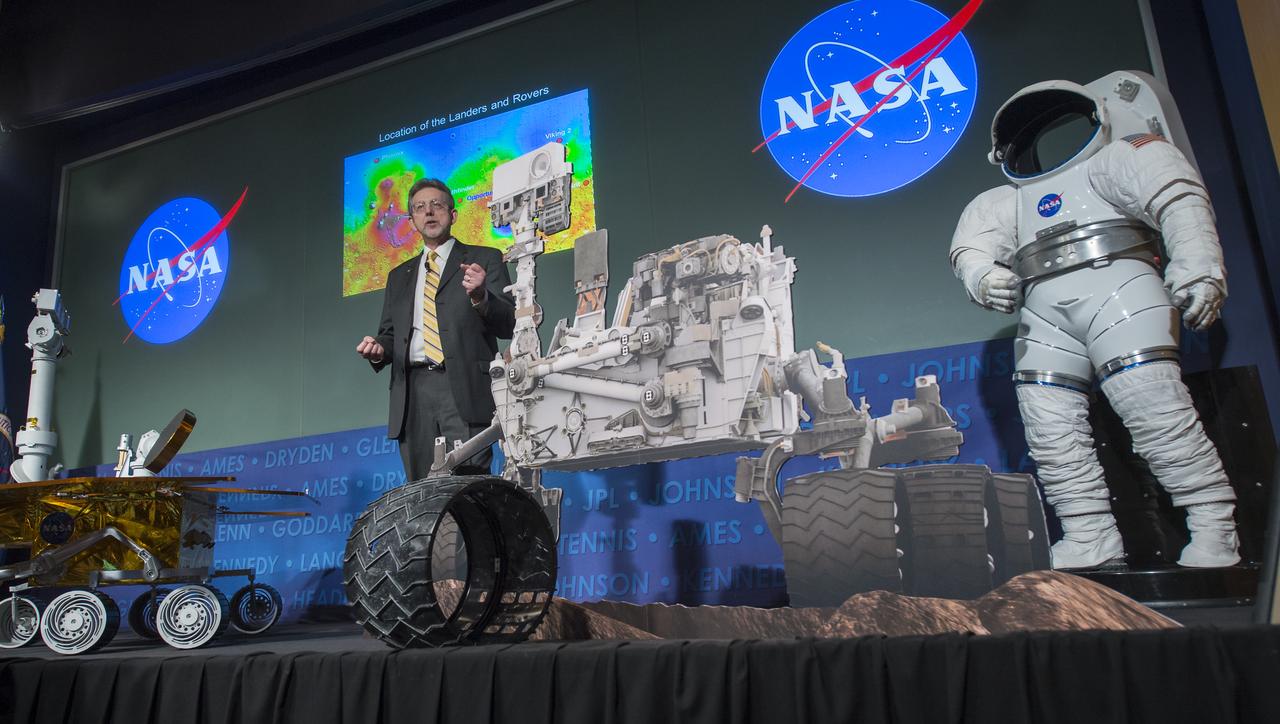
Jim Green, director, Planetary Division, NASA's Science Mission Directorate, speaks at a public event at NASA Headquarters observing the first anniversary of the Curiosity rover's landing on Mars, Tuesday, August 6th, 2013 in Washington. The Mars Science Laboratory mission successfully placed the one-ton Curiosity rover on the surface of Mars on Aug. 6, 2012, about 1 mile from the center of its 12-mile-long target area. Within the first eight months of a planned 23-months primary mission, Curiosity met its major science objective of finding evidence of a past environment well-suited to support microbial life. Photo Credit: (NASA/Carla Cioffi)

Director of NASA's Science Mission Directorate’s Planetary Science Division, Lori Glaze, gives remarks during a NASA Perseverance rover mission science overview, Tuesday, Feb. 16, 2021, at NASA's Jet Propulsion Laboratory in Pasadena, California. The Perseverance Mars rover is due to land on Mars Thursday, Feb. 18, 2021. A key objective for Perseverance’s mission on Mars is astrobiology, including the search for signs of ancient microbial life. The rover will characterize the planet’s geology and past climate, pave the way for human exploration of the Red Planet, and be the first mission to collect and cache Martian rock and regolith. Photo Credit: (NASA/Bill Ingalls)

Director of NASA's Science Mission Directorate’s Planetary Science Division, Lori Glaze, gives remarks during a NASA Perseverance rover mission science overview, Tuesday, Feb. 16, 2021, at NASA's Jet Propulsion Laboratory in Pasadena, California. The Perseverance Mars rover is due to land on Mars Thursday, Feb. 18, 2021. A key objective for Perseverance’s mission on Mars is astrobiology, including the search for signs of ancient microbial life. The rover will characterize the planet’s geology and past climate, pave the way for human exploration of the Red Planet, and be the first mission to collect and cache Martian rock and regolith. Photo Credit: (NASA/Bill Ingalls)

Director of NASA's Science Mission Directorate’s Planetary Science Division, Lori Glaze, gives remarks during a NASA Perseverance rover mission science overview, Tuesday, Feb. 16, 2021, at NASA's Jet Propulsion Laboratory in Pasadena, California. The Perseverance Mars rover is due to land on Mars Thursday, Feb. 18, 2021. A key objective for Perseverance’s mission on Mars is astrobiology, including the search for signs of ancient microbial life. The rover will characterize the planet’s geology and past climate, pave the way for human exploration of the Red Planet, and be the first mission to collect and cache Martian rock and regolith. Photo Credit: (NASA/Bill Ingalls)
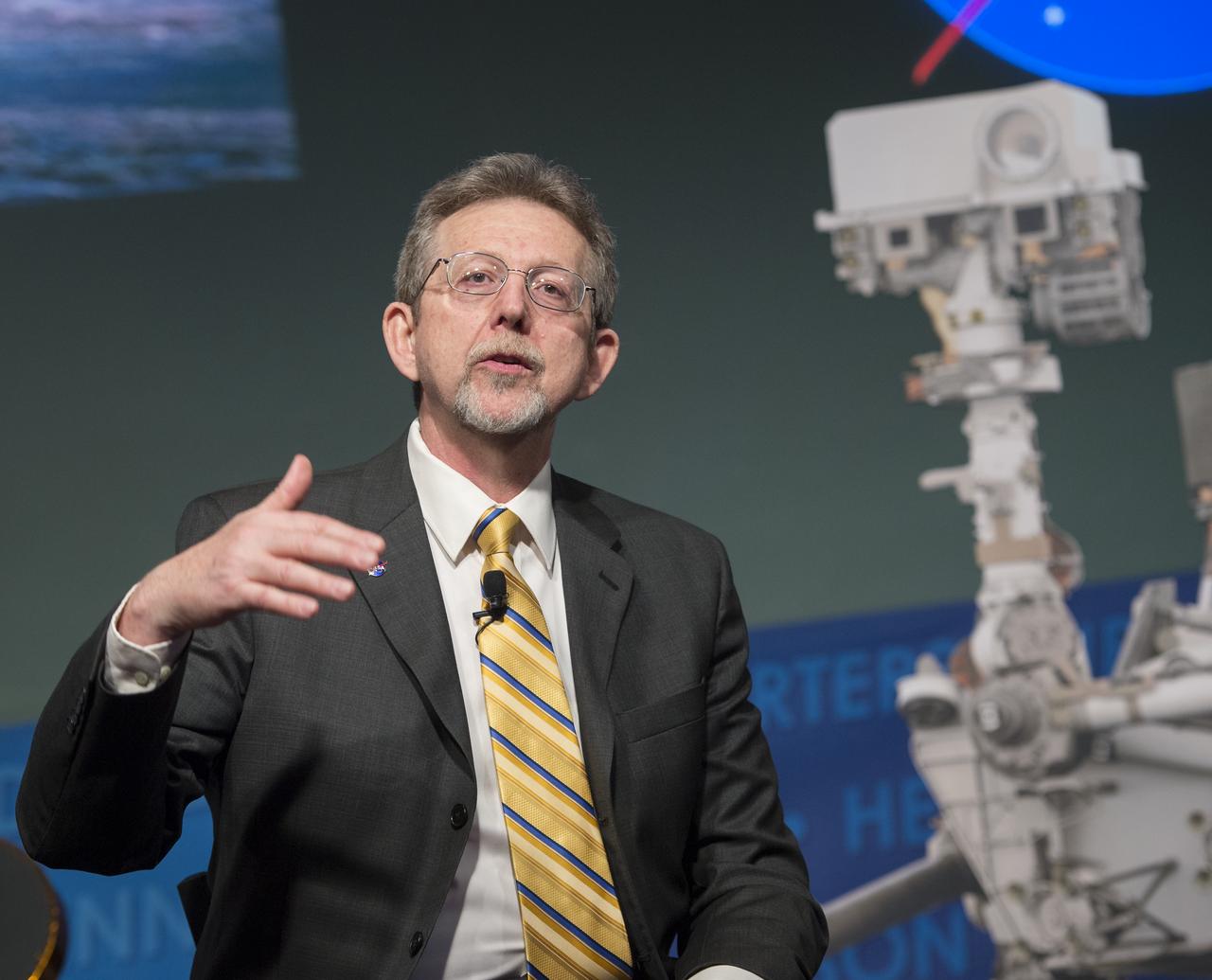
Jim Green, director, Planetary Division, NASA's Science Mission Directorate, speaks at a public event at NASA Headquarters observing the first anniversary of the Curiosity rover's landing on Mars, Tuesday, August 6th, 2013 in Washington. The Mars Science Laboratory mission successfully placed the one-ton Curiosity rover on the surface of Mars on Aug. 6, 2012, about 1 mile from the center of its 12-mile-long target area. Within the first eight months of a planned 23-months primary mission, Curiosity met its major science objective of finding evidence of a past environment well-suited to support microbial life. Photo Credit: (NASA/Carla Cioffi)
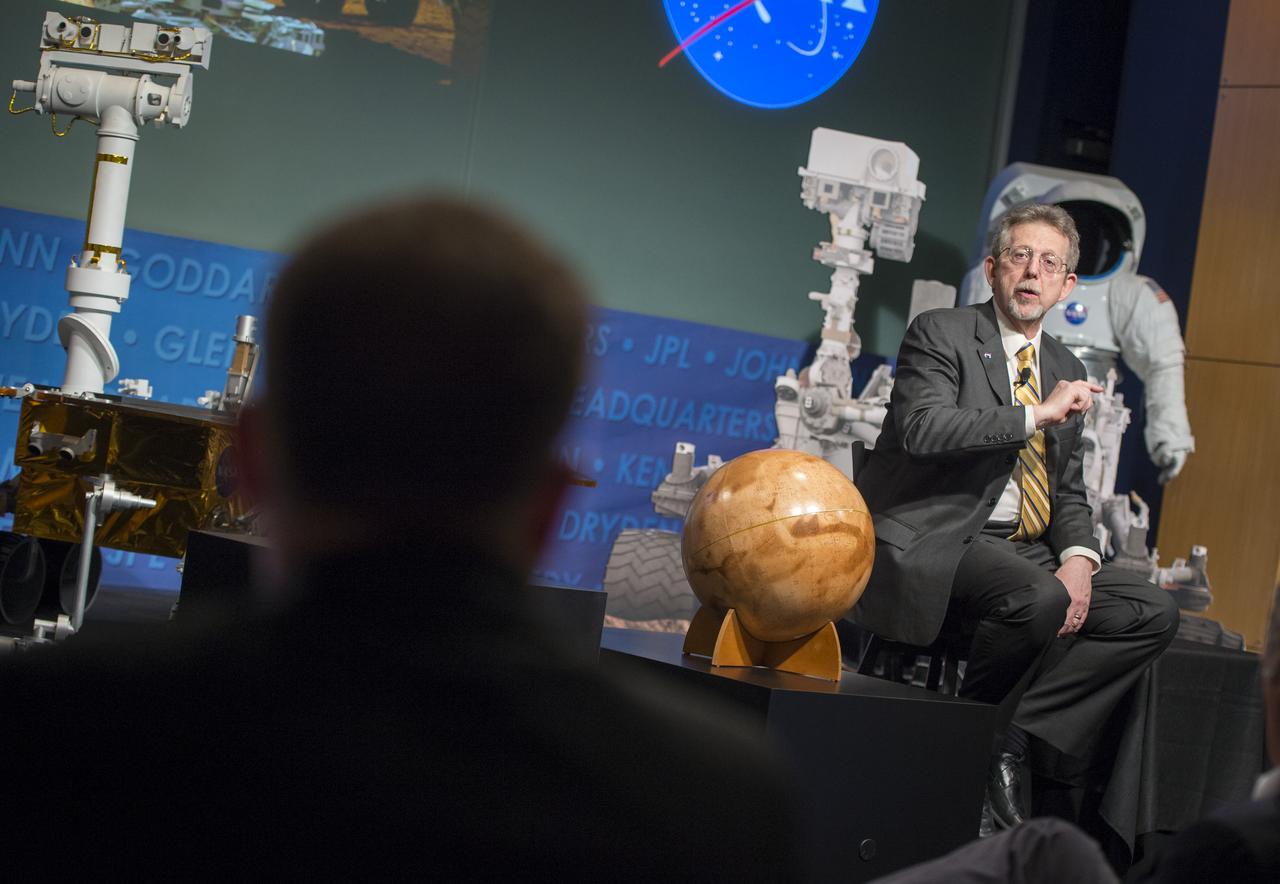
Jim Green, director, Planetary Division, NASA's Science Mission Directorate, answers a question at a public event at NASA Headquarters observing the first anniversary of the Curiosity rover's landing on Mars, Tuesday, August 6th, 2013 in Washington. The Mars Science Laboratory mission successfully placed the one-ton Curiosity rover on the surface of Mars on Aug. 6, 2012, about 1 mile from the center of its 12-mile-long target area. Within the first eight months of a planned 23-months primary mission, Curiosity met its major science objective of finding evidence of a past environment well-suited to support microbial life. Photo Credit: (NASA/Carla Cioffi)

Director of NASA's Science Mission Directorate’s Planetary Science Division, Lori Glaze, left, speaks after the announcement of the official name, Perseverance, for the rover formerly known as Mars 2020, Thursday, March 5, 2020, at Lake Braddock Secondary School in Burke, Va. The final selection of the new name was made by Associate Administrator of NASA's Science Mission Directorate, Thomas Zurbuchen, following a nationwide naming contest conducted in 2019 that drew more than 28,000 essays by K-12 students from every U.S. state and territory. Perseverance is currently at NASA's Kennedy Space Center in Florida being prepared for launch this summer. Photo Credit: (NASA/Aubrey Gemignani)
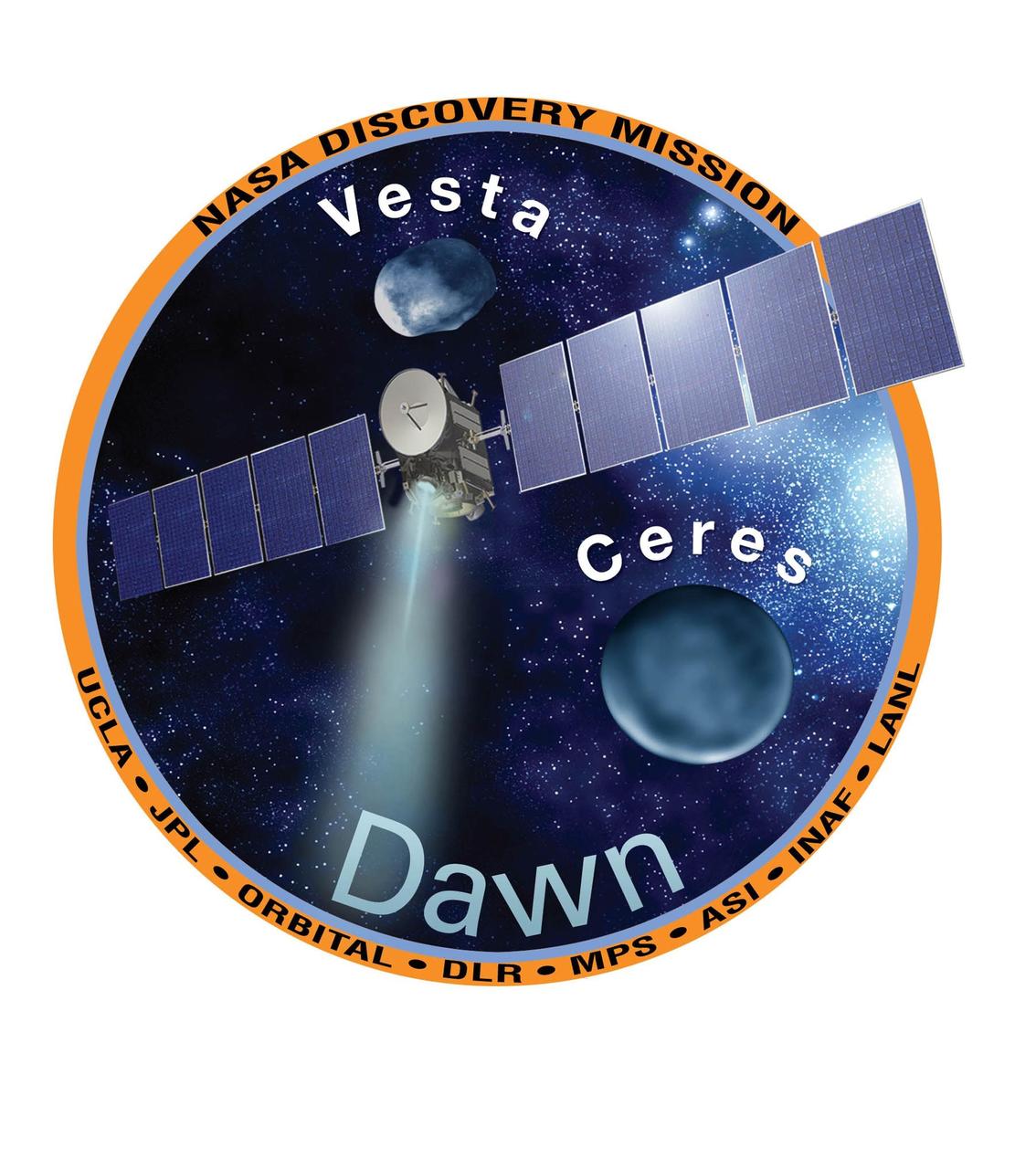
KENNEDY SPACE CENTER, FLA. -- This logo represents the mission of the Dawn spacecraft. During its nearly decade-long mission, Dawn will study the asteroid Vesta and dwarf planet Ceres, celestial bodies believed to have accreted early in the history of the solar system. The mission hopes to unlock some of the mysteries of planetary formation, including the building blocks and the processes leading to their state today. The Dawn mission is managed by the Jet Propulsion Laboratory, a division of the California Institute of Technology in Pasadena, Calif., for NASA's Science Mission Directorate in Washington, D.C.
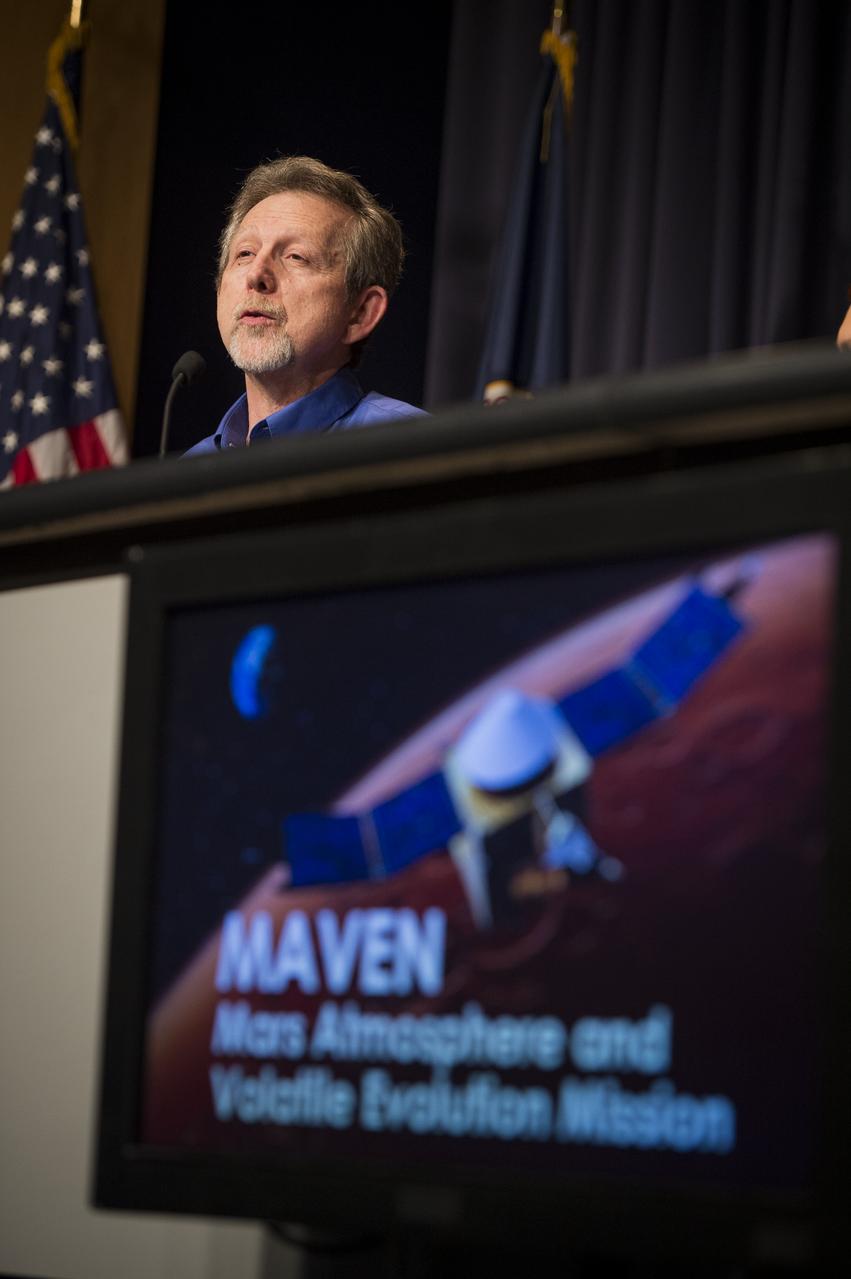
Jim Green, director, Planetary Science Division, NASA Headquarters, discusses the upcoming launch of the Mars Atmosphere and Volatile Evolution (MAVEN) mission, at a press conference at NASA Headquarters in Washington on Monday, Oct. 28th, 2013. MAVEN is the agency's next mission to Mars and the first devoted to understanding the upper atmosphere of the Red Planet. (Photo credit: NASA/Jay Westcott)
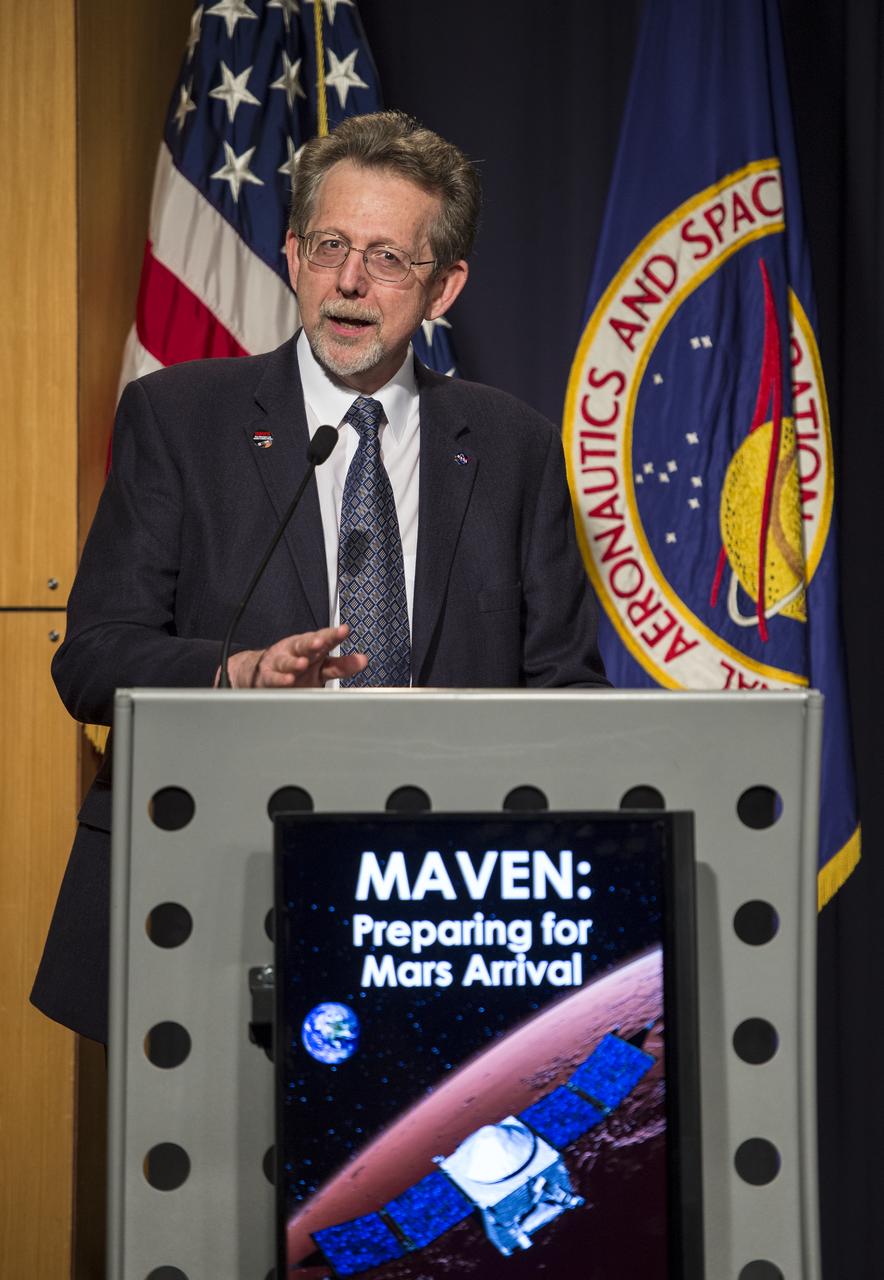
Dr. Jim Green, NASA‘s Planetary Science Division Director and Head of Mars Program, gives opening remarks at a media briefing where panelist outlined activities around the Sunday, Sept. 21 orbital insertion at Mars of the agency’s Mars Atmosphere and Volatile EvolutioN (MAVEN) spacecraft, Wednesday, Sept. 17, 2014 at NASA Headquarters in Washington. (Photo credit: NASA/Bill Ingalls)
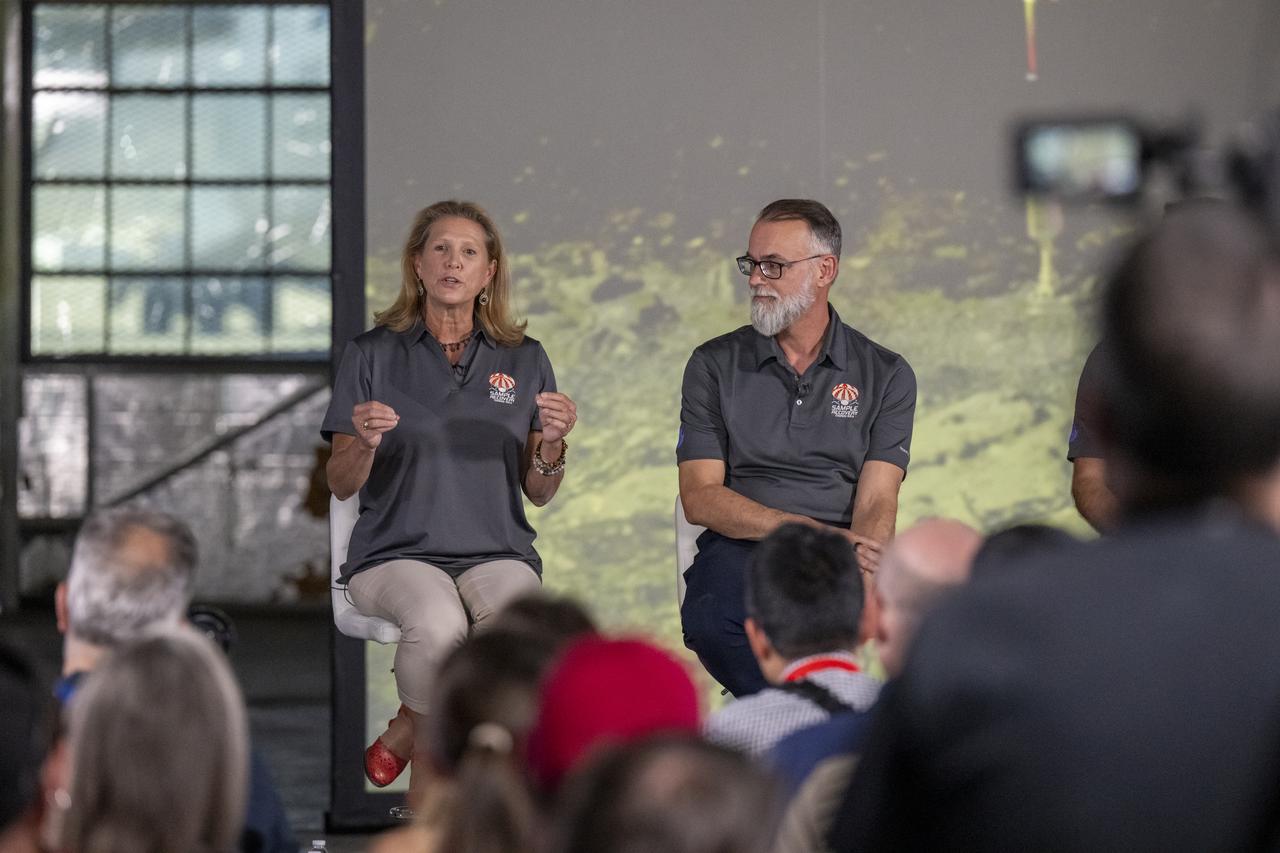
NASA Planetary Science Division Director Lori Glaze, left, answers questions from reporters during an OSIRIS-REx sample return press conference, Sunday, Sept. 24, 2023, shortly after the capsule landed at the Department of Defense's Utah Test and Training Range. The sample was collected from the asteroid Bennu in October 2020 by NASA’s OSIRIS-REx spacecraft. Photo Credit: (NASA/Keegan Barber)

Jim Green, director, Planetary Science Division, NASA Headquarters, Washington gives remarks during a media briefing where he and other panelists outlined how space and Earth-based assets will be used to image and study comet Siding Spring during its Sunday, Oct. 19 flyby of Mars, Thursday, Oct. 9, 2014 at NASA Headquarters in Washington. Photo Credit: (NASA/Joel Kowsky)
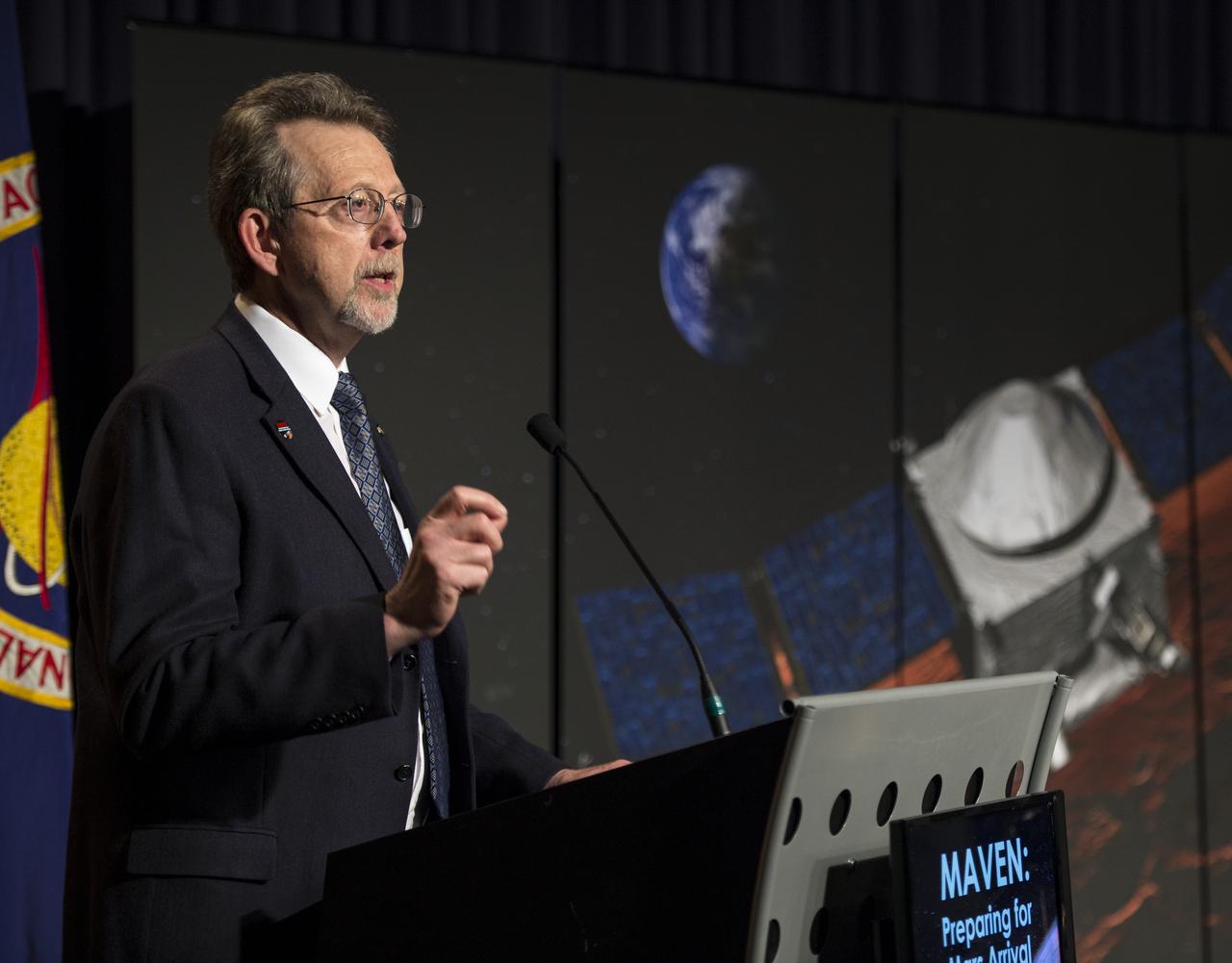
Dr. Jim Green, NASA‘s Planetary Science Division Director and Head of Mars Program, gives opening remarks at a media briefing where panelist outlined activities around the Sunday, Sept. 21 orbital insertion at Mars of the agency’s Mars Atmosphere and Volatile EvolutioN (MAVEN) spacecraft, Wednesday, Sept. 17, 2014 at NASA Headquarters in Washington. (Photo credit: NASA/Bill Ingalls)
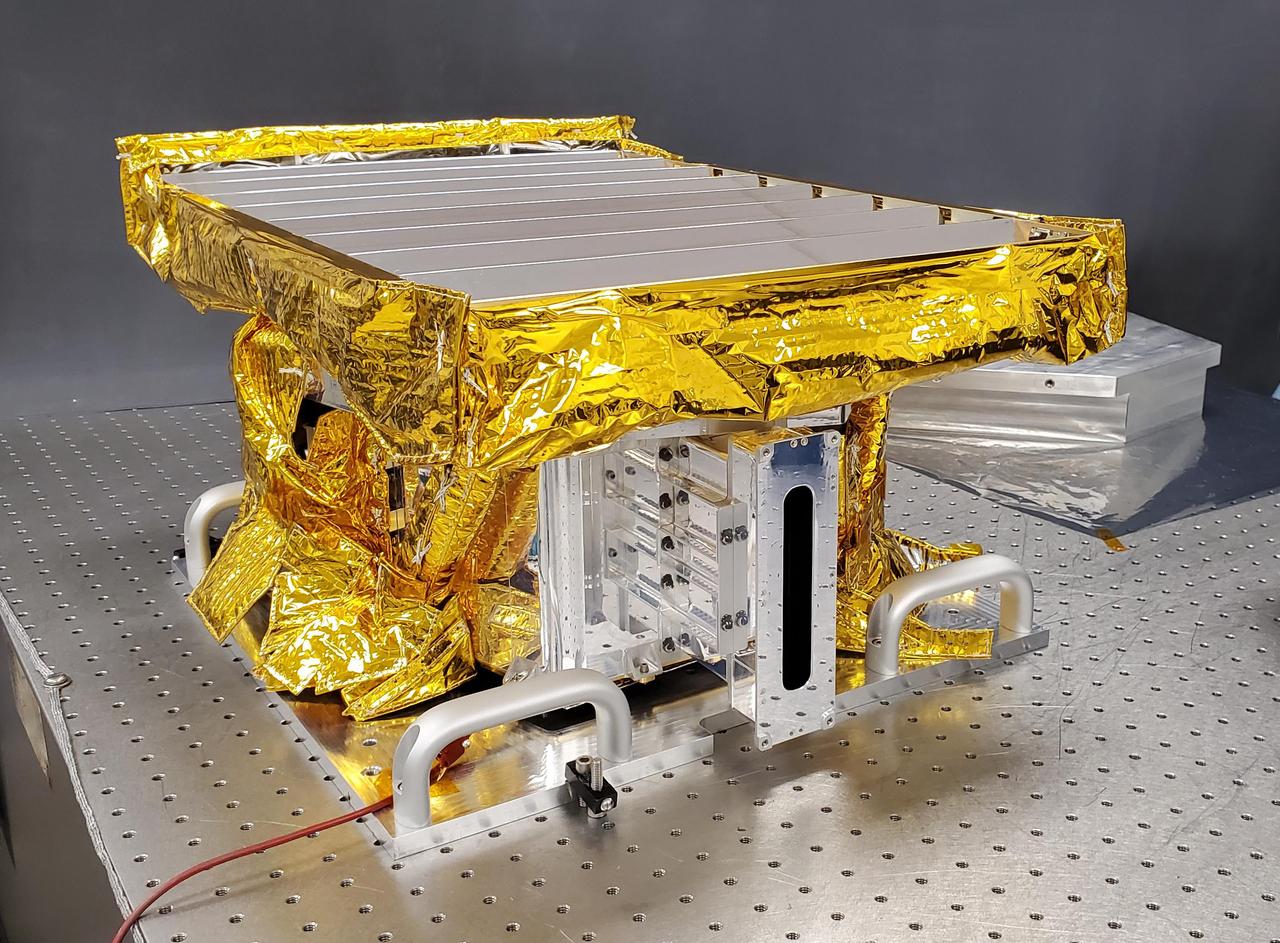
The High-resolution Volatiles and Minerals Moon Mapper (HVM³) sits in a clean room at NASA's Jet Propulsion Laboratory in Southern California in early December 2022. The JPL-built instrument was later shipped to Lockheed Martin Space in Littleton, Colorado, to be integrated with NASA's Lunar Trailblazer spacecraft. HVM³ is an imaging spectrometer that will detect and map water on the Moon's surface to determine its abundance, location, form, and how it changes over time. A second instrument, the Lunar Thermal Mapper infrared multispectral imager, is being developed by the University of Oxford in the U.K. and is scheduled for delivery and integration in early 2023. Lunar Trailblazer was selected under NASA's Small Innovative Missions for Planetary Exploration (SIMPLEx) program in 2019. The Lunar Trailblazer mission is managed by JPL and its science investigation is led by Caltech in Pasadena, California. Managed for NASA by Caltech, JPL also provides system engineering, mission assurance, the HVM³ instrument, as well as navigation. Lockheed Martin Space provides the spacecraft and integrates the flight system, under contract with Caltech. SIMPLEx mission investigations are managed by the Planetary Missions Program Office at NASA's Marshall Space Flight Center in Huntsville, Alabama, as part of the Discovery Program at NASA Headquarters in Washington. The program conducts space science investigations in the Planetary Science Division of NASA's Science Mission Directorate at NASA Headquarters. https://photojournal.jpl.nasa.gov/catalog/PIA25256
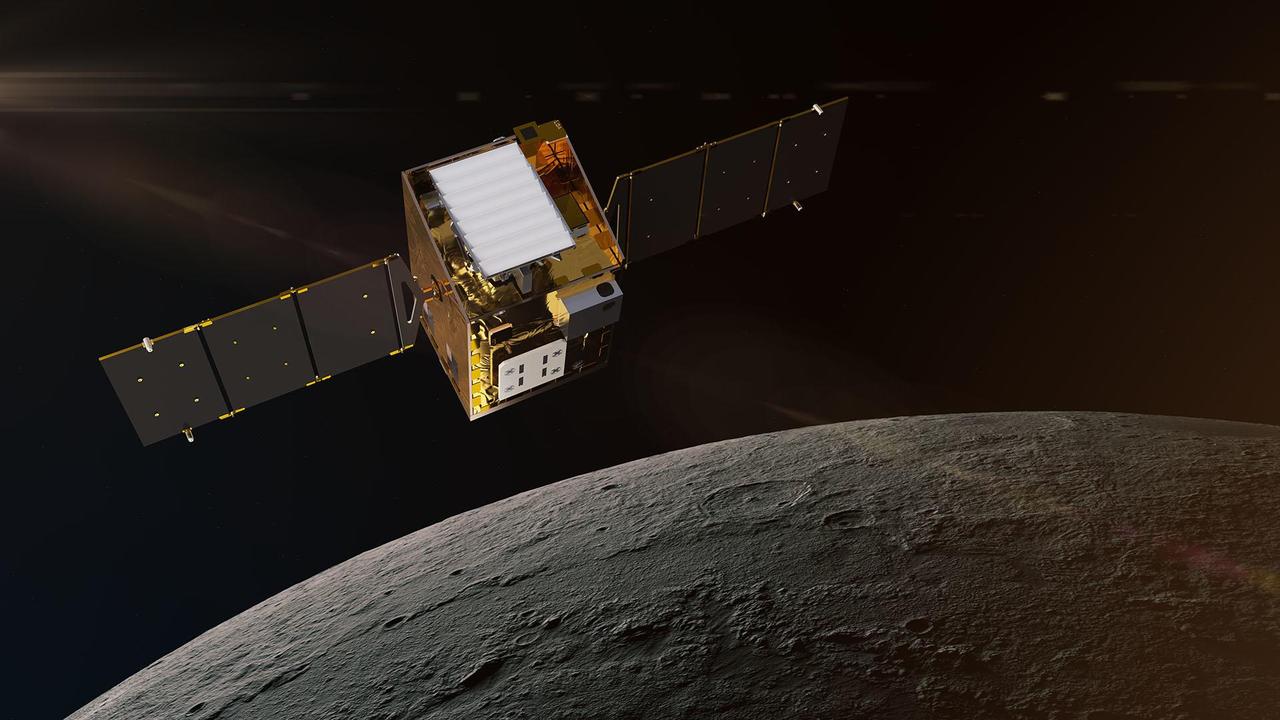
This artist's concept depicts NASA's Lunar Trailblazer in lunar orbit about 60 miles (100 kilometers) from the surface of the Moon. The spacecraft weighs only 440 pounds (200 kilograms) and measures 11.5 feet (3.5 meters) wide when its solar panels are fully deployed. Lunar Trailblazer is managed by NASA's Jet Propulsion Laboratory, and its science investigation and mission operations are led by Caltech with the mission operations center at IPAC. Managed for NASA by Caltech, JPL also provides system engineering, mission assurance, the HVM3 instrument, as well as mission design and navigation. Lockheed Martin Space provides the spacecraft, integrates the flight system, and supports operations under contract with Caltech. Lunar Trailblazer is part of NASA's Small Innovative Missions for Planetary Exploration (SIMPLEx) program, which is managed by the Planetary Missions Program Office at NASA's Marshall Space Flight Center in Huntsville, Alabama, as part of the Discovery Program at NASA Headquarters in Washington. The program conducts space science investigations in the Planetary Science Division of NASA's Science Mission Directorate at NASA Headquarters. https://photojournal.jpl.nasa.gov/catalog/PIA26453
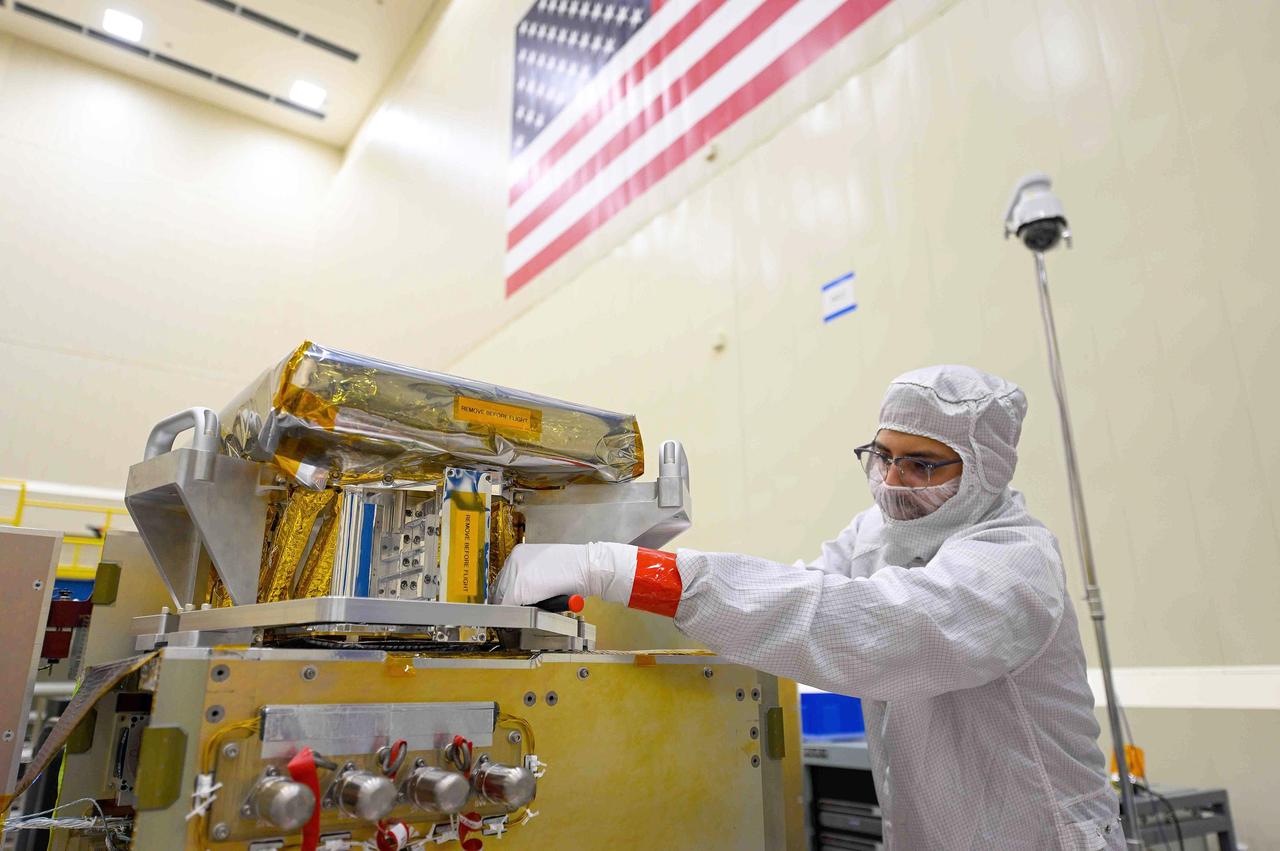
An engineer works on the High-resolution Volatiles and Minerals Moon Mapper (HVM³) for NASA's Lunar Trailblazer spacecraft in a clean room at Lockheed Martin Space in Littleton, Colorado, shortly after the instrument delivered in December 2022. HVM³ is an imaging spectrometer that was developed at NASA's Jet Propulsion Laboratory in Southern California. It was shipped from JPL to Lockheed Martin Space, where it was integrated with the spacecraft. HVM³ is one of two instruments that will be used by the mission to detect and map water on the Moon's surface to determine its abundance, location, form, and how it changes over time. Lunar Trailblazer was selected under NASA's Small Innovative Missions for Planetary Exploration (SIMPLEx) program in 2019. The Lunar Trailblazer mission is managed by JPL and its science investigation is led by Caltech in Pasadena, California. Managed for NASA by Caltech, JPL also provides system engineering, mission assurance, the HVM³ instrument, as well as navigation. Lockheed Martin Space provides the spacecraft and integrates the flight system, under contract with Caltech. SIMPLEx mission investigations are managed by the Planetary Missions Program Office at NASA's Marshall Space Flight Center in Huntsville, Alabama, as part of the Discovery Program at NASA Headquarters in Washington. The program conducts space science investigations in the Planetary Science Division of NASA's Science Mission Directorate at NASA Headquarters. https://photojournal.jpl.nasa.gov/catalog/PIA25255

Mars earrings are seen on Director of NASA's Science Mission Directorate’s Planetary Science Division, Lori Glaze during a NASA Perseverance rover mission post-landing update, Thursday, Feb. 18, 2021, at NASA's Jet Propulsion Laboratory in Pasadena, California. A key objective for Perseverance’s mission on Mars is astrobiology, including the search for signs of ancient microbial life. The rover will characterize the planet’s geology and past climate, pave the way for human exploration of the Red Planet, and be the first mission to collect and cache Martian rock and regolith. Photo Credit: (NASA/Bill Ingalls)

Director of NASA's Science Mission Directorate’s Planetary Science Division, Lori Glaze, gives remarks during a NASA Perseverance rover mission post-landing update, Thursday, Feb. 18, 2021, at NASA's Jet Propulsion Laboratory in Pasadena, California. A key objective for Perseverance’s mission on Mars is astrobiology, including the search for signs of ancient microbial life. The rover will characterize the planet’s geology and past climate, pave the way for human exploration of the Red Planet, and be the first mission to collect and cache Martian rock and regolith. Photo Credit: (NASA/Bill Ingalls)
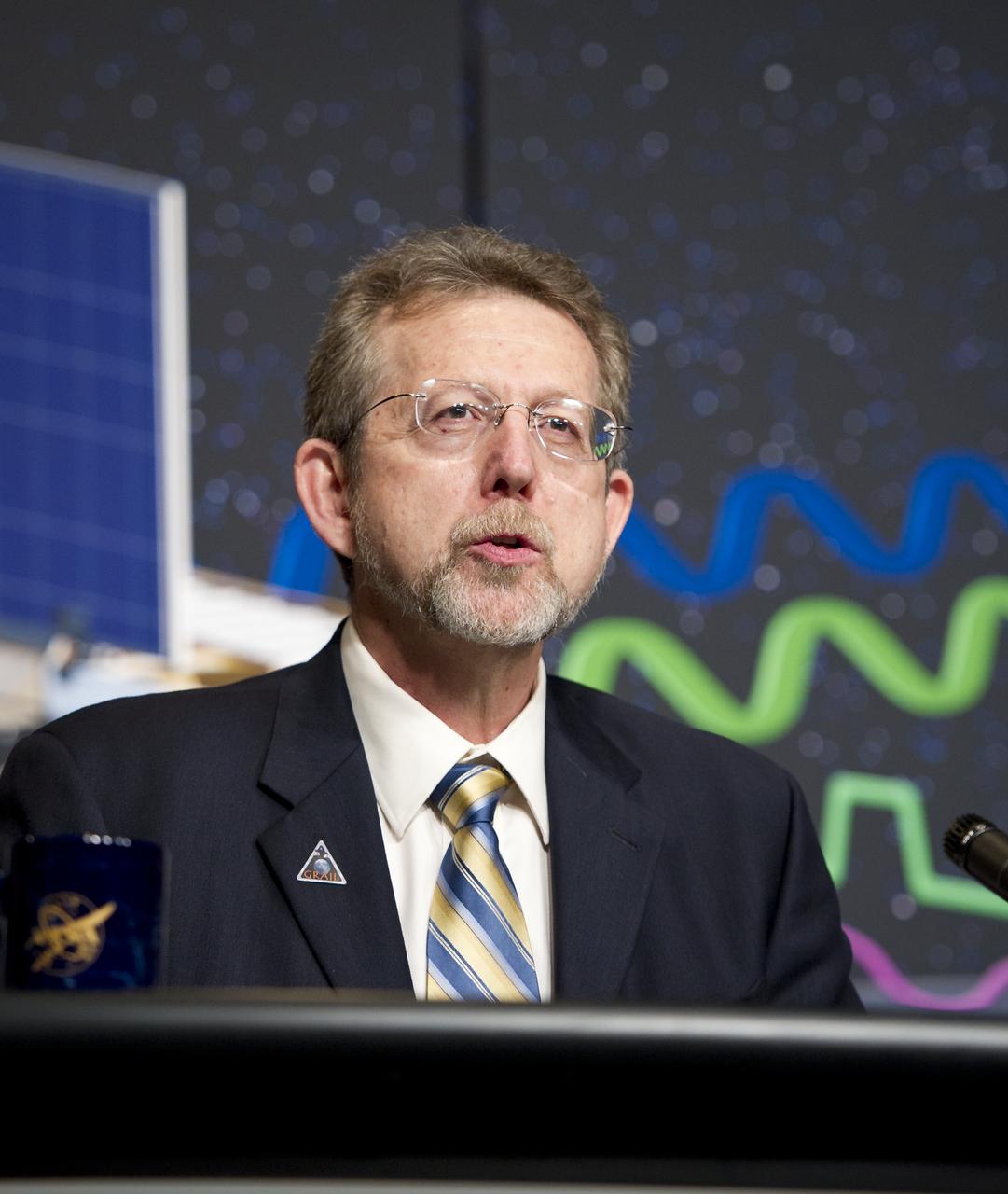
Jim Green, director, Planetary Science Division at NASA Headquarters, speaks at a press conference about the upcoming launch to the moon of the Gravity Recovery and Interior Laboratory (GRAIL) mission, Thursday, Aug. 25, 2011 in Washington. GRAIL's primary science objectives are to determine the structure of the lunar interior, from crust to core, and to advance understanding of the thermal evolution of the moon. The mission will place two spacecraft into the same orbit around the moon which will gather information about the its gravitational field enabling scientists to create a high-resolution map. Photo Credit: (NASA/Carla Cioffi)
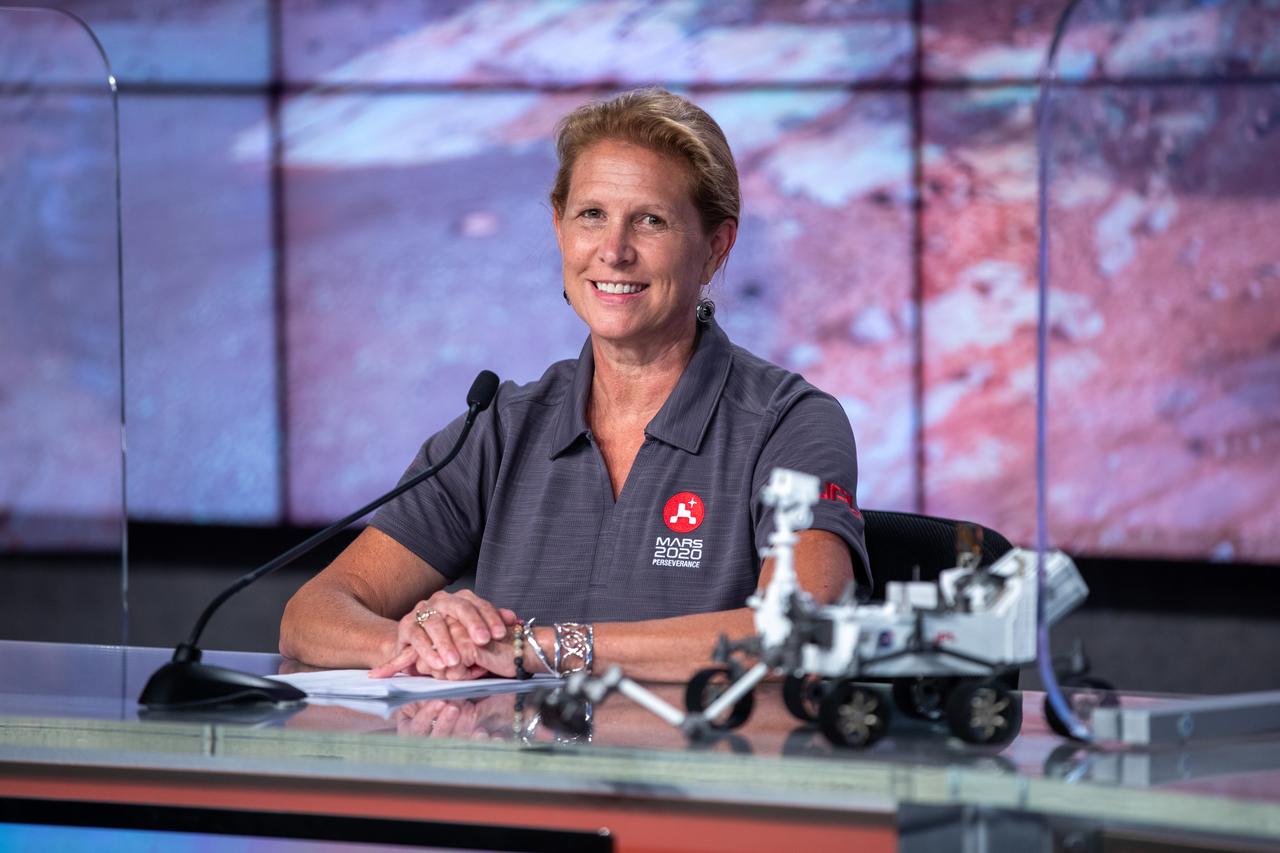
Lori Glaze, Planetary Science Division director, NASA Headquarters, participates in a Mars 2020 Mission Engineering and Science Briefing at NASA’s Kennedy Space Center in Florida on July 27, 2020. The Mars Perseverance rover is scheduled to launch July 30, on a United Launch Alliance Atlas V 541 rocket from Space Launch Complex 41 at nearby Cape Canaveral Air Force Station. The rover is part of NASA’s Mars Exploration Program, a long-term effort of robotic exploration of the Red Planet. The rover will search for habitable conditions in the ancient past and signs of past microbial life on Mars. The Launch Services Program at Kennedy is responsible for launch management.

JPL Director Michael Watkins, left, talks with Director of NASA's Science Mission Directorate’s Planetary Science Division, Lori Glaze, as they and the NASA Perseverance Mars rover team await the landing of the spacecraft in mission control, Thursday, Feb. 18, 2021, at NASA's Jet Propulsion Laboratory in Pasadena, California. A key objective for Perseverance’s mission on Mars is astrobiology, including the search for signs of ancient microbial life. The rover will characterize the planet’s geology and past climate, pave the way for human exploration of the Red Planet, and be the first mission to collect and cache Martian rock and regolith. Photo Credit: (NASA/Bill Ingalls)

Director of NASA's Science Mission Directorate’s Planetary Science Division, Lori Glaze, gives remarks during a NASA Perseverance rover mission landing update, Wednesday, Feb. 17, 2021, at NASA's Jet Propulsion Laboratory in Pasadena, California. The Perseverance Mars rover is due to land on Mars Thursday, Feb. 18, 2021. A key objective for Perseverance’s mission on Mars is astrobiology, including the search for signs of ancient microbial life. The rover will characterize the planet’s geology and past climate, pave the way for human exploration of the Red Planet, and be the first mission to collect and cache Martian rock and regolith. Photo Credit: (NASA/Bill Ingalls)

Jim Green (left), director, Planetary Science Division at NASA Headquarters, speaks at a press conference about the upcoming launch to the moon of the Gravity Recovery and Interior Laboratory (GRAIL) mission, Thursday, Aug. 25, 2011 in Washington. GRAIL's primary science objectives are to determine the structure of the lunar interior, from crust to core, and to advance understanding of the thermal evolution of the moon. The mission will place two spacecraft into the same orbit around the moon which will gather information about the its gravitational field enabling scientists to create a high-resolution map. Photo Credit: (NASA/Carla Cioffi)

Director of NASA's Science Mission Directorate’s Planetary Science Division, Lori Glaze, gives remarks during a NASA Perseverance rover mission landing update, Wednesday, Feb. 17, 2021, at NASA's Jet Propulsion Laboratory in Pasadena, California. The Perseverance Mars rover is due to land on Mars Thursday, Feb. 18, 2021. A key objective for Perseverance’s mission on Mars is astrobiology, including the search for signs of ancient microbial life. The rover will characterize the planet’s geology and past climate, pave the way for human exploration of the Red Planet, and be the first mission to collect and cache Martian rock and regolith. Photo Credit: (NASA/Bill Ingalls)
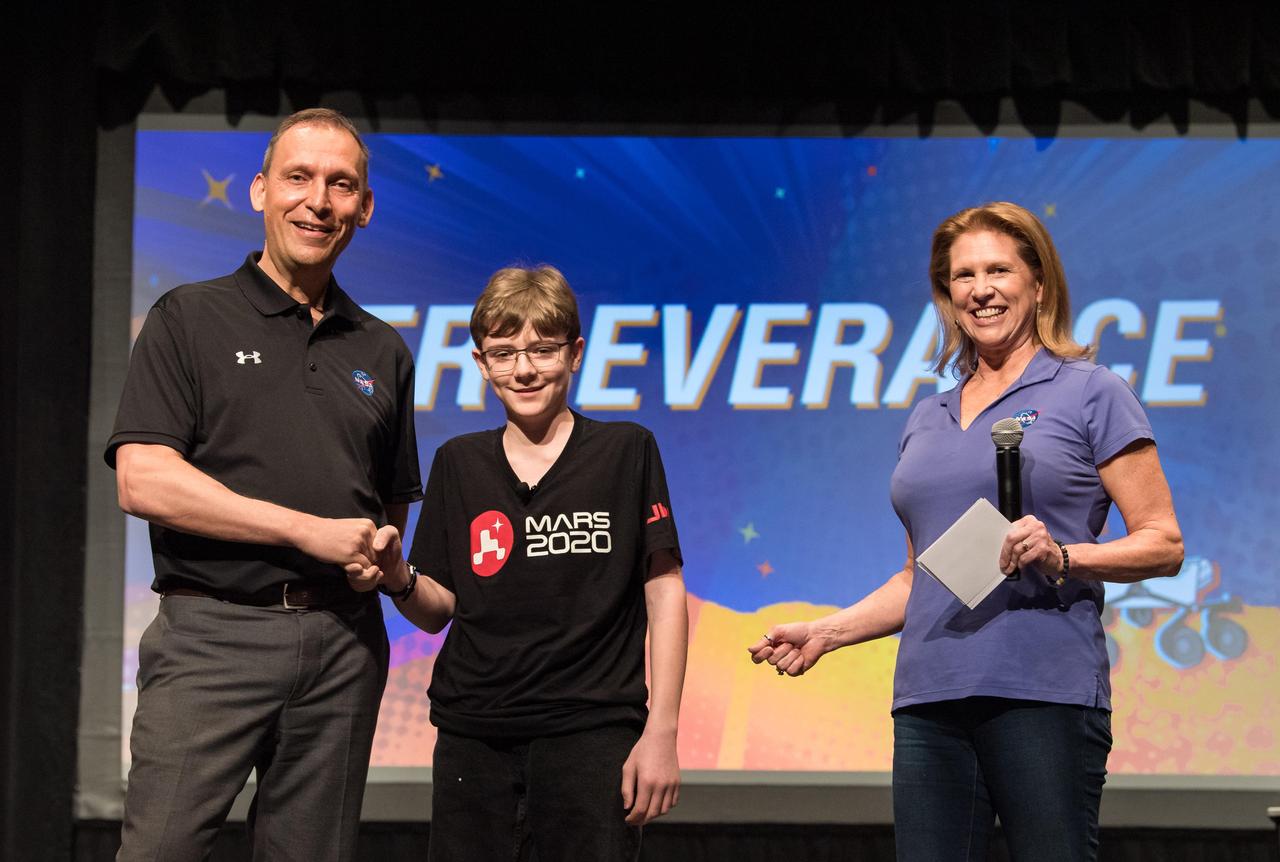
Lori Glaze, director of NASA's Planetary Science Division, looks on as Thomas Zurbuchen, associate administrator of NASA's Science Mission Directorate, congratulates Alexander Mather on March 5, 2020, during a celebration at Lake Braddock Secondary School in Burke, Virginia. The seventh grader had the honor of naming the agency's next Mars rover after submitting the winning entry to the agency's "Name the Rover" essay contest, which received 28,000 entrants from K-12 students from every U.S. state and territory. https://photojournal.jpl.nasa.gov/catalog/PIA23762

Director of NASA's Science Mission Directorate’s Planetary Science Division, Lori Glaze, gives remarks during a NASA Perseverance rover mission landing update, Wednesday, Feb. 17, 2021, at NASA's Jet Propulsion Laboratory in Pasadena, California. The Perseverance Mars rover is due to land on Mars Thursday, Feb. 18, 2021. A key objective for Perseverance’s mission on Mars is astrobiology, including the search for signs of ancient microbial life. The rover will characterize the planet’s geology and past climate, pave the way for human exploration of the Red Planet, and be the first mission to collect and cache Martian rock and regolith. Photo Credit: (NASA/Bill Ingalls)

Director of NASA's Science Mission Directorate’s Planetary Science Division, Lori Glaze, gives remarks during a NASA Perseverance rover mission post-landing update, Thursday, Feb. 18, 2021, at NASA's Jet Propulsion Laboratory in Pasadena, California. A key objective for Perseverance’s mission on Mars is astrobiology, including the search for signs of ancient microbial life. The rover will characterize the planet’s geology and past climate, pave the way for human exploration of the Red Planet, and be the first mission to collect and cache Martian rock and regolith. Photo Credit: (NASA/Bill Ingalls)
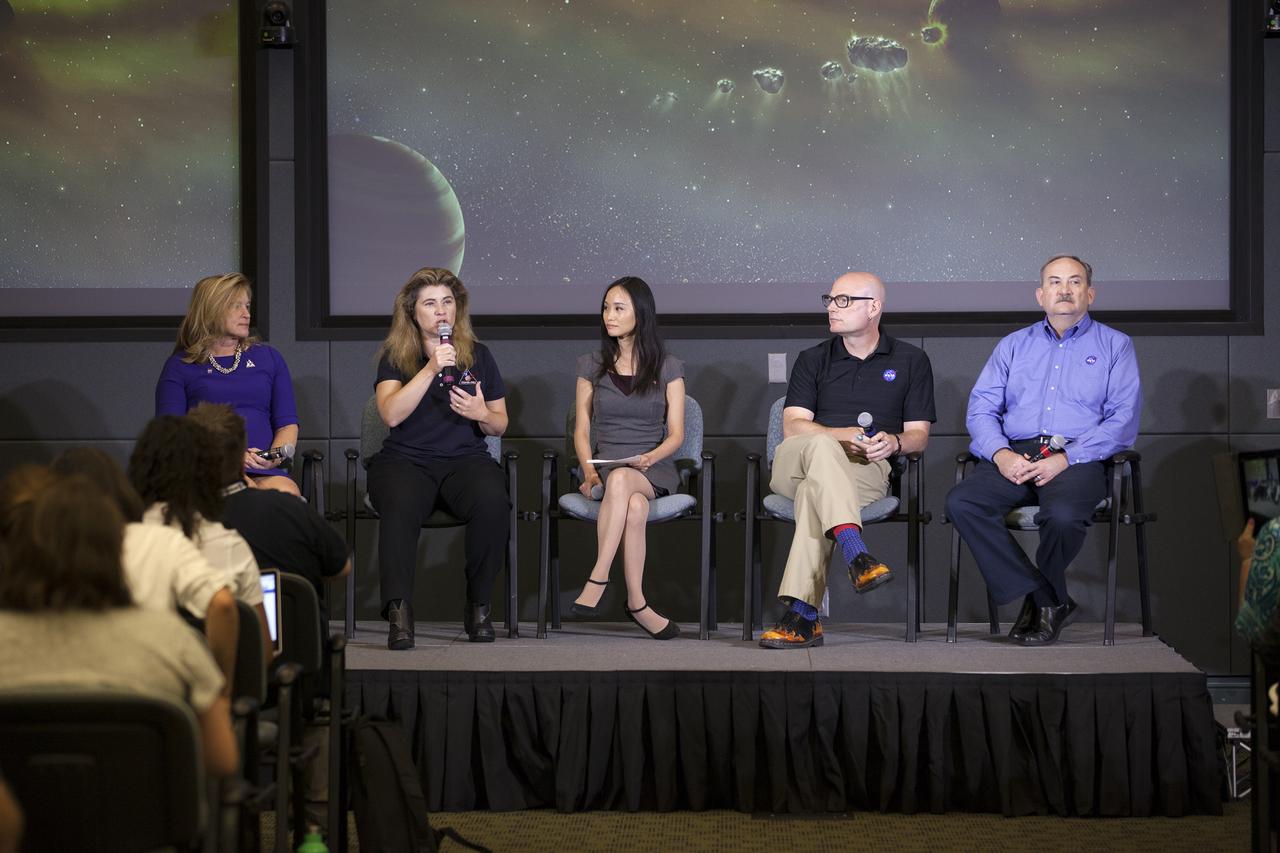
In a panel discussion in the Kennedy Space Center’s Operations Support Building II, social media followers were briefed by NASA scientists on asteroids, how they relate to the origins of our solar system and the search for life beyond Earth. The discussion took place before launch of the agency’s Origins, Spectral Interpretation, Resource Identification, Security-Regolith Explorer, or OSIRIS-REx spacecraft. Panelists for this conversation are, from the left, Ellen Stofan, NASA chief scientist; Michelle Thaller, deputy director of science communications for NASA’s Science Mission Directorate; Felicia Chou, NASA Communications; Alex Young, associate director for science in the Heliophysics Science Division at NASA’s Goddard Space Flight Center in Greenbelt, Maryland; and Lindley Johnson, director of the Planetary Defense Coordination Office in NASA’s Science Mission Directorate.
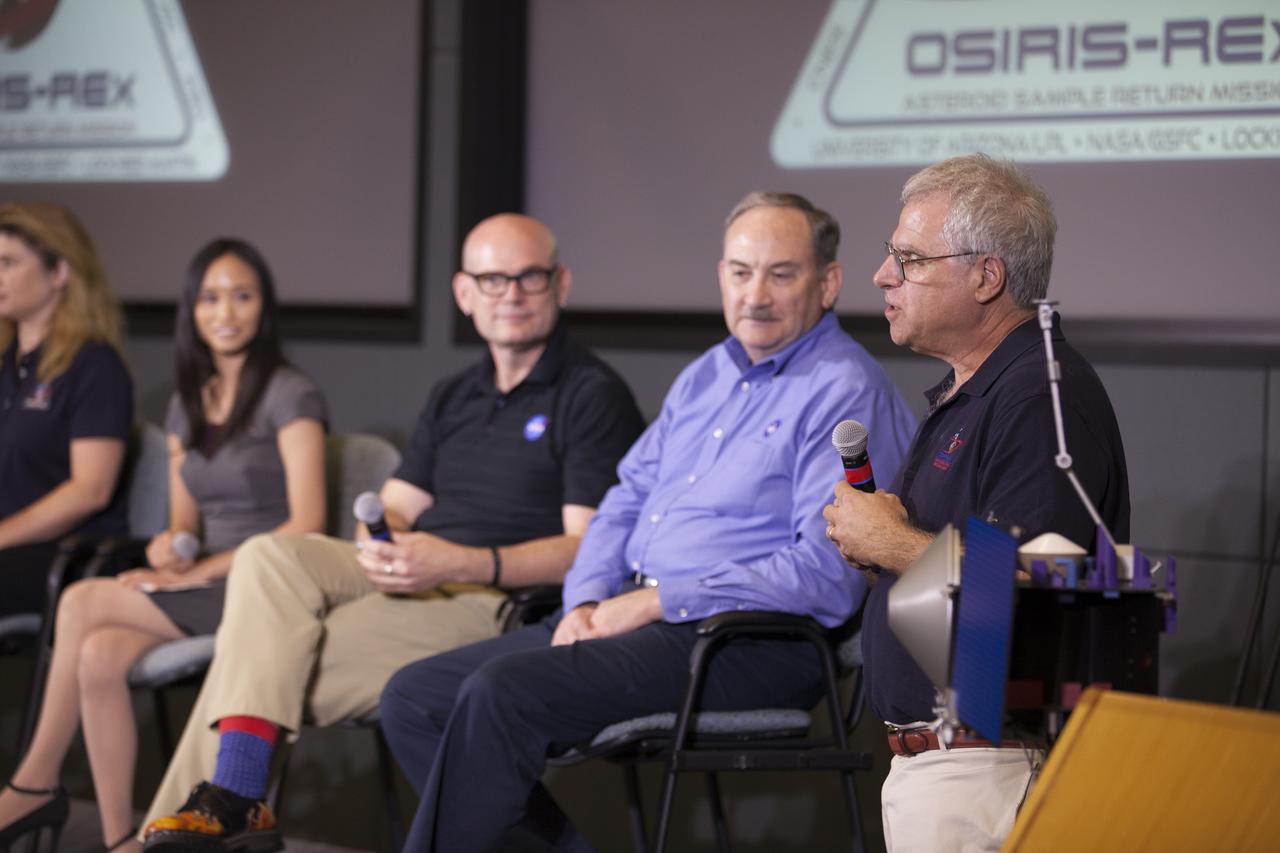
In a panel discussion in the Kennedy Space Center’s Operations Support Building II, social media followers were briefed by NASA scientists on asteroids, how they relate to the origins of our solar system and the search for life beyond Earth. The discussion took place before launch of the agency’s Origins, Spectral Interpretation, Resource Identification, Security-Regolith Explorer, or OSIRIS-REx spacecraft. Panelists in view are, from the left, Felicia Chou, NASA Communications; Alex Young, associate director for science in the Heliophysics Science Division at NASA’s Goddard Space Flight Center in Greenbelt, Maryland; and Lindley Johnson, director of the Planetary Defense Coordination Office in NASA’s Science Mission Directorate. Also participating in the panel discussion are Ellen Stofan, NASA chief scientist and Michelle Thaller, deputy director of science communications for NASA’s Science Mission Directorate.
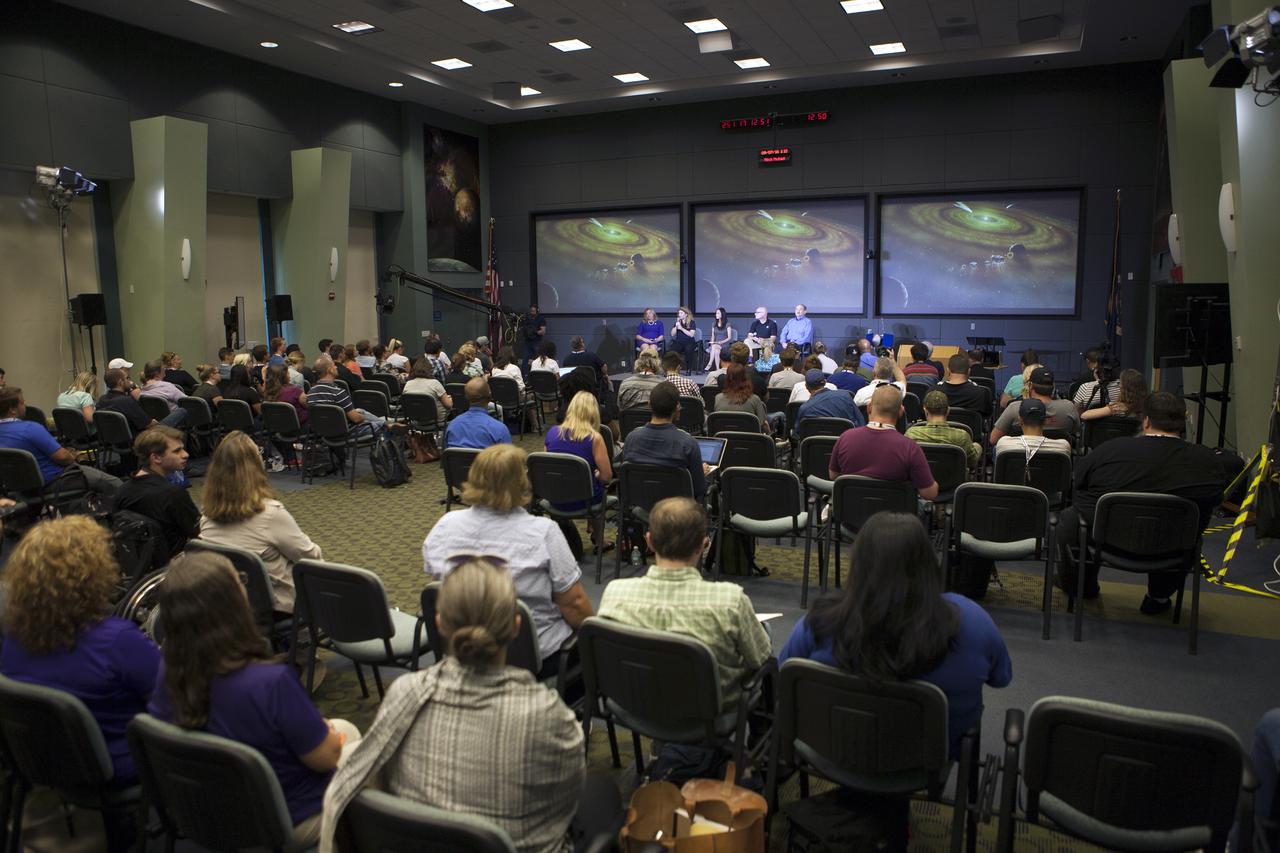
In a panel discussion in the Kennedy Space Center’s Operations Support Building II, social media followers were briefed by NASA scientists on asteroids, how they relate to the origins of our solar system and the search for life beyond Earth. The discussion took place before launch of the agency’s Origins, Spectral Interpretation, Resource Identification, Security-Regolith Explorer, or OSIRIS-REx spacecraft. Panelists for this conversation are, from the left, Ellen Stofan, NASA chief scientist; Michelle Thaller, deputy director of science communications for NASA’s Science Mission Directorate; Felicia Chou, NASA Communications; Alex Young, associate director for science in the Heliophysics Science Division at NASA’s Goddard Space Flight Center in Greenbelt, Maryland; and Lindley Johnson, director of the Planetary Defense Coordination Office in NASA’s Science Mission Directorate.
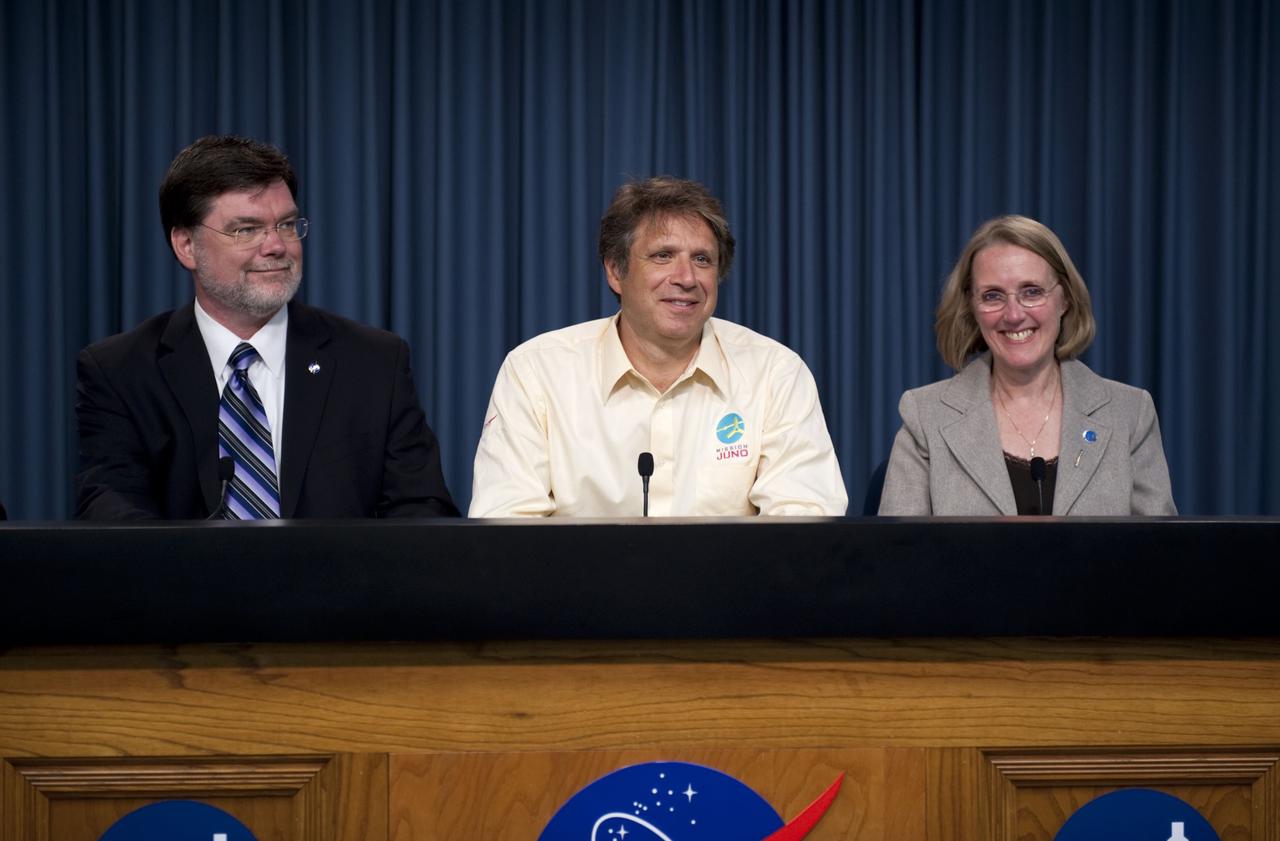
CAPE CANAVERAL, Fla. -- From left, Jim Adams, the deputy director of NASA's Planetary Science Division; Scott Bolton, Juno's principal investigator at the Southwest Research Institute (SWRI); and Jan Chodas, Juno's project manager at the Jet Propulsion Laboratory (JPL), participate in a post-launch news conference following the successful liftoff of the Juno spacecraft atop a United Launch Alliance Atlas V rocket. Launch was at 12:25 p.m. EDT Aug. 5. The solar-powered spacecraft now is on a five-year journey to Jupiter, where it will orbit the planet's poles 33 times to find out more about the gas giant's origins, structure, atmosphere and magnetosphere and investigate the existence of a solid planetary core. For more information, visit www.nasa.gov/juno. Photo credit: Kim Shiflett
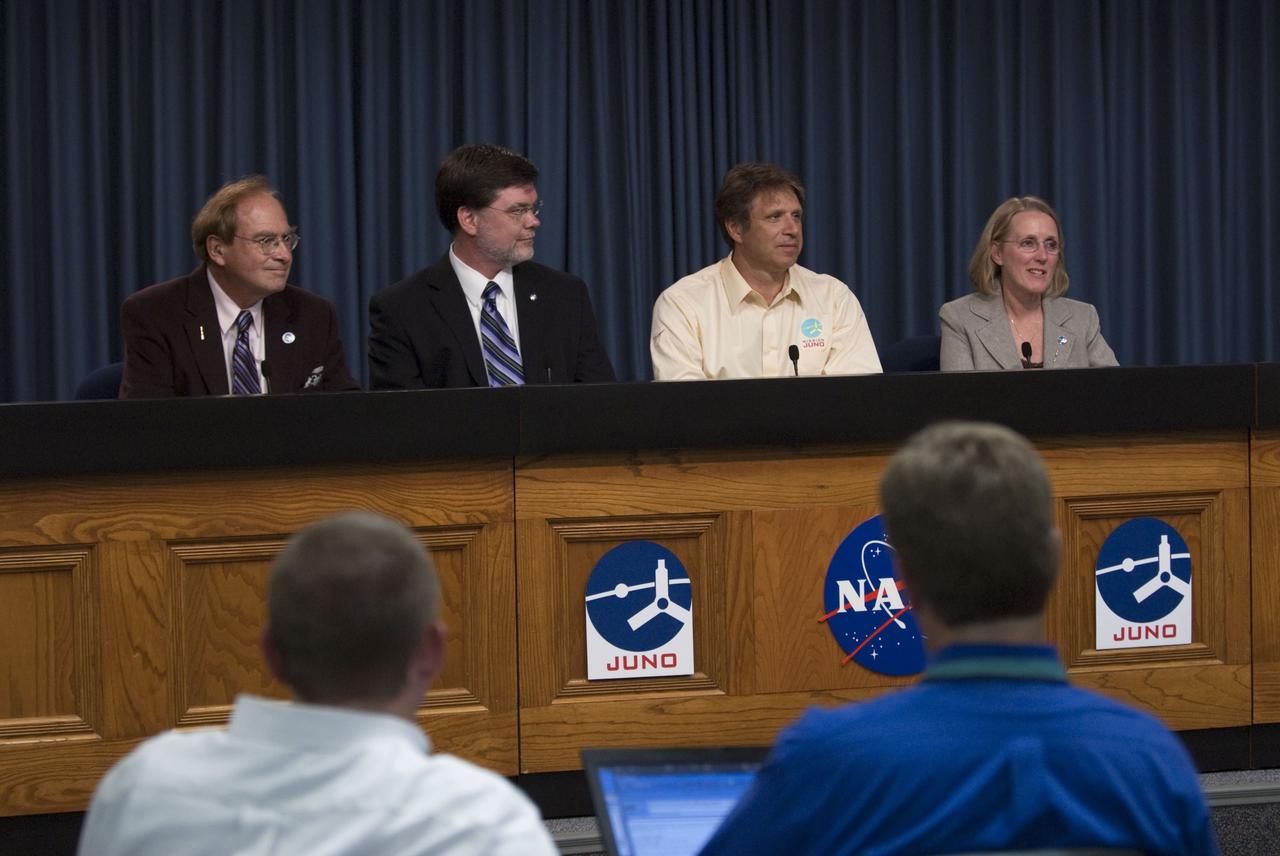
CAPE CANAVERAL, Fla. -- From left, NASA Public Affairs Officer George Diller; Jim Adams, the deputy director of NASA's Planetary Science Division; Scott Bolton, Juno's principal investigator at the Southwest Research Institute (SWRI); and Jan Chodas, Juno's project manager at the Jet Propulsion Laboratory (JPL), participate in a post-launch news conference following the successful liftoff of the Juno spacecraft atop a United Launch Alliance Atlas V rocket. Launch was at 12:25 p.m. EDT Aug. 5. The solar-powered spacecraft now is on a five-year journey to Jupiter, where it will orbit the planet's poles 33 times to find out more about the gas giant's origins, structure, atmosphere and magnetosphere and investigate the existence of a solid planetary core. For more information, visit www.nasa.gov/juno. Photo credit: Kim Shiflett

CAPE CANAVERAL, Fla. – A panel session for participants in the International Space University's Space Studies Program 2012, or SSP, is held in the Operations Support Building II at NASA’s Kennedy Space Center in Florida. From left are Pete Worden, director, NASA Ames Research Center Yvonne Pendleton, observational astronomer, NASA Ames Research Center Scott Hubbard, professor, Stanford University Bill Nye, CEO, The Planetary Society and George Tahu, NASA program executive, Planetary Science Division, NASA Headquarters. The Soffen Memorial Panel session provided the opportunity for participants to engage with today's leaders in the planetary science field. The panel session is named in honor of Gerald Soffen, NASA scientist and leader of NASA's Viking Mars mission. The nine-week intensive SSP course is designed for post-graduate university students and professionals during the summer. The program is hosted by a different country each year, providing a unique educational experience for participants from around the globe. NASA Kennedy Space Center and Florida Tech are co-hosting this year's event which runs from June 4 to Aug. 3. For more information about the International Space University, visit http://www.isunet.edu. Photo credit: NASA/Tim Jacobs
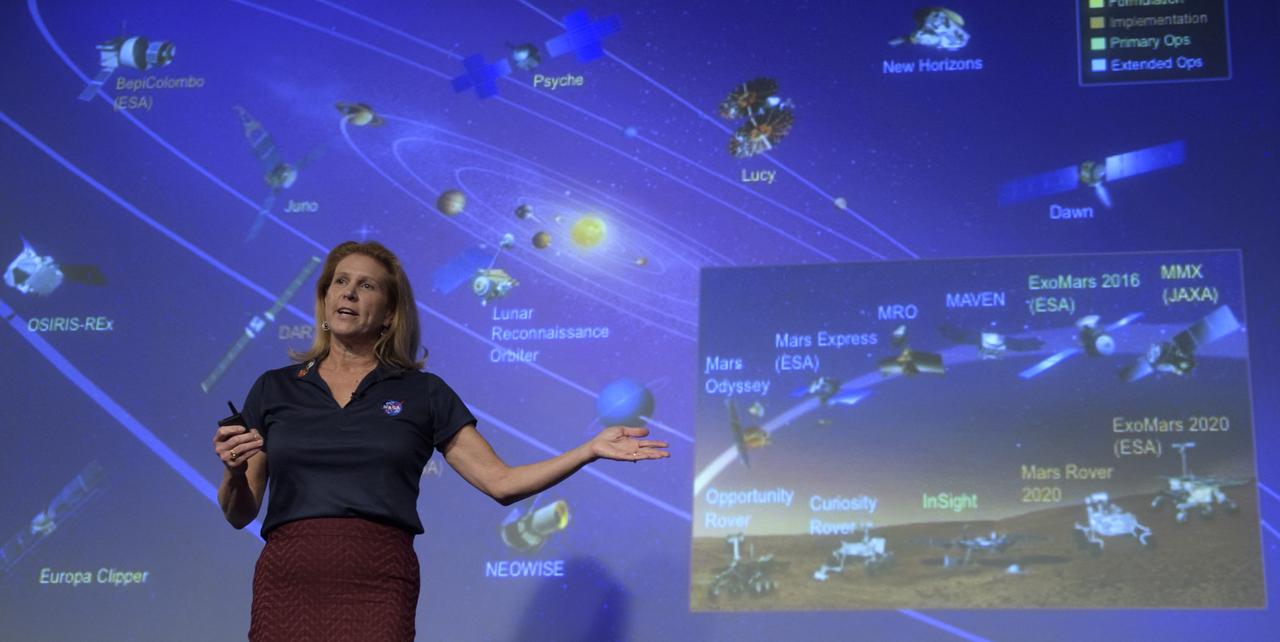
NASA Headquarters acting director of the Planetary Science Division Lori Glaze gives remarks during the NASA InSight Mars Lander (Interior Exploration using Seismic Investigations, Geodesy and Heat Transport) media briefing, Wednesday, Oct. 31, 2018 at NASA Headquarters in Washington. InSIght will land on the Red Planet at approximately 3 p.m. EST (noon PST) Monday, Nov. 26. InSight will study the deep interior of Mars to learn how all celestial bodies with rocky surfaces, including Earth and the Moon, formed. The lander’s instruments include a seismometer to detect marsquakes and a probe to monitor the flow of heat in the planet's subsurface. Photo Credit: (NASA/Bill Ingalls)

NASA Headquarters acting director of the Planetary Science Division Lori Glaze, left, talks with Sue Smrekar, InSight deputy principal investigator, NASA JPL, as they and other Mars InSight team members monitor the status of the lander prior to it touching down on Mars, Monday, Nov. 26, 2018 inside the Mission Support Area at NASA's Jet Propulsion Laboratory in Pasadena, California. InSight, short for Interior Exploration using Seismic Investigations, Geodesy and Heat Transport, is a Mars lander designed to study the "inner space" of Mars: its crust, mantle, and core. Photo Credit: (NASA/Bill Ingalls)

Jim Green, director of NASA’s Planetary Science Division, poses for a photo with the Mars rover concept, developed by vehicle designers, the Parker Brothers, with advice from NASA, during the Smithsonian Institution’s National Air and Space Museum’s Mars Day, Friday, July 21, 2017 in Washington. The Mars rover concept is currently on an East Coast tour from its home base at the Kennedy Space Center Visitor’s Center in Florida, and is designed to engage and educate the public by demonstrating the types of features and equipment a future human exploration vehicle may need. Photo Credit: (NASA/Aubrey Gemignani)
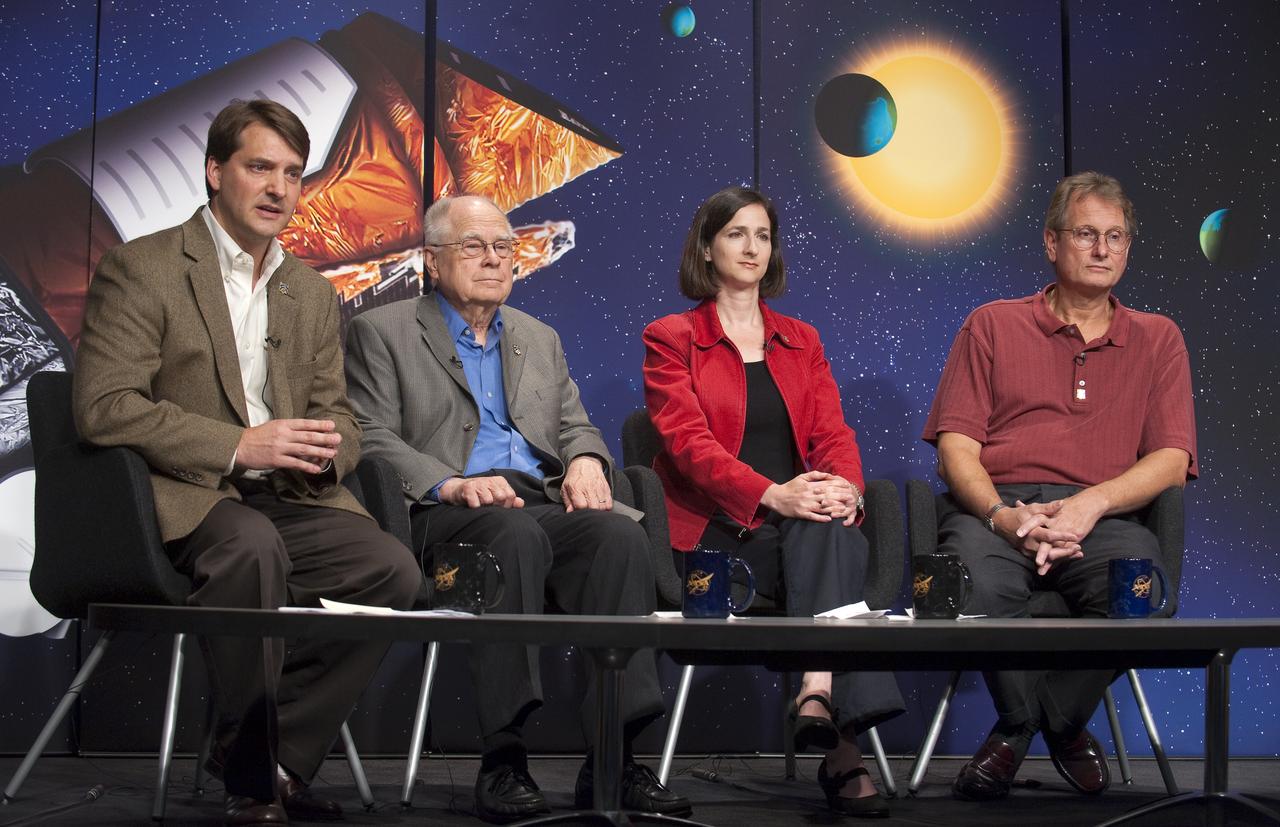
Jon Morse, Astrophysics Division Director, NASA Headquarters, left, is seen Thursday, Aug. 6, 2009 at a press conference at NASA Headquarters in Washington where he along with William Bo-Ricki, principal investigator, Sara Seager, professor of Planetary Science at the Massachusetts Institute of Technology and Alan Boss, an astrophysicist at the Carnegie Institution at the Department of Terrestrial Magnetism, far right, discussed the scientific observations coming from the Kepler spacecraft that was launched this past March. Kepler is NASA's first mission that is capable of discovering earth-sized planets in the habitable zones of stars like our Sun. Photo Credit: (NASA/Paul E. Alers)

Jim Green, director of NASA’s Planetary Science Division, poses for a photo with the Mars rover concept, developed by vehicle designers, the Parker Brothers, with advice from NASA, during the Smithsonian Institution’s National Air and Space Museum’s Mars Day, Friday, July 21, 2017 in Washington. The Mars rover concept is currently on an East Coast tour from its home base at the Kennedy Space Center Visitor’s Center in Florida, and is designed to engage and educate the public by demonstrating the types of features and equipment a future human exploration vehicle may need. Photo Credit: (NASA/Aubrey Gemignani)

Eric Ianson, deputy director of the Planetary Science Division and director of the Mars Exploration Program and Radioisotope Power Systems Program at NASA speaks at an event marking NASA’s donation of the aerial prototype of the Ingenuity Mars Helicopter, Friday, Dec. 15, 2023, at the Smithsonian National Air and Space Museum’s Steve F. Udvar-Hazy Center in Chantilly, Va. The aerial prototype of the Ingenuity Mars Helicopter, which was the first to demonstrate it was possible to fly in a simulated Mars environment at NASA’s Jet Propulsion Laboratory (JPL), was donated to the museum on Friday. Photo Credit: (NASA/Joel Kowsky)

NASA Headquarters Planetary Science Division director Lori Glaze and NASA Administrator Bill Nelson watch for the return of the boosters after the launch of a SpaceX Falcon Heavy rocket with the Psyche spacecraft onboard from Launch Complex 39A, Friday, Oct. 13, 2023, at NASA’s Kennedy Space Center in Florida. NASA’s Psyche spacecraft will travel to a metal-rich asteroid by the same name orbiting the Sun between Mars and Jupiter to study it’s composition. The spacecraft also carries the agency's Deep Space Optical Communications technology demonstration, which will test laser communications beyond the Moon. Photo Credit: (NASA/Aubrey Gemignani)
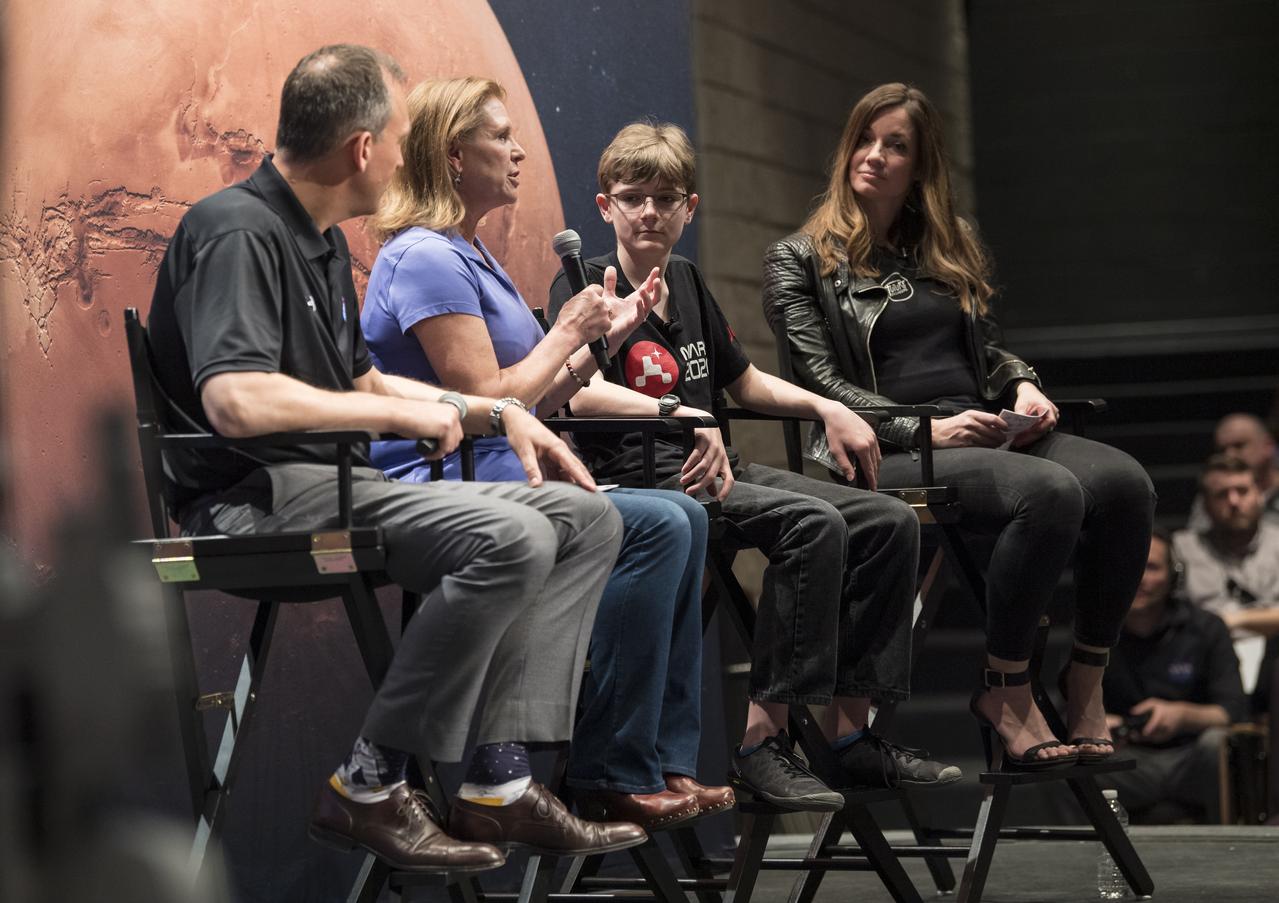
Lori Glaze, Director of the Planetary Science Division of NASA's Science Mission Directorate, second from left, asks Alex Mather, the student whose submission, Perseverance, was chosen as the official name of the Mars 2020 rover, a question, Thursday, March 5, 2020, at Lake Braddock Secondary School in Burke, Va. The final selection of the new name was made by Associate Administrator of NASA's Science Mission Directorate, Thomas Zurbuchen, following a nationwide naming contest conducted in 2019 that drew more than 28,000 essays by K-12 students from every U.S. state and territory. Perseverance is currently at NASA's Kennedy Space Center in Florida being prepared for launch this summer. Photo Credit: (NASA/Aubrey Gemignani)

Lori Glaze, Director of the Planetary Science Division of NASA's Science Mission Directorate, second from left, asks Alex Mather, the student whose submission, Perseverance, was chosen as the official name of the Mars 2020 rover, a question, Thursday, March 5, 2020, at Lake Braddock Secondary School in Burke, Va. The final selection of the new name was made by Associate Administrator of NASA's Science Mission Directorate, Thomas Zurbuchen, following a nationwide naming contest conducted in 2019 that drew more than 28,000 essays by K-12 students from every U.S. state and territory. Perseverance is currently at NASA's Kennedy Space Center in Florida being prepared for launch this summer. Photo Credit: (NASA/Aubrey Gemignani)

Lori Glaze, Director of the Planetary Science Division of NASA's Science Mission Directorate, right, shakes hands with Alex Mather, center, the student whose submission, Perseverance, was chosen as the official name of the Mars 2020 rover, Thursday, March 5, 2020, at Lake Braddock Secondary School in Burke, Va. The final selection of the new name was made by Associate Administrator of NASA's Science Mission Directorate, Thomas Zurbuchen, left, following a nationwide naming contest conducted in 2019 that drew more than 28,000 essays by K-12 students from every U.S. state and territory. Perseverance is currently at NASA's Kennedy Space Center in Florida being prepared for launch this summer. Photo Credit: (NASA/Aubrey Gemignani)

Alex Mather, the student whose submission, Perseverance, was chosen as the official name of the Mars 2020 rover, second from right, answers a question from Lori Glaze, Director of the Planetary Science Division of NASA's Science Mission Directorate, second from left, Thursday, March 5, 2020, at Lake Braddock Secondary School in Burke, Va. The final selection of the new name was made by Associate Administrator of NASA's Science Mission Directorate, Thomas Zurbuchen, left, following a nationwide naming contest conducted in 2019 that drew more than 28,000 essays by K-12 students from every U.S. state and territory. Perseverance is currently at NASA's Kennedy Space Center in Florida being prepared for launch this summer. Photo Credit: (NASA/Aubrey Gemignani)

Alex Mather, the student whose submission, Perseverance, was chosen as the official name of the Mars 2020 rover, second from right, answers a question from Lori Glaze, Director of the Planetary Science Division of NASA's Science Mission Directorate, second from left, Thursday, March 5, 2020, at Lake Braddock Secondary School in Burke, Va. The final selection of the new name was made by Associate Administrator of NASA's Science Mission Directorate, Thomas Zurbuchen, left, following a nationwide naming contest conducted in 2019 that drew more than 28,000 essays by K-12 students from every U.S. state and territory. Perseverance is currently at NASA's Kennedy Space Center in Florida being prepared for launch this summer. Photo Credit: (NASA/Aubrey Gemignani)

Carolin Frueh, associate professor of Aeronautics and Astronautics at Purdue University, left, Heather Futrell, program executive in the Heliophysics Division of NASA's Science Mission Directorate, Briony Horgan, associate professor of Planetary Science at Purdue University, and Nicole Rayl, associate director for Flight Programs in the Heliophysics Divison of NASA's Science Mission Directorate, speak to attendees at the Indianapolis Motor Speedway during a panel discussion about the Parker Solar Probe and space weather ahead of the total solar eclipse, Monday, April 8, 2024, in Indianapolis, Ind. A total solar eclipse swept across a narrow portion of the North American continent from Mexico’s Pacific coast to the Atlantic coast of Newfoundland, Canada. A partial solar eclipse was visible across the entire North American continent along with parts of Central America and Europe. Photo Credit: (NASA/Joel Kowsky)

Director of NASA's Science Mission Directorate’s Planetary Science Division, Lori Glaze, , left, and Principal investigator, Scanning Habitable Environments with Raman & Luminescence for Organics & Chemicals (SHERLOC) instrument, JPL, Luther Beegle, give remarks during a NASA Perseverance rover mission science overview, Tuesday, Feb. 16, 2021, at NASA's Jet Propulsion Laboratory in Pasadena, California. The Perseverance Mars rover is due to land on Mars Thursday, Feb. 18, 2021. A key objective for Perseverance’s mission on Mars is astrobiology, including the search for signs of ancient microbial life. The rover will characterize the planet’s geology and past climate, pave the way for human exploration of the Red Planet, and be the first mission to collect and cache Martian rock and regolith. Photo Credit: (NASA/Bill Ingalls)
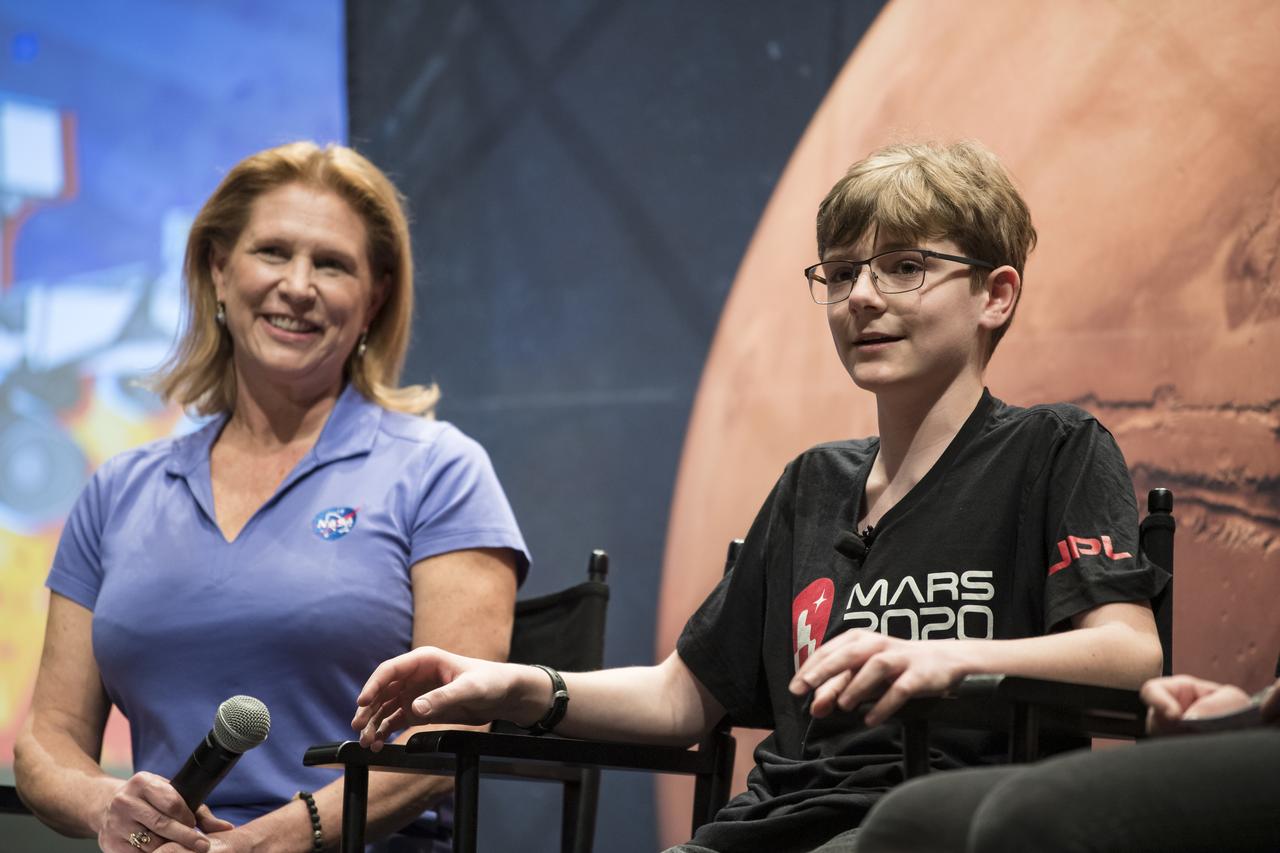
Alex Mather, the student whose submission, Perseverance, was chosen as the official name of the Mars 2020 rover, second from right, answers a question from Lori Glaze, Director of the Planetary Science Division of NASA's Science Mission Directorate, second from left, Thursday, March 5, 2020, at Lake Braddock Secondary School in Burke, Va. The final selection of the new name was made by Associate Administrator of NASA's Science Mission Directorate, Thomas Zurbuchen, left, following a nationwide naming contest conducted in 2019 that drew more than 28,000 essays by K-12 students from every U.S. state and territory. Perseverance is currently at NASA's Kennedy Space Center in Florida being prepared for launch this summer. Photo Credit: (NASA/Aubrey Gemignani)
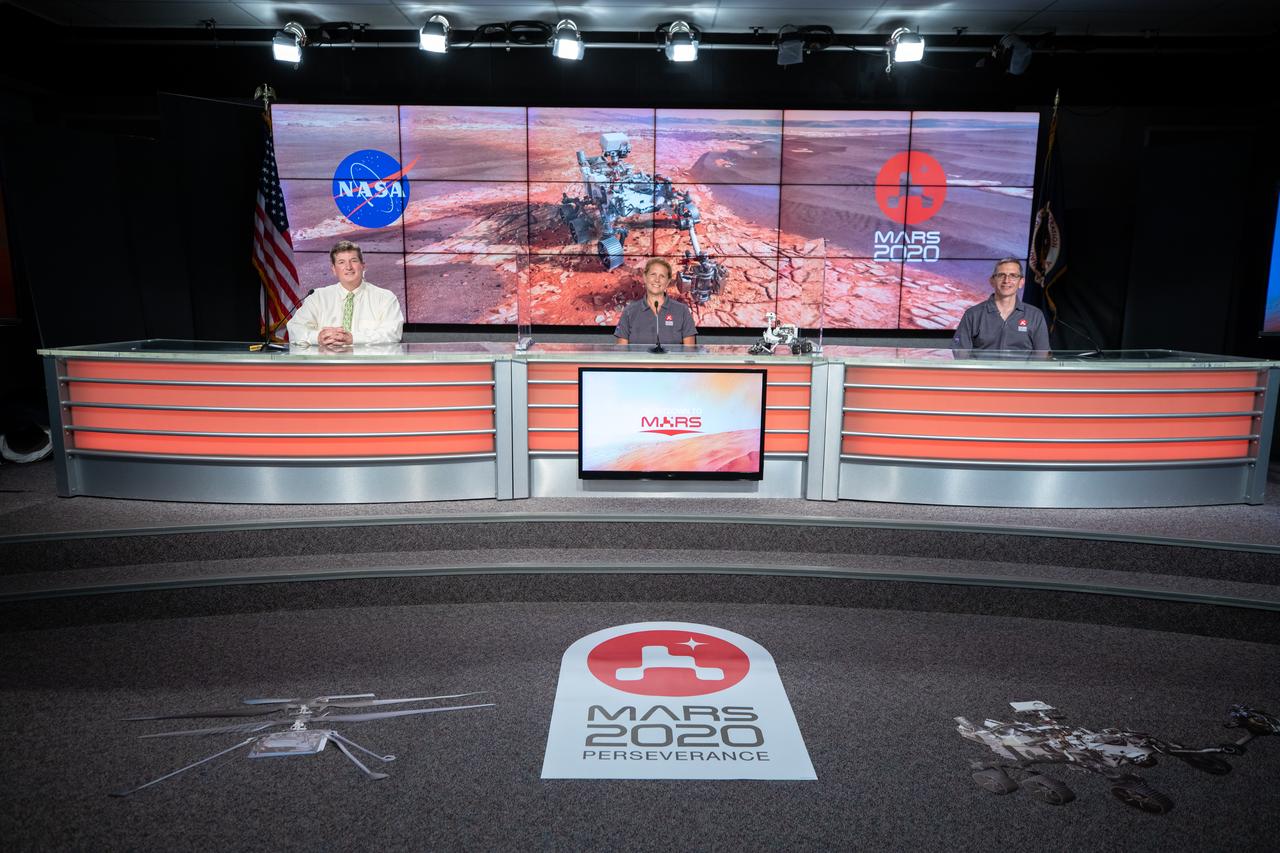
A Mars 2020 Mission Engineering and Science Briefing is held at NASA’s Kennedy Space Center in Florida on July 27, 2020. Participating in the briefing from left, are Moderator DC Agle, NASA’s Jet Propulsion Laboratory; Lori Glaze, Planetary Science Division director, NASA Headquarters; and Ken Farley, project scientist, California Institute of Technology. The Mars Perseverance rover is scheduled to launch July 30, on a United Launch Alliance Atlas V 541 rocket from Space Launch Complex 41 at nearby Cape Canaveral Air Force Station. The rover is part of NASA’s Mars Exploration Program, a long-term effort of robotic exploration of the Red Planet. The rover will search for habitable conditions in the ancient past and signs of past microbial life on Mars. The Launch Services Program at Kennedy is responsible for launch management.
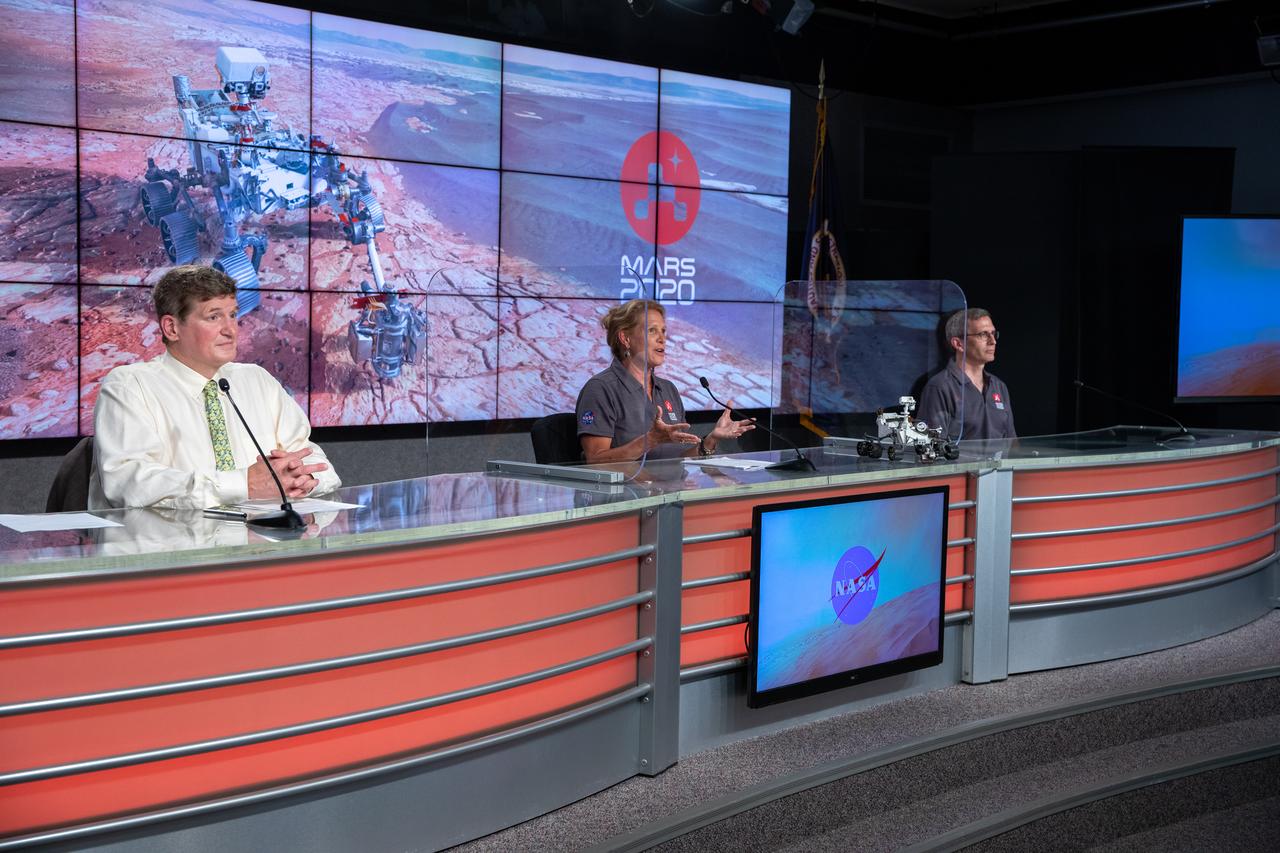
A Mars 2020 Mission Engineering and Science Briefing is held at NASA’s Kennedy Space Center in Florida on July 27, 2020. Participating in the briefing from left, are Moderator DC Agle, NASA’s Jet Propulsion Laboratory; Lori Glaze, Planetary Science Division director, NASA Headquarters; and Ken Farley, project scientist, California Institute of Technology. The Mars Perseverance rover is scheduled to launch July 30, on a United Launch Alliance Atlas V 541 rocket from Space Launch Complex 41 at nearby Cape Canaveral Air Force Station. The rover is part of NASA’s Mars Exploration Program, a long-term effort of robotic exploration of the Red Planet. The rover will search for habitable conditions in the ancient past and signs of past microbial life on Mars. The Launch Services Program at Kennedy is responsible for launch management.
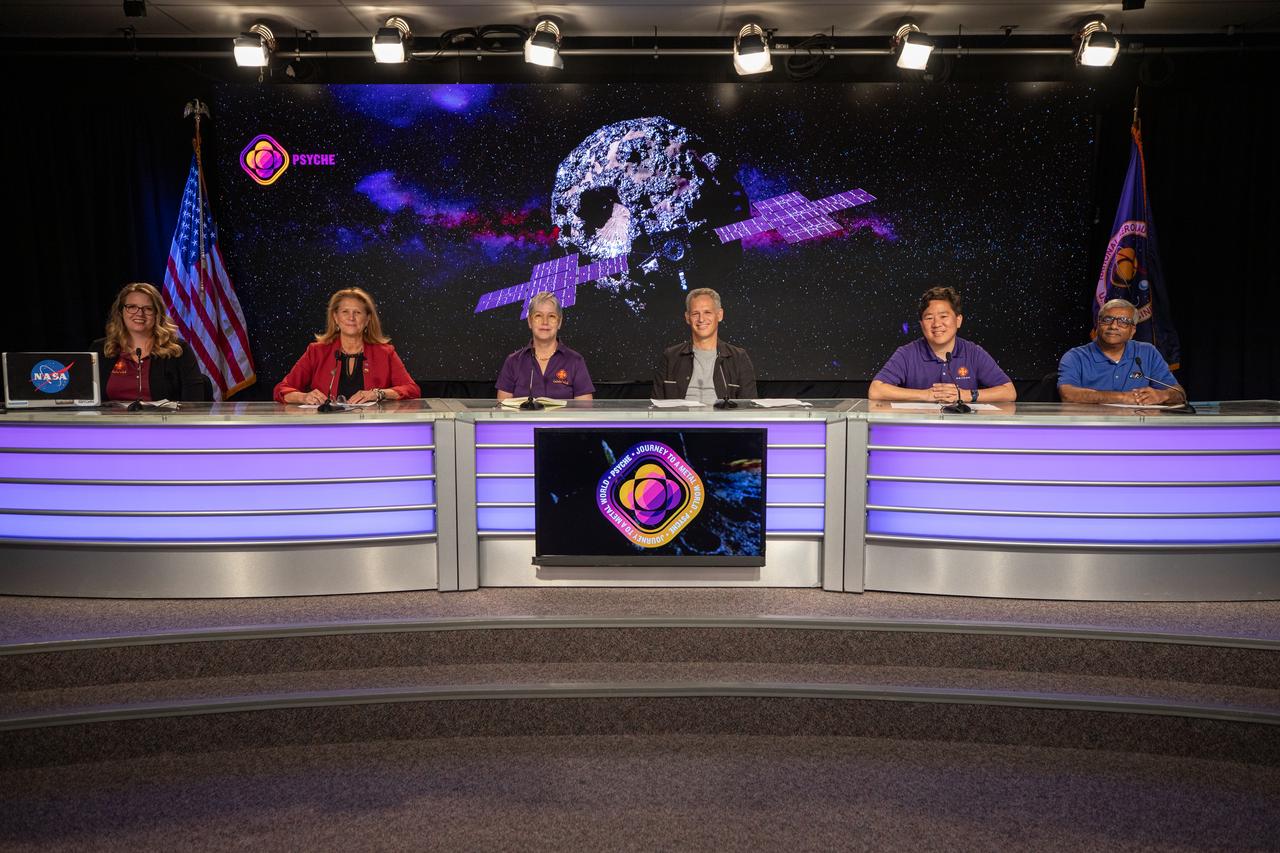
A Psyche mission and science briefing takes place at NASA’s Kennedy Space Center in Florida on Tuesday, Oct. 10, 2023. Participants, from left, are: Alana Johnson, NASA Communications; Lori Glaze, Planetary Science division director, NASA Headquarters; Lindy Elkins-Tanton, Psyche principal investigator, Arizona State University; Ben Weiss, Psyche deputy principal investigator and magnetometer lead, Massachusetts Institute of Technology; David Oh, Psyche chief engineer for operations, NASA’s Jet Propulsion Laboratory (JPL); and Abi Biswas, Deep Space Optical Communications project technologist, JPL. Psyche is the first mission to explore an asteroid with a surface that likely contains substantial amounts of metal rather than rock or ice. Liftoff of NASA’s Psyche spacecraft, atop a SpaceX Falcon Heavy rocket, is targeted for 10:16 a.m. EDT Thursday, Oct. 12, from Kennedy’s Launch Complex 39A.

director of NASA's Planetary Science Division, Jim Green answers questions a press conference previewing Cassini's End of Mission, Wednesday, Sept. 13, 2017 at NASA's Jet Propulsion Laboratory in Pasadena, California. Since its arrival in 2004, the Cassini-Huygens mission has been a discovery machine, revolutionizing our knowledge of the Saturn system and captivating us with data and images never before obtained with such detail and clarity. On Sept. 15, 2017, operators will deliberately plunge the spacecraft into Saturn, as Cassini gathered science until the end. The “plunge” ensures Saturn’s moons will remain pristine for future exploration. During Cassini’s final days, mission team members from all around the world gathered at NASA’s Jet Propulsion Laboratory, Pasadena, California, to celebrate the achievements of this historic mission. Photo Credit: (NASA/Joel Kowsky)
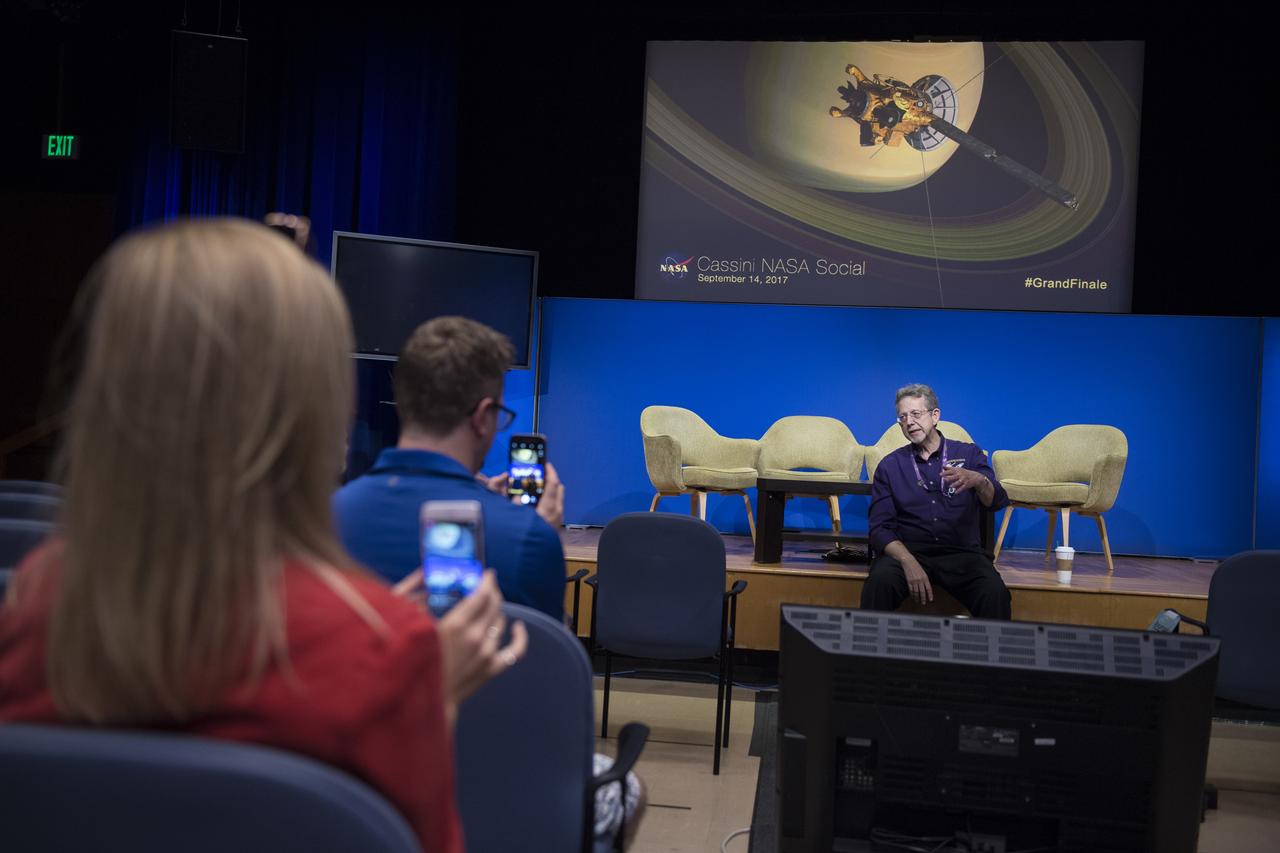
NASA Social attendees film director of NASA's Planetary Science Division, Jim Green as he discusses the Cassini mission, Thursday, Sept. 14, 2017 at NASA's Jet Propulsion Laboratory in Pasadena, California. Since its arrival in 2004, the Cassini-Huygens mission has been a discovery machine, revolutionizing our knowledge of the Saturn system and captivating us with data and images never before obtained with such detail and clarity. On Sept. 15, 2017, operators will deliberately plunge the spacecraft into Saturn, as Cassini gathered science until the end. The “plunge” ensures Saturn’s moons will remain pristine for future exploration. During Cassini’s final days, mission team members from all around the world gathered at NASA’s Jet Propulsion Laboratory, Pasadena, California, to celebrate the achievements of this historic mission. Photo Credit: (NASA/Joel Kowsky)

Director of NASA's Planetary Science Division, Jim Green, is seen during a press conference previewing Cassini's End of Mission, Wednesday, Sept. 13, 2017 at NASA's Jet Propulsion Laboratory in Pasadena, California. Since its arrival in 2004, the Cassini-Huygens mission has been a discovery machine, revolutionizing our knowledge of the Saturn system and captivating us with data and images never before obtained with such detail and clarity. On Sept. 15, 2017, operators will deliberately plunge the spacecraft into Saturn, as Cassini gathered science until the end. The “plunge” ensures Saturn’s moons will remain pristine for future exploration. During Cassini’s final days, mission team members from all around the world gathered at NASA’s Jet Propulsion Laboratory, Pasadena, California, to celebrate the achievements of this historic mission. Photo Credit: (NASA/Joel Kowsky)
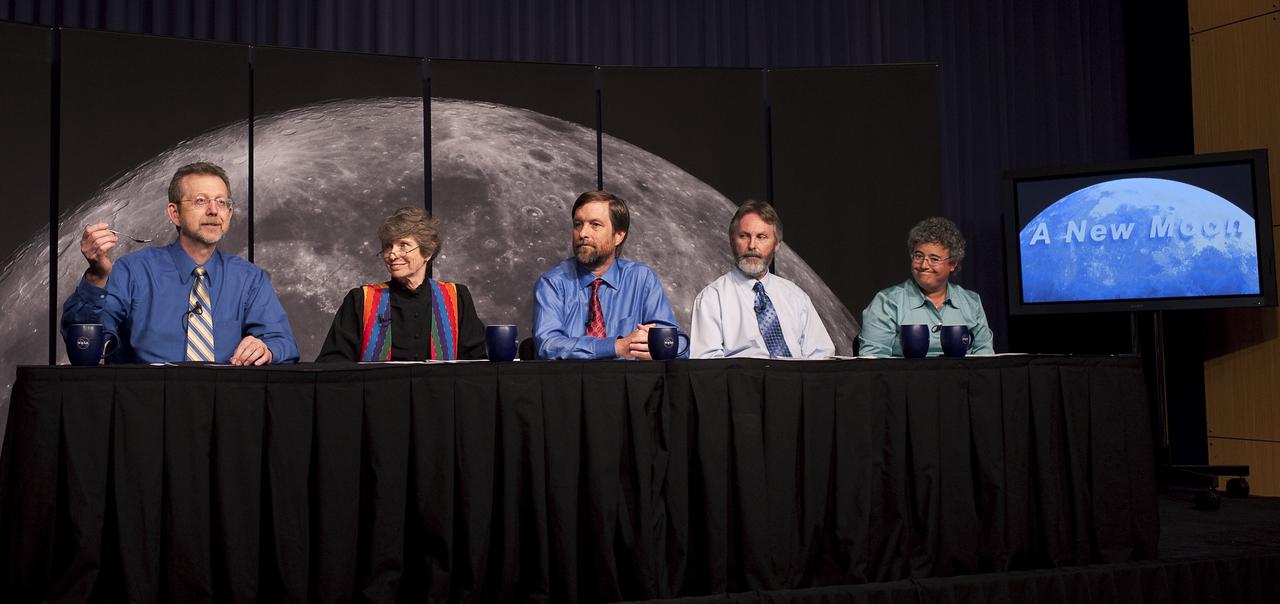
Jim Green (far left), director, Planetary Science Division, Science MissionDirectorate at NASA Headquarters in Washington; Carle Pieters, principal investigator, Moon Mineralogy Mapper, Brown University; Rob Green, project instrument scientist, Moon Mineralogy Mapper, at NASA's Jet Propulsion Laboratory; Roger Clark, team member, Cassini spacecraft Visual and Infrared Mapping Spectrometer and co-investigator, Moon Mineralogy Mapper, U.S. Geological Survey in Denver and Jessica Sunshine (far right), deputy principal investigator for NASA's Deep Impactextended mission and co-investigator for Moon Mineralogy Mapper,Department of Astronomy, University of Maryland discuss their findings of water molecules in the polar regions of the moon at a press conference at NASA Headquarters, September 24, 2009, in Washington. Photo Credit: (NASA/Carla Cioffi)

Jim Adams, NASA Deputy Director, Planetary Science Division, Science Mission Directorate, speaks during an unveiling ceremony of two USPS stamps that commemorate and celebrate 50 years of US Spaceflight and the MESSENGER program during an event, Wednesday, May 4, 2011 at the NASA Kennedy Space Center in Cape Canaveral, Fla. One stamp commemorates NASA’s Project Mercury, America’s first manned spaceflight program, and NASA astronaut Alan Shepard’s historic flight on May 5, 1961, aboard spacecraft Freedom 7. The other stamp draws attention to NASA’s unmanned MESSENGER mission, a scientific investigation of the planet Mercury. On March 17, 2011, MESSENGER became the first spacecraft to enter into orbit around Mercury. Photo Credit: (NASA/Bill Ingalls)

NASA Headquarters Planetary Science Division director Lori Glaze, left, hugs Jet Propulsion Laboratory director Laurie Leshin as NASA Administrator Bill Nelson, right, and Associate Administrator, NASA’s Science Mission Directorate, Nicola Fox watch for the return of the boosters after the launch of a SpaceX Falcon Heavy rocket with the Psyche spacecraft onboard from Launch Complex 39A, Friday, Oct. 13, 2023, at NASA’s Kennedy Space Center in Florida. NASA’s Psyche spacecraft will travel to a metal-rich asteroid by the same name orbiting the Sun between Mars and Jupiter to study it’s composition. The spacecraft also carries the agency's Deep Space Optical Communications technology demonstration, which will test laser communications beyond the Moon. Photo Credit: (NASA/Aubrey Gemignani)

Director of NASA's Planetary Science Division, Jim Green, speaks to NASA Social attendees, Thursday, Sept. 14, 2017 at NASA's Jet Propulsion Laboratory in Pasadena, California. Since its arrival in 2004, the Cassini-Huygens mission has been a discovery machine, revolutionizing our knowledge of the Saturn system and captivating us with data and images never before obtained with such detail and clarity. On Sept. 15, 2017, operators will deliberately plunge the spacecraft into Saturn, as Cassini gathered science until the end. The “plunge” ensures Saturn’s moons will remain pristine for future exploration. During Cassini’s final days, mission team members from all around the world gathered at NASA’s Jet Propulsion Laboratory, Pasadena, California, to celebrate the achievements of this historic mission. Photo Credit: (NASA/Joel Kowsky)
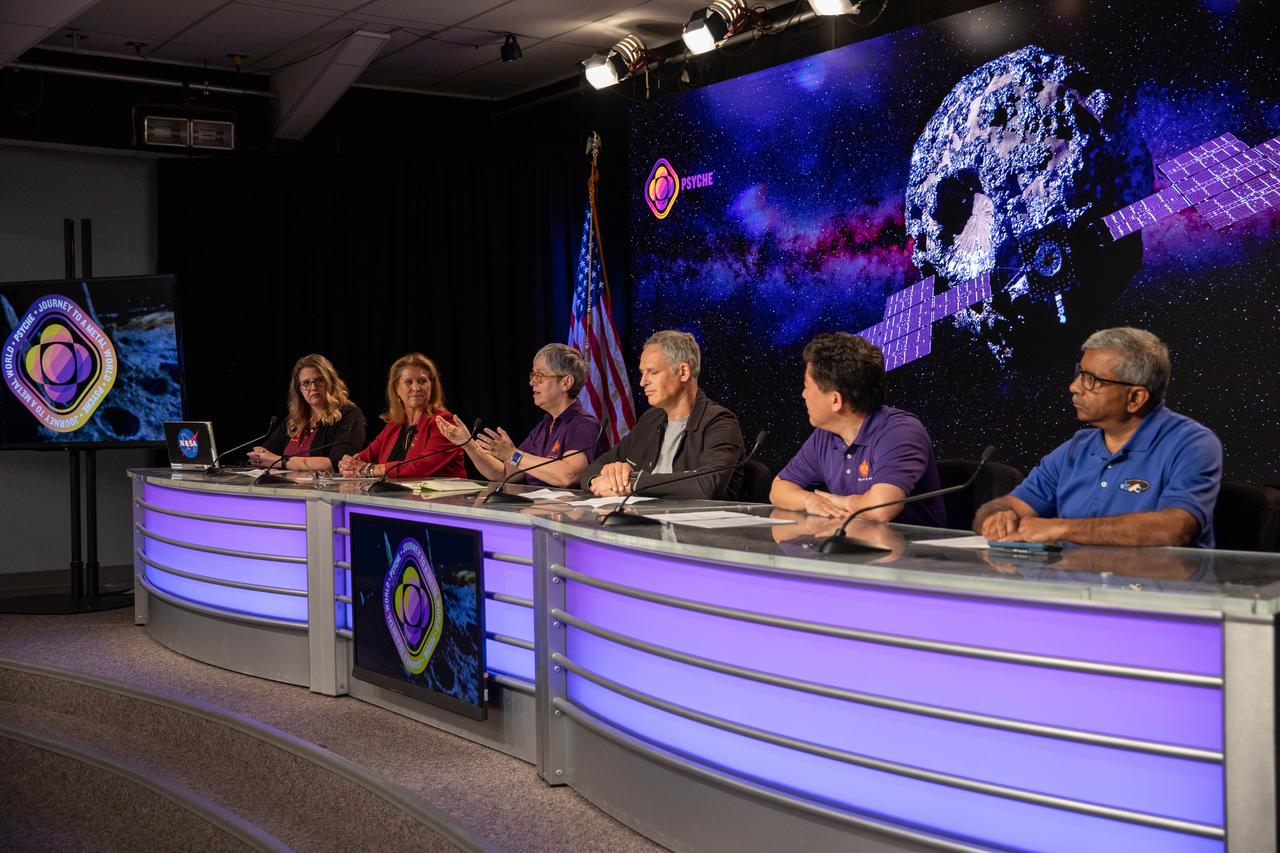
A Psyche mission and science briefing takes place at NASA’s Kennedy Space Center in Florida on Tuesday, Oct. 10, 2023. Participants, from left, are: Alana Johnson, NASA Communications; Lori Glaze, Planetary Science division director, NASA Headquarters; Lindy Elkins-Tanton, Psyche principal investigator, Arizona State University; Ben Weiss, Psyche deputy principal investigator and magnetometer lead, Massachusetts Institute of Technology; David Oh, Psyche chief engineer for operations, NASA’s Jet Propulsion Laboratory (JPL); and Abi Biswas, Deep Space Optical Communications project technologist, JPL. Psyche is the first mission to explore an asteroid with a surface that likely contains substantial amounts of metal rather than rock or ice. Liftoff of NASA’s Psyche spacecraft, atop a SpaceX Falcon Heavy rocket, is targeted for 10:16 a.m. EDT Thursday, Oct. 12, from Kennedy’s Launch Complex 39A.

NASA Office of Communications Senior Science Communications Officer Karen Fox introduces, from left to right, NASA Planetary Science Division Director Lori Glaze, University of Arizona OSIRIS-REx Principal Investigator Dante Lauretta, NASA OSIRIS-REx Deputy Project Manager Mike Moreau, Lockheed Martin Deep Space Exploration Chief Engineer Tim Priser, and NASA Chief Scientist Eileen Stansbery during an OSIRIS-REx sample return press conference, Sunday, Sept. 24, 2023, shortly after the capsule landed at the Department of Defense's Utah Test and Training Range. The sample was collected from the asteroid Bennu in October 2020 by NASA’s OSIRIS-REx spacecraft. Photo Credit: (NASA/Keegan Barber)
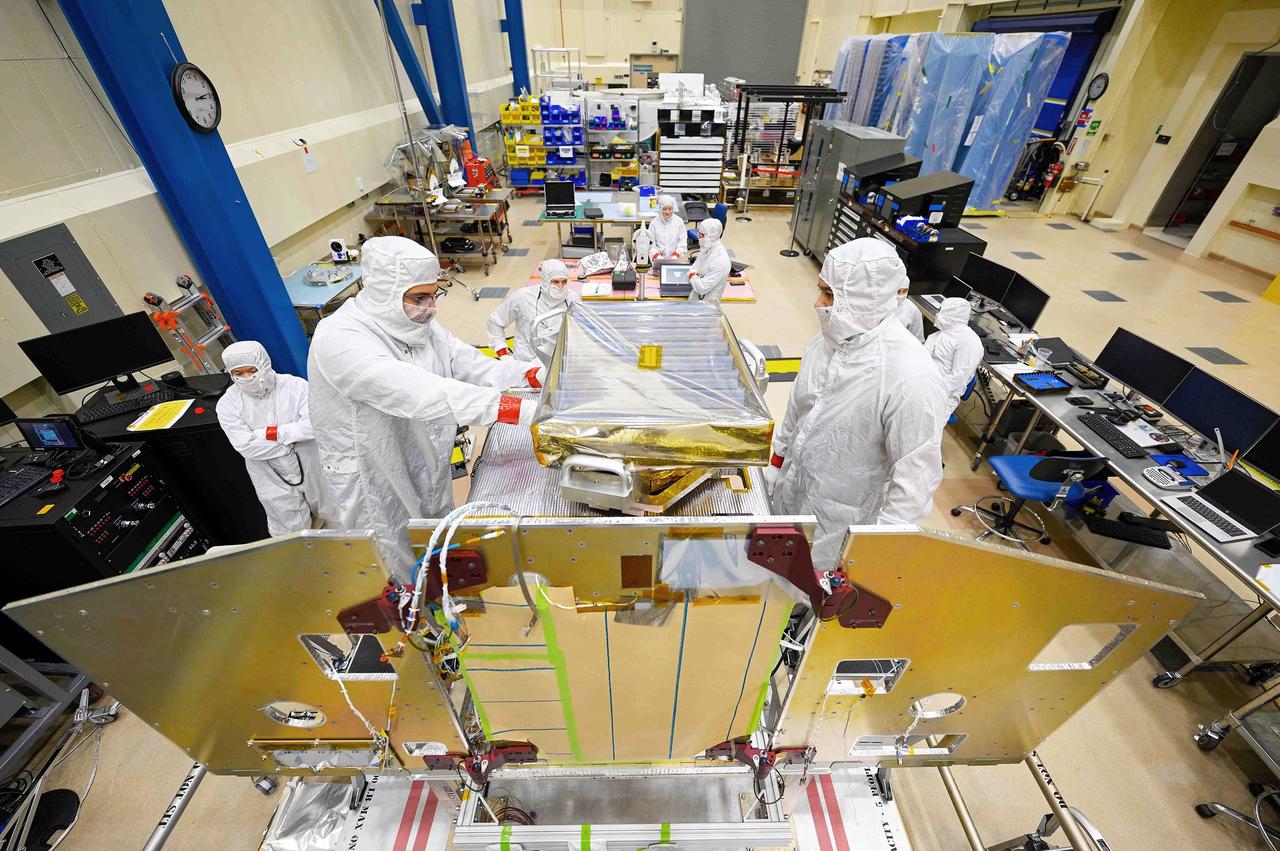
Engineers work on the High-resolution Volatiles and Minerals Moon Mapper (HVM³) for NASA's Lunar Trailblazer spacecraft in a clean room at Lockheed Martin Space in Littleton, Colorado, shortly after the instrument was delivered there in December 2022. The large silver grate wrapped in transparent plastic in the center of the image is the radiator that will maintain the instrument's temperature when in space. HVM³ is an imaging spectrometer that was developed at NASA's Jet Propulsion Laboratory in Southern California. It was shipped from JPL to Lockheed Martin Space, where it was integrated with the spacecraft. HVM³ is one of two instruments that will be used by the mission to detect and map water on the Moon's surface to determine its abundance, location, form, and how it changes over time. Lunar Trailblazer was selected under NASA's Small Innovative Missions for Planetary Exploration (SIMPLEx) program in 2019. The Lunar Trailblazer mission is managed by JPL and its science investigation is led by Caltech in Pasadena, California. Managed for NASA by Caltech, JPL also provides system engineering, mission assurance, the HVM³ instrument, as well as navigation. Lockheed Martin Space provides the spacecraft and integrates the flight system, under contract with Caltech. SIMPLEx mission investigations are managed by the Planetary Missions Program Office at NASA's Marshall Space Flight Center in Huntsville, Alabama, as part of the Discovery Program at NASA Headquarters in Washington. The program conducts space science investigations in the Planetary Science Division of NASA's Science Mission Directorate at NASA Headquarters. https://photojournal.jpl.nasa.gov/catalog/PIA25254

Members of the VERITAS science team pause for a photograph on July 31, 2023, after arriving in Iceland to begin a two-week campaign to study the volcanic island's geology to help the team prepare for NASA's VERITAS (short for Venus Emissivity, Radio science, InSAR, Topography, And Spectroscopy) mission to Venus. From July 30 to Aug. 14, 2023, the international science team, including local participation from the University of Iceland, worked to lay the groundwork for the science that will ultimately be done from Venus orbit. At center, holding the VERITAS mission identifier is the mission's principal investigator and the science team lead, Sue Smrekar, of NASA's Jet Propulsion Laboratory in Southern California. Flanking her are science team members from multiple U.S., Italian, and German institutions, including members of the German Aerospace Center (DLR) Flugzeug Synthetic Aperture Radar (F-SAR) airplane team. The DLR F-SAR team was tasked with collecting synthetic-aperture radar data of the regions studied by the field team. A key objective of the campaign is to refine change detection algorithms that will be used to look for global surface change (such as volcanic activity) between NASA's Magellan radar mission from the 1990s and VERITAS, as well as between VERITAS and the ESA (European Space Agency) EnVision mission to Venus, both of which are targeting the early 2030s for launch. NASA's VERITAS is an orbiter designed to peer through Venus' thick atmosphere with a suite of powerful instruments to create global maps of the planet's surface, including topography, radar images, rock type, and gravity, as well as detect surface changes. VERITAS is designed to understand what processes are currently active, search for evidence of past and current interior water, and understand the geologic evolution of the planet, illuminating how rocky planets throughout the galaxy evolve. VERITAS and NASA's Deep Atmosphere Venus Investigation of Noble gases, Chemistry, and Imaging (DAVINCI) mission were selected in 2021 under NASA's Discovery Program as the agency's next missions to Venus. The Discovery Program is managed by the Planetary Missions Program Office at NASA's Marshall Space Flight Center in Huntsville, Alabama, for the Planetary Science Division of NASA's Science Mission Directorate in Washington. https://photojournal.jpl.nasa.gov/catalog/PIA25835
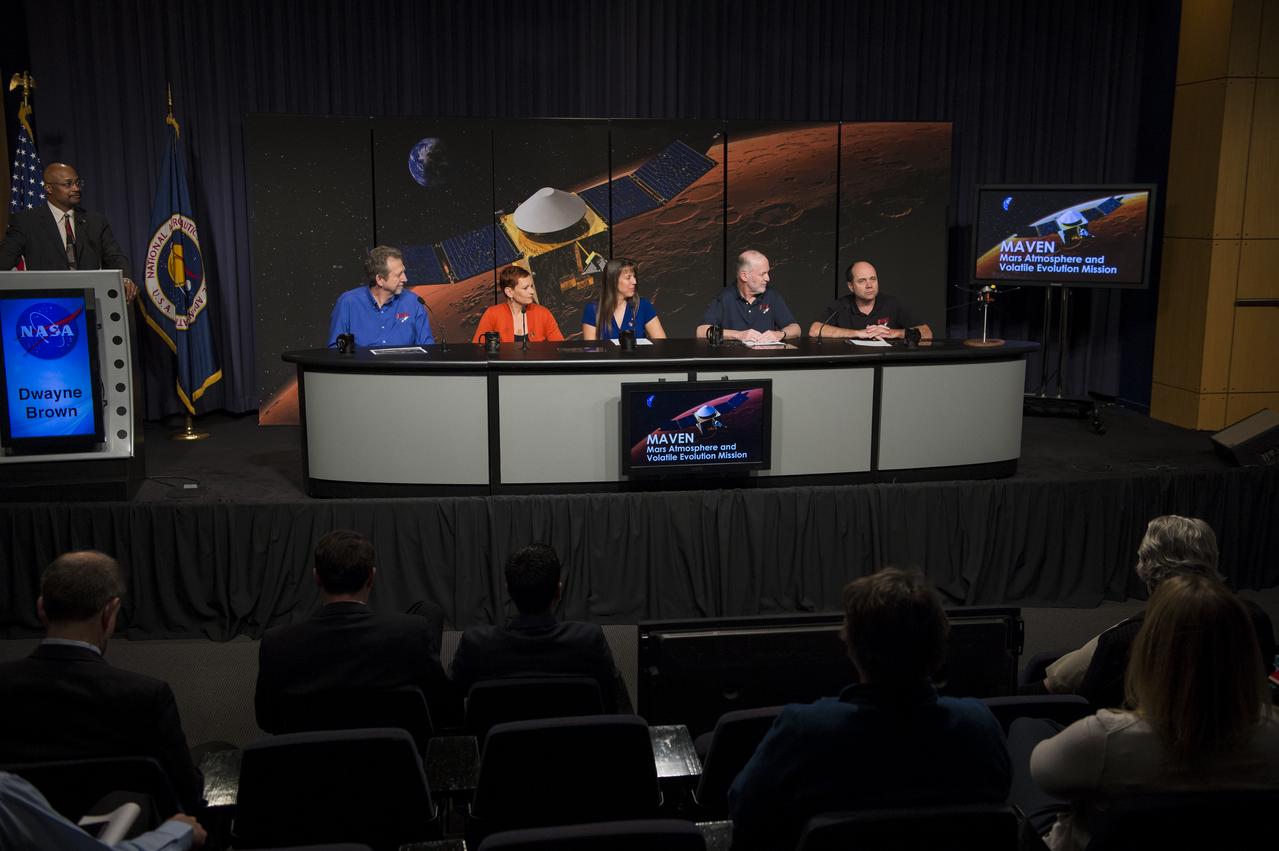
L-R: Dwayne Brown, NASA Public Affairs Officer, Jim Green, director, Planetary Science Division, NASA Headquarters, Lisa May, MAVEN program executive, NASA Headquarters, Kelly Fast, MAVEN program scientist, NASA Headquarters, Bruce Jakosky, MAVEN principal investigator, University of Colorado Boulder Laboratory for Atmospheric and Space Physics, and David Mitchell, MAVEN project manager, NASA's Goddard Space Flight Center, Greenbelt, Md. discuss the upcoming launch of the Mars Atmosphere and Volatile Evolution (MAVEN) mission, at a press conference at NASA Headquarters in Washington on Monday, Oct. 28th, 2013. MAVEN is the agency's next mission to Mars and the first devoted to understanding the upper atmosphere of the Red Planet. (Photo credit: NASA/Jay Westcott)
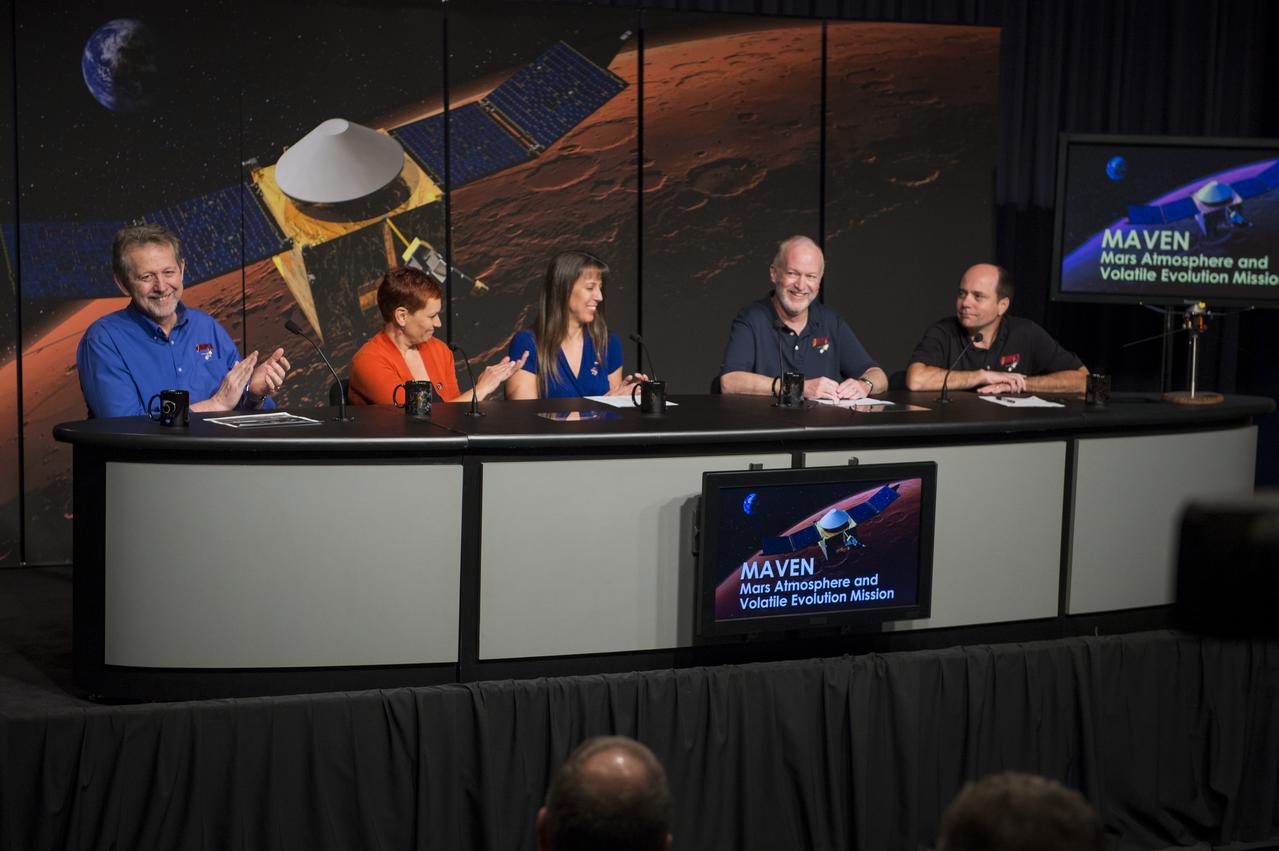
L-R: Jim Green, director, Planetary Science Division, NASA Headquarters, Lisa May, MAVEN program executive, NASA Headquarters, Kelly Fast, MAVEN program scientist, NASA Headquarters, Bruce Jakosky, MAVEN principal investigator, University of Colorado Boulder Laboratory for Atmospheric and Space Physics, and David Mitchell, MAVEN project manager, NASA's Goddard Space Flight Center, Greenbelt, Md. are applauded at the end of a panel discussion on the upcoming launch of the Mars Atmosphere and Volatile Evolution (MAVEN) mission, at a press conference at NASA Headquarters in Washington on Monday, Oct. 28th, 2013. MAVEN is the agency's next mission to Mars and the first devoted to understanding the upper atmosphere of the Red Planet. (Photo credit: NASA/Jay Westcott)
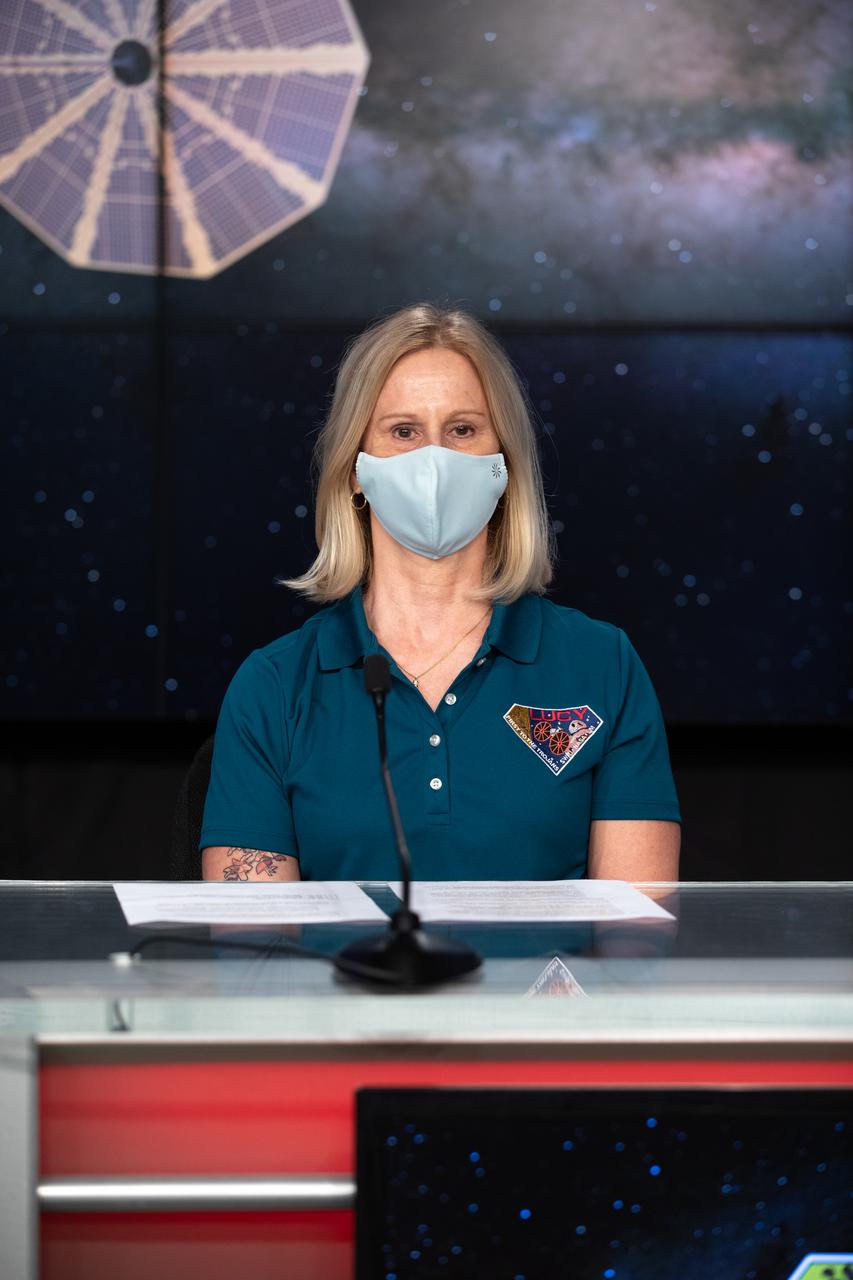
Joan Salute, Planetary Science Division associate director, Flight Programs, NASA HQ, is introduced during an engineering briefing for the Lucy mission held inside the TV Auditorium at NASA’s Kennedy Space Center in Florida on Oct. 14, 2021. The mission is scheduled to launch at 5:34 a.m. EDT Saturday, Oct. 16, on a United Launch Alliance Atlas V 401 rocket from Space Launch Complex 41 at Cape Canaveral Space Force Station. NASA’s Launch Services Program, based at Kennedy, is managing the launch. During its 12-year primary mission, Lucy will explore a record-breaking number of asteroids, flying by one asteroid in the solar system’s main belt and seven Trojan asteroids. Additionally, Lucy’s path will circle back to Earth three times for gravity assists, making it the first spacecraft to return to the vicinity of Earth from the outer solar system.

CAPE CANAVERAL, Fla. -- Dr. Jim Green, director of the Planetary Science Division at NASA Headquarters, participates in a post-launch news conference in NASA's Press Site TV auditorium following the successful launch of NASA’s Mars Atmosphere and Volatile EvolutioN, or MAVEN, spacecraft. Launch was on schedule at 1:28 p.m. EST Nov. 18 at the opening of a two-hour launch window. After a 10-month journey to the Red Planet, MAVEN will study its upper atmosphere in unprecedented detail from orbit above the planet. Built by Lockheed Martin in Littleton, Colo., MAVEN will arrive at Mars in September 2014 and will be inserted into an elliptical orbit with a high point of 3,900 miles, swooping down to as close as 93 miles above the planet's surface. For more information, visit: http://www.nasa.gov/mission_pages/maven/main/index.html. Photo credit: NASA/Kim Shiflett
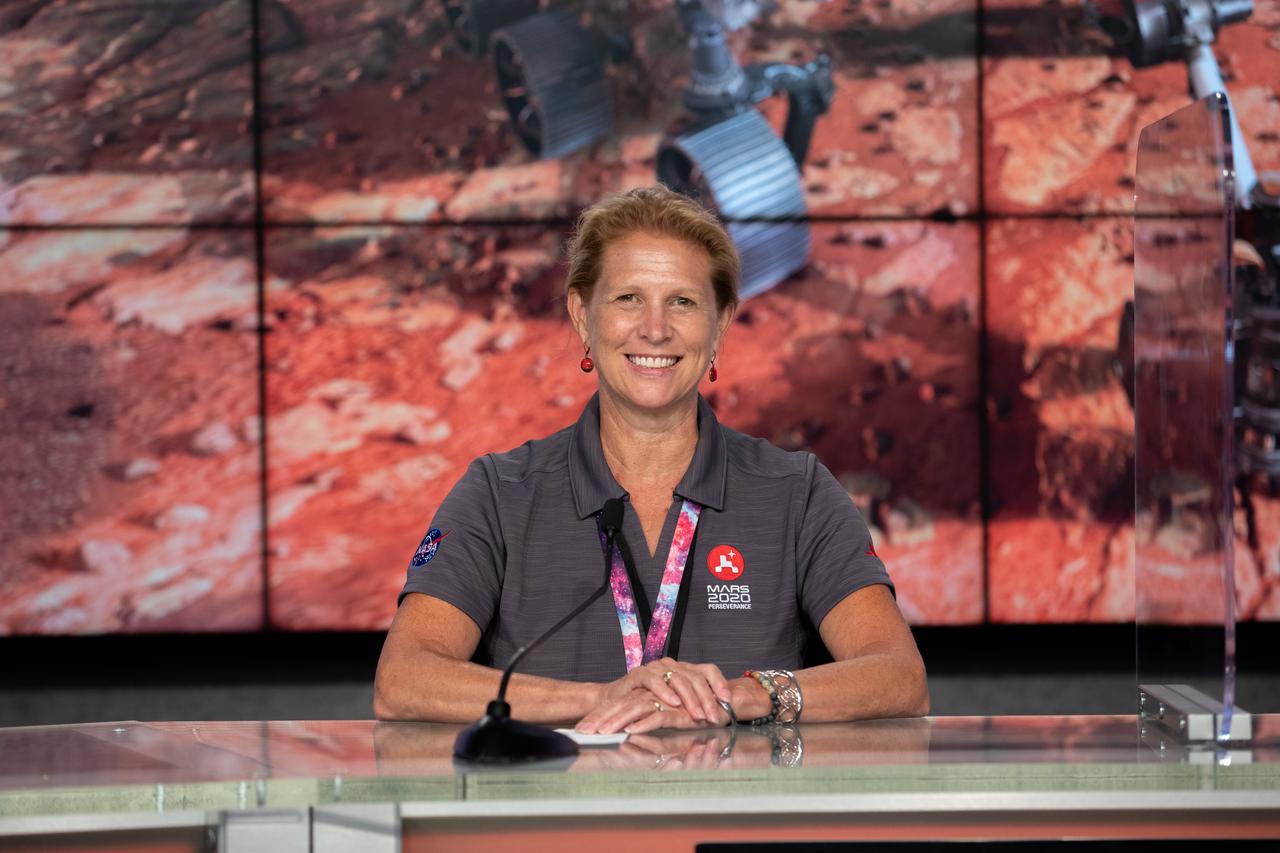
Lori Glaze, Planetary Science Division director, NASA Headquarters, participates in a Mars 2020 post-launch news conference at NASA’s Kennedy Space Center in Florida on July 30, 2020. The United Launch Alliance Atlas V 541 rocket lifted off from Space Launch Complex 41 at Cape Canaveral Air Force Station at 7:50 a.m. EDT, carrying the agency’s Mars Perseverance rover and Ingenuity helicopter. The rover is part of NASA’s Mars Exploration Program, a long-term effort of robotic exploration of the Red Planet. The rover will search for habitable conditions in the ancient past and signs of past microbial life on Mars. The Launch Services Program at Kennedy is responsible for launch management.
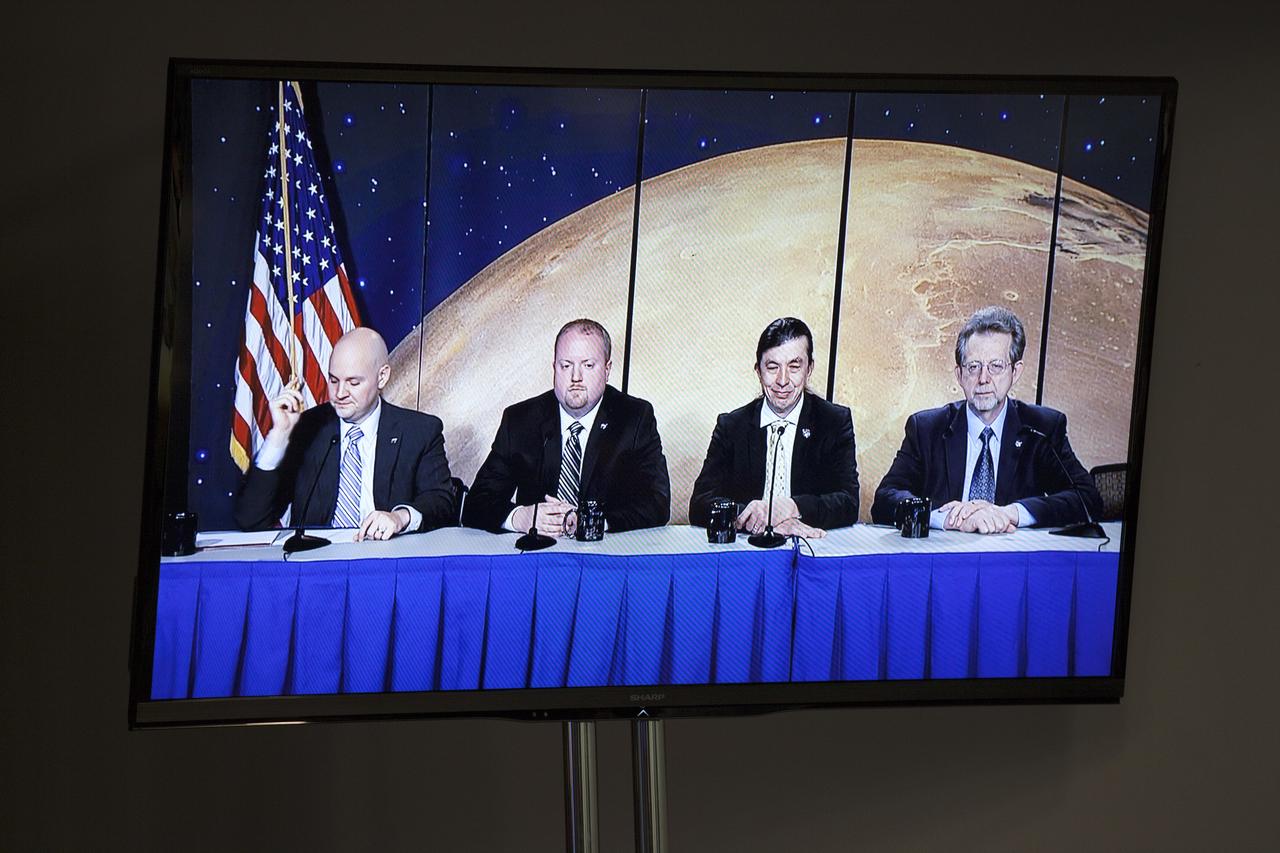
CAPE CANAVERAL, Fla. – At NASA Headquarters in Washington and the Kennedy Space Center in Florida, NASA leaders spoke to members of the new media about how the first flight of the new Orion spacecraft is a first step in the agency's plans to send humans to Mars. Seen on a video monitor at Kennedy, Headquarter participants, from the left are: Trent Perrotto of NASA Public Affairs, Jason Crusan, director of Advanced Exploration Systems Division of Human Exploration and Operations Mission Directorate, Jim Reuther, deputy associate administrator for Programs, Space Technology Mission Directorate, and Jim Green, director of Planetary Division of the Science Mission Directorate. Orion is the exploration spacecraft designed to carry astronauts to destinations not yet explored by humans, including an asteroid and Mars. It will have emergency abort capability, sustain the crew during space travel and provide safe re-entry from deep space return velocities. The first unpiloted flight test of Orion is scheduled to launch Dec. 4, 2014 atop a United Launch Alliance Delta IV Heavy rocket, and in 2018 on NASA’s Space Launch System rocket. For more information, visit www.nasa.gov/orion Photo credit: NASA/Kim Shiflett
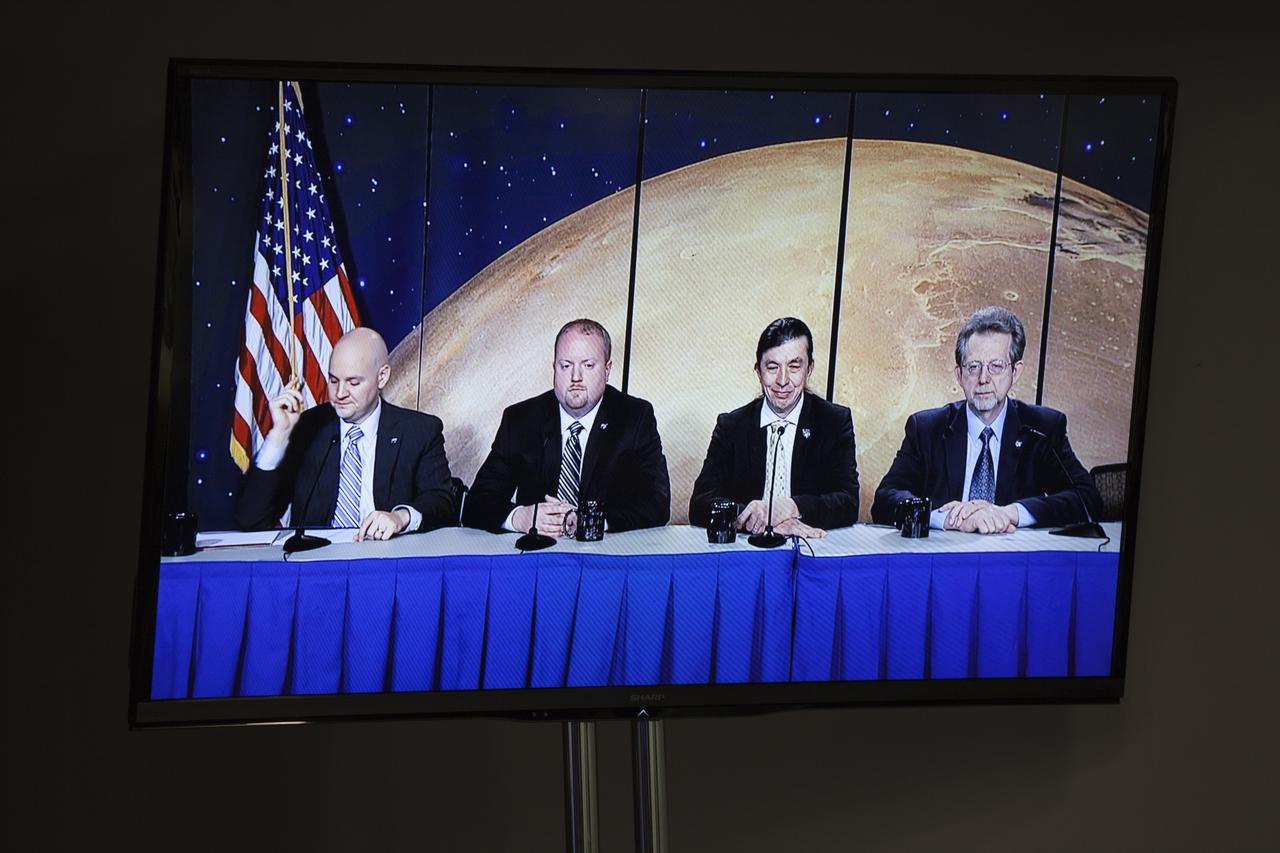
At NASA Headquarters in Washington and the Kennedy Space Center in Florida, NASA leaders spoke to members of the new media about how the first flight of the new Orion spacecraft is a first step in the agency's plans to send humans to Mars. Seen on a video monitor at Kennedy, Headquarter participants, from the left are: Trent Perrotto of NASA Public Affairs, Jason Crusan, director of Advanced Exploration Systems Division of Human Exploration and Operations Mission Directorate, Jim Reuther, deputy associate administrator for Programs, Space Technology Mission Directorate, and Jim Green, director of Planetary Division of the Science Mission Directorate. Orion is the exploration spacecraft designed to carry astronauts to destinations not yet explored by humans, including an asteroid and Mars. It will have emergency abort capability, sustain the crew during space travel and provide safe re-entry from deep space return velocities. The first unpiloted flight test of Orion is scheduled to launch Dec. 4, 2014 atop a United Launch Alliance Delta IV Heavy rocket, and in 2018 on NASA’s Space Launch System rocket.

CAPE CANAVERAL, Fla. -- In the Press Site auditorium at NASA's Kennedy Space Center in Florida, a briefing was held to update media on the upcoming launch of NASA's Juno spacecraft. Seen here are NASA Panel Moderator and Public Affairs Officer George Diller (left), Jim Green, director of the Planetary Science Division at Headquarters in Washington, D.C.; Scott Bolton, Juno principal investigator with the Southwest Research Institute in San Antonio, Texas; Jan Chodas, Juno project manager with the Jet Propulsion Laboratory in Pasadena, Calif., and Kaelyn Badura, Pine Ridge High School, Deltona, Fla. high school student, Juno Education program participant and Goldstone Apple Valley Radio Telescope Project participant. Juno is scheduled to launch aboard an United Launch Alliance Atlas V from Cape Canaveral, Fla. Aug. 5.The solar-powered spacecraft will orbit Jupiter's poles 33 times to find out more about the gas giant's origins, structure, atmosphere and magnetosphere and investigate the existence of a solid planetary core. For more information visit: www.nasa.gov/juno. Photo credit: NASA/Gianni M. Woods

CAPE CANAVERAL, Fla. -- In the Press Site auditorium at NASA's Kennedy Space Center in Florida, a briefing was held to update media on the upcoming launch of NASA's Juno spacecraft. Seen here are Jim Green, director of the Planetary Science Division at Headquarters in Washington, D.C.; Scott Bolton, Juno principal investigator with the Southwest Research Institute in San Antonio, Texas; Jan Chodas, Juno project manager with the Jet Propulsion Laboratory in Pasadena, Calif., and Kaelyn Badura, Pine Ridge High School, Deltona, Fla. high school student, Juno Education program participant and Goldstone Apple Valley Radio Telescope Project participant. Juno is scheduled to launch aboard an United Launch Alliance Atlas V from Cape Canaveral, Fla. Aug. 5.The solar-powered spacecraft will orbit Jupiter's poles 33 times to find out more about the gas giant's origins, structure, atmosphere and magnetosphere and investigate the existence of a solid planetary core. For more information visit: www.nasa.gov/juno. Photo credit: NASA/Gianni M. Woods

CAPE CANAVERAL, Fla. -- In the Press Site auditorium at NASA's Kennedy Space Center in Florida, a briefing was held to update media on the upcoming launch of NASA's Juno spacecraft. Seen here are NASA Panel Moderator and Public Affairs Officer George Diller (left), Jim Green, director of the Planetary Science Division at Headquarters in Washington, D.C.; Scott Bolton, Juno principal investigator with the Southwest Research Institute in San Antonio, Texas; Jan Chodas, Juno project manager with the Jet Propulsion Laboratory in Pasadena, Calif., and Kaelyn Badura, Pine Ridge High School, Deltona, Fla. high school student, Juno Education program participant and Goldstone Apple Valley Radio Telescope Project participant. Juno is scheduled to launch aboard an United Launch Alliance Atlas V from Cape Canaveral, Fla. Aug. 5.The solar-powered spacecraft will orbit Jupiter's poles 33 times to find out more about the gas giant's origins, structure, atmosphere and magnetosphere and investigate the existence of a solid planetary core. For more information visit: www.nasa.gov/juno. Photo credit: NASA/Gianni M. Woods

CAPE CANAVERAL, Fla. -- In the Press Site auditorium at NASA's Kennedy Space Center in Florida, a briefing was held to update media on the upcoming launch of NASA's Juno spacecraft. Seen here are NASA Panel Moderator and Public Affairs Officer George Diller (left), Jim Green, director of the Planetary Science Division at Headquarters in Washington, D.C.; Scott Bolton, Juno principal investigator with the Southwest Research Institute in San Antonio, Texas; Jan Chodas, Juno project manager with the Jet Propulsion Laboratory in Pasadena, Calif., and Kaelyn Badura, Pine Ridge High School, Deltona, Fla. high school student, Juno Education program participant and Goldstone Apple Valley Radio Telescope Project participant. Juno is scheduled to launch aboard an United Launch Alliance Atlas V from Cape Canaveral, Fla. Aug. 5.The solar-powered spacecraft will orbit Jupiter's poles 33 times to find out more about the gas giant's origins, structure, atmosphere and magnetosphere and investigate the existence of a solid planetary core. For more information visit: www.nasa.gov/juno. Photo credit: NASA/Gianni M. Woods