
NASA Terrestrial Planet Finder will use multiple telescopes working together to take family portraits of stars and their orbiting planets and determine which planets may have the right chemistry to sustain life.

Sliver of a Planet

Background Planet

Planet in Repose

Raging Planet

Fantastic Planet

Three simulated planets -- one as bright as Jupiter, one half as bright as Jupiter and one as faint as Earth -- stand out plainly in this image created from a sequence of 480 images captured by the High Contrast Imaging Testbed at NASA JPL.

Another Girl, Another Planet

MESSENGER Encounters the Innermost Planet

A Swiftly Non-Tilting Planet

From Rings to Planet

Rings Against a Dark Planet

This NASA Hubble Space Telescope image of the planet Uranus reveals the planet rings and bright clouds and a high altitude haze above the planet south pole.

Colors of the Innermost Planet: View 2

01 January 2000 On The Red Planet

Colors of the Innermost Planet: View 1

Two's company, but three might not always be a crowd — at least in space. Astronomers using NASA's Hubble Space Telescope, and a trick of nature, have confirmed the existence of a planet orbiting two stars in the system OGLE-2007-BLG-349, located 8,000 light-years away towards the center of our galaxy. The planet orbits roughly 300 million miles from the stellar duo, about the distance from the asteroid belt to our sun. It completes an orbit around both stars roughly every seven years. The two red dwarf stars are a mere 7 million miles apart, or 14 times the diameter of the moon's orbit around Earth. The Hubble observations represent the first time such a three-body system has been confirmed using the gravitational microlensing technique. Gravitational microlensing occurs when the gravity of a foreground star bends and amplifies the light of a background star that momentarily aligns with it. The particular character of the light magnification can reveal clues to the nature of the foreground star and any associated planets. The three objects were discovered in 2007 by an international collaboration of five different groups: Microlensing Observations in Astrophysics (MOA), the Optical Gravitational Lensing Experiment (OGLE), the Microlensing Follow-up Network (MicroFUN), the Probing Lensing Anomalies Network (PLANET), and the Robonet Collaboration. These ground-based observations uncovered a star and a planet, but a detailed analysis also revealed a third body that astronomers could not definitively identify. Image caption: This artist's illustration shows a gas giant planet circling a pair of red dwarf stars in the system OGLE-2007-BLG-349, located 8,000 light-years away. The Saturn-mass planet orbits roughly 300 million miles from the stellar duo. The two red dwarf stars are 7 million miles apart. Credit: NASA, ESA, and G. Bacon (STScI) Read more: <a href="http://go.nasa.gov/2dcfMns" rel="nofollow">go.nasa.gov/2dcfMns</a> <b><a href="http://www.nasa.gov/audience/formedia/features/MP_Photo_Guidelines.html" rel="nofollow">NASA image use policy.</a></b> <b><a href="http://www.nasa.gov/centers/goddard/home/index.html" rel="nofollow">NASA Goddard Space Flight Center</a></b> enables NASA’s mission through four scientific endeavors: Earth Science, Heliophysics, Solar System Exploration, and Astrophysics. Goddard plays a leading role in NASA’s accomplishments by contributing compelling scientific knowledge to advance the Agency’s mission. <b>Follow us on <a href="http://twitter.com/NASAGoddardPix" rel="nofollow">Twitter</a></b> <b>Like us on <a href="http://www.facebook.com/pages/Greenbelt-MD/NASA-Goddard/395013845897?ref=tsd" rel="nofollow">Facebook</a></b> <b>Find us on <a href="http://instagrid.me/nasagoddard/?vm=grid" rel="nofollow">Instagram</a></b>

Composite image of the planet Mars taken by Hubble Space Telescope (HST) Wide Field and Planetary Camera (WFPC).

An artist's rendition of how a rocky planet forms. As a rocky planet forms, the planet-forming material gathers in a process known as "accretion." It grows larger in size, and increases in temperature, along with the pressure at its core. The energy from this initial planet forming process causes the planet's elements to heat up and melt. Upon melting, layers form and separate. The heavier elements sink to the bottom, the lighter ones float to the top. This material then separates into layers as it cools, which is known as "differentiation." A fully formed planet slowly emerges, with an upper layer known as the crust, the mantle in the middle, and a solid iron core. InSight is short for Interior Exploration using Seismic Investigations, Geodesy and Heat Transport. The InSight mission will help answer key questions about how the rocky planets of the solar system, as well as how rocky exoplanets, formed. So while InSight is a Mars mission, it's also more than a Mars mission. The lander seeks the fingerprints of the processes that formed the rocky planets of the solar system, more than 4 billion years ago. It measures the planet's "vital signs:" its "pulse" (seismology), "temperature" (heat flow) and "reflexes" (precision tracking). https://photojournal.jpl.nasa.gov/catalog/PIA22233

Release Date: July 10, 2003 A rich starry sky fills the view from an ancient gas-giant planet in the core of the globular star cluster M4, as imagined in this artist's concept. The 13-billion-year-old planet orbits a helium white-dwarf star and the millisecond pulsar B1620-26, seen at lower left. The globular cluster is deficient in heavier elements for making planets, so the existence of such a world implies that planet formation may have been quite efficient and common in the early universe. Object Names: B1620-26, M4 Image Type: Artwork Illustration Credit: NASA and G. Bacon (STScI) To learn more about this image go to: <a href="http://www.nasa.gov/centers/goddard/news/topstory/2003/0709hstssu.html" rel="nofollow">www.nasa.gov/centers/goddard/news/topstory/2003/0709hstss...</a> <b><a href="http://www.nasa.gov/centers/goddard/home/index.html" rel="nofollow">NASA Goddard Space Flight Center</a></b> is home to the nation's largest organization of combined scientists, engineers and technologists that build spacecraft, instruments and new technology to study the Earth, the sun, our solar system, and the universe.

This image taken with the Palomar Observatory Hale Telescope, shows the light from three planets orbiting a star 120 light-years away. The planets star, called HR8799, is located at the spot marked with an X.

Jupiter, Saturn, Uranus, and Neptune are known as the jovian Jupiter-like planets because they are all gigantic compared with Earth, and they have a gaseous nature. This diagram shows the approximate distance of the jovian planets from the Sun.

This artist concept depicts the pulsar planet system discovered by Aleksander Wolszczan in 1992. Wolszczan used the Arecibo radio telescope in Puerto Rico to find three planets circling a pulsar called PSR B1257+12.

Detailed measurements of the physical properties of the seven rocky TRAPPIST-1 planets and the four terrestrial planets in our solar system help scientists find similarities and differences between the two planet families. https://photojournal.jpl.nasa.gov/catalog/PIA24373

Researchers have detected the first exomoon candidate -- a moon orbiting a planet that lies outside our solar system. Using a technique called microlensing, they observed what could be either a moon and a planet -- or a planet and a star.

This artist concept shows the smallest star known to host a planet. The planet, called VB 10b, was discovered using astrometry, a method in which the wobble induced by a planet on its star is measured precisely on the sky.

This plot tells astronomers that a fifth planet is in orbit around the star 55 Cancri, making the star the record-holder for hosting the most known exoplanets.

This chart compares the first Earth-size planets found around a sun-like star to planets in our own solar system, Earth and Venus. NASA Kepler mission discovered the newfound planets, called Kepler-20e and Kepler-20f.

Astronomers using NASA's Hubble Space Telescope have found compelling evidence of a planet forming 7.5 billion miles away from its star, a finding that may challenge current theories about planet formation. Of the almost 900 planets outside our solar system that have been confirmed to date, this is the first to be found at such a great distance from its star. The suspected planet is orbiting the diminutive red dwarf TW Hydrae, a popular astronomy target located 176 light-years away from Earth in the constellation Hydra the Sea Serpent. Read more: <a href="http://1.usa.gov/196B6lZ" rel="nofollow">1.usa.gov/196B6lZ</a> NASA, ESA, J. Debes (STScI), H. Jang-Condell (University of Wyoming), A. Weinberger (Carnegie Institution of Washington), A. Roberge (Goddard Space Flight Center), G. Schneider (University of Arizona/Steward Observatory), and A. Feild (STScI/AURA) <b><a href="http://www.nasa.gov/audience/formedia/features/MP_Photo_Guidelines.html" rel="nofollow">NASA image use policy.</a></b> <b><a href="http://www.nasa.gov/centers/goddard/home/index.html" rel="nofollow">NASA Goddard Space Flight Center</a></b> enables NASA’s mission through four scientific endeavors: Earth Science, Heliophysics, Solar System Exploration, and Astrophysics. Goddard plays a leading role in NASA’s accomplishments by contributing compelling scientific knowledge to advance the Agency’s mission. <b>Follow us on <a href="http://twitter.com/NASA_GoddardPix" rel="nofollow">Twitter</a></b> <b>Like us on <a href="http://www.facebook.com/pages/Greenbelt-MD/NASA-Goddard/395013845897?ref=tsd" rel="nofollow">Facebook</a></b> <b>Find us on <a href="http://instagram.com/nasagoddard?vm=grid" rel="nofollow">Instagram</a></b>

Mars Radar Opens a Planet Third Dimension

A Color View of the Solar System Innermost Planet

Springtime on Mars: Hubble Best View of the Red Planet

Long Scarps on Mercury Tell of the Planet Unique History

This illustration shows the unusual orbit of planet Kepler-413b around a close pair of orange and red dwarf stars. The planet 66-day orbit is tilted 2.5 degrees with respect to the plane of the binary stars orbit.

A dusty planetary system left is compared to another system with little dust in this artist concept. Dust can make it difficult for telescopes to image planets because light from the dust can outshine that of the planets.

This artist conception shows the 30 Ari system, which includes four stars and a planet. The planet, a gas giant, orbits its primary star yellow in about a year time.

This figure charts 30 hours of observations taken by NASA Spitzer Space Telescope of a strongly irradiated exoplanet an planet orbiting a star beyond our own. Spitzer measured changes in the planet heat, or infrared light.

This artist's concept shows OGLE-2016-BLG-1195Lb, a planet discovered through a technique called microlensing. The planet was reported in a 2017 study in the Astrophysical Journal Letters. Study authors used the Korea Microlensing Telescope Network (KMTNet), operated by the Korea Astronomy and Space Science Institute, and NASA's Spitzer Space Telescope, to track the microlensing event and find the planet. Although OGLE-2016-BLG-1195Lb is about the same mass as Earth, and the same distance from its host star as our planet is from our sun, the similarities may end there. This planet is nearly 13,000 light-years away and orbits a star so small, scientists aren't sure if it's a star at all. https://photojournal.jpl.nasa.gov/catalog/PIA21430

Our solar system features eight planets, seen in this artist’s diagram. This representation is intentionally fanciful, as the planets are depicted far closer together than they really are.

This illustration shows HD 189733b, a huge gas giant that orbits very close to its host star HD 189733. The planet's atmosphere is scorching with a temperature of over 1000 degrees Celsius, and it rains glass, sideways, in howling 7000 kilometre-per-hour winds. At a distance of 63 light-years from us, this turbulent alien world is one of the nearest exoplanets to Earth that can be seen crossing the face of its star. By observing this planet before, during, and after it disappeared behind its host star during orbit, astronomers were able to deduce that HD 189733b is a deep, azure blue — reminiscent of Earth's colour as seen from space. Credit: NASA, ESA, M. Kornmesser Read more: <a href="http://1.usa.gov/1dnDZPu" rel="nofollow">1.usa.gov/1dnDZPu</a> <b><a href="http://www.nasa.gov/audience/formedia/features/MP_Photo_Guidelines.html" rel="nofollow">NASA image use policy.</a></b> <b><a href="http://www.nasa.gov/centers/goddard/home/index.html" rel="nofollow">NASA Goddard Space Flight Center</a></b> enables NASA’s mission through four scientific endeavors: Earth Science, Heliophysics, Solar System Exploration, and Astrophysics. Goddard plays a leading role in NASA’s accomplishments by contributing compelling scientific knowledge to advance the Agency’s mission. <b>Follow us on <a href="http://twitter.com/NASA_GoddardPix" rel="nofollow">Twitter</a></b> <b>Like us on <a href="http://www.facebook.com/pages/Greenbelt-MD/NASA-Goddard/395013845897?ref=tsd" rel="nofollow">Facebook</a></b> <b>Find us on <a href="http://instagram.com/nasagoddard?vm=grid" rel="nofollow">Instagram</a></b>

This diagram shows the approximate distances of the terrestrial planets from the Sun; they include Mercury, Venus, Earth, and Mars.

Planets having atmospheres rich in helium may be common in our galaxy, according to a new theory based on data from NASA's Spitzer Space Telescope. These planets would be around the mass of Neptune, or lighter, and would orbit close to their stars, basking in their searing heat. According to the new theory, radiation from the stars would boil off hydrogen in the planets' atmospheres. Both hydrogen and helium are common ingredients of gas planets like these. Hydrogen is lighter than helium and thus more likely to escape. After billions of years of losing hydrogen, the planet's atmosphere would become enriched with helium. Scientists predict the planets would appear covered in white or gray clouds. This is in contrast to our own Neptune, which is blue due to the presence of methane. Methane absorbs the color red, leaving blue. Neptune is far from our sun and hasn't lost its hydrogen. The hydrogen bonds with carbon to form methane. This artist's concept depicts a proposed helium-atmosphere planet called GJ 436b, which was found by Spitzer to lack in methane -- a first clue about its lack of hydrogen. The planet orbits every 2.6 days around its star, which is cooler than our sun and thus appears more yellow-orange in color. http://photojournal.jpl.nasa.gov/catalog/PIA19344

This artist concept shows the searing-hot gas planet WASP-12b orange orb and its star. NASA Spitzer Space Telescope discovered that the planet has more carbon than oxygen, making it the first carbon-rich planet ever observed.

This still from a video shows illustrations of the seven Earth-size planets of TRAPPIST-1, an exoplanet system about 40 light-years away, based on data current as of February 2018. Each planet is shown in sequence, starting with the innermost TRAPPIST-1b and ending with the outermost TRAPPIST-1h. The video presents the planets' relative sizes as well as the relative scale of the central star as seen from each planet. The art highlights possibilities for how the surfaces of these intriguing worlds might look based on their newly calculated properties. The seven planets of TRAPPIST-1 are all Earth-sized and terrestrial. TRAPPIST-1 is an ultra-cool dwarf star in the constellation Aquarius, and its planets orbit very close to it. In the background, slightly distorted versions our familiar constellations, including Orion and Taurus, are shown as they would appear from the location of TRAPPIST-1 (backdrop image courtesy California Academy of Sciences/Dan Tell). An animation is available at https://photojournal.jpl.nasa.gov/catalog/PIA22098

This image made with data from NASA's Dawn spacecraft shows pit chains on dwarf planet Ceres called Samhain Catenae. Scientists created this image by draping the grayscale mosaic of Ceres' surface onto the shape model of the dwarf planet. The arrows in the image point to a few of the pit chains investigated in a 2017 study in the journal Geophysical Research Letters. https://photojournal.jpl.nasa.gov/catalog/PIA22086

This artist's concept shows a hypothetical "rejuvenated" planet -- a gas giant that has reclaimed its youthful infrared glow. NASA's Spitzer Space Telescope found tentative evidence for one such planet around a dead star, or white dwarf, called PG 0010+280 (depicted as white dot in illustration). When planets are young, they are warm and toasty due to internal heat left over from their formation. Planets cool over time -- until they are possibly rejuvenated. The theory goes that this Jupiter-like planet, which orbits far from its star, would accumulate some of the material sloughed off by its star as the star was dying. The material would cause the planet to swell in mass. As the material fell onto the planet, it would heat up due to friction and glow with infrared light. The final result would be an old planet, billions of years in age, radiating infrared light as it did in its youth. Spitzer detected an excess infrared light around the white dwarf PG 0010+280. Astronomers aren't sure where the light is coming from, but one possibility is a rejuvenated planet. Future observations may help solve the mystery. A Jupiter-like planet is about ten times the size of a white dwarf. White dwarfs are about the size of Earth, so one white dwarf would easily fit into the Great Red Spot on Jupiter! http://photojournal.jpl.nasa.gov/catalog/PIA19346

This is an artist conception of a solar-system montage of the eight planets, a comet and an asteroid.

This artist's concept shows what the TRAPPIST-1 planetary system may look like, based on available data about the planets' diameters, masses and distances from the host star. The system has been revealed through observations from NASA's Spitzer Space Telescope and the ground-based TRAPPIST (TRAnsiting Planets and PlanetesImals Small Telescope) telescope, as well as other ground-based observatories. The system was named for the TRAPPIST telescope. The seven planets of TRAPPIST-1 are all Earth-sized and terrestrial, according to research published in 2017 in the journal Nature. TRAPPIST-1 is an ultra-cool dwarf star in the constellation Aquarius, and its planets orbit very close to it. They are likely all tidally locked, meaning the same face of the planet is always pointed at the star, as the same side of our moon is always pointed at Earth. This creates a perpetual night side and perpetual day side on each planet. TRAPPIST-1b and c receive the most light from the star and would be the warmest. TRAPPIST-1e, f and g all orbit in the habitable zone, the area where liquid water is most likely to be detected. But any of the planets could potentially harbor liquid water, depending on their compositions. In the imagined planets shown here, TRAPPIST-1b is shown as a larger analogue to Jupiter's moon Io. TRAPPIST-1d is depicted with a narrow band of water near the terminator, the divide between a hot, dry day and an ice-covered night side. TRAPPIST-1e and TRAPPIST-1f are both shown covered in water, but with progressively larger ice caps on the night side. TRAPPIST-1g is portrayed with an atmosphere like Neptune's, although it is still a rocky world. TRAPPIST-1h, the farthest from the star, would be the coldest. It is portrayed here as an icy world, similar to Jupiter's moon Europa, but the least is known about it. http://photojournal.jpl.nasa.gov/catalog/PIA21422

Dwarf planet Ceres is located in the main asteroid belt, between the orbits of Mars and Jupiter, as illustrated in this artist conception.

This artist concept shows NASA Dawn spacecraft arriving at the dwarf planet Ceres, the most massive body in the asteroid belt. Dawn is the first mission to visit a dwarf planet.

A Neptune-size planet with a clear atmosphere is shown crossing in front of its star in this artist depiction. Such crossings, or transits, are observed by telescopes like NASA Hubble and Spitzer to glean information about planets atmospheres.

This artist concept takes us on a journey to 55 Cancri, a star with a family of five known planets - the most planets discovered so far around a star besides our own.

This frame from a video depicts artist concepts of each of the seven planets orbiting TRAPPIST-1, an ultra-cool dwarf stars. Over 21 days, NASA's Spitzer Space Telescope measured the drop in light as each planet passed in front of the star. Spitzer was able to identify a total of seven rocky worlds, including three in the habitable zone where life is possible. The study established the planets' size, distance from their sun and, for some of them, their approximate mass and density. It also established that some, if not all, these planets are tidally locked, meaning one face of the planet permanently faces their sun. The planets appear in the order of innermost to outermost planets. These artist's concepts were designed as follows: TRAPPIST-1b, closest to the star, was modeled on Jupiter's moon Io, which has volcanic features due to strong gravitational tugs. TRAPPIST-1c is shown as a rocky, warm world with a small ice cap on the side that never faces the star. TRAPPSIT-1d is rocky and has water only in a thin band along the terminator, dividing the day side and night side. TRAPPIST-1e and TRAPPIST-1f are both shown covered in water, but with progressively larger ice caps on the night side. TRAPPIST-1g is portrayed with an atmosphere like Neptune's, although it is still a rocky world. The farthest planet, TRAPPIST-1h, is shown as covered in ice, similar to Jupiter's icy moon Europa. The background stars are what you would see if you were in the TRAPPIST-1 system. Orion passes behind the planets, recognizable but distorted from what we're familiar with, in addition to Taurus and Pleiades. A video is available at http://photojournal.jpl.nasa.gov/catalog/PIA21468

This infographic explains how NASA Spitzer Space Telescope can be used in tandem with a telescope on the ground to measure the distances to planets discovered using the microlensing technique. http://photojournal.jpl.nasa.gov/catalog/PIA19332

Measuring the mass and diameter of a planet reveals its density, which can give scientists clues about its composition. Scientists now know the density of the seven TRAPPIST-1 planets with a higher precision than any other planets in the universe, other than those in our own solar system. https://photojournal.jpl.nasa.gov/catalog/PIA23870

This artist's illustration shows the planetary system K2-138, which was discovered by citizen scientists in 2017 using data from NASA's Kepler space telescope. Five planets were initially detected in the system. In 2018, scientists using NASA's Spitzer Space Telescope found evidence of a sixth planet in the system. https://photojournal.jpl.nasa.gov/catalog/PIA23002

This illustration shows the seven Earth-size planets of TRAPPIST-1, an exoplanet system about 40 light-years away, based on data current as of February 2018. The image shows the planets' relative sizes but does not represent their orbits to scale. The art highlights possibilities for how the surfaces of these intriguing worlds might look based on their newly calculated properties. The seven planets of TRAPPIST-1 are all Earth-sized and terrestrial. TRAPPIST-1 is an ultra-cool dwarf star in the constellation Aquarius, and its planets orbit very close to it. In the background, slightly distorted versions the familiar constellations of Orion and Taurus are shown as they would appear from the location of TRAPPIST-1 (courtesy of California Academy of Sciences/Dan Tell). https://photojournal.jpl.nasa.gov/catalog/PIA22097

Planet Urnaus Ring System Artwork - copyright Rick Sternbach 1977

These time-lapse images of a newfound dwarf planet in our solar system, formerly known as 2003 UB313 or Xena, and now called Eris, were taken using the Samuel Oschin Telescope at the Palomar Observatory.

NASA Kepler mission has discovered a new planetary system that is home to the smallest planet yet found around a star like our sun, approximately 210 light-years away in the constellation Lyra.

This plot of data from NASA Spitzer Space Telescope indicates the presence of molecules in the planet WASP-12b -- a super-hot gas giant that orbits tightly around its star.

Kepler data has increased by 20 percent and now totals 2,740 potential planets orbiting 2,036 stars; dramatic increases are seen in the number of Earth-size and super Earth-size candidates discovered.

Saturn moon Prometheus casts a narrow shadow on the rings near the much larger shadow cast by the planet in this image taken by NASA Cassini spacecraft about five months after Saturn August 2009 equinox.

In this artist's conception, a possible newfound planet spins through a clearing in a nearby star's dusty, planet-forming disc. This clearing was detected around the star CoKu Tau 4 by NASA's Spitzer Space Telescope. Astronomers believe that an orbiting massive body, like a planet, may have swept away the star's disc material, leaving a central hole. The possible planet is theorized to be at least as massive as Jupiter, and may have a similar appearance to what the giant planets in our own solar system looked like billions of years ago. A graceful ring, much like Saturn's, spins high above the planet's cloudy atmosphere. The ring is formed from countless small orbiting particles of dust and ice, leftovers from the initial gravitational collapse that formed the possible giant planet. If we were to visit a planet like this, we would have a very different view of the universe. The sky, instead of being the familiar dark expanse lit by distant stars, would be dominated by the thick disc of dust that fills this young planetary system. The view looking toward CoKu Tau 4 would be relatively clear, as the dust in the interior of the disc has fallen into the accreting star. A bright band would seem to surround the central star, caused by light scattered back by the dust in the disc. Looking away from CoKu Tau 4, the dusty disc would appear dark, blotting out light from all the stars in the sky except those which lie well above the plane of the disc. http://photojournal.jpl.nasa.gov/catalog/PIA05988

This was Cassini's view from orbit around Saturn on Jan. 2, 2010. In this image, the rings on the night side of the planet have been brightened significantly to more clearly reveal their features. On the day side, the rings are illuminated both by direct sunlight, and by light reflected off Saturn's cloud tops. This natural-color view is a composite of images taken in visible light with the Cassini spacecraft's narrow-angle camera at a distance of approximately 1.4 million miles (2.3 million kilometers) from Saturn. The Cassini spacecraft ended its mission on Sept. 15, 2017. https://photojournal.jpl.nasa.gov/catalog/PIA12567

When a planet such as K2-33b passes in front of its host star, it blocks some of the star's light. Observing this periodic dimming, called a transit, from continual monitoring of a star's brightness, allows astronomers to detect planets outside our solar system with a high degree of certainty. This Neptune-sized planet orbits a star that is between 5 and 10 million years old. In addition to the planet, the star hosts a disk of planetary debris, seen as a bright ring encircling the star. An animation is available at: http://photojournal.jpl.nasa.gov/catalog/PIA20692

NASA's Hubble Space Telescope (HST) precisely measured the mass of the oldest known planet in our Milky Way Galaxy bringing closure to a decade of speculation. Scientists weren't sure if the object was a planet or a brown dwarf. Hubble's analysis shows that the object is 2.5 times the mass of Jupiter, confirming that it is indeed a planet. At an estimated age of 13 billion years, the planet is more than twice the age of Earth's 4.5 billion years. It formed around a young, sun-like star barely 1 million years after our universe's birth in the Big Bang. The ancient planet resides in an unlikely, rough neighborhood. It orbits a peculiar pair of burned-out stars in the crowded core cluster of more than 100,000 stars. Its very existence provides evidence that the first planets formed rapidly, within a billion years of the Big Bang, and leads astronomers to conclude that planets may be very abundant in our galaxy. This artist's concept depicts the planet with a view of a rich star filled sky.

Relative sizes of Kepler habitable zone planets discovered as of 2013 April 18. Except for Earth, these are artists renditions.

Hubble Watches the Red Planet as Mars Global Surveyor Begins Aerobraking

This artist's concept shows NASA's Kepler Space Telescope on its K2 mission. In July 2016, an international team of astronomers announced they had discovered more than 100 new planets using this telescope. The batch includes four planets in the size range of Earth that are orbiting a single dwarf star, depicted in this illustration. Two of these planets are too hot to support life as we know it, but two are in the star's "habitable" zone, where liquid water could exist on the surface. These small, rocky worlds are far closer to their star than Mercury is to our sun. But because the star is smaller and cooler than ours, its habitable zone is much closer. One of the two planets in the habitable zone, K2-72c, has a "year" about 15 Earth-days long -- the time it takes to complete one orbit. This closer planet is likely about 10 percent warmer than Earth. The slightly more distant planet in the habitable zone, K2-72e, has a year lasting 24 Earth days, and would be about 6 percent colder than Earth. http://photojournal.jpl.nasa.gov/catalog/PIA20698

Of the 1,030 confirmed planets from Kepler, a dozen are less than twice the size of Earth and reside in the habitable zone of their host stars. In this diagram, the sizes of the exoplanets are represented by the size of each sphere. These are arranged by size from left to right, and by the type of star they orbit, from the M stars that are significantly cooler and smaller than the sun, to the K stars that are somewhat cooler and smaller than the sun, to the G stars that include the sun. The sizes of the planets are enlarged by 25 times compared to the stars. The Earth is shown for reference. http://photojournal.jpl.nasa.gov/catalog/PIA19827

This is an artist's rendition of the InSight lander. InSight is short for Interior Exploration using Seismic Investigations, Geodesy and Heat Transport. InSight is a Mars mission, but it's more than a Mars mission. The lander seeks the fingerprints of the processes that formed the rocky planets of the solar system, more than 4 billion years ago. It measures the planet's "vital signs:" its "pulse" (seismology), "temperature" (heat flow) and "reflexes" (precision tracking). https://photojournal.jpl.nasa.gov/catalog/PIA22229

This artist concept depicts Kepler-186f, the first validated Earth-size planet to orbit a distant star in the habitable zone, a range of distance from a star where liquid water might pool on the planet surface.

While photographing Mars, NASA’s Hubble Space Telescope captured a cameo appearance of the tiny moon Phobos on its trek around the Red Planet. Discovered in 1877, the diminutive, potato-shaped moon is so small that it appears star-like in the Hubble pictures. Phobos orbits Mars in just 7 hours and 39 minutes, which is faster than Mars rotates. The moon’s orbit is very slowly shrinking, meaning it will eventually shatter under Mars’ gravitational pull, or crash onto the planet. Hubble took 13 separate exposures over 22 minutes to create a time-lapse video showing the moon’s orbital path. Credit: NASA, ESA, and Z. Levay (STScI) <b><a href="http://www.nasa.gov/audience/formedia/features/MP_Photo_Guidelines.html" rel="nofollow">NASA image use policy.</a></b> <b><a href="http://www.nasa.gov/centers/goddard/home/index.html" rel="nofollow">NASA Goddard Space Flight Center</a></b> enables NASA’s mission through four scientific endeavors: Earth Science, Heliophysics, Solar System Exploration, and Astrophysics. Goddard plays a leading role in NASA’s accomplishments by contributing compelling scientific knowledge to advance the Agency’s mission. <b>Follow us on <a href="http://twitter.com/NASAGoddardPix" rel="nofollow">Twitter</a></b> <b>Like us on <a href="http://www.facebook.com/pages/Greenbelt-MD/NASA-Goddard/395013845897?ref=tsd" rel="nofollow">Facebook</a></b> <b>Find us on <a href="http://instagrid.me/nasagoddard/?vm=grid" rel="nofollow">Instagram</a></b>

This diagram illustrates how astronomers using NASA Spitzer Space Telescope can capture the elusive spectra of hot-Jupiter planets. Spectra are an object light spread apart into its basic components, or wavelengths.

This plot of data from NASA Spitzer Space Telescope reveals the light from a uper Earth called 55 Cancri e. The planet is the smallest yet, beyond our solar system, to reveal its direct light.

This image from NASA Spitzer Space Telescope shows a computer simulation of the planet HD 80606b from an observer located at a point in space lying between the Earth and the HD 80606 system.

This artist concept shows microscopic crystals in the dusty disk surrounding a brown dwarf, or failed star. The crystals, made up of a green mineral found on Earth called olivine, are thought to help seed the formation of planets.

This artist concept depicts a comet-like tail of a possible disintegrating super Mercury-size planet candidate as it transits, or crosses, its parent star, named KIC 12557548. The results are based on data from NASA Kepler mission.

This artist animation shows a blistering world revolving around its nearby un. NASA infrared Spitzer Space Telescope observed a planetary system like this one, as the planet sunlit and dark hemispheres swung alternately into the telescope view.

This artist's concept shows what the TRAPPIST-1 planetary system may look like, based on available data about the planets' diameters, masses and distances from the host star, as of February 2018. This image represents an updated version of PIA21422, which was created in 2017. The planets' appearances were re-imagined based on a 2018 study using additional observations from NASA's Spitzer and Kepler space telescopes, in addition to previous data from Spitzer, the ground-based TRAPPIST (TRAnsiting Planets and PlanetesImals Small Telescope) telescope and other ground-based observatories. The system was named for the TRAPPIST telescope. The new analysis concludes that the seven planets of TRAPPIST-1 are all rocky, and some could contain significant amounts of water. TRAPPIST-1 is an ultra-cool dwarf star in the constellation Aquarius, and its planets orbit very close to it. The form that water would take on TRAPPIST-1 planets would depend on the amount of heat they receive from their star, which is a mere 9 percent as massive as our Sun. Planets closest to the star are more likely to host water in the form of atmospheric vapor, while those farther away may have water frozen on their surfaces as ice. TRAPPIST-1e is the rockiest planet of them all, but still is believed to have the potential to host some liquid water. In this illustration, the relative sizes of the planets and their host star, an ultracool dwarf, are all shown to scale. An annotated image is available at https://photojournal.jpl.nasa.gov/catalog/PIA22093

CAPE CANAVERAL, Fla. -- A Ball Aerospace and Technology worker conducts a light sensor test on NASA's Kepler spacecraft. A NASA Discovery mission, Kepler is specifically designed to survey our region of the Milky Way galaxy to discover hundreds of Earth-size and smaller planets in or near the habitable zone and determine how many of the billions of stars in our galaxy have such planets. Kepler will hunt for planets using a specialized one-meter diameter telescope called a photometer to measure the small changes in brightness caused by the transits. Results from this mission will allow us to place our solar system within the continuum of planetary systems in the Galaxy. After processing at Astrotech, Kepler will be carried to its launch pad at Cape Canaveral Air Force Station. NASA's planet-hunting Kepler mission is scheduled to launch no earlier than March 5 atop a United Launch Alliance Delta II rocket. Photo credit: NASA/Kim Shiflett

CAPE CANAVERAL, Fla. -- Ball Aerospace and Technology workers conduct a light test on the solar array panels of NASA's Kepler spacecraft. A NASA Discovery mission, Kepler is specifically designed to survey our region of the Milky Way galaxy to discover hundreds of Earth-size and smaller planets in or near the habitable zone and determine how many of the billions of stars in our galaxy have such planets. Kepler will hunt for planets using a specialized one-meter diameter telescope called a photometer to measure the small changes in brightness caused by the transits. Results from this mission will allow us to place our solar system within the continuum of planetary systems in the Galaxy. After processing at Astrotech, Kepler will be carried to its launch pad at Cape Canaveral Air Force Station. NASA's planet-hunting Kepler mission is scheduled to launch no earlier than March 5 atop a United Launch Alliance Delta II rocket. Photo credit: NASA/Kim Shiflett

CAPE CANAVERAL, Fla. -- Ball Aerospace and Technology workers conduct a light test on the solar array panels of NASA's Kepler spacecraft. A NASA Discovery mission, Kepler is specifically designed to survey our region of the Milky Way galaxy to discover hundreds of Earth-size and smaller planets in or near the habitable zone and determine how many of the billions of stars in our galaxy have such planets. Kepler will hunt for planets using a specialized one-meter diameter telescope called a photometer to measure the small changes in brightness caused by the transits. Results from this mission will allow us to place our solar system within the continuum of planetary systems in the Galaxy. After processing at Astrotech, Kepler will be carried to its launch pad at Cape Canaveral Air Force Station. NASA's planet-hunting Kepler mission is scheduled to launch no earlier than March 5 atop a United Launch Alliance Delta II rocket. Photo credit: NASA/Kim Shiflett

CAPE CANAVERAL, Fla. -- Ball Aerospace and Technology workers conduct a light test on the solar array panels of NASA's Kepler spacecraft. A NASA Discovery mission, Kepler is specifically designed to survey our region of the Milky Way galaxy to discover hundreds of Earth-size and smaller planets in or near the habitable zone and determine how many of the billions of stars in our galaxy have such planets. Kepler will hunt for planets using a specialized one-meter diameter telescope called a photometer to measure the small changes in brightness caused by the transits. Results from this mission will allow us to place our solar system within the continuum of planetary systems in the Galaxy. After processing at Astrotech, Kepler will be carried to its launch pad at Cape Canaveral Air Force Station. NASA's planet-hunting Kepler mission is scheduled to launch no earlier than March 5 atop a United Launch Alliance Delta II rocket. Photo credit: NASA/Kim Shiflett

CAPE CANAVERAL, Fla. -- Ball Aerospace and Technology workers conduct a light test on the solar array panels of NASA's Kepler spacecraft. A NASA Discovery mission, Kepler is specifically designed to survey our region of the Milky Way galaxy to discover hundreds of Earth-size and smaller planets in or near the habitable zone and determine how many of the billions of stars in our galaxy have such planets. Kepler will hunt for planets using a specialized one-meter diameter telescope called a photometer to measure the small changes in brightness caused by the transits. Results from this mission will allow us to place our solar system within the continuum of planetary systems in the Galaxy. After processing at Astrotech, Kepler will be carried to its launch pad at Cape Canaveral Air Force Station. NASA's planet-hunting Kepler mission is scheduled to launch no earlier than March 5 atop a United Launch Alliance Delta II rocket. Photo credit: NASA/Kim Shiflett

CAPE CANAVERAL, Fla. -- Lights are reflected on the solar array panels of NASA's Kepler spacecraft during illumination testing. A NASA Discovery mission, Kepler is specifically designed to survey our region of the Milky Way galaxy to discover hundreds of Earth-size and smaller planets in or near the habitable zone and determine how many of the billions of stars in our galaxy have such planets. Kepler will hunt for planets using a specialized one-meter diameter telescope called a photometer to measure the small changes in brightness caused by the transits. Results from this mission will allow us to place our solar system within the continuum of planetary systems in the Galaxy. After processing at Astrotech, Kepler will be carried to its launch pad at Cape Canaveral Air Force Station. NASA's planet-hunting Kepler mission is scheduled to launch no earlier than March 5 atop a United Launch Alliance Delta II rocket. Photo credit: NASA/Kim Shiflett

This map from NASA's Dawn mission shows locations of bright material on dwarf planet Ceres. There are more than 300 bright areas, called "faculae," on Ceres. Scientists have divided them into four categories: bright areas on the floors of crater (red), on the rims or walls of craters (green), in the ejecta blankets of craters (blue), and on the flanks of the mountain Ahuna Mons (yellow). https://photojournal.jpl.nasa.gov/catalog/PIA21914

This orthographic projection shows dwarf planet Ceres as seen by NASA's Dawn spacecraft. The projection is centered on Occator Crater, home to the brightest area on Ceres. Occator is centered at 20 degrees north latitude, 239 degrees east longitude. This image was made from views Dawn took during its low-altitude mapping orbit, at about 240 miles (385 kilometers) above the surface. The image resolution is about 460 feet (140 meters) per pixel. https://photojournal.jpl.nasa.gov/catalog/PIA21906
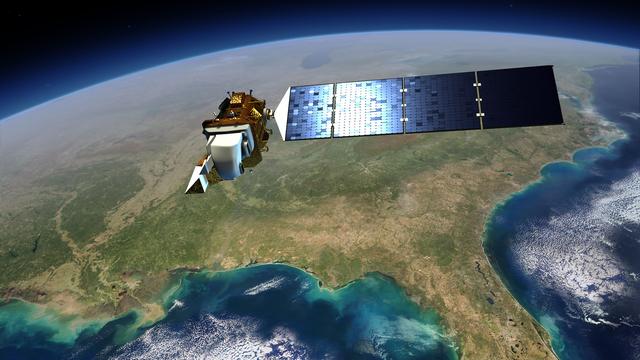
An artist's view of the Landsat Data Continuity Mission spacecraft in orbit above the Gulf Coast of the U.S. Credit: NASA/GSFC/Landsat <b><a href="http://www.nasa.gov/audience/formedia/features/MP_Photo_Guidelines.html" rel="nofollow">NASA image use policy.</a></b> <b><a href="http://www.nasa.gov/centers/goddard/home/index.html" rel="nofollow">NASA Goddard Space Flight Center</a></b> enables NASA’s mission through four scientific endeavors: Earth Science, Heliophysics, Solar System Exploration, and Astrophysics. Goddard plays a leading role in NASA’s accomplishments by contributing compelling scientific knowledge to advance the Agency’s mission. <b>Follow us on <a href="http://twitter.com/NASA_GoddardPix" rel="nofollow">Twitter</a></b> <b>Like us on <a href="http://www.facebook.com/pages/Greenbelt-MD/NASA-Goddard/395013845897?ref=tsd" rel="nofollow">Facebook</a></b> <b>Find us on <a href="http://instagrid.me/nasagoddard/?vm=grid" rel="nofollow">Instagram</a></b>

Gemma New conducts the National Symphony Orchestra as they perform Gustav Holst’s “The Planets” Wednesday, Jan. 22, 2020, at The Anthem in Washington, DC. Photo Credit: (NASA/Joel Kowsky)
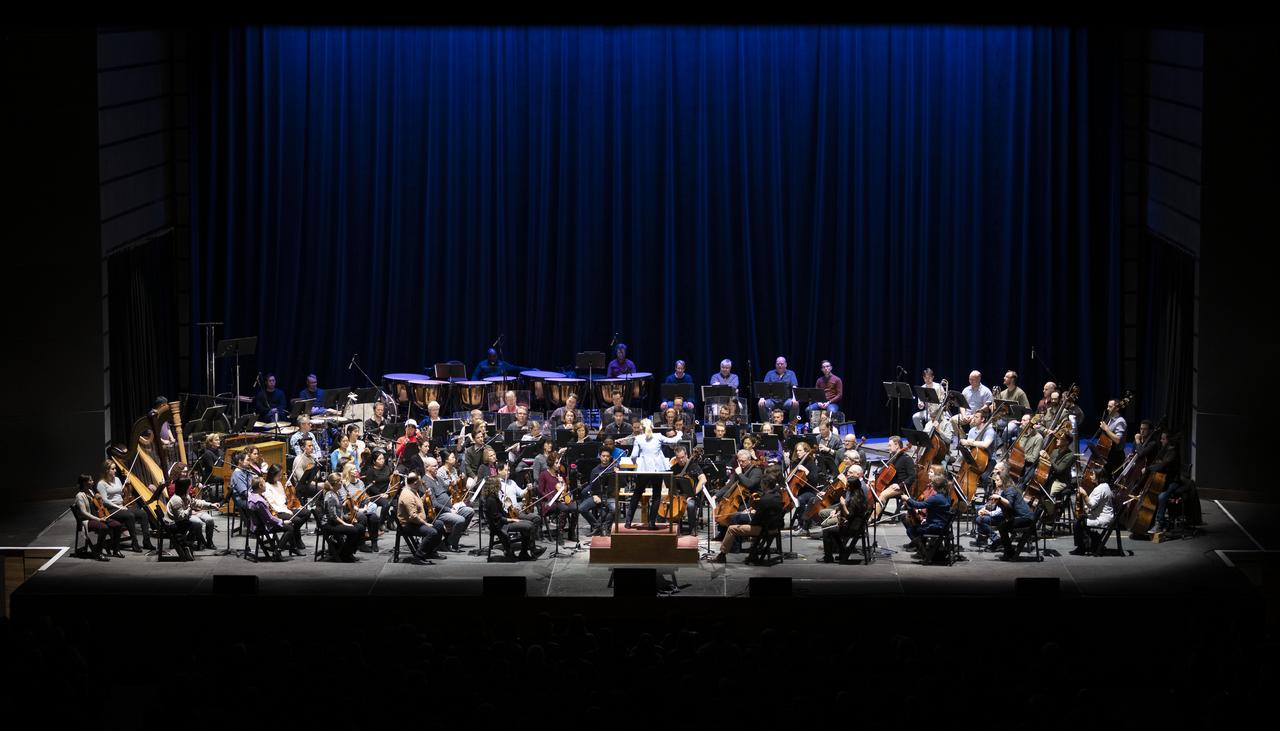
Gemma New conducts the National Symphony Orchestra as they perform Gustav Holst’s “The Planets” Wednesday, Jan. 22, 2020, at The Anthem in Washington, DC. Photo Credit: (NASA/Joel Kowsky)

Attendees of the National Symphony Orchestra’s performance of Gustav Holst’s “The Planets” take pictures in a model of a spacesuit, Wednesday, Jan. 22, 2020, at The Anthem in Washington, DC. Photo Credit: (NASA/Joel Kowsky)

Attendees of the National Symphony Orchestra’s performance of Gustav Holst’s “The Planets” view an interactive projection of planetary imagery, Wednesday, Jan. 22, 2020, at The Anthem in Washington, DC. Photo Credit: (NASA/Joel Kowsky)

Gemma New conducts the National Symphony Orchestra as they perform Gustav Holst’s “The Planets” Wednesday, Jan. 22, 2020, at The Anthem in Washington, DC. Photo Credit: (NASA/Joel Kowsky)

Attendees of the National Symphony Orchestra performance of Gustav Holst’s “The Planets” listen to a presentation about Mars and Jupiter as they arrive, Wednesday, Jan. 22, 2020, at The Anthem in Washington, DC. Photo Credit: (NASA/Joel Kowsky)

NASA Administrator Jim Bridenstine speaks prior to the National Symphony Orchestra’s performance of Gustav Holst’s “The Planets,” Wednesday, Jan. 22, 2020, at The Anthem in Washington, DC. Photo Credit: (NASA/Joel Kowsky)

Attendees of the National Symphony Orchestra’s performance of Gustav Holst’s “The Planets” view a model of NASA’s Gateway, Wednesday, Jan. 22, 2020, at The Anthem in Washington, DC. Photo Credit: (NASA/Joel Kowsky)

Attendees of the National Symphony Orchestra’s performance of Gustav Holst’s “The Planets” take pictures in a model of a spacesuit, Wednesday, Jan. 22, 2020, at The Anthem in Washington, DC. Photo Credit: (NASA/Joel Kowsky)

Conductor Gemma New speaks to the audience during the National Symphony Orchestra’s performance of Gustav Holst’s “The Planets” Wednesday, Jan. 22, 2020, at The Anthem in Washington, DC. Photo Credit: (NASA/Joel Kowsky)