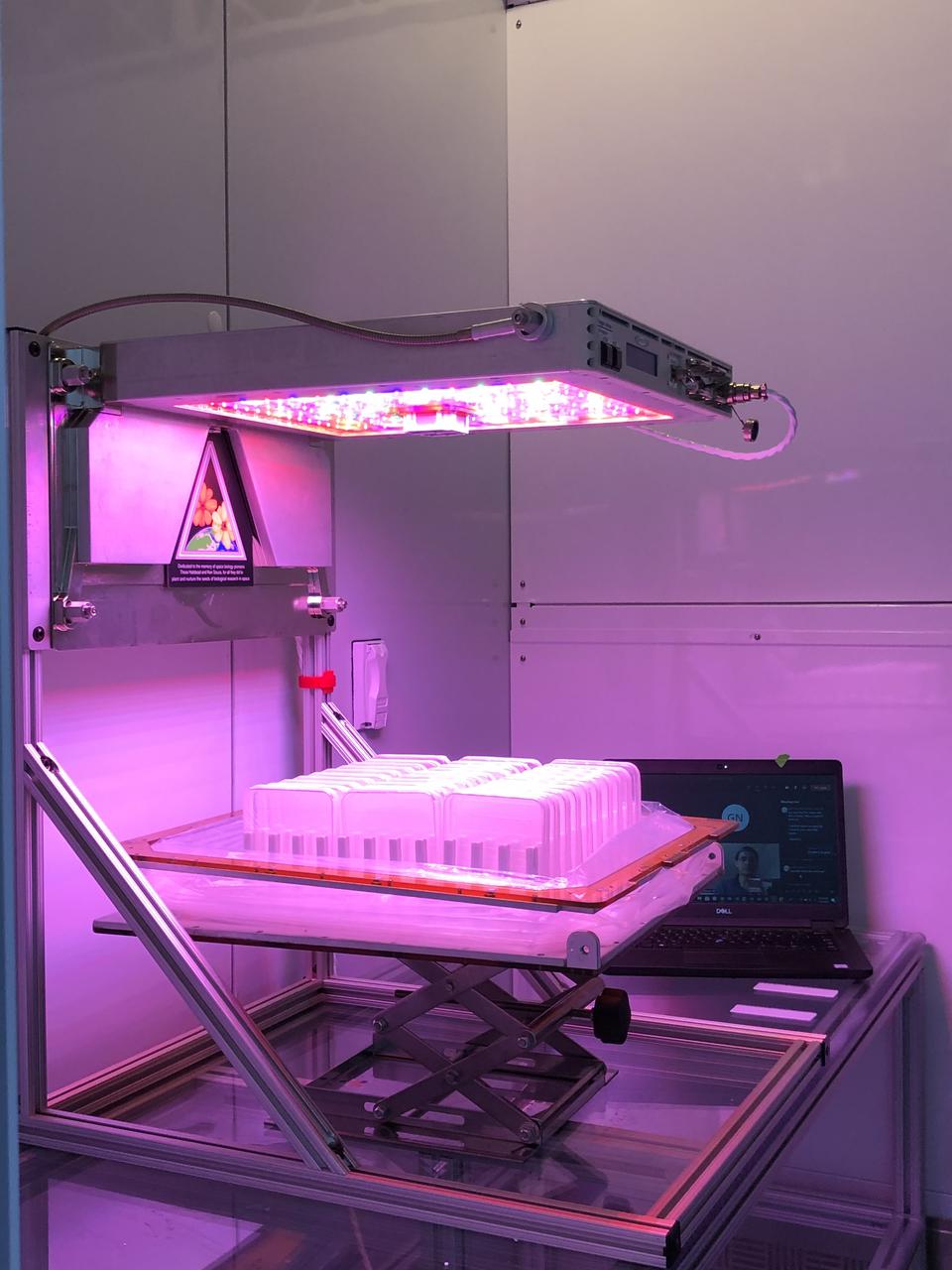
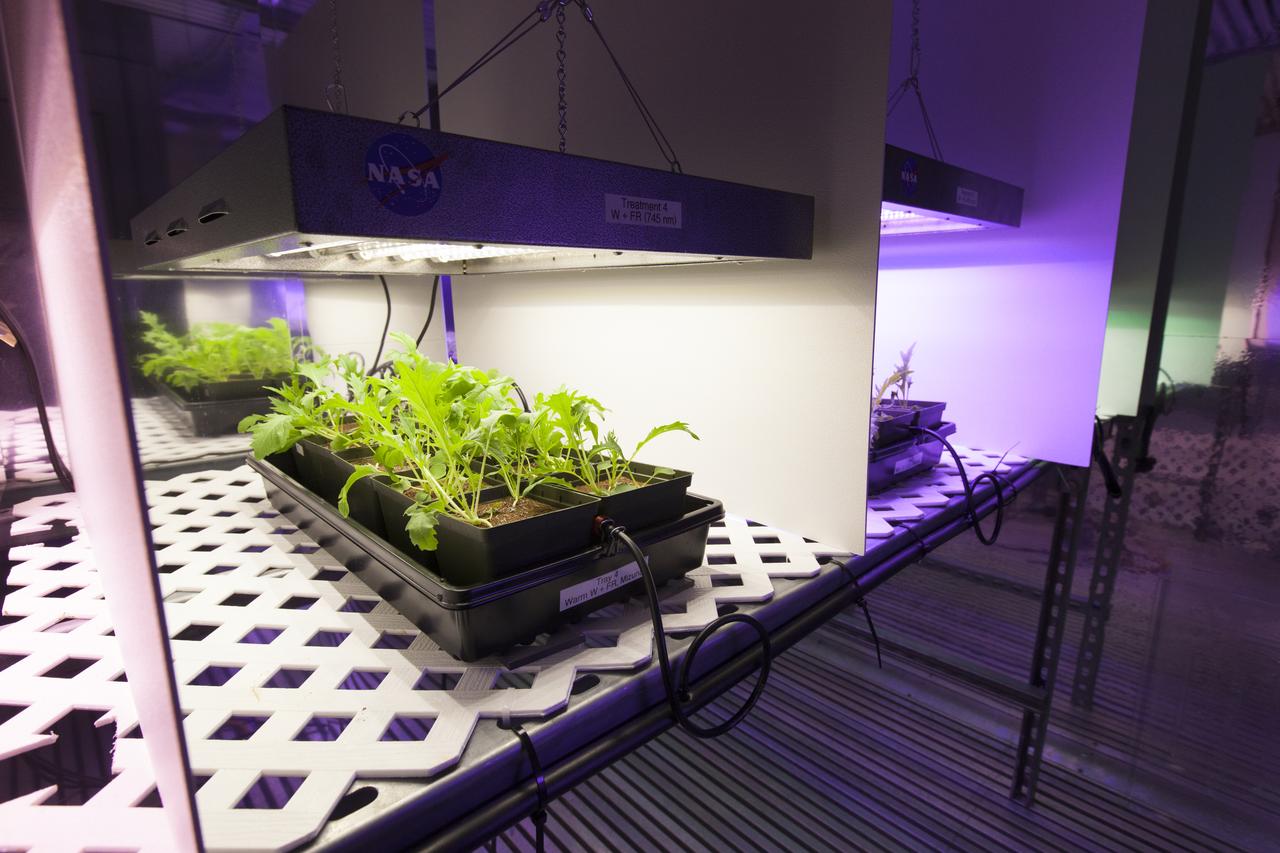
The Science Verification Test for NASA’s Advanced Plant Experiment-08 (APEX-08) testing Arabidopsis thaliana, a plant scientists routinely use for research, takes place inside the Veggie growth chamber at NASA’s Kennedy Space Center in Florida on Nov. 6, 2020. The test is part of the process for demonstrating readiness for space research ahead of its flight on SpaceX’s 23rd Commercial Resupply Services mission to the International Space Station. The APEX-08 study includes making genetic alterations that elicit a response in a group of organic compounds that modulate plant responses to environmental stress.
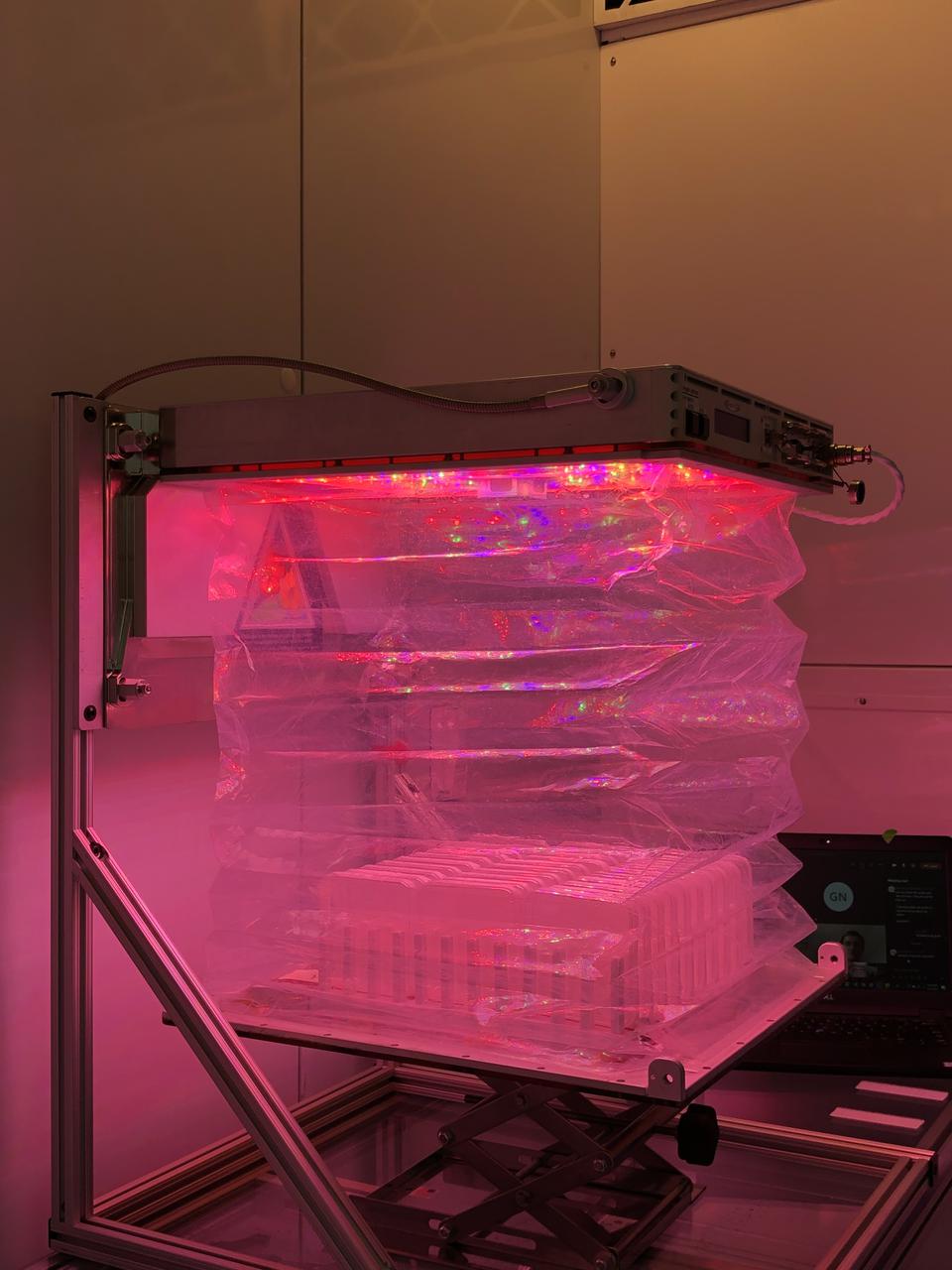
The Science Verification Test for NASA’s Advanced Plant Experiment-08 (APEX-08) testing Arabidopsis thaliana, a plant scientists routinely use for research, takes place inside the Veggie growth chamber at NASA’s Kennedy Space Center in Florida on Nov. 6, 2020. The test is part of the process for demonstrating readiness for space research ahead of its flight on SpaceX’s 23rd Commercial Resupply Services mission to the International Space Station. The APEX-08 study includes making genetic alterations that elicit a response in a group of organic compounds that modulate plant responses to environmental stress.
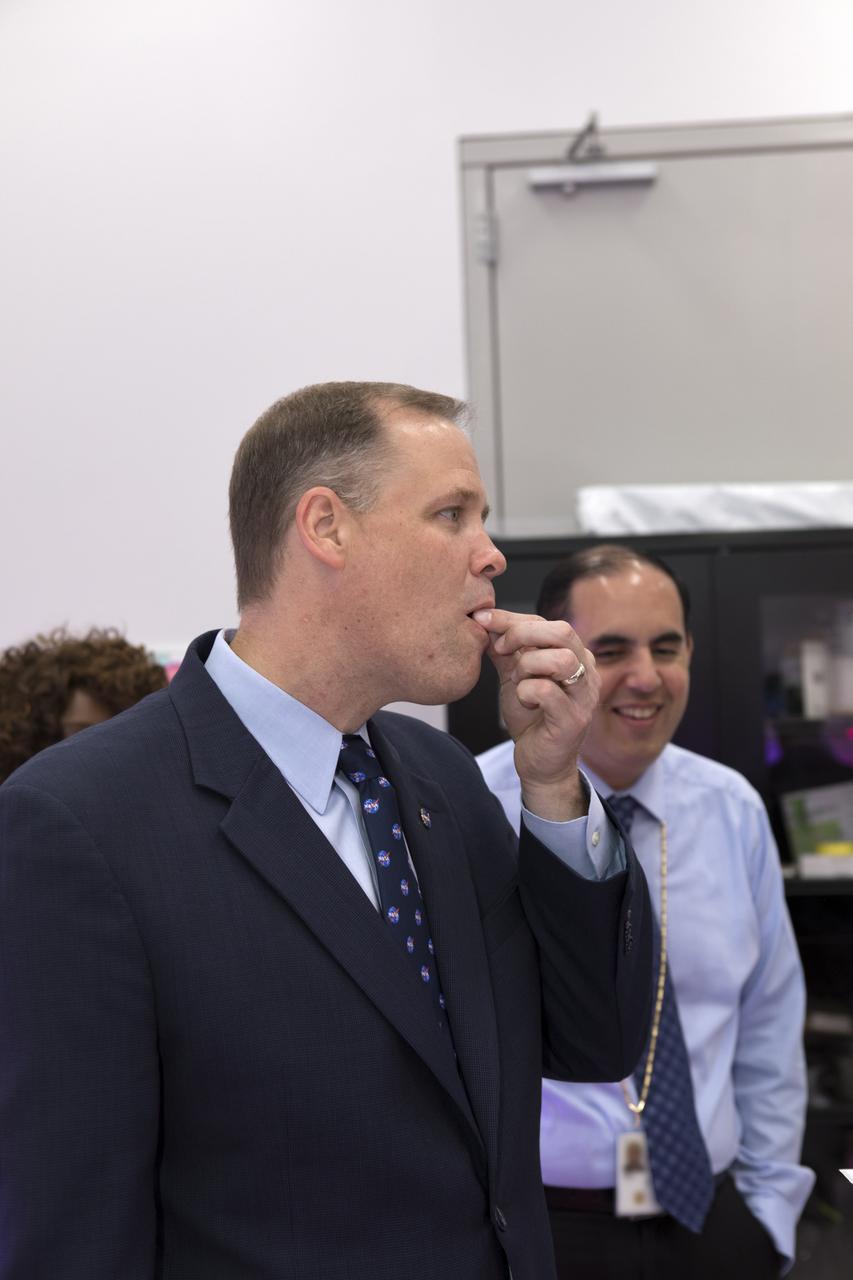
NASA Administrator Jim Bridenstine, left, tours a plant research laboratory and samples a microgreen inside the Space Station Processing Facility (SSPF) at NASA's Kennedy Space Center in Florida, on Aug. 7, 2018. Behind Bridenstine is Bryan Onate, Advanced Plant Habitat project manager. Bridenstine received updates on research and technology accomplishments during his visit to the SSPF.
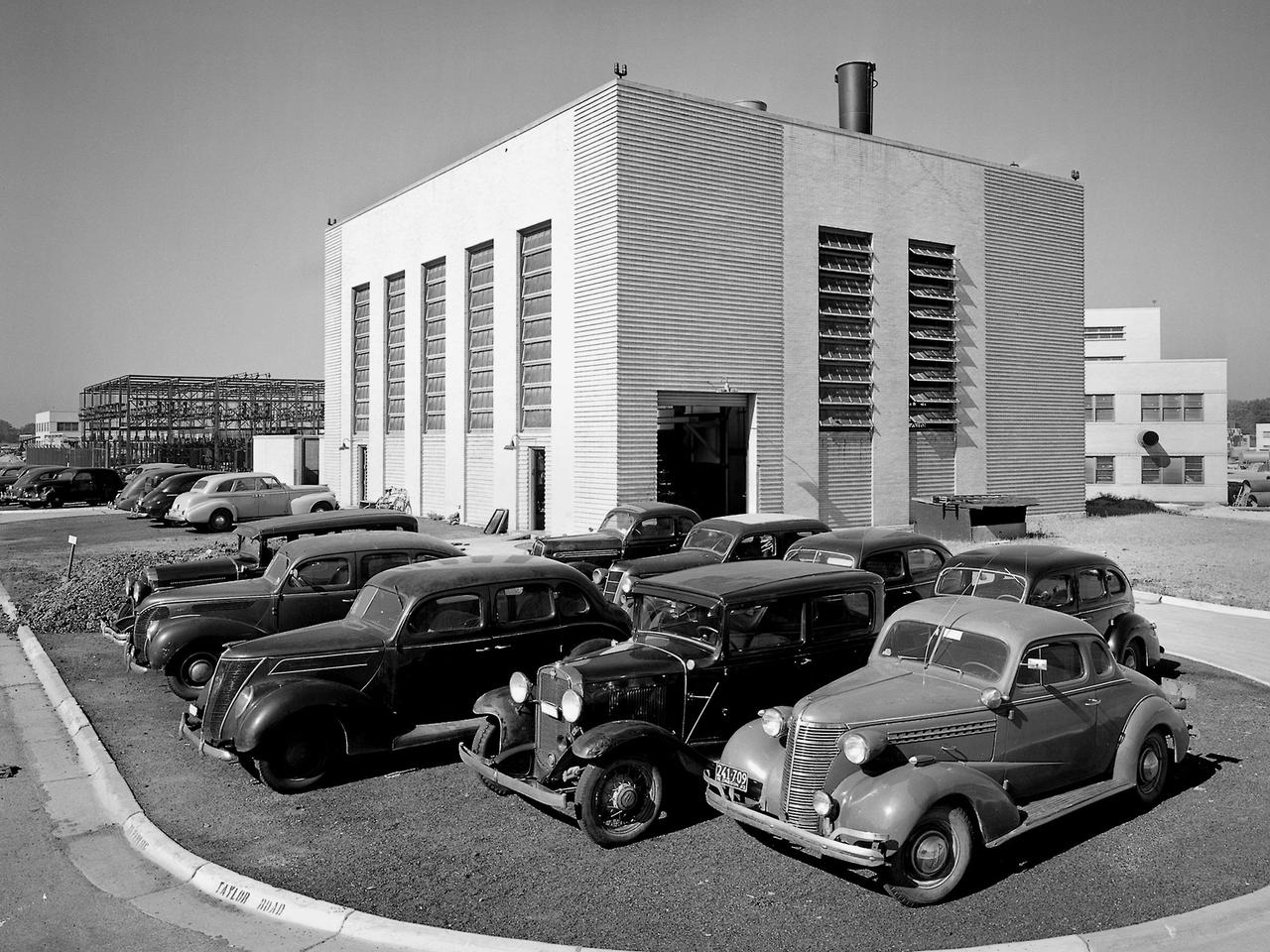
The Steam Plant at the National Advisory Committee for Aeronautics (NACA) Aircraft Engine Research Laboratory supplies steam to the major test facilities and office buildings. Steam is used for the Icing Research Tunnel's spray system and the Engine Research Building’s desiccant air dryers. In addition, its five boilers supply heat to various buildings and the cafeteria. Schirmer-Schneider Company built the $141,000 facility in the fall of 1942, and it has been in operation ever since.
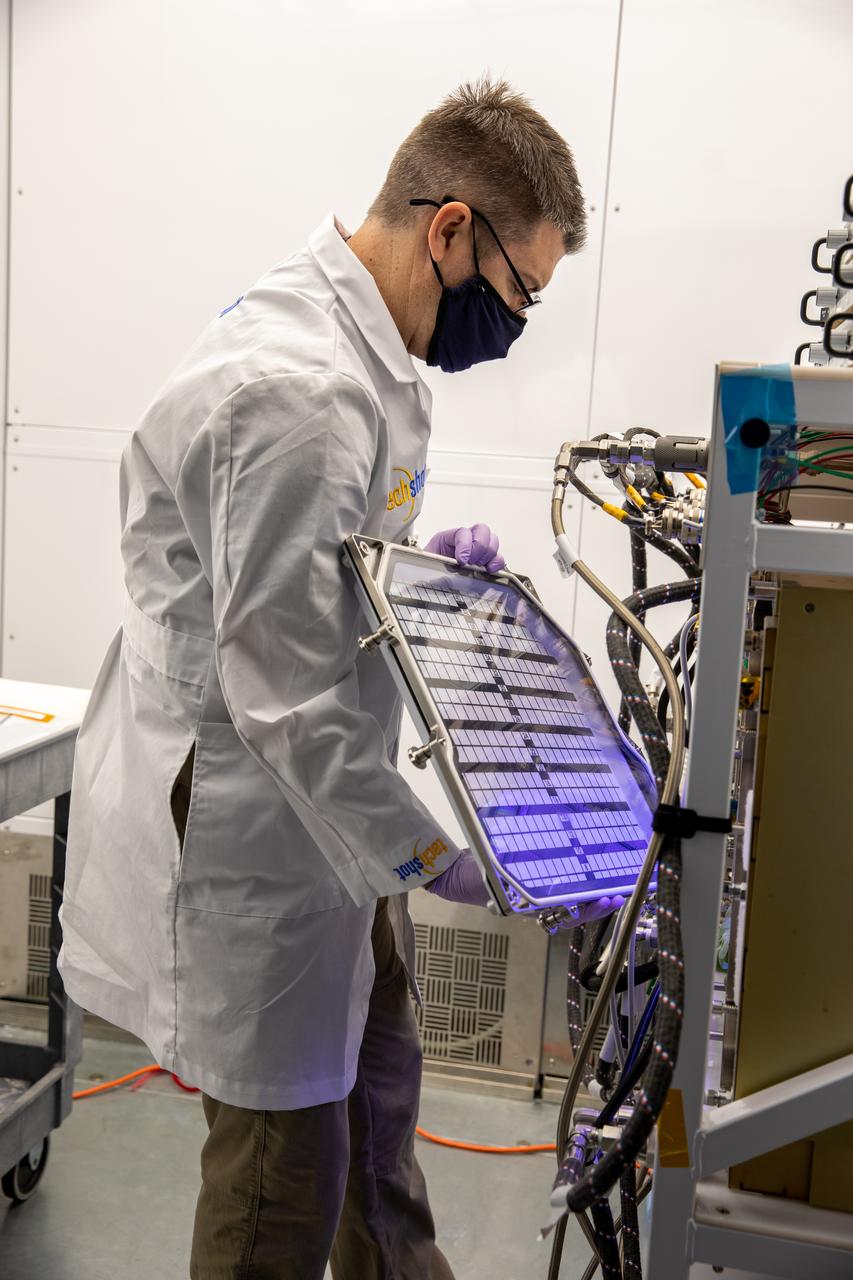
A researcher prepares to harvest radishes grown in the Advanced Plant Habitat (APH) ground unit inside the Space Station Processing Facility at NASA’s Kennedy Space Center in Florida on Dec. 14, 2020. The radishes are a ground control crop for the Plant Habitat-02 (PH-02) experiment, which also involves growing two radish crops inside the International Space Station’s APH. NASA astronaut Kate Rubins harvested the first crop on Nov. 30, and the second harvest aboard the orbiting laboratory is planned for Dec. 30. Once samples return to Earth, researchers will compare those grown in space to the radishes grown here on Earth to better understand how microgravity affects plant growth.
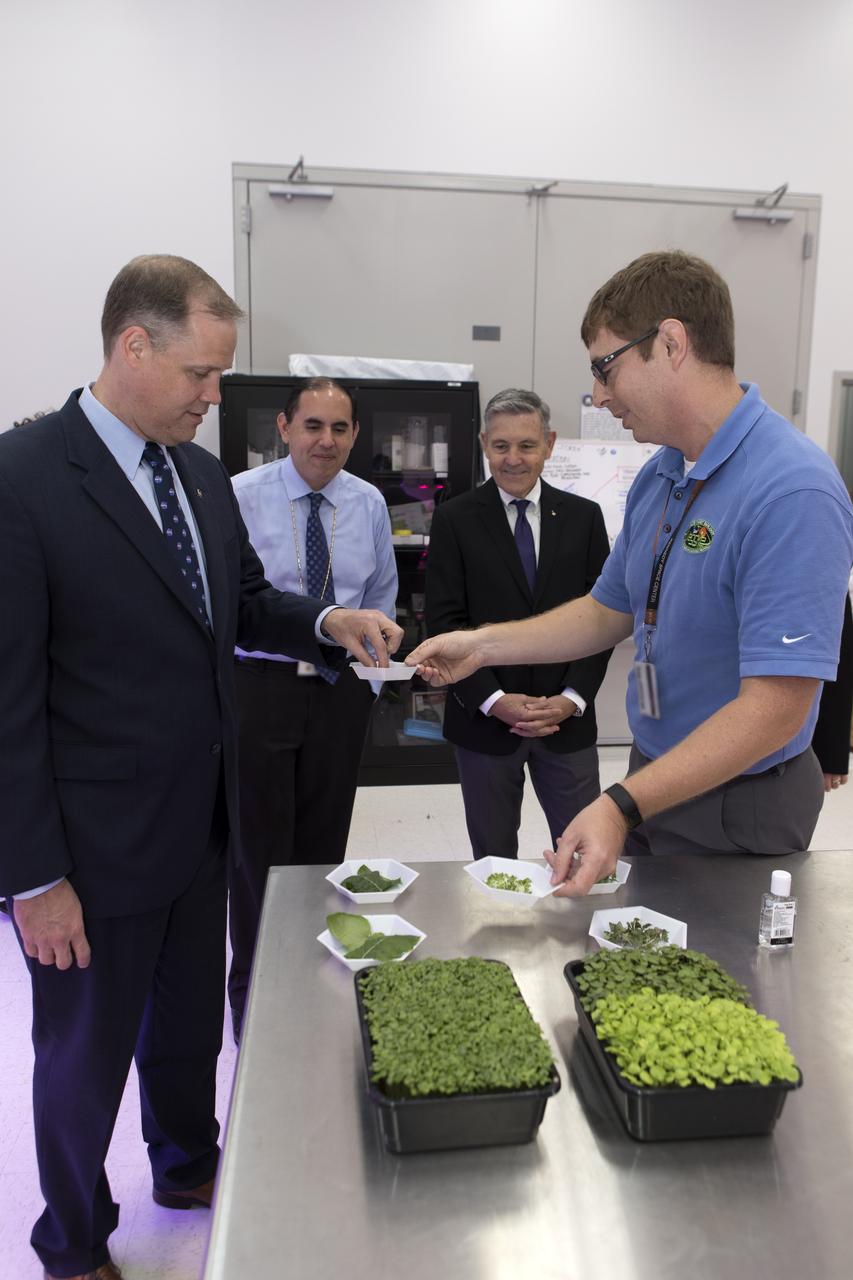
NASA Administrator Jim Bridenstine, far left, tours a plant research laboratory inside the Space Station Processing Facility (SSPF) at NASA's Kennedy Space Center in Florida, on Aug. 7, 2018. Bridenstine selects a microgreen to sample from Matt Romeyn, project scientist. Behind Bridenstine, from left, are Bryan Onate, Advanced Plant Habitat project manager, and Kennedy Space Center Director Bob Cabana. Bridenstine received updates on research and technology accomplishments during his visit to the SSPF.
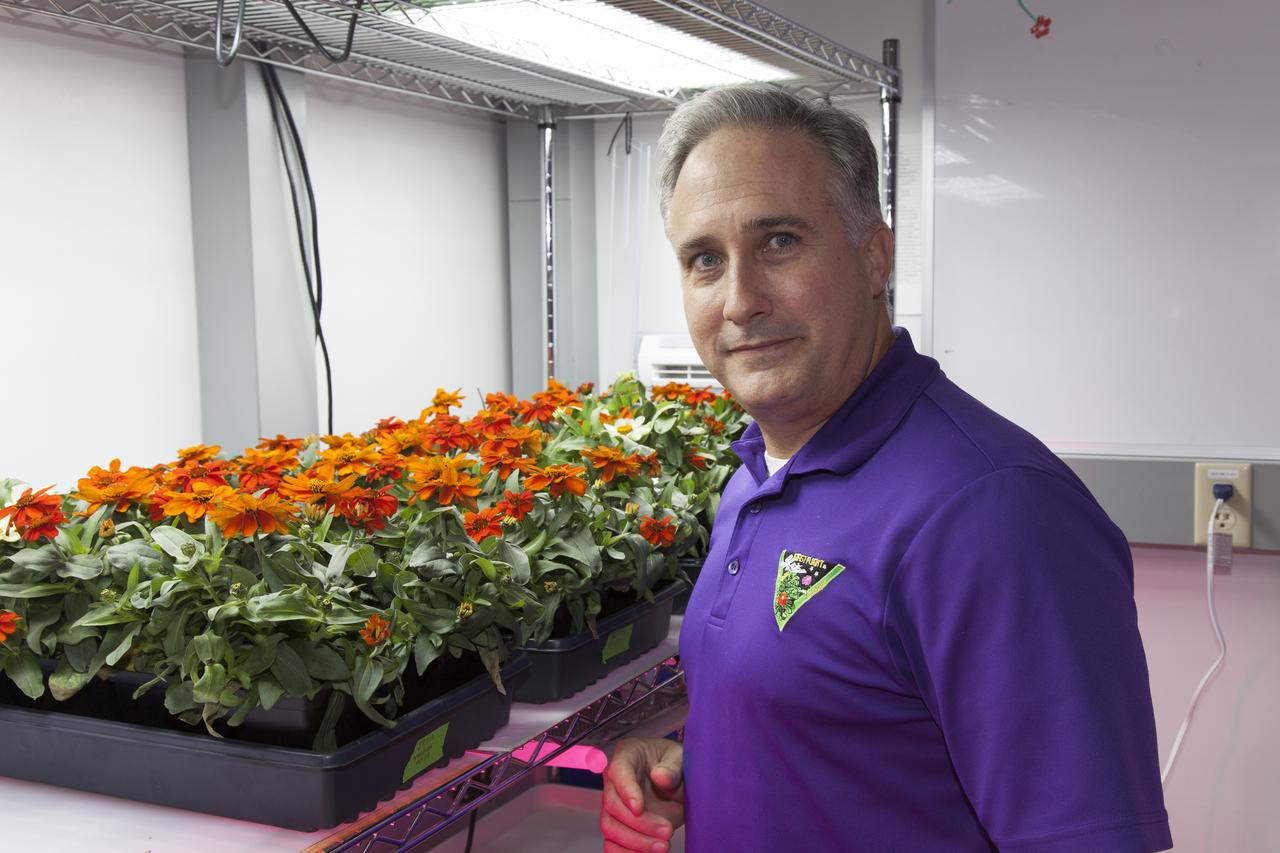
Trent Smith, Veggie project manager, Exploration Research and Technology Programs, is in the Veggie Laboratory in the Space Station Processing Facility (SSPF) at NASA's Kennedy Space Center in Florida on Nov. 27, 2018. Next to him are zinnia flowers grown from seeds germinated in the Veggie plant growth system on the International Space Station. The seeds were returned to Earth and researchers in the SSPF planted them in the Veggie control unit and grew the colorful flowers.
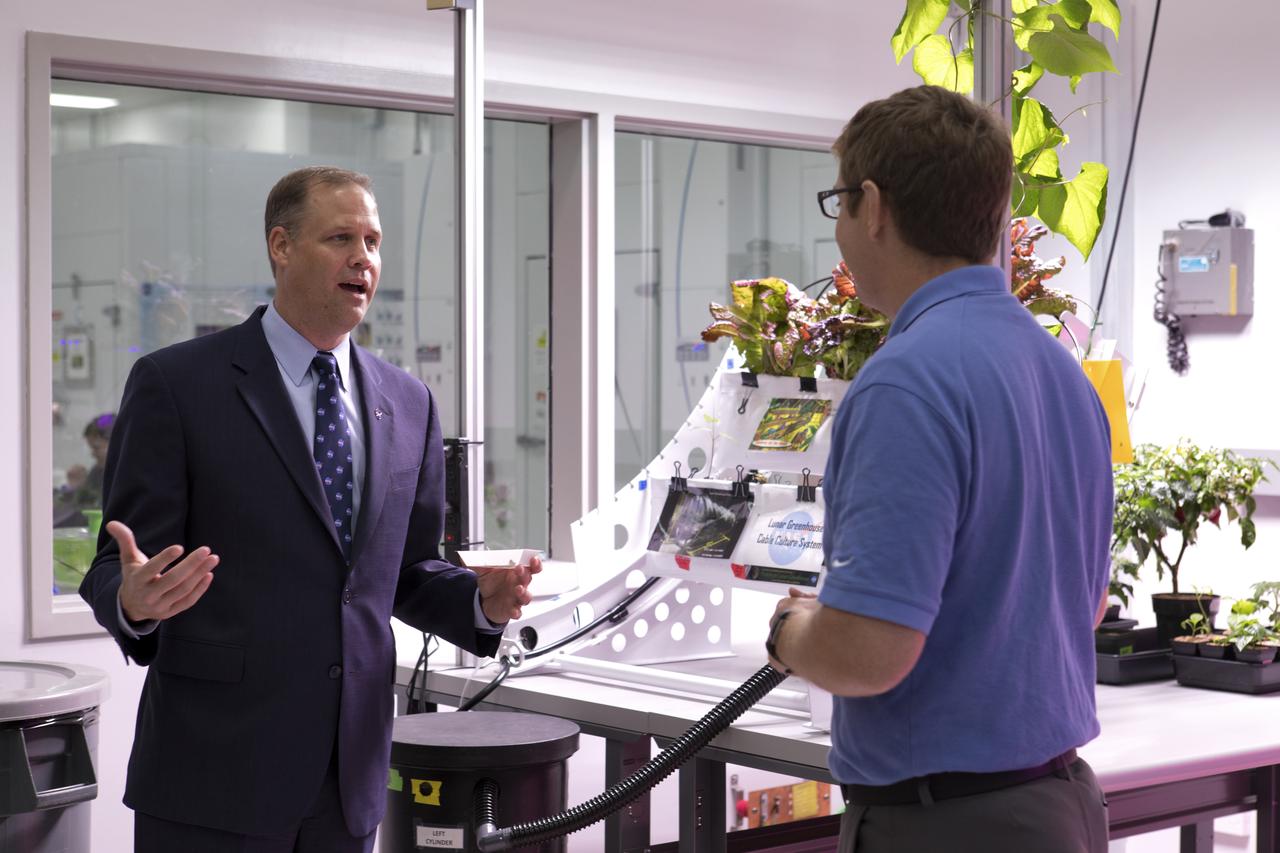
NASA Administrator Jim Bridenstine, at left, speaks to Matt Romeyn, a project scientist, during a tour of a plant research laboratory inside the Space Station Processing Facility (SSPF) at NASA's Kennedy Space Center in Florida, on Aug. 7, 2018. Bridenstine received updates on research and technology accomplishments during his visit to the SSPF.
In the Space Life Sciences Laboratory at NASA's Kennedy Space Center in Florida, student interns are joining agency scientists, contributing in the area of plant growth research for food production in space. The agency attracts its future workforce through the NASA Internship, Fellowships and Scholarships, or NIFS, Program.

In the Space Life Sciences Laboratory at NASA's Kennedy Space Center in Florida, student interns are joining agency scientists, contributing in the area of plant growth research for food production in space. The agency attracts its future workforce through the NASA Internship, Fellowships and Scholarships, or NIFS, Program.

In the Space Life Sciences Laboratory at NASA's Kennedy Space Center in Florida, student interns are joining agency scientists, contributing in the area of plant growth research for food production in space. The agency attracts its future workforce through the NASA Internship, Fellowships and Scholarships, or NIFS, Program.
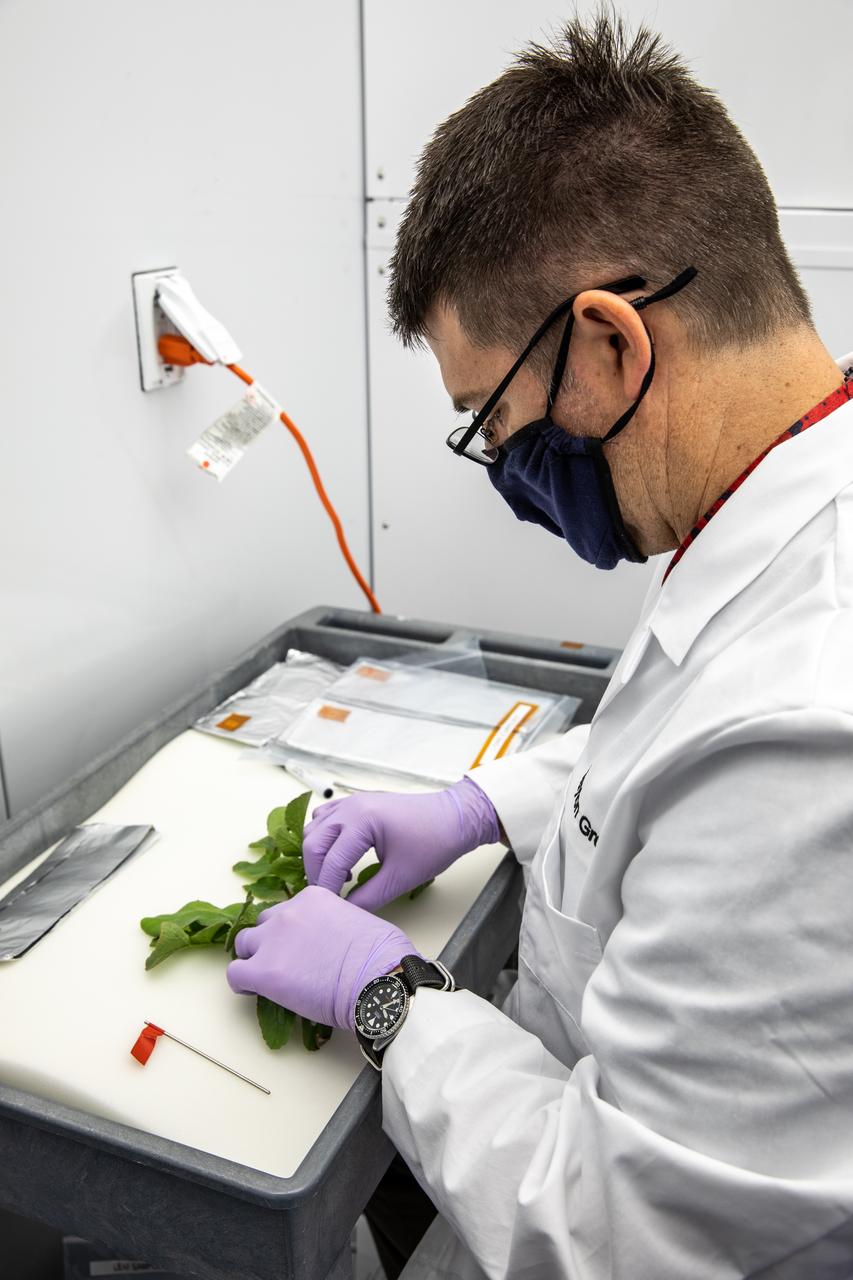
A research scientist collects measurements of radishes harvested from the Advanced Plant Habitat (APH) ground unit inside the Space Station Processing Facility at NASA’s Kennedy Space Center in Florida on Dec. 14, 2020. The radishes are a ground control crop for the Plant Habitat-02 (PH-02) experiment, which also involves growing two similar radish crops inside the International Space Station’s APH. NASA astronaut Kate Rubins harvested the first crop on Nov. 30, and the second harvest aboard the orbiting laboratory is planned for Dec. 30. Once samples return to Earth, researchers will compare those grown in space to the radishes grown here on Earth to better understand how microgravity affects plant growth.
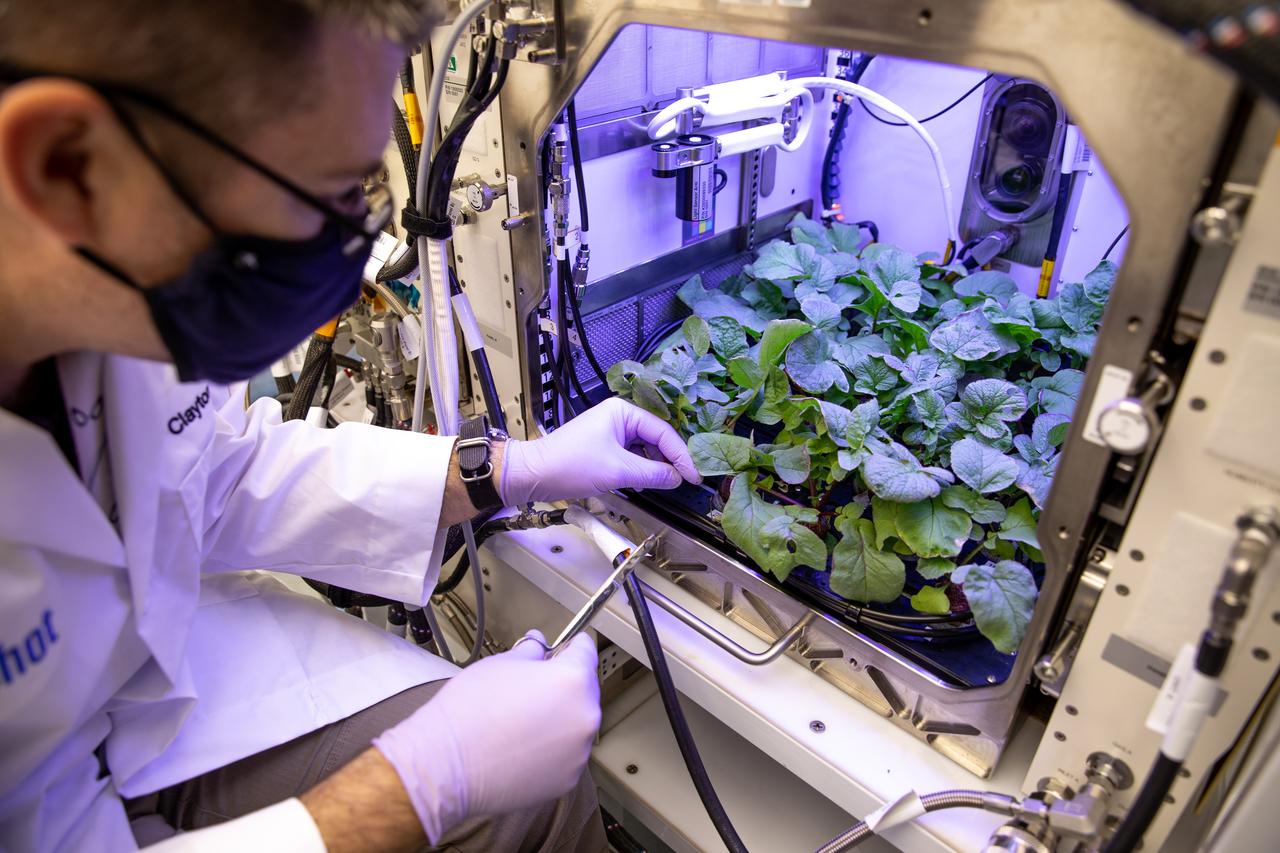
A research scientist harvests radishes grown in the Advanced Plant Habitat (APH) ground unit inside the Space Station Processing Facility at NASA’s Kennedy Space Center in Florida on Dec. 14, 2020. The radishes are a ground control crop for the Plant Habitat-02 (PH-02) experiment. The experiment also involves growing two similar radish crops inside the International Space Station’s APH. NASA astronaut Kate Rubins harvested the first crop on Nov. 30, and the second harvest aboard the orbiting laboratory is planned for Dec. 30. Once samples return to Earth, researchers will compare those grown in space to the radishes grown here on Earth to better understand how microgravity affects plant growth.

A researcher takes measurements of a radish crop harvested from the Advanced Plant Habitat (APH) ground unit inside the Space Station Processing Facility at NASA’s Kennedy Space Center in Florida on Dec. 14, 2020. The radishes are a ground control crop for the Plant Habitat-02 (PH-02) experiment, which also involves growing two similar radish crops inside the International Space Station’s APH. NASA astronaut Kate Rubins harvested the first crop on Nov. 30, and the second harvest aboard the orbiting laboratory is planned for Dec. 30. Once samples return to Earth, researchers will compare those grown in space to the radishes grown here on Earth to better understand how microgravity affects plant growth.
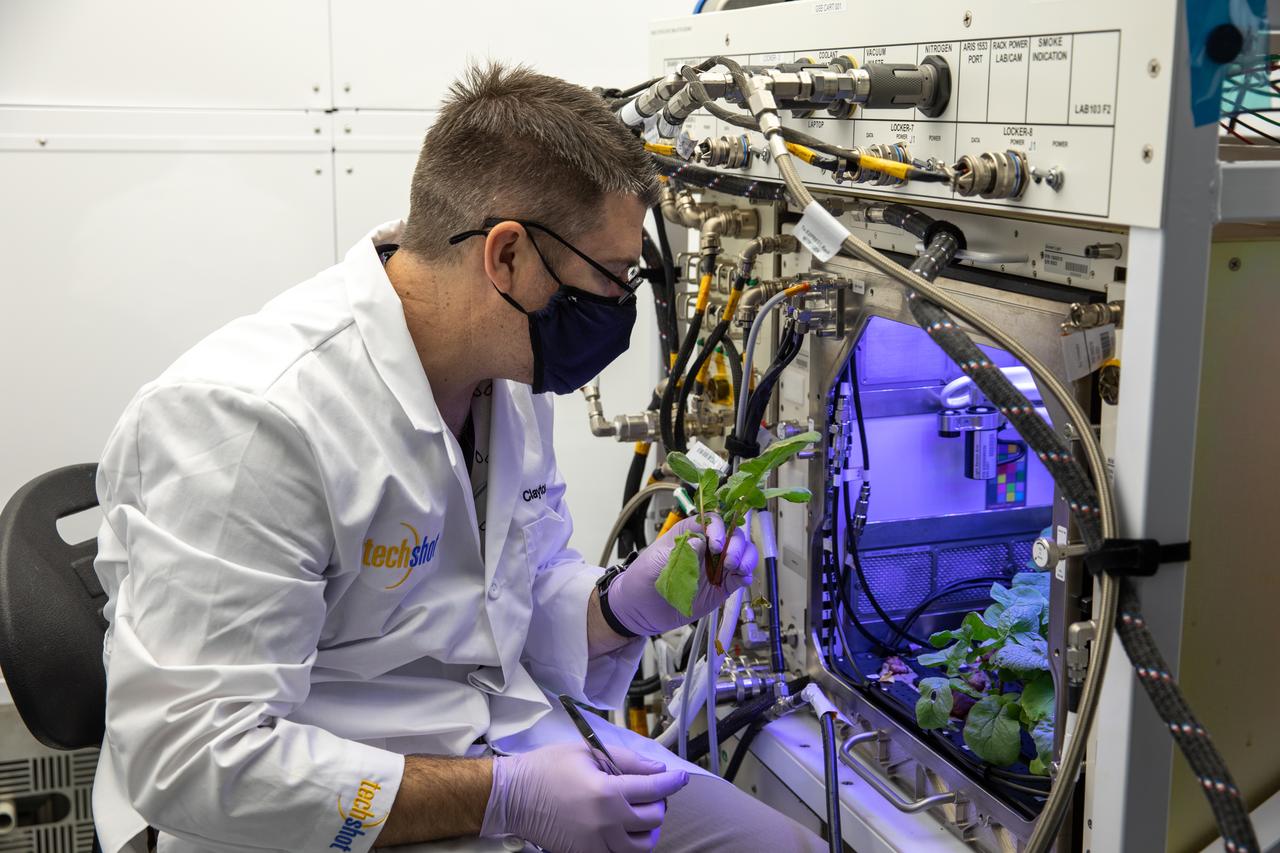
A research scientist harvests radishes grown in the Advanced Plant Habitat (APH) ground unit inside the Space Station Processing Facility at NASA’s Kennedy Space Center in Florida on Dec. 14, 2020. The radishes are a ground control crop for the Plant Habitat-02 (PH-02) experiment. The experiment also involves growing two similar radish crops inside the International Space Station’s APH. NASA astronaut Kate Rubins harvested the first crop on Nov. 30, and the second harvest aboard the orbiting laboratory is planned for Dec. 30. Once samples return to Earth, researchers will compare those grown in space to the radishes grown here on Earth to better understand how microgravity affects plant growth.
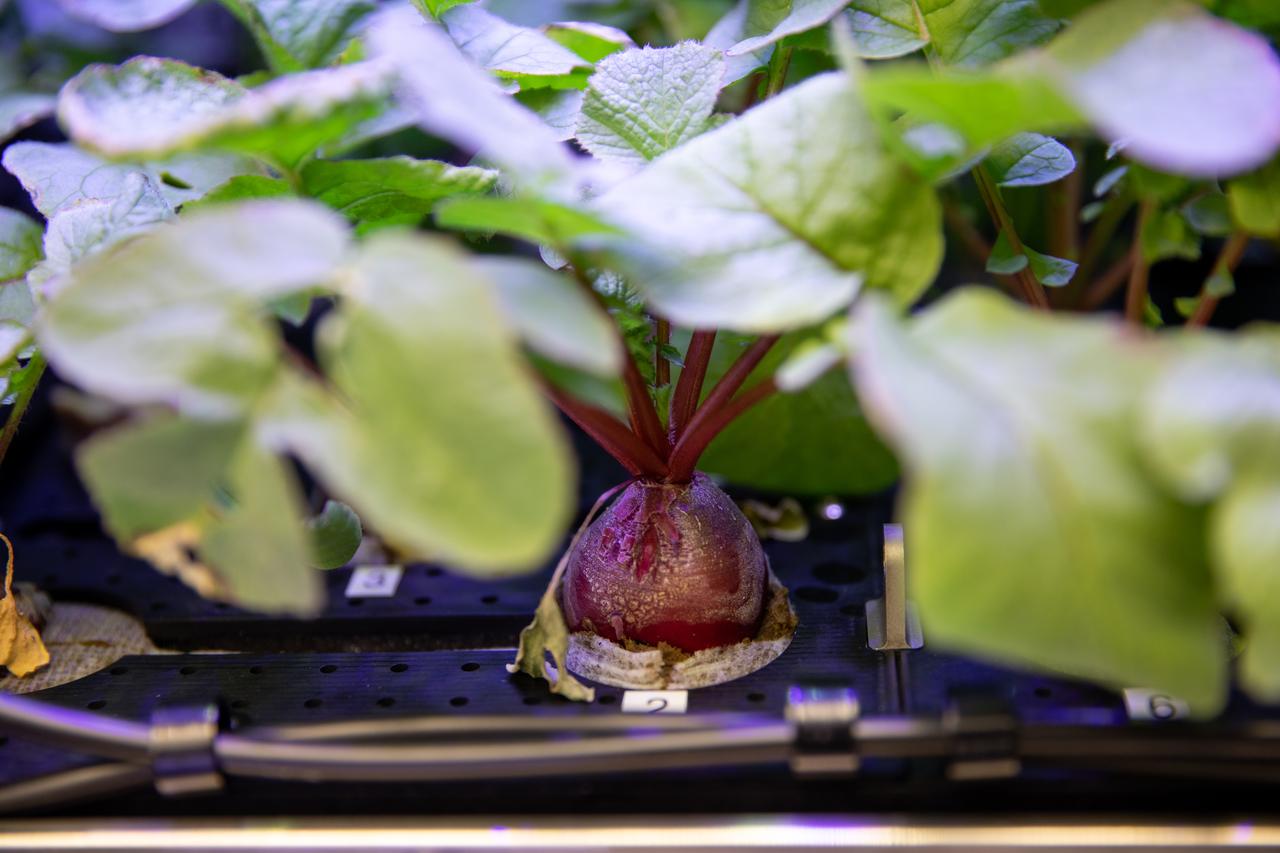
A view of radishes growing in the Advanced Plant Habitat (APH) ground unit inside the Space Station Processing Facility at NASA’s Kennedy Space Center in Florida on Dec. 14, 2020. The radishes are a ground control crop for the Plant Habitat-02 (PH-02) experiment. The experiment also involves growing two similar radish crops inside the International Space Station’s APH. NASA astronaut Kate Rubins harvested the first crop on Nov. 30, and the second harvest aboard the orbiting laboratory is planned for Dec. 30. Once samples return to Earth, researchers will compare those grown in space to the radishes grown here on Earth to better understand how microgravity affects plant growth.
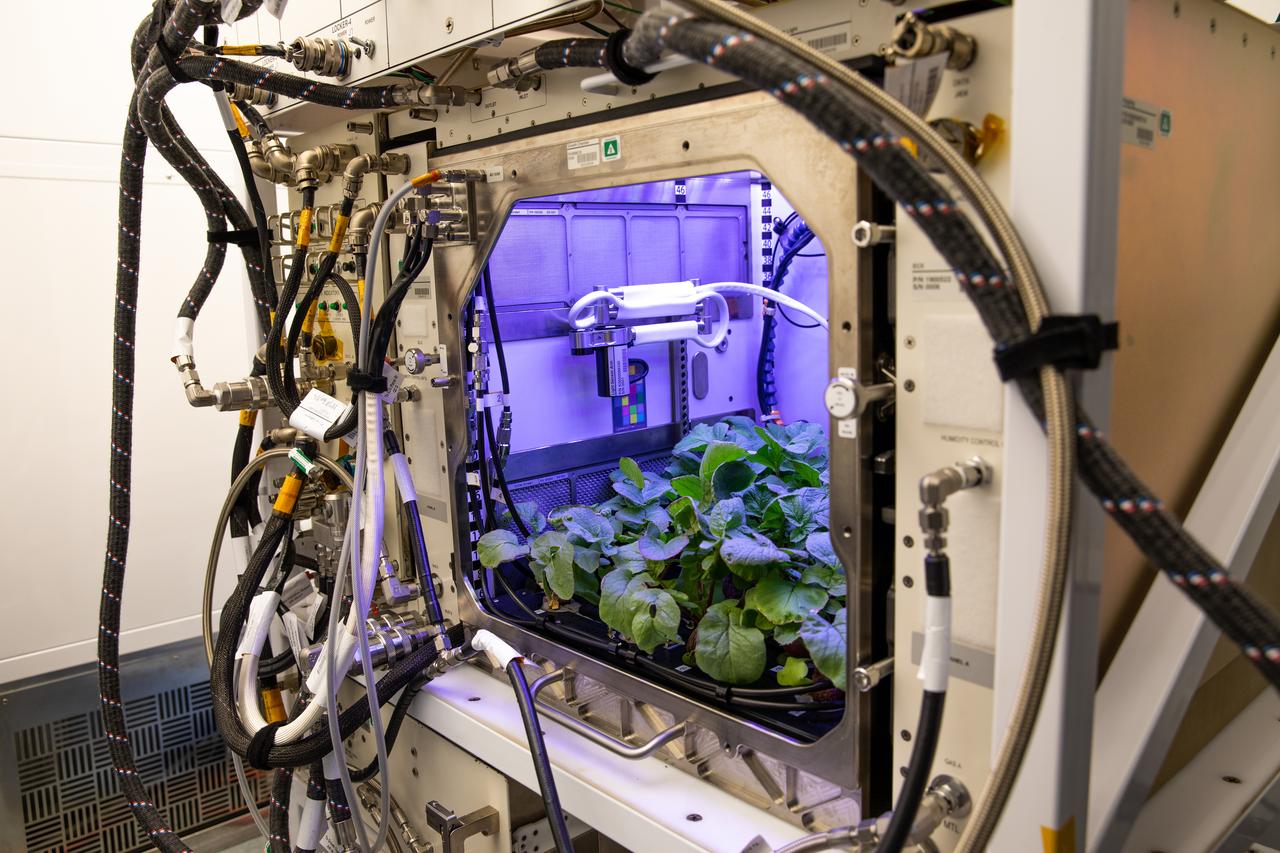
A view of radishes growing in the Advanced Plant Habitat (APH) ground unit inside the Space Station Processing Facility at NASA’s Kennedy Space Center in Florida on Dec. 14, 2020. The radishes are a ground control crop for the Plant Habitat-02 (PH-02) experiment, which also involves growing two similar radish crops inside the International Space Station’s APH. NASA astronaut Kate Rubins harvested the first crop on Nov. 30, and the second harvest aboard the orbiting laboratory is planned for Dec. 30. Once samples return to Earth, researchers will compare those grown in space to the radishes grown here on Earth to better understand how microgravity affects plant growth.
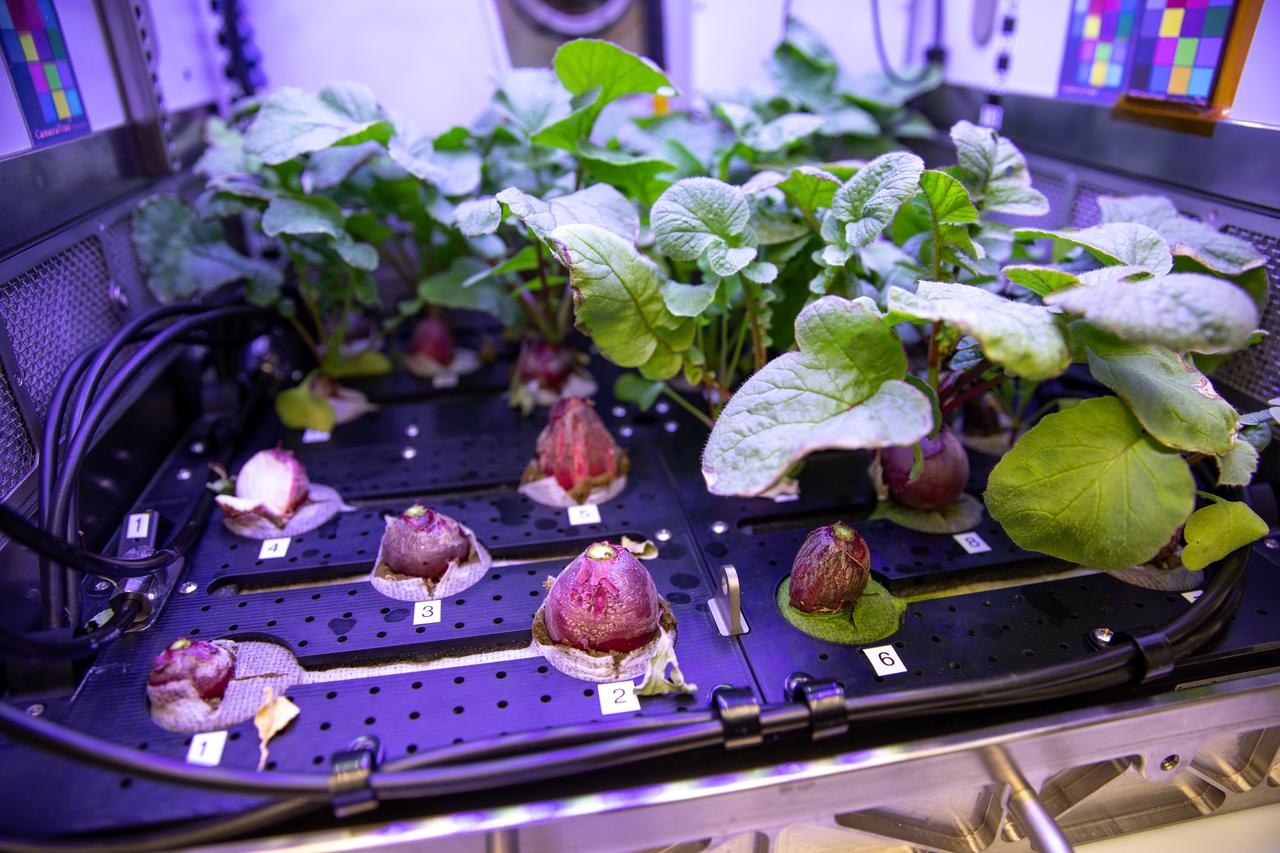
A view of radishes growing in the Advanced Plant Habitat (APH) ground unit inside the Space Station Processing Facility at NASA’s Kennedy Space Center in Florida on Dec. 14, 2020. The radishes are a ground control crop for the Plant Habitat-02 (PH-02) experiment. The experiment also involves growing two similar radish crops inside the International Space Station’s APH. NASA astronaut Kate Rubins harvested the first crop on Nov. 30, and the second harvest aboard the orbiting laboratory is planned for Dec. 30. Once samples return to Earth, researchers will compare those grown in space to the radishes grown here on Earth to better understand how microgravity affects plant growth.
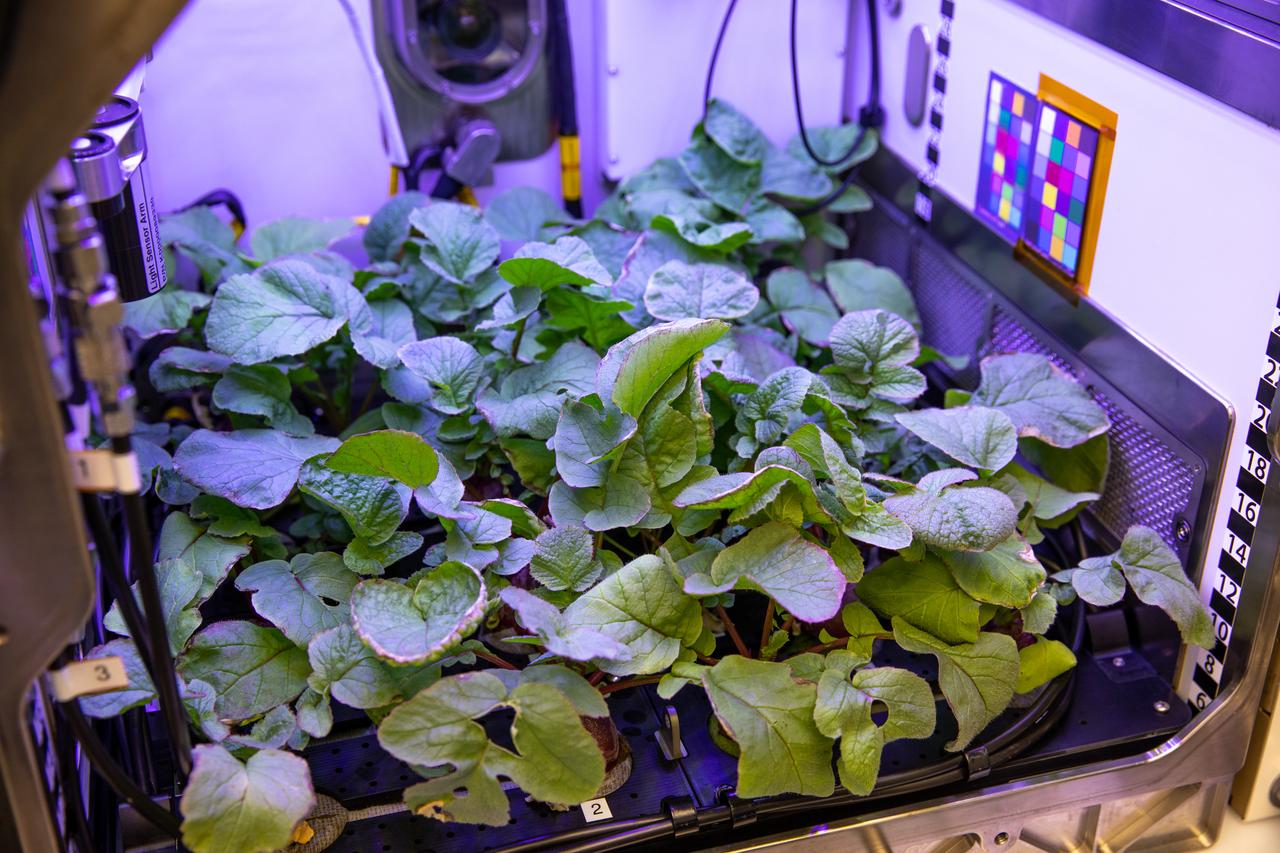
A view of radishes growing in the Advanced Plant Habitat (APH) ground unit inside the Space Station Processing Facility at NASA’s Kennedy Space Center in Florida on Dec. 14, 2020. The radishes are a ground control crop for the Plant Habitat-02 (PH-02) experiment. The experiment also involves growing two similar radish crops inside the International Space Station’s APH. NASA astronaut Kate Rubins harvested the first crop on Nov. 30, and the second harvest aboard the orbiting laboratory is planned for Dec. 30. Once samples return to Earth, researchers will compare those grown in space to the radishes grown here on Earth to better understand how microgravity affects plant growth.

Inside the Space Life Sciences Lab at NASA’s Kennedy Space Center in Florida, researchers plant pepper seeds in a science carrier on April 8, 2021, in preparation for the Plant Habitat-04 (PH-04) experiment. The seeds will fly to the International Space Station on SpaceX’s 22nd Commercial Resupply Services (CRS-22) mission. When the experiment starts, astronauts will grow the pepper seeds in the Advanced Plant Habitat (APH) growth chamber, which will monitor the experiment with more than 180 sensors. The astronauts will observe plant growth for about four months and conduct two harvests to study whether microgravity affects growth, flavor, or texture. Since peppers take longer to germinate, grow, and develop than previous crops grown in space, the PH-04 experiment also will test the durability and reliability of the various systems within the APH.

A researcher from NASA’s Kennedy Space Center in Florida prepares pepper seeds for planting inside science carriers on April 8, 2021, inside the Space Life Sciences Lab for the Plant Habitat-04 (PH-04) experiment. The seeds will fly to the International Space Station on SpaceX’s 22nd Commercial Resupply Services (CRS-22) mission. When the experiment starts, astronauts will grow the pepper seeds in the Advanced Plant Habitat (APH) growth chamber, which will monitor the experiment with more than 180 sensors. The astronauts will observe plant growth for about four months and conduct two harvests to study whether microgravity affects growth, flavor, or texture. Since peppers take longer to germinate, grow, and develop than previous crops grown in space, the PH-04 experiment also will test the durability and reliability of the various systems within the APH.

A researcher from NASA’s Kennedy Space Center in Florida prepares pepper seeds for planting inside science carriers on April 8, 2021, inside the Space Life Sciences Lab for the Plant Habitat-04 (PH-04) experiment. The seeds will fly to the International Space Station on SpaceX’s 22nd Commercial Resupply Services (CRS-22) mission. When the experiment starts, astronauts will grow the pepper seeds in the Advanced Plant Habitat (APH) growth chamber, which will monitor the experiment with more than 180 sensors. The astronauts will observe plant growth for about four months and conduct two harvests to study whether microgravity affects growth, flavor, or texture. Since peppers take longer to germinate, grow, and develop than previous crops grown in space, the PH-04 experiment also will test the durability and reliability of the various systems within the APH.

Inside the Space Life Sciences Lab at NASA’s Kennedy Space Center in Florida, a researcher plants pepper seeds in science carriers on April 8, 2021, in preparation for the Plant Habitat-04 (PH-04) experiment. The seeds will fly to the International Space Station on SpaceX’s 22nd Commercial Resupply Services (CRS-22) mission. When the experiment starts, astronauts will grow the pepper seeds in the Advanced Plant Habitat (APH) growth chamber, which will monitor the experiment with more than 180 sensors. The astronauts will observe plant growth for about four months and conduct two harvests to study whether microgravity affects growth, flavor, or texture. Since peppers take longer to germinate, grow, and develop than previous crops grown in space, the PH-04 experiment also will test the durability and reliability of the various systems within the APH.

A close-up photo of a pepper seed prepared by researchers at NASA’s Kennedy Space Center in Florida is shown before it’s planted inside a science carrier on April 8, 2021, inside the Space Life Sciences Lab for the Plant Habitat-04 (PH-04) experiment. The seeds will fly to the International Space Station on SpaceX’s 22nd Commercial Resupply Services (CRS-22) mission. When the experiment starts, astronauts will grow the pepper seeds in the Advanced Plant Habitat (APH) growth chamber, which will monitor the experiment with more than 180 sensors. The astronauts will observe plant growth for about four months and conduct two harvests to study whether microgravity affects growth, flavor, or texture. Since peppers take longer to germinate, grow, and develop than previous crops grown in space, the PH-04 experiment also will test the durability and reliability of the various systems within the APH.

A researcher from NASA’s Kennedy Space Center in Florida prepares pepper seeds for planting inside science carriers on April 8, 2021, inside the Space Life Sciences Lab for the Plant Habitat-04 (PH-04) experiment. The seeds will fly to the International Space Station on SpaceX’s 22nd Commercial Resupply Services (CRS-22) mission. When the experiment starts, astronauts will grow the pepper seeds in the Advanced Plant Habitat (APH) growth chamber, which will monitor the experiment with more than 180 sensors. The astronauts will observe plant growth for about four months and conduct two harvests to study whether microgravity affects growth, flavor, or texture. Since peppers take longer to germinate, grow, and develop than previous crops grown in space, the PH-04 experiment also will test the durability and reliability of the various systems within the APH.

A close-up view of a zinnia flower grown in the Veggie Laboratory in the Space Station Processing Facility (SSPF) at NASA's Kennedy Space Center in Florida, on Nov. 27, 2018. Seeds from zinnias growing on the space station were returned to Earth. Researchers in the SSPF planted the seeds in the Veggie control unit and grew the colorful flowers.

NASA’s F-15D research aircraft is positioned behind the X-59 during electromagnetic compatibility testing at U.S. Air Force Plant 42 in Palmdale, California. During this test, the F-15D’s radar and avionics were turned on one at a time while engineers evaluated each signal’s interaction with the X-59 for possible interference. NASA’s Quesst mission will demonstrate quiet supersonic technology that will provide data to help determine an acceptable sound limit in the sky.
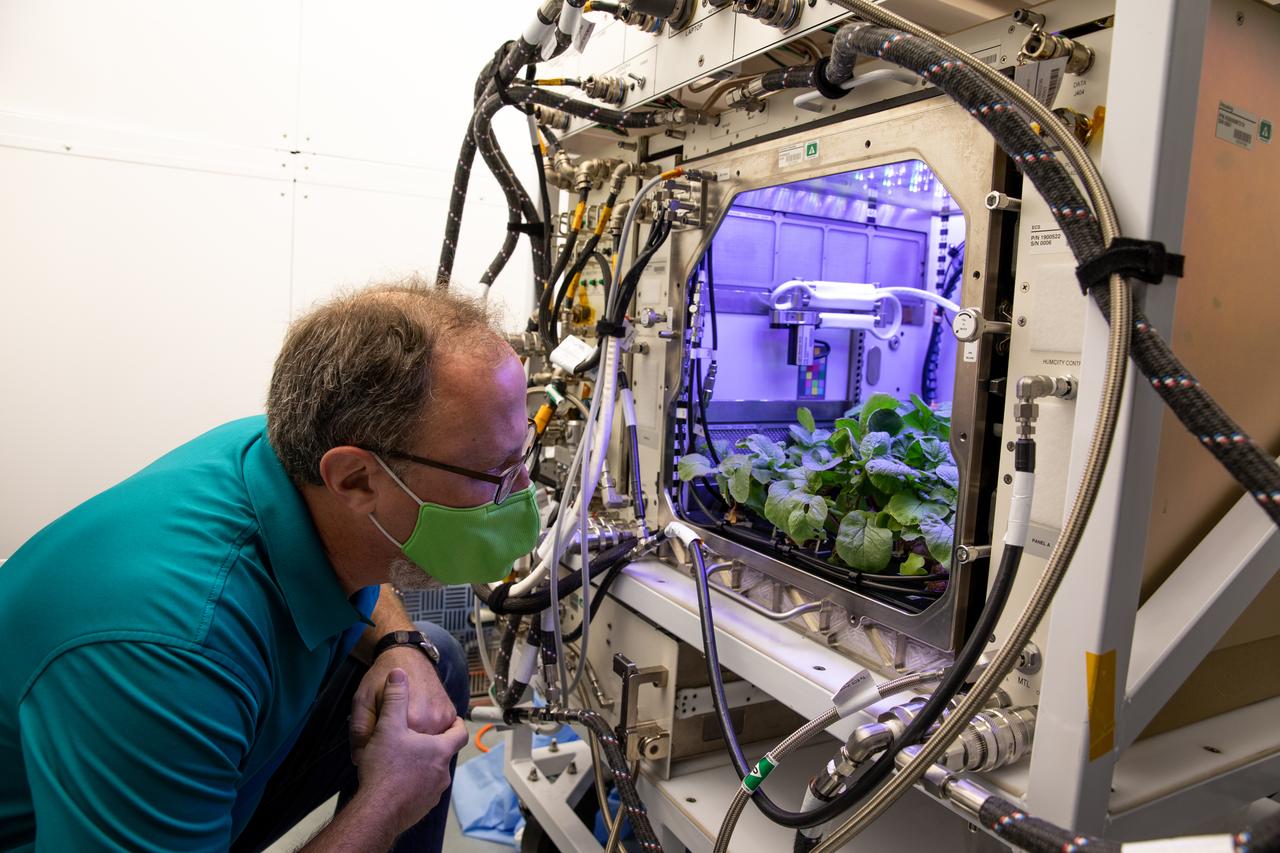
Dave Reed, Florida operations director for Techshot, Inc., observes radishes growing in the Advanced Plant Habitat (APH) ground unit inside the Space Station Processing Facility at NASA’s Kennedy Space Center in Florida on Dec. 14, 2020. The radishes are a ground control crop for the Plant Habitat-02 (PH-02) experiment, which also involves growing two similar radish crops inside the International Space Station’s APH. NASA astronaut Kate Rubins harvested the first crop on Nov. 30, and the second harvest aboard the orbiting laboratory is planned for Dec. 30. Once samples return to Earth, researchers will compare those grown in space to the radishes grown here on Earth to better understand how microgravity affects plant growth.
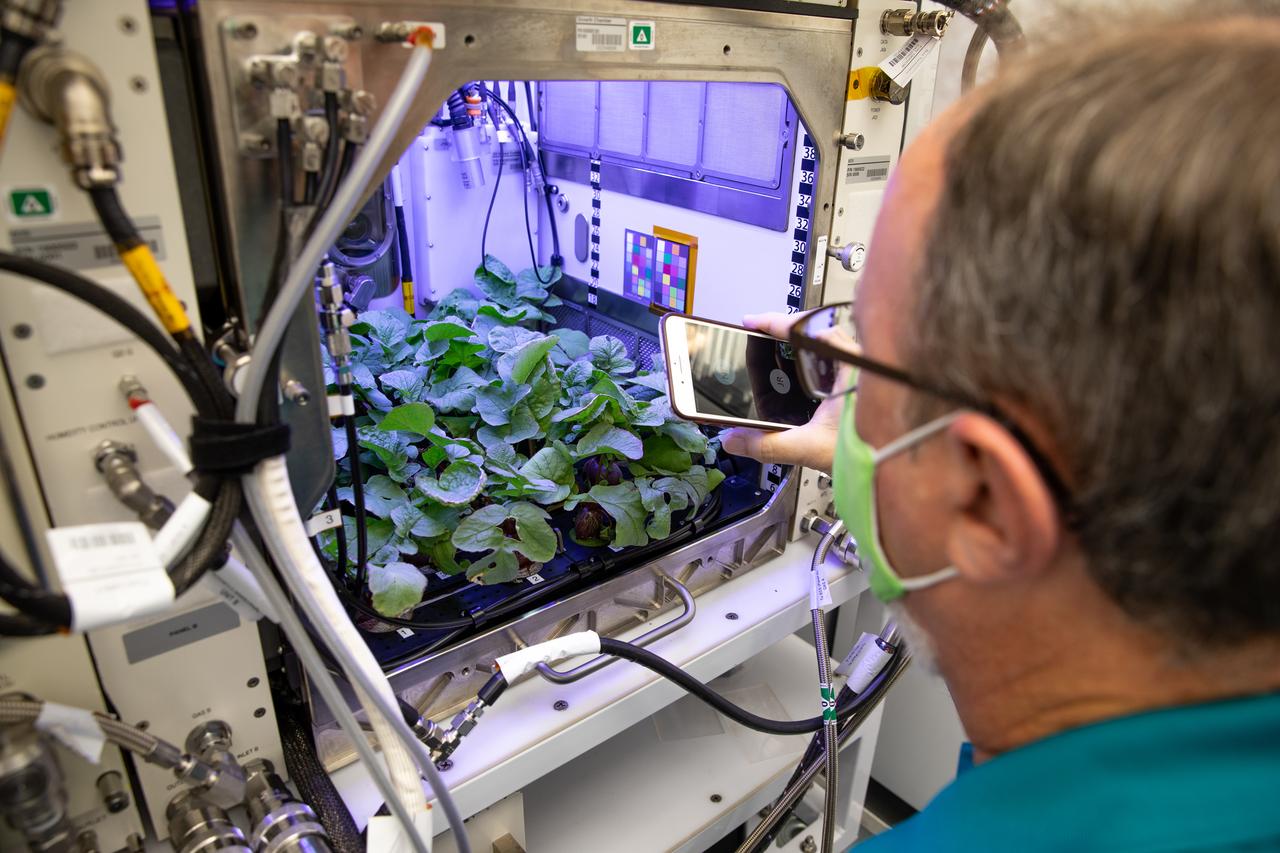
Dave Reed, Florida operations director for Techshot, Inc., observes radishes growing in the Advanced Plant Habitat (APH) ground unit inside the Space Station Processing Facility at NASA’s Kennedy Space Center in Florida on Dec. 14, 2020. The radishes are a ground control crop for the Plant Habitat-02 (PH-02) experiment. The experiment also involves growing two similar radish crops inside the International Space Station’s APH. NASA astronaut Kate Rubins harvested the first crop on Nov. 30, and the second harvest aboard the orbiting laboratory is planned for Dec. 30. Once samples return to Earth, researchers will compare those grown in space to the radishes grown here on Earth to better understand how microgravity affects plant growth.
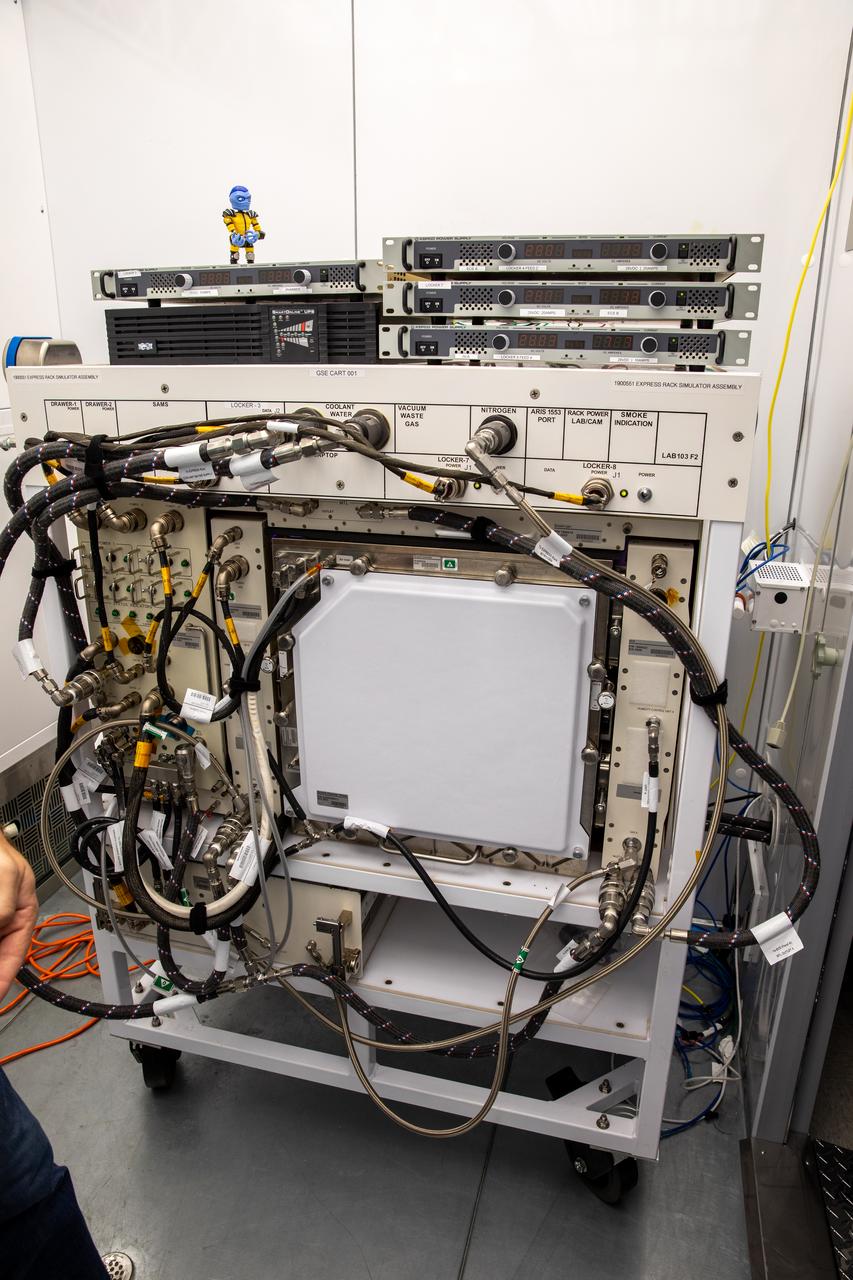
In view is the Advanced Plant Habitat (APH) ground unit inside the Space Station Processing Facility at NASA’s Kennedy Space Center in Florida on Dec. 14, 2020. Part of the Plant Habitat-02 (PH-02) experiment, a ground control crop of radishes was grown at Kennedy and harvested on Dec. 14. The experiment also involves growing two similar radish crops inside the International Space Station’s APH. NASA astronaut Kate Rubins harvested the first crop on Nov. 30, and the second harvest aboard the orbiting laboratory is planned for Dec. 30. Once samples return to Earth, researchers will compare those grown in space to the radishes grown here on Earth to better understand how microgravity affects plant growth.
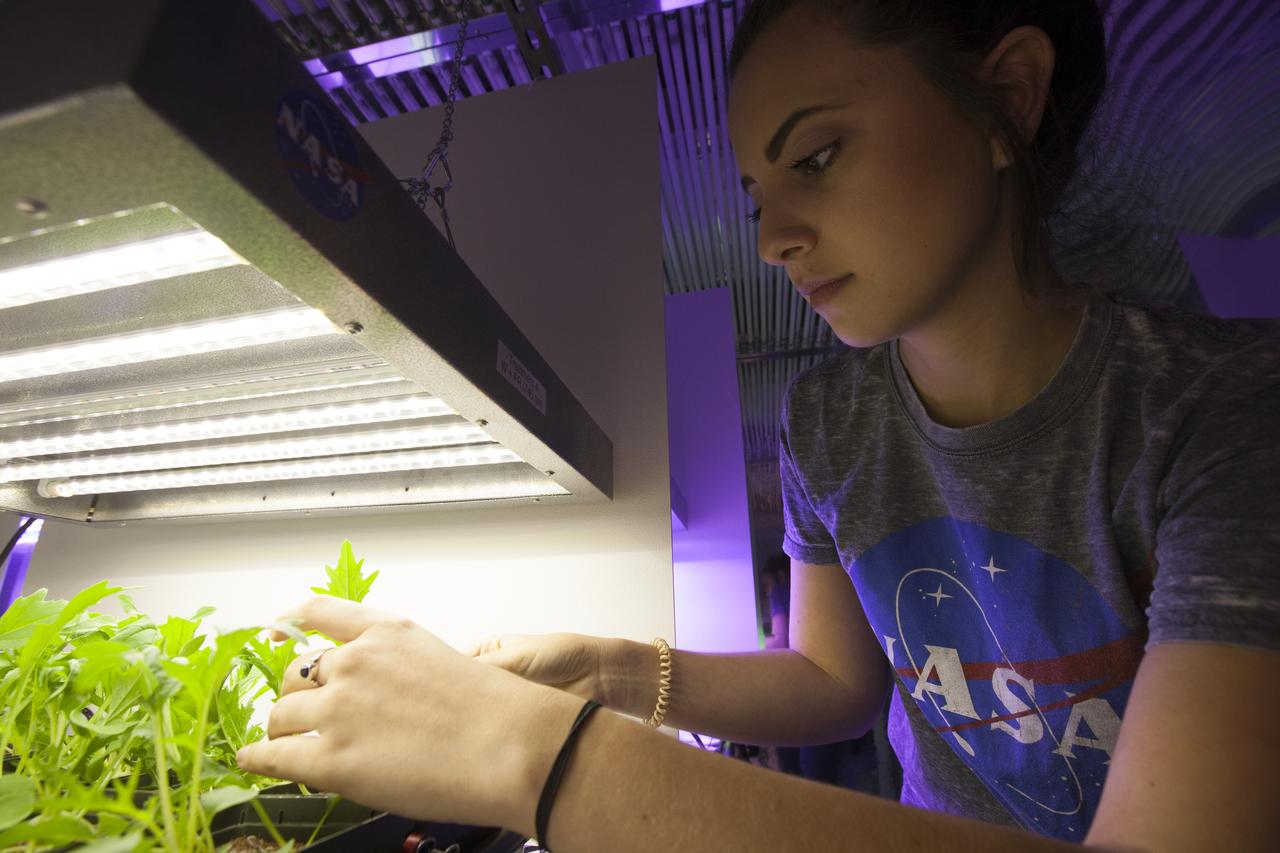
In the Space Life Sciences Laboratory at NASA's Kennedy Space Center in Florida, student interns such as Payton Barnwell are joining agency scientists, contributing in the area of plant growth research for food production in space. Barnwell is a mechanical engineering and nanotechnology major at Florida Polytechnic University. The agency attracts its future workforce through the NASA Internship, Fellowships and Scholarships, or NIFS, Program.
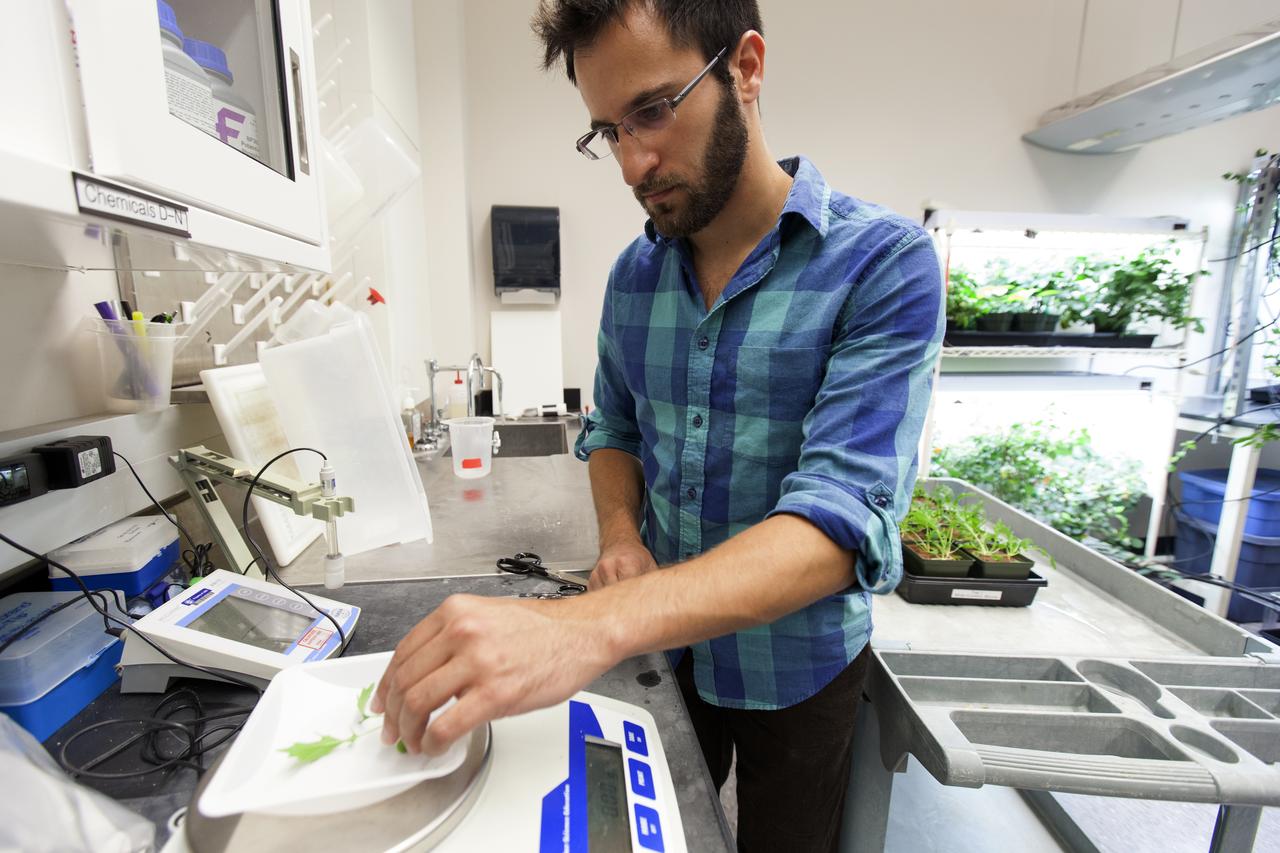
In the Space Life Sciences Laboratory at NASA's Kennedy Space Center in Florida, student interns such as Alex Litvin are joining agency scientists, contributing in the area of plant growth research for food production in space. Litvin is pursuing doctorate in horticulture at Iowa State University. The agency attracts its future workforce through the NASA Internship, Fellowships and Scholarships, or NIFS, Program.
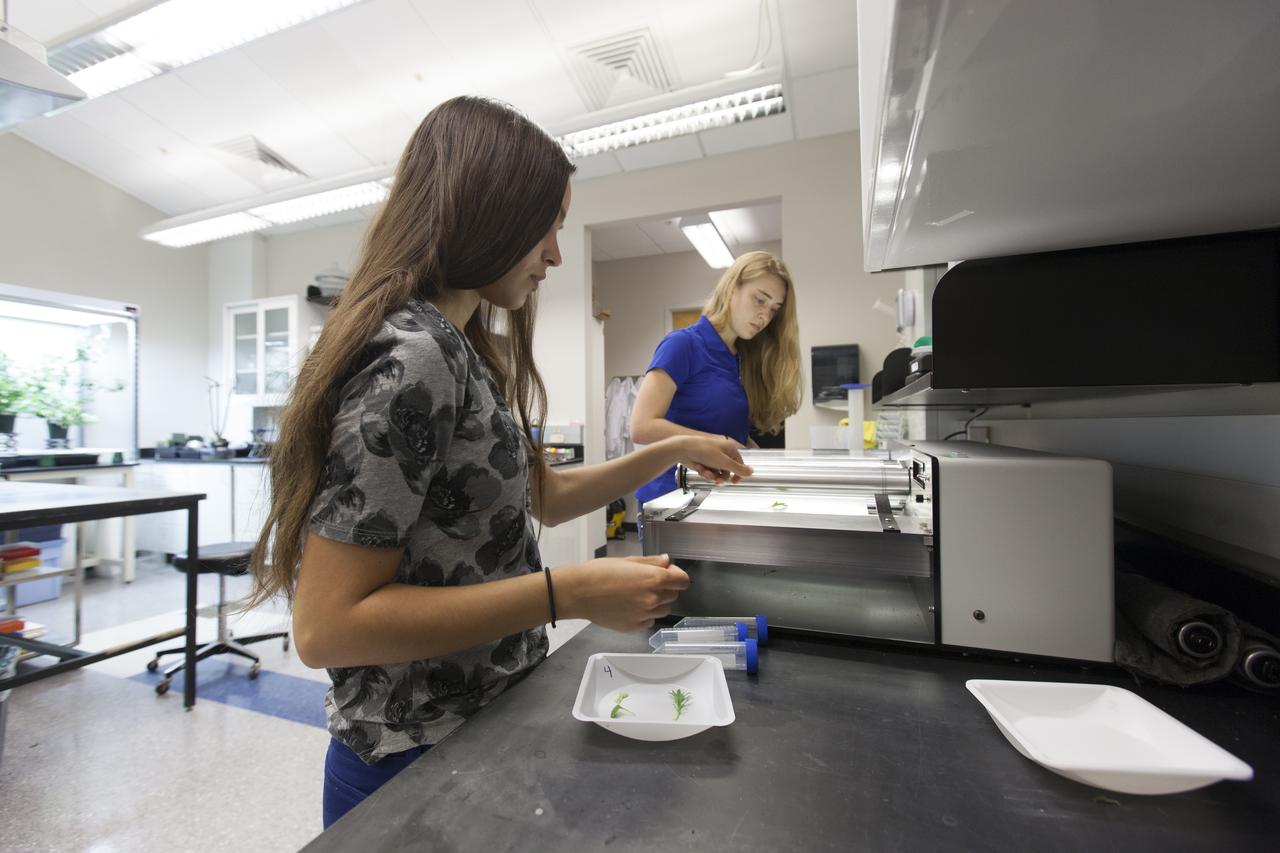
In the Space Life Sciences Laboratory at NASA's Kennedy Space Center in Florida, student interns such as Emma Boehm, left, and Jessica Scotten are joining agency scientists, contributing in the area of plant growth research for food production in space. Boehm is pursuing a degree in ecology and evolution at the University of Minnesota. Scotten is majoring in microbiology at Oregon State University. The agency attracts its future workforce through the NASA Internship, Fellowships and Scholarships, or NIFS, Program.
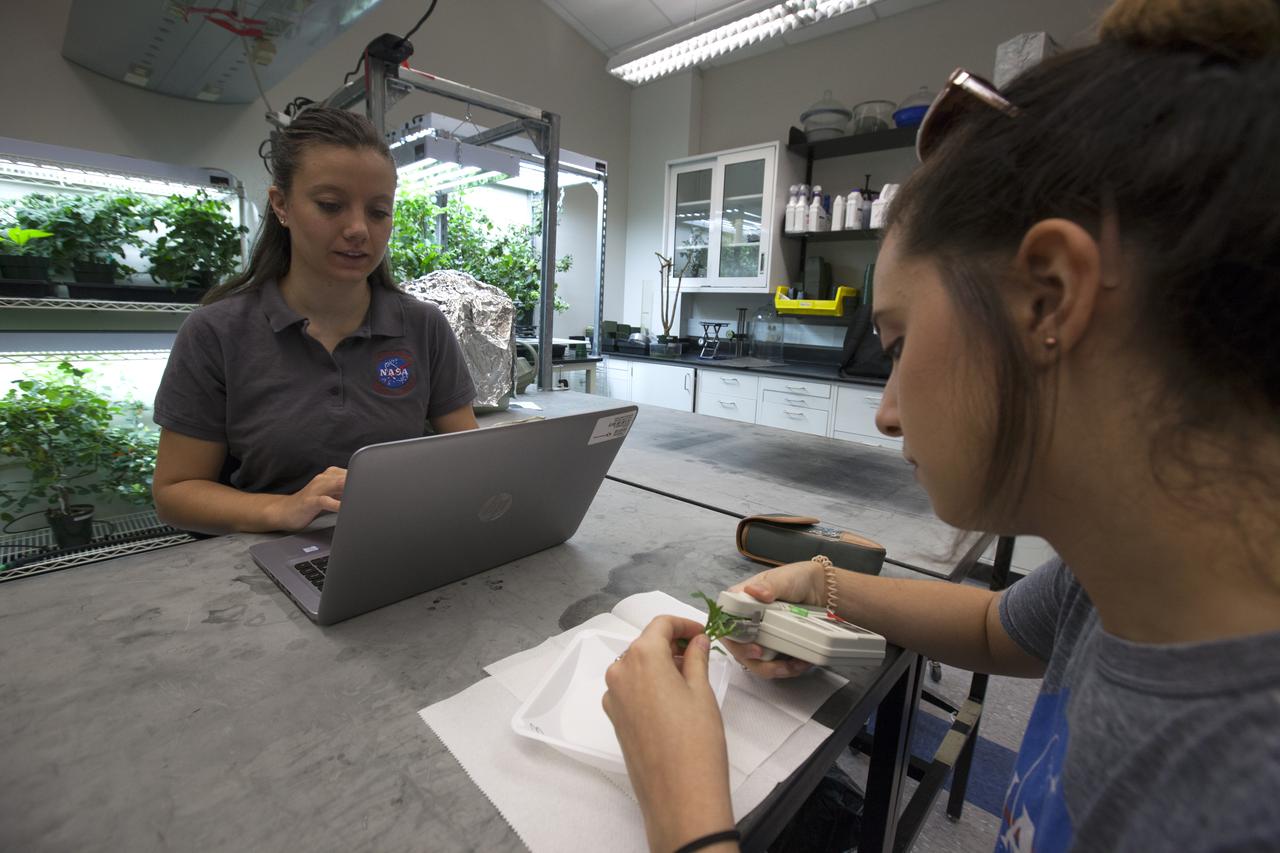
In the Space Life Sciences Laboratory at NASA's Kennedy Space Center in Florida, student interns such as Ayla Grandpre, left, and Payton Barnwell are joining agency scientists, contributing in the area of plant growth research for food production in space. Grandpre is pursuing a degree in computer science and chemistry at Rocky Mountain College in Billings, Montana. Barnwell is a mechanical engineering and nanotechnology major at Florida Polytechnic University. The agency attracts its future workforce through the NASA Internship, Fellowships and Scholarships, or NIFS, Program.
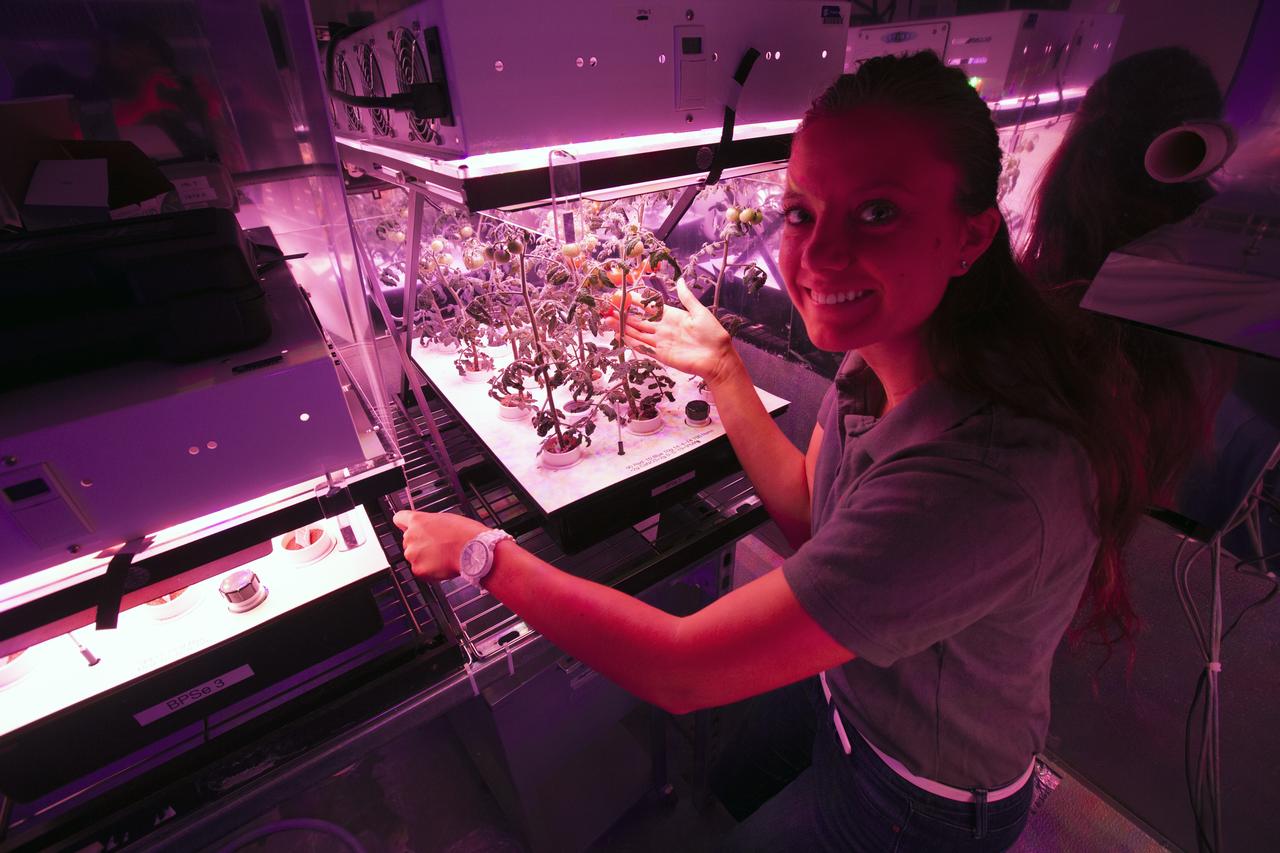
In the Space Life Sciences Laboratory at NASA's Kennedy Space Center in Florida, student interns such as Ayla Grandpre are joining agency scientists, contributing in the area of plant growth research for food production in space. Grandpre is majoring in computer science and chemistry at Rocky Mountain College in Billings, Montana. The agency attracts its future workforce through the NASA Internship, Fellowships and Scholarships, or NIFS, Program.
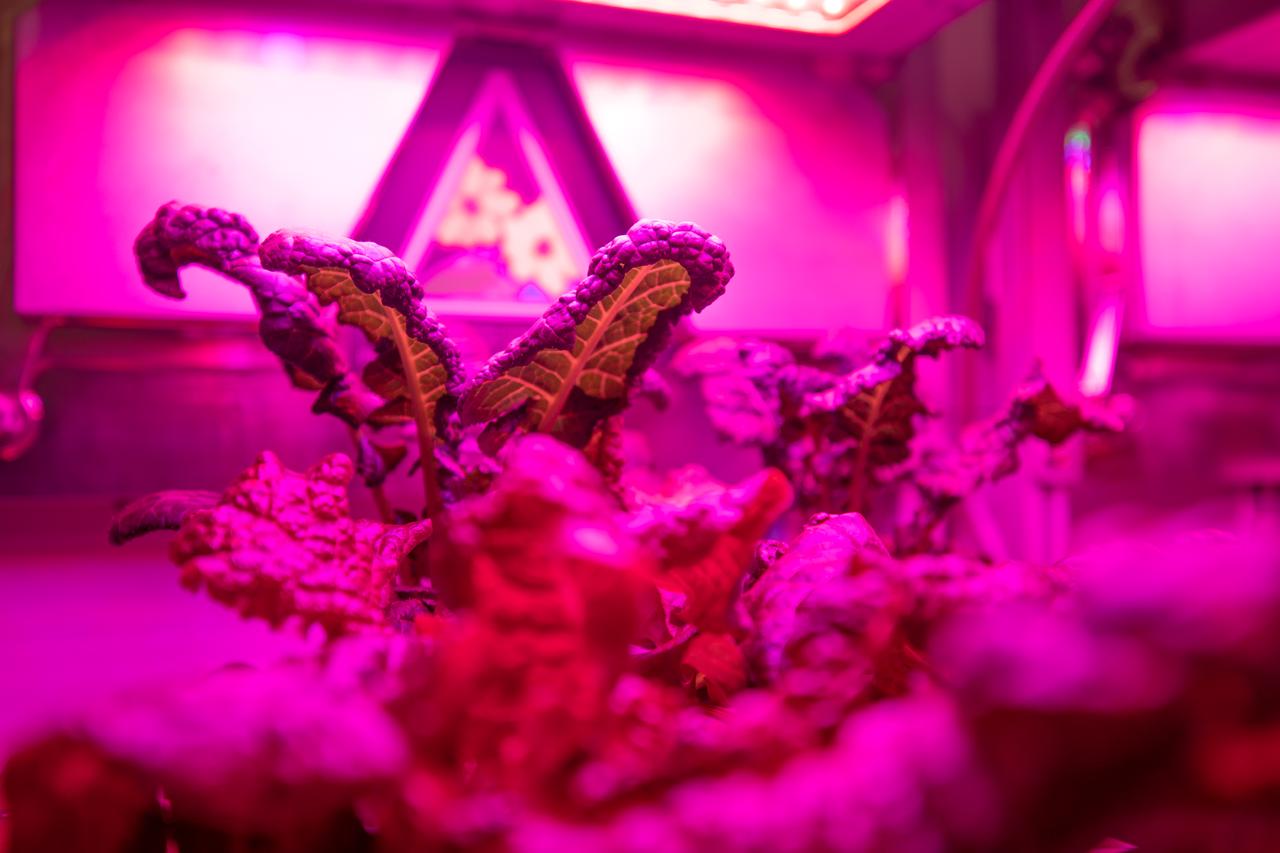
Three crops grown under a test condition representative of the International Space Station are photographed moments before harvest for a science verification test (SVT) in the Space Station Processing Facility at NASA’s Kennedy Space Center in Florida on Sept. 30, 2019. The SVT will study the potential of the three plant cultivars to grow in space. The harvest included ‘outredgeous’ red romaine lettuce, which has been grown in space before, and two new plant cultivars – amara mustard and shungiku, an Asian green comparable to an edible chrysanthemum. All three lettuce plants were grown from seed film, making this the first SVT with this new plant growth material. Earlier this year, the amara mustard and shungiku plants were grown for the first time using seed bags – referred to as pillows – during the Sustained Veggie project, a study funded by the Human Research Program.
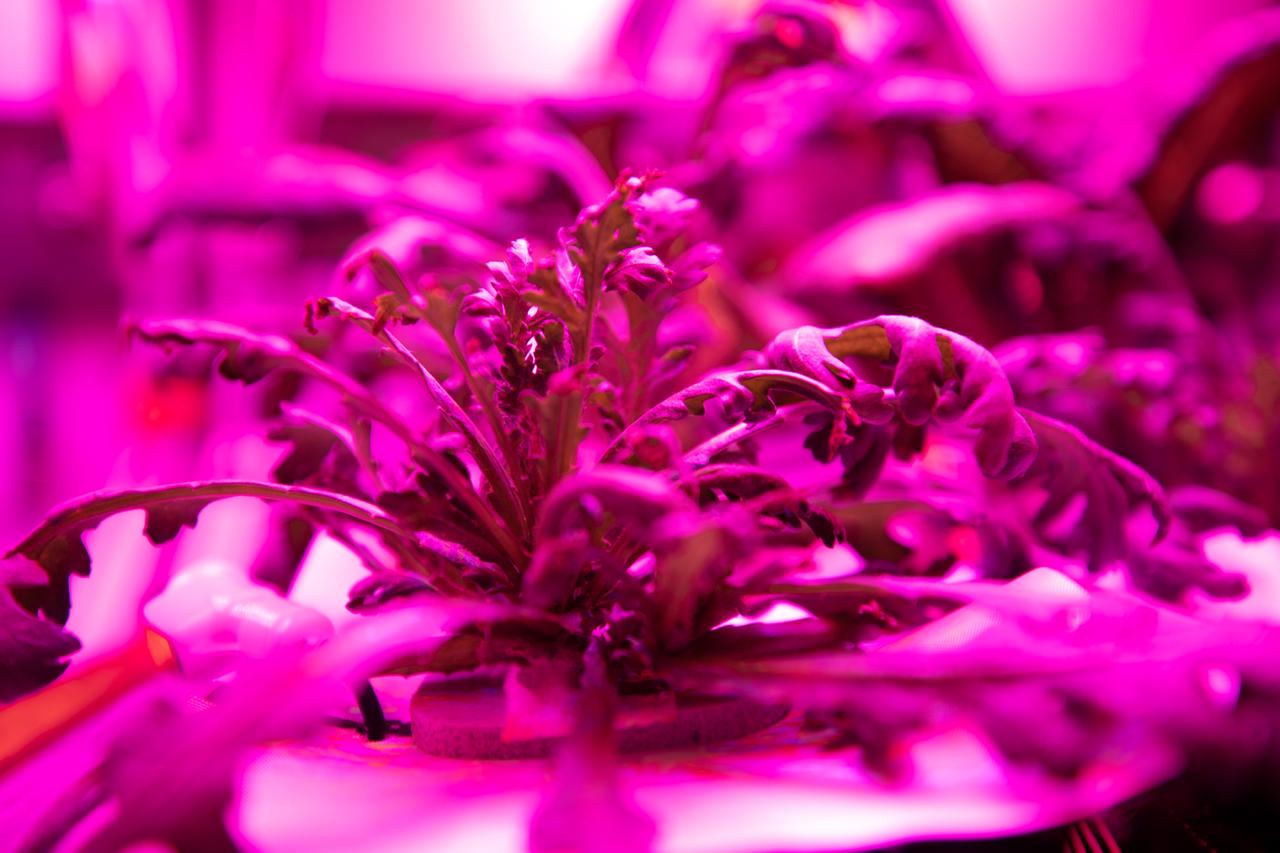
Three crops grown under a test condition representative of the International Space Station are photographed moments before harvest for a science verification test (SVT) in the Space Station Processing Facility at NASA’s Kennedy Space Center in Florida on Sept. 30, 2019. The SVT will study the potential of the three plant cultivars to grow in space. The harvest included ‘outredgeous’ red romaine lettuce, which has been grown in space before, and two new plant cultivars – amara mustard and shungiku, an Asian green comparable to an edible chrysanthemum. All three lettuce plants were grown from seed film, making this the first SVT with this new plant growth material. Earlier this year, the amara mustard and shungiku plants were grown for the first time using seed bags – referred to as pillows – during the Sustained Veggie project, a study funded by the Human Research Program.
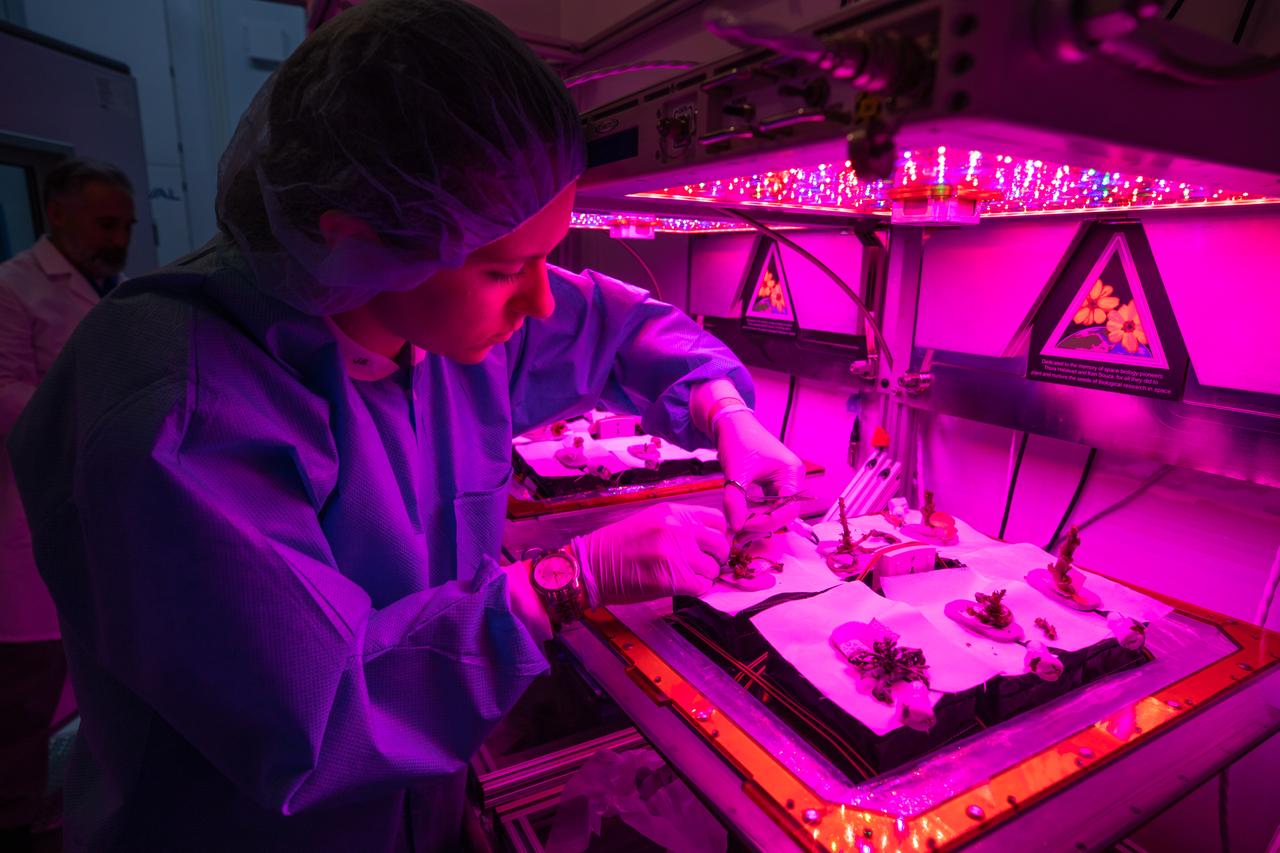
Jess Bunchek, an associate scientist at NASA’s Kennedy Space Center in Florida, harvests plant cultivars inside the Veggie growth chamber in the Space Station Processing Facility on Sept. 30, 2019, for a science verification test (SVT). This SVT will study the potential of three plants – amara mustard, ‘outredgeous’ red romaine lettuce and shungiku, an Asian green comparable to an edible chrysanthemum – to grow in space. All three lettuce plants were grown from seed film, making this the first SVT with this new plant growth material. Earlier this year, the amara mustard and shungiku plants were grown for the first time using seed bags – referred to as pillows – during the Sustained Veggie project, a study funded by the Human Research Program.
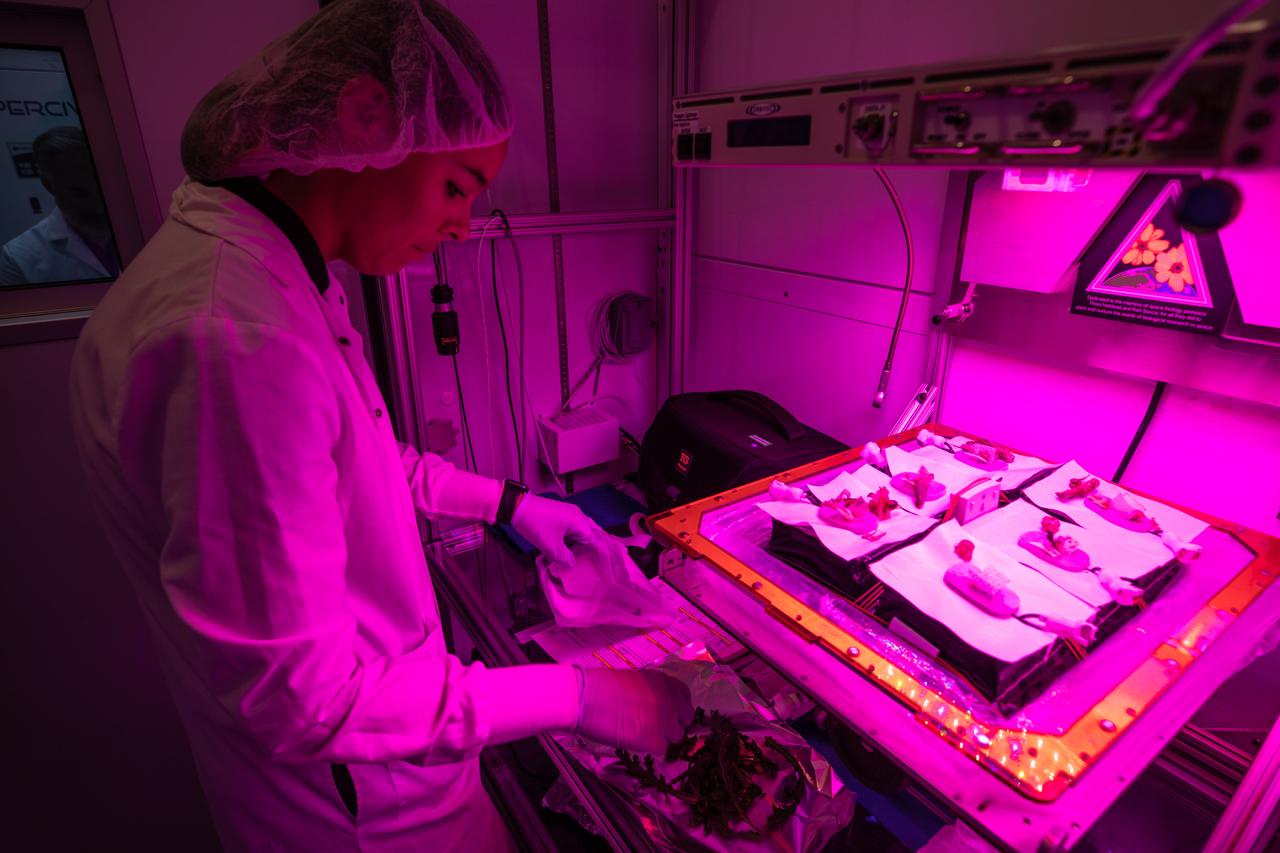
Kennedy Space Center employee Anna Maria Ruby harvests plant cultivars inside the Veggie growth chamber in the Space Station Processing Facility on Sept. 30, 2019, for a science verification test (SVT). This SVT will study the potential of three plants – amara mustard, ‘outredgeous’ red romaine lettuce and shungiku, an Asian green comparable to an edible chrysanthemum – to grow in space. All three lettuce plants were grown from seed film, making this the first SVT with this new plant growth material. Earlier this year, the amara mustard and shungiku plants were grown for the first time using seed bags – referred to as pillows – during the Sustained Veggie project, a study funded by the Human Research Program.
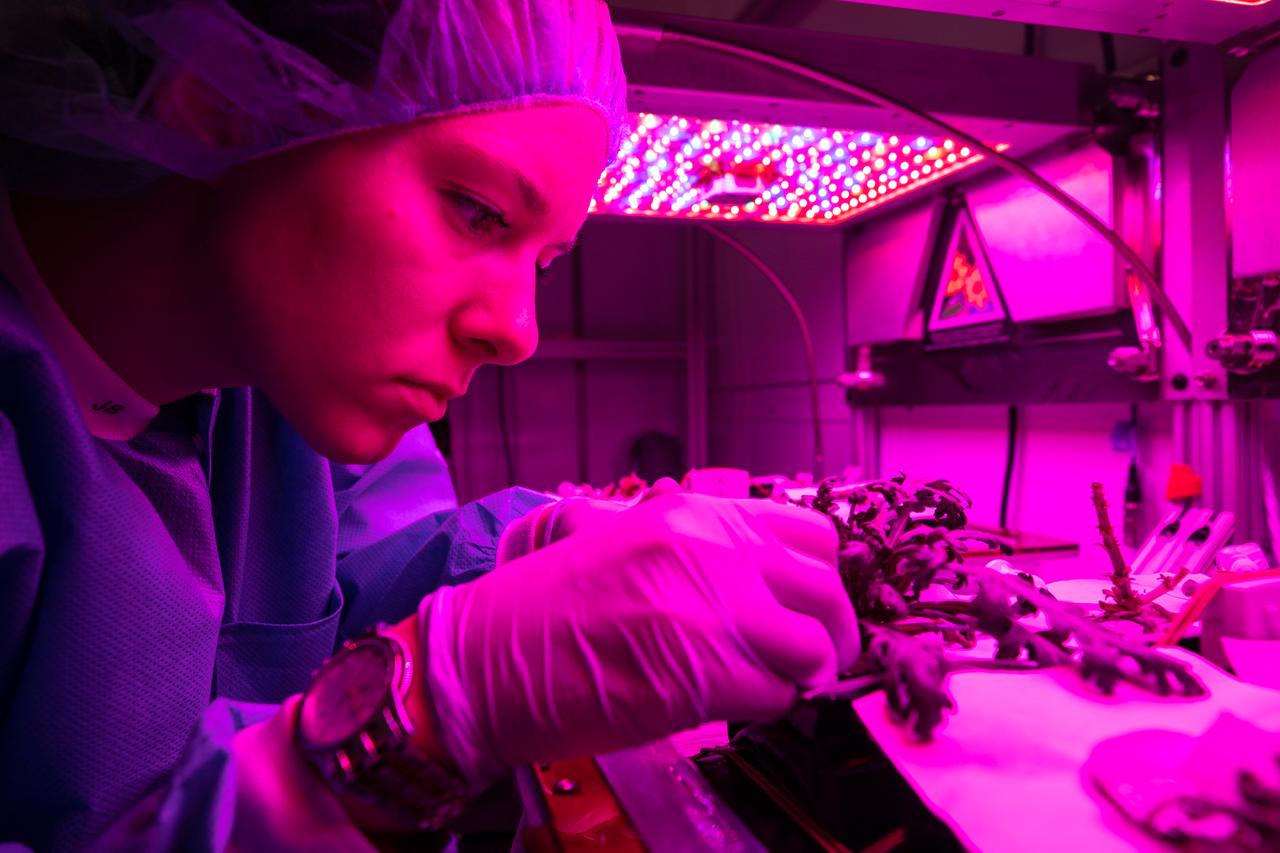
Jess Bunchek, an associate scientist at NASA’s Kennedy Space Center in Florida, harvests plant cultivars inside the Veggie growth chamber in the Space Station Processing Facility on Sept. 30, 2019, for a science verification test (SVT). This SVT will study the potential of three plants – amara mustard, ‘outredgeous’ red romaine lettuce and shungiku, an Asian green comparable to an edible chrysanthemum – to grow in space. All three lettuce plants were grown from seed film, making this the first SVT with this new plant growth material. Earlier this year, the amara mustard and shungiku plants were grown for the first time using seed bags – referred to as pillows – during the Sustained Veggie project, a study funded by the Human Research Program.
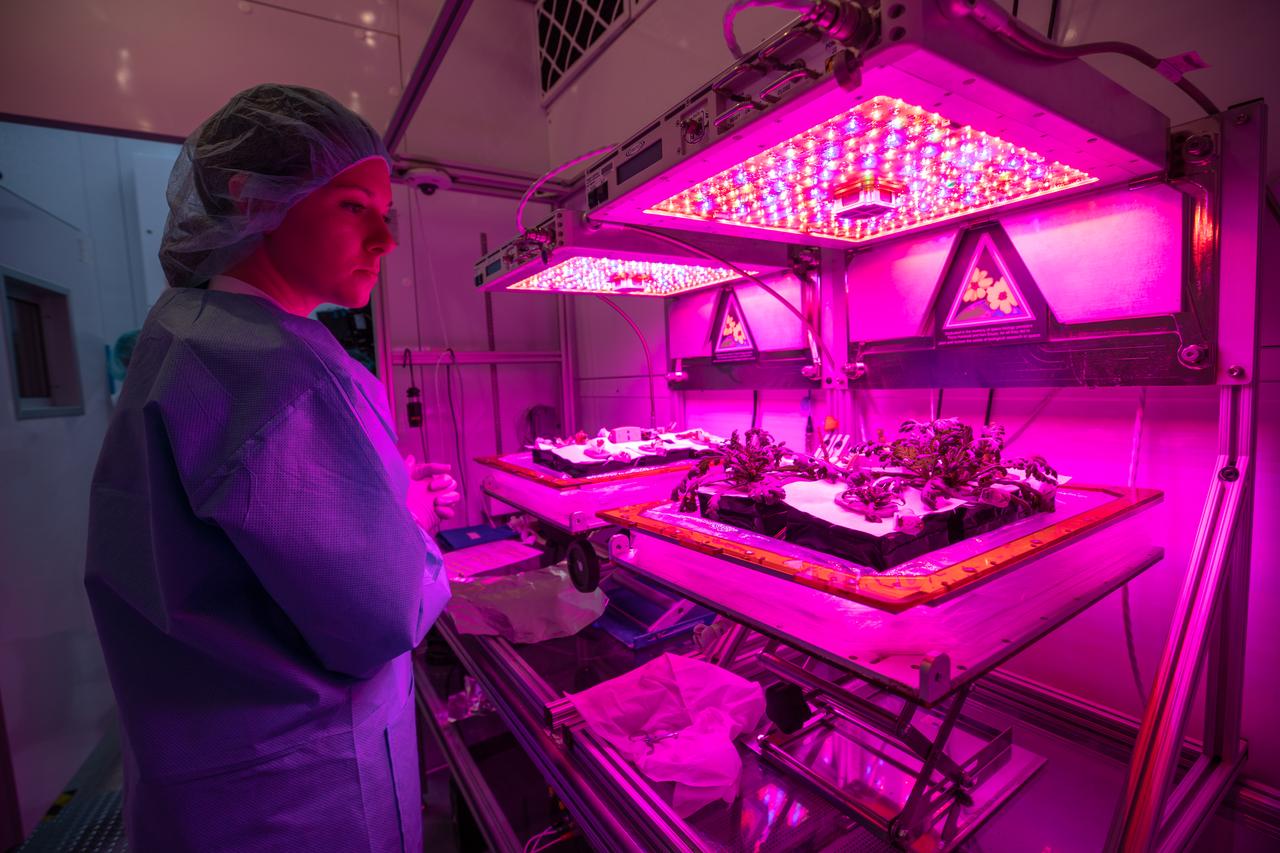
Jess Bunchek, an associate scientist at NASA’s Kennedy Space Center in Florida, observes plant cultivars inside the Veggie growth chamber in the Space Station Processing Facility prior to harvesting them on Sept. 30, 2019, for a science verification test (SVT). This SVT will study the potential of three plants – amara mustard, ‘outredgeous’ red romaine lettuce and shungiku, an Asian green comparable to an edible chrysanthemum – to grow in space. All three lettuce plants were grown from seed film, making this the first SVT with this new plant growth material. Earlier this year, the amara mustard and shungiku plants were grown for the first time using seed bags – referred to as pillows – during the Sustained Veggie project, a study funded by the Human Research Program.
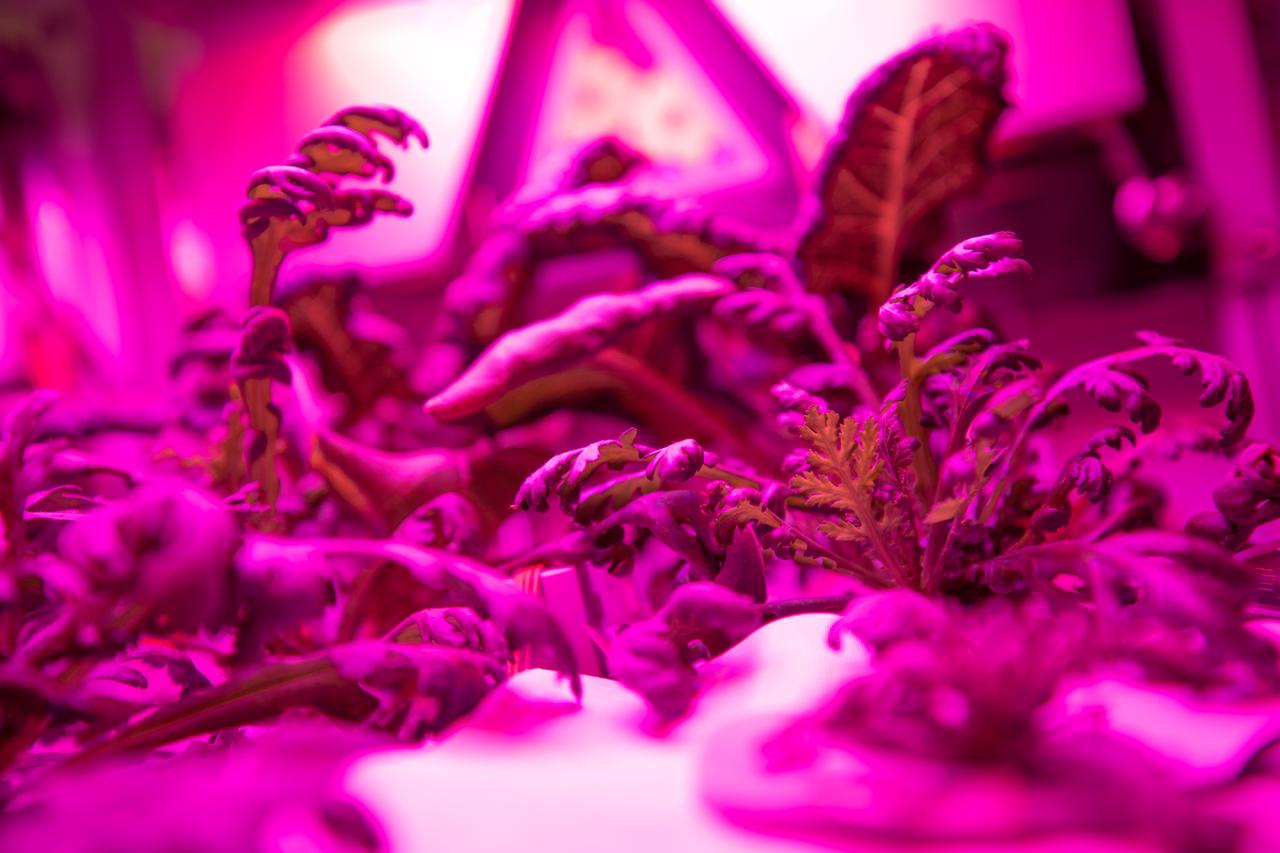
Three crops grown under a test condition representative of the International Space Station are photographed moments before harvest for a science verification test (SVT) in the Space Station Processing Facility at NASA’s Kennedy Space Center in Florida on Sept. 30, 2019. The SVT will study the potential of the three plant cultivars to grow in space. The harvest included ‘outredgeous’ red romaine lettuce, which has been grown in space before, and two new plant cultivars – amara mustard and shungiku, an Asian green comparable to an edible chrysanthemum. All three lettuce plants were grown from seed film, making this the first SVT with this new plant growth material. Earlier this year, the amara mustard and shungiku plants were grown for the first time using seed bags – referred to as pillows – during the Sustained Veggie project, a study funded by the Human Research Program.
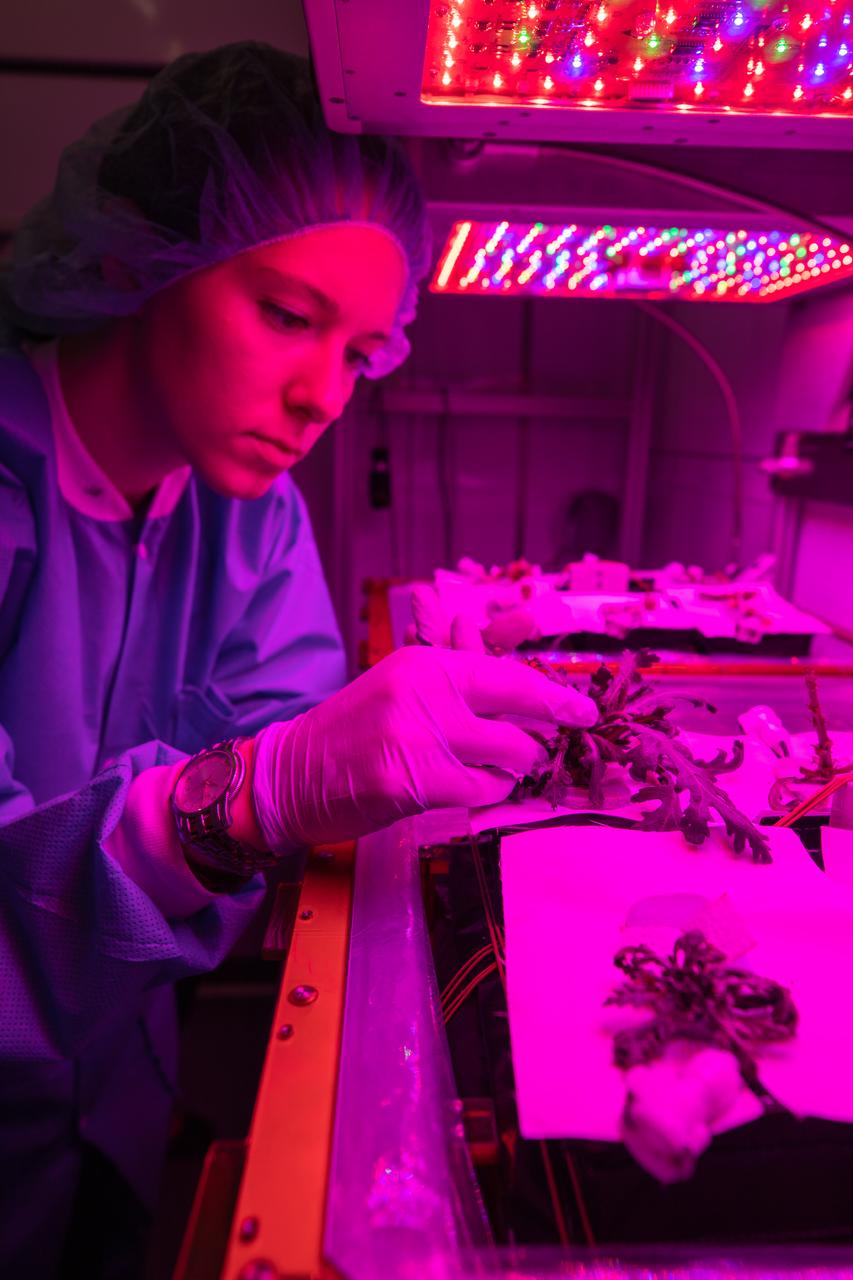
Jess Bunchek, an associate scientist at NASA’s Kennedy Space Center in Florida, harvests plant cultivars inside the Veggie growth chamber in the Space Station Processing Facility on Sept. 30, 2019, for a science verification test (SVT). This SVT will study the potential of three plants – amara mustard, ‘outredgeous’ red romaine lettuce and shungiku, an Asian green comparable to an edible chrysanthemum – to grow in space. All three lettuce plants were grown from seed film, making this the first SVT with this new plant growth material. Earlier this year, the amara mustard and shungiku plants were grown for the first time using seed bags – referred to as pillows – during the Sustained Veggie project, a study funded by the Human Research Program.
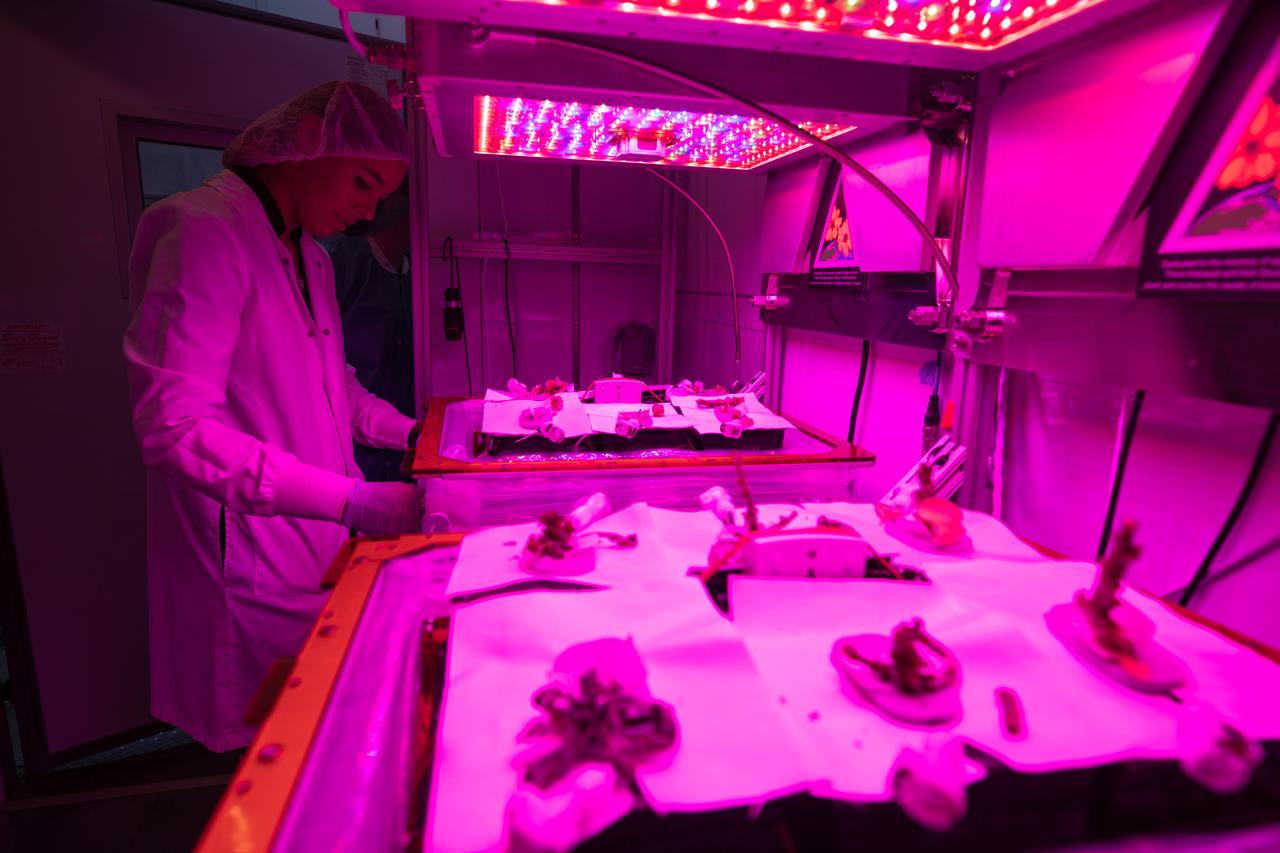
Kennedy Space Center employee Anna Maria Ruby observes plant cultivars inside the Veggie growth chamber in the Space Station Processing Facility prior to harvesting them on Sept. 30, 2019, for a science verification test (SVT). This SVT will study the potential of three plants – amara mustard, ‘outredgeous’ red romaine lettuce and shungiku, an Asian green comparable to an edible chrysanthemum – to grow in space. All three lettuce plants were grown from seed film, making this the first SVT with this new plant growth material. Earlier this year, the amara mustard and shungiku plants were grown for the first time using seed bags – referred to as pillows – during the Sustained Veggie project, a study funded by the Human Research Program.
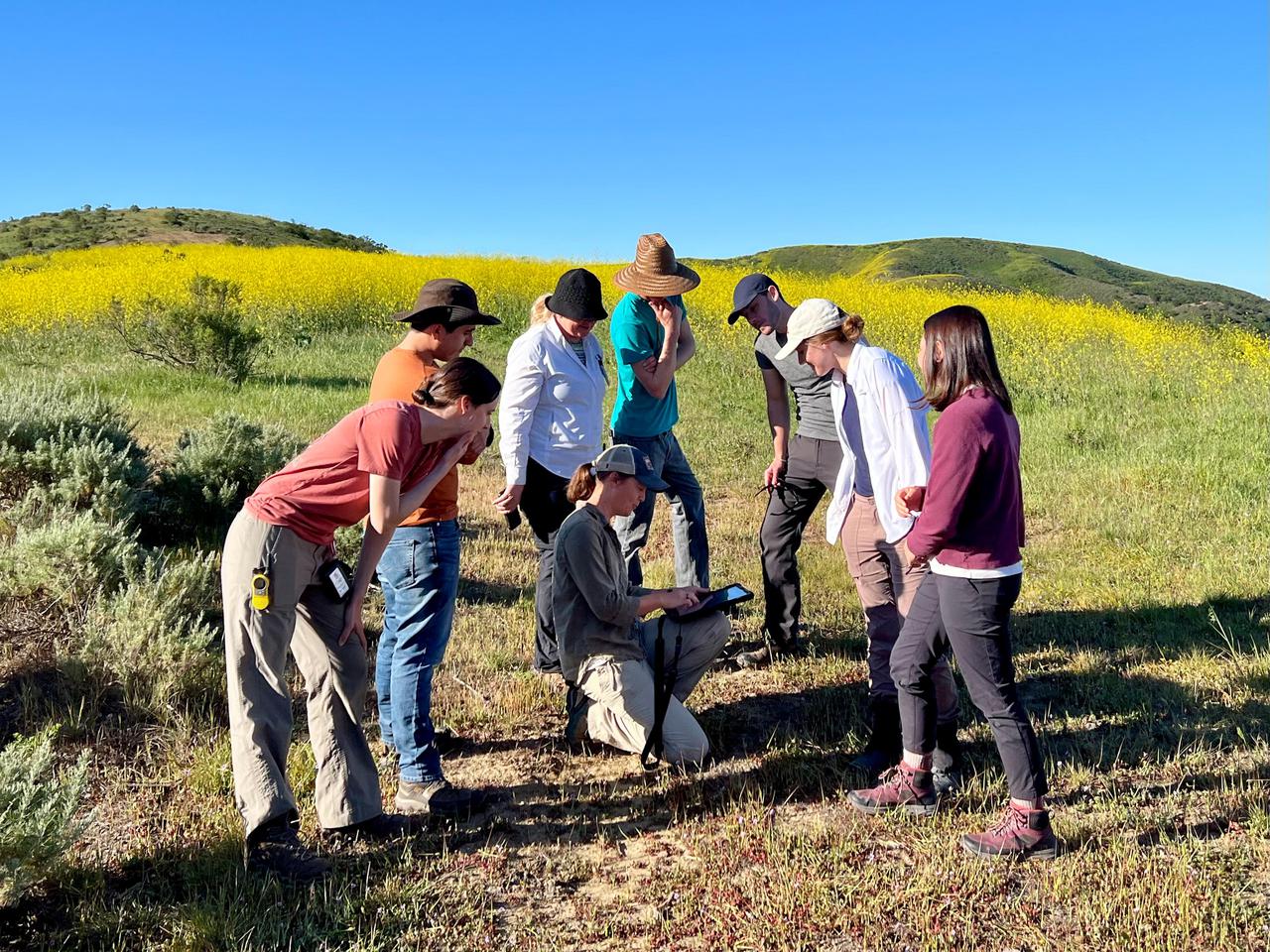
Dana Chadwick, a scientist in the water and ecosystems group at NASA's Jet Propulsion Laboratory, center, advises a field team of researchers from JPL; University of Wisconsin, Madison (UWM); University of California, Los Angeles (UCLA); University of Maryland, Baltimore County (UMBC); and University of California, Santa Barbara (UCSB) on vegetation-sampling locations at the Jack and Laura Dangermond Preserve in Santa Barbara County, California, on March 24, 2022. Chadwick and the team are working on the Surface Biology and Geology High-Frequency Time Series (SHIFT) campaign, which is jointly led by JPL, UCSB, and The Nature Conservancy. Chadwick is surrounded by, from left: Natalie Queally, a forest and wildlife ecology graduate student at UWM; Francisco Ochoa, a geography graduate student at UCLA; Petya Campbell, a research associate professor at UMBC and a research associate at NASA's Goddard Space Flight Center; Brendan Heberlein, a research intern at UWM; Renato Braghiere, a postdoctoral research scientist at JPL; Cassandra Nickles, a postdoctoral fellow at JPL; and Clare Saiki, a doctoral student at UCSB. Operating between late February and late May 2022, SHIFT combines the ability of airborne science instruments to gather data over widespread areas with the more concentrated observations scientists conduct in the field to study the functional characteristics, health, and resilience of plant communities. The sampling and analysis done by researchers on the ground and in the ocean is intended to validate data taken by AVIRIS-NG (Airborne Visible/Infrared Imaging Spectrometer-Next Generation). The instrument, designed at JPL, is collecting spectral data of vegetation it observes during weekly flights in an aircraft over a 640-square-mile (1,656-square-kilometer) study area in Santa Barbara County and coastal Pacific waters. The campaign is a pathfinder for NASA's proposed Surface Biology and Geology (SBG) mission. SHIFT will help scientists design data collection and processing algorithms for that mission, which would launch no earlier than 2028. The SHIFT data is also intended to support the research and conservation objectives of The Nature Conservancy, which owns the Dangermond Preserve, and UCSB, which operates the Sedgwick Reserve, another nature preserve within the study area. More than 60 scientists from institutions around the U.S. have indicated they intend to use the SHIFT data in their research. https://photojournal.jpl.nasa.gov/catalog/PIA25141
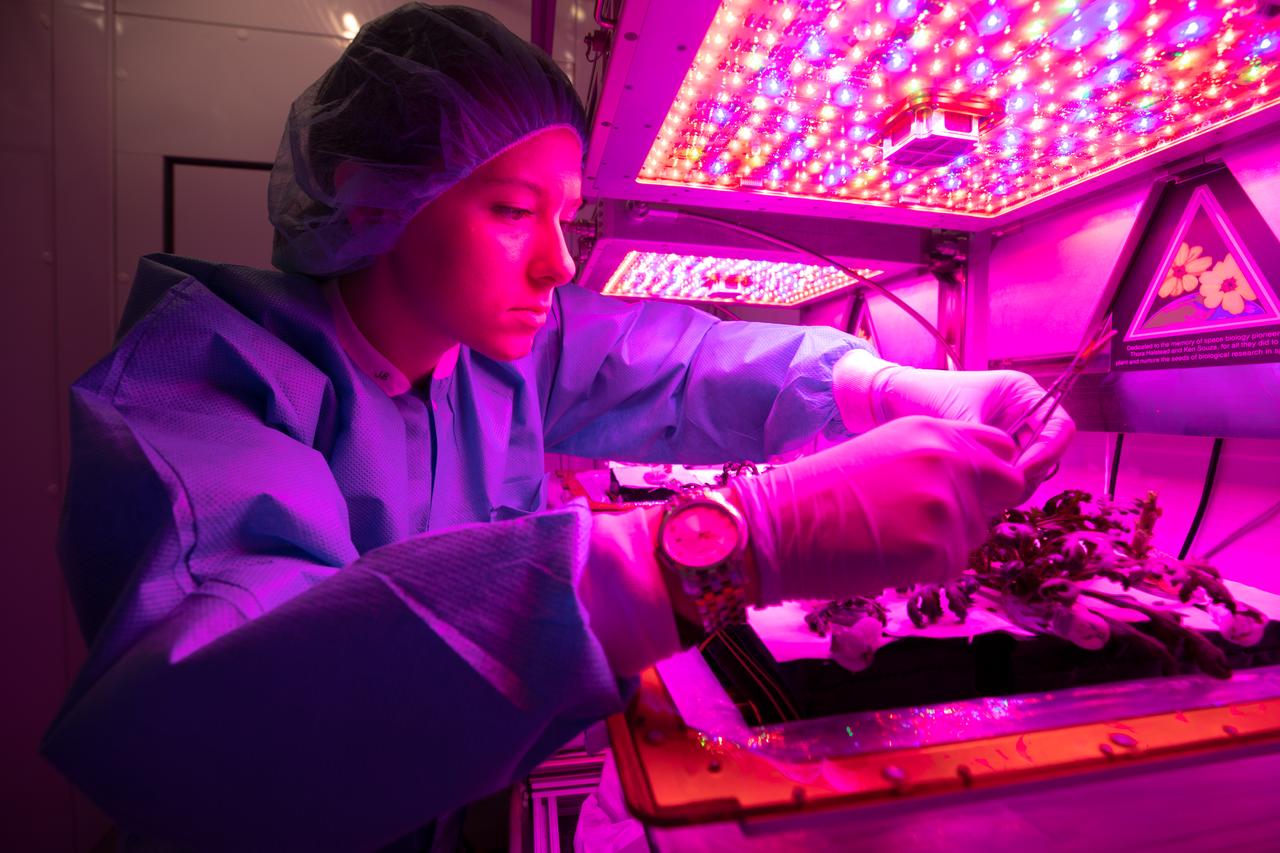
Jess Bunchek, an associate scientist at NASA’s Kennedy Space Center in Florida, harvests shungiku – an Asian green comparable to an edible chrysanthemum – inside the Veggie growth chamber in the Space Station Processing Facility on Sept. 30, 2019, for a science verification test (SVT). The SVT included the harvest of two other plant cultivars – amara mustard and ‘outredgeous’ red romaine lettuce – and will study their potential to grow in space. All three lettuce plants were grown from seed film, making this the first SVT with this new plant growth material. Earlier this year, the amara mustard and shungiku plants were grown for the first time using seed bags – referred to as pillows – during the Sustained Veggie project, a study funded by the Human Research Program.
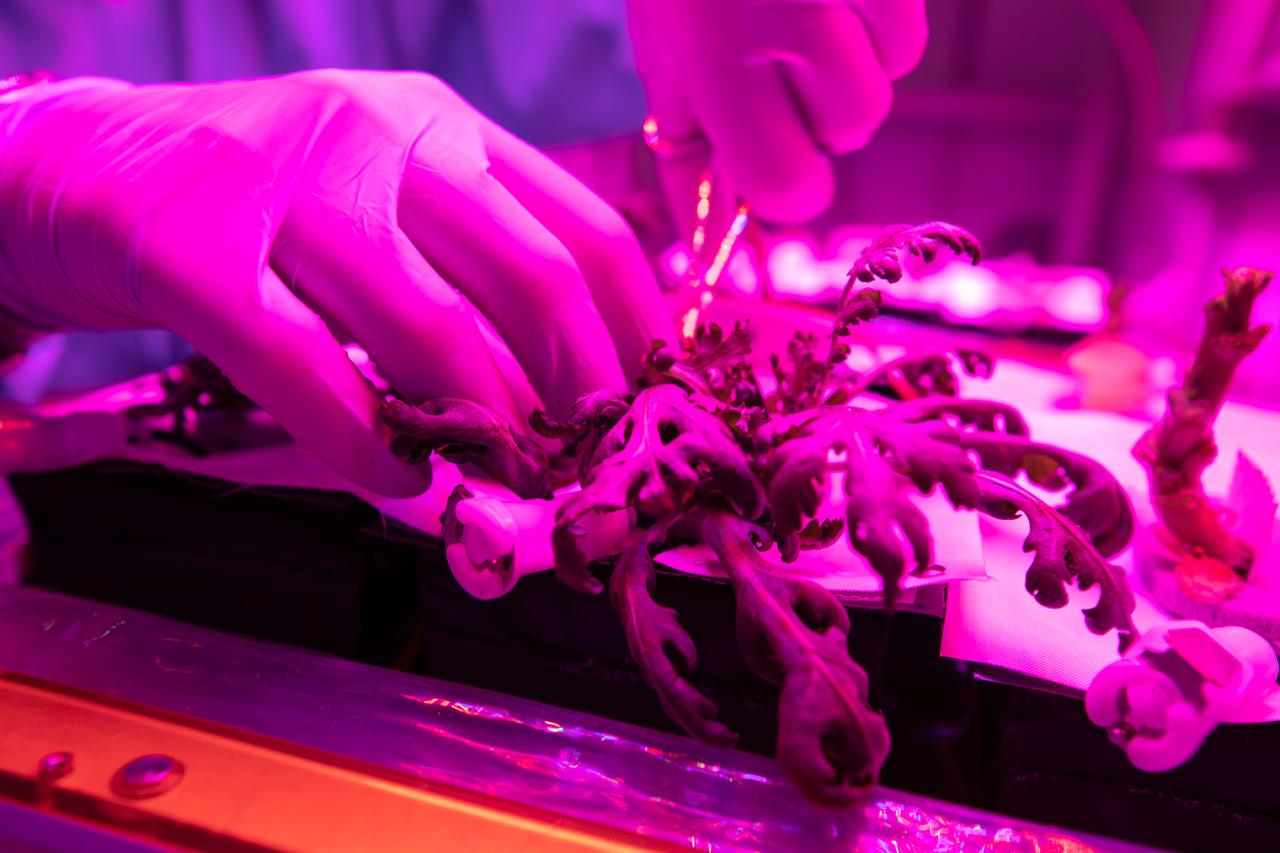
Test crops are harvested inside the Veggie growth chamber in the Space Station Processing Facility at NASA’s Kennedy Space Center in Florida on Sept. 30, 2019, for a science verification test (SVT) to study their potential to grow in space. The harvest included ‘outredgeous’ red romaine lettuce, which has been grown in space before, and two new plant cultivars – amara mustard and shungiku, an Asian green comparable to an edible chrysanthemum. All three lettuce plants were grown from seed film, making this the first SVT with this new plant growth material. Earlier this year, the amara mustard and shungiku plants were grown for the first time using seed bags – referred to as pillows – during the Sustained Veggie project, a study funded by the Human Research Program.
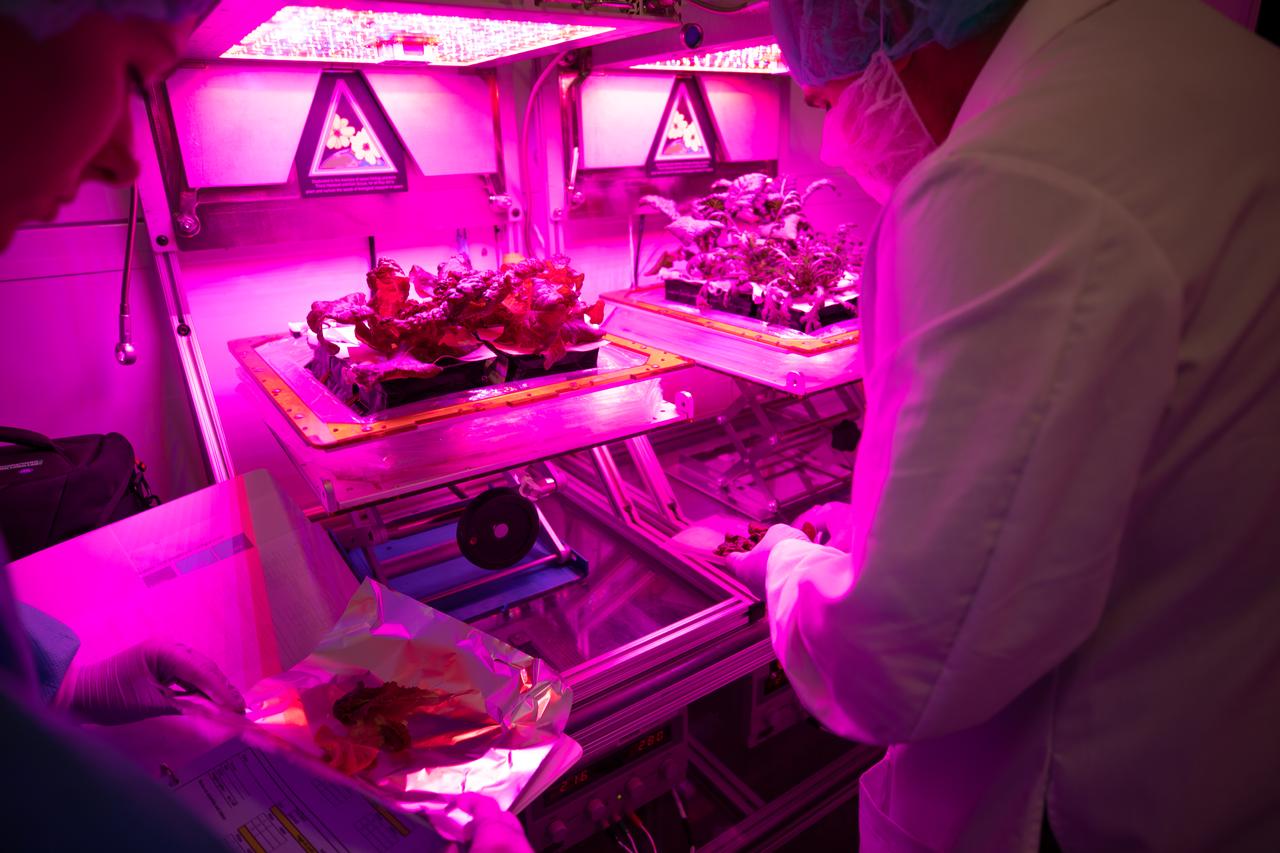
Kennedy Space Center Veggie Project Manager Trent Smith harvests test crops inside the Veggie growth chamber in the Florida spaceport’s Space Station Processing Facility on Sept. 30, 2019, for a science verification test (SVT) to study their potential to grown in space. The harvest included ‘outredgeous’ red romaine lettuce, which has been grown in space before, and two new plant cultivars – amara mustard and shungiku, an Asian green comparable to an edible chrysanthemum. All three lettuce plants were grown from seed film, making this the first SVT with this new plant growth material. Earlier this year, the amara mustard and shungiku plants were grown for the first time using seed bags – referred to as pillows – during the Sustained Veggie project, a study funded by the Human Research Program.
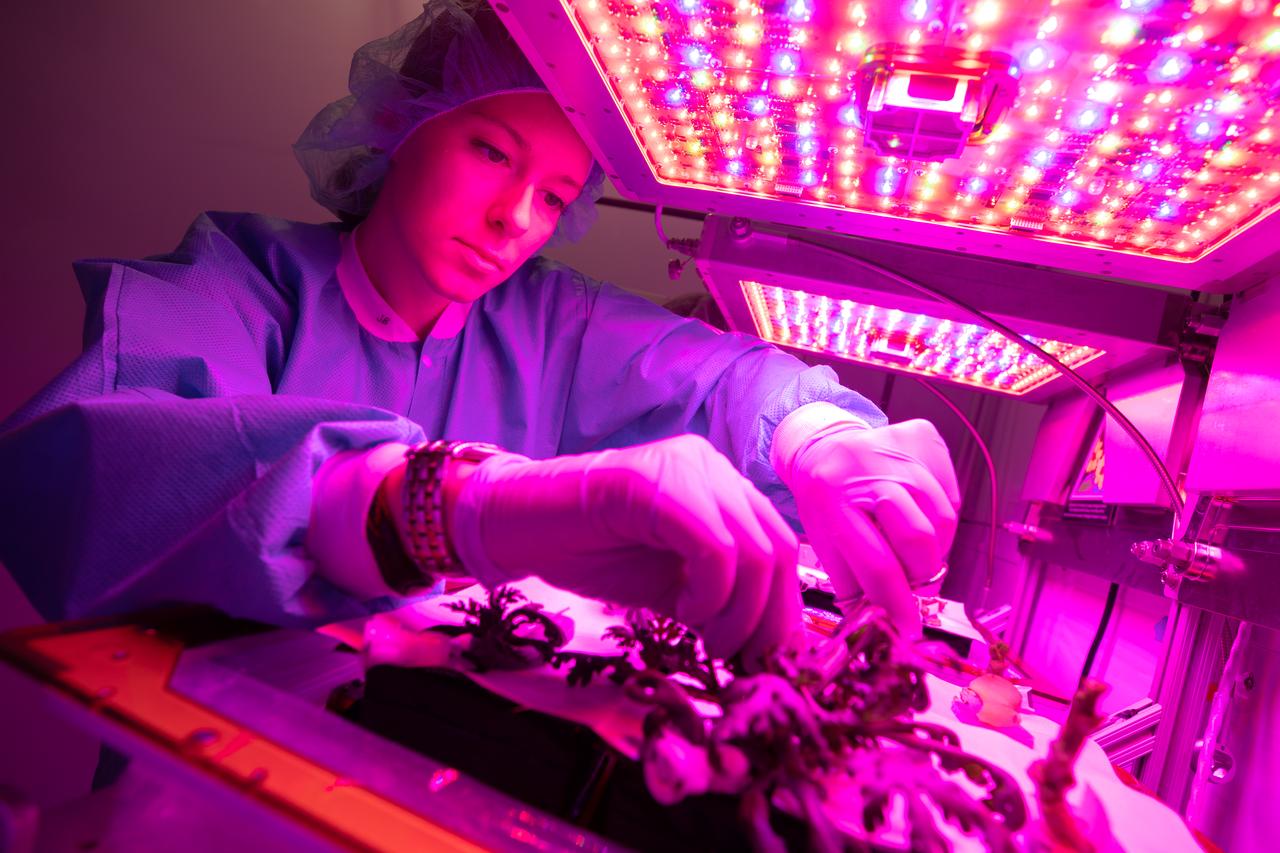
Jess Bunchek, an associate scientist at NASA’s Kennedy Space Center in Florida, harvests shungiku – an Asian green comparable to an edible chrysanthemum – inside the Veggie growth chamber in the Space Station Processing Facility on Sept. 30, 2019, for a science verification test (SVT). The SVT included the harvest of two other plant cultivars – amara mustard and ‘outredgeous’ red romaine lettuce – and will study their potential to grow in space. All three lettuce plants were grown from seed film, making this the first SVT with this new plant growth material. Earlier this year, the amara mustard and shungiku plants were grown for the first time using seed bags – referred to as pillows – during the Sustained Veggie project, a study funded by the Human Research Program.
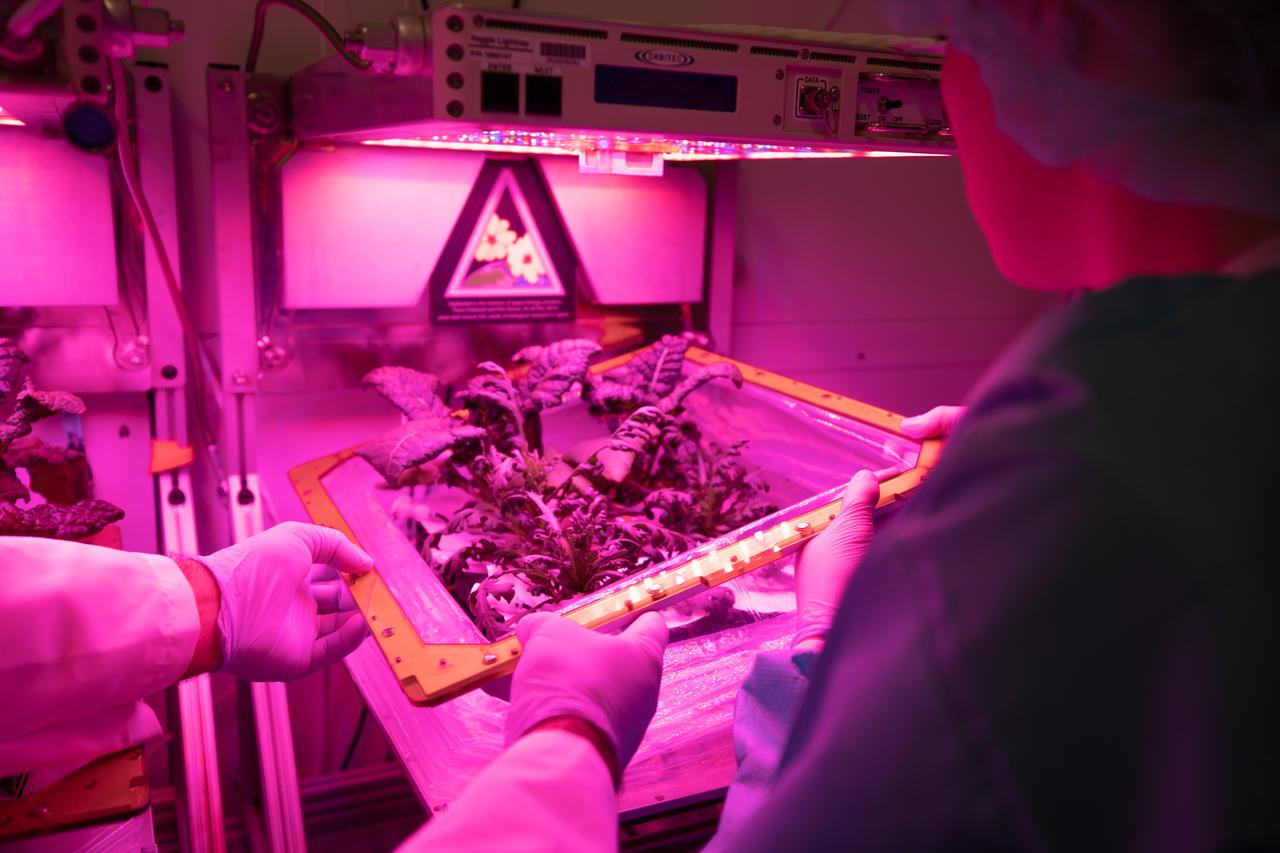
Kennedy Space Center employees harvest test crops inside the Veggie growth chamber in the Florida spaceport’s Space Station Processing Facility on Sept. 30, 2019, for a science verification test (SVT) to study their potential to grown in space. The harvest included ‘outredgeous’ red romaine lettuce, which has been grown in space before, and two new plant cultivars – amara mustard and shungiku, an Asian green comparable to an edible chrysanthemum. All three lettuce plants were grown from seed film, making this the first SVT with this new plant growth material. Earlier this year, the amara mustard and shungiku plants were grown for the first time using seed bags – referred to as pillows – during the Sustained Veggie project, a study funded by the Human Research Program.
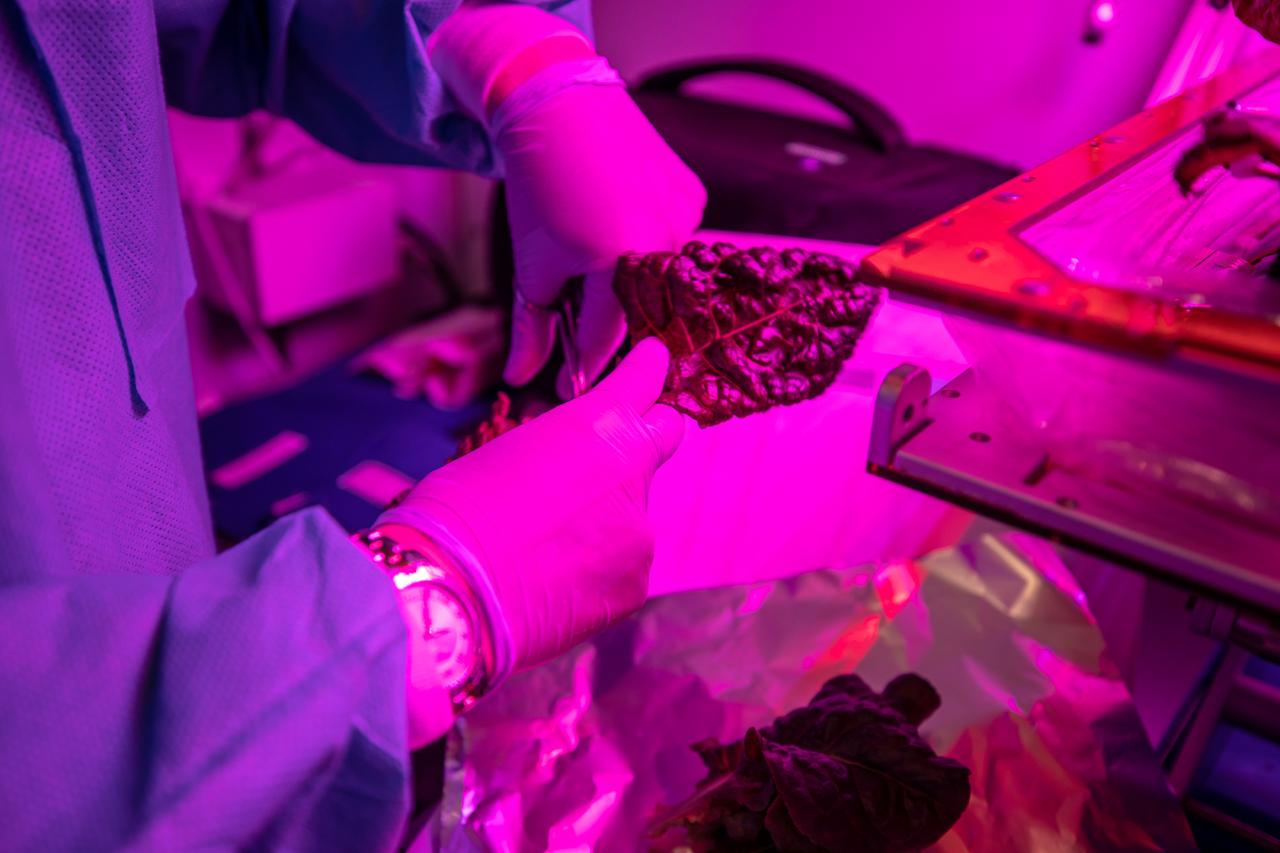
Test crops are harvested inside the Veggie growth chamber in the Space Station Processing Facility at NASA’s Kennedy Space Center in Florida on Sept. 30, 2019, for a science verification test (SVT) to study their potential to grow in space. The harvest included ‘outredgeous’ red romaine lettuce, which has been grown in space before, and two new plant cultivars – amara mustard and shungiku, an Asian green comparable to an edible chrysanthemum. All three lettuce plants were grown from seed film, making this the first SVT with this new plant growth material. Earlier this year, the amara mustard and shungiku plants were grown for the first time using seed bags – referred to as pillows – during the Sustained Veggie project, a study funded by the Human Research Program.
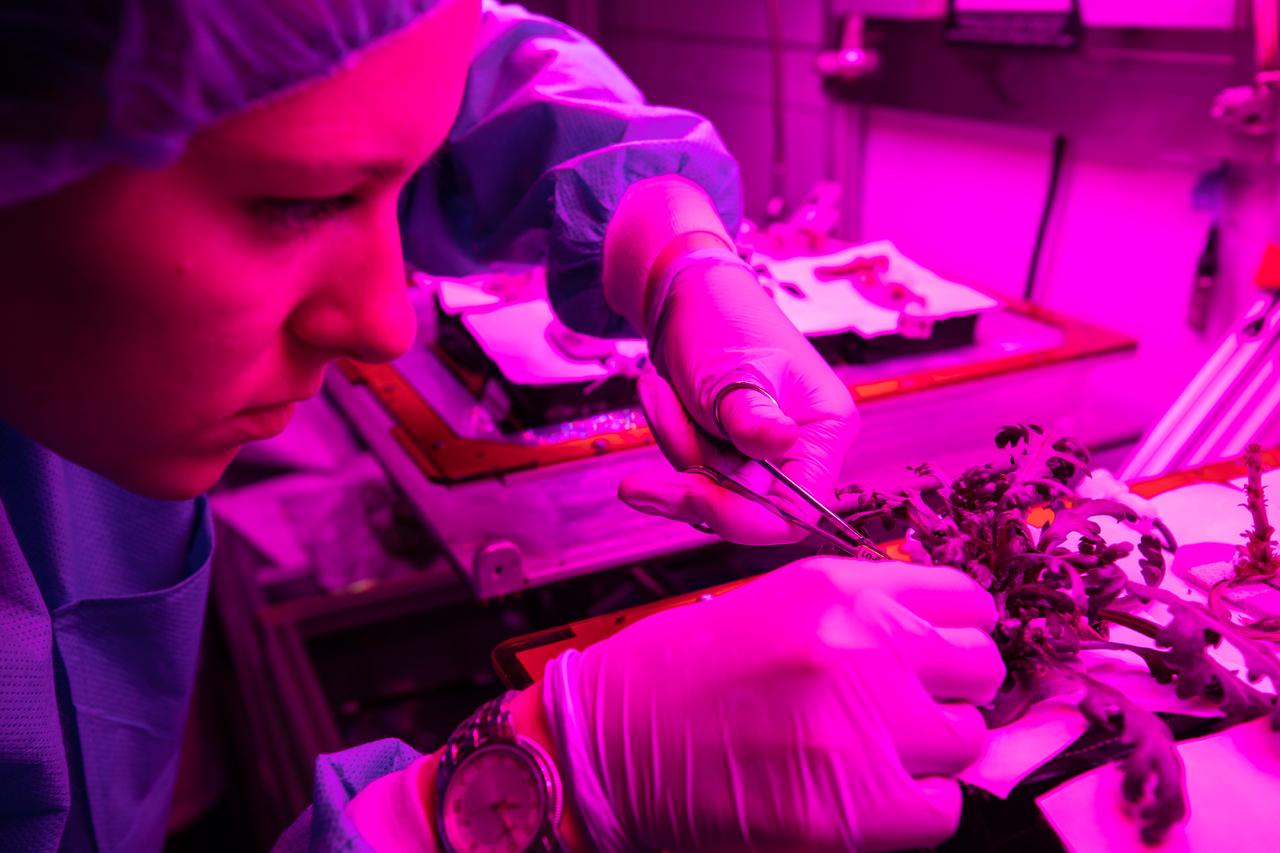
Jess Bunchek, an associate scientist at NASA’s Kennedy Space Center in Florida, harvests shungiku – an Asian green comparable to an edible chrysanthemum – inside the Veggie growth chamber in the Space Station Processing Facility on Sept. 30, 2019, for a science verification test (SVT). The SVT included the harvest of two other plant cultivars – amara mustard and ‘outredgeous’ red romaine lettuce – and will study their potential to grow in space. All three lettuce plants were grown from seed film, making this the first SVT with this new plant growth material. Earlier this year, the amara mustard and shungiku plants were grown for the first time using seed bags – referred to as pillows – during the Sustained Veggie project, a study funded by the Human Research Program.
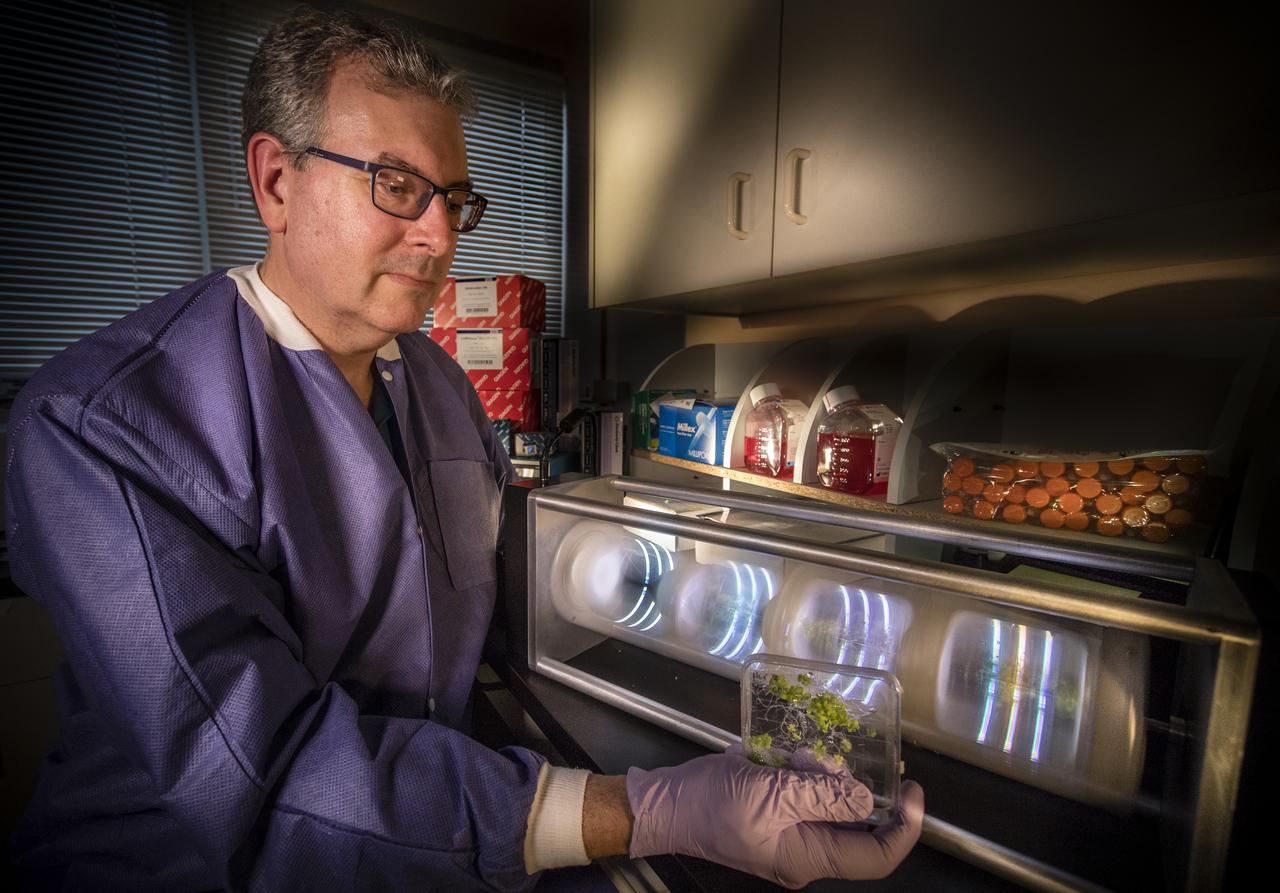
Jeffrey Richards, project science coordinator and research scientist at NASA’s Kennedy Space Center in Florida, demonstrates how Arabidopsis thaliana plant samples are tested in a 2D microgravity simulator in the Microgravity Simulation Support Facility on Dec. 20, 2018.
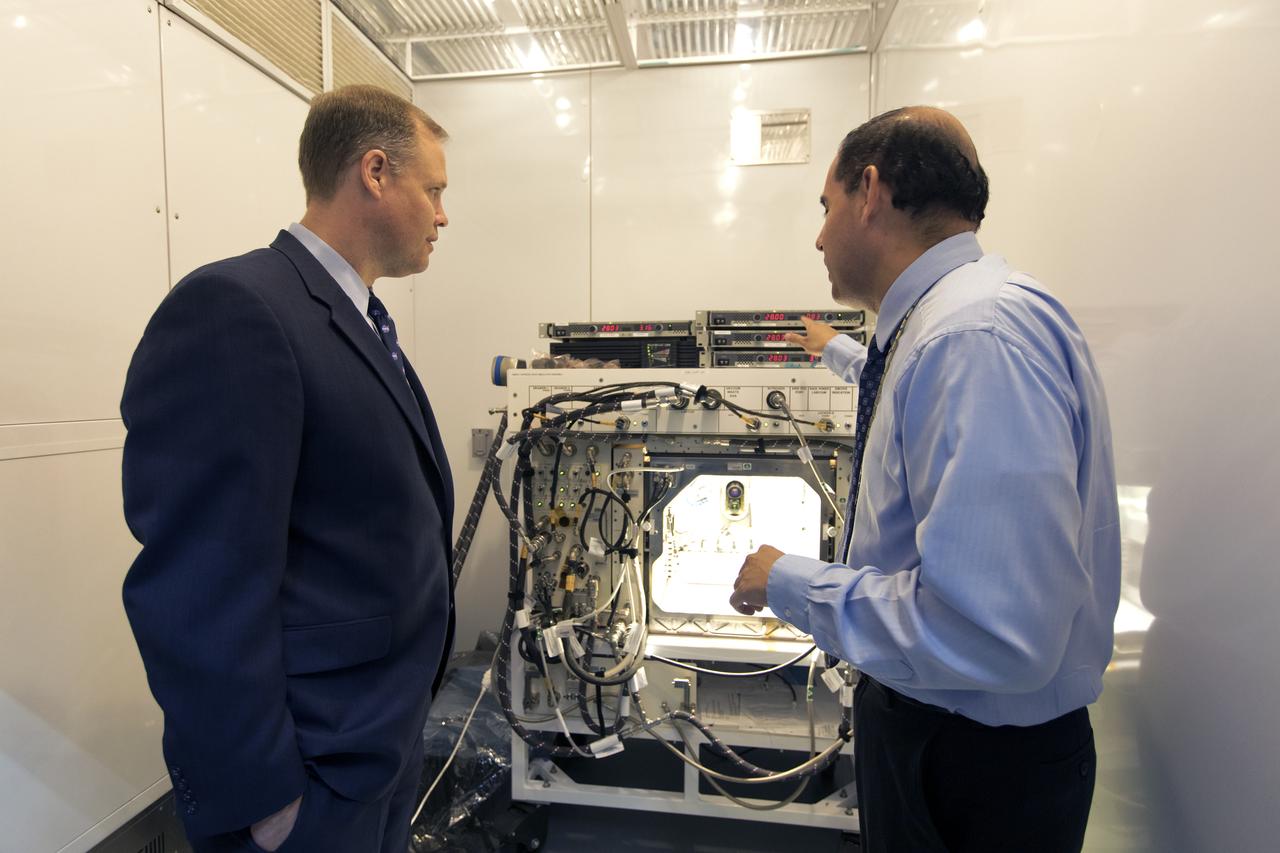
NASA Administrator Jim Bridenstine, left, tours the Space Station Processing Facility at NASA's Kennedy Space Center in Florida, on Aug. 7, 2018. Bryan Onate, at right, Advanced Plant Habitat (APH) project manager, explains a component of the APH control system. Bridenstine also received updates on research and technology accomplishments.
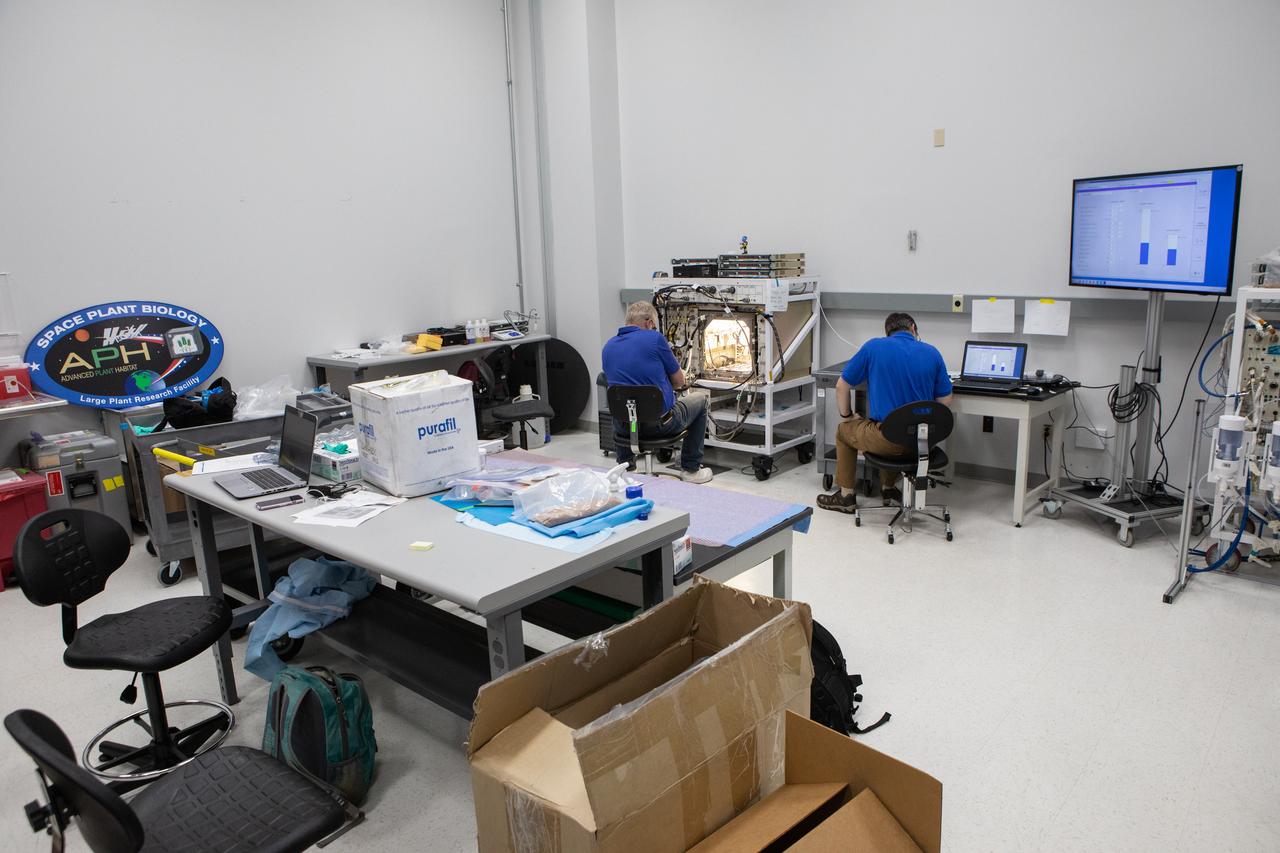
Researchers are testing plant growth in a ground unit of the Advanced Plant Habitat inside a laboratory in the Space Station Processing Facility (SSPF) at NASA's Kennedy Space Center in Florida, on May 16, 2019. The center is celebrating the SSPF’s 25th anniversary. The facility was built to process elements for the International Space Station. Now it is providing support for current and future NASA and commercial provider programs, including Commercial Resupply Services, Artemis 1, sending the first woman and next man to the Moon, and deep space destinations including Mars.
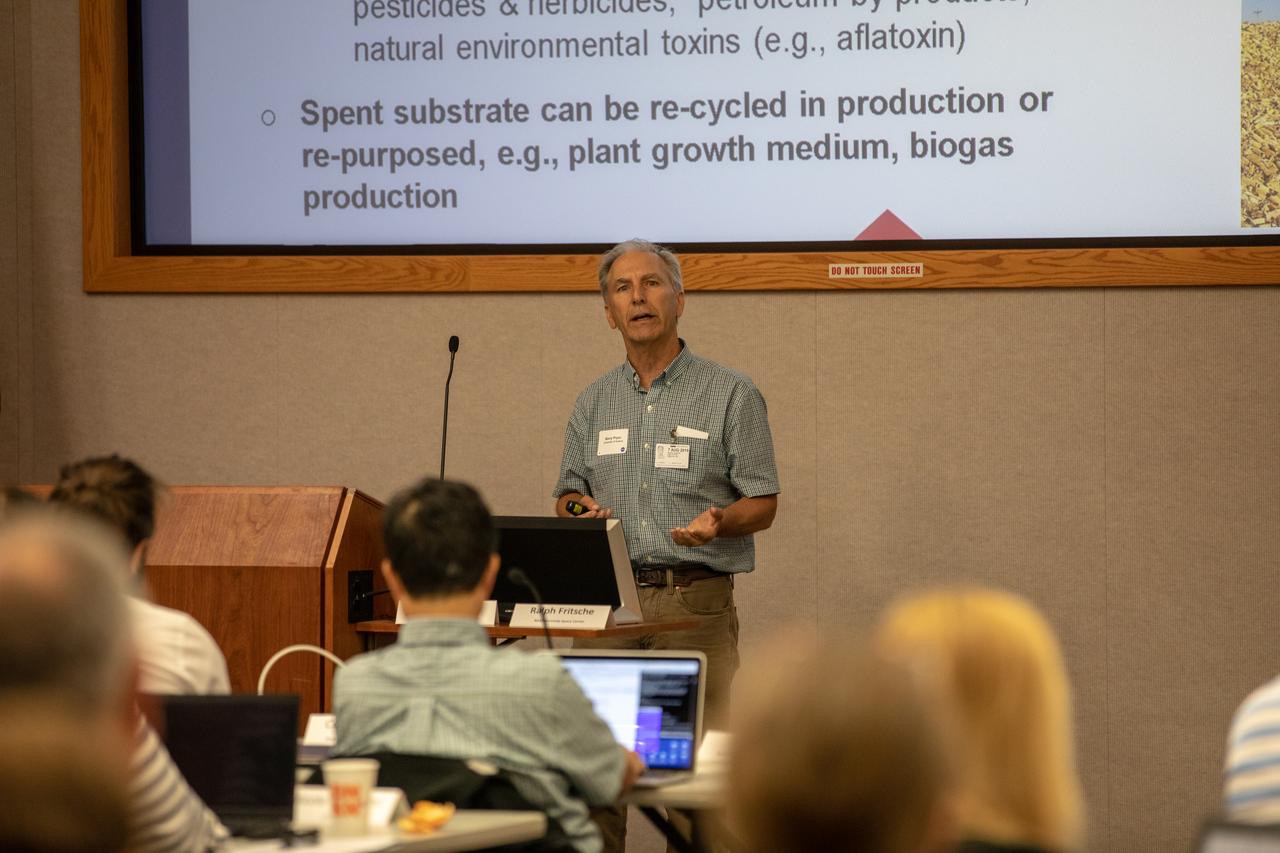
The Exploration Research and Technology Programs at NASA’s Kennedy Space Center in Florida hosted a two-day workshop, Aug. 6 and 7, 2019, focusing on robotics and automation in space crop production. Participants from around the world and members of NASA, industry, academia and other government agencies met to share their knowledge to enable a common goal of sustaining human operations on the Moon, in deep space and eventually on Mars. Keynote speakers and representatives from different organizations presented data gleaned from their research. Barry Pryor, a professor with the School of Plant Sciences at the University of Arizona presents to workshop attendees on Aug. 6.
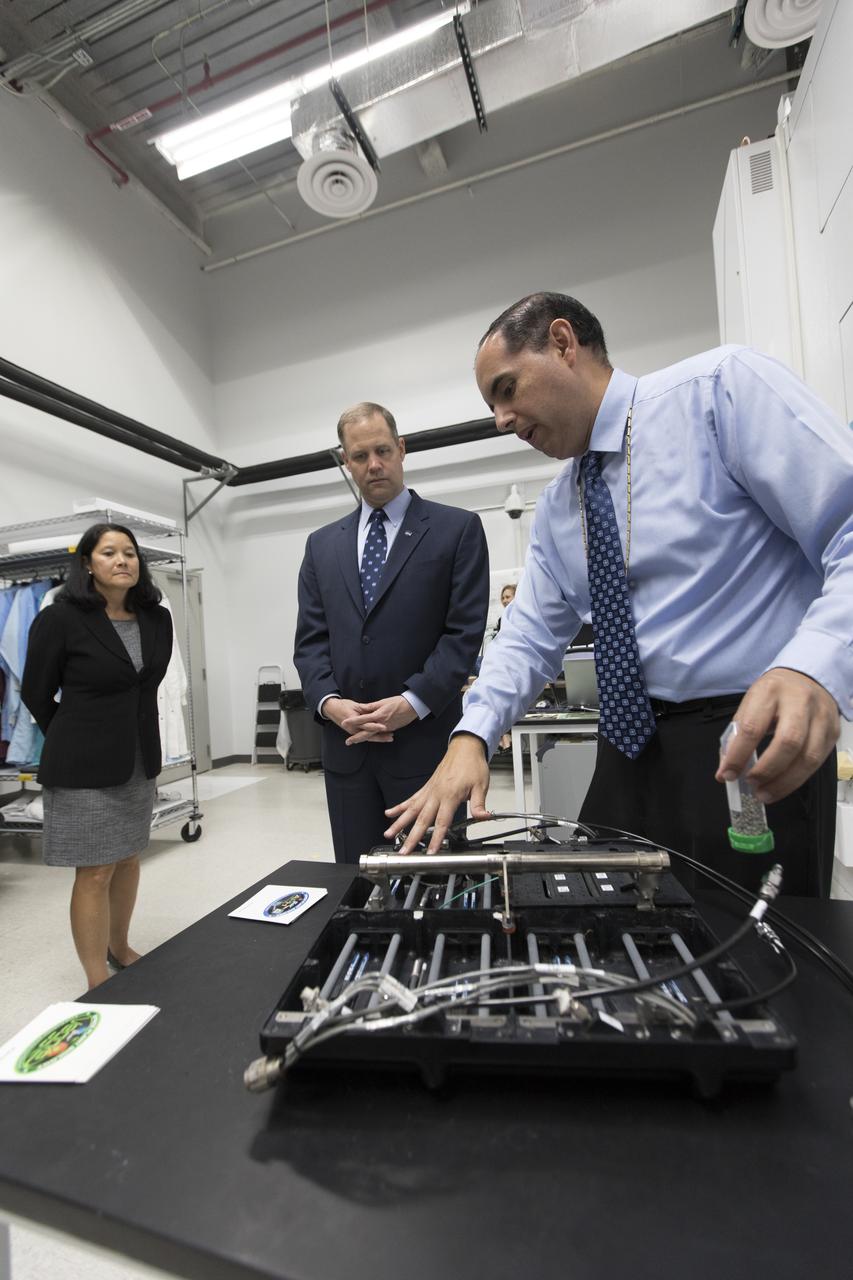
NASA Administrator Jim Bridenstine, center, tours the Space Station Processing Facility at NASA's Kennedy Space Center in Florida, on Aug. 7, 2018. At right, Bryan Onate, Advanced Plant Habitat (APH) project manager, explains a component of the APH cooling system. At left is Josie Burnett, director of Exploration Research and Technology. Bridenstine also received updates on research and technology accomplishments.
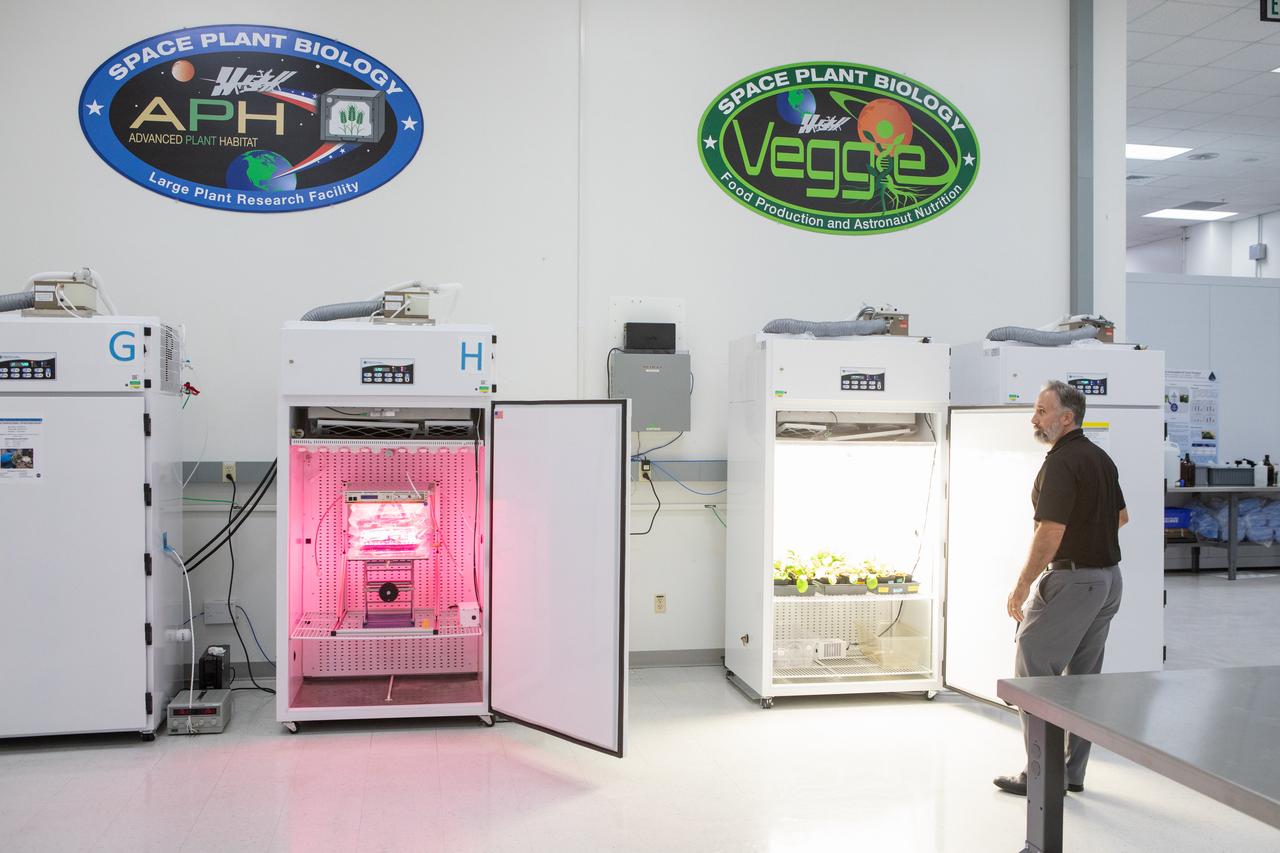
Ground unit experiment chambers for the Veggie plant growth system, at right, and the Advanced Plant Habitat, at left, are in view in a laboratory inside the Space Station Processing Facility (SSPF) at NASA’s Kennedy Space Center in Florida, on May 16, 2019. Trent Smith, Veggie project manager, Exploration Research and Technology Programs, checks the experiments. The center is celebrating the SSPF’s 25th anniversary. The facility was built to process elements for the International Space Station. Now it is providing support for current and future NASA and commercial provider programs, including Commercial Resupply Services, Artemis 1, sending the first woman and next man to the Moon, and deep space destinations including Mars.
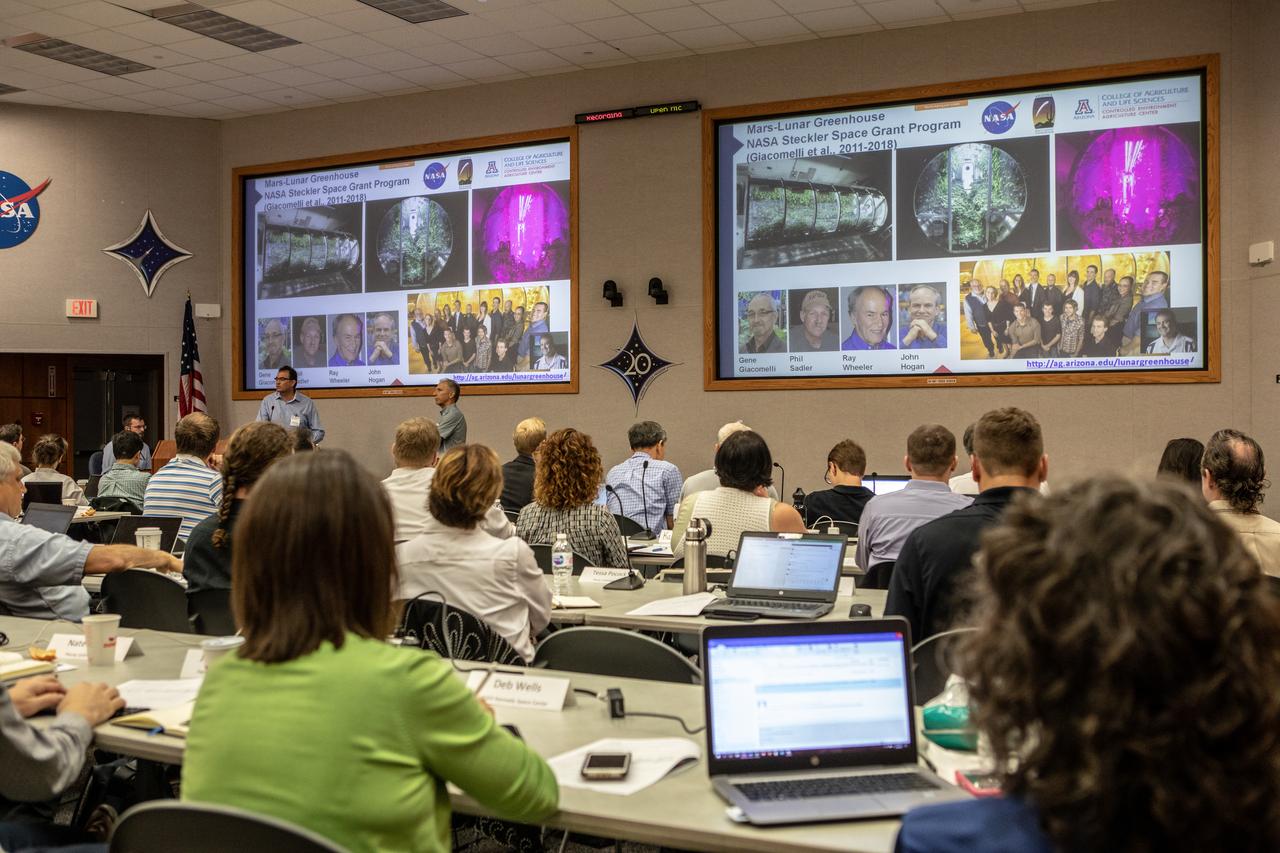
The Exploration Research and Technology Programs at NASA’s Kennedy Space Center in Florida hosted a two-day workshop, Aug. 6 and 7, 2019, focusing on robotics and automation in space crop production. Participants from around the world and members of NASA, industry, academia and other government agencies met to share their knowledge to enable a common goal of sustaining human operations on the Moon, in deep space and eventually on Mars. Keynote speakers and representatives from different organizations presented data gleaned from their research. Murat Kacira, left, a professor in the Department of Agricultural and Biosystems Engineering and director of the Controlled Environment Agriculture Program at the University of Arizona, and Barry Pryor, a professor with the School of Plant Sciences, also at the University of Arizona, present to workshop attendees on Aug. 6.
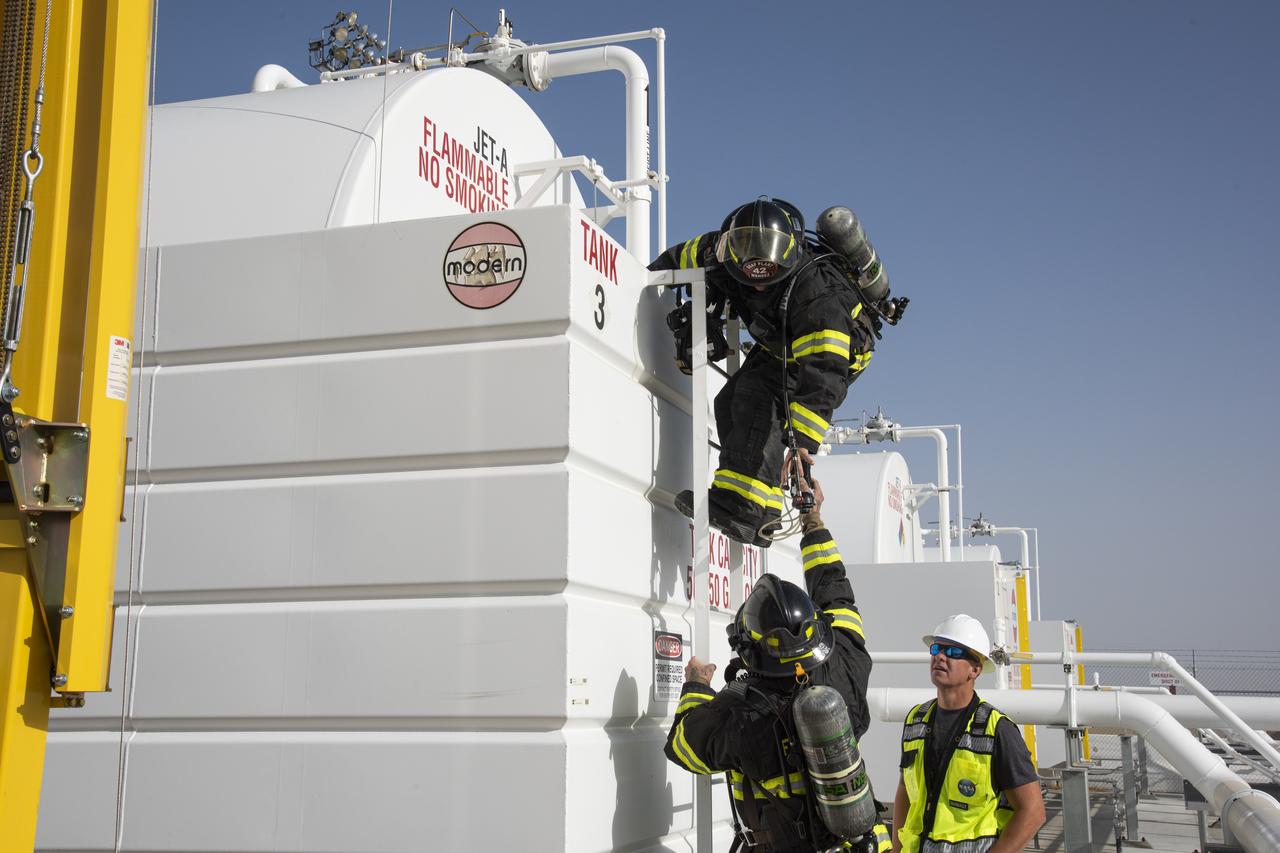
Air Force Plant 42 Fire Department responder Alfonzo Ortega, bottom, hands Doug Mendez a gas meter to test the air in a confined space during an exercise at NASA Armstrong Flight Research Center's Building 703 in Palmdale, California. Dale McCoy, Armstrong confined space co-program manager, observers.
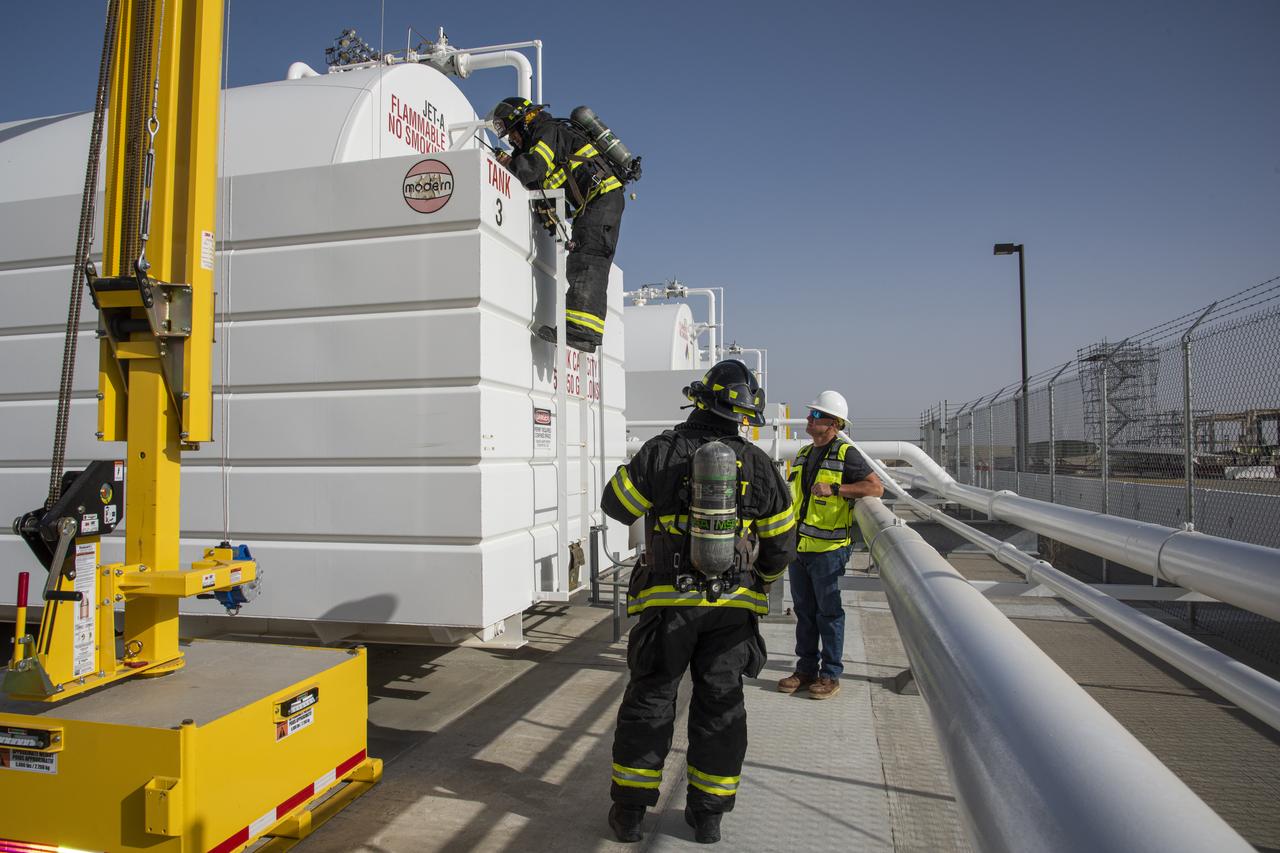
Air Force Plant 42 Fire Department responders Doug Mendez and Alfonzo Ortega test the air in a confined space with a gas meter during an exercise at NASA Armstrong Flight Research Center's Building 703 in Palmdale, California. Dale McCoy, Armstrong confined space co-program manager, observers.

iss055e001919 (Mar. 12, 2018) --- Dwarf wheat plants in the Advanced Plant Habitat Facility, a facility to conduct plant bioscience research on the International Space Stations (ISS).
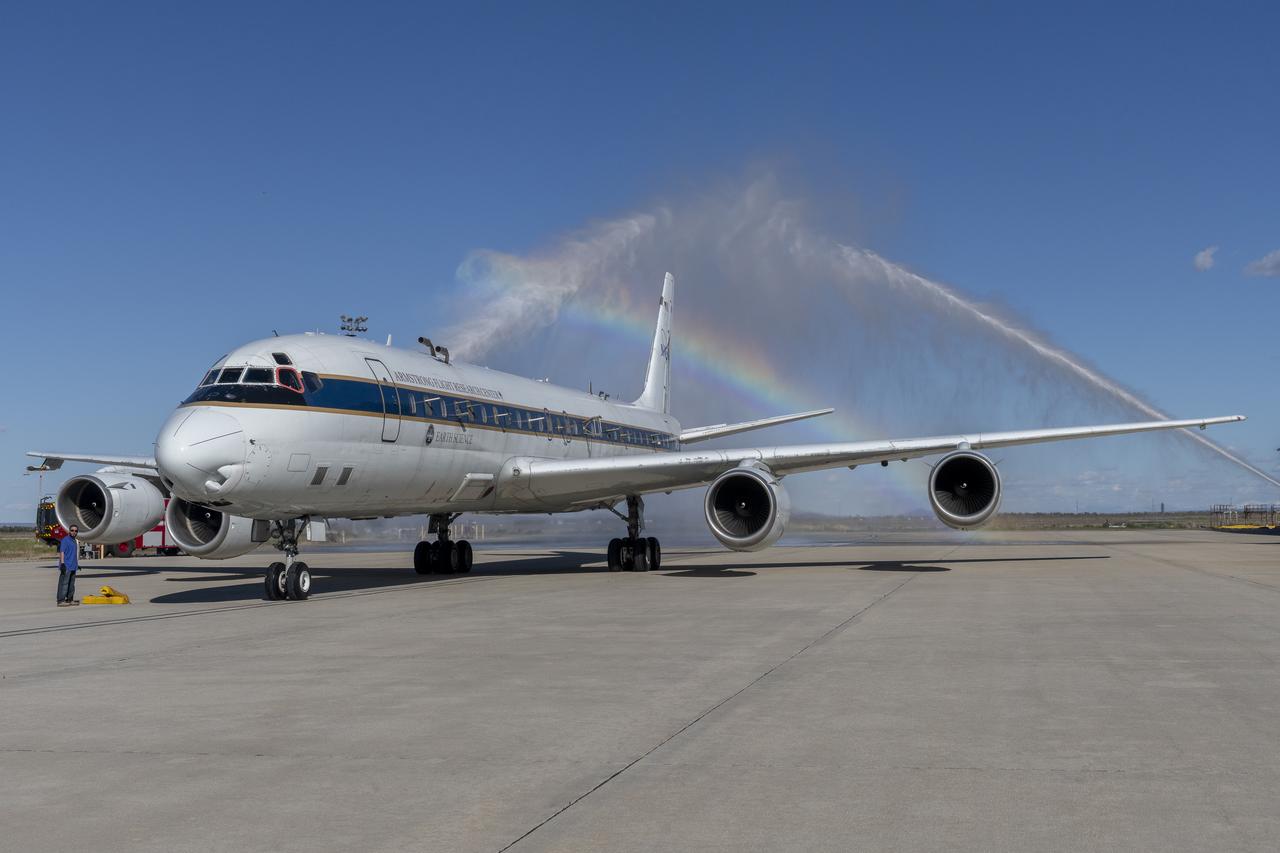
The DC-8 aircraft returned to NASA’s Armstrong Flight Research Center Building 703 in Palmdale, California, on April 1, 2024, after completing its final mission supporting Airborne and Satellite Investigation of Asian Air Quality (ASIA-AQ). The aircraft and crew were welcomed back with a celebratory water salute by the U.S. Air Force Plant 42 Fire Department.
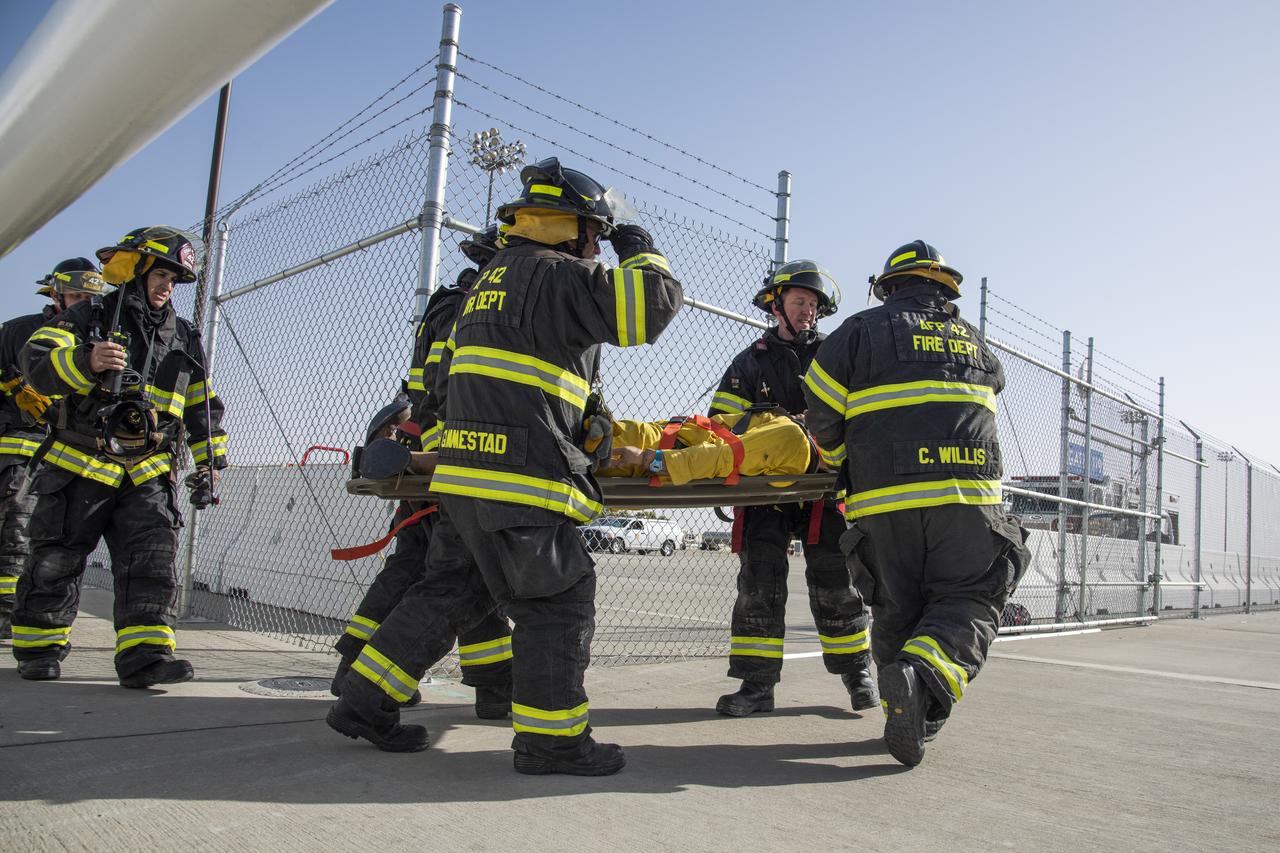
U.S. Air Force Plant 42 Fire Department responders carry out the mannequin to an emergency vehicle during an emergency exercise at NASA Armstrong Flight Research Center's Building 703 in Palmdale, California. Responders included, from left, Kent Courter, Doug Mendez, Alfonzo Ortega, Cedric Willis, Tyler Lippens and Ricky Gimmestad.
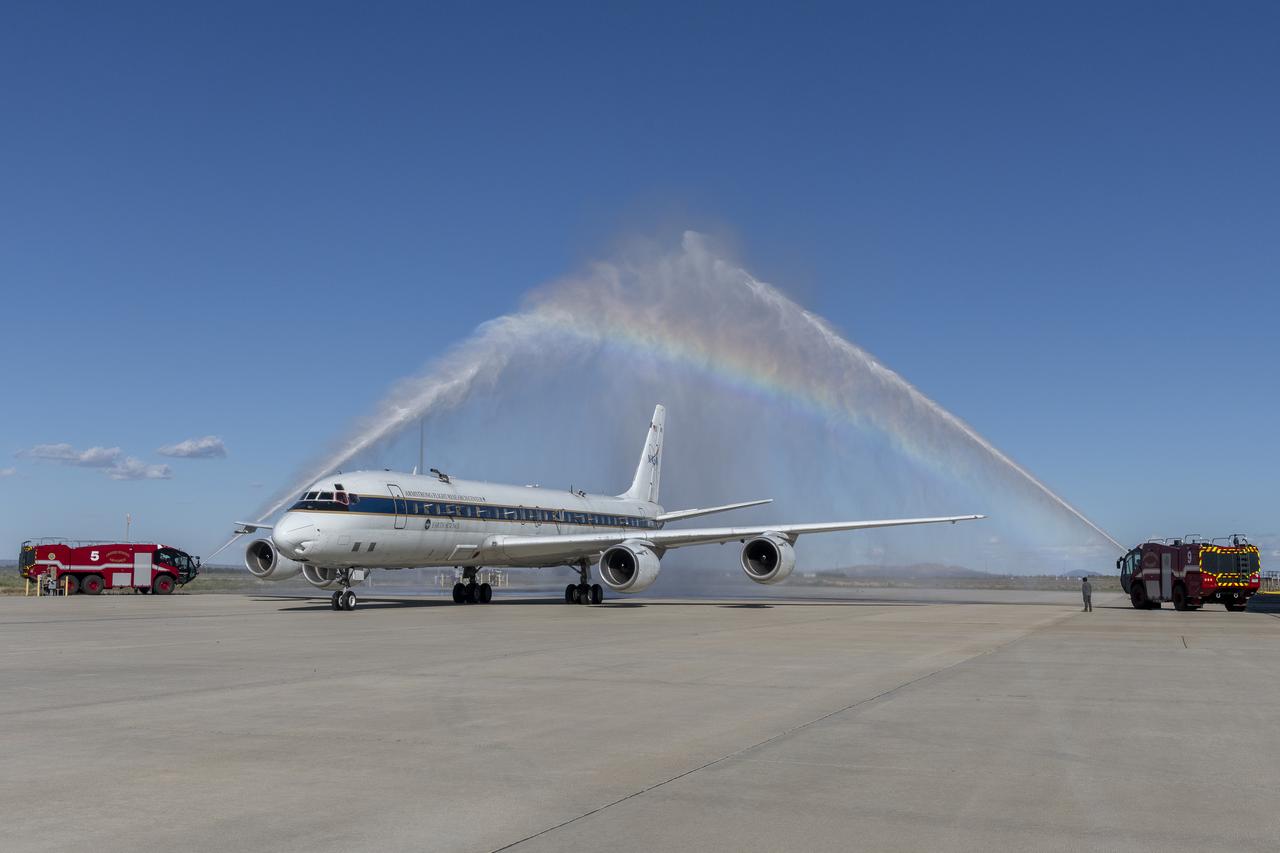
The DC-8 aircraft returned to NASA’s Armstrong Flight Research Center Building 703 in Palmdale, California, on April 1, 2024, after completing its final mission supporting Airborne and Satellite Investigation of Asian Air Quality (ASIA-AQ). The aircraft and crew were welcomed back with a celebratory water salute by the U.S. Air Force Plant 42 Fire Department.
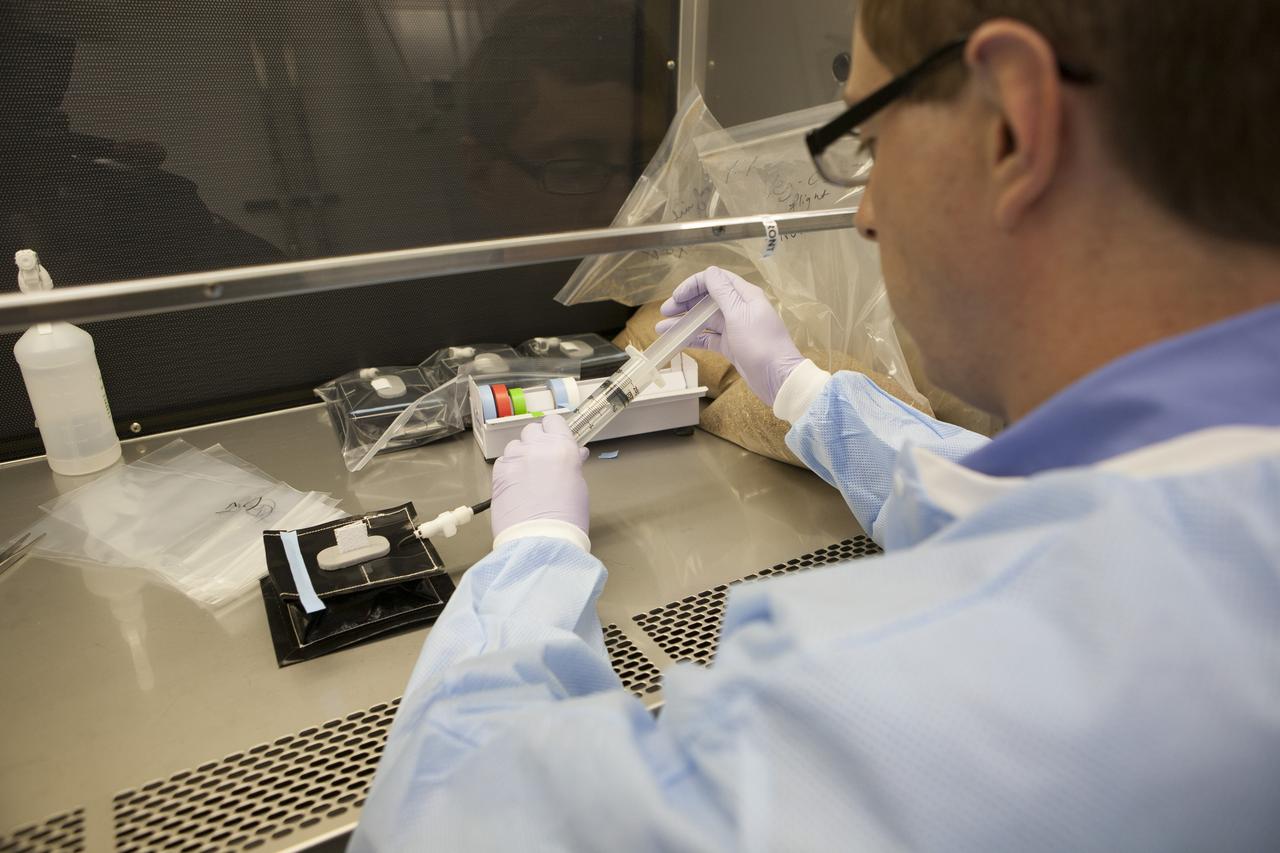
Inside a laboratory in the Space Station Processing Facility at NASA’s Kennedy Space Center in Florida, research scientists prepare the plant pillows for the Veg-03 experiment that will be delivered to the International Space Station aboard the eighth SpaceX Dragon commercial resupply mission. Dr. Mathew Mickens, a post-doctoral researcher, inserts a bonding agent into one of the Veg-03 plant pillows. The Veg-03 plant pillows will contain ‘Tokyo Bekana’ cabbage seeds and lettuce seeds for NASA’s third Veggie plant growth system experiment. The experiment will continue NASA’s deep space plant growth research to benefit the Earth and the agency’s journey to Mars.
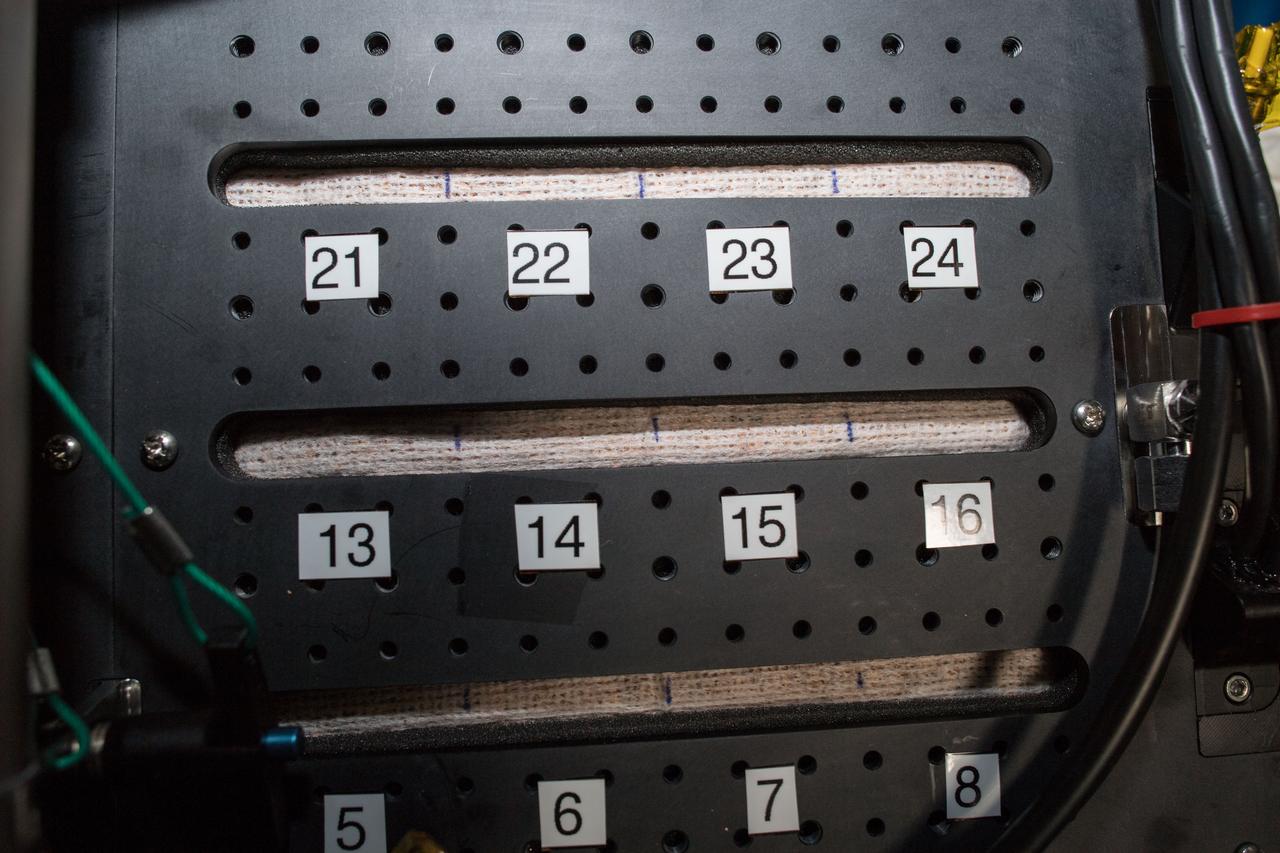
View during Plant Habitat Facility Science Carrier #1 installation. Plant Habitat is a fully automated facility that will be used to conduct plant bioscience research on the ISS. Photo was taken by Expedition 56 crew.
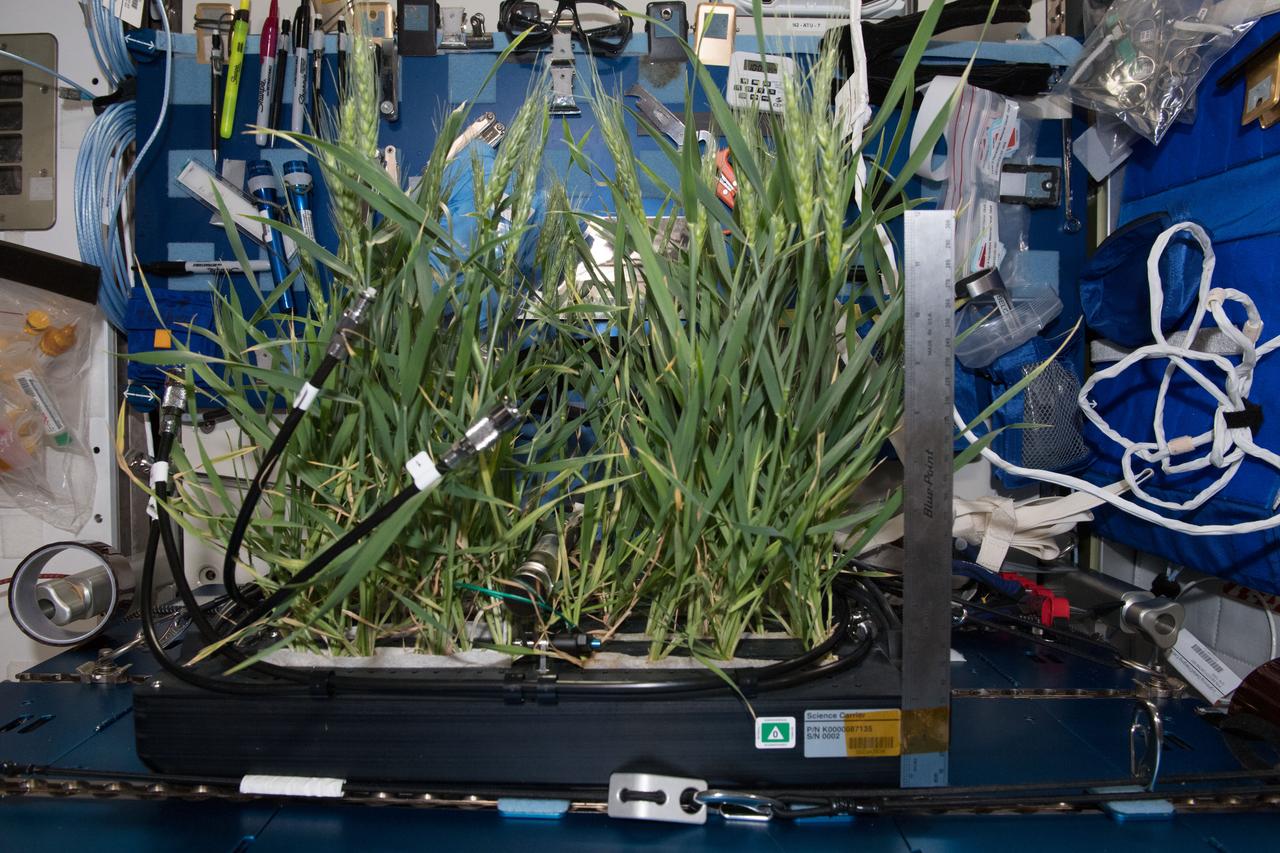
iss055e001931 (Mar. 12, 2018) --- Dwarf wheat plants during routine cleaning in the Advanced Plant Habitat Facility, a facility to conduct plant bioscience research on the International Space Stations (ISS).
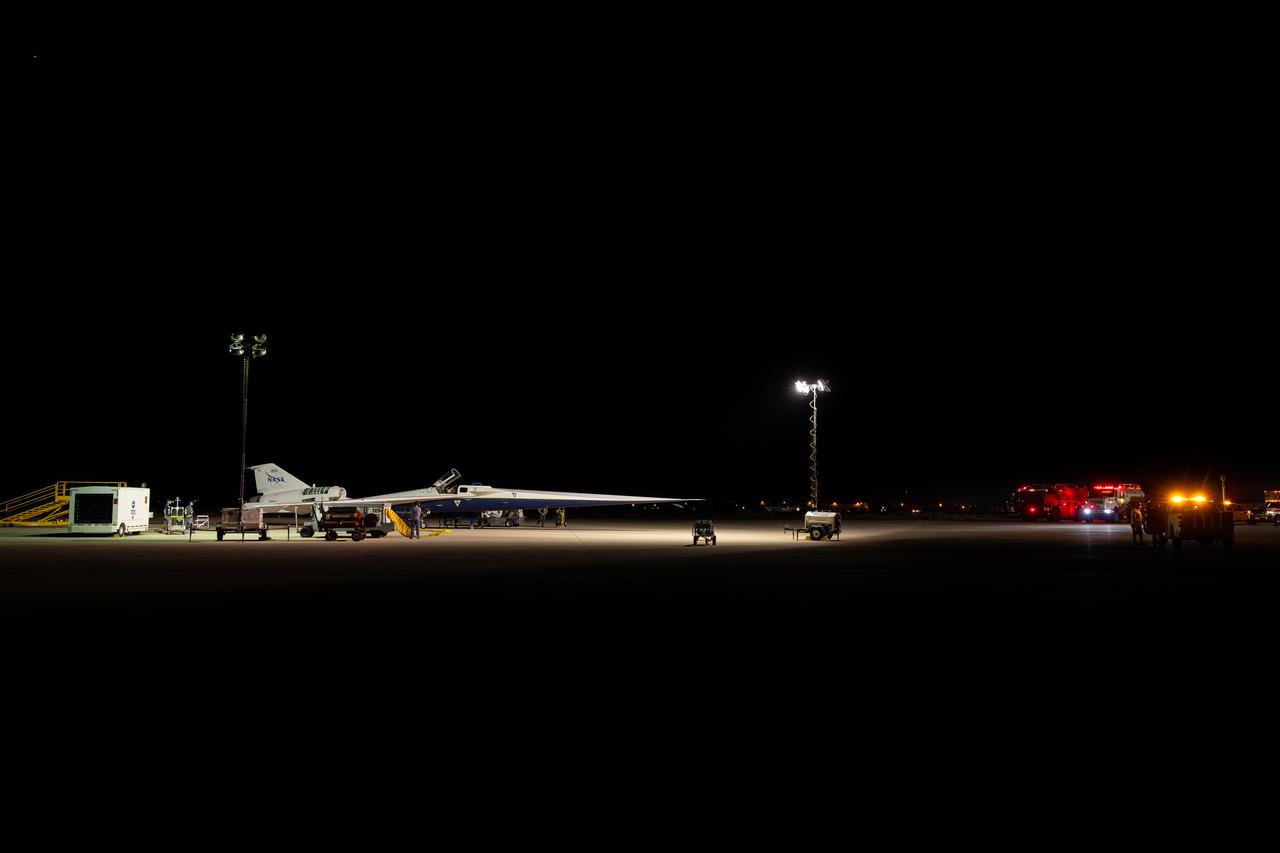
NASA’s X-59 quiet supersonic research aircraft is seen at dawn with firetrucks and safety personnel nearby during a hydrazine safety check at U.S. Air Force Plant 42 in Palmdale, California, on Aug. 18, 2025. The operation highlights the extensive precautions built into the aircraft’s safety procedures for a system that serves as a critical safeguard, ensuring the engine can be restarted in flight as the X-59 prepares for its first flight.
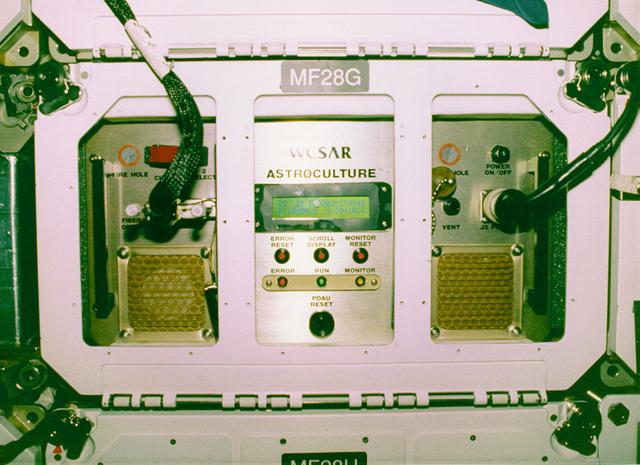
Research with plants in microgravity offers many exciting opportunities to gain new insights and could improve products on Earth ranging from crop production to fragrances and food flavorings. The ASTROCULTURE facility is a lead commercial facility for plant growth and plant research in microgravity and was developed by the Wisconsin Center for Space Automation and Robotics (WSCAR), a NASA Commercial Space Center. On STS-95 it will support research that could help improve crop development leading to plants that are more disease resistant or have a higher yield and provide data on the production of plant essential oils---oils that contain the essence of the plant and provide both fragrance and flavoring. On STS-95, a flowering plant will be grown in ASTROCULTURE and samples taken using a method developed by the industry partner for this investigation. On Earth the samples will be analyzed by gas chromatography/mass spectrometry and the data used to evaluate both the production of fragrant oils in microgravity and in the development of one or more products.

View of Plant Habitat which is a fully automated facility that is used to conduct plant bioscience research on the ISS. Photo was taken by Expedition 56 crew.
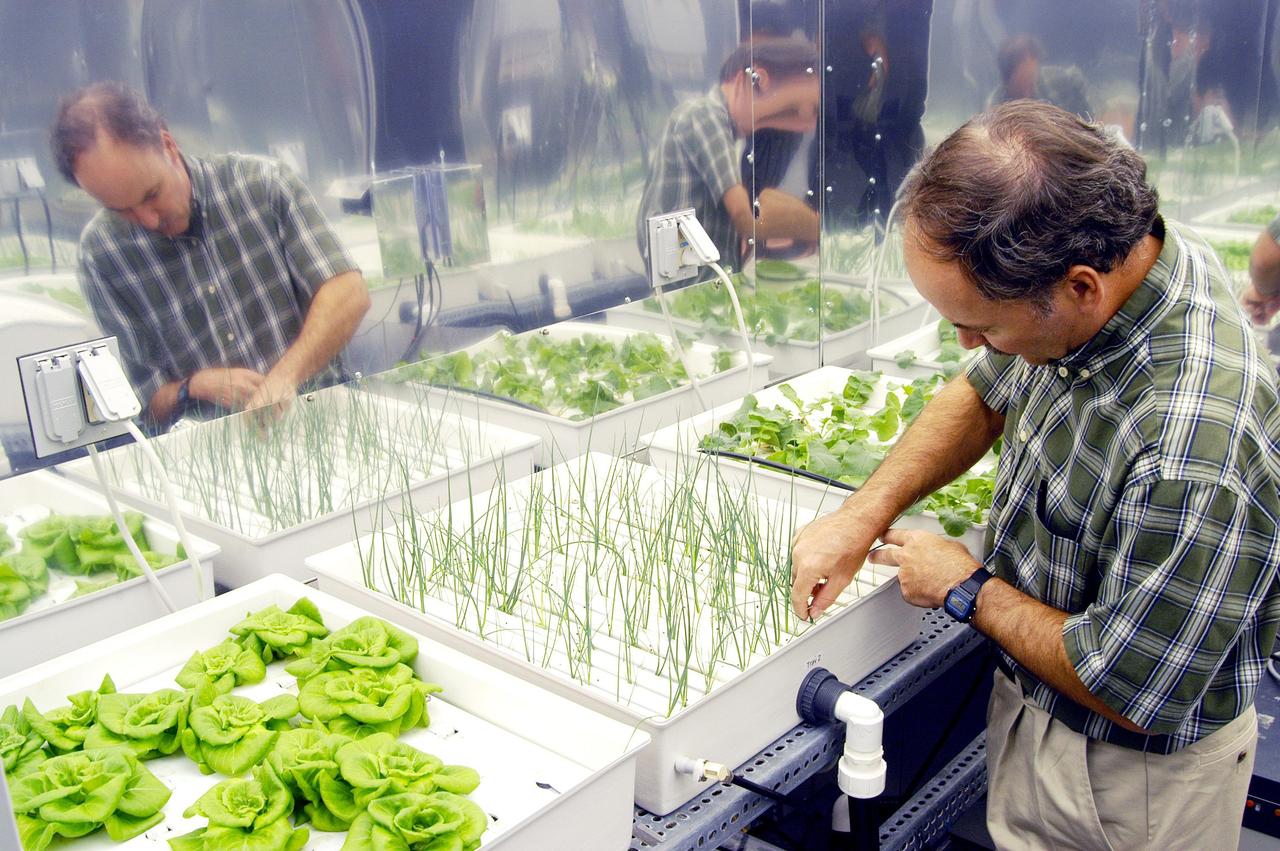
KENNEDY SPACE CENTER, FLA. - In a plant growth chamber in the KSC Space Life Sciences Lab, plant physiologist Ray Wheeler checks onions being grown using hydroponic techniques. The other plants are Bibb lettuce (left) and radishes (right). Wheeler and other colleagues are researching plant growth under different types of light, different CO2 concentrations and temperatures. The Lab is exploring various aspects of a bioregenerative life support system. Such research and technology development will be crucial to long-term habitation of space by humans.
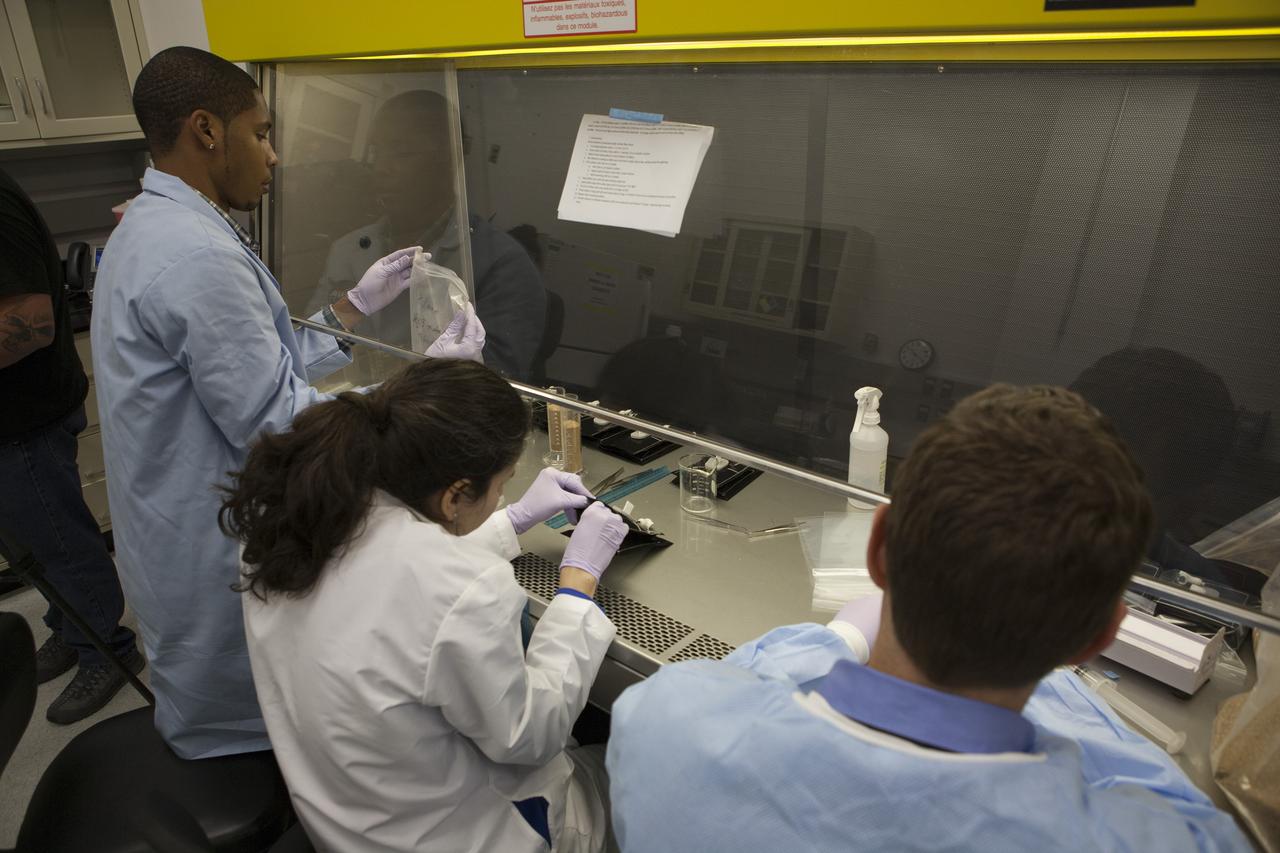
Inside a laboratory in the Space Station Processing Facility at NASA’s Kennedy Space Center in Florida, research scientists prepare the plant pillows for the Veg-03 experiment that will be delivered to the International Space Station aboard the eighth SpaceX Dragon commercial resupply mission. From left, are Matt Romeyn, NASA pathways intern; Dr. Gioia Massa, NASA payload scientist for Veggie; and Dr. Mathew Mickens, a post-doctoral researcher. The Veg-03 plant pillows will contain ‘Tokyo Bekana’ cabbage seeds and lettuce seeds for NASA’s third Veggie plant growth system experiment. The experiment will continue NASA’s deep space plant growth research to benefit the Earth and the agency’s journey to Mars.
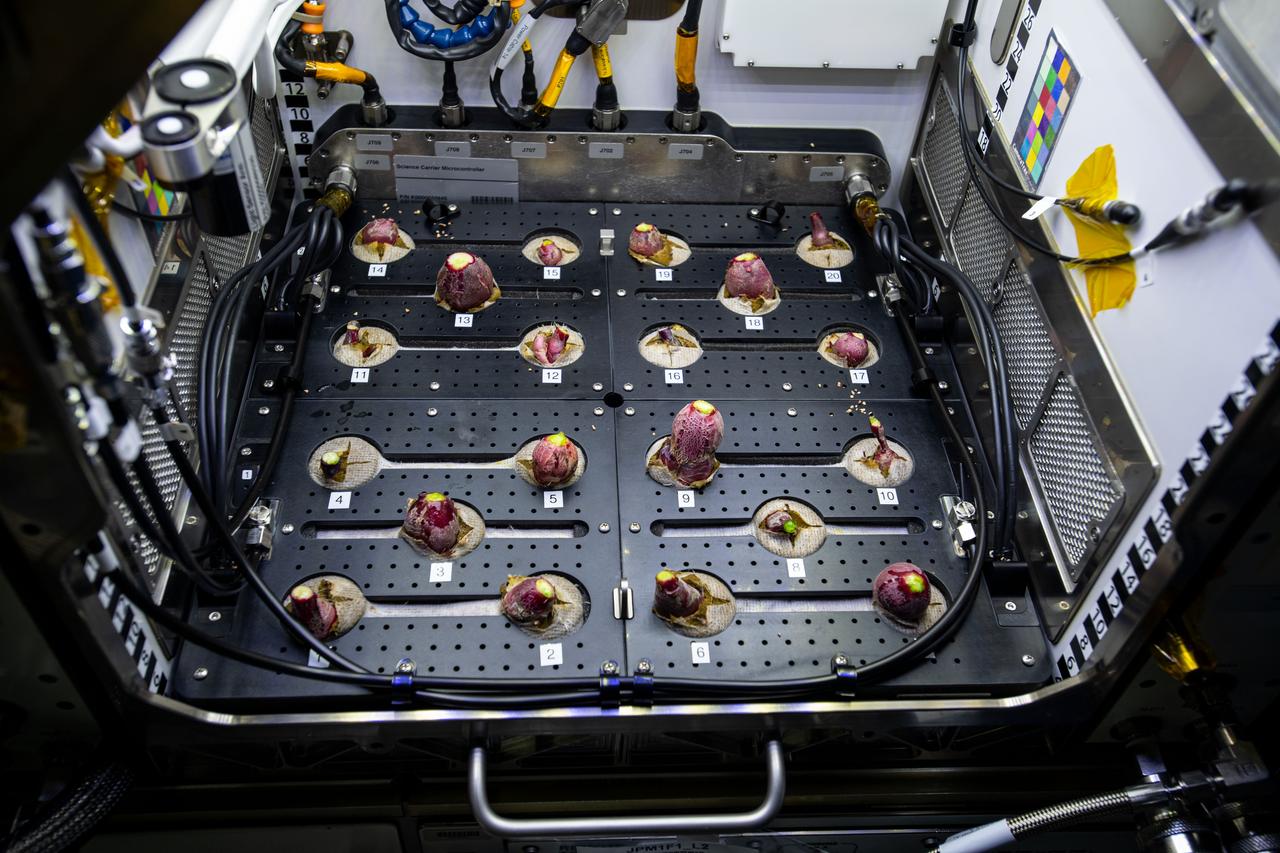
iss064e008707 (11/30/2020) --- Photo documentation of the Plant Habitat-02 investigation aboard the International space Station (ISS). The Assessment of Nutritional Value and Growth Parameters of Space-grown Plants (Plant Habitat-02) uses the Advanced Plant Habitat to cultivate Radishes, a model plant that is nutritious and edible and has a short cultivation time. This research could help optimize plant growth in the unique environment of space, as well as evaluation of nutrition and taste of the plants.
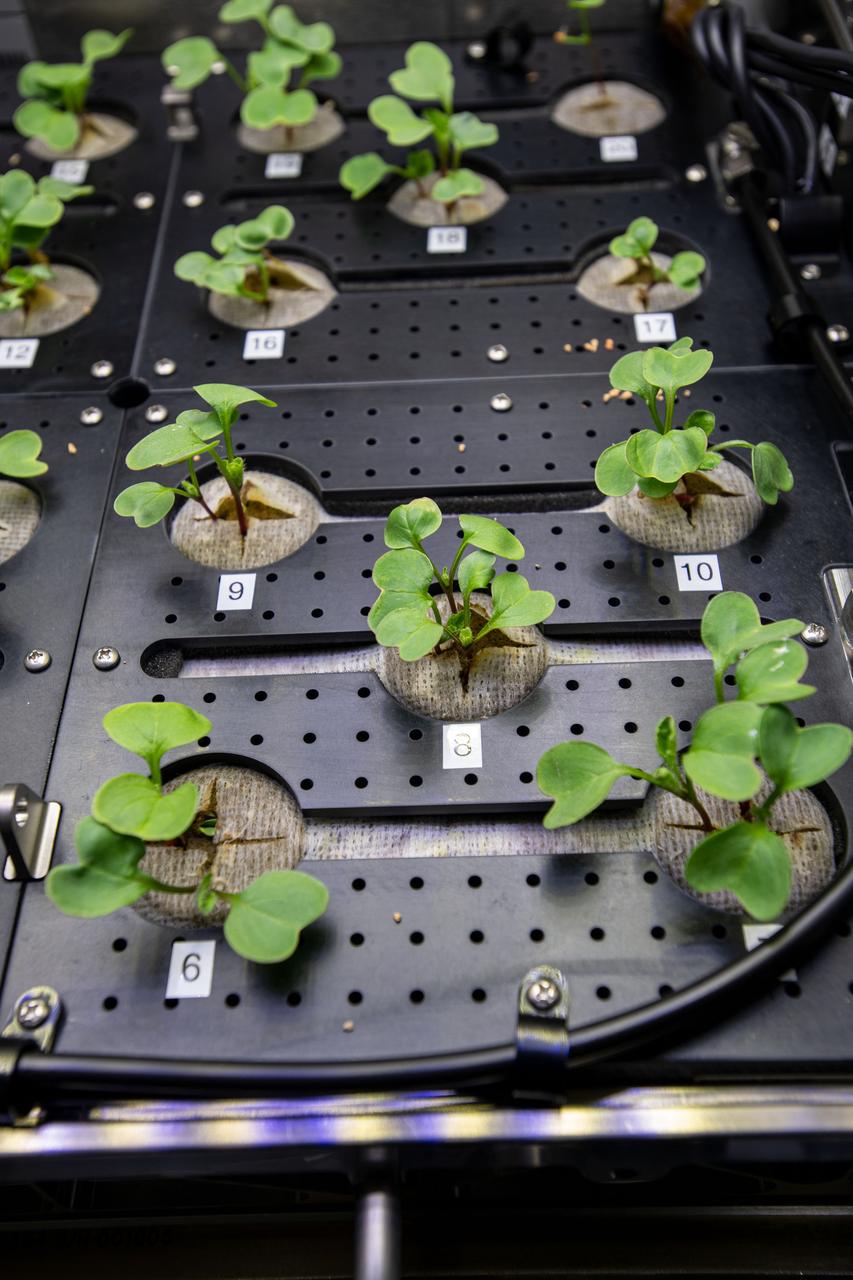
iss064e004045 (11/11/2020) --- Photo documentation of the Plant Habitat-02 investigation aboard the International space Station (ISS). The Assessment of Nutritional Value and Growth Parameters of Space-grown Plants (Plant Habitat-02) uses the Advanced Plant Habitat to cultivate Radishes, a model plant that is nutritious and edible and has a short cultivation time. This research could help optimize plant growth in the unique environment of space, as well as evaluation of nutrition and taste of the plants.
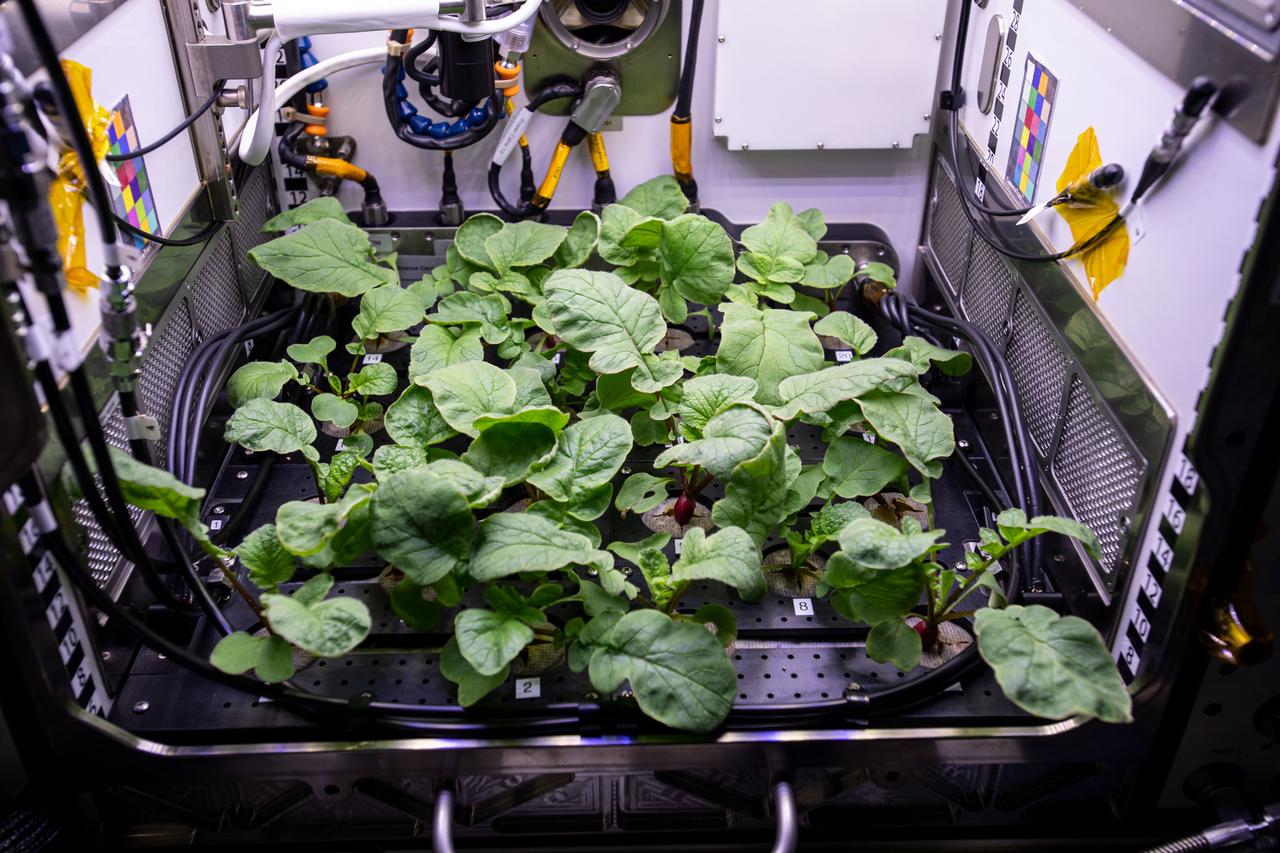
iss064e005046 (11/20/2020) --- Photo documentation of the Plant Habitat-02 investigation aboard the International space Station (ISS). The Assessment of Nutritional Value and Growth Parameters of Space-grown Plants (Plant Habitat-02) uses the Advanced Plant Habitat to cultivate Radishes, a model plant that is nutritious and edible and has a short cultivation time. This research could help optimize plant growth in the unique environment of space, as well as evaluation of nutrition and taste of the plants.
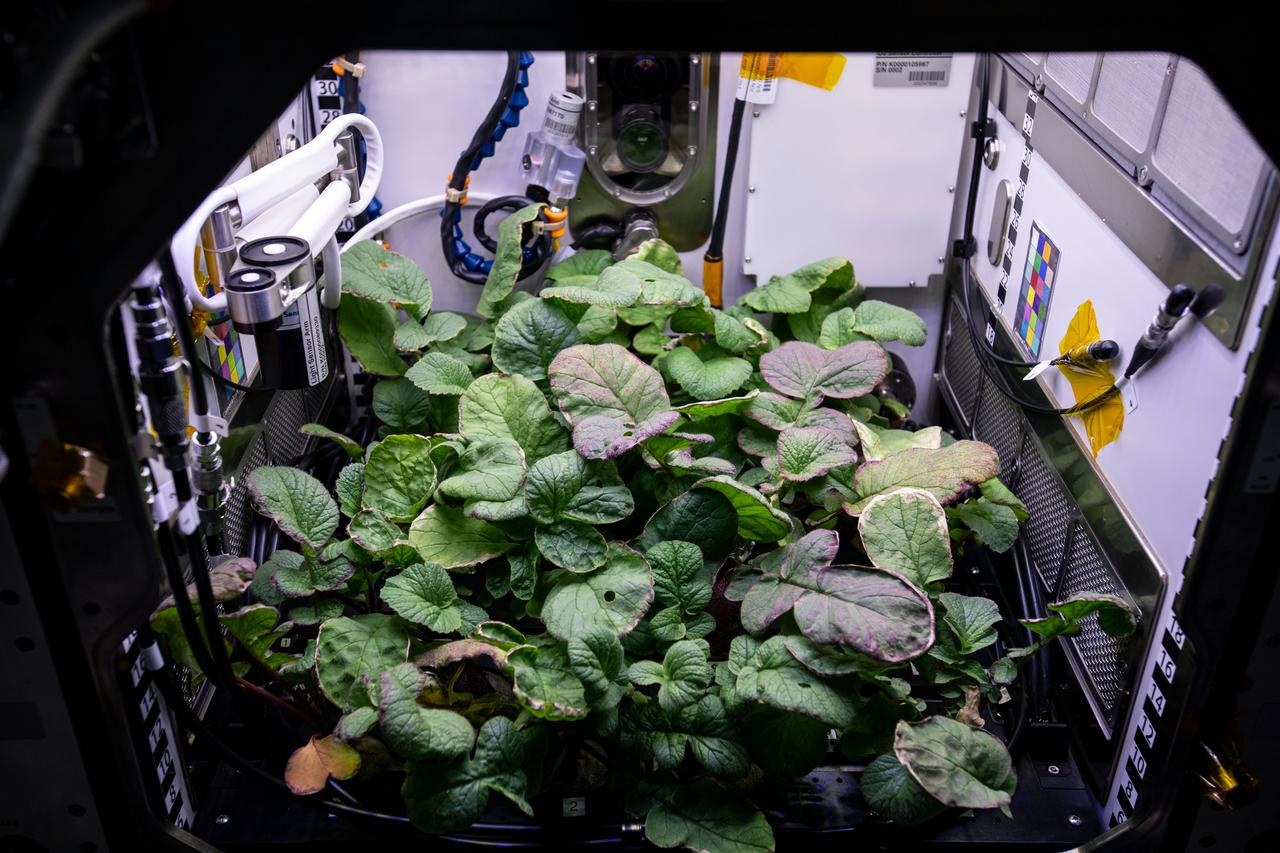
iss064e008476 (11/30/2020) --- Photo documentation of the Plant Habitat-02 investigation aboard the International space Station (ISS). The Assessment of Nutritional Value and Growth Parameters of Space-grown Plants (Plant Habitat-02) uses the Advanced Plant Habitat to cultivate Radishes, a model plant that is nutritious and edible and has a short cultivation time. This research could help optimize plant growth in the unique environment of space, as well as evaluation of nutrition and taste of the plants.

iss064e004037 (11/11/2020) --- Photo documentation of the Plant Habitat-02 investigation aboard the International space Station (ISS). The Assessment of Nutritional Value and Growth Parameters of Space-grown Plants (Plant Habitat-02) uses the Advanced Plant Habitat to cultivate Radishes, a model plant that is nutritious and edible and has a short cultivation time. This research could help optimize plant growth in the unique environment of space, as well as evaluation of nutrition and taste of the plants.
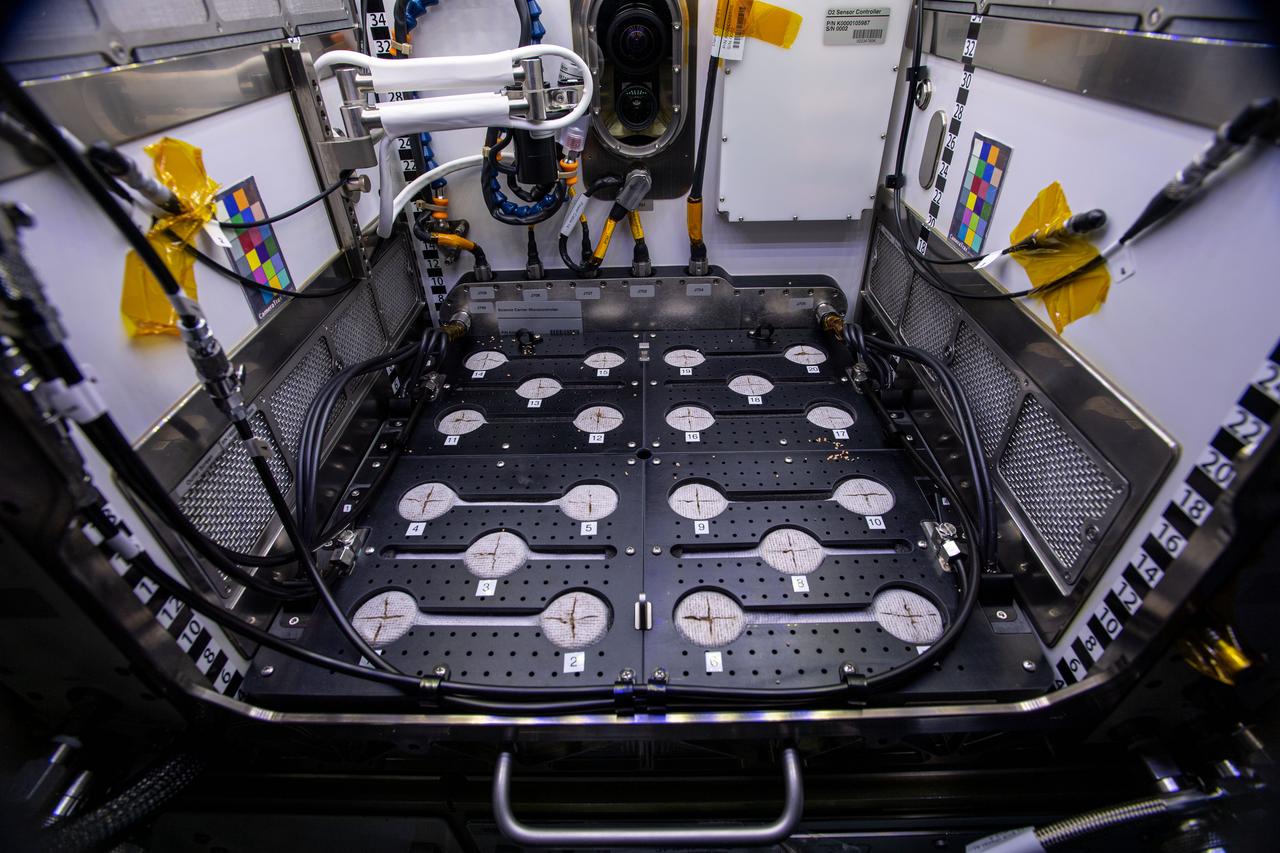
iss064e002961 (11/3/2020) --- Photo documentation of the Plant Habitat-02 investigation aboard the International space Station (ISS). The Assessment of Nutritional Value and Growth Parameters of Space-grown Plants (Plant Habitat-02) uses the Advanced Plant Habitat to cultivate Radishes, a model plant that is nutritious and edible and has a short cultivation time. This research could help optimize plant growth in the unique environment of space, as well as evaluation of nutrition and taste of the plants.
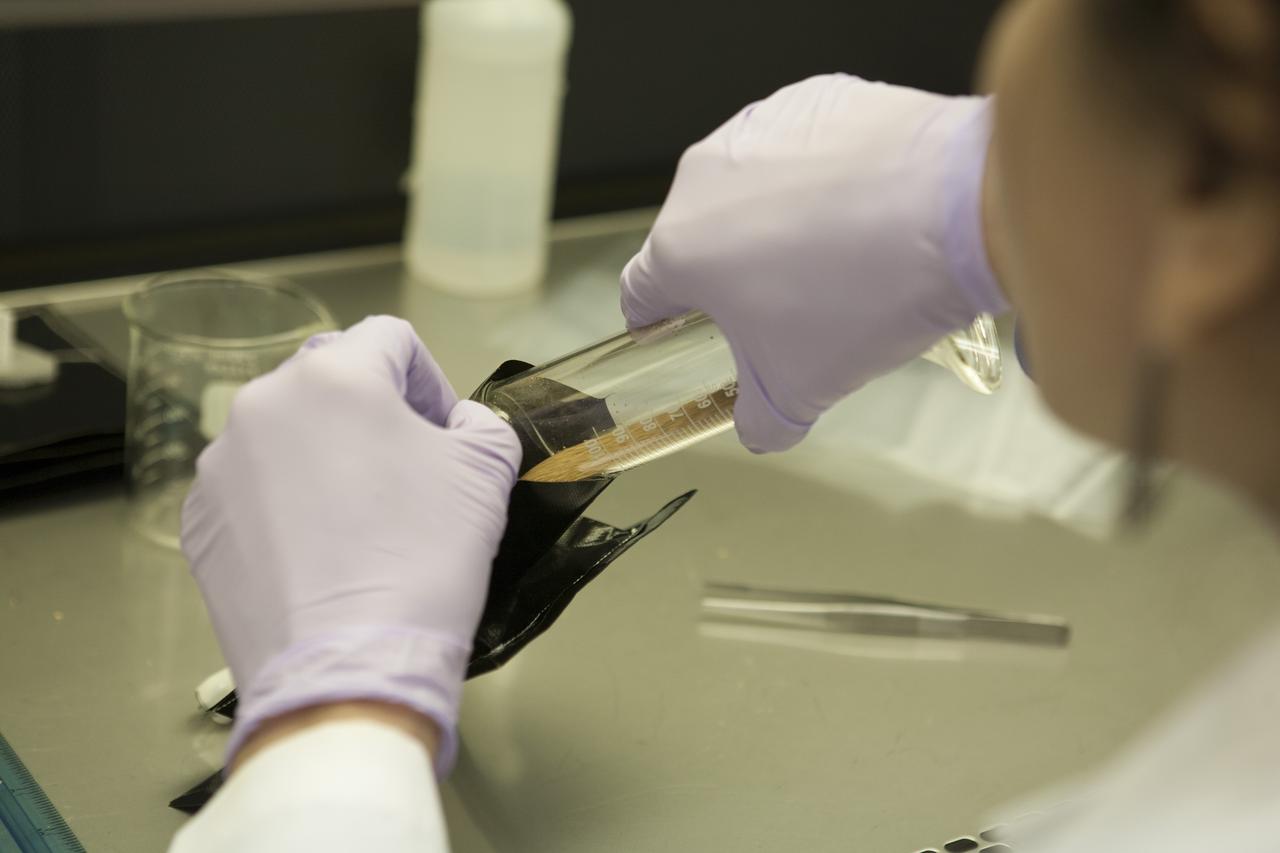
Inside a laboratory in the Space Station Processing Facility at NASA’s Kennedy Space Center in Florida, research scientists prepare the plant pillows for the Veg-03 experiment that will be delivered to the International Space Station aboard the eighth SpaceX Dragon commercial resupply mission. Matt Romeyn, a NASA pathways intern, inserts a measured amount of calcined clay, or space dirt, into one of the plant pillows. The Veg-03 plant pillows will contain ‘Tokyo Bekana’ cabbage seeds and lettuce seeds for NASA’s third Veggie plant growth system experiment. The experiment will continue NASA’s deep space plant growth research to benefit the Earth and the agency’s journey to Mars.
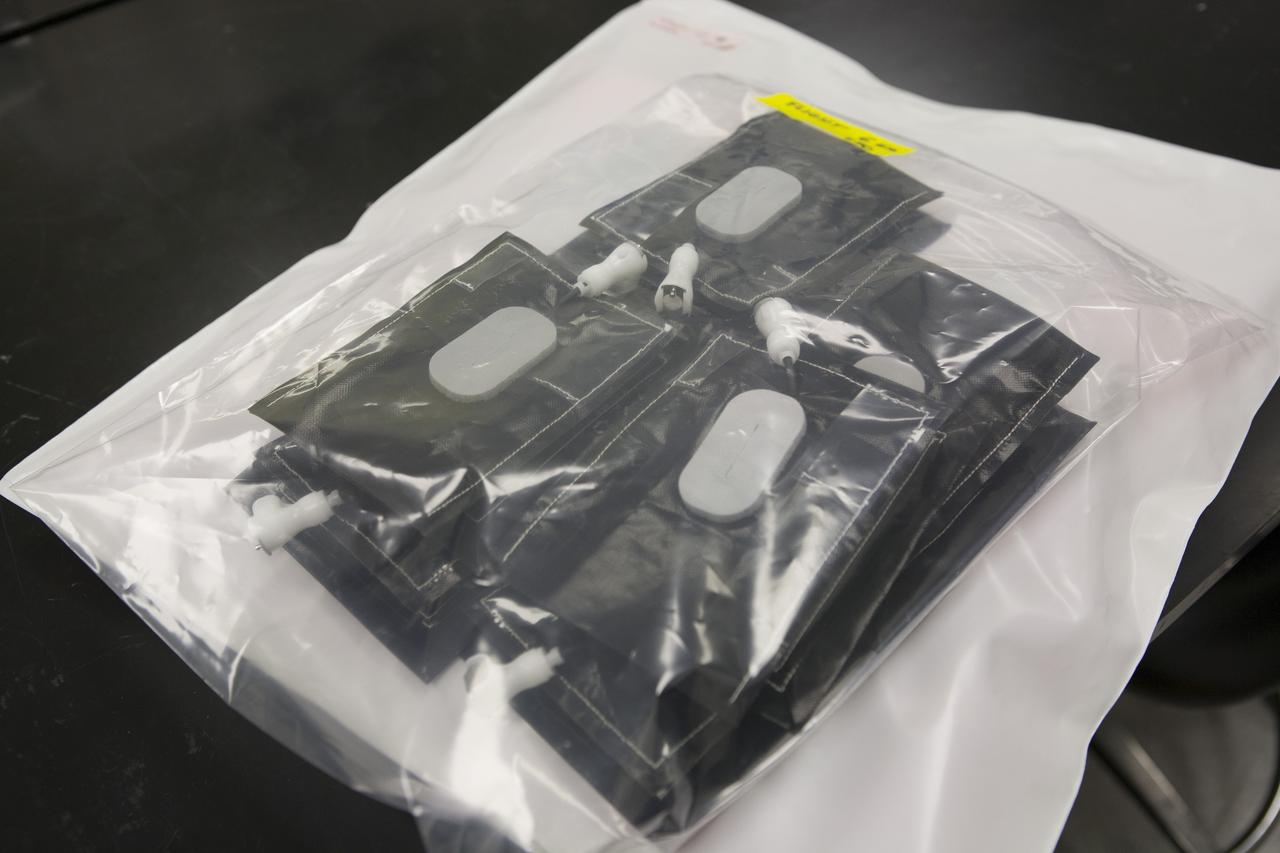
Inside a laboratory in the Space Station Processing Facility at NASA’s Kennedy Space Center in Florida, plant pillows for the Veg-03 experiment are prepared for delivery to the International Space Station aboard the eighth SpaceX Dragon commercial resupply mission. Dr. Mathew Mickens, a post-doctoral researcher, inserts a bonding agent into one of the Veg-03 plant pillows. The Veg-03 plant pillows will contain ‘Tokyo Bekana’ cabbage seeds and lettuce seeds for NASA’s third Veggie plant growth system experiment. The experiment will continue NASA’s deep space plant growth research to benefit the Earth and the agency’s journey to Mars.
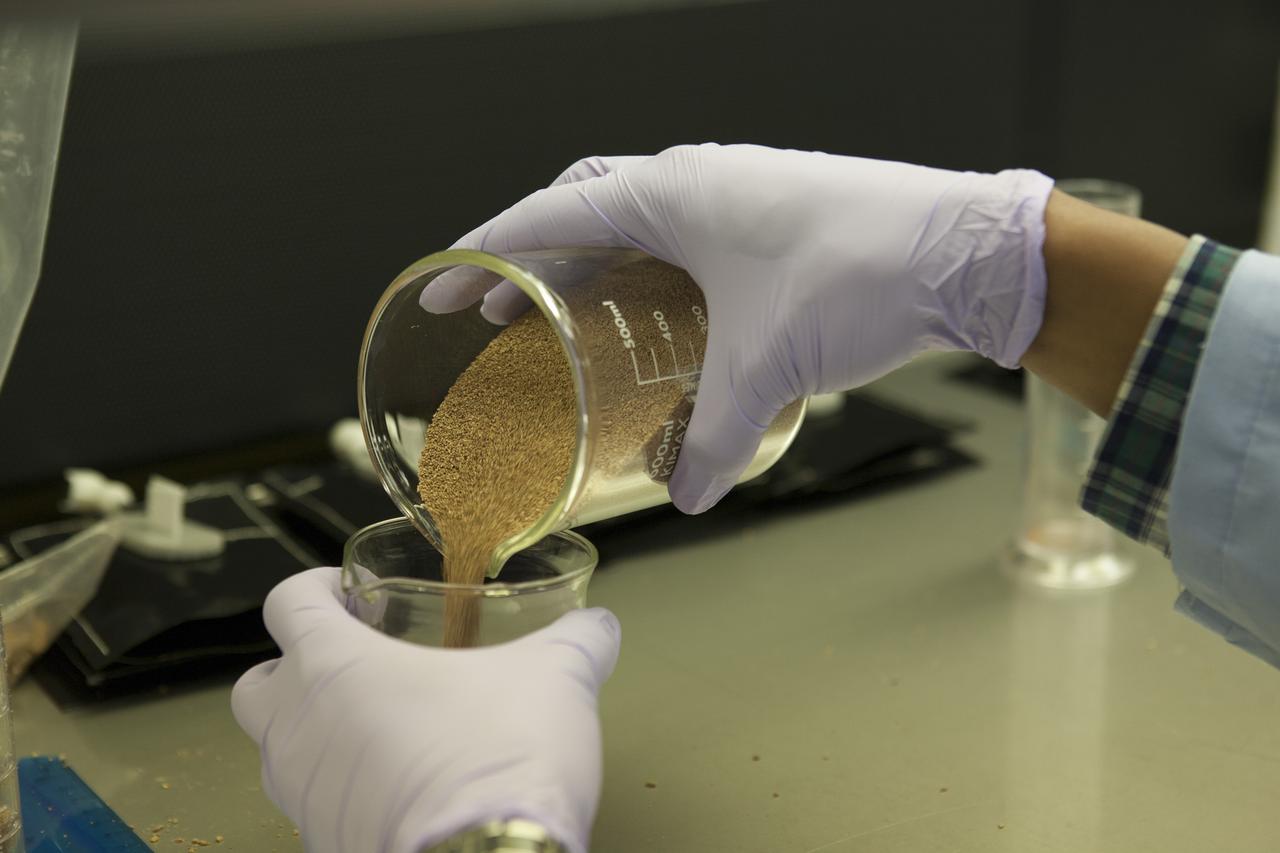
Inside a laboratory in the Space Station Processing Facility at NASA’s Kennedy Space Center in Florida, research scientists prepare the plant pillows for the Veg-03 experiment that will be delivered to the International Space Station aboard the eighth SpaceX Dragon commercial resupply mission. Matt Romeyn, a NASA pathways intern, measures out the calcined clay, or space dirt, for one of the plant pillows. The Veg-03 plant pillows will contain ‘Tokyo Bekana’ cabbage seeds and lettuce seeds for NASA’s third Veggie plant growth system experiment. The experiment will continue NASA’s deep space plant growth research to benefit the Earth and the agency’s journey to Mars.
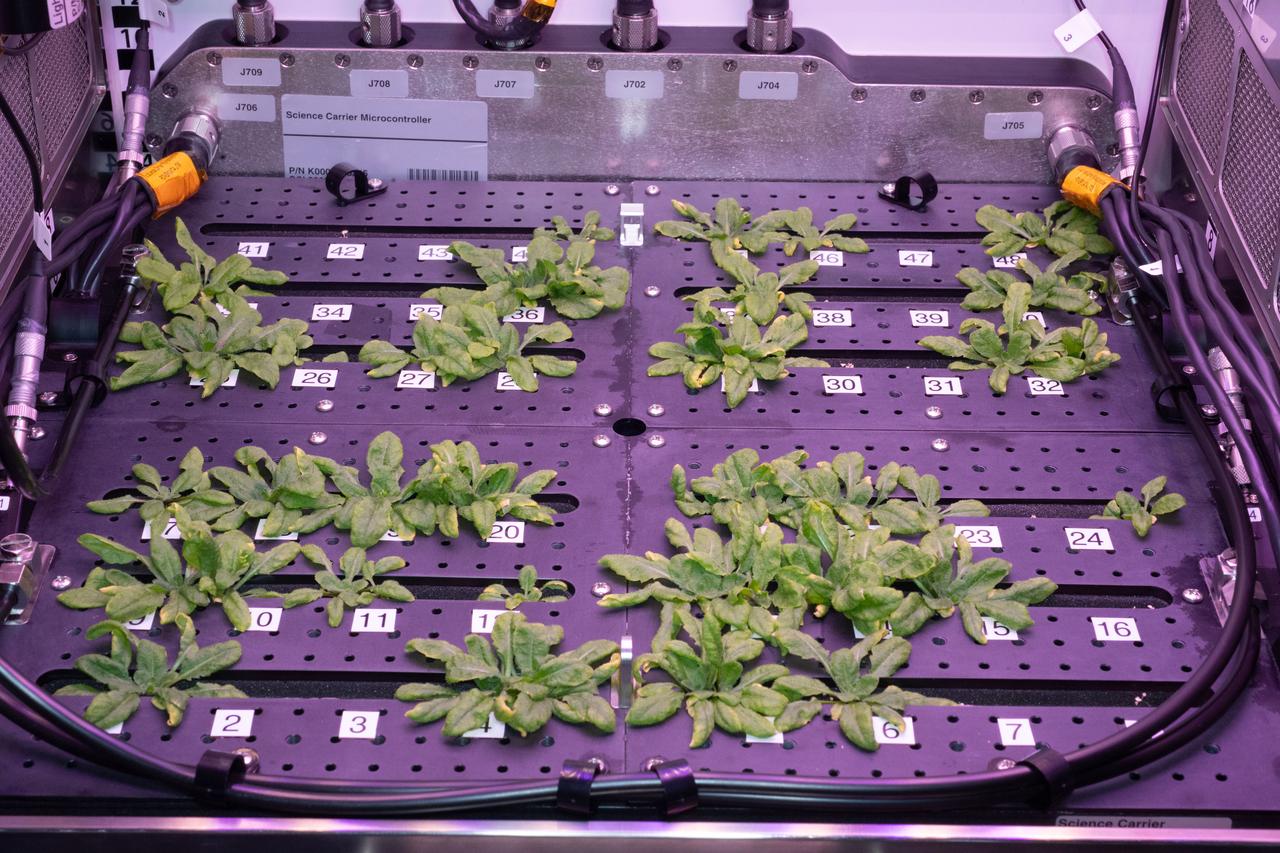
iss056e094286 (July 9, 2018) --- Arabidopsis plants are pictured inside the Plant Habitat experiment's Growth Chamber located in the Columbus laboratory module's EXPRESS Rack 5. The plants were harvested for the Plant Habitat experiment which is researching differences in genetics, metabolism, photosynthesis, and gravity sensing between plants grown in space and on Earth. Results may help crews on future missions successfully grow plants for food and oxygen generation.
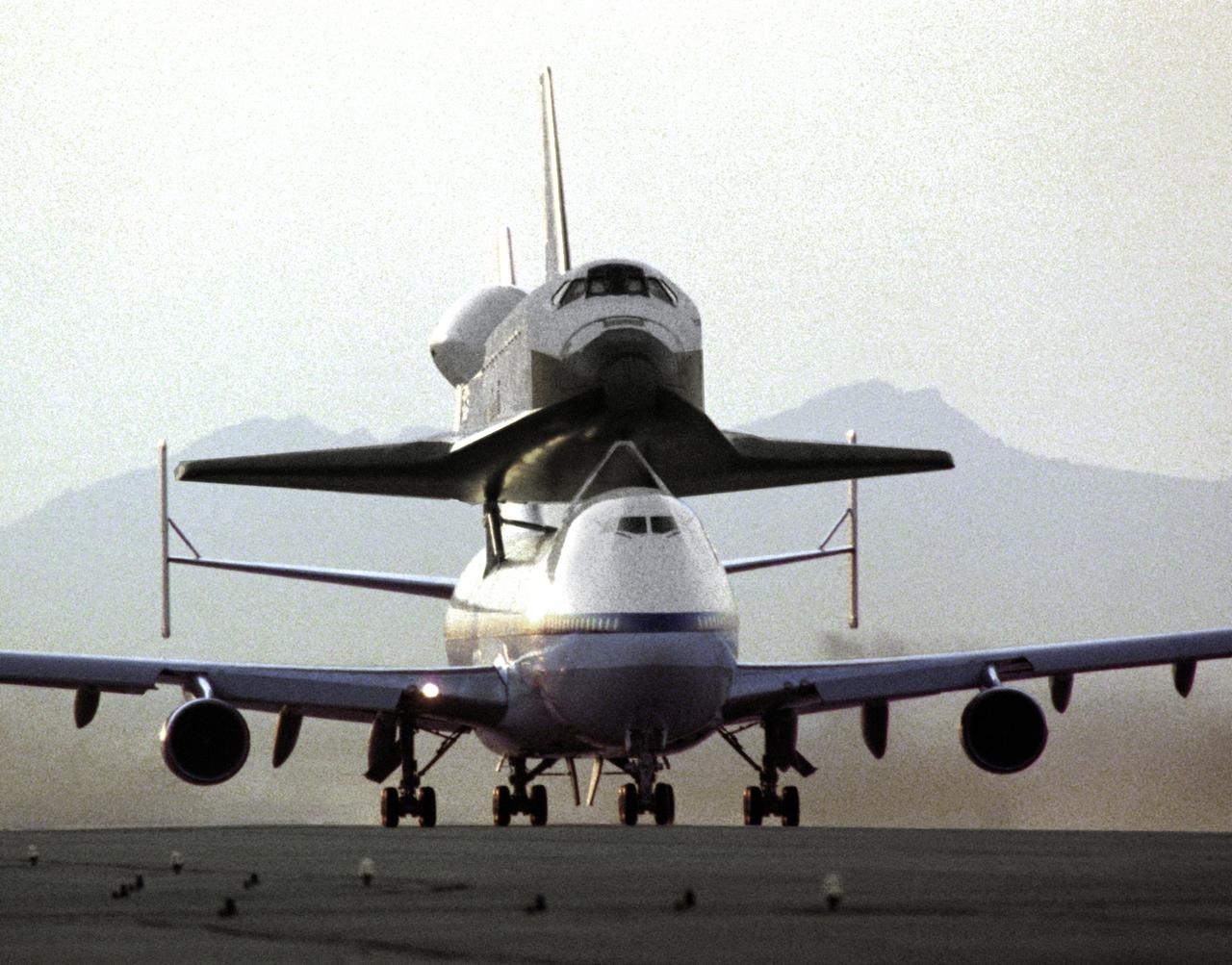
NASA's 747 Shuttle Carrier Aircraft No. 911, with the space shuttle orbiter Endeavour securely mounted atop its fuselage, taxies to the runway to begin the ferry flight from Rockwell's Plant 42 at Palmdale, California, where the orbiter was built, to the Kennedy Space Center, Florida. At Kennedy, the space vehicle was processed and launched on orbital mission STS-49, which landed at NASA's Ames-Dryden Flight Research Facility (later redesignated Dryden Flight Research Center), Edwards, California, 16 May 1992. NASA 911, the second modified 747 that went into service in November 1990, has special support struts atop the fuselage and internal strengthening to accommodate the added weight of the orbiters.
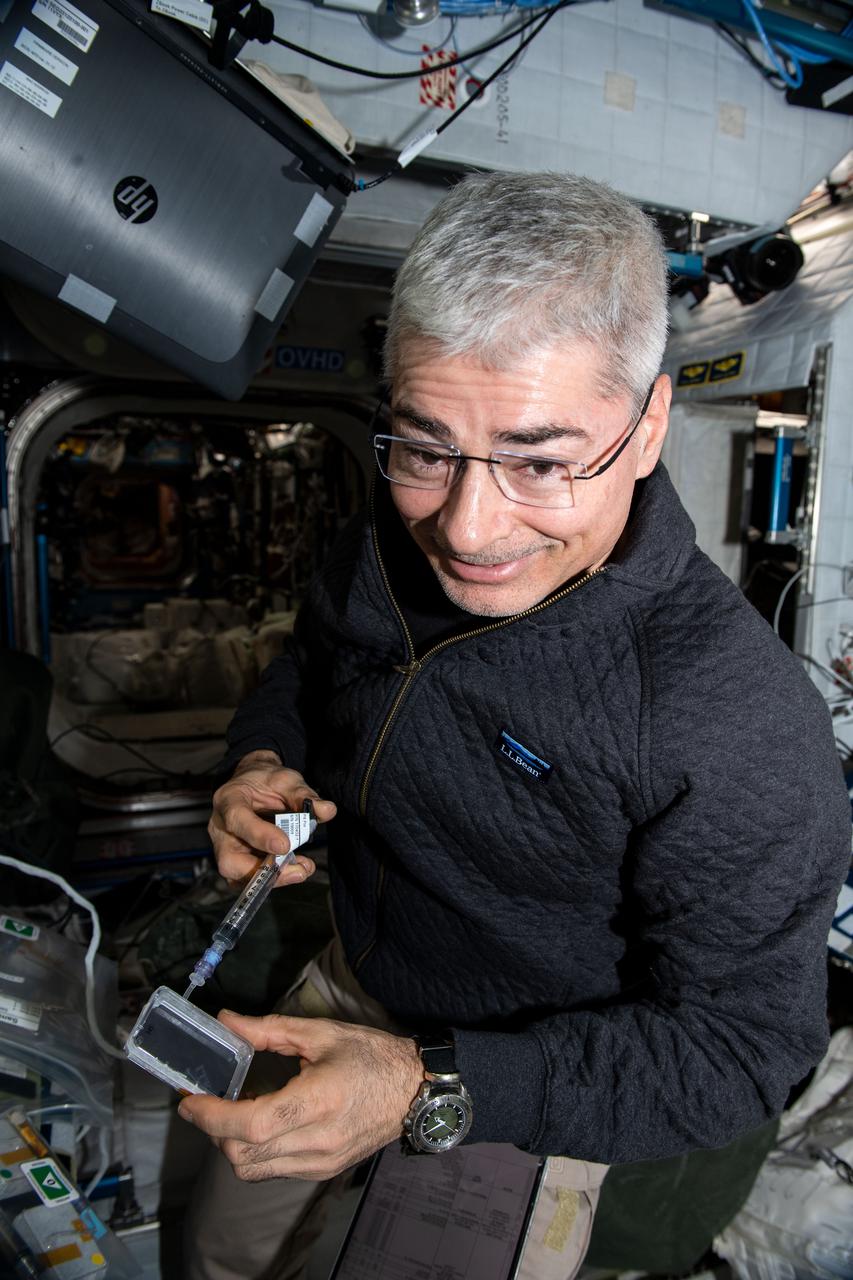
iss066e097028 (Dec. 27, 2021) --- NASA astronaut and Expedition 66 Flight Engineer Mark Vande Hei conducts research operations for the MVP-Plant-01, or Plant RNA Regulation Redux in Multi Variable Platform, space botany study. The experiment seeks to develop plants that adapt to growing in the microgravity environment.

iss053e234714 (Nov. 21, 2017) --- Advanced Plant Habitat (APH) Facility in the Japanese Experiment Module (JEM) Pressurized Module (JPM). The Plant Habitat is a fully automated facility that provides a large, enclosed, environmentally-controlled chamber for plant bioscience research.
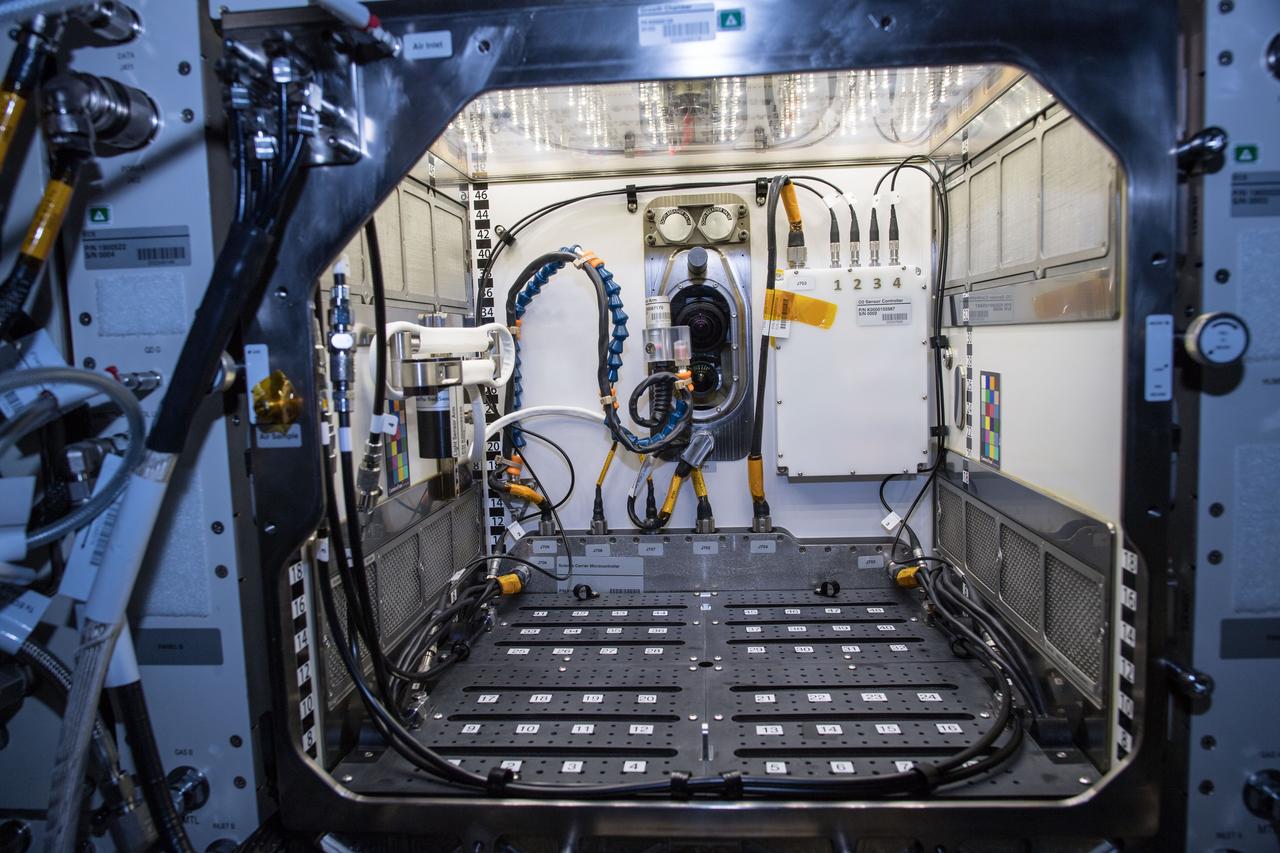
iss056e005665 (6/8/2018) --- View aboard the International Space Station (ISS) during the Plant Habitat Facility Science Carrier #1 installation. Plant Habitat is a fully automated facility that will be used to conduct plant bioscience research on the ISS.
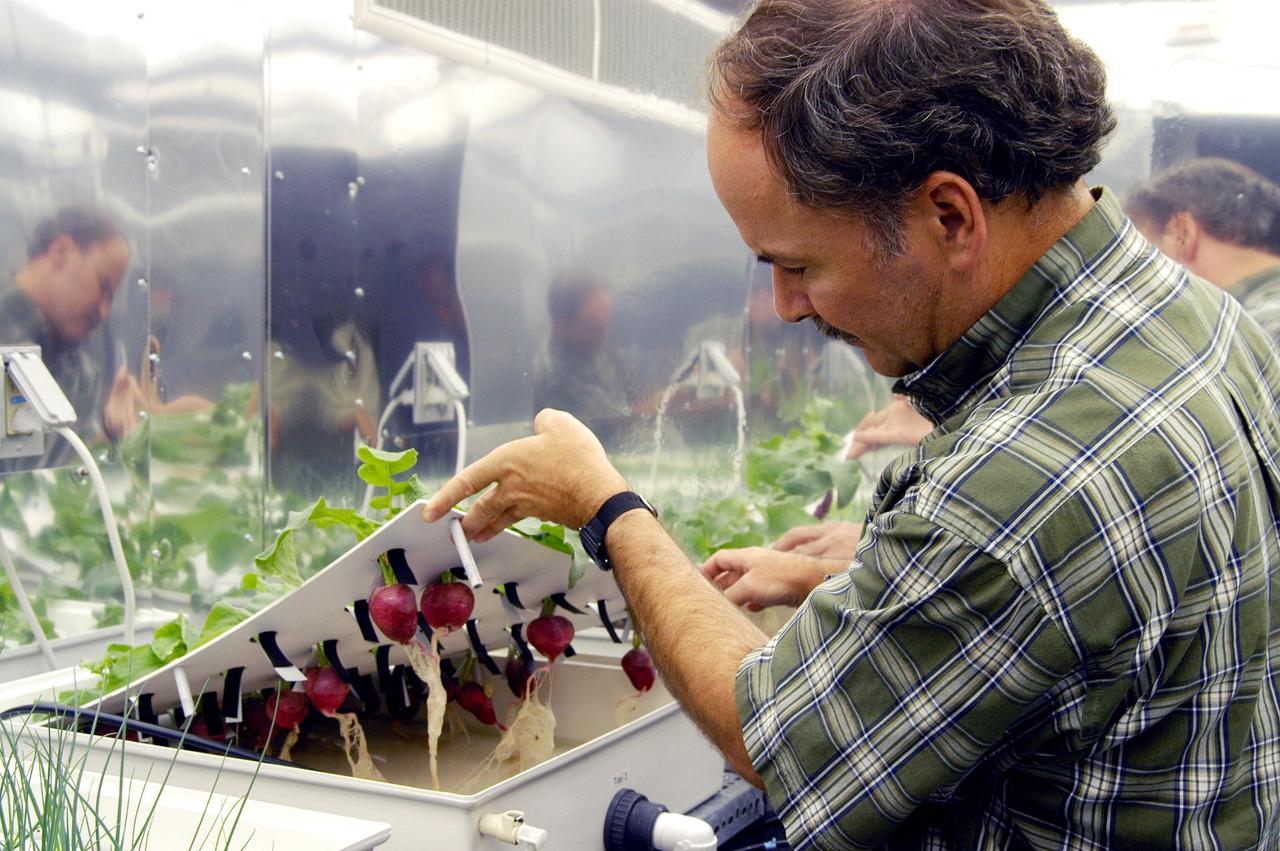
KENNEDY SPACE CENTER, FLA. - In a plant growth chamber in the KSC Space Life Sciences Lab, plant physiologist Ray Wheeler checks radishes being grown using hydroponic techniques. Wheeler and other colleagues are researching plant growth under different types of light, different CO2 concentrations and temperatures. The Lab is exploring various aspects of a bioregenerative life support system. Such research and technology development will be crucial to long-term habitation of space by humans.

Dr. Oscar Monje, a research scientist, pours a growing substrate called arcillite in the science carrier, or base, of the Advanced Plant Habitat (APH) inside a laboratory at the Space Station Processing Facility at NASA's Kennedy Space Center in Florida. Developed by NASA and ORBITEC of Madison, Wisconsin, the APH is the largest plant chamber built for the agency. It is a fully automated plant growth facility that will be used to conduct bioscience research on the International Space Station. The APH will be delivered to the space station aboard future Commercial Resupply Services missions.

Dr. Oscar Monje, a research scientist, pours a growing substrate called arcillite in the science carrier, or base, of the Advanced Plant Habitat (APH) inside a laboratory at the Space Station Processing Facility at NASA's Kennedy Space Center in Florida. Developed by NASA and ORBITEC of Madison, Wisconsin, the APH is the largest plant chamber built for the agency. It is a fully automated plant growth facility that will be used to conduct bioscience research on the International Space Station. The APH will be delivered to the space station aboard future Commercial Resupply Services missions.
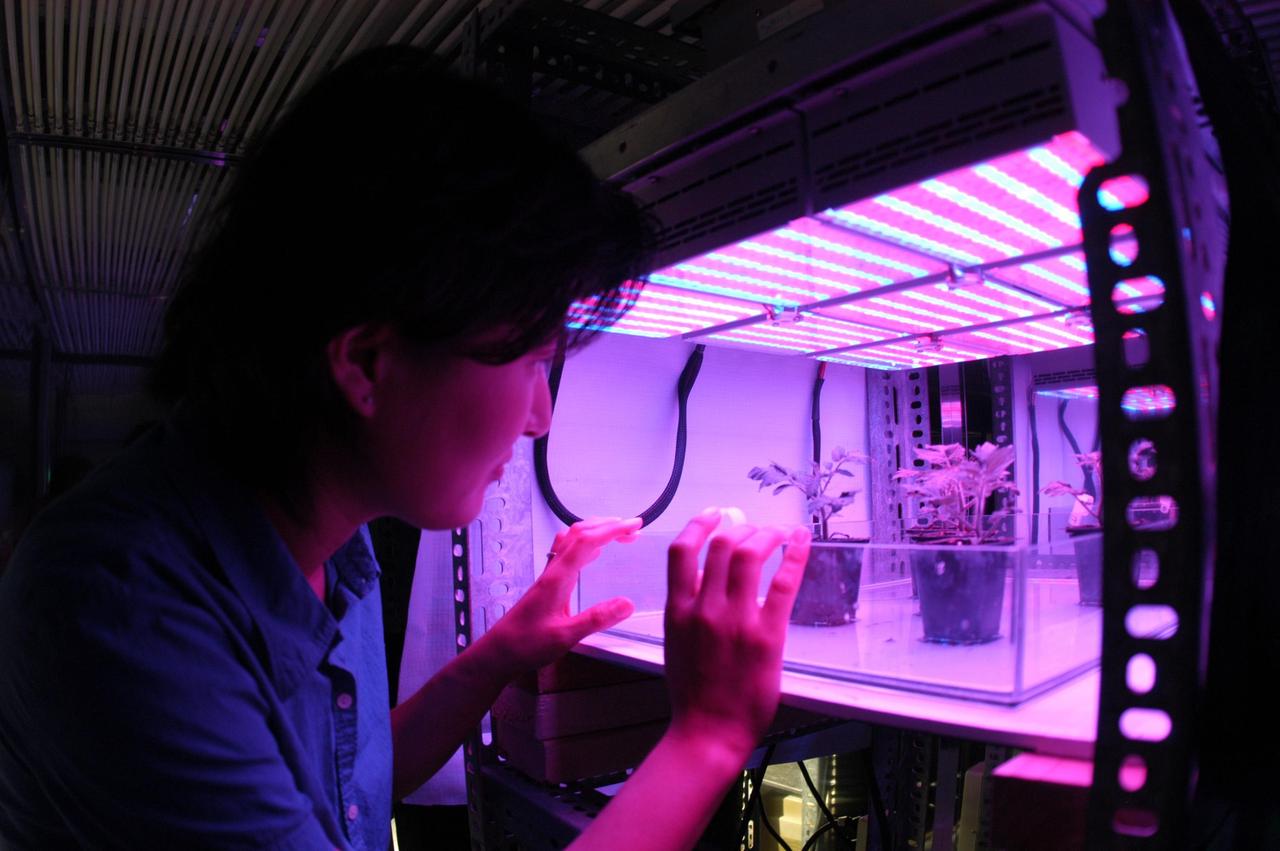
KENNEDY SPACE CENTER, FLA. - In the KSC Space Life Sciences Lab, Dr. Hyeon-Hye Kim checks plants in a plant growth chamber for testing under various light conditions. Other plant research includes different CO2 concentrations and temperatures. The Lab is exploring various aspects of a bioregenerative life support system. Such research and technology development will be crucial to long-term habitation of space by humans.
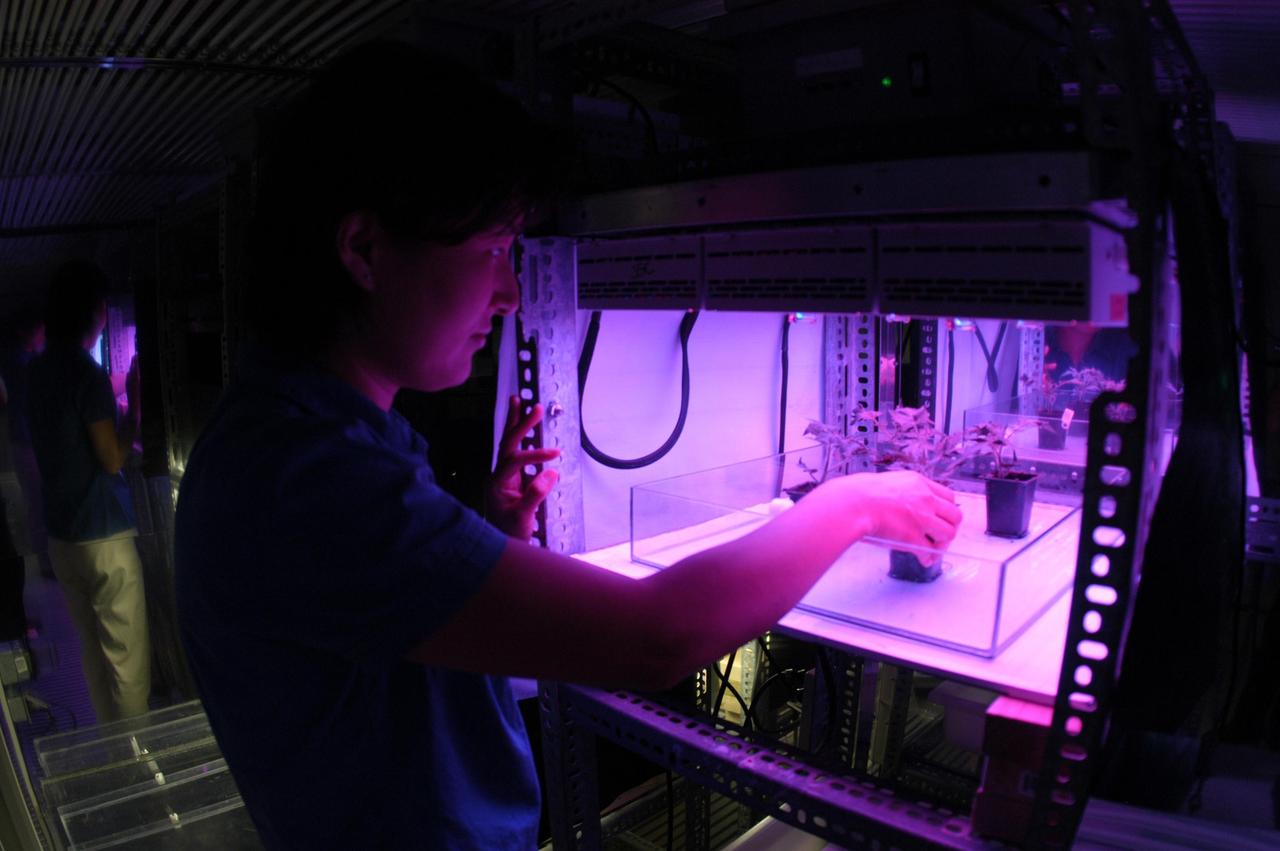
KENNEDY SPACE CENTER, FLA. - - In the KSC Space Life Sciences Lab, Dr. Hyeon-Hye Kim places Arabidopsis plants in a plant growth chamber for testing under various light conditions. Other plant research includes different CO2 concentrations and temperatures. The Lab is exploring various aspects of a bioregenerative life support system. Such research and technology development will be crucial to long-term habitation of space by humans.

Dr. Oscar Monje, a research scientist, packs a growing substrate called arcillite in the science carrier, or base, of the Advanced Plant Habitat (APH) inside a laboratory at the Space Station Processing Facility at NASA's Kennedy Space Center in Florida. Developed by NASA and ORBITEC of Madison, Wisconsin, the APH is the largest plant chamber built for the agency. It is a fully automated plant growth facility that will be used to conduct bioscience research on the International Space Station. The APH will be delivered to the space station aboard future Commercial Resupply Services missions.
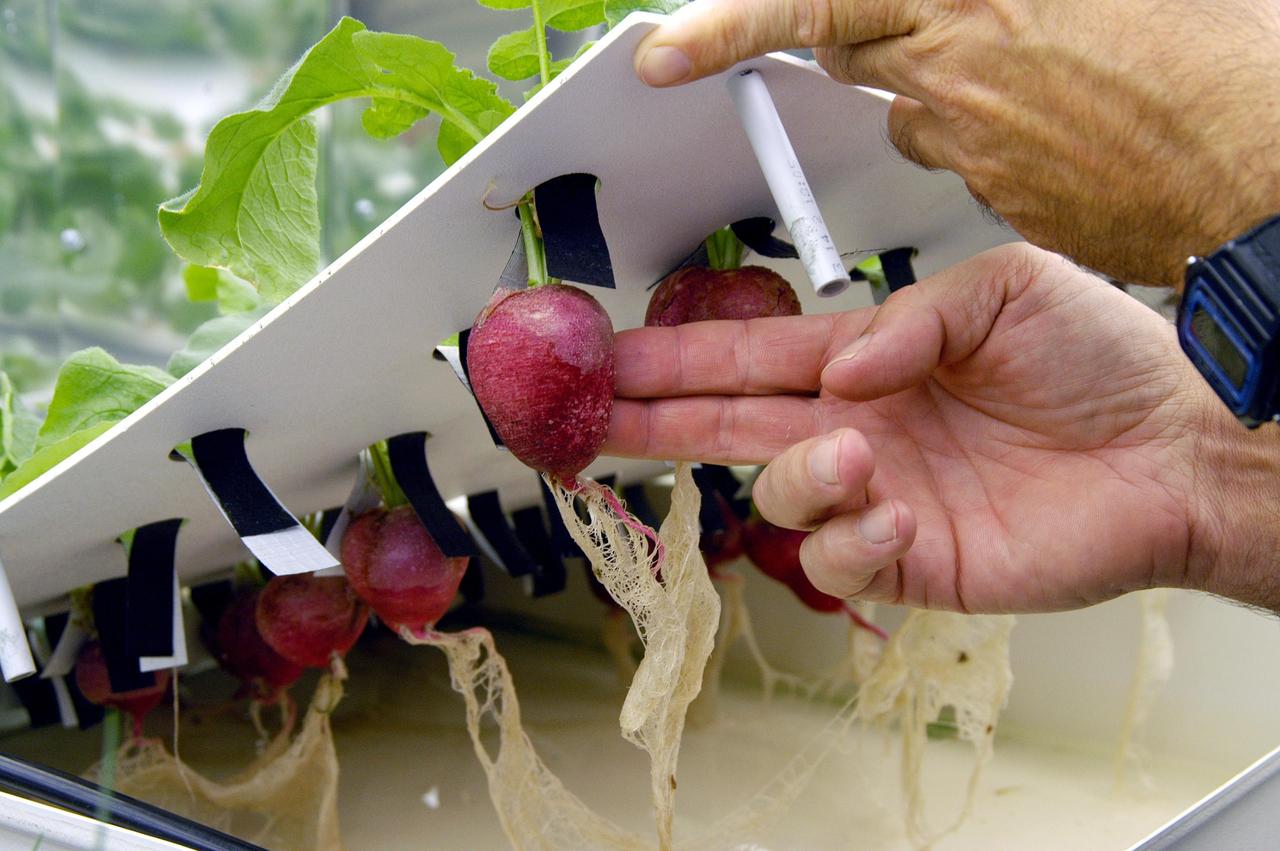
KENNEDY SPACE CENTER, FLA. - In a plant growth chamber in the KSC Space Life Sciences Lab, plant physiologist Ray Wheeler checks radishes being grown using hydroponic techniques. Wheeler and other colleagues are researching plant growth under different types of light, different CO2 concentrations and temperatures. The Lab is exploring various aspects of a bioregenerative life support system. Such research and technology development will be crucial to long-term habitation of space by humans.
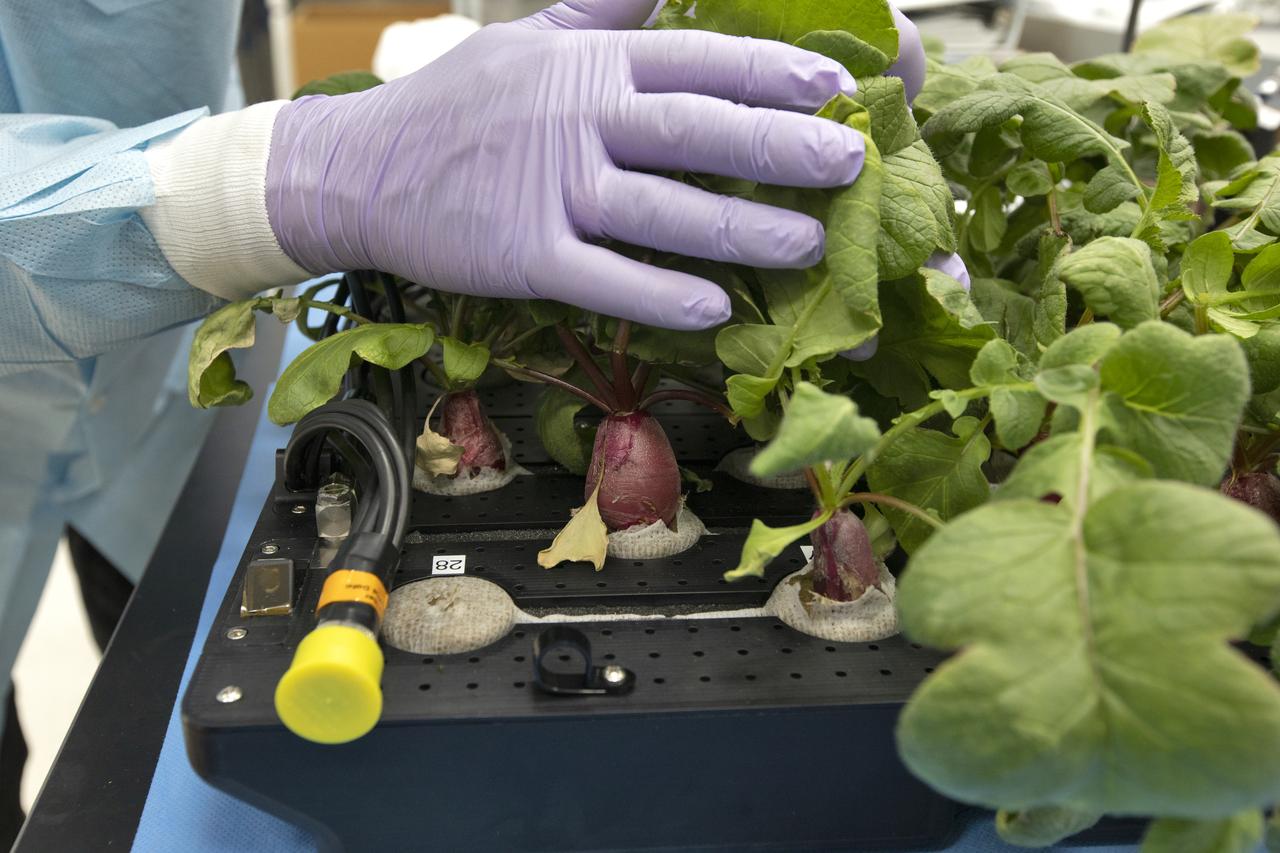
Radish plants are growing inside the Advanced Plant Habitat (APH) ground unit inside a laboratory in the Space Station Processing Facility at NASA's Kennedy Space Center in Florida on June 13, 2019. The plants are being grown as part of a science verification test for PH-02, a Space Life and Physical Sciences Research and Applications-funded experiment which seeks to determine the effects of spaceflight on radishes. The APH is a highly automated plant growth chamber with 180 sensors and is able to closely regulate variables related to plant growth.
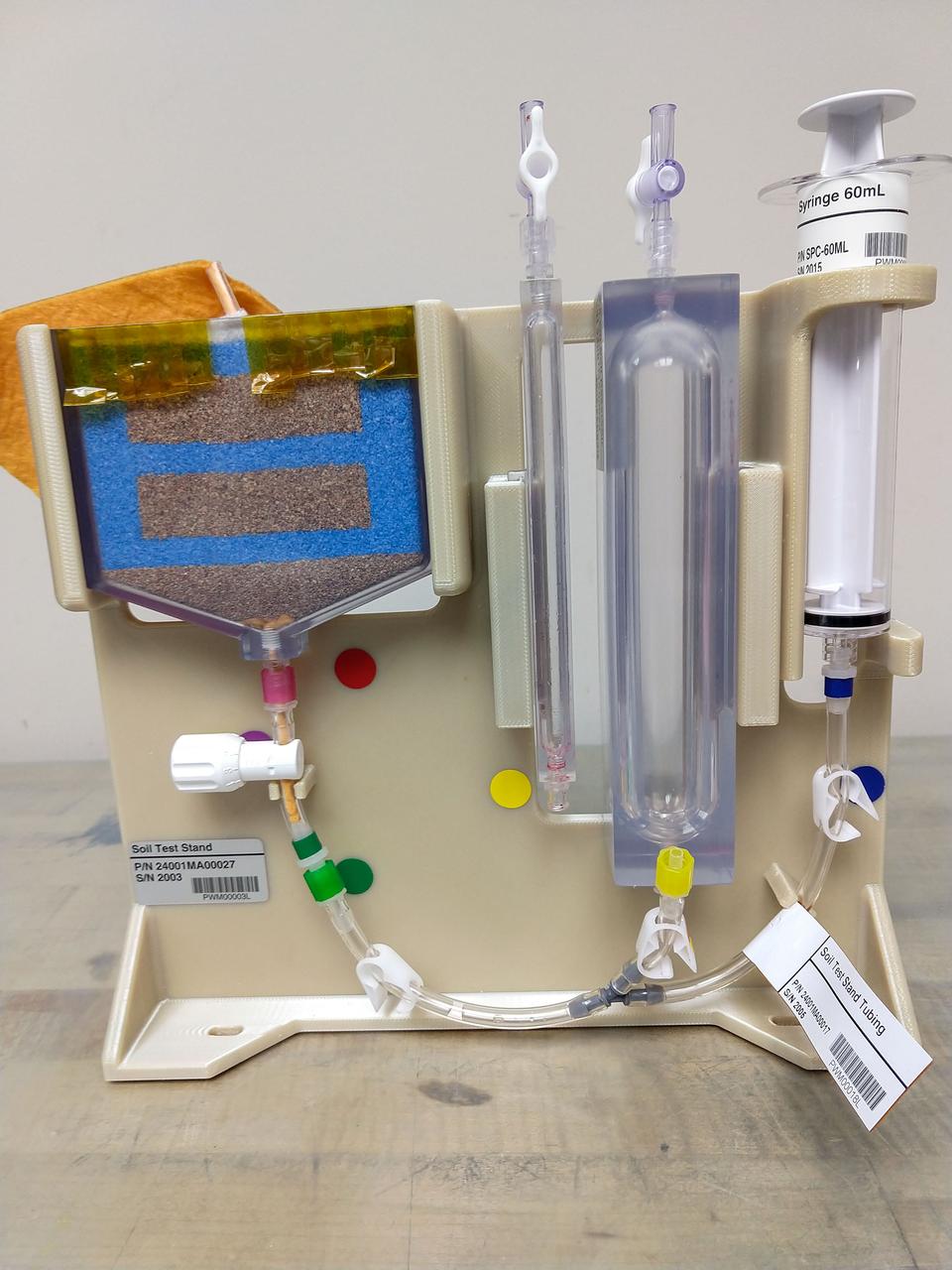
jsc2019e041774 (5/10/2019) --- Preflight imagery of a Plant Water Management (PWM) Harness and Hydroponics Test Article. Plant Water Management demonstrates a hydroponic method for ensuring adequate hydration and aeration to the root zone in order to sustain plants from germination through harvest. Low-gravity capillary fluidics deliver water in single and multiple plant production chambers, and researchers compare growth of individual plants in microgravity and normal gravity.
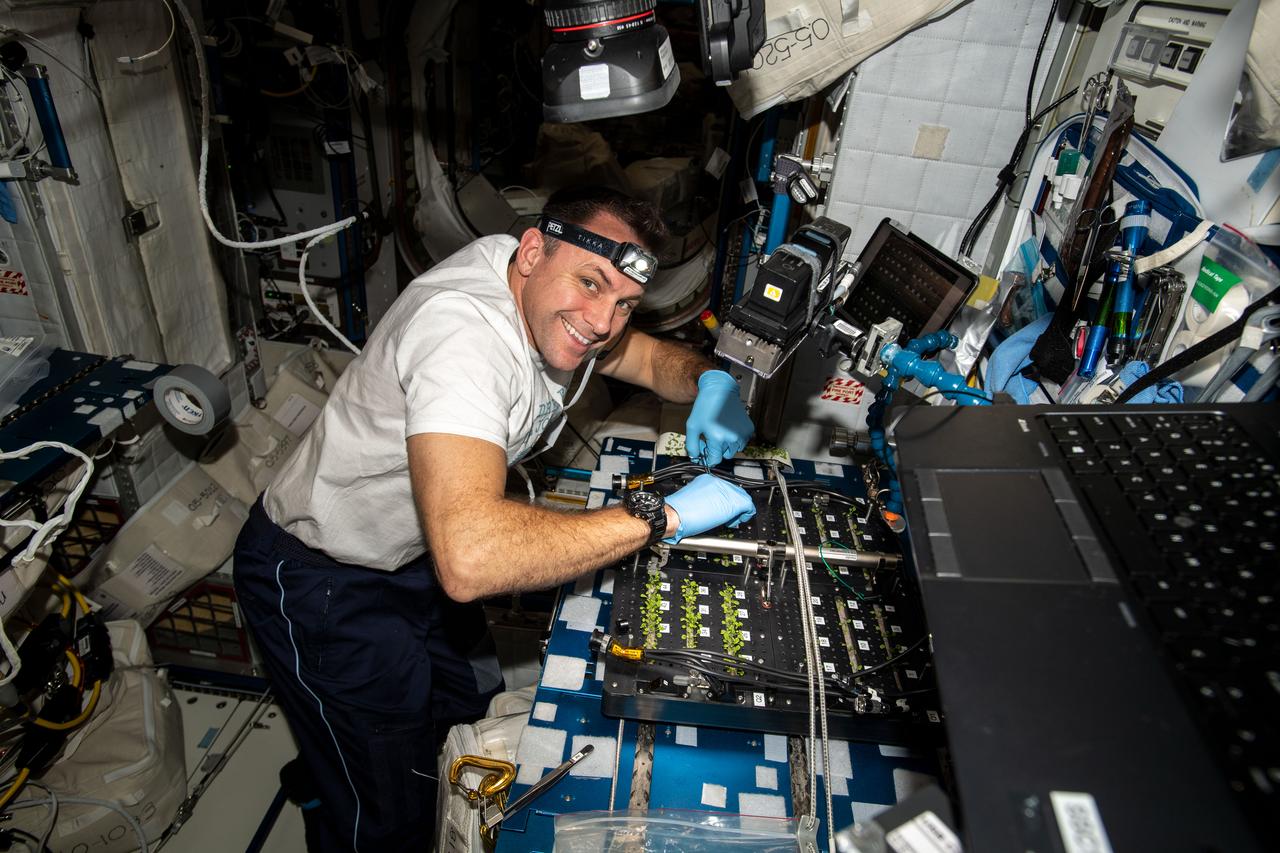
iss068e043103 (Jan. 12, 2023) --- NASA astronaut and Expedition 68 Flight Engineer Josh Cassada tends to thale cress plants growing for the Plant Habitat-03 space botany study that explores how plants genetically adapt to microgravity. Cassada removed the plants from the Advanced Plant Habitat located in the Kibo laboratory module and conducted the research activities in the Harmony module's maintenance work area.
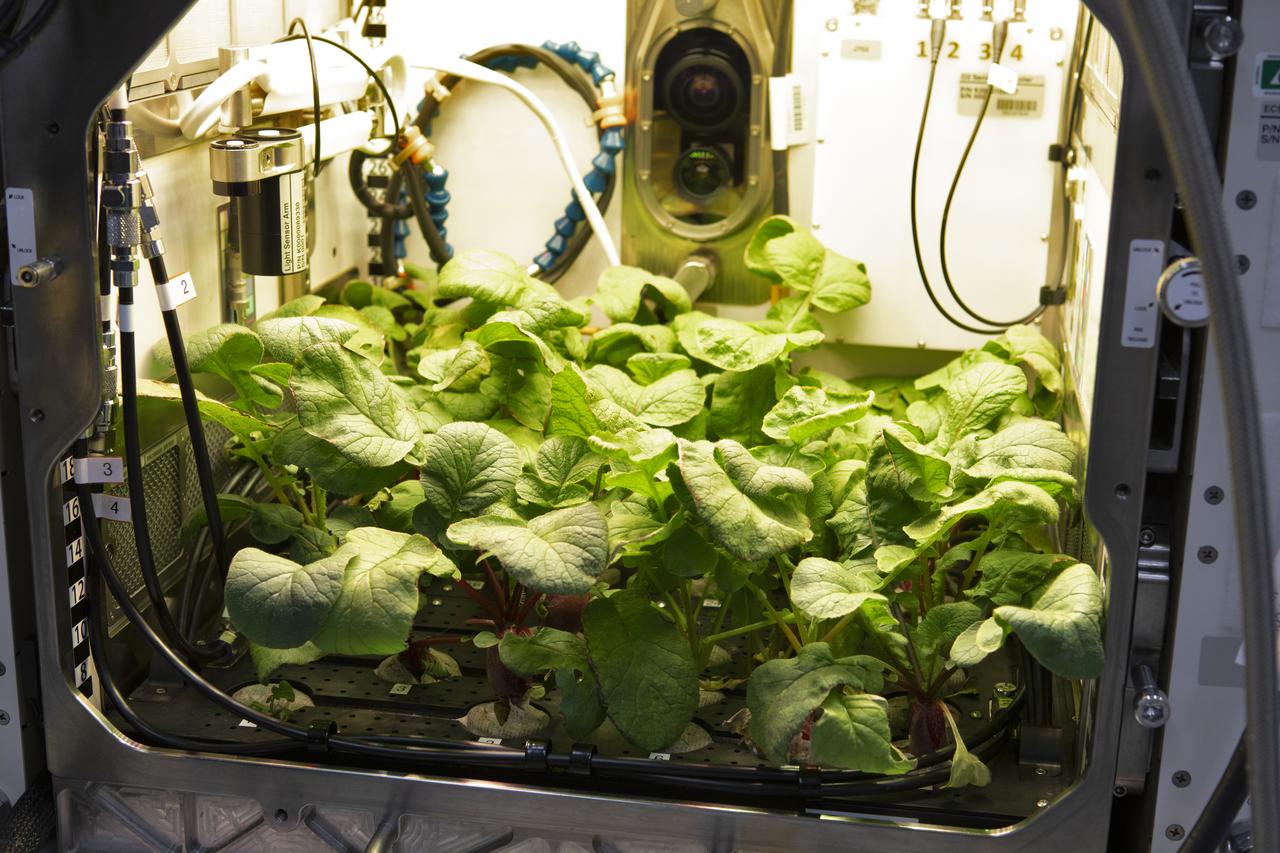
Radish plants are growing inside the Advanced Plant Habitat (APH) ground unit inside a laboratory in the Space Station Processing Facility at NASA's Kennedy Space Center in Florida on June 13, 2019. The plants are being grown as part of a science verification test for PH-02, a Space Life and Physical Sciences Research and Applications-funded experiment which seeks to determine the effects of spaceflight on radishes. The APH is a highly automated plant growth chamber with 180 sensors and is able to closely regulate variables related to plant growth.
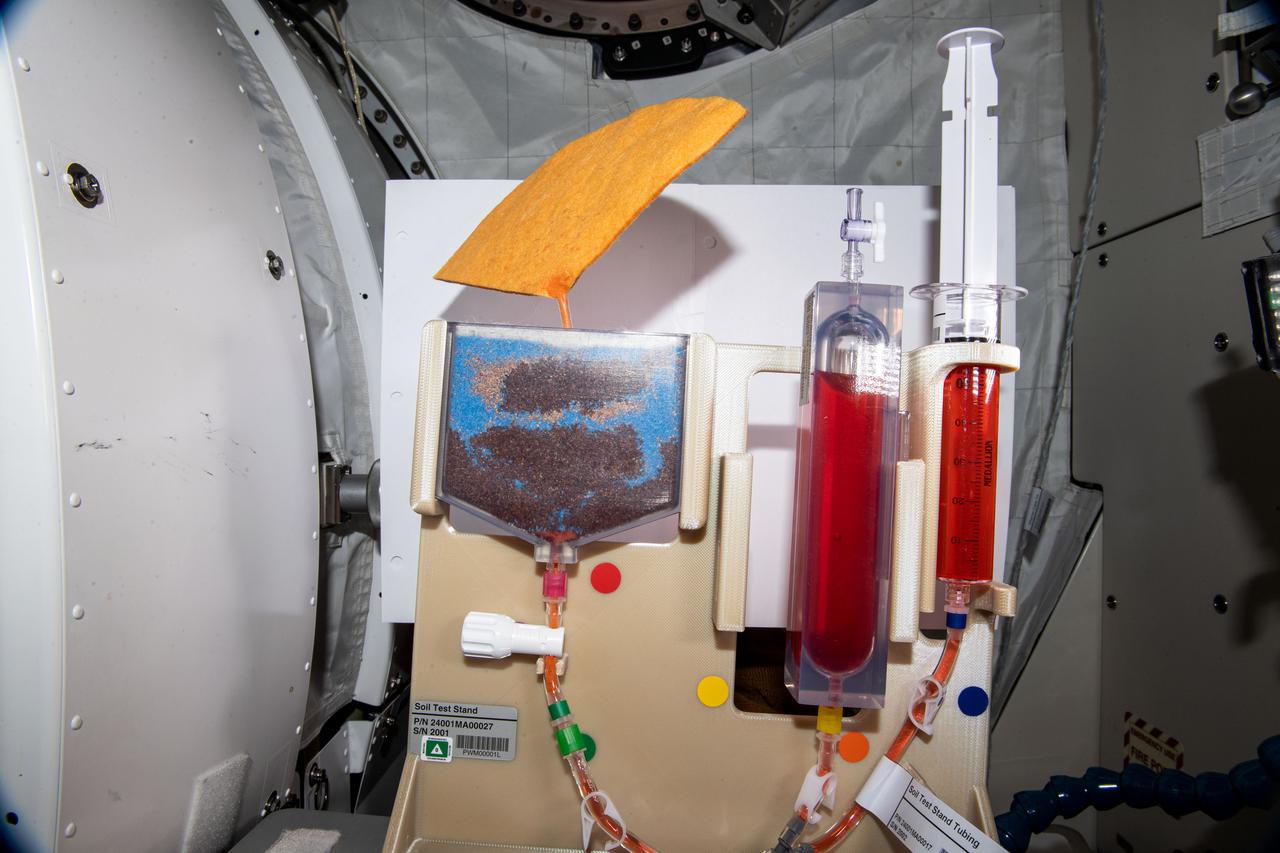
iss064e030235 (2/8/2021) --- A view of the Plant Water Management (PWM) investigation aboard the International space Station (ISS). Plant Water Management demonstrates a hydroponic method for ensuring adequate hydration and aeration to the root zone in order to sustain plants from germination through harvest. Low-gravity capillary fluidics deliver water in single and multiple plant production chambers, and researchers compare growth of individual plants in microgravity and normal gravity.

Radish plants are growing inside the Advanced Plant Habitat (APH) ground unit inside a laboratory in the Space Station Processing Facility at NASA's Kennedy Space Center in Florida on June 13, 2019. The plants are being grown as part of a science verification test for PH-02, a Space Life and Physical Sciences Research and Applications-funded experiment which seeks to determine the effects of spaceflight on radishes. The APH is a highly automated plant growth chamber with 180 sensors and is able to closely regulate variables related to plant growth.