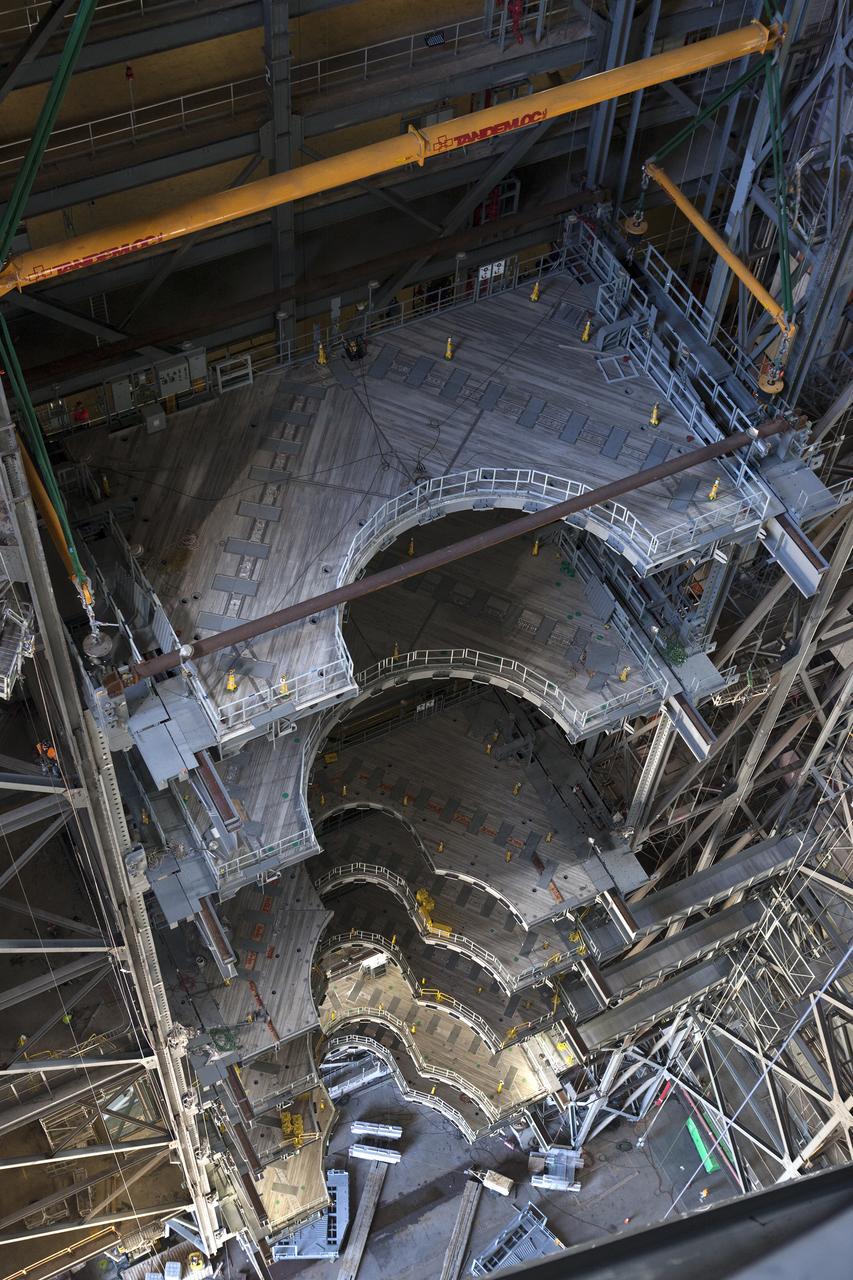
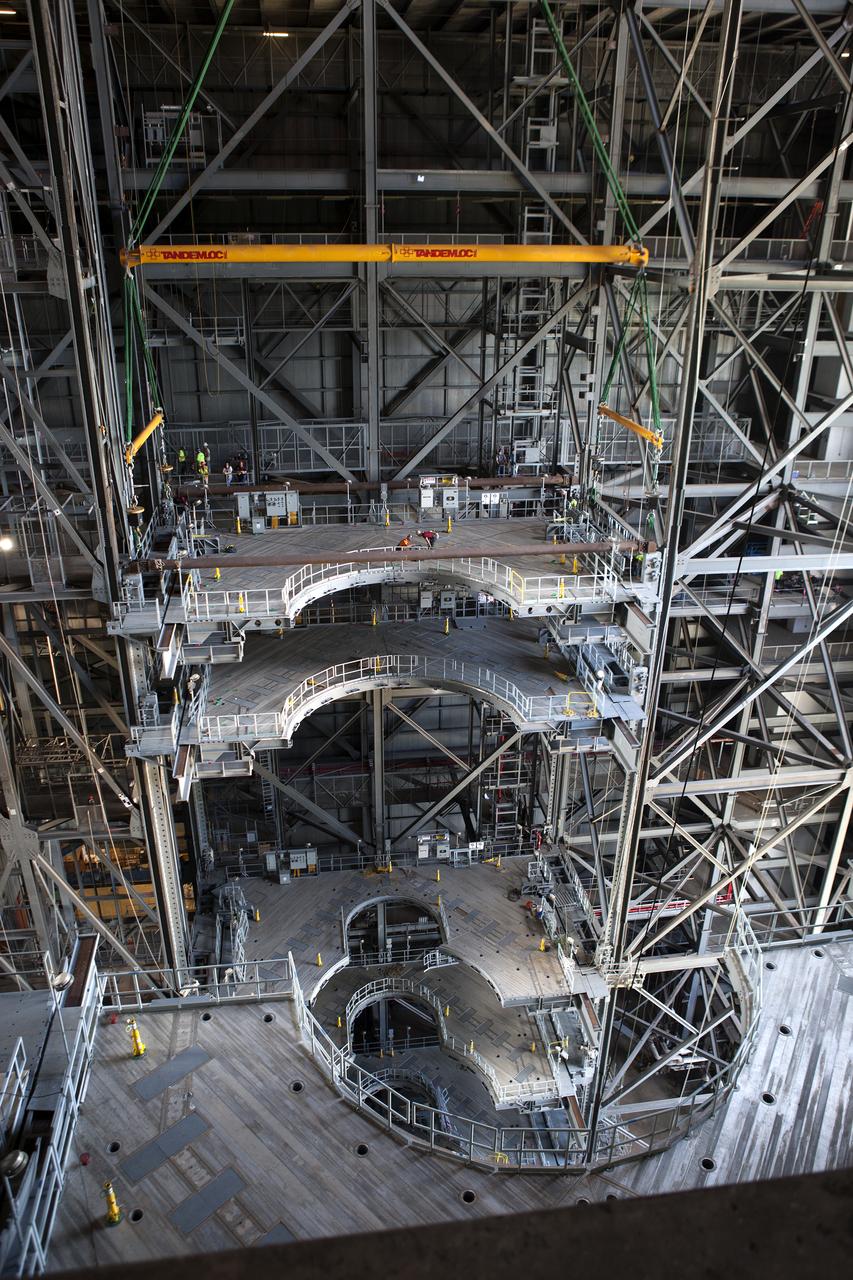
A heavy-lift crane lowers the first half of the D-level work platforms, D south, for NASA’s Space Launch System (SLS) rocket, into High Bay 3 in the Vehicle Assembly Building (VAB) at NASA’s Kennedy Space Center in Florida. In view below are the six levels of previously installed platforms. The D platform will be installed on the south side of the high bay. The D platforms are the seventh of 10 levels of work platforms that will surround and provide access to the SLS rocket and Orion spacecraft for Exploration Mission 1. The Ground Systems Development and Operations Program is overseeing upgrades and modifications to VAB High Bay 3, including installation of the new work platforms, to prepare for NASA’s journey to Mars.
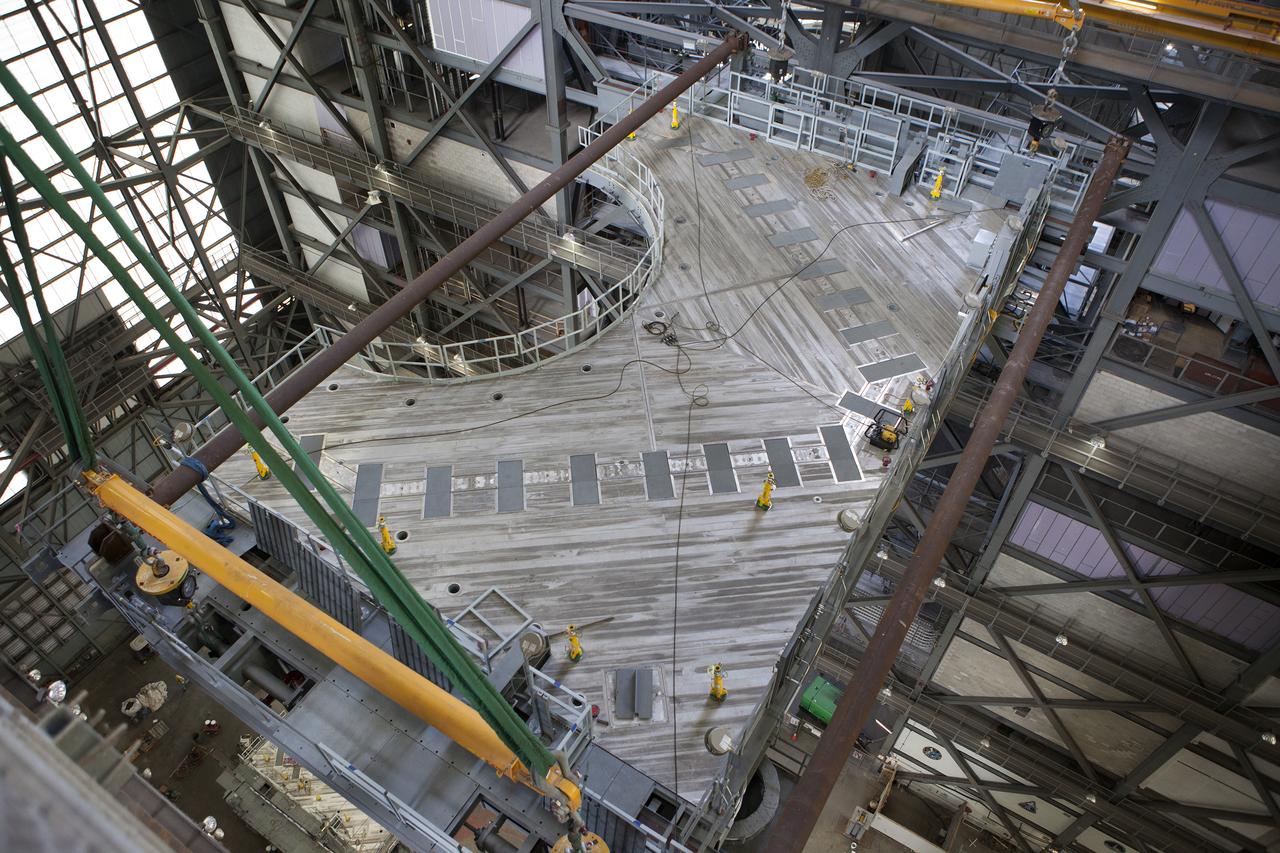
In this view from above, a heavy-lift crane lowers the first half of the D-level work platforms, D south, for NASA’s Space Launch System (SLS) rocket, into High Bay 3 in the Vehicle Assembly Building (VAB) at NASA’s Kennedy Space Center in Florida. The D platform will be installed on the south side of the high bay. The D platforms are the seventh of 10 levels of work platforms that will surround and provide access to the SLS rocket and Orion spacecraft for Exploration Mission 1. The Ground Systems Development and Operations Program is overseeing upgrades and modifications to VAB High Bay 3, including installation of the new work platforms, to prepare for NASA’s journey to Mars.
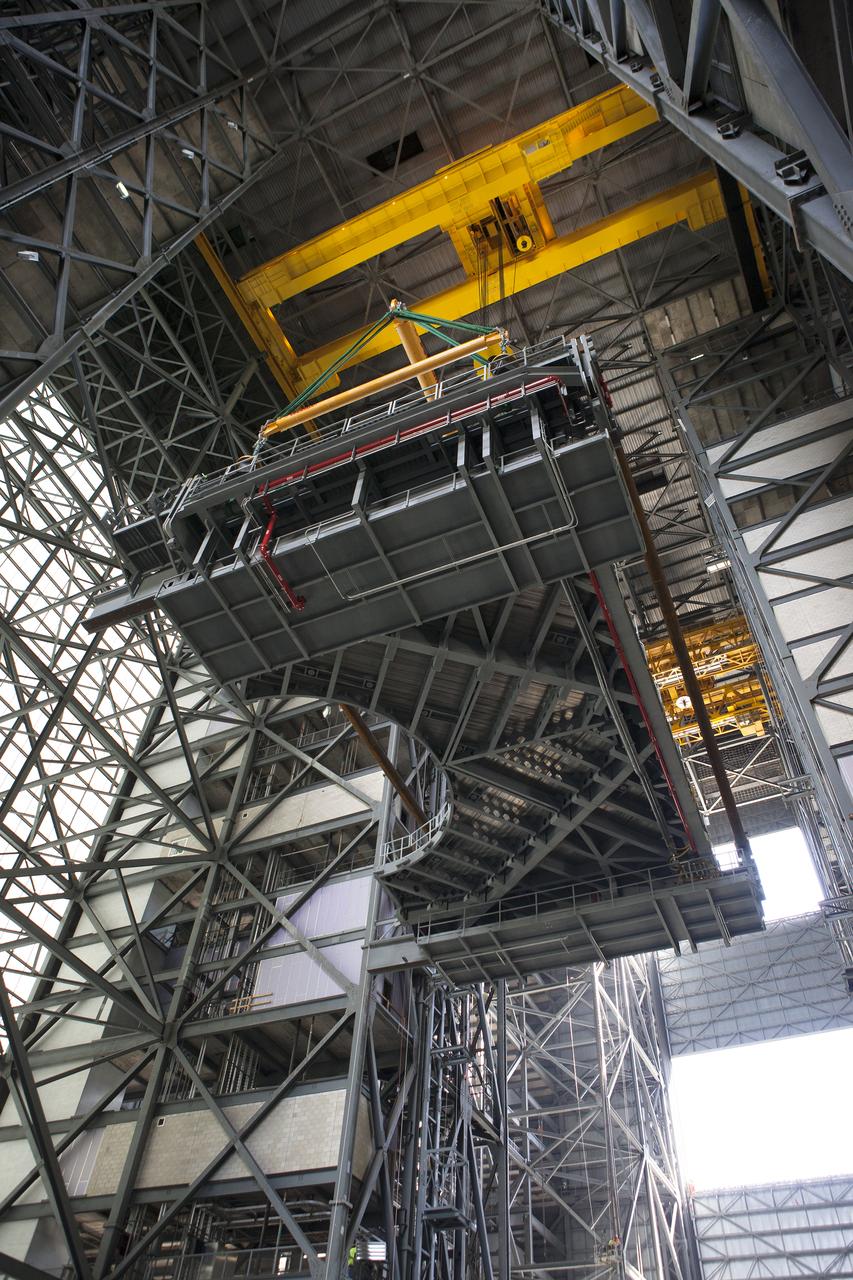
A heavy-lift crane lifts the first half of the D-level work platforms, D south, for NASA’s Space Launch System (SLS) rocket, high above the floor of the transfer aisle in the Vehicle Assembly Building (VAB) at NASA’s Kennedy Space Center in Florida. The D platform will be lowered into High Bay 3 for installation on the south side of the high bay. The D platforms are the seventh of 10 levels of work platforms that will surround and provide access to the SLS rocket and Orion spacecraft for Exploration Mission 1. The Ground Systems Development and Operations Program is overseeing upgrades and modifications to VAB High Bay 3, including installation of the new work platforms, to prepare for NASA’s journey to Mars.
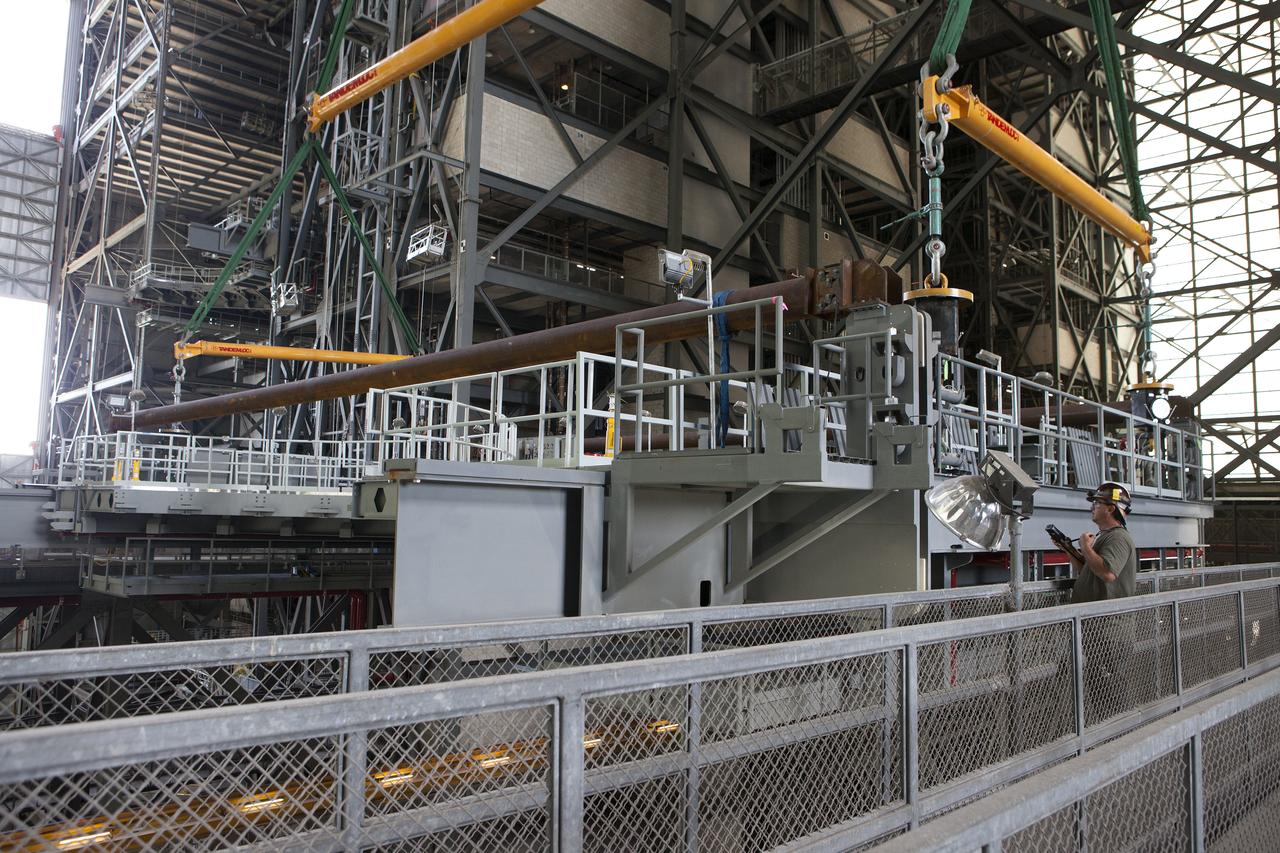
A construction worker monitors the progress, as a heavy-lift crane lifts the first half of the D-level work platforms, D south, for NASA’s Space Launch System (SLS) rocket, up from the transfer aisle floor in the Vehicle Assembly Building (VAB) at NASA’s Kennedy Space Center in Florida. The D platform will be installed on the south side of High Bay 3. The D platforms are the seventh of 10 levels of work platforms that will surround and provide access to the SLS rocket and Orion spacecraft for Exploration Mission 1. The Ground Systems Development and Operations Program is overseeing upgrades and modifications to VAB High Bay 3, including installation of the new work platforms, to prepare for NASA’s journey to Mars.
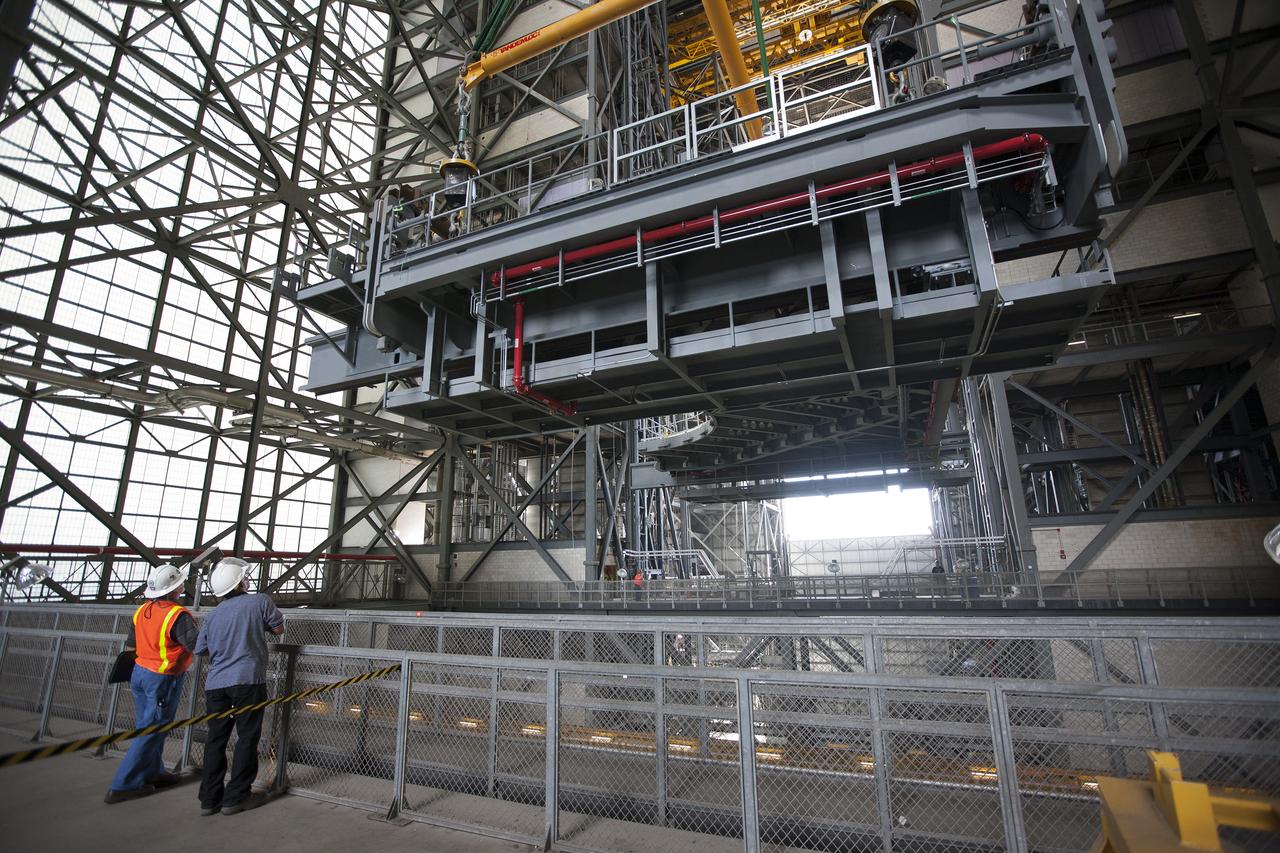
A heavy-lift crane lifts the first half of the D-level work platforms, D south, for NASA’s Space Launch System (SLS) rocket, up from the transfer aisle floor of the Vehicle Assembly Building (VAB) at NASA’s Kennedy Space Center in Florida. The D platform will be installed on the south side of High Bay 3. The D platforms are the seventh of 10 levels of work platforms that will surround and provide access to the SLS rocket and Orion spacecraft for Exploration Mission 1. The Ground Systems Development and Operations Program is overseeing upgrades and modifications to VAB High Bay 3, including installation of the new work platforms, to prepare for NASA’s journey to Mars.
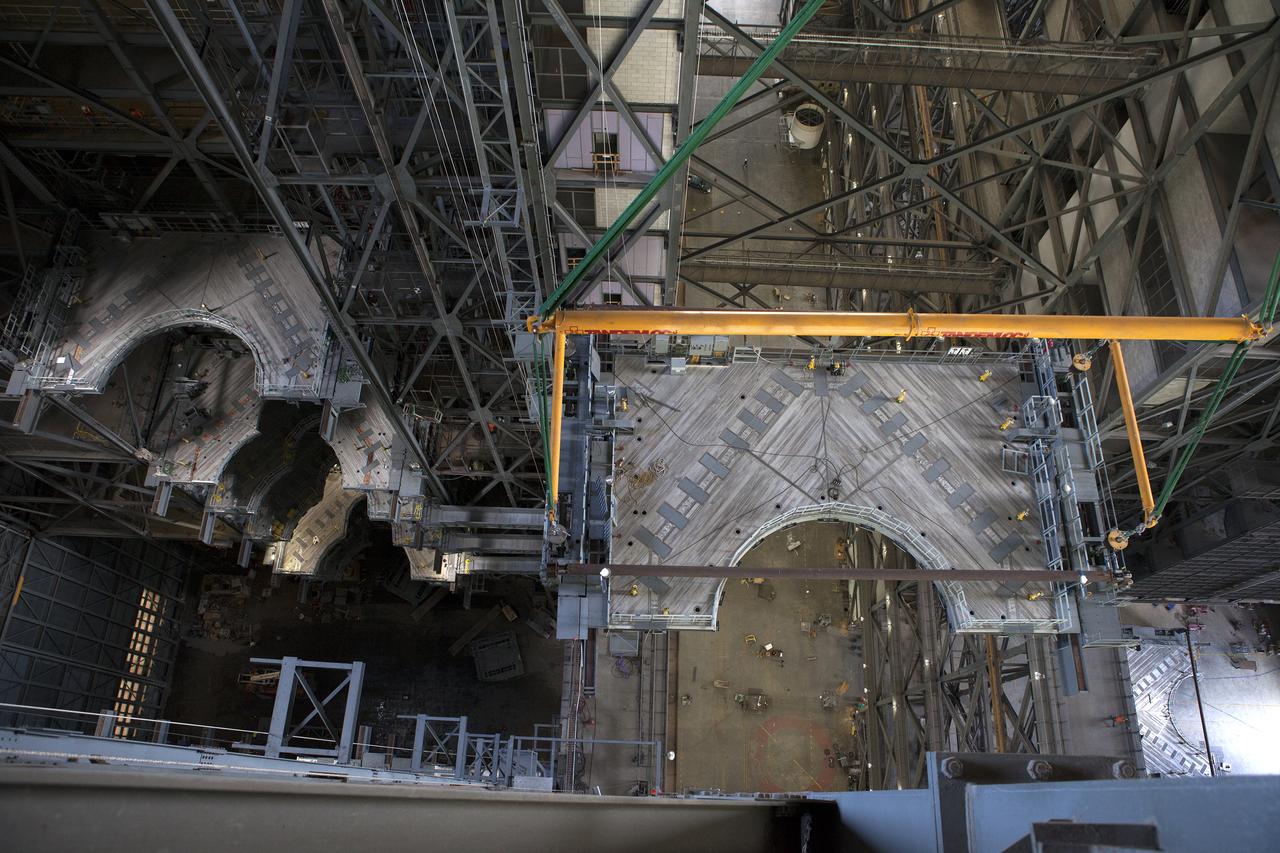
Inside the Vehicle Assembly Building at NASA’s Kennedy Space Center in Florida, a heavy-lift crane lifts the first half of the D-level work platforms, D south, for NASA’s Space Launch System (SLS) rocket, high above the floor of the transfer aisle. The platform will be moved into High Bay 3 for installation on the south side of the high bay. Large Tandemloc bars have been attached to the platform to keep it level during lifting and installation. The D platforms are the seventh of 10 levels of work platforms that will surround and provide access to the SLS rocket and Orion spacecraft for Exploration Mission 1. The Ground Systems Development and Operations Program is overseeing upgrades and modifications to VAB High Bay 3, including installation of the new work platforms, to prepare for NASA’s journey to Mars.
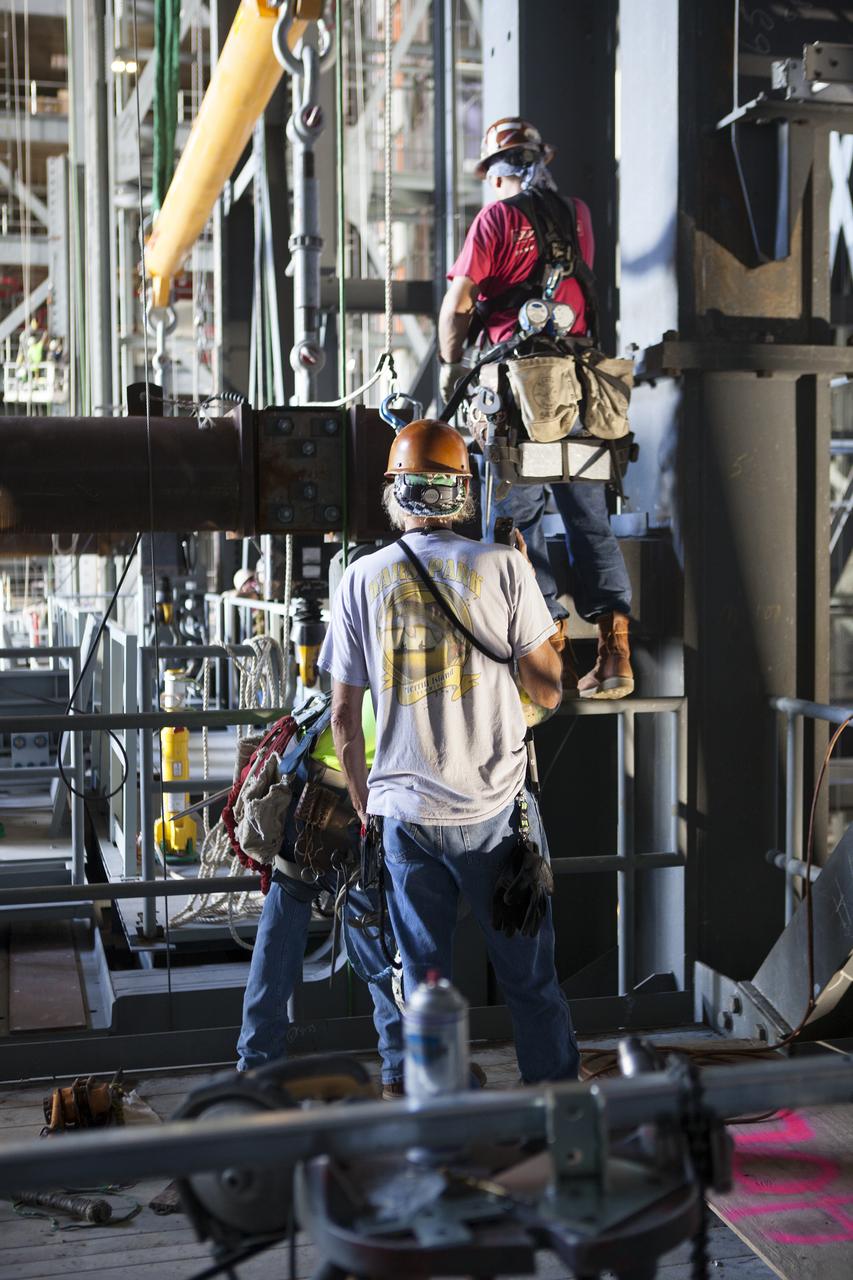
Construction workers use specialized tools to help secure the second half of the D-level work platforms, D north, for NASA’s Space Launch System (SLS) rocket, into position in High Bay 3 in the Vehicle Assembly Building (VAB) at the agency’s Kennedy Space Center in Florida. The D platform is being installed on the north side of the high bay. The D platforms are the seventh of 10 levels of work platforms that will surround and provide access to the SLS rocket and Orion spacecraft for Exploration Mission 1. The Ground Systems Development and Operations Program is overseeing upgrades and modifications to VAB High Bay 3, including installation of the new work platforms, to prepare for NASA’s journey to Mars.
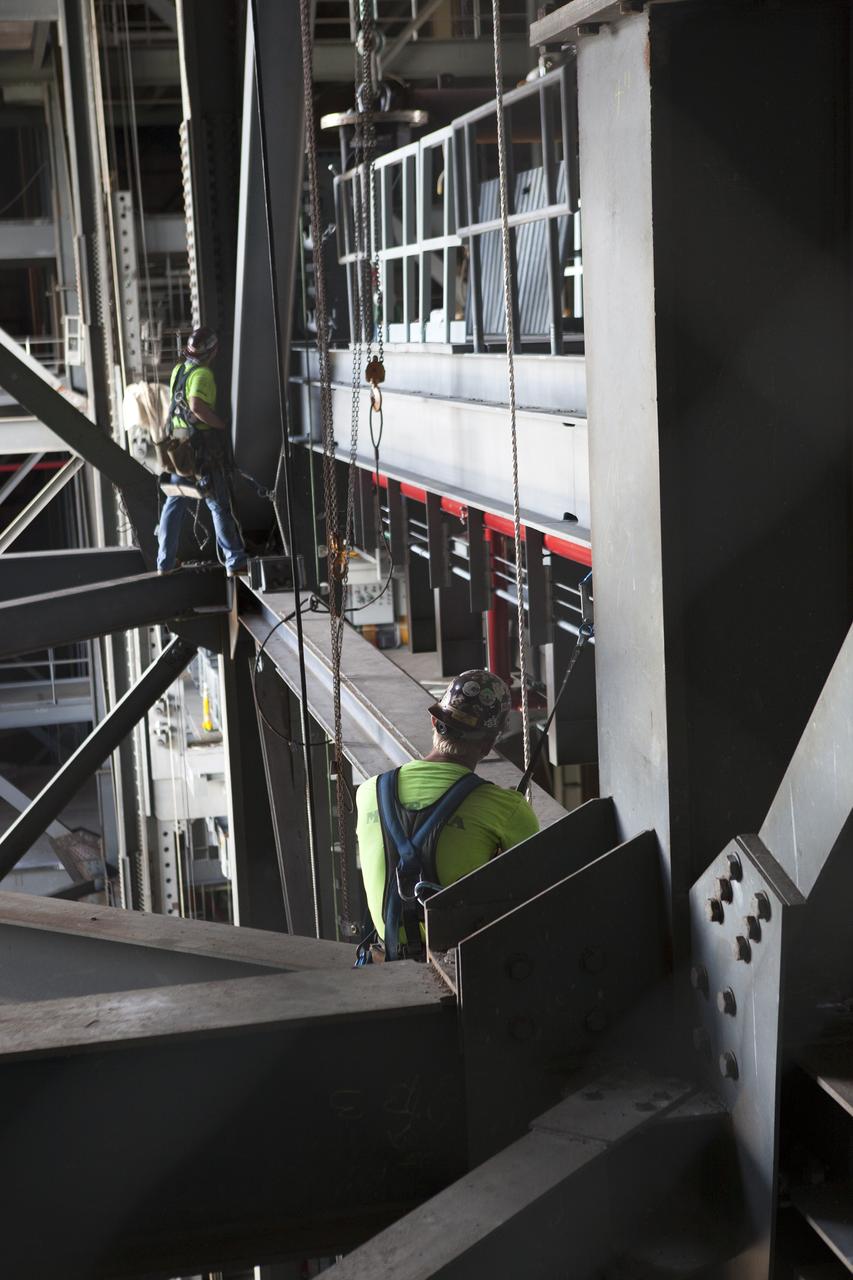
Construction workers help to secure the second half of the D-level work platforms, D north, for NASA’s Space Launch System (SLS) rocket, into position in High Bay 3 in the Vehicle Assembly Building (VAB) at the agency’s Kennedy Space Center in Florida. The D platform is being installed on the north side of the high bay. The D platforms are the seventh of 10 levels of work platforms that will surround and provide access to the SLS rocket and Orion spacecraft for Exploration Mission 1. The Ground Systems Development and Operations Program is overseeing upgrades and modifications to VAB High Bay 3, including installation of the new work platforms, to prepare for NASA’s journey to Mars.
A heavy-lift crane lowers the second half of the D-level work platforms, D north, for NASA’s Space Launch System (SLS) rocket, into position for installation in High Bay 3 in the Vehicle Assembly Building (VAB) at the agency’s Kennedy Space Center in Florida. The platform will be installed on the north side of the high bay. The D platforms are the seventh of 10 levels of work platforms that will surround and provide access to the SLS rocket and Orion spacecraft for Exploration Mission 1. The Ground Systems Development and Operations Program is overseeing upgrades and modifications to VAB High Bay 3, including installation of the new work platforms, to prepare for NASA’s journey to Mars.
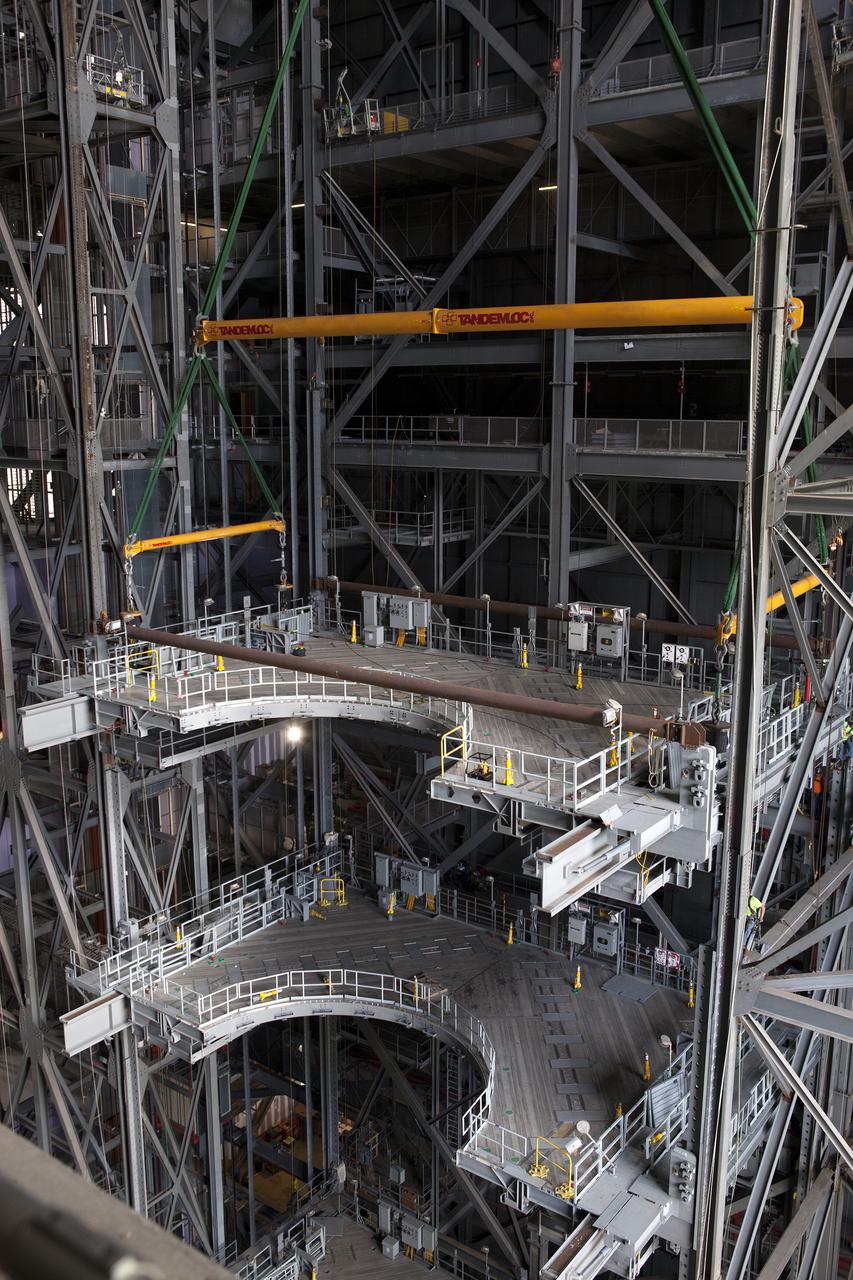
A heavy-lift crane lowers the second half of the D-level work platforms, D north, for NASA’s Space Launch System (SLS) rocket, into position for installation in High Bay 3 in the Vehicle Assembly Building at the agency’s Kennedy Space Center in Florida. The platform will be installed on the north side of the high bay. The D platforms are the seventh of 10 levels of work platforms that will surround and provide access to the SLS rocket and Orion spacecraft for Exploration Mission 1. The Ground Systems Development and Operations Program is overseeing upgrades and modifications to VAB High Bay 3, including installation of the new work platforms, to prepare for NASA’s journey to Mars.
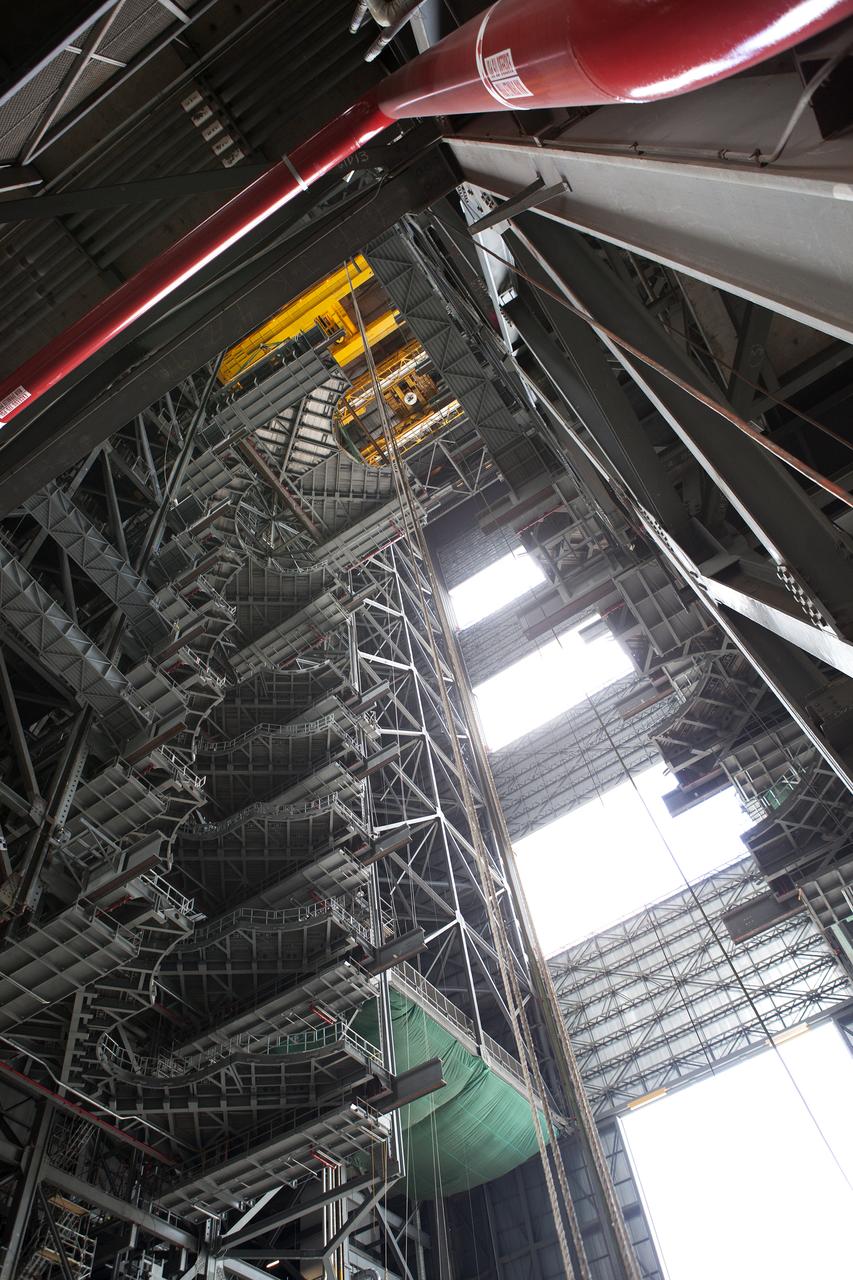
In this view looking up in the Vehicle Assembly Building at NASA’s Kennedy Space Center in Florida, a heavy-lift crane lowers the second half of the D-level work platforms, D north, for NASA’s Space Launch System (SLS) rocket, into position for installation in High Bay 3. The platform will be installed on the north side of the high bay. The D platforms are the seventh of 10 levels of work platforms that will surround and provide access to the SLS rocket and Orion spacecraft for Exploration Mission 1. The Ground Systems Development and Operations Program is overseeing upgrades and modifications to VAB High Bay 3, including installation of the new work platforms, to prepare for NASA’s journey to Mars.
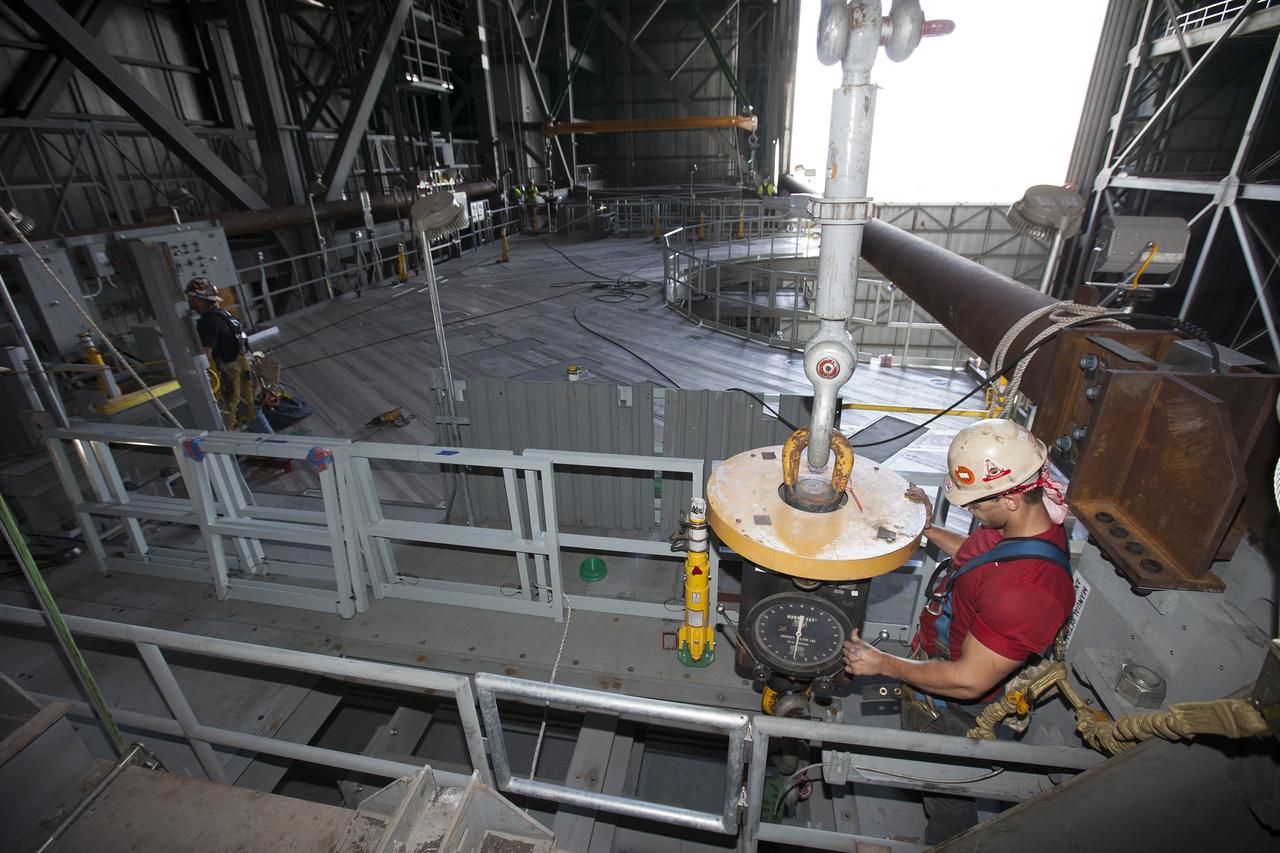
In High Bay 3 inside the Vehicle Assembly Building at NASA’s Kennedy Space Center in Florida, construction workers assist during installation of the second half of the D-level work platforms, D north, for NASA’s Space Launch System (SLS) rocket. The D platforms are the seventh of 10 levels of work platforms that will surround and provide access to the SLS rocket and Orion spacecraft for Exploration Mission 1. The Ground Systems Development and Operations Program is overseeing upgrades and modifications to VAB High Bay 3, including installation of the new work platforms, to prepare for NASA’s journey to Mars.
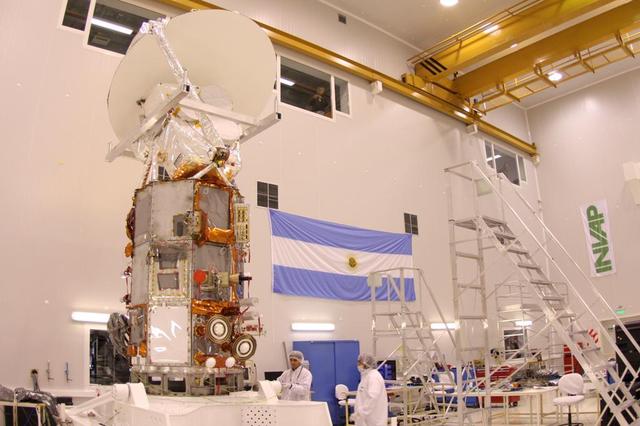
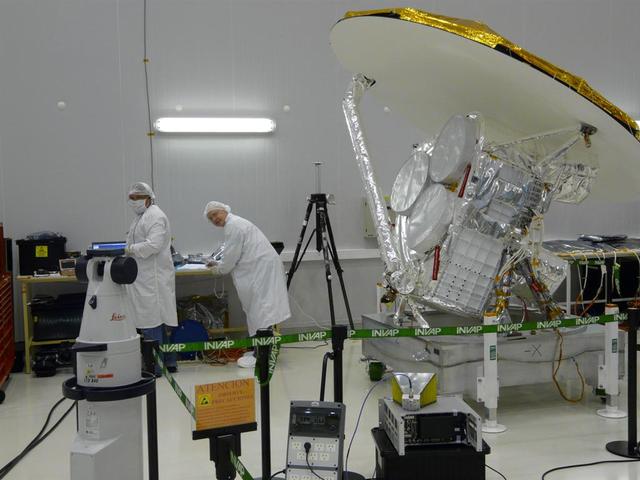
NASA Aquarius instrument on SAC-D sevice platform in INVAP high bay facility for mechanical integration activities.
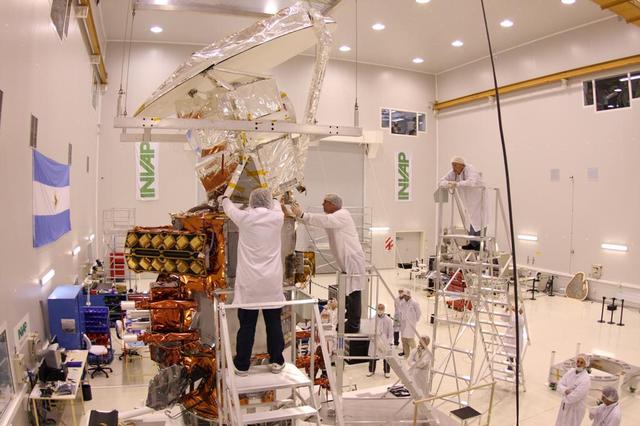
NASA Aquarius instrument is lifted upright onto the SAC-D service platform at the INVAP high bay facility in Bariloche, Argentina.
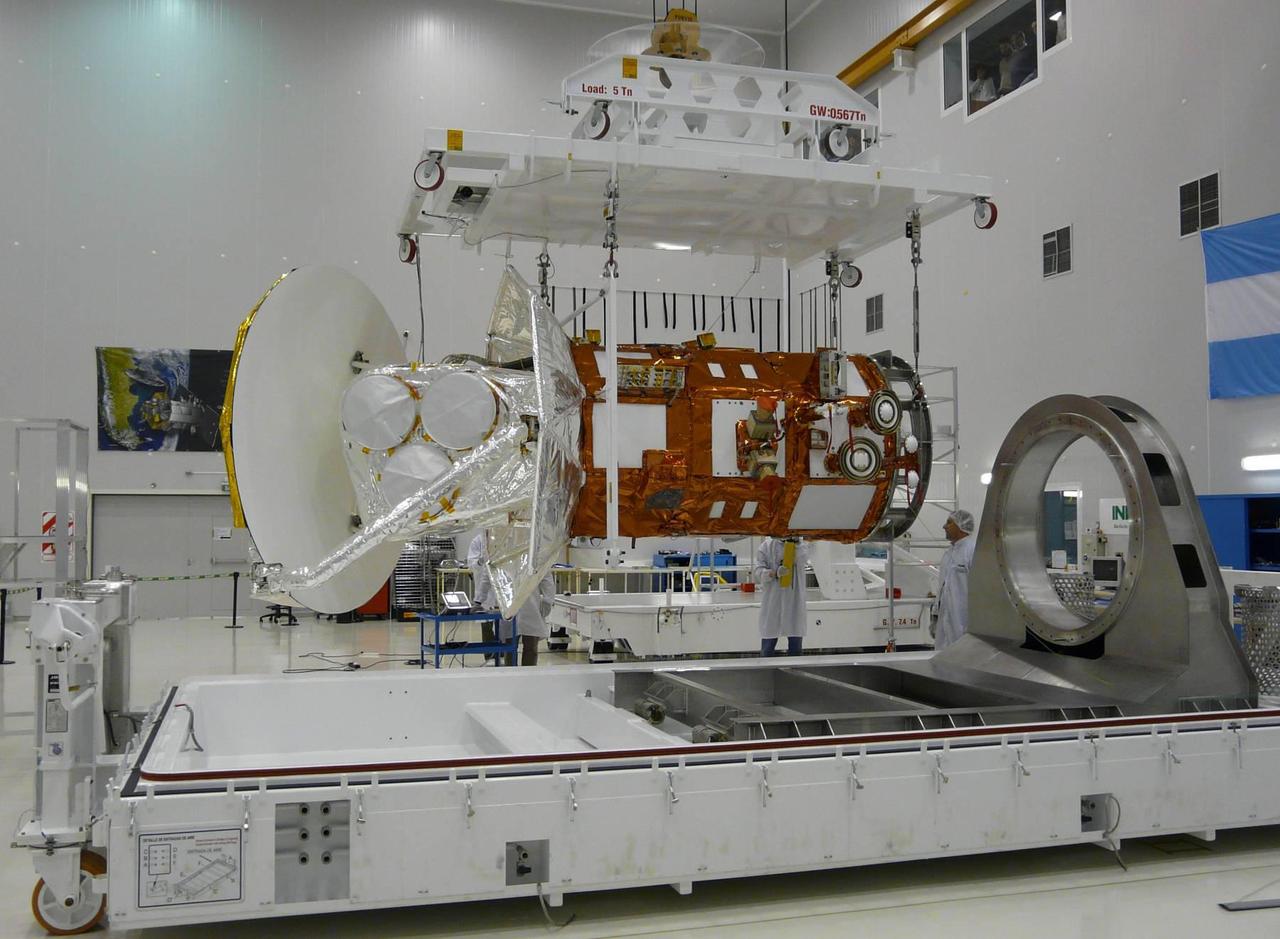
After months of integration and testing at the INVAP facility Bariloche, Argentina, NASA Aquarius/SAC-D is removed from the service platform in preparation for shipping to Brazil.
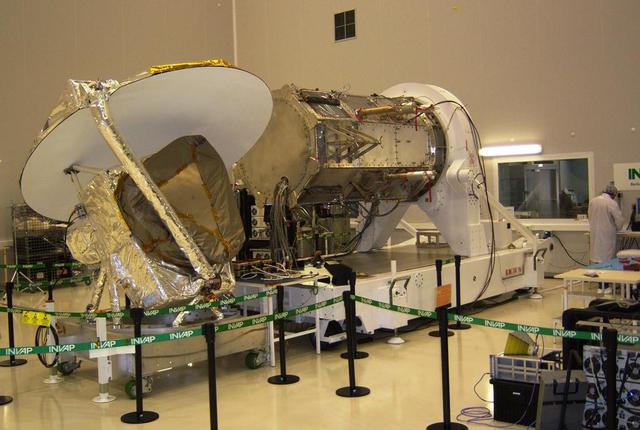
All NASA Aquarius electrical interfaces have successfully been connected to the SAC-D service platform S/P.
NASA Aquarius instrument power interfaces are tested prior to connection with the SAC-D service platform at the INVAP facility in Bariloche, Argentina.
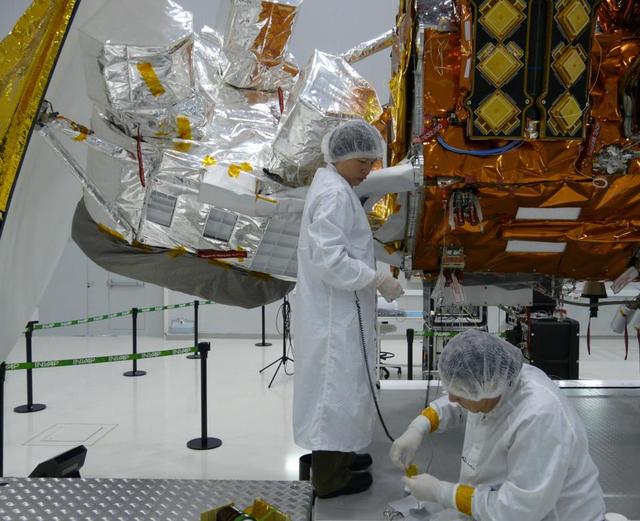
Completion of the thermal blanket patterns for the Aquarius bipod after routing the flight harness from the SAC-D service platform.
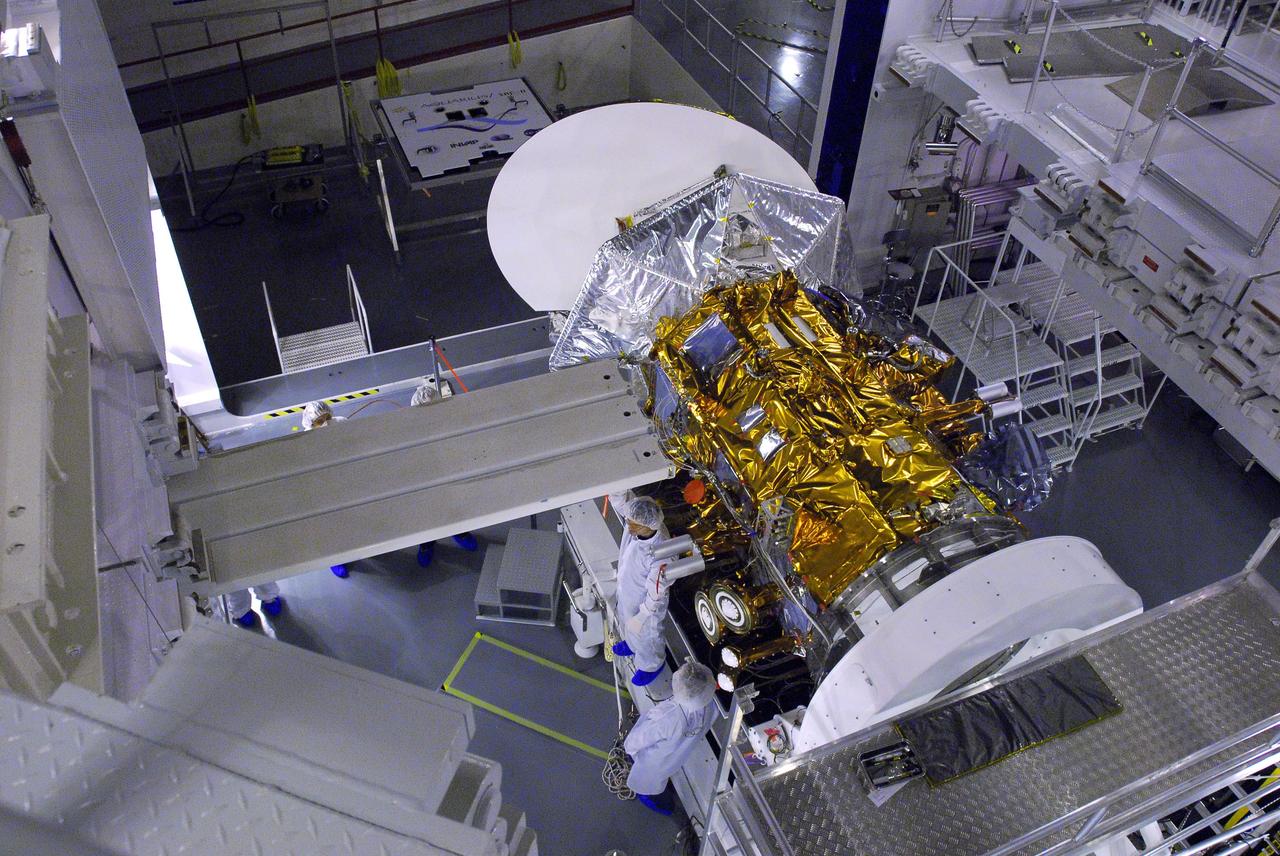
VANDENBERG AIR FORCE BASE, Calif. --In Space Systems International's Payload Processing Facility at Vandenberg Air Force Base in California, technicians have suspended a platform over the Aquarius/SAC-D spacecraft to allow access for the installation of the second solar array. Following final tests, the spacecraft will be integrated to a United Launch Alliance Delta II rocket in preparation for the targeted June launch. Aquarius, the NASA-built primary instrument on the SAC-D spacecraft, will provide new insights into how variations in ocean surface salinity relate to fundamental climate processes on its three-year mission. Photo credit: NASA/VAFB
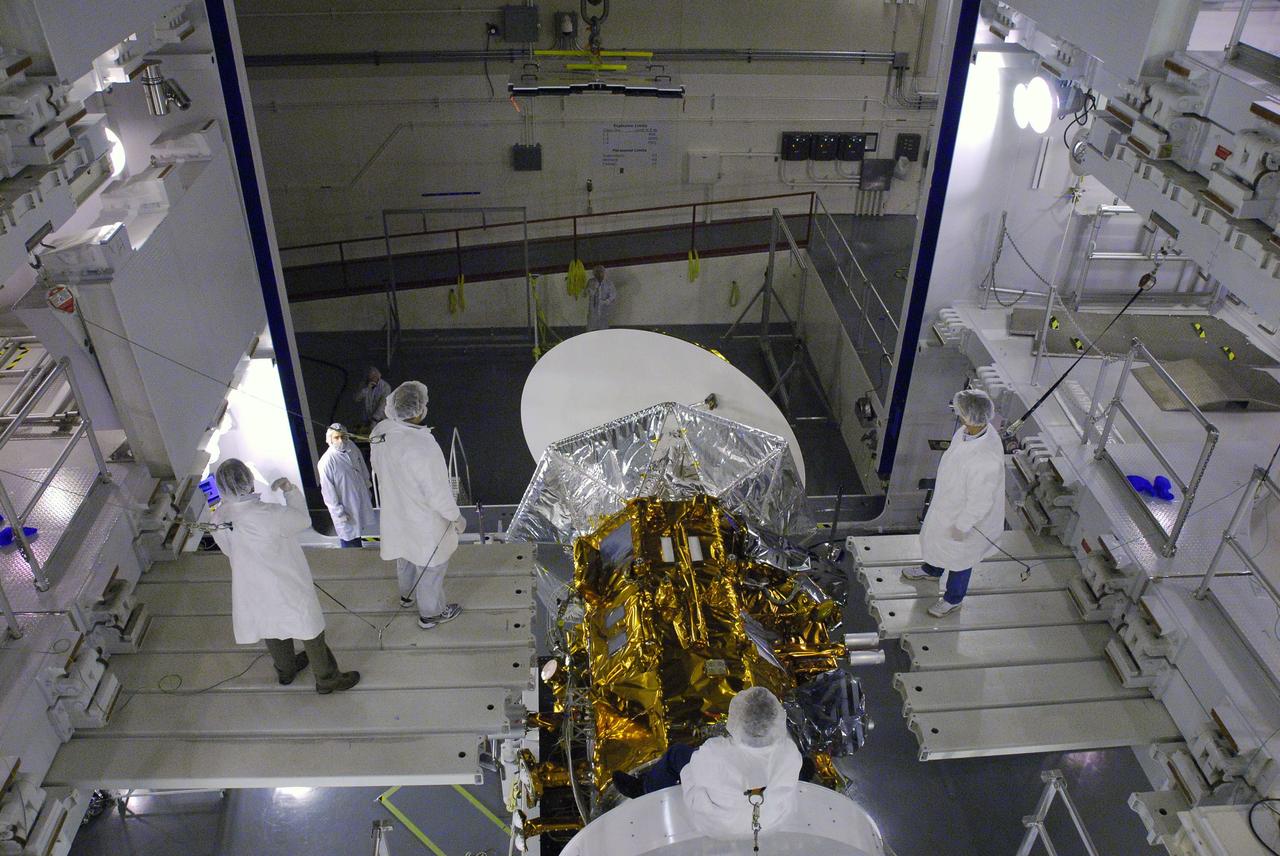
VANDENBERG AIR FORCE BASE, Calif. -- In Space Systems International's Payload Processing Facility at Vandenberg Air Force Base in California, technicians on suspended platforms are preparing to install the second solar array to the Aquarius/SAC-D spacecraft. Following final tests, the spacecraft will be integrated to a United Launch Alliance Delta II rocket in preparation for the targeted June launch. Aquarius, the NASA-built primary instrument on the SAC-D spacecraft, will provide new insights into how variations in ocean surface salinity relate to fundamental climate processes on its three-year mission. Photo credit: NASA/VAFB
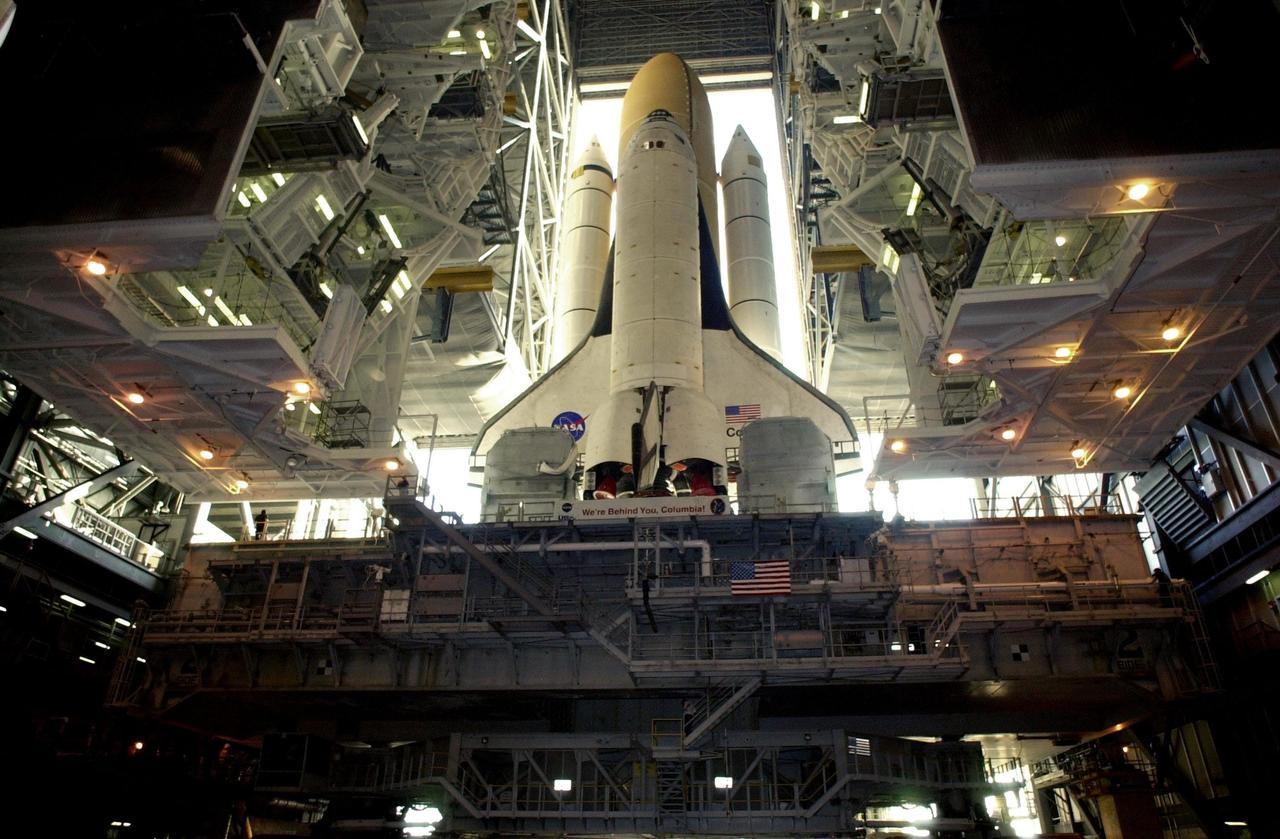
KENNEDY SPACE CENTER, FLA. -- Space Shuttle Columbia sits atop its Mobile Launcher Platform in the open doorway of the Vehicle Assembly Building. The Shuttle never left the VAB due to a steering problem on the crawler-transporter under the MLP. The problem was a faulty bearing in the steering linkage of Power Truck Drive D, which was detected before the C-T left the VAB. Rollout has been rescheduled for Jan. 24
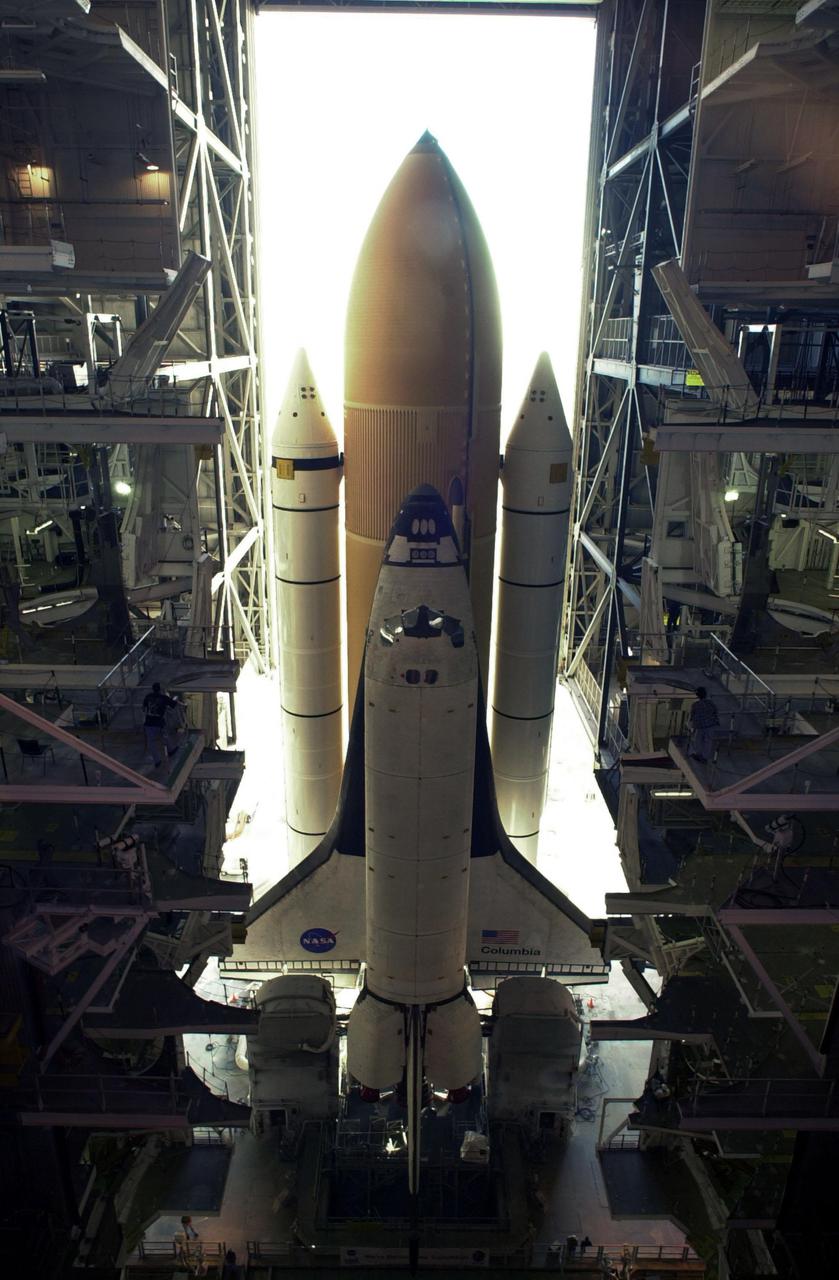
KENNEDY SPACE CENTER, FLA. -- Space Shuttle Columbia sits atop its Mobile Launcher Platform in the open doorway of the Vehicle Assembly Building. The Shuttle never left the VAB due to a steering problem on the crawler-transporter under the MLP. The problem was a faulty bearing in the steering linkage of Power Truck Drive D, which was detected before the C-T left the VAB. Rollout has been rescheduled for Jan. 24

KENNEDY SPACE CENTER, FLA. -- Viewed from outside the Vehicle Assembly Building, the stack of external tank and solid rocket boosters on Columbia can be seen sitting atop the Mobile Launcher Platform. The Shuttle never left the VAB due to a steering problem on the crawler-transporter under the MLP. The problem was a faulty bearing in the steering linkage of Power Truck Drive D, which was detected before the C-T left the VAB. Rollout has been rescheduled for Jan. 24
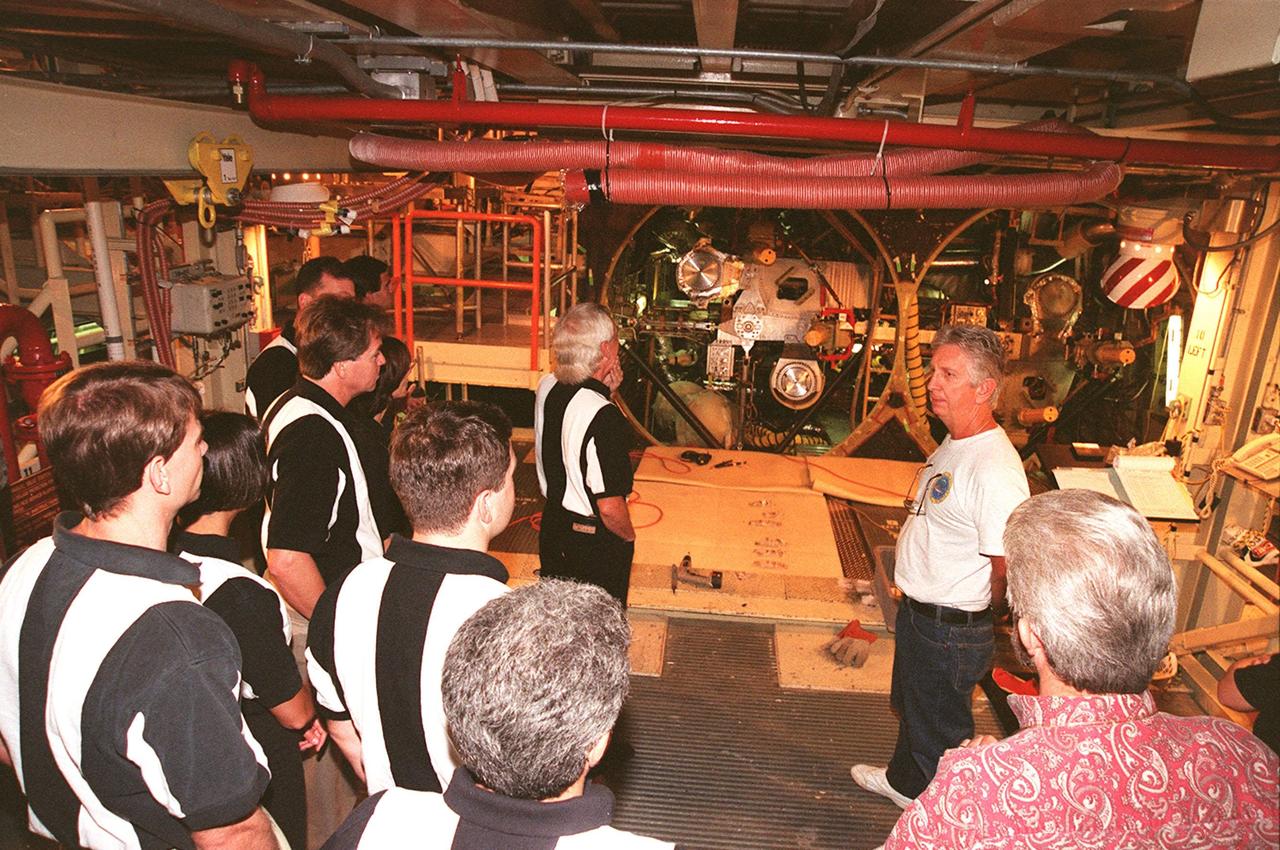
On a raised platform in the Orbiter Processing Facility bay 3, members of the 1998 astronaut candidate class (group 17) look at the aft fuselage of the orbiter Atlantis. The class is at KSC for training activities, including fire training and a flight awareness program, plus touring the OPF, SSME Processing Facility, VAB, SSPF, launch pads, SLF, Apollo/Saturn V Center and the crew headquarters. The U.S. candidates in the '98 class are Clayton C. Anderson, Lee J. Archambault, Tracy E. Caldwell (Ph.D.), Gregory E. Chamitoff (Ph.D.), Timothy J. Creamer, Christopher J. Ferguson, Michael J. Foreman, Michael E. Fossum, Kenneth T. Ham, Patricia C. Hilliard (M.D.), Gregory C. Johnson, Gregory H. Johnson, Stanley G. Love (Ph.D.), Leland D. Melvin, Barbara R. Morgan, William A. Oefelein, John D. Olivas (Ph.D.), Nicholas J.M. Patrick (Ph.D.), Alan G. Poindexter, Garrett E. Reisman (Ph.D.), Steven R. Swanson, Douglas H. Wheelock, Sunita L. Williams, Neil W. Woodward III, George D. Zamka; and the international candidates are Leopold Eyharts, Paolo Nespoli, Hans Schlegel, Roberto Vittori, Bjarni V. Tryggvason, and Marcos Pontes
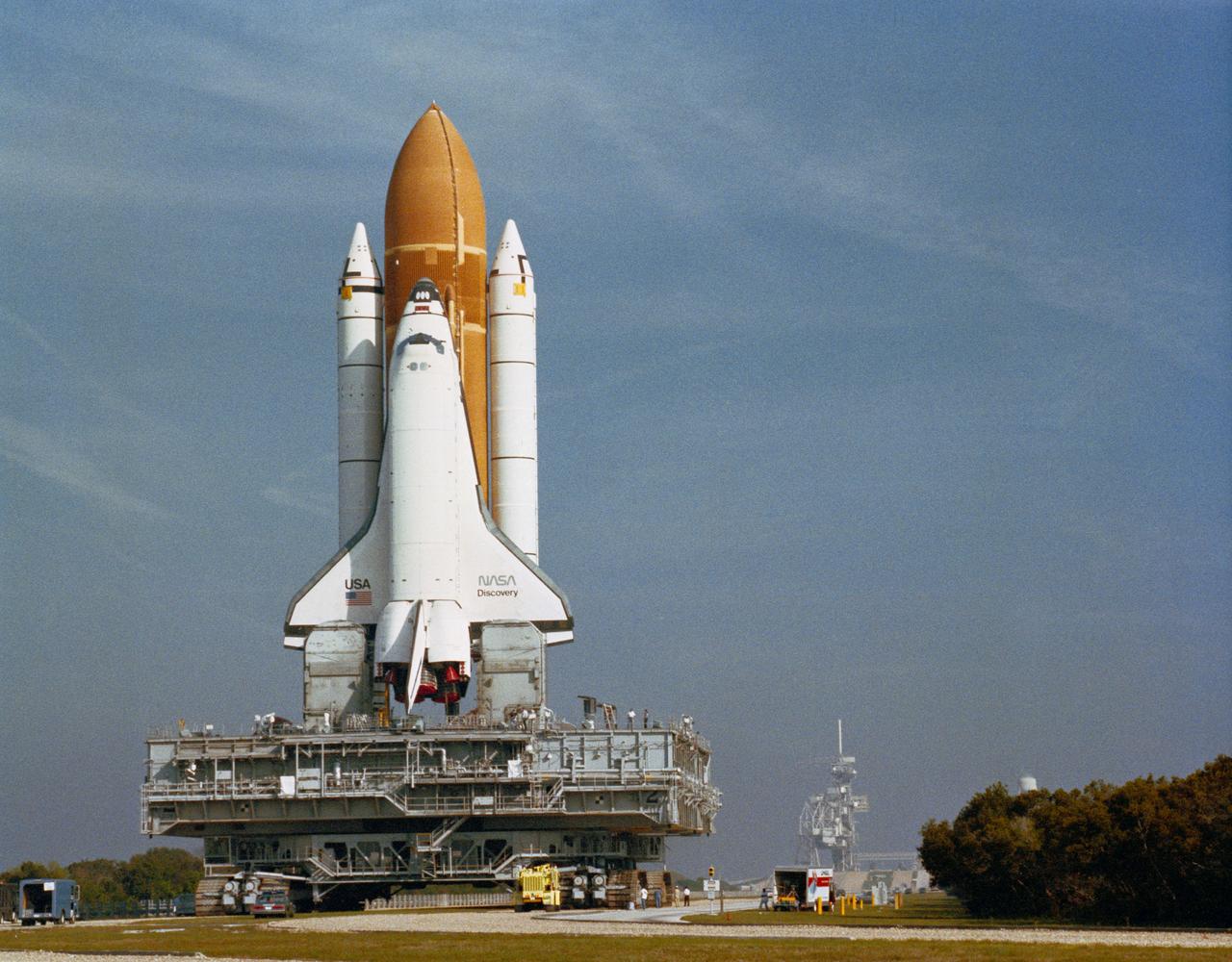
S89-28110 (3 Feb 1989) ---The Space Shuttle Discovery, atop a mobile launch platform, is rolled toward Kennedy Space Center's Launch Pad 39-B on Feb. 3, l989. It rolled through the doors of the huge vehicle assembly building (VAB) at 6 a.m.,several hours ago. The Launch Complex is in view here. The trip to the pad takes approximately 5 and 1/2 hours. Onboard the spacecraft in mid-March for a five-day mission, on which will be deployed a third tracking and data relay satellite (TDRS-D), will be Astronauts Michael L. Coats, John E. Blaha, James F. Buchli, James P. Bagian and Robert C. Springer.
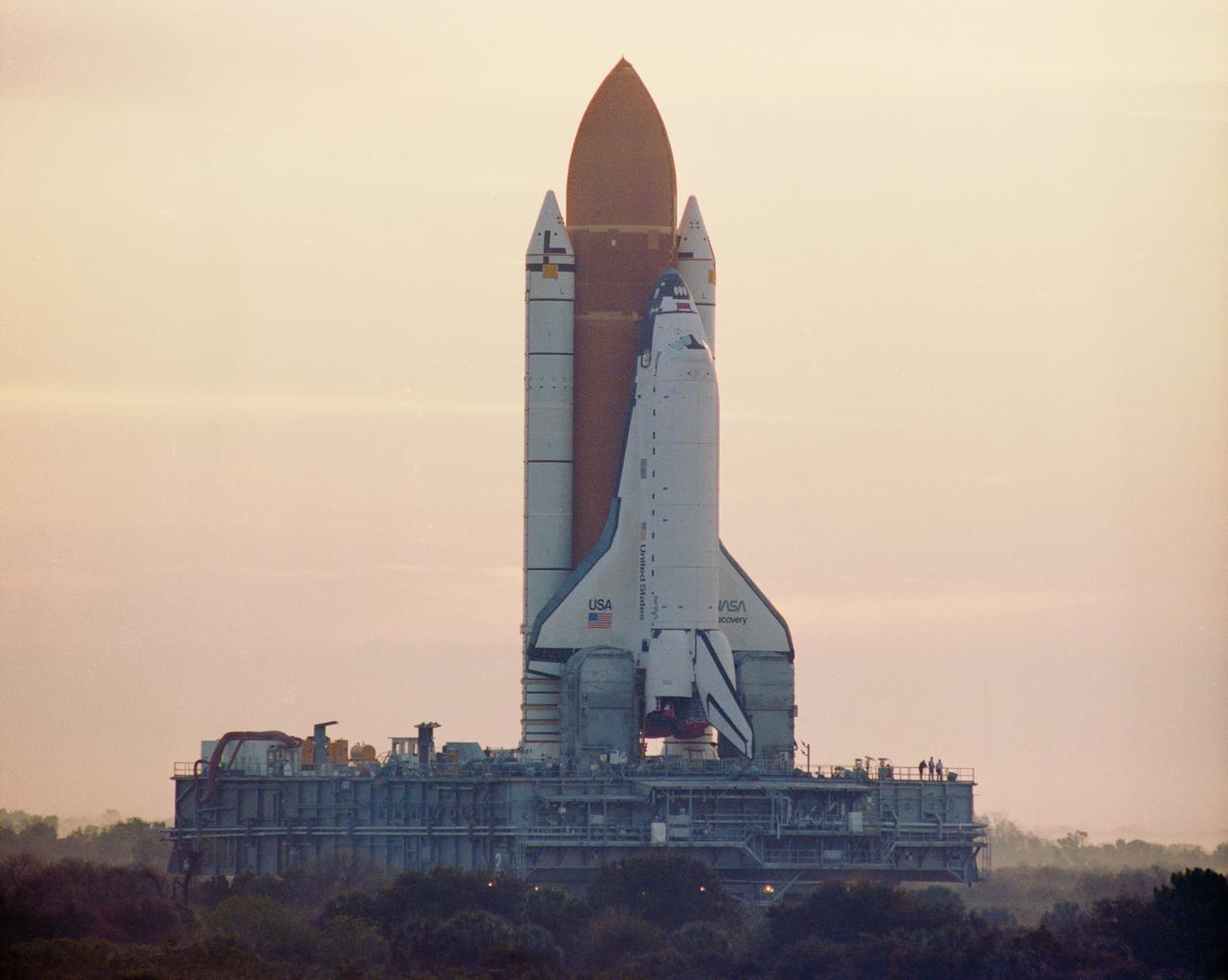
S89-28112 (3 Feb 1989) --- The Space Shuttle Discovery, atop a mobile launch platform, is rolled toward Kennedy Space Center's Launch Pad 39-B in the early morning hours of Feb. 3, l989. It rolled through the doors of the huge vehicle assembly building (VAB) at 6 a.m. The trip to the pad takes approximately 5 and 1/2 hours. Onboard the spacecraft in mid-March for a five-day mission, on which will be deployed a third tracking and data relay satellite (TDRS-D), will be Astronauts Michael L. Coats, John E. Blaha, James F. Buchli, James P. Bagian and Robert C. Springer.
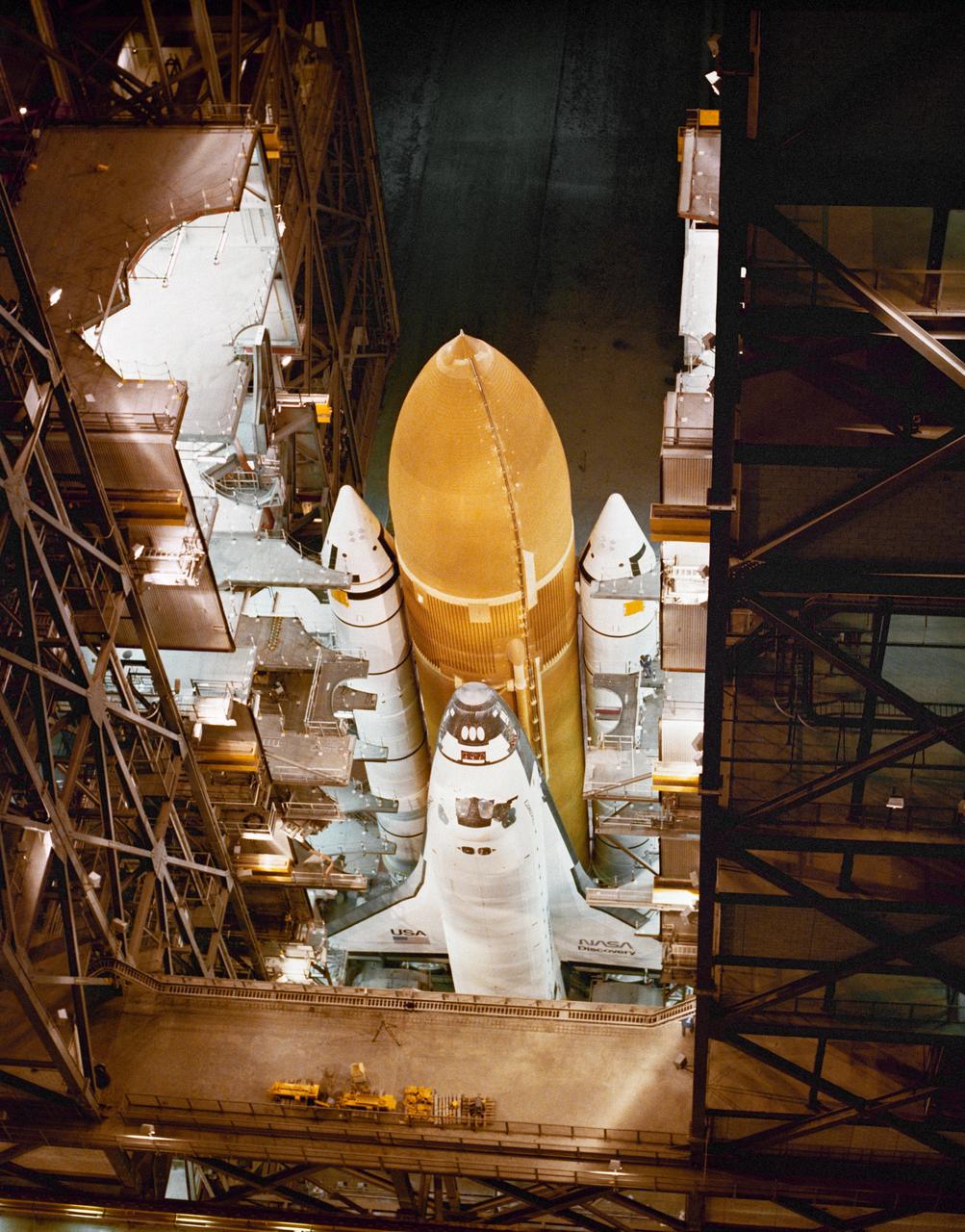
S89-28111 (3 Feb 1989) --- The Space Shuttle Discovery, atop a mobile launch platform, is rolled through the doors of the huge vehicle assembly building (VAB) at 6 a.m., Feb. 3, 1989 on its way to Launch Complex 39. The trip to the pad takes approximately 5 and 1/2 hours. Onboard the spacecraft in mid-March for a five-day mission, on which will be deployed a third tracking and data relay satellite (TDRS-D), will be Astronauts Michael L. Coats, John E. Blaha, James F. Buchli, James P. Bagian and Robert C. Springer.
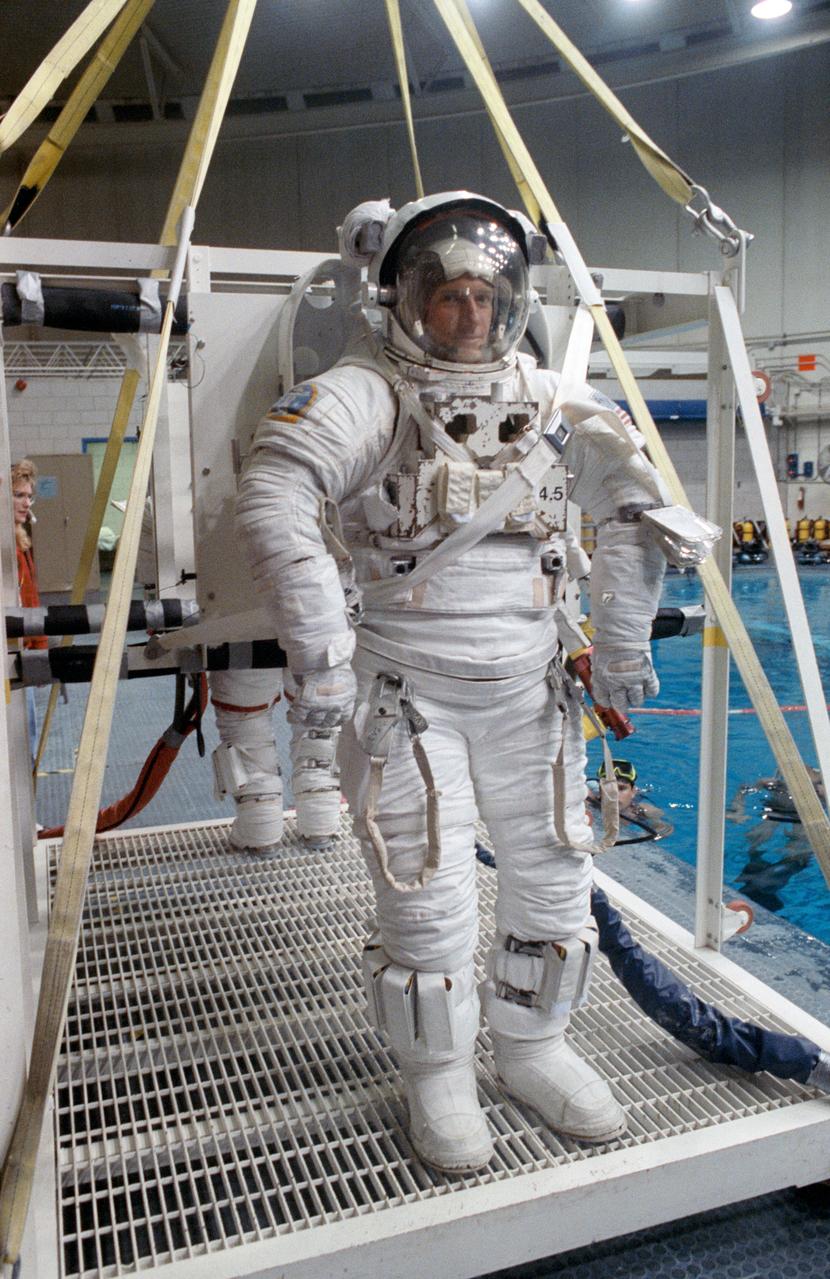
S91-30196 (1 March 1991) --- Astronaut C. Michael Foale, mission specialist, and Kathryn D. Sullivan, payload commander (barely visible in background), stand on a platform (out of frame) which is part of a system that will lower them into a 25-ft. deep pool. The payload commander and mission specialist used the pool in the weightless environment training facility (WET-F) to rehearse a contingency extravehicular activity (EVA). Astronauts wear pressurized spacesuits configured for achieving a neutrally buoyant condition in the water to simulate both planned and contingency EVAs. Two SCUBA-equipped swimmers assisting the training are seen in the background.
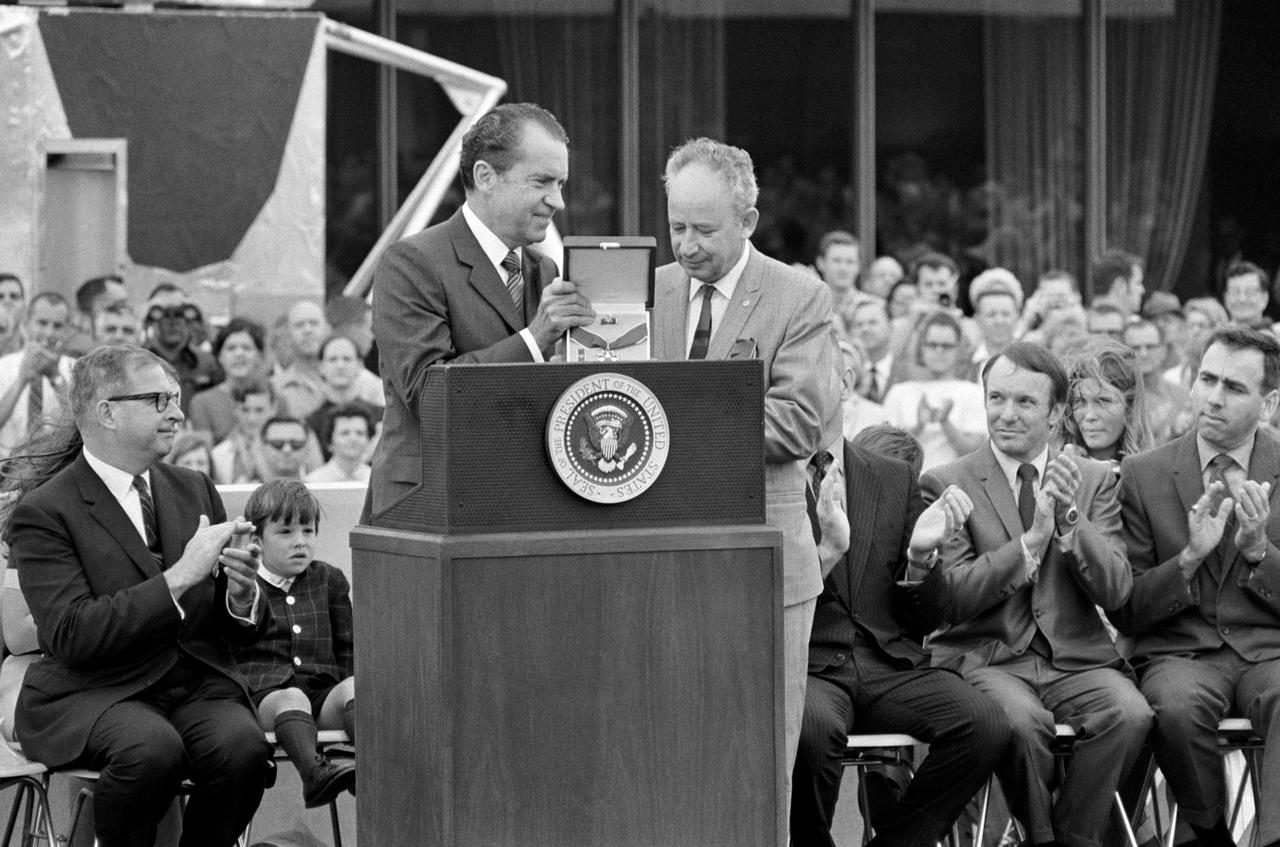
S70-35594 (18 April 1970) --- President Richard M. Nixon presents the Presidential Medal of Freedom to the Apollo 13 Mission Operations Team at Manned Spacecraft Center (MSC). Accepting for the team is Sigurd A. Sjoberg, director of Flight Operations at MSC. Dr. Thomas O. Paine, Administrator, National Aeronautics and Space Administration (NASA), is at left. Also seen here on the speaker's platform are Jeffrey C. Lovell, son of astronaut James A. Lovell Jr., commander of the Apollo 13 mission; Gerald D. Griffin (second from right) and Milton L. Windler, two of four flight directors who worked around the clock during the mission.
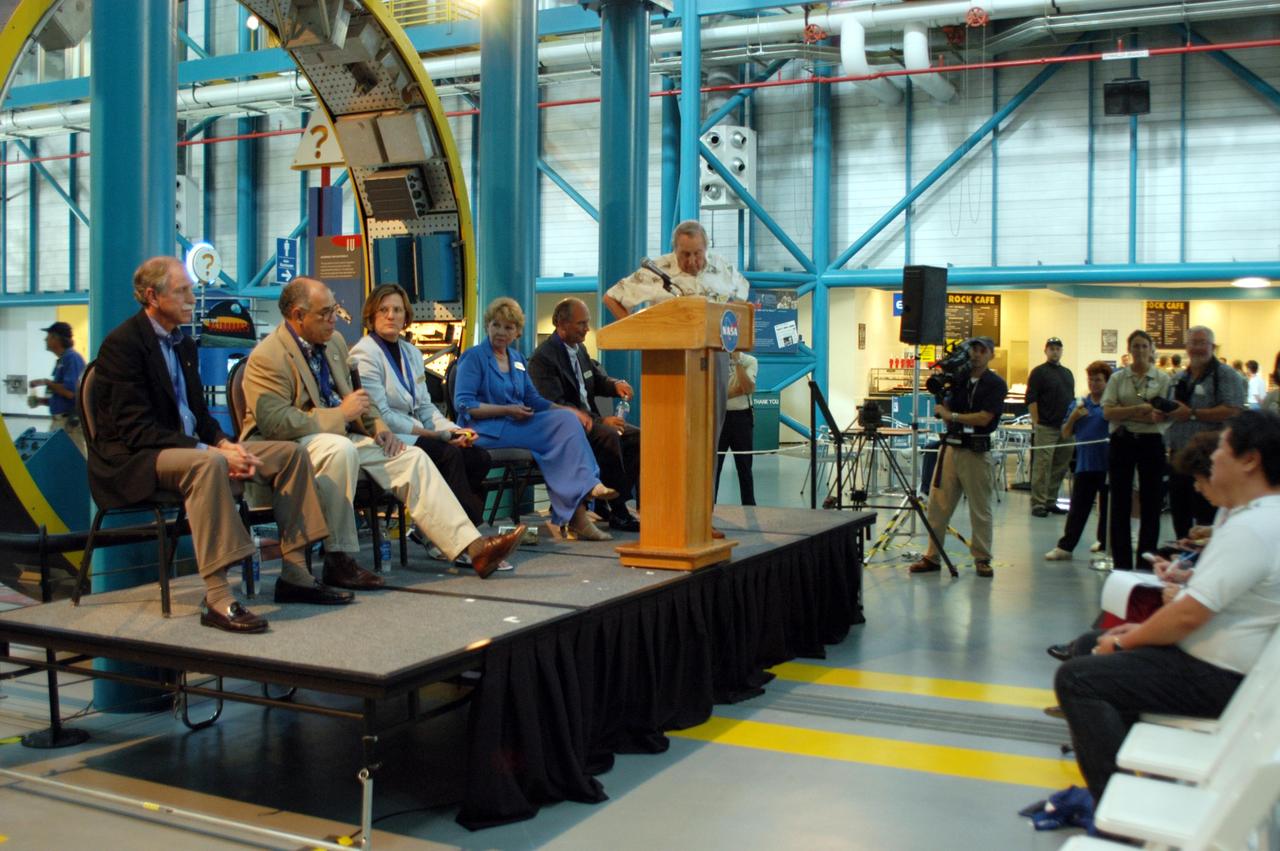
KENNEDY SPACE CENTER, FLA. -- Frederick D. Gregory (second from left), the first African-American to command a space mission and the current NASA deputy administrator, responds to a reporter’s question at a press conference in the Apollo/Saturn V Center following the induction ceremony of five space program heroes into the Astronaut Hall of Fame. Seated (left to right) with him on the platform are Richard O. Covey, commander of the Hubble Space Telescope repair mission; Gregory; Kathryn D. Sullivan, the first American woman to walk in space; June Scobee, representing her late husband Francis R. "Dick" Scobee, commander of the ill-fated 1986 Challenger mission; and Norman E. Thagard, the first American to occupy Russia’s Mir space station. The U.S. Astronaut Hall of Fame opened in 1990 to provide a place where space travelers could be remembered for their participation and accomplishments in the U.S. space program. To be eligible for induction, an individual must have been a U.S. citizen, a NASA astronaut, and out of the active astronaut corps at least five years. The five inductees join 52 previously honored astronauts from the ranks of the Gemini, Apollo, Skylab, Apollo-Soyuz, and Space Shuttle programs.
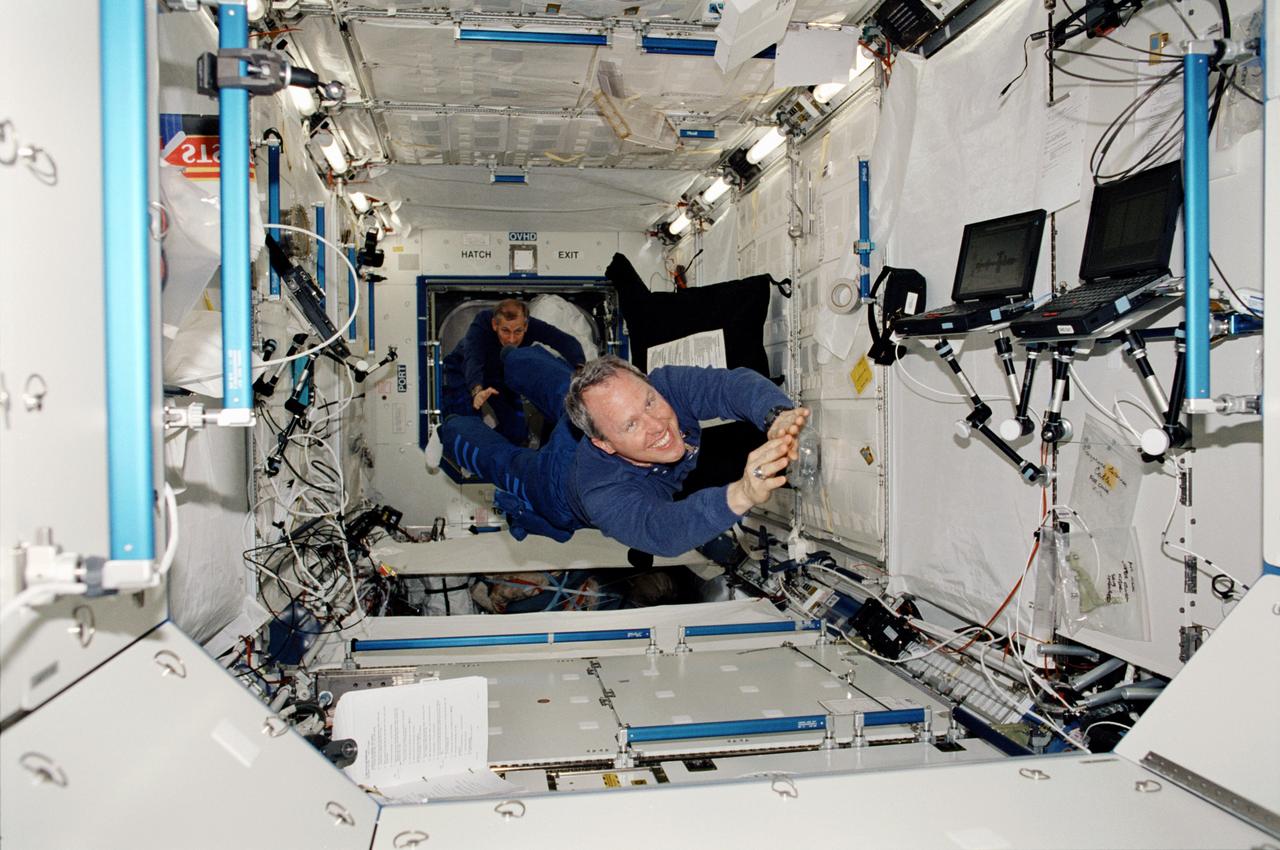
This STS-98 mission photograph shows astronauts Thomas D. Jones (foreground) and Kerneth D. Cockrell floating inside the newly installed Laboratory aboard the International Space Station (ISS). The American-made Destiny module is the cornerstone for space-based research aboard the orbiting platform and the centerpiece of the ISS, where unprecedented science experiments will be performed in the near-zero gravity of space. Destiny will also serve as the command and control center for the ISS. The aluminum module is 8.5-meters (28-feet) long and 4.3-meters (14-feet) in diameter. The laboratory consists of three cylindrical sections and two endcones with hatches that will be mated to other station components. A 50.9-centimeter (20-inch-) diameter window is located on one side of the center module segment. This pressurized module is designed to accommodate pressurized payloads. It has a capacity of 24 rack locations. Payload racks will occupy 15 locations especially designed to support experiments. The Destiny module was built by the Boeing Company under the direction of the Marshall Space Flight Center.
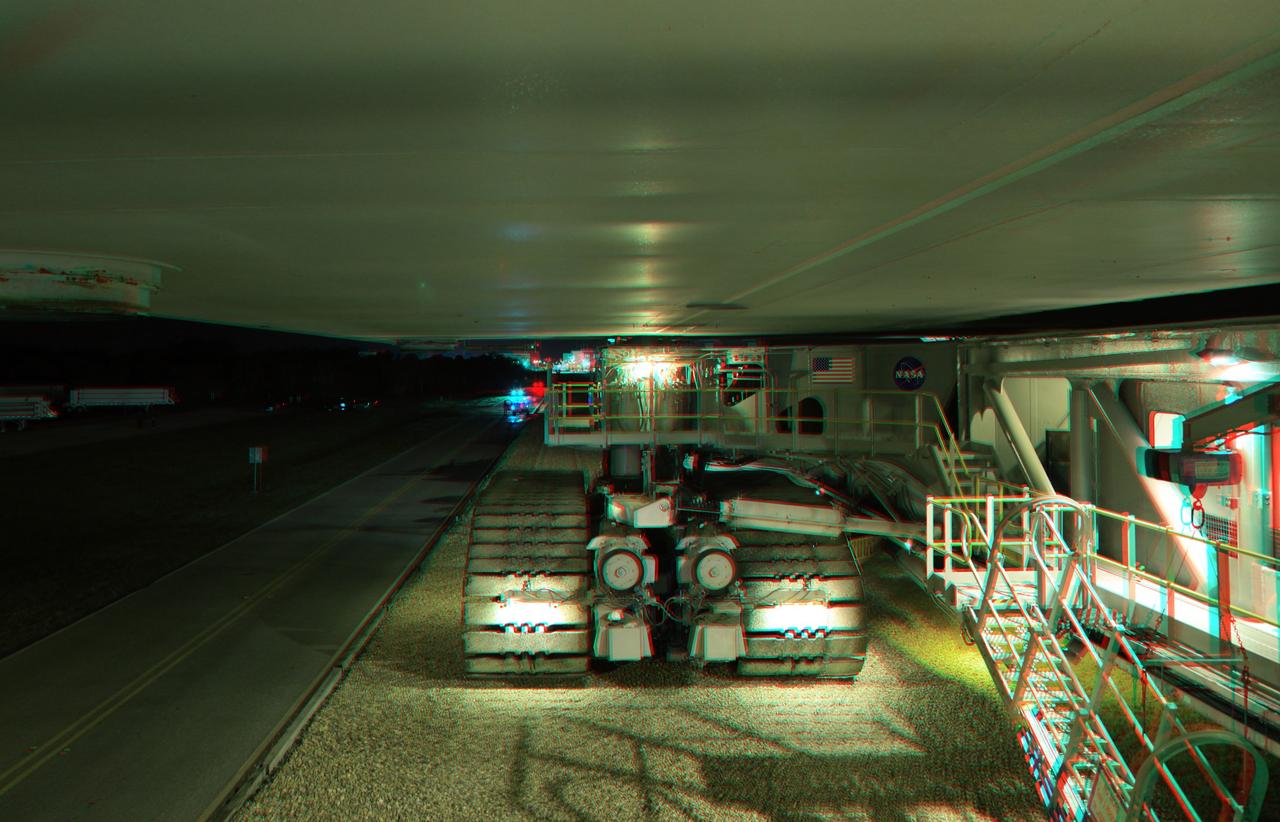
CAPE CANAVERAL, Fla. -- This is a 3-D image of the crawler-transporter as it slowly hauls space shuttle Endeavour from the Vehicle Assembly Building to Launch Pad 39A at NASA’s Kennedy Space Center in Florida. The gigantic tracked mover weighs about 18 million pounds with the space shuttle, two solid rocket boosters, external fuel tank and mobile launcher platform attached. It takes six to eight hours to complete the 3.4-mile trip along crushed Alabama river rock at a speed of about 1 mph. To view this image, use green and magenta 3-D glasses. Endeavour and its six-member STS-134 crew will deliver the Express Logistics Carrier-3, Alpha Magnetic Spectrometer-2 (AMS), a high-pressure gas tank, additional spare parts for the Dextre robotic helper and micrometeoroid debris shields to the International Space Station. Endeavour's final launch is targeted for April 19 at 7:48 p.m. EDT. For more information visit, http://www.nasa.gov/mission_pages/shuttle/shuttlemissions/sts134/index.html. Photo credit: NASA/Frankie Martin
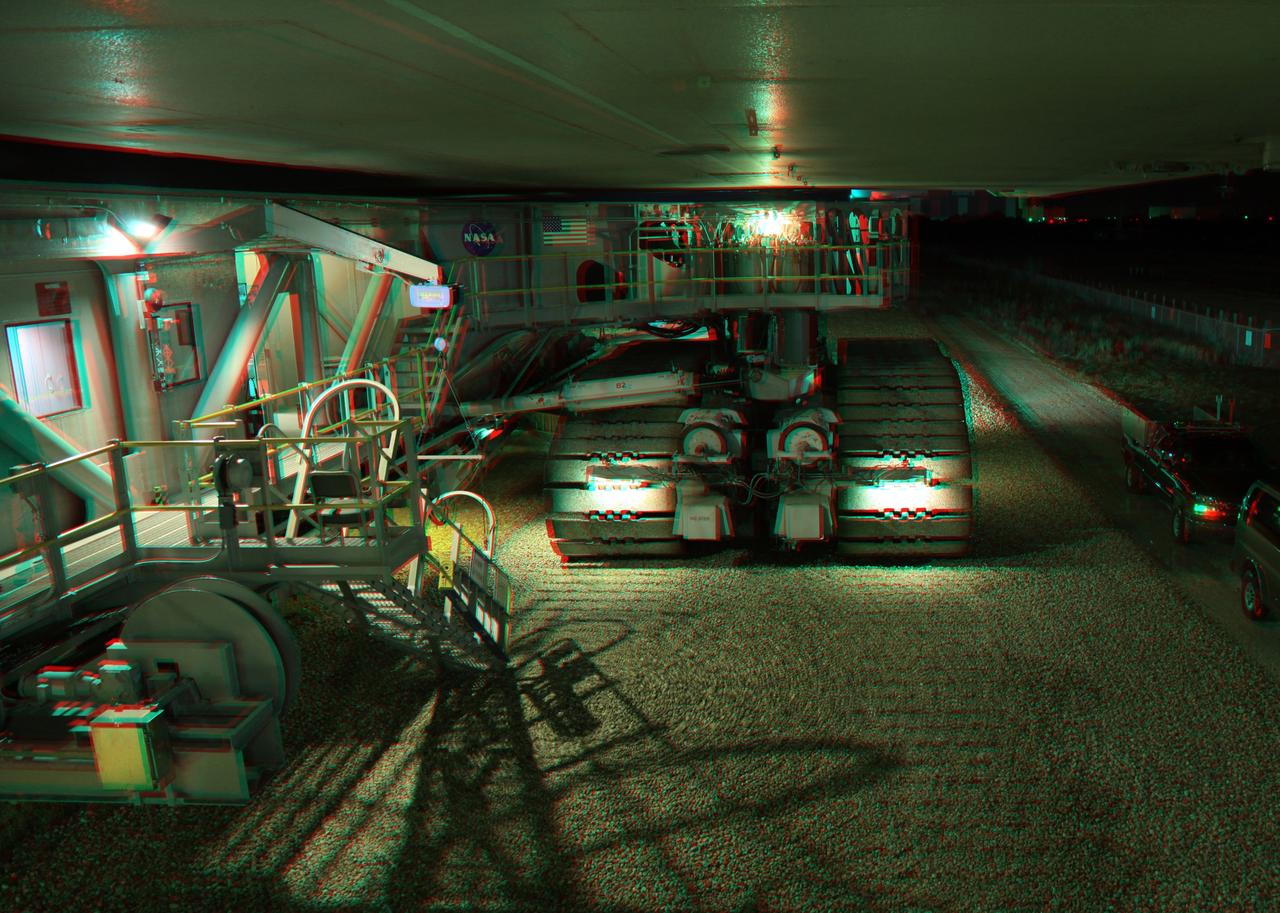
CAPE CANAVERAL, Fla. -- This is a 3-D image of the crawler-transporter as it slowly hauls space shuttle Endeavour from the Vehicle Assembly Building to Launch Pad 39A at NASA’s Kennedy Space Center in Florida. The gigantic tracked mover weighs about 18 million pounds with the space shuttle, two solid rocket boosters, external fuel tank and mobile launcher platform attached. It takes six to eight hours to complete the 3.4-mile trip along crushed Alabama river rock at a speed of about 1 mph. To view this image, use green and magenta 3-D glasses. Endeavour and its six-member STS-134 crew will deliver the Express Logistics Carrier-3, Alpha Magnetic Spectrometer-2 (AMS), a high-pressure gas tank, additional spare parts for the Dextre robotic helper and micrometeoroid debris shields to the International Space Station. Endeavour's final launch is targeted for April 19 at 7:48 p.m. EDT. For more information visit, http://www.nasa.gov/mission_pages/shuttle/shuttlemissions/sts134/index.html. Photo credit: NASA/Frankie Martin
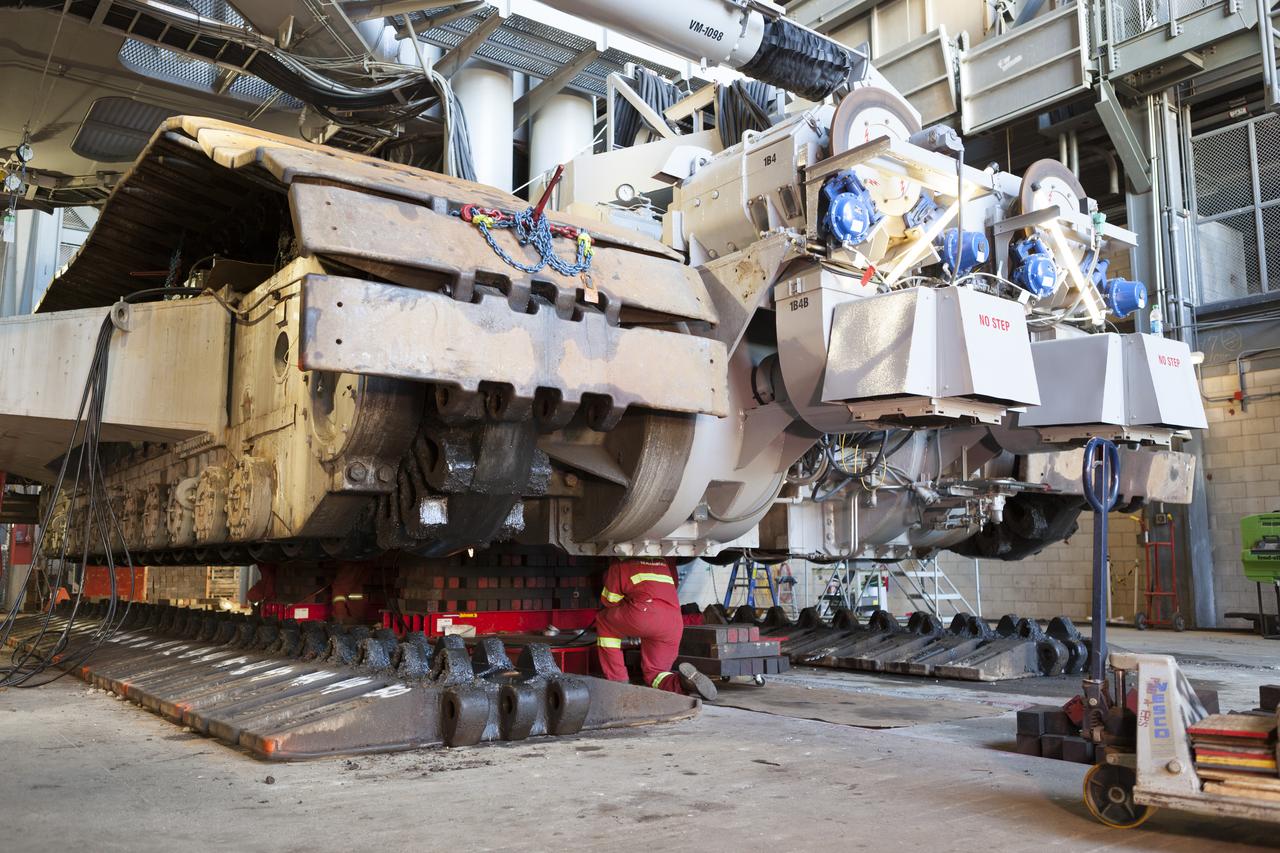
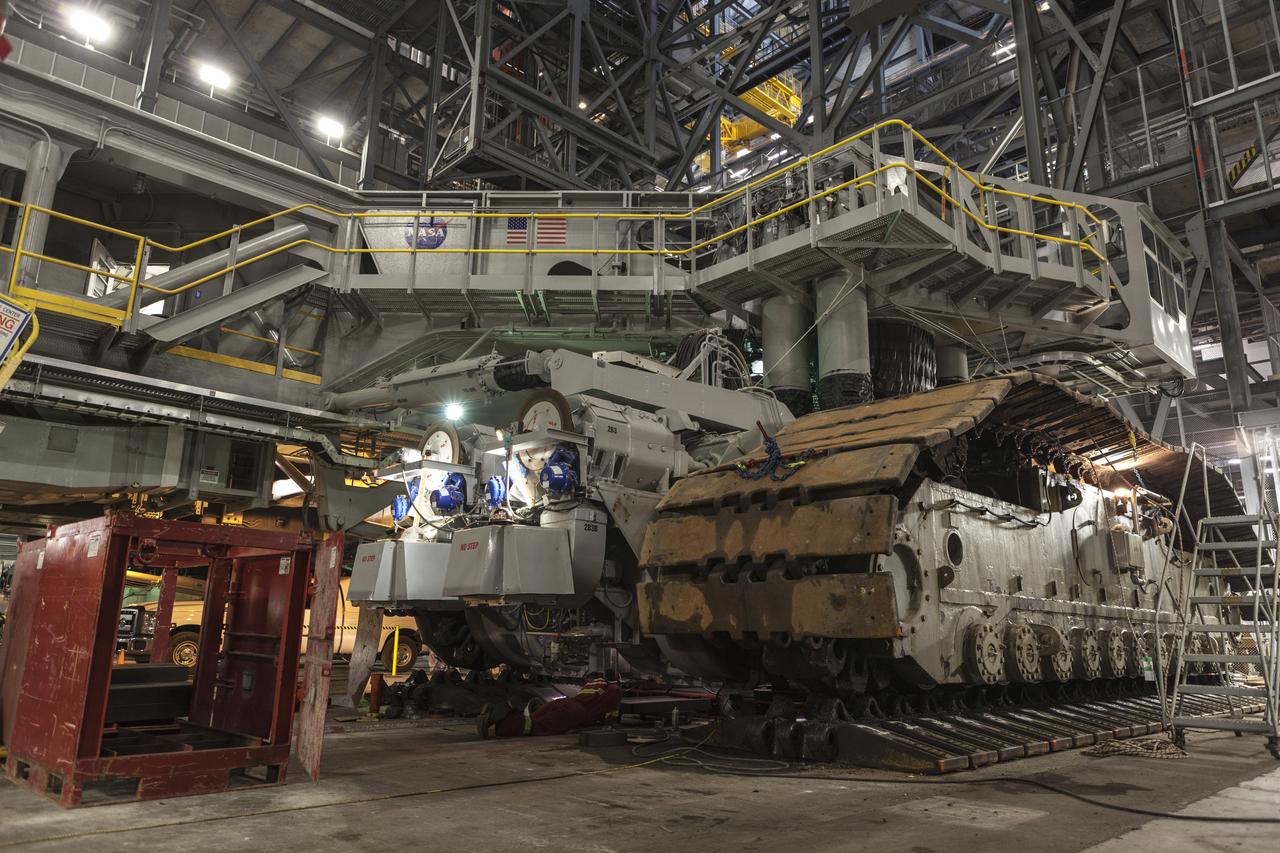
CAPE CANAVERAL, Fla. – Inside the Vehicle Assembly Building at NASA’s Kennedy Space Center in Florida, a technician monitors the progress as the B and D truck sections of crawler-transporter 2, or CT-2, are raised up to prepare for installation of new roller bearing assemblies. Sections of the crawler’s large metal tracks have been removed. Work continues in high bay 2 to upgrade CT-2. The modifications are designed to ensure CT-2’s ability to transport launch vehicles currently in development, such as the agency’s Space Launch System, to the launch pad. The Ground Systems Development and Operations Program office at Kennedy is overseeing the upgrades. For more than 45 years the crawler-transporters were used to transport the mobile launcher platform and the Apollo-Saturn V rockets and, later, space shuttles to Launch Pads 39A and B. For more information, visit: http://www.nasa.gov/exploration/systems/ground/crawler-transporter. Photo credit: NASA/Dimitri Gerondidakis
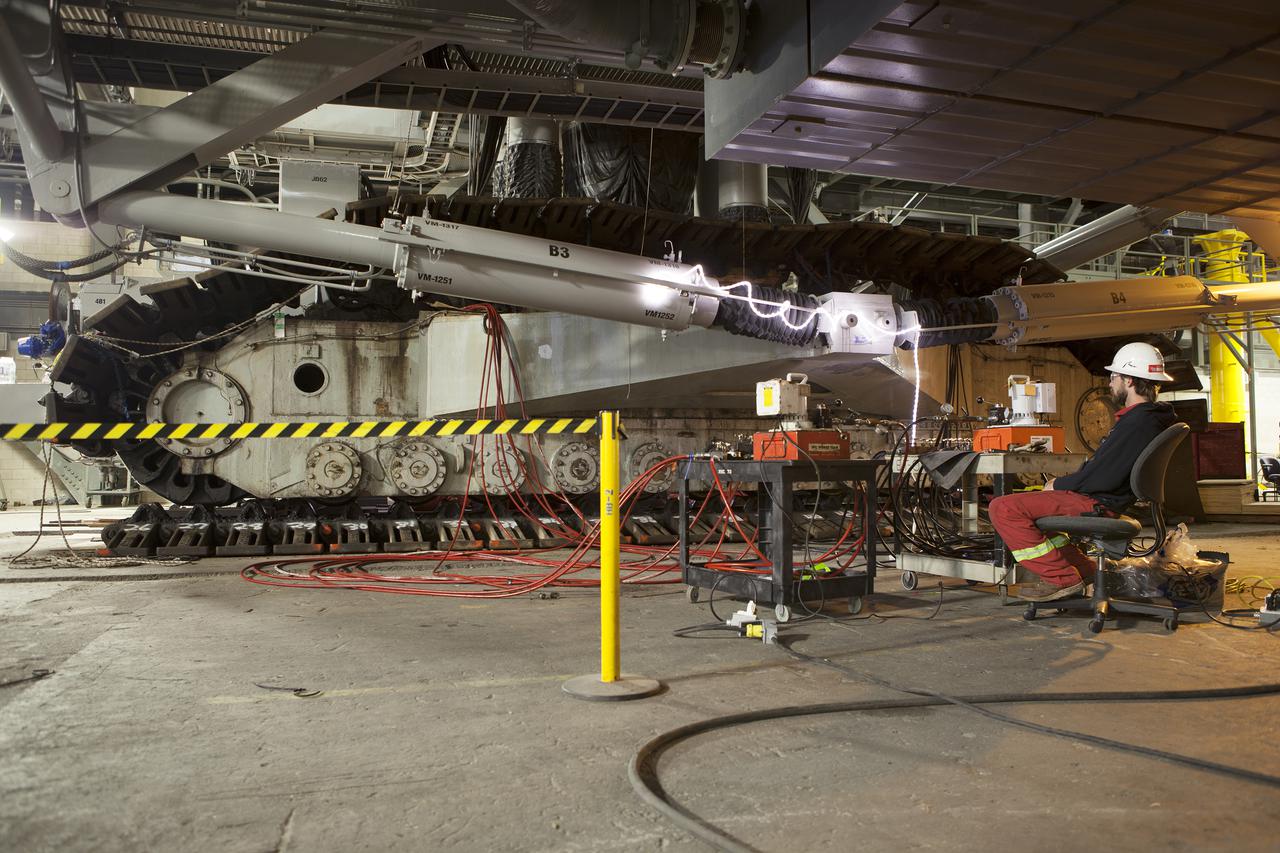
CAPE CANAVERAL, Fla. – Inside the Vehicle Assembly Building at NASA’s Kennedy Space Center in Florida, a technician monitors the progress as the B and D truck sections of crawler-transporter 2, or CT-2, are raised up to prepare for installation of new roller bearing assemblies. Work continues in high bay 2 to upgrade CT-2. The modifications are designed to ensure CT-2’s ability to transport launch vehicles currently in development, such as the agency’s Space Launch System, to the launch pad. The Ground Systems Development and Operations Program office at Kennedy is overseeing the upgrades. For more than 45 years the crawler-transporters were used to transport the mobile launcher platform and the Apollo-Saturn V rockets and, later, space shuttles to Launch Pads 39A and B. For more information, visit: http:__www.nasa.gov_exploration_systems_ground_crawler-transporter. Photo credit: NASA_Dimitri Gerondidakis
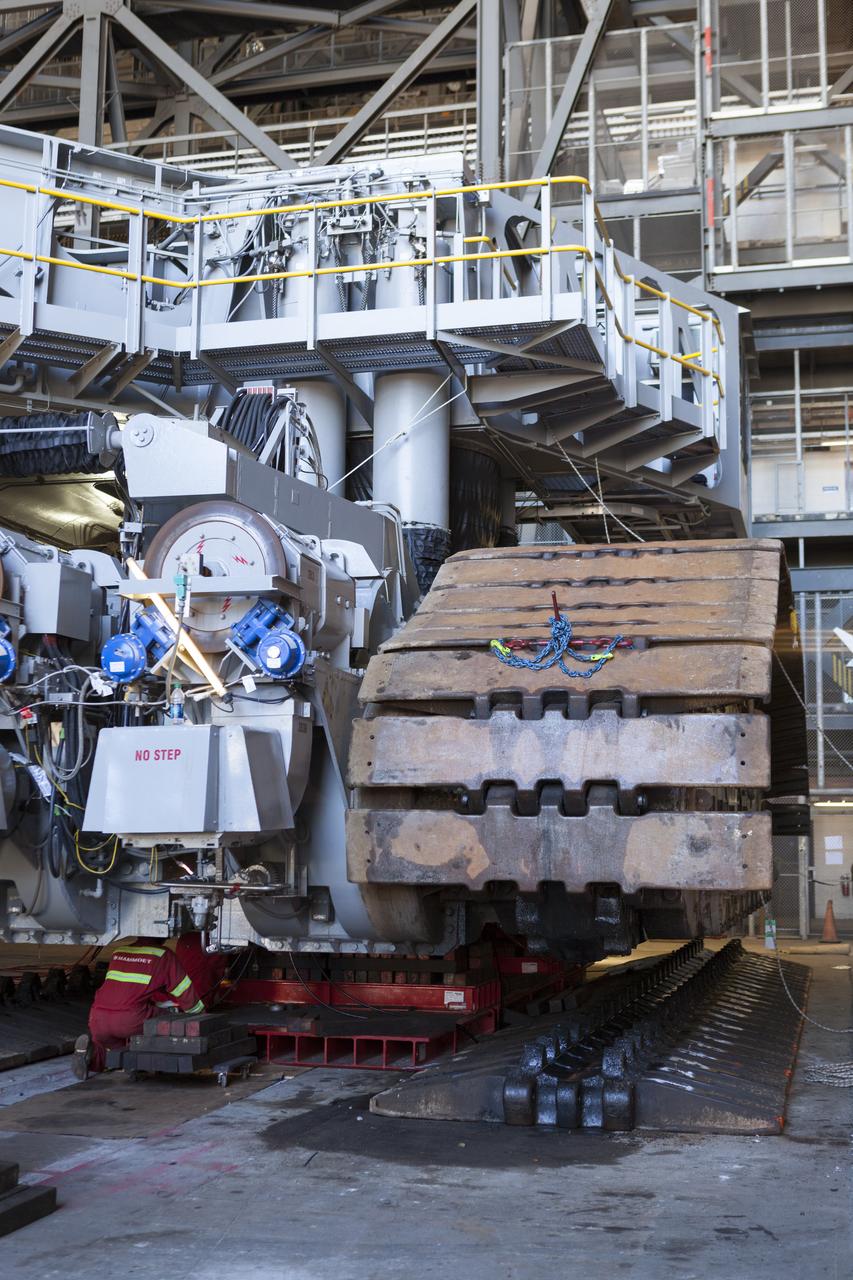
CAPE CANAVERAL, Fla. – Inside the Vehicle Assembly Building at NASA’s Kennedy Space Center in Florida, the B and D truck sections of crawler-transporter 2, or CT-2, are being raised up to prepare for installation of new roller bearing assemblies. Sections of the crawler’s large metal tracks have been removed. Work continues in high bay 2 to upgrade CT-2. The modifications are designed to ensure CT-2’s ability to transport launch vehicles currently in development, such as the agency’s Space Launch System, to the launch pad. The Ground Systems Development and Operations Program office at Kennedy is overseeing the upgrades. For more than 45 years the crawler-transporters were used to transport the mobile launcher platform and the Apollo-Saturn V rockets and, later, space shuttles to Launch Pads 39A and B. For more information, visit: http://www.nasa.gov/exploration/systems/ground/crawler-transporter. Photo credit: NASA/Dimitri Gerondidakis
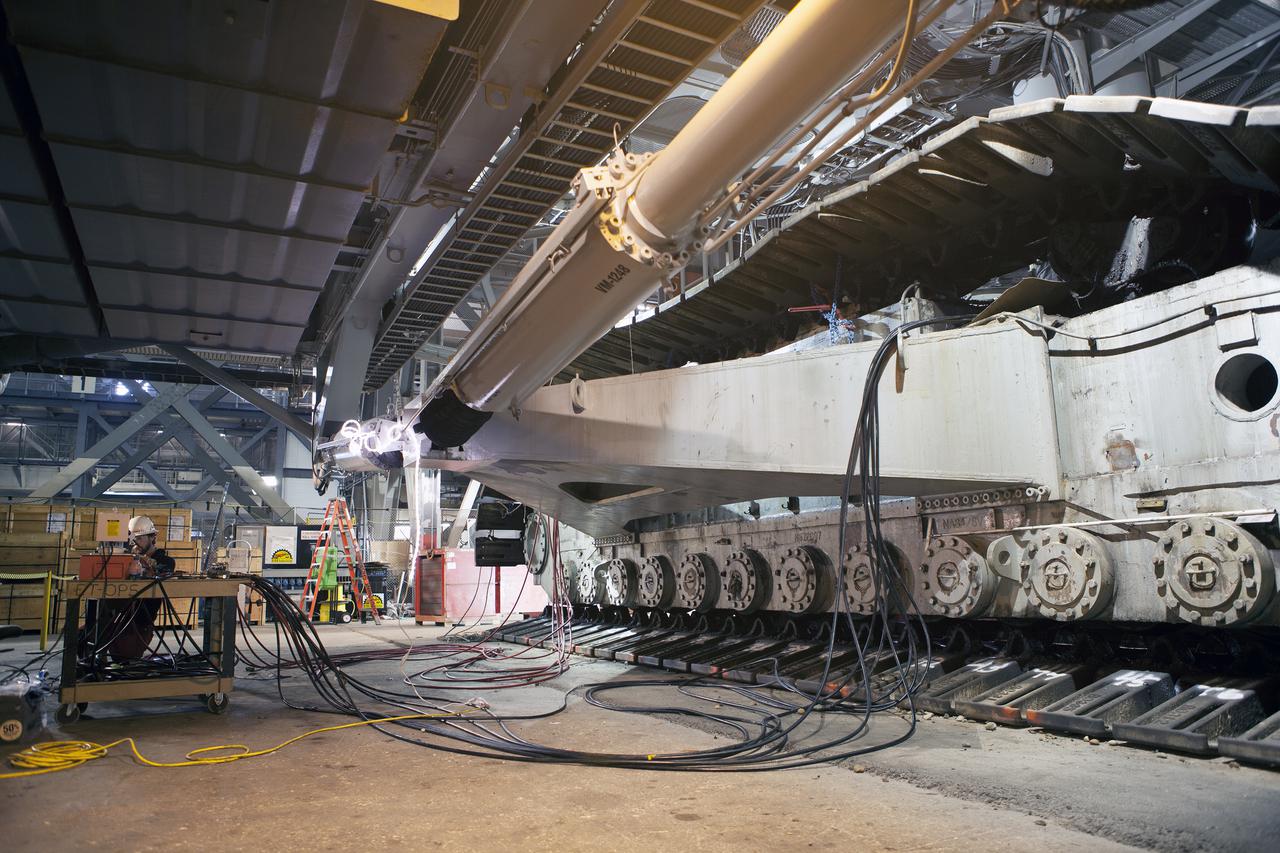
CAPE CANAVERAL, Fla. – Inside the Vehicle Assembly Building at NASA’s Kennedy Space Center in Florida, the B and D truck sections of crawler-transporter 2, or CT-2, are being raised up to prepare for installation of new roller bearing assemblies. Work continues in high bay 2 to upgrade CT-2. The modifications are designed to ensure CT-2’s ability to transport launch vehicles currently in development, such as the agency’s Space Launch System, to the launch pad. The Ground Systems Development and Operations Program office at Kennedy is overseeing the upgrades. For more than 45 years the crawler-transporters were used to transport the mobile launcher platform and the Apollo-Saturn V rockets and, later, space shuttles to Launch Pads 39A and B. For more information, visit: http:__www.nasa.gov_exploration_systems_ground_crawler-transporter. Photo credit: NASA_Dimitri Gerondidakis
CAPE CANAVERAL, Fla. – Inside the Vehicle Assembly Building at NASA’s Kennedy Space Center in Florida, the B and D truck sections of crawler-transporter 2, or CT-2, are being raised up to prepare for installation of new roller bearing assemblies. Work continues in high bay 2 to upgrade CT-2. The modifications are designed to ensure CT-2’s ability to transport launch vehicles currently in development, such as the agency’s Space Launch System, to the launch pad. The Ground Systems Development and Operations Program office at Kennedy is overseeing the upgrades. For more than 45 years the crawler-transporters were used to transport the mobile launcher platform and the Apollo-Saturn V rockets and, later, space shuttles to Launch Pads 39A and B. For more information, visit: http://www.nasa.gov/exploration/systems/ground/crawler-transporter. Photo credit: NASA/Dimitri Gerondidakis
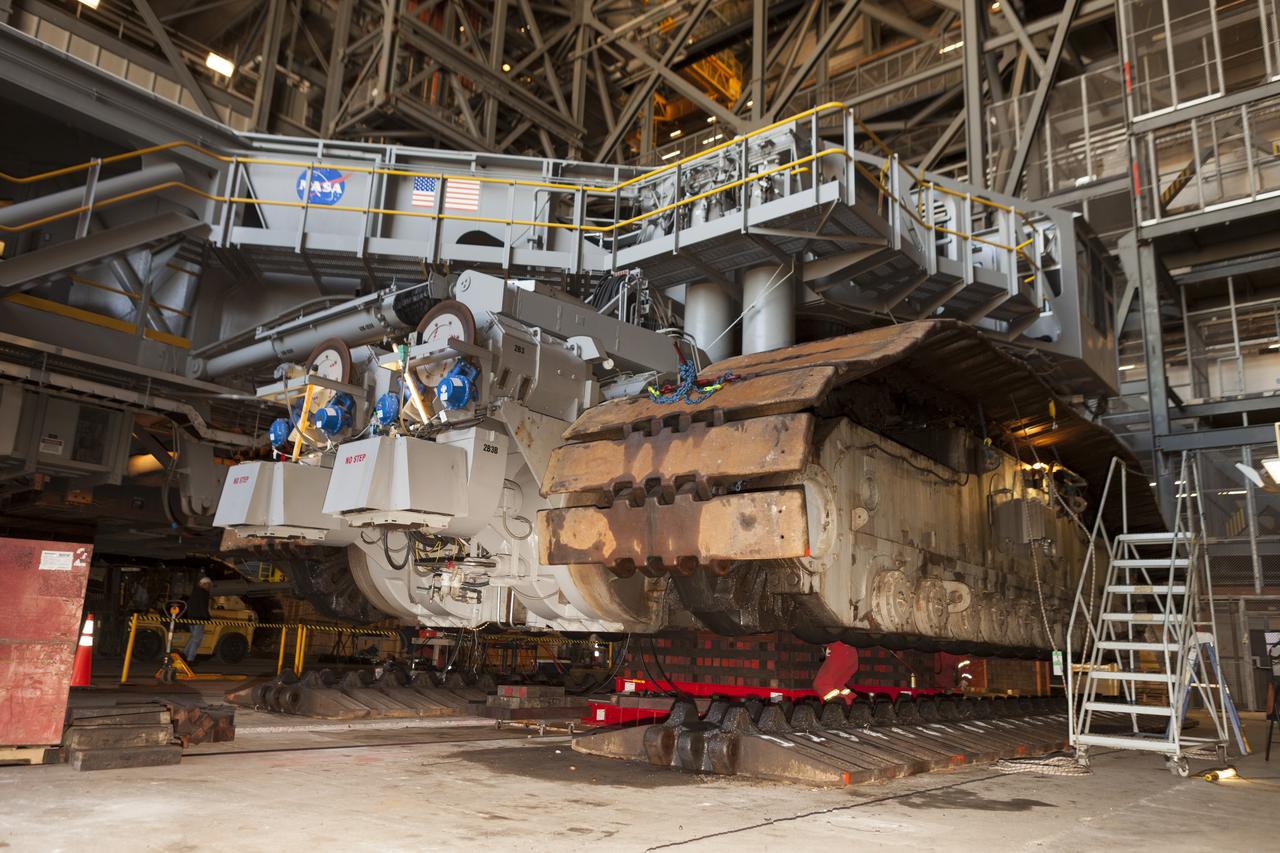
CAPE CANAVERAL, Fla. – Inside the Vehicle Assembly Building at NASA’s Kennedy Space Center in Florida, the B and D truck sections of crawler-transporter 2, or CT-2, have been raised up to prepare for installation of new roller bearing assemblies. Sections of the crawler’s large metal tracks have been removed. Work continues in high bay 2 to upgrade CT-2. The modifications are designed to ensure CT-2’s ability to transport launch vehicles currently in development, such as the agency’s Space Launch System, to the launch pad. The Ground Systems Development and Operations Program office at Kennedy is overseeing the upgrades. For more than 45 years the crawler-transporters were used to transport the mobile launcher platform and the Apollo-Saturn V rockets and, later, space shuttles to Launch Pads 39A and B. For more information, visit: http://www.nasa.gov/exploration/systems/ground/crawler-transporter. Photo credit: NASA/Dimitri Gerondidakis
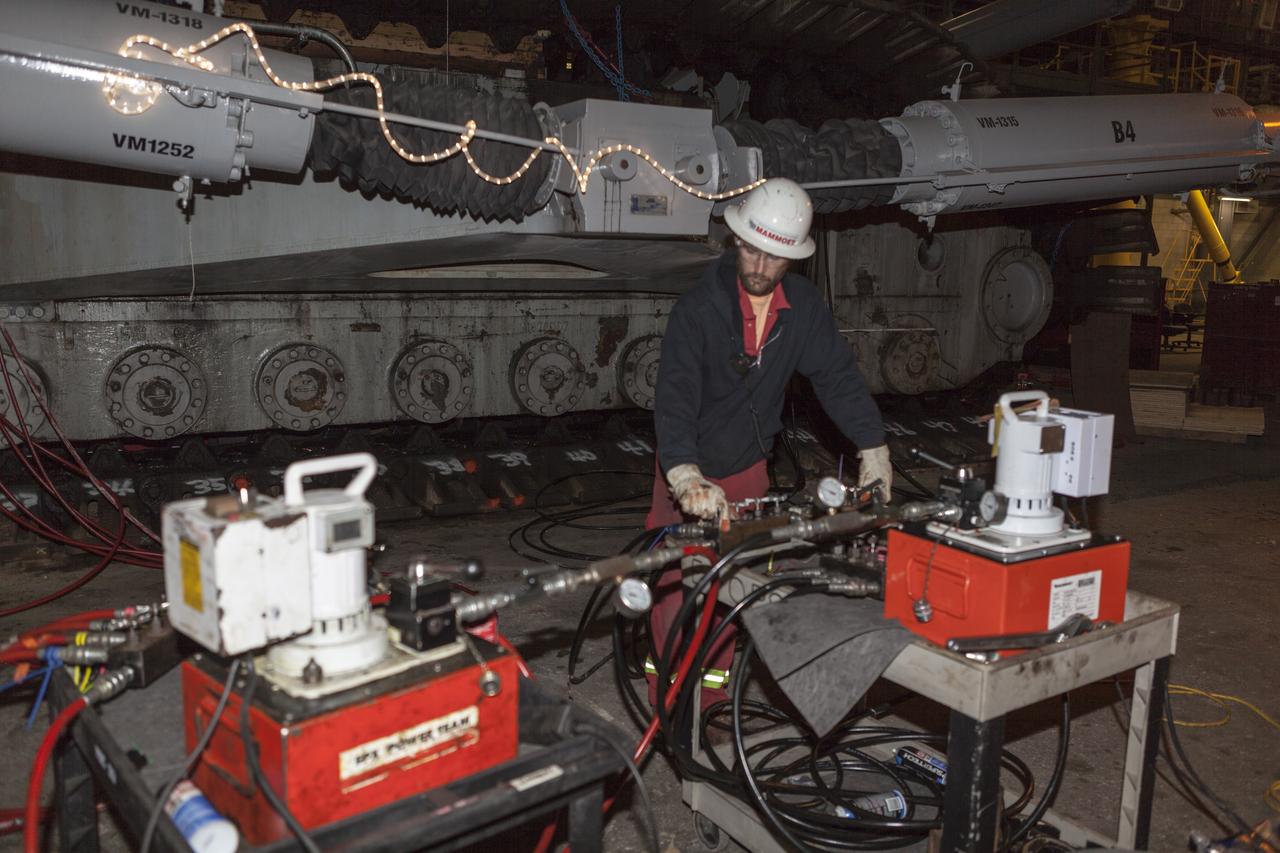
CAPE CANAVERAL, Fla. – Inside the Vehicle Assembly Building at NASA’s Kennedy Space Center in Florida, the B and D truck sections of crawler-transporter 2, or CT-2, are being raised up to prepare for installation of new roller bearing assemblies. Work continues in high bay 2 to upgrade CT-2. The modifications are designed to ensure CT-2’s ability to transport launch vehicles currently in development, such as the agency’s Space Launch System, to the launch pad. The Ground Systems Development and Operations Program office at Kennedy is overseeing the upgrades. For more than 45 years the crawler-transporters were used to transport the mobile launcher platform and the Apollo-Saturn V rockets and, later, space shuttles to Launch Pads 39A and B. For more information, visit: http://www.nasa.gov/exploration/systems/ground/crawler-transporter. Photo credit: NASA/Dimitri Gerondidakis
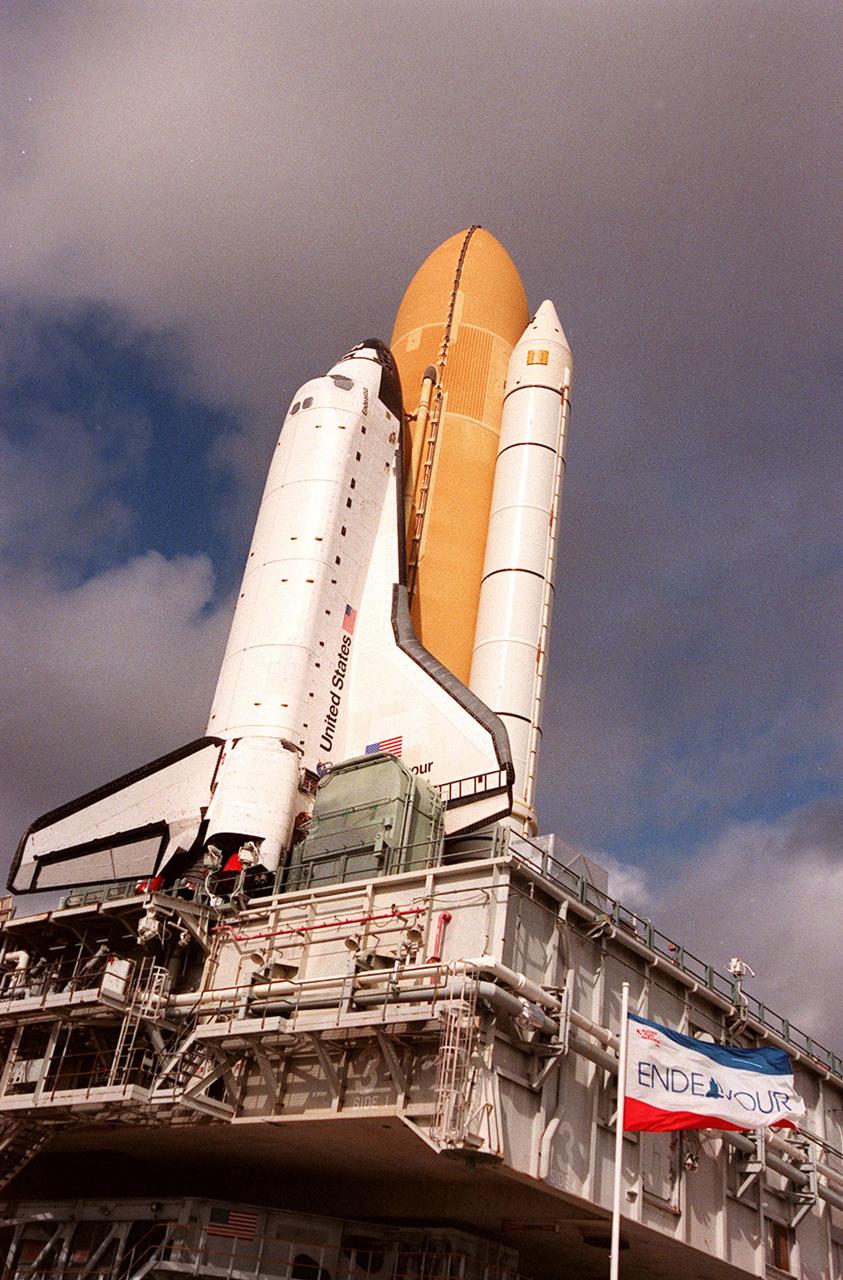
KENNEDY SPACE CENTER, Fla. -- Space Shuttle Endeavour is viewed atop the mobile launcher platform on its way to Launch Pad 39A for launch of mission STS-99. Named the Shuttle Radar Topography Mission (SRTM), STS-99 involves an international project spearheaded by the National Imagery and Mapping Agency and NASA, with participation of the German Aerospace Center DLR. SRTM will chart a new course, using two antennae and a 200-foot-long section of space station-derived mast protruding from its payload bay, to produce unrivaled 3-D images of the Earth's surface. The result of the Shuttle Radar Topography Mission could be close to 1 trillion measurements of the Earth's topography. Besides contributing to the production of better maps, these measurements could lead to improved water drainage modeling, more realistic flight simulators, better locations for cell phone towers, and enhanced navigation safety. STS-99 is scheduled for launch in January 2000
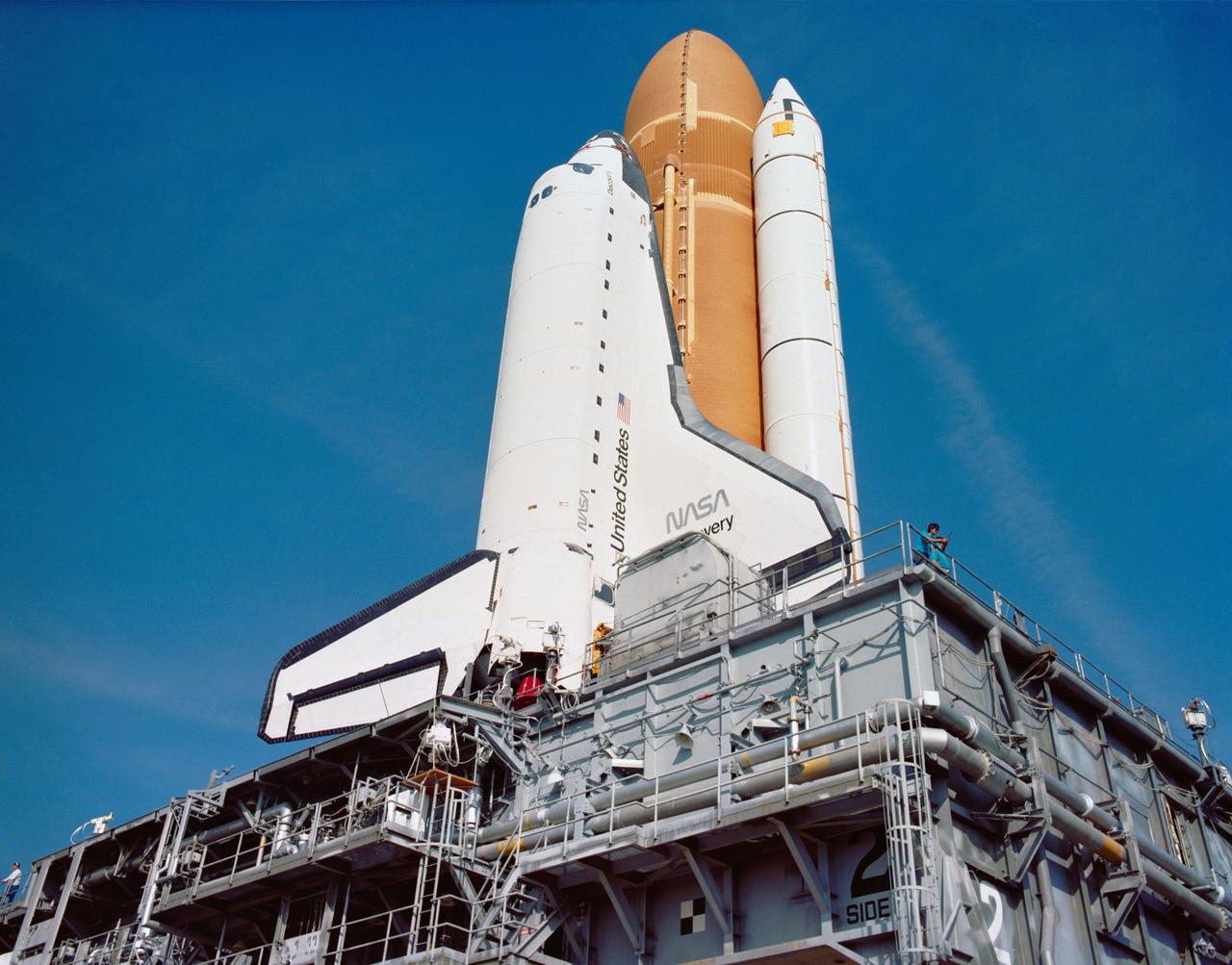
S89-28107 (3 Feb 1989) --- A low angle view of the Space Shuttle Discovery, atop a mobile launch platform, during its slow move to Kennedy Space Center's Launch Pad 39-B on Feb. 3, l989. It rolled through the doors of the huge vehicle assembly building (VAB) at 6 a.m., hours ago as the blue sky testifies. The trip to the pad takes approximately 5 and 1/2 hours. Onboard the spacecraft in mid-March for a five-day mission, on which will be deployed a third tracking and data relay satellite (TDRS-D), will be Astronauts Michael L. Coats, John E. Blaha, James F. Buchli, James P. Bagian and Robert C. Springer.
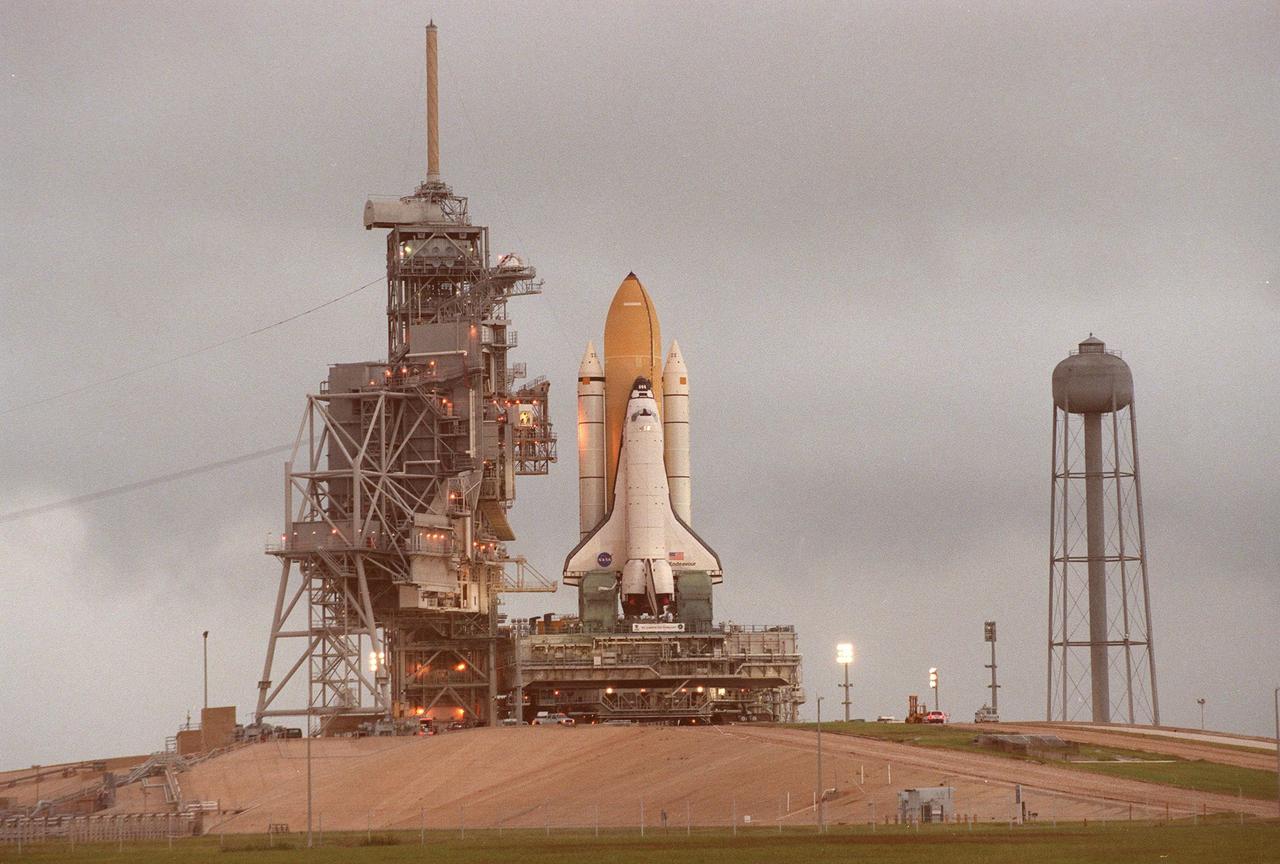
KENNEDY SPACE CENTER, Fla. -- Towering atop the mobile launcher platform and crawler transporter in the early morning light, Space Shuttle Endeavour arrives at Launch Pad 39A after rollout from the Vehicle Assembly Building. At its left are the Rotating Service Structure and the Fixed Service Structure; at the right is the 300,000-gallon water tank, part of the sound suppression water system. While at the pad, the orbiter, external tank and solid rocket boosters will undergo final preparations for the STS-88 launch targeted for Dec. 3, 1998. Mission STS-88 is the first U.S. flight for the assembly of the International Space Station and will carry the Unity connecting module. While on orbit, the flight crew will deploy Unity from the payload bay and connect it to the Russian-built Zarya control module which will be in orbit at that time. Unity will be the main connecting point for later U.S. station modules and components. More than 40 launches are planned over five years involving the resources and expertise of 16 cooperating nations. Comprising the STS-88 crew are Commander Robert D. Cabana, Pilot Frederick W. "Rick" Sturckow, Mission Specialists Nancy J. Currie, Jerry L. Ross, James H. Newman and Russian cosmonaut Sergei Konstantinovich Krikalev. Ross and Newman will make three spacewalks to connect power, data and utility lines and install exterior equipment
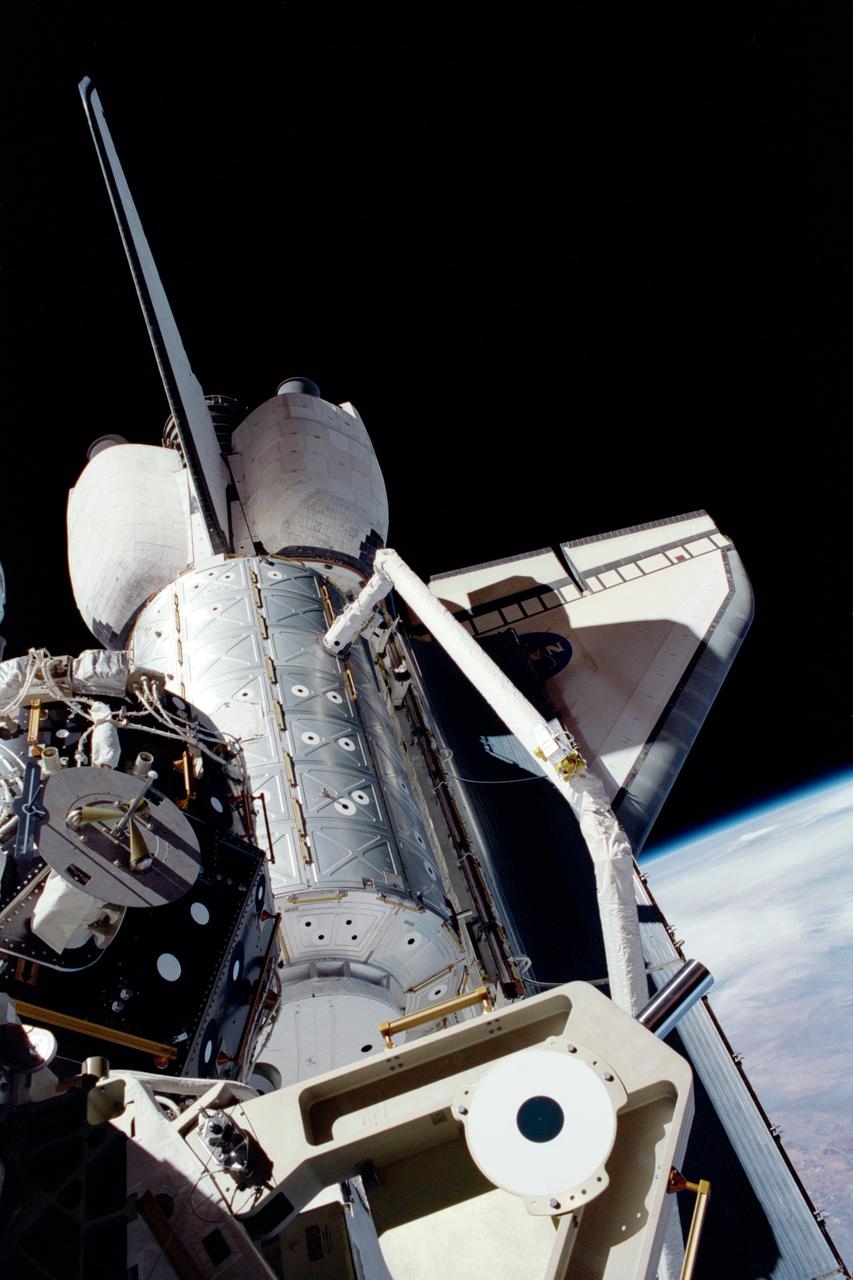
In the grasp of the Shuttle's Remote Manipulator System (RMS) robot arm, the U.S. Laboratory, Destiny, is moved from its stowage position in the cargo bay of the Space Shuttle Atlantis. This photograph was taken by astronaut Thomas D. Jones during his Extravehicular Activity (EVA). The American-made Destiny module is the cornerstone for space-based research aboard the orbiting platform and the centerpiece of the International Space Station (ISS), where unprecedented science experiments will be performed in the near-zero gravity of space. Destiny will also serve as the command and control center for the ISS. The aluminum module is 8.5- meters (28-feet) long and 4.3-meters (14-feet) in diameter. The laboratory consists of three cylindrical sections and two endcones with hatches that will be mated to other station components. A 50.9-centimeter- (20-inch-) diameter window is located on one side of the center module segment. This pressurized module is designed to accommodate pressurized payloads. It has a capacity of 24 rack locations. Payload racks will occupy 15 locations especially designed to support experiments. The Destiny module was built by the Boeing Company under the direction of the Marshall Space Flight Center.
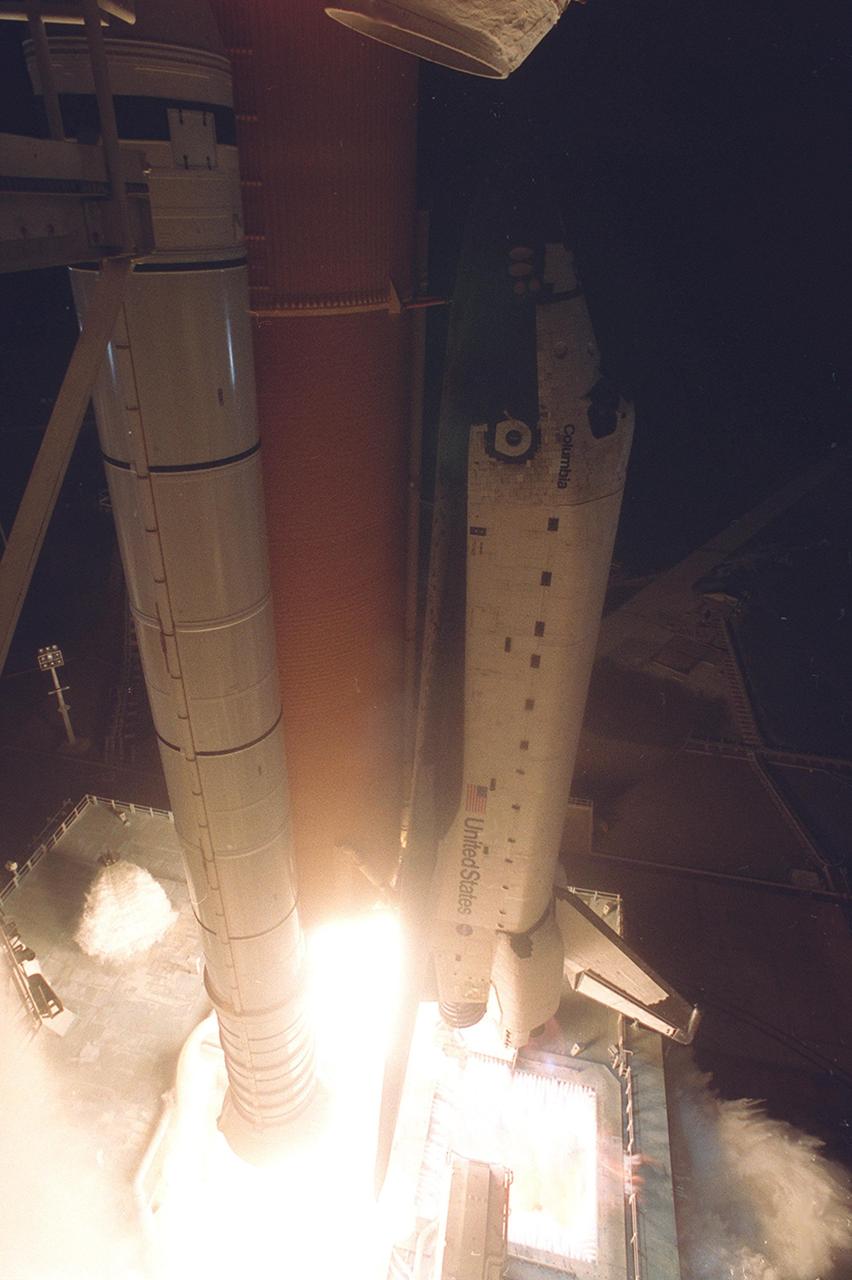
KENNEDY SPACE CENTER, Fla. - At liftoff of Space Shuttle Columbia, a torrent of water begins to flow from rainbirds (at bottom left and right) onto the Mobile Launcher Platform to help with sound suppression. Acoustical levels reach their peak when the Space Shuttle is about 300 feet above the MLP. There are six 12-foot rainbirds mounted on the MLP. Liftoff of Columbia on mission STS-109 occurred at 6:22:02:08 a.m. EST (11:22:02:08 GMT). This was the 27th flight of the vehicle and 108th in the history of the Shuttle program. The goal of the mission is the maintenance and upgrade of the Hubble Space Telescope, to be carried out in five spacewalks. The crew comprises Commander Scott D. Altman, Pilot Duane G. Carey, Payload Commander John M. Grunsfeld, and Mission Specialists Nancy Jane Currie, Richard M. Linnehan, James H. Newman and Michael J. Massimino. After the 11-day mission, Columbia is expected to return to KSC March 12 about 4:35 a.m. EST (09:35 GMT)
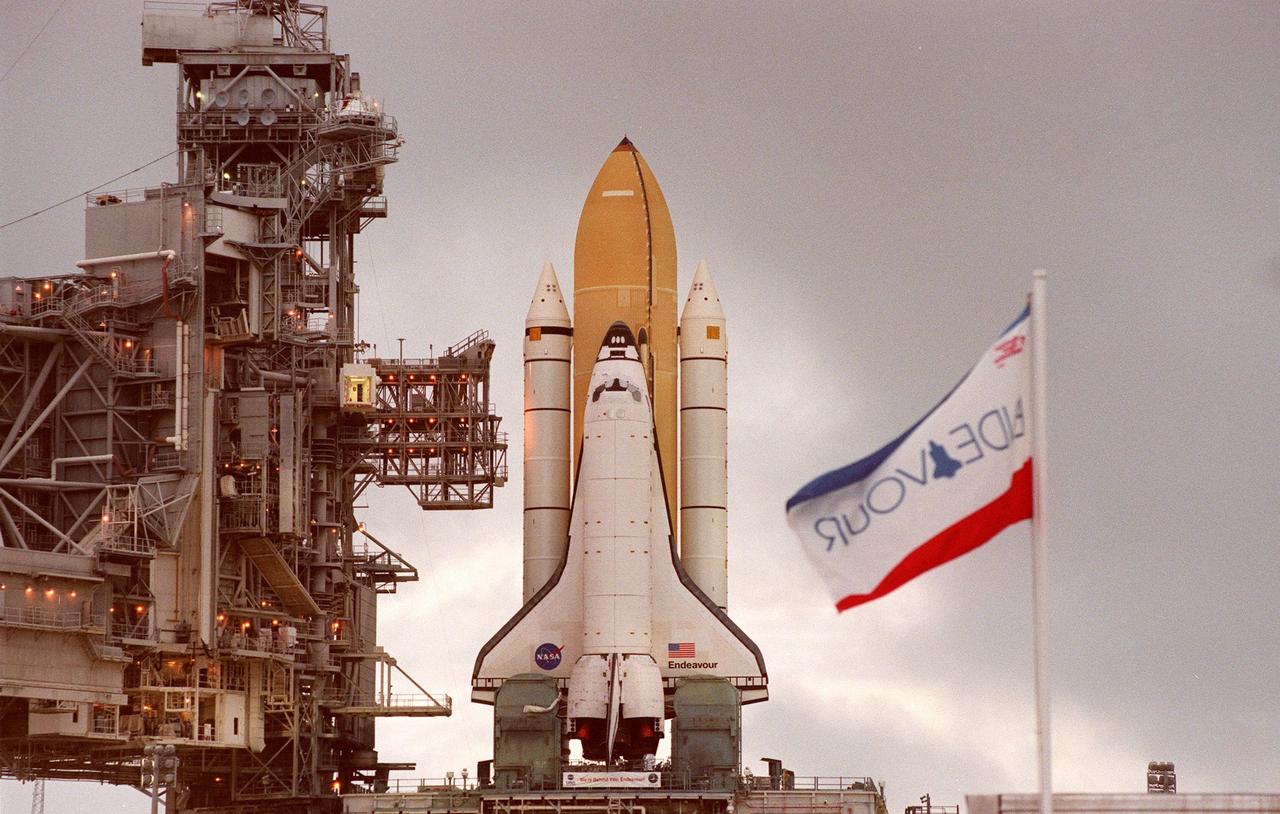
KENNEDY SPACE CENTER, Fla. -- Space Shuttle Endeavour arrives at Launch Pad 39A in the dim early morning light, atop the mobile launcher platform and crawler transporter, after rollout from the Vehicle Assembly Building. The flag identifying the Shuttle (at right) waves slightly from the wind. At left are the Fixed Service Structure and Rotating Service Structure. While at the pad, the orbiter, external tank and solid rocket boosters will undergo final preparations for the STS-88 launch targeted for Dec. 3, 1998. Mission STS-88 is the first U.S. flight for the assembly of the International Space Station and will carry the Unity connecting module. While on orbit, the flight crew will deploy Unity from the payload bay and connect it to the Russian-built Zarya control module which will be in orbit at that time. Unity will be the main connecting point for later U.S. station modules and components. More than 40 launches are planned over five years involving the resources and expertise of 16 cooperating nations. Comprising the STS-88 crew are Commander Robert D. Cabana, Pilot Frederick W. "Rick" Sturckow, Mission Specialists Nancy J. Currie, Jerry L. Ross, James H. Newman and Russian cosmonaut Sergei Konstantinovich Krikalev. Ross and Newman will make three spacewalks to connect power, data and utility lines and install exterior equipment
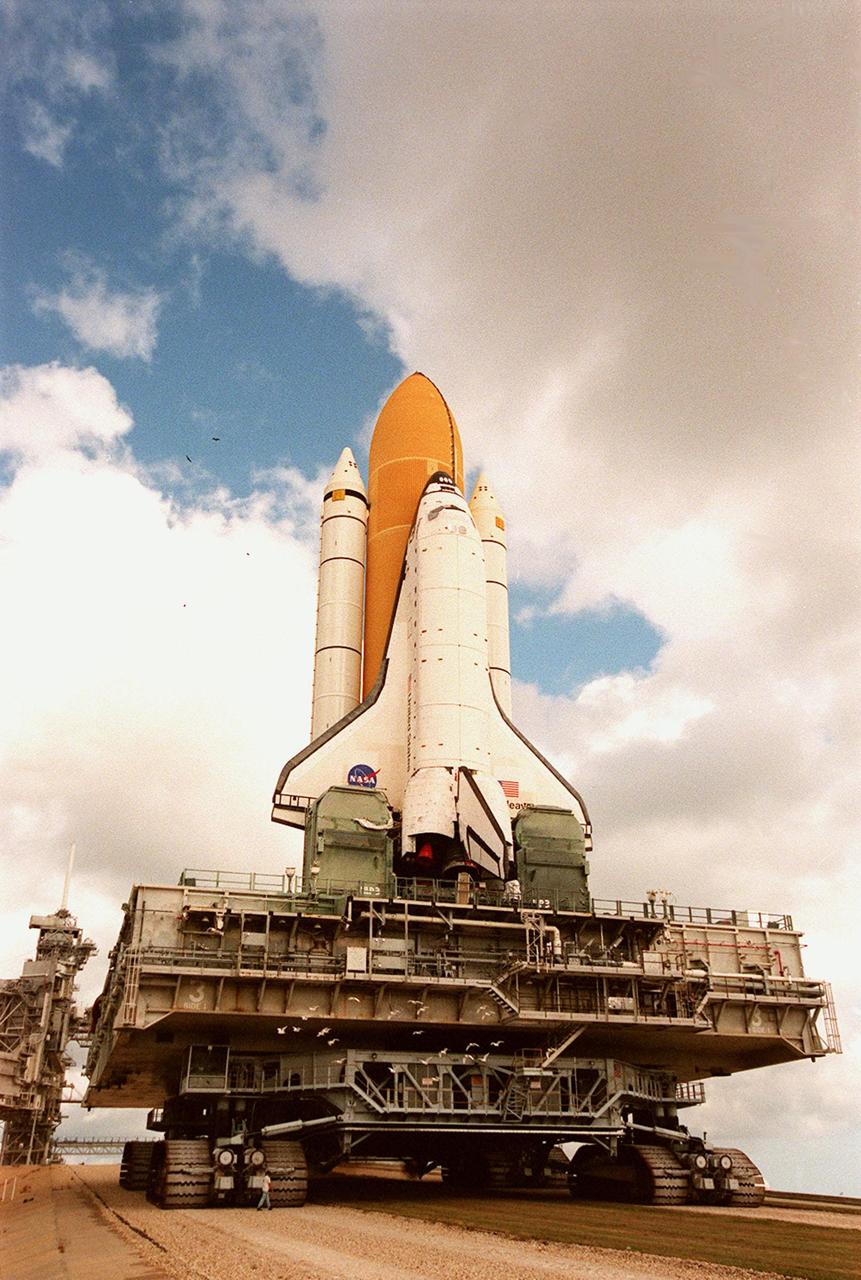
KENNEDY SPACE CENTER, Fla. -- Under breaking clouds, Space Shuttle Endeavour, atop the mobile launcher platform and crawler-transporter, crawls its way to Launch Pad 39A for mission STS-99. Named the Shuttle Radar Topography Mission (SRTM), STS-99 involves an international project spearheaded by the National Imagery and Mapping Agency and NASA, with participation of the German Aerospace Center DLR. SRTM will chart a new course, using two antennae and a 200-foot-long section of space station-derived mast protruding from its payload bay, to produce unrivaled 3-D images of the Earth's surface. The result of the Shuttle Radar Topography Mission could be close to 1 trillion measurements of the Earth's topography. Besides contributing to the production of better maps, these measurements could lead to improved water drainage modeling, more realistic flight simulators, better locations for cell phone towers, and enhanced navigation safety. STS-99 is scheduled for launch in January 2000
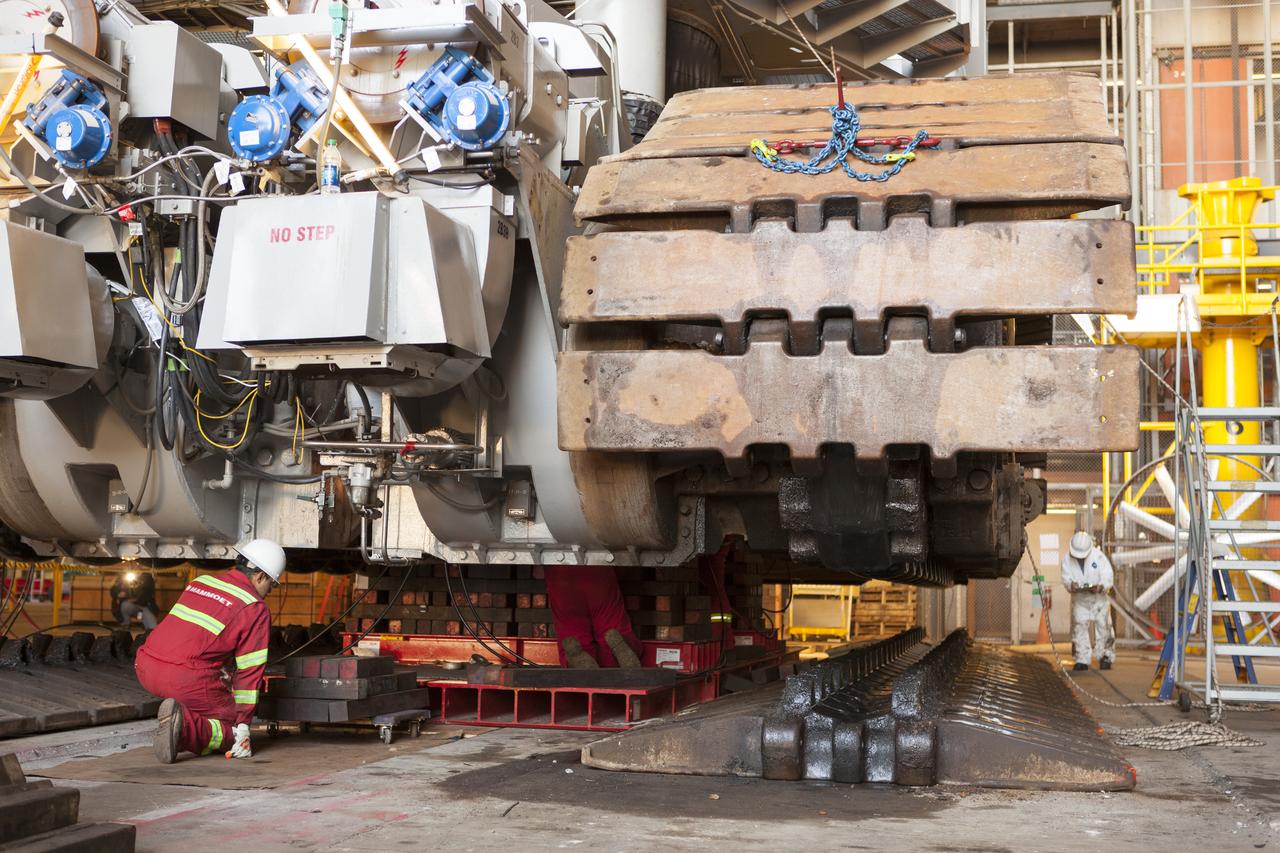
CAPE CANAVERAL, Fla. – Inside the Vehicle Assembly Building at NASA’s Kennedy Space Center in Florida, ground support technicians monitor the progress as the B and D truck sections of crawler-transporter 2, or CT-2, are being raised up to prepare for installation of new roller bearing assemblies. Sections of the crawler’s large metal tracks have been removed. Work continues in high bay 2 to upgrade CT-2. The modifications are designed to ensure CT-2’s ability to transport launch vehicles currently in development, such as the agency’s Space Launch System, to the launch pad. The Ground Systems Development and Operations Program office at Kennedy is overseeing the upgrades. For more than 45 years the crawler-transporters were used to transport the mobile launcher platform and the Apollo-Saturn V rockets and, later, space shuttles to Launch Pads 39A and B. For more information, visit: http://www.nasa.gov/exploration/systems/ground/crawler-transporter. Photo credit: NASA/Dimitri Gerondidakis
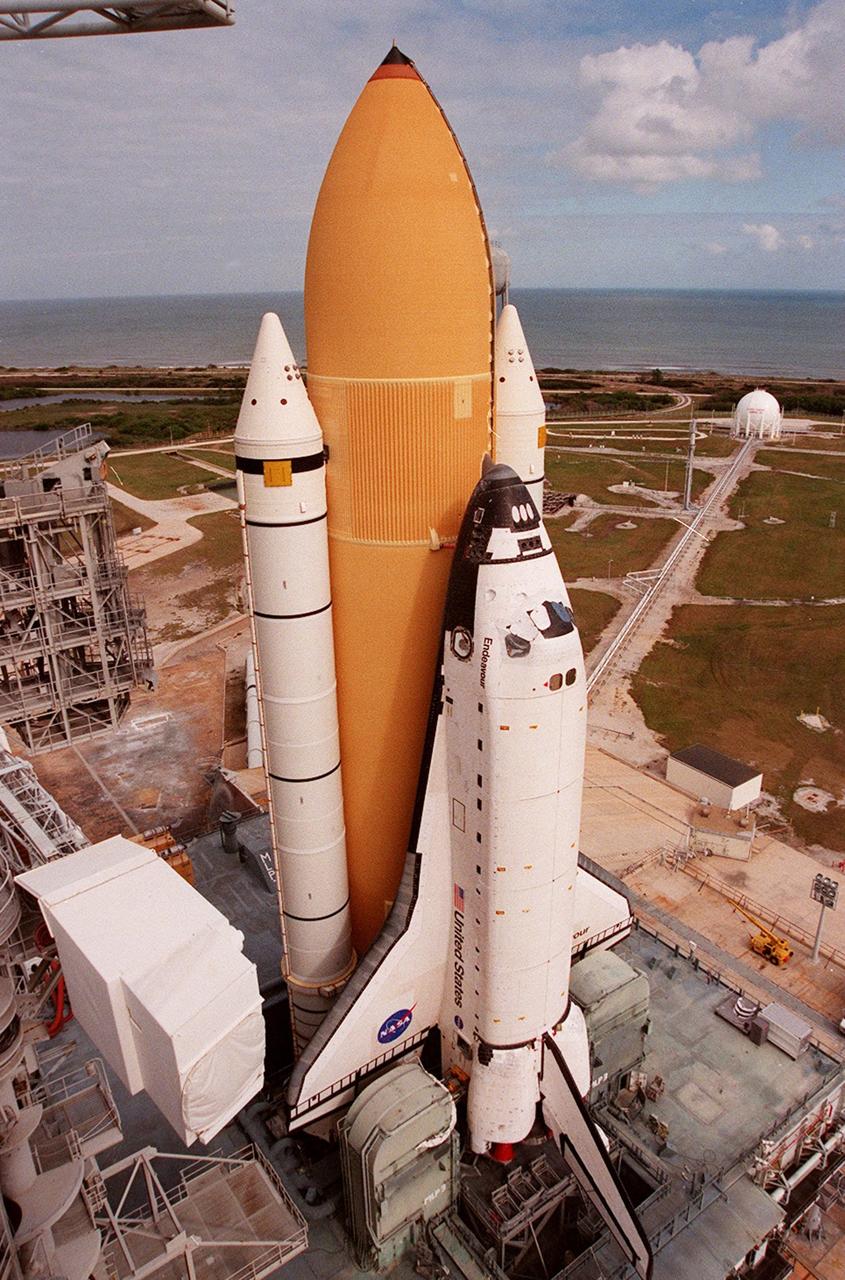
KENNEDY SPACE CENTER, Fla. -- Under partly cloudy skies and the Atlantic Ocean as a backdrop, Space Shuttle Endeavour, atop the mobile launcher platform, arrives at Launch Pad 39A for mission STS-99. The white cubicle at left is the environmental chamber, the White Room, that provides entry into the orbiter for the astronauts. It is at the outer end of the Orbiter Access Arm on the Fixed Service Structure. STS-99, named the Shuttle Radar Topography Mission (SRTM), involves an international project spearheaded by the National Imagery and Mapping Agency and NASA, with participation of the German Aerospace Center DLR. SRTM will chart a new course, using two antennae and a 200-foot-long section of space station-derived mast protruding from its payload bay, to produce unrivaled 3-D images of the Earth's surface. The result of the Shuttle Radar Topography Mission could be close to 1 trillion measurements of the Earth's topography. Besides contributing to the production of better maps, these measurements could lead to improved water drainage modeling, more realistic flight simulators, better locations for cell phone towers, and enhanced navigation safety. STS-99 is scheduled for launch in January 2000
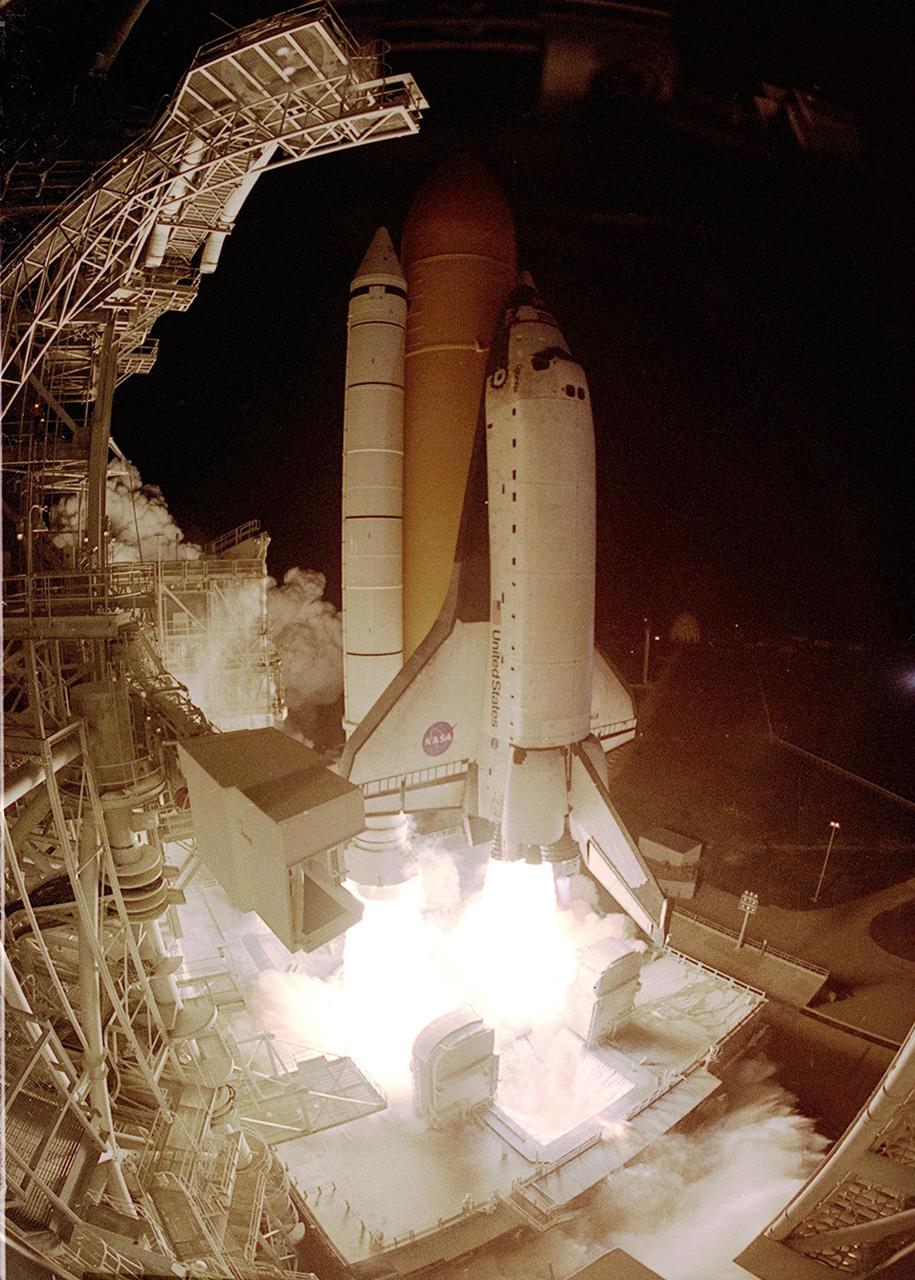
KENNEDY SPACE CENTER, Fla. - A fish-eye lens gives a different perspective to the launch of Space Shuttle Columbia on mission STS-109. Torrents of water spread over the Mobile Launcher Platform from 12-foot rainbirds and into the flame trench as part of the sound suppression system. Acoustical levels reach their peak when the Space Shuttle is about 300 feet above the MLP. At left of the Shuttle is the Fixed Service Structure with the Orbiter Access Arm and White Room, seen in the foreground. Liftoff of Columbia occurred at 6:22:02:08 a.m. EST (11:22:02:08 GMT). This was the 27th flight of the vehicle and 108th in the history of the Shuttle program. The goal of the mission is the maintenance and upgrade of the Hubble Space Telescope, to be carried out in five spacewalks. The crew comprises Commander Scott D. Altman, Pilot Duane G. Carey, Payload Commander John M. Grunsfeld, and Mission Specialists Nancy Jane Currie, Richard M. Linnehan, James H. Newman and Michael J. Massimino. After the 11-day mission, Columbia is expected to return to KSC March 12 about 4:35 a.m. EST (09:35 GMT)
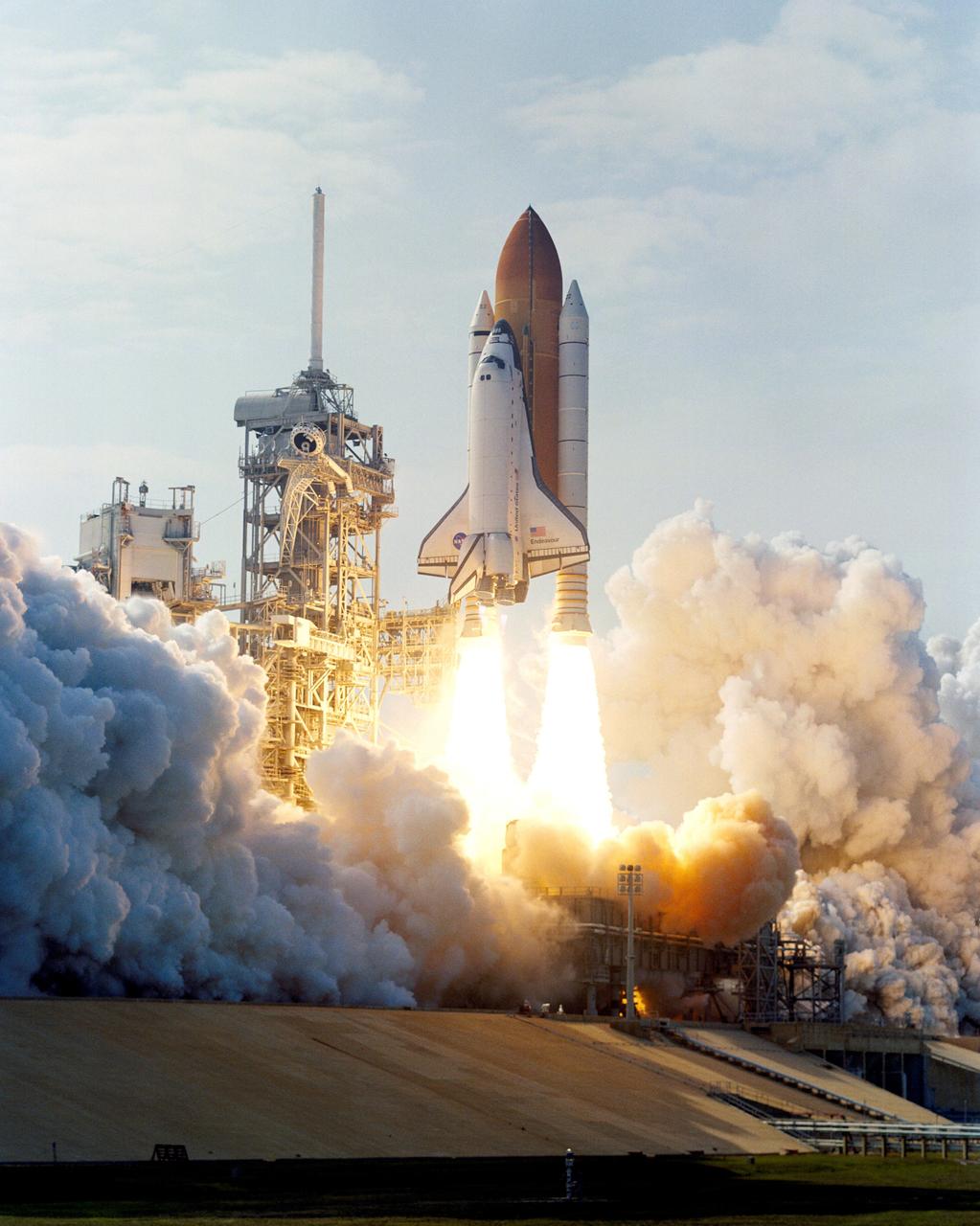
Aboard the Space Shuttle Orbiter Endeavour, the STS-111 mission was launched on June 5, 2002 at 5:22 pm EDT from Kennedy's launch pad. On board were the STS-111 and Expedition Five crew members. Astronauts Kenneth D. Cockrell, commander; Paul S. Lockhart, pilot, and mission specialists Franklin R. Chang-Diaz and Philippe Perrin were the STS-111 crew members. Expedition Five crew members included Cosmonaut Valeri G. Korzun, commander, Astronaut Peggy A. Whitson and Cosmonaut Sergei Y. Treschev, flight engineers. Three space walks enabled the STS-111 crew to accomplish mission objectives: the delivery and installation of a new platform for the ISS robotic arm, the Mobile Base System (MBS) which is an important part of the Station's Mobile Servicing System allowing the robotic arm to travel the length of the Station; the replacement of a wrist roll joint on the Station's robotic arm; and unloading supplies and science experiments from the Leonardo Multi-Purpose Logistics Module, which made its third trip to the orbital outpost. Landing on June 19, 2002, the 14-day STS-111 mission was the 14th Shuttle mission to visit the ISS.
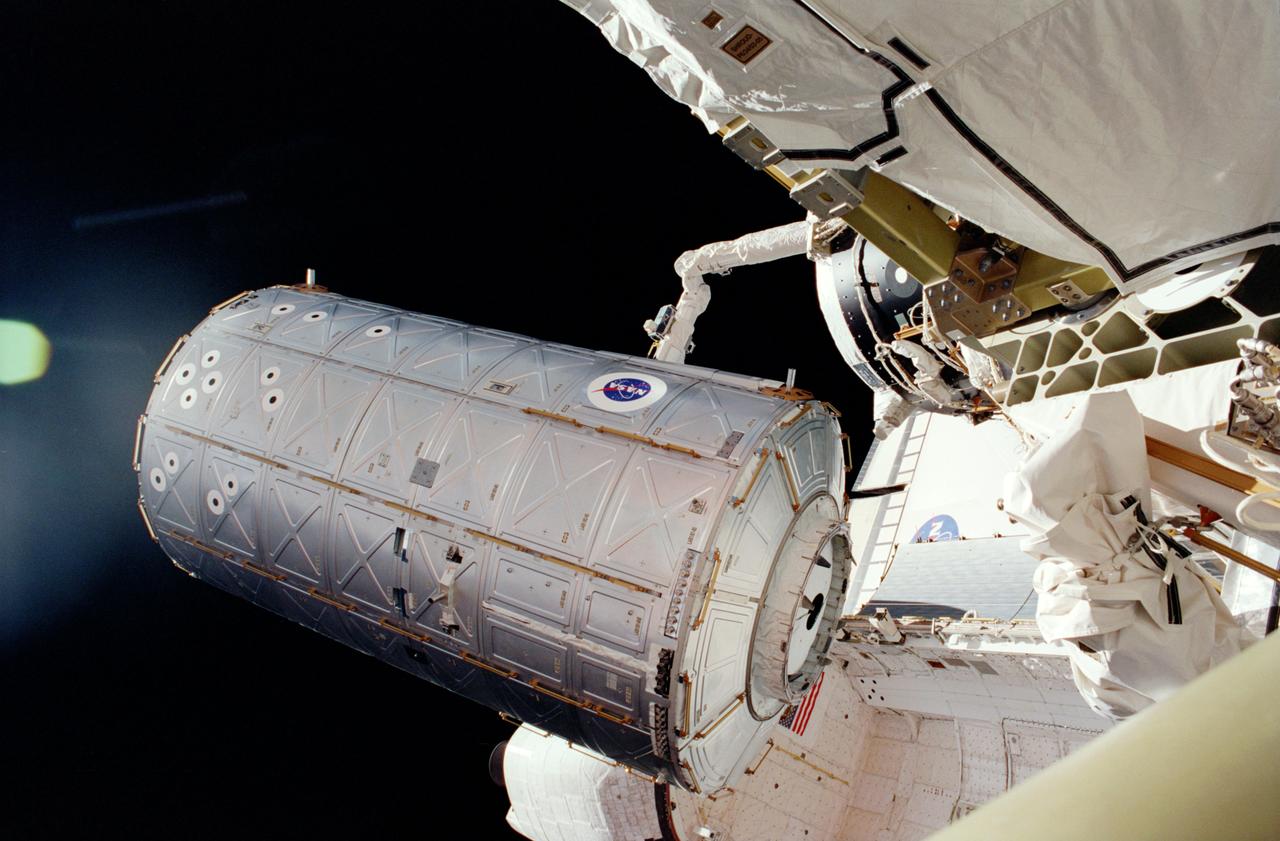
In the grasp of the Shuttle's Remote Manipulator System (RMS) robot arm, the U.S. Laboratory, Destiny, is moved from its stowage position in the cargo bay of the Space Shuttle Atlantis. This photograph was taken by astronaut Thomas D. Jones during his Extravehicular Activity (EVA). The American-made Destiny module is the cornerstone for space-based research aboard the orbiting platform and the centerpiece of the International Space Station (ISS), where unprecedented science experiments will be performed in the near-zero gravity of space. Destiny will also serve as the command and control center for the ISS. The aluminum module is 8.5- meters (28-feet) long and 4.3-meters (14-feet) in diameter. The laboratory consists of three cylindrical sections and two endcones with hatches that will be mated to other station components. A 50.9-centimeter (20-inch-) diameter window is located on one side of the center module segment. This pressurized module is designed to accommodate pressurized payloads. It has a capacity of 24 rack locations. Payload racks will occupy 15 locations especially designed to support experiments. The Destiny module was built by the Boeing Company under the direction of the Marshall Space Flight Center.
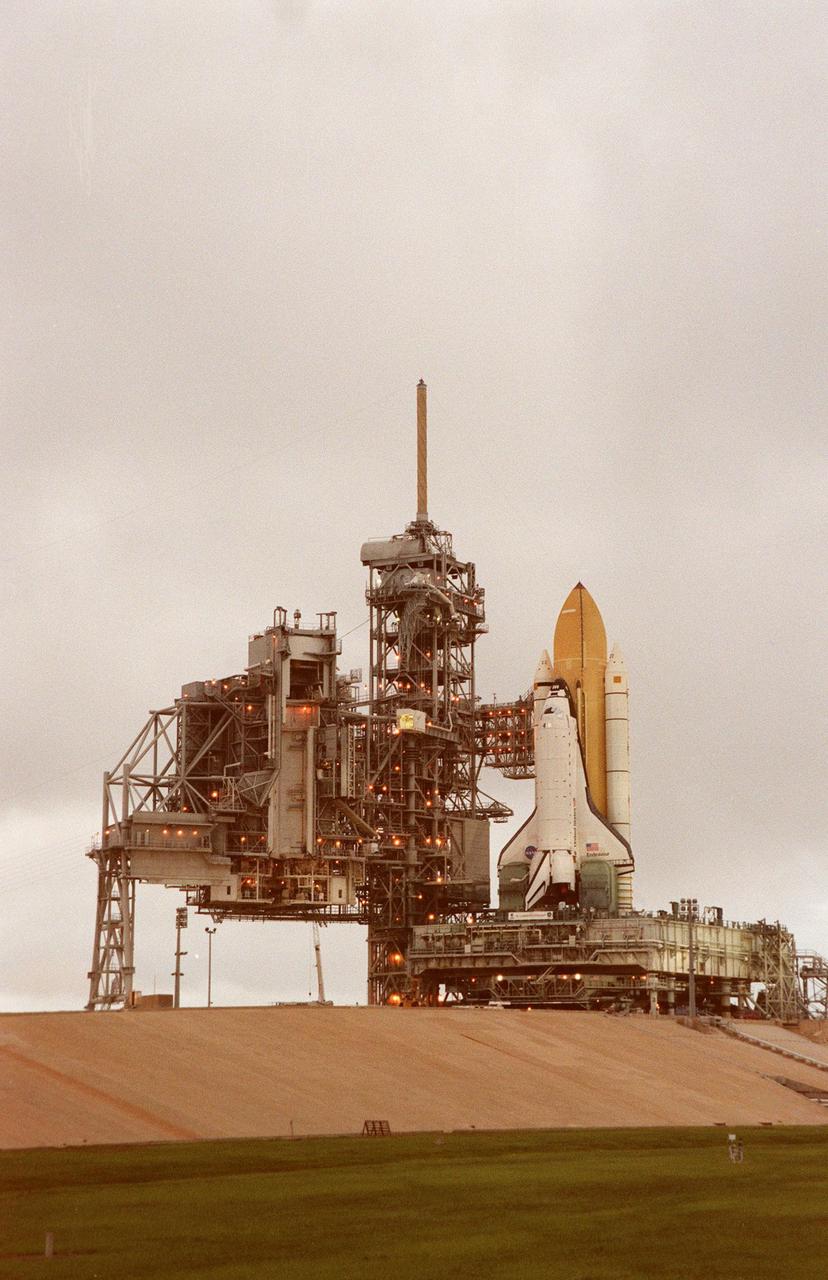
KENNEDY SPACE CENTER, Fla. -- In the cloud-dimmed light of early morning, Space Shuttle Endeavour sits in place at Launch Pad 39A , atop the mobile launcher platform and crawler transporter, after rollout from the Vehicle Assembly Building. At its left are the Rotating Service Structure and Fixed Service Structure with the orbiter access arm extended. The access arm swings out to the orbiter crew compartment hatch to allow personnel to enter the crew compartment. At its outer end is the white room, an environmental chamber, that mates with the orbiter. While at the pad, the orbiter, external tank and solid rocket boosters will undergo final preparations for the STS-88 launch targeted for Dec. 3, 1998. Mission STS-88 is the first U.S. flight for the assembly of the International Space Station and will carry the Unity connecting module. While on orbit, the flight crew will deploy Unity from the payload bay and connect it to the Russian-built Zarya control module which will be in orbit at that time. Unity will be the main connecting point for later U.S. station modules and components. More than 40 launches are planned over five years involving the resources and expertise of 16 cooperating nations. Comprising the STS-88 crew are Commander Robert D. Cabana, Pilot Frederick W. "Rick" Sturckow, Mission Specialists Nancy J. Currie, Jerry L. Ross, James H. Newman and Russian cosmonaut Sergei Konstantinovich Krikalev. Ross and Newman will make three spacewalks to connect power, data and utility lines and install exterior equipment
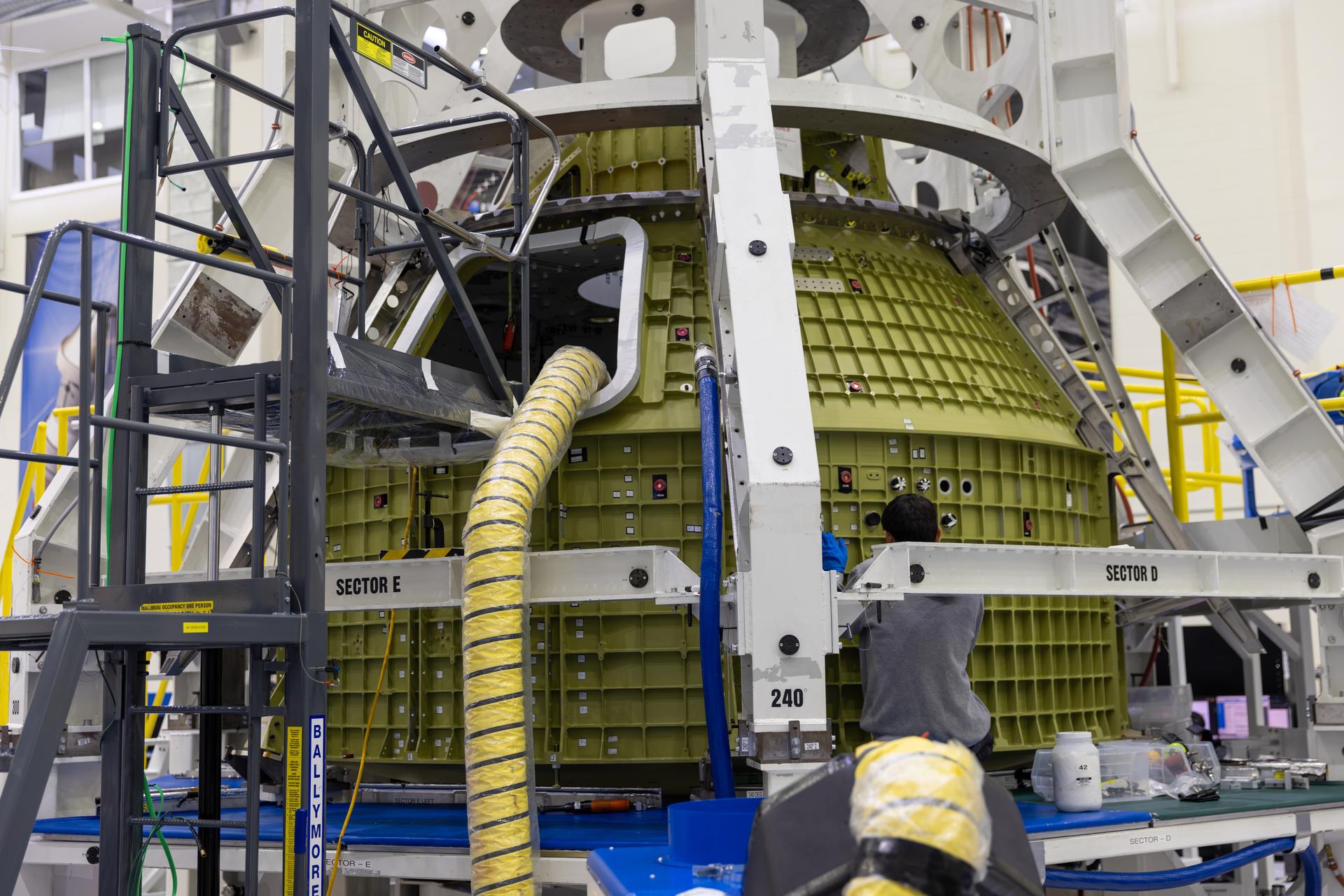
A photographer captures the Artemis V Orion crew module on Friday, July 31, 2026, inside the Neil A. Armstrong Operations and Checkout Building at NASA’s Kennedy Space Center in Florida. There are currently several pieces of hardware from Artemis III, IV, and V undergoing processing at the same time inside the facility. Using the standard SLS (Space Launch System) rocket configuration, NASA expects to launch this lunar surface mission by late 2028, with subsequent missions planned roughly once per year.