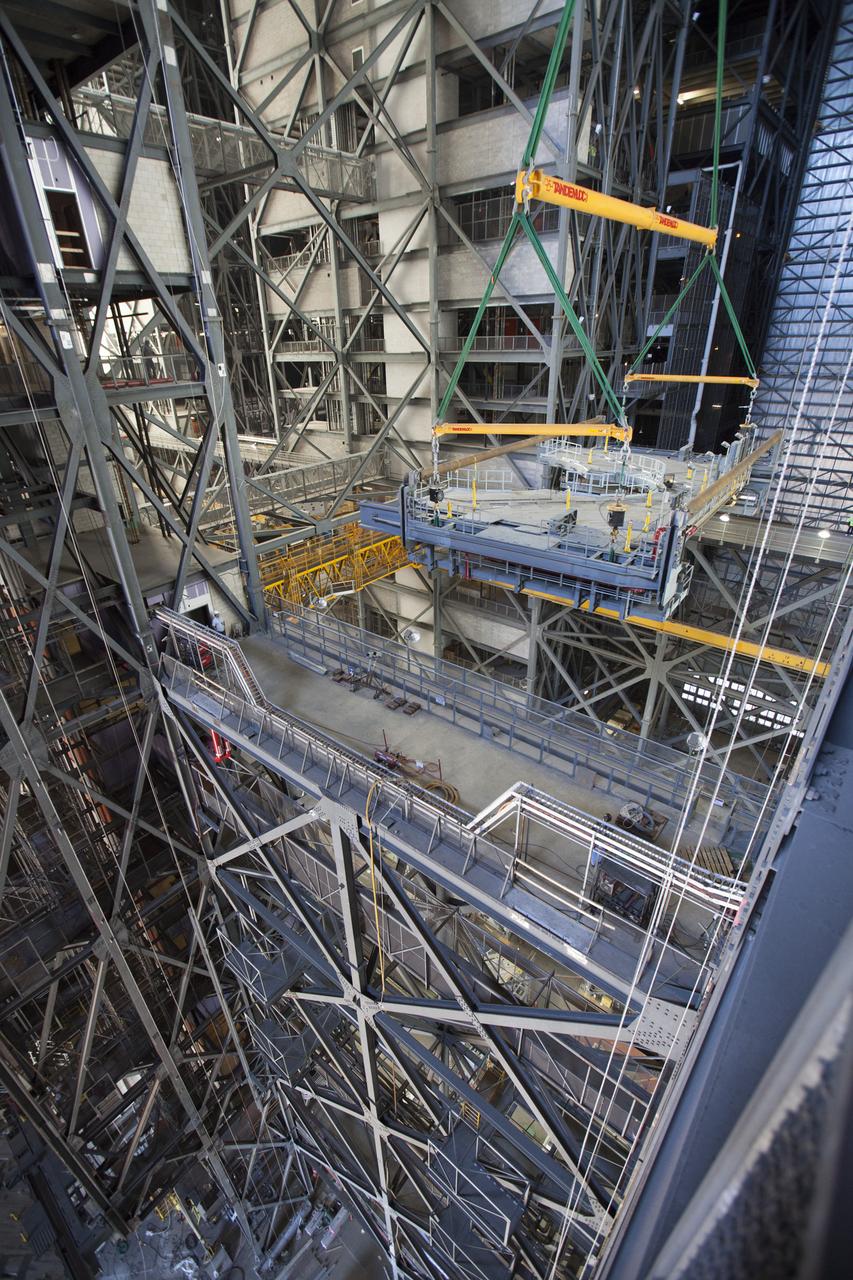
A 250-ton crane is used to lift the second half of the K-level work platforms for NASA’s Space Launch System (SLS) rocket up from High Bay 4 inside the Vehicle Assembly Building at NASA's Kennedy Space Center in Florida. The platform is being lifted up and over the transfer aisle and will be lowered into High Bay 3 for installation. It will be secured about 86 feet above the VAB floor, on tower E of the high bay. The K work platforms will provide access to the SLS core stage and solid rocket boosters during processing and stacking operations on the mobile launcher. The Ground Systems Development and Operations Program is overseeing upgrades and modifications to High Bay 3 to support processing of the SLS and Orion spacecraft. A total of 10 levels of new platforms, 20 platform halves altogether, will surround the SLS rocket and Orion spacecraft.
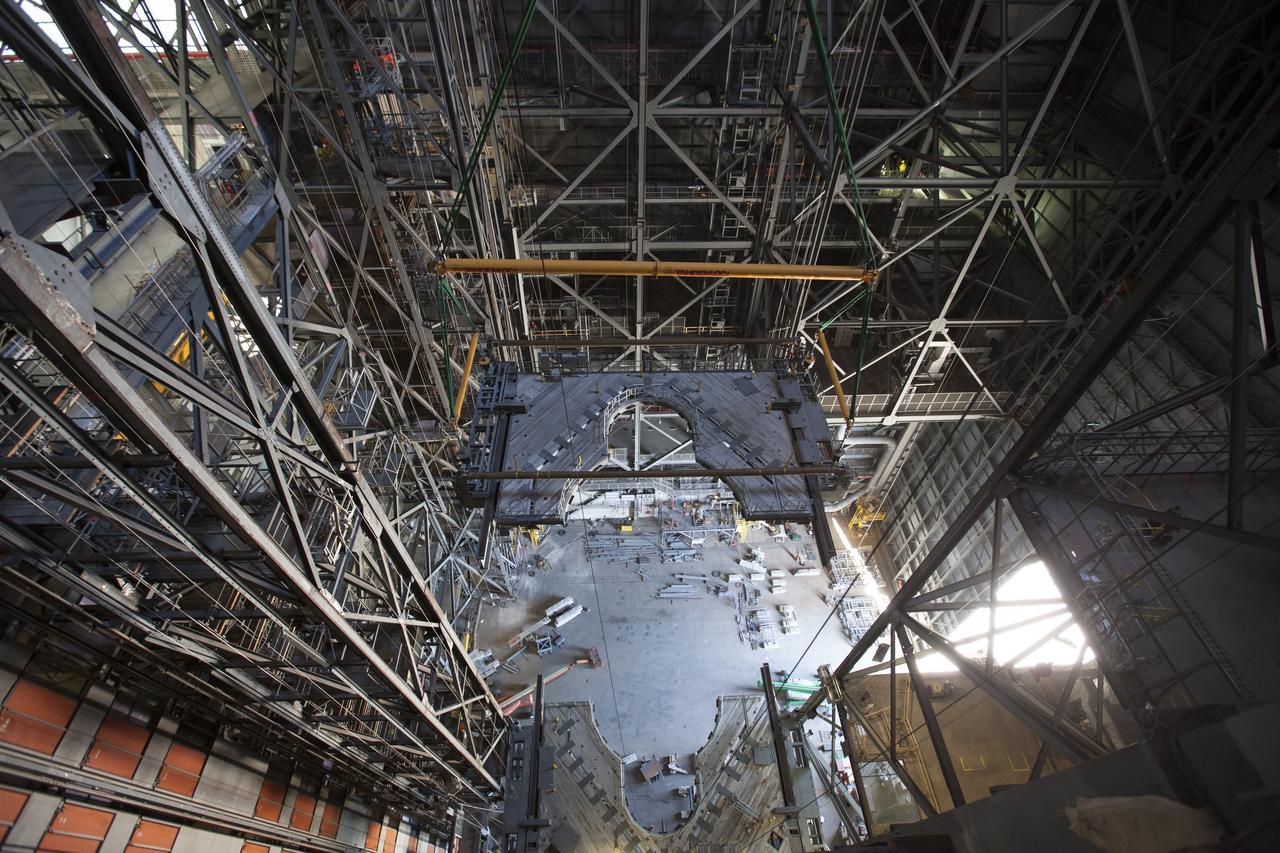
A 250-ton crane is used to lower the second half of the K-level work platforms for NASA’s Space Launch System (SLS) rocket into High Bay 3 inside the Vehicle Assembly Building at NASA's Kennedy Space Center in Florida. The platform will be secured about 86 feet above the VAB floor, on tower E of the high bay. The K work platforms will provide access to the SLS core stage and solid rocket boosters during processing and stacking operations on the mobile launcher. The Ground Systems Development and Operations Program is overseeing upgrades and modifications to High Bay 3 to support processing of the SLS and Orion spacecraft. A total of 10 levels of new platforms, 20 platform halves altogether, will surround the SLS rocket and Orion spacecraft.
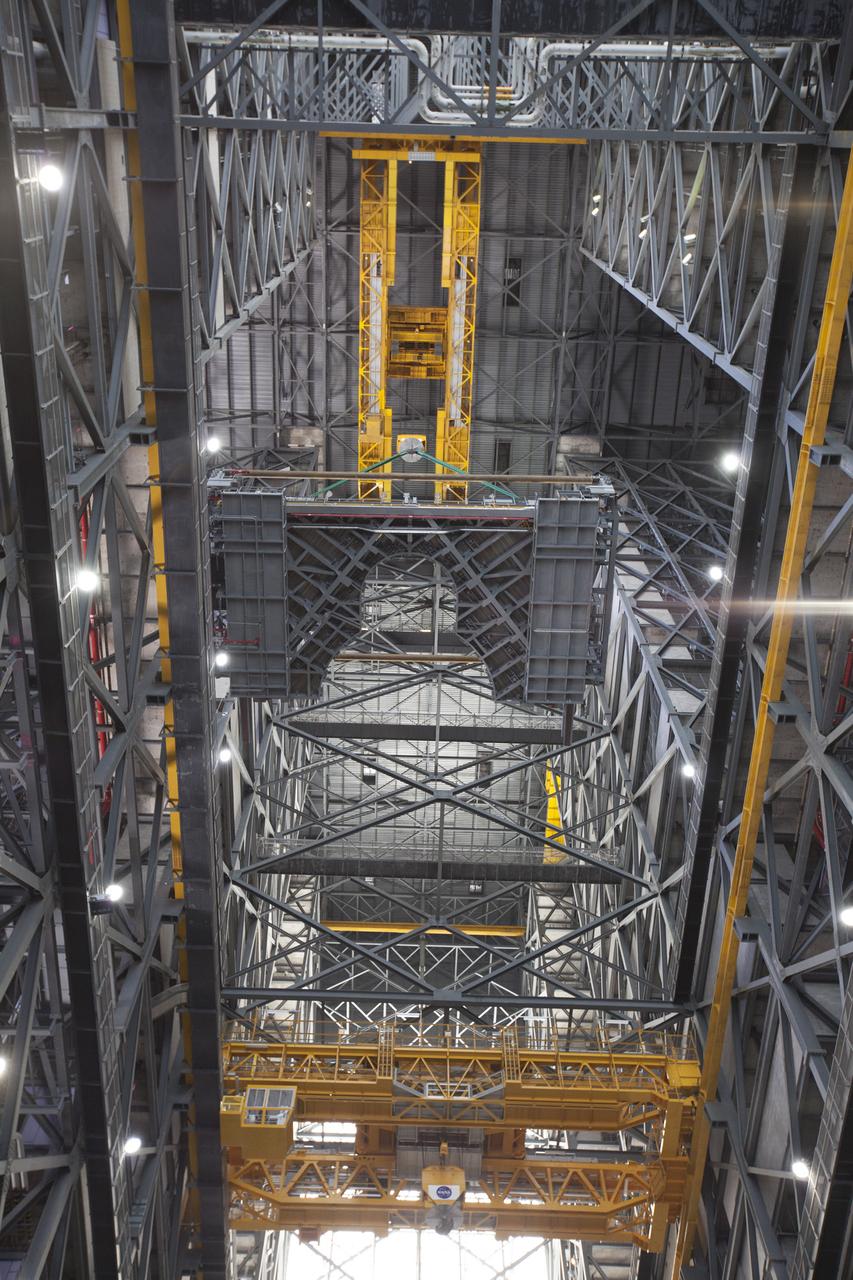
A 250-ton crane is used to lift the second half of the K-level work platforms for NASA’s Space Launch System (SLS) rocket high above the transfer aisle inside the Vehicle Assembly Building at NASA's Kennedy Space Center in Florida. The platform is being lifted up for transfer into High Bay 3 for installation. The platform will be secured about 86 feet above the VAB floor, on tower E of the high bay. The K work platforms will provide access to the SLS core stage and solid rocket boosters during processing and stacking operations on the mobile launcher. The Ground Systems Development and Operations Program is overseeing upgrades and modifications to High Bay 3 to support processing of the SLS and Orion spacecraft. A total of 10 levels of new platforms, 20 platform halves altogether, will surround the SLS rocket and Orion spacecraft.
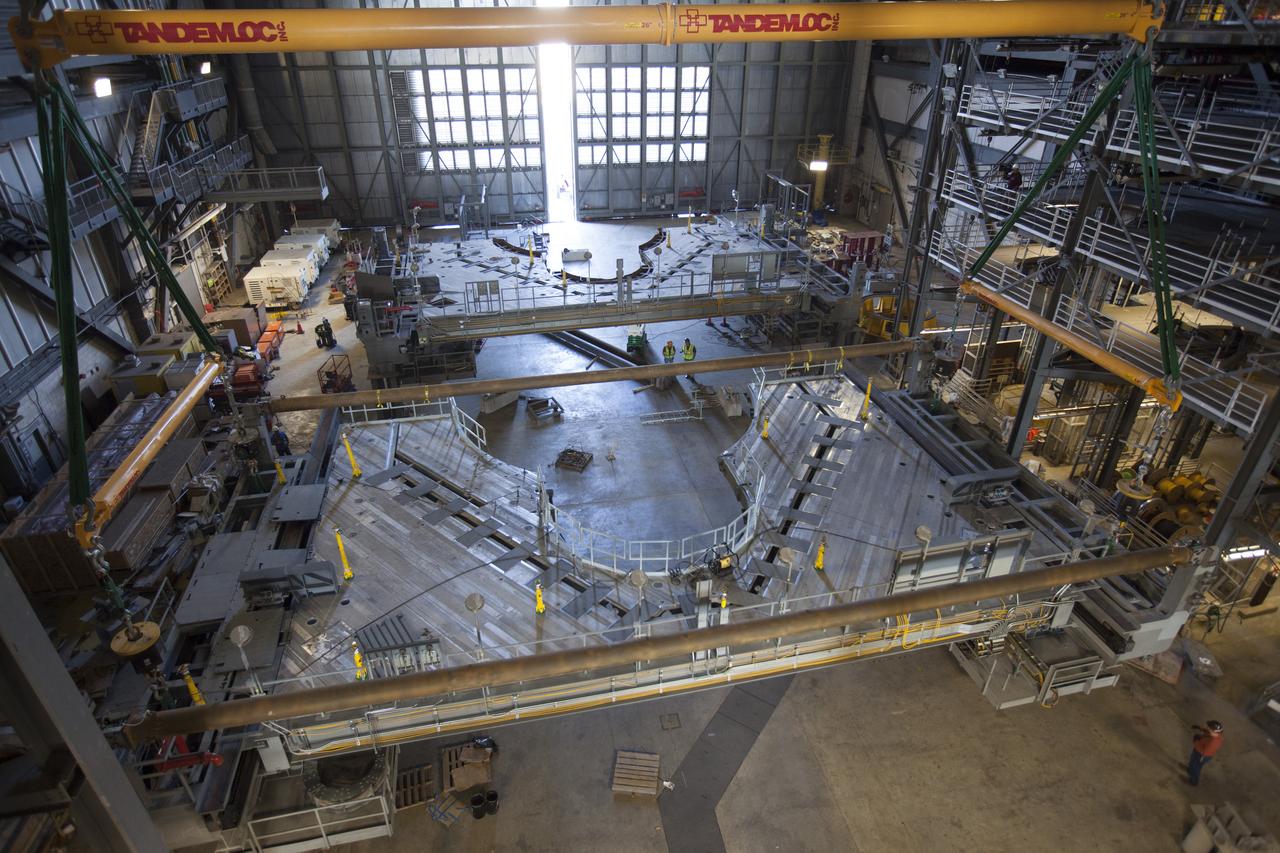
Preparations are underway to lift the second half of the K-level work platforms for NASA’s Space Launch System (SLS) rocket up from High Bay 4 inside the Vehicle Assembly Building at NASA's Kennedy Space Center in Florida. The platform will be lifted up and over the transfer aisle and then lowered into High Bay 3 for installation. It will be secured about 86 feet above the VAB floor, on tower E of the high bay. The K work platforms will provide access to the SLS core stage and solid rocket boosters during processing and stacking operations on the mobile launcher. The Ground Systems Development and Operations Program is overseeing upgrades and modifications to High Bay 3 to support processing of the SLS and Orion spacecraft. A total of 10 levels of new platforms, 20 platform halves altogether, will surround the SLS rocket and Orion spacecraft.
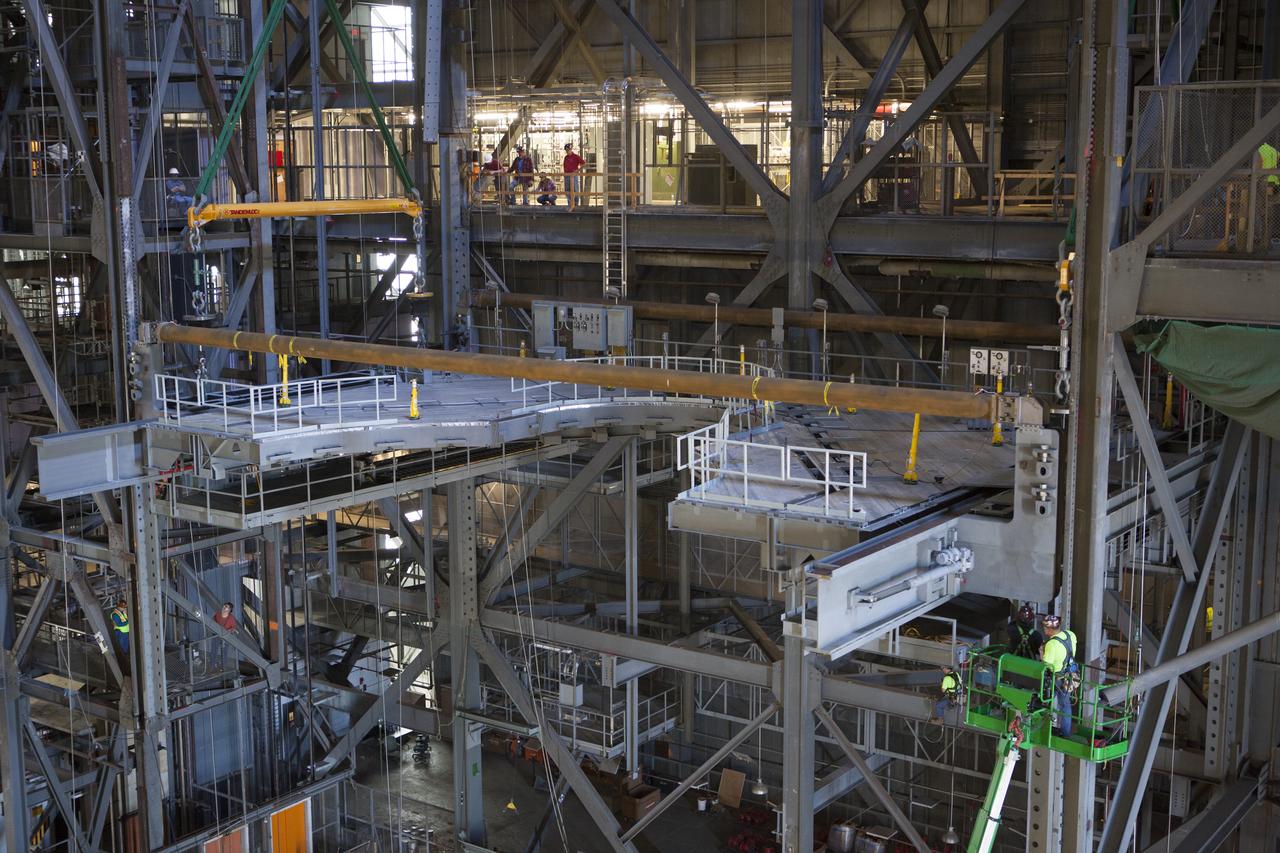
Work is underway to secure the second half of the K-level work platforms for NASA’s Space Launch System (SLS) rocket in High Bay 3 inside the Vehicle Assembly Building at NASA's Kennedy Space Center in Florida. The platform is being secured into position on tower E, about 86 feet above the floor. The K work platforms will provide access to NASA's Space Launch System (SLS) core stage and solid rocket boosters during processing and stacking operations on the mobile launcher. The Ground Systems Development and Operations Program is overseeing upgrades and modifications to High Bay 3 to support processing of the SLS and Orion spacecraft. A total of 10 levels of new platforms, 20 platform halves altogether, will surround the SLS rocket and Orion spacecraft.
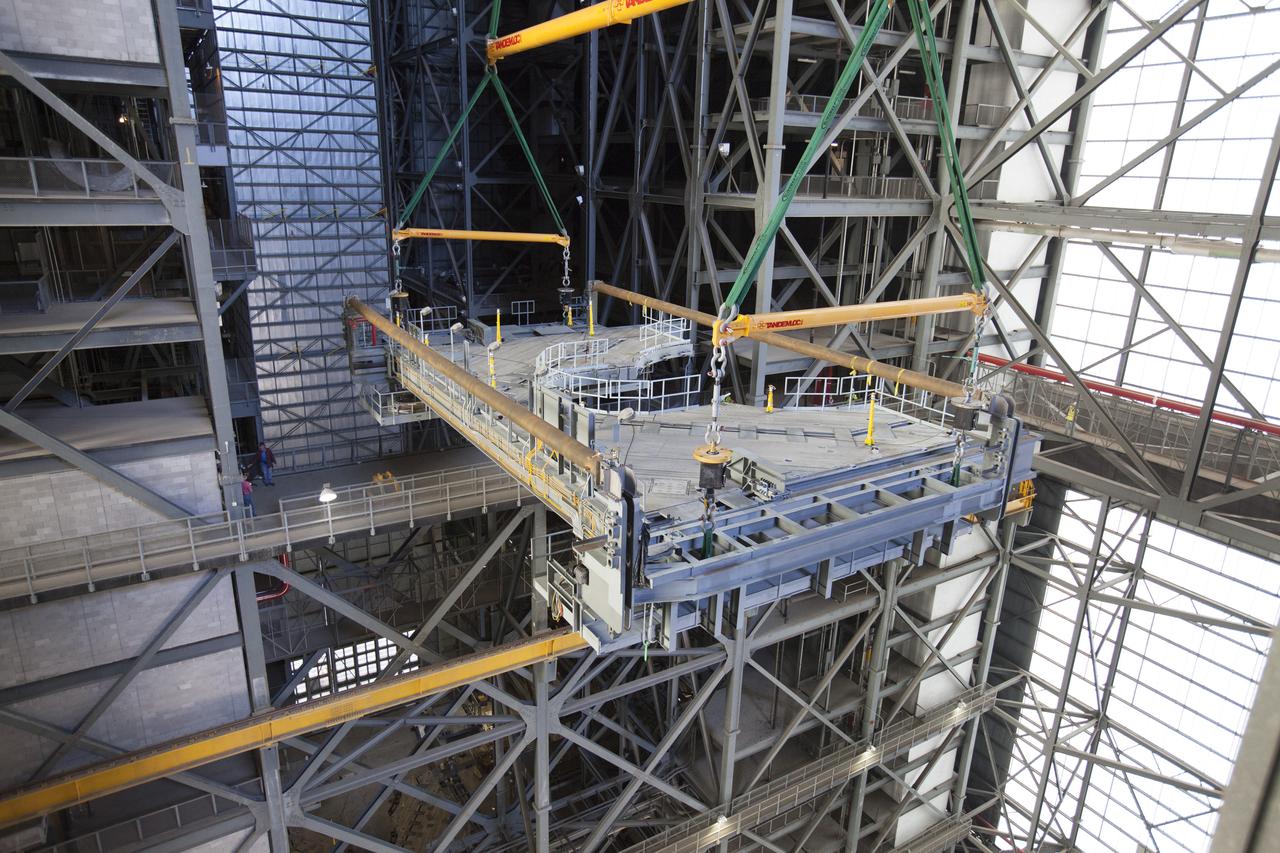
A 250-ton crane is used to lift the second half of the K-level work platforms for NASA’s Space Launch System (SLS) rocket up from High Bay 4 inside the Vehicle Assembly Building at NASA's Kennedy Space Center in Florida. The platform is being lifted up and over the transfer aisle and will be lowered into High Bay 3 for installation. It will be secured about 86 feet above the VAB floor, on tower E of the high bay. The K work platforms will provide access to the SLS core stage and solid rocket boosters during processing and stacking operations on the mobile launcher. The Ground Systems Development and Operations Program is overseeing upgrades and modifications to High Bay 3 to support processing of the SLS and Orion spacecraft. A total of 10 levels of new platforms, 20 platform halves altogether, will surround the SLS rocket and Orion spacecraft.
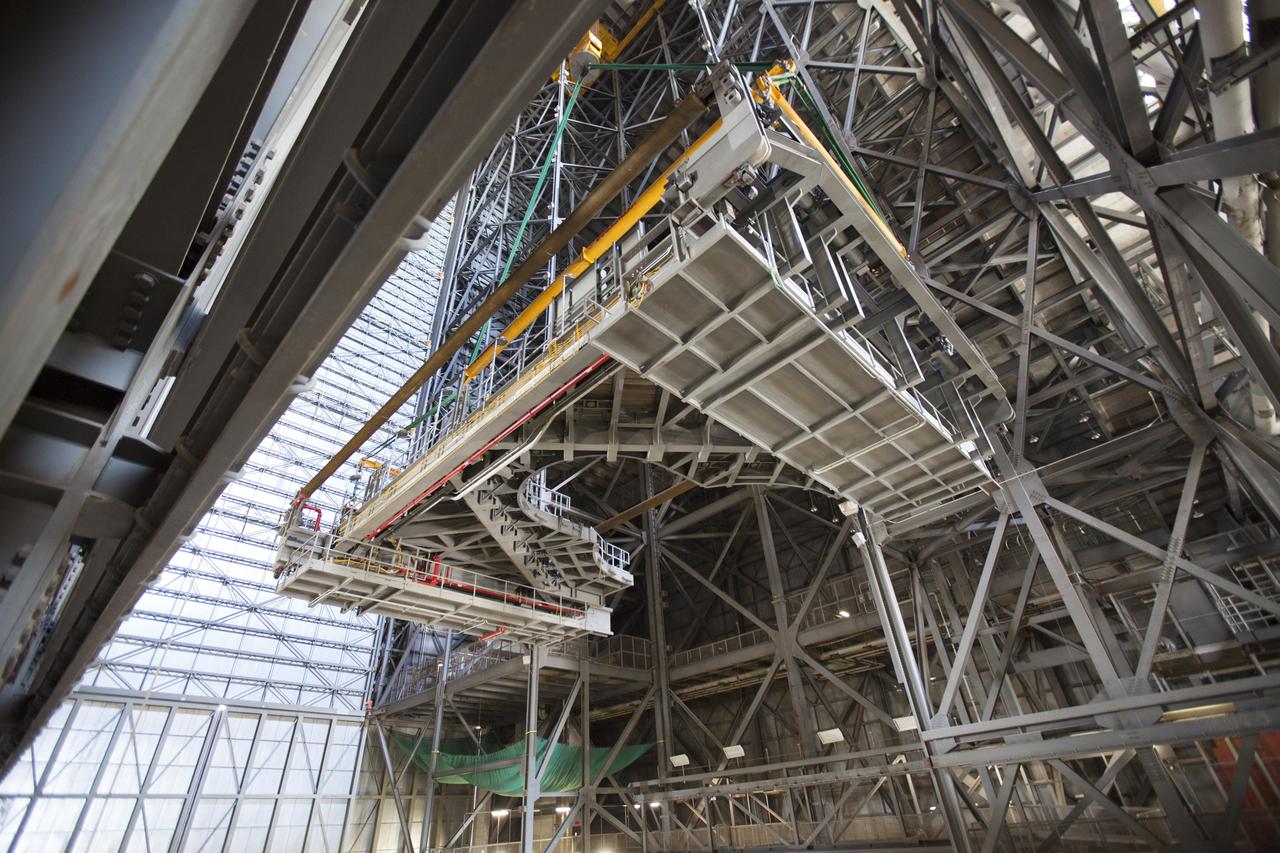
A 250-ton crane is used to lift the second half of the K-level work platforms for NASA’s Space Launch System (SLS) rocket up from High Bay 4 inside the Vehicle Assembly Building at NASA's Kennedy Space Center in Florida. The platform will be lifted up and over the transfer aisle and then lowered into High Bay 3 for installation. It will be secured about 86 feet above the VAB floor, on tower E of the high bay. The K work platforms will provide access to the SLS core stage and solid rocket boosters during processing and stacking operations on the mobile launcher. The Ground Systems Development and Operations Program is overseeing upgrades and modifications to High Bay 3 to support processing of the SLS and Orion spacecraft. A total of 10 levels of new platforms, 20 platform halves altogether, will surround the SLS rocket and Orion spacecraft.
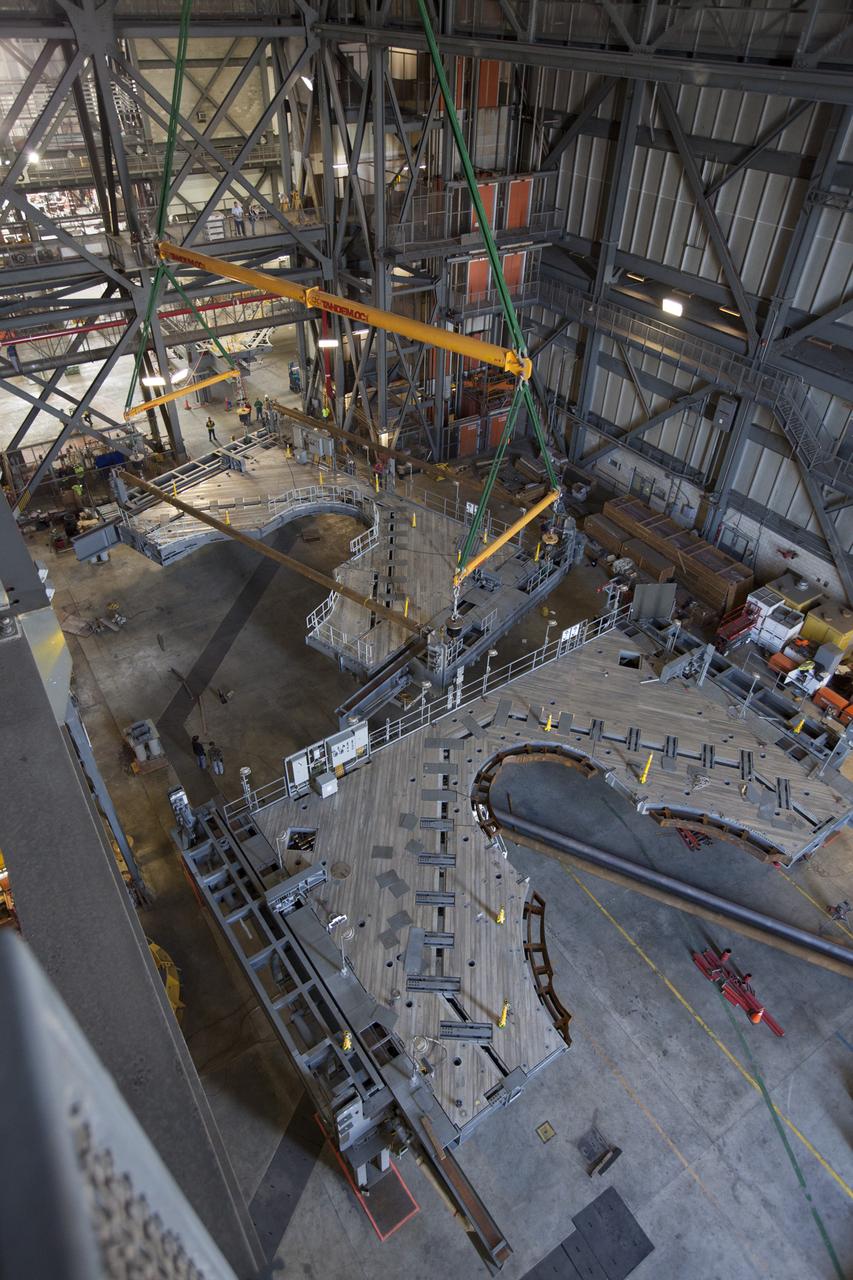
Preparations are underway to lift the second half of the K-level work platforms for NASA’s Space Launch System (SLS) rocket up from High Bay 4 inside the Vehicle Assembly Building at NASA's Kennedy Space Center in Florida. The platform will be lifted up and over the transfer aisle and then lowered into High Bay 3 for installation. It will be secured about 86 feet above the VAB floor, on tower E of the high bay. The K work platforms will provide access to the SLS core stage and solid rocket boosters during processing and stacking operations on the mobile launcher. The Ground Systems Development and Operations Program is overseeing upgrades and modifications to High Bay 3 to support processing of the SLS and Orion spacecraft. A total of 10 levels of new platforms, 20 platform halves altogether, will surround the SLS rocket and Orion spacecraft.
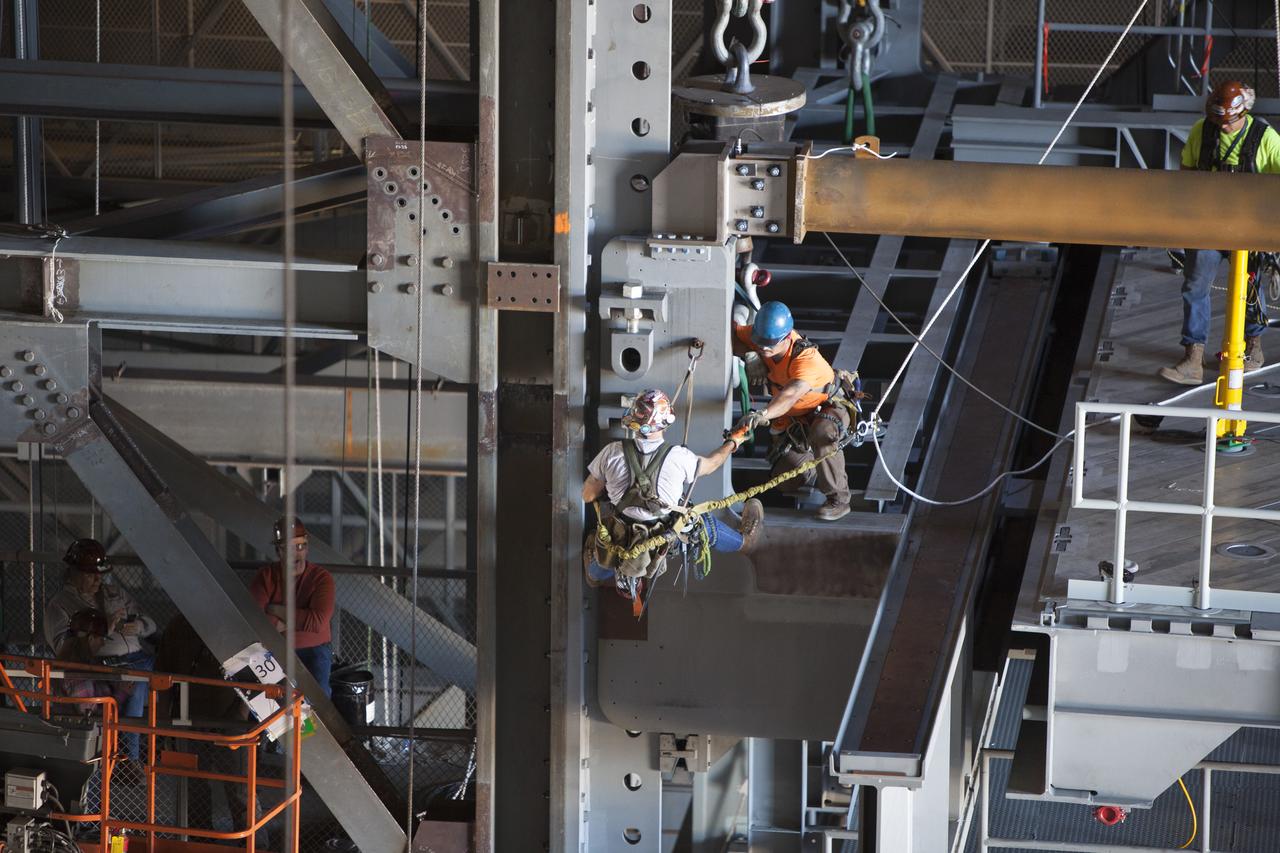
Work is underway to secure the second half of the K-level work platforms for NASA’s Space Launch System (SLS) rocket in High Bay 3 inside the Vehicle Assembly Building. For Spaceport Magazine.

KENNEDY SPACE CENTER, FLA. - At the SPACEHAB facility in Cape Canaveral, STS-114 Mission Specialist Stephen K. Robinson, Ph.D., (right) and Commander Eileen Collins (Colonel, USAF) participate in familiarization activities on the equipment that will fly on the STS-114 mission. STS-114 is a utilization and logistics flight that will carry Multi-Purpose Logistics Module Raffaello and the External Stowage Platform (ESP-2), as well as the Expedition 7 crew, to the International Space Station. Launch is targeted for March 1, 2003.
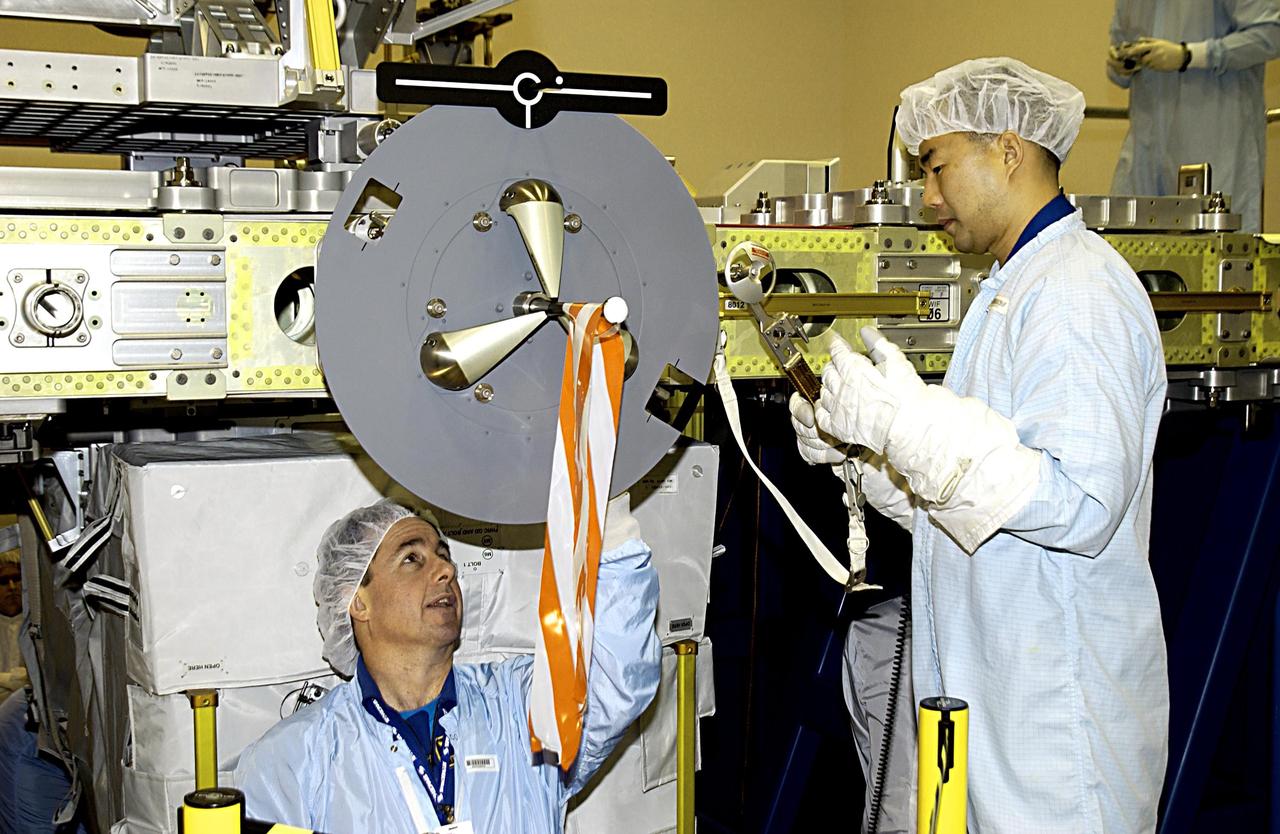
KENNEDY SPACE CENTER, FLA. - At the SPACEHAB facility in Cape Canaveral, STS-114 Mission Specialists Stephen K. Robinson, Ph.D., (left) and Soichi Noguchi, with the National Space Development Agency of Japan (NASDA), participate in familiarization activities with the hardware that will fly on the STS-114 mission. STS-114 is a utilization and logistics flight that will carry Multi-Purpose Logistics Module Raffaello and the External Stowage Platform (ESP-2), as well as the Expedition 7 crew, to the International Space Station. Launch is targeted for March 1, 2003.
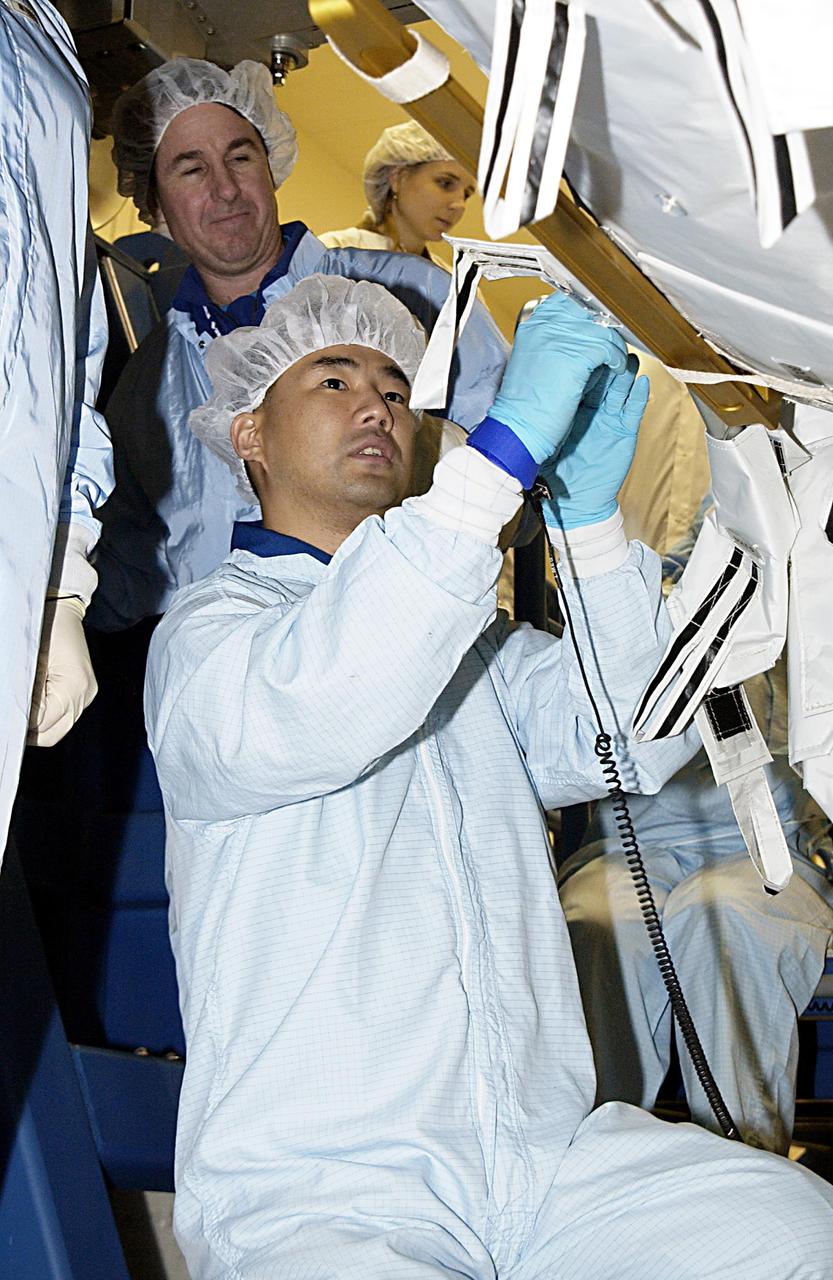
KENNEDY SPACE CENTER, FLA. - At the SPACEHAB facility in Cape Canaveral, STS-114 Mission Specialist Stephen K. Robinson, Ph.D., (left) looks on as Mission Specialist Soichi Noguchi (foreground), with the National Space Development Agency of Japan (NASDA), familiarizes himself with the hardware that will fly on the STS-114 mission. STS-114 is a utilization and logistics flight that will carry Multi-Purpose Logistics Module Raffaello and the External Stowage Platform (ESP-2), as well as the Expedition 7 crew, to the International Space Station. Launch is targeted for March 1, 2003.
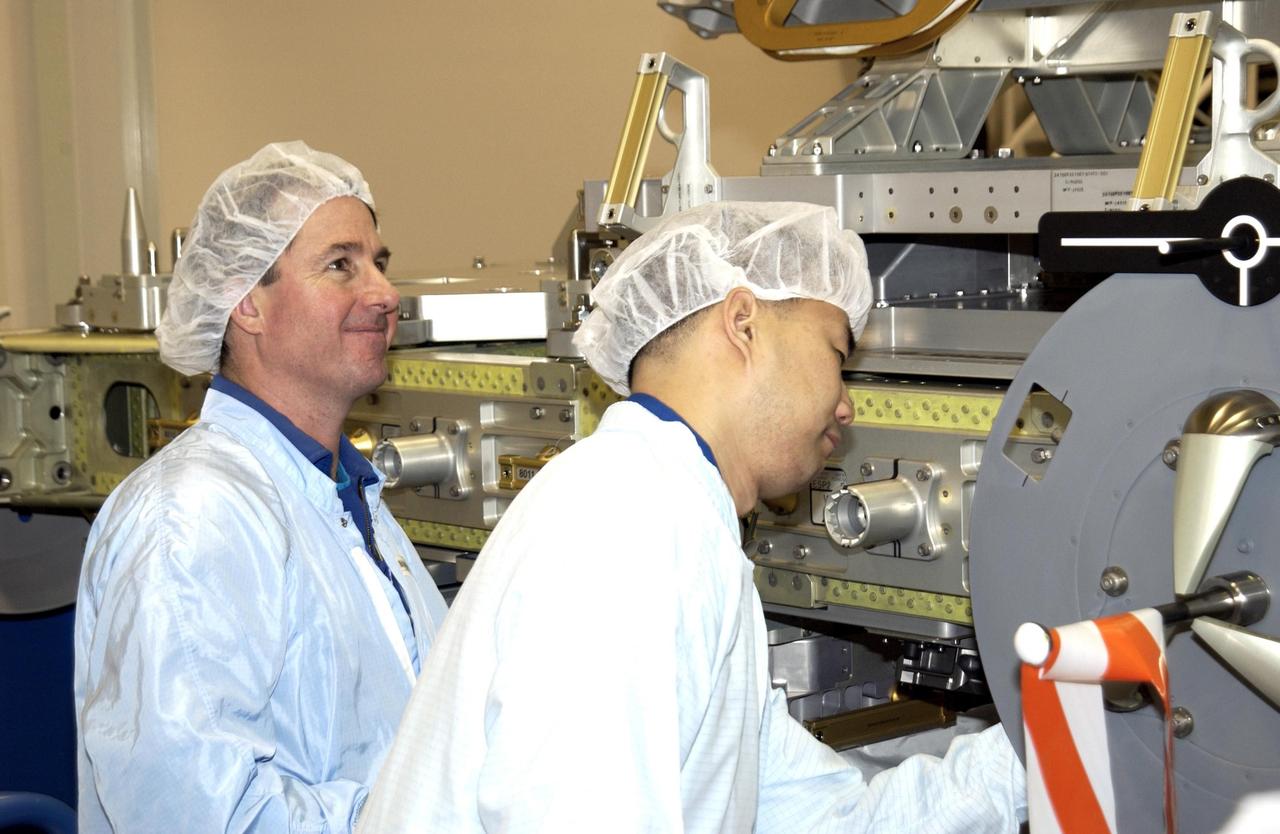
KENNEDY SPACE CENTER, FLA. - At the SPACEHAB facility in Cape Canaveral, STS-114 Mission Specialists Stephen K. Robinson, Ph.D., (left) and Soichi Noguchi, with the National Space Development Agency of Japan (NASDA), participate in familiarization activities with the hardware that will fly on the STS-114 mission. STS-114 is a utilization and logistics flight that will carry Multi-Purpose Logistics Module Raffaello and the External Stowage Platform (ESP-2), as well as the Expedition 7 crew, to the International Space Station. Launch is targeted for March 1, 2003.
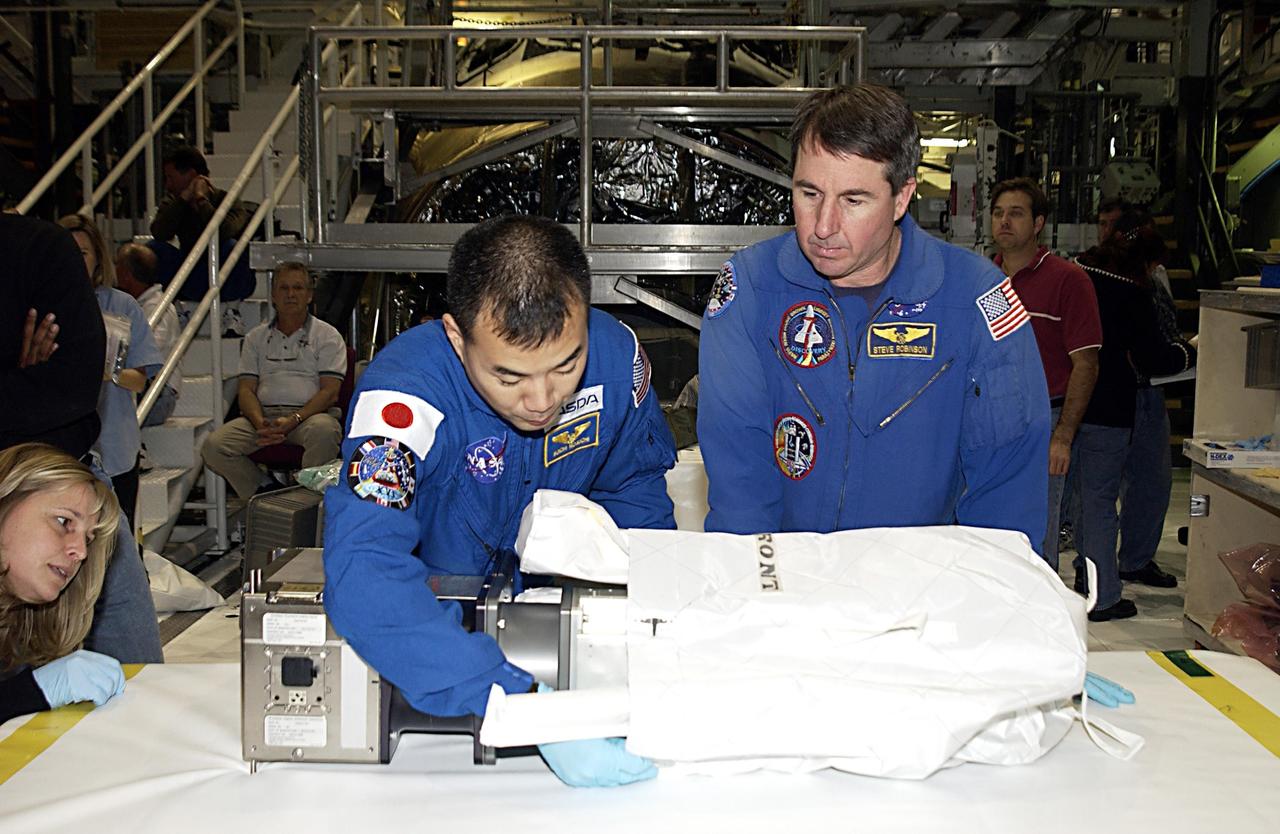
KENNEDY SPACE CENTER, FLA. -- STS-114 Mission Specialist Soichi Noguchi, with the National Space Development Agency of Japan (NASDA), works with equipment as Mission Specialist Stephen K. Robinson, Ph.D., (right) watches. The STS-114 crew is participating in familiarization activities with the hardware that will fly on the mission. STS-114 is a utilization and logistics flight (ULF-1) that will carry Multi-Purpose Logistics Module Raffaello and the External Stowage Platform (ESP-2), as well as the Expedition 7 crew, to the International Space Station. Launch is targeted for March 1, 2003.
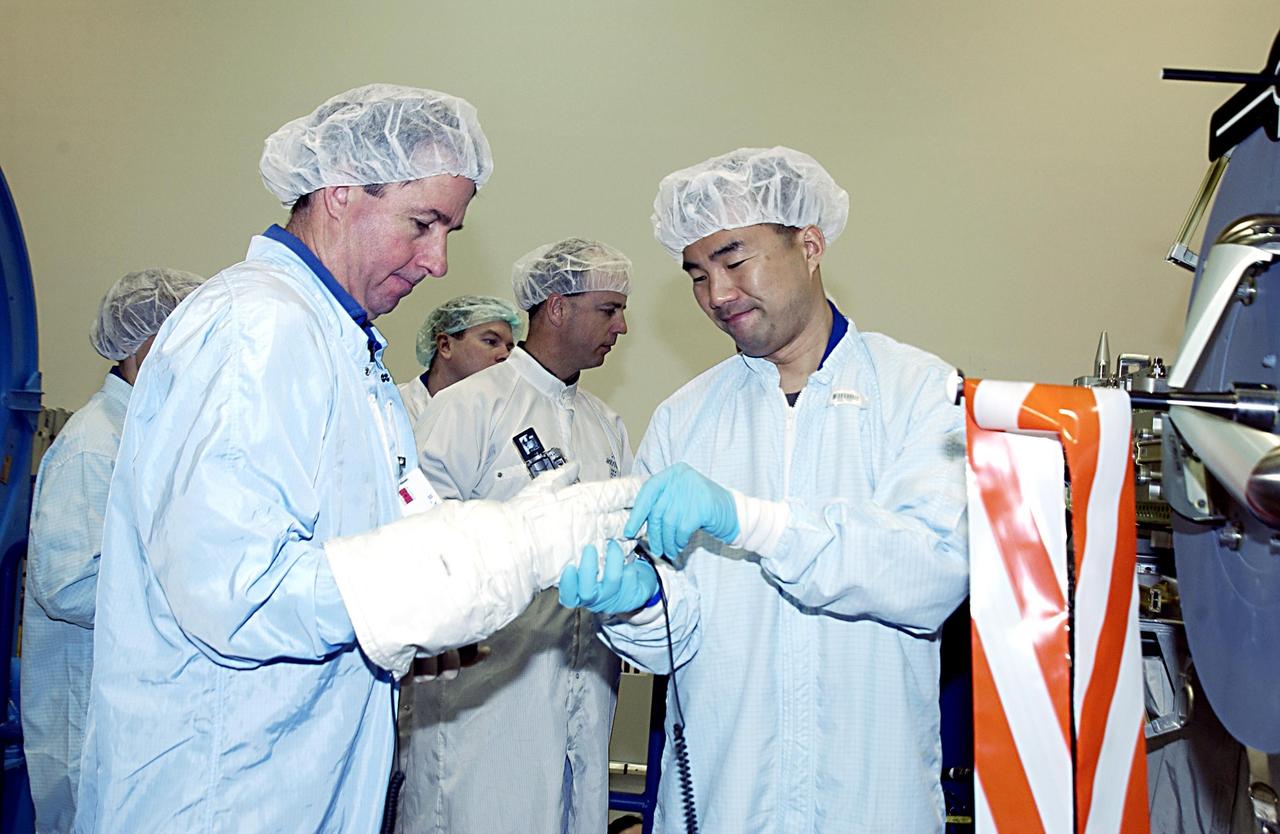
KENNEDY SPACE CENTER, FLA. - At the SPACEHAB facility in Cape Canaveral, STS-114 Mission Specialist Stephen K. Robinson, Ph.D., (left foreground) gets help with a glove from Mission Specialist Soichi Noguchi (right), of the National Space Development Agency of Japan (NASDA). They are participating in familiarization activities with the hardware that will fly on the STS-114 mission. STS-114 is a utilization and logistics flight that will carry Multi-Purpose Logistics Module Raffaello and the External Stowage Platform (ESP-2), as well as the Expedition 7 crew, to the International Space Station. Launch is targeted for March 1, 2003.
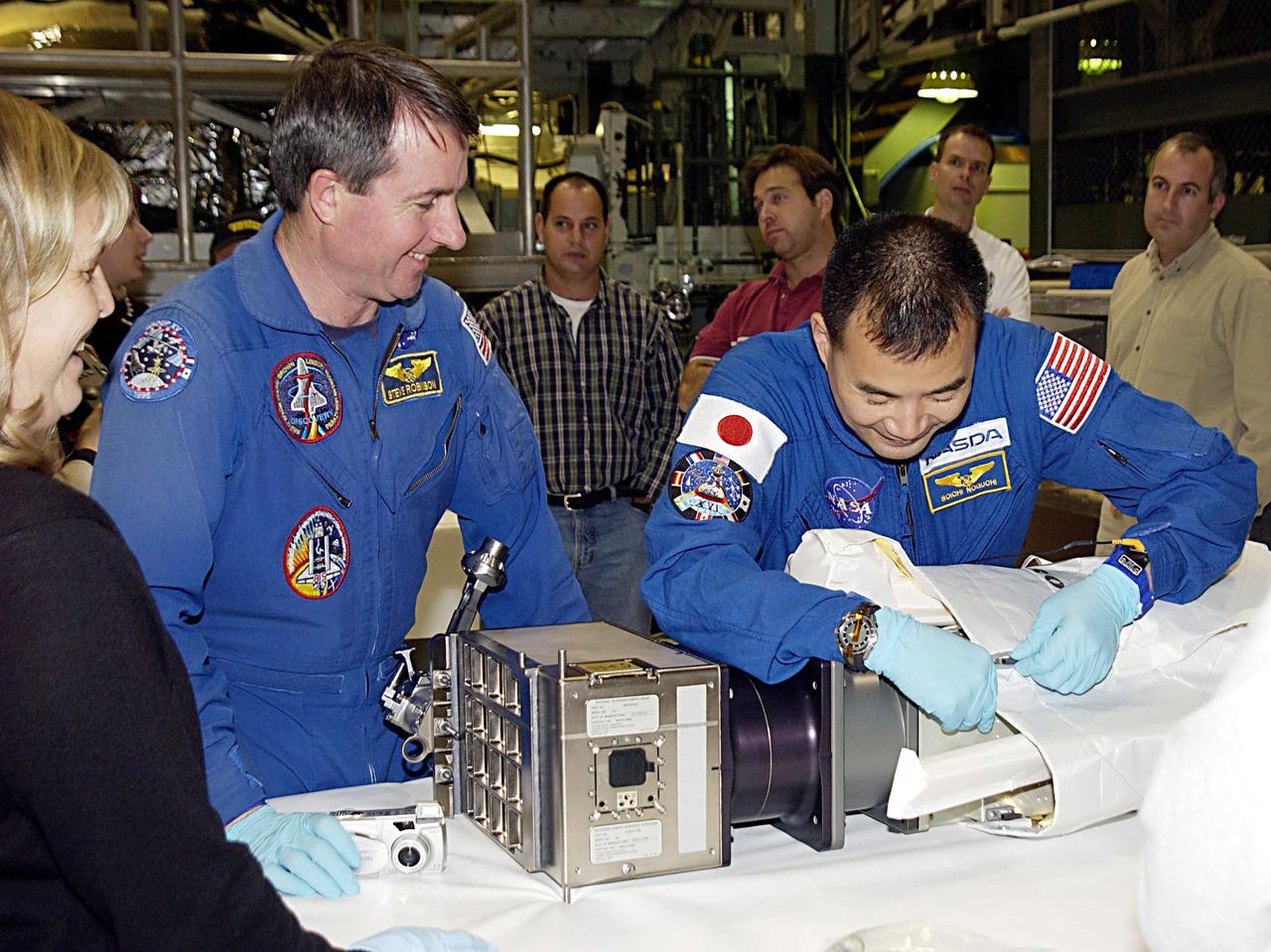
KENNEDY SPACE CENTER, FLA. -- STS-114 Mission Specialist Soichi Noguchi (right), with the National Space Development Agency of Japan (NASDA), works with equipment as Mission Specialist Stephen K. Robinson, Ph.D., (left) watches. The STS-114 crew is participating in familiarization activities with the hardware that will fly on the mission. STS-114 is a utilization and logistics flight (ULF-1) that will carry Multi-Purpose Logistics Module Raffaello and the External Stowage Platform (ESP-2), as well as the Expedition 7 crew, to the International Space Station. Launch is targeted for March 1, 2003.
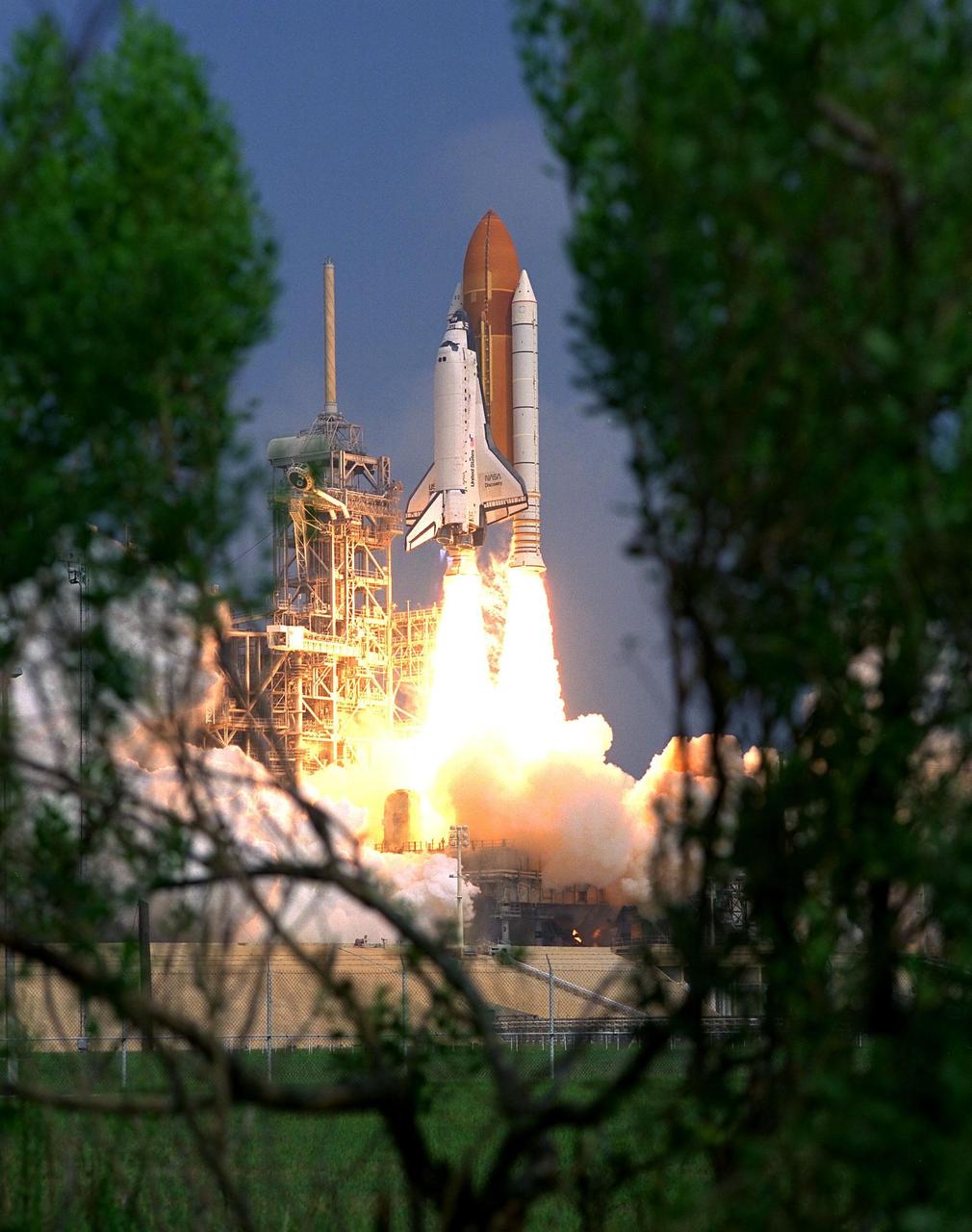
KENNEDY SPACE CENTER, Fla. -- Blasting through the hazy late morning sky, the Space Shuttle Discovery soars from Launch Pad 39A at 10:41 a.m. EDT Aug. 7 on the 11-day STS-85 mission. Aboard Discovery are Commander Curtis L. Brown, Jr.; Pilot Kent V. Rominger, Payload Commander N. Jan Davis, Mission Specialist Robert L. Curbeam, Jr., Mission Specialist Stephen K. Robinson and Payload Specialist Bjarni V. Tryggvason, a Canadian Space Agency astronaut . The primary payload aboard the Space Shuttle orbiter Discovery is the Cryogenic Infrared Spectrometers and Telescopes for the Atmosphere-Shuttle Pallet Satellite-2 (CRISTA-SPAS-2) free-flyer. The CRISTA-SPAS-2 will be deployed on flight day 1 to study trace gases in the Earth’s atmosphere as a part of NASA’s Mission to Planet Earth program. Also aboard the free-flying research platform will be the Middle Atmosphere High Resolution Spectrograph Instrument (MAHRSI). Other payloads on the 11-day mission include the Manipulator Flight Demonstration (MFD), a Japanese Space Agency-sponsored experiment. Also in Discovery’s payload bay are the Technology Applications and Science-1 (TAS-1) and International Extreme Ultraviolet Hitchhiker-2 (IEH-2) experiments
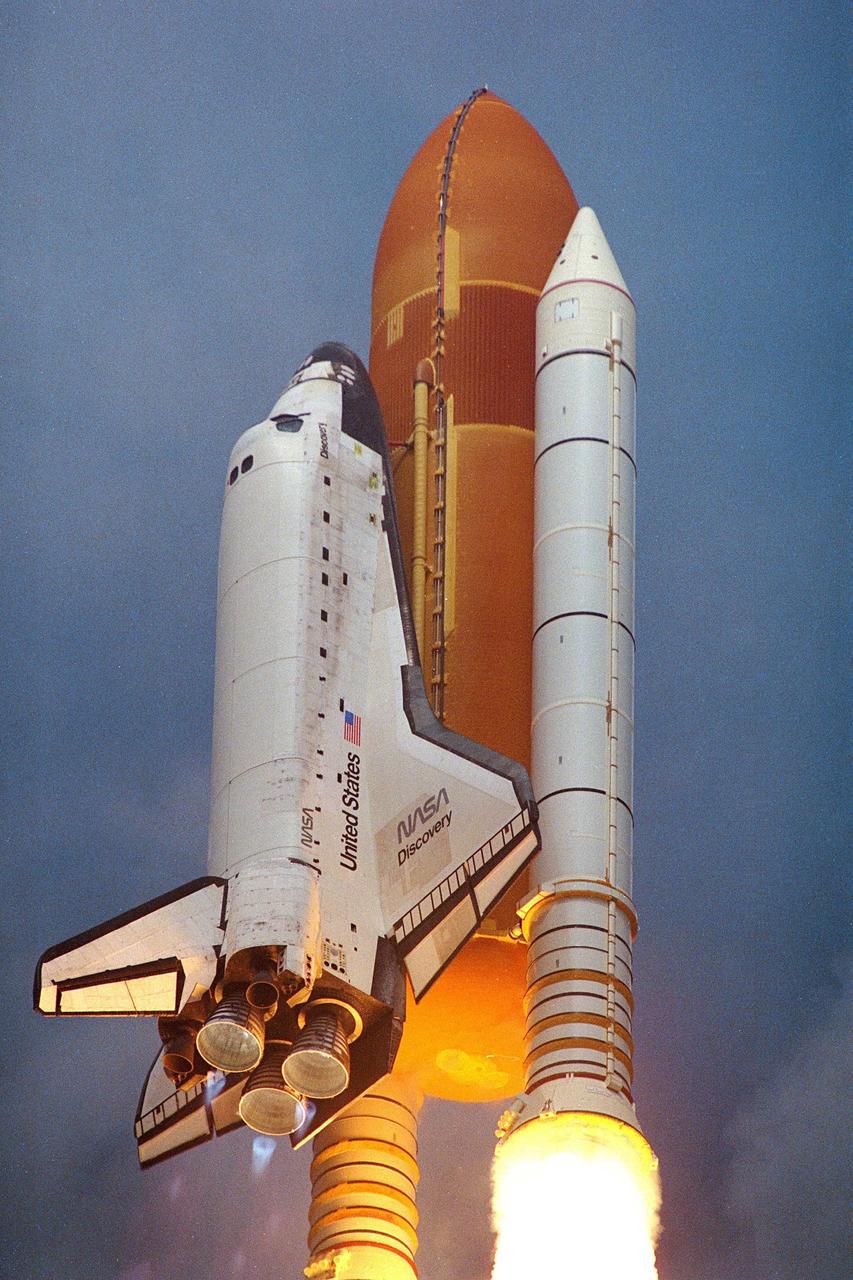
KENNEDY SPACE CENTER, Fla. -- Blasting through the hazy late morning sky, the Space Shuttle Discovery soars from Launch Pad 39A at 10:41 a.m. EDT Aug. 7 on the 11-day STS-85 mission. Aboard Discovery are Commander Curtis L. Brown, Jr.; Pilot Kent V. Rominger, Payload Commander N. Jan Davis, Mission Specialist Robert L. Curbeam, Jr., Mission Specialist Stephen K. Robinson and Payload Specialist Bjarni V. Tryggvason, a Canadian Space Agency astronaut . The primary payload aboard the Space Shuttle orbiter Discovery is the Cryogenic Infrared Spectrometers and Telescopes for the Atmosphere-Shuttle Pallet Satellite-2 (CRISTA-SPAS-2) free-flyer. The CRISTA-SPAS-2 will be deployed on flight day 1 to study trace gases in the Earth’s atmosphere as a part of NASA’s Mission to Planet Earth program. Also aboard the free-flying research platform will be the Middle Atmosphere High Resolution Spectrograph Instrument (MAHRSI). Other payloads on the 11-day mission include the Manipulator Flight Demonstration (MFD), a Japanese Space Agency-sponsored experiment. Also in Discovery’s payload bay are the Technology Applications and Science-1 (TAS-1) and International Extreme Ultraviolet Hitchhiker-2 (IEH-2) experiments
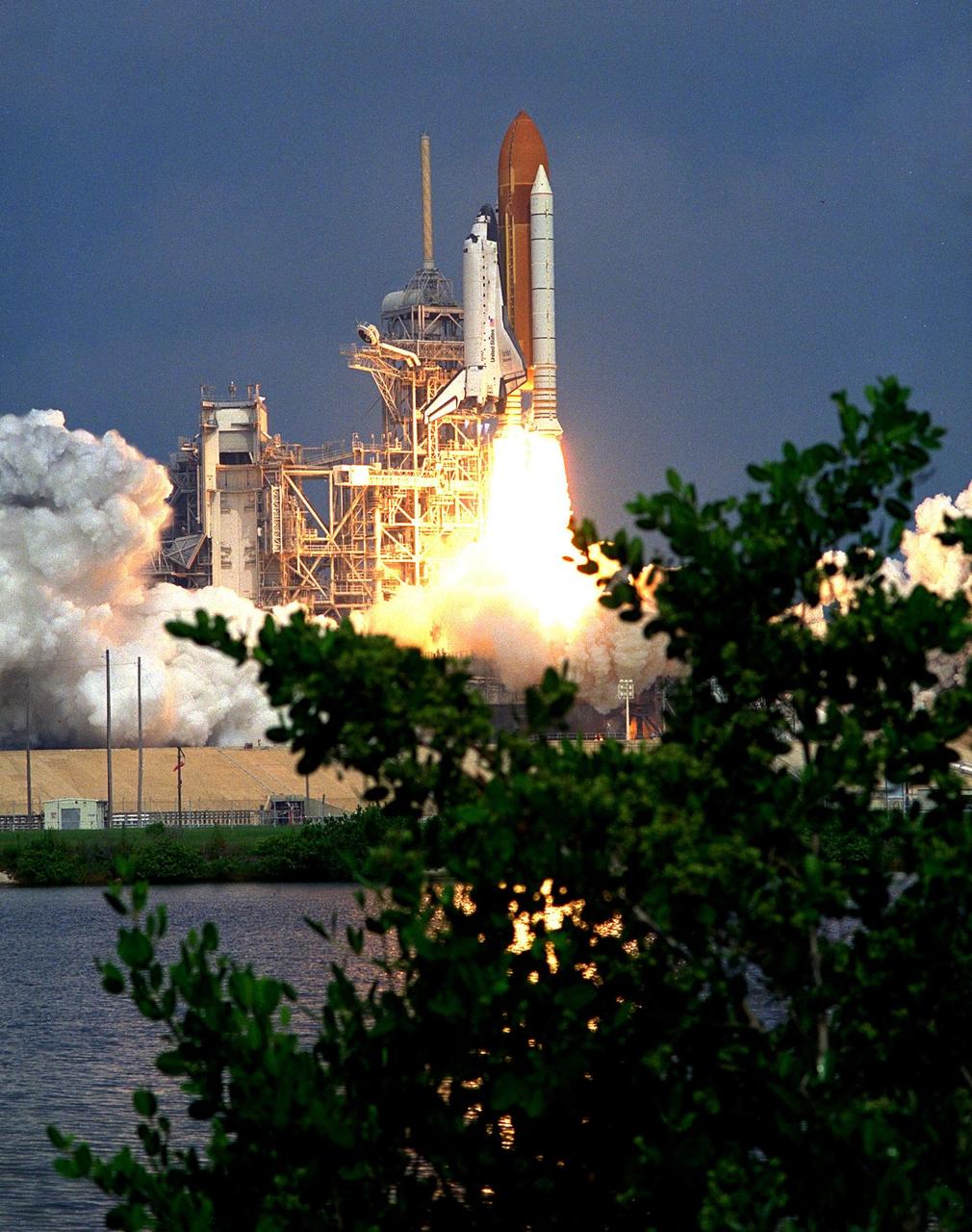
KENNEDY SPACE CENTER, Fla. -- Blasting through the hazy late morning sky, the Space Shuttle Discovery soars from Launch Pad 39A at 10:41 a.m. EDT Aug. 7 on the 11-day STS-85 mission. Aboard Discovery are Commander Curtis L. Brown, Jr.; Pilot Kent V. Rominger, Payload Commander N. Jan Davis, Mission Specialist Robert L. Curbeam, Jr., Mission Specialist Stephen K. Robinson and Payload Specialist Bjarni V. Tryggvason, a Canadian Space Agency astronaut . The primary payload aboard the Space Shuttle orbiter Discovery is the Cryogenic Infrared Spectrometers and Telescopes for the Atmosphere-Shuttle Pallet Satellite-2 (CRISTA-SPAS-2) free-flyer. The CRISTA-SPAS-2 will be deployed on flight day 1 to study trace gases in the Earth’s atmosphere as a part of NASA’s Mission to Planet Earth program. Also aboard the free-flying research platform will be the Middle Atmosphere High Resolution Spectrograph Instrument (MAHRSI). Other payloads on the 11-day mission include the Manipulator Flight Demonstration (MFD), a Japanese Space Agency-sponsored experiment. Also in Discovery’s payload bay are the Technology Applications and Science-1 (TAS-1) and International Extreme Ultraviolet Hitchhiker-2 (IEH-2) experiments
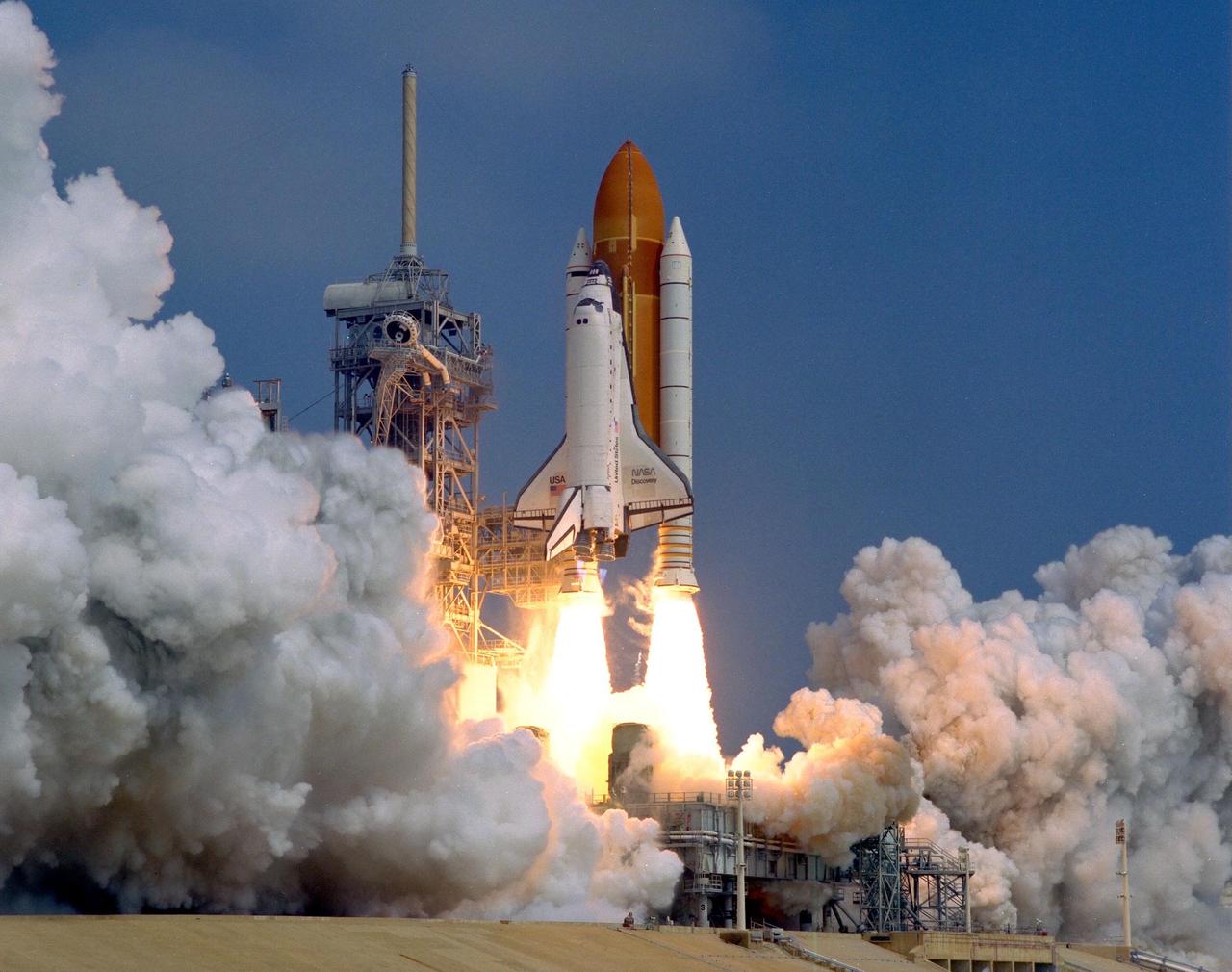
KENNEDY SPACE CENTER, Fla. -- Blasting through the hazy late morning sky, the Space Shuttle Discovery soars from Launch Pad 39A at 10:41 a.m. EDT Aug. 7 on the 11-day STS-85 mission. Aboard Discovery are Commander Curtis L. Brown, Jr.; Pilot Kent V. Rominger, Payload Commander N. Jan Davis, Mission Specialist Robert L. Curbeam, Jr., Mission Specialist Stephen K. Robinson and Payload Specialist Bjarni V. Tryggvason, a Canadian Space Agency astronaut . The primary payload aboard the Space Shuttle orbiter Discovery is the Cryogenic Infrared Spectrometers and Telescopes for the Atmosphere-Shuttle Pallet Satellite-2 (CRISTA-SPAS-2) free-flyer. The CRISTA-SPAS-2 will be deployed on flight day 1 to study trace gases in the Earth’s atmosphere as a part of NASA’s Mission to Planet Earth program. Also aboard the free-flying research platform will be the Middle Atmosphere High Resolution Spectrograph Instrument (MAHRSI). Other payloads on the 11-day mission include the Manipulator Flight Demonstration (MFD), a Japanese Space Agency-sponsored experiment. Also in Discovery’s payload bay are the Technology Applications and Science-1 (TAS-1) and International Extreme Ultraviolet Hitchhiker-2 (IEH-2) experiments
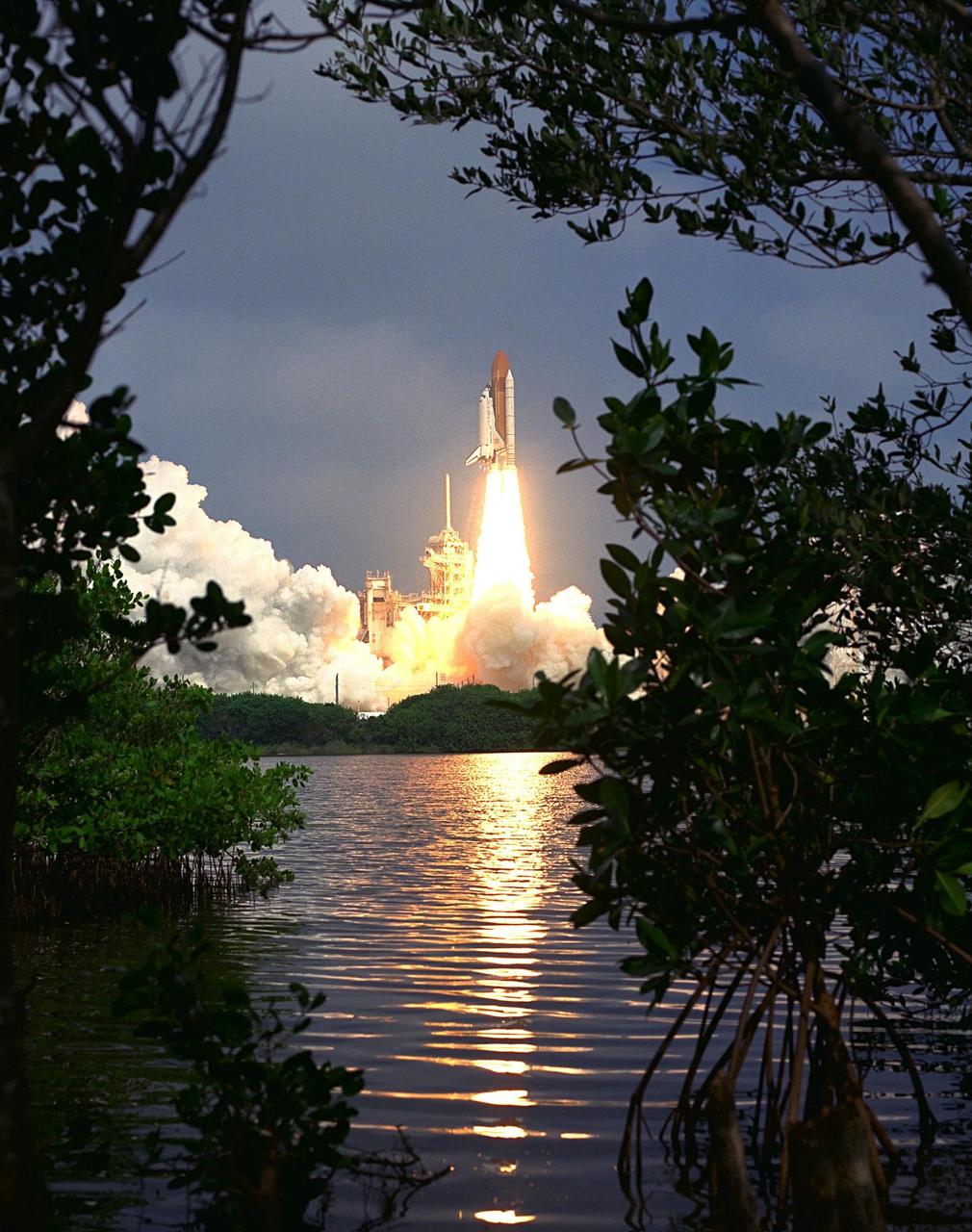
KENNEDY SPACE CENTER, Fla. -- Blasting through the hazy late morning sky, the Space Shuttle Discovery soars from Launch Pad 39A at 10:41 a.m. EDT Aug. 7 on the 11-day STS-85 mission. Aboard Discovery are Commander Curtis L. Brown, Jr.; Pilot Kent V. Rominger, Payload Commander N. Jan Davis, Mission Specialist Robert L. Curbeam, Jr., Mission Specialist Stephen K. Robinson and Payload Specialist Bjarni V. Tryggvason, a Canadian Space Agency astronaut . The primary payload aboard the Space Shuttle orbiter Discovery is the Cryogenic Infrared Spectrometers and Telescopes for the Atmosphere-Shuttle Pallet Satellite-2 (CRISTA-SPAS-2) free-flyer. The CRISTA-SPAS-2 will be deployed on flight day 1 to study trace gases in the Earth’s atmosphere as a part of NASA’s Mission to Planet Earth program. Also aboard the free-flying research platform will be the Middle Atmosphere High Resolution Spectrograph Instrument (MAHRSI). Other payloads on the 11-day mission include the Manipulator Flight Demonstration (MFD), a Japanese Space Agency-sponsored experiment. Also in Discovery’s payload bay are the Technology Applications and Science-1 (TAS-1) and International Extreme Ultraviolet Hitchhiker-2 (IEH-2) experiments
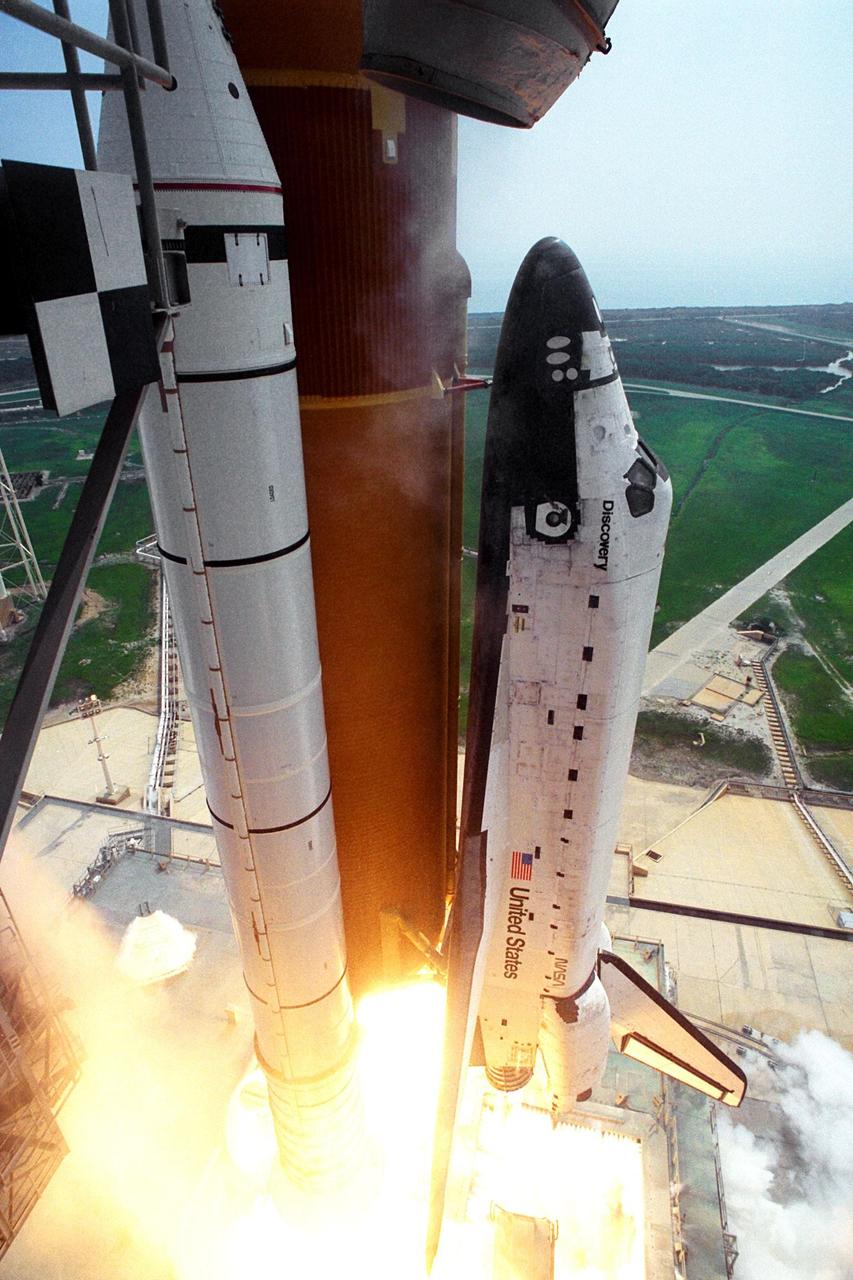
KENNEDY SPACE CENTER, Fla. -- Blasting through the hazy late morning sky, the Space Shuttle Discovery soars from Launch Pad 39A at 10:41 a.m. EDT Aug. 7 on the 11-day STS-85 mission. Aboard Discovery are Commander Curtis L. Brown, Jr.; Pilot Kent V. Rominger, Payload Commander N. Jan Davis, Mission Specialist Robert L. Curbeam, Jr., Mission Specialist Stephen K. Robinson and Payload Specialist Bjarni V. Tryggvason, a Canadian Space Agency astronaut . The primary payload aboard the Space Shuttle orbiter Discovery is the Cryogenic Infrared Spectrometers and Telescopes for the Atmosphere-Shuttle Pallet Satellite-2 (CRISTA-SPAS-2) free-flyer. The CRISTA-SPAS-2 will be deployed on flight day 1 to study trace gases in the Earth’s atmosphere as a part of NASA’s Mission to Planet Earth program. Also aboard the free-flying research platform will be the Middle Atmosphere High Resolution Spectrograph Instrument (MAHRSI). Other payloads on the 11-day mission include the Manipulator Flight Demonstration (MFD), a Japanese Space Agency-sponsored experiment. Also in Discovery’s payload bay are the Technology Applications and Science-1 (TAS-1) and International Extreme Ultraviolet Hitchhiker-2 (IEH-2) experiments
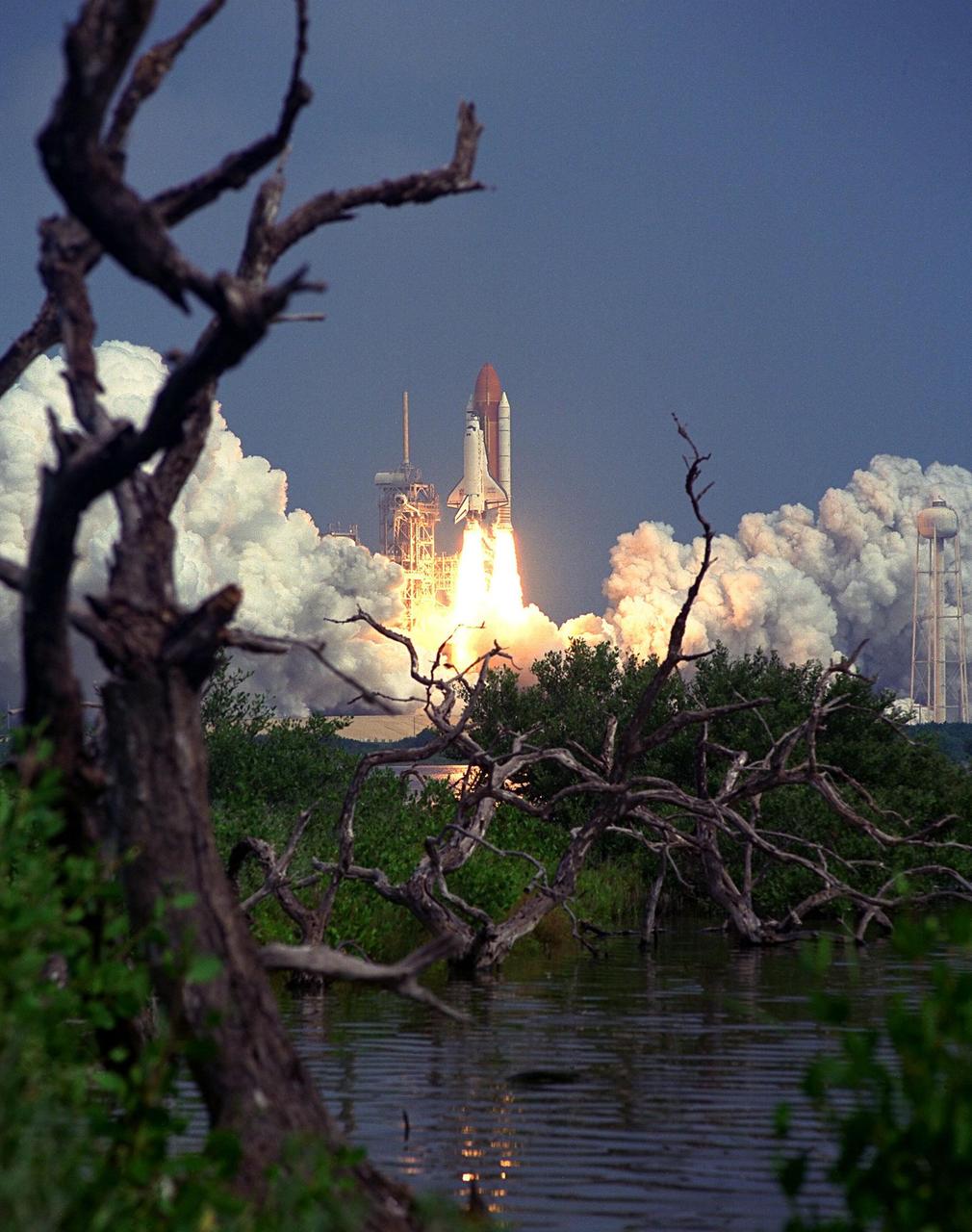
KENNEDY SPACE CENTER, Fla. -- Blasting through the hazy late morning sky, the Space Shuttle Discovery soars from Launch Pad 39A at 10:41 a.m. EDT Aug. 7 on the 11-day STS-85 mission. Aboard Discovery are Commander Curtis L. Brown, Jr.; Pilot Kent V. Rominger, Payload Commander N. Jan Davis, Mission Specialist Robert L. Curbeam, Jr., Mission Specialist Stephen K. Robinson and Payload Specialist Bjarni V. Tryggvason, a Canadian Space Agency astronaut . The primary payload aboard the Space Shuttle orbiter Discovery is the Cryogenic Infrared Spectrometers and Telescopes for the Atmosphere-Shuttle Pallet Satellite-2 (CRISTA-SPAS-2) free-flyer. The CRISTA-SPAS-2 will be deployed on flight day 1 to study trace gases in the Earth’s atmosphere as a part of NASA’s Mission to Planet Earth program. Also aboard the free-flying research platform will be the Middle Atmosphere High Resolution Spectrograph Instrument (MAHRSI). Other payloads on the 11-day mission include the Manipulator Flight Demonstration (MFD), a Japanese Space Agency-sponsored experiment. Also in Discovery’s payload bay are the Technology Applications and Science-1 (TAS-1) and International Extreme Ultraviolet Hitchhiker-2 (IEH-2) experiments
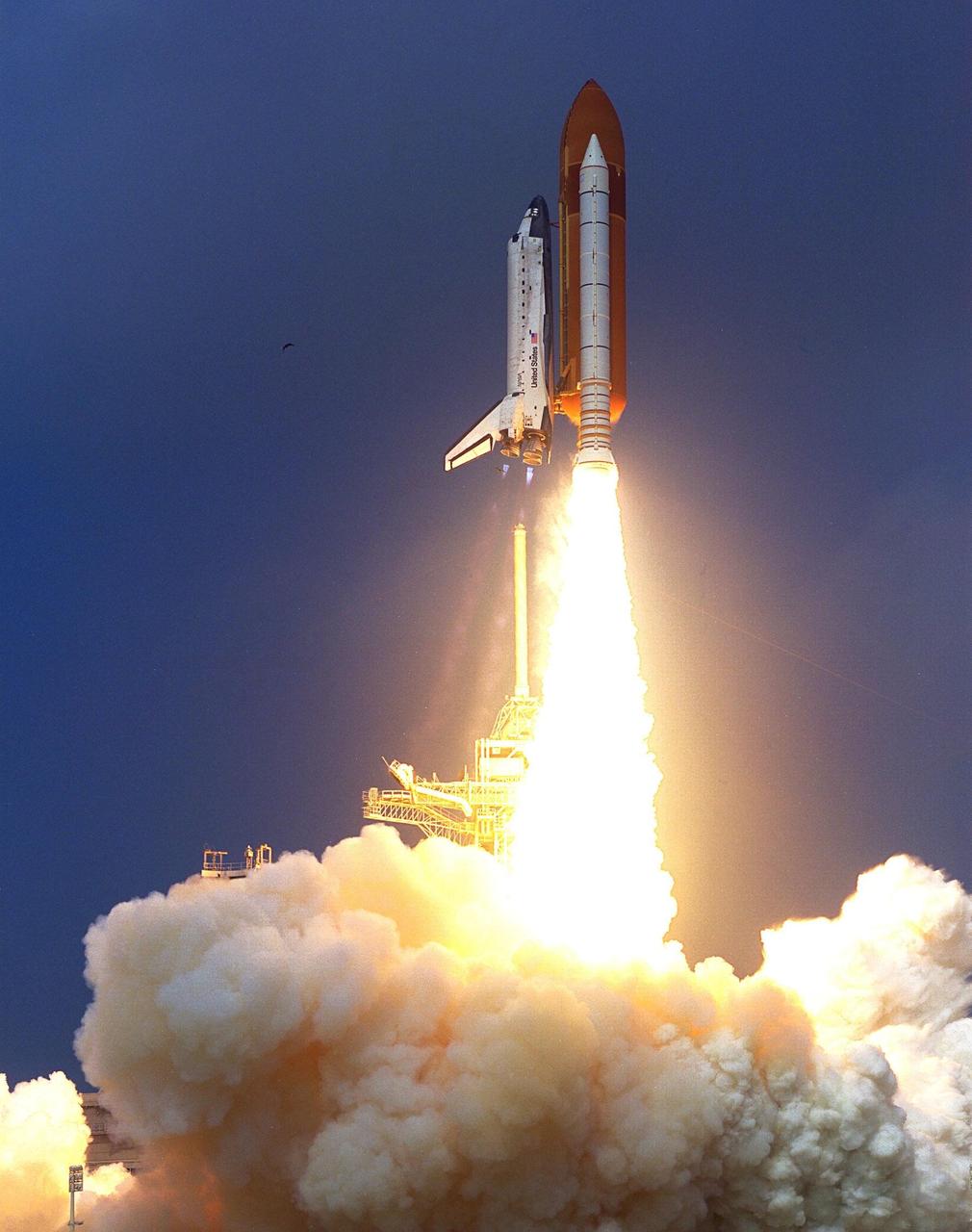
KENNEDY SPACE CENTER, Fla. -- Blasting through the hazy late morning sky, the Space Shuttle Discovery soars from Launch Pad 39A at 10:41 a.m. EDT Aug. 7 on the 11-day STS-85 mission. Aboard Discovery are Commander Curtis L. Brown, Jr.; Pilot Kent V. Rominger, Payload Commander N. Jan Davis, Mission Specialist Robert L. Curbeam, Jr., Mission Specialist Stephen K. Robinson and Payload Specialist Bjarni V. Tryggvason, a Canadian Space Agency astronaut . The primary payload aboard the Space Shuttle orbiter Discovery is the Cryogenic Infrared Spectrometers and Telescopes for the Atmosphere-Shuttle Pallet Satellite-2 (CRISTA-SPAS-2) free-flyer. The CRISTA-SPAS-2 will be deployed on flight day 1 to study trace gases in the Earth’s atmosphere as a part of NASA’s Mission to Planet Earth program. Also aboard the free-flying research platform will be the Middle Atmosphere High Resolution Spectrograph Instrument (MAHRSI). Other payloads on the 11-day mission include the Manipulator Flight Demonstration (MFD), a Japanese Space Agency-sponsored experiment. Also in Discovery’s payload bay are the Technology Applications and Science-1 (TAS-1) and International Extreme Ultraviolet Hitchhiker-2 (IEH-2) experiments
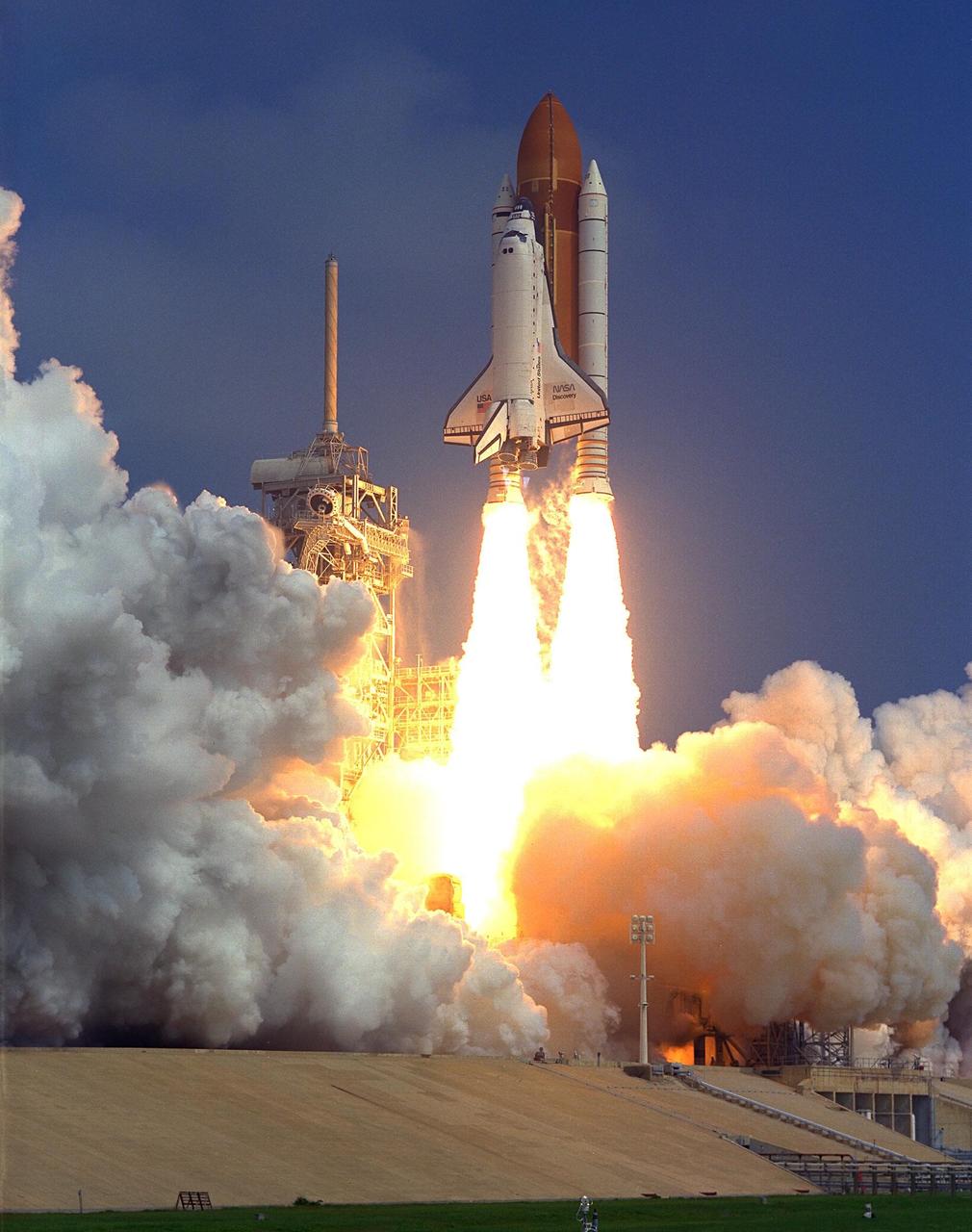
KENNEDY SPACE CENTER, Fla. -- Blasting through the hazy late morning sky, the Space Shuttle Discovery soars from Launch Pad 39A at 10:41 a.m. EDT Aug. 7 on the 11-day STS-85 mission. Aboard Discovery are Commander Curtis L. Brown, Jr.; Pilot Kent V. Rominger, Payload Commander N. Jan Davis, Mission Specialist Robert L. Curbeam, Jr., Mission Specialist Stephen K. Robinson and Payload Specialist Bjarni V. Tryggvason, a Canadian Space Agency astronaut . The primary payload aboard the Space Shuttle orbiter Discovery is the Cryogenic Infrared Spectrometers and Telescopes for the Atmosphere-Shuttle Pallet Satellite-2 (CRISTA-SPAS-2) free-flyer. The CRISTA-SPAS-2 will be deployed on flight day 1 to study trace gases in the Earth’s atmosphere as a part of NASA’s Mission to Planet Earth program. Also aboard the free-flying research platform will be the Middle Atmosphere High Resolution Spectrograph Instrument (MAHRSI). Other payloads on the 11-day mission include the Manipulator Flight Demonstration (MFD), a Japanese Space Agency-sponsored experiment. Also in Discovery’s payload bay are the Technology Applications and Science-1 (TAS-1) and International Extreme Ultraviolet Hitchhiker-2 (IEH-2) experiments
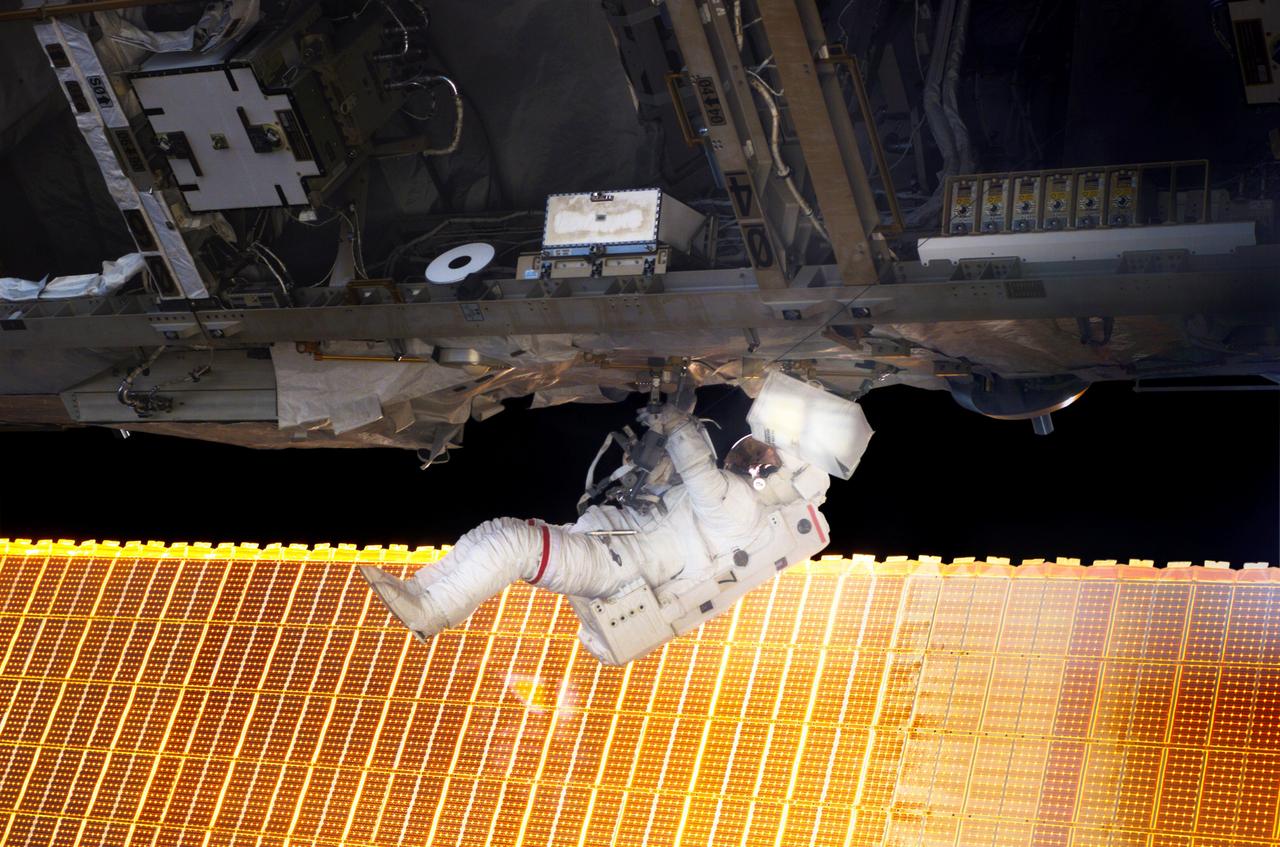
Launched on July 26, 2005 from the Kennedy Space Center in Florida, STS-114 was classified as Logistics Flight 1. Among the Station-related activities of the mission were the delivery of new supplies and the replacement of one of the orbital outpost's Control Moment Gyroscopes (CMGs). STS-114 also carried the Raffaello Multi-Purpose Logistics Module (MPLM) and the External Stowage Platform-2. In this photograph, astronaut Soichi Noguchi, STS-114 mission specialist representing the Japan Aerospace Exploration Agency (JAXA), participates in the mission’s first scheduled session of Extra-Vehicular Activity (EVA). Noguchi and crew mate Stephen K. Robinson (out of frame) completed a demonstration of Shuttle thermal protection repair techniques and enhancements to the ISS’s attitude control system during the successful 6 hour, 50 minute space walk.
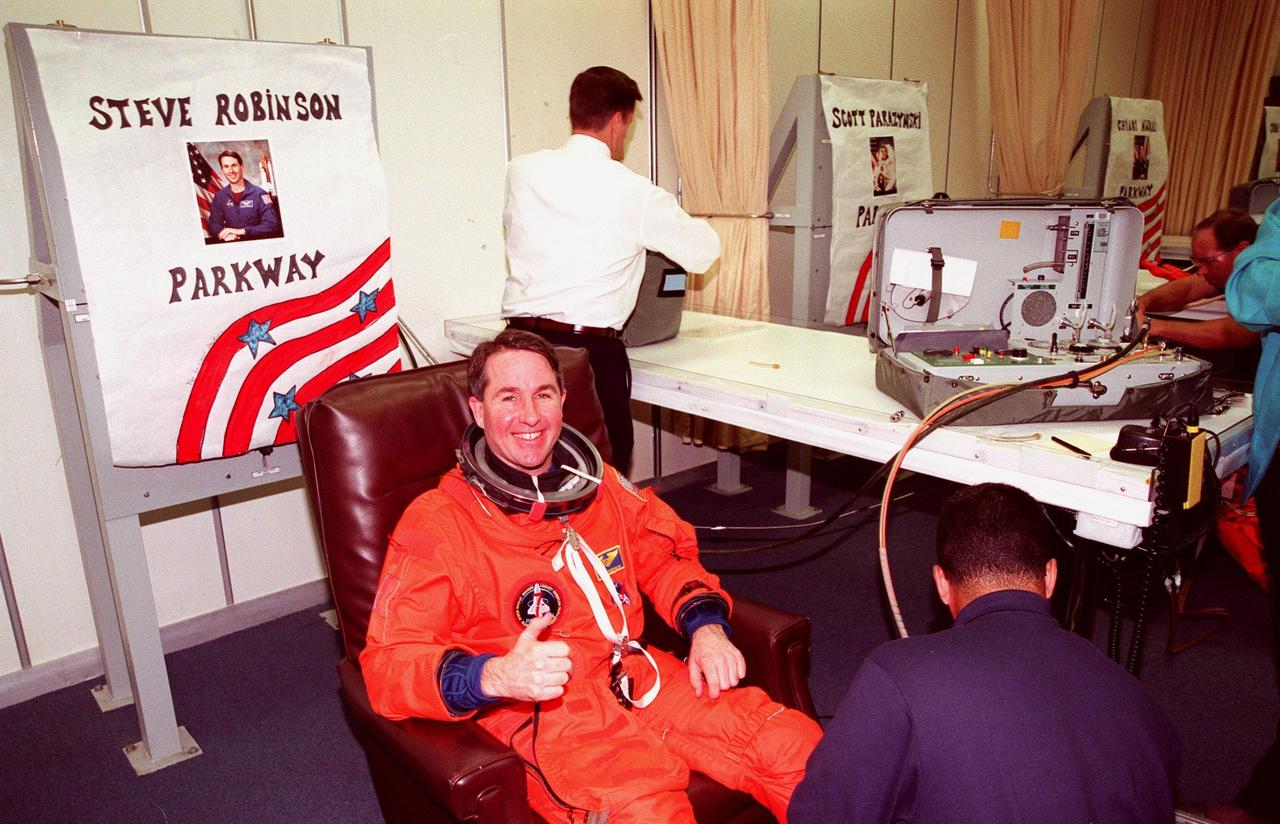
STS-95 Mission Specialist Stephen K. Robinson gives a thumbs up as he dons his flight suit in the Operations and Checkout Building with the help of suit tech George Brittingham (lower right). The final fitting takes place prior to the crew walkout and transport to Launch Pad 39B. Targeted for launch at 2 p.m. EST on Oct. 29, the mission is expected to last 8 days, 21 hours and 49 minutes, and return to KSC at 11:49 a.m. EST on Nov. 7. The STS-95 mission includes research payloads such as the Spartan solar-observing deployable spacecraft, the Hubble Space Telescope Orbital Systems Test Platform, the International Extreme Ultraviolet Hitchhiker, as well as the SPACEHAB single module with experiments on space flight and the aging process
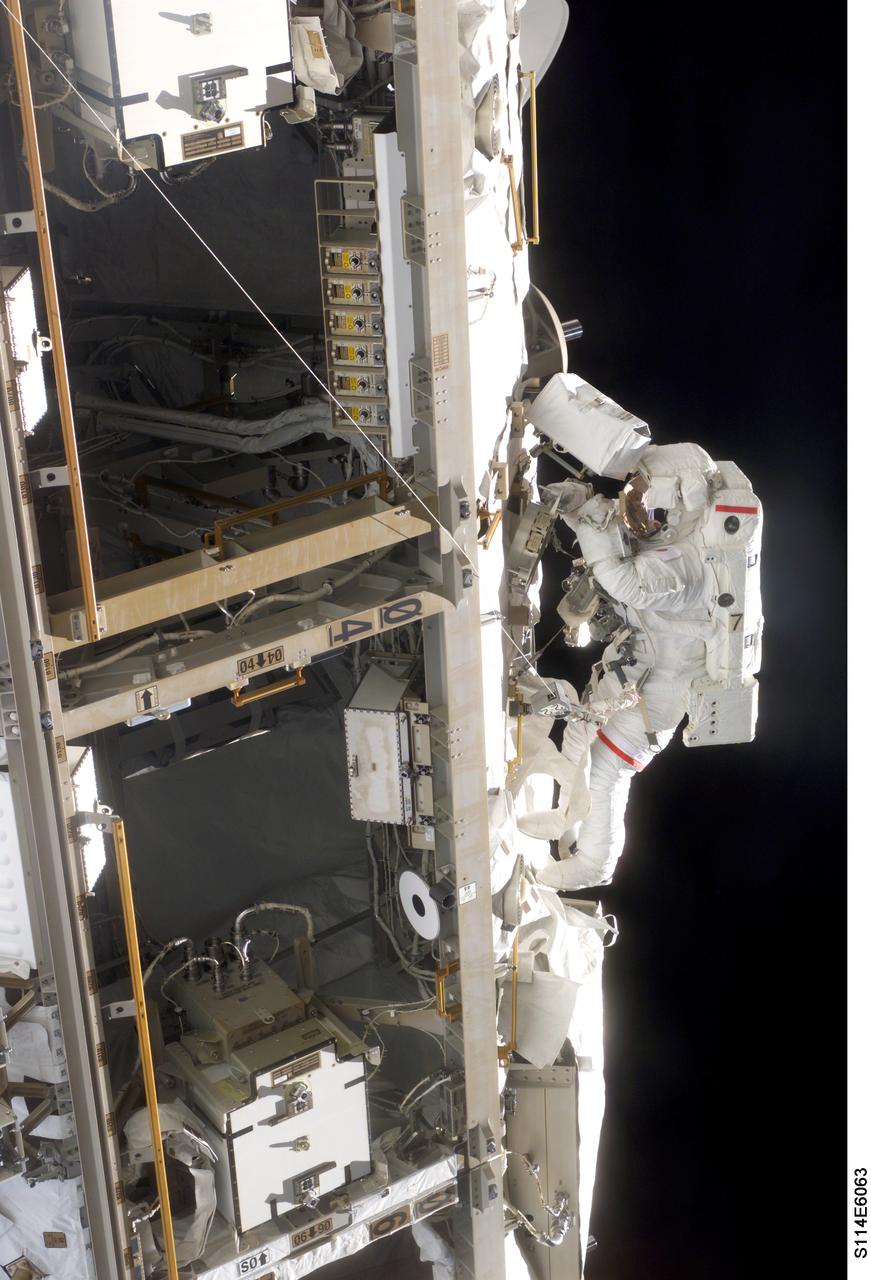
Launched on July 26, 2005 from the Kennedy Space Center in Florida, STS-114 was classified as Logistics Flight 1. Among the Station-related activities of the mission were the delivery of new supplies and the replacement of one of the orbital outpost's Control Moment Gyroscopes (CMGs). STS-114 also carried the Raffaello Multi-Purpose Logistics Module (MPLM) and the External Stowage Platform-2. In this photograph, astronaut Soichi Noguchi, STS-114 mission specialist representing the Japan Aerospace Exploration Agency (JAXA), participates in the mission’s first scheduled session of Extra Vehicular Activity (EVA). Noguchi and crew mate Stephen K. Robinson (out of frame) completed a demonstration of Shuttle thermal protection repair techniques and enhancements to the ISS’s attitude control system during the successful 6 hour, 50 minute space walk.
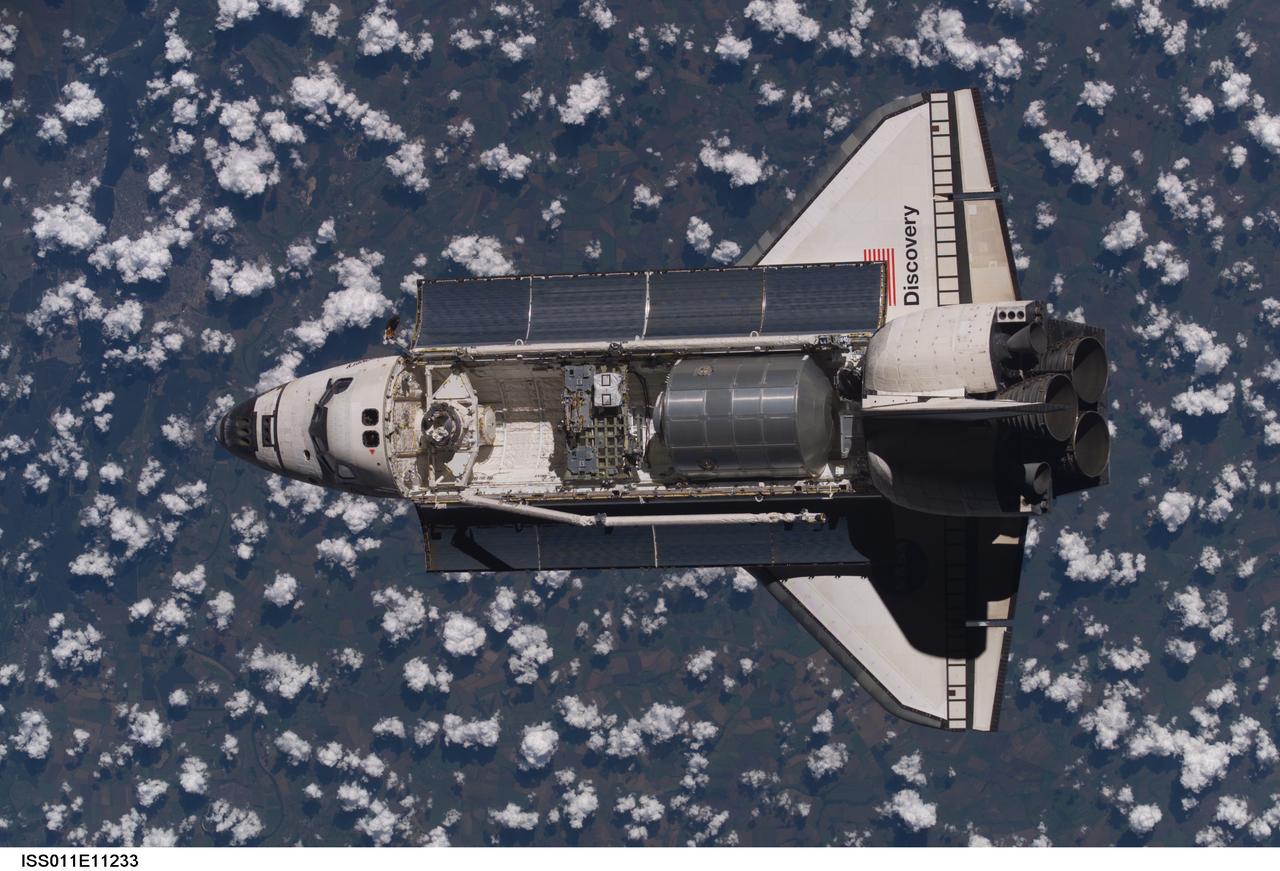
Launched on July 26, 2005 from the Kennedy Space Center in Florida, STS-114 was classified as Logistics Flight 1. Among the Station-related activities of the mission were the delivery of new supplies and the replacement of one of the orbital outpost's Control Moment Gyroscopes (CMGs). STS-114 also carried the Raffaello Multi-Purpose Logistics Module (MPLM) and the External Stowage Platform-2. Back dropped by popcorn-like clouds, the MPLM can be seen in the cargo bay as Discovery undergoes rendezvous and docking operations. Cosmonaut Sergei K. Kriklev, Expedition 11 Commander, and John L. Phillips, NASA Space Station officer and flight engineer photographed the spacecraft from the International Space Station (ISS).
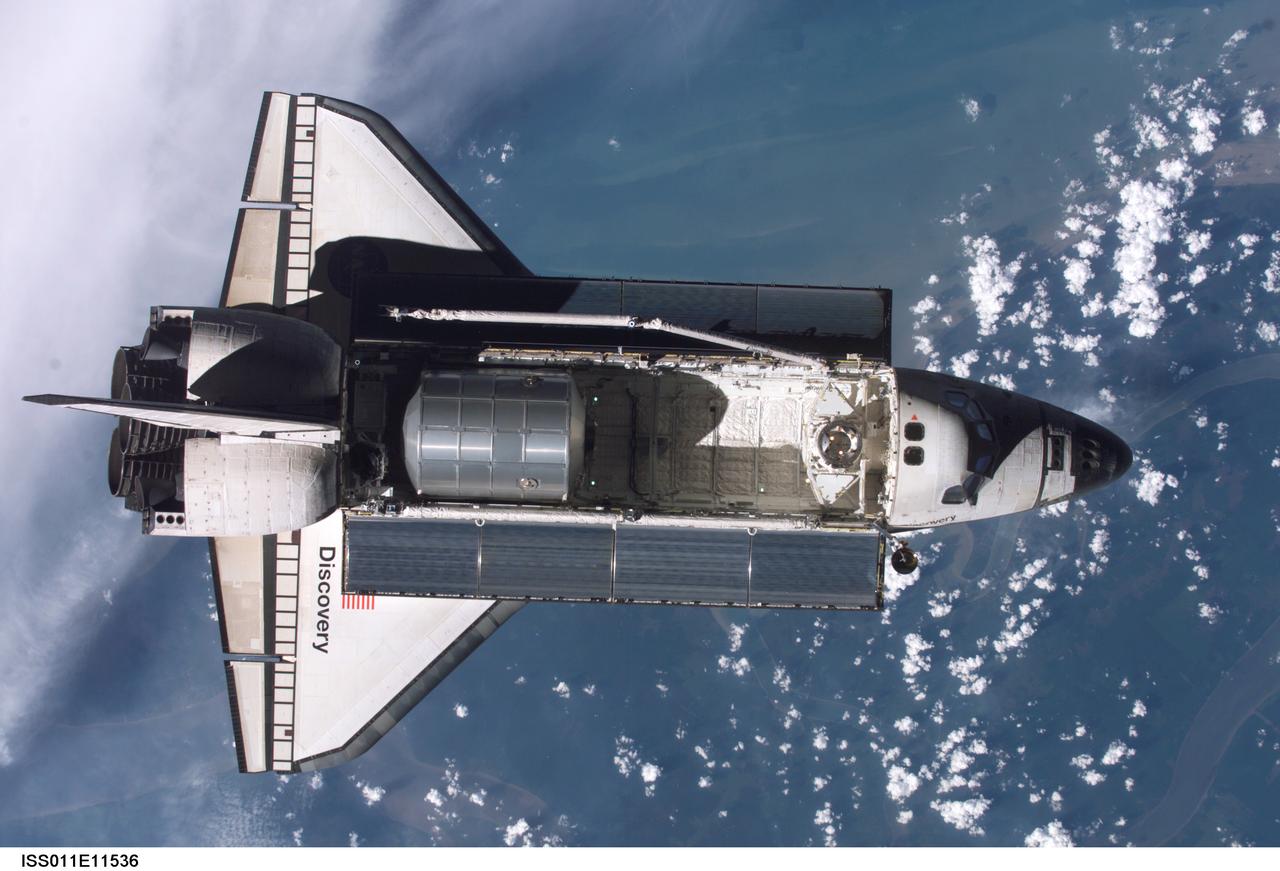
Launched on July 26 2005 from the Kennedy Space Center in Florida, STS-114 was classified as Logistics Flight 1. Among the Station-related activities of the mission were the delivery of new supplies and the replacement of one of the orbital outpost's Control Moment Gyroscopes (CMGs). STS-114 also carried the Raffaello Multi-Purpose Logistics Module (MPLM) and the External Stowage Platform-2. Back dropped by popcorn-like clouds, the MPLM can be seen in the cargo bay as Discovery undergoes rendezvous and docking operations. Cosmonaut Sergei K. Kriklev, Expedition 11 Commander, and John L. Phillips, NASA Space Station officer and flight engineer photographed the spacecraft from the International Space Station (ISS).
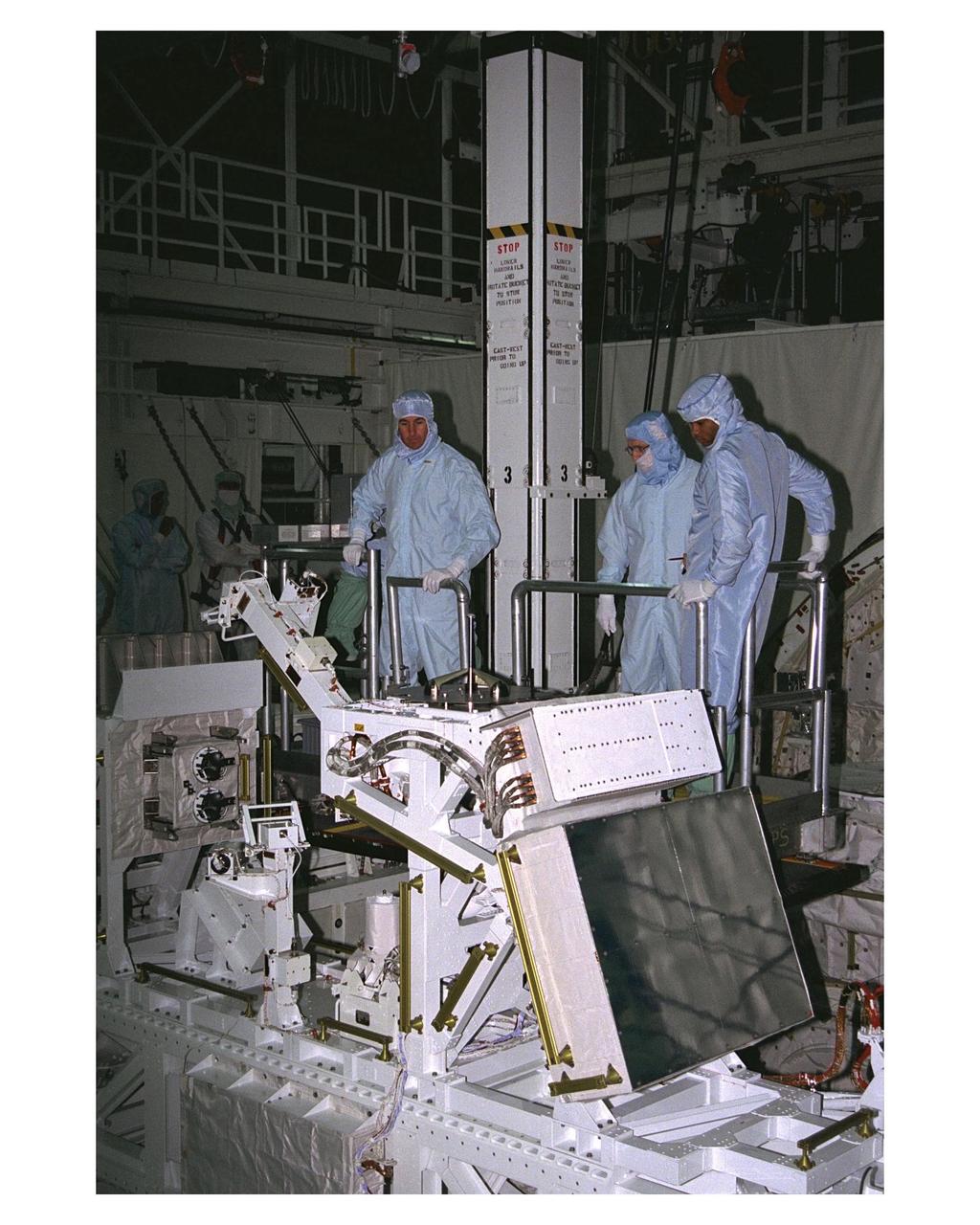
KENNEDY SPACE CENTER, FLA. -- Members of the STS-85 flight crew examine the Manipulator Flight Demonstraton (MFD) payload in the payload bay of the Space Shuttle Orbiter Discovery during Crew Equipment Interface Test (CEIT) activities for that mission. They are (left) Mission Specialists Stephen K. Robinson and Robert L. Curbeam Jr. (right). They are accompanied by a United Space Alliance (USA) payload technician. The MFD is one of several payloads that will fly on the STS-85 mission. This payload is designed to test the operational capability of the Japanese Experiment Module Remote Manipulator System (JEM RMS) Small Fine Arm (SFA), which can be seen atop its Multi-Purpose Experiment Support Structure (MPES) carrier that will serve as a platform in the payload bay for the robotic arm experiment. The arm, which will be a part of the JEM element of the Interntional Space Station, will be operated from the orbiter's aft flight deck during the 11-day mission. Other payloads that will be aboard Discovery on this space flight include the Cryogenic Infrared Spectrometers and Telescopes for the Atmosphere-Shuttle Pallet Satellite-2 (CRISTA-SPAS-2) Technology Applications and Science-1 (TAS-1) and International Extreme Ultraviolet Hitchhhiker (IEH-2) experiments.
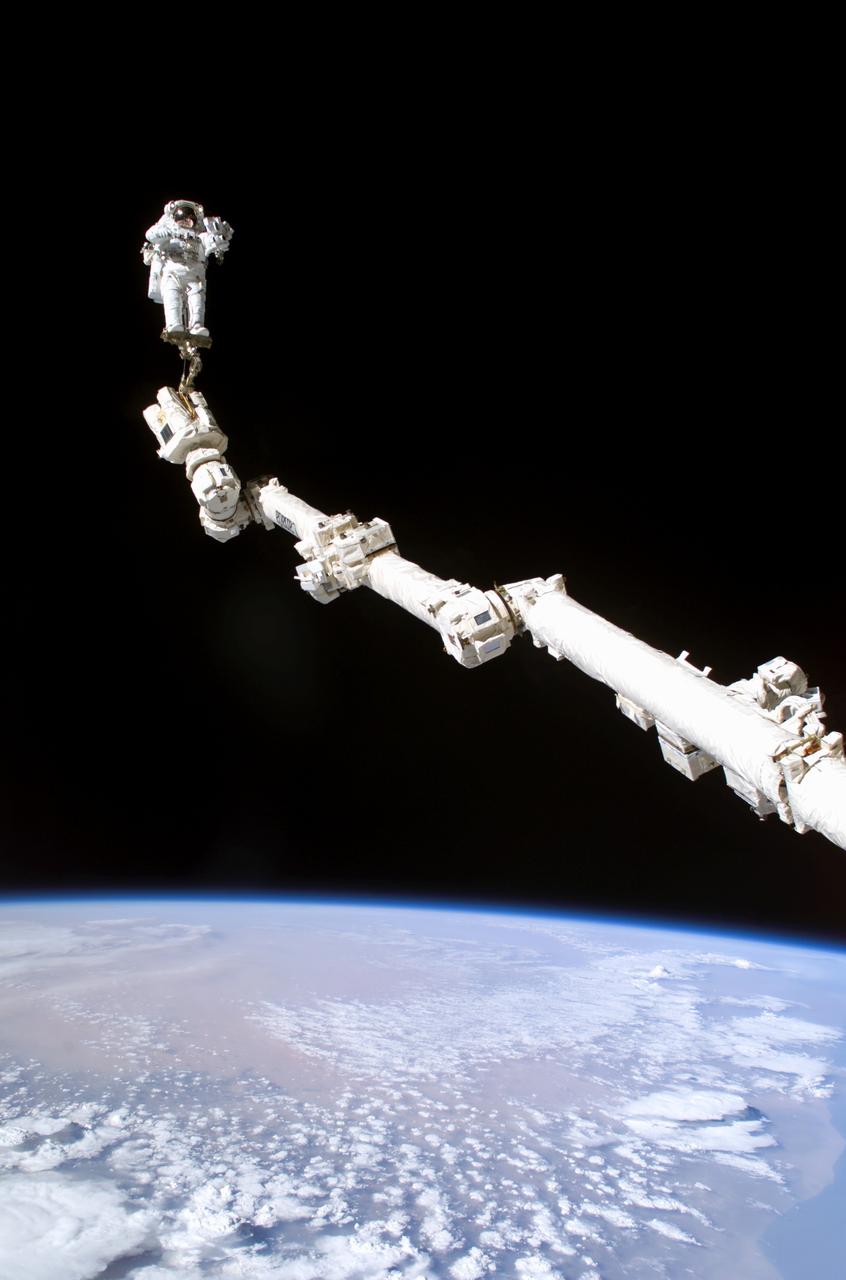
Launched on July 26, 2005 from the Kennedy Space Center in Florida, STS-114 was classified as Logistics Flight 1. Among the Station-related activities of the mission were the delivery of new supplies and the replacement of one of the orbital outpost's Control Moment Gyroscopes (CMGs). STS-114 also carried the Raffaello Multi-Purpose Logistics Module and the External Stowage Platform-2. A major focus of the mission was the testing and evaluation of new Space Shuttle flight safety, which included new inspection and repair techniques. Upon its approach to the International Space Station (ISS), the Space Shuttle Discovery underwent a photography session in order to assess any damages that may have occurred during its launch and/or journey through Space. The mission’s third and final Extra Vehicular Activity (EVA) included taking a close-up look and the repair of the damaged heat shield. Gap fillers were removed from between the orbiter’s heat-shielding tiles located on the craft’s underbelly. Never before had any repairs been done to an orbiter while still in space. Back dropped by the blackness of space and Earth’s horizon, astronaut Stephen K. Robinson, STS-114 mission specialist, is anchored to a foot restraint on the extended ISS’s Canadarm-2.

Onlookers applaud the successful launch of Space Shuttle Discovery, trailing a twisting white column of exhaust clouds behind, on mission STS-95. Lifting off at 2:19:34 p.m. EST, Discovery carries a crew of six, including Payload Specialist John H. Glenn Jr., senator from Ohio, who is making his second voyage into space after 36 years. Other crew members are Mission Commander Curtis L. Brown Jr., Pilot Steven W. Lindsey, Payload Specialist Chiaki Mukai, (M.D., Ph.D.), with the National Space Development Agency of Japan (NASDA), Mission Specialist Stephen K. Robinson, Mission Specialist Pedro Duque of Spain, representing the European Space Agency (ESA), and Mission Specialist Scott E. Parazynski. The STS-95 mission includes research payloads such as the Spartan solar-observing deployable spacecraft, the Hubble Space Telescope Orbital Systems Test Platform, the International Extreme Ultraviolet Hitchhiker, as well as the SPACEHAB single module with experiments on space flight and the aging process. Discovery is expected to return to KSC at 11:49 a.m. EST on Nov. 7
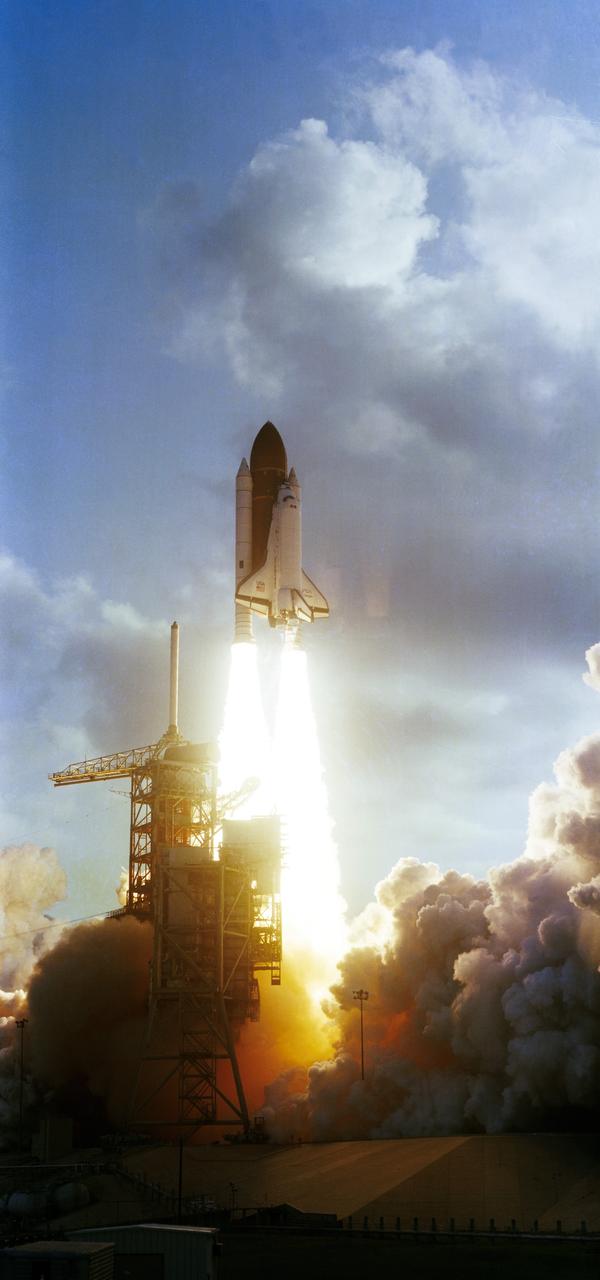
S83-35702 (18 June 1983) --- The seventh launch of the NASA Space Transportation System and the second lift-off of the space shuttle Challenger occurred at 7:33 a.m. (EDT) today from the Pad 39A launch site, at the Kennedy Space Center (KSC). The six-day mission will be highlighted by the first direct landing from space by an orbiter to the Shuttle Landing Facility (SLF). The crew consists of astronauts Robert Crippen, commander, the first two-time space shuttle astronaut; Frederick H. Hauck, pilot; and three mission specialists -- Sally K. Ride, John M. Fabian and Norman E. Thagard. During the mission the crew will deploy the Indonesian PALAPA-B and the Canadian ANIK-C communications satellites. They will also use the Remote Manipulator System (RMS) arm to deploy and retrieve a platform for space experiments called the Shuttle Pallet Satellite (SPAS), and serve as a spaceborne laboratory for OSTA-2, a scientific payload. Getaway Special canisters and materials processing experiments will fill out the complement of payloads on the mission. Photo credit: NASA

Tree branches on the Space Coast frame Space Shuttle Discovery's liftoff from Launch Pad 39B at 2:19 p.m. EST Oct. 29 on mission STS-95. Making his second voyage into space after 36 years is Payload Specialist John H. Glenn Jr., senator from Ohio. Other crew members are Mission Commander Curtis L. Brown Jr., Pilot Steven W. Lindsey, Payload Specialist Chiaki Mukai, (M.D., Ph.D.), with the National Space Development Agency of Japan (NASDA), Mission Specialist Stephen K. Robinson, Mission Specialist Pedro Duque of Spain, representing the European Space Agency (ESA), and Mission Specialist Scott E. Parazynski. The STS-95 mission includes research payloads such as the Spartan solar-observing deployable spacecraft, the Hubble Space Telescope Orbital Systems Test Platform, the International Extreme Ultraviolet Hitchhiker, as well as the SPACEHAB single module with experiments on space flight and the aging process. Discovery is expected to return to KSC at 11:49 a.m. EST on Nov. 7
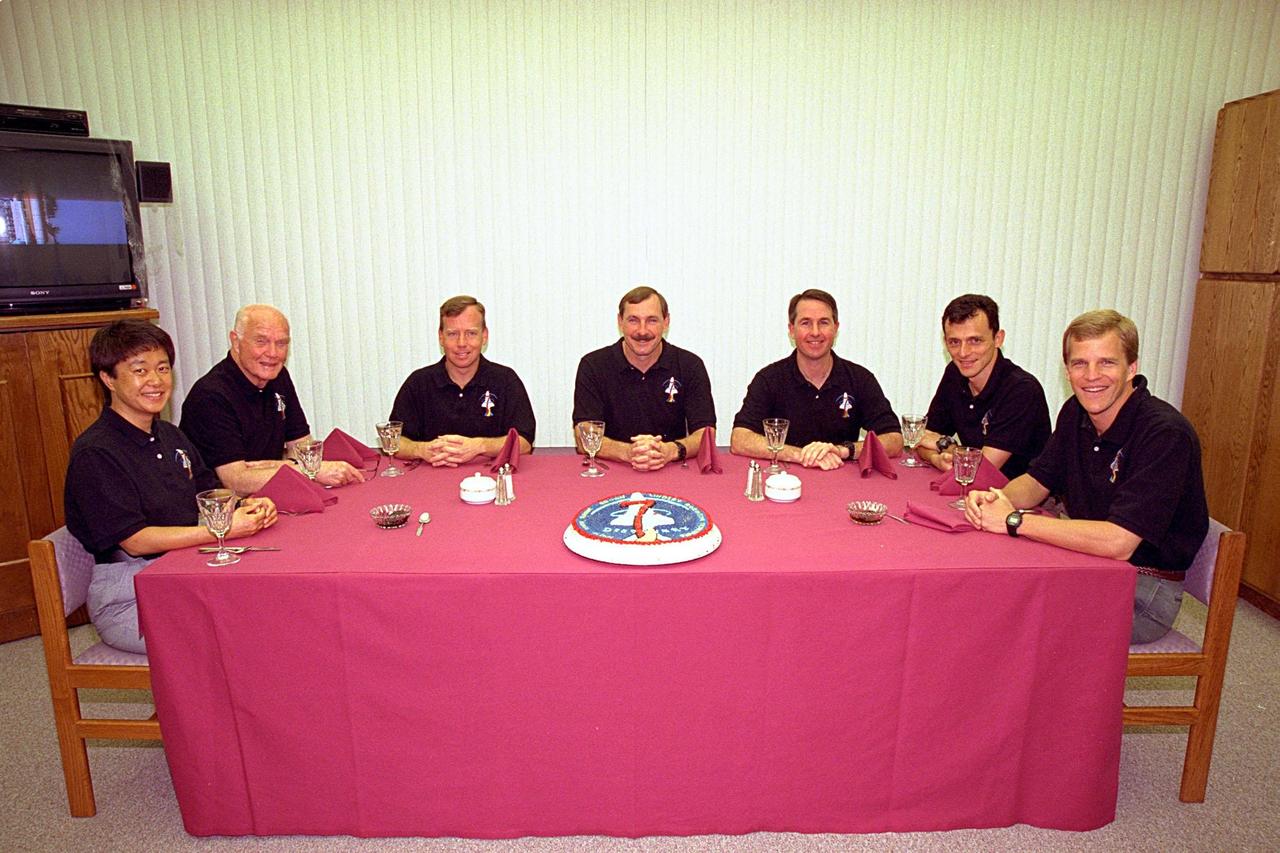
The STS-95 crew gathers at their traditional pre-launch breakfast in the Operations and Checkout Building. Seated from left are Payload Specialist Chiaki Mukai, (M.D., Ph.D.), with the National Space Development Agency of Japan (NASDA), Payload Specialist John H. Glenn Jr., senator from Ohio, Pilot Steven W. Lindsey, Mission Commander Curtis L. Brown Jr., Mission Specialist Stephen K. Robinson, Mission Specialist Pedro Duque of Spain, representing the European Space Agency (ESA), and Mission Specialist Scott E. Parazynski. Targeted for launch at 2 p.m. EST on Oct. 29, the mission is expected to last 8 days, 21 hours and 49 minutes, and return to KSC at 11:49 a.m. EST on Nov. 7. The STS-95 mission includes research payloads such as the Spartan solar-observing deployable spacecraft, the Hubble Space Telescope Orbital Systems Test Platform, the International Extreme Ultraviolet Hitchhiker, as well as the SPACEHAB single module with experiments on space flight and the aging process
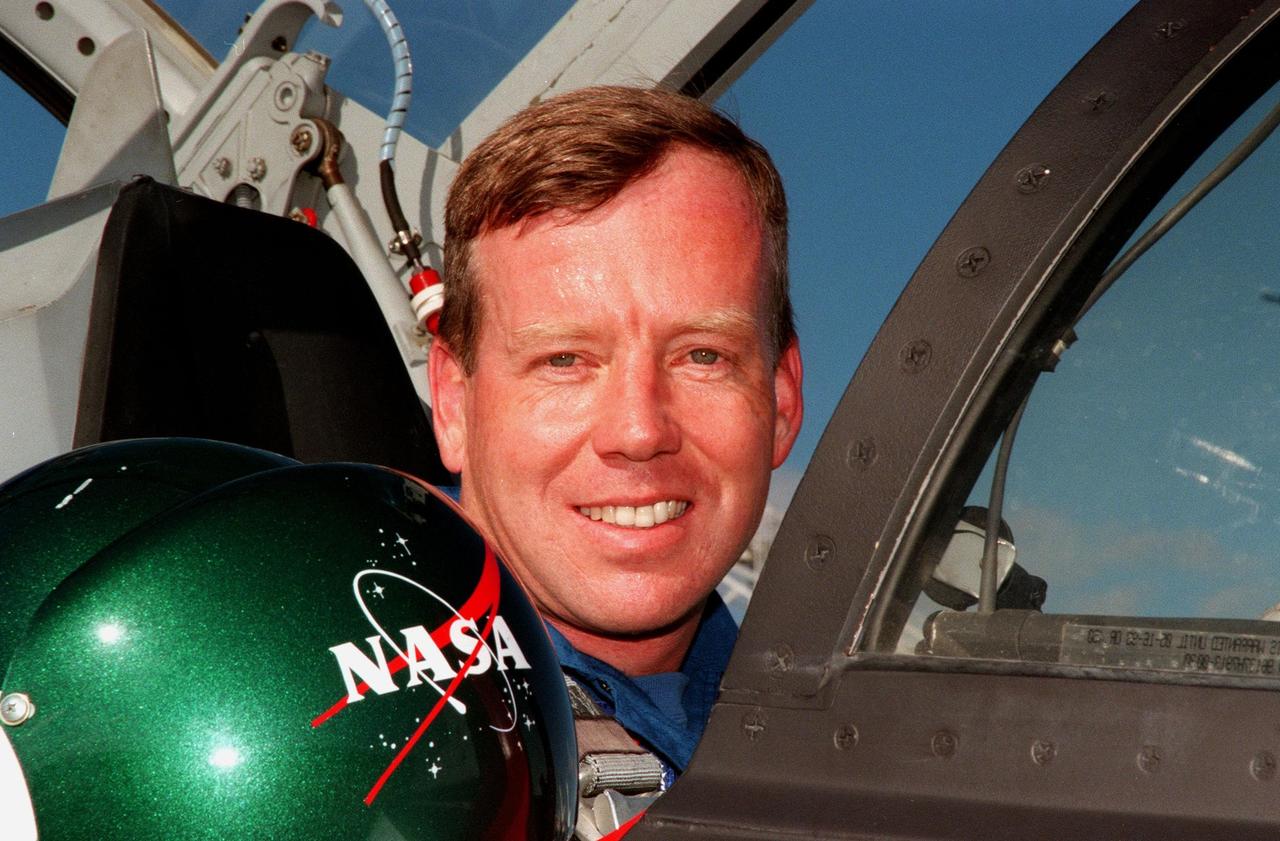
STS-95 Pilot Steven W. Lindsey, arrives at Kennedy Space Center's Shuttle Landing Facility aboard a T-38 jet as part of final preparations for launch. The STS-95 mission, targeted for liftoff at 2 p.m. on Oct. 29, includes research payloads such as the Spartan solar-observing deployable spacecraft, the Hubble Space Telescope Orbital Systems Test Platform, the International Extreme Ultraviolet Hitchhiker, as well as the SPACEHAB single module with experiments on space flight and the aging process. The mission is expected to last 8 days, 21 hours and 49 minutes, and return to KSC on Nov. 7. The other STS-95 crew members are Mission Commander Curtis L. Brown Jr., Mission Specialist Scott E. Parazynski, Mission Specialist Stephen K. Robinson, Payload Specialist John H. Glenn Jr., senator from Ohio, Mission Specialist Pedro Duque, with the European Space Agency (ESA), and Payload Specialist Chiaki Mukai, with the National Space Development Agency of Japan (NASDA)
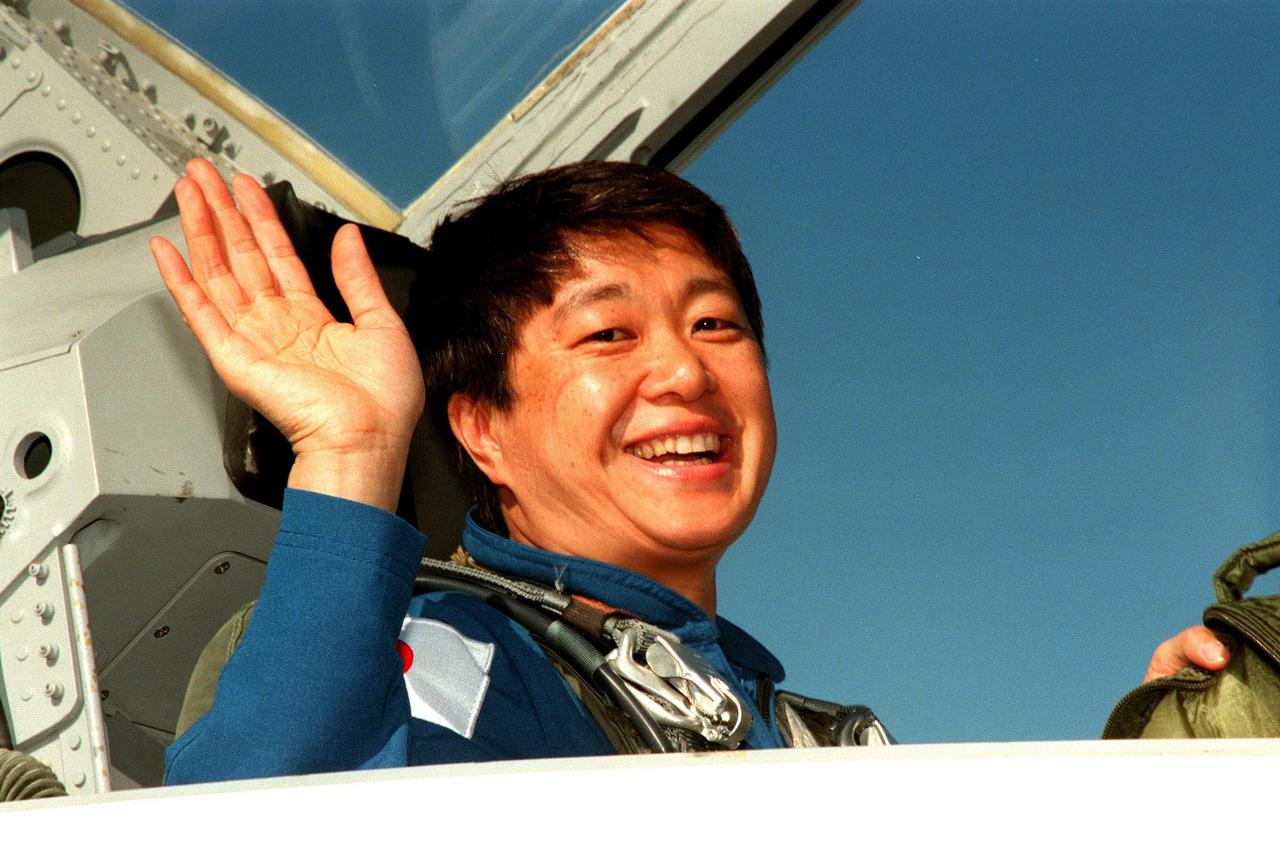
STS-95 Payload Specialist Chiaki Mukai, with the National Space Development Agency of Japan (NASDA), waves on her arrival at Kennedy Space Center's Shuttle Landing Facility aboard a T-38 jet. She and other crewmembers will be making final preparations for launch, targeted for liftoff at 2 p.m. on Oct. 29. The STS-95 mission includes research payloads such as the Spartan solar-observing deployable spacecraft, the Hubble Space Telescope Orbital Systems Test Platform, the International Extreme Ultraviolet Hitchhiker, as well as the SPACEHAB single module with experiments on space flight and the aging process. The mission is expected to last 8 days, 21 hours and 49 minutes, and return to KSC on Nov. 7. The other STS-95 crewmembers are Mission Commander Curtis L. Brown Jr., Pilot Steven W. Lindsey, Mission Specialist Scott E. Parazynski, Mission Specialist Stephen K. Robinson, Payload Specialist John H. Glenn Jr., senator from Ohio, and Mission Specialist Pedro Duque, with the European Space Agency (ESA)

Seen from behind, STS-95 Mission Commander Curtis L. Brown Jr. (at microphone) greets the media at the Shuttle Landing Facility after the crew's arrival aboard T-38 jets to make final preparations for their launch, targeted for liftoff at 2 p.m. on Oct. 29. The crew members are (left to right) Mission Specialist Stephen K. Robinson, Payload Specialist John H. Glenn Jr., senator from Ohio, Brown, Mission Specialist Pedro Duque, with the European Space Agency (ESA), Pilot Steven W. Lindsey, and Payload Specialist Chiaki Mukai, with the National Space Development Agency of Japan (NASDA). Missing is Mission Specialist Scott E. Parazynski, who was delayed in the flight from Texas. The STS-95 mission includes research payloads such as the Spartan solar-observing deployable spacecraft, the Hubble Space Telescope Orbital Systems Test Platform, the International Extreme Ultraviolet Hitchhiker, as well as the SPACEHAB single module with experiments on space flight and the aging process. The mission is expected to last 8 days, 21 hours and 49 minutes, and return to KSC on Nov. 7

Clouds of exhaust fill the view across the marsh near Launch Pad 39B as Space Shuttle Discovery lifts off at 2:19 p.m. EST Oct. 29 on mission STS-95. Making his second voyage into space after 36 years is Payload Specialist John H. Glenn Jr., senator from Ohio. Other crew members are Mission Commander Curtis L. Brown Jr., Pilot Steven W. Lindsey, Payload Specialist Chiaki Mukai, (M.D., Ph.D.), with the National Space Development Agency of Japan (NASDA), Mission Specialist Stephen K. Robinson, Mission Specialist Pedro Duque of Spain, representing the European Space Agency (ESA), and Mission Specialist Scott E. Parazynski. The STS-95 mission includes research payloads such as the Spartan solar-observing deployable spacecraft, the Hubble Space Telescope Orbital Systems Test Platform, the International Extreme Ultraviolet Hitchhiker, as well as the SPACEHAB single module with experiments on space flight and the aging process. Discovery is expected to return to KSC at 11:49 a.m. EST on Nov. 7
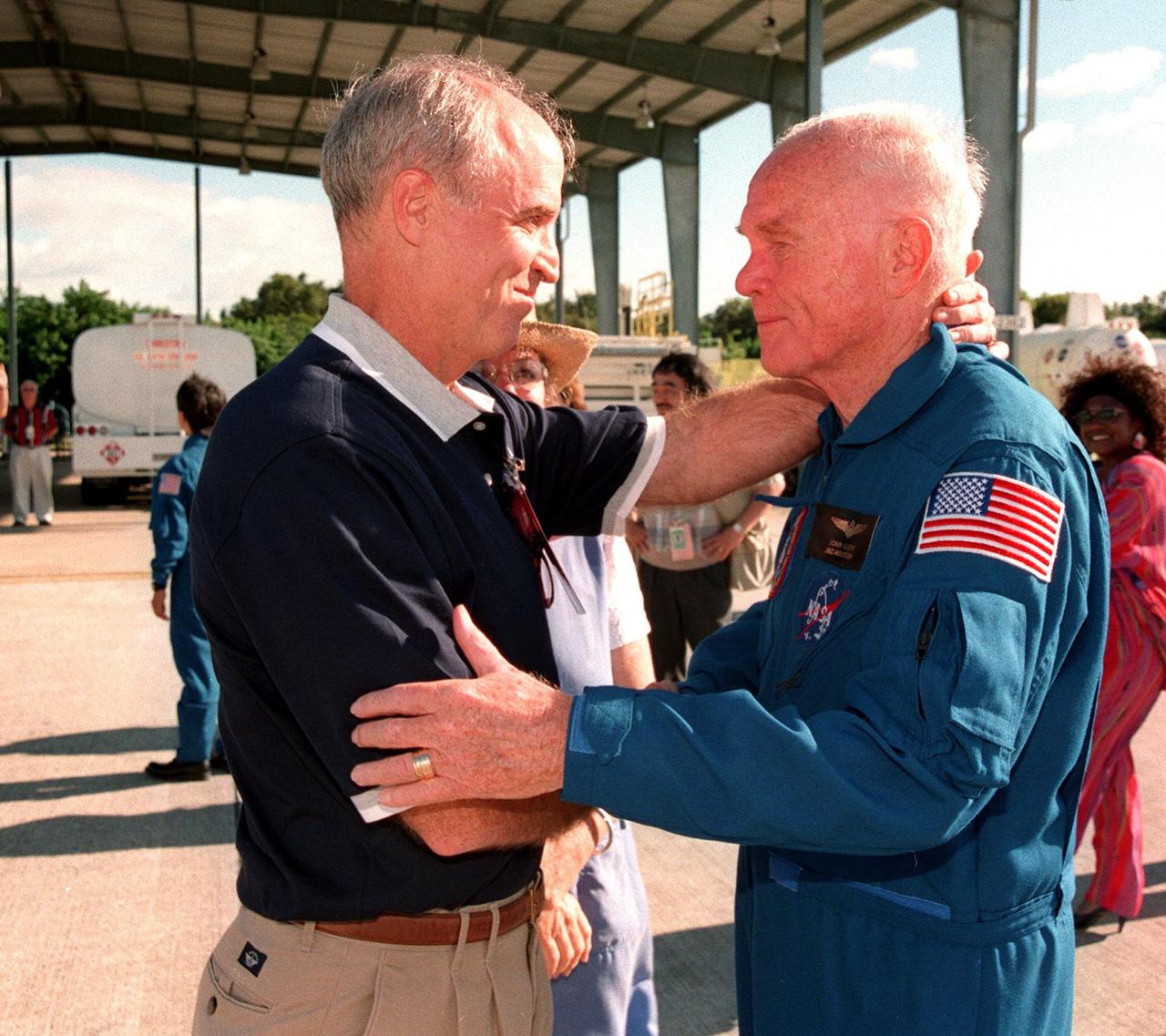
STS-95 Payload Specialist John H. Glenn Jr. (right), senator from Ohio, embraces his son, David, after landing at Kennedy Space Center's Shuttle Landing Facility aboard a T-38 jet. Barely visible behind them is Glenn's daughter, Lyn. Glenn and other crewmembers flew into KSC to make final preparations for launch. Targeted for liftoff at 2 p.m. on Oct. 29, the STS-95 mission includes research payloads such as the Spartan solar-observing deployable spacecraft, the Hubble Space Telescope Orbital Systems Test Platform, the International Extreme Ultraviolet Hitchhiker, as well as the SPACEHAB single module with experiments on space flight and the aging process. The mission is expected to last 8 days, 21 hours and 49 minutes, and return to KSC on Nov. 7. The other STS-95 crew members are Mission Commander Curtis L. Brown Jr., Pilot Steven W. Lindsey, Mission Specialist Scott E. Parazynski, Mission Specialist Stephen K. Robinson, Mission Specialist Pedro Duque, with the European Space Agency (ESA), and Payload Specialist Chiaki Mukai, with the National Space Development Agency of Japan (NASDA)

STS-95 Mission Specialist Pedro Duque, with the European Space Agency (ESA), arrives at Kennedy Space Center's Shuttle Landing Facility aboard a T-38 jet as part of final preparations for launch. The STS-95 mission, targeted for liftoff at 2 p.m. on Oct. 29, includes research payloads such as the Spartan solar-observing deployable spacecraft, the Hubble Space Telescope Orbital Systems Test Platform, the International Extreme Ultraviolet Hitchhiker, as well as the SPACEHAB single module with experiments on space flight and the aging process. The mission is expected to last 8 days, 21 hours and 49 minutes, and return to KSC on Nov. 7. The other STS-95 crew members are Mission Commander Curtis L. Brown Jr., Pilot Steven W. Lindsey, Mission Specialist Scott E. Parazynski, Mission Specialist Stephen K. Robinson, Payload Specialist John H. Glenn Jr., senator from Ohio, and Payload Specialist Chiaki Mukai, with the National Space Development Agency of Japan (NASDA)
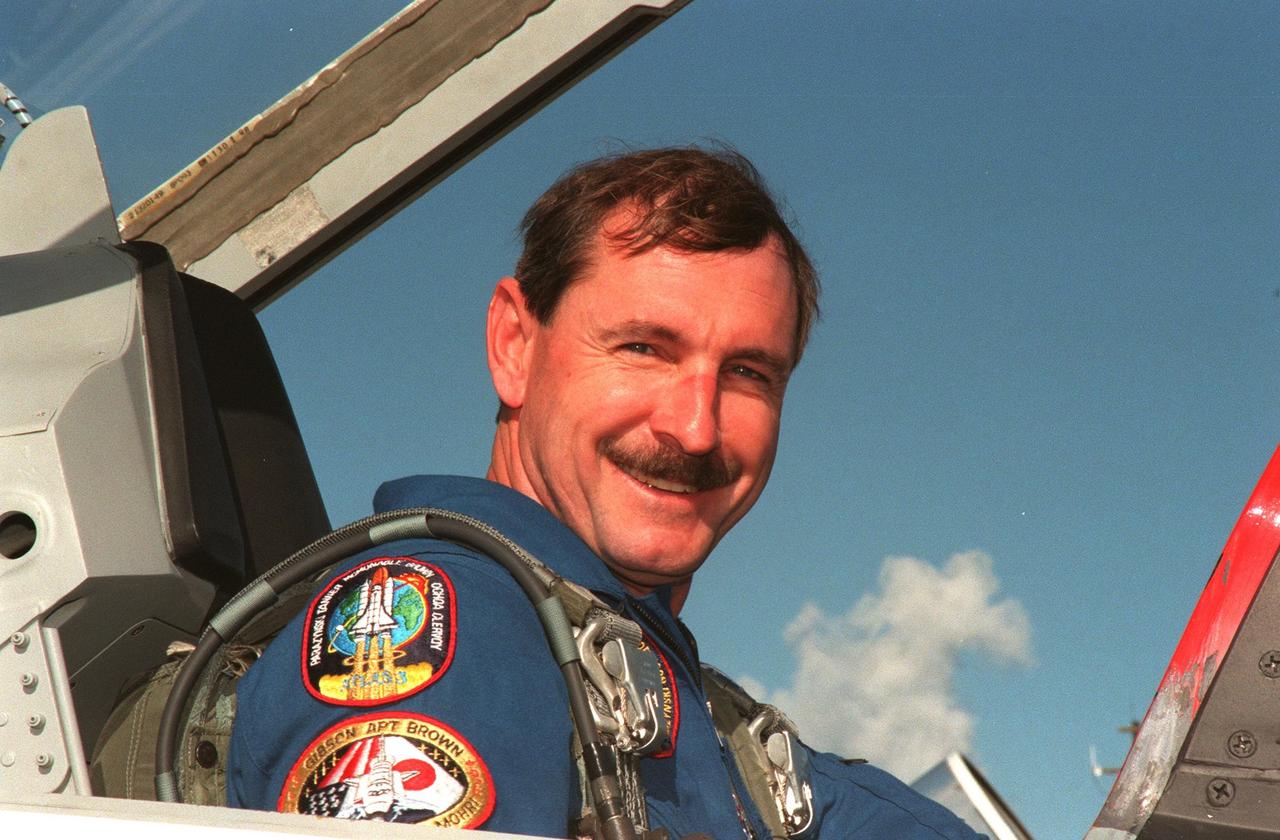
STS-95 Mission Commander Curtis L. Brown Jr. arrives at Kennedy Space Center's Shuttle Landing Facility aboard a T-38 jet as part of final preparations for launch. The STS-95 mission, targeted for liftoff at 2 p.m. on Oct. 29, includes research payloads such as the Spartan solar-observing deployable spacecraft, the Hubble Space Telescope Orbital Systems Test Platform, the International Extreme Ultraviolet Hitchhiker, as well as the SPACEHAB single module with experiments on space flight and the aging process. The mission is expected to last 8 days, 21 hours and 49 minutes, and return to KSC on Nov. 7. The other STS-95 crew members are Pilot Steven W. Lindsey, Mission Specialist Scott E. Parazynski, Mission Specialist Stephen K. Robinson, Payload Specialist John H. Glenn Jr., senator from Ohio, Mission Specialist Pedro Duque, with the European Space Agency (ESA), and Payload Specialist Chiaki Mukai, with the National Space Development Agency of Japan (NASDA)
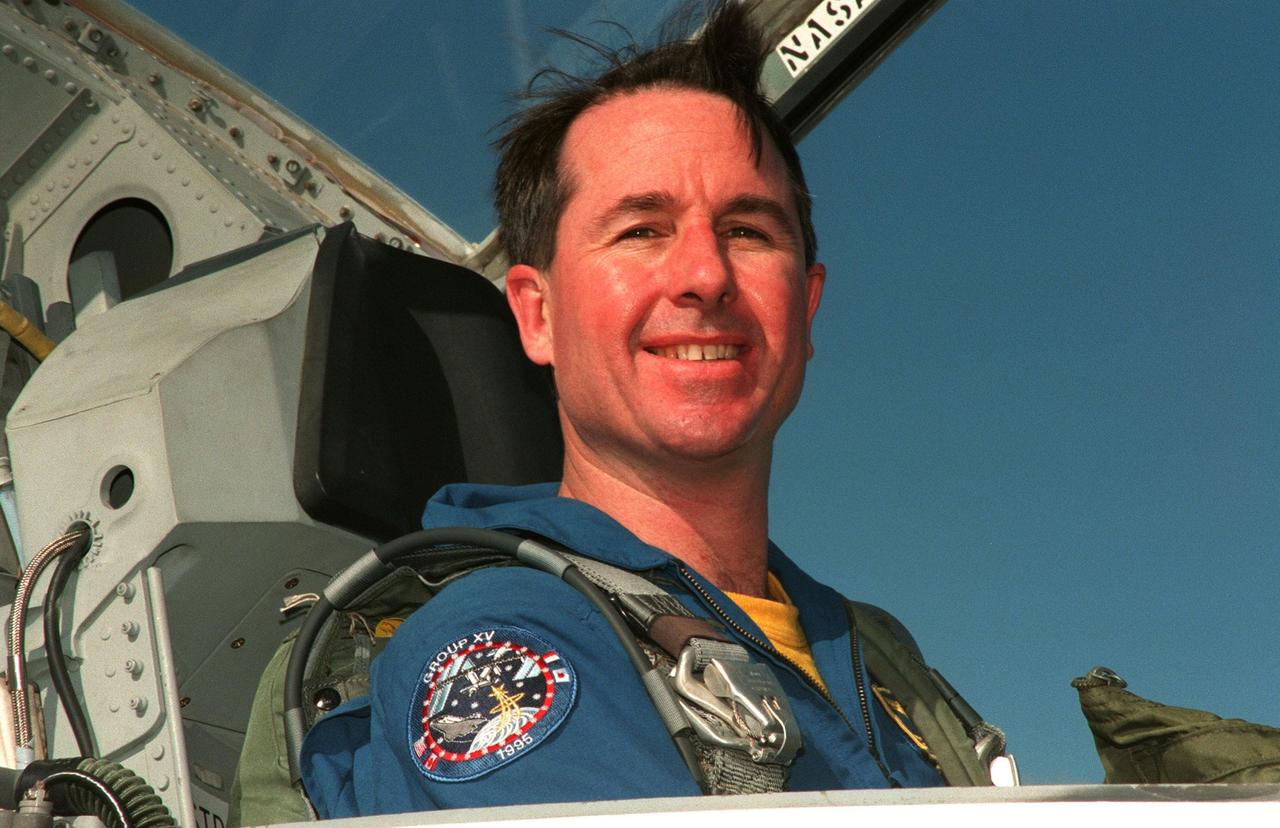
STS-95 Mission Specialist Stephen K. Robinson, arrives at Kennedy Space Center's Shuttle Landing Facility aboard a T-38 jet as part of final preparations for launch. The STS-95 mission, targeted for liftoff at 2 p.m. on Oct. 29, includes research payloads such as the Spartan solar-observing deployable spacecraft, the Hubble Space Telescope Orbital Systems Test Platform, the International Extreme Ultraviolet Hitchhiker, as well as the SPACEHAB single module with experiments on space flight and the aging process. The mission is expected to last 8 days, 21 hours and 49 minutes, and return to KSC on Nov. 7. The other STS-95 crew members are Mission Commander Curtis L. Brown Jr., Pilot Steven W. Lindsey, Mission Specialist Scott E. Parazynski, Payload Specialist John H. Glenn Jr., senator from Ohio, Mission Specialist Pedro Duque, with the European Space Agency (ESA), and Payload Specialist Chiaki Mukai, with the National Space Development Agency of Japan (NASDA)
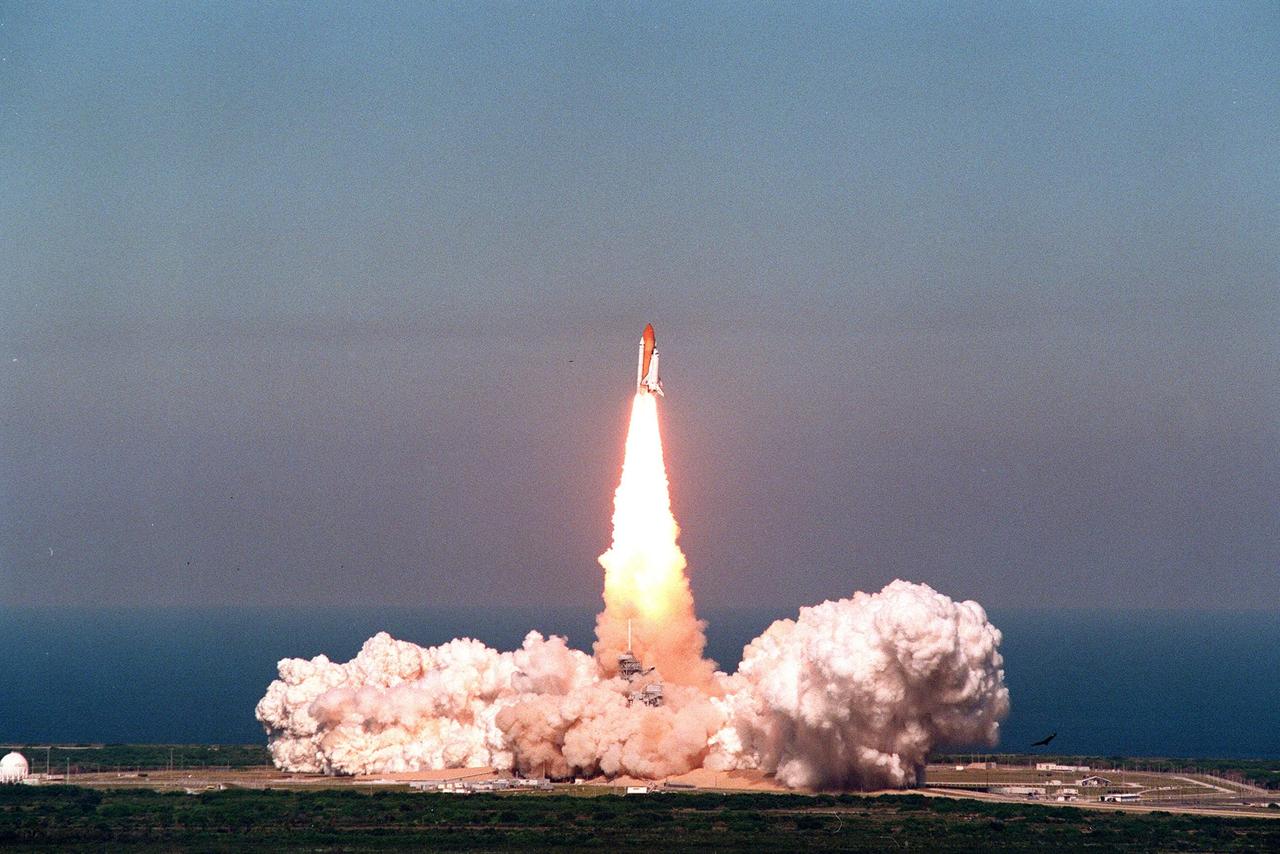
As if sprung from the rolling exhaust clouds below, Space Shuttle Discovery shoots into the heavens over the blue Atlantic Ocean from Launch Pad 39B on mission STS-95. Lifting off at 2:19 p.m. EST, Discovery carries a crew of six, including Payload Specialist John H. Glenn Jr., senator from Ohio, who is making his second voyage into space after 36 years. Other crew members are Mission Commander Curtis L. Brown Jr., Pilot Steven W. Lindsey, Payload Specialist Chiaki Mukai, (M.D., Ph.D.), with the National Space Development Agency of Japan (NASDA), Mission Specialist Stephen K. Robinson, Mission Specialist Pedro Duque of Spain, representing the European Space Agency (ESA), and Mission Specialist Scott E. Parazynski. The STS-95 mission includes research payloads such as the Spartan solar-observing deployable spacecraft, the Hubble Space Telescope Orbital Systems Test Platform, the International Extreme Ultraviolet Hitchhiker, as well as the SPACEHAB single module with experiments on space flight and the aging process. Discovery is expected to return to KSC at 11:49 a.m. EST on Nov. 7
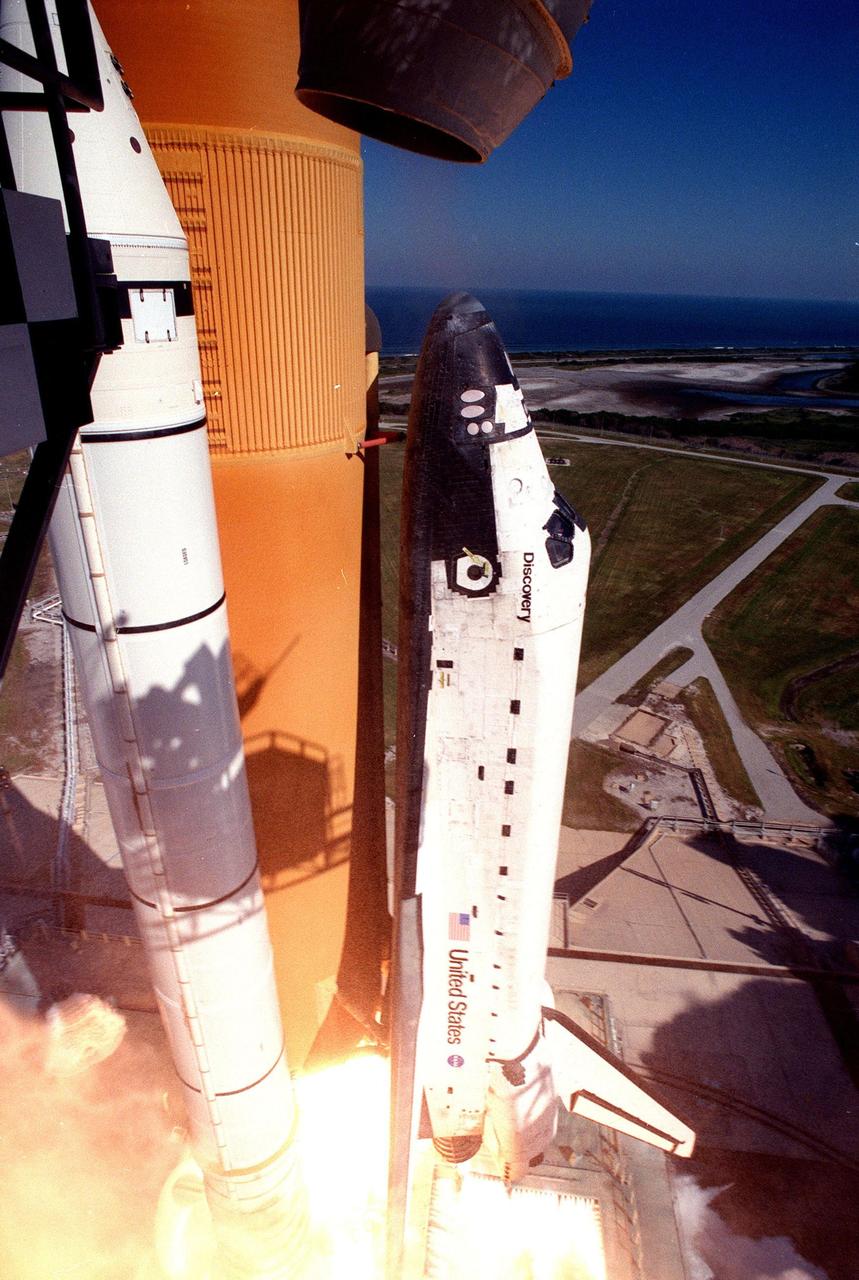
Thousands of gallons of water released as part of the sound suppression system at the launch pad create clouds of steam and exhaust as Space Shuttle Discovery lifts off from Launch Pad 39B at 2:19 p.m. EST Oct. 29 on mission STS-95. Making his second voyage into space after 36 years is Payload Specialist John H. Glenn Jr., senator from Ohio. Other crew members are Mission Commander Curtis L. Brown Jr., Pilot Steven W. Lindsey, Payload Specialist Chiaki Mukai, (M.D., Ph.D.), with the National Space Development Agency of Japan (NASDA), Mission Specialist Stephen K. Robinson, Mission Specialist Pedro Duque of Spain, representing the European Space Agency (ESA), and Mission Specialist Scott E. Parazynski. The STS-95 mission includes research payloads such as the Spartan solar-observing deployable spacecraft, the Hubble Space Telescope Orbital Systems Test Platform, the International Extreme Ultraviolet Hitchhiker, as well as the SPACEHAB single module with experiments on space flight and the aging process. Discovery is expected to return to KSC at 11:49 a.m. EST on Nov. 7
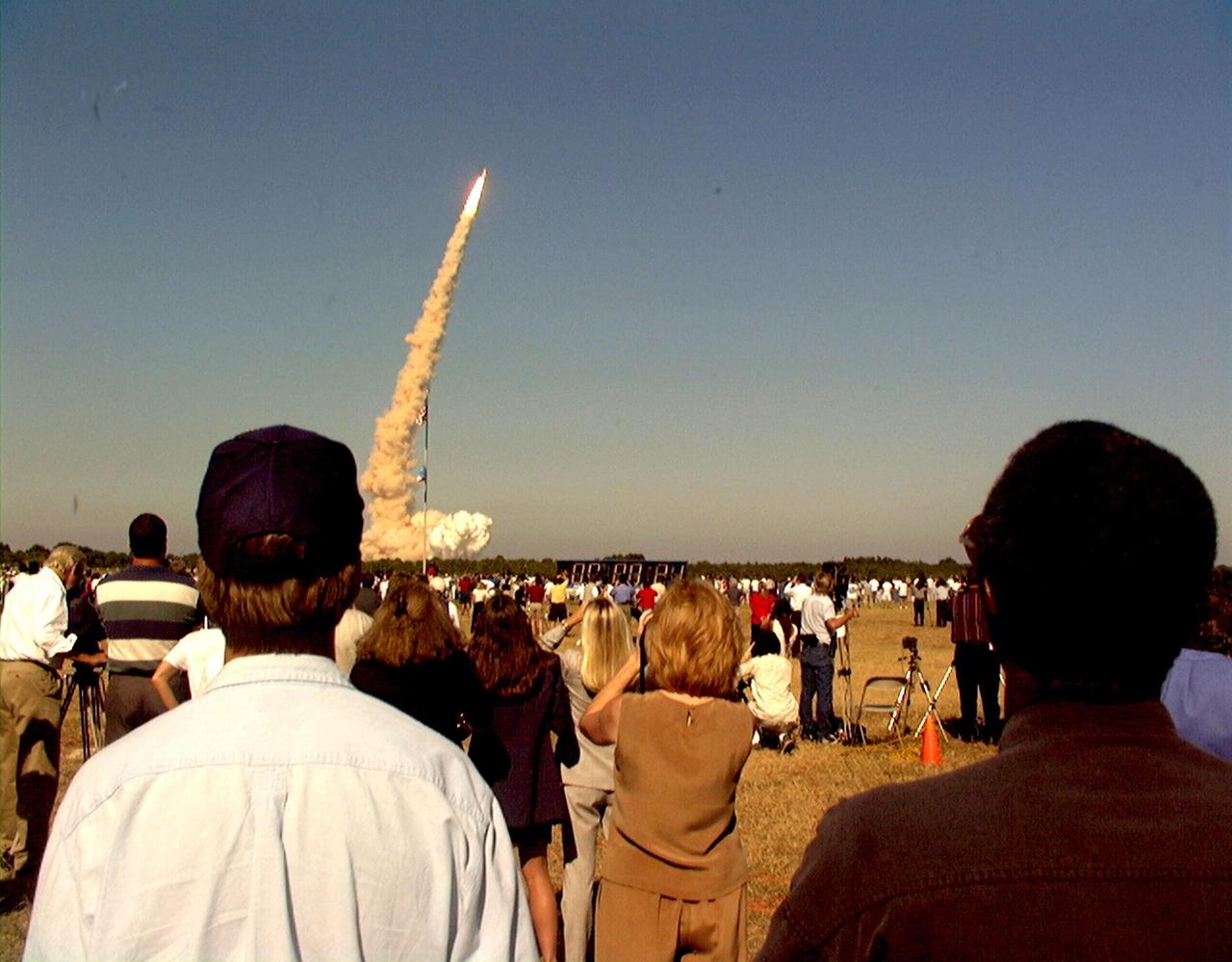
Trailing a twisting white column of exhaust clouds behind, Space Shuttle Discovery shoots into the heavens on mission STS-95. Lifting off at 2:19:34 p.m. EST, Discovery carries a crew of six, including Payload Specialist John H. Glenn Jr., senator from Ohio, who is making his second voyage into space after 36 years. Other crew members are Mission Commander Curtis L. Brown Jr., Pilot Steven W. Lindsey, Payload Specialist Chiaki Mukai, (M.D., Ph.D.), with the National Space Development Agency of Japan (NASDA), Mission Specialist Stephen K. Robinson, Mission Specialist Pedro Duque of Spain, representing the European Space Agency (ESA), and Mission Specialist Scott E. Parazynski. The STS-95 mission includes research payloads such as the Spartan solar-observing deployable spacecraft, the Hubble Space Telescope Orbital Systems Test Platform, the International Extreme Ultraviolet Hitchhiker, as well as the SPACEHAB single module with experiments on space flight and the aging process. Discovery is expected to return to KSC at 11:49 a.m. EST on Nov. 7
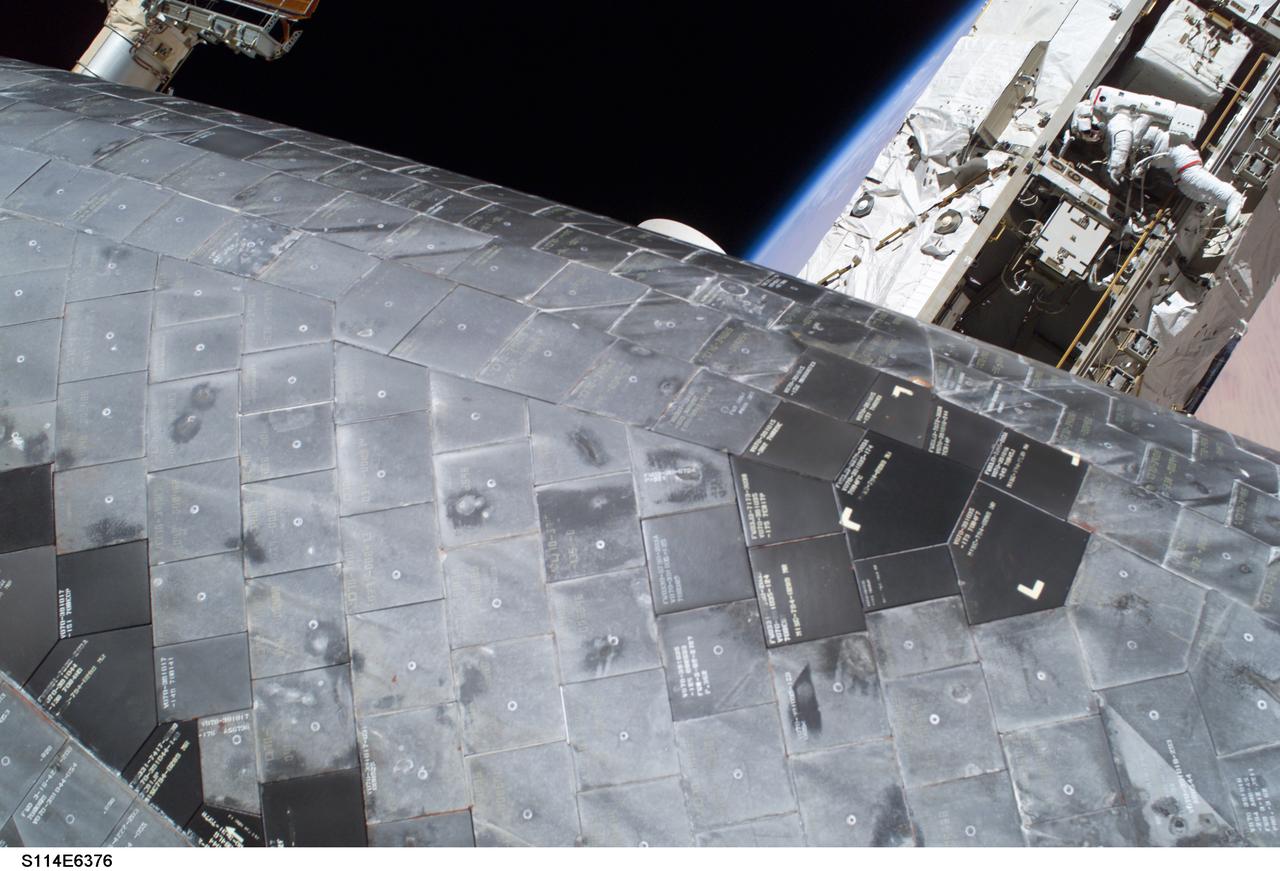
Launched on July 26 2005, from the Kennedy Space Center in Florida, STS-114 was classified as Logistics Flight 1. Among the Station-related activities of the mission were the delivery of new supplies and the replacement of one of the orbital outpost's Control Moment Gyroscopes (CMGs). STS-114 also carried the Raffaello Multi-Purpose Logistics Module and the External Stowage Platform-2. A major focus of the mission was the testing and evaluation of new Space Shuttle flight safety, which included new inspection and repair techniques. Upon its approach to the International Space Station (ISS), the Space Shuttle Discovery underwent a photography session in order to assess any damages that may have occurred during its launch and/or journey through Space. The mission’s third and final Extra Vehicular Activity (EVA) included taking a close-up look and the repair of the damaged heat shield. Gap fillers were removed from between the orbiter’s heat-shielding tiles located on the craft’s underbelly. Never before had any repairs been done to an orbiter while still in space. This close up of the thermal tiles was taken by astronaut Stephen K. Robinson, STS-114 mission specialist (out of frame). Astronaut Soichi Noguchi, STS-114 mission specialist representing the Japan Aerospace Exploration (JAXA), can be seen in the background perched on a Space Station truss.
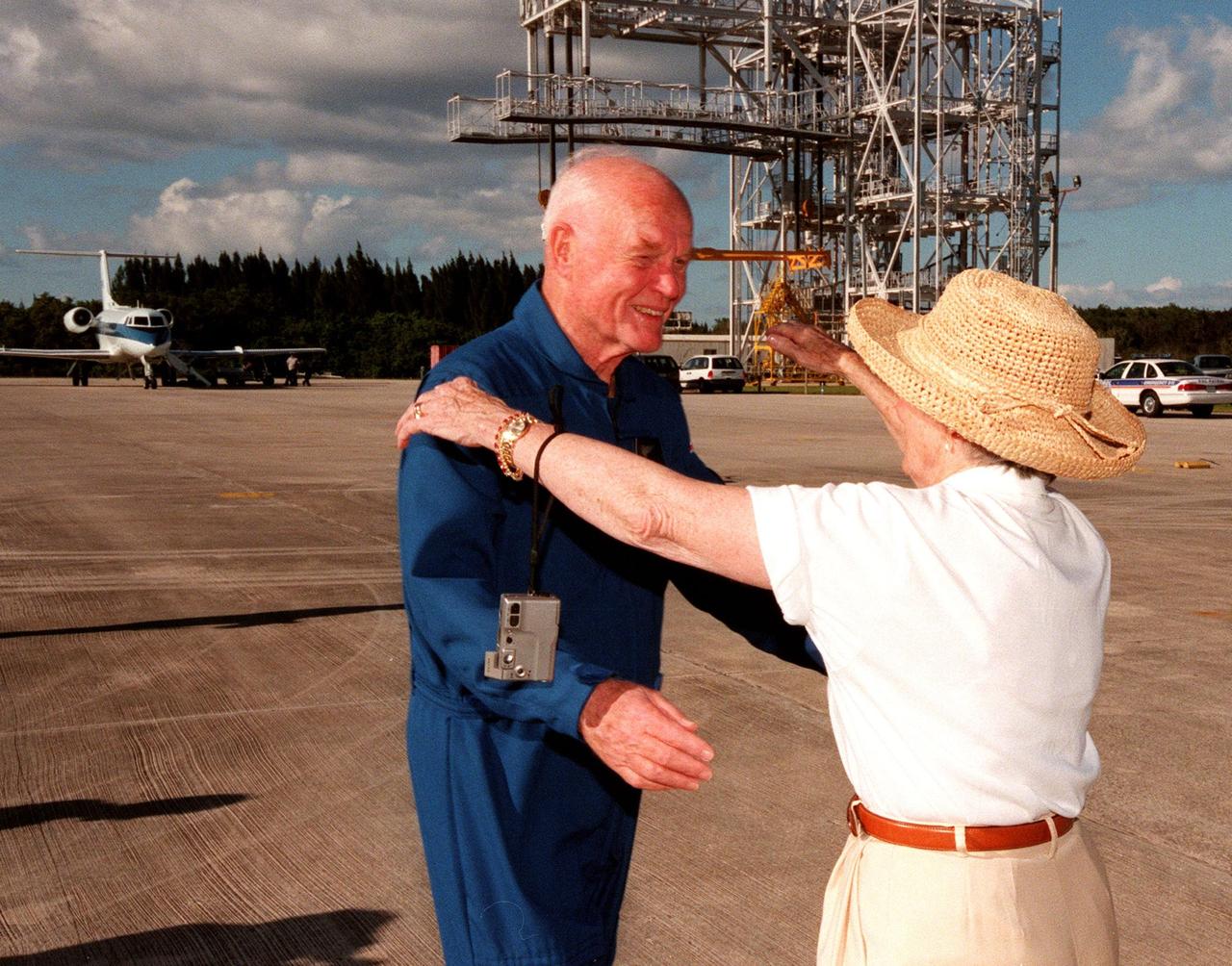
STS-95 Payload Specialist John H. Glenn Jr., senator from Ohio, reaches to embrace his wife, Annie, after landing at Kennedy Space Center's Shuttle Landing Facility aboard a T-38 jet. Behind the couple is the mate/demate device used to raise and lower the orbiter from its shuttle carrier aircraft during ferry operations. Glenn and other crewmembers flew into KSC to make final preparations for launch. Targeted for liftoff at 2 p.m. on Oct. 29, the STS-95 mission includes research payloads such as the Spartan solar-observing deployable spacecraft, the Hubble Space Telescope Orbital Systems Test Platform, the International Extreme Ultraviolet Hitchhiker, as well as the SPACEHAB single module with experiments on space flight and the aging process. The mission is expected to last 8 days, 21 hours and 49 minutes, and return to KSC on Nov. 7. The other STS-95 crew members are Mission Commander Curtis L. Brown Jr., Pilot Steven W. Lindsey, Mission Specialist Scott E. Parazynski, Mission Specialist Stephen K. Robinson, Mission Specialist Pedro Duque, with the European Space Agency (ESA), and Payload Specialist Chiaki Mukai, with the National Space Development Agency of Japan (NASDA)
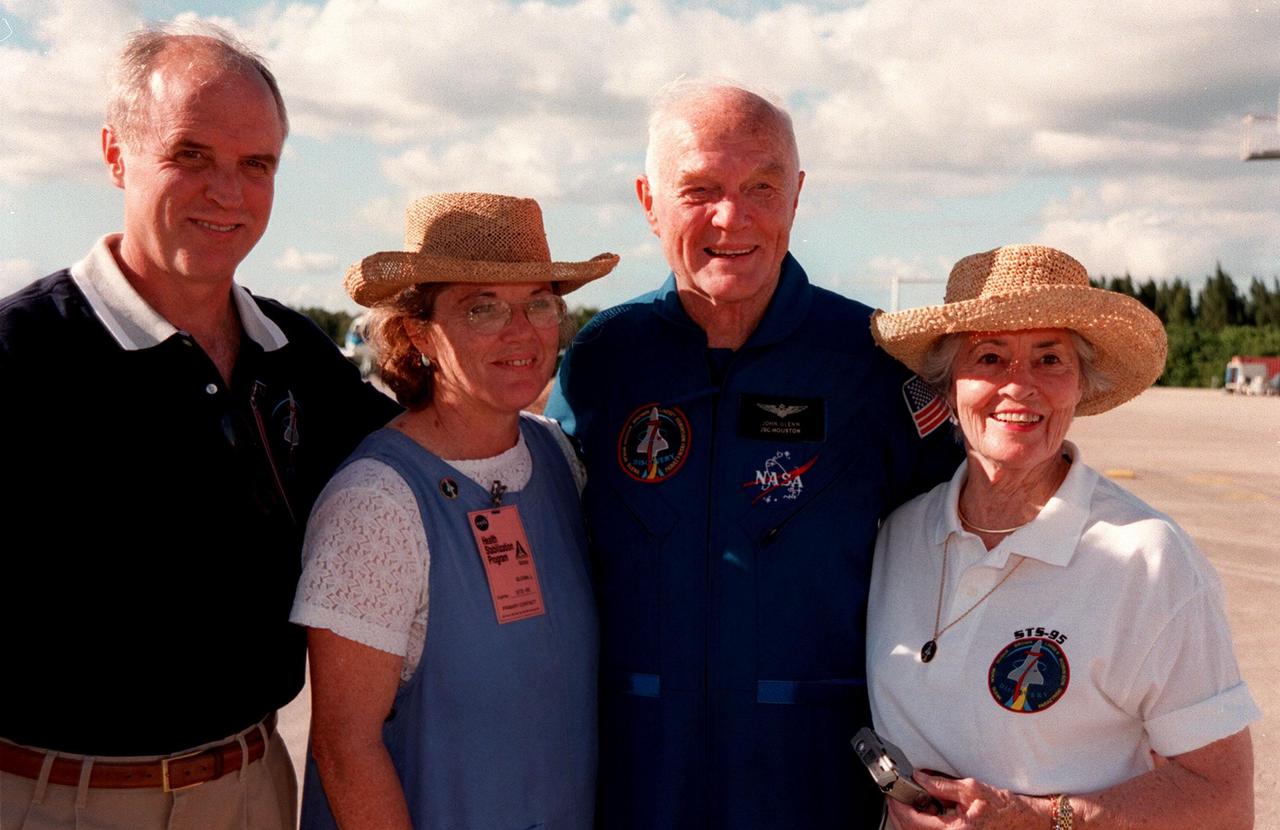
STS-95 Payload Specialist John H. Glenn Jr. (second from right), senator from Ohio, poses (left to right) with his son, David, daughter, Lyn, and (far right) his wife, Annie, after landing at Kennedy Space Center's Shuttle Landing Facility aboard a T-38 jet. Glenn and other crewmembers flew into KSC to make final preparations for launch. Targeted for liftoff at 2 p.m. on Oct. 29, the STS-95 mission includes research payloads such as the Spartan solar-observing deployable spacecraft, the Hubble Space Telescope Orbital Systems Test Platform, the International Extreme Ultraviolet Hitchhiker, as well as the SPACEHAB single module with experiments on space flight and the aging process. The mission is expected to last 8 days, 21 hours and 49 minutes, and return to KSC on Nov. 7. The other STS-95 crew members are Mission Commander Curtis L. Brown Jr., Pilot Steven W. Lindsey, Mission Specialist Scott E. Parazynski, Mission Specialist Stephen K. Robinson, Mission Specialist Pedro Duque, with the European Space Agency (ESA), and Payload Specialist Chiaki Mukai, with the National Space Development Agency of Japan (NASDA)
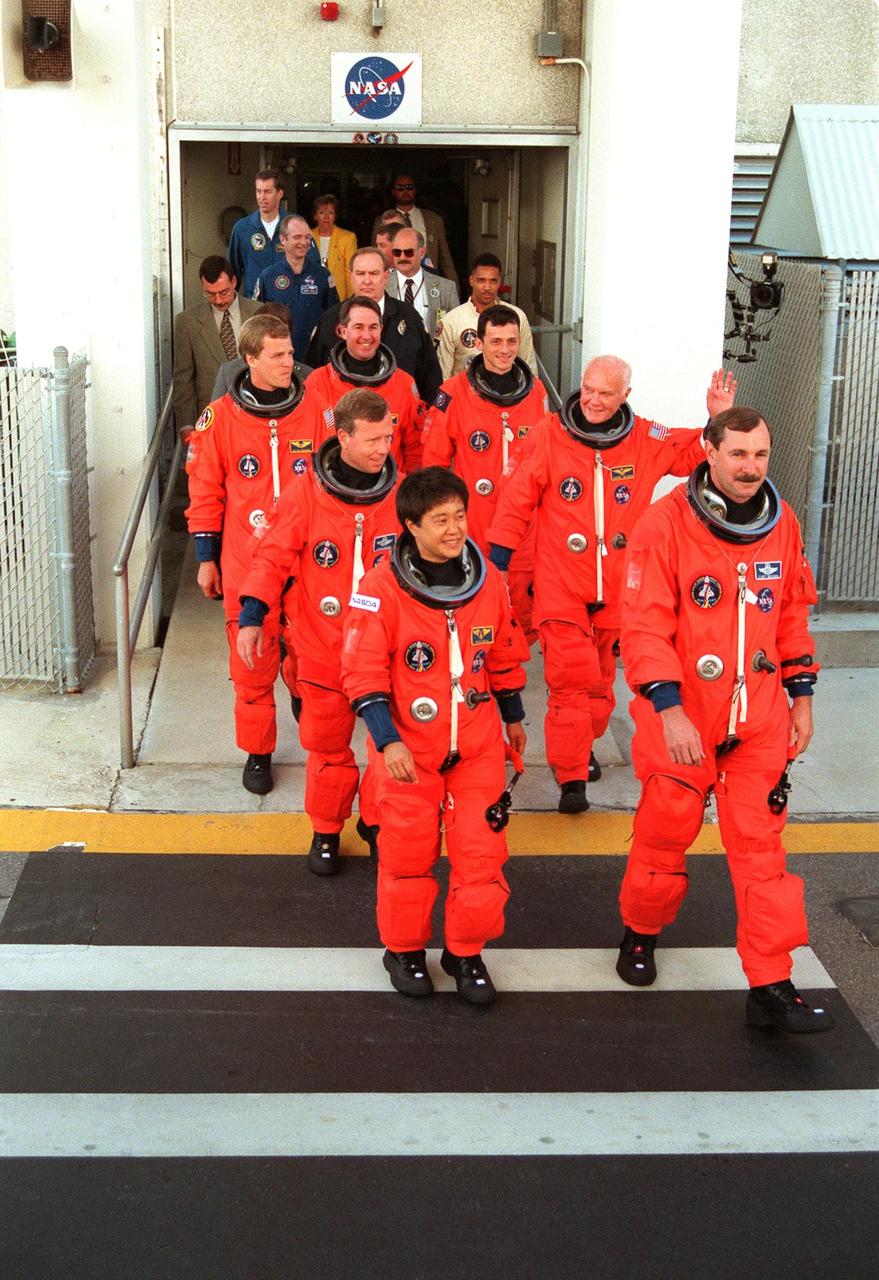
The STS-95 crew leave the Operations and Checkout Building in their flight suits for their trip to Launch Pad 39B. Leading the group to the Astrovan for the ride to Launch Pad 39B is Mission Commander Curtis L. Brown Jr. (far right) next to Payload Specialist Chiaki Mukai (left), with the National Space Development Agency of Japan (NASDA). Behind them are (2nd row) Pilot Steven W. Lindsey (left) and Payload Specialist John H. Glenn Jr. (right), senator from Ohio; (3rd row) Mission Specialists Scott E. Parazynski (left) and Pedro Duque of Spain (right), with the European Space Agency; and Mission Specialist Stephen K. Robinson at the rear. Targeted for launch at 2 p.m. EST on Oct. 29, the mission is expected to last 8 days, 21 hours and 49 minutes, and return to KSC at 11:49 a.m. EST on Nov. 7. The STS-95 mission includes research payloads such as the Spartan solar-observing deployable spacecraft, the Hubble Space Telescope Orbital Systems Test Platform, the International Extreme Ultraviolet Hitchhiker, as well as the SPACEHAB single module with experiments on space flight and the aging process
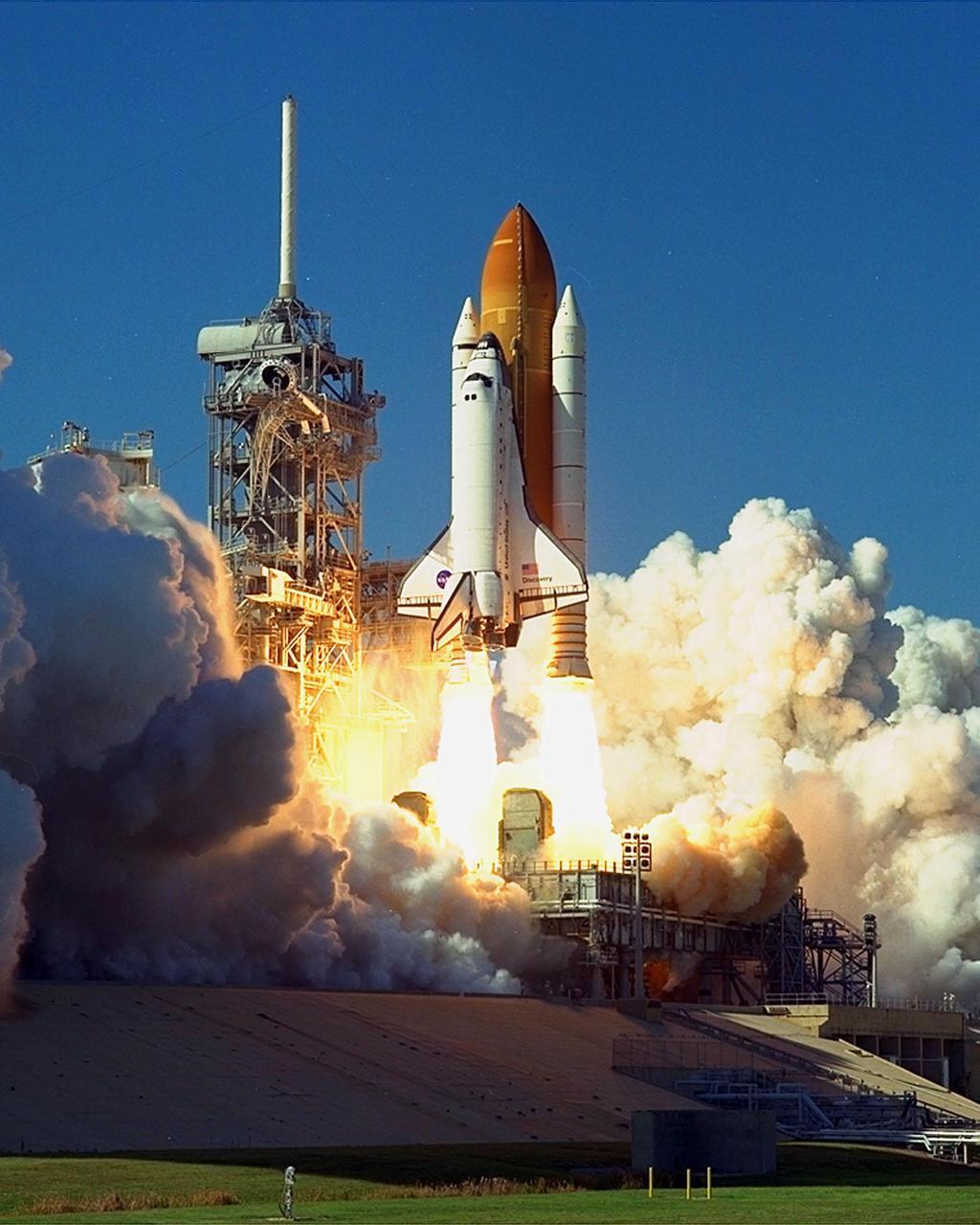
Clouds of exhaust and blazing light fill Launch Pad 39B as Space Shuttle Discovery lifts off at 2:19 p.m. EST Oct. 29 on mission STS-95. Making his second voyage into space after 36 years is Payload Specialist John H. Glenn Jr., senator from Ohio. Other crew members are Mission Commander Curtis L. Brown Jr., Pilot Steven W. Lindsey, Payload Specialist Chiaki Mukai, (M.D., Ph.D.), with the National Space Development Agency of Japan (NASDA), Mission Specialist Stephen K. Robinson, Mission Specialist Pedro Duque of Spain, representing the European Space Agency (ESA), and Mission Specialist Scott E. Parazynski. The STS-95 mission includes research payloads such as the Spartan solar-observing deployable spacecraft, the Hubble Space Telescope Orbital Systems Test Platform, the International Extreme Ultraviolet Hitchhiker, as well as the SPACEHAB single module with experiments on space flight and the aging process. Discovery is expected to return to KSC at 11:49 a.m. EST on Nov. 7
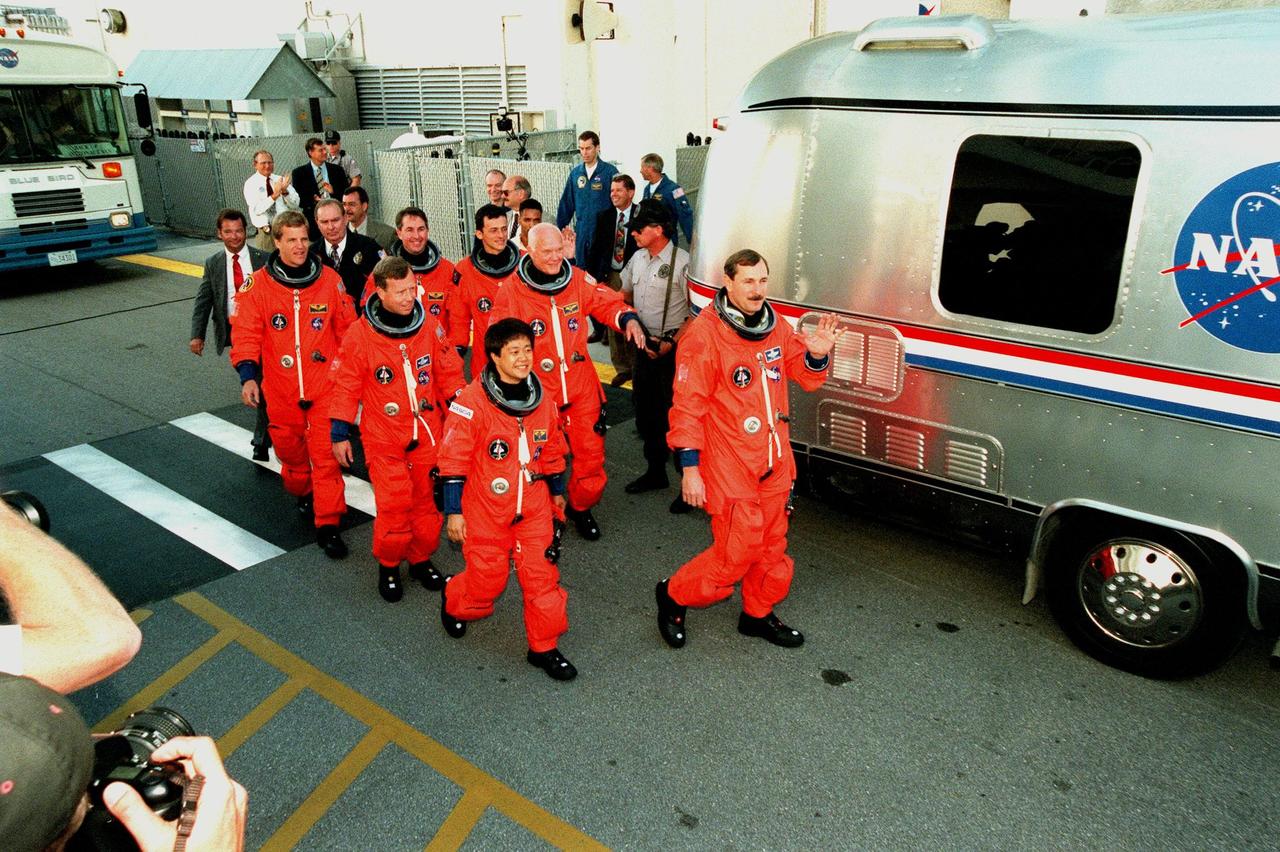
After leaving the Operations and Checkout Building, the STS-95 crew approach the Astrovan for their trip to Launch Pad 39B. Leading the group is Mission Commander Curtis L. Brown Jr. (far right), waving to the media and well-wishers; next him is Payload Specialist Chiaki Mukai (left), with the National Space Development Agency of Japan (NASDA). Behind them are (2nd row) Pilot Steven W. Lindsey (left) and Payload Specialist John H. Glenn Jr. (right), senator from Ohio; (3rd row) Mission Specialists Scott E. Parazynski , Stephen K. Robinson and Pedro Duque of Spain (right), with the European Space Agency. Targeted for launch at 2 p.m. EST on Oct. 29, the mission is expected to last 8 days, 21 hours and 49 minutes, and return to KSC at 11:49 a.m. EST on Nov. 7. The STS-95 mission includes research payloads such as the Spartan solar-observing deployable spacecraft, the Hubble Space Telescope Orbital Systems Test Platform, the International Extreme Ultraviolet Hitchhiker, as well as the SPACEHAB single module with experiments on space flight and the aging process
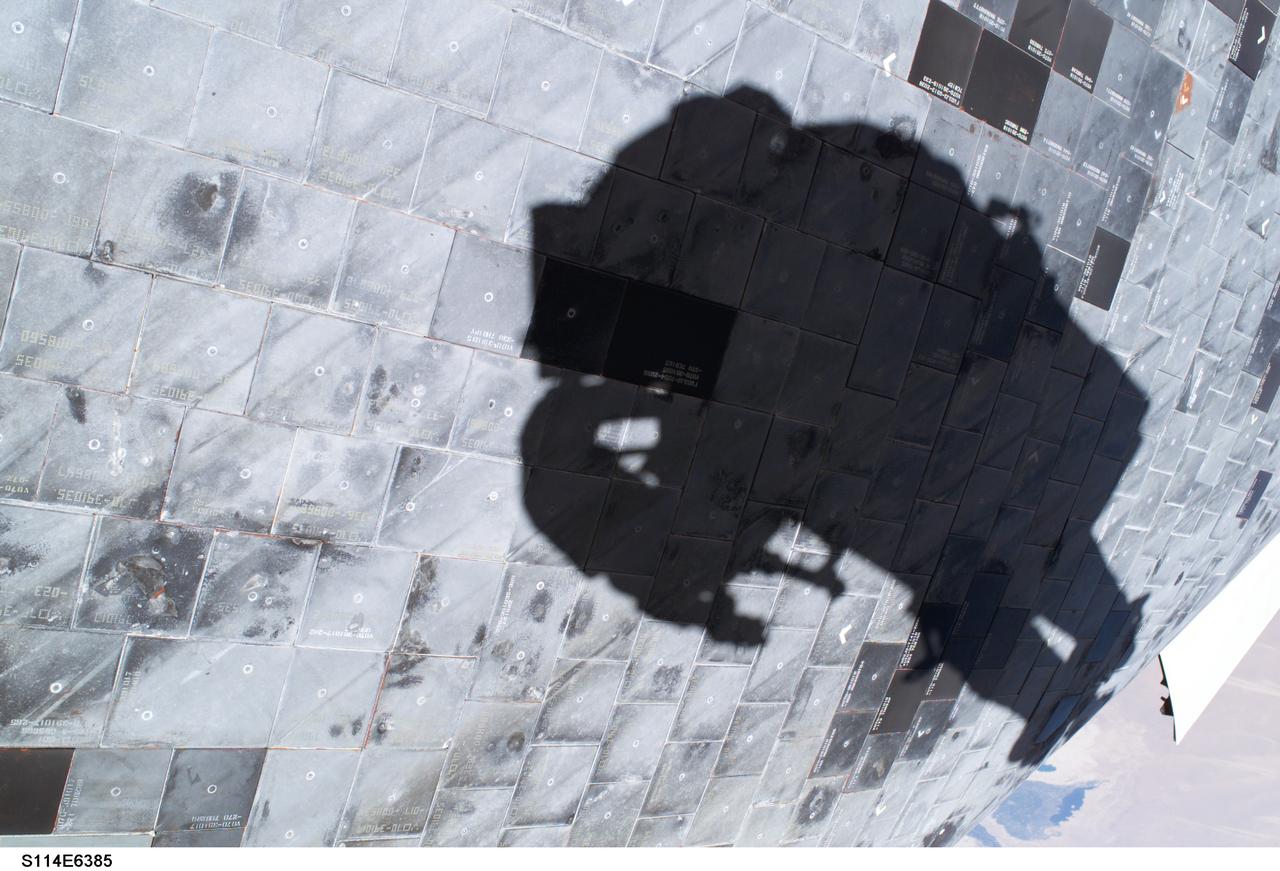
Launched on July 26, 2005 from the Kennedy Space Center in Florida, STS-114 was classified as Logistics Flight 1. Among the Station-related activities of the mission were the delivery of new supplies and the replacement of one of the orbital outpost's Control Moment Gyroscopes (CMGs). STS-114 also carried the Raffaello Multi-Purpose Logistics Module and the External Stowage Platform-2. A major focus of the mission was the testing and evaluation of new Space Shuttle flight safety, which included new inspection and repair techniques. Upon its approach to the International Space Station (ISS), the Space Shuttle Discovery underwent a photography session in order to assess any damages that may have occurred during its launch and/or journey through Space. The mission’s third and final Extra Vehicular Activity (EVA) included taking a close-up look and the repair of the damaged heat shield. Gap fillers were removed from between the orbiter’s heat-shielding tiles located on the craft’s underbelly. Never before had any repairs been done to an orbiter while still in space. This particular photo was taken by astronaut Stephen K. Robinson, STS-114 mission specialist, whose shadow is visible on the thermal protection tiles.
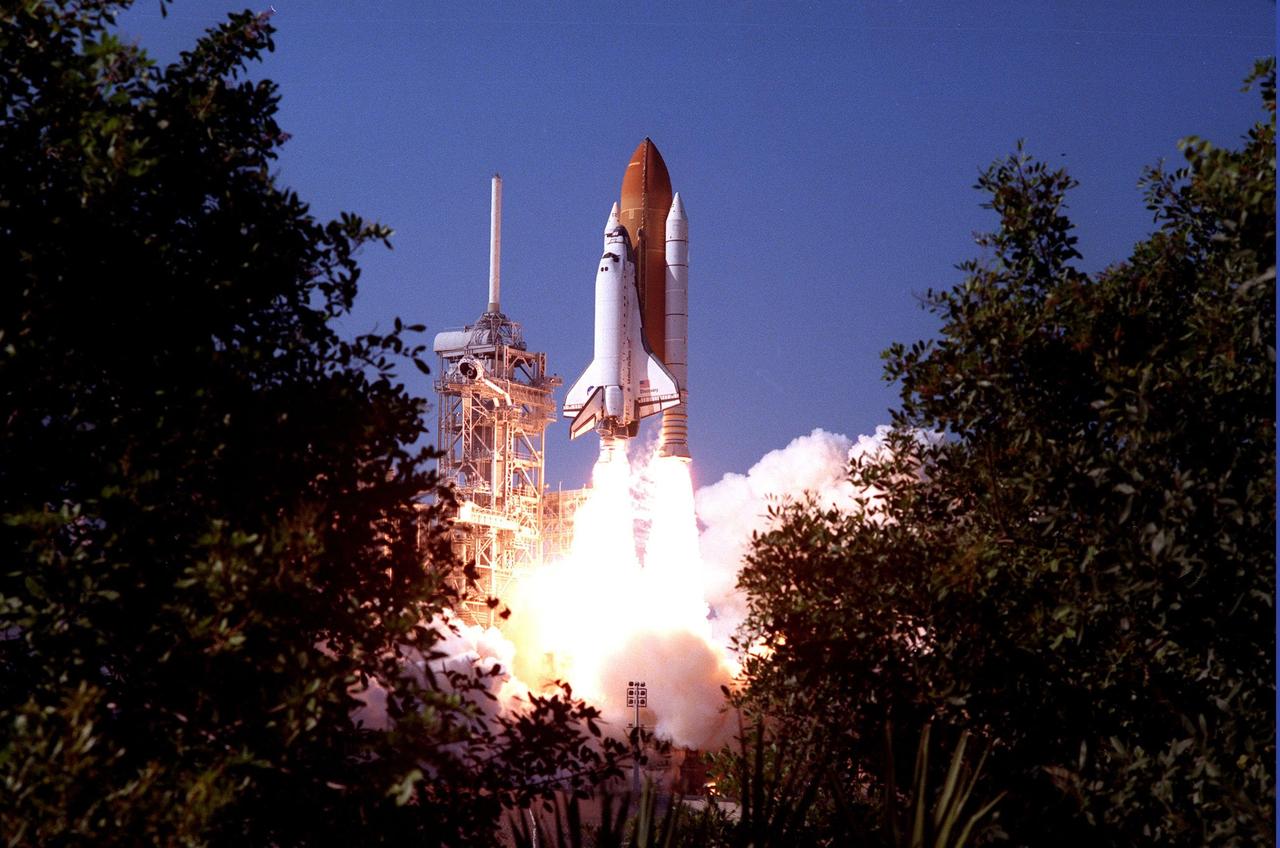
Framed by the foliage of the Canaveral National Sea Shore, Space Shuttle Discovery soars through bright blue skies as it lifts off from Launch Pad 39B at 2:19 p.m. EST Oct. 29 on mission STS-95. Making his second voyage into space after 36 years is Payload Specialist John H. Glenn Jr., senator from Ohio. Other crew members are Mission Commander Curtis L. Brown Jr., Pilot Steven W. Lindsey, Payload Specialist Chiaki Mukai, (M.D., Ph.D.), with the National agency for Space Development (NASDA), Mission Specialist Stephen K. Robinson, Mission Specialist Pedro Duque of Spain, representing the European Space Agency (ESA), and Mission Specialist Scott E. Parazynski. The STS-95 mission includes research payloads such as the Spartan solar-observing deployable spacecraft, the Hubble Space Telescope Orbital Systems Test Platform, the International Extreme Ultraviolet Hitchhiker, as well as the SPACEHAB single module with experiments on space flight and the aging process. Discovery is expected to return to KSC at 11:49 a.m. EST on Nov. 7
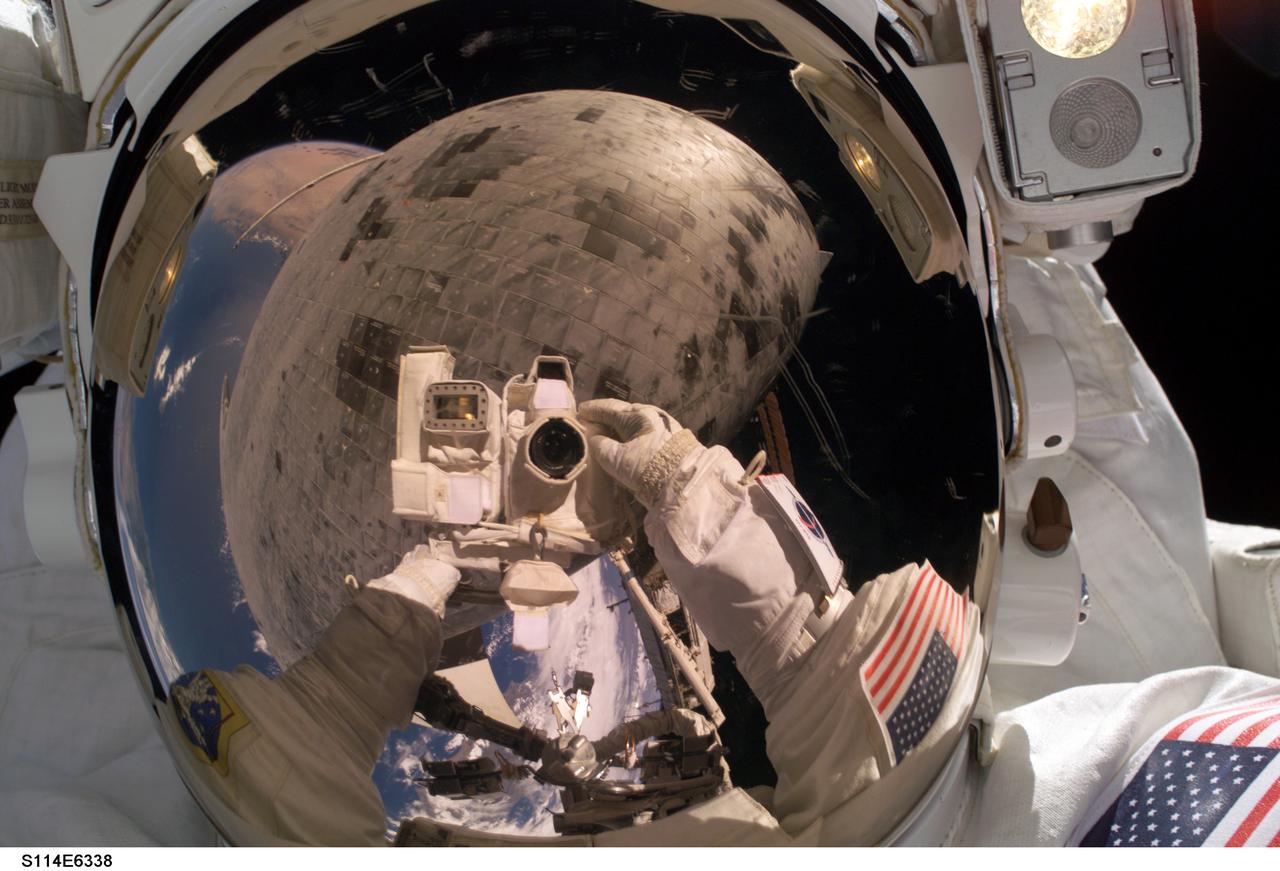
Launched on July 26, 2005 from the Kennedy Space Center in Florida, STS-114 was classified as Logistics Flight 1. Among the Station-related activities of the mission were the delivery of new supplies and the replacement of one of the orbital outpost's Control Moment Gyroscopes (CMGs). STS-114 also carried the Raffaello Multi-Purpose Logistics Module and the External Stowage Platform-2. A major focus of the mission was the testing and evaluation of new Space Shuttle flight safety, which included new inspection and repair techniques. Upon its approach to the International Space Station (ISS), the Space Shuttle Discovery underwent a photography session in order to assess any damages that may have occurred during its launch and/or journey through Space. The mission’s third and final Extra Vehicular Activity (EVA) included taking a close-up look and the repair of the damaged heat shield. Gap fillers were removed from between the orbiter’s heat-shielding tiles located on the craft’s underbelly. Never before had any repairs been done to an orbiter while still in space. Astronaut Stephen K. Robinson, STS-114 mission specialist, used the pictured still digital camera to expose a photo of his helmet visor during the EVA. Also visible in the reflection are thermal protection tiles on Discovery’s underside.

STS-95 Mission Commander Curtis L. Brown Jr. (at microphone) greets the media at the Shuttle Landing Facility after the crew's arrival aboard T-38 jets (in the background) to make final preparations for their launch, targeted for liftoff at 2 p.m. on Oct. 29. The other crew members are (left to right) Payload Specialist Chiaki Mukai, with the National Space Development Agency of Japan (NASDA), Mission Specialist Stephen K. Robinson, Pilot Steven W. Lindsey, Mission Specialist Pedro Duque, with the European Space Agency (ESA), and Payload Specialist John H. Glenn Jr., senator from Ohio. Missing is Mission Specialist Scott E. Parazynski, who was delayed in the flight from Texas. The STS-95 mission includes research payloads such as the Spartan solar-observing deployable spacecraft, the Hubble Space Telescope Orbital Systems Test Platform, the International Extreme Ultraviolet Hitchhiker, as well as the SPACEHAB single module with experiments on space flight and the aging process. The mission is expected to last 8 days, 21 hours and 49 minutes, and return to KSC on Nov. 7

Clouds of exhaust fill Launch Pad 39B as Space Shuttle Discovery lifts off at 2:19 p.m. EST Oct. 29 on mission STS-95. Making his second voyage into space after 36 years is Payload Specialist John H. Glenn Jr., senator from Ohio. Other crew members are Mission Commander Curtis L. Brown Jr., Pilot Steven W. Lindsey, Payload Specialist Chiaki Mukai, (M.D., Ph.D.), with the National Space Development Agency of Japan (NASDA), Mission Specialist Stephen K. Robinson, Mission Specialist Pedro Duque of Spain, representing the European Space Agency (ESA), and Mission Specialist Scott E. Parazynski. The STS-95 mission includes research payloads such as the Spartan solar-observing deployable spacecraft, the Hubble Space Telescope Orbital Systems Test Platform, the International Extreme Ultraviolet Hitchhiker, as well as the SPACEHAB single module with experiments on space flight and the aging process. Discovery is expected to return to KSC at 11:49 a.m. EST on Nov. 7
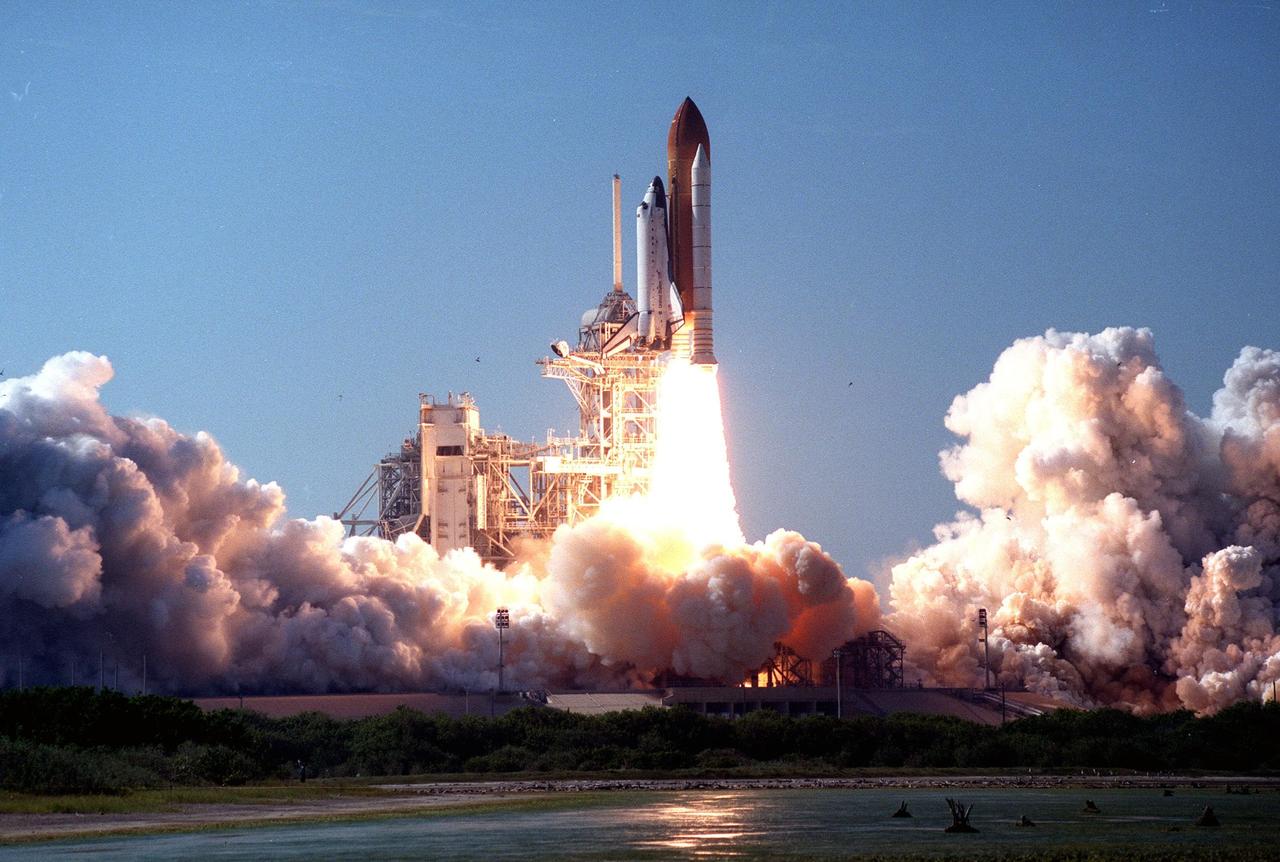
Against a curtain of blue sky, the Space Shuttle Discovery spews clouds of exhaust as it lifts off from Launch Pad 39B at 2:19 p.m. EST Oct. 29 on the 9-day mission STS-95. On board Discovery are Mission Commander Curtis L. Brown Jr., Pilot Steven W. Lindsey, Payload Specialist Chiaki Mukai, (M.D., Ph.D.), with the National Space Development Agency of Japan (NASDA), Payload Specialist John H. Glenn Jr., senator from Ohio, Mission Specialist Stephen K. Robinson, Mission Specialist Pedro Duque of Spain, representing the European Space Agency (ESA), and Mission Specialist Scott E. Parazynski. The STS-95 mission includes research payloads such as the Spartan solar-observing deployable spacecraft, the Hubble Space Telescope Orbital Systems Test Platform, the International Extreme Ultraviolet Hitchhiker, as well as the SPACEHAB single module with experiments on space flight and the aging process. Discovery is expected to return to KSC at 11:49 a.m. EST on Nov. 7
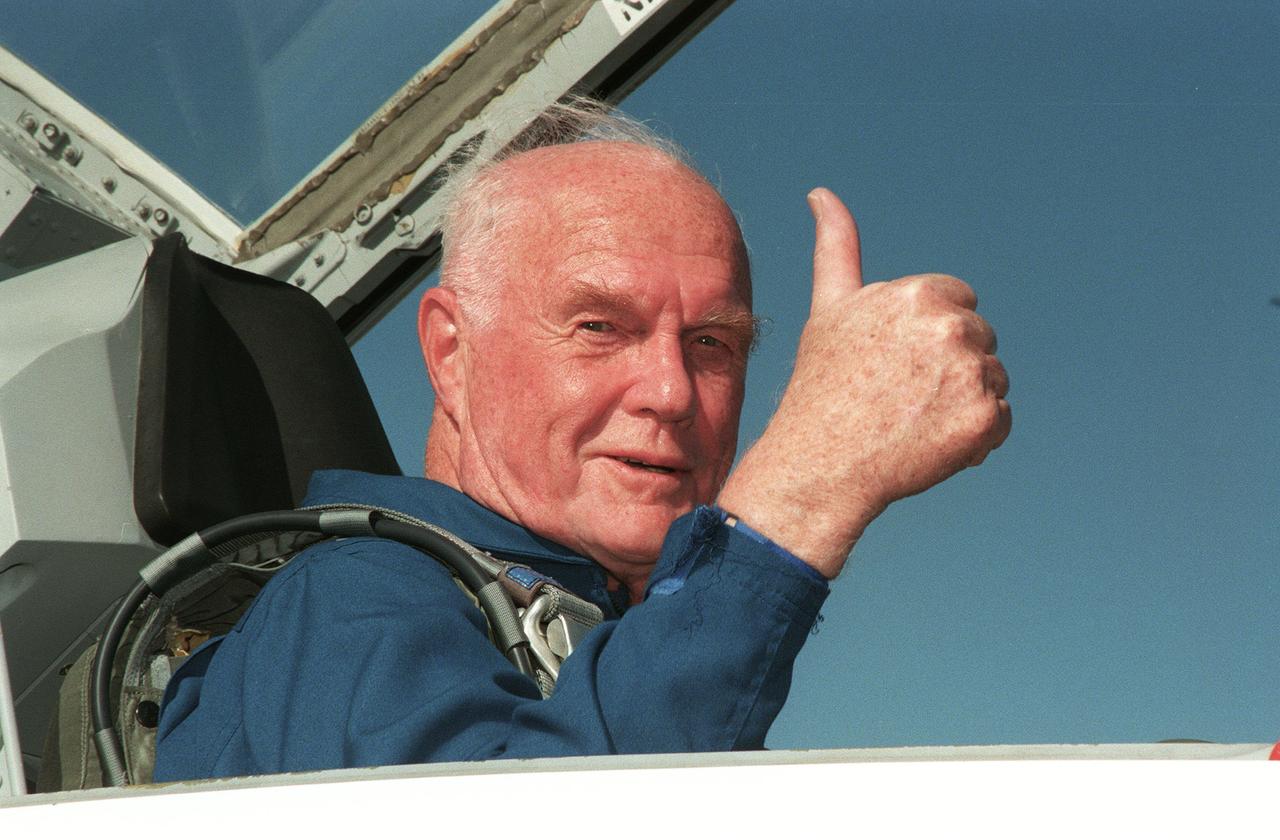
STS-95 Payload Specialist John H. Glenn Jr., senator from Ohio, gives a thumbs up on his arrival at Kennedy Space Center's Shuttle Landing Facility aboard a T-38 jet. He and other crewmembers will be making final preparations for launch, targeted for liftoff at 2 p.m. on Oct. 29. The STS-95 mission includes research payloads such as the Spartan solar-observing deployable spacecraft, the Hubble Space Telescope Orbital Systems Test Platform, the International Extreme Ultraviolet Hitchhiker, as well as the SPACEHAB single module with experiments on space flight and the aging process. The mission is expected to last 8 days, 21 hours and 49 minutes, and return to KSC on Nov. 7. The other STS-95 crew members are Mission Commander Curtis L. Brown Jr., Pilot Steven W. Lindsey, Mission Specialist Scott E. Parazynski, Mission Specialist Stephen K. Robinson, Mission Specialist Pedro Duque, with the European Space Agency (ESA), and Payload Specialist Chiaki Mukai, with the National Space Development Agency of Japan (NASDA).
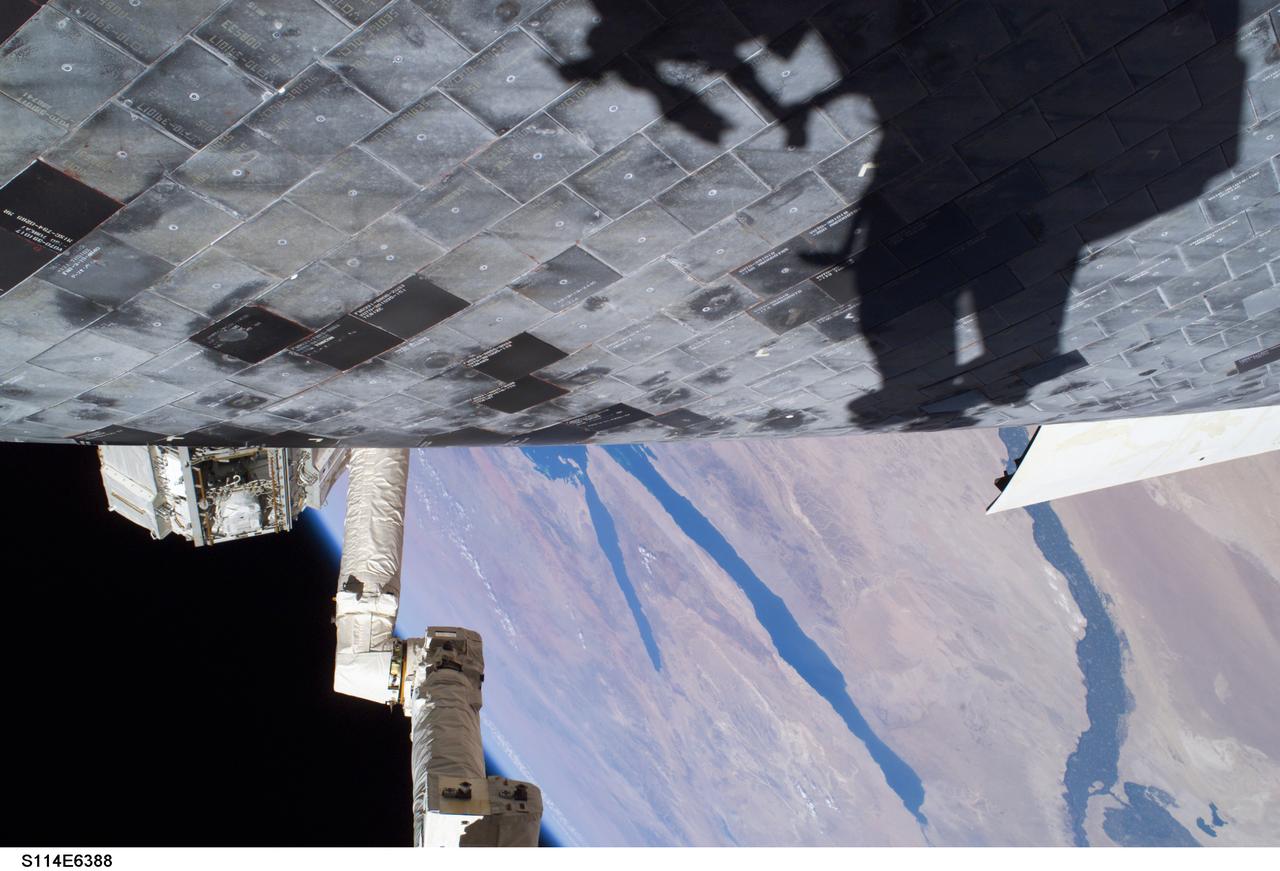
Launched on July 26, 2005 from the Kennedy Space Center in Florida, STS-114 was classified as Logistics Flight 1. Among the Station-related activities of the mission were the delivery of new supplies and the replacement of one of the orbital outpost's Control Moment Gyroscopes (CMGs). STS-114 also carried the Raffaello Multi-Purpose Logistics Module and the External Stowage Platform-2. A major focus of the mission was the testing and evaluation of new Space Shuttle flight safety, which included new inspection and repair techniques. Upon its approach to the International Space Station (ISS), the Space Shuttle Discovery underwent a photography session in order to assess any damages that may have occurred during its launch and/or journey through Space. The mission’s third and final Extra Vehicular Activity (EVA) included taking a close-up look and the repair of the damaged heat shield. Gap fillers were removed from between the orbiter’s heat-shielding tiles located on the craft’s underbelly. Never before had any repairs been done to an orbiter while still in space. This particular photo was taken by astronaut Stephen K. Robinson, STS-114 mission specialist, whose shadow is visible on the thermal protection tiles, and a portion of the Canadian built Remote Manipulator System (RMS) robotic arm and the Nile River is visible at the bottom.
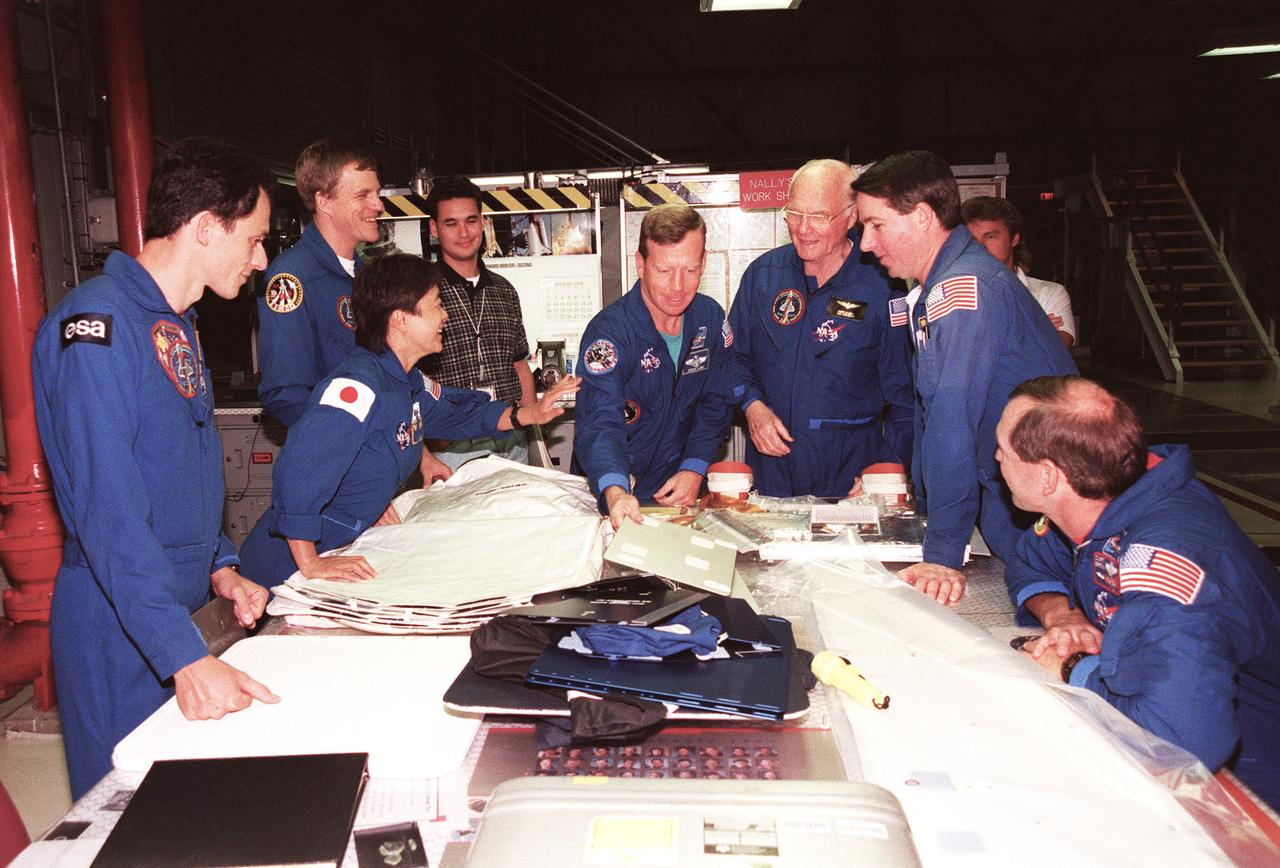
Around a table in Bay 2 Orbiter Processing Facility at NASA's Kennedy Space Center in Florida, STS-95 crew members look over equipment during the Crew Equipment Interface Test (CEIT) for their mission. From left, they are Mission Specialist Pedro Duque, of the European Space Agency; Payload Specialist Chiaki Mukai, of the National Space Development Agency of Japan (NASDA); Mission Specialist Scott E. Parazynski, M.D.; Pilot Steven W. Lindsey; Payload Specialist John H. Glenn Jr., senator form Ohio; Mission Specialist Stephen K. Robinson; and Mission Commander Curtis L. Brown Jr. The CEIT gives astronauts an opportunity for a hands-on look at the payloads and equipment with which they will be working on orbit. The launch of the STS-95 mission, aboard Space Shuttle Discovery, is scheduled for Oct. 29, 1998. The mission includes research payloads such as the Spartan solar-observing deployable spacecraft, the Hubble Space Telescope Orbital Systems Test Platform, the International Extreme Ultraviolet Hitchhiker, as well as the SPACEHAB single module with experiments on space flight and the aging process.
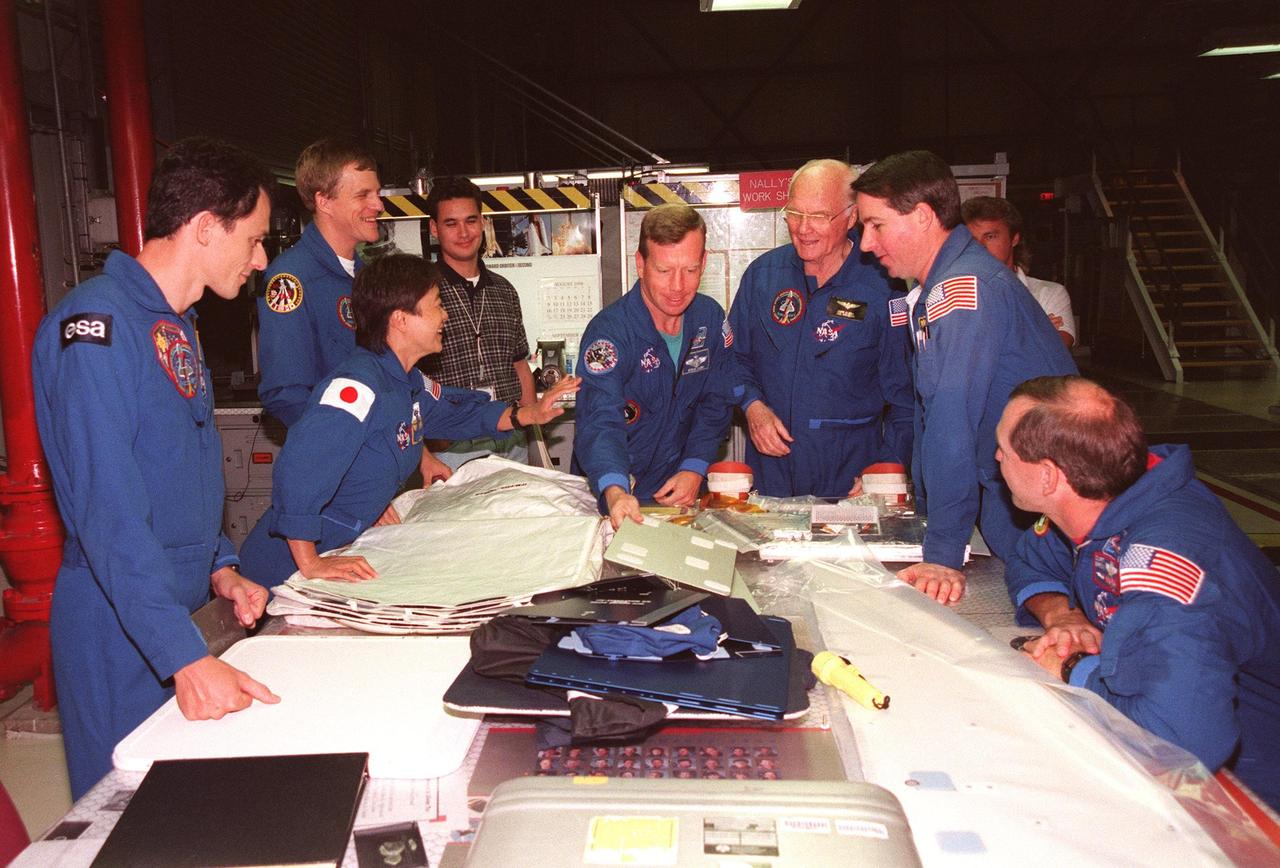
Around a table in Orbiter Processing Facility Bay 2 , STS-95 crew members look over equipment during the Crew Equipment Interface Test (CEIT) for their mission. From left, they are Mission Specialist Pedro Duque, of the European Space Agency; Payload Specialist Chiaki Mukai, of the National Space Development Agency of Japan (NASDA); Mission Specialist Scott E. Parazynski, M.D.; Pilot Steven W. Lindsey; Payload Specialist John H. Glenn Jr., senator from Ohio; Mission Specialist Stephen K. Robinson; and Mission Commander Curtis L. Brown Jr. Behind them is Adam Flagan, United Space Alliance-Houston. The CEIT gives astronauts an opportunity for a hands-on look at the payloads and equipment with which they will be working on orbit. The launch of the STS-95 mission, aboard Space Shuttle Discovery, is scheduled for Oct. 29, 1998. The mission includes research payloads such as the Spartan solar-observing deployable spacecraft, the Hubble Space Telescope Orbital Systems Test Platform, the International Extreme Ultraviolet Hitchhiker, as well as the SPACEHAB single module with experiments on space flight and the aging process

STS-95 Payload Specialist John H. Glenn Jr., senator from Ohio, gives a thumbs up on his arrival at Kennedy Space Center's Shuttle Landing Facility aboard a T-38 jet. He and other crewmembers will be making final preparations for launch, targeted for liftoff at 2 p.m. on Oct. 29. The STS-95 mission includes research payloads such as the Spartan solar-observing deployable spacecraft, the Hubble Space Telescope Orbital Systems Test Platform, the International Extreme Ultraviolet Hitchhiker, as well as the SPACEHAB single module with experiments on space flight and the aging process. The mission is expected to last 8 days, 21 hours and 49 minutes, and return to KSC on Nov. 7. The other STS-95 crew members are Mission Commander Curtis L. Brown Jr., Pilot Steven W. Lindsey, Mission Specialist Scott E. Parazynski, Mission Specialist Stephen K. Robinson, Mission Specialist Pedro Duque, with the European Space Agency (ESA), and Payload Specialist Chiaki Mukai, with the National Space Development Agency of Japan (NASDA)
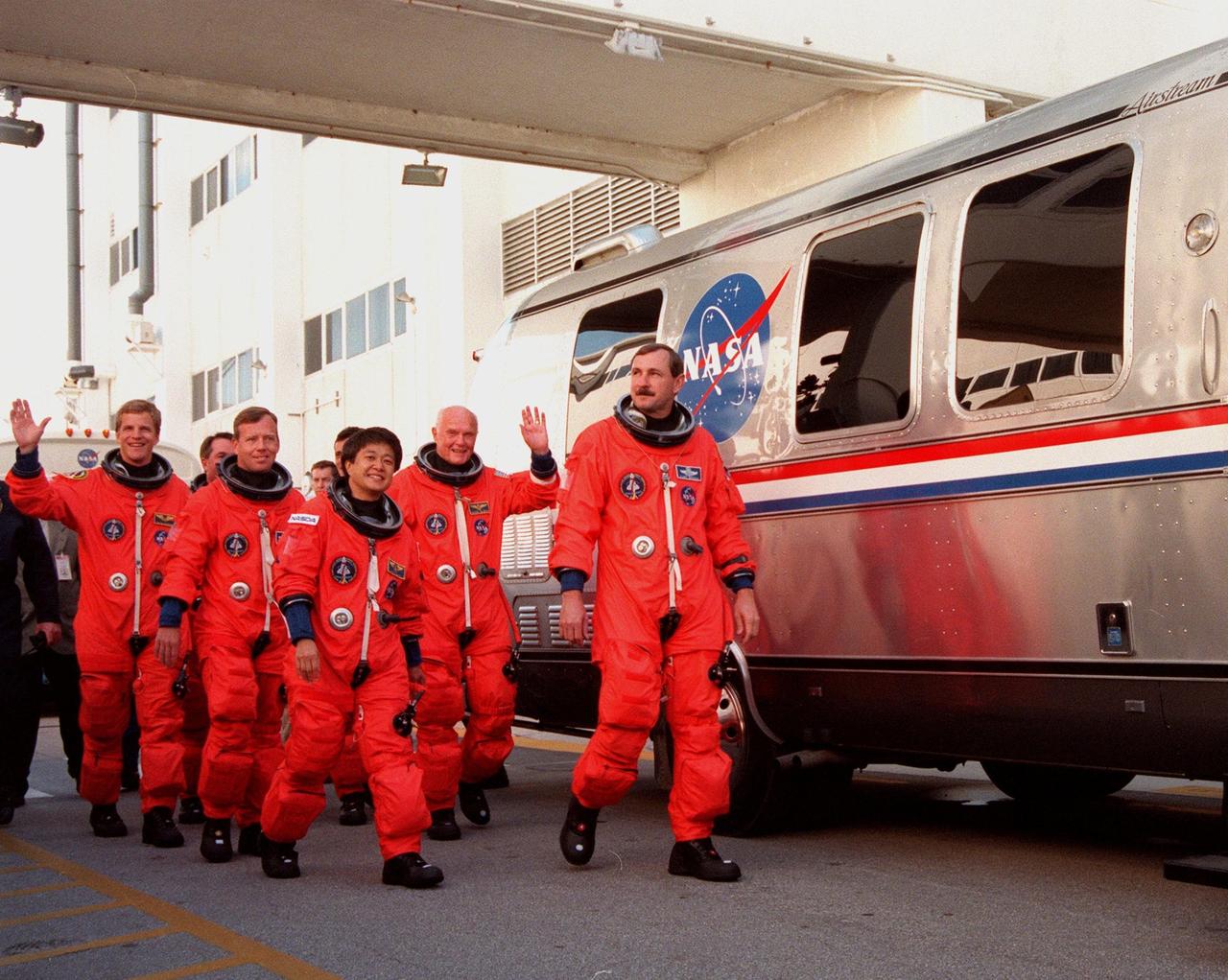
After leaving the Operations and Checkout Building, the STS-95 crew wave at well-wishers as they approach the Astrovan they will board for their trip to Launch Pad 39B. Leading the group is Mission Commander Curtis L. Brown Jr. (far right); Other crew members are (left to right) Mission Specialists Scott E. Parazynski , Stephen K. Robinson, Pilot Steven W. Lindsey, Mission Specialist Pedro Duque of Spain (hidden), with the European Space Agency (ESA), Payload Specialist Chiaki Mukai, with the National Space Development Agency of Japan (NASDA), and Payload Specialist John H. Glenn Jr. Targeted for launch at 2 p.m. EST on Oct. 29, the mission is expected to last 8 days, 21 hours and 49 minutes, and return to KSC at 11:49 a.m. EST on Nov. 7. The STS-95 mission includes research payloads such as the Spartan solar-observing deployable spacecraft, the Hubble Space Telescope Orbital Systems Test Platform, the International Extreme Ultraviolet Hitchhiker, as well as the SPACEHAB single module with experiments on space flight and the aging process
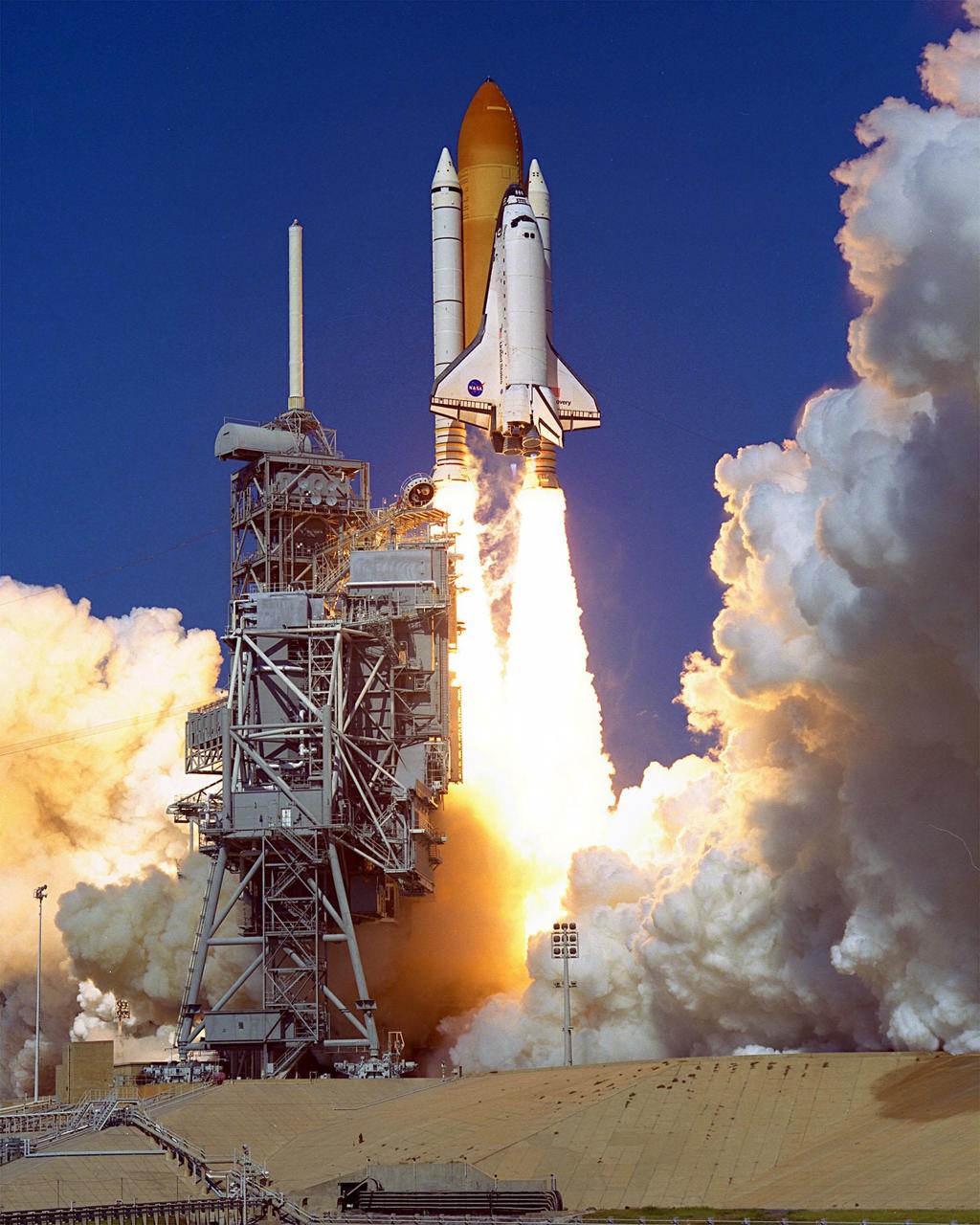
Space Shuttle Discovery clears Launch Pad 39B at 2:19 p.m. EST Oct. 29 as it lifts off on mission STS-95. Making his second voyage into space after 36 years is Payload Specialist John H. Glenn Jr., senator from Ohio. Other crew members are Mission Commander Curtis L. Brown Jr., Pilot Steven W. Lindsey, Payload Specialist Chiaki Mukai, (M.D., Ph.D.), with the National Space Development Agency of Japan (NASDA), Mission Specialist Stephen K. Robinson, Mission Specialist Pedro Duque of Spain, representing the European Space Agency (ESA), and Mission Specialist Scott E. Parazynski. The STS-95 mission includes research payloads such as the Spartan solar-observing deployable spacecraft, the Hubble Space Telescope Orbital Systems Test Platform, the International Extreme Ultraviolet Hitchhiker, as well as the SPACEHAB single module with experiments on space flight and the aging process. Discovery is expected to return to KSC at 11:49 a.m. EST on Nov. 7
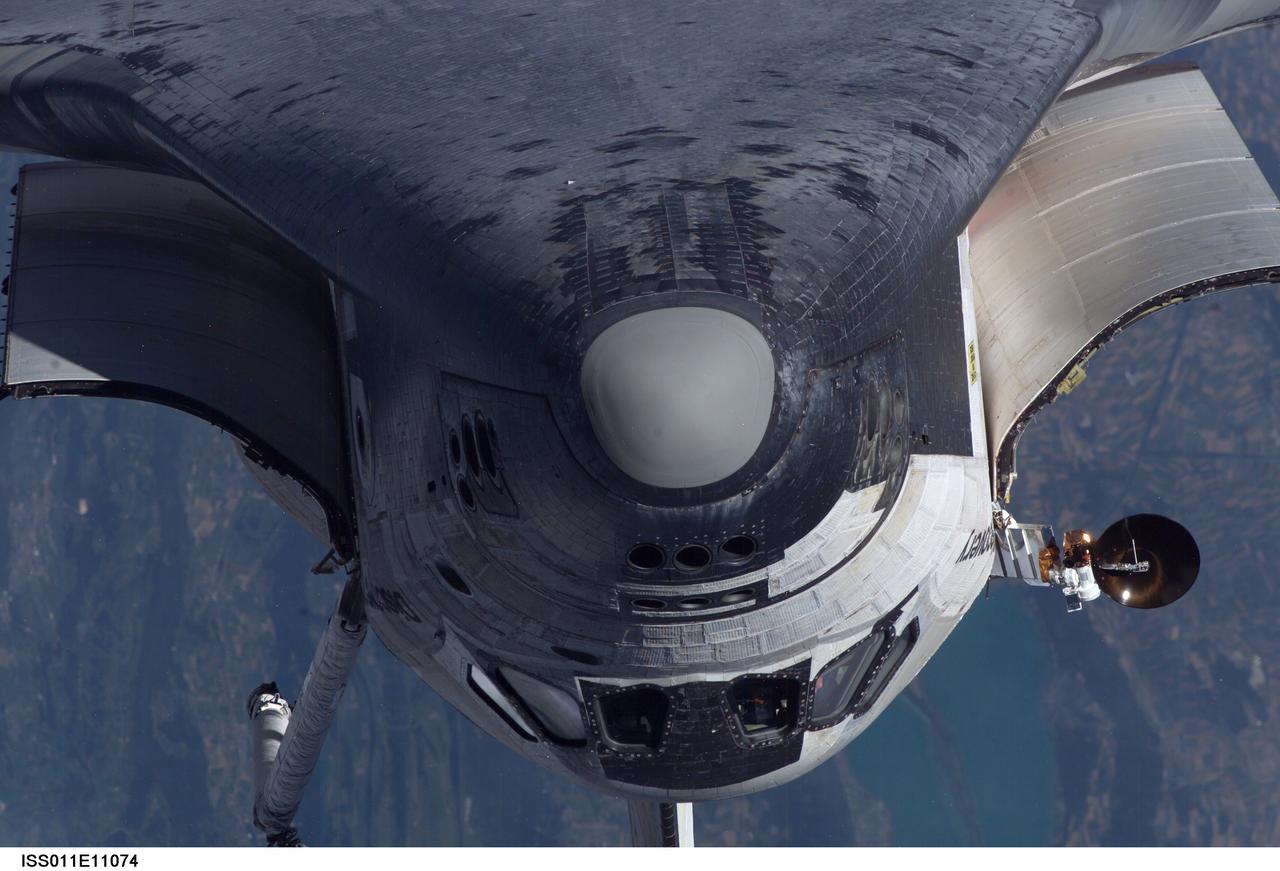
Launched on July 26, 2005 from the Kennedy Space Center in Florida, STS-114 was classified as Logistics Flight 1. Among the Station-related activities of the mission were the delivery of new supplies and the replacement of one of the orbital outpost's Control Moment Gyroscopes (CMGs). STS-114 also carried the Raffaello Multi-Purpose Logistics Module and the External Stowage Platform-2. A major focus of the mission was the testing and evaluation of new Space Shuttle flight safety, which included new inspection and repair techniques. Upon its approach to the International Space Station (ISS), the Space Shuttle Discovery underwent a photography session in order to assess any damages that may have occurred during its launch and/or journey through Space. Discovery was over Switzerland, about 600 feet from the ISS, when Cosmonaut Sergei K. Kriklev, Expedition 11 Commander, and John L. Phillips, NASA Space Station officer and flight engineer photographed the spacecraft as it performed a back flip to allow photography of its heat shield. Astronaut Eileen M. Collins, STS-114 Commander, guided the shuttle through the flip. The photographs were analyzed by engineers on the ground to evaluate the condition of Discovery’s heat shield. The crew safely returned to Earth on August 9, 2005. The mission historically marked the Return to Flight after nearly a two and one half year delay in flight after the Space Shuttle Columbia tragedy in February 2003.
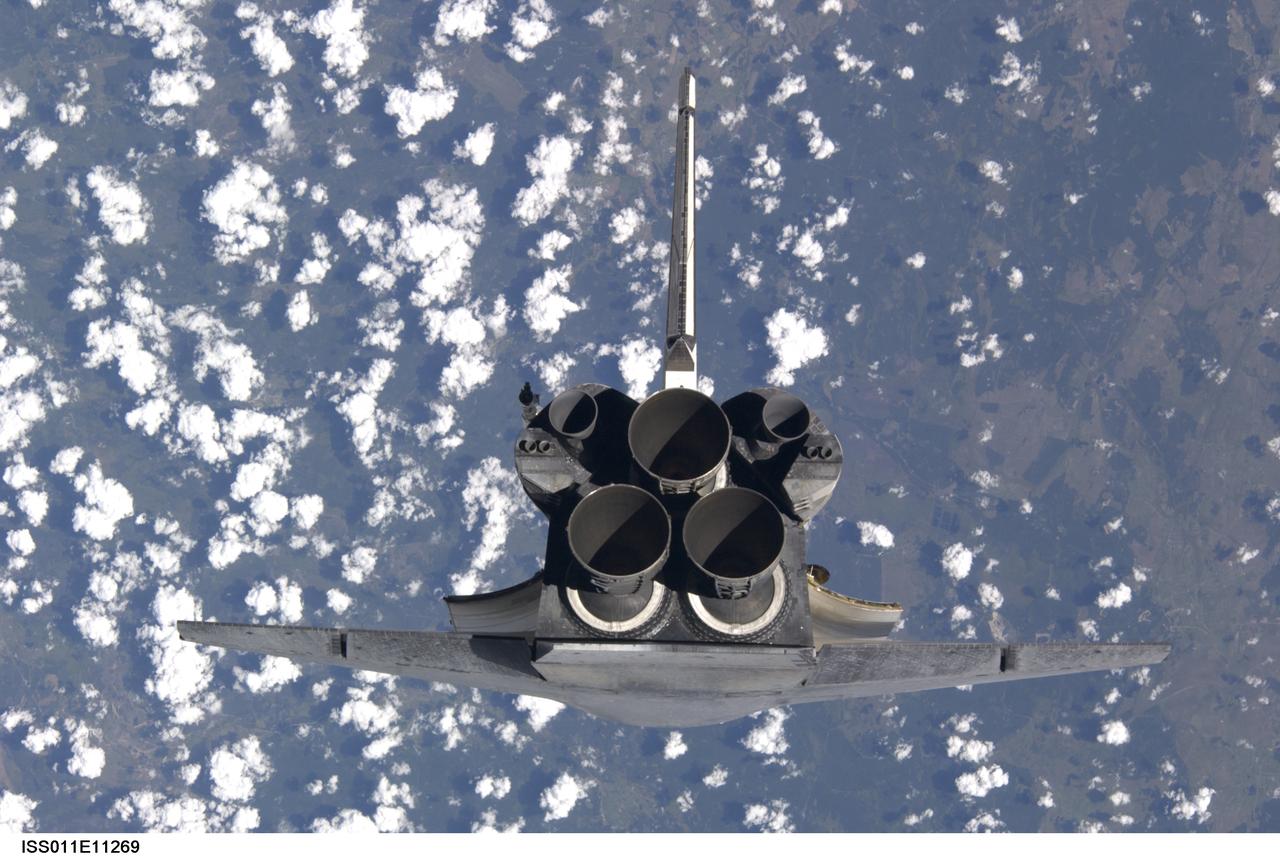
Launched on July 26, 2005 from the Kennedy Space Center in Florida, STS-114 was classified as Logistics Flight 1. Among the Station-related activities of the mission were the delivery of new supplies and the replacement of one of the orbital outpost's Control Moment Gyroscopes (CMGs). STS-114 also carried the Raffaello Multi-Purpose Logistics Module and the External Stowage Platform-2. A major focus of the mission was the testing and evaluation of new Space Shuttle flight safety, which included new inspection and repair techniques. Upon its approach to the International Space Station (ISS), the Space Shuttle Discovery underwent a photography session in order to assess any damages that may have occurred during its launch and/or journey through Space. Discovery was over Switzerland, about 600 feet from the ISS, when Cosmonaut Sergei K. Kriklev, Expedition 11 Commander, and John L. Phillips, NASA Space Station officer and flight engineer photographed the spacecraft as it performed a back flip to allow photography of its heat shield. Astronaut Eileen M. Collins, STS-114 Commander, guided the shuttle through the flip. The photographs were analyzed by engineers on the ground to evaluate the condition of Discovery’s heat shield. The crew safely returned to Earth on August 9, 2005. The mission historically marked the Return to Flight after nearly a two and one half year delay in flight after the Space Shuttle Columbia tragedy in February 2003.
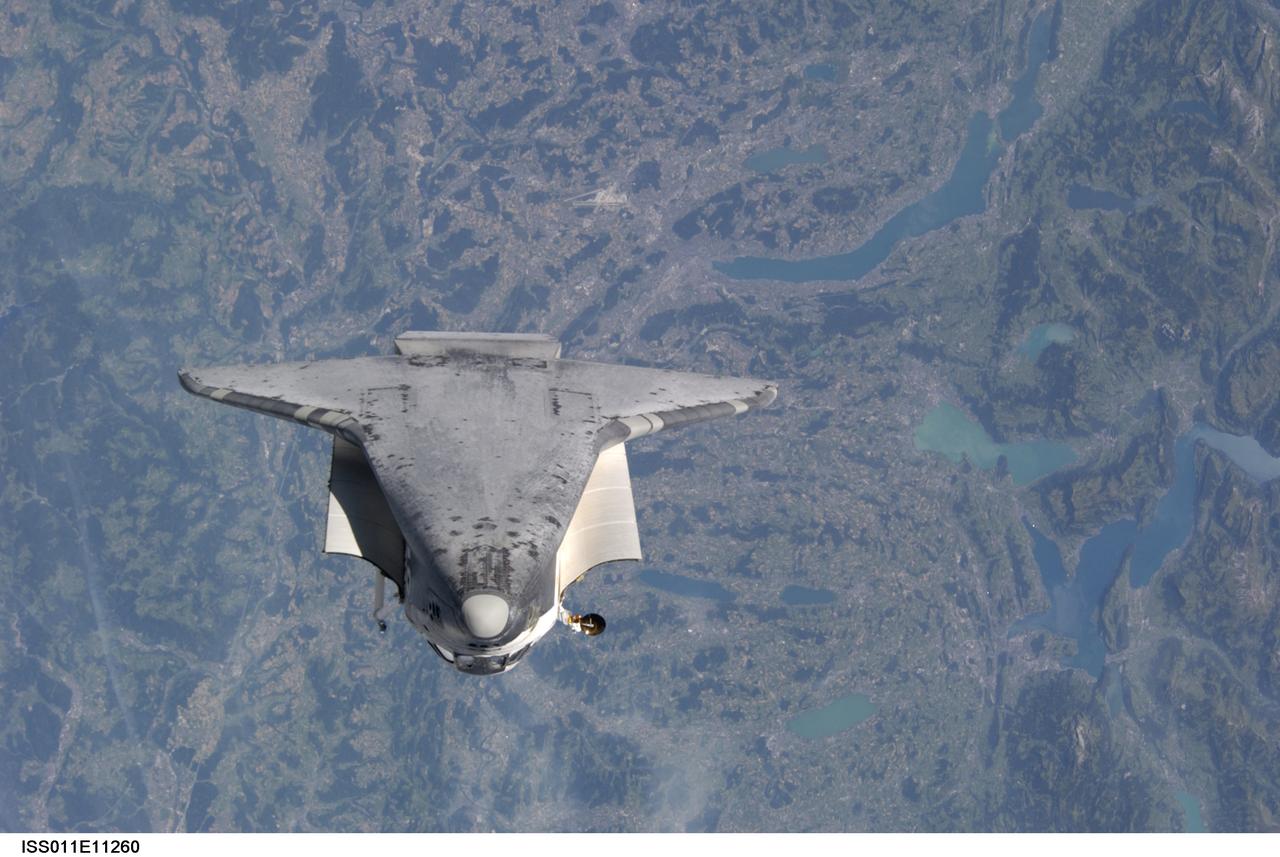
Launched on July 26, 2005, from the Kennedy Space Center in Florida, STS-114 was classified as Logistics Flight 1. Among the Station-related activities of the mission were the delivery of new supplies and the replacement of one of the orbital outpost's Control Moment Gyroscopes (CMGs). STS-114 also carried the Raffaello Multi-Purpose Logistics Module and the External Stowage Platform-2. A major focus of the mission was the testing and evaluation of new Space Shuttle flight safety, which included new inspection and repair techniques. Upon its approach to the International Space Station (ISS), the Space Shuttle Discovery underwent a photography session in order to assess any damages that may have occurred during its launch and/or journey through Space. Discovery was over Switzerland, about 600 feet from the ISS, when Cosmonaut Sergei K. Kriklev, Expedition 11 Commander, and John L. Phillips, NASA Space Station officer and flight engineer photographed the under side of the spacecraft as it performed a back flip to allow photography of its heat shield. Astronaut Eileen M. Collins, STS-114 Commander, guided the shuttle through the flip. The photographs were analyzed by engineers on the ground to evaluate the condition of Discovery’s heat shield. The crew safely returned to Earth on August 9, 2005. The mission historically marked the Return to Flight after nearly a two and one half year delay in flight after the Space Shuttle Columbia tragedy in February 2003.
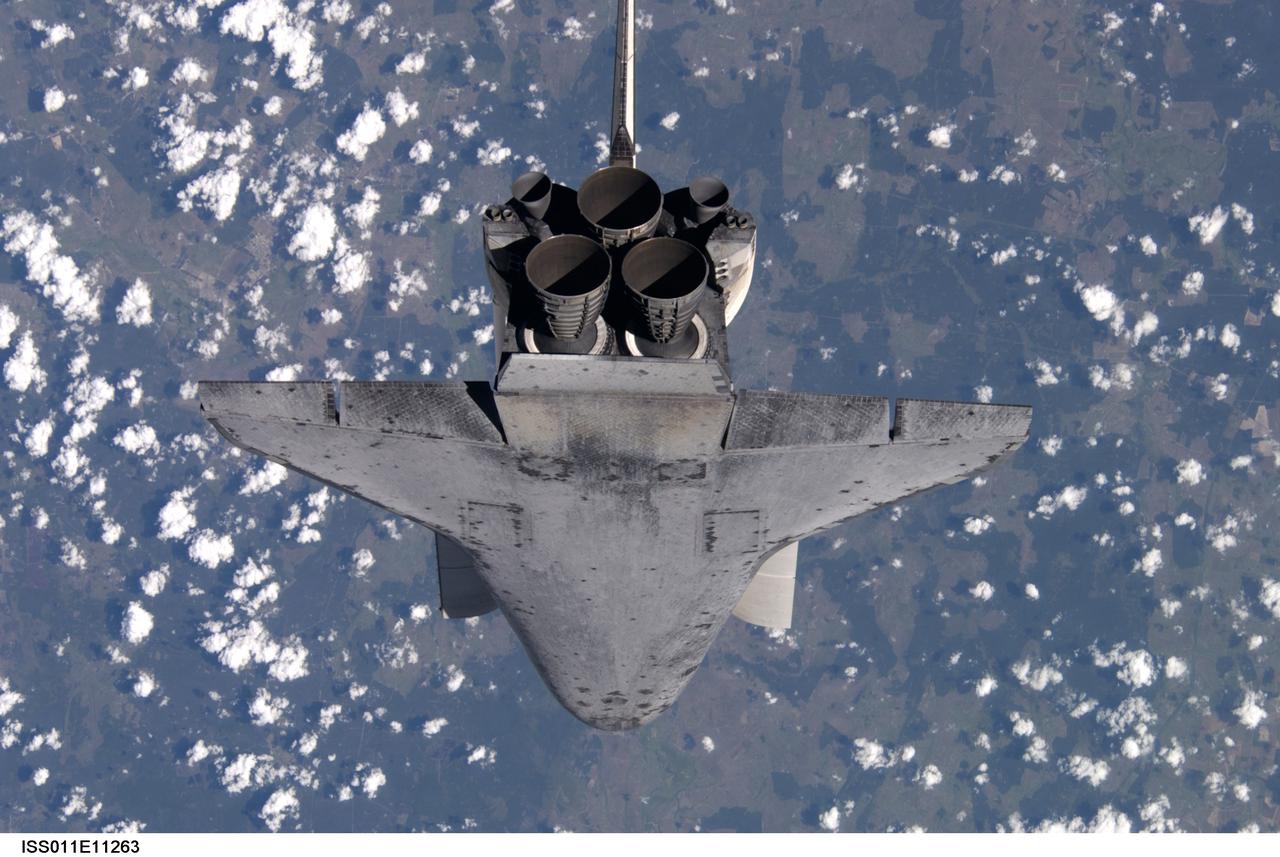
Launched on July 26, 2005 from the Kennedy Space Center in Florida, STS-114 was classified as Logistics Flight 1. Among the Station-related activities of the mission were the delivery of new supplies and the replacement of one of the orbital outpost's Control Moment Gyroscopes (CMGs). STS-114 also carried the Raffaello Multi-Purpose Logistics Module and the External Stowage Platform-2. A major focus of the mission was the testing and evaluation of new Space Shuttle flight safety, which included new inspection and repair techniques. Upon its approach to the International Space Station (ISS), the Space Shuttle Discovery underwent a photography session in order to assess any damages that may have occurred during its launch and/or journey through Space. Discovery was over Switzerland, about 600 feet from the ISS, when Cosmonaut Sergei K. Kriklev, Expedition 11 Commander, and John L. Phillips, NASA Space Station officer and flight engineer photographed the under side of the spacecraft as it performed a back flip to allow photography of its heat shield. Astronaut Eileen M. Collins, STS-114 Commander, guided the shuttle through the flip. The photographs were analyzed by engineers on the ground to evaluate the condition of Discovery’s heat shield. The crew safely returned to Earth on August 9, 2005. The mission historically marked the Return to Flight after nearly a two and one half year delay in flight after the Space Shuttle Columbia tragedy in February 2003.
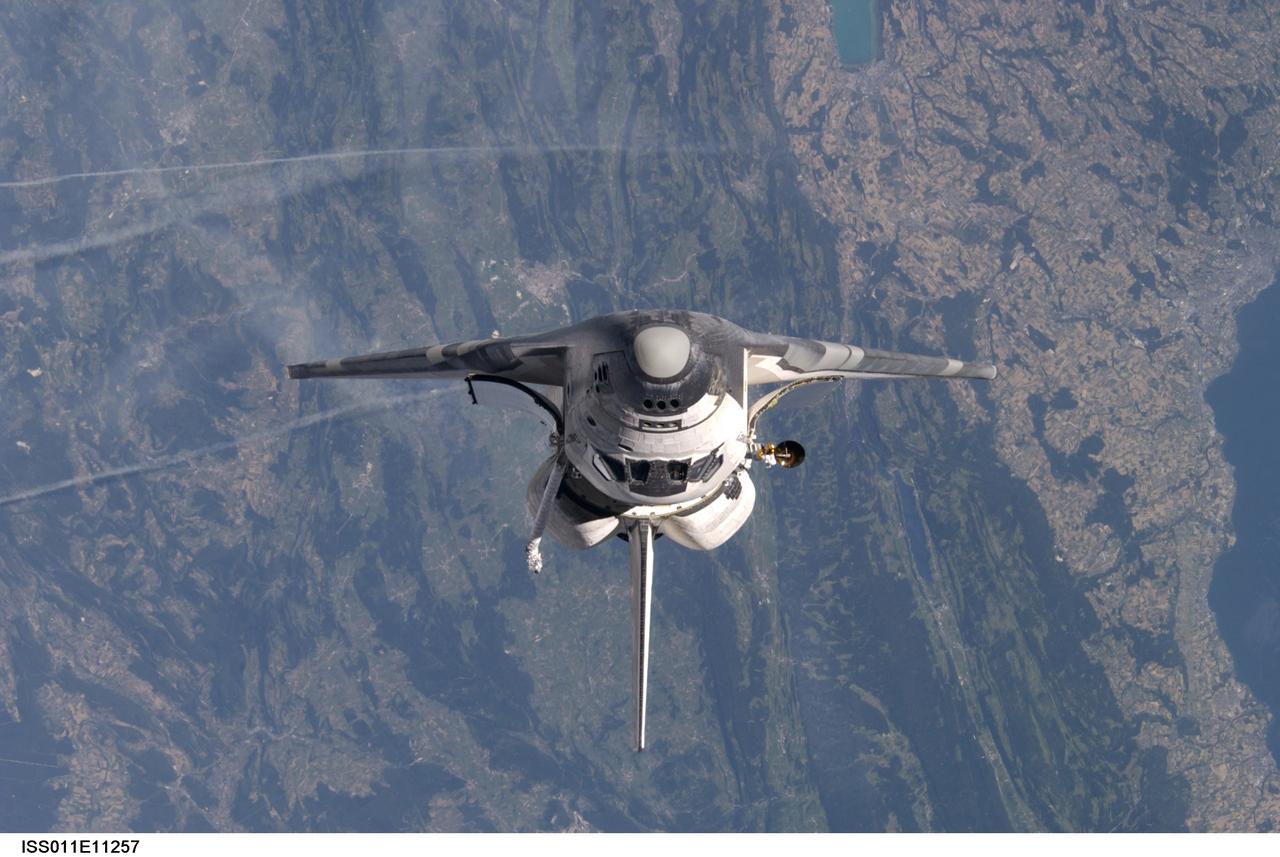
Launched on July 26, 2005 from the Kennedy Space Center in Florida, STS-114 was classified as Logistics Flight 1. Among the Station-related activities of the mission were the delivery of new supplies and the replacement of one of the orbital outpost's Control Moment Gyroscopes (CMGs). STS-114 also carried the Raffaello Multi-Purpose Logistics Module and the External Stowage Platform-2. A major focus of the mission was the testing and evaluation of new Space Shuttle flight safety, which included new inspection and repair techniques. Upon its approach to the International Space Station (ISS), the Space Shuttle Discovery underwent a photography session in order to assess any damages that may have occurred during its launch and/or journey through Space. Discovery was over Switzerland, about 600 feet from the ISS, when Cosmonaut Sergei K. Kriklev, Expedition 11 Commander, and John L. Phillips, NASA Space Station officer and flight engineer photographed the spacecraft as it performed a back flip to allow photography of its heat shield. Astronaut Eileen M. Collins, STS-114 Commander, guided the shuttle through the flip. The photographs were analyzed by engineers on the ground to evaluate the condition of Discovery’s heat shield. The crew safely returned to Earth on August 9, 2005. The mission historically marked the Return to Flight after nearly a two and one half year delay in flight after the Space Shuttle Columbia tragedy in February 2003.