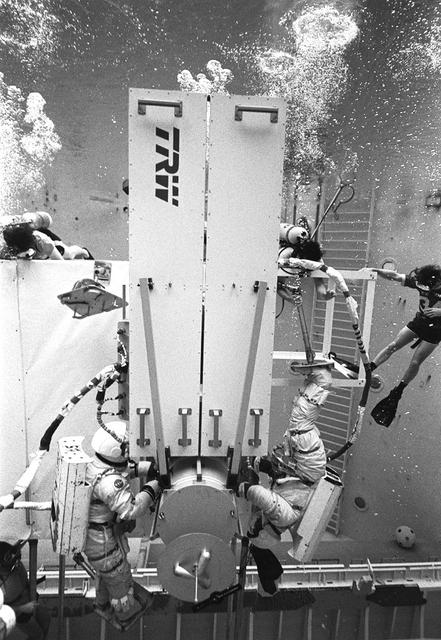
The Space Platform was first conceived as a launching site for deep space exploration. The original idea was to build this space platform either on the moon's surface or near lunar orbit. It would be used as a staging base, where the reusable launch vehicles (later known as Space Shuttles) would ferry machinery and equipment to assemble deep space exploration vehicles. Replaced by the Space Station concept, the space platform idea was never completed. However, early in the space platform development, astronauts trained at the Marshall Space Flight Center's (MSFC) Neutral Buoyancy Simulator (NBS), as pictured here, working on solar array equipment. This experiment was deployed from the shuttle to study the motions of large structures in space. Similar arrays will be used on the Space Station and large observatory spacecraft in the future.
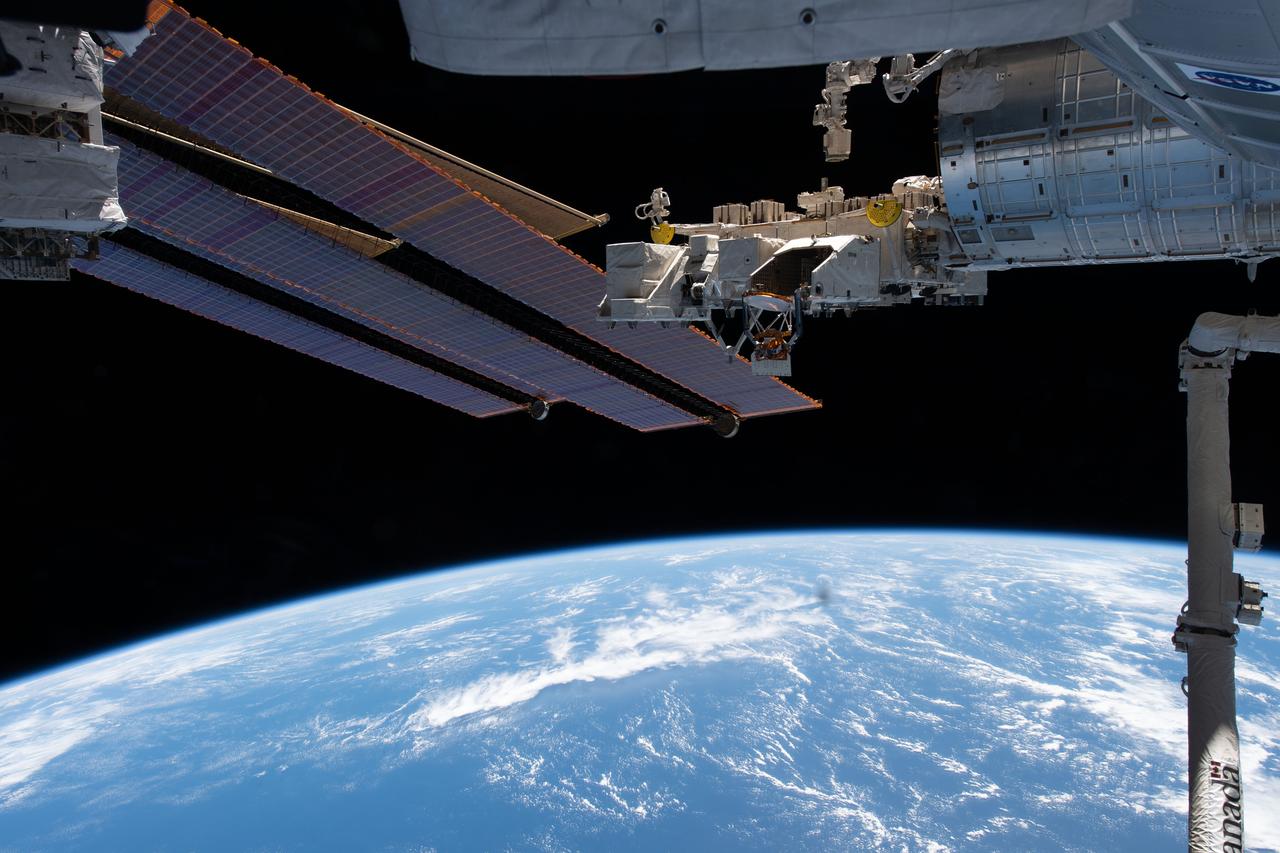
iss070e049644 (Dec. 30, 2023) --- A set of the International Space Station's main solar arrays, slightly obscuring the smaller roll-out solar arrays, and the Kibo laboratory module with its exposed facility, an external research platform that hosts external experiments, are pictured 261 miles above the Pacific Ocean.
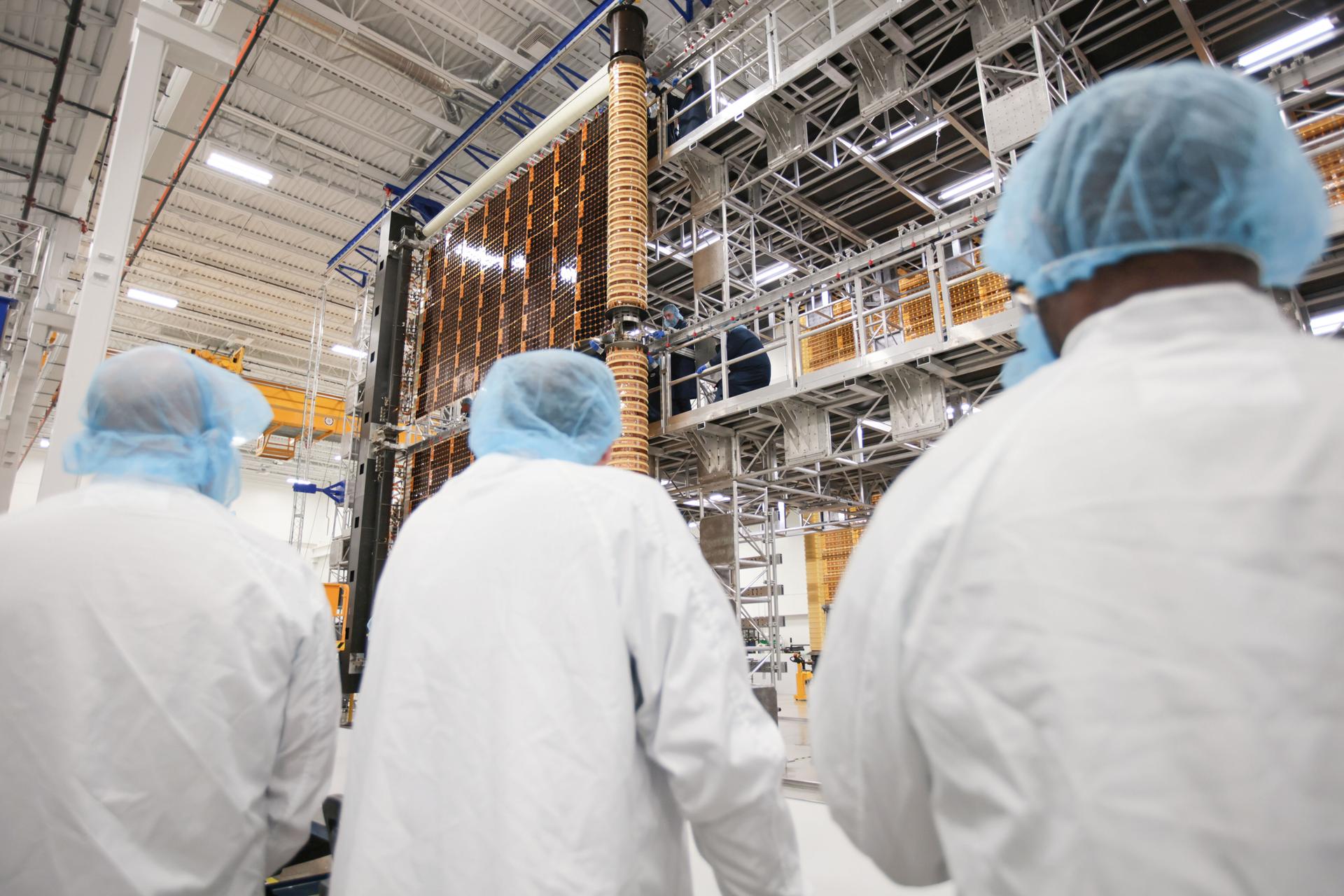
NASA and industry team members observe a Roll-Out Solar Array (ROSA) wing for Gateway as it deploys inside Redwire’s high-bay facility in Goleta, California, during a test on June 30, 2025. The image shows the solar array partially extended as technicians monitor the process from the facility floor and elevated work platforms. Credit: Lanteris Space Systems
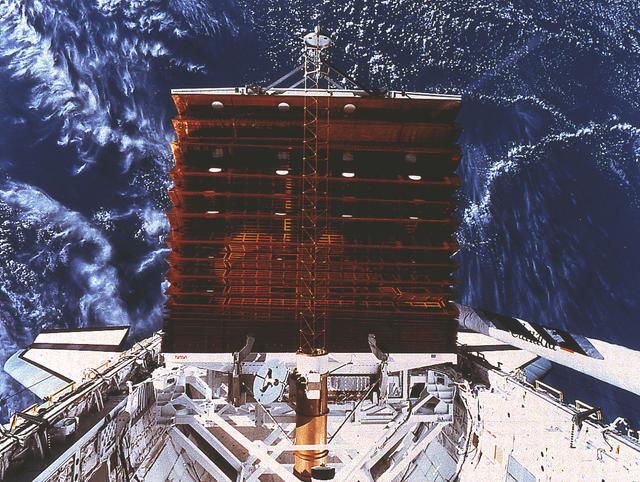
An STS-41D onboard photo shows the Solar Array Experiment (SAE) panel deployment for the Office of Aeronautics and space Technology-1 (OAST-1). OAST-1 is several advanced space technology experiments utilizing a common data system and is mounted on a platform in the Shuttle cargo bay.
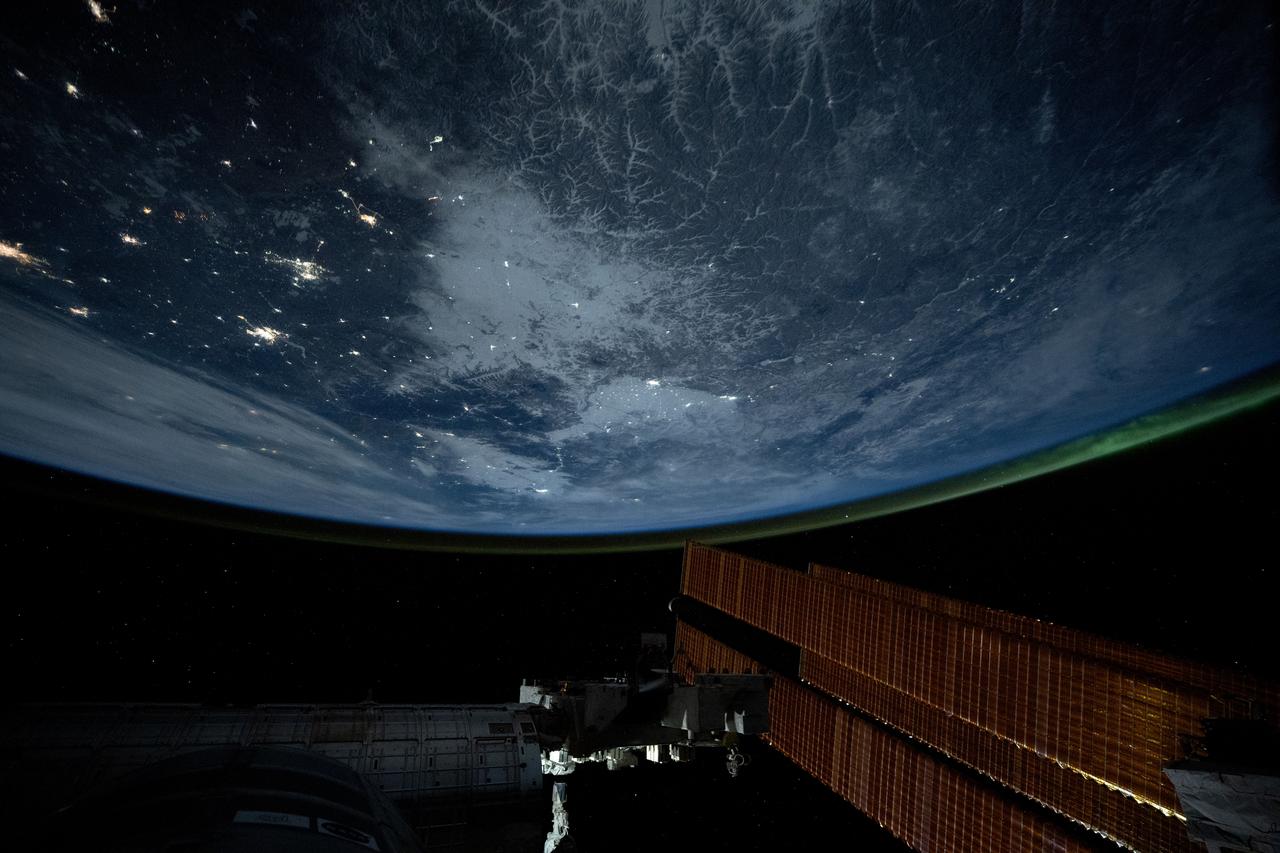
iss072e843309 (March 15, 2025) --- City lights dot the northeastern landscape of China with a wispy aurora above Earth's horizon in this photograph from the International Space Station as it orbited 262 miles above Asia. In the bottom foreground, is the Kibo laboratory module's Exposed Facility, an external research platform, and the orbital outpost's main solar arrays.
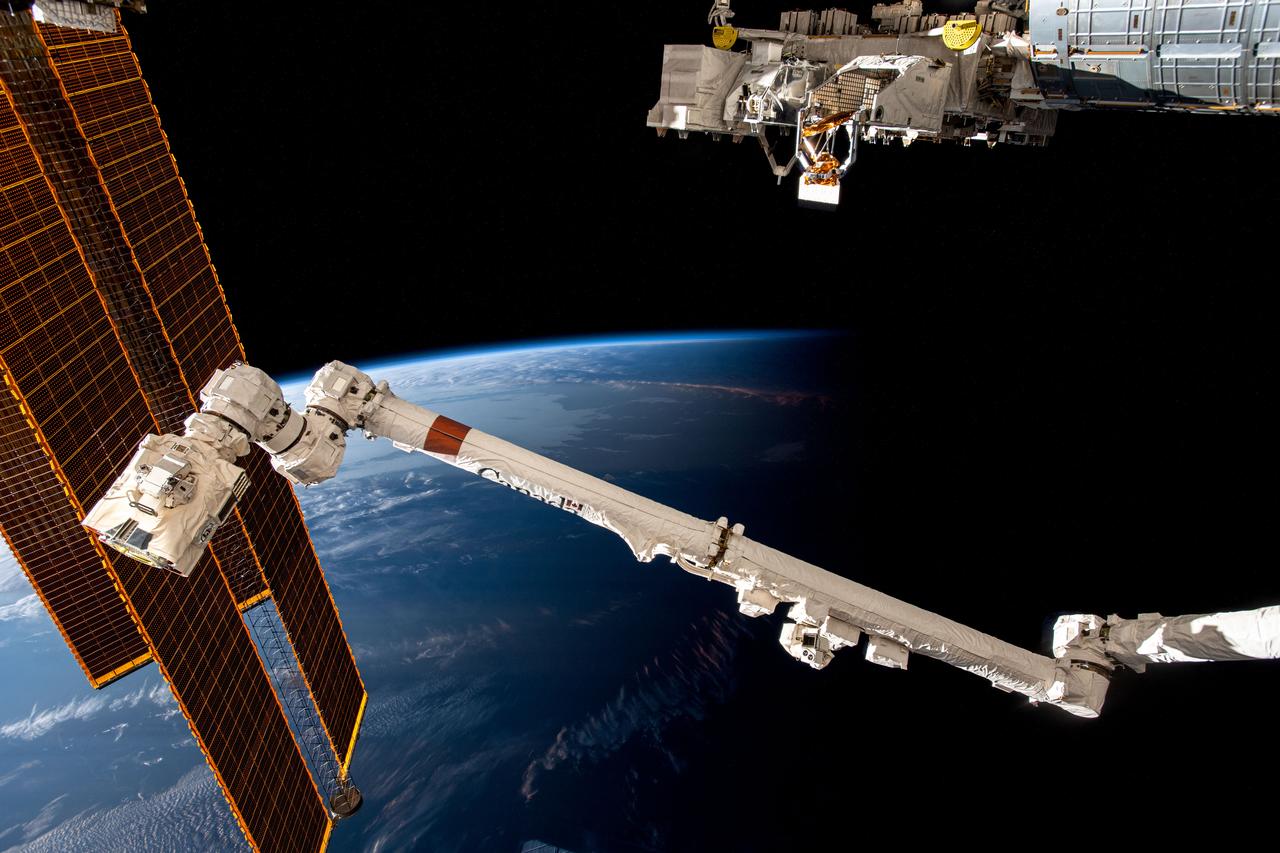
iss069e085991 (Sept. 5, 2023) --- The International Space Station soars 266 miles above the coast of Argentina near the Rio de la Plata as it flies into an orbital sunset. In the foreground from left are, the station's main solar arrays, the Canadarm2 robotic arm, and the Kibo laboratory module's external research platform.
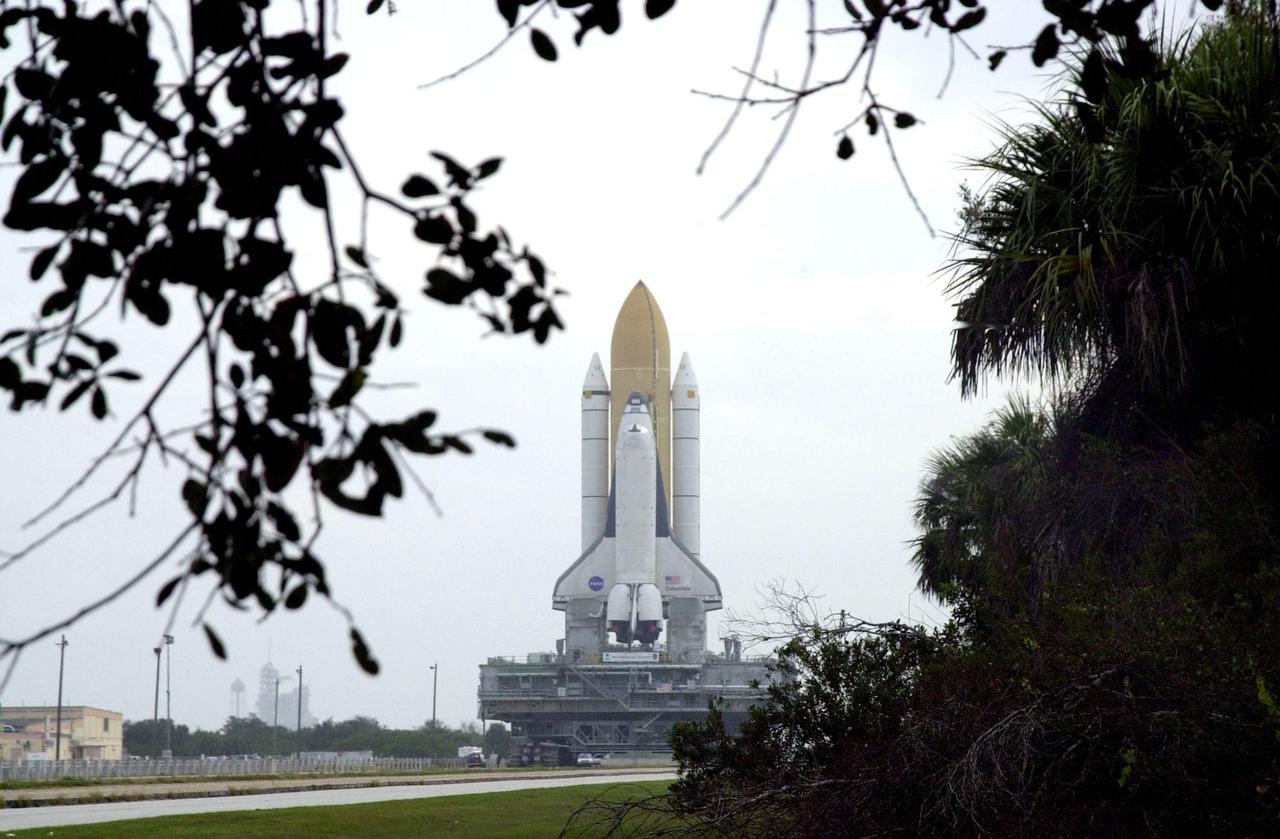
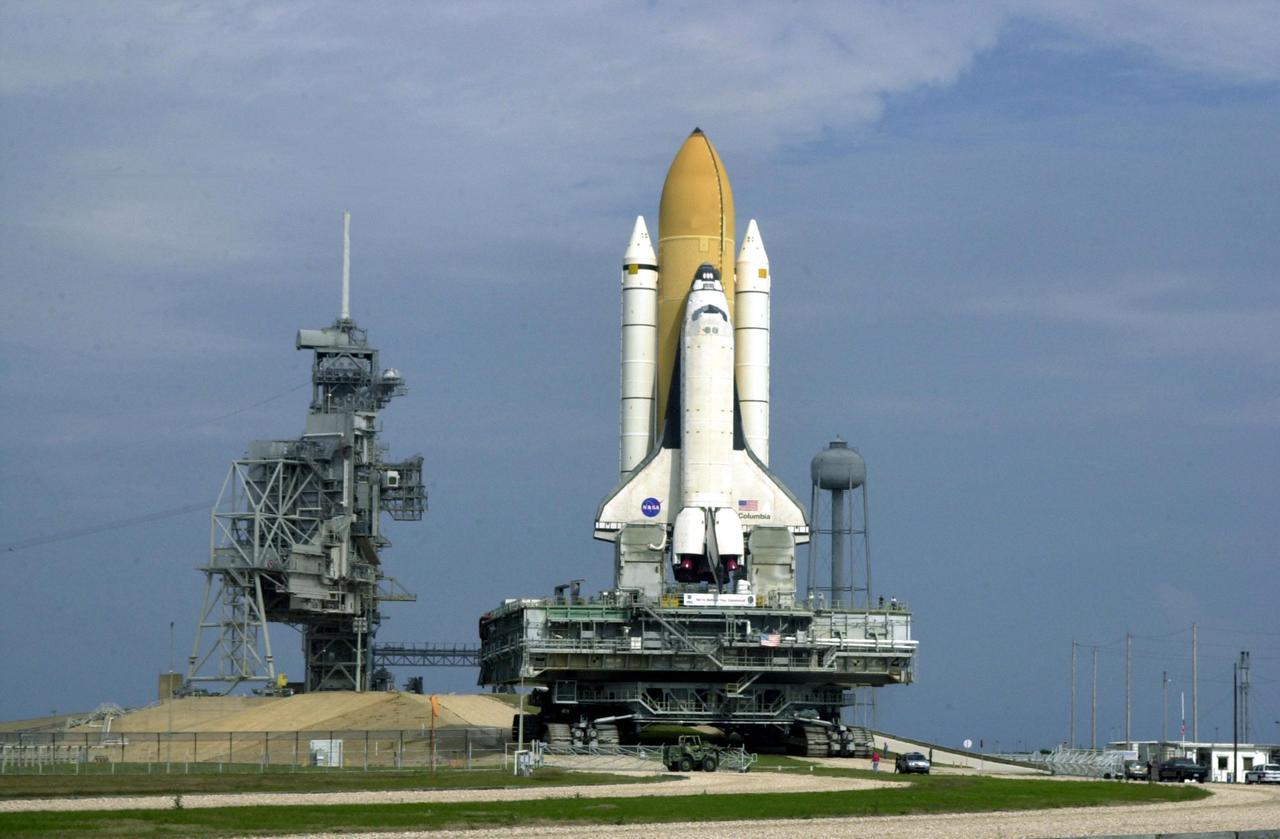
KENNEDY SPACE CENTER, FLA. -- Framed by trees and palmetto scrub, Space Shuttle Columbia is viewed atop its Mobile Launcher Platform as it rolls out to Launch Pad 39A. Underneath is the crawler-transporter, which carries the multi-ton vehicles to the launch pad. Columbia is scheduled to be launched Feb. 28 on mission STS-109, a Hubble Servicing Mission. The goal of the mission is to replace Solar Array 2 with Solar Array 3, replace the Power Control Unit, remove the Faint Object Camera and install the ACS, install the Near Infrared Camera and Multi-Object Spectrometer (NICMOS) Cooling System, and install New Outer Blanket Layer insulation
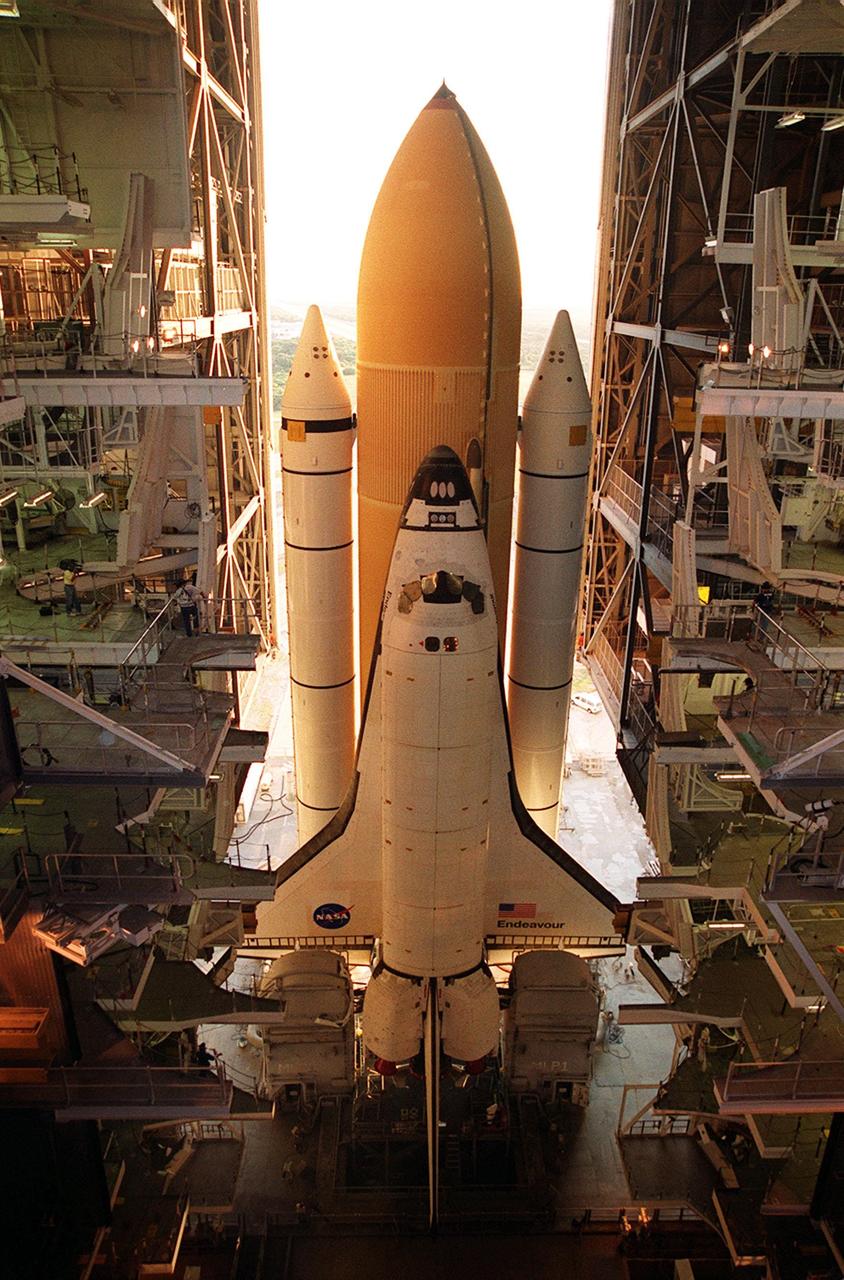
KENNEDY SPACE CENTER, Fla. -- Space Shuttle Endeavour is ready to move from the Vehicle Assembly Building into the light of early morning on its rollout to Launch Pad 39B. The Space Shuttle sits atop the Mobile Launcher Platform (MLP). Endeavour is scheduled to be launched Nov. 30 at 10:01 p.m. EST on mission STS-97, the sixth construction flight to the International Space Station. Its payload includes the P6 Integrated Truss Structure and a photovoltaic (PV) module, with giant solar arrays that will provide power to the Station. The mission includes two spacewalks to complete the solar array connections
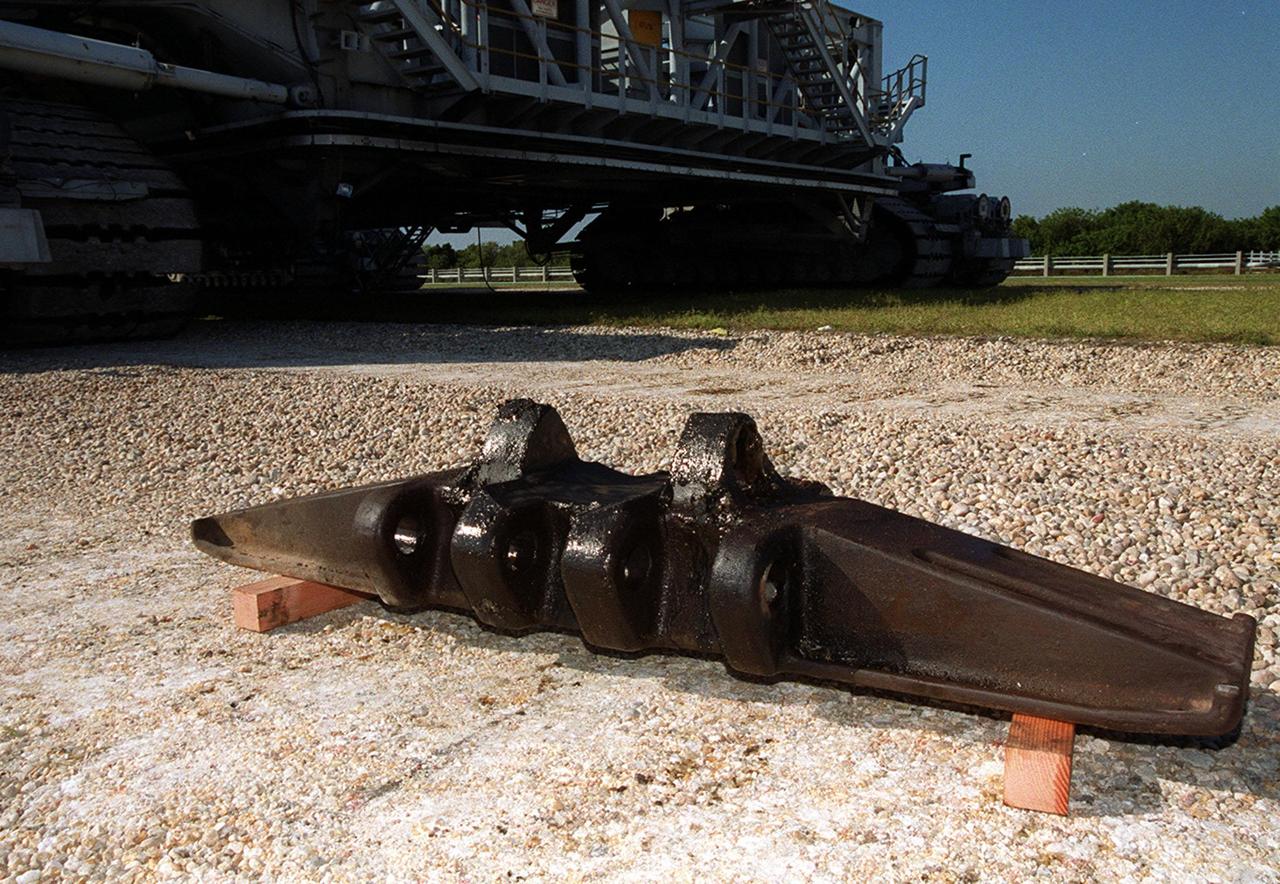
A new cleat, or shoe, for one of the tracks on the crawler-transporter sits on the ground near the vehicle (in the background). A cracked cleat was noticed on the crawler as it was rolling Space Shuttle Endeavour and the Mobile Launcher Platform out to Launch Pad 39B. The rollout is being suspended while the cleat is replaced. Endeavour is scheduled to be launched Nov. 30 at 10:01 p.m. EST on mission STS-97, the sixth construction flight to the International Space Station. Its payload includes the P6 Integrated Truss Structure and a photovoltaic (PV) module, with giant solar arrays that will provide power to the Station. The mission includes two spacewalks to complete the solar array connections

KENNEDY SPACE CENTER, FLA. -- Space Shuttle Endeavour, atop the Mobile Launcher Platform, moves through the gate a second time to Launch Pad 39B. After a cracked cleat was noticed on one of the eight tracks on the crawler-transporter, the vehicle reversed direction to level ground where the cleat is being replaced. Endeavour is scheduled to be launched Nov. 30 at 10:01 p.m. EST on mission STS-97, the sixth construction flight to the International Space Station. Its payload includes the P6 Integrated Truss Structure and a photovoltaic (PV) module, with giant solar arrays that will provide power to the Station. The mission includes two spacewalks to complete the solar array connections
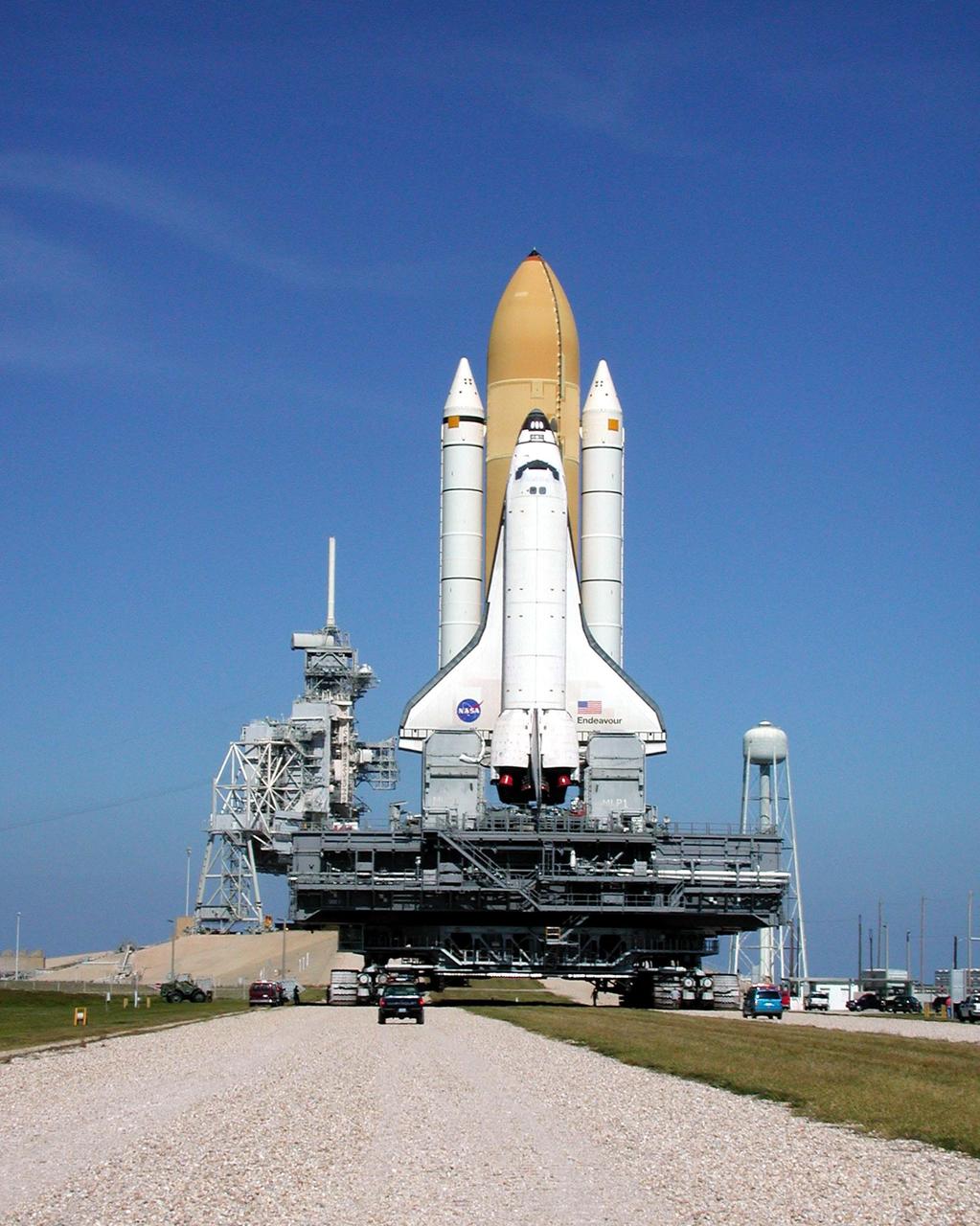
KENNEDY SPACE CENTER, Fla. -- Perched atop the Mobile Launcher Platform, Space Shuttle Endeavour is nearly through the gate to Launch Pad 39B. To the right of the pad is a 290-foot tall water tower. To the left is the Fixed Service Structure and Rotating Service Structure. Endeavour is scheduled to be launched Nov. 30 at 10:01 p.m. EST on mission STS-97, the sixth construction flight to the International Space Station. Its payload includes the P6 Integrated Truss Structure and a photovoltaic (PV) module, with giant solar arrays that will provide power to the Station. The mission includes two spacewalks to complete the solar array connections
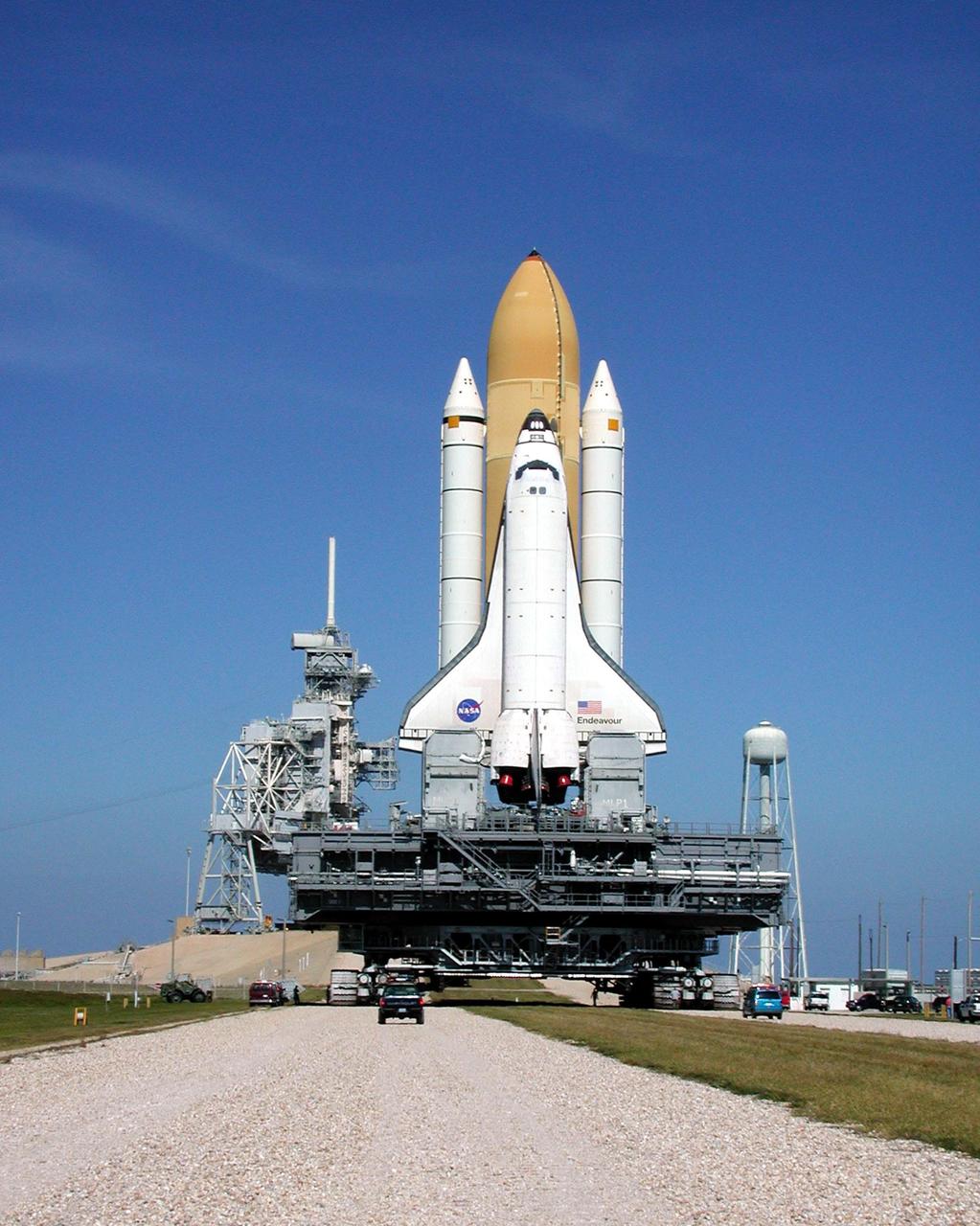
KENNEDY SPACE CENTER, Fla. -- Perched atop the Mobile Launcher Platform, Space Shuttle Endeavour is nearly through the gate to Launch Pad 39B. To the right of the pad is a 290-foot tall water tower. To the left is the Fixed Service Structure and Rotating Service Structure. Endeavour is scheduled to be launched Nov. 30 at 10:01 p.m. EST on mission STS-97, the sixth construction flight to the International Space Station. Its payload includes the P6 Integrated Truss Structure and a photovoltaic (PV) module, with giant solar arrays that will provide power to the Station. The mission includes two spacewalks to complete the solar array connections
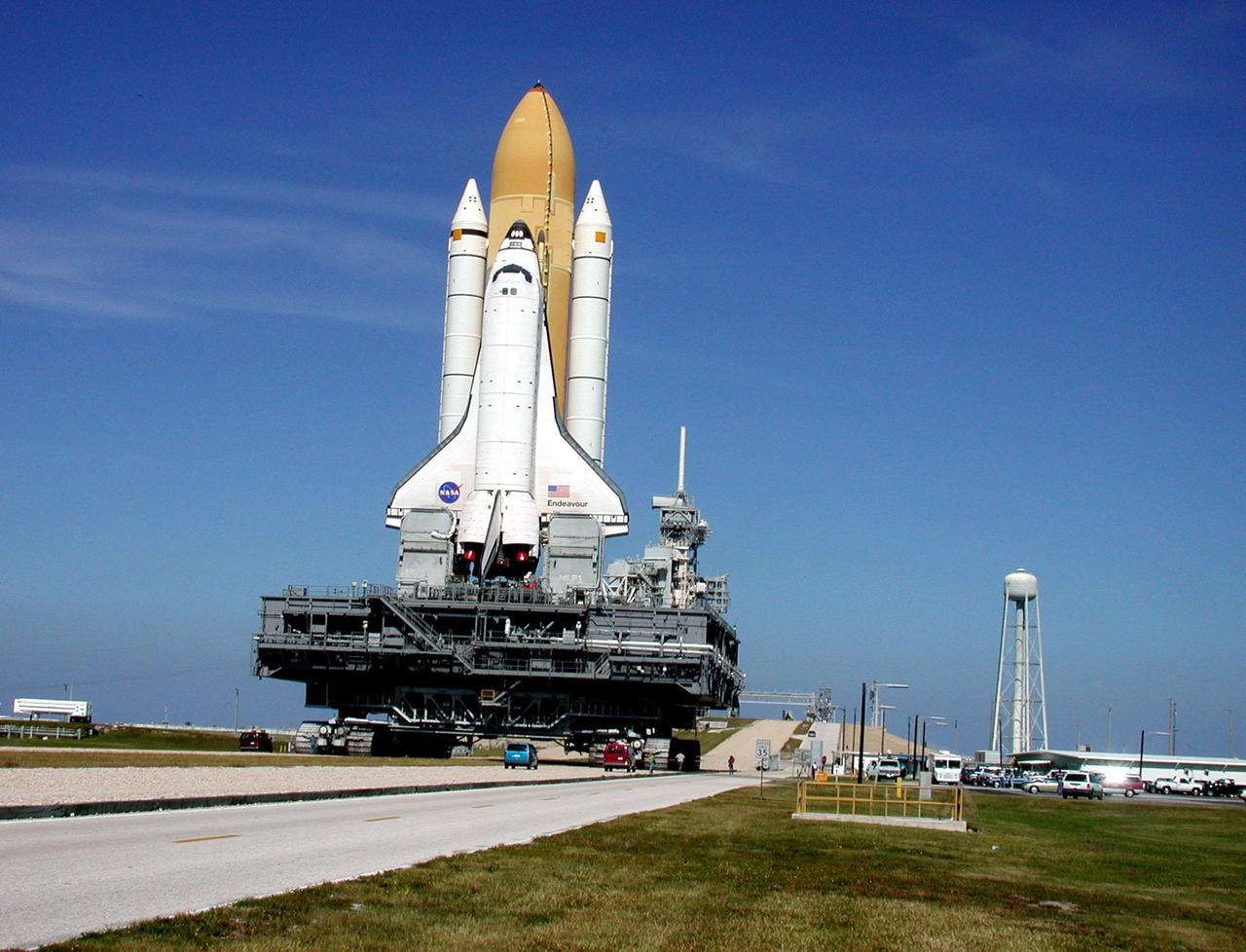
KENNEDY SPACE CENTER, Fla. -- Perched atop the Mobile Launcher Platform, Space Shuttle Endeavour approaches the gate to Launch Pad 39B. To the right of the pad is a 290-foot tall water tower. Endeavour is scheduled to be launched Nov. 30 at 10:01 p.m. EST on mission STS-97, the sixth construction flight to the International Space Station. Its payload includes the P6 Integrated Truss Structure and a photovoltaic (PV) module, with giant solar arrays that will provide power to the Station. The mission includes two spacewalks to complete the solar array connections
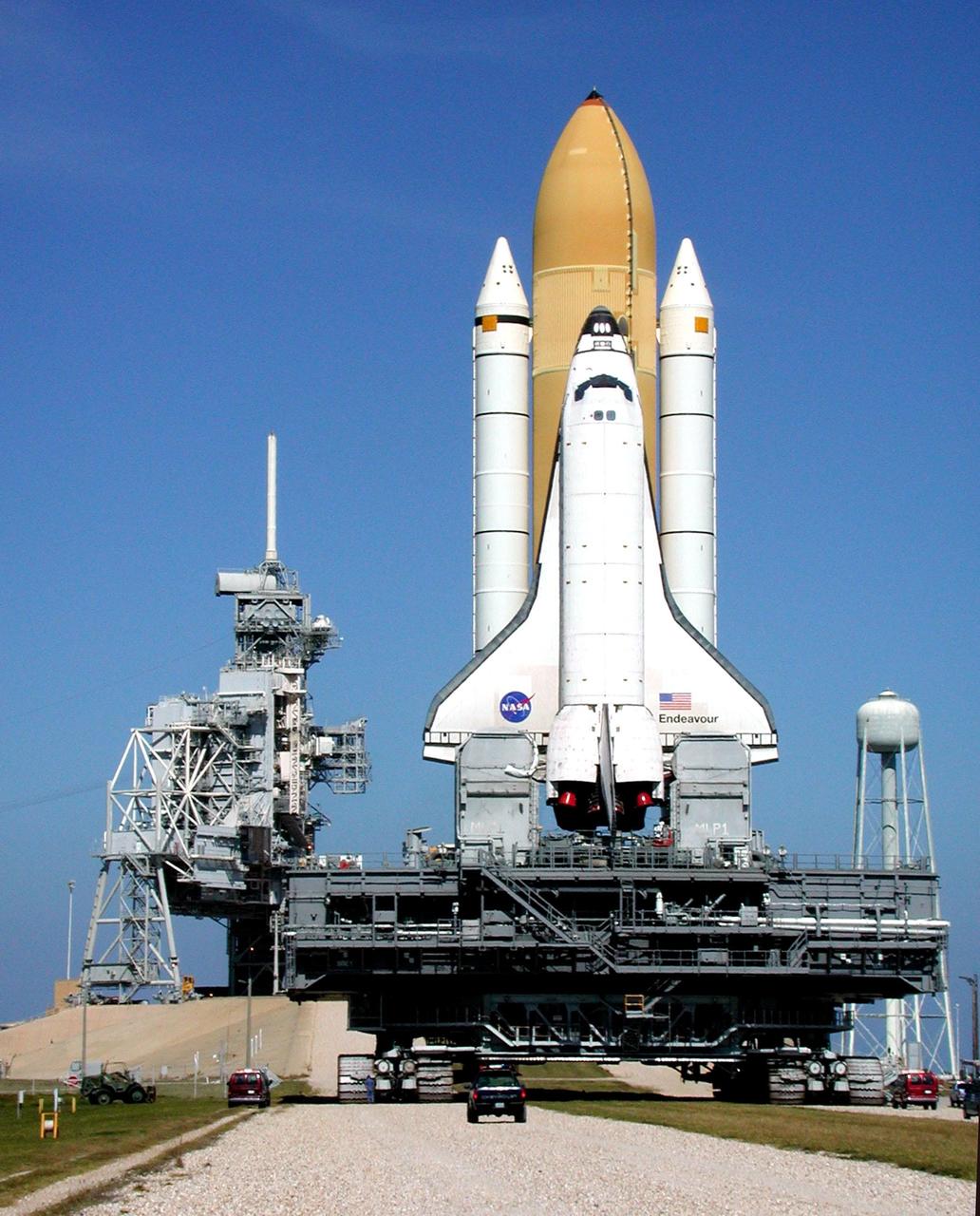
KENNEDY SPACE CENTER, Fla. -- Perched atop the Mobile Launcher Platform, Space Shuttle Endeavour passes through the gate to Launch Pad 39B. To the right of the pad is a 290-foot tall water tower. To the left is the Fixed Service Structure and Rotating Service Structure. Endeavour is scheduled to be launched Nov. 30 at 10:01 p.m. EST on mission STS-97, the sixth construction flight to the International Space Station. Its payload includes the P6 Integrated Truss Structure and a photovoltaic (PV) module, with giant solar arrays that will provide power to the Station. The mission includes two spacewalks to complete the solar array connections
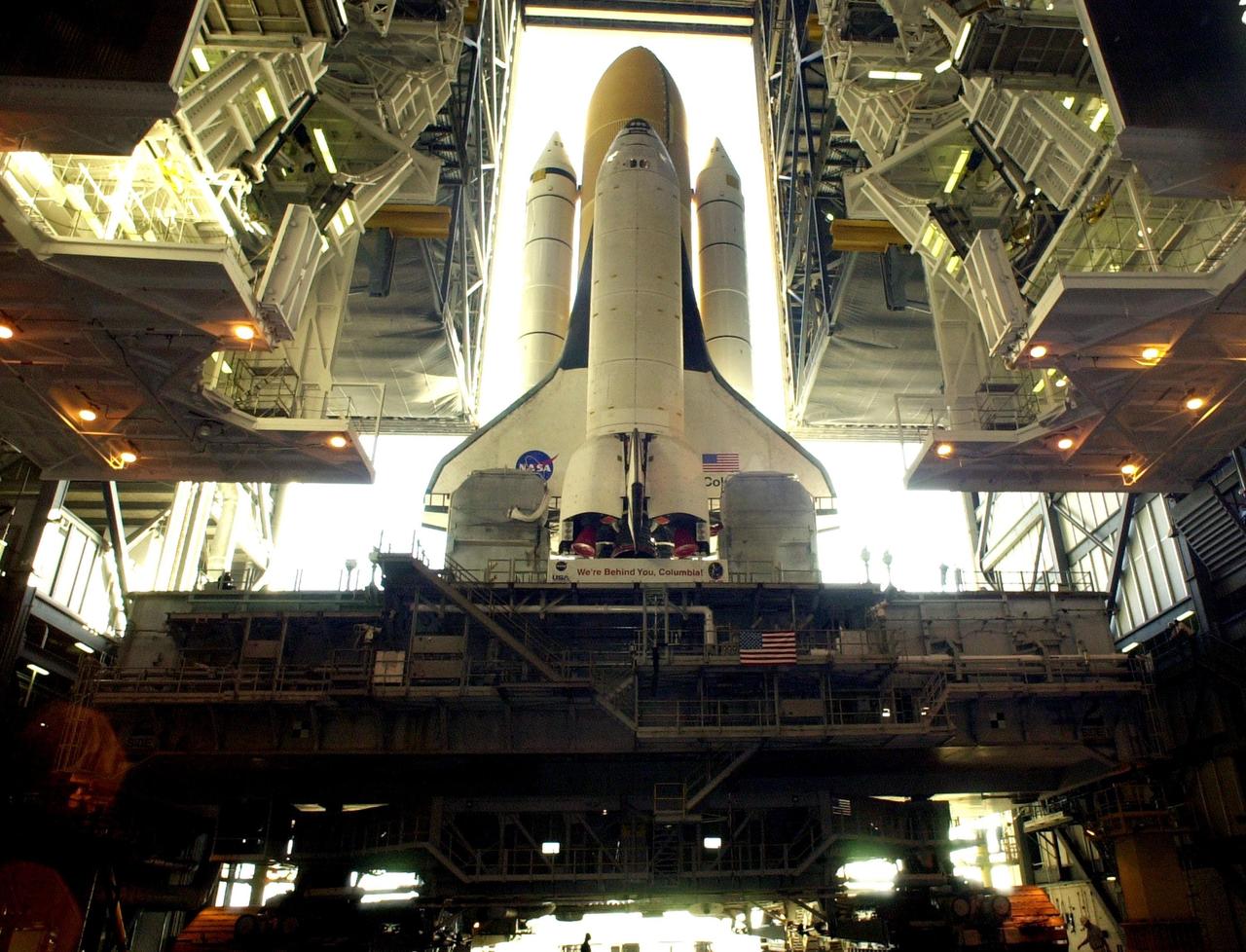
KENNEDY SPACE CENTER, FLA. -- Rollout of Space Shuttle Columbia from the Vehicle Assembly Building begins in the early light of morning. Columbia sits on top of the Mobile Launcher Platform. Underneath is the crawler-transporter, which carries the multi-ton vehicles to the launch pad. Columbia is scheduled to be launched Feb. 28 on mission STS-109, a Hubble Servicing Mission. The goal of the mission is to replace Solar Array 2 with Solar Array 3, replace the Power Control Unit, remove the Faint Object Camera and install the ACS, install the Near Infrared Camera and Multi-Object Spectrometer (NICMOS) Cooling System, and install New Outer Blanket Layer insulation
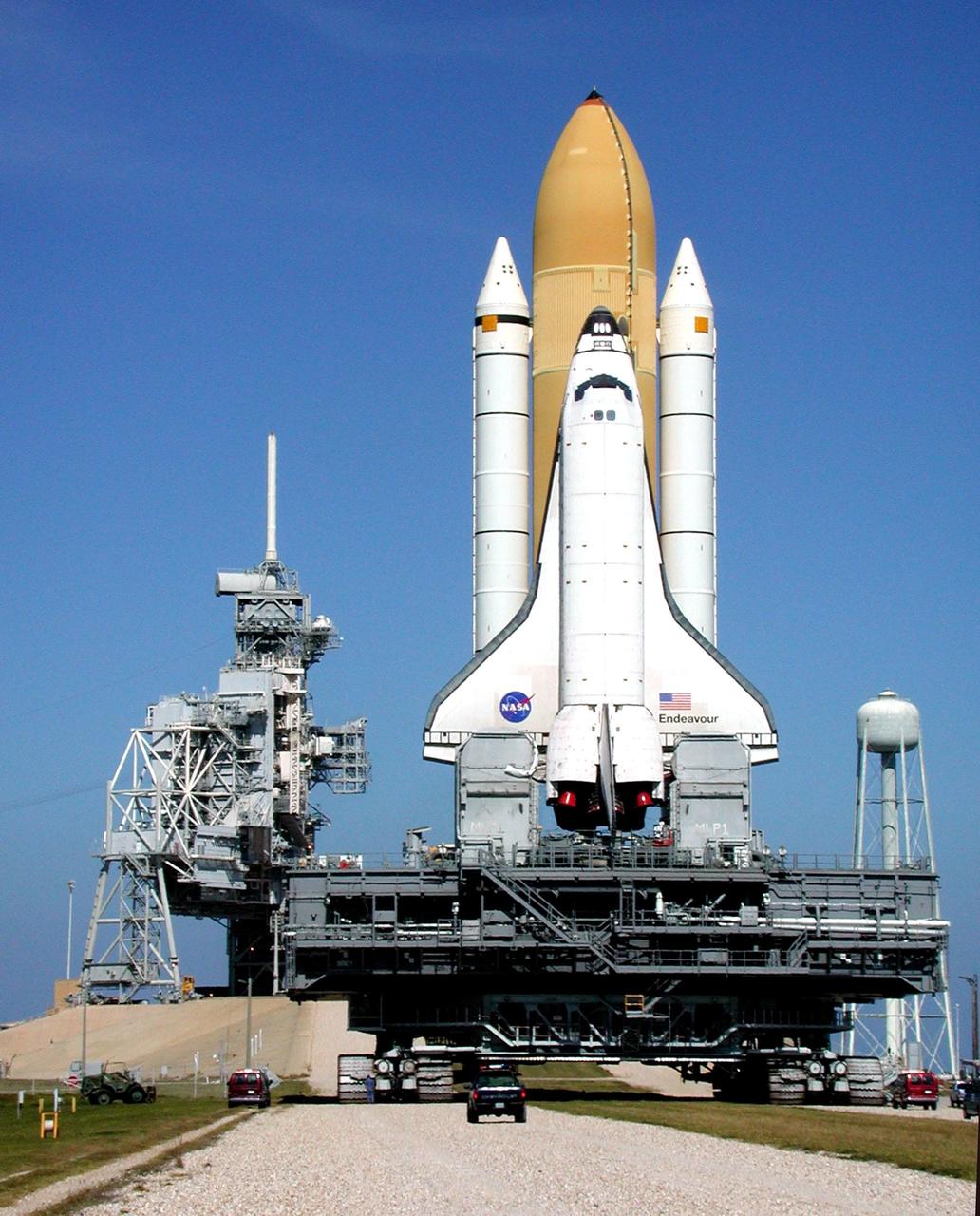
KENNEDY SPACE CENTER, Fla. -- Perched atop the Mobile Launcher Platform, Space Shuttle Endeavour passes through the gate to Launch Pad 39B. To the right of the pad is a 290-foot tall water tower. To the left is the Fixed Service Structure and Rotating Service Structure. Endeavour is scheduled to be launched Nov. 30 at 10:01 p.m. EST on mission STS-97, the sixth construction flight to the International Space Station. Its payload includes the P6 Integrated Truss Structure and a photovoltaic (PV) module, with giant solar arrays that will provide power to the Station. The mission includes two spacewalks to complete the solar array connections
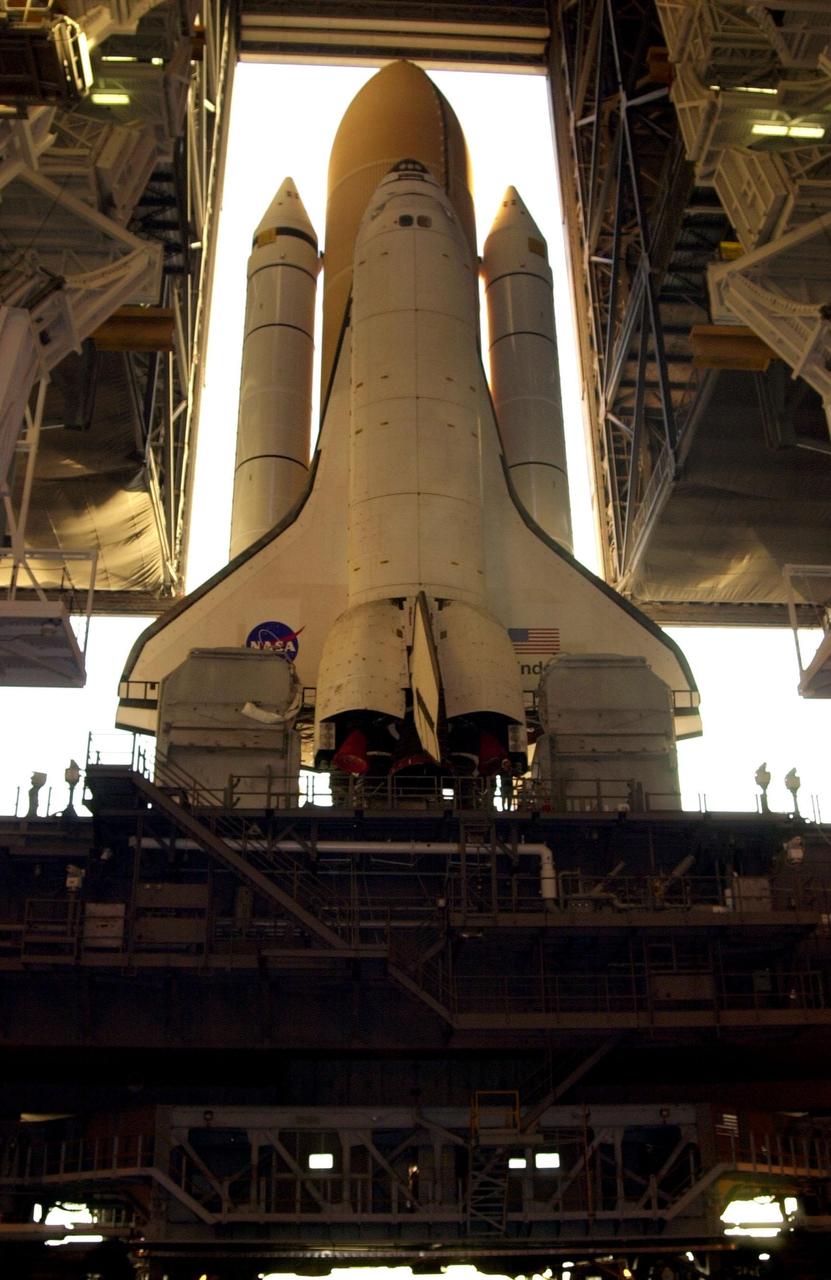
KENNEDY SPACE CENTER, Fla. -- With the early morning light behind it, Space Shuttle Endeavour appears to fill the opening in the Vehicle Assembly Building as it begins rollout to Launch Pad 39B on the Mobile Launcher Platform (MLP). At the bottom can be seen the crawler-transporter that moves the combined Shuttle and MLP. Endeavour is scheduled to be launched Nov. 30 at 10:01 p.m. EST on mission STS-97, the sixth construction flight to the International Space Station. Its payload includes the P6 Integrated Truss Structure and a photovoltaic (PV) module, with giant solar arrays that will provide power to the Station. The mission includes two spacewalks to complete the solar array connections

KENNEDY SPACE CENTER, Fla. -- With the early morning light behind it, Space Shuttle Endeavour appears to fill the opening in the Vehicle Assembly Building as it begins rollout to Launch Pad 39B on the Mobile Launcher Platform (MLP). At the bottom can be seen the crawler-transporter that moves the combined Shuttle and MLP. Endeavour is scheduled to be launched Nov. 30 at 10:01 p.m. EST on mission STS-97, the sixth construction flight to the International Space Station. Its payload includes the P6 Integrated Truss Structure and a photovoltaic (PV) module, with giant solar arrays that will provide power to the Station. The mission includes two spacewalks to complete the solar array connections
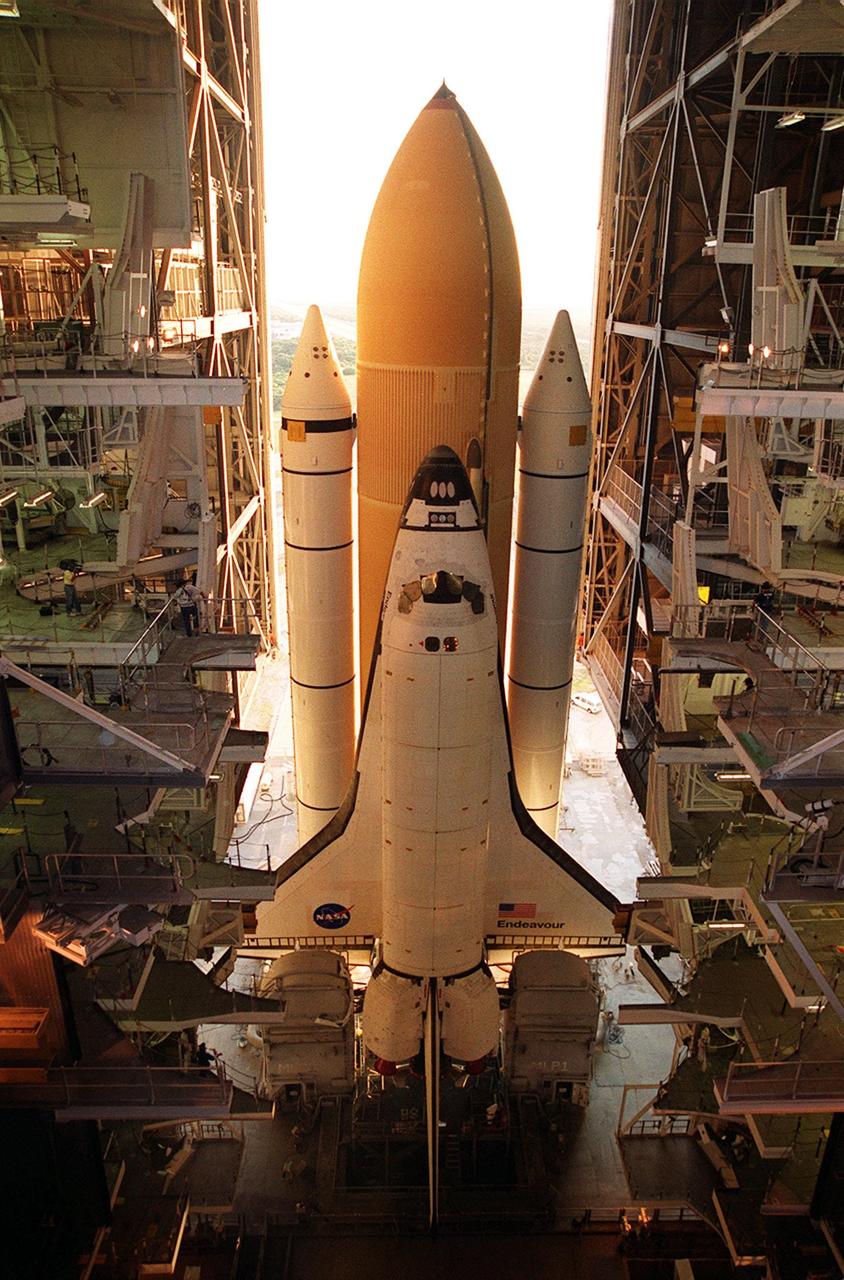
KENNEDY SPACE CENTER, Fla. -- Space Shuttle Endeavour is ready to move from the Vehicle Assembly Building into the light of early morning on its rollout to Launch Pad 39B. The Space Shuttle sits atop the Mobile Launcher Platform (MLP). Endeavour is scheduled to be launched Nov. 30 at 10:01 p.m. EST on mission STS-97, the sixth construction flight to the International Space Station. Its payload includes the P6 Integrated Truss Structure and a photovoltaic (PV) module, with giant solar arrays that will provide power to the Station. The mission includes two spacewalks to complete the solar array connections
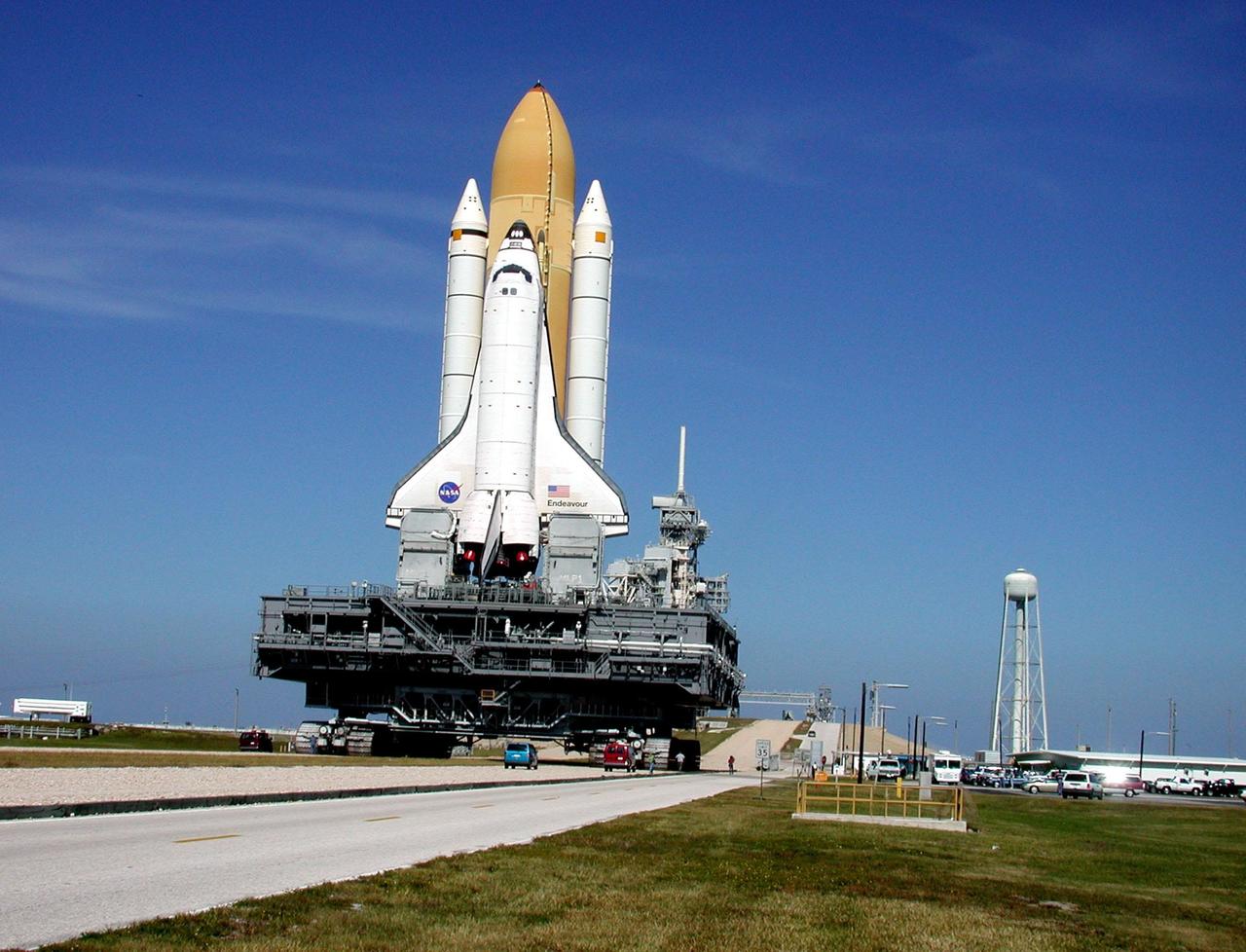
KENNEDY SPACE CENTER, Fla. -- Perched atop the Mobile Launcher Platform, Space Shuttle Endeavour approaches the gate to Launch Pad 39B. To the right of the pad is a 290-foot tall water tower. Endeavour is scheduled to be launched Nov. 30 at 10:01 p.m. EST on mission STS-97, the sixth construction flight to the International Space Station. Its payload includes the P6 Integrated Truss Structure and a photovoltaic (PV) module, with giant solar arrays that will provide power to the Station. The mission includes two spacewalks to complete the solar array connections
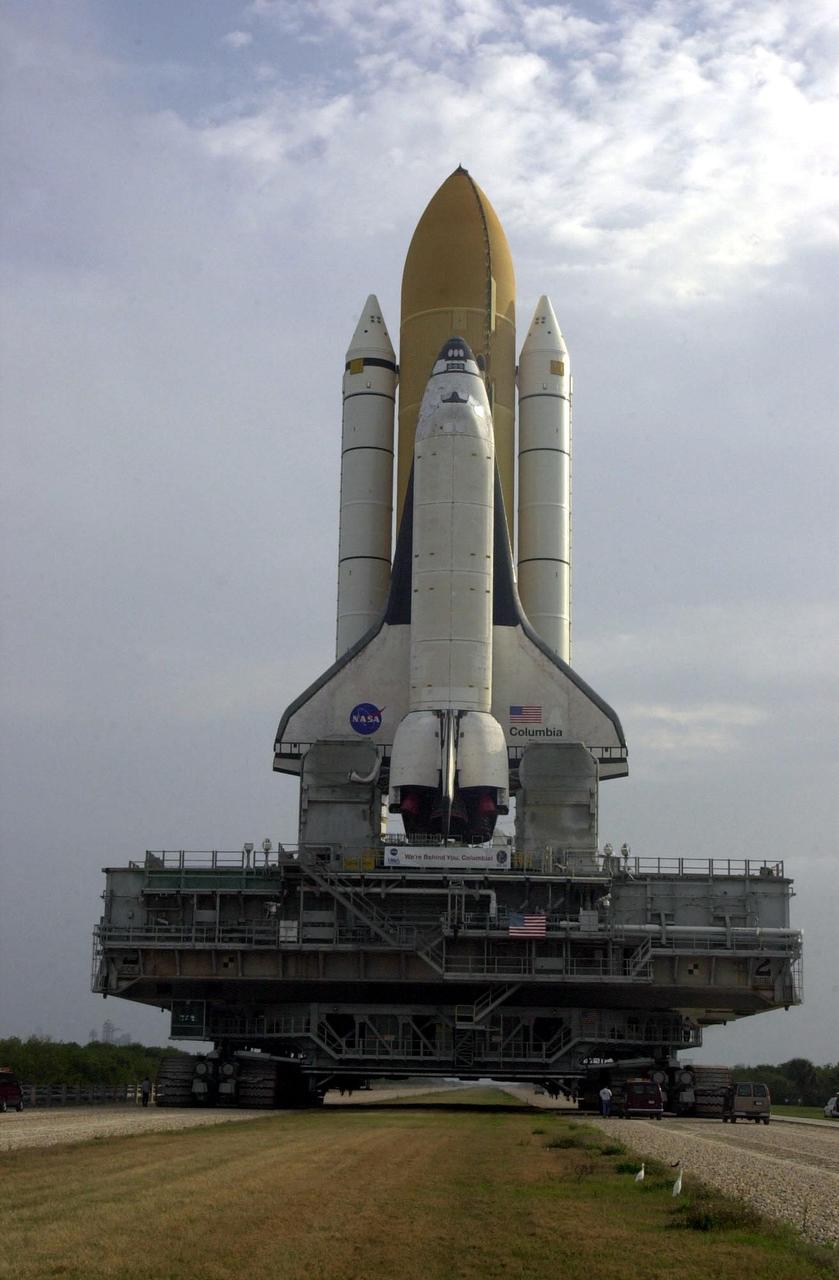
KENNEDY SPACE CENTER, FLA. -- A grey sky silhouettes Space Shuttle Columbia, atop its Mobile Launcher Platform, as it rolls out to Launch Pad 39A. Underneath is the crawler-transporter, which carries the multi-ton vehicles to the pad. In the grass behind the towering structures are two white herons. Columbia is scheduled to be launched Feb. 28 on mission STS-109, a Hubble Servicing Mission. The goal of the mission is to replace Solar Array 2 with Solar Array 3, replace the Power Control Unit, remove the Faint Object Camera and install the ACS, install the Near Infrared Camera and Multi-Object Spectrometer (NICMOS) Cooling System, and install New Outer Blanket Layer insulation
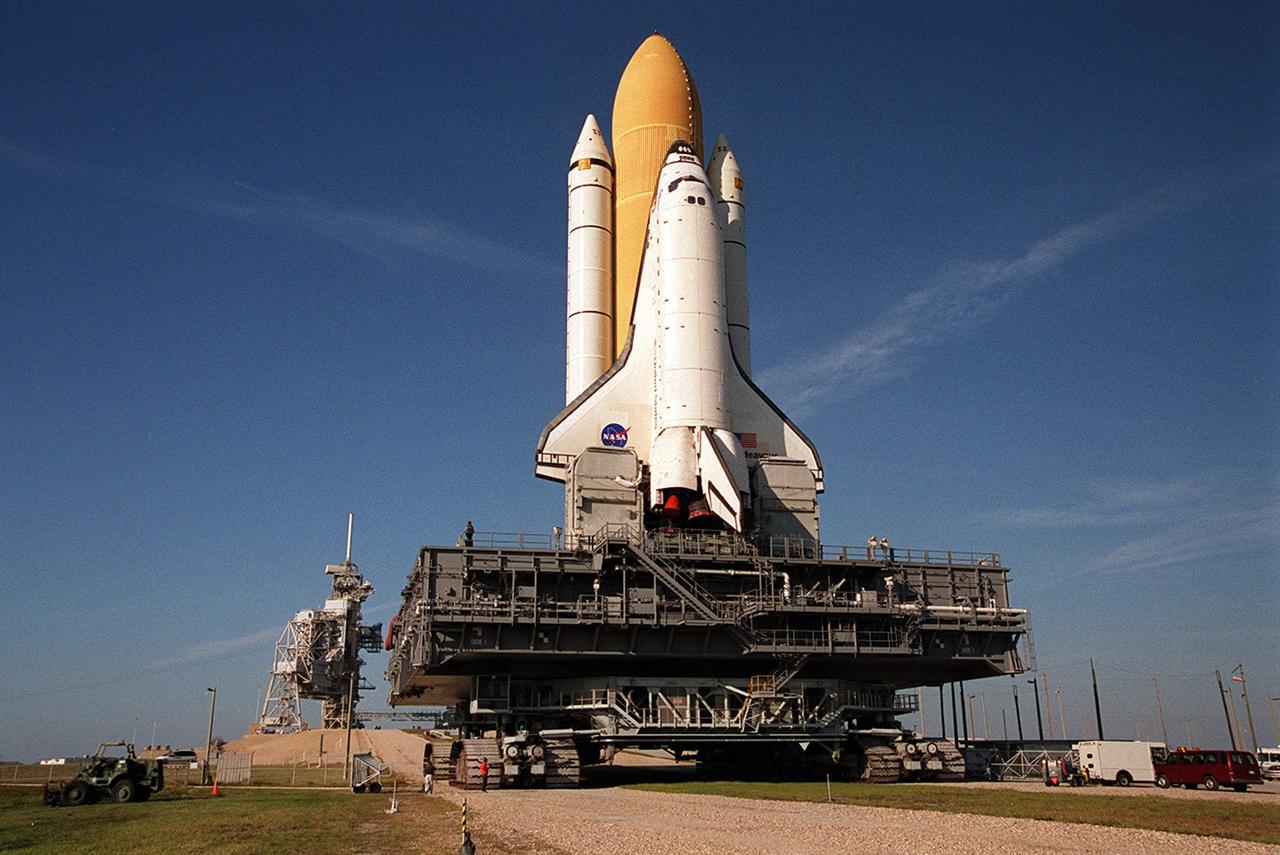
KENNEDY SPACE CENTER, FLA. -- Space Shuttle Endeavour, atop the Mobile Launcher Platform, moves through the gate a second time to Launch Pad 39B. After a cracked cleat was noticed on one of the eight tracks on the crawler-transporter, the vehicle reversed direction to level ground where the cleat is being replaced. Endeavour is scheduled to be launched Nov. 30 at 10:01 p.m. EST on mission STS-97, the sixth construction flight to the International Space Station. Its payload includes the P6 Integrated Truss Structure and a photovoltaic (PV) module, with giant solar arrays that will provide power to the Station. The mission includes two spacewalks to complete the solar array connections

KENNEDY SPACE CENTER, FLA. -- Removal and replacement of the cracked cleat (shoe) on the crawler-transporter (seen here with the Mobile Launcher Platform and Space Shuttle Endeavour on top) is nearly complete. The cracked cleat was noticed during rollout of Endeavour to Launch Pad 39B. Endeavour is scheduled to be launched Nov. 30 at 10:01 p.m. EST on mission STS-97, the sixth construction flight to the International Space Station. Its payload includes the P6 Integrated Truss Structure and a photovoltaic (PV) module, with giant solar arrays that will provide power to the Station. The mission includes two spacewalks to complete the solar array connections
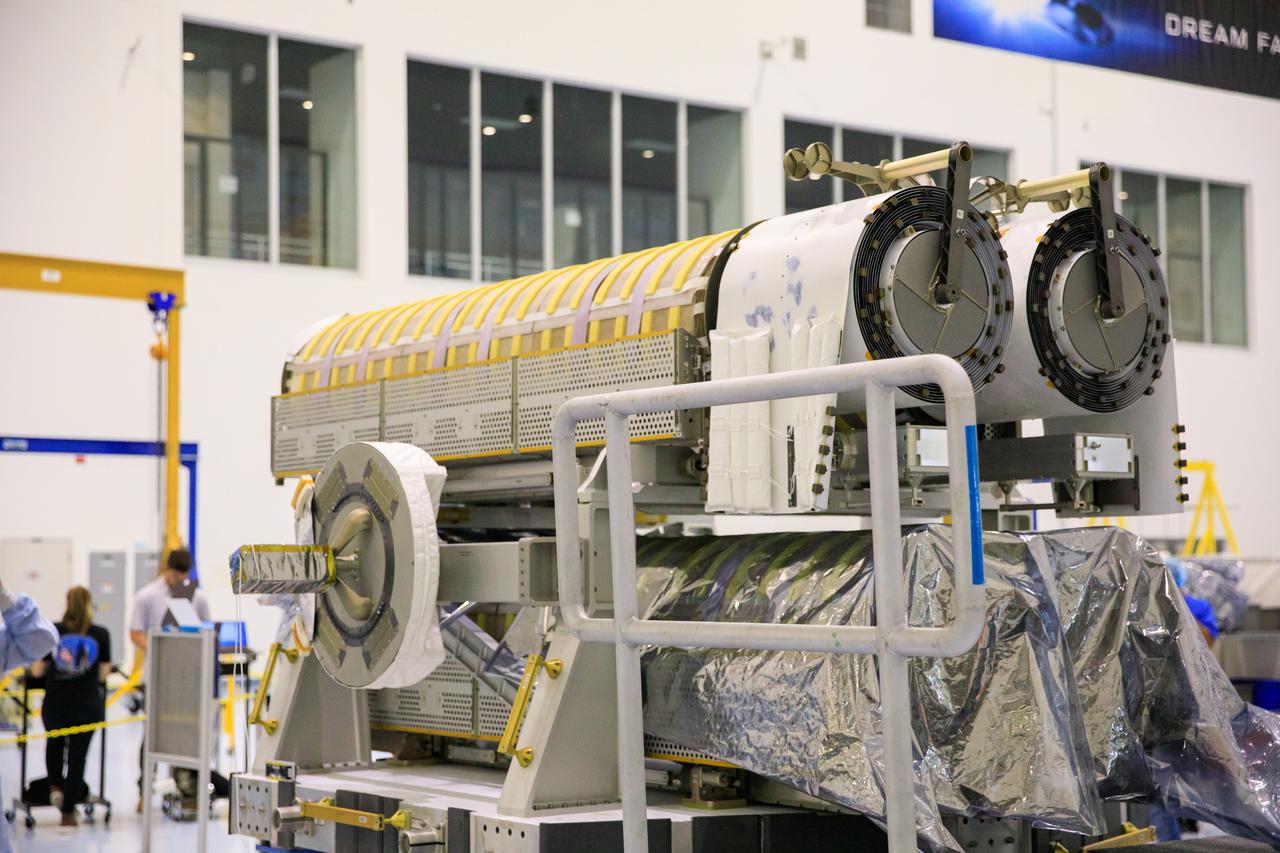
Inside the Space Station Processing Facility high bay at NASA's Kennedy Space Center in Florida, a set of International Space Station Roll Out Solar Arrays (iROSA) have been secured onto a platform on March 23, 2023. They are being prepared for delivery to the space station aboard SpaceX’s Dragon cargo carrier on the company’s 28th commercial resupply services (CRS-28) mission to the space station. iROSA is a new type of solar panel that rolls open in space and is more compact than current rigid panel designs.
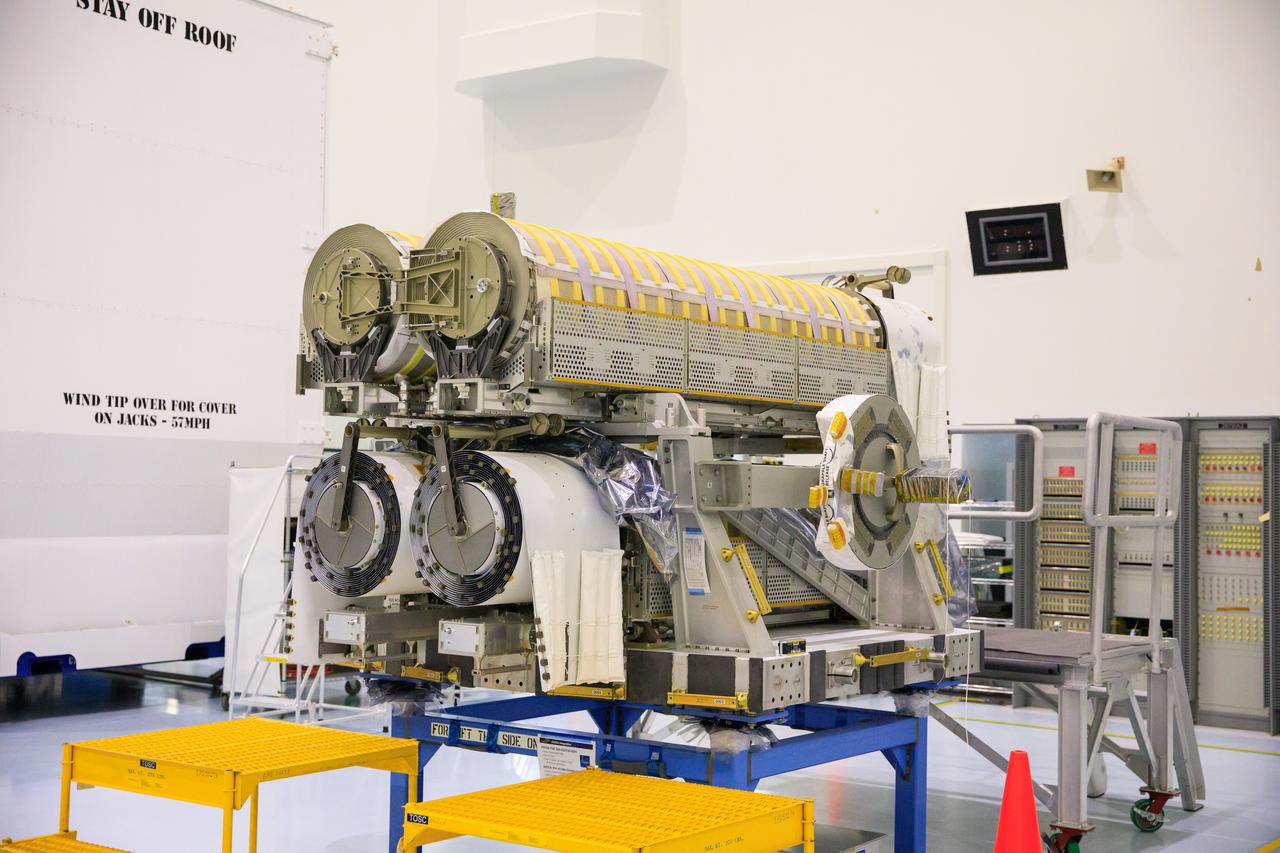
Inside the Space Station Processing Facility high bay at NASA's Kennedy Space Center in Florida, a set of International Space Station Roll Out Solar Arrays (iROSA) have been secured onto a platform on March 23, 2023. They are being prepared for delivery to the space station aboard SpaceX’s Dragon cargo carrier on the company’s 28th commercial resupply services (CRS-28) mission to the space station. iROSA is a new type of solar panel that rolls open in space and is more compact than current rigid panel designs.
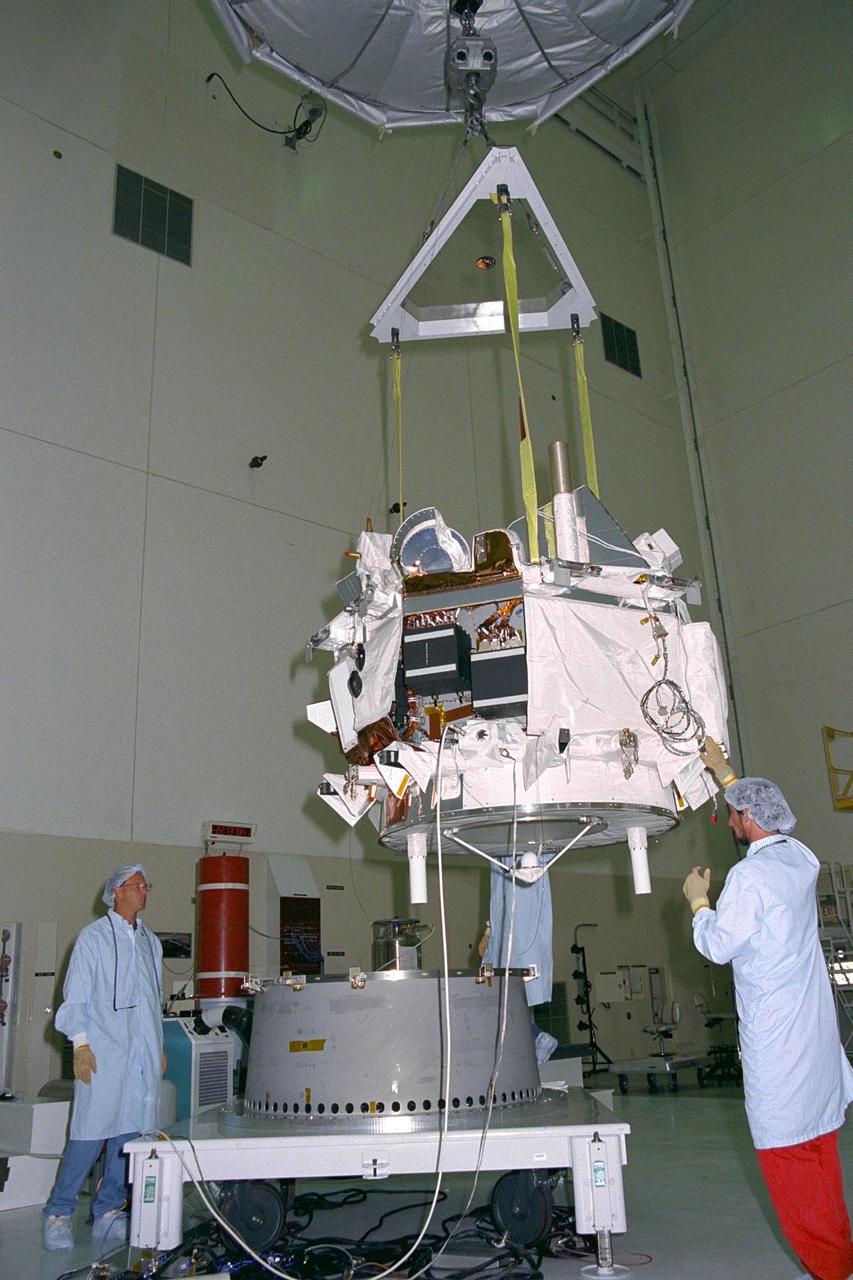
Applied Physics Laboratory engineers and technicians from Johns Hopkins University assist in guiding the Advanced Composition Explorer (ACE) as it is hoisted over a platform for solar array installation in KSC’s Spacecraft Assembly and Encapsulation Facility-II. Scheduled for launch on a Delta II rocket from Cape Canaveral Air Station on Aug. 25, ACE will study low-energy particles of solar origin and high-energy galactic particles. The ACE observatory will contribute to the understanding of the formation and evolution of the solar system as well as the astrophysical processes involved. The collecting power of instruments aboard ACE is 10 to 1,000 times greater than anything previously flown to collect similar data by NASA
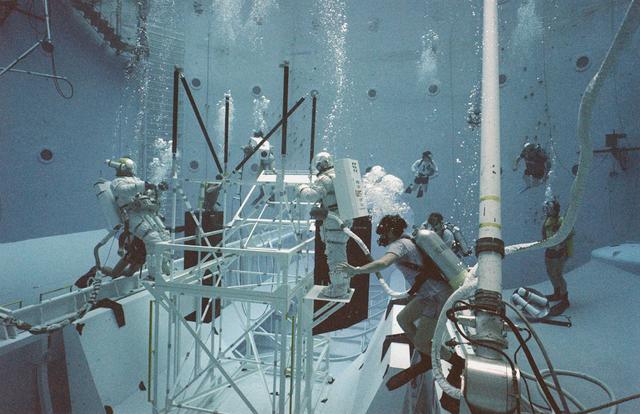
One of the main components of the Hubble Space Telescope (HST) is the Solar Array Drive Electronics (SADE) system. This system interfaces with the Support System Module (SSM) for exchange of operational commands and telemetry data. SADE operates and controls the Solar Array Drive Mechanisms (SADM) for the orientation of the Solar Array Drive (SAD). It also monitors the position of the arrays and the temperature of the SADM. During the first HST servicing mission, the astronauts replaced the SADE component because of some malfunctions. This turned out to be a very challenging extravehicular activity (EVA). Two transistors and two diodes had been thermally stressed with the conformal coating discolored and charred. Soldered cornections became molten and reflowed between the two diodes. The failed transistors gave no indication of defective construction. All repairs were made and the HST was redeposited into orbit. Prior to undertaking this challenging mission, the orbiter's crew trained at Marshall Space Flight Center's (MSFC) Neutral Buoyancy Simulator (NBS) to prepare themselves for working in a low gravity environment. They also practiced replacing HST parts and exercised maneuverability and equipment handling. Pictured are crew members practicing on a space platform.
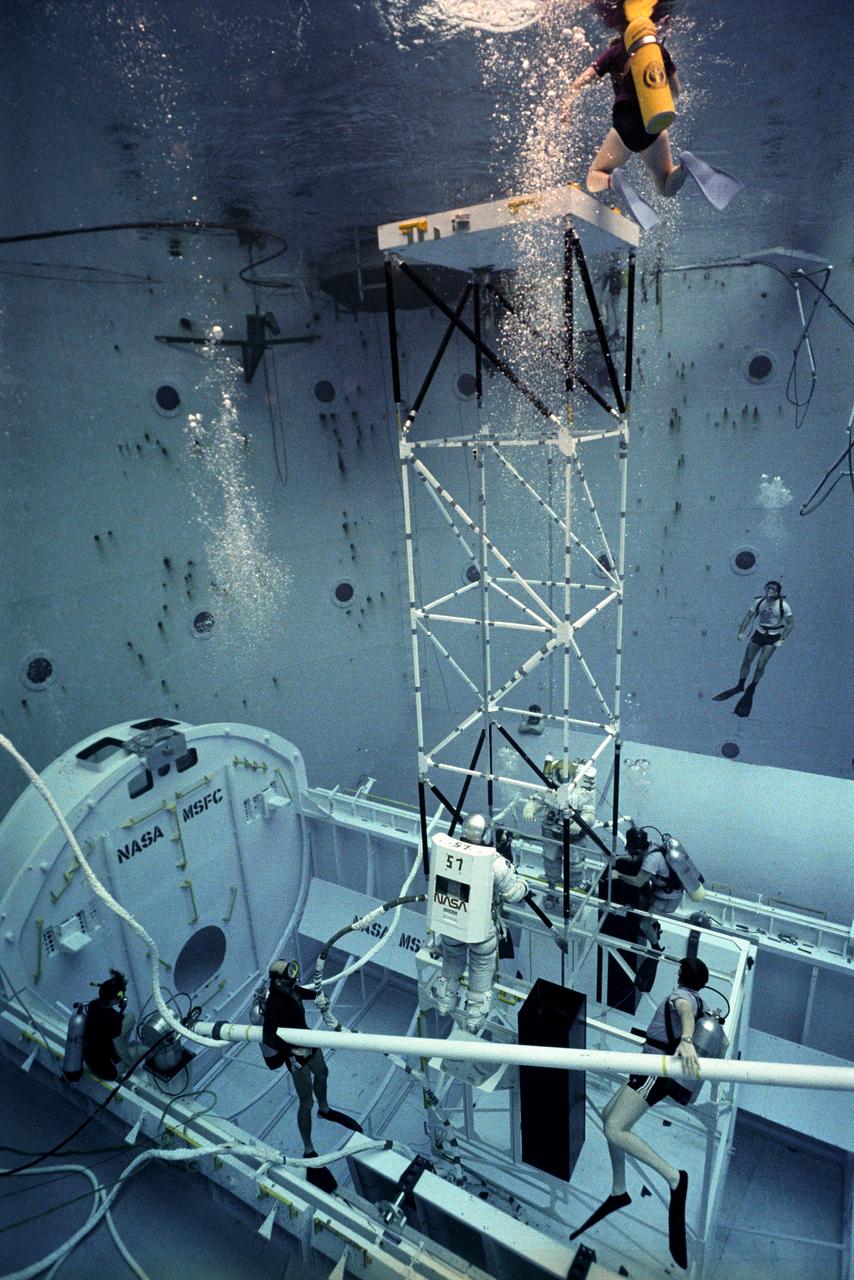
One of the main components of the Hubble Space Telescope (HST) is the Solar Array Drive Electronics (SADE) system. This system interfaces with the Support System Module (SSM) for exchange of operational commands and telemetry data. SADE operates and controls the Solar Array Drive Mechanisms (SADM) for the orientation of the Solar Array Drive (SAD). It also monitors the position of the arrays and the temperature of the SADM. During the first HST servicing mission, the astronauts replaced the SADE component because of some malfunctions. This turned out to be a very challenging extravehicular activity (EVA). Two transistors and two diodes had been thermally stressed with the conformal coating discolored and charred. Soldered cornections became molten and reflowed between the two diodes. The failed transistors gave no indication of defective construction. All repairs were made and the HST was redeposited into orbit. Prior to undertaking this challenging mission, the orbiter's crew trained at Marshall Space Flight Center's (MSFC) Neutral Buoyancy Simulator (NBS) to prepare themselves for working in a low gravity environment. They also practiced replacing HST parts and exercised maneuverability and equipment handling. Pictured is an astronaut practicing climbing a space platform that was necessary in making repairs on the HST.
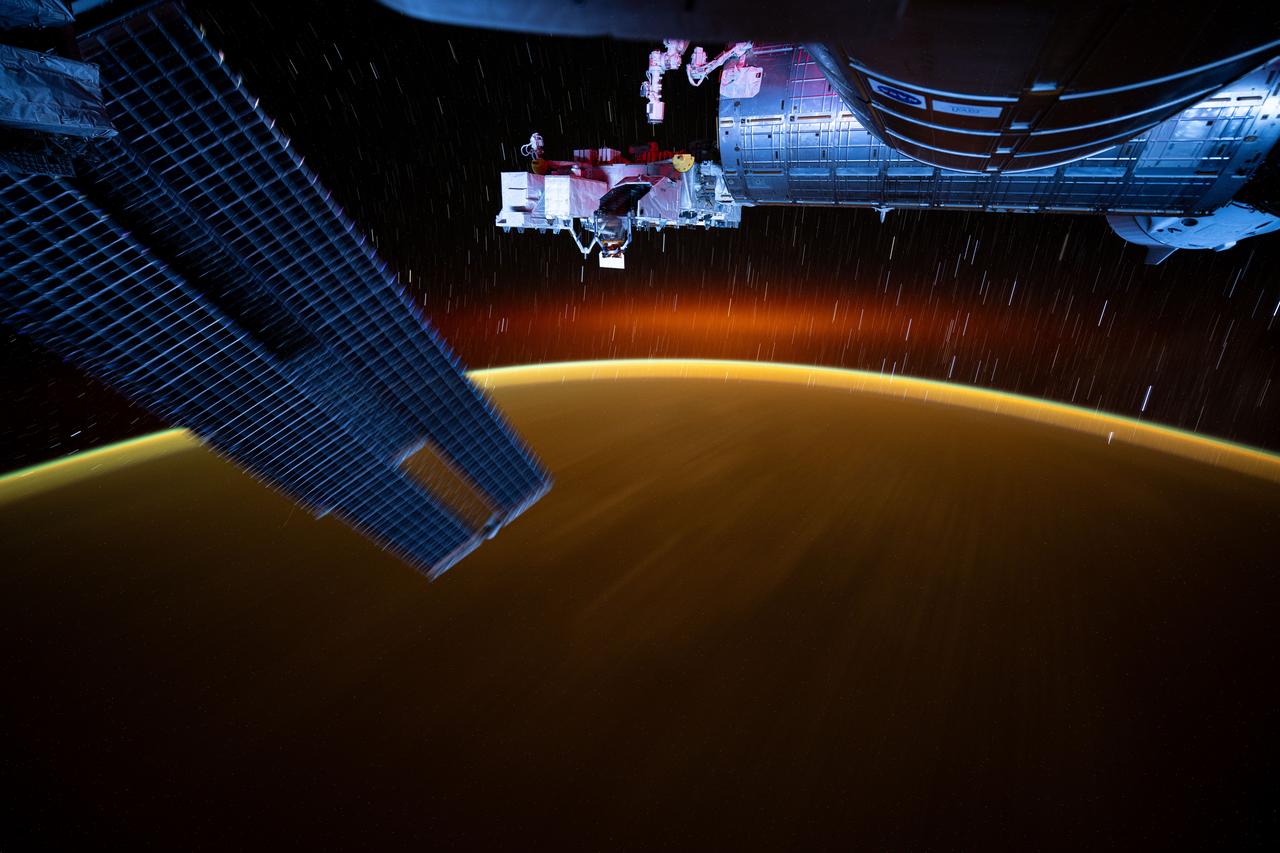
iss072e921628 (March 30, 2025) --- This long-duration photograph from the International Space Station highlights star trails and an atmospheric glow blanketing Earth's horizon. In the foreground, is a set of the space station's main solar arrays (left), the Kibo laboratory module (right), and Kibo's External Platform that houses experiments exposed to the vacuum of space. The orbital outpost was soaring 259 miles above the Pacific Ocean southeast of Japan just after sunset.
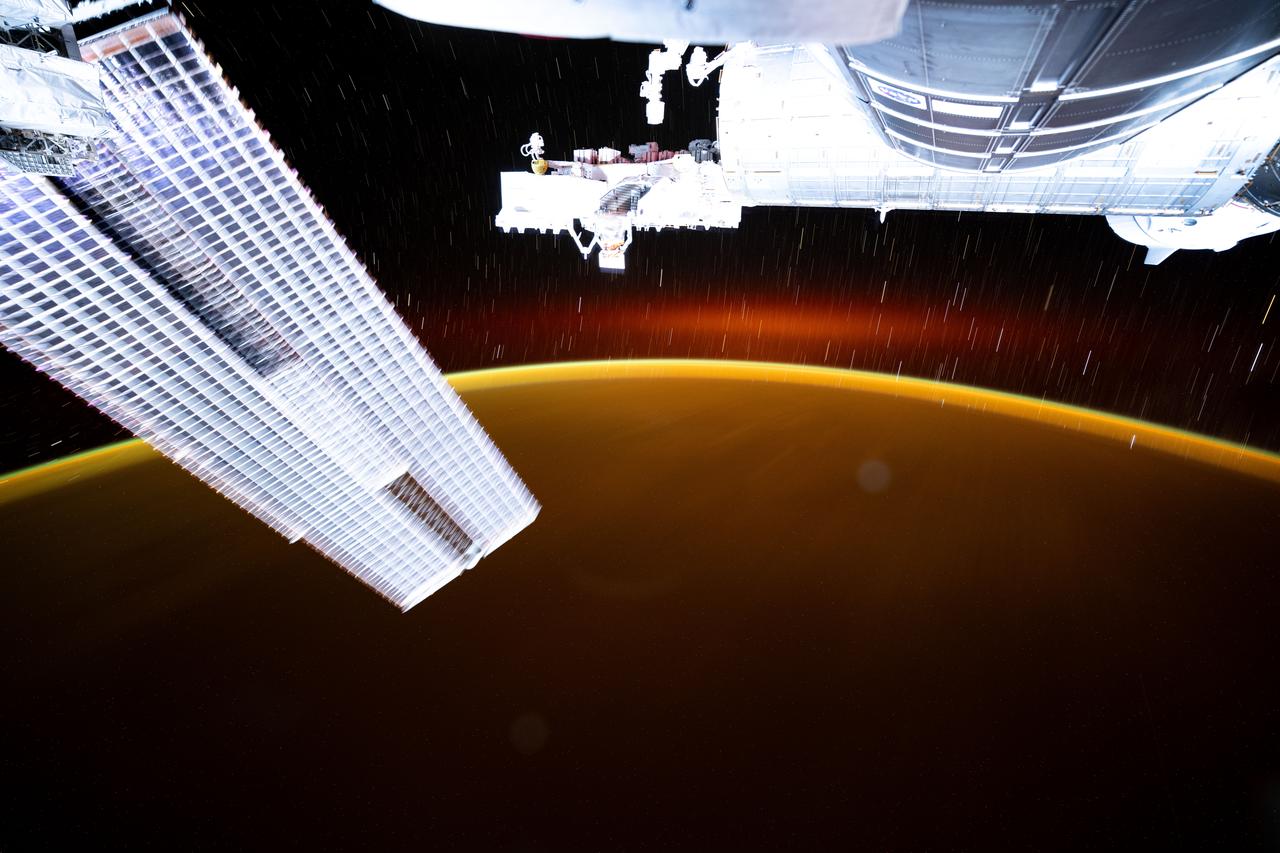
iss072e921626 (March 30, 2025) --- This long-duration photograph from the International Space Station highlights star trails and an atmospheric glow blanketing Earth's horizon. In the foreground, is a set of the space station's main solar arrays (left), the Kibo laboratory module (right), and Kibo's External Platform that houses experiments exposed to the vacuum of space. The orbital outpost was soaring 259 miles above the Pacific Ocean southeast of Japan moments before sunset.
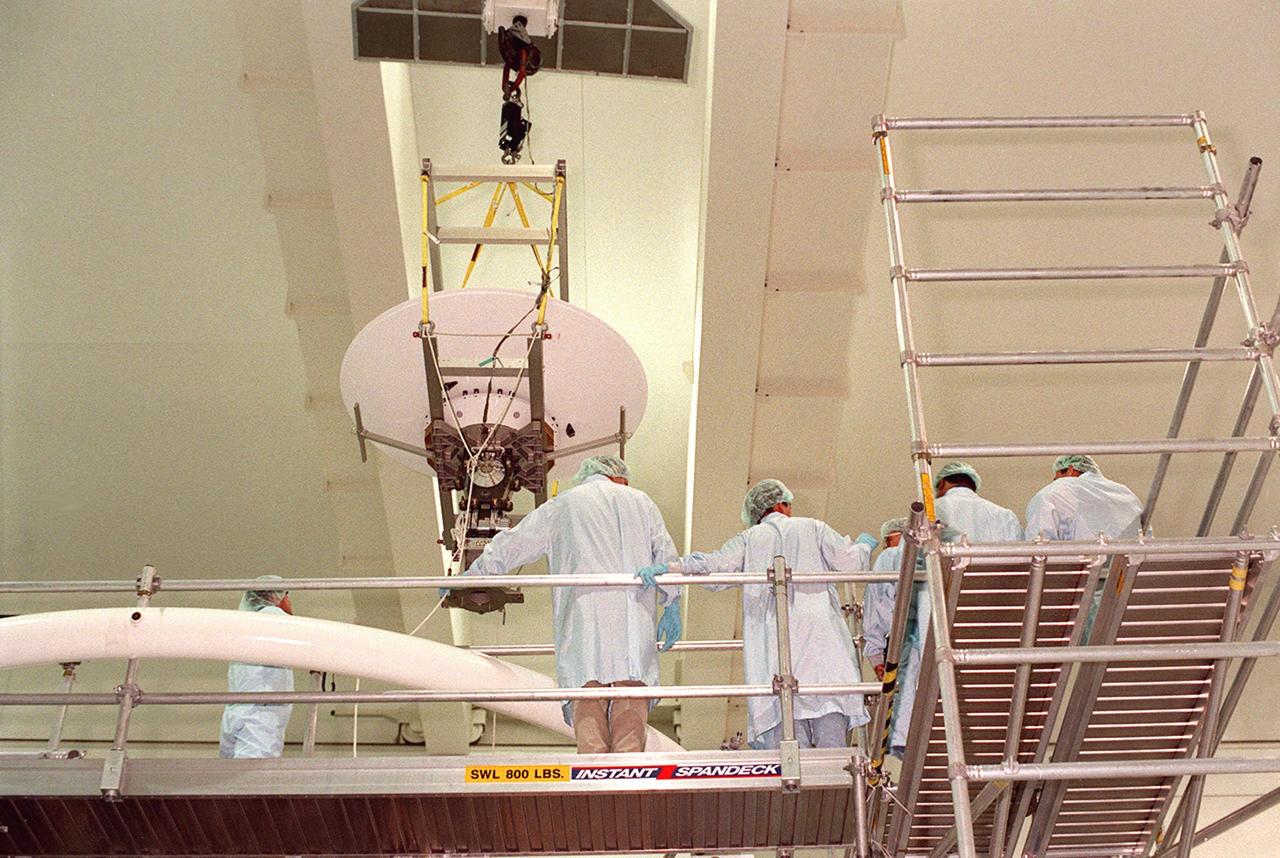
An overhead crane in the Space Shuttle Processing Facility lifts a high-gain antenna over a work platform toward the Integrated Truss Structure (ITS) Z1, to which it will be attached. The Z1, part of the payload on mission STS-92 (flight 3A) to be launched in mid-fall, is an early exterior framework for the International Space Station. It will allow the first U.S. solar arrays, on mission STS-97 (flight 4A), to be temporarily installed on Unity for early power
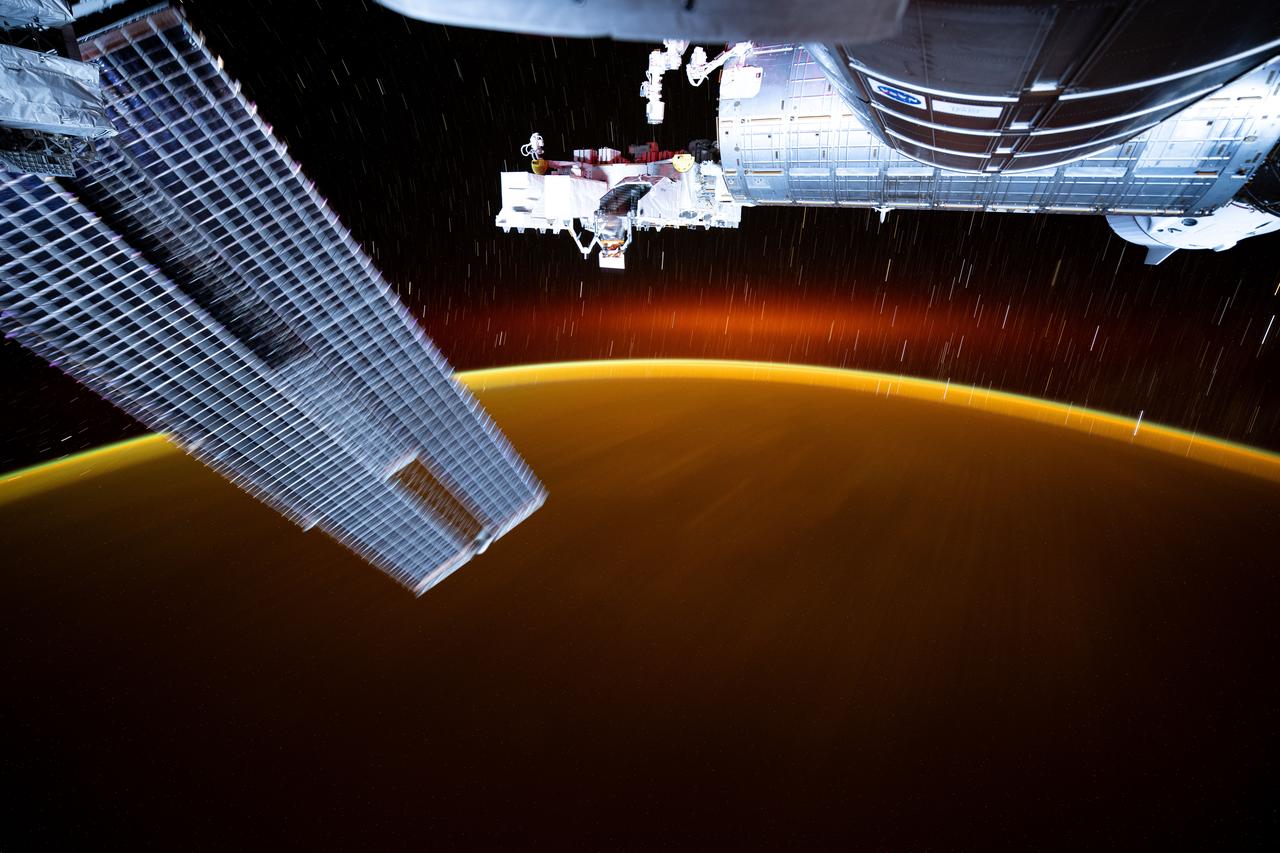
iss072e921627 (March 30, 2025) --- This long-duration photograph from the International Space Station highlights star trails and an atmospheric glow blanketing Earth's horizon. In the foreground, is a set of the space station's main solar arrays (left), the Kibo laboratory module (right), and Kibo's External Platform that houses experiments exposed to the vacuum of space. The orbital outpost was soaring 259 miles above the Pacific Ocean southeast of Japan going into a sunset.
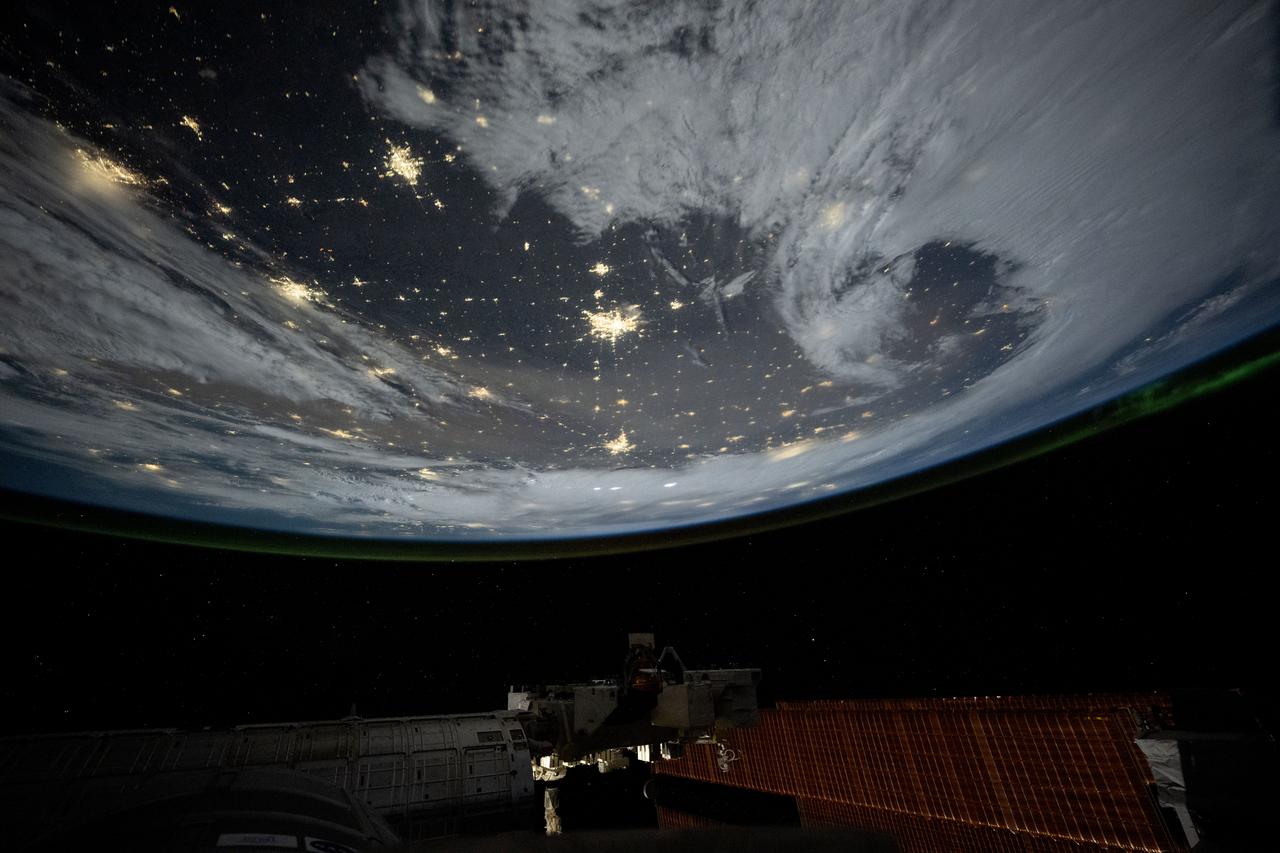
iss072e842757 (March 15, 2025) --- City lights dot the cloudy, midwestern landscape of the United States with a wispy aurora above Earth's horizon in this photograph from the International Space Station as it orbited 261 miles above the Sunflower State of Kansas. In the bottom foreground, is the Kibo laboratory module's Exposed Facility, an external research platform, and the orbital outpost's main solar arrays.
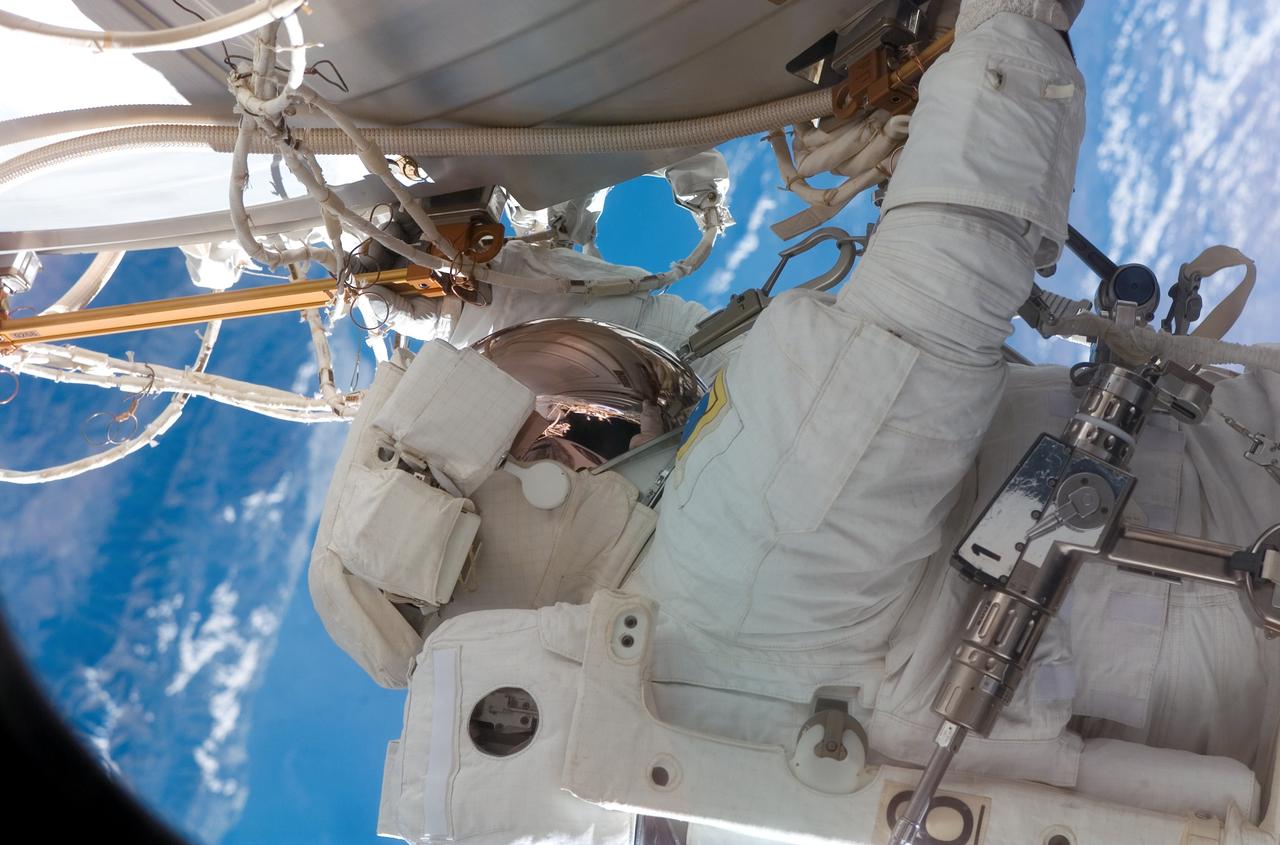
Astronaut Doug Wheelock, STS-120 mission specialist, participated in the third scheduled session of extravehicular activity (EVA) as construction continued on the International Space Station (ISS). During a 7-hour and 8-minute space walk, Wheelock and mission specialist Scott Parazynski (out of frame), installed the P6 truss segment with its set of solar arrays to its permanent home, installed a spare main bus switching unit on a stowage platform, and performed a few get-ahead tasks.
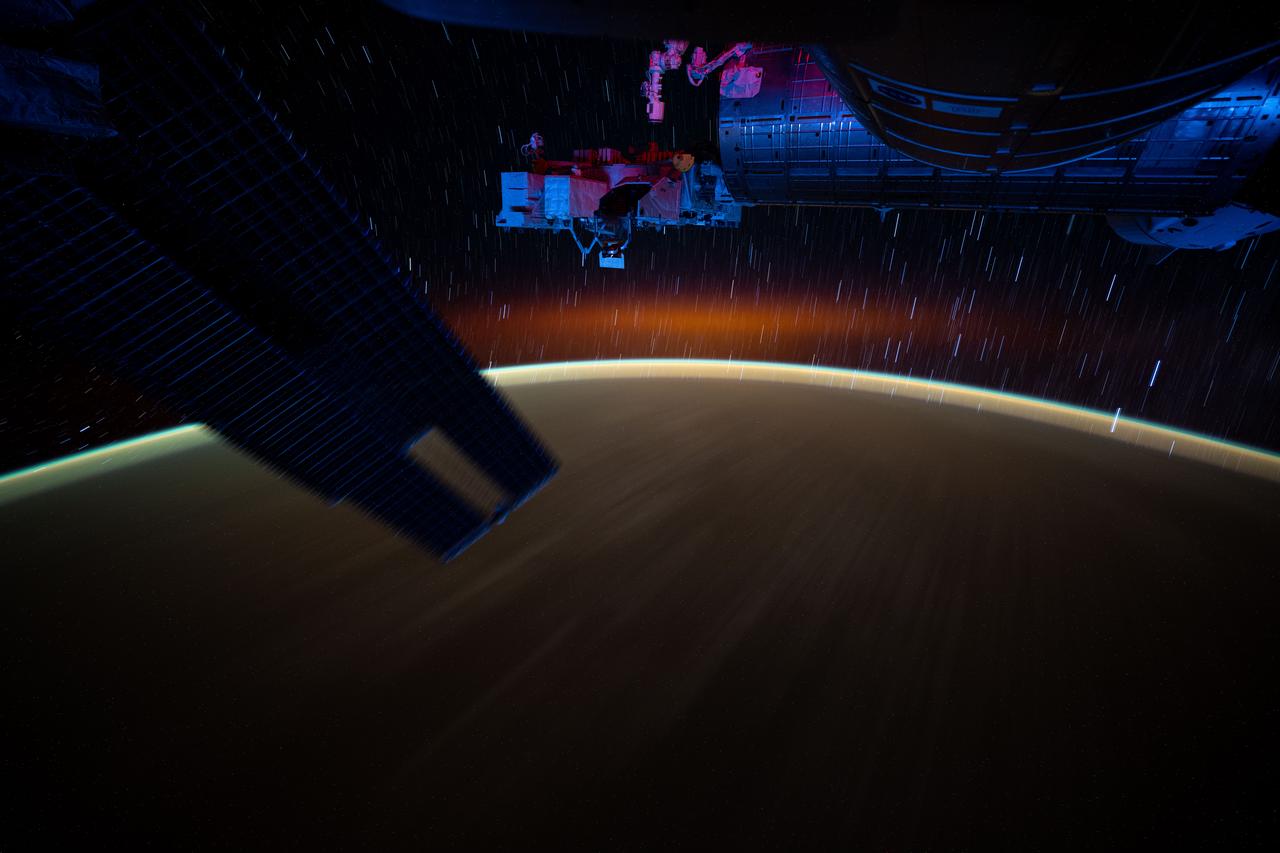
iss072e921629 (March 30, 2025) --- This long-duration photograph from the International Space Station highlights star trails and an atmospheric glow blanketing Earth's horizon. In the foreground, is a set of the space station's main solar arrays (left), the Kibo laboratory module (right), and Kibo's External Platform that houses experiments exposed to the vacuum of space. The orbital outpost was soaring 259 miles above the Pacific Ocean southeast of Japan after sunset.

iss072e940709 (April 2, 2025) --- This long duration photograph looks out from a window on the cupola revealing Earth's atmopsheric glow underneath star trails as the International Space Station orbited 258 miles above the Pacific Ocean southeast of Hawaii at approximately 8:15 p.m. local time. In the foreground, is the Kibo laboratory module (left), and Kibo's External Platform (center) that houses experiments exposed to the vacuum of space, and a set of the space station's main solar arrays (right).
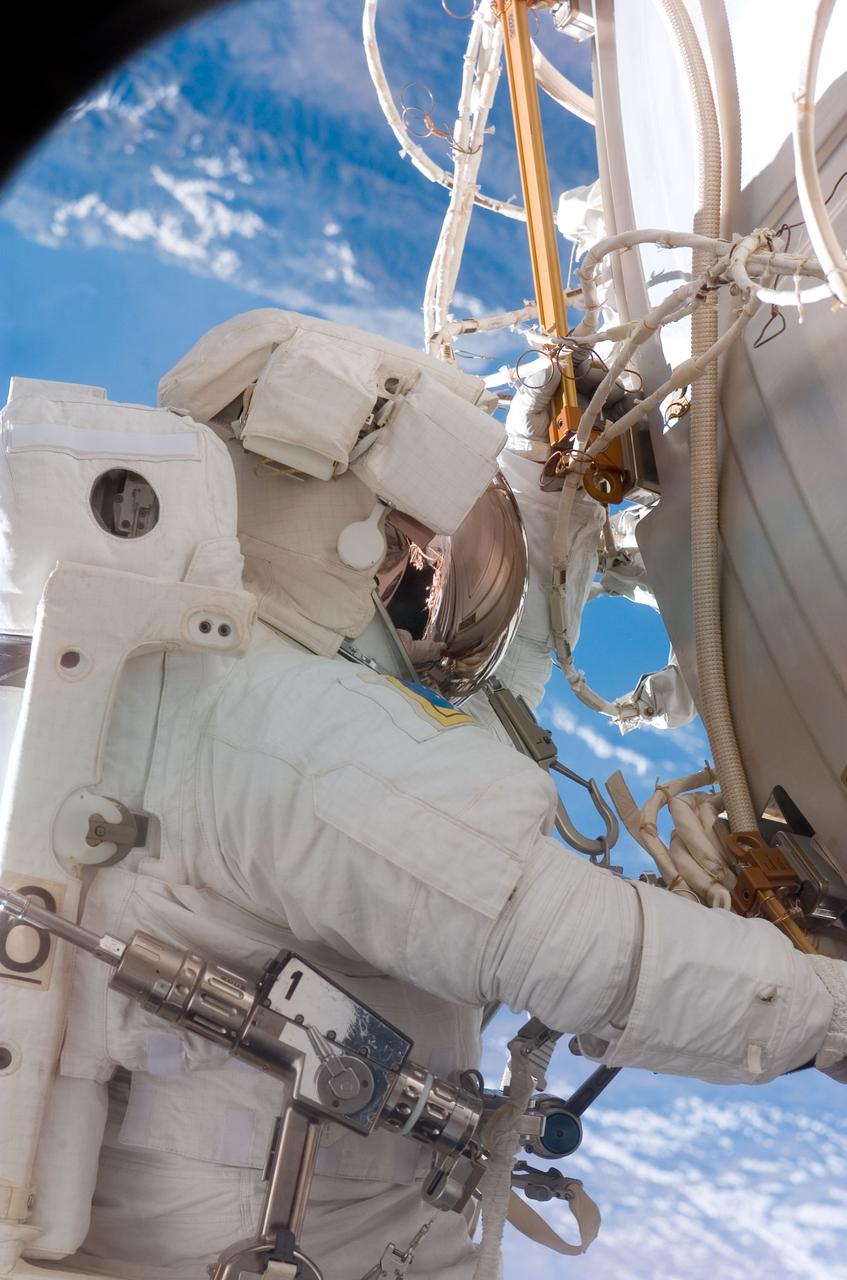
S120-E-007581 (30 Oct. 2007) --- Astronaut Doug Wheelock, STS-120 mission specialist, participates in the third scheduled session of extravehicular activity (EVA) as construction continues on the International Space Station. During the 7-hour, 8-minute spacewalk Wheelock and astronaut Scott Parazynski (out of frame), mission specialist, installed the P6 truss segment with its set of solar arrays to its permanent home, installed a spare main bus switching unit on a stowage platform, and performed a few get-ahead tasks.
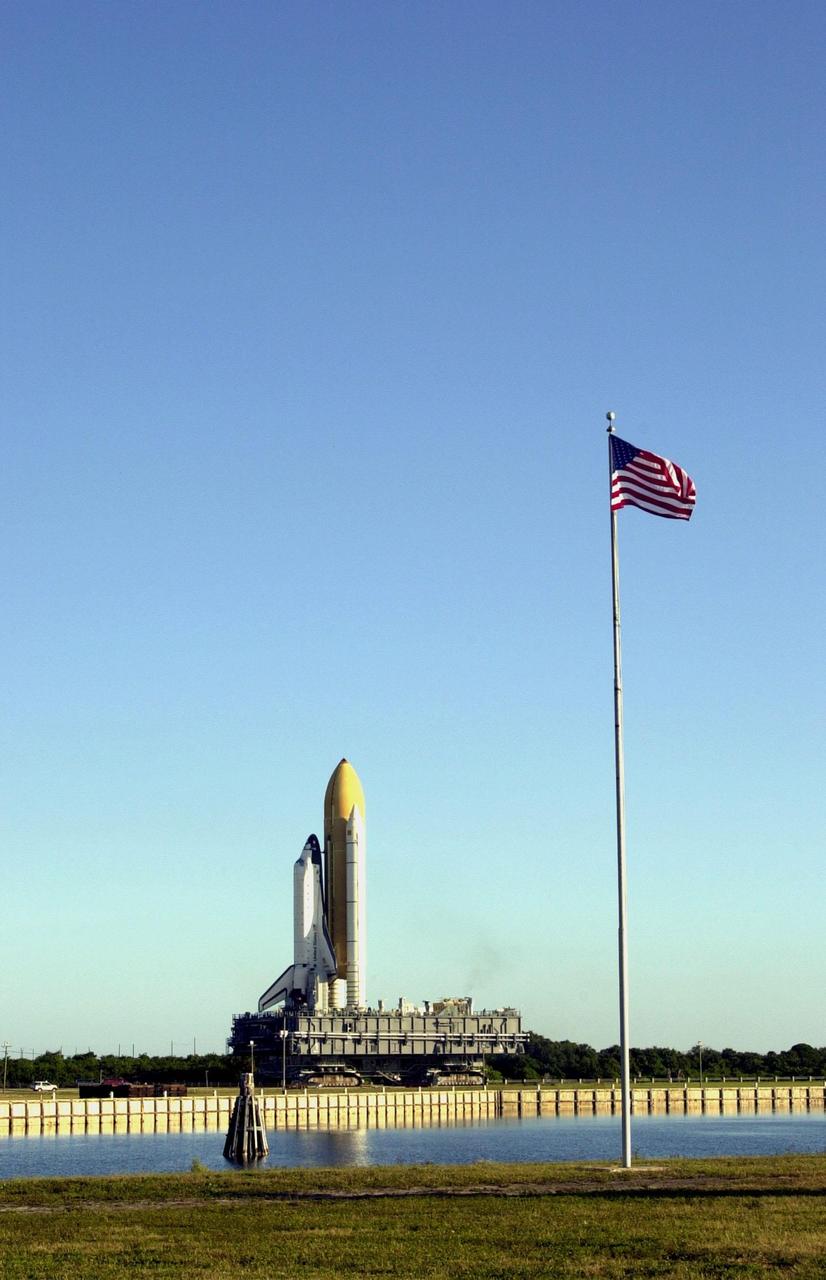
KENNEDY SPACE CENTER, Fla. -- Viewed across the turn basin from the Press mound, Space Shuttle Endeavour inches its way to Launch Pad 39B (on the horizon) via the crawlerway that leads from the Vehicle Assembly Building. The Shuttle is on the Mobile Launcher Platform (MLP) which is atop the crawler-transporter, moving on four double-tracked crawlers. The maximum speed of the loaded transporter is 1 mph. Endeavour is scheduled to be launched Nov. 30 at 10:01 p.m. EST on mission STS-97, the sixth construction flight to the International Space Station. Its payload includes the P6 Integrated Truss Structure and a photovoltaic (PV) module, with giant solar arrays that will provide power to the Station. The mission includes two spacewalks to complete the solar array connections
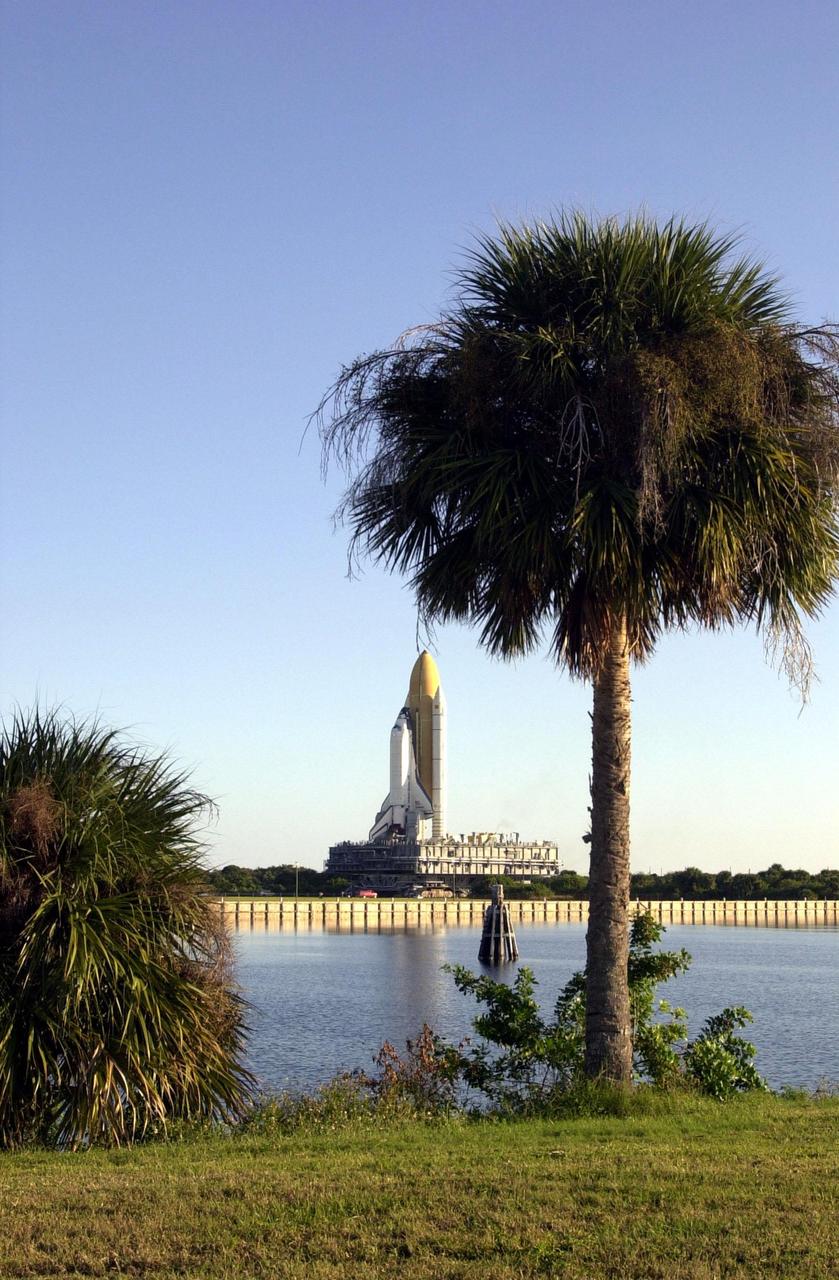
KENNEDY SPACE CENTER, Fla. -- Space Shuttle Endeavour appears to be framed by palms in this view across the turn basin at KSC. Endeavour is inching its way to Launch Pad 39B (on the horizon) via the crawlerway that leads from the Vehicle Assembly Building. The Shuttle is on the Mobile Launcher Platform (MLP) which is atop the crawler-transporter, moving on four double-tracked crawlers. The maximum speed of the loaded transporter is 1 mph. Endeavour is scheduled to be launched Nov. 30 at 10:01 p.m. EST on mission STS-97, the sixth construction flight to the International Space Station. Its payload includes the P6 Integrated Truss Structure and a photovoltaic (PV) module, with giant solar arrays that will provide power to the Station. The mission includes two spacewalks to complete the solar array connections
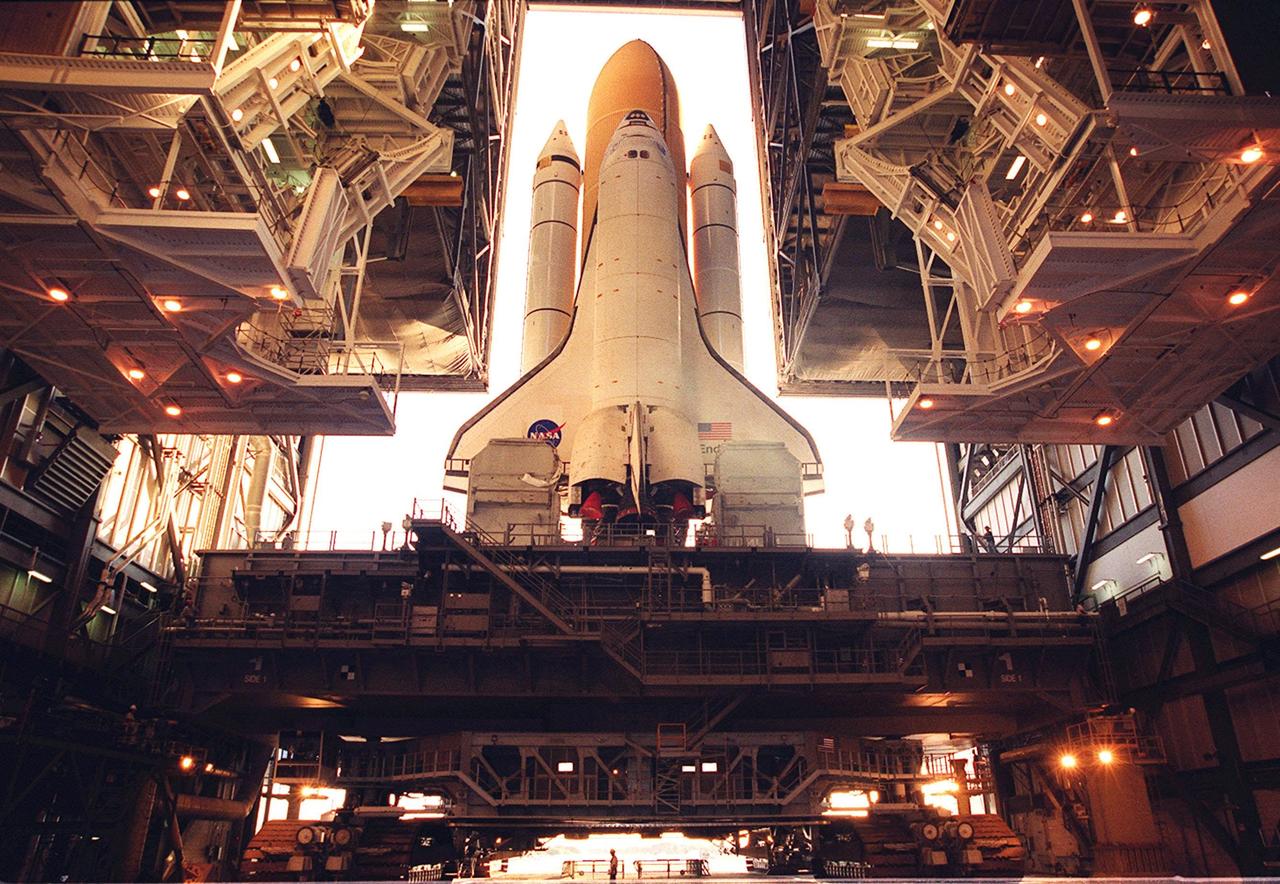
KENNEDY SPACE CENTER, Fla. -- Space Shuttle Endeavour appears dwarfed by the structures inside the Vehicle Assembly Building as it begins rollout to Launch Pad 39B. The Shuttle rests on top of the Mobile Launcher Platform (MLP). Underneath (bottom of photo) is the crawler-transporter that will move the Shuttle and MLP to the pad on four double-tracked crawlers. The maximum speed of the loaded transporter is 1 mph. Endeavour is scheduled to be launched Nov. 30 at 10:01 p.m. EST on mission STS-97, the sixth construction flight to the International Space Station. Its payload includes the P6 Integrated Truss Structure and a photovoltaic (PV) module, with giant solar arrays that will provide power to the Station. The mission includes two spacewalks to complete the solar array connections
KENNEDY SPACE CENTER, FLA. -- Space Shuttle Columbia, atop its Mobile Launcher Platform, inches its way along the path to Launch Pad 39A. Columbia is scheduled to be launched Feb. 28 on mission STS-109, a Hubble Servicing Mission. The goal of the mission is to replace Solar Array 2 with Solar Array 3, replace the Power Control Unit, remove the Faint Object Camera and install the ACS, install the Near Infrared Camera and Multi-Object Spectrometer (NICMOS) Cooling System, and install New Outer Blanket Layer insulation. The launch will be the first for Columbia after returning from California where it underwent extensive maintenance, inspections and enhancements. More than 100 upgrades make Columbia safer and more reliable than ever before
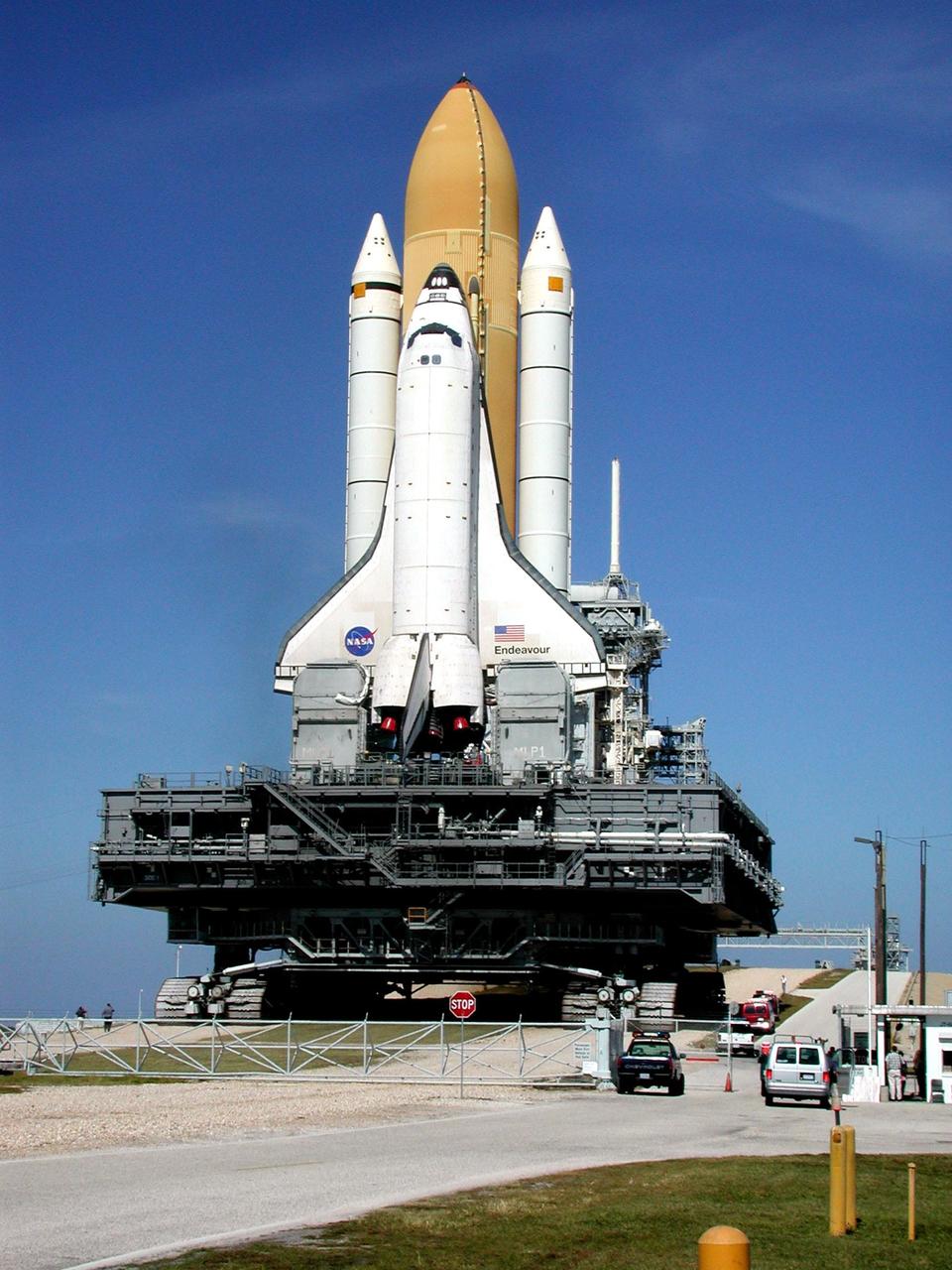
KENNEDY SPACE CENTER, Fla. -- Inside the gate to Launch Pad 39B, Space Shuttle Endeavour and the Mobile Launcher Platform (MLP) start up the incline to the top of the pad. The crawler-transporter beneath the MLP, which moves the Shuttle at about 1 mph, has a leveling system designed to keep the top of the Space Shuttle vertical while negotiating the 5 percent grade leading to the top of the pad. Endeavour is scheduled to be launched Nov. 30 at 10:01 p.m. EST on mission STS-97, the sixth construction flight to the International Space Station. Its payload includes the P6 Integrated Truss Structure and a photovoltaic (PV) module, with giant solar arrays that will provide power to the Station. The mission includes two spacewalks to complete the solar array connections
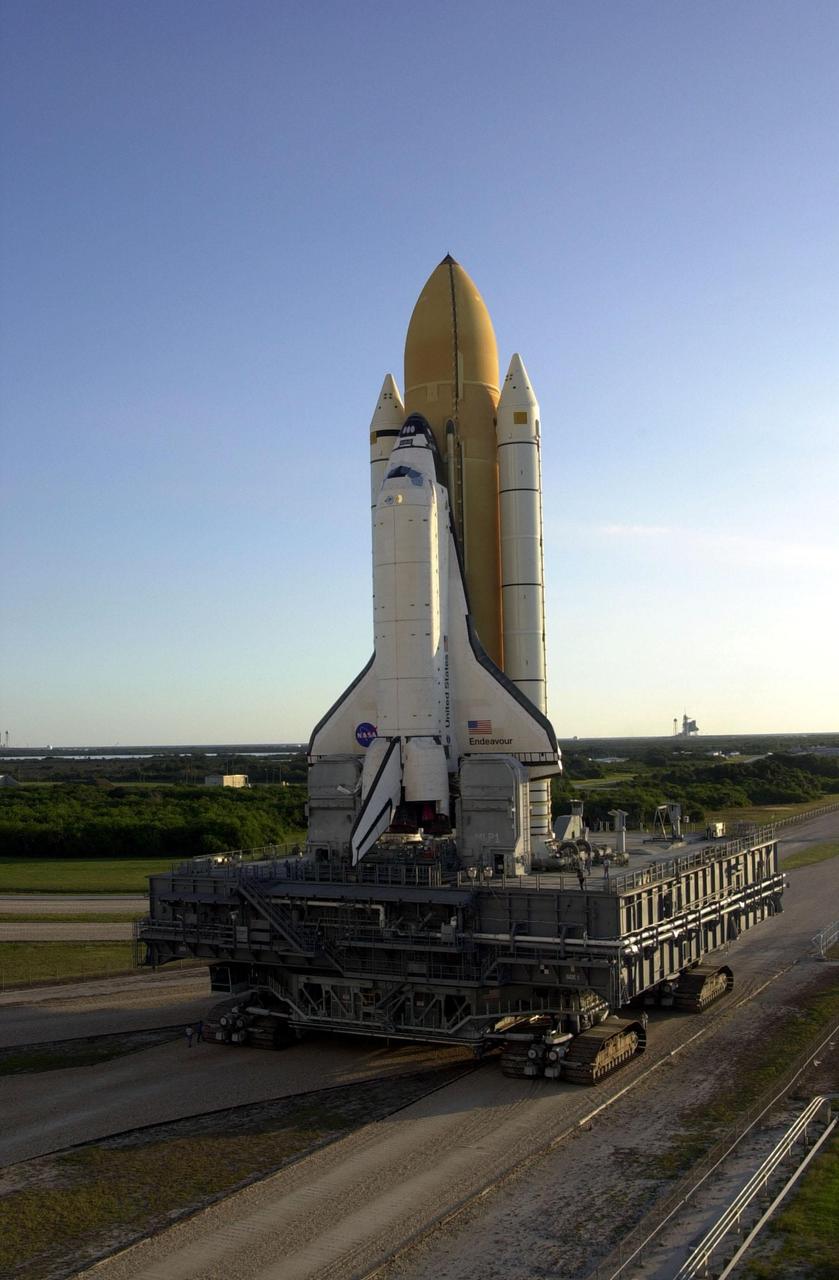
KENNEDY SPACE CENTER, Fla. -- As the early morning sky lights up, Space Shuttle Endeavour inches its way to Launch Pad 39B (on the horizon) via the crawlerway that leads from the Vehicle Assembly Building. The Shuttle is atop the Mobile Launcher Platform (MLP). Visible beneath the MLP is the crawler-transporter, which moves on four double-tracked crawlers. Each shoe on the crawler track weighs a ton. Unloaded, the transporter weighs 6 million pounds and moves at 2 mph. The maximum speed of the loaded transporter is 1 mph. Endeavour is scheduled to be launched Nov. 30 at 10:01 p.m. EST on mission STS-97, the sixth construction flight to the International Space Station. Its payload includes the P6 Integrated Truss Structure and a photovoltaic (PV) module, with giant solar arrays that will provide power to the Station. The mission includes two spacewalks to complete the solar array connections
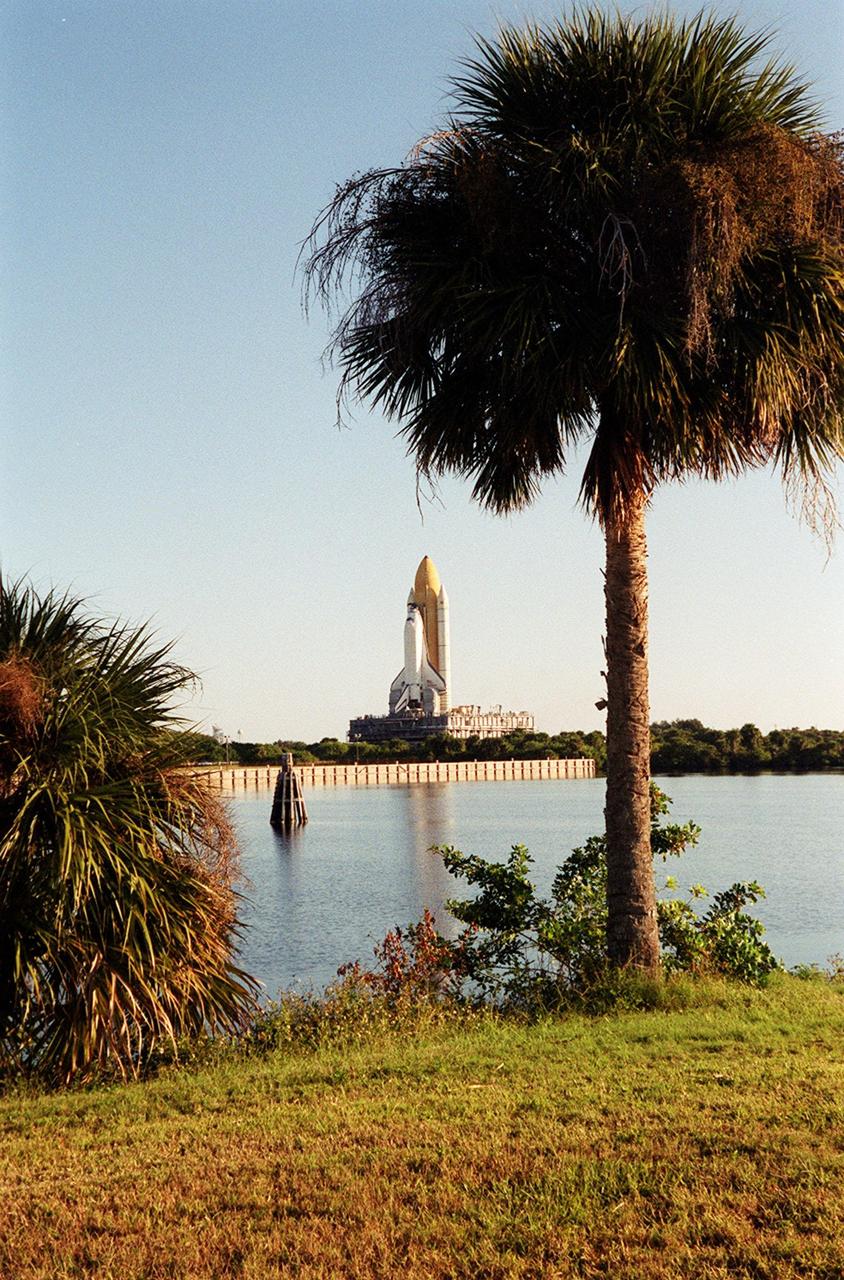
KENNEDY SPACE CENTER, Fla. -- Space Shuttle Endeavour appears to be framed by palms in this view across the turn basin at KSC. Endeavour is inching its way to Launch Pad 39B via the crawlerway that leads from the Vehicle Assembly Building. The Shuttle is on the Mobile Launcher Platform (MLP) which is atop the crawler-transporter, moving on four double-tracked crawlers. The maximum speed of the loaded transporter is 1 mph. Endeavour is scheduled to be launched Nov. 30 at 10:01 p.m. EST on mission STS-97, the sixth construction flight to the International Space Station. Its payload includes the P6 Integrated Truss Structure and a photovoltaic (PV) module, with giant solar arrays that will provide power to the Station. The mission includes two spacewalks to complete the solar array connections
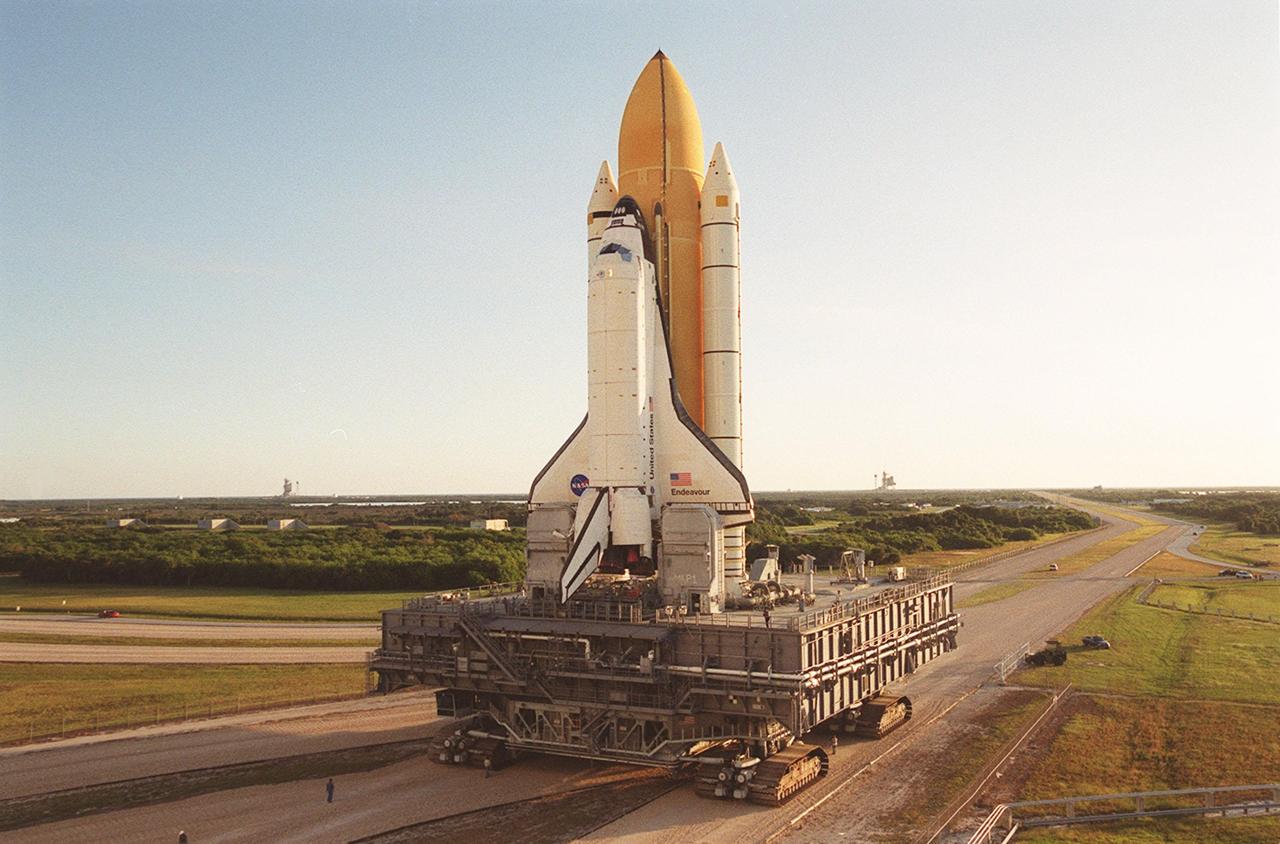
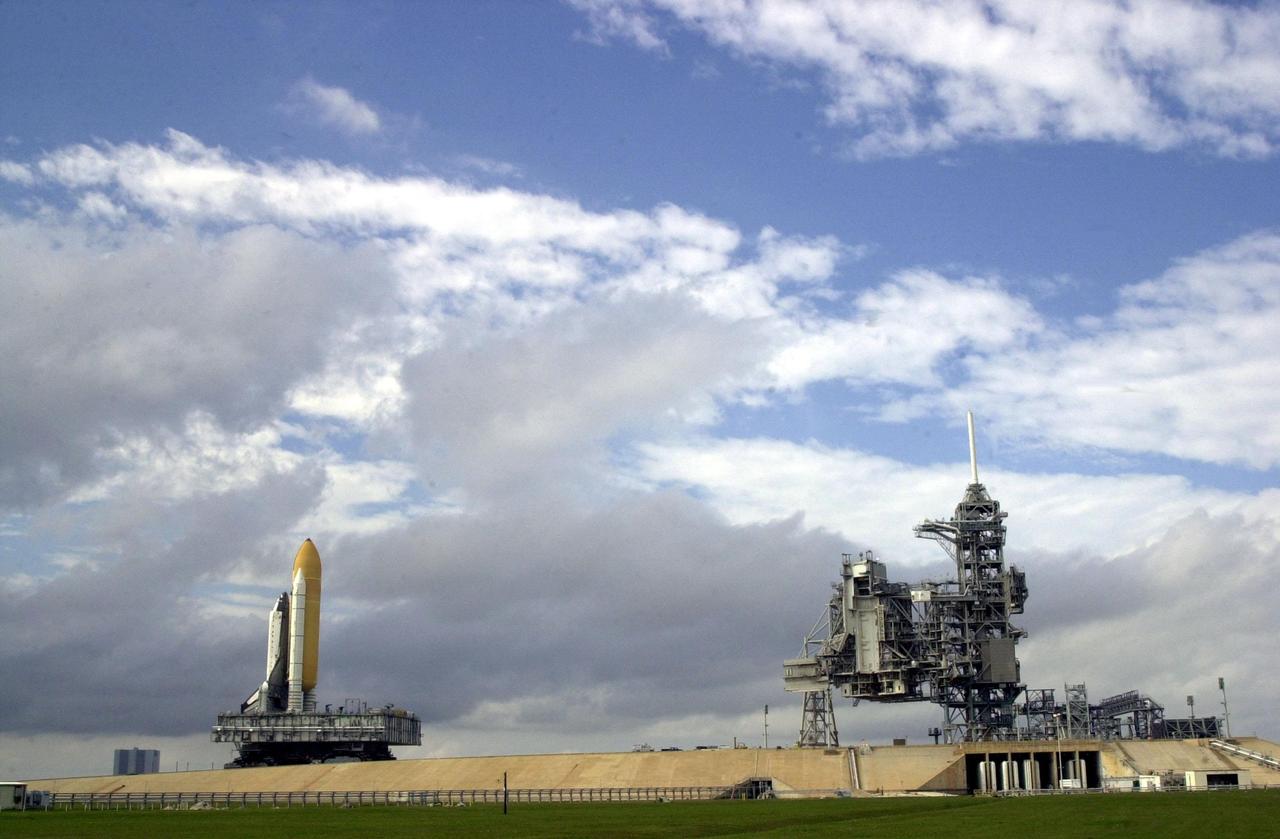
KENNEDY SPACE CENTER, Fla. -- Space Shuttle Endeavour inches its way to Launch Pad 39B via the crawlerway that leads from the Vehicle Assembly Building. The Shuttle is on the Mobile Launcher Platform (MLP) which is atop the crawler-transporter, moving on four double-tracked crawlers. The maximum speed of the loaded transporter is 1 mph. To the left and right of the Space Shuttle can be seen both launch pads, 39B and 39A respectively. Endeavour is scheduled to be launched Nov. 30 at 10:01 p.m. EST on mission STS-97, the sixth construction flight to the International Space Station. Its payload includes the P6 Integrated Truss Structure and a photovoltaic (PV) module, with giant solar arrays that will provide power to the Station. The mission includes two spacewalks to complete the solar array connections
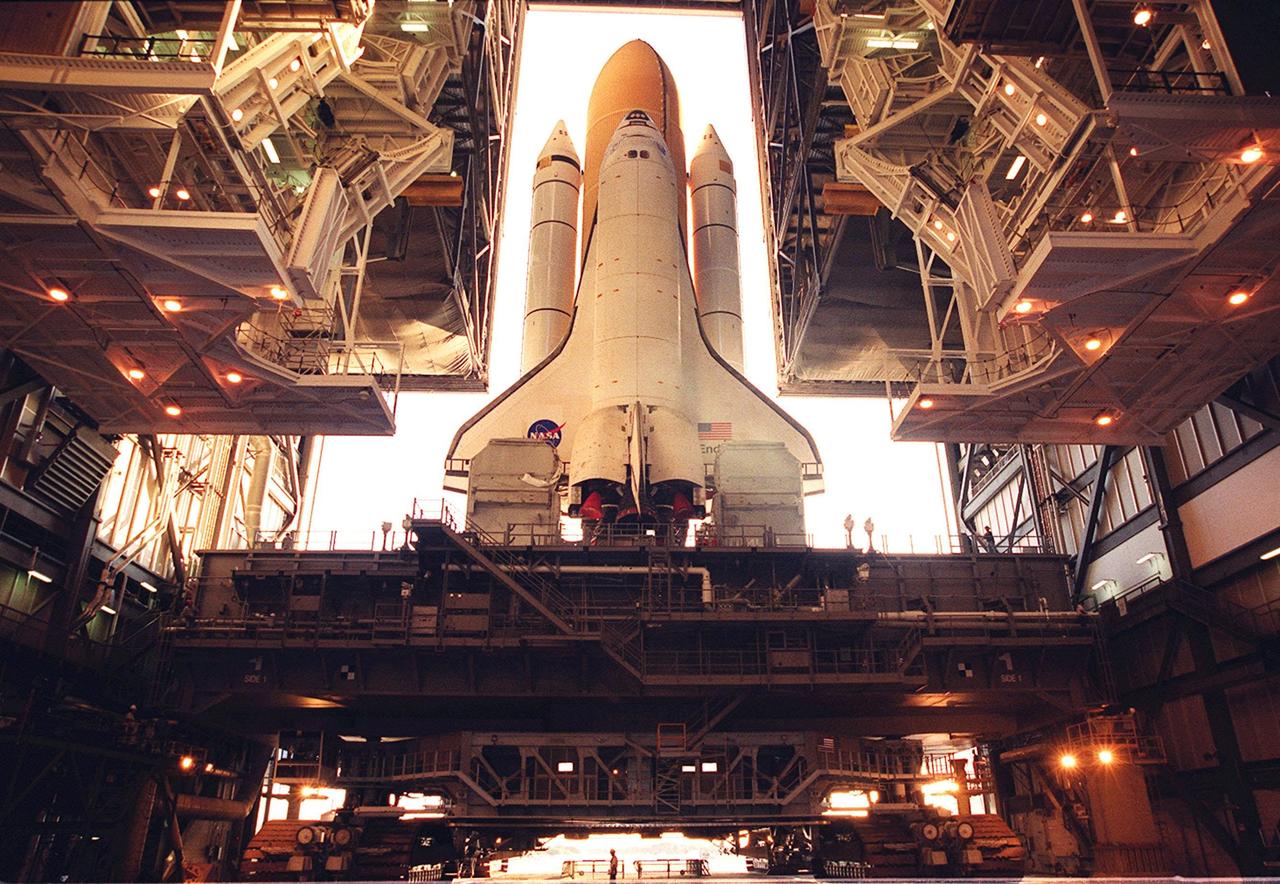
KENNEDY SPACE CENTER, Fla. -- Space Shuttle Endeavour appears dwarfed by the structures inside the Vehicle Assembly Building as it begins rollout to Launch Pad 39B. The Shuttle rests on top of the Mobile Launcher Platform (MLP). Underneath (bottom of photo) is the crawler-transporter that will move the Shuttle and MLP to the pad on four double-tracked crawlers. The maximum speed of the loaded transporter is 1 mph. Endeavour is scheduled to be launched Nov. 30 at 10:01 p.m. EST on mission STS-97, the sixth construction flight to the International Space Station. Its payload includes the P6 Integrated Truss Structure and a photovoltaic (PV) module, with giant solar arrays that will provide power to the Station. The mission includes two spacewalks to complete the solar array connections
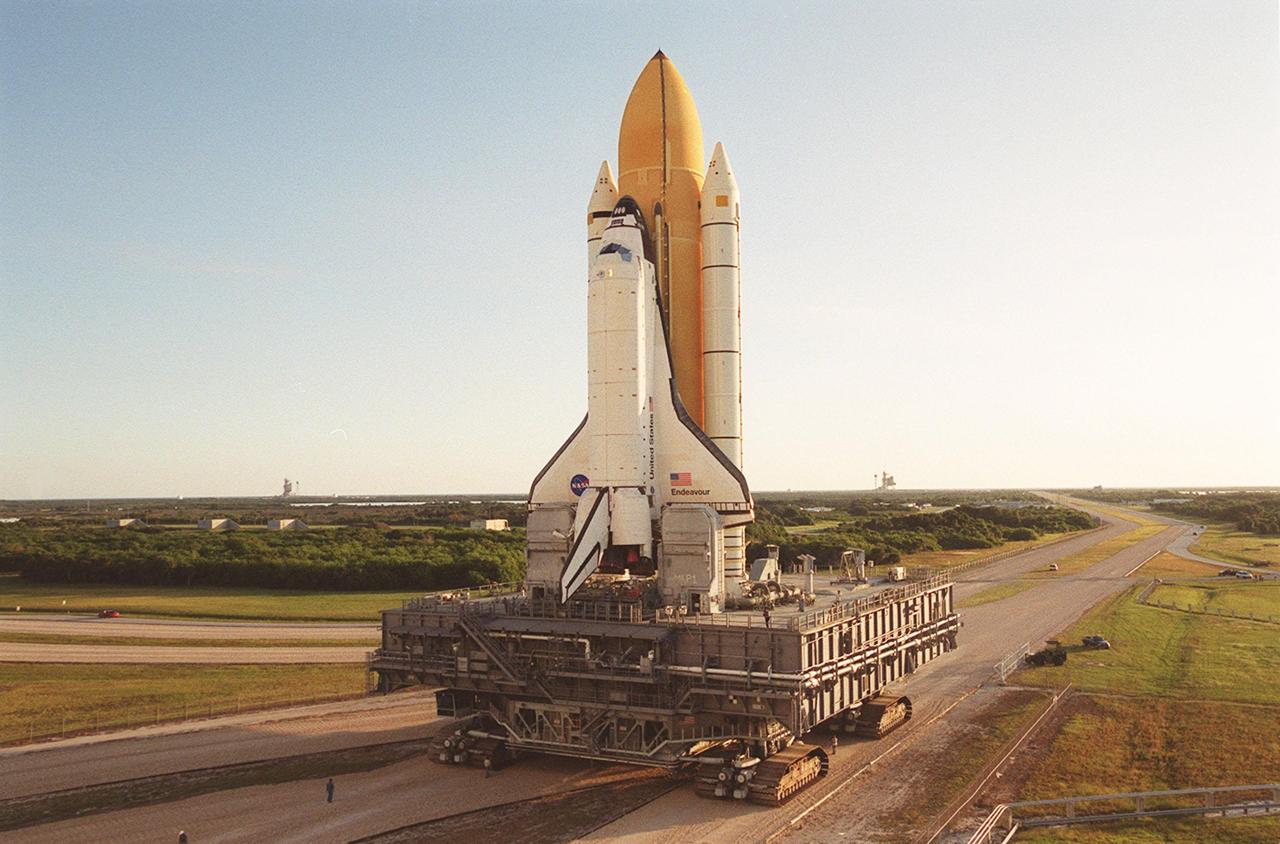
KENNEDY SPACE CENTER, Fla. -- Space Shuttle Endeavour inches its way to Launch Pad 39B via the crawlerway that leads from the Vehicle Assembly Building. The Shuttle is on the Mobile Launcher Platform (MLP) which is atop the crawler-transporter, moving on four double-tracked crawlers. The maximum speed of the loaded transporter is 1 mph. To the left and right of the Space Shuttle can be seen both launch pads, 39B and 39A respectively. Endeavour is scheduled to be launched Nov. 30 at 10:01 p.m. EST on mission STS-97, the sixth construction flight to the International Space Station. Its payload includes the P6 Integrated Truss Structure and a photovoltaic (PV) module, with giant solar arrays that will provide power to the Station. The mission includes two spacewalks to complete the solar array connections
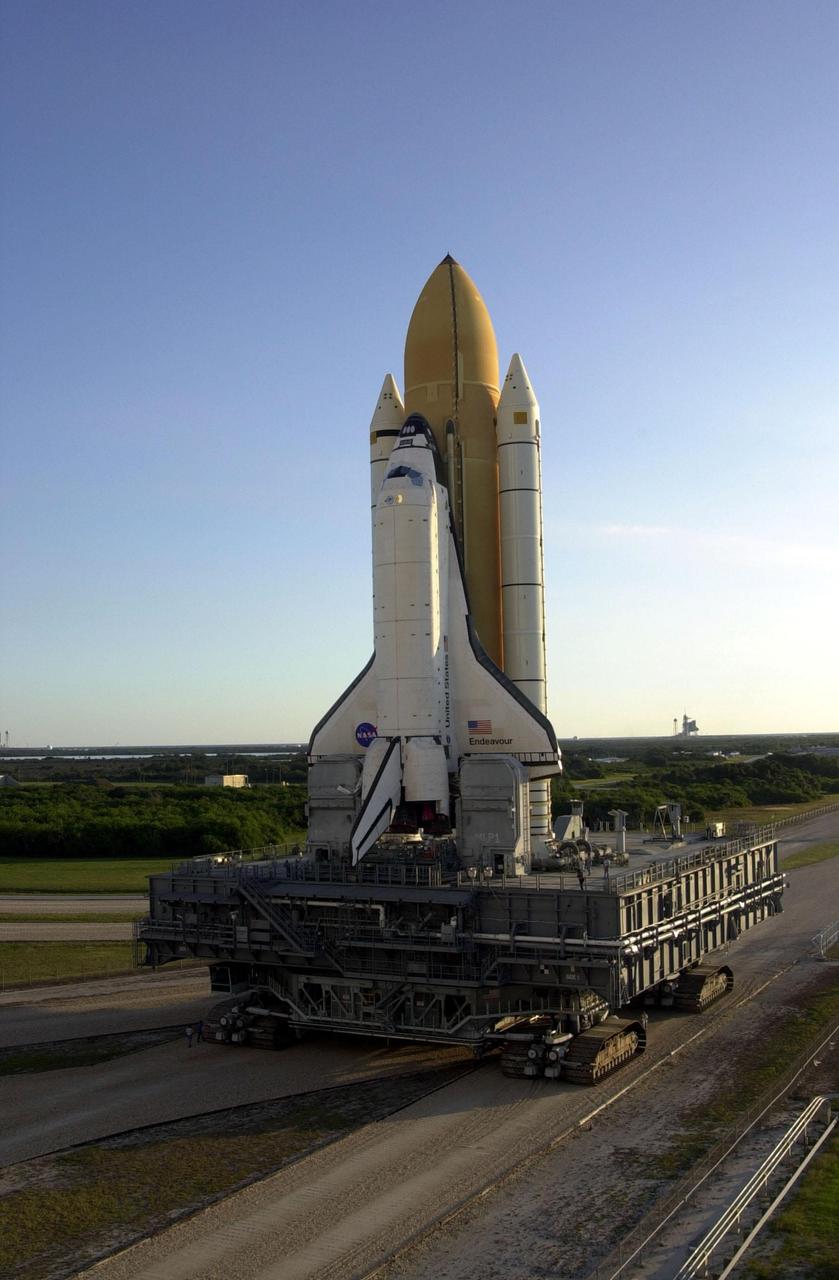
KENNEDY SPACE CENTER, Fla. -- As the early morning sky lights up, Space Shuttle Endeavour inches its way to Launch Pad 39B (on the horizon) via the crawlerway that leads from the Vehicle Assembly Building. The Shuttle is atop the Mobile Launcher Platform (MLP). Visible beneath the MLP is the crawler-transporter, which moves on four double-tracked crawlers. Each shoe on the crawler track weighs a ton. Unloaded, the transporter weighs 6 million pounds and moves at 2 mph. The maximum speed of the loaded transporter is 1 mph. Endeavour is scheduled to be launched Nov. 30 at 10:01 p.m. EST on mission STS-97, the sixth construction flight to the International Space Station. Its payload includes the P6 Integrated Truss Structure and a photovoltaic (PV) module, with giant solar arrays that will provide power to the Station. The mission includes two spacewalks to complete the solar array connections
KENNEDY SPACE CENTER, FLA. -- Space Shuttle Columbia, atop its Mobile Launcher Platform, begins the ascent up the incline to Launch Pad 39A. Columbia is scheduled to be launched Feb. 28 on mission STS-109, a Hubble Servicing Mission. The goal of the mission is to replace Solar Array 2 with Solar Array 3, replace the Power Control Unit, remove the Faint Object Camera and install the ACS, install the Near Infrared Camera and Multi-Object Spectrometer (NICMOS) Cooling System, and install New Outer Blanket Layer insulation. The launch will be the first for Columbia after returning from California where it underwent extensive maintenance, inspections and enhancements. More than 100 upgrades make Columbia safer and more reliable than ever before
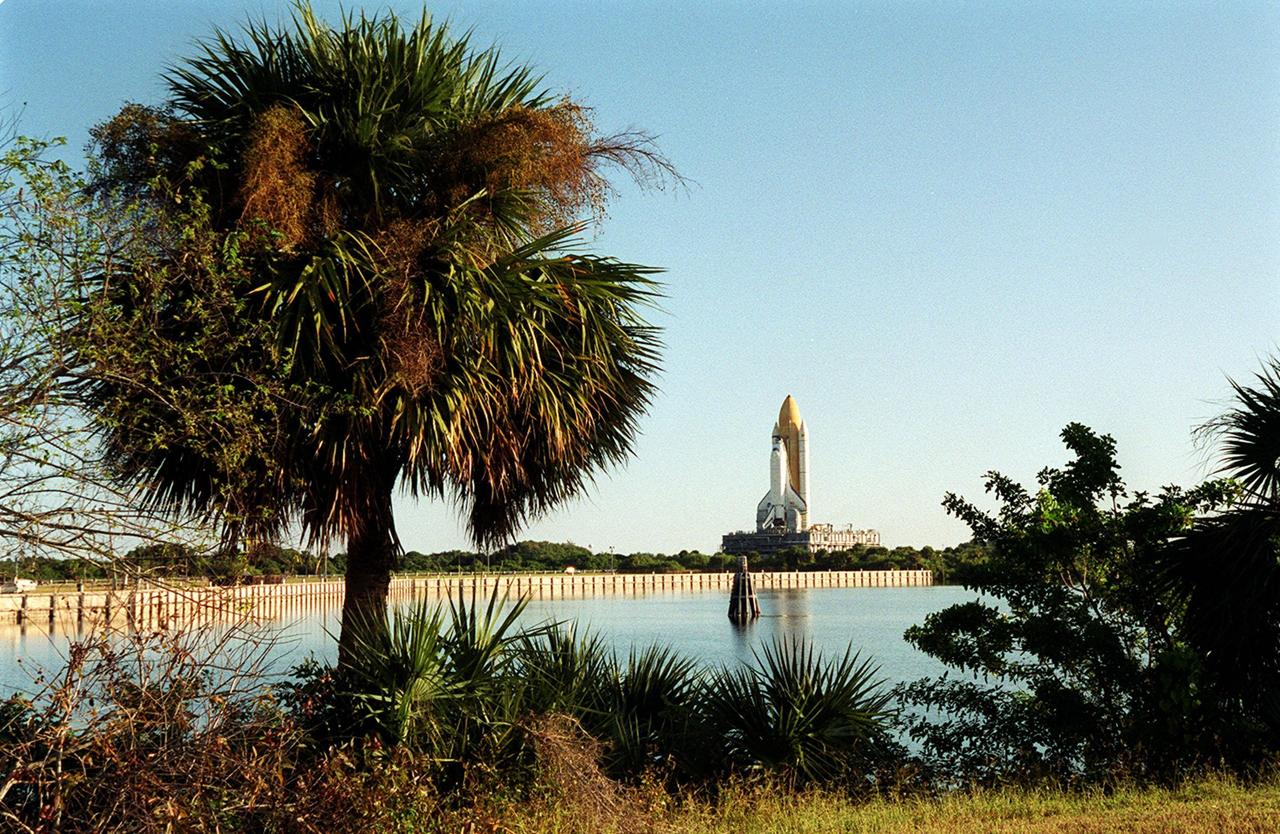
KENNEDY SPACE CENTER, Fla. -- Viewed from across the turn basin at KSC, Space Shuttle Endeavour inches its way to Launch Pad 39B via the crawlerway that leads from the Vehicle Assembly Building. The Shuttle is on the Mobile Launcher Platform (MLP) which is atop the crawler-transporter, moving on four double-tracked crawlers. The maximum speed of the loaded transporter is 1 mph. Endeavour is scheduled to be launched Nov. 30 at 10:01 p.m. EST on mission STS-97, the sixth construction flight to the International Space Station. Its payload includes the P6 Integrated Truss Structure and a photovoltaic (PV) module, with giant solar arrays that will provide power to the Station. The mission includes two spacewalks to complete the solar array connections
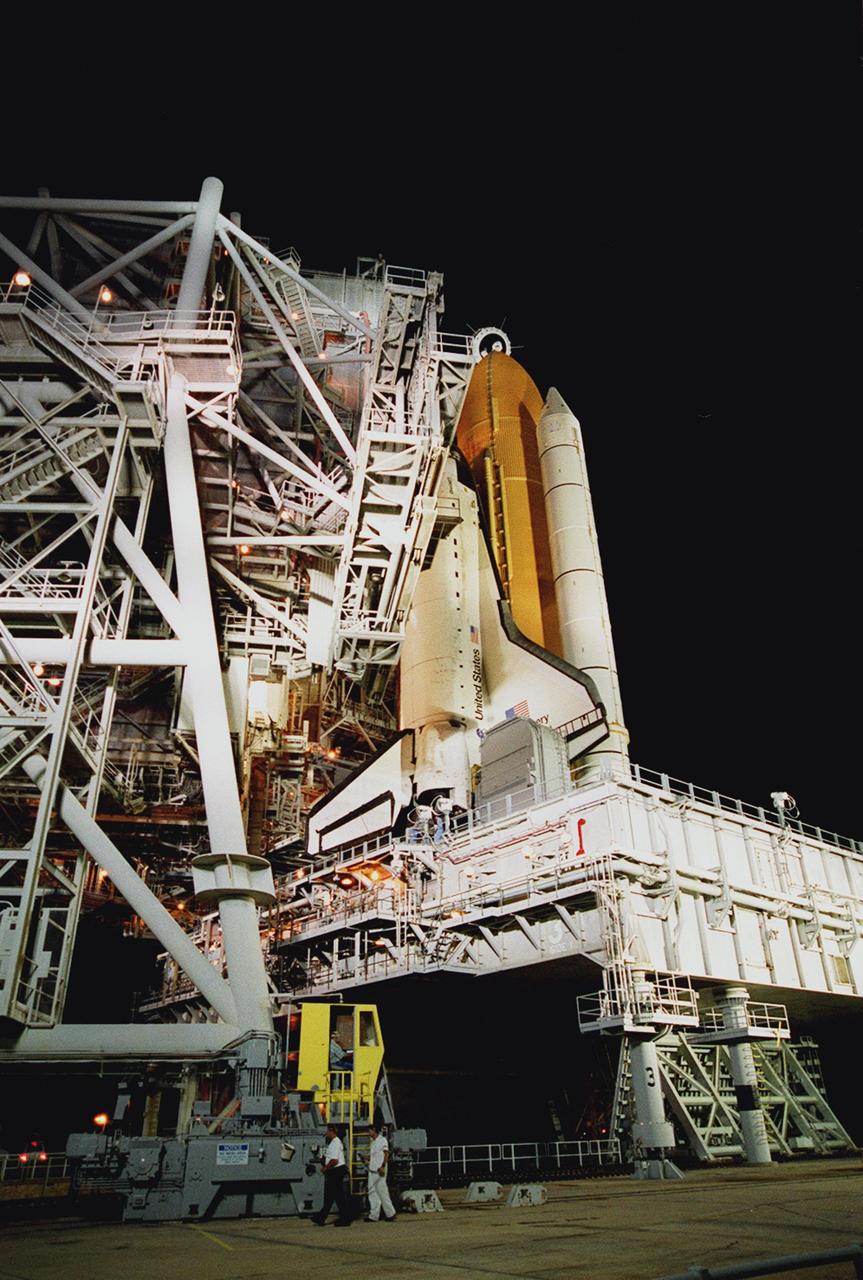
KENNEDY SPACE CENTER, Fla. -- The Rotating Service Structure at Launch Pad 39A rolls back, revealing the Space Shuttle Discovery on the Mobile Launcher Platform. Discovery is being readied for the STS-92 mission launch to the International Space Station (ISS). The mission payload includes Integrated Truss Structure Z-1, an early exterior framework to allow the first U.S. solar arrays on a future flight to be temporarily installed on Unity for early power; Ku-band communication to support early science capability and U.S. television; and the third Pressurized Mating Adapter to provide a Shuttle docking port for solar array installation on the sixth ISS flight and Lab installation on the seventh ISS flight. The 11-day mission will include four spacewalks. Liftoff is scheduled for Oct. 6 at 9:16 p.m. EDT
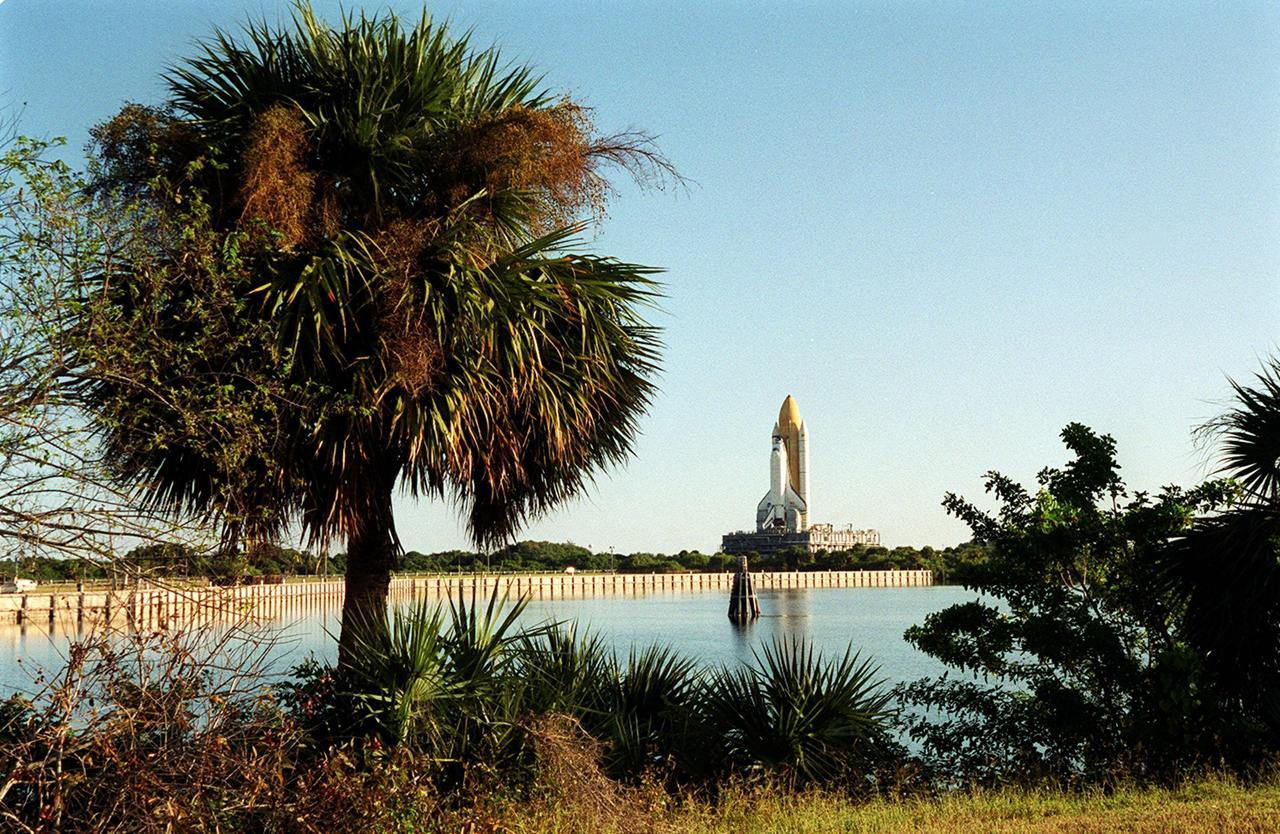
KENNEDY SPACE CENTER, Fla. -- Viewed from across the turn basin at KSC, Space Shuttle Endeavour inches its way to Launch Pad 39B via the crawlerway that leads from the Vehicle Assembly Building. The Shuttle is on the Mobile Launcher Platform (MLP) which is atop the crawler-transporter, moving on four double-tracked crawlers. The maximum speed of the loaded transporter is 1 mph. Endeavour is scheduled to be launched Nov. 30 at 10:01 p.m. EST on mission STS-97, the sixth construction flight to the International Space Station. Its payload includes the P6 Integrated Truss Structure and a photovoltaic (PV) module, with giant solar arrays that will provide power to the Station. The mission includes two spacewalks to complete the solar array connections
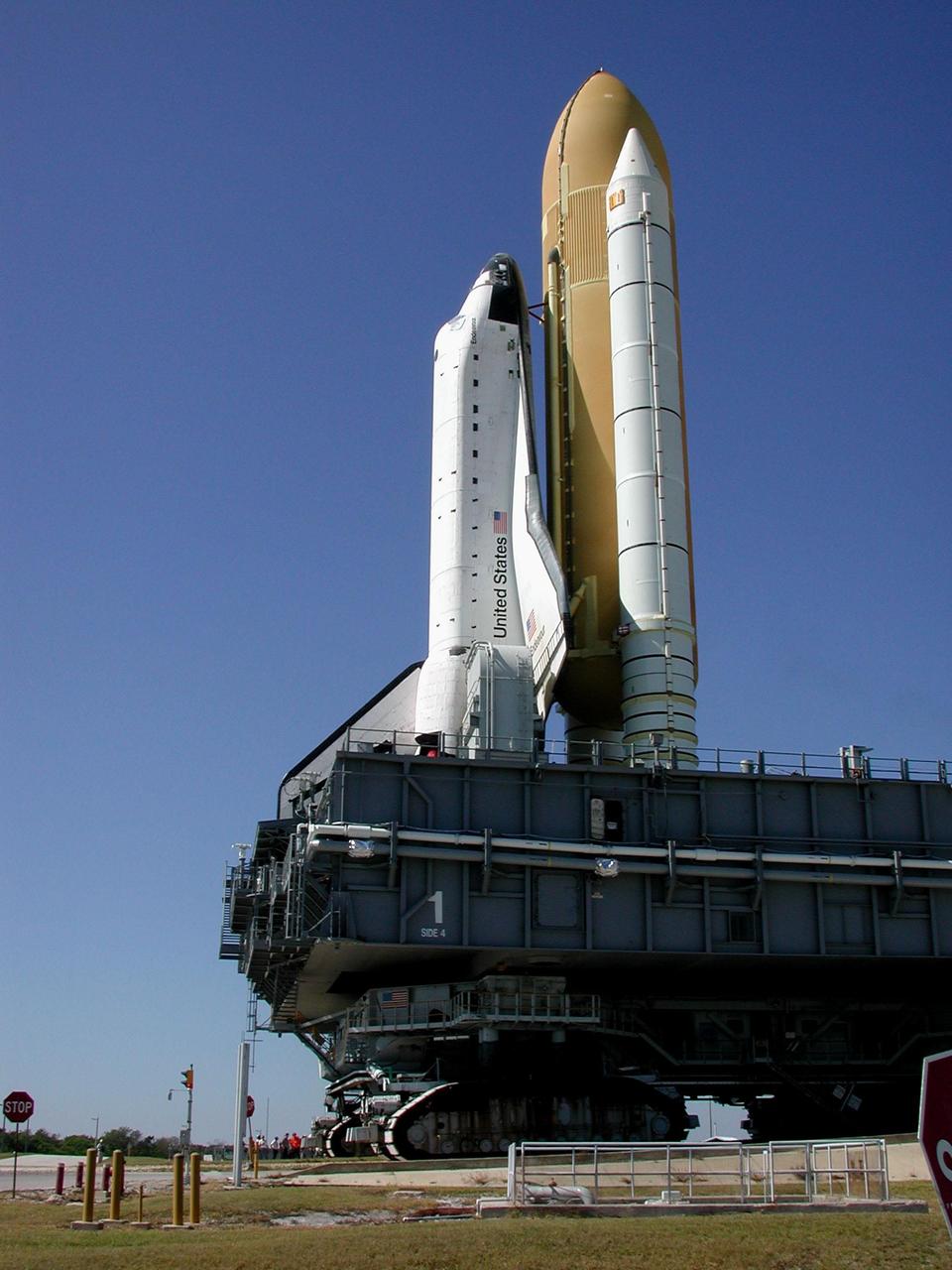
KENNEDY SPACE CENTER, FLA. -- Space Shuttle Endeavour and the Mobile Launcher Platform (MLP) start backing through the gate to Launch Pad 39B after a cracked cleat was discovered on the crawler-transporter. Workers near the pad (behind the crawler track) look at the cleats. The vehicle, which moves the MLP and Shuttle at about 1 mph, has a leveling system designed to keep the top of the Space Shuttle vertical while negotiating the 5 percent grade leading to the top of the pad. When the Shuttle-MLP are back on level ground, the crawler tracks will be inspected and the broken cleat repaired. Endeavour is scheduled to be launched Nov. 30 at 10:01 p.m. EST on mission STS-97, the sixth construction flight to the International Space Station. Its payload includes the P6 Integrated Truss Structure and a photovoltaic (PV) module, with giant solar arrays that will provide power to the Station. The mission includes two spacewalks to complete the solar array connections
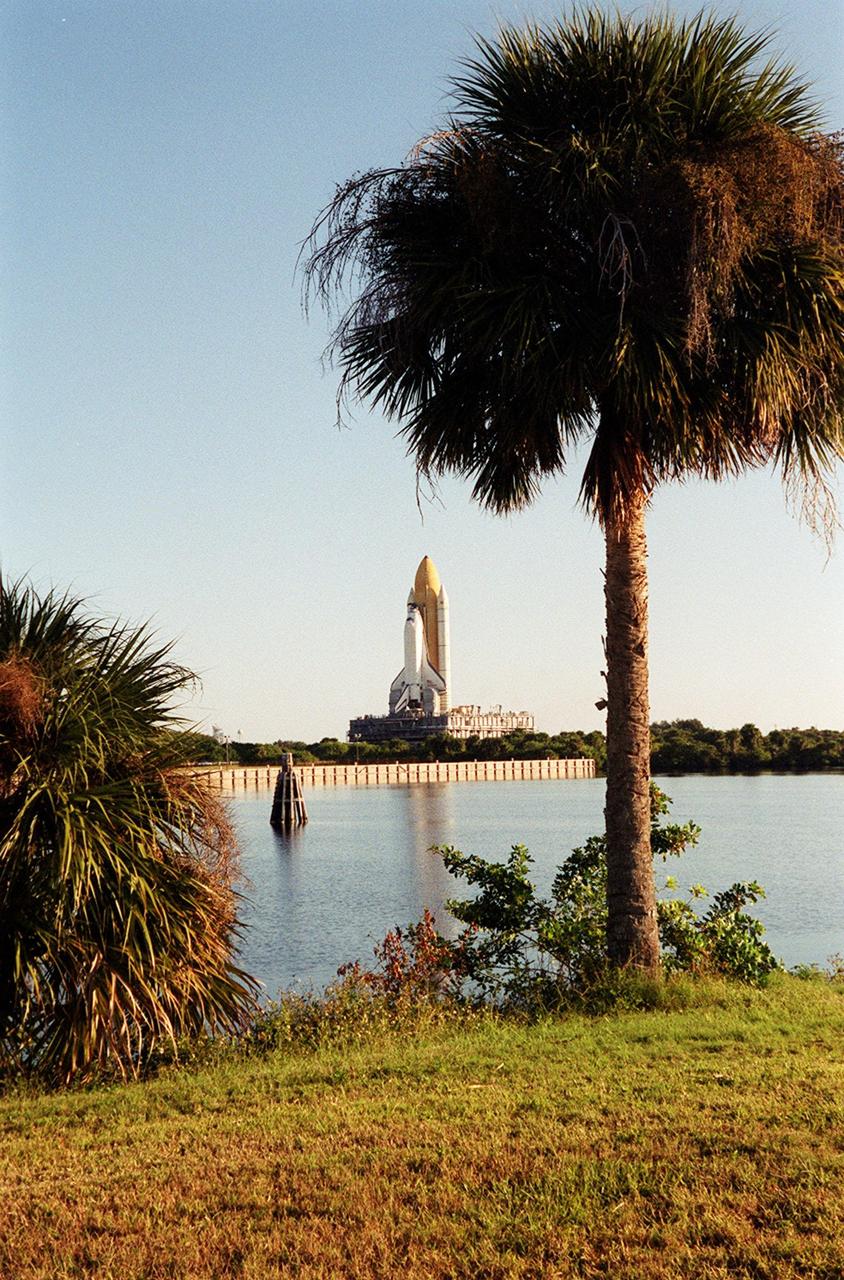
KENNEDY SPACE CENTER, Fla. -- Space Shuttle Endeavour appears to be framed by palms in this view across the turn basin at KSC. Endeavour is inching its way to Launch Pad 39B via the crawlerway that leads from the Vehicle Assembly Building. The Shuttle is on the Mobile Launcher Platform (MLP) which is atop the crawler-transporter, moving on four double-tracked crawlers. The maximum speed of the loaded transporter is 1 mph. Endeavour is scheduled to be launched Nov. 30 at 10:01 p.m. EST on mission STS-97, the sixth construction flight to the International Space Station. Its payload includes the P6 Integrated Truss Structure and a photovoltaic (PV) module, with giant solar arrays that will provide power to the Station. The mission includes two spacewalks to complete the solar array connections
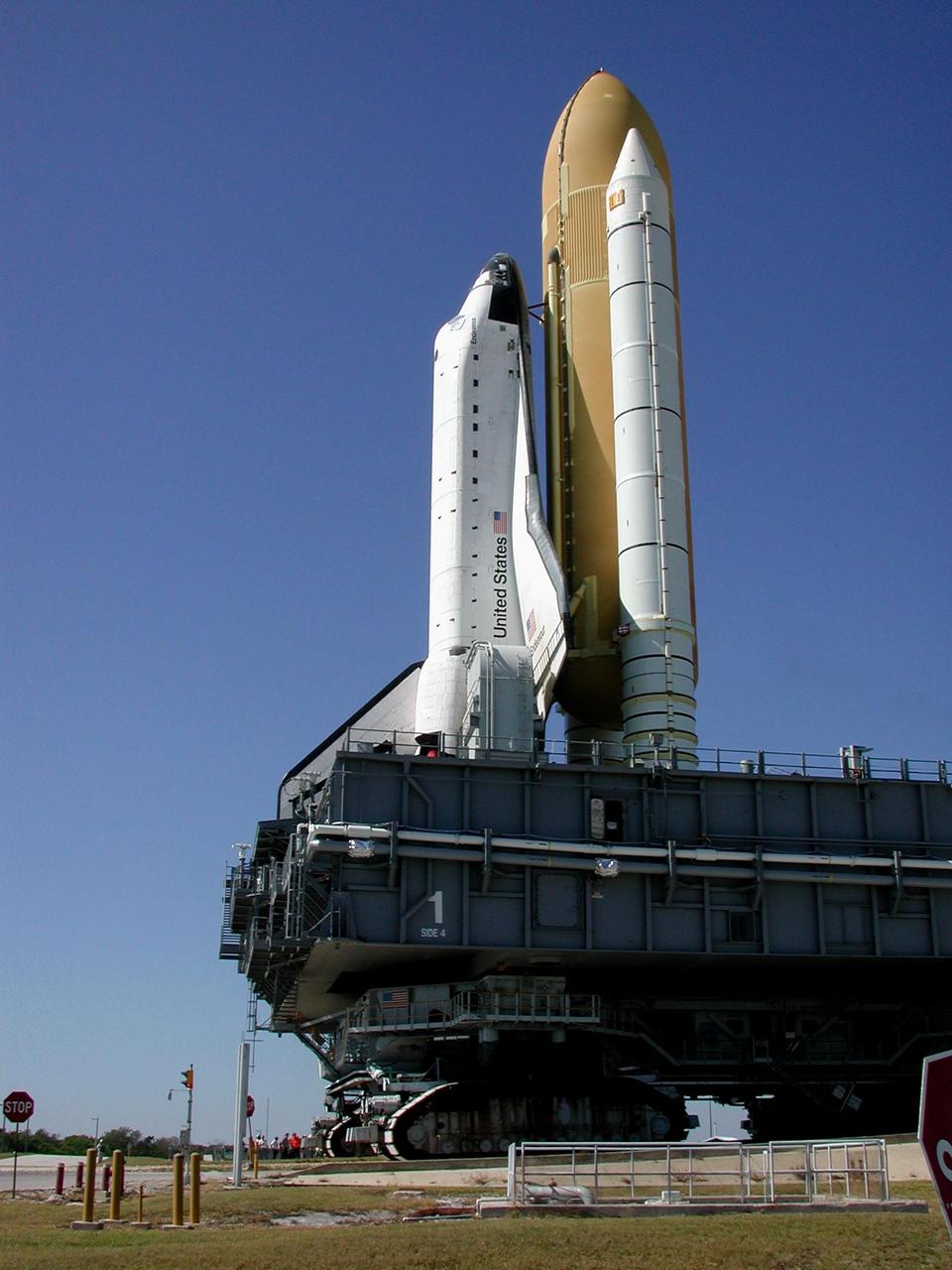
KENNEDY SPACE CENTER, FLA. -- Space Shuttle Endeavour and the Mobile Launcher Platform (MLP) start backing through the gate to Launch Pad 39B after a cracked cleat was discovered on the crawler-transporter. Workers near the pad (behind the crawler track) look at the cleats. The vehicle, which moves the MLP and Shuttle at about 1 mph, has a leveling system designed to keep the top of the Space Shuttle vertical while negotiating the 5 percent grade leading to the top of the pad. When the Shuttle-MLP are back on level ground, the crawler tracks will be inspected and the broken cleat repaired. Endeavour is scheduled to be launched Nov. 30 at 10:01 p.m. EST on mission STS-97, the sixth construction flight to the International Space Station. Its payload includes the P6 Integrated Truss Structure and a photovoltaic (PV) module, with giant solar arrays that will provide power to the Station. The mission includes two spacewalks to complete the solar array connections
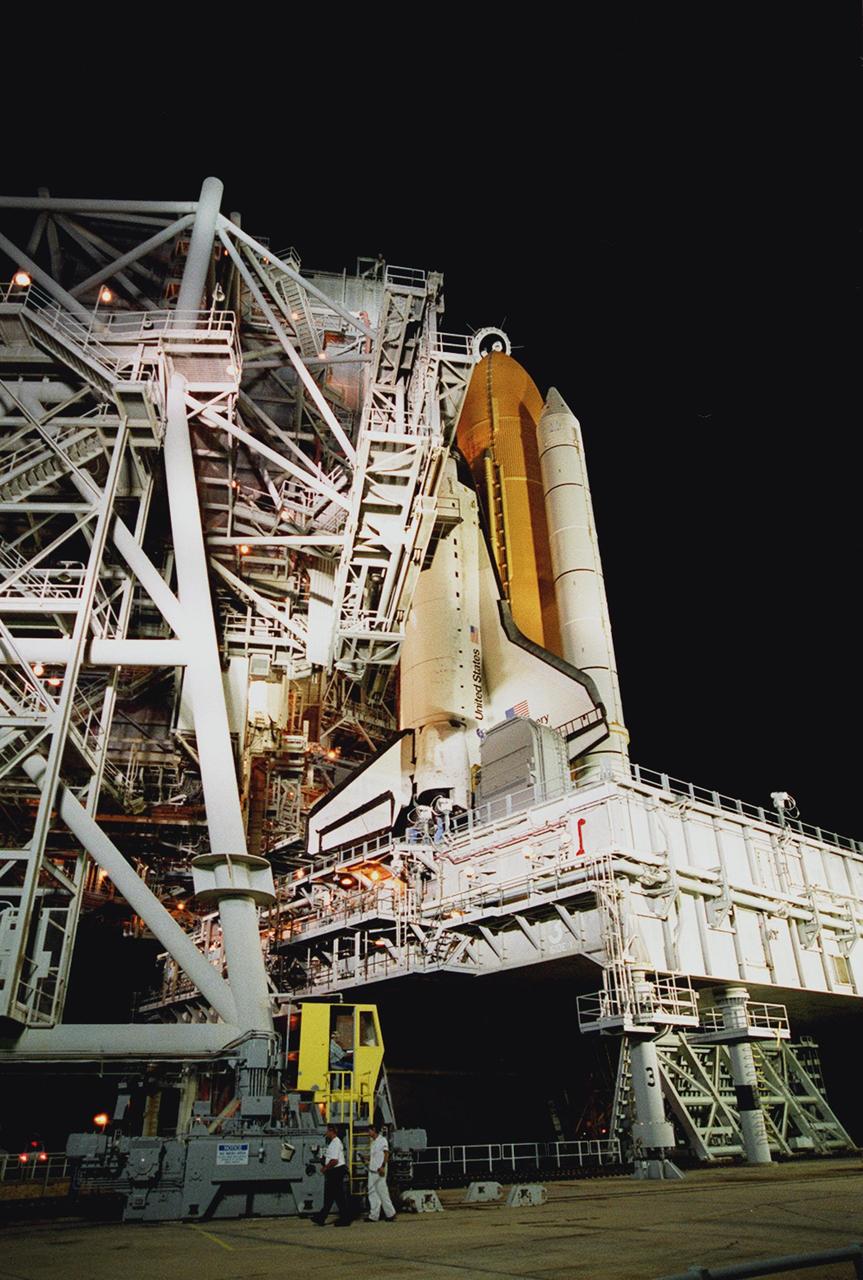
KENNEDY SPACE CENTER, Fla. -- The Rotating Service Structure at Launch Pad 39A rolls back, revealing the Space Shuttle Discovery on the Mobile Launcher Platform. Discovery is being readied for the STS-92 mission launch to the International Space Station (ISS). The mission payload includes Integrated Truss Structure Z-1, an early exterior framework to allow the first U.S. solar arrays on a future flight to be temporarily installed on Unity for early power; Ku-band communication to support early science capability and U.S. television; and the third Pressurized Mating Adapter to provide a Shuttle docking port for solar array installation on the sixth ISS flight and Lab installation on the seventh ISS flight. The 11-day mission will include four spacewalks. Liftoff is scheduled for Oct. 6 at 9:16 p.m. EDT
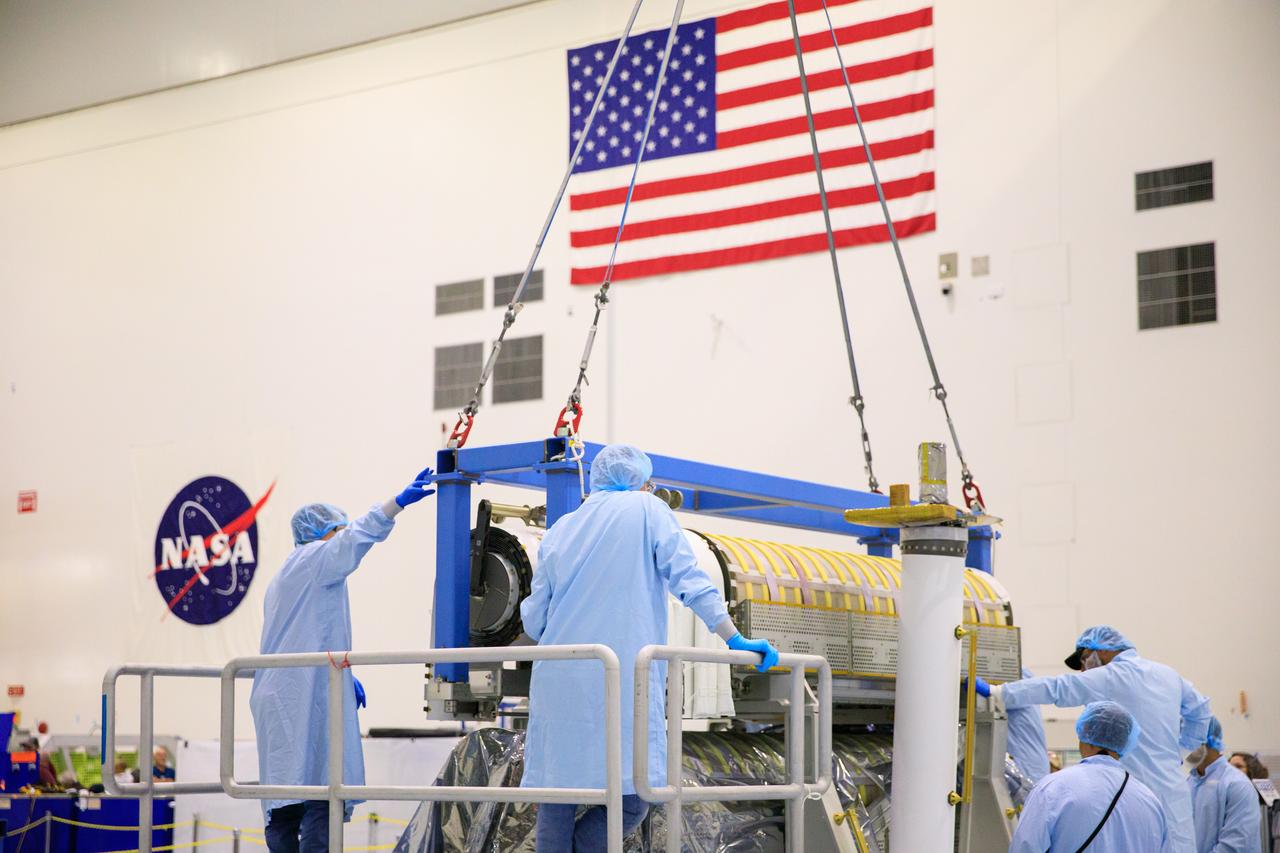
Inside the Space Station Processing Facility high bay at NASA's Kennedy Space Center in Florida, technicians assist as a crane is used to lower a set of International Space Station Roll Out Solar Arrays (iROSA) onto a platform on March 23, 2023. They are being prepared for delivery to the space station aboard SpaceX’s Dragon cargo carrier on the company’s 28th commercial resupply services (CRS-28) mission to the space station. iROSA is a new type of solar panel that rolls open in space and is more compact than current rigid panel designs.
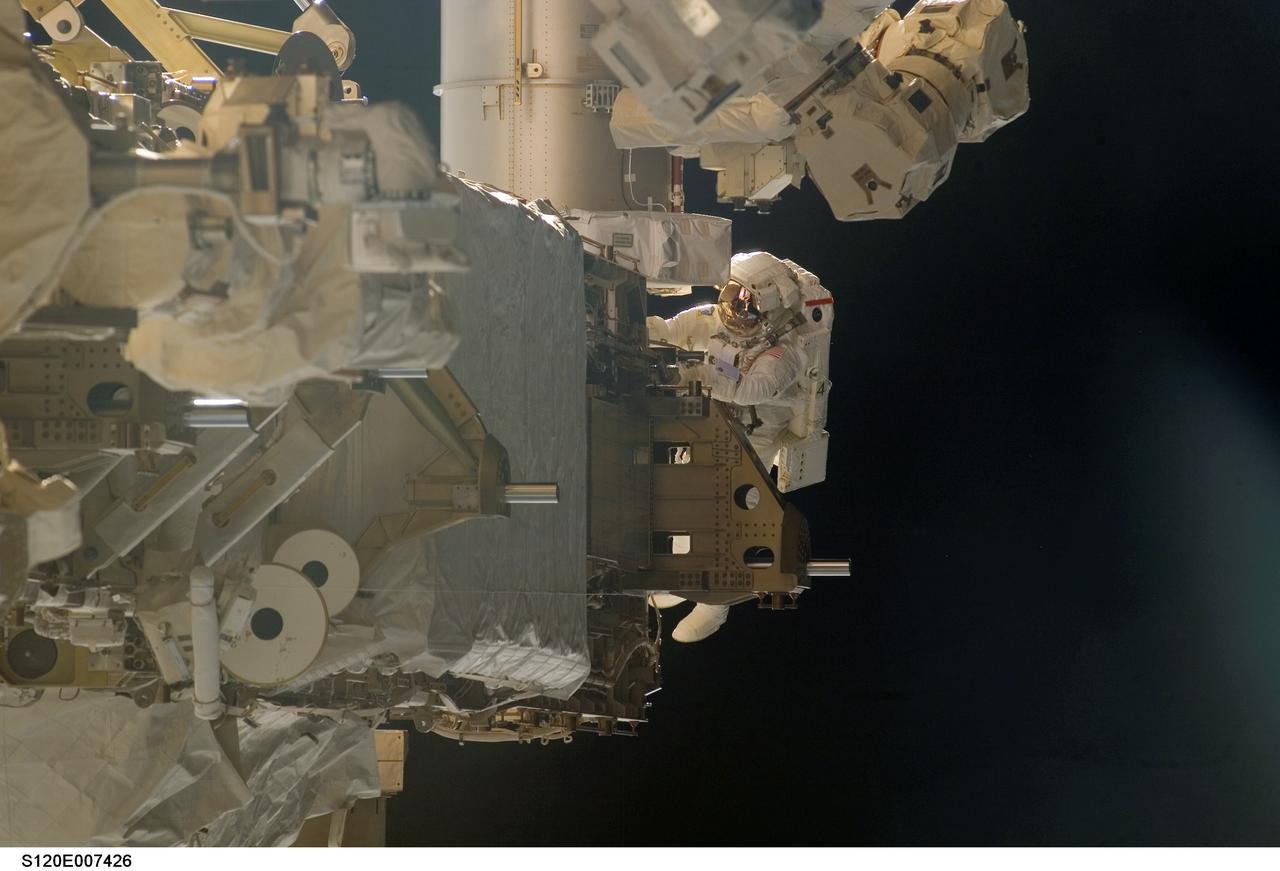
S120-E-007426 (30 Oct. 2007) --- Astronaut Scott Parazynski, STS-120 mission specialist, participates in the third scheduled session of extravehicular activity (EVA) as construction continues on the International Space Station. During the 7-hour, 8-minute spacewalk Parazynski and astronaut Doug Wheelock (out of frame), mission specialist, installed the P6 truss segment with its set of solar arrays to its permanent home, installed a spare main bus switching unit on a stowage platform, and performed a few get-ahead tasks. Also, Parazynski inspected the port Solar Alpha Rotary Joint (SARJ) to gather comparison data for the starboard rotary joint.
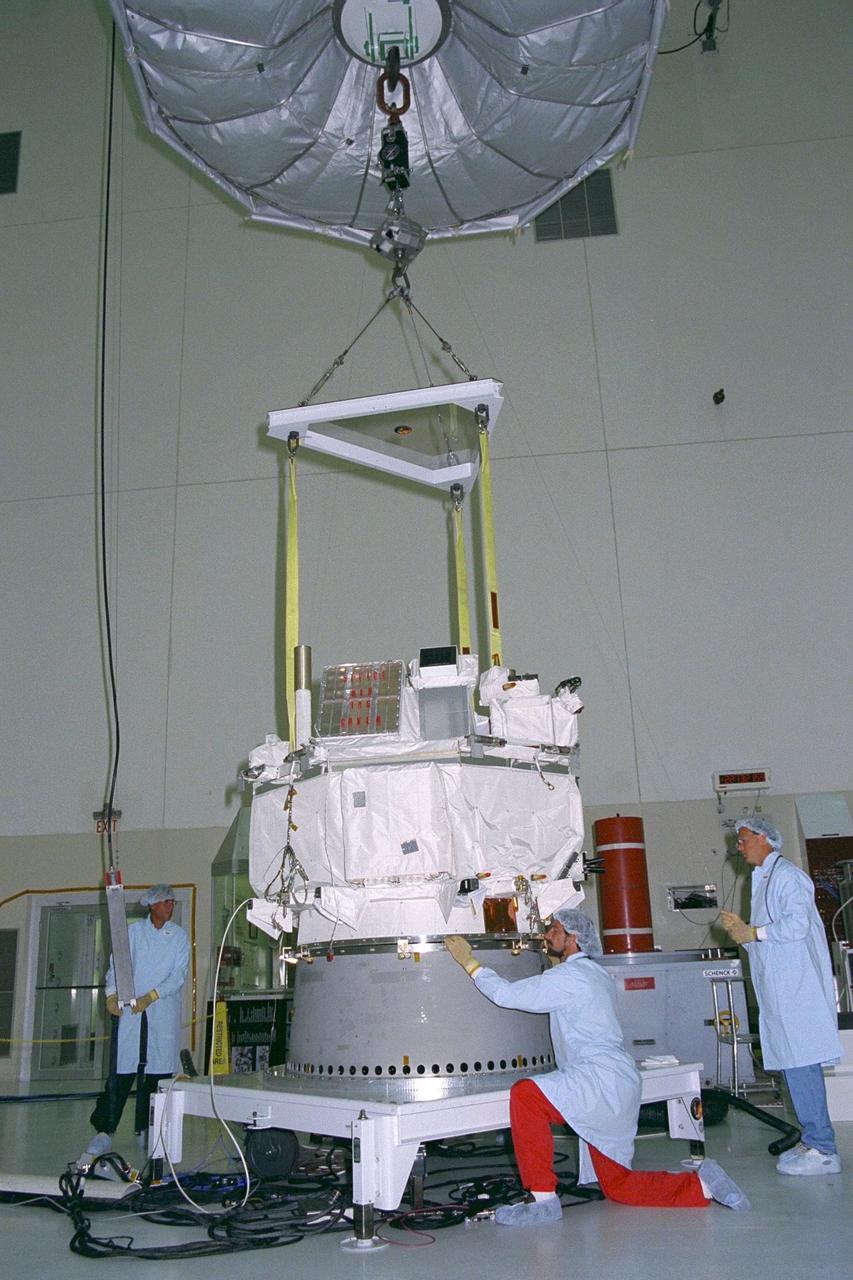
Applied Physics Laboratory engineers and technicians from Johns Hopkins University assist in leveling and orienting the Advanced Composition Explorer (ACE) as it is seated on a platform for solar array installation in KSC’s Spacecraft Assembly and Encapsulation Facility-II. Scheduled for launch on a Delta II rocket from Cape Canaveral Air Station on Aug. 25, ACE will study low-energy particles of solar origin and high-energy galactic particles. The ACE observatory has six high-resolution particle detection sensors and three monitoring instruments. The collecting power of instrumentation aboard ACE is at least 100 times more sensitive than anything previously flown to collect similar data by NASA
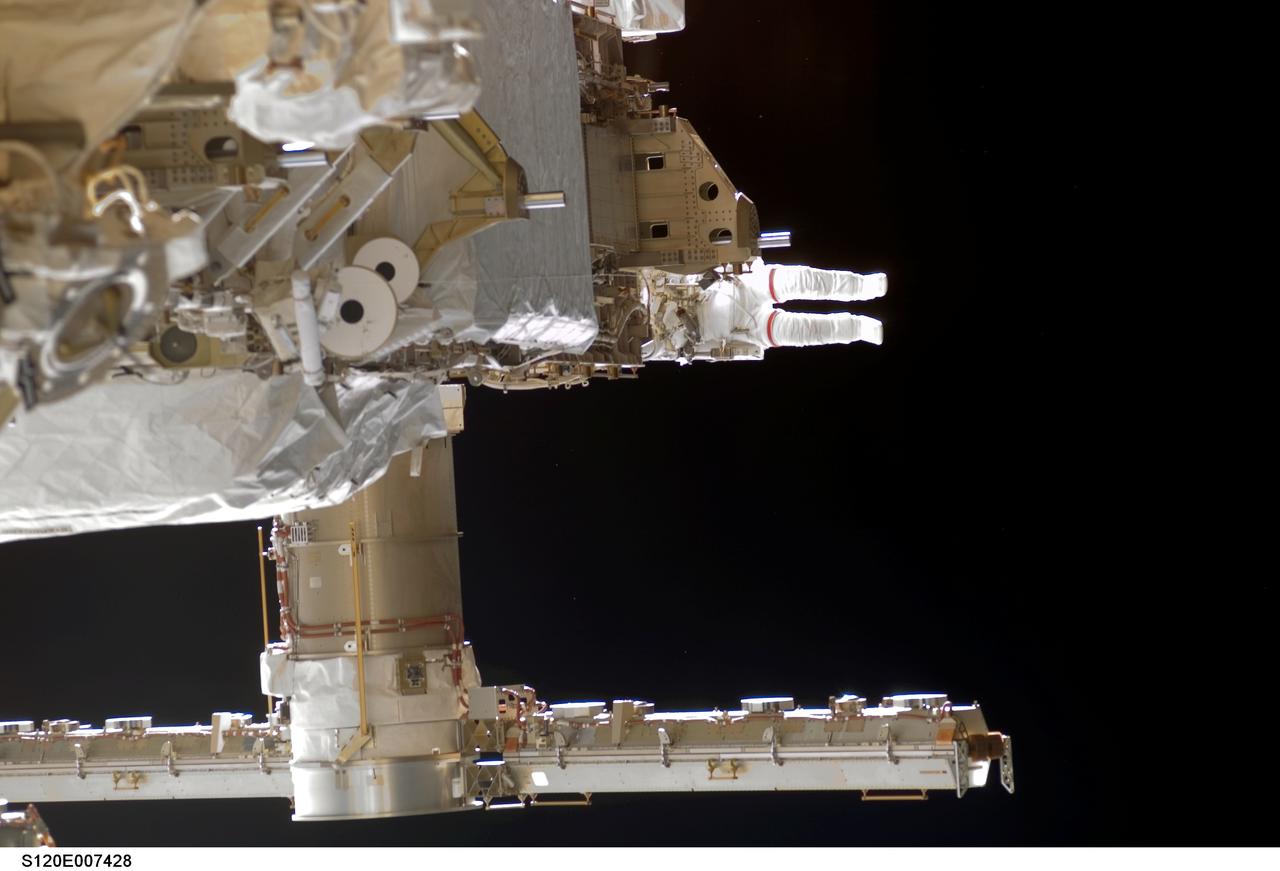
S120-E-007428 (30 Oct. 2007) --- Astronaut Scott Parazynski, STS-120 mission specialist, participates in the third scheduled session of extravehicular activity (EVA) as construction continues on the International Space Station. During the 7-hour, 8-minute spacewalk Parazynski and astronaut Doug Wheelock (out of frame), mission specialist, installed the P6 truss segment with its set of solar arrays to its permanent home, installed a spare main bus switching unit on a stowage platform, and performed a few get-ahead tasks. Also, Parazynski inspected the port Solar Alpha Rotary Joint (SARJ) to gather comparison data for the starboard rotary joint.
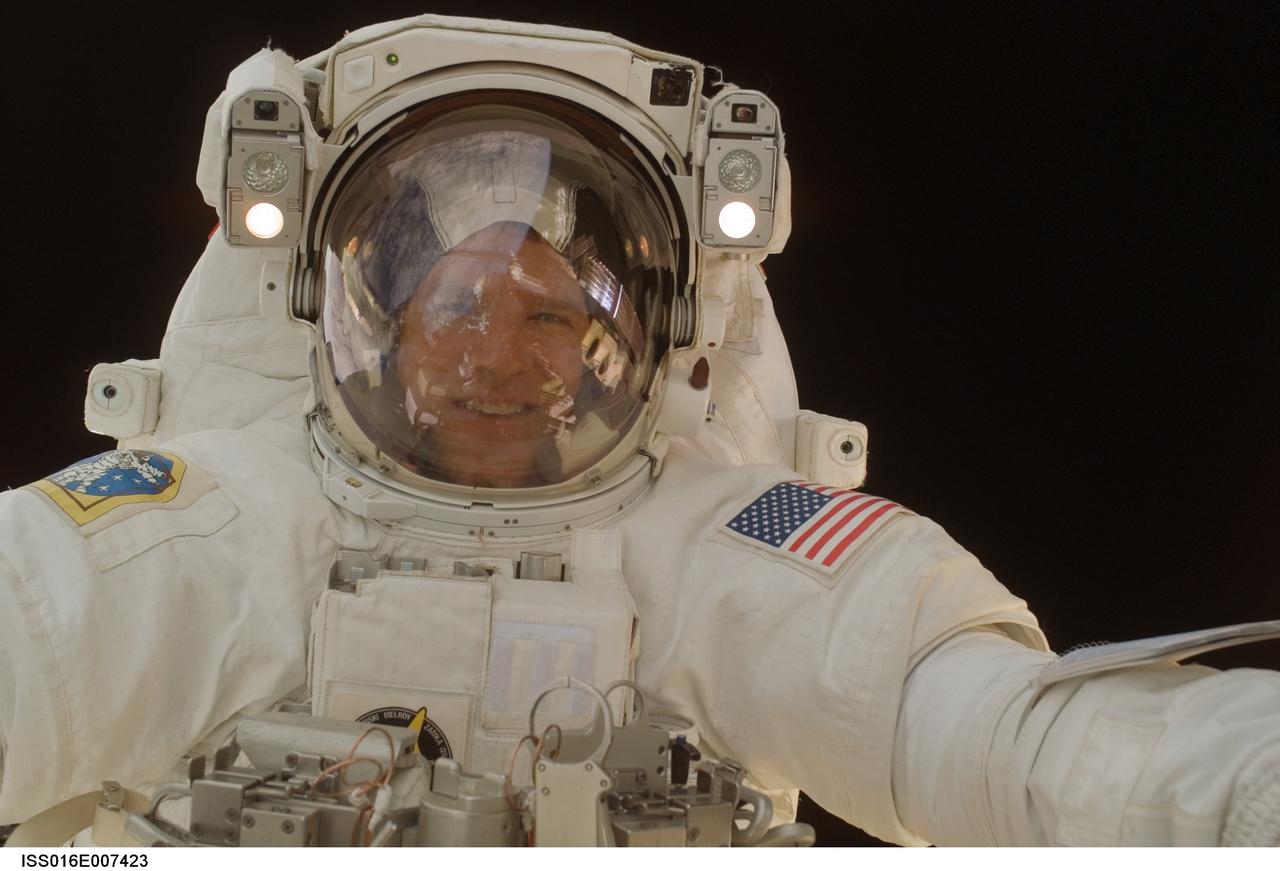
ISS016-E-007423 (30 Oct. 2007) --- Astronaut Scott Parazynski, STS-120 mission specialist, participates in the third scheduled session of extravehicular activity (EVA) as construction continues on the International Space Station. During the 7-hour, 8-minute spacewalk Parazynski and astronaut Doug Wheelock (out of frame), mission specialist, installed the P6 truss segment with its set of solar arrays to its permanent home, installed a spare main bus switching unit on a stowage platform, and performed a few get-ahead tasks. Also, Parazynski inspected the port Solar Alpha Rotary Joint (SARJ) to gather comparison data for the starboard rotary joint.
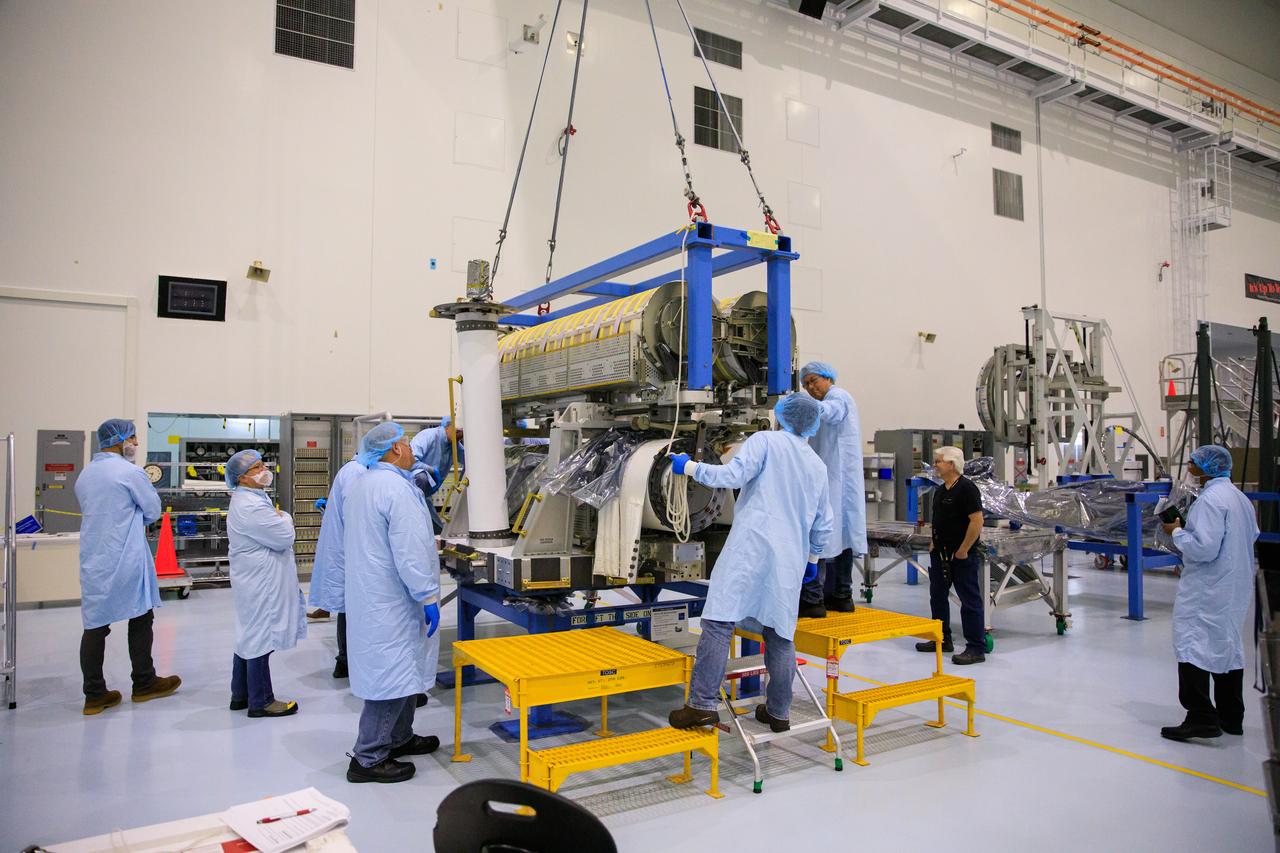
Inside the Space Station Processing Facility high bay at NASA's Kennedy Space Center in Florida, technicians assist as a crane is used to lower a set of International Space Station Roll Out Solar Arrays (iROSA) onto a platform on March 23, 2023. They are being prepared for delivery to the space station aboard SpaceX’s Dragon cargo carrier on the company’s 28th commercial resupply services (CRS-28) mission to the space station. iROSA is a new type of solar panel that rolls open in space and is more compact than current rigid panel designs.
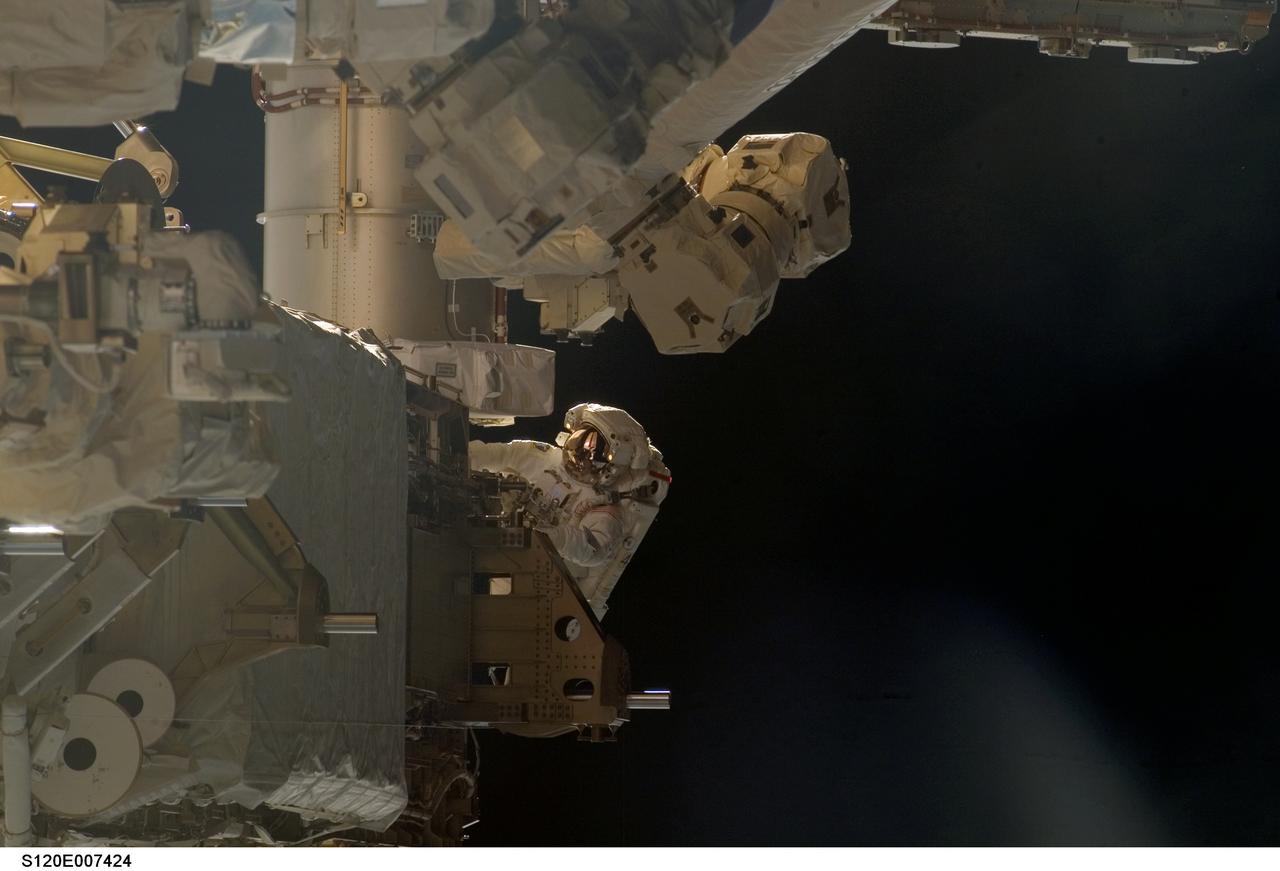
S120-E-007424 (30 Oct. 2007) --- Astronaut Scott Parazynski, STS-120 mission specialist, participates in the third scheduled session of extravehicular activity (EVA) as construction continues on the International Space Station. During the 7-hour, 8-minute spacewalk Parazynski and astronaut Doug Wheelock (out of frame), mission specialist, installed the P6 truss segment with its set of solar arrays to its permanent home, installed a spare main bus switching unit on a stowage platform, and performed a few get-ahead tasks. Also, Parazynski inspected the port Solar Alpha Rotary Joint (SARJ) to gather comparison data for the starboard rotary joint.

Inside the Space Station Processing Facility high bay at NASA's Kennedy Space Center in Florida, technicians assist as a crane is used to lift and stack the third set of two International Space Station Roll Out Solar Arrays (iROSA) onto a platform on March 23, 2023. They are being prepared for delivery to the space station aboard SpaceX’s Dragon cargo carrier on the company’s 28th commercial resupply services (CRS-28) mission to the space station. iROSA is a new type of solar panel that rolls open in space and is more compact than current rigid panel designs.
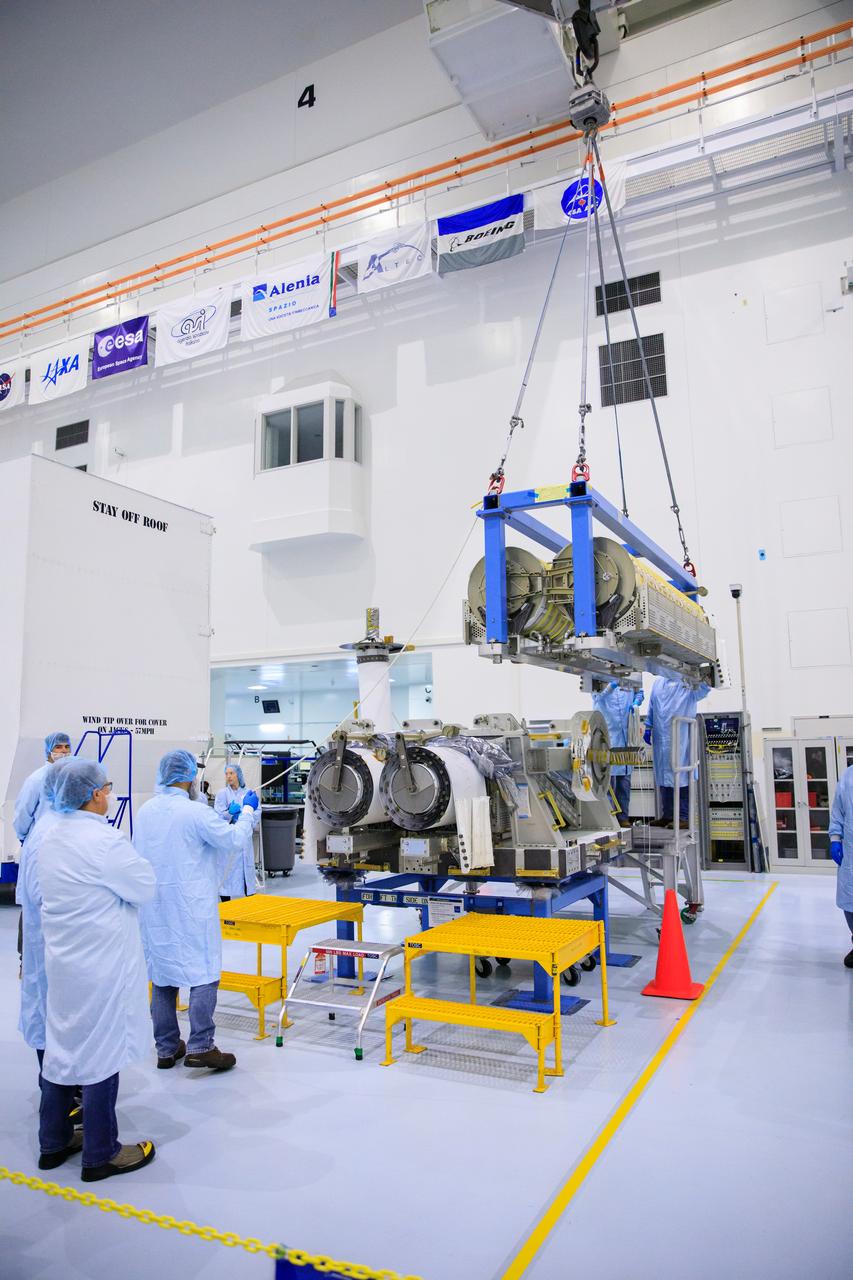
Inside the Space Station Processing Facility high bay at NASA's Kennedy Space Center in Florida, technicians monitor the progress as a crane is used to lift and stack the third set of two International Space Station Roll Out Solar Arrays (iROSA) onto a platform on March 23, 2023. They are being prepared for delivery to the space station aboard SpaceX’s Dragon cargo carrier on the company’s 28th commercial resupply services (CRS-28) mission to the space station. iROSA is a new type of solar panel that rolls open in space and is more compact than current rigid panel designs.
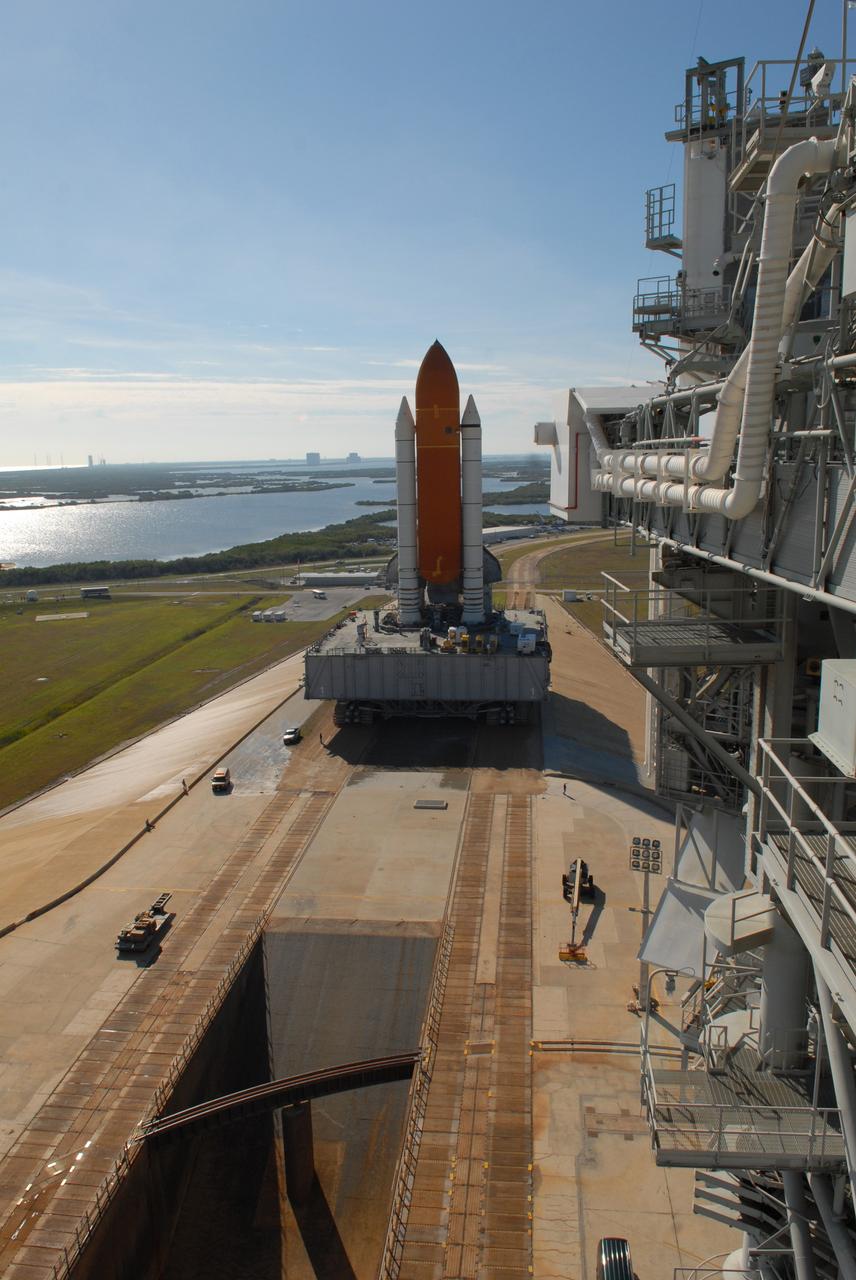
CAPE CANAVERAL, Fla. -- Space shuttle Discovery, atop the mobile launcher platform and crawler-transporter, reaches the top of Launch Pad 39A at NASA's Kennedy Space Center in Florida. in the foreground is the flame trench, which the launcher platform will straddle for launch. At right is the rotating service structure. Behind the shuttle, the grounds of the space center spread out toward the horizon. Discovery's first motion out of the Vehicle Assembly Building was at 5:17 a.m. EST. Discovery was secured to the pad at 12:16 p.m. Discovery is targeted to launch to the International Space Station Feb. 12. During Discovery's 14-day mission, the crew will install the S6 truss segment and its solar arrays to the starboard side of the station, completing the station's backbone, or truss, enabling a six-person crew to live there starting in May. Photo credit: NASA/Troy Cryder
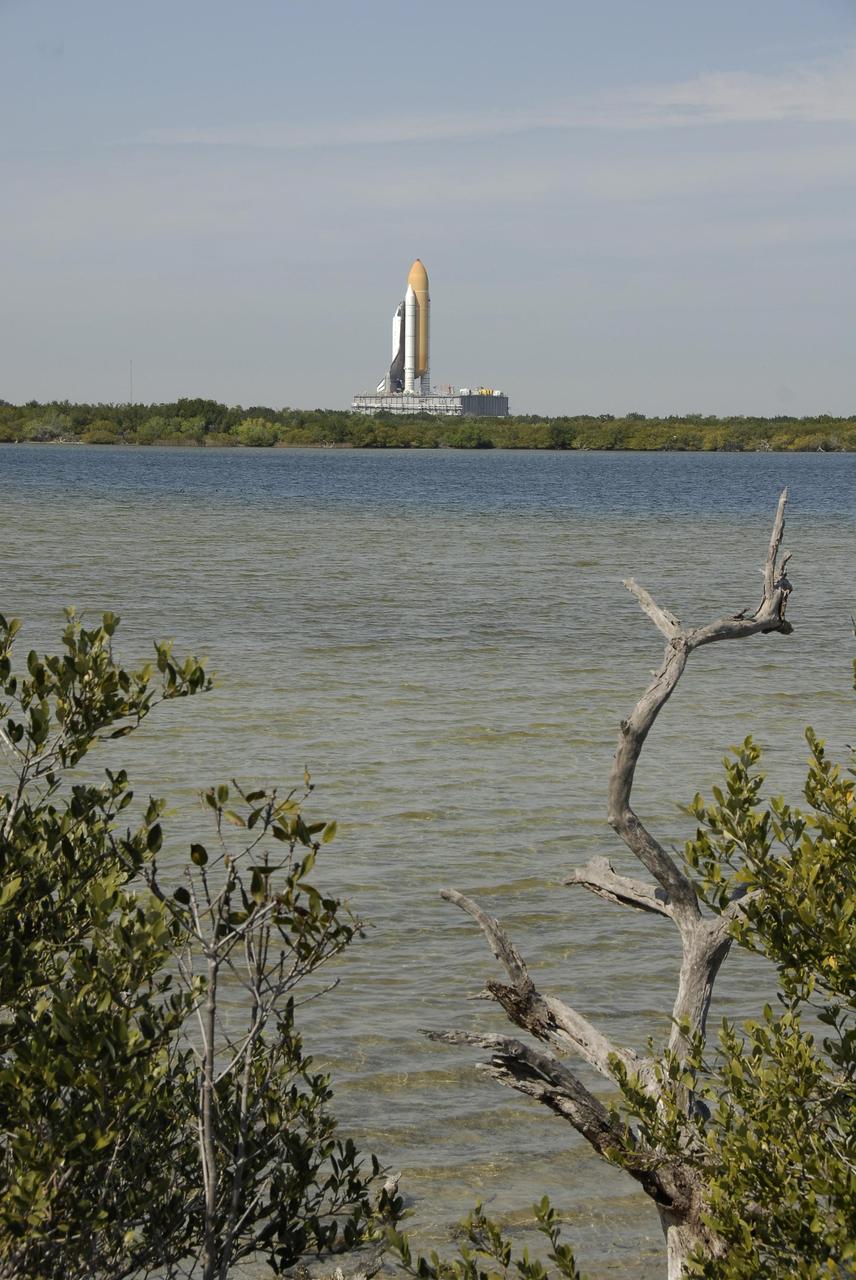
KENNEDY SPACE CENTER, FLA. -- In the clear morning light, Space Shuttle Atlantis, atop the mobile launcher platform and crawler-transporter, slowly makes its way to Launch Pad 39A. First motion out of the Vehicle Assembly Building was at 8:19 a.m. The 3.4-mile trip to the pad along the crawlerway will take about 6 hours. The mission payload aboard Space Shuttle Atlantis is the S3/S4 integrated truss structure, along with a third set of solar arrays and batteries. The crew of six astronauts will install the truss to continue assembly of the International Space Station. Launch is targeted for March 15. Photo credit: NASA/Kim Shiflett
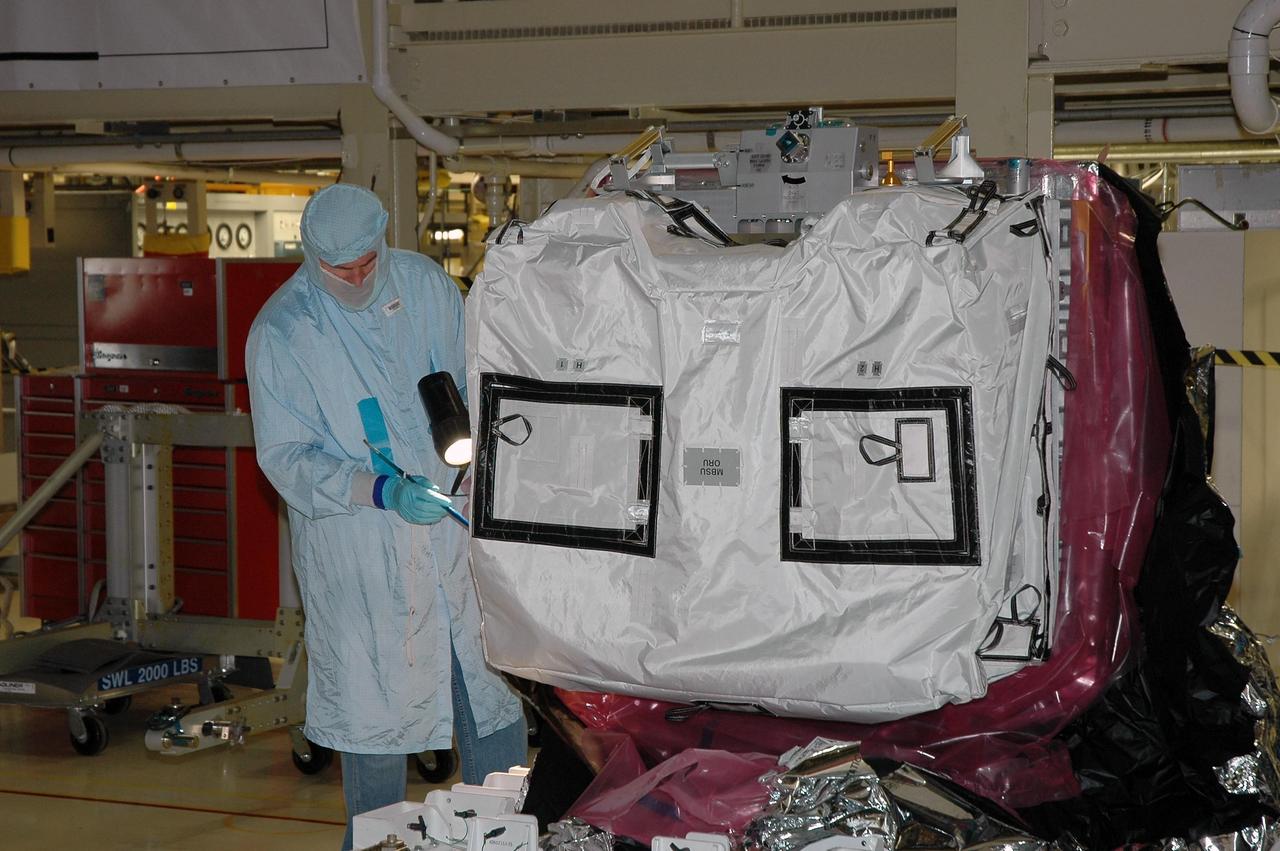
KENNEDY SPACE CENTER, Fla. -- In the Orbiter Processing Facility bay 3, a worker checks the cover on a main bus switching unit, part of the payload on mission STS-120. A main bus switching unit is used for power distribution, circuit protection and fault isolation on the space station's power system. The units route power to proper locations in the space station, such as from solar arrays through umbilicals into the U.S. Lab. The unit will be installed on the external stowage platform 2 attached to the Quest airlock for temporary storage. Discovery is targeted to launch mission STS-120 no earlier than Oct. 20. Photo credit: NASA/Jim Grossmann
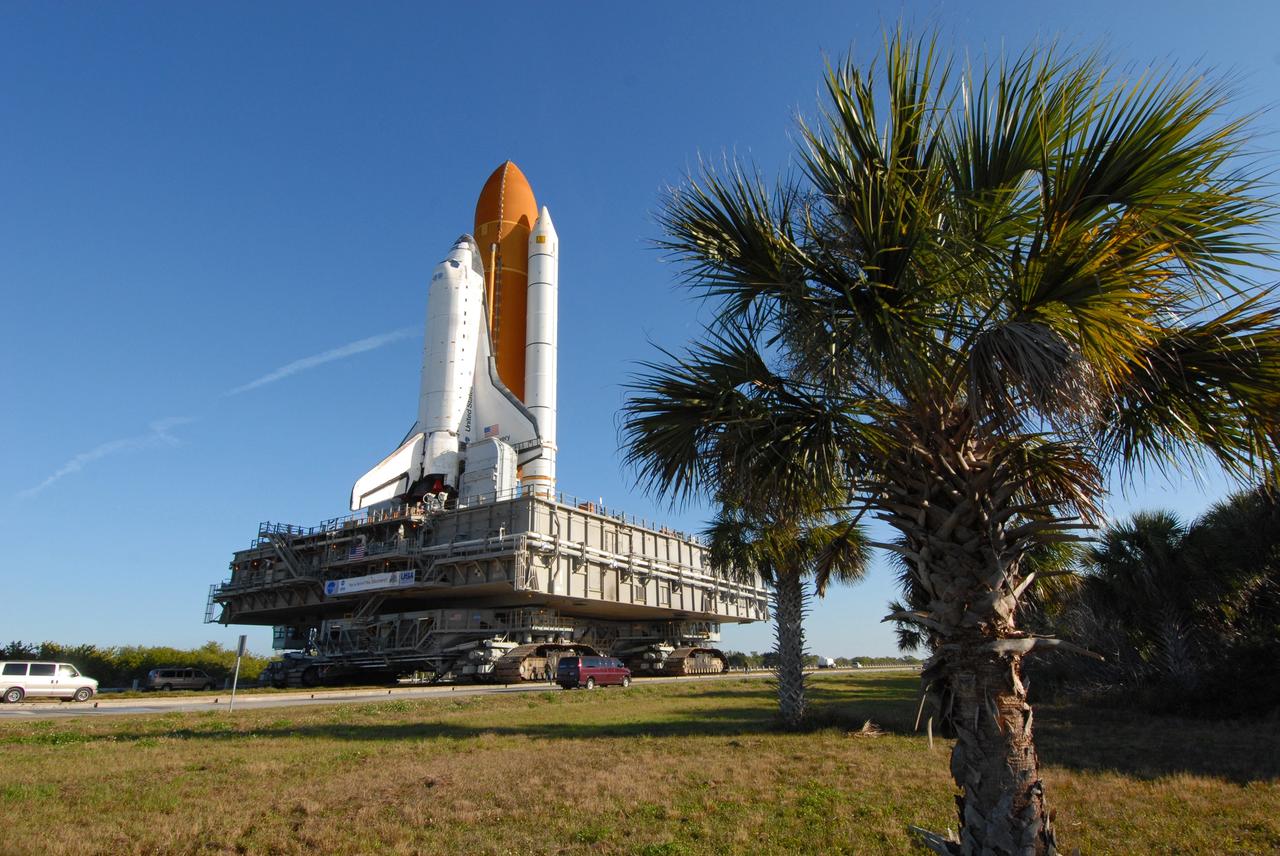
CAPE CANAVERAL, Fla. -- Space shuttle Discovery, atop the mobile launcher platform, makes the slow 3.4-mile journey via the massive crawler-transporter to Launch Pad 39A at NASA's Kennedy Space Center in Florida. First motion out of the Vehicle Assembly Building was at 5:17 a.m. EST. Discovery was secured to the pad at 12:16 p.m. Discovery is targeted to launch to the International Space Station Feb. 12. During Discovery's 14-day mission, the crew will install the S6 truss segment and its solar arrays to the starboard side of the station, completing the station's backbone, or truss, enabling a six-person crew to live there starting in May. Photo credit: NASA/Troy Cryder
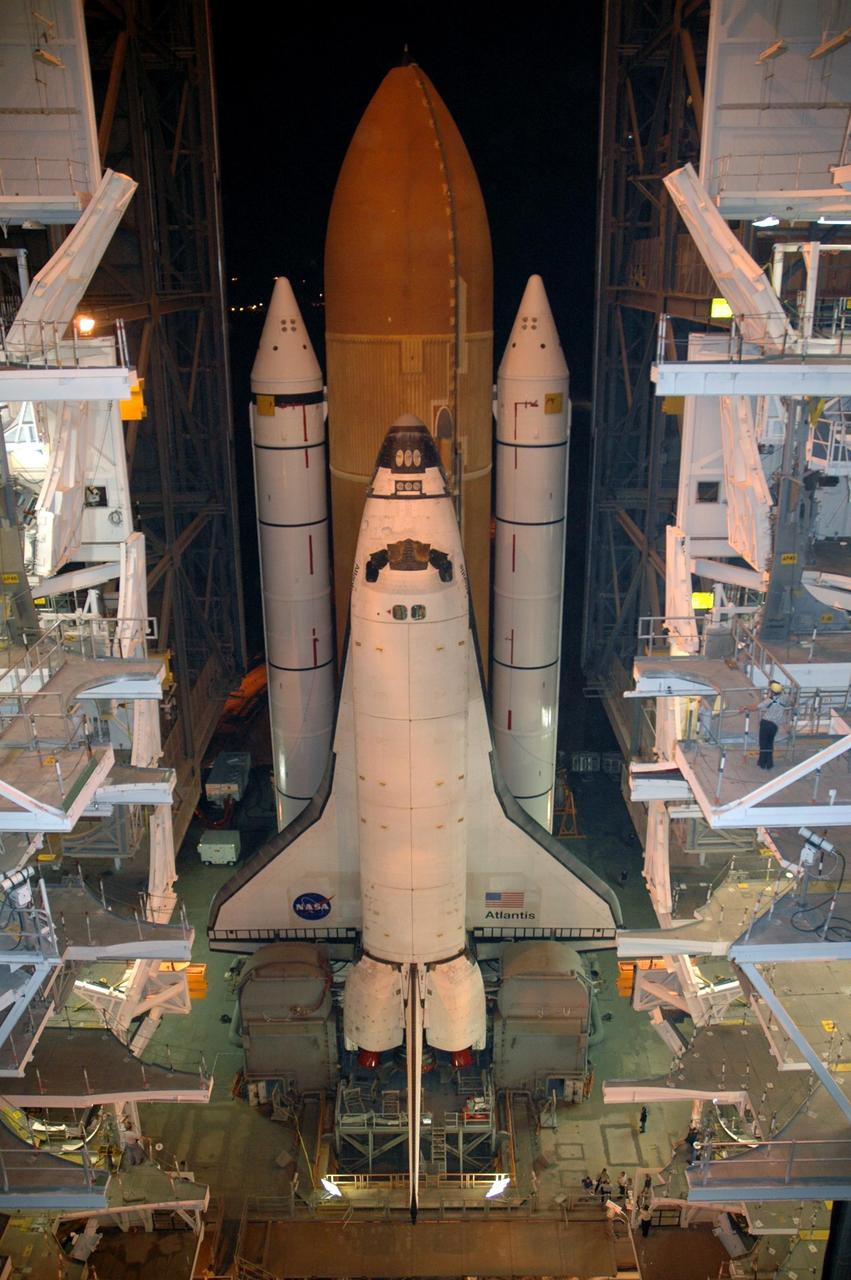
KENNEDY SPACE CENTER, FLA. - Sitting on top of the mobile launcher platform, Space Shuttle Atlantis begins rolling out of the Vehicle Assembly Building to Launch Pad 39B via the crawler-transporter underneath. First motion was at 1:05 a.m. The slow speed of the crawler results in a 6-hour trek to the pad approximately 4 miles away. Atlantis' launch window begins Aug. 27 for an 11-day mission to the International Space Station. The STS-115 crew of six astronauts will continue construction of the station and install their cargo, the Port 3/4 truss segment with its two large solar arrays. Photo credit: NASA/Troy Cryder
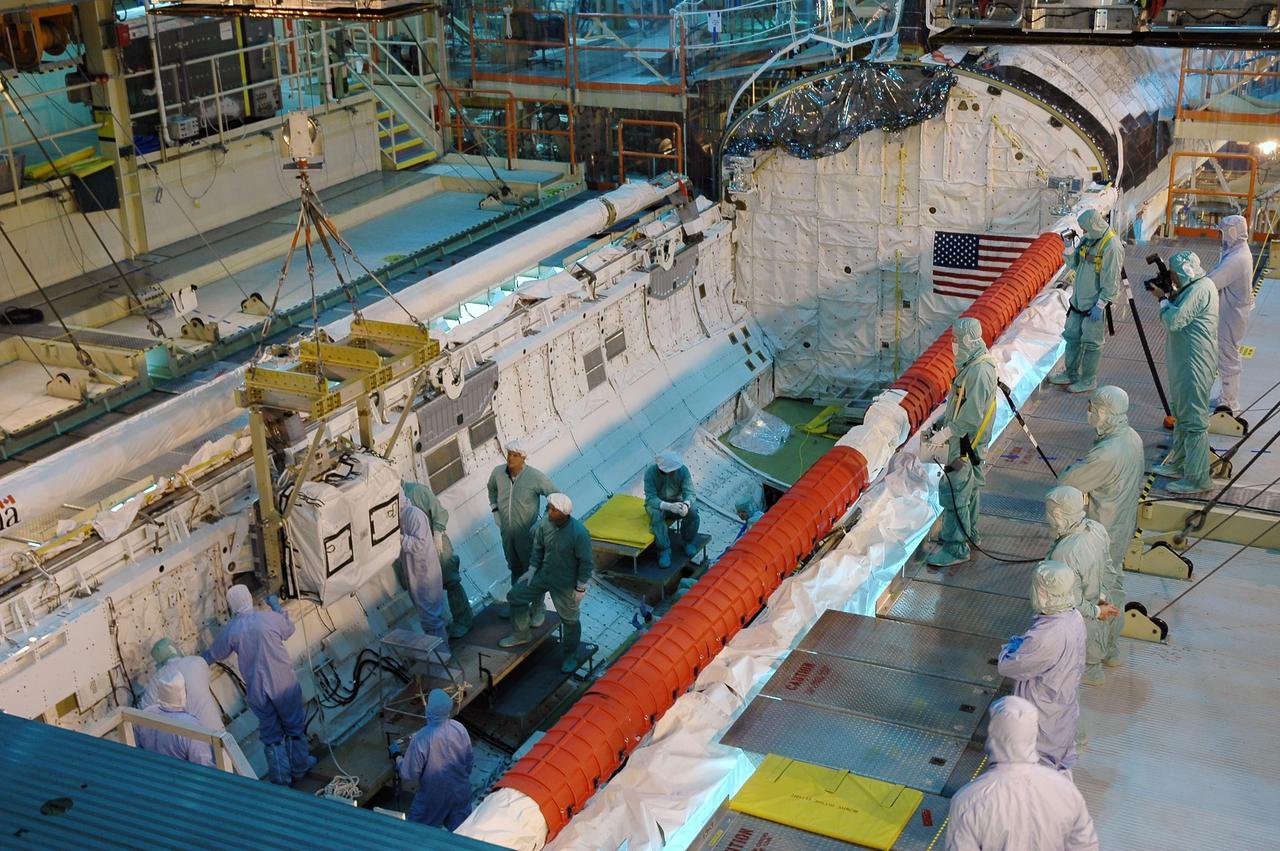
KENNEDY SPACE CENTER, Fla. -- In the Orbiter Processing Facility bay 3, with the help of a crane, workers check the placement of a main bus switching unit in Discovery's payload bay. A main bus switching unit is used for power distribution, circuit protection and fault isolation on the space station's power system. The units route power to proper locations in the space station, such as from solar arrays through umbilicals into the U.S. Lab. The unit will be installed on the external stowage platform 2 attached to the Quest airlock for temporary storage. Discovery is targeted to launch mission STS-120 no earlier than Oct. 20. Photo credit: NASA/Jim Grossmann
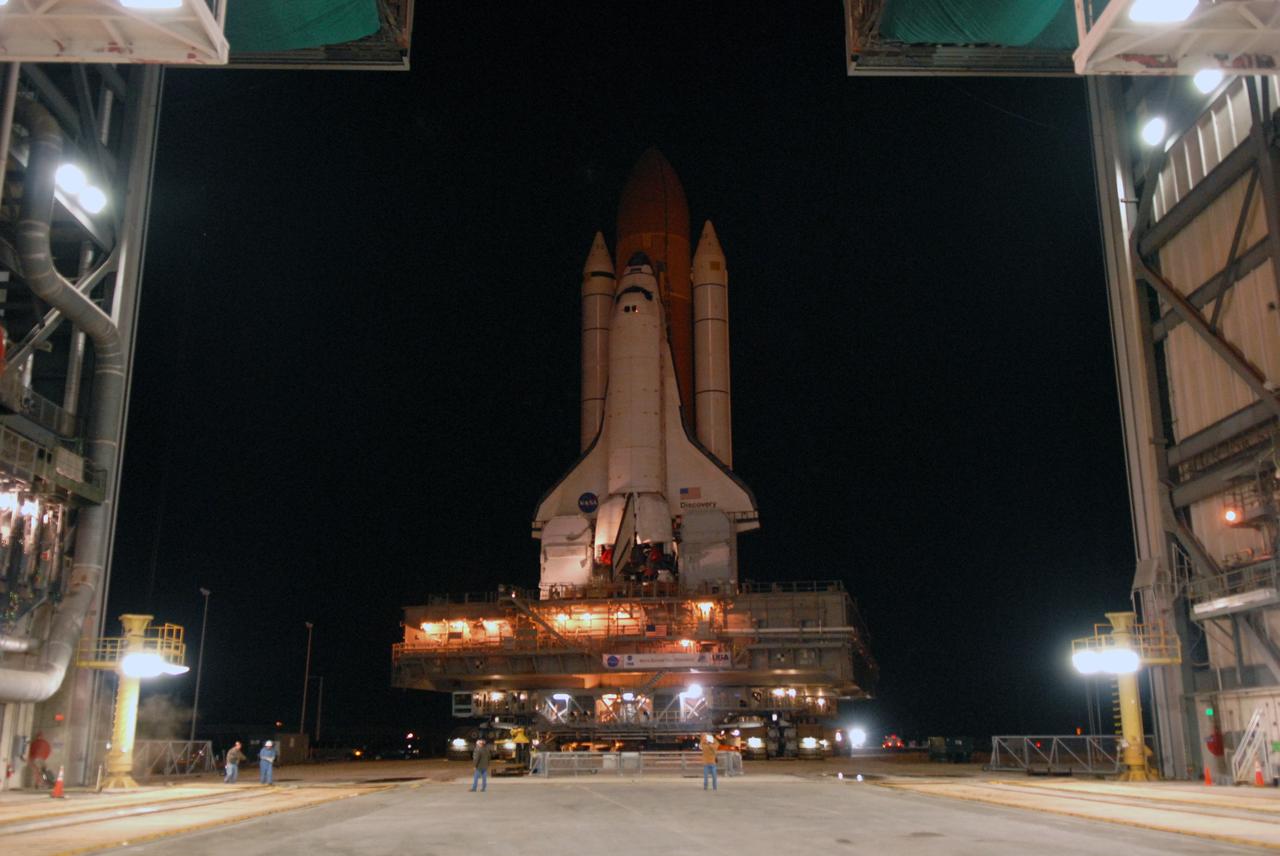
CAPE CANAVERAL, Fla. -- Transported by the massive crawler-transporter underneath, space shuttle Discovery atop the mobile launcher platform head for Launch Pad 39A at NASA's Kennedy Space Center in Florida. First motion was at 5:17 a.m. EST. Discovery is targeted to launch to the International Space Station Feb. 12. During Discovery's 14-day mission, the crew will install the S6 truss segment and its solar arrays to the starboard side of the station, completing the station's backbone, or truss, enabling a six-person crew to live there starting in May. Photo credit: NASA/Troy Cryder
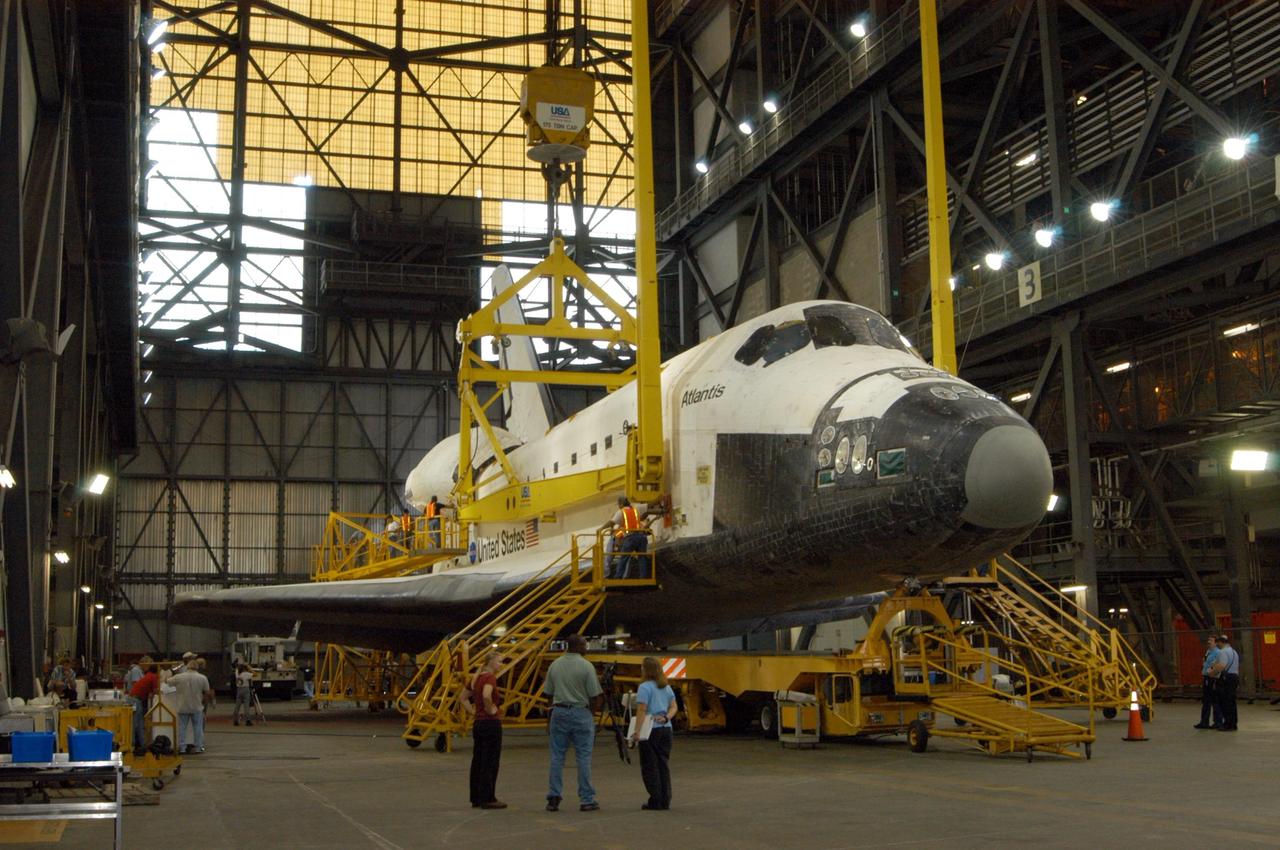
KENNEDY SPACE CENTER, FLA. - In the transfer aisle of the Vehicle Assembly Building, workers are securing the sling attachment of the overhead crane that will lift the orbiter Atlantis into high bay 3. After Atlantis is lifted and moved into the high bay, the orbiter will be lowered and mated with the external tank and solid rocket boosters already stacked on the mobile launcher platform. Atlantis' launch window begins Aug. 28. During its 11-day mission to the International Space Station, the STS-115 crew of six astronauts will install the Port 3/4 truss segment with its two large solar arrays. Photo credit: NASA/George Shelton
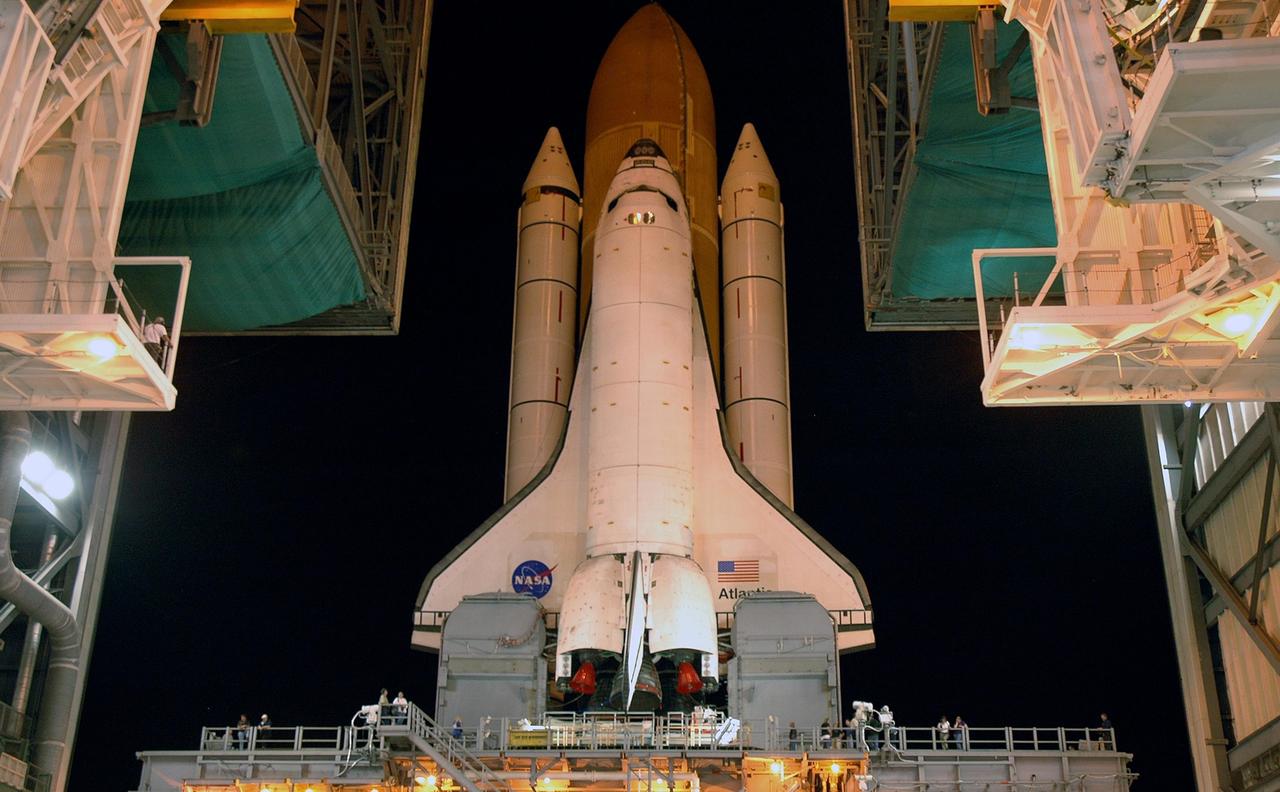
KENNEDY SPACE CENTER, FLA. - Sitting on top of the mobile launcher platform, Space Shuttle Atlantis rolls out of the Vehicle Assembly Building to Launch Pad 39B via the crawler-transporter underneath. First motion was at 1:05 a.m. The slow speed of the crawler results in a 6-hour trek to the pad approximately 4 miles away. Atlantis' launch window begins Aug. 27 for an 11-day mission to the International Space Station. The STS-115 crew of six astronauts will continue construction of the station and install their cargo, the Port 3/4 truss segment with its two large solar arrays. Photo credit: NASA/Troy Cryder
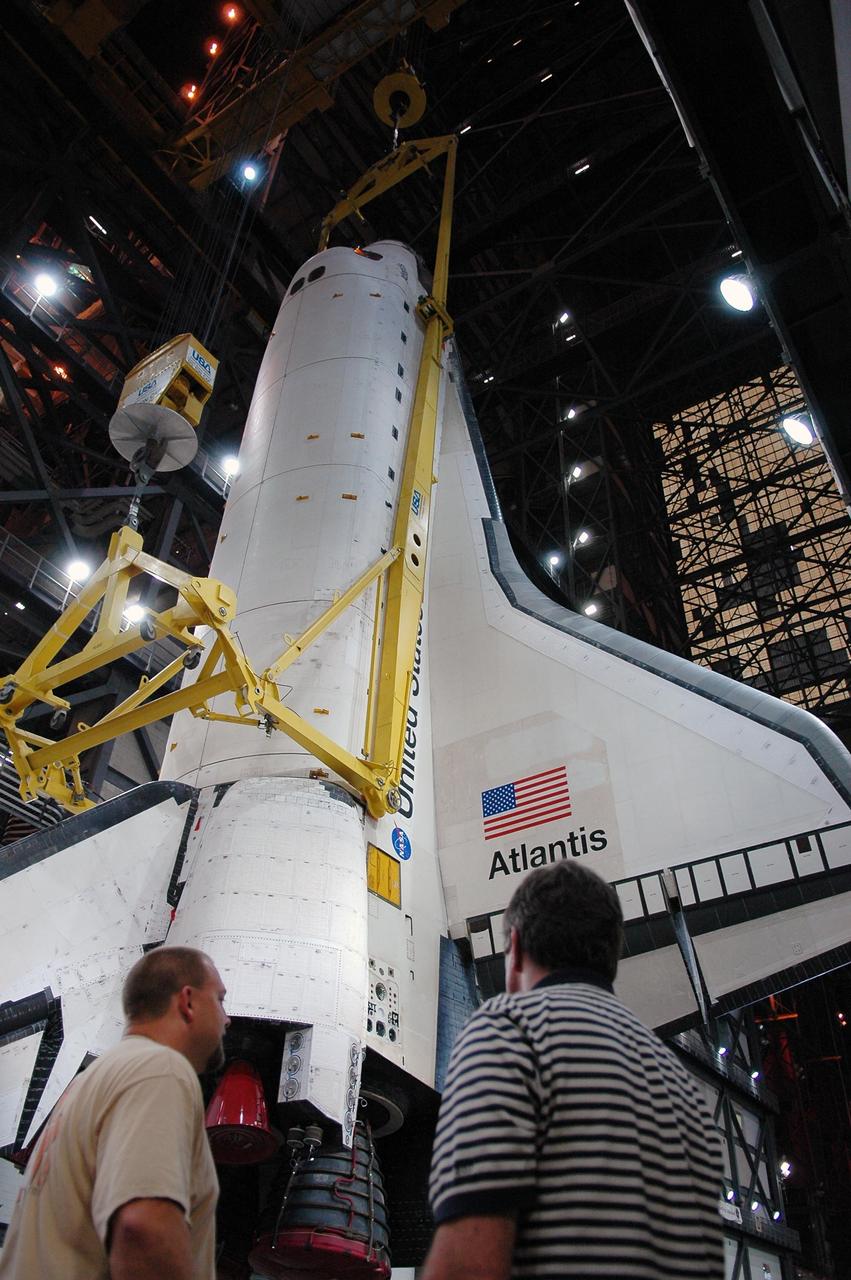
KENNEDY SPACE CENTER, FLA. - In the transfer aisle of the Vehicle Assembly Building, an overhead crane and sling is ready to lift Atlantis into high bay 3 for stacking with the external tank and solid rocket boosters already installed on the mobile launcher platform. After mating with the external tank and boosters, Atlantis will undergo a shuttle interface test and other prelaunch processing. Atlantis' launch window begins Aug. 28. During its 11-day mission to the International Space Station, the STS-115 crew of six astronauts will continue construction of the station and install their cargo, the Port 3/4 truss segment with its two large solar arrays. Photo credit: NASA/Kim Shiflett
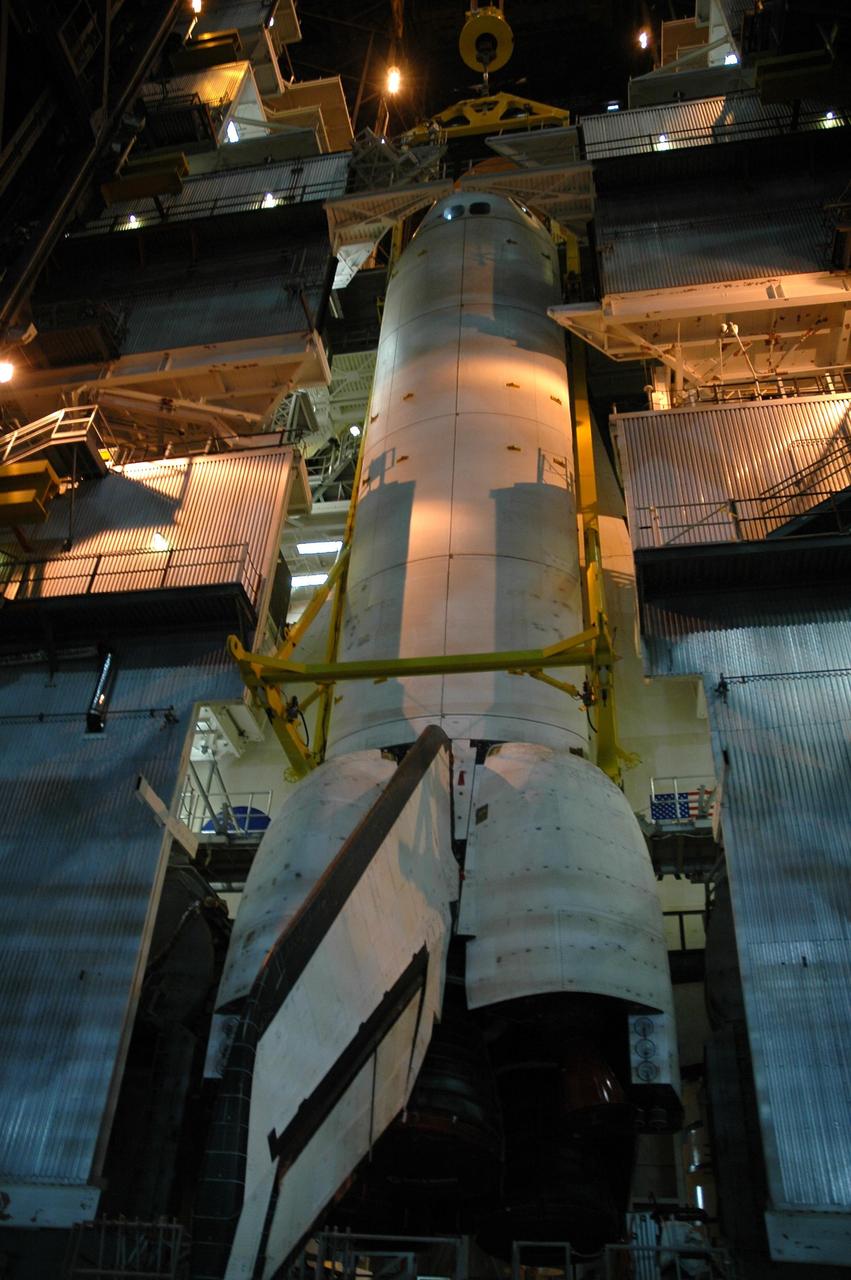
KENNEDY SPACE CENTER, FLA. - In the Vehicle Assembly Building, Atlantis is lowered into high bay 3 for mating with the external tank and solid rocket boosters already installed on the mobile launcher platform. After the stacking, Atlantis will undergo a shuttle interface test and other prelaunch processing. Atlantis' launch window begins Aug. 28. During its 11-day mission to the International Space Station, the STS-115 crew of six astronauts will continue construction of the station and install their cargo, the Port 3/4 truss segment with its two large solar arrays. Photo credit: NASA/Troy Cryder
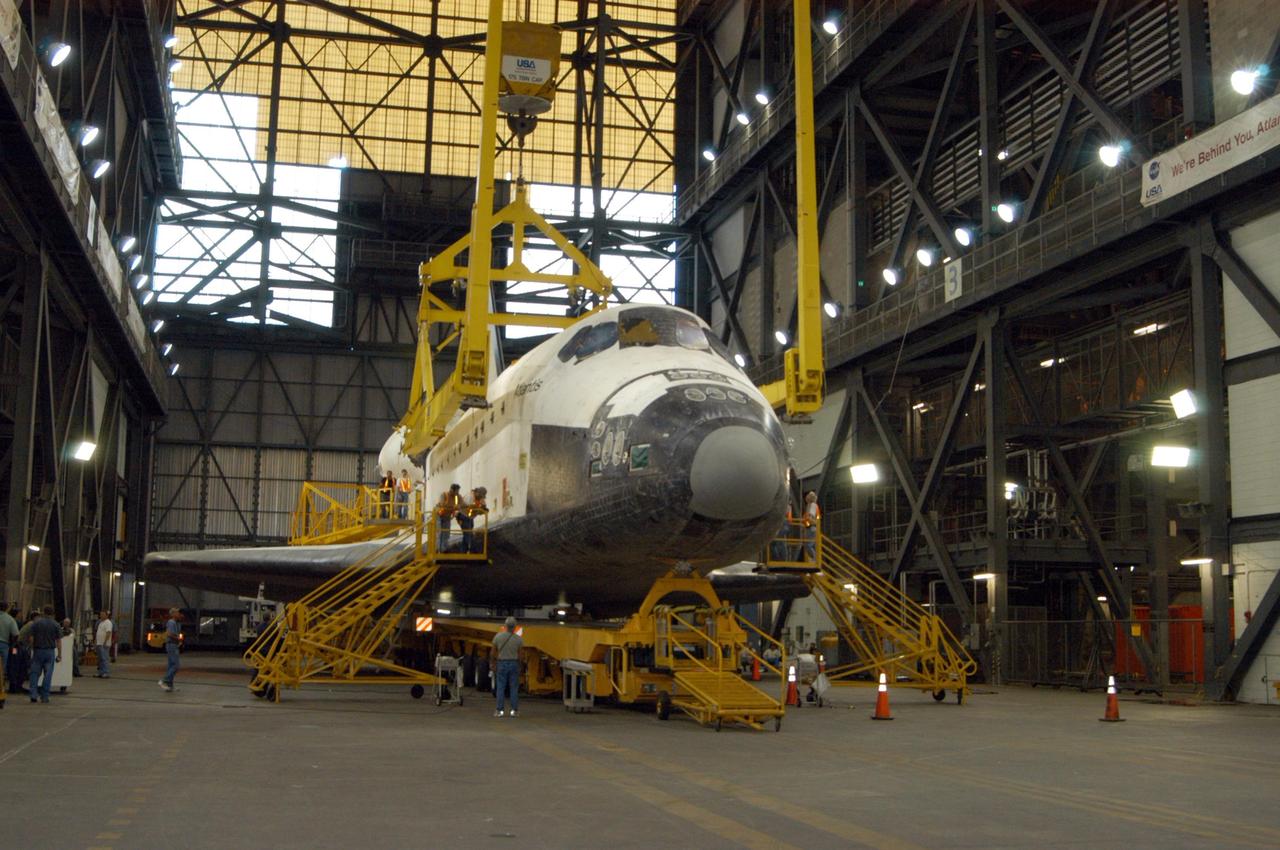
KENNEDY SPACE CENTER, FLA. - In preparation for lifting Atlantis into high bay 3 of the Vehicle Assembly Building, workers are installing a large crane around it to raise it off the transporter into a vertical position. After Atlantis is lifted and moved into the high bay, the orbiter will be lowered and mated with the external tank and solid rocket boosters already stacked on the mobile launcher platform. Atlantis' launch window begins Aug. 28. During its 11-day mission to the International Space Station, the STS-115 crew of six astronauts will install the Port 3/4 truss segment with its two large solar arrays. Photo credit: NASA/George Shelton
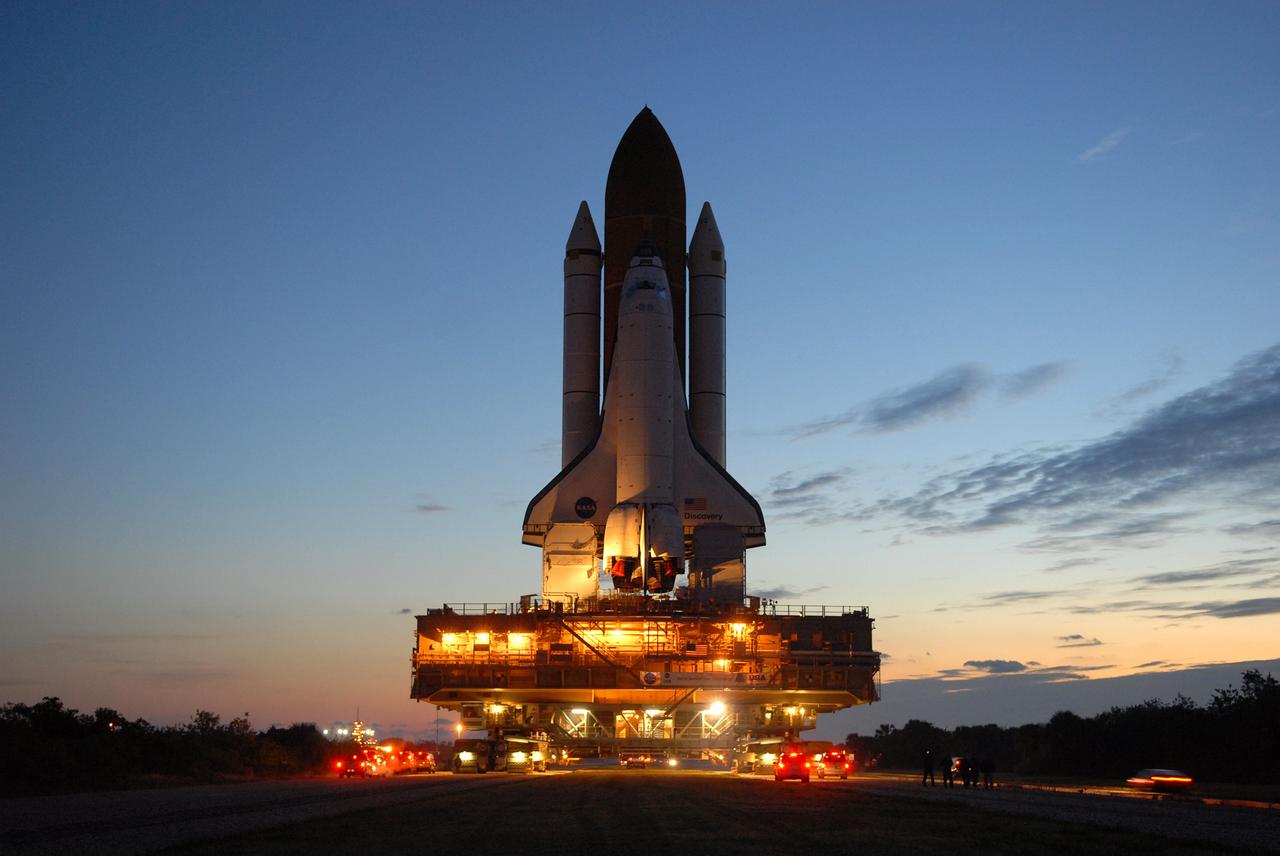
CAPE CANAVERAL, Fla. -- Space shuttle Discovery is silhouetted against the dawn's early light as it makes the slow 3.4-mile journey to Launch Pad 39A. The shuttle sits atop the mobile launcher platform, which are being moved by the massive crawler-transporter beneath. First motion out of the Vehicle Assembly Building was at 5:17 a.m. EST. Discovery is targeted to launch to the International Space Station Feb. 12. During Discovery's 14-day mission, the crew will install the S6 truss segment and its solar arrays to the starboard side of the station, completing the station's backbone, or truss, enabling a six-person crew to live there starting in May. Photo credit: NASA/Troy Cryder
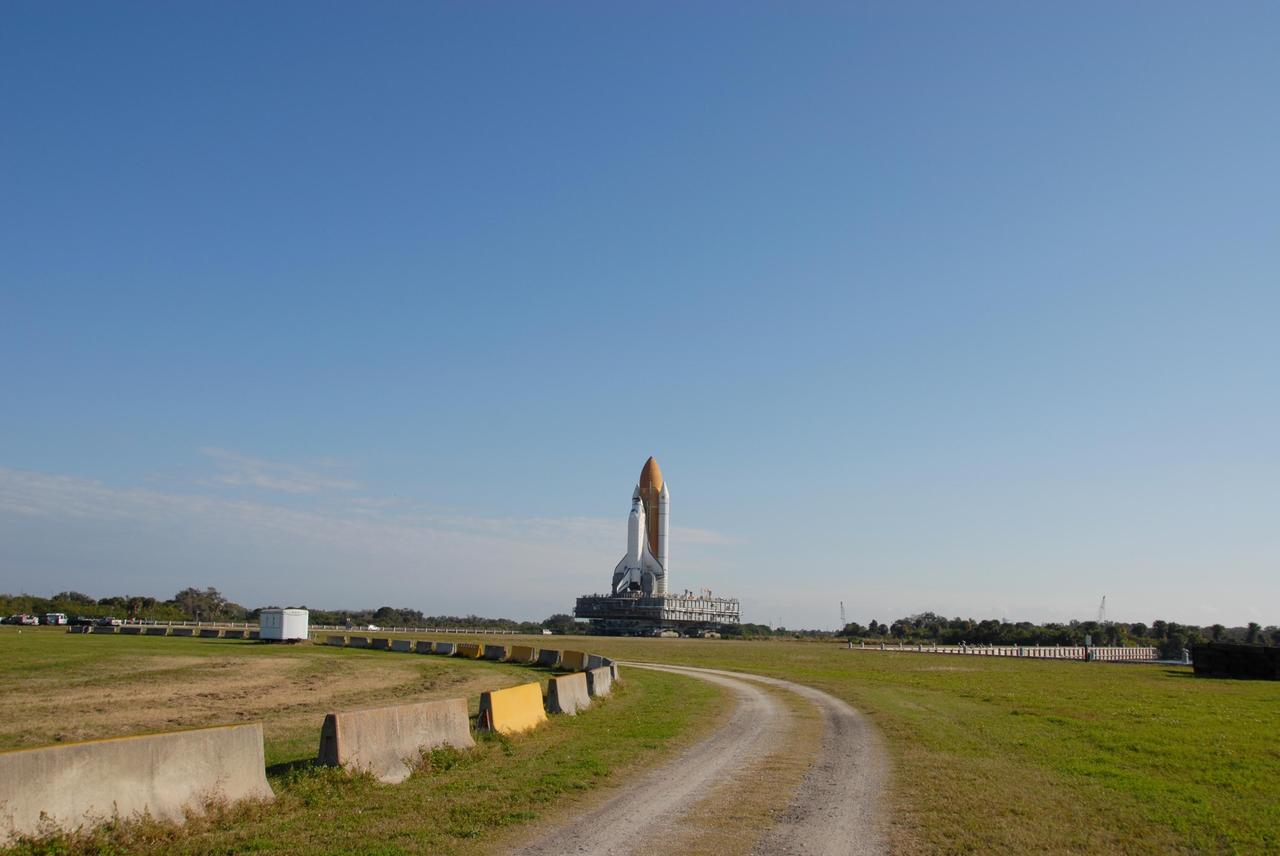
KENNEDY SPACE CENTER, FLA. -- In the clear morning light, Space Shuttle Atlantis , atop the mobile launcher platform and crawler-transporter, slowly makes its way to Launch Pad 39A. First motion out of the Vehicle Assembly Building was at 8:19 a.m. The 3.4-mile trip to the pad along the crawlerway will take about 6 hours. The mission payload aboard Space Shuttle Atlantis is the S3/S4 integrated truss structure, along with a third set of solar arrays and batteries. The crew of six astronauts will install the truss to continue assembly of the International Space Station. Launch is targeted for March 15. Photo credit: NASA/Ken Thornsley
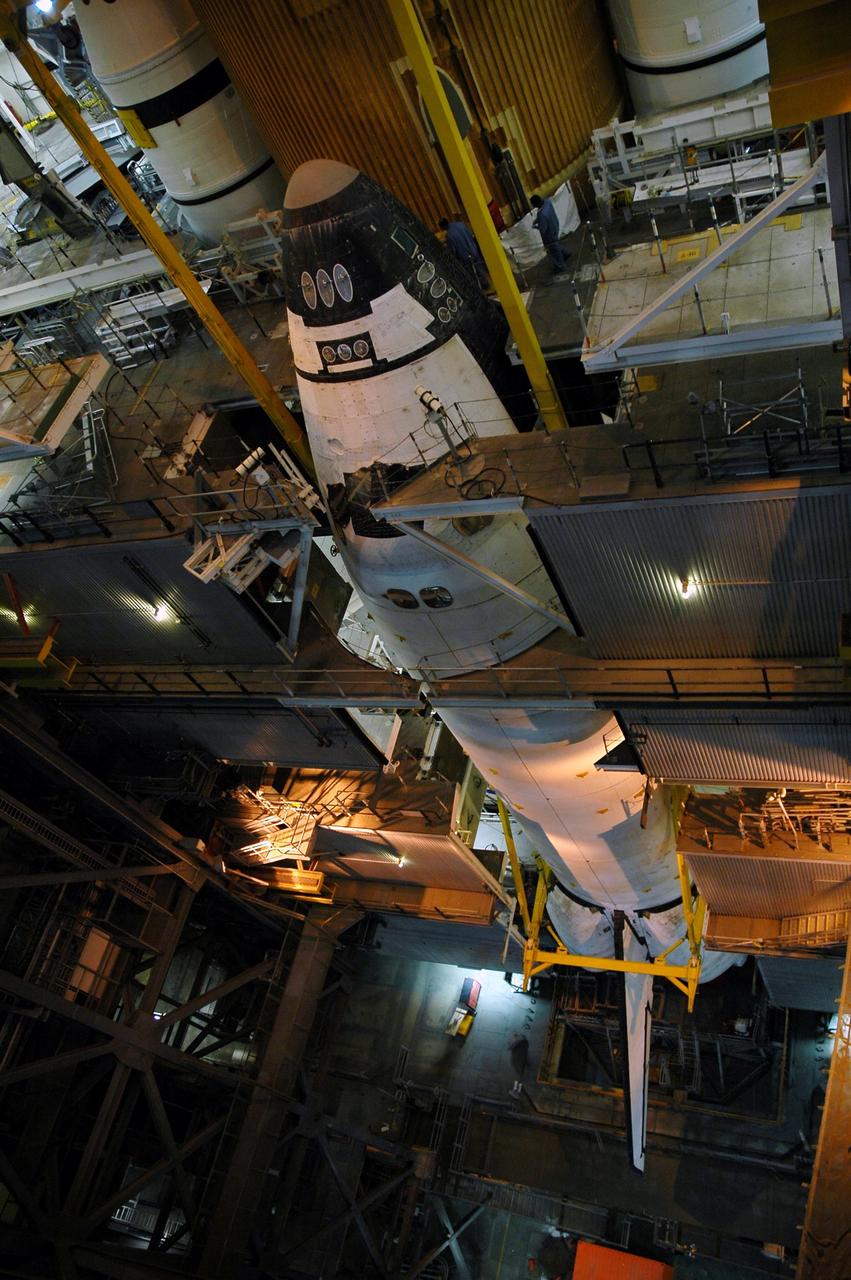
KENNEDY SPACE CENTER, FLA. - In high bay 3 of the Vehicle Assembly Building, the orbiter Atlantis has been lowered onto the mobile launcher platform below for mating with the external tank and solid rocket boosters already in place. After the stacking, Atlantis will undergo a shuttle interface test and other prelaunch processing. Atlantis' launch window begins Aug. 28. During its 11-day mission to the International Space Station, the STS-115 crew of six astronauts will continue construction of the station and install their cargo, the Port 3/4 truss segment with its two large solar arrays. Photo credit: NASA/Troy Cryder
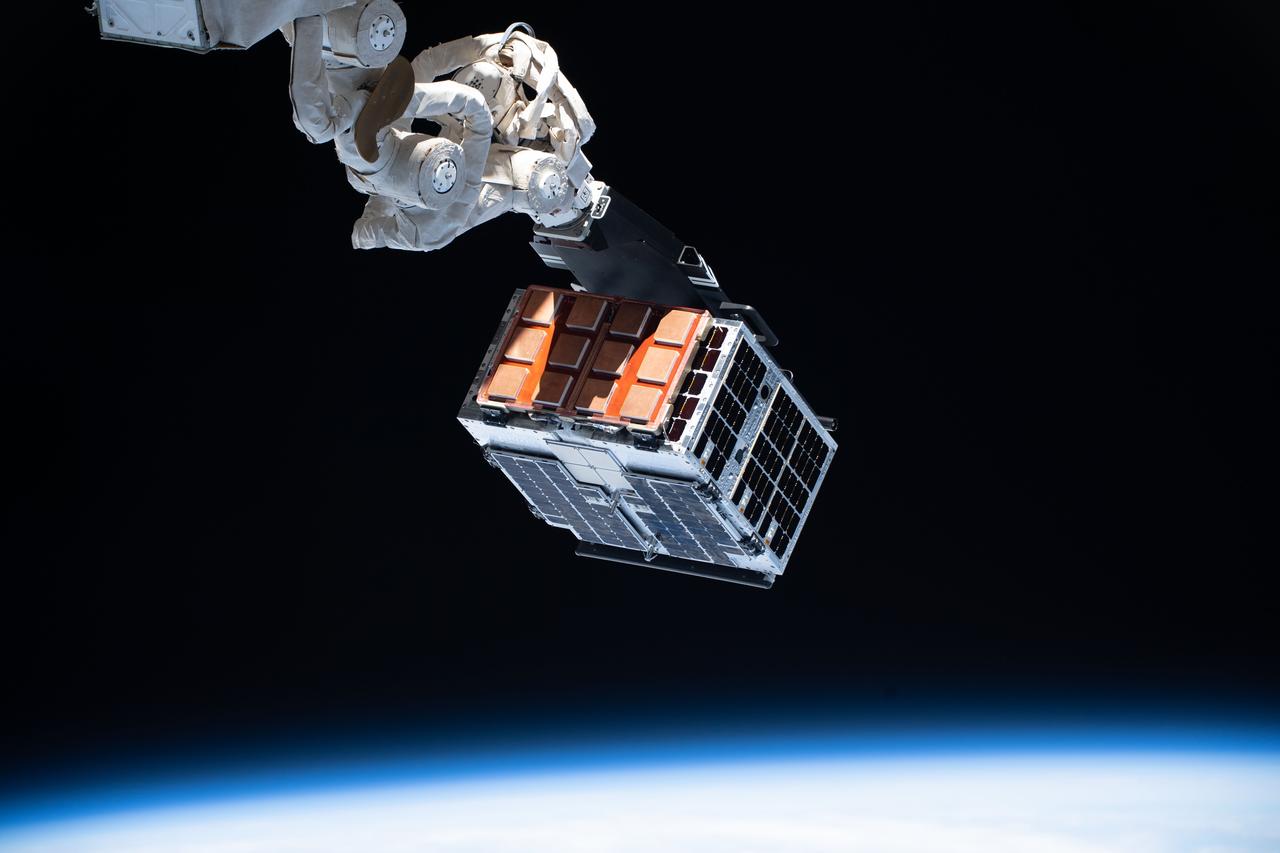
iss061e148301 (1/29/2020) --- A view taken from the Cupola Module aboard the International Space Station (ISS) of the STPSat-4 deploy. The Space Test Program Satellite-4 (STPSat-4) is a suite automated for robotic space tools and sensors that test new equipment configurations and monitor space conditions. STPSat-4 specifically includes space weather sensors, solar panels, an antenna array and devices for tracking location of both satellites and their astronomic surroundings. This project demonstrates how a range of new technologies can be integrated on nanosatellite platforms.
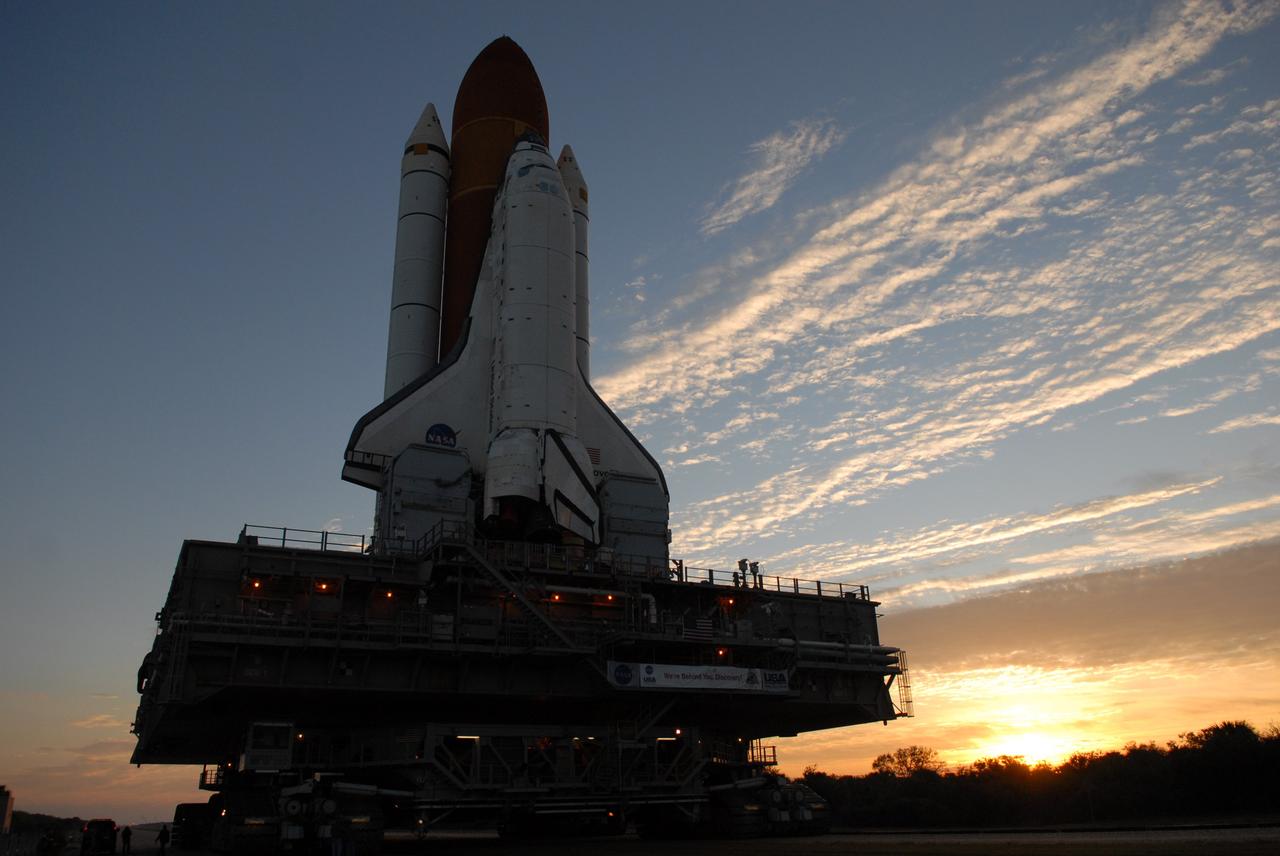
CAPE CANAVERAL, Fla. -- Space shuttle Discovery is silhouetted against the dawn's early light as it makes the slow 3.4-mile journey to Launch Pad 39A. The shuttle sits atop the mobile launcher platform, which are being moved by the massive crawler-transporter beneath. First motion out of the Vehicle Assembly Building was at 5:17 a.m. EST. Discovery is targeted to launch to the International Space Station Feb. 12. During Discovery's 14-day mission, the crew will install the S6 truss segment and its solar arrays to the starboard side of the station, completing the station's backbone, or truss, enabling a six-person crew to live there starting in May. Photo credit: NASA/Troy Cryder
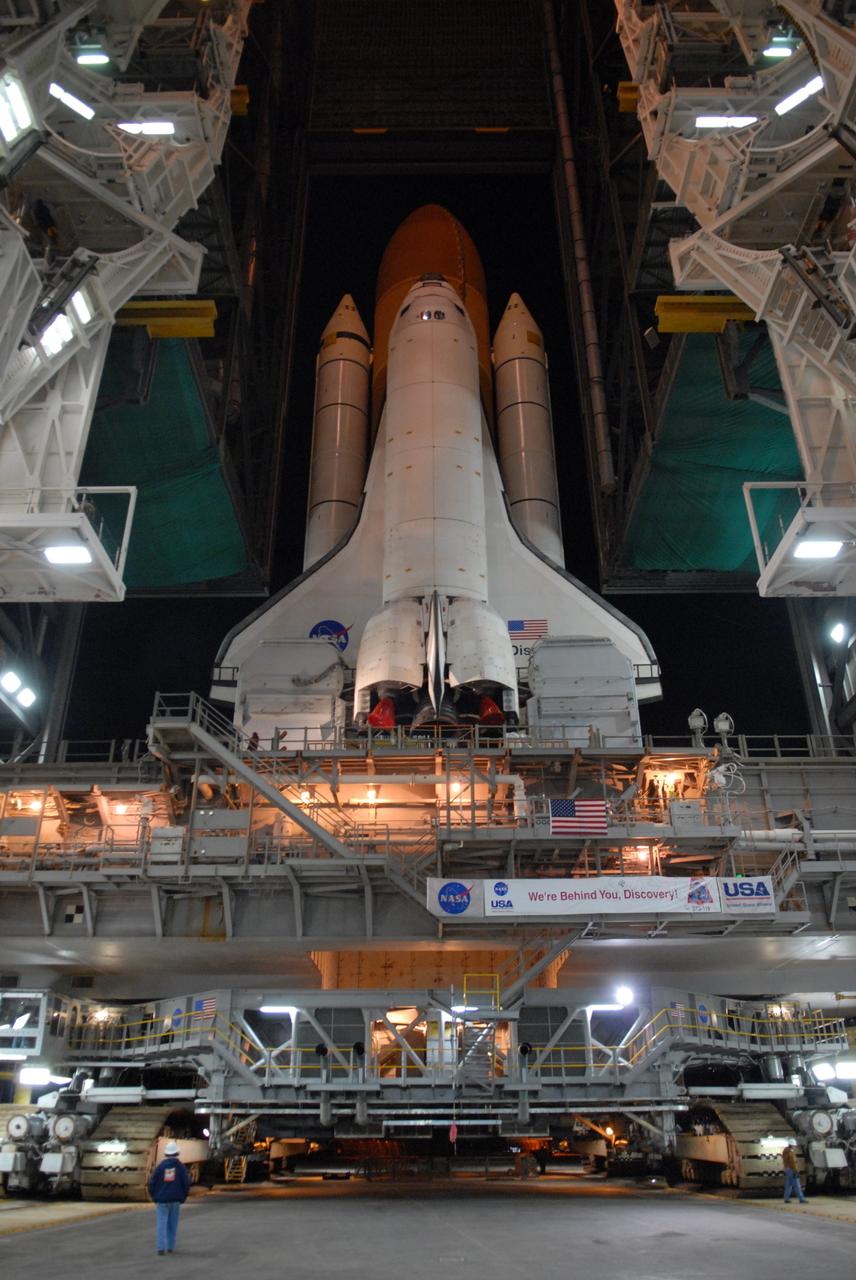
CAPE CANAVERAL, Fla. -- The massive crawler-transporter moves its cargo of space shuttle Discovery and mobile launcher platform out of the Vehicle Assembly Building at NASA's Kennedy Space Center in Florida to Launch Pad 39A. First motion was at 5:17 a.m. EST. Discovery is targeted to launch to the International Space Station Feb. 12. During Discovery's 14-day mission, the crew will install the S6 truss segment and its solar arrays to the starboard side of the station, completing the station's backbone, or truss, enabling a six-person crew to live there starting in May. Photo credit: NASA/Troy Cryder
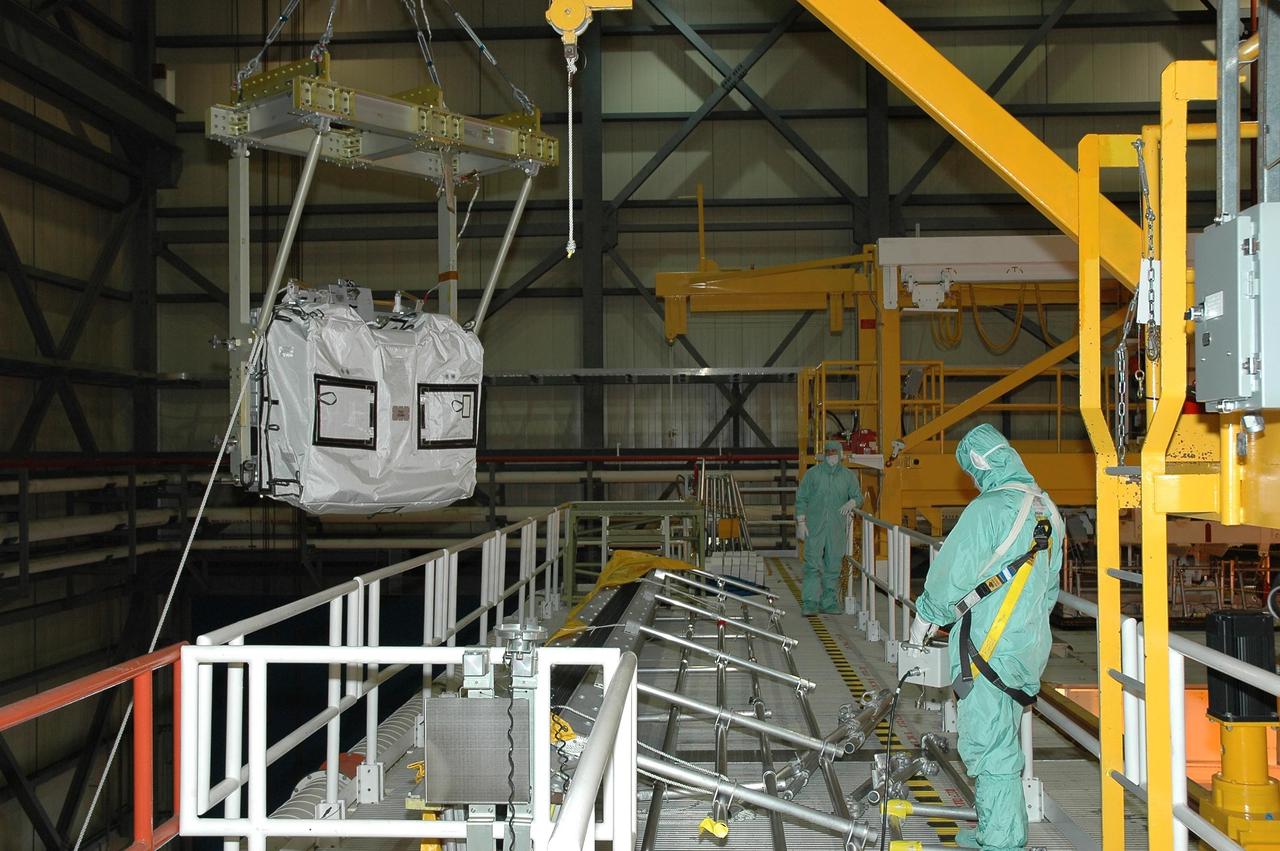
KENNEDY SPACE CENTER, Fla. -- In the Orbiter Processing Facility bay 3, a crane moves the main bus switching unit that will be installed in Discovery's payload bay. The unit is part of the payload on mission STS-120. A main bus switching unit is used for power distribution, circuit protection and fault isolation on the space station's power system. The units route power to proper locations in the space station, such as from solar arrays through umbilicals into the U.S. Lab. The unit will be installed on the external stowage platform 2 attached to the Quest airlock for temporary storage. Discovery is targeted to launch mission STS-120 no earlier than Oct. 20. Photo credit: NASA/Jim Grossmann
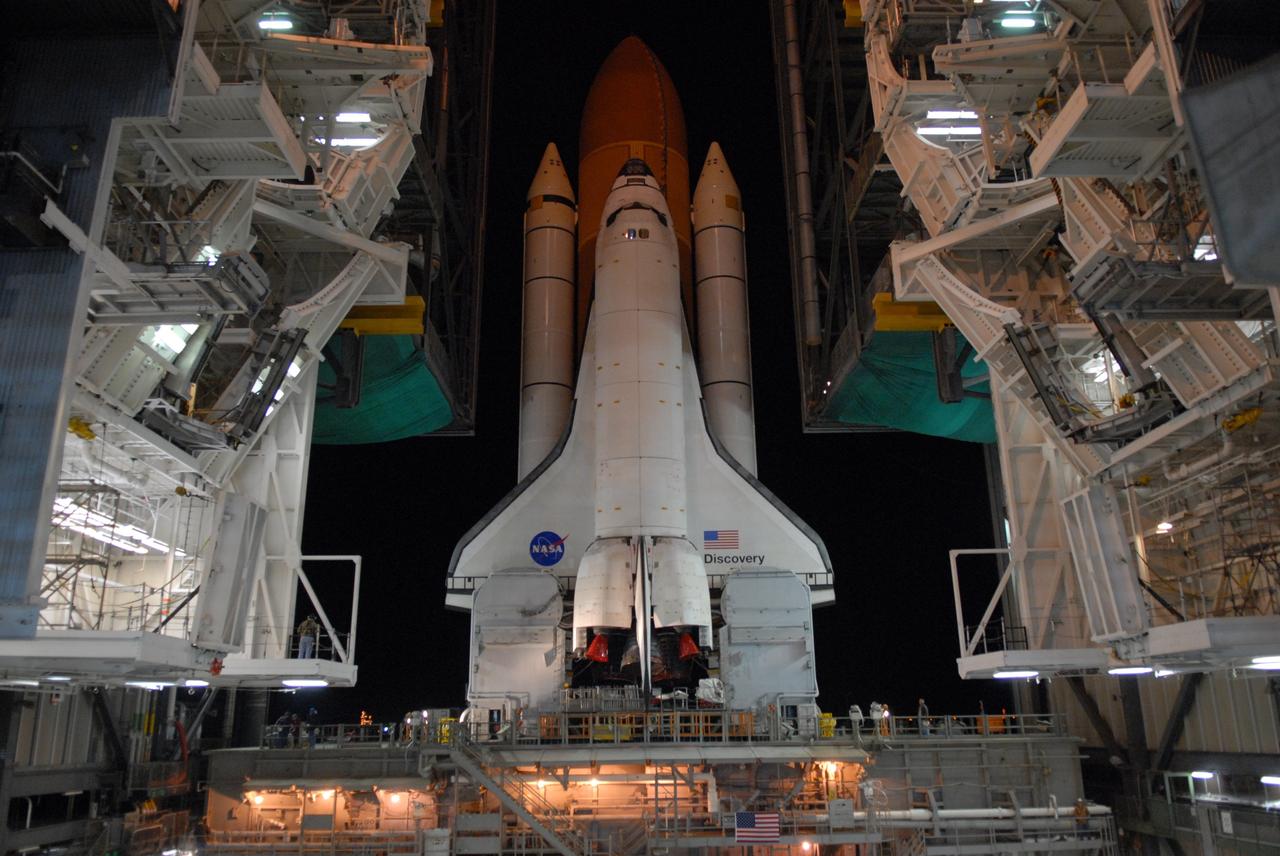
CAPE CANAVERAL, Fla. -- Space shuttle Discovery atop the mobile launcher platform moves on the crawler-transporter through the doors of the Vehicle Assembly Building at NASA's Kennedy Space Center in Florida on its way to Launch pad 39A. First motion was at 5:17 a.m. EST. Discovery is targeted to launch to the International Space Station Feb. 12. During Discovery's 14-day mission, the crew will install the S6 truss segment and its solar arrays to the starboard side of the station, completing the station's backbone, or truss, enabling a six-person crew to live there starting in May. Photo credit: NASA/Troy Cryder
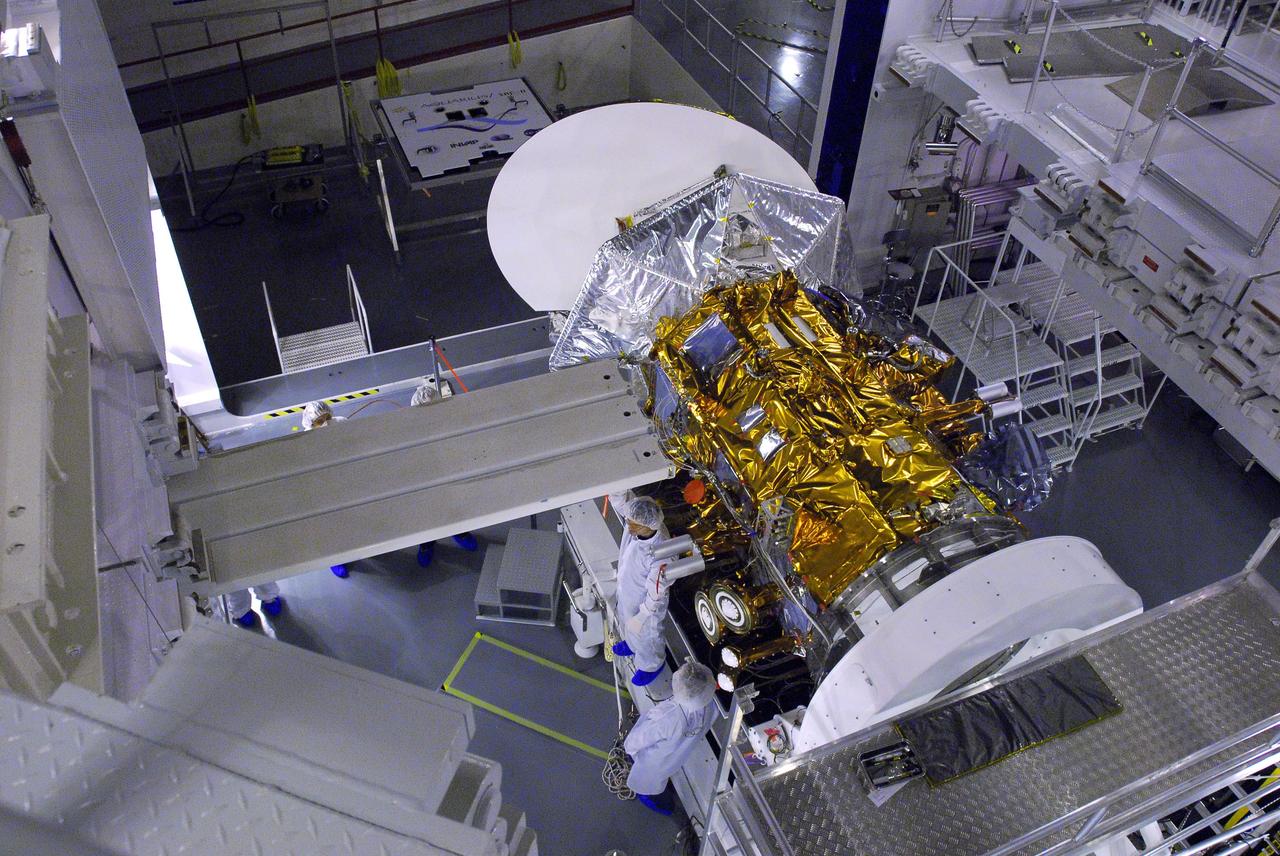
VANDENBERG AIR FORCE BASE, Calif. --In Space Systems International's Payload Processing Facility at Vandenberg Air Force Base in California, technicians have suspended a platform over the Aquarius/SAC-D spacecraft to allow access for the installation of the second solar array. Following final tests, the spacecraft will be integrated to a United Launch Alliance Delta II rocket in preparation for the targeted June launch. Aquarius, the NASA-built primary instrument on the SAC-D spacecraft, will provide new insights into how variations in ocean surface salinity relate to fundamental climate processes on its three-year mission. Photo credit: NASA/VAFB
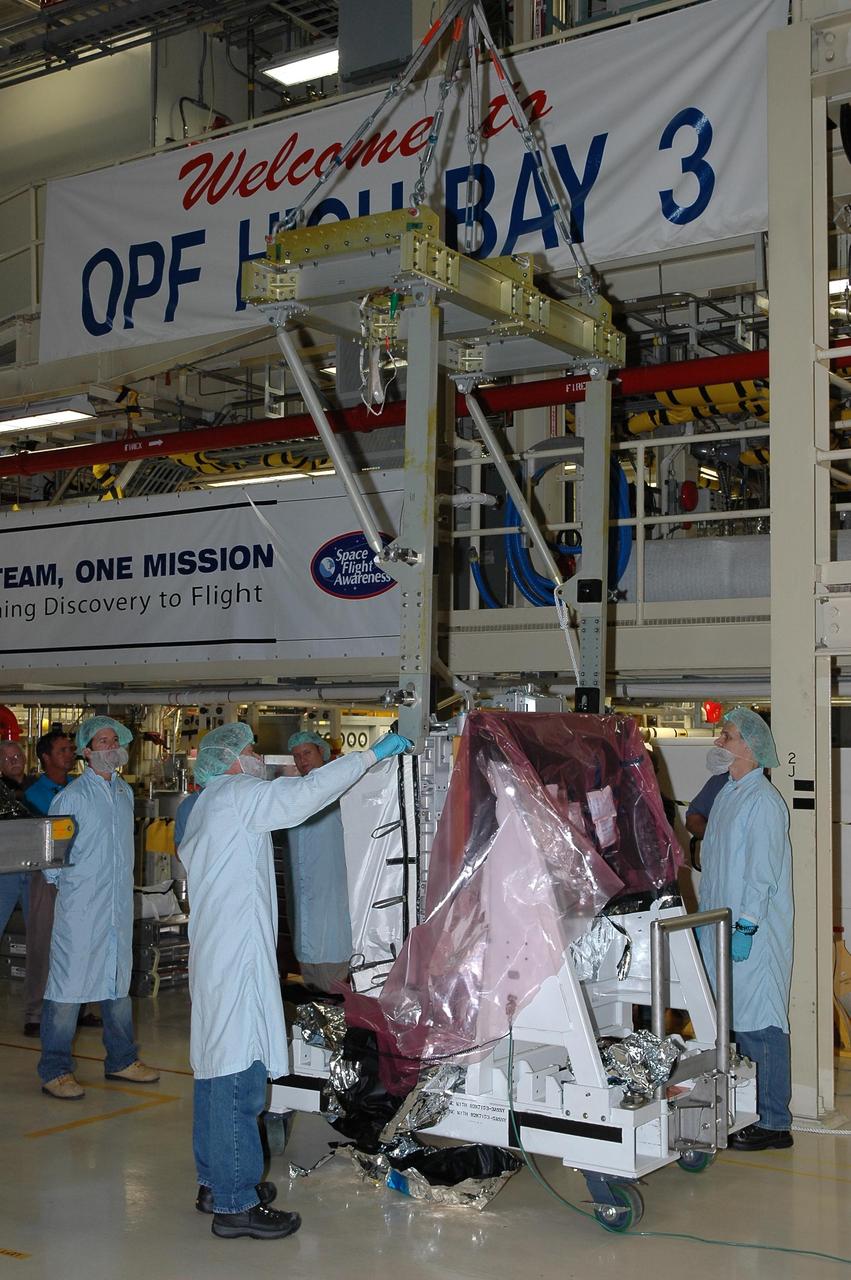
KENNEDY SPACE CENTER, Fla. -- In the Orbiter Processing Facility bay 3, the main bus switching unit that is part of the payload on mission STS-120 is being prepared for inspection. A main bus switching unit is used for power distribution, circuit protection and fault isolation on the space station's power system. The units route power to proper locations in the space station, such as from solar arrays through umbilicals into the U.S. Lab. The unit will be installed on the external stowage platform 2 attached to the Quest airlock for temporary storage. Discovery is targeted to launch mission STS-120 no earlier than Oct. 20. Photo credit: NASA/Jim Grossmann
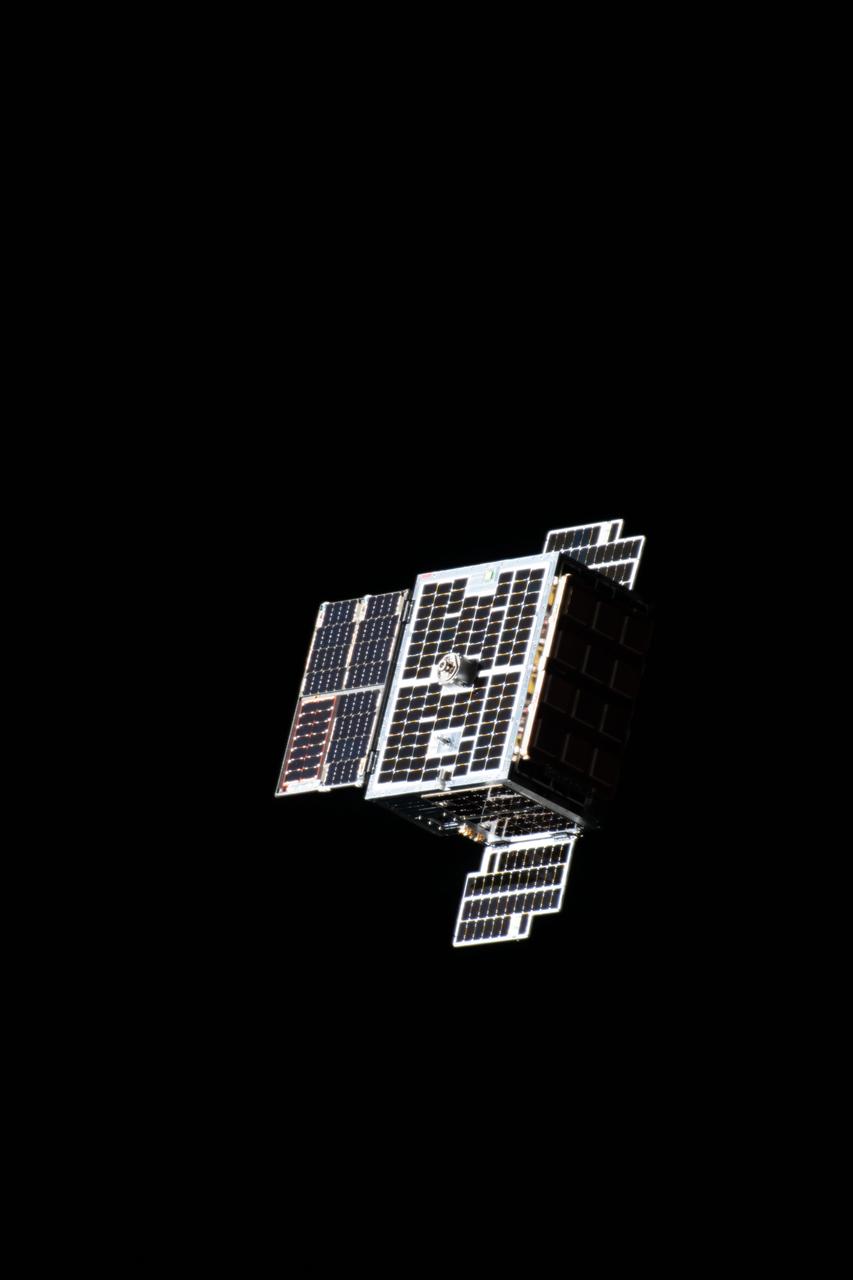
iss061e148704 (1/29/2020) --- A view taken from the Cupola Module aboard the International Space Station (ISS) of the STPSat-4 deploy. The Space Test Program Satellite-4 (STPSat-4) is a suite automated for robotic space tools and sensors that test new equipment configurations and monitor space conditions. STPSat-4 specifically includes space weather sensors, solar panels, an antenna array and devices for tracking location of both satellites and their astronomic surroundings. This project demonstrates how a range of new technologies can be integrated on nanosatellite platforms.
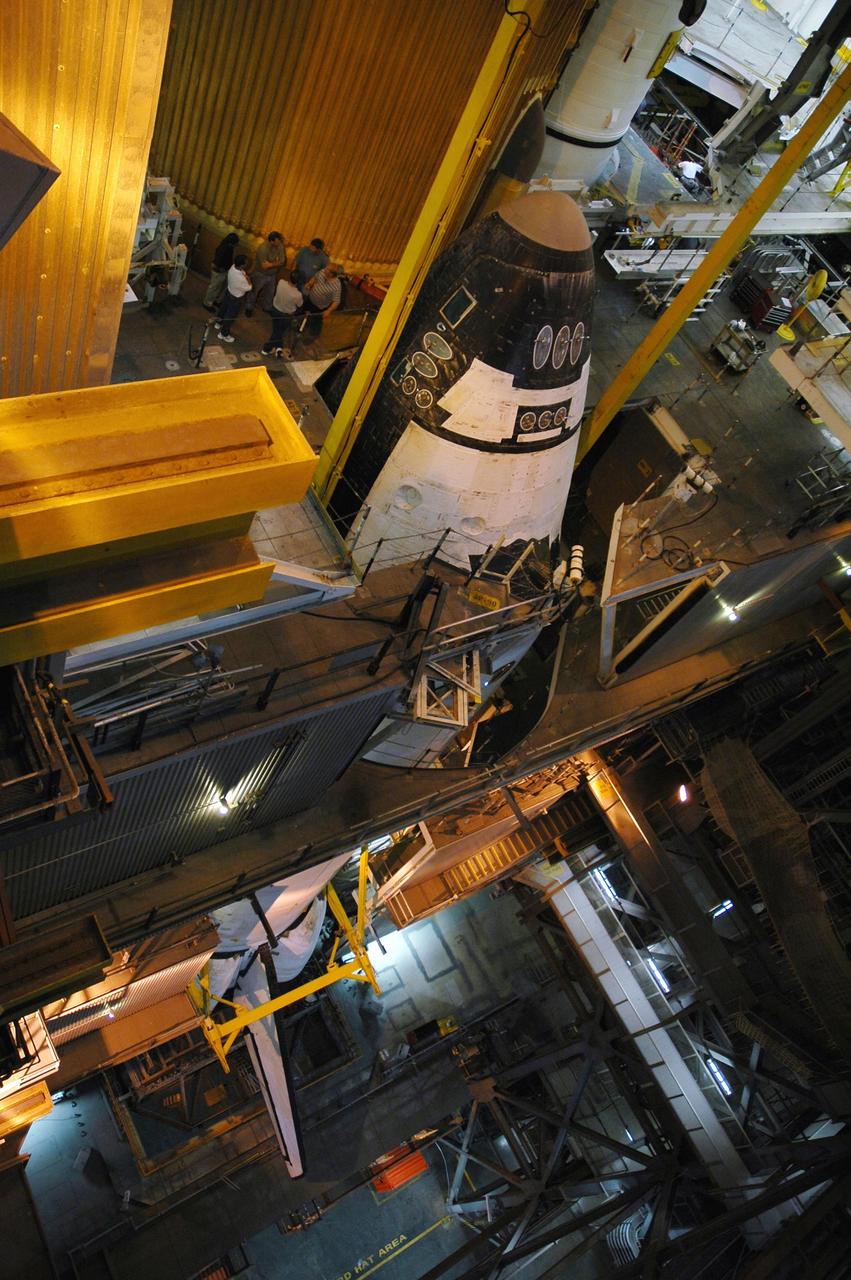
KENNEDY SPACE CENTER, FLA. - In high bay 3 of the Vehicle Assembly Building, the orbiter Atlantis has been lowered onto the mobile launcher platform below for mating with the external tank and solid rocket boosters already in place. After the stacking, Atlantis will undergo a shuttle interface test and other prelaunch processing. Atlantis' launch window begins Aug. 28. During its 11-day mission to the International Space Station, the STS-115 crew of six astronauts will continue construction of the station and install their cargo, the Port 3/4 truss segment with its two large solar arrays. Photo credit: NASA/Troy Cryder
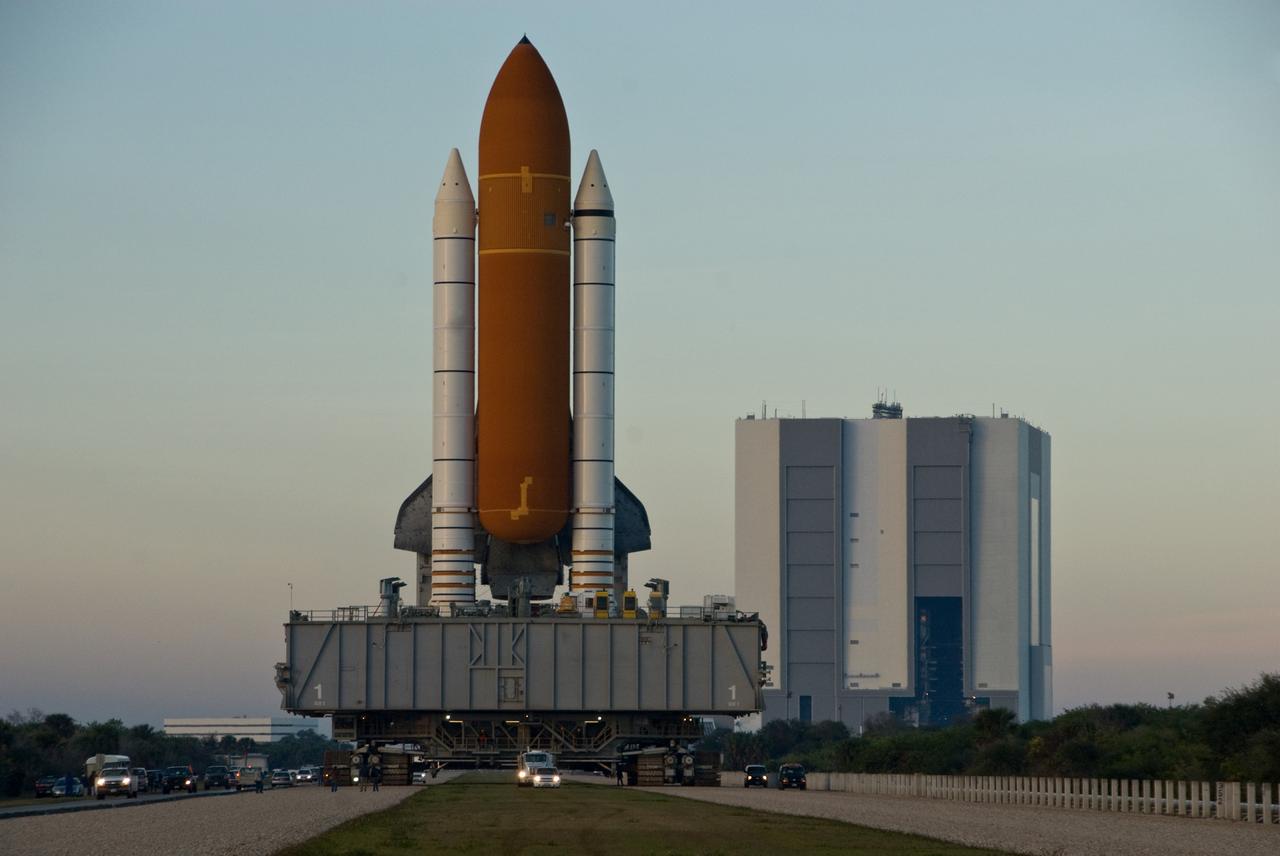
CAPE CANAVERAL, Fla. -- Space shuttle Discovery, atop the mobile launcher platform, makes the slow 3.4-mile journey via the broad, two-track crawlerway to Launch Pad 39A at NASA's Kennedy Space Center in Florida. First motion out of the Vehicle Assembly Building (at right) was at 5:17 a.m. EST. Discovery is targeted to launch to the International Space Station Feb. 12. During Discovery's 14-day mission, the crew will install the S6 truss segment and its solar arrays to the starboard side of the station, completing the station's backbone, or truss, enabling a six-person crew to live there starting in May. Photo credit: NASA/Troy Cryder
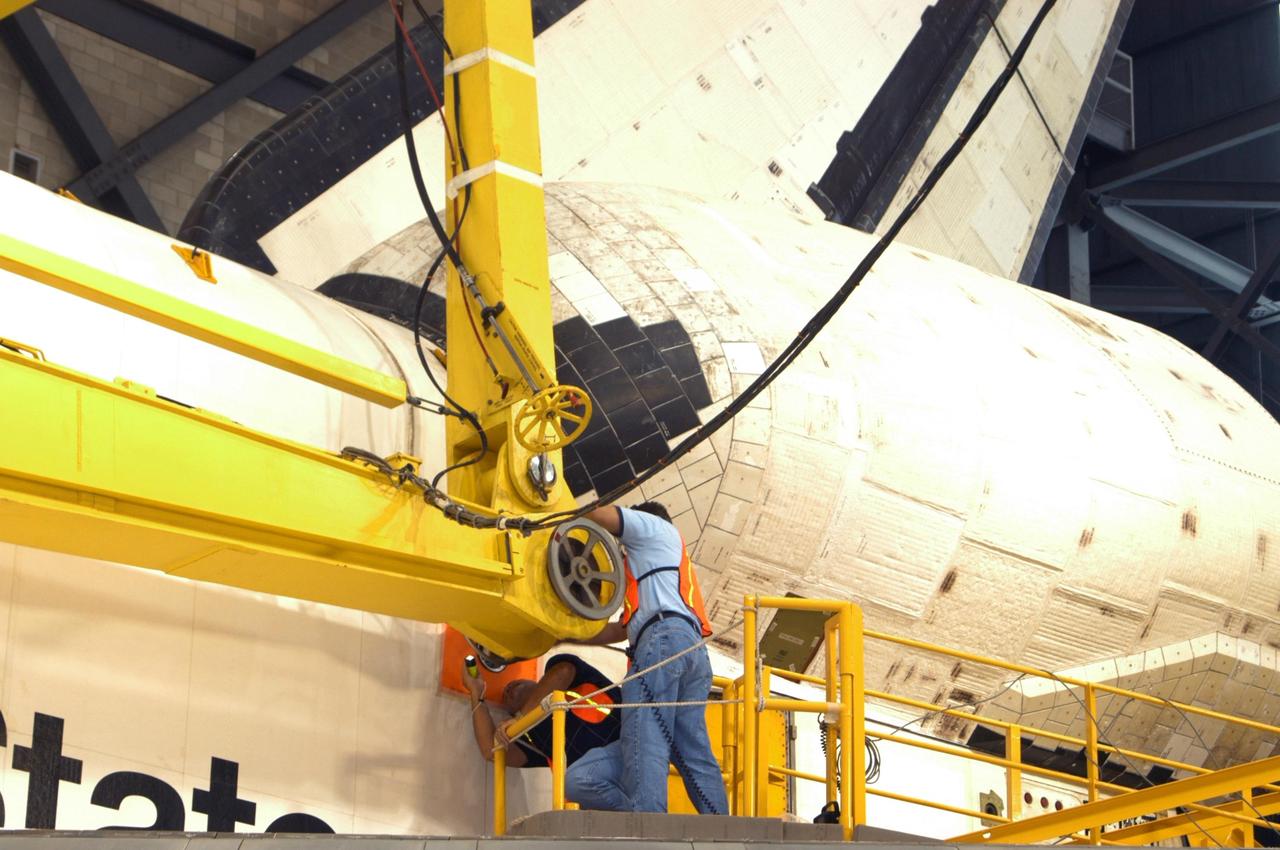
KENNEDY SPACE CENTER, FLA. - In this closeup, workers can be seen attaching one segment of a large crane around Atlantis to raise it off the transporter into a vertical position. Once it is raised, Atlantis will be lifted into high bay 3 of the Vehicle Assembly Building. Then the orbiter will be lowered and mated with the external tank and solid rocket boosters already stacked on the mobile launcher platform. Atlantis' launch window begins Aug. 28. During its 11-day mission to the International Space Station, the STS-115 crew of six astronauts will install the Port 3/4 truss segment with its two large solar arrays. Photo credit: NASA/George Shelton
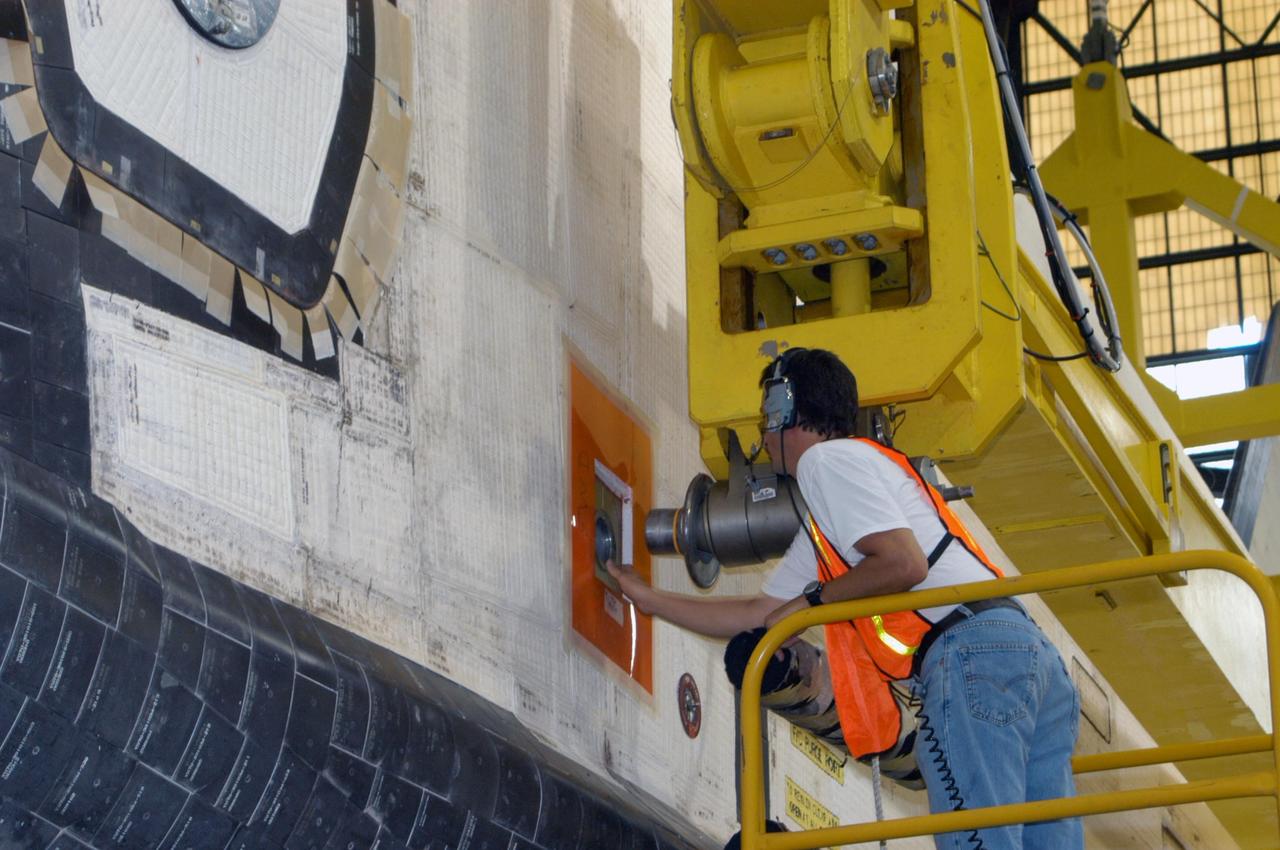
KENNEDY SPACE CENTER, FLA. - In the transfer aisle of the Vehicle Assembly Building, workers are securing the sling attachment of the overhead crane that will lift the orbiter Atlantis into high bay 3. After Atlantis is lifted and moved into the high bay, the orbiter will be lowered and mated with the external tank and solid rocket boosters already stacked on the mobile launcher platform. Atlantis' launch window begins Aug. 28. During its 11-day mission to the International Space Station, the STS-115 crew of six astronauts will install the Port 3/4 truss segment with its two large solar arrays. Photo credit: NASA/George Shelton
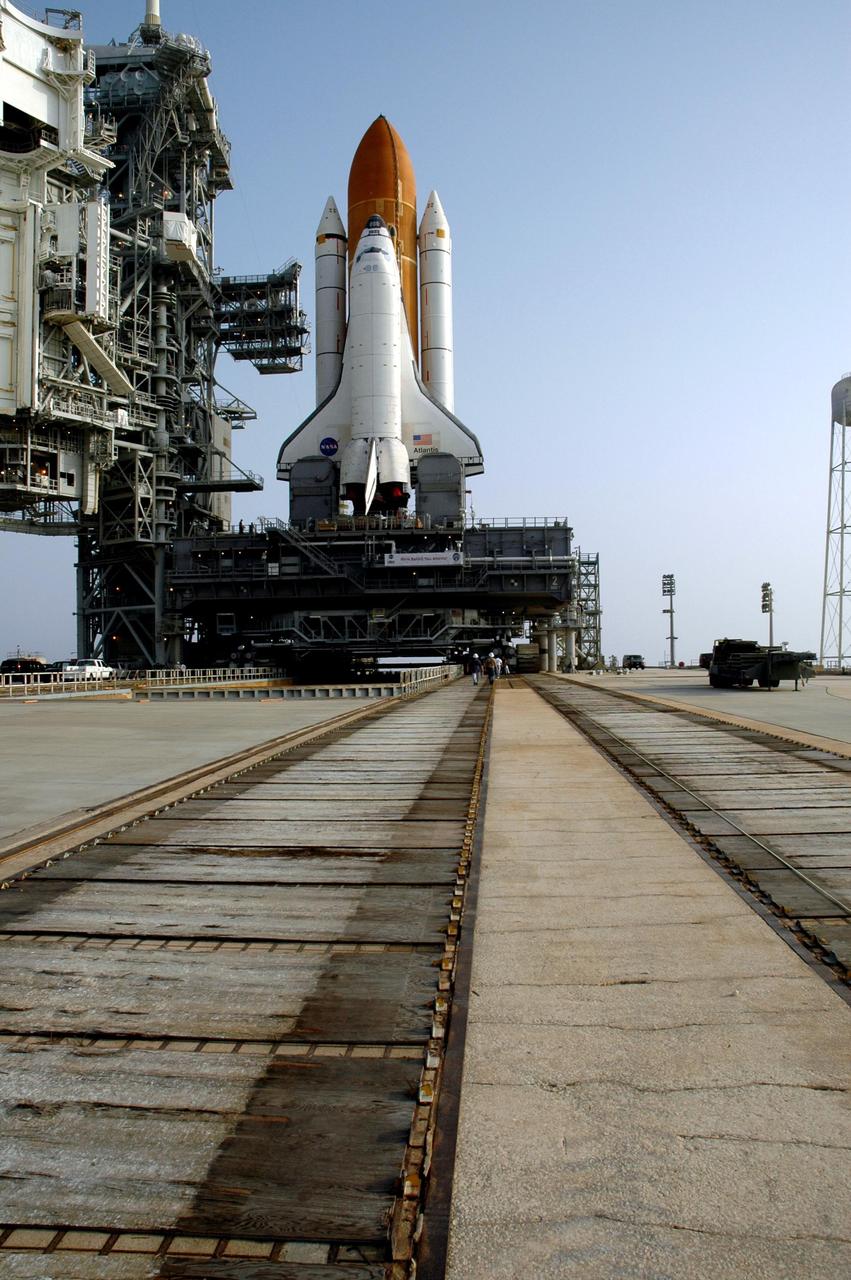
KENNEDY SPACE CENTER, FLA. - After its overnight rollout from the Vehicle Assembly Building, Space Shuttle Atlantis rests on the hard stand on Launch Pad 39B. The shuttle sits on top of the mobile launcher platform. The crawler, which transported it, is still underneath. The slow speed of the crawler results in a 6-hour trek to the pad approximately 4 miles away. Atlantis' launch window begins Aug. 27 for an 11-day mission to the International Space Station. The STS-115 crew of six astronauts will continue construction of the station and install their cargo, the Port 3/4 truss segment with its two large solar arrays. Photo credit: NASA/Troy Cryder
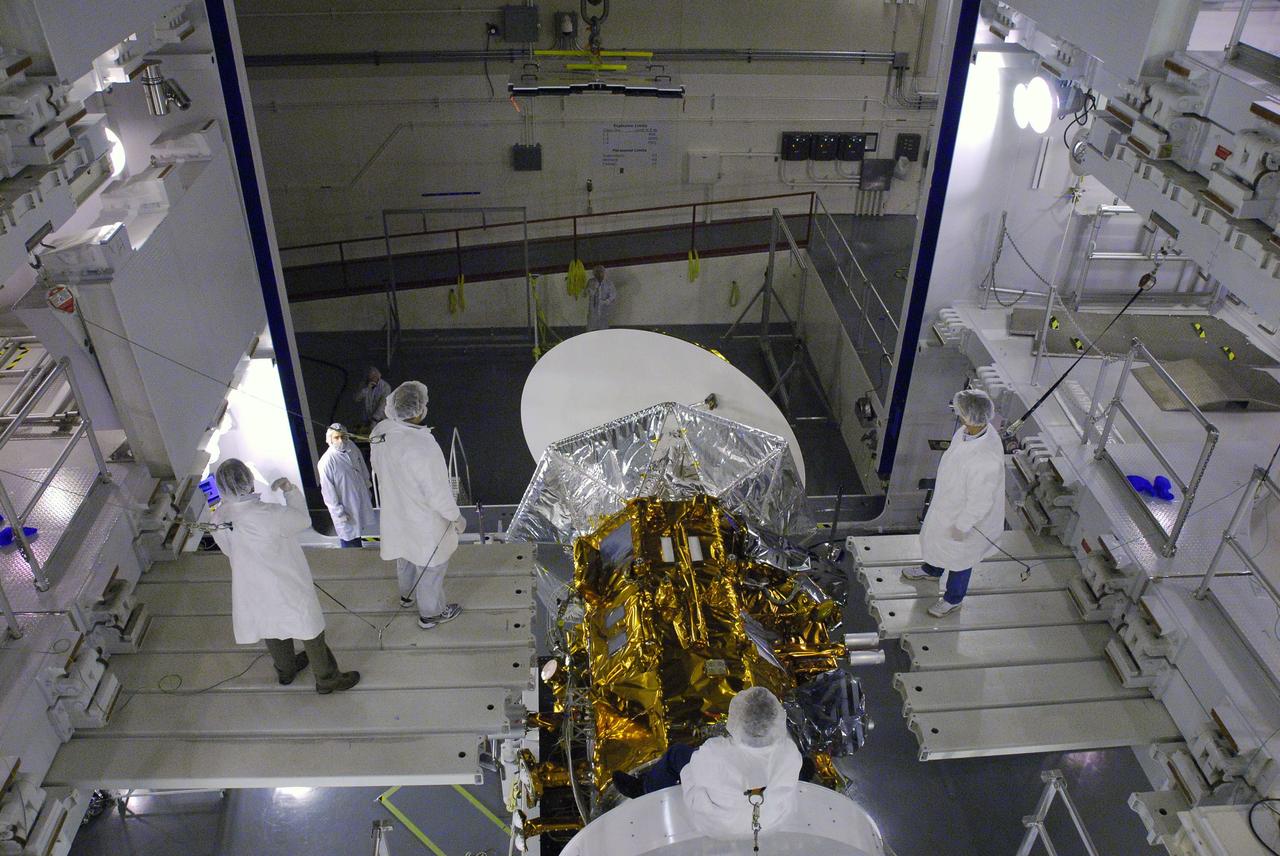
VANDENBERG AIR FORCE BASE, Calif. -- In Space Systems International's Payload Processing Facility at Vandenberg Air Force Base in California, technicians on suspended platforms are preparing to install the second solar array to the Aquarius/SAC-D spacecraft. Following final tests, the spacecraft will be integrated to a United Launch Alliance Delta II rocket in preparation for the targeted June launch. Aquarius, the NASA-built primary instrument on the SAC-D spacecraft, will provide new insights into how variations in ocean surface salinity relate to fundamental climate processes on its three-year mission. Photo credit: NASA/VAFB
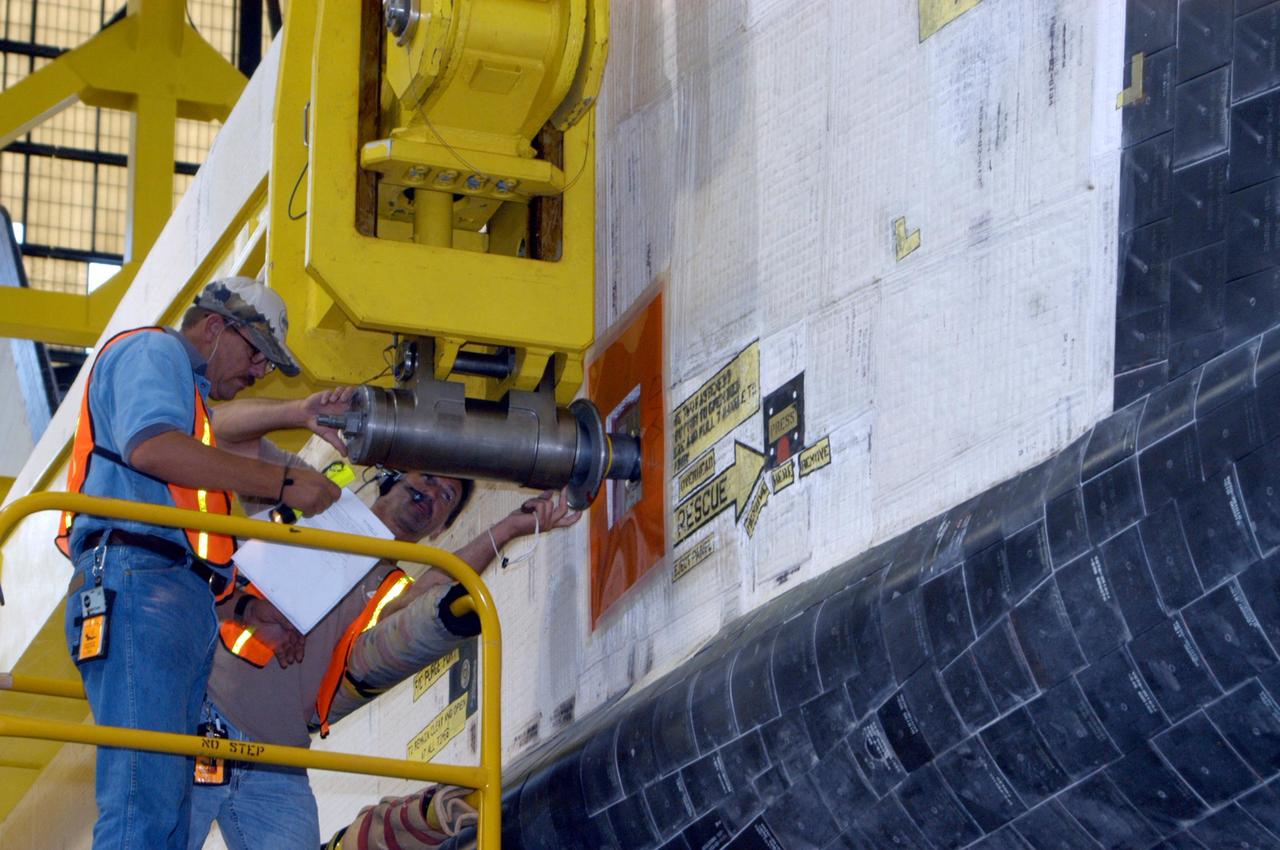
KENNEDY SPACE CENTER, FLA. - In the transfer aisle of the Vehicle Assembly Building, workers are securing the sling attachment of the overhead crane that will lift the orbiter Atlantis into high bay 3. After Atlantis is lifted and moved into the high bay, the orbiter will be lowered and mated with the external tank and solid rocket boosters already stacked on the mobile launcher platform. Atlantis' launch window begins Aug. 28. During its 11-day mission to the International Space Station, the STS-115 crew of six astronauts will install the Port 3/4 truss segment with its two large solar arrays. Photo credit: NASA/George Shelton
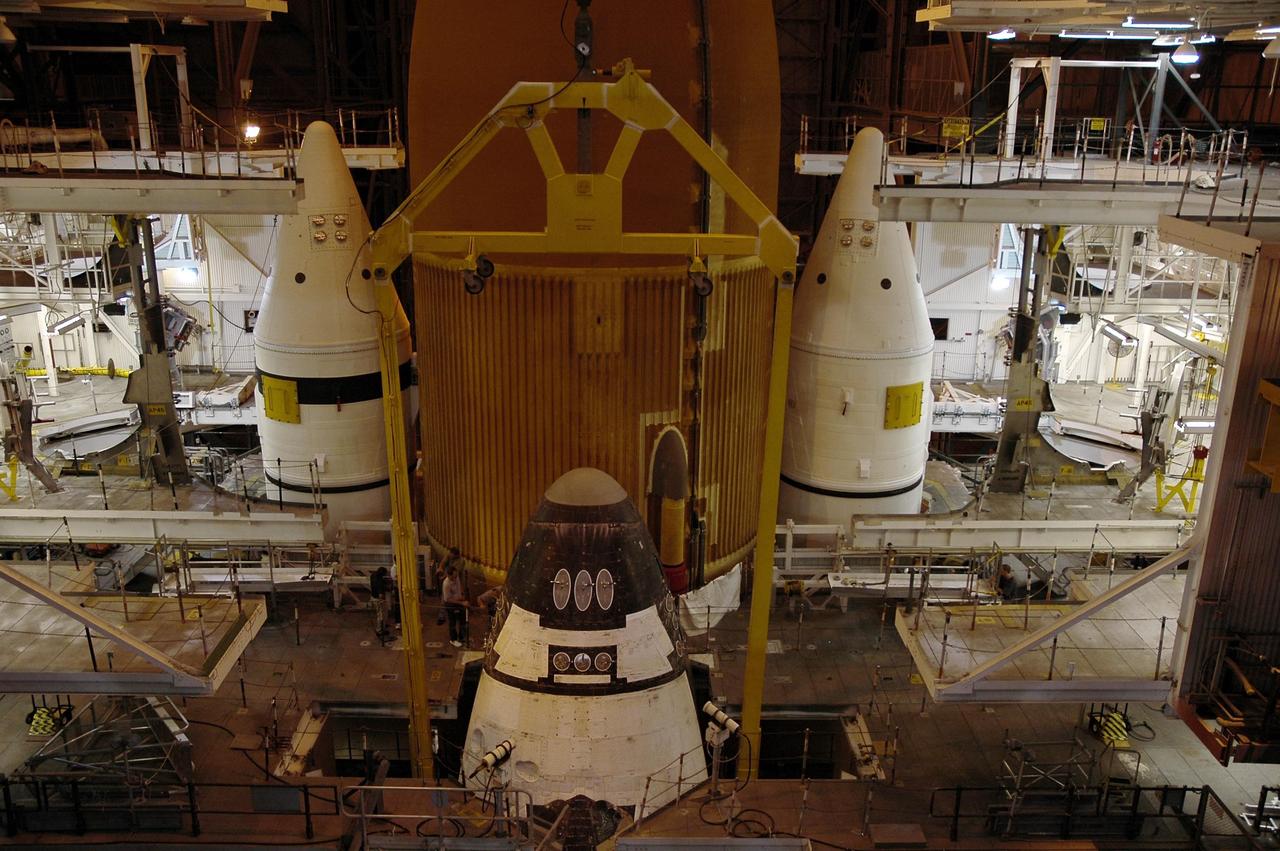
KENNEDY SPACE CENTER, FLA. - In high bay 3 of the Vehicle Assembly Building, the nose of the orbiter Atlantis is dwarfed by the external tank behind it and the twin solid rocket boosters. The orbiter is being mated with the tank and boosters, already installed on the mobile launcher platform below. After the stacking, Atlantis will undergo a shuttle interface test and other prelaunch processing. Atlantis' launch window begins Aug. 28. During its 11-day mission to the International Space Station, the STS-115 crew of six astronauts will continue construction of the station and install their cargo, the Port 3/4 truss segment with its two large solar arrays. Photo credit: NASA/Troy Cryder
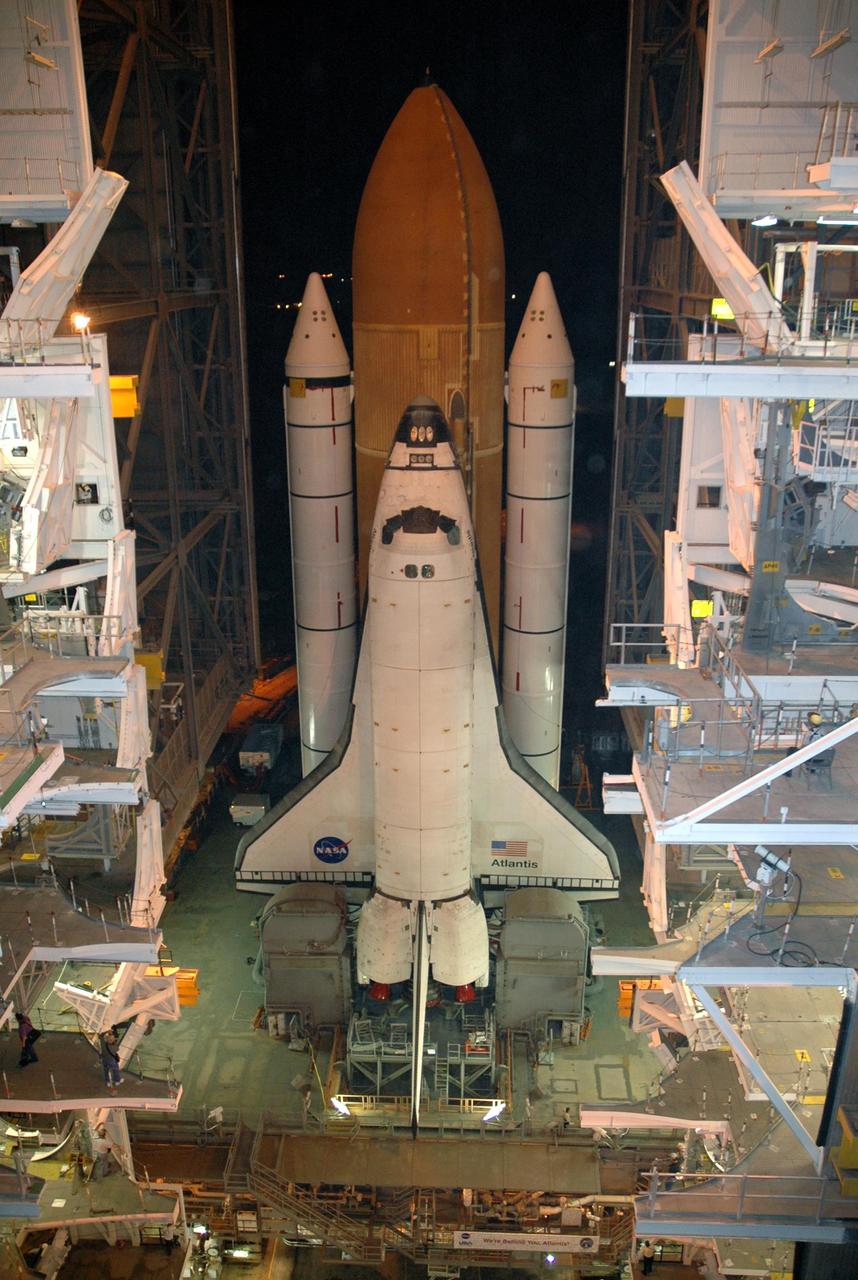
KENNEDY SPACE CENTER, FLA. - Sitting on top of the mobile launcher platform, Space Shuttle Atlantis begins rolling out of the Vehicle Assembly Building to Launch Pad 39B via the crawler-transporter underneath. First motion was at 1:05 a.m. The slow speed of the crawler results in a 6-hour trek to the pad approximately 4 miles away. Atlantis' launch window begins Aug. 27 for an 11-day mission to the International Space Station. The STS-115 crew of six astronauts will continue construction of the station and install their cargo, the Port 3/4 truss segment with its two large solar arrays. Photo credit: NASA/Troy Cryder
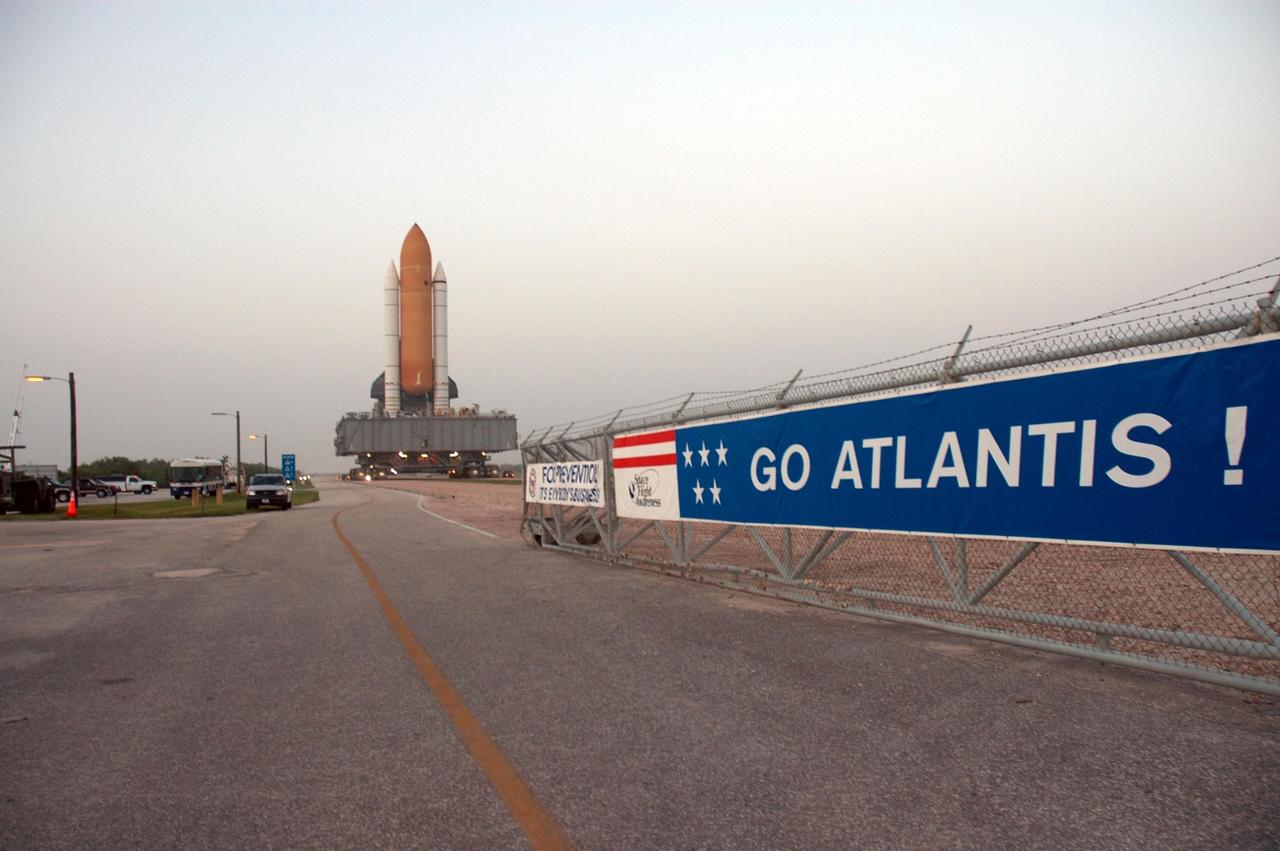
KENNEDY SPACE CENTER, FLA. - Sitting on top of the mobile launcher platform, Space Shuttle Atlantis rolls out to Launch Pad 39B via the crawlerway. First motion out of the Vehicle Assembly Building was 1:05 a.m. The slow speed of the crawler results in a 6-hour trek to the pad approximately 4 miles away. Atlantis' launch window begins Aug. 27 for an 11-day mission to the International Space Station. The STS-115 crew of six astronauts will continue construction of the station and install their cargo, the Port 3/4 truss segment with its two large solar arrays. Photo credit: NASA/Troy Cryder
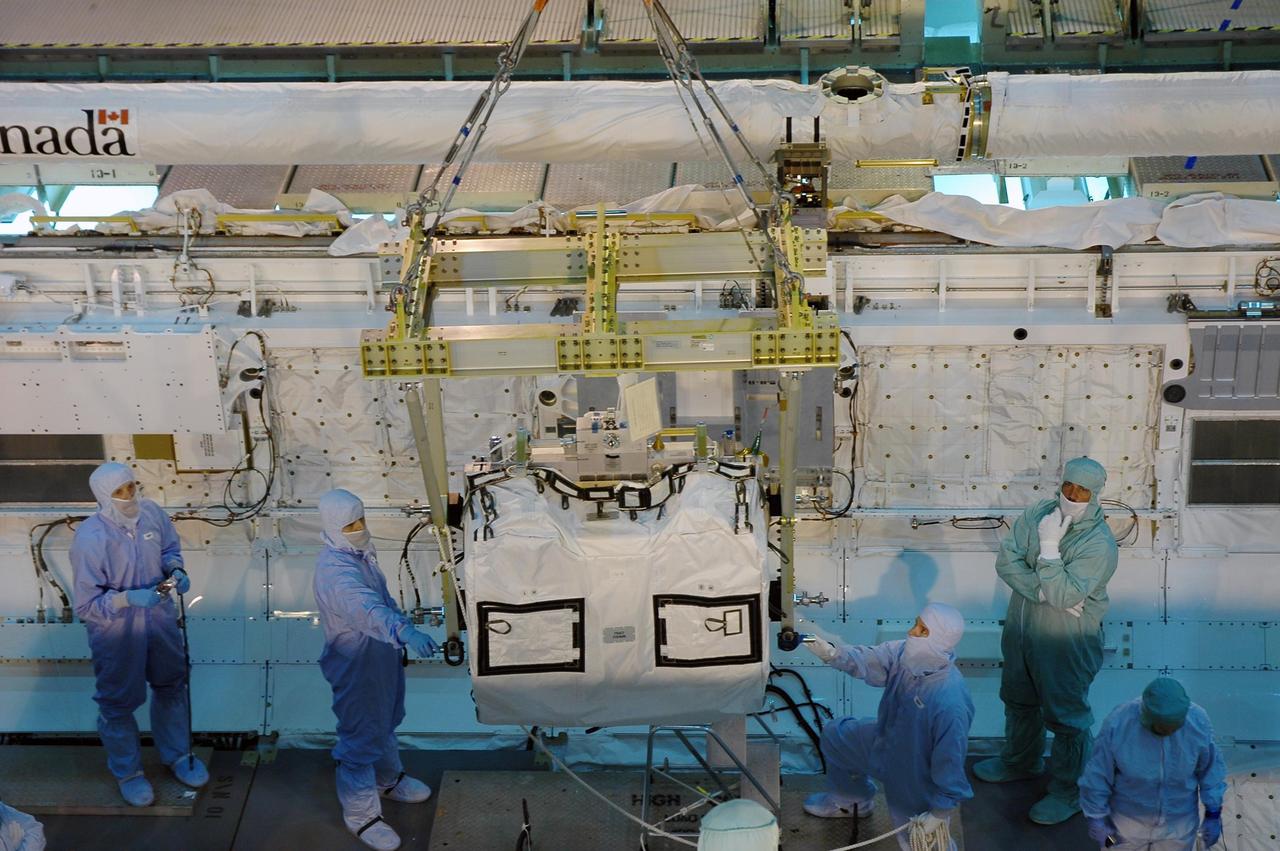
KENNEDY SPACE CENTER, Fla. -- In the Orbiter Processing Facility bay 3, workers are ready to move a main bus switching unit into Discovery's payload bay. A main bus switching unit is used for power distribution, circuit protection and fault isolation on the space station's power system. The units route power to proper locations in the space station, such as from solar arrays through umbilicals into the U.S. Lab. The unit will be installed on the external stowage platform 2 attached to the Quest airlock for temporary storage. Discovery is targeted to launch mission STS-120 no earlier than Oct. 20. Photo credit: NASA/Jim Grossmann

CAPE CANAVERAL, Fla. -- Before dawn, space shuttle Discovery, atop the mobile launcher platform, makes the slow 3.4-mile journey to Launch Pad 39A at NASA's Kennedy Space Center in Florida. First motion out of the Vehicle Assembly Building (far left) was at 5:17 a.m. EST. Discovery is targeted to launch to the International Space Station Feb. 12. During Discovery's 14-day mission, the crew will install the S6 truss segment and its solar arrays to the starboard side of the station, completing the station's backbone, or truss, enabling a six-person crew to live there starting in May. Photo credit: NASA/Troy Cryder