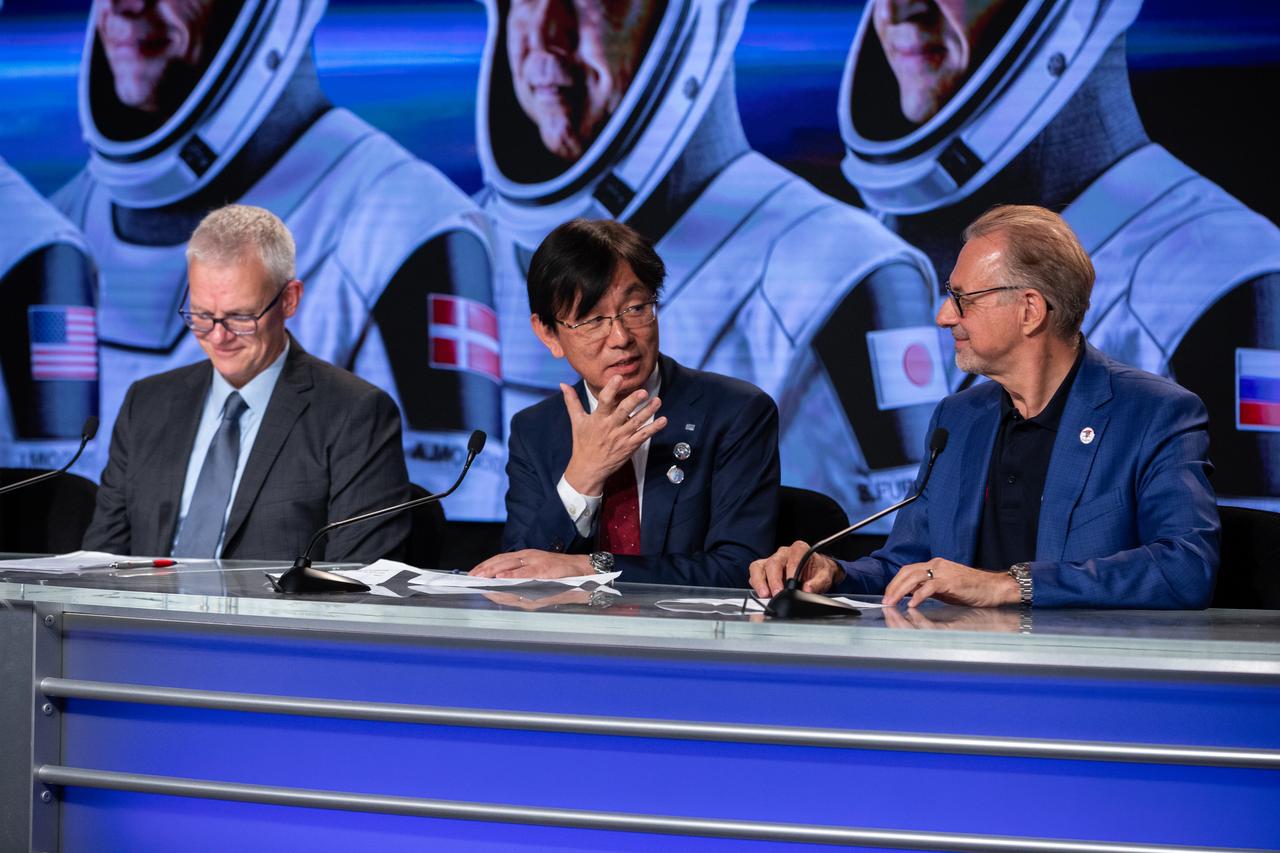
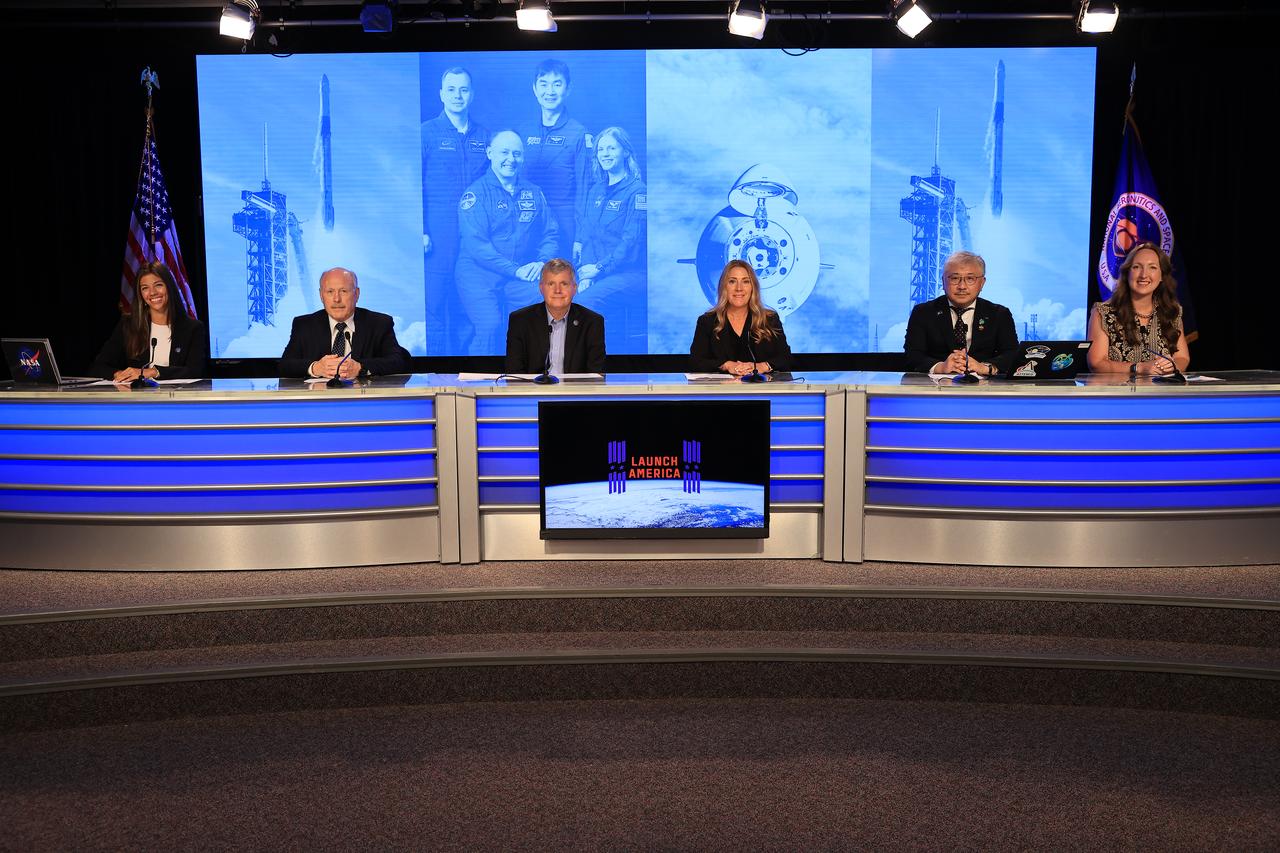
NASA hosts a Crew-7 postlaunch news conference at the agency’s Kennedy Space Center in Florida on Saturday, Aug. 26, 2023. Participants, from left, are: Benji Reed, senior director, Human Spaceflight Programs, SpaceX; Hiroshi Sasaki, vice president, JAXA (Japan Aerospace Exploration Agency); and Josef Aschbacher, director general, ESA (European Space Agency).
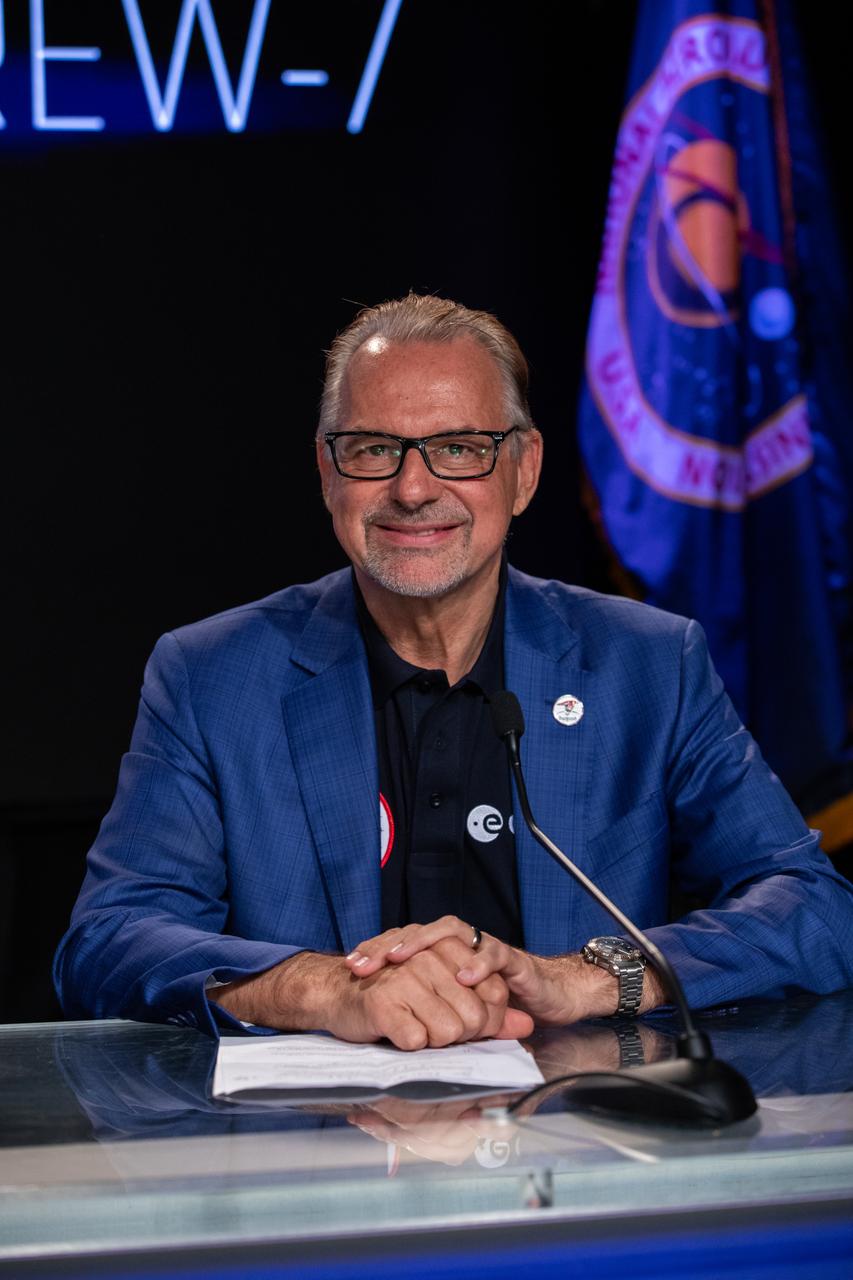
Josef Aschbacher, director general of ESA (European Space Agency), participates in a Crew-7 postlaunch news conference at the agency’s Kennedy Space Center in Florida on Saturday, Aug. 26, 2023. Crew-7 crew members NASA astronaut Jasmin Moghbeli, ESA astronaut Andreas Mogensen, JAXA (Japan Aerospace Exploration Agency) astronaut Satoshi Furukawa, and Roscosmos cosmonaut Konstantin Borisov launched aboard SpaceX’s Dragon spacecraft from Kennedy at 3:27 a.m. EDT. They will dock to the orbiting laboratory at about 8:40 a.m. EDT Sunday, Aug. 27.
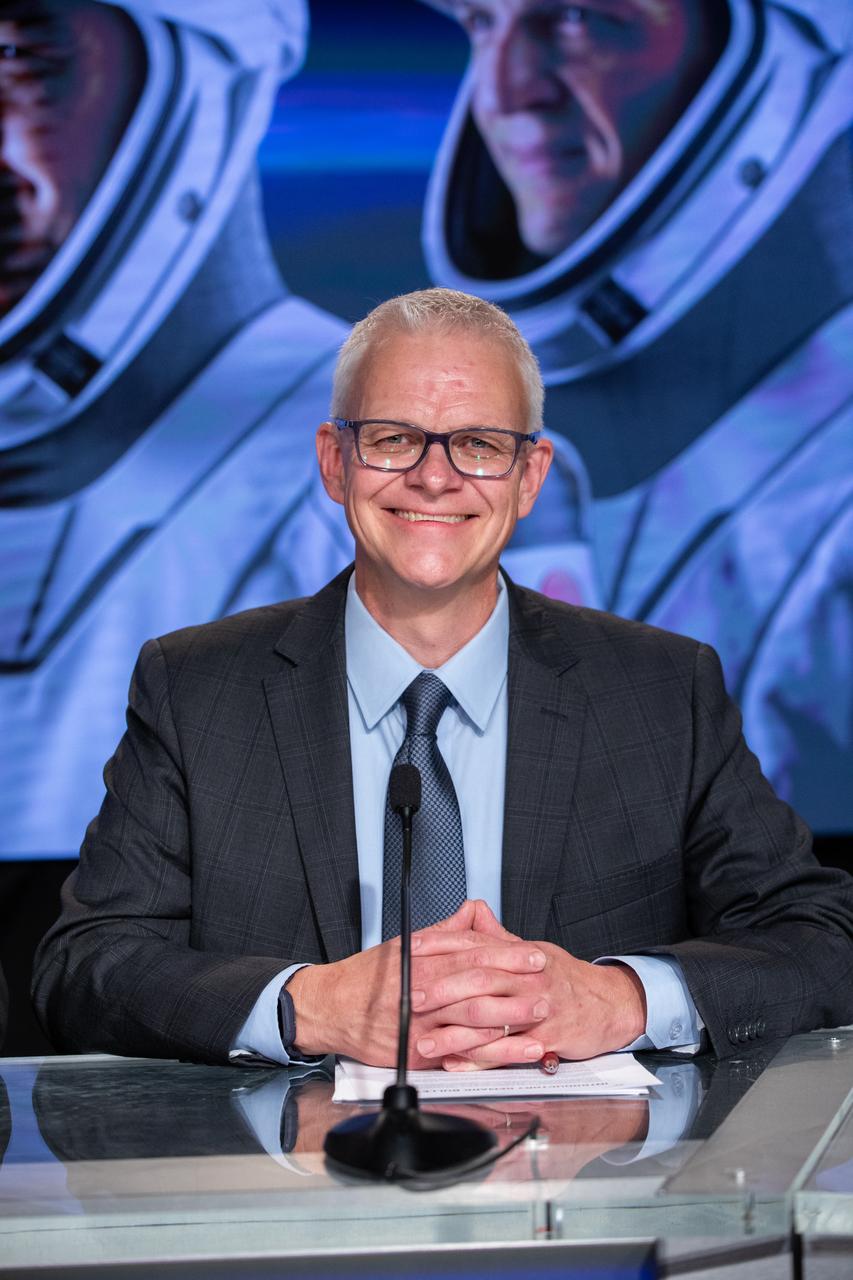
Benji Reed, senior director of Human Spaceflight Programs at SpaceX, participates in a Crew-7 postlaunch news conference at the agency’s Kennedy Space Center in Florida on Saturday, Aug. 26, 2023. Crew-7 crew members NASA astronaut Jasmin Moghbeli, ESA (European Space Agency) astronaut Andreas Mogensen, JAXA (Japan Aerospace Exploration Agency) astronaut Satoshi Furukawa, and Roscosmos cosmonaut Konstantin Borisov launched aboard SpaceX’s Dragon spacecraft from Kennedy at 3:27 a.m. EDT. They will dock to the orbiting laboratory at about 8:40 a.m. EDT Sunday, Aug. 27.
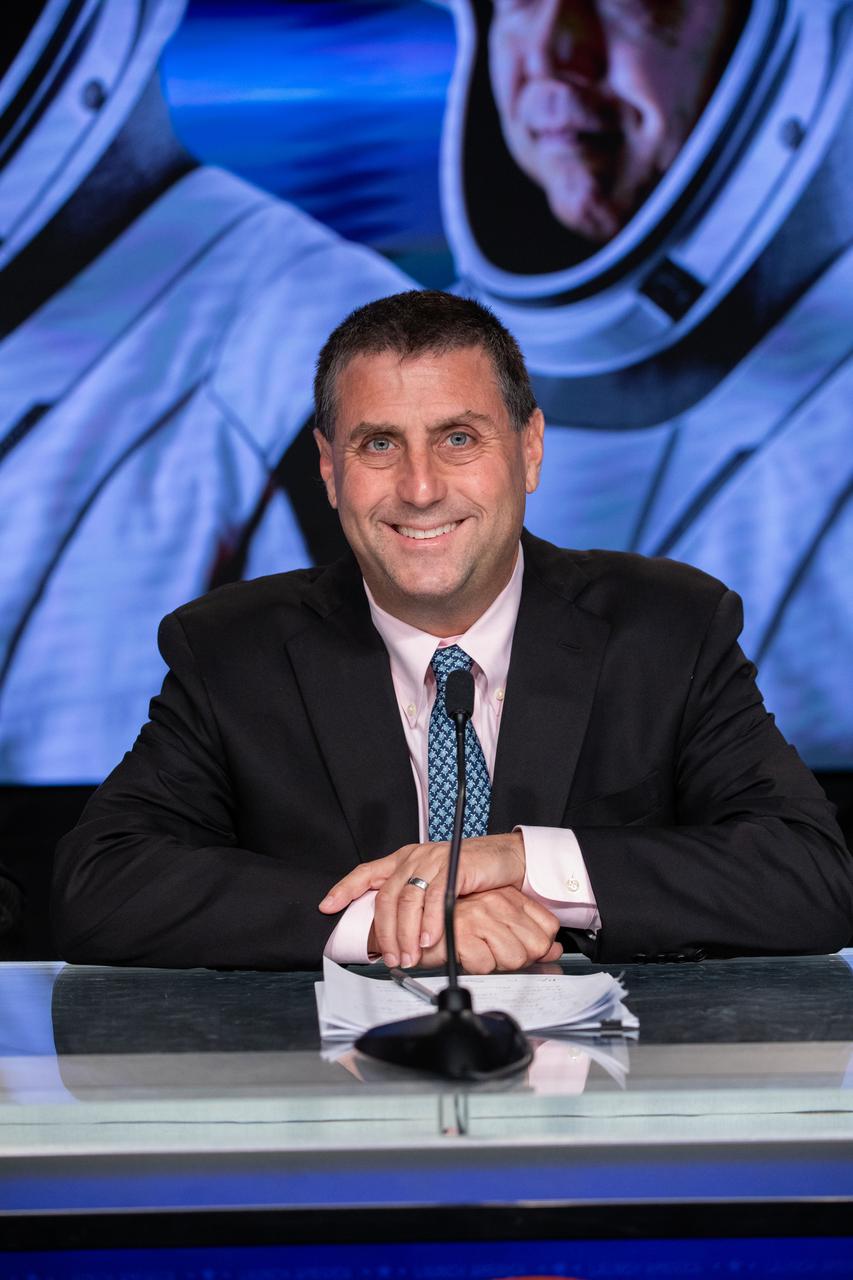
Joel Montalbano, manager of the International Space Station Program, participates in a Crew-7 postlaunch news conference at the agency’s Kennedy Space Center in Florida on Saturday, Aug. 26, 2023. Crew-7 crew members NASA astronaut Jasmin Moghbeli, ESA (European Space Agency) astronaut Andreas Mogensen, JAXA (Japan Aerospace Exploration Agency) astronaut Satoshi Furukawa, and Roscosmos cosmonaut Konstantin Borisov launched aboard SpaceX’s Dragon spacecraft from Kennedy at 3:27 a.m. EDT. They will dock to the orbiting laboratory at about 8:40 a.m. EDT Sunday, Aug. 27.
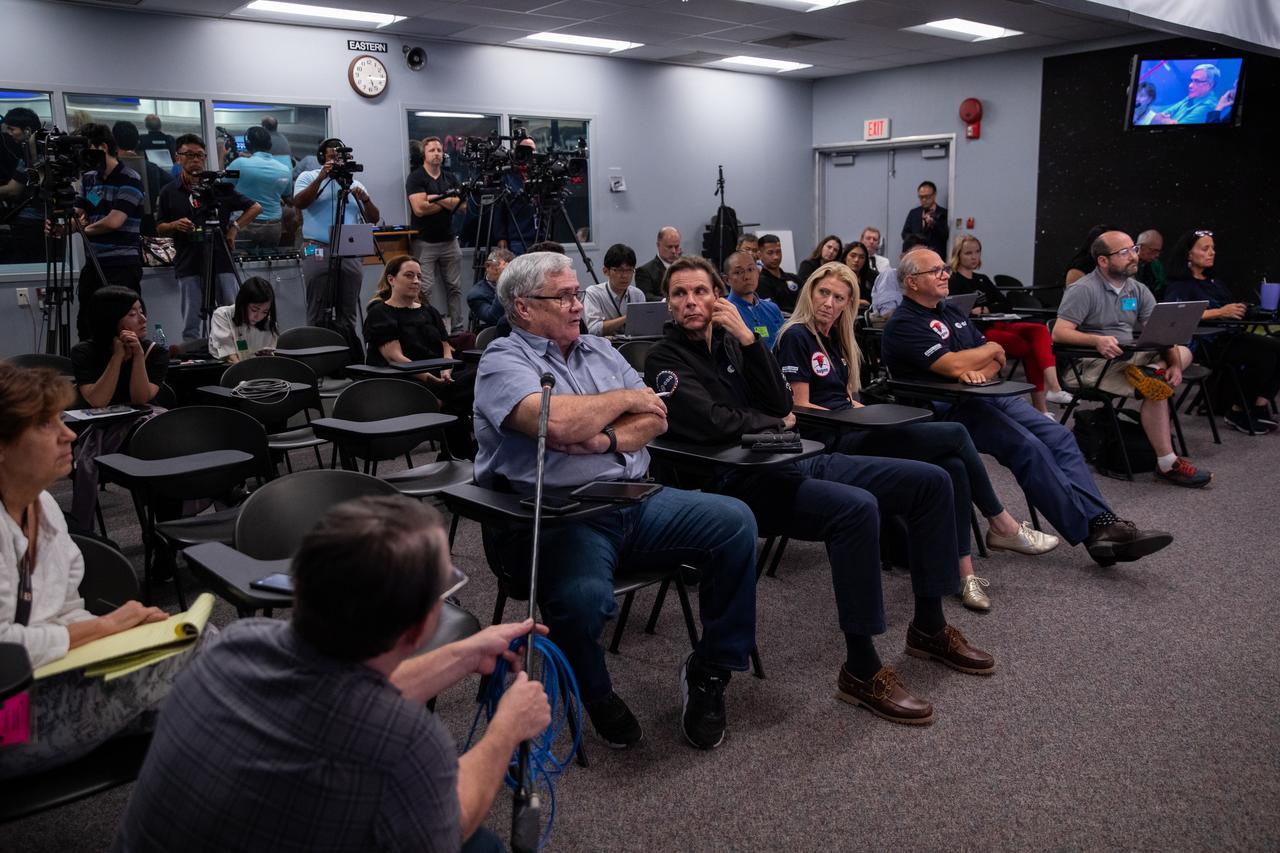
NASA hosts a Crew-7 postlaunch news conference at the agency’s Kennedy Space Center in Florida on Saturday, Aug. 26, 2023. Participants included Jasmine Hopkins, NASA Communications, Ken Bowersox, associate administrator, Space Operations Mission Directorate, NASA Headquarters; Steve Stich, manager, Commercial Crew Program, Kennedy; Joel Montalbano, manager, International Space Station Program, Johnson; Benji Reed, senior director, Human Spaceflight Programs, SpaceX; Hiroshi Sasaki, vice president, JAXA; and Josef Aschbacher, director general, ESA.
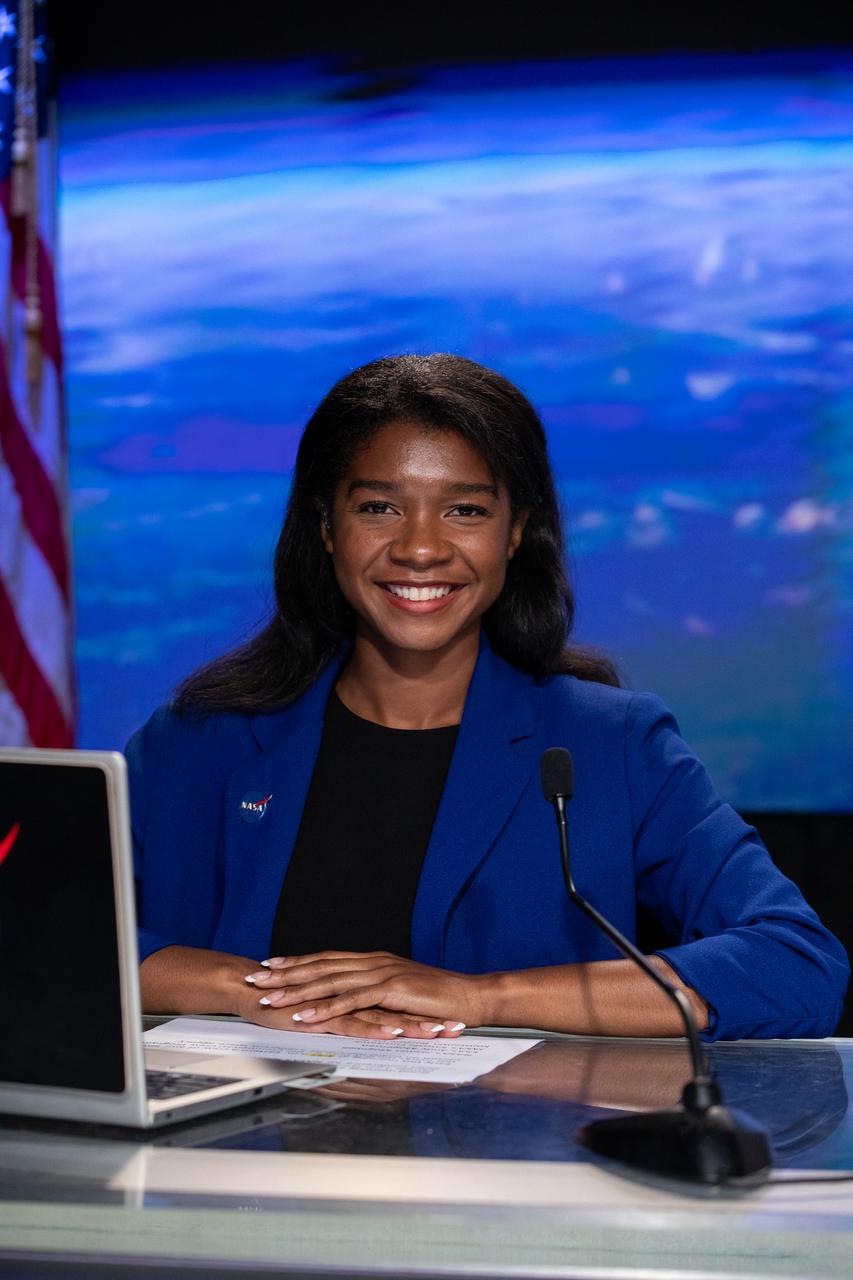
Jasmine Hopkins, NASA Communications, hosts a Crew-7 postlaunch news conference at the agency’s Kennedy Space Center in Florida on Saturday, Aug. 26, 2023. Crew-7 crew members NASA astronaut Jasmin Moghbeli, ESA astronaut Andreas Mogensen, JAXA (Japan Aerospace Exploration Agency) astronaut Satoshi Furukawa, and Roscosmos cosmonaut Konstantin Borisov launched aboard SpaceX’s Dragon spacecraft from Kennedy at 3:27 a.m. EDT. They will dock to the orbiting laboratory at about 8:40 a.m. EDT Sunday, Aug. 27.
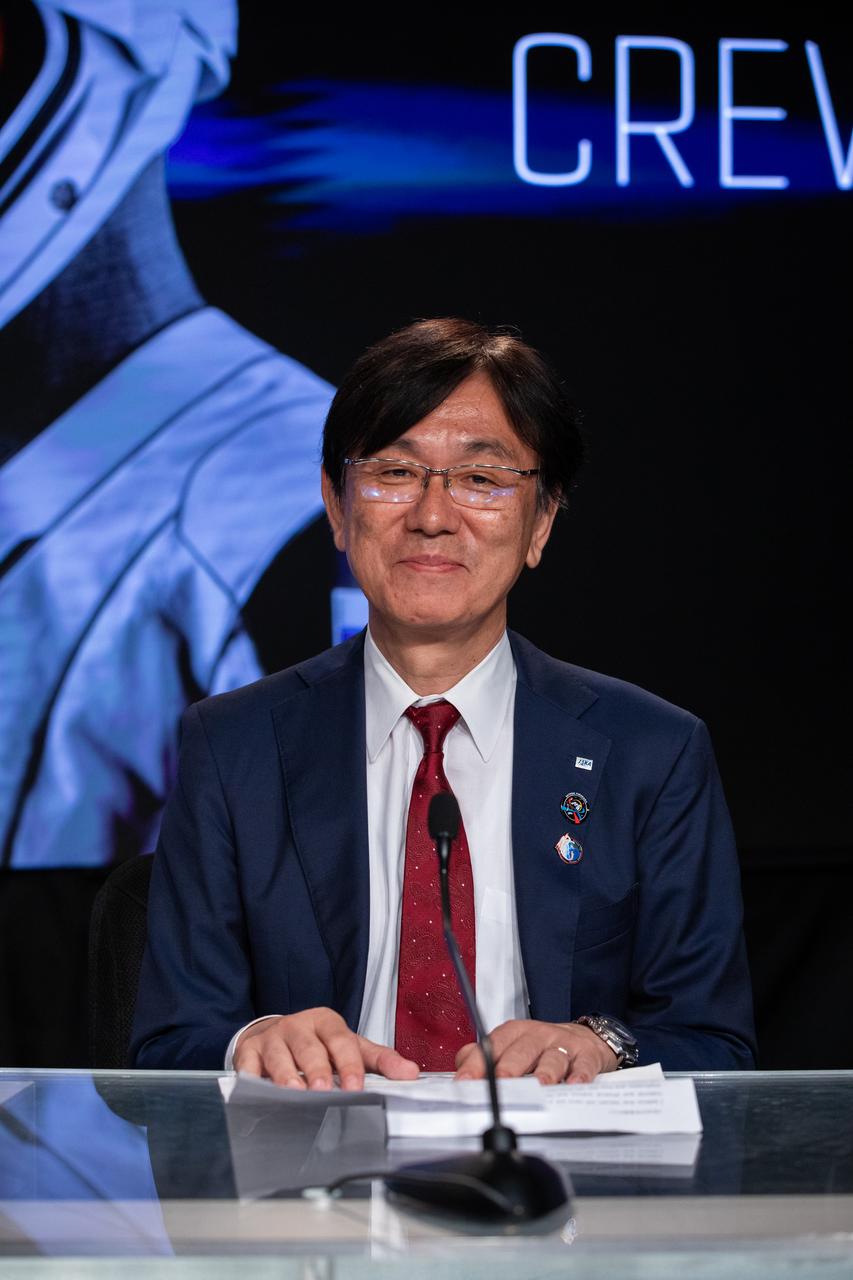
Hiroshi Sasaki, vice president of JAXA (Japan Aerospace Exploration Agency), participates in a Crew-7 postlaunch news conference at the agency’s Kennedy Space Center in Florida on Saturday, Aug. 26, 2023. Crew-7 crew members NASA astronaut Jasmin Moghbeli, ESA (European Space Agency) astronaut Andreas Mogensen, JAXA astronaut Satoshi Furukawa, and Roscosmos cosmonaut Konstantin Borisov launched aboard SpaceX’s Dragon spacecraft from Kennedy at 3:27 a.m. EDT. They will dock to the orbiting laboratory at about 8:40 a.m. EDT Sunday, Aug. 27.
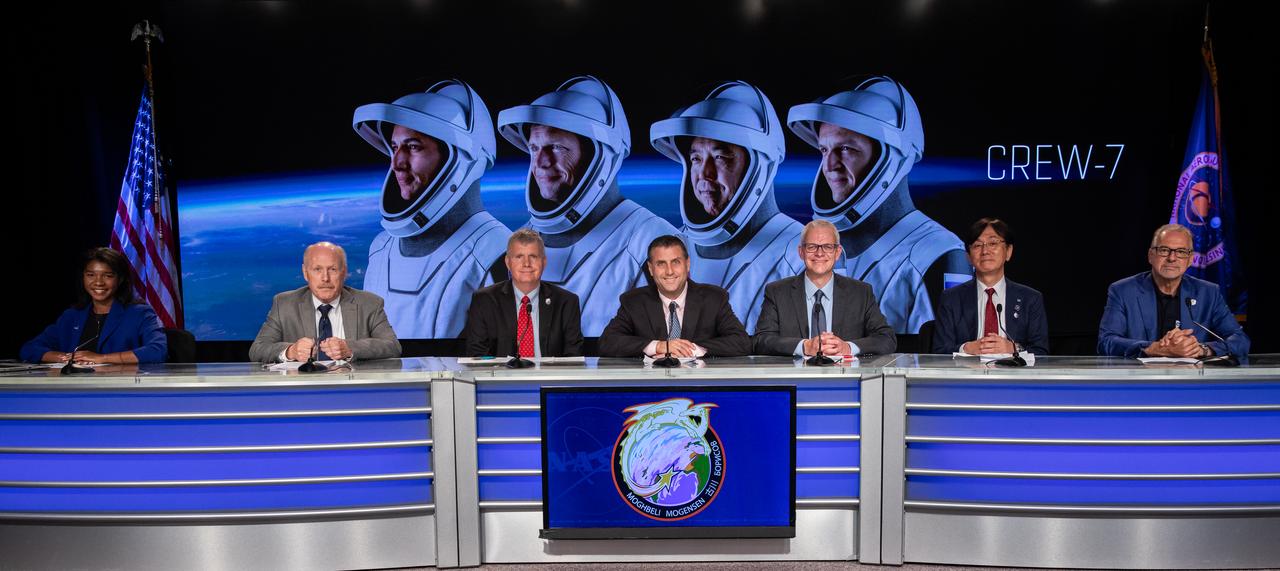
NASA hosts a Crew-7 postlaunch news conference at the agency’s Kennedy Space Center in Florida on Saturday, Aug. 26, 2023. Participants, from left, are: Jasmine Hopkins, NASA Communications, Ken Bowersox, associate administrator, Space Operations Mission Directorate, NASA Headquarters; Steve Stich, manager, Commercial Crew Program, Kennedy; Joel Montalbano, manager, International Space Station Program, Johnson; Benji Reed, senior director, Human Spaceflight Programs, SpaceX; Hiroshi Sasaki, vice president, JAXA; and Josef Aschbacher, director general, ESA.
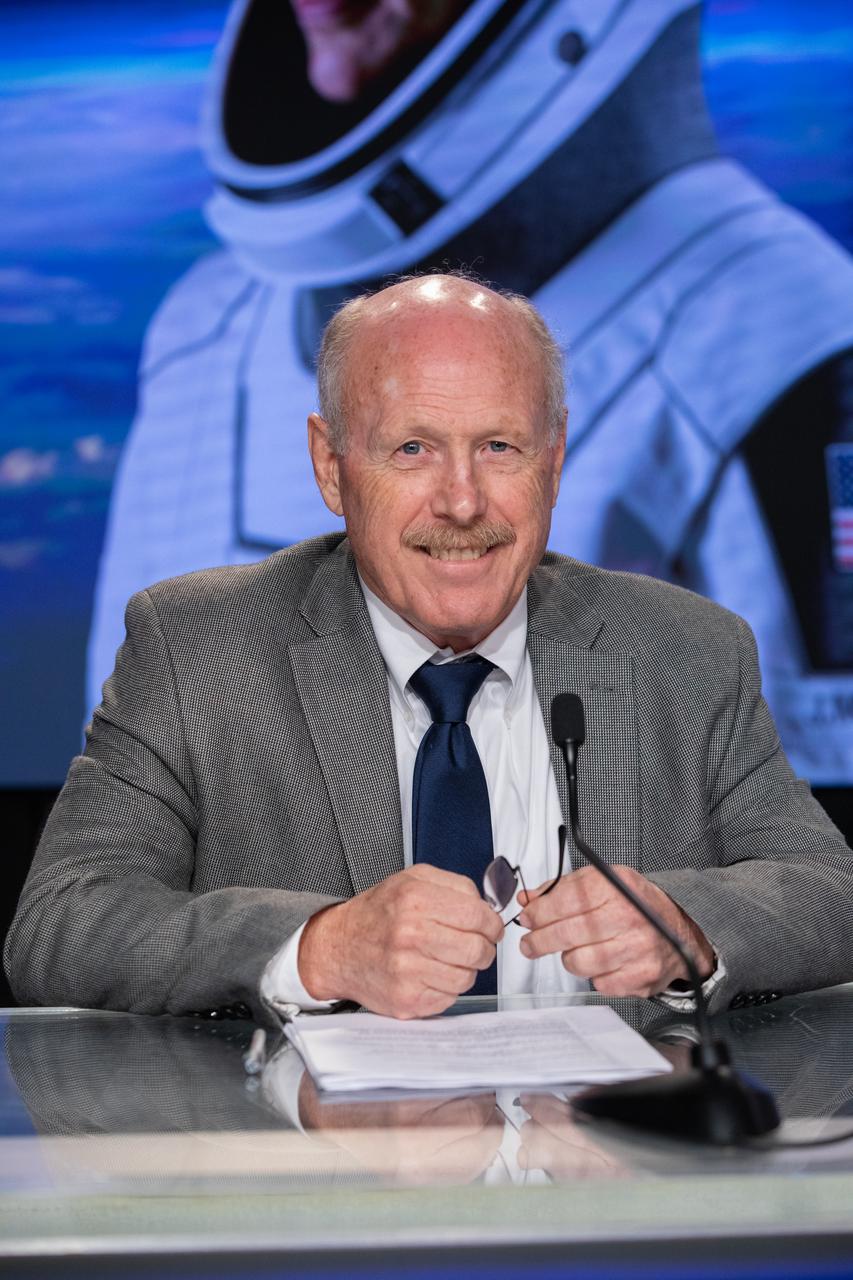
Ken Bowersox, associate administrator of the Space Operations Mission Directorate at NASA Headquarters, participates in a Crew-7 postlaunch news conference at the agency’s Kennedy Space Center in Florida on Saturday, Aug. 26, 2023. Crew-7 crew members NASA astronaut Jasmin Moghbeli, ESA (European Space Agency) astronaut Andreas Mogensen, JAXA (Japan Aerospace Exploration Agency) astronaut Satoshi Furukawa, and Roscosmos cosmonaut Konstantin Borisov launched aboard SpaceX’s Dragon spacecraft from Kennedy at 3:27 a.m. EDT. They will dock to the orbiting laboratory at about 8:40 a.m. EDT Sunday, Aug. 27.
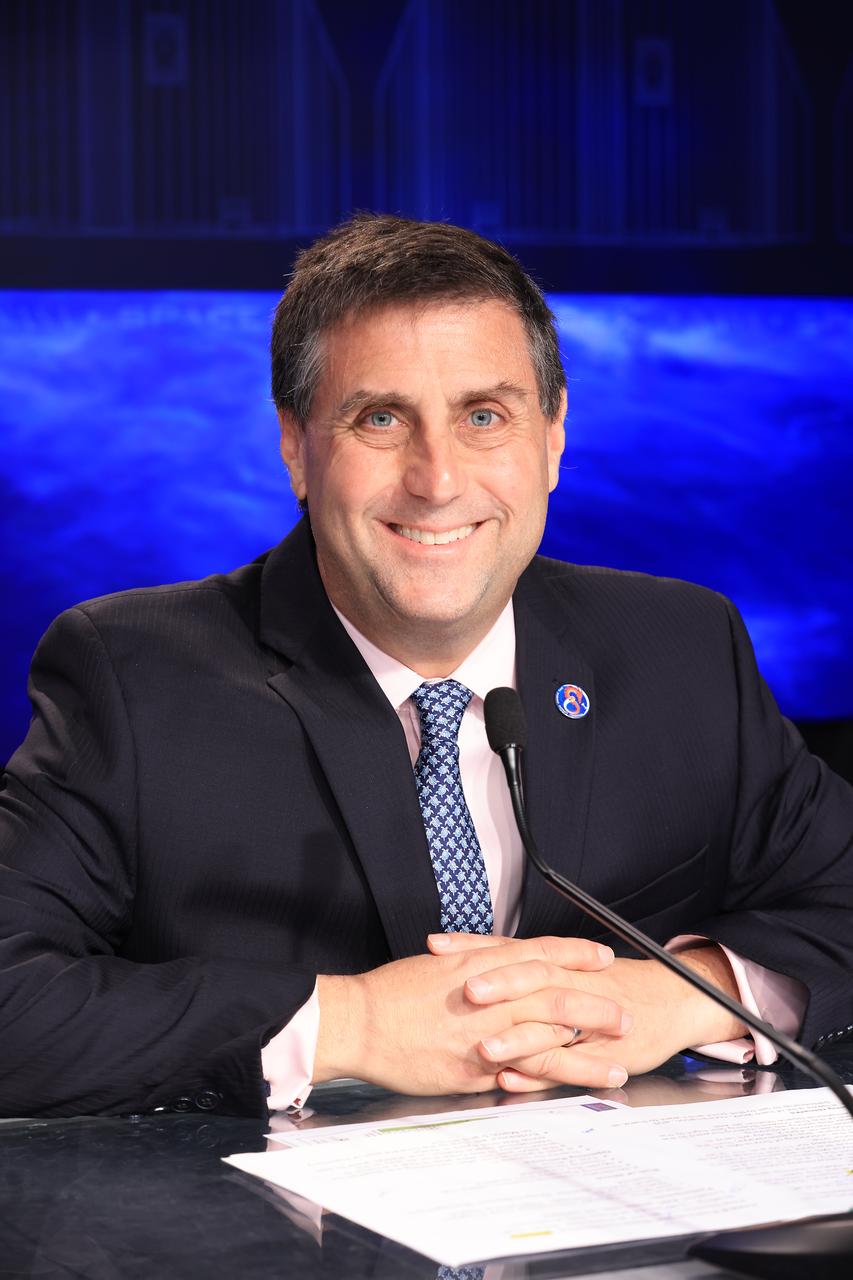
Joel Montalbano, manager of NASA’s International Space Station Program, participates in a postlaunch news conference at the agency’s Kennedy Space Center in Florida on Monday, March 4, 2024. NASA astronauts Commander Matthew Dominick, Pilot Michael Barratt, and Mission Specialist Jeanette Epps, along with Roscosmos cosmonaut Mission Specialist Alexander Grebenkin, launched aboard SpaceX’s Dragon spacecraft from Kennedy at 10:53 p.m. Sunday, March 3 and will spend about six months at the orbiting laboratory as part of the agency’s Commercial Crew Program.
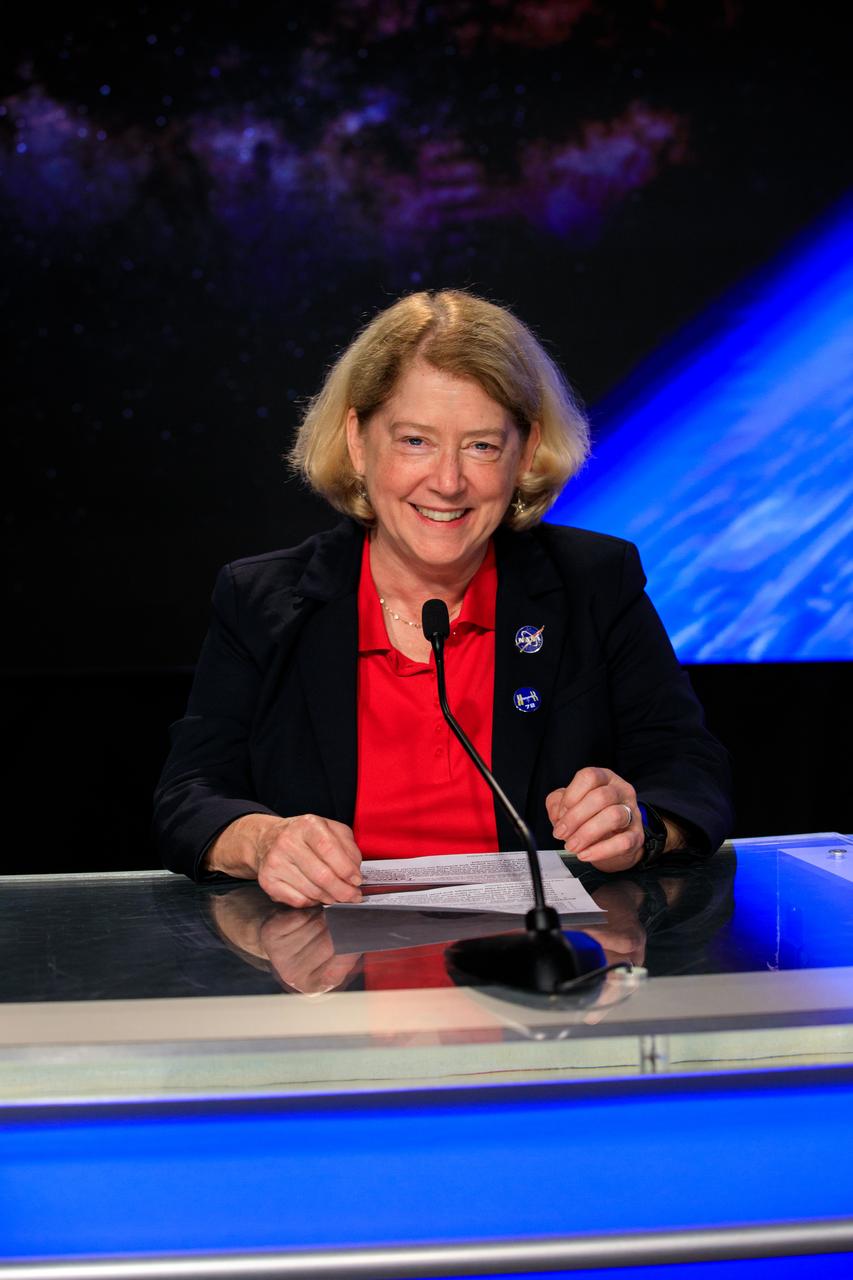
NASA Deputy Administrator Pam Melroy participates in a postlaunch news conference at the agency’s Kennedy Space Center in Florida on Saturday, Sept. 28, 2024, following the launch of NASA’s SpaceX Crew-9 mission to the International Space Station. NASA astronaut Nick Hague and Roscosmos cosmonaut Aleksandr Gorbunov launched aboard SpaceX’s Dragon spacecraft and Falcon 9 rocket from nearby Space Launch Complex-40 at Cape Canaveral Space Force Station at 1:17 p.m. EDT on the ninth crew rotation mission with SpaceX to the space station as part of the agency’s Commercial Crew Program.
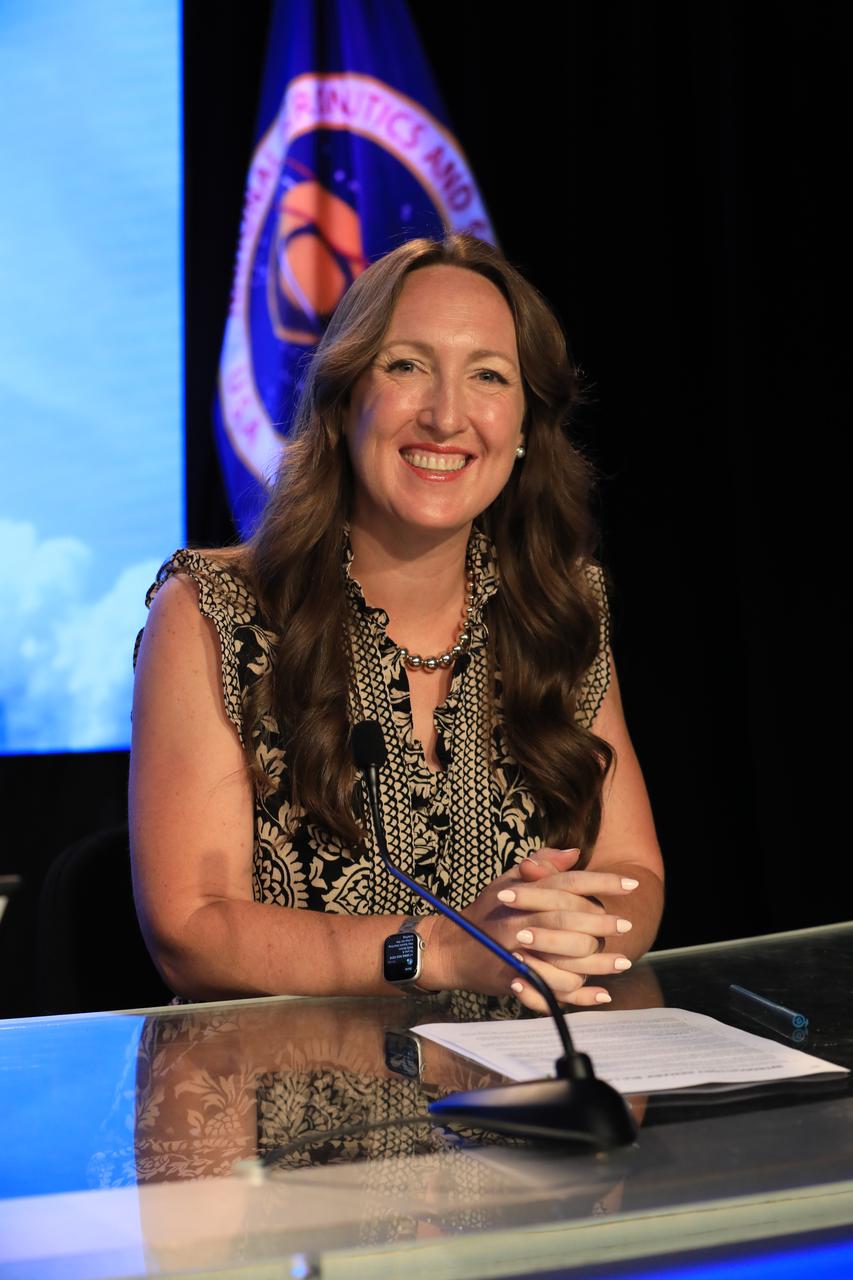
Sarah Walker, director, Dragon Mission Management, SpaceX participates in a postlaunch news conference at the agency’s Kennedy Space Center in Florida on Friday, Aug. 1, 2025, following the launch of NASA’s SpaceX Crew-11 mission to the International Space Station. NASA astronauts Zena Cardman and Mike Fincke, along with JAXA (Japan Aerospace Exploration Agency) astronaut Kimiya Yui and Roscosmos cosmonaut Oleg Platonov, launched to the International Space Station aboard SpaceX’s Dragon spacecraft and Falcon 9 rocket at 11:43 a.m. EDT on the 11th crew rotation mission with SpaceX to the space station as part of NASA’s Commercial Crew Program.
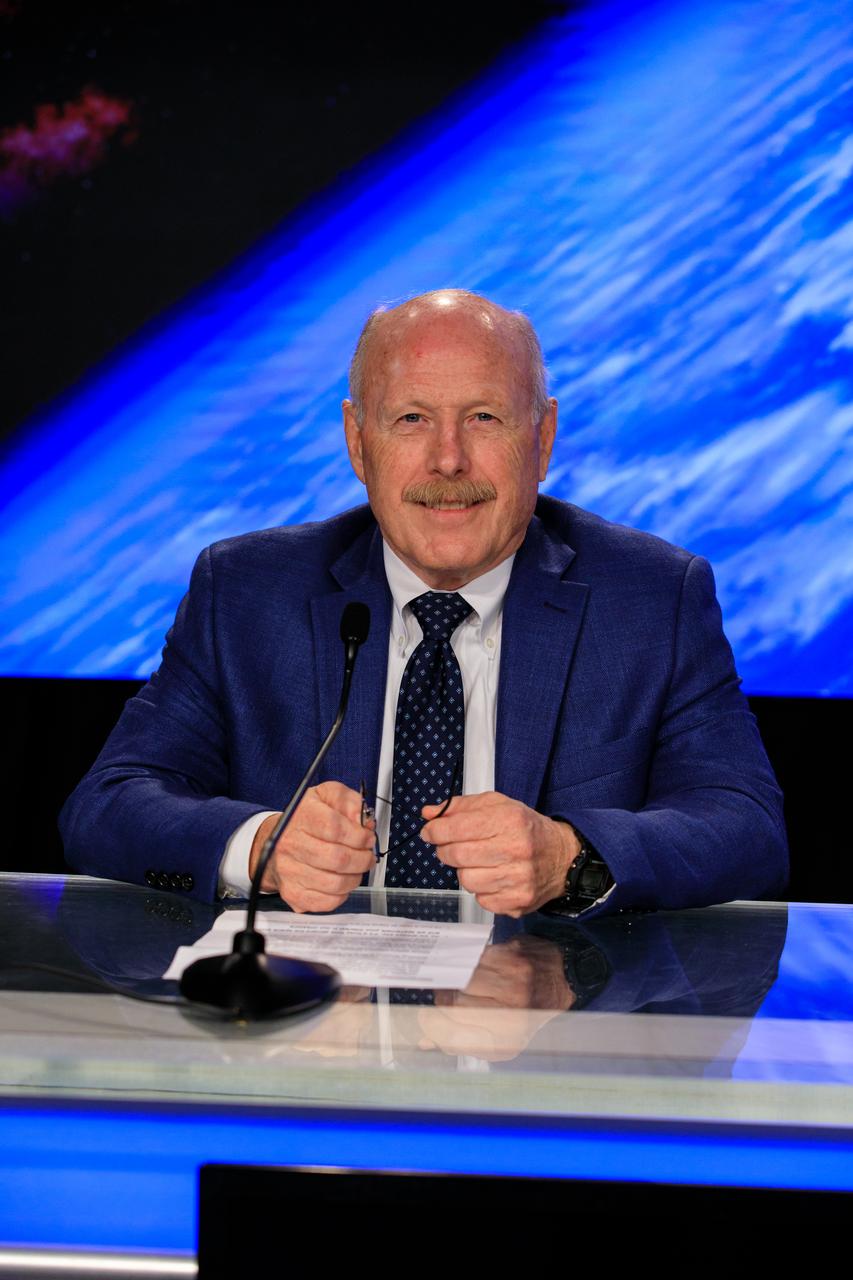
Ken Bowersox, associate administrator of NASA’s Space Operations Mission Directorate, participates in a postlaunch news conference at the agency’s Kennedy Space Center in Florida on Saturday, Sept. 28, 2024, following the launch of NASA’s SpaceX Crew-9 mission to the International Space Station. NASA astronaut Nick Hague and Roscosmos cosmonaut Aleksandr Gorbunov launched aboard SpaceX’s Dragon spacecraft and Falcon 9 rocket from nearby Space Launch Complex-40 at Cape Canaveral Space Force Station at 1:17 p.m. EDT on the ninth crew rotation mission with SpaceX to the space station as part of the agency’s Commercial Crew Program.
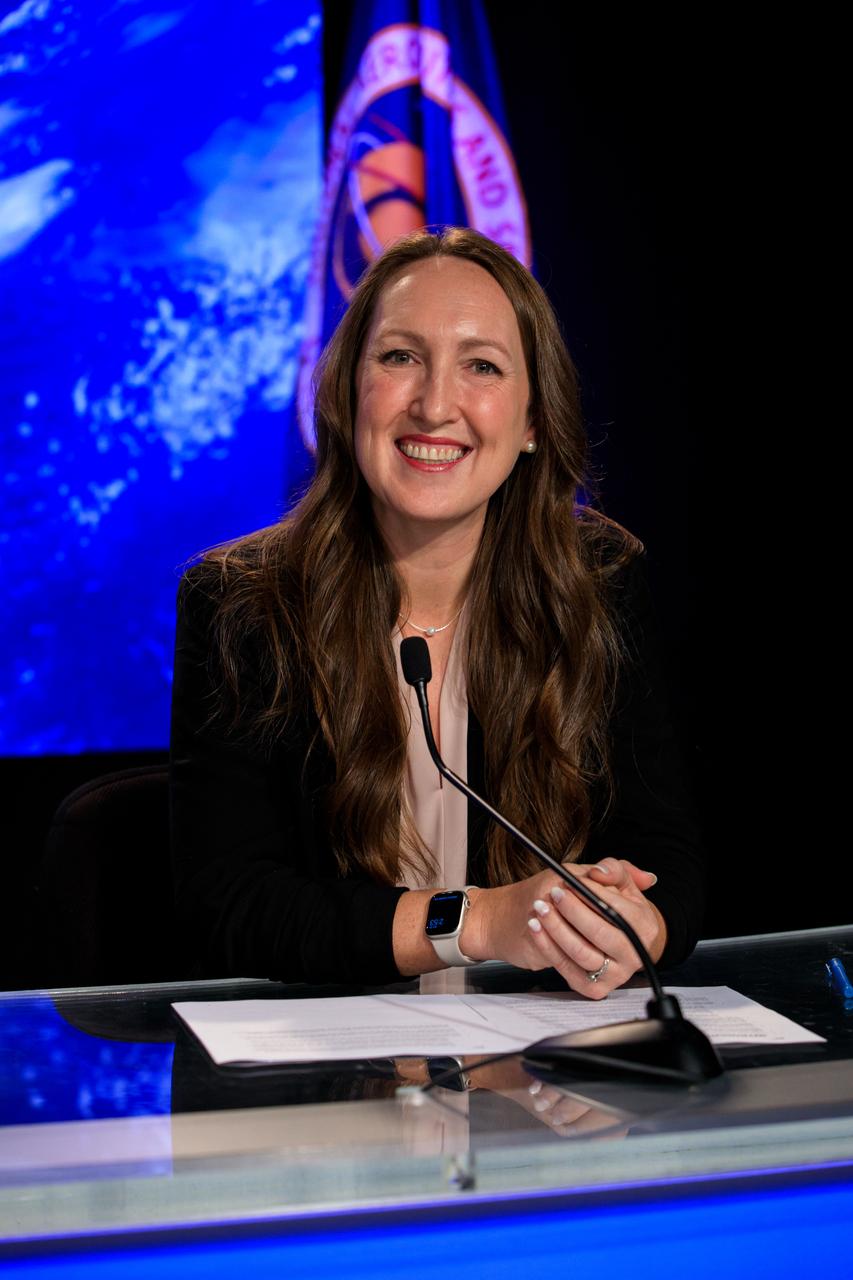
Sarah Walker, director of Dragon Mission Management at SpaceX, participates in a postlaunch news conference at the agency’s Kennedy Space Center in Florida on Saturday, Sept. 28, 2024, following the launch of NASA’s SpaceX Crew-9 mission to the International Space Station. NASA astronaut Nick Hague and Roscosmos cosmonaut Aleksandr Gorbunov launched aboard SpaceX’s Dragon spacecraft and Falcon 9 rocket from nearby Space Launch Complex-40 at Cape Canaveral Space Force Station at 1:17 p.m. EDT on the ninth crew rotation mission with SpaceX to the space station as part of the agency’s Commercial Crew Program.
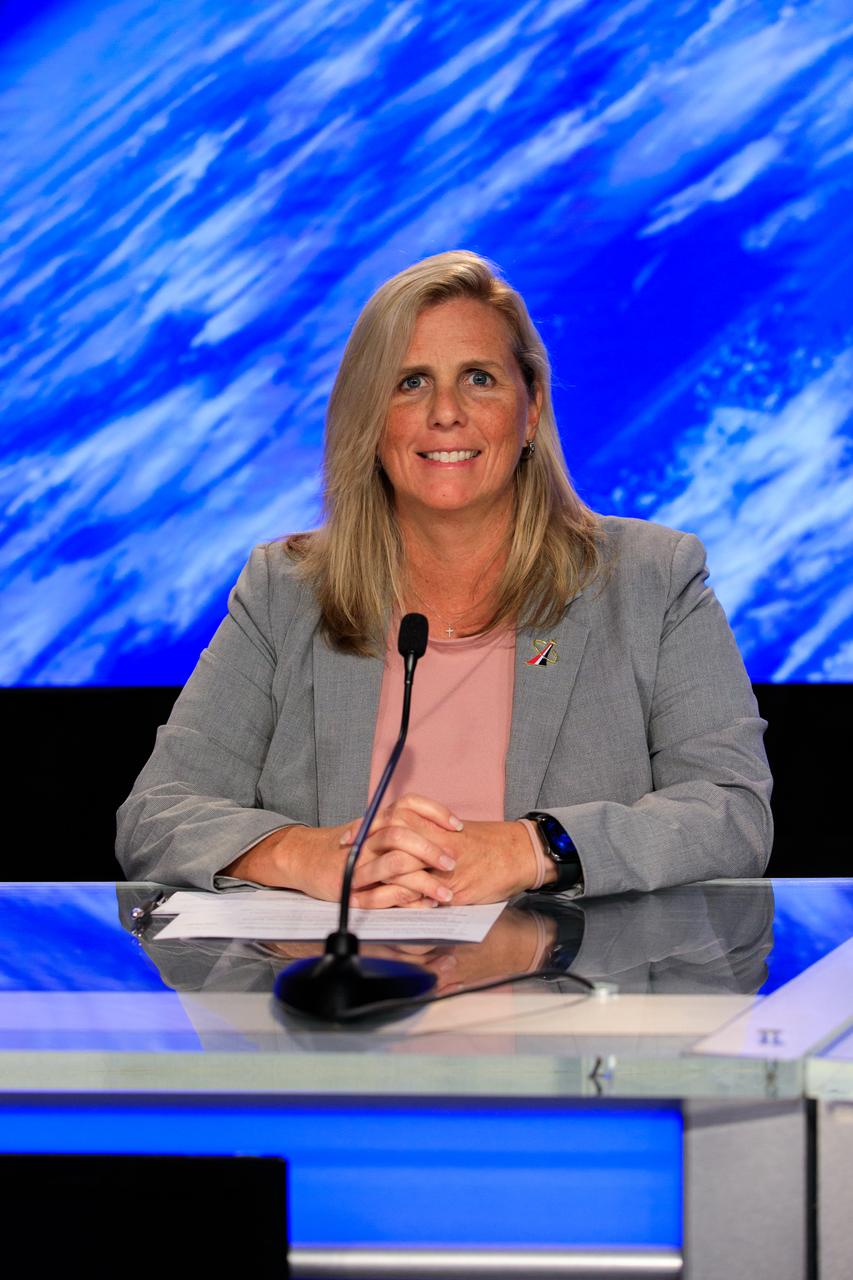
Dana Hutcherson, deputy manager of NASA’s Commercial Crew Program, participates in a postlaunch news conference at the agency’s Kennedy Space Center in Florida on Saturday, Sept. 28, 2024, following the launch of NASA’s SpaceX Crew-9 mission to the International Space Station. NASA astronaut Nick Hague and Roscosmos cosmonaut Aleksandr Gorbunov launched aboard SpaceX’s Dragon spacecraft and Falcon 9 rocket from nearby Space Launch Complex-40 at Cape Canaveral Space Force Station at 1:17 p.m. EDT on the ninth crew rotation mission with SpaceX to the space station as part of the agency’s Commercial Crew Program.
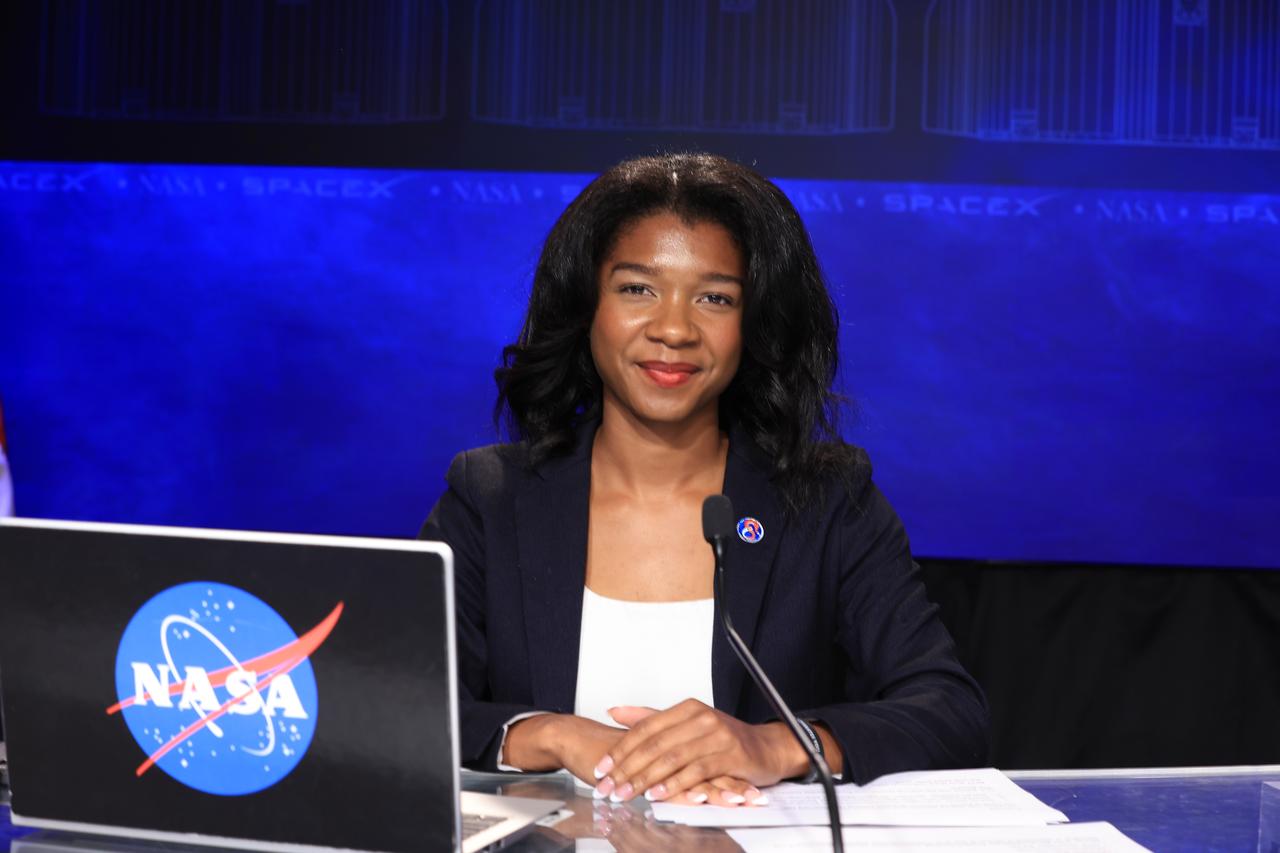
Jasmine Hopkins, NASA Communications, hosts a postlaunch news conference at the agency’s Kennedy Space Center in Florida on Monday, March 4, 2024, following the launch of NASA’s SpaceX Crew-8 mission. NASA astronauts Commander Matthew Dominick, Pilot Michael Barratt, and Mission Specialist Jeanette Epps, along with Roscosmos cosmonaut Mission Specialist Alexander Grebenkin, launched aboard SpaceX’s Dragon spacecraft from Kennedy at 10:53 p.m. Sunday, March 3 and will spend about six months at the orbiting laboratory as part of the agency’s Commercial Crew Program.
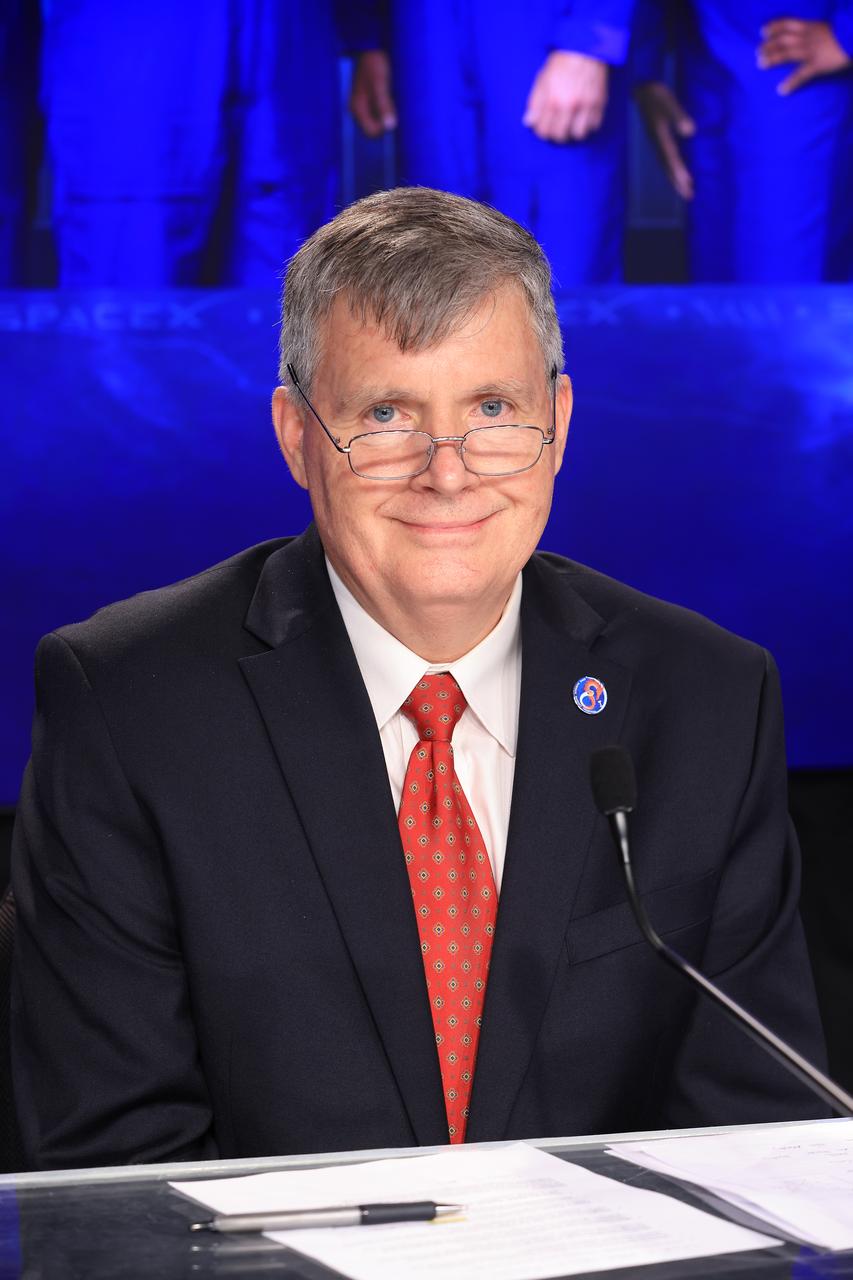
Steve Stich, manager of NASA’s Commercial Crew Program, participates in a postlaunch news conference at the agency’s Kennedy Space Center in Florida on Monday, March 4, 2024, following the launch of NASA’s SpaceX Crew-8 mission. NASA astronauts Commander Matthew Dominick, Pilot Michael Barratt, and Mission Specialist Jeanette Epps, along with Roscosmos cosmonaut Mission Specialist Alexander Grebenkin, launched aboard SpaceX’s Dragon spacecraft from Kennedy at 10:53 p.m. Sunday, March 3 and will spend about six months at the orbiting laboratory as part of the agency’s Commercial Crew Program.
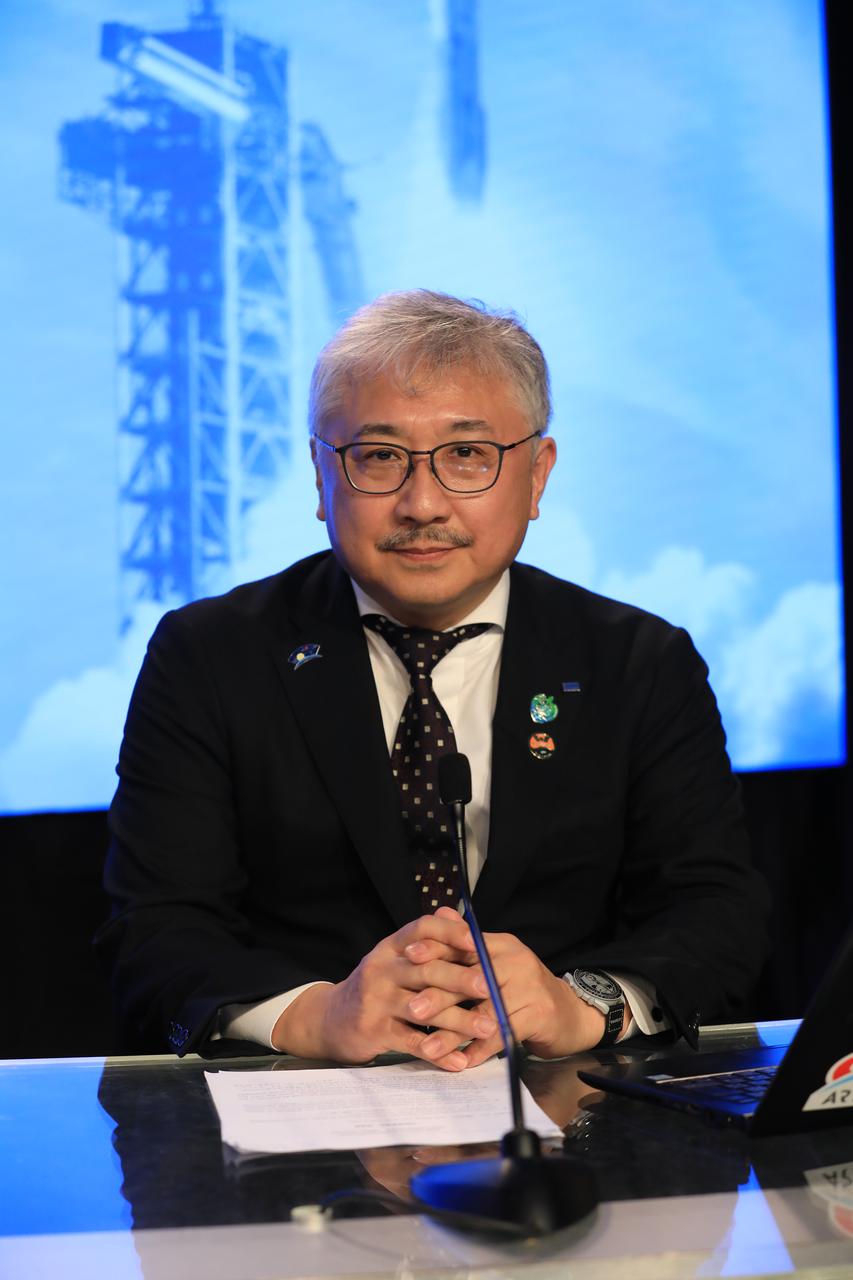
Naoki Nagai, program manager, International Space Station, Human Spaceflight Technology Directorate, JAXA, participates in a postlaunch news conference at the agency’s Kennedy Space Center in Florida on Friday, Aug. 1, 2025, following the launch of NASA’s SpaceX Crew-11 mission to the International Space Station. NASA astronauts Zena Cardman and Mike Fincke, along with JAXA (Japan Aerospace Exploration Agency) astronaut Kimiya Yui and Roscosmos cosmonaut Oleg Platonov, launched to the International Space Station aboard SpaceX’s Dragon spacecraft and Falcon 9 rocket at 11:43 a.m. EDT on the 11th crew rotation mission with SpaceX to the space station as part of NASA’s Commercial Crew Program.
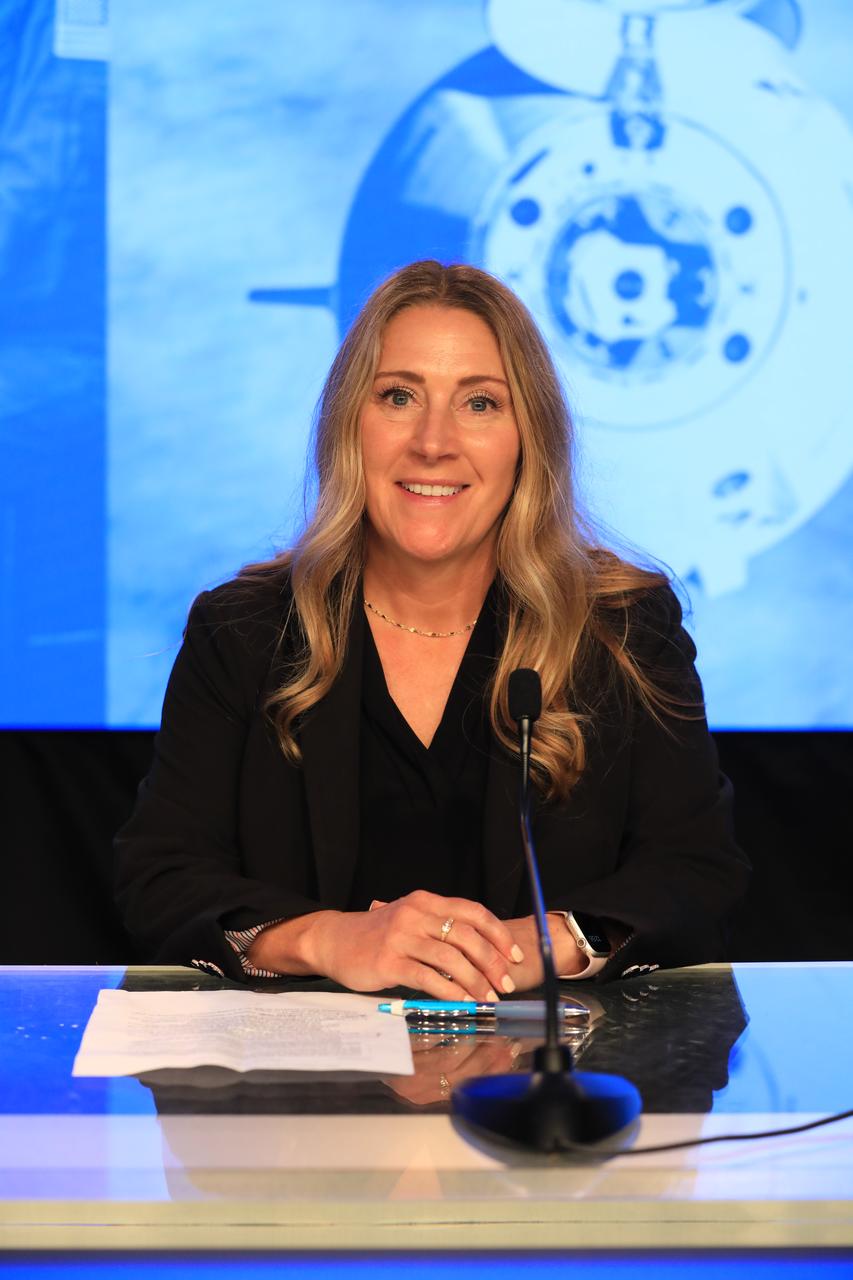
Dana Weigel, manager, NASA’s Commercial Crew Program, participates in a postlaunch news conference at the agency’s Kennedy Space Center in Florida on Friday, Aug. 1, 2025, following the launch of NASA’s SpaceX Crew-11 mission to the International Space Station. NASA astronauts Zena Cardman and Mike Fincke, along with JAXA (Japan Aerospace Exploration Agency) astronaut Kimiya Yui and Roscosmos cosmonaut Oleg Platonov, launched to the International Space Station aboard SpaceX’s Dragon spacecraft and Falcon 9 rocket at 11:43 a.m. EDT on the 11th crew rotation mission with SpaceX to the space station as part of NASA’s Commercial Crew Program.
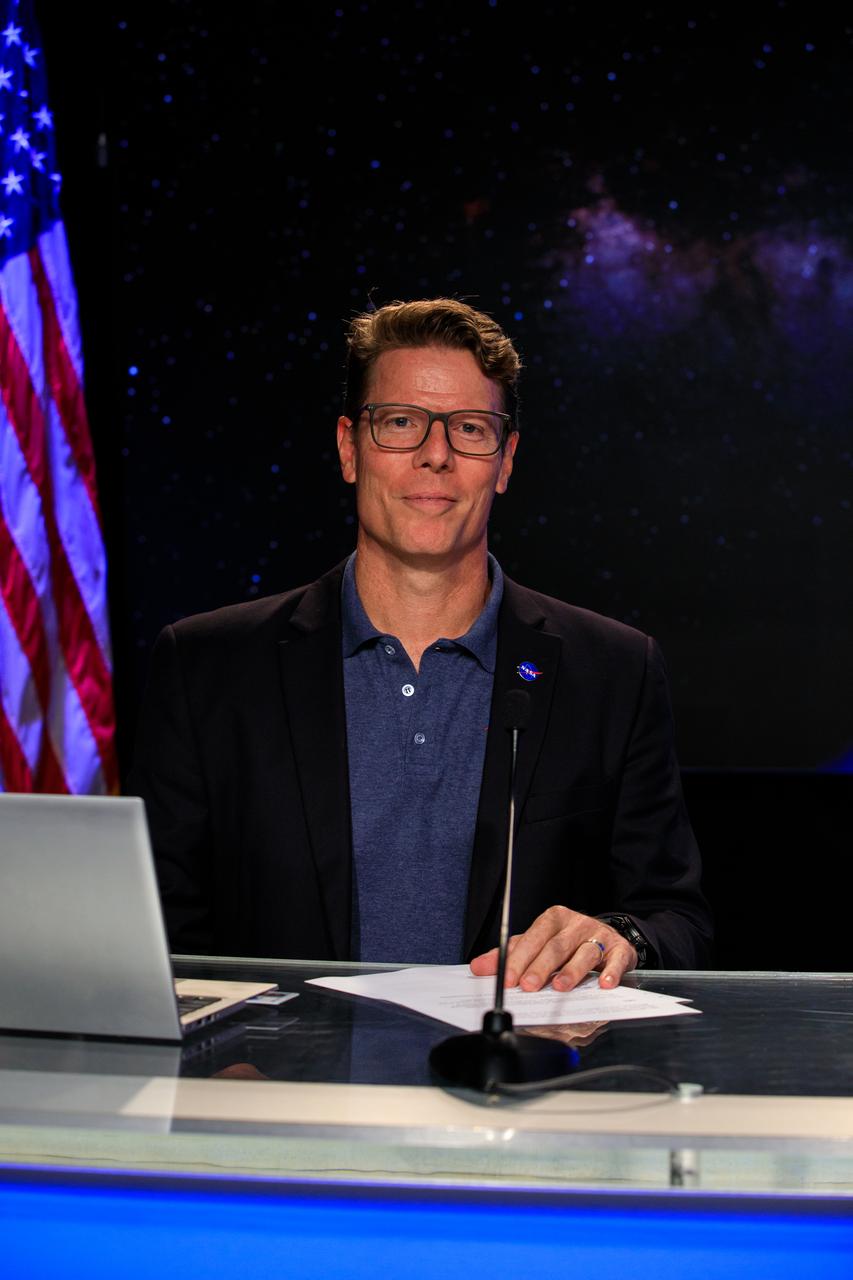
Derrol Nail, NASA Communications, participates in a postlaunch news conference at the agency’s Kennedy Space Center in Florida on Saturday, Sept. 28, 2024, following the launch of NASA’s SpaceX Crew-9 mission to the International Space Station. NASA astronaut Nick Hague and Roscosmos cosmonaut Aleksandr Gorbunov launched aboard SpaceX’s Dragon spacecraft and Falcon 9 rocket from nearby Space Launch Complex-40 at Cape Canaveral Space Force Station at 1:17 p.m. EDT on the ninth crew rotation mission with SpaceX to the space station as part of the agency’s Commercial Crew Program.
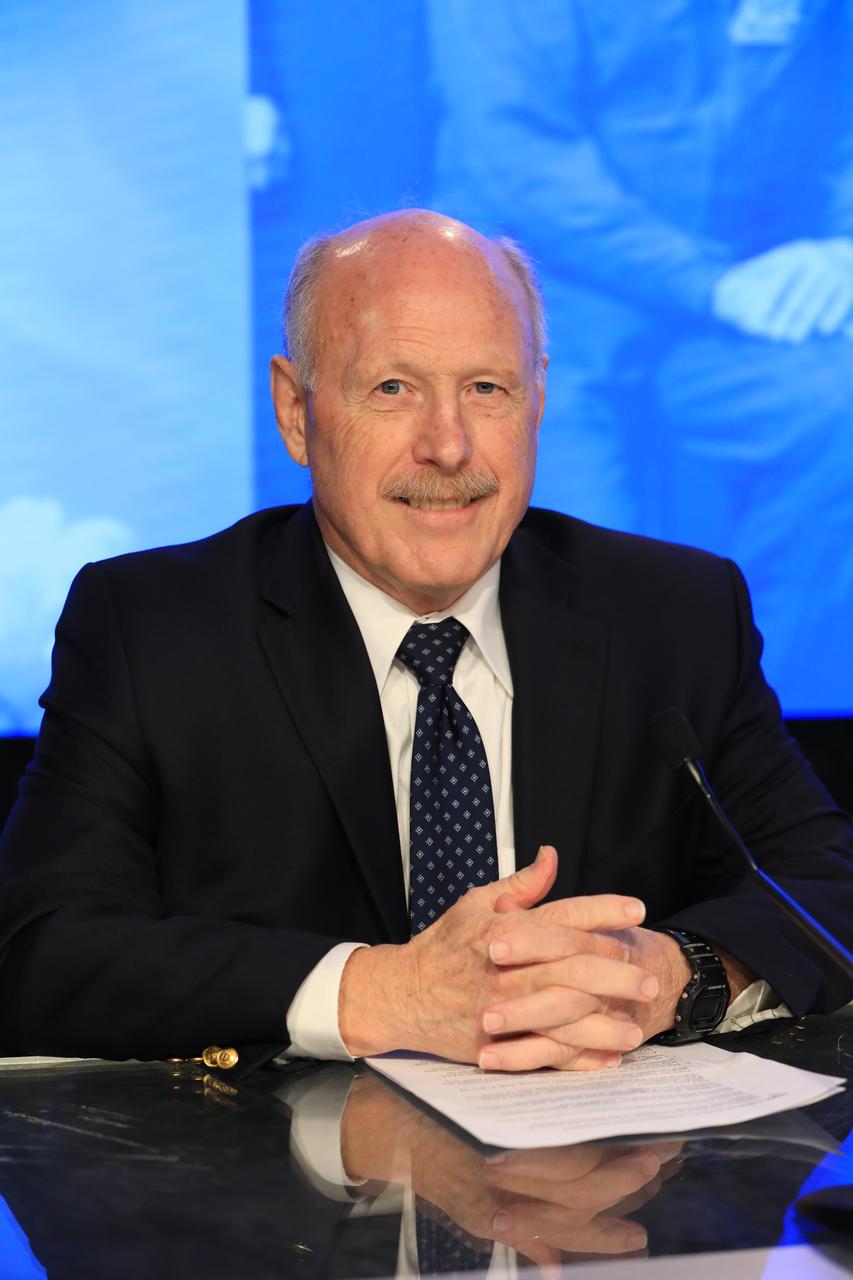
Ken Bowersox, associate administrator, NASA’s Space Operations Mission Directorate, participates in a postlaunch news conference at the agency’s Kennedy Space Center in Florida on Friday, Aug. 1, 2025, following the launch of NASA’s SpaceX Crew-11 mission to the International Space Station. NASA astronauts Zena Cardman and Mike Fincke, along with JAXA (Japan Aerospace Exploration Agency) astronaut Kimiya Yui and Roscosmos cosmonaut Oleg Platonov, launched to the International Space Station aboard SpaceX’s Dragon spacecraft and Falcon 9 rocket at 11:43 a.m. EDT on the 11th crew rotation mission with SpaceX to the space station as part of NASA’s Commercial Crew Program.
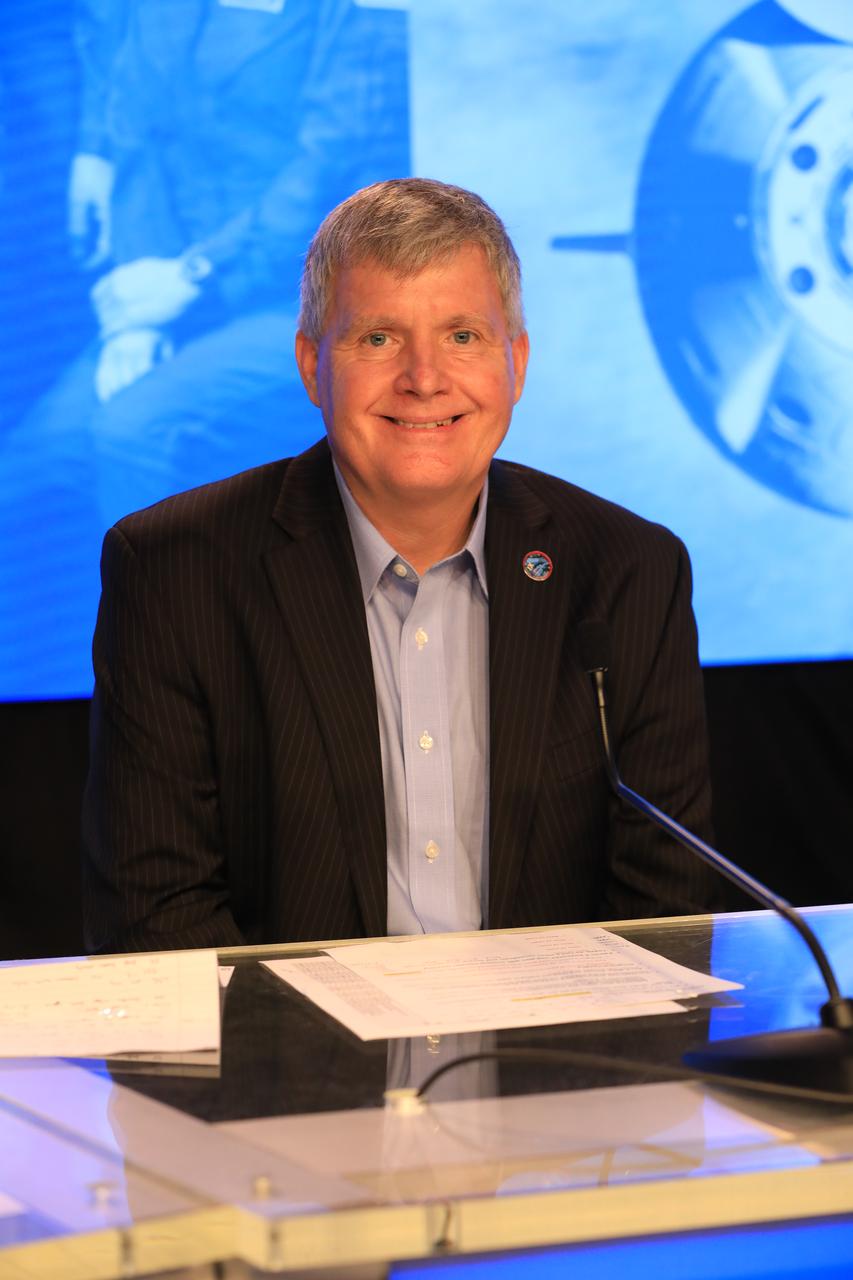
Steve Stich, manager, NASA’s Commercial Crew Program, participates in a postlaunch news conference at the agency’s Kennedy Space Center in Florida on Friday, Aug. 1, 2025, following the launch of NASA’s SpaceX Crew-11 mission to the International Space Station. NASA astronauts Zena Cardman and Mike Fincke, along with JAXA (Japan Aerospace Exploration Agency) astronaut Kimiya Yui and Roscosmos cosmonaut Oleg Platonov, launched to the International Space Station aboard SpaceX’s Dragon spacecraft and Falcon 9 rocket at 11:43 a.m. EDT on the 11th crew rotation mission with SpaceX to the space station as part of NASA’s Commercial Crew Program.

Antonia Jaramillo, NASA Communications, participates in a postlaunch news conference at the agency’s Kennedy Space Center in Florida on Friday, Aug. 1, 2025, following the launch of NASA’s SpaceX Crew-11 mission to the International Space Station. NASA astronauts Zena Cardman and Mike Fincke, along with JAXA (Japan Aerospace Exploration Agency) astronaut Kimiya Yui and Roscosmos cosmonaut Oleg Platonov, launched to the International Space Station aboard SpaceX’s Dragon spacecraft and Falcon 9 rocket at 11:43 a.m. EDT on the 11th crew rotation mission with SpaceX to the space station as part of NASA’s Commercial Crew Program.
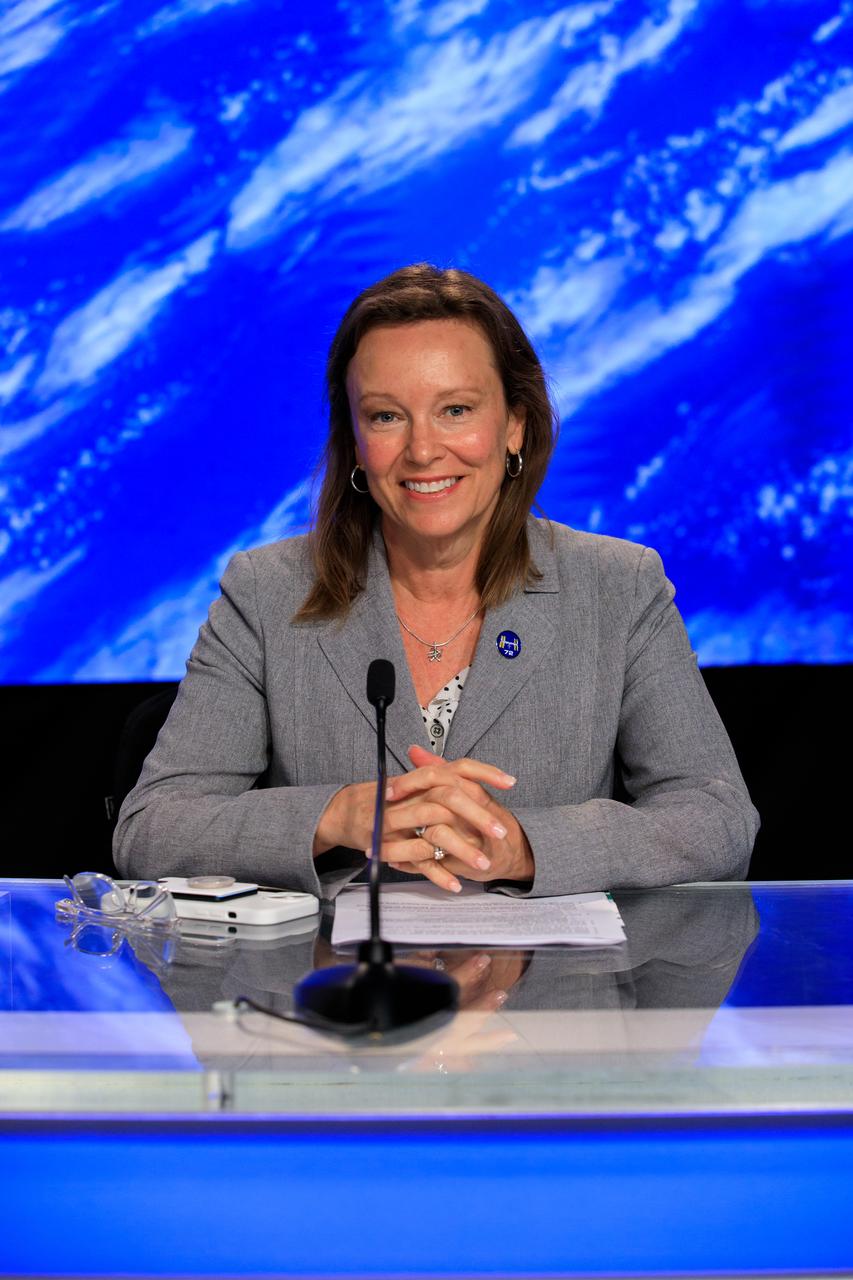
Dina Contella, deputy manager of NASA’s International Space Station Program, participates in a postlaunch news conference at the agency’s Kennedy Space Center in Florida on Saturday, Sept. 28, 2024, following the launch of NASA’s SpaceX Crew-9 mission to the International Space Station. NASA astronaut Nick Hague and Roscosmos cosmonaut Aleksandr Gorbunov launched aboard SpaceX’s Dragon spacecraft and Falcon 9 rocket from nearby Space Launch Complex-40 at Cape Canaveral Space Force Station at 1:17 p.m. EDT on the ninth crew rotation mission with SpaceX to the space station as part of the agency’s Commercial Crew Program.
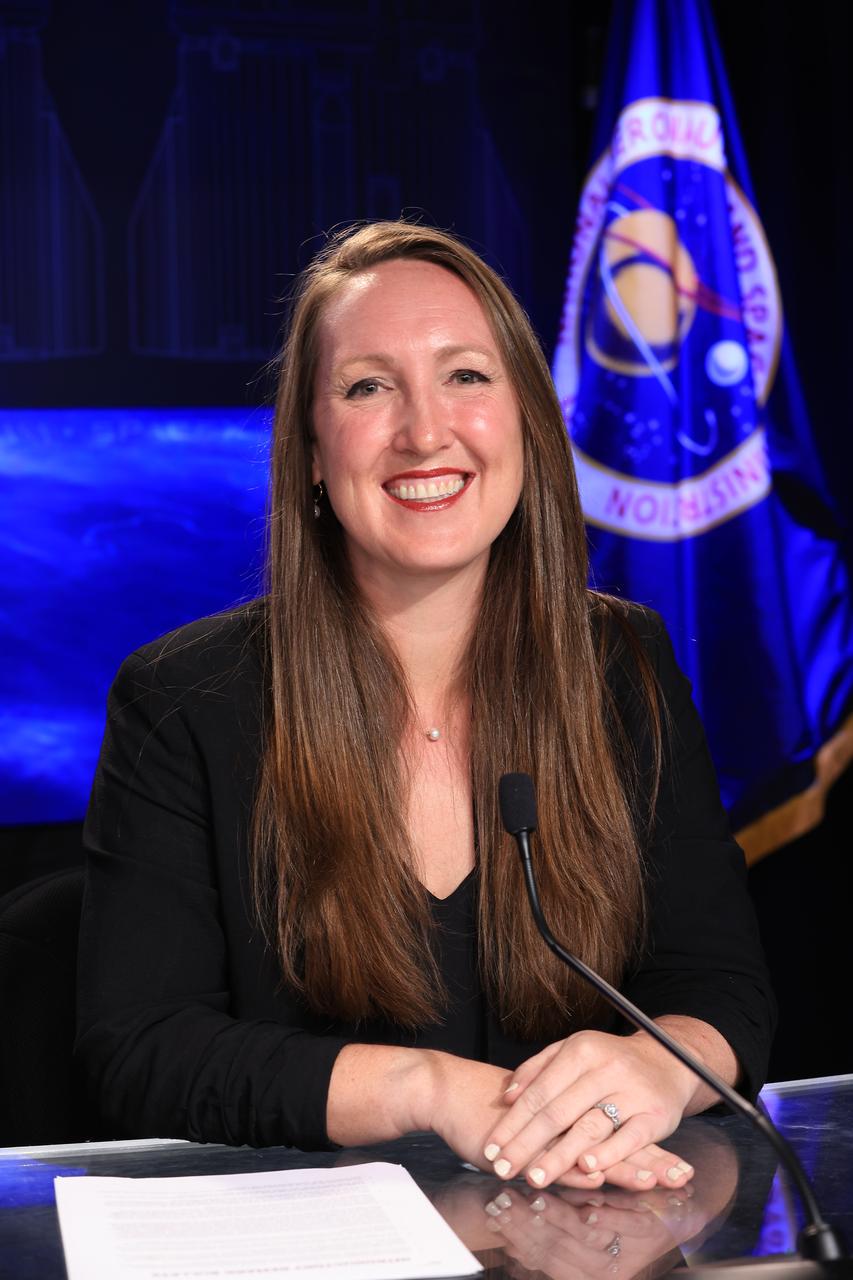
Sarah Walker, director of SpaceX’s Dragon Mission Management, participates in a postlaunch news conference at the agency’s Kennedy Space Center in Florida on Monday, March 4, 2024, following the launch of NASA’s SpaceX Crew-8 mission. NASA astronauts Commander Matthew Dominick, Pilot Michael Barratt, and Mission Specialist Jeanette Epps, along with Roscosmos cosmonaut Mission Specialist Alexander Grebenkin, launched aboard SpaceX’s Dragon spacecraft from Kennedy at 10:53 p.m. Sunday, March 3 and will spend about six months at the orbiting laboratory as part of the agency’s Commercial Crew Program.
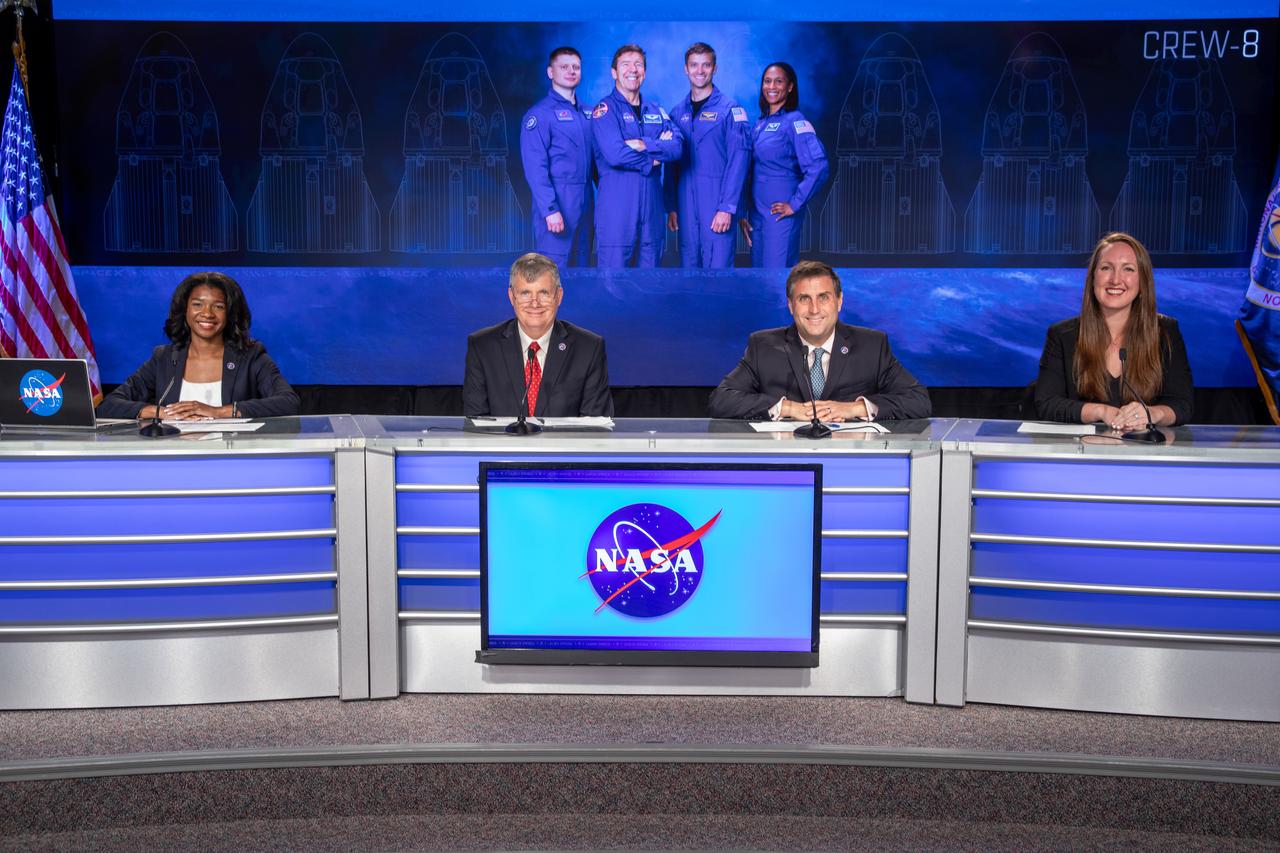
A postlaunch news conference is hosted at the agency’s Kennedy Space Center in Florida on Monday, March 4, 2024, following the launch of NASA’s SpaceX Crew-8 mission. From left to right are Jasmine Hopkins, NASA Communications; Steve Stich, manager of NASA’s Commercial Crew Program; Joel Montalbano, manager of NASA’s International Space Station Program; and Sarah Walker, director of SpaceX’s Dragon Mission Management. NASA astronauts Commander Matthew Dominick, Pilot Michael Barratt, and Mission Specialist Jeanette Epps, along with Roscosmos cosmonaut Mission Specialist Alexander Grebenkin, launched aboard SpaceX’s Dragon spacecraft from Kennedy at 10:53 p.m. Sunday, March 3 and will spend about six months at the orbiting laboratory as part of the agency’s Commercial Crew Program.
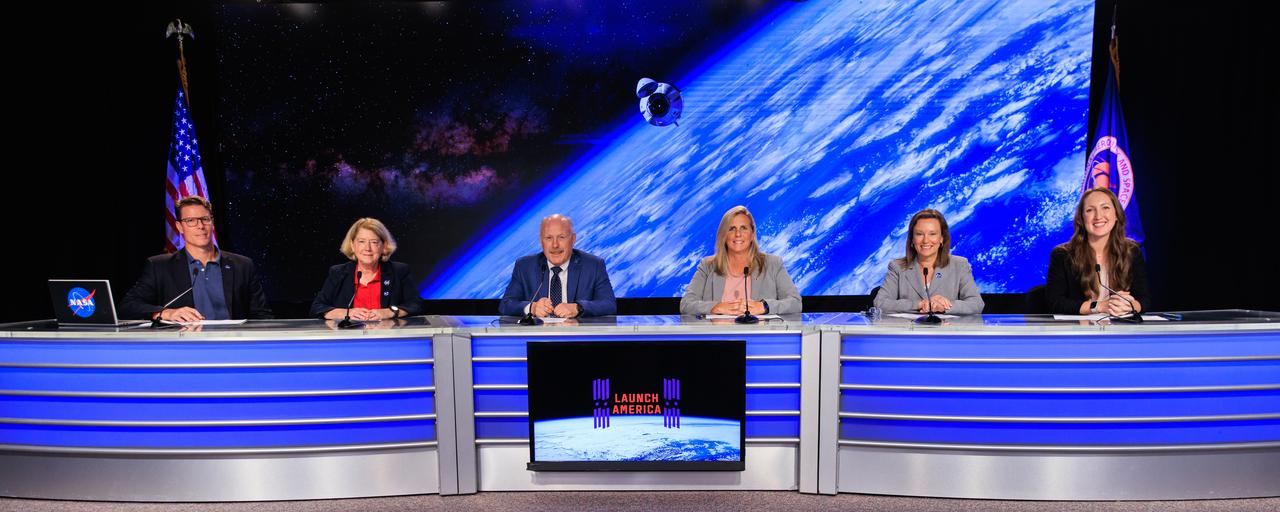
A postlaunch news conference is hosted at the agency’s Kennedy Space Center in Florida on Saturday, Sept. 28, 2024, following the launch of NASA’s SpaceX Crew-9 mission. Participants include Derrol Nail, NASA Communications; NASA Deputy Administrator Pam Melroy; Ken Bowersox, associate administrator, NASA’s Space Operations Mission Directorate; Dana Hutcherson, deputy manager, NASA’s Commercial Crew Program; Dina Contella, deputy manager, NASA’s International Space Station Program; Sarah Walker, director, Dragon Mission Management, SpaceX. NASA astronaut Nick Hague and Roscosmos cosmonaut Aleksandr Gorbunov launched to the International Space Station aboard SpaceX’s Dragon spacecraft and Falcon 9 rocket from nearby Space Launch Complex-40 at Cape Canaveral Space Force Station at 1:17 p.m. EDT on the ninth crew rotation mission with SpaceX to the space station as part of the agency’s Commercial Crew Program.
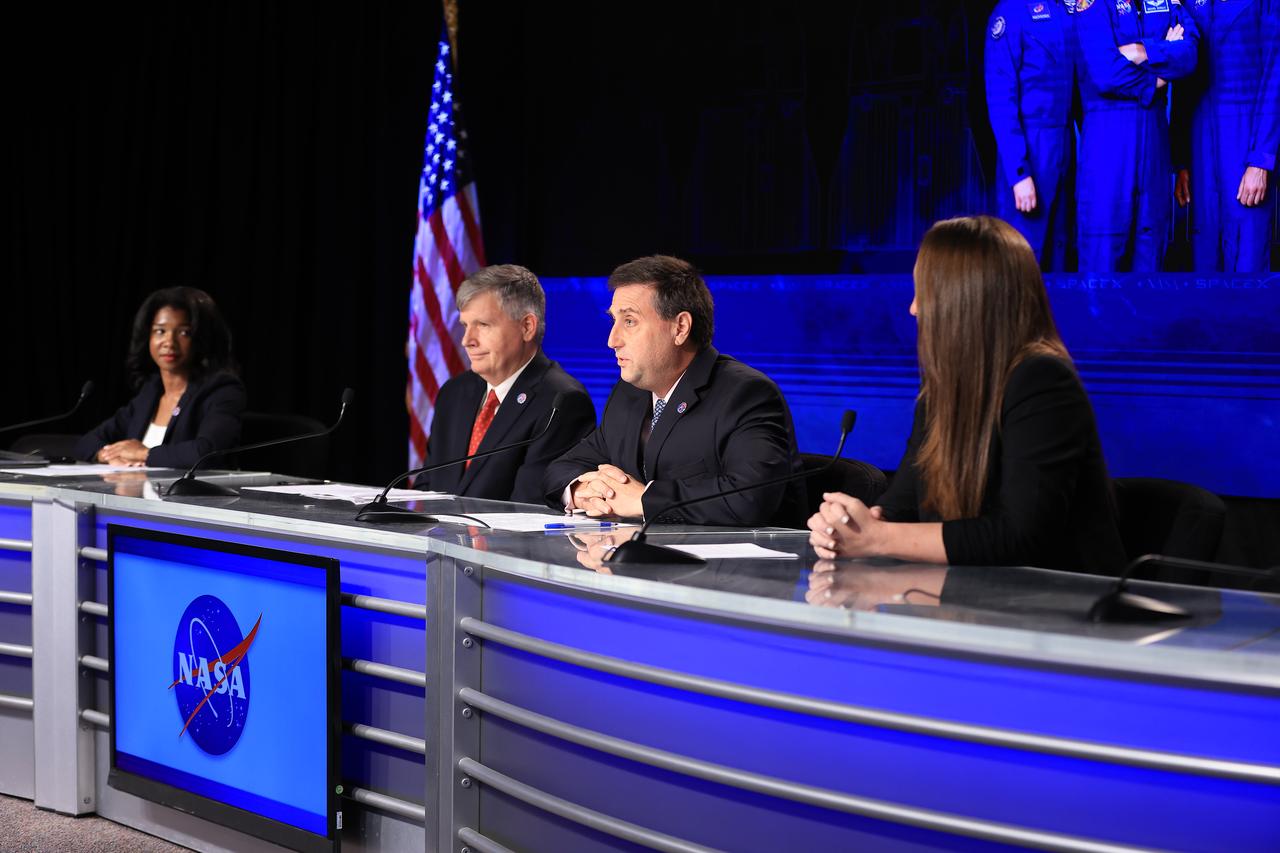
A postlaunch news conference is hosted at the agency’s Kennedy Space Center in Florida on Monday, March 4, 2024, following the launch of NASA’s SpaceX Crew-8 mission. From left to right are Jasmine Hopkins, NASA Communications; Steve Stich, manager of NASA’s Commercial Crew Program; Joel Montalbano, manager of NASA’s International Space Station Program; and Sarah Walker, director of SpaceX’s Dragon Mission Management. NASA astronauts Commander Matthew Dominick, Pilot Michael Barratt, and Mission Specialist Jeanette Epps, along with Roscosmos cosmonaut Mission Specialist Alexander Grebenkin, launched aboard SpaceX’s Dragon spacecraft from Kennedy at 10:53 p.m. Sunday, March 3 and will spend about six months at the orbiting laboratory as part of the agency’s Commercial Crew Program.
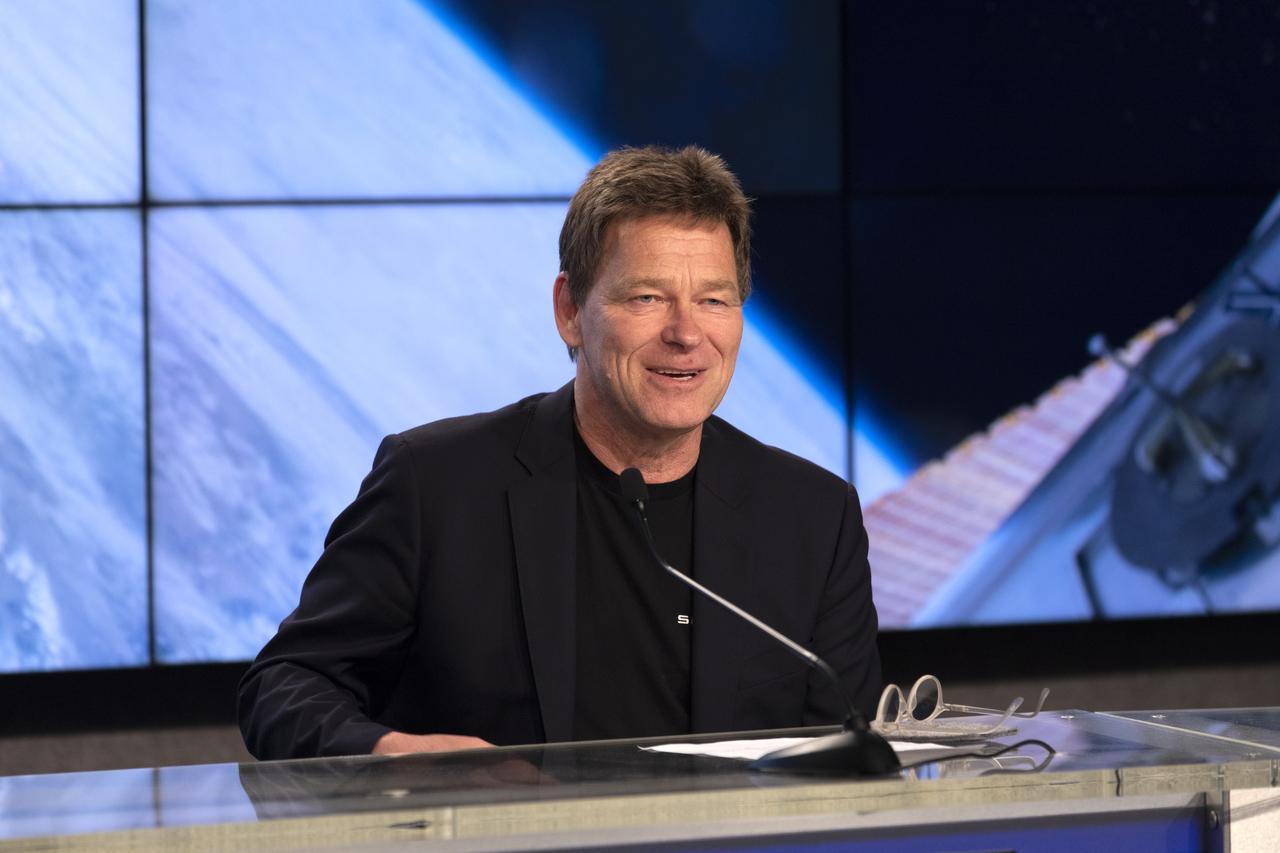
Hans Koenigsmann, vice president, Build and Flight Reliability with SpaceX, speaks to members of the news media during a postlaunch news conference at NASA’s Kennedy Space Center in Florida on May 4, 2019, for SpaceX’s 17th Commercial Resupply Services (CRS-17) mission to the International Space Station for the agency. The company’s Falcon 9 rocket with the Dragon cargo module lifted off from Space Launch Complex 40 at Cape Canaveral Air Force Station in Florida at 2:48 a.m. EDT. The Dragon cargo module will deliver about 5,500 pounds of science and research, crew supplies and vehicle hardware to the orbital laboratory and its crew.
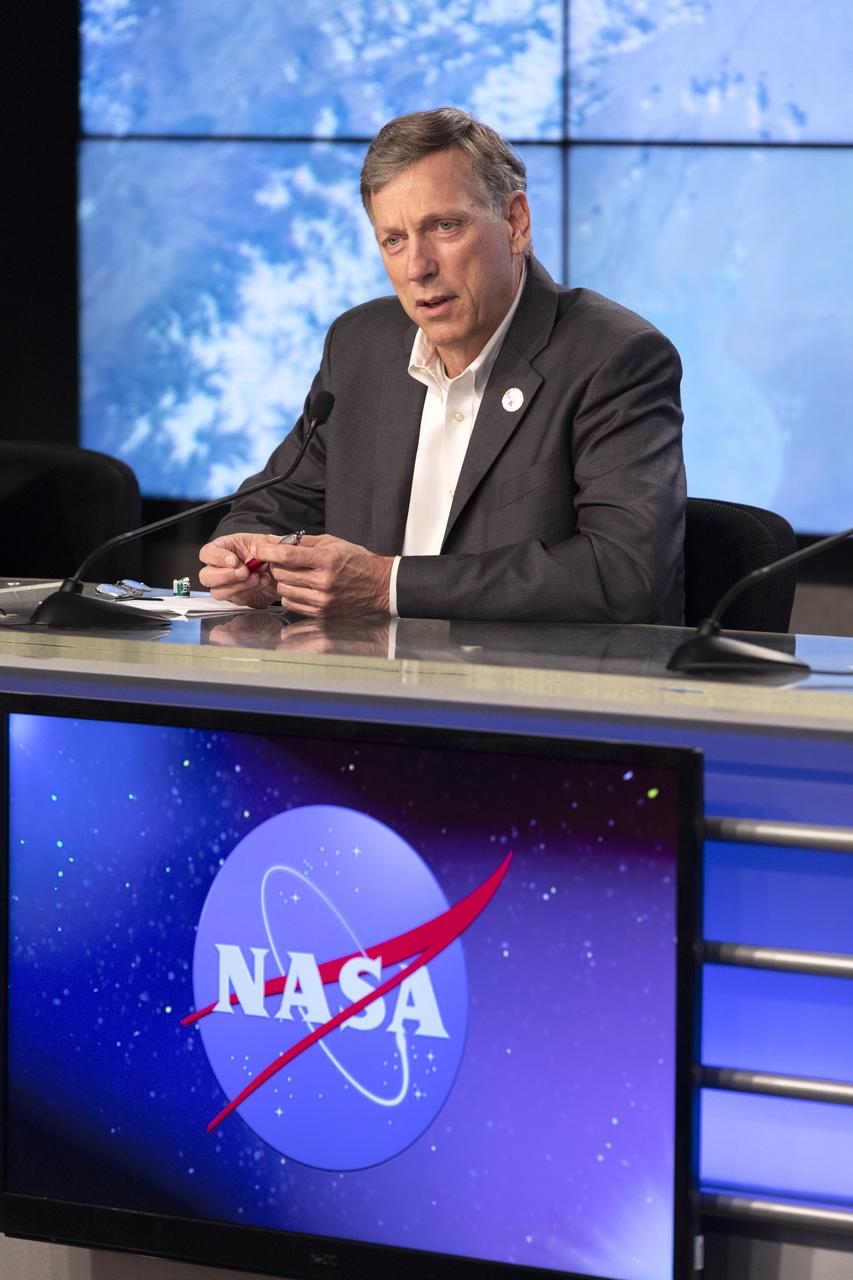
Kenny Todd, manager, International Space Station Operations and Integration at NASA’s Johnson Space Center in Houston speaks to members of the news media during a postlaunch news conference at NASA’s Kennedy Space Center in Florida on May 4, 2019, for SpaceX’s 17th Commercial Resupply Services (CRS-17) mission to the International Space Station for the agency. The company’s Falcon 9 rocket with the Dragon cargo module lifted off from Space Launch Complex 40 at Cape Canaveral Air Force Station in Florida at 2:48 a.m. EDT. The Dragon cargo module will deliver about 5,500 pounds of science and research, crew supplies and vehicle hardware to the orbital laboratory and its crew.
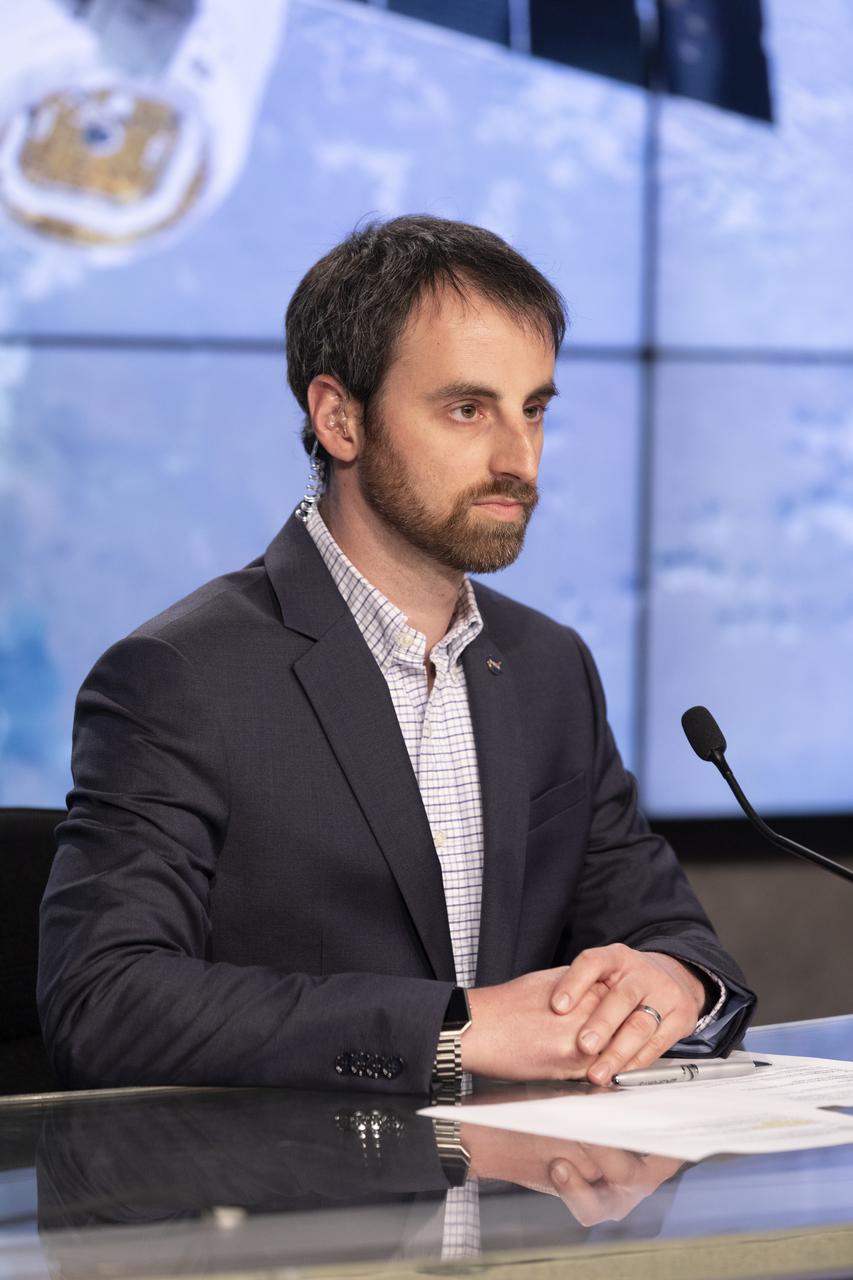
Josh Santora, with NASA Communications, moderates a postlaunch news conference at NASA’s Kennedy Space Center in Florida on May 4, 2019, for SpaceX’s 17th Commercial Resupply Services (CRS-17) mission to the International Space Station for the agency. The company’s Falcon 9 rocket with the Dragon cargo module lifted off from Space Launch Complex 40 at Cape Canaveral Air Force Station in Florida at 2:48 a.m. EDT. The Dragon cargo module will deliver about 5,500 pounds of science and research, crew supplies and vehicle hardware to the orbital laboratory and its crew.
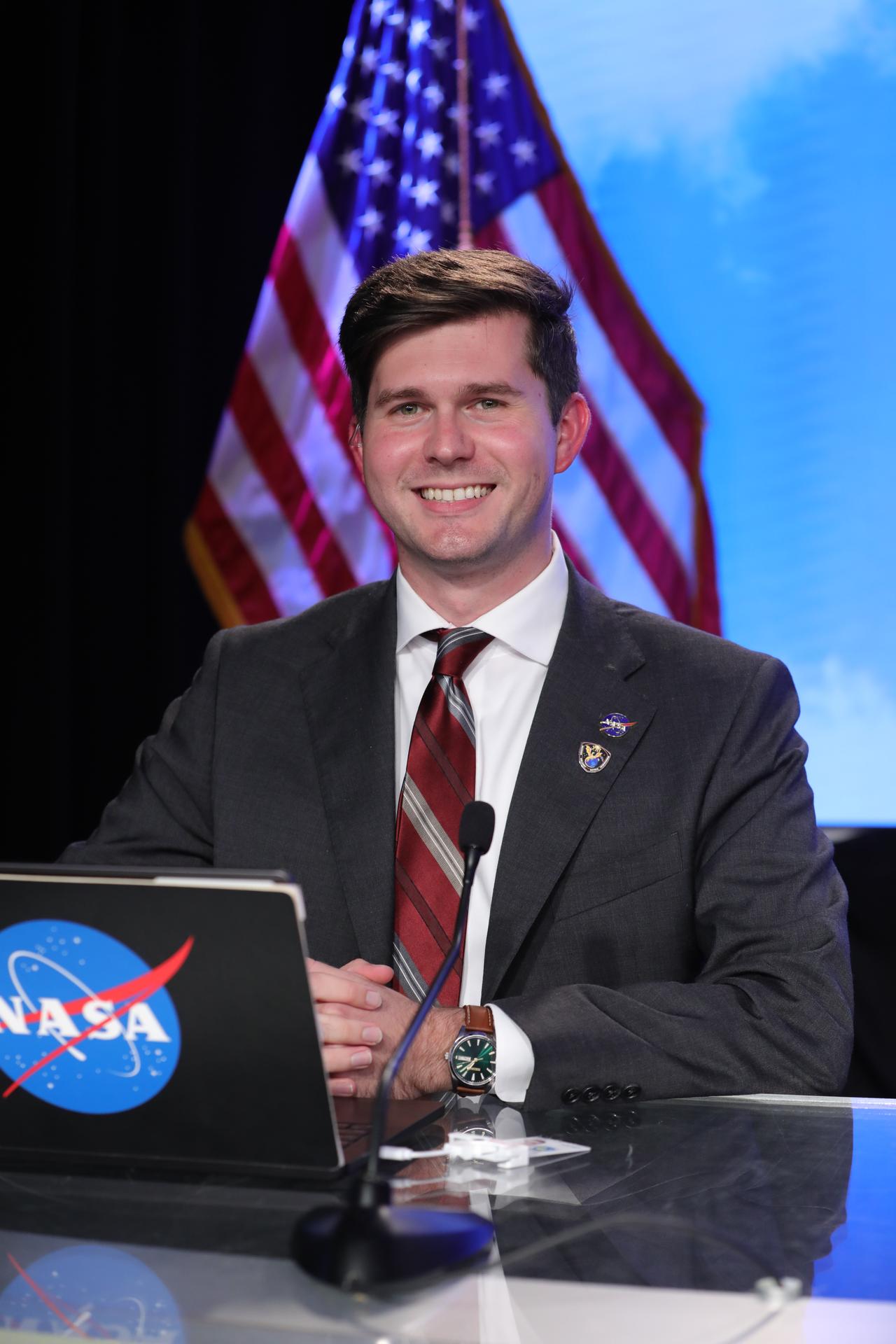
George Alderman, deputy press secretary, participates in a postlaunch news conference at the agency’s Kennedy Space Center in Florida on Thursday, Oct. 1, 2026, following the launch of NASA’s SpaceX Crew-13 mission to the International Space Station. NASA astronauts Jessica Watkins and Luke Delaney, CSA (Canadian Space Agency) astronaut Joshua Kutryk, and Roscosmos cosmonaut Sergey Teteryatnikov launched to the International Space Station aboard SpaceX’s Dragon spacecraft and Falcon 9 rocket at 11:10 a.m. EDT on the 13th crew rotation mission with SpaceX to the space station.
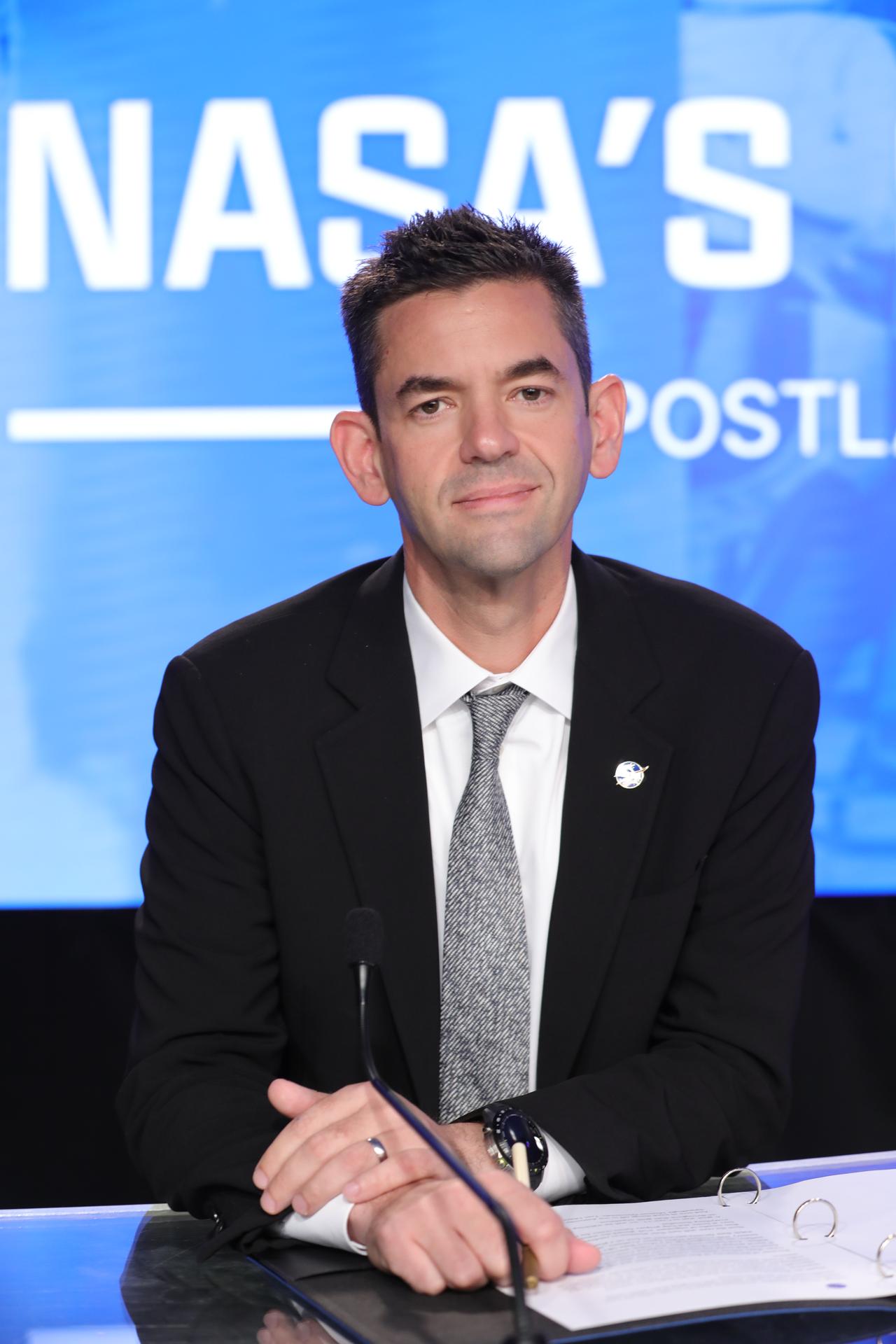
NASA Administrator Jared Isaacman participates in a postlaunch news conference at the agency’s Kennedy Space Center in Florida on Thursday, Oct. 1, 2026, following the launch of NASA’s SpaceX Crew-13 mission to the International Space Station. NASA astronauts Jessica Watkins and Luke Delaney, CSA (Canadian Space Agency) astronaut Joshua Kutryk, and Roscosmos cosmonaut Sergey Teteryatnikov launched to the International Space Station aboard SpaceX’s Dragon spacecraft and Falcon 9 rocket at 11:10 a.m. EDT on the 13th crew rotation mission with SpaceX to the space station.
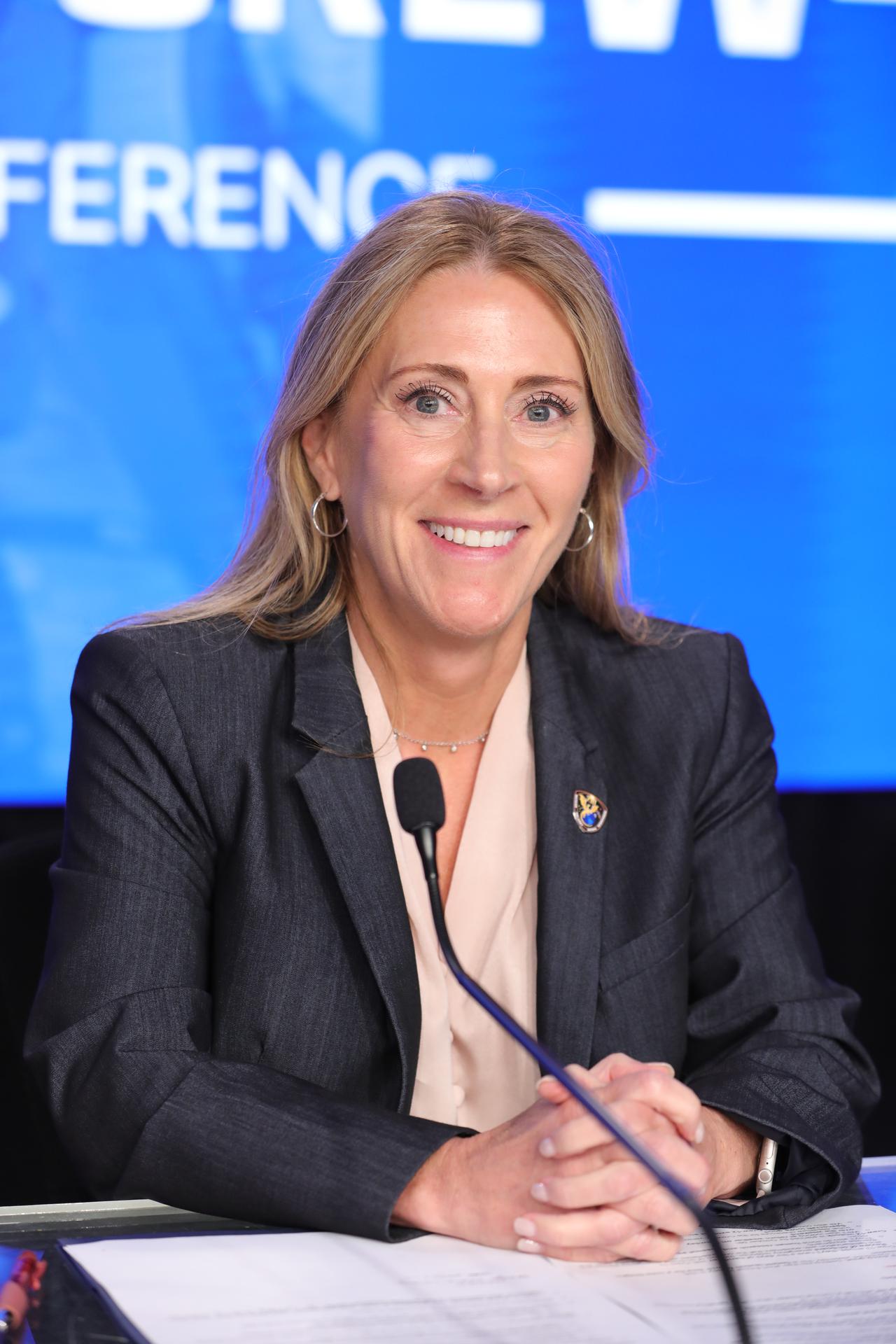
Dana Weigel, manager, Low Earth Orbit Program, NASA’s Johnson Space Center in Houston, participates in a postlaunch news conference at the agency’s Kennedy Space Center in Florida on Thursday, Oct. 1, 2026, following the launch of NASA’s SpaceX Crew-13 mission to the International Space Station. NASA astronauts Jessica Watkins and Luke Delaney, CSA (Canadian Space Agency) astronaut Joshua Kutryk, and Roscosmos cosmonaut Sergey Teteryatnikov launched to the International Space Station aboard SpaceX’s Dragon spacecraft and Falcon 9 rocket at 11:10 a.m. EDT on the 13th crew rotation mission with SpaceX to the space station.
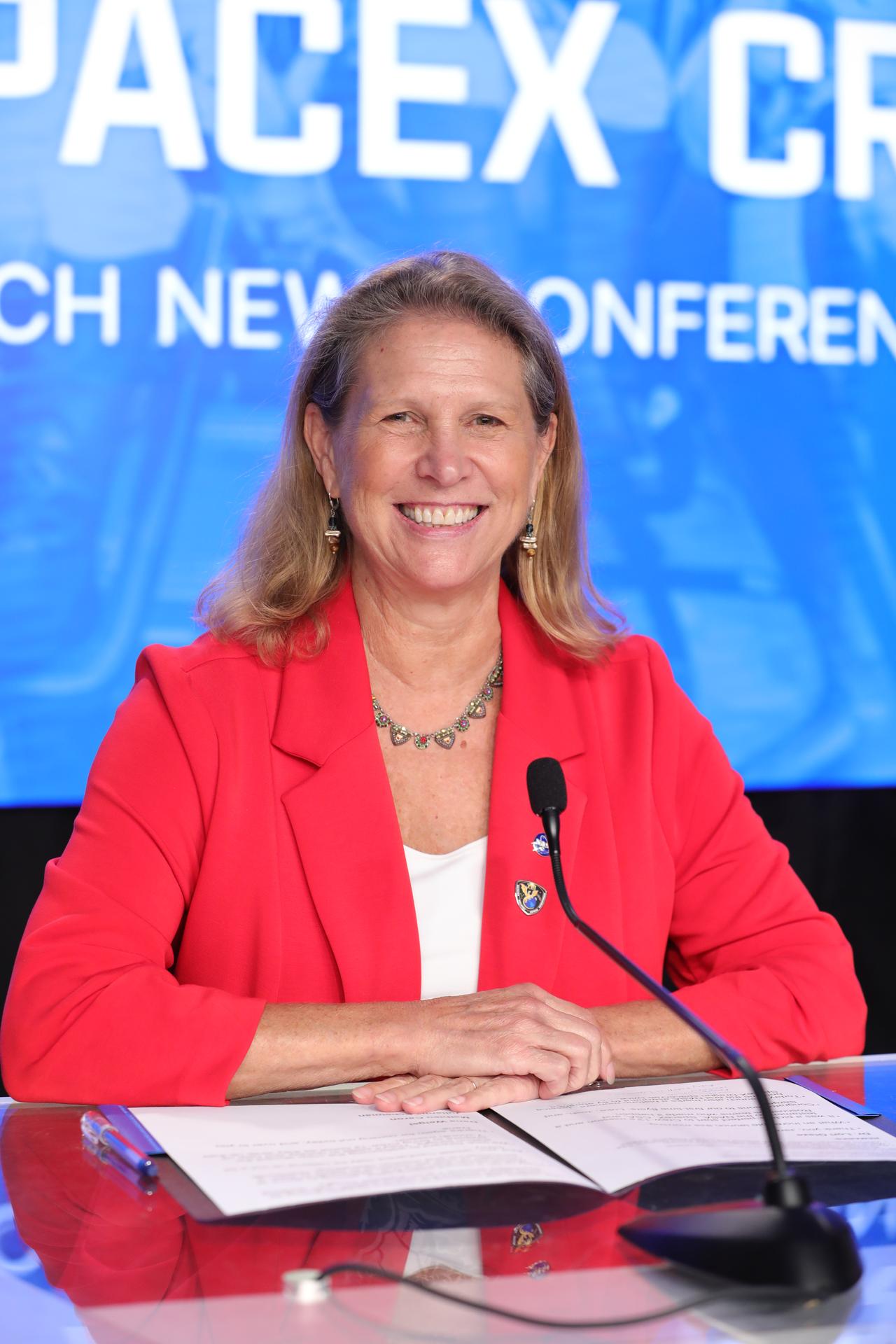
Dr. Lori Glaze, associate administrator, NASA’s Human Spaceflight Mission Directorate, participates in a postlaunch news conference at the agency’s Kennedy Space Center in Florida on Thursday, Oct. 1, 2026, following the launch of NASA’s SpaceX Crew-13 mission to the International Space Station. NASA astronauts Jessica Watkins and Luke Delaney, CSA (Canadian Space Agency) astronaut Joshua Kutryk, and Roscosmos cosmonaut Sergey Teteryatnikov launched to the International Space Station aboard SpaceX’s Dragon spacecraft and Falcon 9 rocket at 11:10 a.m. EDT on the 13th crew rotation mission with SpaceX to the space station.
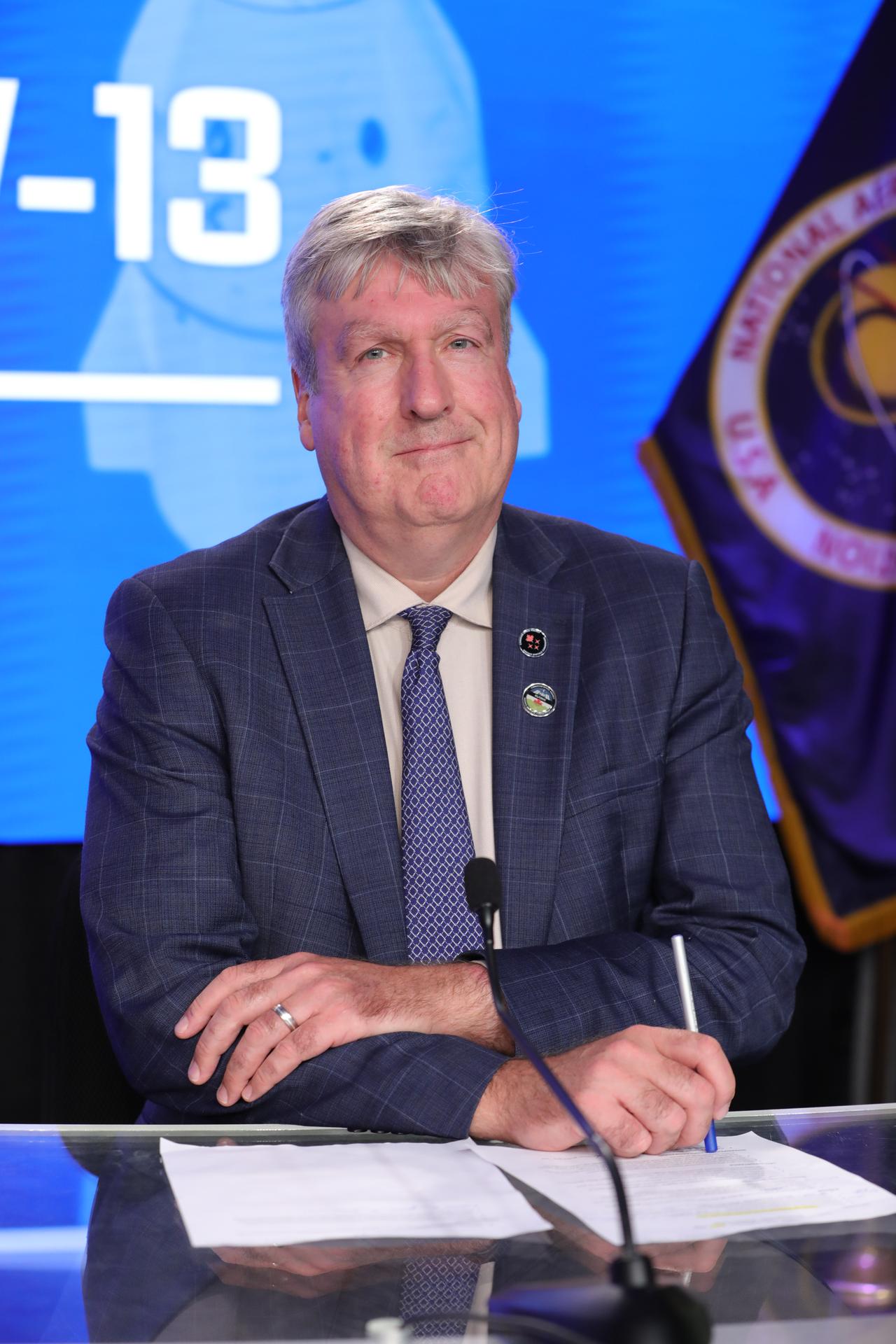
Mathieu Caron, director, Astronauts, Life Sciences, and Space Medicine, CSA (Canadian Space Agency), participates in a postlaunch news conference at the agency’s Kennedy Space Center in Florida on Thursday, Oct. 1, 2026, following the launch of NASA’s SpaceX Crew-13 mission to the International Space Station. NASA astronauts Jessica Watkins and Luke Delaney, CSA (Canadian Space Agency) astronaut Joshua Kutryk, and Roscosmos cosmonaut Sergey Teteryatnikov launched to the International Space Station aboard SpaceX’s Dragon spacecraft and Falcon 9 rocket at 11:10 a.m. EDT on the 13th crew rotation mission with SpaceX to the space station.
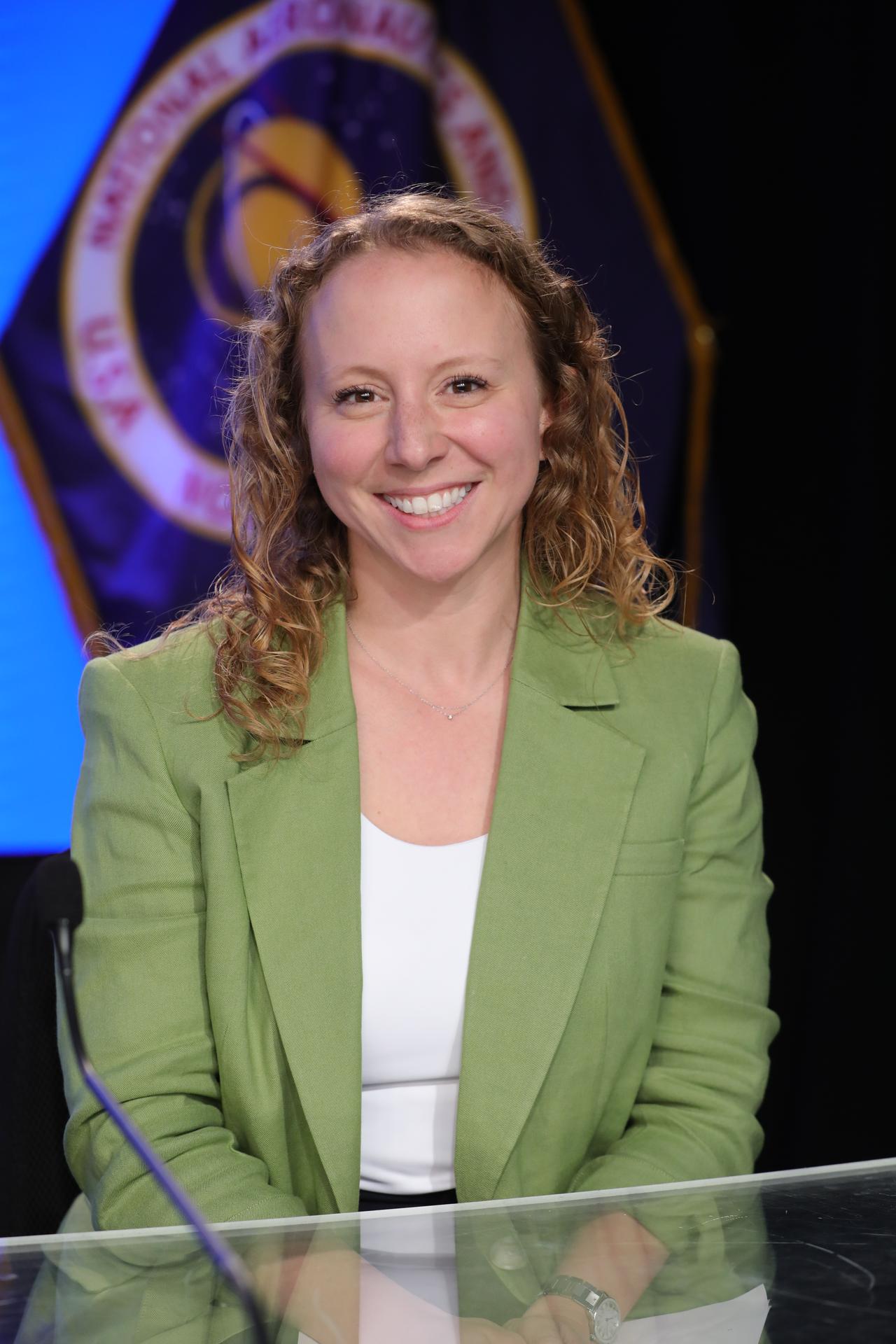
Julianna Scheiman, director, NASA Science and Dragon Programs, SpaceX, participates in a postlaunch news conference at the agency’s Kennedy Space Center in Florida on Thursday, Oct. 1, 2026, following the launch of NASA’s SpaceX Crew-13 mission to the International Space Station. NASA astronauts Jessica Watkins and Luke Delaney, CSA (Canadian Space Agency) astronaut Joshua Kutryk, and Roscosmos cosmonaut Sergey Teteryatnikov launched to the International Space Station aboard SpaceX’s Dragon spacecraft and Falcon 9 rocket at 11:10 a.m. EDT on the 13th crew rotation mission with SpaceX to the space station.
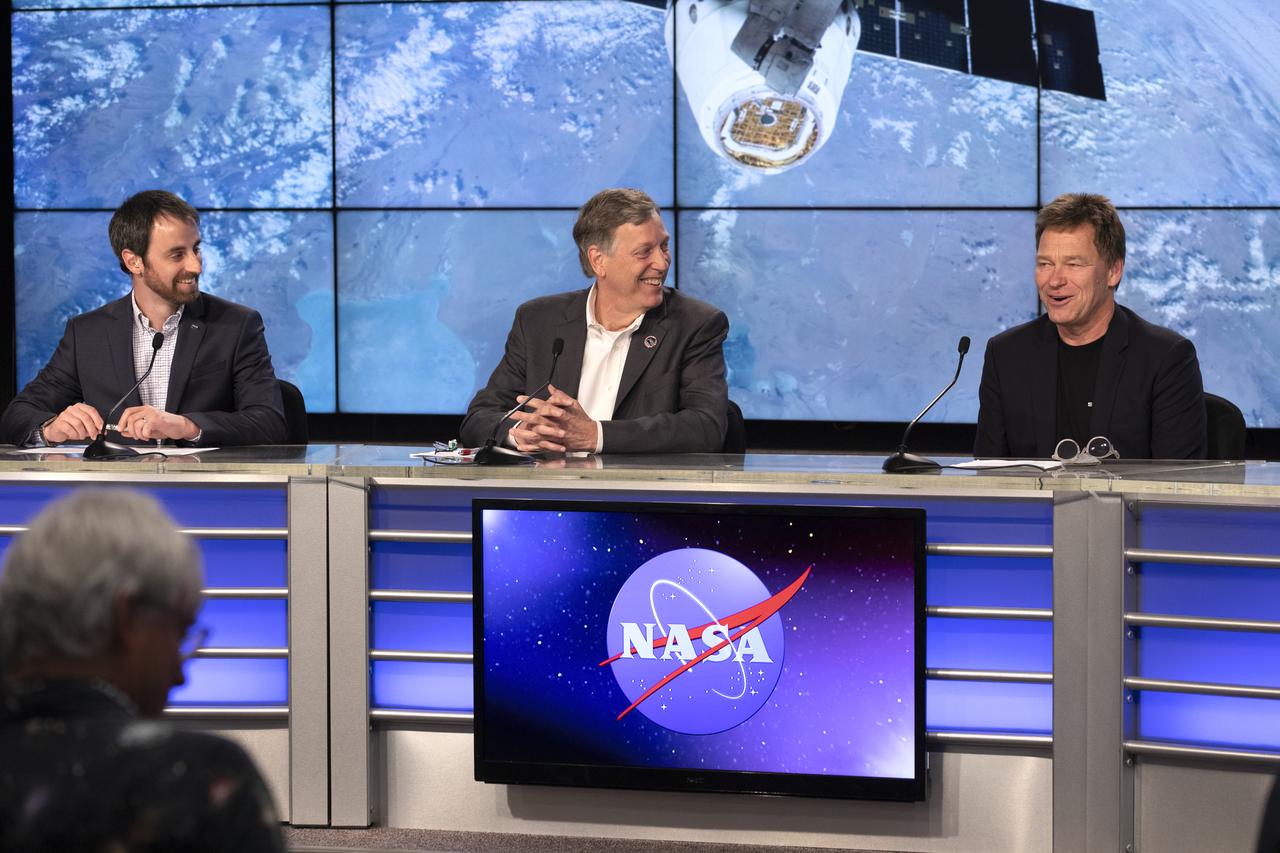
From left, Josh Santora, moderator with NASA Communications; Kenny Todd, manager, International Space Station Operations and Integration at NASA’s Johnson Space Center in Houston; and Hans Koenigsmann, vice president, Build and Flight Reliability with SpaceX, speak to members of the news media during a postlaunch news conference at NASA’s Kennedy Space Center in Florida on May 4, 2019, for SpaceX’s 17th Commercial Resupply Services (CRS-17) mission to the International Space Station for the agency. The company’s Falcon 9 rocket with the Dragon cargo module lifted off from Space Launch Complex 40 at Cape Canaveral Air Force Station in Florida at 2:48 a.m. EDT. The Dragon cargo module will deliver about 5,500 pounds of science and research, crew supplies and vehicle hardware to the orbital laboratory and its crew.
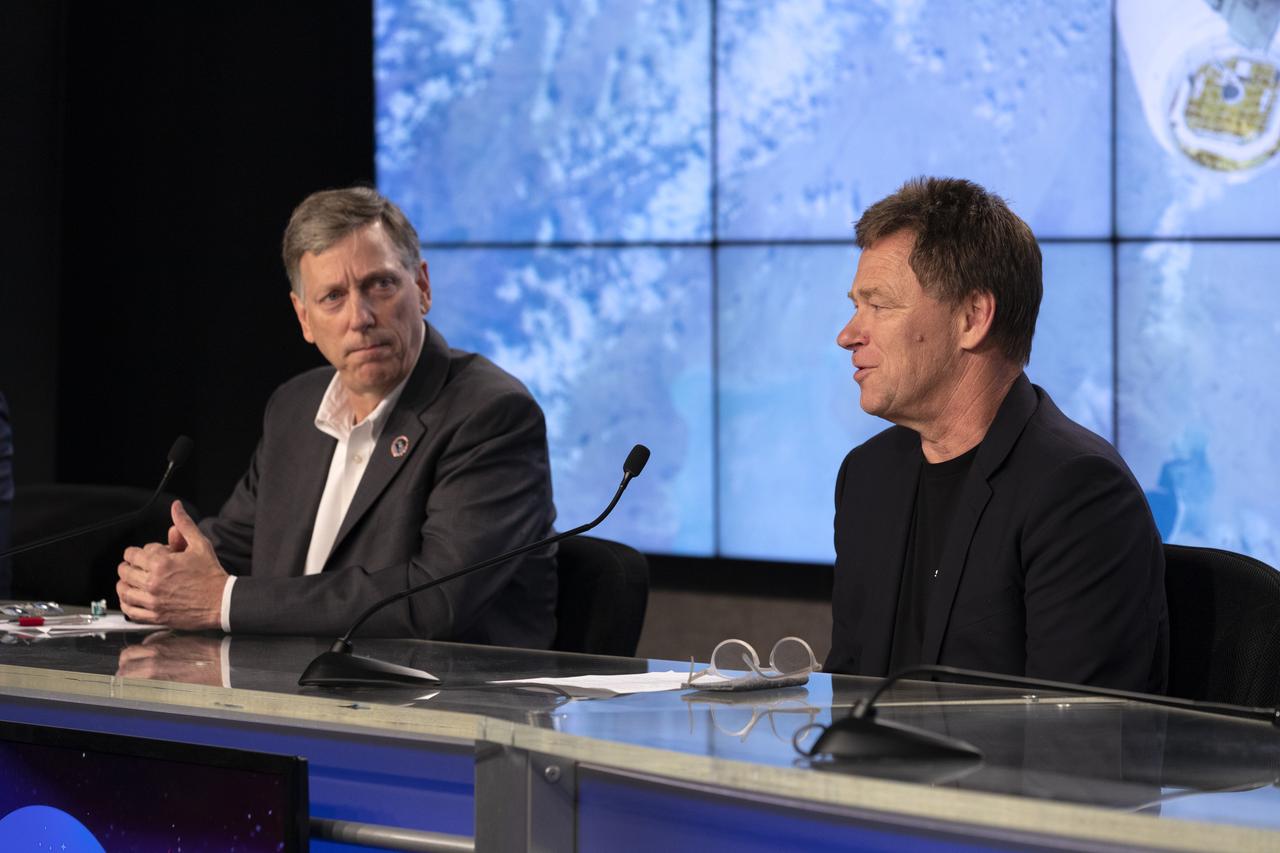
From left, Kenny Todd, manager, International Space Station Operations and Integration at NASA’s Johnson Space Center in Houston; and Hans Koenigsmann, vice president, Build and Flight Reliability with SpaceX, speak to members of the news media during a postlaunch news conference at NASA’s Kennedy Space Center in Florida on May 4, 2019, for SpaceX’s 17th Commercial Resupply Services (CRS-17) mission to the International Space Station for the agency. The company’s Falcon 9 rocket with the Dragon cargo module lifted off from Space Launch Complex 40 at Cape Canaveral Air Force Station in Florida at 2:48 a.m. EDT. The Dragon cargo module will deliver about 5,500 pounds of science and research, crew supplies and vehicle hardware to the orbital laboratory and its crew.
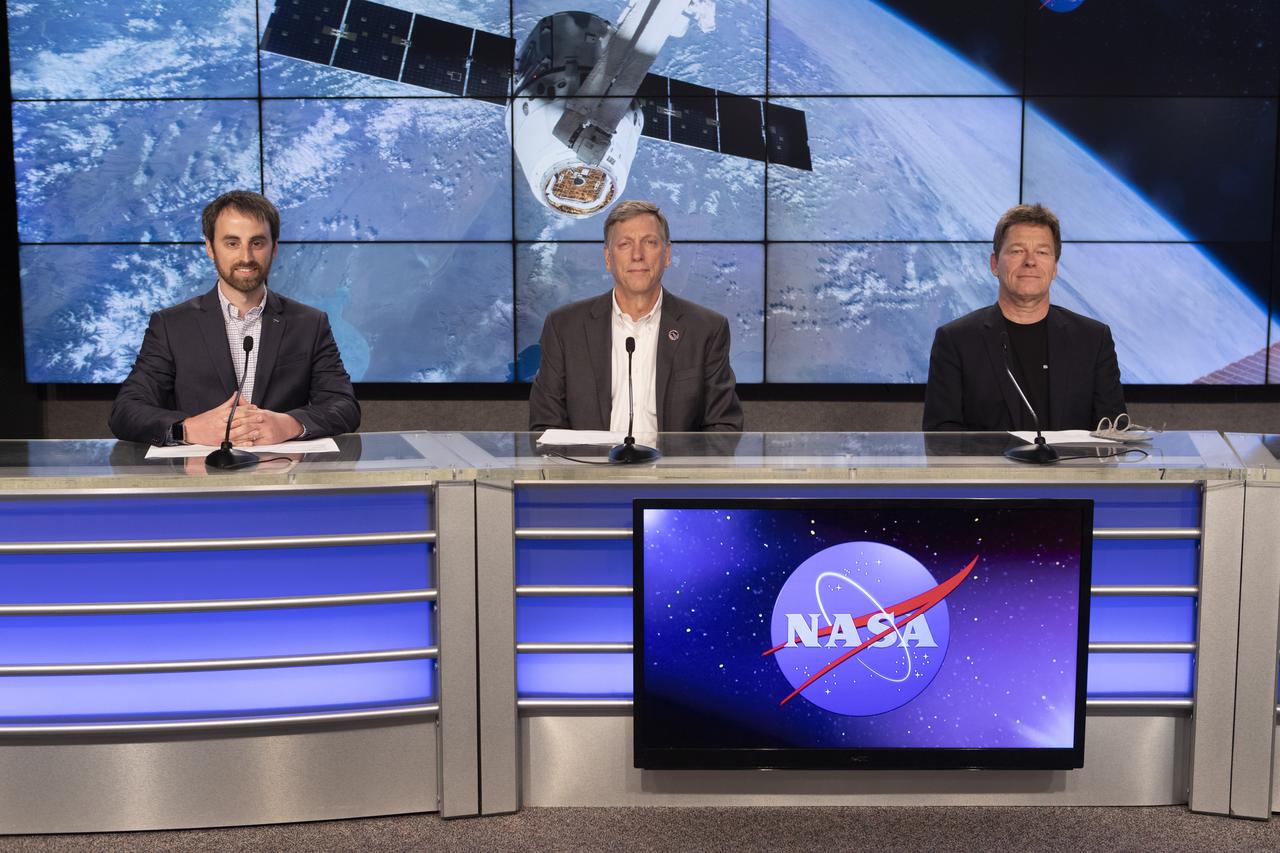
From left, Josh Santora, moderator with NASA Communications; Kenny Todd, manager, International Space Station Operations and Integration at NASA’s Johnson Space Center in Houston; and Hans Koenigsmann, vice president, Build and Flight Reliability with SpaceX, speak to members of the news media during a postlaunch news conference at NASA’s Kennedy Space Center in Florida on May 4, 2019, for SpaceX’s 17th Commercial Resupply Services (CRS-17) mission to the International Space Station for the agency. The company’s Falcon 9 rocket with the Dragon cargo module lifted off from Space Launch Complex 40 at Cape Canaveral Air Force Station in Florida at 2:48 a.m. EDT. The Dragon cargo module will deliver about 5,500 pounds of science and research, crew supplies and vehicle hardware to the orbital laboratory and its crew.
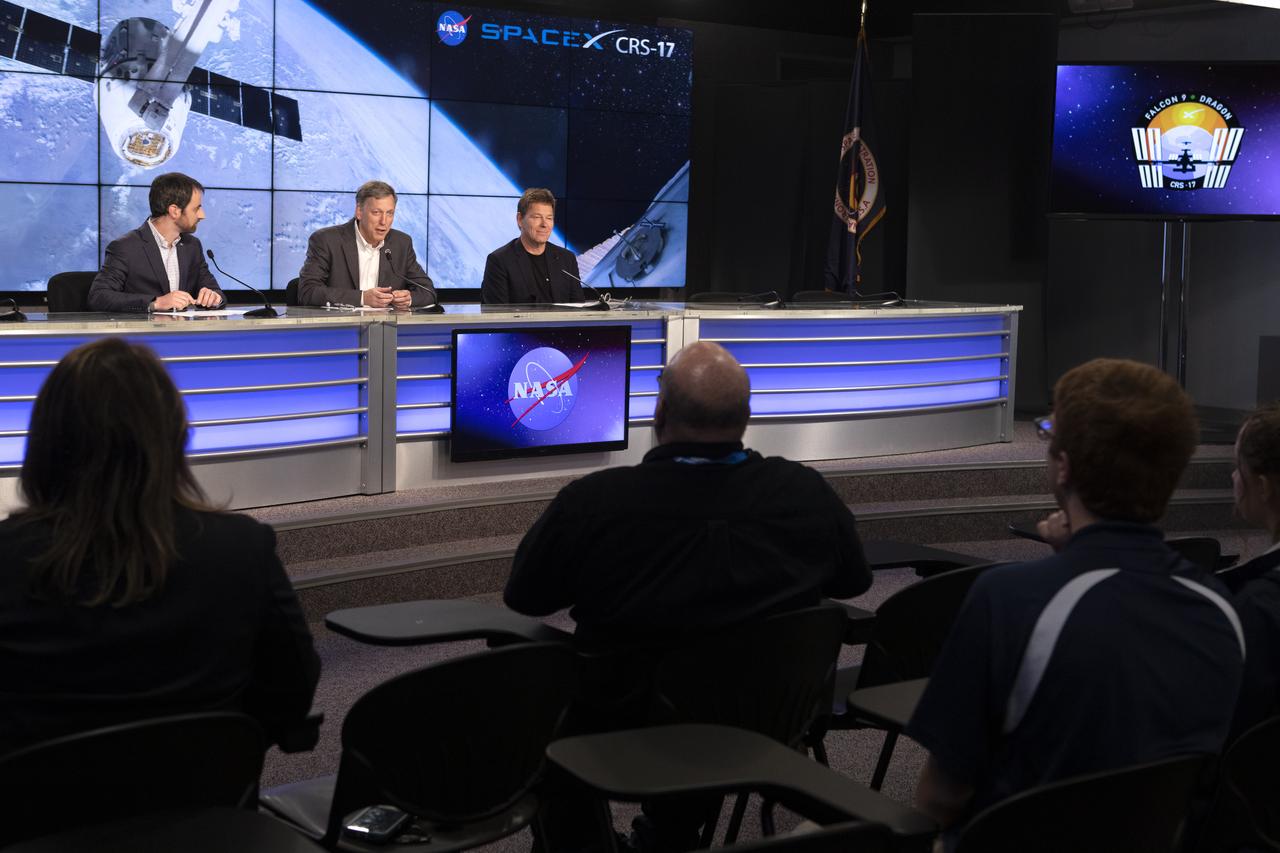
From left, Josh Santora, moderator with NASA Communications; Kenny Todd, manager, International Space Station Operations and Integration at NASA’s Johnson Space Center in Houston; and Hans Koenigsmann, vice president, Build and Flight Reliability with SpaceX, speak to members of the news media during a postlaunch news conference at NASA’s Kennedy Space Center in Florida on May 4, 2019, for SpaceX’s 17th Commercial Resupply Services (CRS-17) mission to the International Space Station for the agency. The company’s Falcon 9 rocket with the Dragon cargo module lifted off from Space Launch Complex 40 at Cape Canaveral Air Force Station in Florida at 2:48 a.m. EDT. The Dragon cargo module will deliver about 5,500 pounds of science and research, crew supplies and vehicle hardware to the orbital laboratory and its crew.
Members of the media attend a postlaunch news conference hosted at NASA’s Kennedy Space Center in Florida on Friday, Aug. 1, 2025, following the launch of NASA’s SpaceX Crew-11 mission to the International Space Station. Participants include Antonia Jaramillo, NASA Communications; Ken Bowersox, associate administrator, NASA’s Space Operations Mission Directorate; Steve Stich, manager, NASA’s Commercial Crew Program; Dana Weigel, manager, NASA’s Commercial Crew Program; Naoki Nagai, program manager, International Space Station, Human Spaceflight Technology Directorate, JAXA, and Sarah Walker, director, Dragon Mission Management. NASA astronauts Zena Cardman and Mike Fincke, along with JAXA (Japan Aerospace Exploration Agency) astronaut Kimiya Yui and Roscosmos cosmonaut Oleg Platonov, launched aboard SpaceX’s Dragon spacecraft and Falcon 9 rocket at 12:09 p.m. EDT on the 11th crew rotation mission with SpaceX to the space station as part of NASA’s Commercial Crew Program.
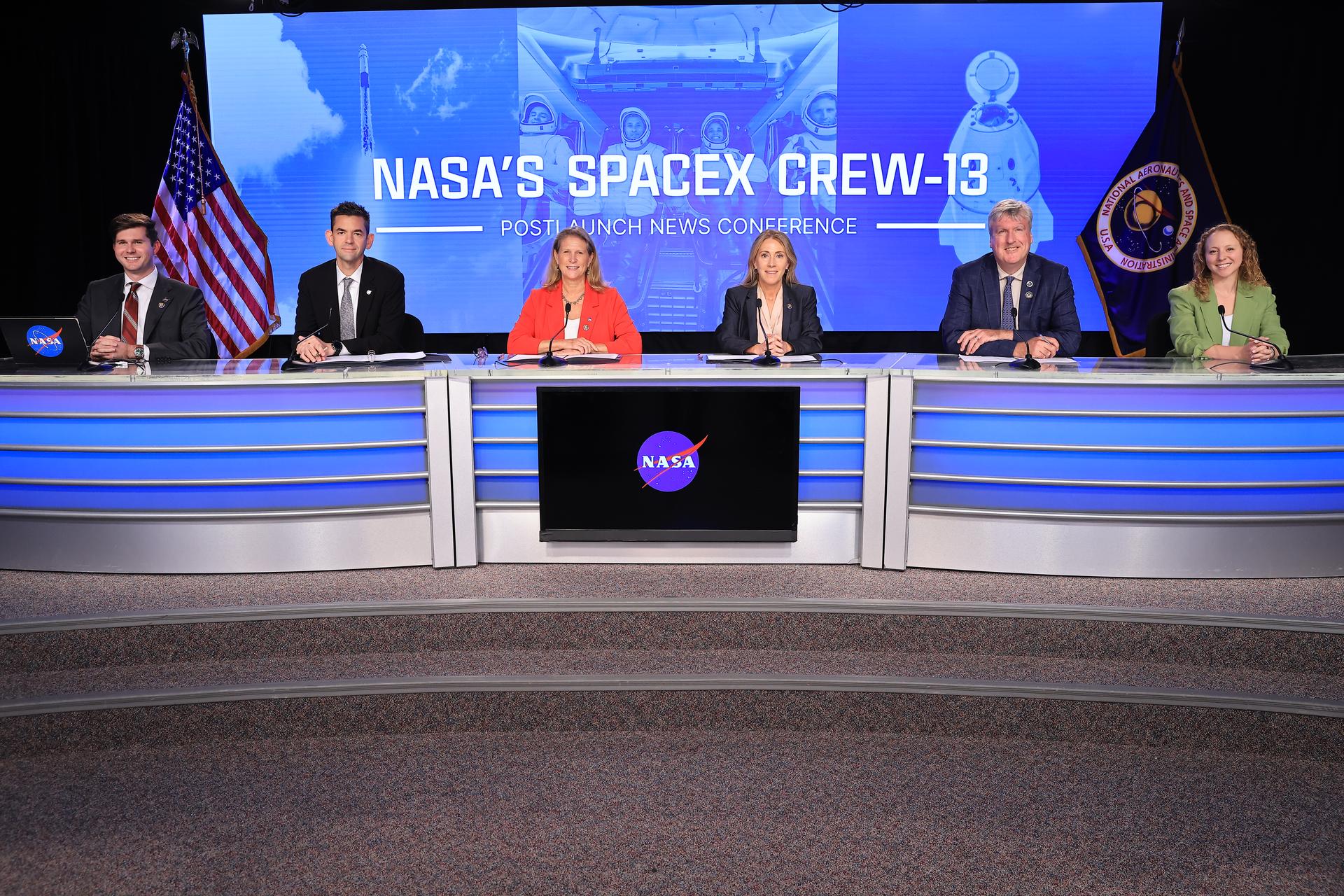
From left to right, George Alderman, deputy press secretary, NASA communications; NASA Administrator Jared Isaacman; Dr. Lori Glaze, associate administrator, NASA’s Human Spaceflight Mission Directorate; Dana Weigel, Low Earth Orbit Program, NASA’s Johnson Space Center in Houston; Mathieu Caron, director, Astronauts, Life Sciences, and Space Medicine, CSA (Canadian Space Agency); and Julianna Scheiman, director, NASA Science and Dragon Programs, SpaceX, participate in a postlaunch news conference at the agency’s Kennedy Space Center in Florida on Thursday, Oct. 1, 2026, following the launch of NASA’s SpaceX Crew-13 mission to the International Space Station. NASA astronauts Jessica Watkins and Luke Delaney, CSA (Canadian Space Agency) astronaut Joshua Kutryk, and Roscosmos cosmonaut Sergey Teteryatnikov launched to the International Space Station aboard SpaceX’s Dragon spacecraft and Falcon 9 rocket at 11:10 a.m. EDT on the 13th crew rotation mission with SpaceX to the space station.
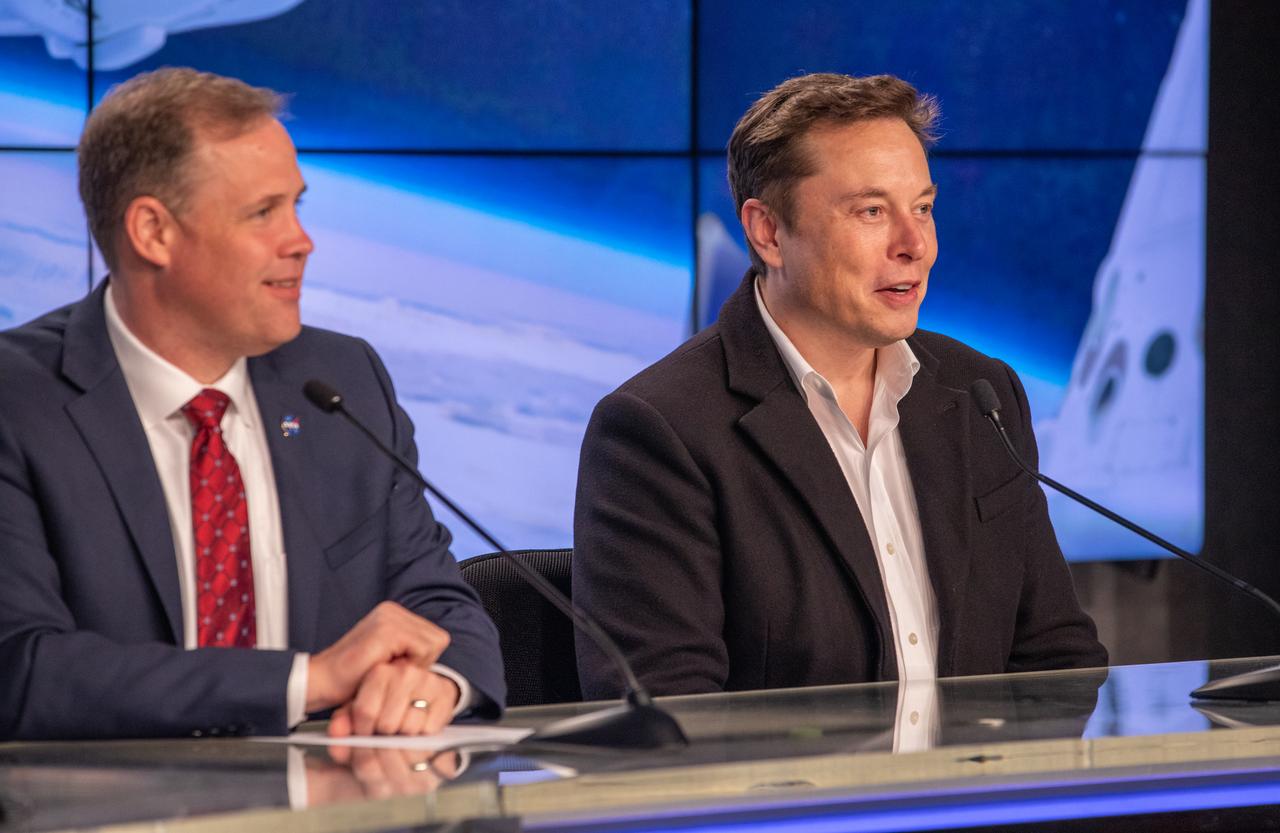
NASA administrator Jim Bridenstine, left, and SpaceX CEO and lead designer Elon Musk address members of the media during a post launch news conference in Kennedy Space Center’s Press Site auditorium following the March 2, 2:49 a.m. EST launch of the SpaceX Demo-1 Commercial Crew Program (CCP) mission to the International Space Station. The Crew Dragon’s trip to the space station is designed to validate end-to-end systems and capabilities, leading to certification to fly crew. NASA has worked with SpaceX and Boeing in developing the CCP spacecraft to facilitate new human spaceflight systems launching from U.S. soil with the goal of safe, reliable and cost-effective access to low-Earth orbit destinations, such as the space station.
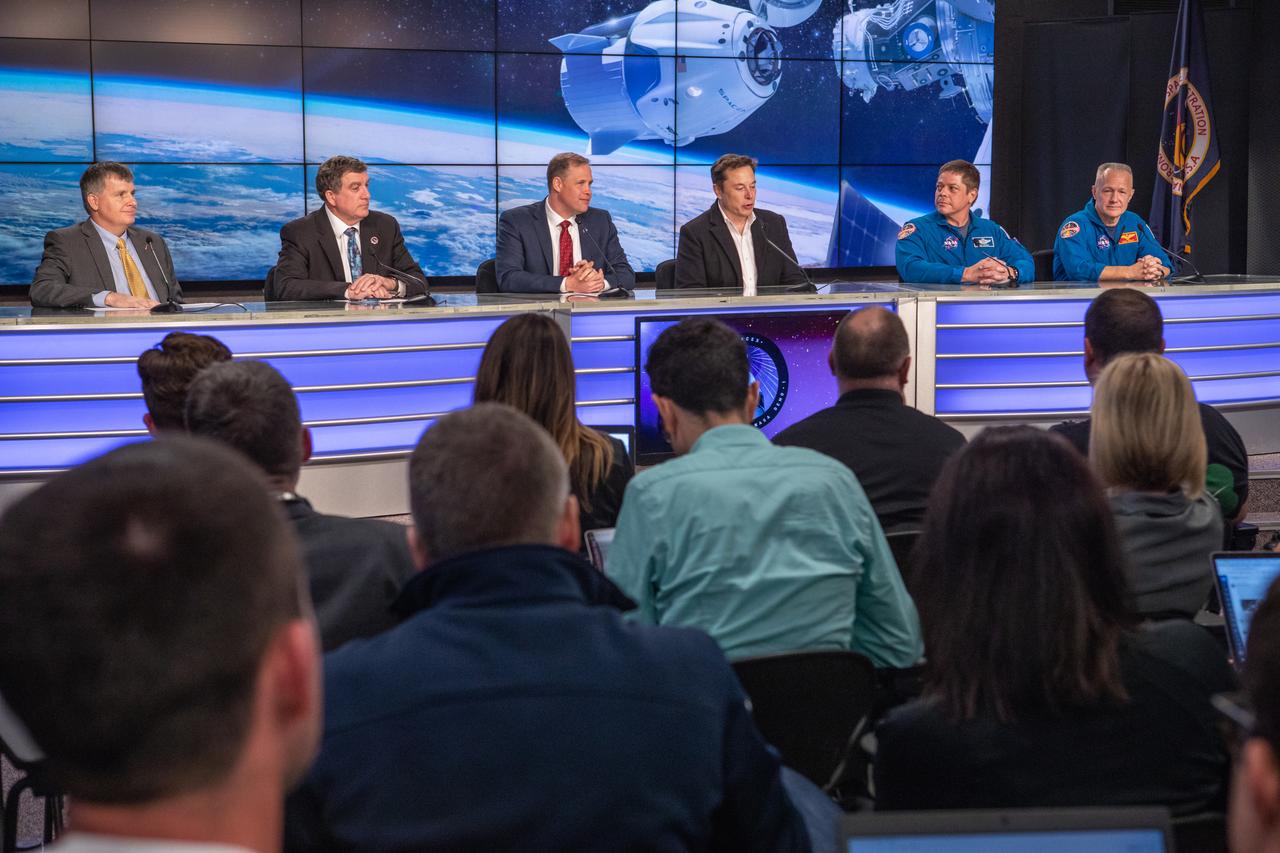
In Kennedy Space Center’s Press Site auditorium, agency and industry leaders speak to members of the media during a post launch news conference following the March 2, 2:49 a.m. EST launch of the SpaceX Demo-1 Commercial Crew Program (CCP) mission to the International Space Station. From left are: Steve Stich, NASA launch manager, Commercial Crew Program; Kirk Shireman, manager, International Space Station Program; Jim Bridenstine, NASA administrator; Elon Musk, CEO and lead designer, SpaceX; Bob Behnken, NASA astronaut and Doug Hurley, NASA astronaut. The Crew Dragon’s trip to the space station is designed to validate end-to-end systems and capabilities, leading to certification to fly crew. NASA has worked with SpaceX and Boeing in developing the CCP spacecraft to facilitate new human spaceflight systems launching from U.S. soil with the goal of safe, reliable and cost-effective access to low-Earth orbit destinations, such as the space station.
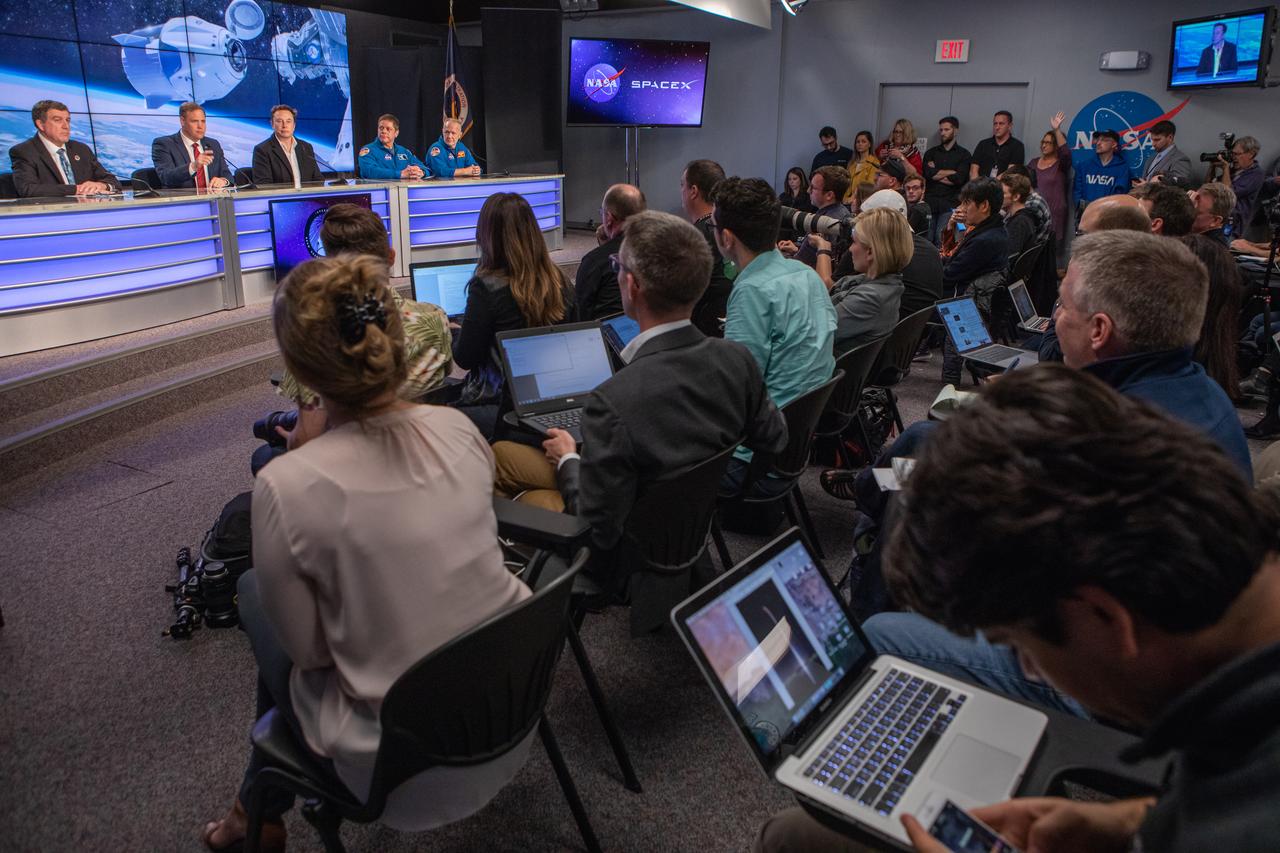
Members of the media gather in Kennedy Space Center’s Press Site auditorium during a post launch news conference with agency and industry leaders following the March 2, 2:49 a.m. EST launch of the SpaceX Demo-1 Commercial Crew Program (CCP) mission to the International Space Station. The Crew Dragon’s trip to the space station is designed to validate end-to-end systems and capabilities, leading to certification to fly crew. NASA has worked with SpaceX and Boeing in developing the CCP spacecraft to facilitate new human spaceflight systems launching from U.S. soil with the goal of safe, reliable and cost-effective access to low-Earth orbit destinations, such as the space station.
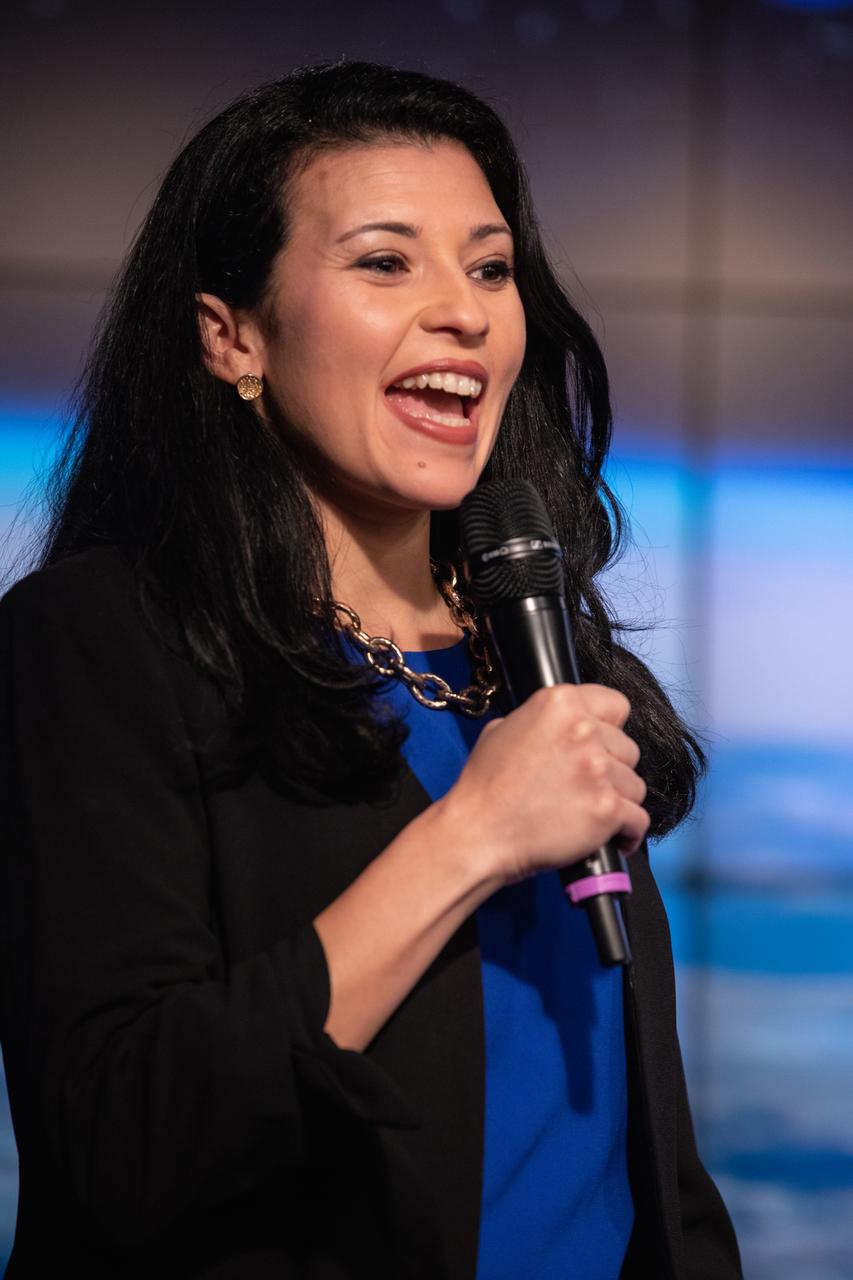
Bettina Inclán, NASA associate administrator for Communications, addresses members of the media during a post launch news conference in Kennedy Space Center’s Press Site auditorium following the March 2, 2:49 a.m. EST launch of the SpaceX Demo-1 Commercial Crew Program (CCP) mission to the International Space Station. The Crew Dragon’s trip to the space station is designed to validate end-to-end systems and capabilities, leading to certification to fly crew. NASA has worked with SpaceX and Boeing in developing the CCP spacecraft to facilitate new human spaceflight systems launching from U.S. soil with the goal of safe, reliable and cost-effective access to low-Earth orbit destinations, such as the space station.
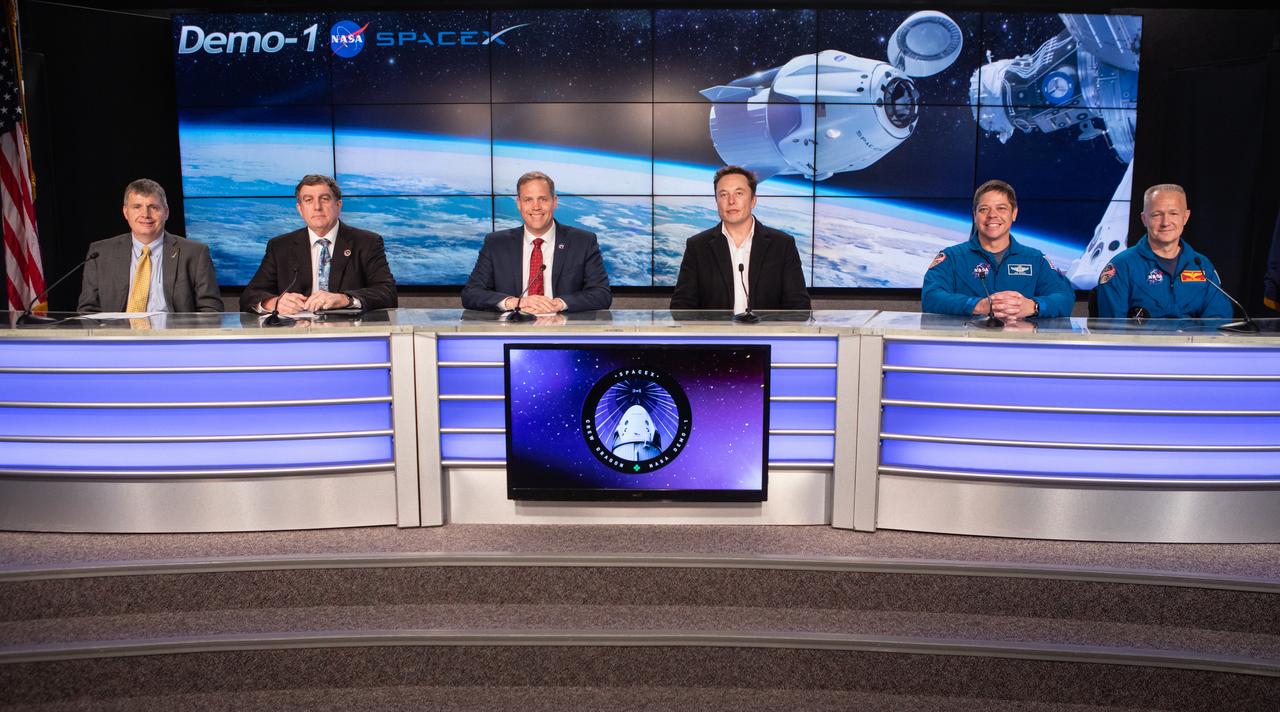
In Kennedy Space Center’s Press Site auditorium, agency and industry leaders speak to members of the media during a post launch news conference following the March 2, 2:49 a.m. EST launch of the SpaceX Demo-1 Commercial Crew Program (CCP) mission to the International Space Station. From left are: Steve Stich, NASA launch manager, Commercial Crew Program; Kirk Shireman, manager, International Space Station Program; Jim Bridenstine, NASA administrator; Elon Musk, CEO and lead designer, SpaceX; Bob Behnken, NASA astronaut and Doug Hurley, NASA astronaut. The Crew Dragon’s trip to the space station is designed to validate end-to-end systems and capabilities, leading to certification to fly crew. NASA has worked with SpaceX and Boeing in developing the CCP spacecraft to facilitate new human spaceflight systems launching from U.S. soil with the goal of safe, reliable and cost-effective access to low-Earth orbit destinations, such as the space station.
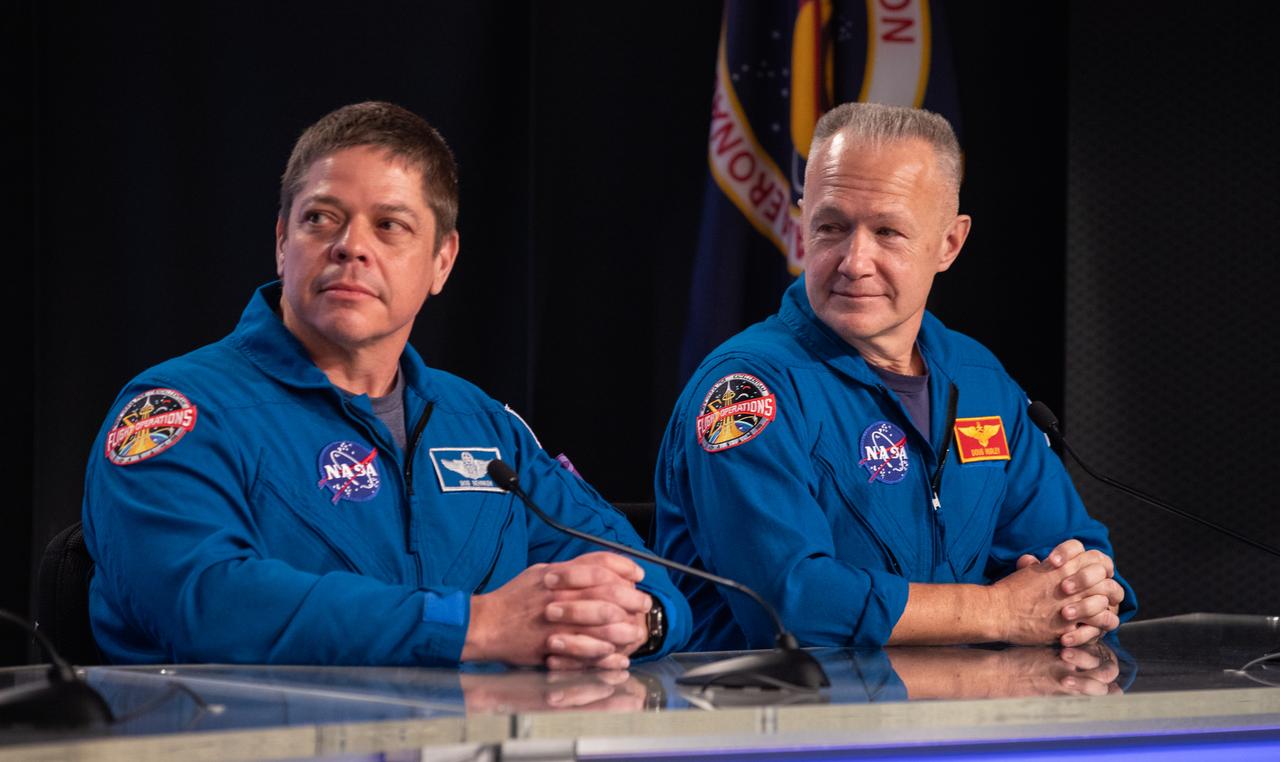
NASA astronauts Bob Behnken, left, and Doug Hurley are introduced to members of the media during a post launch news conference in Kennedy Space Center’s Press Site auditorium following the March 2, 2:49 a.m. EST launch of the SpaceX Demo-1 Commercial Crew Program (CCP) mission to the International Space Station. The Crew Dragon’s trip to the space station is designed to validate end-to-end systems and capabilities, leading to certification to fly crew. NASA has worked with SpaceX and Boeing in developing the CCP spacecraft to facilitate new human spaceflight systems launching from U.S. soil with the goal of safe, reliable and cost-effective access to low-Earth orbit destinations, such as the space station.
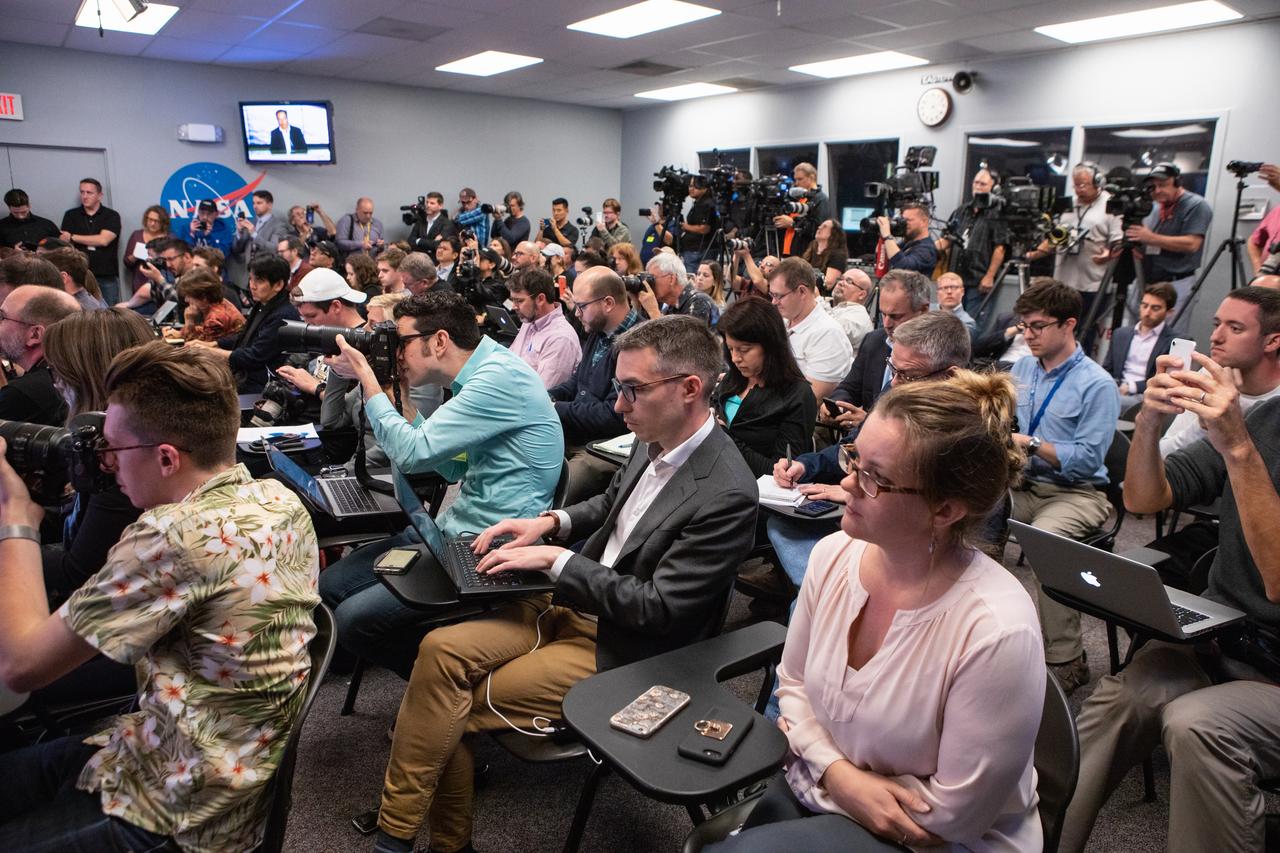
Members of the media gather in Kennedy Space Center’s Press Site auditorium during a post launch news conference with agency and industry leaders following the March 2, 2:49 a.m. EST launch of the SpaceX Demo-1 Commercial Crew Program (CCP) mission to the International Space Station. The Crew Dragon’s trip to the space station is designed to validate end-to-end systems and capabilities, leading to certification to fly crew. NASA has worked with SpaceX and Boeing in developing the CCP spacecraft to facilitate new human spaceflight systems launching from U.S. soil with the goal of safe, reliable and cost-effective access to low-Earth orbit destinations, such as the space station.
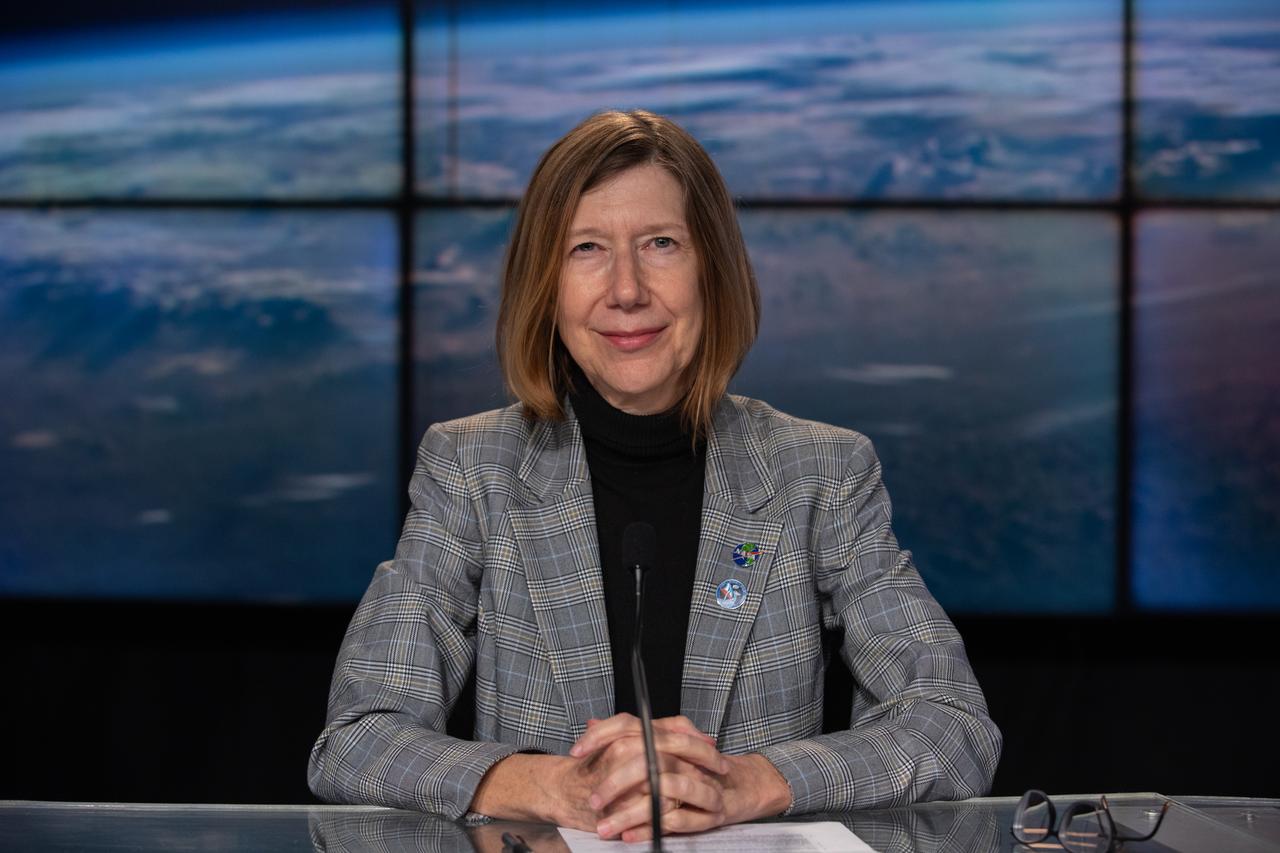
Kathy Lueders, associate administrator, Space Operations Mission Directorate, NASA Headquarters, speaks to members of the news media during a postlaunch news conference for the SpaceX Crew-6 mission at Kennedy Space Center’s NASA News Center in Florida on March 2, 2023. The SpaceX Falcon 9 rocket, carrying the Dragon spacecraft Endeavour for NASA’s Crew-6 mission to the International Space Station lifted off at 12:34 a.m. EST. Aboard Dragon are NASA astronauts Stephen Bowen, spacecraft commander, and Warren Hoburg, pilot, along with mission specialists Sultan Alneyadi, UAE (United Arab Emirates) astronaut, and Andrey Fedyaev, Roscosmos cosmonaut. Crew-6 is the sixth crew rotation mission with SpaceX to the station, and the seventh flight of Dragon with people as part of the agency’s Commercial Crew Program.
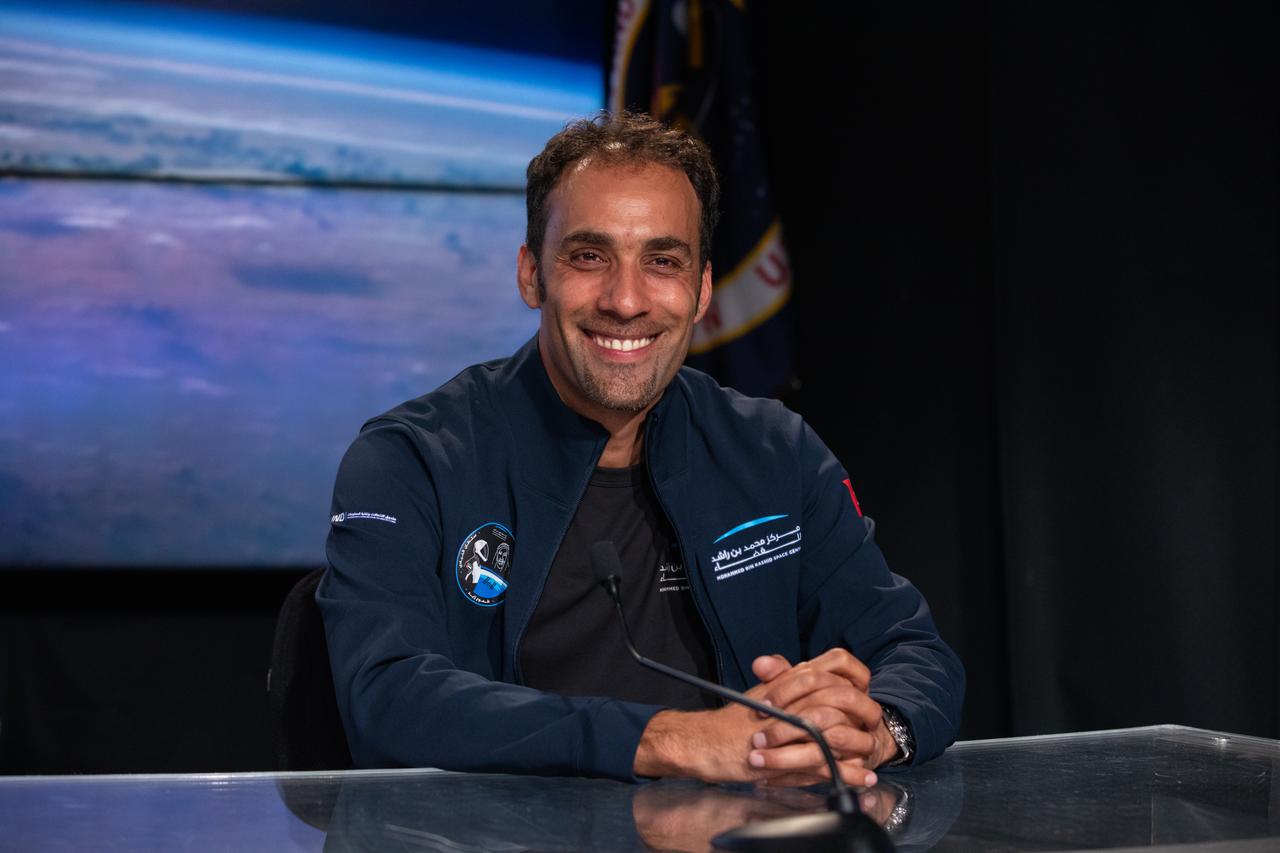
Salem AlMarri, director general, Mohammed Bin Rashid Space Centre, speaks to members of the news media during a postlaunch news conference for the SpaceX Crew-6 mission at Kennedy’s NASA News Center in Florida on March 2, 2023. The SpaceX Falcon 9 rocket, carrying the Dragon spacecraft Endeavour for NASA’s Crew-6 mission to the International Space Station lifted off at 12:34 a.m. EST. Aboard Dragon are NASA astronauts Stephen Bowen, spacecraft commander, and Warren Hoburg, pilot, along with mission specialists Sultan Alneyadi, UAE (United Arab Emirates) astronaut, and Andrey Fedyaev, Roscosmos cosmonaut. Crew-6 is the sixth crew rotation mission with SpaceX to the station, and the seventh flight of Dragon with people as part of the agency’s Commercial Crew Program.

Dina Contella, operations integration manager, International Space Station Program, NASA’s Johnson Space Center in Houston, speaks to members of the news media during a postlaunch news conference for the SpaceX Crew-6 mission at Kennedy’s NASA News Center in Florida on March 2, 2023. The SpaceX Falcon 9 rocket, carrying the Dragon spacecraft Endeavour for NASA’s Crew-6 mission to the International Space Station lifted off at 12:34 a.m. EST. Aboard Dragon are NASA astronauts Stephen Bowen, spacecraft commander, and Warren Hoburg, pilot, along with mission specialists Sultan Alneyadi, UAE (United Arab Emirates) astronaut, and Andrey Fedyaev, Roscosmos cosmonaut. Crew-6 is the sixth crew rotation mission with SpaceX to the station, and the seventh flight of Dragon with people as part of the agency’s Commercial Crew Program.
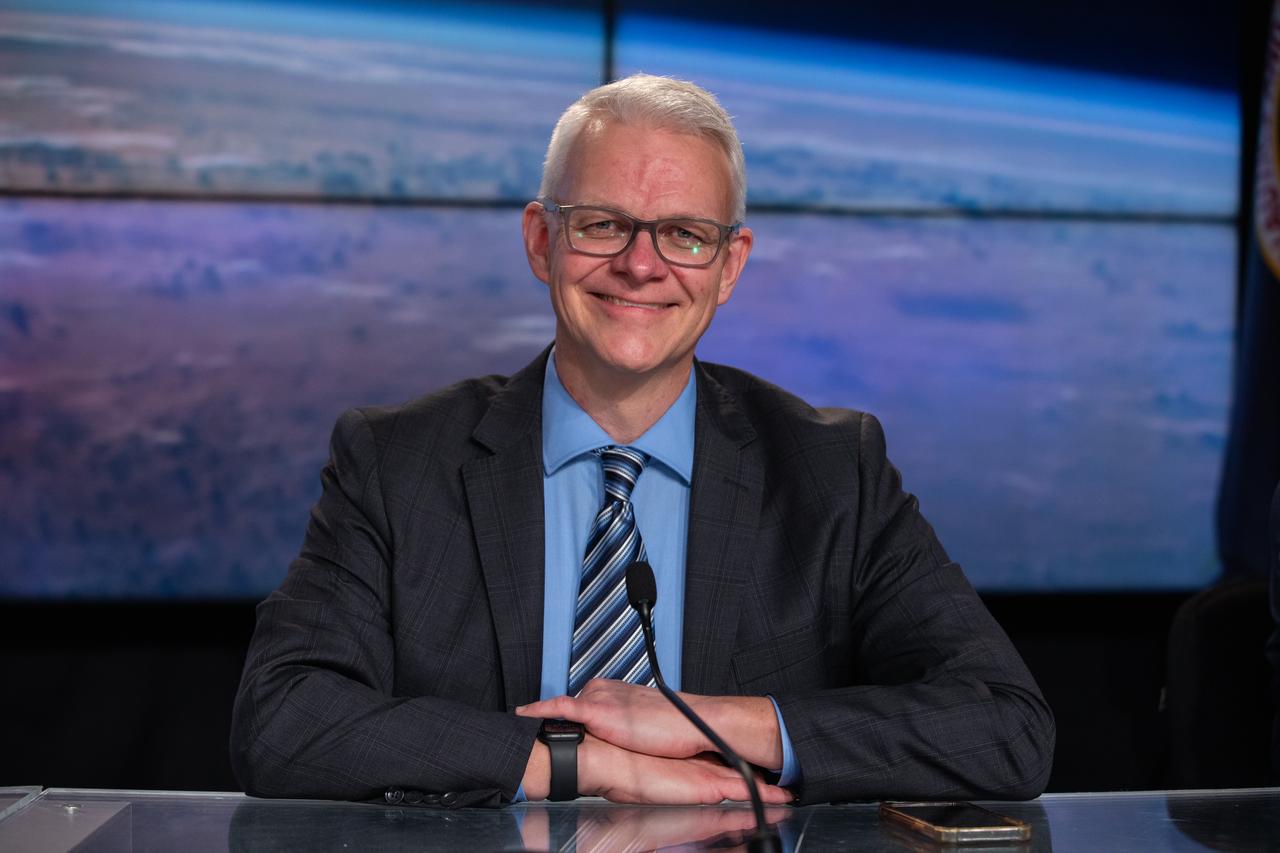
Benji Reed, senior director, Human Spaceflight Program, SpaceX, speaks to members of the news media during a postlaunch news conference for the SpaceX Crew-6 mission at Kennedy’s NASA News Center in Florida on March 2, 2023. The SpaceX Falcon 9 rocket, carrying the Dragon spacecraft Endeavour for NASA’s Crew-6 mission to the International Space Station lifted off at 12:34 a.m. EST. Aboard Dragon are NASA astronauts Stephen Bowen, spacecraft commander, and Warren Hoburg, pilot, along with mission specialists Sultan Alneyadi, UAE (United Arab Emirates) astronaut, and Andrey Fedyaev, Roscosmos cosmonaut. Crew-6 is the sixth crew rotation mission with SpaceX to the station, and the seventh flight of Dragon with people as part of the agency’s Commercial Crew Program.
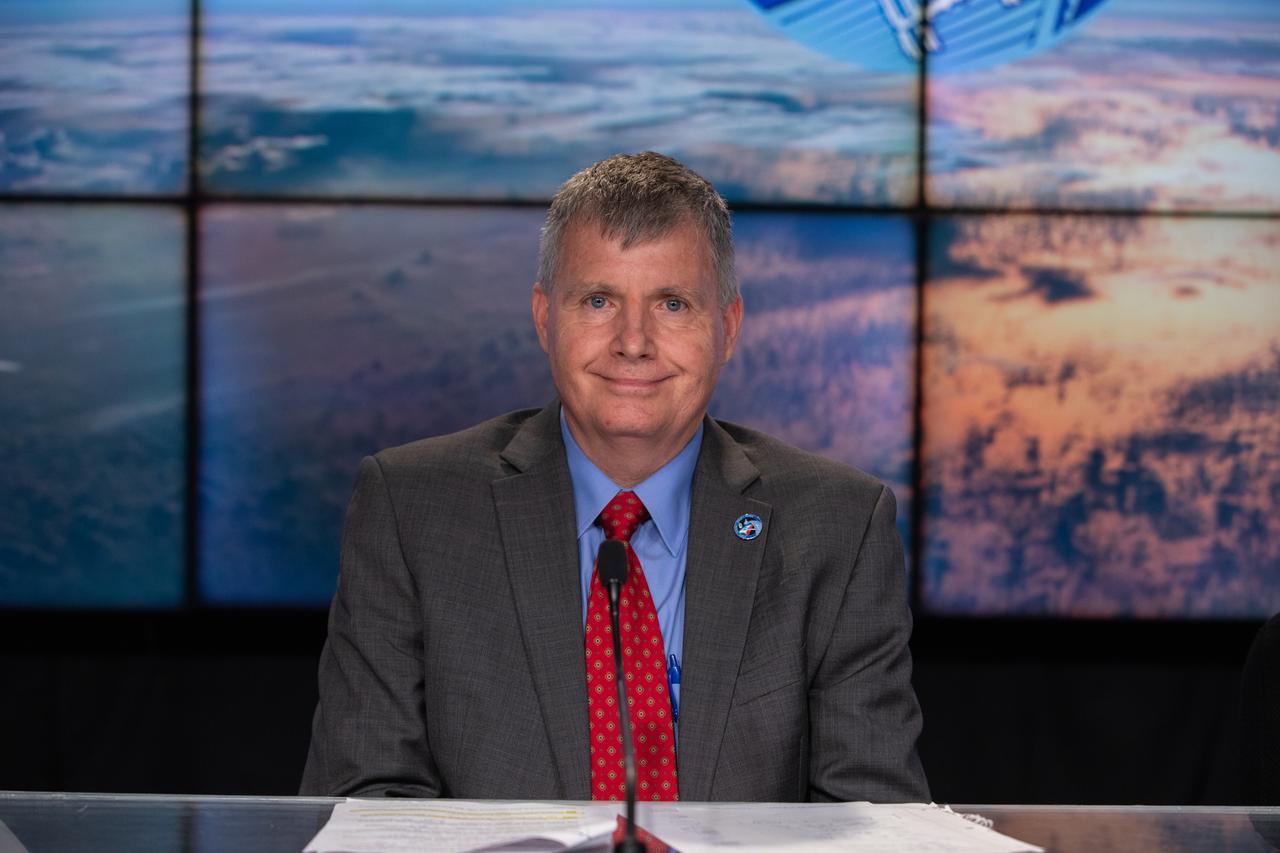
Steve Stich, manager, Commercial Crew Program at Kennedy Space Center, speaks to members of the news media during a postlaunch news conference for the SpaceX Crew-6 mission at Kennedy’s NASA News Center in Florida on March 2, 2023. The SpaceX Falcon 9 rocket, carrying the Dragon spacecraft Endeavour for NASA’s Crew-6 mission to the International Space Station lifted off at 12:34 a.m. EST. Aboard Dragon are NASA astronauts Stephen Bowen, spacecraft commander, and Warren Hoburg, pilot, along with mission specialists Sultan Alneyadi, UAE (United Arab Emirates) astronaut, and Andrey Fedyaev, Roscosmos cosmonaut. Crew-6 is the sixth crew rotation mission with SpaceX to the station, and the seventh flight of Dragon with people as part of the agency’s Commercial Crew Program.
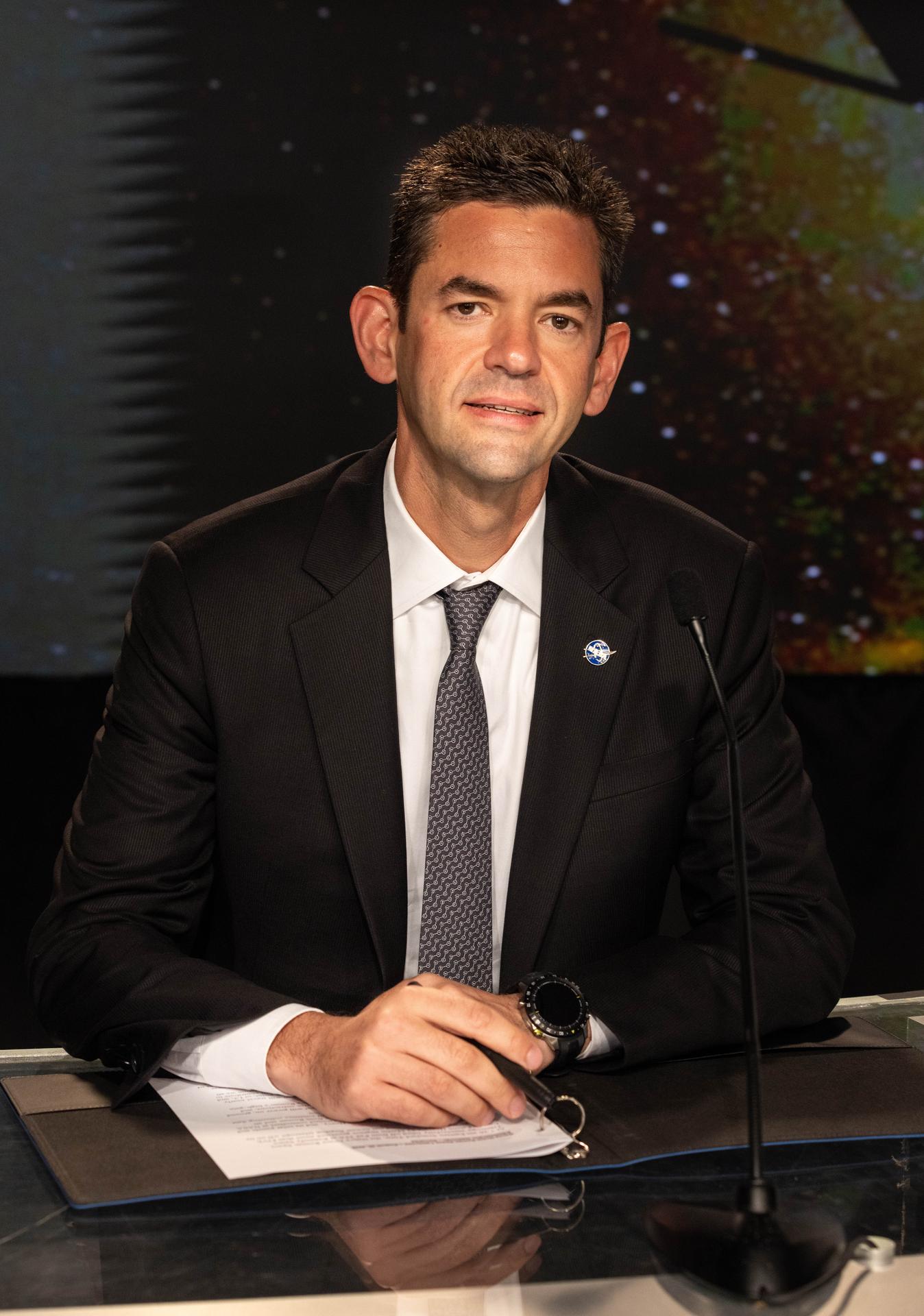
NASA Administrator Jared Isaacman participates in a postlaunch news conference for the agency’s Nancy Grace Roman Space Telescope inside the NASA News Center’s John Holliman Auditorium at Kennedy Space Center in Florida, on Sunday, Aug. 30, 2026. Roman will investigate dark energy and dark matter, conduct a statistical census of planetary systems, and enable a broad range of additional astrophysics research. Liftoff of Roman atop a SpaceX Falcon Heavy rocket occurred at 7:26 a.m. EDT Sunday, Aug. 30, from Kennedy’s Launch Complex 39A.
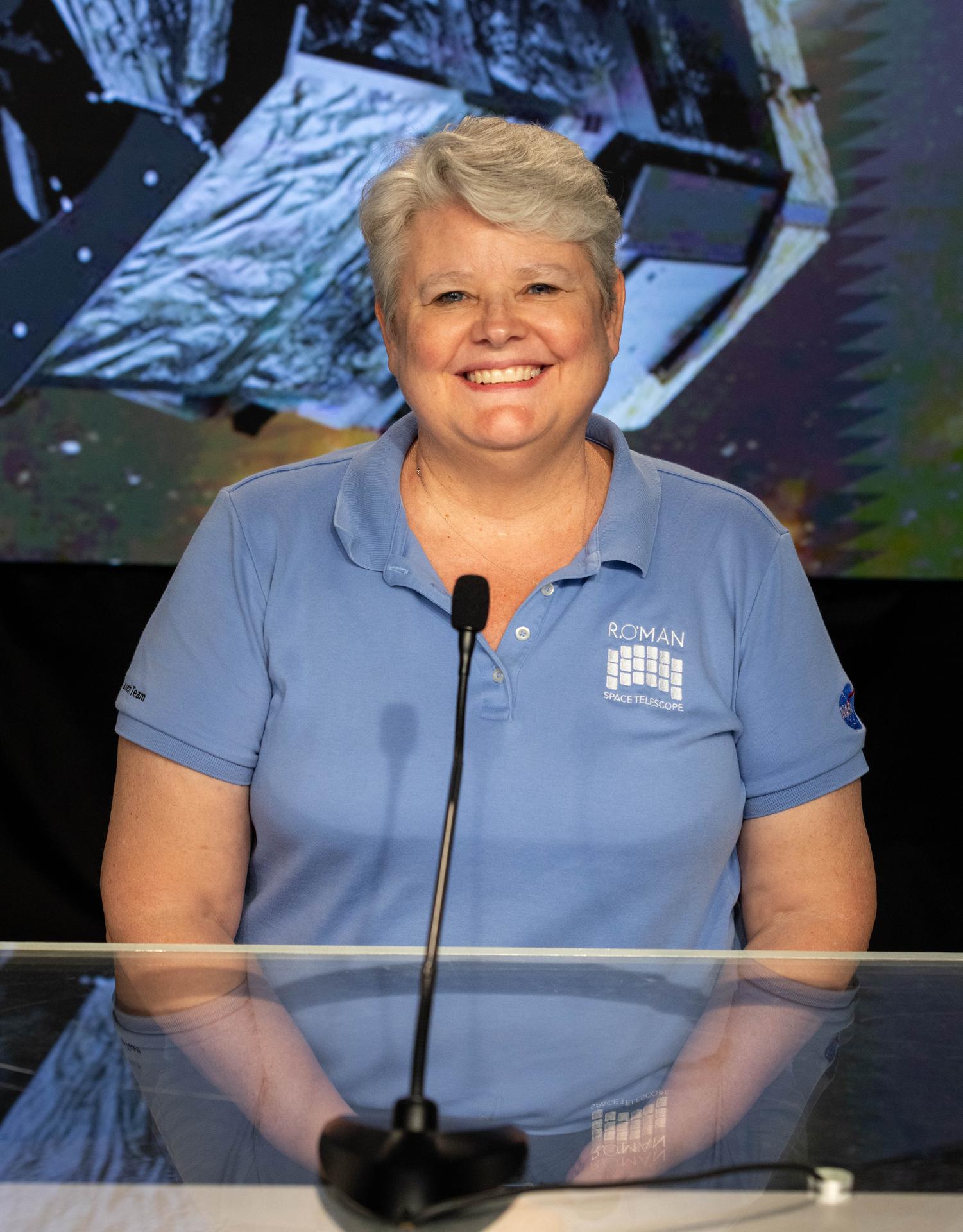
Jackie Townsend, Roman telescope project manager, NASA’s Goddard Space Flight Center in Greenbelt, Maryland, participates in a postlaunch news conference for the agency’s Nancy Grace Roman Space Telescope inside the NASA News Center’s John Holliman Auditorium at Kennedy Space Center in Florida, on Sunday, Aug. 30, 2026. Roman will investigate dark energy and dark matter, conduct a statistical census of planetary systems, and enable a broad range of additional astrophysics research. Liftoff of Roman atop a SpaceX Falcon Heavy rocket occurred at 7:26 a.m. EDT Sunday, Aug. 30, from Kennedy’s Launch Complex 39A
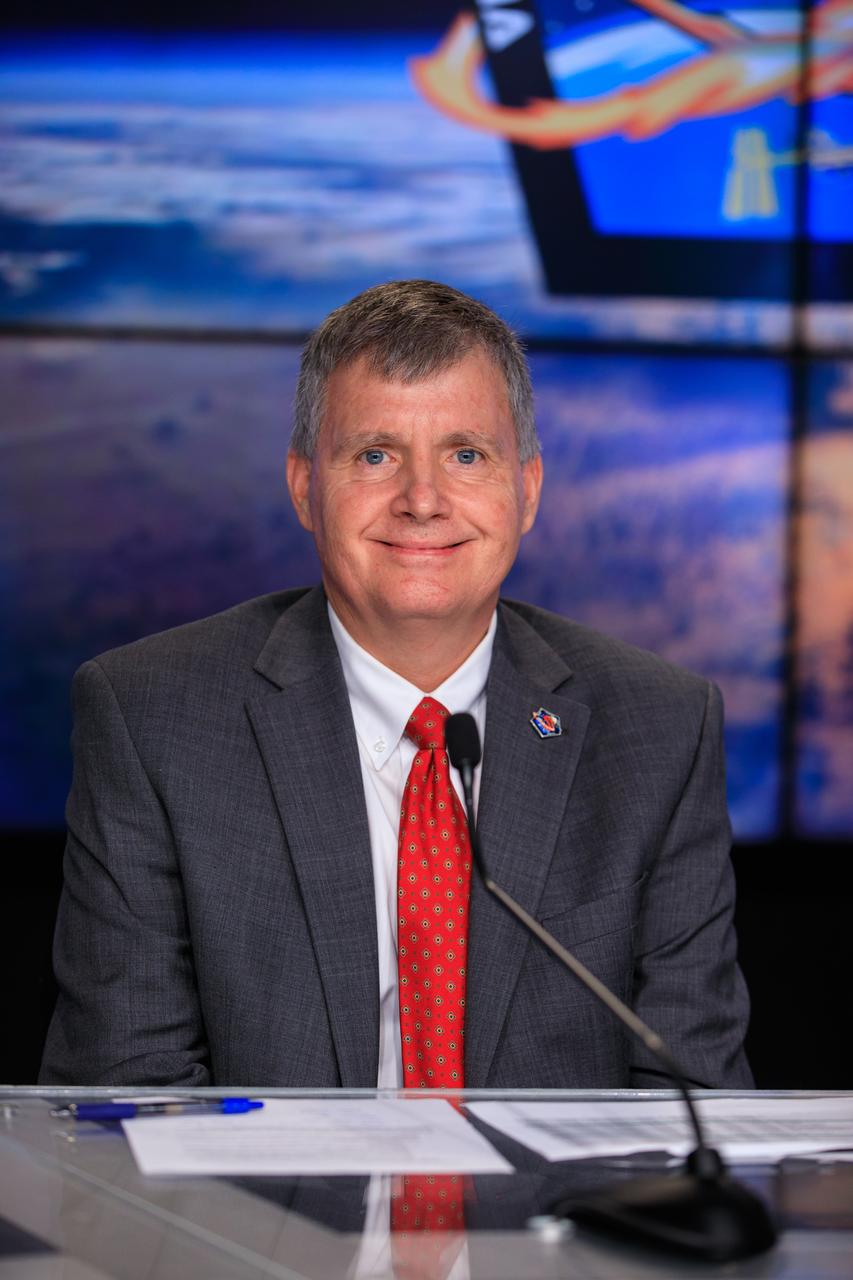
Commercial Crew Program Manager Steve Stich participates in a postlaunch news conference for NASA’s SpaceX Crew-5 mission inside the News Auditorium at the agency’s Kennedy Space Center in Florida on Oct. 5, 2022. SpaceX’s Dragon Endurance is carrying NASA astronauts Nicole Mann, commander; Josh Cassada, pilot; and Mission Specialists Koichi Wakata, of JAXA (Japan Aerospace Exploration Agency), and Roscosmos cosmonaut Anna Kikina to the International Space Station for a science expedition mission as part of NASA’s Commercial Crew Program. SpaceX’s Falcon 9 rocket lifted off at noon EDT from Kennedy’s Launch Complex 39A.
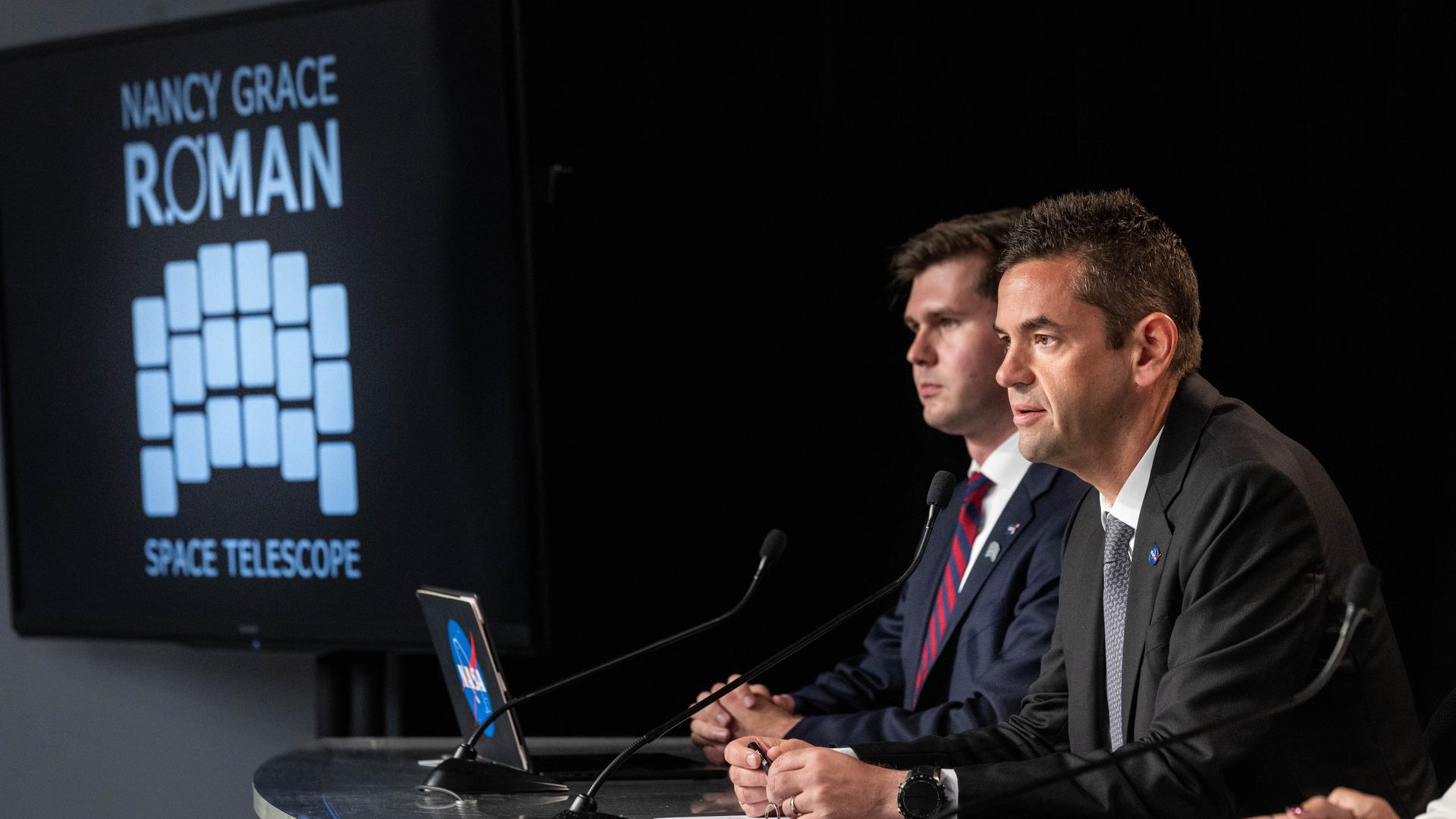
From left, George Alderman, NASA Deputy Press Secretary, and NASA Administrator Jared Isaacman participate in a postlaunch news conference for NASA’s Nancy Grace Roman Space Telescope inside the NASA News Center’s John Holliman Auditorium at Kennedy Space Center in Florida, on Sunday, Aug. 30, 2026. Roman will investigate dark energy and dark matter, conduct a statistical census of planetary systems, and enable a broad range of additional astrophysics research. Liftoff of Roman atop a SpaceX Falcon Heavy rocket occurred at 7:26 a.m. EDT Sunday, Aug. 30, from Kennedy’s Launch Complex 39A.

Sarah Walker, director of Dragon Mission Management at SpaceX, participates in a postlaunch news conference for NASA’s SpaceX Crew-5 mission inside the News Auditorium at the agency’s Kennedy Space Center in Florida on Oct. 5, 2022. SpaceX’s Dragon Endurance is carrying NASA astronauts Nicole Mann, commander; Josh Cassada, pilot; and Mission Specialists Koichi Wakata, of JAXA (Japan Aerospace Exploration Agency), and Roscosmos cosmonaut Anna Kikina to the International Space Station for a science expedition mission as part of NASA’s Commercial Crew Program. SpaceX’s Falcon 9 rocket lifted off at noon EDT from Kennedy’s Launch Complex 39A.
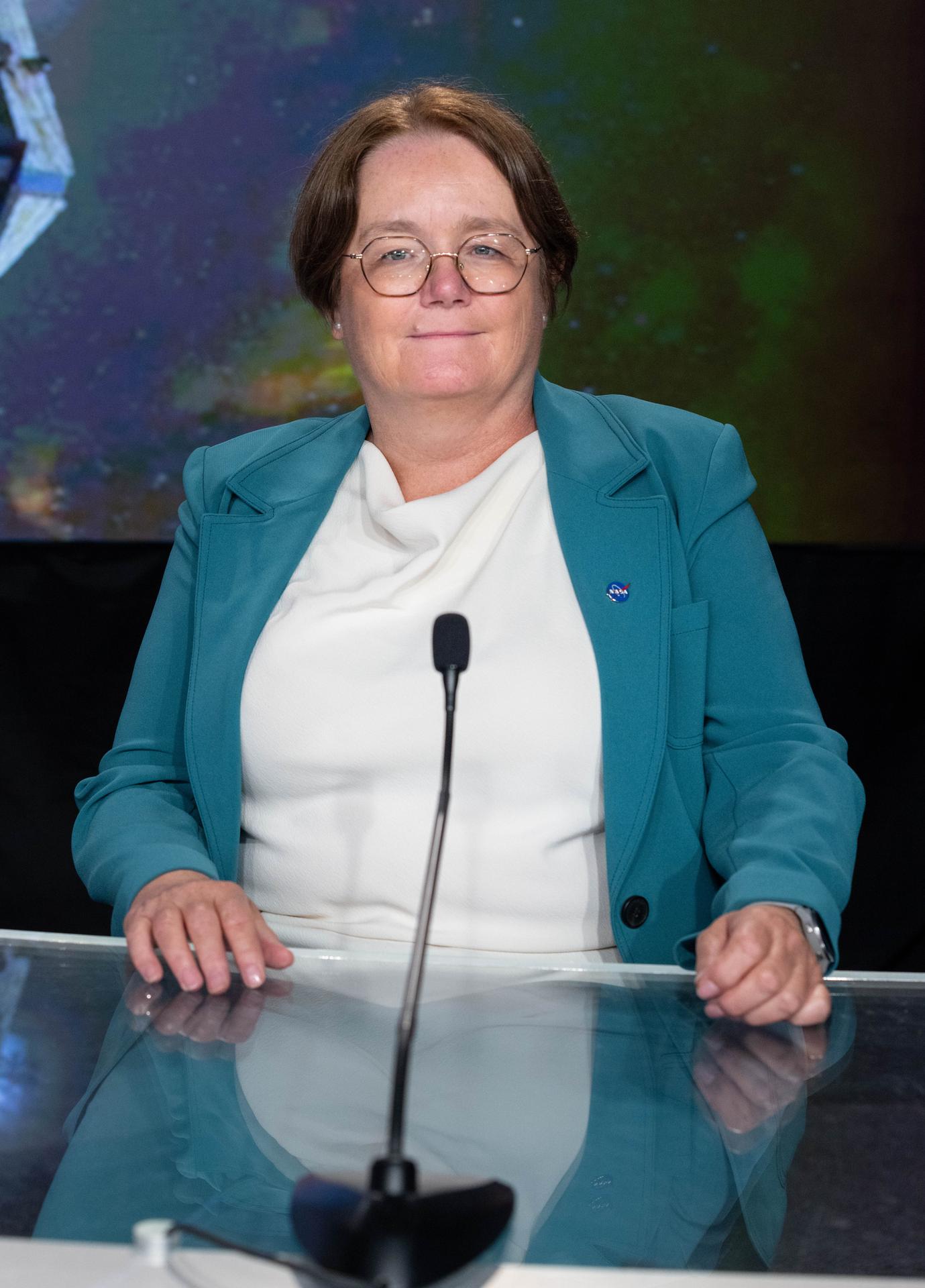
Julie McEnery, Roman telescope senior project scientist, NASA’s Goddard Space Flight Center in Greenbelt, Maryland, participates in a postlaunch news conference for the agency’s Nancy Grace Roman Space Telescope inside the NASA News Center’s John Holliman Auditorium at Kennedy Space Center in Florida, on Sunday, Aug. 30, 2026. Roman will investigate dark energy and dark matter, conduct a statistical census of planetary systems, and enable a broad range of additional astrophysics research. Liftoff of Roman atop a SpaceX Falcon Heavy rocket occurred at 7:26 a.m. EDT Sunday, Aug. 30, from Kennedy’s Launch Complex 39A.

NASA Communications’ Megan Cruz moderates a postlaunch news conference for NASA’s SpaceX Crew-5 mission inside the News Auditorium at the agency’s Kennedy Space Center in Florida on Oct. 5, 2022. SpaceX’s Dragon Endurance is carrying NASA astronauts Nicole Mann, commander; Josh Cassada, pilot; and Mission Specialists Koichi Wakata, of JAXA (Japan Aerospace Exploration Agency), and Roscosmos cosmonaut Anna Kikina to the International Space Station for a science expedition mission as part of NASA’s Commercial Crew Program. SpaceX’s Falcon 9 rocket lifted off at noon EDT from Kennedy’s Launch Complex 39A.
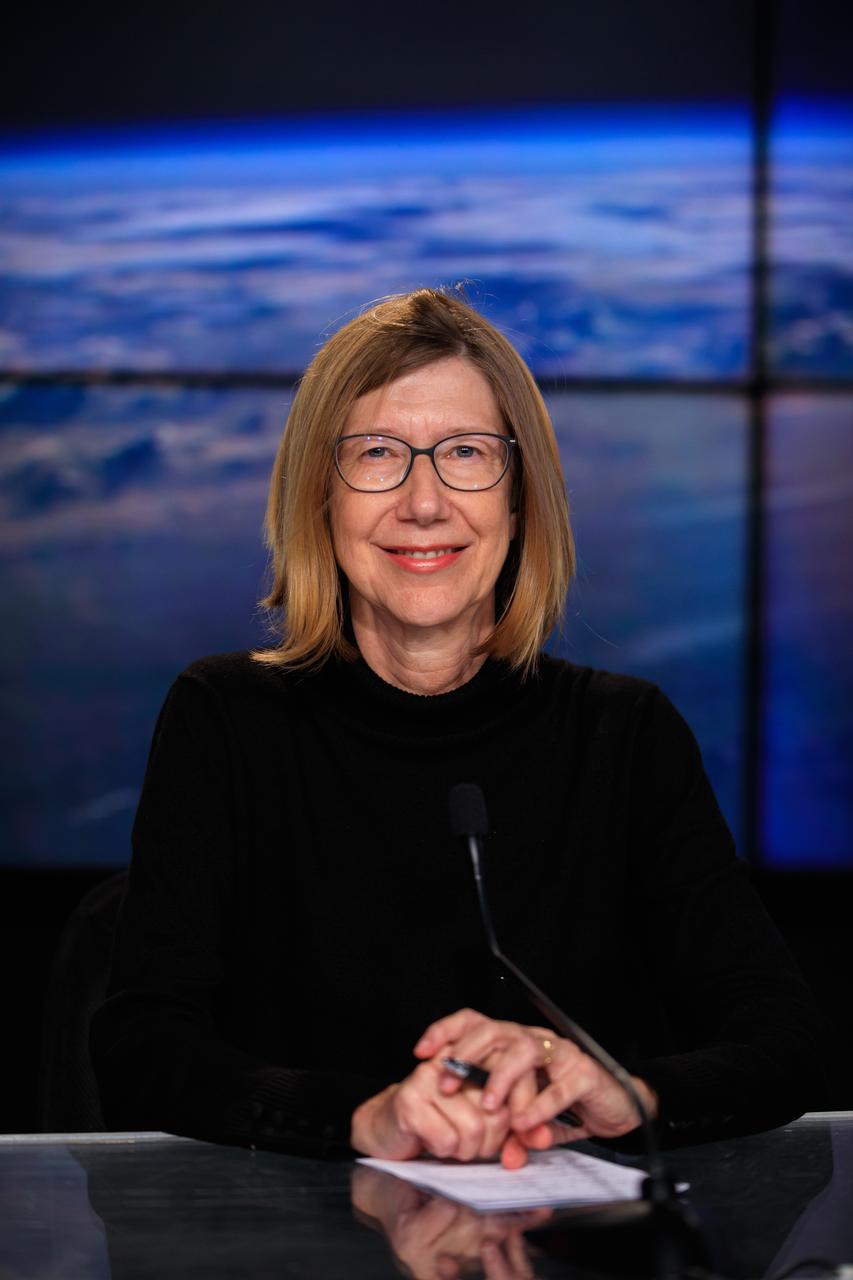
Kathy Lueders, associate administrator for NASA’s Human Exploration and Operations Mission Directorate, participates in a postlaunch news conference for NASA’s SpaceX Crew-5 mission inside the News Auditorium at the agency’s Kennedy Space Center in Florida on Oct. 5, 2022. SpaceX’s Dragon Endurance is carrying NASA astronauts Nicole Mann, commander; Josh Cassada, pilot; and Mission Specialists Koichi Wakata, of JAXA (Japan Aerospace Exploration Agency), and Roscosmos cosmonaut Anna Kikina to the International Space Station for a science expedition mission as part of NASA’s Commercial Crew Program. SpaceX’s Falcon 9 rocket lifted off at noon EDT from Kennedy’s Launch Complex 39A.
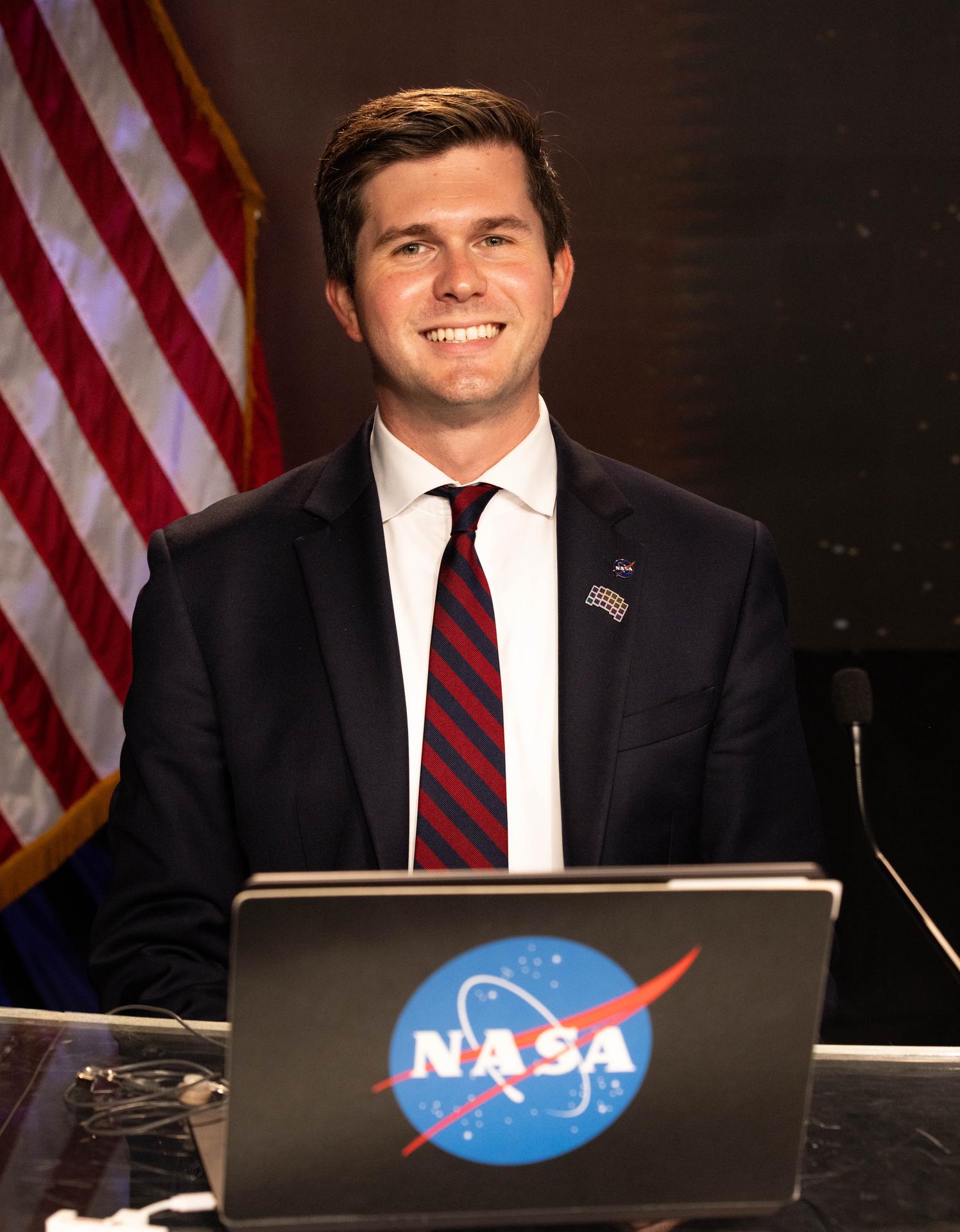
NASA Deputy Press Secretary George Alderman participates in a postlaunch news conference for the agency’s Nancy Grace Roman Space Telescope inside the NASA News Center’s John Holliman Auditorium at Kennedy Space Center in Florida, on Sunday, Aug. 30, 2026. Roman will investigate dark energy and dark matter, conduct a statistical census of planetary systems, and enable a broad range of additional astrophysics research. Liftoff of Roman atop a SpaceX Falcon Heavy rocket occurred at 7:26 a.m. EDT Sunday, Aug. 30, from Kennedy’s Launch Complex 39A.
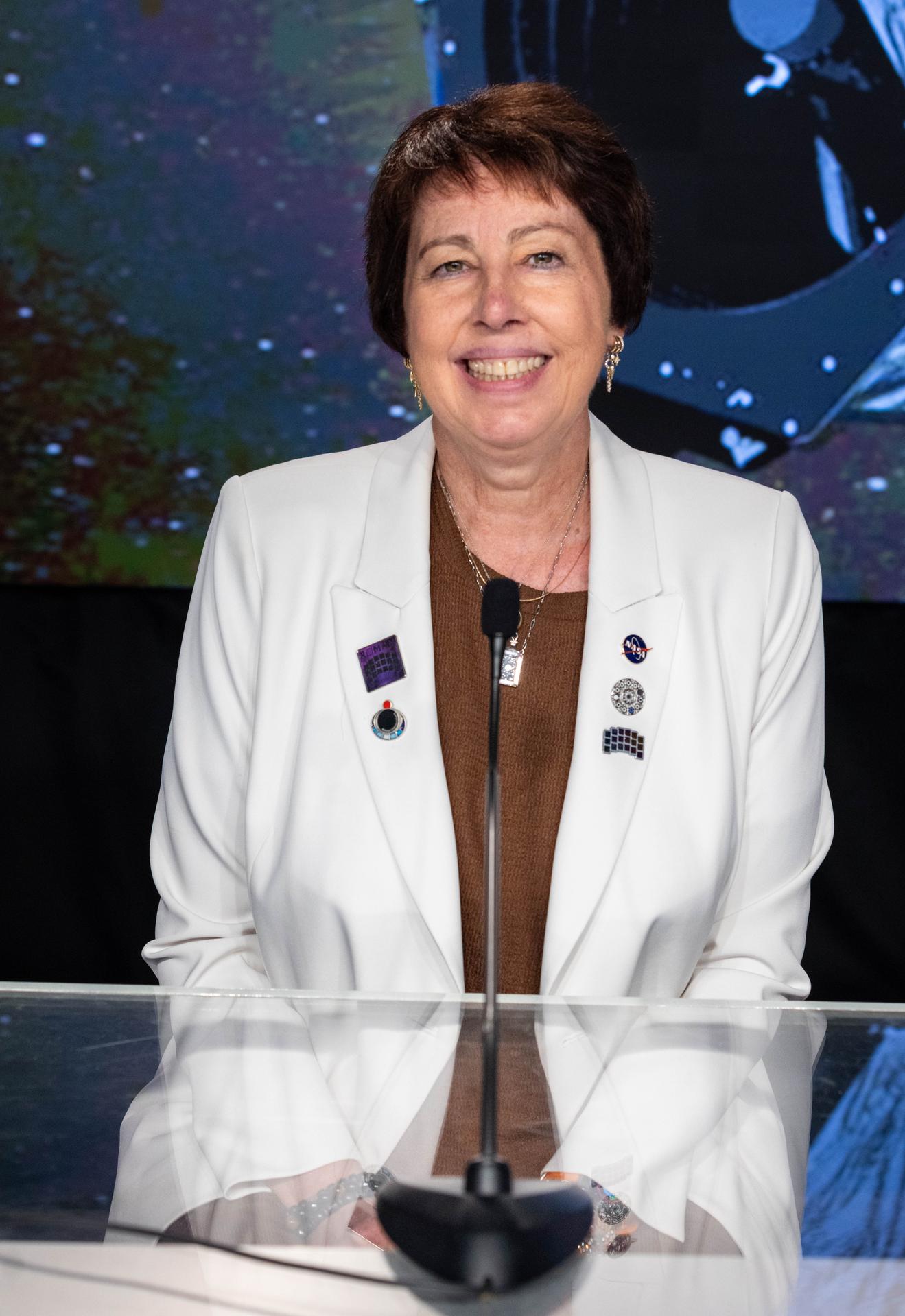
Nicky Fox, associate administrator, Science Mission Directorate, NASA Headquarters in Washington, participates in a postlaunch news conference for the agency’s Nancy Grace Roman Space Telescope inside the NASA News Center’s John Holliman Auditorium at Kennedy Space Center in Florida, on Sunday, Aug. 30, 2026. Roman will investigate dark energy and dark matter, conduct a statistical census of planetary systems, and enable a broad range of additional astrophysics research. Liftoff of Roman atop a SpaceX Falcon Heavy rocket occurred at 7:26 a.m. EDT Sunday, Aug. 30, from Kennedy’s Launch Complex 39A.
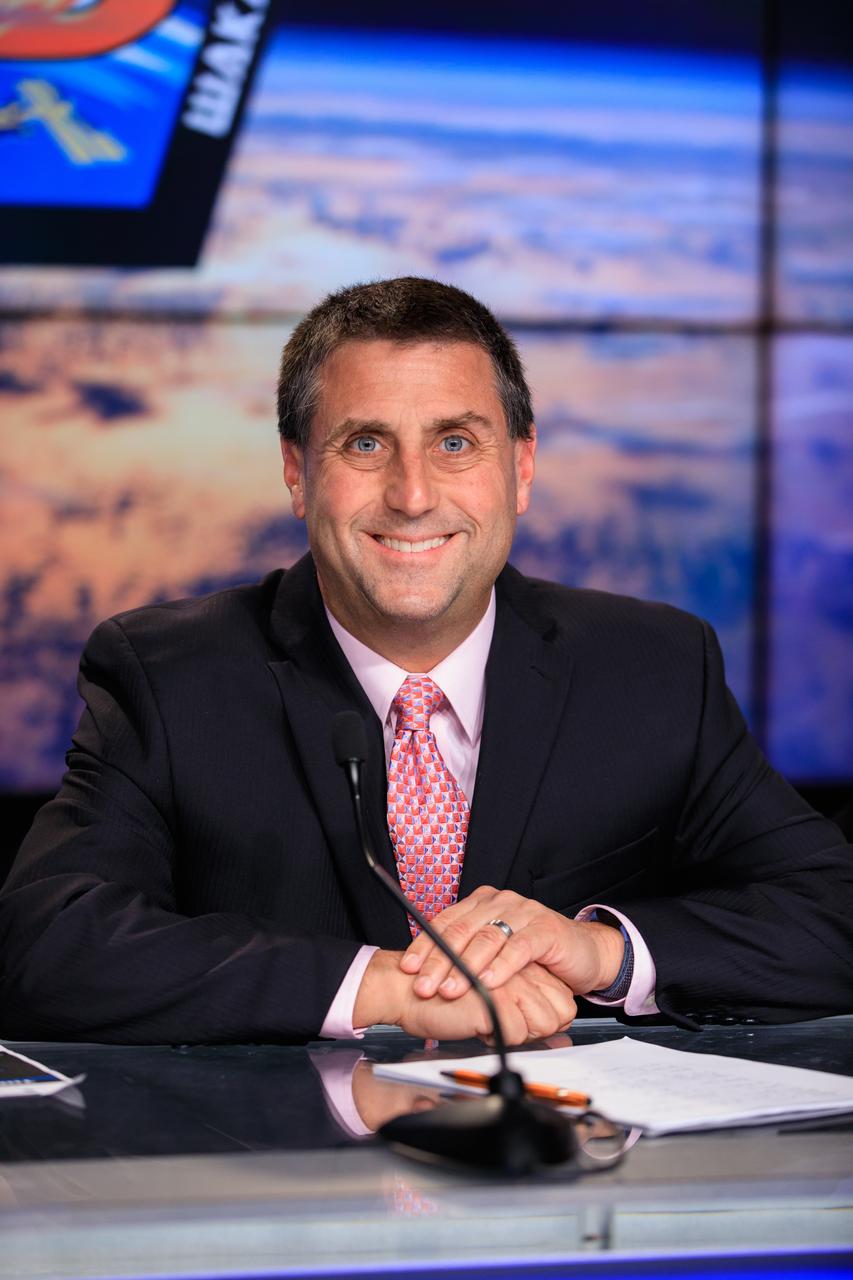
International Space Station Program Manager Joel Montalbano participates in a postlaunch news conference for NASA’s SpaceX Crew-5 mission inside the News Auditorium at the agency’s Kennedy Space Center in Florida on Oct. 5, 2022. SpaceX’s Dragon Endurance is carrying NASA astronauts Nicole Mann, commander; Josh Cassada, pilot; and Mission Specialists Koichi Wakata, of JAXA (Japan Aerospace Exploration Agency), and Roscosmos cosmonaut Anna Kikina to the International Space Station for a science expedition mission as part of NASA’s Commercial Crew Program. SpaceX’s Falcon 9 rocket lifted off at noon EDT from Kennedy’s Launch Complex 39A.
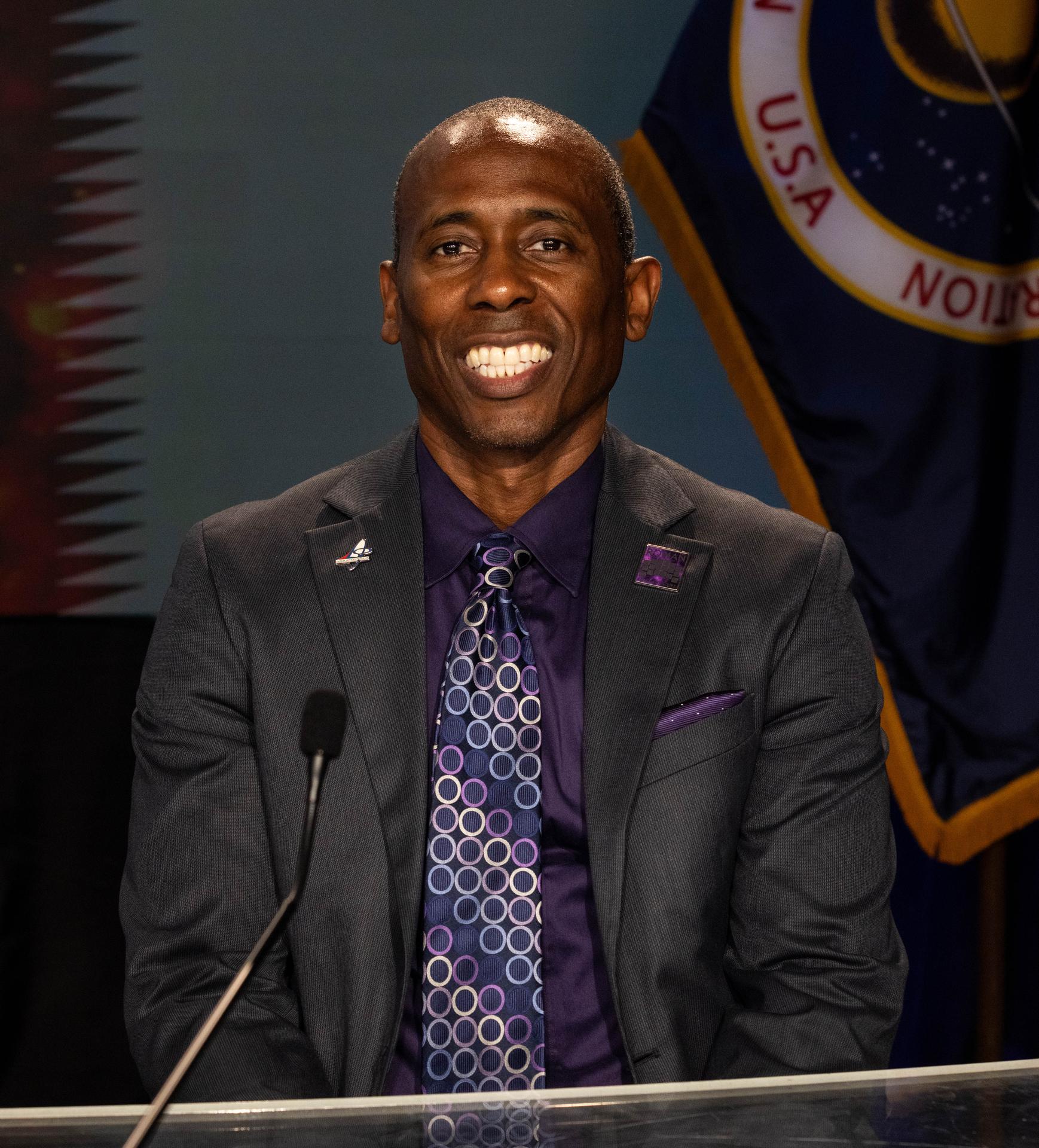
Denton Gibson, launch director, NASA’s Launch Services Program, Kennedy Space Center in Florida, participates in a postlaunch news conference for the agency’s Nancy Grace Roman Space Telescope inside the NASA News Center’s John Holliman Auditorium at Kennedy Space Center in Florida, on Sunday, Aug. 30, 2026. Roman will investigate dark energy and dark matter, conduct a statistical census of planetary systems, and enable a broad range of additional astrophysics research. Liftoff of Roman atop a SpaceX Falcon Heavy rocket occurred at 7:26 a.m. EDT Sunday, Aug. 30, from Kennedy’s Launch Complex 39A.

Sergei Krikalev, executive director of Human Space Flight Programs with Roscosmos, participates in a postlaunch news conference for NASA’s SpaceX Crew-5 mission inside the News Auditorium at the agency’s Kennedy Space Center in Florida on Oct. 5, 2022. SpaceX’s Dragon Endurance is carrying NASA astronauts Nicole Mann, commander; Josh Cassada, pilot; and Mission Specialists Koichi Wakata, of JAXA (Japan Aerospace Exploration Agency), and Roscosmos cosmonaut Anna Kikina to the International Space Station for a science expedition mission as part of NASA’s Commercial Crew Program. SpaceX’s Falcon 9 rocket lifted off at noon EDT from Kennedy’s Launch Complex 39A.
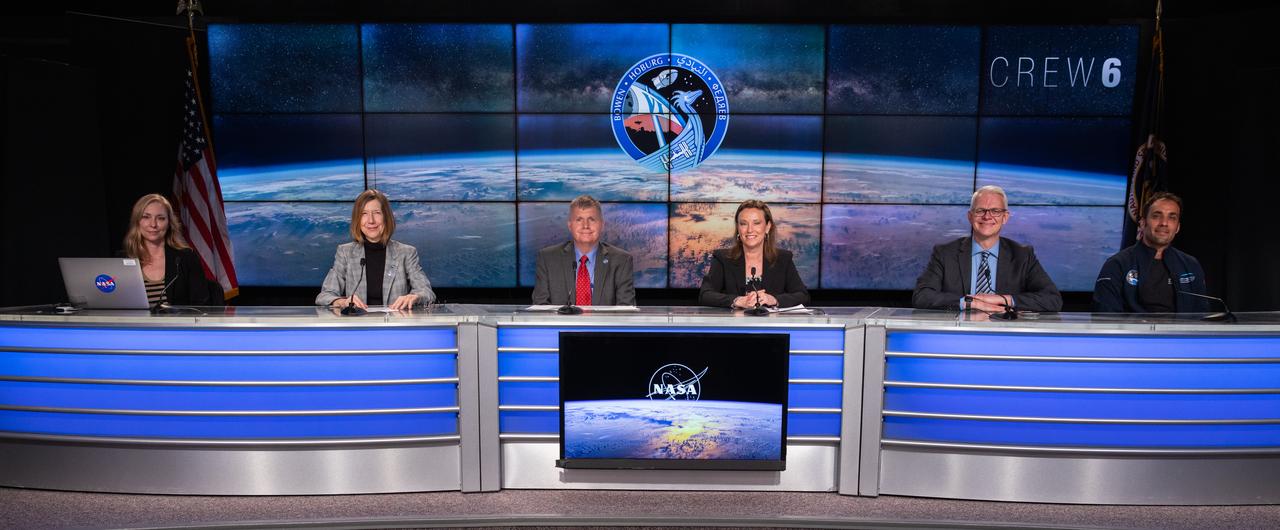
A postlaunch news conference is held for the SpaceX Crew-6 mission at the NASA News Center at Kennedy Space Center in Florida on March 2, 2023. Participants from left are Lori Bleacher, moderator, NASA Communications; Kathy Lueders, associate administrator, Space Operations Mission Directorate, NASA Headquarters; Steve Stich, manager, Commercial Crew Program, Kennedy Space Center; Dina Contella, operations integration manager, International Space Station Program, NASA’s Johnson Space Center in Houston; Benji Reed, senior director, Human Spaceflight Program, SpaceX; and Salem AlMarri, director general, Mohammed Bin Rashid Space Centre The SpaceX Falcon 9 rocket, carrying the Dragon spacecraft Endeavour for NASA’s Crew-6 mission to the International Space Station lifted off at 12:34 a.m. EST from Launch Complex 39A. Aboard Dragon are NASA astronauts Stephen Bowen, spacecraft commander, and Warren Hoburg, pilot, along with mission specialists Sultan Alneyadi, UAE (United Arab Emirates) astronaut, and Andrey Fedyaev, Roscosmos cosmonaut. Crew-6 is the sixth crew rotation mission with SpaceX to the station, and the seventh flight of Dragon with people as part of the agency’s Commercial Crew Program.
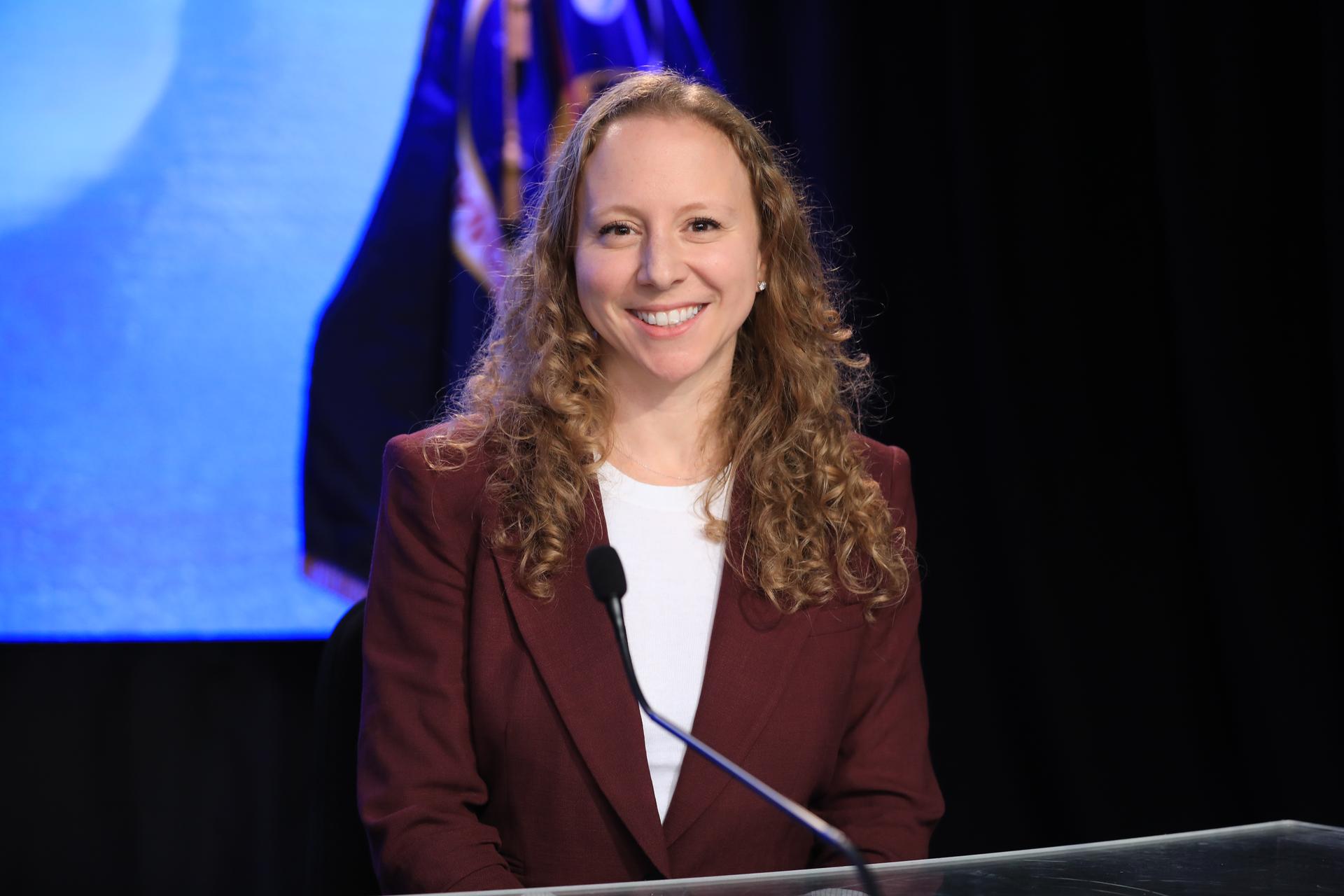
Julianna Scheiman, director, NASA Science and Dragon Programs, SpaceX, participates in a postlaunch news conference at the agency’s Kennedy Space Center in Florida on Friday, Feb. 13, 2026, following the launch of NASA’s SpaceX Crew-12 mission to the International Space Station. NASA astronauts Jessica Meir and Jack Hathaway, ESA (European Space Agency) astronaut Sophie Adenot, and Roscosmos cosmonaut Andrey Fedyaev launched to the International Space Station aboard SpaceX’s Dragon spacecraft and Falcon 9 rocket at 5:15 a.m. EST on the 12th crew rotation mission with SpaceX to the space station as part of NASA’s Commercial Crew Program.
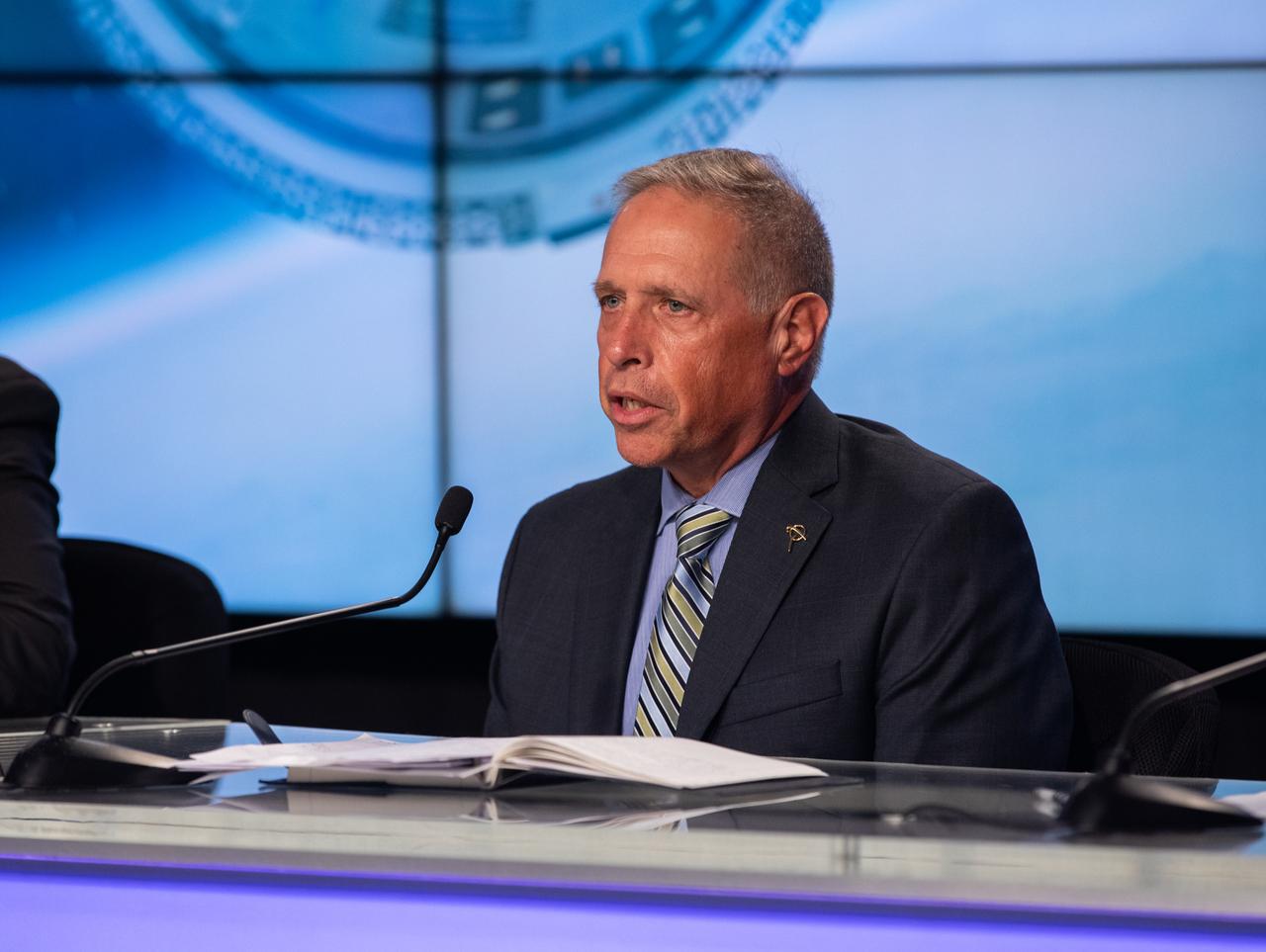
Mark Nappi, vice president and program manager, Boeing Commercial Crew Program, participates in a postlaunch news conference following the liftoff of NASA Boeing’s Orbital Flight Test-2 (OFT-2) on May 19, 2022. Liftoff occurred at 6:54 p.m. EDT from Space Launch Complex-41 at Florida’s Cape Canaveral Space Force Station. Boeing’s uncrewed flight test is designed to test the system’s end-to-end capabilities for NASA’s Commercial Crew Program providing valuable data towards NASA certifying Boeing’s crew transportation system for regular crewed flights to and from the International Space Station.
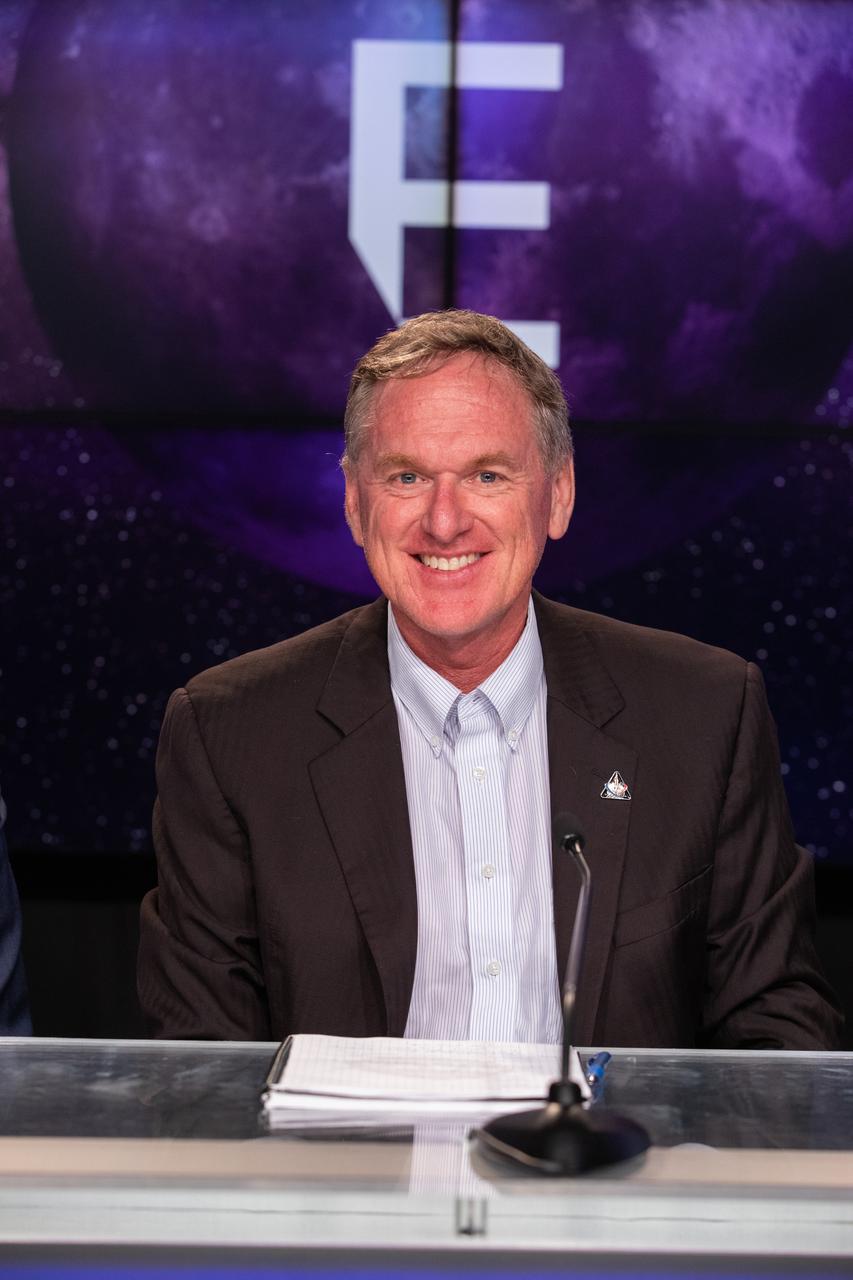
Mike Bolger, Exploration Ground Systems Program manager, Kennedy, participates in a postlaunch news conference on Nov. 16, 2022, at NASA’s Kennedy Space Center in Florida, after launch of Artemis I at 1:47 a.m. EST from Kennedy’s Launch Complex 39B. The first in a series of increasingly complex missions, Artemis I will provide a foundation for human deep space exploration and demonstrate our commitment and capability to extend human presence to the Moon and beyond. The primary goal of Artemis I is to thoroughly test the integrated systems before crewed missions by operating the spacecraft in a deep space environment, testing Orion’s heat shield, and recovering the crew module after reentry, descent, and splashdown.
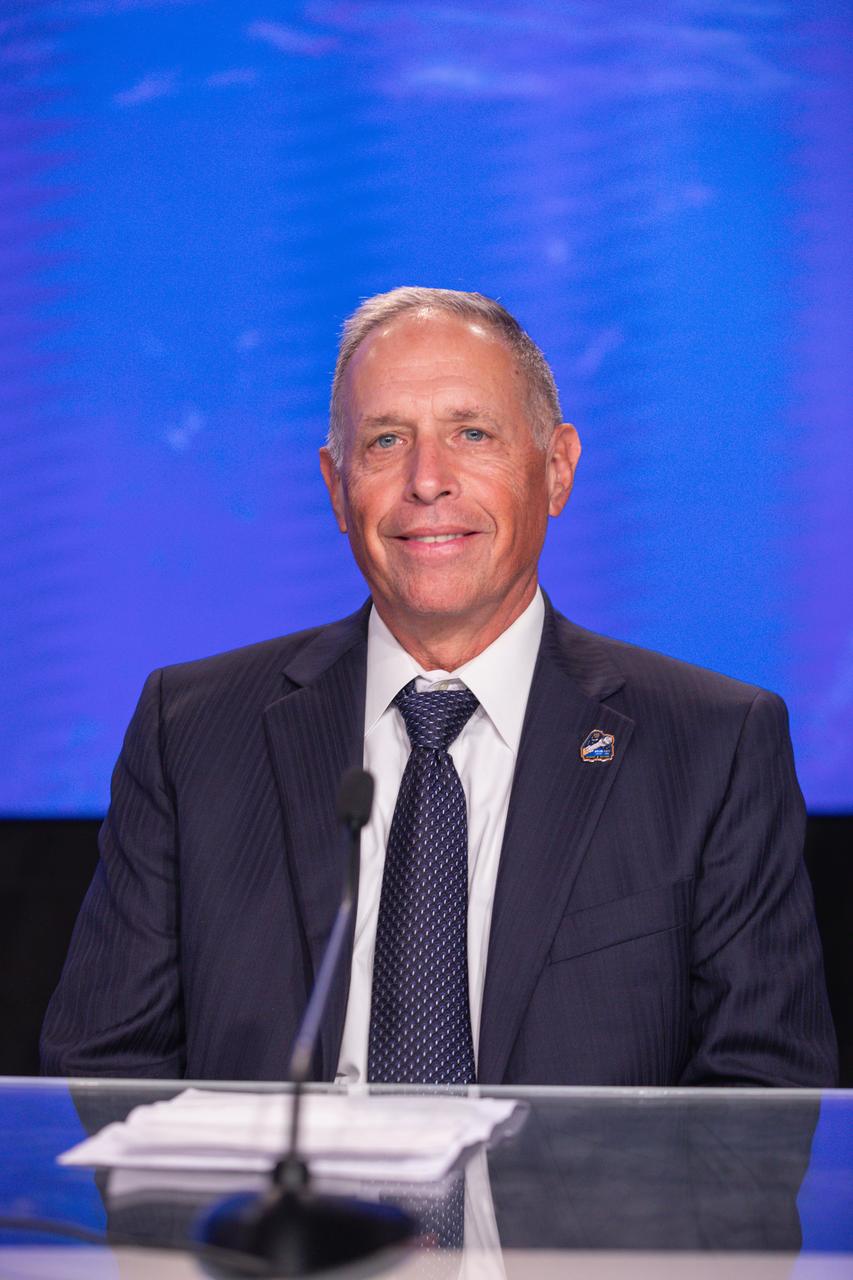
Vice President and Program Manager of Boeing’s Commercial Crew Program Mark Nappi participates in a postlaunch news conference for NASA’s Boeing Crew Flight Test on Wednesday, June 5, 2024, at the agency’s Kennedy Space Center in Florida. As part of the agency’s Commercial Crew Program, NASA astronauts Butch Wilmore and Suni Williams are the first to launch aboard Boeing’s Starliner spacecraft atop a United Launch Alliance Atlas V rocket. Liftoff occurred at 10:52 a.m. EDT Wednesday, June 5, from Space Launch Complex-41 at Cape Canaveral Space Force Station.
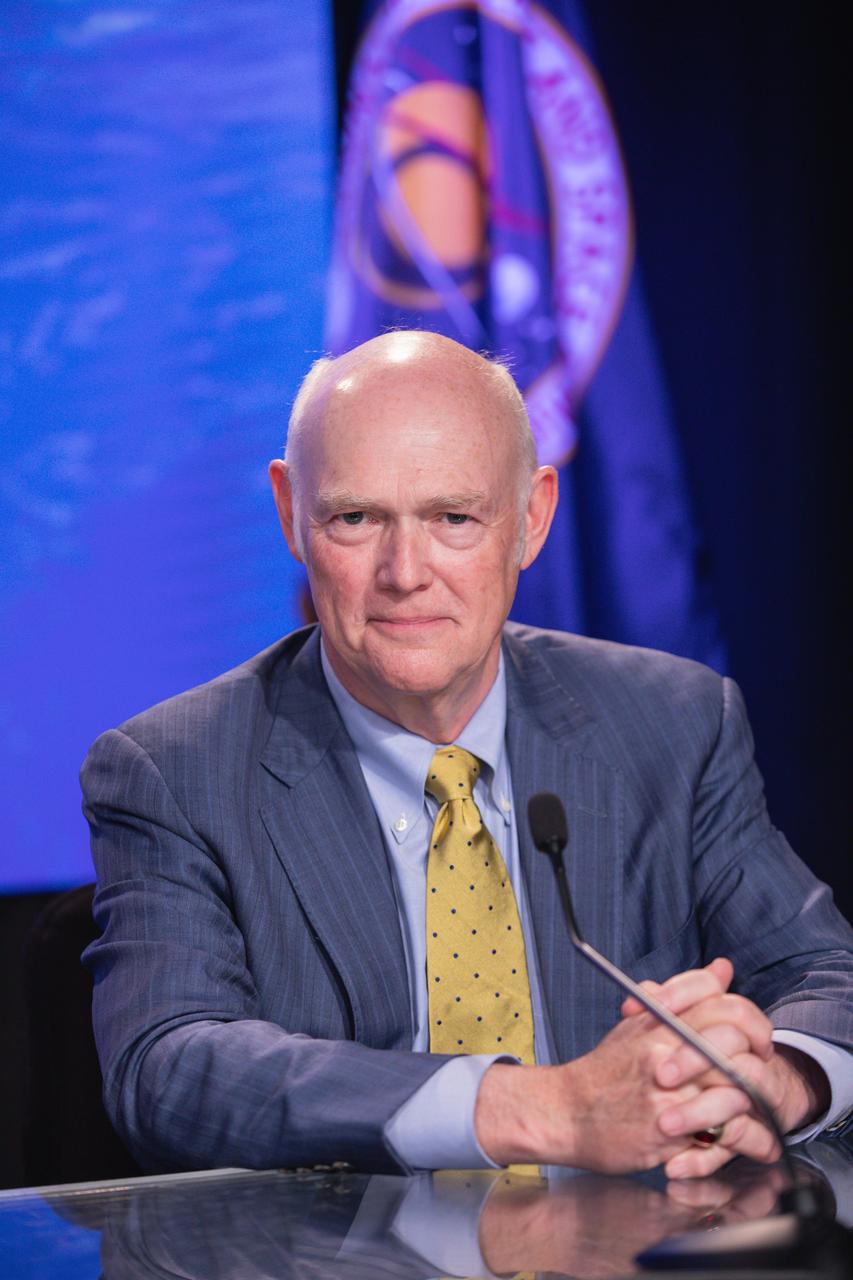
ULA (United Launch Alliance) President and CEO Tory Bruno participates in a postlaunch news conference for NASA’s Boeing Crew Flight Test on Wednesday, June 5, 2024, at the agency’s Kennedy Space Center in Florida. As part of the agency’s Commercial Crew Program, NASA astronauts Butch Wilmore and Suni Williams are the first to launch aboard Boeing’s Starliner spacecraft to the International Space Station atop a United Launch Alliance Atlas V rocket. Liftoff occurred at 10:52 a.m. EDT Wednesday, June 5, from Space Launch Complex-41 at Cape Canaveral Space Force Station.
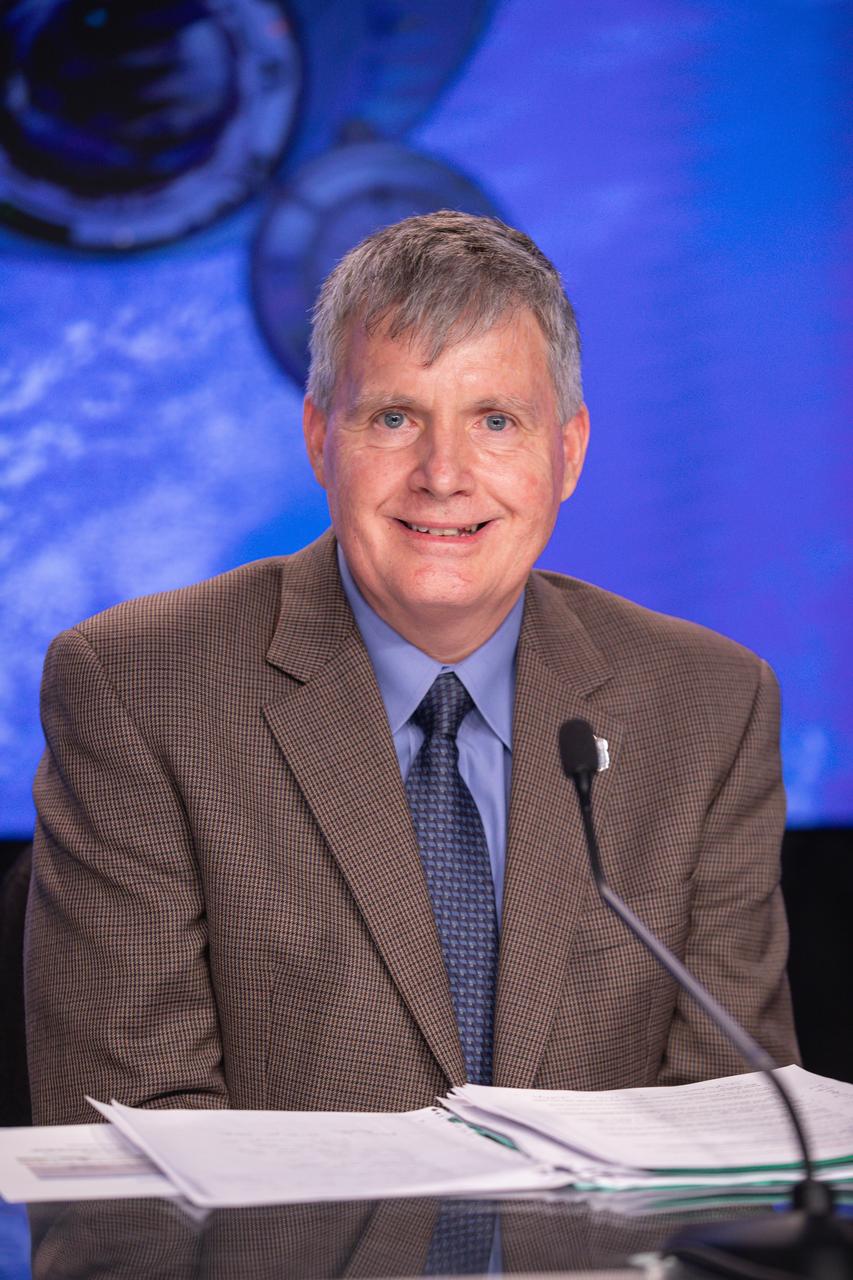
NASA Commercial Crew Program Manager Steve Stich participates in a postlaunch news conference for NASA’s Boeing Crew Flight Test on Wednesday, June 5, 2024, at the agency’s Kennedy Space Center in Florida. As part of the agency’s Commercial Crew Program, NASA astronauts Butch Wilmore and Suni Williams are the first to launch aboard Boeing’s Starliner spacecraft to the International Space Station atop a United Launch Alliance Atlas V rocket. Liftoff occurred at 10:52 a.m. EDT Wednesday, June 5, from Space Launch Complex-41 at Cape Canaveral Space Force Station.
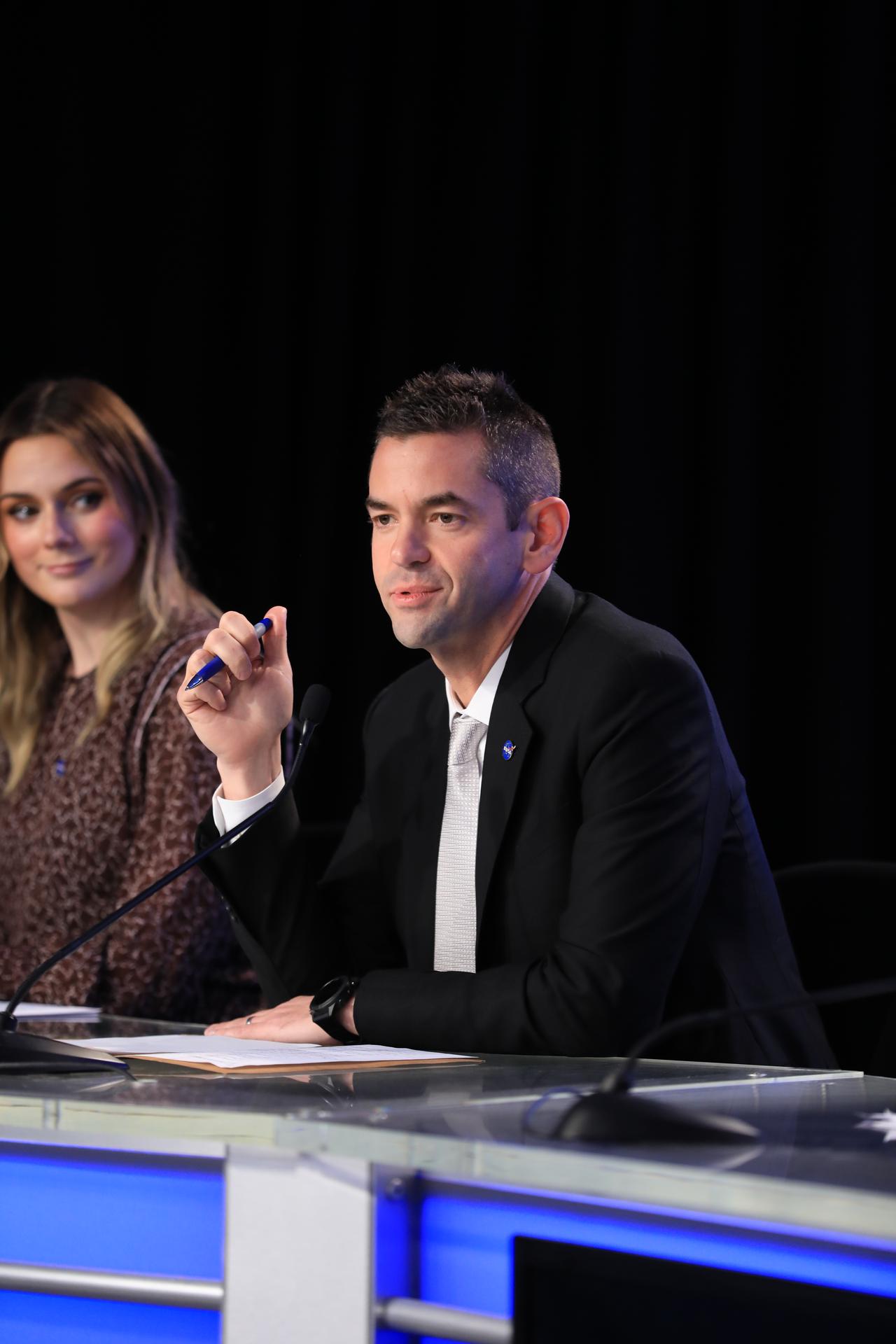
NASA Administrator Jared Isaacman participates in a postlaunch news conference at the agency’s Kennedy Space Center in Florida on Friday, Feb. 13, 2026, following the launch of NASA’s SpaceX Crew-12 mission to the International Space Station. NASA astronauts Jessica Meir and Jack Hathaway, ESA (European Space Agency) astronaut Sophie Adenot, and Roscosmos cosmonaut Andrey Fedyaev launched to the International Space Station aboard SpaceX’s Dragon spacecraft and Falcon 9 rocket at 5:15 a.m. EST on the 12th crew rotation mission with SpaceX to the space station as part of NASA’s Commercial Crew Program.
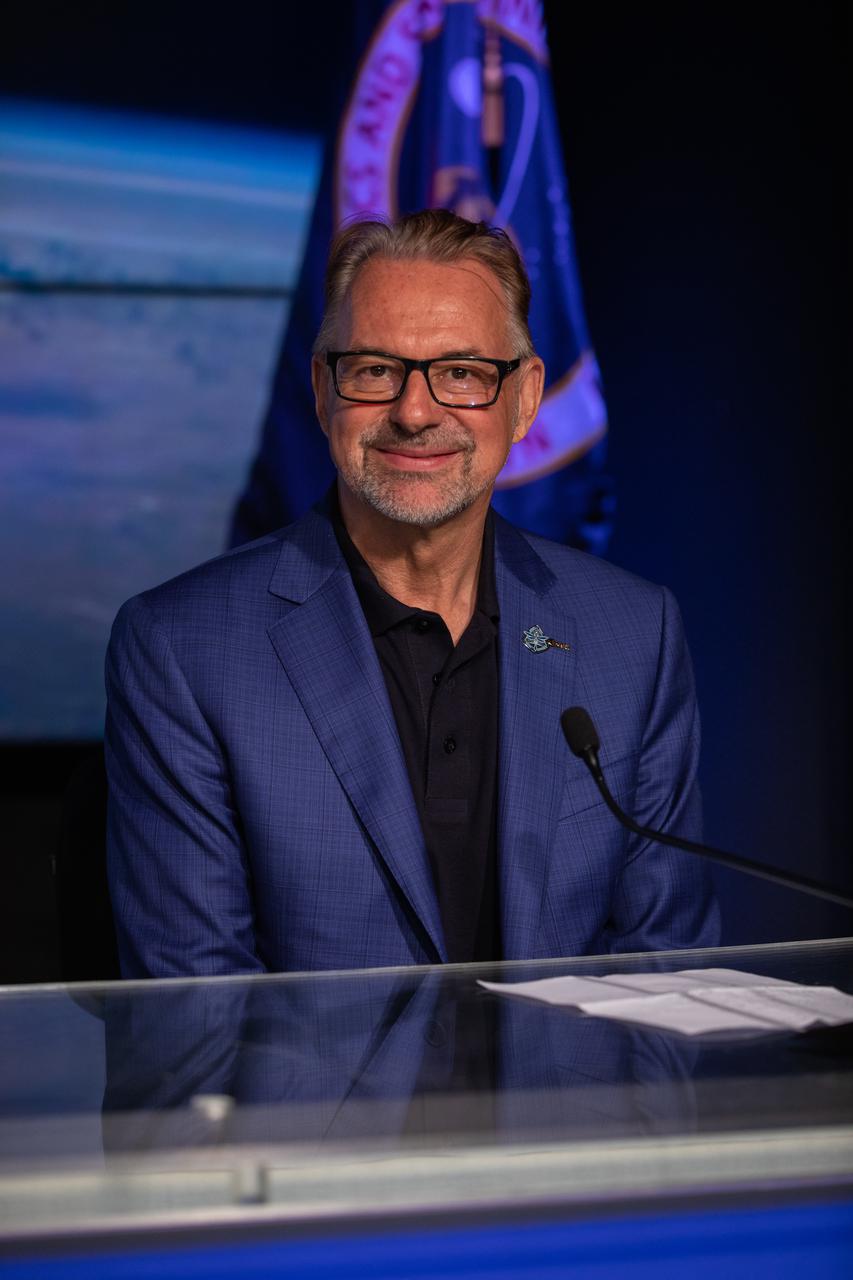
Josef Aschbacher, director general, ESA (European Space Agency), participates in a Crew-4 postlaunch news conference April 27, 2022, at NASA’s Kennedy Space Center in Florida. The SpaceX Crew Dragon spacecraft, powered by the company’s Falcon 9 rocket, lifted off from Kennedy’s Launch Complex 39A at 3:52 a.m. EDT on April 27. Named Freedom by mission astronauts Kjell Lindgren, Bob Hines, Jessica Watson, and Samantha Cristoforetti, Dragon is scheduled to dock to the space station today at 8:15 p.m. EDT.
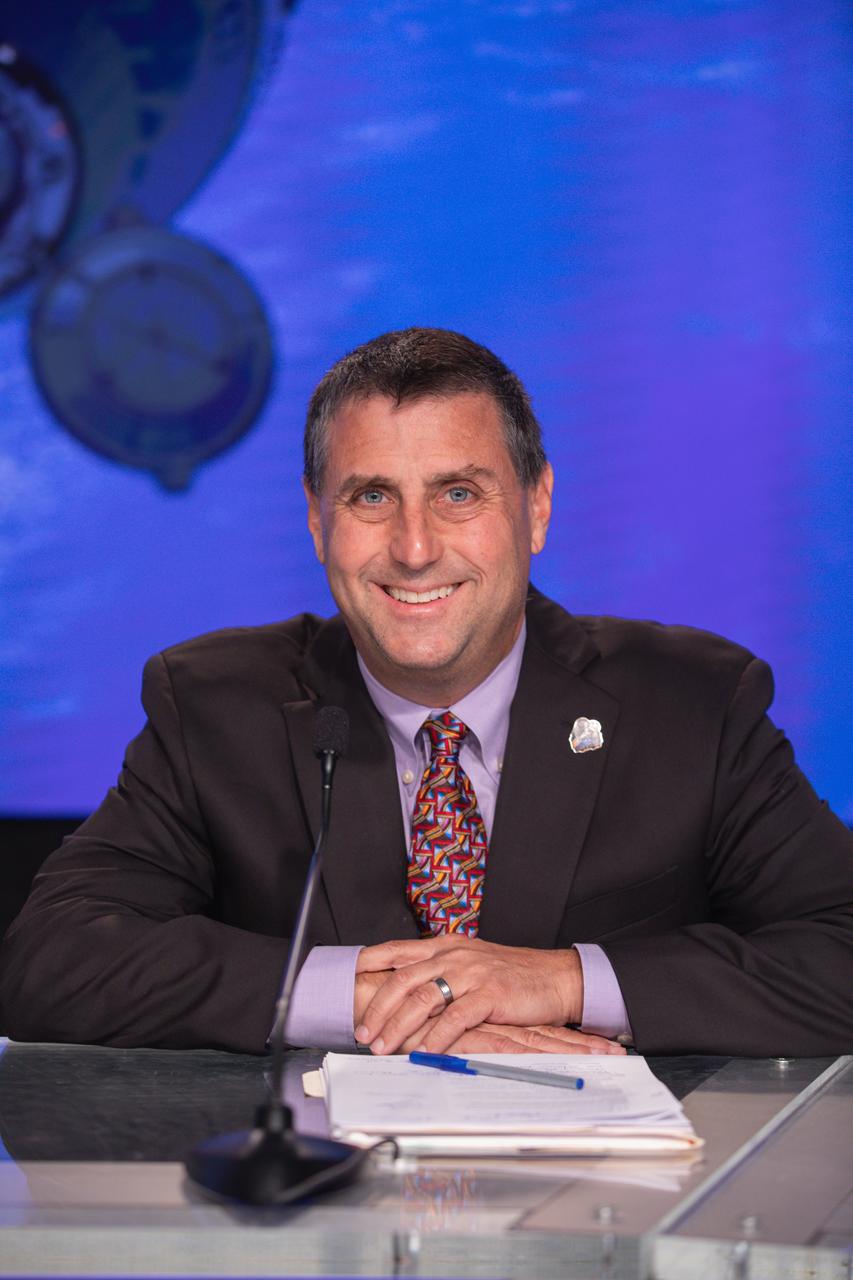
NASA Deputy Associate Administrator for Space Operations Mission Directorate, Joel Montalbano participates in a postlaunch news conference at the agency’s Kennedy Space Center in Florida held on Wednesday, June 5, 2024, at the agency’s Kennedy Space Center in Florida following the first launch attempt of NASA’s Boeing Crew Flight Test. As part of the agency’s Commercial Crew Program, the first crewed launch to the International Space Station aboard Boeing’s Starliner spacecraft atop a United Launch Alliance Atlas V rocket from Space Launch Complex-41 at nearby Cape Canaveral Space Force Station was targeted for 10:52 a.m. EDT.
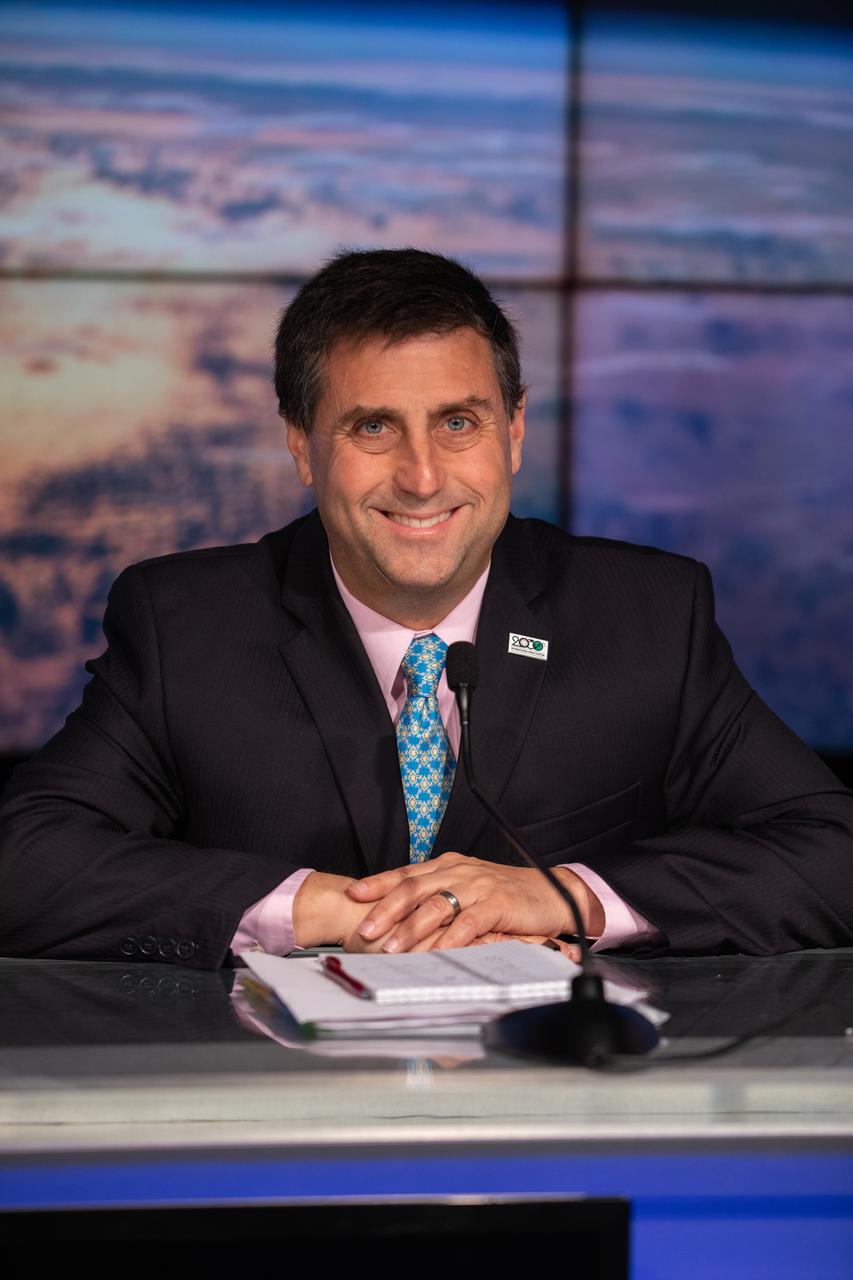
Joel Montalbano, manager, NASA’s International Space Station Program, participates in a Crew-4 postlaunch news conference April 27, 2022, at NASA’s Kennedy Space Center in Florida. The SpaceX Crew Dragon spacecraft, powered by the company’s Falcon 9 rocket, lifted off from Kennedy’s Launch Complex 39A at 3:52 a.m. EDT on April 27. Named Freedom by mission astronauts Kjell Lindgren, Bob Hines, Jessica Watkins, and Samantha Cristoforetti, Dragon is scheduled to dock to the space station today at 8:15 p.m. EDT.
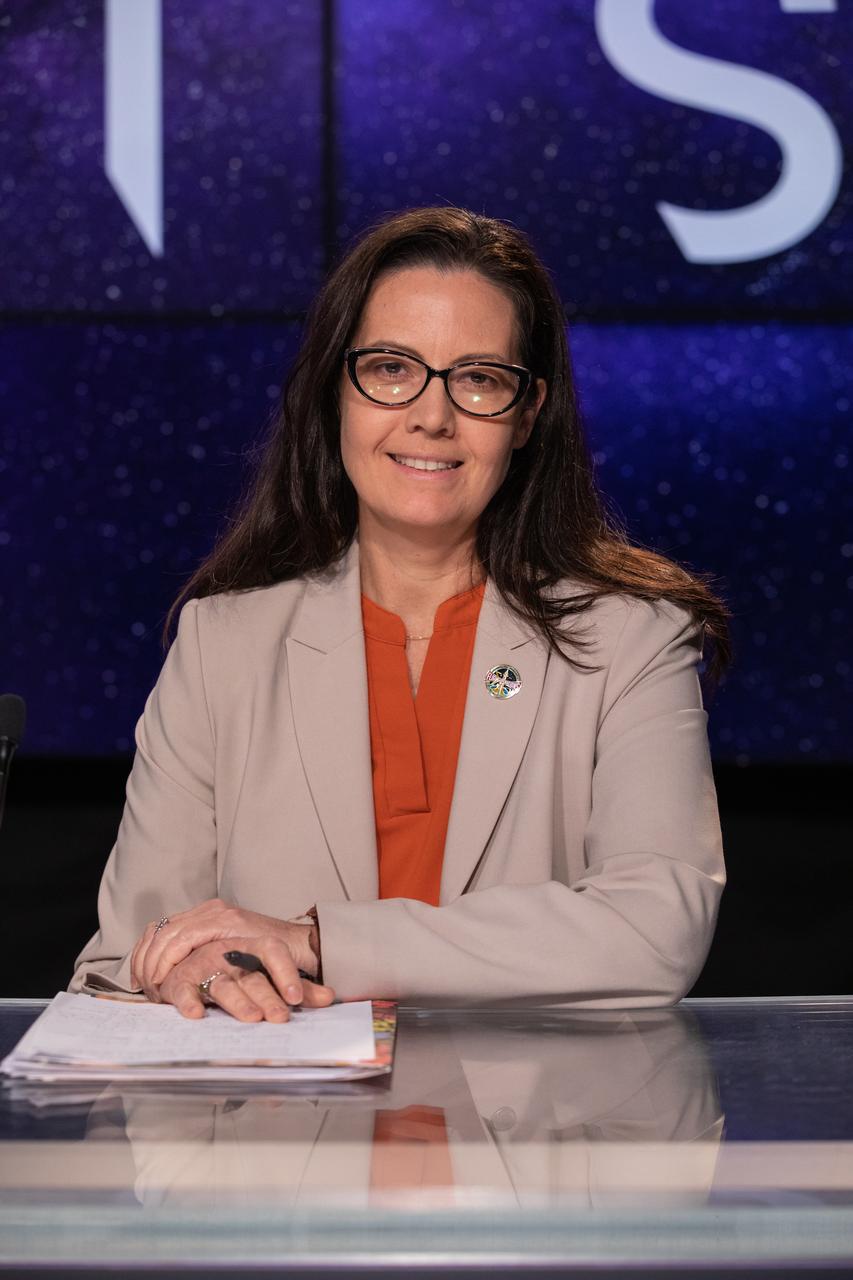
Emily Nelson, chief flight director, Johnson Space Center, participates in a postlaunch news conference on Nov. 16, 2022, at NASA’s Kennedy Space Center in Florida, after launch of Artemis I at 1:47 a.m. EST from Kennedy’s Launch Complex 39B. The first in a series of increasingly complex missions, Artemis I will provide a foundation for human deep space exploration and demonstrate our commitment and capability to extend human presence to the Moon and beyond. The primary goal of Artemis I is to thoroughly test the integrated systems before crewed missions by operating the spacecraft in a deep space environment, testing Orion’s heat shield, and recovering the crew module after reentry, descent, and splashdown.
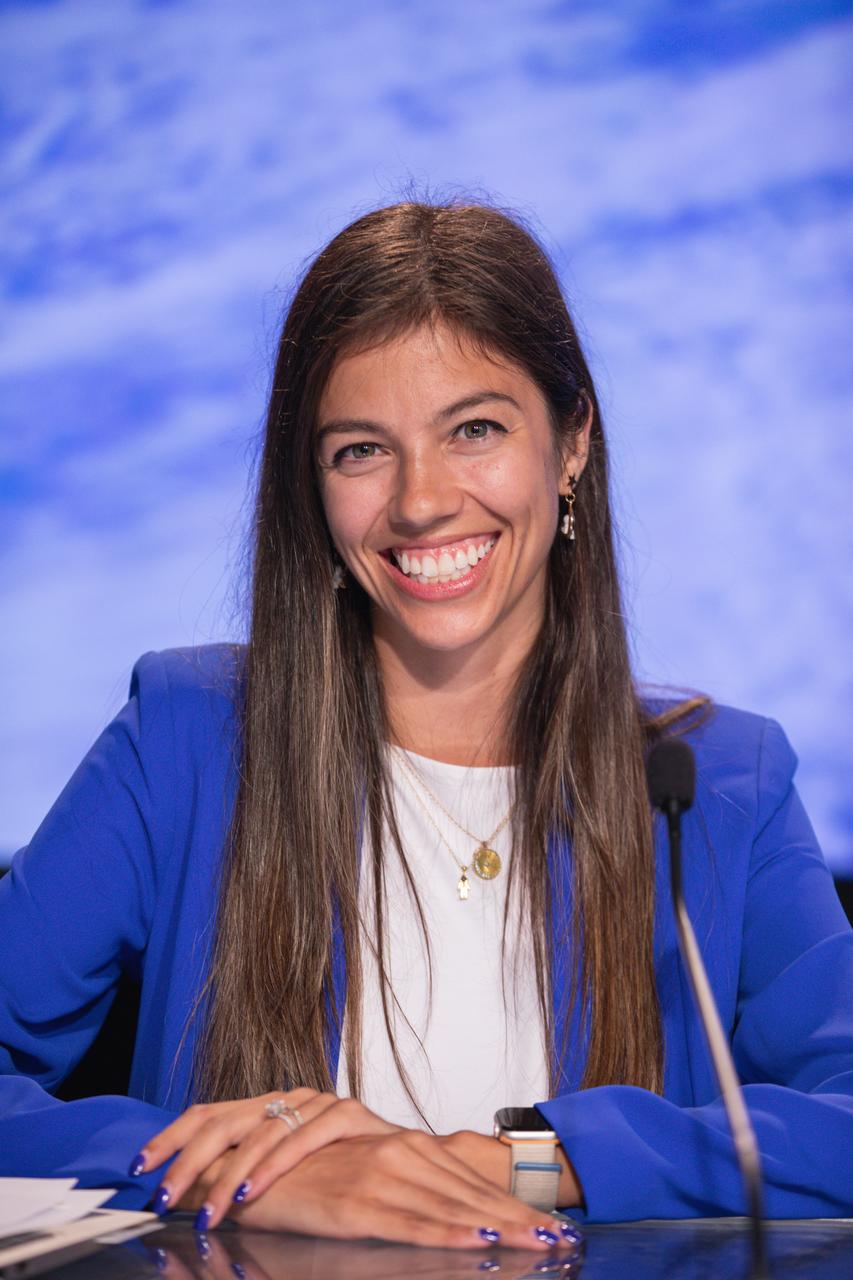
Antonia Jaramillo, NASA Communications, participates in a postlaunch news conference for NASA’s Boeing Crew Flight Test on Wednesday, June 5, 2024, at the agency’s Kennedy Space Center in Florida. As part of the agency’s Commercial Crew Program, NASA astronauts Butch Wilmore and Suni Williams are the first to launch aboard Boeing’s Starliner spacecraft to the International Space Station atop a United Launch Alliance Atlas V rocket. Liftoff occurred at 10:52 a.m. EDT Wednesday, June 5, from Space Launch Complex-41 at Cape Canaveral Space Force Station.

Jessica Jensen, vice president of customer operations and Integration, SpaceX, participates in a Crew-4 postlaunch news conference April 27, 2022, at NASA’s Kennedy Space Center in Florida. The SpaceX Crew Dragon spacecraft, powered by the company’s Falcon 9 rocket, lifted off from Kennedy’s Launch Complex 39A at 3:52 a.m. EDT on April 27. Named Freedom by mission astronauts Kjell Lindgren, Bob Hines, Jessica Watkins, and Samantha Cristoforetti, Dragon is scheduled to dock to the space station today at 8:15 p.m. EDT.
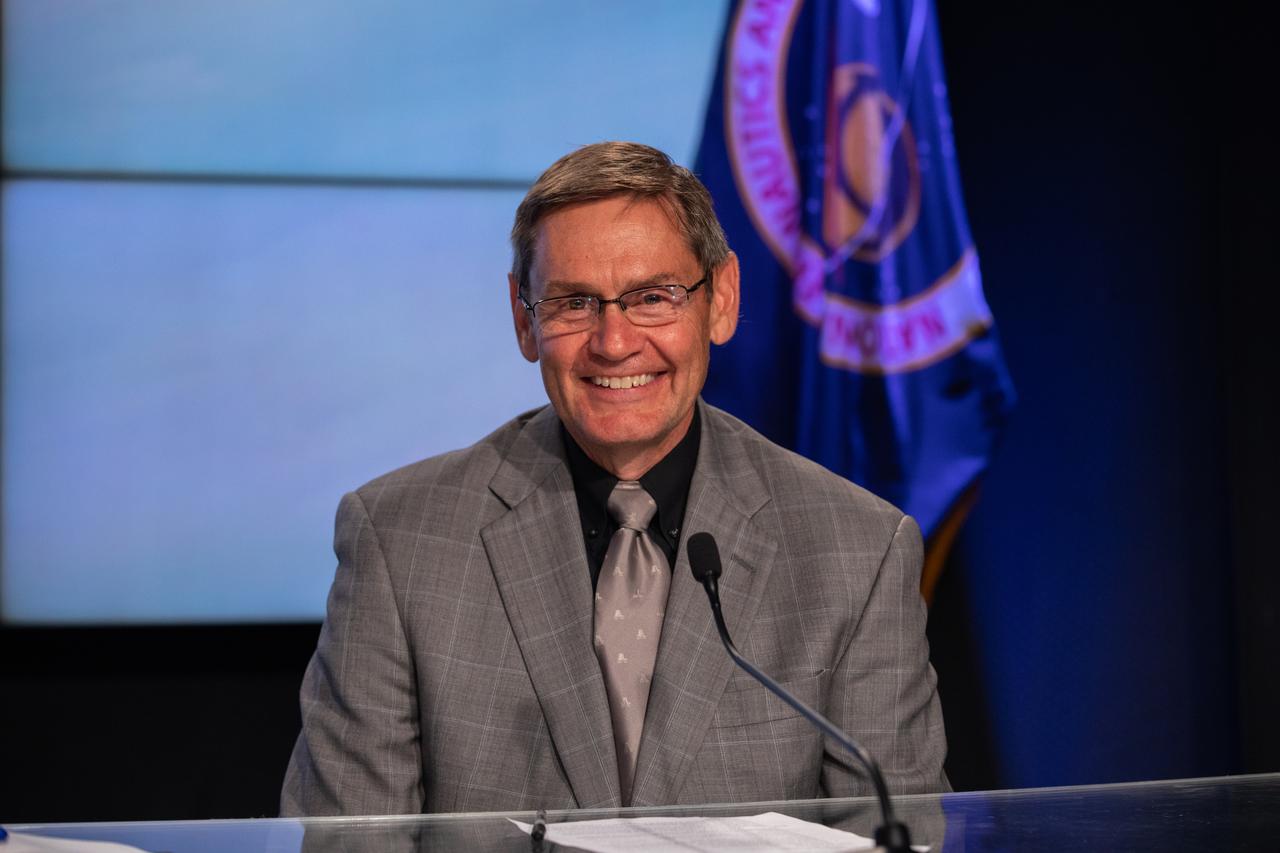
John Elbon, chief operating officer, United Launch Alliance, participates in a postlaunch news conference following the liftoff of NASA Boeing’s Orbital Flight Test-2 (OFT-2) on May 19, 2022. Liftoff occurred at 6:54 p.m. EDT from Space Launch Complex-41 at Florida’s Cape Canaveral Space Force Station. Boeing’s uncrewed flight test is designed to test the system’s end-to-end capabilities for NASA’s Commercial Crew Program providing valuable data towards NASA certifying Boeing’s crew transportation system for regular crewed flights to and from the International Space Station.
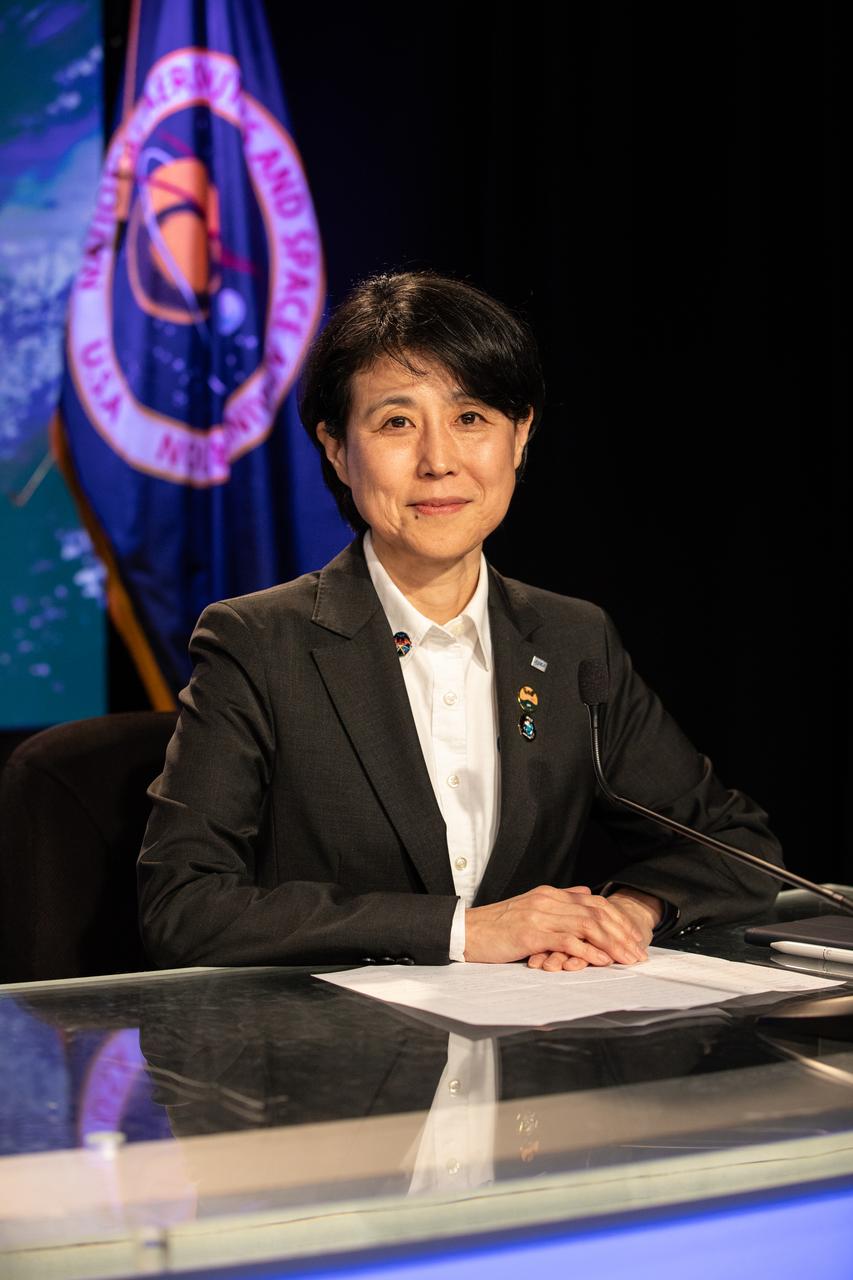
Mayumi Matsuura, vice president and director general, Human Spaceflight Technology Directorate, JAXA participates in a postlaunch news conference at the agency’s Kennedy Space Center in Florida on Friday, March 14, 2025, following the launch of NASA’s SpaceX Crew-10 mission to the International Space Station. NASA astronauts Anne McClain and Nichole Ayers, along with JAXA (Japan Aerospace Exploration Agency) astronaut Takuya Onishi and Roscosmos cosmonaut Kirill Peskov launched to the International Space Station aboard SpaceX’s Dragon spacecraft and Falcon 9 rocket at 7:03 p.m. EDT on the 10th crew rotation mission with SpaceX to the space station as part of the agency’s Commercial Crew Program.
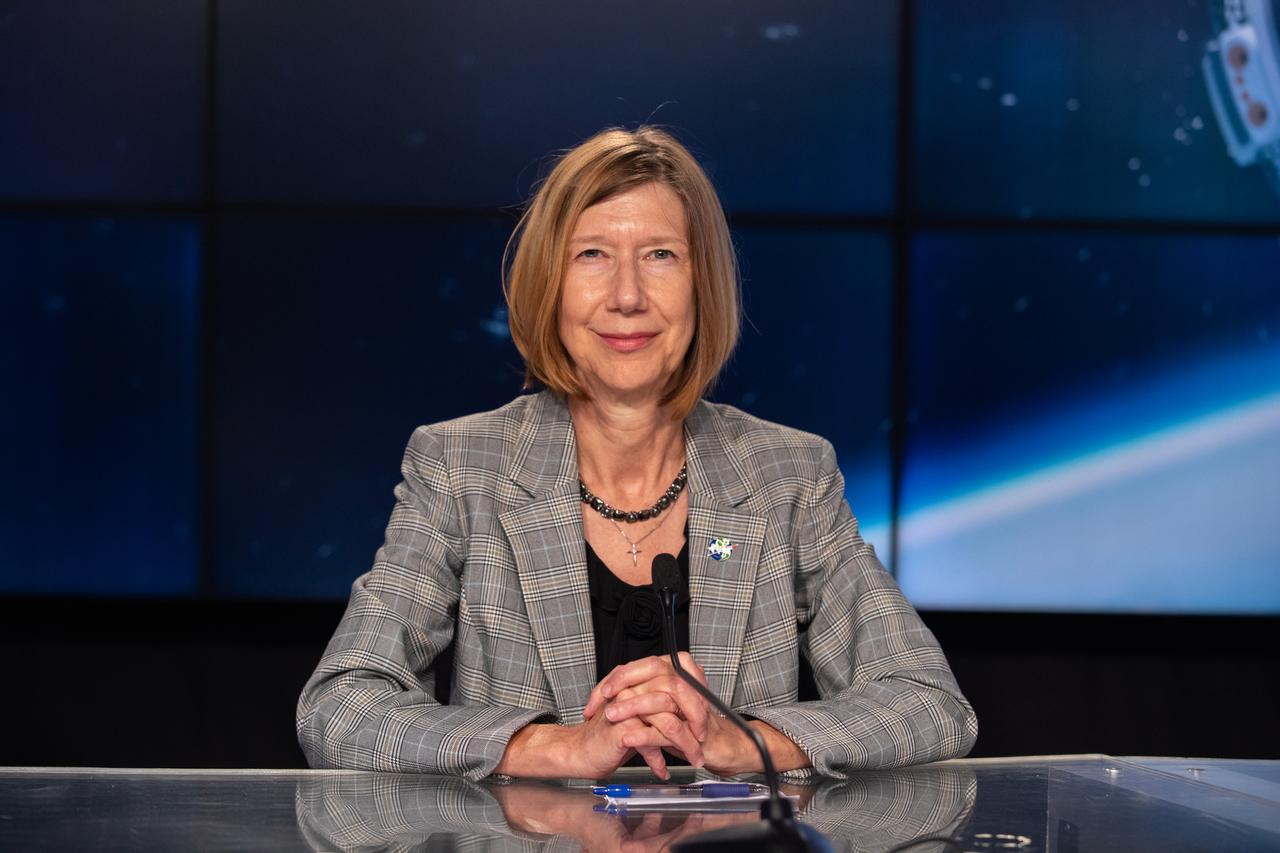
Kathy Lueders, associate administrator, Space Operations Mission Directorate at NASA, participates in a postlaunch news conference following the liftoff of NASA Boeing’s Orbital Flight Test-2 (OFT-2) on May 19, 2022. Liftoff occurred at 6:54 p.m. EDT from Space Launch Complex-41 at Florida’s Cape Canaveral Space Force Station. Boeing’s uncrewed flight test is designed to test the system’s end-to-end capabilities for NASA’s Commercial Crew Program providing valuable data towards NASA certifying Boeing’s crew transportation system for regular crewed flights to and from the International Space Station.
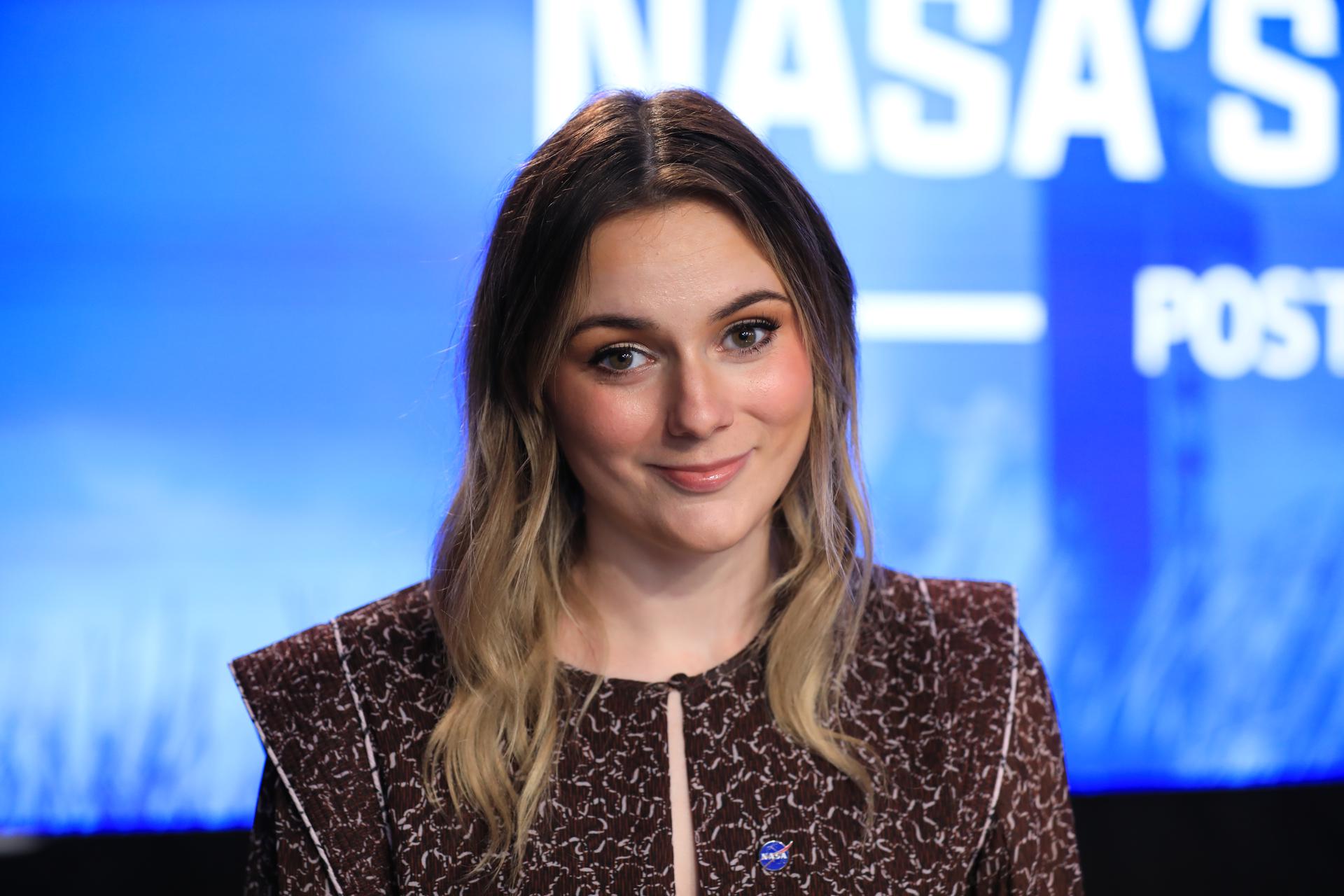
Bethany Stevens, NASA press secretary, participates in a postlaunch news conference at the agency’s Kennedy Space Center in Florida on Friday, Feb. 13, 2026, following the launch of NASA’s SpaceX Crew-12 mission to the International Space Station. NASA astronauts Jessica Meir and Jack Hathaway, ESA (European Space Agency) astronaut Sophie Adenot, and Roscosmos cosmonaut Andrey Fedyaev launched to the International Space Station aboard SpaceX’s Dragon spacecraft and Falcon 9 rocket at 5:15 a.m. EST on the 12th crew rotation mission with SpaceX to the space station as part of NASA’s Commercial Crew Program.
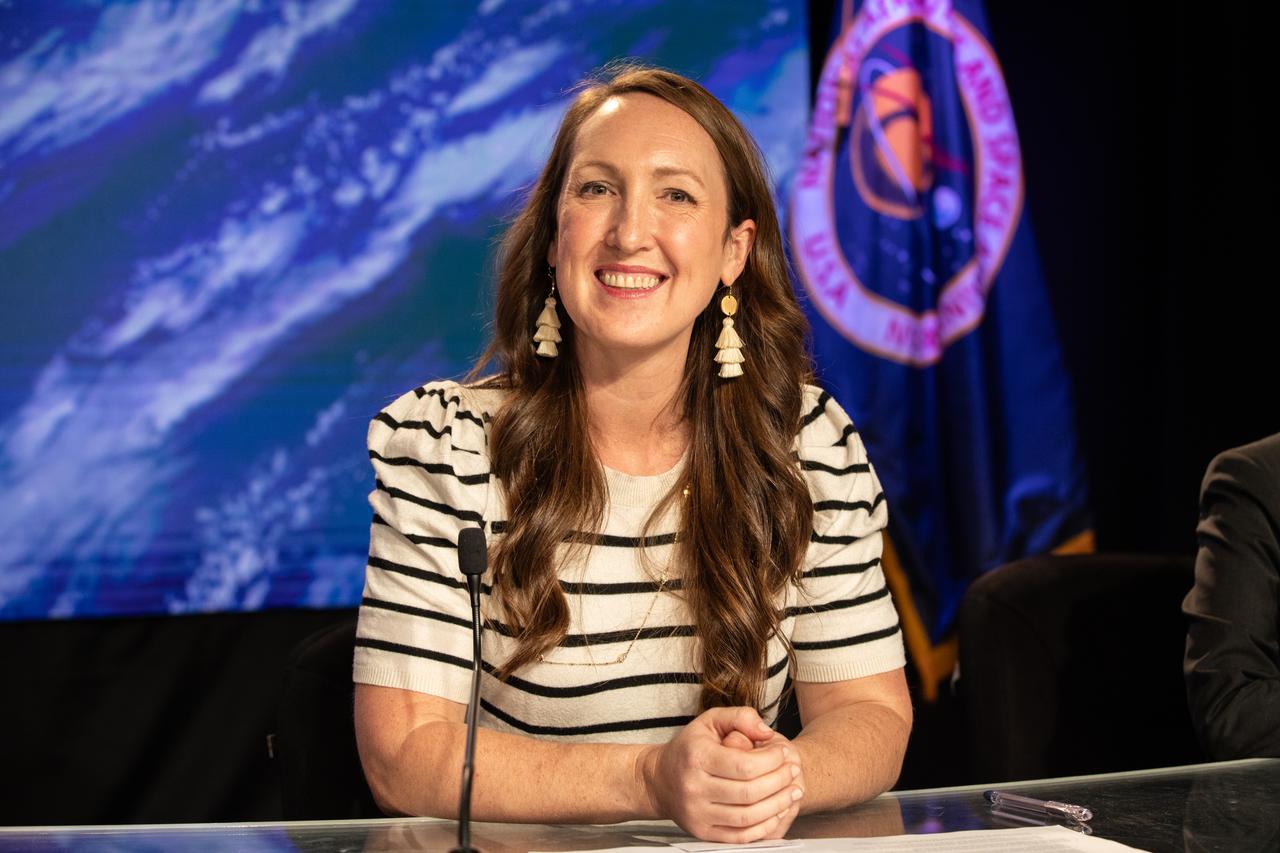
Sarah Walker, director, Dragon Mission Management, SpaceX participates in a postlaunch news conference at the agency’s Kennedy Space Center in Florida on Friday, March 14, 2025, following the launch of NASA’s SpaceX Crew-10 mission to the International Space Station. NASA astronauts Anne McClain and Nichole Ayers, along with JAXA (Japan Aerospace Exploration Agency) astronaut Takuya Onishi and Roscosmos cosmonaut Kirill Peskov launched to the International Space Station aboard SpaceX’s Dragon spacecraft and Falcon 9 rocket at 7:03 p.m. EDT on the 10th crew rotation mission with SpaceX to the space station as part of the agency’s Commercial Crew Program.
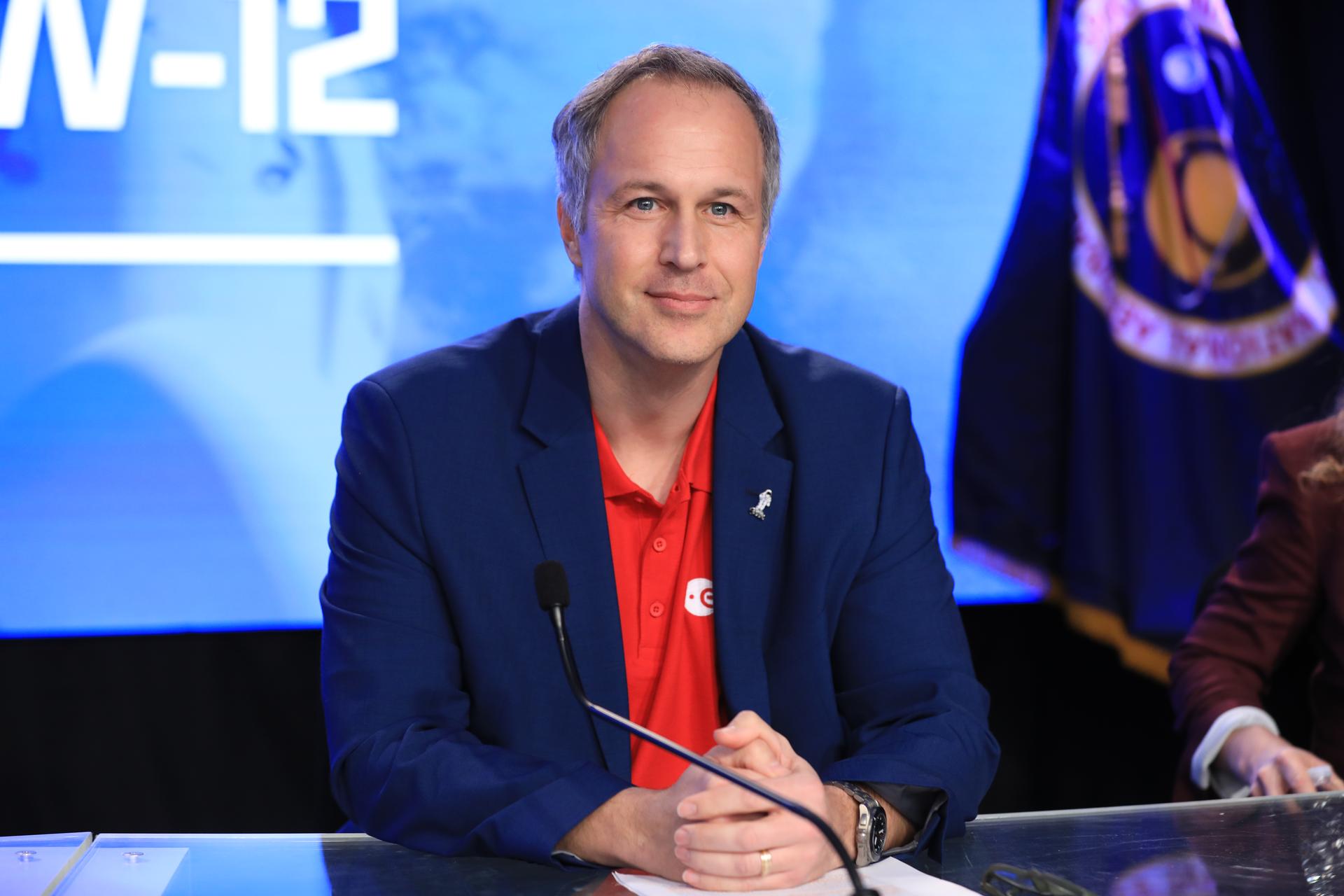
Daniel Neuenschwander, director, Human and Robotic Exploration, ESA (European Space Agency) participates in a postlaunch news conference at the agency’s Kennedy Space Center in Florida on Friday, Feb. 13, 2026, following the launch of NASA’s SpaceX Crew-12 mission to the International Space Station. NASA astronauts Jessica Meir and Jack Hathaway, ESA (European Space Agency) astronaut Sophie Adenot, and Roscosmos cosmonaut Andrey Fedyaev launched to the International Space Station aboard SpaceX’s Dragon spacecraft and Falcon 9 rocket at 5:15 a.m. EST on the 12th crew rotation mission with SpaceX to the space station as part of NASA’s Commercial Crew Program.
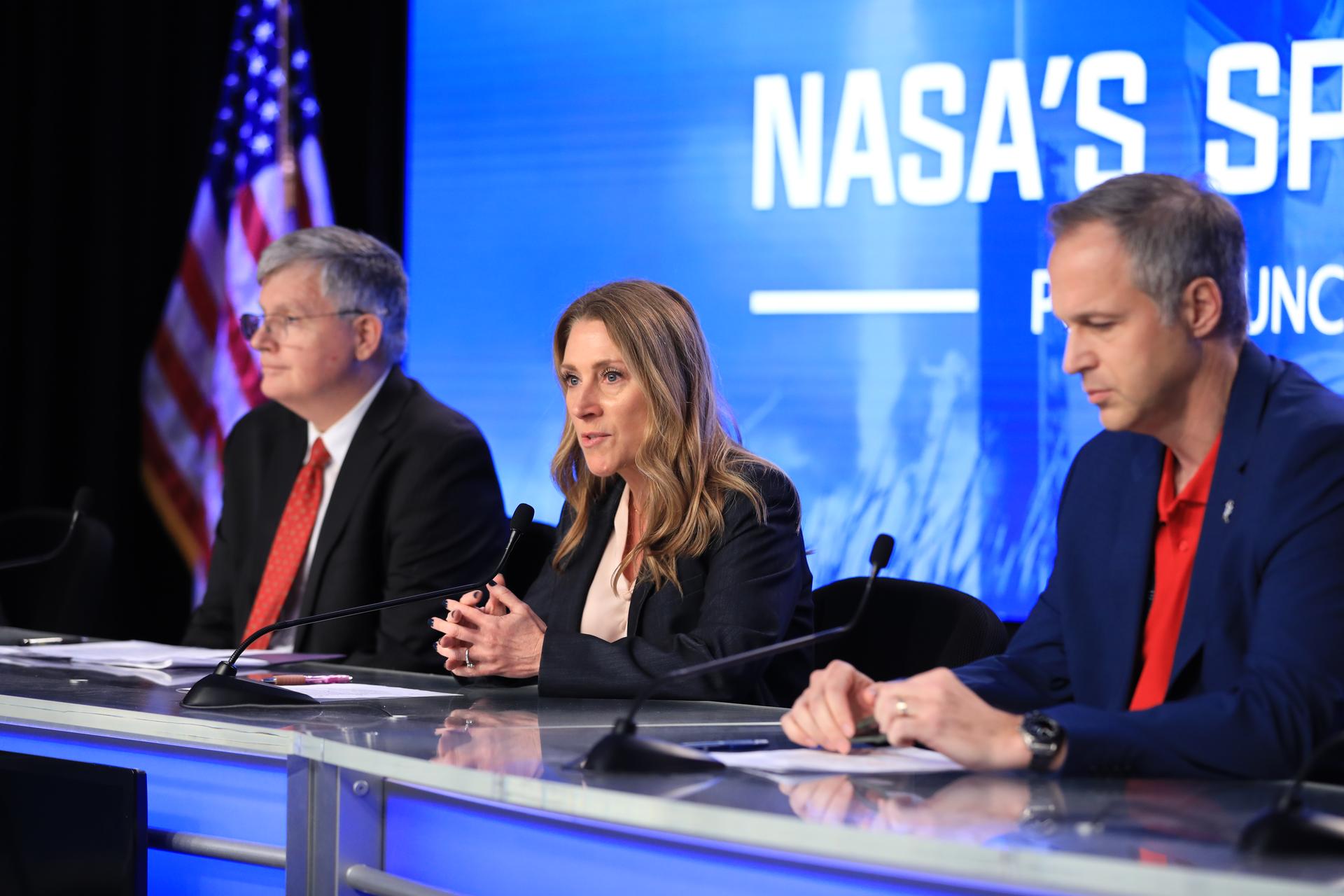
Dana Weigel (center), manager, NASA’s International Space Station Program, participates in a postlaunch news conference with leadership from NASA, ESA (European Space Agency), and SpaceX at the agency’s Kennedy Space Center in Florida on Friday, Feb. 13, 2026, following the launch of NASA’s SpaceX Crew-12 mission to the International Space Station. NASA astronauts Jessica Meir and Jack Hathaway, ESA astronaut Sophie Adenot, and Roscosmos cosmonaut Andrey Fedyaev launched to the International Space Station aboard SpaceX’s Dragon spacecraft and Falcon 9 rocket at 5:15 a.m. EST on the 12th crew rotation mission with SpaceX to the space station as part of NASA’s Commercial Crew Program.
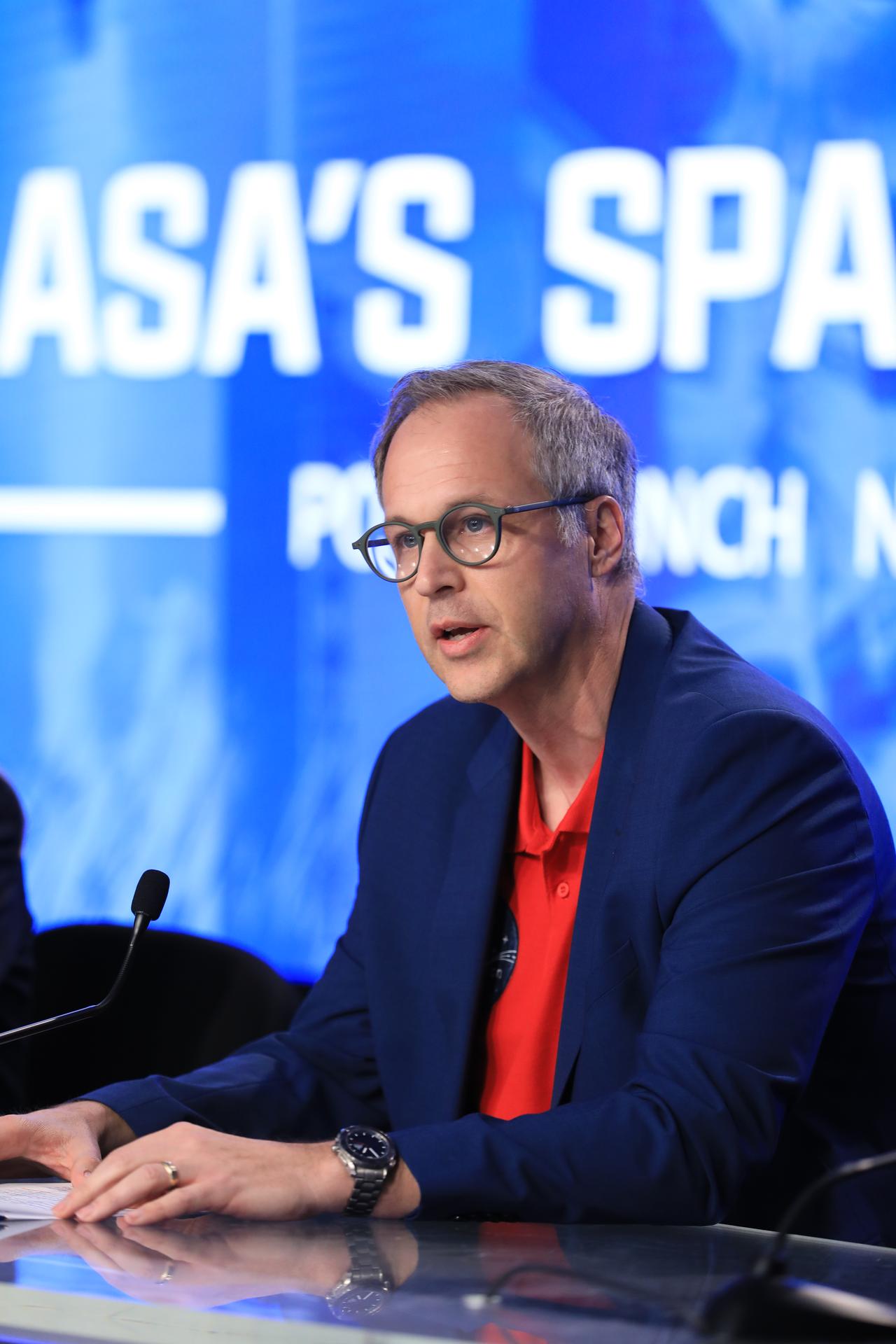
Daniel Neuenschwander, director, Human and Robotic Exploration, ESA (European Space Agency) participates in a postlaunch news conference at the agency’s Kennedy Space Center in Florida on Friday, Feb. 13, 2026, following the launch of NASA’s SpaceX Crew-12 mission to the International Space Station. NASA astronauts Jessica Meir and Jack Hathaway, ESA (European Space Agency) astronaut Sophie Adenot, and Roscosmos cosmonaut Andrey Fedyaev launched to the International Space Station aboard SpaceX’s Dragon spacecraft and Falcon 9 rocket at 5:15 a.m. EST on the 12th crew rotation mission with SpaceX to the space station as part of NASA’s Commercial Crew Program.
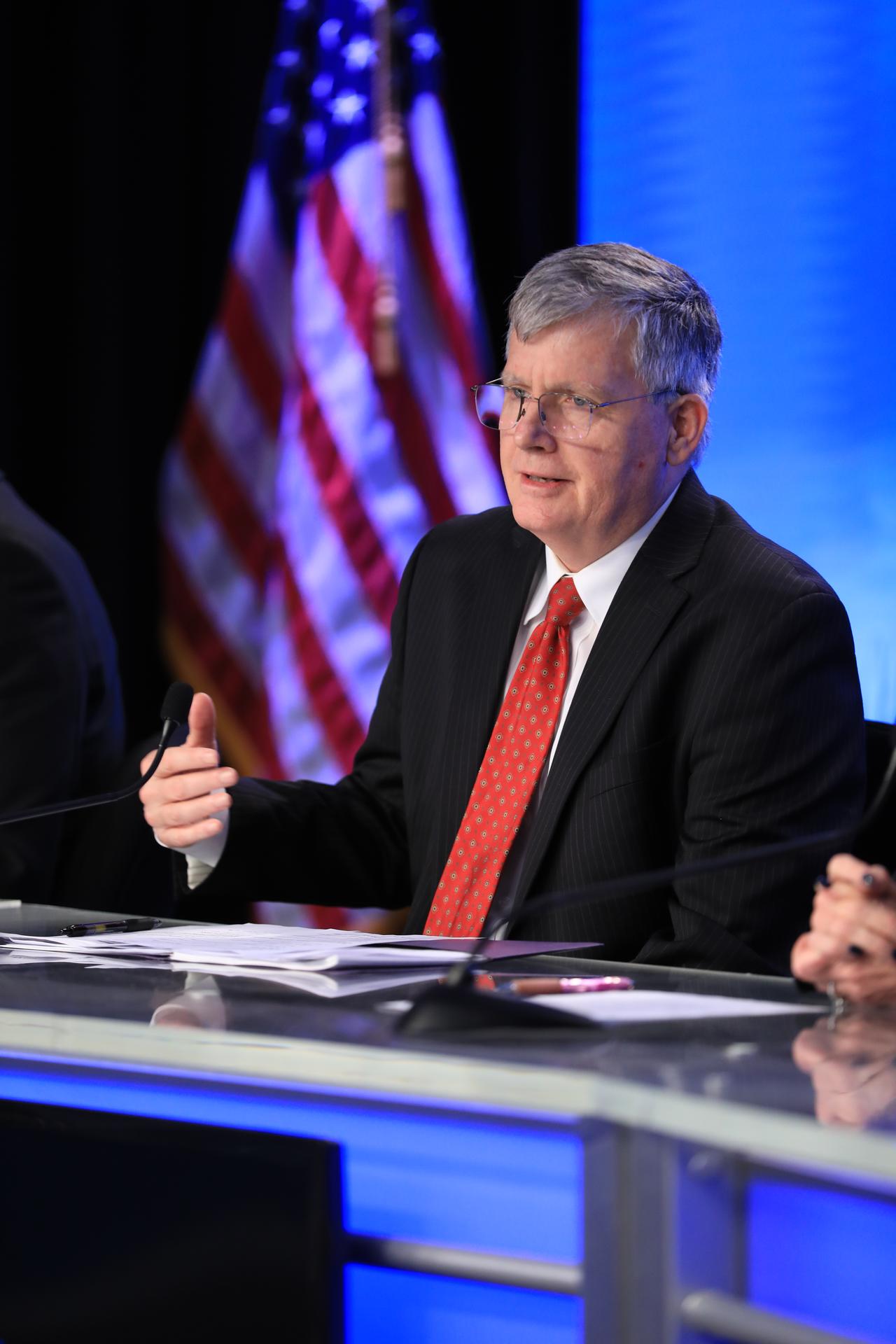
Steve Stich, manager, NASA’s Commercial Crew Program, participates in a postlaunch news conference at the agency’s Kennedy Space Center in Florida on Friday, Feb. 13, 2026, following the launch of NASA’s SpaceX Crew-12 mission to the International Space Station. NASA astronauts Jessica Meir and Jack Hathaway, ESA (European Space Agency) astronaut Sophie Adenot, and Roscosmos cosmonaut Andrey Fedyaev launched to the International Space Station aboard SpaceX’s Dragon spacecraft and Falcon 9 rocket at 5:15 a.m. EST on the 12th crew rotation mission with SpaceX to the space station as part of NASA’s Commercial Crew Program.
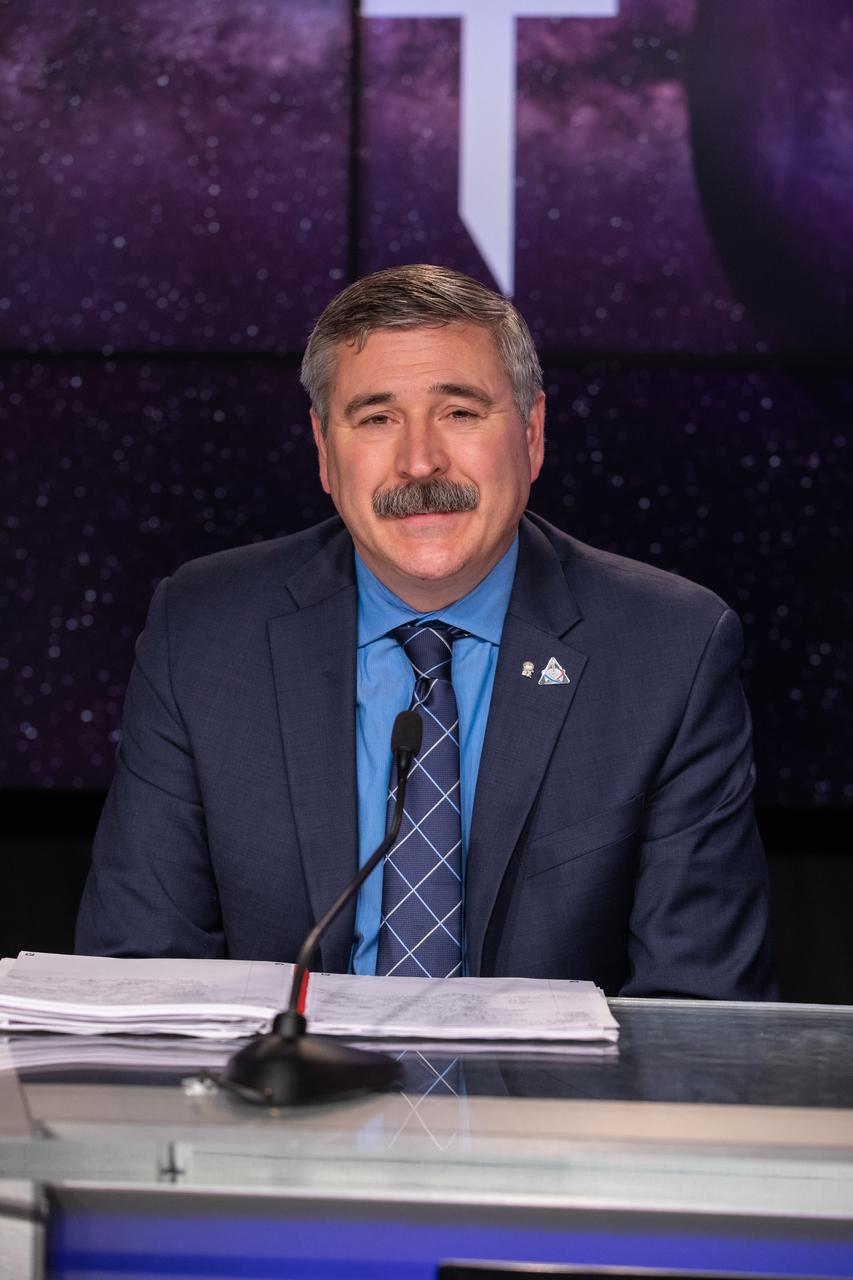
Mike Sarafin, Artemis mission manager, NASA Headquarters, participates in a postlaunch news conference on Nov. 16, 2022, at NASA’s Kennedy Space Center in Florida, after launch of Artemis I at 1:47 a.m. EST from Kennedy’s Launch Complex 39B. The first in a series of increasingly complex missions, Artemis I will provide a foundation for human deep space exploration and demonstrate our commitment and capability to extend human presence to the Moon and beyond. The primary goal of Artemis I is to thoroughly test the integrated systems before crewed missions by operating the spacecraft in a deep space environment, testing Orion’s heat shield, and recovering the crew module after reentry, descent, and splashdown.
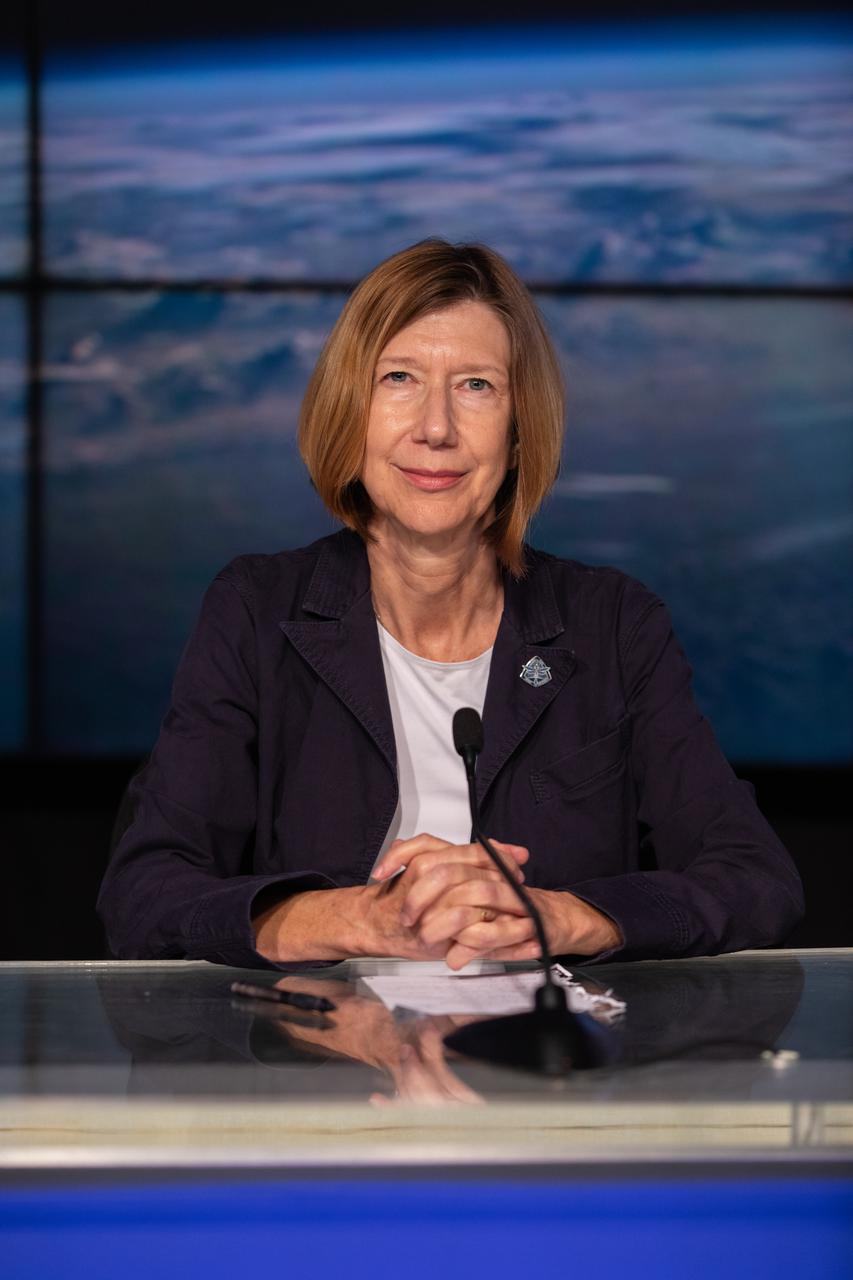
Kathryn Lueders, associate administrator, NASA’s Space Operations Mission Directorate, participates in a Crew-4 postlaunch news conference April 27, 2022, at NASA’s Kennedy Space Center in Florida. The SpaceX Crew Dragon spacecraft, powered by the company’s Falcon 9 rocket, lifted off from Kennedy’s Launch Complex 39A at 3:52 a.m. EDT on April 27. Named Freedom by mission astronauts Kjell Lindgren, Bob Hines, Jessica Watkins, and Samantha Cristoforetti, Dragon is scheduled to dock to the space station today at 8:15 p.m. EDT.
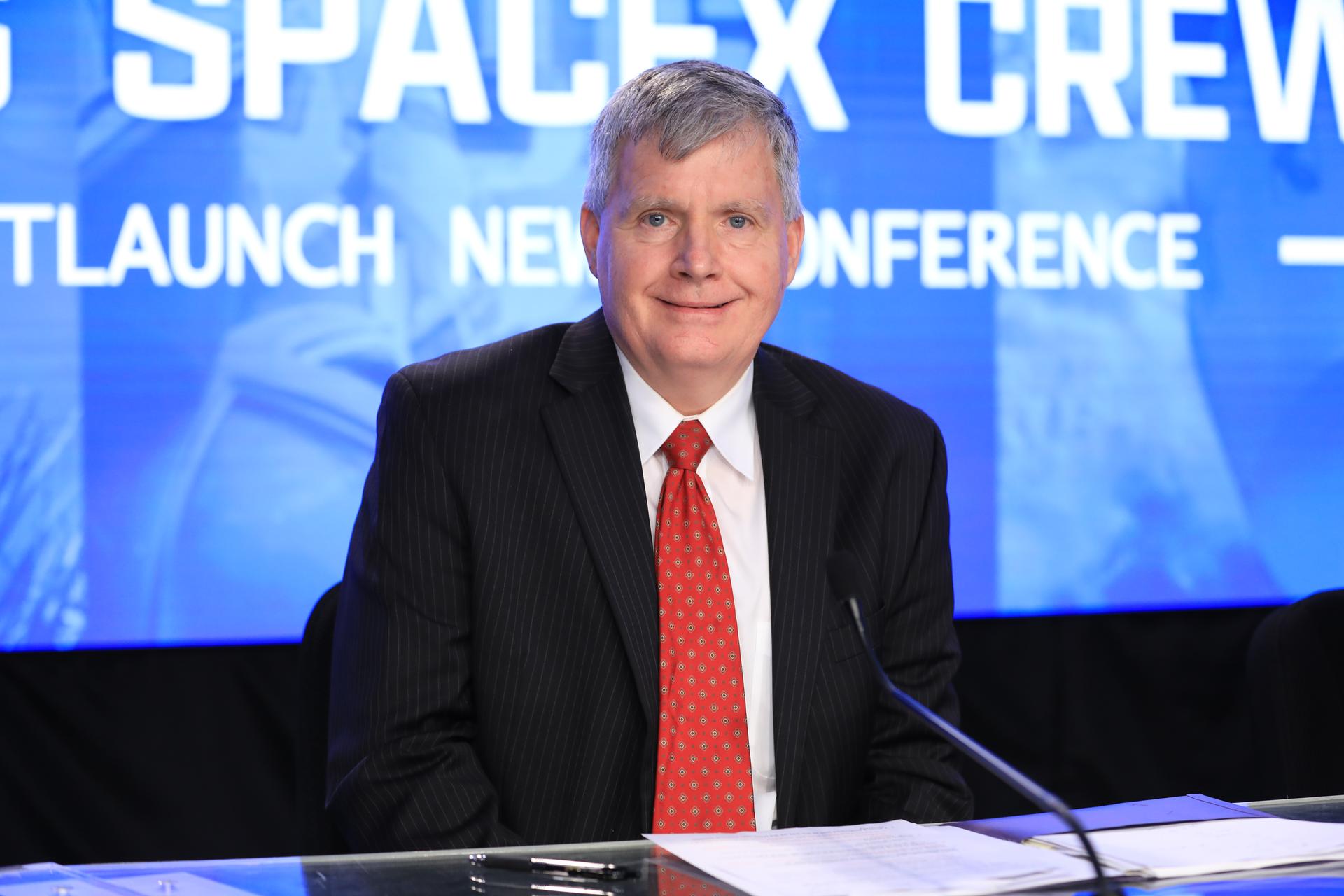
Steve Stich, manager, NASA’s Commercial Crew Program, participates in a postlaunch news conference at the agency’s Kennedy Space Center in Florida on Friday, Feb. 13, 2026, following the launch of NASA’s SpaceX Crew-12 mission to the International Space Station. NASA astronauts Jessica Meir and Jack Hathaway, ESA (European Space Agency) astronaut Sophie Adenot, and Roscosmos cosmonaut Andrey Fedyaev launched to the International Space Station aboard SpaceX’s Dragon spacecraft and Falcon 9 rocket at 5:15 a.m. EST on the 12th crew rotation mission with SpaceX to the space station as part of NASA’s Commercial Crew Program.
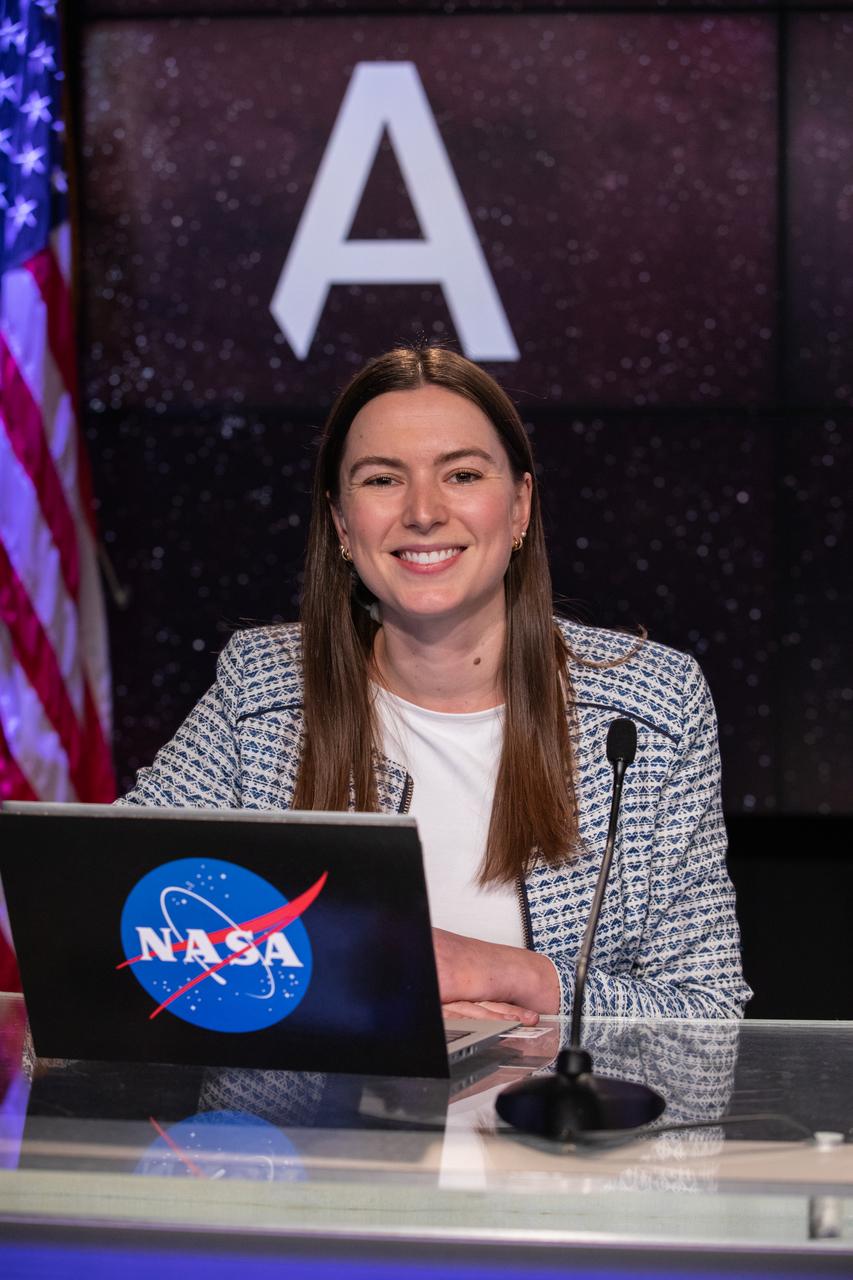
Jackie McGuiness, NASA Communications, moderates a postlaunch news conference on Nov. 16, 2022, at NASA’s Kennedy Space Center in Florida, after launch of Artemis I at 1:47 a.m. EST from Kennedy’s Launch Complex 39B. The first in a series of increasingly complex missions, Artemis I will provide a foundation for human deep space exploration and demonstrate our commitment and capability to extend human presence to the Moon and beyond. The primary goal of Artemis I is to thoroughly test the integrated systems before crewed missions by operating the spacecraft in a deep space environment, testing Orion’s heat shield, and recovering the crew module after reentry, descent, and splashdown.
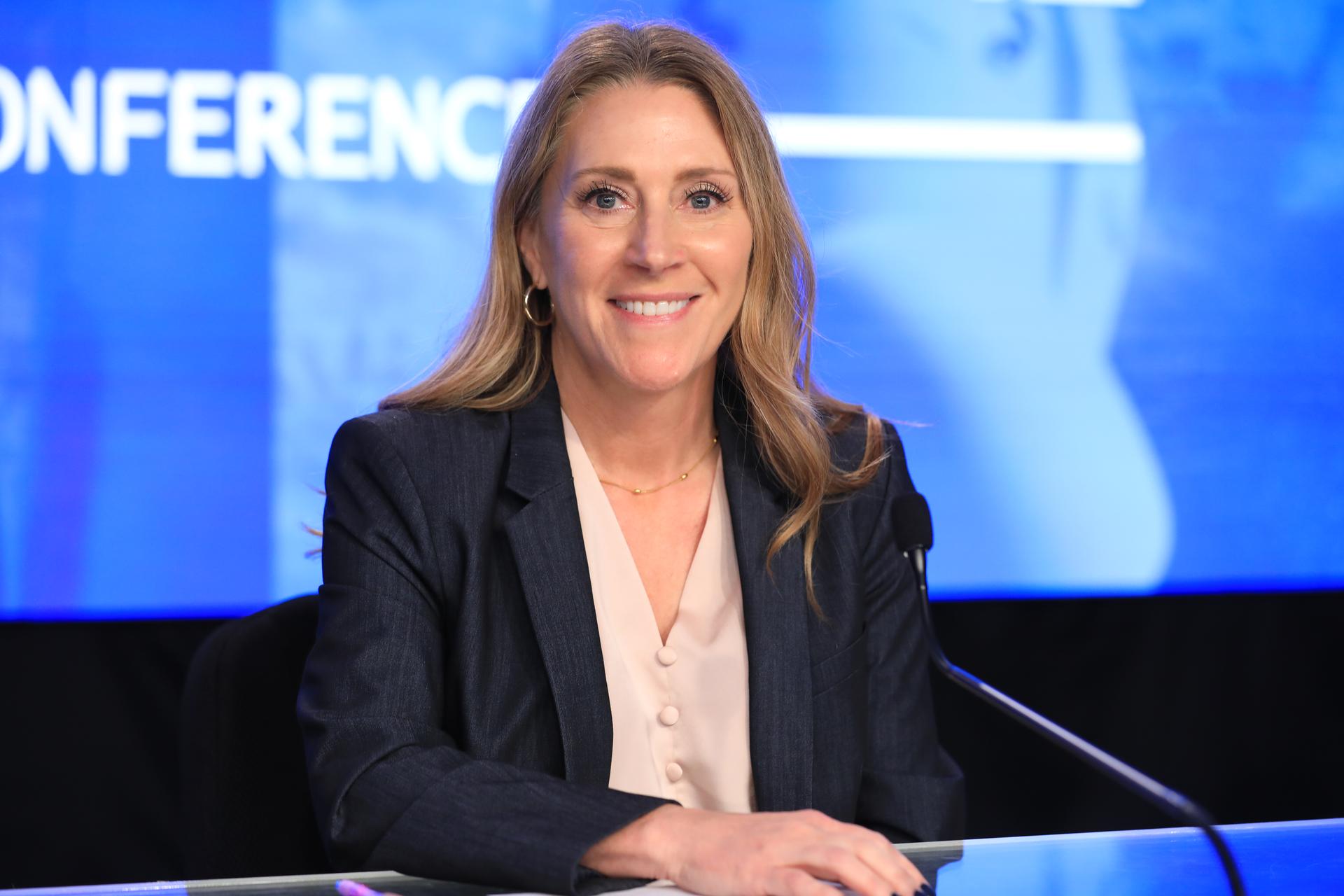
Dana Weigel, manager, NASA’s International Space Station Program, participates in a postlaunch news conference at the agency’s Kennedy Space Center in Florida on Friday, Feb. 13, 2026, following the launch of NASA’s SpaceX Crew-12 mission to the International Space Station. NASA astronauts Jessica Meir and Jack Hathaway, ESA (European Space Agency) astronaut Sophie Adenot, and Roscosmos cosmonaut Andrey Fedyaev launched to the International Space Station aboard SpaceX’s Dragon spacecraft and Falcon 9 rocket at 5:15 a.m. EST on the 12th crew rotation mission with SpaceX to the space station as part of NASA’s Commercial Crew Program.
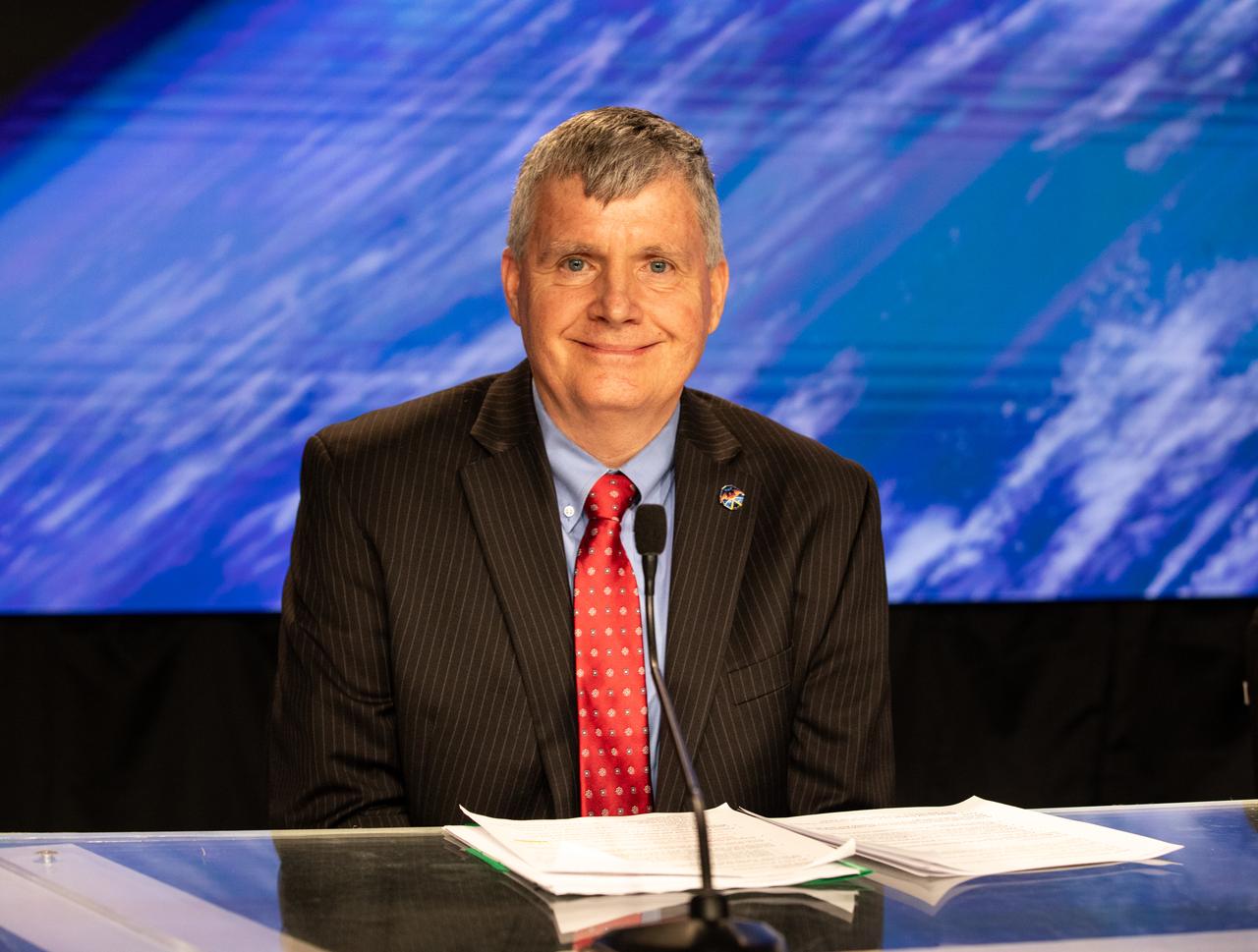
Steve Stich, manager, Commercial Crew Program, NASA Kennedy participates in a postlaunch news conference at the agency’s Kennedy Space Center in Florida on Friday, March 14, 2025, following the launch of NASA’s SpaceX Crew-10 mission to the International Space Station. NASA astronauts Anne McClain and Nichole Ayers, along with JAXA (Japan Aerospace Exploration Agency) astronaut Takuya Onishi and Roscosmos cosmonaut Kirill Peskov launched to the International Space Station aboard SpaceX’s Dragon spacecraft and Falcon 9 rocket at 7:03 p.m. EDT on the 10th crew rotation mission with SpaceX to the space station as part of the agency’s Commercial Crew Program.
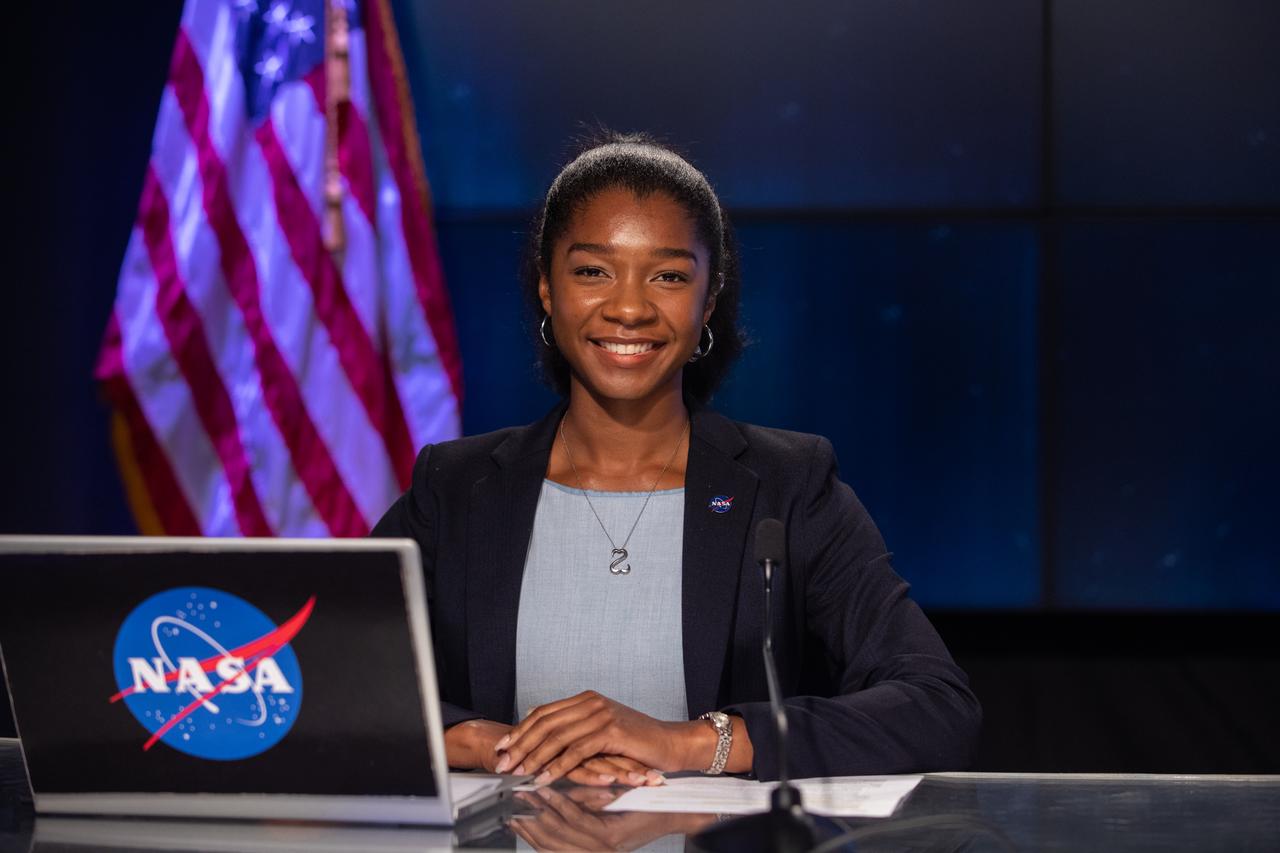
Jasmine Hopkins, NASA Communications, moderates a postlaunch news conference following the liftoff of NASA Boeing’s Orbital Flight Test-2 (OFT-2) on May 19, 2022. Liftoff occurred at 6:54 p.m. EDT from Space Launch Complex-41 at Florida’s Cape Canaveral Space Force Station. Boeing’s uncrewed flight test is designed to test the system’s end-to-end capabilities for NASA’s Commercial Crew Program providing valuable data towards NASA certifying Boeing’s crew transportation system for regular crewed flights to and from the International Space Station.
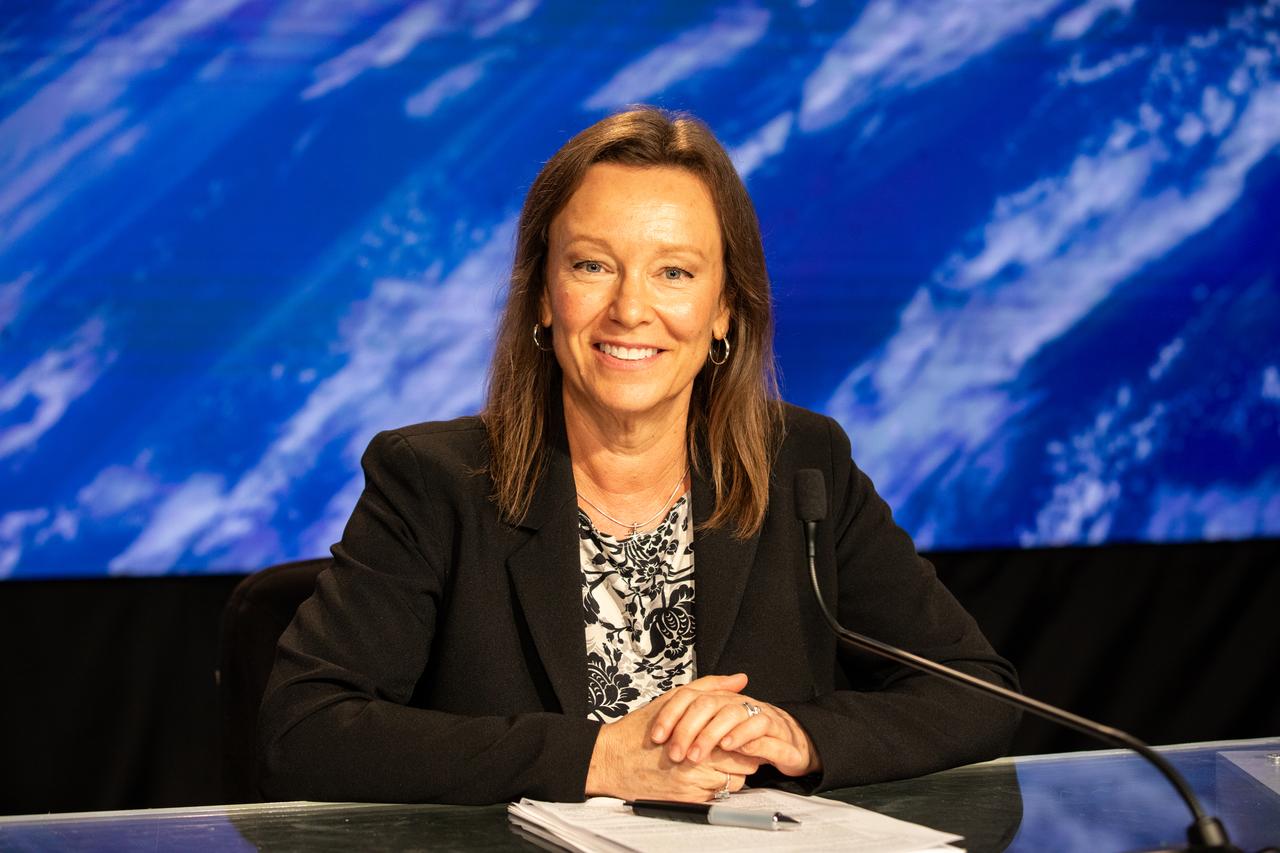
Dina Contella, deputy manager, International Space Station Program, NASA Johnson participates in a postlaunch news conference at the agency’s Kennedy Space Center in Florida on Friday, March 14, 2025, following the launch of NASA’s SpaceX Crew-10 mission to the International Space Station. NASA astronauts Anne McClain and Nichole Ayers, along with JAXA (Japan Aerospace Exploration Agency) astronaut Takuya Onishi and Roscosmos cosmonaut Kirill Peskov launched to the International Space Station aboard SpaceX’s Dragon spacecraft and Falcon 9 rocket at 7:03 p.m. EDT on the 10th crew rotation mission with SpaceX to the space station as part of the agency’s Commercial Crew Program.
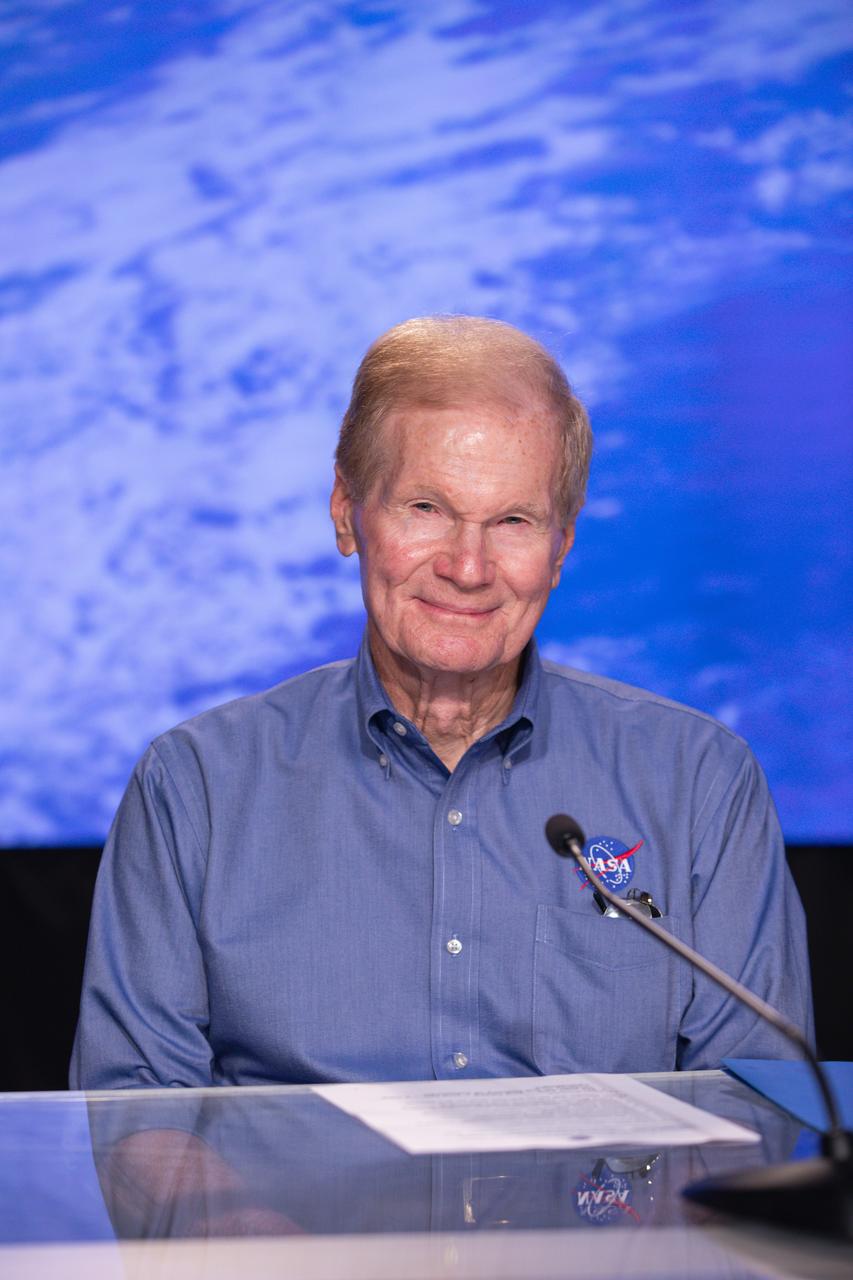
NASA Administrator Bill Nelson participates in a postlaunch news conference for NASA’s Boeing Crew Flight Test on Wednesday, June 5, 2024, at the agency’s Kennedy Space Center in Florida. As part of the agency’s Commercial Crew Program, NASA astronauts Butch Wilmore and Suni Williams are the first to launch aboard Boeing’s Starliner spacecraft to the International Space Station atop a United Launch Alliance Atlas V rocket. Liftoff occurred at 10:52 a.m. EDT Wednesday, June 5, from Space Launch Complex-41 at Cape Canaveral Space Force Station.