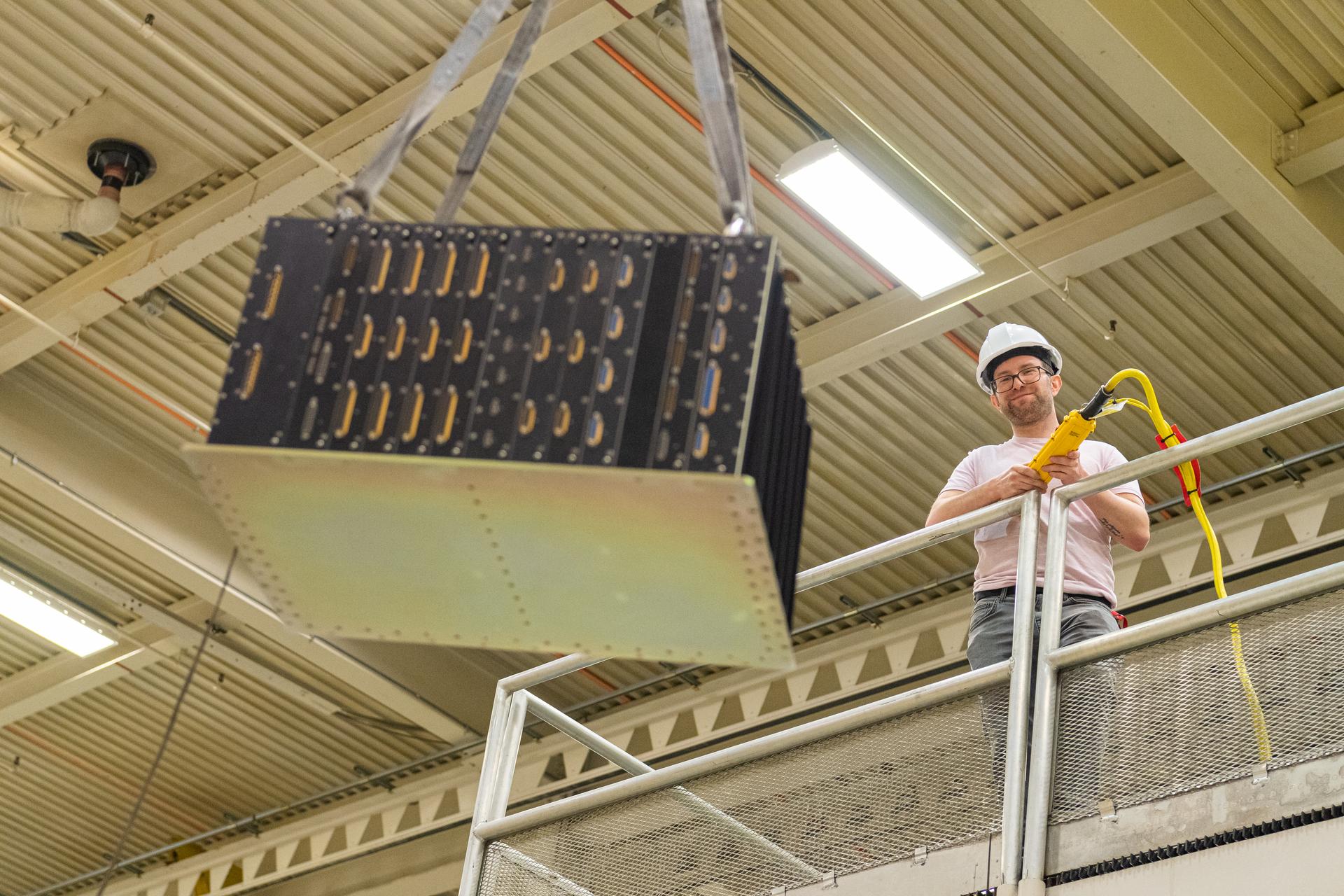
Mechanical engineering and integration technician Seth Alton crane lifts the OSAM-1 power supply unit into the thermal vacuum chamber at Goddard Space Flight Center, Greenbelt Md., April 12, 2023. This photo has been reviewed by OSAM1 project management and the Export Control Office and is released for public view. NASA/Mike Guinto
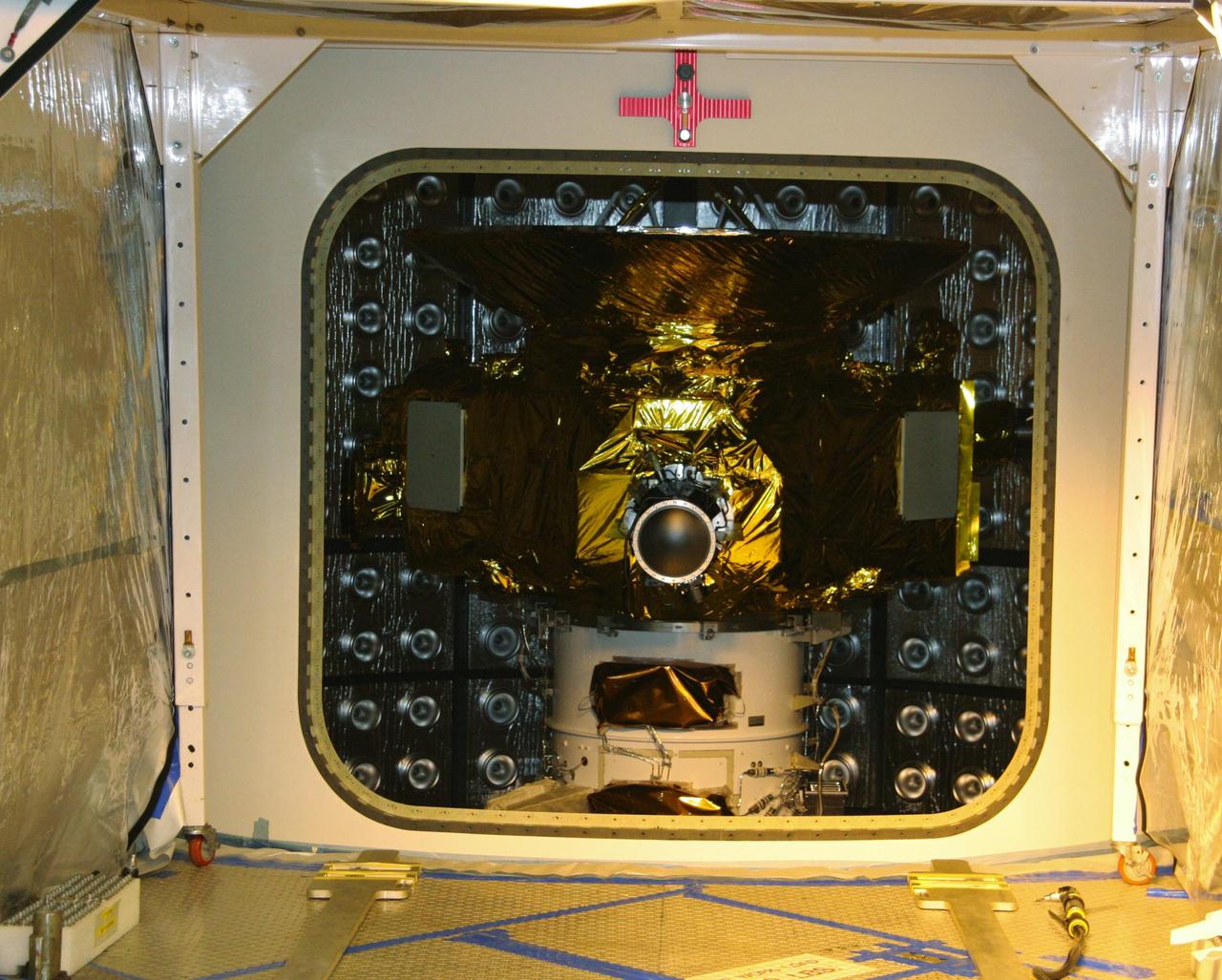
KENNEDY SPACE CENTER, FLA. — On Complex 41 at Cape Canaveral Air Force Station in Florida, the radioisotope thermoelectric generator (RTG) is attached to the New Horizons spacecraft inside the fairing. Designed and integrated at the Johns Hopkins University Applied Physics Laboratory (APL) in Laurel, Md., New Horizons will launch on a nine-and-a-half-year voyage to Pluto. Typical of RTG-based systems, as on past outer-planet missions, New Horizons does not have a battery for storing power. At the start of the mission, the RTG, which provides power through the natural radioactive decay of plutonium dioxide fuel, will supply approximately 240 watts (at 30 volts of direct current) - the spacecraft’s shunt regulator unit maintains a steady input from the RTG and dissipates power the spacecraft cannot use at a given time. By July 2015 (the earliest Pluto encounter date) that supply decreases to 200 watts at the same voltage, so New Horizons will ease the strain on its limited power source by cycling science instruments during planetary encounters. On Complex 41 at Cape Canaveral Air Force Station in Florida, workers on the ground oversee the radioisotope thermoelectric generator (RTG) being lifted into the Vertical Integration Facility. The RTG will be installed on the New Horizons spacecraft within the fairing at the top of the Atlas V launch vehicle. Designed and integrated at the Johns Hopkins University Applied Physics Laboratory (APL) in Laurel, Md., New Horizons will launch on a nine-and-a-half-year voyage to Pluto. Typical of RTG-based systems, as on past outer-planet missions, New Horizons does not have a battery for storing power. At the start of the mission, the RTG, which provides power through the natural radioactive decay of plutonium dioxide fuel, will supply approximately 240 watts (at 30 volts of direct current) - the spacecraft’s shunt regulator unit maintains a steady input from the RTG and dissipates power the spacecraft cannot use at a give
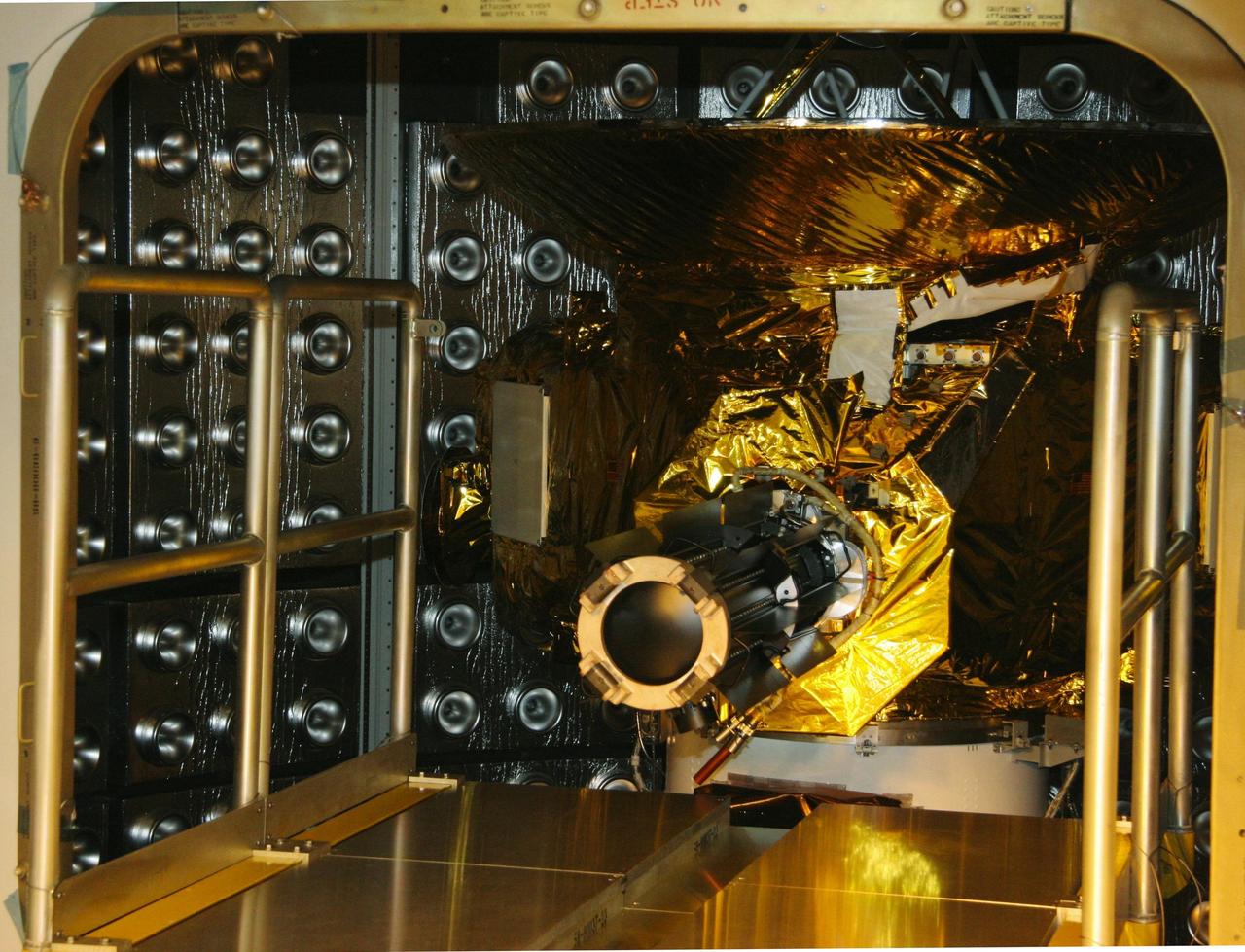
KENNEDY SPACE CENTER, FLA. — On Complex 41 at Cape Canaveral Air Force Station in Florida, the radioisotope thermoelectric generator (RTG) is attached to the New Horizons spacecraft inside the fairing. Designed and integrated at the Johns Hopkins University Applied Physics Laboratory (APL) in Laurel, Md., New Horizons will launch on a nine-and-a-half-year voyage to Pluto. Typical of RTG-based systems, as on past outer-planet missions, New Horizons does not have a battery for storing power. At the start of the mission, the RTG, which provides power through the natural radioactive decay of plutonium dioxide fuel, will supply approximately 240 watts (at 30 volts of direct current) - the spacecraft’s shunt regulator unit maintains a steady input from the RTG and dissipates power the spacecraft cannot use at a given time. By July 2015 (the earliest Pluto encounter date) that supply decreases to 200 watts at the same voltage, so New Horizons will ease the strain on its limited power source by cycling science instruments during planetary encounters. On Complex 41 at Cape Canaveral Air Force Station in Florida, workers on the ground oversee the radioisotope thermoelectric generator (RTG) being lifted into the Vertical Integration Facility. The RTG will be installed on the New Horizons spacecraft within the fairing at the top of the Atlas V launch vehicle. Designed and integrated at the Johns Hopkins University Applied Physics Laboratory (APL) in Laurel, Md., New Horizons will launch on a nine-and-a-half-year voyage to Pluto. Typical of RTG-based systems, as on past outer-planet missions, New Horizons does not have a battery for storing power. At the start of the mission, the RTG, which provides power through the natural radioactive decay of plutonium dioxide fuel, will supply approximately 240 watts (at 30 volts of direct current) - the spacecraft’s shunt regulator unit maintains a steady input from the RTG and dissipates power the spacecraft cannot use at a give
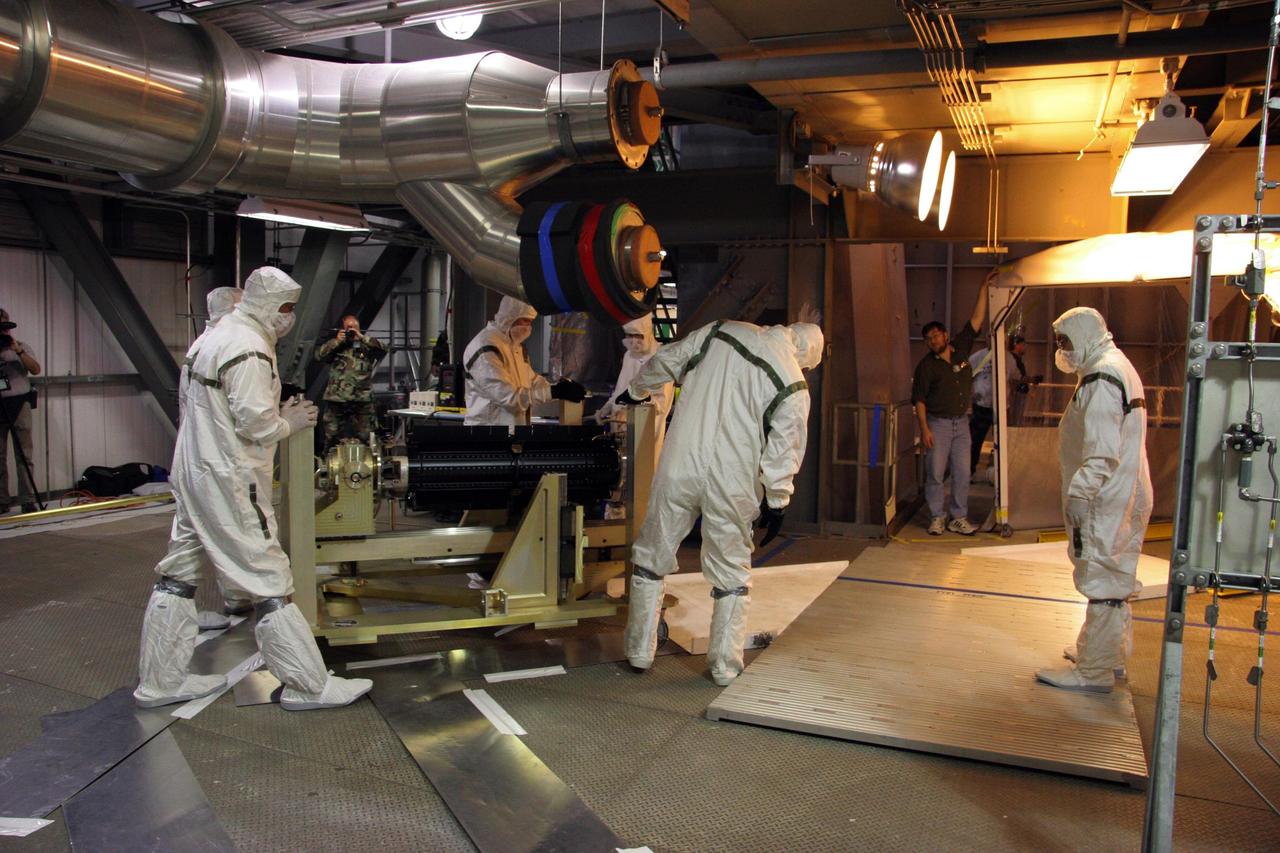
KENNEDY SPACE CENTER, FLA. — On Complex 41 at Cape Canaveral Air Force Station in Florida, workers move the radioisotope thermoelectric generator (RTG). The generator will be installed on the New Horizons spacecraft encapsulated inside the fairing. Designed and integrated at the Johns Hopkins University Applied Physics Laboratory (APL) in Laurel, Md., New Horizons will launch on a nine-and-a-half-year voyage to Pluto. Typical of RTG-based systems, as on past outer-planet missions, New Horizons does not have a battery for storing power. At the start of the mission, the RTG, which provides power through the natural radioactive decay of plutonium dioxide fuel, will supply approximately 240 watts (at 30 volts of direct current) - the spacecraft’s shunt regulator unit maintains a steady input from the RTG and dissipates power the spacecraft cannot use at a given time. By July 2015 (the earliest Pluto encounter date) that supply decreases to 200 watts at the same voltage, so New Horizons will ease the strain on its limited power source by cycling science instruments during planetary encounters. On Complex 41 at Cape Canaveral Air Force Station in Florida, workers on the ground oversee the radioisotope thermoelectric generator (RTG) being lifted into the Vertical Integration Facility. The RTG will be installed on the New Horizons spacecraft within the fairing at the top of the Atlas V launch vehicle. Designed and integrated at the Johns Hopkins University Applied Physics Laboratory (APL) in Laurel, Md., New Horizons will launch on a nine-and-a-half-year voyage to Pluto. Typical of RTG-based systems, as on past outer-planet missions, New Horizons does not have a battery for storing power. At the start of the mission, the RTG, which provides power through the natural radioactive decay of plutonium dioxide fuel, will supply approximately 240 watts (at 30 volts of direct current) - the spacecraft’s shunt regulator unit maintains a steady input from the RTG and diss
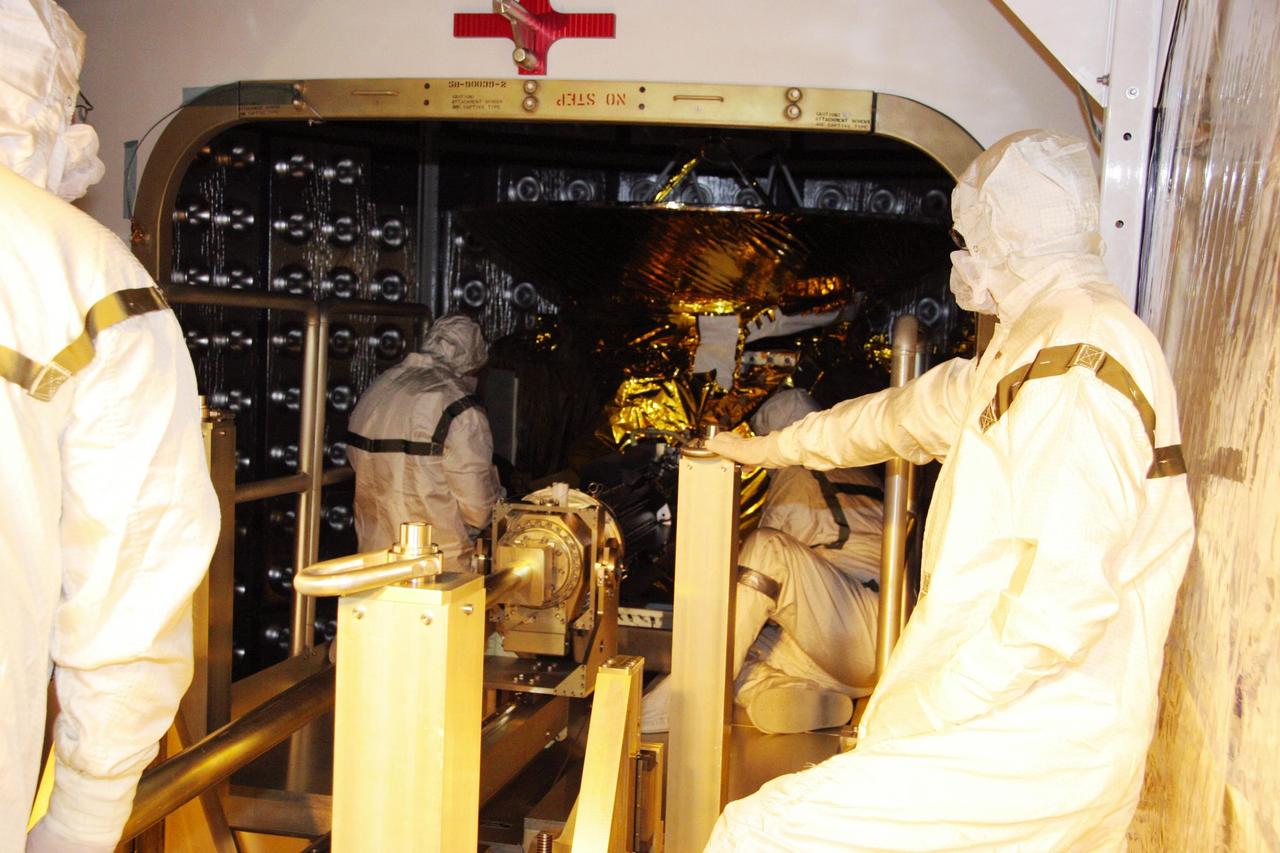
KENNEDY SPACE CENTER, FLA. — On Complex 41 at Cape Canaveral Air Force Station in Florida, workers move the radioisotope thermoelectric generator (RTG) into an area of the fairing containing the New Horizons spacecraft, to which it will be attached. Designed and integrated at the Johns Hopkins University Applied Physics Laboratory (APL) in Laurel, Md., New Horizons will launch on a nine-and-a-half-year voyage to Pluto. Typical of RTG-based systems, as on past outer-planet missions, New Horizons does not have a battery for storing power. At the start of the mission, the RTG, which provides power through the natural radioactive decay of plutonium dioxide fuel, will supply approximately 240 watts (at 30 volts of direct current) - the spacecraft’s shunt regulator unit maintains a steady input from the RTG and dissipates power the spacecraft cannot use at a given time. By July 2015 (the earliest Pluto encounter date) that supply decreases to 200 watts at the same voltage, so New Horizons will ease the strain on its limited power source by cycling science instruments during planetary encounters. On Complex 41 at Cape Canaveral Air Force Station in Florida, workers on the ground oversee the radioisotope thermoelectric generator (RTG) being lifted into the Vertical Integration Facility. The RTG will be installed on the New Horizons spacecraft within the fairing at the top of the Atlas V launch vehicle. Designed and integrated at the Johns Hopkins University Applied Physics Laboratory (APL) in Laurel, Md., New Horizons will launch on a nine-and-a-half-year voyage to Pluto. Typical of RTG-based systems, as on past outer-planet missions, New Horizons does not have a battery for storing power. At the start of the mission, the RTG, which provides power through the natural radioactive decay of plutonium dioxide fuel, will supply approximately 240 watts (at 30 volts of direct current) - the spacecraft’s shunt regulator unit maintains a steady input from the RTG and diss
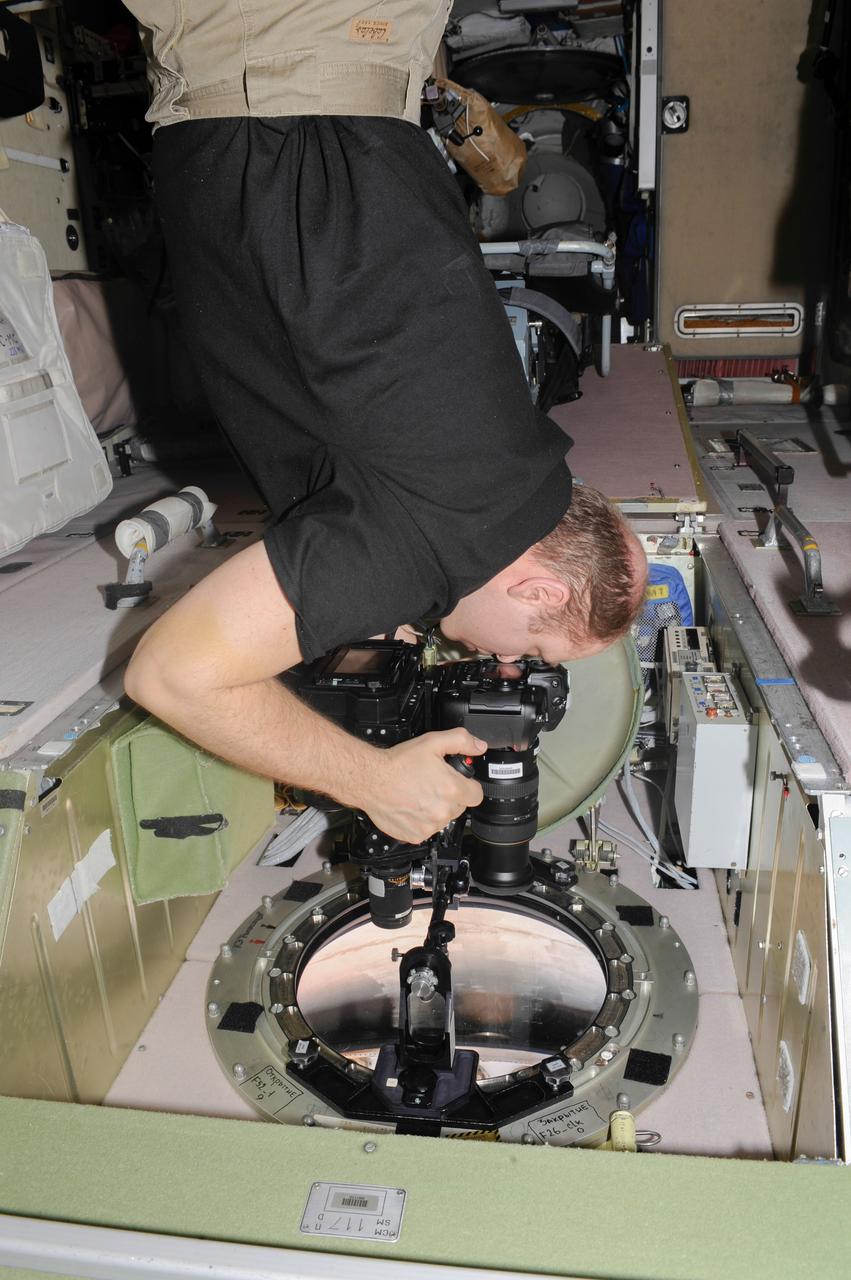
ISS038-E-005023 (20 Nov. 2013) --- At a window in the International Space Station?s Zvezda Service Module, Russian cosmonaut Oleg Kotov, Expedition 38 commander, uses a digital camera photospectral system to perform a session for the Albedo Experiment. The experiment measures Earth?s albedo, or the amount of solar radiation reflected from the surface, in the hopes to develop methods to harness the reflected radiation to supplement the station?s power supply. The light reflection phenomenon is measured in units called albedo.
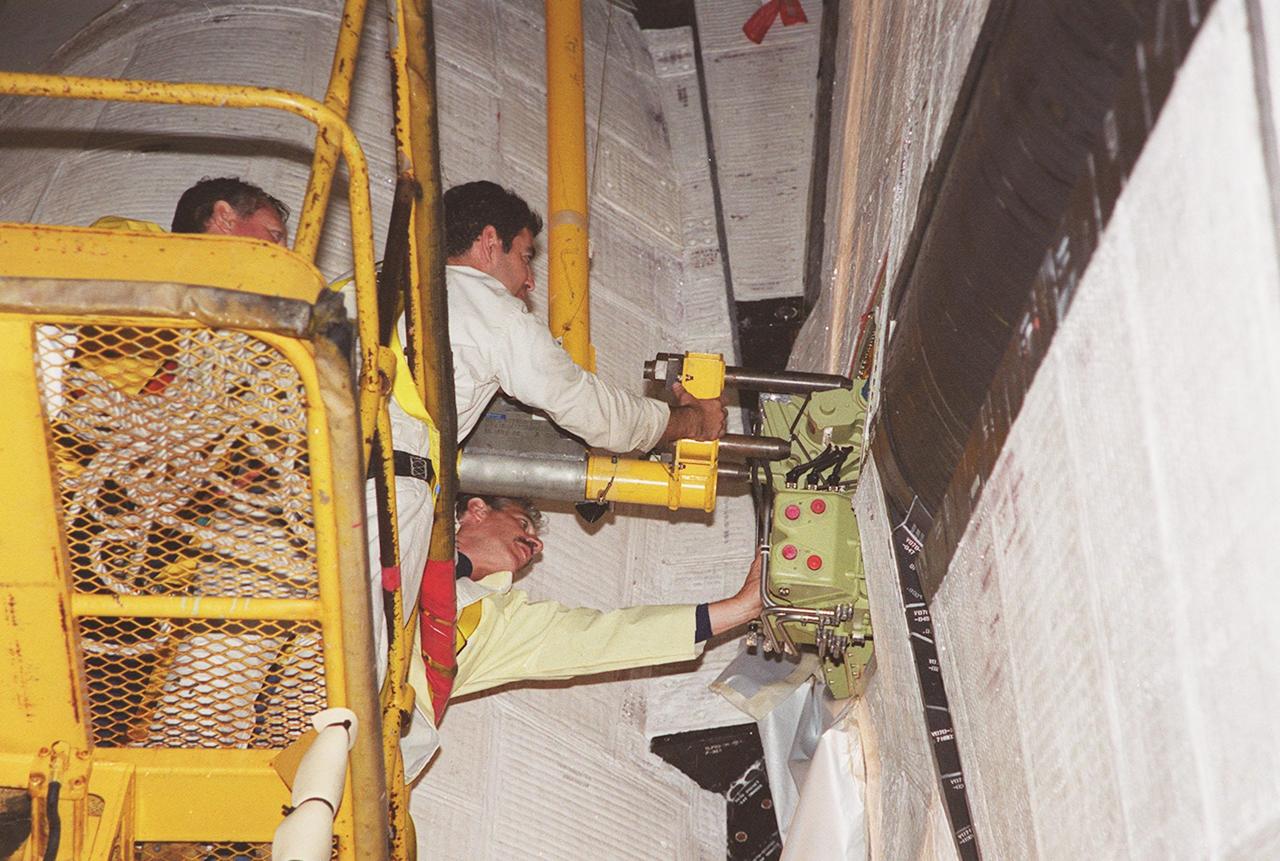
KENNEDY SPACE CENTER, FLA. -- At Launch Pad 39A, workers move the replacement Power Drive Unit (PDU) into the body of Space Shuttle Atlantis. The PDU controls the rudder/speed brake on the orbiter. Atlantis is scheduled to lift off April 24 at 4:15 p.m. EDT on mission STS-101, the third flight to the International Space Station. The primary mission is to carry logistics and supplies to the Space Station, plus the crew will be preparing the Station for the arrival of the Zvezda Service Module, expected to be launched by Russia in July 2000
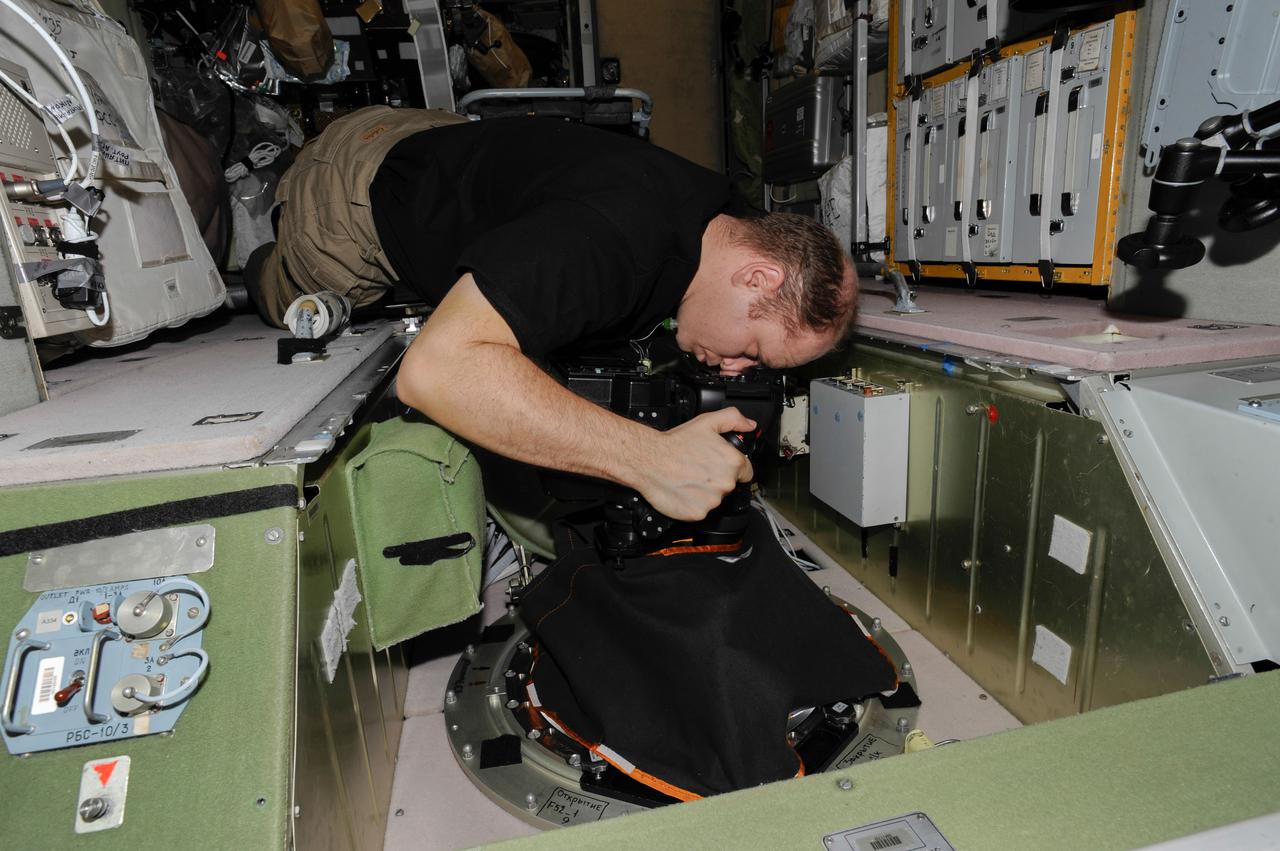
ISS038-E-005031 (20 Nov. 2013) --- At a window in the International Space Station?s Zvezda Service Module, Russian cosmonaut Oleg Kotov, Expedition 38 commander, uses a digital camera photospectral system to perform a session for the Albedo Experiment. The experiment measures Earth?s albedo, or the amount of solar radiation reflected from the surface, in the hopes to develop methods to harness the reflected radiation to supplement the station?s power supply. The light reflection phenomenon is measured in units called albedo.
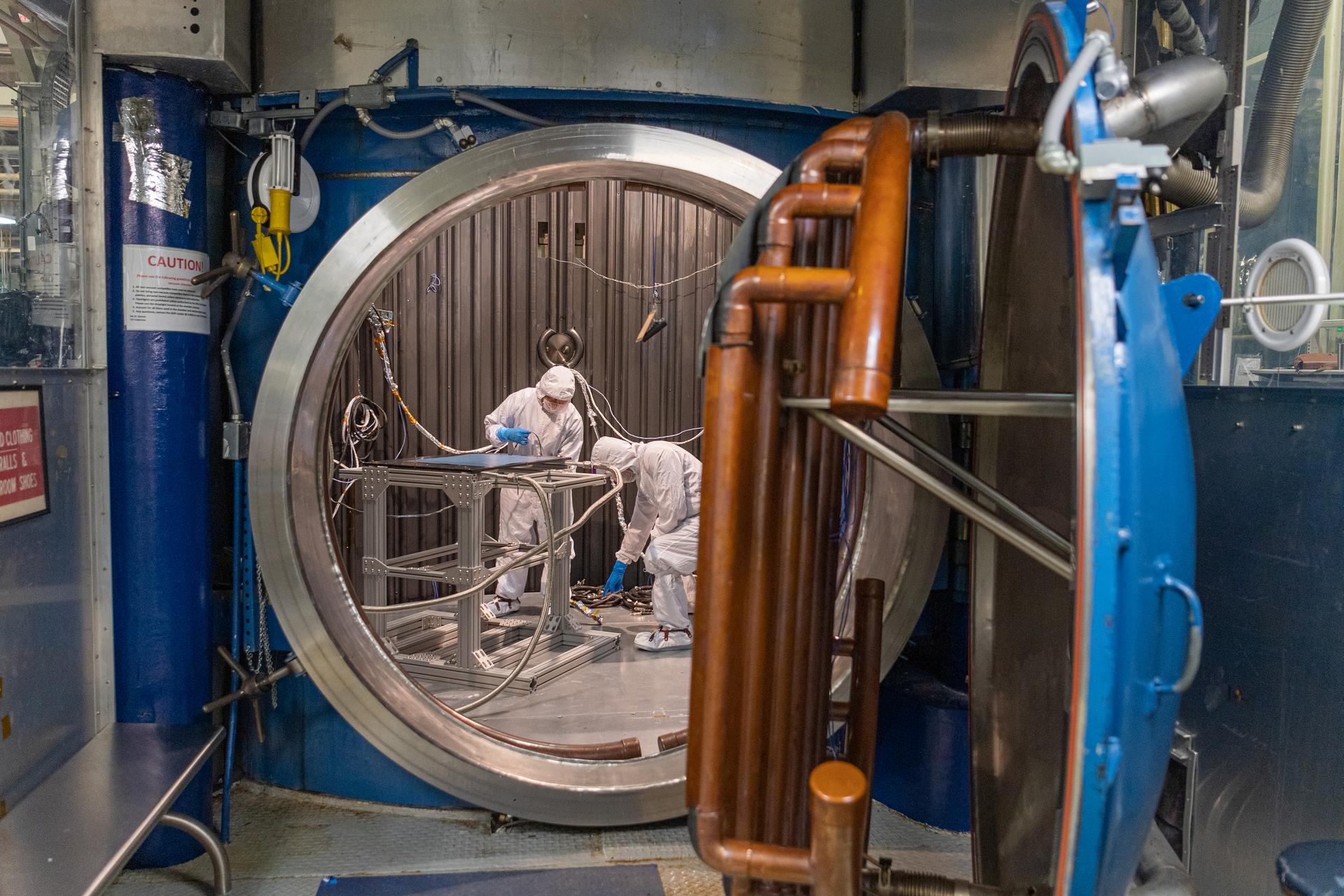
Members of the OSAM-1 power supply unit (PSU) team make preparations inside a thermal vacuum chamber for the PSU electronics box to be lowered in at Goddard Space Flight Center, Greenbelt Md., Mar 16, 2023. This photo has been reviewed by OSAM1 project management and the Export Control Office and is released for public view. NASA/Mike Guinto
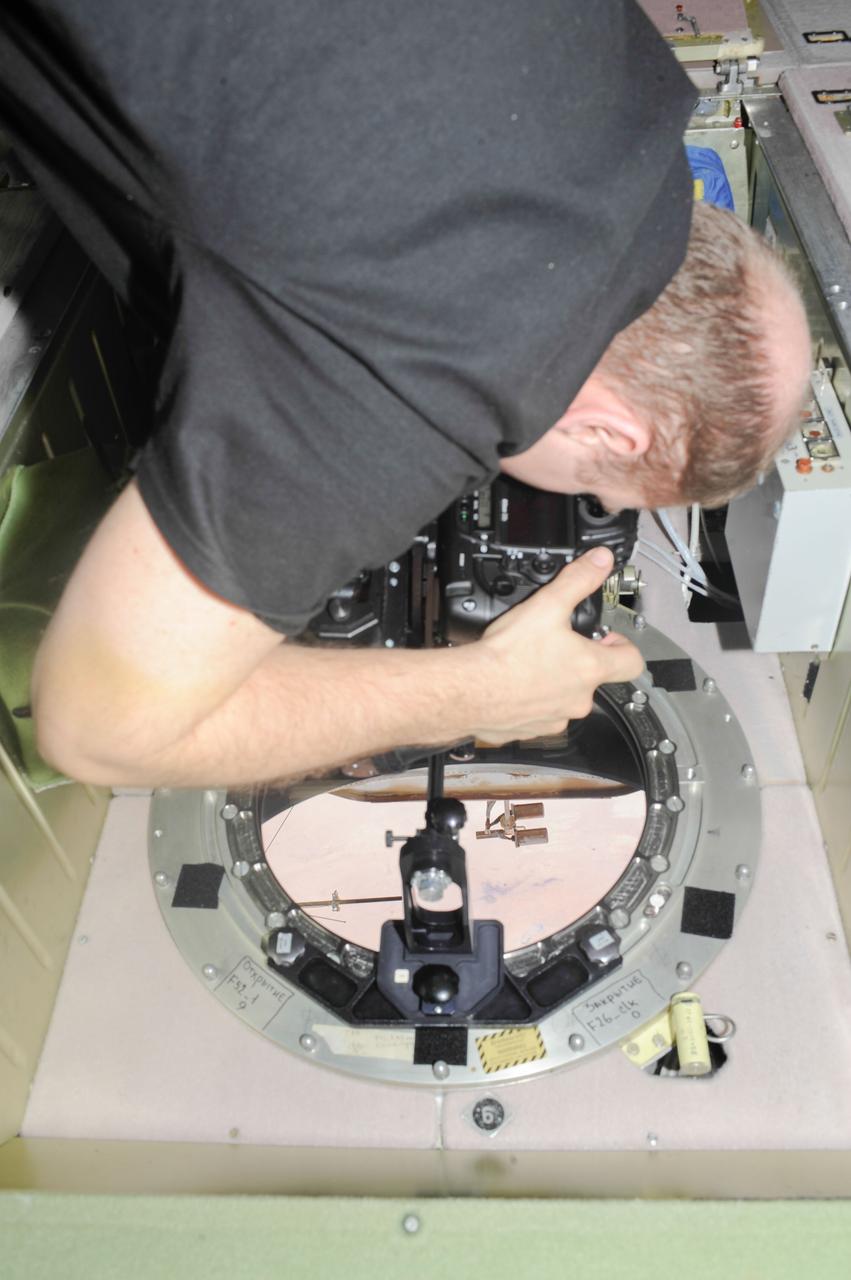
ISS038-E-005019 (20 Nov. 2013) --- At a window in the International Space Station?s Zvezda Service Module, Russian cosmonaut Oleg Kotov, Expedition 38 commander, uses a digital camera photospectral system to perform a session for the Albedo Experiment. The experiment measures Earth?s albedo, or the amount of solar radiation reflected from the surface, in the hopes to develop methods to harness the reflected radiation to supplement the station?s power supply. The light reflection phenomenon is measured in units called albedo.
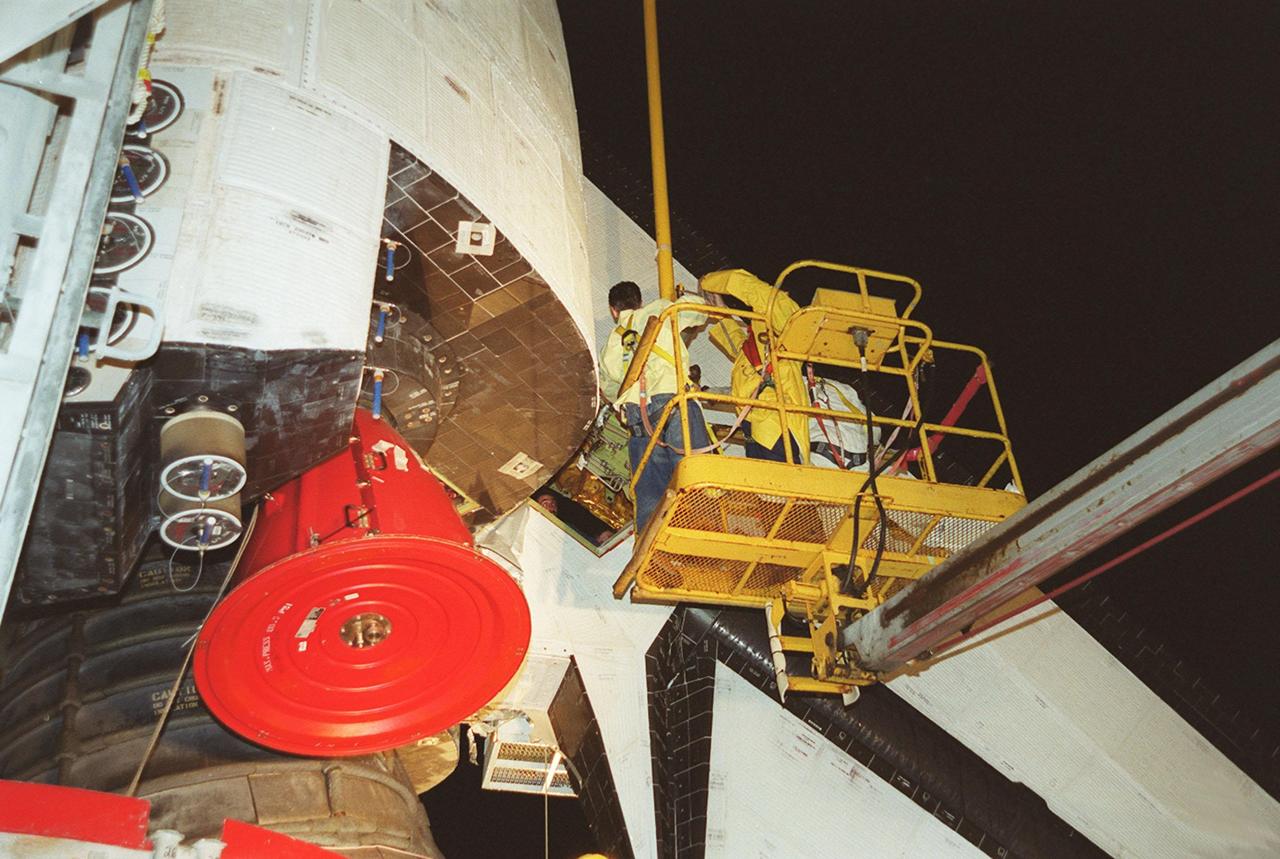
KENNEDY SPACE CENTER, FLA. -- At Launch Pad 39A, workers help guide the replacement Power Drive Unit (PDU) for Space Shuttle Atlantis into place. The PDU controls the rudder/speed brake on the orbiter. Atlantis is scheduled to lift off April 24 at 4:15 p.m. EDT on mission STS-101, the third flight to the International Space Station. The primary mission is to carry logistics and supplies to the Space Station, plus the crew will be preparing the Station for the arrival of the Zvezda Service Module, expected to be launched by Russia in July 2000
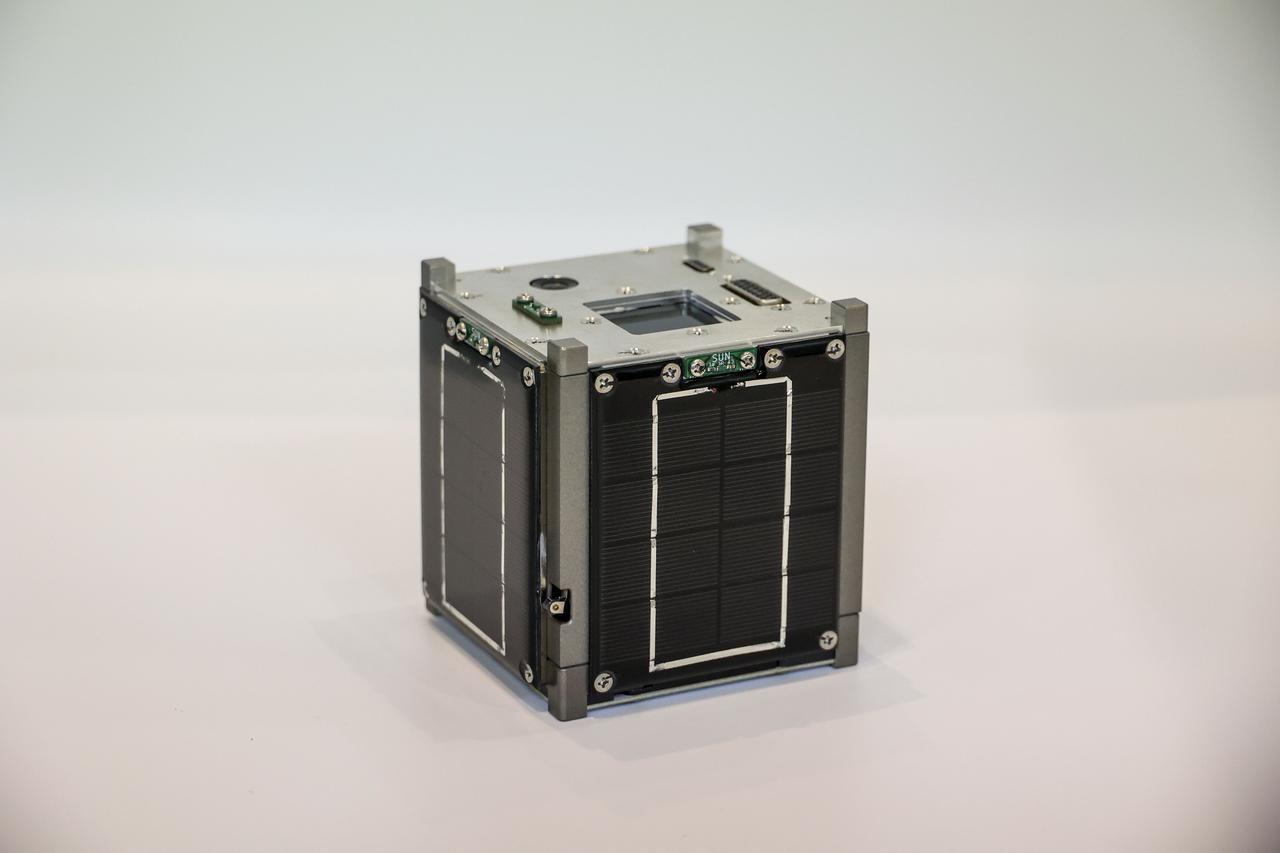
jsc2022e057881 (2/25/2022) --- Launch configuration of the HSU-SAT1 1-Unit (1U) CubeSat. HSU-SAT1 provides a demonstration that modulated infrared light emitted from a ground station can be used as a command transmission link. HSU-SAT1 also evaluates new technologies for electrical power supply, on board computing, and other satellite bus components. Image courtesy of Future Science Institute.
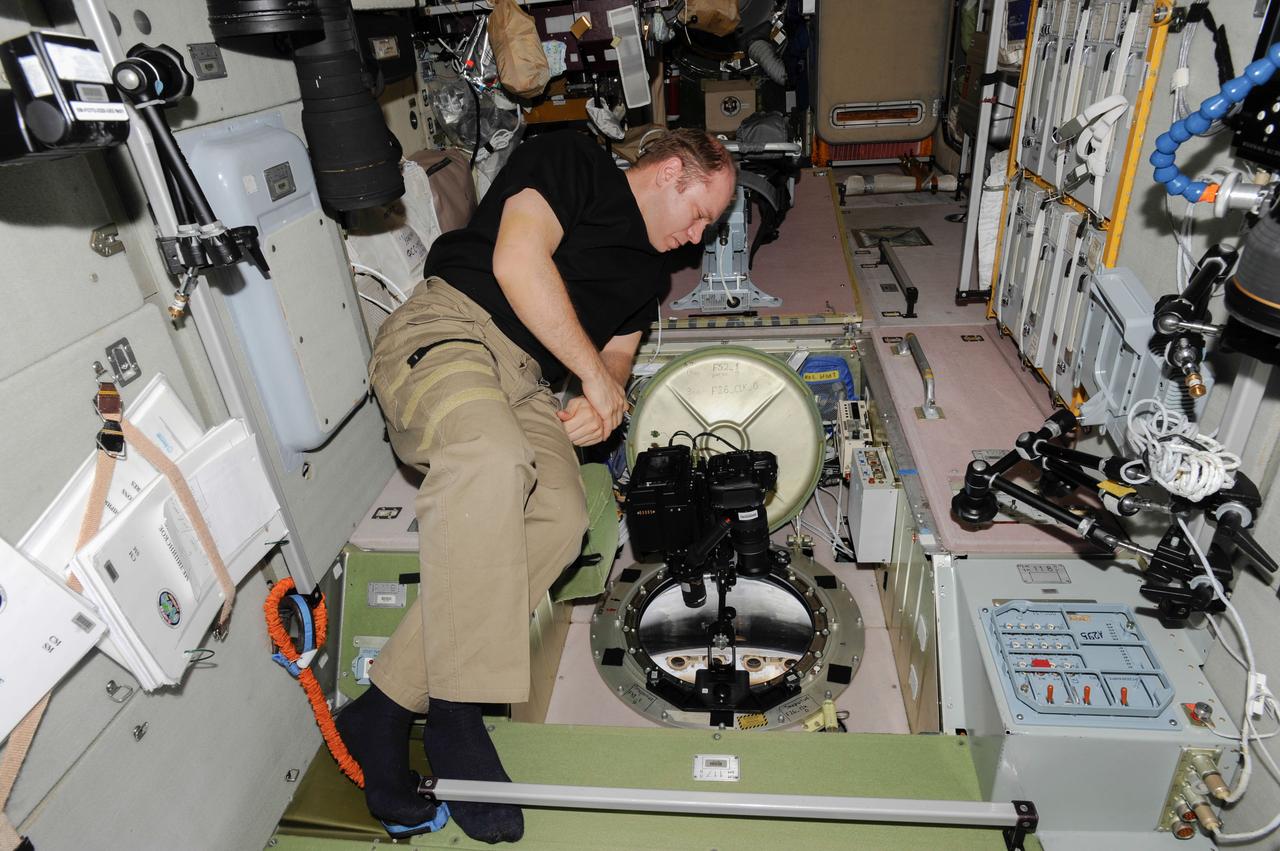
ISS038-E-005014 (20 Nov. 2013) --- At a window in the International Space Station’s Zvezda Service Module, Russian cosmonaut Oleg Kotov, Expedition 38 commander, uses a digital camera photospectral system to perform a session for the Albedo Experiment. The experiment measures Earth’s albedo, or the amount of solar radiation reflected from the surface, in the hopes to develop methods to harness the reflected radiation to supplement the station’s power supply. The light reflection phenomenon is measured in units called albedo.
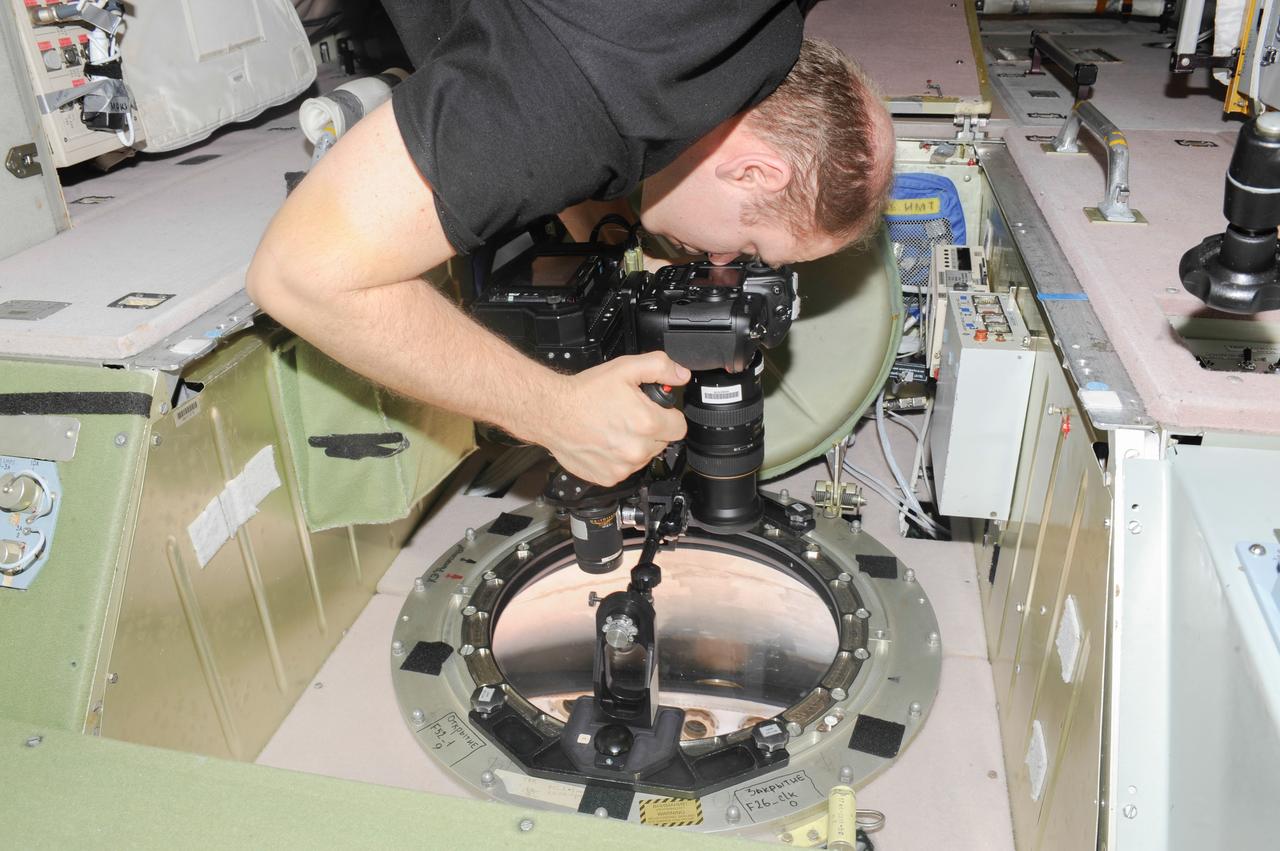
ISS038-E-005022 (20 Nov. 2013) --- At a window in the International Space Station?s Zvezda Service Module, Russian cosmonaut Oleg Kotov, Expedition 38 commander, uses a digital camera photospectral system to perform a session for the Albedo Experiment. The experiment measures Earth?s albedo, or the amount of solar radiation reflected from the surface, in the hopes to develop methods to harness the reflected radiation to supplement the station?s power supply. The light reflection phenomenon is measured in units called albedo.
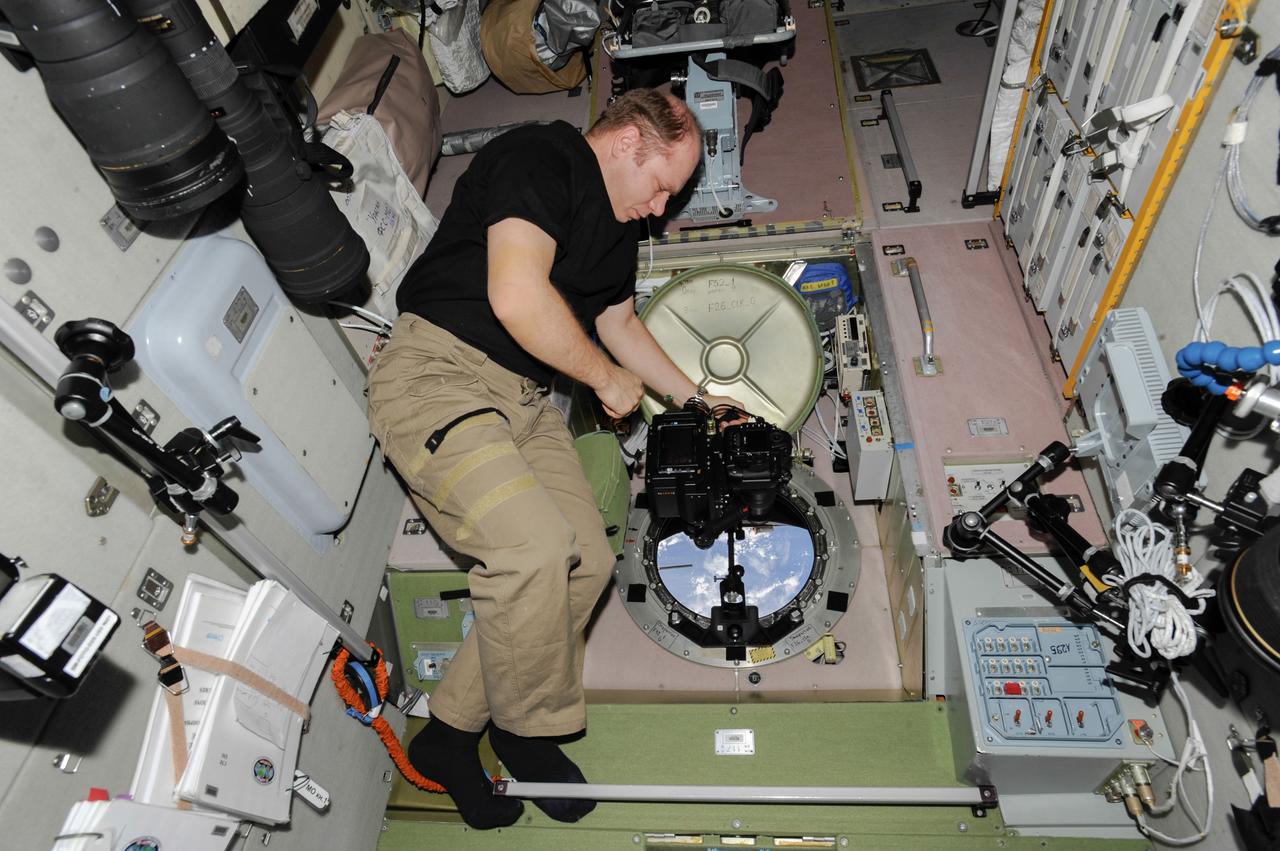
ISS038-E-005016 (20 Nov. 2013) --- At a window in the International Space Station?s Zvezda Service Module, Russian cosmonaut Oleg Kotov, Expedition 38 commander, uses a digital camera photospectral system to perform a session for the Albedo Experiment. The experiment measures Earth?s albedo, or the amount of solar radiation reflected from the surface, in the hopes to develop methods to harness the reflected radiation to supplement the station?s power supply. The light reflection phenomenon is measured in units called albedo.
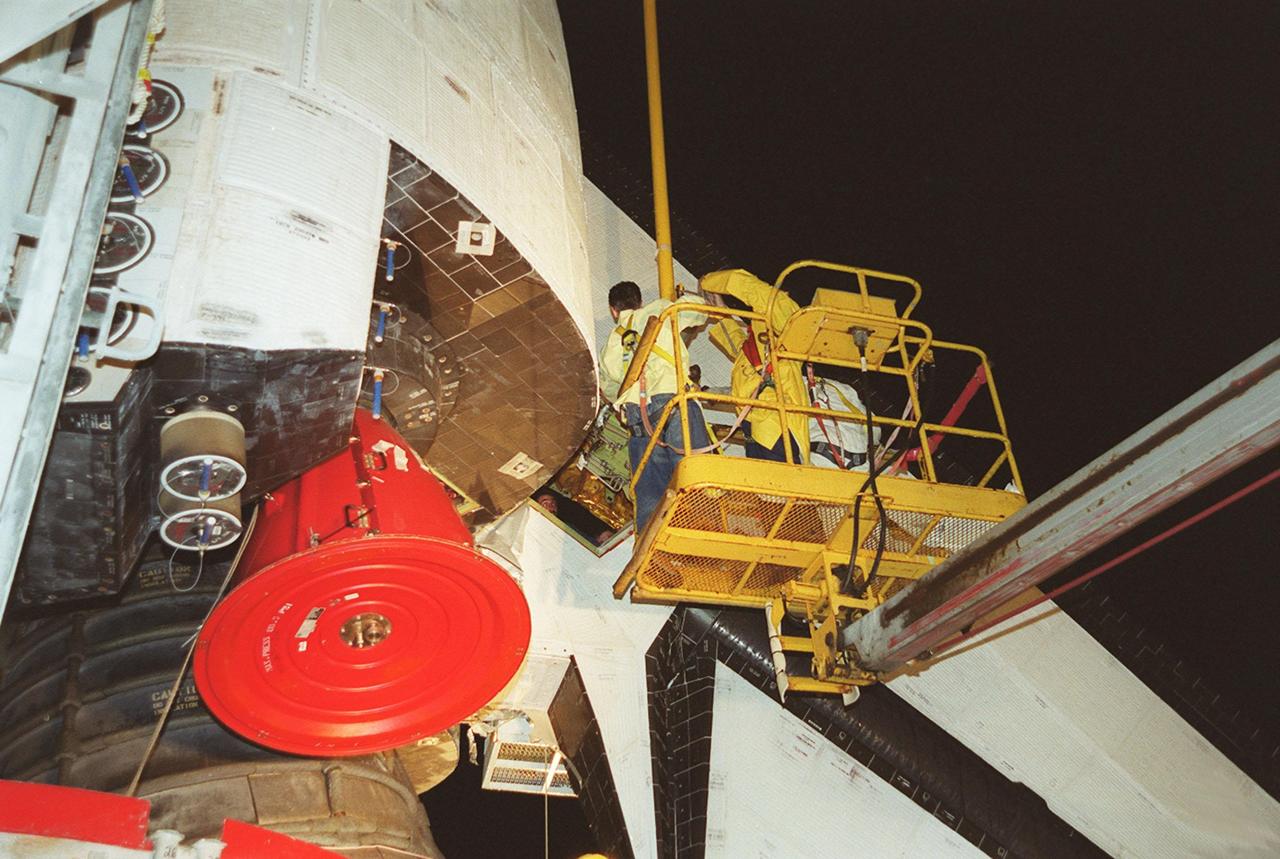
KENNEDY SPACE CENTER, FLA. -- At Launch Pad 39A, workers help guide the replacement Power Drive Unit (PDU) for Space Shuttle Atlantis into place. The PDU controls the rudder/speed brake on the orbiter. Atlantis is scheduled to lift off April 24 at 4:15 p.m. EDT on mission STS-101, the third flight to the International Space Station. The primary mission is to carry logistics and supplies to the Space Station, plus the crew will be preparing the Station for the arrival of the Zvezda Service Module, expected to be launched by Russia in July 2000
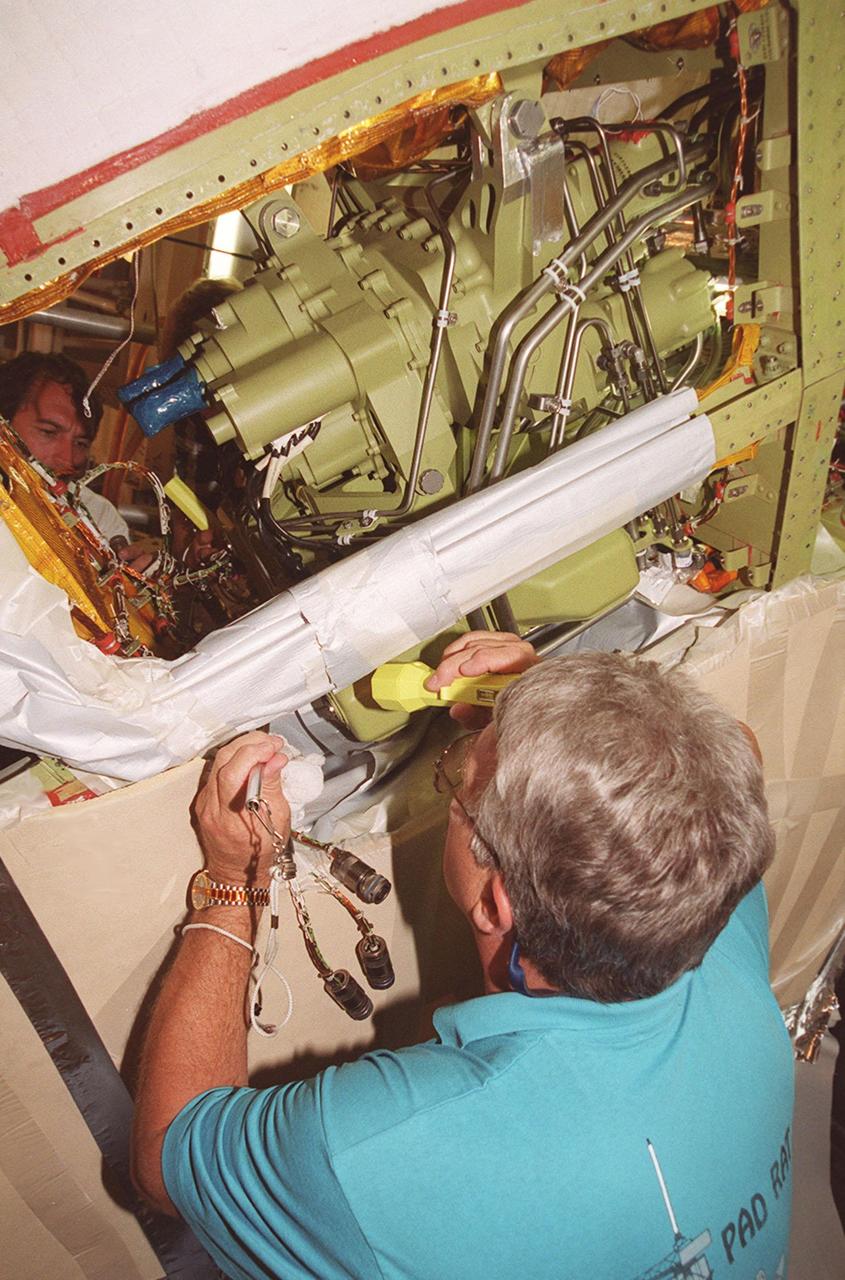
At Launch Pad 39A, Greg Lohning, who is with NASA, inspects the wiring on the newly installed Power Drive Unit (PDU) in Space Shuttle Atlantis. The PDU controls the rudder/speed brake on the orbiter. Atlantis is scheduled to lift off April 24 at 4:15 p.m. EDT on mission STS-101, the third flight to the International Space Station. The primary mission is to carry logistics and supplies to the Space Station, plus the crew will be preparing the Station for the arrival of the Zvezda Service Module, expected to be launched by Russia in July 2000
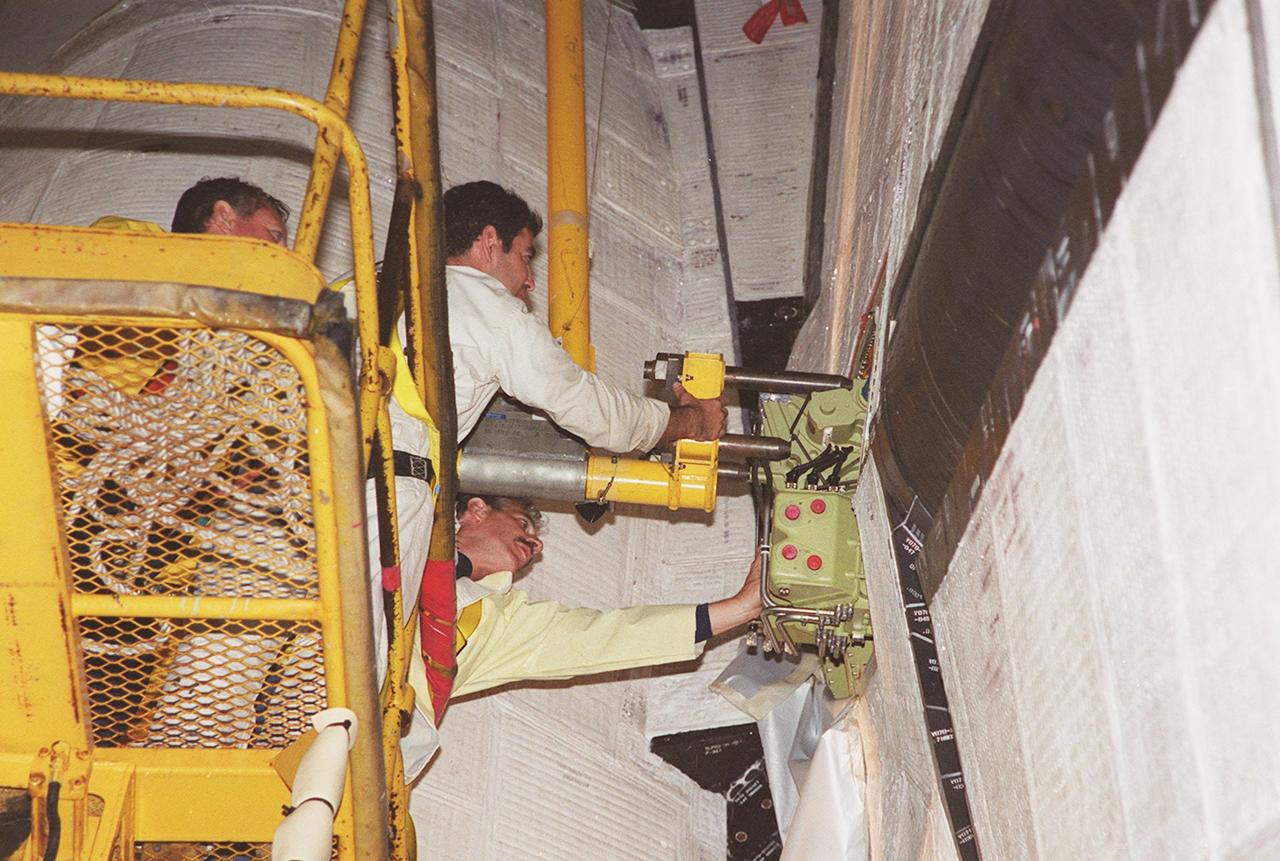
KENNEDY SPACE CENTER, FLA. -- At Launch Pad 39A, workers move the replacement Power Drive Unit (PDU) into the body of Space Shuttle Atlantis. The PDU controls the rudder/speed brake on the orbiter. Atlantis is scheduled to lift off April 24 at 4:15 p.m. EDT on mission STS-101, the third flight to the International Space Station. The primary mission is to carry logistics and supplies to the Space Station, plus the crew will be preparing the Station for the arrival of the Zvezda Service Module, expected to be launched by Russia in July 2000
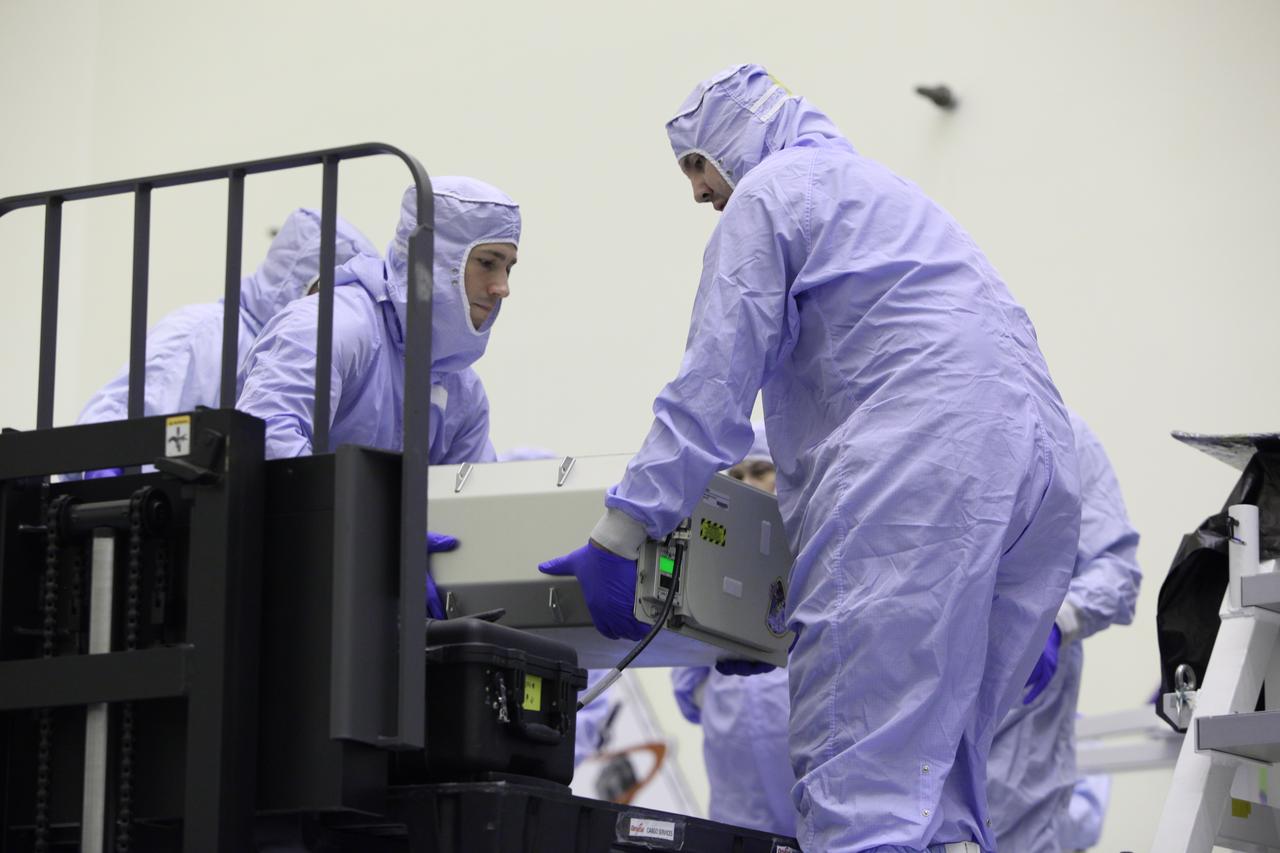
Inside the Payload Hazardous Servicing Facility at NASA's Kennedy Space Center in Florida, technicians prepare a powered cargo unit for late stowage in the Orbital ATK Cygnus pressurized cargo module. The Orbital ATK CRS-7 commercial resupply services mission to the International Space Station is scheduled to launch atop a United Launch Alliance Atlas V rocket from Space Launch Complex 41 at Cape Canaveral Air Force Station targeted for March 24, 2017. Cygnus will deliver 7,600 pounds of supplies, equipment and scientific research materials to the space station.
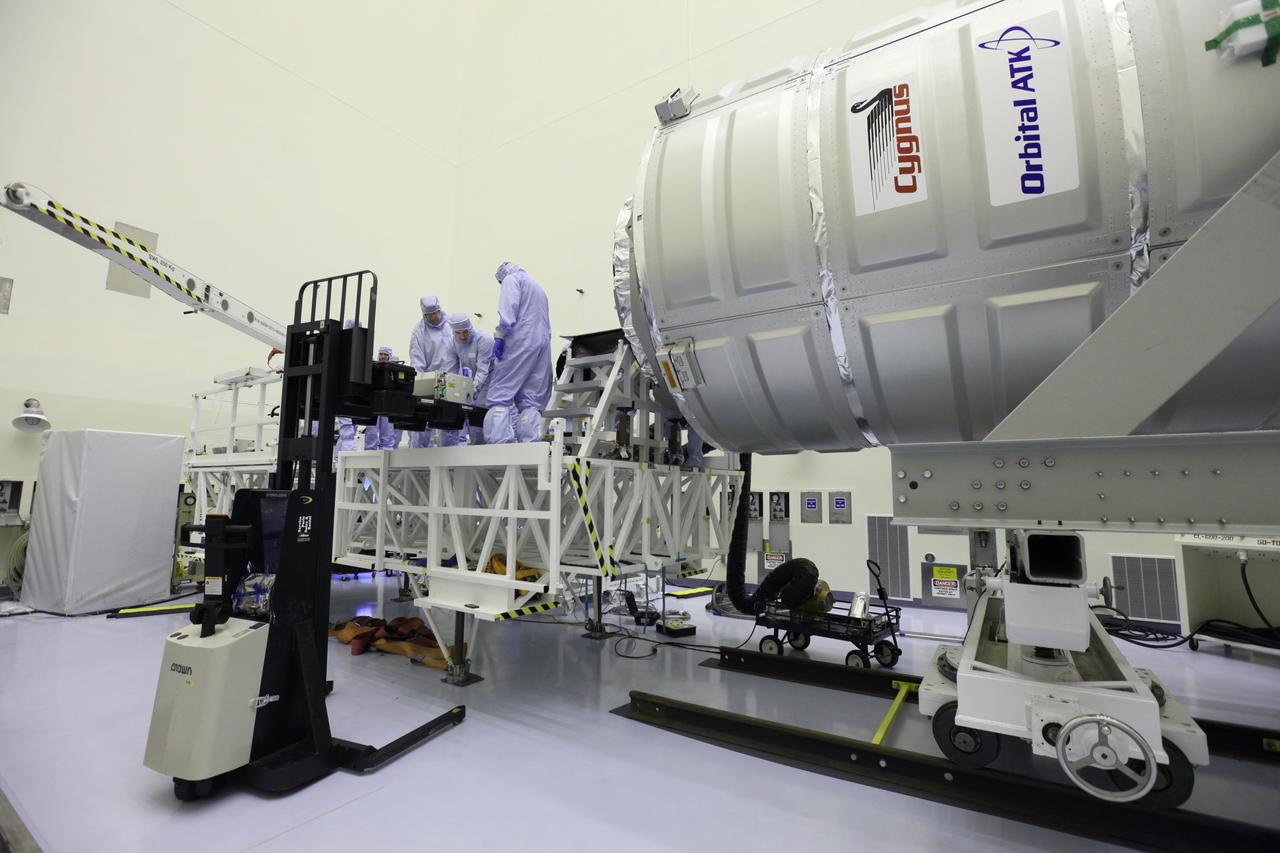
Inside the Payload Hazardous Servicing Facility at NASA's Kennedy Space Center in Florida, technicians prepare a powered cargo unit for late stowage in the Orbital ATK Cygnus pressurized cargo module. The Orbital ATK CRS-7 commercial resupply services mission to the International Space Station is scheduled to launch atop a United Launch Alliance Atlas V rocket from Space Launch Complex 41 at Cape Canaveral Air Force Station targeted for March 24, 2017. Cygnus will deliver 7,600 pounds of supplies, equipment and scientific research materials to the space station.
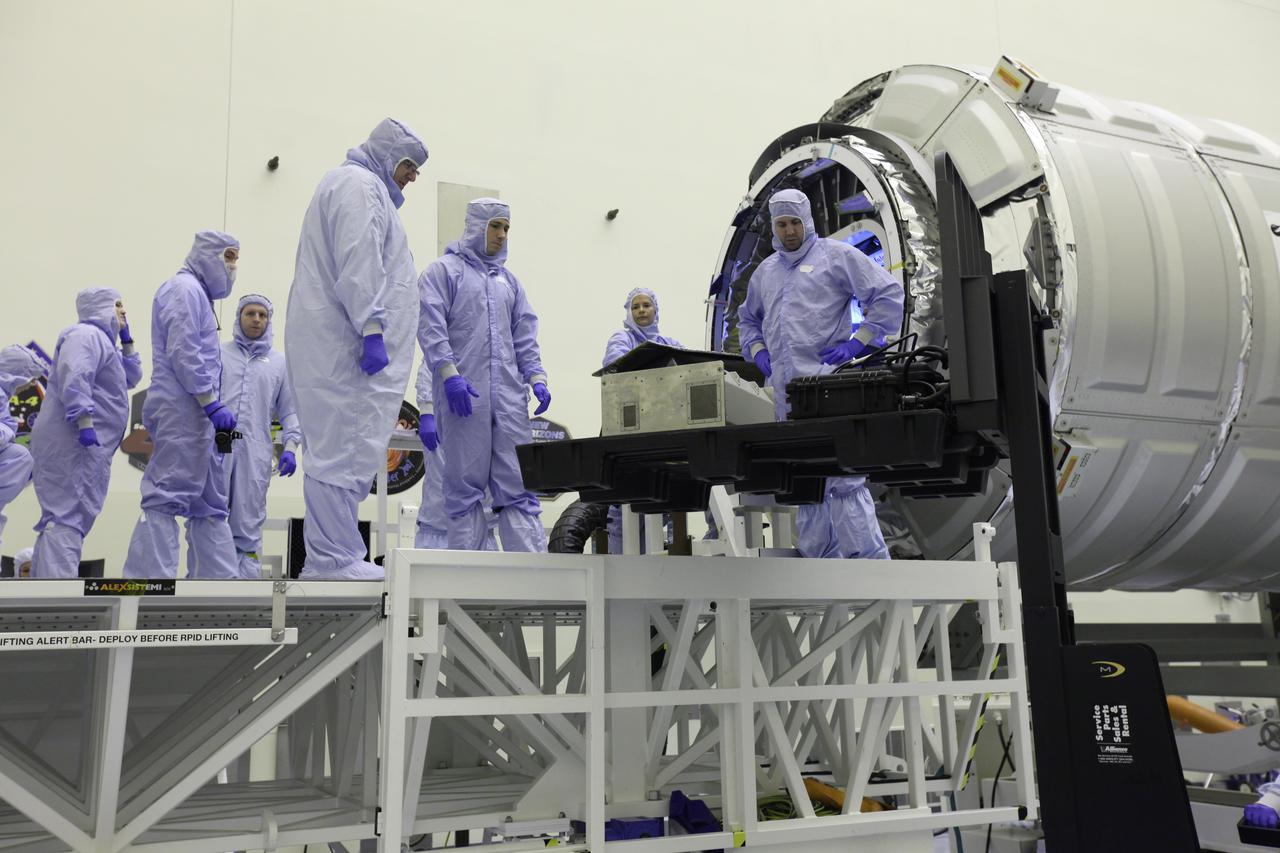
Inside the Payload Hazardous Servicing Facility at NASA's Kennedy Space Center in Florida, technicians prepare a powered cargo unit for late stowage in the Orbital ATK Cygnus pressurized cargo module. The Orbital ATK CRS-7 commercial resupply services mission to the International Space Station is scheduled to launch atop a United Launch Alliance Atlas V rocket from Space Launch Complex 41 at Cape Canaveral Air Force Station targeted for March 24, 2017. Cygnus will deliver 7,600 pounds of supplies, equipment and scientific research materials to the space station.
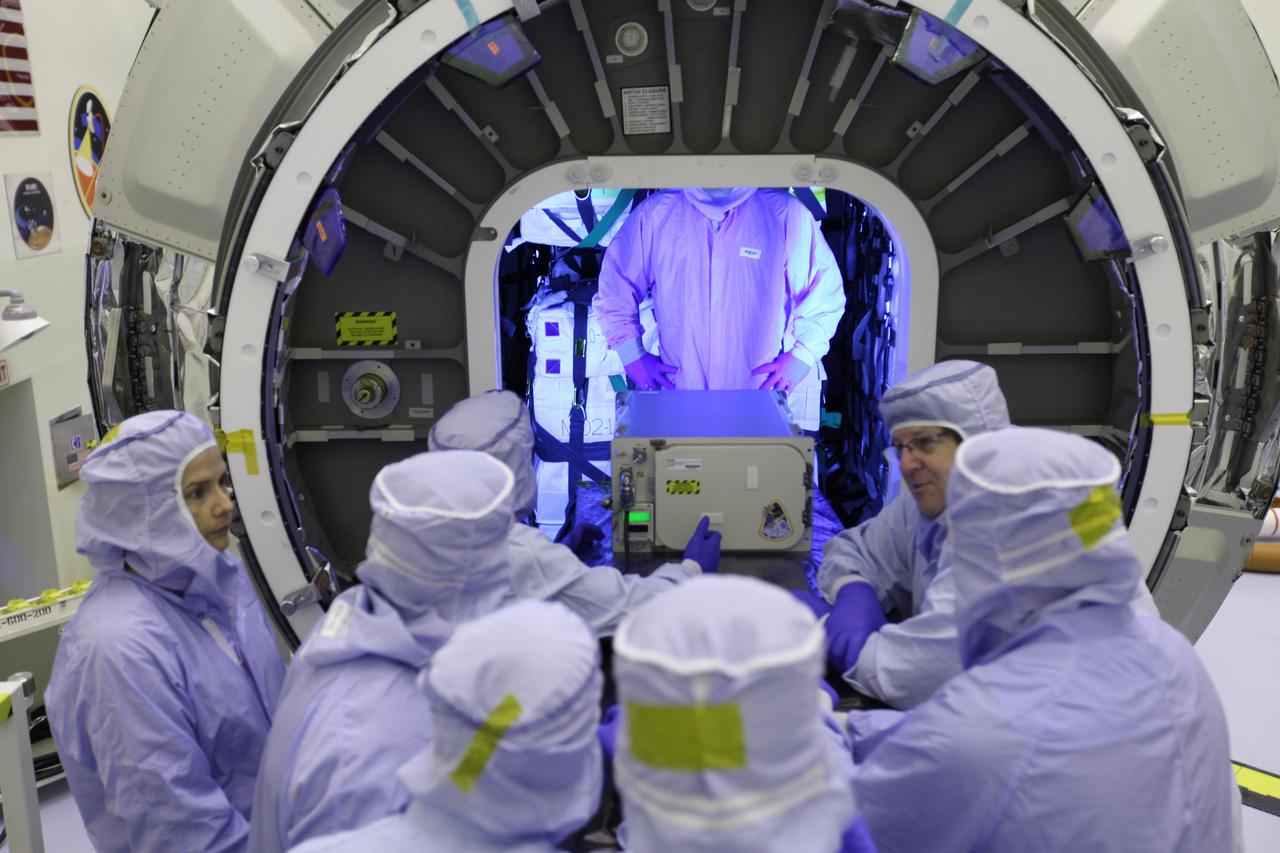
Inside the Payload Hazardous Servicing Facility at NASA's Kennedy Space Center in Florida, technicians load a powered cargo unit into the Orbital ATK Cygnus pressurized cargo module during final stowage. The Orbital ATK CRS-7 commercial resupply services mission to the International Space Station is scheduled to launch atop a United Launch Alliance Atlas V rocket from Space Launch Complex 41 at Cape Canaveral Air Force Station targeted for March 24, 2017. Cygnus will deliver 7,600 pounds of supplies, equipment and scientific research materials to the space station.
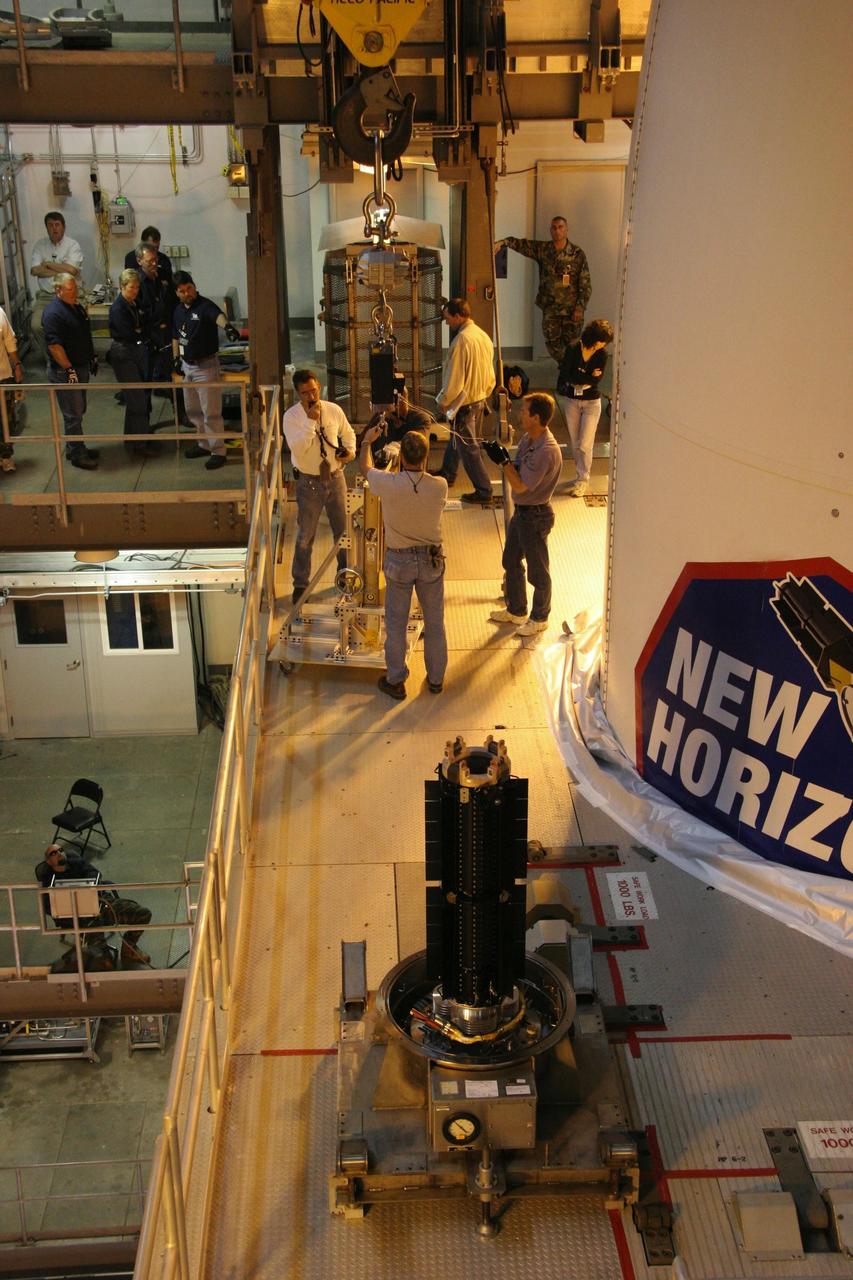
KENNEDY SPACE CENTER, FLA. — On Complex 41 at Cape Canaveral Air Force Station in Florida, the radioisotope thermoelectric generator (RTG) in the foreground has been removed from its caged enclosure. The RTG will be installed on the New Horizons spacecraft encapsulated inside the fairing, at right. Designed and integrated at the Johns Hopkins University Applied Physics Laboratory (APL) in Laurel, Md., New Horizons will launch on a nine-and-a-half-year voyage to Pluto. Typical of RTG-based systems, as on past outer-planet missions, New Horizons does not have a battery for storing power. At the start of the mission, the RTG, which provides power through the natural radioactive decay of plutonium dioxide fuel, will supply approximately 240 watts (at 30 volts of direct current) - the spacecraft’s shunt regulator unit maintains a steady input from the RTG and dissipates power the spacecraft cannot use at a given time. By July 2015 (the earliest Pluto encounter date) that supply decreases to 200 watts at the same voltage, so New Horizons will ease the strain on its limited power source by cycling science instruments during planetary encounters. On Complex 41 at Cape Canaveral Air Force Station in Florida, workers on the ground oversee the radioisotope thermoelectric generator (RTG) being lifted into the Vertical Integration Facility. The RTG will be installed on the New Horizons spacecraft within the fairing at the top of the Atlas V launch vehicle. Designed and integrated at the Johns Hopkins University Applied Physics Laboratory (APL) in Laurel, Md., New Horizons will launch on a nine-and-a-half-year voyage to Pluto. Typical of RTG-based systems, as on past outer-planet missions, New Horizons does not have a battery for storing power. At the start of the mission, the RTG, which provides power through the natural radioactive decay of plutonium dioxide fuel, will supply approximately 240 watts (at 30 volts of direct current) - the spacecraft’s shunt regulato
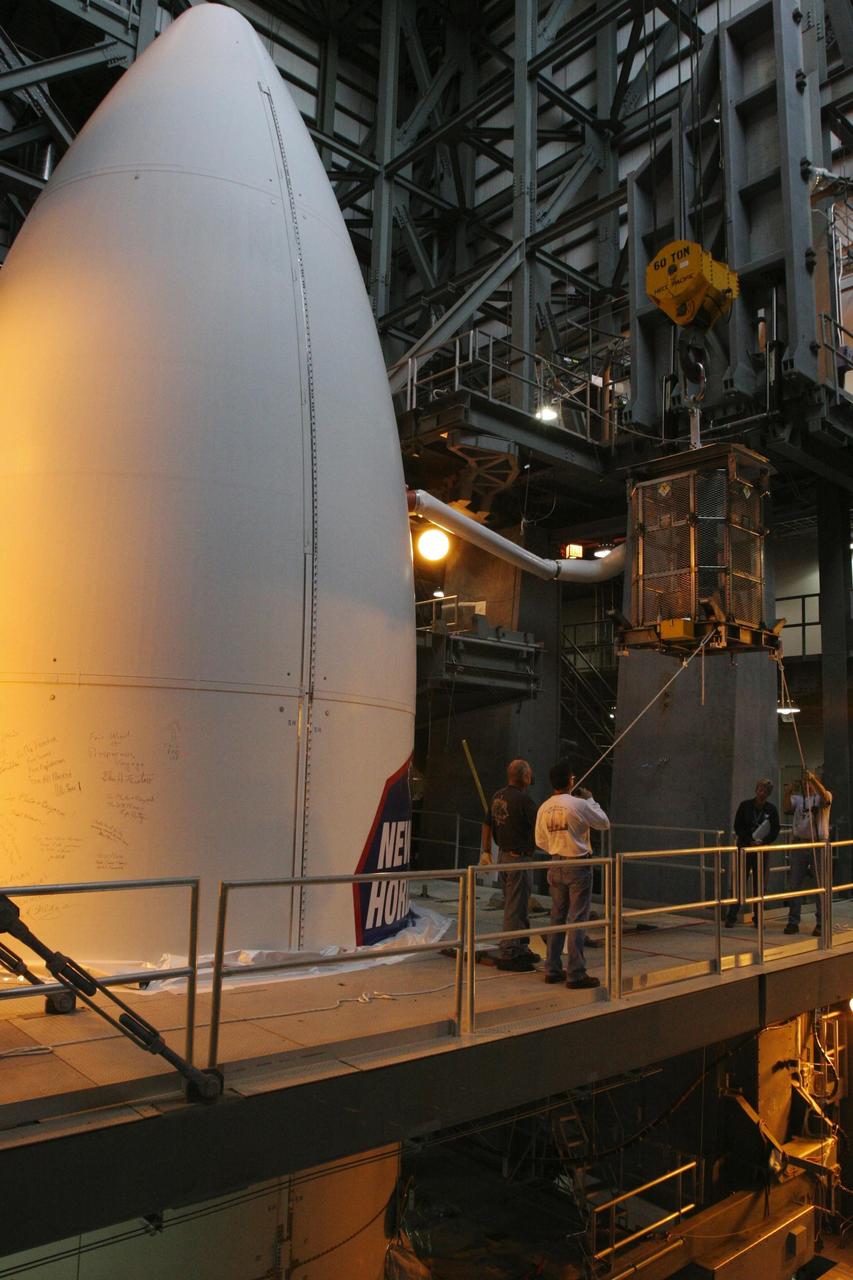
KENNEDY SPACE CENTER, FLA. — On Complex 41 at Cape Canaveral Air Force Station in Florida, the radioisotope thermoelectric generator (RTG) arrives at the upper level of the Vertical Integration Facility. The RTG will be installed on the New Horizons spacecraft encapsulated inside the fairing, at left. Designed and integrated at the Johns Hopkins University Applied Physics Laboratory (APL) in Laurel, Md., New Horizons will launch on a nine-and-a-half-year voyage to Pluto. Typical of RTG-based systems, as on past outer-planet missions, New Horizons does not have a battery for storing power. At the start of the mission, the RTG, which provides power through the natural radioactive decay of plutonium dioxide fuel, will supply approximately 240 watts (at 30 volts of direct current) - the spacecraft’s shunt regulator unit maintains a steady input from the RTG and dissipates power the spacecraft cannot use at a given time. By July 2015 (the earliest Pluto encounter date) that supply decreases to 200 watts at the same voltage, so New Horizons will ease the strain on its limited power source by cycling science instruments during planetary encounters. On Complex 41 at Cape Canaveral Air Force Station in Florida, workers on the ground oversee the radioisotope thermoelectric generator (RTG) being lifted into the Vertical Integration Facility. The RTG will be installed on the New Horizons spacecraft within the fairing at the top of the Atlas V launch vehicle. Designed and integrated at the Johns Hopkins University Applied Physics Laboratory (APL) in Laurel, Md., New Horizons will launch on a nine-and-a-half-year voyage to Pluto. Typical of RTG-based systems, as on past outer-planet missions, New Horizons does not have a battery for storing power. At the start of the mission, the RTG, which provides power through the natural radioactive decay of plutonium dioxide fuel, will supply approximately 240 watts (at 30 volts of direct current) - the spacecraft’s shunt reg
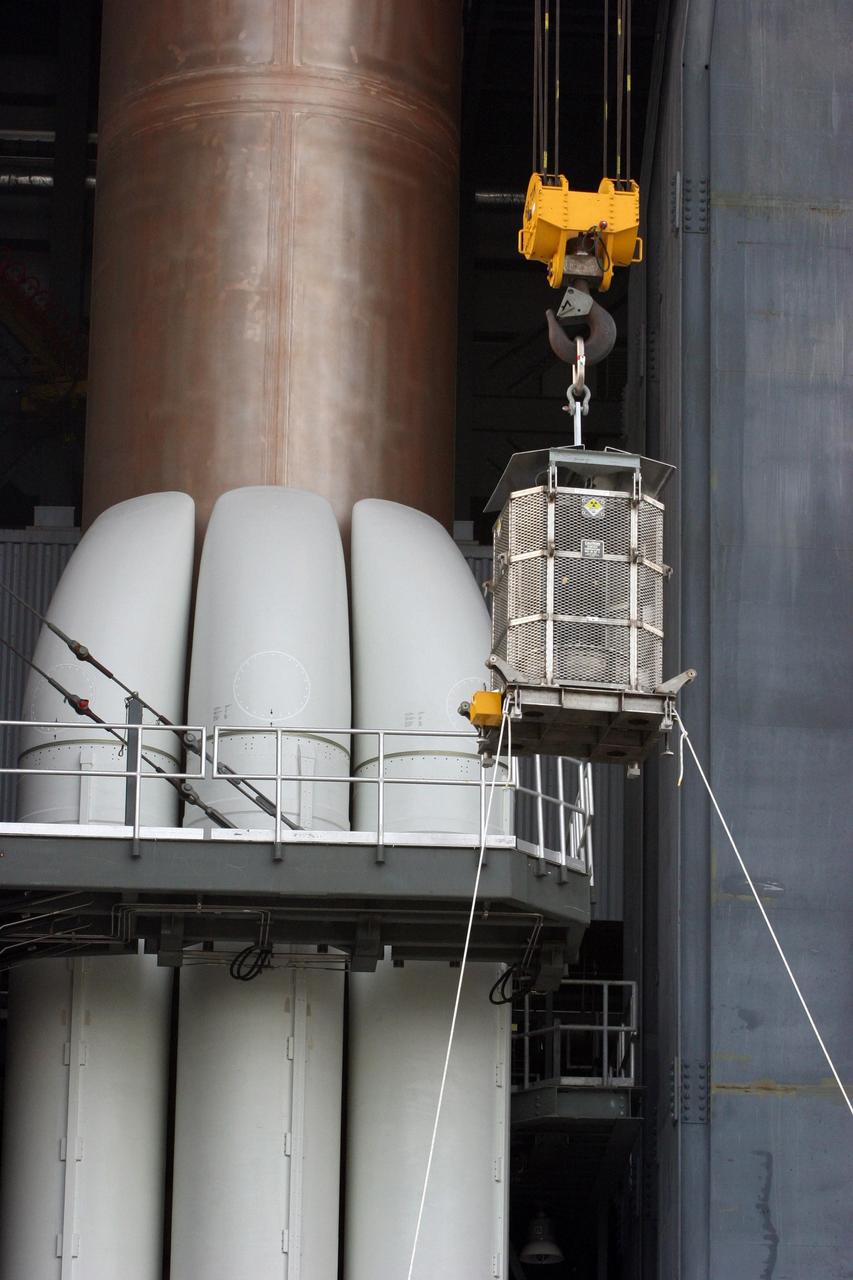
KENNEDY SPACE CENTER, FLA. — On Complex 41 at Cape Canaveral Air Force Station in Florida, the radioisotope thermoelectric generator (RTG) is being lifted into the Vertical Integration Facility. The RTG will be installed on the New Horizons spacecraft within the fairing at the top of the Atlas V launch vehicle. Designed and integrated at the Johns Hopkins University Applied Physics Laboratory (APL) in Laurel, Md., New Horizons will launch on a nine-and-a-half-year voyage to Pluto. Typical of RTG-based systems, as on past outer-planet missions, New Horizons does not have a battery for storing power. At the start of the mission, the RTG, which provides power through the natural radioactive decay of plutonium dioxide fuel, will supply approximately 240 watts (at 30 volts of direct current) - the spacecraft’s shunt regulator unit maintains a steady input from the RTG and dissipates power the spacecraft cannot use at a given time. By July 2015 (the earliest Pluto encounter date) that supply decreases to 200 watts at the same voltage, so New Horizons will ease the strain on its limited power source by cycling science instruments during planetary encounters. On Complex 41 at Cape Canaveral Air Force Station in Florida, workers on the ground oversee the radioisotope thermoelectric generator (RTG) being lifted into the Vertical Integration Facility. The RTG will be installed on the New Horizons spacecraft within the fairing at the top of the Atlas V launch vehicle. Designed and integrated at the Johns Hopkins University Applied Physics Laboratory (APL) in Laurel, Md., New Horizons will launch on a nine-and-a-half-year voyage to Pluto. Typical of RTG-based systems, as on past outer-planet missions, New Horizons does not have a battery for storing power. At the start of the mission, the RTG, which provides power through the natural radioactive decay of plutonium dioxide fuel, will supply approximately 240 watts (at 30 volts of direct current) - the spacecraft’s shu
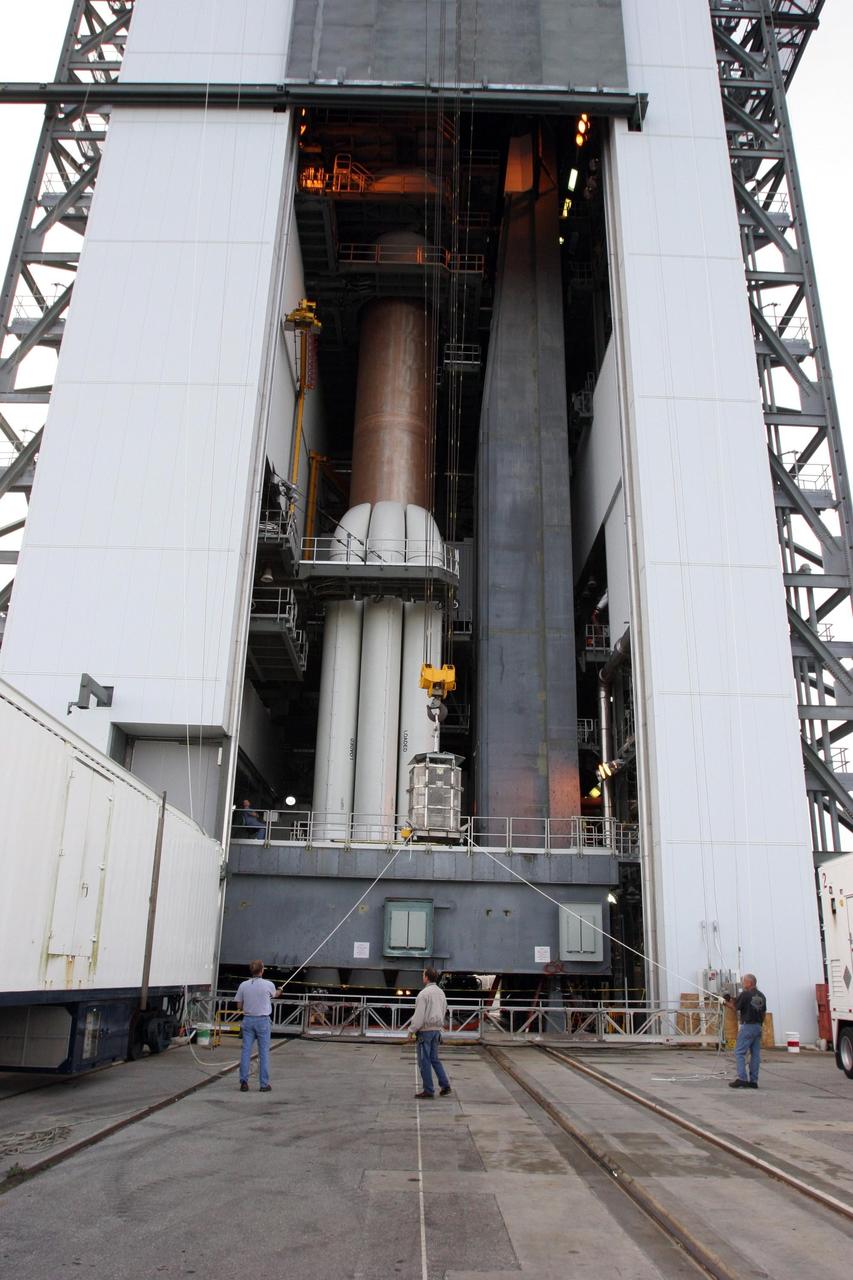
KENNEDY SPACE CENTER, FLA. — On Complex 41 at Cape Canaveral Air Force Station in Florida, workers on the ground oversee the radioisotope thermoelectric generator (RTG) being lifted into the Vertical Integration Facility. The RTG will be installed on the New Horizons spacecraft within the fairing at the top of the Atlas V launch vehicle. Designed and integrated at the Johns Hopkins University Applied Physics Laboratory (APL) in Laurel, Md., New Horizons will launch on a nine-and-a-half-year voyage to Pluto. Typical of RTG-based systems, as on past outer-planet missions, New Horizons does not have a battery for storing power. At the start of the mission, the RTG, which provides power through the natural radioactive decay of plutonium dioxide fuel, will supply approximately 240 watts (at 30 volts of direct current) - the spacecraft’s shunt regulator unit maintains a steady input from the RTG and dissipates power the spacecraft cannot use at a given time. By July 2015 (the earliest Pluto encounter date) that supply decreases to 200 watts at the same voltage, so New Horizons will ease the strain on its limited power source by cycling science instruments during planetary encounters. On Complex 41 at Cape Canaveral Air Force Station in Florida, workers on the ground oversee the radioisotope thermoelectric generator (RTG) being lifted into the Vertical Integration Facility. The RTG will be installed on the New Horizons spacecraft within the fairing at the top of the Atlas V launch vehicle. Designed and integrated at the Johns Hopkins University Applied Physics Laboratory (APL) in Laurel, Md., New Horizons will launch on a nine-and-a-half-year voyage to Pluto. Typical of RTG-based systems, as on past outer-planet missions, New Horizons does not have a battery for storing power. At the start of the mission, the RTG, which provides power through the natural radioactive decay of plutonium dioxide fuel, will supply approximately 240 watts (at 30 volts of direct curren

KENNEDY SPACE CENTER, FLA. -- At Launch Pad 39A, work on replacing the Power Drive Unit (PDU) in Space Shuttle Atlantis is suspended in the early morning hours. The crane used to hoist the PDU is barely visible against the tail and next to a main engine nozzle. The Rotating Service Structure had to be moved away from the Shuttle to do the work. Atlantis is scheduled to lift off April 24 at 4:15 p.m. EDT on mission STS-101, the third flight to the International Space Station. The primary mission is to carry logistics and supplies to the Space Station, plus the crew will be preparing the Station for the arrival of the Zvezda Service Module, expected to be launched by Russia in July 2000
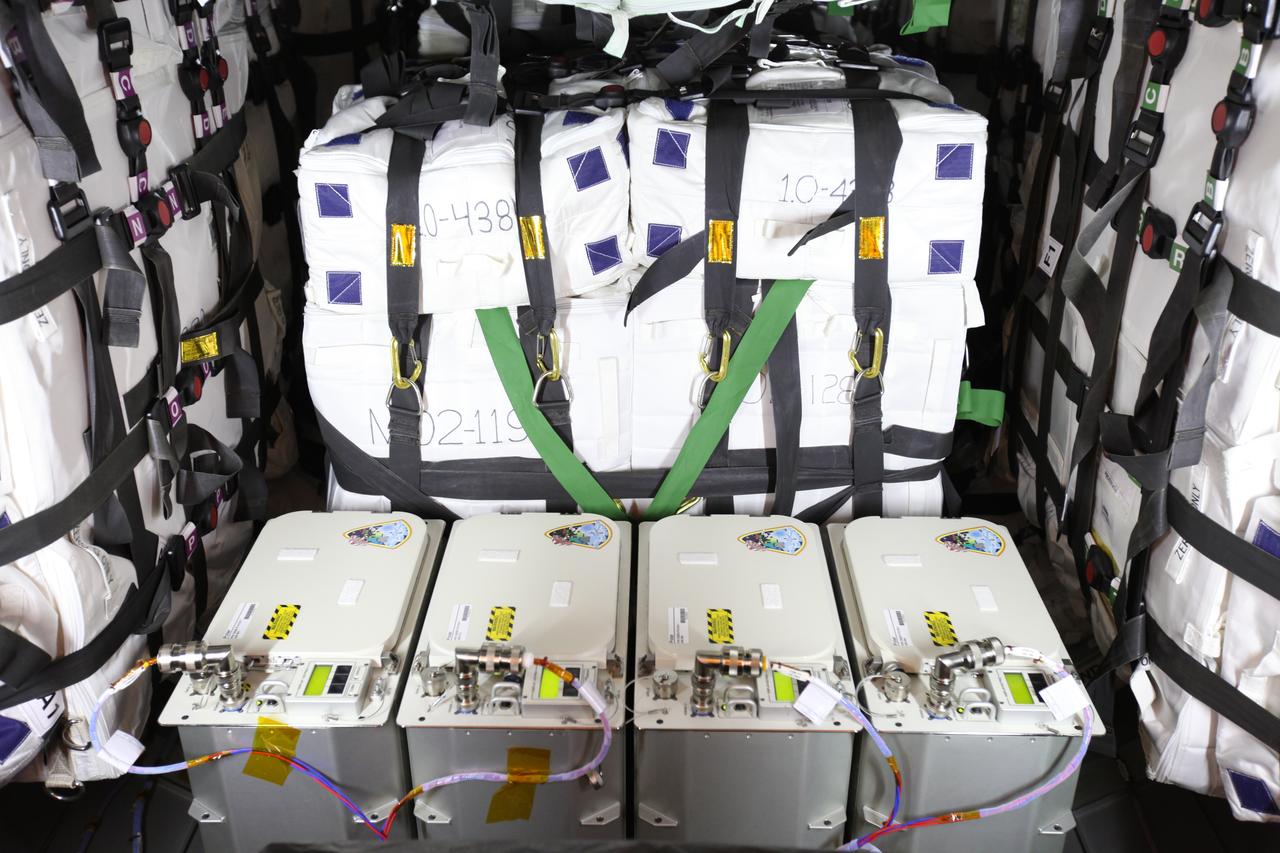
Inside the Payload Hazardous Servicing Facility at NASA's Kennedy Space Center in Florida, technicians have completed installation of the final cargo and power in the Orbital ATK Cygnus pressurized cargo module. The Orbital ATK CRS-7 commercial resupply services mission to the International Space Station is scheduled to launch atop a United Launch Alliance Atlas V rocket from Space Launch Complex 41 at Cape Canaveral Air Force Station no earlier than March 21, 2017. Cygnus will deliver 7,600 pounds of supplies, equipment and scientific research materials to the space station.
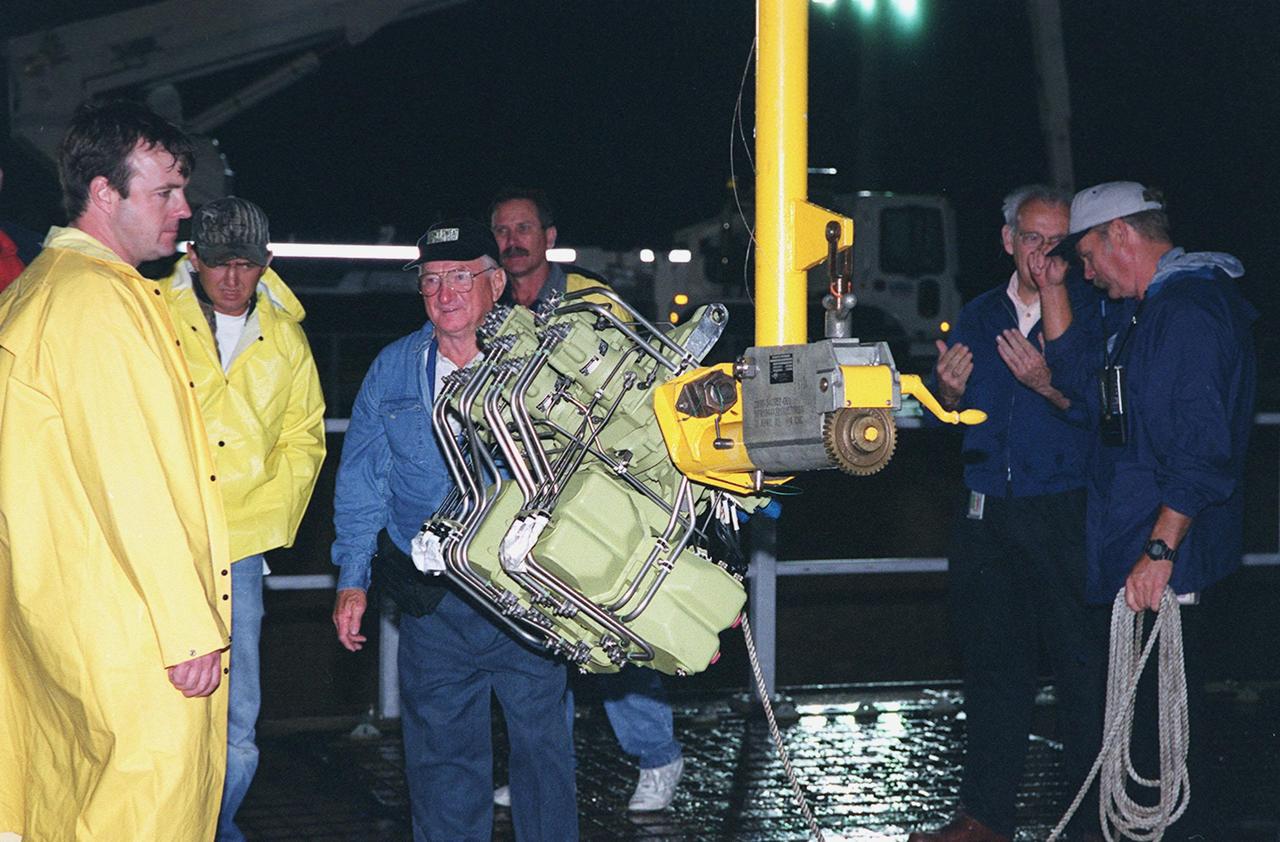
KENNEDY SPACE CENTER, FLA. -- At Launch Pad 39A, workers wait to begin replace Shuttle Atlantis' Power Drive Unit (PDU), which is attached to the crane (center). The PDU controls the rudder/speed brake on the orbiter. Atlantis is scheduled to lift off April 24 at 4:15 p.m. EDT on mission STS-101, the third flight to the International Space Station. The primary mission is to carry logistics and supplies to the Space Station, plus the crew will be preparing the Station for the arrival of the Zvezda Service Module, expected to be launched by Russia in July 2000

KENNEDY SPACE CENTER, FLA. -- At Launch Pad 39A, work on replacing the Power Drive Unit (PDU) in Space Shuttle Atlantis is suspended in the early morning hours. The crane used to hoist the PDU is barely visible against the tail and next to a main engine nozzle. The Rotating Service Structure had to be moved away from the Shuttle to do the work. Atlantis is scheduled to lift off April 24 at 4:15 p.m. EDT on mission STS-101, the third flight to the International Space Station. The primary mission is to carry logistics and supplies to the Space Station, plus the crew will be preparing the Station for the arrival of the Zvezda Service Module, expected to be launched by Russia in July 2000
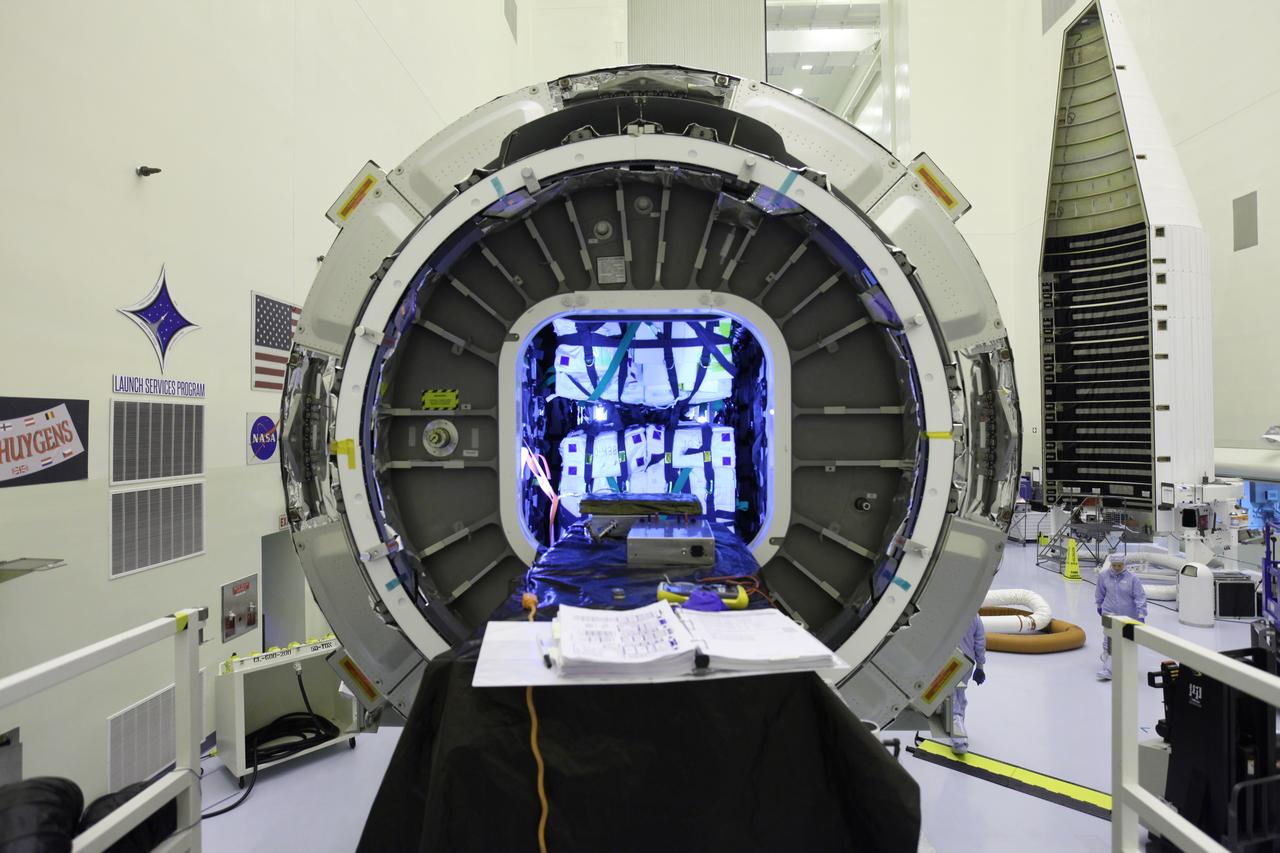
Inside the Payload Hazardous Servicing Facility at NASA's Kennedy Space Center in Florida, preparations are underway for final stowage of powered cargo in the Orbital ATK Cygnus pressurized cargo module. The Orbital ATK CRS-7 commercial resupply services mission to the International Space Station is scheduled to launch atop a United Launch Alliance Atlas V rocket from Space Launch Complex 41 at Cape Canaveral Air Force Station targeted for March 24, 2017. Cygnus will deliver 7,600 pounds of supplies, equipment and scientific research materials to the space station.

KENNEDY SPACE CENTER, FLA. -- At Launch Pad 39A, a worker reaches toward the plastic-covered replacement Power Drive Unit (PDU) for Space Shuttle Atlantis as it is lifted by crane toward the tail. The PDU controls the rudder/speed brake on the orbiter. Atlantis is scheduled to lift off April 24 at 4:15 p.m. EDT on mission STS-101, the third flight to the International Space Station. The primary mission is to carry logistics and supplies to the Space Station, plus the crew will be preparing the Station for the arrival of the Zvezda Service Module, expected to be launched by Russia in July 2000
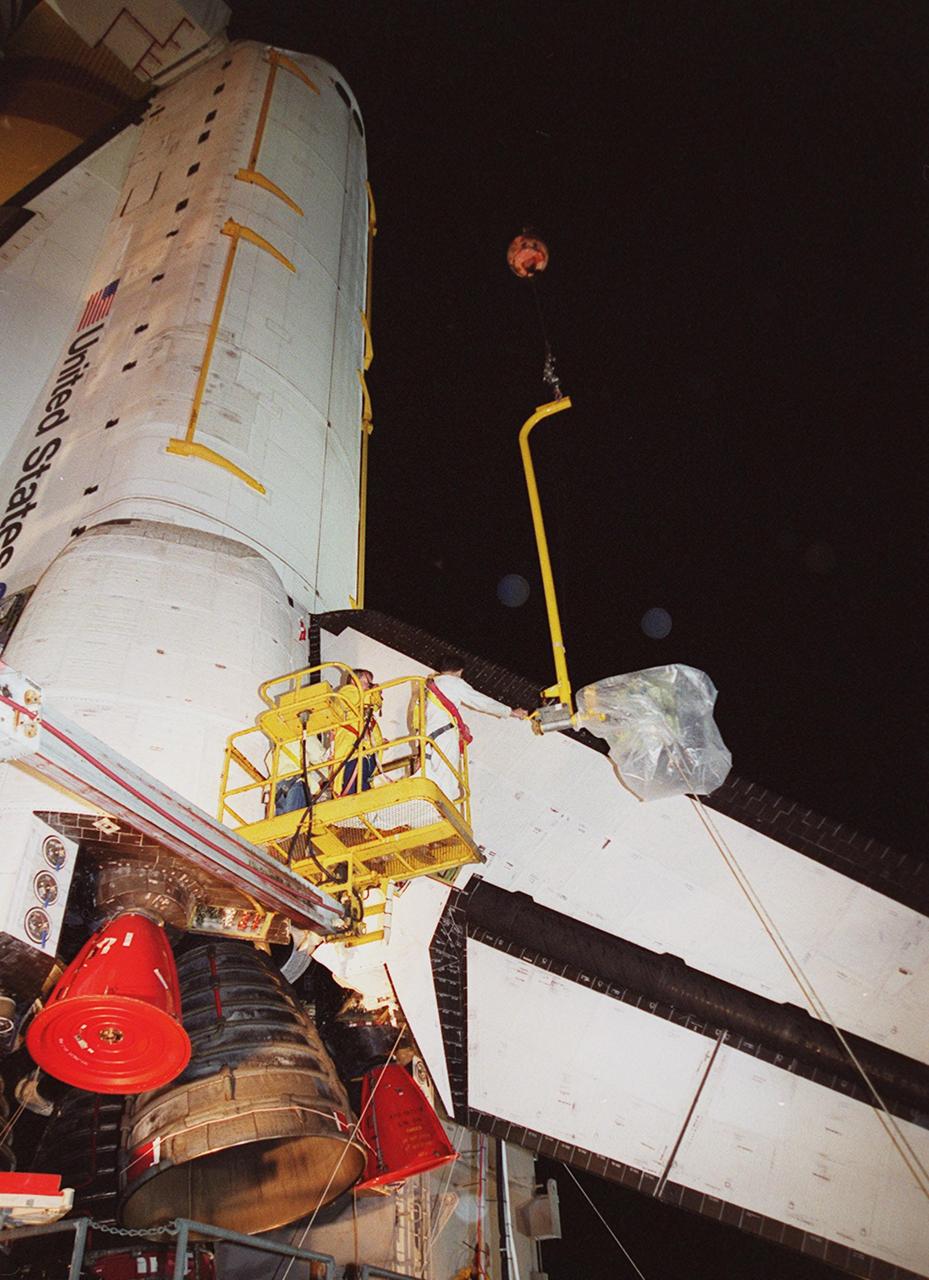
KENNEDY SPACE CENTER, FLA. -- At Launch Pad 39A, a worker reaches toward the plastic-covered replacement Power Drive Unit (PDU) for Space Shuttle Atlantis as it is lifted by crane toward the tail. The PDU controls the rudder/speed brake on the orbiter. Atlantis is scheduled to lift off April 24 at 4:15 p.m. EDT on mission STS-101, the third flight to the International Space Station. The primary mission is to carry logistics and supplies to the Space Station, plus the crew will be preparing the Station for the arrival of the Zvezda Service Module, expected to be launched by Russia in July 2000

KENNEDY SPACE CENTER, FLA. -- At Launch Pad 39A, a worker watches as the plastic-covered replacement Power Drive Unit (PDU) for Space Shuttle Atlantis is lifted by crane toward the tail. The PDU controls the rudder/speed brake on the orbiter. Atlantis is scheduled to lift off April 24 at 4:15 p.m. EDT on mission STS-101, the third flight to the International Space Station. The primary mission is to carry logistics and supplies to the Space Station, plus the crew will be preparing the Station for the arrival of the Zvezda Service Module, expected to be launched by Russia in July 2000
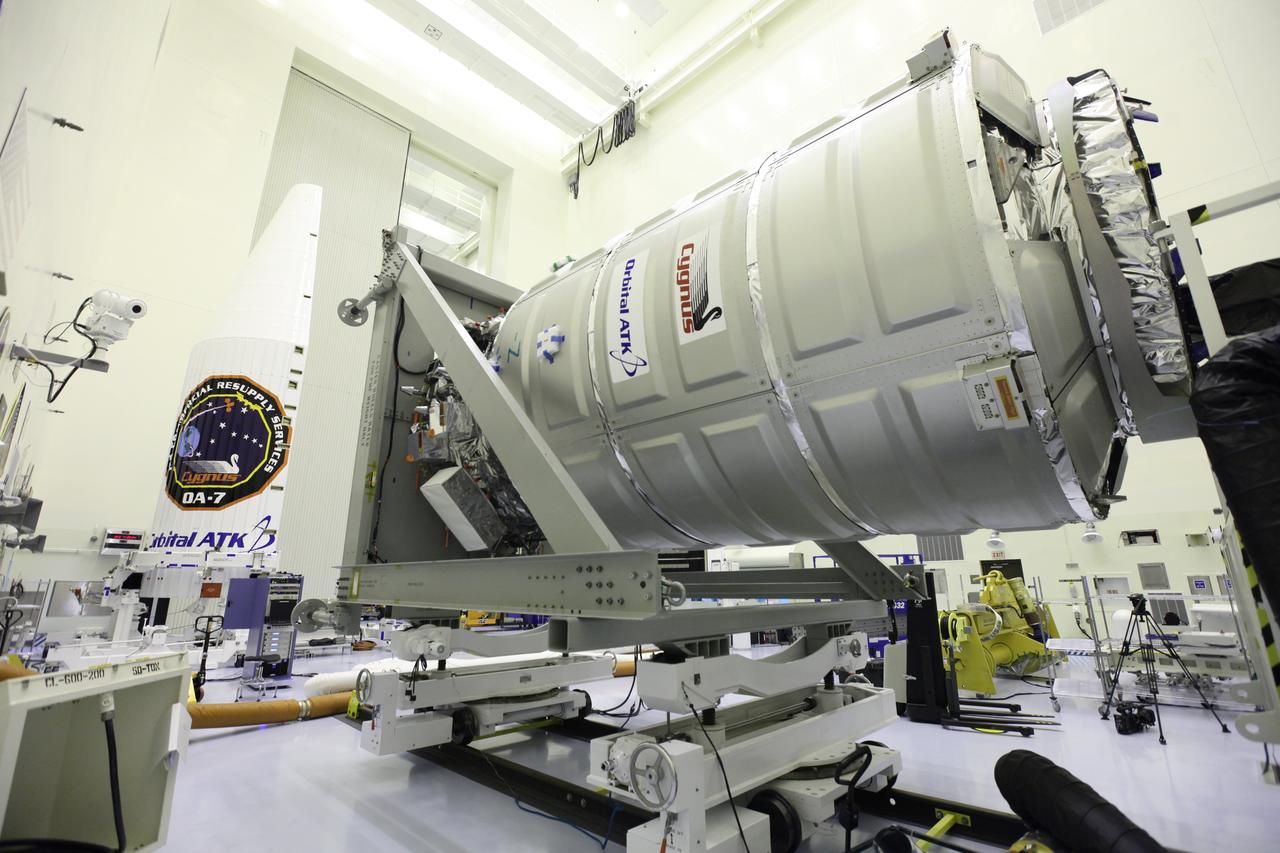
Inside the Payload Hazardous Servicing Facility at NASA's Kennedy Space Center in Florida, the Orbital ATK Cygnus pressurized cargo module is tilted to the horizontal position to prepare for final stowage of powered cargo. The Orbital ATK CRS-7 commercial resupply services mission to the International Space Station is scheduled to launch atop a United Launch Alliance Atlas V rocket from Space Launch Complex 41 at Cape Canaveral Air Force Station targeted for March 24, 2017. Cygnus will deliver 7,600 pounds of supplies, equipment and scientific research materials to the space station.
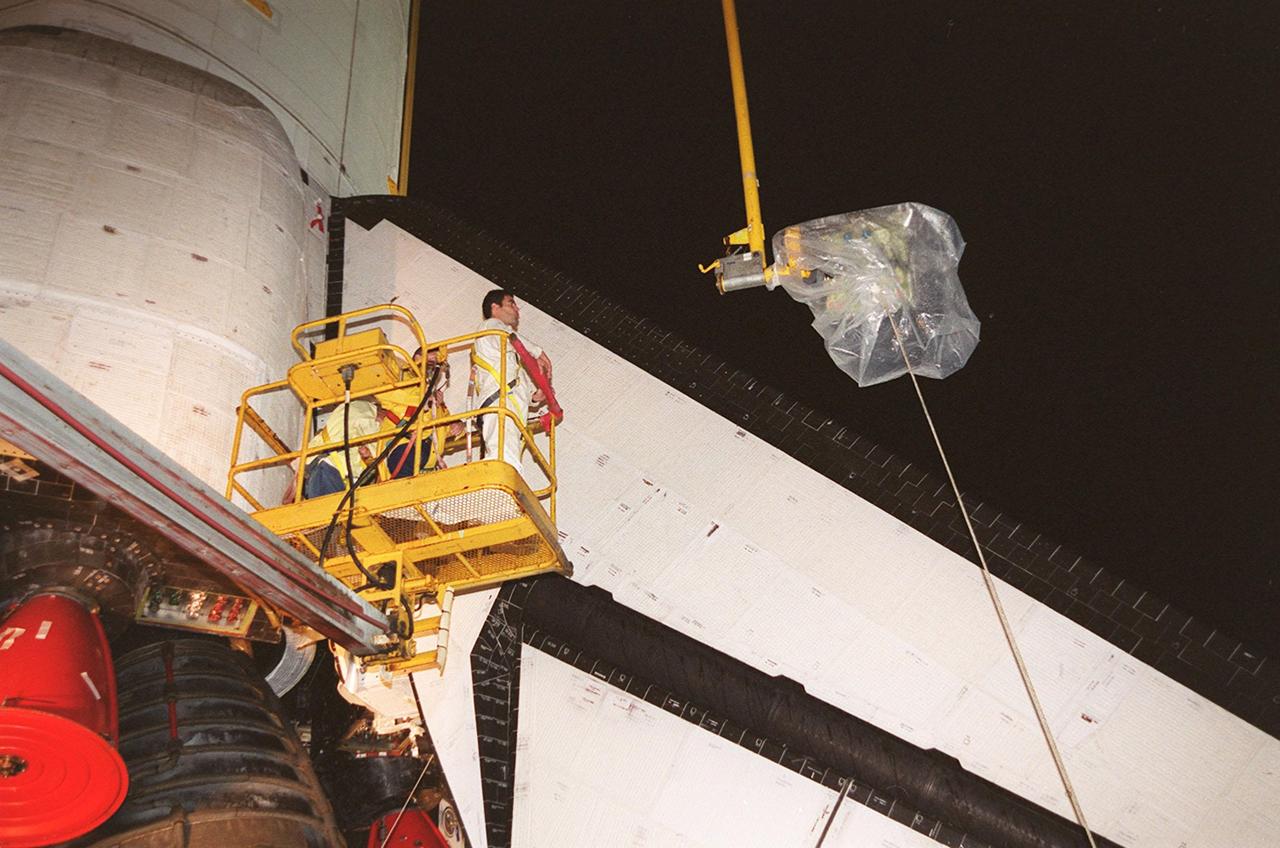
KENNEDY SPACE CENTER, FLA. -- At Launch Pad 39A, a worker watches as the plastic-covered replacement Power Drive Unit (PDU) for Space Shuttle Atlantis is lifted by crane toward the tail. The PDU controls the rudder/speed brake on the orbiter. Atlantis is scheduled to lift off April 24 at 4:15 p.m. EDT on mission STS-101, the third flight to the International Space Station. The primary mission is to carry logistics and supplies to the Space Station, plus the crew will be preparing the Station for the arrival of the Zvezda Service Module, expected to be launched by Russia in July 2000

KENNEDY SPACE CENTER, FLA. -- At Launch Pad 39A, workers wait to begin replace Shuttle Atlantis' Power Drive Unit (PDU), which is attached to the crane (center). The PDU controls the rudder/speed brake on the orbiter. Atlantis is scheduled to lift off April 24 at 4:15 p.m. EDT on mission STS-101, the third flight to the International Space Station. The primary mission is to carry logistics and supplies to the Space Station, plus the crew will be preparing the Station for the arrival of the Zvezda Service Module, expected to be launched by Russia in July 2000
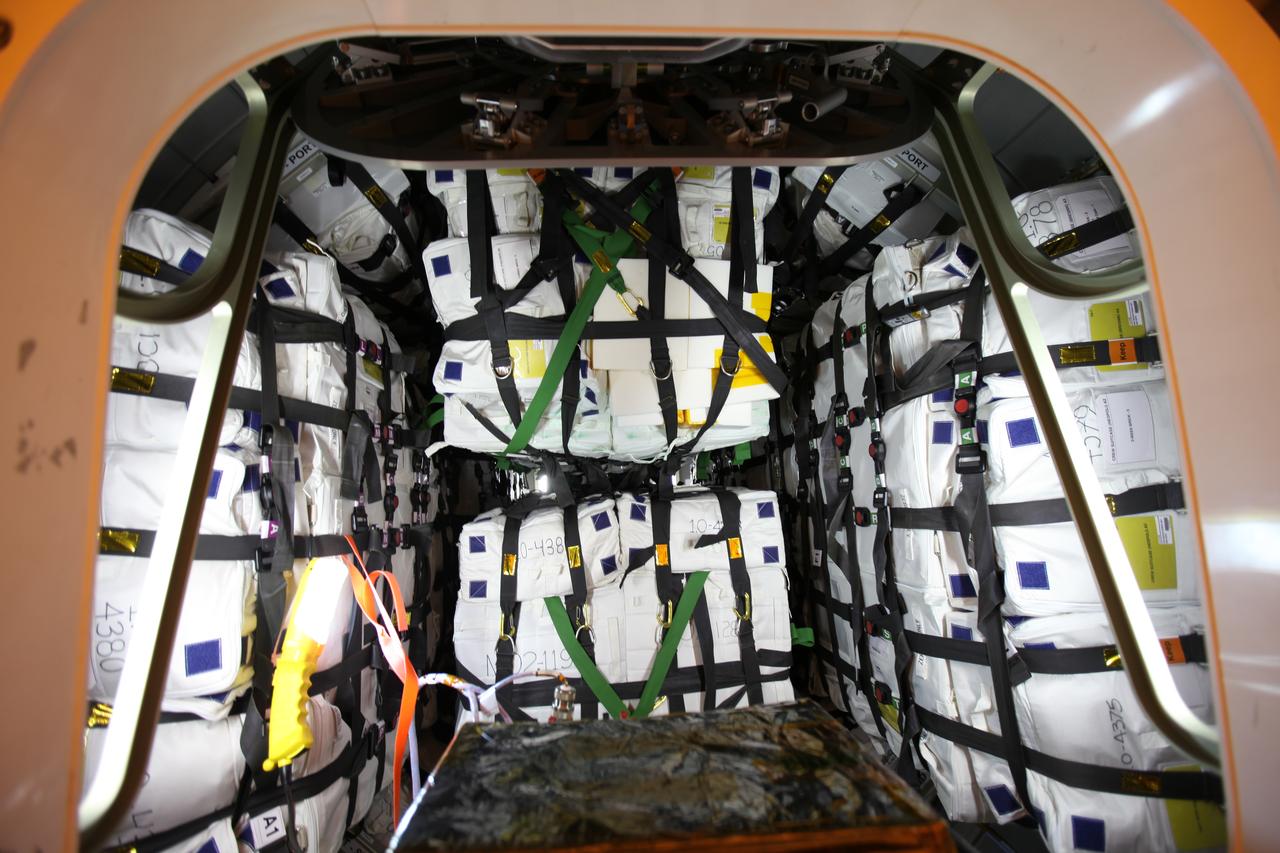
Inside the Payload Hazardous Servicing Facility at NASA's Kennedy Space Center in Florida, the hatch on the Orbital ATK Cygnus pressurized cargo module is open for final stowage of powered cargo. The Orbital ATK CRS-7 commercial resupply services mission to the International Space Station is scheduled to launch atop a United Launch Alliance Atlas V rocket from Space Launch Complex 41 at Cape Canaveral Air Force Station targeted for March 24, 2017. Cygnus will deliver 7,600 pounds of supplies, equipment and scientific research materials to the space station.
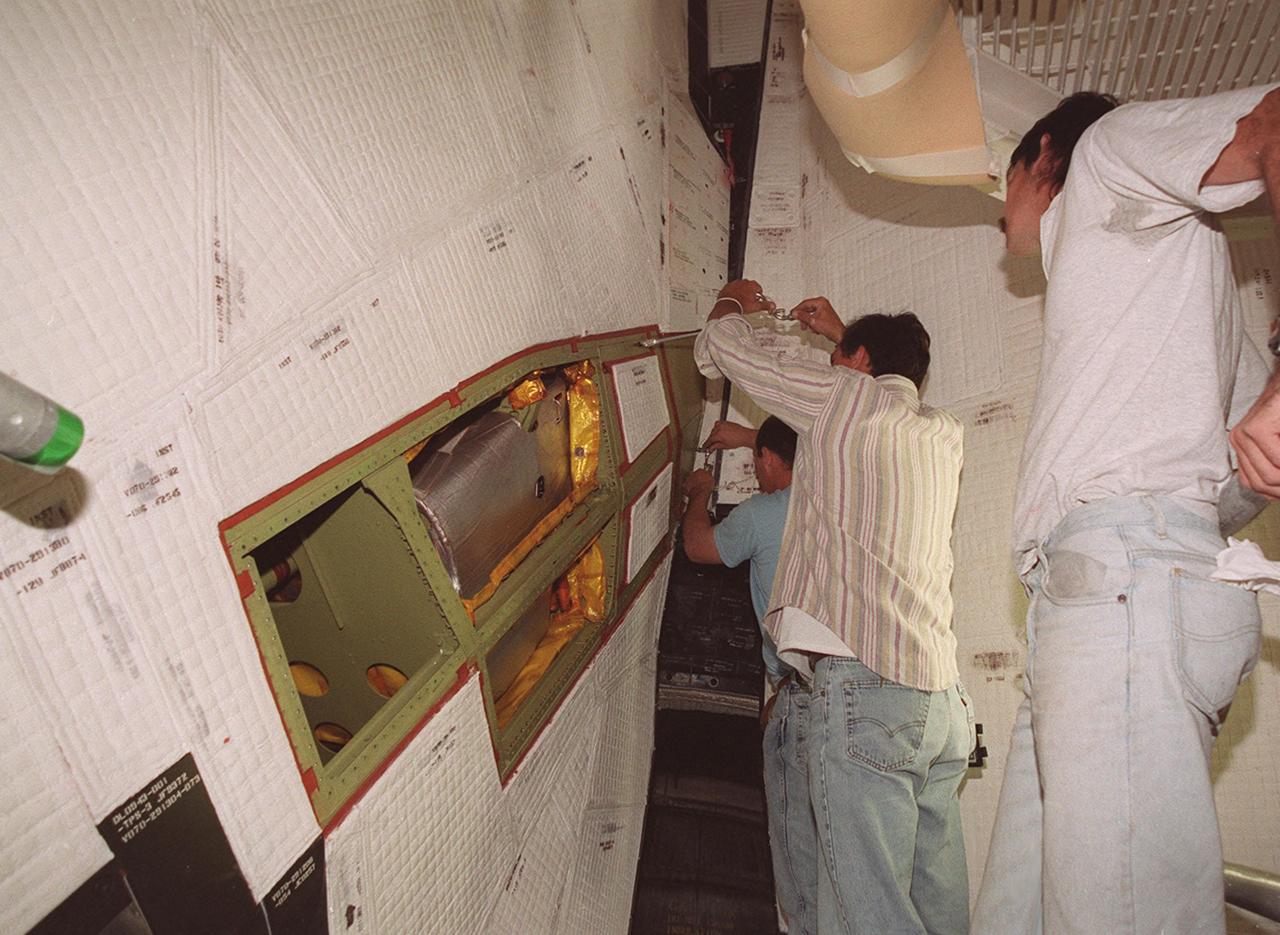
KENNEDY SPACE CENTER, FLA. -- Technicians at Launch Pad 39A begin removing thermal blankets and panels from a site near the tail of Space Shuttle Atlantis in order to reach the power drive unit (PDU) inside. The PDU controls the rudder/speed brake on the orbiter. From left to right are Mark Noel, Bob Wright and Tod Biddle, with United Space Alliance. Shuttle managers decided to replace the faulty PDU, about the size of an office copy machine, at the launch pad. If successful, launch preparations will continue as planned, with liftoff targeted for April 24 at 4:15 p.m. on mission STS-101. The mission is the third assembly flight for the International Space Station, carrying logistics and supplies to the Space Station, plus the crew will be preparing the Station for the arrival of the Zvezda Service Module, expected to be launched by Russia in July 2000. The crew will conduct one space walk to perform maintenance on the Space Station
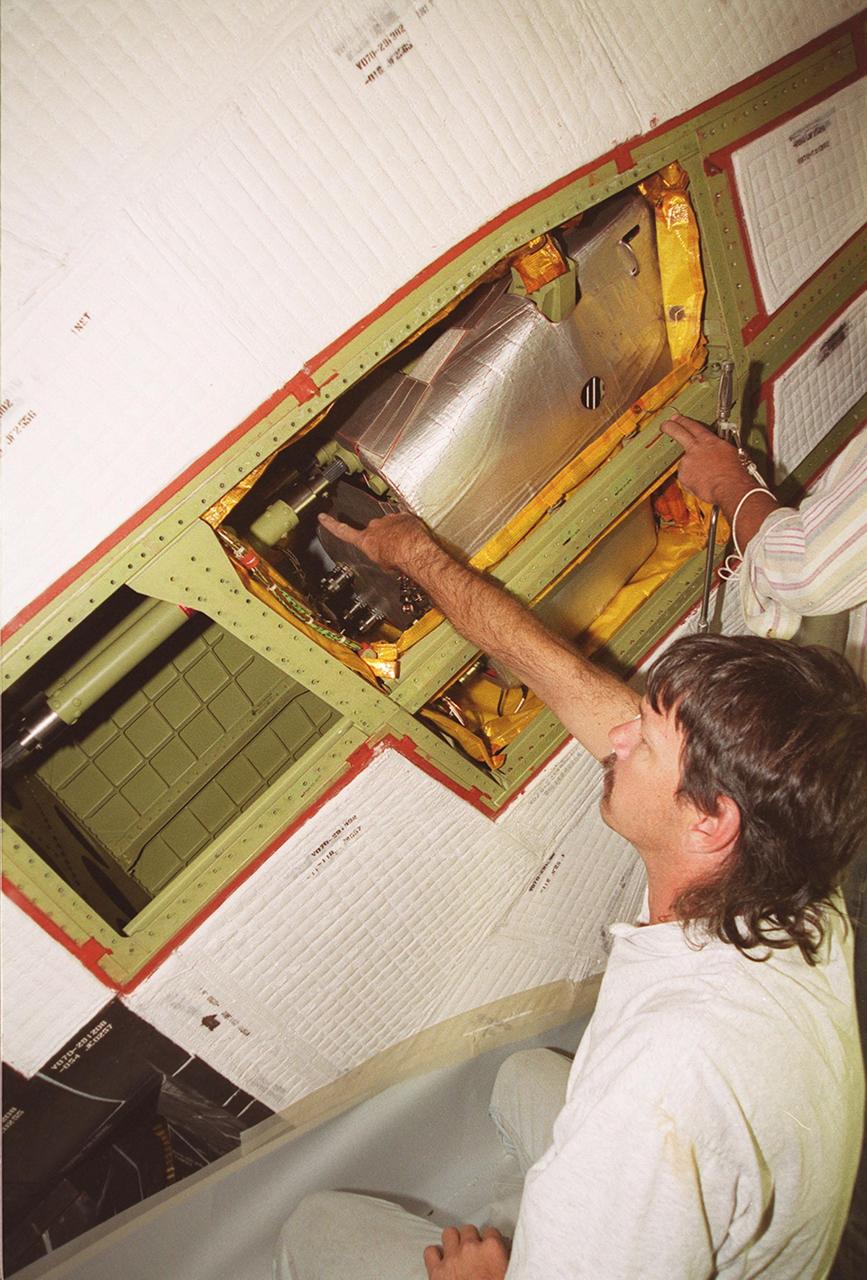
KENNEDY SPACE CENTER, FLA. -- With coverings removed from a site near the tail of Space Shuttle Atlantis, Tod Biddle, a United Space Alliance (USA) technician, points to the power drive unit (PDU) inside. The PDU controls the rudder/speed brake on the orbiter. The hands at right belong to Bob Wright, also a USA technician. Shuttle managers decided to replace the faulty PDU, about the size of an office copy machine, at the launch pad. If successful, launch preparations will continue as planned, with liftoff targeted for April 24 at 4:15 p.m. on mission STS-101. The mission is the third assembly flight for the International Space Station, carrying logistics and supplies to the Space Station, plus the crew will be preparing the Station for the arrival of the Zvezda Service Module, expected to be launched by Russia in July 2000. The crew will conduct one space walk to perform maintenance on the Space Station
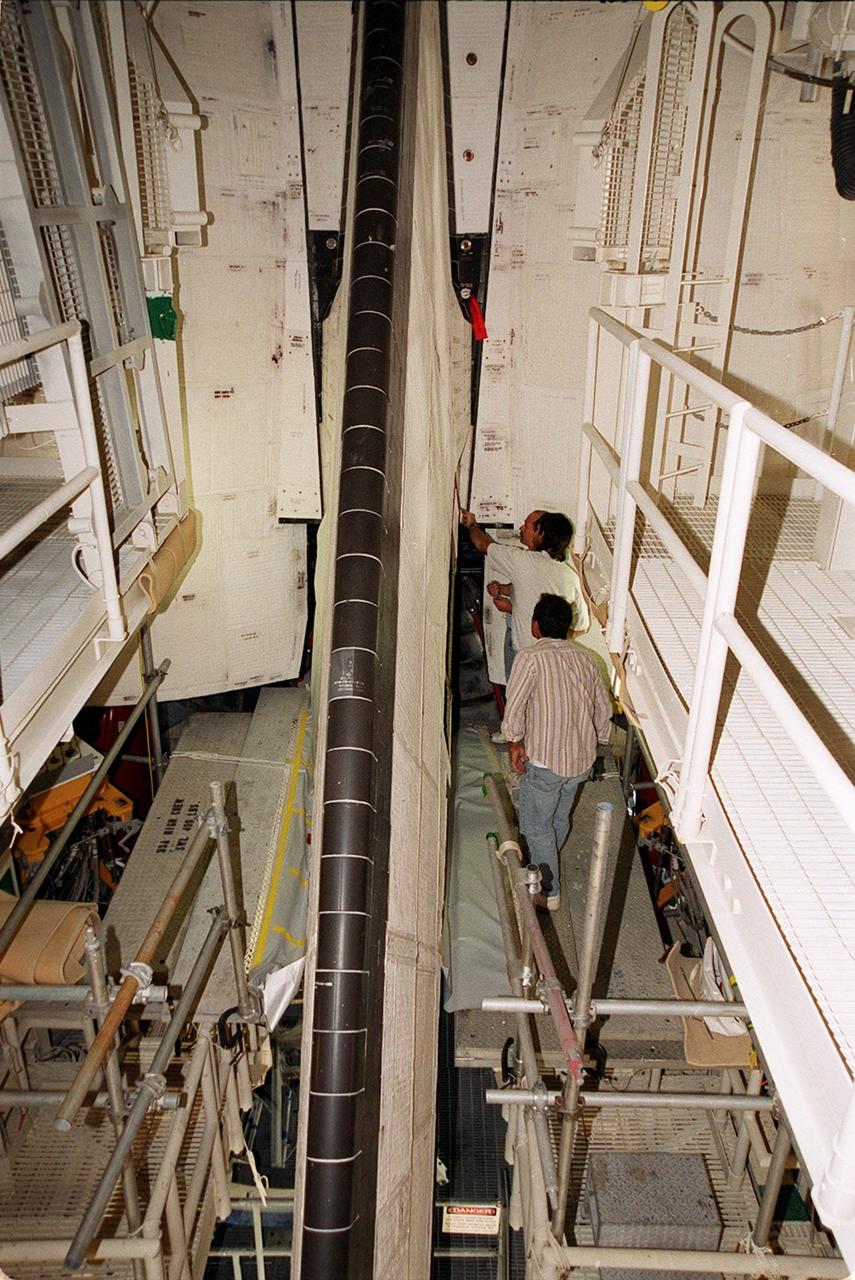
KENNEDY SPACE CENTER, FLA. -- United Space Alliance technicians at Launch Pad 39A look at the site of the power drive unit (PDU) for the rudder/speed brake on Shuttle Atlantis. From left are Mark Noel, Tod Biddle and Bob Wright. Shuttle managers decided to replace the faulty PDU, about the size of an office copy machine, at the launch pad. If successful, launch preparations will continue as planned, with liftoff targeted for April 24 at 4:15 p.m. on mission STS-101. The mission is the third assembly flight for the International Space Station, carrying logistics and supplies to the Space Station, plus the crew will be preparing the Station for the arrival of the Zvezda Service Module, expected to be launched by Russia in July 2000. The crew will conduct one space walk to perform maintenance on the Space Station
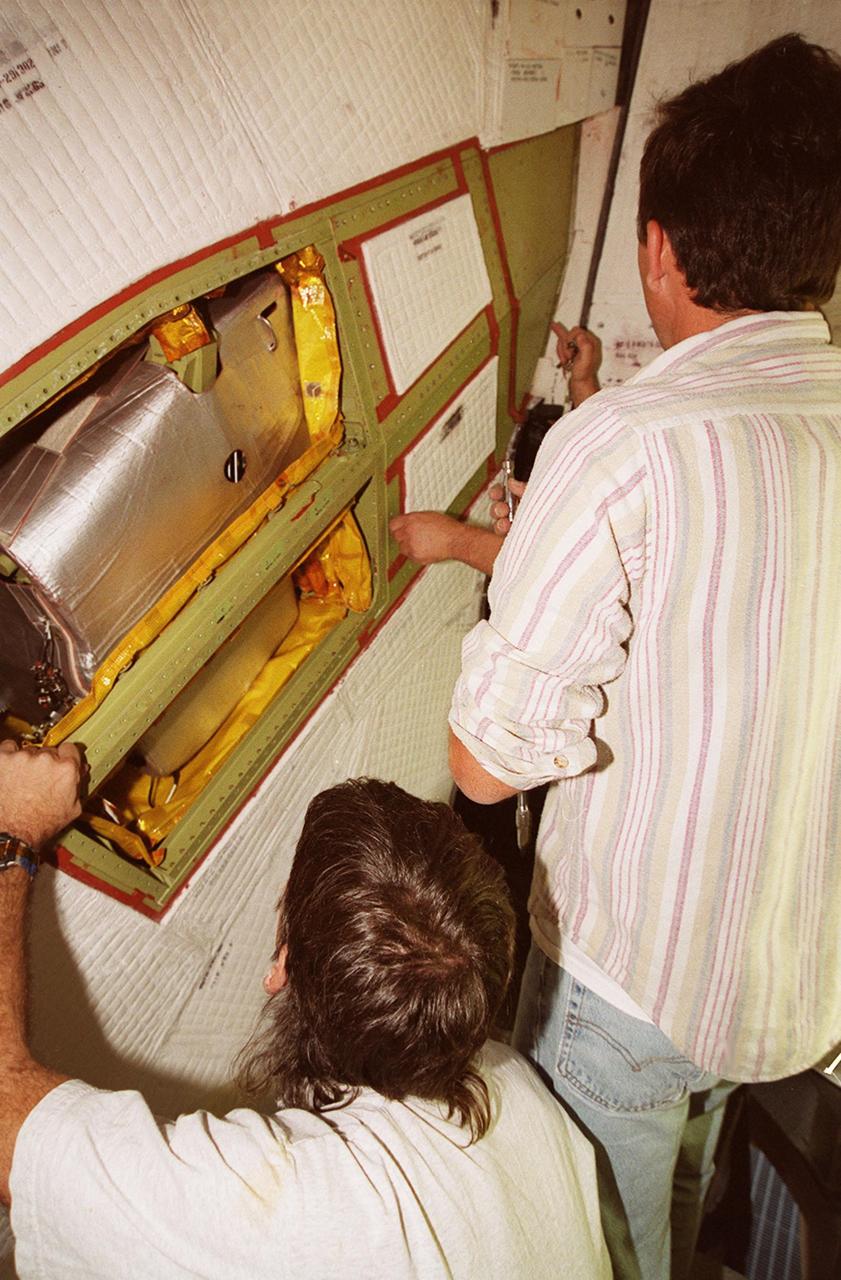
KENNEDY SPACE CENTER, FLA. -- United Space Alliance technicians (left to right) Tod Biddle, Bob Wright and Mark Noel (hidden) remove the coverings from a site near the tail of Space Shuttle Atlantis to reveal the power drive unit (PDU) inside. The PDU controls the rudder/speed brake on the orbiter. Shuttle managers decided to replace the faulty PDU, about the size of an office copy machine, at the launch pad. If successful, launch preparations will continue as planned, with liftoff targeted for April 24 at 4:15 p.m. on mission STS-101. The mission is the third assembly flight for the International Space Station, carrying logistics and supplies to the Space Station, plus the crew will be preparing the Station for the arrival of the Zvezda Service Module, expected to be launched by Russia in July 2000. The crew will conduct one space walk to perform maintenance on the Space Station
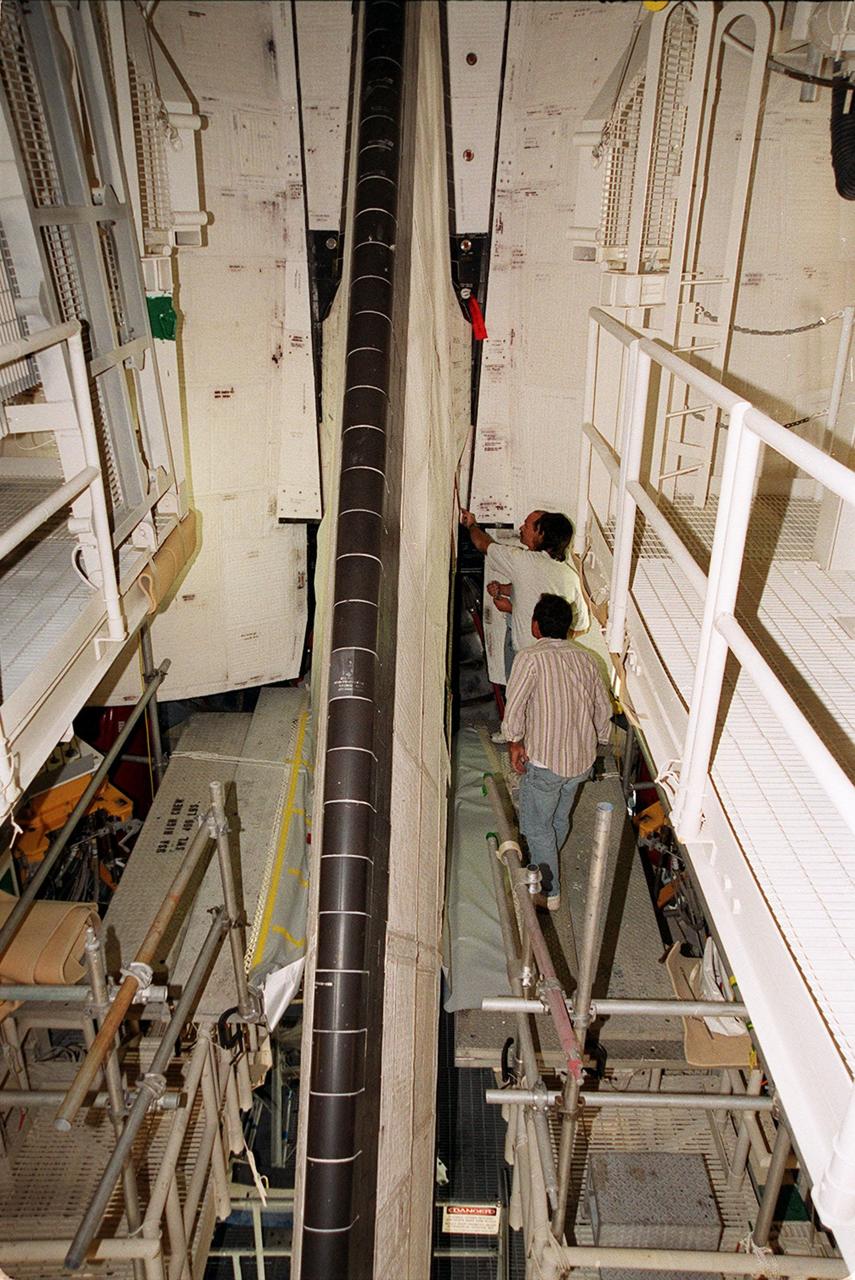
KENNEDY SPACE CENTER, FLA. -- United Space Alliance technicians at Launch Pad 39A look at the site of the power drive unit (PDU) for the rudder/speed brake on Shuttle Atlantis. From left are Mark Noel, Tod Biddle and Bob Wright. Shuttle managers decided to replace the faulty PDU, about the size of an office copy machine, at the launch pad. If successful, launch preparations will continue as planned, with liftoff targeted for April 24 at 4:15 p.m. on mission STS-101. The mission is the third assembly flight for the International Space Station, carrying logistics and supplies to the Space Station, plus the crew will be preparing the Station for the arrival of the Zvezda Service Module, expected to be launched by Russia in July 2000. The crew will conduct one space walk to perform maintenance on the Space Station
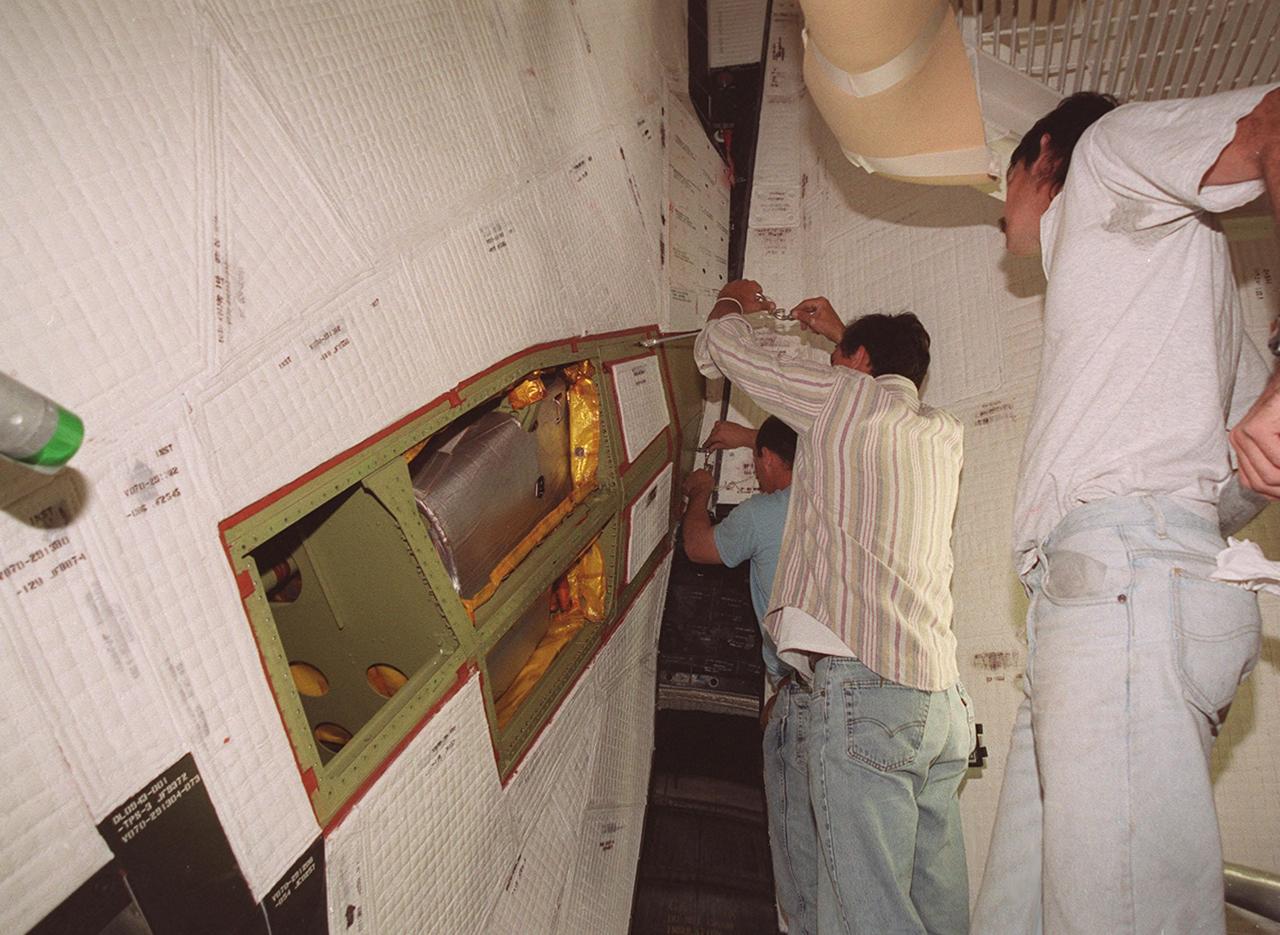
KENNEDY SPACE CENTER, FLA. -- Technicians at Launch Pad 39A begin removing thermal blankets and panels from a site near the tail of Space Shuttle Atlantis in order to reach the power drive unit (PDU) inside. The PDU controls the rudder/speed brake on the orbiter. From left to right are Mark Noel, Bob Wright and Tod Biddle, with United Space Alliance. Shuttle managers decided to replace the faulty PDU, about the size of an office copy machine, at the launch pad. If successful, launch preparations will continue as planned, with liftoff targeted for April 24 at 4:15 p.m. on mission STS-101. The mission is the third assembly flight for the International Space Station, carrying logistics and supplies to the Space Station, plus the crew will be preparing the Station for the arrival of the Zvezda Service Module, expected to be launched by Russia in July 2000. The crew will conduct one space walk to perform maintenance on the Space Station
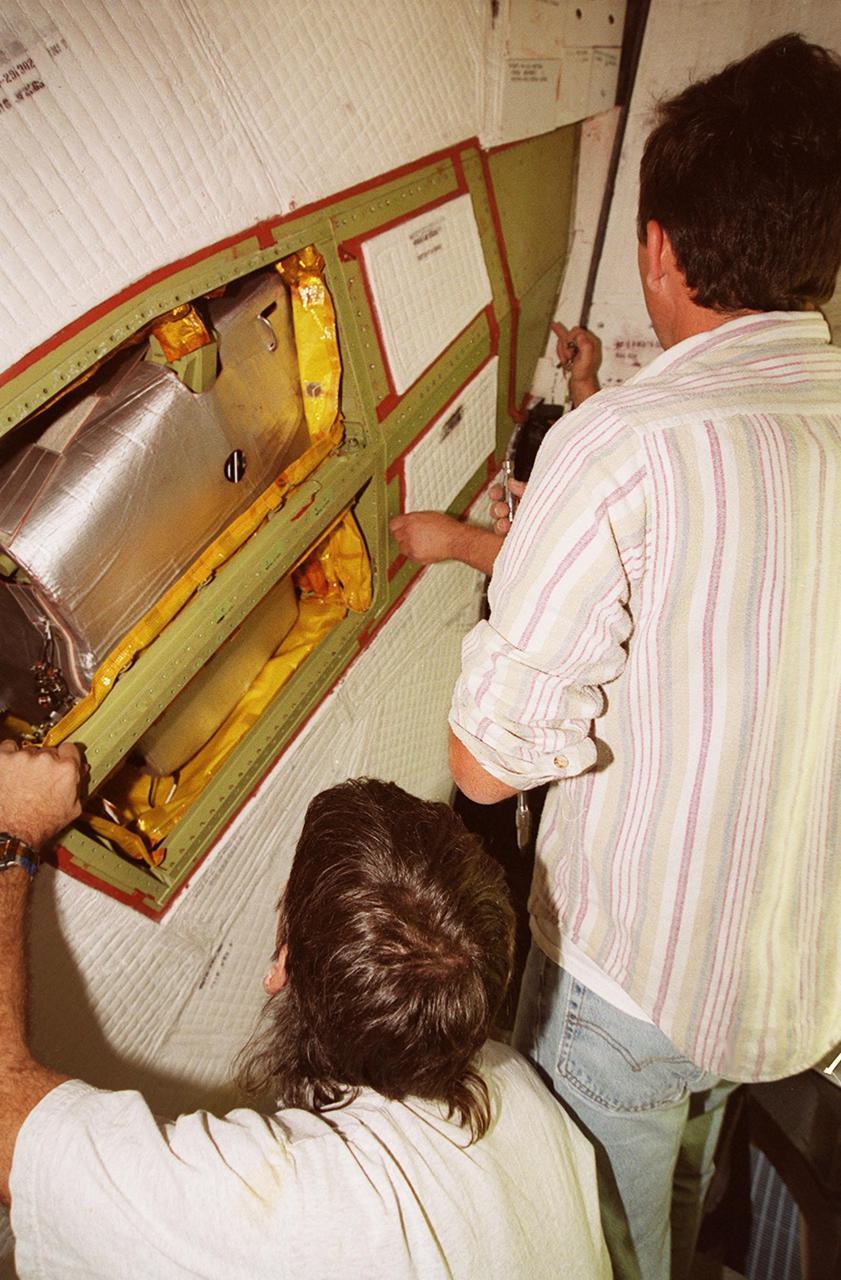
KENNEDY SPACE CENTER, FLA. -- United Space Alliance technicians (left to right) Tod Biddle, Bob Wright and Mark Noel (hidden) remove the coverings from a site near the tail of Space Shuttle Atlantis to reveal the power drive unit (PDU) inside. The PDU controls the rudder/speed brake on the orbiter. Shuttle managers decided to replace the faulty PDU, about the size of an office copy machine, at the launch pad. If successful, launch preparations will continue as planned, with liftoff targeted for April 24 at 4:15 p.m. on mission STS-101. The mission is the third assembly flight for the International Space Station, carrying logistics and supplies to the Space Station, plus the crew will be preparing the Station for the arrival of the Zvezda Service Module, expected to be launched by Russia in July 2000. The crew will conduct one space walk to perform maintenance on the Space Station
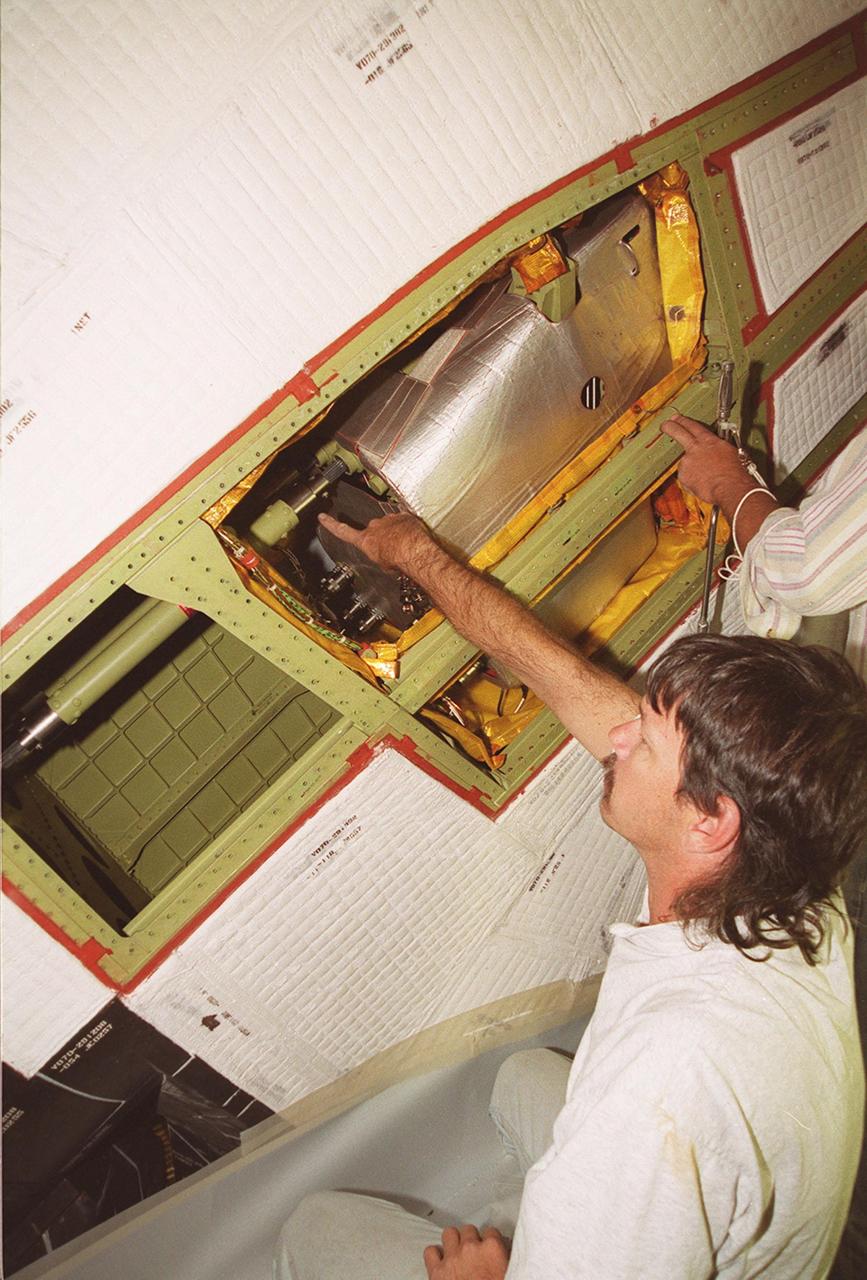
KENNEDY SPACE CENTER, FLA. -- With coverings removed from a site near the tail of Space Shuttle Atlantis, Tod Biddle, a United Space Alliance (USA) technician, points to the power drive unit (PDU) inside. The PDU controls the rudder/speed brake on the orbiter. The hands at right belong to Bob Wright, also a USA technician. Shuttle managers decided to replace the faulty PDU, about the size of an office copy machine, at the launch pad. If successful, launch preparations will continue as planned, with liftoff targeted for April 24 at 4:15 p.m. on mission STS-101. The mission is the third assembly flight for the International Space Station, carrying logistics and supplies to the Space Station, plus the crew will be preparing the Station for the arrival of the Zvezda Service Module, expected to be launched by Russia in July 2000. The crew will conduct one space walk to perform maintenance on the Space Station
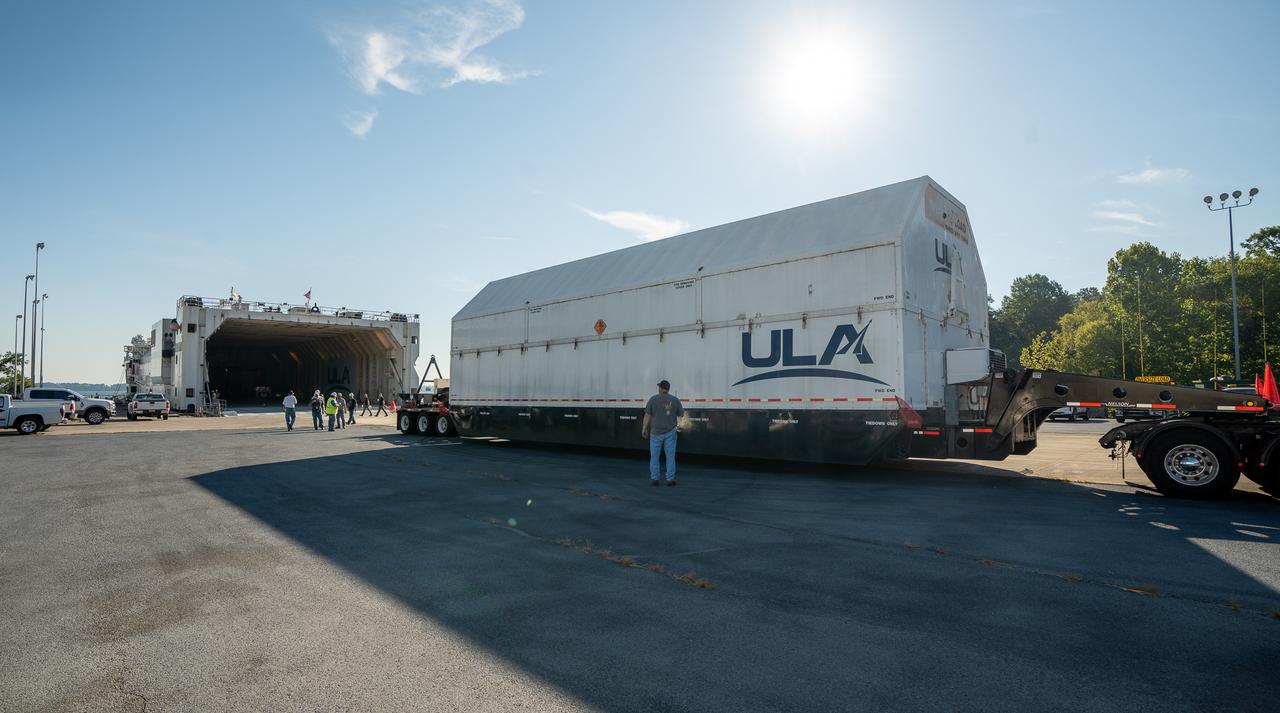
These images and videos show how crews in Alabama prepared the ICPS (interim cryogenic propulsion stage) for NASA’s SLS (Space Launch System) rocket for shipment to Florida between July 29-31. The ICPS in the photos and videos will help power NASA’s Artemis III mission to the Moon. The SLS upper stage is manufactured by United Launch Alliance at its facility in Decatur. Its RL10 engine is produced by Aerojet Rocketdyne, the SLS engines lead contractor, in West Palm Beach, Florida. ULA is working with Boeing, the SLS core stage and exploration upper stage lead contractor, to develop ICPS. ULA’s R/S RocketShip is transporting the flight hardware to its sister facility in Florida near NASA’s Kennedy Space Center for final checkouts. The ICPS for Artemis III is the last of its kind as SLS transitions to its next, more powerful Block 1B configuration with an upgraded upper stage beginning with Artemis IV. NASA is working to land the first woman and first person of color on the Moon under Artemis. SLS is part of NASA’s backbone for deep space exploration, along with Orion and the Gateway in orbit around the Moon. SLS is the only rocket that can send Orion, astronauts, and supplies to the Moon in a single mission.
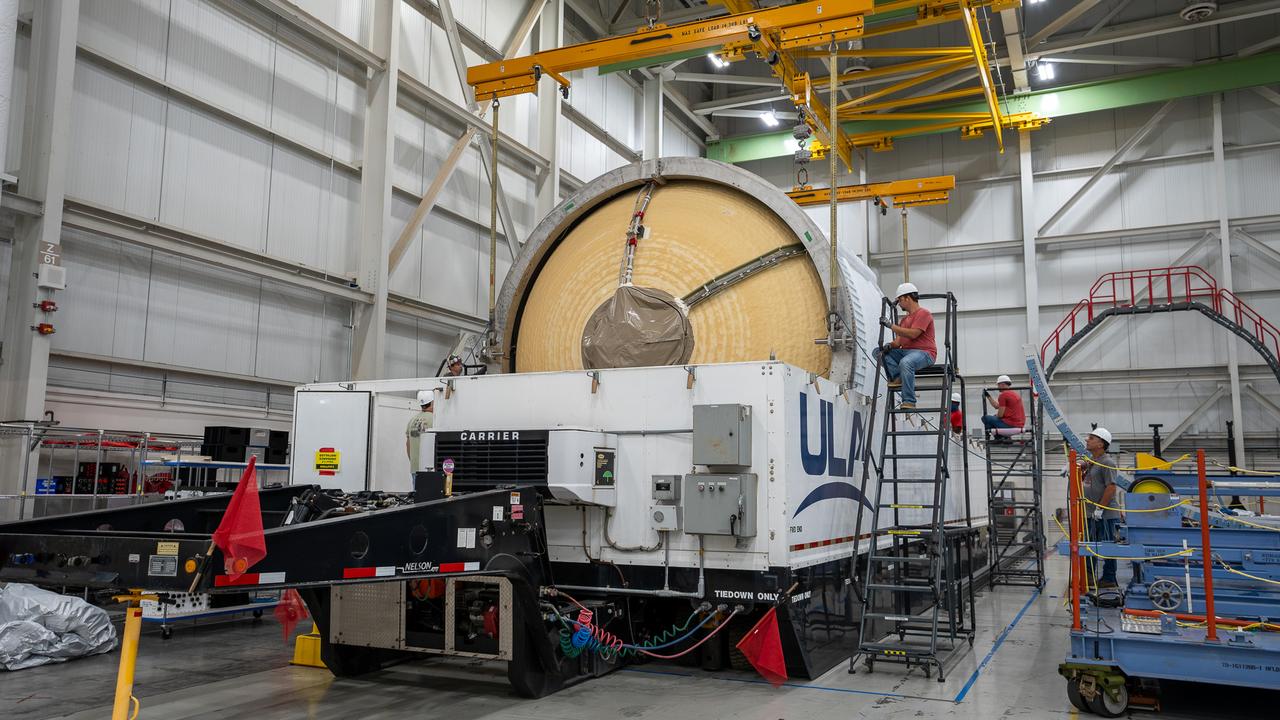
These images and videos show how crews in Alabama prepared the ICPS (interim cryogenic propulsion stage) for NASA’s SLS (Space Launch System) rocket for shipment to Florida between July 29-31. The ICPS in the photos and videos will help power NASA’s Artemis III mission to the Moon. The SLS upper stage is manufactured by United Launch Alliance at its facility in Decatur. Its RL10 engine is produced by Aerojet Rocketdyne, the SLS engines lead contractor, in West Palm Beach, Florida. ULA is working with Boeing, the SLS core stage and exploration upper stage lead contractor, to develop ICPS. ULA’s R/S RocketShip is transporting the flight hardware to its sister facility in Florida near NASA’s Kennedy Space Center for final checkouts. The ICPS for Artemis III is the last of its kind as SLS transitions to its next, more powerful Block 1B configuration with an upgraded upper stage beginning with Artemis IV. NASA is working to land the first woman and first person of color on the Moon under Artemis. SLS is part of NASA’s backbone for deep space exploration, along with Orion and the Gateway in orbit around the Moon. SLS is the only rocket that can send Orion, astronauts, and supplies to the Moon in a single mission.

These images and videos show how crews in Alabama prepared the ICPS (interim cryogenic propulsion stage) for NASA’s SLS (Space Launch System) rocket for shipment to Florida between July 29-31. The ICPS in the photos and videos will help power NASA’s Artemis III mission to the Moon. The SLS upper stage is manufactured by United Launch Alliance at its facility in Decatur. Its RL10 engine is produced by Aerojet Rocketdyne, the SLS engines lead contractor, in West Palm Beach, Florida. ULA is working with Boeing, the SLS core stage and exploration upper stage lead contractor, to develop ICPS. ULA’s R/S RocketShip is transporting the flight hardware to its sister facility in Florida near NASA’s Kennedy Space Center for final checkouts. The ICPS for Artemis III is the last of its kind as SLS transitions to its next, more powerful Block 1B configuration with an upgraded upper stage beginning with Artemis IV. NASA is working to land the first woman and first person of color on the Moon under Artemis. SLS is part of NASA’s backbone for deep space exploration, along with Orion and the Gateway in orbit around the Moon. SLS is the only rocket that can send Orion, astronauts, and supplies to the Moon in a single mission.
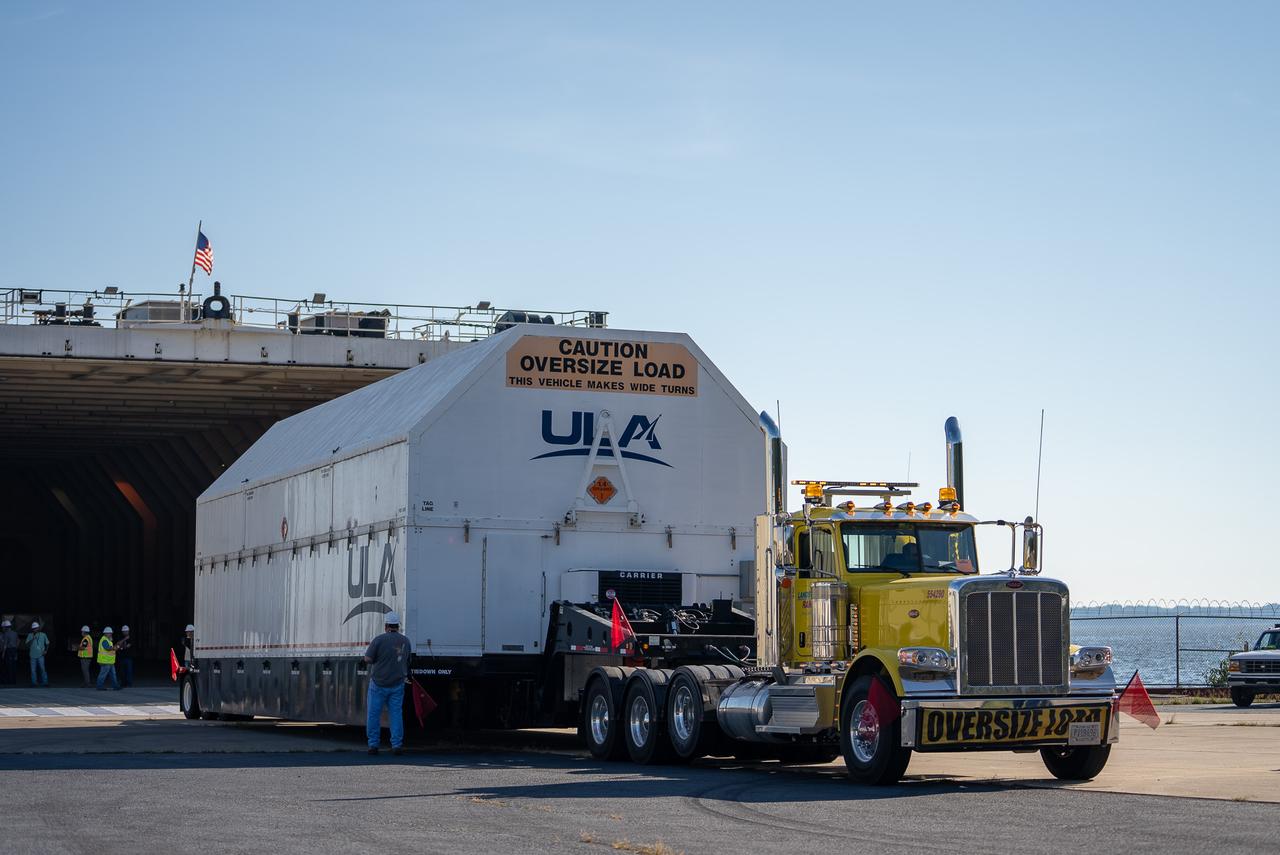
These images and videos show how crews in Alabama prepared the ICPS (interim cryogenic propulsion stage) for NASA’s SLS (Space Launch System) rocket for shipment to Florida between July 29-31. The ICPS in the photos and videos will help power NASA’s Artemis III mission to the Moon. The SLS upper stage is manufactured by United Launch Alliance at its facility in Decatur. Its RL10 engine is produced by Aerojet Rocketdyne, the SLS engines lead contractor, in West Palm Beach, Florida. ULA is working with Boeing, the SLS core stage and exploration upper stage lead contractor, to develop ICPS. ULA’s R/S RocketShip is transporting the flight hardware to its sister facility in Florida near NASA’s Kennedy Space Center for final checkouts. The ICPS for Artemis III is the last of its kind as SLS transitions to its next, more powerful Block 1B configuration with an upgraded upper stage beginning with Artemis IV. NASA is working to land the first woman and first person of color on the Moon under Artemis. SLS is part of NASA’s backbone for deep space exploration, along with Orion and the Gateway in orbit around the Moon. SLS is the only rocket that can send Orion, astronauts, and supplies to the Moon in a single mission.
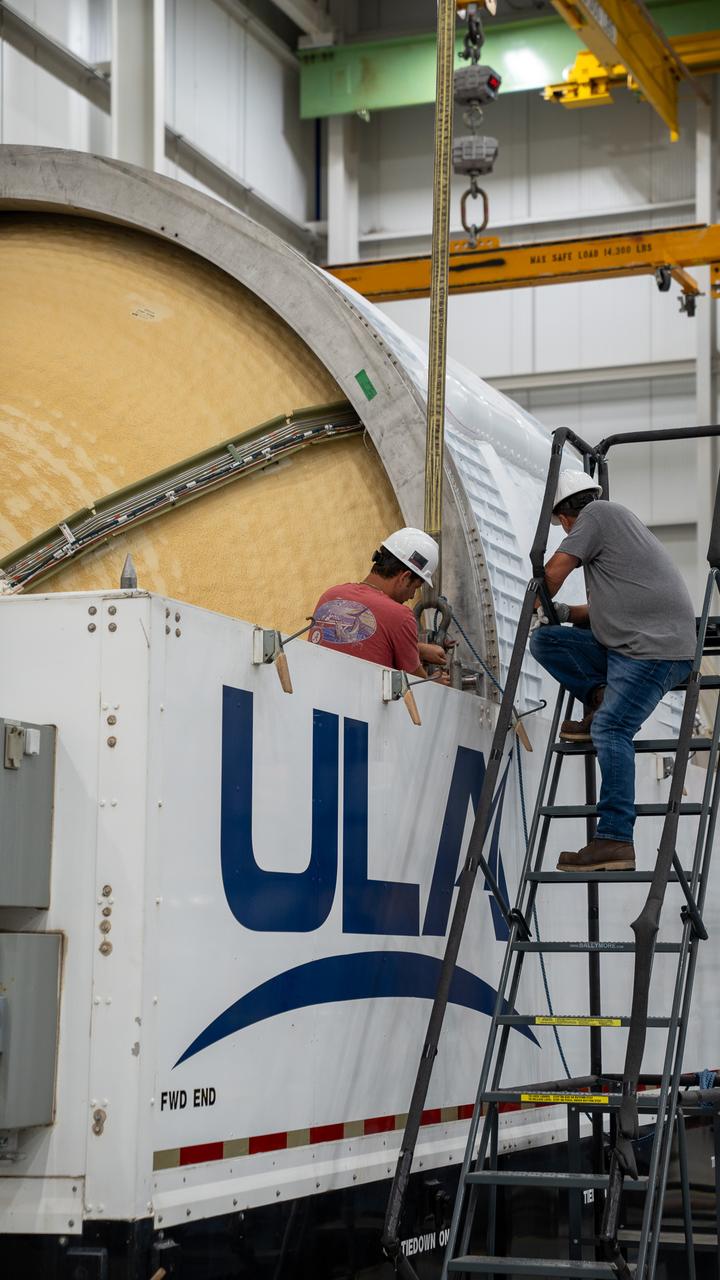
These images and videos show how crews in Alabama prepared the ICPS (interim cryogenic propulsion stage) for NASA’s SLS (Space Launch System) rocket for shipment to Florida between July 29-31. The ICPS in the photos and videos will help power NASA’s Artemis III mission to the Moon. The SLS upper stage is manufactured by United Launch Alliance at its facility in Decatur. Its RL10 engine is produced by Aerojet Rocketdyne, the SLS engines lead contractor, in West Palm Beach, Florida. ULA is working with Boeing, the SLS core stage and exploration upper stage lead contractor, to develop ICPS. ULA’s R/S RocketShip is transporting the flight hardware to its sister facility in Florida near NASA’s Kennedy Space Center for final checkouts. The ICPS for Artemis III is the last of its kind as SLS transitions to its next, more powerful Block 1B configuration with an upgraded upper stage beginning with Artemis IV. NASA is working to land the first woman and first person of color on the Moon under Artemis. SLS is part of NASA’s backbone for deep space exploration, along with Orion and the Gateway in orbit around the Moon. SLS is the only rocket that can send Orion, astronauts, and supplies to the Moon in a single mission.
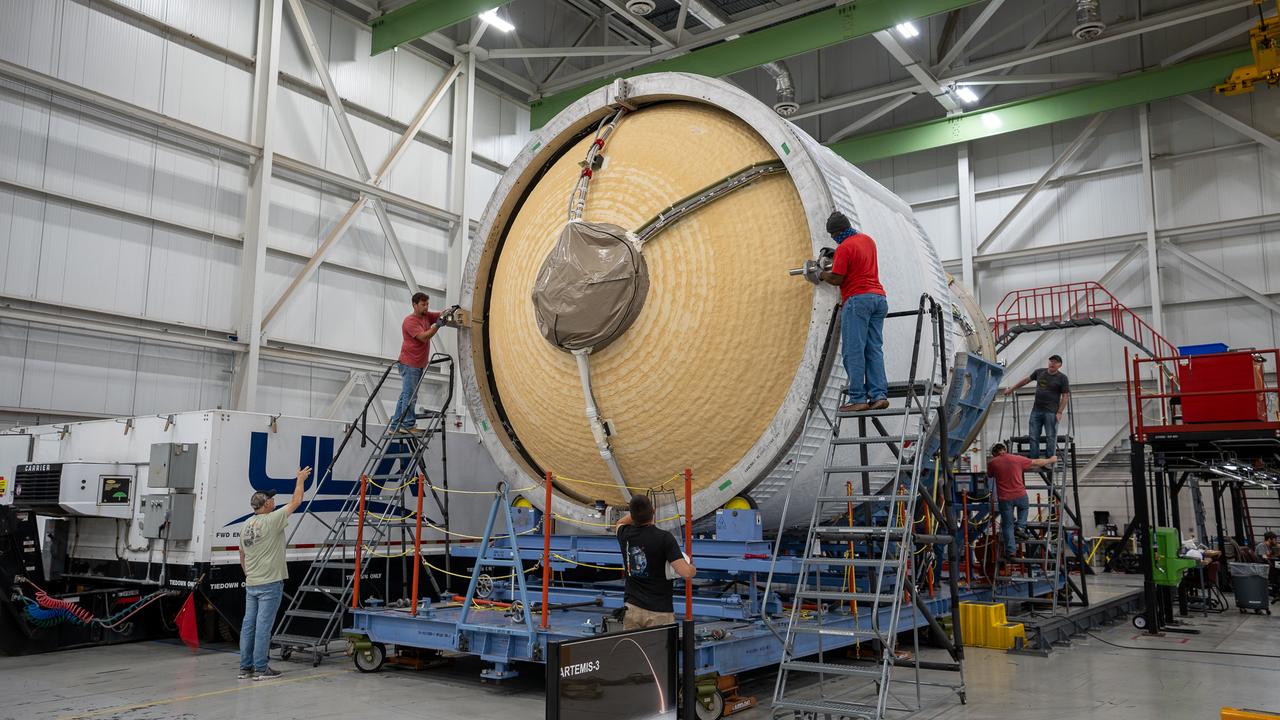
These images and videos show how crews in Alabama prepared the ICPS (interim cryogenic propulsion stage) for NASA’s SLS (Space Launch System) rocket for shipment to Florida between July 29-31. The ICPS in the photos and videos will help power NASA’s Artemis III mission to the Moon. The SLS upper stage is manufactured by United Launch Alliance at its facility in Decatur. Its RL10 engine is produced by Aerojet Rocketdyne, the SLS engines lead contractor, in West Palm Beach, Florida. ULA is working with Boeing, the SLS core stage and exploration upper stage lead contractor, to develop ICPS. ULA’s R/S RocketShip is transporting the flight hardware to its sister facility in Florida near NASA’s Kennedy Space Center for final checkouts. The ICPS for Artemis III is the last of its kind as SLS transitions to its next, more powerful Block 1B configuration with an upgraded upper stage beginning with Artemis IV. NASA is working to land the first woman and first person of color on the Moon under Artemis. SLS is part of NASA’s backbone for deep space exploration, along with Orion and the Gateway in orbit around the Moon. SLS is the only rocket that can send Orion, astronauts, and supplies to the Moon in a single mission.
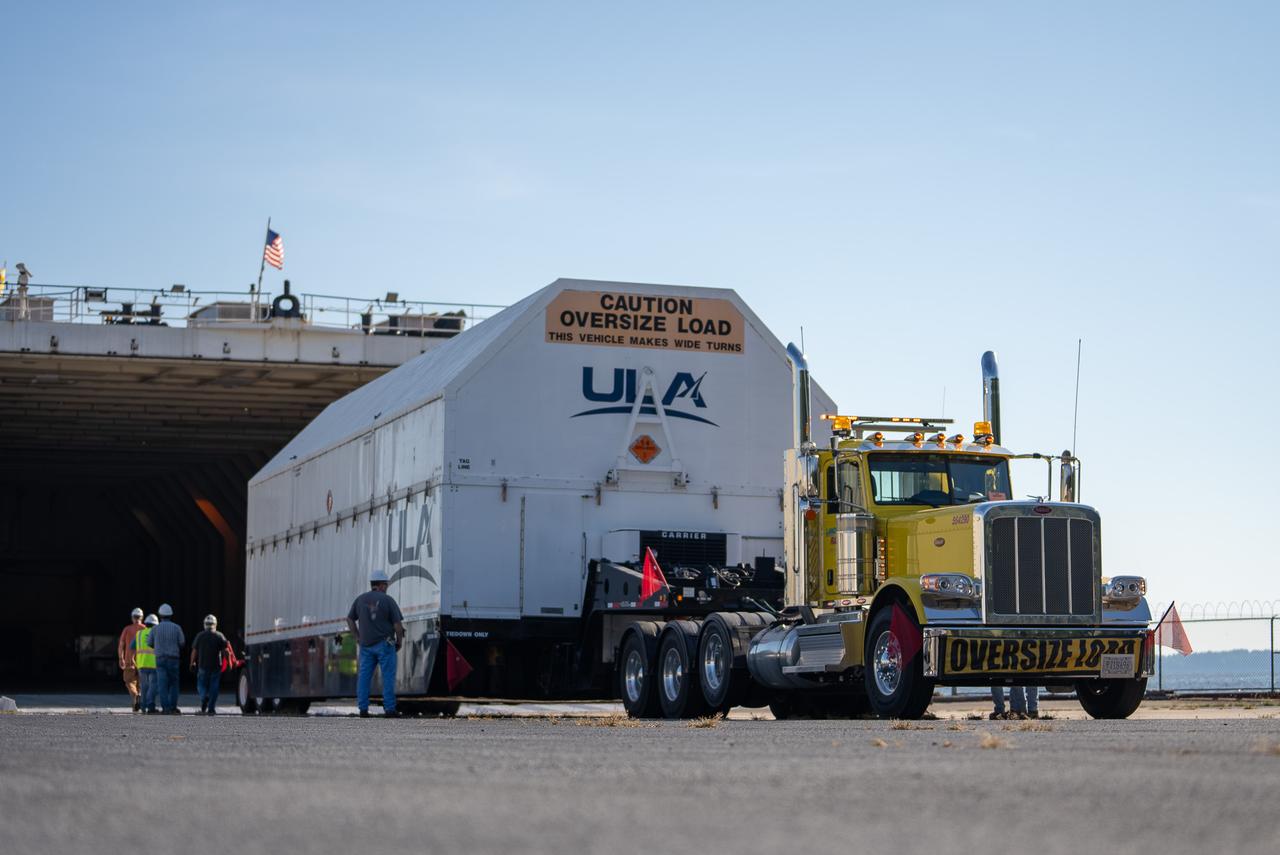
These images and videos show how crews in Alabama prepared the ICPS (interim cryogenic propulsion stage) for NASA’s SLS (Space Launch System) rocket for shipment to Florida between July 29-31. The ICPS in the photos and videos will help power NASA’s Artemis III mission to the Moon. The SLS upper stage is manufactured by United Launch Alliance at its facility in Decatur. Its RL10 engine is produced by Aerojet Rocketdyne, the SLS engines lead contractor, in West Palm Beach, Florida. ULA is working with Boeing, the SLS core stage and exploration upper stage lead contractor, to develop ICPS. ULA’s R/S RocketShip is transporting the flight hardware to its sister facility in Florida near NASA’s Kennedy Space Center for final checkouts. The ICPS for Artemis III is the last of its kind as SLS transitions to its next, more powerful Block 1B configuration with an upgraded upper stage beginning with Artemis IV. NASA is working to land the first woman and first person of color on the Moon under Artemis. SLS is part of NASA’s backbone for deep space exploration, along with Orion and the Gateway in orbit around the Moon. SLS is the only rocket that can send Orion, astronauts, and supplies to the Moon in a single mission.
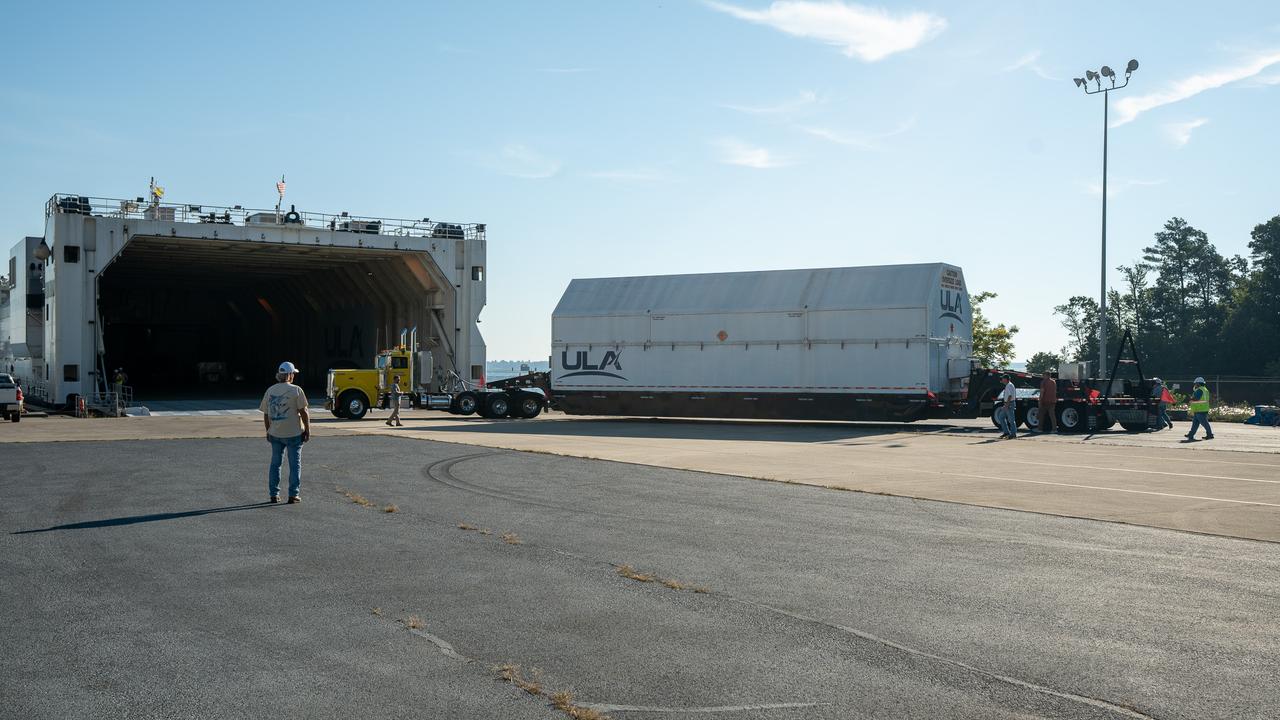
These images and videos show how crews in Alabama prepared the ICPS (interim cryogenic propulsion stage) for NASA’s SLS (Space Launch System) rocket for shipment to Florida between July 29-31. The ICPS in the photos and videos will help power NASA’s Artemis III mission to the Moon. The SLS upper stage is manufactured by United Launch Alliance at its facility in Decatur. Its RL10 engine is produced by Aerojet Rocketdyne, the SLS engines lead contractor, in West Palm Beach, Florida. ULA is working with Boeing, the SLS core stage and exploration upper stage lead contractor, to develop ICPS. ULA’s R/S RocketShip is transporting the flight hardware to its sister facility in Florida near NASA’s Kennedy Space Center for final checkouts. The ICPS for Artemis III is the last of its kind as SLS transitions to its next, more powerful Block 1B configuration with an upgraded upper stage beginning with Artemis IV. NASA is working to land the first woman and first person of color on the Moon under Artemis. SLS is part of NASA’s backbone for deep space exploration, along with Orion and the Gateway in orbit around the Moon. SLS is the only rocket that can send Orion, astronauts, and supplies to the Moon in a single mission.
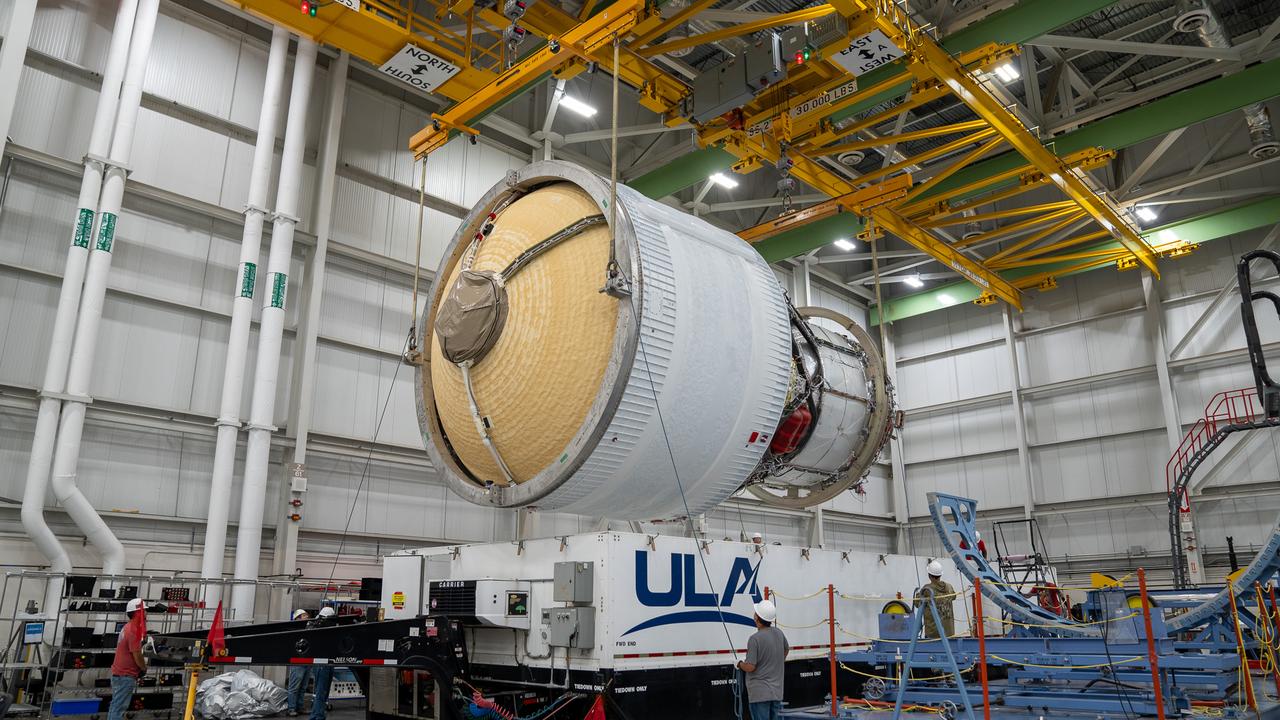
These images and videos show how crews in Alabama prepared the ICPS (interim cryogenic propulsion stage) for NASA’s SLS (Space Launch System) rocket for shipment to Florida between July 29-31. The ICPS in the photos and videos will help power NASA’s Artemis III mission to the Moon. The SLS upper stage is manufactured by United Launch Alliance at its facility in Decatur. Its RL10 engine is produced by Aerojet Rocketdyne, the SLS engines lead contractor, in West Palm Beach, Florida. ULA is working with Boeing, the SLS core stage and exploration upper stage lead contractor, to develop ICPS. ULA’s R/S RocketShip is transporting the flight hardware to its sister facility in Florida near NASA’s Kennedy Space Center for final checkouts. The ICPS for Artemis III is the last of its kind as SLS transitions to its next, more powerful Block 1B configuration with an upgraded upper stage beginning with Artemis IV. NASA is working to land the first woman and first person of color on the Moon under Artemis. SLS is part of NASA’s backbone for deep space exploration, along with Orion and the Gateway in orbit around the Moon. SLS is the only rocket that can send Orion, astronauts, and supplies to the Moon in a single mission.
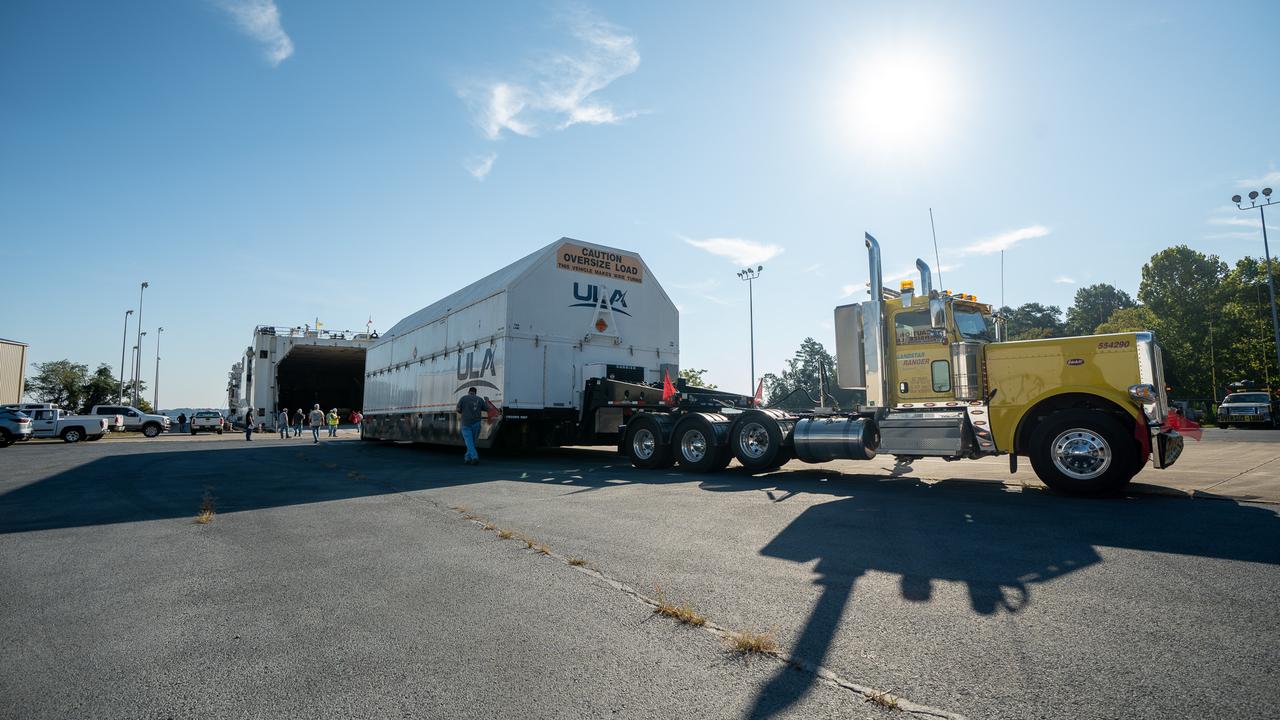
These images and videos show how crews in Alabama prepared the ICPS (interim cryogenic propulsion stage) for NASA’s SLS (Space Launch System) rocket for shipment to Florida between July 29-31. The ICPS in the photos and videos will help power NASA’s Artemis III mission to the Moon. The SLS upper stage is manufactured by United Launch Alliance at its facility in Decatur. Its RL10 engine is produced by Aerojet Rocketdyne, the SLS engines lead contractor, in West Palm Beach, Florida. ULA is working with Boeing, the SLS core stage and exploration upper stage lead contractor, to develop ICPS. ULA’s R/S RocketShip is transporting the flight hardware to its sister facility in Florida near NASA’s Kennedy Space Center for final checkouts. The ICPS for Artemis III is the last of its kind as SLS transitions to its next, more powerful Block 1B configuration with an upgraded upper stage beginning with Artemis IV. NASA is working to land the first woman and first person of color on the Moon under Artemis. SLS is part of NASA’s backbone for deep space exploration, along with Orion and the Gateway in orbit around the Moon. SLS is the only rocket that can send Orion, astronauts, and supplies to the Moon in a single mission.

A SpaceX Falcon 9 rocket powers the Dragon spacecraft toward the International Space Station on Friday, June 29, 2018. The two-stage launch vehicle lifted off from Space Launch Complex 40 at Cape Canaveral Air Force Station at 5:42 a.m. EDT. On the company’s 15th Commercial Resupply Services mission to the space station, Dragon is filled with supplies and payloads, including critical materials to support several science and research investigations that will occur during Expedition 56. The spacecraft’s unpressurized trunk is carrying a Canadian-built Latching End Effector, or LEE. This new LEE will replace a failed unit astronauts removed during a series of spacewalks in the fall of 2017. Each end of the Canadarm2 robotic arm has an identical LEE, and they are used as the “hands” that grapple payloads and visiting cargo spaceships.
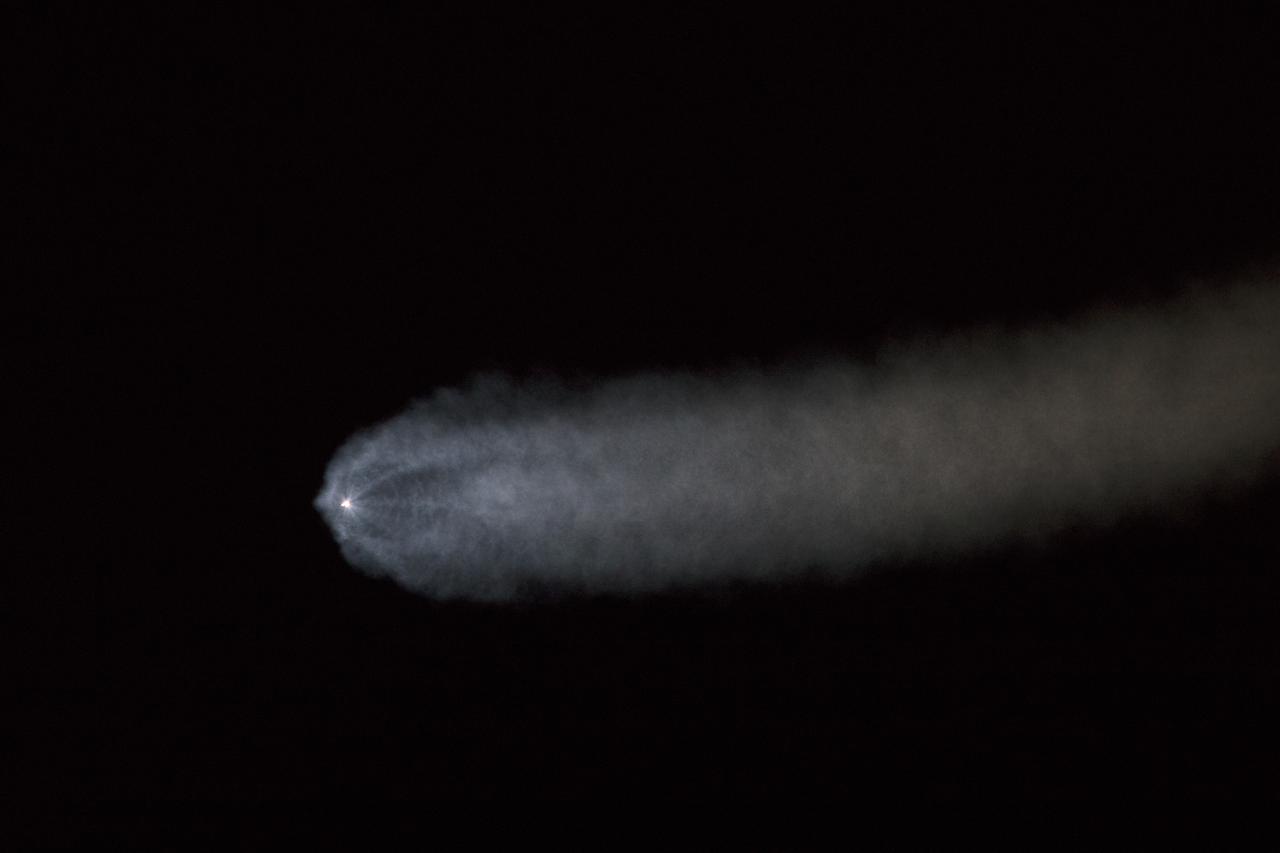
A SpaceX Falcon 9 rocket powers the Dragon spacecraft toward the International Space Station on Friday, June 29, 2018. The two-stage launch vehicle lifted off from Space Launch Complex 40 at Cape Canaveral Air Force Station at 5:42 a.m. EDT. On the company’s 15th Commercial Resupply Services mission to the space station, Dragon is filled with supplies and payloads, including critical materials to support several science and research investigations that will occur during Expedition 56. The spacecraft’s unpressurized trunk is carrying a Canadian-built Latching End Effector, or LEE. This new LEE will replace a failed unit astronauts removed during a series of spacewalks in the fall of 2017. Each end of the Canadarm2 robotic arm has an identical LEE, and they are used as the “hands” that grapple payloads and visiting cargo spaceships.
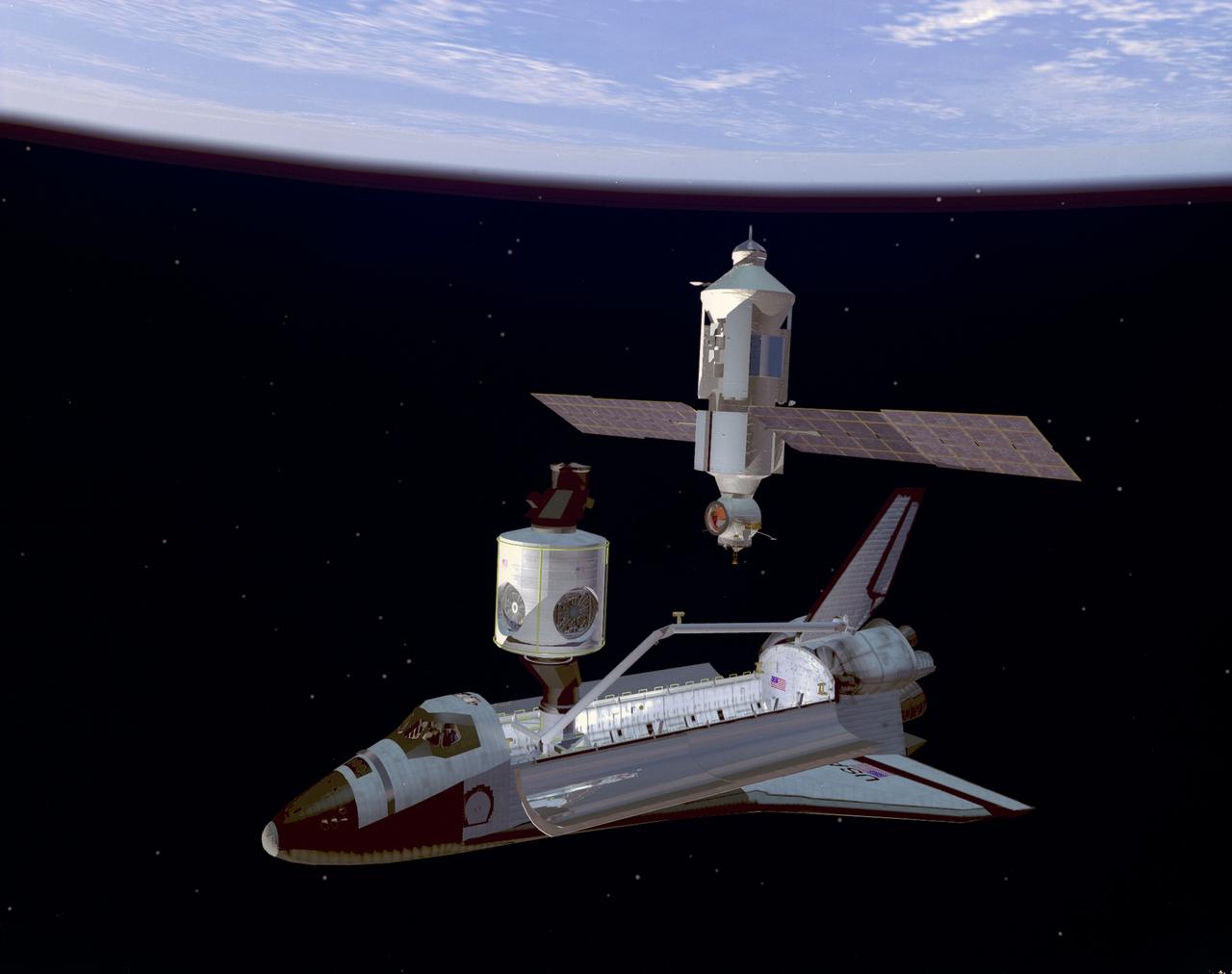
S98-04904 (21 July 1997) --- The Space Shuttle Endeavour prepares to capture the Functional Cargo Block (FGB) using the shuttle's mechanical arm in this artist's depiction of the first Space Shuttle assembly flight for the International Space Station (ISS), mission STS-88 scheduled to launch in December 1998. The shuttle will carry the first United States-built component for the station, a connecting module called Node 1 or Unity, and attach it to the already orbiting FGB, which supplies early electrical power and propulsion. The FGB, Zarya, will have been launched about two weeks earlier on a Russian Proton rocket from the Baikonur Cosmodrome, Kazahkstan. Once the FGB is captured using the mechanical arm, astronaut Nancy J. Currie will maneuver the arm to dock the FGB to the conical mating adapter at the top of Node 1 in the Shuttle's cargo bay. In ensuing days, three Extravehicular Activity?s (EVA) by astronauts Jerry L. Ross and James H. Newman will be performed to make power, data and utility connections between the two modules.
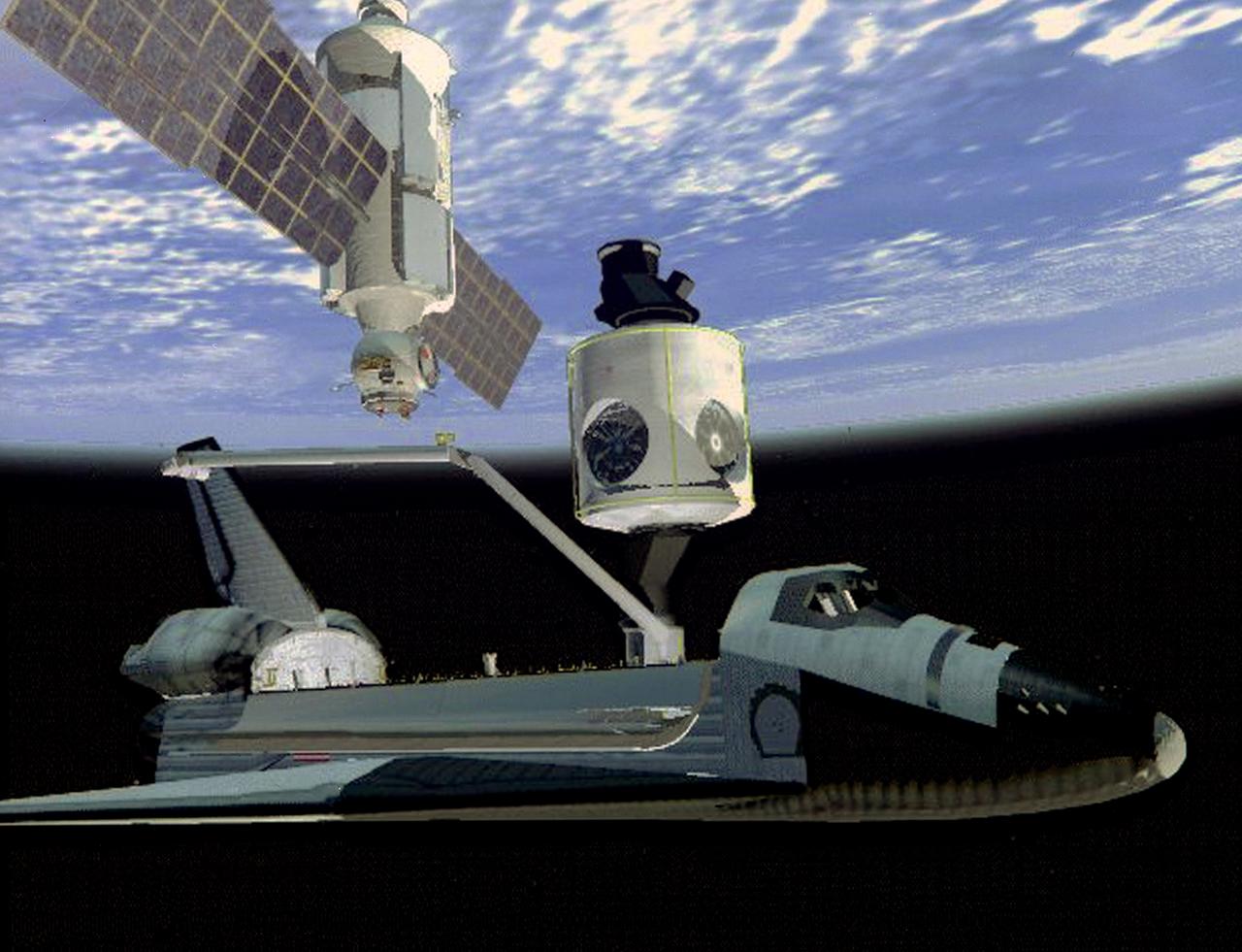
S98-09020 (21 July 1997) --- The Space Shuttle Endeavour prepares to capture the Functional Cargo Block (FGB) using the shuttle's mechanical arm in this artist's depiction of the first Space Shuttle assembly flight for the International Space Station (ISS), mission STS-88 scheduled to launch in July 1998. The shuttle will carry the first United States-built component for the station, a connecting module called Node 1, and attach it to the already orbiting FGB, which supplies early electrical power and propulsion. The FGB will have been launched about two weeks earlier on a Russian Proton rocket from the Baikonur Cosmodrome, Kazahkstan. Once the FGB is captured using the mechanical arm, astronaut Nancy J. Currie will maneuver the arm to dock the FGB to the conical mating adapter at the top of Node 1 in the Shuttle's cargo bay. In ensuing days, three Extravehicular Activity?s (EVA) by astronauts Jerry L. Ross and James H. Newman will be performed to make power, data and utility connections between the two modules.
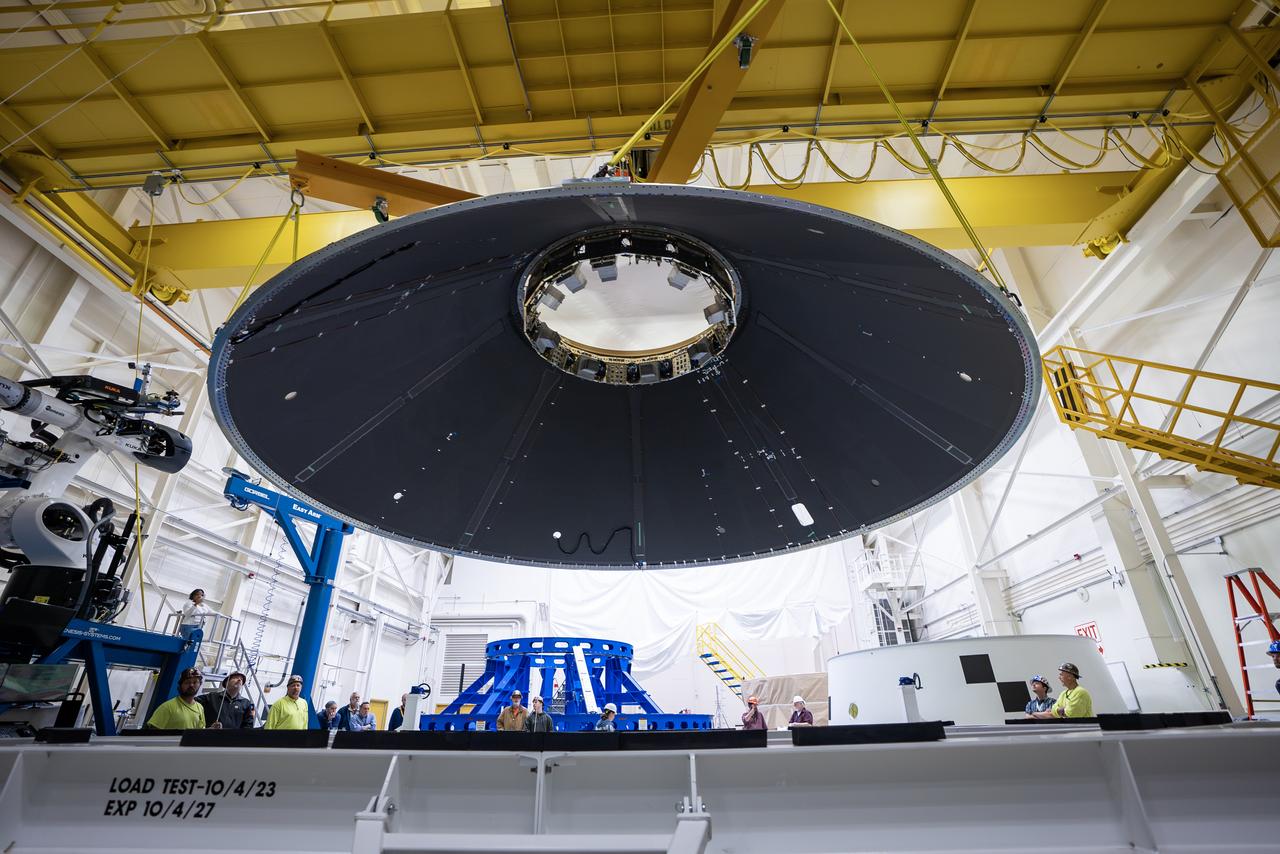
These photos and videos show how NASA manufactured and prepared to transport the payload adapter in February inside Building 4708 at NASA’s Marshall Space Flight Center in Huntsville, Alabama. Prior to moving the hardware for testing, teams installed the New Explorations Secondary Transport component, called the NEST, into the top of the engineering development unit. The NEST component will allow the hardware to hold a series of secondary payloads, or small satellites. The cone-shaped payload adapter is about 8.5 feet tall and features two metal rings and eight composite panels. The adapter, which will debut on NASA’s Artemis IV mission, is an evolution from the Orion stage adapter used in the Block 1 configuration of the rocket for the first three Artemis missions. It will be housed inside the universal stage adapter atop the rocket’s more powerful in-space stage, called the exploration upper stage. The payload adapter, like the launch vehicle stage adapter and the Orion stage adapter, is fully manufactured and tested at Marshall, which manages the SLS Program. NASA is working to land the first woman, first person of color, and its first international partner astronaut on the Moon under Artemis. SLS is part of NASA’s backbone for deep space exploration, along with the Orion spacecraft and Gateway in orbit around the Moon and commercial human landing systems, next-generational spacesuits, and rovers on the lunar surface. SLS is the only rocket that can send Orion, astronauts, and supplies to the Moon in a single launch.
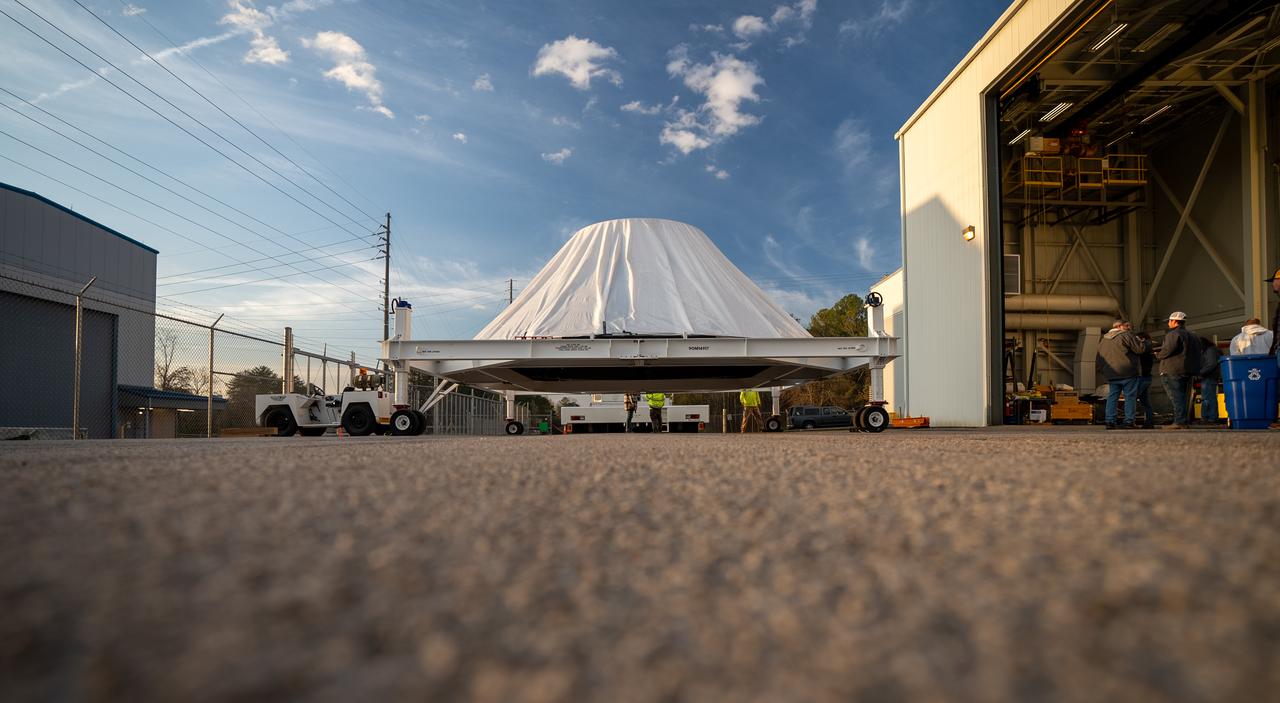
These photos and videos show how crews at NASA’s Marshall Space Flight Center in Huntsville, Alabama, moved and installed the payload adapter that will be used in the Block 1B configuration of the SLS (Space Launch System) rocket from Building 4708, where it was manufactured, into Structural Test Stand 4697 at NASA’s Marshall Space Flight Center on March 13. Teams at Marshall will begin structural testing the engineering development unit of the payload adapter – an exact replica of the flight version of the hardware – this spring. The cone-shaped payload adapter is about 8.5 feet tall and features two metal rings and eight composite panels. The adapter, which will debut on NASA’s Artemis IV mission, is an evolution from the Orion stage adapter used in the Block 1 configuration of the first three Artemis missions. It will be housed inside the universal stage adapter atop the rocket’s more powerful in-space stage, called the exploration upper stage. The payload adapter, like the launch vehicle stage adapter and the Orion stage adapter, is fully manufactured and tested at Marshall, which manages the SLS Program. NASA is working to land the first woman, first person of color, and its first international partner astronaut on the Moon under Artemis. SLS is part of NASA’s backbone for deep space exploration, along with the Orion spacecraft and Gateway in orbit around the Moon and commercial human landing systems, next-generational spacesuits, and rovers on the lunar surface. SLS is the only rocket that can send Orion, astronauts, and supplies to the Moon in a single launch.
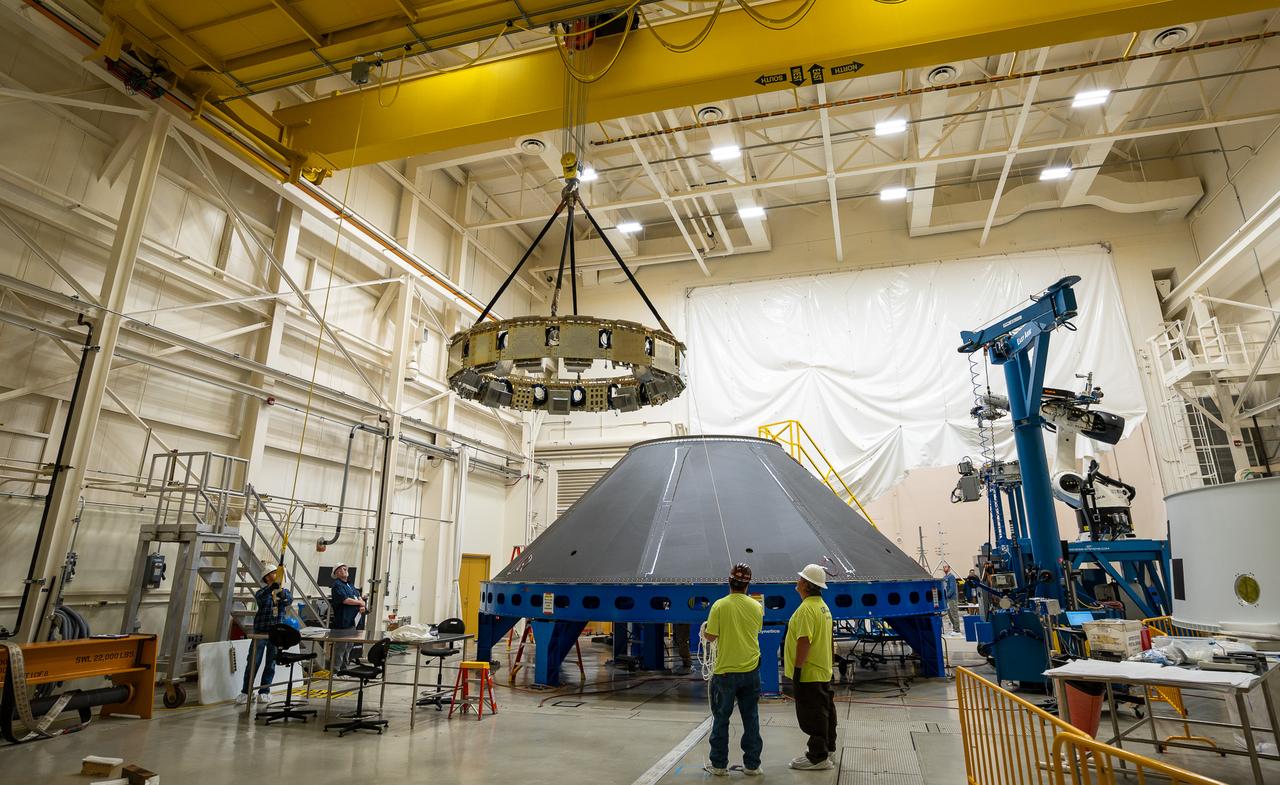
These photos and videos show how NASA manufactured and prepared to transport the payload adapter in February inside Building 4708 at NASA’s Marshall Space Flight Center in Huntsville, Alabama. Prior to moving the hardware for testing, teams installed the New Explorations Secondary Transport component, called the NEST, into the top of the engineering development unit. The NEST component will allow the hardware to hold a series of secondary payloads, or small satellites. The cone-shaped payload adapter is about 8.5 feet tall and features two metal rings and eight composite panels. The adapter, which will debut on NASA’s Artemis IV mission, is an evolution from the Orion stage adapter used in the Block 1 configuration of the rocket for the first three Artemis missions. It will be housed inside the universal stage adapter atop the rocket’s more powerful in-space stage, called the exploration upper stage. The payload adapter, like the launch vehicle stage adapter and the Orion stage adapter, is fully manufactured and tested at Marshall, which manages the SLS Program. NASA is working to land the first woman, first person of color, and its first international partner astronaut on the Moon under Artemis. SLS is part of NASA’s backbone for deep space exploration, along with the Orion spacecraft and Gateway in orbit around the Moon and commercial human landing systems, next-generational spacesuits, and rovers on the lunar surface. SLS is the only rocket that can send Orion, astronauts, and supplies to the Moon in a single launch.
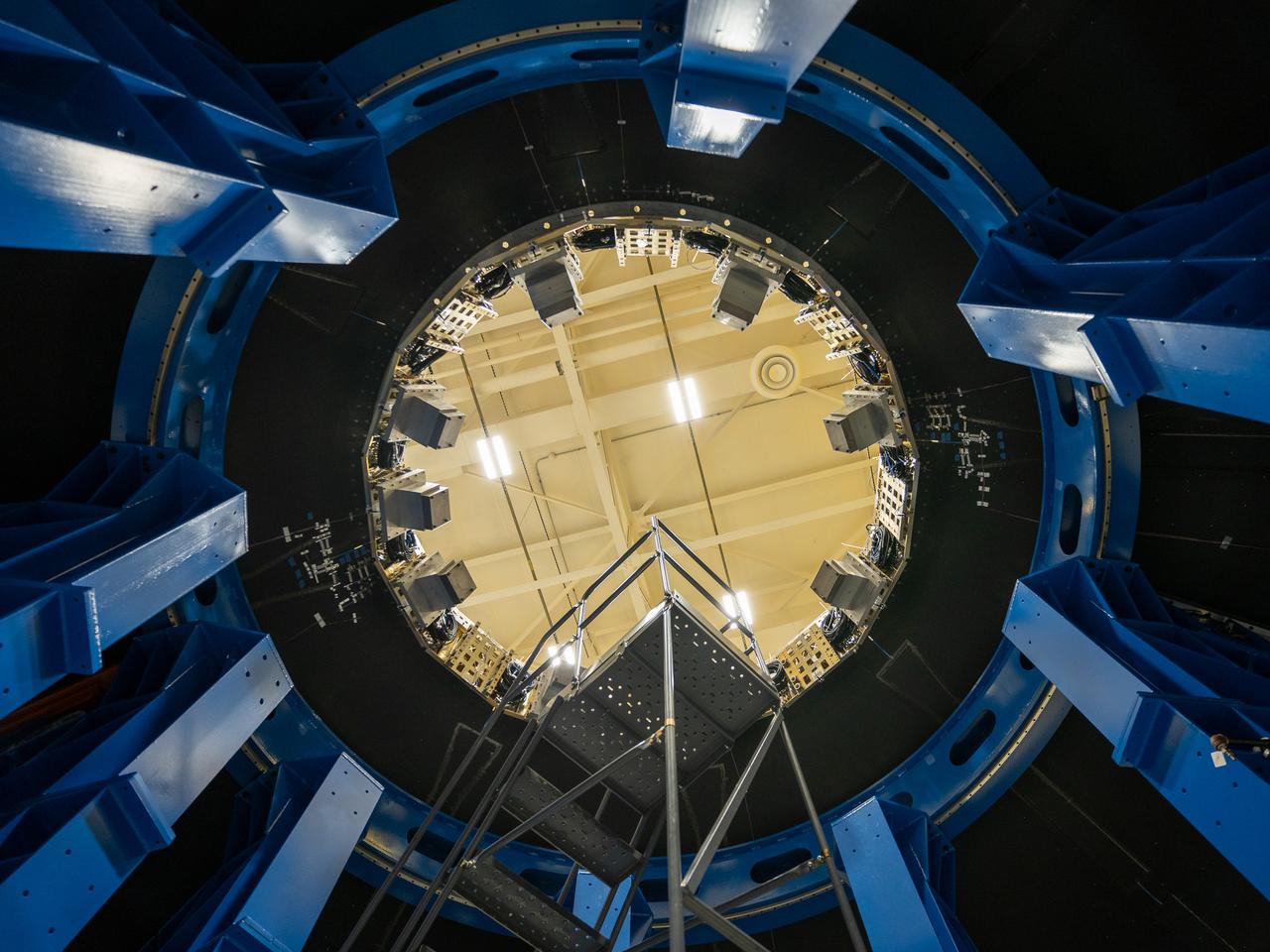
These photos and videos show how NASA manufactured and prepared to transport the payload adapter in February inside Building 4708 at NASA’s Marshall Space Flight Center in Huntsville, Alabama. Prior to moving the hardware for testing, teams installed the New Explorations Secondary Transport component, called the NEST, into the top of the engineering development unit. The NEST component will allow the hardware to hold a series of secondary payloads, or small satellites. The cone-shaped payload adapter is about 8.5 feet tall and features two metal rings and eight composite panels. The adapter, which will debut on NASA’s Artemis IV mission, is an evolution from the Orion stage adapter used in the Block 1 configuration of the rocket for the first three Artemis missions. It will be housed inside the universal stage adapter atop the rocket’s more powerful in-space stage, called the exploration upper stage. The payload adapter, like the launch vehicle stage adapter and the Orion stage adapter, is fully manufactured and tested at Marshall, which manages the SLS Program. NASA is working to land the first woman, first person of color, and its first international partner astronaut on the Moon under Artemis. SLS is part of NASA’s backbone for deep space exploration, along with the Orion spacecraft and Gateway in orbit around the Moon and commercial human landing systems, next-generational spacesuits, and rovers on the lunar surface. SLS is the only rocket that can send Orion, astronauts, and supplies to the Moon in a single launch.
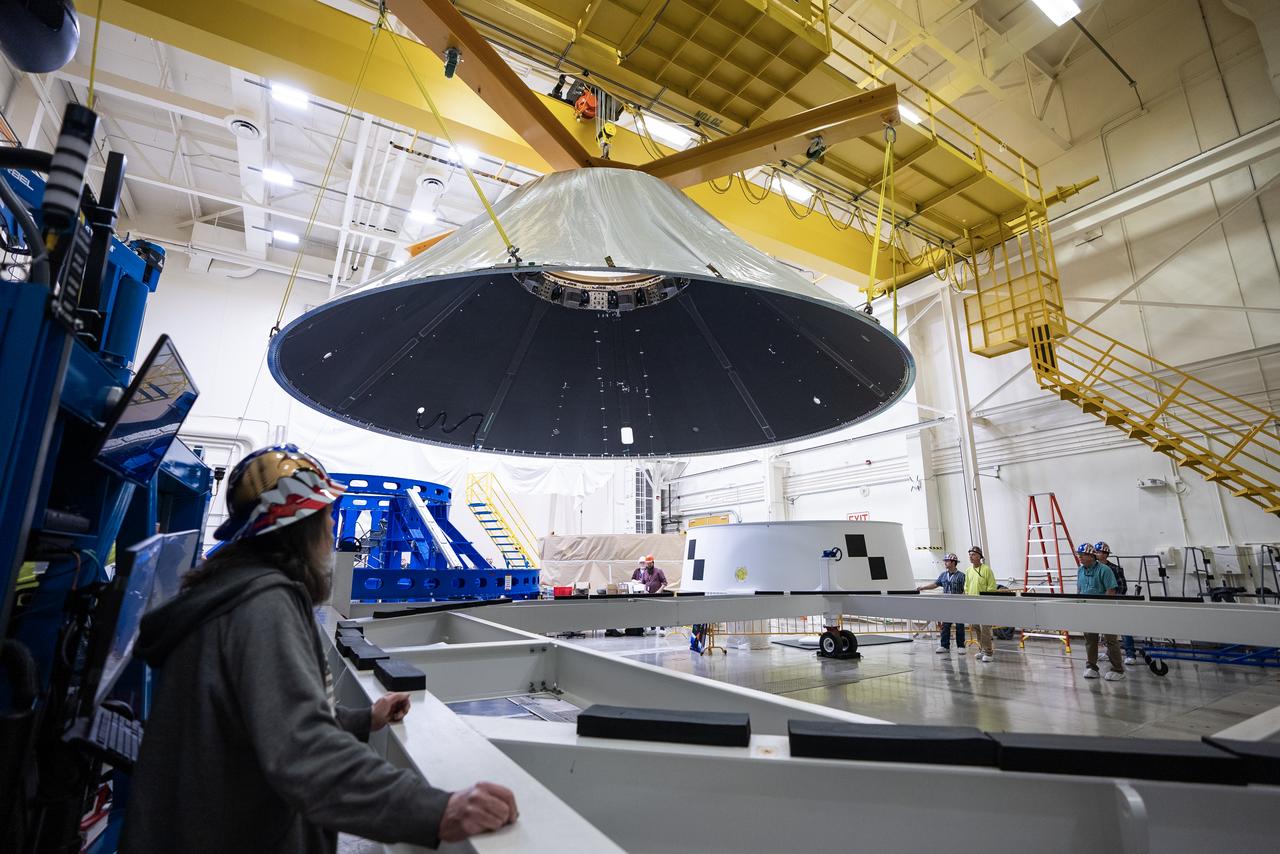
These photos and videos show how NASA manufactured and prepared to transport the payload adapter in February inside Building 4708 at NASA’s Marshall Space Flight Center in Huntsville, Alabama. Prior to moving the hardware for testing, teams installed the New Explorations Secondary Transport component, called the NEST, into the top of the engineering development unit. The NEST component will allow the hardware to hold a series of secondary payloads, or small satellites. The cone-shaped payload adapter is about 8.5 feet tall and features two metal rings and eight composite panels. The adapter, which will debut on NASA’s Artemis IV mission, is an evolution from the Orion stage adapter used in the Block 1 configuration of the rocket for the first three Artemis missions. It will be housed inside the universal stage adapter atop the rocket’s more powerful in-space stage, called the exploration upper stage. The payload adapter, like the launch vehicle stage adapter and the Orion stage adapter, is fully manufactured and tested at Marshall, which manages the SLS Program. NASA is working to land the first woman, first person of color, and its first international partner astronaut on the Moon under Artemis. SLS is part of NASA’s backbone for deep space exploration, along with the Orion spacecraft and Gateway in orbit around the Moon and commercial human landing systems, next-generational spacesuits, and rovers on the lunar surface. SLS is the only rocket that can send Orion, astronauts, and supplies to the Moon in a single launch.
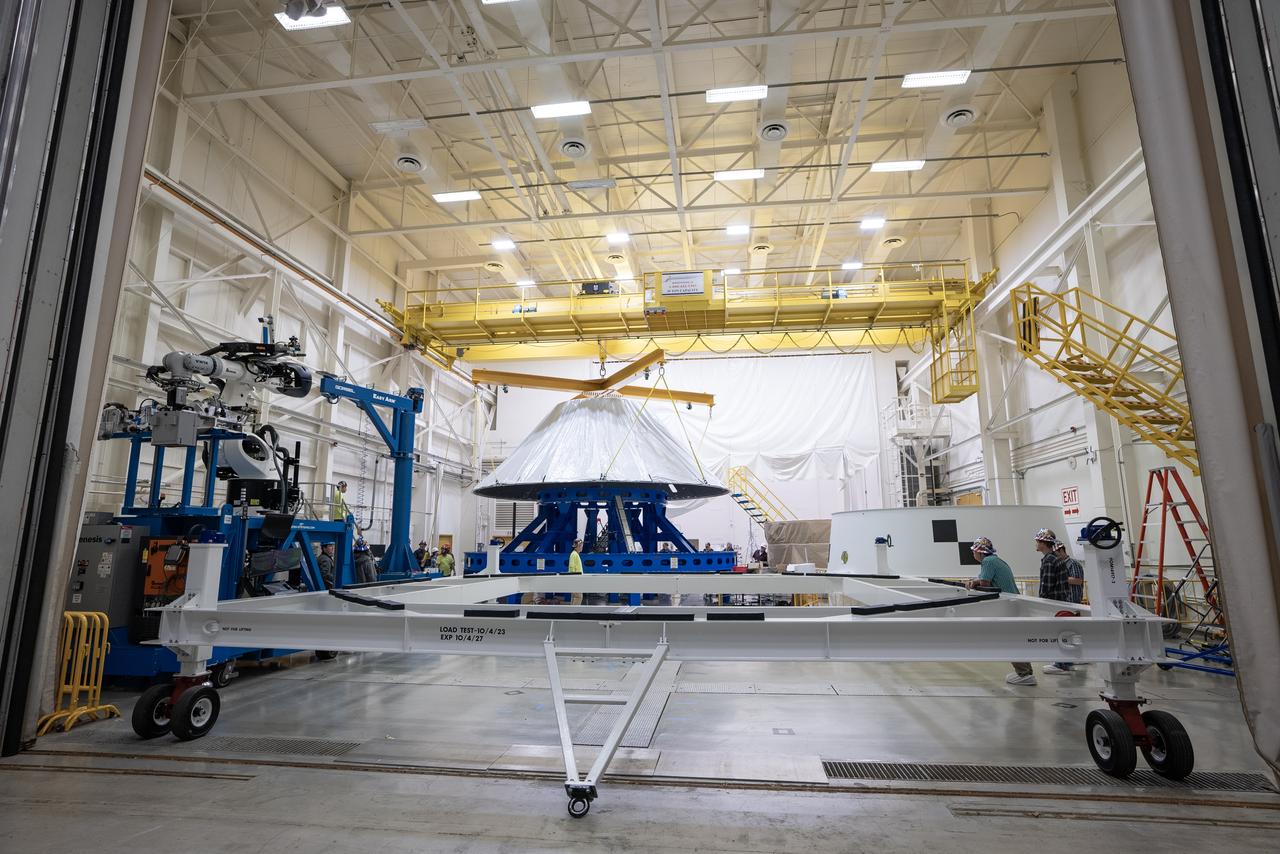
These photos and videos show how NASA manufactured and prepared to transport the payload adapter in February inside Building 4708 at NASA’s Marshall Space Flight Center in Huntsville, Alabama. Prior to moving the hardware for testing, teams installed the New Explorations Secondary Transport component, called the NEST, into the top of the engineering development unit. The NEST component will allow the hardware to hold a series of secondary payloads, or small satellites. The cone-shaped payload adapter is about 8.5 feet tall and features two metal rings and eight composite panels. The adapter, which will debut on NASA’s Artemis IV mission, is an evolution from the Orion stage adapter used in the Block 1 configuration of the rocket for the first three Artemis missions. It will be housed inside the universal stage adapter atop the rocket’s more powerful in-space stage, called the exploration upper stage. The payload adapter, like the launch vehicle stage adapter and the Orion stage adapter, is fully manufactured and tested at Marshall, which manages the SLS Program. NASA is working to land the first woman, first person of color, and its first international partner astronaut on the Moon under Artemis. SLS is part of NASA’s backbone for deep space exploration, along with the Orion spacecraft and Gateway in orbit around the Moon and commercial human landing systems, next-generational spacesuits, and rovers on the lunar surface. SLS is the only rocket that can send Orion, astronauts, and supplies to the Moon in a single launch.
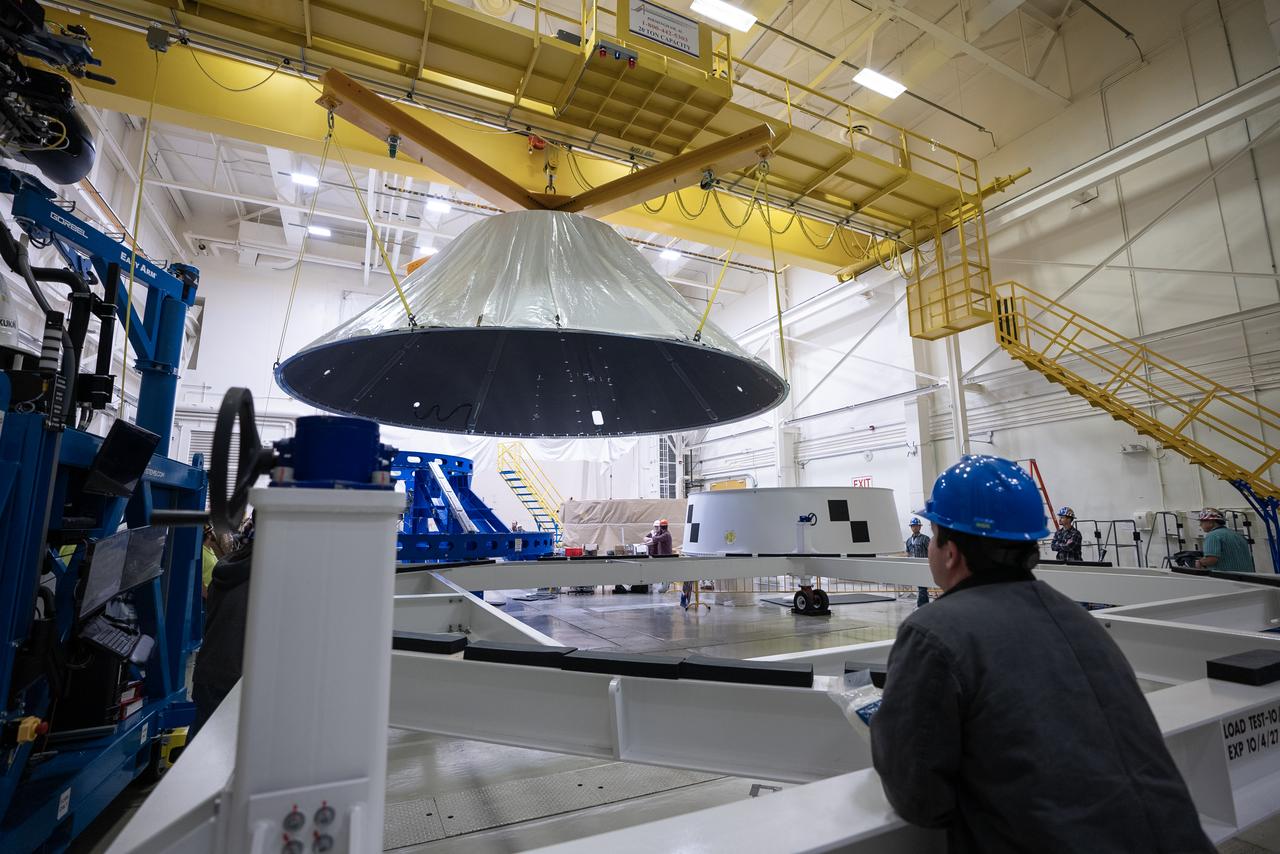
These photos and videos show how NASA manufactured and prepared to transport the payload adapter in February inside Building 4708 at NASA’s Marshall Space Flight Center in Huntsville, Alabama. Prior to moving the hardware for testing, teams installed the New Explorations Secondary Transport component, called the NEST, into the top of the engineering development unit. The NEST component will allow the hardware to hold a series of secondary payloads, or small satellites. The cone-shaped payload adapter is about 8.5 feet tall and features two metal rings and eight composite panels. The adapter, which will debut on NASA’s Artemis IV mission, is an evolution from the Orion stage adapter used in the Block 1 configuration of the rocket for the first three Artemis missions. It will be housed inside the universal stage adapter atop the rocket’s more powerful in-space stage, called the exploration upper stage. The payload adapter, like the launch vehicle stage adapter and the Orion stage adapter, is fully manufactured and tested at Marshall, which manages the SLS Program. NASA is working to land the first woman, first person of color, and its first international partner astronaut on the Moon under Artemis. SLS is part of NASA’s backbone for deep space exploration, along with the Orion spacecraft and Gateway in orbit around the Moon and commercial human landing systems, next-generational spacesuits, and rovers on the lunar surface. SLS is the only rocket that can send Orion, astronauts, and supplies to the Moon in a single launch.
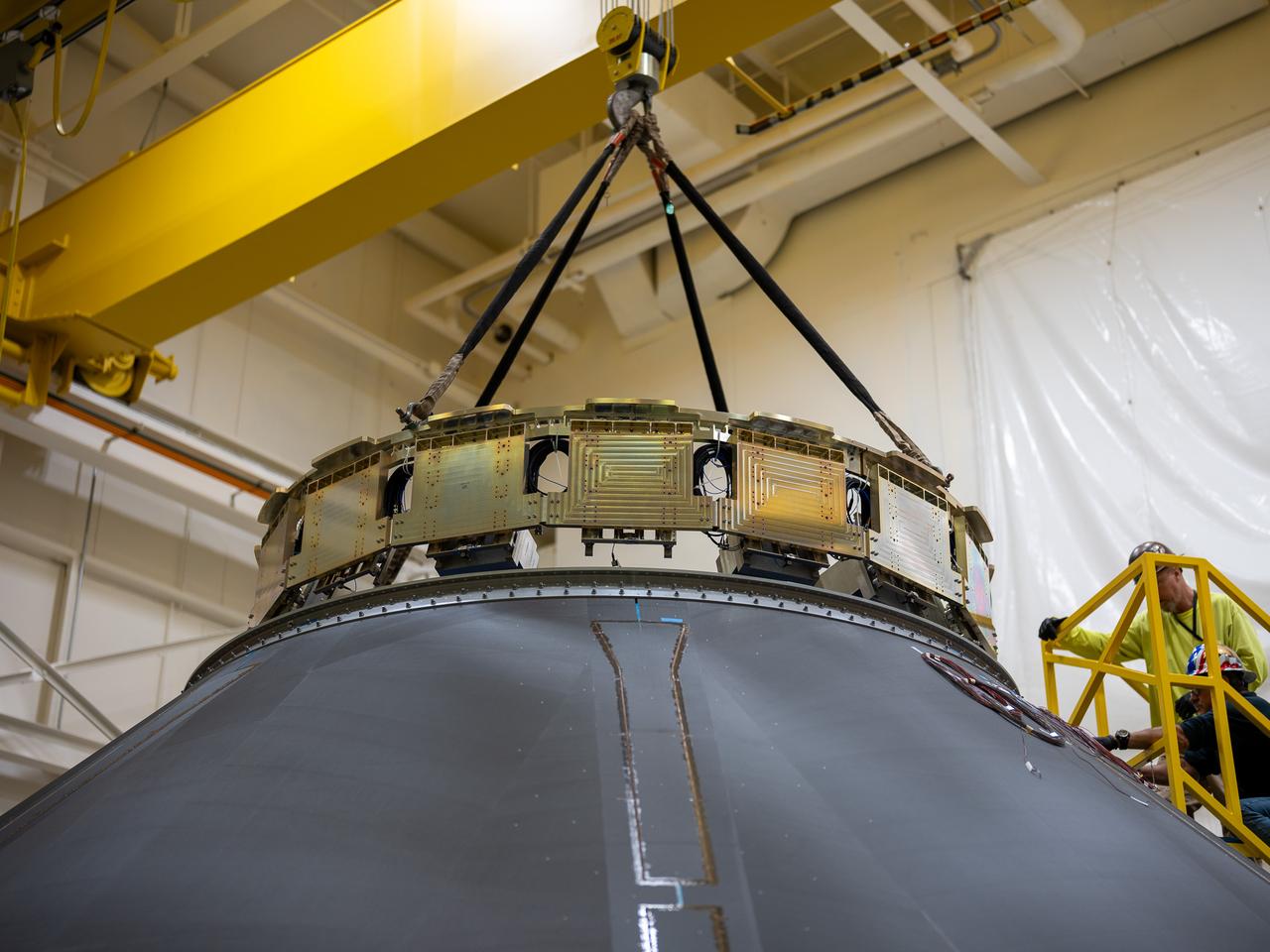
These photos and videos show how NASA manufactured and prepared to transport the payload adapter in February inside Building 4708 at NASA’s Marshall Space Flight Center in Huntsville, Alabama. Prior to moving the hardware for testing, teams installed the New Explorations Secondary Transport component, called the NEST, into the top of the engineering development unit. The NEST component will allow the hardware to hold a series of secondary payloads, or small satellites. The cone-shaped payload adapter is about 8.5 feet tall and features two metal rings and eight composite panels. The adapter, which will debut on NASA’s Artemis IV mission, is an evolution from the Orion stage adapter used in the Block 1 configuration of the rocket for the first three Artemis missions. It will be housed inside the universal stage adapter atop the rocket’s more powerful in-space stage, called the exploration upper stage. The payload adapter, like the launch vehicle stage adapter and the Orion stage adapter, is fully manufactured and tested at Marshall, which manages the SLS Program. NASA is working to land the first woman, first person of color, and its first international partner astronaut on the Moon under Artemis. SLS is part of NASA’s backbone for deep space exploration, along with the Orion spacecraft and Gateway in orbit around the Moon and commercial human landing systems, next-generational spacesuits, and rovers on the lunar surface. SLS is the only rocket that can send Orion, astronauts, and supplies to the Moon in a single launch.
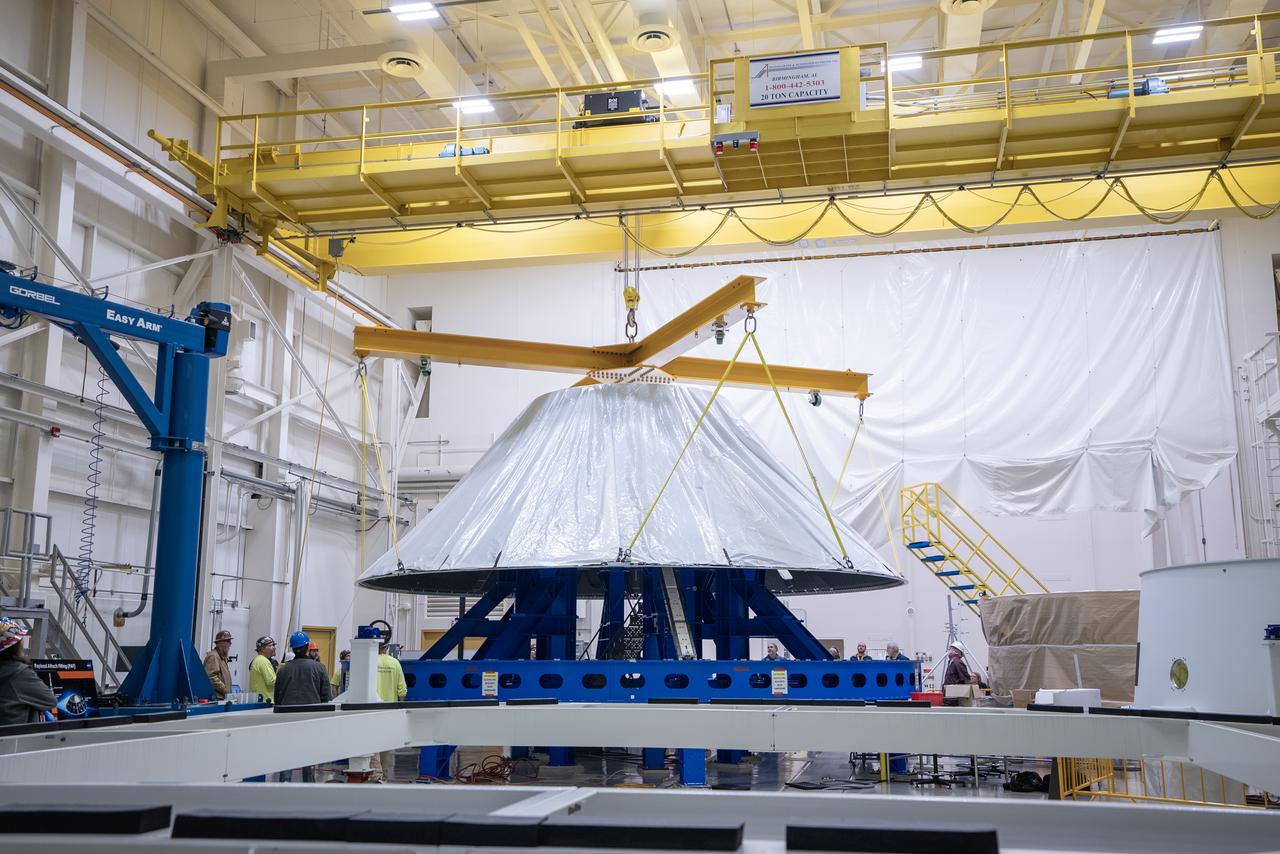
These photos and videos show how NASA manufactured and prepared to transport the payload adapter in February inside Building 4708 at NASA’s Marshall Space Flight Center in Huntsville, Alabama. Prior to moving the hardware for testing, teams installed the New Explorations Secondary Transport component, called the NEST, into the top of the engineering development unit. The NEST component will allow the hardware to hold a series of secondary payloads, or small satellites. The cone-shaped payload adapter is about 8.5 feet tall and features two metal rings and eight composite panels. The adapter, which will debut on NASA’s Artemis IV mission, is an evolution from the Orion stage adapter used in the Block 1 configuration of the rocket for the first three Artemis missions. It will be housed inside the universal stage adapter atop the rocket’s more powerful in-space stage, called the exploration upper stage. The payload adapter, like the launch vehicle stage adapter and the Orion stage adapter, is fully manufactured and tested at Marshall, which manages the SLS Program. NASA is working to land the first woman, first person of color, and its first international partner astronaut on the Moon under Artemis. SLS is part of NASA’s backbone for deep space exploration, along with the Orion spacecraft and Gateway in orbit around the Moon and commercial human landing systems, next-generational spacesuits, and rovers on the lunar surface. SLS is the only rocket that can send Orion, astronauts, and supplies to the Moon in a single launch.
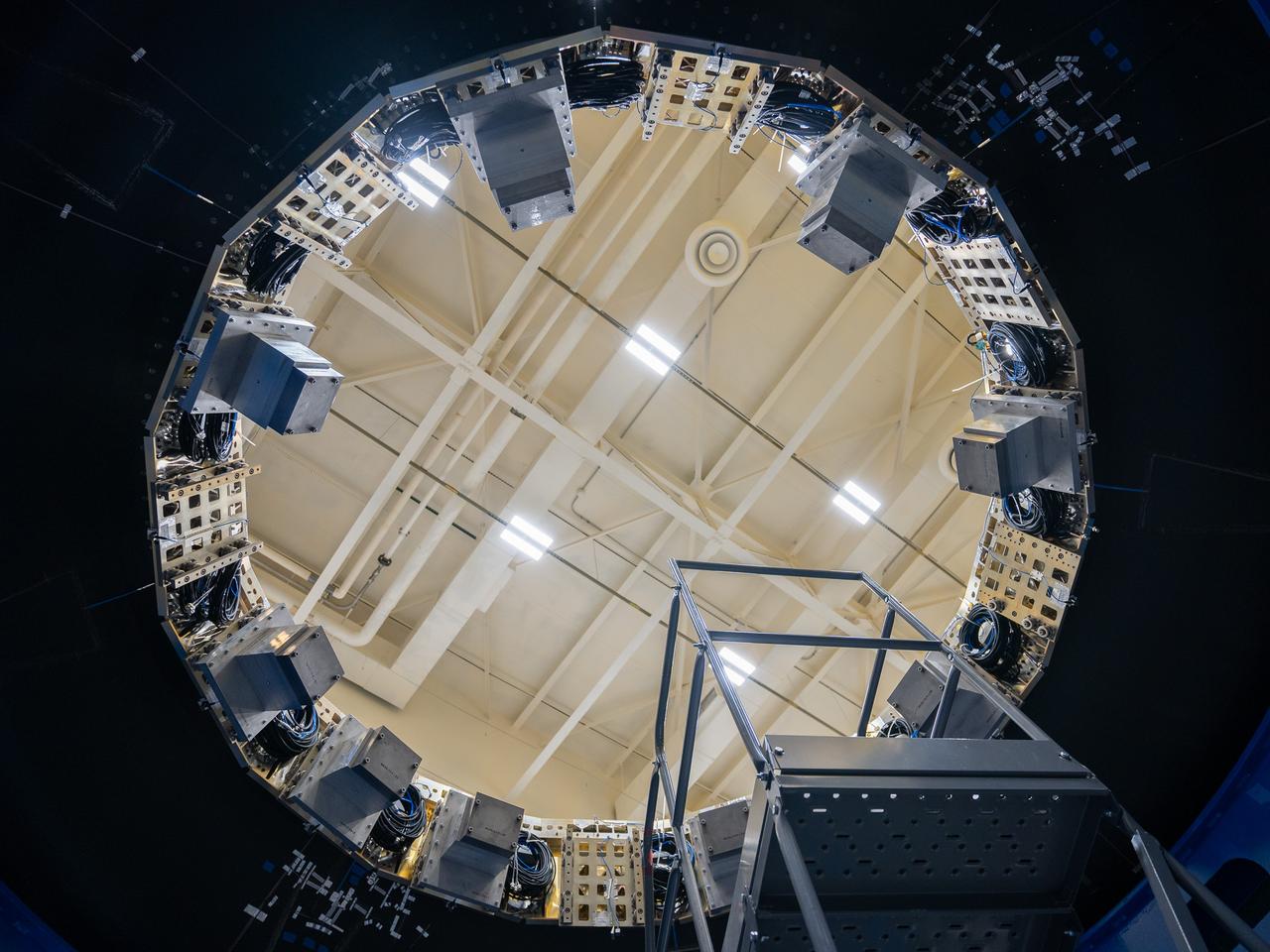
These photos and videos show how NASA manufactured and prepared to transport the payload adapter in February inside Building 4708 at NASA’s Marshall Space Flight Center in Huntsville, Alabama. Prior to moving the hardware for testing, teams installed the New Explorations Secondary Transport component, called the NEST, into the top of the engineering development unit. The NEST component will allow the hardware to hold a series of secondary payloads, or small satellites. The cone-shaped payload adapter is about 8.5 feet tall and features two metal rings and eight composite panels. The adapter, which will debut on NASA’s Artemis IV mission, is an evolution from the Orion stage adapter used in the Block 1 configuration of the rocket for the first three Artemis missions. It will be housed inside the universal stage adapter atop the rocket’s more powerful in-space stage, called the exploration upper stage. The payload adapter, like the launch vehicle stage adapter and the Orion stage adapter, is fully manufactured and tested at Marshall, which manages the SLS Program. NASA is working to land the first woman, first person of color, and its first international partner astronaut on the Moon under Artemis. SLS is part of NASA’s backbone for deep space exploration, along with the Orion spacecraft and Gateway in orbit around the Moon and commercial human landing systems, next-generational spacesuits, and rovers on the lunar surface. SLS is the only rocket that can send Orion, astronauts, and supplies to the Moon in a single launch.
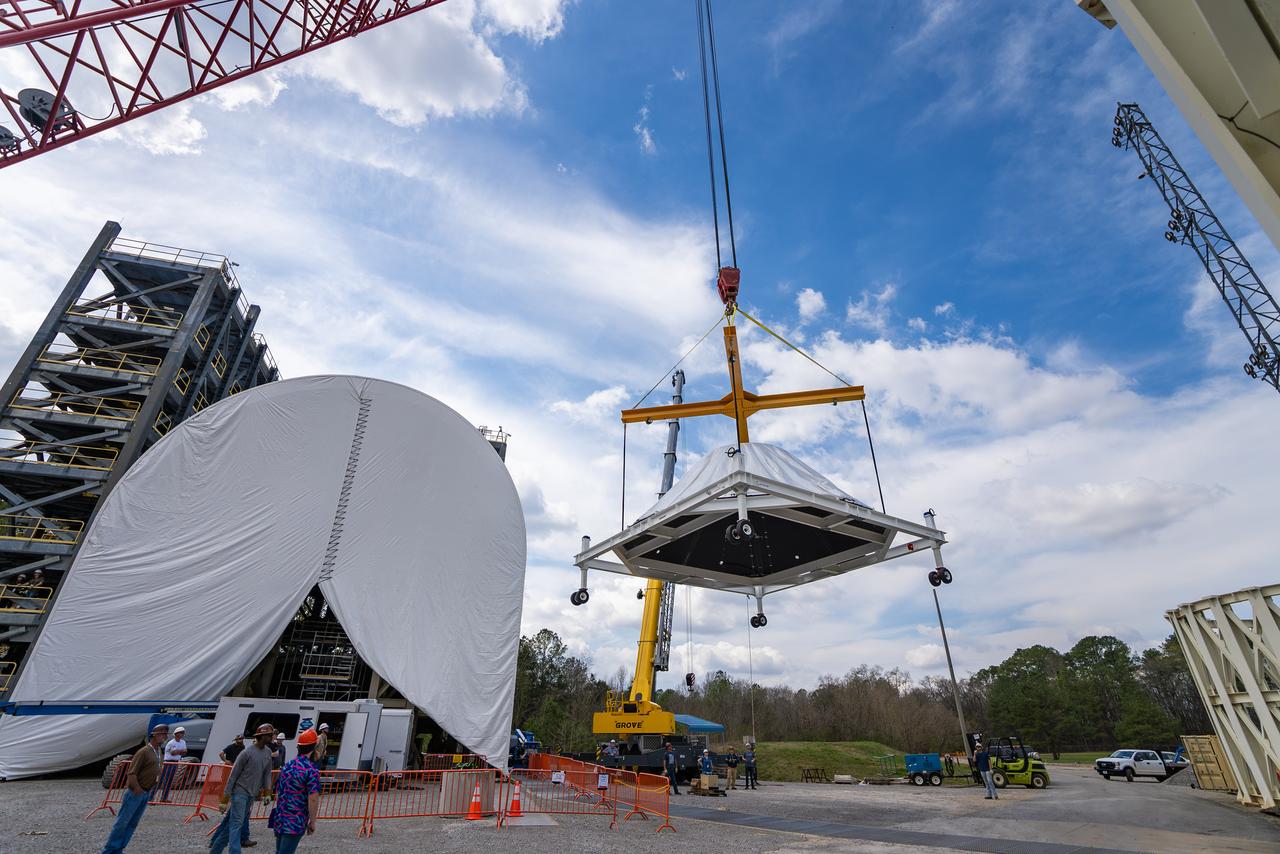
These photos and videos show how crews at NASA’s Marshall Space Flight Center in Huntsville, Alabama, moved and installed the payload adapter that will be used in the Block 1B configuration of the SLS (Space Launch System) rocket from Building 4708, where it was manufactured, into Structural Test Stand 4697 at NASA’s Marshall Space Flight Center on March 13. Teams at Marshall will begin structural testing the engineering development unit of the payload adapter – an exact replica of the flight version of the hardware – this spring. The cone-shaped payload adapter is about 8.5 feet tall and features two metal rings and eight composite panels. The adapter, which will debut on NASA’s Artemis IV mission, is an evolution from the Orion stage adapter used in the Block 1 configuration of the first three Artemis missions. It will be housed inside the universal stage adapter atop the rocket’s more powerful in-space stage, called the exploration upper stage. The payload adapter, like the launch vehicle stage adapter and the Orion stage adapter, is fully manufactured and tested at Marshall, which manages the SLS Program. NASA is working to land the first woman, first person of color, and its first international partner astronaut on the Moon under Artemis. SLS is part of NASA’s backbone for deep space exploration, along with the Orion spacecraft and Gateway in orbit around the Moon and commercial human landing systems, next-generational spacesuits, and rovers on the lunar surface. SLS is the only rocket that can send Orion, astronauts, and supplies to the Moon in a single launch.
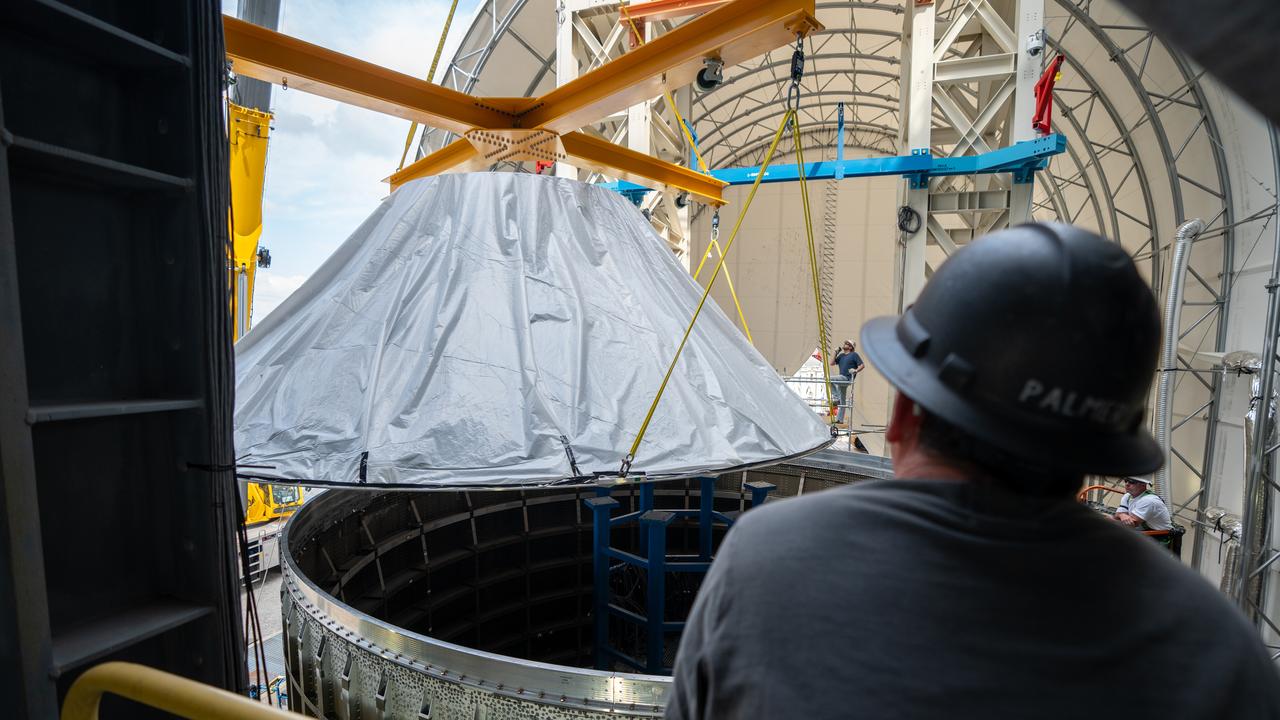
These photos and videos show how crews at NASA’s Marshall Space Flight Center in Huntsville, Alabama, moved and installed the payload adapter that will be used in the Block 1B configuration of the SLS (Space Launch System) rocket from Building 4708, where it was manufactured, into Structural Test Stand 4697 at NASA’s Marshall Space Flight Center on March 13. Teams at Marshall will begin structural testing the engineering development unit of the payload adapter – an exact replica of the flight version of the hardware – this spring. The cone-shaped payload adapter is about 8.5 feet tall and features two metal rings and eight composite panels. The adapter, which will debut on NASA’s Artemis IV mission, is an evolution from the Orion stage adapter used in the Block 1 configuration of the first three Artemis missions. It will be housed inside the universal stage adapter atop the rocket’s more powerful in-space stage, called the exploration upper stage. The payload adapter, like the launch vehicle stage adapter and the Orion stage adapter, is fully manufactured and tested at Marshall, which manages the SLS Program. NASA is working to land the first woman, first person of color, and its first international partner astronaut on the Moon under Artemis. SLS is part of NASA’s backbone for deep space exploration, along with the Orion spacecraft and Gateway in orbit around the Moon and commercial human landing systems, next-generational spacesuits, and rovers on the lunar surface. SLS is the only rocket that can send Orion, astronauts, and supplies to the Moon in a single launch.
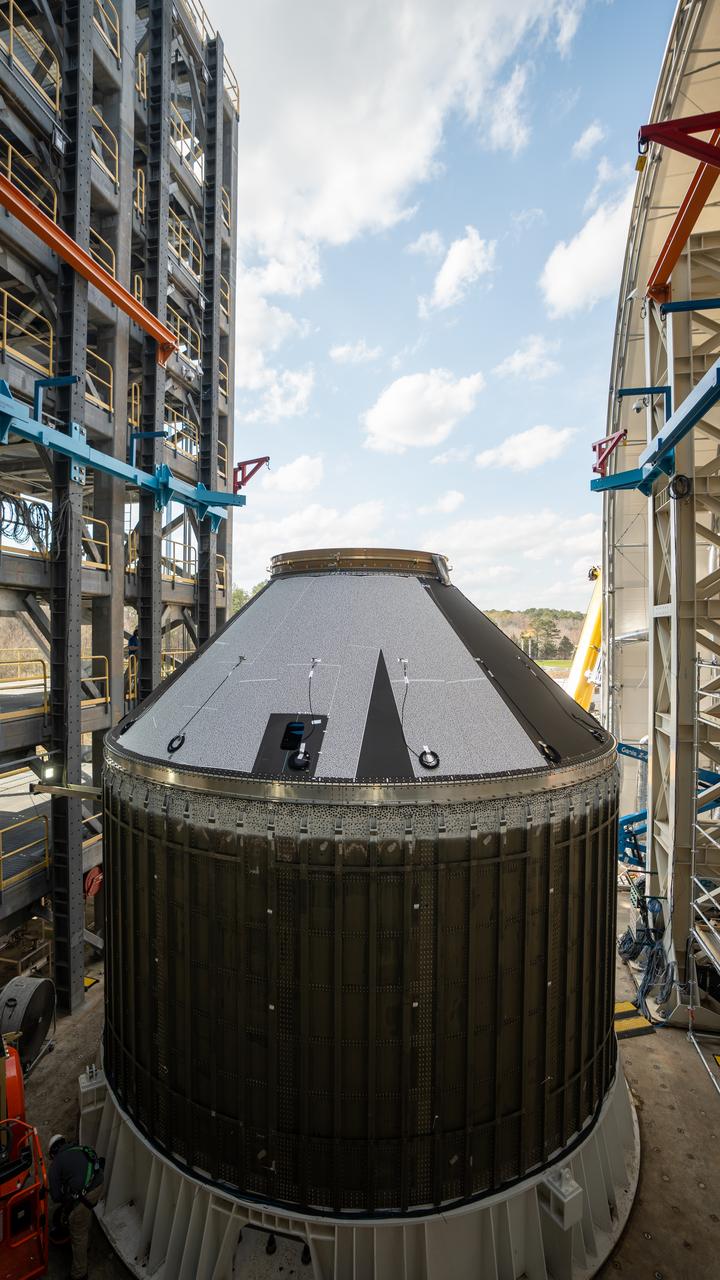
These photos and videos show how crews at NASA’s Marshall Space Flight Center in Huntsville, Alabama, moved and installed the payload adapter that will be used in the Block 1B configuration of the SLS (Space Launch System) rocket from Building 4708, where it was manufactured, into Structural Test Stand 4697 at NASA’s Marshall Space Flight Center on March 13. Teams at Marshall will begin structural testing the engineering development unit of the payload adapter – an exact replica of the flight version of the hardware – this spring. The cone-shaped payload adapter is about 8.5 feet tall and features two metal rings and eight composite panels. The adapter, which will debut on NASA’s Artemis IV mission, is an evolution from the Orion stage adapter used in the Block 1 configuration of the first three Artemis missions. It will be housed inside the universal stage adapter atop the rocket’s more powerful in-space stage, called the exploration upper stage. The payload adapter, like the launch vehicle stage adapter and the Orion stage adapter, is fully manufactured and tested at Marshall, which manages the SLS Program. NASA is working to land the first woman, first person of color, and its first international partner astronaut on the Moon under Artemis. SLS is part of NASA’s backbone for deep space exploration, along with the Orion spacecraft and Gateway in orbit around the Moon and commercial human landing systems, next-generational spacesuits, and rovers on the lunar surface. SLS is the only rocket that can send Orion, astronauts, and supplies to the Moon in a single launch.
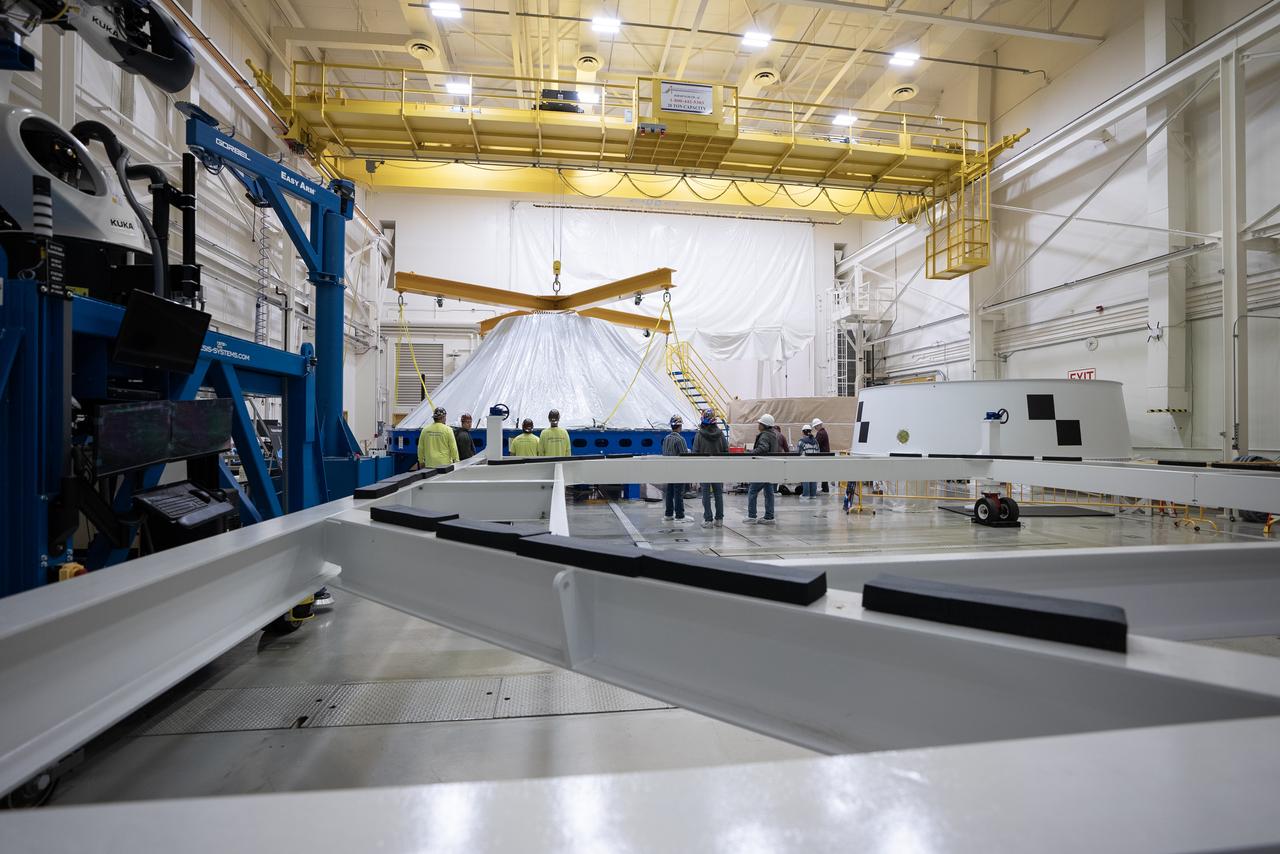
These photos and videos show how NASA manufactured and prepared to transport the payload adapter in February inside Building 4708 at NASA’s Marshall Space Flight Center in Huntsville, Alabama. Prior to moving the hardware for testing, teams installed the New Explorations Secondary Transport component, called the NEST, into the top of the engineering development unit. The NEST component will allow the hardware to hold a series of secondary payloads, or small satellites. The cone-shaped payload adapter is about 8.5 feet tall and features two metal rings and eight composite panels. The adapter, which will debut on NASA’s Artemis IV mission, is an evolution from the Orion stage adapter used in the Block 1 configuration of the rocket for the first three Artemis missions. It will be housed inside the universal stage adapter atop the rocket’s more powerful in-space stage, called the exploration upper stage. The payload adapter, like the launch vehicle stage adapter and the Orion stage adapter, is fully manufactured and tested at Marshall, which manages the SLS Program. NASA is working to land the first woman, first person of color, and its first international partner astronaut on the Moon under Artemis. SLS is part of NASA’s backbone for deep space exploration, along with the Orion spacecraft and Gateway in orbit around the Moon and commercial human landing systems, next-generational spacesuits, and rovers on the lunar surface. SLS is the only rocket that can send Orion, astronauts, and supplies to the Moon in a single launch.
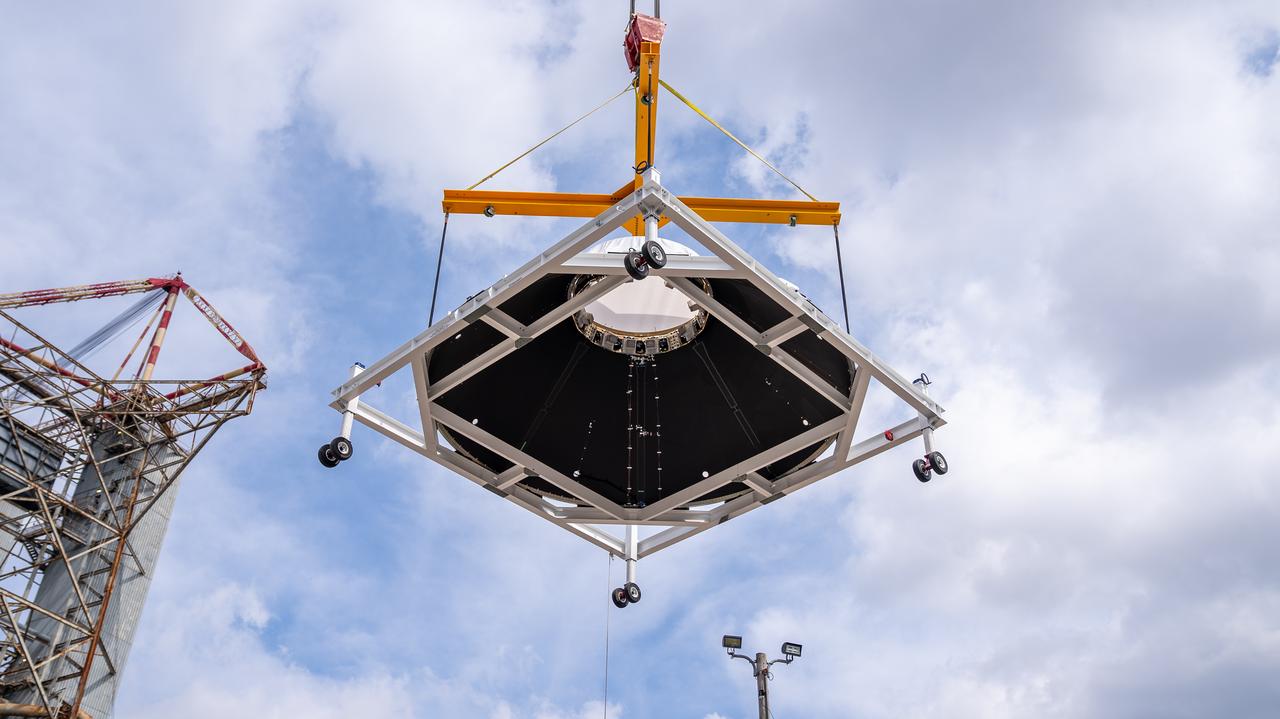
These photos and videos show how crews at NASA’s Marshall Space Flight Center in Huntsville, Alabama, moved and installed the payload adapter that will be used in the Block 1B configuration of the SLS (Space Launch System) rocket from Building 4708, where it was manufactured, into Structural Test Stand 4697 at NASA’s Marshall Space Flight Center on March 13. Teams at Marshall will begin structural testing the engineering development unit of the payload adapter – an exact replica of the flight version of the hardware – this spring. The cone-shaped payload adapter is about 8.5 feet tall and features two metal rings and eight composite panels. The adapter, which will debut on NASA’s Artemis IV mission, is an evolution from the Orion stage adapter used in the Block 1 configuration of the first three Artemis missions. It will be housed inside the universal stage adapter atop the rocket’s more powerful in-space stage, called the exploration upper stage. The payload adapter, like the launch vehicle stage adapter and the Orion stage adapter, is fully manufactured and tested at Marshall, which manages the SLS Program. NASA is working to land the first woman, first person of color, and its first international partner astronaut on the Moon under Artemis. SLS is part of NASA’s backbone for deep space exploration, along with the Orion spacecraft and Gateway in orbit around the Moon and commercial human landing systems, next-generational spacesuits, and rovers on the lunar surface. SLS is the only rocket that can send Orion, astronauts, and supplies to the Moon in a single launch.
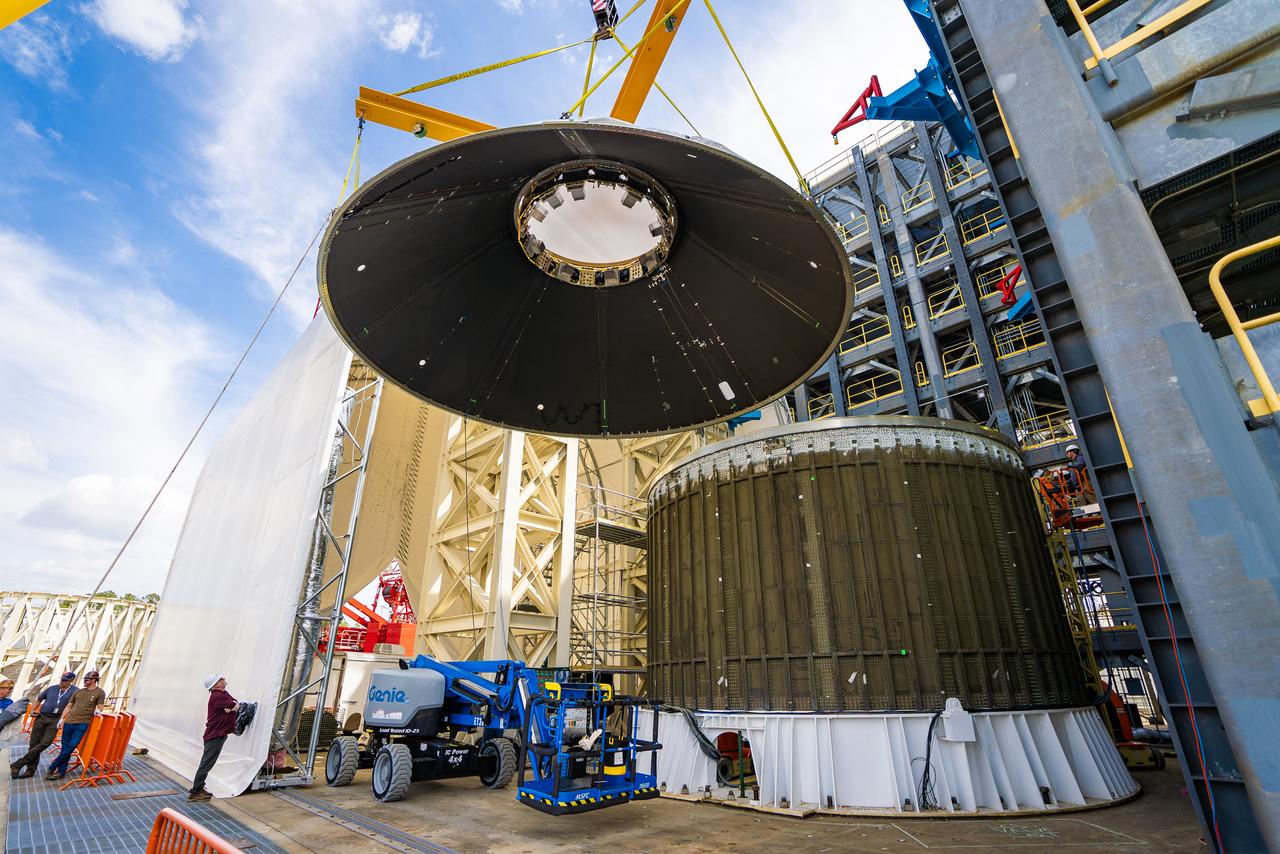
These photos and videos show how crews at NASA’s Marshall Space Flight Center in Huntsville, Alabama, moved and installed the payload adapter that will be used in the Block 1B configuration of the SLS (Space Launch System) rocket from Building 4708, where it was manufactured, into Structural Test Stand 4697 at NASA’s Marshall Space Flight Center on March 13. Teams at Marshall will begin structural testing the engineering development unit of the payload adapter – an exact replica of the flight version of the hardware – this spring. The cone-shaped payload adapter is about 8.5 feet tall and features two metal rings and eight composite panels. The adapter, which will debut on NASA’s Artemis IV mission, is an evolution from the Orion stage adapter used in the Block 1 configuration of the first three Artemis missions. It will be housed inside the universal stage adapter atop the rocket’s more powerful in-space stage, called the exploration upper stage. The payload adapter, like the launch vehicle stage adapter and the Orion stage adapter, is fully manufactured and tested at Marshall, which manages the SLS Program. NASA is working to land the first woman, first person of color, and its first international partner astronaut on the Moon under Artemis. SLS is part of NASA’s backbone for deep space exploration, along with the Orion spacecraft and Gateway in orbit around the Moon and commercial human landing systems, next-generational spacesuits, and rovers on the lunar surface. SLS is the only rocket that can send Orion, astronauts, and supplies to the Moon in a single launch.
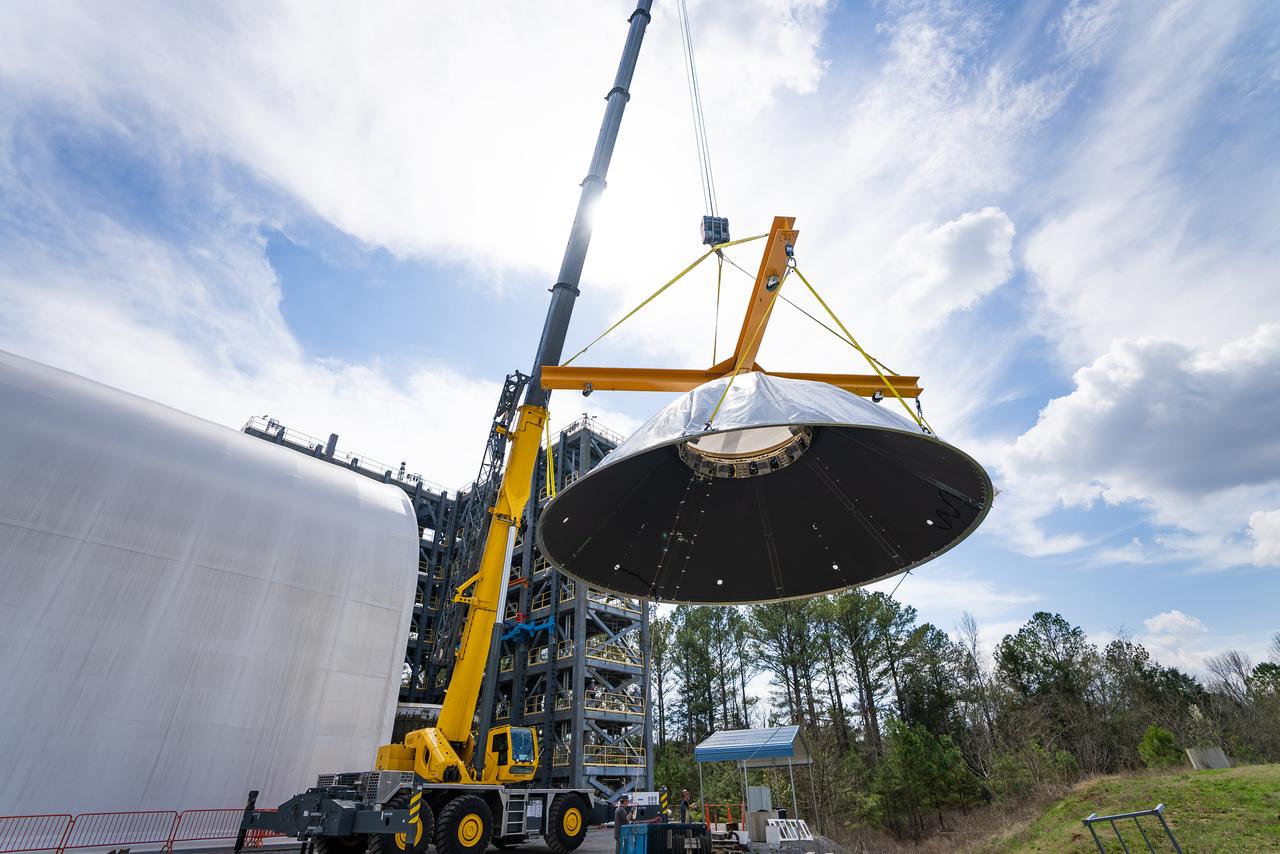
These photos and videos show how crews at NASA’s Marshall Space Flight Center in Huntsville, Alabama, moved and installed the payload adapter that will be used in the Block 1B configuration of the SLS (Space Launch System) rocket from Building 4708, where it was manufactured, into Structural Test Stand 4697 at NASA’s Marshall Space Flight Center on March 13. Teams at Marshall will begin structural testing the engineering development unit of the payload adapter – an exact replica of the flight version of the hardware – this spring. The cone-shaped payload adapter is about 8.5 feet tall and features two metal rings and eight composite panels. The adapter, which will debut on NASA’s Artemis IV mission, is an evolution from the Orion stage adapter used in the Block 1 configuration of the first three Artemis missions. It will be housed inside the universal stage adapter atop the rocket’s more powerful in-space stage, called the exploration upper stage. The payload adapter, like the launch vehicle stage adapter and the Orion stage adapter, is fully manufactured and tested at Marshall, which manages the SLS Program. NASA is working to land the first woman, first person of color, and its first international partner astronaut on the Moon under Artemis. SLS is part of NASA’s backbone for deep space exploration, along with the Orion spacecraft and Gateway in orbit around the Moon and commercial human landing systems, next-generational spacesuits, and rovers on the lunar surface. SLS is the only rocket that can send Orion, astronauts, and supplies to the Moon in a single launch.
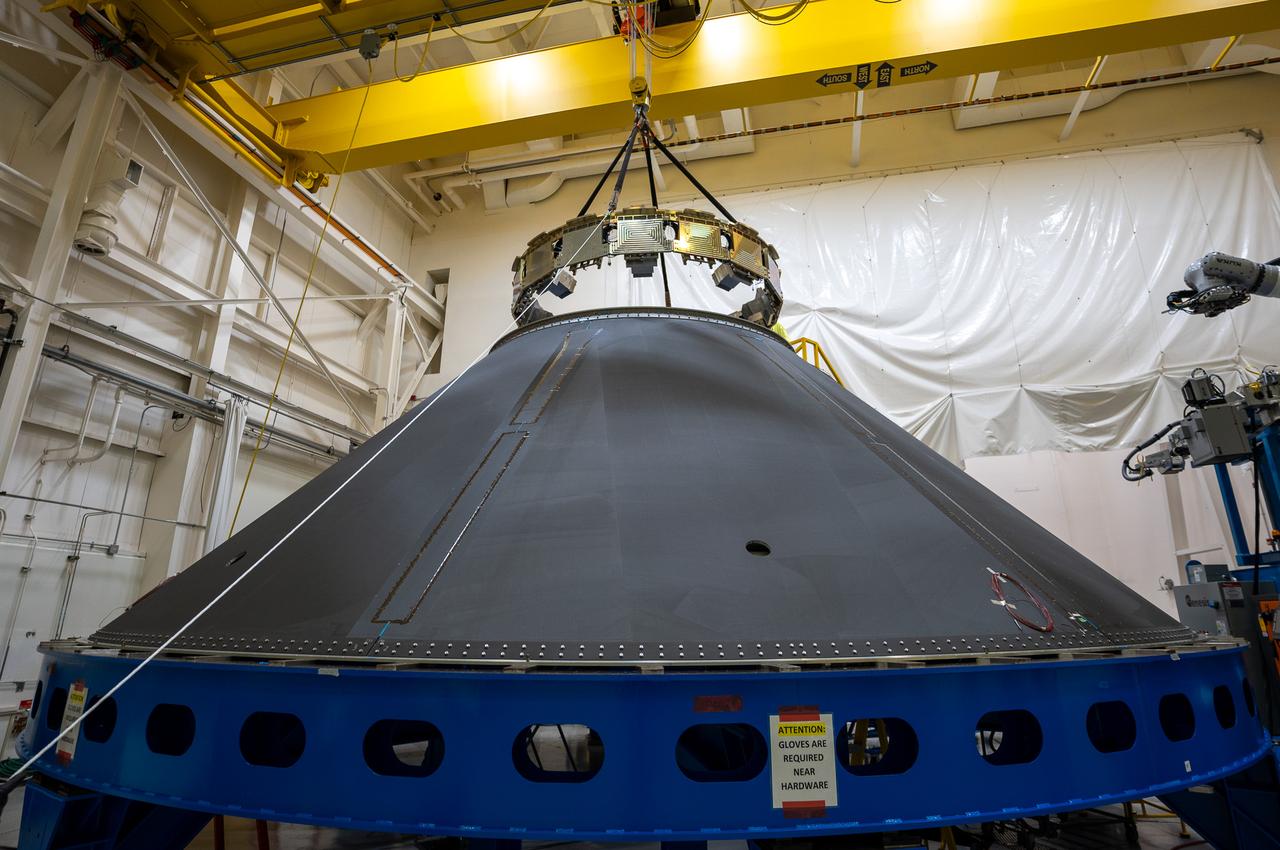
These photos and videos show how NASA manufactured and prepared to transport the payload adapter in February inside Building 4708 at NASA’s Marshall Space Flight Center in Huntsville, Alabama. Prior to moving the hardware for testing, teams installed the New Explorations Secondary Transport component, called the NEST, into the top of the engineering development unit. The NEST component will allow the hardware to hold a series of secondary payloads, or small satellites. The cone-shaped payload adapter is about 8.5 feet tall and features two metal rings and eight composite panels. The adapter, which will debut on NASA’s Artemis IV mission, is an evolution from the Orion stage adapter used in the Block 1 configuration of the rocket for the first three Artemis missions. It will be housed inside the universal stage adapter atop the rocket’s more powerful in-space stage, called the exploration upper stage. The payload adapter, like the launch vehicle stage adapter and the Orion stage adapter, is fully manufactured and tested at Marshall, which manages the SLS Program. NASA is working to land the first woman, first person of color, and its first international partner astronaut on the Moon under Artemis. SLS is part of NASA’s backbone for deep space exploration, along with the Orion spacecraft and Gateway in orbit around the Moon and commercial human landing systems, next-generational spacesuits, and rovers on the lunar surface. SLS is the only rocket that can send Orion, astronauts, and supplies to the Moon in a single launch.
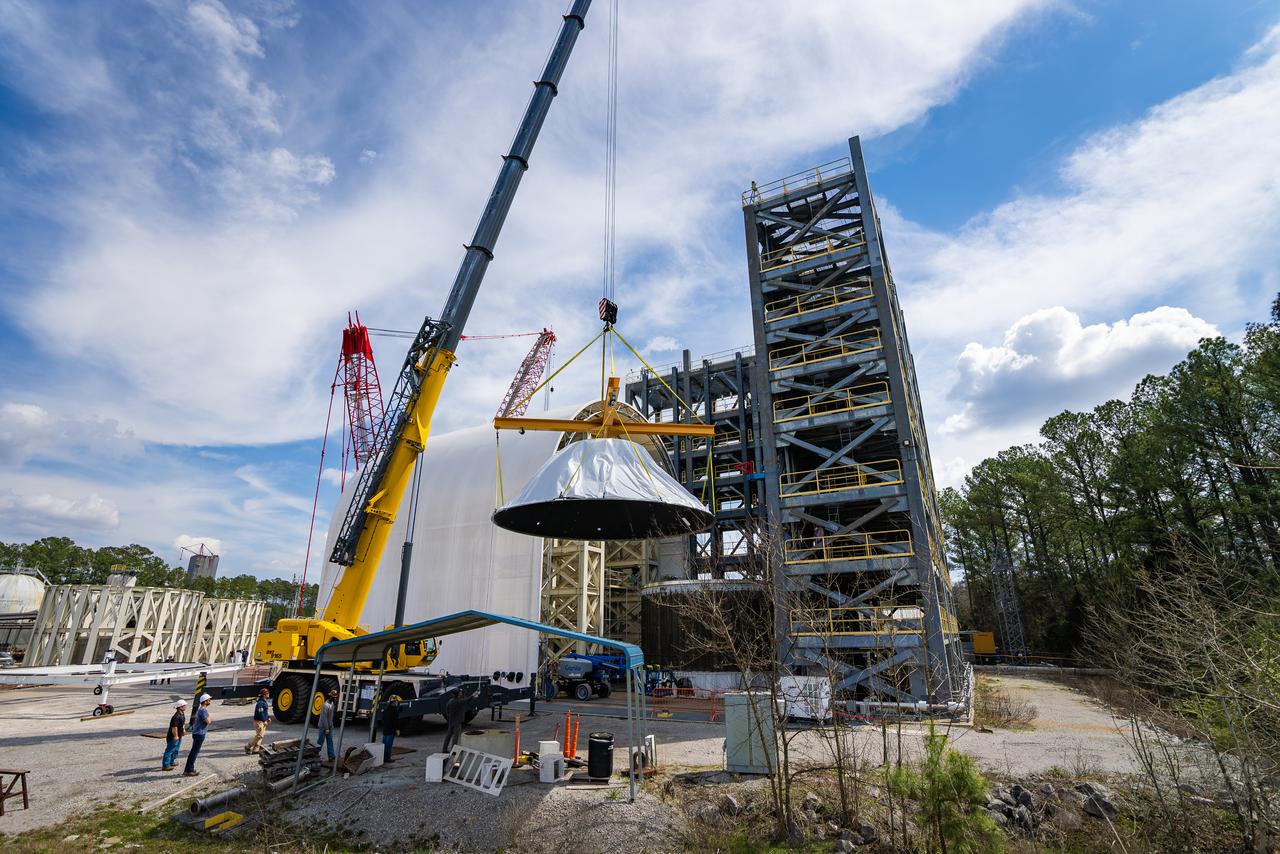
These photos and videos show how crews at NASA’s Marshall Space Flight Center in Huntsville, Alabama, moved and installed the payload adapter that will be used in the Block 1B configuration of the SLS (Space Launch System) rocket from Building 4708, where it was manufactured, into Structural Test Stand 4697 at NASA’s Marshall Space Flight Center on March 13. Teams at Marshall will begin structural testing the engineering development unit of the payload adapter – an exact replica of the flight version of the hardware – this spring. The cone-shaped payload adapter is about 8.5 feet tall and features two metal rings and eight composite panels. The adapter, which will debut on NASA’s Artemis IV mission, is an evolution from the Orion stage adapter used in the Block 1 configuration of the first three Artemis missions. It will be housed inside the universal stage adapter atop the rocket’s more powerful in-space stage, called the exploration upper stage. The payload adapter, like the launch vehicle stage adapter and the Orion stage adapter, is fully manufactured and tested at Marshall, which manages the SLS Program. NASA is working to land the first woman, first person of color, and its first international partner astronaut on the Moon under Artemis. SLS is part of NASA’s backbone for deep space exploration, along with the Orion spacecraft and Gateway in orbit around the Moon and commercial human landing systems, next-generational spacesuits, and rovers on the lunar surface. SLS is the only rocket that can send Orion, astronauts, and supplies to the Moon in a single launch.
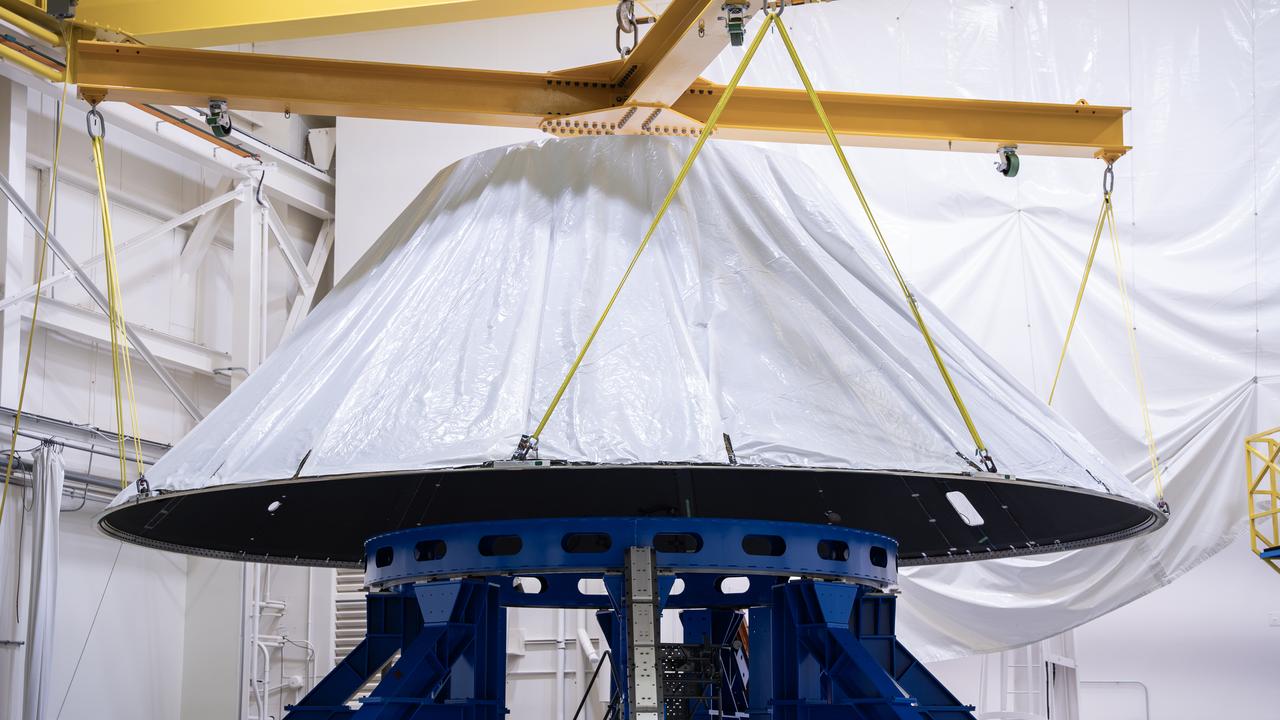
These photos and videos show how NASA manufactured and prepared to transport the payload adapter in February inside Building 4708 at NASA’s Marshall Space Flight Center in Huntsville, Alabama. Prior to moving the hardware for testing, teams installed the New Explorations Secondary Transport component, called the NEST, into the top of the engineering development unit. The NEST component will allow the hardware to hold a series of secondary payloads, or small satellites. The cone-shaped payload adapter is about 8.5 feet tall and features two metal rings and eight composite panels. The adapter, which will debut on NASA’s Artemis IV mission, is an evolution from the Orion stage adapter used in the Block 1 configuration of the rocket for the first three Artemis missions. It will be housed inside the universal stage adapter atop the rocket’s more powerful in-space stage, called the exploration upper stage. The payload adapter, like the launch vehicle stage adapter and the Orion stage adapter, is fully manufactured and tested at Marshall, which manages the SLS Program. NASA is working to land the first woman, first person of color, and its first international partner astronaut on the Moon under Artemis. SLS is part of NASA’s backbone for deep space exploration, along with the Orion spacecraft and Gateway in orbit around the Moon and commercial human landing systems, next-generational spacesuits, and rovers on the lunar surface. SLS is the only rocket that can send Orion, astronauts, and supplies to the Moon in a single launch.
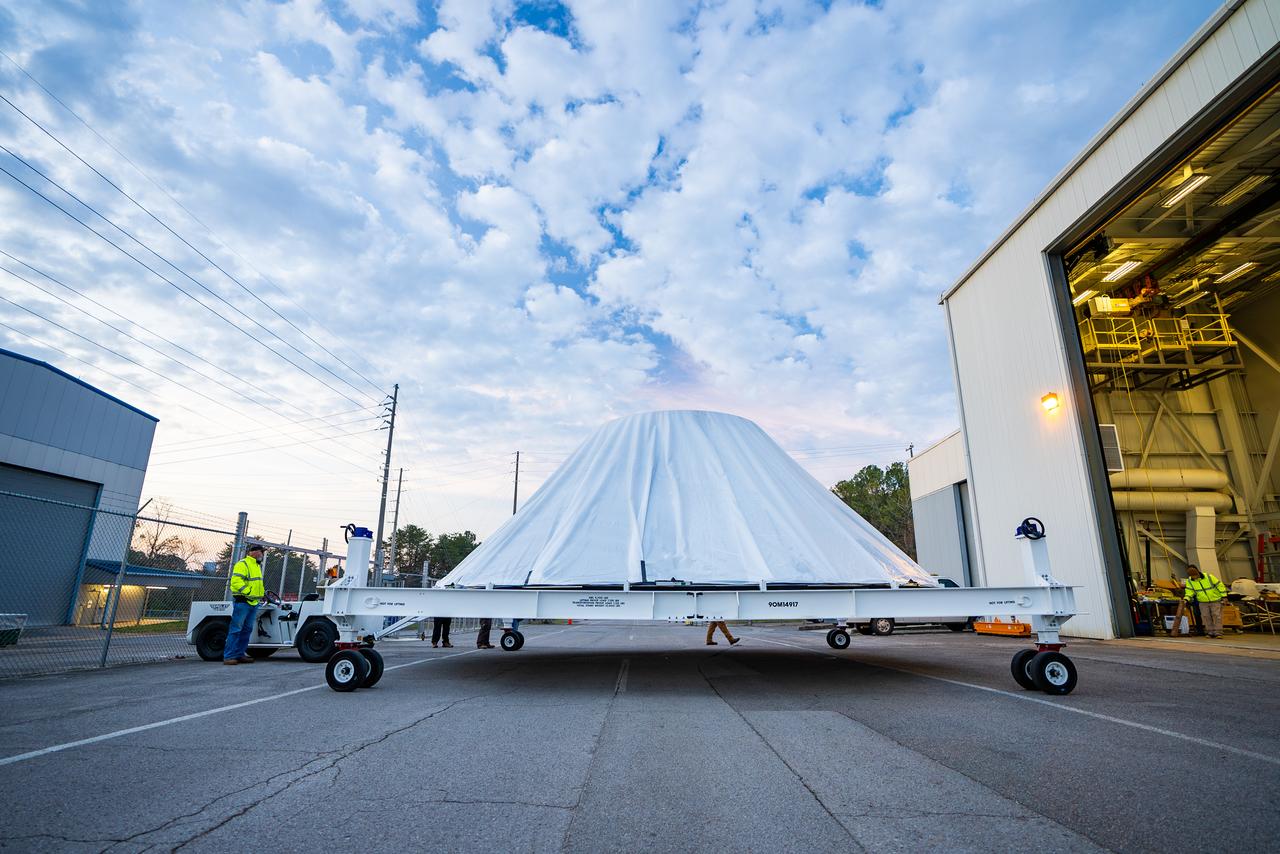
These photos and videos show how crews at NASA’s Marshall Space Flight Center in Huntsville, Alabama, moved and installed the payload adapter that will be used in the Block 1B configuration of the SLS (Space Launch System) rocket from Building 4708, where it was manufactured, into Structural Test Stand 4697 at NASA’s Marshall Space Flight Center on March 13. Teams at Marshall will begin structural testing the engineering development unit of the payload adapter – an exact replica of the flight version of the hardware – this spring. The cone-shaped payload adapter is about 8.5 feet tall and features two metal rings and eight composite panels. The adapter, which will debut on NASA’s Artemis IV mission, is an evolution from the Orion stage adapter used in the Block 1 configuration of the first three Artemis missions. It will be housed inside the universal stage adapter atop the rocket’s more powerful in-space stage, called the exploration upper stage. The payload adapter, like the launch vehicle stage adapter and the Orion stage adapter, is fully manufactured and tested at Marshall, which manages the SLS Program. NASA is working to land the first woman, first person of color, and its first international partner astronaut on the Moon under Artemis. SLS is part of NASA’s backbone for deep space exploration, along with the Orion spacecraft and Gateway in orbit around the Moon and commercial human landing systems, next-generational spacesuits, and rovers on the lunar surface. SLS is the only rocket that can send Orion, astronauts, and supplies to the Moon in a single launch.
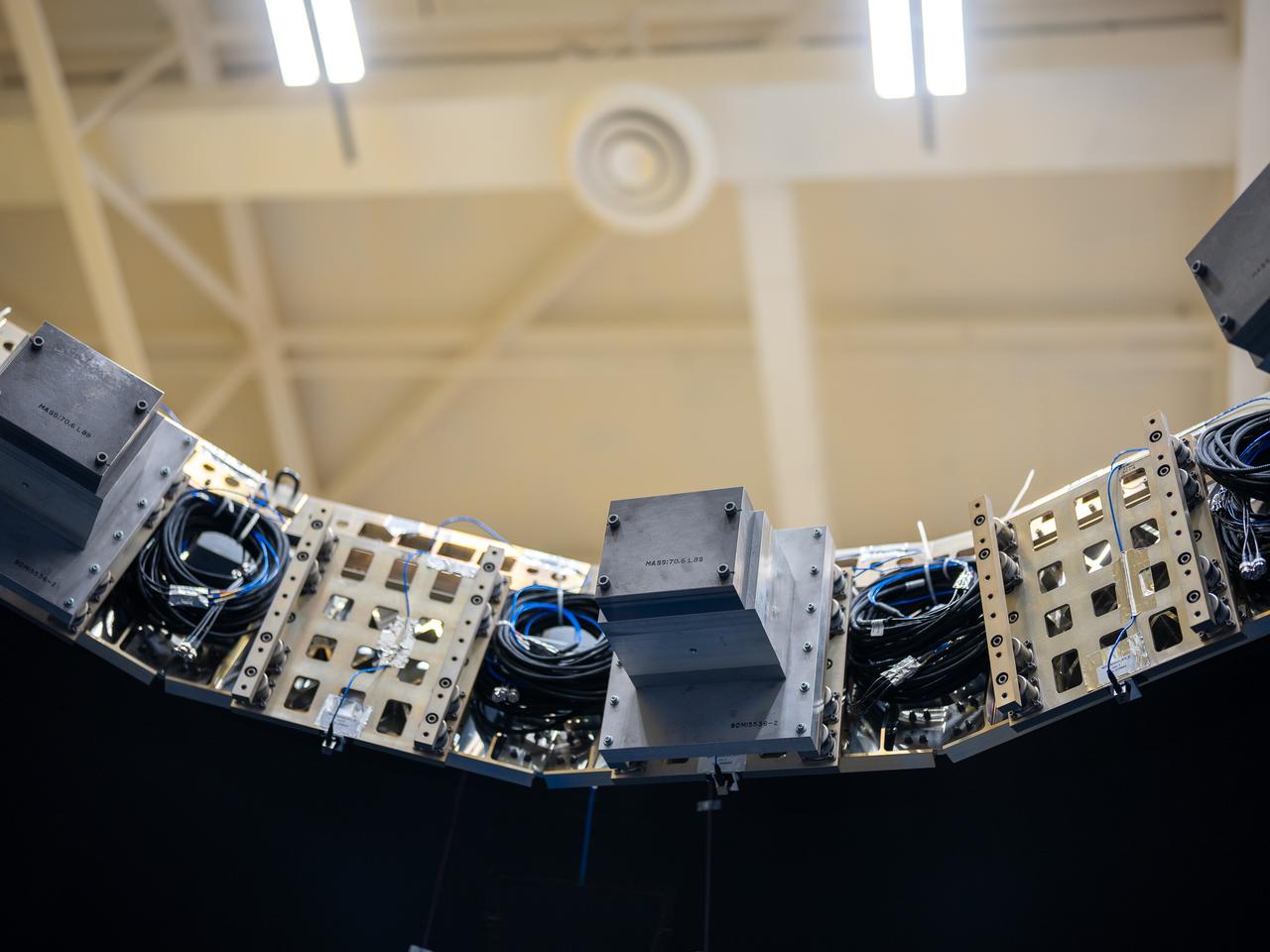
These photos and videos show how NASA manufactured and prepared to transport the payload adapter in February inside Building 4708 at NASA’s Marshall Space Flight Center in Huntsville, Alabama. Prior to moving the hardware for testing, teams installed the New Explorations Secondary Transport component, called the NEST, into the top of the engineering development unit. The NEST component will allow the hardware to hold a series of secondary payloads, or small satellites. The cone-shaped payload adapter is about 8.5 feet tall and features two metal rings and eight composite panels. The adapter, which will debut on NASA’s Artemis IV mission, is an evolution from the Orion stage adapter used in the Block 1 configuration of the rocket for the first three Artemis missions. It will be housed inside the universal stage adapter atop the rocket’s more powerful in-space stage, called the exploration upper stage. The payload adapter, like the launch vehicle stage adapter and the Orion stage adapter, is fully manufactured and tested at Marshall, which manages the SLS Program. NASA is working to land the first woman, first person of color, and its first international partner astronaut on the Moon under Artemis. SLS is part of NASA’s backbone for deep space exploration, along with the Orion spacecraft and Gateway in orbit around the Moon and commercial human landing systems, next-generational spacesuits, and rovers on the lunar surface. SLS is the only rocket that can send Orion, astronauts, and supplies to the Moon in a single launch.
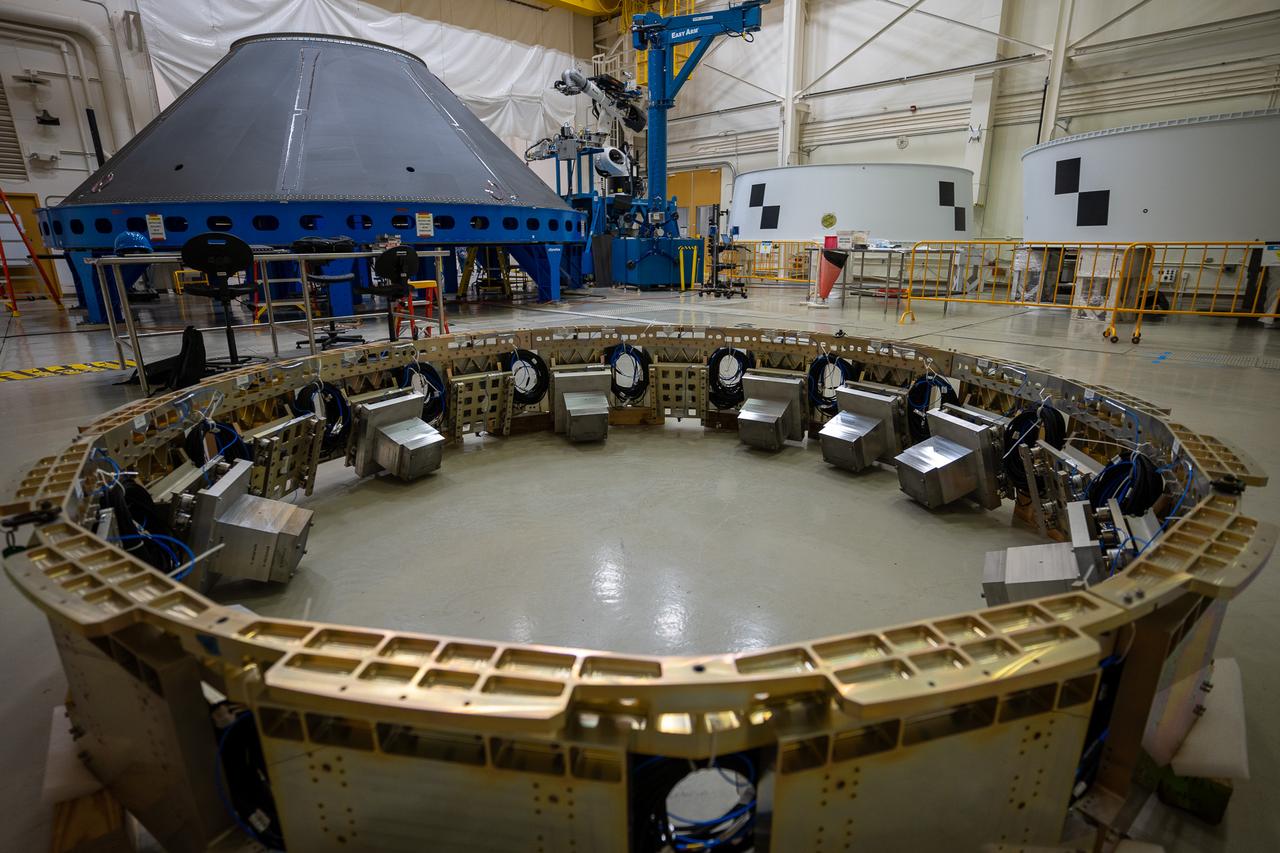
These photos and videos show how NASA manufactured and prepared to transport the payload adapter in February inside Building 4708 at NASA’s Marshall Space Flight Center in Huntsville, Alabama. Prior to moving the hardware for testing, teams installed the New Explorations Secondary Transport component, called the NEST, into the top of the engineering development unit. The NEST component will allow the hardware to hold a series of secondary payloads, or small satellites. The cone-shaped payload adapter is about 8.5 feet tall and features two metal rings and eight composite panels. The adapter, which will debut on NASA’s Artemis IV mission, is an evolution from the Orion stage adapter used in the Block 1 configuration of the rocket for the first three Artemis missions. It will be housed inside the universal stage adapter atop the rocket’s more powerful in-space stage, called the exploration upper stage. The payload adapter, like the launch vehicle stage adapter and the Orion stage adapter, is fully manufactured and tested at Marshall, which manages the SLS Program. NASA is working to land the first woman, first person of color, and its first international partner astronaut on the Moon under Artemis. SLS is part of NASA’s backbone for deep space exploration, along with the Orion spacecraft and Gateway in orbit around the Moon and commercial human landing systems, next-generational spacesuits, and rovers on the lunar surface. SLS is the only rocket that can send Orion, astronauts, and supplies to the Moon in a single launch.
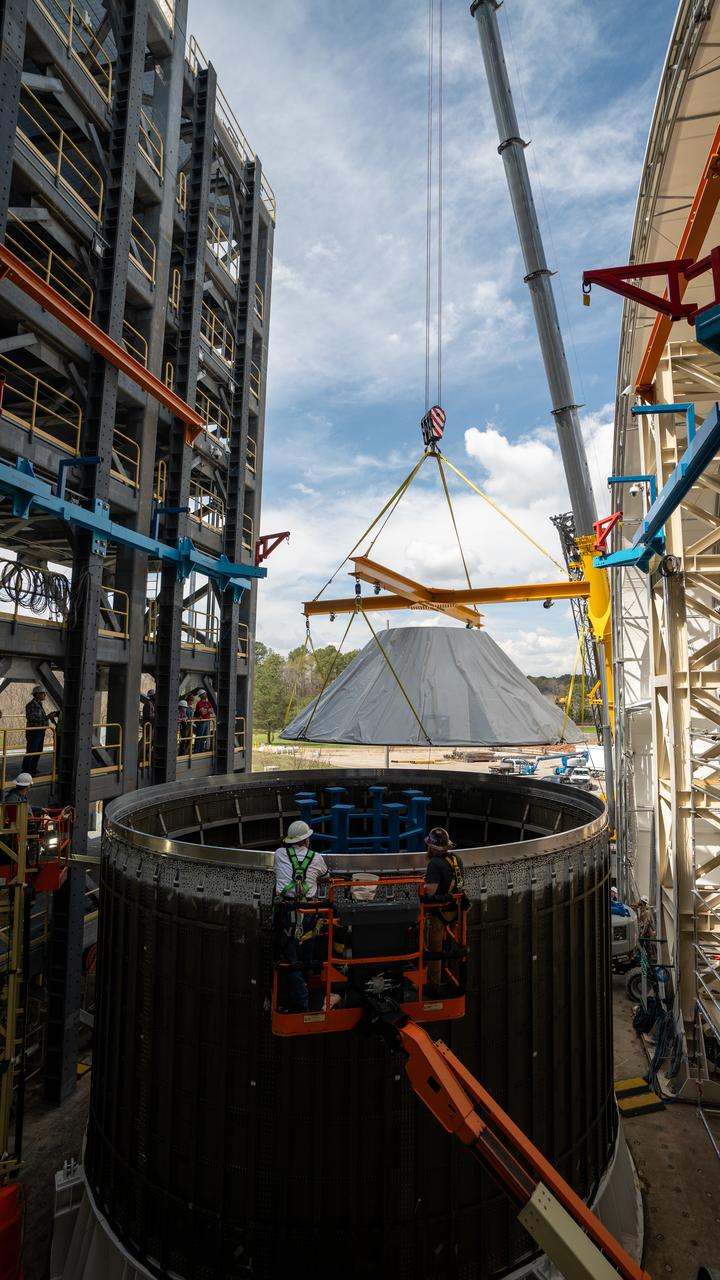
These photos and videos show how crews at NASA’s Marshall Space Flight Center in Huntsville, Alabama, moved and installed the payload adapter that will be used in the Block 1B configuration of the SLS (Space Launch System) rocket from Building 4708, where it was manufactured, into Structural Test Stand 4697 at NASA’s Marshall Space Flight Center on March 13. Teams at Marshall will begin structural testing the engineering development unit of the payload adapter – an exact replica of the flight version of the hardware – this spring. The cone-shaped payload adapter is about 8.5 feet tall and features two metal rings and eight composite panels. The adapter, which will debut on NASA’s Artemis IV mission, is an evolution from the Orion stage adapter used in the Block 1 configuration of the first three Artemis missions. It will be housed inside the universal stage adapter atop the rocket’s more powerful in-space stage, called the exploration upper stage. The payload adapter, like the launch vehicle stage adapter and the Orion stage adapter, is fully manufactured and tested at Marshall, which manages the SLS Program. NASA is working to land the first woman, first person of color, and its first international partner astronaut on the Moon under Artemis. SLS is part of NASA’s backbone for deep space exploration, along with the Orion spacecraft and Gateway in orbit around the Moon and commercial human landing systems, next-generational spacesuits, and rovers on the lunar surface. SLS is the only rocket that can send Orion, astronauts, and supplies to the Moon in a single launch.