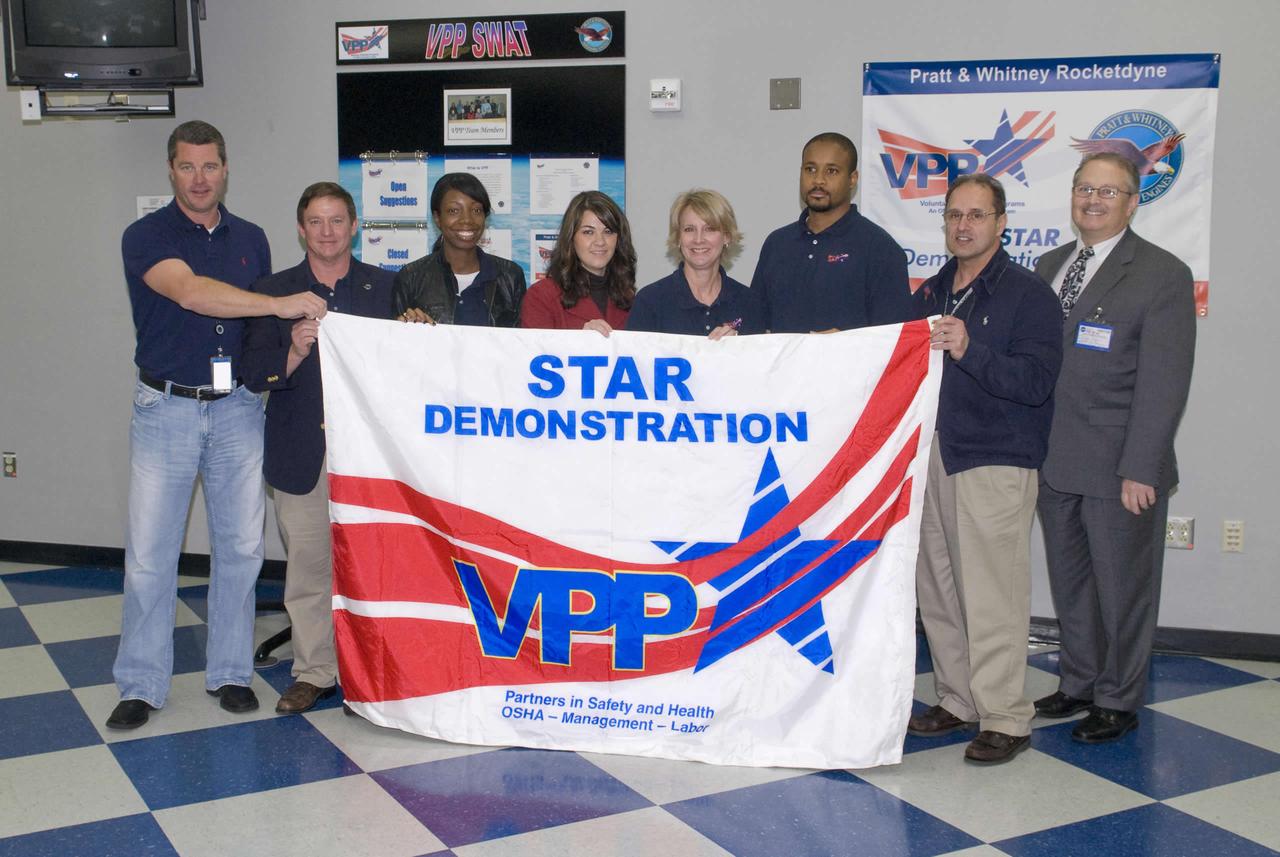
Pratt and Whitney Rocketdyne at NASA's John C. Space Center was presented its Voluntary Protection Programs (VPP) Star Demonstration banner by the Occupational Safety and Health administration (OSHA) during a Dec. 8 ceremony. Pratt Whitney Rocketdyne VPP Safe Working Action Team members Alan Howe (l to r), Mike McDaniel, April Page, Nyla Trumbach, Donna Pullman, Gary Simpson and Frank Pellegrino received the VPP Star Demonstration flag from OSHA Area Director Clyde Payne (right). OSHA established VPP in 1982 as a proactive safety management model so organizations and their employees could be recognized for excellence in safety and health.
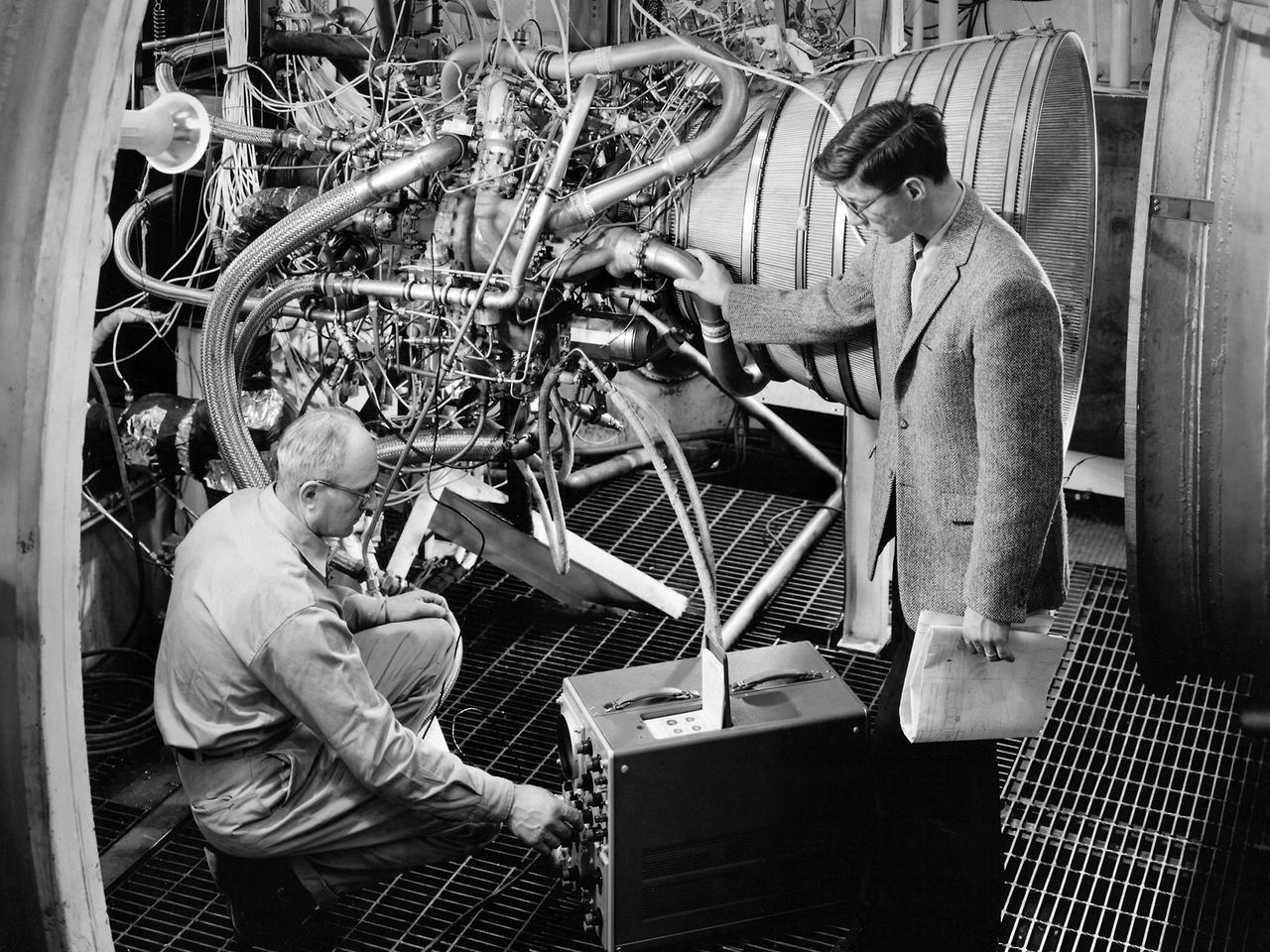
Lead Test Engineer John Kobak (right) and a technician use an oscilloscope to test the installation of a Pratt and Whitney RL-10 engine in the Propulsion Systems Laboratory at the National Aeronautics and Space Administration (NASA) Lewis Research Center. In 1955 the military asked Pratt and Whitney to develop hydrogen engines specifically for aircraft. The program was canceled in 1958, but Pratt and Whitney decided to use the experience to develop a liquid-hydrogen rocket engine, the RL-10. Two of the 15,000-pound-thrust RL-10 engines were used to power the new Centaur second-stage rocket. Centaur was designed to carry the Surveyor spacecraft on its mission to soft-land on the Moon. Pratt and Whitney ran into problems while testing the RL-10 at their facilities. NASA Headquarters assigned Lewis the responsibility for investigating the RL-10 problems because of the center’s long history of liquid-hydrogen development. Lewis’ Chemical Rocket Division began a series of tests to study the RL-10 at its Propulsion Systems Laboratory in March 1960. The facility contained two test chambers that could study powerful engines in simulated altitude conditions. The first series of RL-10 tests in early 1961 involved gimballing the engine as it fired. Lewis researchers were able to yaw and pitch the engine to simulate its behavior during a real flight.
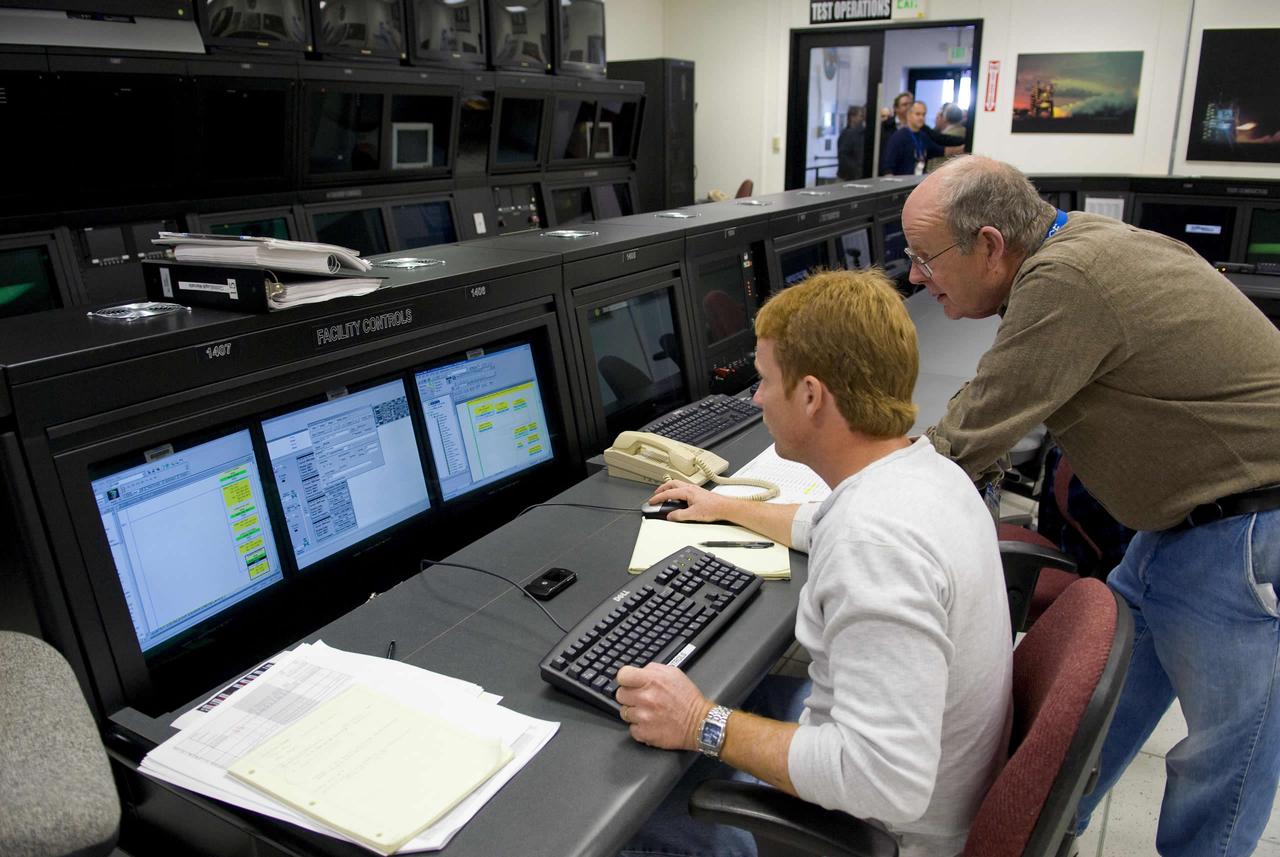
Eric Vanderklis (left) and Dave McConnell, both of Pratt & Whitney Rocketdyne, monitor system controls at the A Complex Test Control Center.
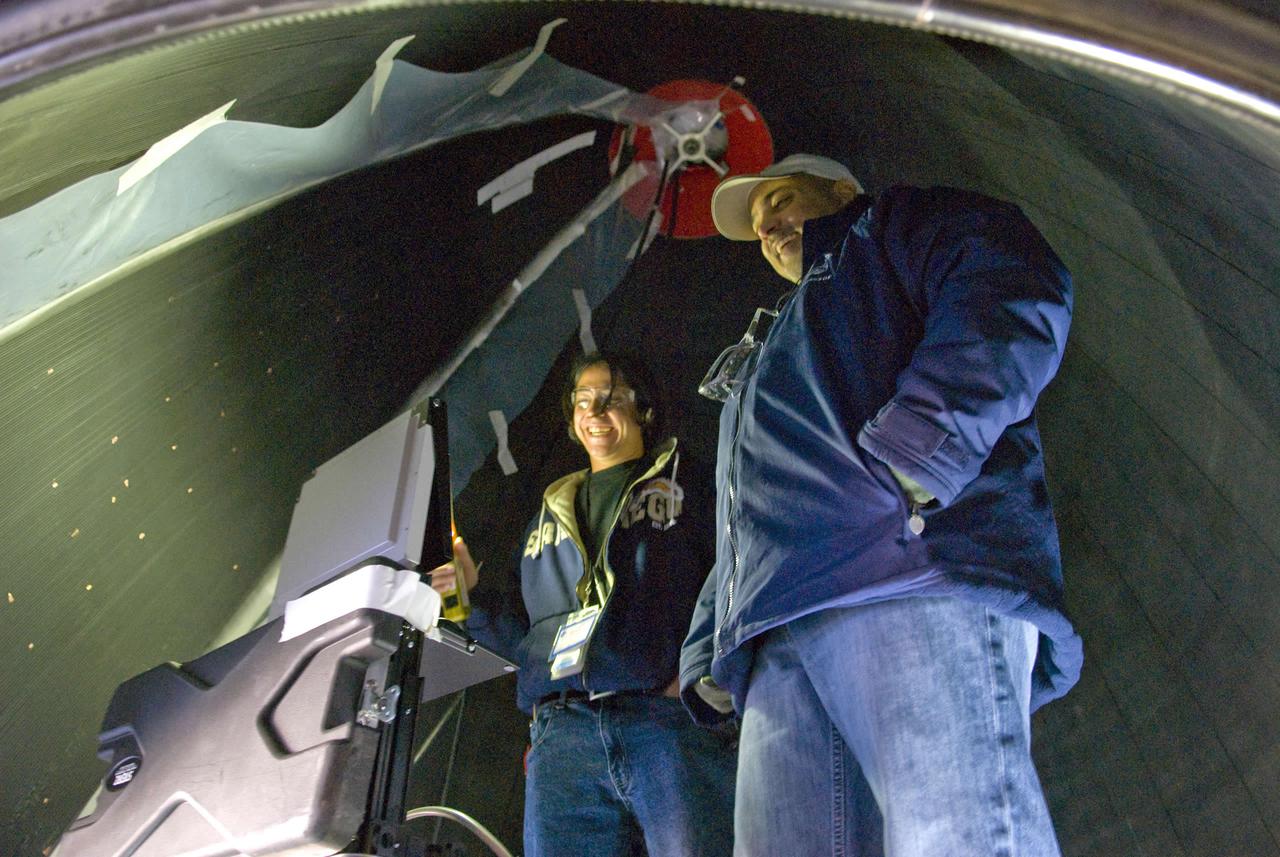
Joel Perez (left) and Jay Labat, both of Pratt & Whitney Rocketdyne, are in close quarters as they check for leaks inside the nozzle of a space shuttle main engine mounted on the A-2 Test Stand.
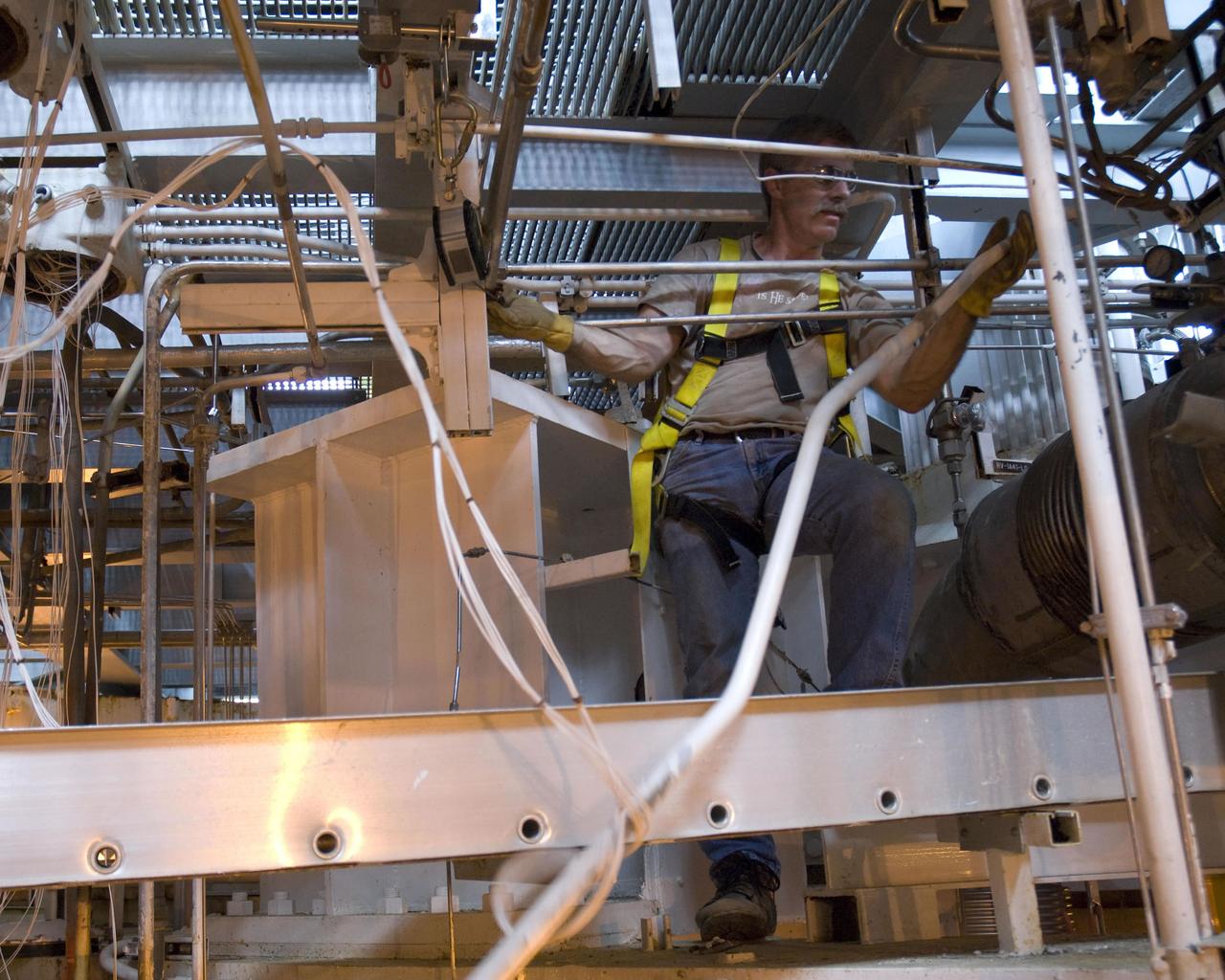
Phil Schemanski of Pratt & Whitney Rocketdyne removes equipment inside the thrust drum on the A-1 Test Stand as part of a comprehensive modification project to prepare for testing the new J-2X engine.
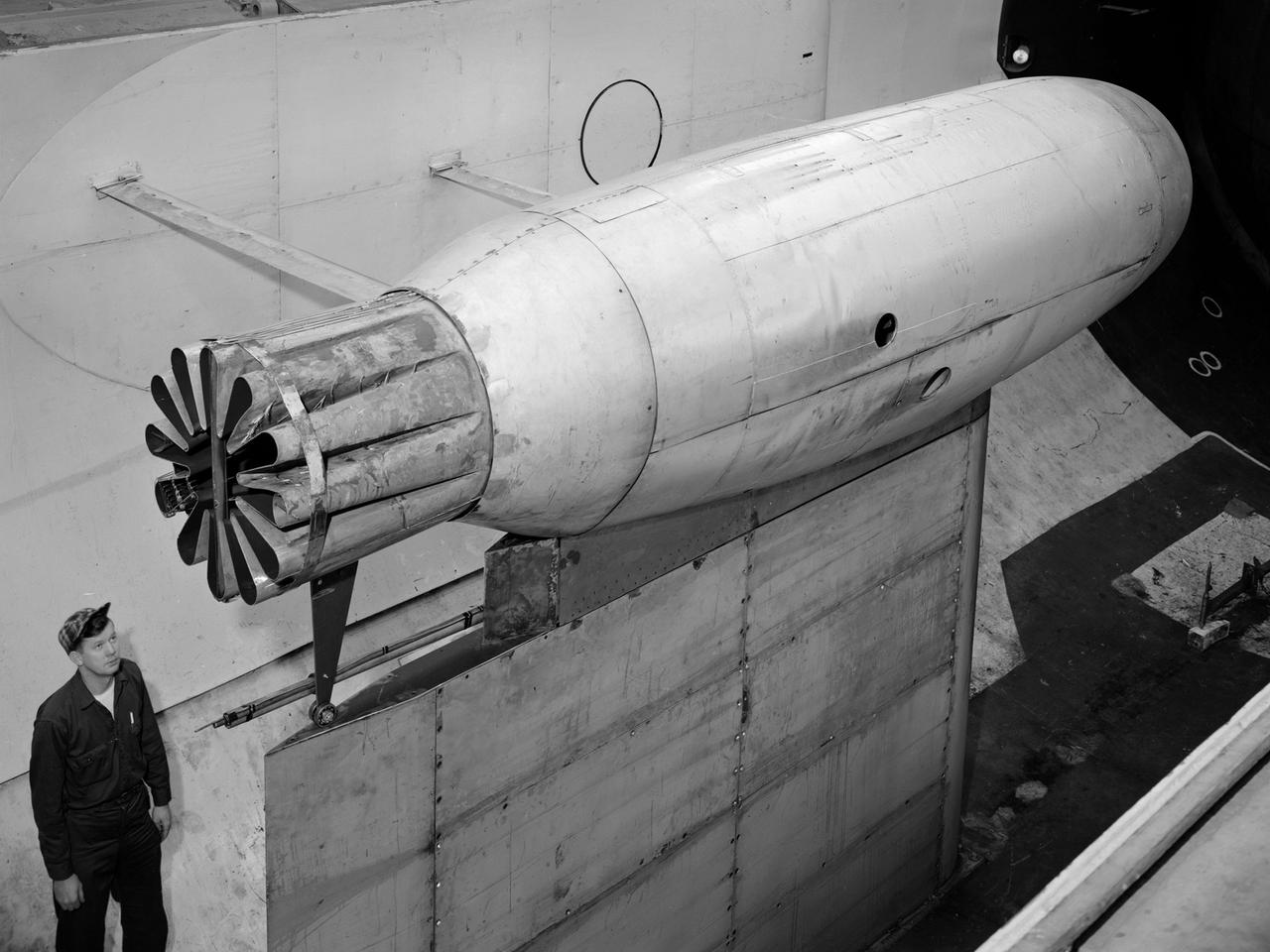
A Pratt and Whitney J57 engine is tested with a Greatex No.1 nozzle in the Altitude Wind Tunnel at the National Advisory Committee for Aeronautics (NACA) Lewis Flight Propulsion Laboratory. At the time the aircraft industry was preparing to introduce jet airliners to the nation’s airways. The noise produced by the large jet engines, however, posed a considerable problem for communities near airports. The NACA had formed a Special Subcommittee on Aircraft Noise to coordinate research on the issue. Preliminary tests showed that the source of the loudest noise was not the engine itself, but the mixing of the engine’s exhaust with the surrounding air in the atmosphere. The pressures resulting from this turbulence produced sound waves. Lewis researchers undertook a variety of noise-reduction studies involving engine design, throttling procedures, and noise suppressors. One of their first efforts focused on new types of nozzles to mix the exhaust with the surrounding air. The nozzles had a variety of shapes designed to slow down exhaust velocity before it combined with the air and thus decrease the noise. From January to May 1957 a Pratt and Whitney J57 engine was equipped with various shaped nozzles, as seen in this photograph, and run in simulated flight conditions in the Altitude Wind Tunnel. A number of nozzle configurations, including several multi-exit “organ pipe” designs, were created. It was found that the various nozzle types did reduce the noise levels, but they also reduced the aircraft’s thrust.
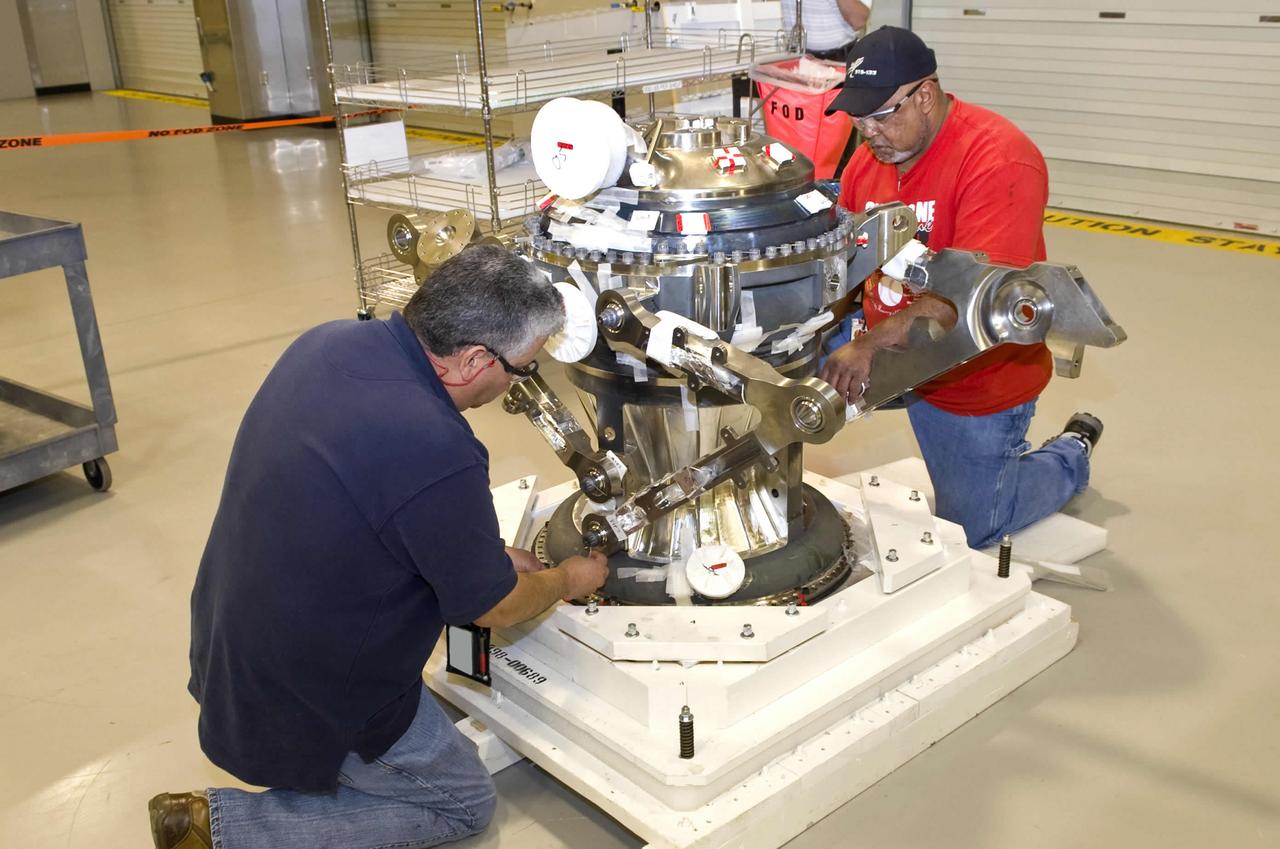
Pratt & Whitney Rocketdyne employees Carlos Alfaro (l) and Oliver Swanier work on the main combustion element of the J-2X rocket engine at their John C. Stennis Space Center facility. Assembly of the J-2X rocket engine to be tested at the site is under way, with completion and delivery to the A-2 Test Stand set for June. The J-2X is being developed as a next-generation engine that can carry humans into deep space. Stennis Space Center is preparing a trio of stands to test the new engine.
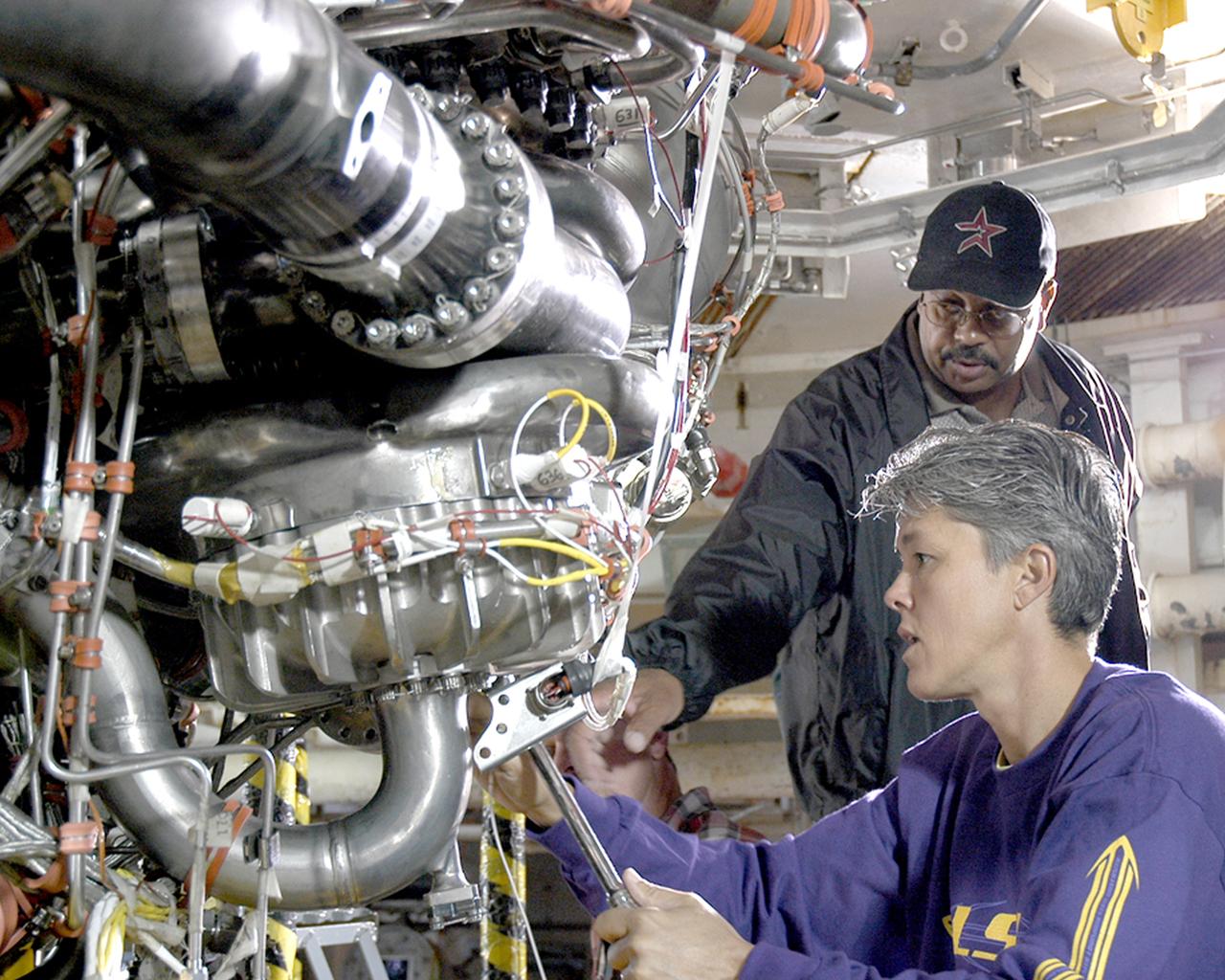
Alvin Pittman Sr., lead electronics technician with Pratt & Whitney Rocketdyne, and Janine Cuevas, a mechanical technician with PWR, perform final preparations on the space shuttle main engine tested Oct. 25, 2005, at NASA's Stennis Space Center. It was the first main engine test since Hurricane Katrina hit the Gulf Coast on Aug. 29.
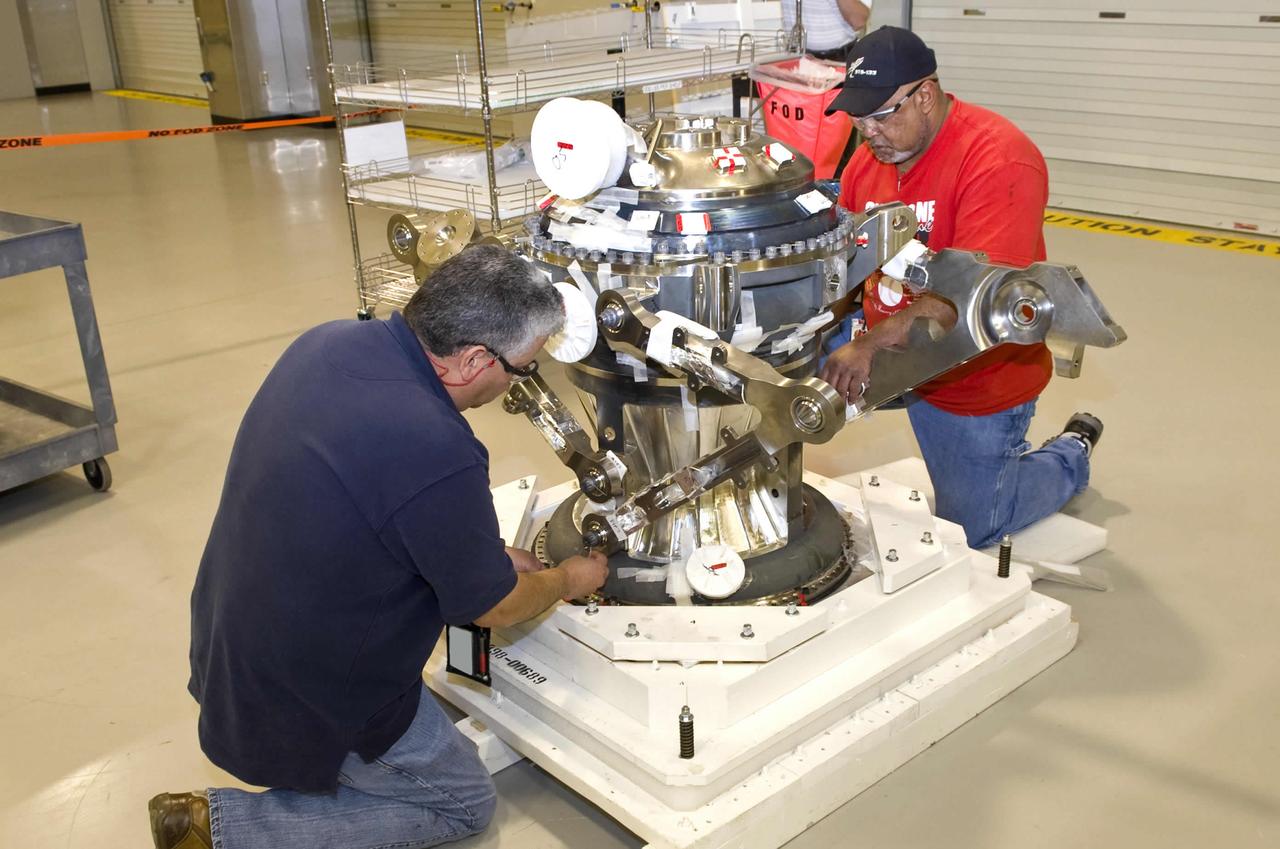
Pratt & Whitney Rocketdyne employees Carlos Alfaro (l) and Oliver Swanier work on the main combustion element of the J-2X rocket engine at their John C. Stennis Space Center facility. Assembly of the J-2X rocket engine to be tested at the site is under way, with completion and delivery to the A-2 Test Stand set for June. The J-2X is being developed as a next-generation engine that can carry humans into deep space. Stennis Space Center is preparing a trio of stands to test the new engine.
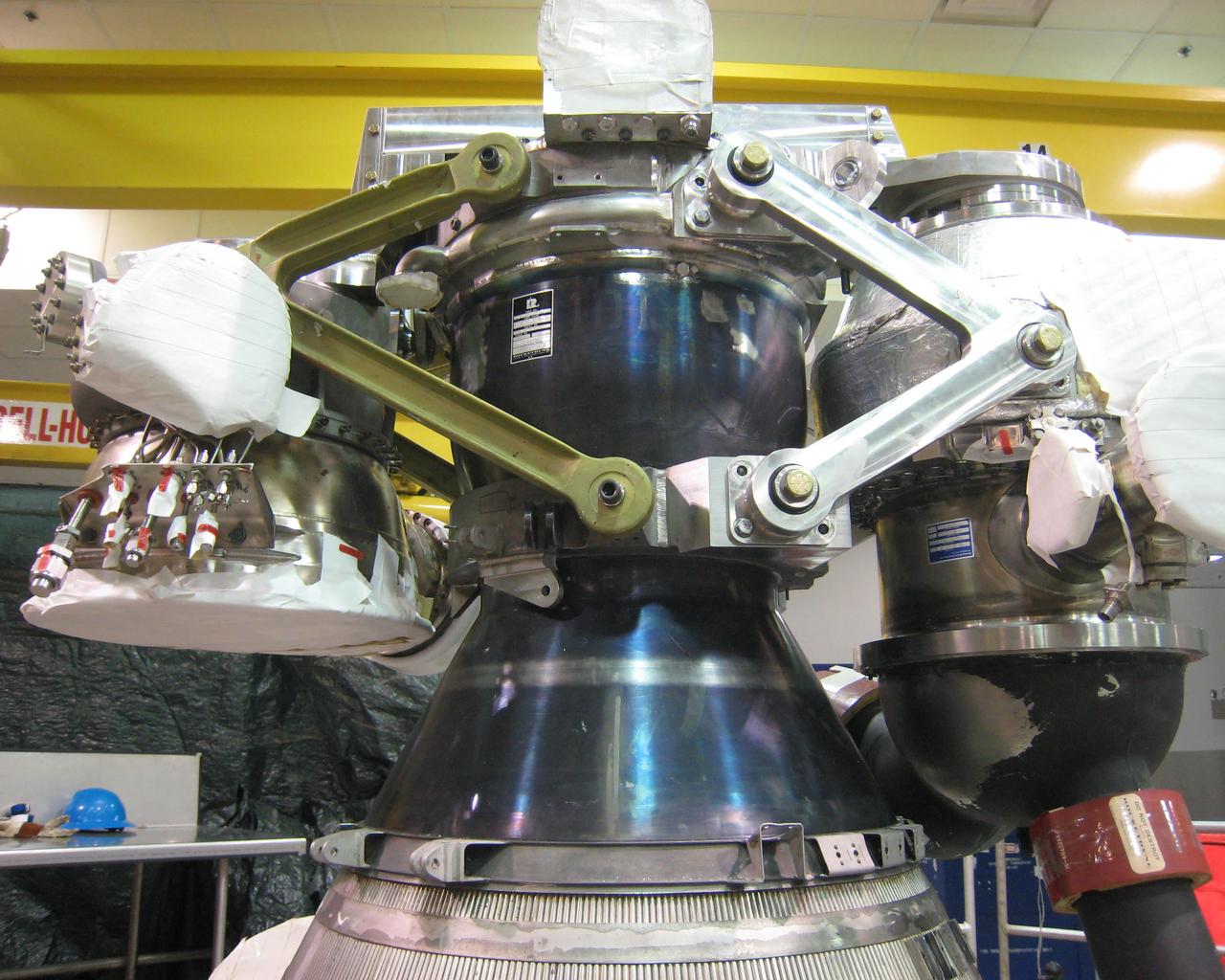
A vintage 1960 J-2 thrust chamber is fitted with brackets and pumps recently at the Pratt & Whitney Rocketdyne assembly facility in Stennis Space Center's Building 9101. Together, the parts comprise the J-2X Powerpack 1A test article. Mississippi Space Services machined the new bracket (the V-shaped arm on the right), making this the first time parts for an engine test article were machined, welded and assembled on site at SSC.
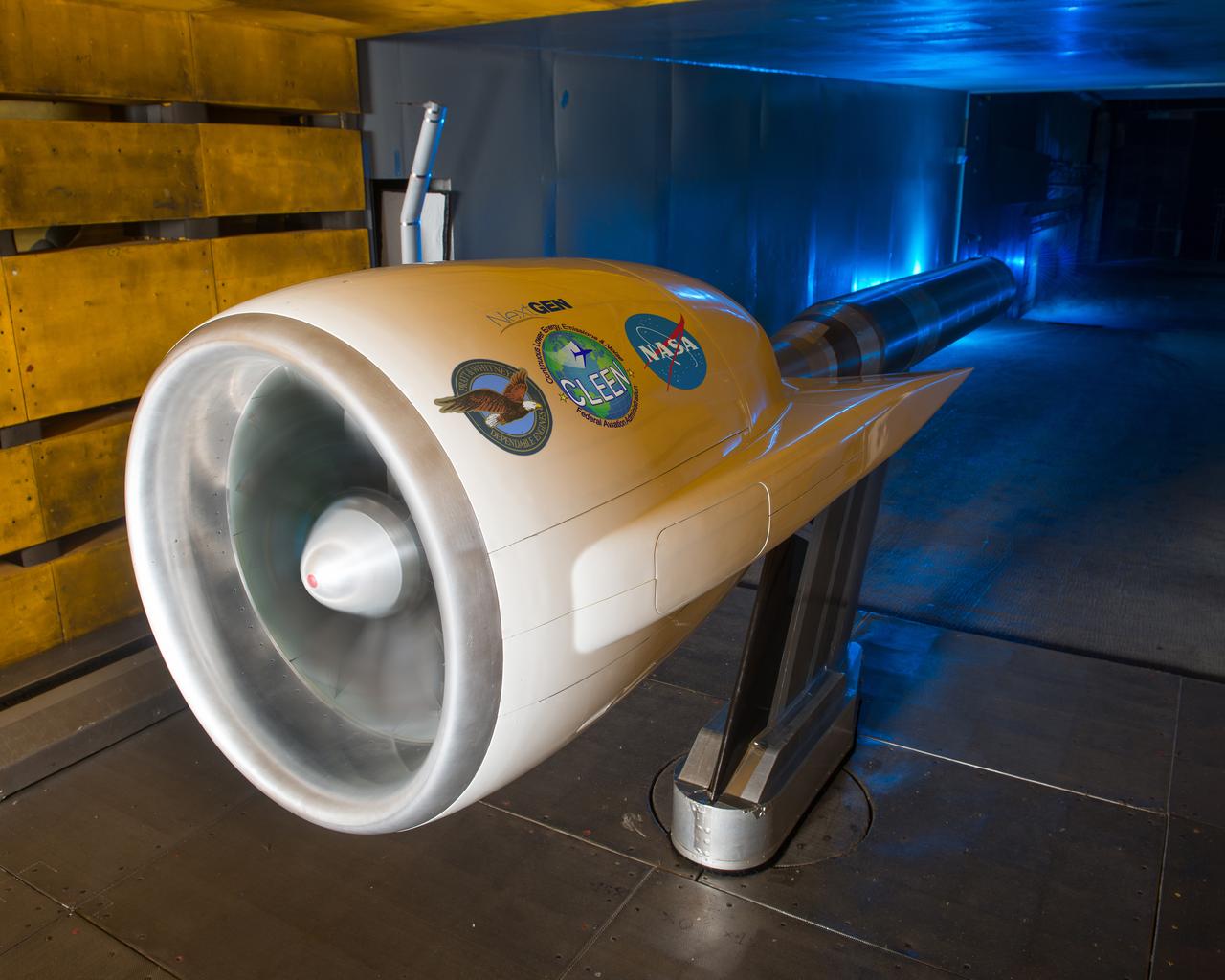
Ultra High Bypass Integrated System Test Testing of an Ultra High Bypass Ratio Turbofan model in the 9-by 15-Foot Low Speed Wind Tunnel. Pratt & Whitney designed the experimental engine to meet new efficiency and noise reduction targets for commercial aircraft set by NASA and the Federal Aviation Administration. The 9-by 15 tests analyzed two noise reduction technologies.
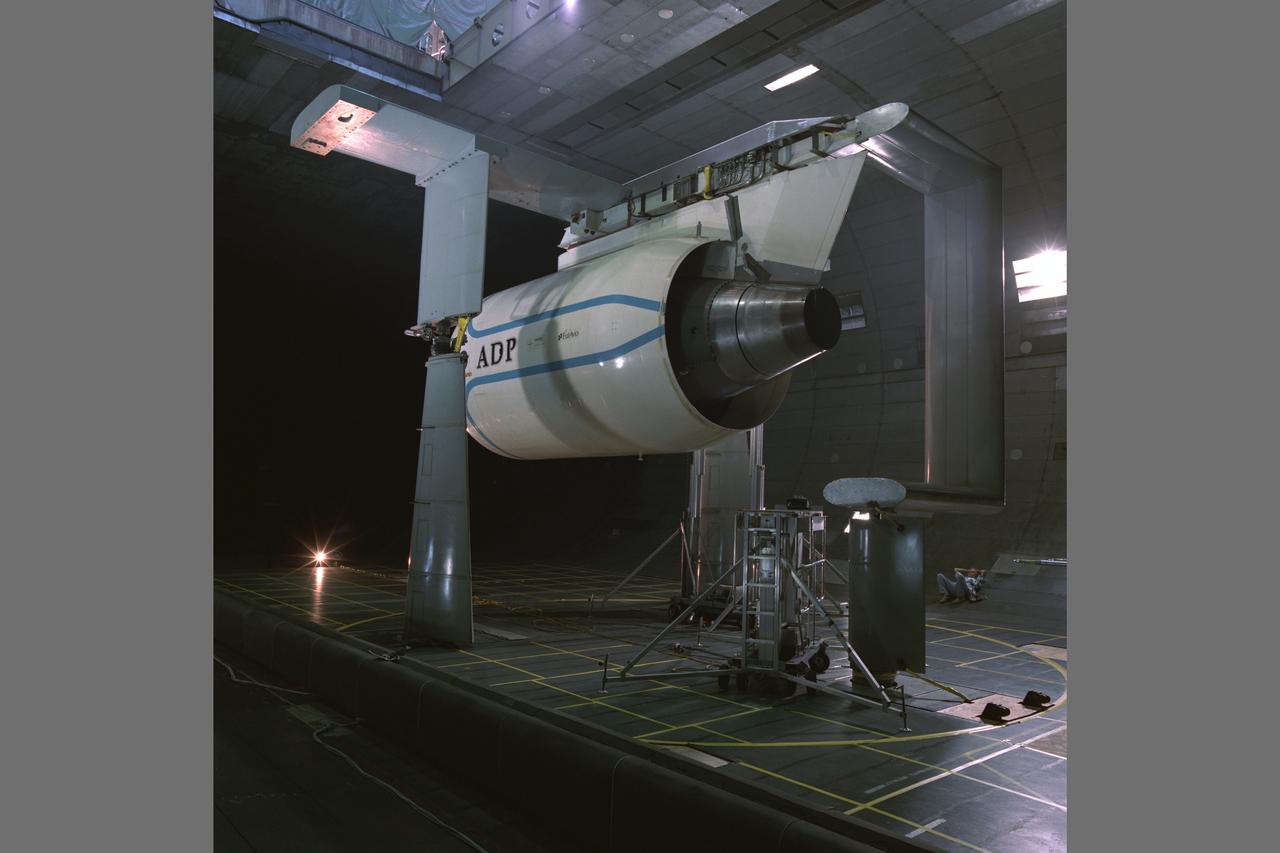
Pratt & Whitney Advanced Ducted Propulsor (ADP) Engine Test-590 in the NASA Ames 40x80ft Subsonic Wind Tunnel. The Pratt & Whitney Advanced Ducted Prop (ADP) demonstrator undergoing acoustic and fan performance testing. ADP technology could lead to decreased fuel consumption and noise.
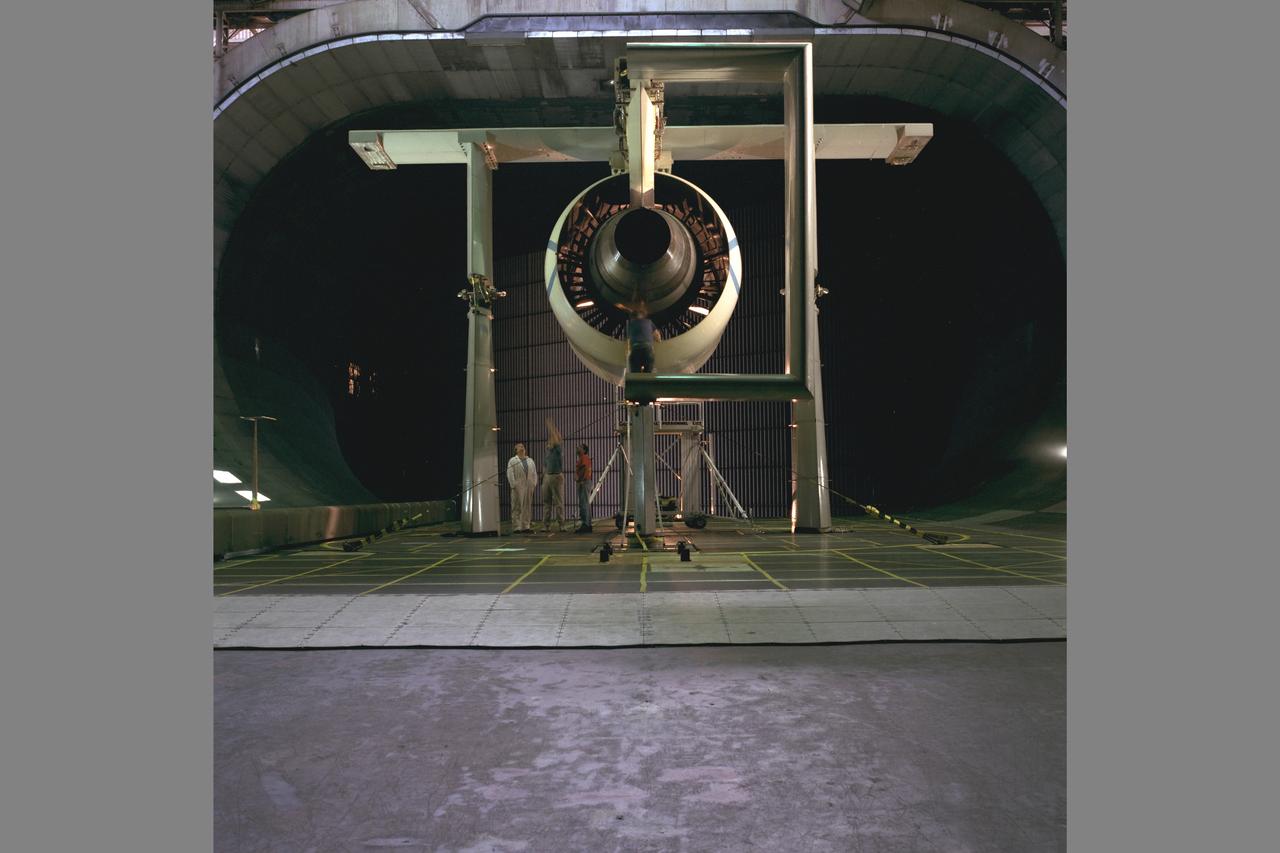
Pratt & Whitney Advanced Ducted Propulsor (ADP) Engine Test-590 in NASA Ames 40x80ft Subsonic Wind Tunnel. The Pratt & Whitney advanced ducted prop (ADP) demonstrator undergoing acoustic and fan performance testing. ADP technology could lead to decreased fuel consumption and noise.
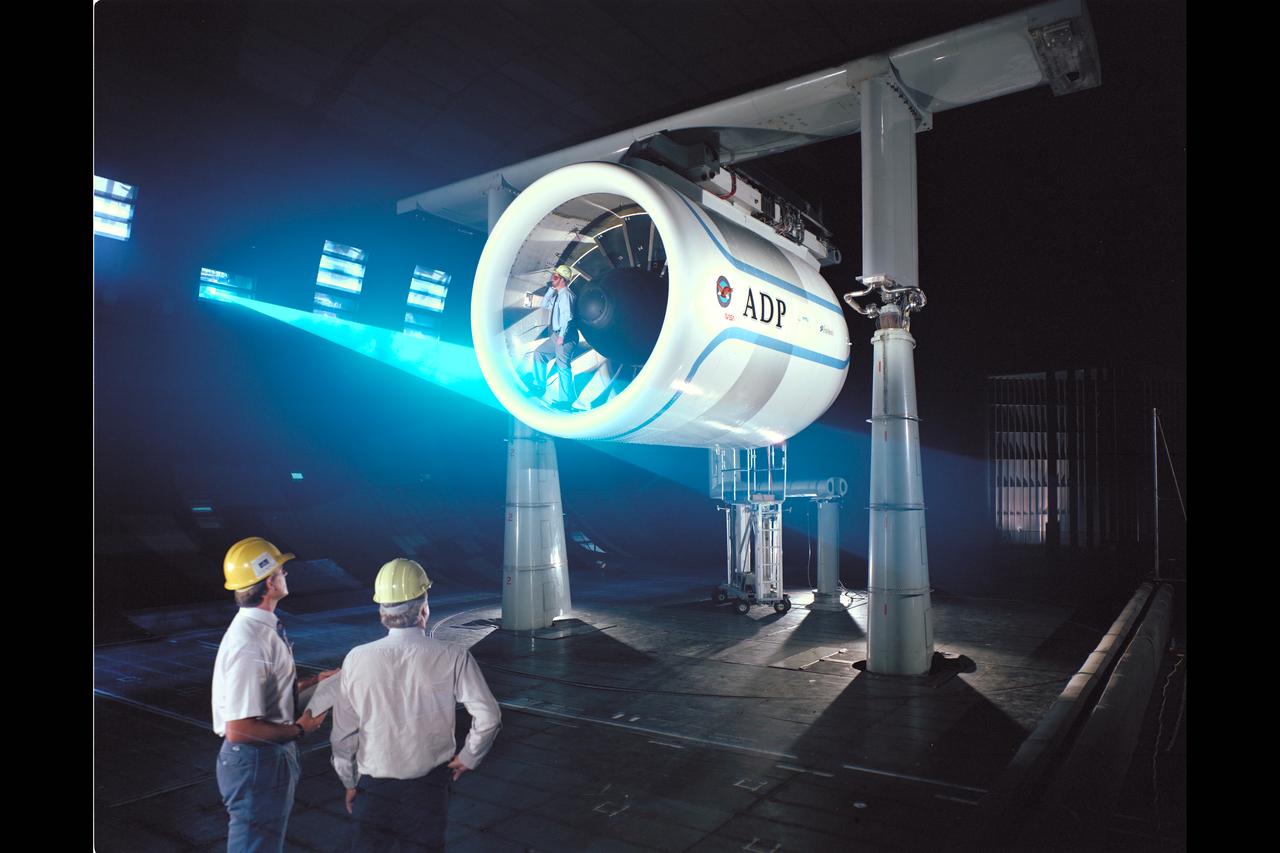
Pratt & Whitney Advanced Ducted Propulsor (ADP) Engine Test-590 in NASA Ames 40x80ft Subsonic Wind Tunnel. The Pratt & Whitney advanced ducted prop (ADP) demonstrator undergoing acoustic and fan performance testing. ADP technology could lead to decreased fuel consumption and noise. Shown here are NASA Ames engineers Peter Zell (left) and Dr Clifton Horne (right) preparing for a laser light sheet for a flow visualization test. Shown standing in the nacelle of the ADP is John Girvin, senior test engineer for Pratt & Whitney.
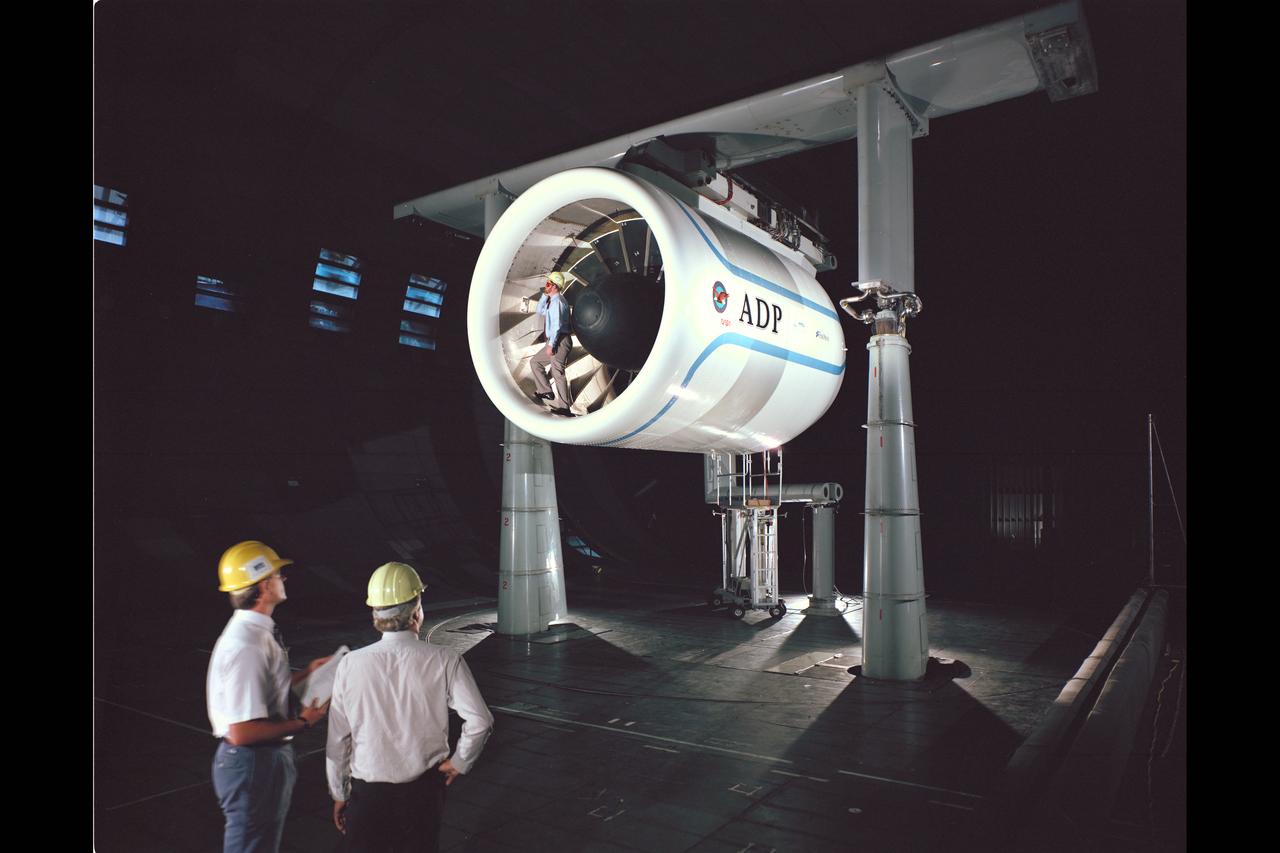
Pratt & Whitney Advanced Ducted Propulsor (ADP) Engine Test-590 in NASA Ames 40x80ft Subsonic Wind Tunnel. The Pratt & Whitney advanced ducted prop (ADP) demonstrator undergoing acoustic and fan performance testing. ADP technology could lead to decreased fuel consumption and noise. Shown here are NASA Ames engineers Peter Zell (left) and Dr Clifton Horne (right) preparing for a laser light sheet for a flow visualization test. Shown standing in the nacelle of the ADP is John Girvin, senior test engineer for Pratt & Whitney.
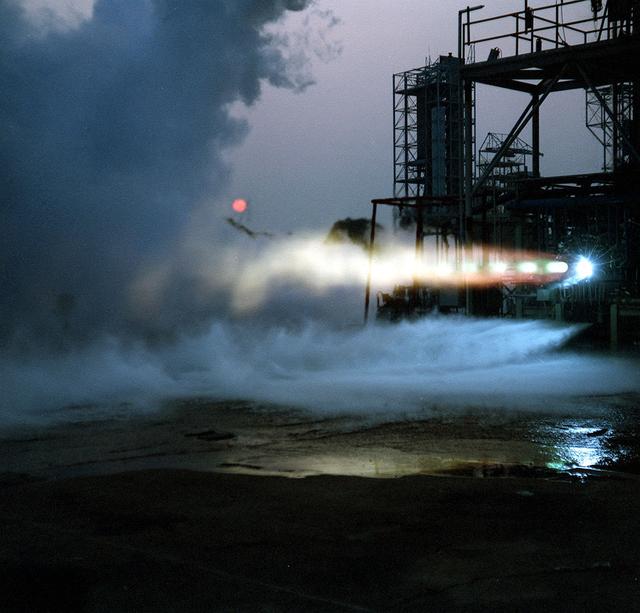
A 40K Pratt Whitney engine for the National Launch System is test fired at Marshall's Test Stand 116.
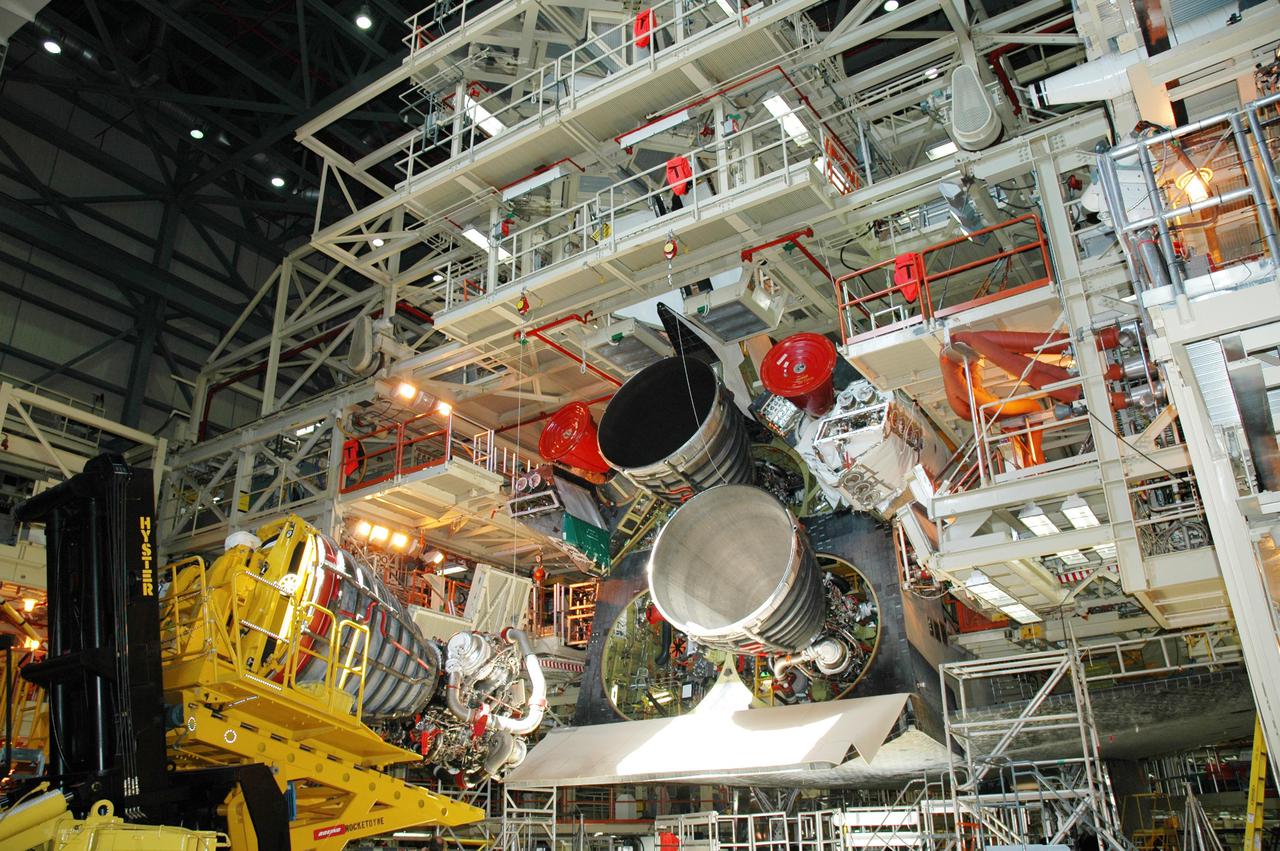
KENNEDY SPACE CENTER, FLA. - The third Space Shuttle Main Engine (SSME) arrives in the Orbiter Processing Facility for installation on Discovery. Discovery is designated as the Return to Flight vehicle for mission STS-114. Recent improvements to the SSME include the introduction of redesigned high-pressure turbopumps into the SSME fleet. The new pumps are designed and built by Pratt and Whitney at West Palm Beach, Fla. SSMEs and the Pratt and Whitney turbopumps are tested at Stennis Space Center in Mississippi. Engines and engine components are delivered to Kennedy Space Center to be prepared for flight.
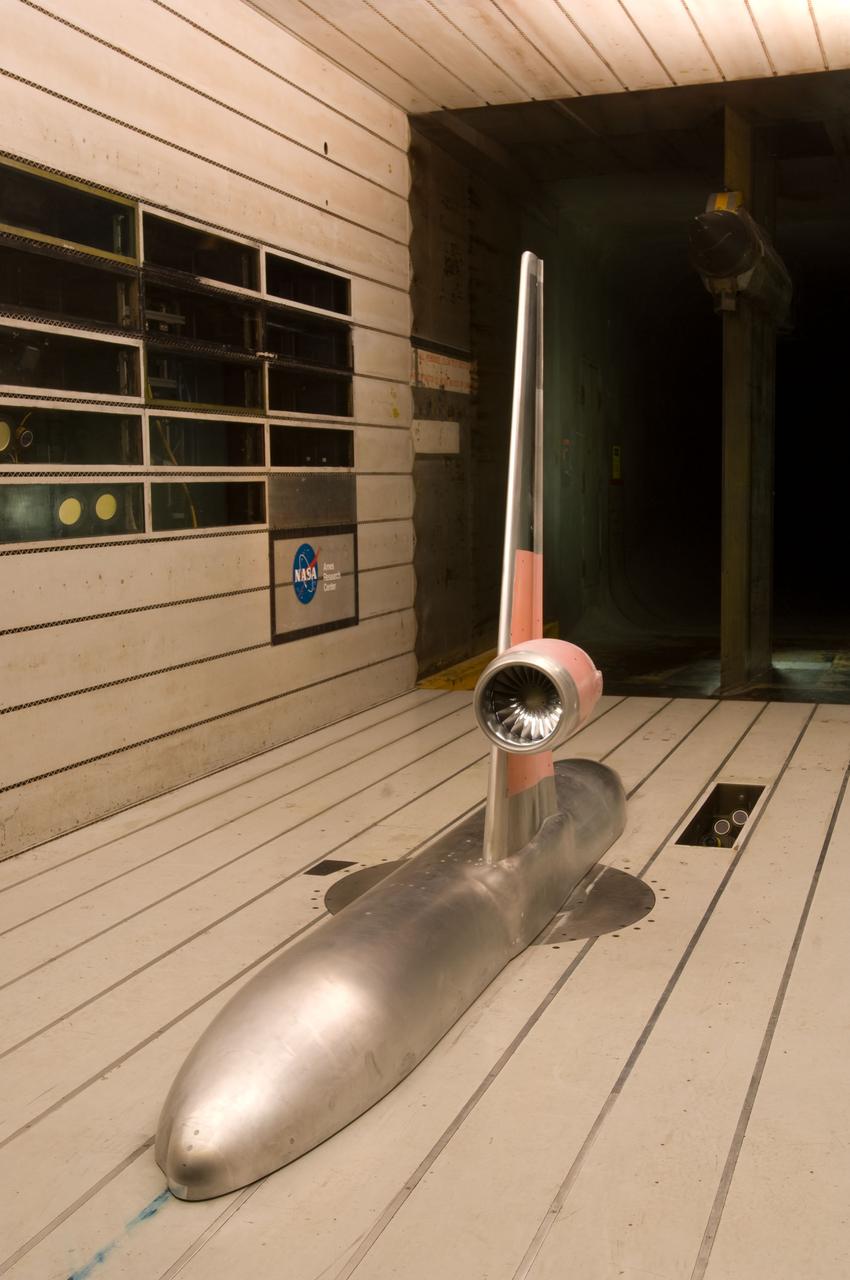
Next-Generation Aircraft, Pratt and Whitney Ultra-High Bypass Integration test at NASA Ames 11ft. wind tunnel (test 11-0182) assess the interaction effects of a scaled Pratt & Whitney geared turbofan on a Boeing 737-800 fuselage in an effort to use emerging technologies to make next-generation airliners quieter, more fuel efficient and lower on emissions. (printed in Aviation Week & Space Technology April 8, 2011 issue)
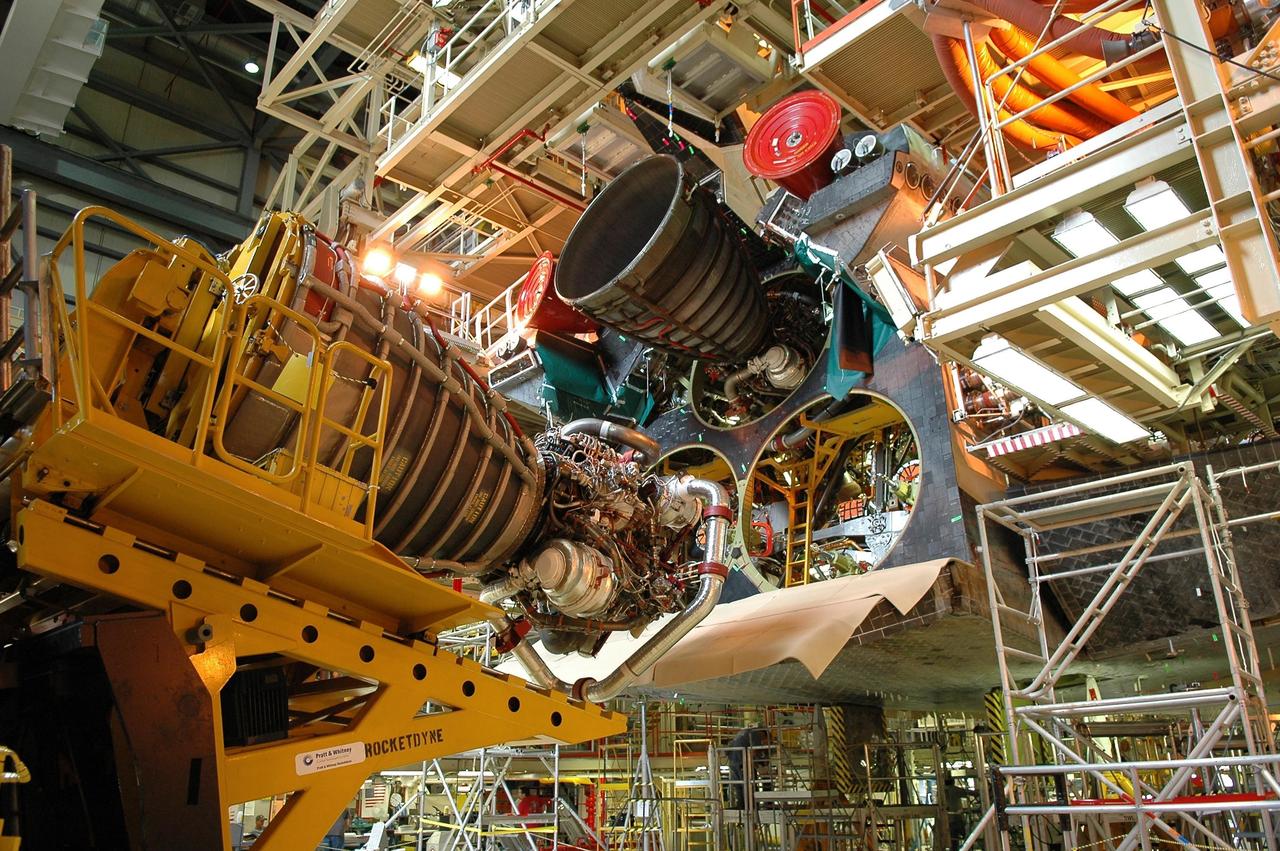
KENNEDY SPACE CENTER, FLA. - Engine No. 3 is ready to be installed on Discovery in the Orbiter Processing Facility bay 3. The main engine configuration is manufactured by Pratt & Whitney Rocketdyne in Canoga Park, Calif., and includes a Pratt & Whitney high-pressure fuel turbo pump. Each space shuttle main engine is 14 feet long, weighs about 6,700 pounds, and is 7.5 feet in diameter at the end of the nozzle. Discovery is being processed for its next mission, STS-116 (12A.1), to deliver a third truss segment, a SPACEHAB module and other key components to the International Space Station. The launch is currently scheduled no earlier than Dec. 14. Photo credit: NASA/Kim Shiflett
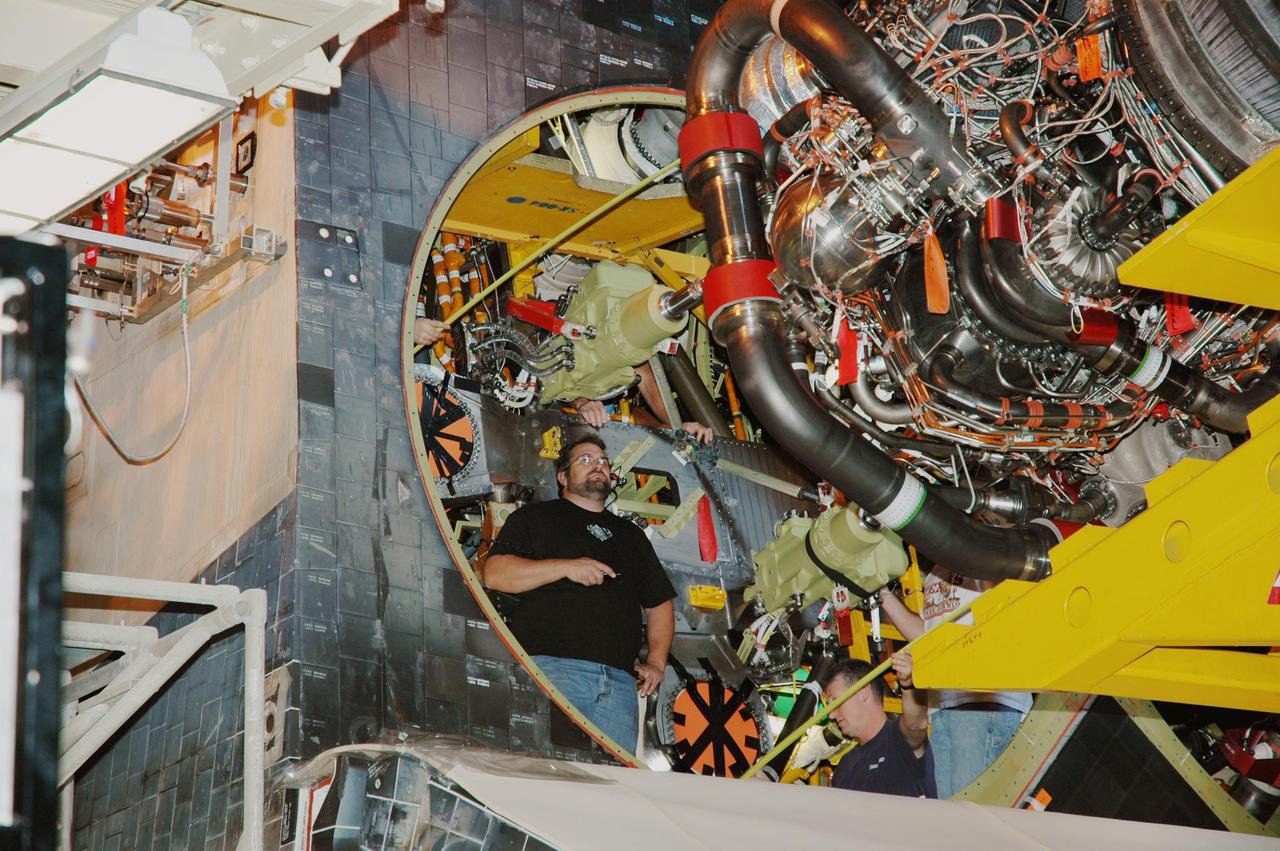
KENNEDY SPACE CENTER, FLA. - In the Orbiter Processing Facility, a technician watches closely as the third Space Shuttle Main Engine (SSME) is moved into position behind Discovery for installation. Discovery is designated as the Return to Flight vehicle for mission STS-114. Recent improvements to the SSME include the introduction of redesigned high-pressure turbopumps into the SSME fleet. The new pumps are designed and built by Pratt and Whitney at West Palm Beach, Fla. SSMEs and the Pratt and Whitney turbopumps are tested at Stennis Space Center in Mississippi. Engines and engine components are delivered to Kennedy Space Center to be prepared for flight.
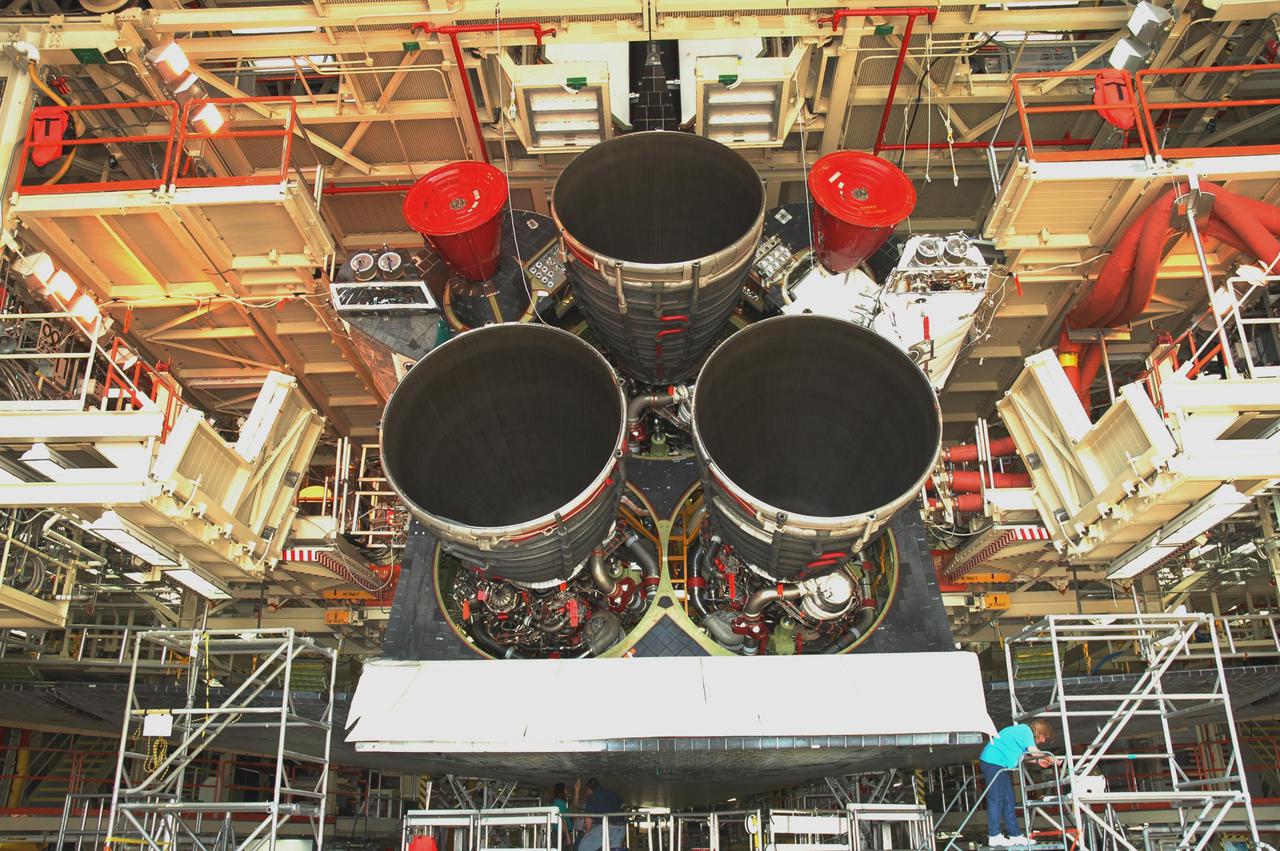
KENNEDY SPACE CENTER, FLA. - In the Orbiter Processing Facility, the aft of Discovery is shown with all three Space Shuttle Main Engines (SSMEs) installed. Discovery is designated as the Return to Flight vehicle for mission STS-114. Recent improvements to the SSME include the introduction of redesigned high-pressure turbopumps into the SSME fleet. The new pumps are designed and built by Pratt and Whitney at West Palm Beach, Fla. SSMEs and the Pratt and Whitney turbopumps are tested at Stennis Space Center in Mississippi. Engines and engine components are delivered to Kennedy Space Center to be prepared for flight.
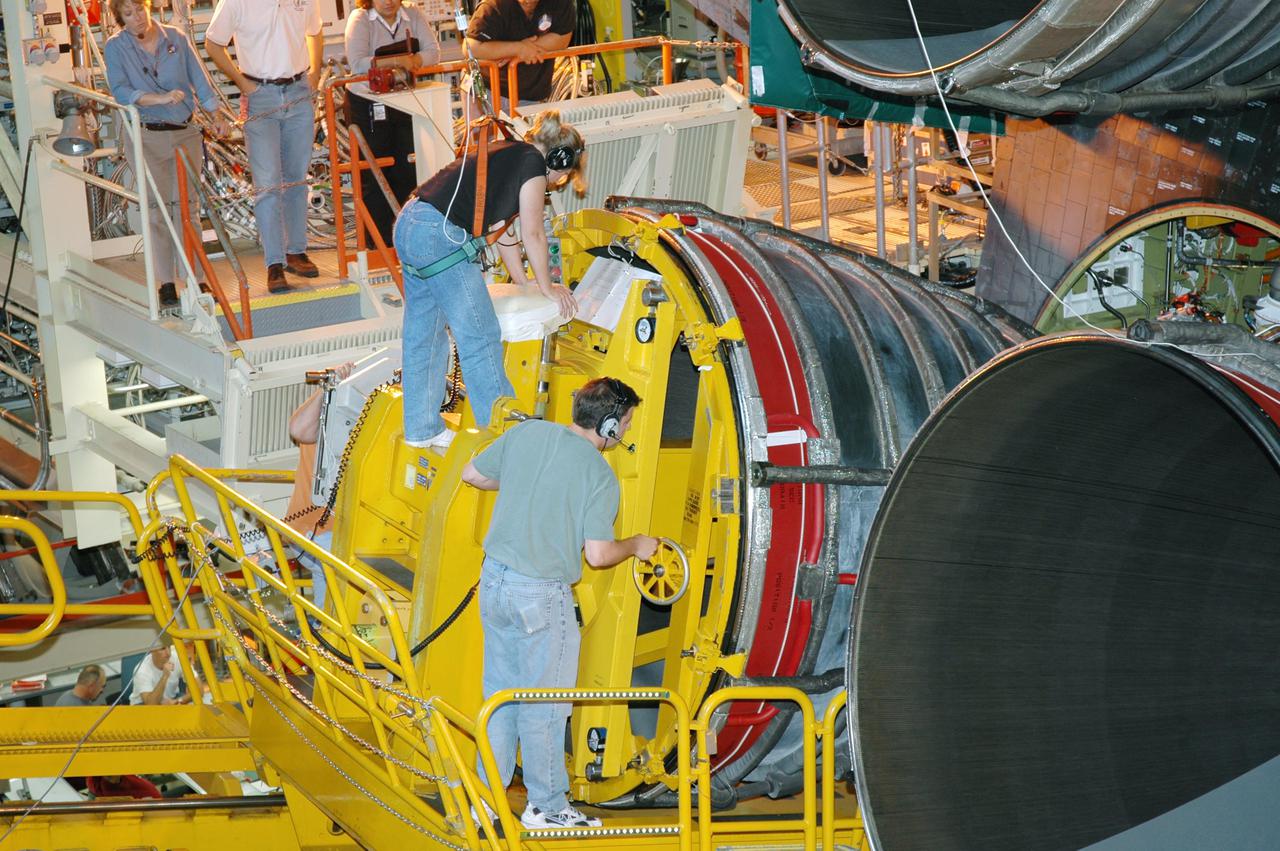
KENNEDY SPACE CENTER, FLA. - Technicians in the Orbiter Processing Facility carefully maneuver the third Space Shuttle Main Engine (SSME) into place on Discovery. Discovery is designated as the Return to Flight vehicle for mission STS-114. Recent improvements to the SSME include the introduction of redesigned high-pressure turbopumps into the SSME fleet. The new pumps are designed and built by Pratt and Whitney at West Palm Beach, Fla. SSMEs and the Pratt and Whitney turbopumps are tested at Stennis Space Center in Mississippi. Engines and engine components are delivered to Kennedy Space Center to be prepared for flight.
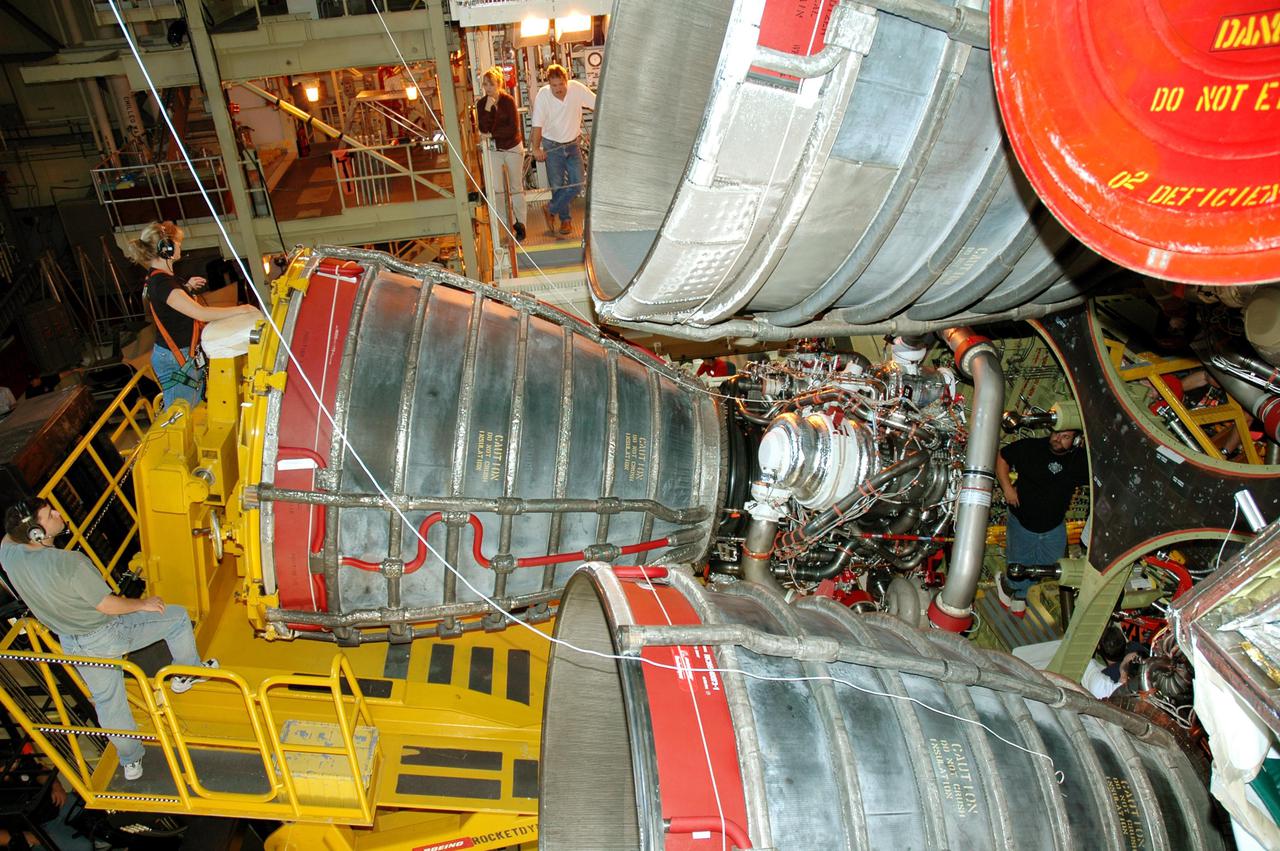
KENNEDY SPACE CENTER, FLA. - Workers in the Orbiter Processing Facility carefully guide the placement of the third Space Shuttle Main Engine (SSME) for installation on Discovery. Discovery is designated as the Return to Flight vehicle for mission STS-114. Recent improvements to the SSME include the introduction of redesigned high-pressure turbopumps into the SSME fleet. The new pumps are designed and built by Pratt and Whitney at West Palm Beach, Fla. SSMEs and the Pratt and Whitney turbopumps are tested at Stennis Space Center in Mississippi. Engines and engine components are delivered to Kennedy Space Center to be prepared for flight.
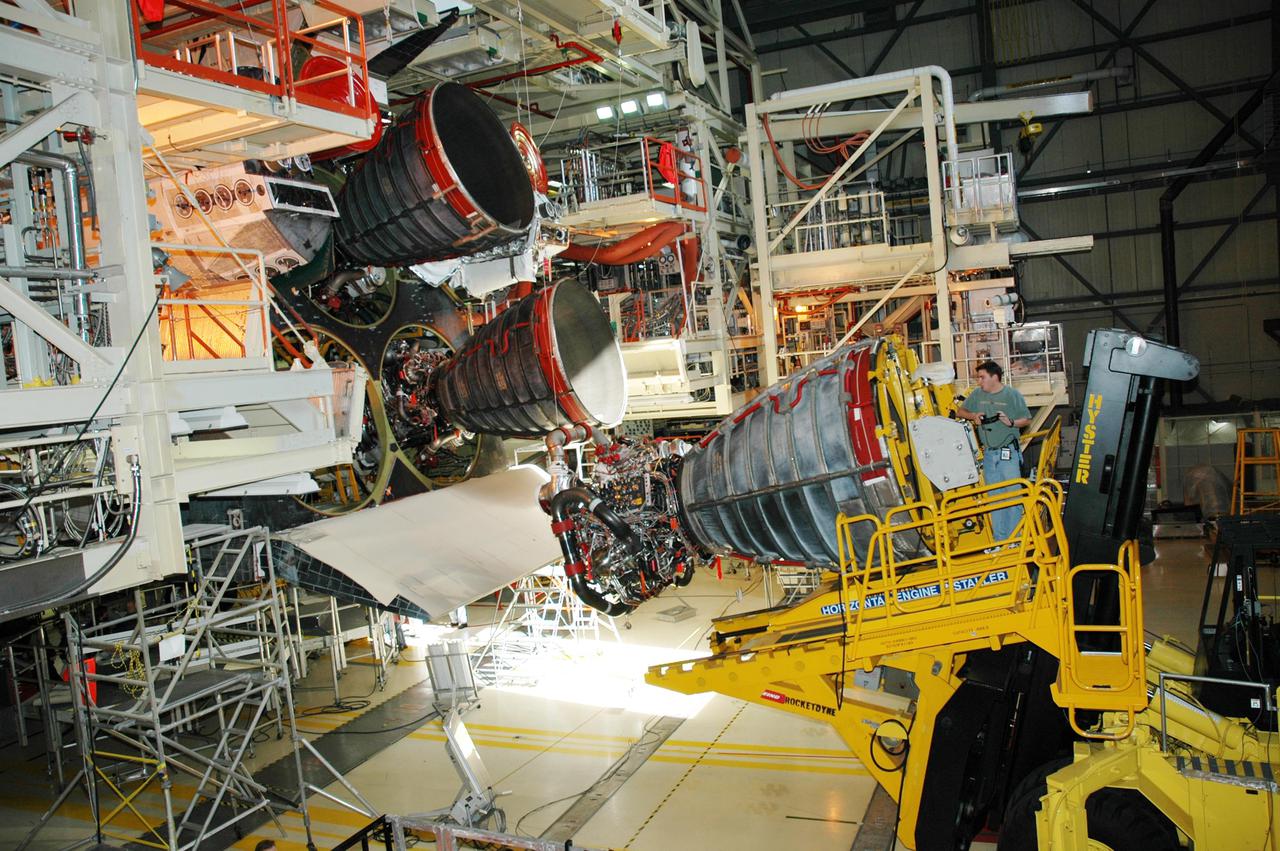
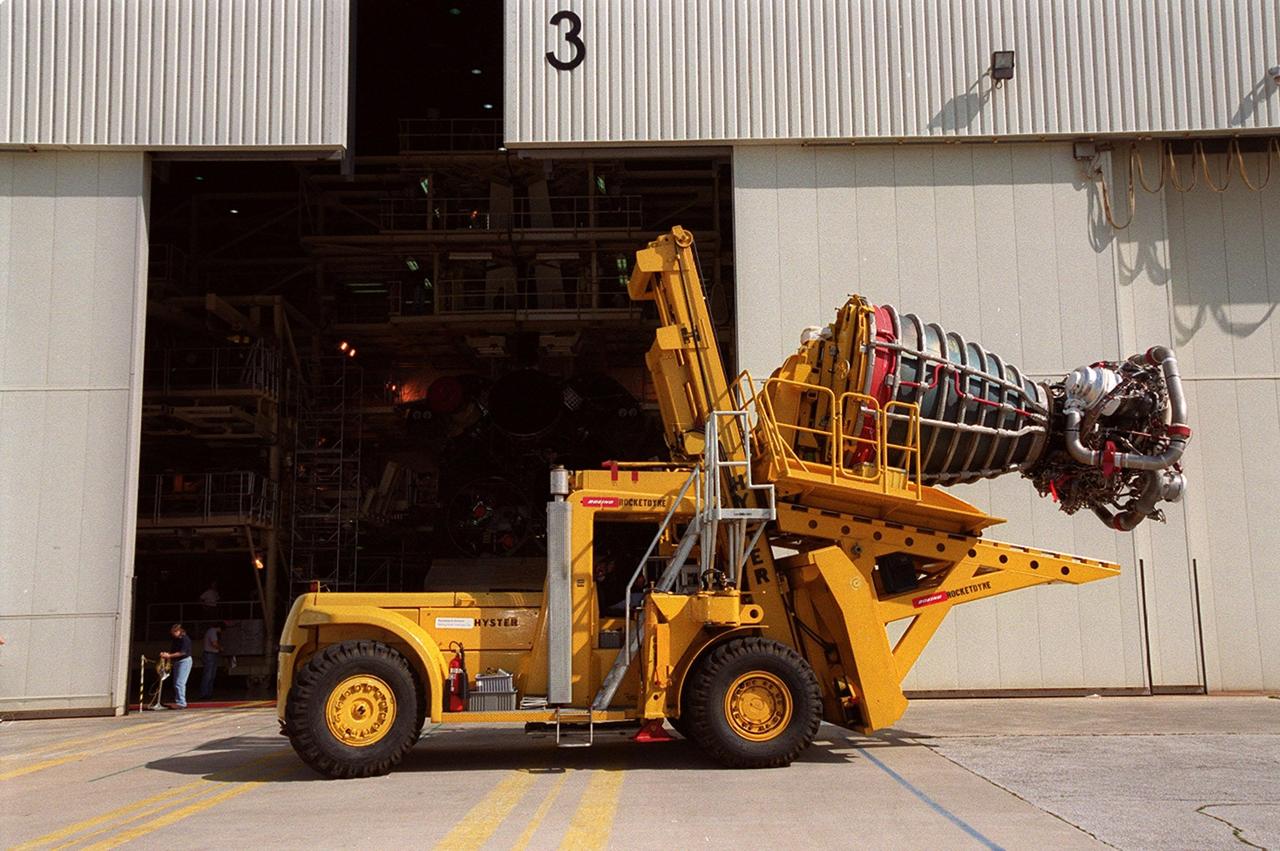
KENNEDY SPACE CENTER, FLA. - In the Orbiter Processing Facility, the Hyster lift at right moves the third Space Shuttle Main Engine (SSME) into position behind Discovery for installation. Discovery is designated as the Return to Flight vehicle for mission STS-114. Recent improvements to the SSME include the introduction of redesigned high-pressure turbopumps into the SSME fleet. The new pumps are designed and built by Pratt and Whitney at West Palm Beach, Fla. SSMEs and the Pratt and Whitney turbopumps are tested at Stennis Space Center in Mississippi. Engines and engine components are delivered to Kennedy Space Center to be prepared for flight.
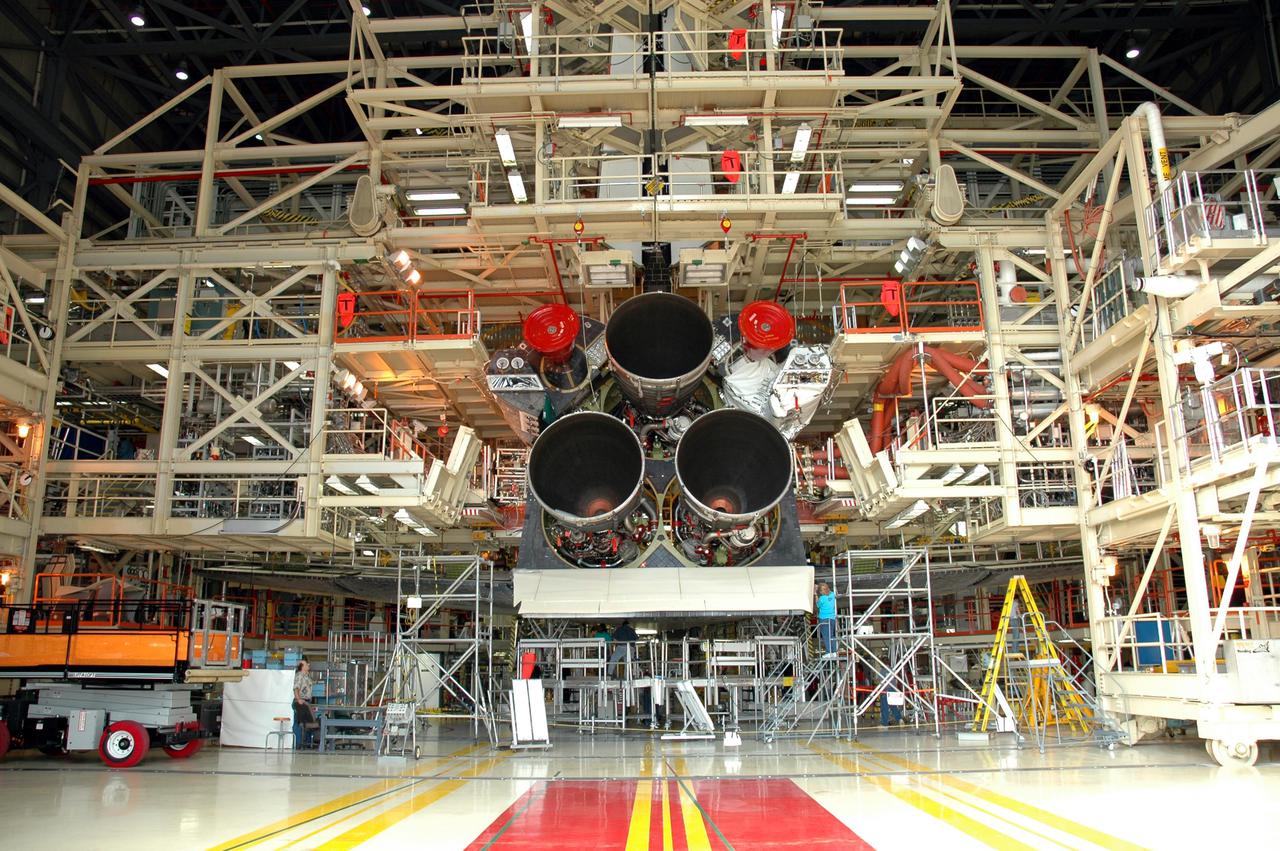
KENNEDY SPACE CENTER, FLA. - In the Orbiter Processing Facility, the aft of Discovery is shown after the third Space Shuttle Main Engine (SSME) was installed. Discovery is designated as the Return to Flight vehicle for mission STS-114. Recent improvements to the SSME include the introduction of redesigned high-pressure turbopumps into the SSME fleet. The new pumps are designed and built by Pratt and Whitney at West Palm Beach, Fla. SSMEs and the Pratt and Whitney turbopumps are tested at Stennis Space Center in Mississippi. Engines and engine components are delivered to Kennedy Space Center to be prepared for flight.
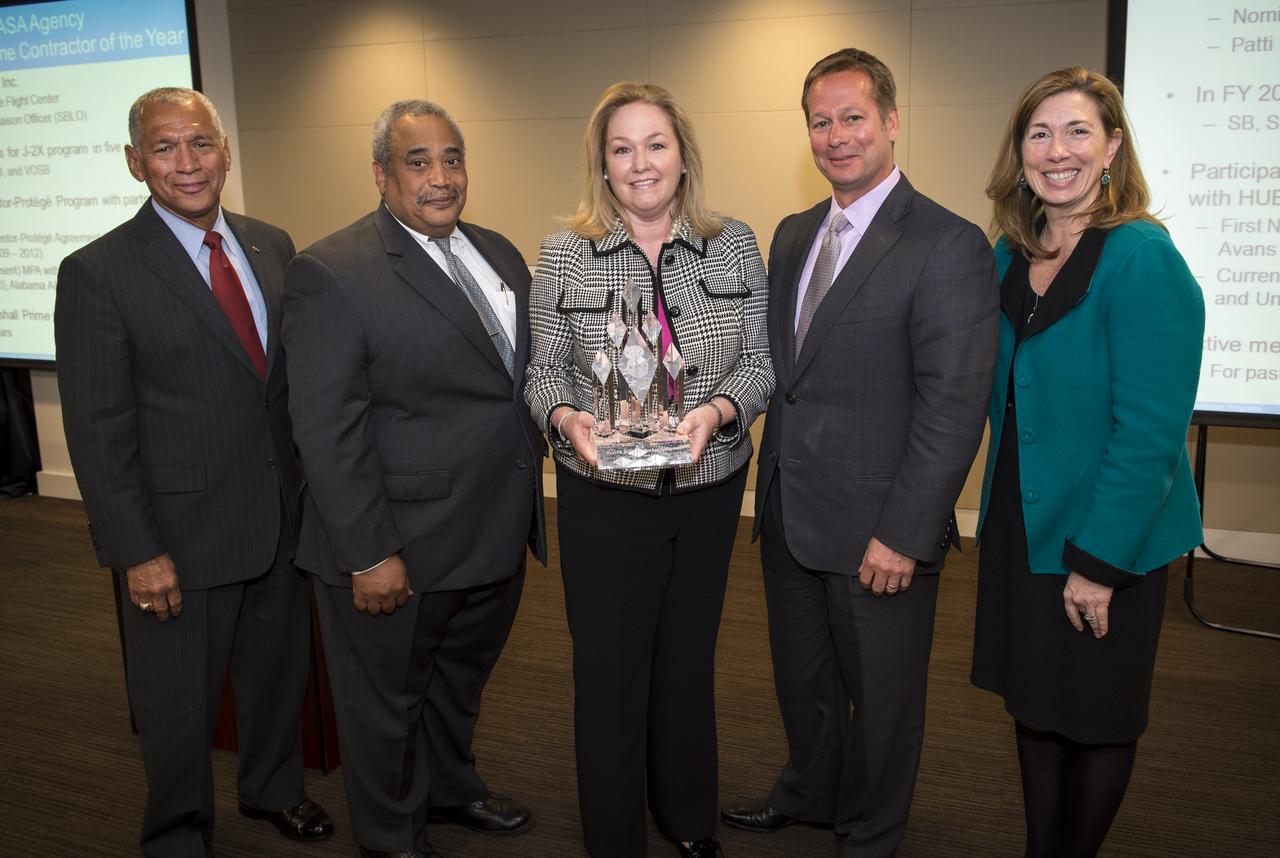
NASA Administrator Charles Bolden, left, NASA Associate Administrator for Small Business Programs Glenn A. Delgado, second from left, and NASA Deputy Administrator Lori Garver, right, pose for a photograph with Patricia Rice, Manager, Supplier Diversity, Small Business Liaison Officer & Supplier Development, Pratt & Whitney Rocketdyne, Inc. and Jim Maser, President of Pratt & Whitney Rocketdyne, Inc. of East Hartford, Connecticut after the company was awarded the Large Business Prime Contractor of the Year at NASA Headquarters, Tuesday, April 23, 2013 in Washington. Photo Credit: (NASA/Bill Ingalls)
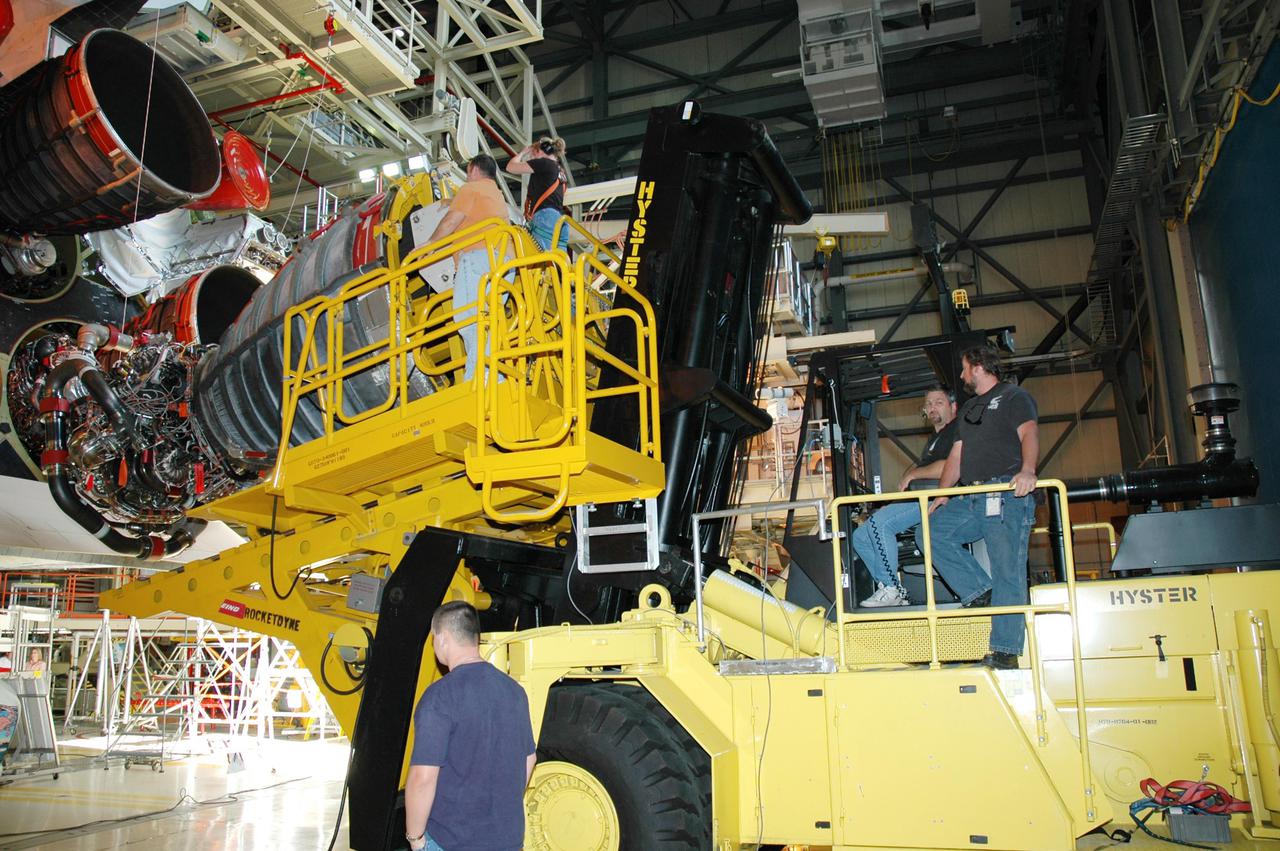
KENNEDY SPACE CENTER, FLA. - In the Orbiter Processing Facility, the Hyster lift raises the third Space Shuttle Main Engine (SSME) into position behind Discovery for installation. Discovery is designated as the Return to Flight vehicle for mission STS-114. Recent improvements to the SSME include the introduction of redesigned high-pressure turbopumps into the SSME fleet. The new pumps are designed and built by Pratt and Whitney at West Palm Beach, Fla. SSMEs and the Pratt and Whitney turbopumps are tested at Stennis Space Center in Mississippi. Engines and engine components are delivered to Kennedy Space Center to be prepared for flight.
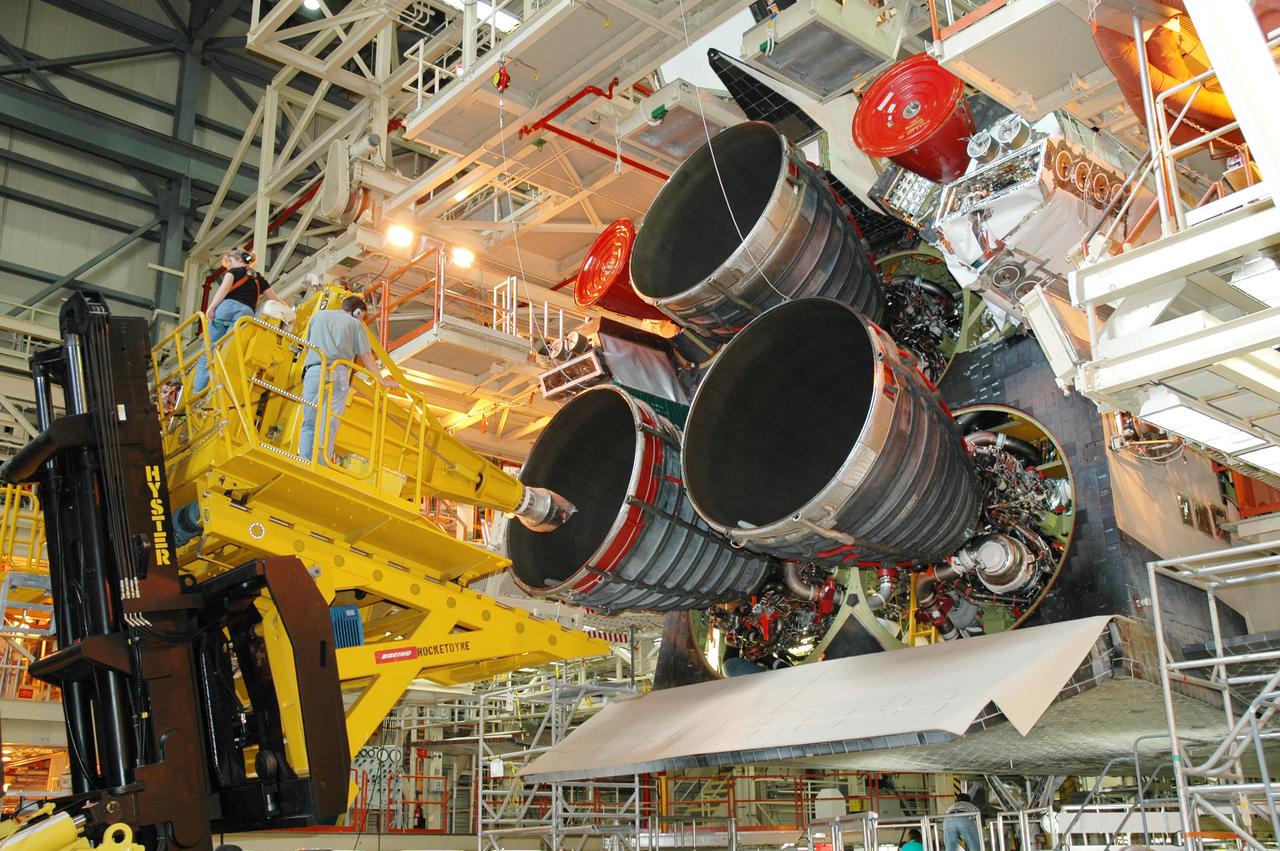
KENNEDY SPACE CENTER, FLA. - The Hyster lift is slowly backed away from Discovery after placing the third Space Shuttle Main Engine (SSME) in the orbiter. Discovery is designated as the Return to Flight vehicle for mission STS-114. Recent improvements to the SSME include the introduction of redesigned high-pressure turbopumps into the SSME fleet. The new pumps are designed and built by Pratt and Whitney at West Palm Beach, Fla. SSMEs and the Pratt and Whitney turbopumps are tested at Stennis Space Center in Mississippi. Engines and engine components are delivered to Kennedy Space Center to be prepared for flight.
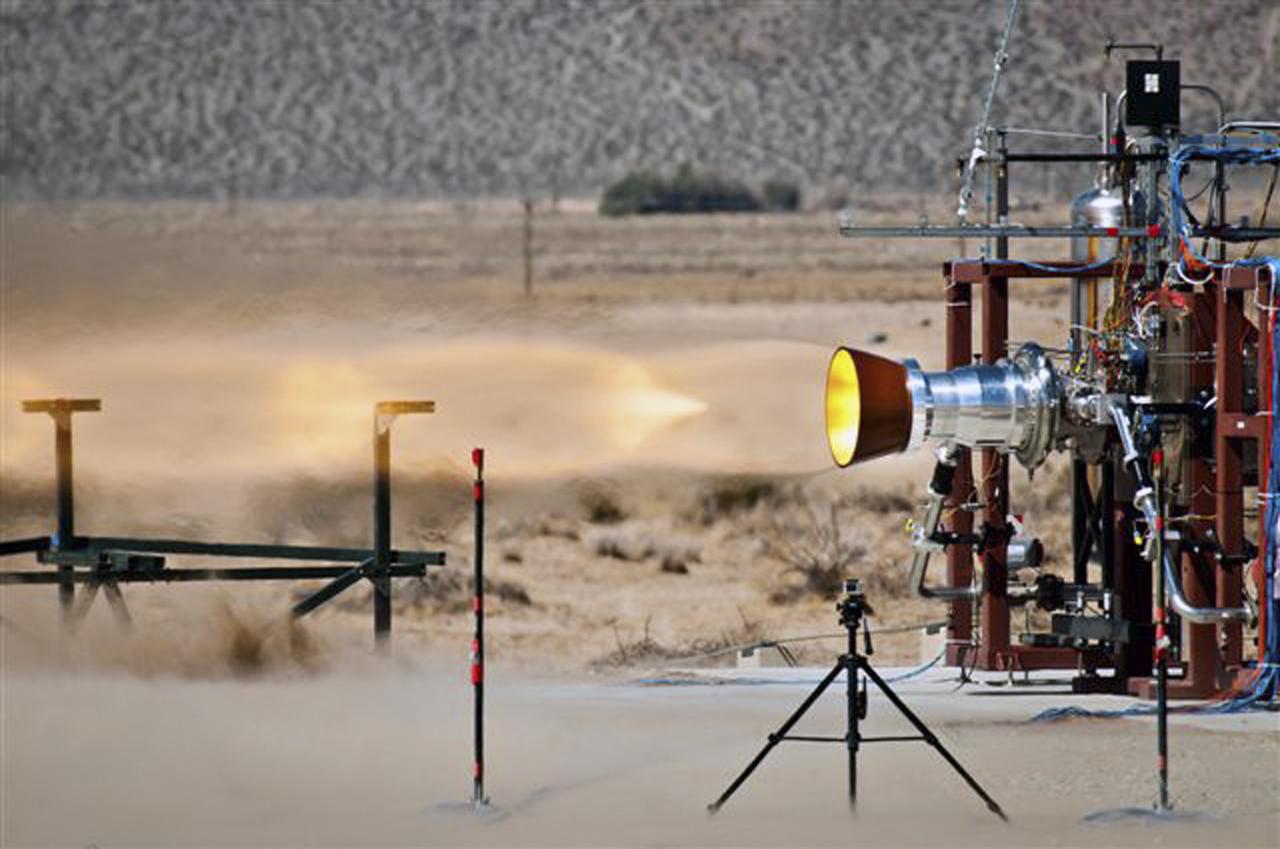
CANOGA PARK, Calif. -- Pratt & Whitney Rocketdyne hot-fires a launch abort engine for The Boeing Co., which is developing its CST-100 spacecraft for NASA's Commercial Crew Program. Under its fixed-price contract with Boeing, Pratt and Whitney Rocketdyne is combining its Attitude Control Propulsion System thrusters from heritage spaceflight programs, Bantam abort engine design and storable propellant engineering capabilities. In 2011, NASA selected Boeing of Houston during Commercial Crew Development Round 2 CCDev2) activities to mature the design and development of a crew transportation system with the overall goal of accelerating a United States-led capability to the International Space Station. The goal of CCP is to drive down the cost of space travel as well as open up space to more people than ever before by balancing industry’s own innovative capabilities with NASA's 50 years of human spaceflight experience. Six other aerospace companies also are maturing launch vehicle and spacecraft designs under CCDev2, including Alliant Techsystems Inc. ATK, Blue Origin, Excalibur Almaz Inc., Sierra Nevada Corp., Space Exploration Technologies SpaceX, and United Launch Alliance ULA. For more information, visit www.nasa.gov/commercialcrew. Image credit: Pratt & Whitney Rocketdyne
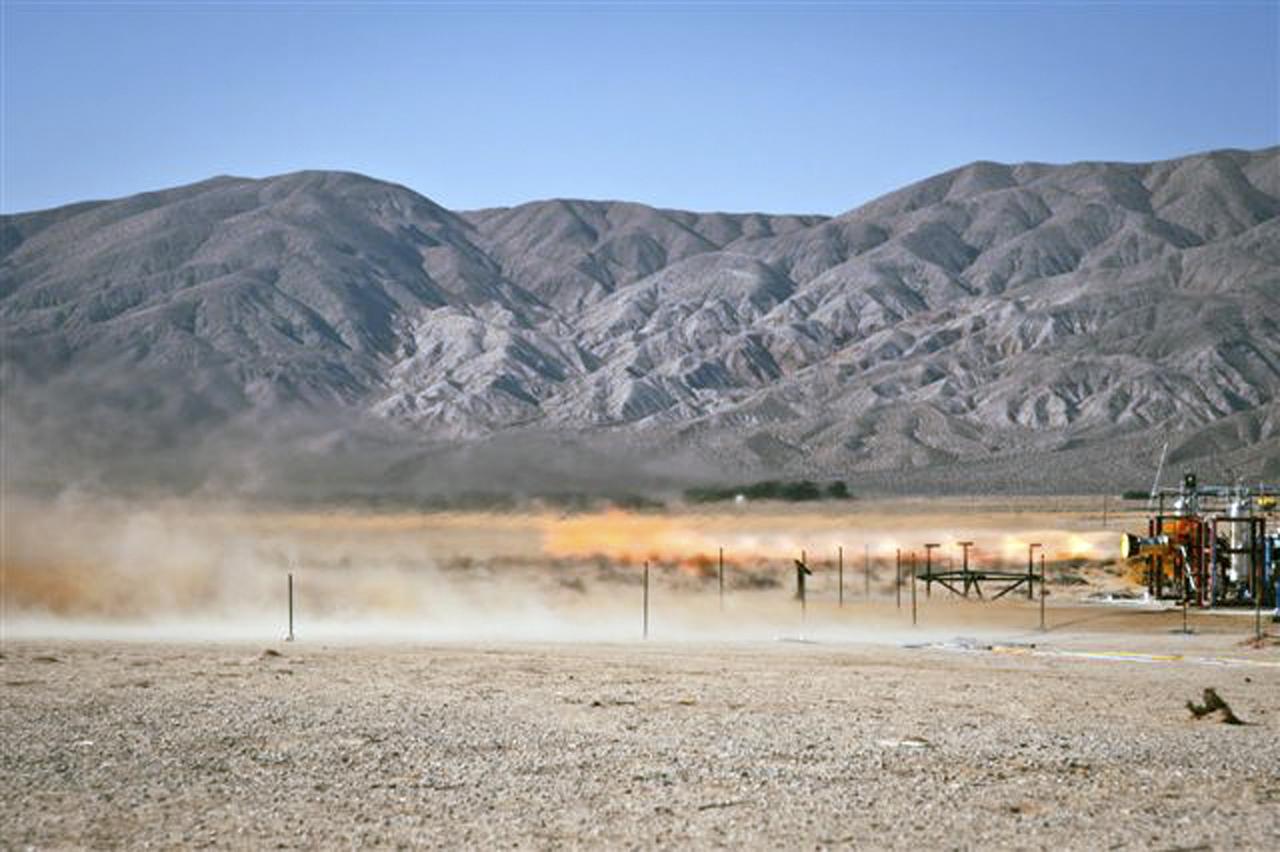
CANOGA PARK, Calif. -- Pratt & Whitney Rocketdyne hot-fires a launch abort engine for The Boeing Co., which is developing its CST-100 spacecraft for NASA's Commercial Crew Program. Under its fixed-price contract with Boeing, Pratt and Whitney Rocketdyne is combining its Attitude Control Propulsion System thrusters from heritage spaceflight programs, Bantam abort engine design and storable propellant engineering capabilities. In 2011, NASA selected Boeing of Houston during Commercial Crew Development Round 2 CCDev2) activities to mature the design and development of a crew transportation system with the overall goal of accelerating a United States-led capability to the International Space Station. The goal of CCP is to drive down the cost of space travel as well as open up space to more people than ever before by balancing industry’s own innovative capabilities with NASA's 50 years of human spaceflight experience. Six other aerospace companies also are maturing launch vehicle and spacecraft designs under CCDev2, including Alliant Techsystems Inc. ATK, Blue Origin, Excalibur Almaz Inc., Sierra Nevada Corp., Space Exploration Technologies SpaceX, and United Launch Alliance ULA. For more information, visit www.nasa.gov/commercialcrew. Image credit: Pratt & Whitney Rocketdyne
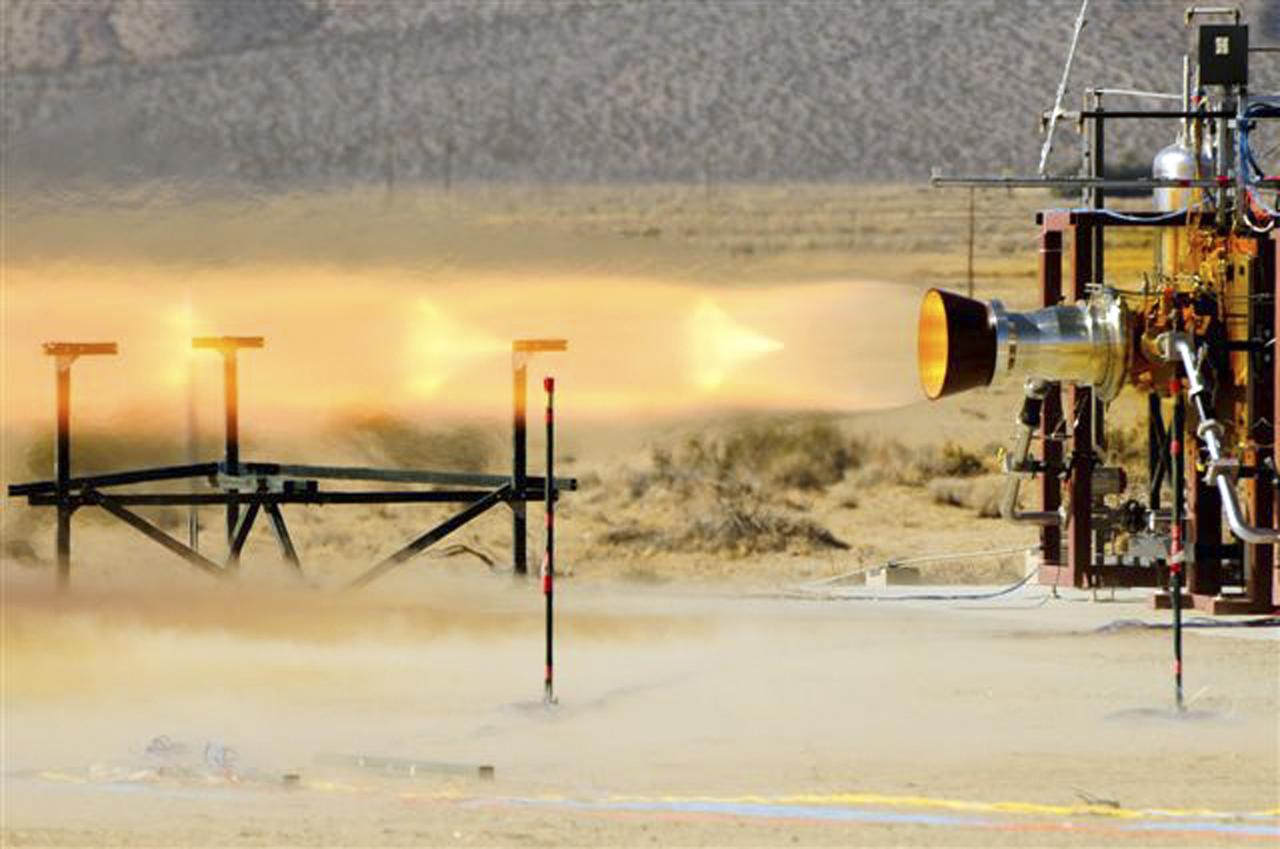
CANOGA PARK, Calif. -- Pratt & Whitney Rocketdyne hot-fires a launch abort engine for The Boeing Co., which is developing its CST-100 spacecraft for NASA's Commercial Crew Program. Under its fixed-price contract with Boeing, Pratt and Whitney Rocketdyne is combining its Attitude Control Propulsion System thrusters from heritage spaceflight programs, Bantam abort engine design and storable propellant engineering capabilities. In 2011, NASA selected Boeing of Houston during Commercial Crew Development Round 2 CCDev2) activities to mature the design and development of a crew transportation system with the overall goal of accelerating a United States-led capability to the International Space Station. The goal of CCP is to drive down the cost of space travel as well as open up space to more people than ever before by balancing industry’s own innovative capabilities with NASA's 50 years of human spaceflight experience. Six other aerospace companies also are maturing launch vehicle and spacecraft designs under CCDev2, including Alliant Techsystems Inc. ATK, Blue Origin, Excalibur Almaz Inc., Sierra Nevada Corp., Space Exploration Technologies SpaceX, and United Launch Alliance ULA. For more information, visit www.nasa.gov/commercialcrew. Image credit: Pratt & Whitney Rocketdyne
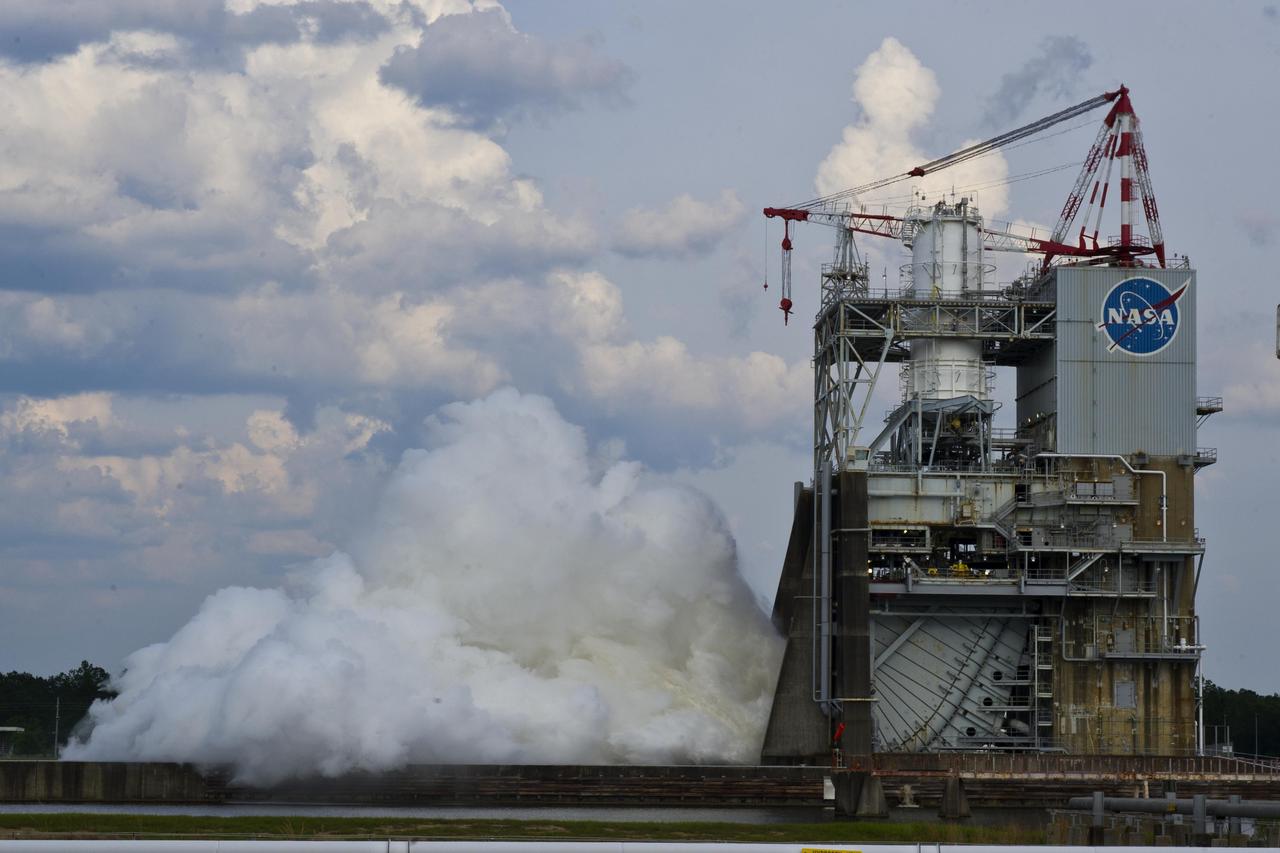
NASA conducted a successful seven-second test of the next-generation J-2X rocket engine on the A-2 Test Stand at Stennis Space Center on May 16, 2012. The J-2X is being developed for NASA by Pratt & Whitney Rocketdyne.
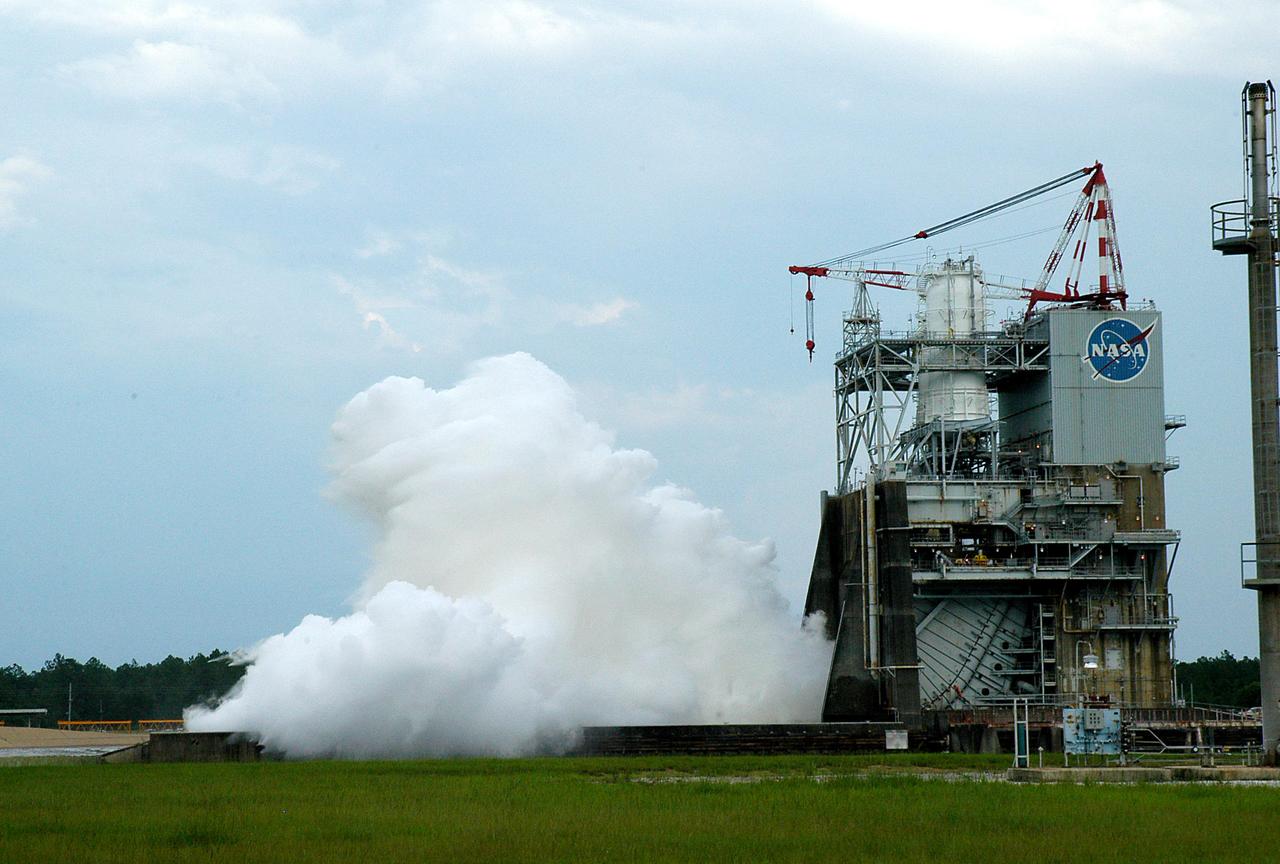
A plume of steam signals a successful engine start of the J-2X rocket engine on the A-3 Test Stand at Stennis Space Center on July 26. The 3.7-second test was the second on the next-generation engine, which is being developed for NASA by Pratt & Whitney Rocketdyne.
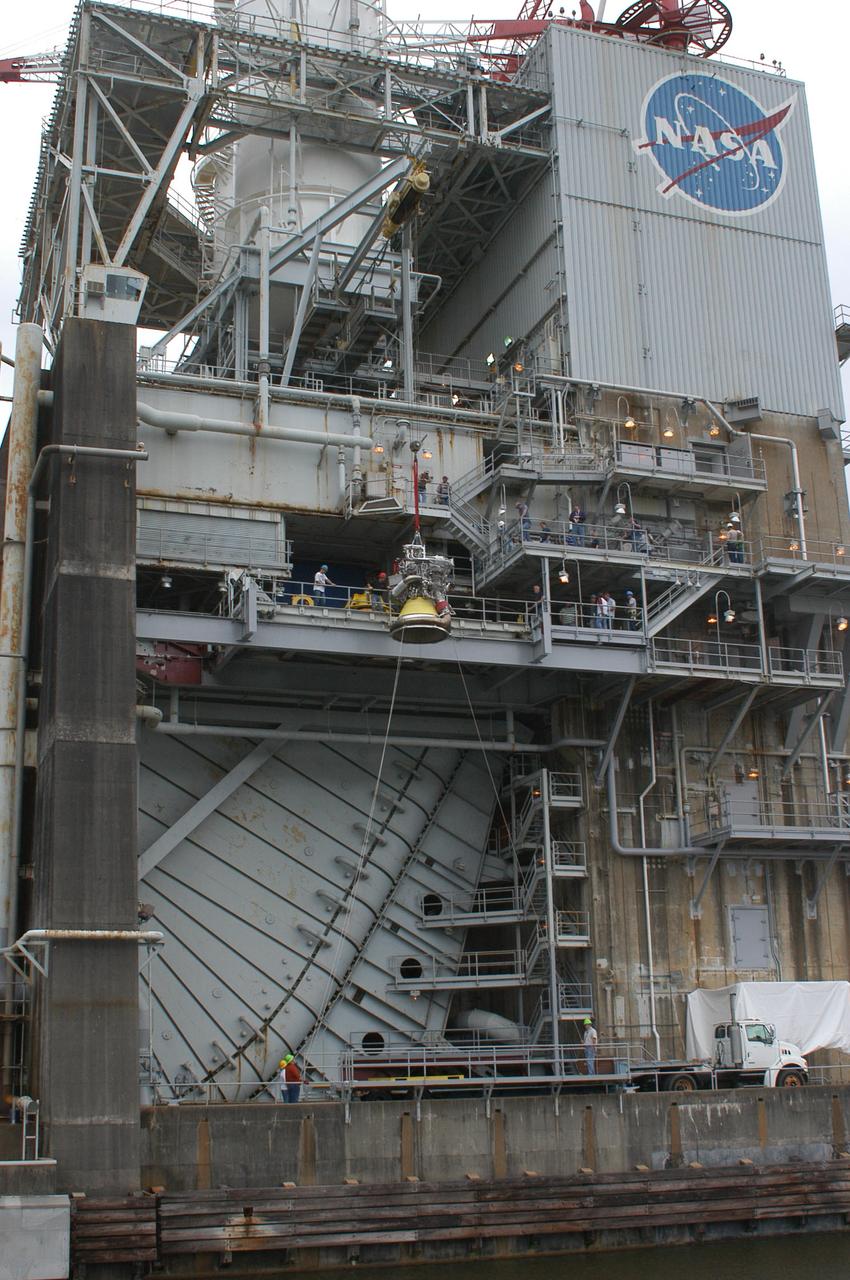
J-2X engine No. 10001 is returned March 8, 2012, to the A-2 Test Stand at Stennis Space Center for its second round of tests. The developmental engine underwent an initial series of tests last year. The J-2X engine is being built for NASA by Pratt & Whitney Rocketdyne.
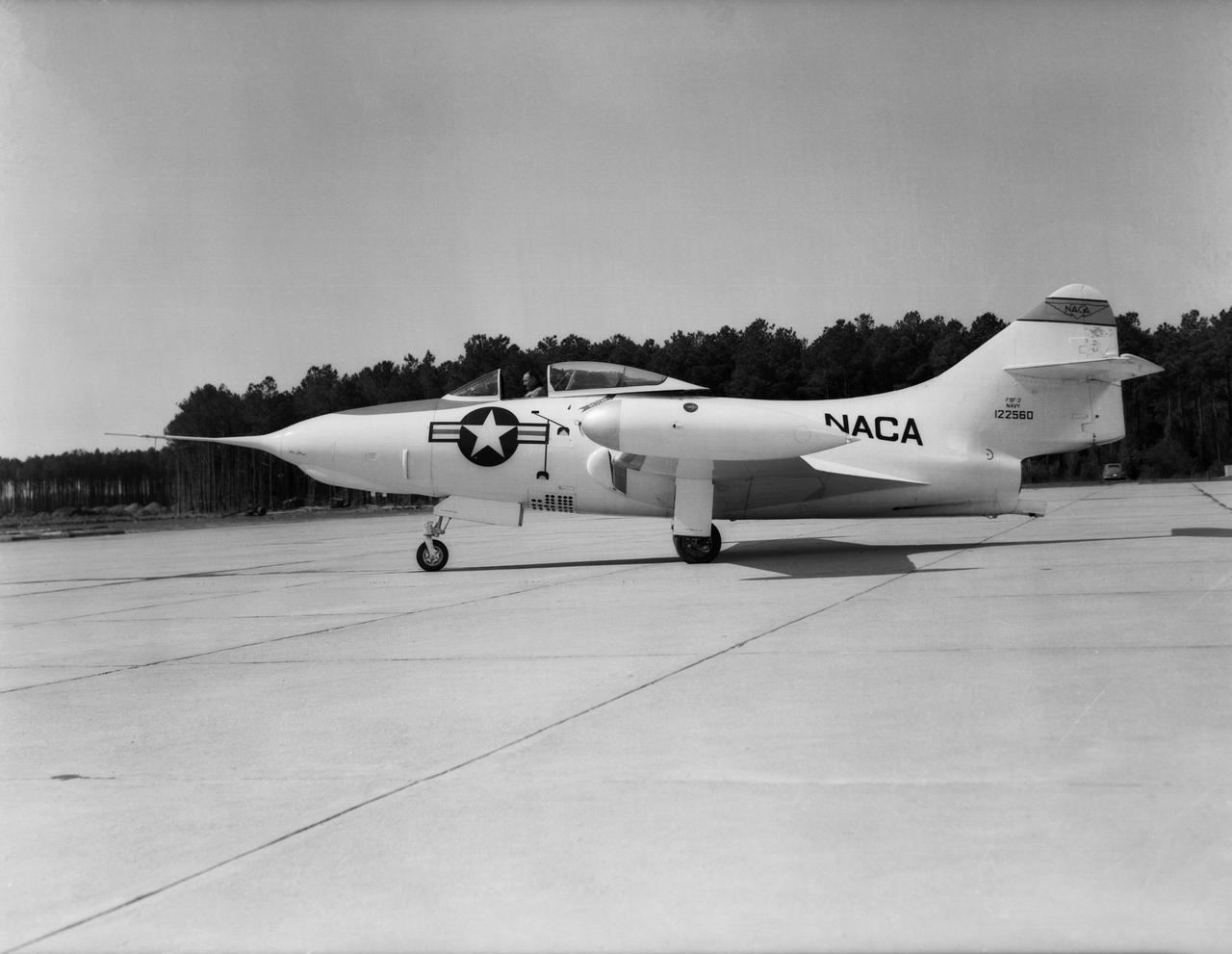
Grumman F9F-2 Panther: Originally built as a F9F-3, this Grumman F9F-2 Panther has a Pratt and Whitney J42 turbojet power plant, hence the designation change. This Panther underwent handling quality tests, serving long enough at Langley to witness the change from the NACA to NASA.
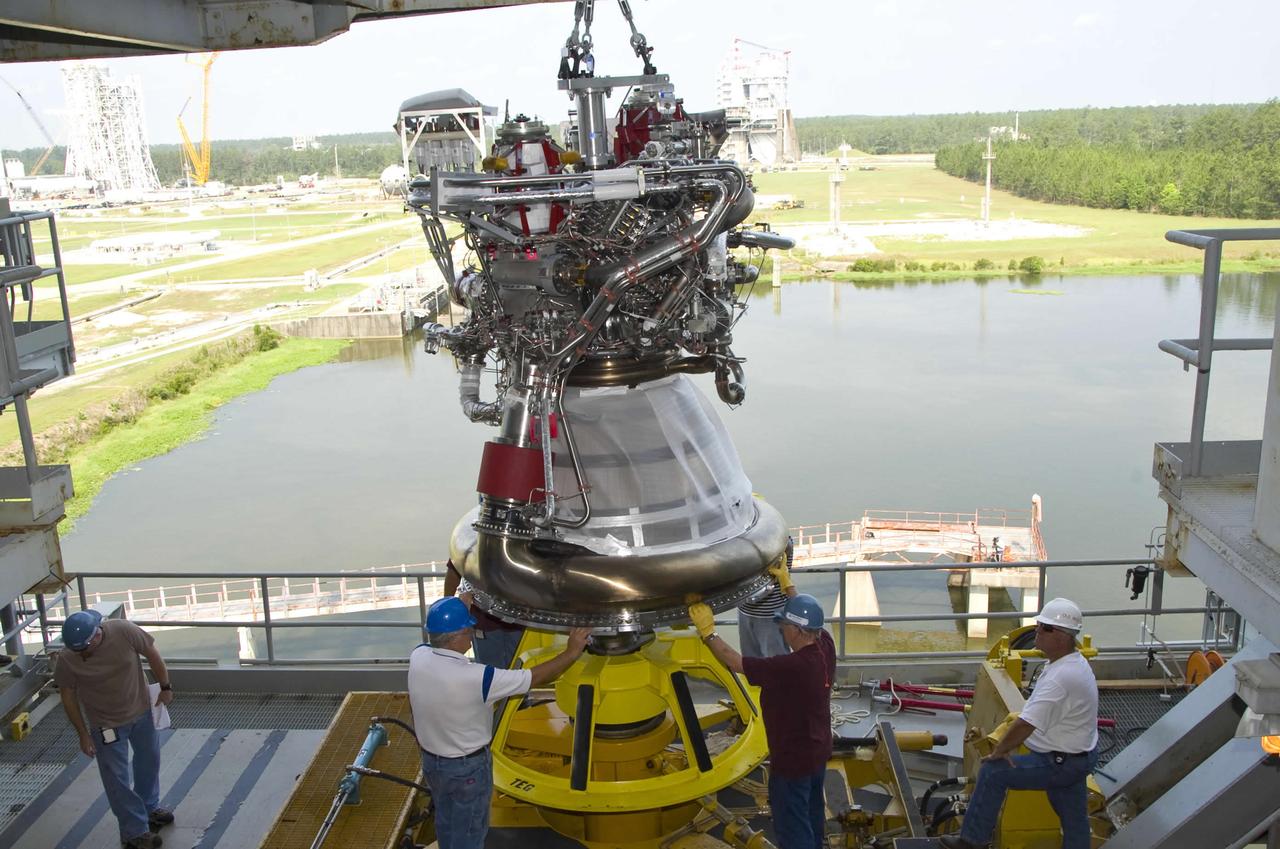
A J-2X next-generation rocket engine is lifted onto the A-2 Test Stand at Stennis Space Center. Testing of the engine began the following month. The engine is being developed for NASA by Pratt & Whitney Rocketdyne and could help carry humans beyond low-Earth orbit into deep space once more.
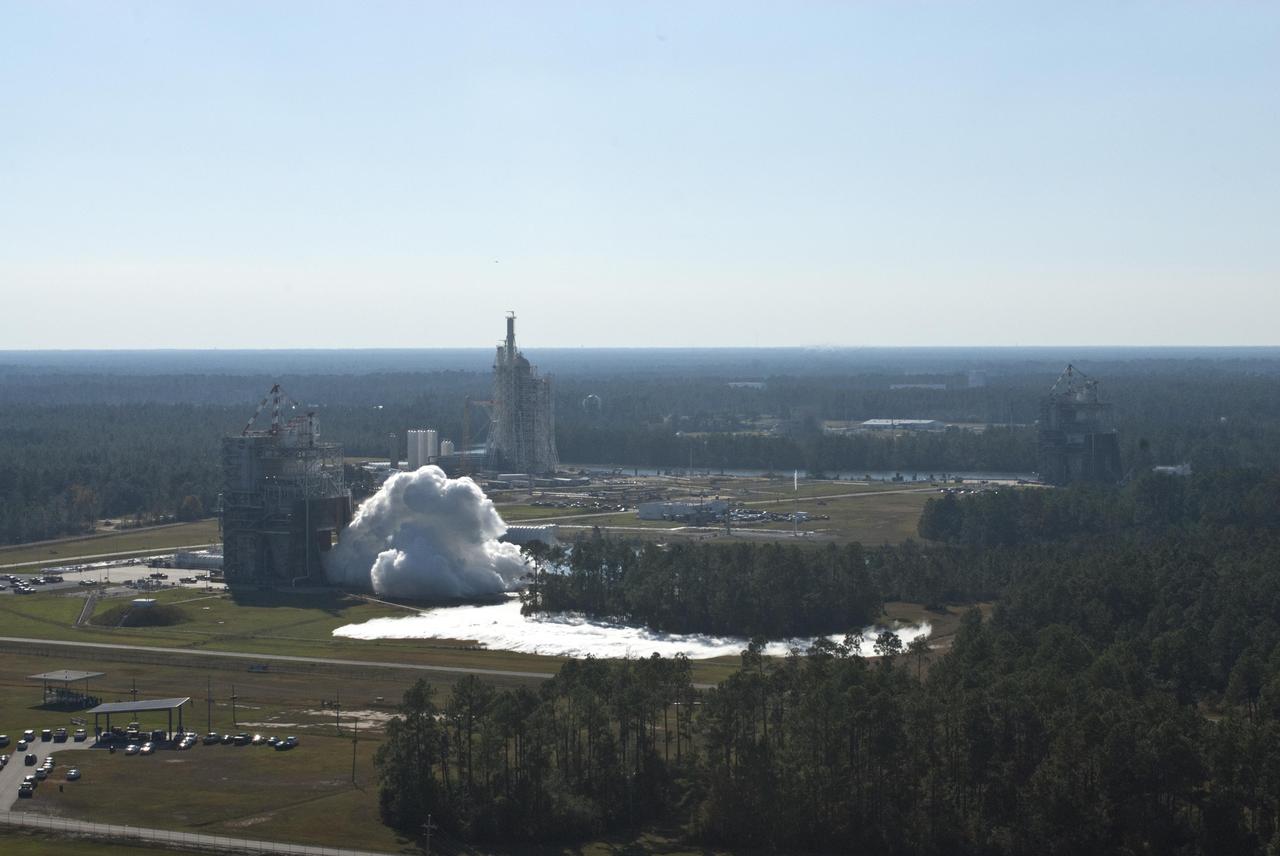
A photograph of a J-2X rocket engine on the A-2 Test Stand from atop the B Test Stand at Stennis Space Center offers a panoramic view of the A Test Complex. The J-2X engine is being developed for NASA by Pratt & Whitney Rocketdyne to carry humans deeper into space than ever before.
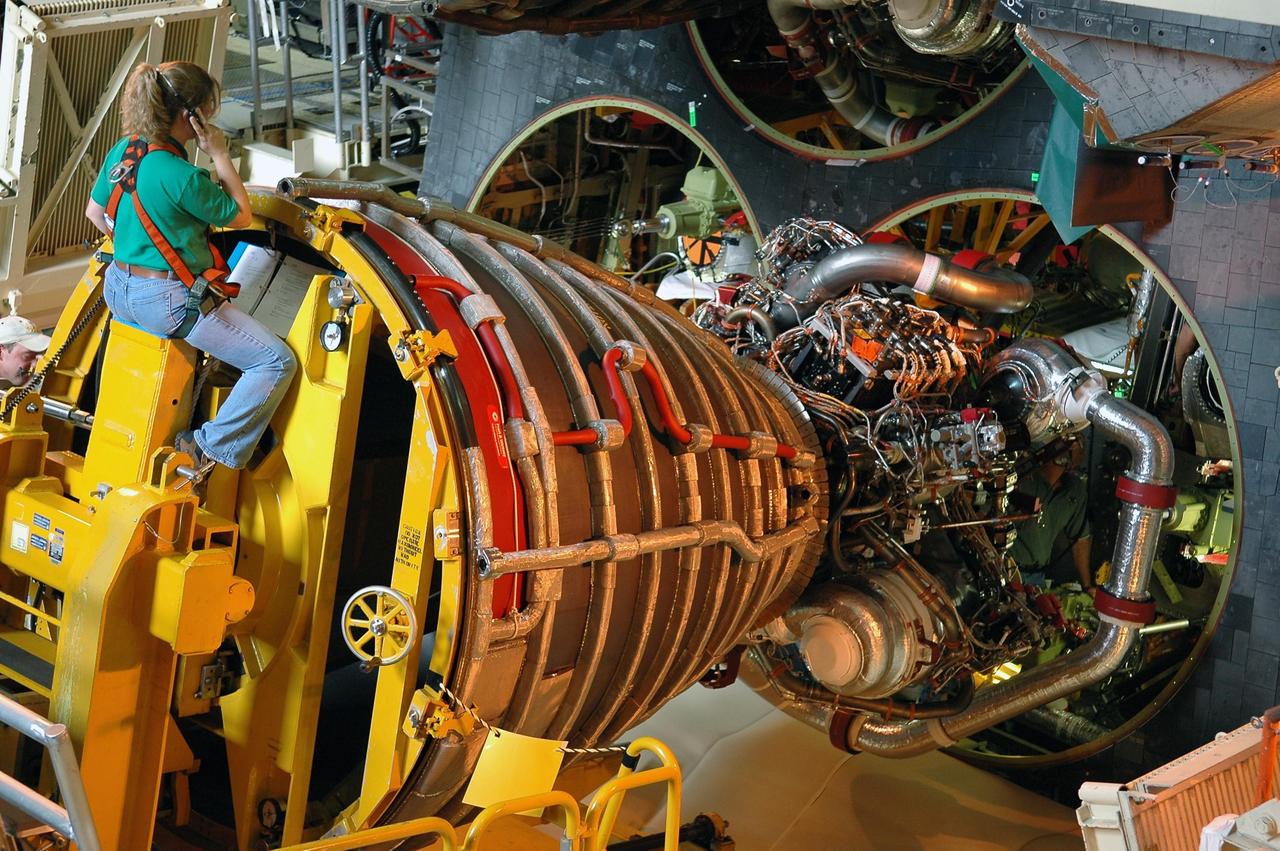
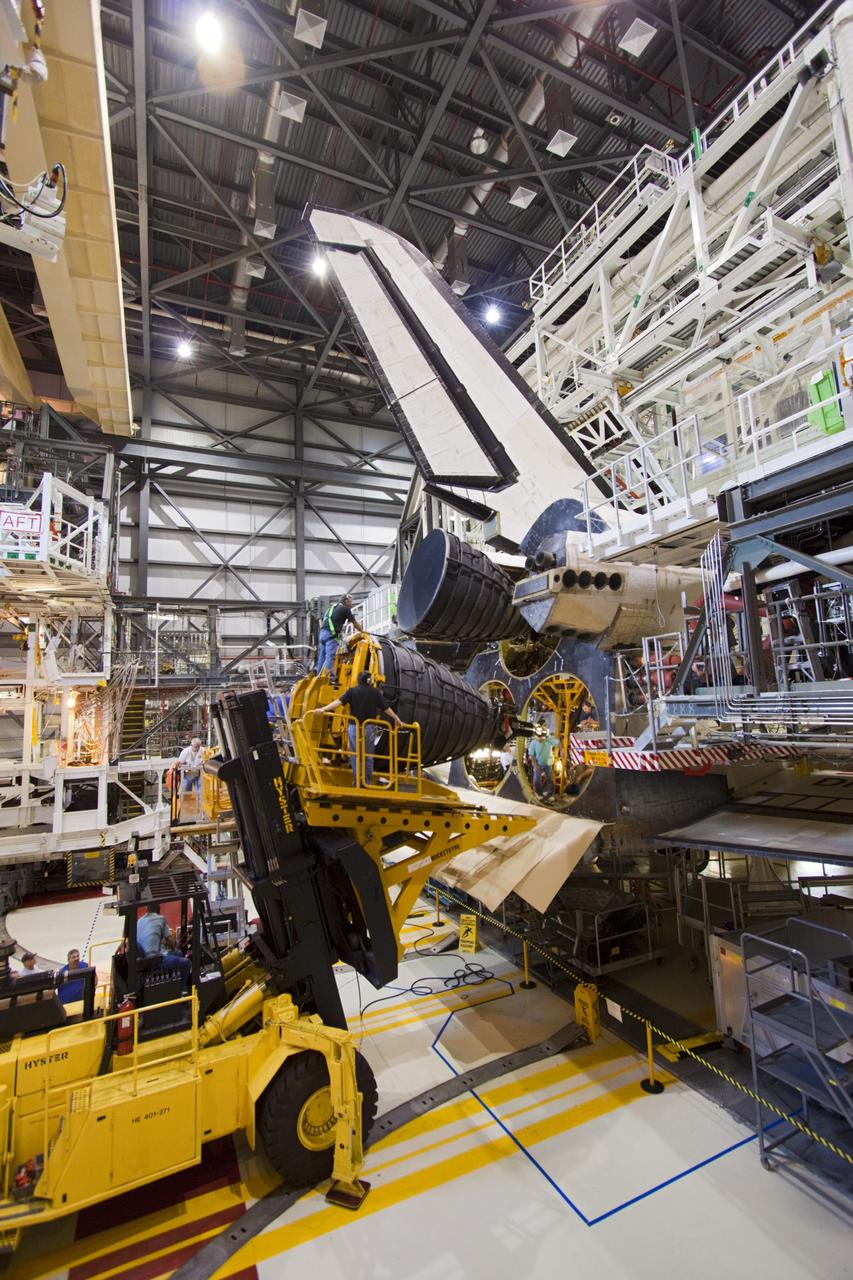
KENNEDY SPACE CENTER, FLA. - In the Orbiter Processing Facility bay 3, technicians on the Hyster forklift maneuver main engine No. 3 into place in Discovery. The main engine configuration is manufactured by Pratt & Whitney Rocketdyne in Canoga Park, Calif., and includes a Pratt & Whitney high-pressure fuel turbo pump. Each space shuttle main engine is 14 feet long, weighs about 6,700 pounds, and is 7.5 feet in diameter at the end of the nozzle. Discovery is being processed for its next mission, STS-116 (12A.1), to deliver a third truss segment, a SPACEHAB module and other key components to the International Space Station. The launch is currently scheduled no earlier than Dec. 14. Photo credit: NASA/Kim Shiflett
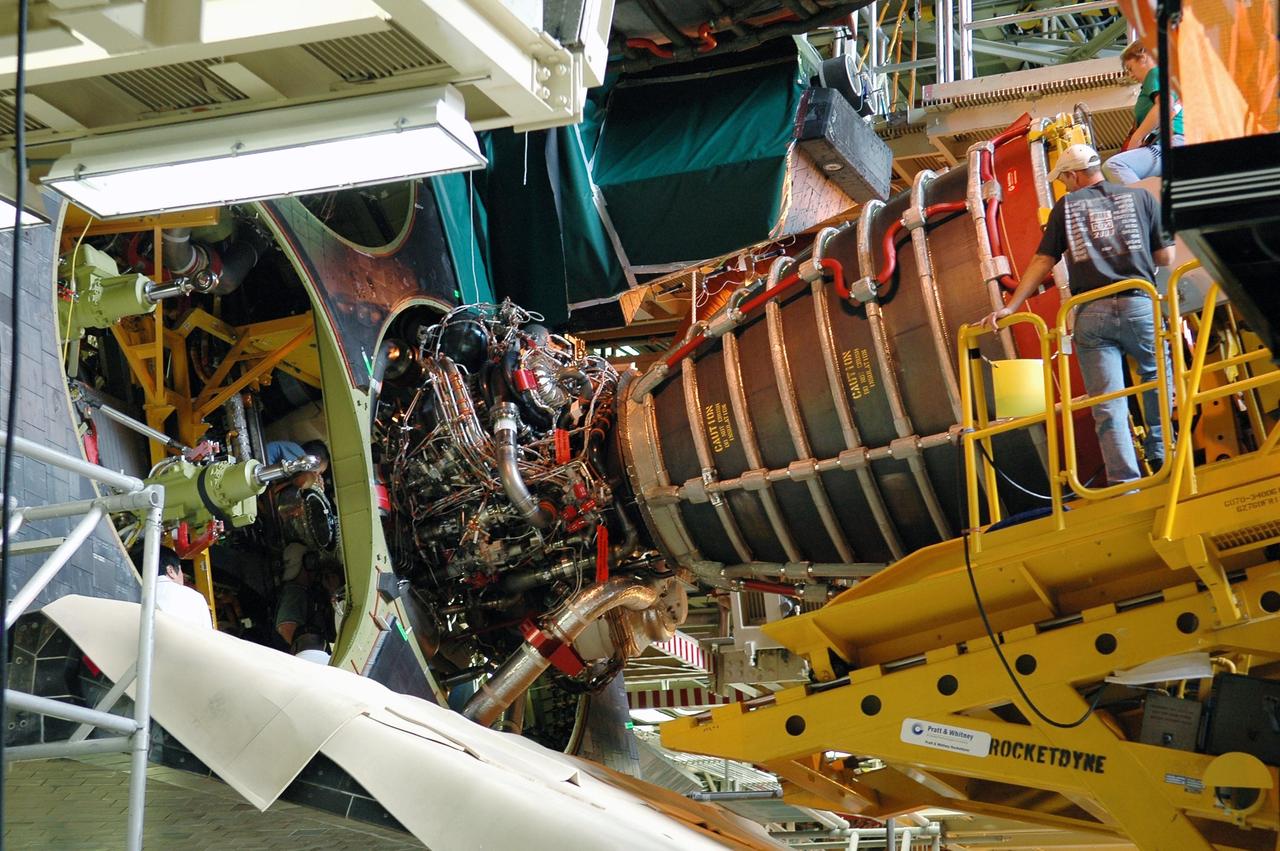
KENNEDY SPACE CENTER, FLA. - In the Orbiter Processing Facility bay 3, technicians on the Hyster forklift maneuver main engine No. 3 into place in Discovery. The main engine configuration is manufactured by Pratt & Whitney Rocketdyne in Canoga Park, Calif., and includes a Pratt & Whitney high-pressure fuel turbo pump. Each space shuttle main engine is 14 feet long, weighs about 6,700 pounds, and is 7.5 feet in diameter at the end of the nozzle. Discovery is being processed for its next mission, STS-116 (12A.1), to deliver a third truss segment, a SPACEHAB module and other key components to the International Space Station. The launch is currently scheduled no earlier than Dec. 14. Photo credit: NASA/Kim Shiflett
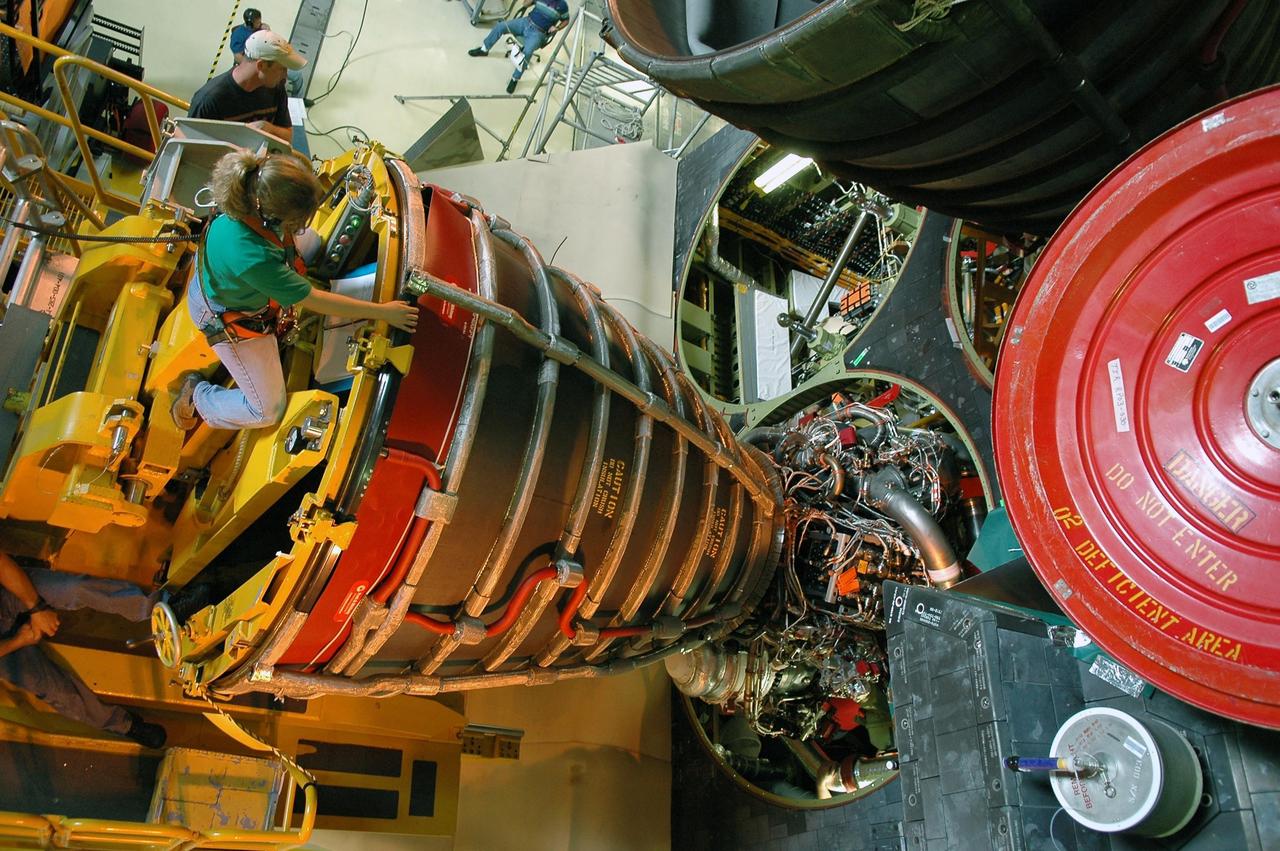
KENNEDY SPACE CENTER, FLA. - In the Orbiter Processing Facility bay 3, technicians on the Hyster forklift maneuver main engine No. 3 into place in Discovery. The main engine configuration is manufactured by Pratt & Whitney Rocketdyne in Canoga Park, Calif., and includes a Pratt & Whitney high-pressure fuel turbo pump. Each space shuttle main engine is 14 feet long, weighs about 6,700 pounds, and is 7.5 feet in diameter at the end of the nozzle. Discovery is being processed for its next mission, STS-116 (12A.1), to deliver a third truss segment, a SPACEHAB module and other key components to the International Space Station. The launch is currently scheduled no earlier than Dec. 14. Photo credit: NASA/Kim Shiflett
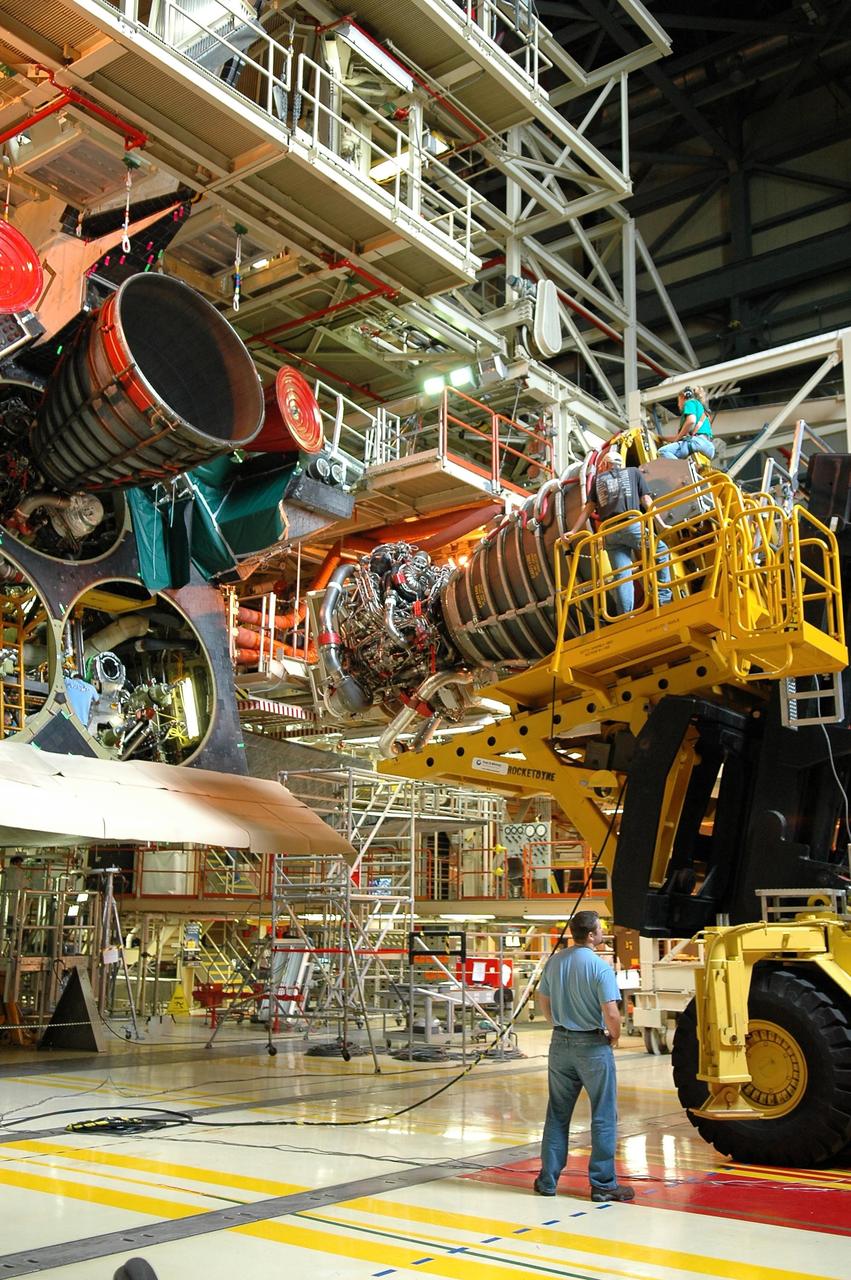
KENNEDY SPACE CENTER, FLA. - In the Orbiter Processing Facility bay 3, technicians on the Hyster forklift are ready to install main engine No. 3 on Discovery. The main engine configuration is manufactured by Pratt & Whitney Rocketdyne in Canoga Park, Calif., and includes a Pratt & Whitney high-pressure fuel turbo pump. Each space shuttle main engine is 14 feet long, weighs about 6,700 pounds, and is 7.5 feet in diameter at the end of the nozzle. Discovery is being processed for its next mission, STS-116 (12A.1), to deliver a third truss segment, a SPACEHAB module and other key components to the International Space Station. The launch is currently scheduled no earlier than Dec. 14. Photo credit: NASA/Kim Shiflett
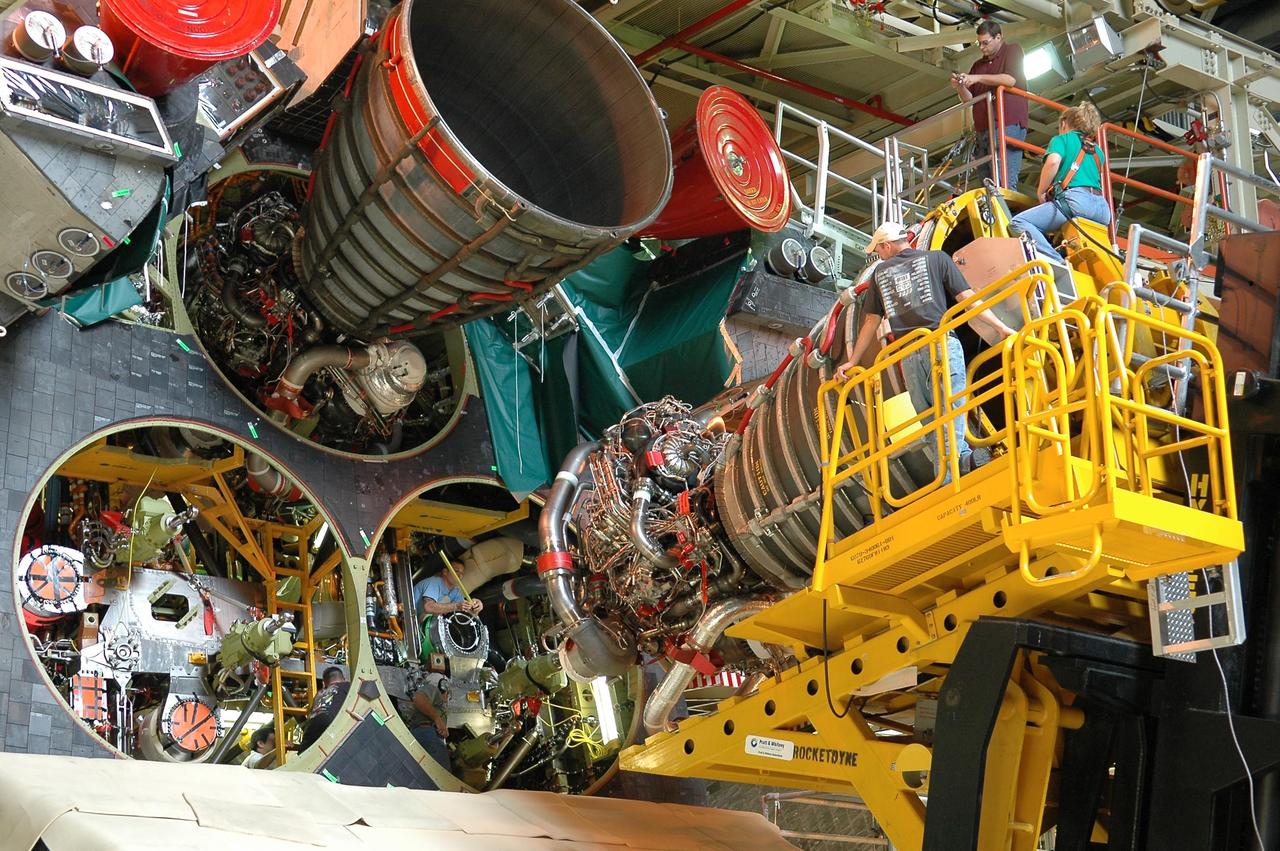
KENNEDY SPACE CENTER, FLA. - In the Orbiter Processing Facility bay 3, technicians on the Hyster forklift maneuver main engine No. 3 into place in Discovery. The main engine configuration is manufactured by Pratt & Whitney Rocketdyne in Canoga Park, Calif., and includes a Pratt & Whitney high-pressure fuel turbo pump. Each space shuttle main engine is 14 feet long, weighs about 6,700 pounds, and is 7.5 feet in diameter at the end of the nozzle. Discovery is being processed for its next mission, STS-116 (12A.1), to deliver a third truss segment, a SPACEHAB module and other key components to the International Space Station. The launch is currently scheduled no earlier than Dec. 14. Photo credit: NASA/Kim Shiflett
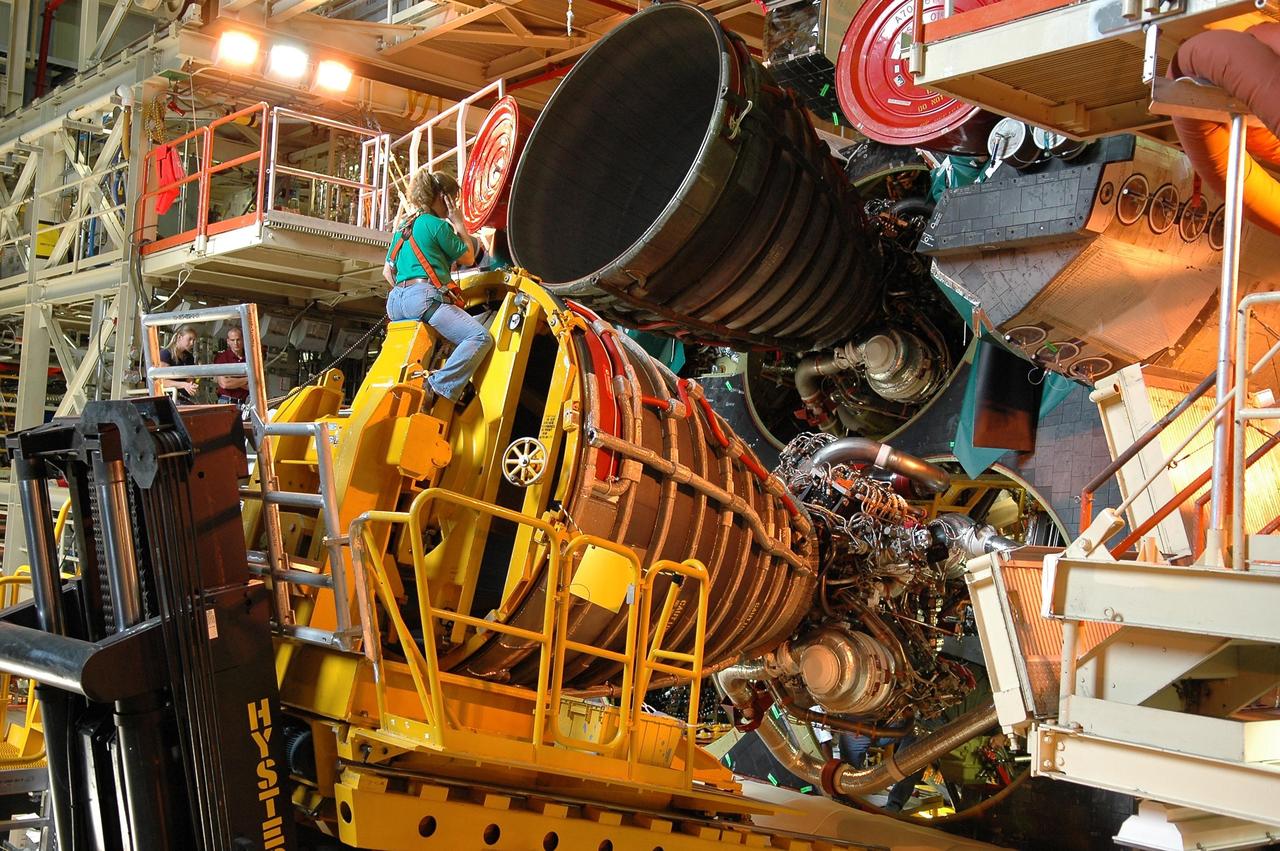
KENNEDY SPACE CENTER, FLA. - In the Orbiter Processing Facility bay 3, technicians on the Hyster forklift maneuver main engine No. 3 into place in Discovery. The main engine configuration is manufactured by Pratt & Whitney Rocketdyne in Canoga Park, Calif., and includes a Pratt & Whitney high-pressure fuel turbo pump. Each space shuttle main engine is 14 feet long, weighs about 6,700 pounds, and is 7.5 feet in diameter at the end of the nozzle. Discovery is being processed for its next mission, STS-116 (12A.1), to deliver a third truss segment, a SPACEHAB module and other key components to the International Space Station. The launch is currently scheduled no earlier than Dec. 14. Photo credit: NASA/Kim Shiflett
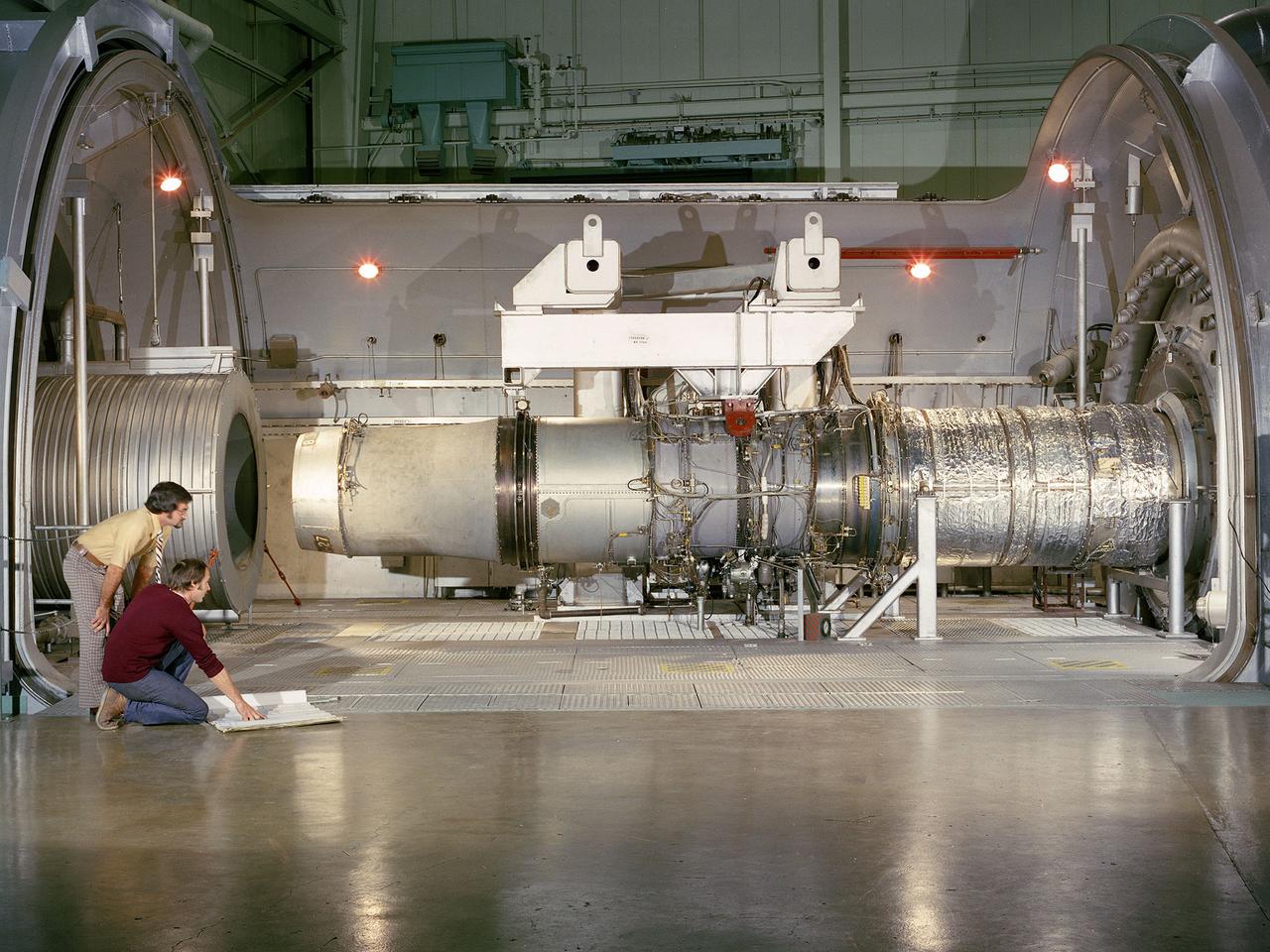
A refanned Pratt and Whitney JT-8D-109 turbofan engine installed in Cell 4 of the Propulsion Systems Laboratory at the National Aeronautics and Space Administration (NASA) Lewis Research Center. NASA Lewis’ Refan Program sought to demonstrate that noise reduction modifications could be applied to existing aircraft engines with minimal costs and without diminishing the engine’s performance or integrity. At the time, Pratt and Whitney’s JT-8D turbofans were one of the most widely used engines in the commercial airline industry. The engines powered Boeing’s 727 and 737 and McDonnell Douglas’ DC-9 aircraft. Pratt and Whitney worked with the airline manufacturers on a preliminary study that verified feasibility of replacing the JT-8D’s two-stage fan with a larger single-stage fan. The new fan slowed the engine’s exhaust, which significantly reduced the amount of noise it generated. Booster stages were added to maintain the proper level of airflow through the engine. Pratt and Whitney produced six of the modified engines, designated JT-8D-109, and performed the initial testing. One of the JT-8D-109 engines, seen here, was tested in simulated altitude conditions in NASA Lewis’ Propulsion Systems Laboratory. The Refan engine was ground-tested on an actual aircraft before making a series of flight tests on 727 and DC-9 aircraft in early 1976. The Refan Program reduced the JT-8D’s noise by 50 percent while increasing the fuel efficiency. The retro-fit kits were estimated to cost between $1 million and $1.7 million per aircraft.
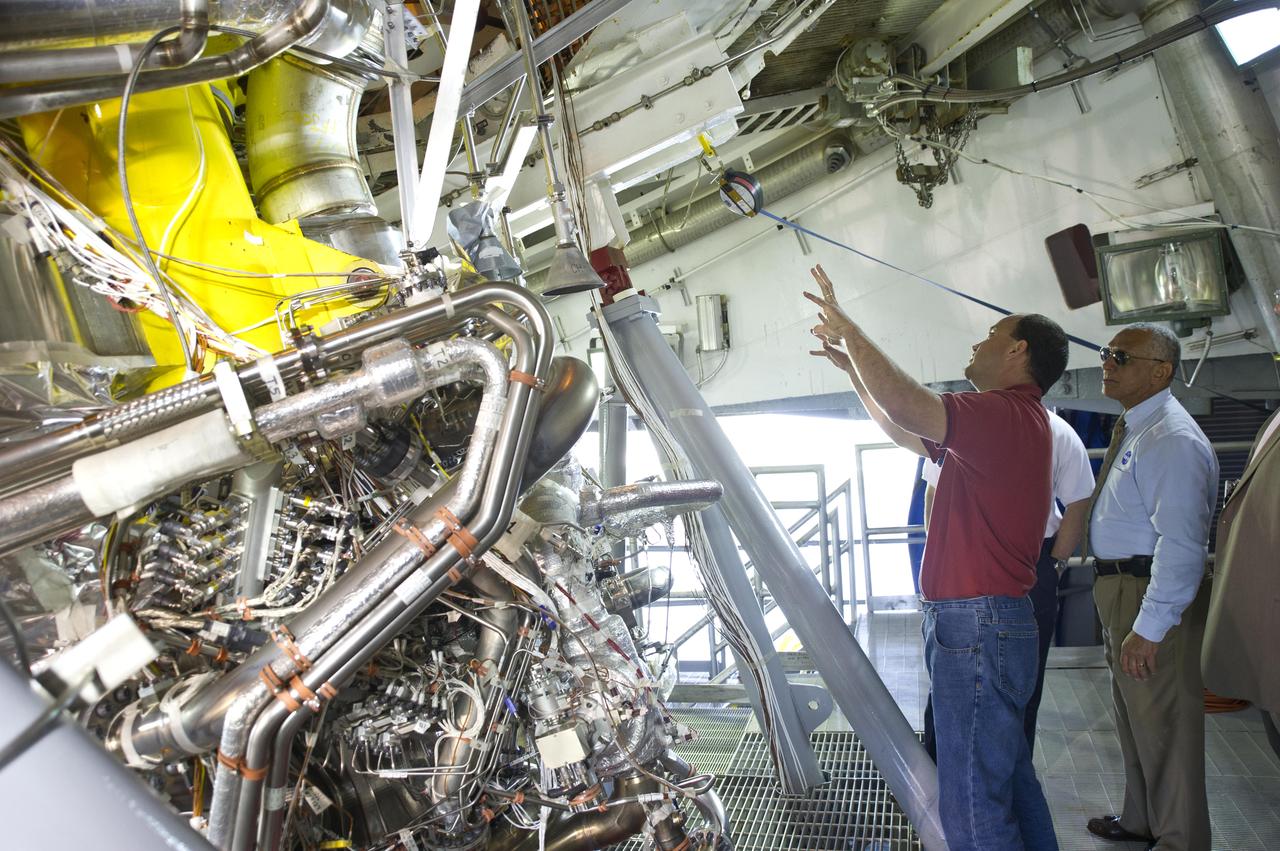
NASA Administrator Charles Bolden (r) takes an up-close look at the first development J-2X rocket engine on the A-2 Test Stand at Stennis Space Center during an April 20, 2012, visit. Pictured with Bolden is A-2 Test Stand Director Skip Roberts. The J-2X engine i s being developed for NASA by Pratt & Whitney Rocketdyne.
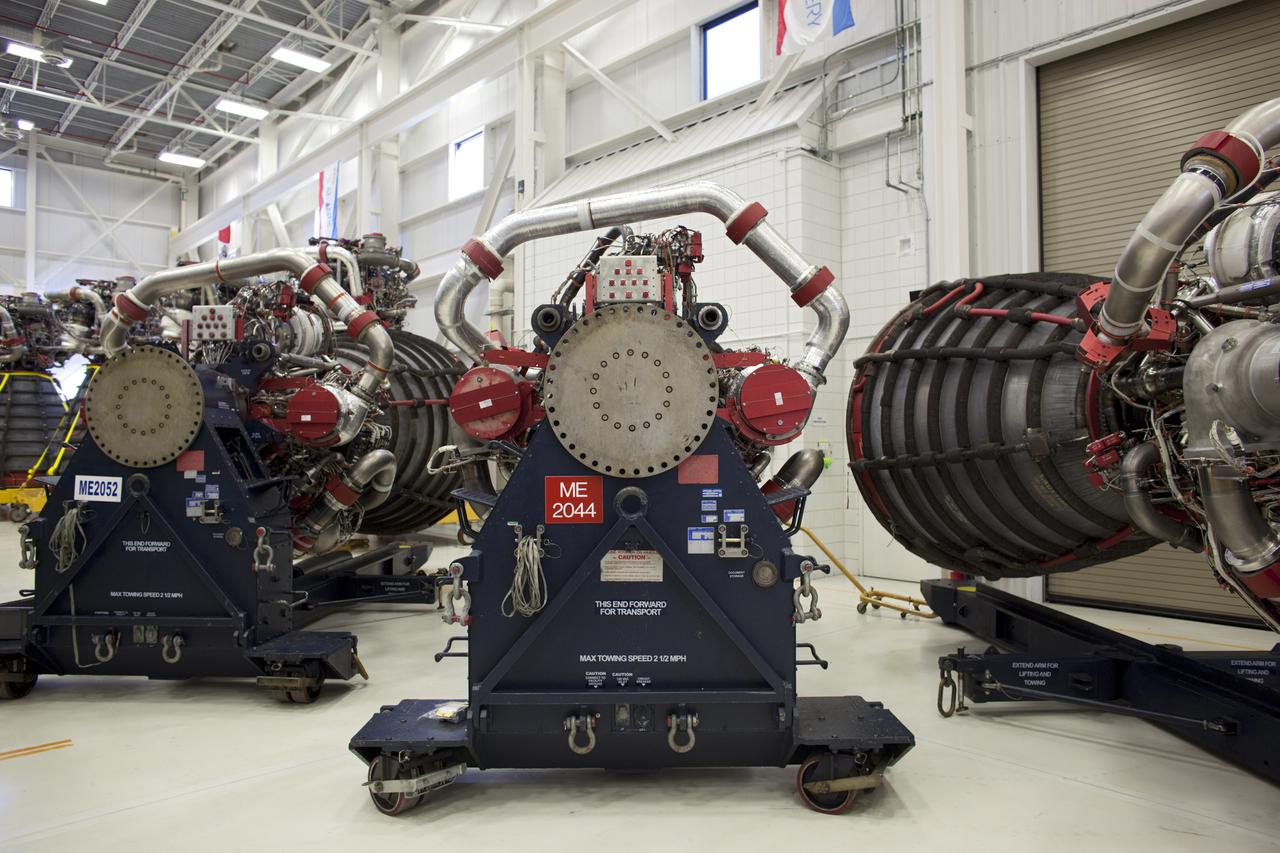
CAPE CANAVERAL, Fla. – Several Pratt Whitney Rocketdyne space shuttle main engines (SSMEs) sit on stands inside the Engine Shop at NASA’s Kennedy Space Center in Florida. For the first time, all 15 main engines are in the Engine Shop at the same time. They are being prepared for shipment to NASA's Stennis Space Center in Mississippi for storage following the completion of the Space Shuttle Program. The engines are being repurposed for use on NASA’s Space Launch System heavy lift rocket. Photo credit: NASA_Dimitri Gerondidakis
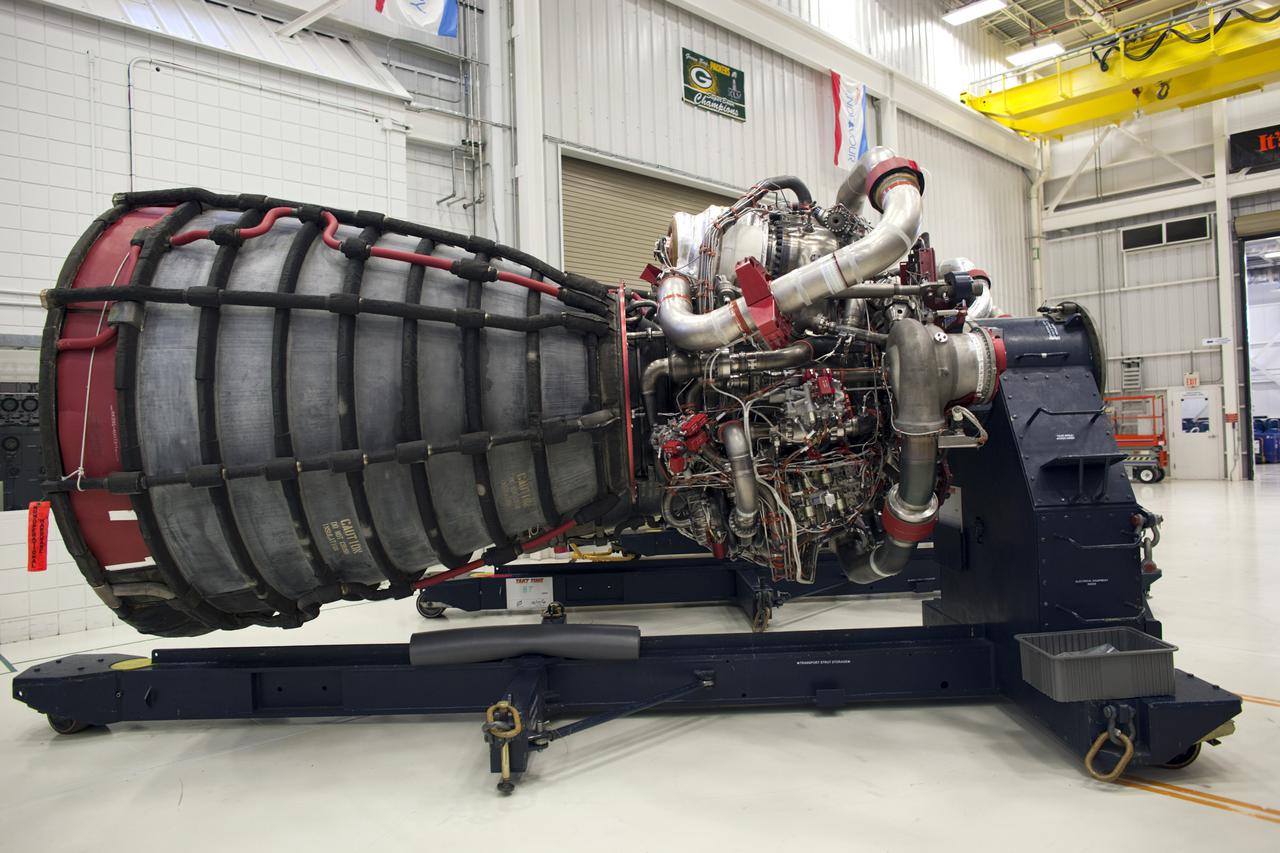
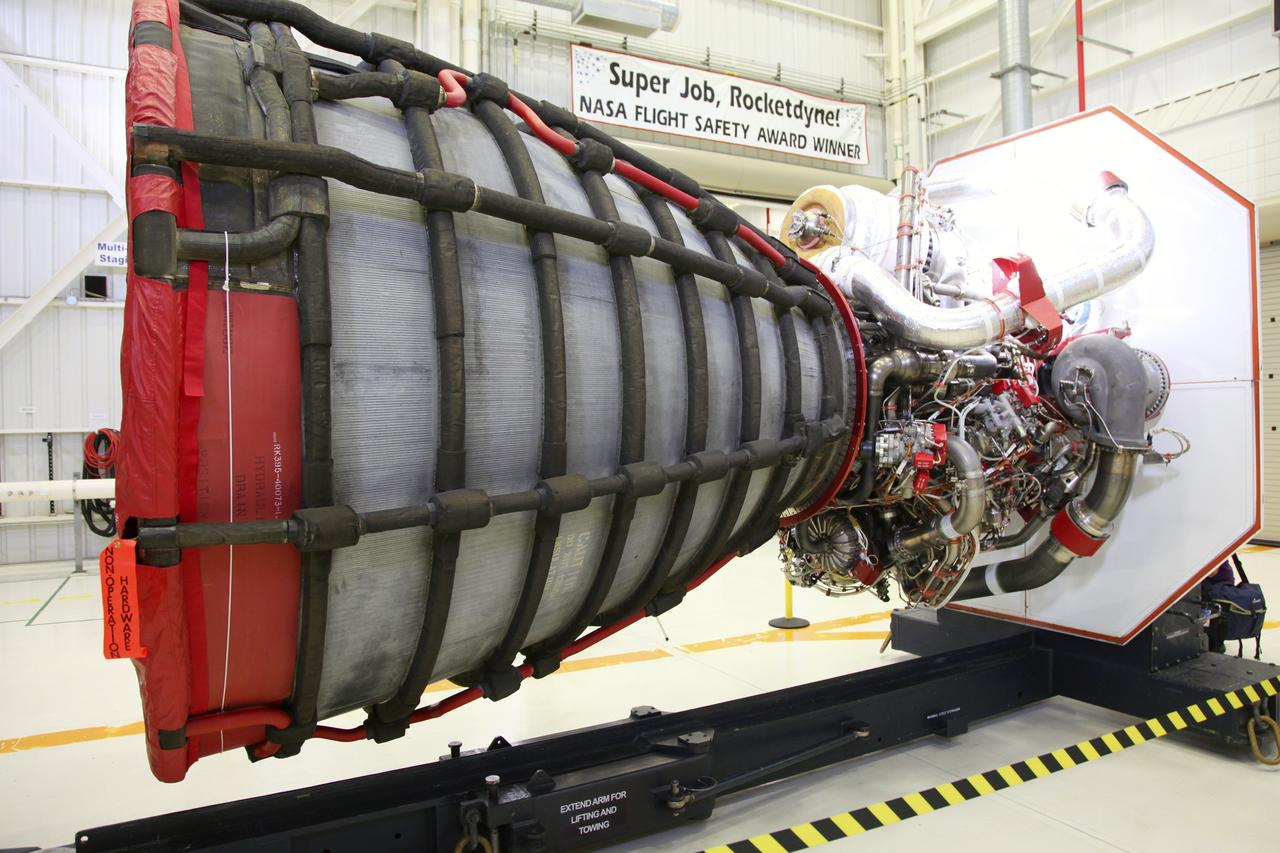
CAPE CANAVERAL, Fla. – At NASA’s Kennedy Space Center in Florida, a Pratt Whitney Rocketdyne space shuttle main engine (SSME) sits on a stand inside the Engine Shop. For the first time, all 15 main engines are in the Engine Shop at the same time. They are being prepared for shipment to NASA's Stennis Space Center in Mississippi for storage following the completion of the Space Shuttle Program. The engines are being repurposed for use on NASA’s Space Launch System heavy lift rocket. Photo credit: NASA_Dimitri Gerondidakis
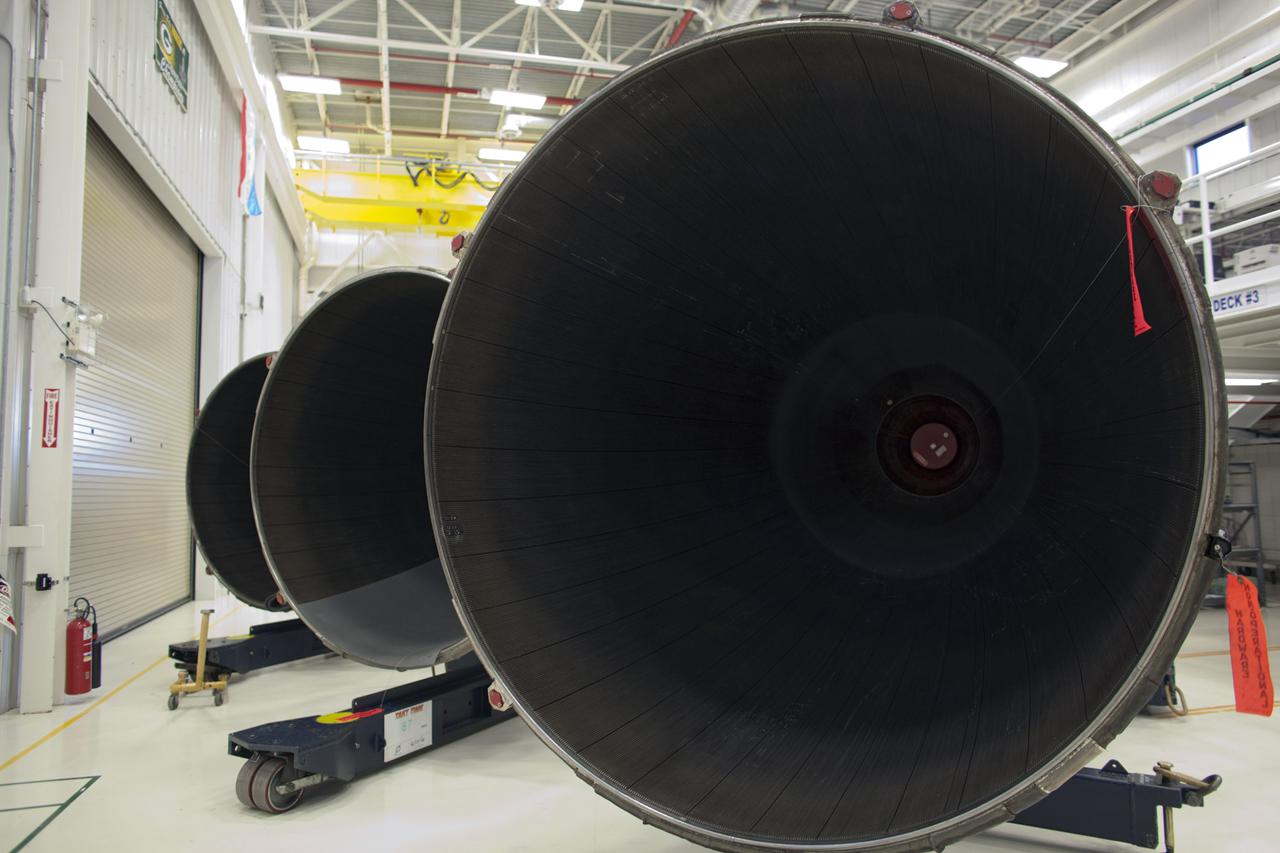
CAPE CANAVERAL, Fla. – At NASA’s Kennedy Space Center in Florida, the large engine bells of several Pratt Whitney Rocketdyne space shuttle main engines (SSMEs) are lined up inside the Engine Shop. For the first time, all 15 main engines are in the Engine Shop at the same time. They are being prepared for shipment to NASA's Stennis Space Center in Mississippi for storage following the completion of the Space Shuttle Program. The engines are being repurposed for use on NASA’s Space Launch System heavy lift rocket. Photo credit: NASA_Dimitri Gerondidakis
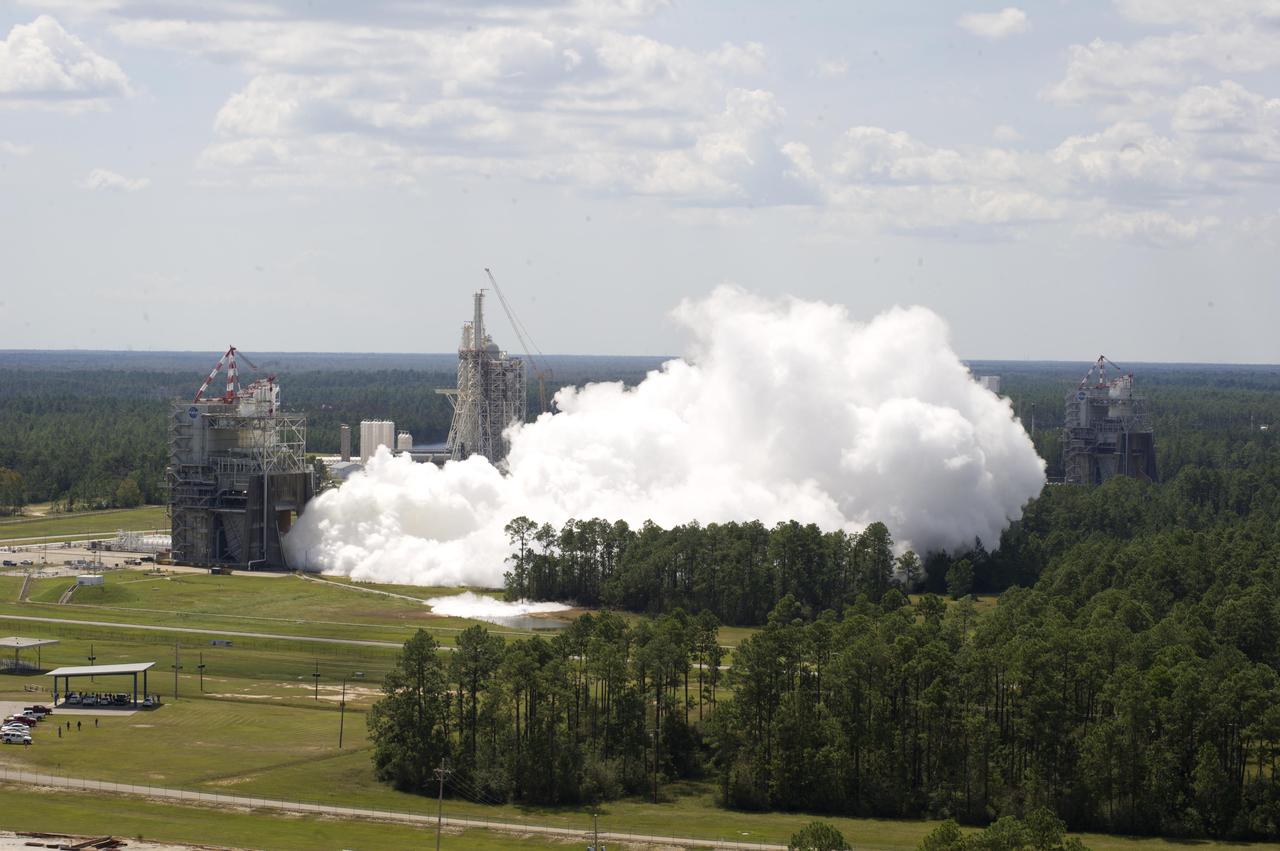
NASA engineers continued to collect test performance data on the new J-2X rocket engine at Stennis Space Center with a 250-second test Sept. 14. The test on the A-2 Test Stand was the 19th in a series of firings to gather critical data for continued development of the engine. The J-2X is being developed by Pratt and Whitney Rocketdyne for NASA's Marshall Space Flight Center in Huntsville, Ala. It is the first liquid oxygen and liquid hydrogen rocket engine rated to carry humans into space to be developed in 40 years.
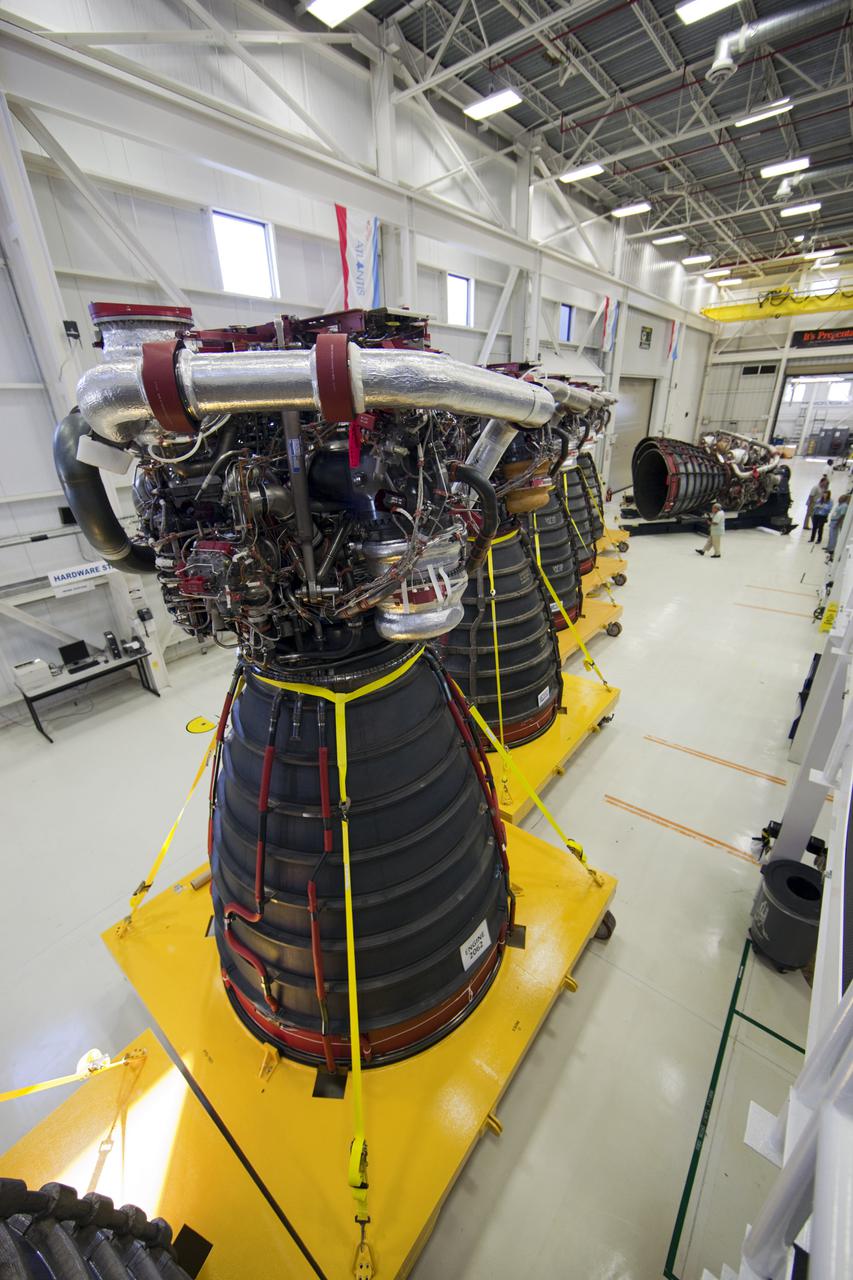
CAPE CANAVERAL, Fla. – Lined up in a row, several Pratt Whitney Rocketdyne space shuttle main engines (SSMEs) sit on stands inside the Engine Shop at NASA’s Kennedy Space Center in Florida. For the first time, all 15 main engines are in the Engine Shop at the same time. They are being prepared for shipment to NASA's Stennis Space Center in Mississippi for storage following the completion of the Space Shuttle Program. The engines are being repurposed for use on NASA’s Space Launch System heavy lift rocket. Photo credit: NASA_Dimitri Gerondidakis
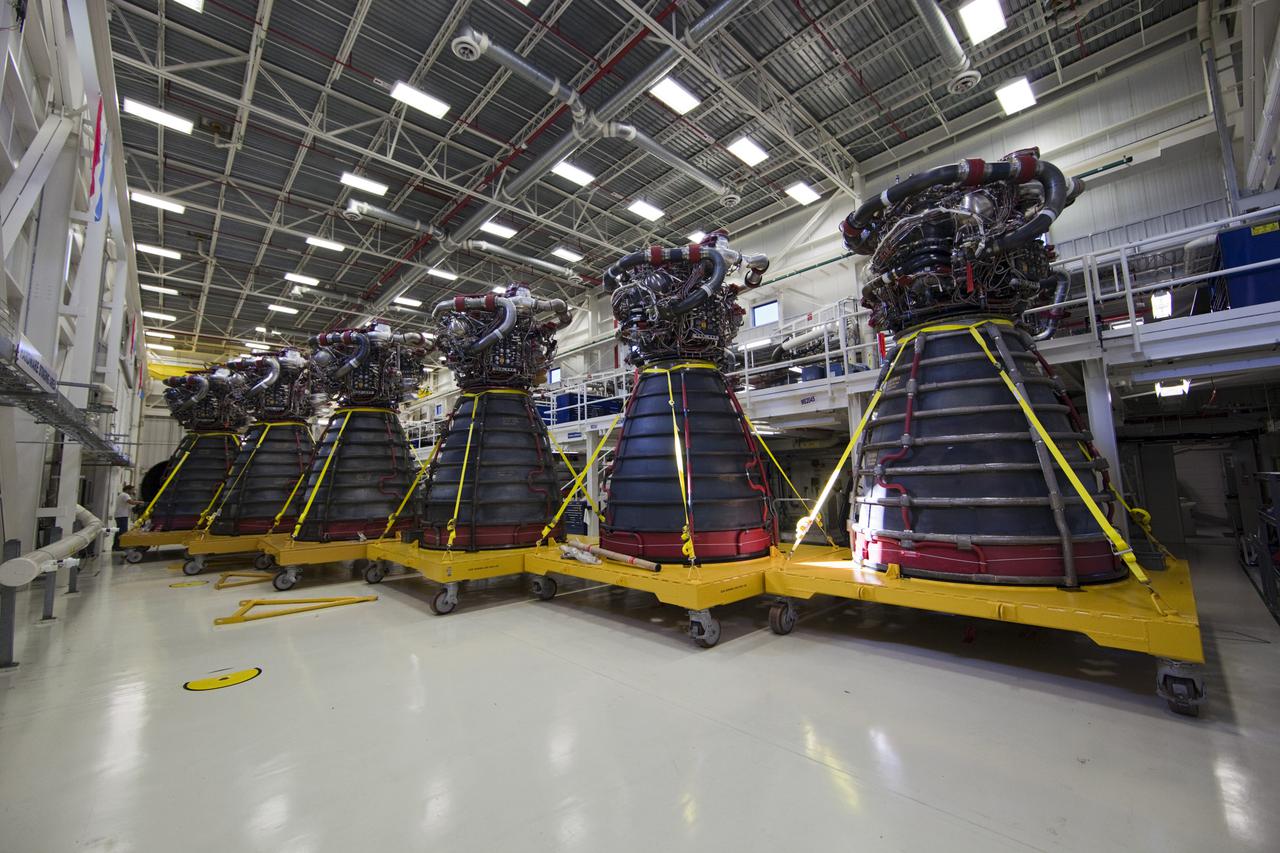
CAPE CANAVERAL, Fla. – Lined up in a row, six Pratt Whitney Rocketdyne space shuttle main engines (SSMEs) sit on stands inside the Engine Shop at NASA’s Kennedy Space Center in Florida. For the first time, all 15 main engines are in the Engine Shop at the same time. They are being prepared for shipment to NASA's Stennis Space Center in Mississippi for storage following the completion of the Space Shuttle Program. The engines are being repurposed for use on NASA’s Space Launch System heavy lift rocket. Photo credit: NASA_Dimitri Gerondidakis

KENNEDY SPACE CENTER, FLA. - In the Orbiter Processing Facility bay 1, the main engine is in place on Discovery. The main engine configuration is manufactured by Boeing Rocketdyne in Canoga Park, Calif., and includes a Pratt & Whitney high-pressure fuel turbo pump. Each space shuttle main engine is 14 feet (4.3 meters) long, weighs about 6,700 pounds (3,039 kilograms), and is 7.5 feet (2.3 meters) in diameter at the end of the nozzle. Discovery is being processed for the second return-to-flight mission STS-121.
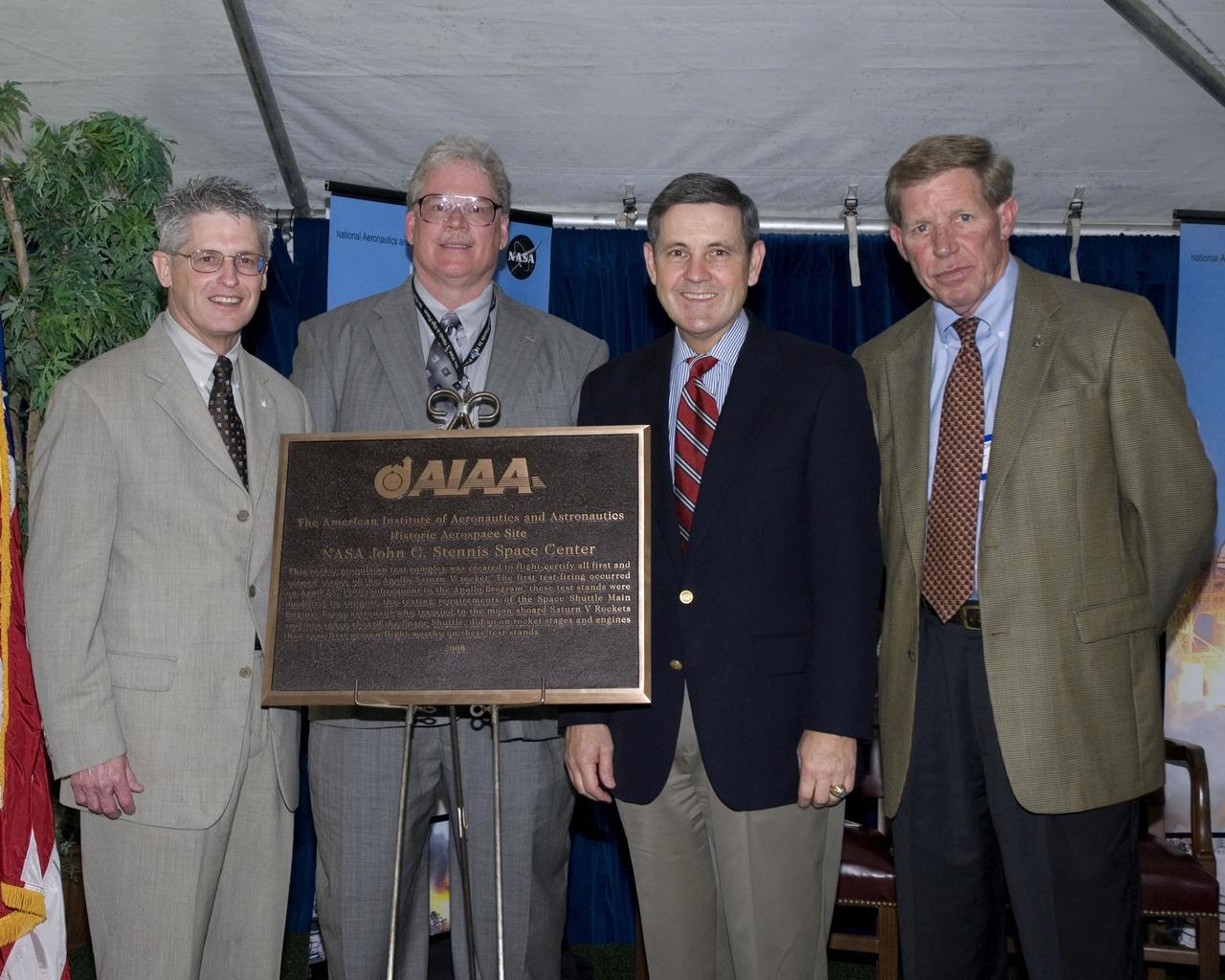
Picured (left to right) American Institute of Aeronautics and Astronautics (AIAA) representative David Throckmorton presents a plaque designating NASA's John C. Stennis Space Center as a historical aerospace site during an April 10 ceremony. Joining Throckmorton for the presentation were AIAA Greater New Orleans Chapter Chair Mark Hughes, Stennis Space Center Director Bob Cabana and Pratt & Whitney Rocketdyne Vice President John Plowden.
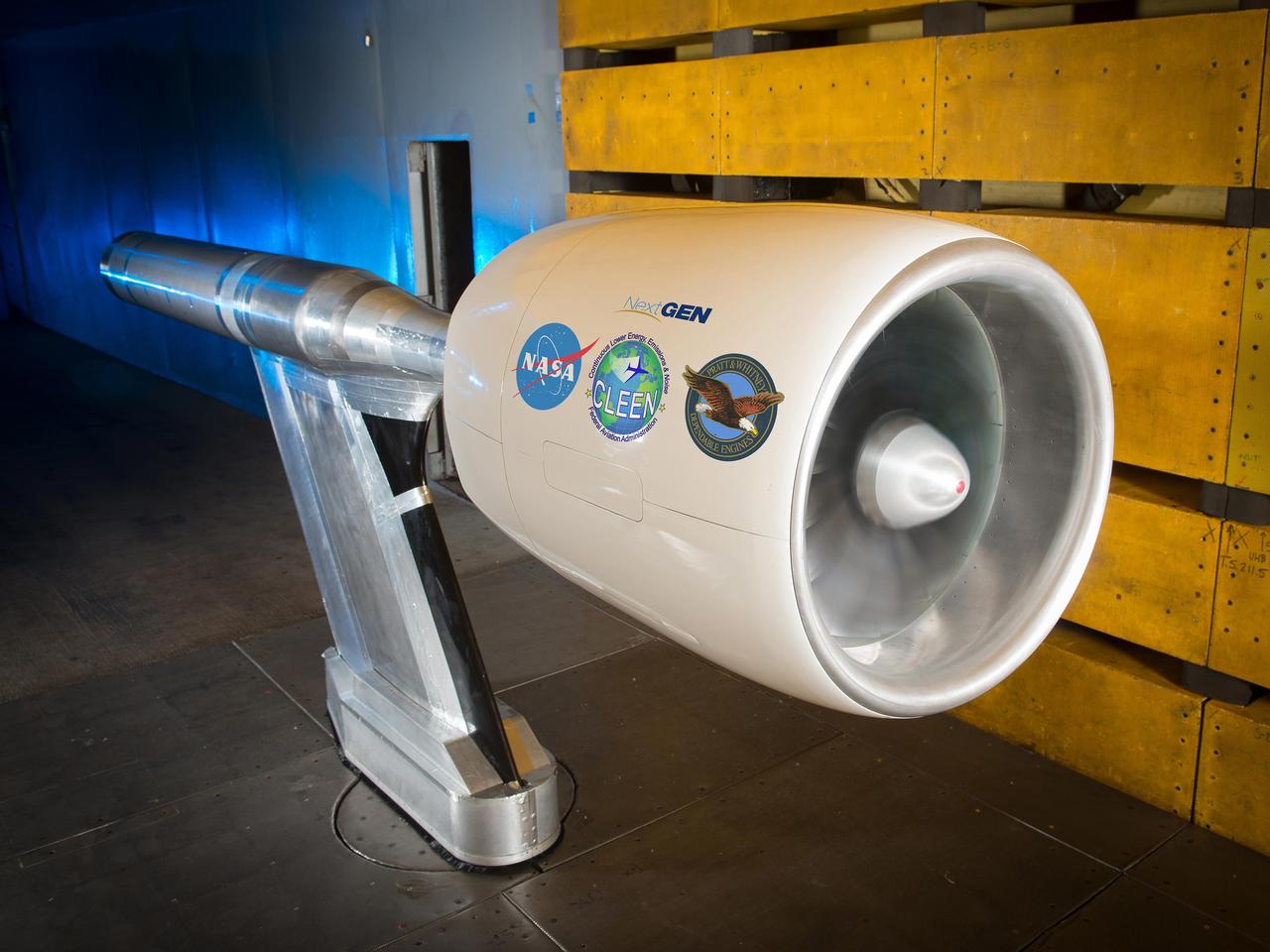
NASA’s Environmentally Responsible Aviation Project, in collaboration with the Federal Aviation Administration (FAA) and Pratt & Whitney, completed testing of an Ultra High Bypass Ratio Turbofan Model in the 9’ x 15’ Low Speed Wind Tunnel at NASA Glenn Research Center. The fan model is representative of the next generation of efficient and quiet Ultra High Bypass Ratio Turbofan Engine designs.
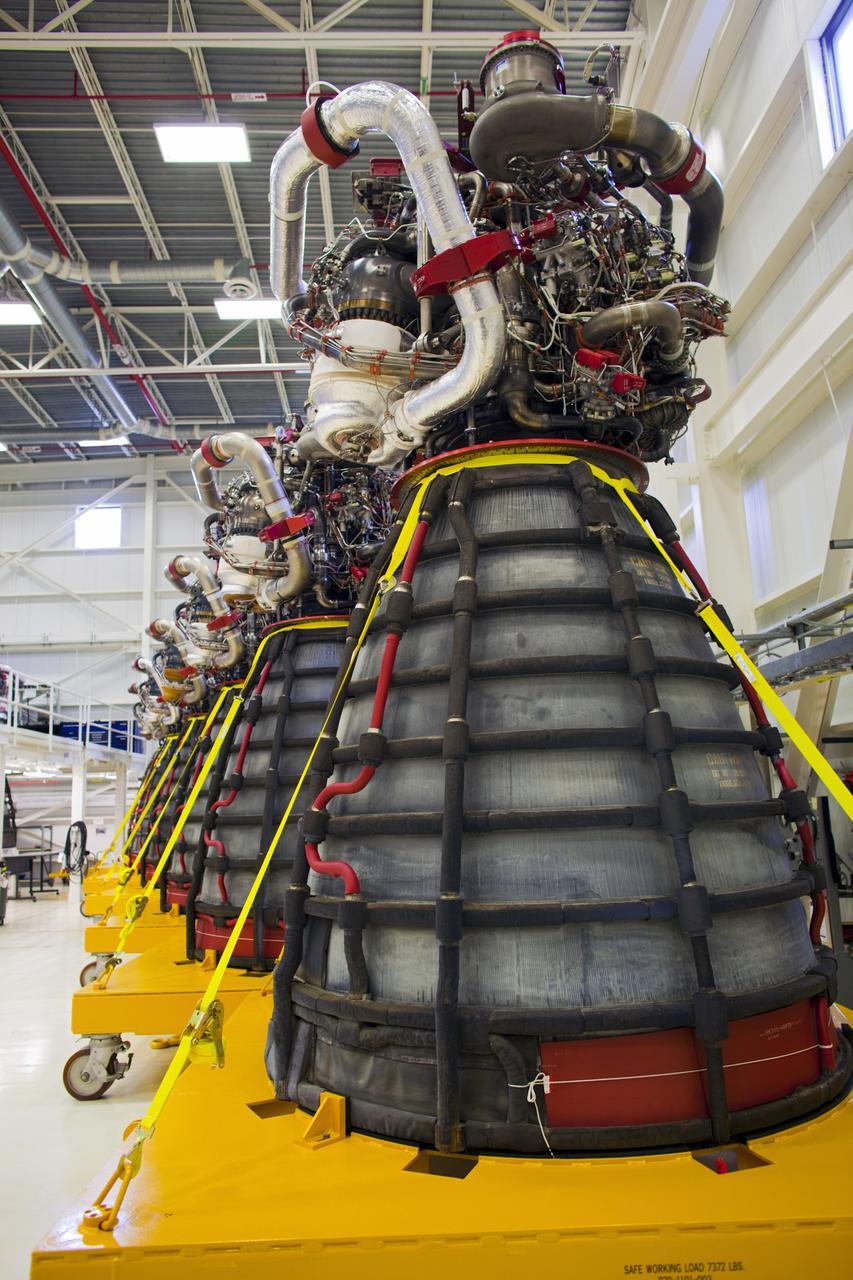
CAPE CANAVERAL, Fla. – Lined up in a row, six Pratt Whitney Rocketdyne space shuttle main engines (SSMEs) sit on stands inside the Engine Shop at NASA’s Kennedy Space Center in Florida. For the first time, all 15 main engines are in the Engine Shop at the same time. They are being prepared for shipment to NASA's Stennis Space Center in Mississippi for storage following the completion of the Space Shuttle Program. The engines are being repurposed for use on NASA’s Space Launch System heavy lift rocket. Photo credit: NASA_Dimitri Gerondidakis
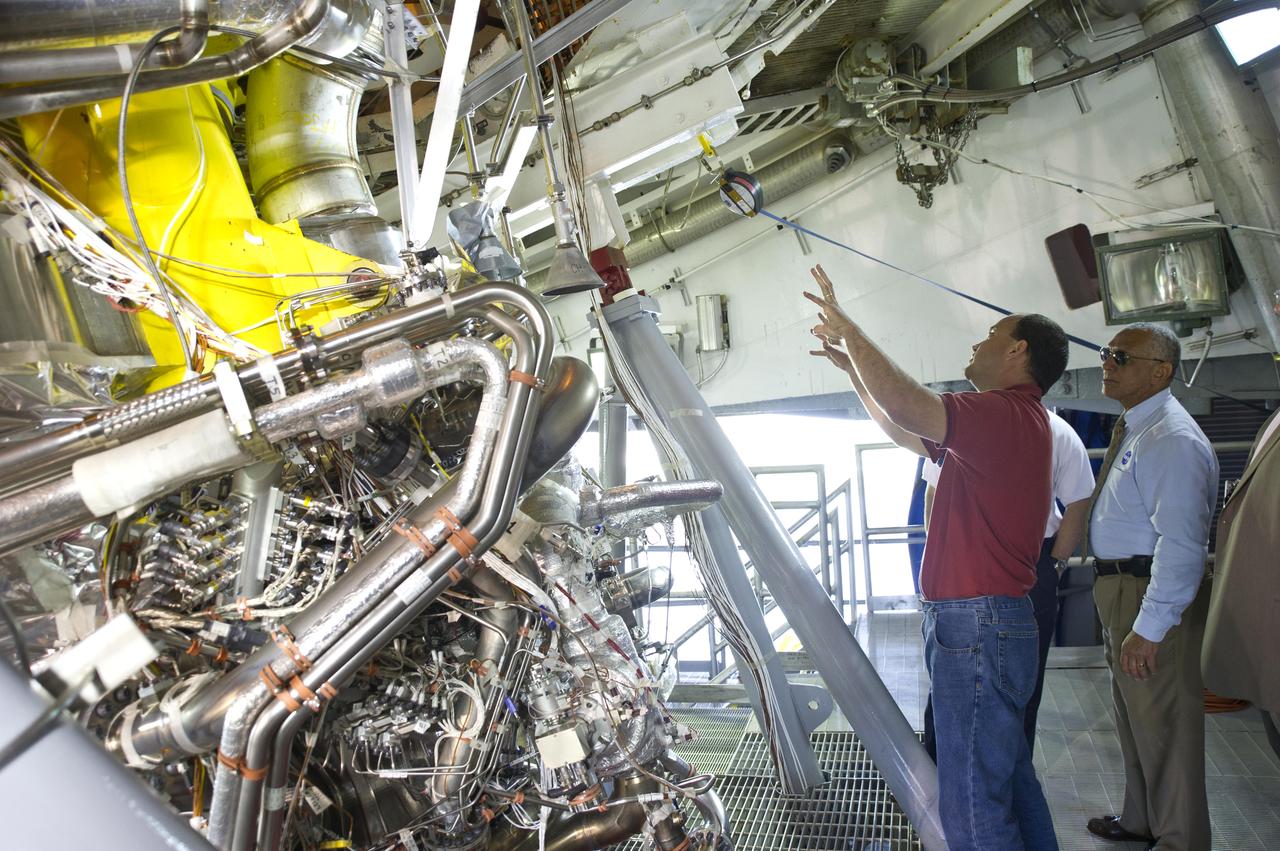
NASA Administrator Charles Bolden (r) takes an up-close look at the first development J-2X rocket engine on the A-2 Test Stand at Stennis Space Center during an April 20, 2012, visit. Pictured with Bolden is A-2 Test Stand Director Skip Roberts. The J-2X engine is being developed for NASA by Pratt & Whitney Rocketdyne.
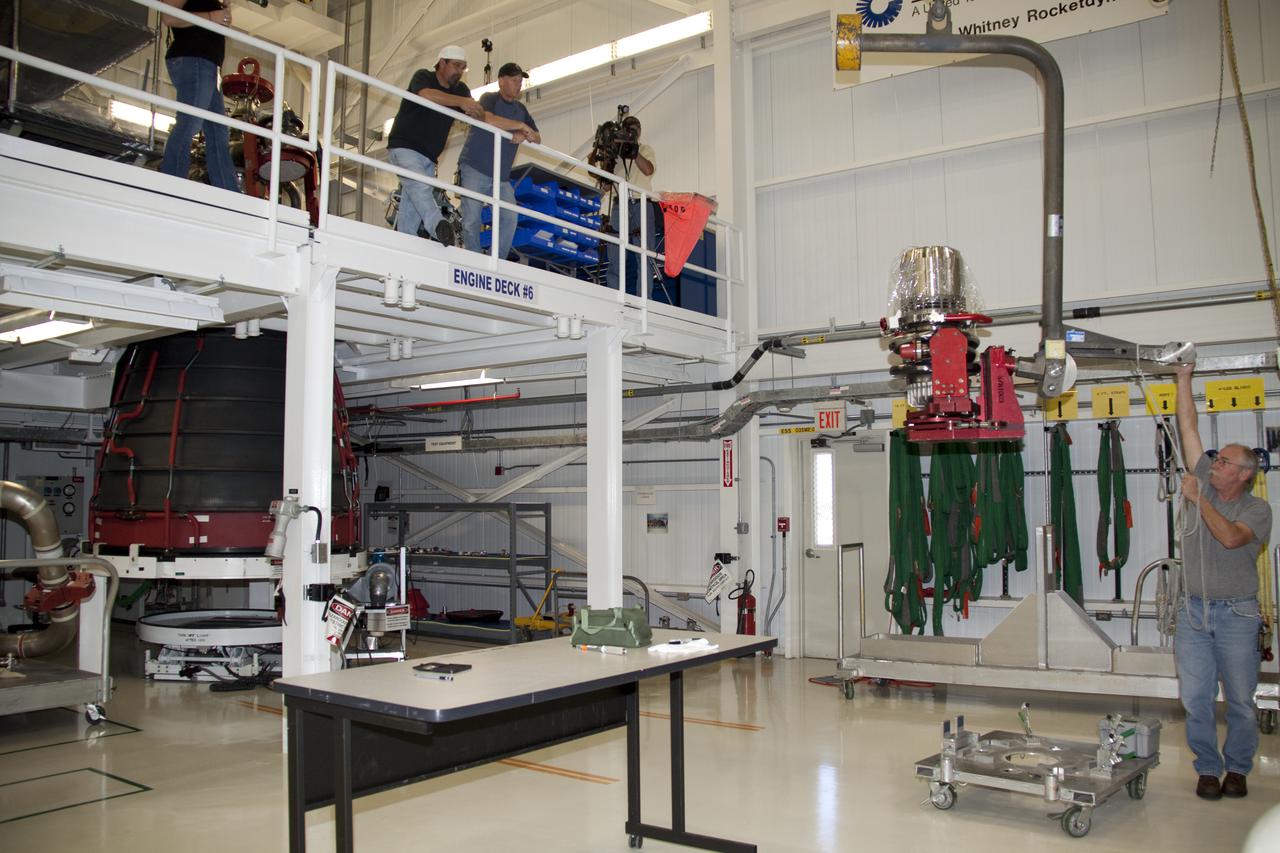
CAPE CANAVERAL, Fla. – On the floor of the Space Shuttle Main Engine Processing Facility at NASA's Kennedy Space Center in Florida, Pratt and Whitney Rocketdyne engine technician Dan Bode lifts a high pressure oxidizer turbo pump off its stand for installation on space shuttle main engine no. 2062. The engine, or SSME, is the last one scheduled to be built at Kennedy by Pratt and Whitney Rocketdyne before the end of the Space Shuttle Program. Three main engines are clustered at the aft end of the shuttle and have a combined thrust of more than 1.2 million pounds. Even though an SSME weighs one-seventh as much as a locomotive engine, its high-pressure fuel pump alone delivers as much horsepower as 28 locomotives. Each engine operates during the entire eight-and-a-half minute climb to orbit. Post-flight inspections and maintenance of each engine also are conducted in the SSME Processing Facility between shuttle missions. Photo credit: NASA_Amanda Diller
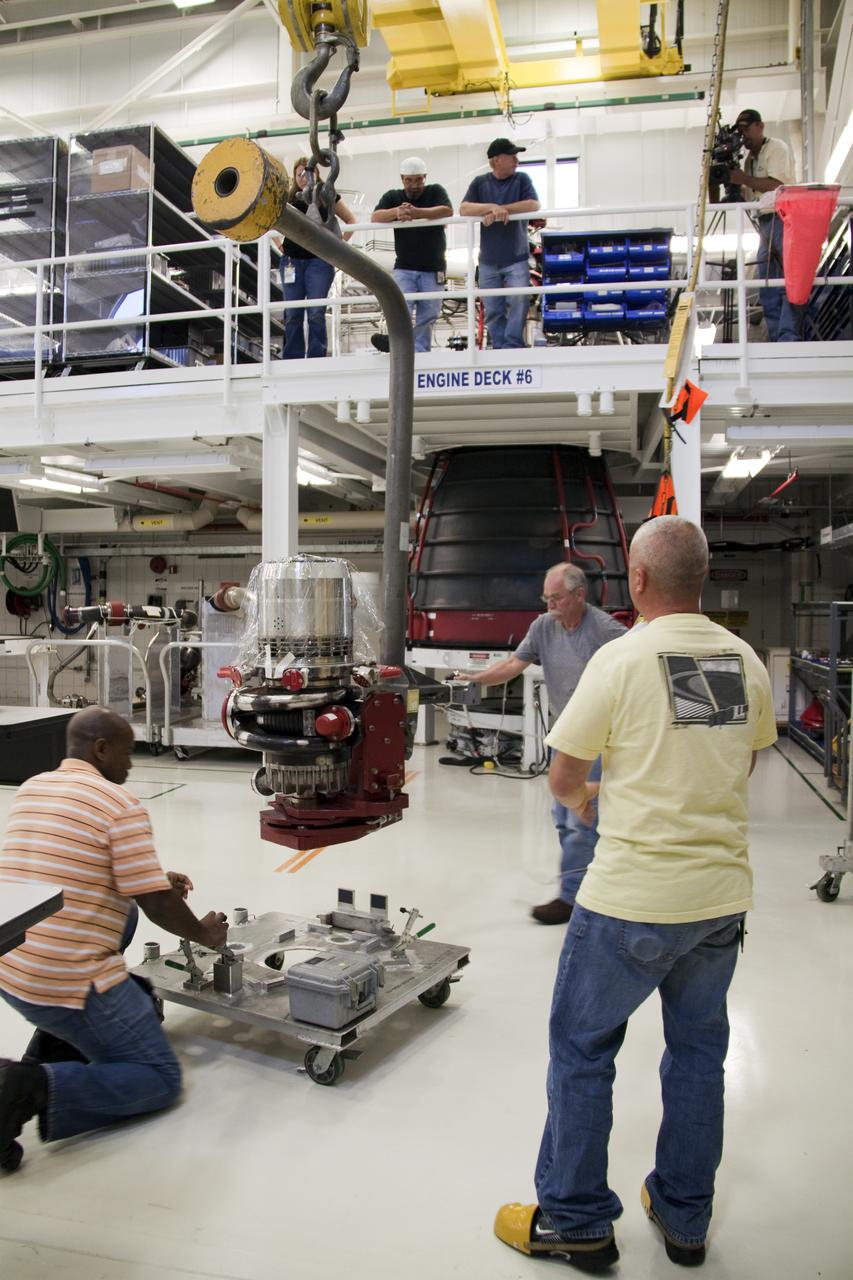
CAPE CANAVERAL, Fla. – On the floor of the Space Shuttle Main Engine Processing Facility at NASA's Kennedy Space Center in Florida, Pratt and Whitney Rocketdyne engine technicians lift a high pressure oxidizer turbo pump off its stand for installation on space shuttle main engine no. 2062. The engine, or SSME, is the last one scheduled to be built at Kennedy by Pratt and Whitney Rocketdyne before the end of the Space Shuttle Program. From left are Teryon Jones, Dan Bode and Ryan Mahony. Three main engines are clustered at the aft end of the shuttle and have a combined thrust of more than 1.2 million pounds. Even though an SSME weighs one-seventh as much as a locomotive engine, its high-pressure fuel pump alone delivers as much horsepower as 28 locomotives. Each engine operates during the entire eight-and-a-half minute climb to orbit. Post-flight inspections and maintenance of each engine also are conducted in the SSME Processing Facility between shuttle missions. Photo credit: NASA_Amanda Diller
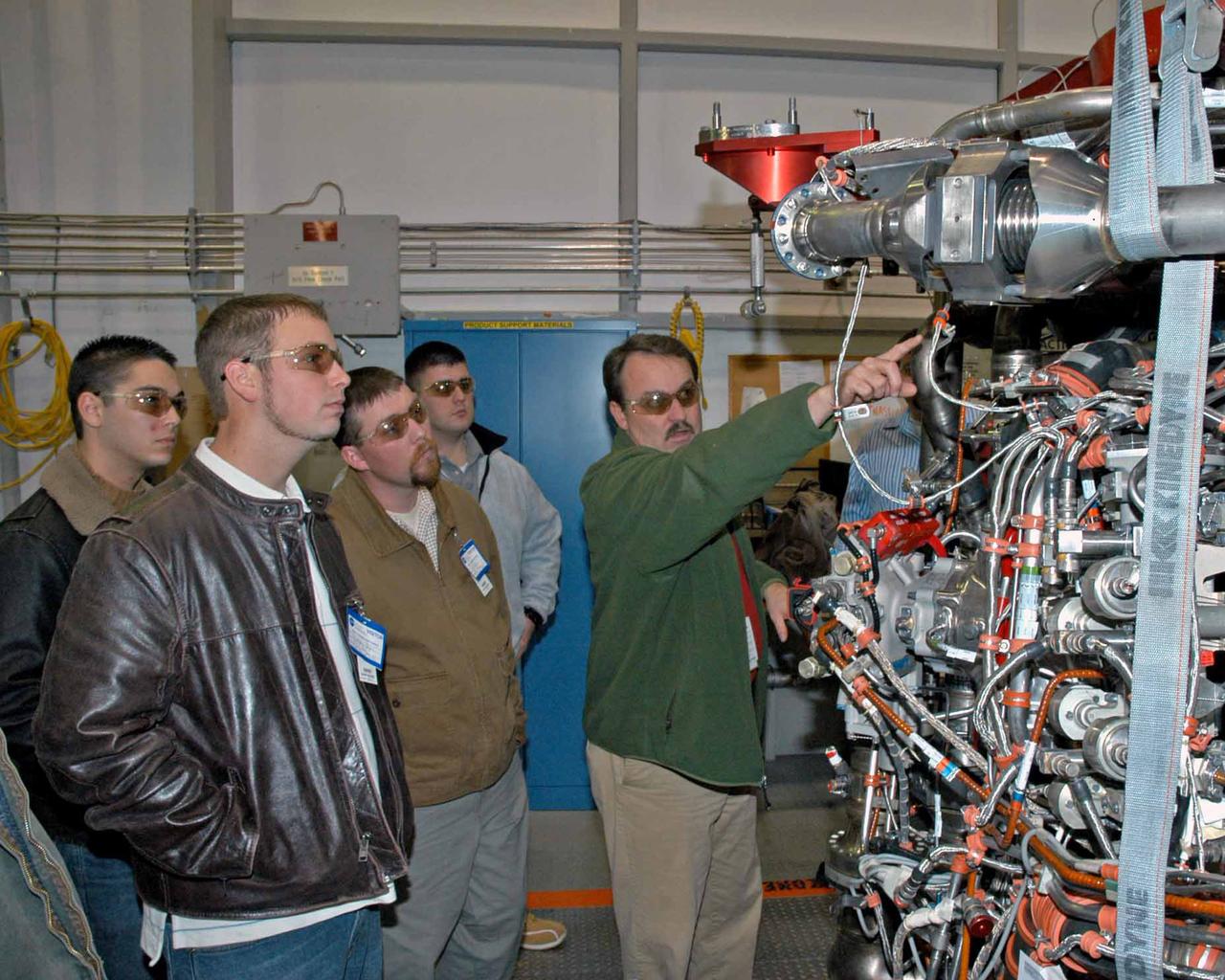
Pratt & Whitney Rocketdyne's Jeff Hansell, right, explains functions of a space shuttle main engine to Pearl River Community College Aviation Maintenance Technology Program students. Christopher Bryon, left, of Bay St. Louis, Ret Tolar of Kiln, Dan Holston of Baxterville and Billy Zugg of Long Beach took a recent tour of the SSME Processing Facility and the E-1 Test Complex at Stennis Space Center in South Mississippi. The students attend class adjacent to the Stennis International Airport tarmac in Kiln, where they get hands-on experience. PRCC's program prepares students to be responsible for the inspection, repair and maintenance of technologically advanced aircraft. A contractor to NASA, Pratt & Whitney Rocketdyne in Canoga Park, Calif., manufactures the space shuttle main engine and its high-pressure turbo pumps. SSC was established in the 1960s to test the huge engines for the Saturn V moon rockets. Now 40 years later, the center tests every main engine for the space shuttle, and is America's largest rocket engine test complex. SSC will soon begin testing the rocket engines that will power spacecraft carrying Americans back to the moon and on to Mars.
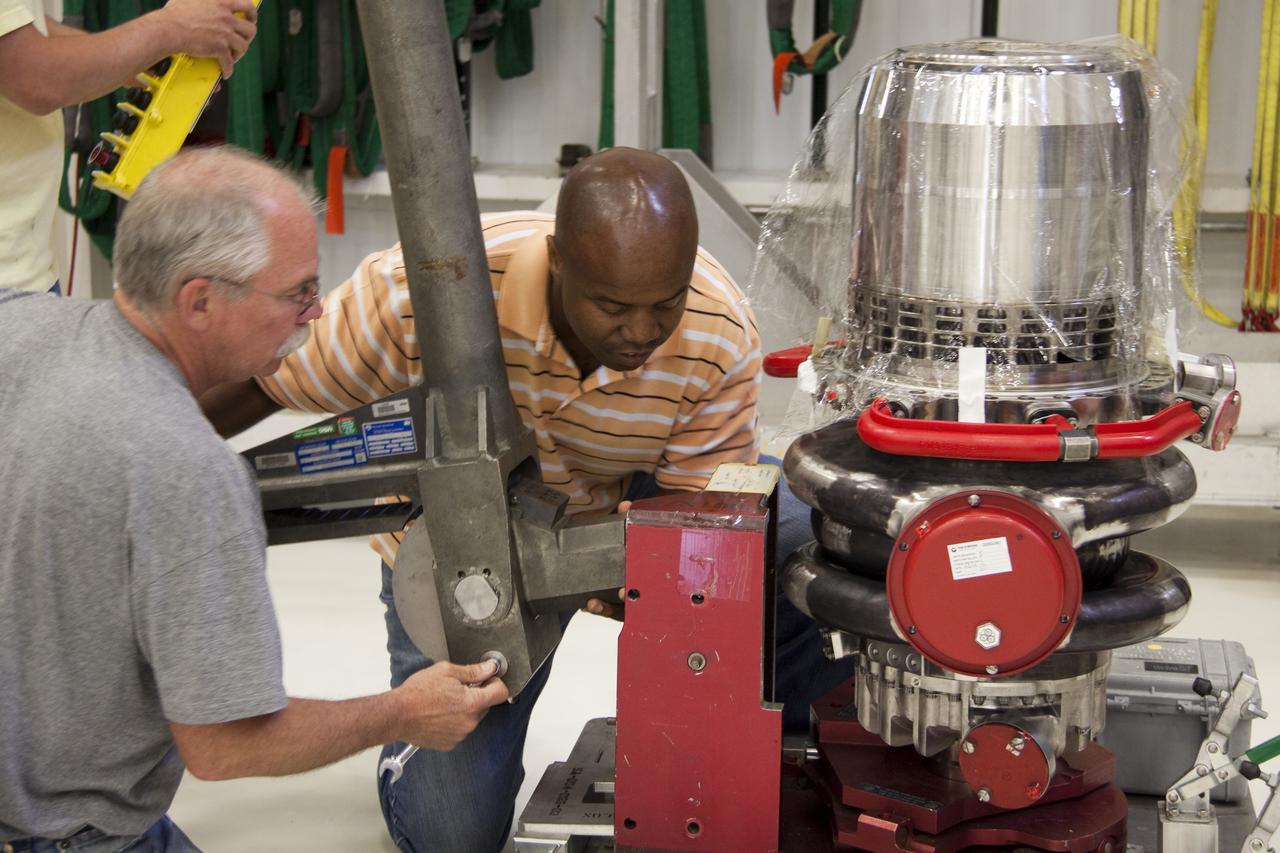
CAPE CANAVERAL, Fla. – In the Space Shuttle Main Engine Processing Facility at NASA's Kennedy Space Center in Florida, Pratt and Whitney Rocketdyne engine technicians prepare a high pressure oxidizer turbo pump for installation on space shuttle main engine no. 2062. The engine, or SSME, is the last one scheduled to be built at Kennedy by Pratt and Whitney Rocketdyne before the end of the Space Shuttle Program. From left are Dan Bode and Teryon Jones. Three main engines are clustered at the aft end of the shuttle and have a combined thrust of more than 1.2 million pounds. Even though an SSME weighs one-seventh as much as a locomotive engine, its high-pressure fuel pump alone delivers as much horsepower as 28 locomotives. Each engine operates during the entire eight-and-a-half minute climb to orbit. Post-flight inspections and maintenance of each engine also are conducted in the SSME Processing Facility between shuttle missions. Photo credit: NASA_Amanda Diller
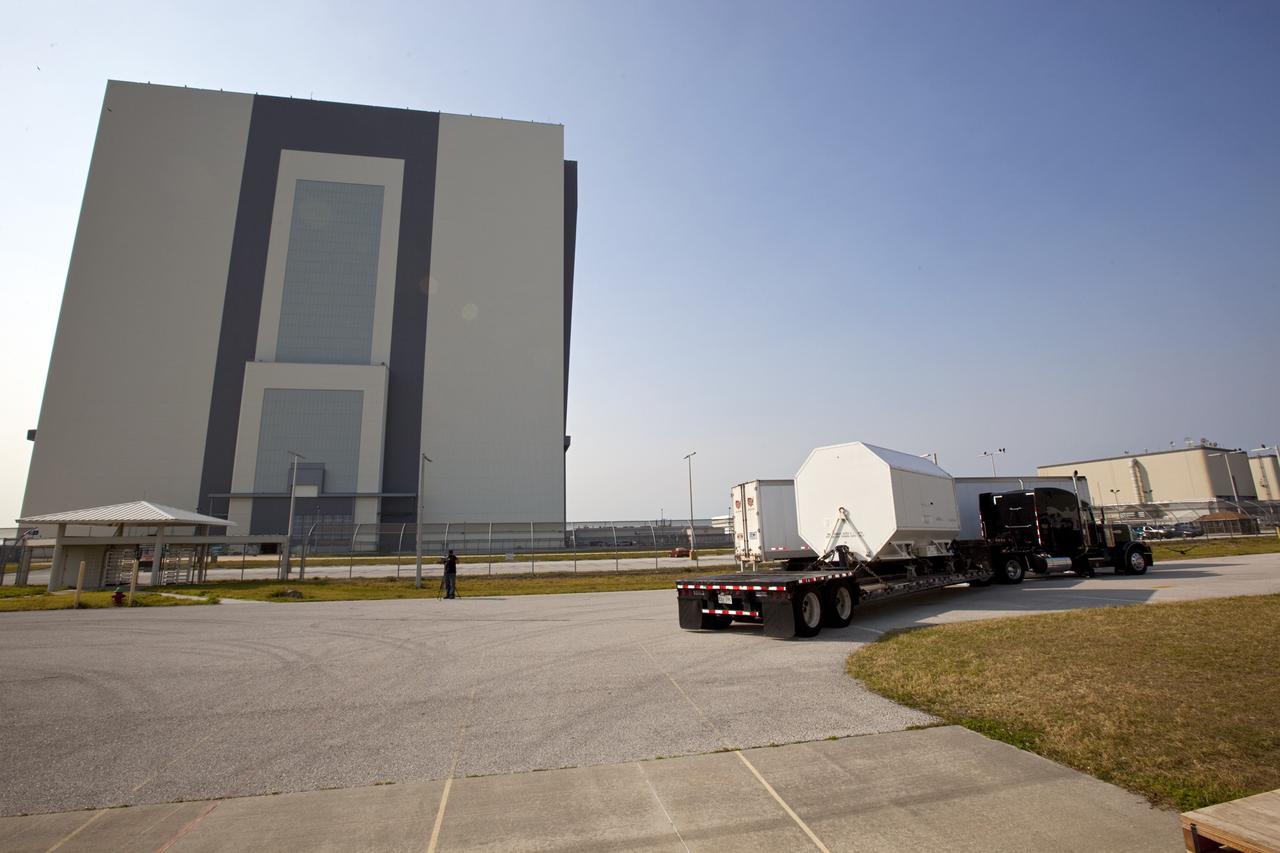
CAPE CANAVERAL, Fla. – A flatbed truck departs from the Orbiter Processing Facility-3 engine shop at NASA's Kennedy Space Center in Florida transporting the last Pratt and Whitney Rocketdyne space shuttle main engine, or SSME, to NASA's Stennis Space Center in Mississippi. The first two groups of engines were shipped from Kennedy to Stennis in November 2011 and January 2012 the remaining engines departed today. Altogether, 15 shuttle-era engines will be stored at Stennis for reuse on NASA’s Space Launch System heavy-lift rocket, under development. Photo credit: NASA/Dimitri Gerondidakis
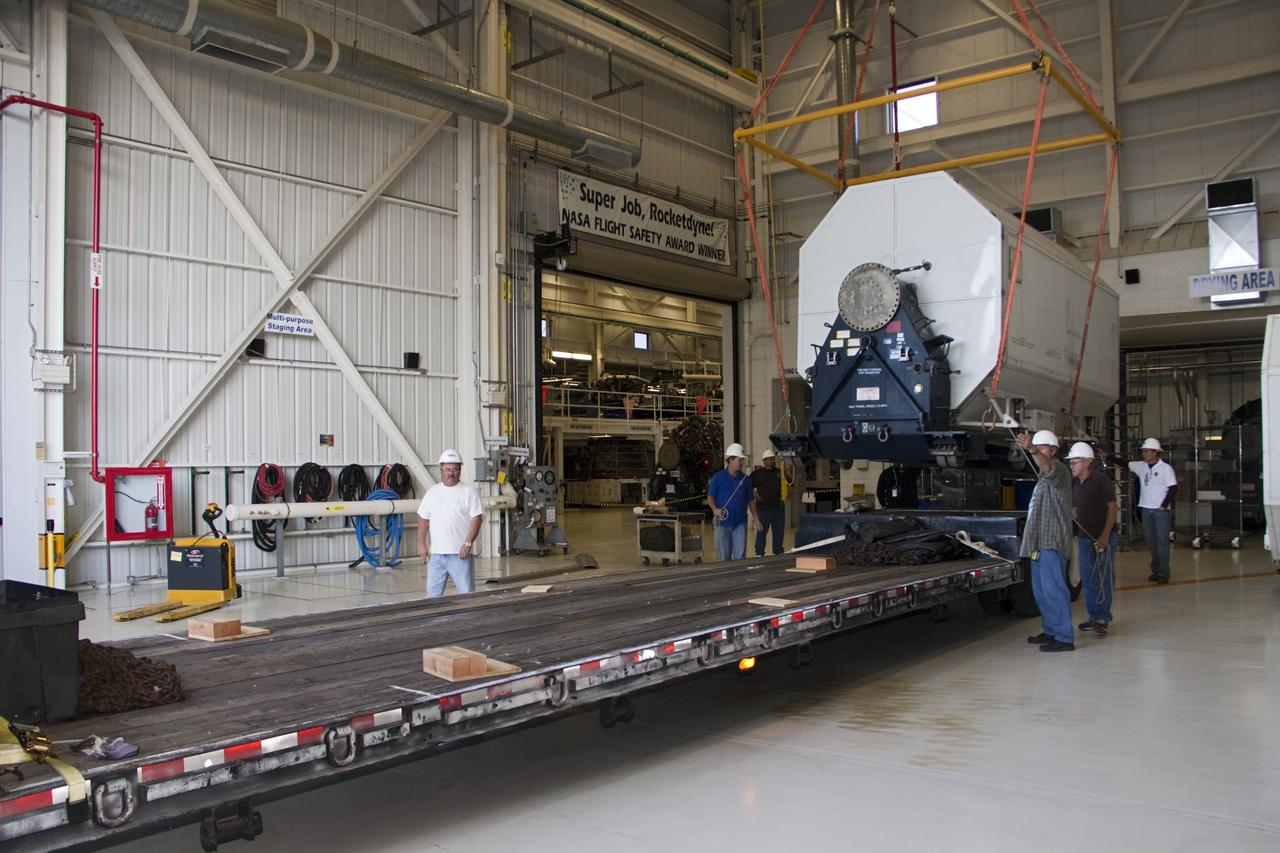
CAPE CANAVERAL, Fla. – In the Space Shuttle Main Engine Processing Facility at NASA’s Kennedy Space Center in Florida, a transportation canister containing a Pratt & Whitney Rocketdyne space shuttle main engine (SSME) is lifted into position onto a flatbed trailer. This is the second of the 15 engines used during the Space Shuttle Program to be transported to NASA's Stennis Space Center in Mississippi. The engines will be stored at Stennis for future use on NASA's new heavy-lift rocket, the Space Launch System (SLS), which will carry NASA's new Orion spacecraft, cargo, equipment and science experiments to space. For more information, visit http://www.nasa.gov/shuttle. Photo credit: NASA/Jim Grossmann
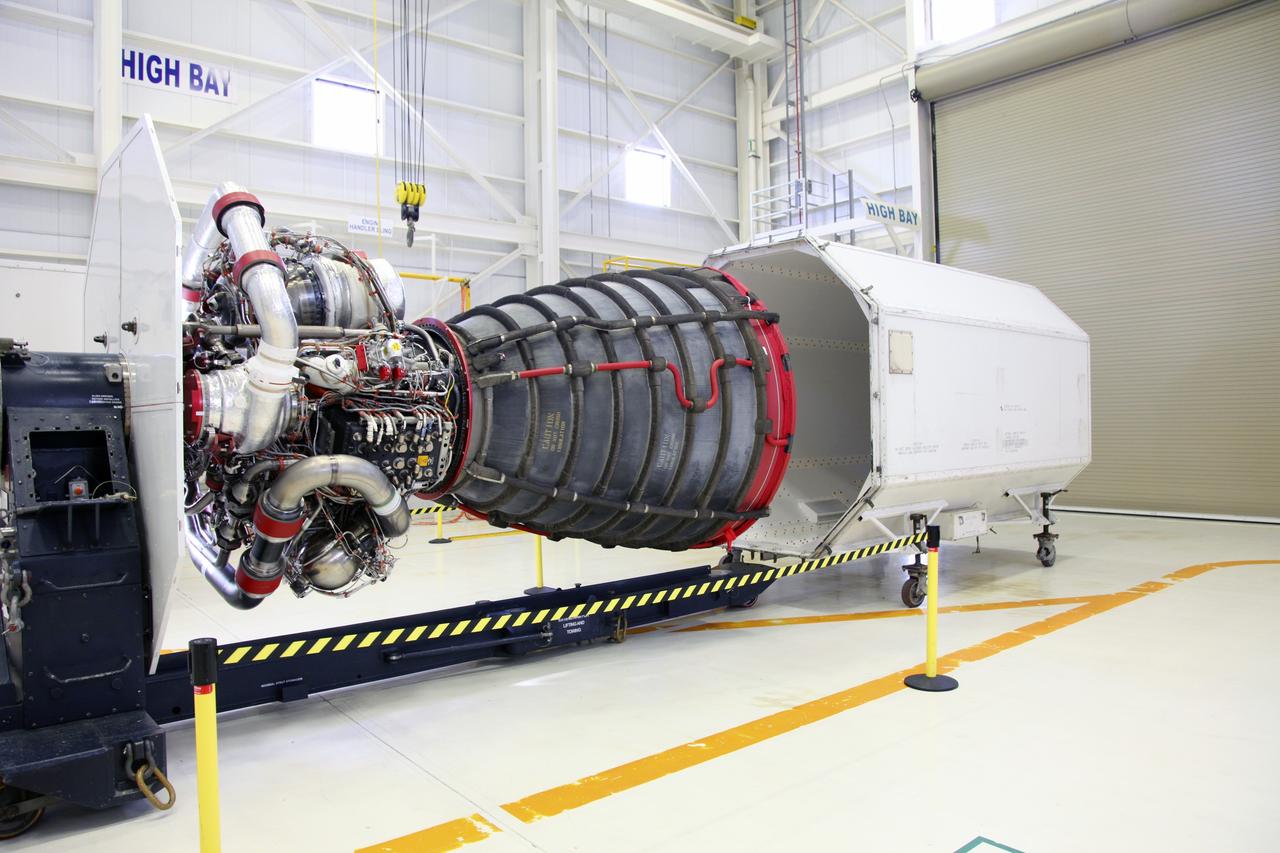
CAPE CANAVERAL, Fla. – In the Space Shuttle Main Engine Processing Facility at NASA’s Kennedy Space Center in Florida, a transportation canister rolls toward a Pratt Whitney Rocketdyne space shuttle main engine (SSME). This is the second of the 15 engines used during the Space Shuttle Program to be prepared for transfer to NASA's Stennis Space Center in Mississippi. The engines will be stored at Stennis for future use on NASA's new heavy-lift rocket, the Space Launch System (SLS), which will carry NASA's new Orion spacecraft, cargo, equipment and science experiments to space. For more information, visit http://www.nasa.gov/shuttle. Photo credit: NASA/Gianni Woods
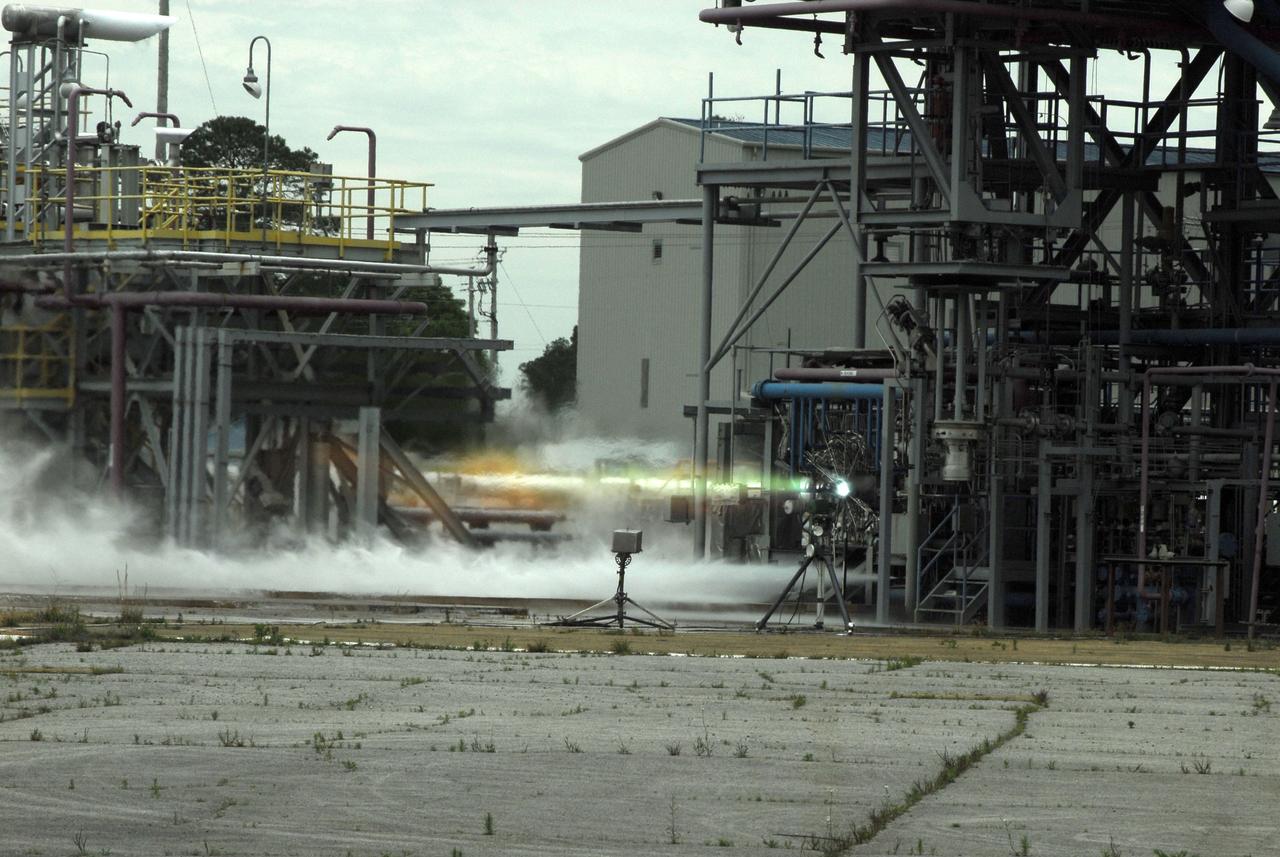
Chosen to power the upper stages of the new Ares I Crew Launch Vehicle (CLV) and the Ares V cargo segment, the J-2X engine is a stepped up version of the hydrogen/oxygen-fuelled Apollo-era J-2 engine. It was developed for NASA by Pratt & Whitney Rocketdyne (PWR), a business unit of United Technologies Corporation of Canoga Park, California. As seen in this photograph, the engine underwent a series of hot fire tests, performed on sub scale main injector hardware in the Test Stand 116 at Marshall Space Flight Center (MSFC). The injector is a major component of the engine that injects and mixes propellants in the combustion chamber, where they are ignited and burned to produce thrust.
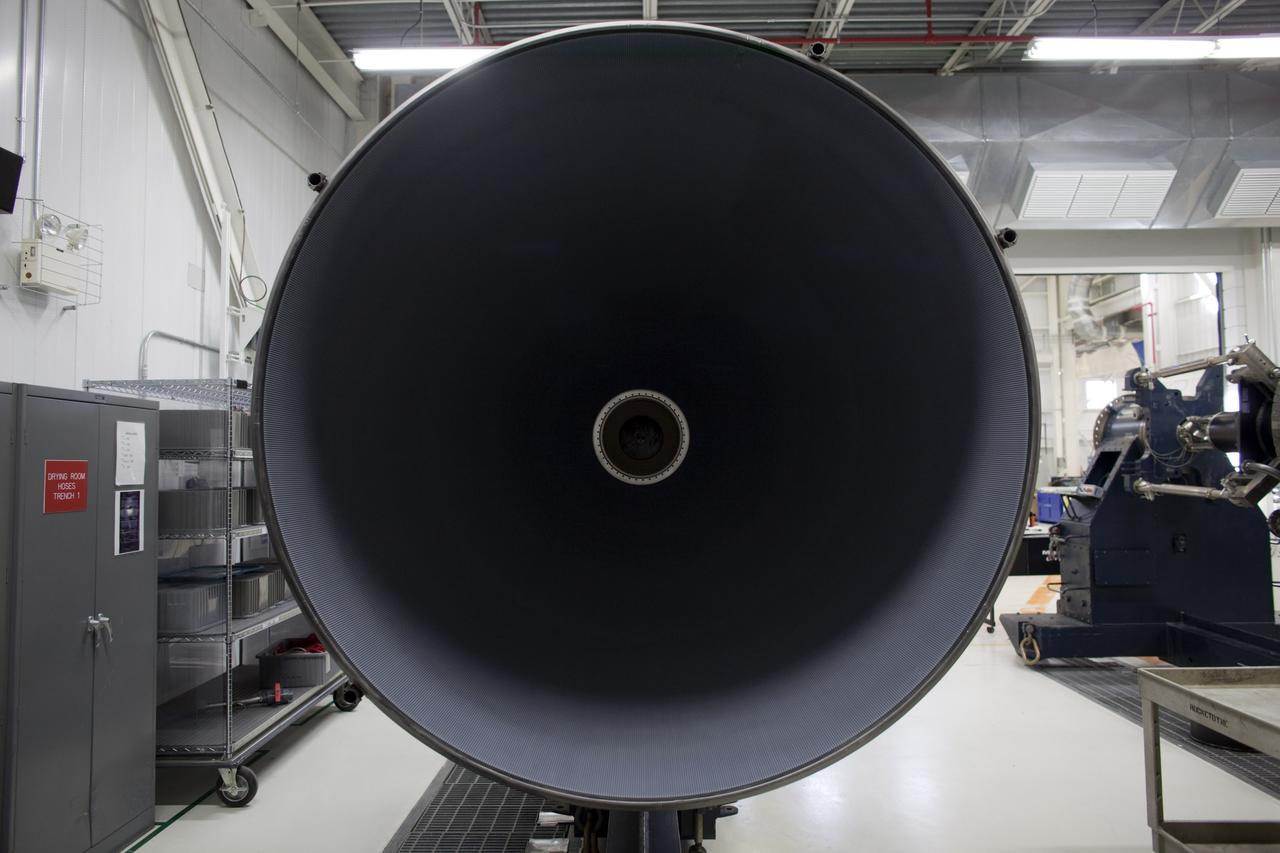
CAPE CANAVERAL, Fla. -- Inside the Pratt & Whitney Rocketdyne engine shop at NASA’s Kennedy Space Center in Florida, the interior of the engine bell of one of the replica shuttle main engines (RSMEs) can be seen. The RSMEs were created for space shuttle Discovery. The replica engines will be transported from the engine shop to the processing facility for installation on Discovery in January 2012. The work is part of the Space Shuttle Program’s transition and retirement processing of shuttle Discovery. Discovery is being prepared for display at the Smithsonian’s National Air and Space Museum, Steven F. Udvar-Hazy Center in Chantilly, Va. For more information, visit http://www.nasa.gov/shuttle. Photo credit: NASA/Dimitri Gerondidakis
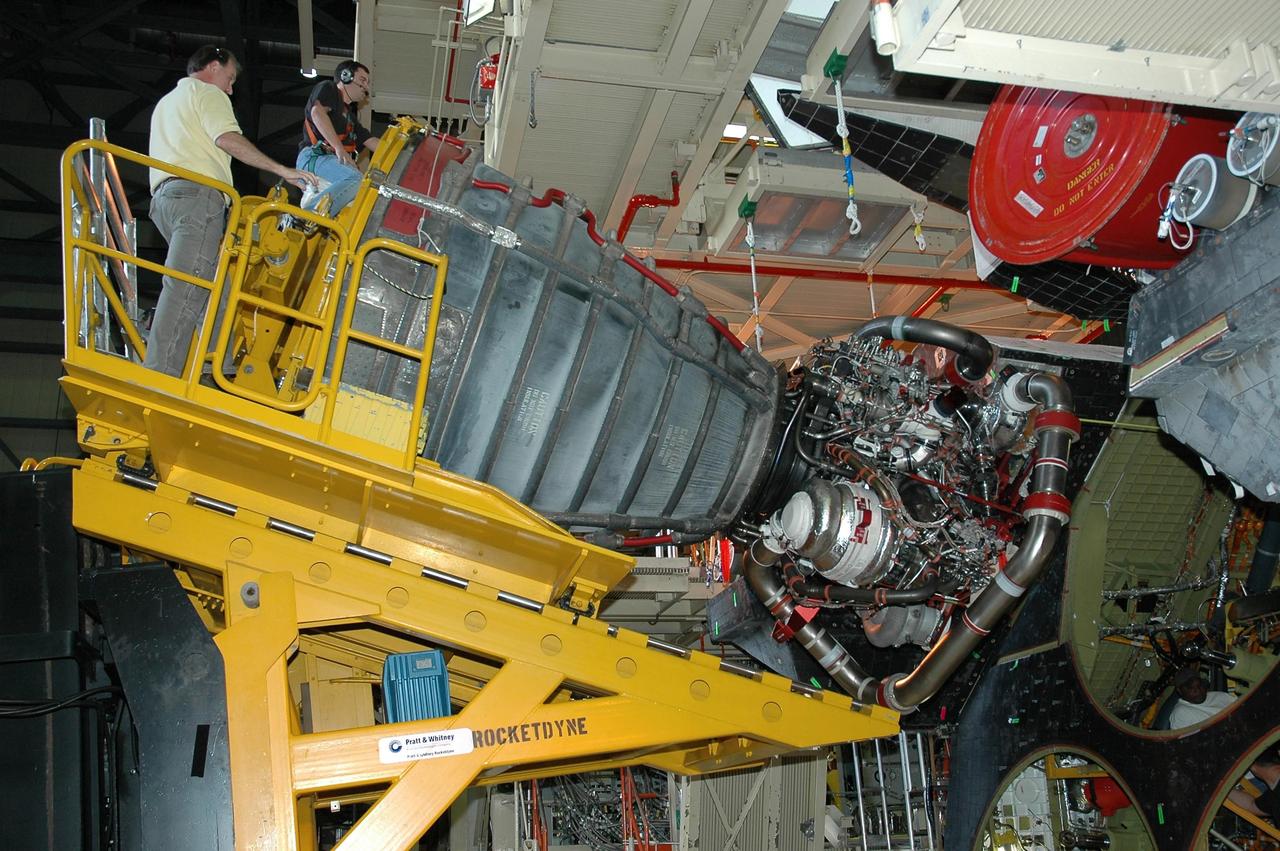
KENNEDY SPACE CENTER, FLA. - In In the Orbiter Processing Facility bay 1, a Hyster forklift maneuvers a main engine into position for installation into Discovery. The main engine configuration is manufactured by Boeing Rocketdyne in Canoga Park, Calif., and includes a Pratt & Whitney high-pressure fuel turbo pump. Each space shuttle main engine is 14 feet (4.3 meters) long, weighs about 6,700 pounds (3,039 kilograms), and is 7.5 feet (2.3 meters) in diameter at the end of the nozzle. Discovery is being processed for the second return-to-flight mission STS-121.
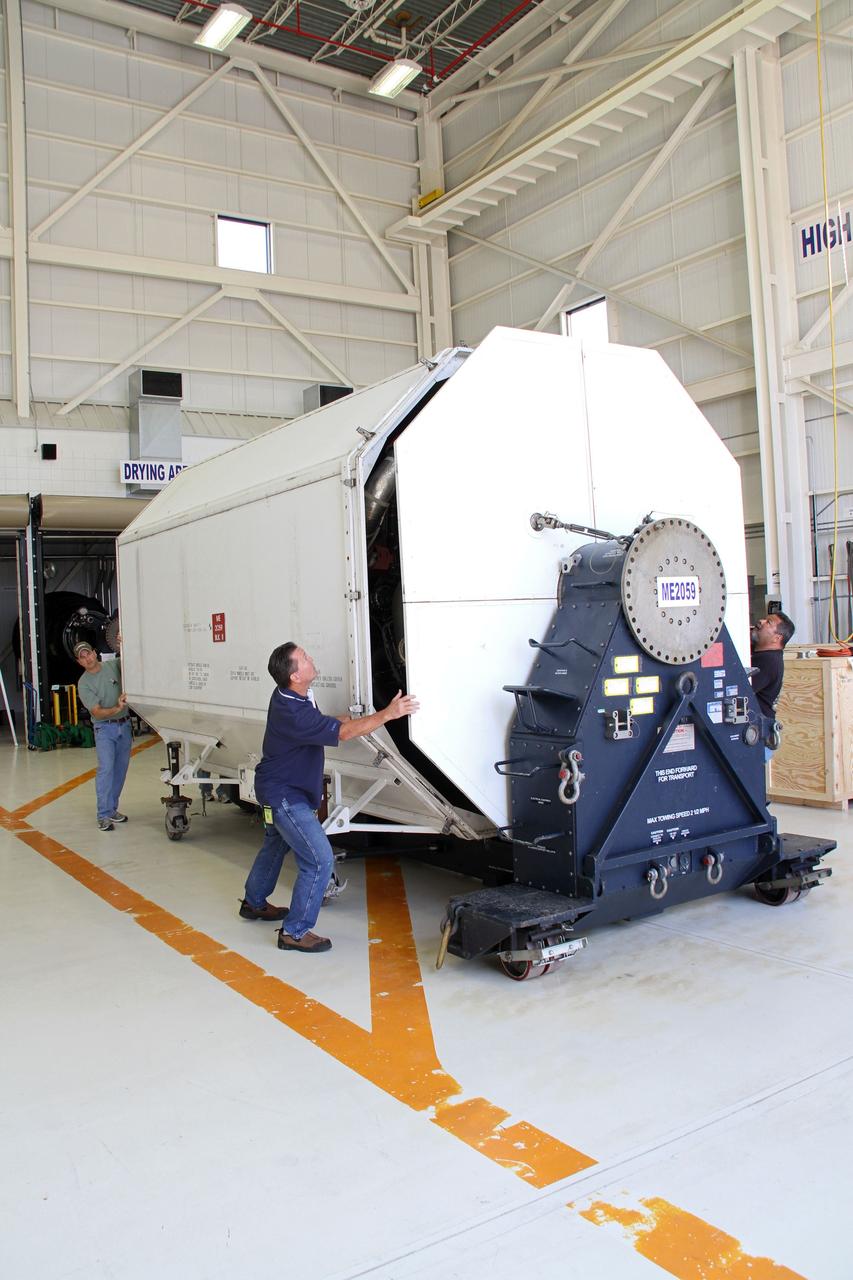
CAPE CANAVERAL, Fla. -- Jeff Huie of Pratt and Whitney Rocketdyne watches as the last of the space shuttle main engines disappears into a transportation canister in the Orbiter Processing Facility-3 engine shop at NASA's Kennedy Space Center in Florida. The engine was packed for shipment to NASA's Stennis Space Center in Mississippi. The first two groups of engines were shipped from Kennedy to Stennis in November 2011 and January 2012, and the remaining engines are scheduled to depart on April 9. Altogether, 15 shuttle-era engines will be stored at Stennis for reuse on NASA’s Space Launch System heavy-lift rocket, under development. Photo credit: NASA/Cory Huston
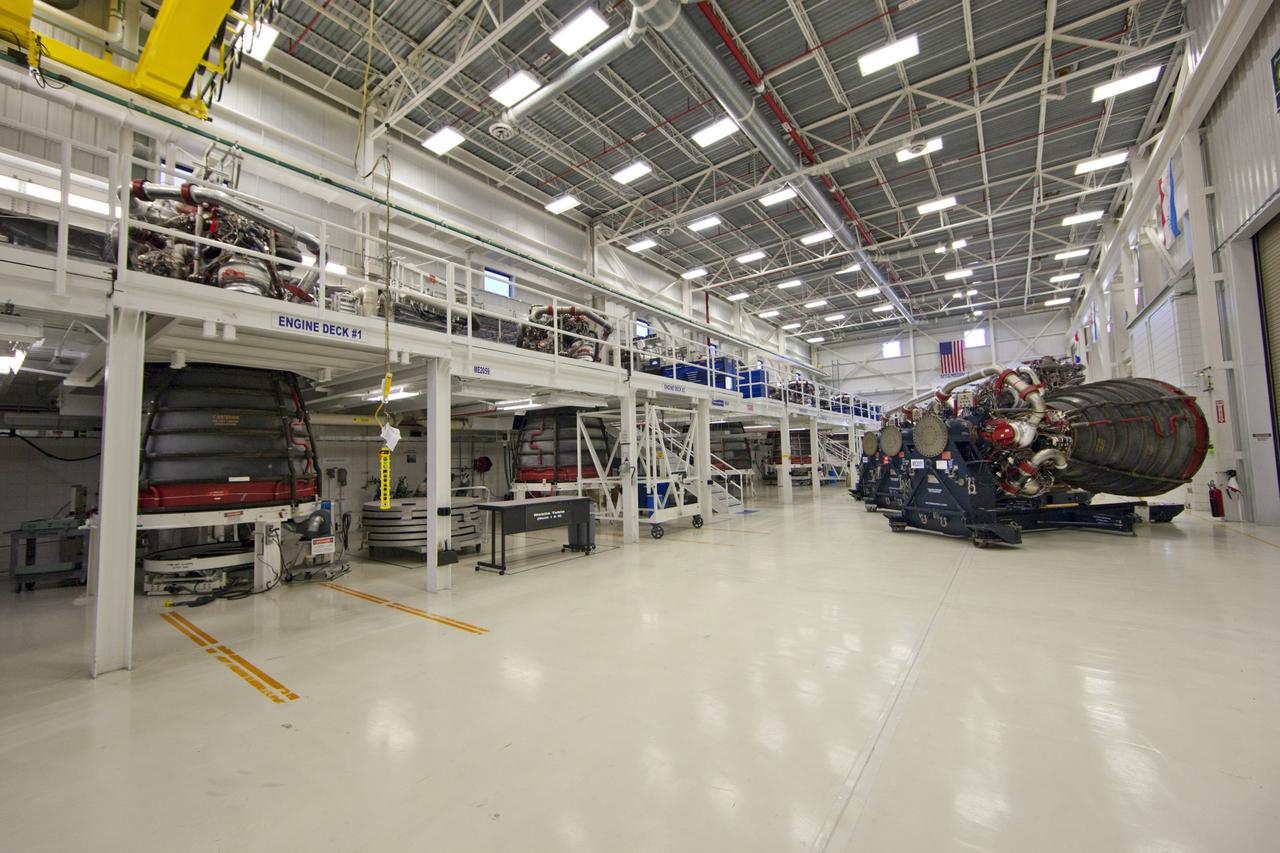
CAPE CANAVERAL, Fla. – At NASA’s Kennedy Space Center in Florida, all six Pratt Whitney Rocketdyne space shuttle main engines (SSMEs) from space shuttle Endeavour's STS-134 and space shuttle Atlantis' STS-135 missions sit in test cells inside the Engine Shop. To the right are three more main engines on platforms. For the first time, all 15 main engines are in the Engine Shop at the same time. They are being prepared for shipment to NASA's Stennis Space Center in Mississippi for storage following the completion of the Space Shuttle Program. The engines are being repurposed for use on NASA’s Space Launch System heavy lift rocket. Photo credit: NASA_Dimitri Gerondidakis
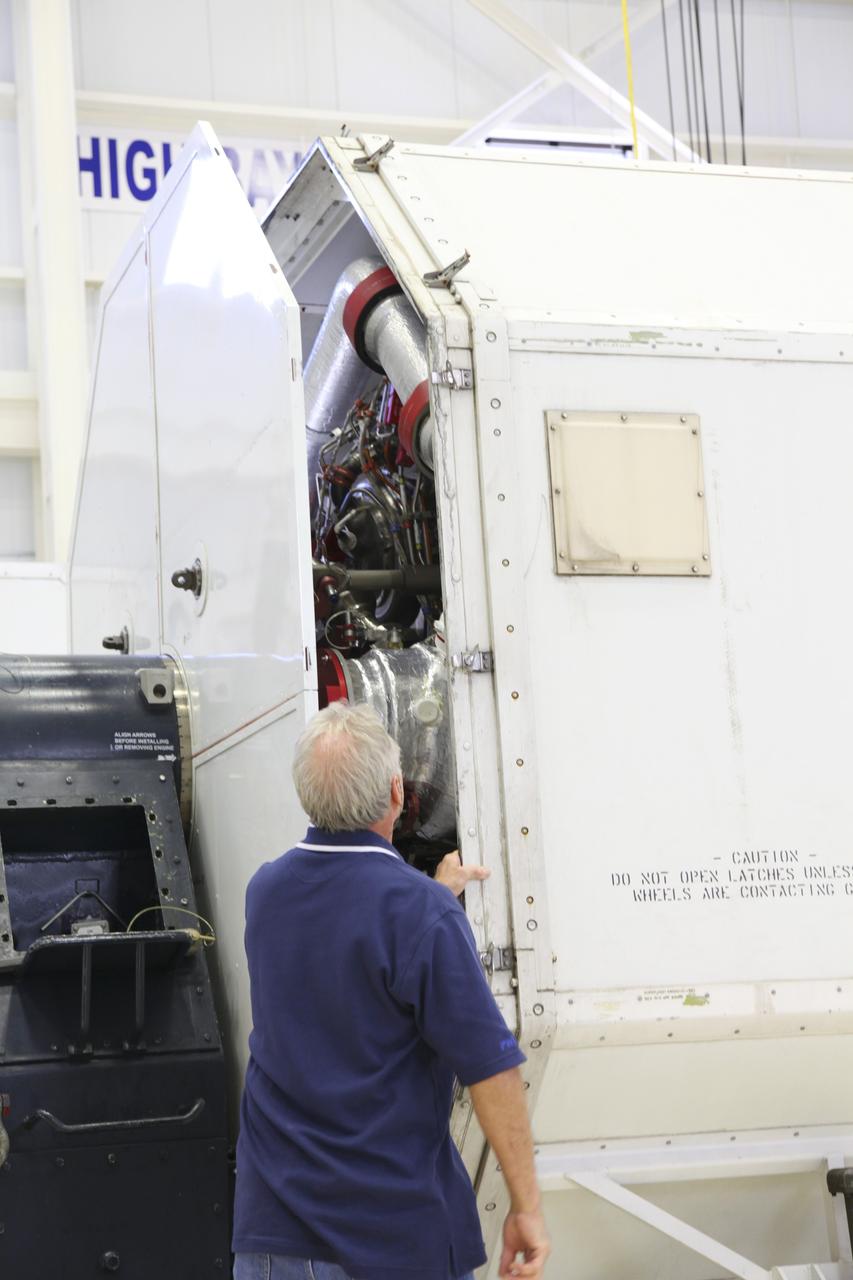
CAPE CANAVERAL, Fla. – In the Space Shuttle Main Engine Processing Facility at NASA’s Kennedy Space Center in Florida, a technician oversees the closure of a transportation canister containing a Pratt Whitney Rocketdyne space shuttle main engine (SSME). This is the second of the 15 engines used during the Space Shuttle Program to be prepared for transfer to NASA's Stennis Space Center in Mississippi. The engines will be stored at Stennis for future use on NASA's new heavy-lift rocket, the Space Launch System (SLS), which will carry NASA's new Orion spacecraft, cargo, equipment and science experiments to space. For more information, visit http://www.nasa.gov/shuttle. Photo credit: NASA/Gianni Woods
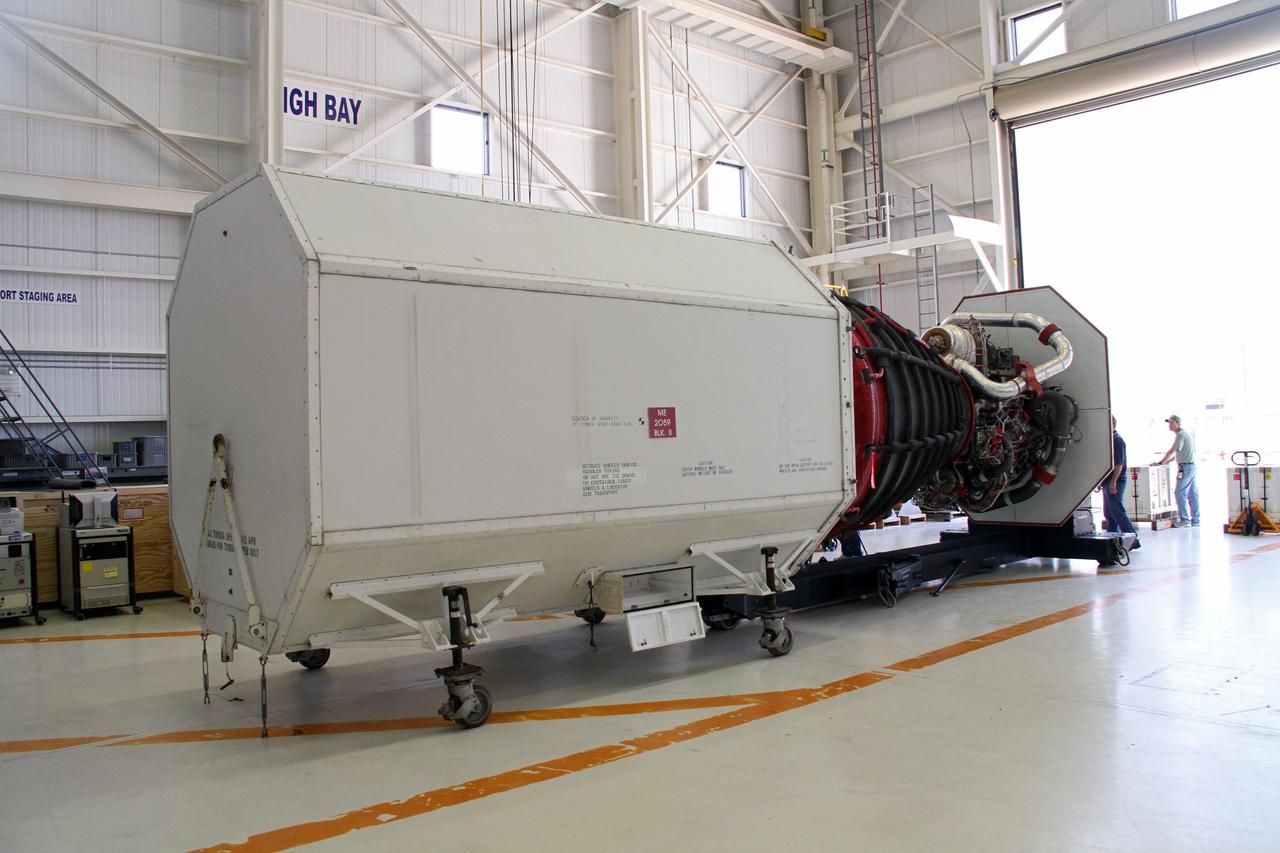
CAPE CANAVERAL, Fla. -- A Pratt and Whitney Rocketdyne space shuttle main engine, or SSME, is aligned with a transportation canister in the Orbiter Processing Facility-3 engine shop at NASA's Kennedy Space Center in Florida. The engine is the last to be packed for shipment to NASA's Stennis Space Center in Mississippi. The first two groups of engines were shipped from Kennedy to Stennis in November 2011 and January 2012, and the remaining engines are scheduled to depart on April 9. Altogether, 15 shuttle-era engines will be stored at Stennis for reuse on NASA’s Space Launch System heavy-lift rocket, under development. Photo credit: NASA/Cory Huston
CAPE CANAVERAL, Fla. – A replica shuttle main engine (RSME) is poised for installation on space shuttle Discovery in Orbiter Processing Facility-1 at NASA’s Kennedy Space Center in Florida. The RSME is one of three that will be installed on Discovery during Space Shuttle Program transition and retirement activities. The replicas are being built in the Pratt & Whitney Rocketdyne engine shop at Kennedy to replace the shuttle engines which will be placed in storage to support NASA's Space Launch System, under development. Discovery is being prepared for display at the Smithsonian’s National Air and Space Museum Steven F. Udvar-Hazy Center in Chantilly, Va. For more information, visit http://www.nasa.gov/shuttle. Photo credit: NASA/Jim Grossmann
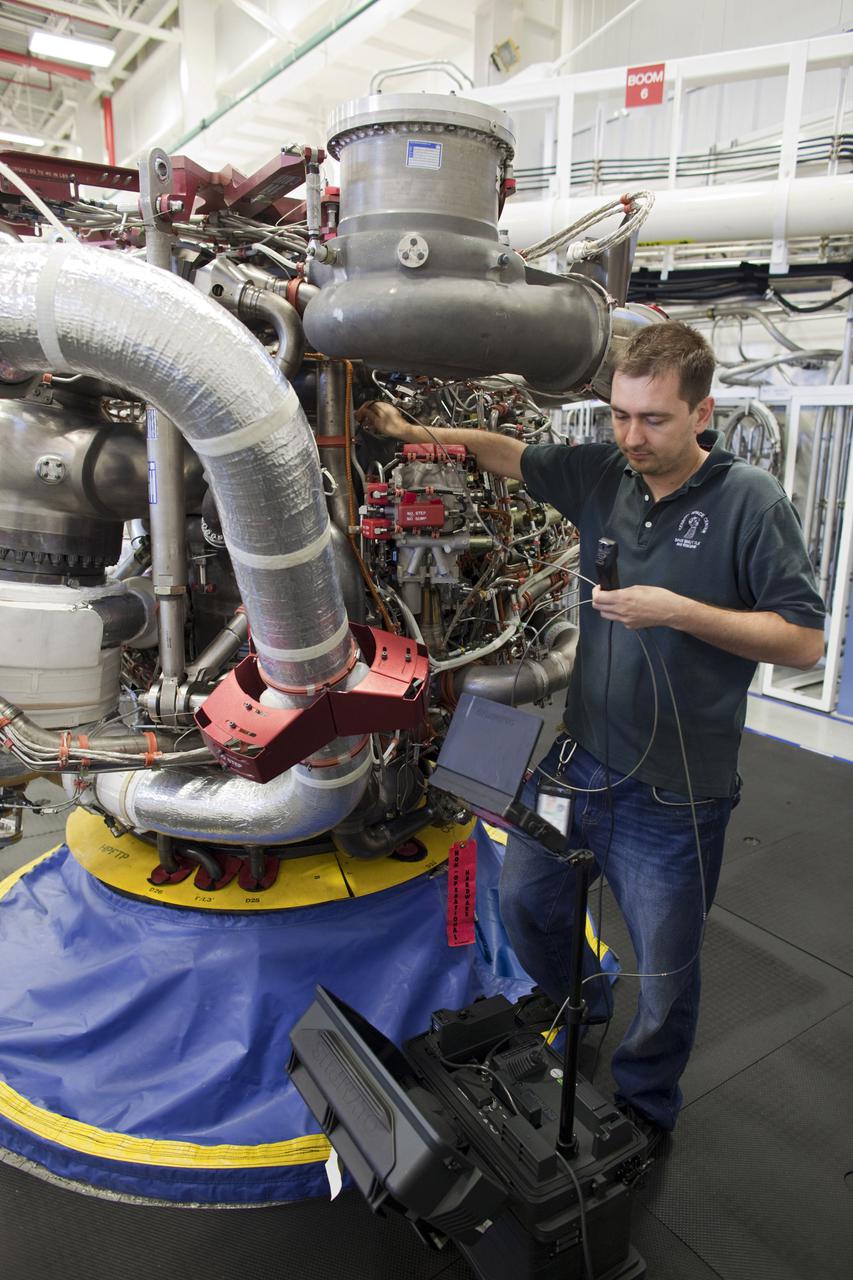
CAPE CANAVERAL, Fla. – Inside the Engine Shop at NASA’s Kennedy Space Center in Florida, a technician performs a boroscope test on a high pressure oxidizer pump on one of the Pratt Whitney Rocketdyne space shuttle main engines (SSMEs) positioned in a test cell. For the first time, all 15 main engines are in the Engine Shop at the same time. They are being prepared for shipment to NASA's Stennis Space Center in Mississippi for storage following the completion of the Space Shuttle Program. The engines are being repurposed for use on NASA’s Space Launch System heavy lift rocket. Photo credit: NASA_Dimitri Gerondidakis
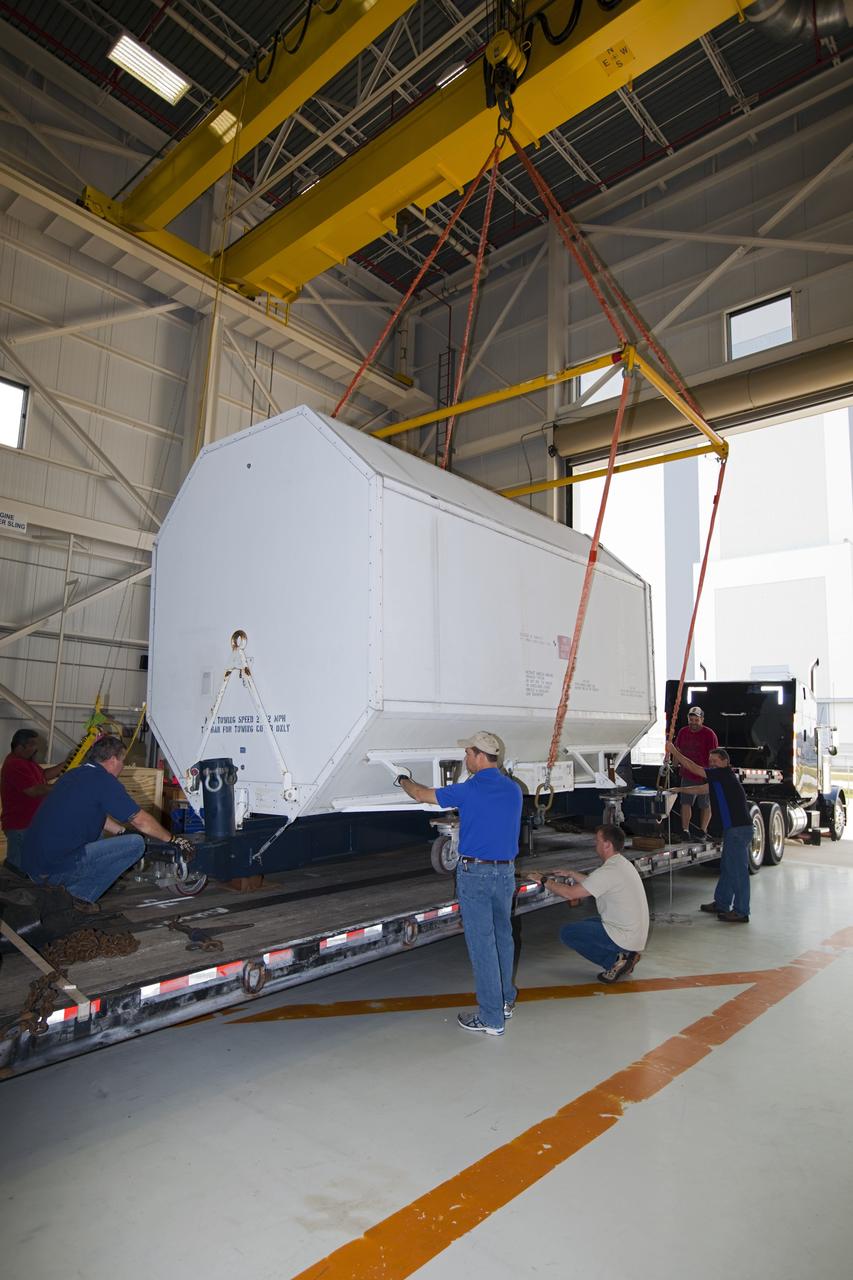
CAPE CANAVERAL, Fla. – In the Orbiter Processing Facility-3 engine shop at NASA's Kennedy Space Center in Florida, a transportation canister containing the last Pratt and Whitney Rocketdyne space shuttle main engine, or SSME, is lowered onto a flatbed truck for shipment to NASA's Stennis Space Center in Mississippi. The first two groups of engines were shipped from Kennedy to Stennis in November 2011 and January 2012 the remaining engines departed today. Altogether, 15 shuttle-era engines will be stored at Stennis for reuse on NASA’s Space Launch System heavy-lift rocket, under development. Photo credit: NASA/Dimitri Gerondidakis
KENNEDY SPACE CENTER, FLA. -- The transport vehicle carrying a new block 2 engine arrives at Orbiter Processing Facility bay 3. There the new engine will be installed on the orbiter Atlantis, on mission STS-104, for its first flight. The Block II Main Engine configuration is manufactured by Boeing Rocketdyne in Canoga Park, Calif., and includes a new Pratt & Whitney high-pressure fuel turbo pump. Engine improvements are managed by NASA’s Marshall Space Flight Center in Huntsville, Ala. Each Space Shuttle Main Engine is 14 feet (4.3 meters) long, weighs about 7,000 pounds (3,175 kilograms), and is 7.5 feet (2.3 meters) in diameter at the end of the nozzle
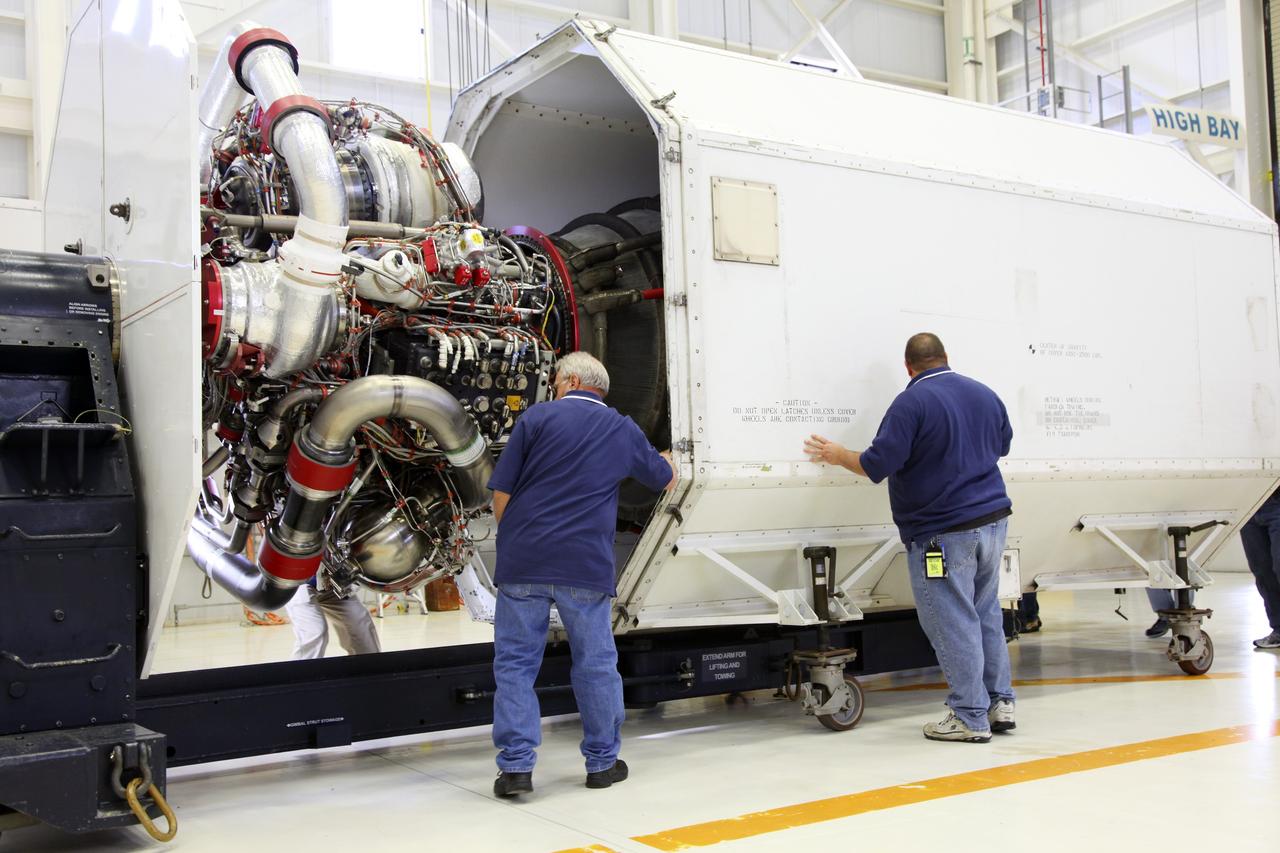
CAPE CANAVERAL, Fla. – In the Space Shuttle Main Engine Processing Facility at NASA’s Kennedy Space Center in Florida, technicians oversee the installation of a Pratt Whitney Rocketdyne space shuttle main engine (SSME) into a transportation canister. This is the second of the 15 engines used during the Space Shuttle Program to be prepared for transfer to NASA's Stennis Space Center in Mississippi. The engines will be stored at Stennis for future use on NASA's new heavy-lift rocket, the Space Launch System (SLS), which will carry NASA's new Orion spacecraft, cargo, equipment and science experiments to space. For more information, visit http://www.nasa.gov/shuttle. Photo credit: NASA/Gianni Woods
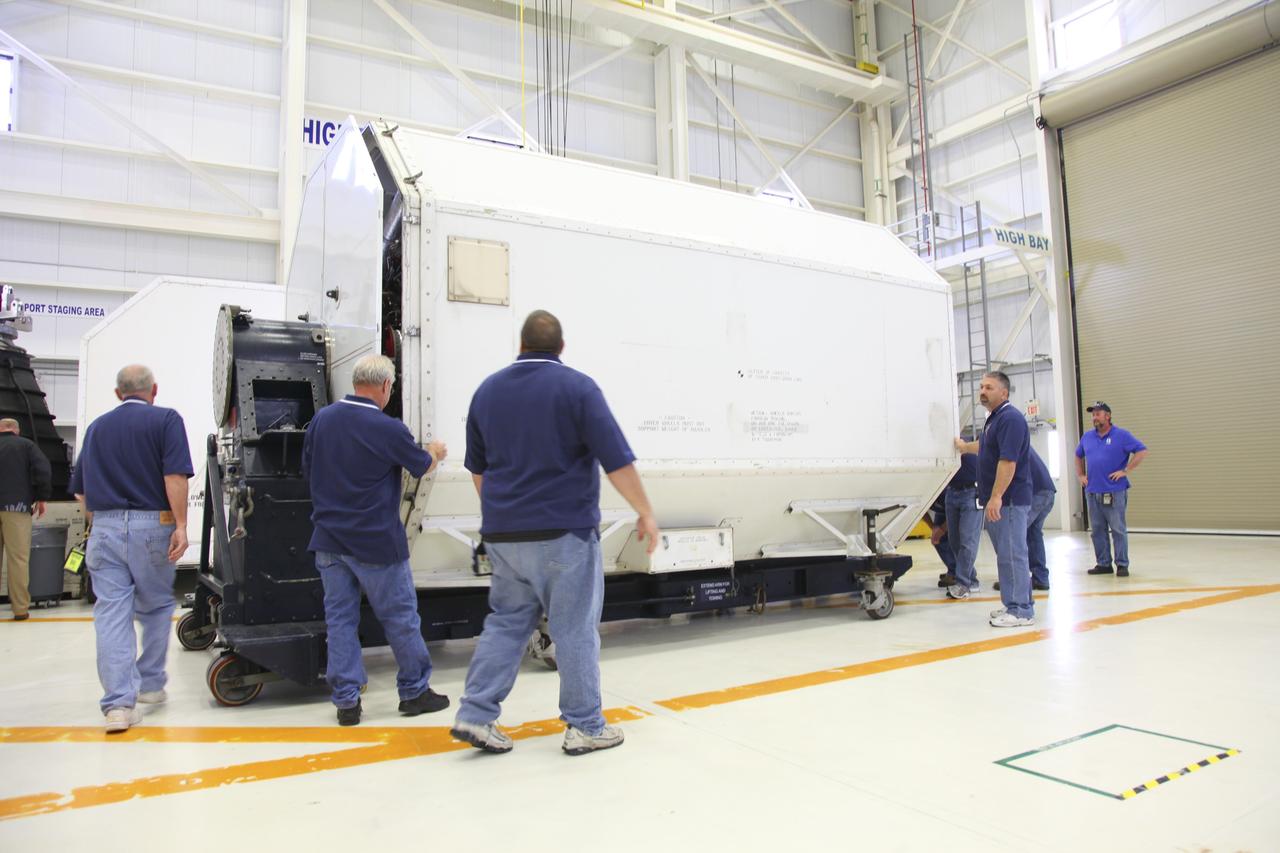
CAPE CANAVERAL, Fla. – In the Space Shuttle Main Engine Processing Facility at NASA’s Kennedy Space Center in Florida, a transportation canister is nearly closed around a Pratt Whitney Rocketdyne space shuttle main engine (SSME). This is the second of the 15 engines used during the Space Shuttle Program to be prepared for transfer to NASA's Stennis Space Center in Mississippi. The engines will be stored at Stennis for future use on NASA's new heavy-lift rocket, the Space Launch System (SLS), which will carry NASA's new Orion spacecraft, cargo, equipment and science experiments to space. For more information, visit http://www.nasa.gov/shuttle. Photo credit: NASA/Gianni Woods
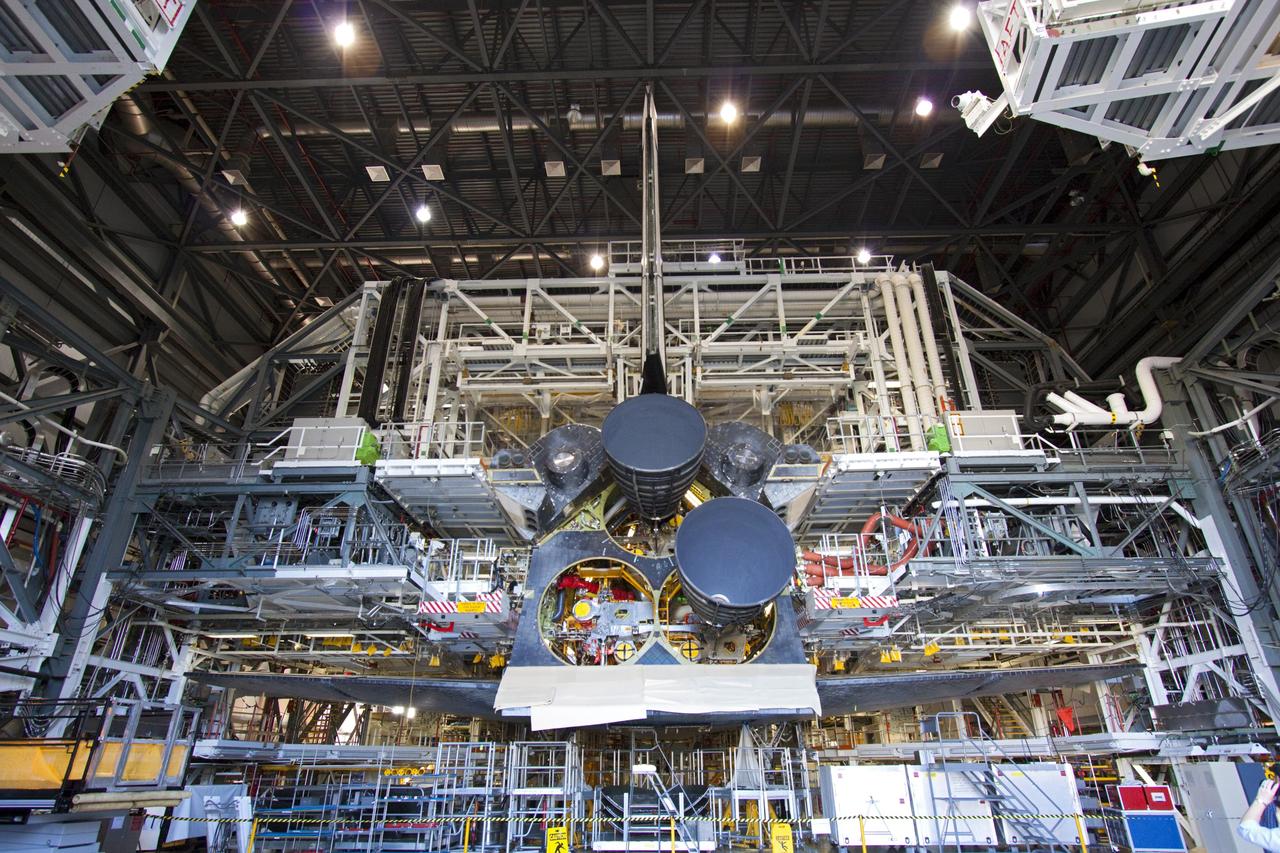
CAPE CANAVERAL, Fla. – Space shuttle Discovery sports two replica shuttle main engines (RSMEs) in Orbiter Processing Facility-1 at NASA’s Kennedy Space Center in Florida. Three RSMEs will be installed on Discovery during Space Shuttle Program transition and retirement activities. The replicas are being built in the Pratt & Whitney Rocketdyne engine shop at Kennedy to replace the shuttle engines which will be placed in storage to support NASA's Space Launch System, under development. Discovery is being prepared for display at the Smithsonian’s National Air and Space Museum Steven F. Udvar-Hazy Center in Chantilly, Va. For more information, visit http://www.nasa.gov/shuttle. Photo credit: NASA/Jim Grossmann
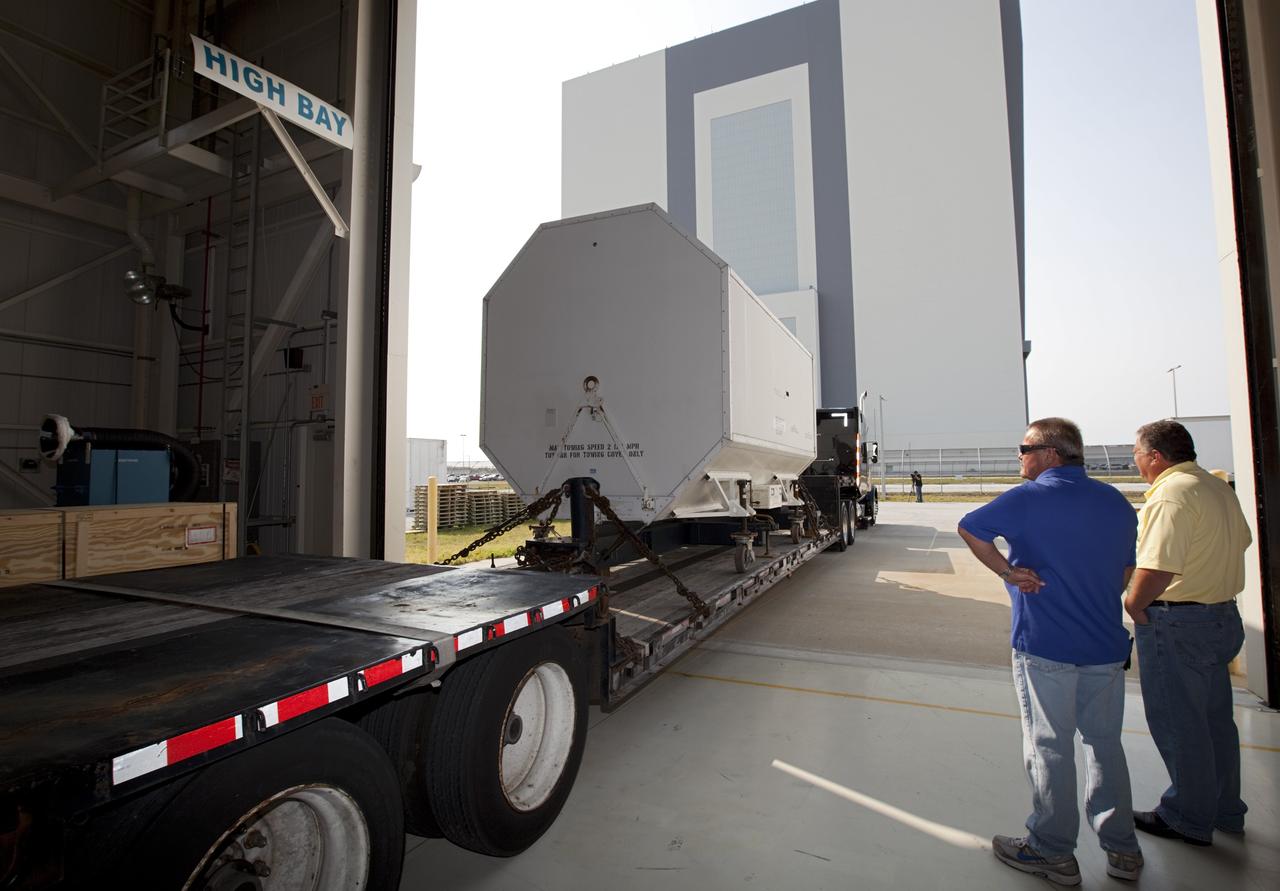
CAPE CANAVERAL, Fla. – In the Orbiter Processing Facility-3 engine shop at NASA's Kennedy Space Center in Florida, a transportation canister containing the last Pratt and Whitney Rocketdyne space shuttle main engine, or SSME, is secured on a flatbed truck and ready for departure to NASA's Stennis Space Center in Mississippi. The first two groups of engines were shipped from Kennedy to Stennis in November 2011 and January 2012 the remaining engines departed today. Altogether, 15 shuttle-era engines will be stored at Stennis for reuse on NASA’s Space Launch System heavy-lift rocket, under development. Photo credit: NASA/Dimitri Gerondidakis
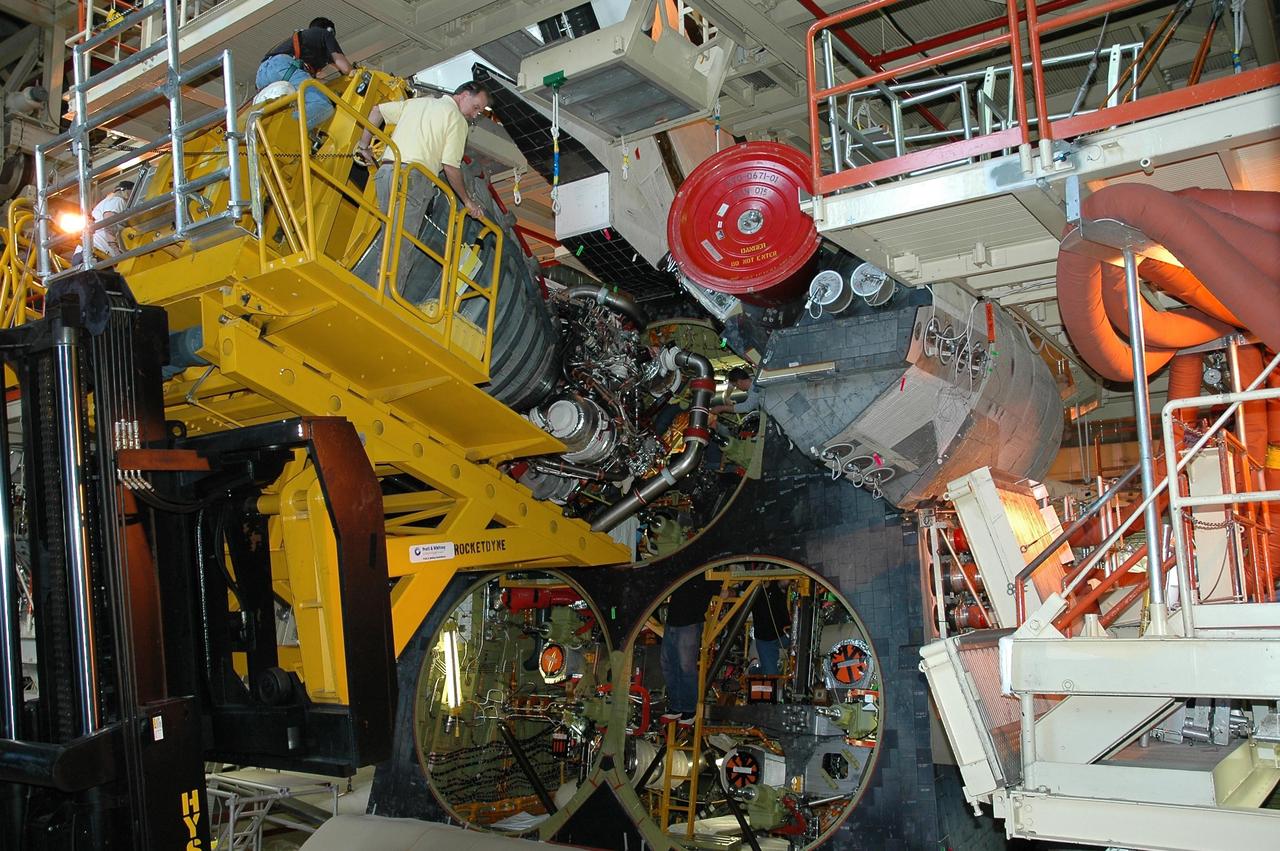
KENNEDY SPACE CENTER, FLA. - In the Orbiter Processing Facility bay 1, technicians on the Hyster forklift move a main engine into place on Discovery. The main engine configuration is manufactured by Boeing Rocketdyne in Canoga Park, Calif., and includes a Pratt & Whitney high-pressure fuel turbo pump. Each space shuttle main engine is 14 feet (4.3 meters) long, weighs about 6,700 pounds (3,039 kilograms), and is 7.5 feet (2.3 meters) in diameter at the end of the nozzle. Discovery is being processed for the second return-to-flight mission STS-121.
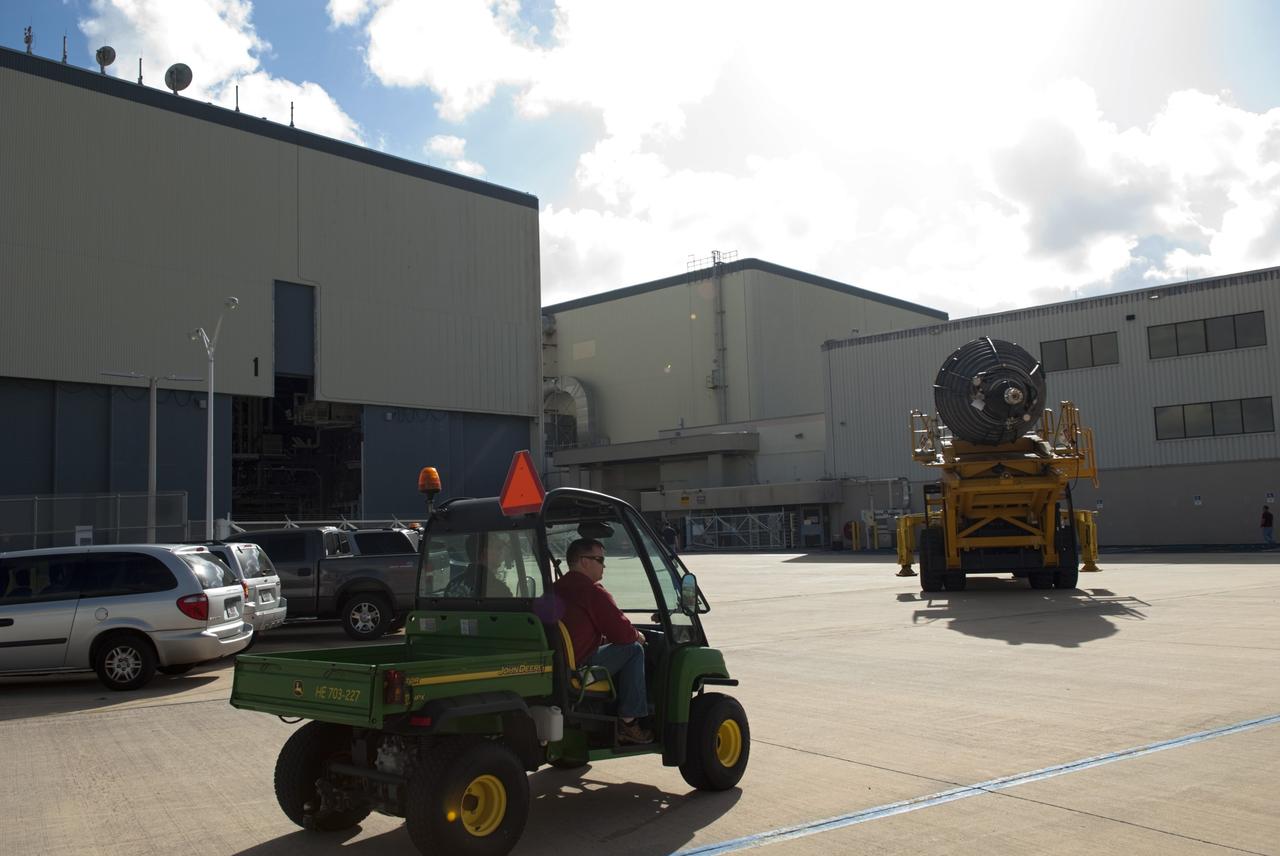
CAPE CANAVERAL, Fla. – A replica shuttle main engine (RSME) arrives at Orbiter Processing Facility-1 at NASA’s Kennedy Space Center in Florida where it will be installed on space shuttle Discovery. The RSME was built in the Pratt & Whitney Rocketdyne engine shop at Kennedy. The RSME is one of three that will be installed on Discovery during Space Shuttle Program transition and retirement activities. Discovery is being prepared for display at the Smithsonian’s National Air and Space Museum Steven F. Udvar-Hazy Center in Chantilly, Va. For more information, visit http://www.nasa.gov/shuttle. Photo credit: NASA/Jim Grossmann

CAPE CANAVERAL, Fla. – Preparations are under way to rotate a Pratt and Whitney Rocketdyne space shuttle main engine, or SSME, inside the SSME Processing Facility, the engine shop at NASA’s Kennedy Space Center in Florida. The engine is one of the last SSMEs remaining at Kennedy and is being prepared for shipment to NASA's Stennis Space Center in Mississippi. The first two groups of engines were shipped from Kennedy to Stennis in November 2011 and January 2012 the remaining engines are scheduled to depart on April 9. Altogether, 15 shuttle-era engines will be stored at Stennis for reuse on NASA’s Space Launch System heavy-lift rocket, under development. Photo credit: NASA/Tim Jacobs
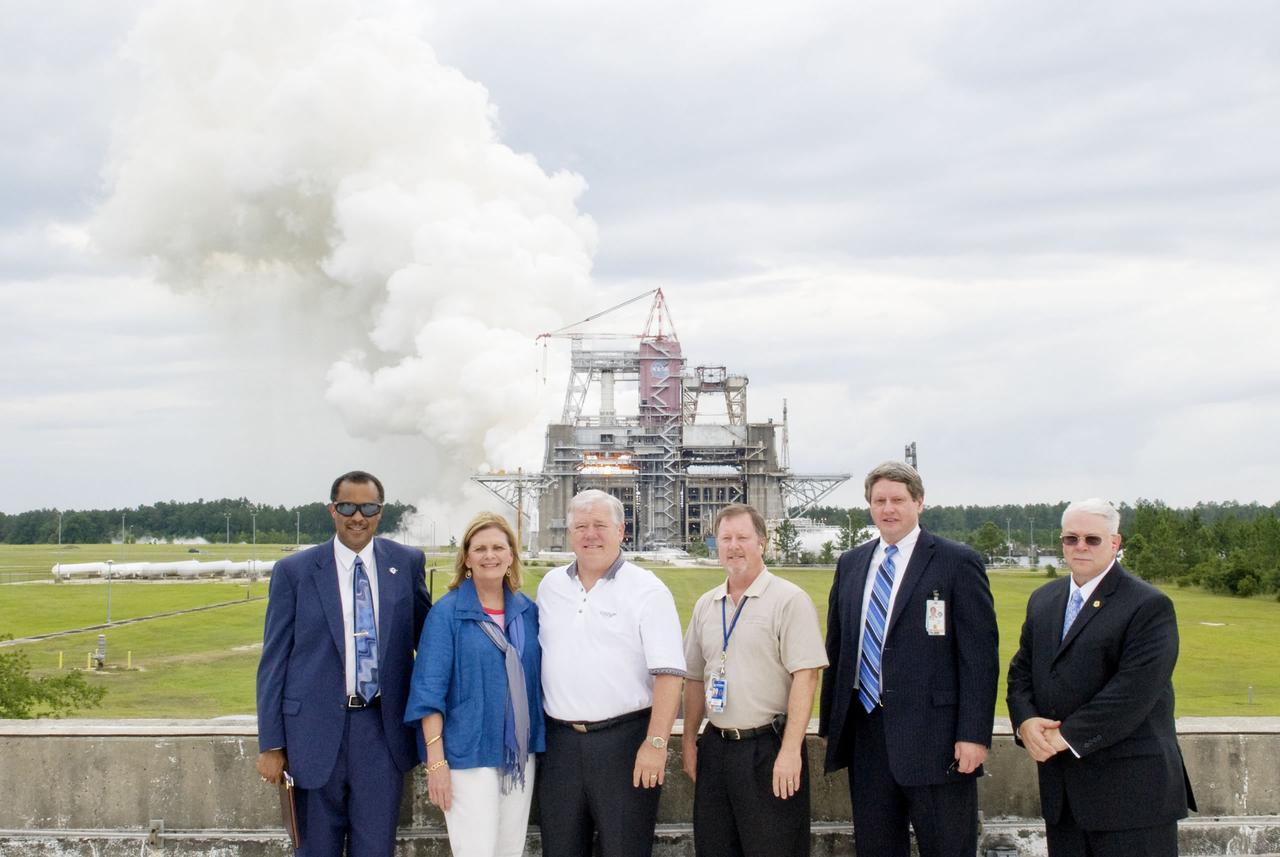
Steam billows from an RS-68 rocket engine test at the B Test Stand at Stennis Space Center on June 2. The test was viewed by Mississippi Gov. Haley Barbour (third from left) and his wife, Marsha, who spent the afternoon at the NASA rocket engine testing center. The governor was joined at the RS-68 test by (l to r) Charles Scales, NASA associate deputy administrator; Jeffrey Wright, Pratt & Whitney Rocketdyne site director at Stennis; Gene Goldman, Stennis director; and Jack Forsythe, NASA assistant administrator for the Office of Security and Program Protection.
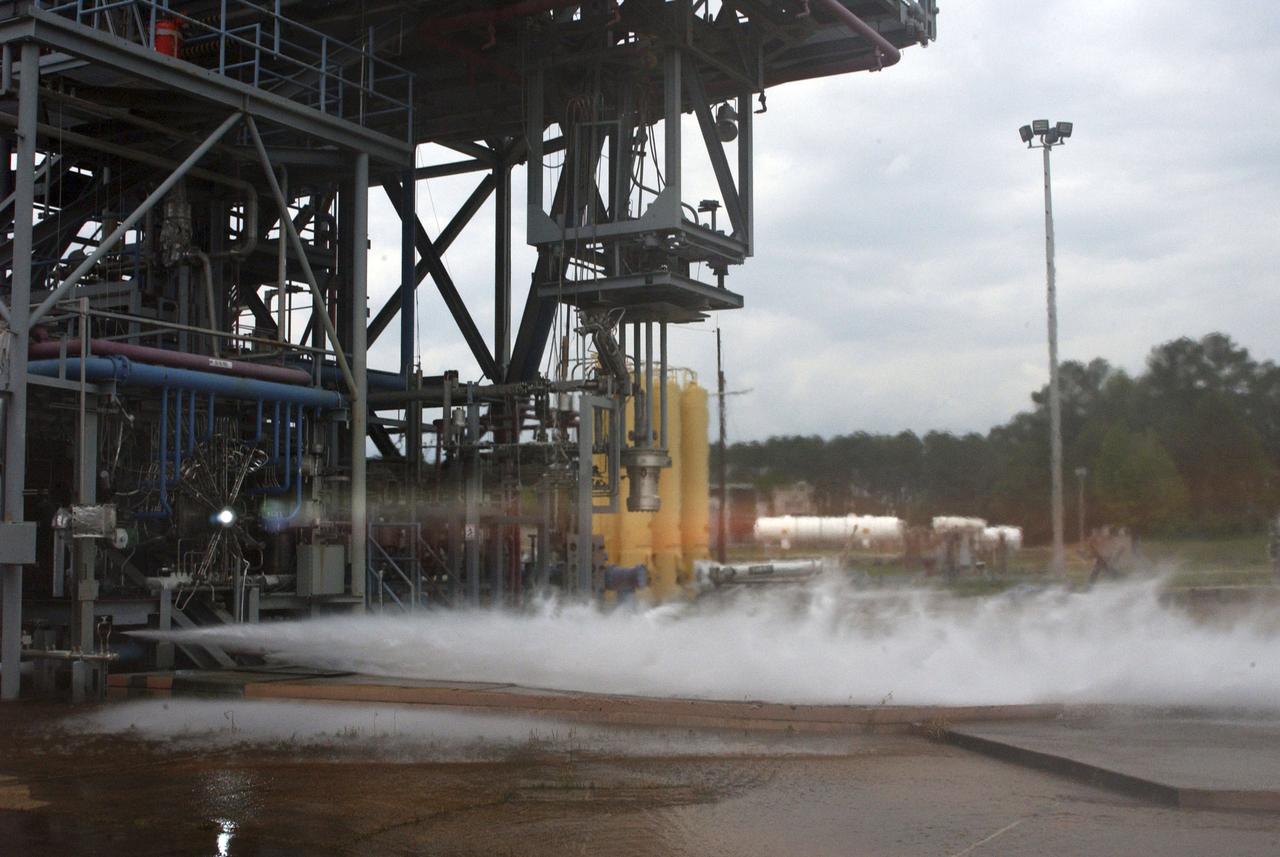
Chosen to power the upper stages of the new Ares I Crew Launch Vehicle (CLV) and the Ares V cargo segment, the J-2X engine is a stepped up version of the hydrogen/oxygen-fuelled Apollo-era J-2 engine. It was developed for NASA by Pratt & Whitney Rocketdyne (PWR), a business unit of United Technologies Corporation of Canoga Park, California. As seen in this photograph, the engine underwent a series of hot fire tests, performed on sub scale main injector hardware in the Test Stand 116 at Marshall Space Flight Center (MSFC). The injector is a major component of the engine that injects and mixes propellants in the combustion chamber, where they are ignited and burned to produce thrust.
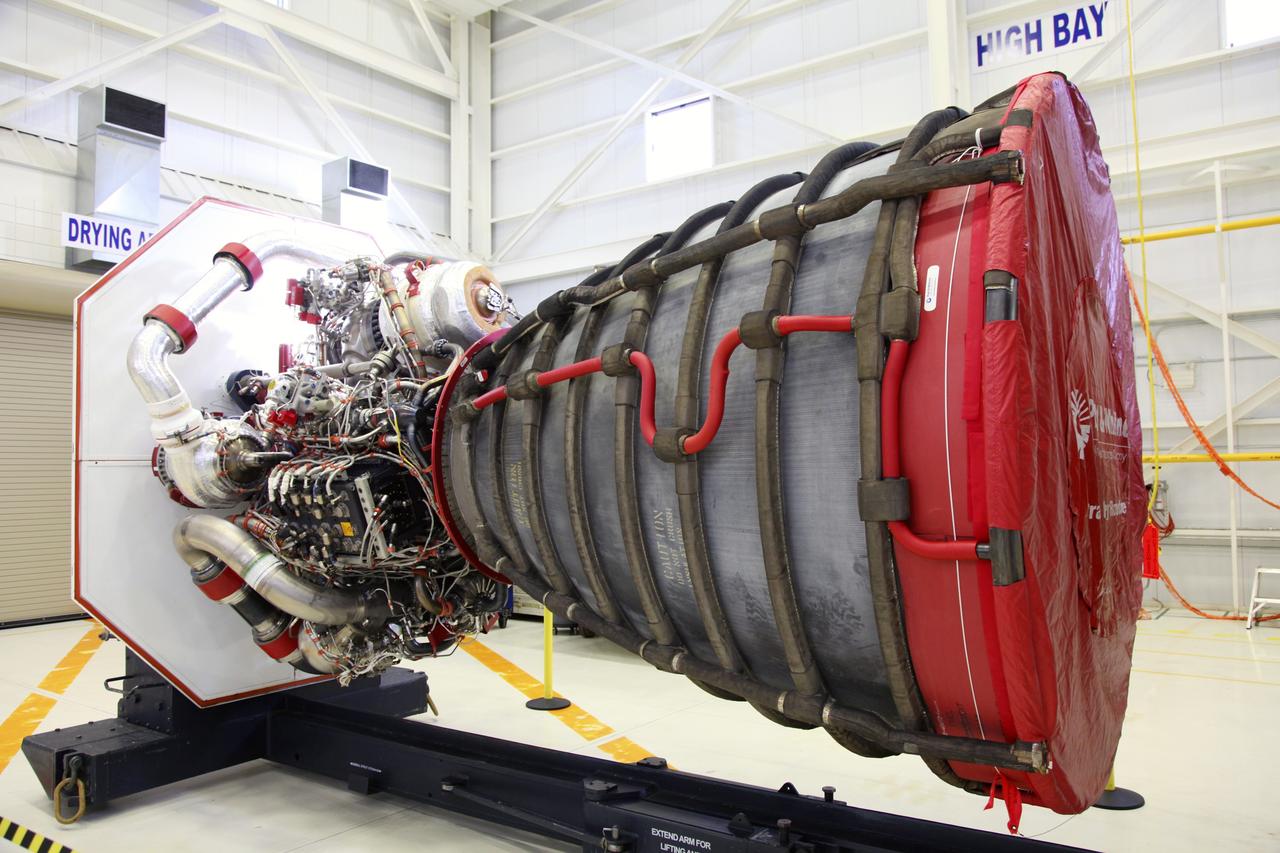
CAPE CANAVERAL, Fla. – In the Space Shuttle Main Engine Processing Facility at NASA’s Kennedy Space Center in Florida, preparations are under way to install a Pratt Whitney Rocketdyne space shuttle main engine (SSME) into a transportation canister. This is the second of the 15 engines used during the Space Shuttle Program to be prepared for transfer to NASA's Stennis Space Center in Mississippi. The engines will be stored at Stennis for future use on NASA's new heavy-lift rocket, the Space Launch System (SLS), which will carry NASA's new Orion spacecraft, cargo, equipment and science experiments to space. For more information, visit http://www.nasa.gov/shuttle. Photo credit: NASA/Gianni Woods
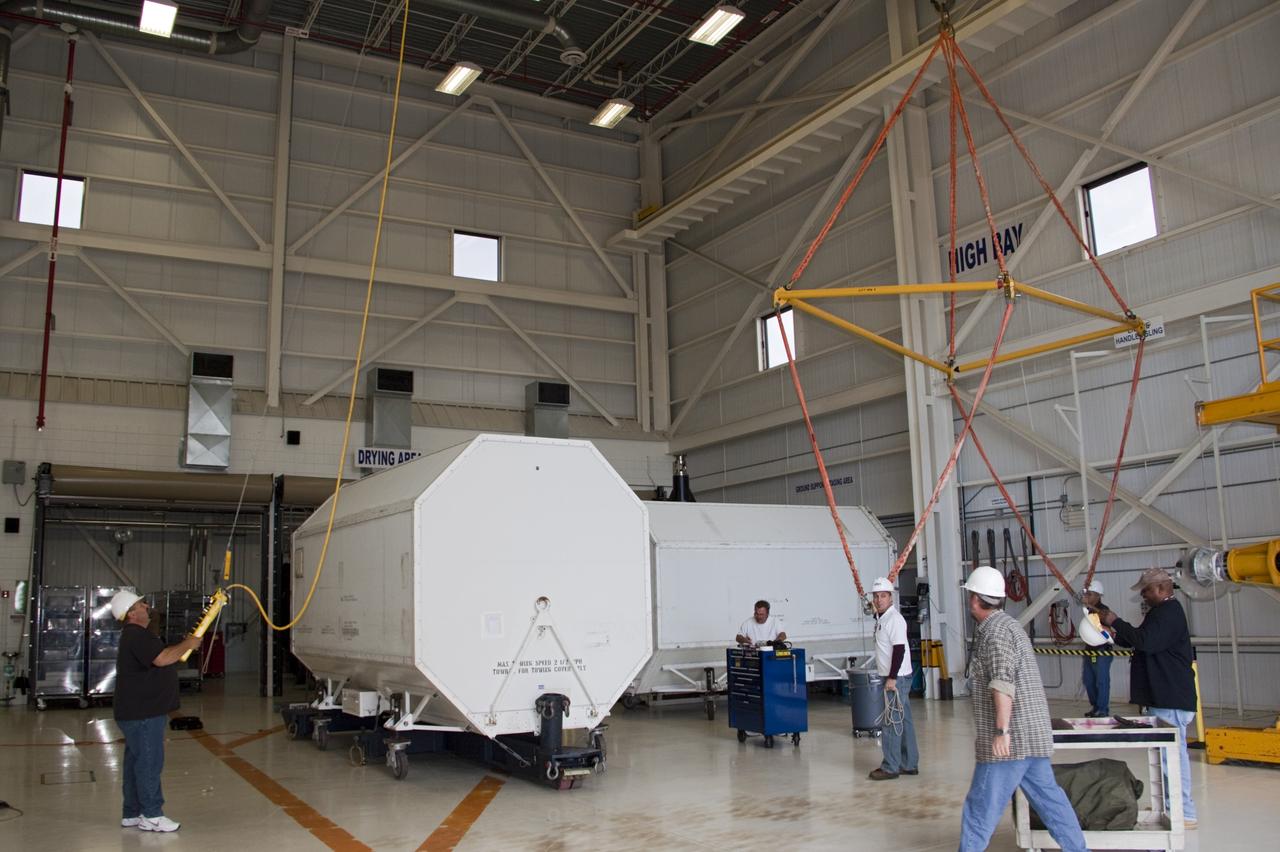
CAPE CANAVERAL, Fla. – In the Space Shuttle Main Engine Processing Facility at NASA’s Kennedy Space Center in Florida, preparations are under way to lift a transportation canister containing a Pratt & Whitney Rocketdyne space shuttle main engine (SSME) onto a flatbed trailer. This is the second of the 15 engines used during the Space Shuttle Program to be transported to NASA's Stennis Space Center in Mississippi. The engines will be stored at Stennis for future use on NASA's new heavy-lift rocket, the Space Launch System (SLS), which will carry NASA's new Orion spacecraft, cargo, equipment and science experiments to space. For more information, visit http://www.nasa.gov/shuttle. Photo credit: NASA/Jim Grossmann
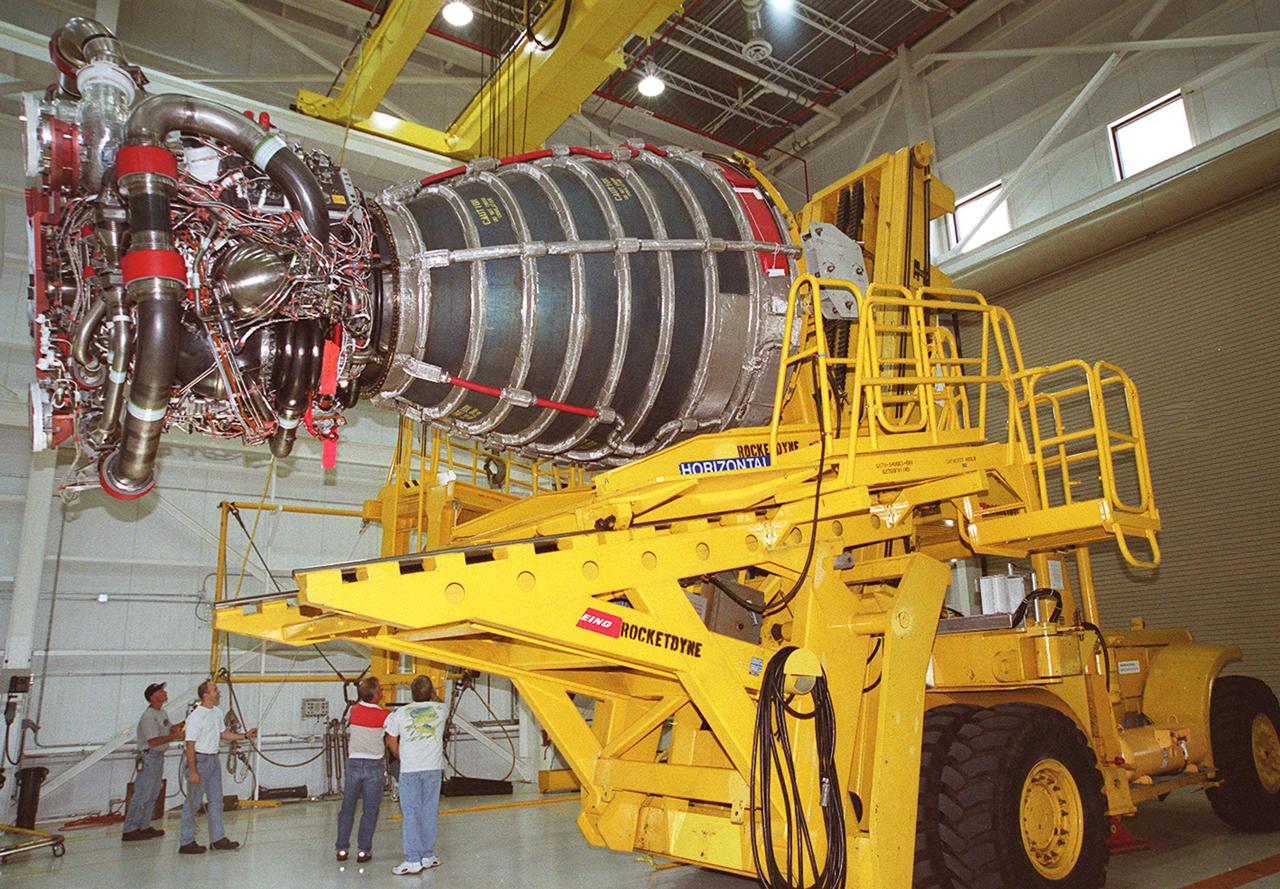
KENNEDY SPACE CENTER, FLA. -- A new block 2 engine is ready for its move to Orbiter Processing Facility bay 3. There it will be installed on the orbiter Atlantis, on mission STS-104, for its first flight. The Block II Main Engine configuration is manufactured by Boeing Rocketdyne in Canoga Park, Calif., and includes a new Pratt and Whitney high-pressure fuel turbo pump. Engine improvements are managed by NASA’s Marshall Space Flight Center in Huntsville, Ala. Each Space Shuttle Main Engine is 14 feet (4.3 meters) long, weighs about 7,000 pounds (3,175 kilograms), and is 7.5 feet (2.3 meters) in diameter at the end of the nozzle
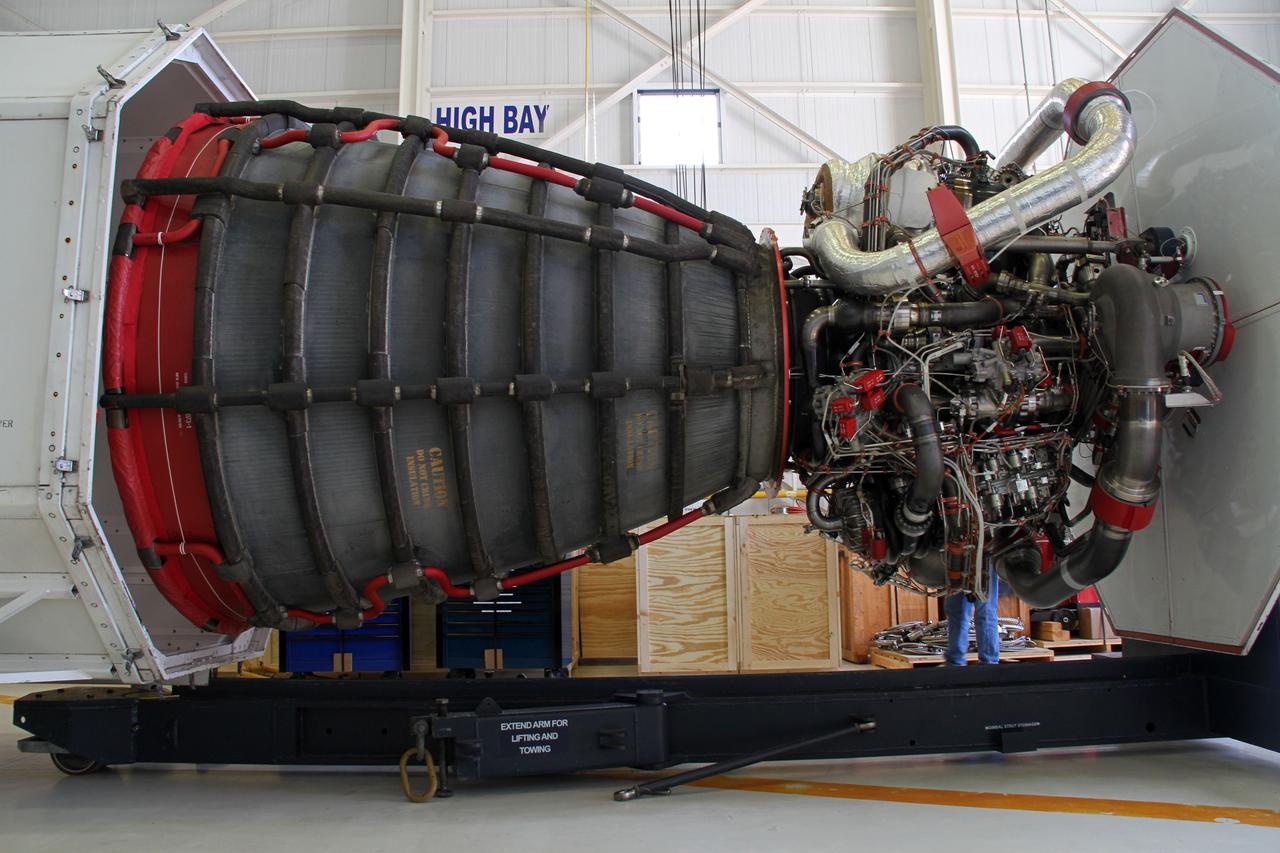
CAPE CANAVERAL, Fla. -- A Pratt and Whitney Rocketdyne space shuttle main engine, or SSME, begins to move into a transportation canister in the Orbiter Processing Facility-3 engine shop at NASA's Kennedy Space Center in Florida. The engine is the last to be packed for shipment to NASA's Stennis Space Center in Mississippi. The first two groups of engines were shipped from Kennedy to Stennis in November 2011 and January 2012, and the remaining engines are scheduled to depart on April 9. Altogether, 15 shuttle-era engines will be stored at Stennis for reuse on NASA’s Space Launch System heavy-lift rocket, under development. Photo credit: NASA/Cory Huston
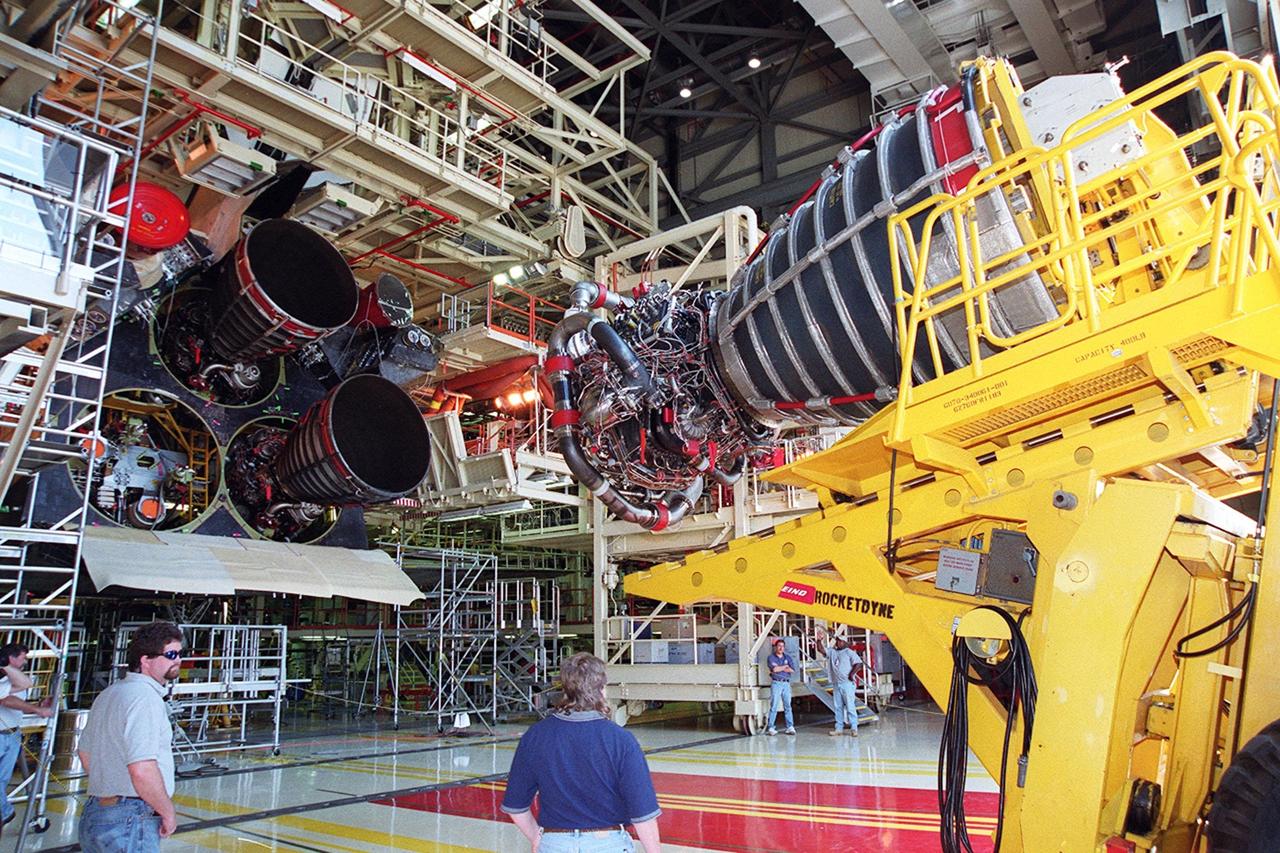
KENNEDY SPACE CENTER, FLA. -- A new block 2 engine heads toward Atlantis in Orbiter Processing Facility bay 3. There the new engine will be installed for its first flight on Atlantis, for mission STS-104. The Block II Main Engine configuration is manufactured by Boeing Rocketdyne in Canoga Park, Calif., and includes a new Pratt & Whitney high-pressure fuel turbo pump. Engine improvements are managed by NASA’s Marshall Space Flight Center in Huntsville, Ala. Each Space Shuttle Main Engine is 14 feet (4.3 meters) long, weighs about 7,000 pounds (3,175 kilograms), and is 7.5 feet (2.3 meters) in diameter at the end of the nozzle
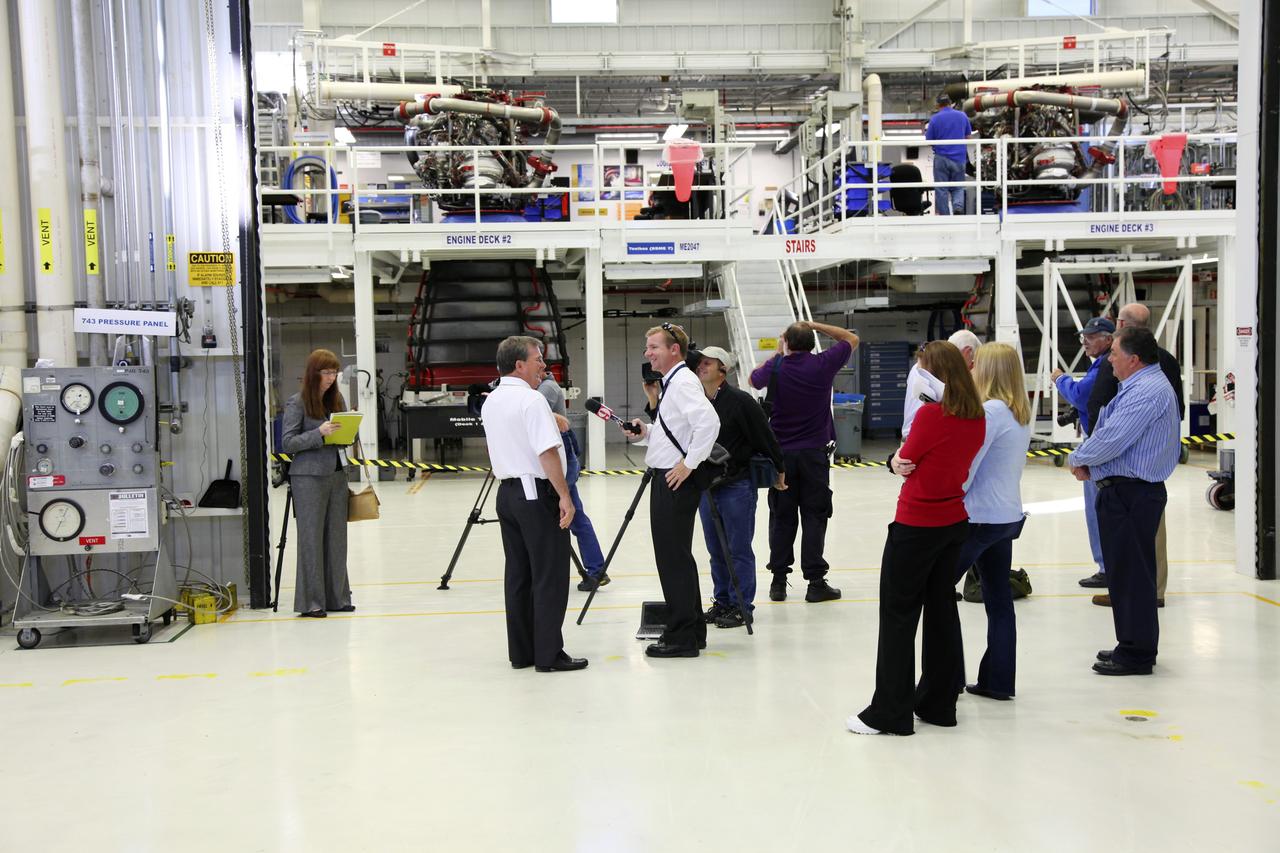
CAPE CANAVERAL, Fla. – In the Space Shuttle Main Engine Processing Facility at NASA’s Kennedy Space Center in Florida, media representatives are on hand for the installation of a Pratt Whitney Rocketdyne space shuttle main engine (SSME) into a transportation canister. This is the second of the 15 engines used during the Space Shuttle Program to be prepared for transfer to NASA's Stennis Space Center in Mississippi. The engines will be stored at Stennis for future use on NASA's new heavy-lift rocket, the Space Launch System (SLS), which will carry NASA's new Orion spacecraft, cargo, equipment and science experiments to space. For more information, visit http://www.nasa.gov/shuttle. Photo credit: NASA/Gianni Woods
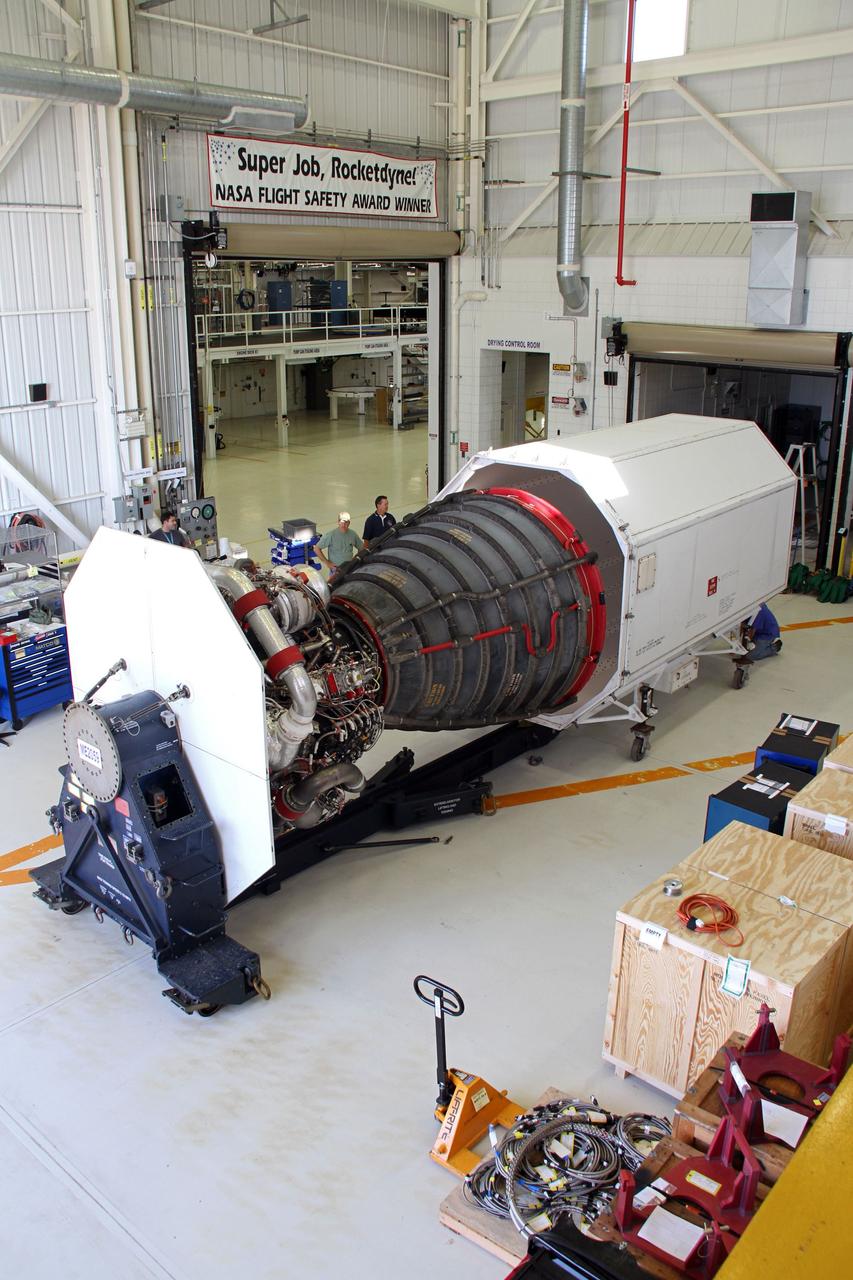
CAPE CANAVERAL, Fla. -- In the Orbiter Processing Facility-3 engine shop at NASA's Kennedy Space Center in Florida, a Pratt and Whitney Rocketdyne space shuttle main engine, or SSME, is prepared for loading into a waiting transportation canister for shipment to NASA's Stennis Space Center in Mississippi. The first two groups of engines were shipped from Kennedy to Stennis in November 2011 and January 2012, and the remaining engines are scheduled to depart on April 9. Altogether, 15 shuttle-era engines will be stored at Stennis for reuse on NASA’s Space Launch System heavy-lift rocket, under development. Photo credit: NASA/Cory Huston
CAPE CANAVERAL, Fla. – In the Space Shuttle Main Engine Processing Facility at NASA’s Kennedy Space Center in Florida, a Pratt Whitney Rocketdyne space shuttle main engine (SSME) is ready for installation in a transportation canister. This is the second of the 15 engines used during the Space Shuttle Program to be prepared for transfer to NASA's Stennis Space Center in Mississippi. The engines will be stored at Stennis for future use on NASA's new heavy-lift rocket, the Space Launch System (SLS), which will carry NASA's new Orion spacecraft, cargo, equipment and science experiments to space. For more information, visit http://www.nasa.gov/shuttle. Photo credit: NASA/Gianni Woods
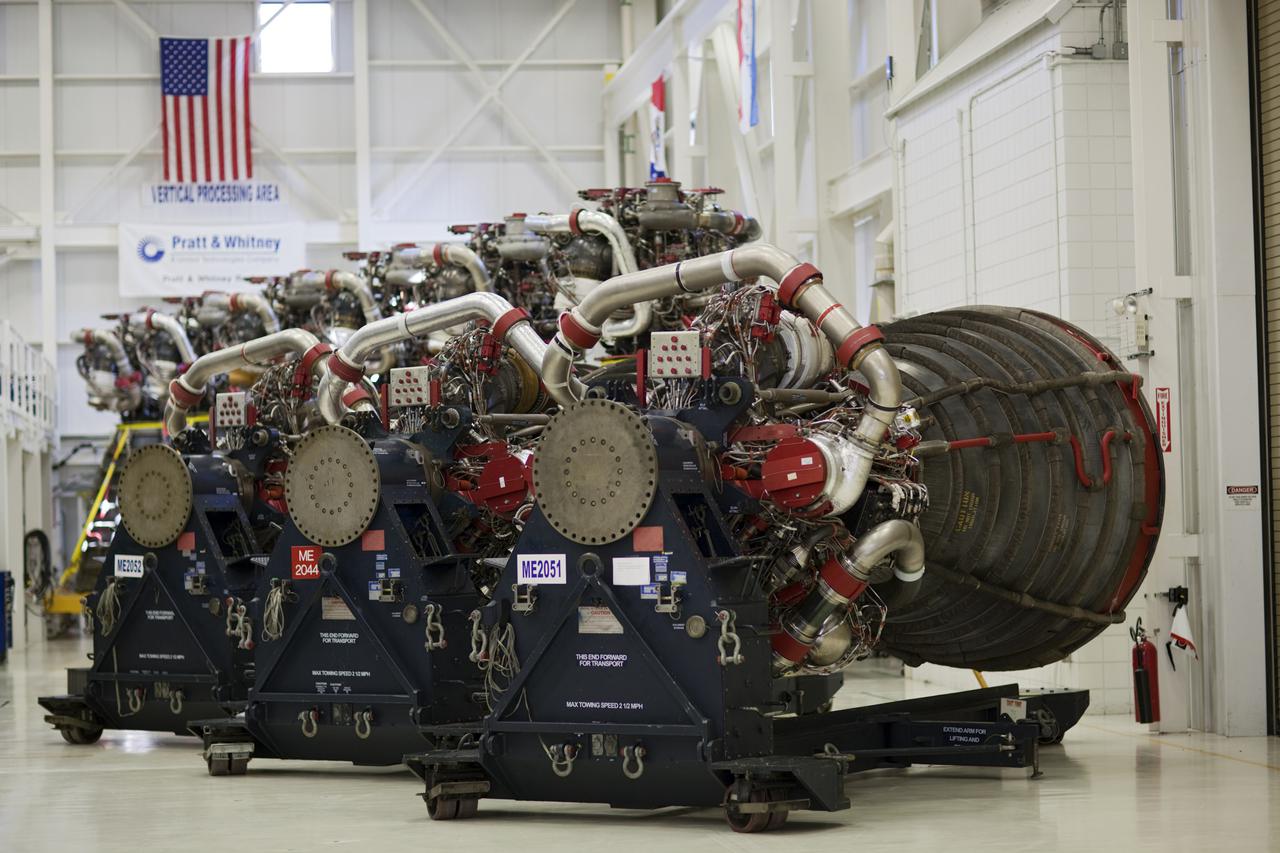
CAPE CANAVERAL, Fla. – At NASA’s Kennedy Space Center in Florida, three Pratt Whitney Rocketdyne space shuttle main engines (SSMEs) sit on stands inside the Engine Shop, with six more engines lined up behind them. For the first time, all 15 main engines are in the Engine Shop at the same time. They are being prepared for shipment to NASA's Stennis Space Center in Mississippi for storage following the completion of the Space Shuttle Program. The engines are being repurposed for use on NASA’s Space Launch System heavy lift rocket. Photo credit: NASA_Dimitri Gerondidakis
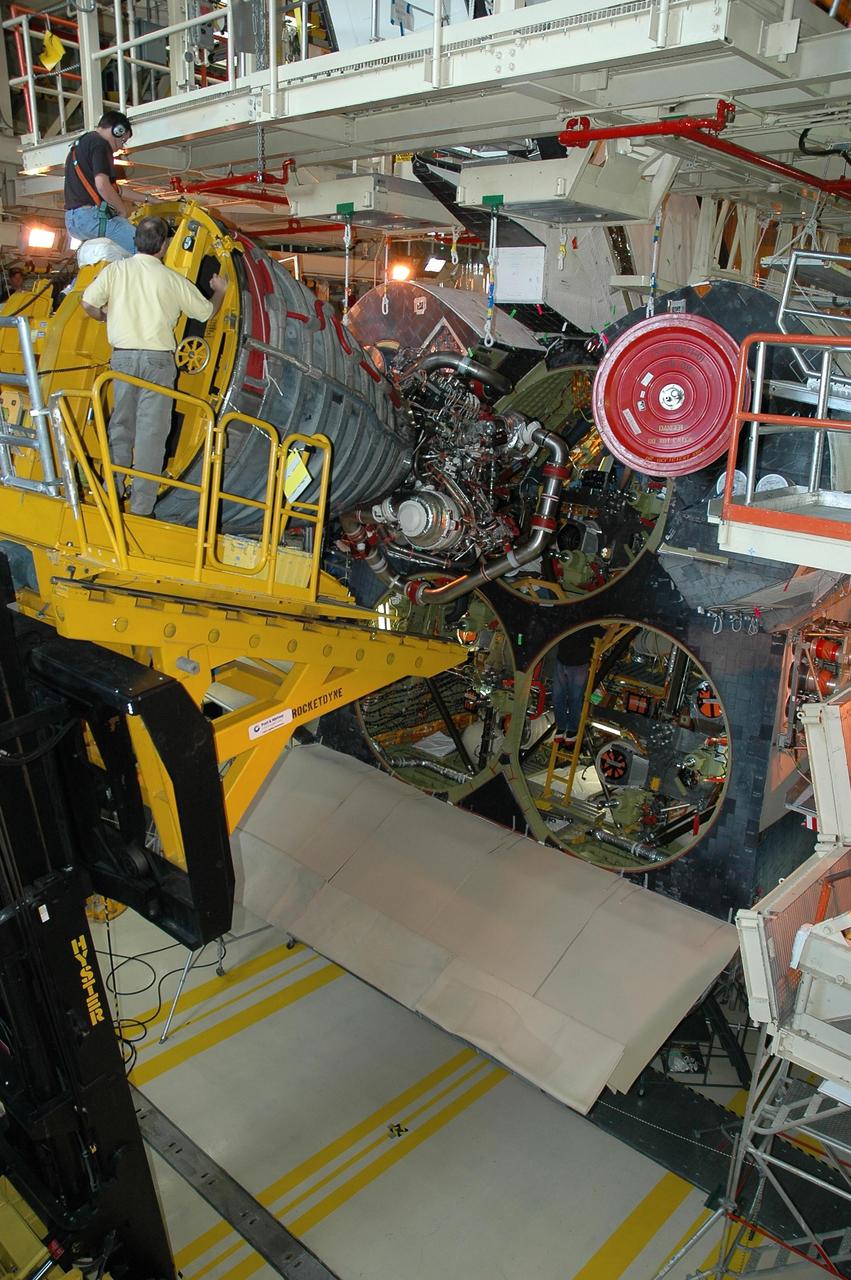
KENNEDY SPACE CENTER, FLA. - In the Orbiter Processing Facility bay 1, a Hyster forklift moves a main engine into position for installation into Discovery. The main engine configuration is manufactured by Boeing Rocketdyne in Canoga Park, Calif., and includes a Pratt & Whitney high-pressure fuel turbo pump. Each space shuttle main engine is 14 feet (4.3 meters) long, weighs about 6,700 pounds (3,039 kilograms), and is 7.5 feet (2.3 meters) in diameter at the end of the nozzle. Discovery is being processed for the second return-to-flight mission STS-121.
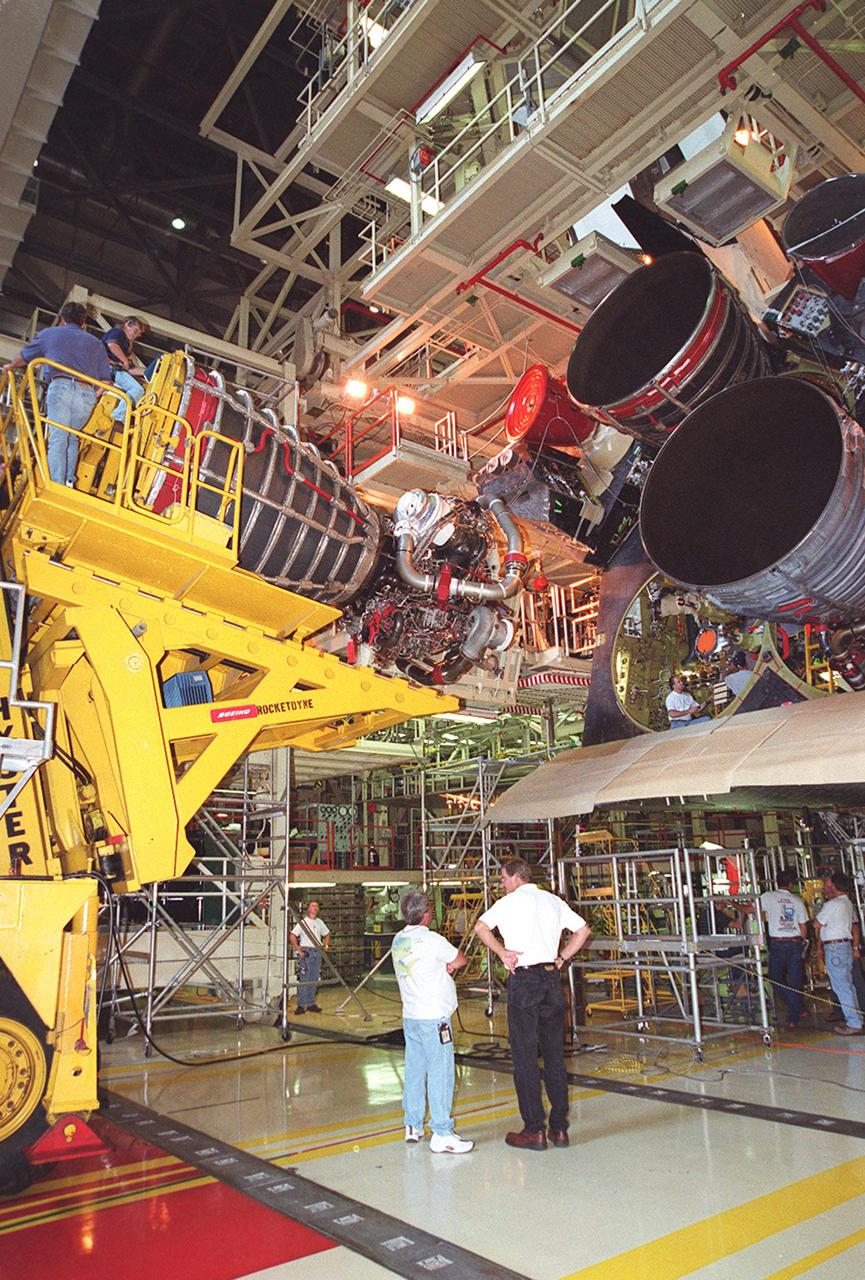
KENNEDY SPACE CENTER, FLA. -- In Orbiter Processing Facility bay 3, a new block 2 engine, at left, is moved into position for installation on Atlantis. The engine will have its first flight on mission STS-104, scheduled for launch June 14. The Block II Main Engine configuration is manufactured by Boeing Rocketdyne in Canoga Park, Calif., and includes a new Pratt and Whitney high-pressure fuel turbo pump. Engine improvements are managed by NASA’s Marshall Space Flight Center in Huntsville, Ala. Each Space Shuttle Main Engine is 14 feet (4.3 meters) long, weighs about 7,000 pounds (3,175 kilograms), and is 7.5 feet (2.3 meters) in diameter at the end of the nozzle
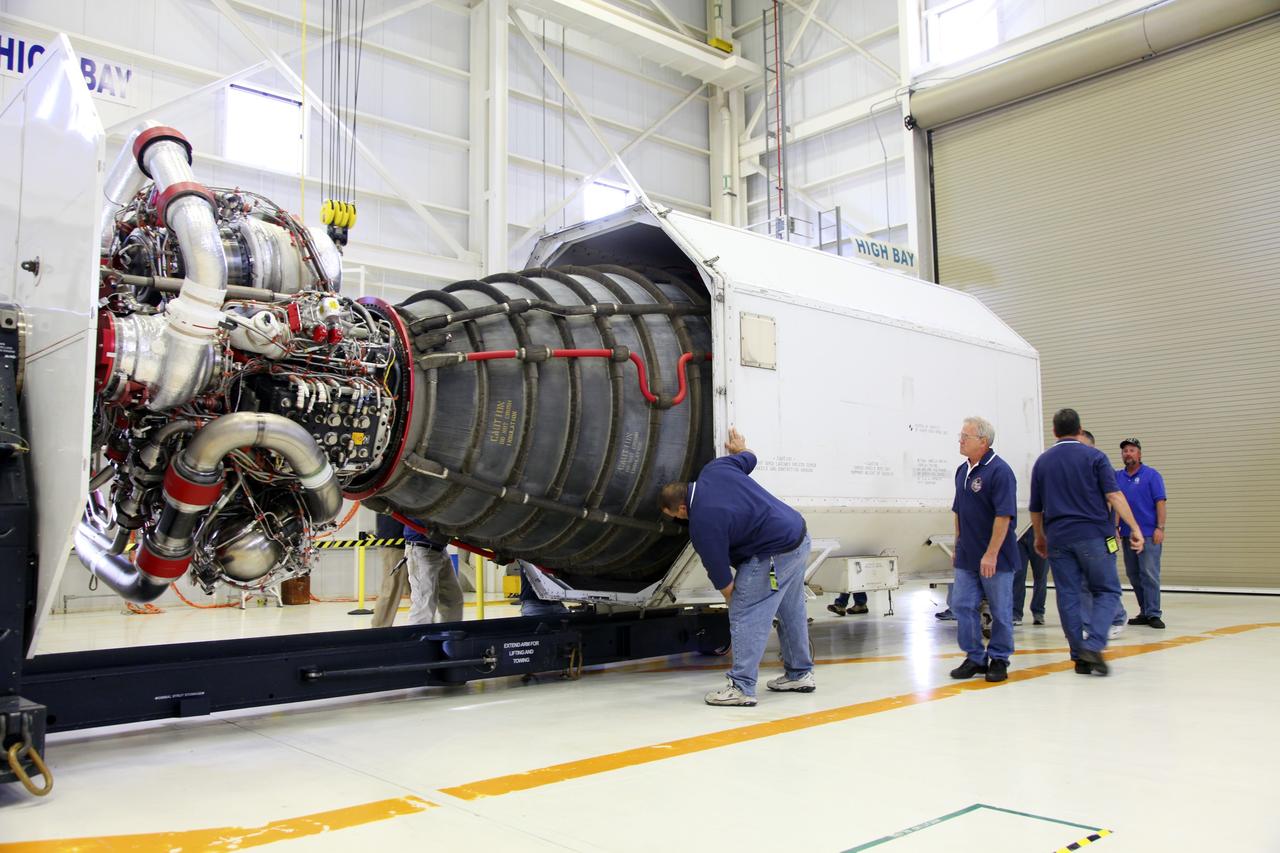
CAPE CANAVERAL, Fla. – In the Space Shuttle Main Engine Processing Facility at NASA’s Kennedy Space Center in Florida, technicians guide a transportation canister as it encloses a Pratt Whitney Rocketdyne space shuttle main engine (SSME). This is the second of the 15 engines used during the Space Shuttle Program to be prepared for transfer to NASA's Stennis Space Center in Mississippi. The engines will be stored at Stennis for future use on NASA's new heavy-lift rocket, the Space Launch System (SLS), which will carry NASA's new Orion spacecraft, cargo, equipment and science experiments to space. For more information, visit http://www.nasa.gov/shuttle. Photo credit: NASA/Gianni Woods
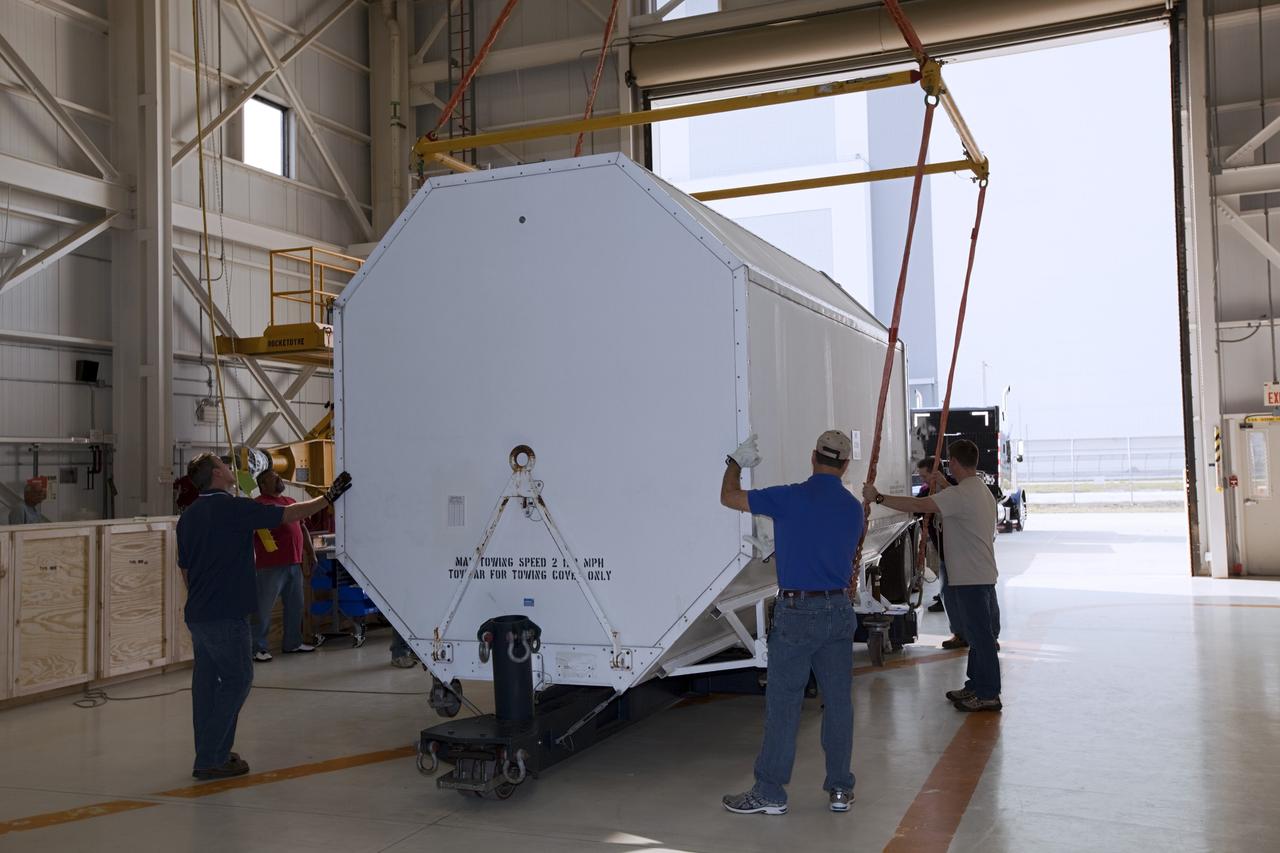
CAPE CANAVERAL, Fla. – In the Orbiter Processing Facility-3 engine shop at NASA's Kennedy Space Center in Florida, preparations are under way to load the transportation canister containing the last Pratt and Whitney Rocketdyne space shuttle main engine, or SSME, onto a flatbed truck for shipment to NASA's Stennis Space Center in Mississippi. The first two groups of engines were shipped from Kennedy to Stennis in November 2011 and January 2012 the remaining engines departed today. Altogether, 15 shuttle-era engines will be stored at Stennis for reuse on NASA’s Space Launch System heavy-lift rocket, under development. Photo credit: NASA/Dimitri Gerondidakis
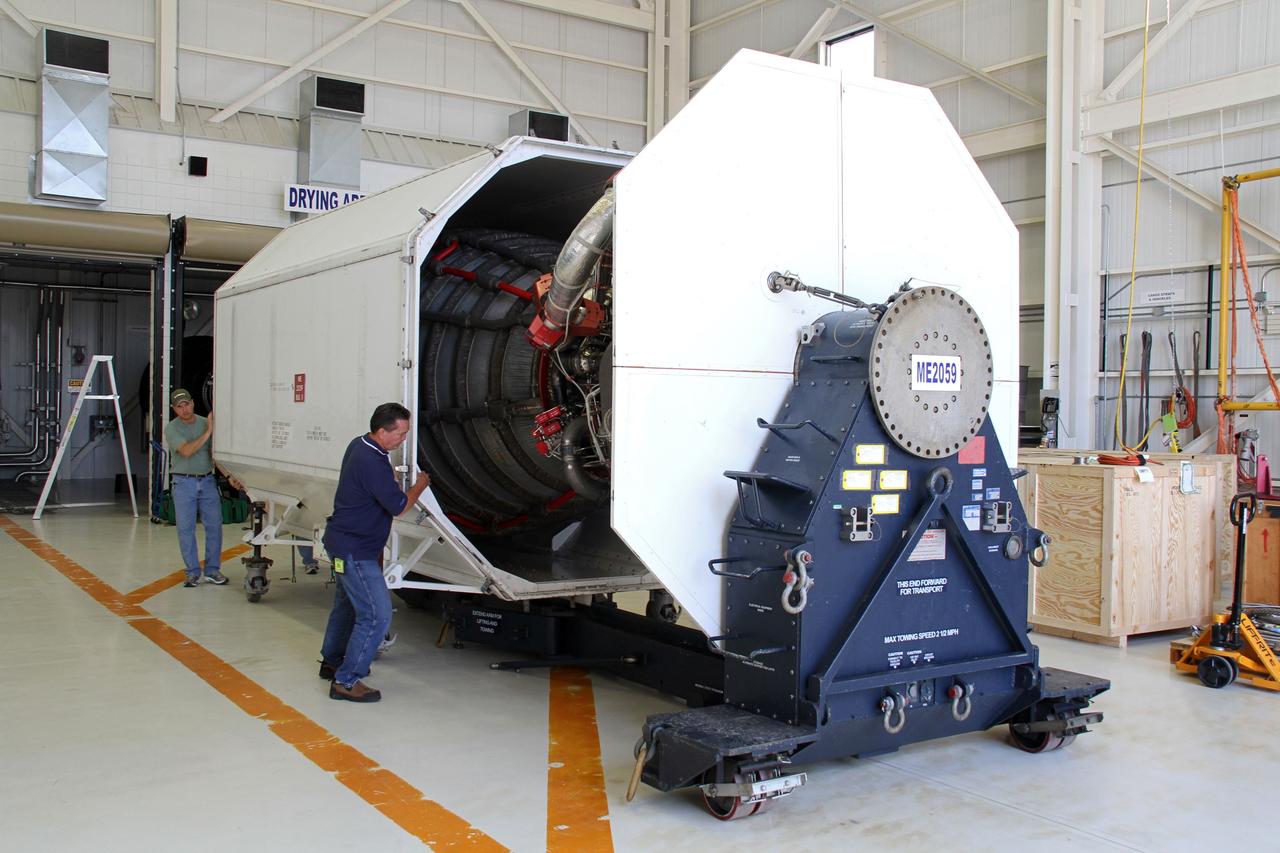
CAPE CANAVERAL, Fla. -- In the Orbiter Processing Facility-3 engine shop at NASA's Kennedy Space Center in Florida, a space shuttle main engine, or SSME, enters a transportation canister under the watchful eyes of Pratt and Whitney Rocketdyne's Jeff Huie. The engine is the last to be packed for shipment to NASA's Stennis Space Center in Mississippi. The first two groups of engines were shipped from Kennedy to Stennis in November 2011 and January 2012, and the remaining engines are scheduled to depart on April 9. Altogether, 15 shuttle-era engines will be stored at Stennis for reuse on NASA’s Space Launch System heavy-lift rocket, under development. Photo credit: NASA/Cory Huston
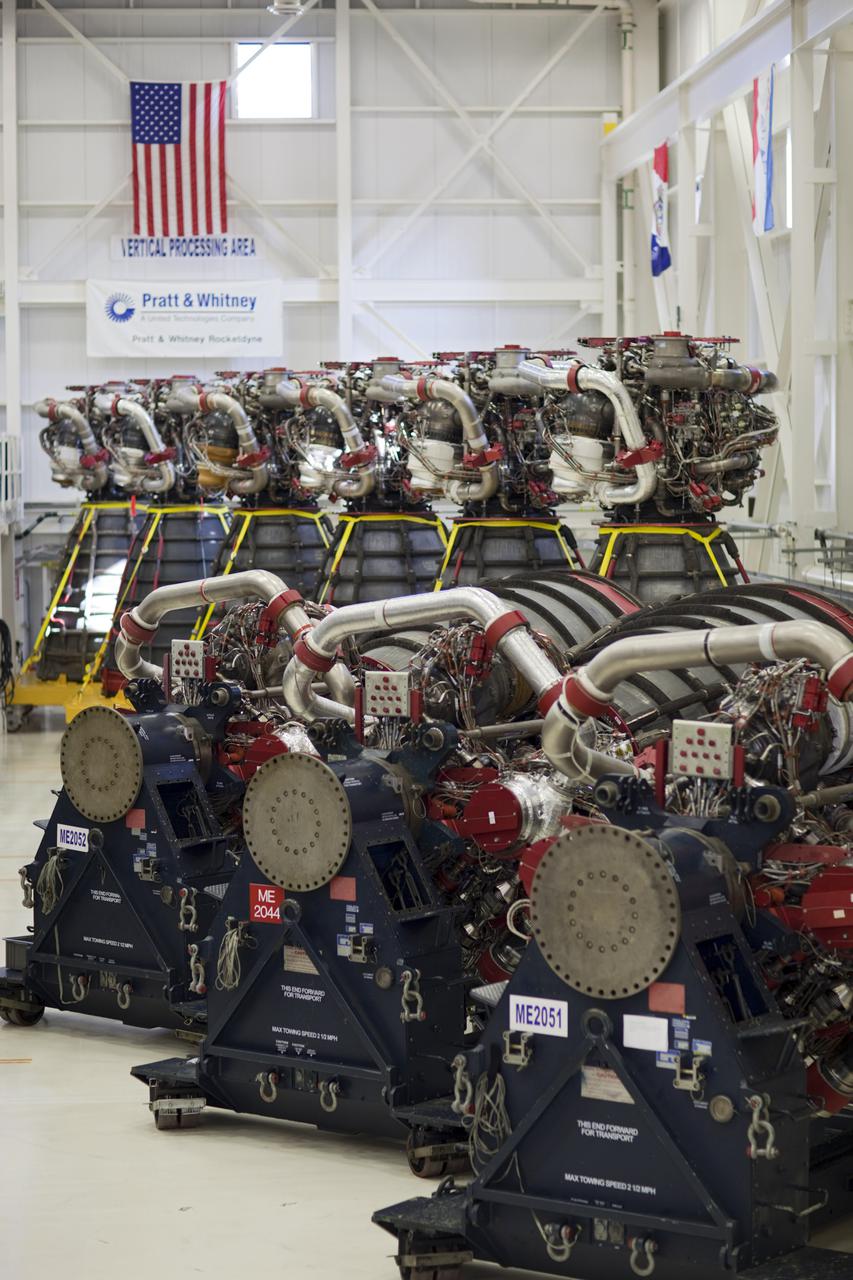
CAPE CANAVERAL, Fla. – At NASA’s Kennedy Space Center in Florida, three Pratt Whitney Rocketdyne space shuttle main engines (SSMEs) sit on stands inside the Engine Shop, with six more engines lined up behind them. For the first time, all 15 main engines are in the Engine Shop at the same time. They are being prepared for shipment to NASA's Stennis Space Center in Mississippi for storage following the completion of the Space Shuttle Program. The engines are being repurposed for use on NASA’s Space Launch System heavy lift rocket. Photo credit: NASA_Dimitri Gerondidakis
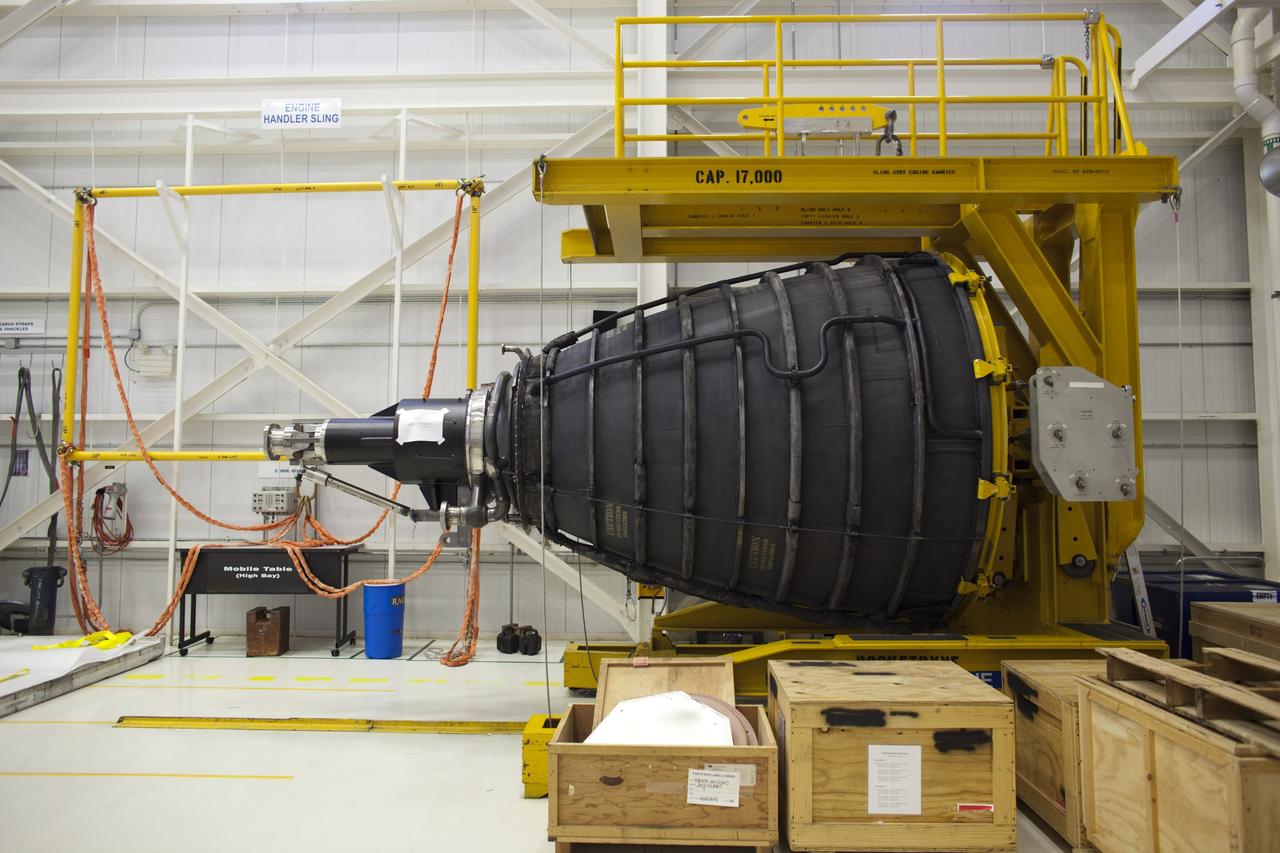
CAPE CANAVERAL, Fla. -- Inside the Pratt & Whitney Rocketdyne engine shop at NASA’s Kennedy Space Center in Florida, one of the three replica shuttle main engines (RSMEs) created for space shuttle Discovery is attached to the space shuttle main engine horizontal installer. The replica engines will be transported from the engine shop to the processing facility for installation on Discovery in January 2012. The work is part of the Space Shuttle Program’s transition and retirement processing of shuttle Discovery. Discovery is being prepared for display at the Smithsonian’s National Air and Space Museum, Steven F. Udvar-Hazy Center in Chantilly, Va. For more information, visit http://www.nasa.gov/shuttle. Photo credit: NASA/Dimitri Gerondidakis
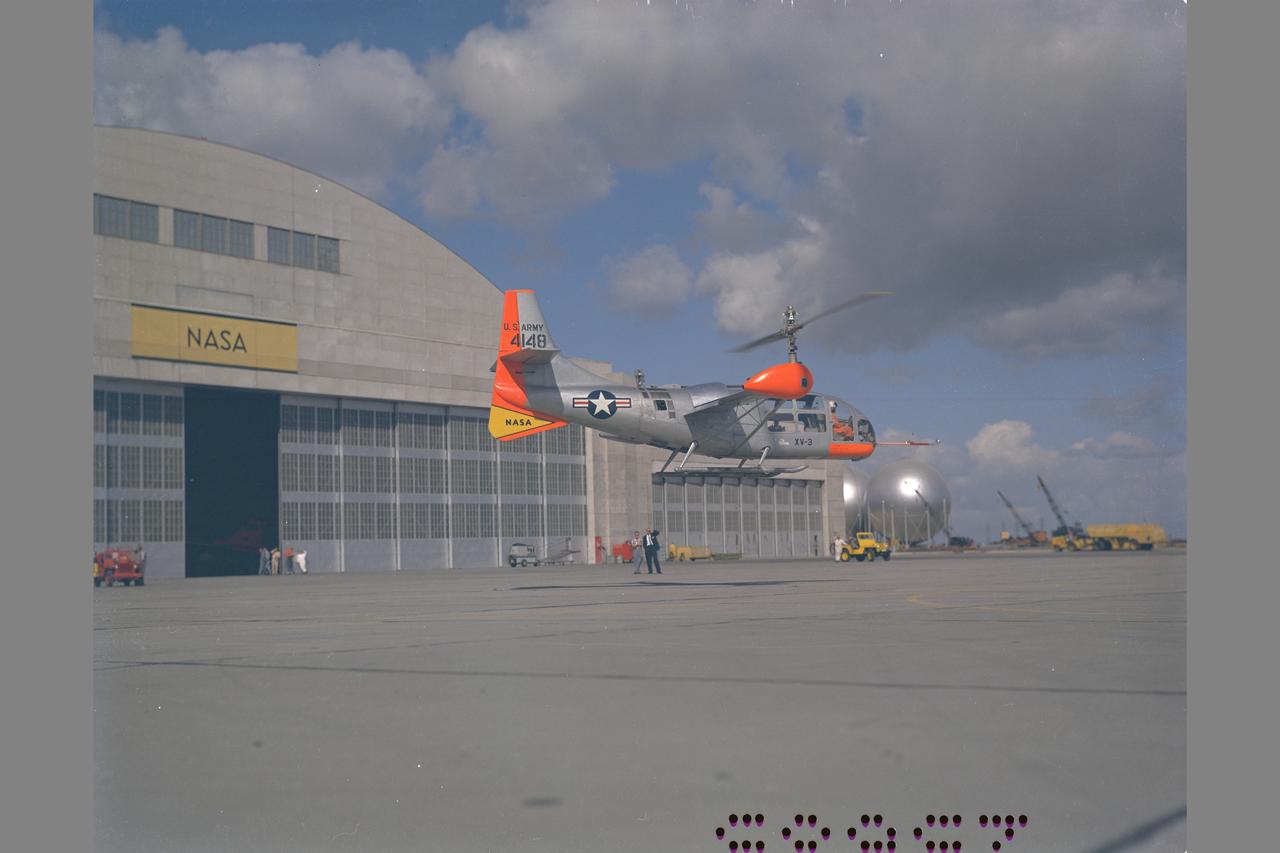
XV-3 HOVERING ON RAMP. Flight Test of Bell XV-3 Convertiplane. Bell VTOL tilt-rotor aircraft hovering in front of building N-211 at Moffett Field. The XV-3 design combined a helicopter rotor and a wing. A 450 horsepower Pratt & Whitney piston engine drove the two rotors. The XV-3, first flown in 1955 , was the first tilt-rotor to achieve 100% tilting of rotors. The vehicle was underpowered, however, and could not hover out of ground effect. Note the large ventral fin, which was added to imrpove directional stability in cruse (Oct 1962)