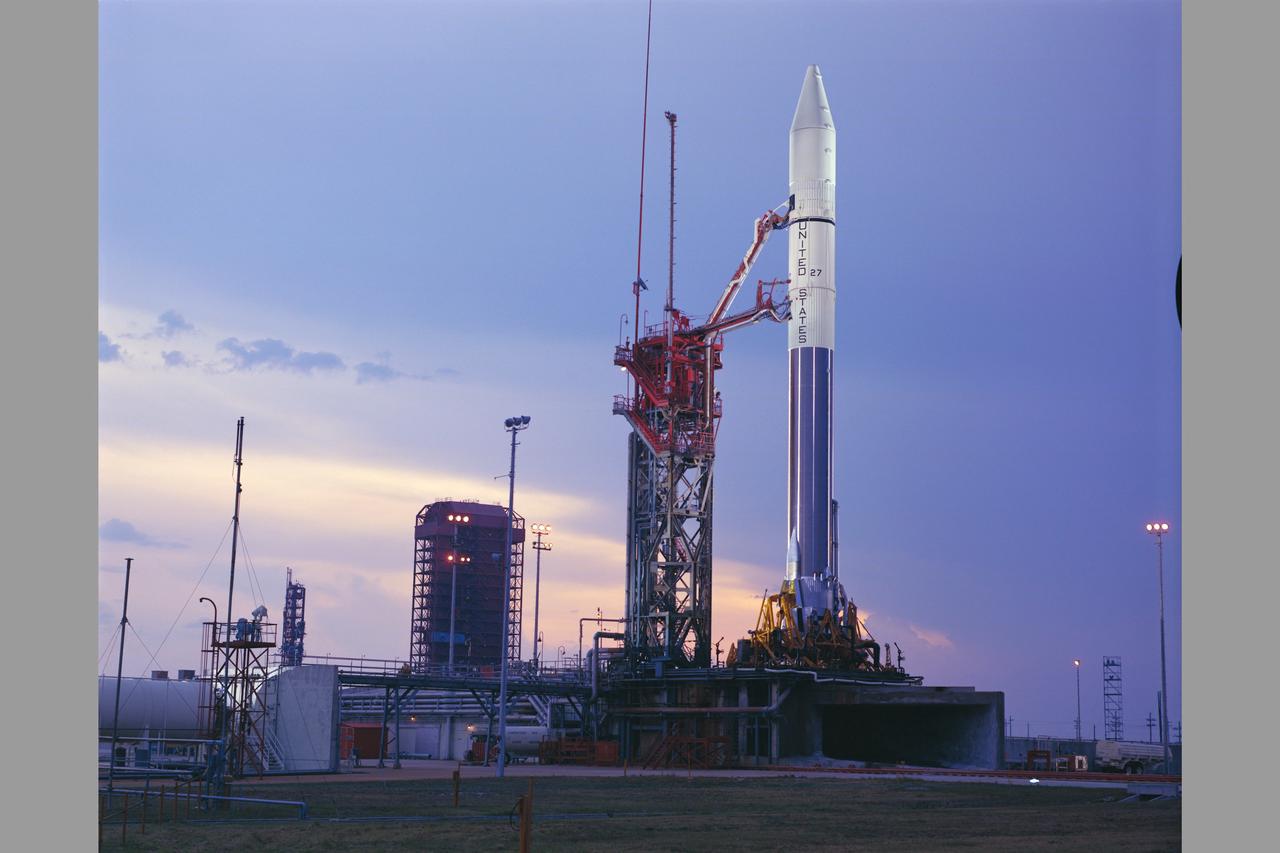
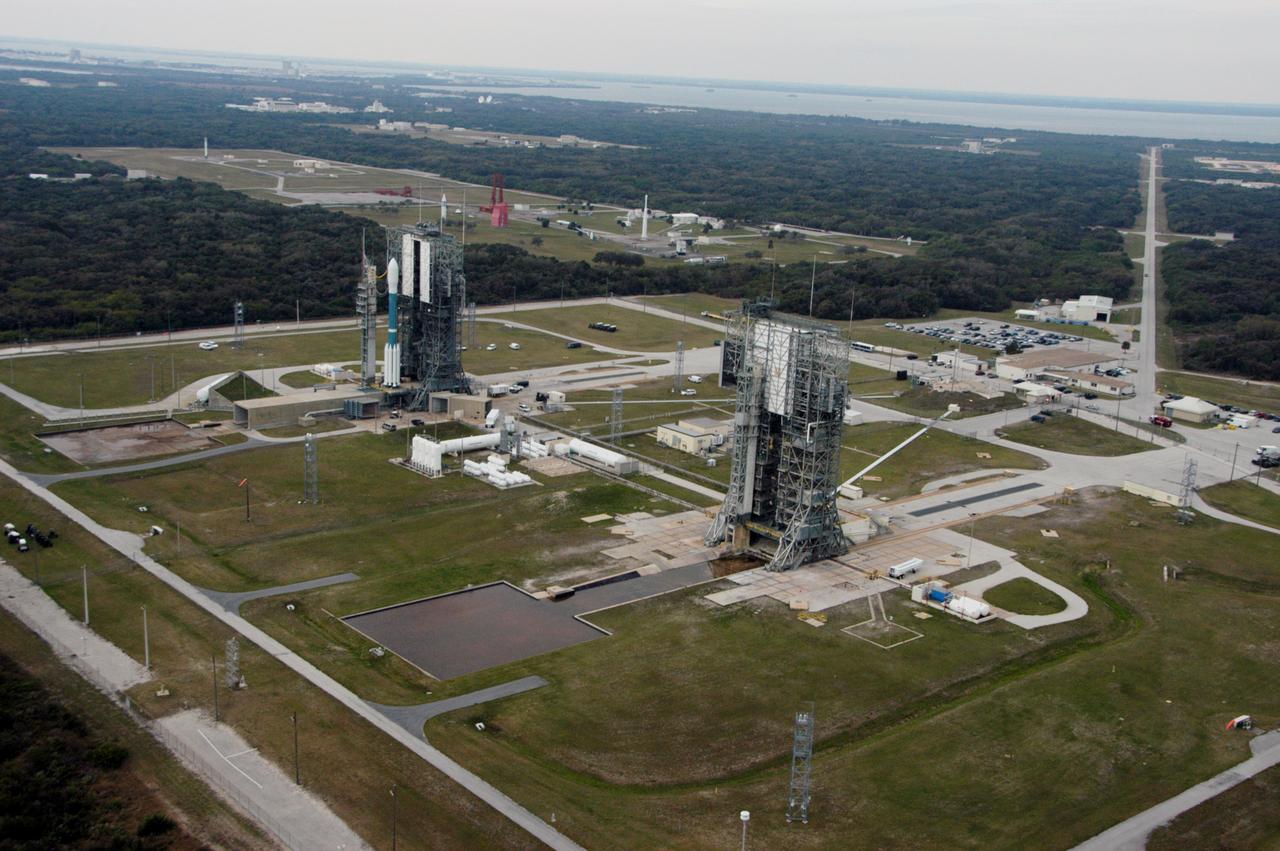
The Delta II rocket with the THEMIS spacecraft atop sits ready for launch on Pad 17-B at Cape Canaveral Air Force Station in this aerial view of the launch complex area as the mobile service tower begins to move away. THEMIS, an acronym for Time History of Events and Macroscale Interactions during Substorms, consists of five identical probes that will track violent, colorful eruptions near the North Pole. This will be the largest number of scientific satellites NASA has ever launched into orbit aboard a single rocket. The THEMIS mission aims to unravel the mystery behind auroral substorms, an avalanche of magnetic energy powered by the solar wind that intensifies the northern and southern lights. The mission will investigate what causes auroras in the Earth’s atmosphere to dramatically change from slowly shimmering waves of light to wildly shifting streaks of bright color. Launch is scheduled for 6:05 p.m.
Delta II THEMIS Pre-Launch
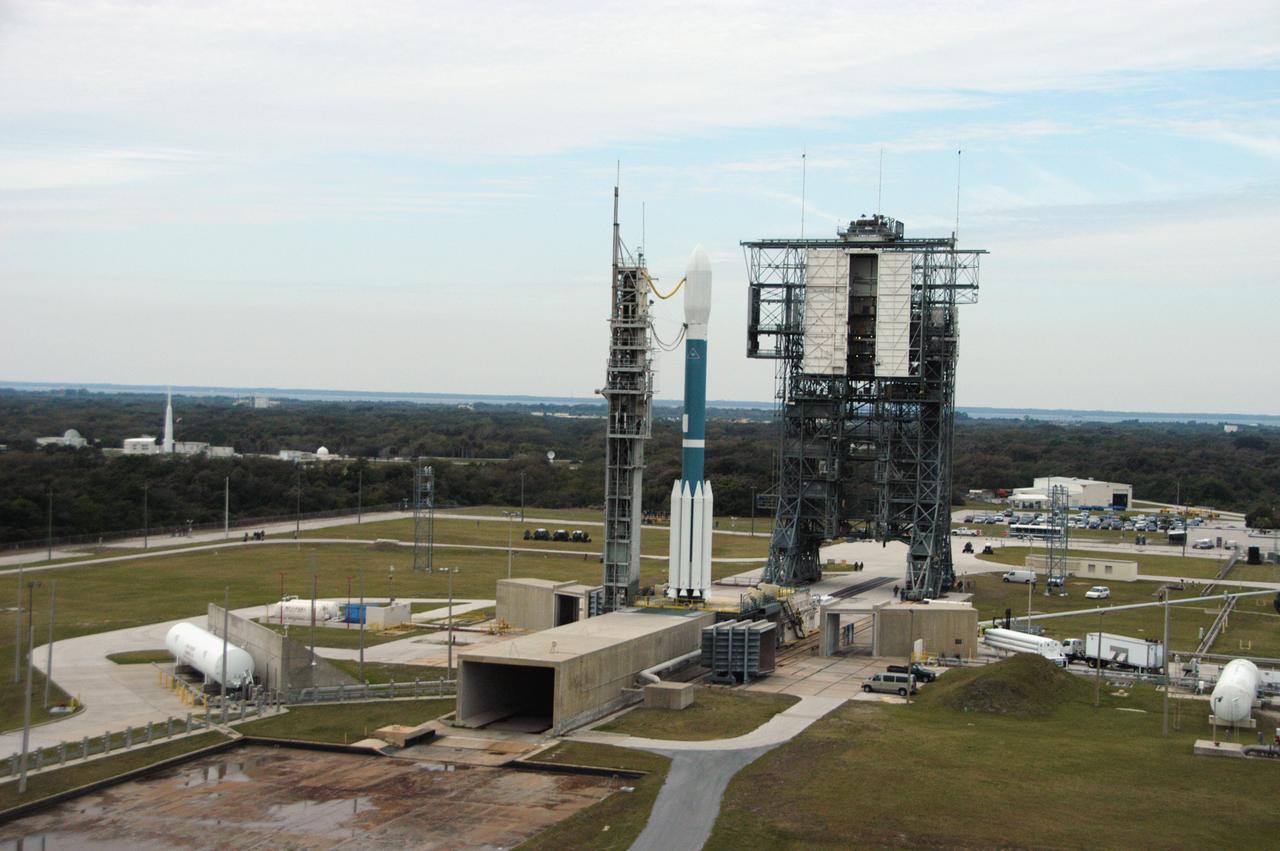
In this aerial view, the Delta II rocket with the THEMIS spacecraft sits ready for launch on Pad 17-B at Cape Canaveral Air Force Station, as the mobile service tower moves away from the pad. THEMIS, an acronym for Time History of Events and Macroscale Interactions during Substorms, consists of five identical probes that will track violent, colorful eruptions near the North Pole. This will be the largest number of scientific satellites NASA has ever launched into orbit aboard a single rocket. The THEMIS mission aims to unravel the mystery behind auroral substorms, an avalanche of magnetic energy powered by the solar wind that intensifies the northern and southern lights. The mission will investigate what causes auroras in the Earth’s atmosphere to dramatically change from slowly shimmering waves of light to wildly shifting streaks of bright color. Launch is scheduled for 6:05 p.m.
Delta II THEMIS Pre-Launch
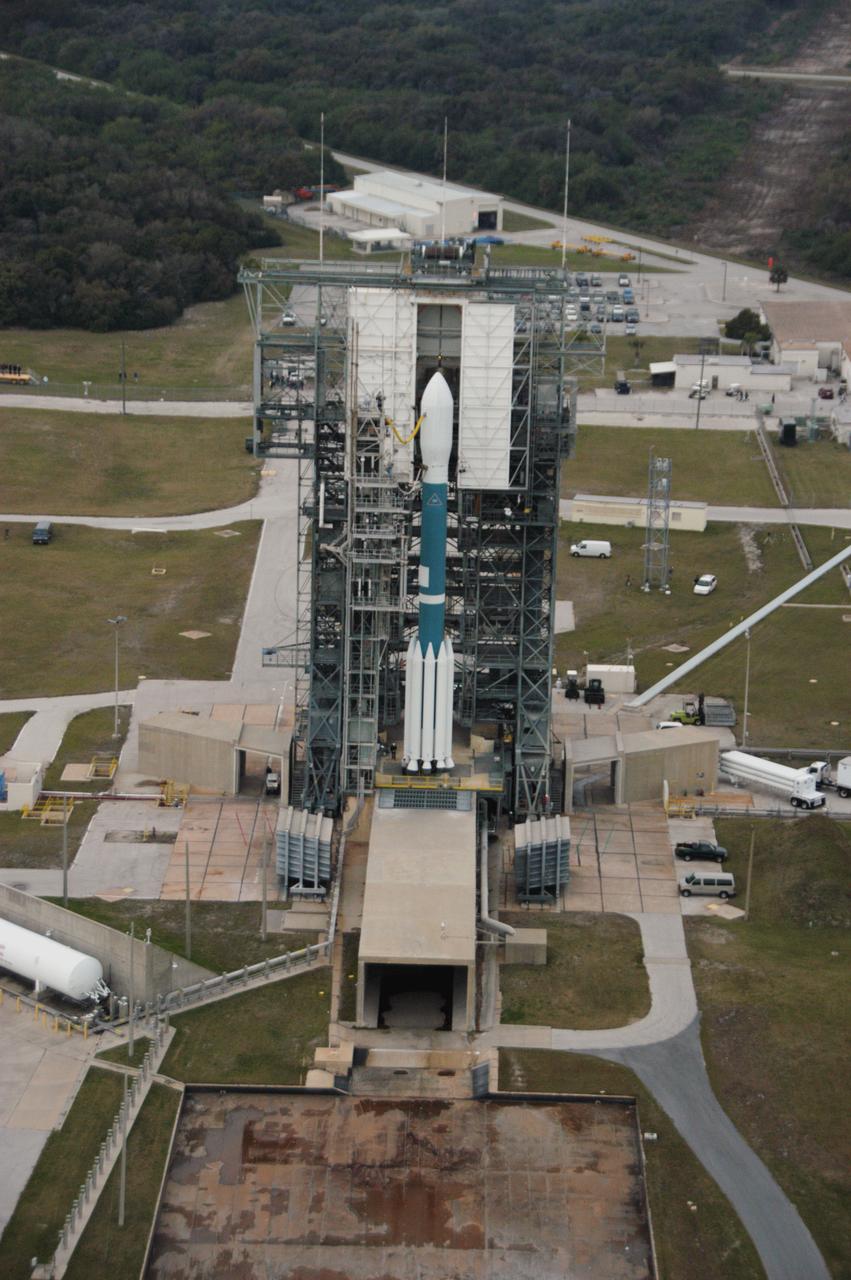
In this close-up aerial view, the Delta II rocket with the THEMIS spacecraft atop sits ready for launch on Pad 17-B at Cape Canaveral Air Force Station. THEMIS, an acronym for Time History of Events and Macroscale Interactions during Substorms, consists of five identical probes that will track violent, colorful eruptions near the North Pole. This will be the largest number of scientific satellites NASA has ever launched into orbit aboard a single rocket. The THEMIS mission aims to unravel the mystery behind auroral substorms, an avalanche of magnetic energy powered by the solar wind that intensifies the northern and southern lights. The mission will investigate what causes auroras in the Earth’s atmosphere to dramatically change from slowly shimmering waves of light to wildly shifting streaks of bright color. Launch is scheduled for 6:05 p.m.
Delta II THEMIS Pre-Launch
In this close-up aerial view, the Delta II rocket with the THEMIS spacecraft atop sits ready for launch on Pad 17-B at Cape Canaveral Air Force Station as the mobile service tower moves away from the pad. THEMIS, an acronym for Time History of Events and Macroscale Interactions during Substorms, consists of five identical probes that will track violent, colorful eruptions near the North Pole. This will be the largest number of scientific satellites NASA has ever launched into orbit aboard a single rocket. The THEMIS mission aims to unravel the mystery behind auroral substorms, an avalanche of magnetic energy powered by the solar wind that intensifies the northern and southern lights. The mission will investigate what causes auroras in the Earth’s atmosphere to dramatically change from slowly shimmering waves of light to wildly shifting streaks of bright color. Launch is scheduled for 6:05 p.m.
Delta II THEMIS Pre-Launch
In this close-up aerial view, the Delta II rocket with the THEMIS spacecraft atop sits ready for launch on Pad 17-B at Cape Canaveral Air Force Station as the mobile service tower begins to move away. THEMIS, an acronym for Time History of Events and Macroscale Interactions during Substorms, consists of five identical probes that will track violent, colorful eruptions near the North Pole. This will be the largest number of scientific satellites NASA has ever launched into orbit aboard a single rocket. The THEMIS mission aims to unravel the mystery behind auroral substorms, an avalanche of magnetic energy powered by the solar wind that intensifies the northern and southern lights. The mission will investigate what causes auroras in the Earth’s atmosphere to dramatically change from slowly shimmering waves of light to wildly shifting streaks of bright color. Launch is scheduled for 6:05 p.m.
Delta II THEMIS Pre-Launch
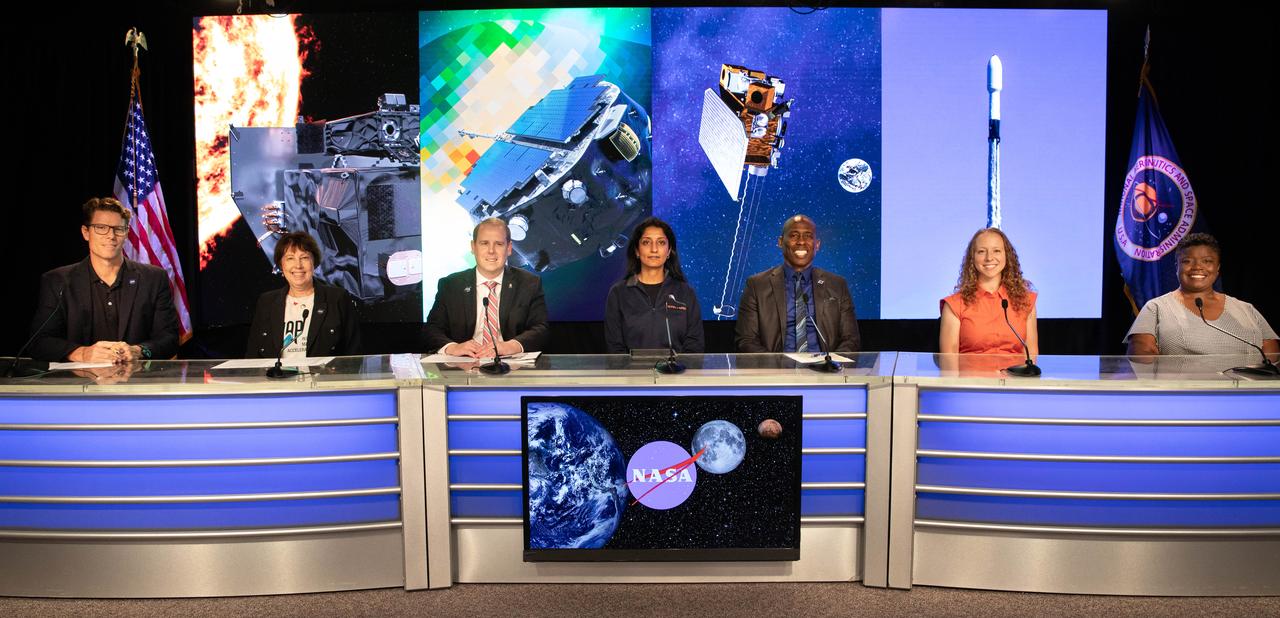
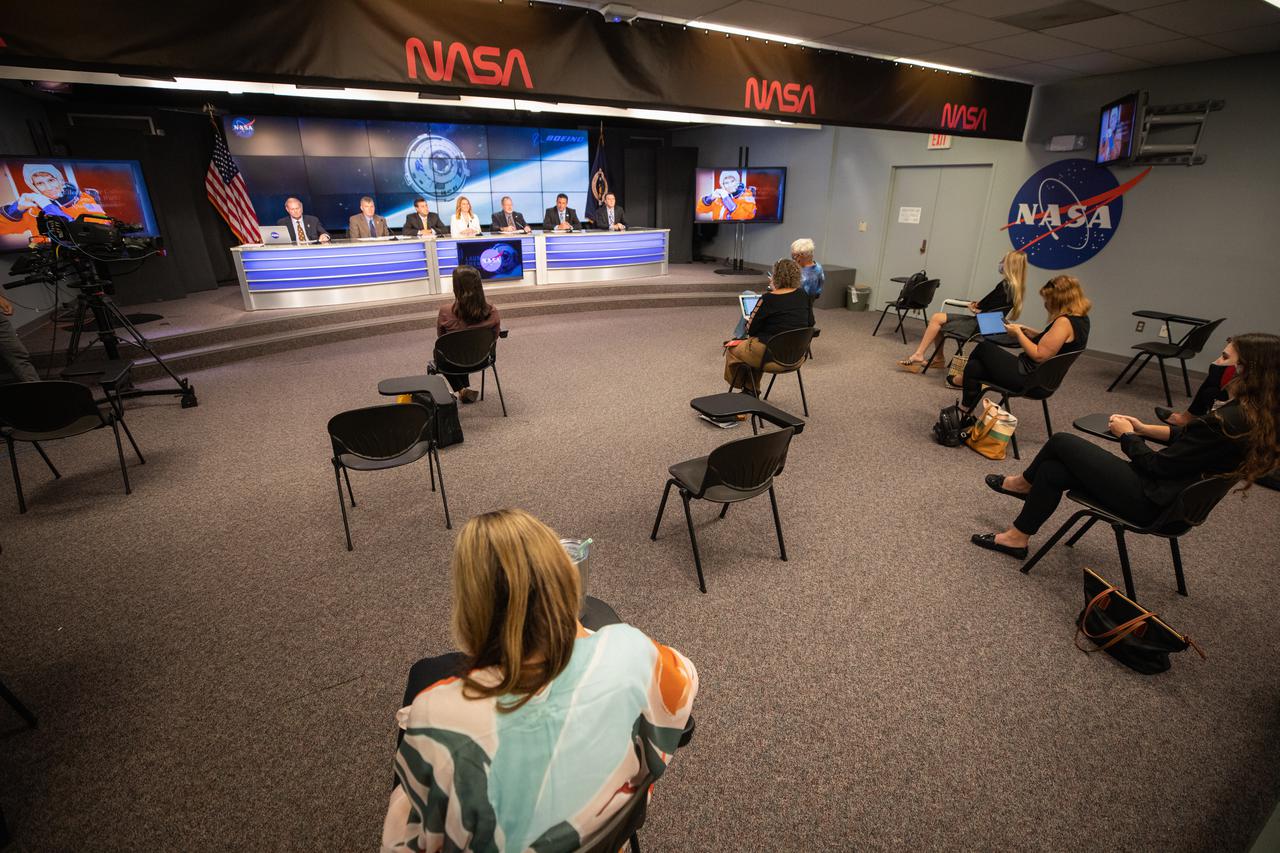
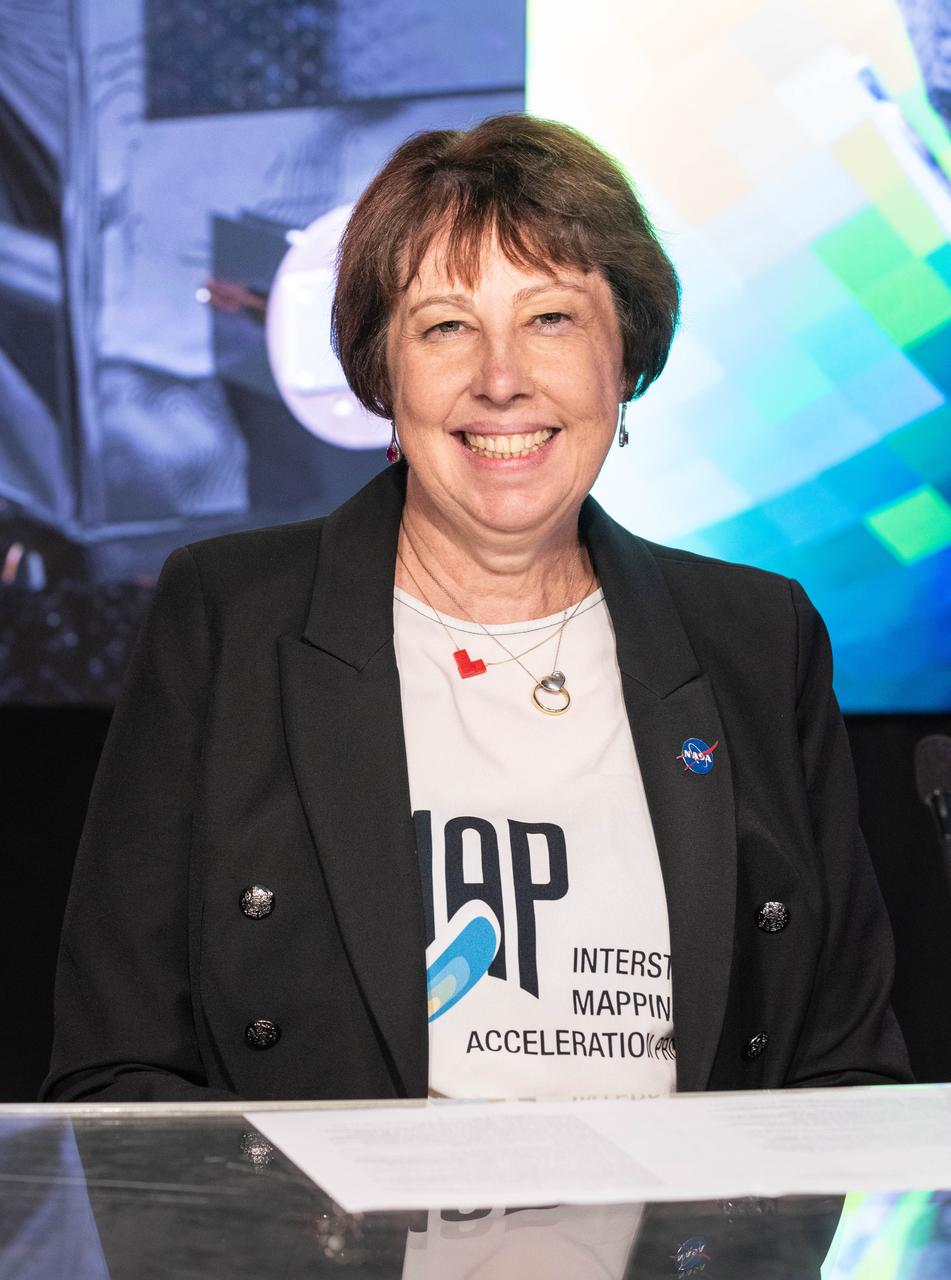
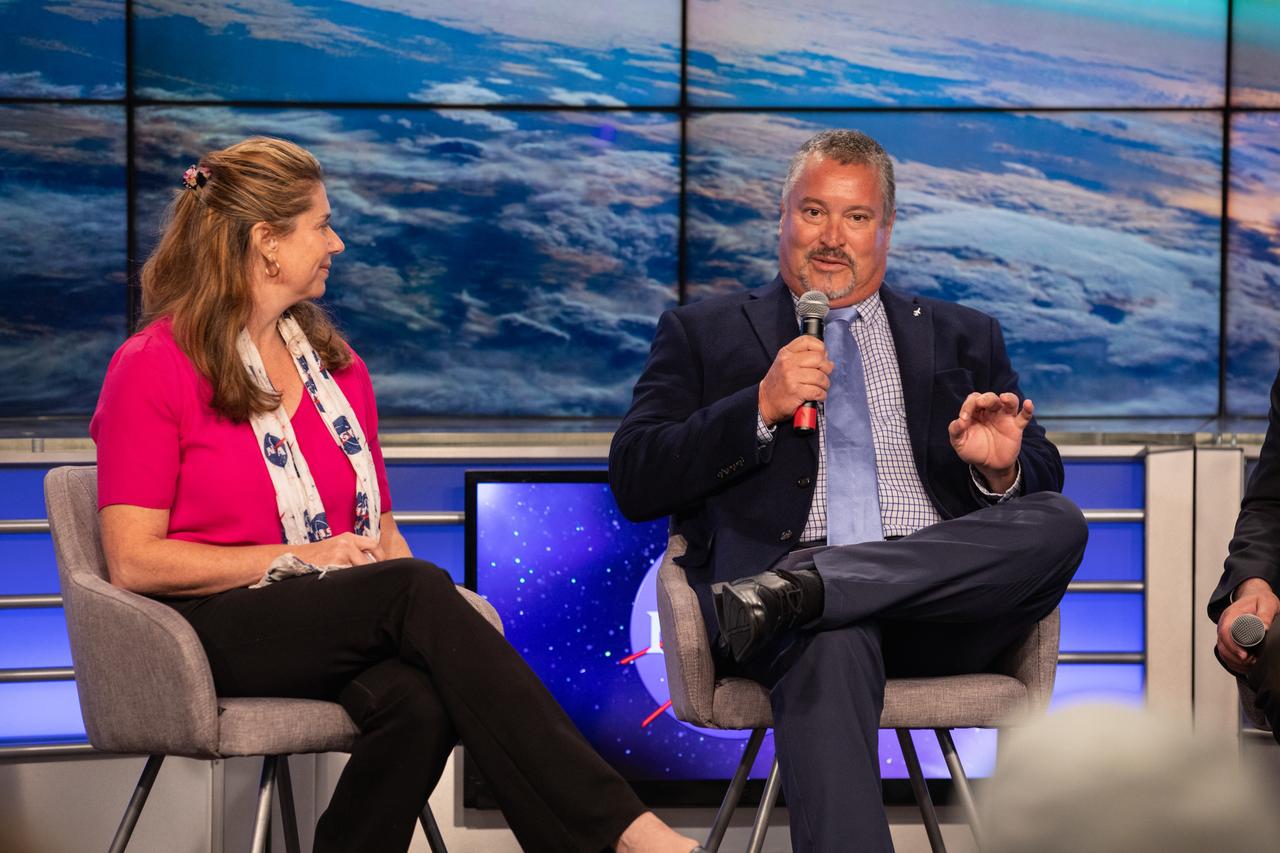
NASA, mission, and partner leaders participate in prelaunch news conference on Sunday, Sept. 21, 2025, at the agency’s Kennedy Space Center in Florida for NASA’s IMAP (Interstellar Mapping and Acceleration Probe) mission. From left are: Derrol Nail, NASA Communications; Nicky Fox, associate administrator, Science Mission Directorate, NASA Headquarters in Washington; Brad Williams, IMAP program executive, NASA Headquarters; Irene Parker, deputy assistant administrator for Systems for NOAA’s National Environmental Satellite, Data, and Information Service; Denton Gibson, launch director, NASA’s Launch Services Program, NASA Kennedy; Julianna Scheiman, director, NASA Science Missions, SpaceX; Arlena Moses, launch weather officer, 45th Weather Squadron, U.S. Space Force. The IMAP mission and its two rideshares – NASA’s exosphere-studying Carruthers Geocorona Observatory and National Oceanic and Atmospheric Administration’s (NOAA) Space Weather Follow On–Lagrange 1 (SWFO-L1) observatory – will orbit the Sun near Lagrange point 1, about one million miles from Earth, where it will scan the heliosphere, analyze the composition of charged particles, and investigate how those particles move through the solar system. Launch is targeted for 7:32 a.m. EDT, Tuesday, Sept. 23, from Launch Complex 39A at NASA Kennedy.
IMAP Pre-Launch Press Briefing
Arlena Moses, launch weather officer, 45th Weather Squadron, U.S. Space Force, participates in a prelaunch news conference on Sunday, Sept. 21, 2025, at the agency’s Kennedy Space Center in Florida for NASA's IMAP (Interstellar Mapping and Acceleration Probe) mission. NASA’s IMAP will use 10 science instruments to study and map the heliosphere, a vast magnetic bubble surrounding the Sun protecting our solar system from radiation incoming from interstellar space. This mission and its two rideshares – NASA’s exosphere-studying Carruthers Geocorona Observatory and National Oceanic and Atmospheric Administration’s (NOAA) Space Weather Follow On–Lagrange 1 (SWFO-L1) observatory – will orbit the Sun near Lagrange point 1, about one million miles from Earth. Launch is targeting 7:32 a.m. EDT, Tuesday, Sept. 23, from Launch Complex 39A at NASA Kennedy.
IMAP Pre-Launch Press Briefing
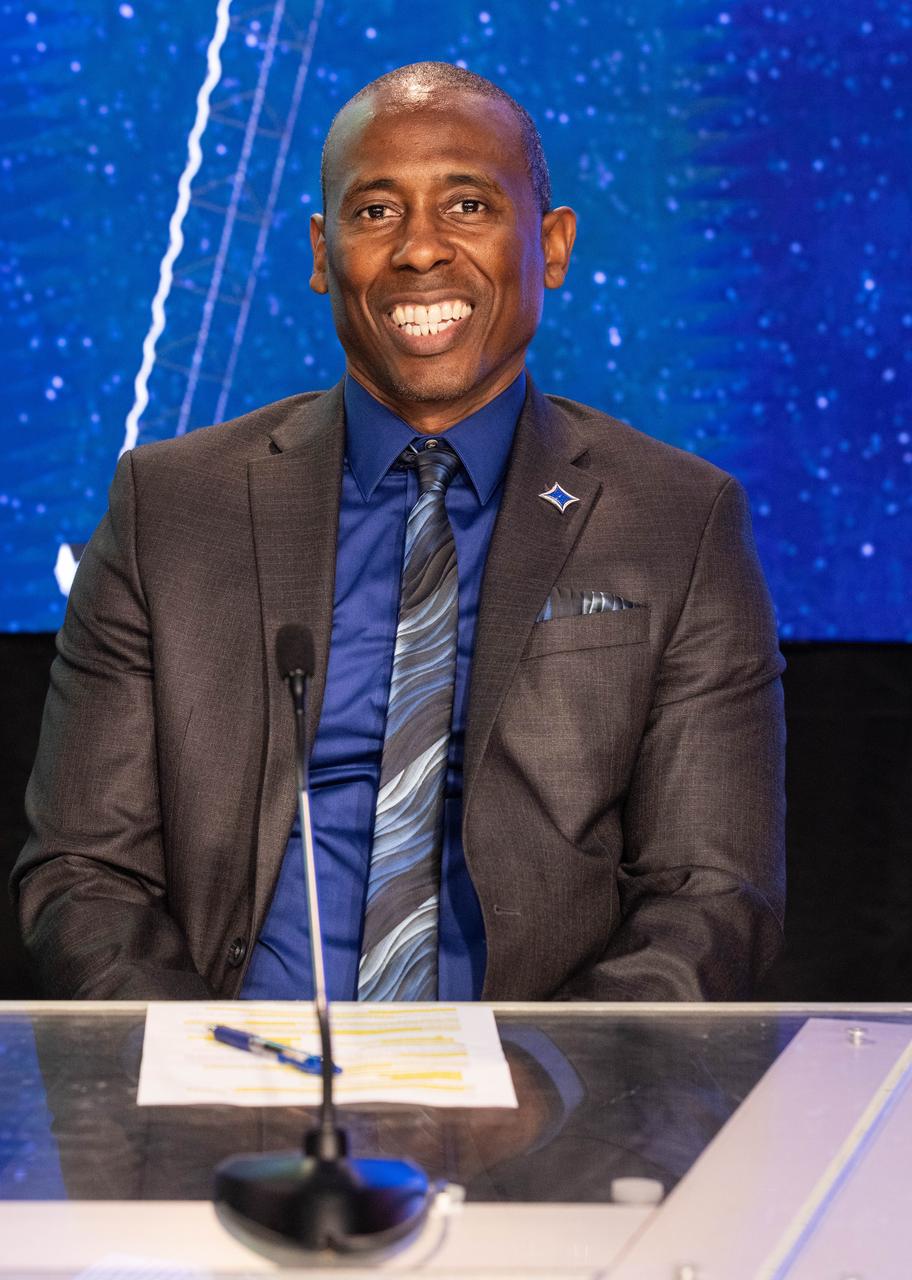
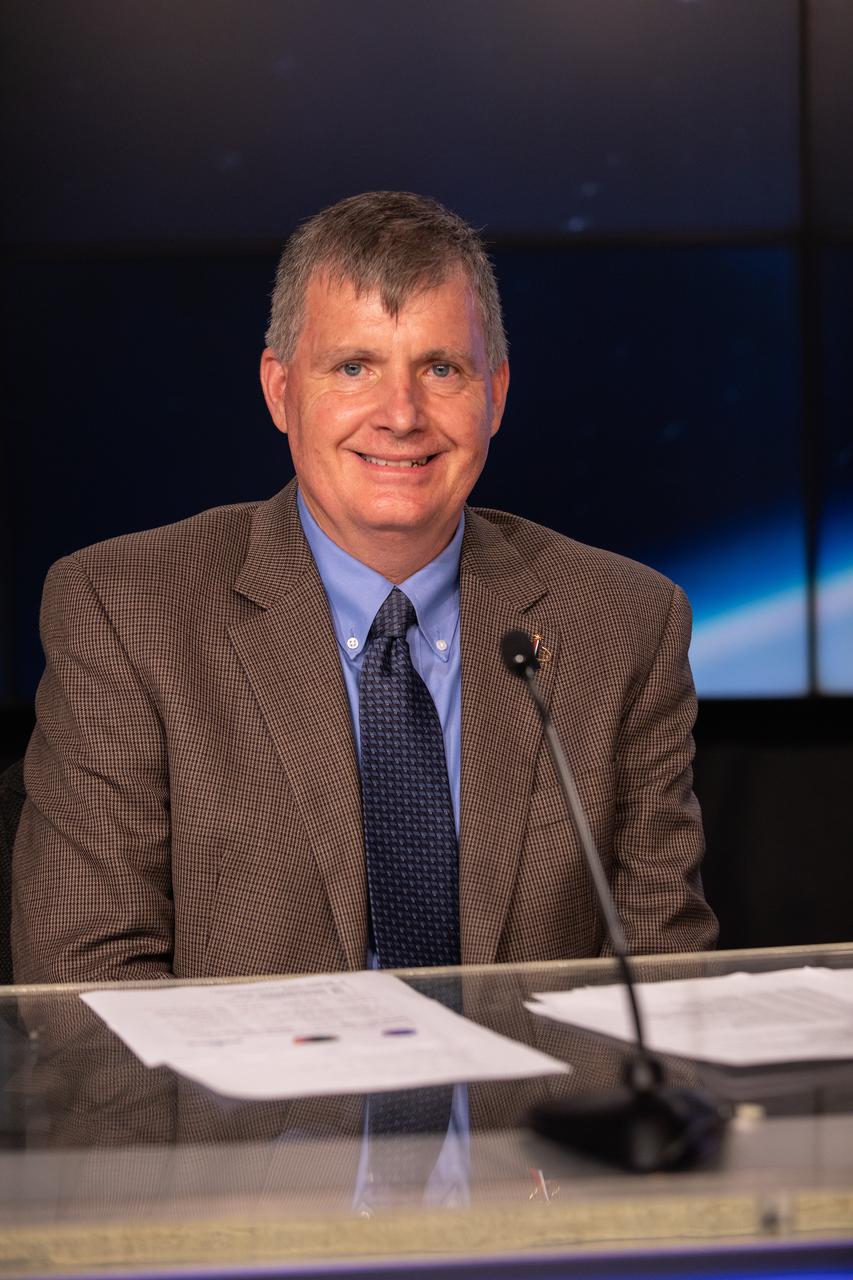
Dr. Denton Gibson, launch director, NASA’s Launch Services Program, participates in a prelaunch news conference on Sunday, Sept. 21, 2025, at the agency’s Kennedy Space Center in Florida for NASA's IMAP (Interstellar Mapping and Acceleration Probe) mission. NASA’s IMAP will use 10 science instruments to study and map the heliosphere, a vast magnetic bubble surrounding the Sun protecting our solar system from radiation incoming from interstellar space. This mission and its two rideshares – NASA’s exosphere-studying Carruthers Geocorona Observatory and National Oceanic and Atmospheric Administration’s (NOAA) Space Weather Follow On–Lagrange 1 (SWFO-L1) observatory – will orbit the Sun near Lagrange point 1, about one million miles from Earth. Launch is targeting 7:32 a.m. EDT, Tuesday, Sept. 23, from Launch Complex 39A at NASA Kennedy.
IMAP Pre-Launch Press Briefing
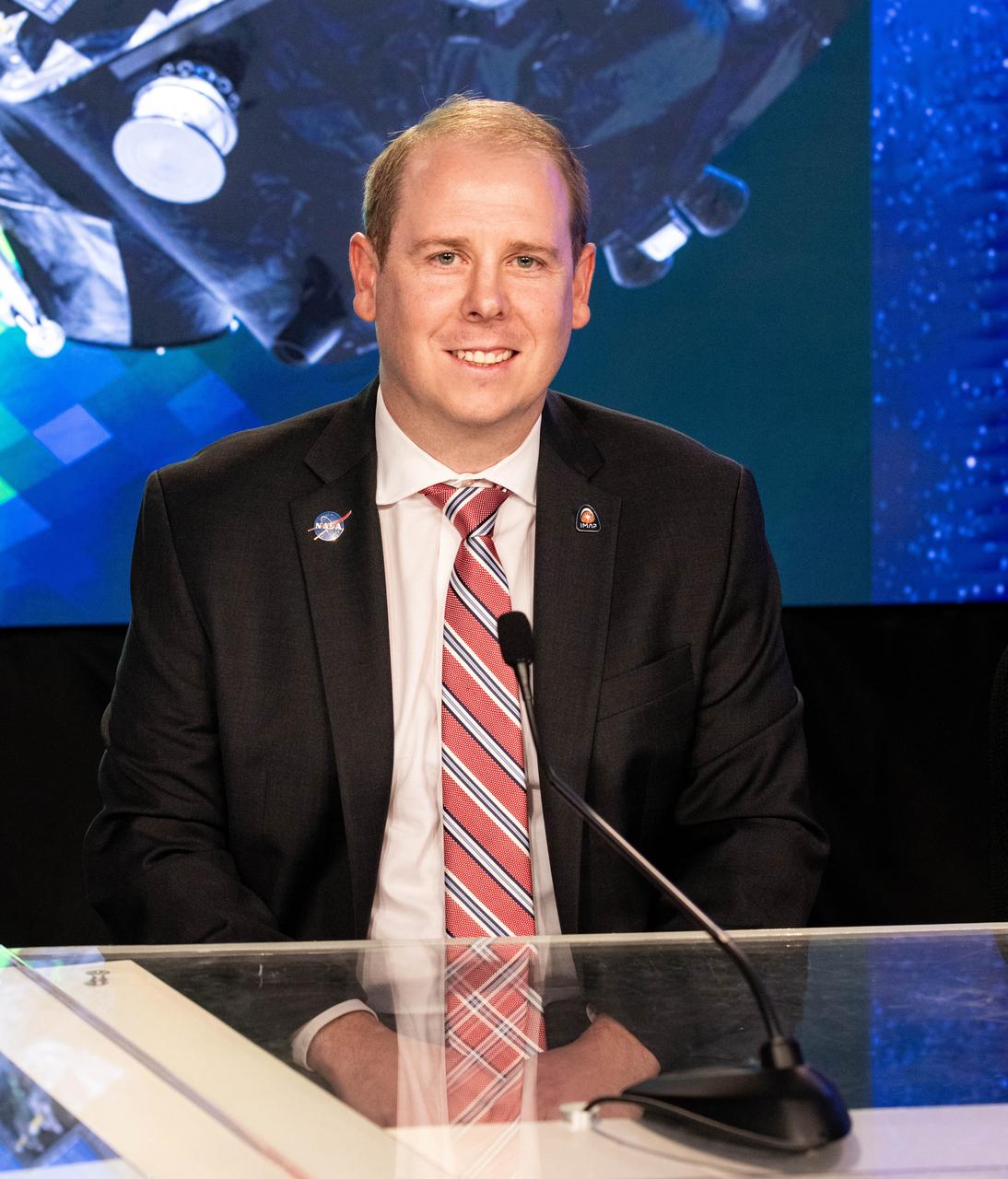
Brad Williams, IMAP (Interstellar Mapping and Acceleration Probe) program executive, NASA Headquarters, participates in a prelaunch news conference on Sunday, Sept. 21, 2025, at the agency’s Kennedy Space Center in Florida for IMAP mission. NASA’s IMAP will use 10 science instruments to study and map the heliosphere, a vast magnetic bubble surrounding the Sun protecting our solar system from radiation incoming from interstellar space. This mission and its two rideshares – NASA’s exosphere-studying Carruthers Geocorona Observatory and National Oceanic and Atmospheric Administration’s (NOAA) Space Weather Follow On–Lagrange 1 (SWFO-L1) observatory – will orbit the Sun near Lagrange point 1, about one million miles from Earth. Launch is targeting 7:32 a.m. EDT, Tuesday, Sept. 23, from Launch Complex 39A at NASA Kennedy.
IMAP Pre-Launch Press Briefing
Julianna Scheiman, director, NASA Science Missions, SpaceX, participates in a prelaunch news conference on Sunday, Sept. 21, 2025, at the agency’s Kennedy Space Center in Florida for NASA's IMAP (Interstellar Mapping and Acceleration Probe) mission. NASA’s IMAP will use 10 science instruments to study and map the heliosphere, a vast magnetic bubble surrounding the Sun protecting our solar system from radiation incoming from interstellar space. This mission and its two rideshares – NASA’s exosphere-studying Carruthers Geocorona Observatory and National Oceanic and Atmospheric Administration’s (NOAA) Space Weather Follow On–Lagrange 1 (SWFO-L1) observatory – will orbit the Sun near Lagrange point 1, about one million miles from Earth. Launch is targeting 7:32 a.m. EDT, Tuesday, Sept. 23, from Launch Complex 39A at NASA Kennedy.
IMAP Pre-Launch Press Briefing
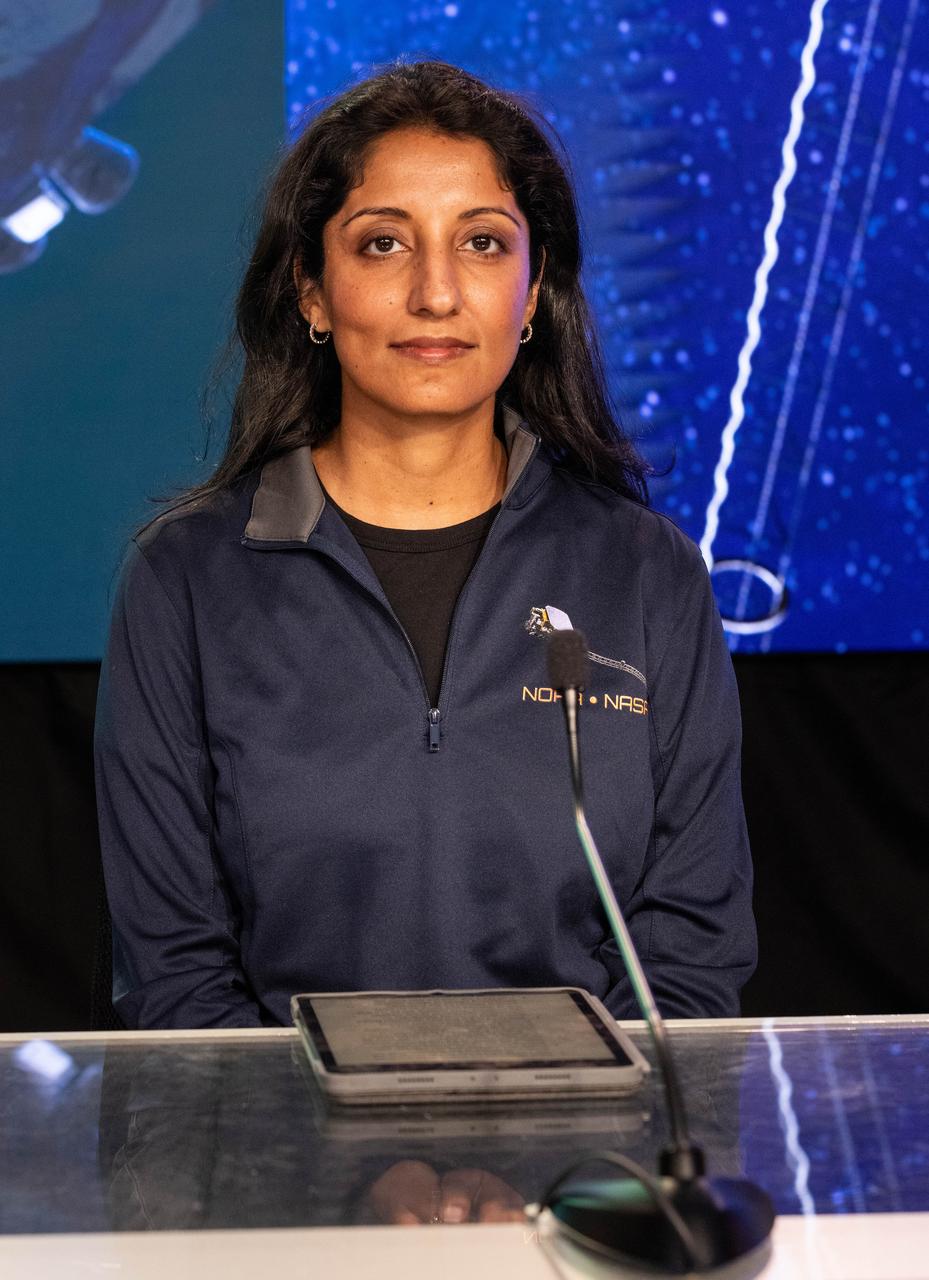
Irene Parker, deputy assistant administrator for Systems for NOAA’s National Environmental Satellite, Data, and Information Service, participates in a prelaunch news conference on Sunday, Sept. 21, 2025, at the agency’s Kennedy Space Center in Florida for NASA's IMAP (Interstellar Mapping and Acceleration Probe) mission. NASA’s IMAP will use 10 science instruments to study and map the heliosphere, a vast magnetic bubble surrounding the Sun protecting our solar system from radiation incoming from interstellar space. This mission and its two rideshares – NASA’s exosphere-studying Carruthers Geocorona Observatory and National Oceanic and Atmospheric Administration’s (NOAA) Space Weather Follow On–Lagrange 1 (SWFO-L1) observatory – will orbit the Sun near Lagrange point 1, about one million miles from Earth. Launch is targeting 7:32 a.m. EDT, Tuesday, Sept. 23, from Launch Complex 39A at NASA Kennedy.

IMAP Pre-Launch Press Briefing
Nicky Fox, associate administrator, Science Mission Directorate, NASA Headquarters, participates in a prelaunch news conference on Sunday, Sept. 21, 2025, at the agency’s Kennedy Space Center in Florida for NASA’s IMAP (Interstellar Mapping and Acceleration Probe) mission. NASA’s IMAP will use 10 science instruments to study and map the heliosphere, a vast magnetic bubble surrounding the Sun protecting our solar system from radiation incoming from interstellar space. This mission and its two rideshares – NASA’s exosphere-studying Carruthers Geocorona Observatory and National Oceanic and Atmospheric Administration’s (NOAA) Space Weather Follow On–Lagrange 1 (SWFO-L1) observatory – will orbit the Sun near Lagrange point 1, about one million miles from Earth. Launch is targeting 7:32 a.m. EDT, Tuesday, Sept. 23, from Launch Complex 39A at NASA Kennedy.
IMAP Pre-Launch Press Briefing
Derrol Nail, NASA Communications, participates in a prelaunch news conference on Sunday, Sept. 21, 2025, at the agency’s Kennedy Space Center in Florida for NASA’s IMAP (Interstellar Mapping and Acceleration Probe) mission. NASA’s IMAP will use 10 science instruments to study and map the heliosphere, a vast magnetic bubble surrounding the Sun protecting our solar system from radiation incoming from interstellar space. This mission and its two rideshares – NASA’s exosphere-studying Carruthers Geocorona Observatory and National Oceanic and Atmospheric Administration’s (NOAA) Space Weather Follow On–Lagrange 1 (SWFO-L1) observatory – will orbit the Sun near Lagrange point 1, about one million miles from Earth. Launch is targeting 7:32 a.m. EDT, Tuesday, Sept. 23, from Launch Complex 39A at NASA Kennedy.
IMAP Pre-Launch Press Briefing
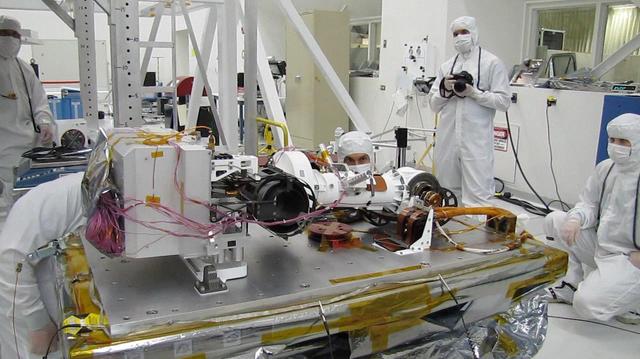
This frame from a video shows the mast of NASA Curiosity rover deploying in a pre-launch test.
Curiosity Pre-Launch Mast Test - August 07, 2012
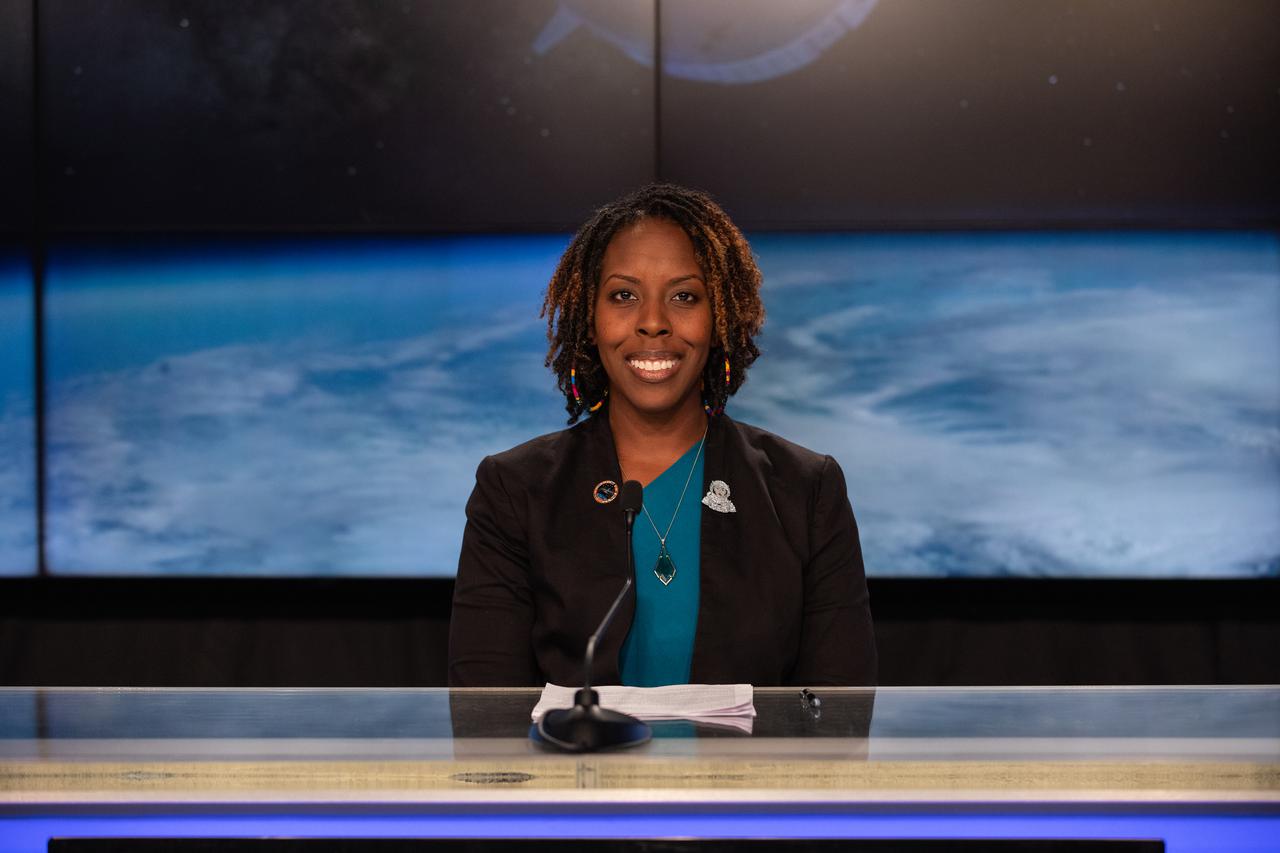
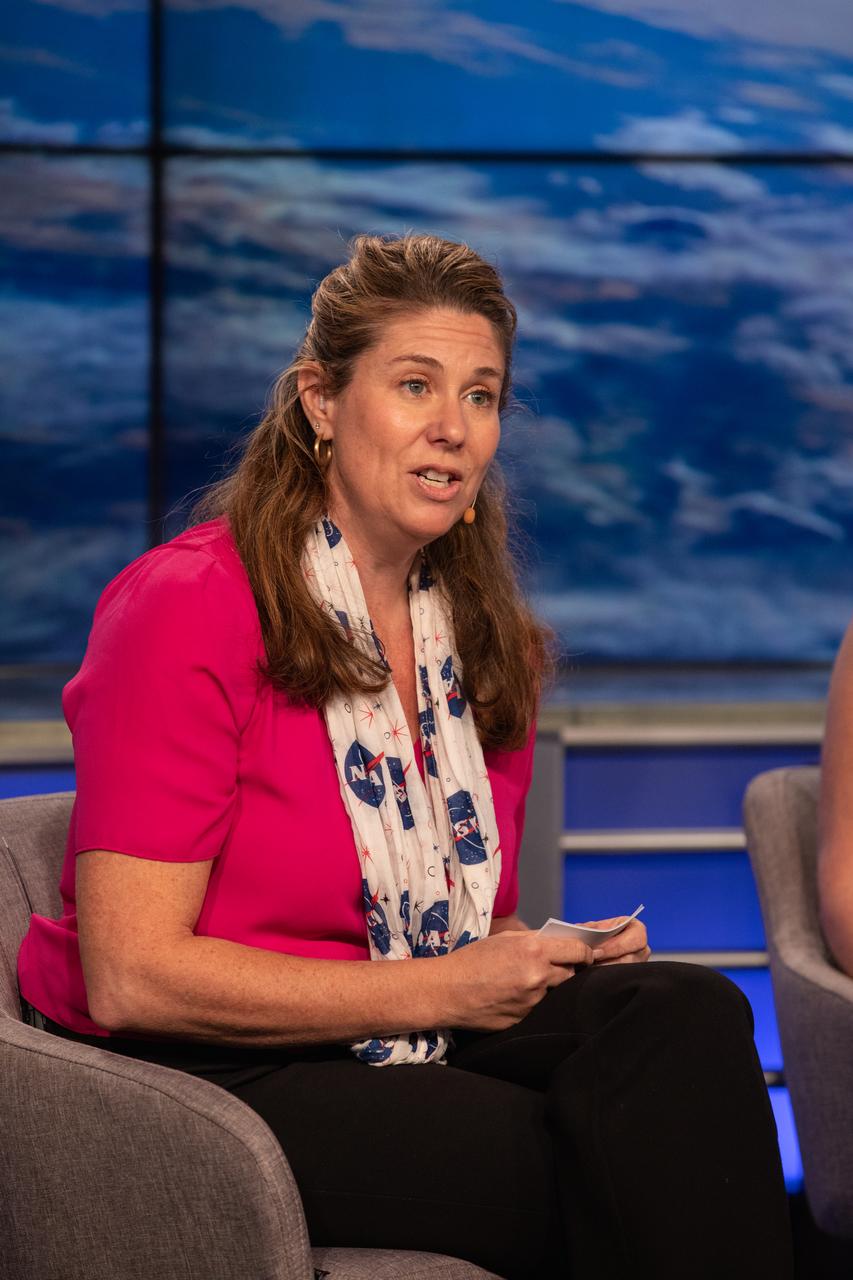
Jennifer Scott Williams, manager for the Applications Client Support Office for the International Space Station Program, participates in a prelaunch news conference for SpaceX’s 23rd commercial resupply services mission at NASA’s Kennedy Space Center in Florida on Aug. 27, 2021. The mission will deliver new science investigations, supplies, and equipment to the crew aboard the orbiting laboratory. Liftoff of the Falcon 9 rocket and Dragon spacecraft is scheduled for 3:37 a.m. EDT on Saturday, Aug. 28, from Kennedy’s Launch Complex 39A.
SpaceX CRS-23 Pre-Launch Briefing
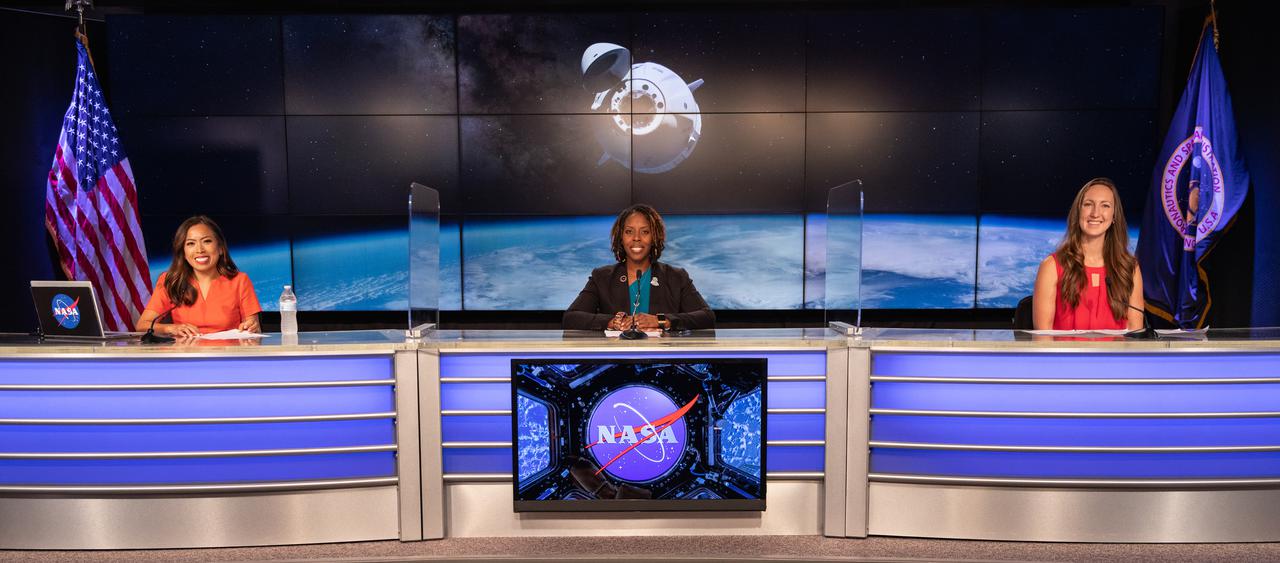
From left, NASA Communications’ Megan Cruz;  Jennifer Scott Williams, manager for the Applications Client Support Office for the International Space Station Program; and Sarah Walker, director of Dragon mission management for SpaceX participate in a prelaunch news conference for SpaceX’s 23rd commercial resupply services mission at NASA’s Kennedy Space Center in Florida on Aug. 27, 2021. SpaceX’s Falcon 9 rocket, with the Dragon spacecraft atop, is targeted to lift off from Kennedy’s Launch Complex 39A at 3:37 a.m. on Saturday, Aug. 28. The mission will deliver new science investigations, supplies, and equipment to the crew aboard the International Space Station.
SpaceX CRS-23 Pre-Launch Briefing
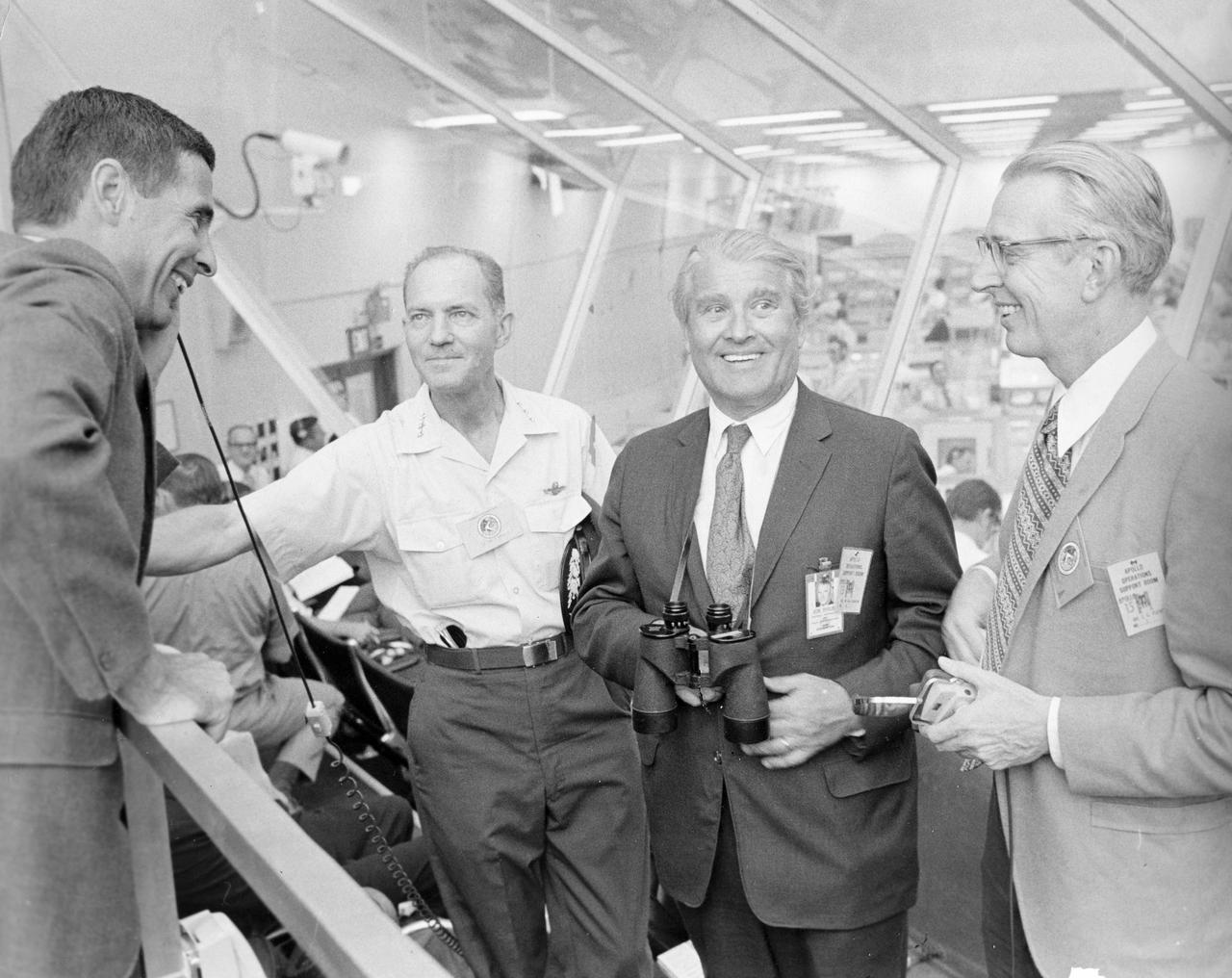
During the Apollo 15 pre-launch activity in the launch control center's firing room 1 at Kennedy Space Center, the then recently appointed NASA Administrator, Dr. James C. Fletcher (right) speaks with (Left to right) William Anders, executive secretary of the National Aeronautics and Space Council; Lt. General Sam Phillips, former Apollo Program Director; and Dr. Wernher von Braun, NASA's Deputy Associate Administrator for planning.
n/a
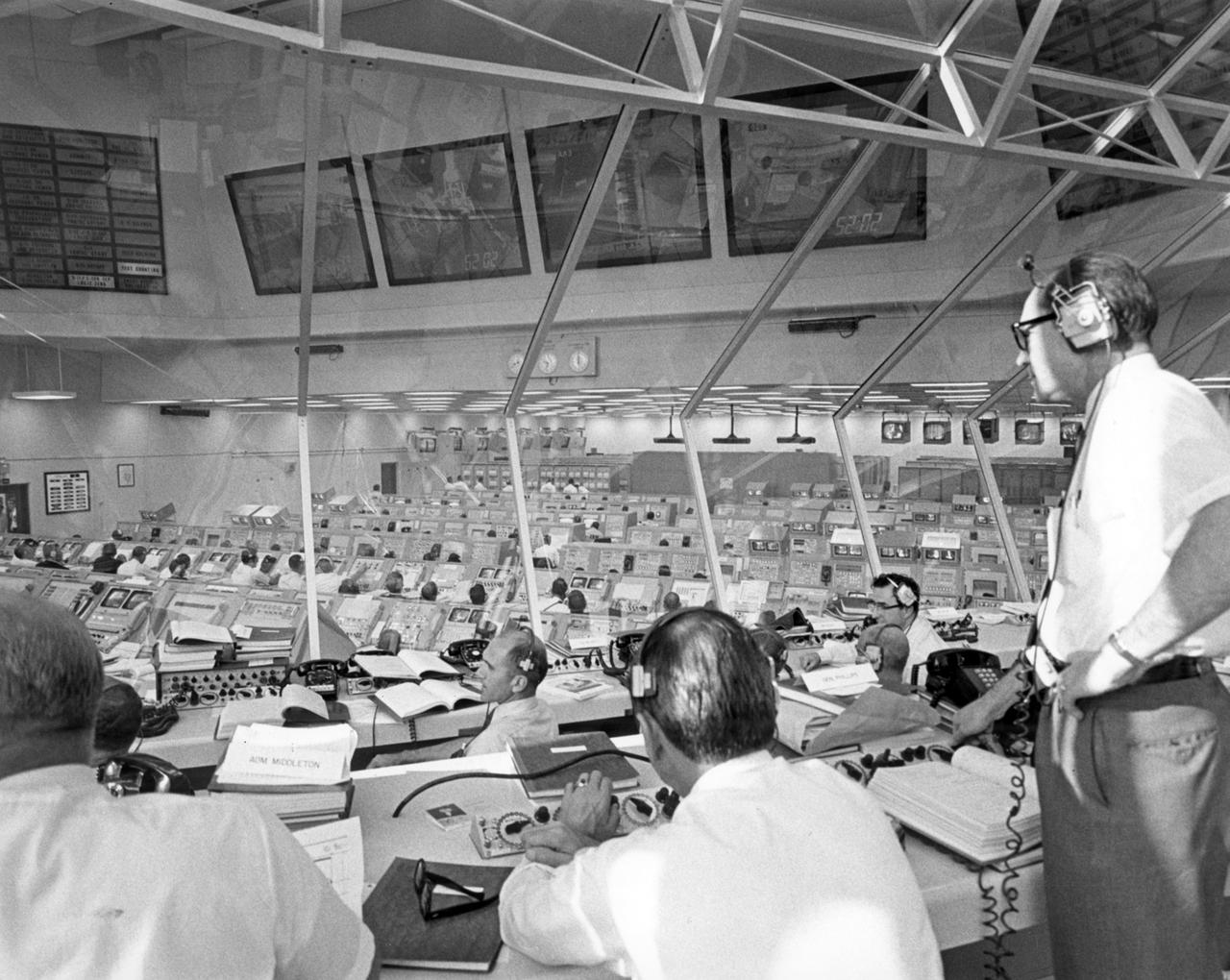
From the Kennedy Space Flight Center (KSC) control room, Apollo Program Director Lieutenant General Samuel C. Phillips monitors pre-launch activities for Apollo 11. The Apollo 11 mission, the first lunar landing mission, launched from the KSC in Florida via the Marshall Space Flight Center (MSFC) developed Saturn V launch vehicle on July 16, 1969 and safely returned to Earth on July 24, 1969. Aboard the space craft were astronauts Neil A. Armstrong, commander; Michael Collins, Command Module (CM) pilot; and Edwin E. (Buzz) Aldrin Jr., Lunar Module (LM) pilot. The CM, “Columbia”, piloted by Collins, remained in a parking orbit around the Moon while the LM, “Eagle’’, carrying astronauts Armstrong and Aldrin, landed on the Moon. On July 20, 1969, Armstrong was the first human to ever stand on the lunar surface, followed by Aldrin. During 2½ hours of surface exploration, the crew collected 47 pounds of lunar surface material for analysis back on Earth. With the success of Apollo 11, the national objective to land men on the Moon and return them safely to Earth had been accomplished.
Saturn Apollo Program
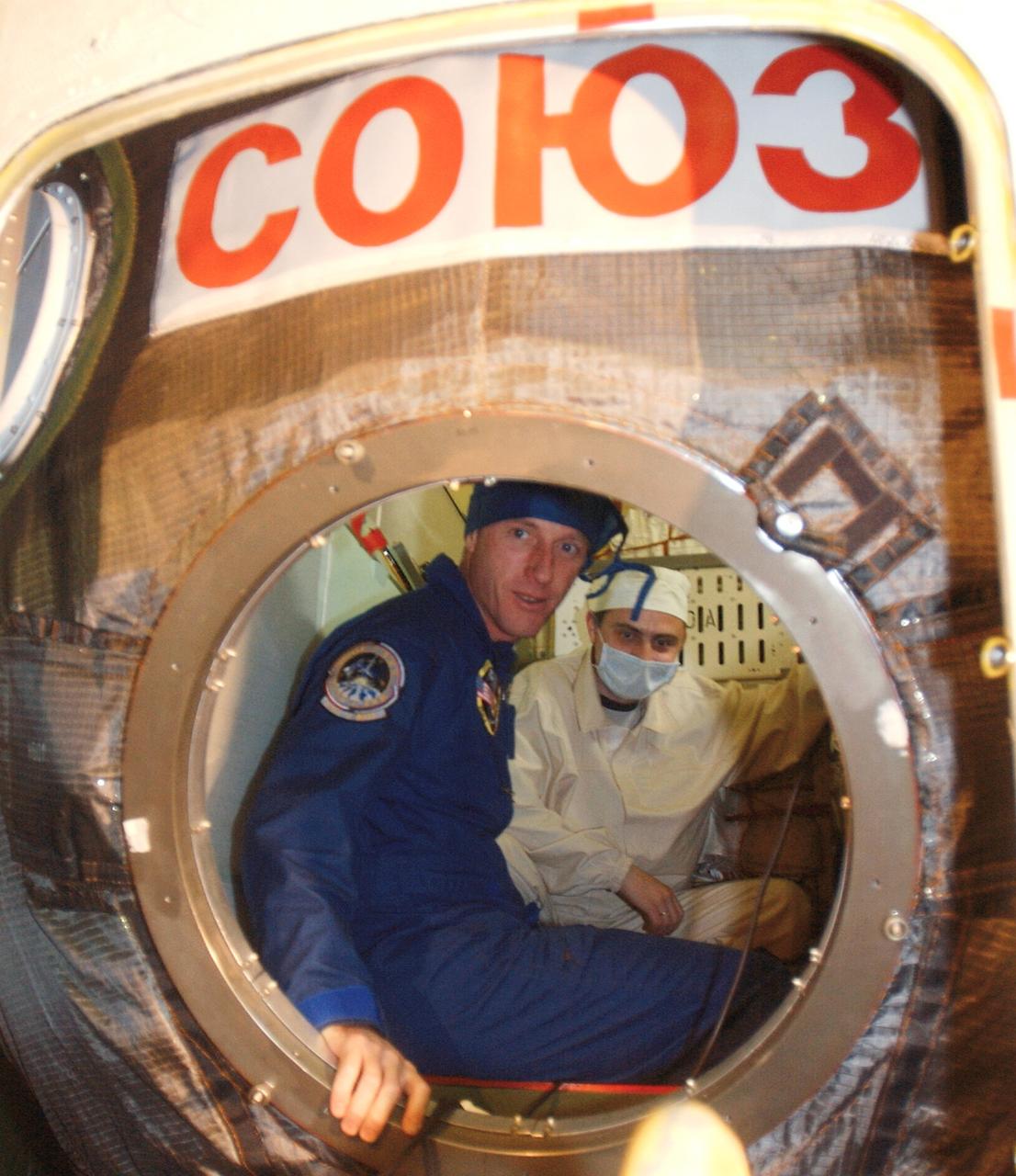
JSC2003-E-59057 (13 October 2003) --- Astronaut C. Michael Foale (left), Expedition 8 mission commander and NASA ISS science officer, is briefed by a technician inside the Soyuz TMA-3 vehicle in a processing facility at the Baikonur Cosmodrome in Kazakhstan during a pre-launch inspection of the spacecraft. Expedition 8 is scheduled to launch from the Baikonur Cosmodrome on October 18 onboard a Soyuz rocket to the International Space Station (ISS). Photo Credit: NASA/Bill Ingalls
Expedition 8 crewmembers attend pre-launch inspection briefing at Baikonur
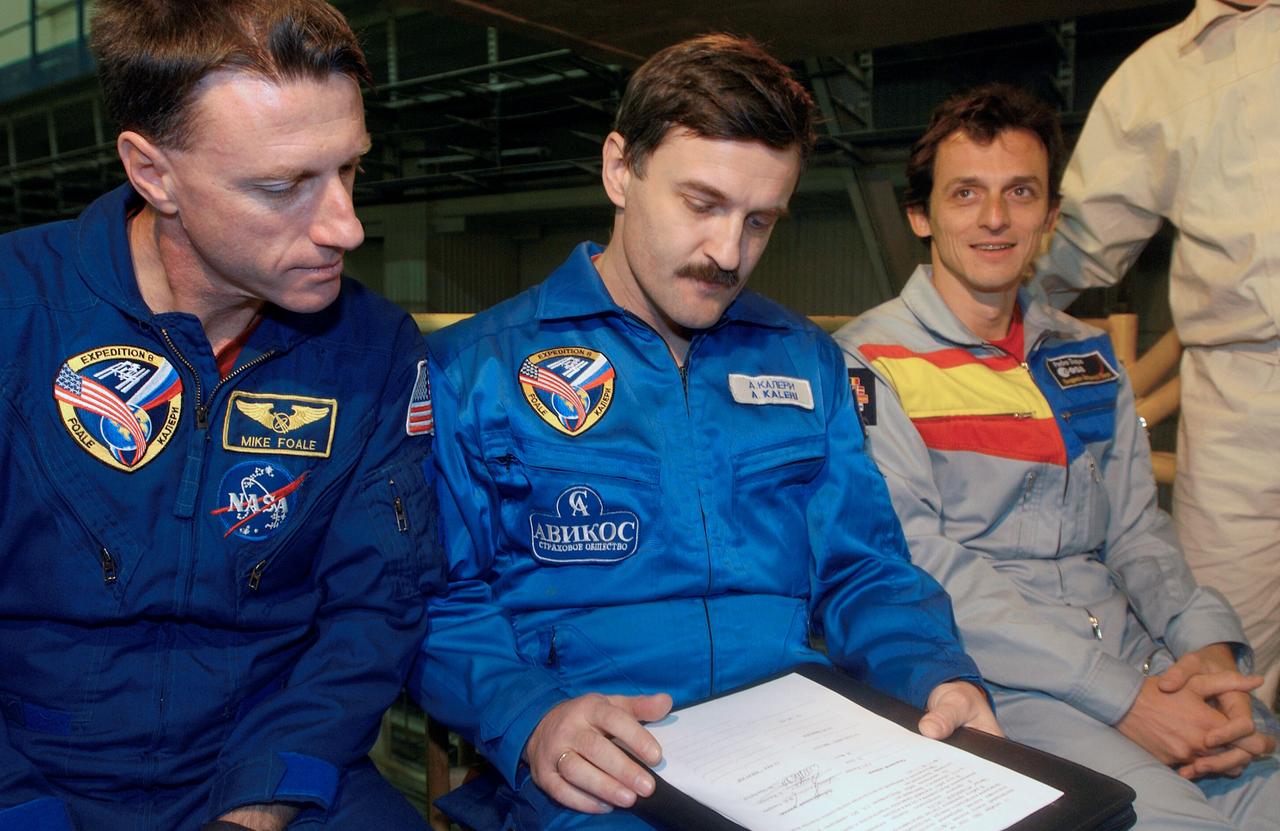
JSC2003-E-59058 (13 October 2003) --- Astronaut C. Michael Foale (left), Expedition 8 mission commander and NASA ISS science officer; cosmonaut Alexander Y. Kaleri, Soyuz commander and flight engineer; and European Space Agency (ESA) astronaut Pedro Duque of Spain receive a briefing in a processing facility at the Baikonur Cosmodrome in Kazakhstan during a pre-launch inspection of their Soyuz TMA-3 spacecraft. The trio is scheduled to launch from the Baikonur Cosmodrome on October 18 onboard a Soyuz rocket to the International Space Station (ISS). Kaleri represents Rosaviakosmos. Photo Credit: NASA/Bill Ingalls
Expedition 8 crewmembers attend pre-launch inspection briefing at Baikonur
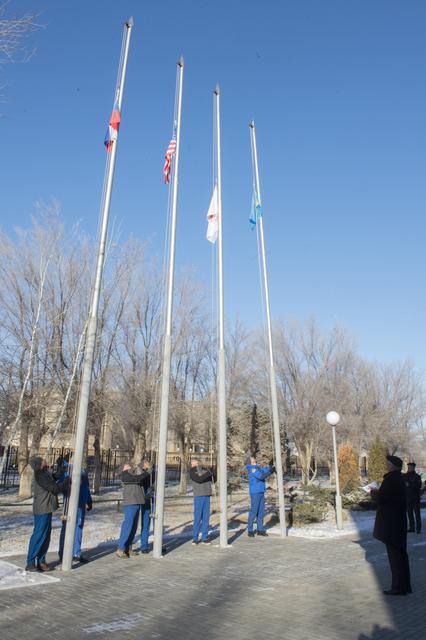
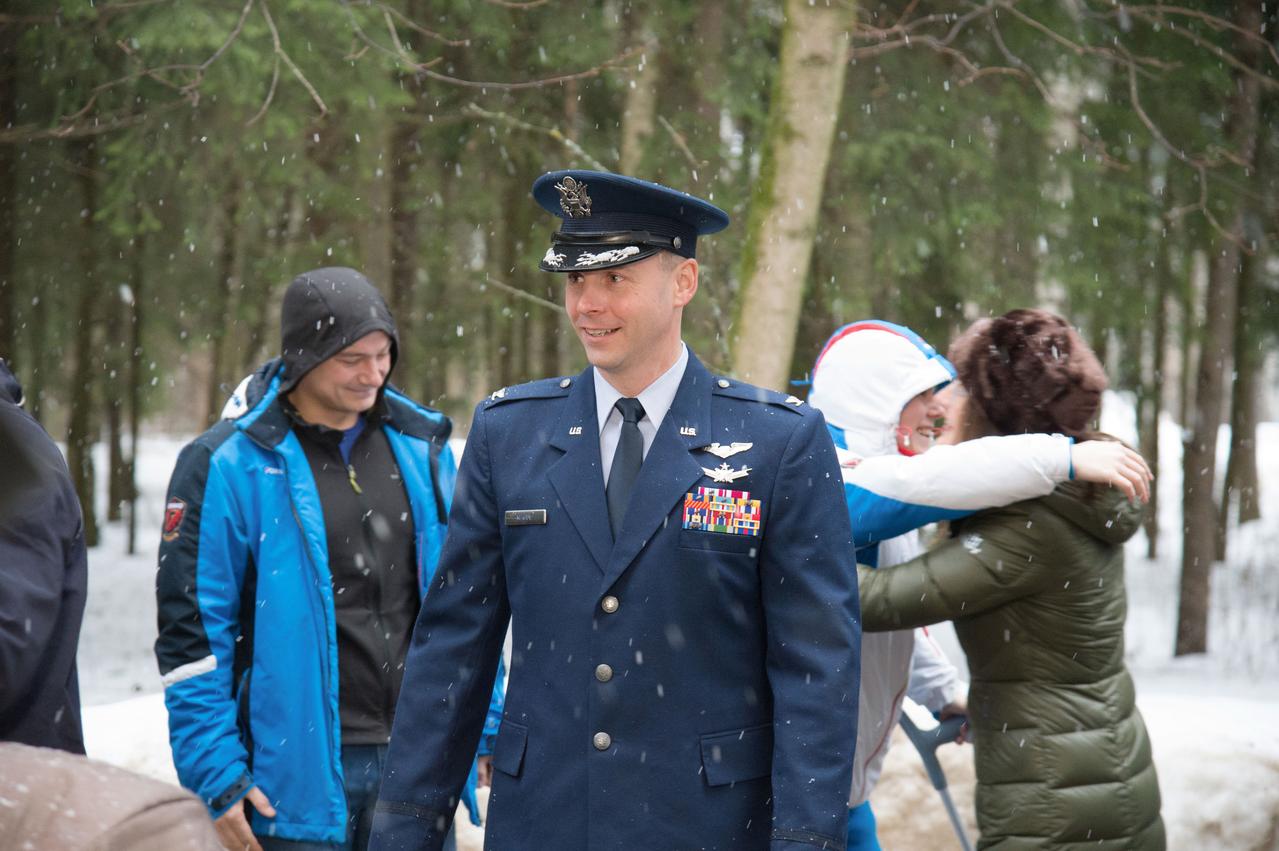
jsc2017e136940 - At the Cosmonaut Hotel crew quarters in Baikonur, Kazakhstan, the Expedition 54-55 prime and backup crewmembers raise the flags of Russia, the United States, Japan and Kazakhstan Dec. 6 in traditional pre-launch ceremonies. Anton Shkaplero
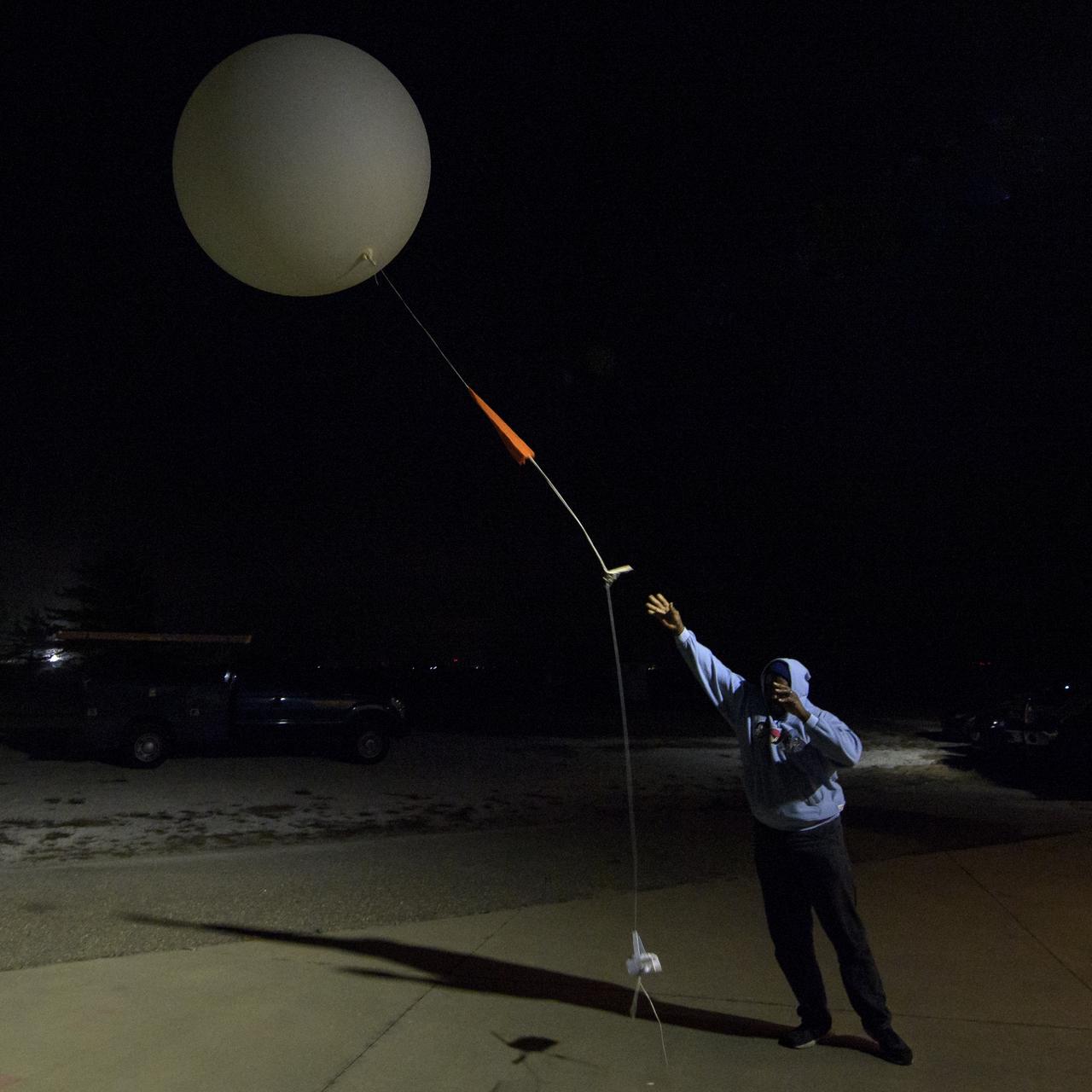
Isiah Toran releases a weather balloon to help measure atmospheric conditions ahead of the launch of the NASA Ice, Cloud and land Elevation Satellite-2 (ICESat-2), Saturday, Sept. 15, 2018, Vandenberg Air Force Base in California. The ICESat-2 mission will measure the changing height of Earth's ice. Photo Credit: (NASA/Bill Ingalls)
ICESat-2 Pre Launch
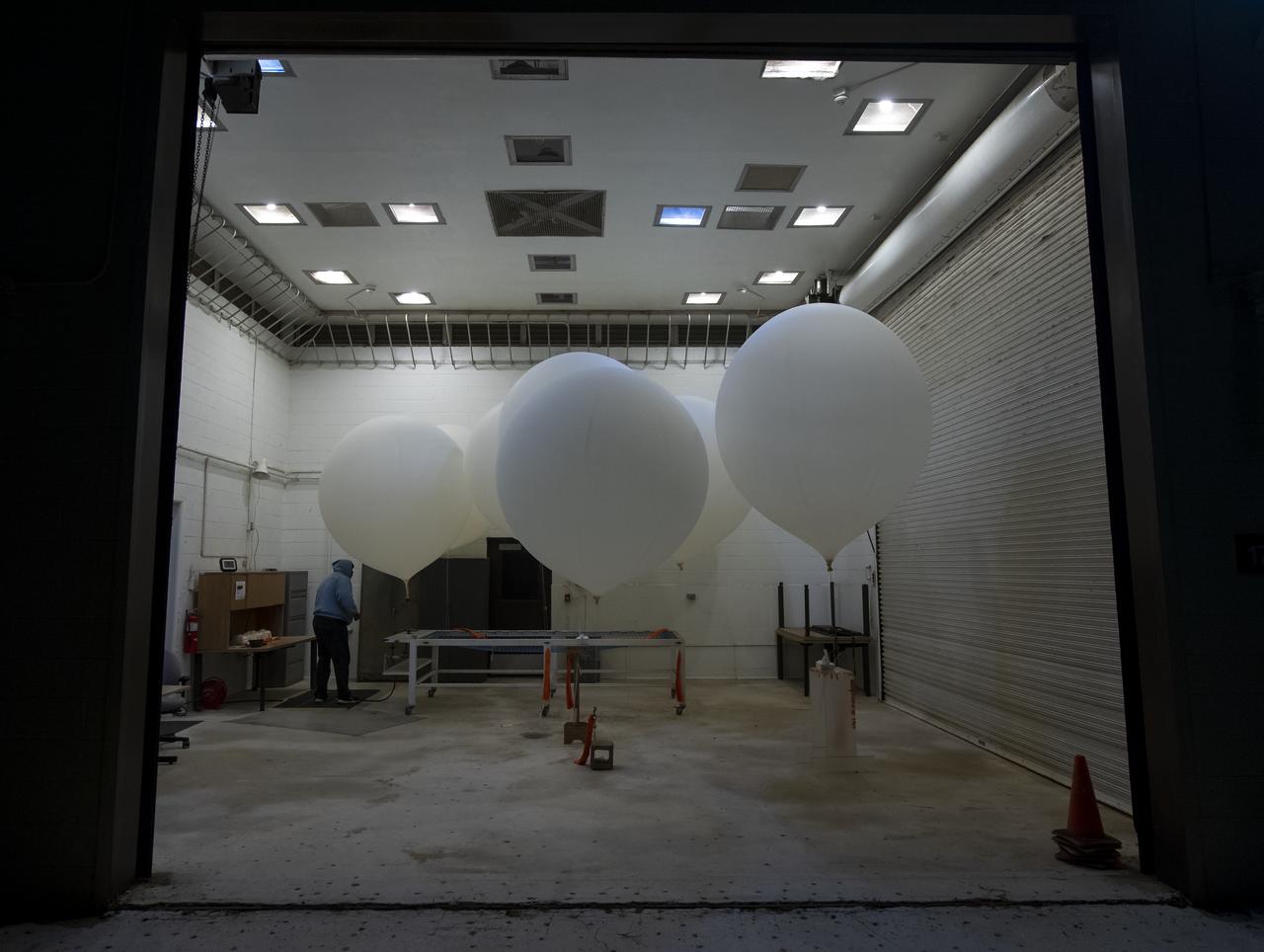
Weather balloons are prepared for release to help measure atmospheric conditions ahead of the launch of the NASA Ice, Cloud and land Elevation Satellite-2 (ICESat-2), Saturday, Sept. 15, 2018, Vandenberg Air Force Base in California. The ICESat-2 mission will measure the changing height of Earth's ice. Photo Credit: (NASA/Bill Ingalls)
ICESat-2 Pre Launch
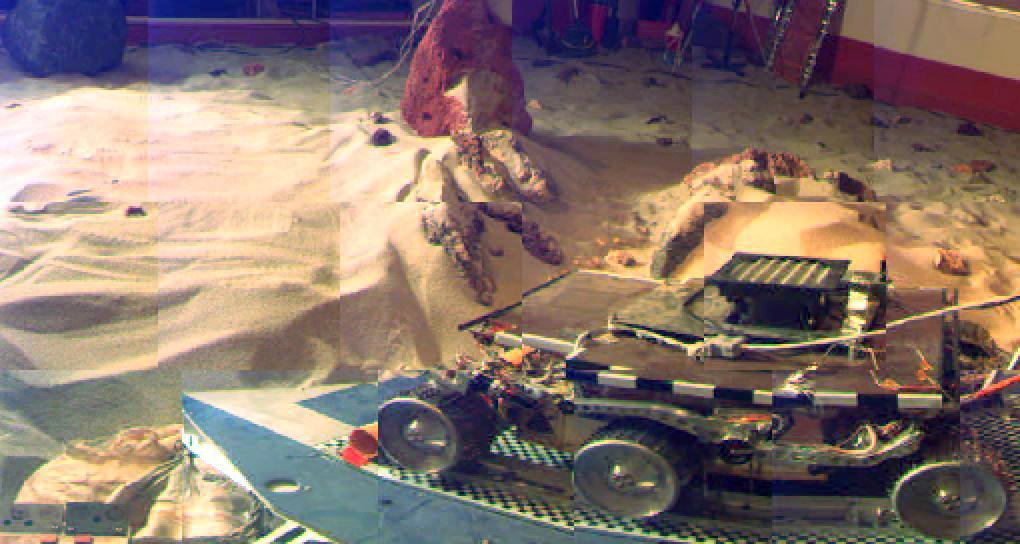
Marie Curie sits on the lander petal prior to deployment during the pre-launch Operations Readiness Test ORT 6. NASA Pathfinder, a low-cost Discovery mission, is the first of a new fleet of spacecraft that are planned to explore Mars.
Marie
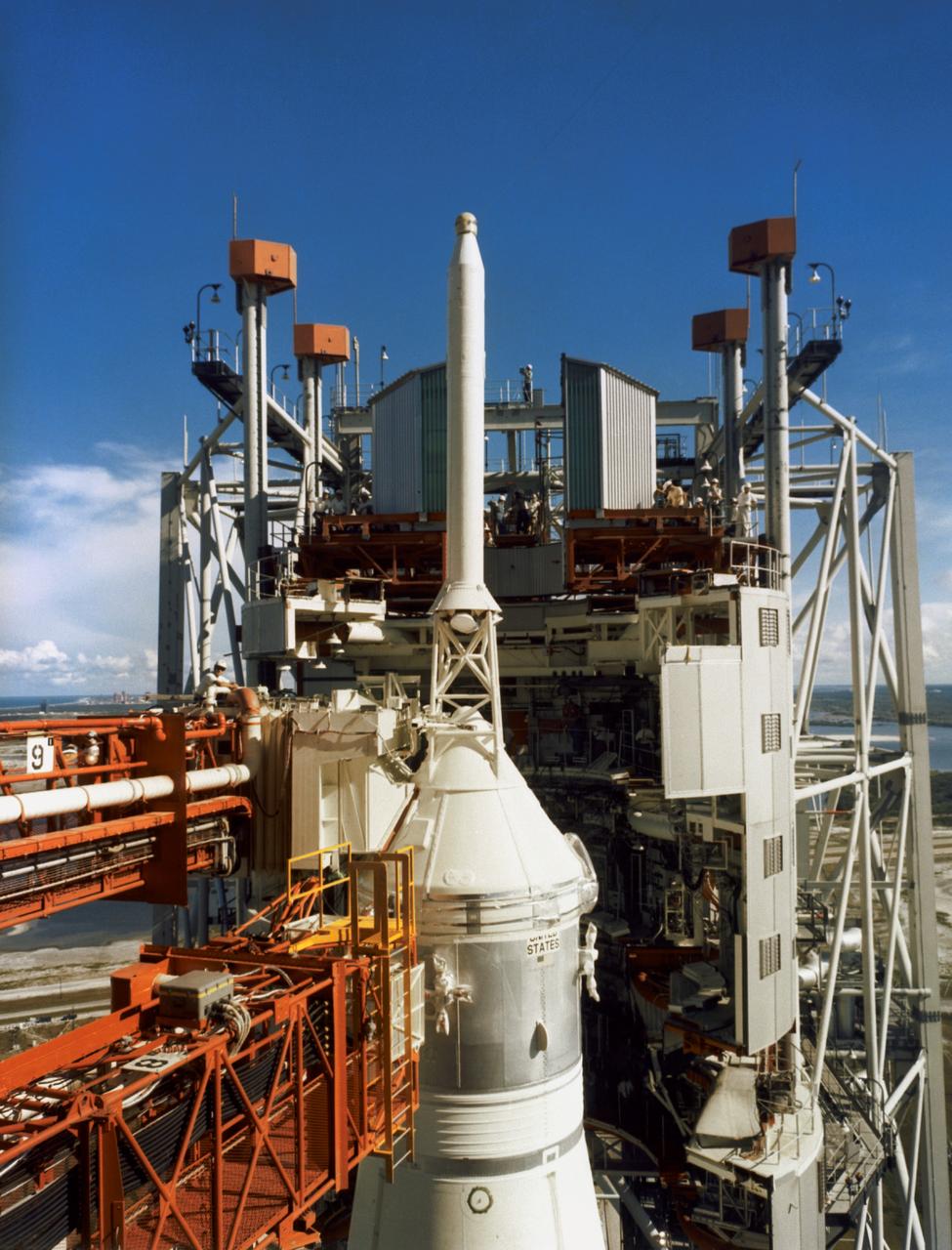
Personnel atop the 402-ft. Mobile Service Structure look back at the Apollo 11 spacecraft as the tower is moved away during a Countdown Demonstration Test. Photo filed 11 July 1969.
Apollo 11 spacecraft pre-launch
This image shows the calibration target for the Chemistry and Camera instrument on NASA Curiosity rover before it was installed on the rover and readied for launch.
Pre-Launch Calibration Target for ChemCam
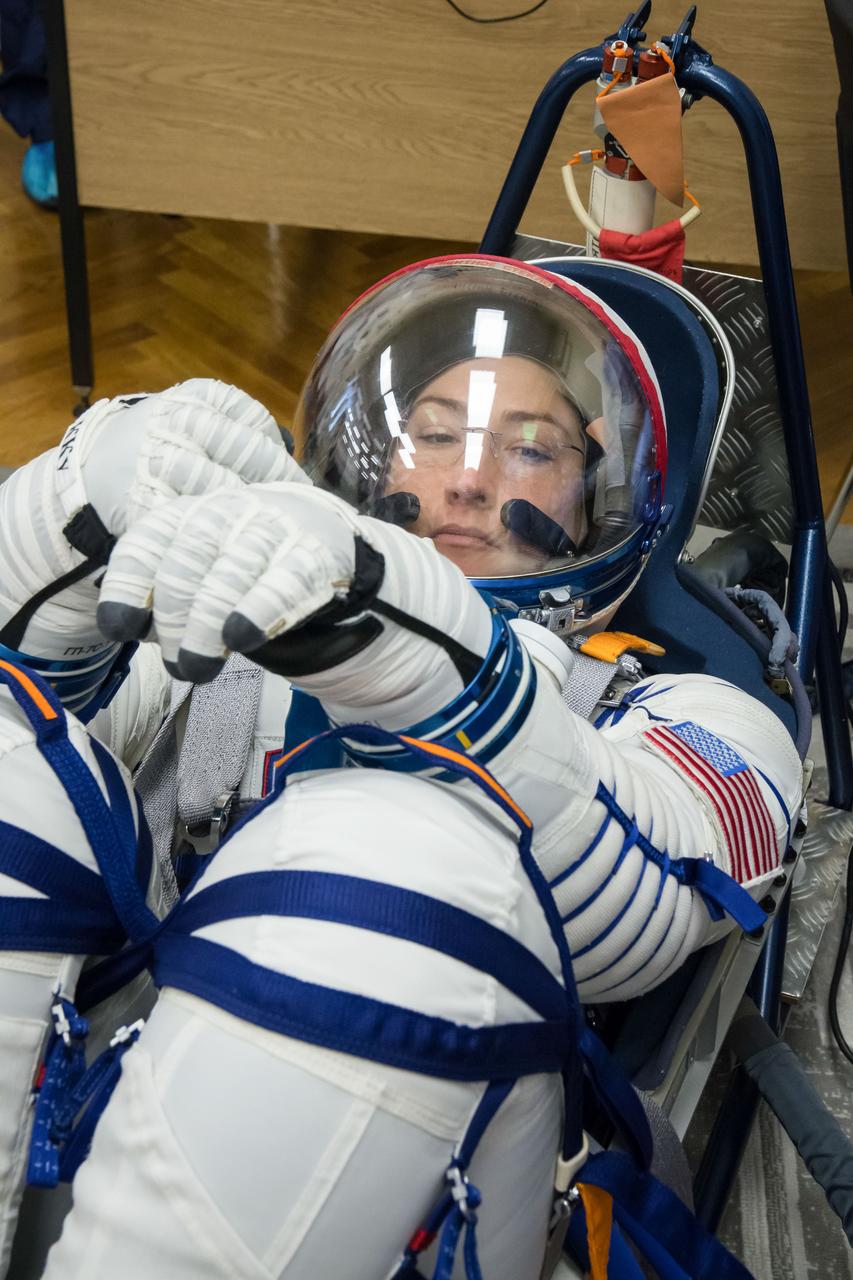
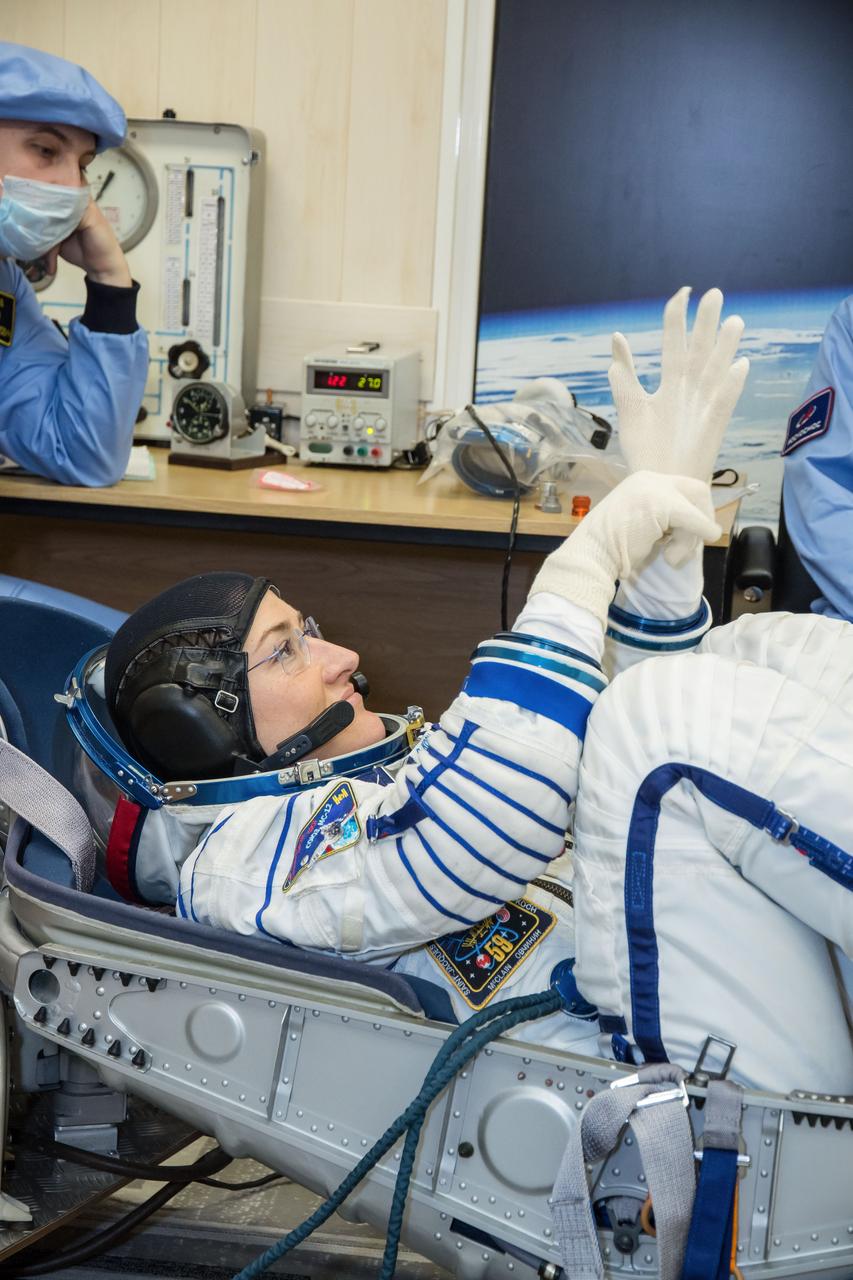
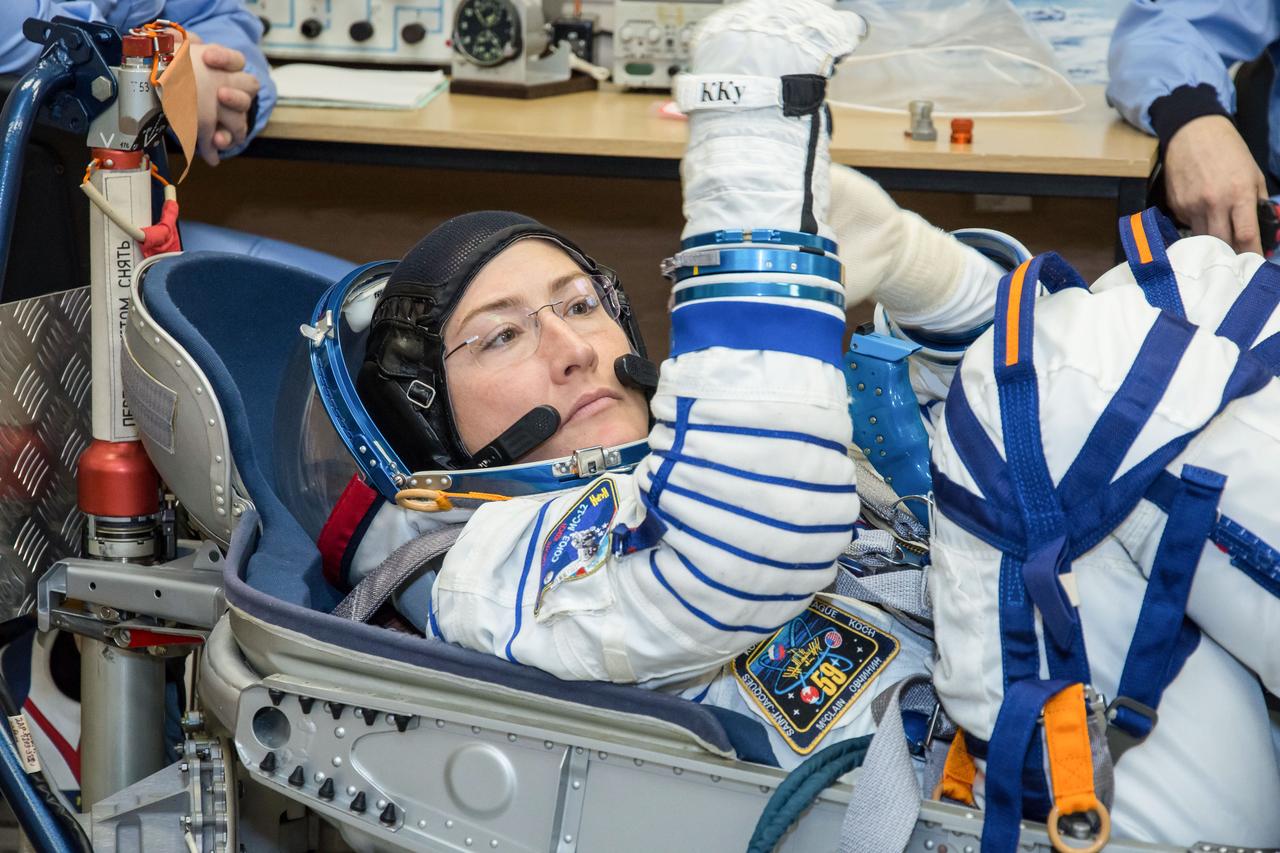
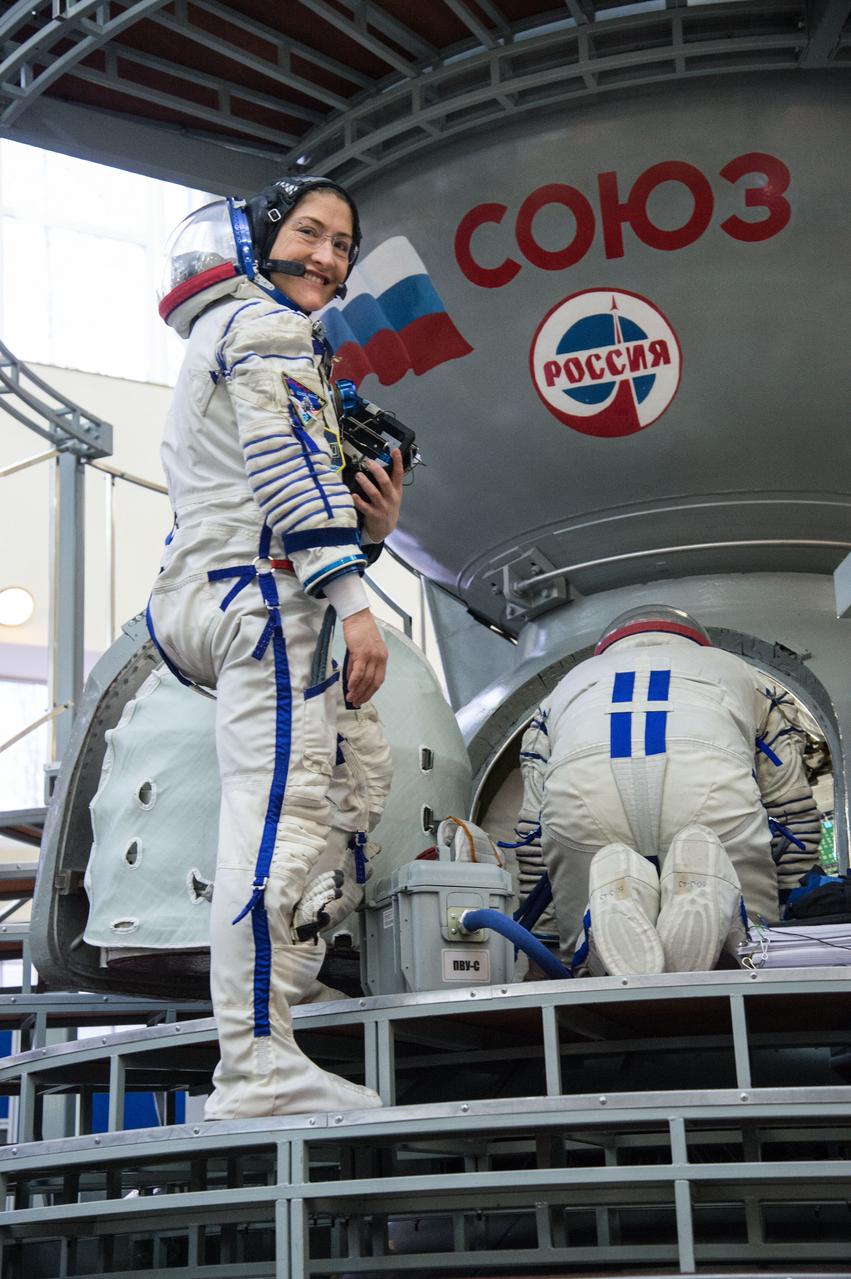
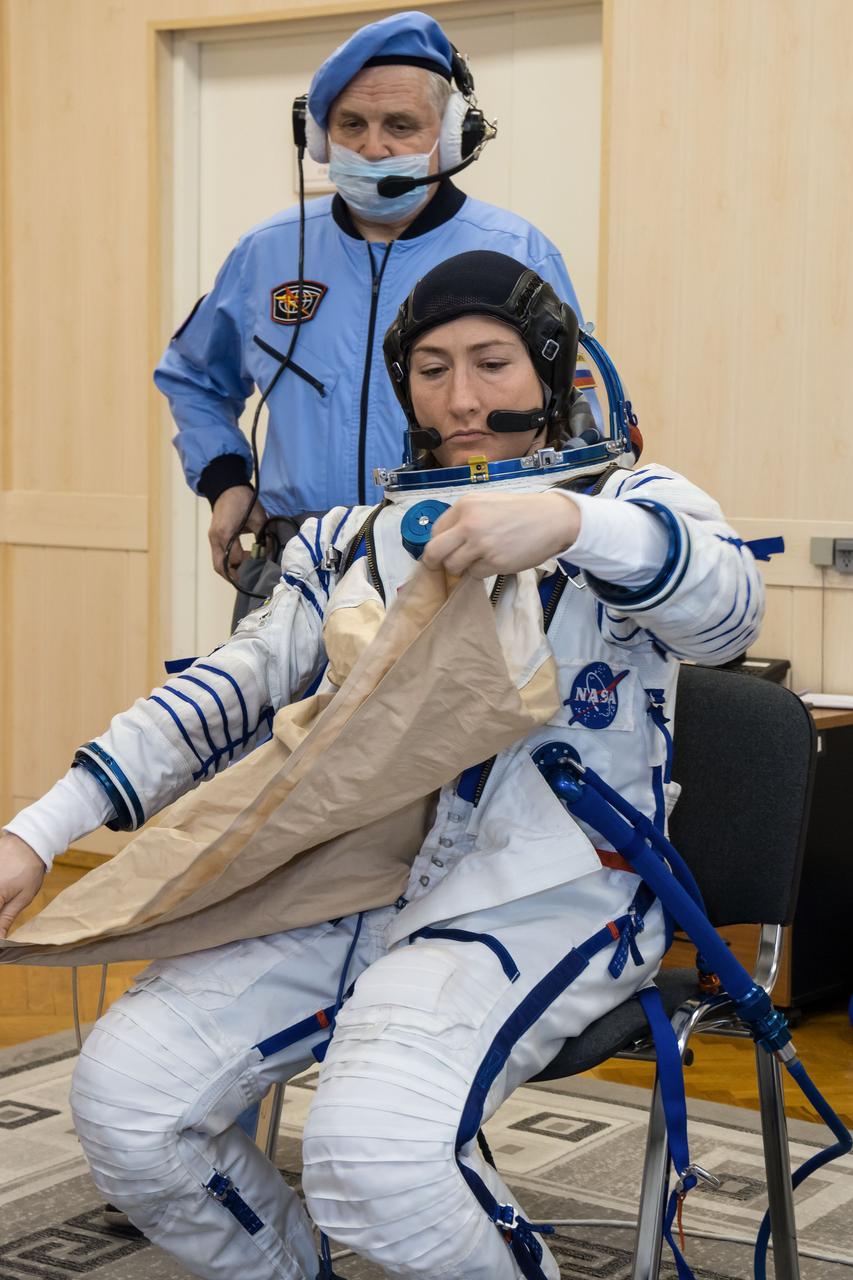
At the Baikonur Cosmodrome in Kazakhstan, Expedition 59 crewmember Christina Koch of NASA undergoes a Sokol launch suit pressure check Feb. 27 during pre-launch training. Koch, Nick Hague of NASA and Alexey Ovchinin of Roscosmos will launch March 14, U.S. time, on the Soyuz MS-12 spacecraft from the Baikonur Cosmodrome in Kazakhstan for a six-and-a-half month mission on the International Space Station.  NASA/Victor Zelentsov
jsc2019e009954 - At the Baikonur Cosmodrome in Kazakhstan, Expedition 59 crewmember Christina Koch of NASA undergoes a Sokol launch suit pressure check Feb. 27 during pre-launch training. Koch, Nick Hague of NASA and Alexey Ovchinin of Roscosmos will laun
At the Gagarin Cosmonaut Training Center in Star City, Russia, Expedition 59 crewmember Nick Hague of NASA prepares to depart Feb. 26 for his launch site at the Baikonur Cosmodrome in Kazakhstan for final pre-launch training. Hague, Christina Koch of NASA and Alexey Ovchinin of Roscosmos will launch on March 14, U.S. time, on the Soyuz MS-12 spacecraft from the Baikonur Cosmodrome in Kazakhstan for a six-and-a-half month mission on the International Space Station.  NASA/Beth Weissinger
At the Gagarin Cosmonaut Training Center in Star City, Russia, Expedition 59 crewmember Nick Hague of NASA prepares to depart Feb. 26 for his launch site at the Baikonur Cosmodrome in Kazakhstan for final pre-launch training. Hague, Christina Koch of NASA
At the Baikonur Cosmodrome in Kazakhstan, Expedition 59 crewmember Christina Koch of NASA undergoes a Sokol launch suit pressure check Feb. 27 during pre-launch training. Koch, Nick Hague of NASA and Alexey Ovchinin of Roscosmos will launch March 14, U.S. time, on the Soyuz MS-12 spacecraft from the Baikonur Cosmodrome in Kazakhstan for a six-and-a-half month mission on the International Space Station.  NASA/Victor Zelentsov
jsc2019e009953 - At the Baikonur Cosmodrome in Kazakhstan, Expedition 59 crewmember Christina Koch of NASA undergoes a Sokol launch suit pressure check Feb. 27 during pre-launch training. Koch, Nick Hague of NASA and Alexey Ovchinin of Roscosmos will laun
At the Baikonur Cosmodrome in Kazakhstan, Expedition 59 crewmember Christina Koch of NASA undergoes a Sokol launch suit pressure check Feb. 27 during pre-launch training. Koch, Nick Hague of NASA and Alexey Ovchinin of Roscosmos will launch March 14, U.S. time, on the Soyuz MS-12 spacecraft from the Baikonur Cosmodrome in Kazakhstan for a six-and-a-half month mission on the International Space Station.  NASA/Victor Zelentsov
jsc2019e009952 - At the Baikonur Cosmodrome in Kazakhstan, Expedition 59 crewmember Christina Koch of NASA undergoes a Sokol launch suit pressure check Feb. 27 during pre-launch training. Koch, Nick Hague of NASA and Alexey Ovchinin of Roscosmos will laun
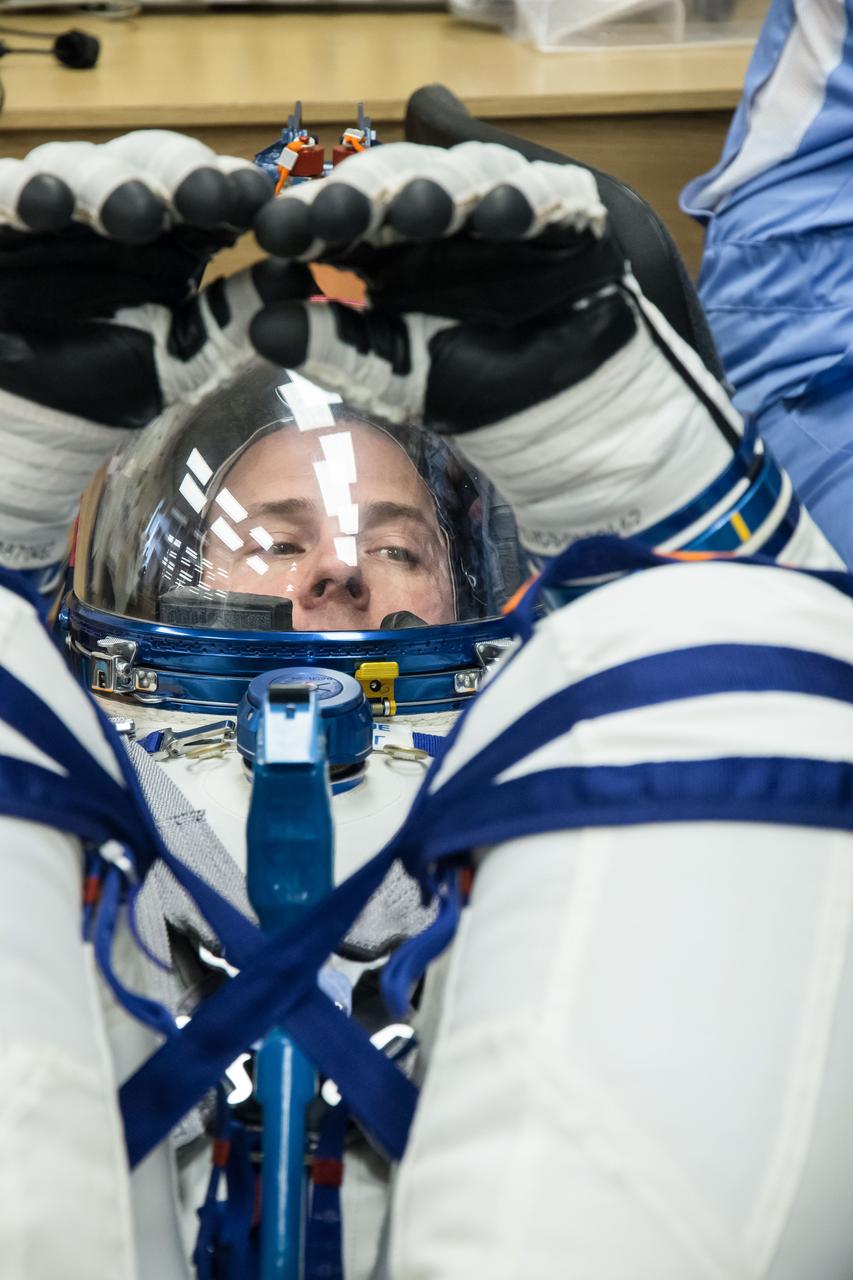
At the Baikonur Cosmodrome in Kazakhstan, Expedition 59 crewmember Nick Hague of NASA undergoes a Sokol launch suit pressure check Feb. 27 during pre-launch training. Hague, Christina Koch of NASA and Alexey Ovchinin of Roscosmos will launch March 14, U.S. time, on the Soyuz MS-12 spacecraft from the Baikonur Cosmodrome in Kazakhstan for a six-and-a-half month mission on the International Space Station.  NASA/Victor Zelentsov
jsc2019e009949 = At the Baikonur Cosmodrome in Kazakhstan, Expedition 59 crewmember Nick Hague of NASA undergoes a Sokol launch suit pressure check Feb. 27 during pre-launch training. Hague, Christina Koch of NASA and Alexey Ovchinin of Roscosmos will lau
At the Baikonur Cosmodrome in Kazakhstan, Expedition 59 crewmember Nick Hague of NASA undergoes a Sokol launch suit pressure check Feb. 27 during pre-launch training. Hague, Christina Koch of NASA and Alexey Ovchinin of Roscosmos will launch March 14, U.S. time, on the Soyuz MS-12 spacecraft from the Baikonur Cosmodrome in Kazakhstan for a six-and-a-half month mission on the International Space Station.  NASA/Victor Zelentsov
jsc2019e009951 - At the Baikonur Cosmodrome in Kazakhstan, Expedition 59 crewmember Nick Hague of NASA undergoes a Sokol launch suit pressure check Feb. 27 during pre-launch training. Hague, Christina Koch of NASA and Alexey Ovchinin of Roscosmos will lau
At the Baikonur Cosmodrome in Kazakhstan, Expedition 59 crewmember Nick Hague of NASA undergoes a Sokol launch suit pressure check Feb. 27 during pre-launch training. Hague, Christina Koch of NASA and Alexey Ovchinin of Roscosmos will launch March 14, U.S. time, on the Soyuz MS-12 spacecraft from the Baikonur Cosmodrome in Kazakhstan for a six-and-a-half month mission on the International Space Station.  NASA/Victor Zelentsov
jsc2019e009950 - At the Baikonur Cosmodrome in Kazakhstan, Expedition 59 crewmember Nick Hague of NASA undergoes a Sokol launch suit pressure check Feb. 27 during pre-launch training. Hague, Christina Koch of NASA and Alexey Ovchinin of Roscosmos will lau
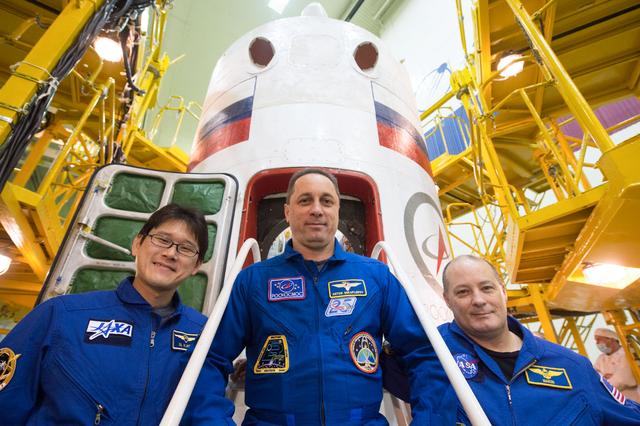
jsc2017e138117 - At the Integration Facility at the Baikonur Cosmodrome in Kazakhstan, the Expedition 54-55 prime crewmembers pose for pictures Dec. 13 in front of the Soyuz MS-07 spacecraft during pre-launch training. Norishige Kanai of the Japan Aerospace Exploration Agency (JAXA), Anton Shkaplerov of the Russian Federal Space Agency (Roscosmos, center) and Scott Tingle of NASA (right) will launch Dec. 17 on the Soyuz MS-07 vehicle for a five month mission on the International Space Station...Andrey Shelepin/Gagarin Cosmonaut Training Center.
jsc2017e138117 - At the Integration Facility at the Baikonur Cosmodrome in Kazakhstan, the Expedition 54-55 prime crewmembers pose for pictures Dec. 13 in front of the Soyuz MS-07 spacecraft during pre-launch training. Norishige Kanai of the Japan Aerospa
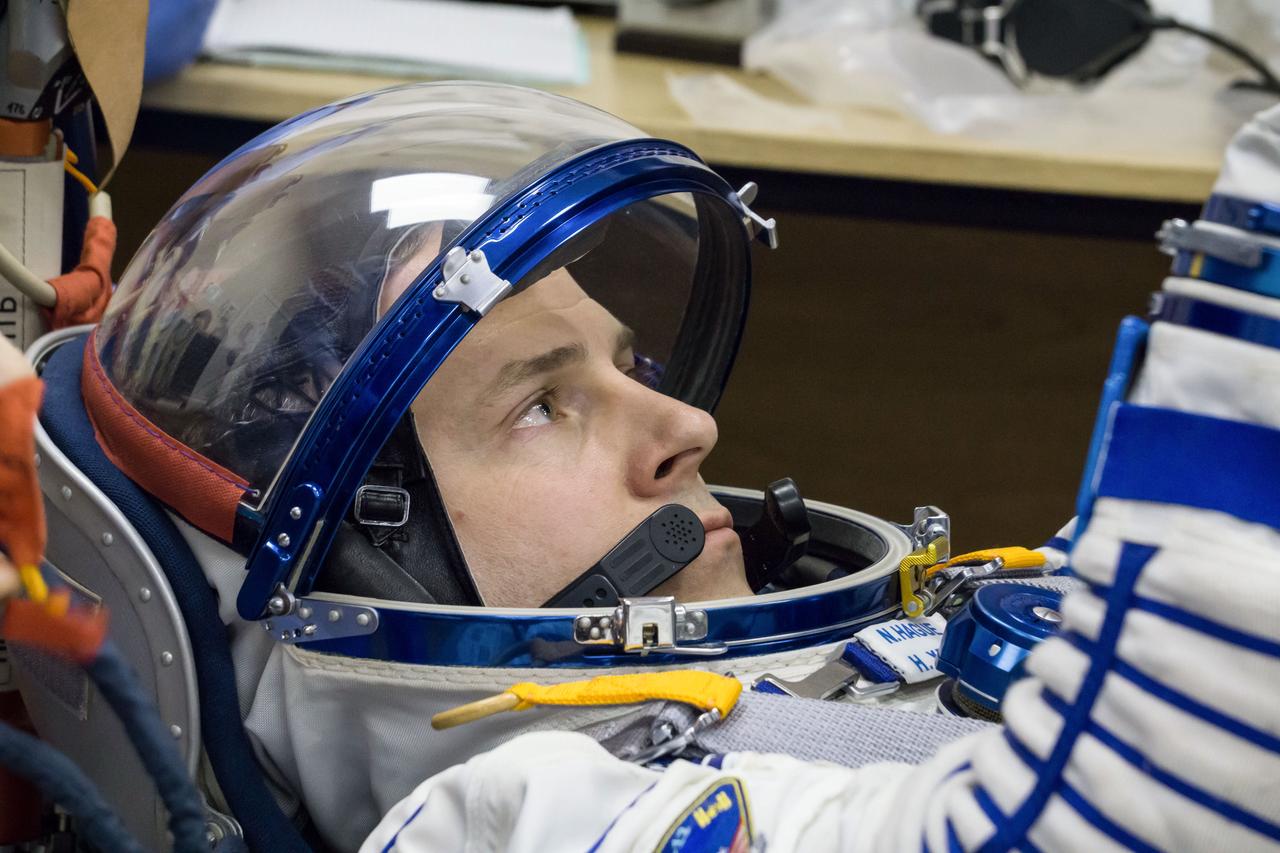
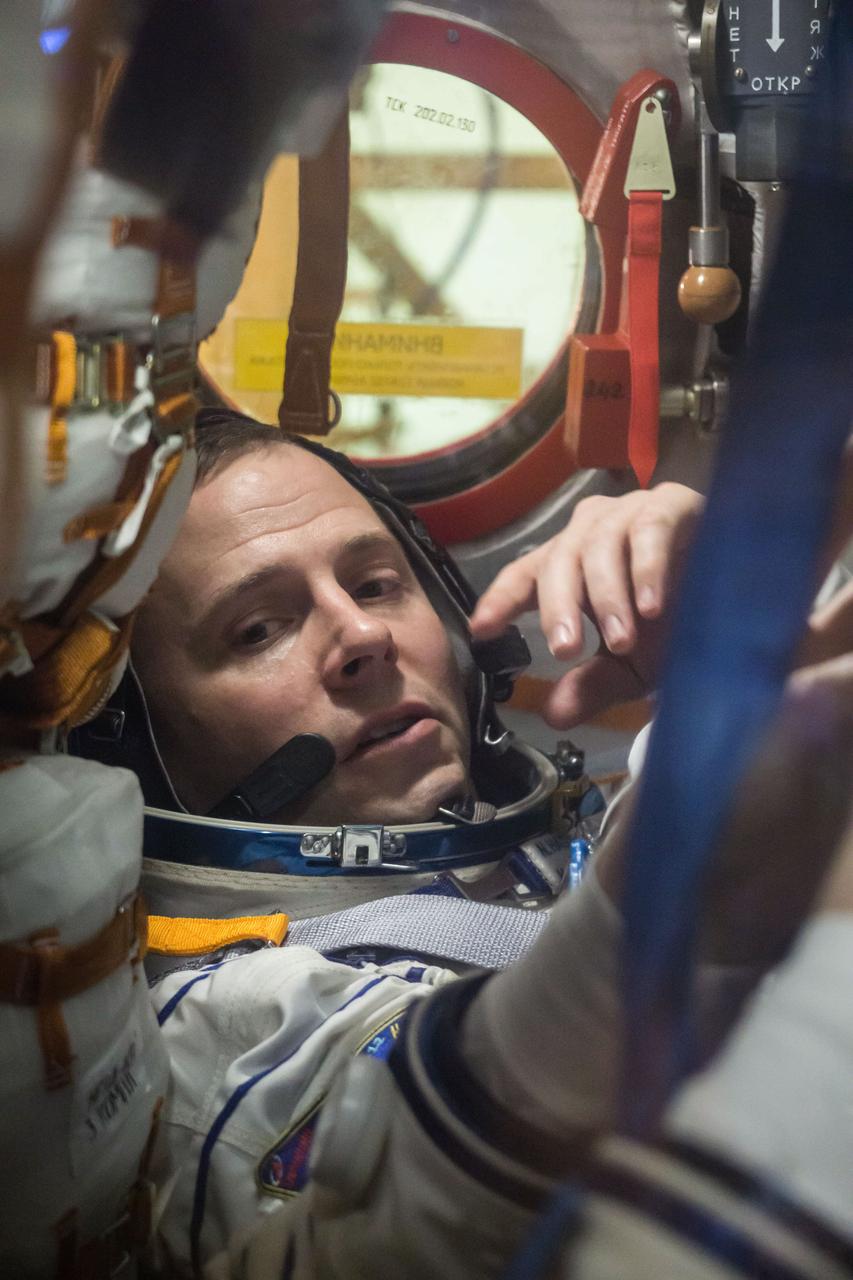
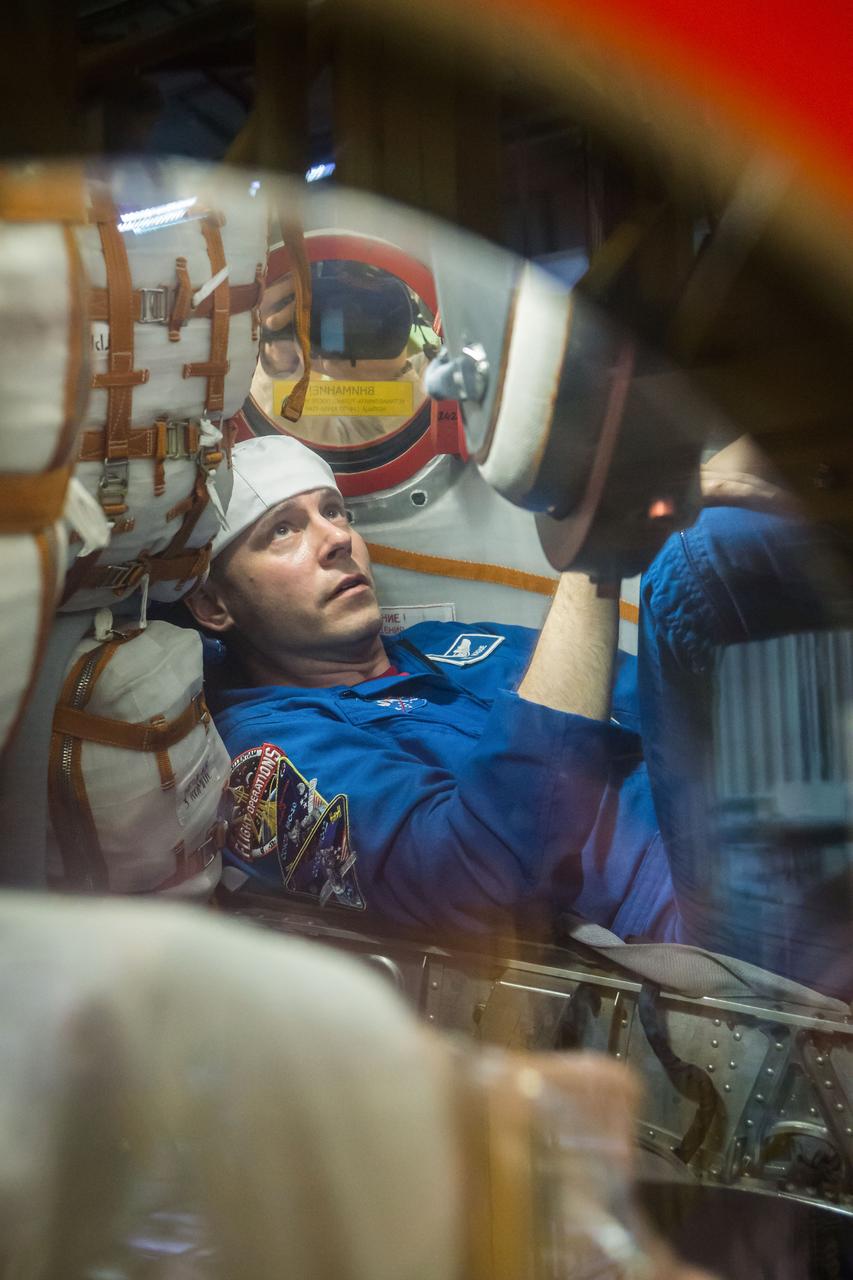
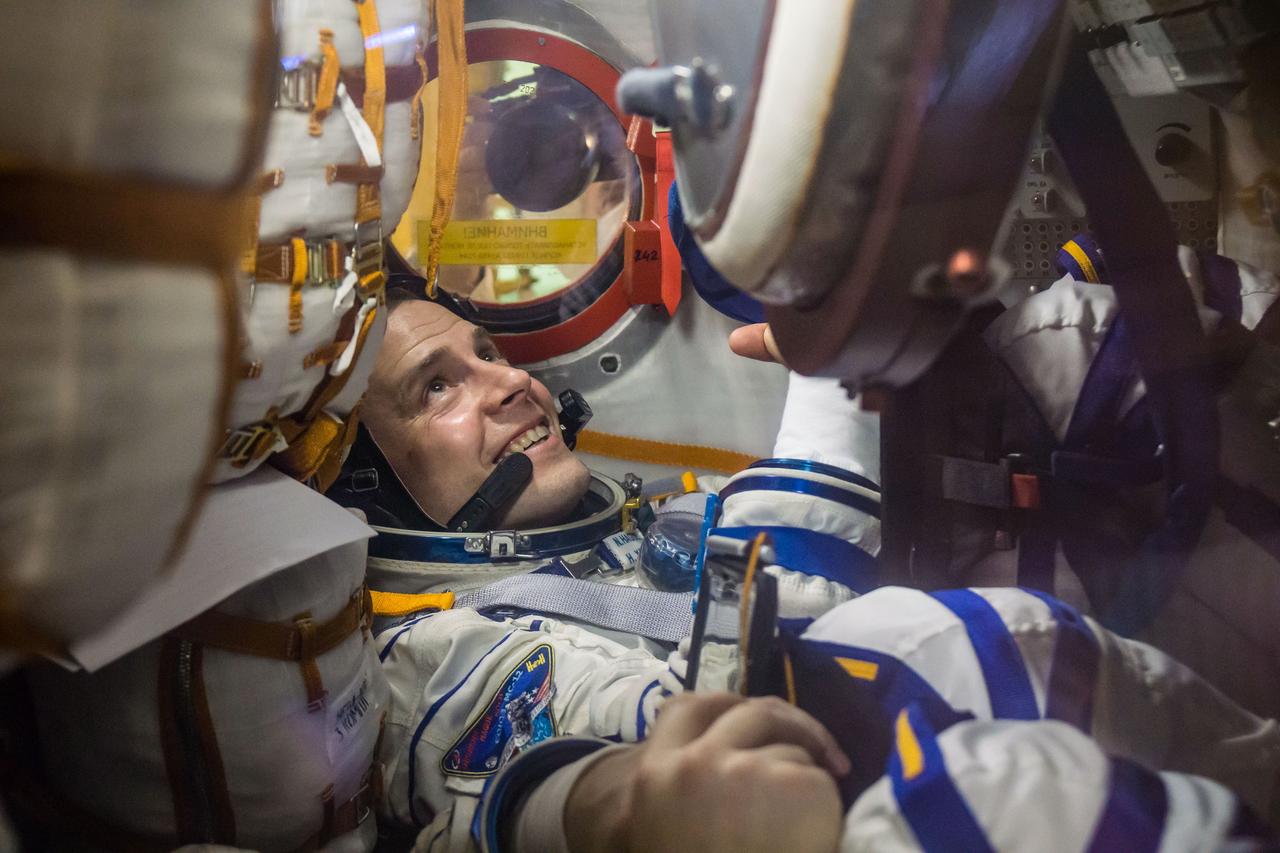
At the Baikonur Cosmodrome in Kazakhstan, Expedition 59 crewmember Nick Hague of NASA works inside the Soyuz MS-12 spacecraft Feb. 27 during pre-launch training. Hague, Christina Koch of NASA and Alexey Ovchinin of Roscosmos will launch March 14, U.S. time, on the Soyuz MS-12 spacecraft from the Baikonur Cosmodrome in Kazakhstan for a six-and-a-half month mission on the International Space Station.  NASA/Victor Zelentsov
jsc2019e009944 - At the Baikonur Cosmodrome in Kazakhstan, Expedition 59 crewmember Nick Hague of NASA works inside the Soyuz MS-12 spacecraft Feb. 27 during pre-launch training. Hague, Christina Koch of NASA and Alexey Ovchinin of Roscosmos will launch M
At the Baikonur Cosmodrome in Kazakhstan, Expedition 59 crewmember Nick Hague of NASA works inside the Soyuz MS-12 spacecraft Feb. 27 during pre-launch training. Hague, Christina Koch of NASA and Alexey Ovchinin of Roscosmos will launch March 14, U.S. time, on the Soyuz MS-12 spacecraft from the Baikonur Cosmodrome in Kazakhstan for a six-and-a-half month mission on the International Space Station.  NASA/Victor Zelentsov
jsc2019e009945 - At the Baikonur Cosmodrome in Kazakhstan, Expedition 59 crewmember Nick Hague of NASA works inside the Soyuz MS-12 spacecraft Feb. 27 during pre-launch training. Hague, Christina Koch of NASA and Alexey Ovchinin of Roscosmos will launch M
At the Baikonur Cosmodrome in Kazakhstan, Expedition 59 crewmember Nick Hague of NASA works inside the Soyuz MS-12 spacecraft Feb. 27 during pre-launch training. Hague, Christina Koch of NASA and Alexey Ovchinin of Roscosmos will launch March 14, U.S. time, on the Soyuz MS-12 spacecraft from the Baikonur Cosmodrome in Kazakhstan for a six-and-a-half month mission on the International Space Station.  NASA/Victor Zelentsov
jsc2019e009957 - At the Baikonur Cosmodrome in Kazakhstan, Expedition 59 crewmember Nick Hague of NASA works inside the Soyuz MS-12 spacecraft Feb. 27 during pre-launch training. Hague, Christina Koch of NASA and Alexey Ovchinin of Roscosmos will launch M
At the Baikonur Cosmodrome in Kazakhstan, Expedition 59 crewmember Nick Hague of NASA works inside the Soyuz MS-12 spacecraft Feb. 27 during pre-launch training. Hague, Christina Koch of NASA and Alexey Ovchinin of Roscosmos will launch March 14, U.S. time, on the Soyuz MS-12 spacecraft from the Baikonur Cosmodrome in Kazakhstan for a six-and-a-half month mission on the International Space Station.  NASA/Victor Zelentsov
jsc2019e009958 - At the Baikonur Cosmodrome in Kazakhstan, Expedition 59 crewmember Nick Hague of NASA works inside the Soyuz MS-12 spacecraft Feb. 27 during pre-launch training. Hague, Christina Koch of NASA and Alexey Ovchinin of Roscosmos will launch M
Pre Launch View of Pioneer F
ARC-1972-A72-2141
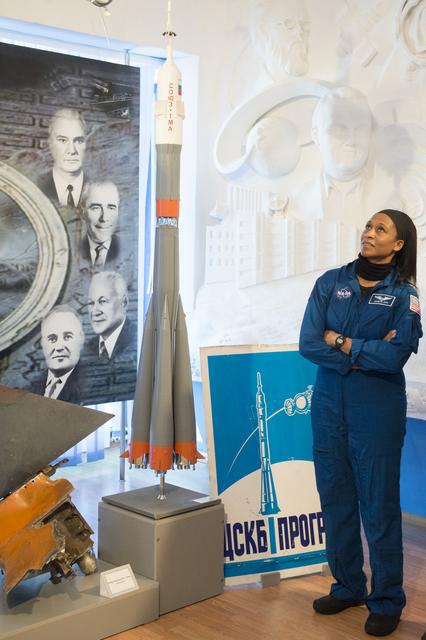
jsc2017e136937 - At the Baikonur Museum in Baikonur, Kazakhstan, Expedition 54-55 backup crewmember Jeanette Epps of NASA views a model of a Soyuz rocket Dec. 6 during a traditional pre-launch visit to the facility. Epps, Sergey Prokopyev of the Russian Fe
jsc2017e136939 - At the Cosmonaut Hotel crew quarters in Baikonur, Kazakhstan, the Expedition 54-55 backup crewmembers take a stroll down the Walk of Cosmonauts Dec. 6 to lay flowers in traditional pre-launch ceremonies. From left to right are Jeanette Epp
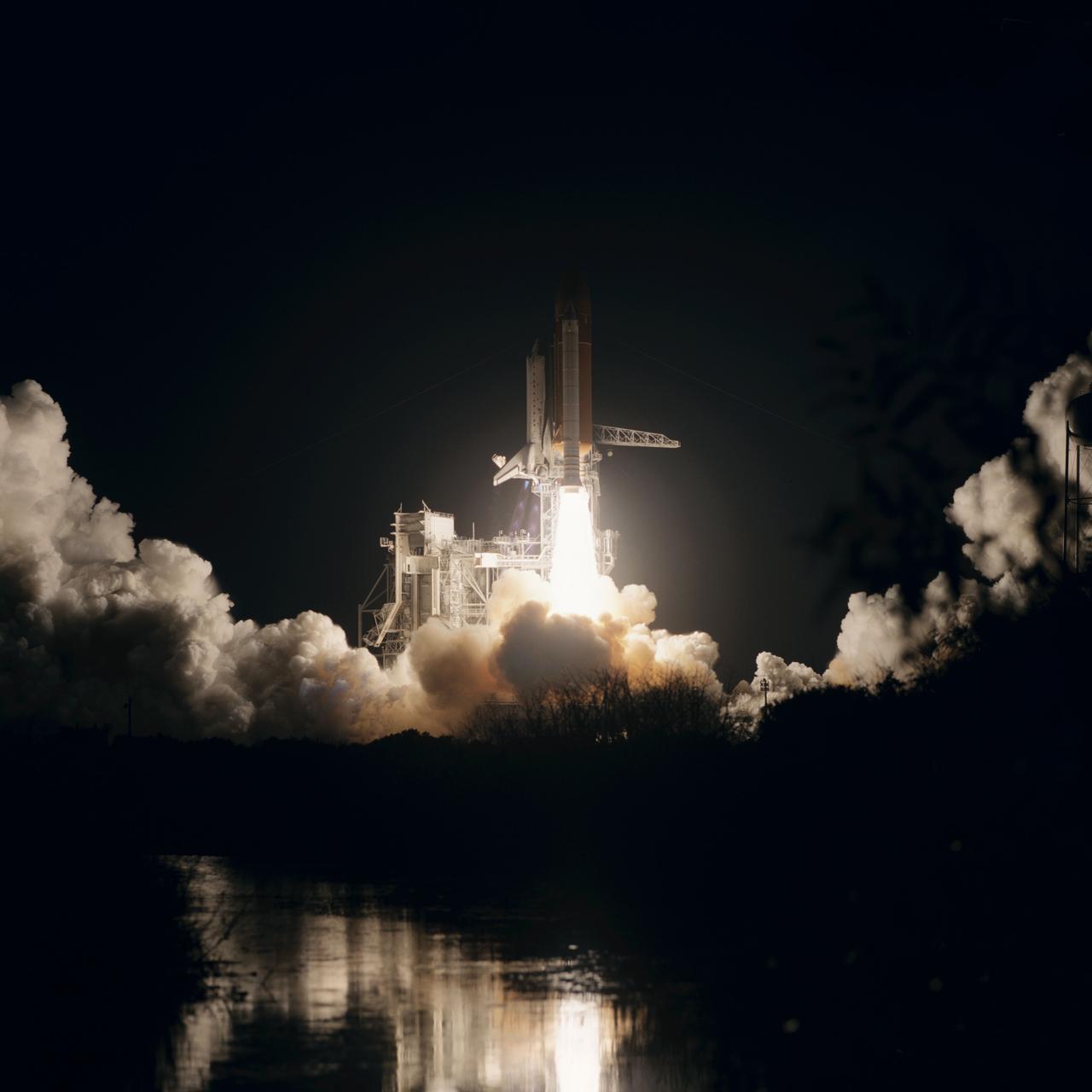
Launch of the Shuttle Discovery and begining of STS 51-I mission. View of the pre-dawn launch shows a reflection of the ignition in the river across from the launch complex (223); Clouds of smoke from the launch reflect the light of the ignited engines in this view of the pre-dawn launch (224).
Launch of the Shuttle Discovery and begining of STS 51-I mission
ISS Expedition 48-49 crewmember Takuya Onishi of the Japan Aerospace Exploration Agency departs the Gagarin Cosmonaut Training Center in Star City, Russia June 24 for his launch site at the Baikonur Cosmodrome in Kazakhstan and final pre-launch training. In the background on the right is crewmate Kate Rubins of NASA. Rubins, Anatoly Ivanishin of Roscosmos and Onishi will launch July 7 from the Baikonur Cosmodrome in Kazakhstan on the Soyuz MS-01 spacecraft for a planned four-month mission on the International Space Station.  NASA/Stephanie Stoll
ISS Expedition 48-49 crewmember Takuya Onishi of the Japan Aerospace Exploration Agency departs the Gagarin Cosmonaut Training Center in Star City, Russia June 24 for his launch site at the Baikonur Cosmodrome in Kazakhstan and final pre-launch training. In the background on the right is crewmate Kate Rubins of NASA. Rubins, Anatoly Ivanishin of Roscosmos and Onishi will launch July 7 from the Baikonur Cosmodrome in Kazakhstan on the Soyuz MS-01 spacecraft for a planned four-month mission on the International Space Station...NASA/Stephanie Stoll.
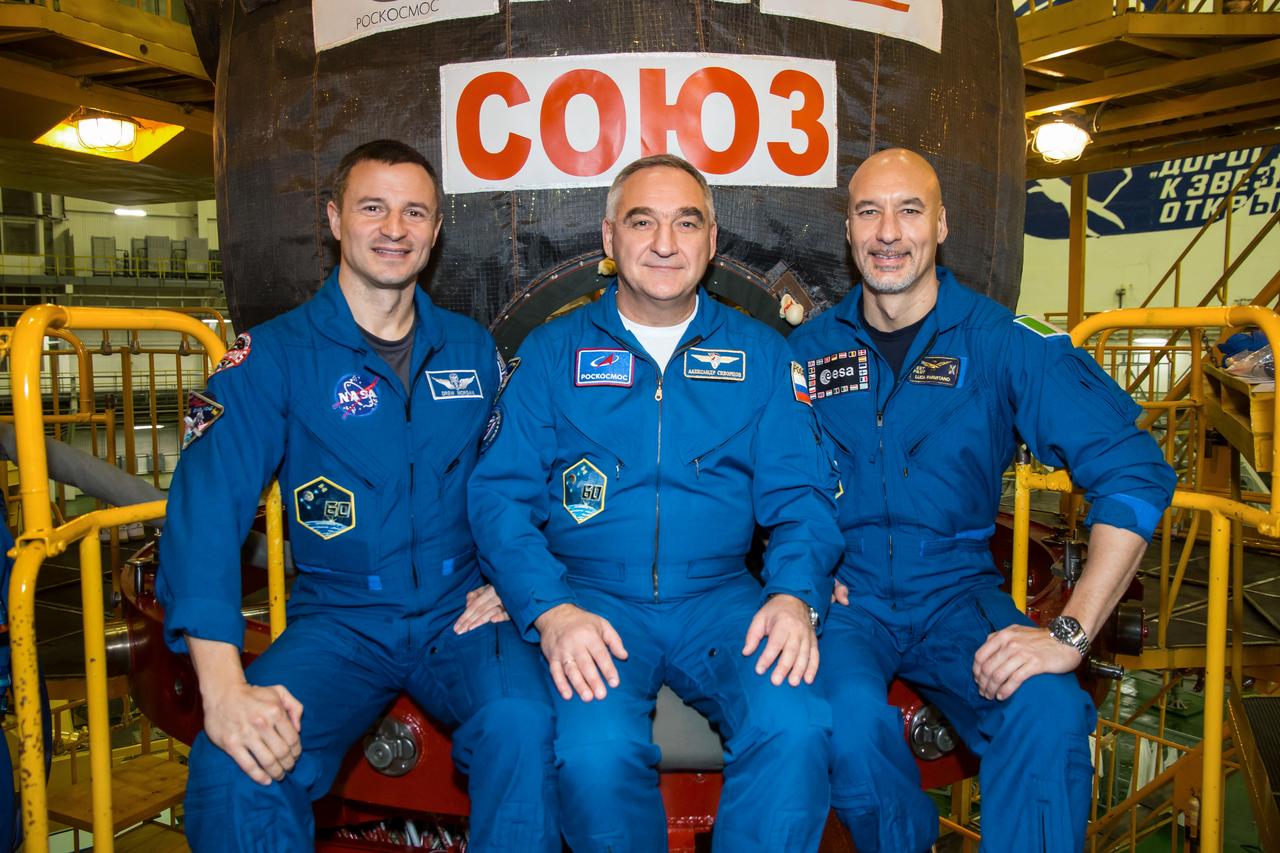
At the Baikonur Cosmodrome in Kazakhstan, the Expedition 59 prime and backup crewmembers pose for pictures Feb. 27 as part of their pre-launch training. In the front row are the prime crewmembers, Christina Koch of NASA, Alexey Ovchinin of Roscosmos and Nick Hague of NASA. In the back row are their backups, Drew Morgan of NASA, Alexander Skvortsov of Roscosmos and Luca Parmitano of the European Space Agency. Koch, Hague and Ovchinin will launch March 14, U.S. time, on the Soyuz MS-12 spacecraft from the Baikonur Cosmodrome in Kazakhstan for a six-and-a-half month mission on the International Space Station.  NASA/Victor Zelentsov
jsc2019e009955 - At the Baikonur Cosmodrome in Kazakhstan, the Expedition 59 prime and backup crewmembers pose for pictures Feb. 27 as part of their pre-launch training. In the front row are the prime crewmembers, Christina Koch of NASA, Alexey Ovchinin o
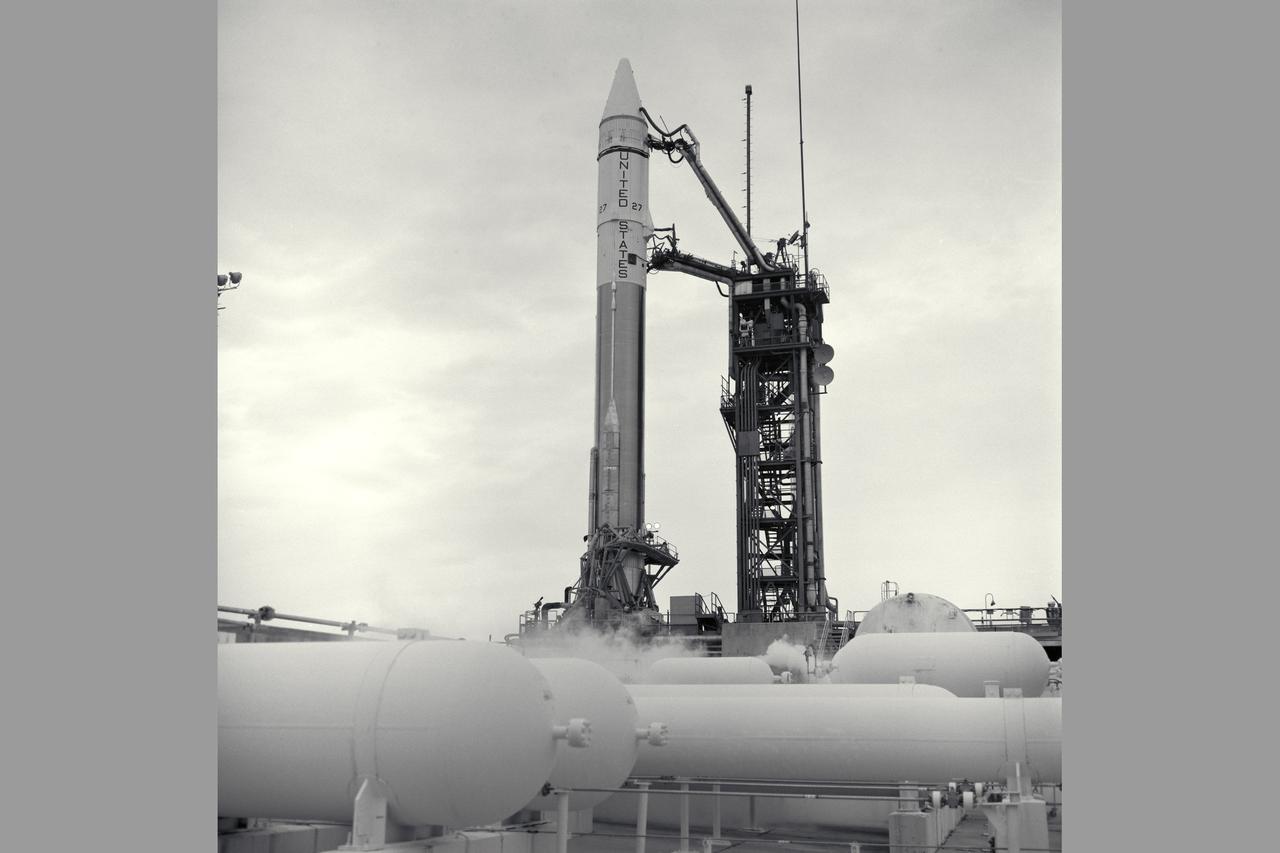
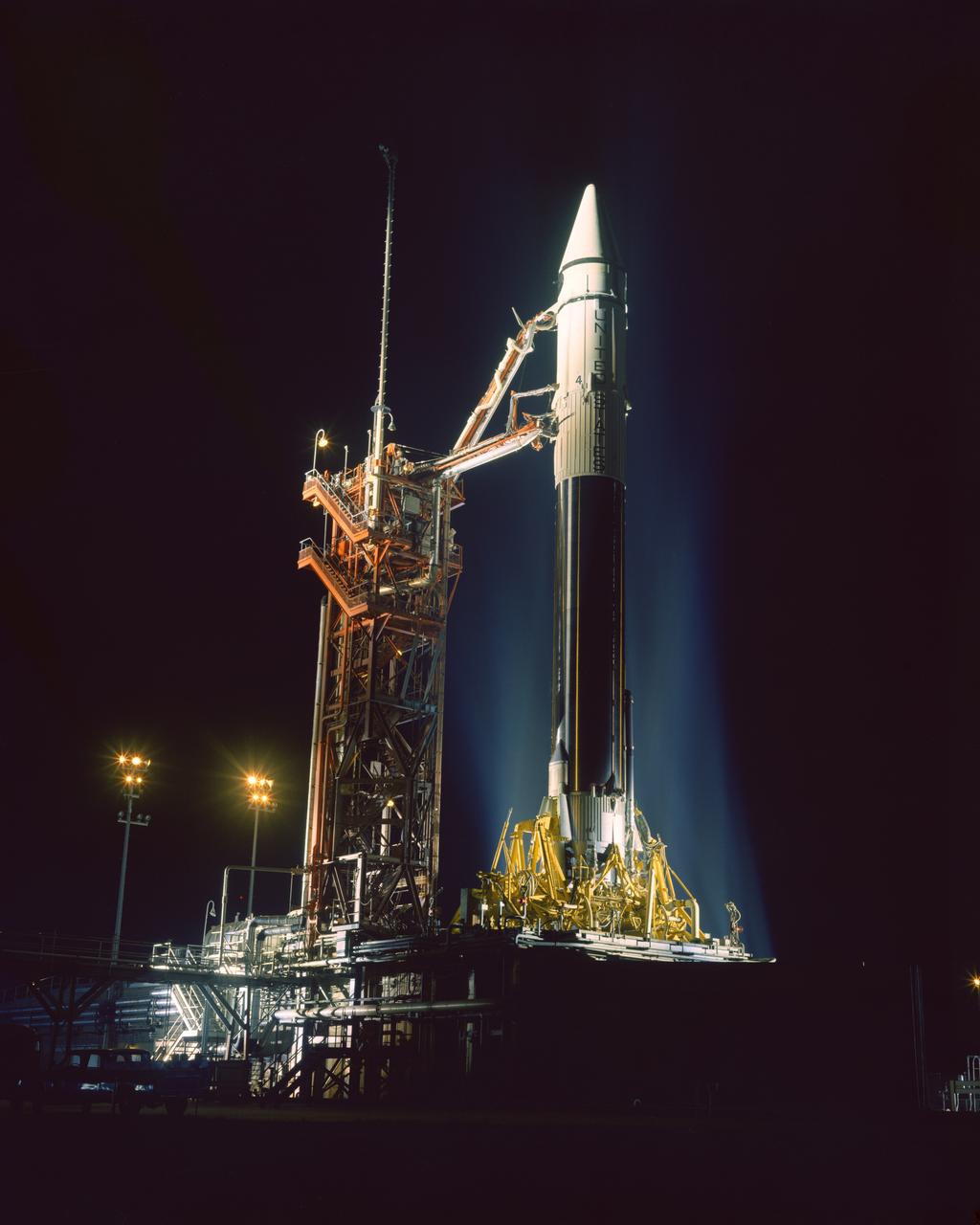
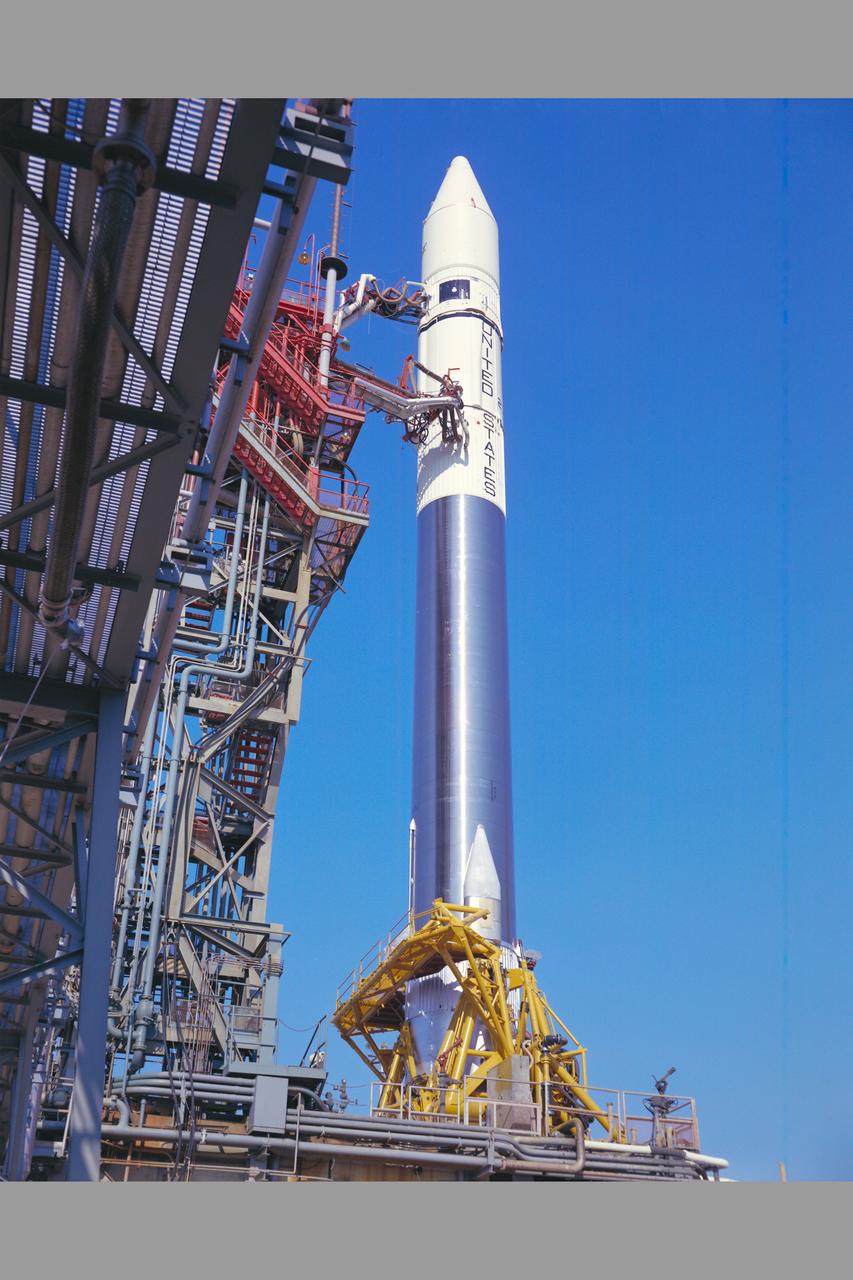
Pre-launch of Centaur 4 A/C 4 from Pad 36A.
101-KSC-64C-5742
Pre-launch alert of Atlas-Agena 7, Ranger V.
62PC-81
A pre launch view of Pioneer-10 (or F) spacecraft encapsulated and mated with a Atlas-Centaura launch vehicle in preparation for mission to Jupiter
ARC-1972-AC72-2140
A pre launch view of Pioneer-10 (or F) spacecraft encapsulated and mated with a Atlas-Centaura launch vehicle in preparation for mission to Jupiter
ARC-1972-AC72-2139
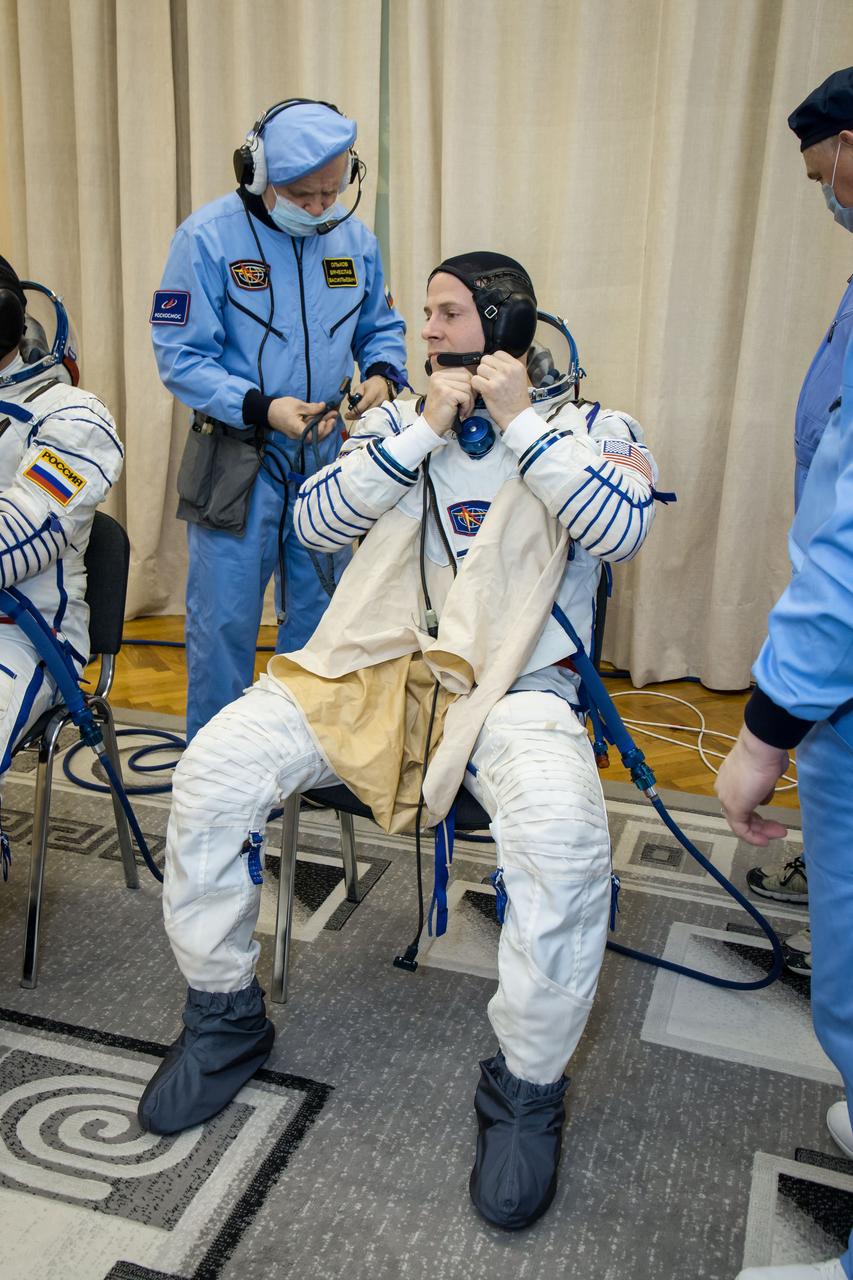
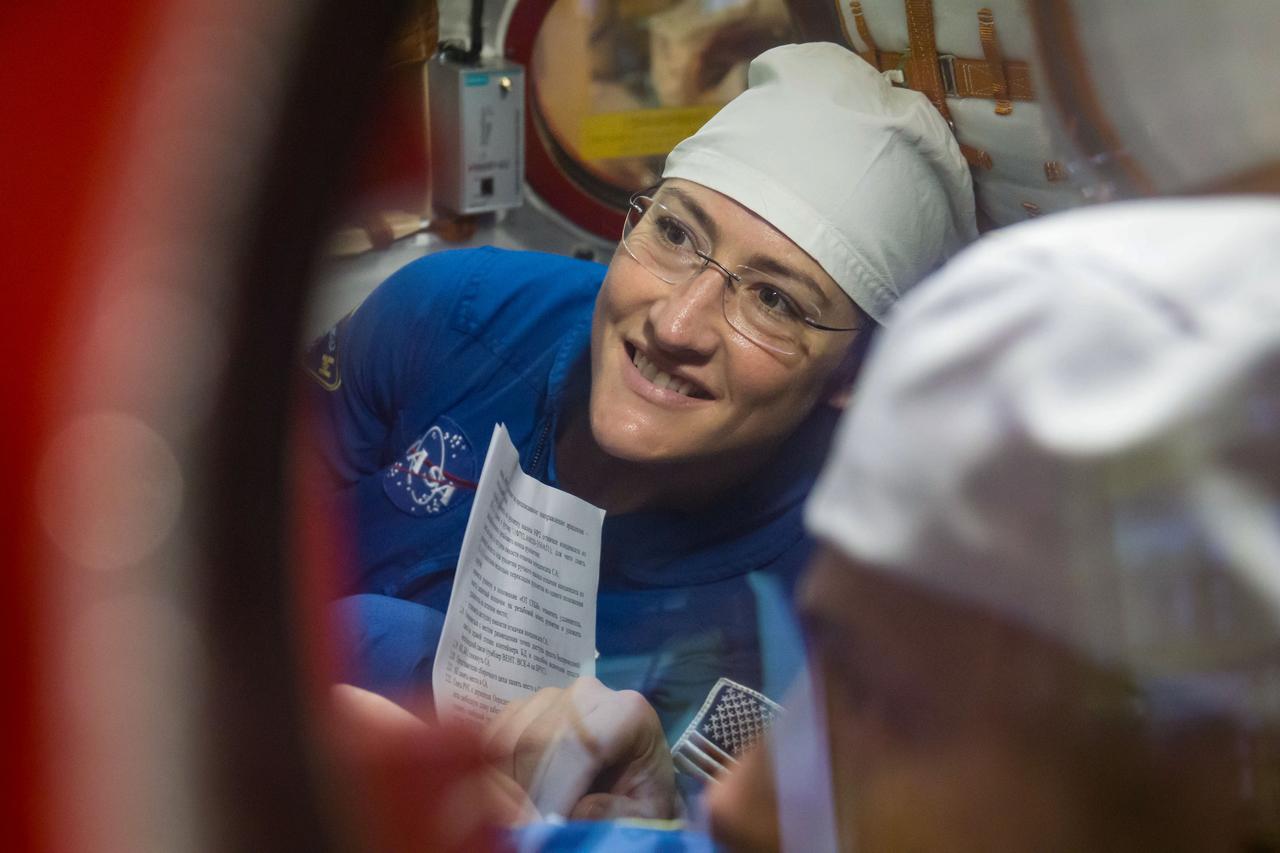
At the Baikonur Cosmodrome in Kazakhstan, Expedition 59 crewmember Christina Koch of NASA suits up for a Soyuz fit check dress rehearsal Feb. 27 during pre-launch training. Koch, Nick Hague of NASA and Alexey Ovchinin of Roscosmos will launch March 14, U.S. time, on the Soyuz MS-12 spacecraft from the Baikonur Cosmodrome in Kazakhstan for a six-and-a-half month mission on the International Space Station.  NASA/Victor Zelentsov
jsc2019e009947 - At the Baikonur Cosmodrome in Kazakhstan, Expedition 59 crewmember Christina Koch of NASA suits up for a Soyuz fit check dress rehearsal Feb. 27 during pre-launch training. Koch, Nick Hague of NASA and Alexey Ovchinin of Roscosmos will la
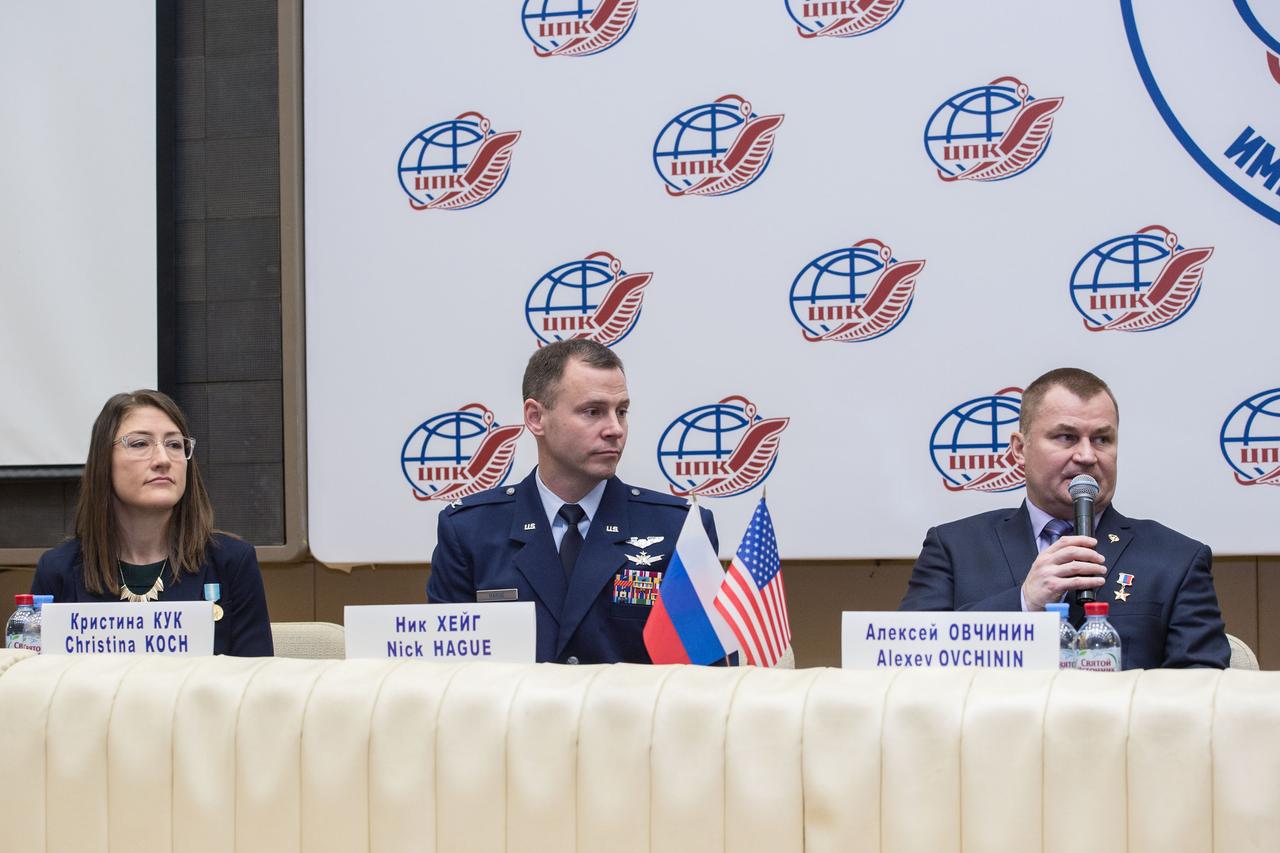
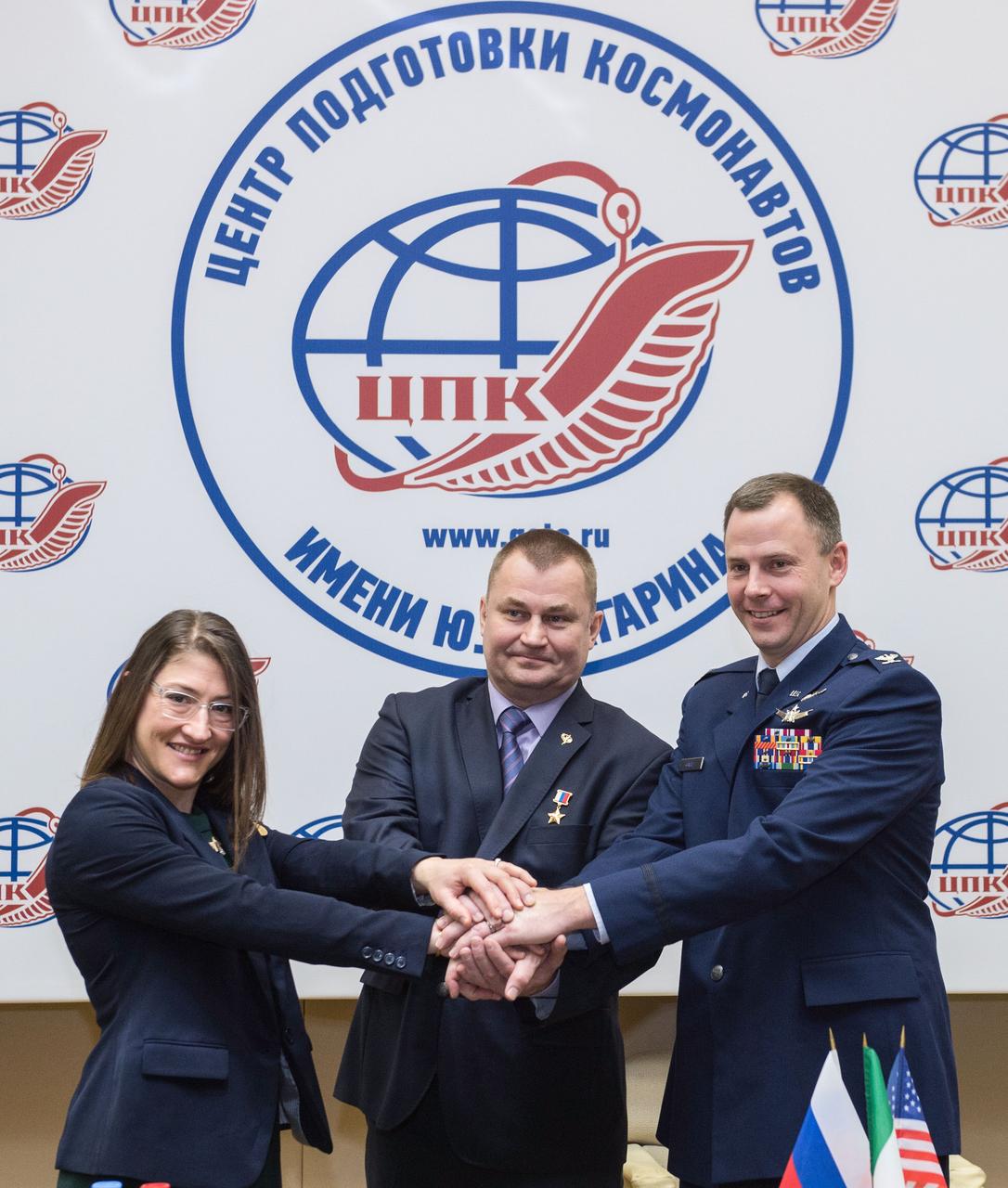
At the Gagarin Cosmonaut Training Center in Star City, Russia, Expedition 59 crewmembers Christina Koch of NASA (left), Alexey Ovchinin of Roscosmos (center) and Nick Hague of NASA (right) pose for pictures Feb. 21 following a pre-launch news conference. They will launch March 14, U.S. time, on the Soyuz MS-12 spacecraft from the Baikonur Cosmodrome in Kazakhstan for a six-and-a-half month mission on the International Space Station.  Andrey Shelepin/Gagarin Cosmonaut Training Center
jsc2019e004423 - At the Gagarin Cosmonaut Training Center in Star City, Russia, Expedition 59 crewmembers Christina Koch of NASA (left), Alexey Ovchinin of Roscosmos (center) and Nick Hague of NASA (right) pose for pictures Feb. 21 following a pre-launch
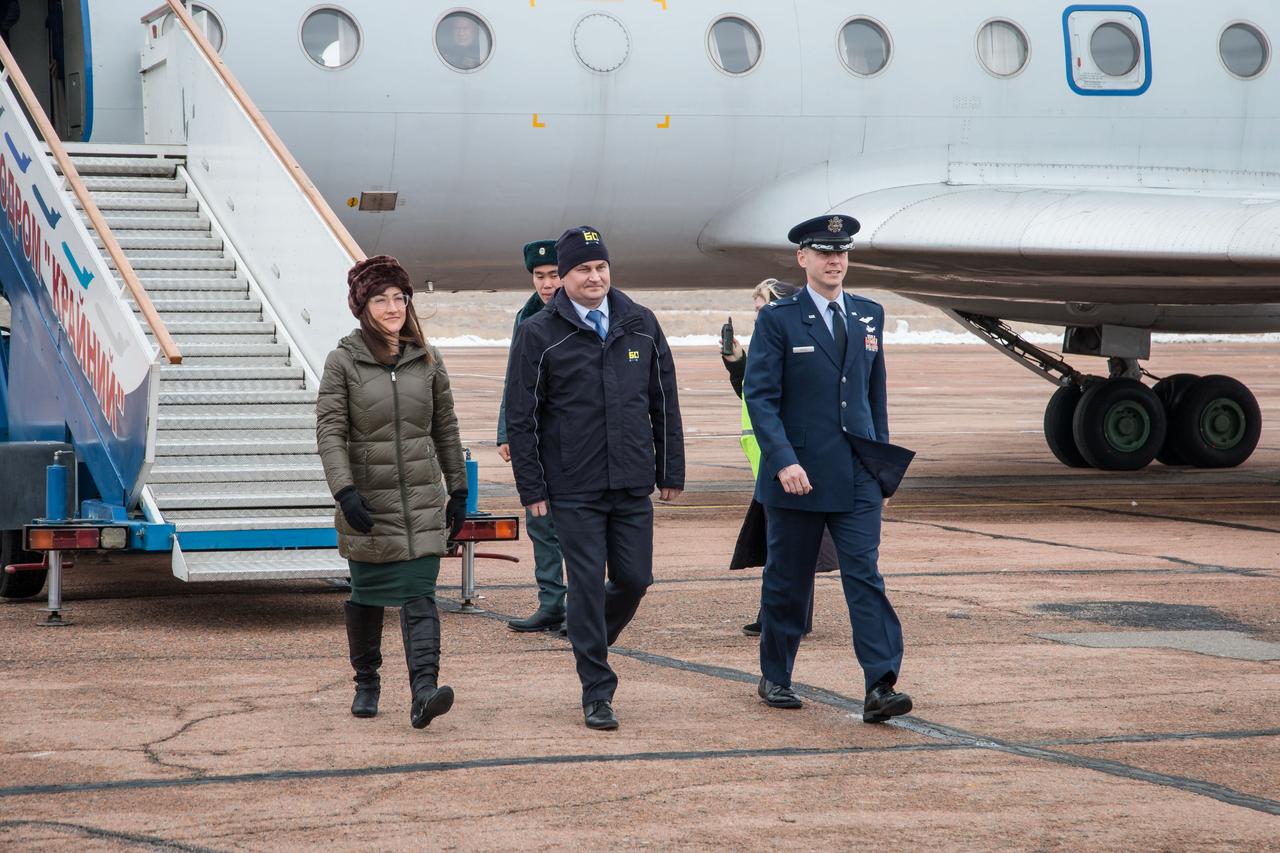
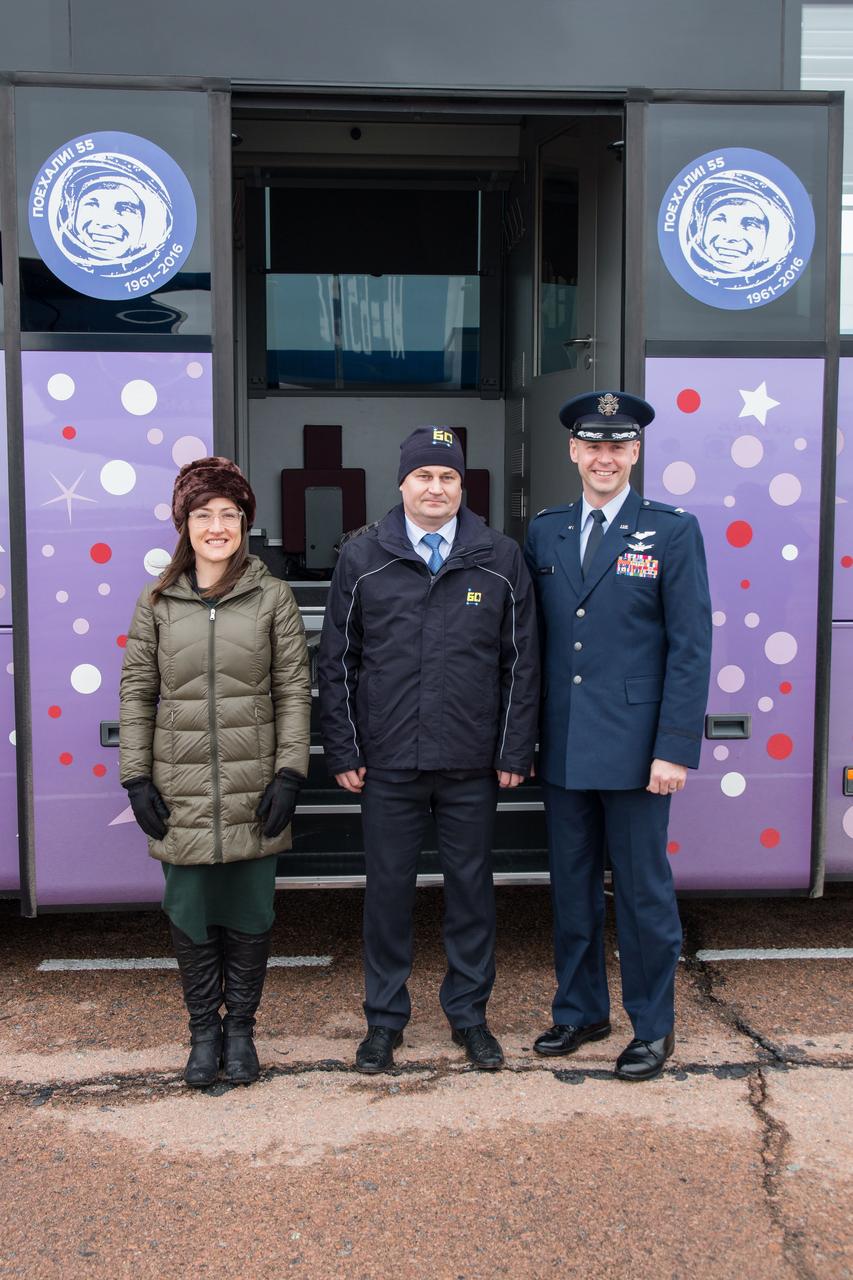
Expedition 59 crewmembers Christina Koch of NASA (left), Alexey Ovchinin of Roscosmos (center) and Nick Hague of NASA (right) pose for pictures Feb. 26 after arriving at the Baikonur Cosmodrome in Kazakhstan for final pre-launch training following a flight from their training base at the Gagarin Cosmonaut Training Center in Star City, Russia. They will launch March 14, U.S. time, on the Soyuz MS-12 spacecraft from the Baikonur Cosmodrome in Kazakhstan for a six-and-a-half month mission on the International Space Station.  NASA/Victor Zelentsov
jsc2019e007202 - Expedition 59 crewmembers Christina Koch of NASA (left), Alexey Ovchinin of Roscosmos (center) and Nick Hague of NASA (right) pose for pictures Feb. 26 after arriving at the Baikonur Cosmodrome in Kazakhstan for final pre-launch training
At the Gagarin Cosmonaut Training Center in Star City, Russia, Expedition 59 crewmember Alexey Ovchinin of Roscosmos (right) responds to a reporter’s question Feb. 21 during a pre-launch news conference as crewmates Christina Koch of NASA (left) and Nick Hague of NASA (center) look on. They will launch March 14, U.S. time, on the Soyuz MS-12 spacecraft from the Baikonur Cosmodrome in Kazakhstan for a six-and-a-half month mission on the International Space Station.  Andrey Shelepin/Gagarin Cosmonaut Training Center
jsc2019e004420 - At the Gagarin Cosmonaut Training Center in Star City, Russia, Expedition 59 crewmember Alexey Ovchinin of Roscosmos (right) responds to a reporter’s question Feb. 21 during a pre-launch news conference as crewmates Christina Koch of NA
Expedition 59 crewmembers Christina Koch of NASA (left), Alexey Ovchinin of Roscosmos (center) and Nick Hague of NASA (right) arrive at the Baikonur Cosmodrome in Kazakhstan Feb. 26 for final pre-launch training following a flight from their training base at the Gagarin Cosmonaut Training Center in Star City, Russia. They will launch March 14, U.S. time, on the Soyuz MS-12 spacecraft from the Baikonur Cosmodrome in Kazakhstan for a six-and-a-half month mission on the International Space Station.  NASA/Victor Zelentsov
jsc2019e007200 - Expedition 59 crewmembers Christina Koch of NASA (left), Alexey Ovchinin of Roscosmos (center) and Nick Hague of NASA (right) arrive at the Baikonur Cosmodrome in Kazakhstan Feb. 26 for final pre-launch training following a flight from th
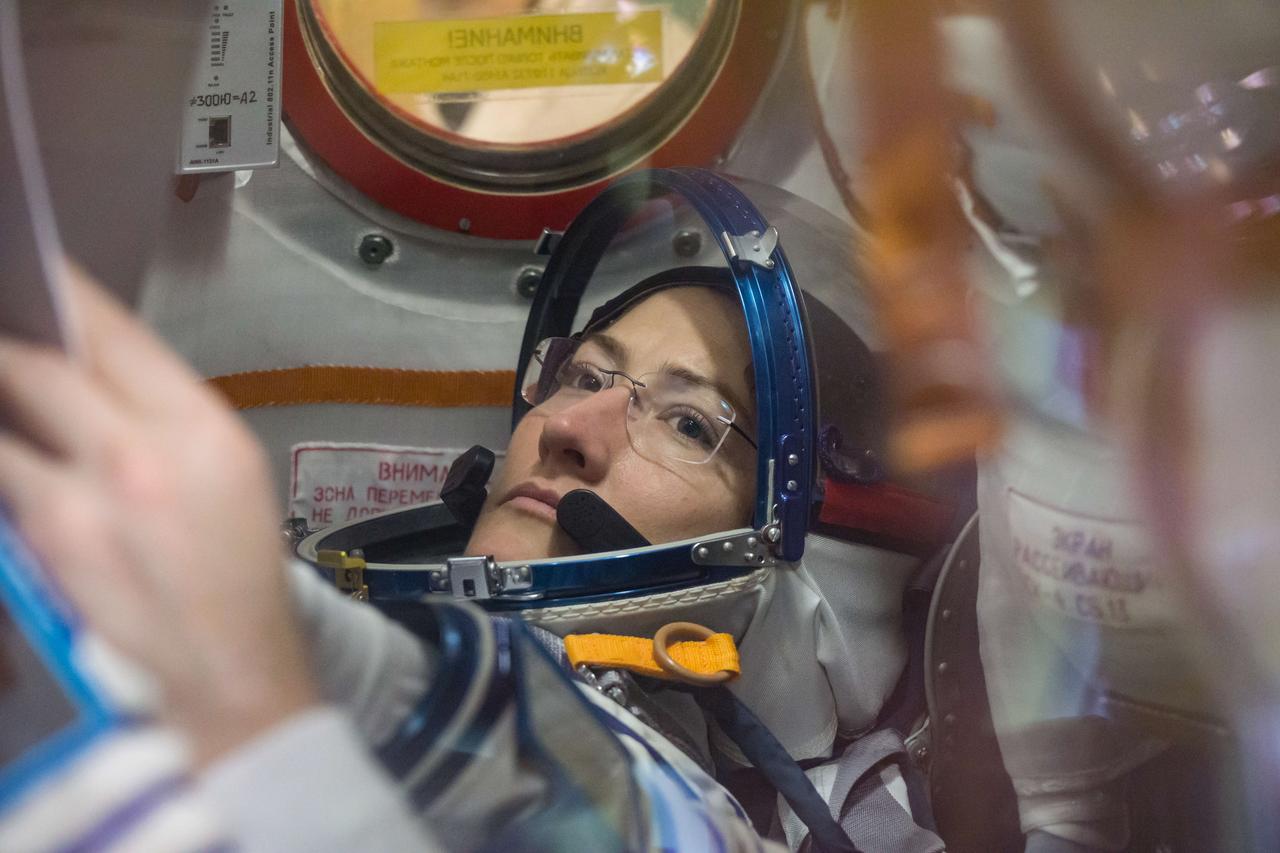
At the Baikonur Cosmodrome in Kazakhstan, Expedition 59 crewmember Christina Koch of NASA works inside the Soyuz MS-12 spacecraft Feb. 27 during pre-launch training. Koch, Alexey Ovchinin of Roscosmos and Nick Hague of NASA (right) will launch March 14, U.S. time, on the Soyuz MS-12 spacecraft from the Baikonur Cosmodrome in Kazakhstan for a six-and-a-half month mission on the International Space Station.  NASA/Victor Zelentsov
jsc2019e009959 - At the Baikonur Cosmodrome in Kazakhstan, Expedition 59 crewmember Christina Koch of NASA works inside the Soyuz MS-12 spacecraft Feb. 27 during pre-launch training. Koch, Alexey Ovchinin of Roscosmos and Nick Hague of NASA (right) will l
At the Baikonur Cosmodrome in Kazakhstan, Expedition 59 crewmember Christina Koch of NASA works inside the Soyuz MS-12 spacecraft Feb. 27 during pre-launch training. Koch, Alexey Ovchinin of Roscosmos and Nick Hague of NASA (right) will launch March 14, U.S. time, on the Soyuz MS-12 spacecraft from the Baikonur Cosmodrome in Kazakhstan for a six-and-a-half month mission on the International Space Station.  NASA/Victor Zelentsov
jsc2019e009943 - At the Baikonur Cosmodrome in Kazakhstan, Expedition 59 crewmember Christina Koch of NASA works inside the Soyuz MS-12 spacecraft Feb. 27 during pre-launch training. Koch, Alexey Ovchinin of Roscosmos and Nick Hague of NASA (right) will l
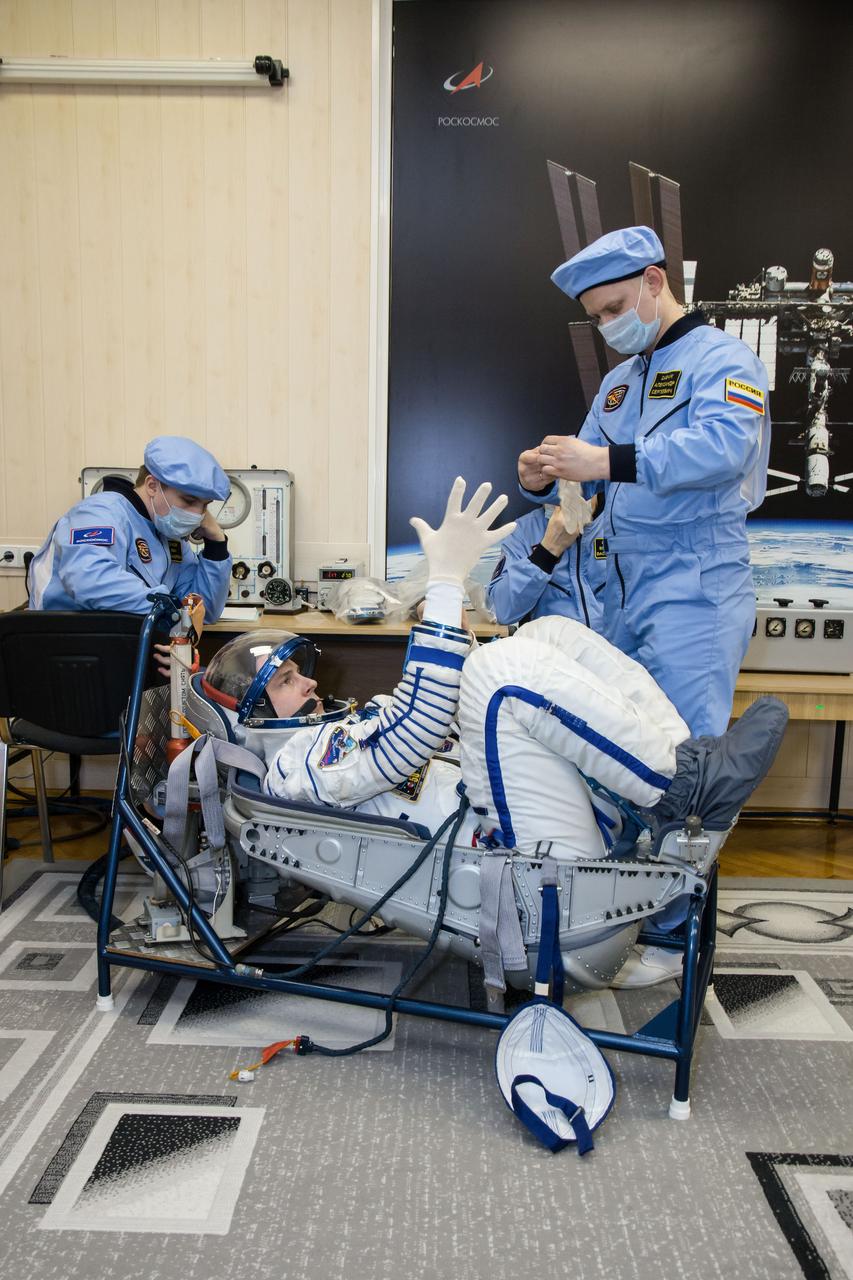
At the Baikonur Cosmodrome in Kazakhstan, Expedition 59 crewmember Nick Hague of NASA suits up for a Soyuz fit check dress rehearsal Feb. 27 during pre-launch training. Hague, Christina Koch of NASA and Alexey Ovchinin of Roscosmos will launch March 14, U.S. time, on the Soyuz MS-12 spacecraft from the Baikonur Cosmodrome in Kazakhstan for a six-and-a-half month mission on the International Space Station.  NASA/Victor Zelentsov
jsc2019e009946 - At the Baikonur Cosmodrome in Kazakhstan, Expedition 59 crewmember Nick Hague of NASA suits up for a Soyuz fit check dress rehearsal Feb. 27 during pre-launch training. Hague, Christina Koch of NASA and Alexey Ovchinin of Roscosmos will l
At the Gagarin Cosmonaut Training Center in Star City, Russia, Expedition 59 crewmember Christina Koch of NASA boards a Soyuz spacecraft simulator Feb. 20 during the second day of final pre-launch qualifications exams. Koch, Nick Hague of NASA and Alexey Ovchinin of Roscosmos will launch March 14, U.S. time, in the Soyuz MS-12 spacecraft from the Baikonur Cosmodrome in Kazakhstan for a six-and-a-half month mission on the International Space Station.  NASA/Beth Weissinger
jsc2019e004058 - At the Gagarin Cosmonaut Training Center in Star City, Russia, Expedition 59 crewmember Christina Koch of NASA boards a Soyuz spacecraft simulator Feb. 20 during the second day of final pre-launch qualifications exams. Koch, Nick Hague of
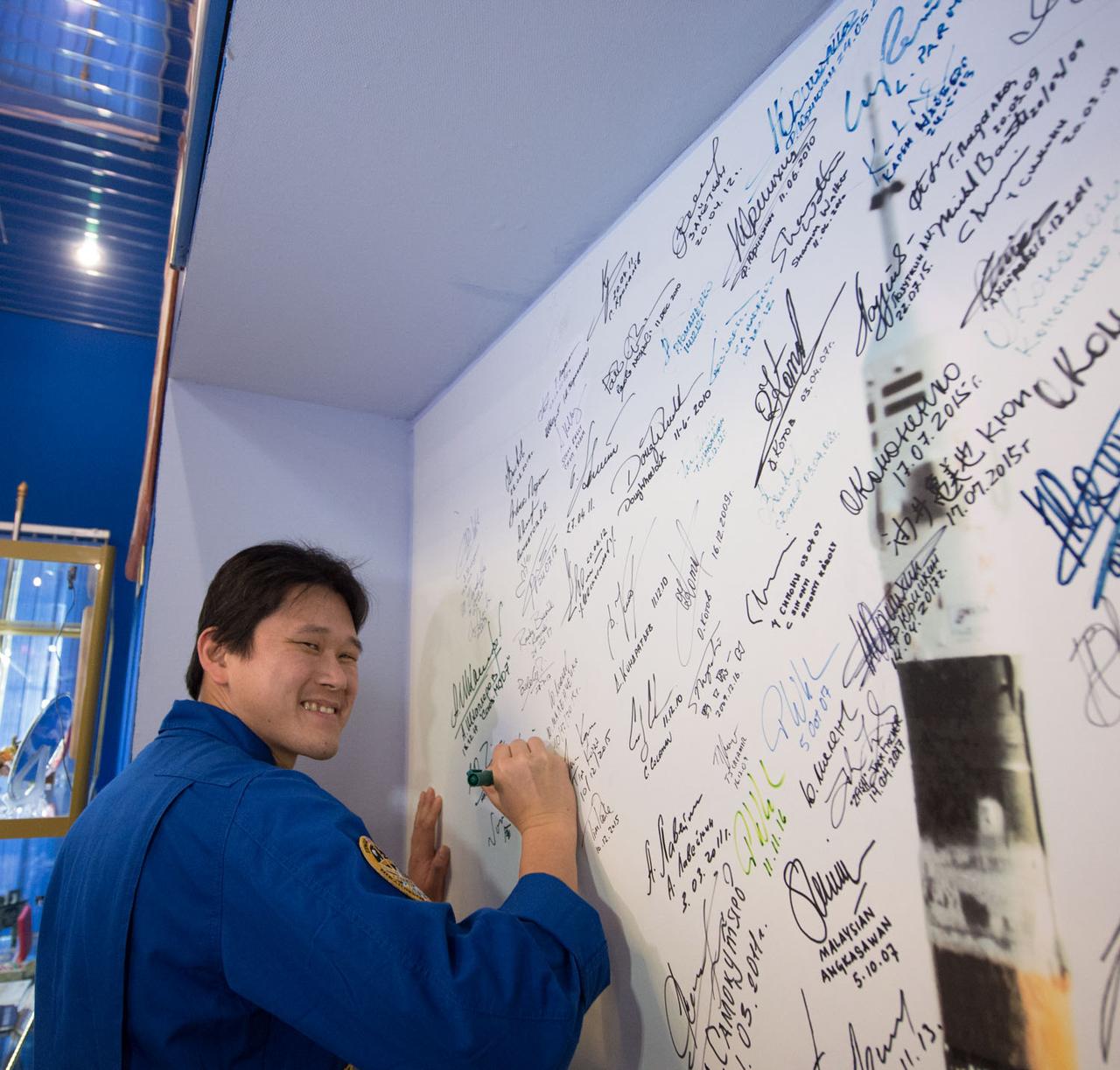
jsc2017e138116 - At the Korolev Museum at the Baikonur Cosmodrome in Kazakhstan, Expedition 54-55 prime crewmember Norishige Kanai of the Japan Aerospace Exploration Agency (JAXA) signs a wall mural Dec. 13 as part of traditional pre-launch ceremonies. Kanai, Scott Tingle of NASA and Anton Shkaplerov of the Russian Federal Space Agency (Roscosmos) will launch Dec. 17 on the Soyuz MS-07 spacecraft for a five month mission on the International Space Station...Andrey Shelepin/Gagarin Cosmonaut Training Center.
jsc2017e138116 - At the Korolev Museum at the Baikonur Cosmodrome in Kazakhstan, Expedition 54-55 prime crewmember Norishige Kanai of the Japan Aerospace Exploration Agency (JAXA) signs a wall mural Dec. 13 as part of traditional pre-launch ceremonies. Ka
At the Gagarin Cosmonaut Training Center in Star City, Russia, Expedition 59 crewmember Christina Koch of NASA listens to a reporter’s question Feb. 21 during a pre-launch news conference. Koch, Nick Hague of NASA and Alexey Ovchinin of Roscosmos will launch March 14, U.S. time, on the Soyuz MS-12 spacecraft from the Baikonur Cosmodrome in Kazakhstan for a six-and-a-half month mission on the International Space Station.  Andrey Shelepin/Gagarin Cosmonaut Training Center
jsc2019e004419 - At the Gagarin Cosmonaut Training Center in Star City, Russia, Expedition 59 crewmember Christina Koch of NASA listens to a reporter’s question Feb. 21 during a pre-launch news conference. Koch, Nick Hague of NASA and Alexey Ovchinin of
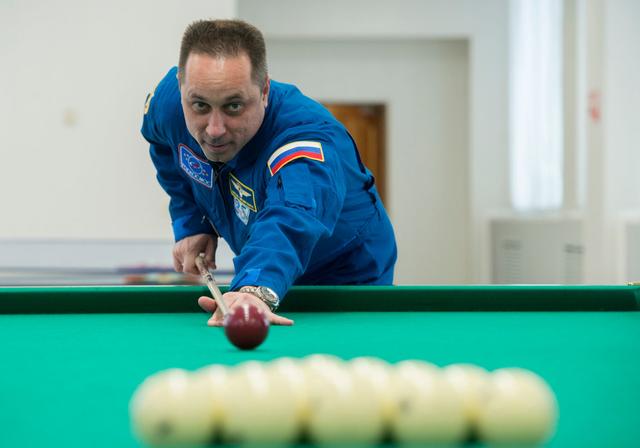
jsc2017e137344 - At the Cosmonaut Hotel crew quarters in Baikonur, Kazakhstan, Expedition 54-55 prime crewmember Anton Shkaplerov of the Russian Federal Space Agency (Roscosmos) tries his hand at a game of billiards Dec. 11 during a break in pre-launch training. Shkaplerov, Scott Tingle of NASA and Norishige Kanai of the Japan Aerospace Exploration Agency (JAXA) will launch Dec. 17 on the Soyuz MS-07 spacecraft from the Baikonur Cosmodrome for a five month mission on the International Space Station...Andrey Shelepin / Gagarin Cosmonaut Training Center.
jsc2017e137344 - At the Cosmonaut Hotel crew quarters in Baikonur, Kazakhstan, Expedition 54-55 prime crewmember Anton Shkaplerov of the Russian Federal Space Agency (Roscosmos) tries his hand at a game of billiards Dec. 11 during a break in pre-launch tr
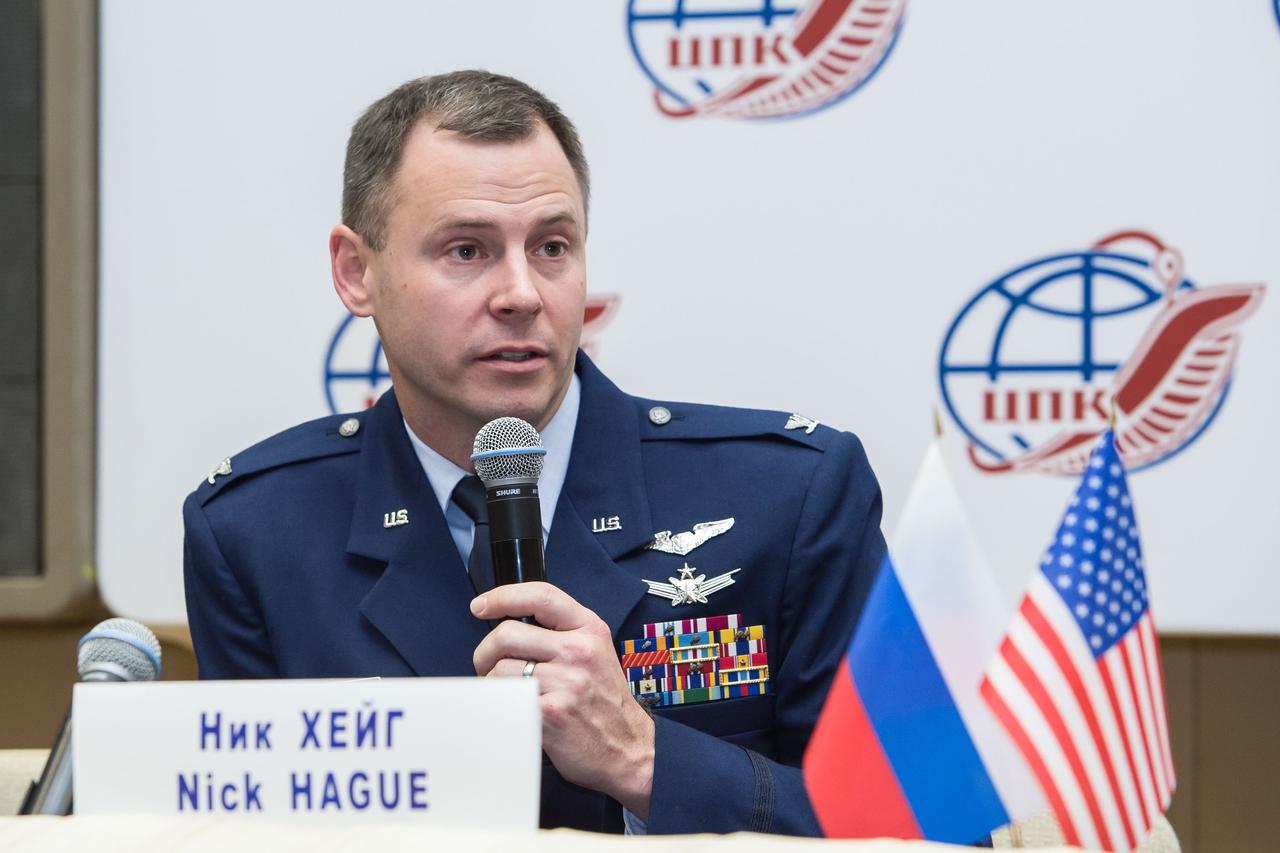
At the Gagarin Cosmonaut Training Center in Star City, Russia, Expedition 59 crewmember Nick Hague of NASA answers a reporter’s question Feb. 21 during a pre-launch news conference. Hague, Christina Koch of NASA and Alexey Ovchinin of Roscosmos will launch March 14, U.S. time, on the Soyuz MS-12 spacecraft from the Baikonur Cosmodrome in Kazakhstan for a six-and-a-half month mission on the International Space Station.  Andrey Shelepin/Gagarin Cosmonaut Training Center
jsc2019e004418 - At the Gagarin Cosmonaut Training Center in Star City, Russia, Expedition 59 crewmember Nick Hague of NASA answers a reporter’s question Feb. 21 during a pre-launch news conference. Hague, Christina Koch of NASA and Alexey Ovchinin of R
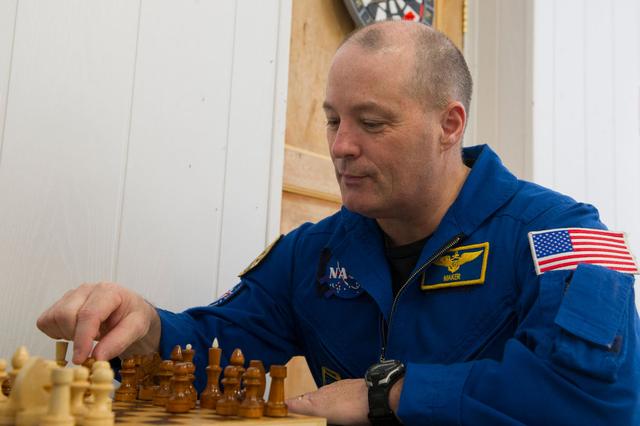
jsc2017e137337 - At the Cosmonaut Hotel crew quarters in Baikonur, Kazakhstan, Expedition 54-55 prime crewmember Scott Tingle of NASA plays a game of chess Dec. 11 during a break in his pre-launch training. Tingle, Norishige Kanai of the Japan Aerospace Exploration Agency (JAXA) and Anton Shkaplerov of the Russian Federal Space Agency (Roscosmos) will launch Dec. 17 on the Soyuz MS-07 spacecraft from the Baikonur Cosmodrome for a five month mission on the International Space Station...Andrey Shelepin / Gagarin Cosmonaut Training Center.
jsc2017e137337 - At the Cosmonaut Hotel crew quarters in Baikonur, Kazakhstan, Expedition 54-55 prime crewmember Scott Tingle of NASA plays a game of chess Dec. 11 during a break in his pre-launch training. Tingle, Norishige Kanai of the Japan Aerospace E
Inside the Kremlin in Moscow, Expedition 59 crewmembers Nick Hague of NASA (left), Alexey Ovchinin of Roscosmos (center) and Christina Koch of NASA (right) pose for pictures on a wintry day Feb. 21 as part of their pre-launch activities. They will launch March 14, U.S. time, on the Soyuz MS-12 spacecraft from the Baikonur Cosmodrome in Kazakhstan for a six-and-a-half month mission on the International Space Station.  Andrey Shelepin/Gagarin Cosmonaut Training Center
jsc2019e004437 - Inside the Kremlin in Moscow, Expedition 59 crewmembers Nick Hague of NASA (left), Alexey Ovchinin of Roscosmos (center) and Christina Koch of NASA (right) pose for pictures on a wintry day Feb. 21 as part of their pre-launch activities.
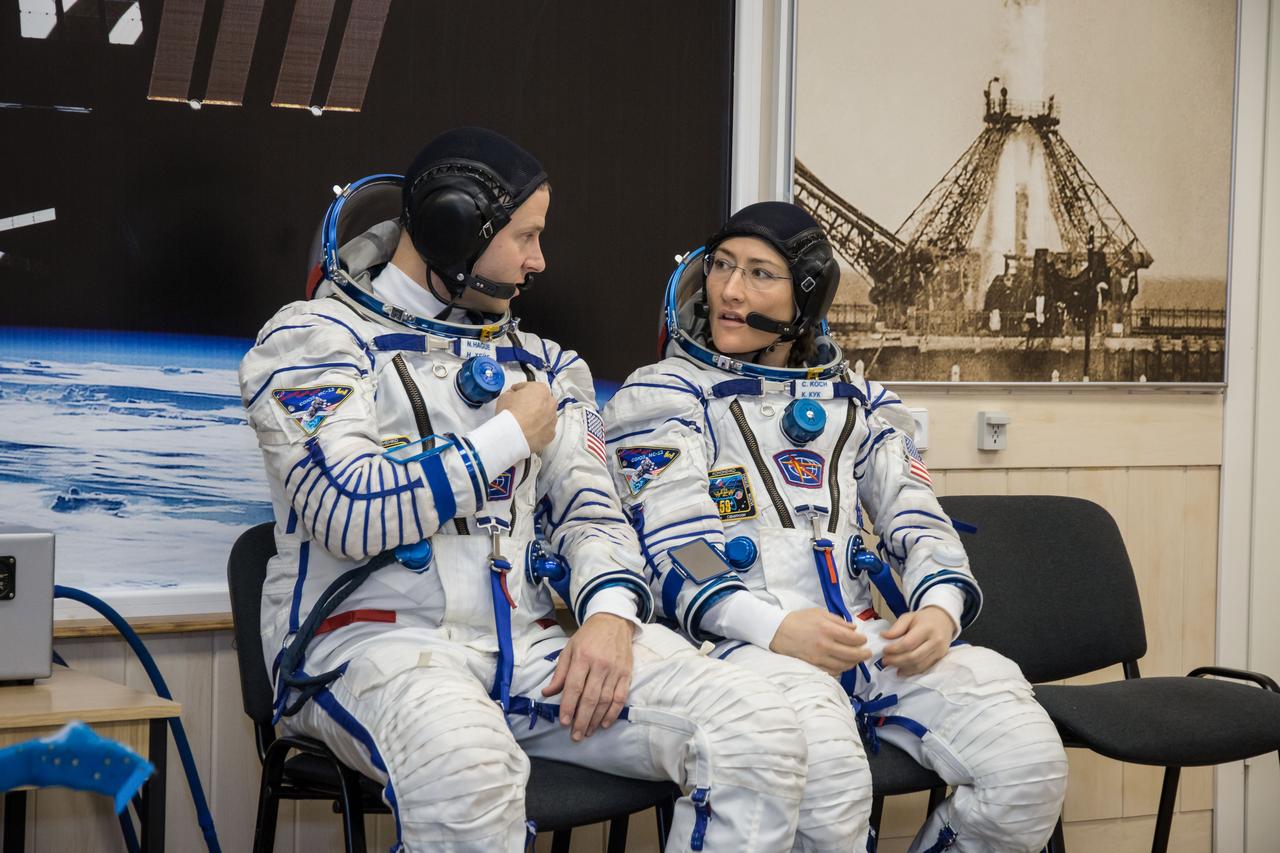
At the Baikonur Cosmodrome in Kazakhstan, Expedition 59 crewmembers Nick Hague (left) and Christina Koch (right) of NASA discuss procedures Feb. 27 during a Soyuz fit check dress rehearsal that is part of pre-launch training. Hague, Koch and Alexey Ovchinin of Roscosmos will launch March 14, U.S. time, on the Soyuz MS-12 spacecraft from the Baikonur Cosmodrome in Kazakhstan for a six-and-a-half month mission on the International Space Station.  NASA/Victor Zelentsov
jsc2019e009948 - At the Baikonur Cosmodrome in Kazakhstan, Expedition 59 crewmembers Nick Hague (left) and Christina Koch (right) of NASA discuss procedures Feb. 27 during a Soyuz fit check dress rehearsal that is part of pre-launch training. Hague, Koch
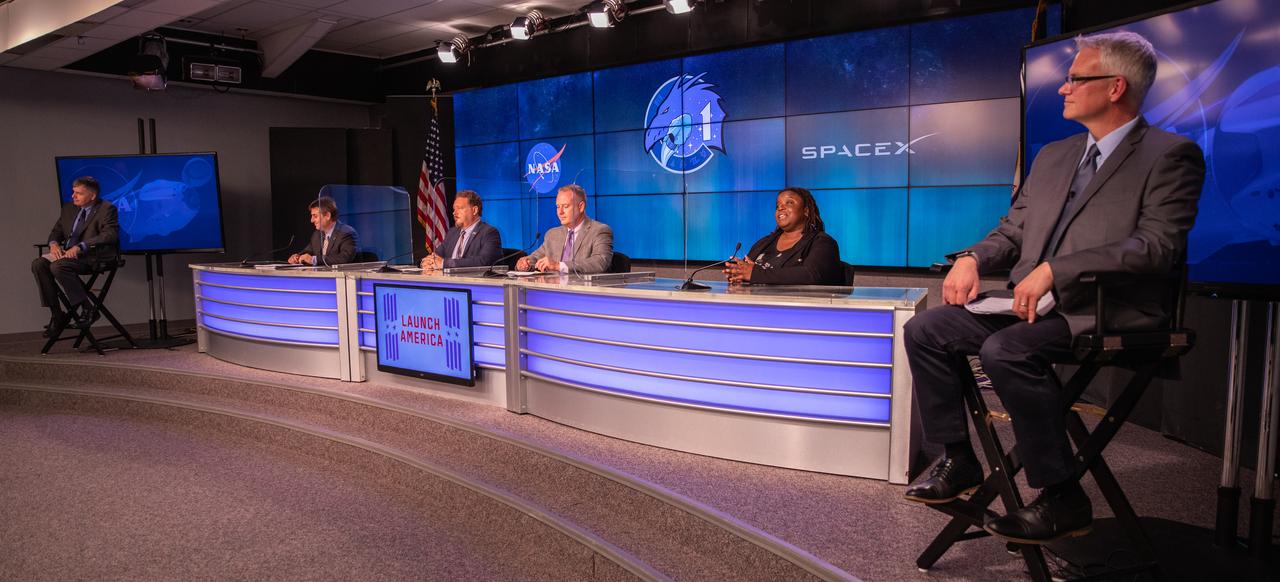
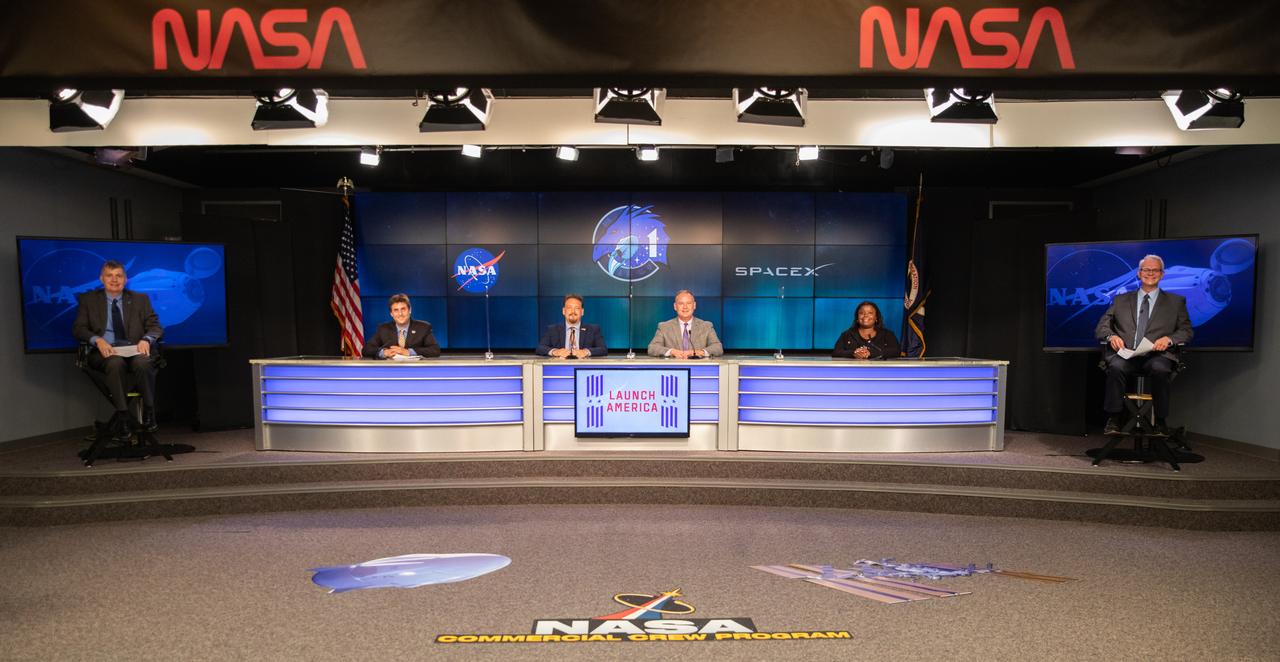
Inside the Press Site auditorium at NASA’s Kennedy Space Center in Florida, NASA and industry leaders conduct a virtual prelaunch news conference Nov. 13, 2020, ahead of the agency’s SpaceX Crew-1 mission. From left are Steve Stich, manager, Commercial Crew Program, Kennedy Space Center; Joel Montalbano, manager, International Space Station, Johnson Space Center; Kirt Costello, chief scientist, International Space Station Program, Johnson; Norm Knight, deputy manager, Flight Operations Directorate, Johnson; Arlena Moses, launch weather officer, U.S. Air Force 45th Weather Squadron; and Benji Reed, senior director, Human Spaceflight Programs, SpaceX. Crew-1 is the first regular crew mission of a U.S. commercial spacecraft with astronauts to the International Space Station as part of NASA’s Commercial Crew Program. The SpaceX Crew Dragon Resilience capsule will launch atop the company’s Falcon 9 rocket from Launch Complex 39A to the space station for a six-month science mission.
SpaceX Crew-1 Pre-Launch Briefing
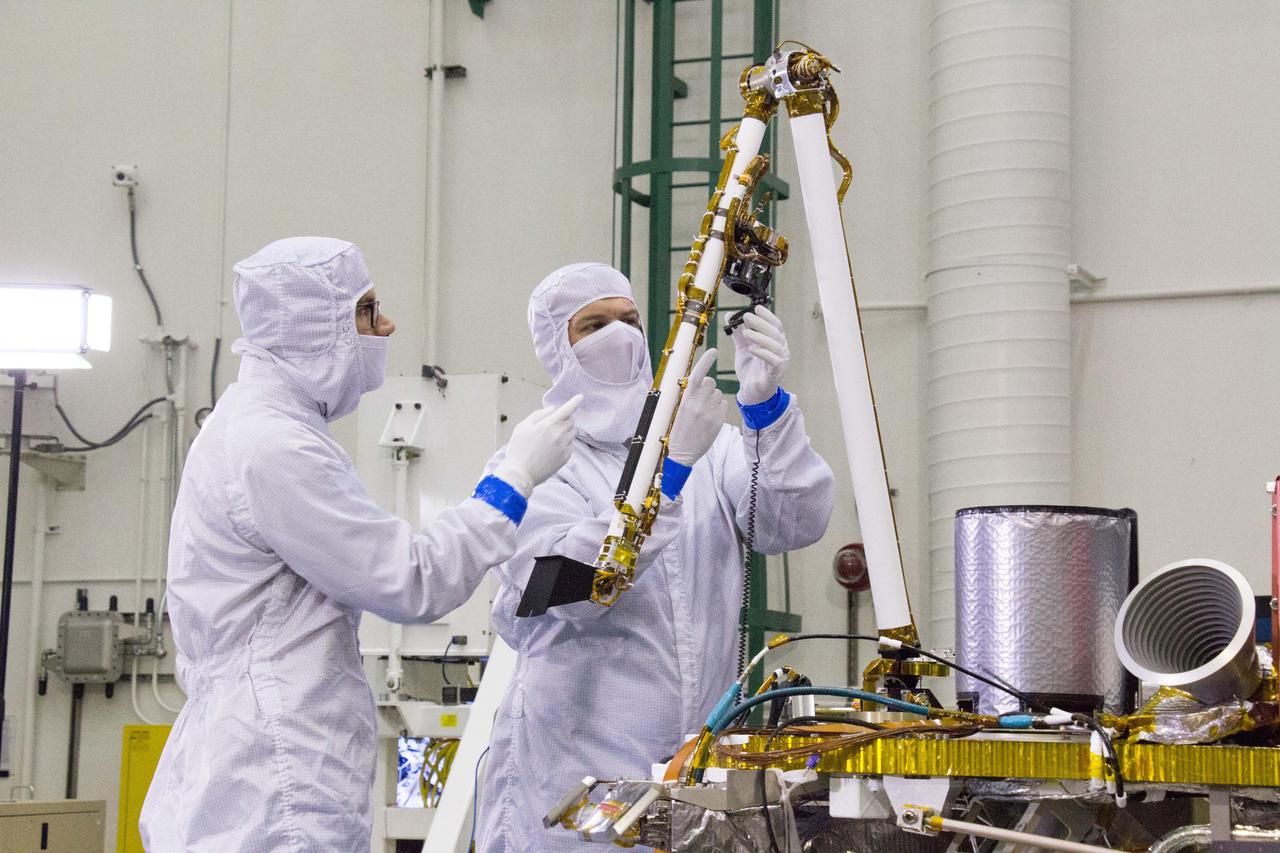
Engineers at Lockheed Martin Space, Denver, Colorado, test the robotic arm on NASA's InSight lander several months before launch.  https://photojournal.jpl.nasa.gov/catalog/PIA22741
Pre-Launch Testing of InSight's Robotic Arm
Karen Fox of NASA Communications moderates a prelaunch mission briefing for NASA’s Ionospheric Connection Explorer (ICON), on Oct. 8, 2019, in the News Center auditorium at the agency’s Kennedy Space Center in Florida. ICON is targeted to launch from Cape Canaveral Air Force Station in Florida on Oct. 9, 2019, aboard a Northrop Grumman Pegasus XL rocket carried aloft by the company’s Stargazer L-1011 aircraft. The explorer will study the frontier of space - the dynamic zone high in Earth's atmosphere where terrestrial weather from below meets space weather above.
Pegasus ICON Pre-Launch Mission Briefing
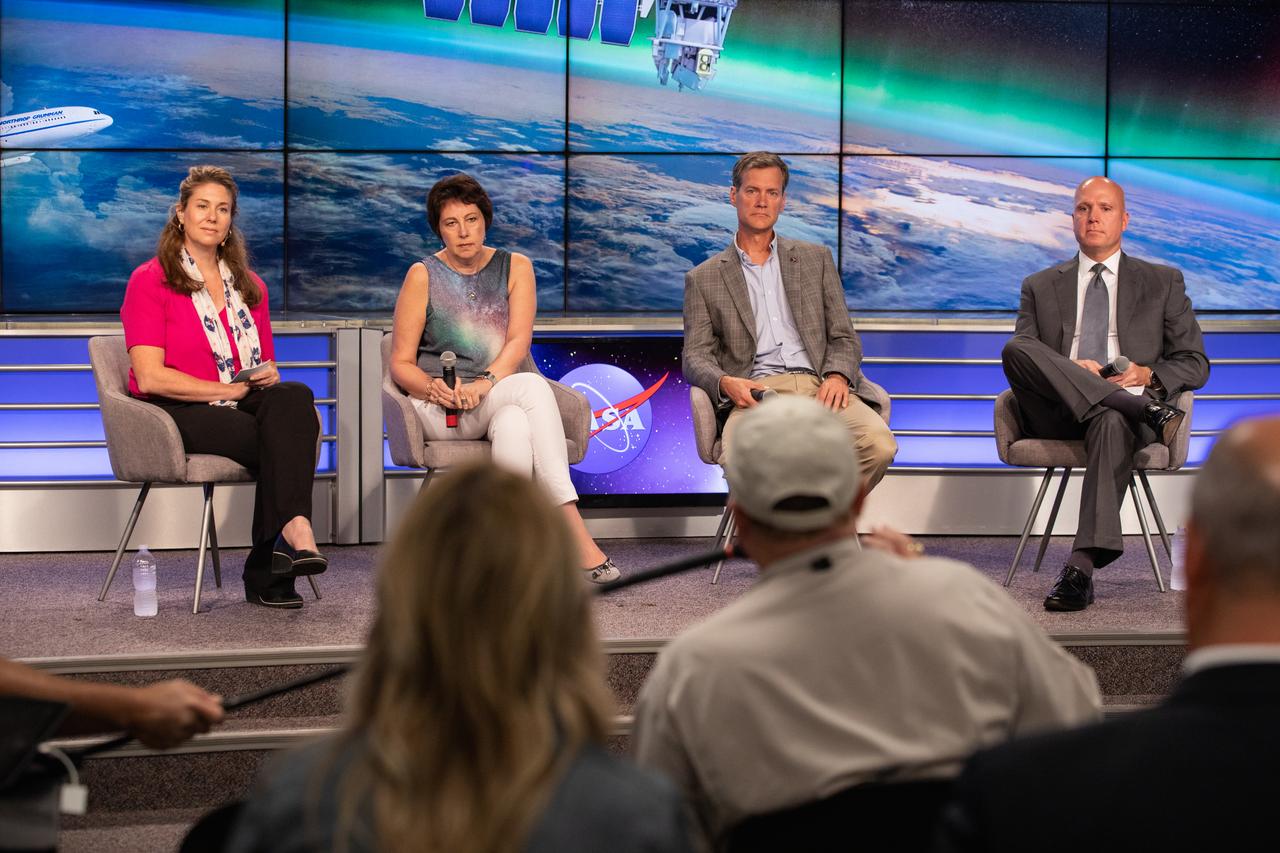
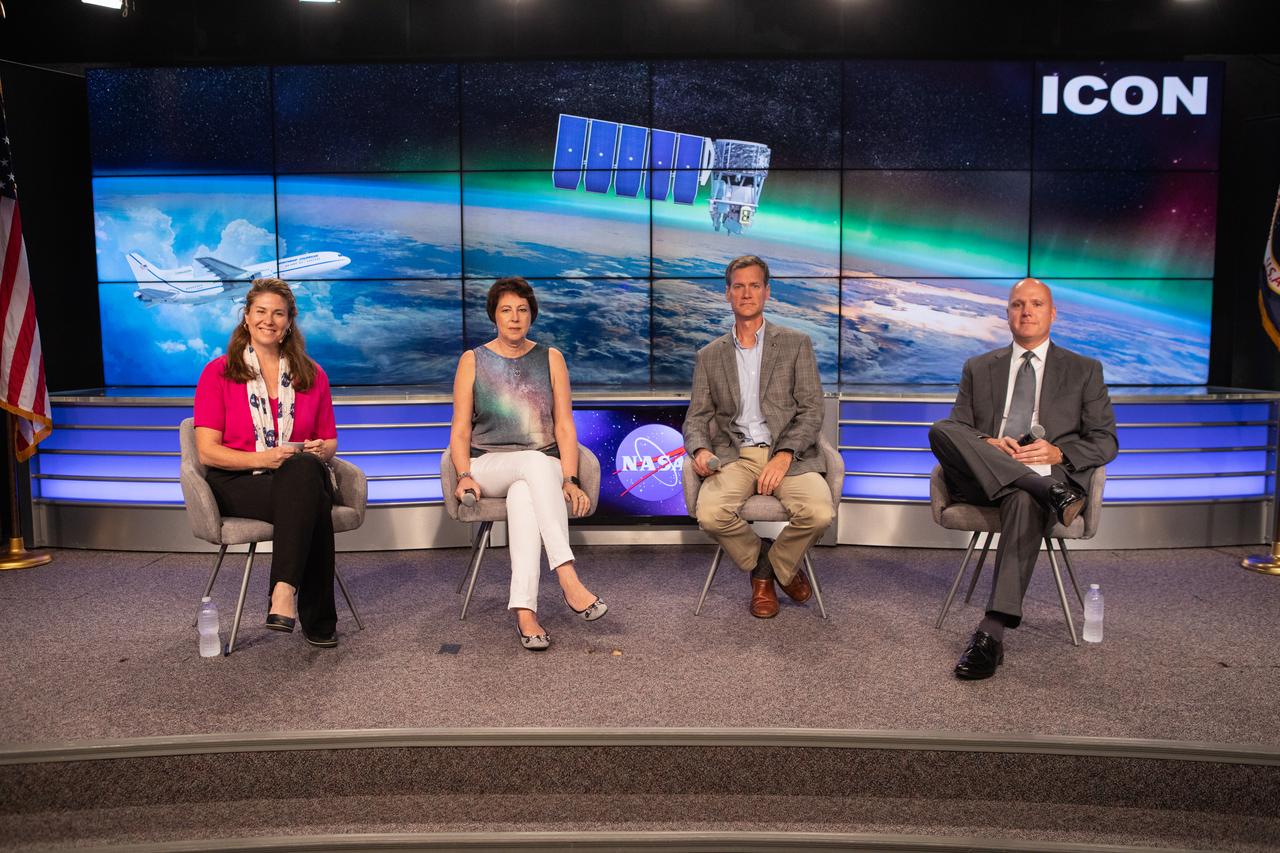
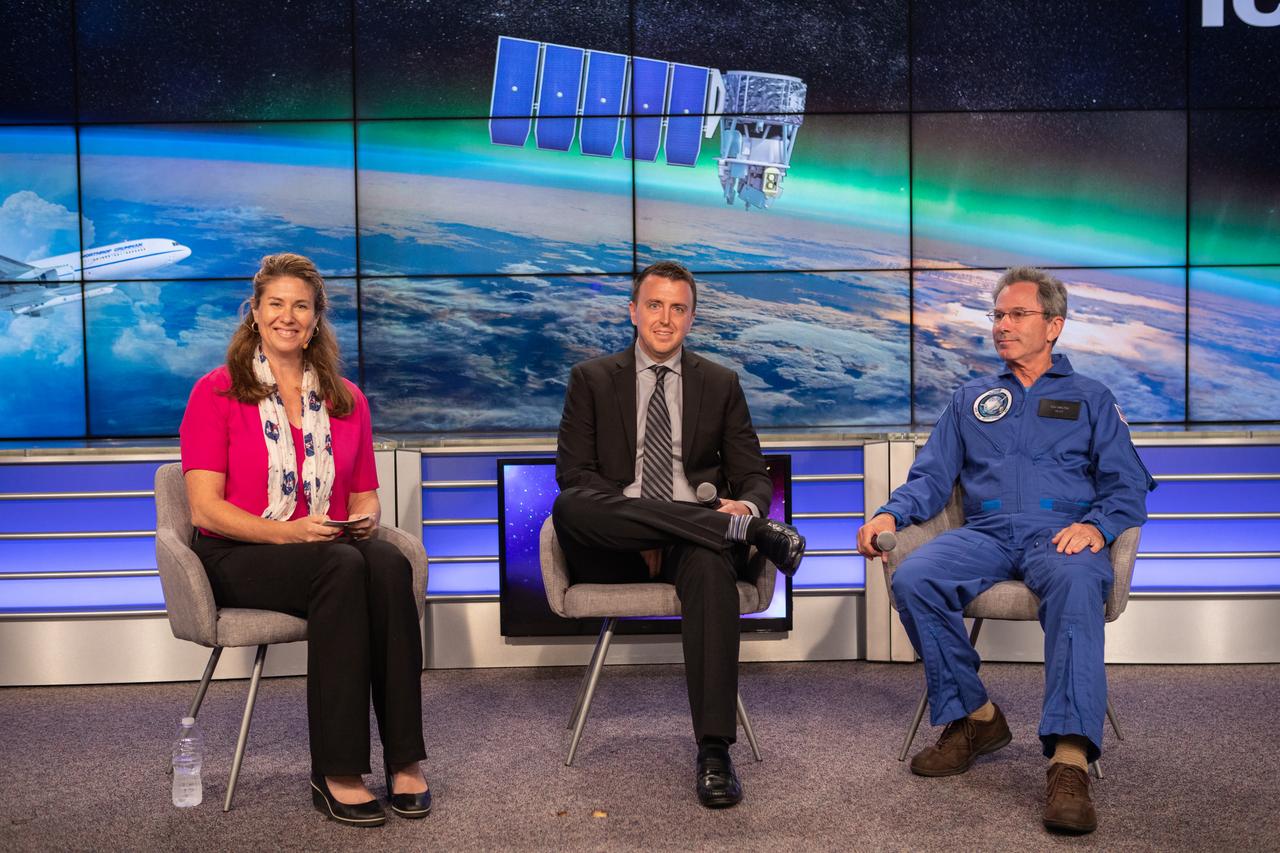
Launch and mission managers for NASA’s Ionospheric Connection Explorer (ICON) participate in a prelaunch mission briefing on Oct. 8, 2019, in the News Center auditorium at the agency’s Kennedy Space Center in Florida. From left to right are Karen Fox, NASA Communications; Nicola Fox, Heliophysics division director in NASA’s Science Mission Directorate; Thomas Immel, ICON principal investigator at the Space Sciences Laboratory at the University of California Berkeley; and Steve Krein, vice president of civil and commercial space for Northrop Grumman Innovation Systems. ICON is targeted to launch from Cape Canaveral Air Force Station in Florida on Oct. 9, 2019, aboard a Northrop Grumman Pegasus XL rocket carried aloft by the company’s Stargazer L-1011 aircraft. The explorer will study the frontier of space - the dynamic zone high in Earth's atmosphere where terrestrial weather from below meets space weather above.
Pegasus ICON Pre-Launch Mission Briefing
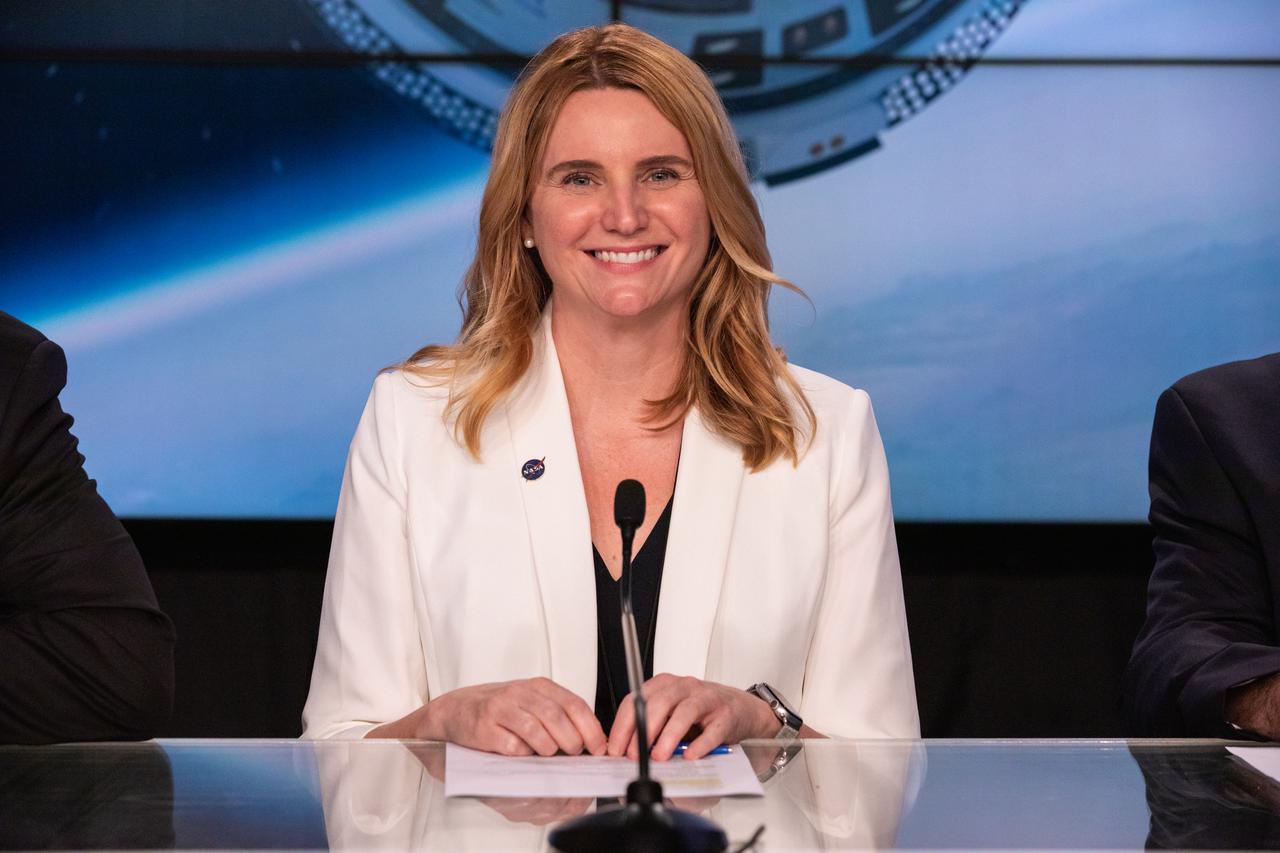
Jennifer Buchli, deputy chief scientist, NASA’s International Space Station Program, participates in a prelaunch briefing for Boeing’s Orbital Flight Test-2 (OFT-2) at the agency’s Kennedy Space Center in Florida, July 27, 2021. Boeing’s CST-100 Starliner spacecraft will launch atop a United Launch Alliance Atlas V rocket from Space Launch Complex-41 at Cape Canaveral Space Force Station. The uncrewed OFT-2 will be the Starliner’s second flight for NASA’s Commercial Crew Program.
Boeing OFT-2 Pre-Launch Briefing
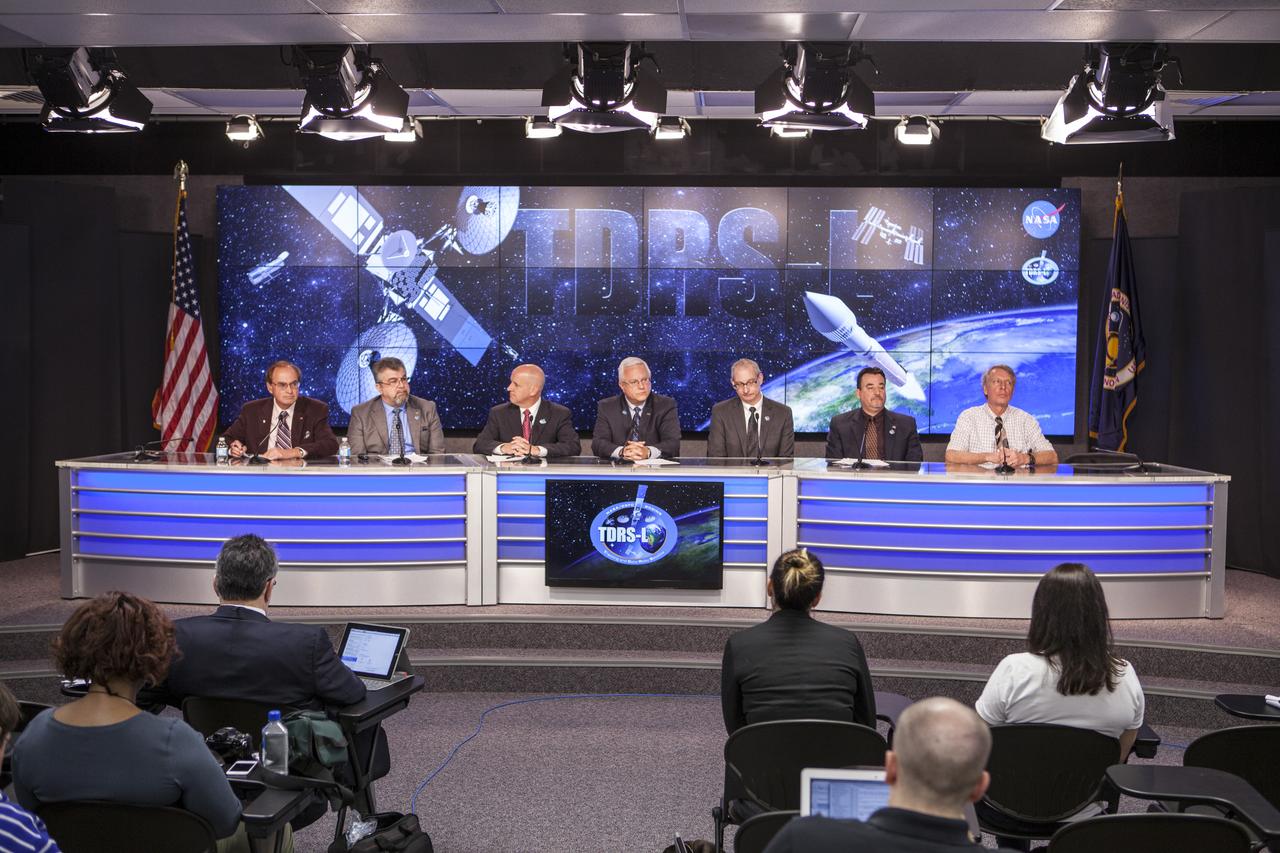
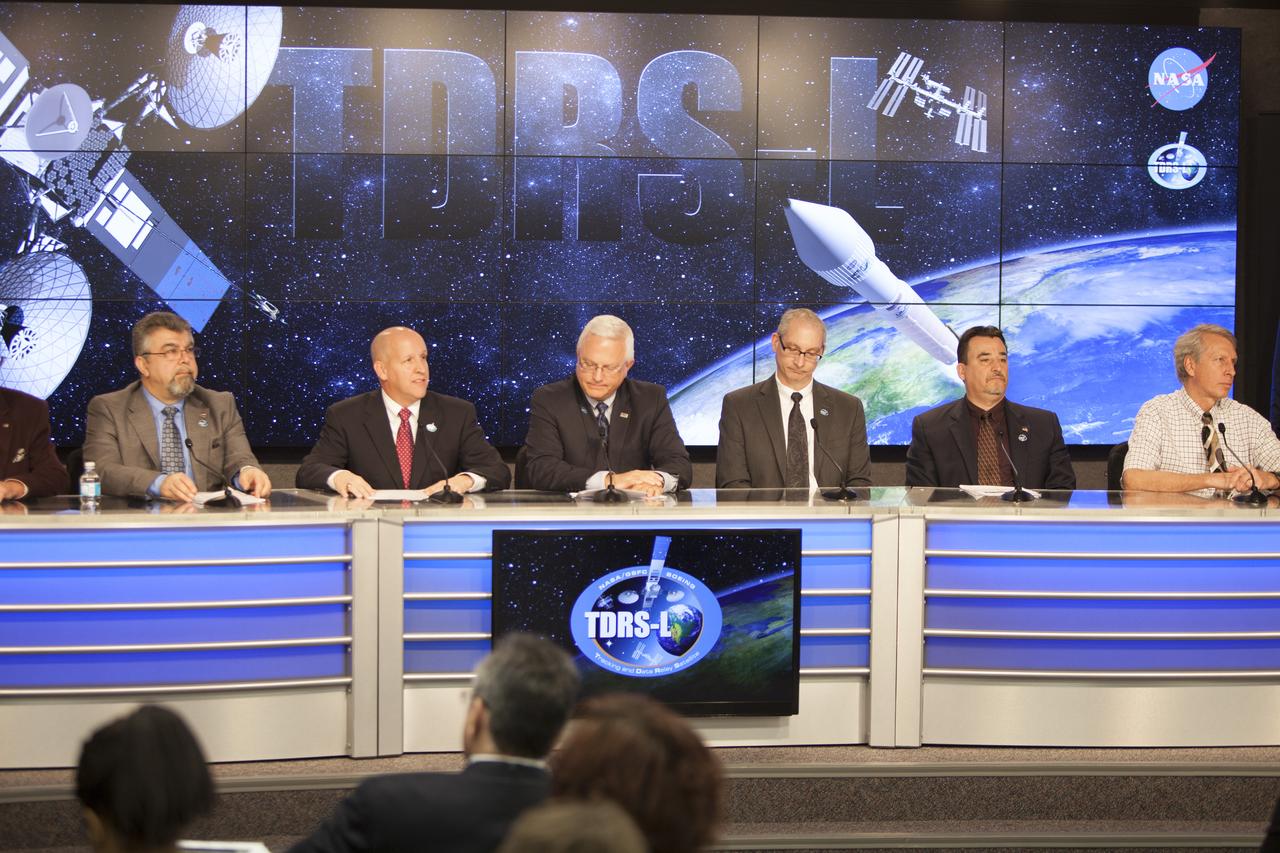
CAPE CANAVERAL, Fla. –During a news conference at NASA's Kennedy Space Center in Florida, agency and contractor officials discussed preparations for the launch of NASA's Tracking and Data Relay Satellite, or TDRS-L, spacecraft. Participating in the briefing, from the left, are George Diller of NASA Public Affairs, Badri Younes, deputy associate administrator, Space Communications and Navigation SCaN NASA Human Exploration and Operations Mission Directorate at NASA Headquarters in Washington D.C., Tim Dunn, NASA launch director at Kennedy, Vernon Thorp, program manager for NASA Missions with United Launch Alliance in Denver, Colo., Jeffrey Gramling, NASA's TDRS-L project manager at the Goddard Space Flight Center in Greenbelt, Md., Andy Kopito, Civil Space Programs director for Boeing Space & Intelligence Systems in El Segundo, Calif., and Clay Flinn, launch weather officer for the 45th Weather Squadron at Cape Canaveral Air Force Station, Fla. The TDRS-L spacecraft is the second of three new satellites designed to ensure vital operational continuity for NASA by expanding the lifespan of the Tracking and Data Relay Satellite System TDRSS fleet, which consists of eight satellites in geosynchronous orbit. The spacecraft provide tracking, telemetry, command and high bandwidth data return services for numerous science and human exploration missions orbiting Earth. These include NASA's Hubble Space Telescope and the International Space Station. TDRS-L has a high-performance solar panel designed for more spacecraft power to meet the growing S-band communications requirements. TDRSS is one of NASA Space Communication and Navigation’s SCaN three networks providing space communications to NASA’s missions. For more information more about TDRS-L, visit: http://www.nasa.gov/tdrs To learn more about SCaN, visit: www.nasa.gov/scan Photo credit: NASA/Frankie Martin
TDRS-L Pre-Launch Press Conference
Omar Baez, launch director in NASA’s Launch Services Program, speaks to news media during a prelaunch mission briefing for NASA’s Ionospheric Connection Explorer (ICON), on Oct. 8, 2019, in the News Center auditorium at the agency’s Kennedy Space Center in Florida. At left is Karen Fox of NASA Communications. ICON is targeted to launch from Cape Canaveral Air Force Station in Florida on Oct. 9, 2019, aboard a Northrop Grumman Pegasus XL rocket carried aloft by the company’s Stargazer L-1011 aircraft. The explorer will study the frontier of space - the dynamic zone high in Earth's atmosphere where terrestrial weather from below meets space weather above.
Pegasus ICON Pre-Launch Mission Briefing
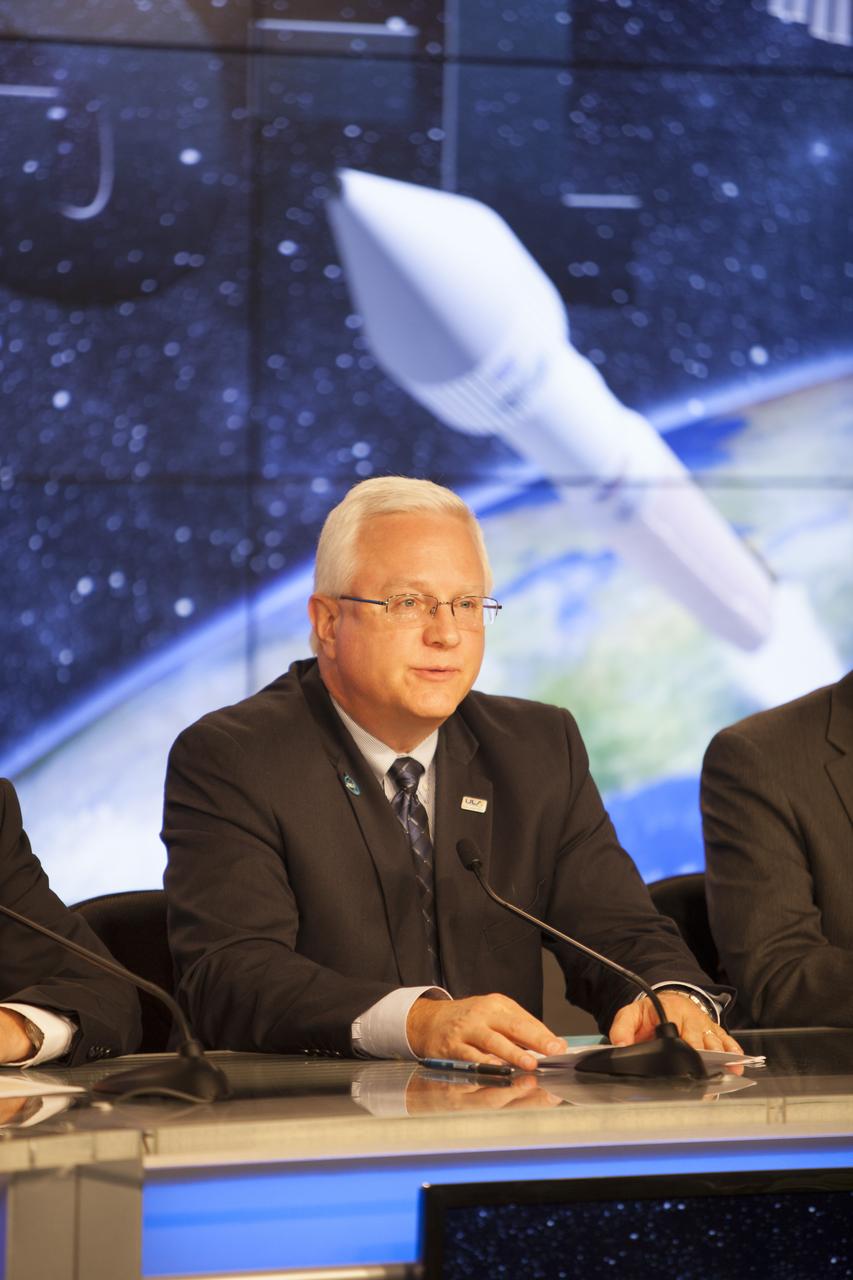
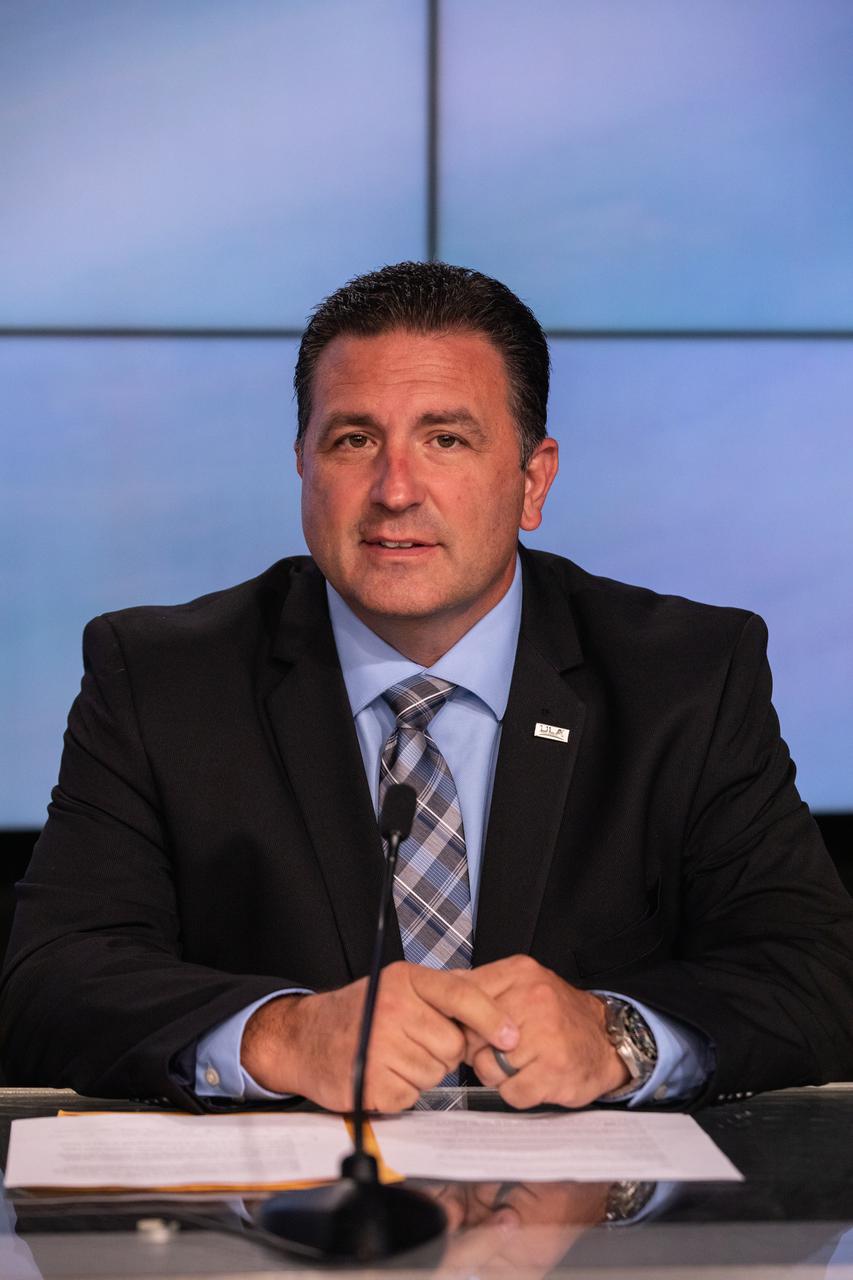
Gary Wentz, vice president, Government and Commercial Programs, United Launch Alliance (ULA), participates in a prelaunch briefing for Boeing’s Orbital Flight Test-2 (OFT-2) at the agency’s Kennedy Space Center in Florida, July 27, 2021. Boeing’s CST-100 Starliner spacecraft will launch atop a ULA Atlas V rocket from Space Launch Complex-41 at Cape Canaveral Space Force Station on a mission to dock with the space station. The uncrewed OFT-2 will be the Starliner’s second flight for NASA’s Commercial Crew Program.
Boeing OFT-2 Pre-Launch Briefing
Will Ulrich, launch weather officer, U.S. Space Force, 45th Weather Squadron, participates in a prelaunch briefing for Boeing’s Orbital Flight Test-2 (OFT-2) at the agency’s Kennedy Space Center in Florida, July 27, 2021. Boeing’s CST-100 Starliner spacecraft will launch atop a United Launch Alliance Atlas V rocket from Space Launch Complex-41 at Cape Canaveral Space Force Station. The uncrewed OFT-2 will be the Starliner’s second flight NASA’s Commercial Crew Program.
Boeing OFT-2 Pre-Launch Briefing
Steve Krein, vice president of civil and commercial space for Northrop Grumman Innovation Systems, speaks to news media during a prelaunch mission briefing for NASA’s Ionospheric Connection Explorer (ICON), on Oct. 8, 2019, in the News Center auditorium at the agency’s Kennedy Space Center in Florida. ICON is targeted to launch from Cape Canaveral Air Force Station in Florida on Oct. 9, 2019, aboard a Northrop Grumman Pegasus XL rocket carried aloft by the company’s Stargazer L-1011 aircraft. The explorer will study the frontier of space - the dynamic zone high in Earth's atmosphere where terrestrial weather from below meets space weather above.
Pegasus ICON Pre-Launch Mission Briefing
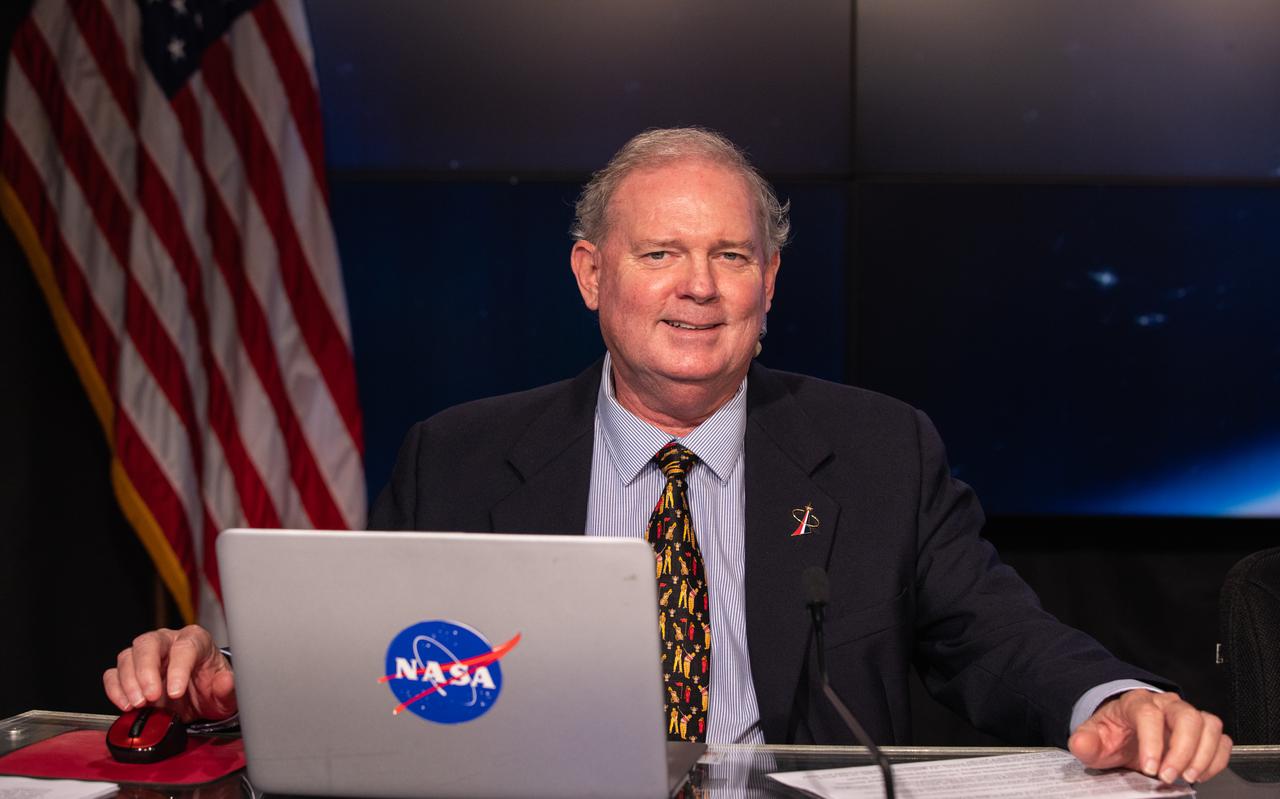
Steve Stich, manager, Commercial Crew Program, Kennedy Space Center, answers questions during a virtual prelaunch news conference Nov. 13, 2020, inside the Press Site auditorium at NASA’s Kennedy Space Center in Florida ahead of the agency’s SpaceX Crew-1 launch. Crew-1 is the first regular crew mission of a U.S. commercial spacecraft with astronauts to the International Space Station as part of NASA’s Commercial Crew Program. The SpaceX Crew Dragon Resilience capsule will launch atop the company’s Falcon 9 rocket from Launch Complex 39A to the space station for a six-month science mission.
SpaceX Crew-1 Pre-Launch Briefing
Benji Reed, senior director, Human Spaceflight Programs, SpaceX, answers questions during a virtual prelaunch news conference Nov. 13, 2020, inside the Press Site auditorium at NASA’s Kennedy Space Center in Florida ahead of the agency’s SpaceX Crew-1 launch. Crew-1 is the first regular crew mission of a U.S. commercial spacecraft with astronauts to the International Space Station as part of NASA’s Commercial Crew Program. The SpaceX Crew Dragon Resilience capsule will launch atop the company’s Falcon 9 rocket from Launch Complex 39A to the space station for a six-month science mission.
SpaceX Crew-1 Pre-Launch Briefing
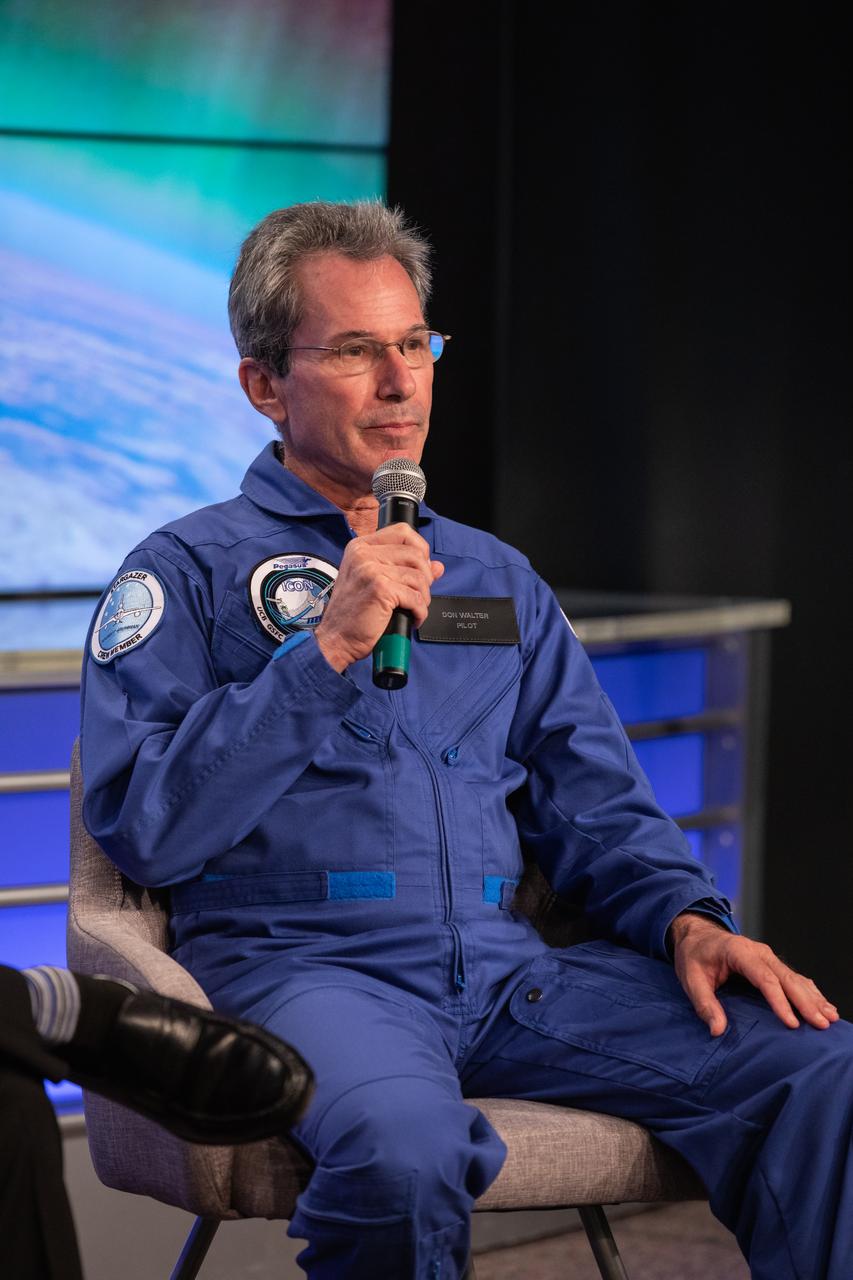
Don Walters, chief pilot of the L-1011 Stargazer aircraft for Northrop Grumman Innovation Systems, speaks to news media during a prelaunch mission briefing for NASA’s Ionospheric Connection Explorer (ICON), on Oct. 8, 2019, in the News Center auditorium at the agency’s Kennedy Space Center in Florida. ICON is targeted to launch from Cape Canaveral Air Force Station in Florida on Oct. 9, 2019, aboard a Northrop Grumman Pegasus XL rocket carried aloft by the company’s Stargazer L-1011 aircraft. The explorer will study the frontier of space - the dynamic zone high in Earth's atmosphere where terrestrial weather from below meets space weather above.
Pegasus ICON Pre-Launch Mission Briefing
Steve Stich, manager, NASA’s Commercial Crew Program, participates in a prelaunch briefing for Boeing’s Orbital Flight Test-2 (OFT-2) at the agency’s Kennedy Space Center in Florida, July 27, 2021. Boeing’s CST-100 Starliner spacecraft will launch atop a United Launch Alliance Atlas V rocket from Space Launch Complex-41 at Cape Canaveral Space Force Station. The uncrewed OFT-2 will be the Starliner’s second flight for NASA’s Commercial Crew Program.
Boeing OFT-2 Pre-Launch Briefing
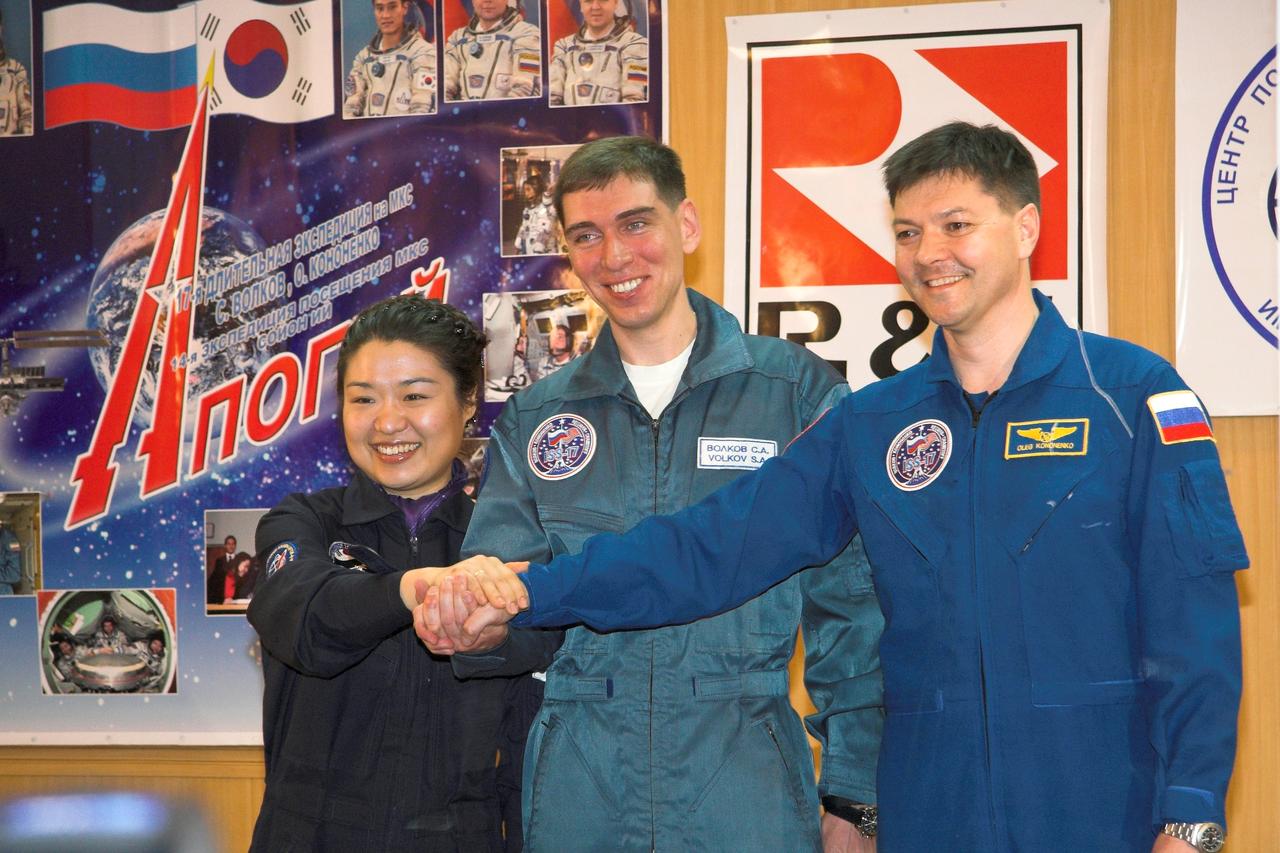
JSC2008-E-032248 (7 April 2008) --- At their crew quarters in Baikonur, Kazakhstan, Expedition 17 Commander Sergei Volkov (center), Flight Engineer Oleg Kononenko (right) and South Korean spaceflight participant So-yeon Yi clasp hands for photographers on April 7, 2008, the eve of their launch to the International Space Station. Volkov, Kononenko and Yi are scheduled to launch to the station on the Soyuz TMA-12 spacecraft from the Baikonur Cosmodrome on April 8 and arrive at the ISS on April 10 to begin what will be six months in space for Volkov and Kononenko. Yi will be in space nine days on the complex, returning to Earth with two of the Expedition 16 crewmembers currently on the station. Photo Credit: NASA /Victor Zelentsov
Expedition 17 Pre-launch Images from Kazakhstan
Kirt Costello, chief scientist, International Space Station Program, Johnson Space Center, answers questions during a virtual prelaunch news conference Nov. 13, 2020, inside the Press Site auditorium at NASA’s Kennedy Space Center in Florida ahead of the agency’s SpaceX Crew-1 launch. Crew-1 is the first regular crew mission of a U.S. commercial spacecraft with astronauts to the International Space Station as part of NASA’s Commercial Crew Program. The SpaceX Crew Dragon Resilience capsule will launch atop the company’s Falcon 9 rocket from Launch Complex 39A to the space station for a six-month science mission.
SpaceX Crew-1 Pre-Launch Briefing
Nicola Fox, Heliophysics division director in NASA’s Science Mission Directorate, speaks to news media during a prelaunch mission briefing for NASA’s Ionospheric Connection Explorer (ICON), on Oct. 8, 2019, in the News Center auditorium at the agency’s Kennedy Space Center in Florida. ICON is targeted to launch from Cape Canaveral Air Force Station in Florida on Oct. 9, 2019, aboard a Northrop Grumman Pegasus XL rocket carried aloft by the company’s Stargazer L-1011 aircraft. The explorer will study the frontier of space - the dynamic zone high in Earth's atmosphere where terrestrial weather from below meets space weather above.
Pegasus ICON Pre-Launch Mission Briefing
CAPE CANAVERAL, Fla. – During a news conference at NASA's Kennedy Space Center in Florida, agency and contractor officials discussed preparations for the launch of NASA's Tracking and Data Relay Satellite, or TDRS-L, spacecraft. Participants included Andy Kopito, Civil Space Programs director for Boeing Space & Intelligence Systems in El Segundo, Calif. The TDRS-L spacecraft is the second of three new satellites designed to ensure vital operational continuity for NASA by expanding the lifespan of the Tracking and Data Relay Satellite System TDRSS fleet, which consists of eight satellites in geosynchronous orbit. The spacecraft provide tracking, telemetry, command and high bandwidth data return services for numerous science and human exploration missions orbiting Earth. These include NASA's Hubble Space Telescope and the International Space Station. TDRS-L has a high-performance solar panel designed for more spacecraft power to meet the growing S-band communications requirements. TDRSS is one of NASA Space Communication and Navigation’s SCaN three networks providing space communications to NASA’s missions. For more information more about TDRS-L, visit: http://www.nasa.gov/tdrs To learn more about SCaN, visit: www.nasa.gov/scan Photo credit: NASA/Frankie Martin
TDRS-L Pre-Launch Press Conference
Kyle Herring, NASA Communications, moderates a virtual prelaunch news conference Nov. 13, 2020, inside the Press Site auditorium at NASA’s Kennedy Space Center in Florida ahead of the agency’s SpaceX Crew-1 launch. Crew-1 is the first regular crew mission of a U.S. commercial spacecraft with astronauts to the International Space Station as part of NASA’s Commercial Crew Program. The SpaceX Crew Dragon Resilience capsule will launch atop the company’s Falcon 9 rocket from Launch Complex 39A to the space station for a six-month science mission.
SpaceX Crew-1 Pre-Launch Briefing
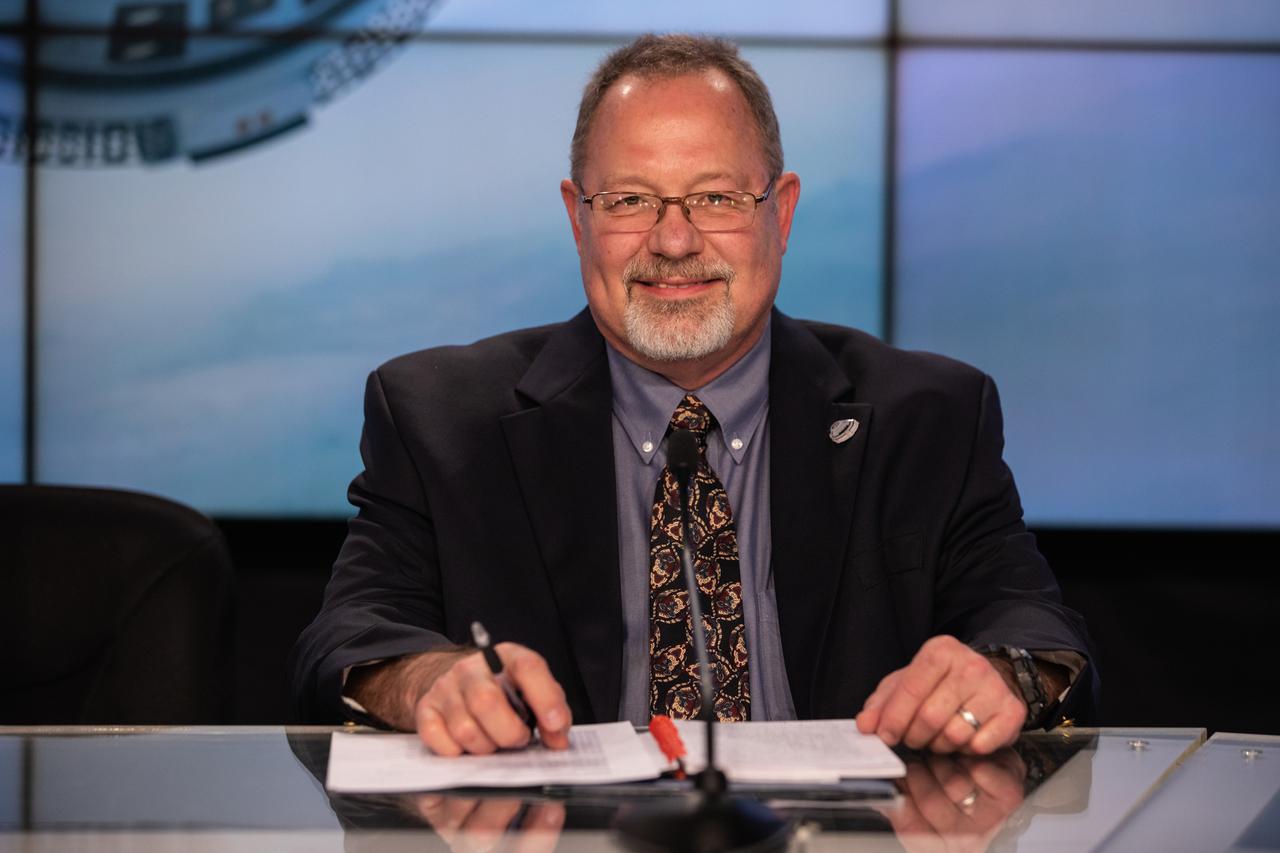
John Vollmer, vice president and program manager, Boeing Commercial Crew Program, participates in a prelaunch briefing for Boeing’s Orbital Flight Test-2 (OFT-2) at the agency’s Kennedy Space Center in Florida, July 27, 2021. Boeing’s CST-100 Starliner spacecraft will launch atop a United Launch Alliance Atlas V rocket from Space Launch Complex-41 at Cape Canaveral Space Force Station. The uncrewed OFT-2 will be the Starliner’s second flight for NASA’s Commercial Crew Program.
Boeing OFT-2 Pre-Launch Briefing
Phil Joyce, vice president of space launch programs for Northrop Grumman Innovation Systems, speaks to news media during a prelaunch mission briefing for NASA’s Ionospheric Connection Explorer (ICON), on Oct. 8, 2019, in the News Center auditorium at the agency’s Kennedy Space Center in Florida. ICON is targeted to launch from Cape Canaveral Air Force Station in Florida on Oct. 9, 2019, aboard a Northrop Grumman Pegasus XL rocket carried aloft by the company’s Stargazer L-1011 aircraft. The explorer will study the frontier of space - the dynamic zone high in Earth's atmosphere where terrestrial weather from below meets space weather above.
Pegasus ICON Pre-Launch Mission Briefing
Launch and mission managers for NASA’s Ionospheric Connection Explorer (ICON) participate in a prelaunch mission briefing on Oct. 8, 2019, in the News Center auditorium at the agency’s Kennedy Space Center in Florida. From left to right are Karen Fox, NASA Communications; Will Ulrich, launch weather officer with the U.S. Air Force 45th Space Wing; and Don Walters, chief pilot of the L-1011 Stargazer aircraft. ICON is targeted to launch from Cape Canaveral Air Force Station in Florida on Oct. 9, 2019, aboard a Northrop Grumman Pegasus XL rocket carried aloft by the company’s Stargazer L-1011 aircraft. The explorer will study the frontier of space - the dynamic zone high in Earth's atmosphere where terrestrial weather from below meets space weather above.
Pegasus ICON Pre-Launch Mission Briefing
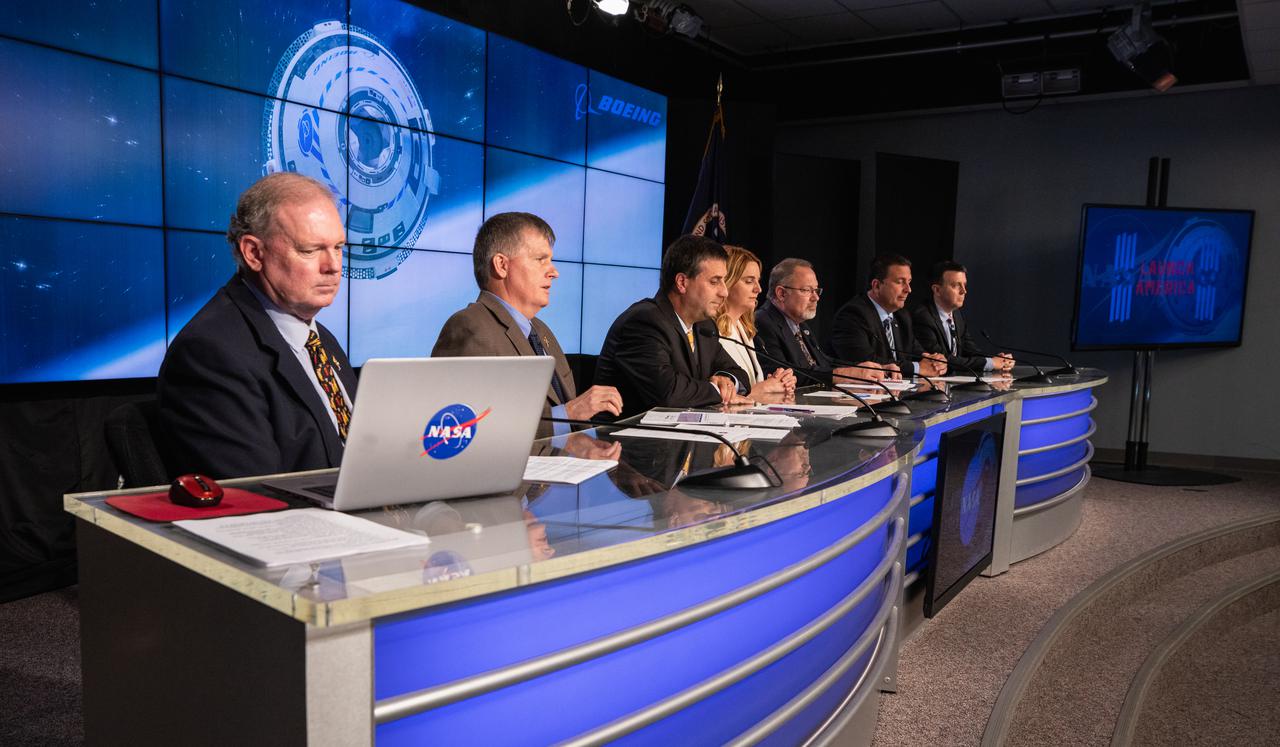
Officials from NASA, Boeing, United Launch Alliance (ULA) and the U.S. Space Force 45th Weather Squadron participate in a prelaunch briefing for Boeing’s Orbital Flight Test-2 (OFT-2) at the agency’s Kennedy Space Center in Florida, July 27, 2021. From left to right are Kyle Herring, NASA Communications; Steve Stich, manager, NASA’s Commercial Crew Program; Joel Montalbano, manager, NASA’s International Space Station Program; Jennifer Buchli, deputy chief scientist, NASA’s International Space Station Program; John Vollmer, vice president and program manager, Boeing Commercial Crew Program; Gary Wentz, vice president, Government and Commercial Programs, ULA; Will Ulrich, launch weather officer, U.S. Space Force, 45th Weather Squadron. Boeing’s CST-100 Starliner spacecraft will launch atop a ULA Atlas V rocket from Space Launch Complex-41 at Cape Canaveral Space Force Station on a mission to dock with the space station. The uncrewed OFT-2 will be the Starliner’s second flight for NASA’s Commercial Crew Program.
Boeing OFT-2 Pre-Launch Briefing
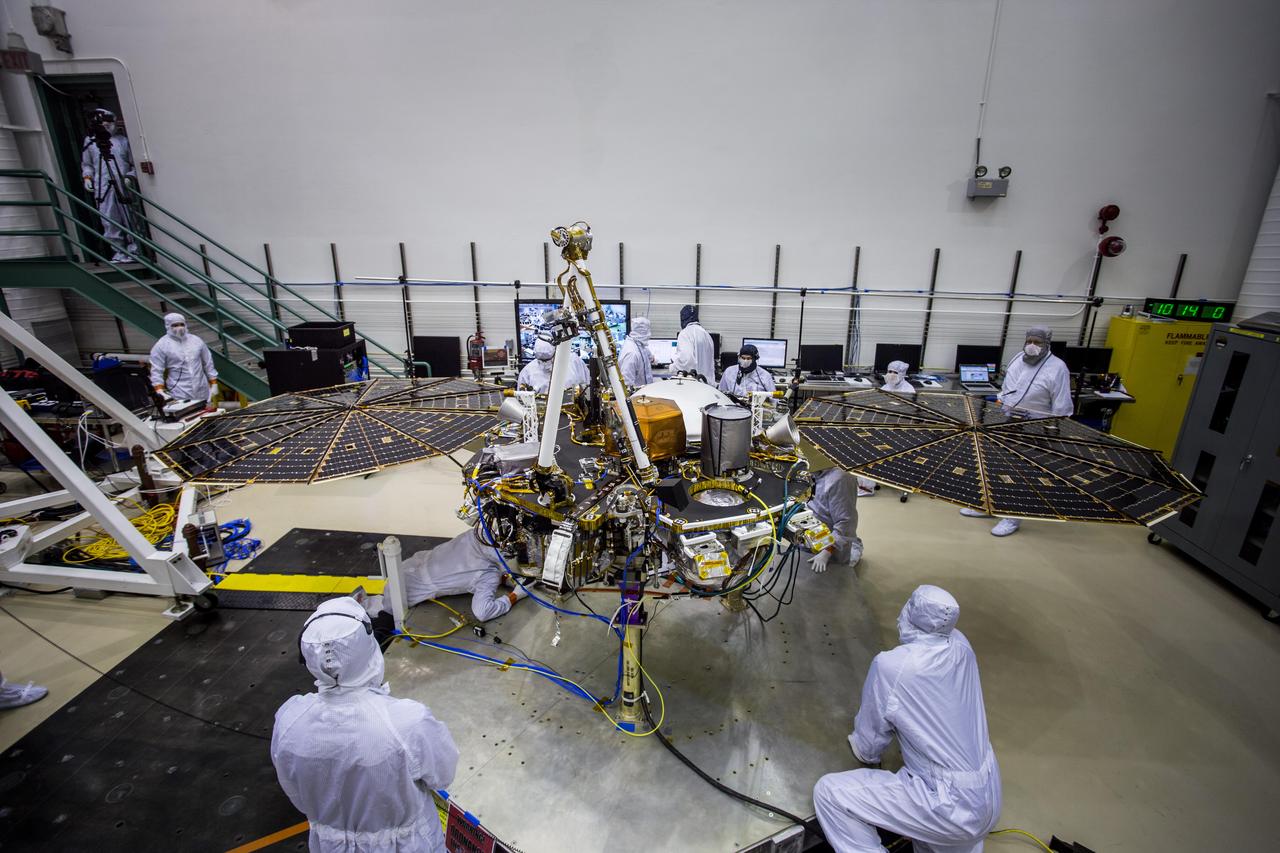
Engineers at Lockheed Martin Space, Denver, Colorado, prepare NASA's InSight lander for testing in a thermal vacuum chamber several months before launch.  https://photojournal.jpl.nasa.gov/catalog/PIA22740
Pre-Launch T-VAC Testing on InSight
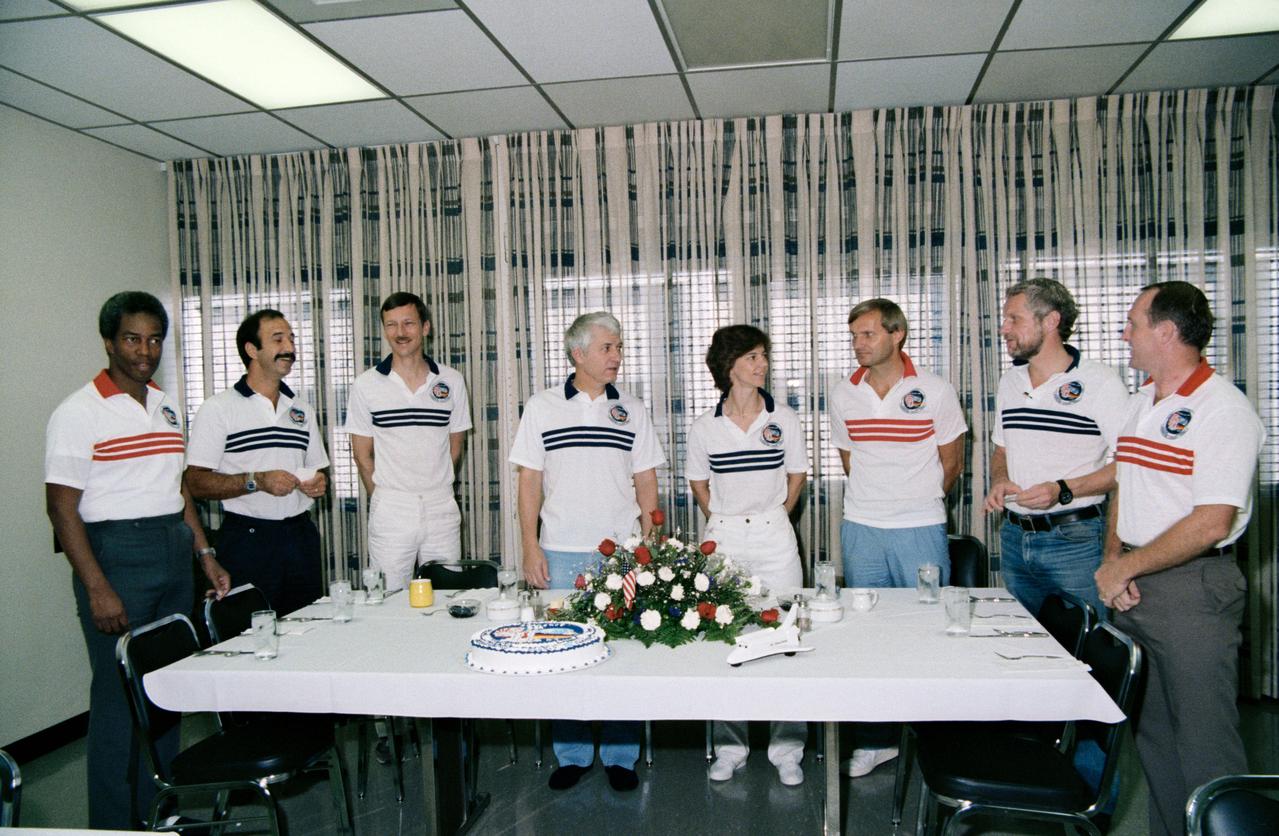
61A-S-016 (30 Oct  1985) --- Standing near their pre-flight breakfast table are the eight crewmembers for the STS 61-A/Spacelab D1 mission.  L.-R., Guion S. Bluford, Wubbo J. Ockels, Steven R. Nagel, Henry W. Hartsfield, Bonnie J. Dunbar, Ernst Messerschmid, Reinhard Furrer and James F. Buchli, discuss their upcoming week in space.
STS 61-A crew at pre-launch breakfast
Omar Baez, launch director in NASA’s Launch Services Program, speaks to news media during a prelaunch mission briefing for NASA’s Ionospheric Connection Explorer (ICON), on Oct. 8, 2019, in the News Center auditorium at the agency’s Kennedy Space Center in Florida. ICON is targeted to launch from Cape Canaveral Air Force Station in Florida on Oct. 9, 2019, aboard a Northrop Grumman Pegasus XL rocket carried aloft by the company’s Stargazer L-1011 aircraft. The explorer will study the frontier of space - the dynamic zone high in Earth's atmosphere where terrestrial weather from below meets space weather above.
Pegasus ICON Pre-Launch Mission Briefing
Officials from NASA, Boeing, United Launch Alliance (ULA) and the U.S. Space Force 45th Weather Squadron participate in a prelaunch briefing for Boeing’s Orbital Flight Test-2 (OFT-2) at the agency’s Kennedy Space Center in Florida, July 27, 2021. From left to right are Kyle Herring, NASA Communications; Steve Stich, manager, NASA’s Commercial Crew Program; Joel Montalbano, manager, NASA’s International Space Station Program; Jennifer Buchli, deputy chief scientist, NASA’s International Space Station Program; John Vollmer, vice president and program manager, Boeing Commercial Crew Program; Gary Wentz, vice president, Government and Commercial Programs, ULA; Will Ulrich, launch weather officer, U.S. Space Force, 45th Weather Squadron. Boeing’s CST-100 Starliner spacecraft will launch atop a ULA Atlas V rocket from Space Launch Complex-41 at Cape Canaveral Space Force Station on a mission to dock with the space station. The uncrewed OFT-2 will be the Starliner’s second flight for NASA’s Commercial Crew Program.
Boeing OFT-2 Pre-Launch Briefing
Joel Montalbano, manager, International Space Station, Johnson Space Center, answers questions during a virtual prelaunch news conference Nov. 13, 2020, inside the Press Site auditorium at NASA’s Kennedy Space Center in Florida ahead of the agency’s SpaceX Crew-1 launch. Crew-1 is the first regular crew mission of a U.S. commercial spacecraft with astronauts to the International Space Station as part of NASA’s Commercial Crew Program. The SpaceX Crew Dragon Resilience capsule will launch atop the company’s Falcon 9 rocket from Launch Complex 39A to the space station for a six-month science mission.
SpaceX Crew-1 Pre-Launch Briefing
CAPE CANAVERAL, Fla. – During a news conference at NASA's Kennedy Space Center in Florida, agency and contractor officials discussed preparations for the launch of NASA's Tracking and Data Relay Satellite, or TDRS-L, spacecraft. Participants included Badri Younes, deputy associate administrator, Space Communications and Navigation SCaN NASA Human Exploration and Operations Mission Directorate at NASA Headquarters in Washington D.C. The TDRS-L spacecraft is the second of three new satellites designed to ensure vital operational continuity for NASA by expanding the lifespan of the Tracking and Data Relay Satellite System TDRSS fleet, which consists of eight satellites in geosynchronous orbit. The spacecraft provide tracking, telemetry, command and high bandwidth data return services for numerous science and human exploration missions orbiting Earth. These include NASA's Hubble Space Telescope and the International Space Station. TDRS-L has a high-performance solar panel designed for more spacecraft power to meet the growing S-band communications requirements. TDRSS is one of NASA Space Communication and Navigation’s SCaN three networks providing space communications to NASA’s missions. For more information more about TDRS-L, visit: http://www.nasa.gov/tdrs To learn more about SCaN, visit: www.nasa.gov/scan Photo credit: NASA/Frankie Martin
TDRS-L Pre-Launch Press Conference
Arlena Moses, launch weather officer, U.S. Air Force 45th Weather Squadron, answers questions during a virtual prelaunch news conference Nov. 13, 2020, inside the Press Site auditorium at NASA’s Kennedy Space Center in Florida ahead of the agency’s SpaceX Crew-1 launch. Crew-1 is the first regular crew mission of a U.S. commercial spacecraft with astronauts to the International Space Station as part of NASA’s Commercial Crew Program. The SpaceX Crew Dragon Resilience capsule will launch atop the company’s Falcon 9 rocket from Launch Complex 39A to the space station for a six-month science mission.
SpaceX Crew-1 Pre-Launch Briefing
Members of the media gather in the Kennedy Space Center’s Press Site auditorium in Florida during a prelaunch news conference with NASA, Boeing, United Launch Alliance (ULA) and the U.S. Space Force 45th Weather Squadron officials, July 27, 2021, prior to the Friday, July 30, launch of NASA’s Boeing Orbital Flight Test-2 (OFT-2).  . From left to right at the dais are Kyle Herring, NASA Communications; Steve Stich, manager, NASA’s Commercial Crew Program; Joel Montalbano, manager, NASA’s International Space Station Program; Jennifer Buchli, deputy chief scientist, NASA’s International Space Station Program; John Vollmer, vice president and program manager, Boeing Commercial Crew Program; Gary Wentz, vice president, Government and Commercial Programs, ULA; Will Ulrich, launch weather officer, U.S. Space Force, 45th Weather Squadron. Boeing’s CST-100 Starliner spacecraft will launch atop a ULA Atlas V rocket from Space Launch Complex-41 at Cape Canaveral Space Force Station on a mission to dock with the space station. The uncrewed OFT-2 will be the Starliner’s second flight for NASA’s Commercial Crew Program.
Boeing OFT-2 Pre-Launch Briefing
Will Ulrich, launch weather officer with the U.S. Air Force 45th Space Wing, speaks to news media during a prelaunch mission briefing for NASA’s Ionospheric Connection Explorer (ICON), on Oct. 8, 2019, in the News Center auditorium at the agency’s Kennedy Space Center in Florida. ICON is targeted to launch from Cape Canaveral Air Force Station in Florida on Oct. 9, 2019, aboard a Northrop Grumman Pegasus XL rocket carried aloft by the company’s Stargazer L-1011 aircraft. The explorer will study the frontier of space - the dynamic zone high in Earth's atmosphere where terrestrial weather from below meets space weather above.
Pegasus ICON Pre-Launch Mission Briefing
CAPE CANAVERAL, Fla. – During a news conference at NASA's Kennedy Space Center in Florida, agency and contractor officials discussed preparations for the launch of NASA's Tracking and Data Relay Satellite, or TDRS-L, spacecraft. Participants included Tim Dunn, NASA launch director at Kennedy, left, and Vernon Thorp, program manager for NASA Missions with United Launch Alliance in Denver, Colo. The TDRS-L spacecraft is the second of three new satellites designed to ensure vital operational continuity for NASA by expanding the lifespan of the Tracking and Data Relay Satellite System TDRSS fleet, which consists of eight satellites in geosynchronous orbit. The spacecraft provide tracking, telemetry, command and high bandwidth data return services for numerous science and human exploration missions orbiting Earth. These include NASA's Hubble Space Telescope and the International Space Station. TDRS-L has a high-performance solar panel designed for more spacecraft power to meet the growing S-band communications requirements. TDRSS is one of NASA Space Communication and Navigation’s SCaN three networks providing space communications to NASA’s missions. For more information more about TDRS-L, visit: http://www.nasa.gov/tdrs To learn more about SCaN, visit: www.nasa.gov/scan Photo credit: NASA/Frankie Martin
TDRS-L Pre-Launch Press Conference
CAPE CANAVERAL, Fla. –During a news conference at NASA's Kennedy Space Center in Florida, agency and contractor officials discussed preparations for the launch of NASA's Tracking and Data Relay Satellite, or TDRS-L, spacecraft. Participating in the briefing, from the left, are Badri Younes, deputy associate administrator, Space Communications and Navigation SCaN NASA Human Exploration and Operations Mission Directorate at NASA Headquarters in Washington D.C., Tim Dunn, NASA launch director at Kennedy, Vernon Thorp, program manager for NASA Missions with United Launch Alliance in Denver, Colo., Jeffrey Gramling, NASA's TDRS-L project manager at the Goddard Space Flight Center in Greenbelt, Md., Andy Kopito, Civil Space Programs director for Boeing Space & Intelligence Systems in El Segundo, Calif., and Clay Flinn, launch weather officer for the 45th Weather Squadron at Cape Canaveral Air Force Station, Fla. The TDRS-L spacecraft is the second of three new satellites designed to ensure vital operational continuity for NASA by expanding the lifespan of the Tracking and Data Relay Satellite System TDRSS fleet, which consists of eight satellites in geosynchronous orbit. The spacecraft provide tracking, telemetry, command and high bandwidth data return services for numerous science and human exploration missions orbiting Earth. These include NASA's Hubble Space Telescope and the International Space Station. TDRS-L has a high-performance solar panel designed for more spacecraft power to meet the growing S-band communications requirements. TDRSS is one of NASA Space Communication and Navigation’s SCaN three networks providing space communications to NASA’s missions. For more information more about TDRS-L, visit: http://www.nasa.gov/tdrs To learn more about SCaN, visit: www.nasa.gov/scan Photo credit: NASA/Frankie Martin
TDRS-L Pre-Launch Press Conference
Inside the Press Site auditorium at NASA’s Kennedy Space Center in Florida, NASA and industry leaders conduct a virtual prelaunch news conference Nov. 13, 2020, ahead of the agency’s SpaceX Crew-1 mission. From left are Steve Stich, manager, Commercial Crew Program, Kennedy Space Center; Joel Montalbano, manager, International Space Station, Johnson Space Center; Kirt Costello, chief scientist, International Space Station Program, Johnson; Norm Knight, deputy manager, Flight Operations Directorate, Johnson; Arlena Moses, launch weather officer, U.S. Air Force 45th Weather Squadron; and Benji Reed, senior director, Human Spaceflight Programs, SpaceX. Crew-1 is the first regular crew mission of a U.S. commercial spacecraft with astronauts to the International Space Station as part of NASA’s Commercial Crew Program. The SpaceX Crew Dragon Resilience capsule will launch atop the company’s Falcon 9 rocket from Launch Complex 39A to the space station for a six-month science mission.
SpaceX Crew-1 Pre-Launch Briefing
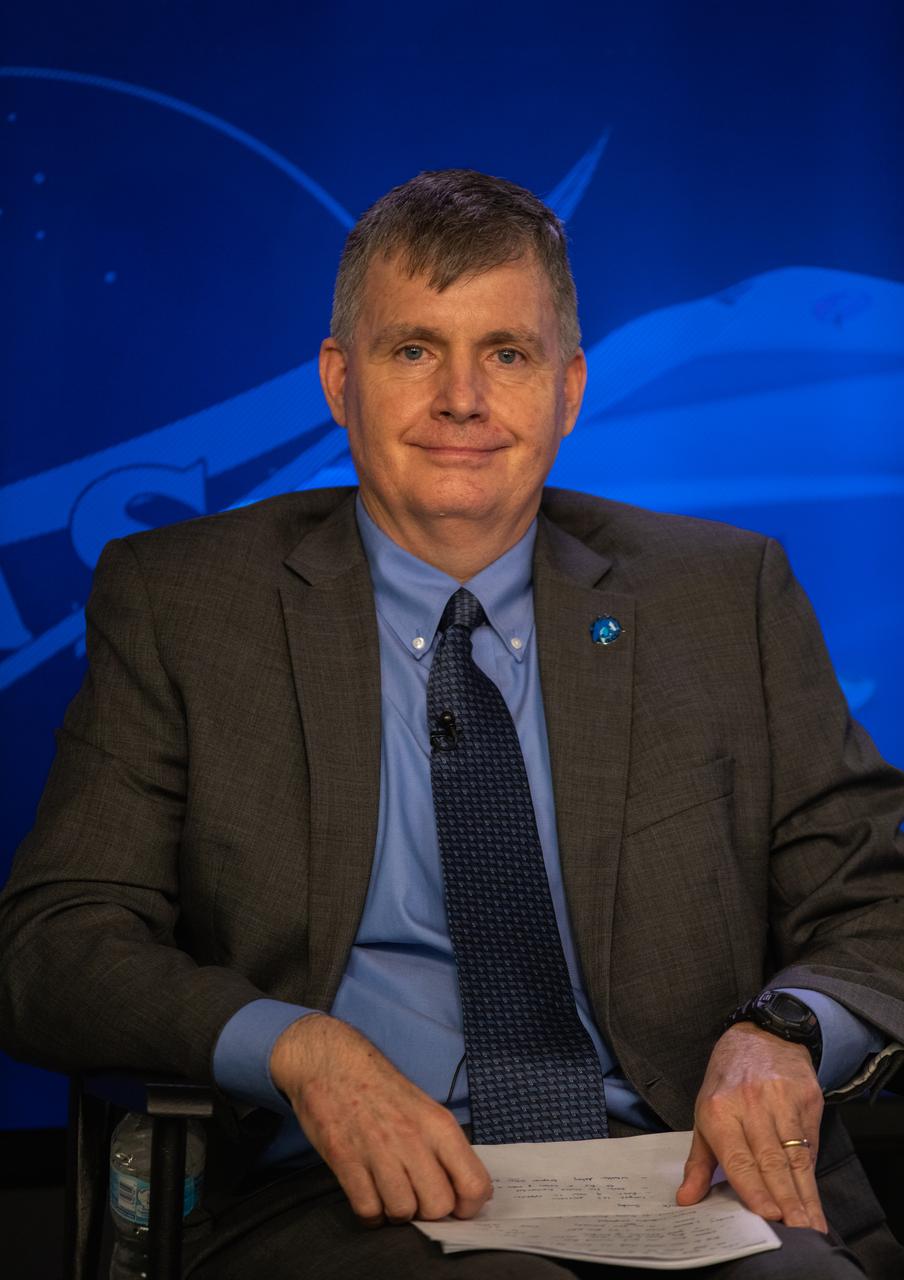
Joel Montalbano, manager, NASA’s International Space Station Program, participates in a prelaunch briefing for Boeing’s Orbital Flight Test-2 (OFT-2) at the agency’s Kennedy Space Center in Florida, July 27, 2021. Boeing’s CST-100 Starliner spacecraft will launch atop a United Launch Alliance Atlas V rocket from Space Launch Complex-41 at Cape Canaveral Space Force Station. The uncrewed OFT-2 will be the Starliner’s second flight for NASA’s Commercial Crew Program.
Boeing OFT-2 Pre-Launch Briefing