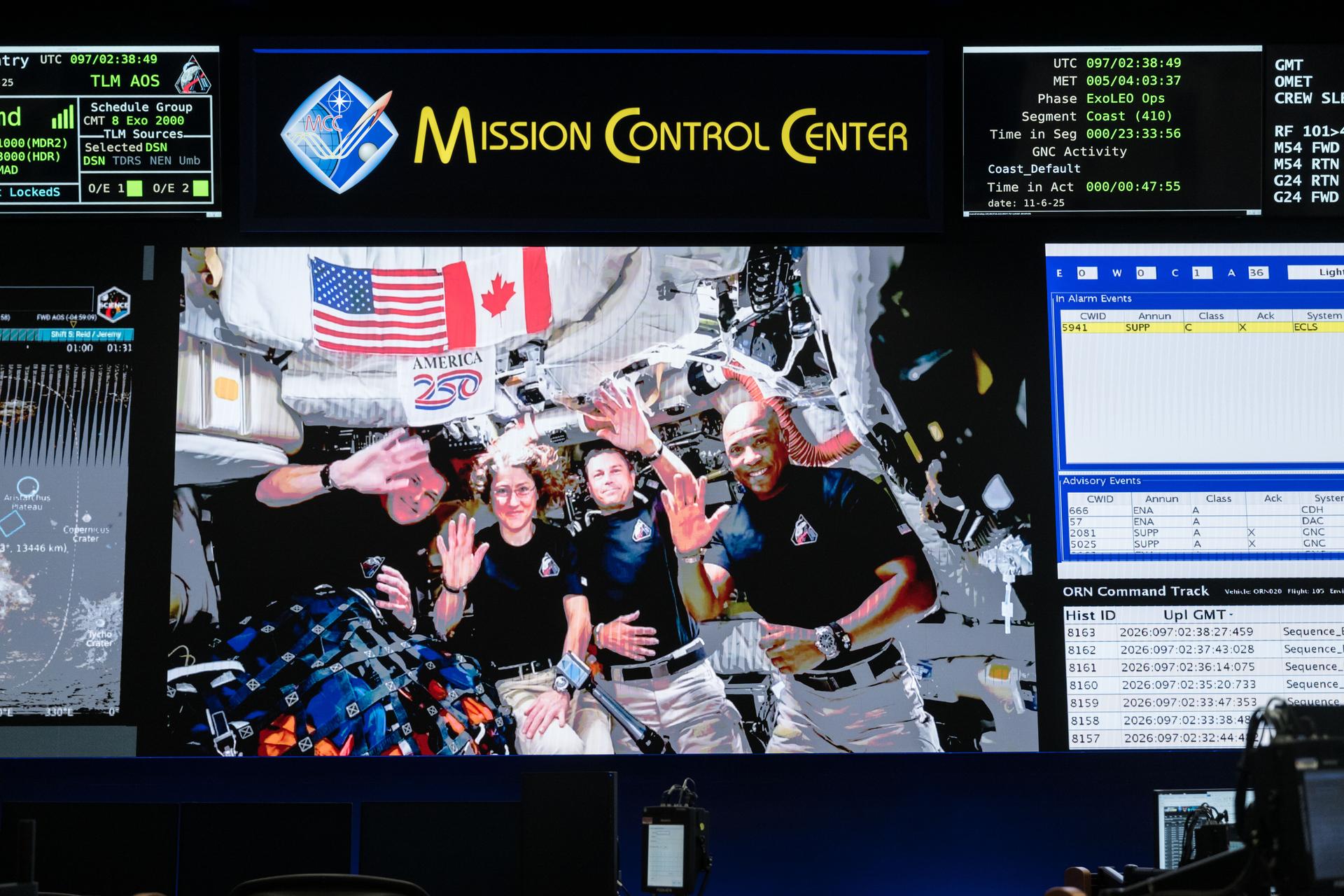
jsc2026e020504 (April 6, 2026) - The Artemis II crew – CSA (Canadian Space Agency) Astronaut Jeremy Hansen (far left) and NASA astronauts Christina Koch (center left), Reid Wiseman (center right), and Victor Glover (right) – pauses to wave after a live conversation with President Donald J. Trump following their historic lunar flyby during Flight Day 6. They are pictured on the screens of the White Flight Control room at NASA’s Mission Control Center at the agency’s Johnson Space Center in Houston. Credit: NASA

Apollo 8 Astronaut Frank Borman, commander of the first manned Saturn V space flight into Lunar orbit, accepted a phone call from the U.S. President Lyndon B. Johnson prior to launch. Borman, along with astronauts William Anders, Lunar Module (LM) pilot, and James Lovell, Command Module (CM) pilot, launched aboard the Apollo 8 mission on December 21, 1968 and returned safely to Earth on December 27, 1968. The mission achieved operational experience and tested the Apollo command module systems, including communications, tracking, and life-support, in cis-lunar space and lunar orbit, and allowed evaluation of crew performance on a lunar orbiting mission. The crew photographed the lunar surface, both far side and near side, obtaining information on topography and landmarks as well as other scientific information necessary for future Apollo landings. All systems operated within allowable parameters and all objectives of the mission were achieved.
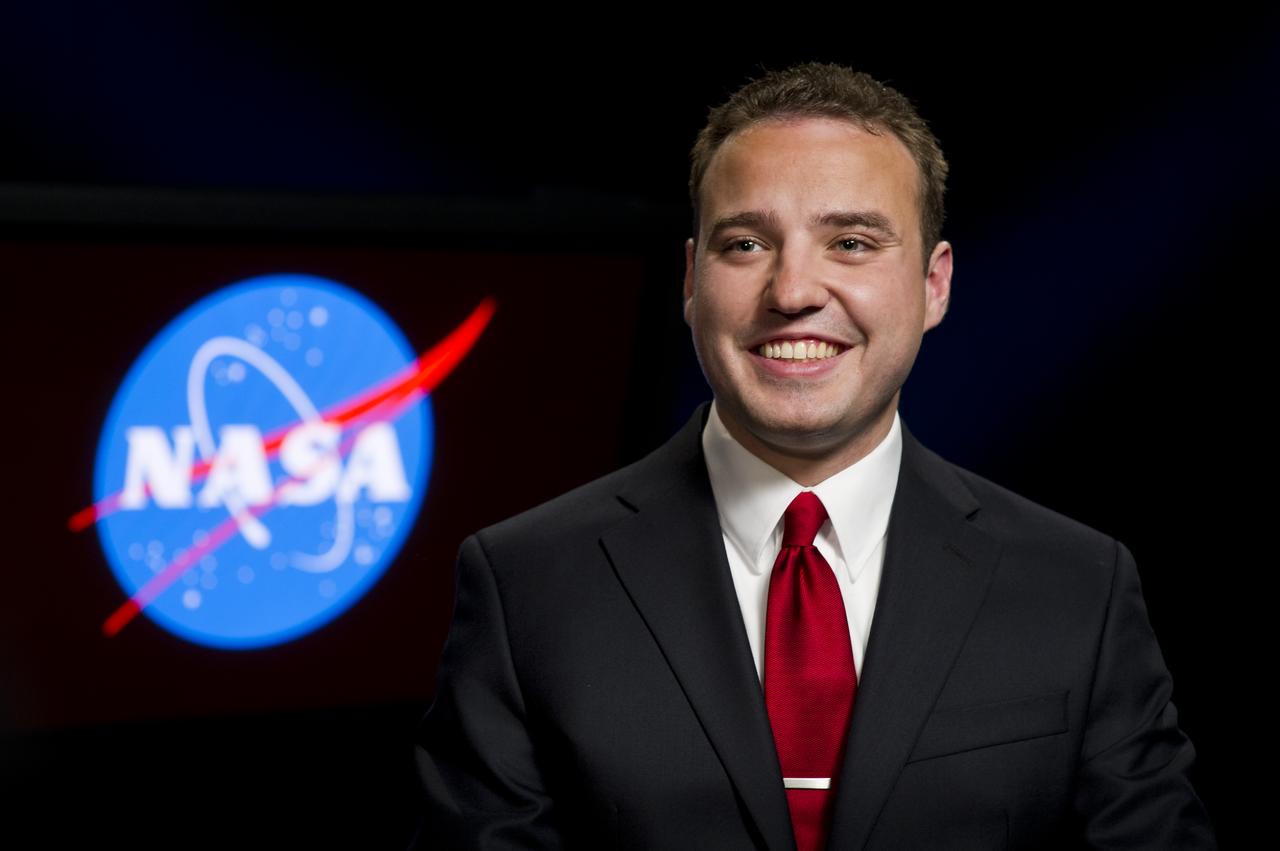
NASA Goddard Space Flight Center Financial Manager and White House 2011 SAVE award winner Matthew Ritsko is seen during a television interview at NASA Headquarters shortly after meeting with President Obama at the White House on Monday, Jan. 9, 2011, in Washington. The Presidential Securing Americans' Value and Efficiency (SAVE) program gives front-line federal workers the chance to submit their ideas on how their agencies can save money and work more efficiently. Matthew's proposal calls for NASA to create a "lending library" where specialized space tools and hardware purchased by one NASA organization will be made available to other NASA programs and projects. Photo Credit: (NASA/Bill Ingalls)

“I have to be honest, NASA had not really been on my radar until it just was. I went to grad school and in graduate school I actually studied myotonic dystrophy. At the end of my graduate school years I decided I want to go into public service. I applied for this thing called the Presidential Management Fellowship and NASA had an opening! I thought to myself ‘Oh this could be so interesting! They run so many technology and science programs. I'll apply and see what happens.’ “Lo and behold, I got an interview! I was so excited and the idea of working at an agency at NASA blew me out of the water and I said, ‘I am totally taking this.’ “I had a mentor say something to me that I think rings really true. He said, ‘when you work in public service, there’s no doubt that you’re doing the right thing.’ I think that idea drove me to public service. When you work for a company -- there’s absolutely nothing wrong with that, but you’re really helping the company to meet its bottom line. When you work for a federal agency or a state agency, you’re working to ensure the needs are met for the public. You're really doing something to benefit others. It’s not to benefit the company and many times it’s not just for yourself, so you always know you’re doing the right thing. I think what drove me was the idea of being able to do something that felt intrinsically fulfilling.” Dr. Ruth Siboni, executive officer for the Human Exploration and Operations (HEO) mission directorate poses for a photo, Monday, October 5, 2020 on the National Mall in Washington, DC. Photo Credit: (NASA/Aubrey Gemignani)