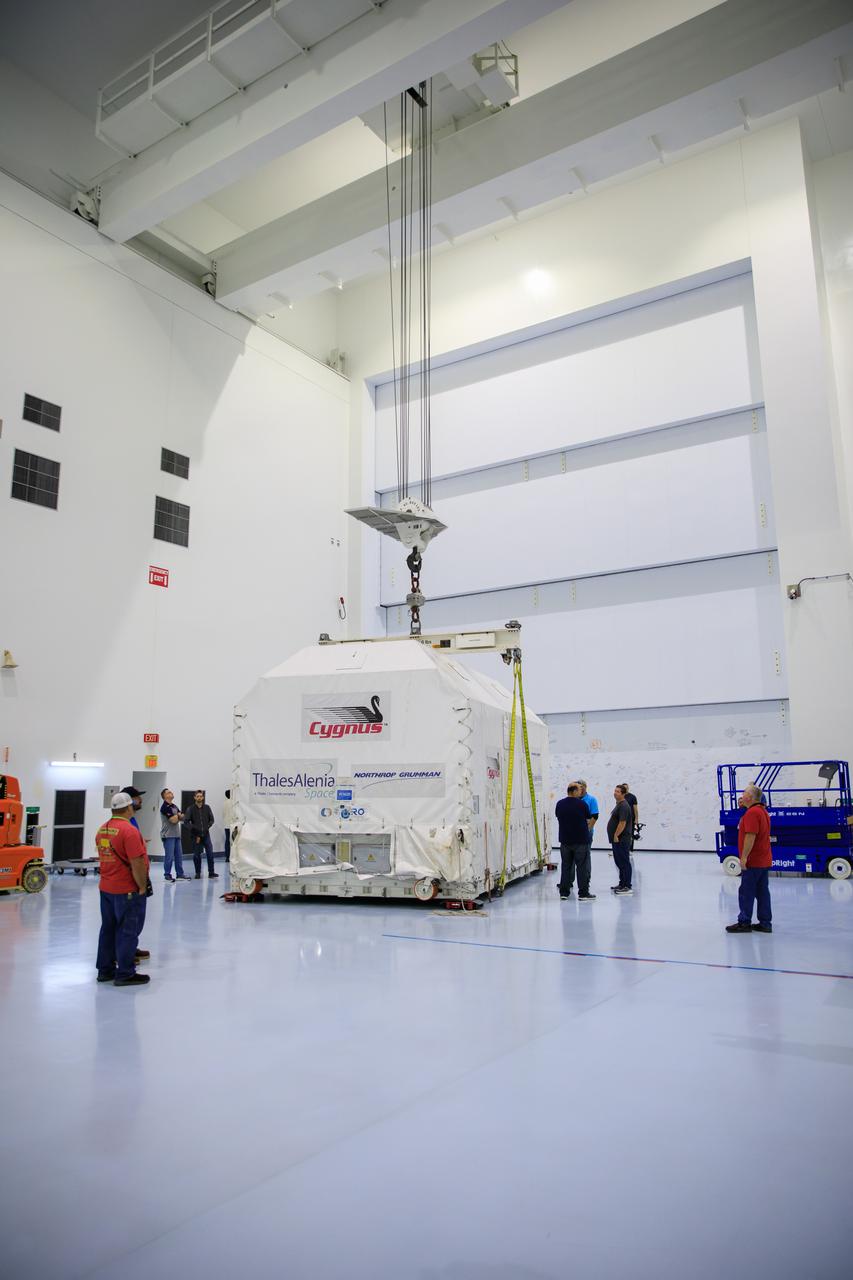
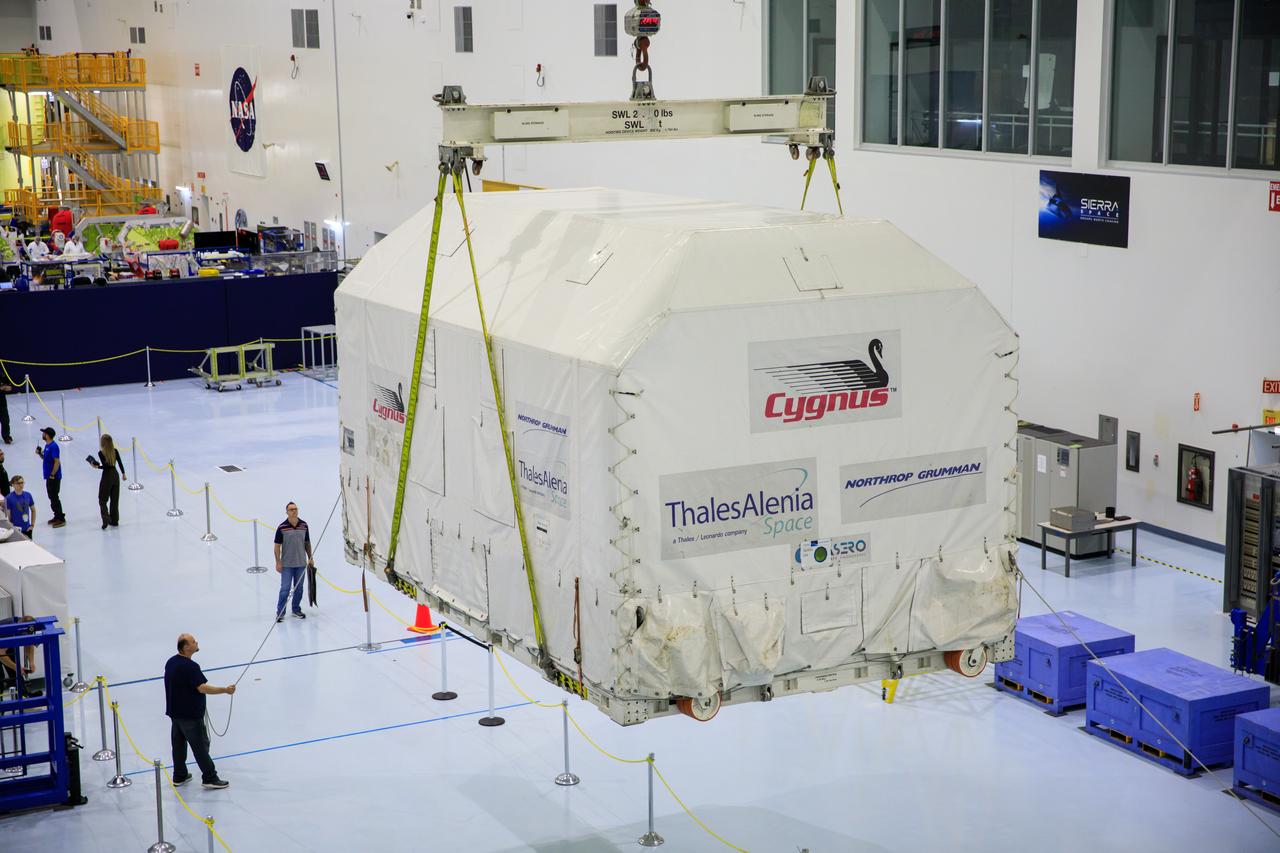
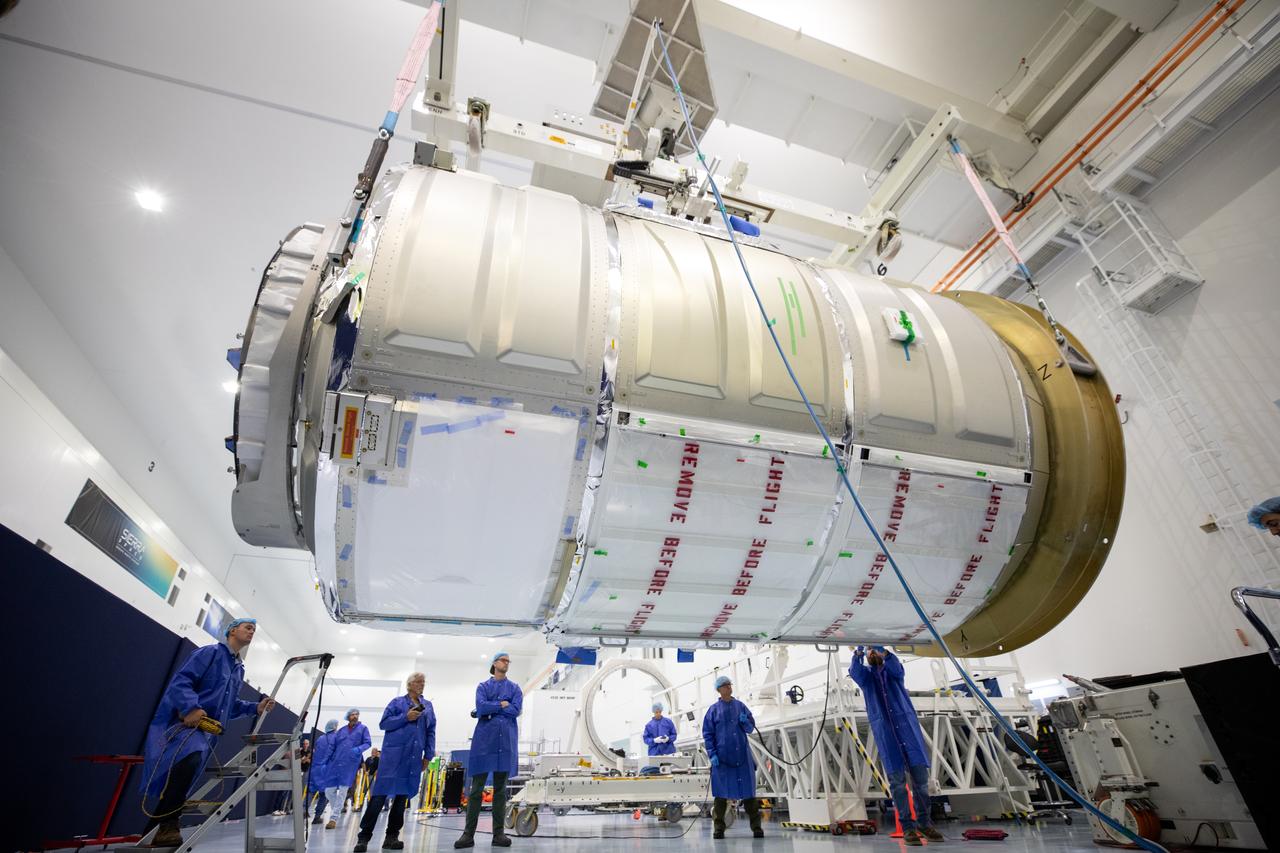
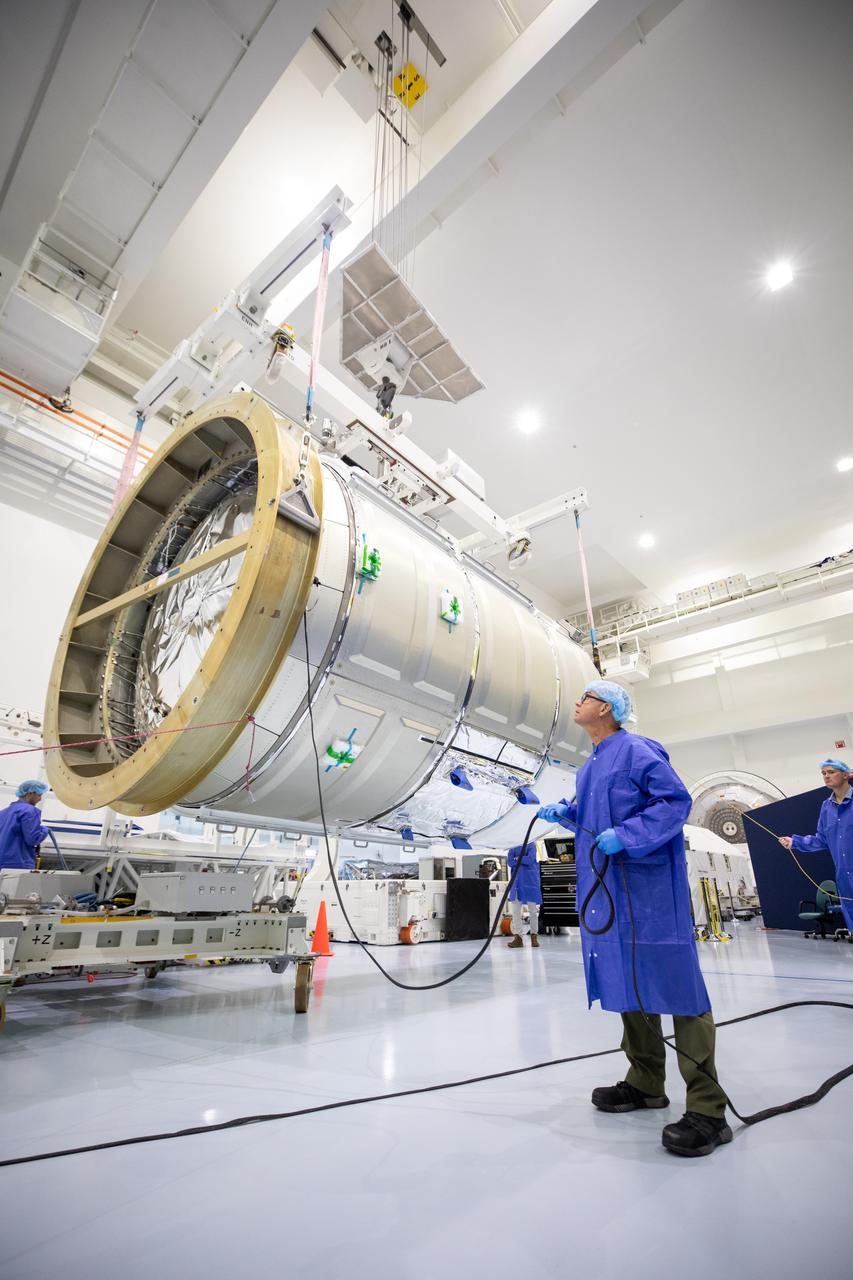
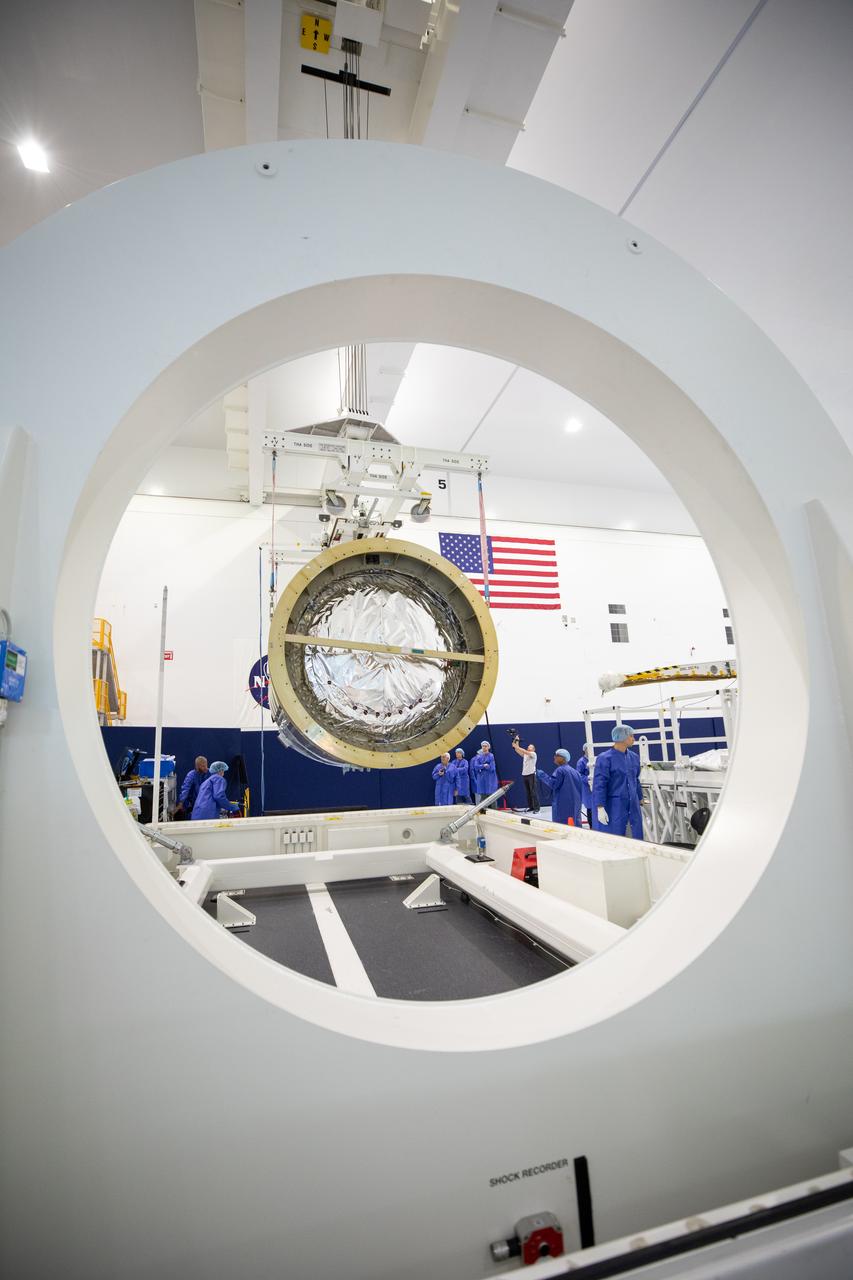
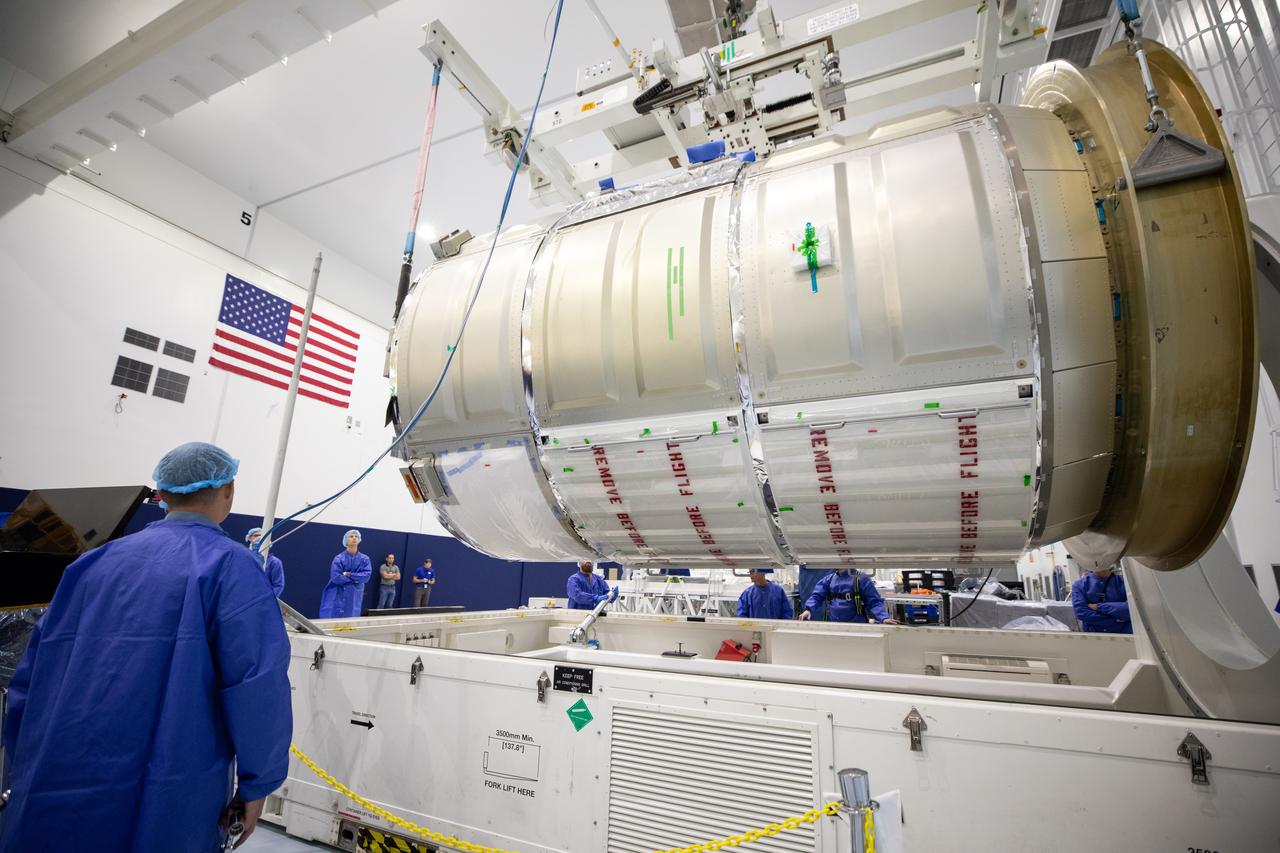
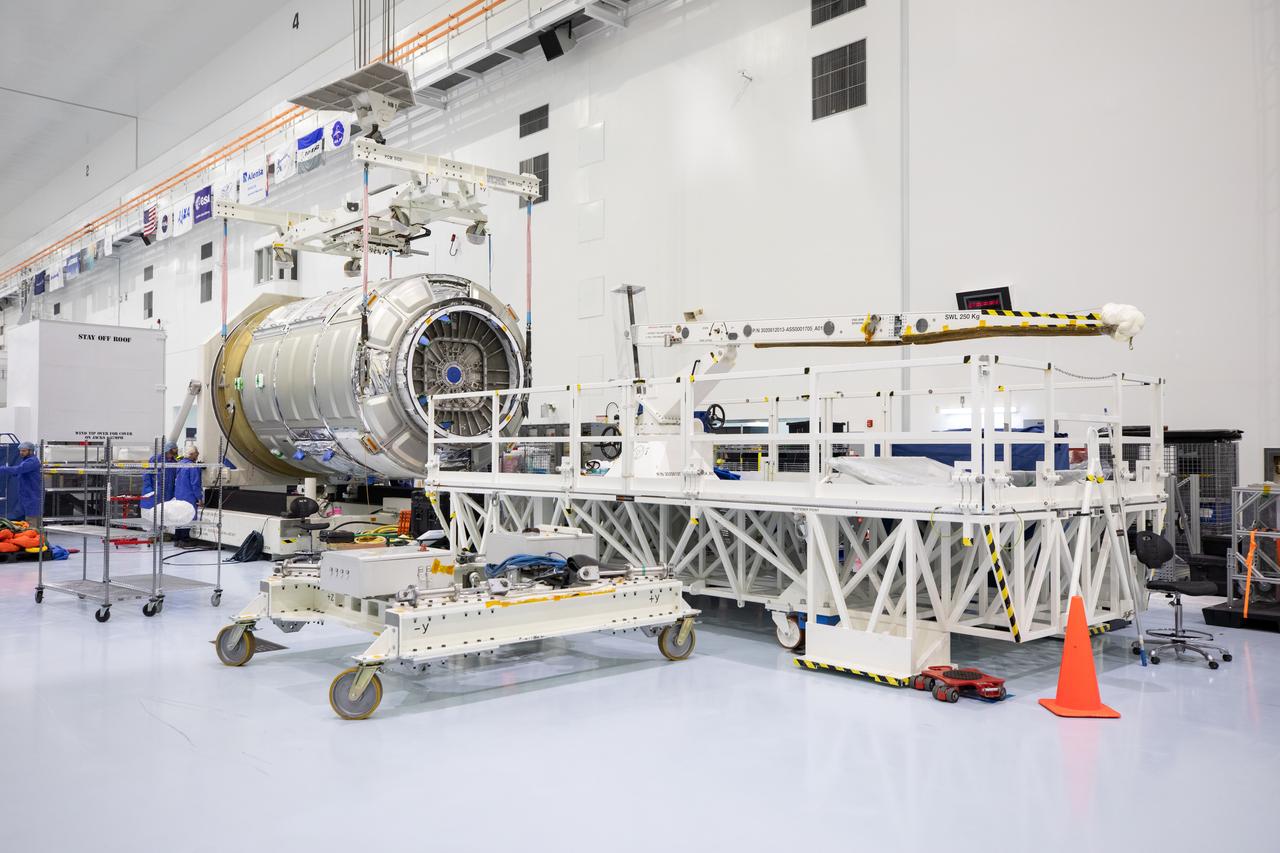
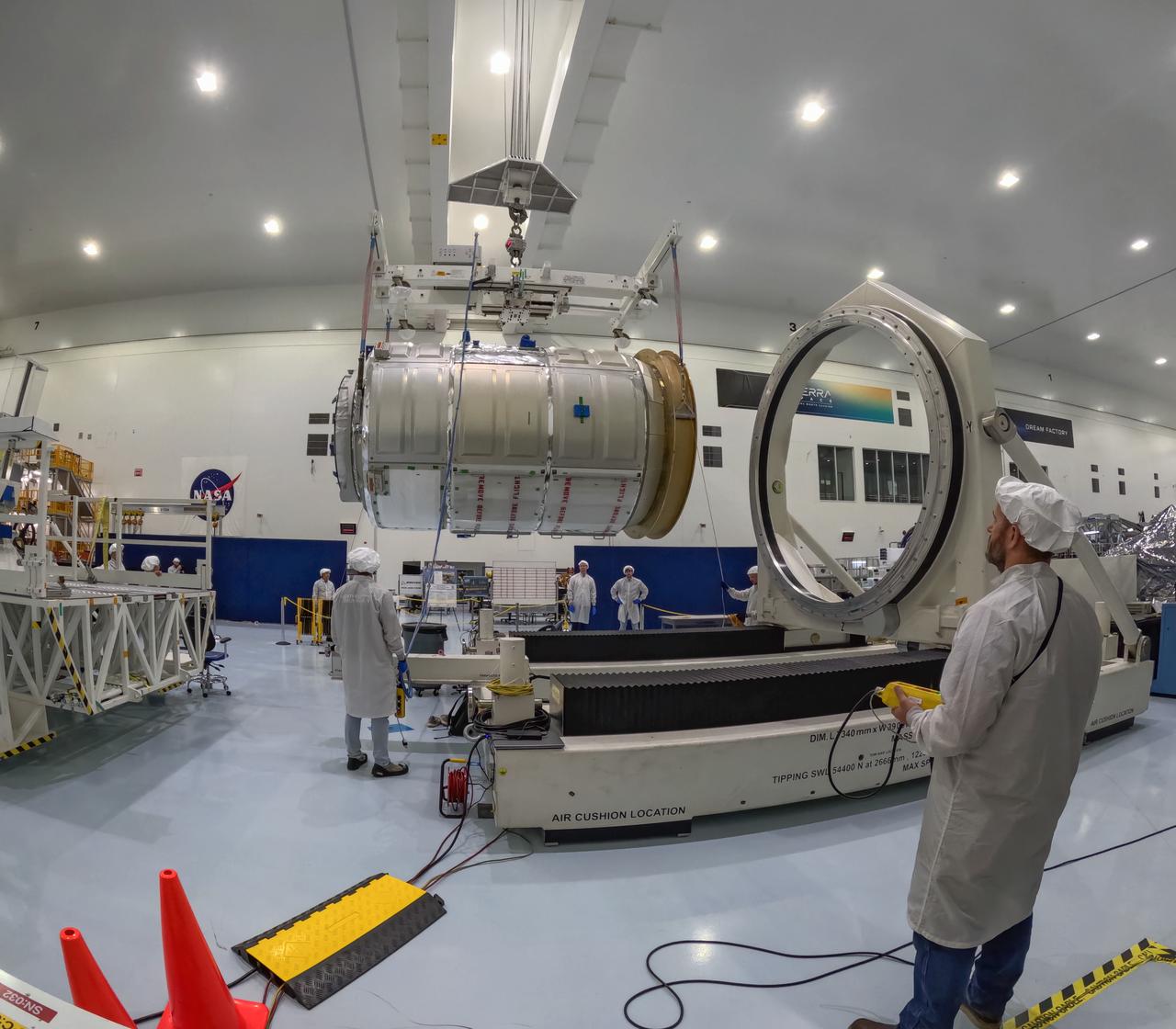
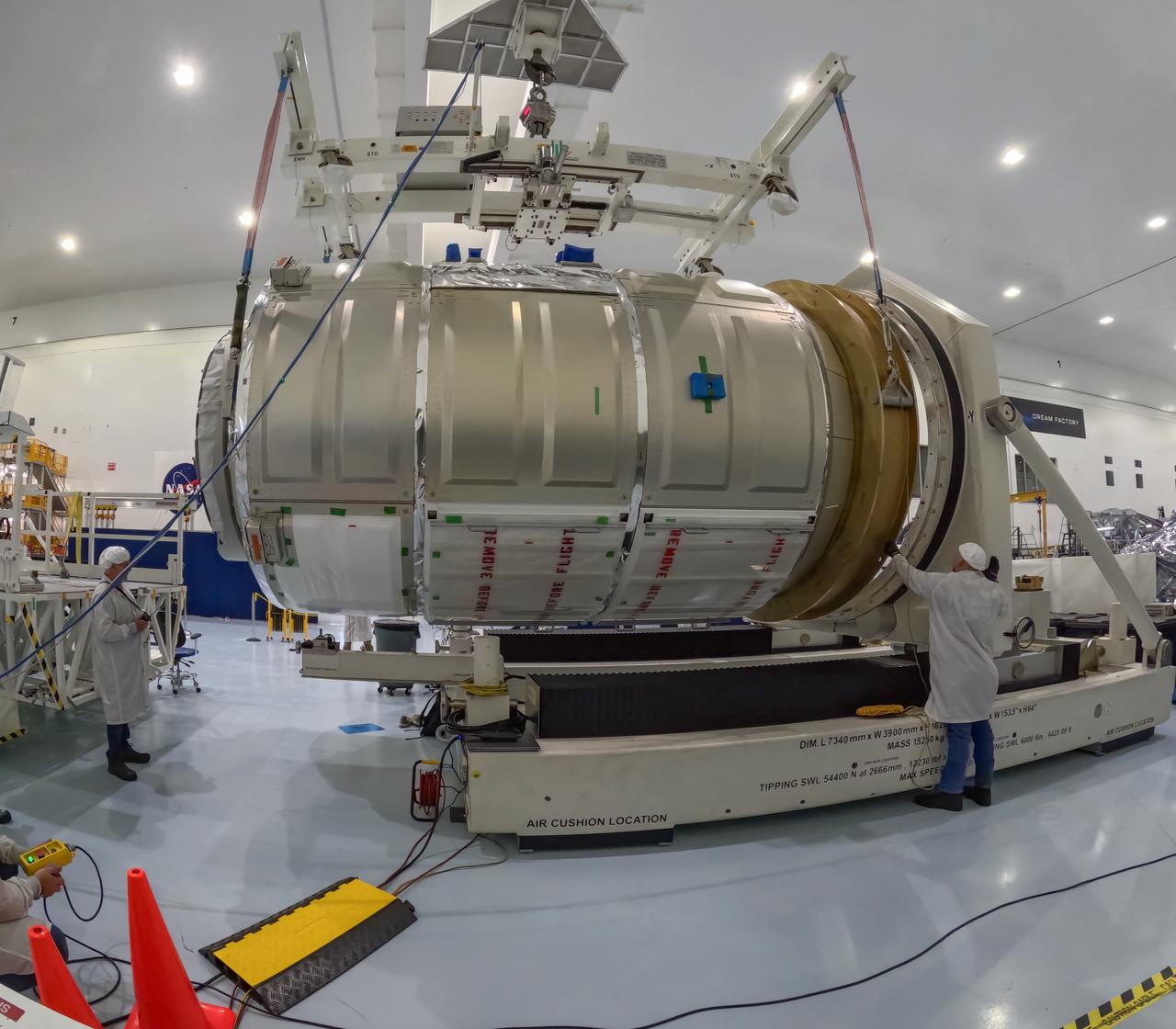
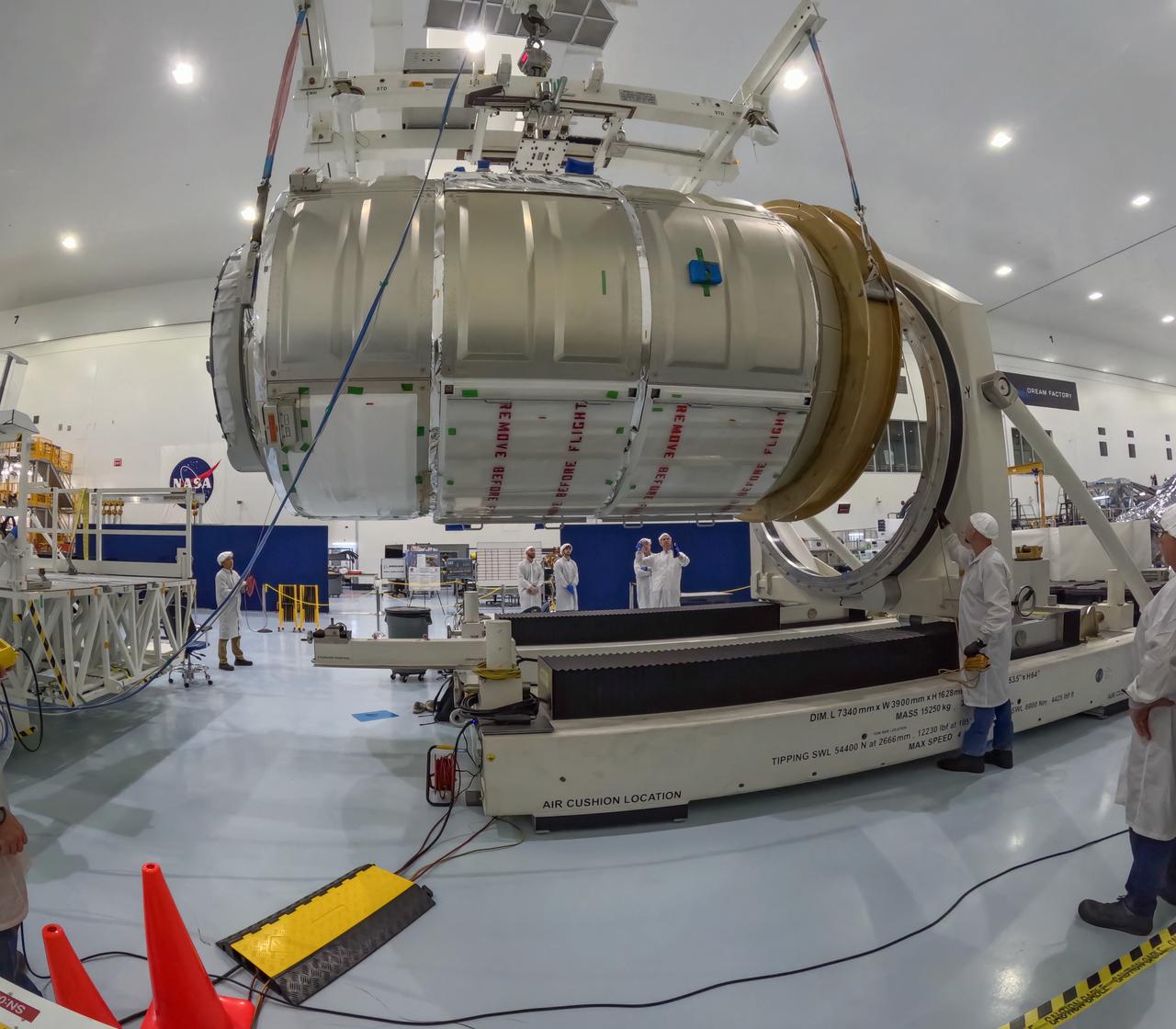
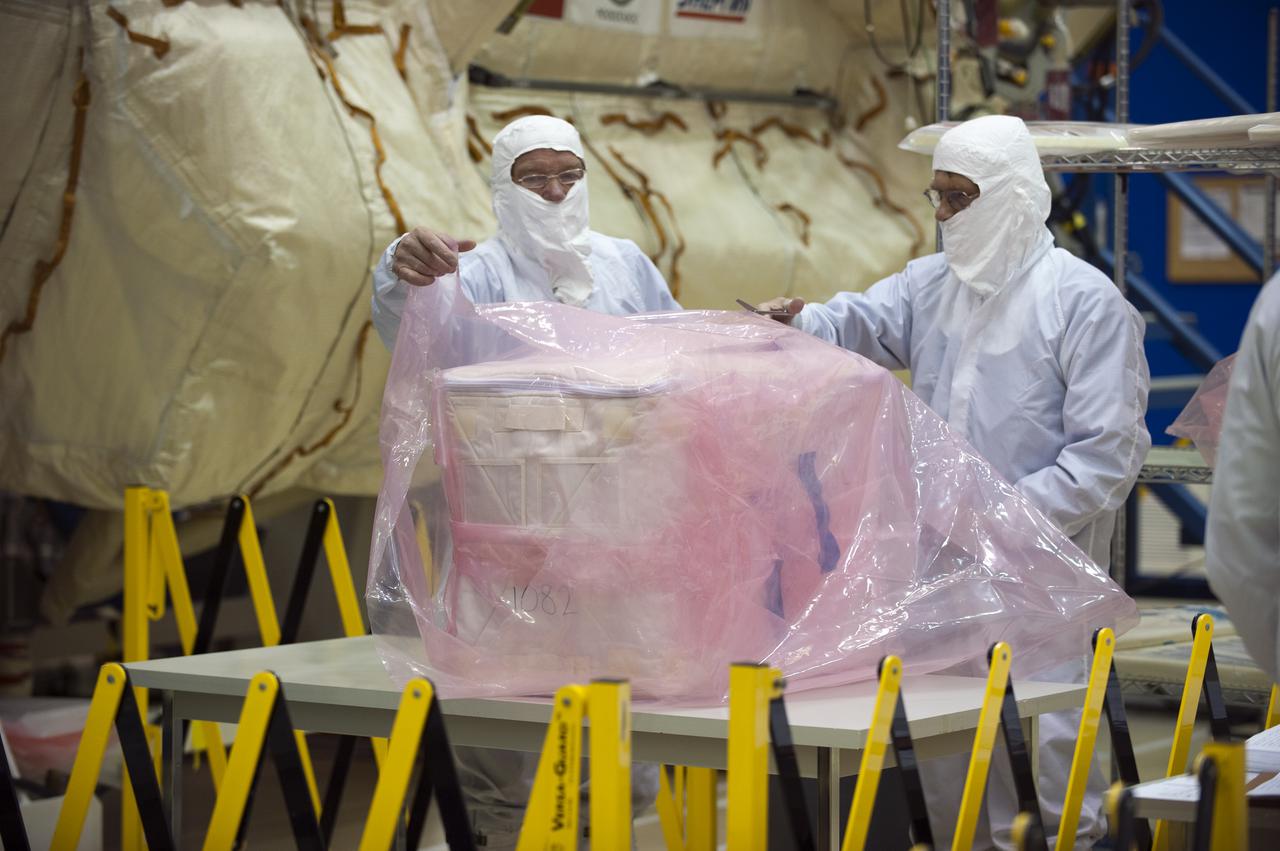
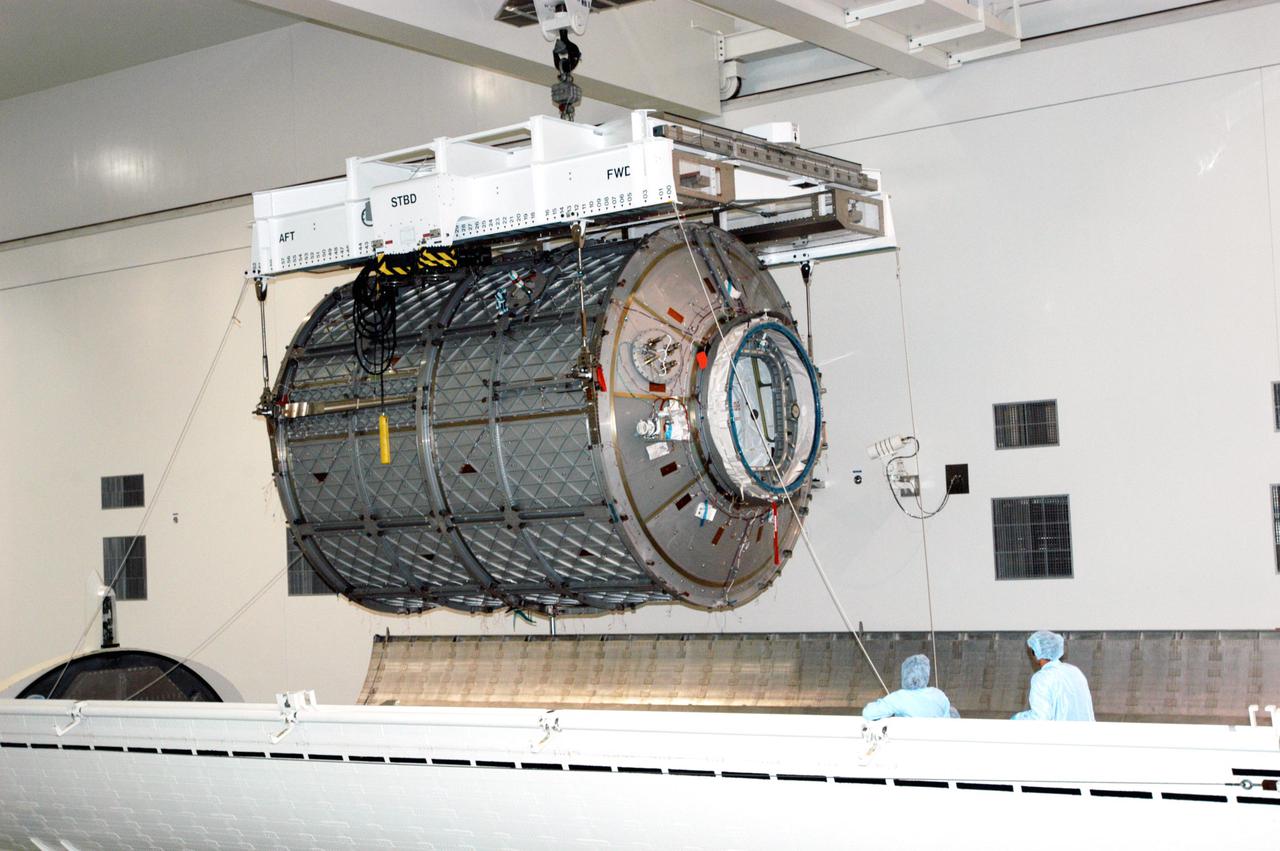
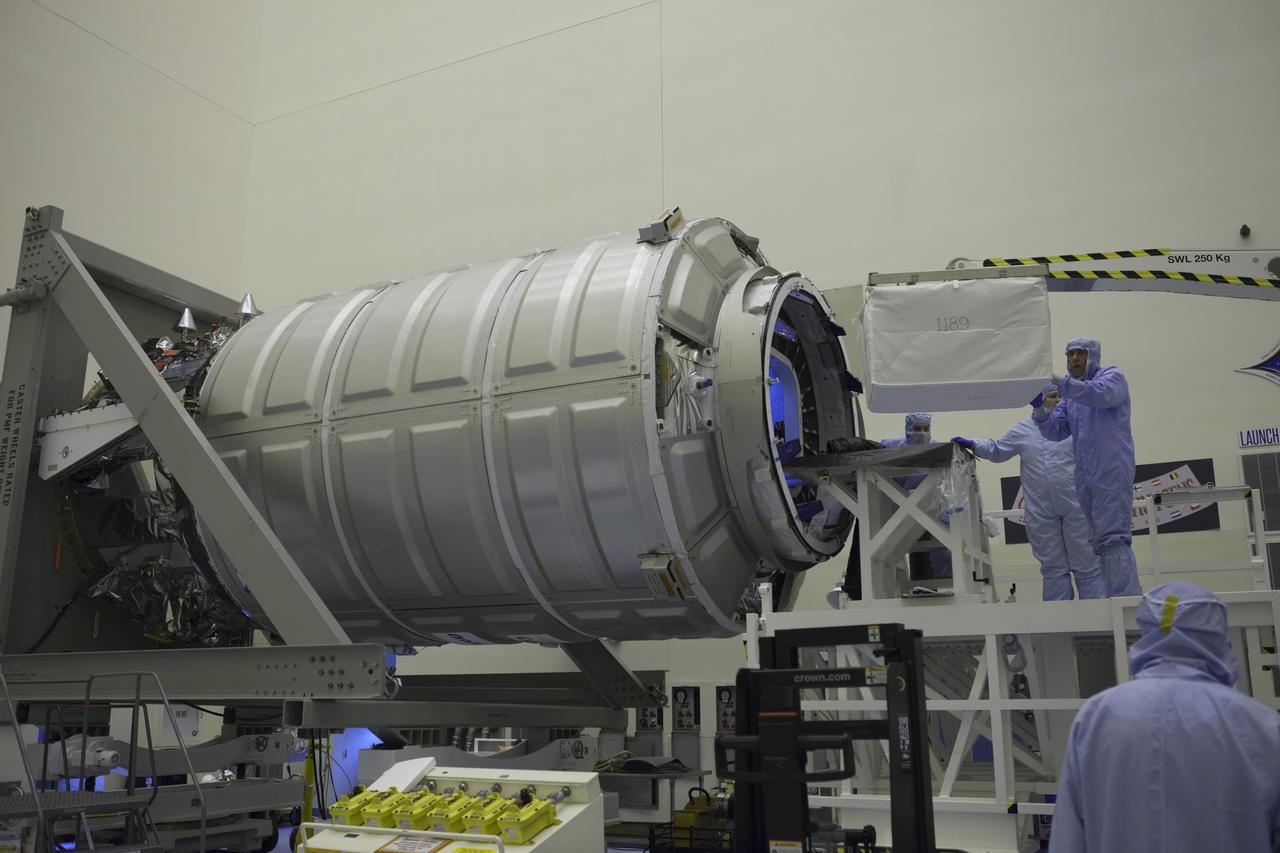
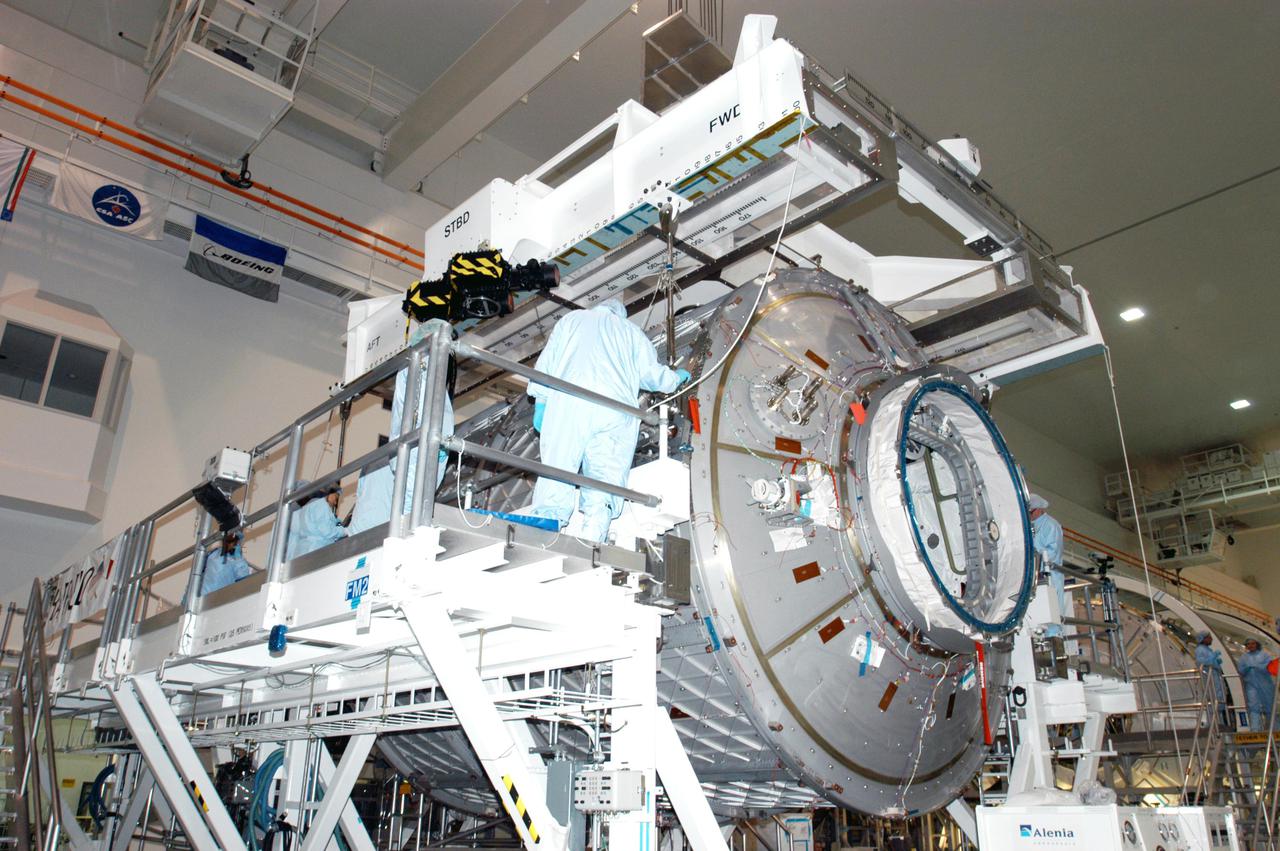
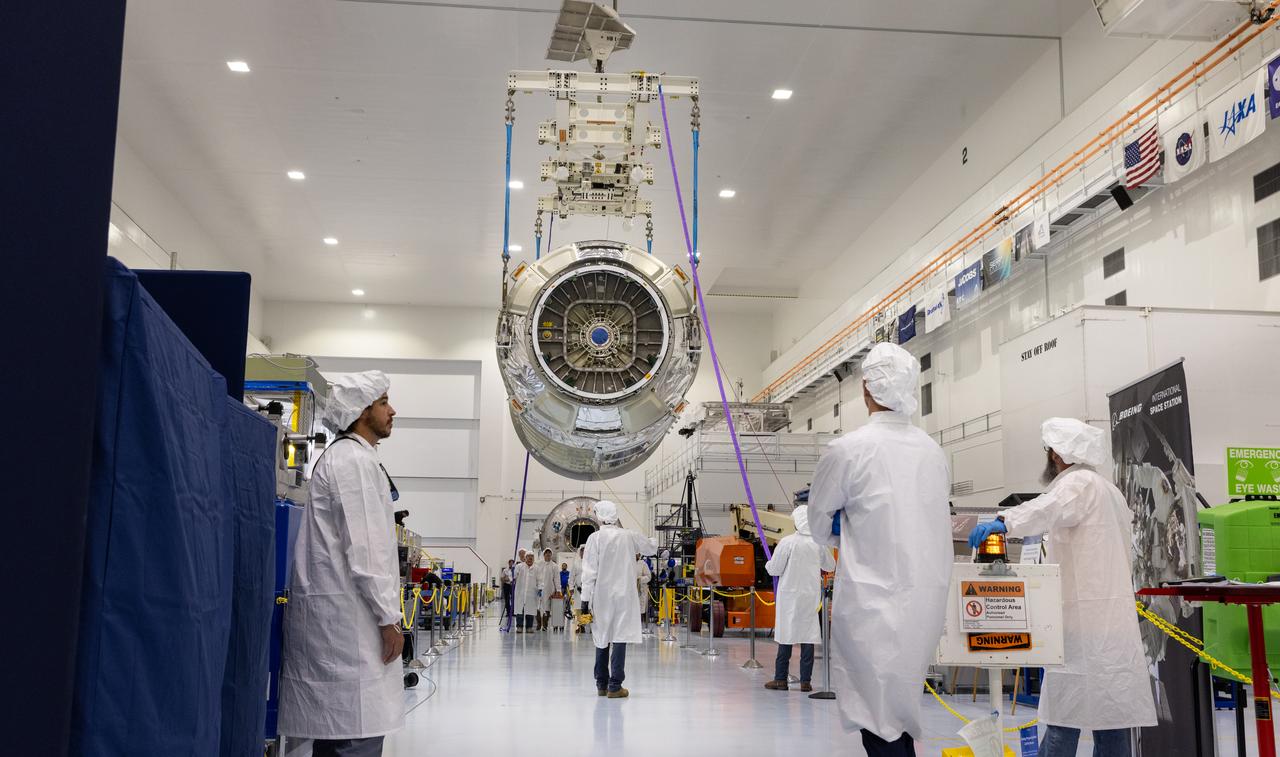
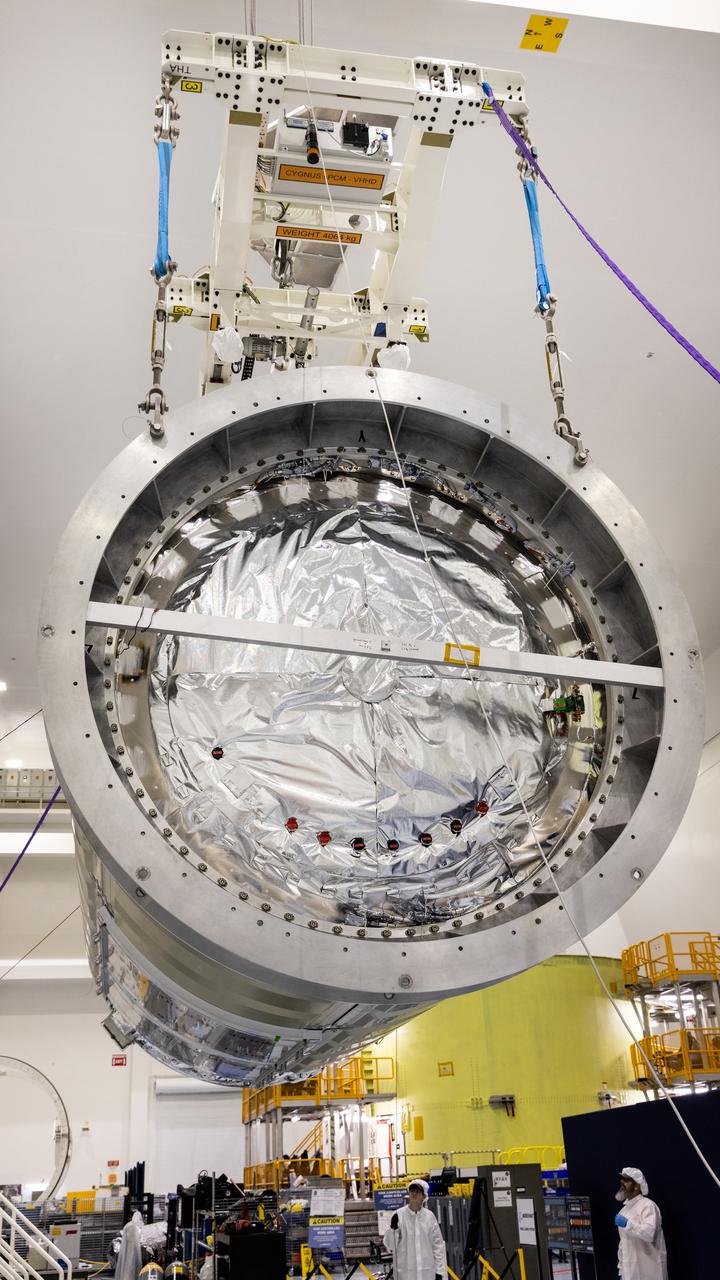
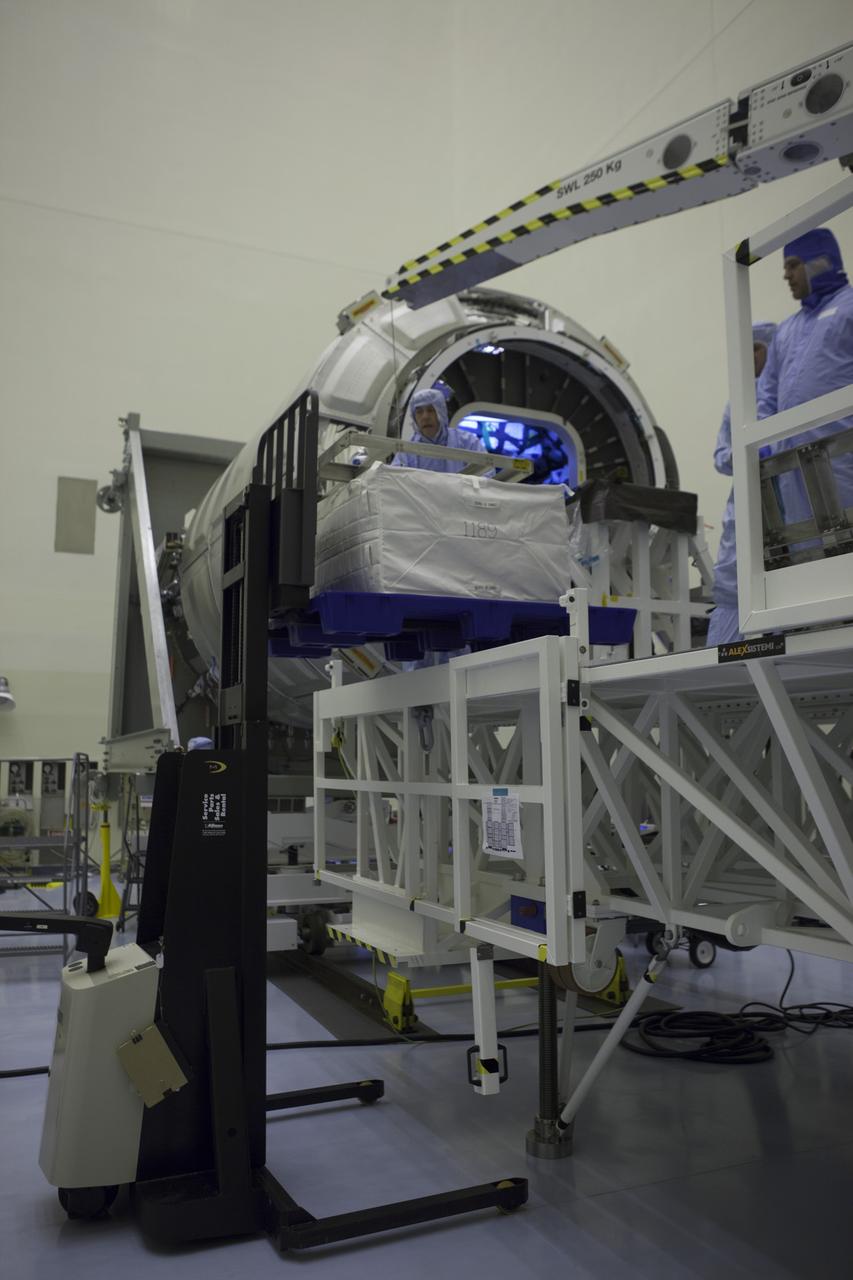
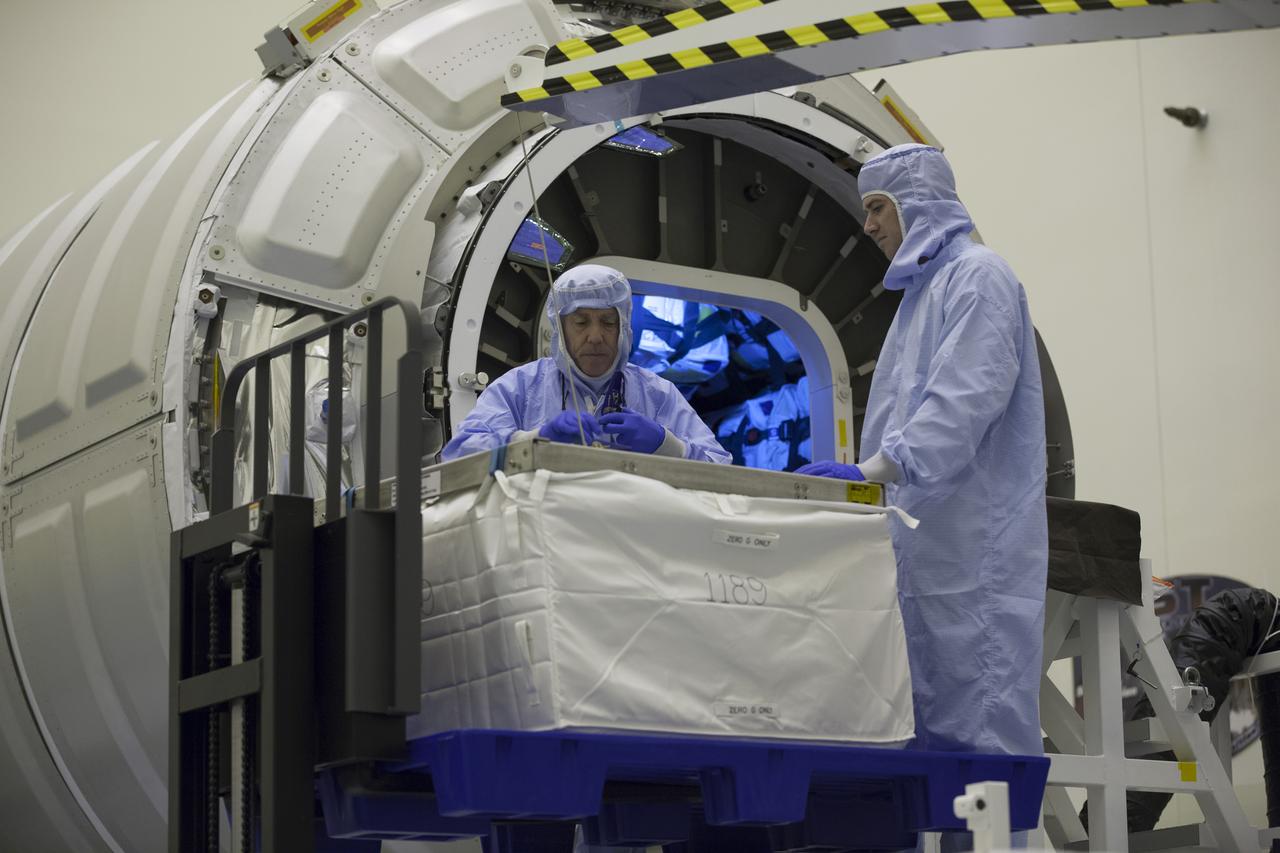
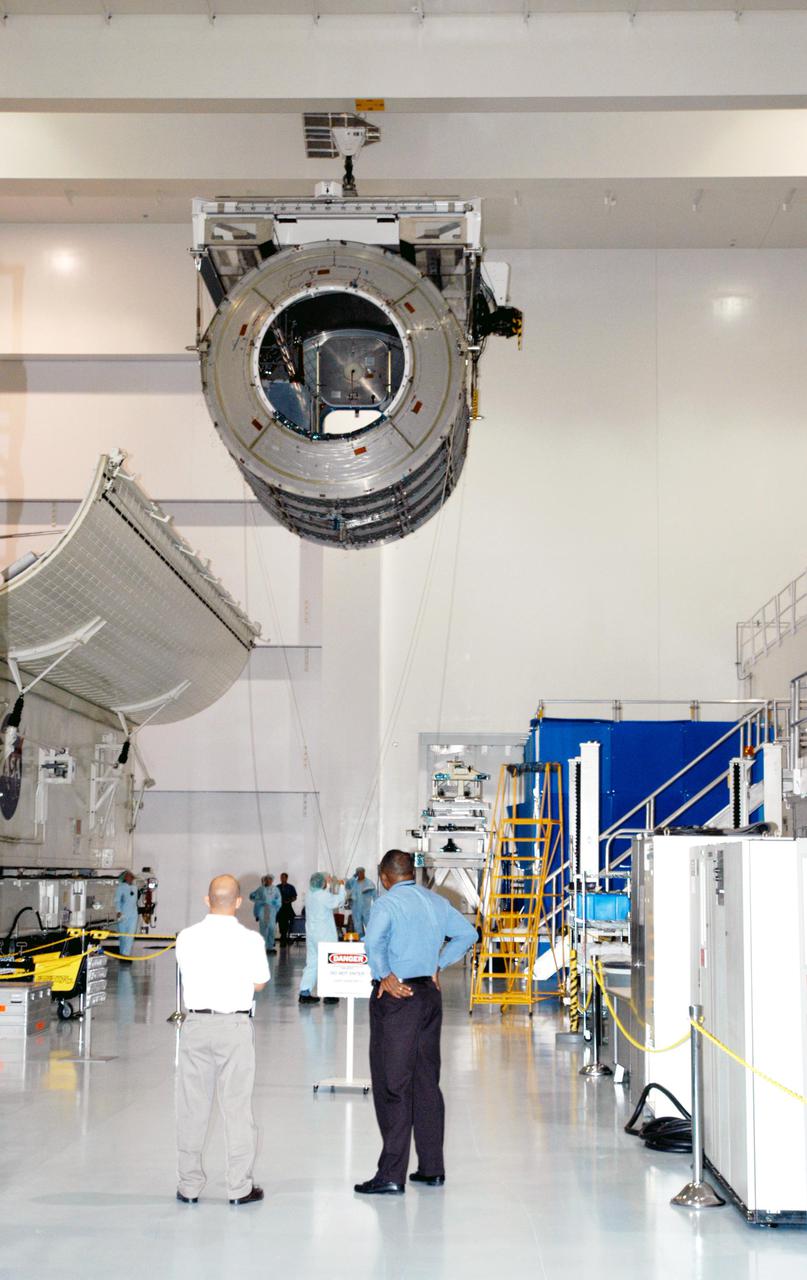
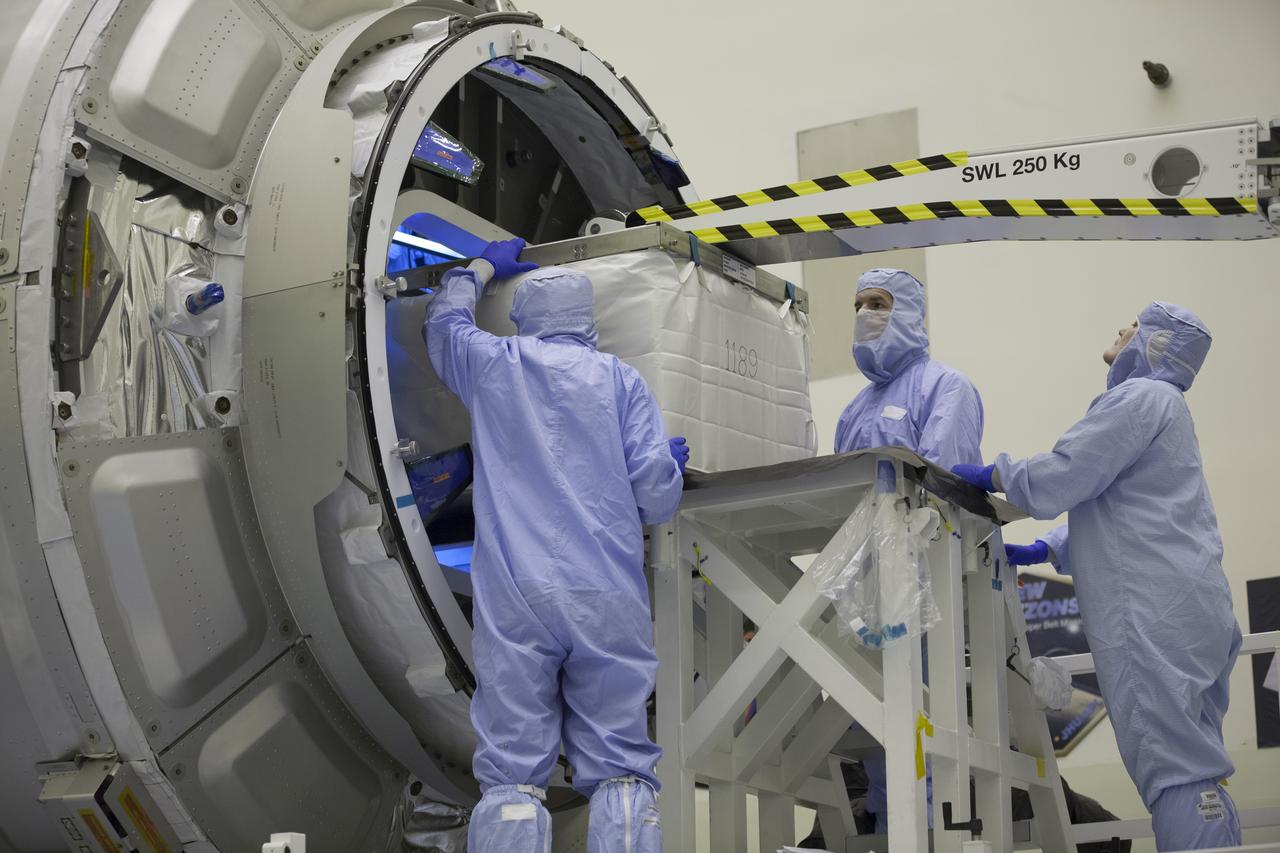
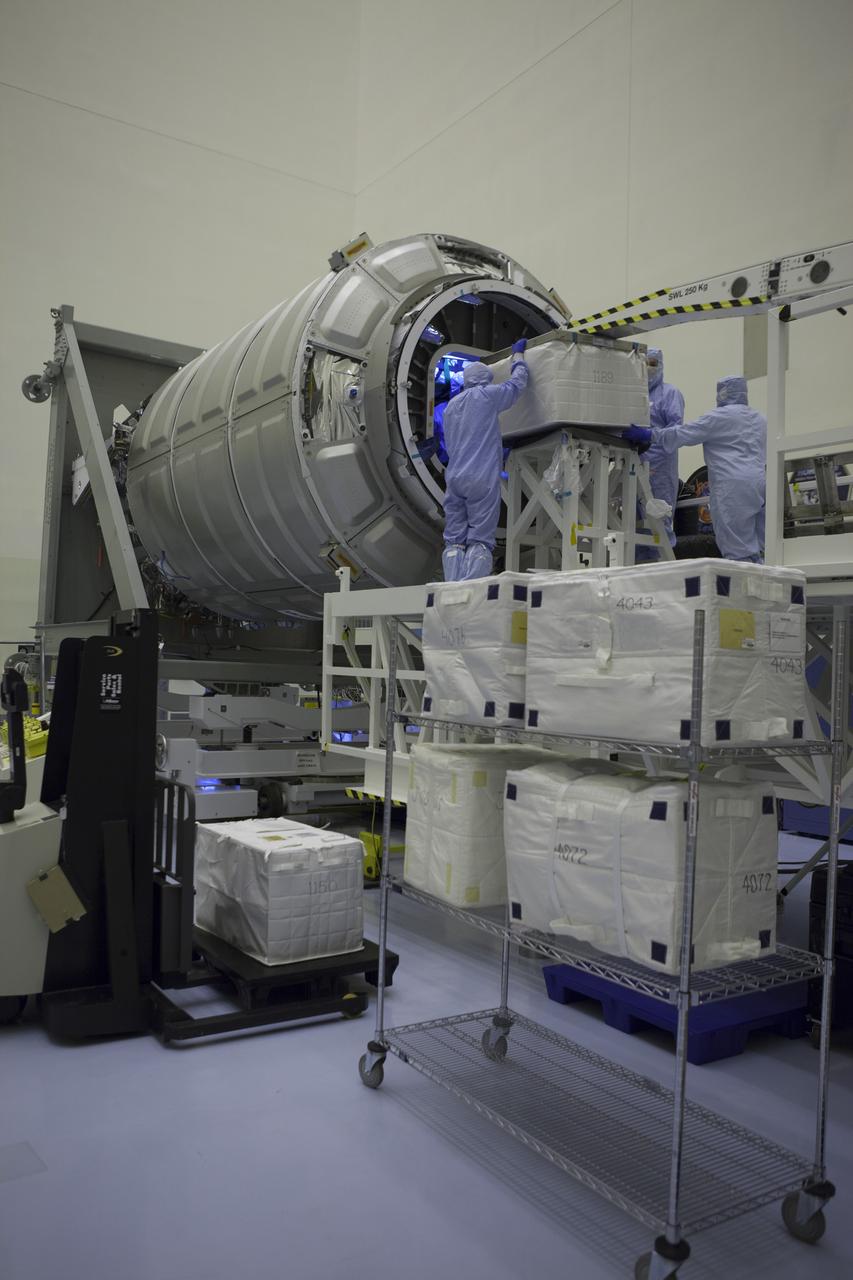
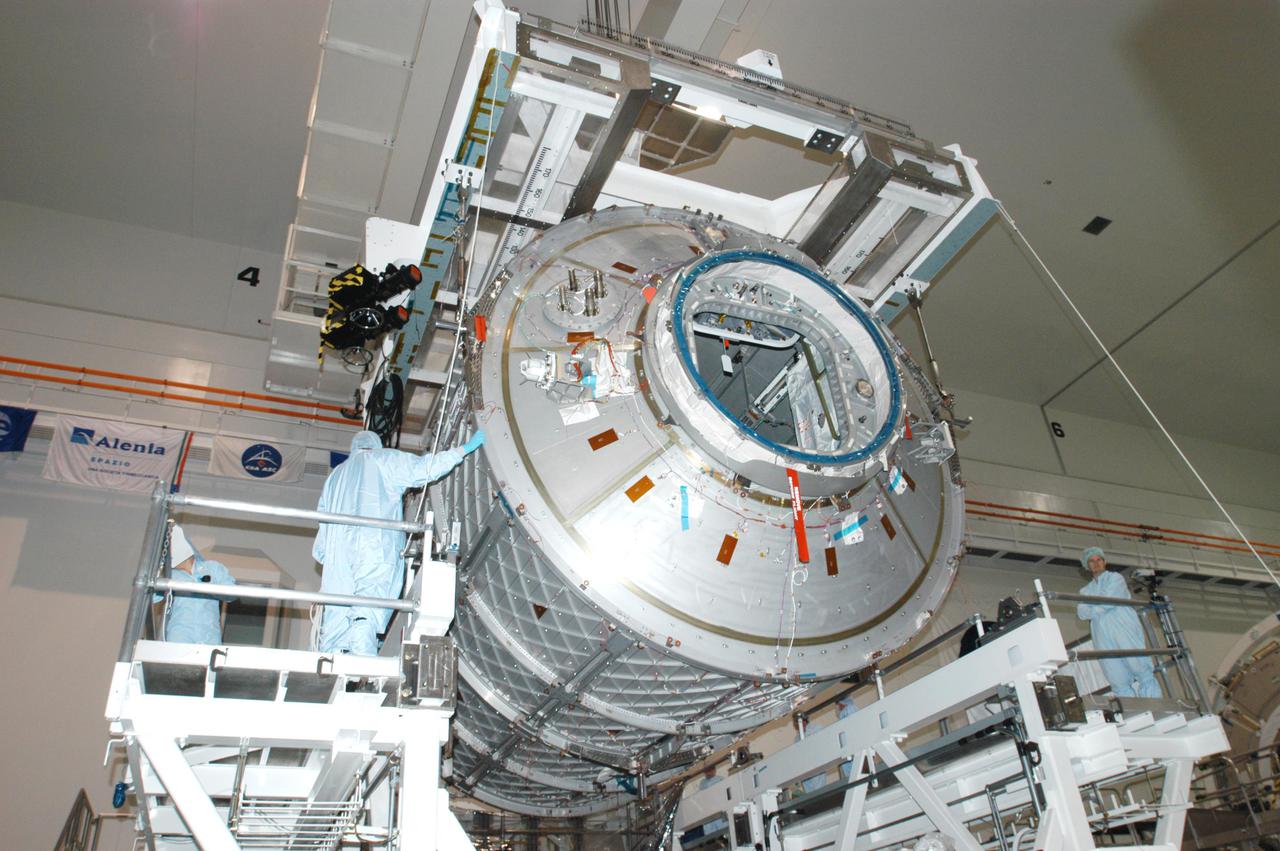
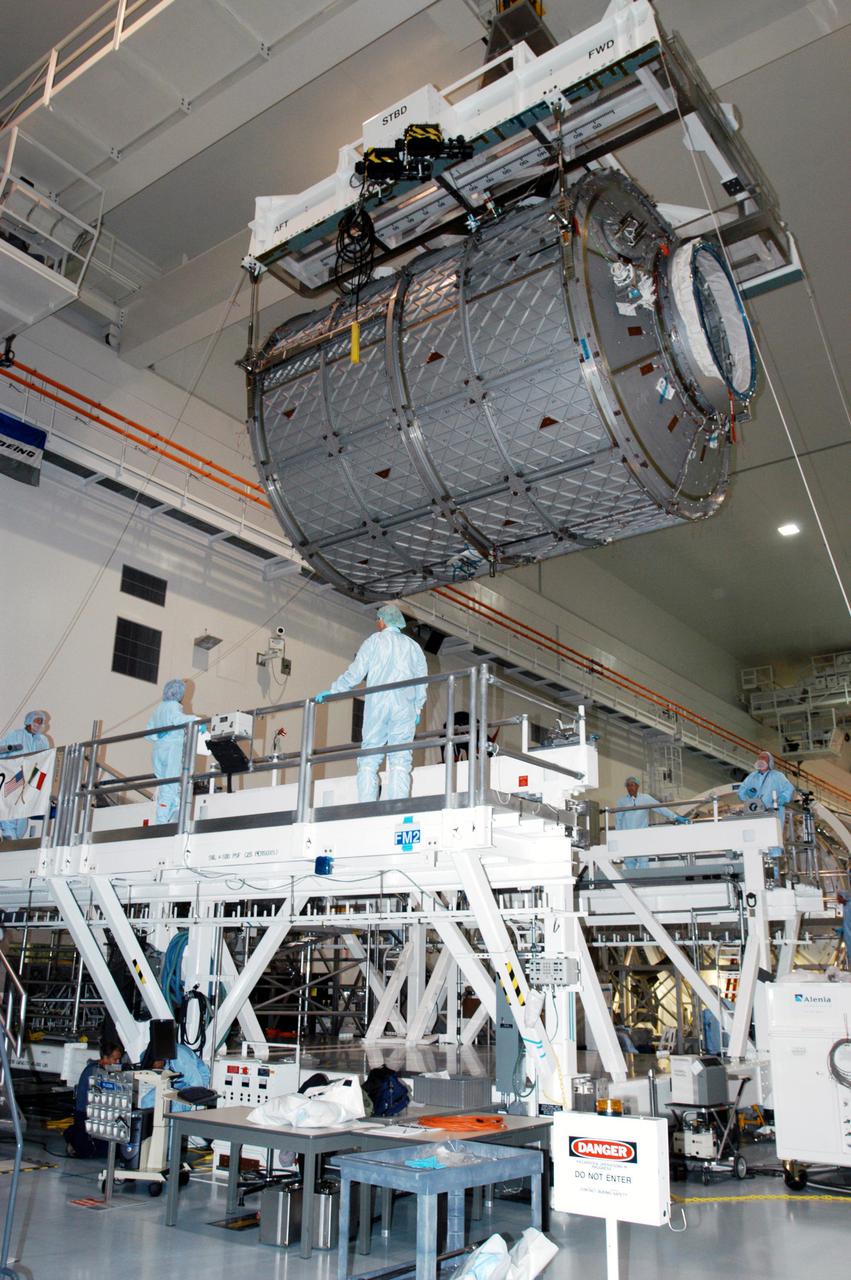
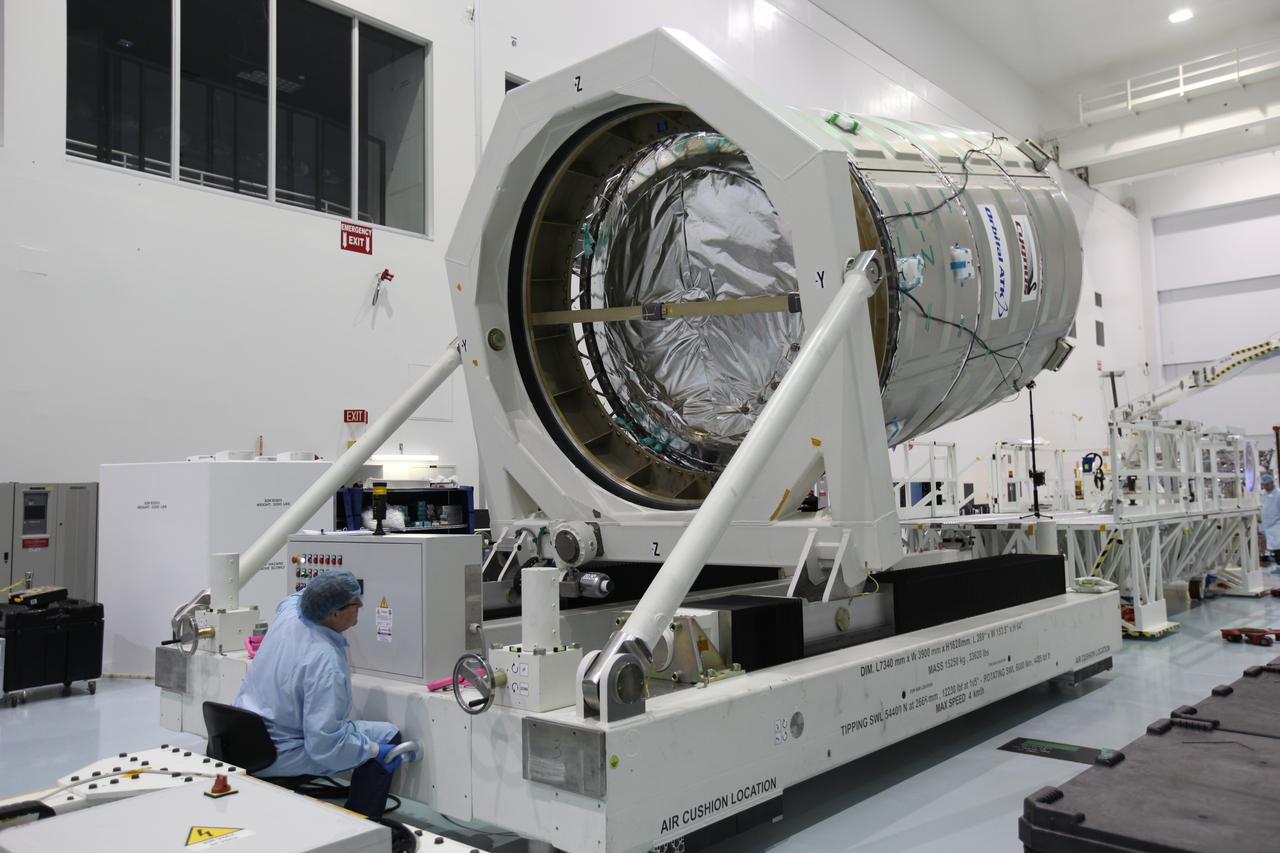
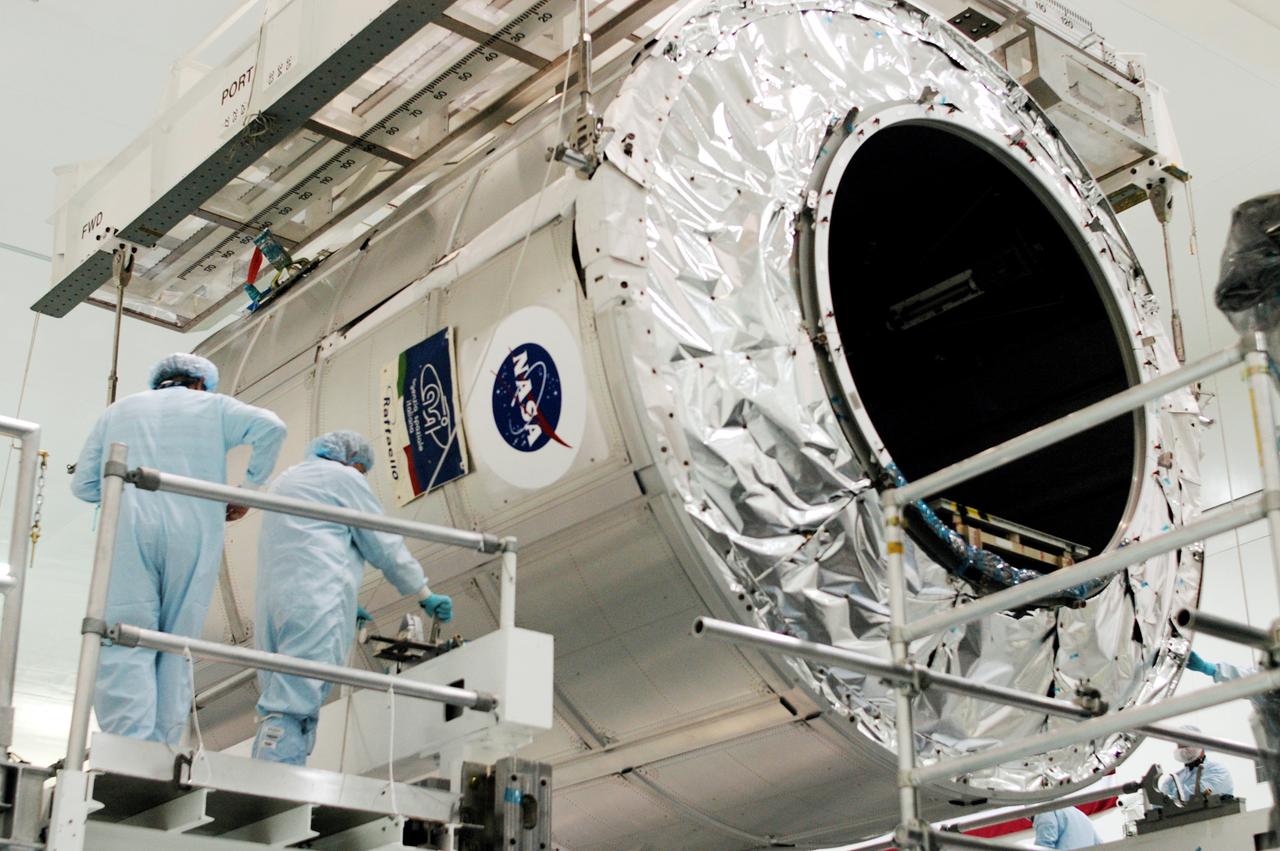
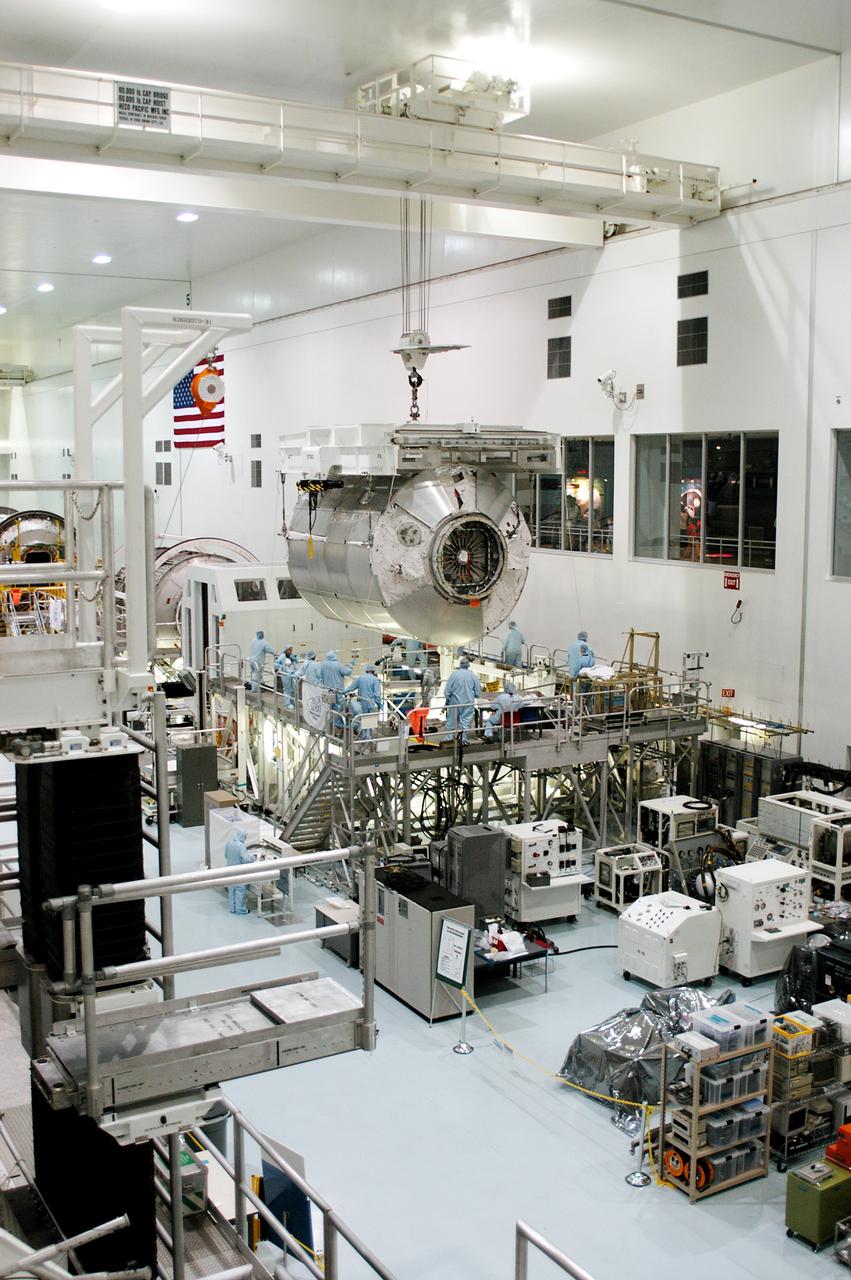
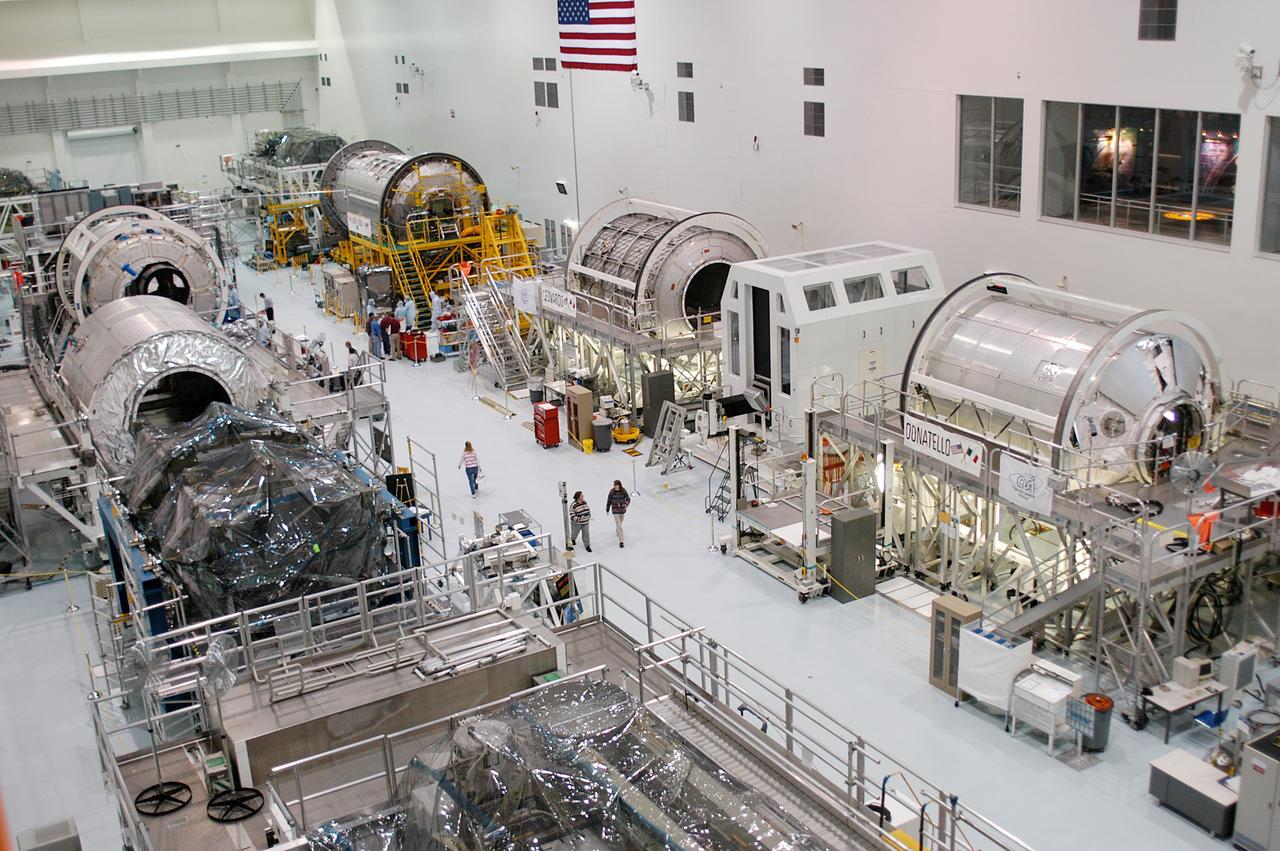
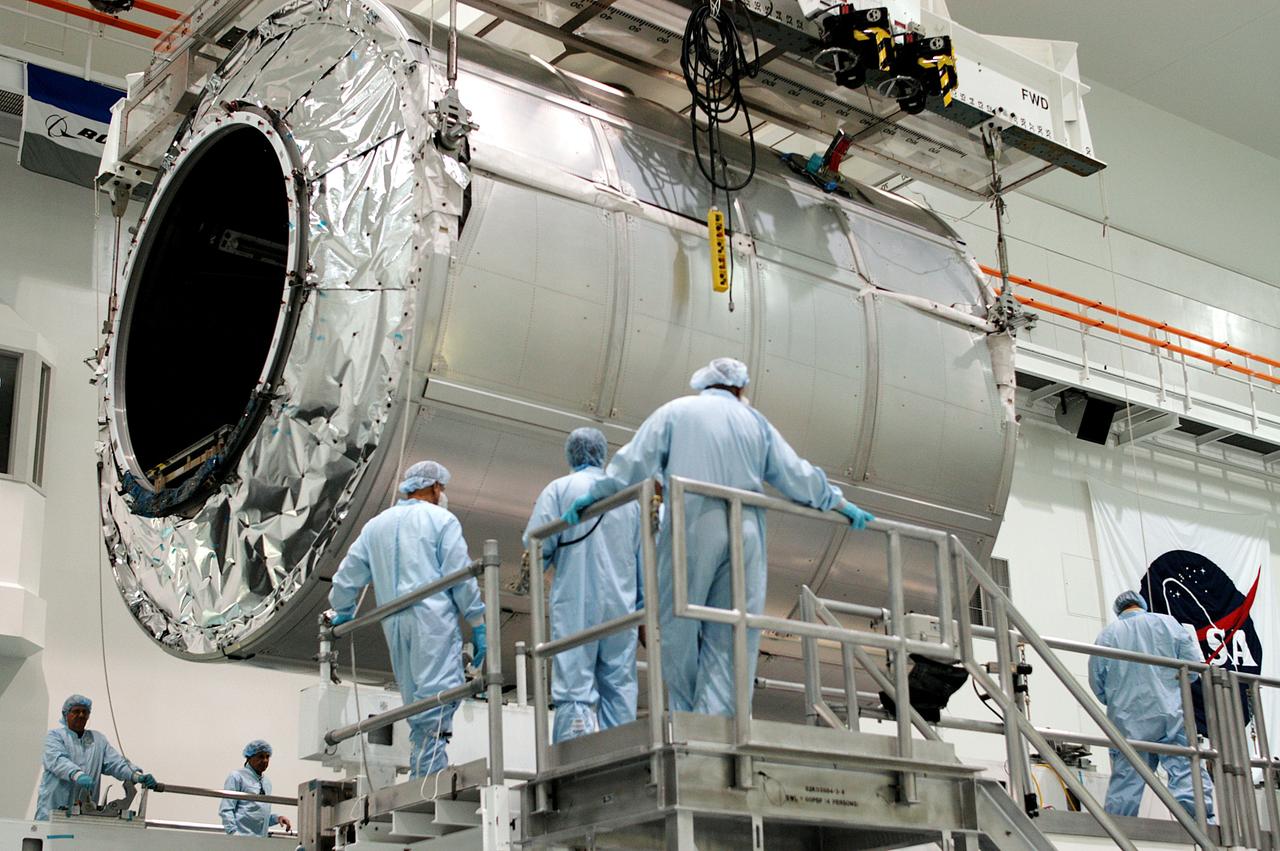
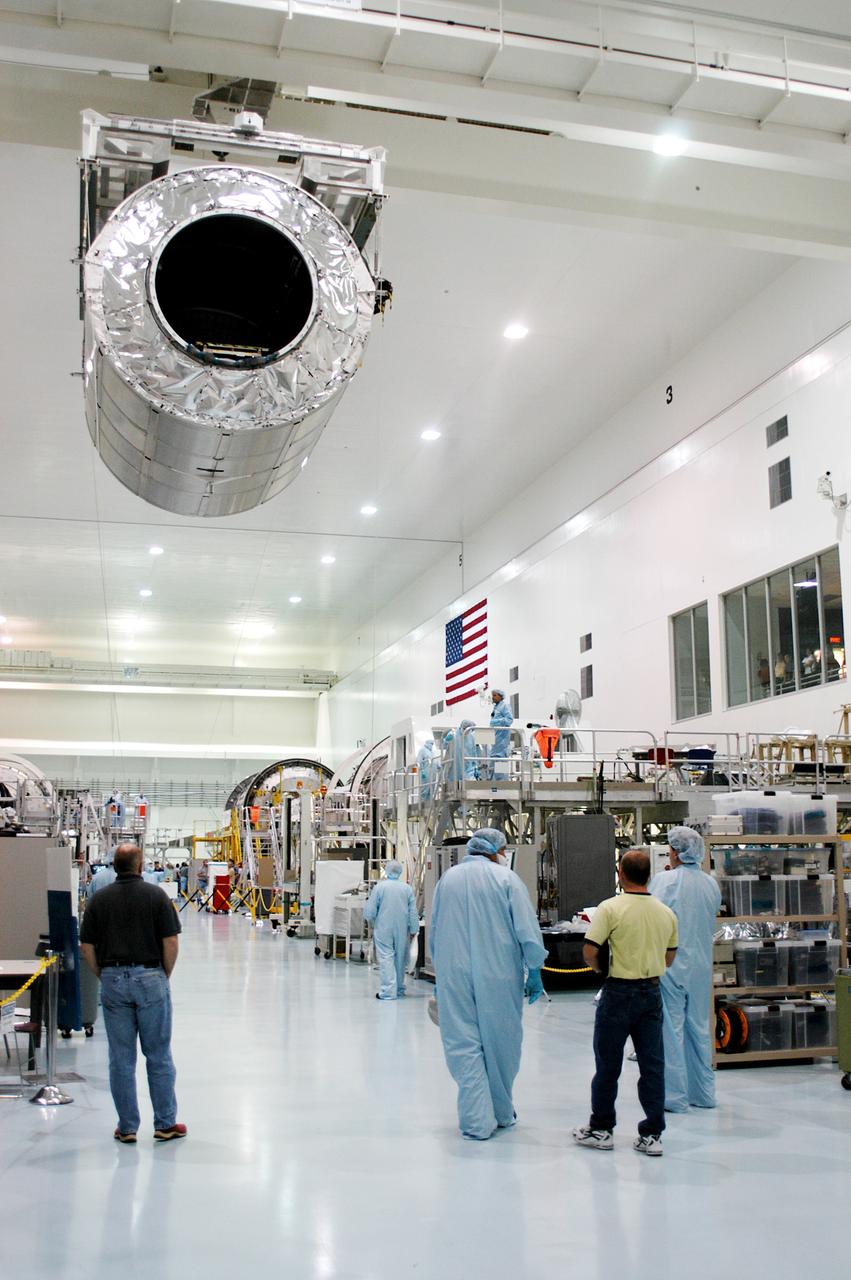
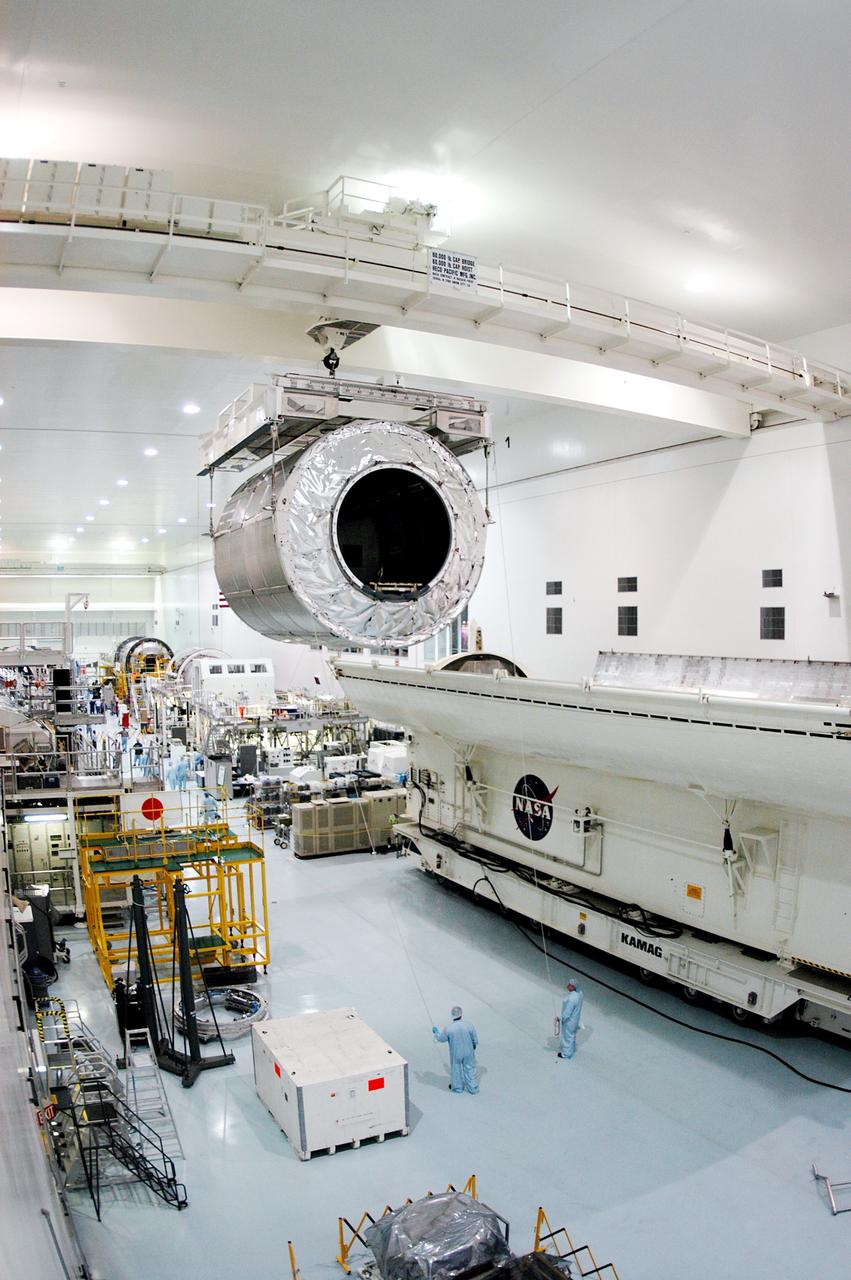
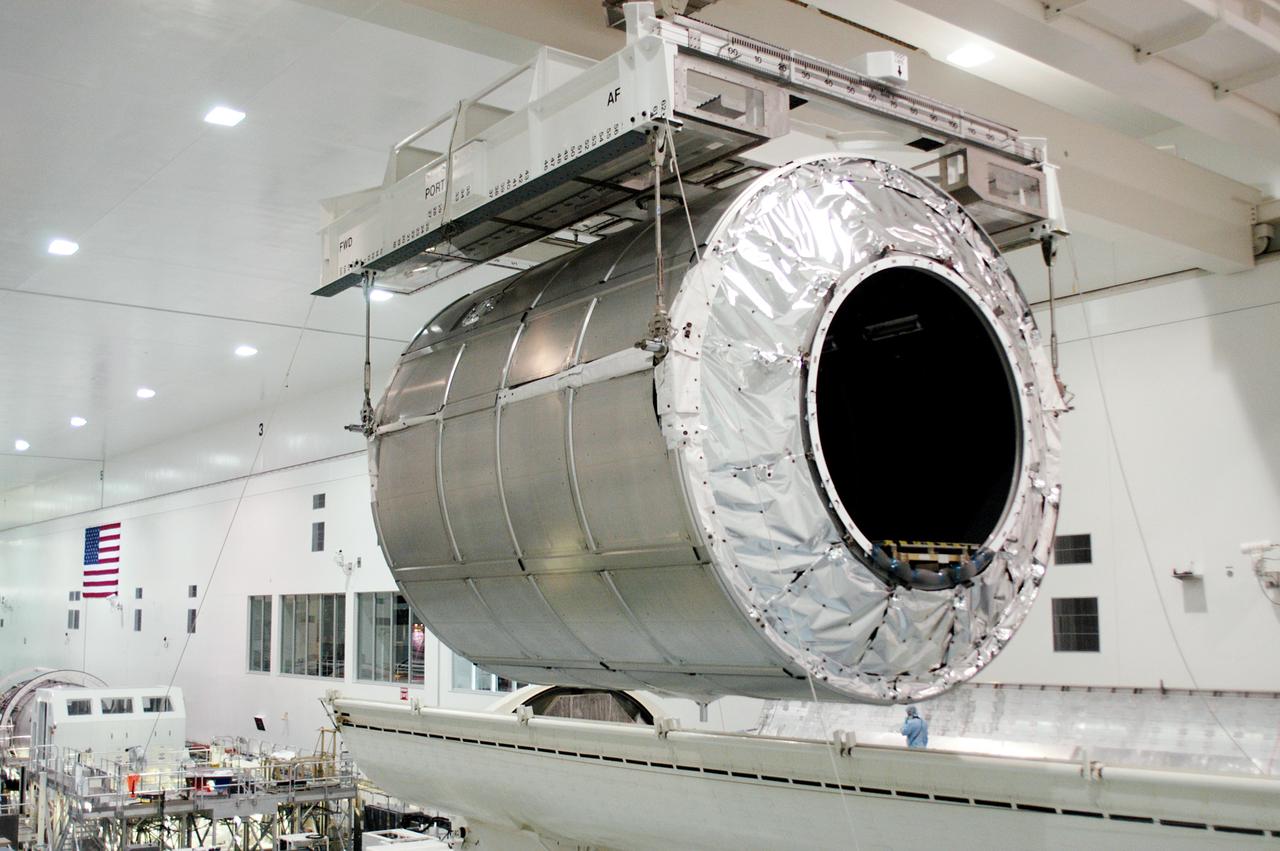
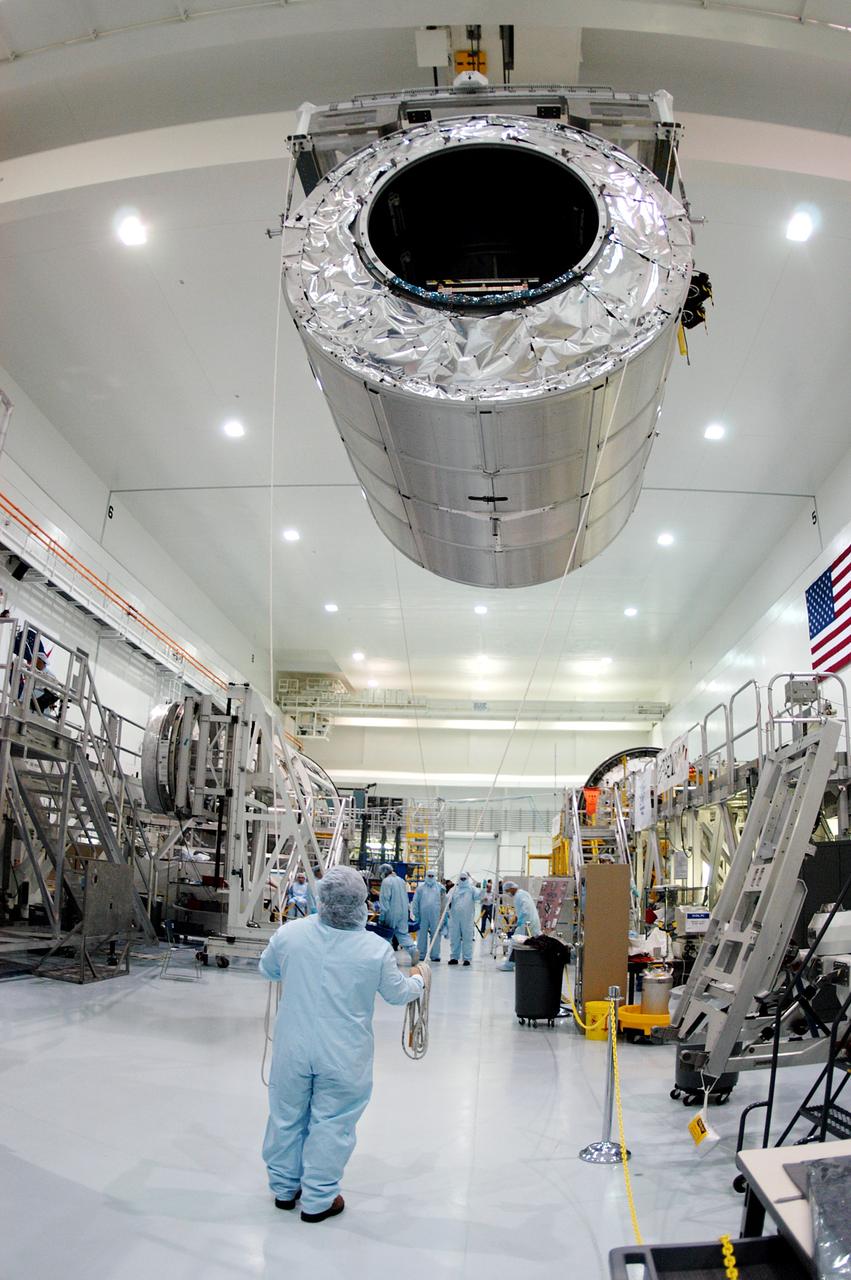
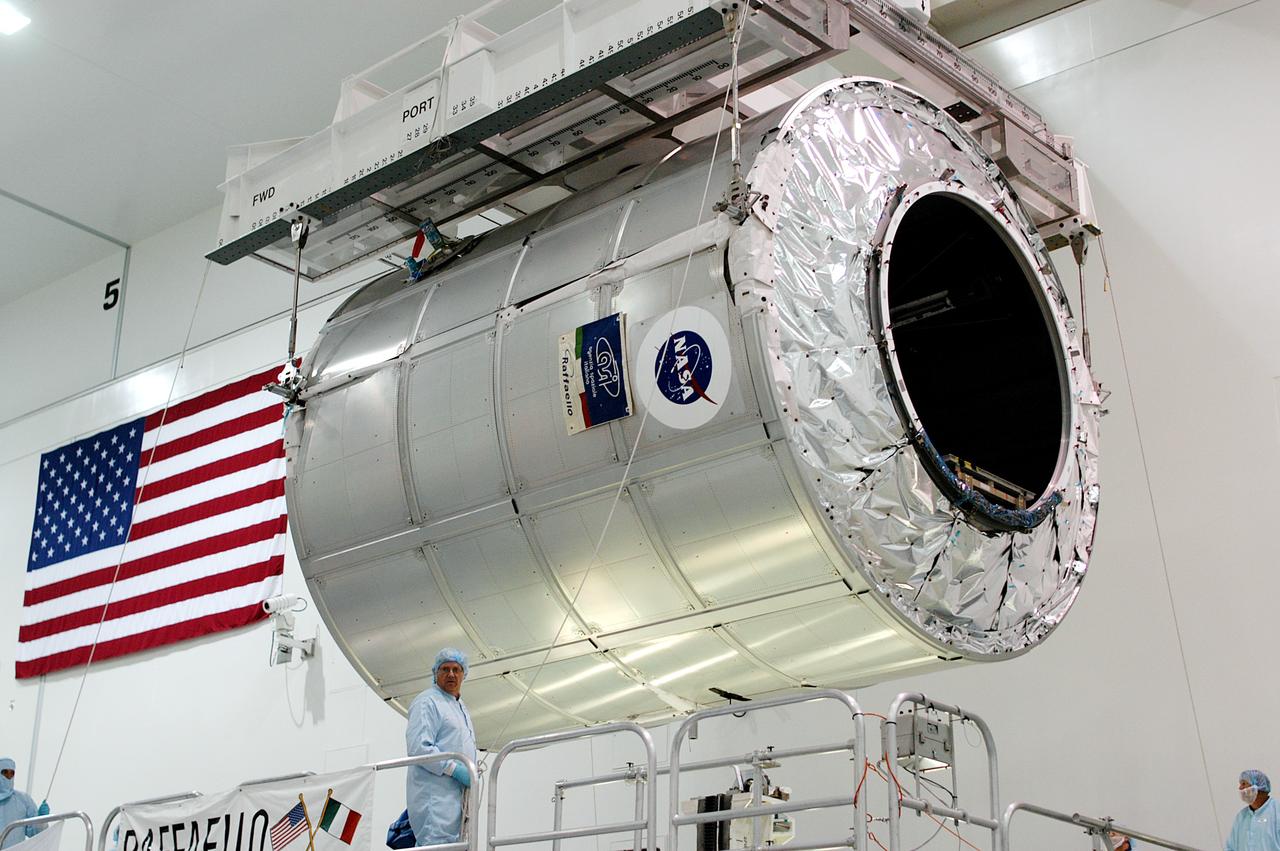
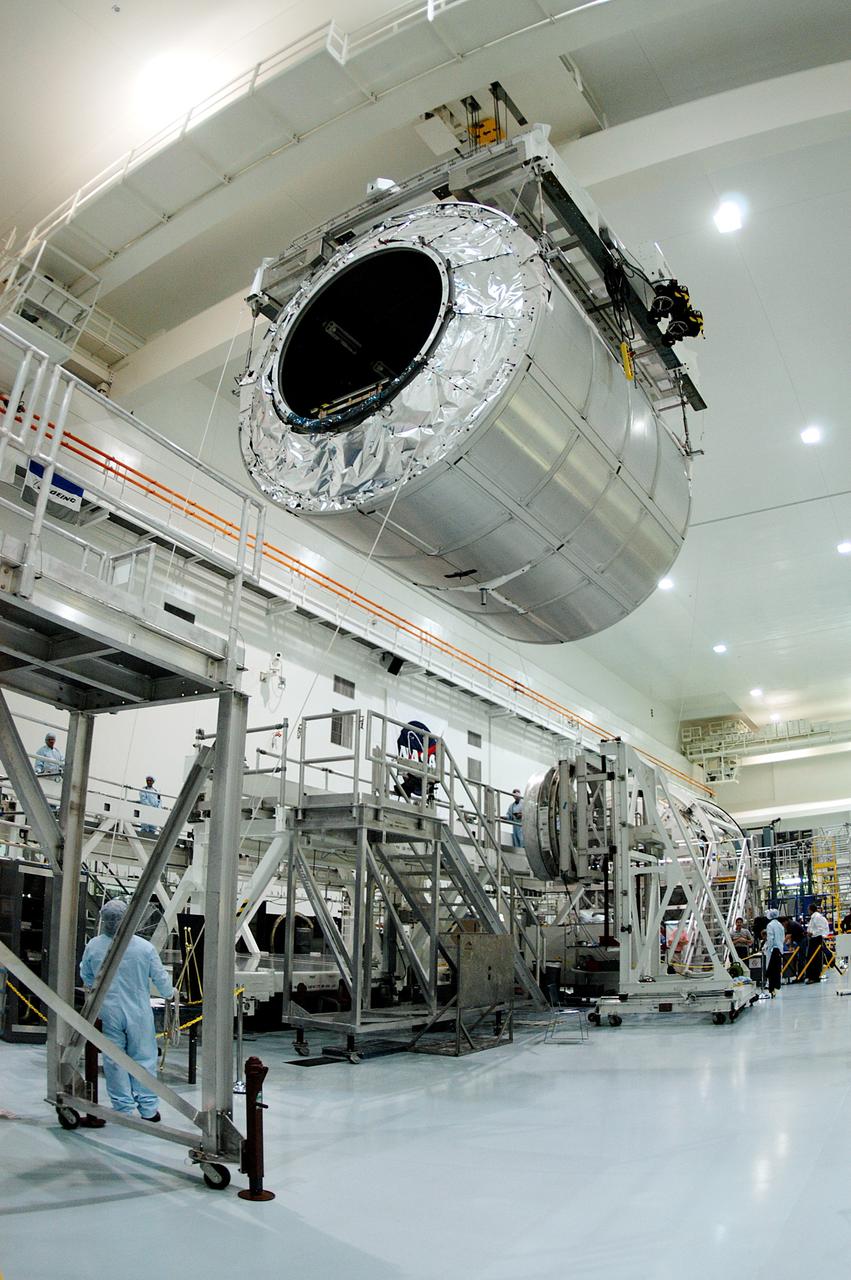
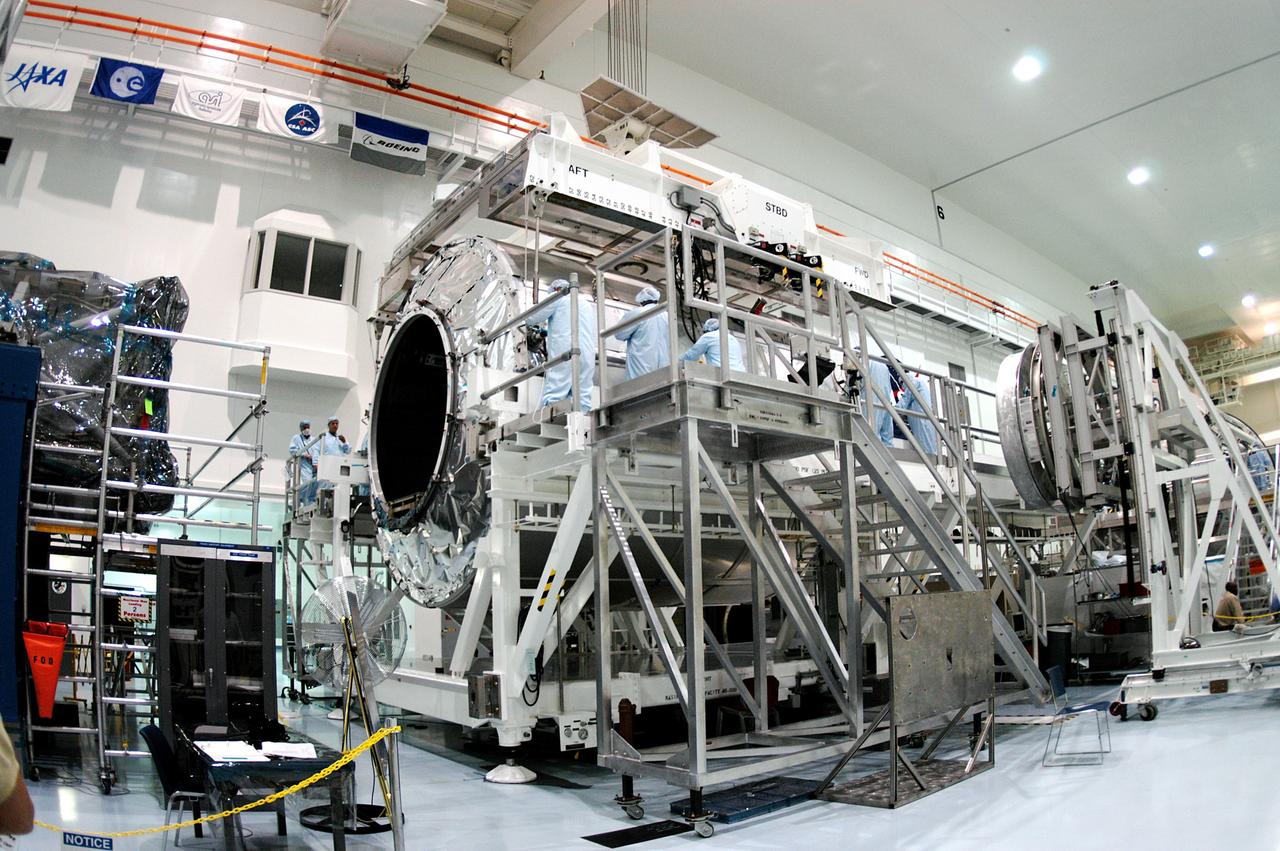
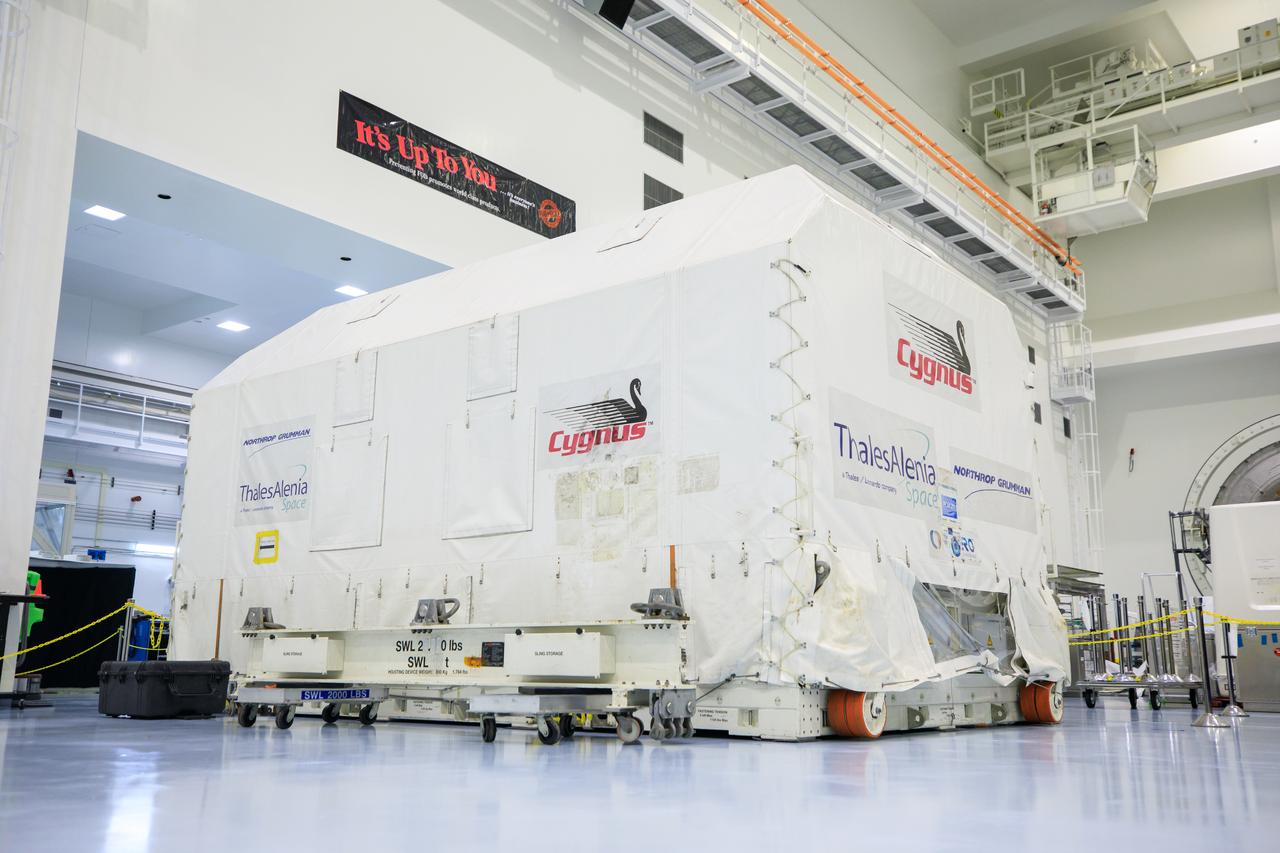
Northrop Grumman’s Cygnus pressurized cargo module for the company’s 20th commercial resupply mission arrives in its environmentally controlled shipping container inside the high bay in the Space Station Processing Facility at NASA's Kennedy Space Center in Florida on Aug. 2, 2023. Cygnus will launch later this year atop a SpaceX Falcon 9 rocket from Cape Canaveral Space Force Station’s Space Launch Complex 40 to the International Space Station. Cygnus will undergo prelaunch processing at Kennedy before it is transported to SpaceX’s integration facility.
NG-20 Cygnus Pressurized Cargo Module Arrival
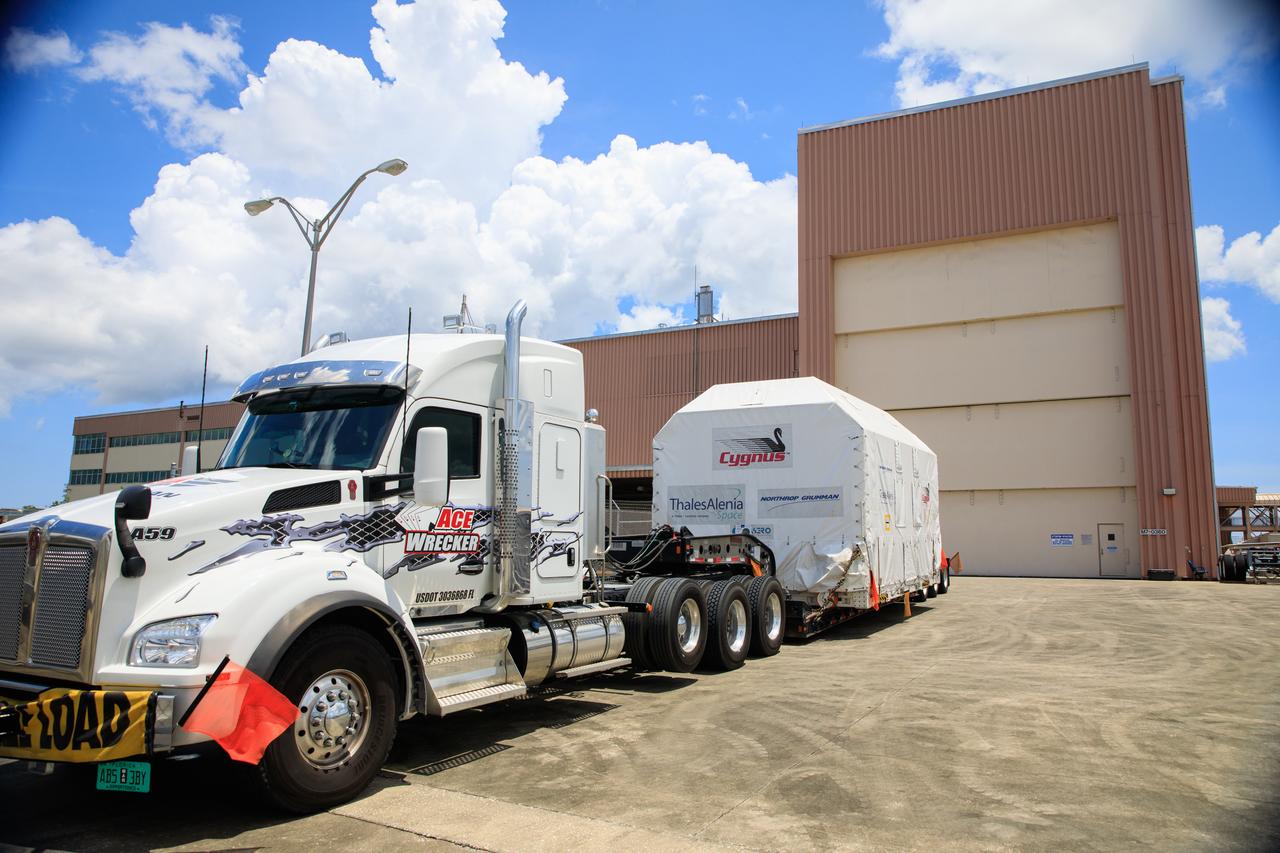
The Northrop Grumman Cygnus spacecraft's pressurized cargo module (PCM) arrives at the Space Station Processing Facility of NASA's Kennedy Space Center in Florida on Aug. 2, 2023. The PCM is sealed in an environmentally controlled shipping container, pulled in by truck on a flatbed trailer. Cygnus will launch later this year atop a SpaceX Falcon 9 rocket from Cape Canaveral Space Force Station’s Space Launch Complex 40 to the International Space Station. Cygnus will undergo prelaunch processing at Kennedy before it is transported to SpaceX’s integration facility.
NG-20 Cygnus Pressurized Cargo Module Arrival
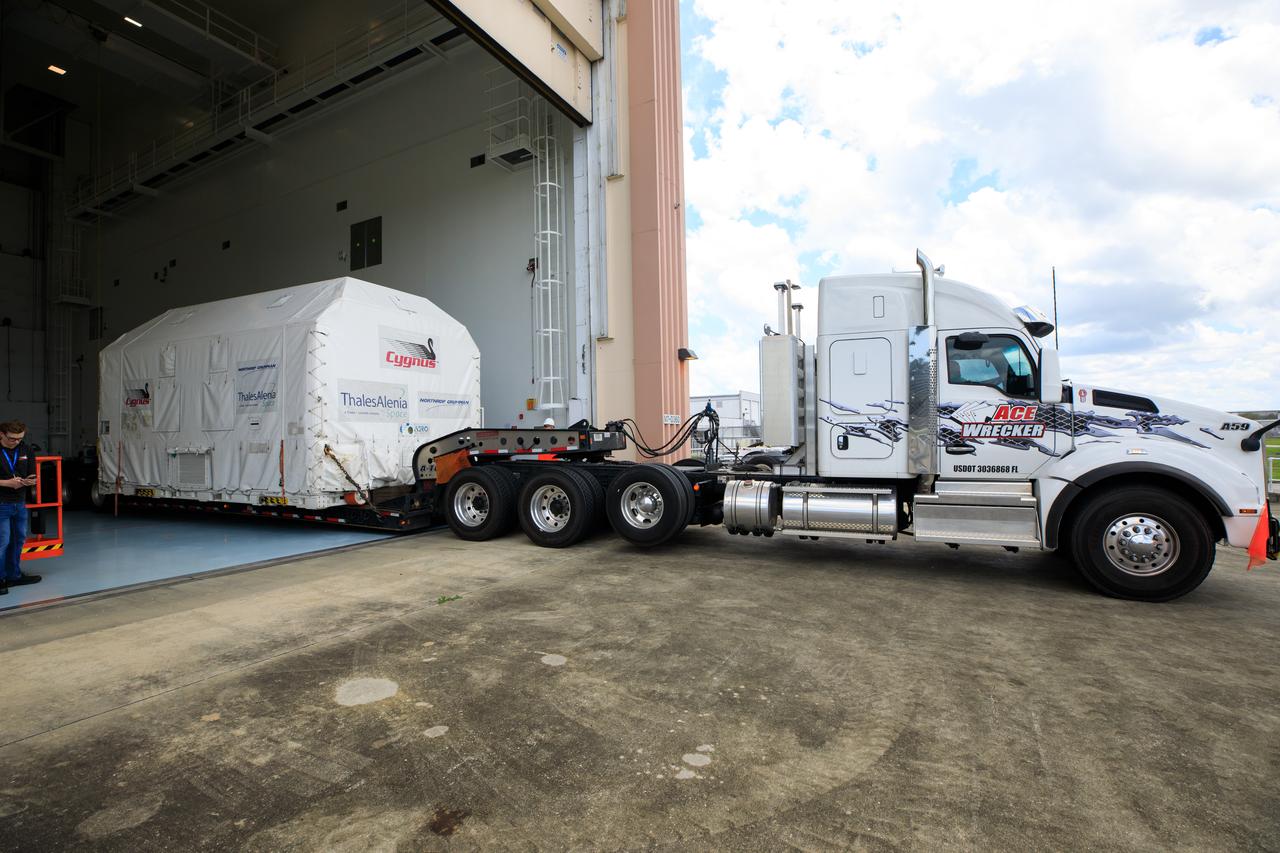
The Northrop Grumman Cygnus spacecraft's pressurized cargo module (PCM) arrives at the Space Station Processing Facility of NASA's Kennedy Space Center in Florida on Aug. 2, 2023. The PCM is sealed in an environmentally controlled shipping container, pulled in by truck on a flatbed trailer. Cygnus will launch later this year atop a SpaceX Falcon 9 rocket from Cape Canaveral Space Force Station’s Space Launch Complex 40 to the International Space Station. Cygnus will undergo prelaunch processing at Kennedy before it is transported to SpaceX’s integration facility.
NG-20 Cygnus Pressurized Cargo Module Arrival
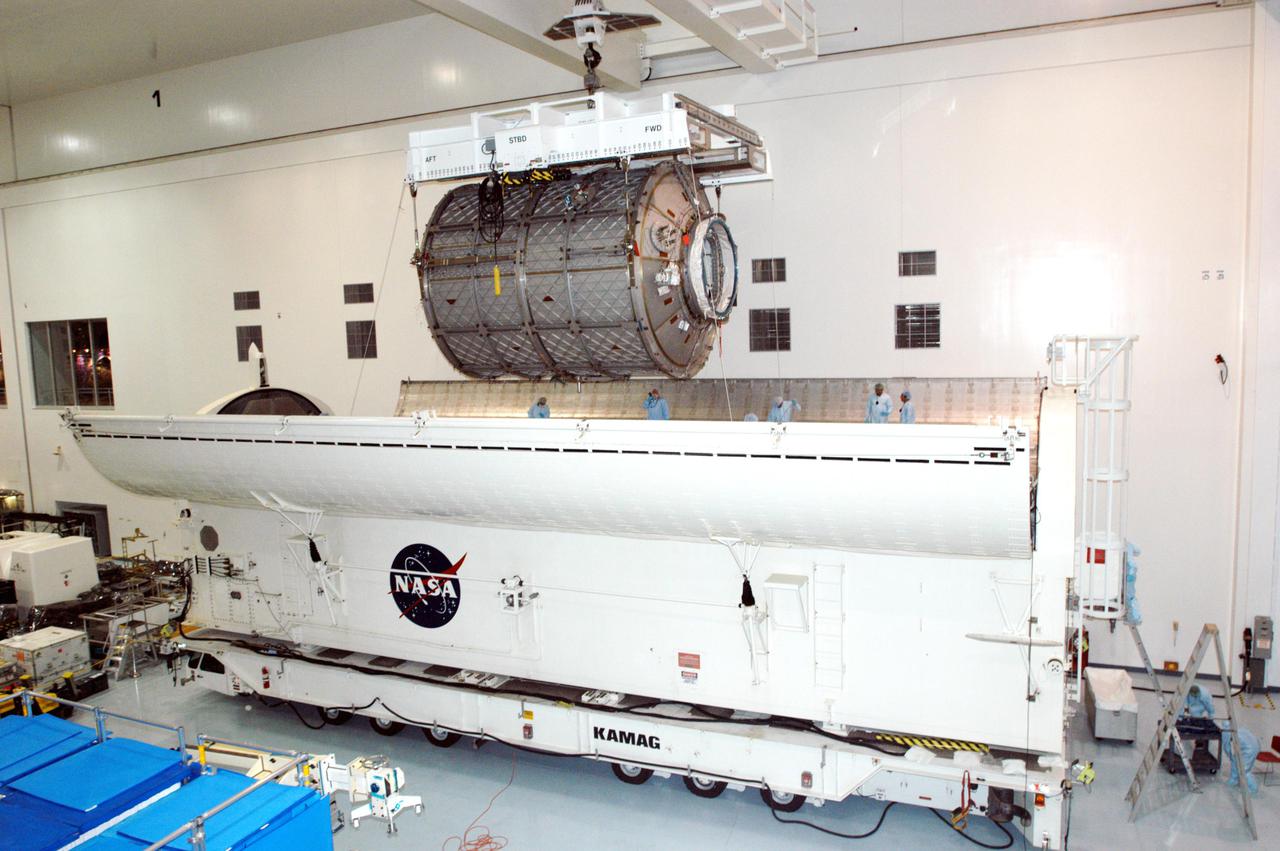
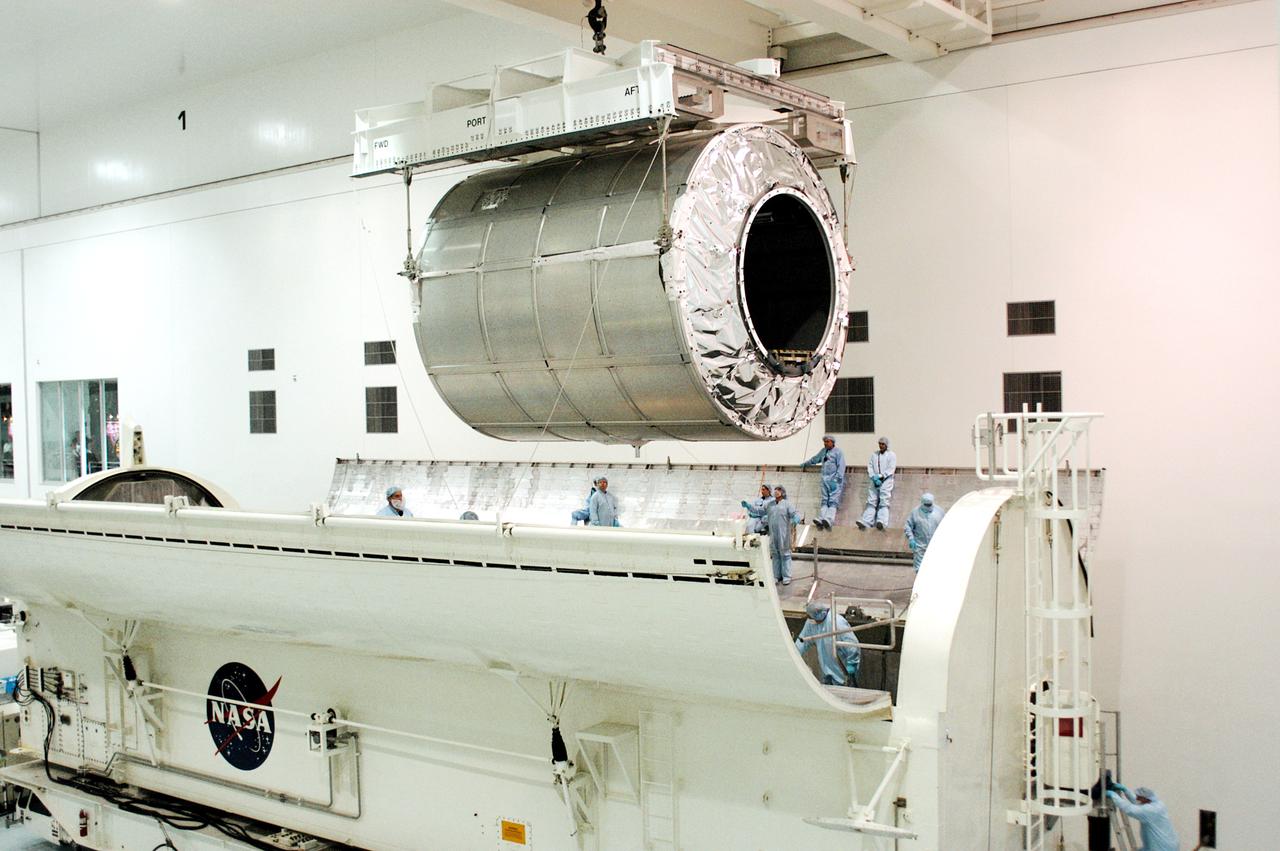
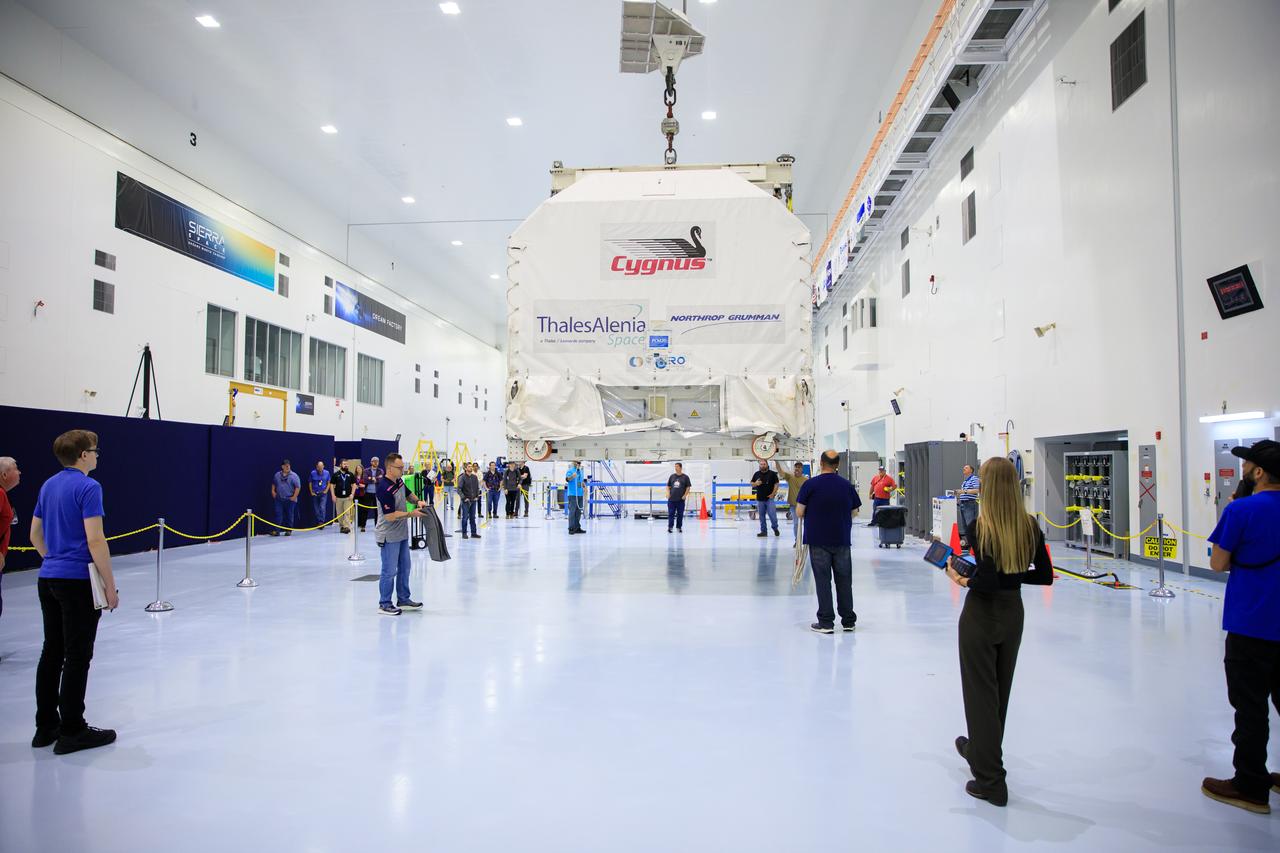
The Northrop Grumman Cygnus spacecraft’s pressurized cargo module (PCM) for the company’s 20th commercial resupply mission is moved by crane in its environmentally controlled shipping container in to the Space Station Processing Facility’s high bay at NASA's Kennedy Space Center in Florida on Aug. 2, 2023. Cygnus will launch later this year atop a SpaceX Falcon 9 rocket from Cape Canaveral Space Force Station’s Space Launch Complex 40 to the International Space Station. Cygnus will undergo prelaunch processing at Kennedy before it is transported to SpaceX’s integration facility.
NG-20 Cygnus Pressurized Cargo Module Arrival
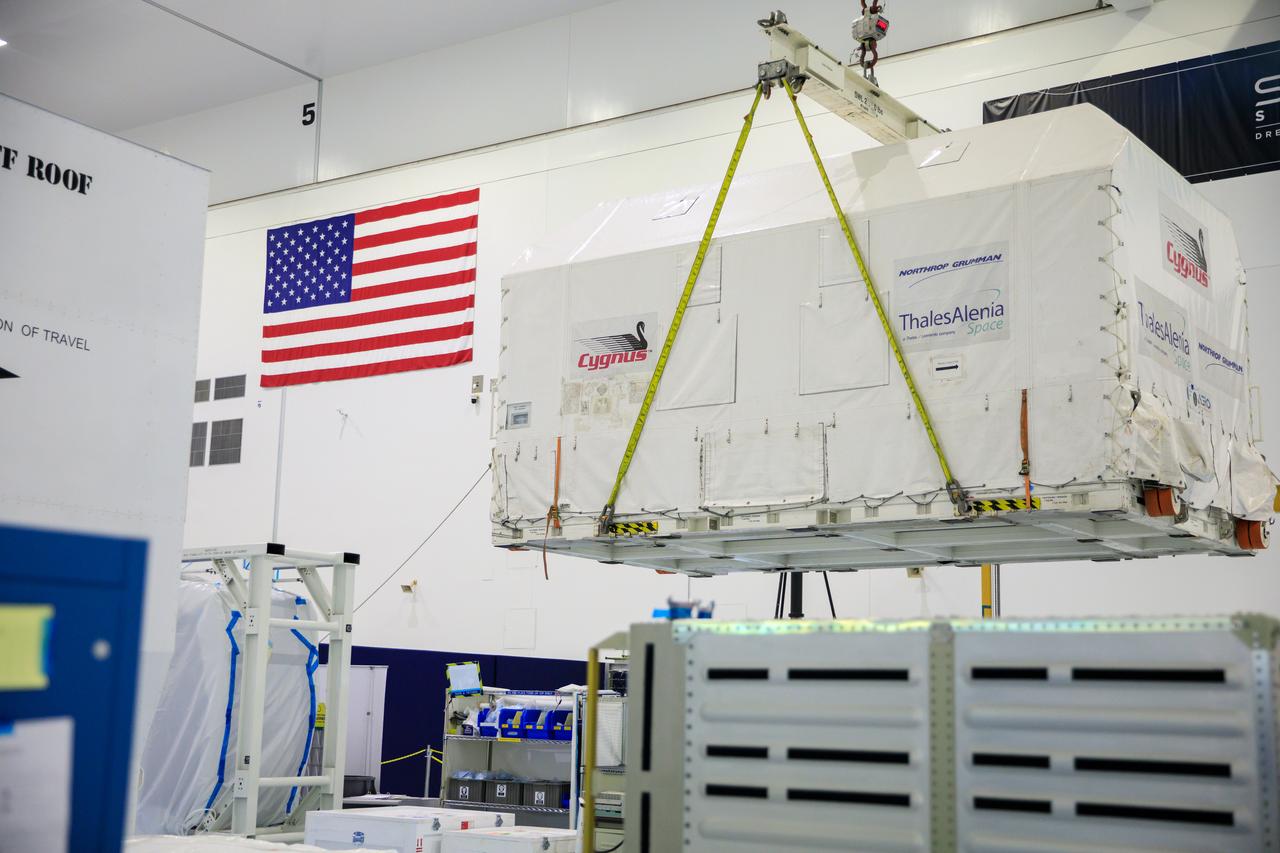
The Cygnus pressurized cargo module for Northrop Grumman’s 20th commercial resupply mission is lowered by crane in its carrier and secured onto a transport base inside the low bay in the Space Station Processing Facility at NASA's Kennedy Space Center in Florida on Aug. 2, 2023. Cygnus will launch later this year atop a SpaceX Falcon 9 rocket from Cape Canaveral Space Force Station’s Space Launch Complex 40 to the International Space Station. Cygnus will undergo prelaunch processing at Kennedy before it is transported to SpaceX’s integration facility.
NG-20 Cygnus Pressurized Cargo Module Arrival
A crane is used to lift the Northrop Grumman Cygnus spacecraft's pressurized cargo module (PCM) off a flatbed truck after arrival at the Space Station Processing Facility of NASA's Kennedy Space Center in Florida on Aug. 2, 2023. The PCM is sealed in an environmentally controlled shipping container. Cygnus will launch later this year atop a SpaceX Falcon 9 rocket from Cape Canaveral Space Force Station’s Space Launch Complex 40 to the International Space Station. Cygnus will undergo prelaunch processing at Kennedy before it is transported to SpaceX’s integration facility.
NG-20 Cygnus Pressurized Cargo Module Arrival
The Northrop Grumman Cygnus spacecraft’s pressurized cargo module (PCM) for the company’s 20th commercial resupply mission is lifted and moved by crane in its environmentally controlled shipping container inside the high bay in the Space Station Processing Facility at NASA's Kennedy Space Center in Florida on Aug. 2, 2023. Cygnus will launch later this year atop a SpaceX Falcon 9 rocket from Cape Canaveral Space Force Station’s Space Launch Complex 40 to the International Space Station. Cygnus will undergo prelaunch processing at Kennedy before it is transported to SpaceX’s integration facility.
NG-20 Cygnus Pressurized Cargo Module Arrival
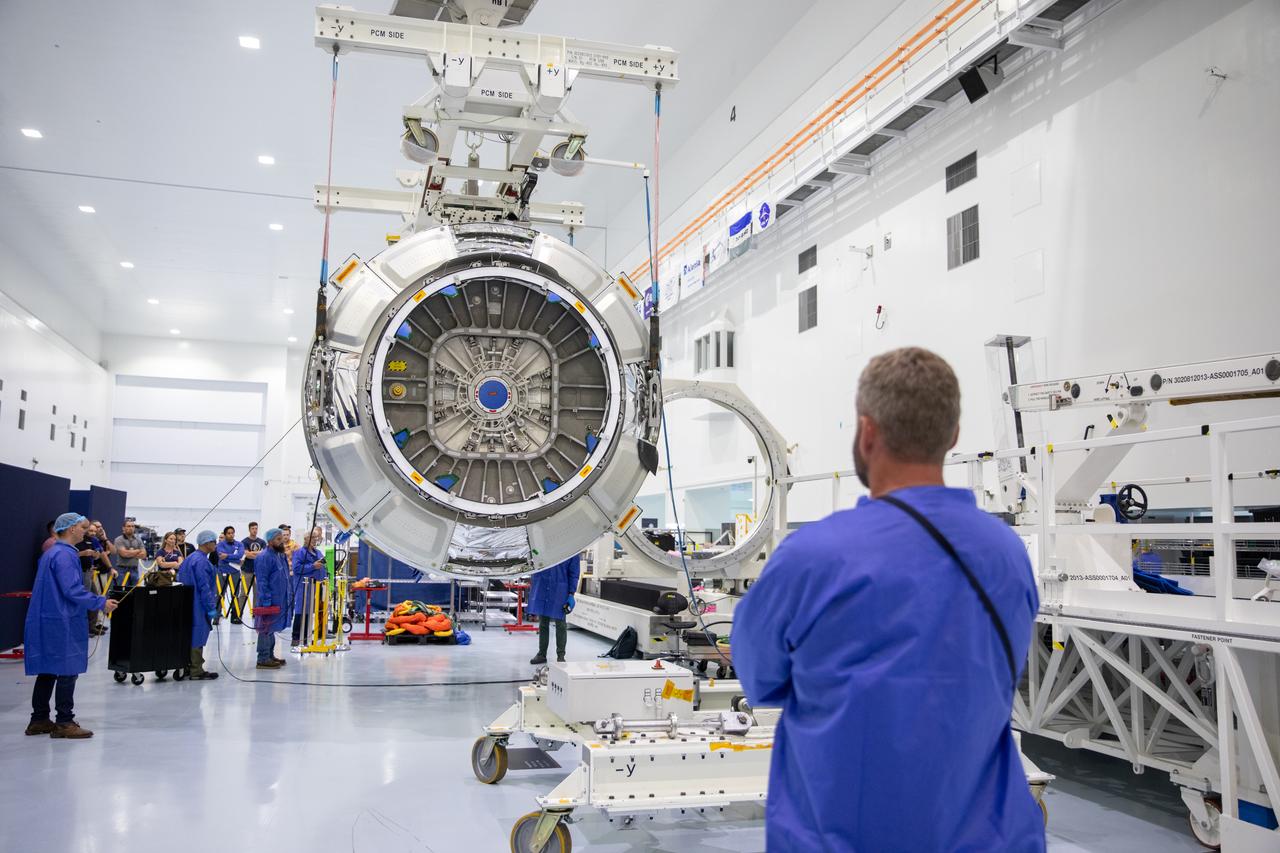
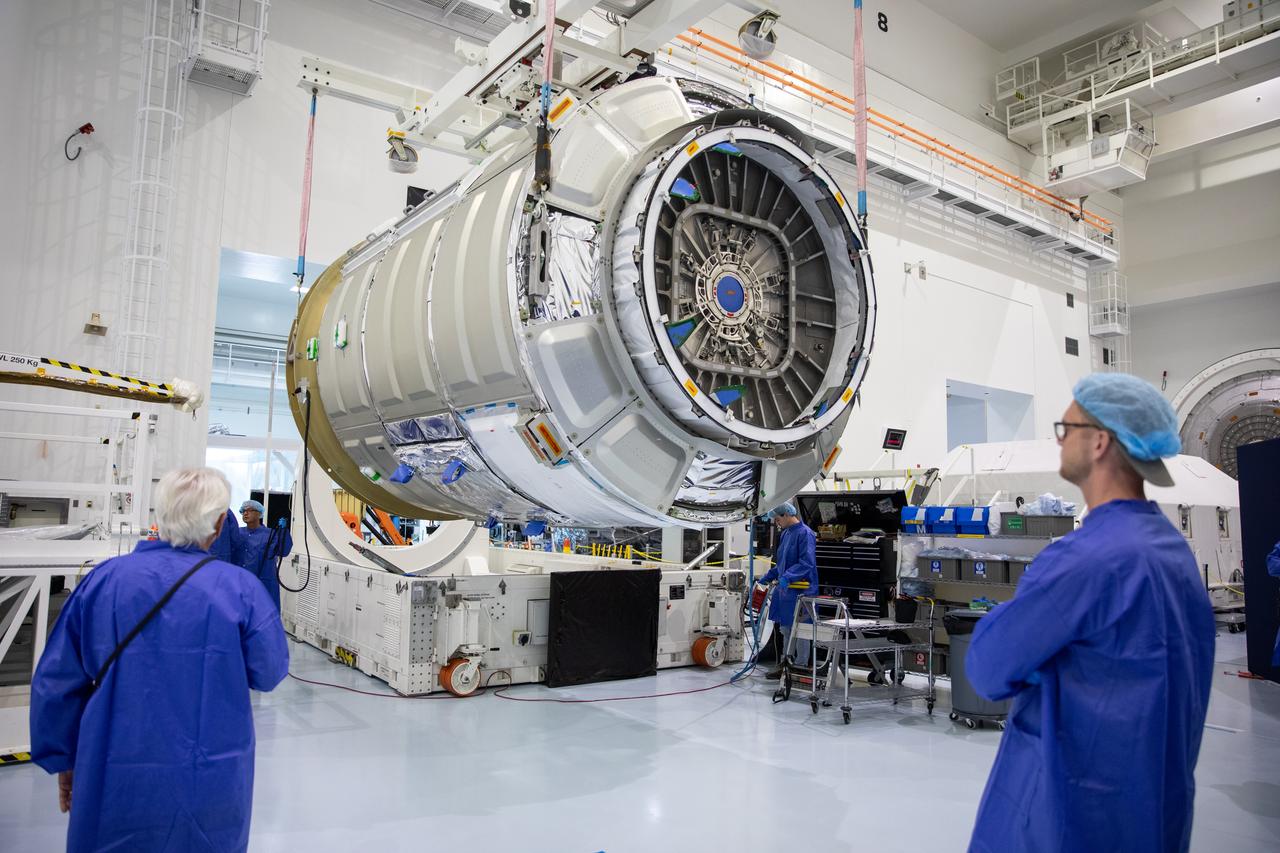
The Northrop Grumman Cygnus spacecraft’s pressurized cargo module (PCM) for the company’s 20th commercial resupply mission is lifted and moved by crane inside the high bay in the Space Station Processing Facility at NASA’s Kennedy Space Center in Florida on Monday, Sept. 18, 2023. The next step is vehicle processing for the mission to the International Space Station. Liftoff, aboard a SpaceX Falcon 9 rocket, will be from Cape Canaveral Space Force Station’s Space Launch Complex 40.
NG-20 PCM Lift
The Northrop Grumman Cygnus spacecraft’s pressurized cargo module (PCM) for the company’s 20th commercial resupply mission is lifted and moved by crane inside the high bay in the Space Station Processing Facility at NASA’s Kennedy Space Center in Florida on Monday, Sept. 18, 2023. The next step is vehicle processing for the mission to the International Space Station. Liftoff, aboard a SpaceX Falcon 9 rocket, will be from Cape Canaveral Space Force Station’s Space Launch Complex 40.
NG-20 PCM Lift
The Northrop Grumman Cygnus spacecraft’s pressurized cargo module (PCM) for the company’s 20th commercial resupply mission is lifted and moved by crane inside the high bay in the Space Station Processing Facility at NASA’s Kennedy Space Center in Florida on Monday, Sept. 18, 2023. The next step is vehicle processing for the mission to the International Space Station. Liftoff, aboard a SpaceX Falcon 9 rocket, will be from Cape Canaveral Space Force Station’s Space Launch Complex 40.
NG-20 PCM Lift
The Northrop Grumman Cygnus spacecraft’s pressurized cargo module (PCM) for the company’s 20th commercial resupply mission is lifted and moved by crane inside the high bay in the Space Station Processing Facility at NASA’s Kennedy Space Center in Florida on Monday, Sept. 18, 2023. The next step is vehicle processing for the mission to the International Space Station. Liftoff, aboard a SpaceX Falcon 9 rocket, will be from Cape Canaveral Space Force Station’s Space Launch Complex 40.
NG-20 PCM Lift
The Northrop Grumman Cygnus spacecraft’s pressurized cargo module (PCM) for the company’s 20th commercial resupply mission is lifted and moved by crane inside the high bay in the Space Station Processing Facility at NASA’s Kennedy Space Center in Florida on Monday, Sept. 18, 2023. The next step is vehicle processing for the mission to the International Space Station. Liftoff, aboard a SpaceX Falcon 9 rocket, will be from Cape Canaveral Space Force Station’s Space Launch Complex 40.
NG-20 PCM Lift
The Northrop Grumman Cygnus spacecraft’s pressurized cargo module (PCM) for the company’s 20th commercial resupply mission is lifted and moved by crane inside the high bay in the Space Station Processing Facility at NASA’s Kennedy Space Center in Florida on Monday, Sept. 18, 2023. The next step is vehicle processing for the mission to the International Space Station. Liftoff, aboard a SpaceX Falcon 9 rocket, will be from Cape Canaveral Space Force Station’s Space Launch Complex 40.
NG-20 PCM Lift
The Northrop Grumman Cygnus spacecraft’s pressurized cargo module (PCM) for the company’s 20th commercial resupply mission is lifted and moved by crane inside the high bay in the Space Station Processing Facility at NASA’s Kennedy Space Center in Florida on Monday, Sept. 18, 2023. The next step is vehicle processing for the mission to the International Space Station. Liftoff, aboard a SpaceX Falcon 9 rocket, will be from Cape Canaveral Space Force Station’s Space Launch Complex 40.
NG-20 PCM Lift
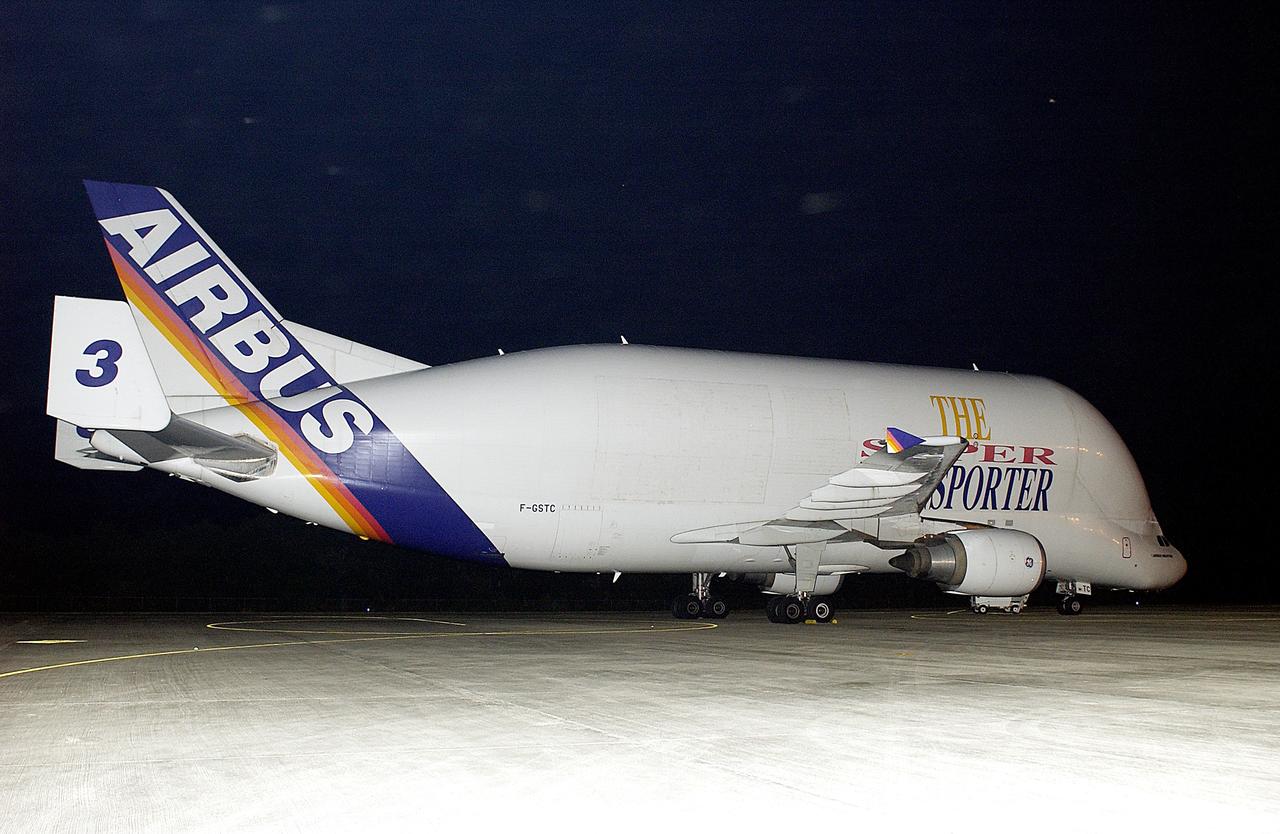
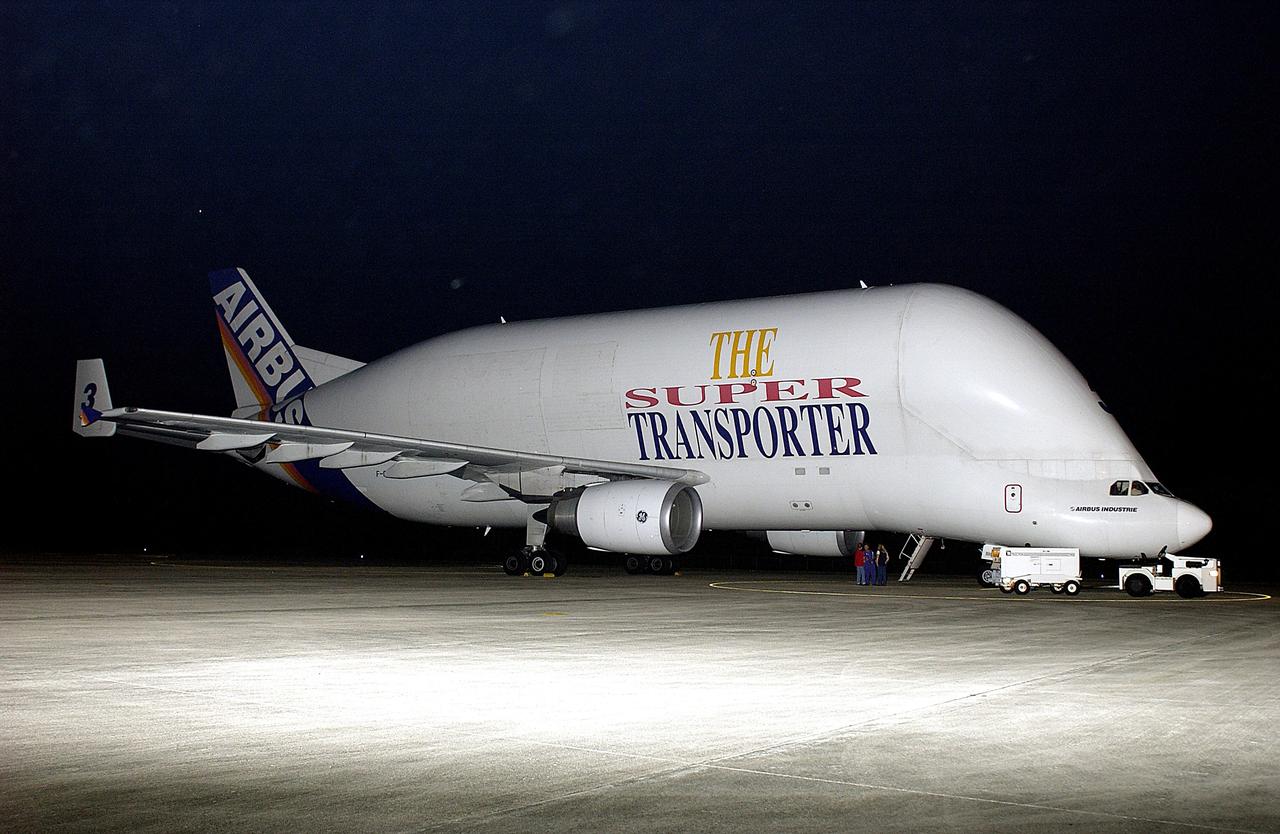
KKENNEDY SPACE CENTER, FLA. -  A Beluga aircraft arrives at the Shuttle Landing Facility with its cargo of the Italian-built module, U.S. Node 2, for the International Space Station.  The second of three Station connecting modules, Node 2 attaches to the end of the U.S. Lab and provides attach locations for the Japanese laboratory, European laboratory, the Centrifuge Accommodation Module and, later, Multipurpose Logistics Modules. It will provide the primary docking location for the Shuttle when a pressurized mating adapter is attached to Node 2.  Installation of the module will complete  the U.S. Core of the ISS.  Node 2 is the designated payload for mission STS-120.  No orbiter or launch date has been determined yet.
KKENNEDY SPACE CENTER, FLA. - A Beluga aircraft arrives at the Shuttle Landing Facility with its cargo of the Italian-built module, U.S. Node 2, for the International Space Station. The second of three Station connecting modules, Node 2 attaches to the end of the U.S. Lab and provides attach locations for the Japanese laboratory, European laboratory, the Centrifuge Accommodation Module and, later, Multipurpose Logistics Modules. It will provide the primary docking location for the Shuttle when a pressurized mating adapter is attached to Node 2. Installation of the module will complete the U.S. Core of the ISS. Node 2 is the designated payload for mission STS-120. No orbiter or launch date has been determined yet.
KENNEDY SPACE CENTER, FLA. - A Beluga aircraft arrives at the Shuttle Landing Facility with its cargo of the Italian-built module, U.S. Node 2, for the International Space Station.  The second of three Station connecting modules, Node 2 attaches to the end of the U.S. Lab and provides attach locations for the Japanese laboratory, European laboratory, the Centrifuge Accommodation Module and, later, Multipurpose Logistics Modules. It will provide the primary docking location for the Shuttle when a pressurized mating adapter is attached to Node 2.  Installation of the module will complete  the U.S. Core of the ISS.  Node 2 is the designated payload for mission STS-120.  No orbiter or launch date has been determined yet.
KENNEDY SPACE CENTER, FLA. - A Beluga aircraft arrives at the Shuttle Landing Facility with its cargo of the Italian-built module, U.S. Node 2, for the International Space Station. The second of three Station connecting modules, Node 2 attaches to the end of the U.S. Lab and provides attach locations for the Japanese laboratory, European laboratory, the Centrifuge Accommodation Module and, later, Multipurpose Logistics Modules. It will provide the primary docking location for the Shuttle when a pressurized mating adapter is attached to Node 2. Installation of the module will complete the U.S. Core of the ISS. Node 2 is the designated payload for mission STS-120. No orbiter or launch date has been determined yet.
The Northrop Grumman Cygnus spacecraft’s pressurized cargo module for the company’s 21st commercial resupply mission is lifted and moved by a crane inside the Space Systems Processing Facility at NASA’s Kennedy Space Center in Florida on Saturday, June 1, 2024, as prelaunch processing operations continue. The Cygnus spacecraft will launch to the International Space Station aboard a SpaceX Falcon 9 rocket from Space Launch Complex 40 at Cape Canaveral Space Force Station.
NG-21 PCM Lift to Work Stand, SSPF
The Northrop Grumman Cygnus spacecraft’s pressurized cargo module for the company’s 21st commercial resupply mission is lifted and moved by a crane inside the Space Systems Processing Facility at NASA’s Kennedy Space Center in Florida on Saturday, June 1, 2024, as prelaunch processing operations continue. The Cygnus spacecraft will launch to the International Space Station aboard a SpaceX Falcon 9 rocket from Space Launch Complex 40 at Cape Canaveral Space Force Station.
NG-21 PCM Lift to Work Stand, SSPF
The Northrop Grumman Cygnus spacecraft’s pressurized cargo module for the company’s 21st commercial resupply mission is lifted and moved by a crane inside the Space Systems Processing Facility at NASA’s Kennedy Space Center in Florida on Saturday, June 1, 2024, as prelaunch processing operations continue. The Cygnus spacecraft will launch to the International Space Station aboard a SpaceX Falcon 9 rocket from Space Launch Complex 40 at Cape Canaveral Space Force Station.
NG-21 PCM Lift to Work Stand, SSPF
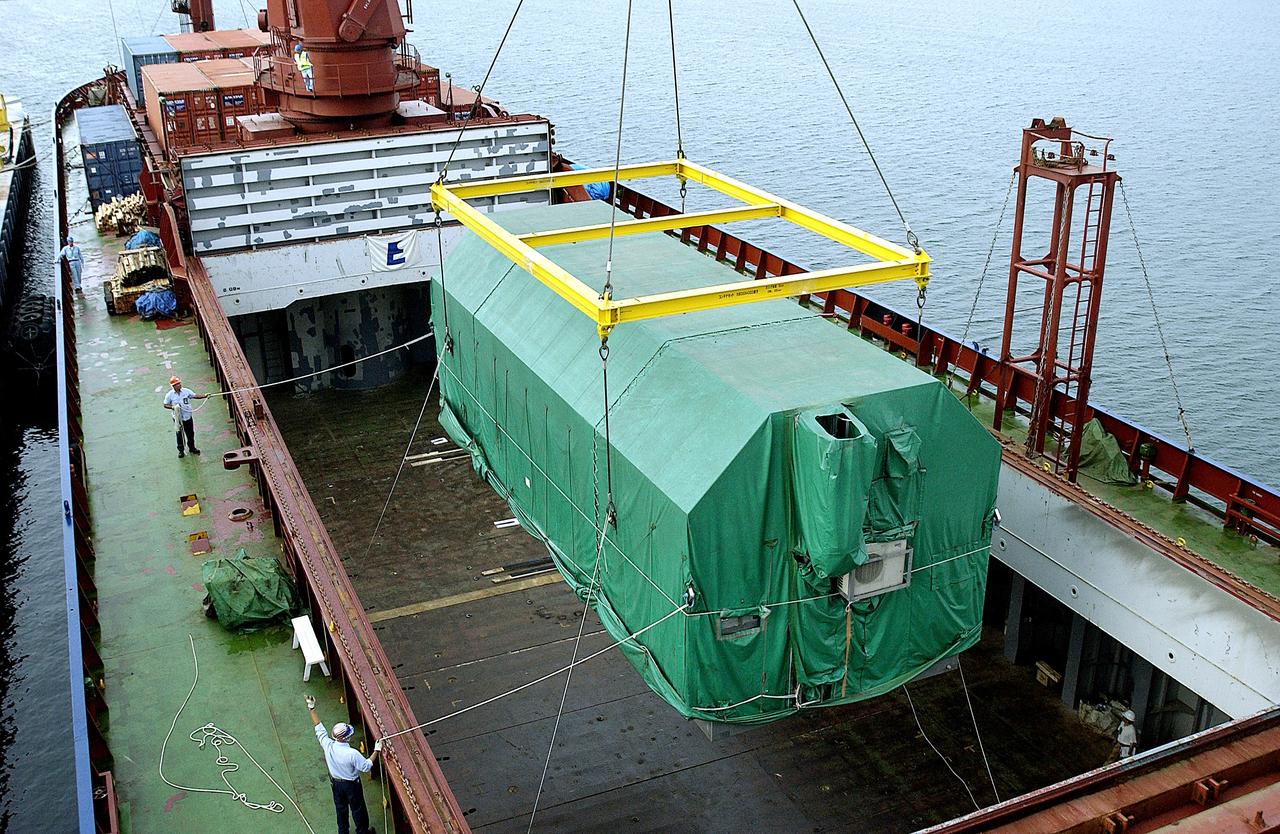
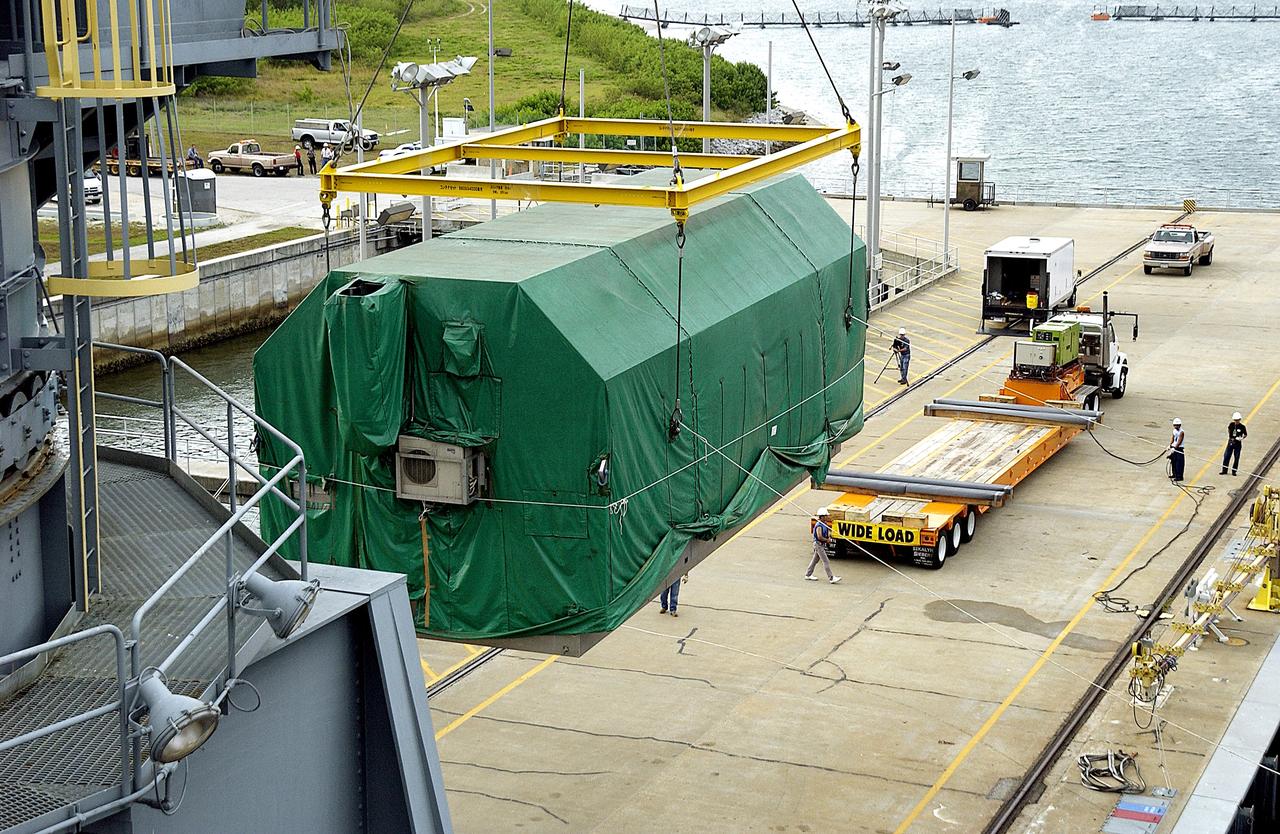
KENNEDY SPACE CENTER, FLA. - At Port Canaveral, the Pressurized Module of the Japanese Experiment Module (JEM) is lifted out of the ship’s cargo hold.  It will be loaded onto the truck bed in the background for transfer to KSC’s Space Station Processing Facility.  The container transport ship carrying JEM departed May 2 from Yokohama Harbor in Japan for the voyage to the United States. The National Space Development Agency of Japan (NASDA) developed the laboratory at the Tsukuba Space Center near Tokyo. The Pressurized Module is the first element of the JEM, named "Kibo" (Hope), to be delivered to KSC. The JEM is Japan's primary contribution to the Station. It will enhance the unique research capabilities of the orbiting complex by providing an additional environment for astronauts to conduct science experiments.  The JEM also includes an exposed facility (platform) for space environment experiments, a robotic manipulator system, and two logistics modules. The various JEM components will be  assembled in space over the course of three Shuttle missions.
KENNEDY SPACE CENTER, FLA. - At Port Canaveral, the Pressurized Module of the Japanese Experiment Module (JEM) is lifted out of the ship’s cargo hold. It will be loaded onto the truck bed in the background for transfer to KSC’s Space Station Processing Facility. The container transport ship carrying JEM departed May 2 from Yokohama Harbor in Japan for the voyage to the United States. The National Space Development Agency of Japan (NASDA) developed the laboratory at the Tsukuba Space Center near Tokyo. The Pressurized Module is the first element of the JEM, named "Kibo" (Hope), to be delivered to KSC. The JEM is Japan's primary contribution to the Station. It will enhance the unique research capabilities of the orbiting complex by providing an additional environment for astronauts to conduct science experiments. The JEM also includes an exposed facility (platform) for space environment experiments, a robotic manipulator system, and two logistics modules. The various JEM components will be assembled in space over the course of three Shuttle missions.
KENNEDY SPACE CENTER, FLA. - At Port Canaveral, the Pressurized Module of the Japanese Experiment Module (JEM) is lifted out of the ship’s cargo hold.  The container transport ship carrying JEM departed May 2 from Yokohama Harbor in Japan for the voyage to the United States. The National Space Development Agency of Japan (NASDA) developed the laboratory at the Tsukuba Space Center near Tokyo. The Pressurized Module is the first element of the JEM, named "Kibo" (Hope), to be delivered to KSC. The JEM is Japan's primary contribution to the Station. It will enhance the unique research capabilities of the orbiting complex by providing an additional environment for astronauts to conduct science experiments.  The JEM also includes an exposed facility (platform) for space environment experiments, a robotic manipulator system, and two logistics modules. The various JEM components will be  assembled in space over the course of three Shuttle missions.
KENNEDY SPACE CENTER, FLA. - At Port Canaveral, the Pressurized Module of the Japanese Experiment Module (JEM) is lifted out of the ship’s cargo hold. The container transport ship carrying JEM departed May 2 from Yokohama Harbor in Japan for the voyage to the United States. The National Space Development Agency of Japan (NASDA) developed the laboratory at the Tsukuba Space Center near Tokyo. The Pressurized Module is the first element of the JEM, named "Kibo" (Hope), to be delivered to KSC. The JEM is Japan's primary contribution to the Station. It will enhance the unique research capabilities of the orbiting complex by providing an additional environment for astronauts to conduct science experiments. The JEM also includes an exposed facility (platform) for space environment experiments, a robotic manipulator system, and two logistics modules. The various JEM components will be assembled in space over the course of three Shuttle missions.
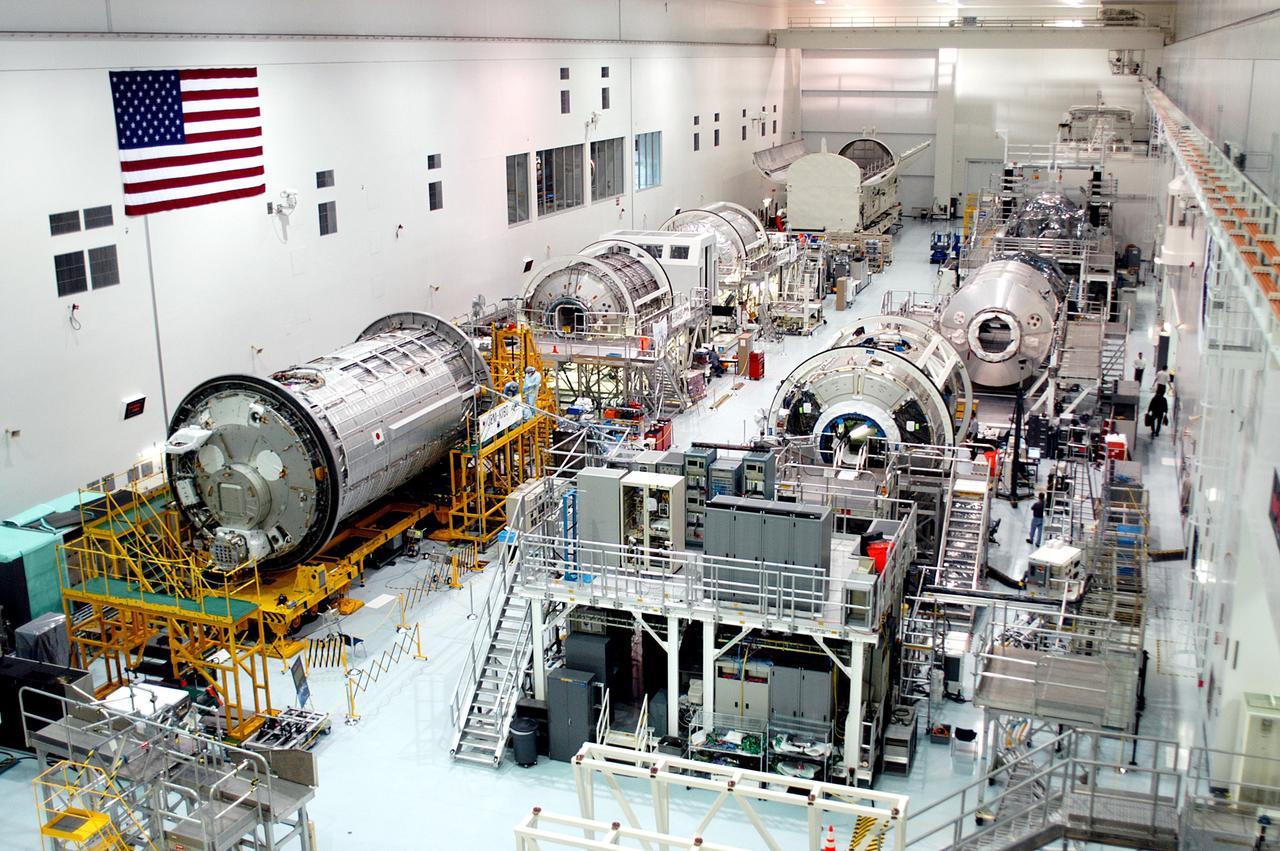
CAPE CANAVERAL, Fla. – In the Astrotech payload processing facility at Port Canaveral, Fla., supplies and other cargo are prepared for installation in the Russian-built Mini-Research Module, or MRM, in the background.  The six-member crew of space shuttle Atlantis' STS-132 mission will deliver an Integrated Cargo Carrier and the MRM to the International Space Station.  The second in a series of new pressurized components for Russia, the MRM will be permanently attached to the bottom port of the Zarya module. The MRM also will carry U.S. pressurized cargo.  STS-132 is the 34th mission to the station and the 132nd space shuttle mission.   Launch is targeted for May 14.  For information on the STS-132 mission, visit http:__www.nasa.gov_mission_pages_shuttle_shuttlemissions_sts132_index.html. Photo credit: NASA_Kim Shiflett
KSC-2010-2376
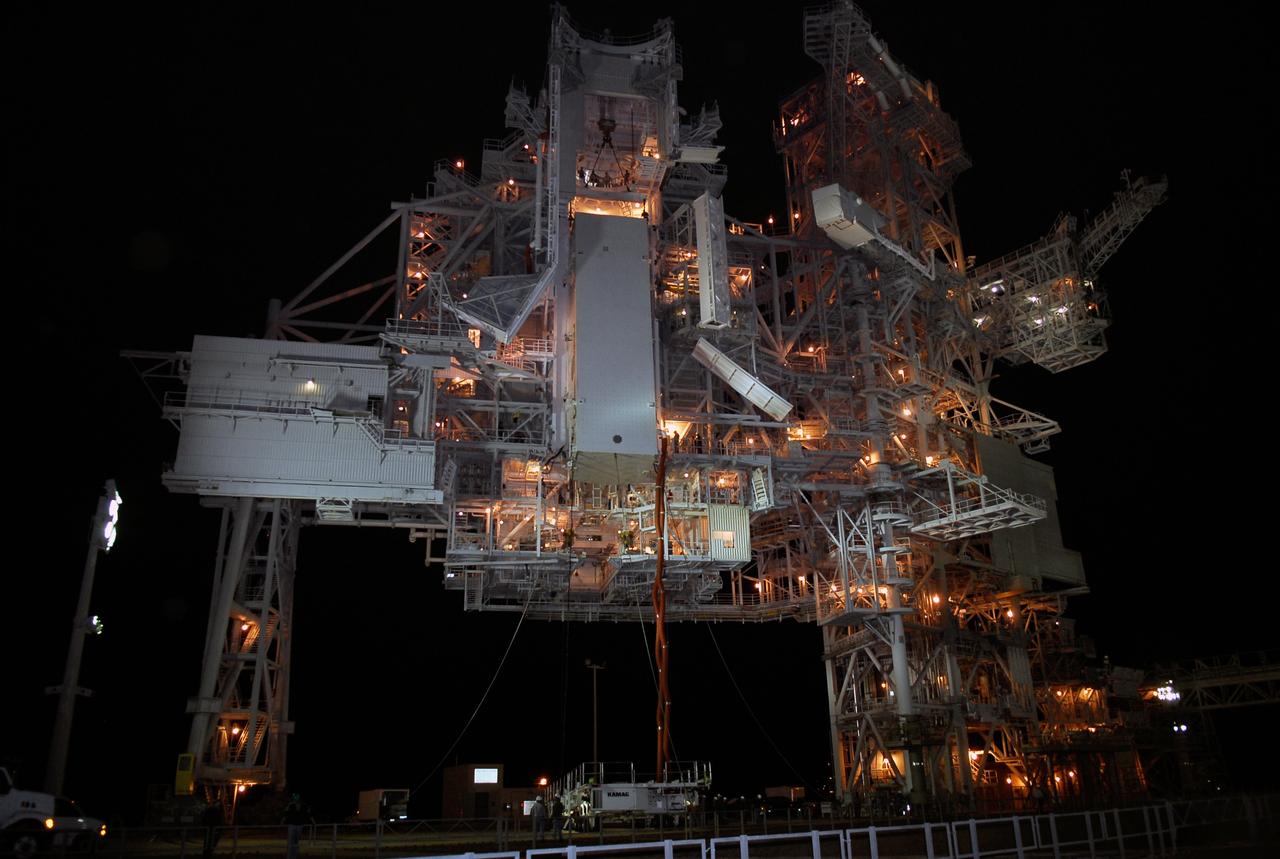
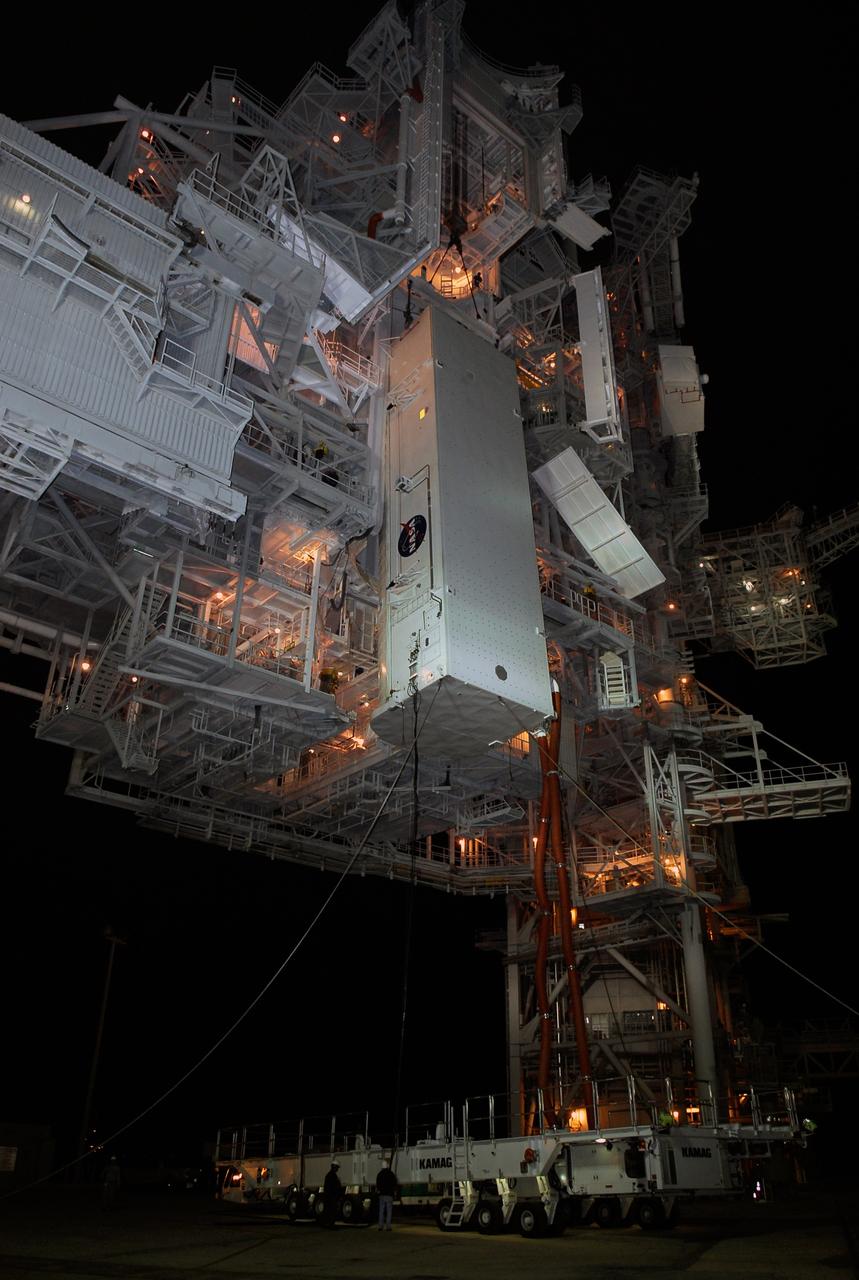
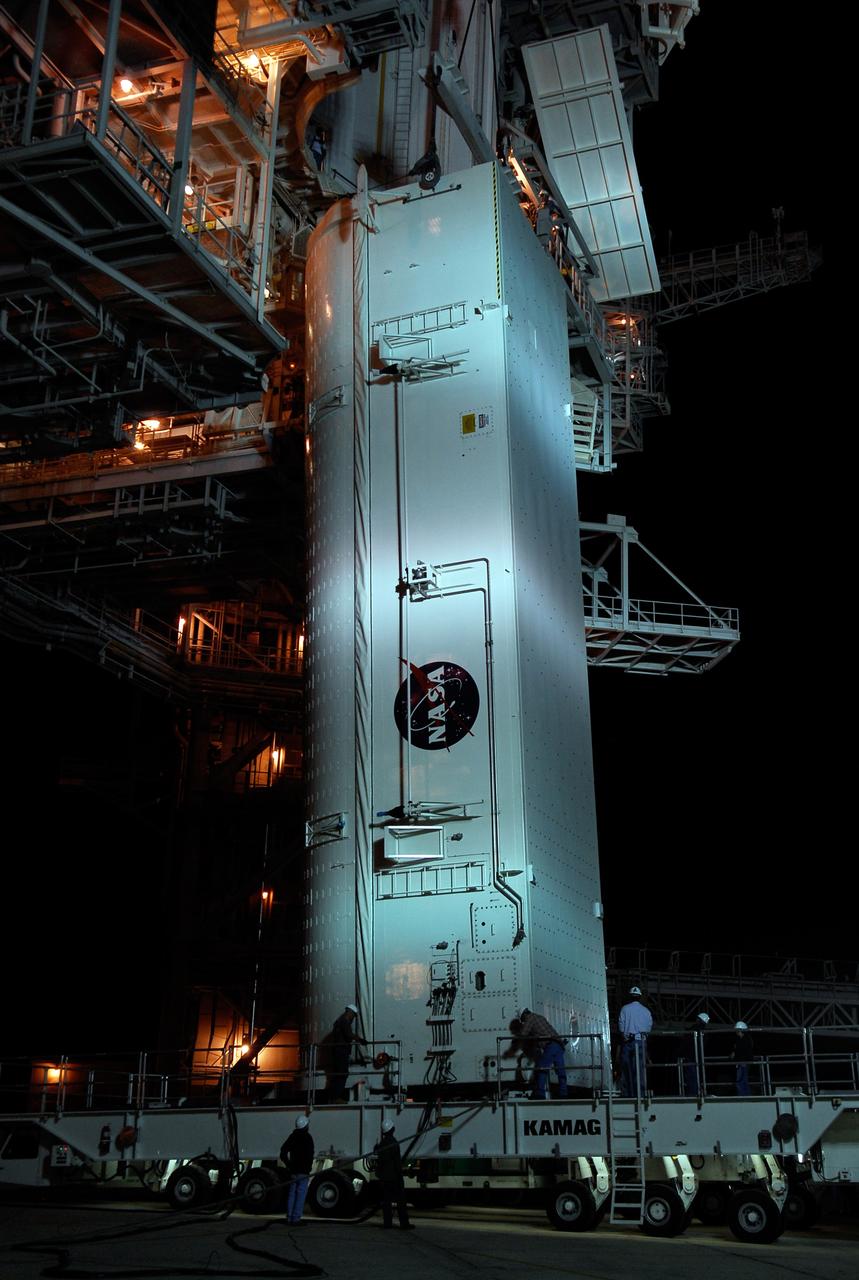
CAPE CANAVERAL, Fla. –   On Launch Pad 39A at NASA's Kennedy Space Center, the payload canister has been lifted up to the payload changeout room for transfer of its cargo.  Inside the canister are the Japanese Experiment Module - Pressurized Module and the Japanese Remote Manipulator System, or RMS, for the STS-124 mission. The changeout room is the enclosed, environmentally controlled portion of the service structure that supports cargo delivery to the pad and subsequent vertical installation into an orbiter's payload bay. From the payload changeout room, the pressurized module and RMS then will be transferred into space shuttle Discovery’s payload bay.  Launch is targeted for May 31.  Photo credit: NASA/Kim Shiflett
KSC-08pd1077
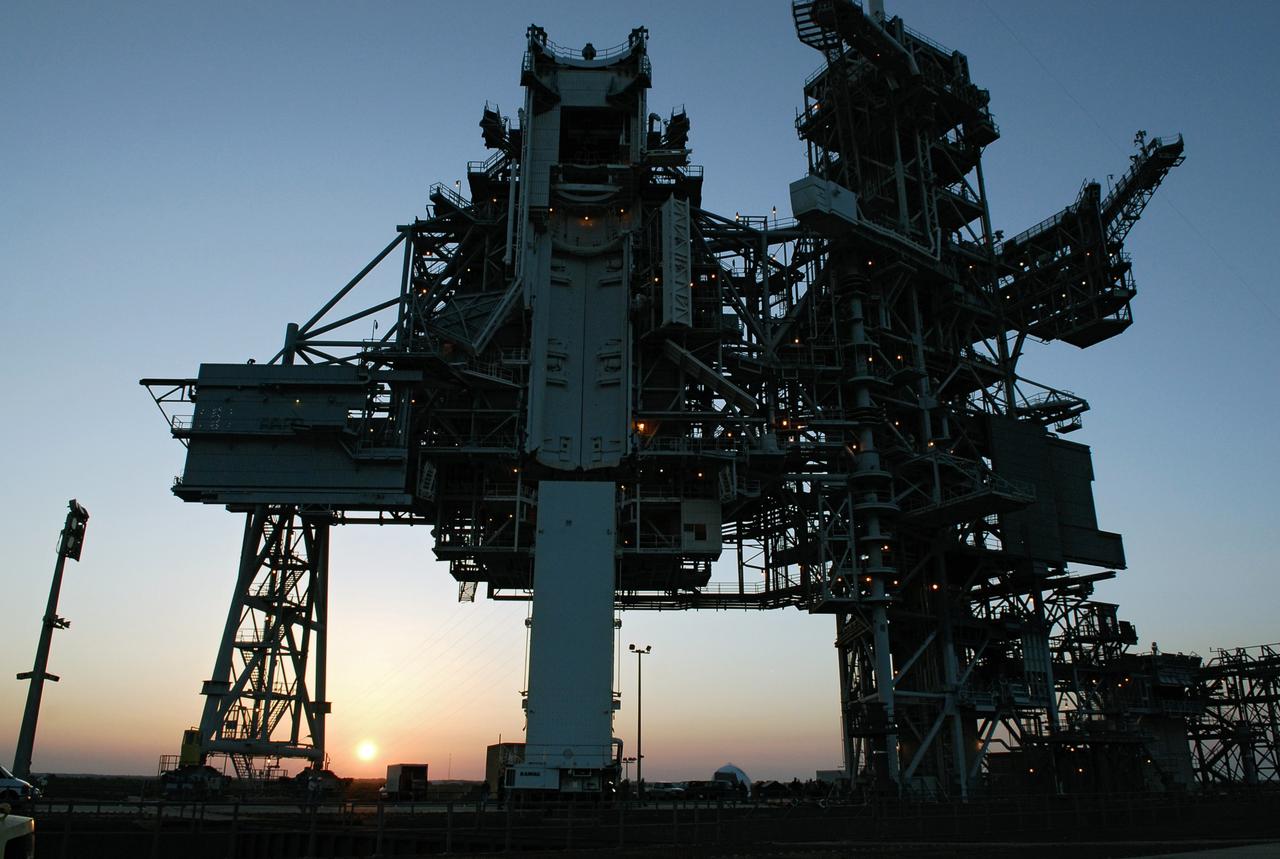
CAPE CANAVERAL, Fla. –    The sun sets behind Launch Pad 39A at NASA's Kennedy Space Center where the payload canister with the Japanese Experiment Module - Pressurized Module and the Japanese Remote Manipulator System, or RMS, inside awaits cargo transfer to the payload changeout room above.  The changeout room is the enclosed, environmentally controlled portion of the service structure that supports cargo delivery to the pad and subsequent vertical installation into an orbiter's payload bay. From the payload changeout room, the pressurized module and RMS then will be transferred into space shuttle Discovery’s payload bay.  Launch is targeted for May 31.  Photo credit: NASA/Kim Shiflett
KSC-08pd1075
CAPE CANAVERAL, Fla. –   On Launch Pad 39A at NASA's Kennedy Space Center, the payload canister has been lifted up to the payload changeout room for transfer of its cargo.  Inside the canister are the Japanese Experiment Module - Pressurized Module and the Japanese Remote Manipulator System, or RMS, for the STS-124 mission. The changeout room is the enclosed, environmentally controlled portion of the service structure that supports cargo delivery to the pad and subsequent vertical installation into an orbiter's payload bay.  From the payload changeout room, the pressurized module and RMS then will be transferred into space shuttle Discovery’s payload bay.  Launch is targeted for May 31.  Photo credit: NASA/Kim Shiflett
KSC-08pd1078
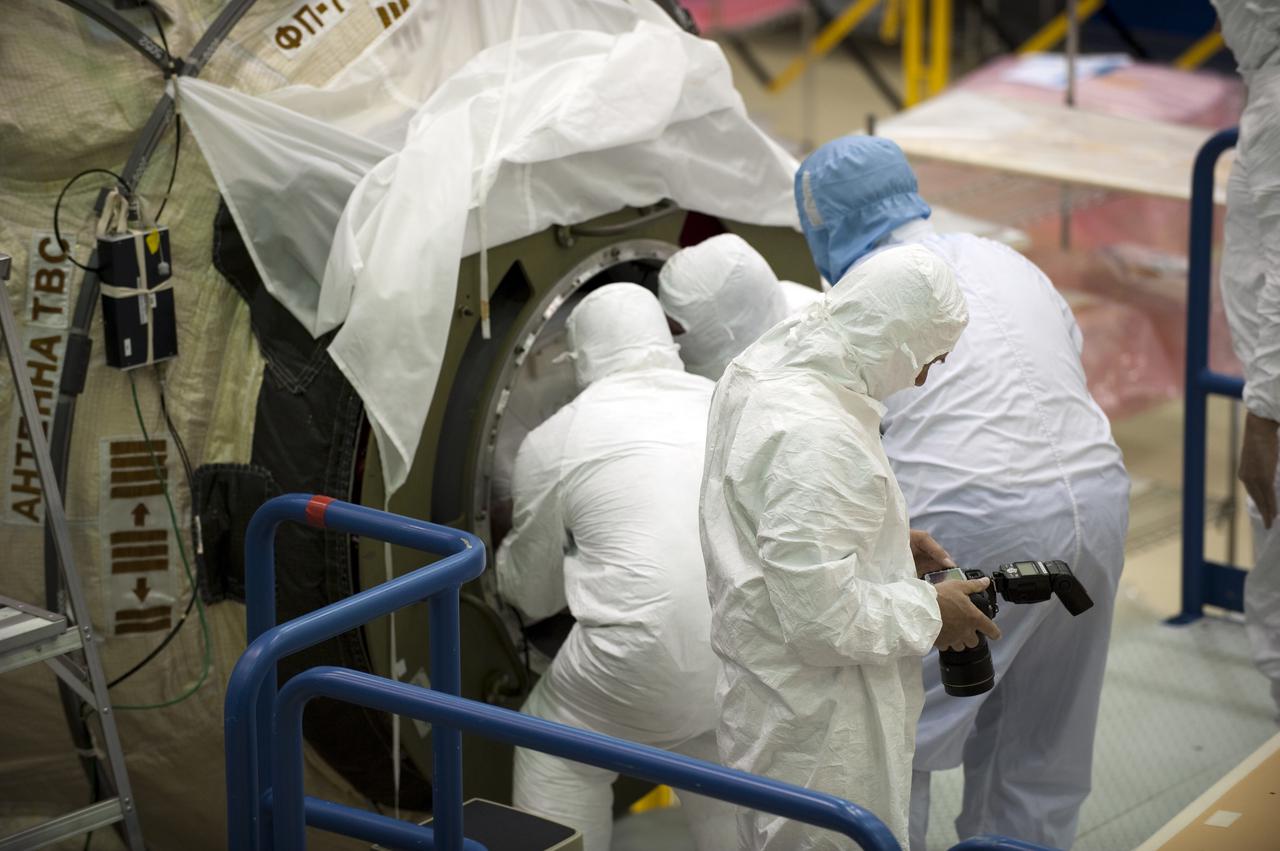
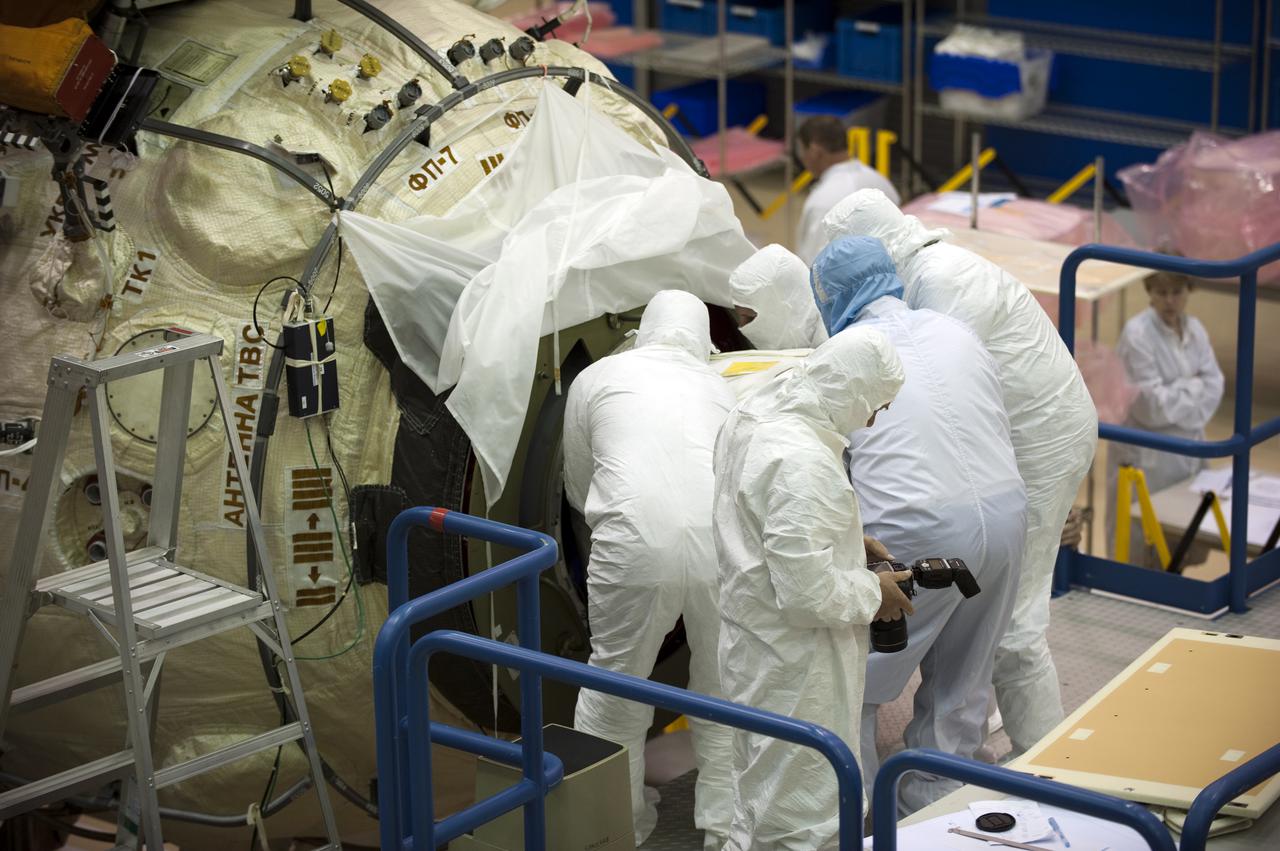
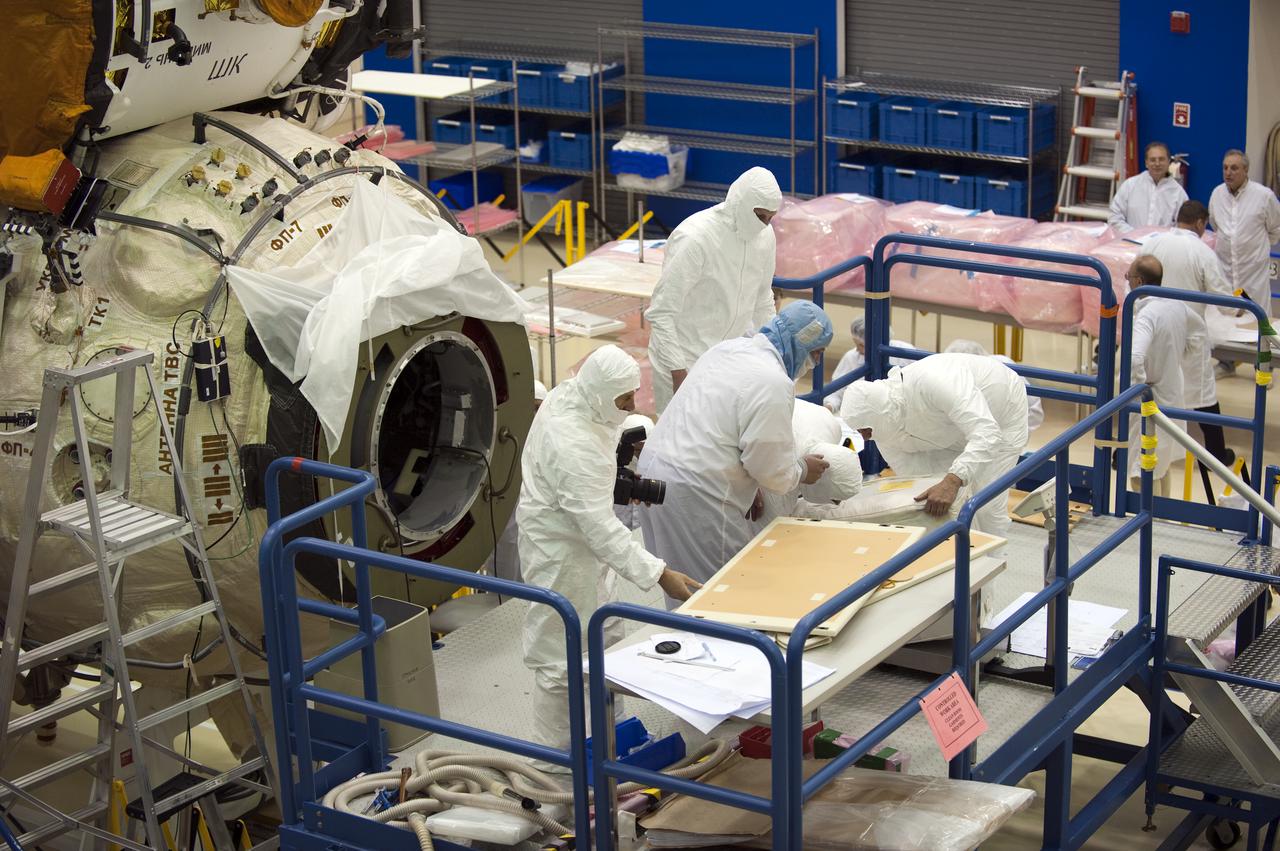
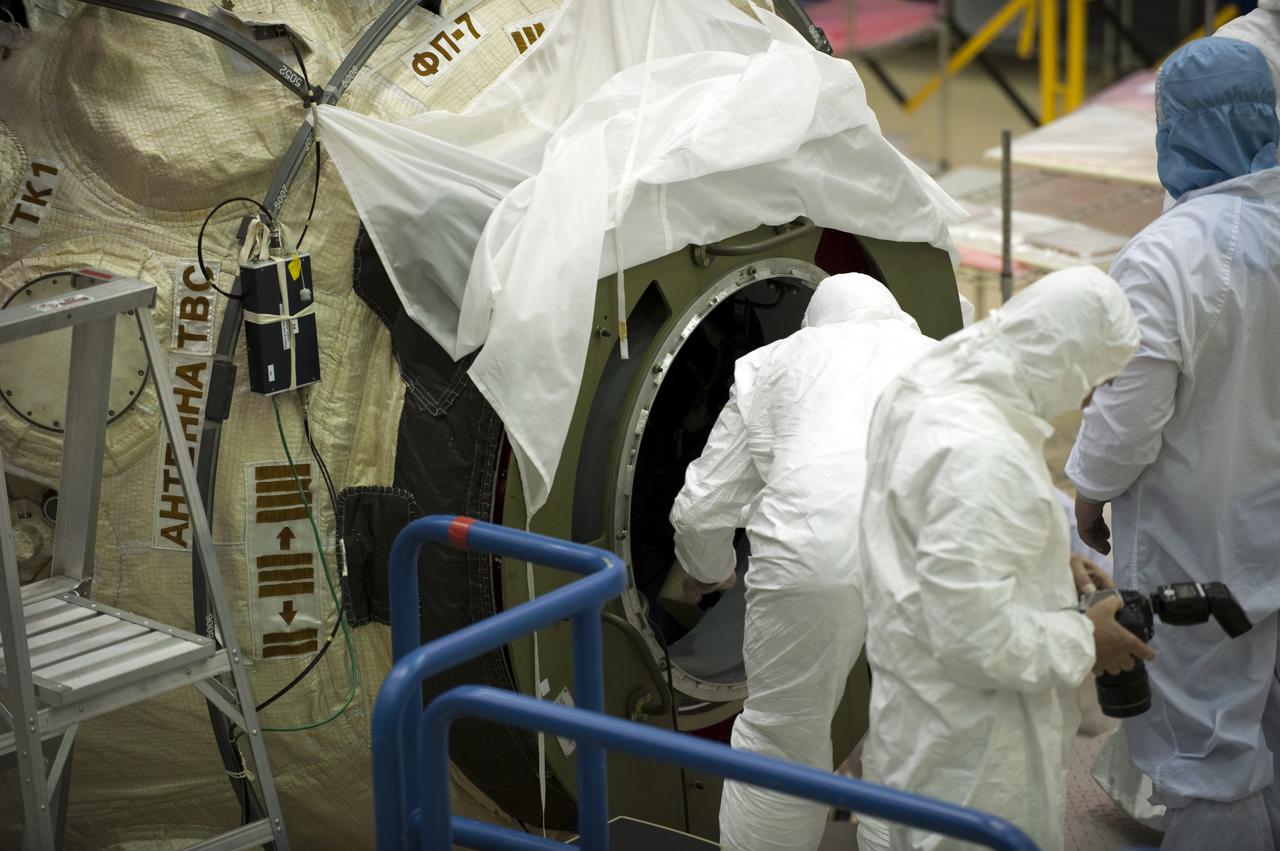
CAPE CANAVERAL, Fla. – In the Astrotech payload processing facility at Port Canaveral, Fla., workers dressed in clean room attire, known as bunny suits, install supplies and other cargo in the Russian-built Mini-Research Module, or MRM, through a hatch on the end of the module.  The six-member crew of space shuttle Atlantis' STS-132 mission will deliver an Integrated Cargo Carrier and the MRM to the International Space Station.  The second in a series of new pressurized components for Russia, the MRM will be permanently attached to the bottom port of the Zarya module. The MRM also will carry U.S. pressurized cargo.  STS-132 is the 34th mission to the station and the 132nd space shuttle mission.   Launch is targeted for May 14.  For information on the STS-132 mission, visit http:__www.nasa.gov_mission_pages_shuttle_shuttlemissions_sts132_index.html. Photo credit: NASA_Kim Shiflett
KSC-2010-2379
CAPE CANAVERAL, Fla. – In the Astrotech payload processing facility at Port Canaveral, Fla., workers dressed in clean room attire, known as bunny suits, install supplies and other cargo in the Russian-built Mini-Research Module, or MRM, through a hatch on the end of the module.  The six-member crew of space shuttle Atlantis' STS-132 mission will deliver an Integrated Cargo Carrier and the MRM to the International Space Station.  The second in a series of new pressurized components for Russia, the MRM will be permanently attached to the bottom port of the Zarya module. The MRM also will carry U.S. pressurized cargo.  STS-132 is the 34th mission to the station and the 132nd space shuttle mission.   Launch is targeted for May 14.  For information on the STS-132 mission, visit http:__www.nasa.gov_mission_pages_shuttle_shuttlemissions_sts132_index.html. Photo credit: NASA_Kim Shiflett
KSC-2010-2378
CAPE CANAVERAL, Fla. – In the Astrotech payload processing facility at Port Canaveral, Fla., workers dressed in clean room attire, known as bunny suits, install supplies and other cargo in the Russian-built Mini-Research Module, or MRM, through a hatch on the end of the module.  The six-member crew of space shuttle Atlantis' STS-132 mission will deliver an Integrated Cargo Carrier and the MRM to the International Space Station.  The second in a series of new pressurized components for Russia, the MRM will be permanently attached to the bottom port of the Zarya module. The MRM also will carry U.S. pressurized cargo.  STS-132 is the 34th mission to the station and the 132nd space shuttle mission.   Launch is targeted for May 14.  For information on the STS-132 mission, visit http:__www.nasa.gov_mission_pages_shuttle_shuttlemissions_sts132_index.html. Photo credit: NASA_Kim Shiflett
KSC-2010-2380
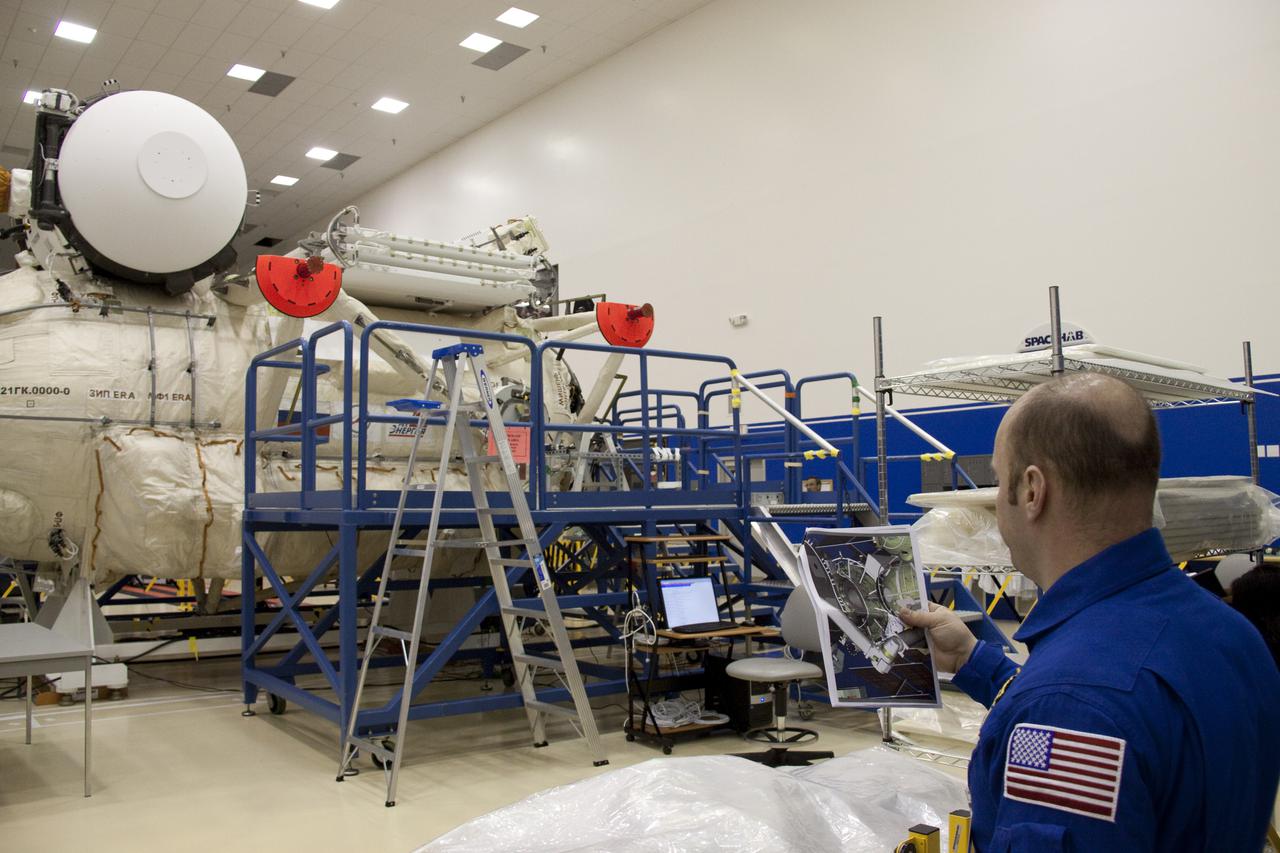
CAPE CANAVERAL, Fla. – At the Astrotech payload processing facility at Port Canaveral in Florida, STS-132 Mission Specialist Garrett Reisman compares the actual Mini-Research Module to a picture of the module during the crew equipment interface test, or CEIT.  CEIT provides the crew with hands-on training and observation of shuttle and flight hardware.  The six-member crew of space shuttle Atlantis' STS-132 mission will deliver an Integrated Cargo Carrier and a Russian-built Mini-Research Module to the International Space Station.  The second in a series of new pressurized components for Russia, the module will be permanently attached to the bottom port of the Zarya module and also will carry U.S. pressurized cargo.  STS-132 is the 34th mission to the station and the 132nd space shuttle mission in the program.   Launch is targeted for May 14.  For information on the STS-132 mission, visit http:__www.nasa.gov_mission_pages_shuttle_shuttlemissions_sts132_index.html. Photo credit: NASA_Troy Cryder
KSC-2010-2279
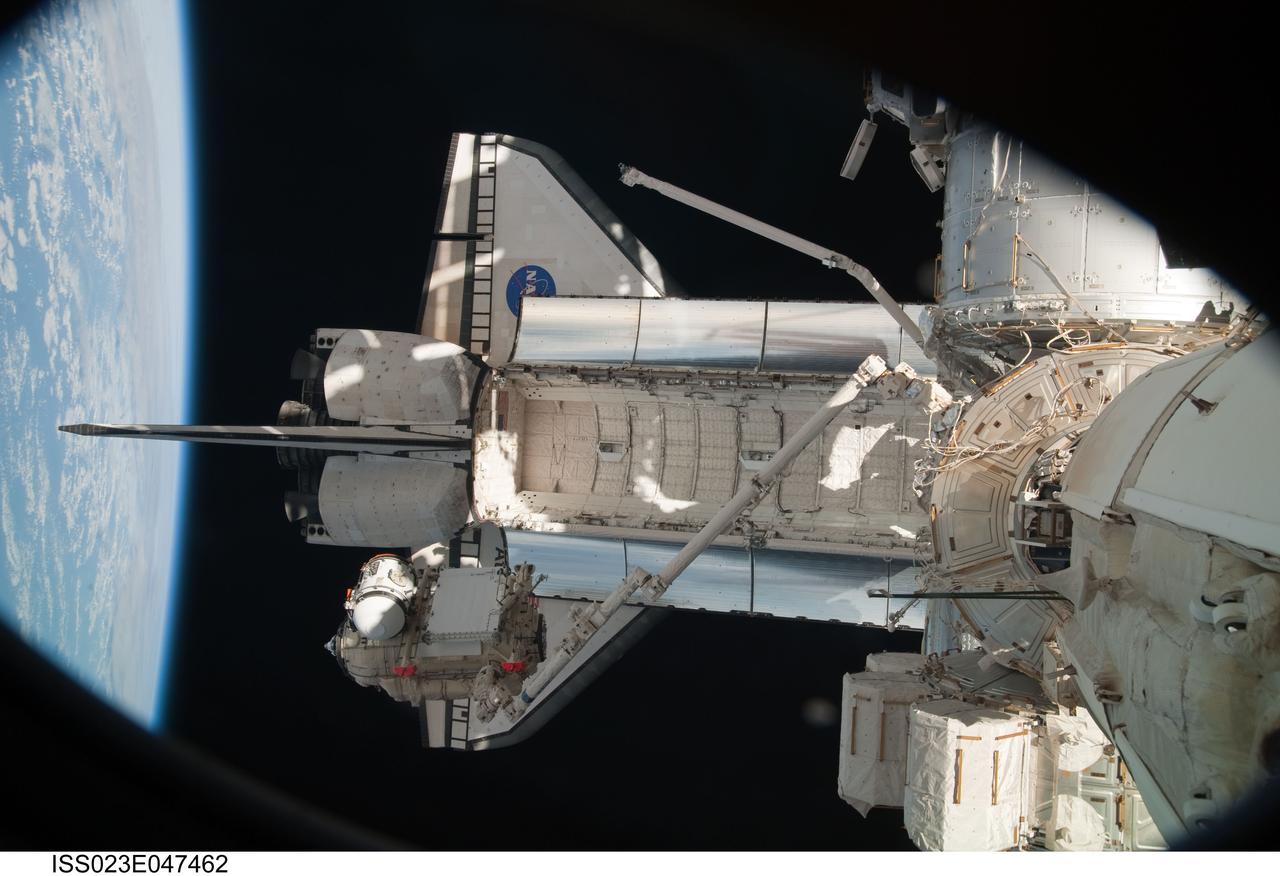
ISS023-E-047462 (18 May 2010) --- In the grasp of the station?s robotic Canadarm2, the Russian-built Mini-Research Module 1 (MRM-1) is moved to be permanently attached to the Earth-facing port of the Zarya Functional Cargo Block (FGB) of the International Space Station. Named Rassvet, Russian for "dawn," the module is the second in a series of new pressurized components for Russia. Rassvet will be used for cargo storage and will provide an additional docking port to the station.
MRM1 during Relocation
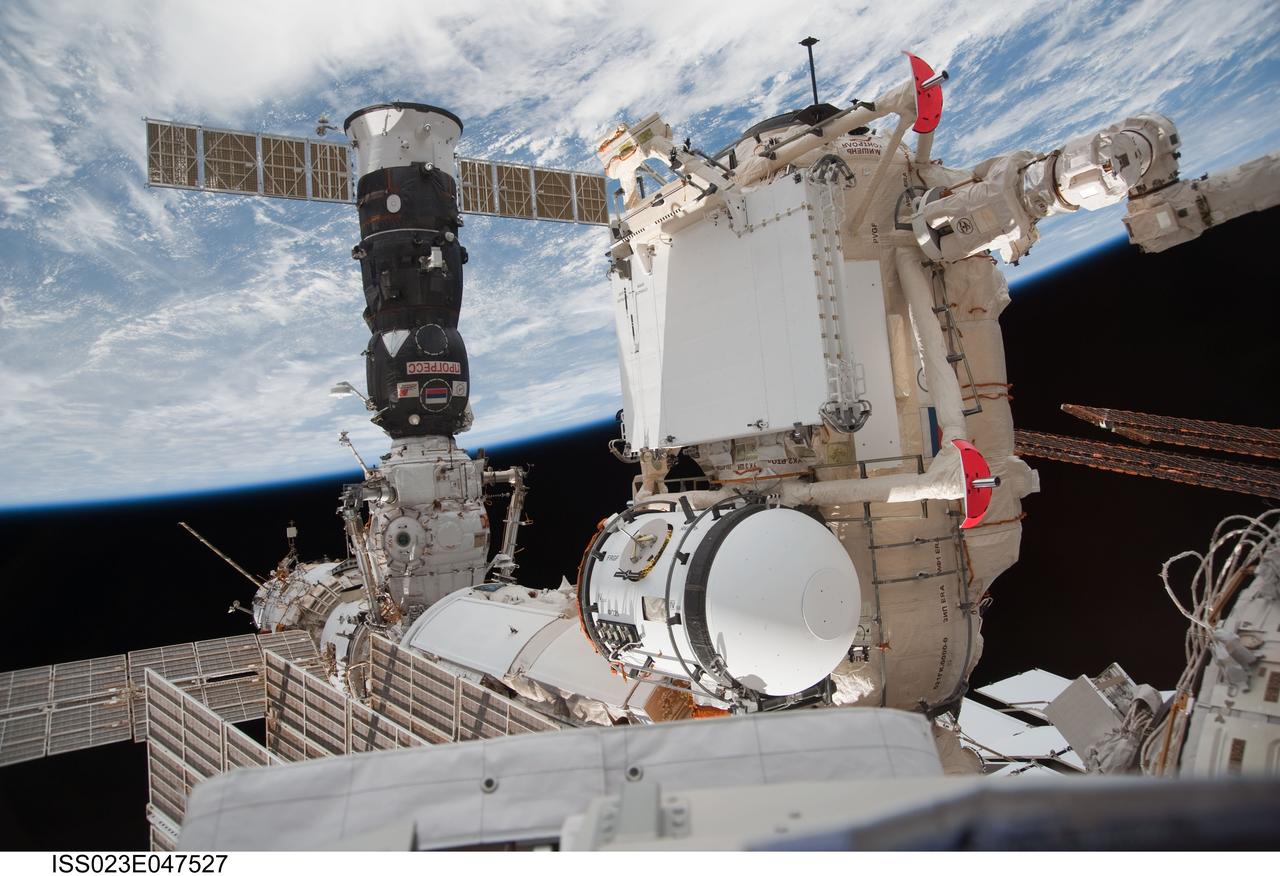
ISS023-E-047527 (18 May 2010) --- In the grasp of the station?s robotic Canadarm2, the Russian-built Mini-Research Module 1 (MRM-1) is attached to the Earth-facing port of the Zarya Functional Cargo Block (FGB) of the International Space Station. Named Rassvet, Russian for "dawn," the module is the second in a series of new pressurized components for Russia. Rassvet will be used for cargo storage and will provide an additional docking port to the station.
MRM1 during Mating to FGB
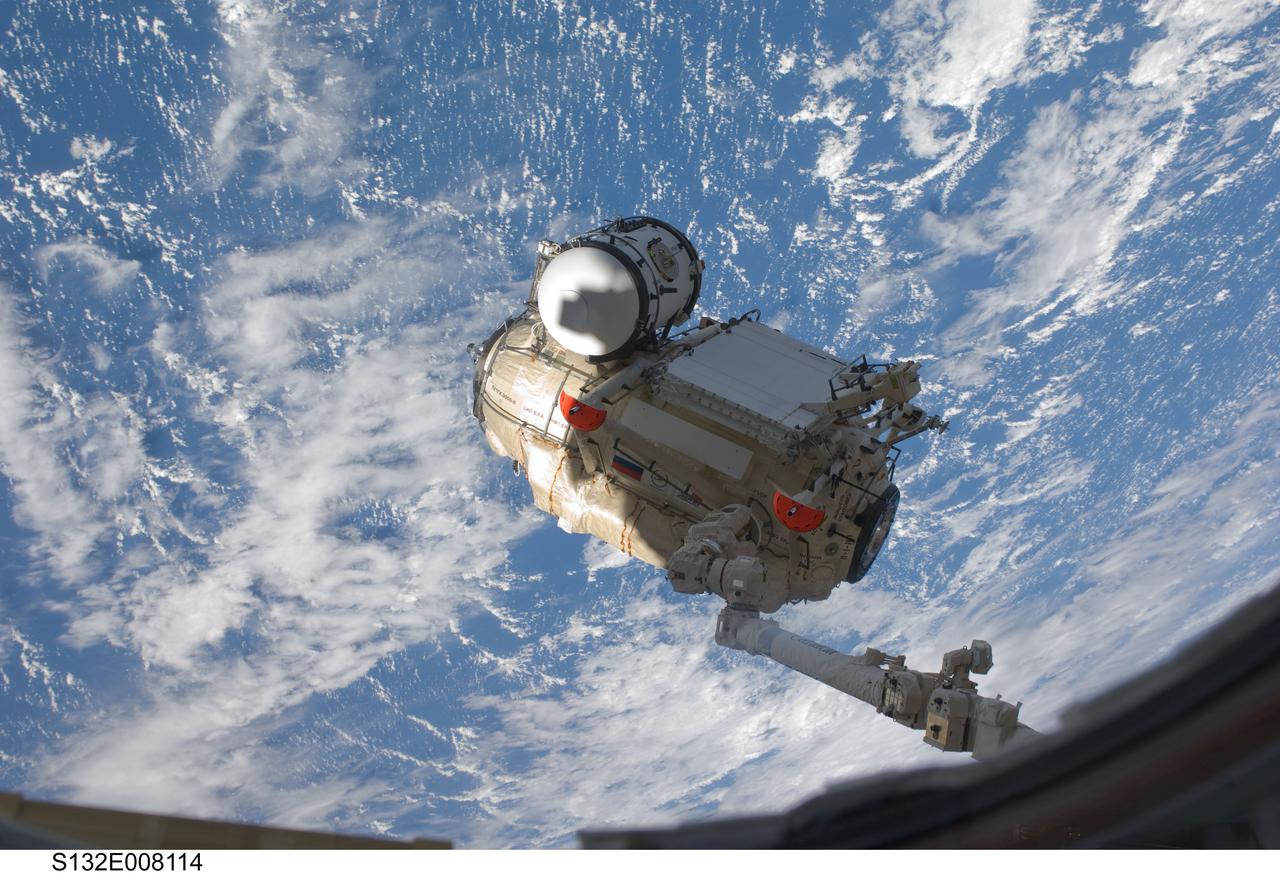
S132-E-008114 (18 May 2010) --- In the grasp of the Canadarm2, the Russian-built Mini-Research Module 1 (MRM-1) is transferred from space shuttle Atlantis’ payload bay to be permanently attached to the Earth-facing port of the Zarya Functional Cargo Block (FGB) of  the International Space Station. Named Rassvet, Russian for "dawn," the module is the second in a series of new pressurized components for Russia. Rassvet will be used for cargo storage and will provide an additional docking port to the station.
MRM-1
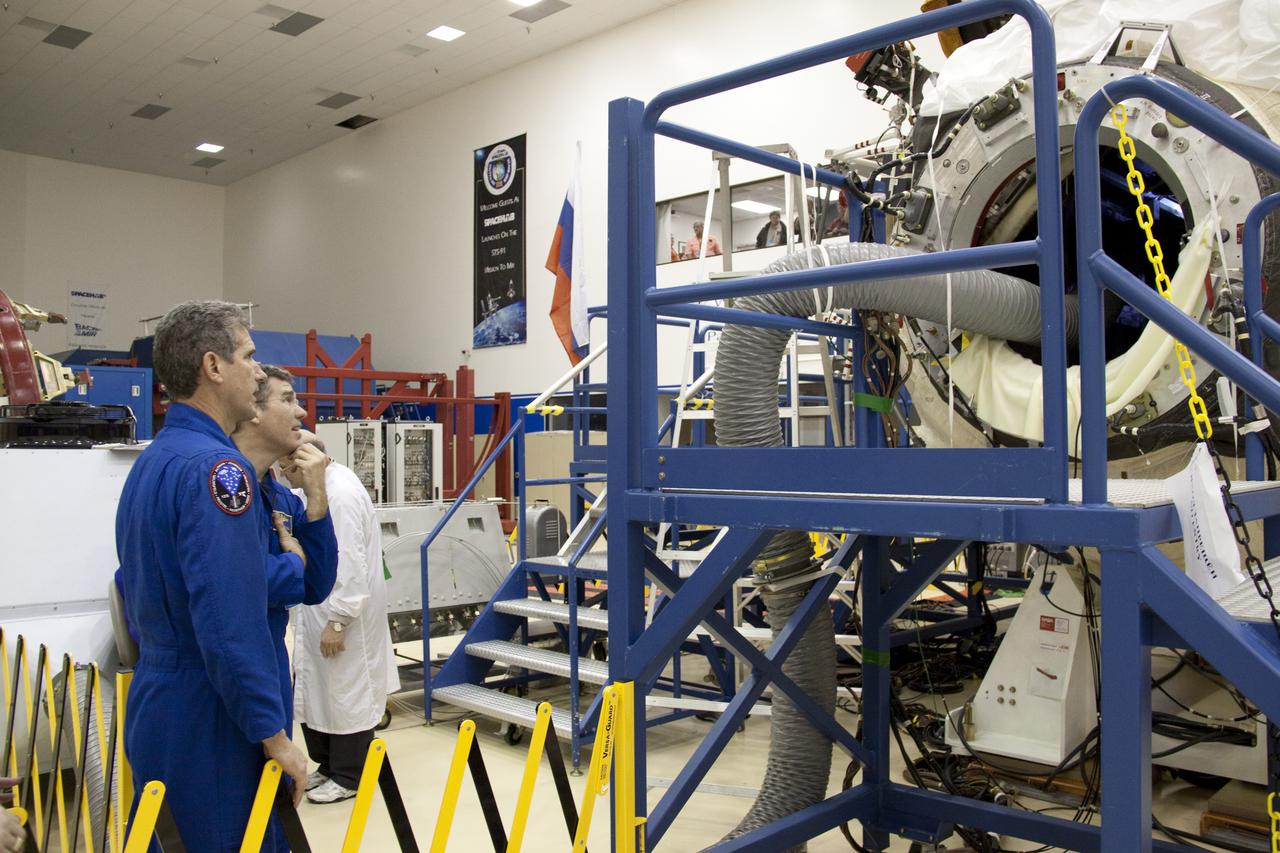
CAPE CANAVERAL, Fla. – At the Astrotech payload processing facility at Port Canaveral in Florida, STS-132 Mission Specialists Michael Good, left, and Steve Bowen get a close-up view of the Mini-Research Module during their crew equipment interface test, or CEIT.  CEIT provides the crew with hands-on training and observation of shuttle and flight hardware.  The six-member crew of space shuttle Atlantis' STS-132 mission will deliver an Integrated Cargo Carrier and a Russian-built Mini-Research Module to the International Space Station.  The second in a series of new pressurized components for Russia, the module will be permanently attached to the bottom port of the Zarya module and also will carry U.S. pressurized cargo.  STS-132 is the 34th mission to the station and the 132nd space shuttle mission in the program.   Launch is targeted for May 14.  For information on the STS-132 mission, visit http:__www.nasa.gov_mission_pages_shuttle_shuttlemissions_sts132_index.html. Photo credit: NASA_Troy Cryder
KSC-2010-2280
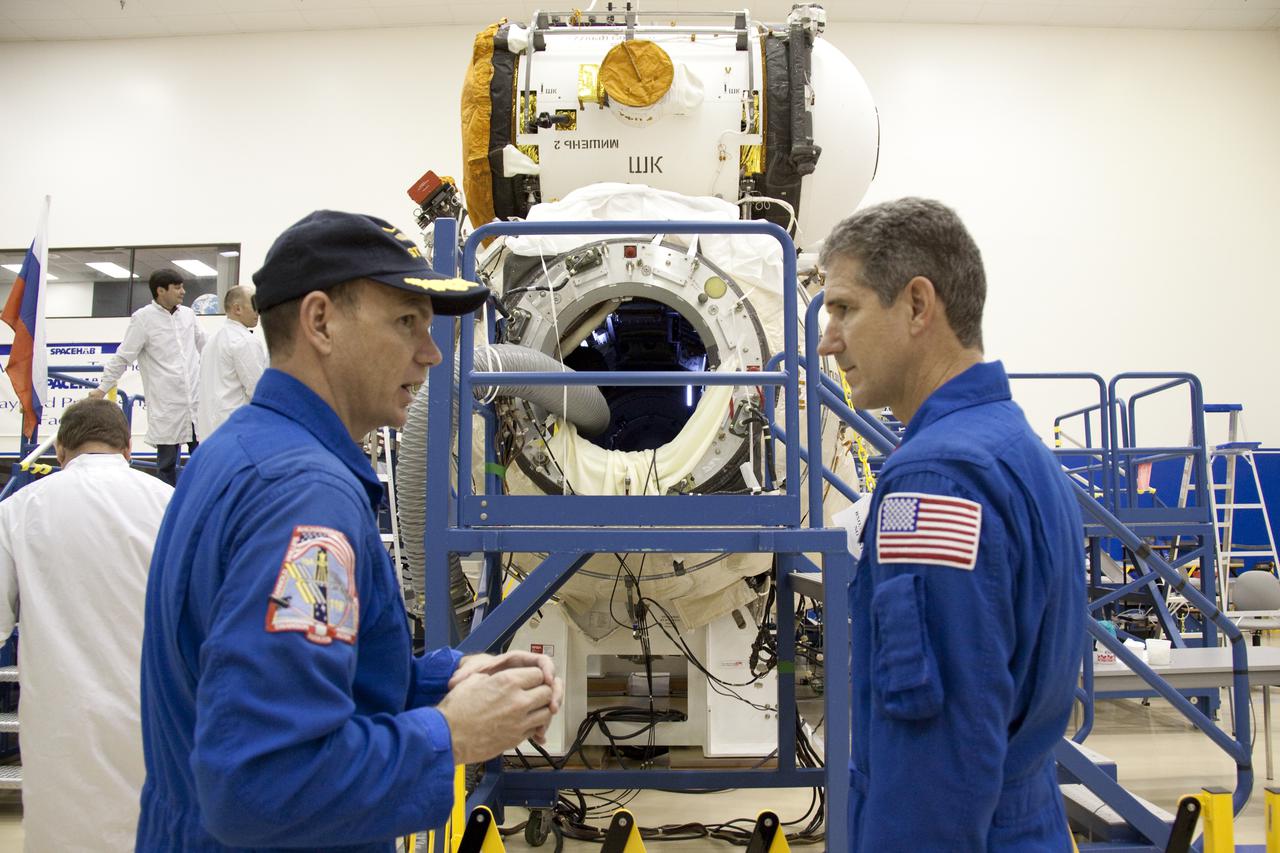
CAPE CANAVERAL, Fla. – At the Astrotech payload processing facility at Port Canaveral in Florida, STS-132 Pilot Tony Antonelli, left, and Mission Specialist Michael Good discuss the Mini-Research Module behind them during their crew equipment interface test, or CEIT.  CEIT provides the crew with hands-on training and observation of shuttle and flight hardware.  The six-member crew of space shuttle Atlantis' STS-132 mission will deliver an Integrated Cargo Carrier and a Russian-built Mini-Research Module to the International Space Station.  The second in a series of new pressurized components for Russia, the module will be permanently attached to the bottom port of the Zarya module and also will carry U.S. pressurized cargo.  STS-132 is the 34th mission to the station and the 132nd space shuttle mission in the program.   Launch is targeted for May 14.  For information on the STS-132 mission, visit http:__www.nasa.gov_mission_pages_shuttle_shuttlemissions_sts132_index.html. Photo credit: NASA_Troy Cryder
KSC-2010-2284
CAPE CANAVERAL, Fla. – In the Astrotech payload processing facility at Port Canaveral, Fla., preparations are under way to install supplies and other cargo in the Russian-built Mini-Research Module, or MRM, at left.  The six-member crew of space shuttle Atlantis' STS-132 mission will deliver an Integrated Cargo Carrier and the MRM to the International Space Station.  The second in a series of new pressurized components for Russia, the MRM will be permanently attached to the bottom port of the Zarya module. The MRM also will carry U.S. pressurized cargo.  STS-132 is the 34th mission to the station and the 132nd space shuttle mission.   Launch is targeted for May 14.  For information on the STS-132 mission, visit http:__www.nasa.gov_mission_pages_shuttle_shuttlemissions_sts132_index.html. Photo credit: NASA_Kim Shiflett
KSC-2010-2377
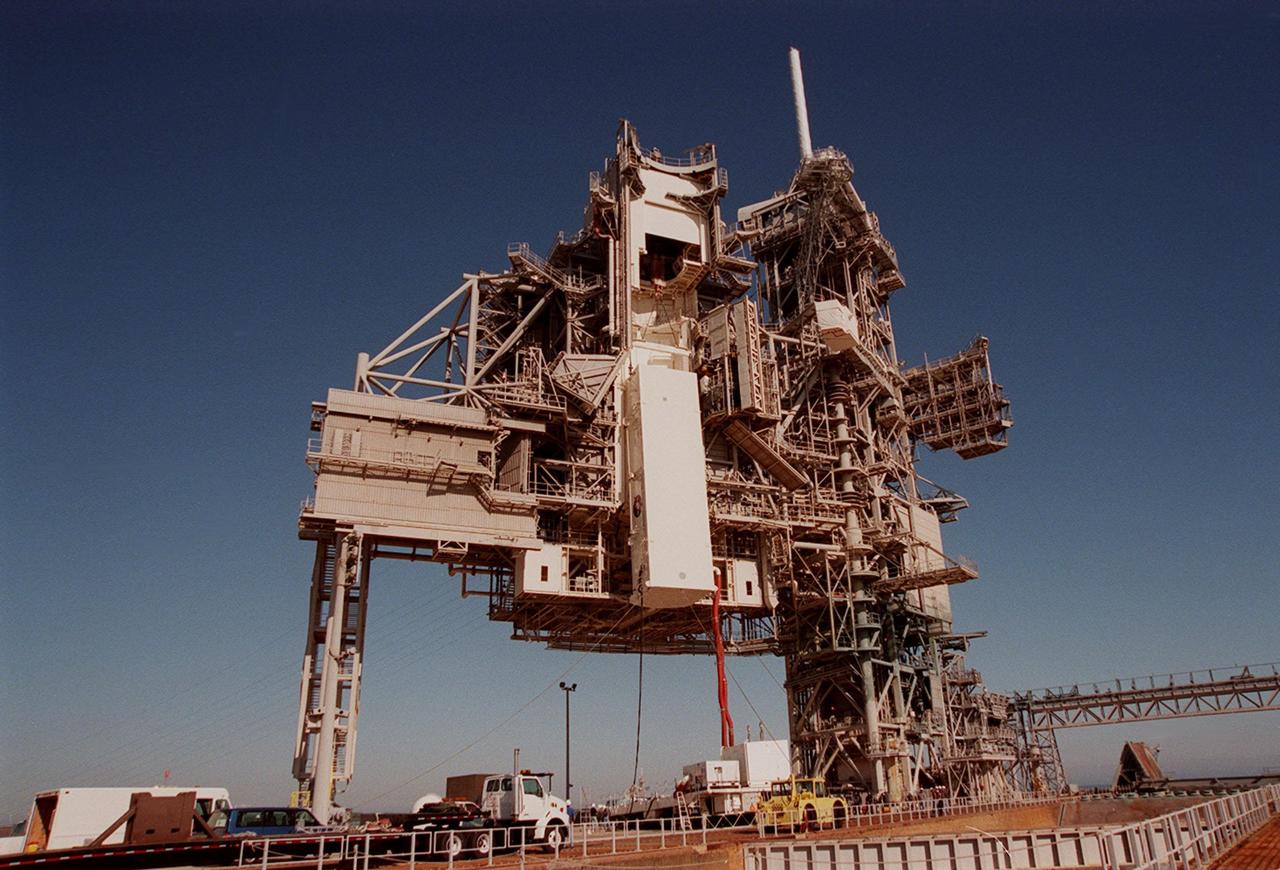
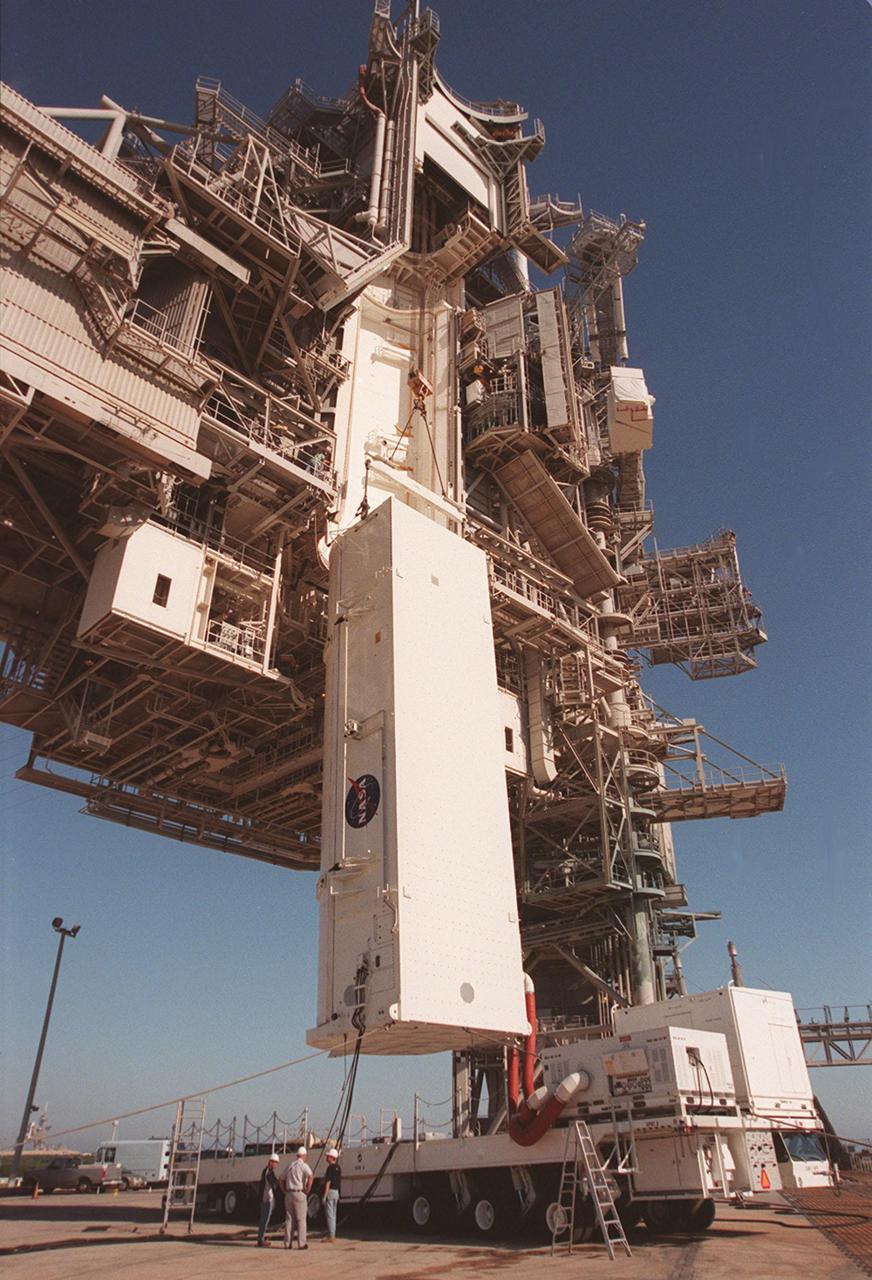
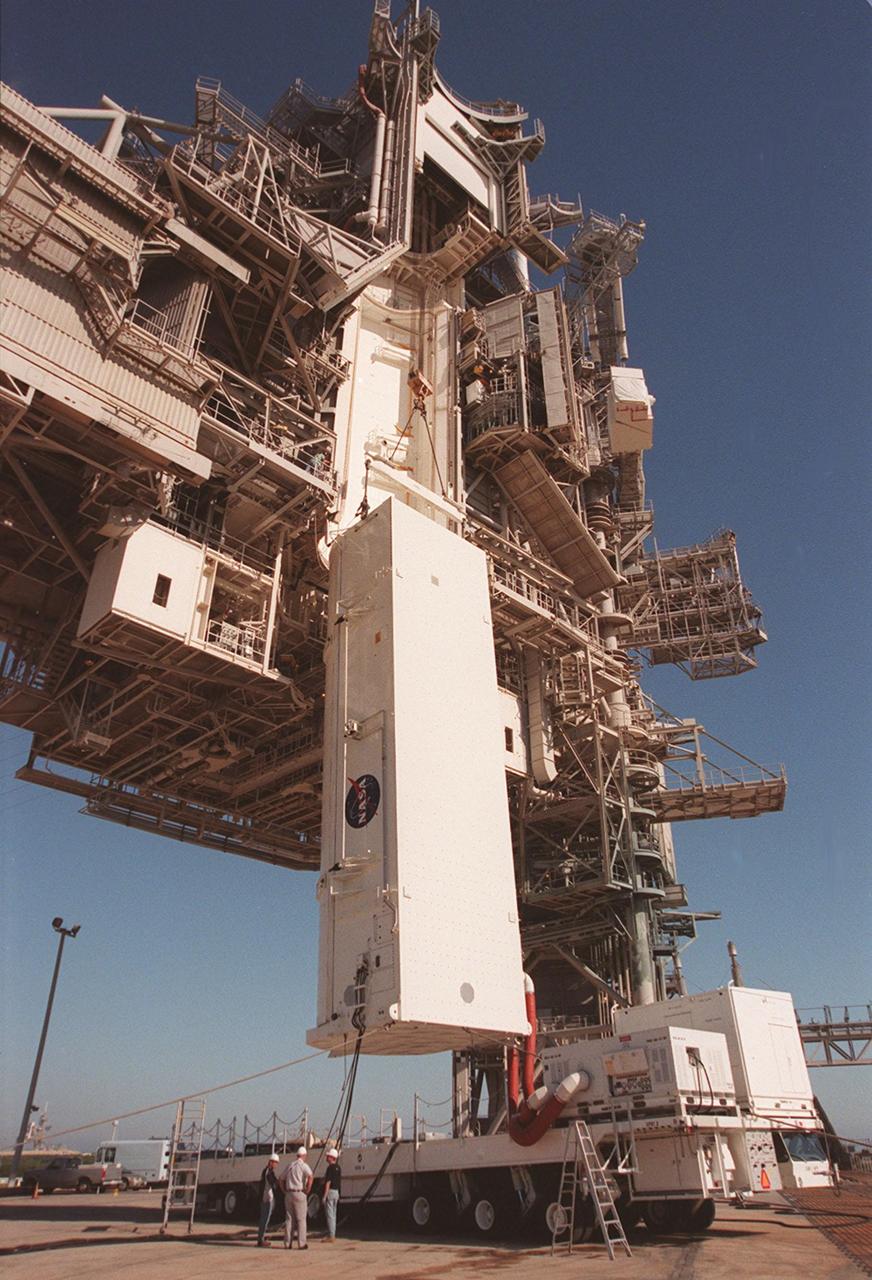
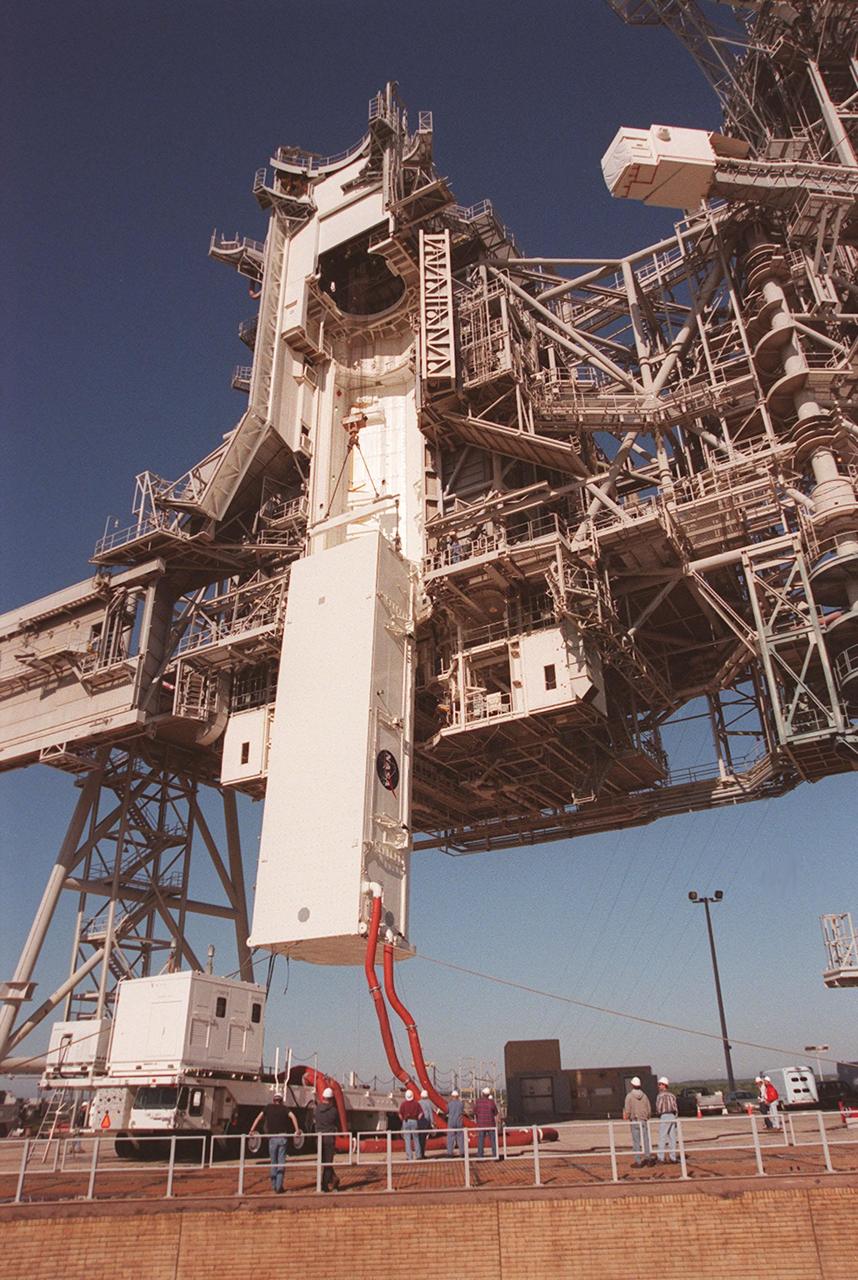
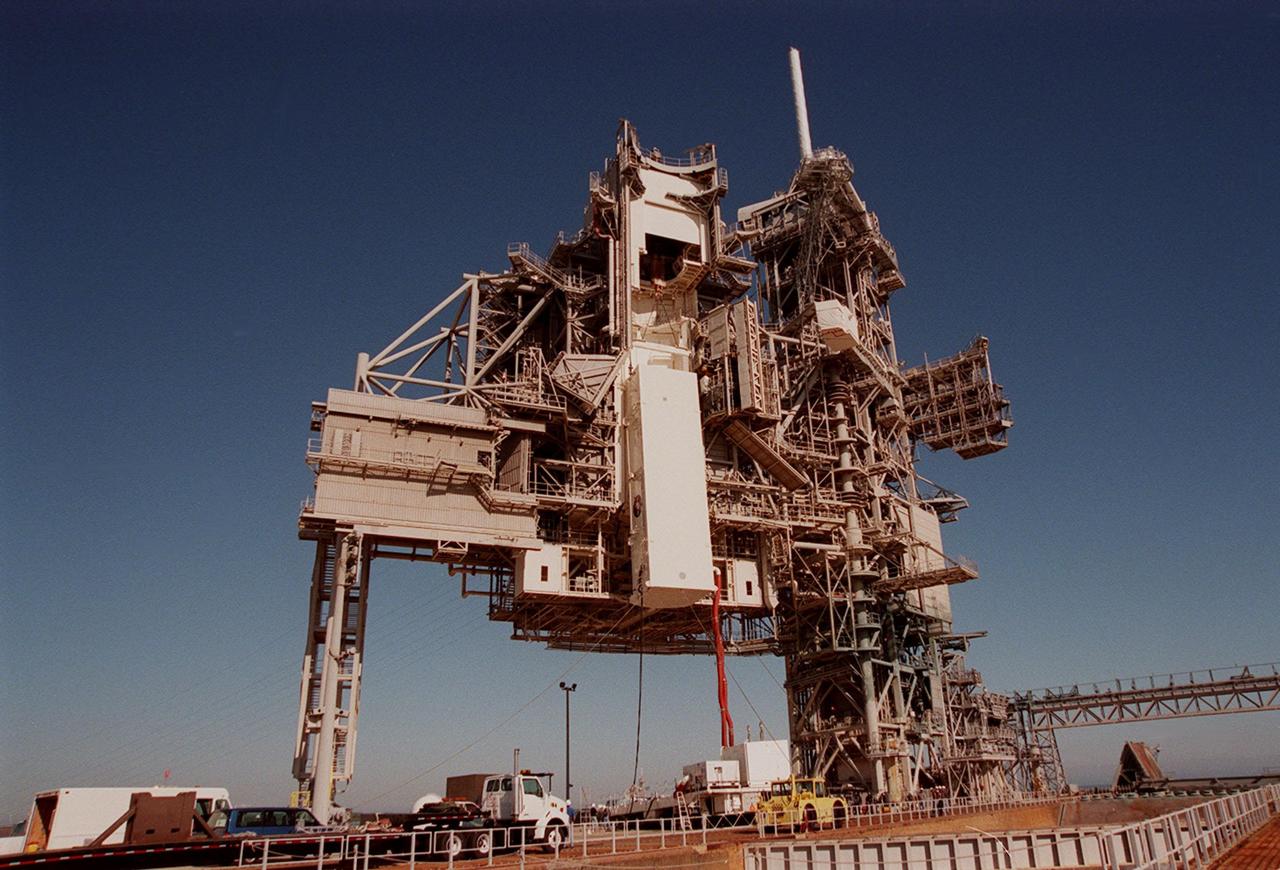
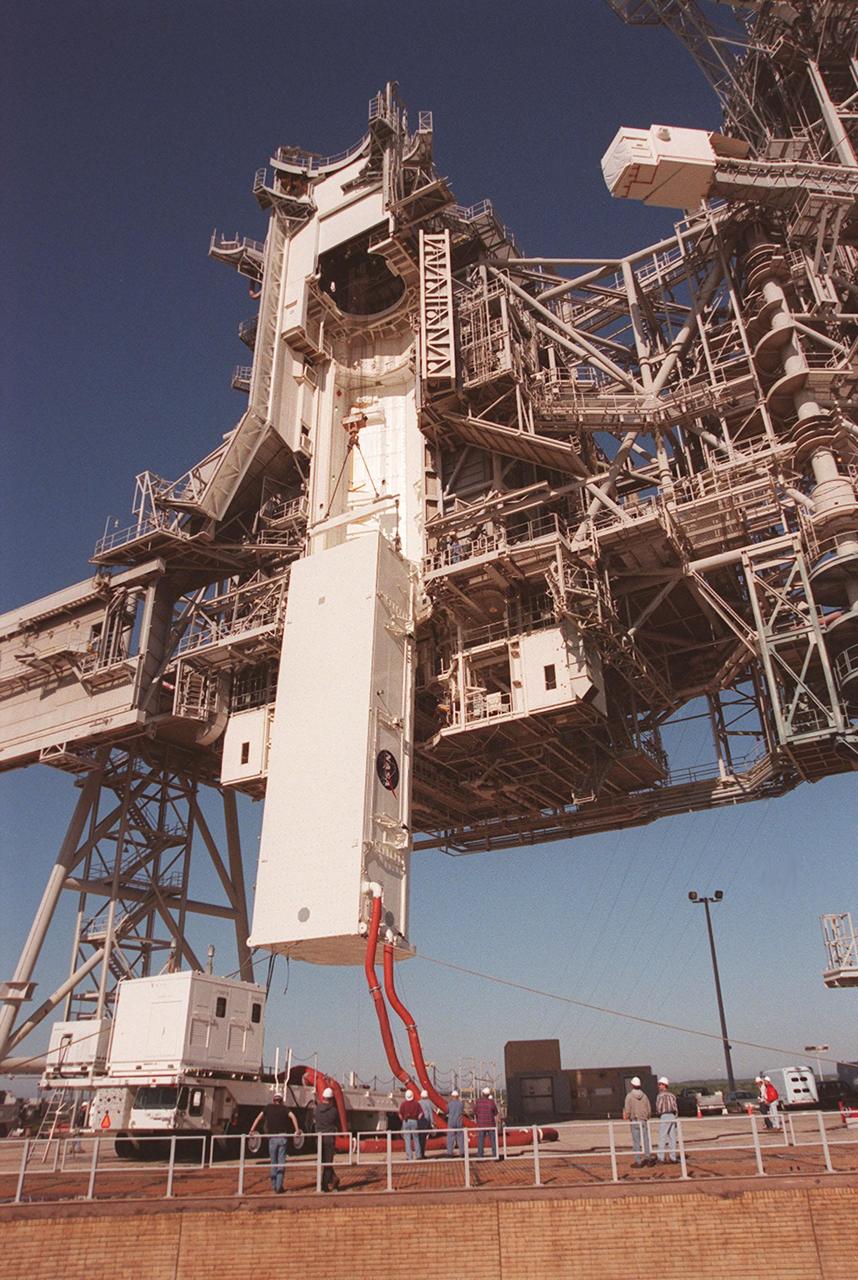
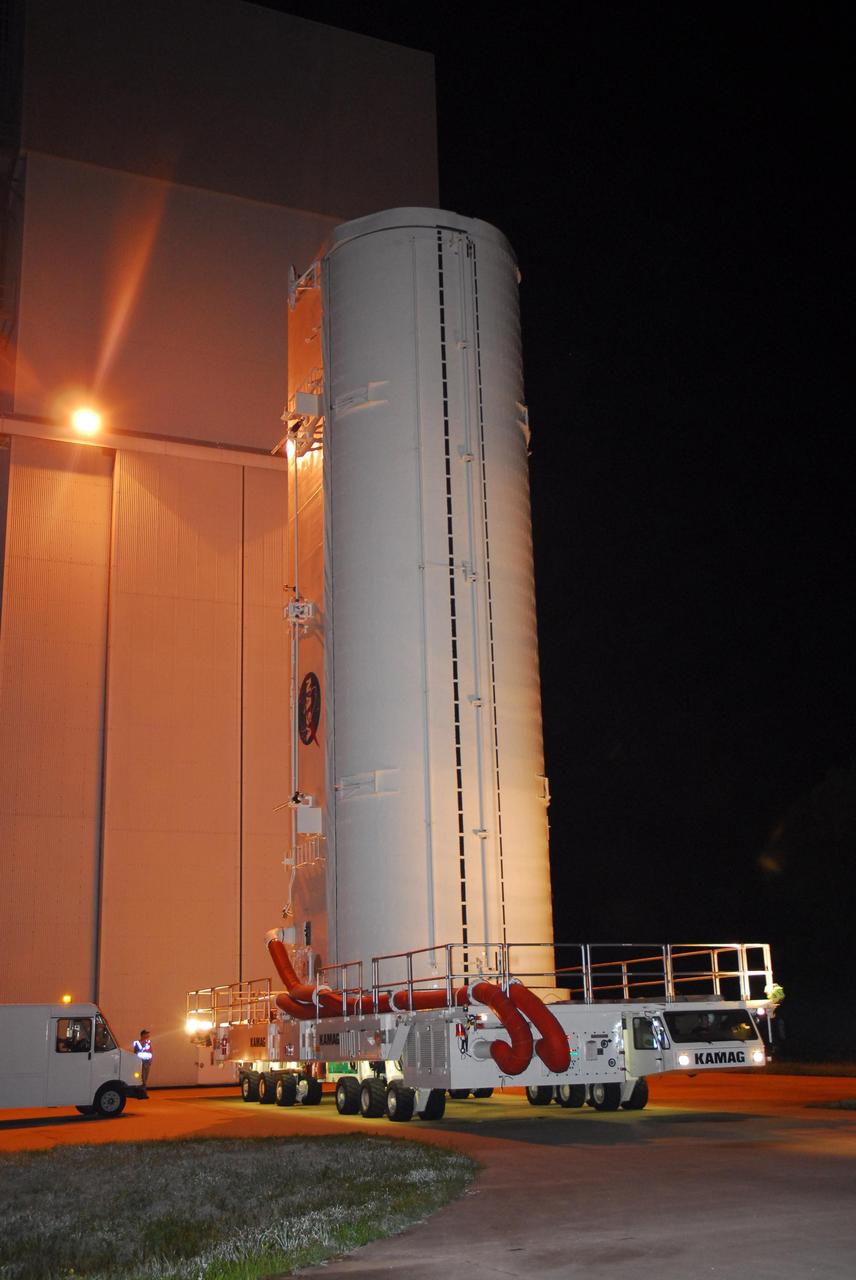
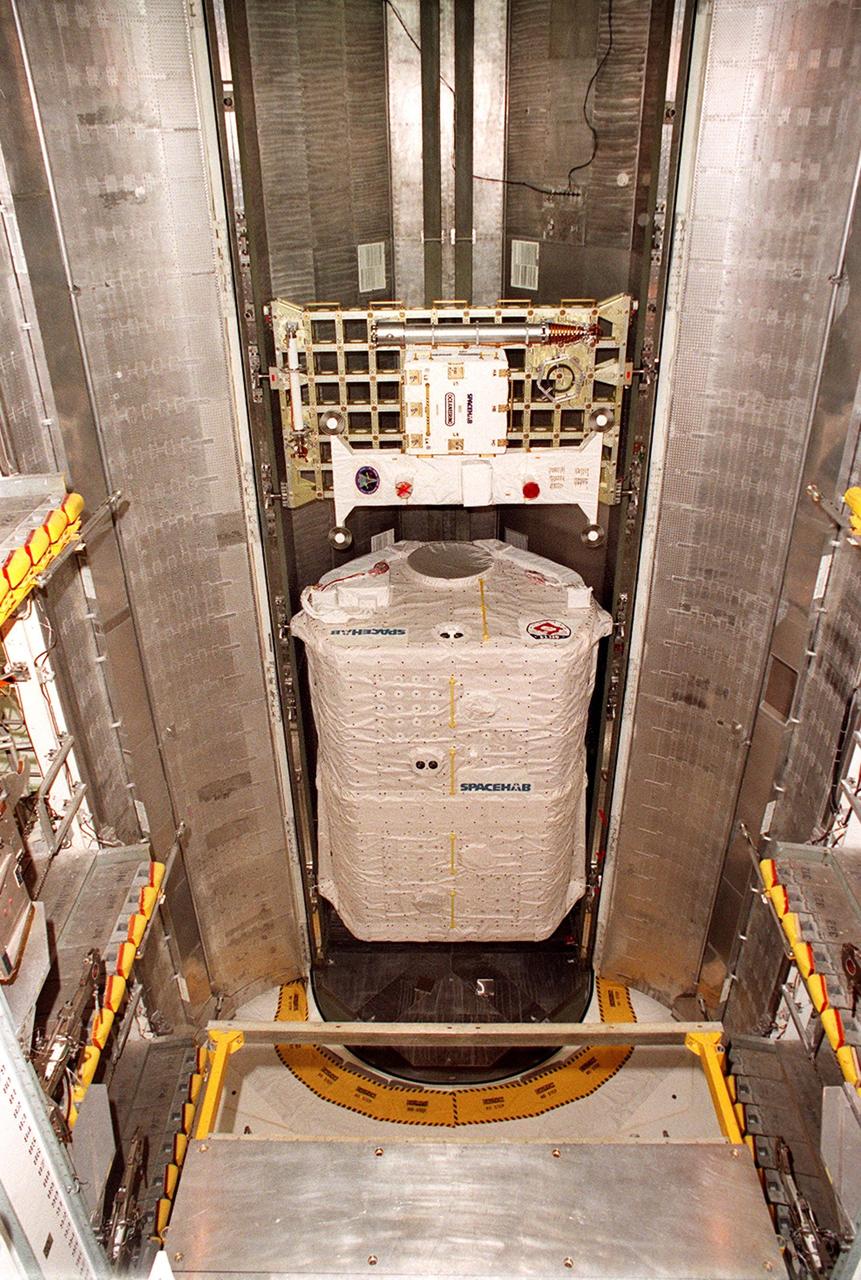
KENNEDY SPACE CENTER, FLA. -- At Launch Pad 39A, the payload canister with the SPACEHAB Double Module and Integrated Cargo Carrier (ICC) inside is lifted up the Rotating Service Structure toward the Payload Changeout Room, an environmentally controlled facility supporting cargo delivery to the pad and vertical installation in the orbiter cargo bay. The primary payloads on mission STS-101, the module and ICC contain internal logistics and resupply cargo for restoring full redundancy to the International Space Station power system in preparation for the arrival of the next pressurized module, the Russian-built Zvezda. The payloads will be transferred to Space Shuttle Atlantis after Atlantis rolls out to the pad. Launch of Atlantis on mission STS-101 is scheduled no earlier than April 17, 2000
KSC00pp0367
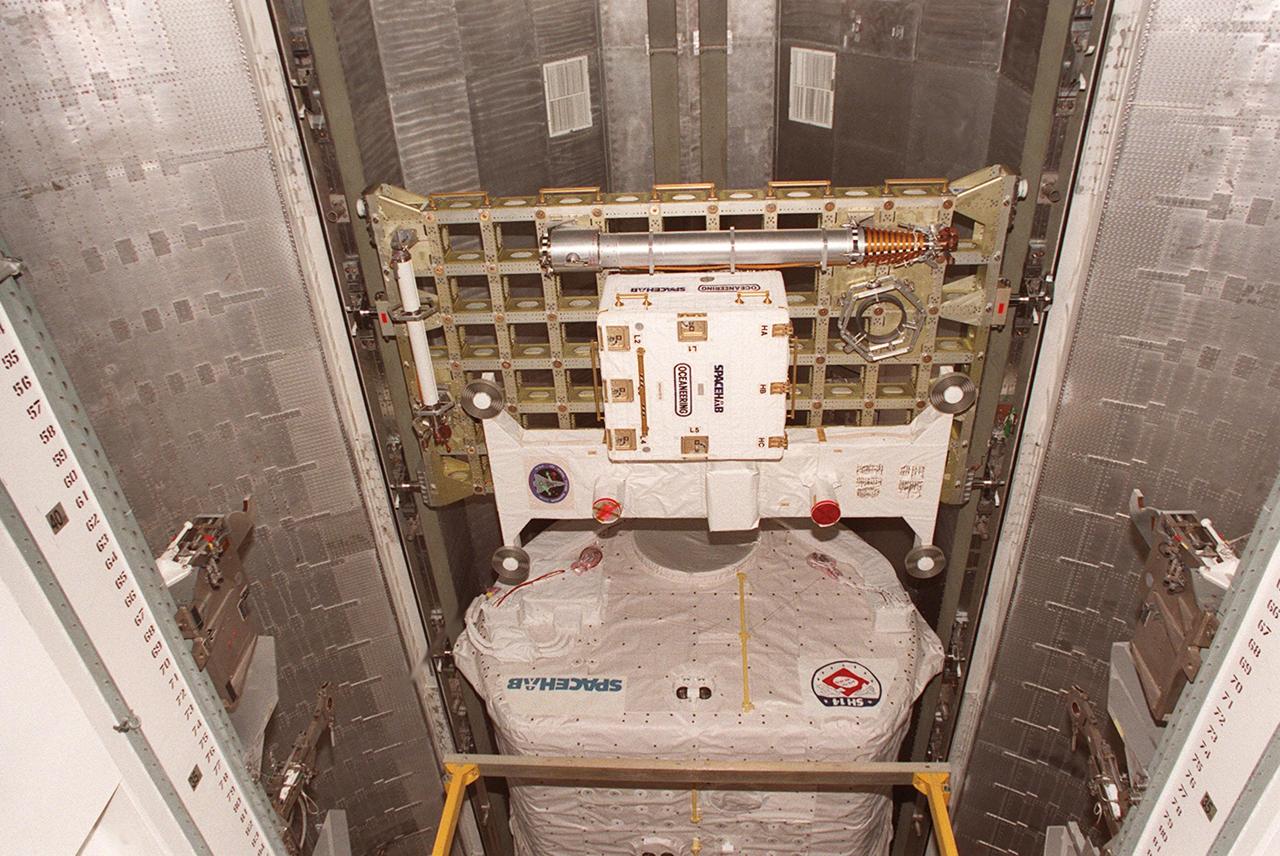
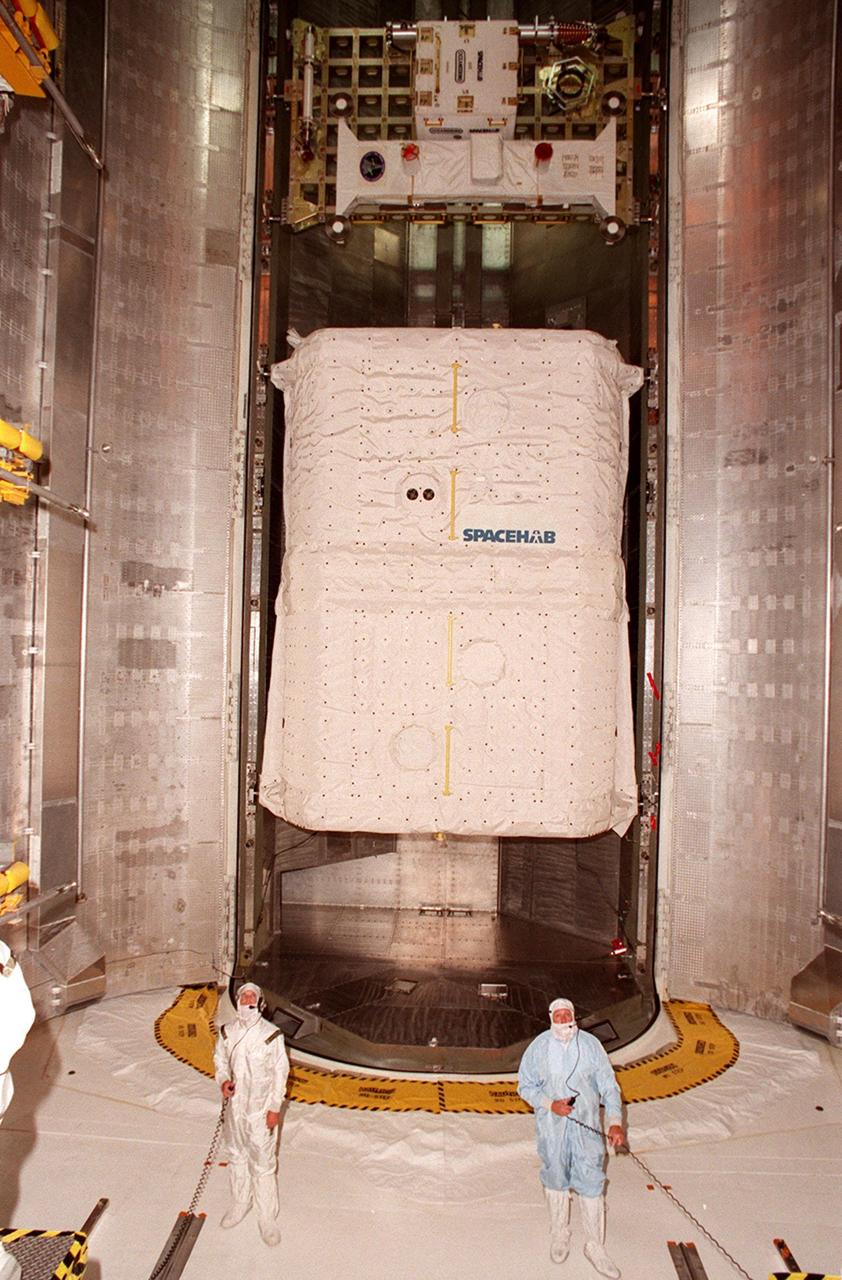
KENNEDY SPACE CENTER, FLA. -- A closeup shows the Integrated Cargo Carrier (top) and SPACEHAB Double Module (below) ready to be moved into the Payload Changeout Room (PCR) at Launch Pad 39A. Part of the Rotating Service Structure, the PCR is an environmentally controlled facility supporting cargo delivery to the pad and vertical installation in the orbiter cargo bay. The primary payloads on mission STS-101, the module and ICC contain internal logistics and resupply cargo for restoring full redundancy to the International Space Station power system in preparation for the arrival of the next pressurized module, the Russian-built Zvezda. The payloads will be transferred to Space Shuttle Atlantis after Atlantis rolls out to the pad. Launch of Atlantis on mission STS-101 is scheduled no earlier than April 17, 2000
KSC-00pp0372
KENNEDY SPACE CENTER, FLA. -- At Launch Pad 39A, the payload canister with the SPACEHAB Double Module and the Integrated Cargo Carrier (ICC) inside is lifted off the payload transporter toward the Payload Changeout Room (PCR) on the Rotating Service Structure (RSS). The PCR is an environmentally controlled facility supporting cargo delivery to the pad and vertical installation in the orbiter cargo bay. At right of the RSS is the Fixed Service Structure. The primary payloads on mission STS-101, the module and ICC contain internal logistics and resupply cargo for restoring full redundancy to the International Space Station power system in preparation for the arrival of the next pressurized module, the Russian-built Zvezda. The payloads will be transferred to Space Shuttle Atlantis after Atlantis rolls out to the pad. Launch of Atlantis on mission STS-101 is scheduled no earlier than April 17, 2000
KSC-00pp0369
KENNEDY SPACE CENTER, FLA. -- At Launch Pad 39A, the payload canister with the SPACEHAB Double Module and Integrated Cargo Carrier (ICC) inside is lifted up the Rotating Service Structure (RSS) toward the Payload Changeout Room, an environmentally controlled facility supporting cargo delivery to the pad and vertical installation in the orbiter cargo bay. At right of the RSS is the Fixed Service Structure, topped by the 80-foot-tall fiberglass lightning mast. The primary payload on mission STS-101, the module and ICC contain internal logistics and resupply cargo for restoring full redundancy to the International Space Station power system in preparation for the arrival of the next pressurized module, the Russian-built Zvezda. The payloads will be transferred to Space Shuttle Atlantis after Atlantis rolls out to the pad. Launch of Atlantis on mission STS-101 is scheduled no earlier than April 17, 2000
KSC00pp0368
KENNEDY SPACE CENTER, FLA. -- At Launch Pad 39A, the payload canister with the SPACEHAB Double Module and the Integrated Cargo Carrier (ICC) inside is lifted off the payload transporter toward the Payload Changeout Room (PCR) on the Rotating Service Structure (RSS). The PCR is an environmentally controlled facility supporting cargo delivery to the pad and vertical installation in the orbiter cargo bay. At right of the RSS is the Fixed Service Structure. The primary payloads on mission STS-101, the module and ICC contain internal logistics and resupply cargo for restoring full redundancy to the International Space Station power system in preparation for the arrival of the next pressurized module, the Russian-built Zvezda. The payloads will be transferred to Space Shuttle Atlantis after Atlantis rolls out to the pad. Launch of Atlantis on mission STS-101 is scheduled no earlier than April 17, 2000
KSC00pp0369
KENNEDY SPACE CENTER, FLA. -- A closeup shows the Integrated Cargo Carrier (top) and SPACEHAB Double Module (below) ready to be moved into the Payload Changeout Room (PCR) at Launch Pad 39A. Part of the Rotating Service Structure, the PCR is an environmentally controlled facility supporting cargo delivery to the pad and vertical installation in the orbiter cargo bay. The primary payloads on mission STS-101, the module and ICC contain internal logistics and resupply cargo for restoring full redundancy to the International Space Station power system in preparation for the arrival of the next pressurized module, the Russian-built Zvezda. The payloads will be transferred to Space Shuttle Atlantis after Atlantis rolls out to the pad. Launch of Atlantis on mission STS-101 is scheduled no earlier than April 17, 2000
KSC00pp0372
KENNEDY SPACE CENTER, FLA. -- At Launch Pad 39A, the payload canister with the SPACEHAB Double Module and Integrated Cargo Carrier (ICC) inside is lifted up the Rotating Service Structure (RSS) toward the Payload Changeout Room, an environmentally controlled facility supporting cargo delivery to the pad and vertical installation in the orbiter cargo bay. At right of the RSS is the Fixed Service Structure, topped by the 80-foot-tall fiberglass lightning mast. The primary payload on mission STS-101, the module and ICC contain internal logistics and resupply cargo for restoring full redundancy to the International Space Station power system in preparation for the arrival of the next pressurized module, the Russian-built Zvezda. The payloads will be transferred to Space Shuttle Atlantis after Atlantis rolls out to the pad. Launch of Atlantis on mission STS-101 is scheduled no earlier than April 17, 2000
KSC-00pp0368
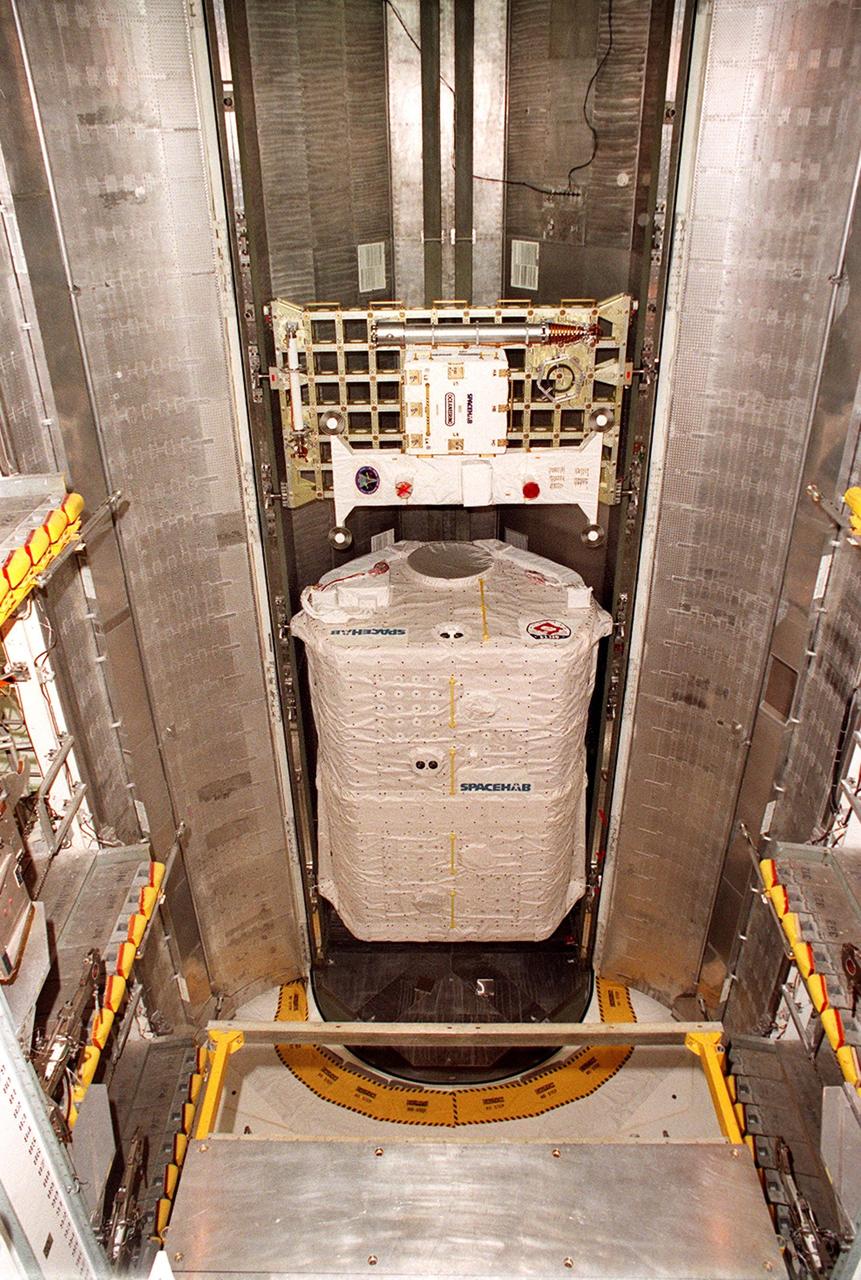
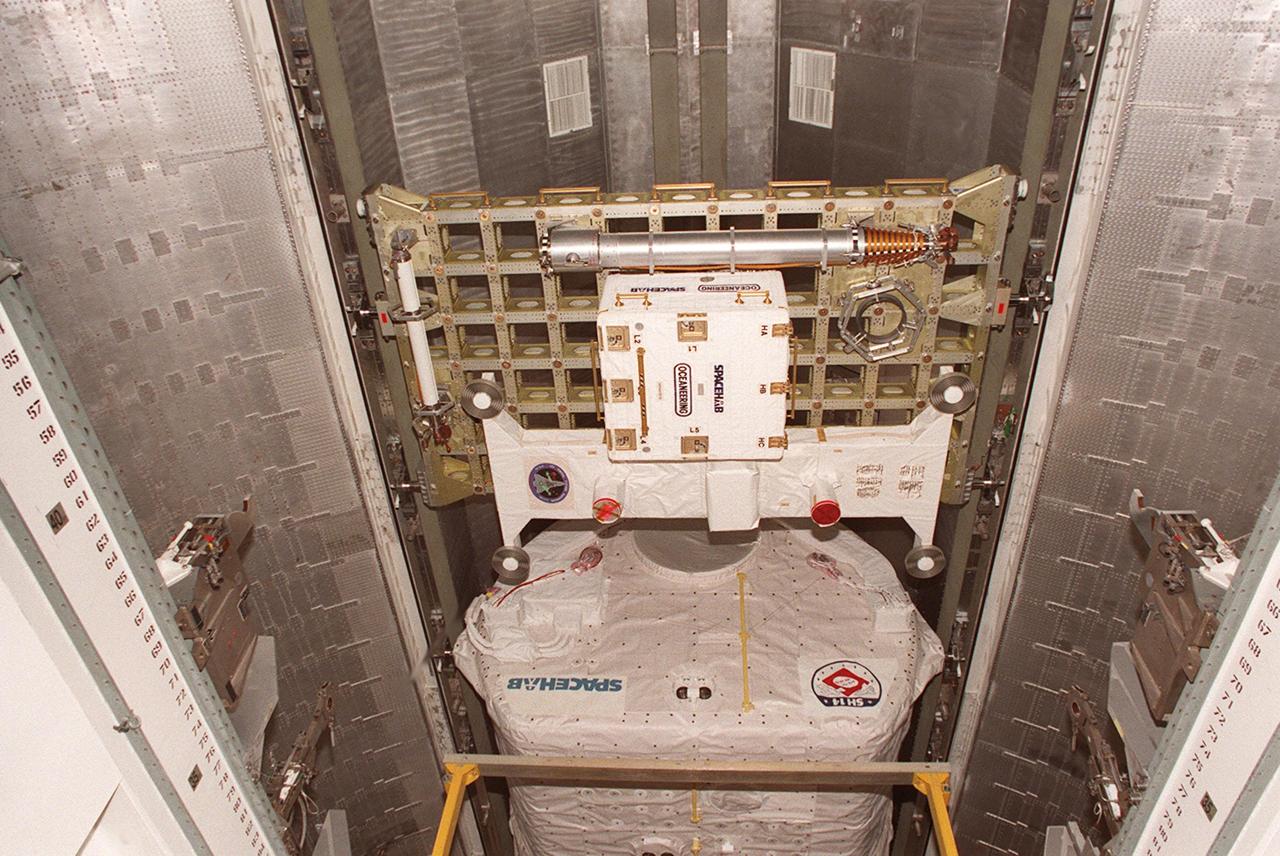
KENNEDY SPACE CENTER, FLA. -- The SPACEHAB Double Module (bottom) and Integrated Cargo Carrier (above) are ready to be moved from the payload canister into the Payload Changeout Room (PCR) at Launch Pad 39A. Part of the Rotating Service Structure, the PCR is an environmentally controlled facility supporting cargo delivery to the pad and vertical installation in the orbiter cargo bay. The primary payloads on mission STS-101, the module and ICC contain internal logistics and resupply cargo for restoring full redundancy to the International Space Station power system in preparation for the arrival of the next pressurized module, the Russian-built Zvezda. The payloads will be transferred to Space Shuttle Atlantis after Atlantis rolls out to the pad. Launch of Atlantis on mission STS-101 is scheduled no earlier than April 17, 2000
KSC00pp0371
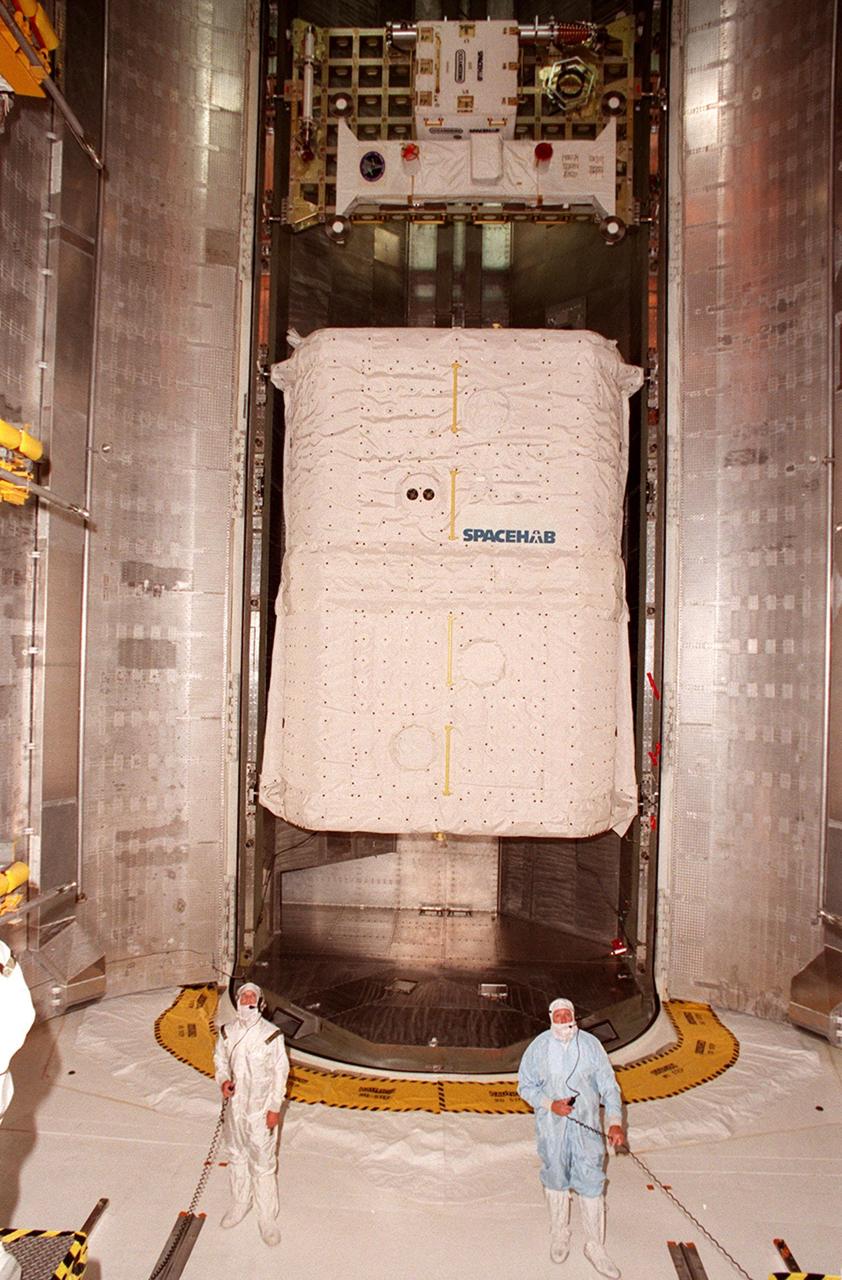
KENNEDY SPACE CENTER, FLA. -- The doors of the payload canister open in the Payload Changeout Room (PCR) at Launch Pad 39A to reveal the SPACEHAB Double Module (bottom) and Integrated Cargo Carrier (ICC). Part of the Rotating Service Structure, the PCR is an environmentally controlled facility supporting cargo delivery to the pad and vertical installation in the orbiter cargo bay. The primary payloads on mission STS-101, the module and ICC contain internal logistics and resupply cargo for restoring full redundancy to the International Space Station power system in preparation for the arrival of the next pressurized module, the Russian-built Zvezda. The payloads will be transferred to Space Shuttle Atlantis after Atlantis rolls out to the pad. Launch of Atlantis on mission STS-101 is scheduled no earlier than April 17, 2000
KSC-00pp0370
KENNEDY SPACE CENTER, FLA. -- At Launch Pad 39A, the payload canister with the SPACEHAB Double Module and Integrated Cargo Carrier (ICC) inside is lifted up the Rotating Service Structure toward the Payload Changeout Room, an environmentally controlled facility supporting cargo delivery to the pad and vertical installation in the orbiter cargo bay. The primary payloads on mission STS-101, the module and ICC contain internal logistics and resupply cargo for restoring full redundancy to the International Space Station power system in preparation for the arrival of the next pressurized module, the Russian-built Zvezda. The payloads will be transferred to Space Shuttle Atlantis after Atlantis rolls out to the pad. Launch of Atlantis on mission STS-101 is scheduled no earlier than April 17, 2000
KSC-00pp0367
KENNEDY SPACE CENTER, FLA. -- The doors of the payload canister open in the Payload Changeout Room (PCR) at Launch Pad 39A to reveal the SPACEHAB Double Module (bottom) and Integrated Cargo Carrier (ICC). Part of the Rotating Service Structure, the PCR is an environmentally controlled facility supporting cargo delivery to the pad and vertical installation in the orbiter cargo bay. The primary payloads on mission STS-101, the module and ICC contain internal logistics and resupply cargo for restoring full redundancy to the International Space Station power system in preparation for the arrival of the next pressurized module, the Russian-built Zvezda. The payloads will be transferred to Space Shuttle Atlantis after Atlantis rolls out to the pad. Launch of Atlantis on mission STS-101 is scheduled no earlier than April 17, 2000
KSC00pp0370
KENNEDY SPACE CENTER, FLA. -- The SPACEHAB Double Module (bottom) and Integrated Cargo Carrier (above) are ready to be moved from the payload canister into the Payload Changeout Room (PCR) at Launch Pad 39A. Part of the Rotating Service Structure, the PCR is an environmentally controlled facility supporting cargo delivery to the pad and vertical installation in the orbiter cargo bay. The primary payloads on mission STS-101, the module and ICC contain internal logistics and resupply cargo for restoring full redundancy to the International Space Station power system in preparation for the arrival of the next pressurized module, the Russian-built Zvezda. The payloads will be transferred to Space Shuttle Atlantis after Atlantis rolls out to the pad. Launch of Atlantis on mission STS-101 is scheduled no earlier than April 17, 2000
KSC-00pp0371
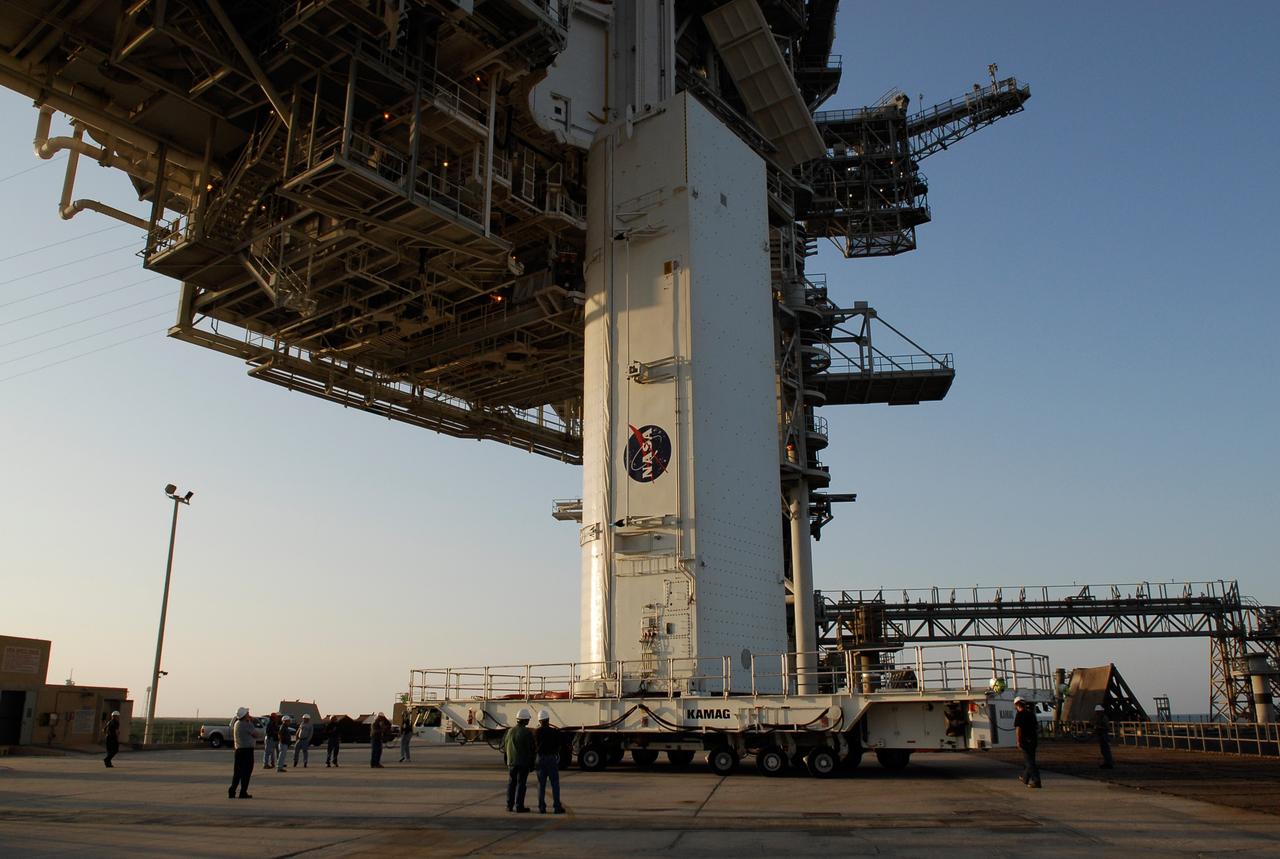
CAPE CANAVERAL, Fla. –   On Launch Pad 39A at NASA's Kennedy Space Center, the payload canister with the Japanese Experiment Module - Pressurized Module and the Japanese Remote Manipulator System, or RMS, inside arrives in position below the payload changeout room on the rotating service structure.  The changeout room is the enclosed, environmentally controlled portion of the service structure that supports cargo delivery to the pad and subsequent vertical installation into an orbiter's payload bay.  From the payload changeout room, the pressurized module and RMS then will be transferred into space shuttle Discovery’s payload bay.  Launch is targeted for May 31.  Photo credit: NASA/Kim Shiflett
KSC-08pd1074
CAPE CANAVERAL, Fla. –    On Launch Pad 39A at NASA's Kennedy Space Center, workers on the payload canister transporter prepare for the lifting of the payload canister to the waiting payload changeout room above.  Inside the canister are the Japanese Experiment Module - Pressurized Module and the Japanese Remote Manipulator System, or RMS, for the STS-124 mission. The changeout room is the enclosed, environmentally controlled portion of the service structure that supports cargo delivery to the pad and subsequent vertical installation into an orbiter's payload bay.  From the payload changeout room, the pressurized module and RMS then will be transferred into space shuttle Discovery’s payload bay.  Launch is targeted for May 31.  Photo credit: NASA/Kim Shiflett
KSC-08pd1076
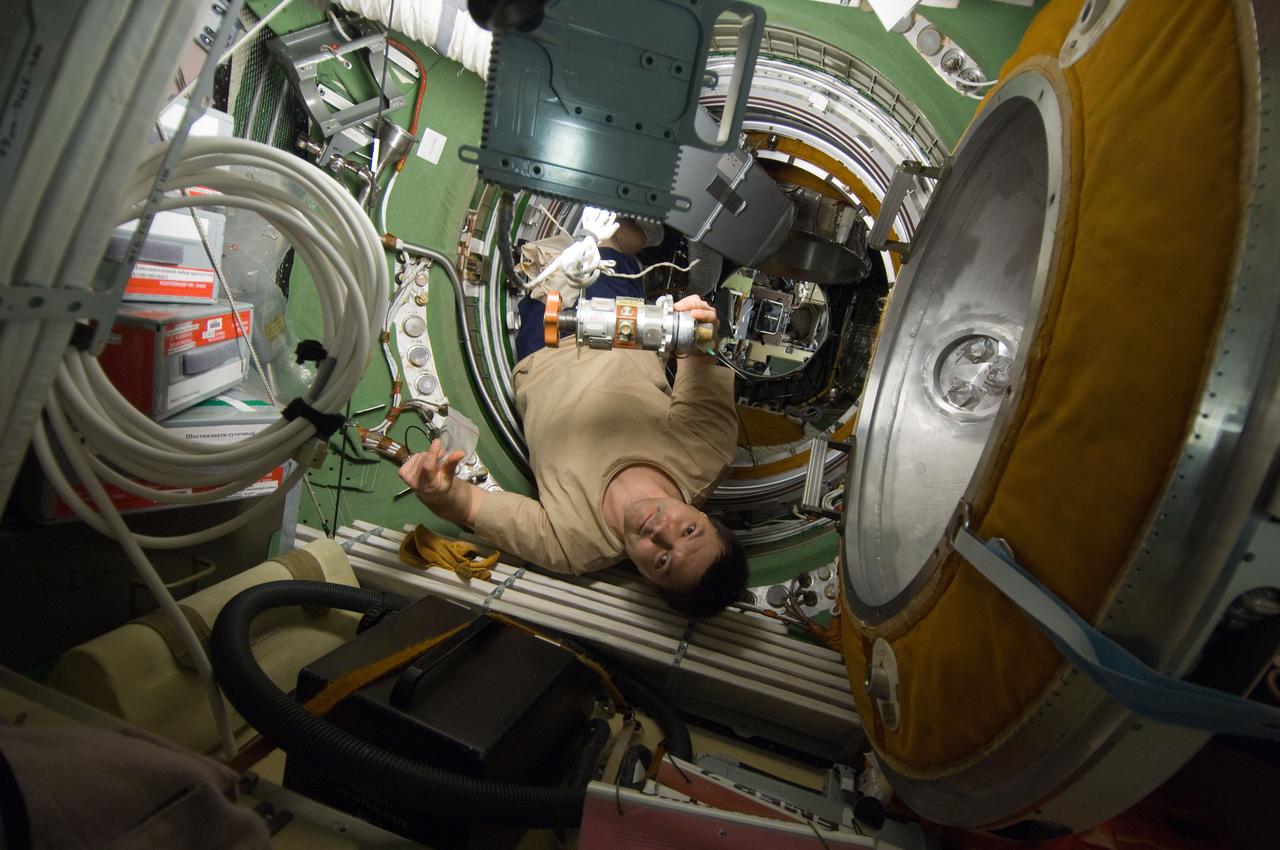
ISS030-E-177117 (12 March 2012) --- Russian cosmonaut Oleg Kononenko, Expedition 30 flight engineer, performs removal and replacement of the KVD Pressure Equalization Valve (PEV) in the transfer compartment between the Zarya Functional Cargo Block (FGB) and the Zvezda Service Module of the International Space Station.
Kononenko removes and replaces the KVD PEV
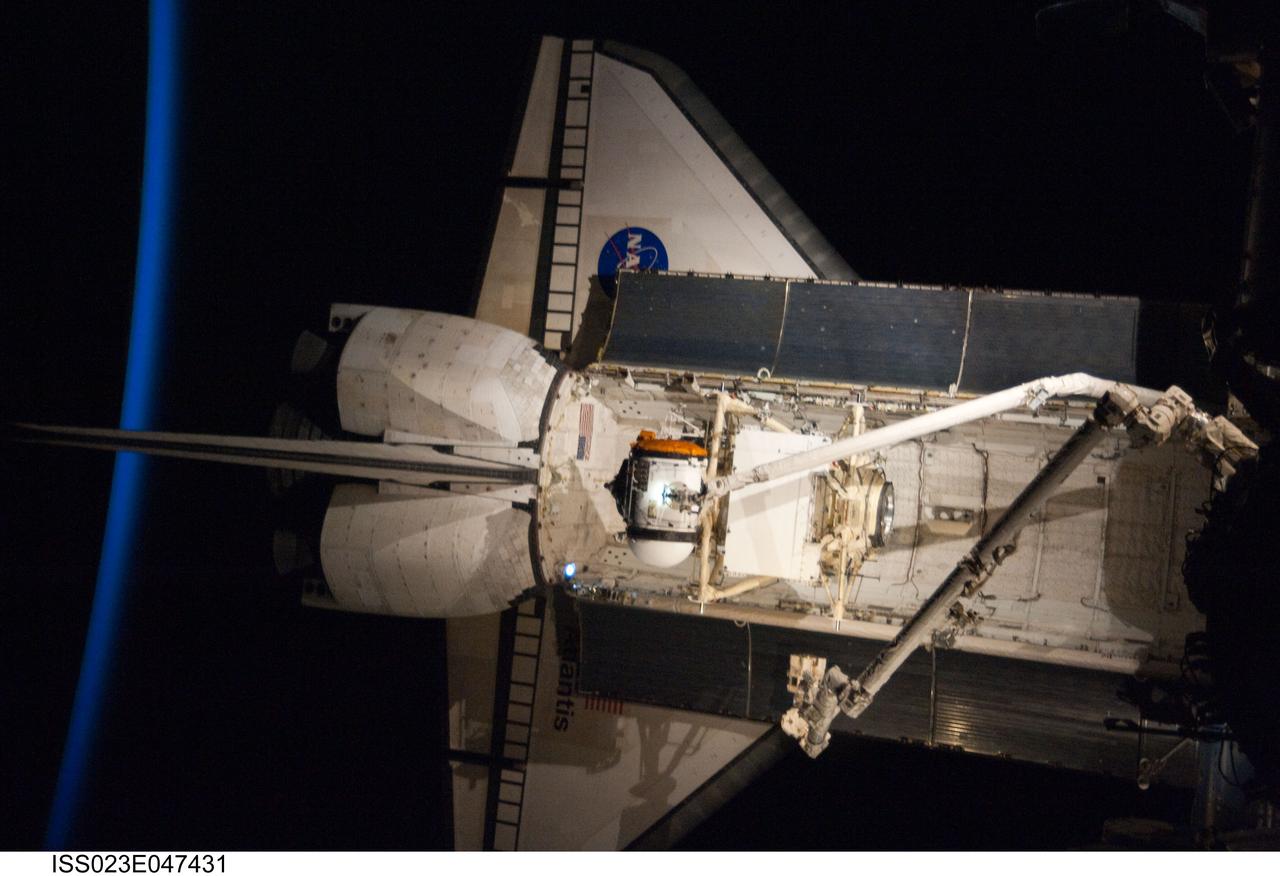
ISS023-E-047431 (18 May 2010) --- Intersecting the thin line of Earth's atmosphere, the docked space shuttle Atlantis is featured in this image photographed by an Expedition 23 crew member on the International Space Station. The Russian-built Mini-Research Module 1 (MRM-1) is visible in the payload bay as the shuttle robotic arm prepares to unberth the module from Atlantis and position it for handoff to the station robotic arm. Named Rassvet, Russian for "dawn," the module is the second in a series of new pressurized components for Russia and will be permanently attached to the Earth-facing port of the Zarya Functional Cargo Block (FGB). Rassvet will be used for cargo storage and will provide an additional docking port to the station.
MRM1 in Atlantis Payload Bay
KENNEDY SPACE CENTER, FLA. -- The payload canister containing the Italian-built U.S. Node 2 module, called Harmony, begins taking its cargo to Launch Pad 39A.  At the pad, the canister will be lifted to the payload changeout room and the module transferred inside.  The payload will be installed in space shuttle Discovery's payload bay after the vehicle rolls out to the pad.  Discovery is targeted for launch to the International Space Station for mission STS-120 on Oct. 23.   The pressurized module will act as an internal connecting port and passageway to additional international science labs and cargo spacecraft.  Photo credit: NASA/George Shelton
KSC-07pd2593
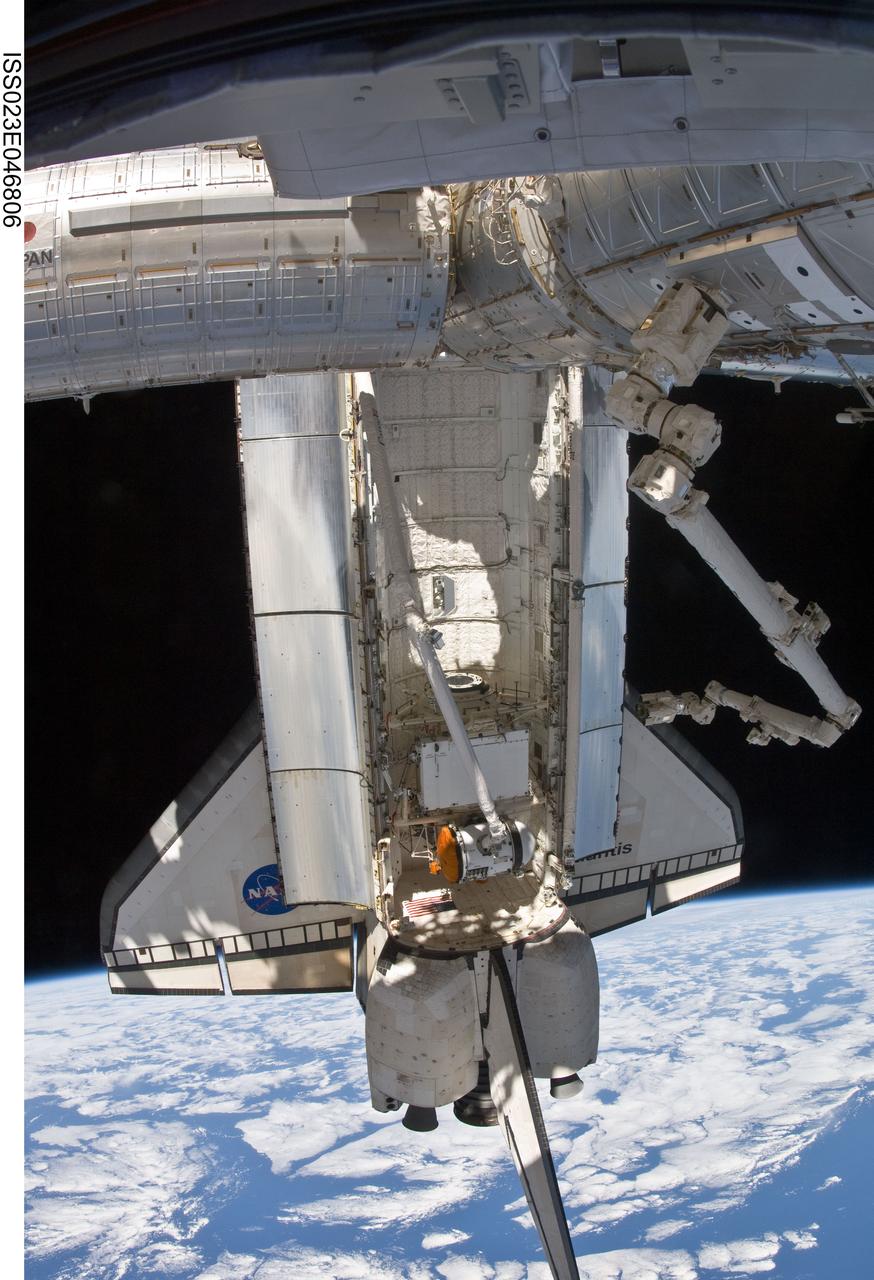
ISS023-E-046806 (18 May 2010) --- Backdropped by Earth?s horizon and the blackness of space, the docked space shuttle Atlantis is featured in this image photographed by an Expedition 23 crew member on the International Space Station. The Russian-built Mini-Research Module 1 (MRM-1) is visible in the payload bay as the shuttle robotic arm prepares to unberth the module from Atlantis and position it for handoff to the station robotic arm (visible at right). Named Rassvet, Russian for "dawn," the module is the second in a series of new pressurized components for Russia and will be permanently attached to the Earth-facing port of the Zarya Functional Cargo Block (FGB). Rassvet will be used for cargo storage and will provide an additional docking port to the station.
MRM1 in Atlantis Payload Bay
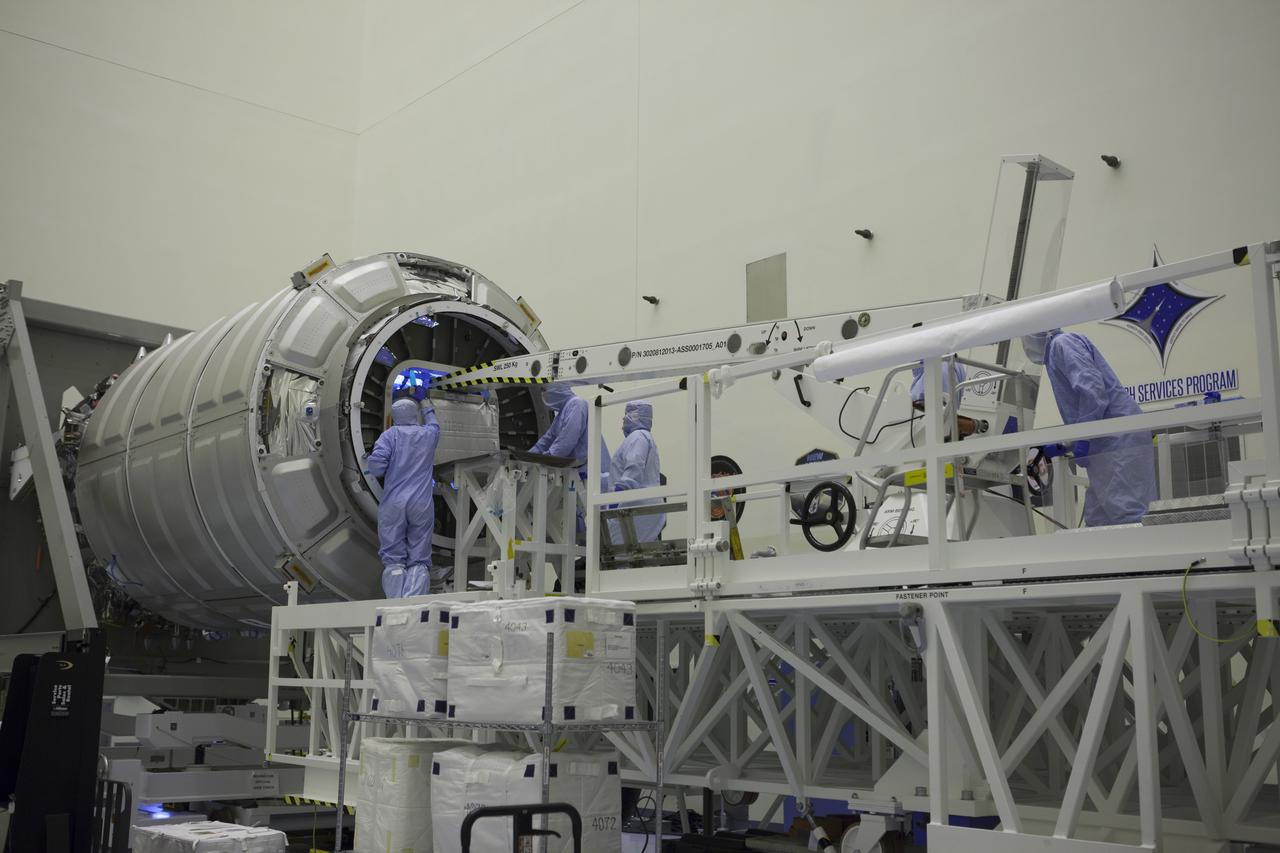
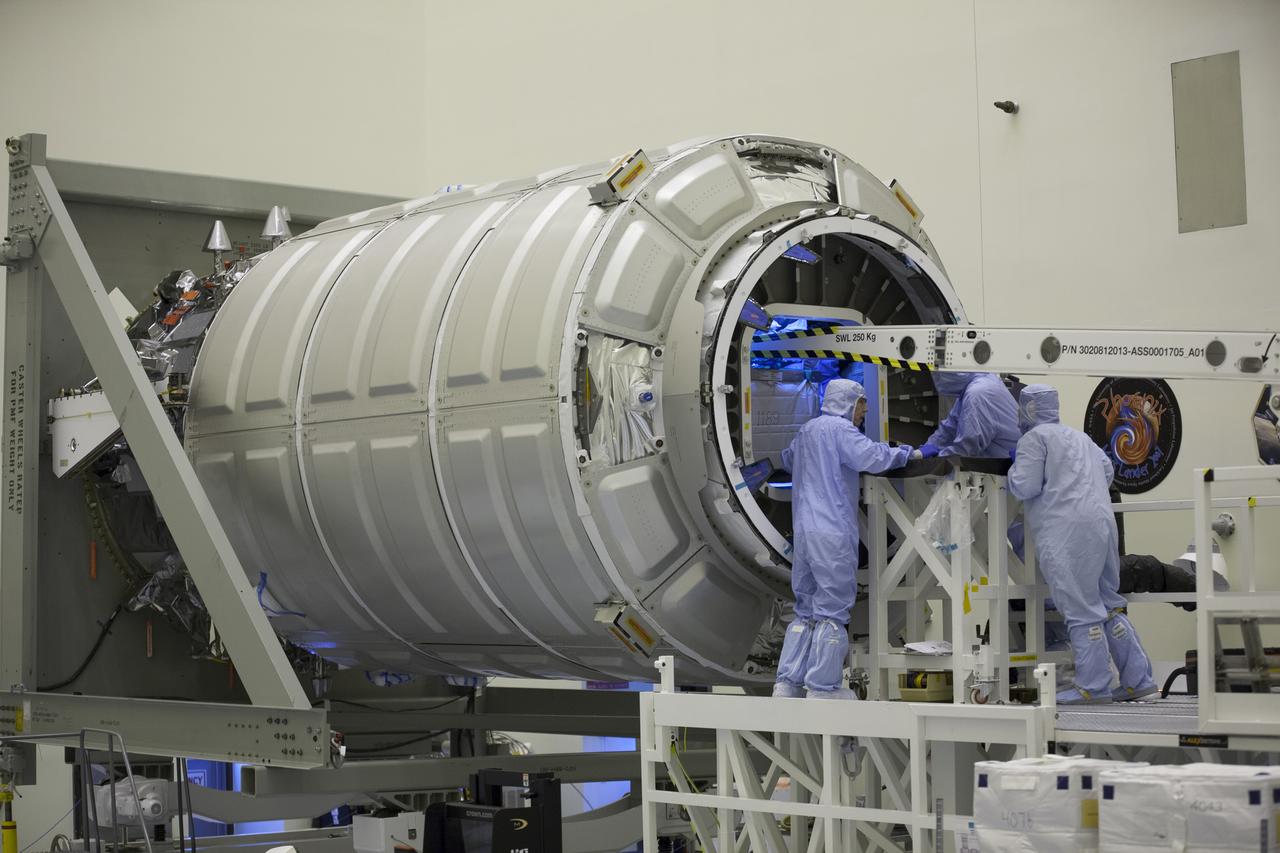
Carefully packaged cargo waits on pallets inside the Payload Hazardous Servicing Facility at NASA’s Kennedy Space Center in Florida. In the background, technicians prepare to begin loading the cargo into the Orbital ATK Cygnus pressurized module during late stowage operations. The spacecraft is scheduled for the upcoming Orbital ATK Commercial Resupply Services-6 mission to deliver hardware and supplies to the International Space Station. The Cygnus is scheduled to lift off atop a United Launch Alliance Atlas V rocket on March 22.
Cygnus Orbital ATK OA-6 Late Cargo Load
Technicians are positioned at the hatch of the Orbital ATK CRS-6 pressurized cargo module as a forklift moves a cargo package into position for installation into the spacecraft inside the Payload Hazardous Servicing Facility at NASA’s Kennedy Space Center in Florida. The spacecraft is scheduled for the upcoming Orbital ATK Commercial Resupply Services-6 mission to deliver hardware and supplies to the International Space Station. The Cygnus is scheduled to lift off atop a United Launch Alliance Atlas V rocket on March 22
Cygnus Orbital ATK OA-6 Late Cargo Load
Technicians move cargo into the Orbital ATK CRS-6 pressurized cargo module during late stowage inside the Payload Hazardous Servicing Facility at NASA’s Kennedy Space Center in Florida. The spacecraft is scheduled for the upcoming Orbital ATK Commercial Resupply Services-6 mission to deliver hardware and supplies to the International Space Station. The Cygnus is scheduled to lift off atop a United Launch Alliance Atlas V rocket on March 22.
Cygnus Orbital ATK OA-6 Late Cargo Load
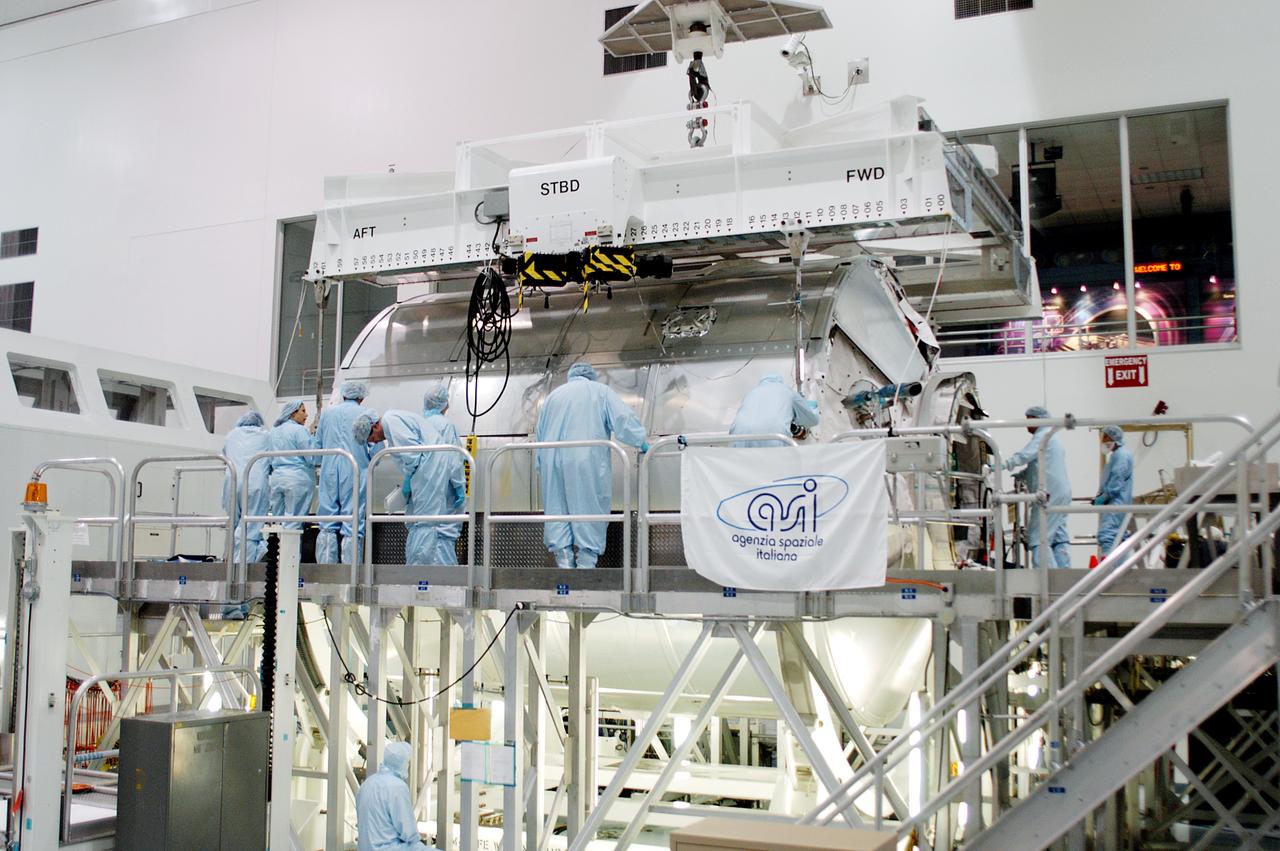
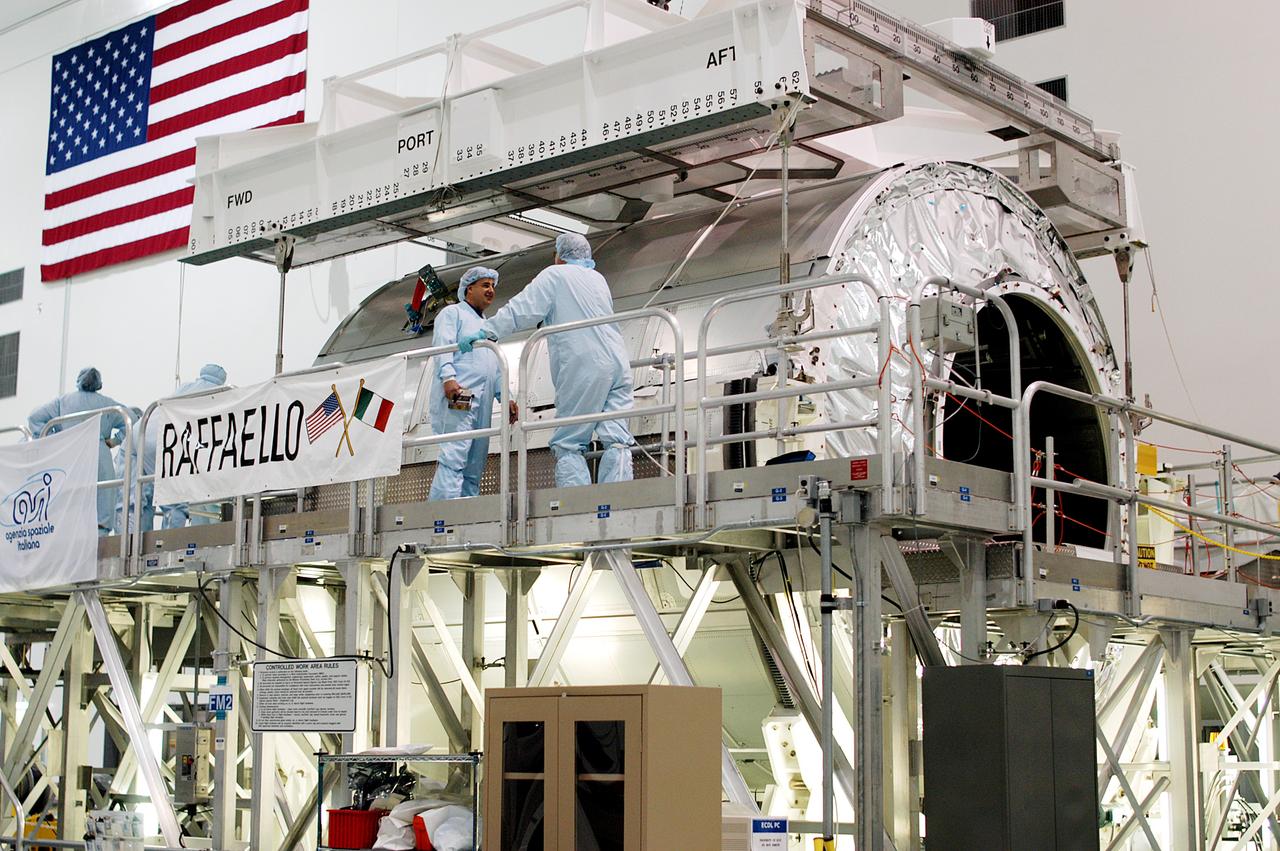
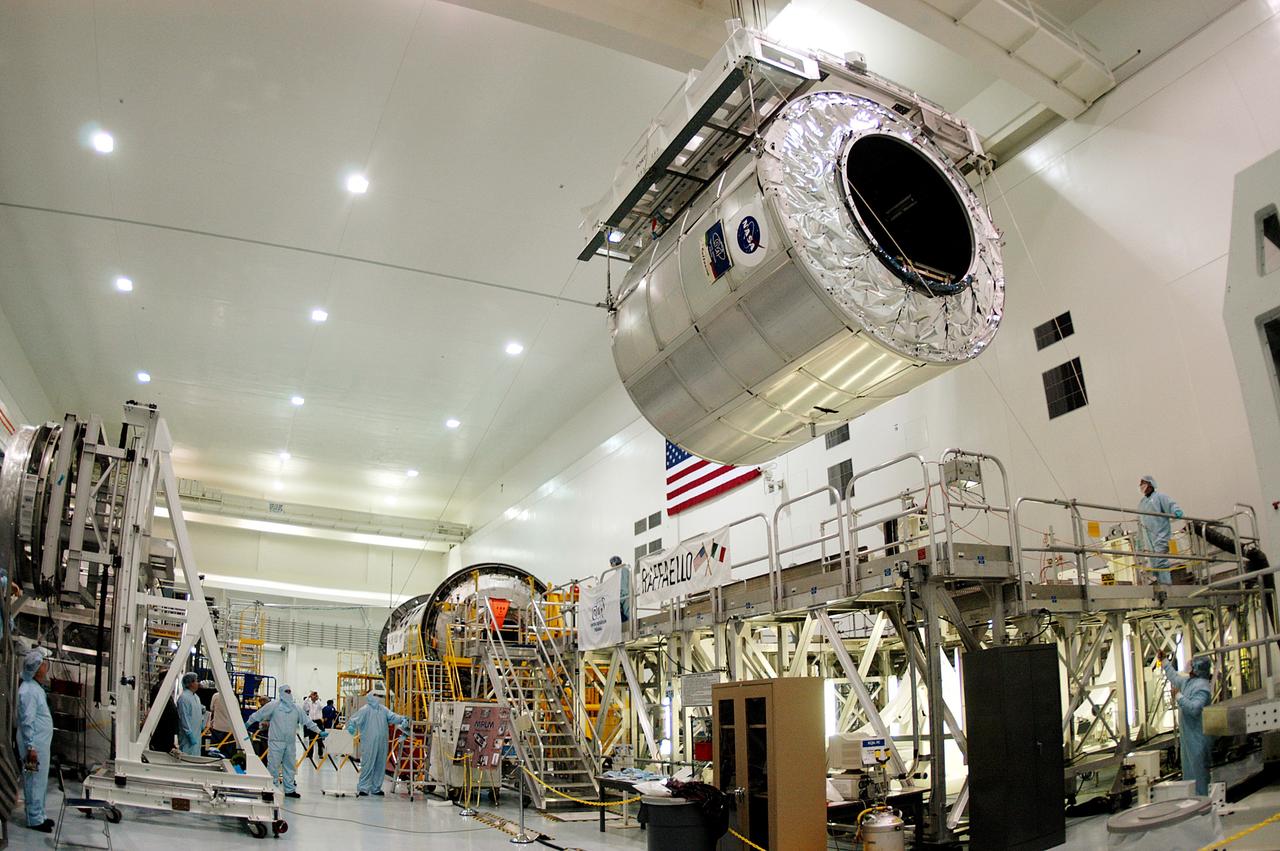
KENNEDY SPACE CENTER, FLA. -  In the Space Station Processing Facility, workers stand by as the Multi-Purpose Logistics Module Leonardo is lowered toward the Cargo Element Work Stand that Raffaello recently vacated.  The payload canister was a temporary location during the switch.  Three MPLMs were built by the Italian Space Agency - Donatello, Leonardo and Raffaello - to serve as a reusable logistics carrier and primary delivery system to resupply and return cargo requiring a pressurized environment to the International Space Station.
KSC-04pd-2310
Technicians move cargo into the Orbital ATK CRS-6 pressurized cargo module during late stowage inside the Payload Hazardous Servicing Facility at NASA’s Kennedy Space Center in Florida. The spacecraft is scheduled for the upcoming Orbital ATK Commercial Resupply Services-6 mission to deliver hardware and supplies to the International Space Station. The Cygnus is scheduled to lift off atop a United Launch Alliance Atlas V rocket on March 22.
Cygnus Orbital ATK OA-6 Late Cargo Load
KENNEDY SPACE CENTER, FLA. -  In the Space Station Processing Facility, workers stand by as the Multi-Purpose Logistics Module Leonardo settles onto the Cargo Element Work Stand that Raffaello recently vacated.  The payload canister was a temporary location during the switch.  Three MPLMs were built by the Italian Space Agency - Donatello, Leonardo and Raffaello - to serve as a reusable logistics carrier and primary delivery system to resupply and return cargo requiring a pressurized environment to the International Space Station.
KSC-04pd-2312
KENNEDY SPACE CENTER, FLA. -  In the Space Station Processing Facility, workers watch the progress of the Multi-Purpose Logistics Module Leonardo as it moves across the building to the Cargo Element Work Stand that Raffaello recently vacated.  The payload canister was a temporary location during the switch.  Three MPLMs were built by the Italian Space Agency - Donatello, Leonardo and Raffaello - to serve as a reusable logistics carrier and primary delivery system to resupply and return cargo requiring a pressurized environment to the International Space Station.
KSC-04pd-2308
Technicians move cargo into the Orbital ATK CRS-6 pressurized cargo module during late stowage inside the Payload Hazardous Servicing Facility at NASA’s Kennedy Space Center in Florida. The spacecraft is scheduled for the upcoming Orbital ATK Commercial Resupply Services-6 mission to deliver hardware and supplies to the International Space Station. The Cygnus is scheduled to lift off atop a United Launch Alliance Atlas V rocket on March 22.
Cygnus Orbital ATK OA-6 Late Cargo Load
KENNEDY SPACE CENTER, FLA. -  In the Space Station Processing Facility, workers guide the Multi-Purpose Logistics Module Leonardo as it is lowered toward the Cargo Element Work Stand that Raffaello recently vacated.  The payload canister was a temporary location during the switch.  Three MPLMs were built by the Italian Space Agency - Donatello, Leonardo and Raffaello - to serve as a reusable logistics carrier and primary delivery system to resupply and return cargo requiring a pressurized environment to the International Space Station.
KSC-04pd-2311
Technicians move cargo into the Orbital ATK CRS-6 pressurized cargo module during late stowage inside the Payload Hazardous Servicing Facility at NASA’s Kennedy Space Center in Florida. The spacecraft is scheduled for the upcoming Orbital ATK Commercial Resupply Services-6 mission to deliver hardware and supplies to the International Space Station. The Cygnus is scheduled to lift off atop a United Launch Alliance Atlas V rocket on March 22.
Cygnus Orbital ATK OA-6 Late Cargo Load
KENNEDY SPACE CENTER, FLA. -  The Multi-Purpose Logistics Module Leonardo is lifted from the payload canister in the Space Station Processing Facility.  The MPLM will be placed in the Cargo Element Work Stand that Raffaello recently vacated.  The payload canister was a temporary location during the switch.  Three MPLMs were built by the Italian Space Agency - Donatello, Leonardo and Raffaello - to serve as a reusable logistics carrier and primary delivery system to resupply and return cargo requiring a pressurized environment to the International Space Station.
KSC-04pd-2306
Technicians move cargo into the Orbital ATK CRS-6 pressurized cargo module during late stowage inside the Payload Hazardous Servicing Facility at NASA’s Kennedy Space Center in Florida. The spacecraft is scheduled for the upcoming Orbital ATK Commercial Resupply Services-6 mission to deliver hardware and supplies to the International Space Station. The Cygnus is scheduled to lift off atop a United Launch Alliance Atlas V rocket on March 22.
Cygnus Orbital ATK OA-6 Late Cargo Load
Technicians prepare to move cargo into the Orbital ATK CRS-6 pressurized cargo module during late stowage inside the Payload Hazardous Servicing Facility at NASA’s Kennedy Space Center in Florida. The spacecraft is scheduled for the upcoming Orbital ATK Commercial Resupply Services-6 mission to deliver hardware and supplies to the International Space Station. The Cygnus is scheduled to lift off atop a United Launch Alliance Atlas V rocket on March 22.
Cygnus Orbital ATK OA-6 Late Cargo Load
Technicians prepare to move a cargo package from a forklift into the Orbital ATK CRS-6 pressurized cargo module during late stowage inside the Payload Hazardous Servicing Facility at NASA’s Kennedy Space Center in Florida. The spacecraft is scheduled for the upcoming Orbital ATK Commercial Resupply Services-6 mission to deliver hardware and supplies to the International Space Station. The Cygnus is scheduled to lift off atop a United Launch Alliance Atlas V rocket on March 22.
Cygnus Orbital ATK OA-6 Late Cargo Load
KENNEDY SPACE CENTER, FLA. -  In the Space Station Processing Facility, an overhead crane lifts the Multi-Purpose Logistics Module Leonardo from the payload canister.  The MPLM will be placed in the Cargo Element Work Stand that Raffaello recently vacated.  The payload canister was a temporary location during the switch.  Three MPLMs were built by the Italian Space Agency - Donatello, Leonardo and Raffaello - to serve as a reusable logistics carrier and primary delivery system to resupply and return cargo requiring a pressurized environment to the International Space Station.
KSC-04pd-2307
Technicians use a crane to lift Northrop Grumman Cygnus spacecraft’s pressurized cargo module out of the shipping container on Thursday, July 10, 2025, inside the Space Systems Processing Facility at NASA’s Kennedy Space Center in Florida. The new extended Cygnus capsule, scheduled to launch no earlier than fall 2025, will carry supplies, food, and scientific experiments for crew members at the International Space Station as part of the company’s 23rd cargo resupply mission.
NG-23 Spacecraft Lift in SSPF
Technicians use a crane to lift Northrop Grumman Cygnus spacecraft’s pressurized cargo module out of the shipping container on Thursday, July 10, 2025, inside the Space Systems Processing Facility at NASA’s Kennedy Space Center in Florida. The new extended Cygnus capsule, scheduled to launch no earlier than fall 2025, will carry supplies, food, and scientific experiments for crew members at the International Space Station as part of the company’s 23rd cargo resupply mission.
NG-23 Spacecraft Lift in SSPF
Technicians use a crane to lift Northrop Grumman Cygnus spacecraft’s pressurized cargo module out of the shipping container on Thursday, July 10, 2025, inside the Space Systems Processing Facility at NASA’s Kennedy Space Center in Florida. The new extended Cygnus capsule, scheduled to launch no earlier than fall 2025, will carry supplies, food, and scientific experiments for crew members at the International Space Station as part of the company’s 23rd cargo resupply mission.
NG-23 Spacecraft Lift in SSPF
KENNEDY SPACE CENTER, FLA. - The Multi-Purpose Logistics Module Donatello is suspended by cables over the payload canister in the Space Station Processing Facility.  Previously housed in the Operations and Checkout Building, Donatello was brought into the SSPF for routine testing.  This is the first time all three MPLMs (Donatello, Raffaello and Leonardo) are in the SSPF.  The MPLMs were built by the Italian Space Agency, to serve as reusable logistics carriers and the primary delivery system to resupply and return station cargo requiring a pressurized environment.  The third MPLM, Raffaello is scheduled to fly on Space Shuttle Atlantis on mission STS-114.
KENNEDY SPACE CENTER, FLA. - The Multi-Purpose Logistics Module Donatello is suspended by cables over the payload canister in the Space Station Processing Facility. Previously housed in the Operations and Checkout Building, Donatello was brought into the SSPF for routine testing. This is the first time all three MPLMs (Donatello, Raffaello and Leonardo) are in the SSPF. The MPLMs were built by the Italian Space Agency, to serve as reusable logistics carriers and the primary delivery system to resupply and return station cargo requiring a pressurized environment. The third MPLM, Raffaello is scheduled to fly on Space Shuttle Atlantis on mission STS-114.
KENNEDY SPACE CENTER, FLA. - Overhead cables carry the Multi-Purpose Logistics Module Donatello from the payload canister (lower right) to a work stand in the Space Station Processing Facility.  Previously housed in the Operations and Checkout Building, Donatello was brought into the SSPF for routine testing.  This is the first time all three MPLMs (Donatello, Raffaello and Leonardo) are in the SSPF.  The MPLMs were built by the Italian Space Agency, to serve as reusable logistics carriers and the primary delivery system to resupply and return station cargo requiring a pressurized environment.  The third MPLM, Raffaello is scheduled to fly on Space Shuttle Atlantis on mission STS-114.
KENNEDY SPACE CENTER, FLA. - Overhead cables carry the Multi-Purpose Logistics Module Donatello from the payload canister (lower right) to a work stand in the Space Station Processing Facility. Previously housed in the Operations and Checkout Building, Donatello was brought into the SSPF for routine testing. This is the first time all three MPLMs (Donatello, Raffaello and Leonardo) are in the SSPF. The MPLMs were built by the Italian Space Agency, to serve as reusable logistics carriers and the primary delivery system to resupply and return station cargo requiring a pressurized environment. The third MPLM, Raffaello is scheduled to fly on Space Shuttle Atlantis on mission STS-114.
KENNEDY SPACE CENTER, FLA. - In the Space Station Processing Facility,  the Multi-Purpose Logistics Module Donatello is slowly lowered toward a work stand.  Previously housed in the Operations and Checkout Building, Donatello was brought into the SSPF for routine testing.  This is the first time all three MPLMs (Donatello, Raffaello and Leonardo) are in the SSPF.  The MPLMs were built by the Italian Space Agency, to serve as reusable logistics carriers and the primary delivery system to resupply and return station cargo requiring a pressurized environment.  The third MPLM, Raffaello is scheduled to fly on Space Shuttle Atlantis on mission STS-114.
KENNEDY SPACE CENTER, FLA. - In the Space Station Processing Facility, the Multi-Purpose Logistics Module Donatello is slowly lowered toward a work stand. Previously housed in the Operations and Checkout Building, Donatello was brought into the SSPF for routine testing. This is the first time all three MPLMs (Donatello, Raffaello and Leonardo) are in the SSPF. The MPLMs were built by the Italian Space Agency, to serve as reusable logistics carriers and the primary delivery system to resupply and return station cargo requiring a pressurized environment. The third MPLM, Raffaello is scheduled to fly on Space Shuttle Atlantis on mission STS-114.
KENNEDY SPACE CENTER, FLA. - A worker on the floor watches as the Multi-Purpose Logistics Module Raffaello moves toward another work stand in the Space Station Processing Facility.  Raffaello is the second MPLM built by the Italian Space Agency, serving as a reusable logistics carrier and primary delivery system to resupply and return station cargo requiring a pressurized environment.  It has been moved across the floor to allow the third MPLM, Donatello, to be brought in for routine testing.  Donatello has been stored in the Operations and Checkout Building.  This is the first time all three MPLMs are in the SSPF; the other one is the Leonardo.  Raffaello is scheduled to fly on Space Shuttle Atlantis on mission STS-114.
KENNEDY SPACE CENTER, FLA. - A worker on the floor watches as the Multi-Purpose Logistics Module Raffaello moves toward another work stand in the Space Station Processing Facility. Raffaello is the second MPLM built by the Italian Space Agency, serving as a reusable logistics carrier and primary delivery system to resupply and return station cargo requiring a pressurized environment. It has been moved across the floor to allow the third MPLM, Donatello, to be brought in for routine testing. Donatello has been stored in the Operations and Checkout Building. This is the first time all three MPLMs are in the SSPF; the other one is the Leonardo. Raffaello is scheduled to fly on Space Shuttle Atlantis on mission STS-114.
KENNEDY SPACE CENTER, FLA. - The Multi-Purpose Logistics Module Raffaello moves away from its stand in the Space Station Processing Facility.  Raffaello is the second MPLM built by the Italian Space Agency, serving as a reusable logistics carrier and primary delivery system to resupply and return station cargo requiring a pressurized environment.  It is being moved to allow the third MPLM, Donatello, to be brought in for routine testing.  Donatello has been stored in the Operations and Checkout Building.  This is the first time all three MPLMs are in the SSPF; the other one is the Leonardo.  Raffaello is scheduled to fly on Space Shuttle Atlantis on mission STS-114.
KENNEDY SPACE CENTER, FLA. - The Multi-Purpose Logistics Module Raffaello moves away from its stand in the Space Station Processing Facility. Raffaello is the second MPLM built by the Italian Space Agency, serving as a reusable logistics carrier and primary delivery system to resupply and return station cargo requiring a pressurized environment. It is being moved to allow the third MPLM, Donatello, to be brought in for routine testing. Donatello has been stored in the Operations and Checkout Building. This is the first time all three MPLMs are in the SSPF; the other one is the Leonardo. Raffaello is scheduled to fly on Space Shuttle Atlantis on mission STS-114.
KENNEDY SPACE CENTER, FLA. - Workers on the floor of the Space Station Processing Facility watch as overhead cables carry the Multi-Purpose Logistics Module Donatello to a work stand.  Previously housed in the Operations and Checkout Building, Donatello was brought into the SSPF for routine testing.  This is the first time all three MPLMs (Donatello, Raffaello and Leonardo) are in the SSPF.  The MPLMs were built by the Italian Space Agency, to serve as reusable logistics carriers and the primary delivery system to resupply and return station cargo requiring a pressurized environment.  The third MPLM, Raffaello is scheduled to fly on Space Shuttle Atlantis on mission STS-114.
KENNEDY SPACE CENTER, FLA. - Workers on the floor of the Space Station Processing Facility watch as overhead cables carry the Multi-Purpose Logistics Module Donatello to a work stand. Previously housed in the Operations and Checkout Building, Donatello was brought into the SSPF for routine testing. This is the first time all three MPLMs (Donatello, Raffaello and Leonardo) are in the SSPF. The MPLMs were built by the Italian Space Agency, to serve as reusable logistics carriers and the primary delivery system to resupply and return station cargo requiring a pressurized environment. The third MPLM, Raffaello is scheduled to fly on Space Shuttle Atlantis on mission STS-114.
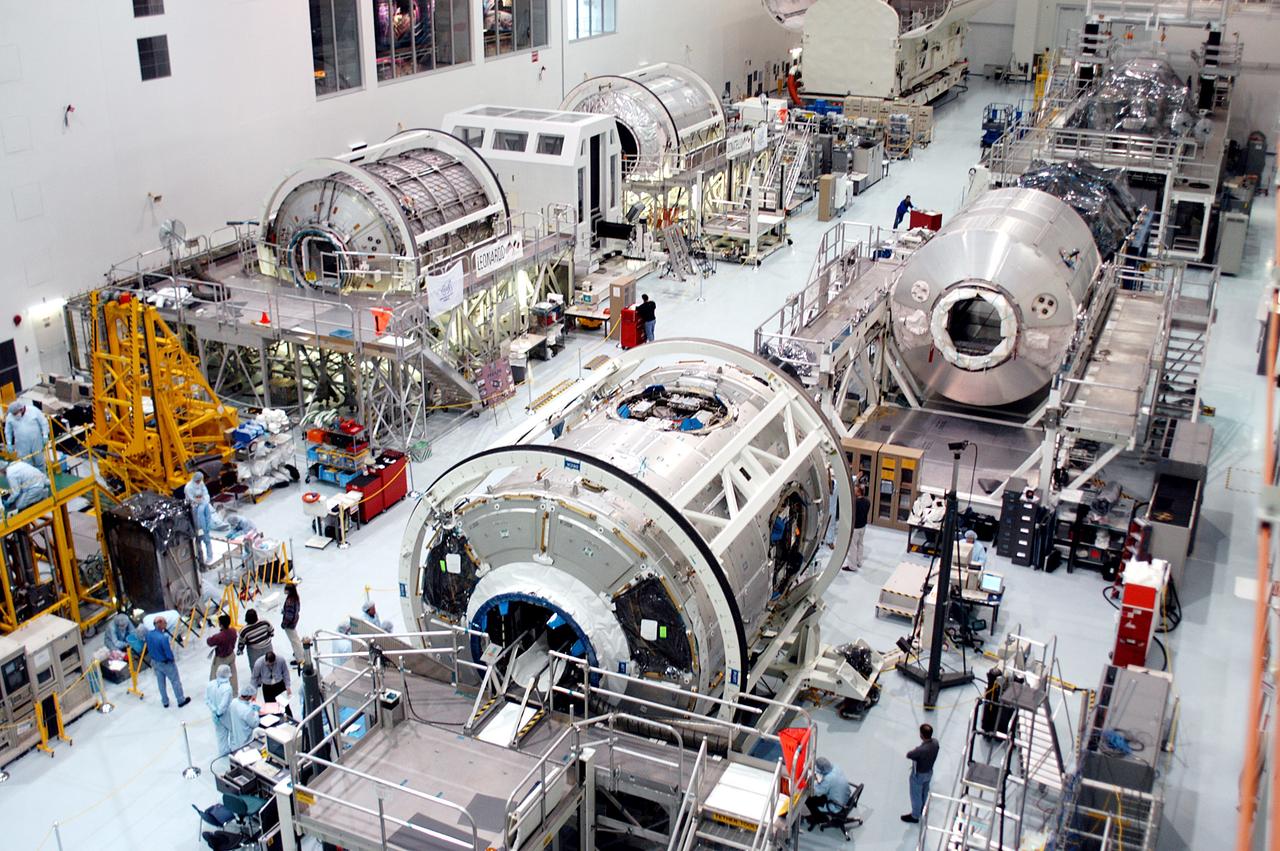
KENNEDY SPACE CENTER, FLA. - All three Multi-Purpose Logistics Modules are on the floor of the Space Station Processing Facility.  This is the first time the three - Leonardo, Raffaello and Donatello -- have been in one location.  Donatello has been stored in the Operations and Checkout Building since its arrival at KSC and was brought into the SSPF for routine testing. The MPLMs were built by the Italian Space Agency, to serve as reusable logistics carriers and the primary delivery system to resupply and return station cargo requiring a pressurized environment.  Raffaello is scheduled to fly on Space Shuttle Atlantis on mission STS-114.
KENNEDY SPACE CENTER, FLA. - All three Multi-Purpose Logistics Modules are on the floor of the Space Station Processing Facility. This is the first time the three - Leonardo, Raffaello and Donatello -- have been in one location. Donatello has been stored in the Operations and Checkout Building since its arrival at KSC and was brought into the SSPF for routine testing. The MPLMs were built by the Italian Space Agency, to serve as reusable logistics carriers and the primary delivery system to resupply and return station cargo requiring a pressurized environment. Raffaello is scheduled to fly on Space Shuttle Atlantis on mission STS-114.
KENNEDY SPACE CENTER, FLA. - In the Space Station Processing Facility,  workers help the Multi-Purpose Logistics Module Donatello settle onto a work stand.  Previously housed in the Operations and Checkout Building, Donatello was brought into the SSPF for routine testing.  This is the first time all three MPLMs (Donatello, Raffaello and Leonardo) are in the SSPF.  The MPLMs were built by the Italian Space Agency, to serve as reusable logistics carriers and the primary delivery system to resupply and return station cargo requiring a pressurized environment.  The third MPLM, Raffaello, is scheduled to fly on Space Shuttle Atlantis on mission STS-114.
KENNEDY SPACE CENTER, FLA. - In the Space Station Processing Facility, workers help the Multi-Purpose Logistics Module Donatello settle onto a work stand. Previously housed in the Operations and Checkout Building, Donatello was brought into the SSPF for routine testing. This is the first time all three MPLMs (Donatello, Raffaello and Leonardo) are in the SSPF. The MPLMs were built by the Italian Space Agency, to serve as reusable logistics carriers and the primary delivery system to resupply and return station cargo requiring a pressurized environment. The third MPLM, Raffaello, is scheduled to fly on Space Shuttle Atlantis on mission STS-114.
KENNEDY SPACE CENTER, FLA. - This view reveals all three Multi-Purpose Logistics Modules on the floor of the Space Station Processing Facility.  This is the first time all three - Leonardo, Raffaello and Donatello -- have been in one location.  Donatello has been stored in the Operations and Checkout Building since its arrival at KSC and was brought into the SSPF for routine testing. The MPLMs were built by the Italian Space Agency, to serve as reusable logistics carriers and the primary delivery system to resupply and return station cargo requiring a pressurized environment.  Raffaello is scheduled to fly on Space Shuttle Atlantis on mission STS-114.
KENNEDY SPACE CENTER, FLA. - This view reveals all three Multi-Purpose Logistics Modules on the floor of the Space Station Processing Facility. This is the first time all three - Leonardo, Raffaello and Donatello -- have been in one location. Donatello has been stored in the Operations and Checkout Building since its arrival at KSC and was brought into the SSPF for routine testing. The MPLMs were built by the Italian Space Agency, to serve as reusable logistics carriers and the primary delivery system to resupply and return station cargo requiring a pressurized environment. Raffaello is scheduled to fly on Space Shuttle Atlantis on mission STS-114.
KENNEDY SPACE CENTER, FLA. - Workers in the Space Station Processing Facility prepare to release the overhead crane from the Multi-Purpose Logistics Module Raffaello now secure on a new work stand.  Raffaello is the second MPLM built by the Italian Space Agency, serving as a reusable logistics carrier and primary delivery system to resupply and return station cargo requiring a pressurized environment.  It has been moved to allow the third MPLM, Donatello, to be brought in for routine testing.  Donatello has been stored in the Operations and Checkout Building.  This is the first time all three MPLMs are in the SSPF; the other one is the Leonardo.  Raffaello is scheduled to fly on Space Shuttle Atlantis on mission STS-114.
KENNEDY SPACE CENTER, FLA. - Workers in the Space Station Processing Facility prepare to release the overhead crane from the Multi-Purpose Logistics Module Raffaello now secure on a new work stand. Raffaello is the second MPLM built by the Italian Space Agency, serving as a reusable logistics carrier and primary delivery system to resupply and return station cargo requiring a pressurized environment. It has been moved to allow the third MPLM, Donatello, to be brought in for routine testing. Donatello has been stored in the Operations and Checkout Building. This is the first time all three MPLMs are in the SSPF; the other one is the Leonardo. Raffaello is scheduled to fly on Space Shuttle Atlantis on mission STS-114.
KENNEDY SPACE CENTER, FLA. - Workers in the Space Station Processing Facility secure the Multi-Purpose Logistics Module Raffaello onto a new work stand.  Raffaello is the second MPLM built by the Italian Space Agency, serving as a reusable logistics carrier and primary delivery system to resupply and return station cargo requiring a pressurized environment.  It has been moved to allow the third MPLM, Donatello, to be brought in for routine testing.  Donatello has been stored in the Operations and Checkout Building.  This is the first time all three MPLMs are in the SSPF; the other one is the Leonardo.  Raffaello is scheduled to fly on Space Shuttle Atlantis on mission STS-114.
KENNEDY SPACE CENTER, FLA. - Workers in the Space Station Processing Facility secure the Multi-Purpose Logistics Module Raffaello onto a new work stand. Raffaello is the second MPLM built by the Italian Space Agency, serving as a reusable logistics carrier and primary delivery system to resupply and return station cargo requiring a pressurized environment. It has been moved to allow the third MPLM, Donatello, to be brought in for routine testing. Donatello has been stored in the Operations and Checkout Building. This is the first time all three MPLMs are in the SSPF; the other one is the Leonardo. Raffaello is scheduled to fly on Space Shuttle Atlantis on mission STS-114.
KENNEDY SPACE CENTER, FLA. - The Multi-Purpose Logistics Module Donatello is moved away from the payload canister in the Space Station Processing Facility.  Previously housed in the Operations and Checkout Building, Donatello was brought into the SSPF for routine testing.  This is the first time all three MPLMs (Donatello, Raffaello and Leonardo) are in the SSPF.  The MPLMs were built by the Italian Space Agency, to serve as reusable logistics carriers and the primary delivery system to resupply and return station cargo requiring a pressurized environment.  The third MPLM, Raffaello is scheduled to fly on Space Shuttle Atlantis on mission STS-114.
KENNEDY SPACE CENTER, FLA. - The Multi-Purpose Logistics Module Donatello is moved away from the payload canister in the Space Station Processing Facility. Previously housed in the Operations and Checkout Building, Donatello was brought into the SSPF for routine testing. This is the first time all three MPLMs (Donatello, Raffaello and Leonardo) are in the SSPF. The MPLMs were built by the Italian Space Agency, to serve as reusable logistics carriers and the primary delivery system to resupply and return station cargo requiring a pressurized environment. The third MPLM, Raffaello is scheduled to fly on Space Shuttle Atlantis on mission STS-114.
KENNEDY SPACE CENTER, FLA. - An overhead crane is attached to the Multi-Purpose Logistics Module Raffaello in order to move it to another work stand in the Space Station Processing Facility.  Raffaello is the second MPLM built by the Italian Space Agency, serving as a reusable logistics carrier and primary delivery system to resupply and return station cargo requiring a pressurized environment.  It is being moved to allow the third MPLM, Donatello, to be brought in for routine testing.  Donatello has been stored in the Operations and Checkout Building.  This is the first time all three MPLMs are in the SSPF; the other one is the Leonardo.  Raffaello is scheduled to fly on Space Shuttle Atlantis on mission STS-114.
KENNEDY SPACE CENTER, FLA. - An overhead crane is attached to the Multi-Purpose Logistics Module Raffaello in order to move it to another work stand in the Space Station Processing Facility. Raffaello is the second MPLM built by the Italian Space Agency, serving as a reusable logistics carrier and primary delivery system to resupply and return station cargo requiring a pressurized environment. It is being moved to allow the third MPLM, Donatello, to be brought in for routine testing. Donatello has been stored in the Operations and Checkout Building. This is the first time all three MPLMs are in the SSPF; the other one is the Leonardo. Raffaello is scheduled to fly on Space Shuttle Atlantis on mission STS-114.
KENNEDY SPACE CENTER, FLA. - Workers watch as the Multi-Purpose Logistics Module Raffaello is lowered toward a work stand in the Space Station Processing Facility.  Raffaello is the second MPLM built by the Italian Space Agency, serving as a reusable logistics carrier and primary delivery system to resupply and return station cargo requiring a pressurized environment.  It has been moved across the floor to allow the third MPLM, Donatello, to be brought in for routine testing.  Donatello has been stored in the Operations and Checkout Building.  This is the first time all three MPLMs are in the SSPF; the other one is the Leonardo.  Raffaello is scheduled to fly on Space Shuttle Atlantis on mission STS-114.
KENNEDY SPACE CENTER, FLA. - Workers watch as the Multi-Purpose Logistics Module Raffaello is lowered toward a work stand in the Space Station Processing Facility. Raffaello is the second MPLM built by the Italian Space Agency, serving as a reusable logistics carrier and primary delivery system to resupply and return station cargo requiring a pressurized environment. It has been moved across the floor to allow the third MPLM, Donatello, to be brought in for routine testing. Donatello has been stored in the Operations and Checkout Building. This is the first time all three MPLMs are in the SSPF; the other one is the Leonardo. Raffaello is scheduled to fly on Space Shuttle Atlantis on mission STS-114.
KENNEDY SPACE CENTER, FLA. - In the Space Station Processing Facility, the Multi-Purpose Logistics Module Raffaello glides above the floor as it moves to another stand on the other side.  Raffaello is the second MPLM built by the Italian Space Agency, serving as a reusable logistics carrier and primary delivery system to resupply and return station cargo requiring a pressurized environment.  It is being moved to allow the third MPLM, Donatello, to be brought in for routine testing.  Donatello has been stored in the Operations and Checkout Building.  This is the first time all three MPLMs are in the SSPF; the other one is the Leonardo.  Raffaello is scheduled to fly on Space Shuttle Atlantis on mission STS-114.
KENNEDY SPACE CENTER, FLA. - In the Space Station Processing Facility, the Multi-Purpose Logistics Module Raffaello glides above the floor as it moves to another stand on the other side. Raffaello is the second MPLM built by the Italian Space Agency, serving as a reusable logistics carrier and primary delivery system to resupply and return station cargo requiring a pressurized environment. It is being moved to allow the third MPLM, Donatello, to be brought in for routine testing. Donatello has been stored in the Operations and Checkout Building. This is the first time all three MPLMs are in the SSPF; the other one is the Leonardo. Raffaello is scheduled to fly on Space Shuttle Atlantis on mission STS-114.
KENNEDY SPACE CENTER, FLA. - In the Space Station Processing Facility,  workers confirm the Multi-Purpose Logistics Module Donatello is safely in place on a work stand.  Previously housed in the Operations and Checkout Building, Donatello was brought into the SSPF for routine testing.  This is the first time all three MPLMs (Donatello, Raffaello and Leonardo) are in the SSPF.  The MPLMs were built by the Italian Space Agency, to serve as reusable logistics carriers and the primary delivery system to resupply and return station cargo requiring a pressurized environment.  The third MPLM, Raffaello, is scheduled to fly on Space Shuttle Atlantis on mission STS-114.
KENNEDY SPACE CENTER, FLA. - In the Space Station Processing Facility, workers confirm the Multi-Purpose Logistics Module Donatello is safely in place on a work stand. Previously housed in the Operations and Checkout Building, Donatello was brought into the SSPF for routine testing. This is the first time all three MPLMs (Donatello, Raffaello and Leonardo) are in the SSPF. The MPLMs were built by the Italian Space Agency, to serve as reusable logistics carriers and the primary delivery system to resupply and return station cargo requiring a pressurized environment. The third MPLM, Raffaello, is scheduled to fly on Space Shuttle Atlantis on mission STS-114.
KENNEDY SPACE CENTER, FLA. - All three Multi-Purpose Logistics Modules are on the floor of the Space Station Processing Facility.  This is the first time the three - Leonardo, Raffaello and Donatello -- have been in one location.  Donatello has been stored in the Operations and Checkout Building since its arrival at KSC and was brought into the SSPF for routine testing. The MPLMs were built by the Italian Space Agency, to serve as reusable logistics carriers and the primary delivery system to resupply and return station cargo requiring a pressurized environment.  Raffaello is scheduled to fly on Space Shuttle Atlantis on mission STS-114.
KENNEDY SPACE CENTER, FLA. - All three Multi-Purpose Logistics Modules are on the floor of the Space Station Processing Facility. This is the first time the three - Leonardo, Raffaello and Donatello -- have been in one location. Donatello has been stored in the Operations and Checkout Building since its arrival at KSC and was brought into the SSPF for routine testing. The MPLMs were built by the Italian Space Agency, to serve as reusable logistics carriers and the primary delivery system to resupply and return station cargo requiring a pressurized environment. Raffaello is scheduled to fly on Space Shuttle Atlantis on mission STS-114.
KENNEDY SPACE CENTER, FLA. - The Multi-Purpose Logistics Module Raffaello is lifted from its stand in the Space Station Processing Facility to move to another work stand.  Raffaello is the second MPLM built by the Italian Space Agency, serving as a reusable logistics carrier and primary delivery system to resupply and return station cargo requiring a pressurized environment.  It is being moved to allow the third MPLM, Donatello, to be brought in for routine testing.  Donatello has been stored in the Operations and Checkout Building.  This is the first time all three MPLMs are in the SSPF; the other one is the Leonardo.  Raffaello is scheduled to fly on Space Shuttle Atlantis on mission STS-114.
KENNEDY SPACE CENTER, FLA. - The Multi-Purpose Logistics Module Raffaello is lifted from its stand in the Space Station Processing Facility to move to another work stand. Raffaello is the second MPLM built by the Italian Space Agency, serving as a reusable logistics carrier and primary delivery system to resupply and return station cargo requiring a pressurized environment. It is being moved to allow the third MPLM, Donatello, to be brought in for routine testing. Donatello has been stored in the Operations and Checkout Building. This is the first time all three MPLMs are in the SSPF; the other one is the Leonardo. Raffaello is scheduled to fly on Space Shuttle Atlantis on mission STS-114.
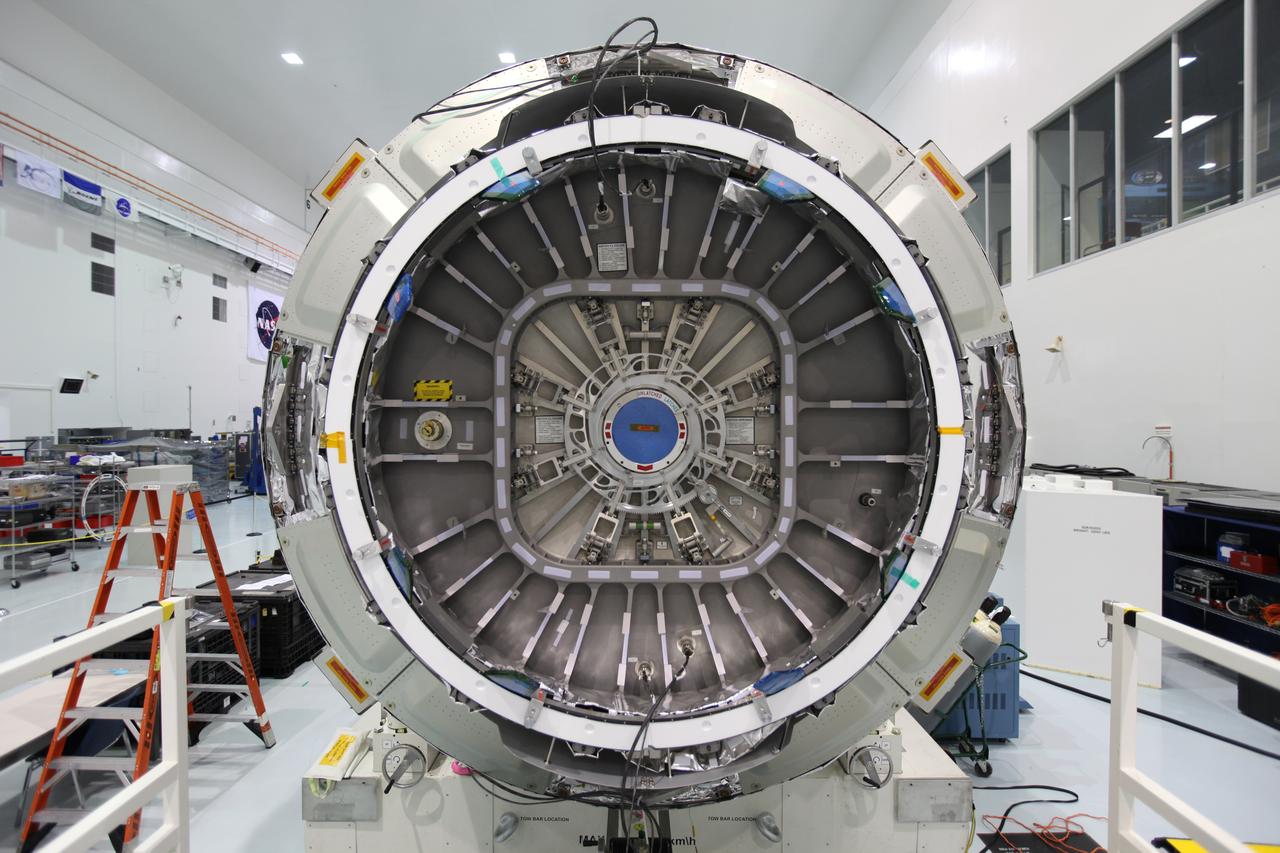
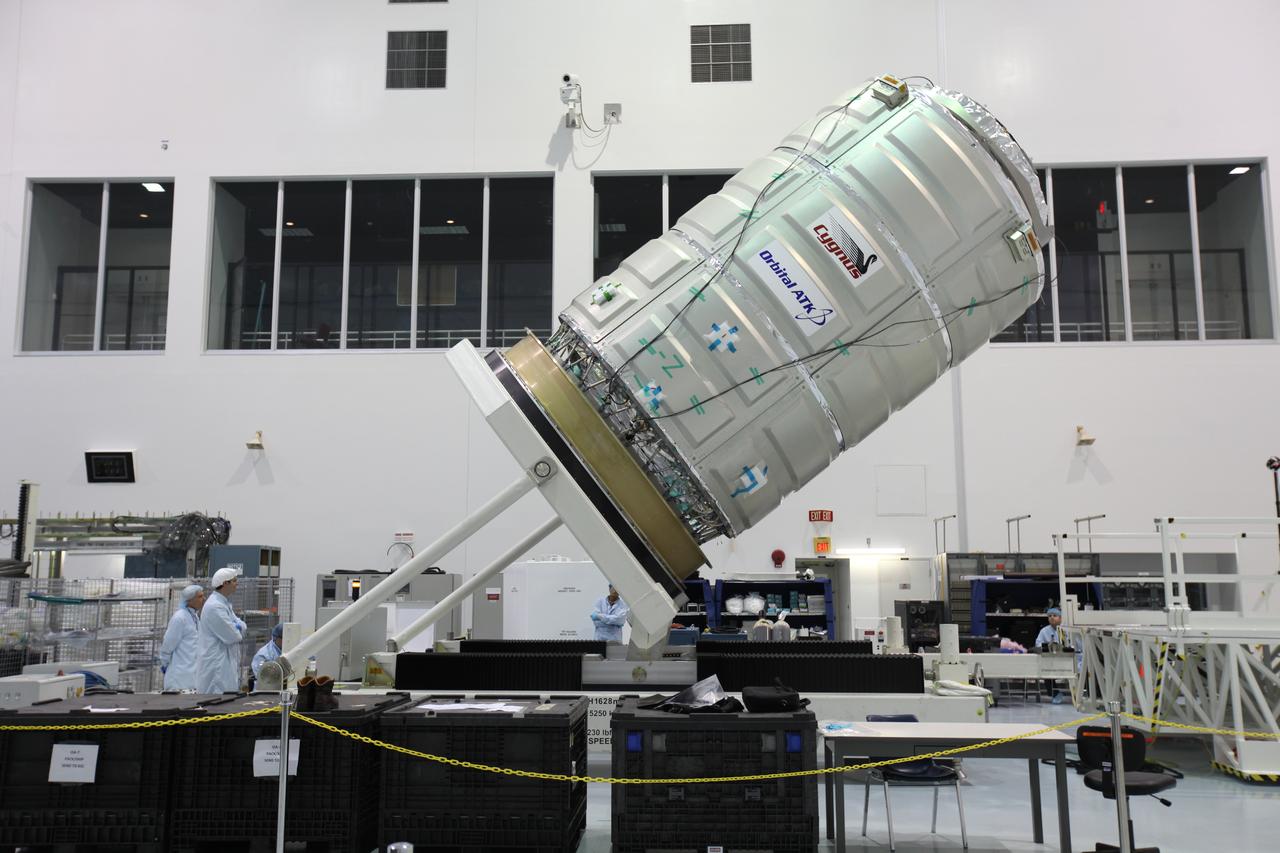
In the Space Station Processing Facility at NASA's Kennedy Space Center in Florida, the hatch was closed on the Cygnus spacecraft's pressurized cargo module (PCM) for the Orbital ATK CRS-7 mission to the International Space Station. The module is being rotated to vertical for mating to the service module. Scheduled to launch on March 19, 2017, the commercial resupply services mission will lift off atop a United Launch Alliance Atlas V rocket from Space launch Complex 41 at Cape Canaveral Air Force Station.
OA-7 Cargo Module Rotate to Vertical
In the Space Station Processing Facility at NASA's Kennedy Space Center in Florida, the hatch has been closed on the Cygnus spacecraft's pressurized cargo module (PCM) for the Orbital ATK CRS-7 mission to the International Space Station. The module will be rotated to vertical for mating to the service module. Scheduled to launch on March 19, 2017, the commercial resupply services mission will lift off atop a United Launch Alliance Atlas V rocket from Space launch Complex 41 at Cape Canaveral Air Force Station.
OA-7 Cargo Module Hatch Closure
In the Space Station Processing Facility at NASA's Kennedy Space Center in Florida, the hatch is closed on the Cygnus spacecraft's pressurized cargo module (PCM) for the Orbital ATK CRS-7 mission to the International Space Station. The module is being rotated to vertical for mating to the service module. Scheduled to launch on March 19, 2017, the commercial resupply services mission will lift off atop a United Launch Alliance Atlas V rocket from Space launch Complex 41 at Cape Canaveral Air Force Station.
OA-7 Cargo Module Rotate to Vertical
In the Space Station Processing Facility at NASA's Kennedy Space Center in Florida, the hatch was closed on the Cygnus spacecraft's pressurized cargo module (PCM) for the Orbital ATK CRS-7 mission to the International Space Station. The module is being rotated to vertical for mating to the service module. Scheduled to launch on March 19, 2017, the commercial resupply services mission will lift off atop a United Launch Alliance Atlas V rocket from Space launch Complex 41 at Cape Canaveral Air Force Station.
OA-7 Cargo Module Rotate to Vertical
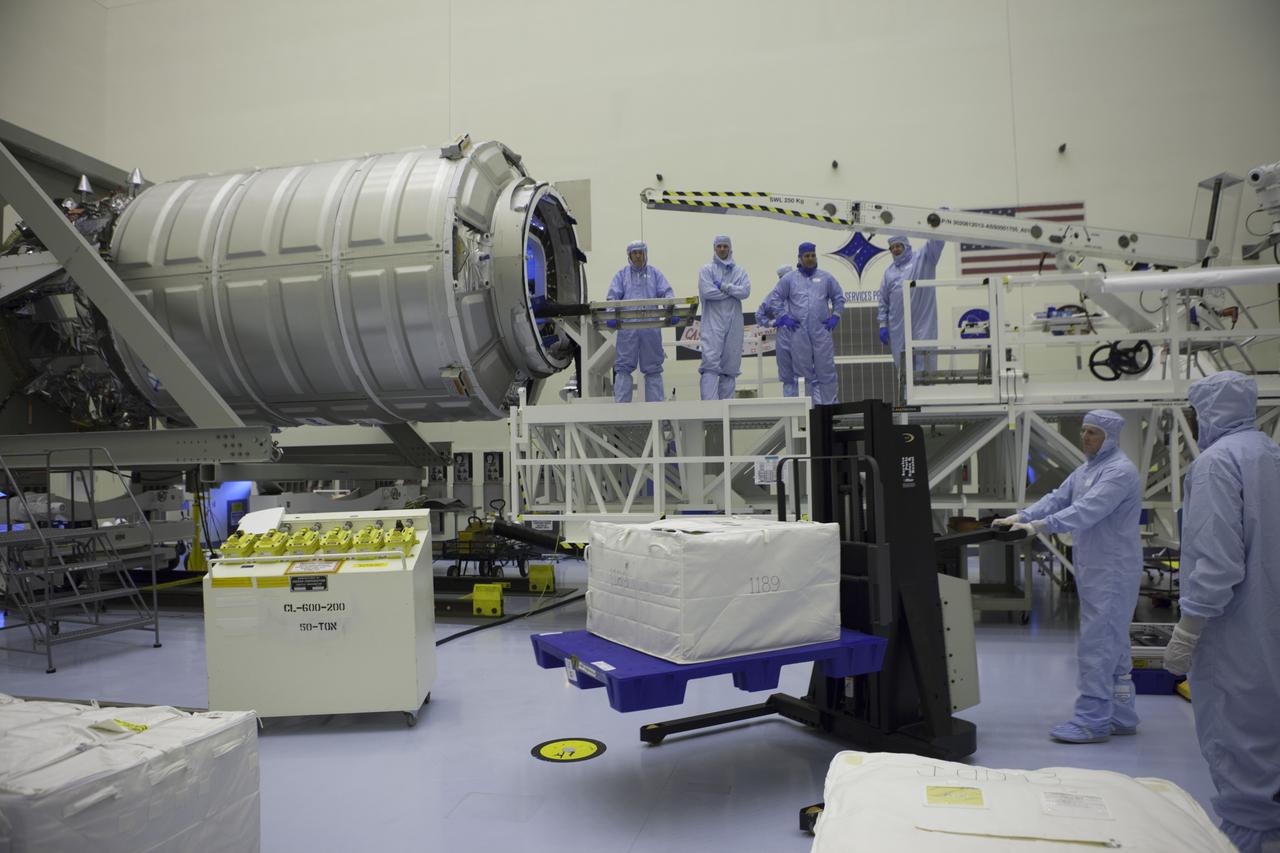
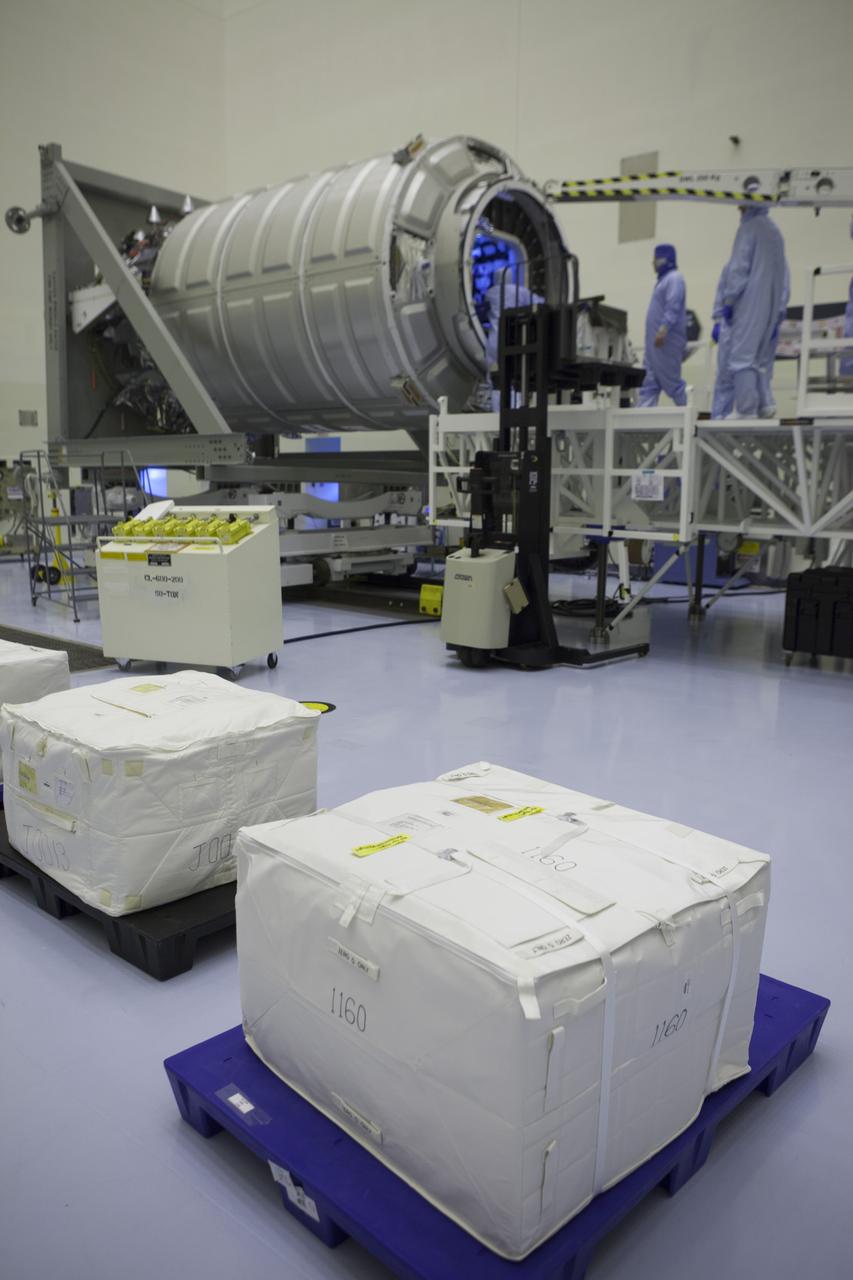
OA-7 Cargo Module In the Space Station Processing Facility at NASA's Kennedy Space Center in Florida, technicians and engineers load thousands of pounds of supplies, equipment and scientific research materials aboard a Cygnus spacecraft's pressurized cargo module (PCM) for the Orbital ATK CRS-7 mission to the International Space Station. Scheduled to launch on March 19, 2017, the commercial resupply services mission will lift off atop a United Launch Alliance Atlas V rocket from Space launch Complex 41 at Cape Canaveral Air Force Stationbeing loaded inside the SSPF building, located at Kennedy Space Center.
OA-7 Cargo Module Loading
KENNEDY SPACE CENTER, FLA. -- Workers in the Payload Changeout Room (PCR) at Launch Pad 39A check out the SPACEHAB Double Module before moving into the PCR. Part of the Rotating Service Structure, the PCR is an environmentally controlled facility supporting cargo delivery to the pad and vertical installation in the orbiter cargo bay. The primary payloads on mission STS-101, the module and ICC contain internal logistics and resupply cargo for restoring full redundancy to the International Space Station power system in preparation for the arrival of the next pressurized module, the Russian-built Zvezda. The payloads will be transferred to Space Shuttle Atlantis after Atlantis rolls out to the pad. Launch of Atlantis on mission STS-101 is scheduled no earlier than April 17, 2000
KSC00pp0373
KENNEDY SPACE CENTER, FLA. -- Workers in the Payload Changeout Room (PCR) at Launch Pad 39A check out the SPACEHAB Double Module before moving into the PCR. Part of the Rotating Service Structure, the PCR is an environmentally controlled facility supporting cargo delivery to the pad and vertical installation in the orbiter cargo bay. The primary payloads on mission STS-101, the module and ICC contain internal logistics and resupply cargo for restoring full redundancy to the International Space Station power system in preparation for the arrival of the next pressurized module, the Russian-built Zvezda. The payloads will be transferred to Space Shuttle Atlantis after Atlantis rolls out to the pad. Launch of Atlantis on mission STS-101 is scheduled no earlier than April 17, 2000
KSC-00pp0373
STS-102 mission astronaut Susan J. Helms translates along the longerons of the Space Shuttle Discovery during the first of two space walks. During this walk, the Pressurized Mating Adapter 3 was prepared for repositioning from the Unity Module's Earth-facing berth to its port-side berth to make room for the Leonardo multipurpose Logistics Module (MPLM), supplied by the Italian Space Agency. The Leonardo MPLM is the first of three such pressurized modules that will serve as the International Space Station's (ISS') moving vans, carrying laboratory racks filled with equipment, experiments, and supplies to and from the Station aboard the Space Shuttle. The cylindrical module is approximately 21-feet long and 15- feet in diameter, weighing almost 4.5 tons. It can carry up to 10 tons of cargo in 16 standard Space Station equipment racks. Of the 16 racks the module can carry, 5 can be furnished with power, data, and fluid to support refrigerators or freezers. In order to function as an attached station module as well as a cargo transport, the logistics module also includes components that provide life support, fire detection and suppression, electrical distribution, and computer functions. NASA's 103rd overall mission and the 8th Space Station Assembly Flight, STS-102 mission also served as a crew rotation flight. It delivered the Expedition Two crew to the Station and returned the Expedition One crew back to Earth.
International Space Station (ISS)
Pilot James M. Kelly (left) and Commander James D. Wetherbee for the STS-102 mission, participate in the movement of supplies inside Leonardo, the Italian Space Agency built Multipurpose Logistics Module (MPLM). In this particular photograph, the two are handling a film magazine for the IMAX cargo bay camera. The primary cargo of the STS-102 mission, the Leonardo MPLM is the first of three such pressurized modules that will serve as the International Space Station's (ISS') moving vans, carrying laboratory racks filled with equipment, experiments, and supplies to and from the Station aboard the Space Shuttle. The cylindrical module is approximately 21-feet long and 15- feet in diameter, weighing almost 4.5 tons. It can carry up to 10 tons of cargo in 16 standard Space Station equipment racks. Of the 16 racks the module can carry, 5 can be furnished with power, data, and fluid to support refrigerators or freezers. In order to function as an attached station module as well as a cargo transport, the logistics module also includes components that provide life support, fire detection and suppression, electrical distribution, and computer functions. The eighth station assembly flight, the STS-102 mission also served as a crew rotation flight. It delivered the Expedition Two crew to the Station and returned the Expedition One crew back to Earth.
International Space Station (ISS)
In the Space Station Processing Facility at NASA's Kennedy Space Center in Florida, technicians monitor the progress as the Cygnus spacecraft's pressurized cargo module (PCM) for the Orbital ATK CRS-7 mission to the International Space Station is rotated to vertical for mating to the service module. Scheduled to launch on March 19, 2017, the commercial resupply services mission will lift off atop a United Launch Alliance Atlas V rocket from Space launch Complex 41 at Cape Canaveral Air Force Station.
OA-7 Cargo Module Rotate to Vertical
ISS005-E-05457 (June 2002) --- Astronaut Daniel W. Bursch, Expedition Four flight engineer, floats in the Leonardo Multi-Purpose Logistics Module (MPLM). Leonardo is one of three Multi-Purpose Logistics Modules built by the Italian Space Agency that serve as pressurized, reusable cargo carriers to ferry supplies, equipment and experiments between the ground and the space station.
Bursch, Expedition Four flight engineer, floats in the Leonardo MPLM