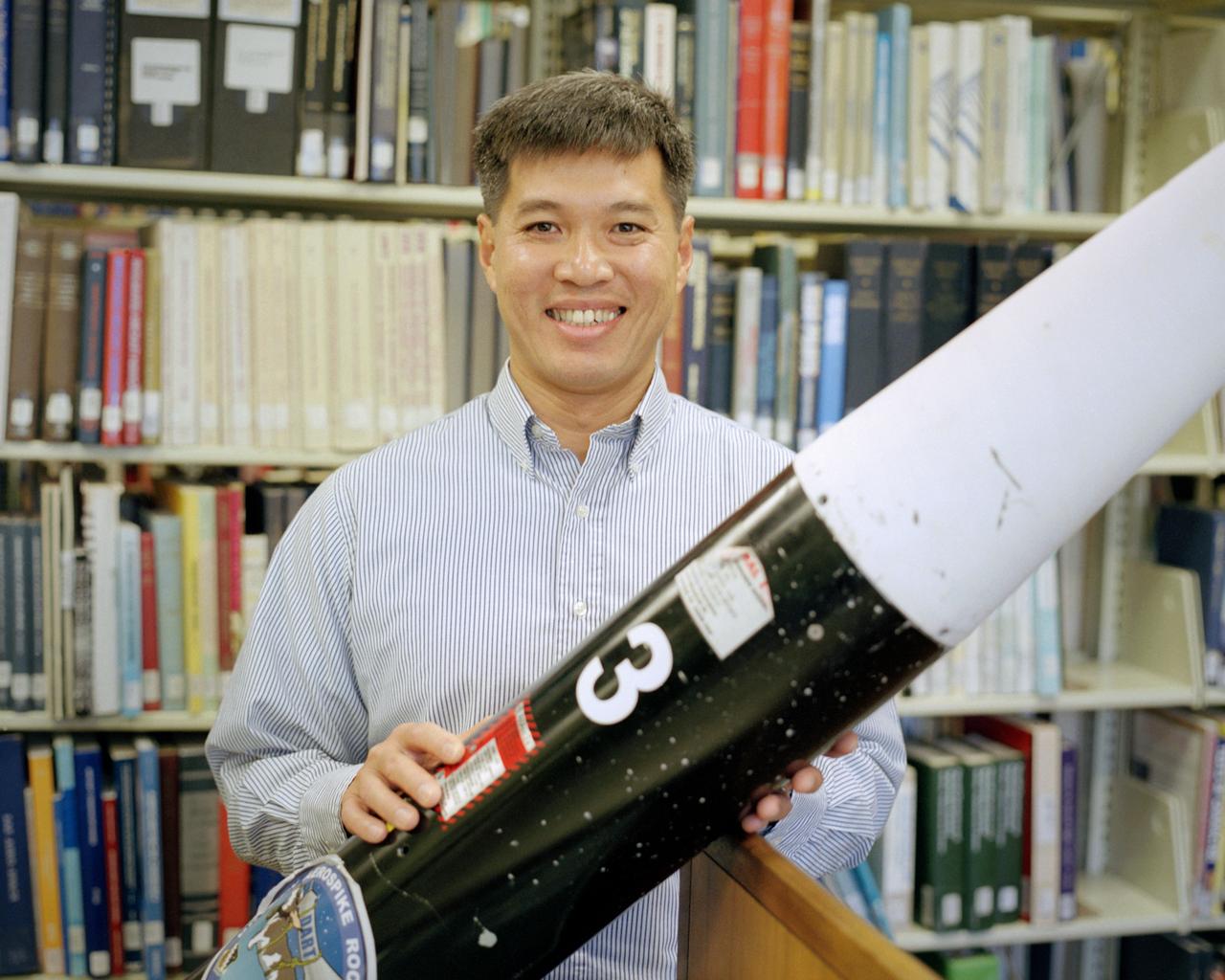
Trong Bui, NASA Dryden's principal investigator for the aerospike rocket tests, holds the first of two 10-ft. long rockets that were flown at speeds up to Mach 1.5, the first known supersonic tests of rockets with aerospike nozzles. The goals of the flight research project were to obtain aerospike rocket nozzle performance data in flight and to investigate the effects of transonic flow and transient flight conditions on aerospike nozzle performance.
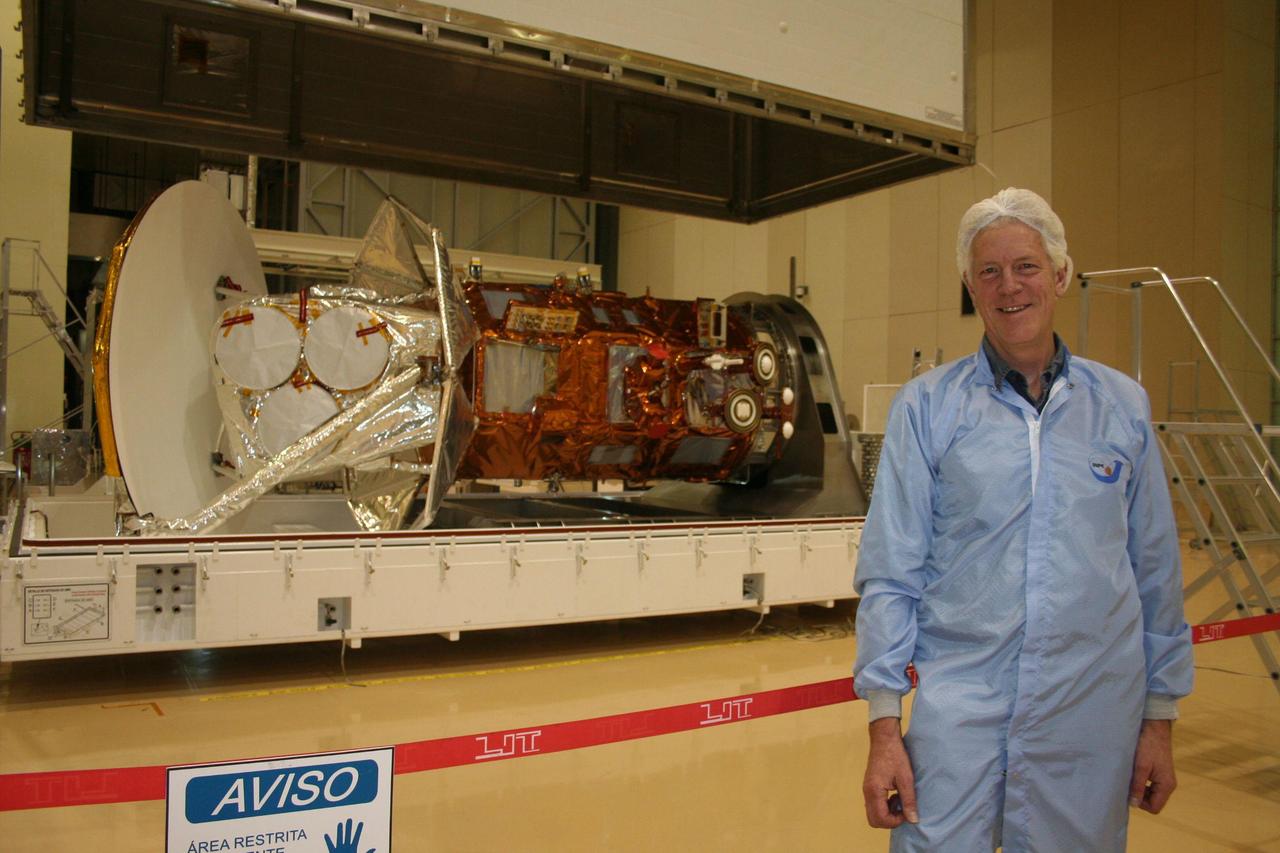
NASA Aquarius Principal Investigator Gary Lagerloef photographed in front of the Aquarius/SAC-D satellite observatory as it is being readied for transportation from Brazil to Vandenberg Air Force Base in California for a June 2011 launch.
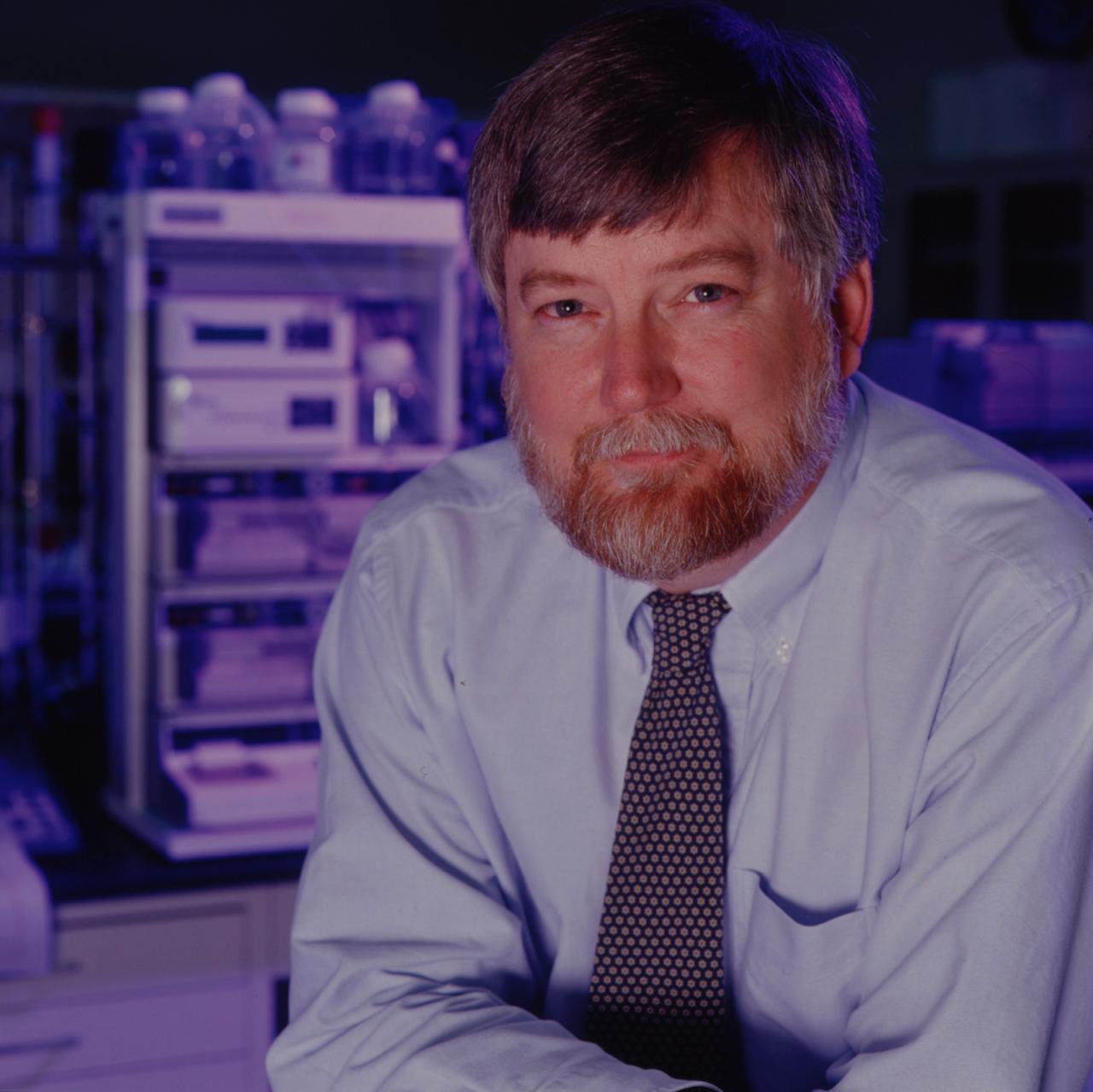
Dr. Daniel Carter, president of New Century Pharmaceuticals in Huntsville, Al, is one of three principal investigators in NASA's microgravity protein crystal growth program. Dr. Carter's experties is in albumins. Albumins are proteins in the bloodstream that transport materials, drugs, nutrients, and wastes. Photo credit: NASA/Marshall Space Flight Center

One investigation on NASA's Mars 2020 rover will extract oxygen from the Martian atmosphere. It is called MOXIE, for Mars Oxygen In-Situ Resource Utilization Experiment. In this image, MOXIE Principal Investigator Michael Hecht, of the Massachusetts Institute of Technology, Cambridge, is in the MOXIE development laboratory at NASA's Jet Propulsion Laboratory, Pasadena, California. Mars' atmosphere is mostly carbon dioxide. Demonstration of the capability for extracting oxygen from it, under Martian environmental conditions, will be a pioneering step toward how humans on Mars will use the Red Planet's natural resources. Oxygen can be used in the rocket http://photojournal.jpl.nasa.gov/catalog/PIA20761

The Kepler Mission Science Principal Investigator Dr William 'Bill' Borucki in his office at NASA Ames Research center.

The Kepler Mission Science Principal Investigator Dr William 'Bill' Borucki in his office at NASA Ames Research center.
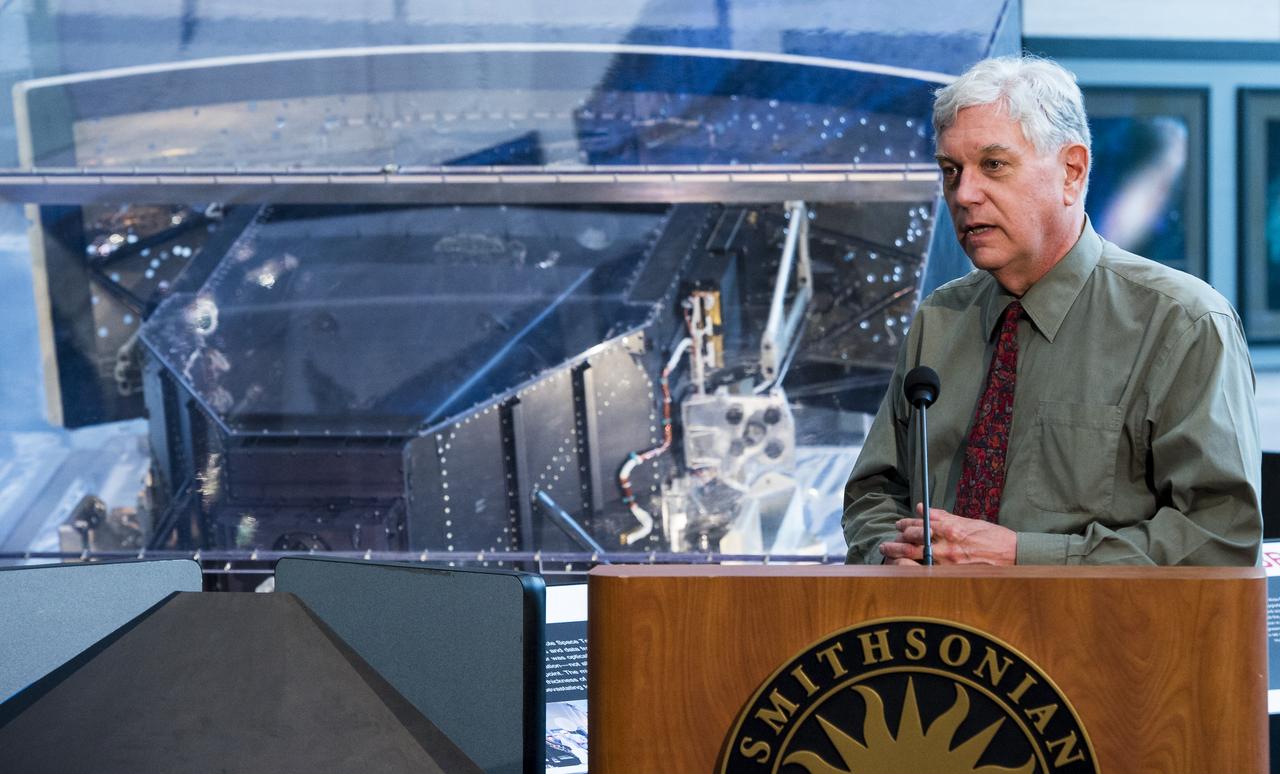
John Trauger, former principal investigator for the Wide Field Planetary Camera 2 (WFPC2) at NASA's Jet Propultion Laboratory (JPL), speaks at an event unveiling a new exhibit featuring Hubble's Corrective Optics Space Telescope Axial Replacement (COSTAR) and the WFPC2 on Wednesday, April 23, 2014 at the Smithsonian National Air and Space Museum in Washington, DC. COSTAR and WFPC2 were installed in Hubble during the first space shuttle servicing mission in 1993 and returned to Earth on the fifth and final servicing mission in 2009. Photo Credit: (NASA/Joel Kowsky)
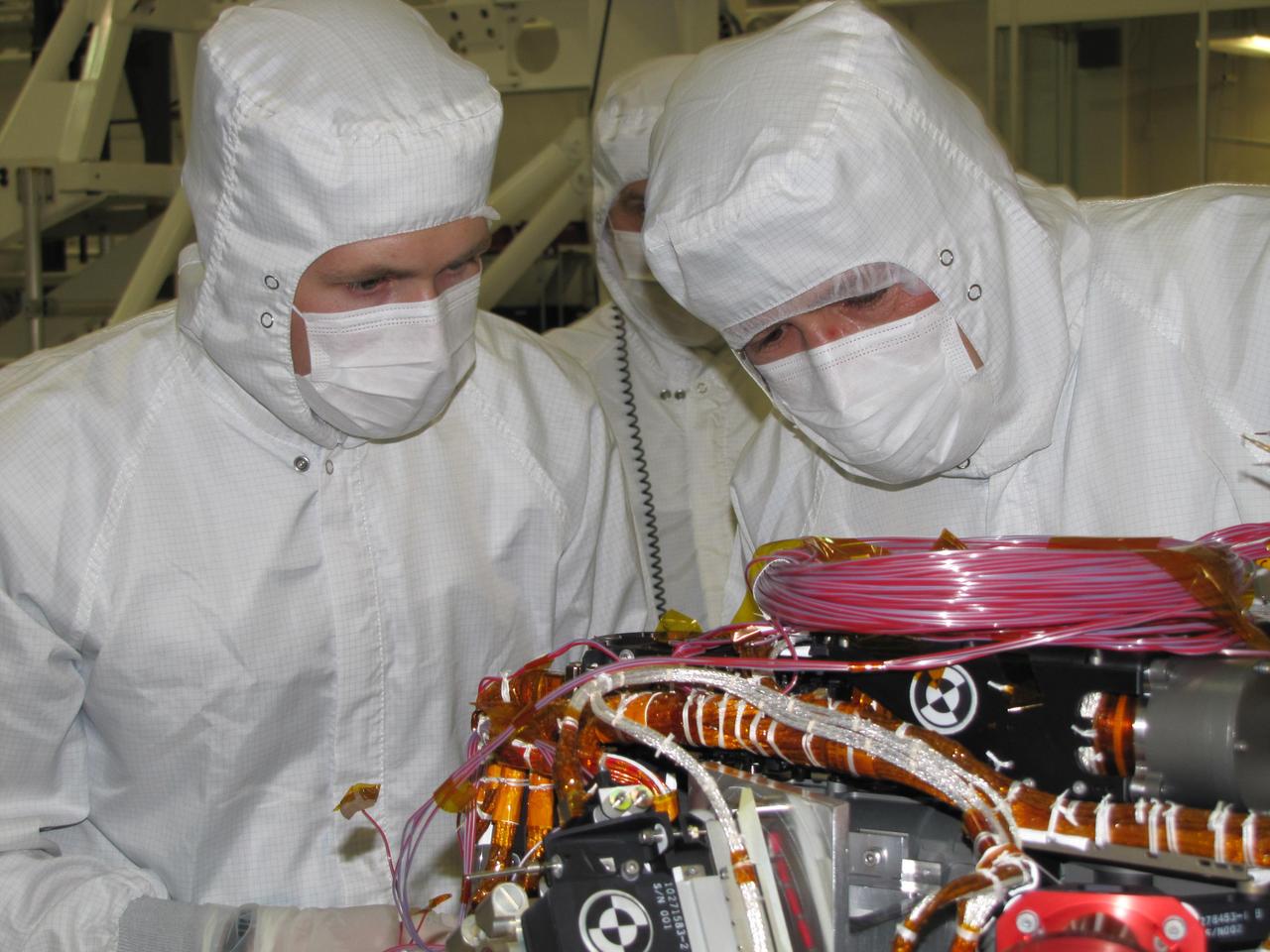
Grad student Nicholas Boyd left and Principal Investigator Ralf Gellert, both of the University of Guelph, Ontario, Canada, prepare for the installation of the Alpha Particle X-ray Spectrometer sensor head during testing at NASA JPL.
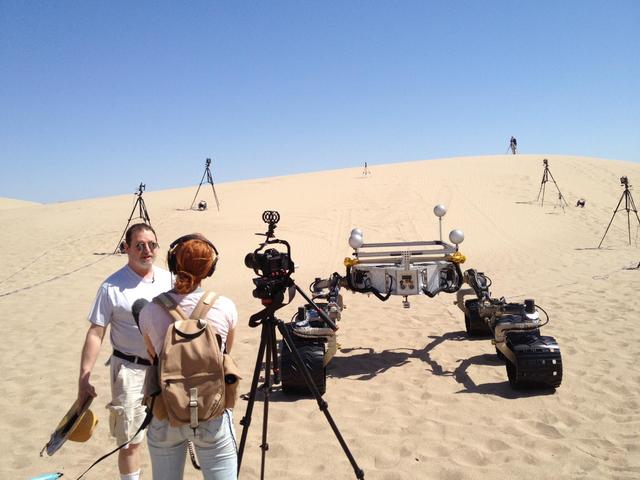
Michael Malin, left, principal investigator for three science cameras on NASA Curiosity Mars rover, comments to a news reporter during tests with Curiosity mobility-test stand-in, Scarecrow, on Dumont Dunes in California Mojave Desert.
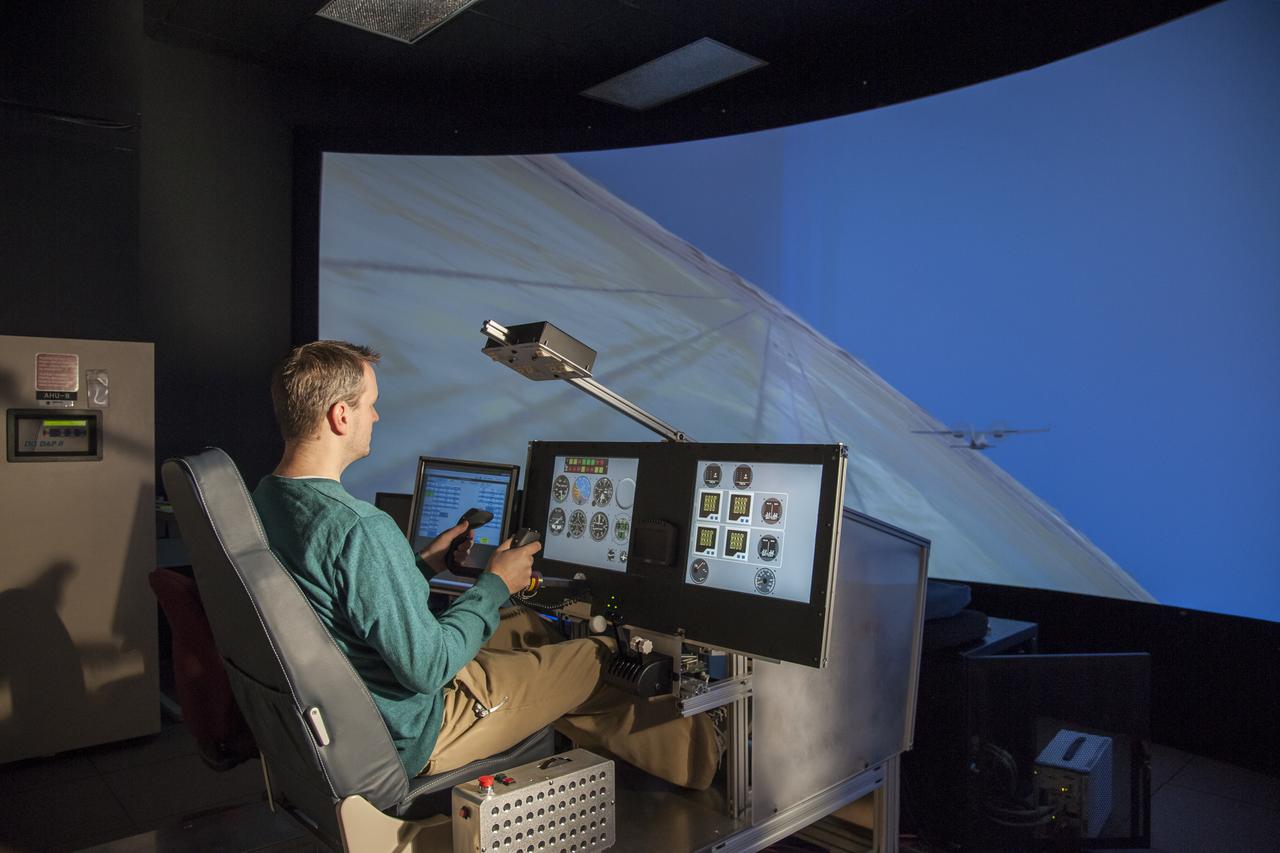
X-57 principal investigator Sean Clarke flies the X-57 simulator at NASA’s Armstrong Flight Research Center, examining ideal maneuvers and reaction times for flight.
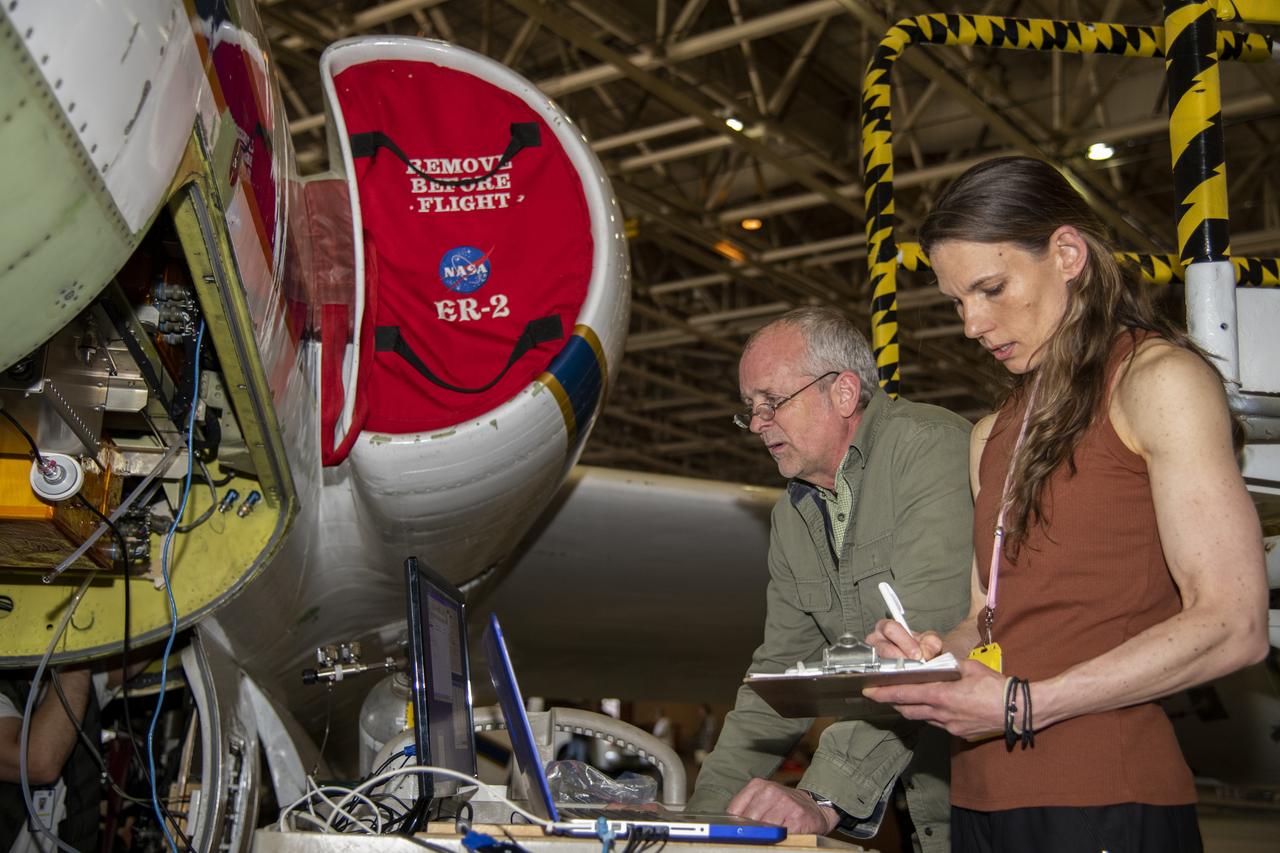
NASA's ER-2 aircraft is prepared for a check flight by Principal Investigator, Bruce Daube and co-principal investigator, Jasna Pitman, of the Harvard Picarro Cavity Ring Down Spectrometer (HUPCRS) instrument on May 13, 2022.
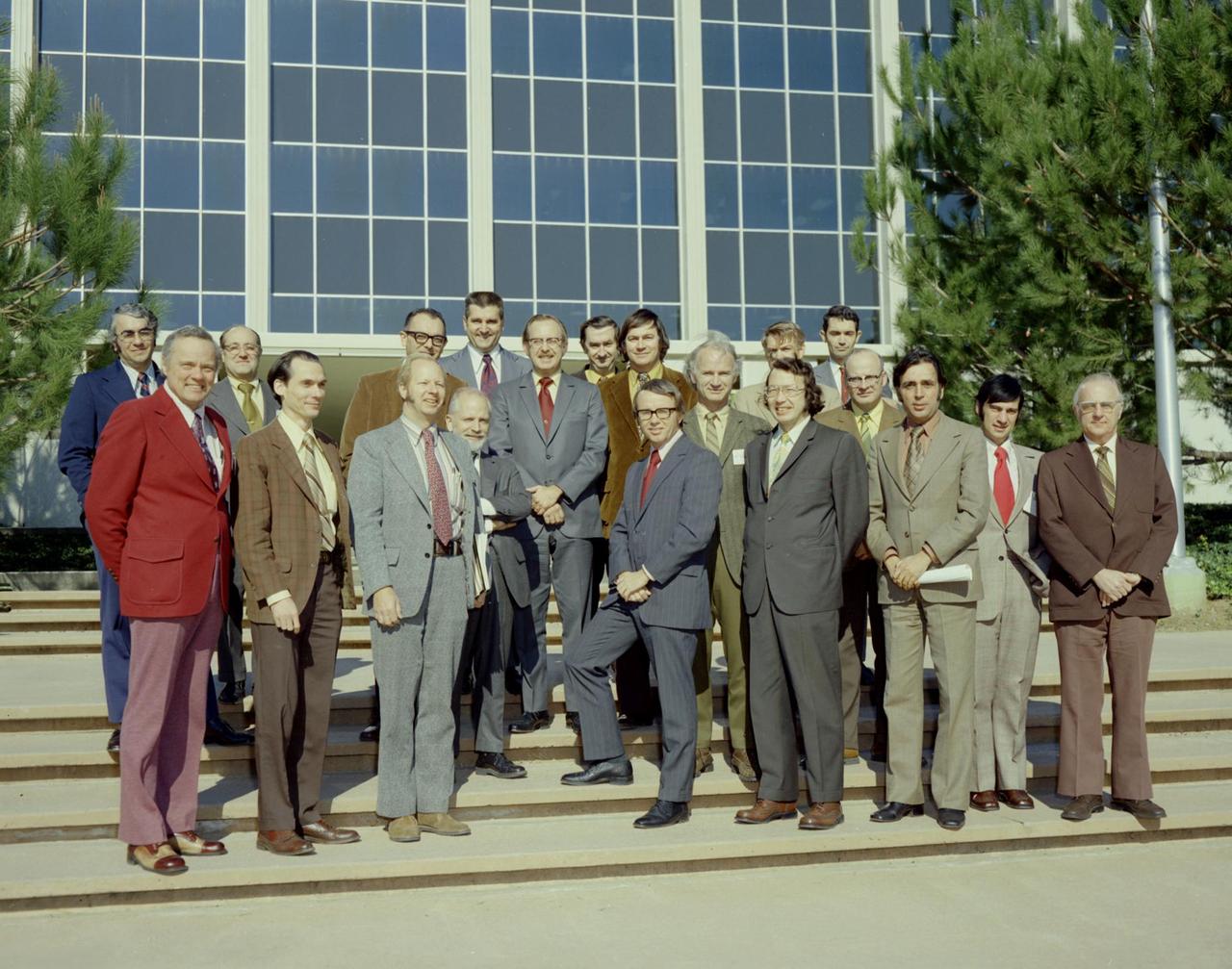
This archival image was released as part of a gallery comparing JPL's past and present, commemorating the 80th anniversary of NASA's Jet Propulsion Laboratory on Oct. 31, 2016. In December 1972, the science steering group for a mission then-known as Mariner Jupiter Saturn 1977 -- later renamed Voyager -- met for the first time at NASA's Jet Propulsion Laboratory in Pasadena, Calif. They are gathered on the steps in front of the administration building (180). The mission was so named because it was planning to send Mariner-class spacecraft to Jupiter and Saturn. It was renamed Voyager a few months before the launch of the twin spacecraft in August and September 1977. This photo shows principal investigators and team leaders for the science experiments and several others from the project and NASA who attended the first meeting. In the first row: Radio Science Subsystem Team Leader Von Eshleman, Project Scientist Edward Stone, Project Manager Harris (Bud) Schurmeier, Mission Analysis and Engineering Manager Ralph Miles, Magnetometer Principal Investigator Norman Ness, NASA Planetary Program Office Deputy Director Ichtiaque Rasool, Robert Soberman (who was proposed to be the principal investigator of the Particulate Matter Investigation, which was not confirmed) and an unidentified member of the NASA Office of Space Science. In the second row: Infrared Interferometer Spectrometer Principal Investigator Rudolf Hanel, Planetary Radio Astronomy Principal Investigator James Warwick, Ultraviolet and Spectrometer Principal Investigator A. Lyle Broadfoot. In the third row: Low-Energy Charged Particles Principal Investigator Stamatios (Tom) Krimigis, Cosmic Ray Subsystem Principal Investigator Rochus (Robbie) Vogt, NASA Outer Planets Missions Program Manager Warren Keller, Imaging Science Subsystem Team Leader Bradford Smith and Photopolarimeter Principal Investigator Charles Lillie. In the fourth row: Plasma Investigation Principal Investigator Herbert Bridge, Spacecraft Systems Manager Raymond Heacock, NASA Outer Planets Missions Program Scientist Milton (Mike) Mitz and Science Manager James Long. http://photojournal.jpl.nasa.gov/catalog/PIA21122
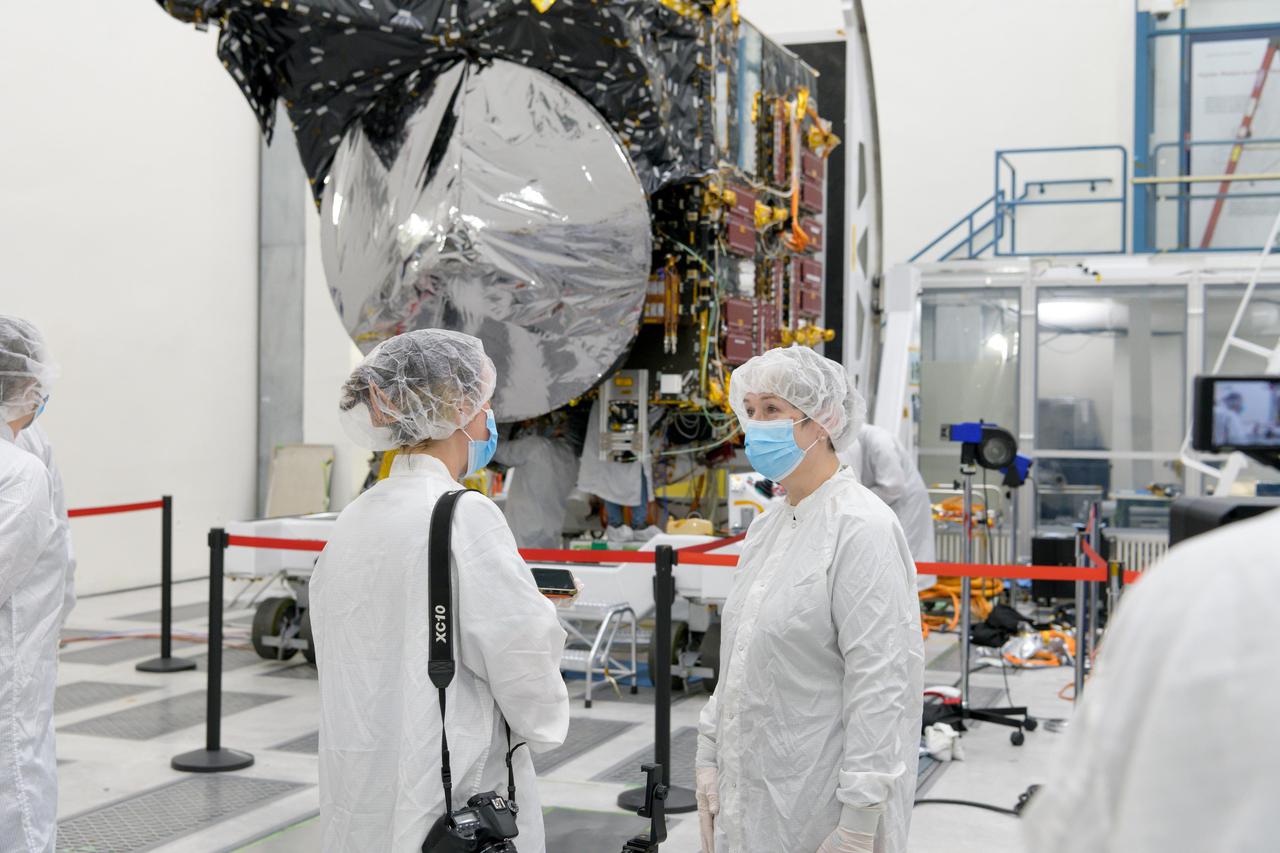
A member of the media interviews the principal investigator of NASA's Psyche mission, Lindy Elkins-Tanton, in front of the spacecraft on April 11, 2022, inside a clean room at NASA's Jet Propulsion Laboratory in Southern California. After engineers at JPL put their final touches on the spacecraft, Psyche will ship to NASA's Kennedy Space Center in Florida, where it is scheduled to launch in August 2022 on a journey to a metal-rich asteroid of the same name. https://photojournal.jpl.nasa.gov/catalog/PIA25241
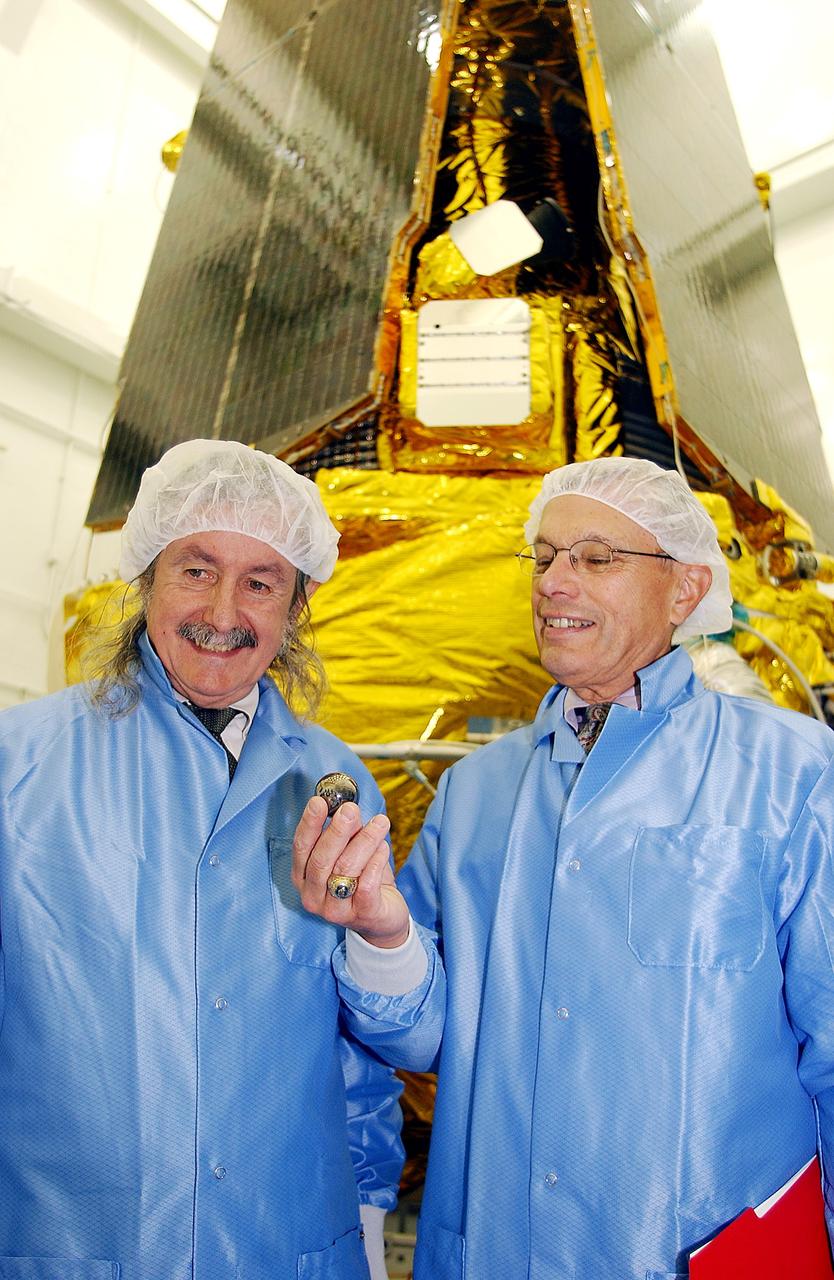
VANDENBERG AFB, CALIF. - In the NASA spacecraft processing facility on North Vandenberg Air Force Base, Dr. Francis Everitt, principal investigator, and Brad Parkinson, co-principal investigator, both from Stanford University, hold one of the small gyroscopes used in the Gravity Probe B spacecraft. The GP-B towers behind them. The Gravity Probe B mission is a relativity experiment developed by NASA’s Marshall Space Flight Center, Stanford University and Lockheed Martin. The spacecraft will test two extraordinary predictions of Albert Einstein’s general theory of relativity that he advanced in 1916: the geodetic effect (how space and time are warped by the presence of the Earth) and frame dragging (how Earth’s rotation drags space and time around with it). Gravity Probe B consists of four sophisticated gyroscopes that will provide an almost perfect space-time reference system. The mission will look in a precision manner for tiny changes in the direction of spin.
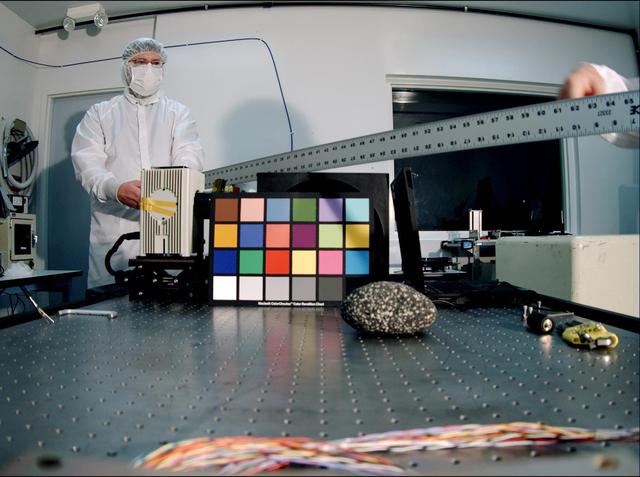
Ken Edgett, deputy principal investigator for NASA Mars Descent Imager, holds a ruler used as a depth-of-field test target. The instrument took this image inside the Malin Space Science Systems clean room in San Diego, CA, during calibration testing.

Environmental portrait of William 'Bill' Borucki, Principal Investigator for the Kepler Mission at NASA's Ames Research Center.
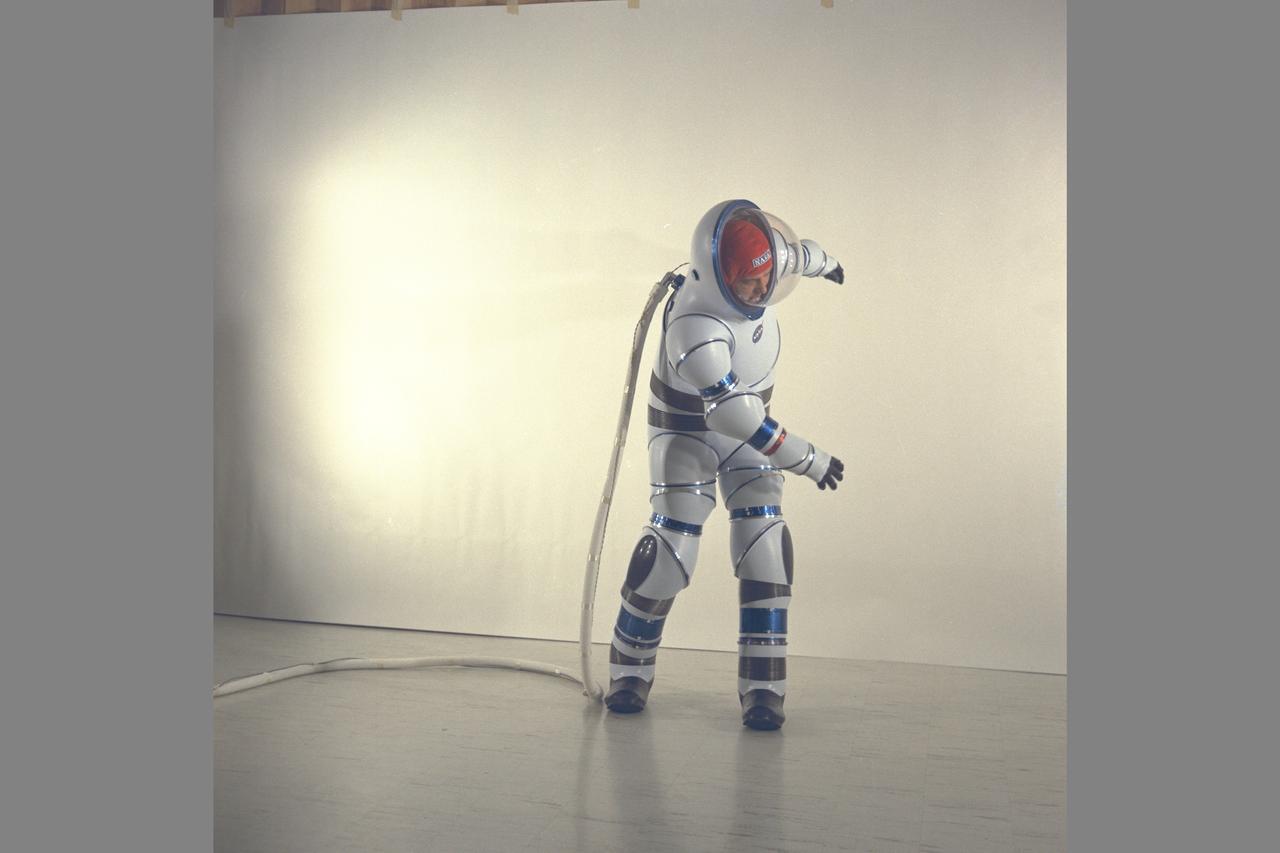
AX-2 Hard Space Suit with Vic Vykukal. Vykukal is the principal investigator of the AX space suit series.
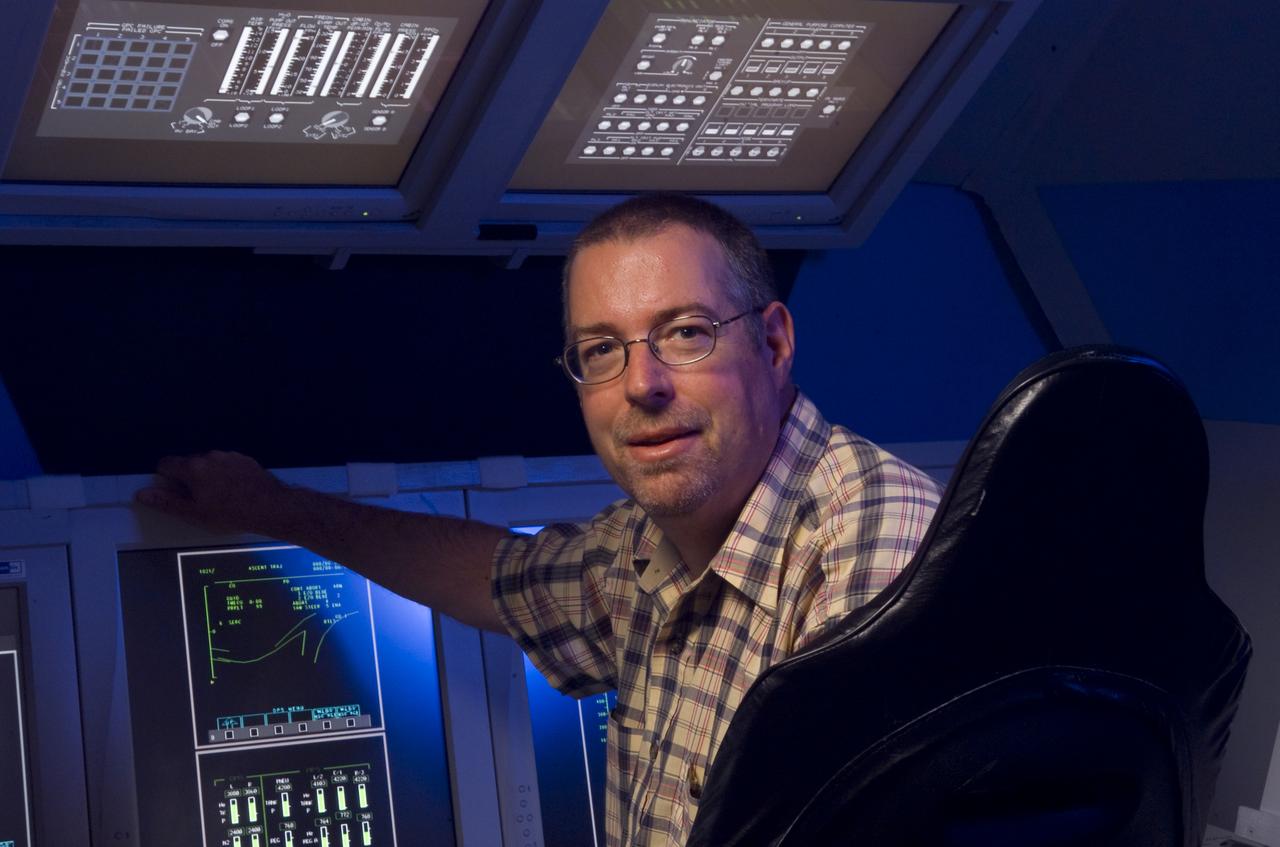
ISIS (Intelligent Spacecraft Interface Systems) Laboratory - Robert McCann, PHD Scientist and Principal Investigator
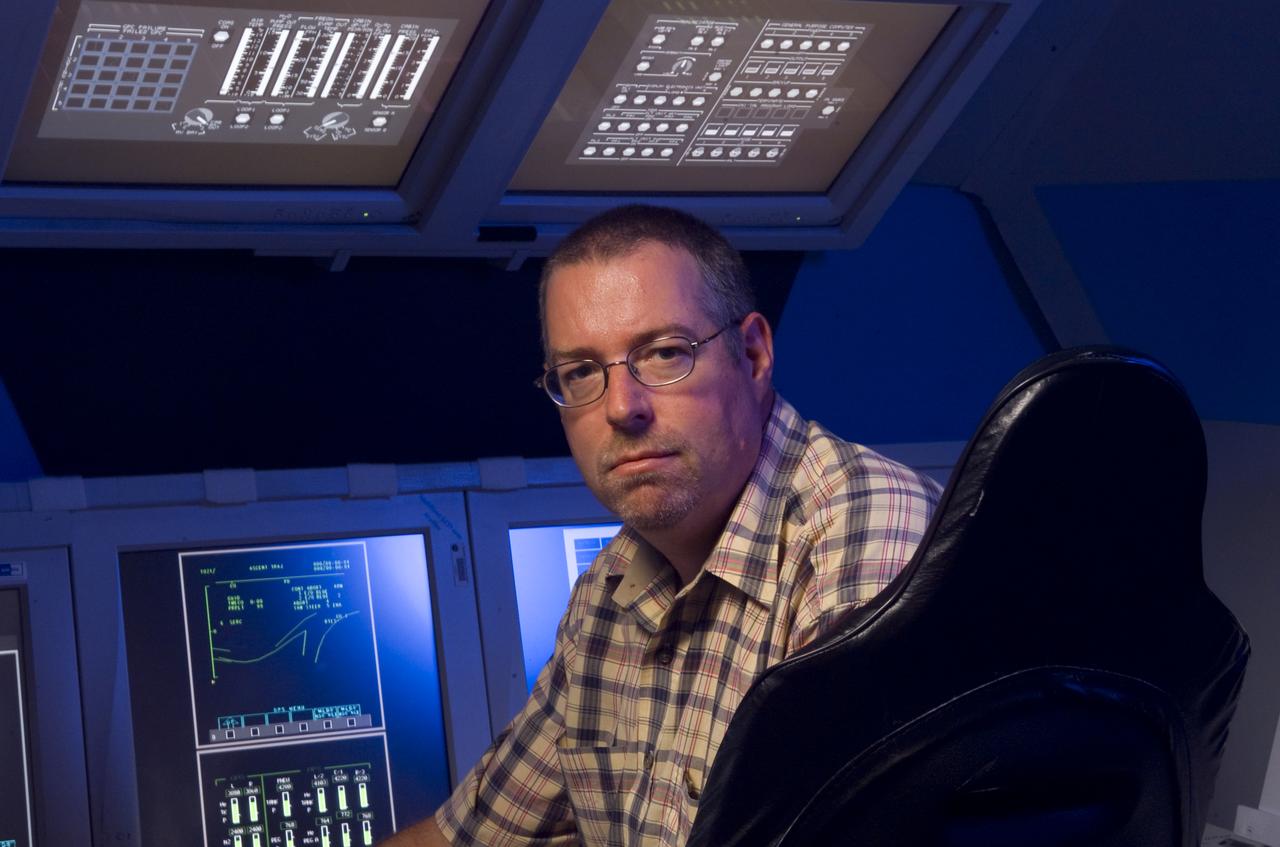
ISIS (Intelligent Spacecraft Interface Systems) Laboratory - Robert McCann, PHD Scientist and Principal Investigator
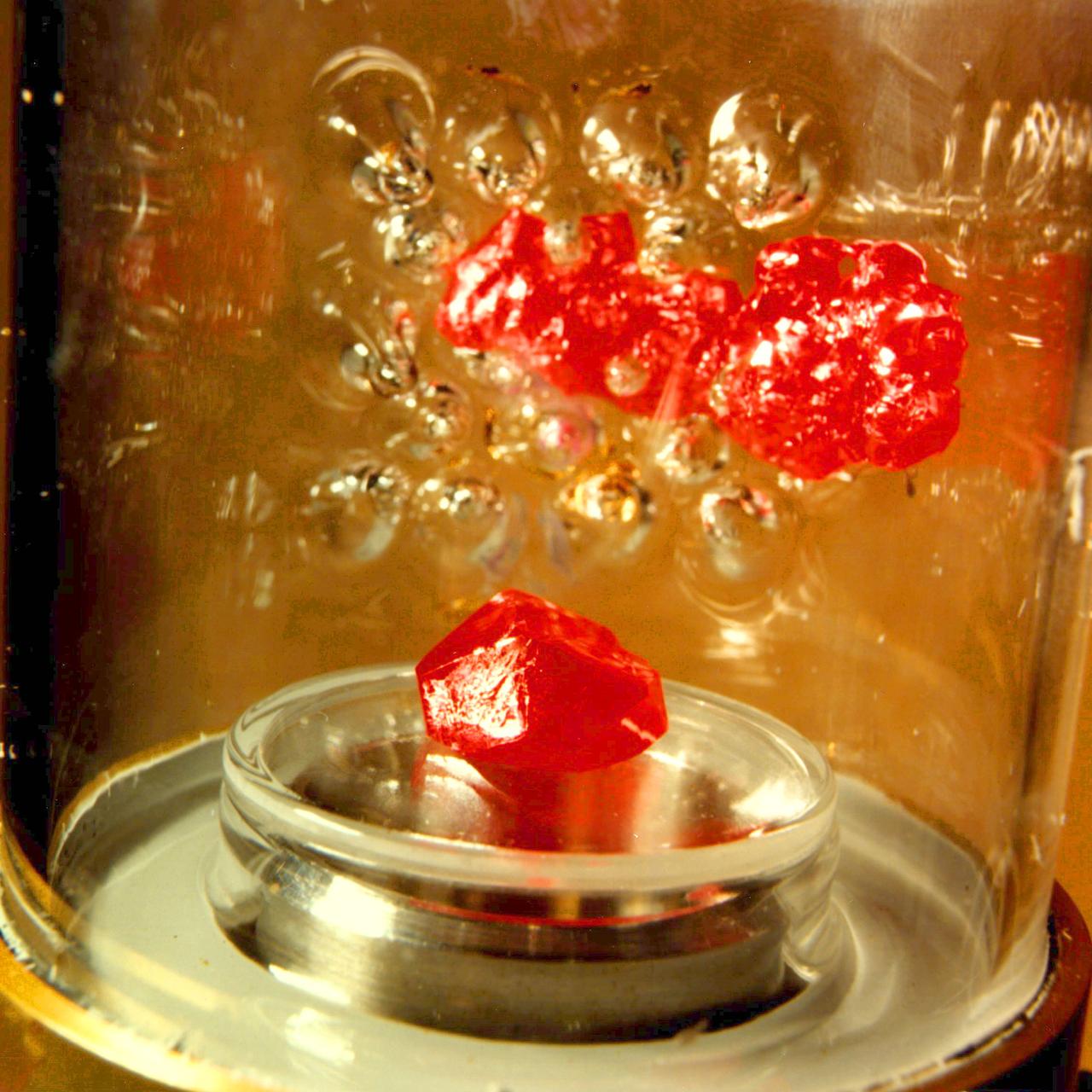
Vapor Crystal Growth System (VCGS), Flown on IML-1, Spacelab 3, Principal Investigator: Lodewijk van den Berg
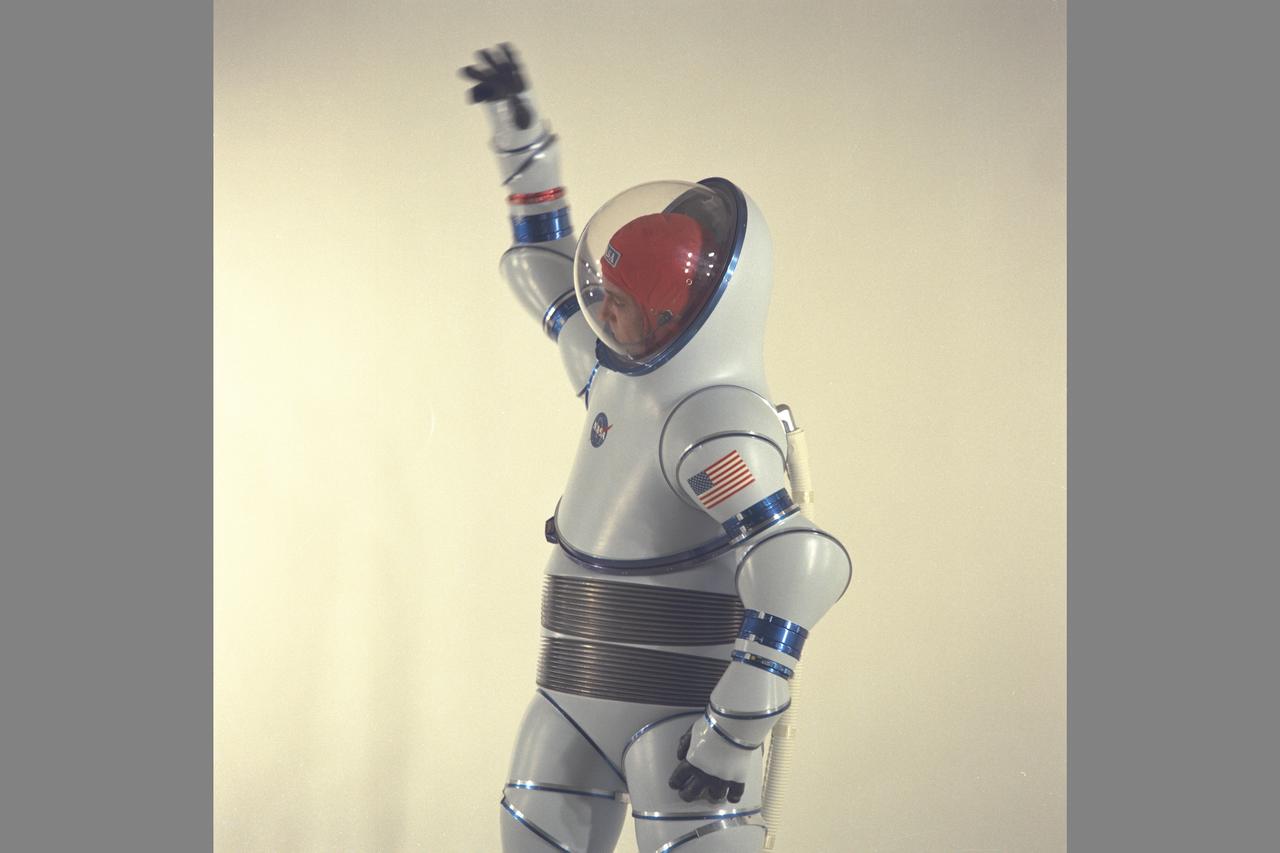
AX-2 Hard Space Suit with Vic Vykukal. Vykukal is the principal investigator of the AX space suit series.

Environmental portrait of William 'Bill' Borucki, Principal Investigator for the Kepler Mission at NASA's Ames Research Center.

AX-2 Hard Space Suit with Vic Vykukal. Vykukal is the principal investigator of the AX space suit series.
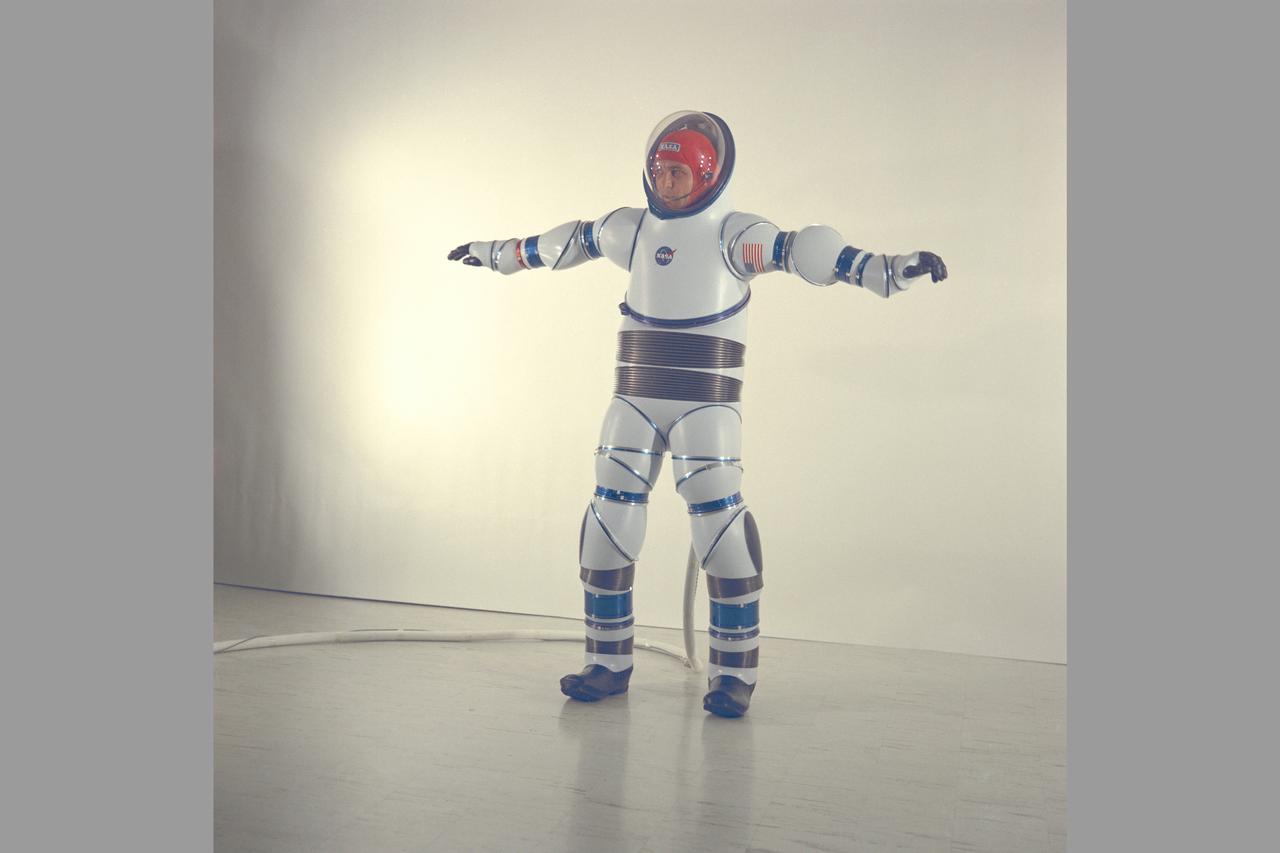
AX-2 Hard Space Suit with Vic Vykukal. Vykukal is the principal investigator of the AX space suit series.

Abigail Allwood, principal investigator of the Planetary Instrument for X-ray Lithochemistry (PIXL) aboard NASA's Perseverance Mars rover, is seen here examining rocks in Greenland. Allwood is a scientist based at NASA's Jet Propulsion Laboratory in Southern California. A key objective for Perseverance's mission on Mars is astrobiology, including the search for signs of ancient microbial life. The rover will characterize the planet's geology and past climate, pave the way for human exploration of the Red Planet, and be the first mission to collect and cache Martian rock and regolith (broken rock and dust). Subsequent NASA missions, in cooperation with ESA (European Space Agency), would send spacecraft to Mars to collect these sealed samples from the surface and return them to Earth for in-depth analysis. The Mars 2020 Perseverance mission is part of NASA's Moon to Mars exploration approach, which includes Artemis missions to the Moon that will help prepare for human exploration of the Red Planet. https://photojournal.jpl.nasa.gov/catalog/PIA24667
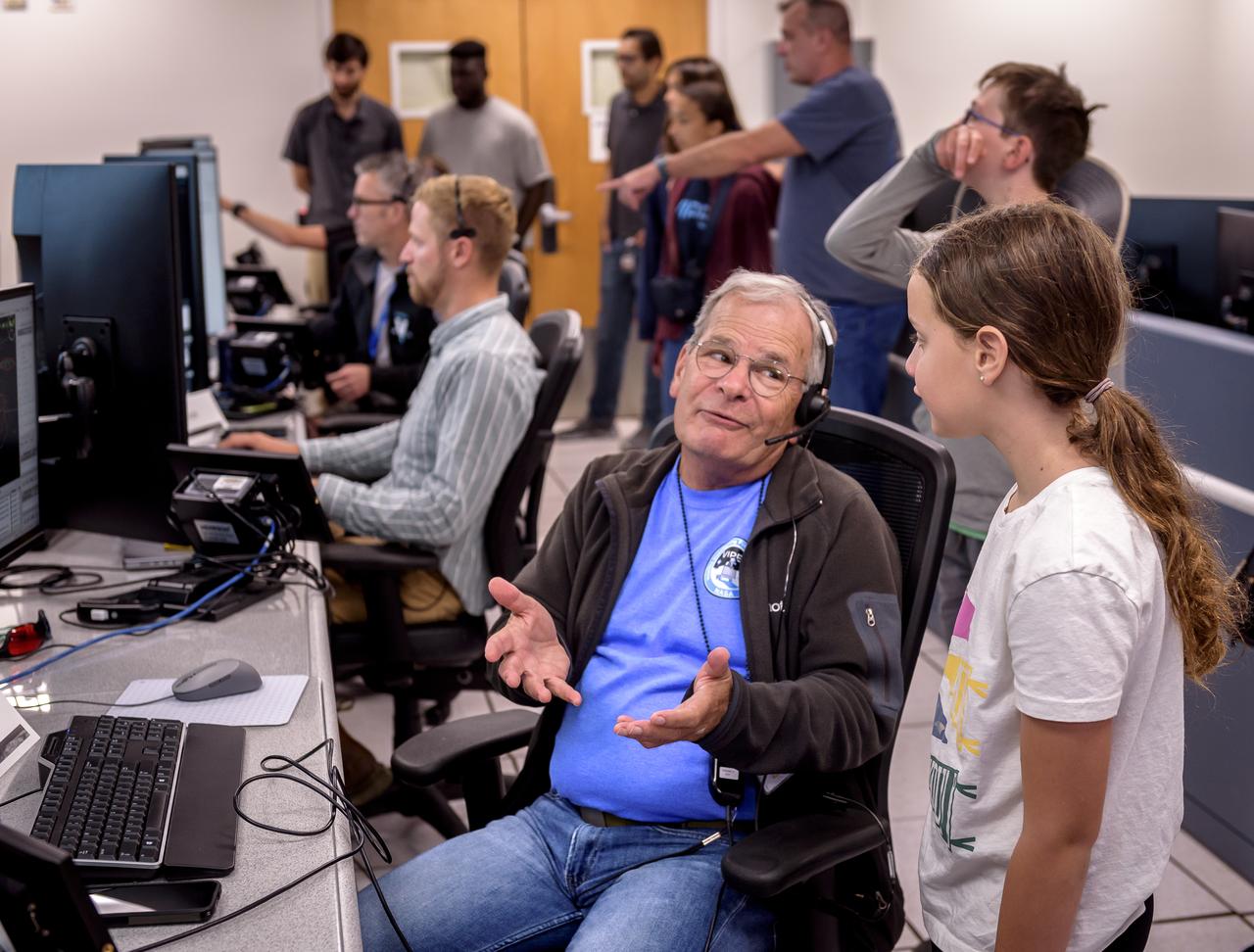
Rick Elphic, NSS instrument principal investigator, left, explains the Volatiles Investigating Polar Exploration Rover (VIPER) mission to visitors in the Multi-Mission Operations Center (MMOC), N240, during VIPER Family Day.
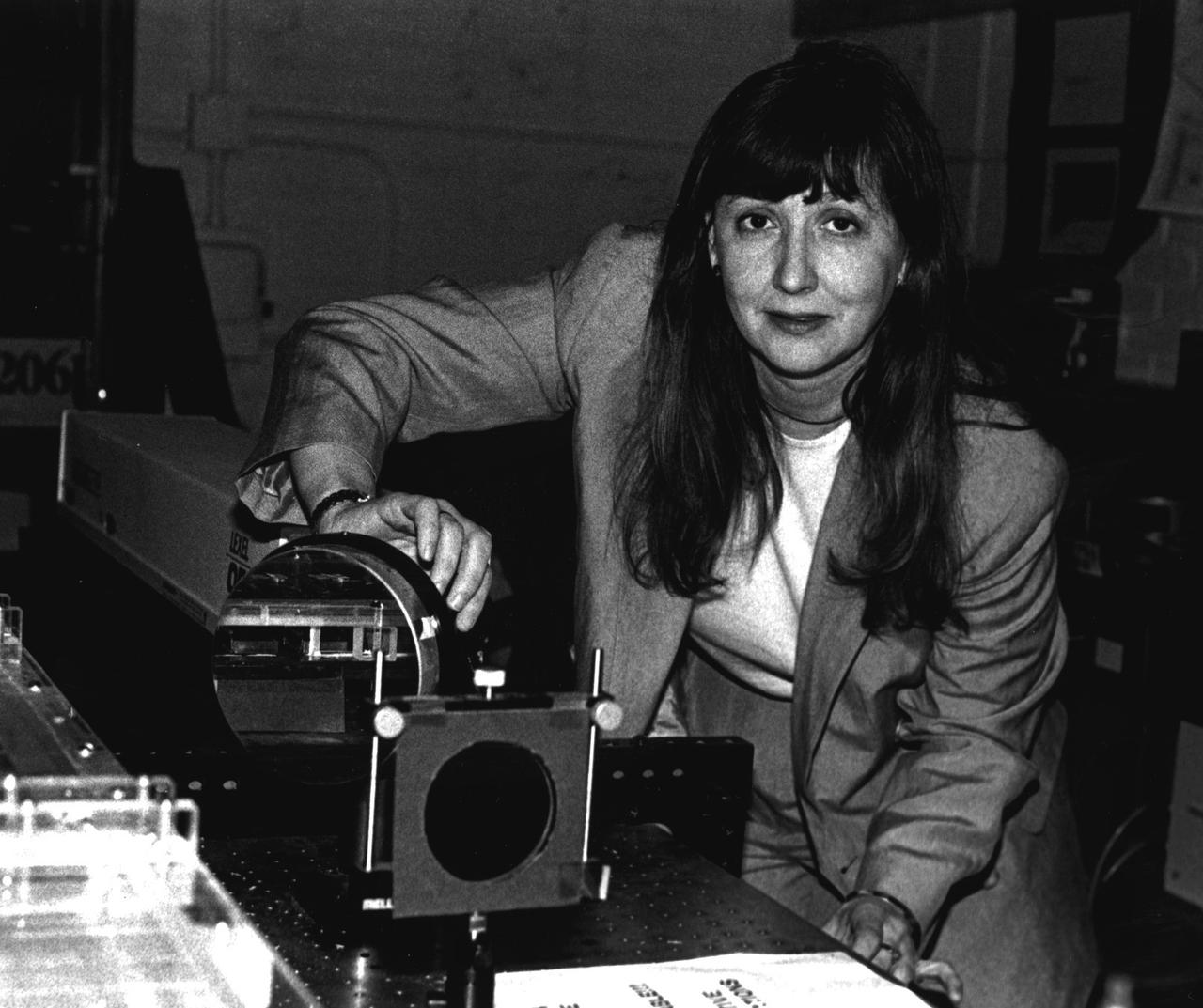
Dr. Cila Herman, G.W.C. Whiting School of Engineering, Johns Hopkins University, Baltimore. She is the principal investigator for the Experimental Investigation of Pool Boiling Heat Transfer Enhancement in Microgravity in the Presence of Electric Fields.
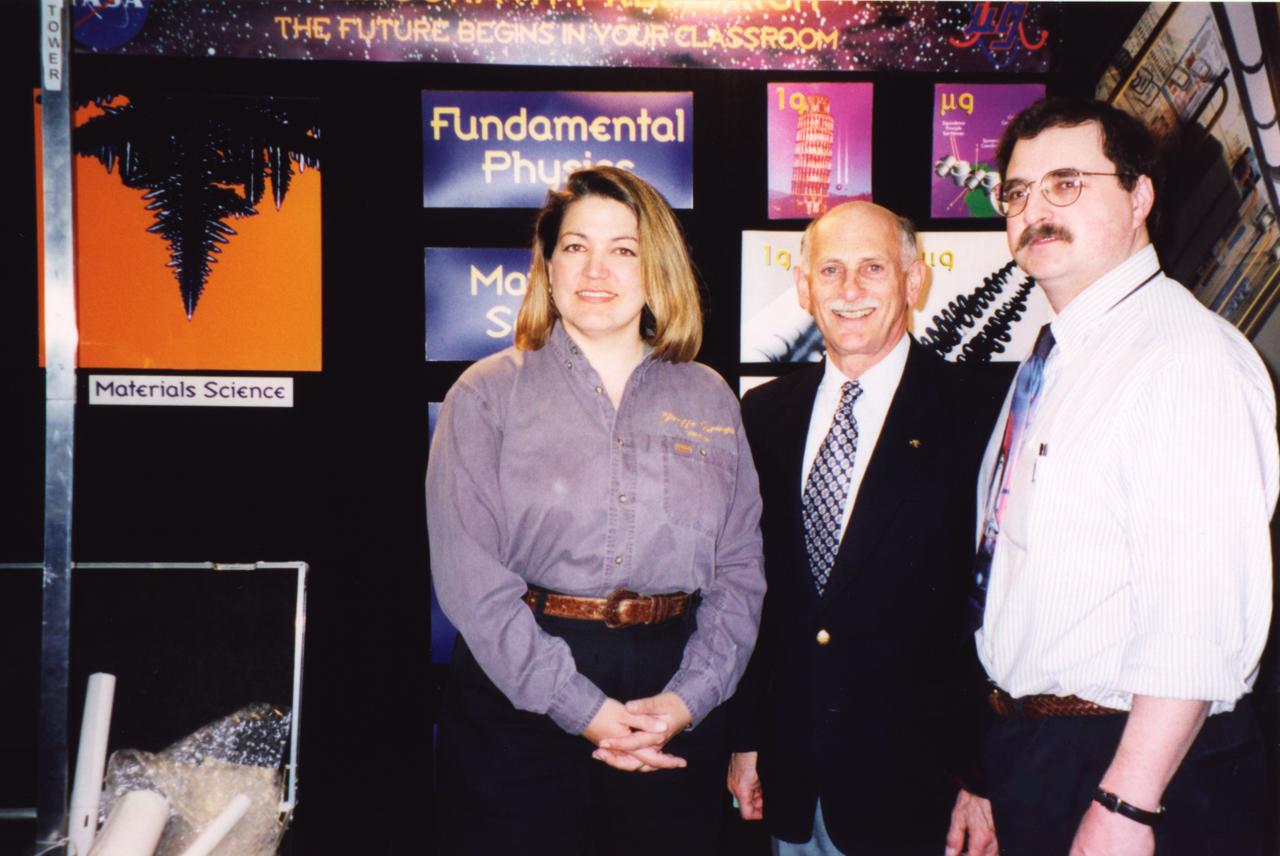
Representatives of NASA materials science experiments supported the NASA exhibit at the Rernselaer Polytechnic Institute's Space Week activities, April 5 through 11, 1999. From left to right are: Angie Jackman, project manager at NASA's Marshall Space Flight Center for dendritic growth experiments; Dr. Martin Glicksman of Rennselaer Polytechnic Instutute, Troy, NY, principal investigator on the Isothermal Dendritic Growth Experiment (IDGE) that flew three times on the Space Shuttle; and Dr. Matthew Koss of College of the Holy Cross in Worcester, MA, a co-investigator on the IDGE and now principal investigator on the Transient Dendritic Solidification Experiment being developed for the International Space Station (ISS). The image at far left is a dendrite grown in Glicksman's IDGE tests aboard the Shuttle. Glicksman is also principal investigator for the Evolution of Local Microstructures: Spatial Instabilities of Coarsening Clusters.
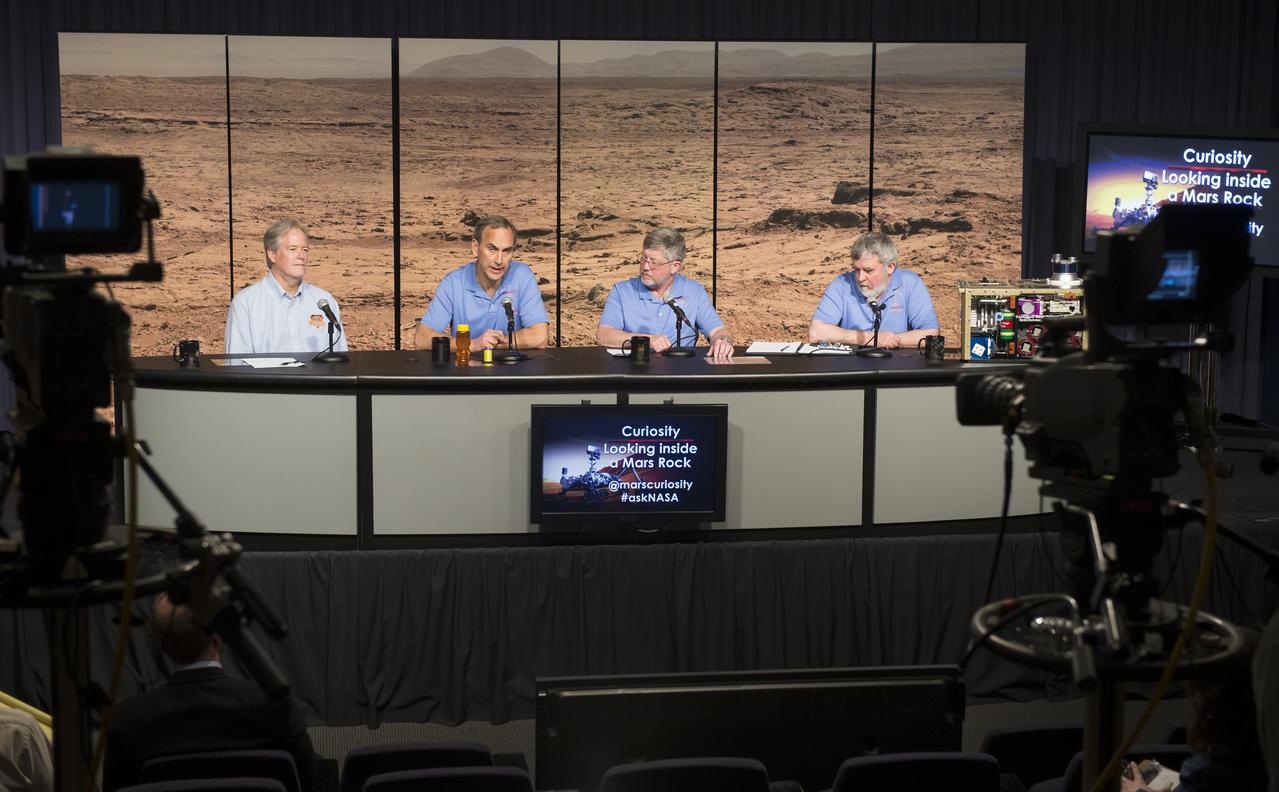
Participants at a news conference discussing findings of the analysis of a rock sample from Mars are seen, Tuesday, March 12, 2013 at NASA Headquarters in Washington. From left to right are seen: Michael Meyer, lead scientist, Mars Exploration Program at NASA Headquarters; John Grotzinger, Curiosity project scientist, California Institute of Technology in Pasadena; David Blake, principal investigator for Curiosity's Chemistry and Mineralogy investigation at NASA's Ames Research Center in Calif.; and Paul Mahaffy, principal investigator for Curiosity's Sample Analysis at Mars (SAM) investigation at NASA's Goddard Space Flight Center in Maryland. Photo Credit: (NASA/Carla Cioffi)

PORTRAIT: DR. PATRICIA COWINGS PROJECT MANAGER OF THE PSYCHOPHYSIOLOGICAL LAB, PRINCIPAL INVESTIGATOR OF THE AUTOGENIC FEEDBACK TRAINING EXPERIMENT STUDYING MOTION SICKNESS.
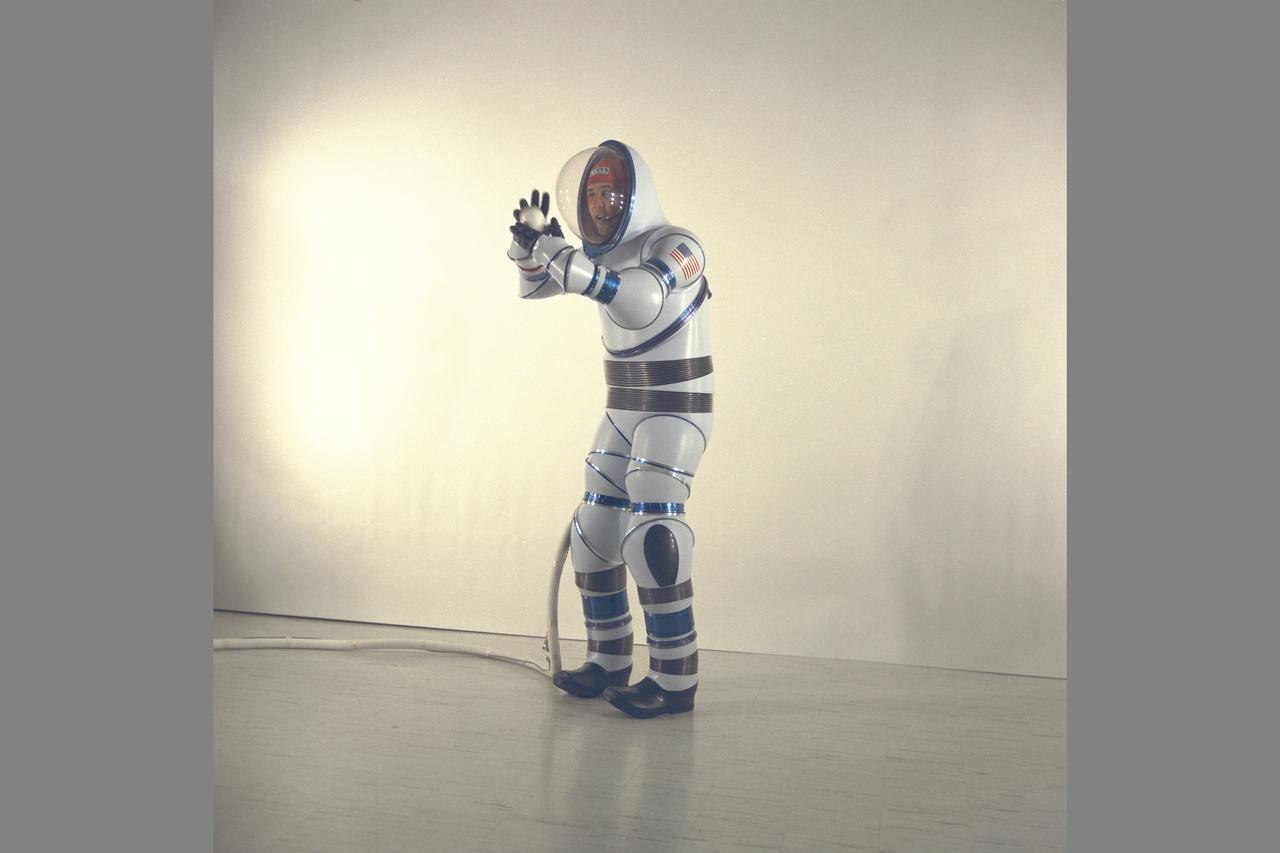
AX-2 Hard Space Suit with Vic Vykukal getting ready to pitch a baseball. Vykukal is the principal investigator of the AX space suit series.
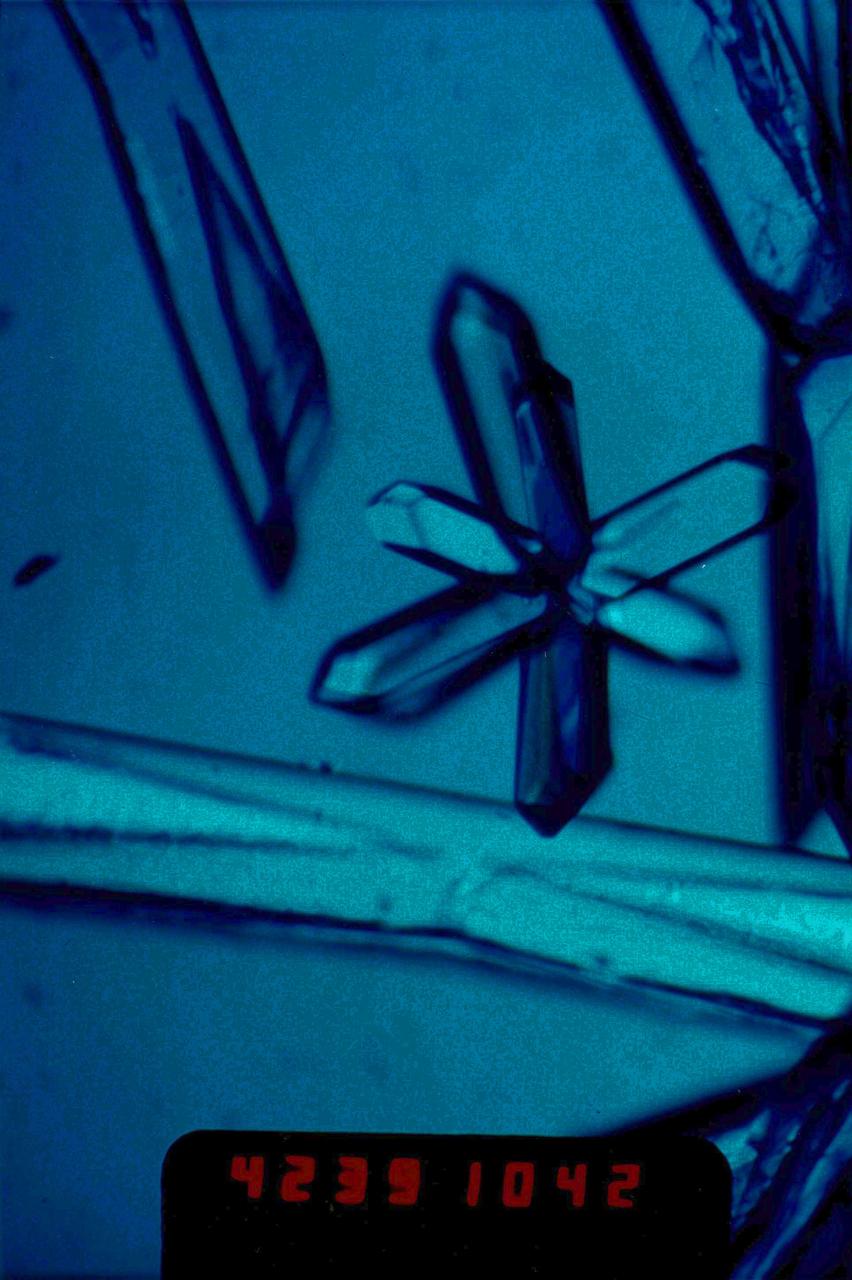
Facilitates the incorporation of glucose into cells. In diabetics, there is either a decrease in or complete lack of insulin, therby leading to several harmful complications. Principal Investigator was Charles Bugg.
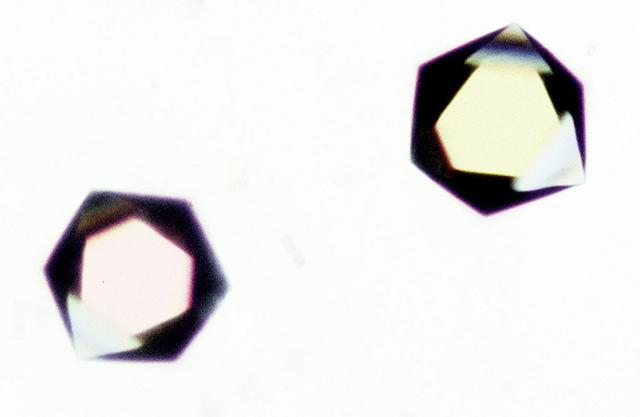
Crystals of Proteinase K complex grown in the VDA-2 (Vapor Diffusion Apparatus) hardware aboard MSL-1. Principal Investigator: Larry DeLucas
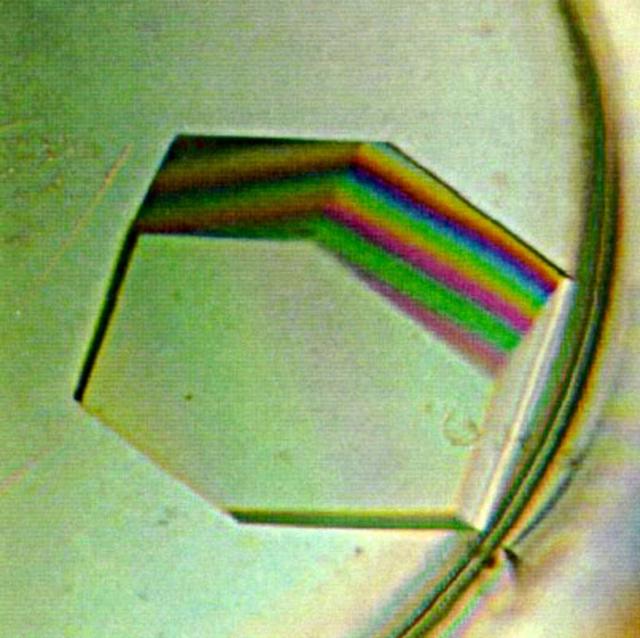
Lysozyme crystal grown on STS-81. A protein model for documentation of the effects of microgravity on crystal growth. Principal Investigator Dan Carter of New Century Pharmaceuticals.
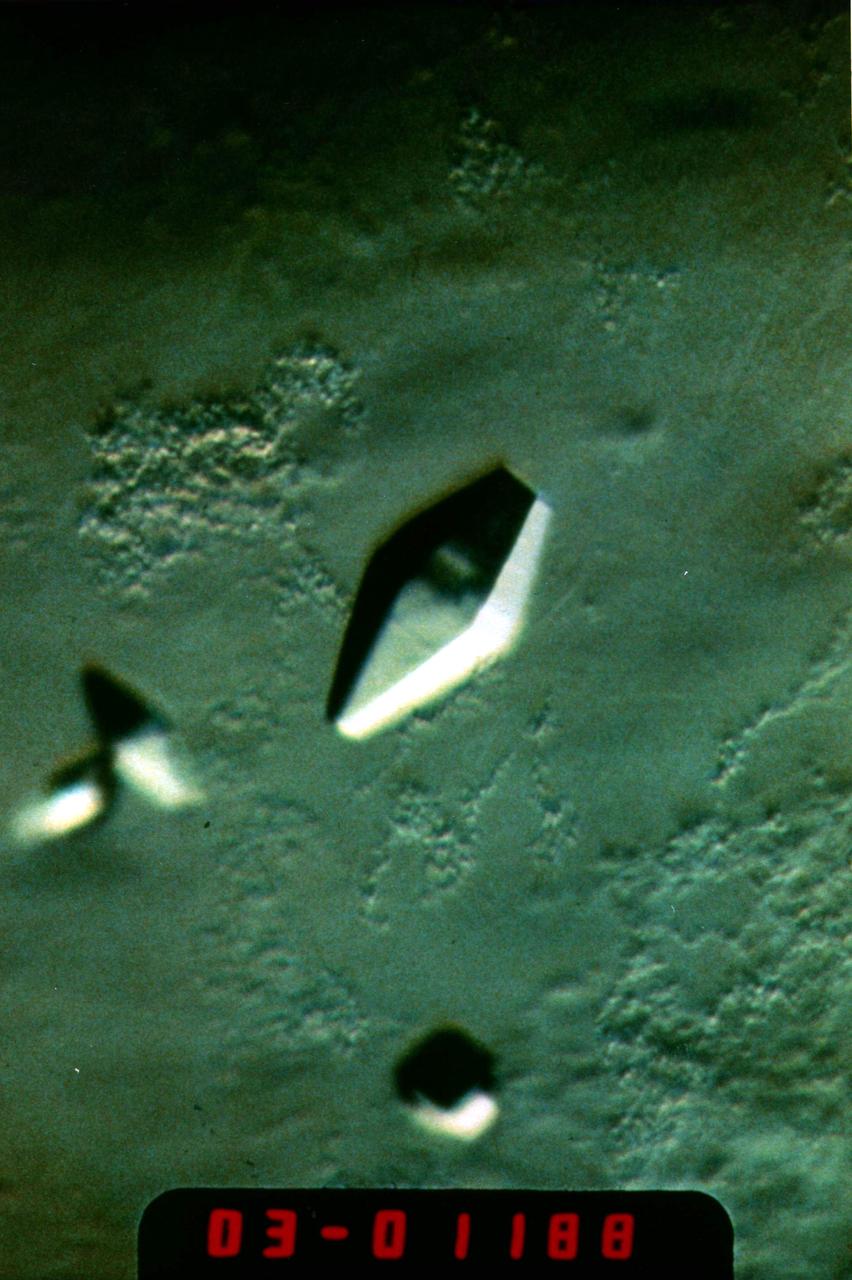
(PCG) Protein Crystal Growth C-reactive Protein. Plays a major role in human immune system response. Principal Investigator on STS-26 was Charles Bugg.
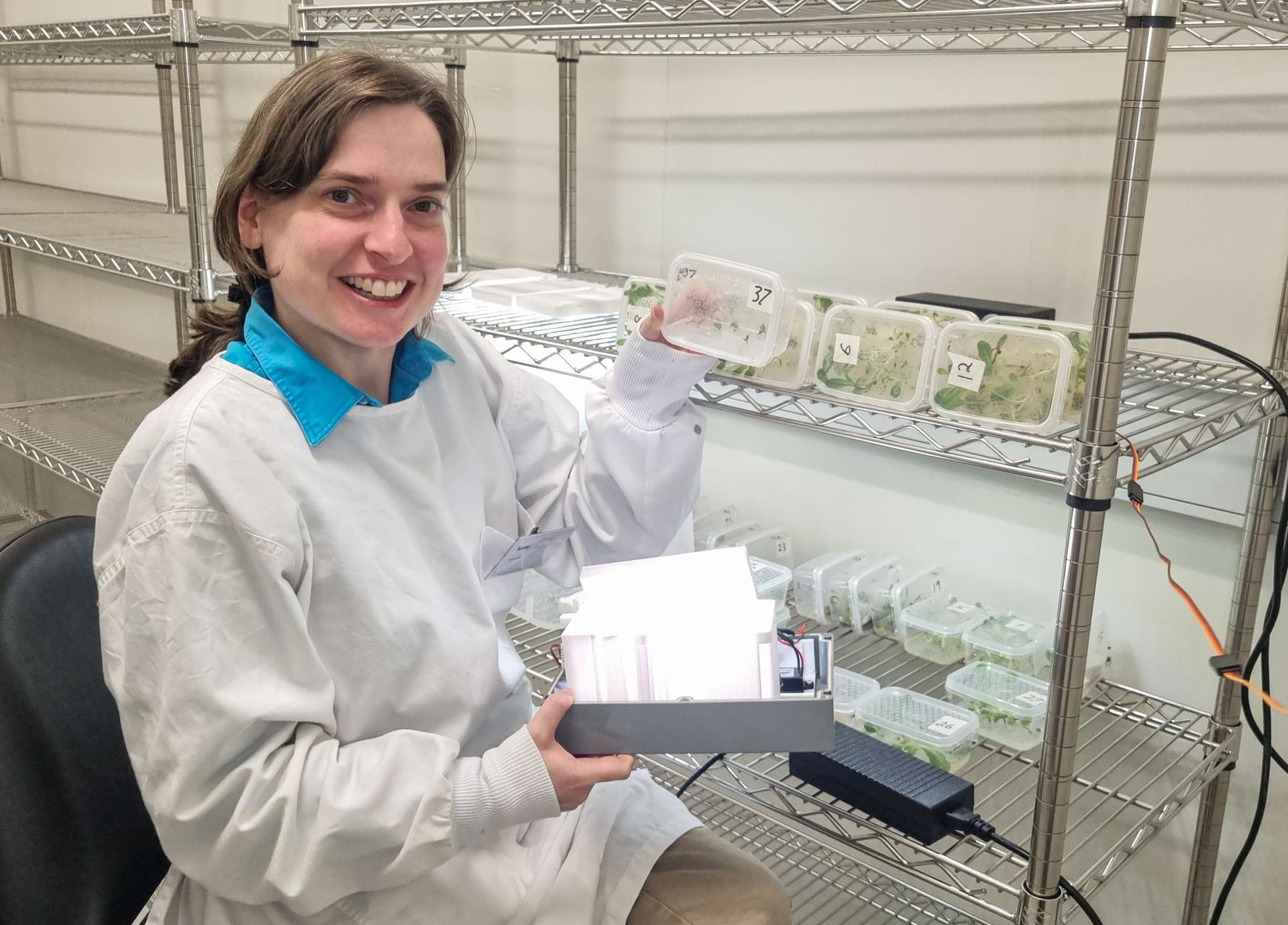
Project Rapunzel principal investigator testing the plant chambers on the ground. This investigation tests a special plant chamber and uses computer vision to monitor plant health. Investigation findings may inform ways to automatically monitor plant health and reduce plant stress during long-duration space missions. Credit. UniSQ
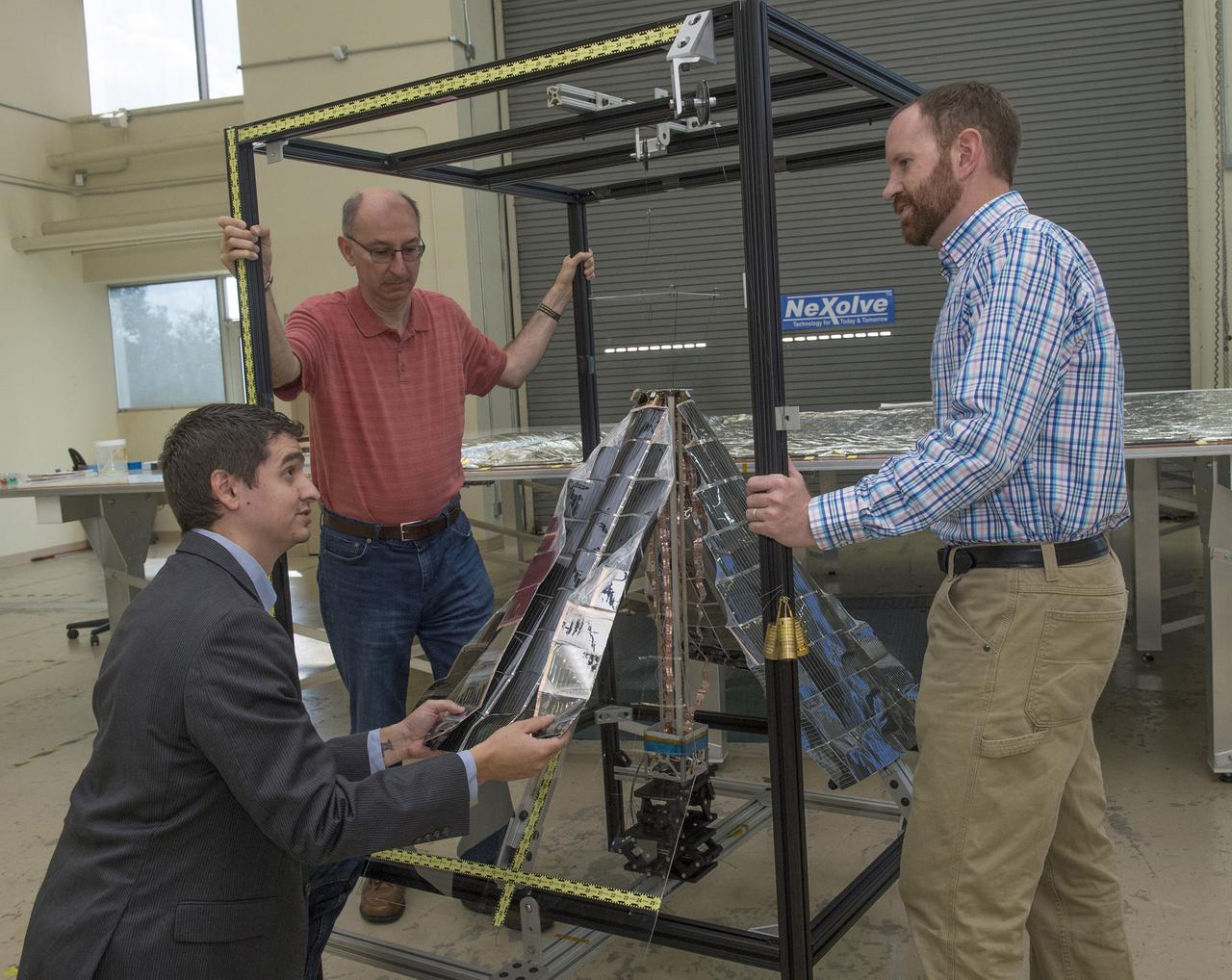
JOHN CARR, CO-PRINCIPAL INVESTIGATOR FOR NASA'S LIGHTWEIGHT INTEGRATED SOLAR ARRAY AND TRANSCEIVER PROJECT, KNEELS TO SHOW HOW ONE OF THE THIN-FILM SIDES OR "PETALS" IN WHICH PHOTO-VOLTAIC CELLS ARE EMBEDDED, IS FOLDED AND STOWED BEFORE LAUNCH. LOOKING ON DURING A DEMONSTRATION AFTER TESTING AT NEXOLVE, ARE LES JOHNSON, LEFT, ALSO CO-PRINCIPAL INVESTIGATOR, AND DARREN BOYD, RIGHT, THE RADIO FREQUENCY LEAD FOR THE PROJECT.
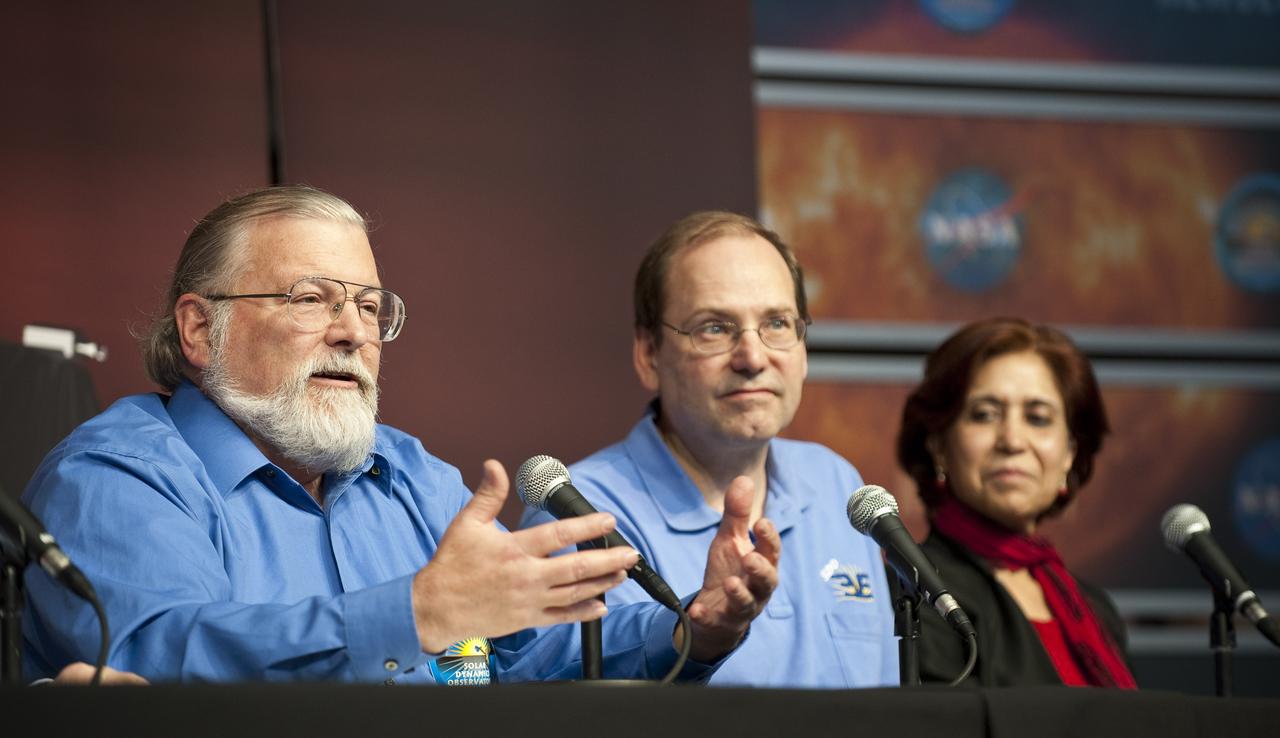
Philip H. Scherrer (left) principal investigator, Helioseismic and Magnetic Imager instrument, Stanford University in Palo Alto, speaks during a briefing to discuss recent images from NASA's Solar Dynamics Observatory, or SDO, while colleagues Tom Woods, principal investigator, Extreme Ultraviolet Variability Experiment instrument, Laboratory for Atmospheric and Space Physics, University of Colorado in Boulder and Madhulika Guhathakurta, SDO program scientist, NASA Headquarters (right) look on Wednesday, April 21, 2010, at the Newseum in Washington. Photo Credit: (NASA/Carla Cioffi)

CAPE CANAVERAL, Fla. -- In the Kennedy Space Center’s Press Site auditorium, agency and industry leaders spoke to members of the news media on International Space Station research and technology developments. Participants included Cheryl Nickerson of Arizona State University, and principal investigator for the Micro-5 experiment, and Samuel Durrance of the Florida Institute of Technology, principal investigator for the NR-SABOL experiment. Photo credit: NASA/ Kim Shiflett
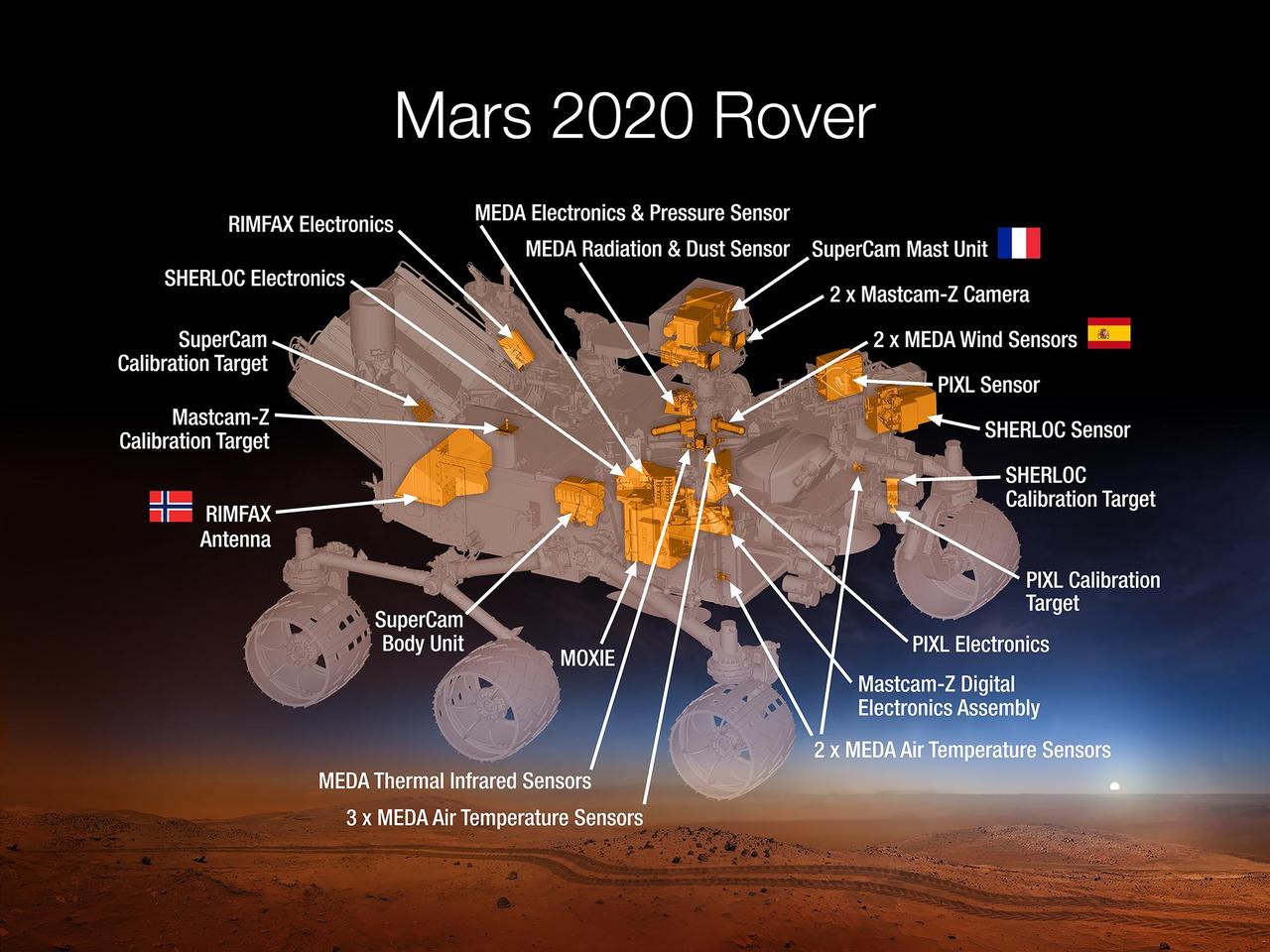
This 2015 diagram shows components of the investigations payload for NASA's Mars 2020 rover mission. Mars 2020 will re-use the basic engineering of NASA's Mars Science Laboratory to send a different rover to Mars, with new objectives and instruments, launching in 2020. The rover will carry seven instruments to conduct its science and exploration technology investigations. They are: Mastcam-Z, an advanced camera system with panoramic and stereoscopic imaging capability and the ability to zoom. The instrument also will determine mineralogy of the Martian surface and assist with rover operations. The principal investigator is James Bell, Arizona State University in Tempe. SuperCam, an instrument that can provide imaging, chemical composition analysis, and mineralogy. The instrument will also be able to detect the presence of organic compounds in rocks and regolith from a distance. The principal investigator is Roger Wiens, Los Alamos National Laboratory, Los Alamos, New Mexico. This instrument also has a significant contribution from the Centre National d'Etudes Spatiales, Institut de Recherche en Astrophysique et Planétologie (CNES/IRAP) France. Planetary Instrument for X-ray Lithochemistry (PIXL), an X-ray fluorescence spectrometer that will also contain an imager with high resolution to determine the fine-scale elemental composition of Martian surface materials. PIXL will provide capabilities that permit more detailed detection and analysis of chemical elements than ever before. The principal investigator is Abigail Allwood, NASA's Jet Propulsion Laboratory, Pasadena, California. Scanning Habitable Environments with Raman & Luminescence for Organics and Chemicals (SHERLOC), a spectrometer that will provide fine-scale imaging and uses an ultraviolet (UV) laser to determine fine-scale mineralogy and detect organic compounds. SHERLOC will be the first UV Raman spectrometer to fly to the surface of Mars and will provide complementary measurements with other instruments in the payload. SHERLOC includes a high-resolution color camera for microscopic imaging of Mars' surface. The principal investigator is Luther Beegle, JPL. The Mars Oxygen ISRU Experiment (MOXIE), an exploration technology investigation that will produce oxygen from Martian atmospheric carbon dioxide. The principal investigator is Michael Hecht, Massachusetts Institute of Technology, Cambridge, Massachusetts. Mars Environmental Dynamics Analyzer (MEDA), a set of sensors that will provide measurements of temperature, wind speed and direction, pressure, relative humidity and dust size and shape. The principal investigator is Jose Rodriguez-Manfredi, Centro de Astrobiologia, Instituto Nacional de Tecnica Aeroespacial, Spain. The Radar Imager for Mars' Subsurface Experiment (RIMFAX), a ground-penetrating radar that will provide centimeter-scale resolution of the geologic structure of the subsurface. The principal investigator is Svein-Erik Hamran, the Norwegian Defence Research Establishment, Norway. http://photojournal.jpl.nasa.gov/catalog/PIA19672
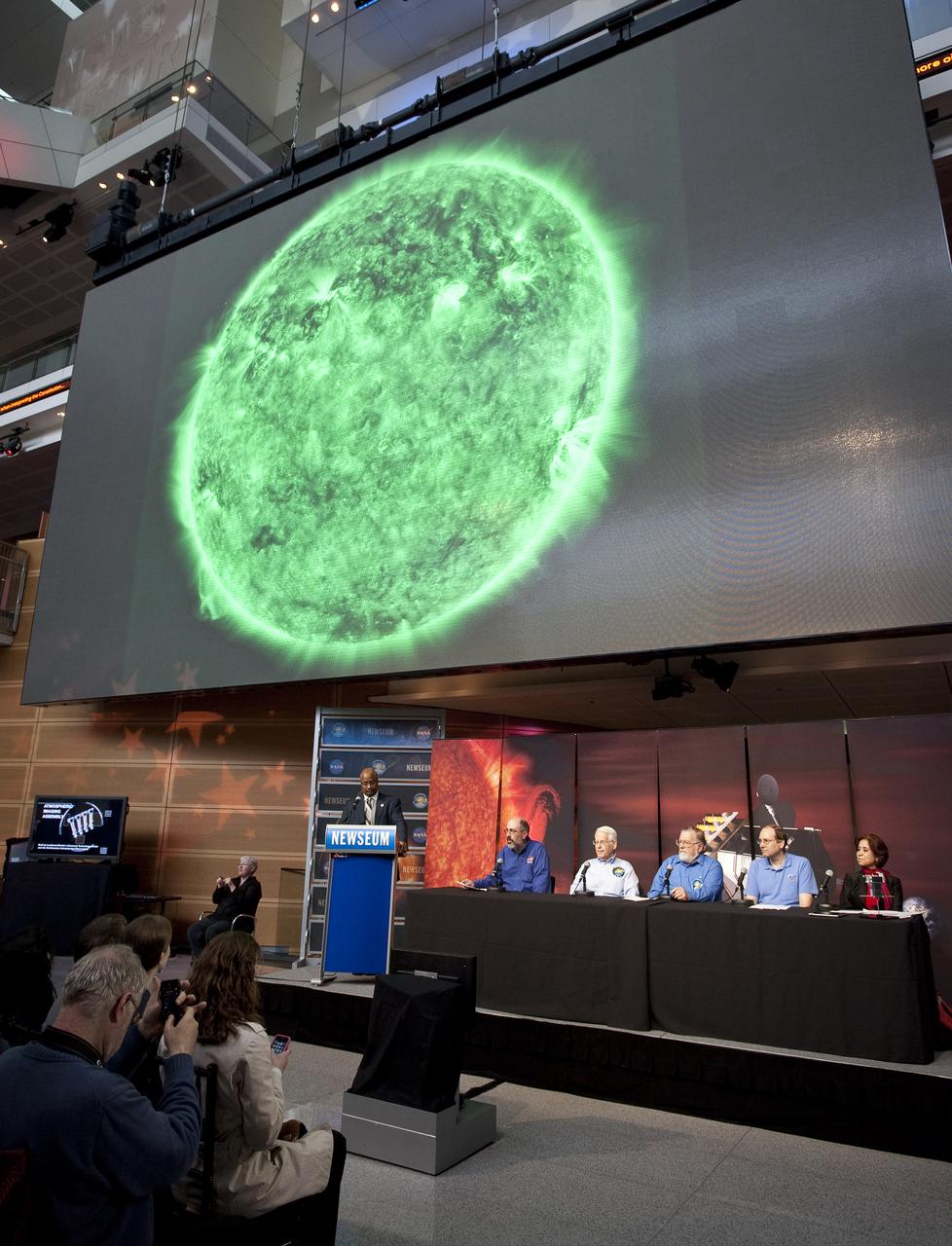
Scientists involved in NASA's Solar Dynamics Observatory (SDO) mission attend a press conference to discuss recent images captured by the SDO spacecraft Wednesday, April 21, 2010, at the Newseum in Washington. Pictured right to left are: Madhulika Guhathakurta, SDO program scientist, NASA Headquarters in Washington; Tom Woods, principal investigator, Extreme Ultraviolet Variability Experiment instrument, Laboratory for Atmospheric and Space Physics, University of Colorado in Boulder; Philip H. Scherrer, principal investigator, Helioseismic and Magnetic Imager instrument, Stanford University in Palo Alto; Alan Title, principal investigator, Atmospheric Imaging Assembly instrument, Lockheed Martin Solar and Astrophysics Laboratory in Palo Alto and Dean Pesnell, SDO project scientist, Goddard Space Flight Center in Greenbelt, Md. Photo Credit: (NASA/Carla Cioffi)
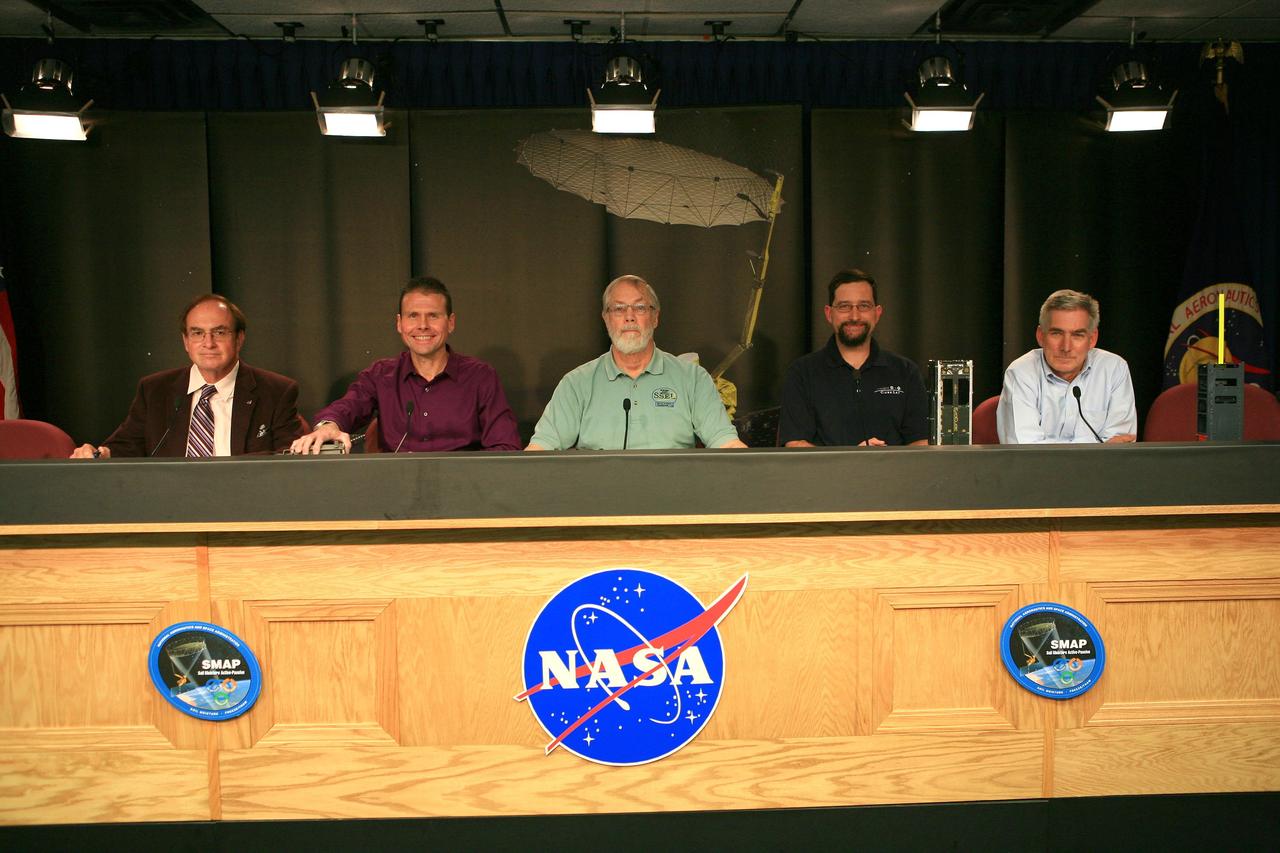
VANDENBERG AIR FORCE BASE, California– At Vandenberg Air Force Base, California, agency leaders held an Educational Launch of Nanosatellites, or ELaNa, CubeSat briefing to discuss three small research satellites that are being flown as auxiliary payloads on the SMAP mission. More than 100 university students have been involved in the design, development and construction of the CubeSats. Presenting the mission science objectives for the ELaNa CubeSats are George Diller of NASA Public Affairs, Scott Higginbotham, NASA ELaNa-X Mission Manager at the Kennedy Space Center, Florida, Dave Klumpar, Firebird-II principal investigator and director of the Space Science and Engineering Laboratory at Montana State University in Bozeman, Montana, Jordi Puig-Sauri, EXOCUBE principal investigator at the California Polytechnic State University in San Luis Obispo, California, and David Rider, GRIFEX principal investigator at Jet Propulsion Laboratory, Pasadena, California. Photo credit: NASA/Kim Shiflett
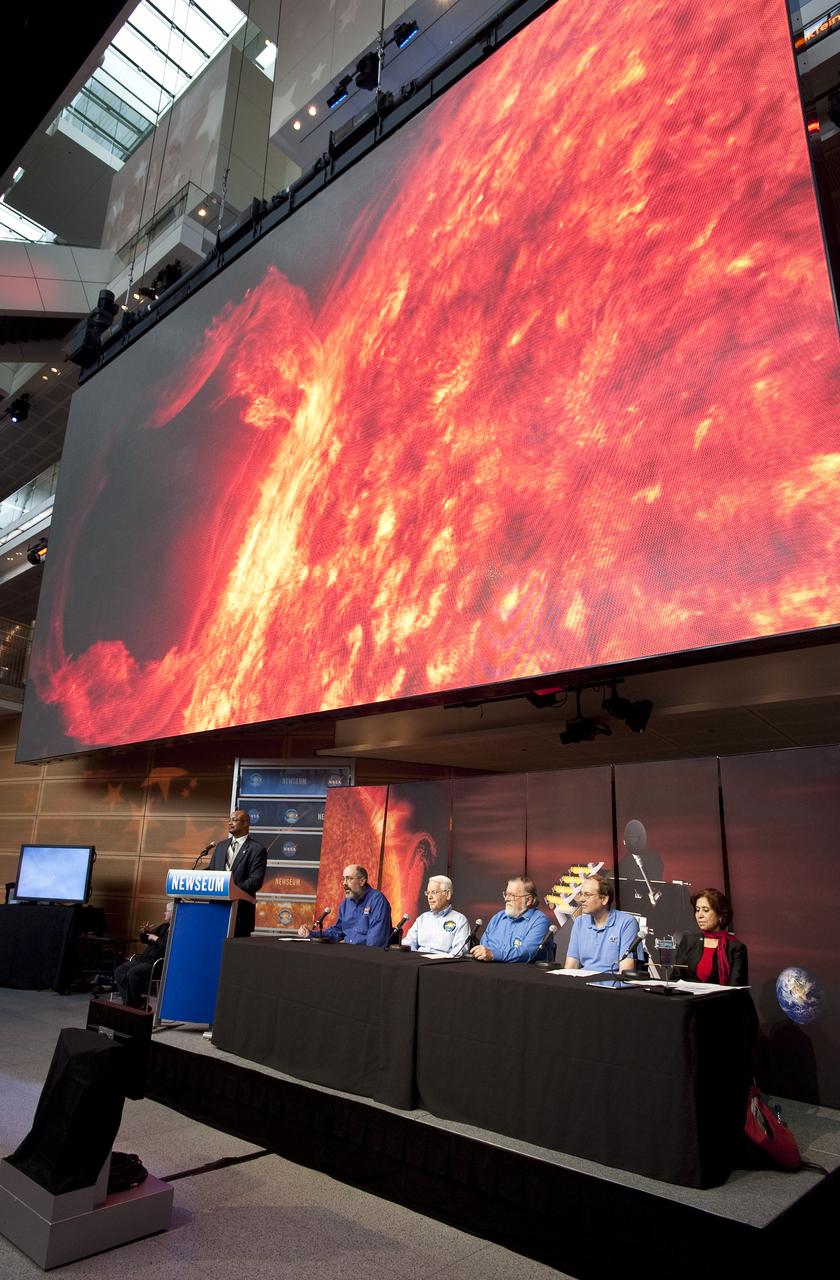
Scientists involved in NASA's Solar Dynamics Observatory (SDO) mission attend a press conference to discuss recent images captured by the SDO spacecraft Wednesday, April 21, 2010, at the Newseum in Washington. On Feb. 11, 2010, NASA launched the SDO spacecraft, which is the most advanced spacecraft ever designed to study the sun. Seated left to right are: Dean Pesnell, SDO project scientist, Goddard Space Flight Center in Greenbelt, Md.; Alan Title, principal investigator, Atmospheric Imaging Assembly instrument, Lockheed Martin Solar and Astrophysics Laboratory in Palo Alto; Philip H. Scherrer, principal investigator, Helioseismic and Magnetic Imager instrument, Stanford University in Palo Alto; Tom Woods, principal investigator, Extreme Ultraviolet Variability Experiment Instrument, Laboratory for Atmospheric and Space Physics, University of Colorado in Boulder and Madhulika Guhathakurta, SDO program scientist, NASA Headquarters in Washington. Photo Credit: (NASA/Carla Cioffi)
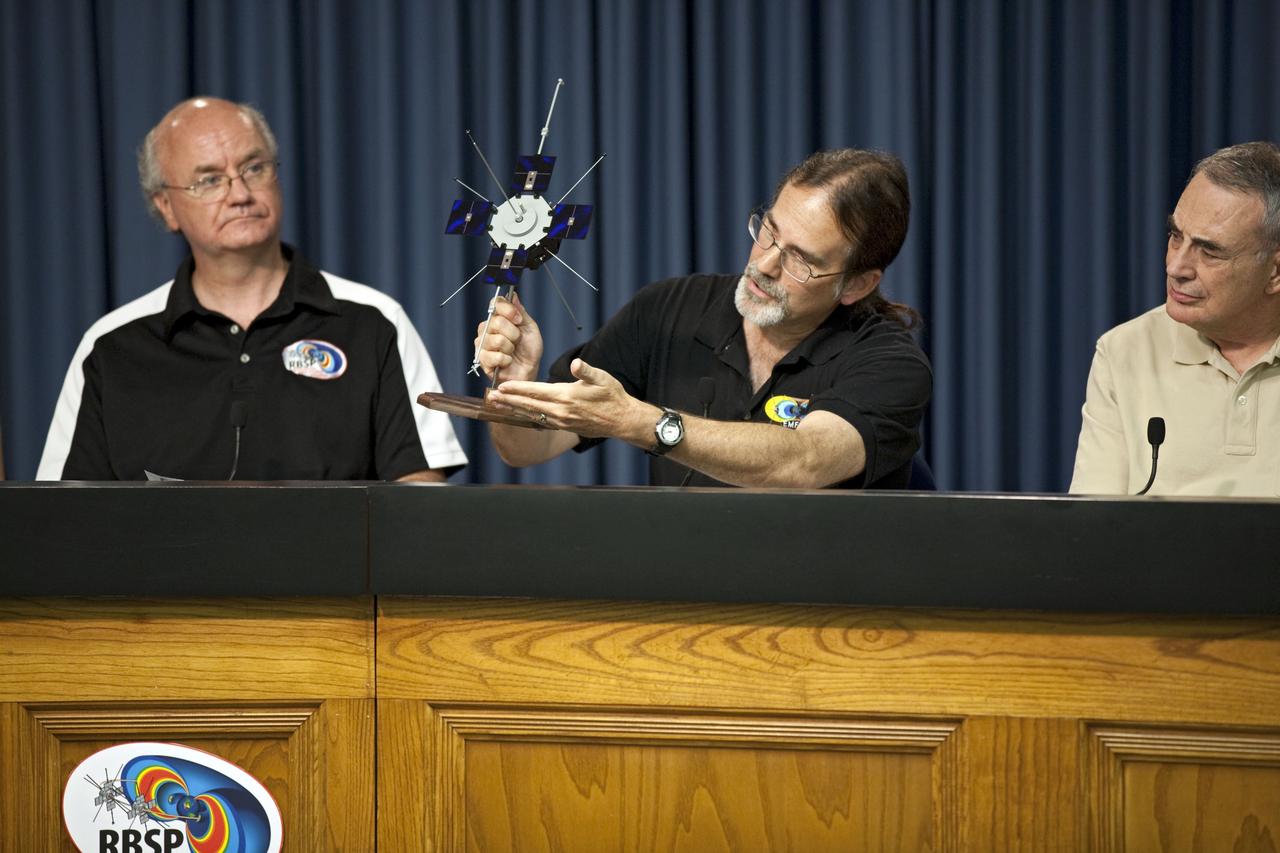
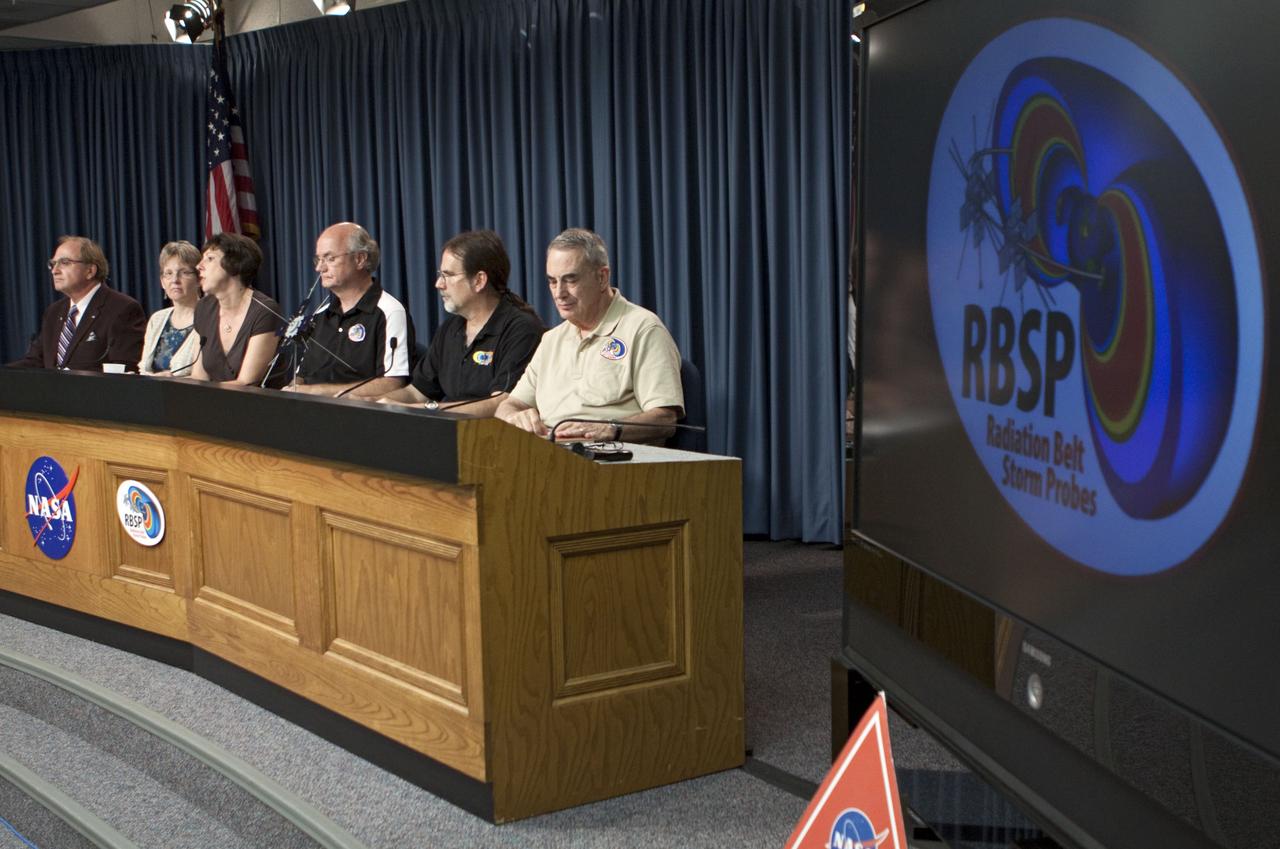
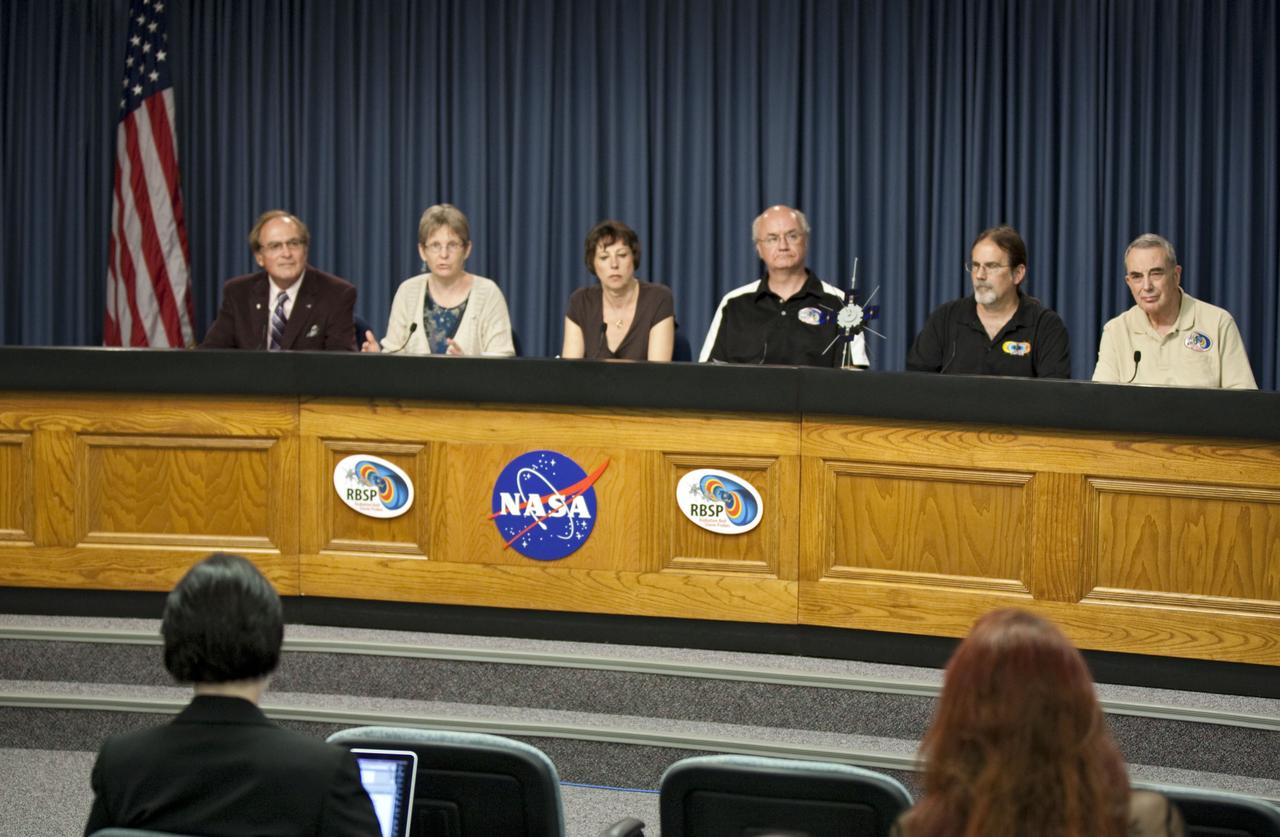
CAPE CANAVERAL, Fla. - During a mission science briefing for the Radiation Belt Storm Probes, or RBSP, mission at NASA Kennedy Space Center’s Press Site in Florida, Craig Kletzing, a principal investigator from the University of Iowa, answers questions and displays a scale model of the twin probes. To the left, is Harlan Spence, principal investigator with the University of New Hampshire. To the right, is Lou Lanzerotti, principal investigator with the New Jersey Institute of Technology. NASA’s RBSP mission will help us understand the sun’s influence on Earth and near-Earth space by studying the Earth’s radiation belts on various scales of space and time. RBSP will begin its mission of exploration of Earth’s Van Allen radiation belts and the extremes of space weather after its launch aboard an Atlas V rocket. Launch is targeted for Aug. 24. For more information, visit http://www.nasa.gov/rbsp. Photo credit: NASA/Glenn Benson
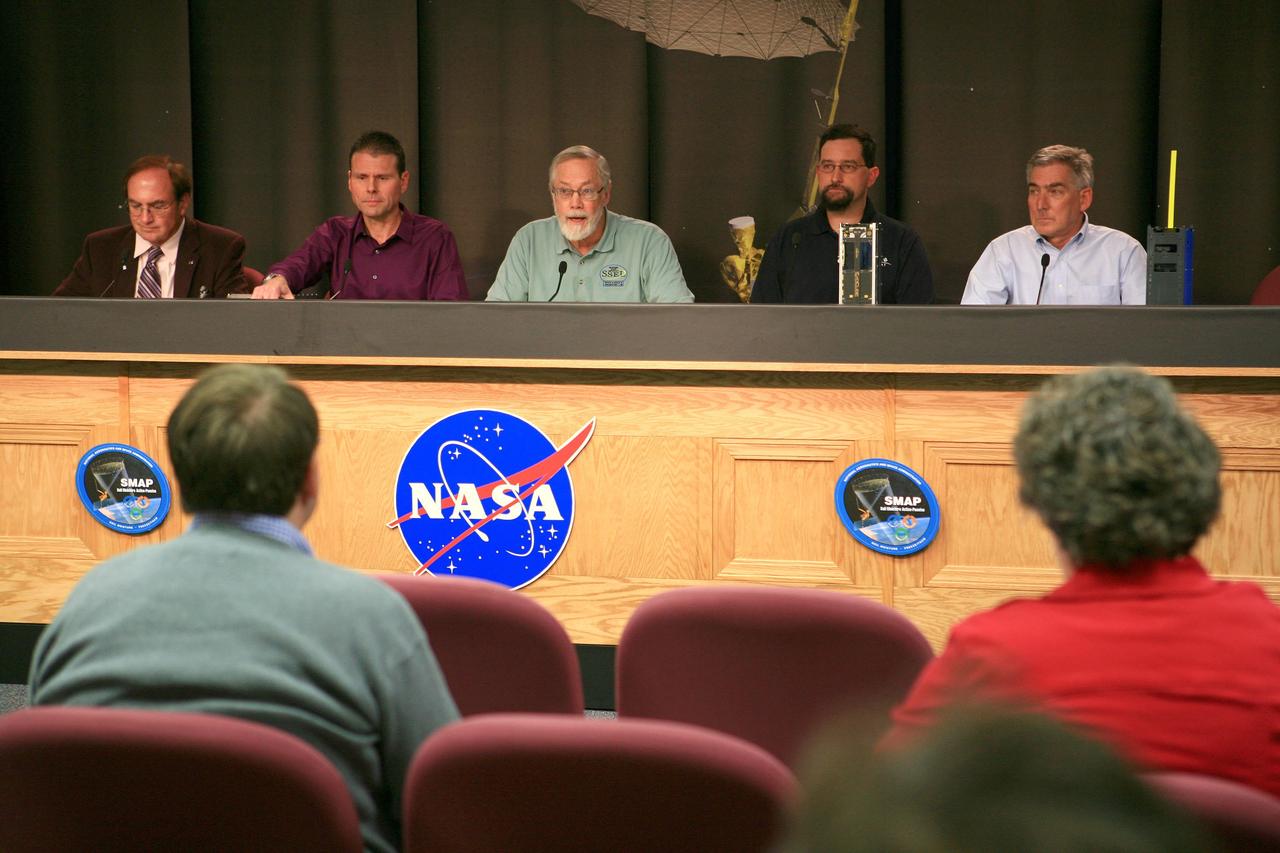
VANDENBERG AIR FORCE BASE, California– At Vandenberg Air Force Base, California, agency leaders held an Educational Launch of Nanosatellites, or ELaNa, CubeSat briefing to discuss three small research satellites that are being flown as auxiliary payloads on the SMAP mission. More than 100 university students have been involved in the design, development and construction of the CubeSats. Presenting the mission science objectives for the ELaNa CubeSats are George Diller of NASA Public Affairs, Scott Higginbotham, NASA ELaNa-X Mission Manager at the Kennedy Space Center, Florida, Dave Klumpar, Firebird-II principal investigator and director of the Space Science and Engineering Laboratory at Montana State University in Bozeman, Montana, Jordi Puig-Sauri, EXOCUBE principal investigator at the California Polytechnic State University in San Luis Obispo, California, and David Rider, GRIFEX principal investigator at Jet Propulsion Laboratory, Pasadena, California. Photo credit: NASA/Kim Shiflett
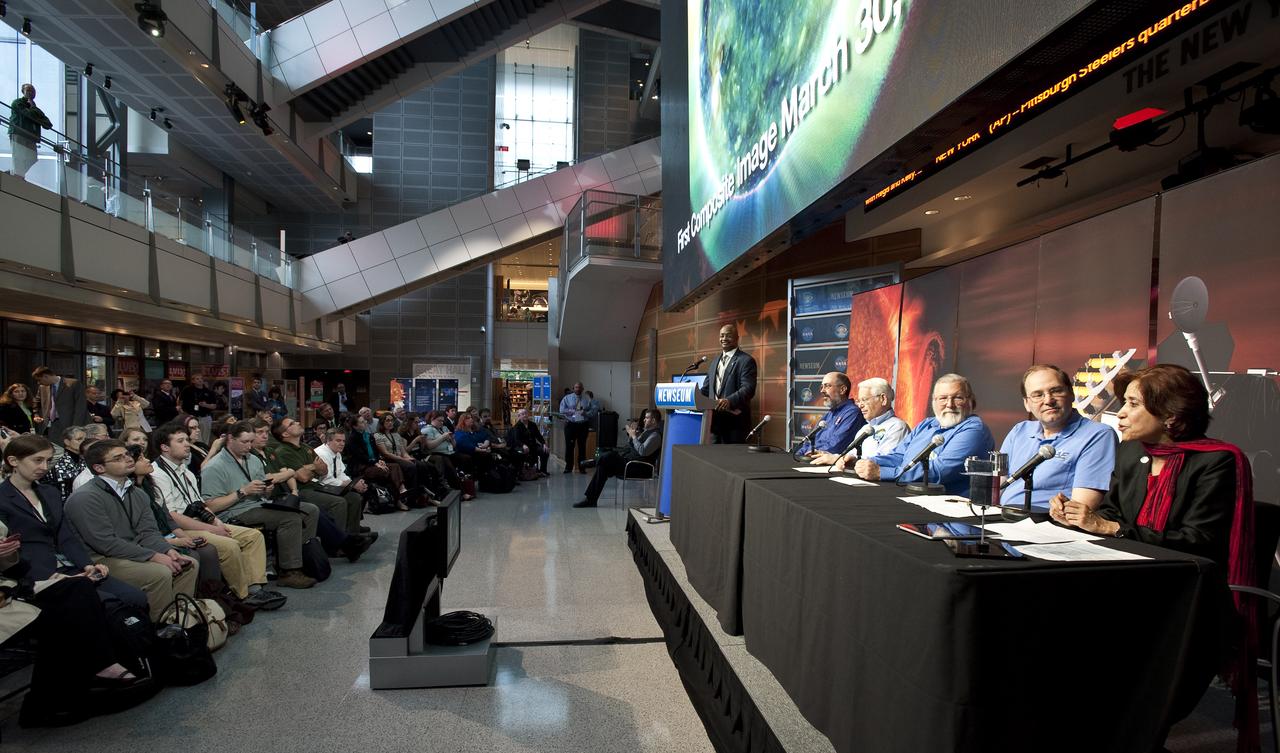
Madhulika Guhathakurta, far right, SDO Program Scientist at NASA Headquarters in Washington, speaks during a briefing to discuss recent images from NASA's Solar Dynamics Observatory, or SDO, Wednesday, April 21, 2010, at the Newseum in Washington. Pictured from left of Dr. Guhathakurta's are: Tom Woods, principal investigator, Extreme Ultraviolet Variability Experiment instrument, Laboratory for Atmospheric and Space Physics, University of Colorado in Boulder; Philip H. Scherrer, principal investigator, Helioseismic and Magnetic Imager instrument, Stanford University in Palo Alto; Alan Title, principal investigator, Atmospheric Imaging Assembly instrument, Lockheed Martin Solar and Astrophysics Laboratory in Palo Alto and Dean Pesnell, SDO project scientist, Goddard Space Flight Center in Greenbelt, Md. Photo Credit: (NASA/Carla Cioffi)
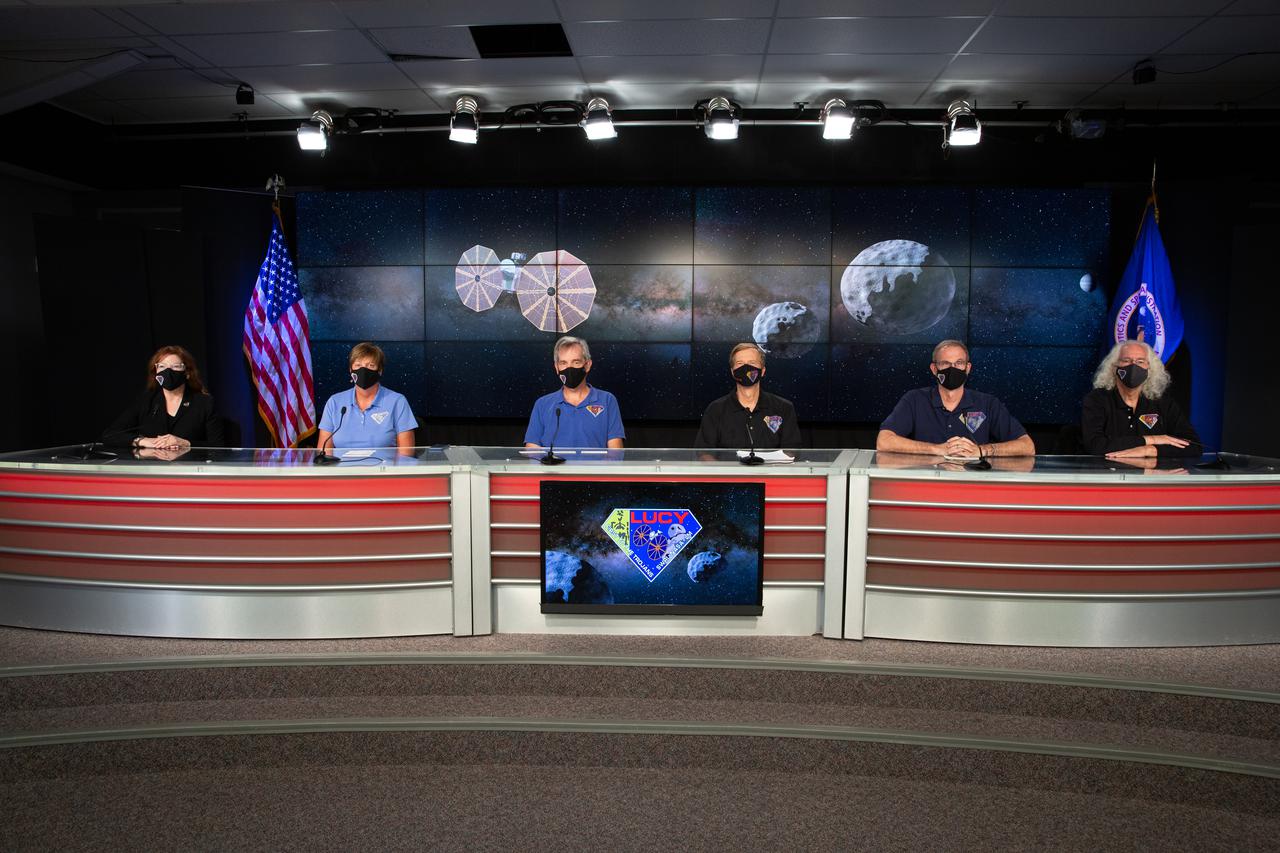
A science briefing for the Lucy mission is held inside the TV Auditorium at NASA’s Kennedy Space Center in Florida on Oct. 14, 2021. Participants included, from left to right, Adriana Ocampo, Lucy Program Executive, NASA Headquarters; Cathy Olkin, Lucy Deputy Principal Investigator, Southwest Research Institute; Keith Noll, Lucy Project Scientist at NASA’s Goddard Space Flight Center; Hal Weaver, L'LORRI Instrument Principal Investigator, Johns Hopkins Applied Physics Laboratory; Phil Christensen, L'TES Instrument Principal Investigator, Arizona State University; and Dennis Reuter, L’Ralph Instrument Principal Investigator at NASA’s Goddard Space Flight Center. Lucy is scheduled to launch at 5:34 a.m. EDT Saturday, Oct. 16, on a United Launch Alliance Atlas V 401 rocket from Space Launch Complex 41 at Cape Canaveral Space Force Station. NASA’s Launch Services Program, based at Kennedy, is managing the launch. Lucy is the first space mission to study the Trojan asteroids, which hold vital clues to the formation of our solar system.
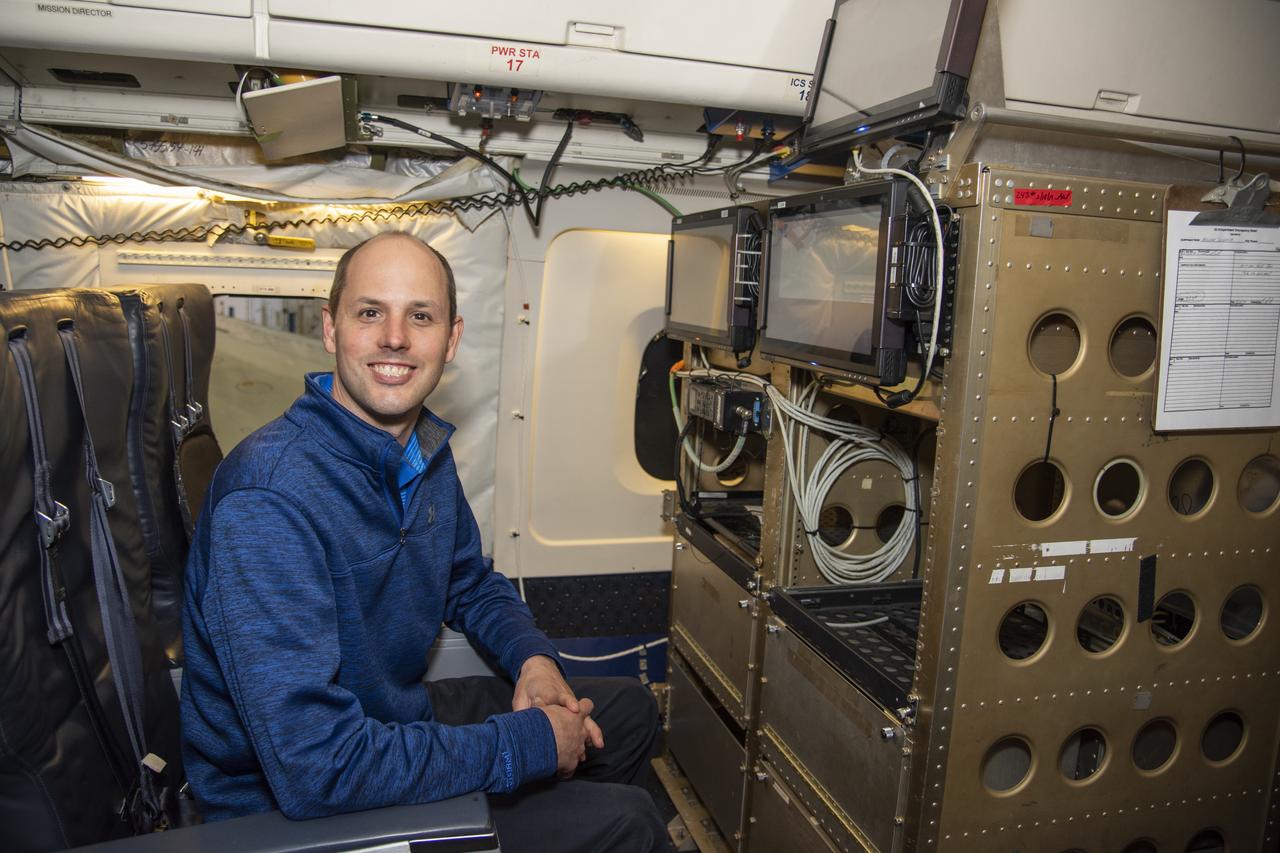
NASA Langley Research Center's Kris Bedka, pictured here on the DC-8 flying laboratory, is the lead for an airborne mission called Aeoulus that is advancing laser-based technologies for measuring winds in the lower atmosphere.
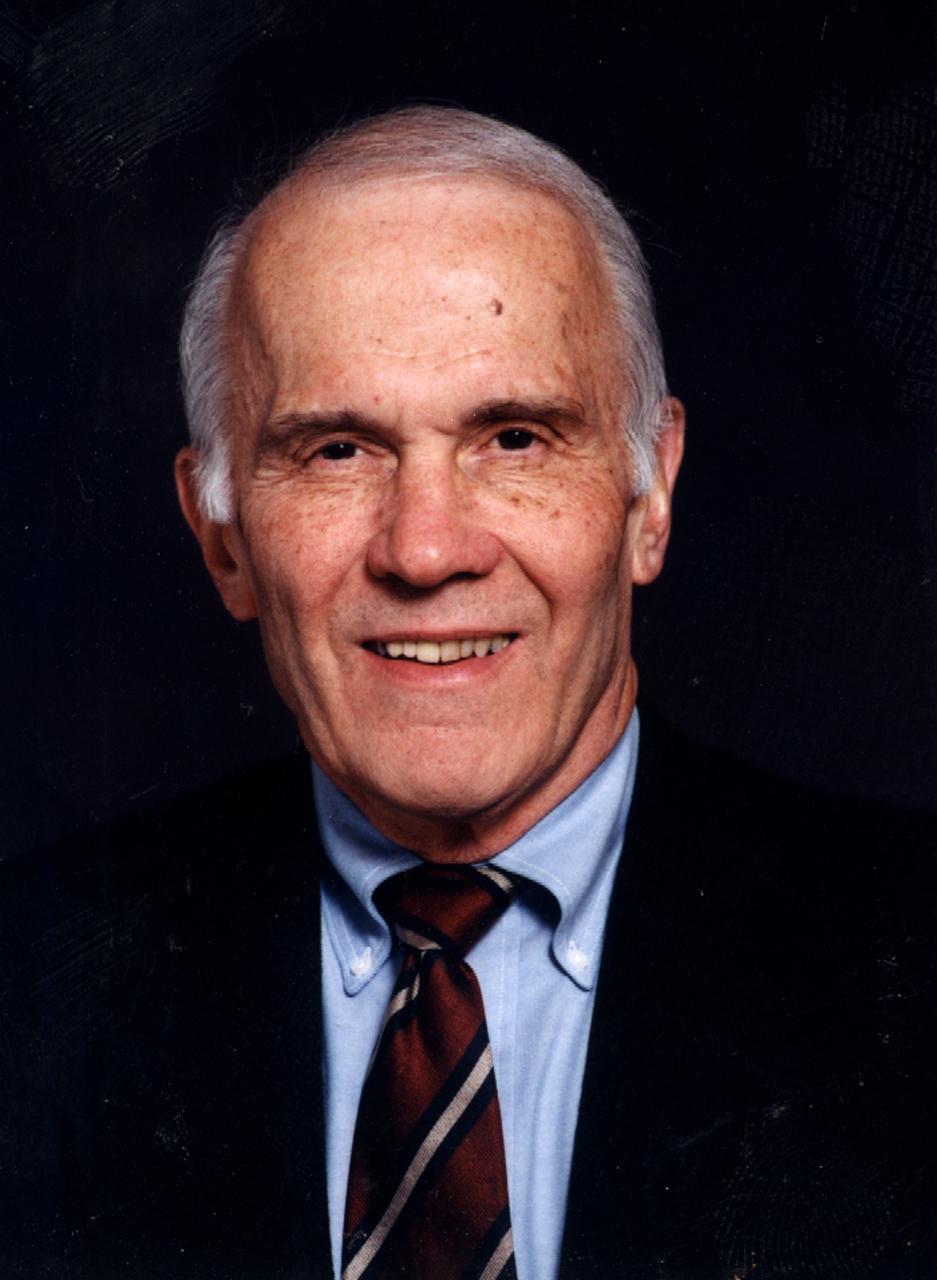
Gerard M. Faeth, University of Michigan, principal investigator in combustion science experiments, including Flow/Soot-Formation in Nonbuoyant Laminar Diffusion Flames, investigation of Laminar Jet Diffusion Flames in Microgravity: A Paradigm for Soot Processes in Turbulent Flames, and Soot Processes in Freely-Propagating Laminar Premixed Flames.
(PCG) Protein Crystal Growth Porcine Elastase. This enzyme is associated with the degradation of lung tissue in people suffering from emphysema. It is useful in studying causes of this disease. Principal Investigator on STS-26 was Charles Bugg.
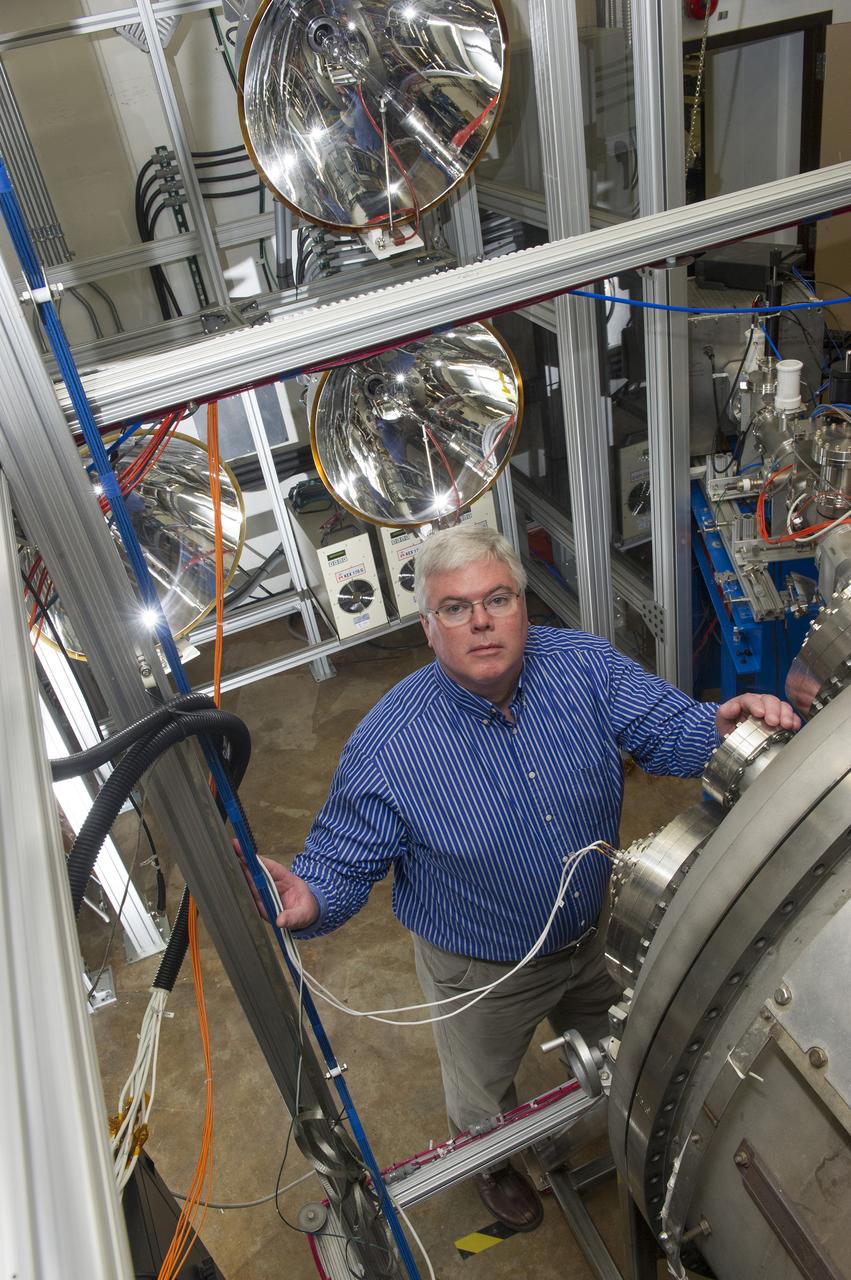
TODD SCHNEIDER LOOKS UP FROM WORK AT THE DOOR OF T HE HIGH INTENSITY SOLAR ENVIRONMENT TEST SYSTEM IN BUILDING 4605. SCHNEIDER IS A PHYSICIST IN THE MATERIALS AND PROCESSES DEPARTMENT AT MSFC AND IS PRINCIPAL INVESTIGATOR FOR HISET.

jsc2024e065170 (10/3/2024) --- The Nanolab Astrobeat Principal Investigator Dr. Leonardo Barilaro poses with the Nanoracks team in Houston, Texas. Image courtesy of Dr. Leonardo Barilaro, The Malta College of Arts, Science & Technology..
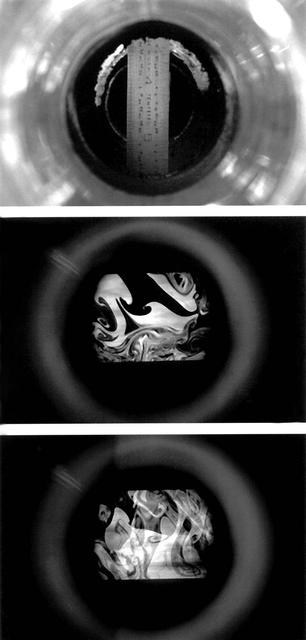
LII is a technique for measuring soot concentration. This image was taken with an ordinary 35-mm camera, these reveal soot distribution within the chimney. Principal Investigator: Dr. Randall L. Vander Wal
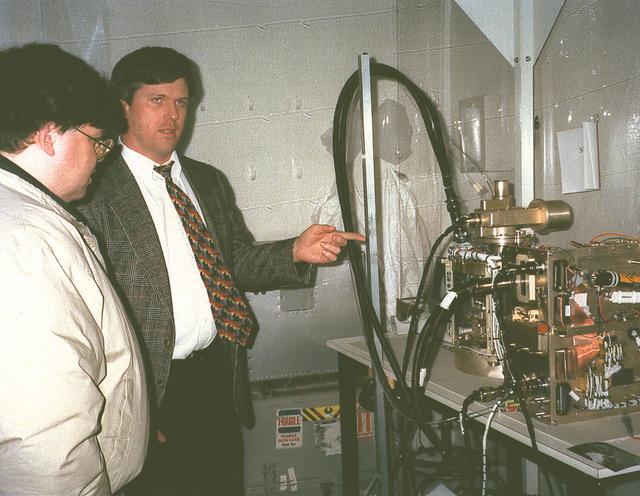
Joel Kearns viewing a laboratory demonstration of the Observable Protein Crystal Growth Apparatus (OPCGA) experiment module. Principal Investigator is Alexander McPherson. First flight plarned for ISS.
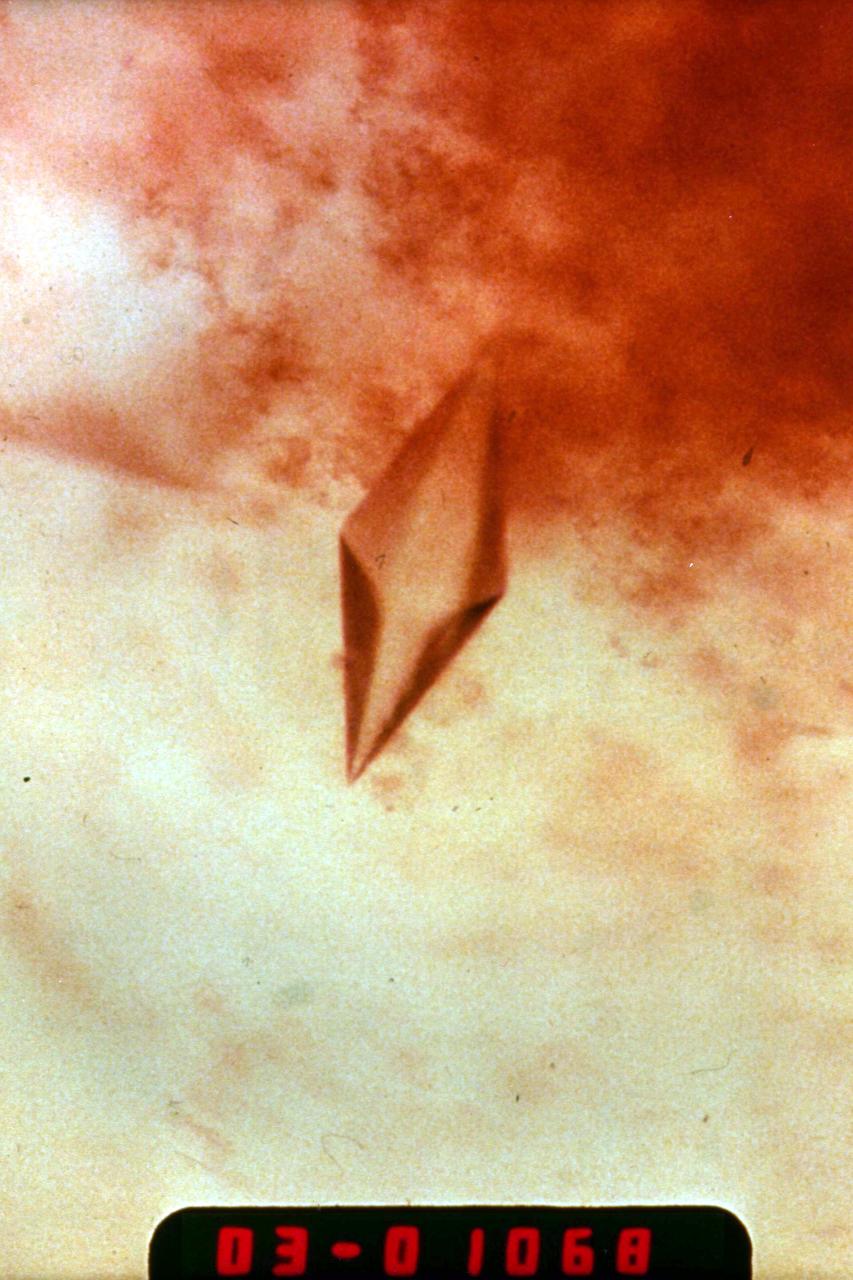
(PCG) Protein Crystal Growth Renin. Enzyme produced by the kidneys, plays a major role in the chemical reaction that controls blood pressure. Principal Investigator on STS-26 was Charles Bugg.
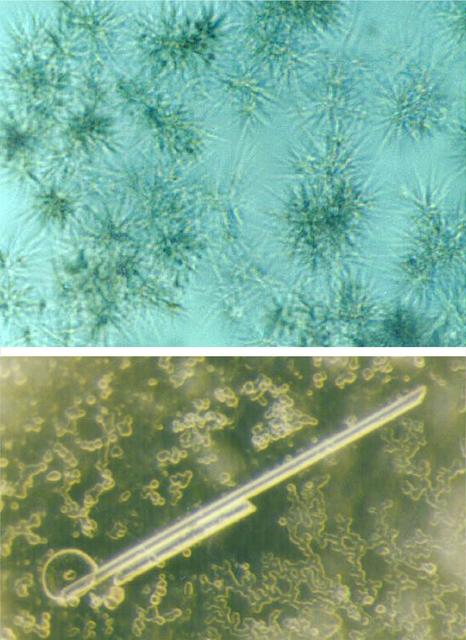
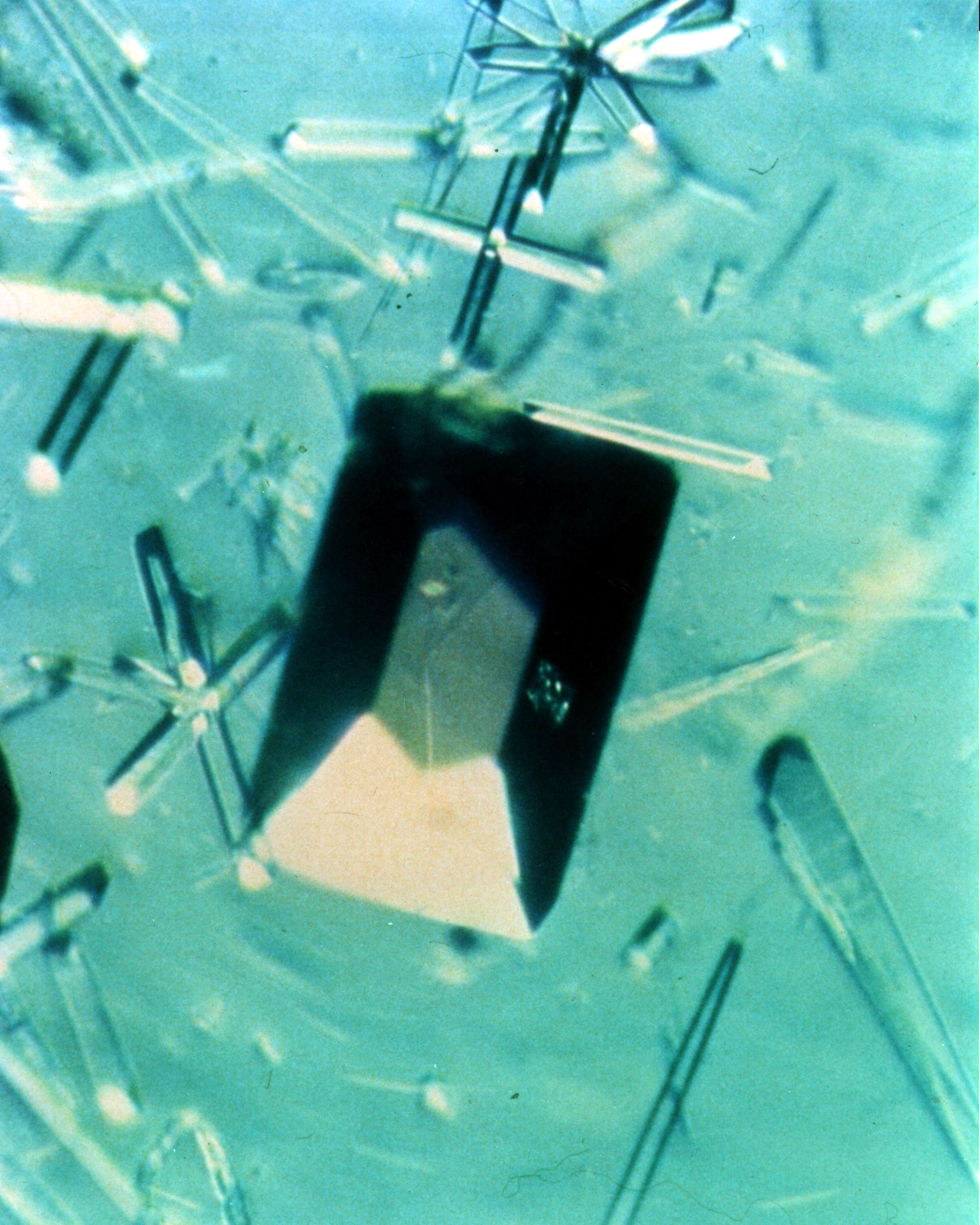
This image shows crystals of the protein raf kinase grown on Earth (photo a) and on USML-2 (photo b). The space-grown crystals are an order of magnitude larger. Principal Investigator: Dan Carter of New Century Pharmaceuticals
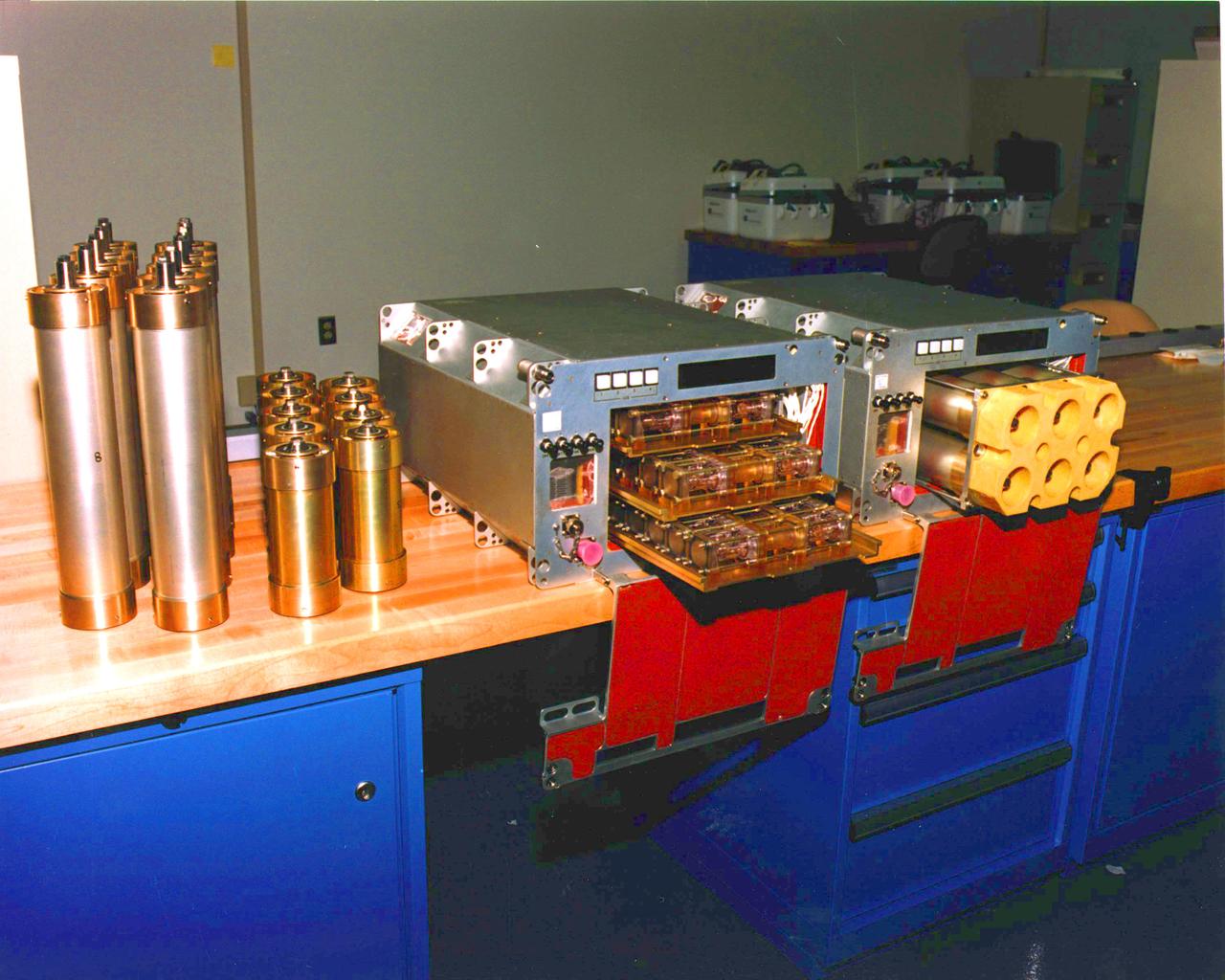
Two versions of (PCAM) Protein Crystallization Apparatus for Microgravity, (DCAM) Diffusion Controled Crystallization Apparatus is in the (STES) Single Locker Thermal Enclosure System. Principal Investigator was Dan Carter.
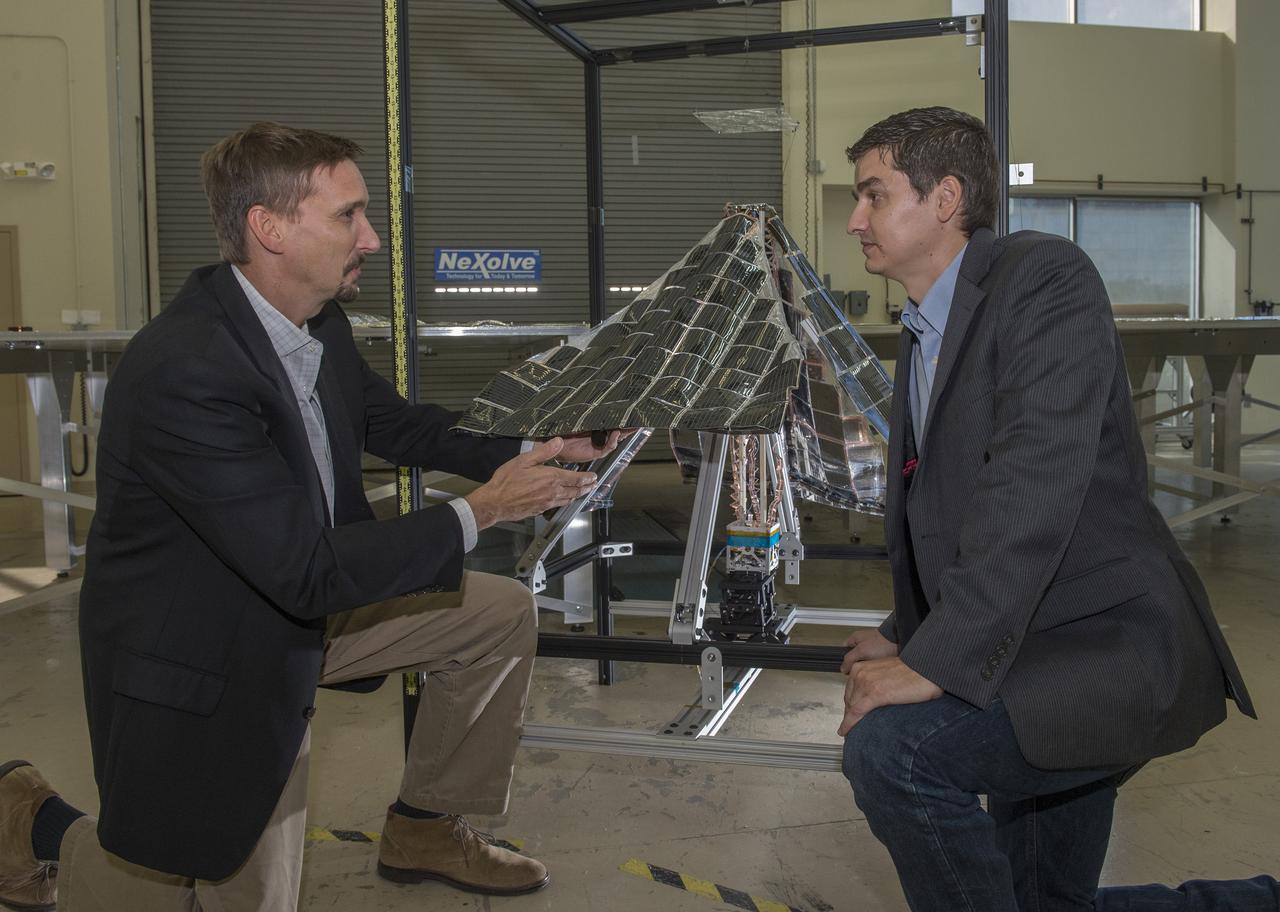
JOHN CARR, RIGHT, CO-PRINCIPAL INVESTIGATOR FOR NASA'S LIGHTWEIGHT INTEGRATED SOLAR ARRAY AND TRANSCEIVER PROJECT, TALKS WITH GREG LAUE, DIRECTOR OF AEROSPACE PRODUCTS FOR NEXOLVE, MANUFACTURER OF THE THIN-FILM TECHNOLOGY AND A PARTNER IN THE PROJECT.

jsc2023e010189 (12/13/2022) --- Lightcube Principal Investigator Jaime Sanchez de la Vega holds the CubeSat prior to integration into the deployer. Image courtesy of Jaime Sanchez de la Vega.

Dr. Forman Williams of the University of California, San Diego. He is principal investigator for Droplet Combustion Experiment (DCE/DCE-2) and High Pressure Combustion of Binary Fuel Sprays experiment.
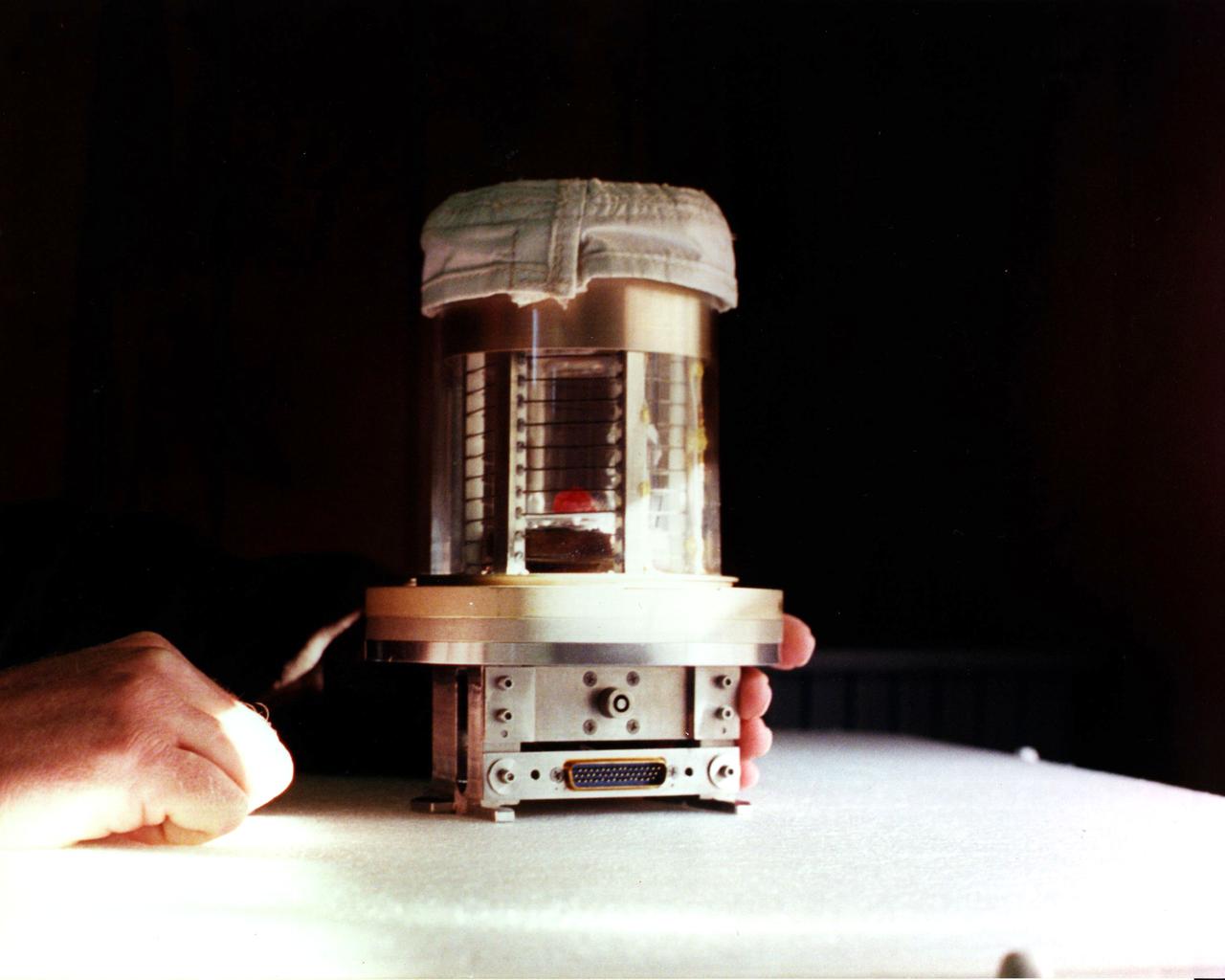
Overall view of the Vapor Crystal Growth System (VCGS) Furnace. Used on IML-1 International Microgravity Laboratory Spacelab 3. Principal Investigator and Payload Specialist was Lodewijk van den Berg.
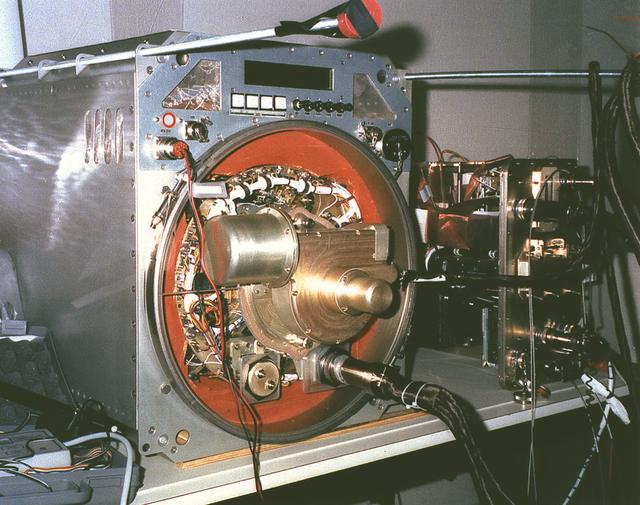
Front view of Observable Protein Crystal Growth Apparatus (OPCGA) experiment residing in a Thermal Enclosure System (TES). Principal Investigator is Alexander McPherson. First flight plarned for ISS.
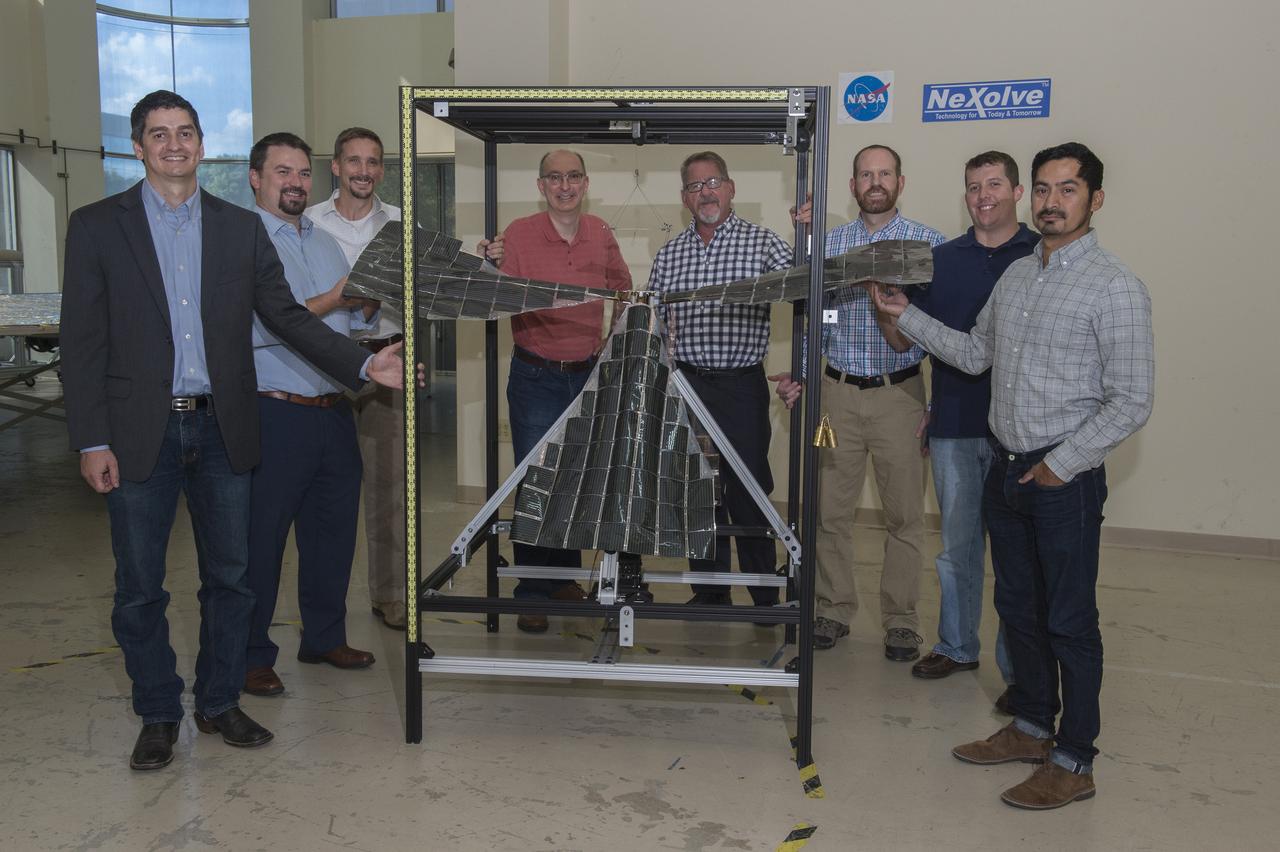
JOHN CARR, AT FAR LEFT, CO-PRINCIPAL INVESTIGATOR FOR NASA'S LIGHTWEIGHT INTEGRATED SOLAR ARRAY AND TRANSCEIVER PROJECT, POSES WITH THE LISA-T TEAM AFTER A DEMONSTRATION AND TESTING AT NEXOLVE
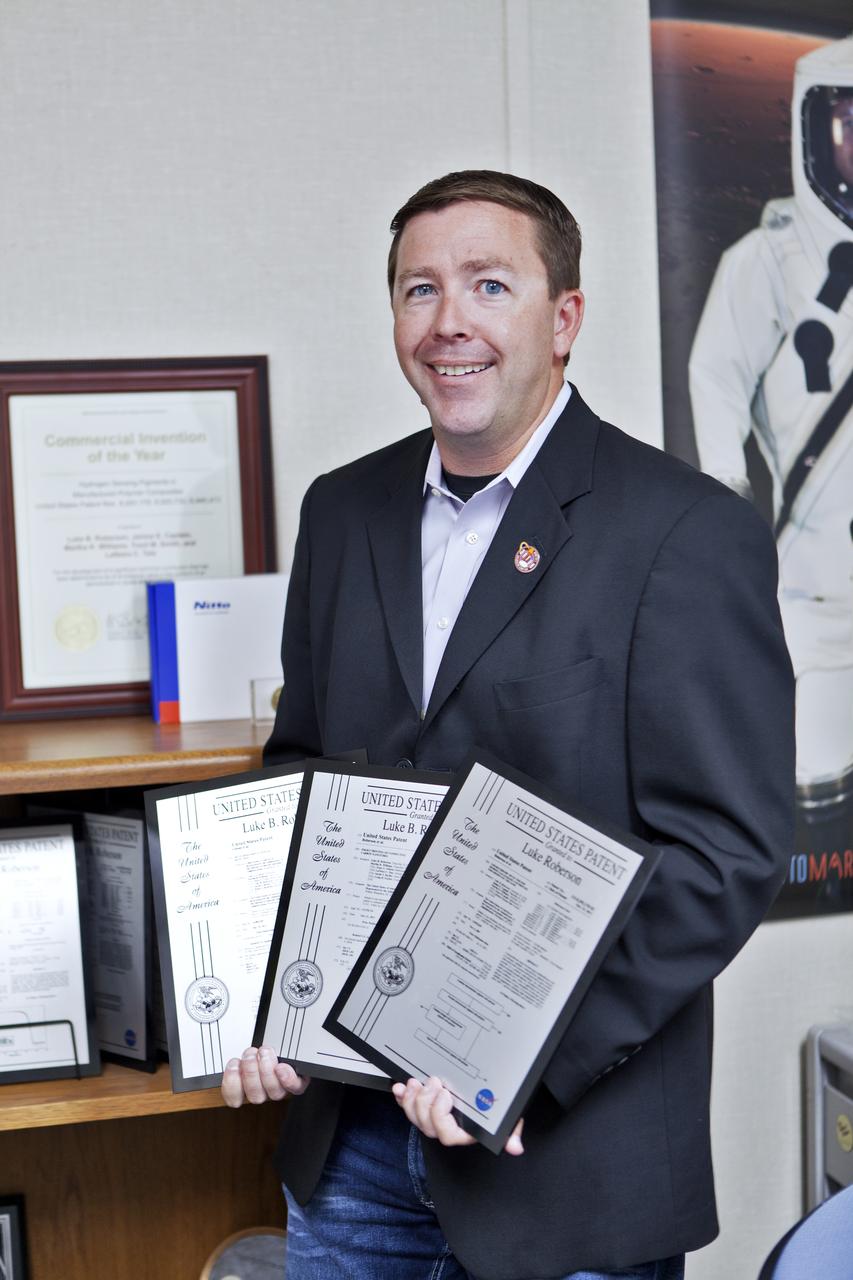
Luke Roberson, a principal investigator with the flight technology branch at NASA’s Kennedy Space Center in Florida, discusses patents and new technology reports for a video that targets internal audiences at NASA. Roberson’s contributions are reflected in multiple U.S. patents.
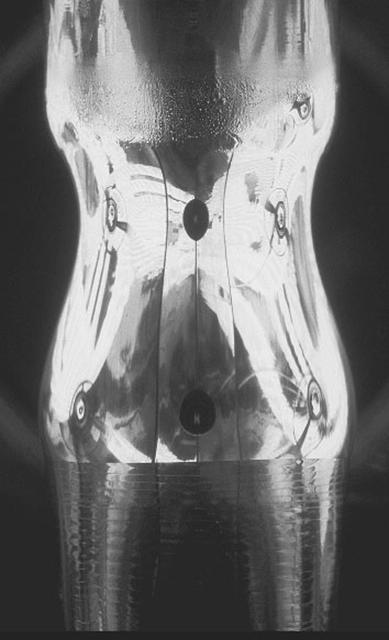
Crystal Growth in magnetic fields, a float-zone sample, the surface tension of the melt keeps the sample suspended between the sample rods in the furnace forming an actual liquid bridge. Principal Investigator: Dr. Frank Szofran
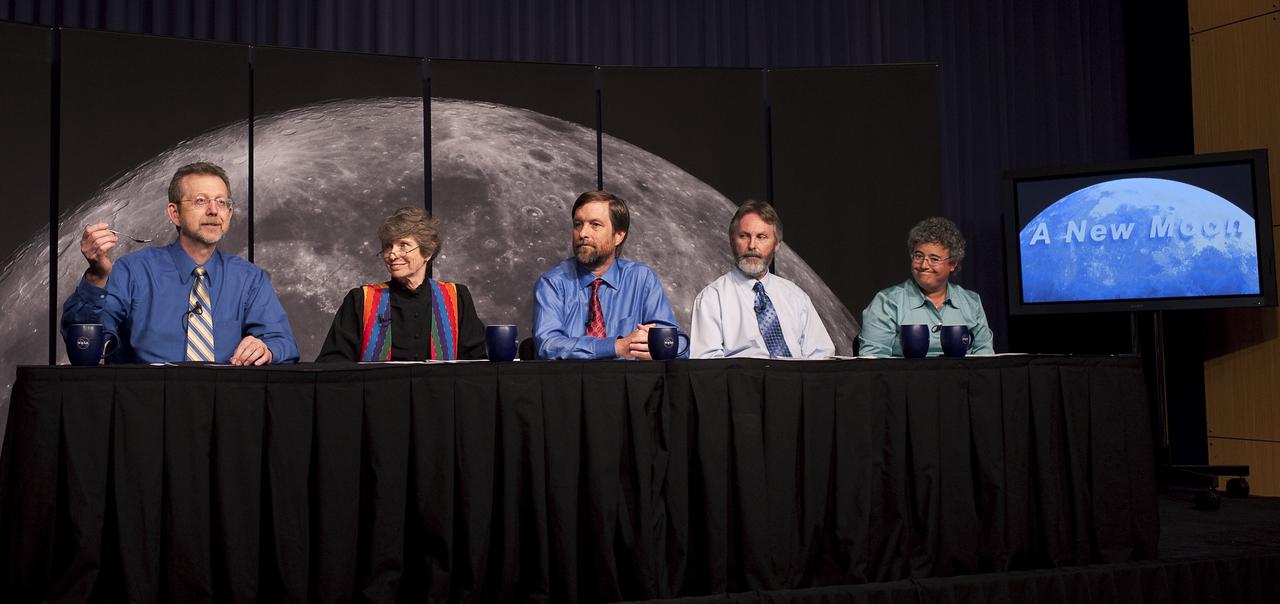
Jim Green (far left), director, Planetary Science Division, Science MissionDirectorate at NASA Headquarters in Washington; Carle Pieters, principal investigator, Moon Mineralogy Mapper, Brown University; Rob Green, project instrument scientist, Moon Mineralogy Mapper, at NASA's Jet Propulsion Laboratory; Roger Clark, team member, Cassini spacecraft Visual and Infrared Mapping Spectrometer and co-investigator, Moon Mineralogy Mapper, U.S. Geological Survey in Denver and Jessica Sunshine (far right), deputy principal investigator for NASA's Deep Impactextended mission and co-investigator for Moon Mineralogy Mapper,Department of Astronomy, University of Maryland discuss their findings of water molecules in the polar regions of the moon at a press conference at NASA Headquarters, September 24, 2009, in Washington. Photo Credit: (NASA/Carla Cioffi)
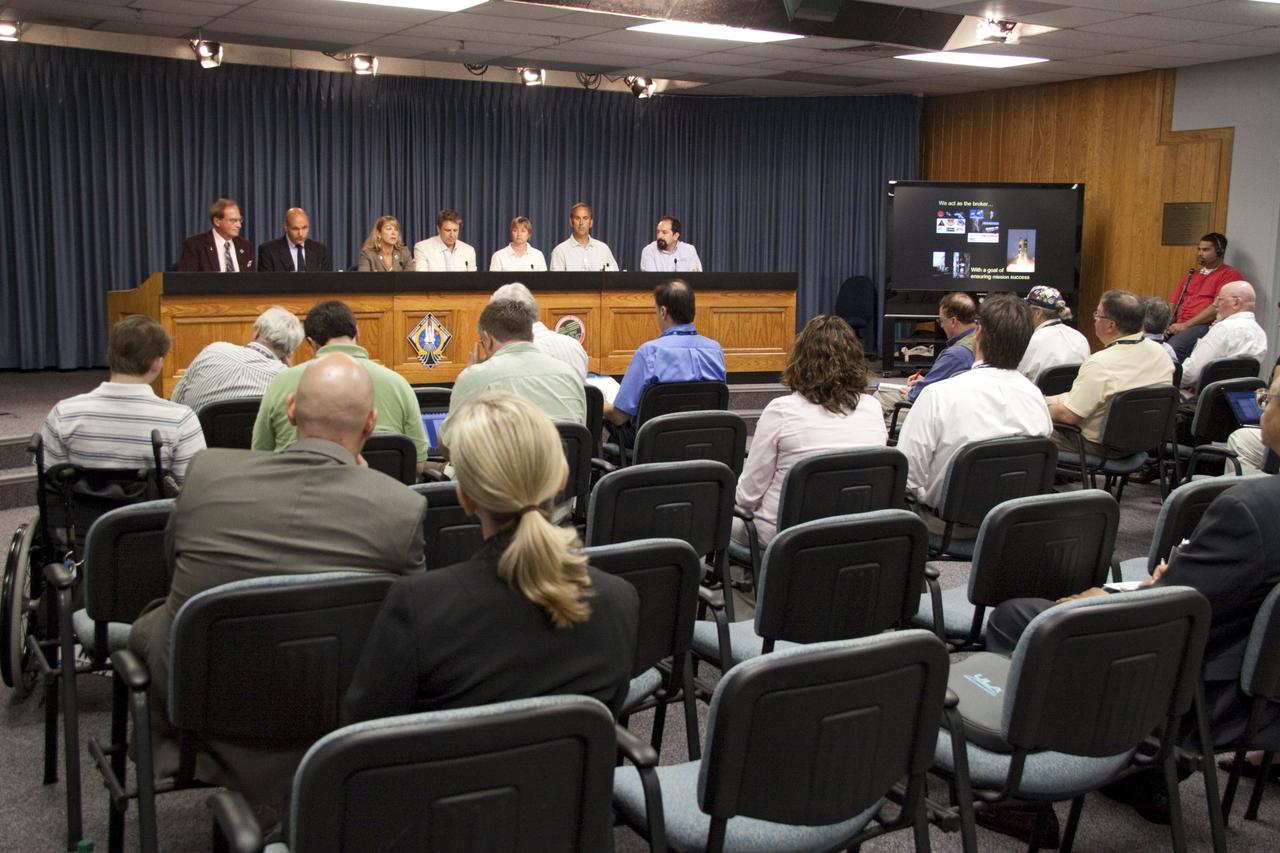
CAPE CANAVERAL, Fla. -- In the Press Site auditorium at NASA's Kennedy Space Center in Florida, media were briefed about NASA's future science missions. Seen here are NASA Public Affairs Officer George Diller (left); Waleed Abdalati, NASA chief scientist; Amanda Mitskevich, NASA Launch Services Program manager; Scott Bolton, Juno principal investigator with the Southwest Research Institute, San Antonio; Maria Zuber, GRAIL principal investigator with the Massachusetts Institute of Technology; John Grotzinger, Mars Science Lab project scientist with the California Institute of Technology and Daniel Stern, NuStar project scientist with NASA's Jet Propulsion Laboratory in Calif. Photo credit: NASA/Jack Pfaller
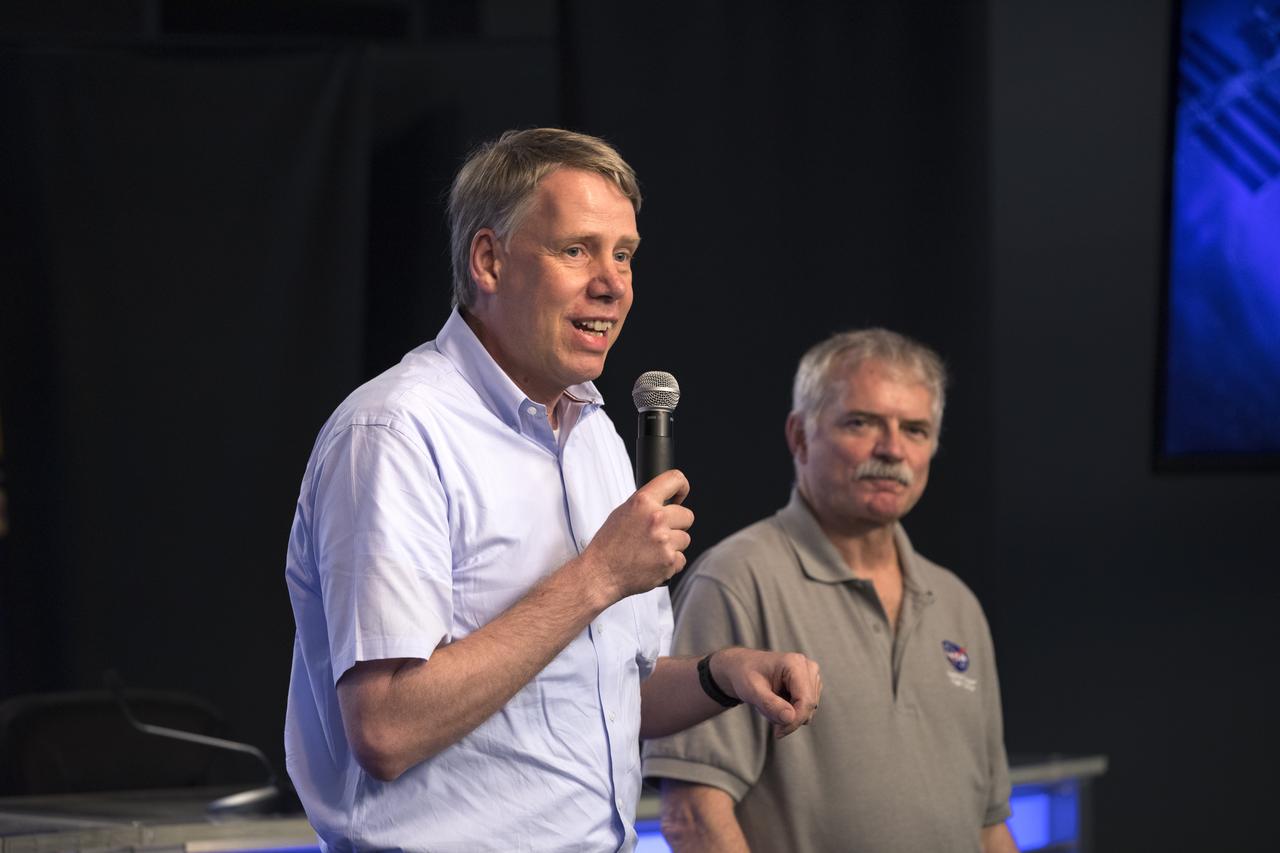
Oliver Steinbock, left, principal investigator, Florida State University, and Richard Grugel, principal investigator, NASA’s Marshall Spaceflight Center, speak to members of the media during a briefing in the Kennedy Space Center’s Press Site auditorium. The briefing focused on research planned for launch to the International Space Station. The scientific materials and supplies will be aboard a SpaceX Dragon spacecraft scheduled for liftoff from Cape Canaveral Air Force Station's Space Launch Complex 40. The SpaceX Falcon 9 rocket will launch the company's 15th Commercial Resupply Services mission to the space station.
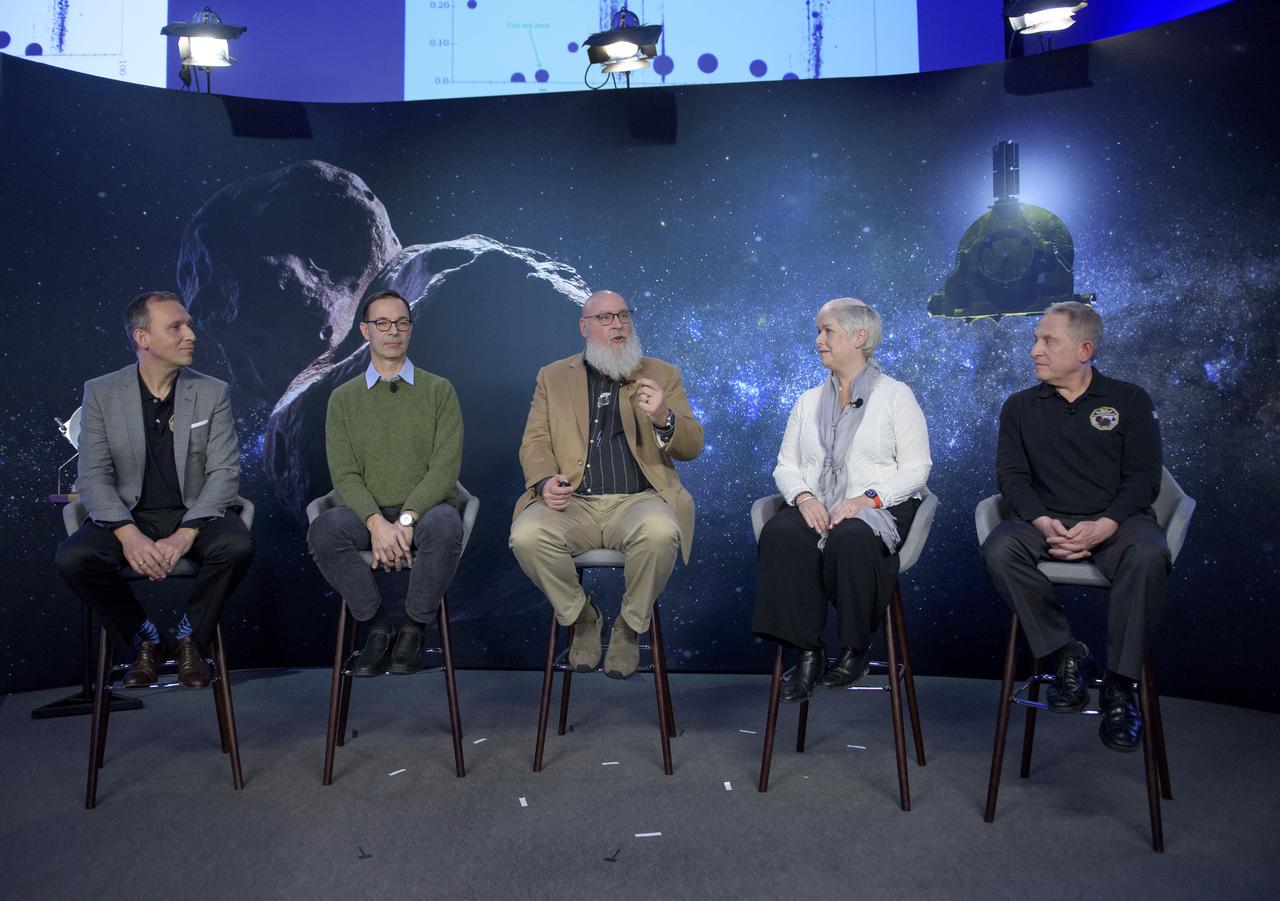
Associate Administrator for NASA's Science Mission Directorate Thomas Zurbuchen, left, Olivier Barnouin (US Instrument Scientist, Johns Hopkins University/APL), Harold "Hal" Levison from the Southwest Research Institute in Boulder, Colorado, Lindy Elkins-Tanton Principal Investigator of the Psyche mission from Arizona State University, and New Horizons principal investigator Alan Stern of the Southwest Research Institute (SwRI), Boulder, CO, right, are seen during a briefing discussing small bodies missions, Monday, Dec. 31, 2018 at Johns Hopkins University Applied Physics Laboratory (APL) in Laurel, Maryland. Photo Credit: (NASA/Bill Ingalls)
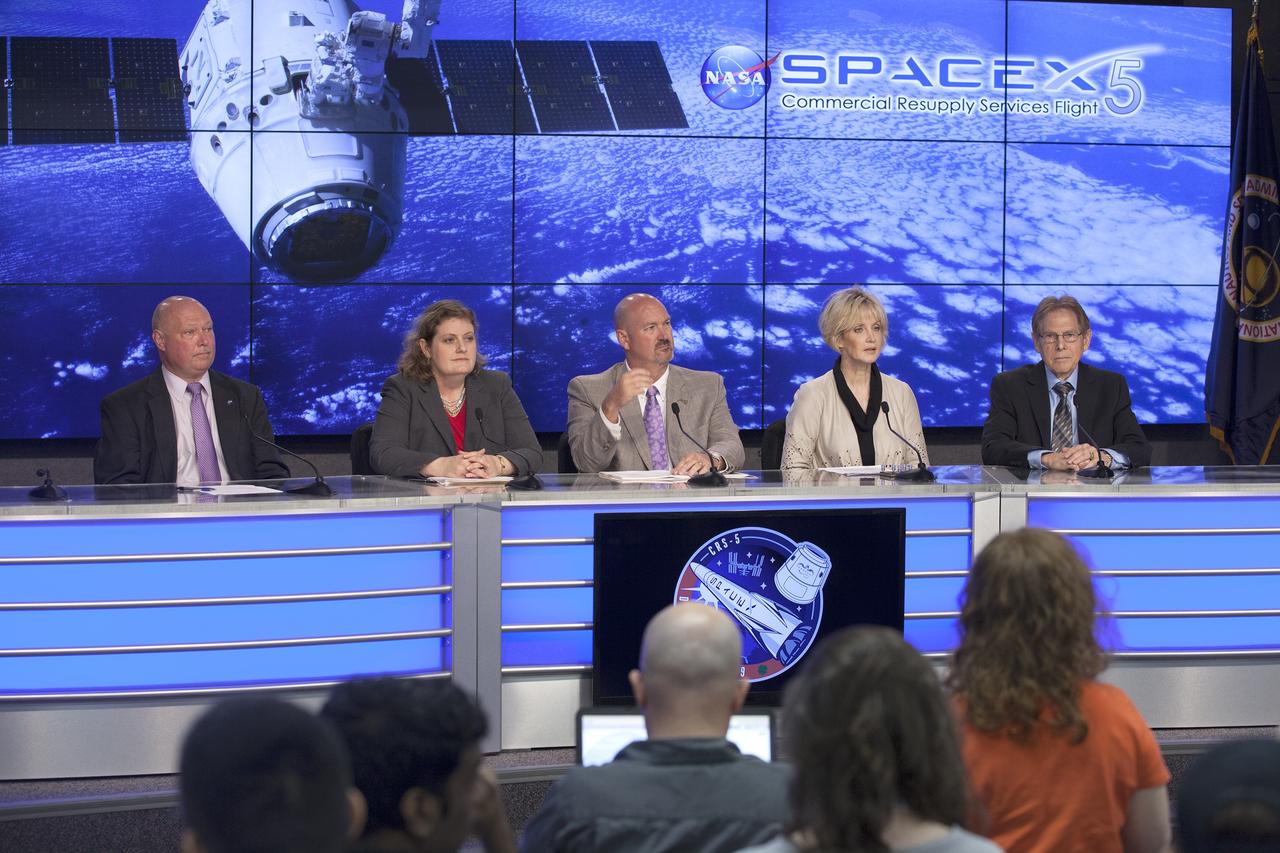
CAPE CANAVERAL, Fla. -- In the Kennedy Space Center’s Press Site auditorium, agency and industry leaders spoke to members of the news media on International Space Station research and technology developments. From left are: Mike Curie of NASA Public Affairs, Julie Robinson, ISS Program chief scientist at NASA’s Johnson Space Center, Kenneth Shields, director of operations and education for the Center for the Advancement of Science in Space, Cheryl Nickerson of Arizona State University, and principal investigator for the Micro-5 experiment, and Samuel Durrance of the Florida Institute of Technology, principal investigator for the NR-SABOL experiment. Photo credit: NASA/ Kim Shiflett
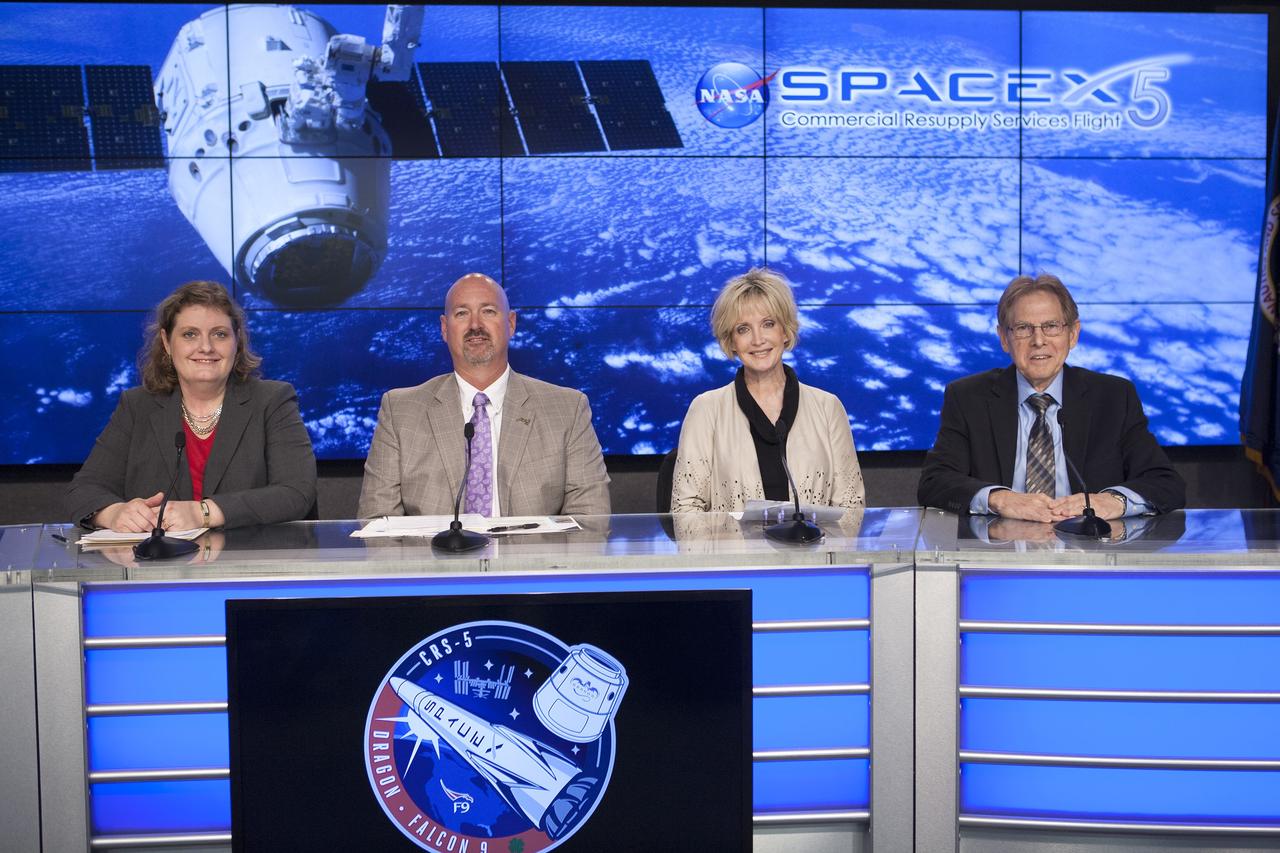
CAPE CANAVERAL, Fla. – In the Kennedy Space Center’s Press Site auditorium, agency and industry leaders spoke to members of the news media on International Space Station research and technology developments. From left are: Julie Robinson, ISS Program chief scientist at NASA’s Johnson Space Center, Kenneth Shields, director of operations and education for the Center for the Advancement of Science in Space, Cheryl Nickerson of Arizona State University, and principal investigator for the Micro-5 experiment, and Samuel Durrance of the Florida Institute of Technology, principal investigator for the NR-SABOL experiment. Photo credit: NASA/ Kim Shiflett
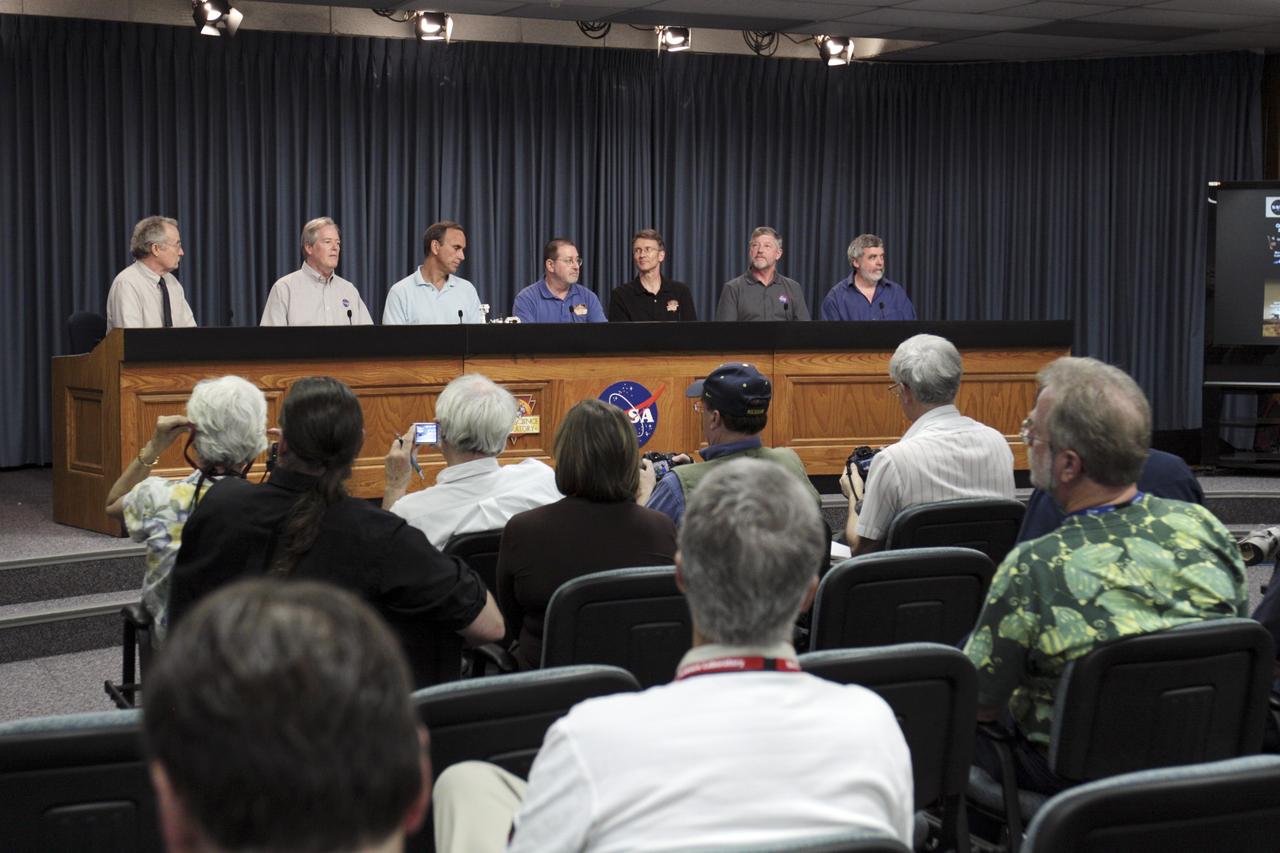
CAPE CANAVERAL, Fla. – NASA’s Kennedy Space Center in Florida is host to a Mars Science Laboratory (MSL) science briefing as part of preflight activities for the MSL mission. From left, NASA Public Affairs Officer Guy Webster moderates the conference featuring Michael Meyer, lead scientist for NASA Mars Exploration Program; John Grotzinger, project scientist for Mars Science Laboratory California Institute of Technology, Pasadena, Calif.; Michael Malin, principal investigator for the Mast Camera and Mars Descent Imager investigations on Curiosity, Malin Space Science Systems; Roger Wiens, principal investigator for Chemistry and Camera investigation on Curiosity, Los Alamos National Laboratory; David Blake, NASA principal investigator for Chemistry and Mineralogy investigation on Curiosity, NASA Ames Research Center; and Paul Mahaffy, NASA principal investigator for Sample Analysis at Mars investigation on Curiosity, NASA Goddard Space Flight Center. MSL’s components include a car-sized rover, Curiosity, which has 10 science instruments designed to search for signs of life, including methane, and help determine if the gas is from a biological or geological source. Launch of MSL aboard a United Launch Alliance Atlas V rocket is scheduled for Nov. 26 from Space Launch Complex 41 on Cape Canaveral Air Force Station in Florida. For more information, visit http://www.nasa.gov/msl. Photo credit: NASA/Kim Shiflett
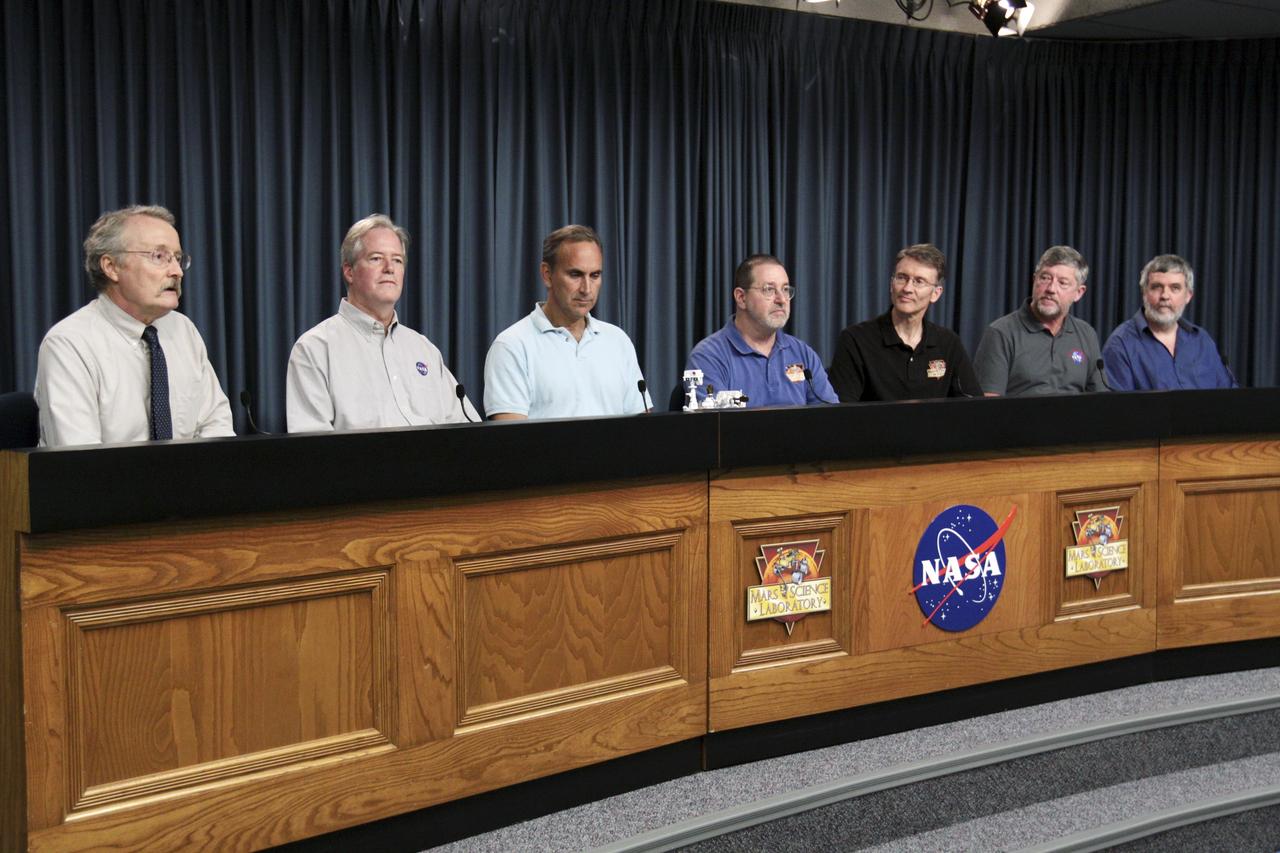
CAPE CANAVERAL, Fla. – NASA’s Kennedy Space Center in Florida is host to a Mars Science Laboratory (MSL) science briefing as part of preflight activities for the MSL mission. From left, NASA Public Affairs Officer Guy Webster moderates the conference featuring Michael Meyer, lead scientist for NASA Mars Exploration Program; John Grotzinger, project scientist for Mars Science Laboratory California Institute of Technology, Pasadena, Calif.; Michael Malin, principal investigator for the Mast Camera and Mars Descent Imager investigations on Curiosity, Malin Space Science Systems; Roger Wiens, principal investigator for Chemistry and Camera investigation on Curiosity, Los Alamos National Laboratory; David Blake, NASA principal investigator for Chemistry and Mineralogy investigation on Curiosity, NASA Ames Research Center; and Paul Mahaffy, NASA principal investigator for Sample Analysis at Mars investigation on Curiosity, NASA Goddard Space Flight Center. MSL’s components include a car-sized rover, Curiosity, which has 10 science instruments designed to search for signs of life, including methane, and help determine if the gas is from a biological or geological source. Launch of MSL aboard a United Launch Alliance Atlas V rocket is scheduled for Nov. 26 from Space Launch Complex 41 on Cape Canaveral Air Force Station in Florida. For more information, visit http://www.nasa.gov/msl. Photo credit: NASA/Kim Shiflett
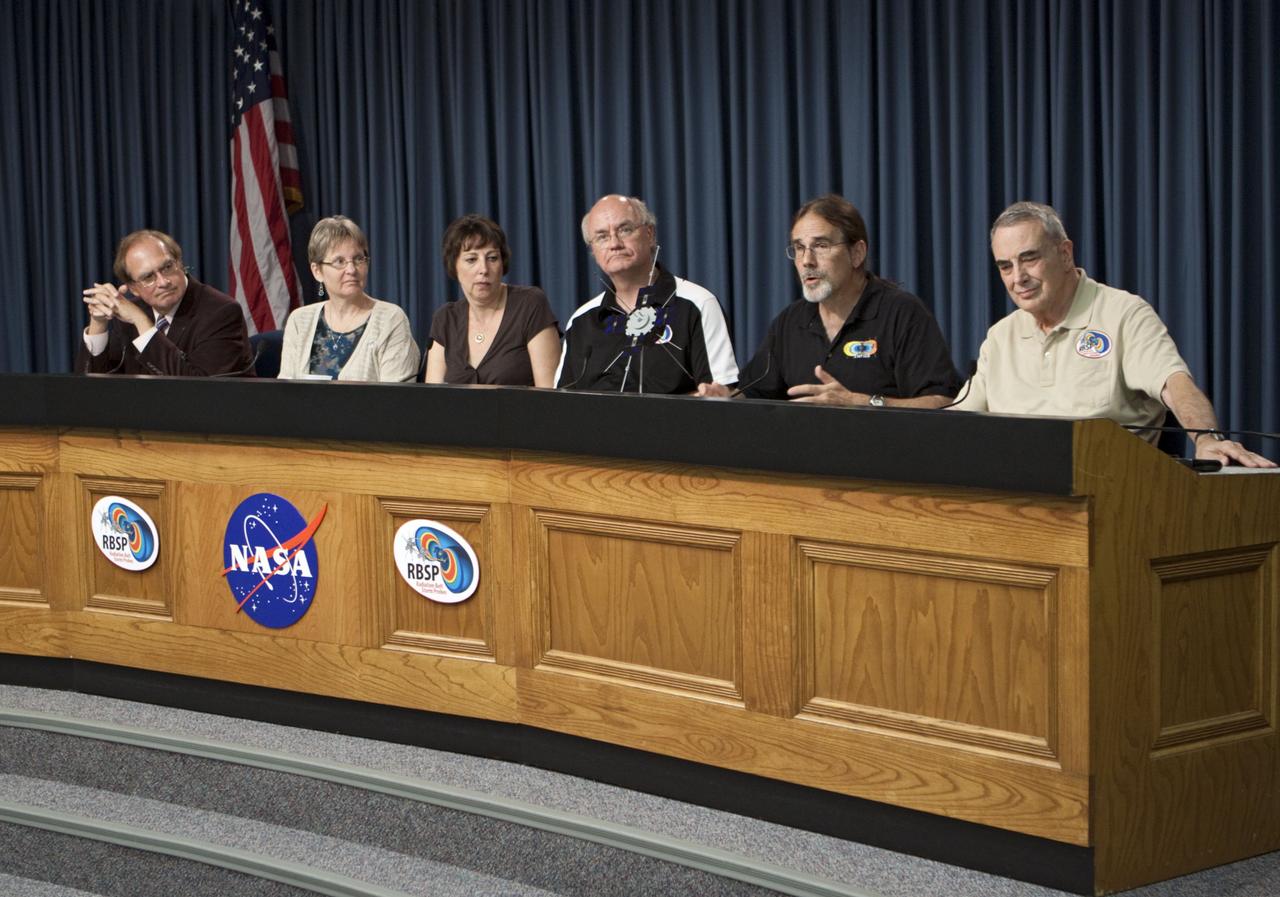
CAPE CANAVERAL, Fla. - A mission science briefing was held at NASA Kennedy Space Center’s Press Site in Florida for the Radiation Belt Storm Probes, or RBSP, mission. From left, are George Diller, public affairs specialist and news conference moderator, Mona Kessel, RBSP program scientist from NASA Headquarters in Washington, Nicola Fox, RBSP deputy project scientist at Johns Hopkins Applied Physics Laboratory in Laurel, Md., Craig Kletzing, principal investigator from the University of Iowa, Harlan Spence, principal investigator from the University of New Hampshire, and Lou Lanzerotti, principal investigator from the New Jersey Institute of Technology. NASA’s RBSP mission will help us understand the sun’s influence on Earth and near-Earth space by studying the Earth’s radiation belts on various scales of space and time. RBSP will begin its mission of exploration of Earth’s Van Allen radiation belts and the extremes of space weather after its launch aboard an Atlas V rocket. Launch is targeted for Aug. 24. For more information, visit http://www.nasa.gov/rbsp. Photo credit: NASA/Glenn Benson
CAPE CANAVERAL, Fla. - A mission science briefing was held at NASA Kennedy Space Center’s Press Site in Florida for the Radiation Belt Storm Probes, or RBSP, mission. From left, are George Diller, public affairs specialist and news conference moderator, Mona Kessel, RBSP program scientist from NASA Headquarters in Washington, Nicola Fox, RBSP deputy project scientist at Johns Hopkins Applied Physics Laboratory in Laurel, Md., Craig Kletzing, principal investigator from the University of Iowa, Harlan Spence, principal investigator from the University of New Hampshire, and Lou Lanzerotti, principal investigator from the New Jersey Institute of Technology. NASA’s RBSP mission will help us understand the sun’s influence on Earth and near-Earth space by studying the Earth’s radiation belts on various scales of space and time. RBSP will begin its mission of exploration of Earth’s Van Allen radiation belts and the extremes of space weather after its launch aboard an Atlas V rocket. Launch is targeted for Aug. 24. For more information, visit http://www.nasa.gov/rbsp. Photo credit: NASA/Glenn Benson
CAPE CANAVERAL, Fla. - A mission science briefing was held at NASA Kennedy Space Center’s Press Site in Florida for the Radiation Belt Storm Probes, or RBSP, mission. From left, are George Diller, public affairs specialist and news conference moderator, Mona Kessel, RBSP program scientist from NASA Headquarters in Washington, Nicola Fox, RBSP deputy project scientist at Johns Hopkins Applied Physics Laboratory in Laurel, Md., Craig Kletzing, principal investigator from the University of Iowa, Harlan Spence, principal investigator from the University of New Hampshire, and Lou Lanzerotti, principal investigator from the New Jersey Institute of Technology. NASA’s RBSP mission will help us understand the sun’s influence on Earth and near-Earth space by studying the Earth’s radiation belts on various scales of space and time. RBSP will begin its mission of exploration of Earth’s Van Allen radiation belts and the extremes of space weather after its launch aboard an Atlas V rocket. Launch is targeted for Aug. 24. For more information, visit http://www.nasa.gov/rbsp. Photo credit: NASA/Glenn Benson
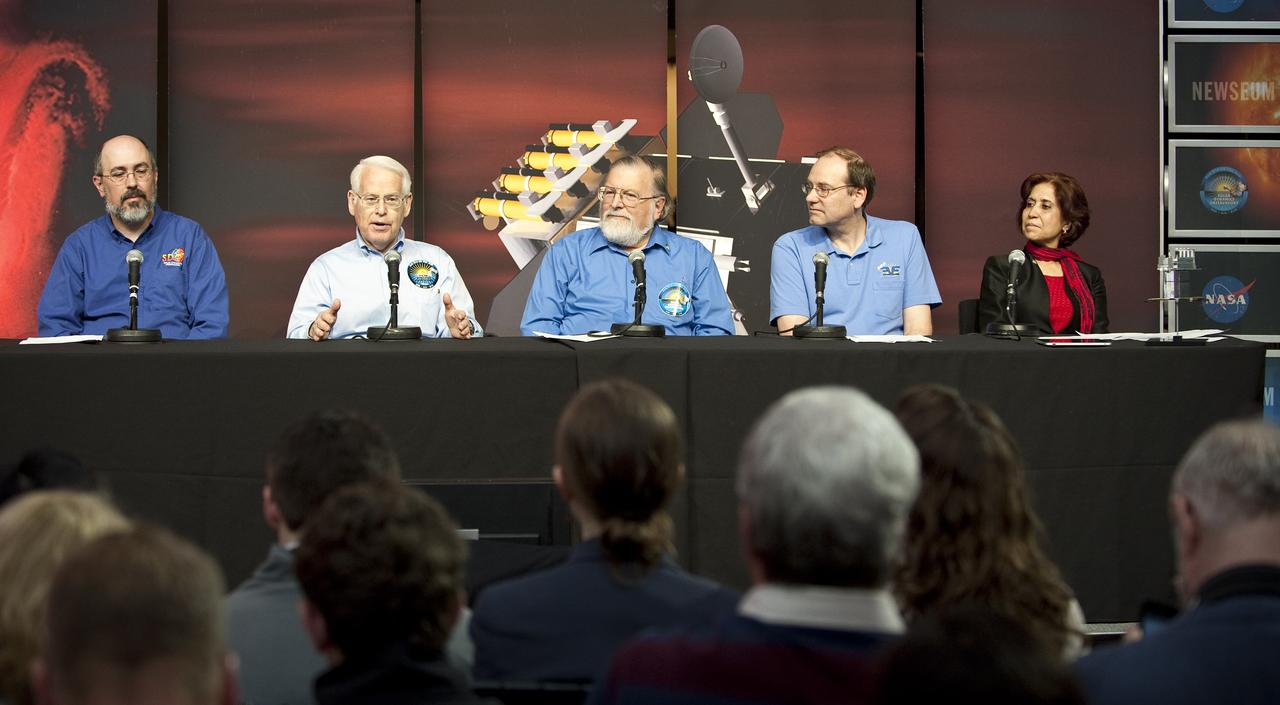
Alan Title, second from left, principal investigator, Atmospheric Imaging Assembly instrument, Lockheed Martin Solar and Astrophysics Laboratory in Palo Alto, speaks during a briefing to discuss recent images from NASA's Solar Dynamics Observatory, or SDO, Wednesday, April 21, 2010, at the Newseum in Washington. Launched on Feb. 11, 2010, SDO is the most advanced spacecraft ever designed to study the sun. During its five-year mission, it will examine the sun's magnetic field and also provide a better understanding of the role the sun plays in Earth's atmospheric chemistry and climate. Pictured from left to right: Dean Pesnell, SDO project scientist, Goddard Space Flight Center in Greenbelt, Md., Alan Title, Philip H. Scherrer, principal investigator, Helioseismic and Magnetic Imager instrument, Stanford University in Palo Alto, Tom Woods, principal investigator, Extreme Ultraviolet Variability Experiment instrument, Laboratory for Atmospheric and Space Physics, University of Colorado in Boulder and Madhulika Guhathakurta, SDO program scientist, NASA Headquarters in Washington. Photo Credit: (NASA/Carla Cioffi)
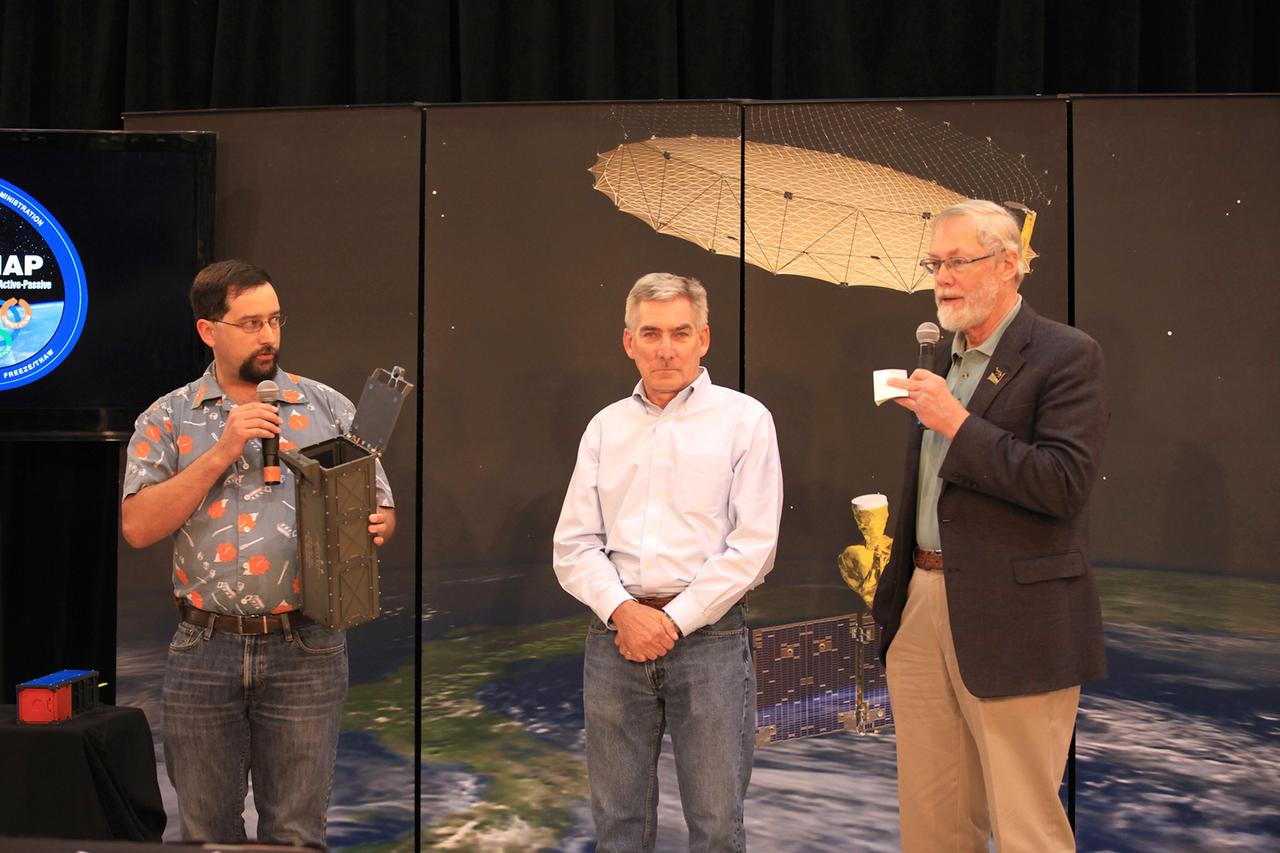
VANDENBERG AIR FORCE BASE, Calif. – From left, John Bellardo, co-principal investigator Cubesat at California Polytechnic, San Luis Obispo, David Rider, GRIFEX principal investigator at Jet Propulsion Laboratory, Pasadena, California, and Dave Klumpar, Firebird-II principal investigator and director of the Space Science and Engineering Laboratory at Montana State University in Bozeman, Montana, discuss three Educational Launch of Nanosatellites ELaNa CubeSat that are being flown as auxiliary payloads on NASA's Soil Moisture Active Passive mission, or SMAP, with the audience of a NASA Social held for at Vandenberg Air Force Base in California. This NASA Social brought together mission scientists and engineers with an audience of 70 students, educators, social media managers, bloggers, photographers and videographers who were selected from a pool of 325 applicants from 45 countries to participate in launch activities and communicate their experience with social media followers. The SMAP mission is scheduled to launch from Vandenberg on Jan. 29. To learn more about SMAP, visit http://www.nasa.gov/smap. Photo credit: NASA/Kim Shiflett
Test cells comprise specimen sand contained in a latex membrane (with a grid pattern for CCD cameras) between metal end plates and housed in a water-filled Lexan jacket. Experiment flown on STS-79 and STS-89. Principal Investigator: Dr. Stein Sture.

Kennedy Space Center’s Luke Roberson, a principal investigator with the flight technology branch, has received several patents from the United States Patent and Trademark Office. Certificates recognizing those patents are on display in his office at the Florida spaceport’s Space Station Processing Facility.
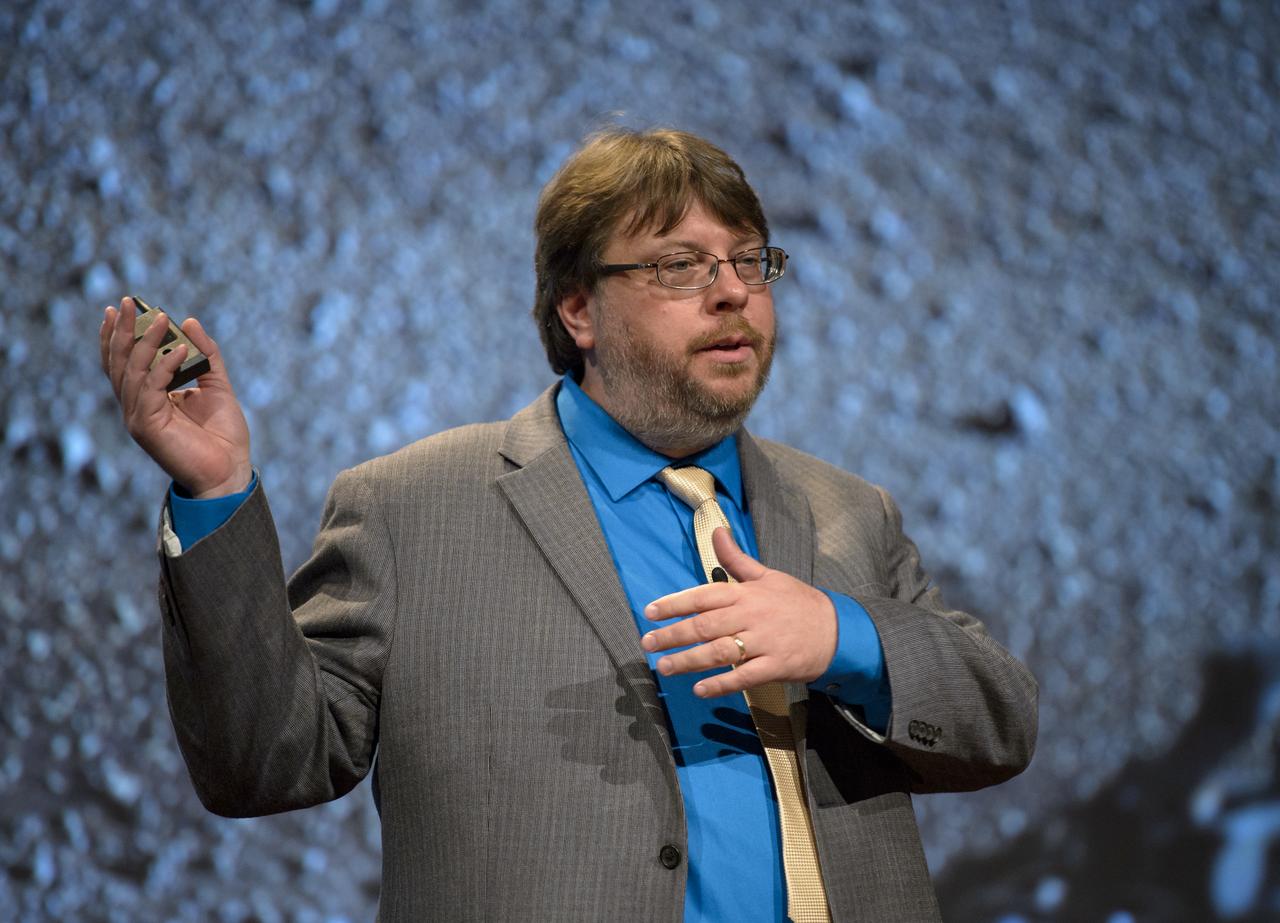
Ken Edgett, principal investigator, MAHLI Camera, Mars Exploration Program, discusses what we’ve learned from Curiosity and the other Mars rovers during a “Mars Up Close” panel discussion, Tuesday, August 5, 2014, at the National Geographic Society headquarters in Washington. Photo Credit: (NASA/Bill Ingalls)
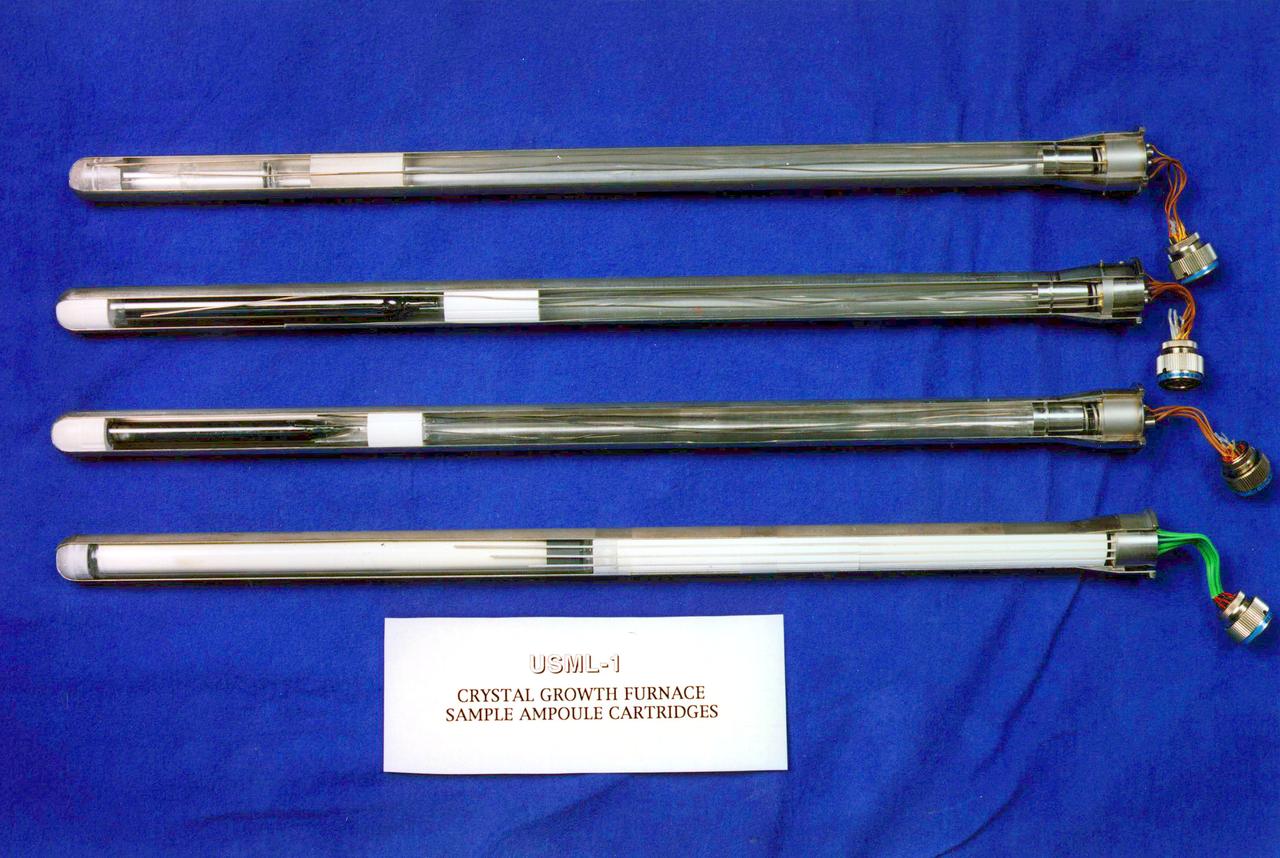
Crystal Growth Furnace (CGF) without the EAC internal support structure. Flown on USML-1 and USML-2. The Principal Investigators on these flights were: Larson, Lehoczky, Matthiesen, Wiedemeier. Processed 6 samples on USML-1 and 7 samples on USML-2.

CAPE CANAVERAL, Fla. -- In the Kennedy Space Center’s Press Site auditorium, agency and industry leaders spoke to members of the news media on International Space Station research and technology developments. Participants included Samuel Durrance of the Florida Institute of Technology, principal investigator for the NR-SABOL experiment. Photo credit: NASA/ Kim Shiflett

CAPE CANAVERAL, Fla. -- In the Kennedy Space Center’s Press Site auditorium, agency and industry leaders spoke to members of the news media on International Space Station research and technology developments. Participants included Cheryl Nickerson of Arizona State University, and principal investigator for the Micro-5 experiment. Photo credit: NASA/ Kim Shiflett

August Witt, Massachusetts Institute of Technology, principal investigator for the research program designed to lead to the identification and control of gravitational effects which adversely impact, through their interference with the growth process, the achievement of critical application specific properties in opto-electronic materials.
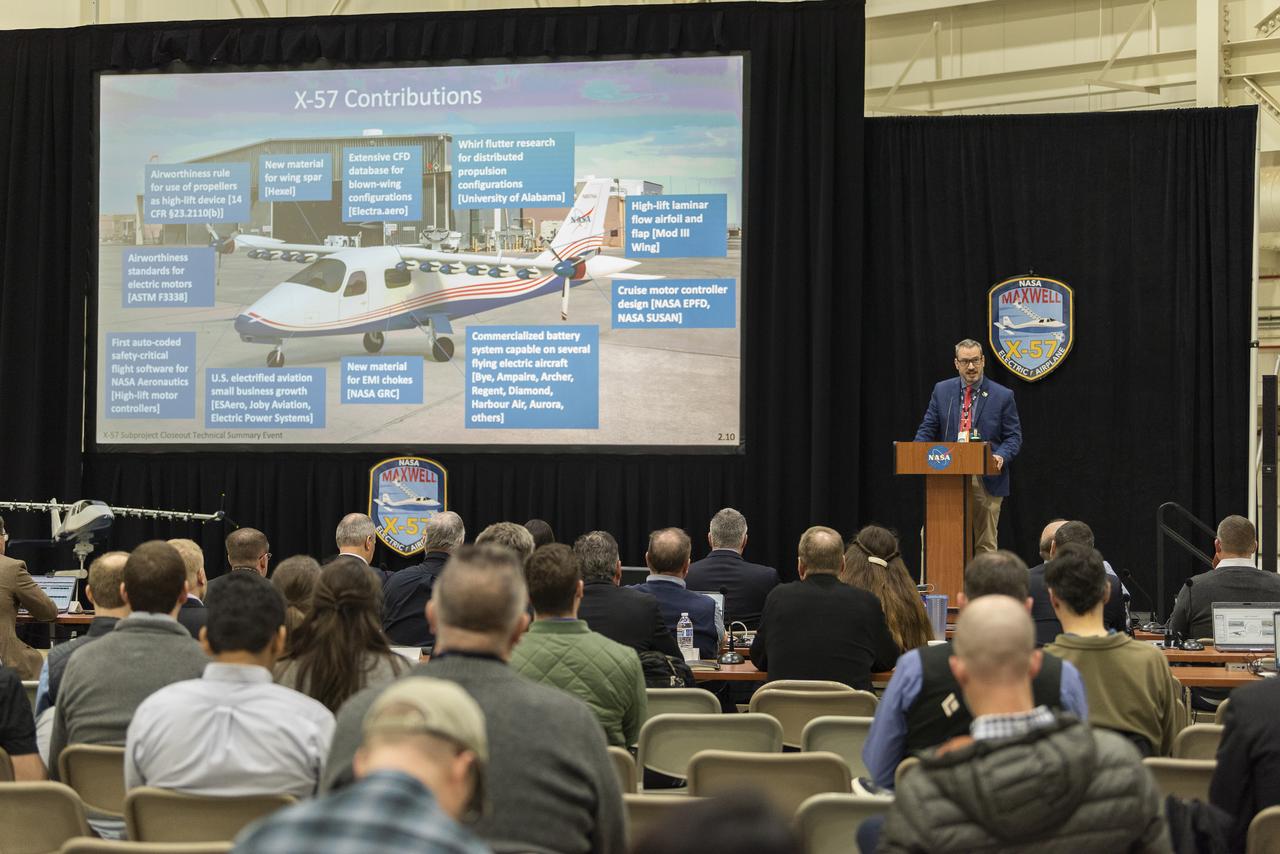
X-57 Maxwell principal investigator, Sean Clarke, talks about the innovative contributions the X-57 research team made to the electric propulsion community during a knowledge sharing event at NASA’s Armstrong Flight Research Center in Edwards, California.
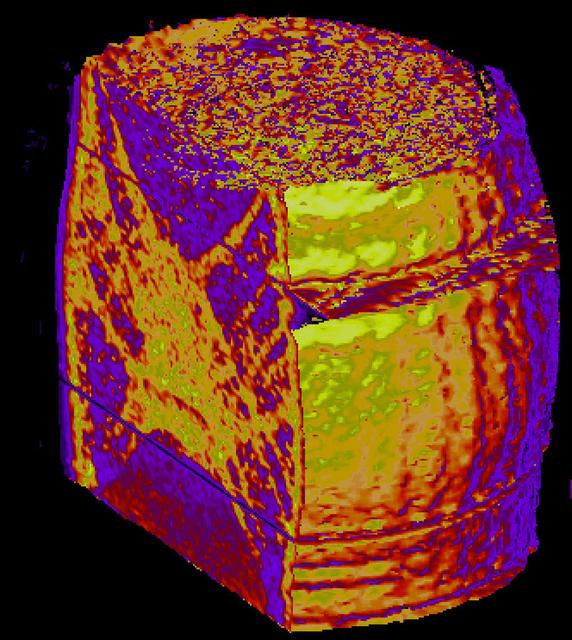
Computed tomography (CT) images of resin-impregnated Mechanics of Granular Materials (MGM) specimens are assembled to provide 3-D volume renderings of density patterns formed by dislocation under the external loading stress profile applied during the experiments. Experiments flown on STS-79 and STS-89. Principal Investigator: Dr. Stein Sture
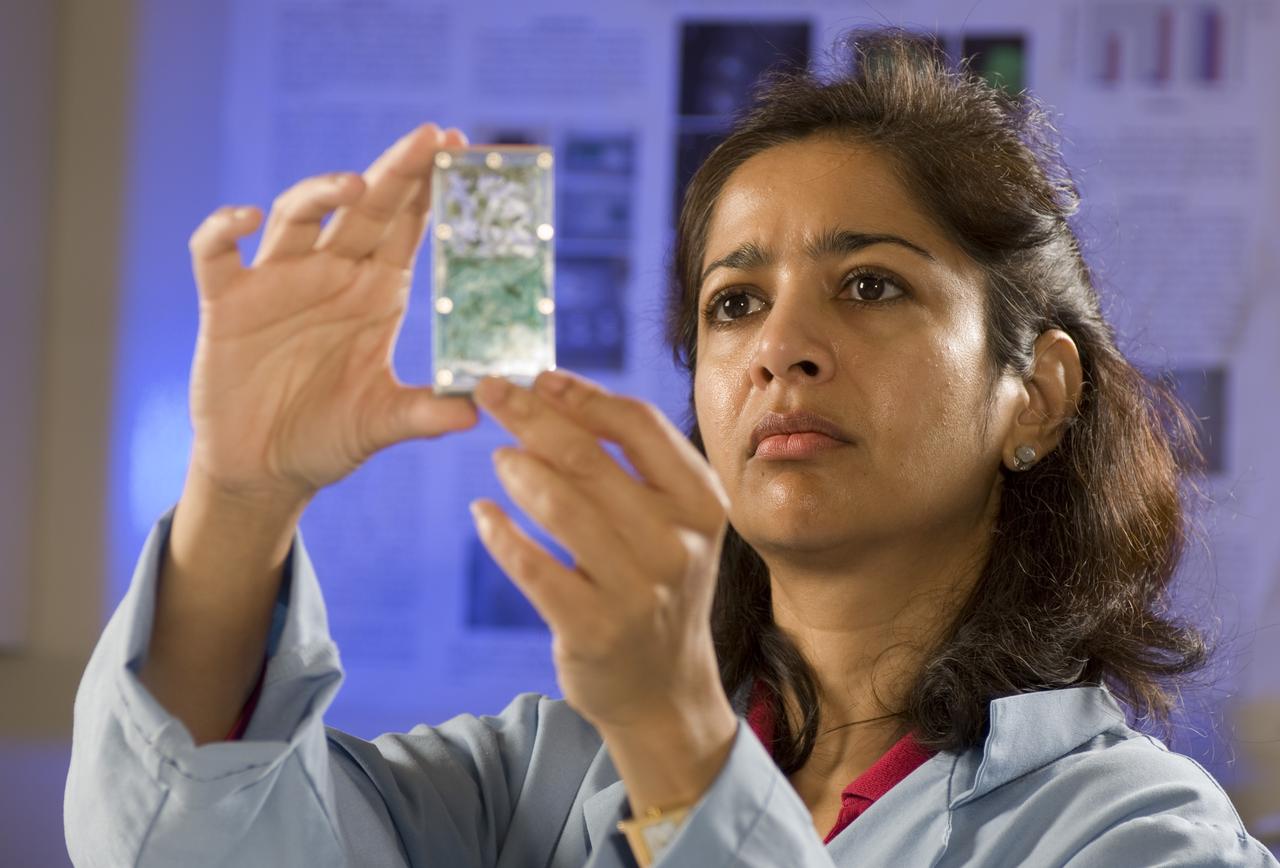
Sharmila Bhattacharya is the principal investigator for the STS-121 space shuttle flight experiment, Fly Immunity and Tumors (FIT). She is shown here viewing Drosophila (fruit fly) inside inscet containers used during flight. Living quarters for insects.
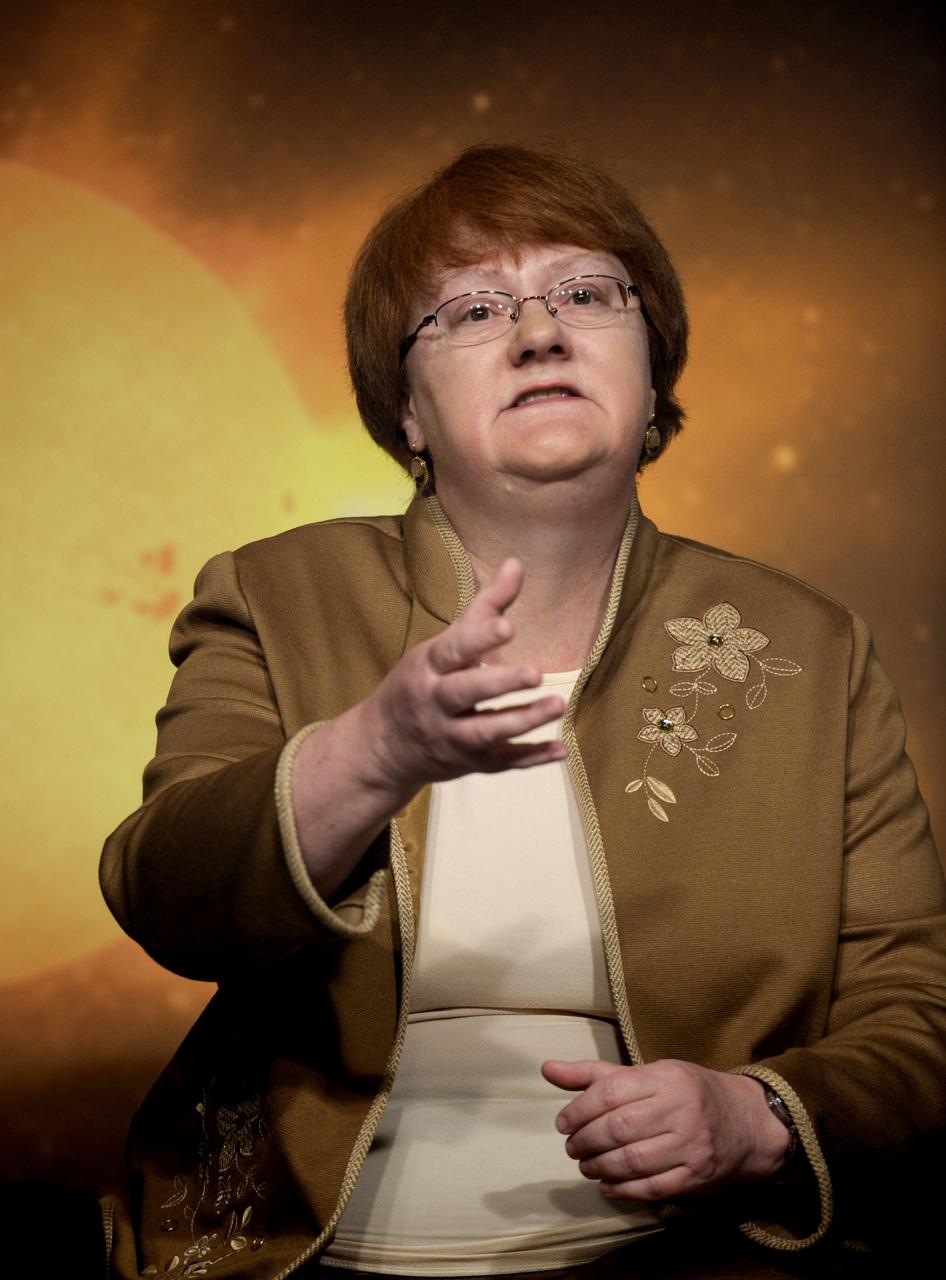
Toni Galvin, principal investigator, Plasma and Superthermal Ion Composition instrument at the University of New Hampshire makes a comment during a Science Update on the STEREO mission at NASA Headquarters in Washington, Tuesday, April 14, 2009. Photo Credit: (NASA/Paul E. Alers)
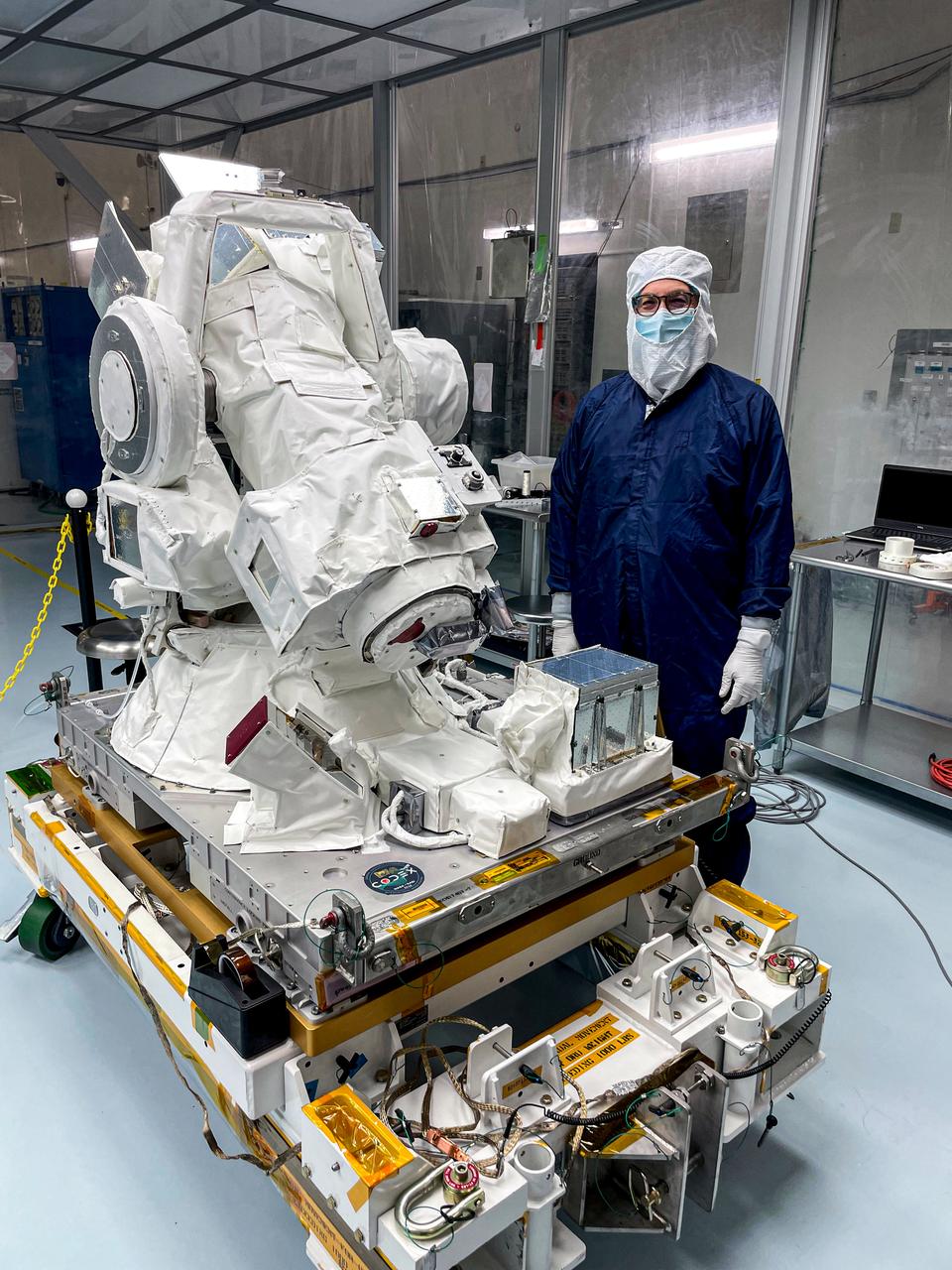
jsc2024e061953 (8/6/2024) --- Jeff Newmark, principal investigator for COronal Diagnostic EXperiment (CODEX), stands with the instrument at the Kennedy Space Flight Center Space Station Processing Facility. CODEX successfully completed all testing at the site and is awaiting integration into the launch vehicle. Credit: CODEX team / NASA
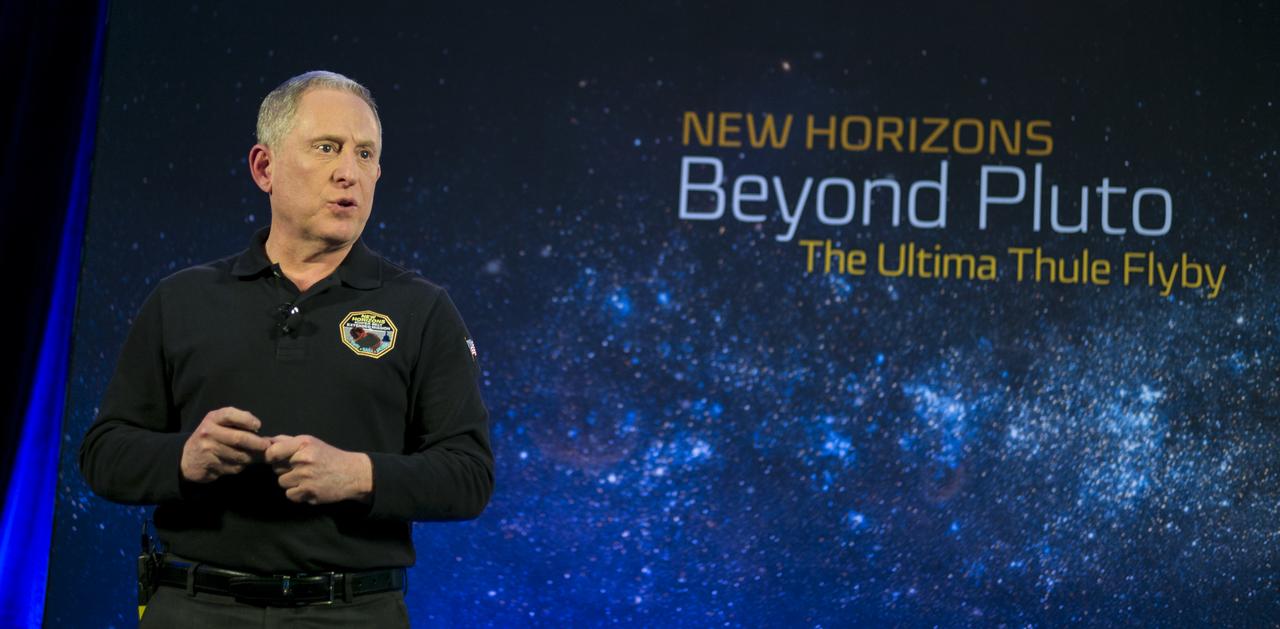
New Horizons principal investigator Alan Stern of the Southwest Research Institute (SwRI), Boulder, CO, speaks during an overview of the New Horizons Mission, Monday, Dec. 31, 2018 at Johns Hopkins University Applied Physics Laboratory (APL) in Laurel, Maryland. Photo Credit: (NASA/Joel Kowsky)
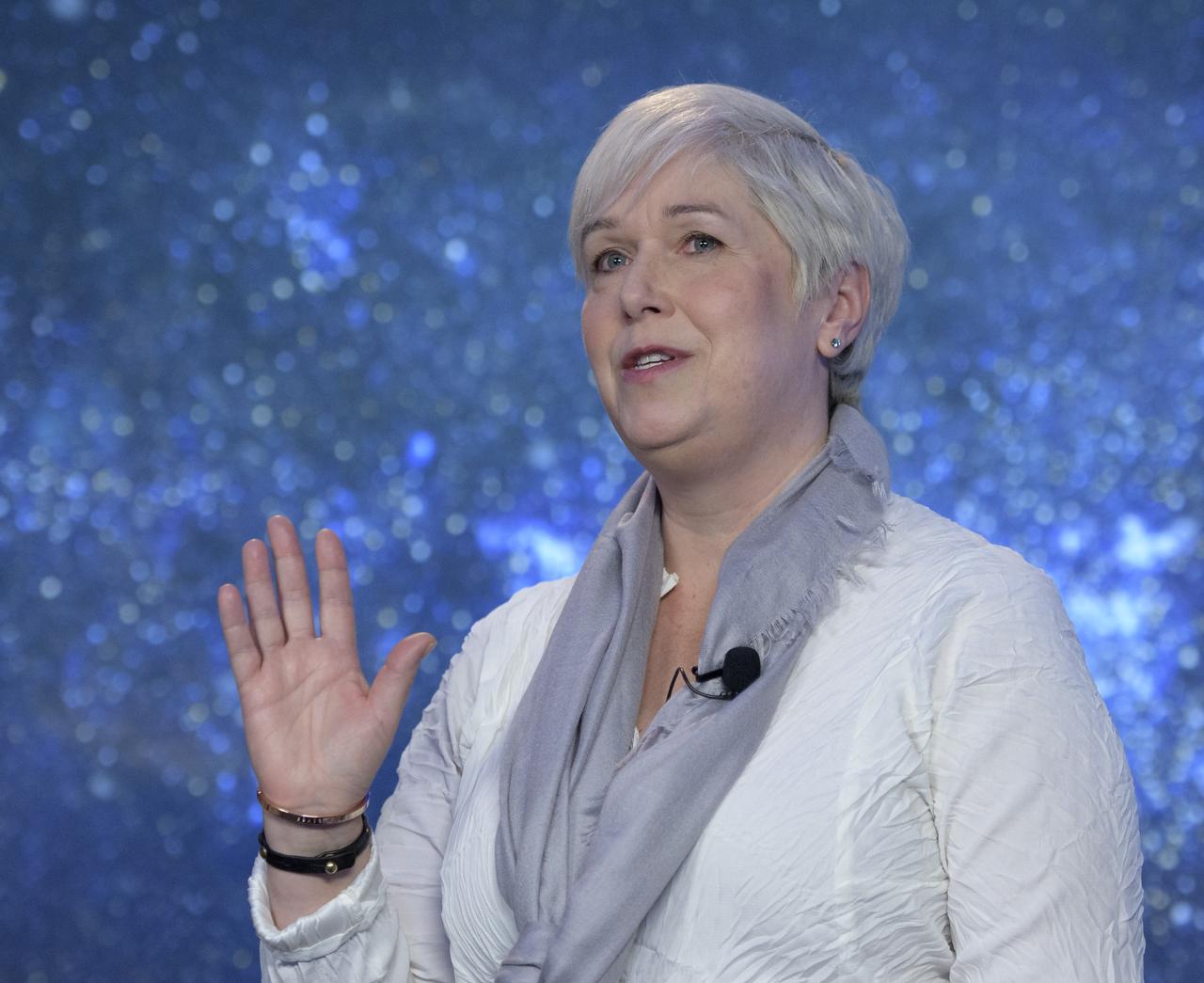
Lindy Elkins-Tanton Principal Investigator of the Psyche mission from Arizona State University gives remarks during a briefing discussing small bodies missions, Monday, Dec. 31, 2018 at Johns Hopkins University Applied Physics Laboratory (APL) in Laurel, Maryland. Photo Credit: (NASA/Bill Ingalls)
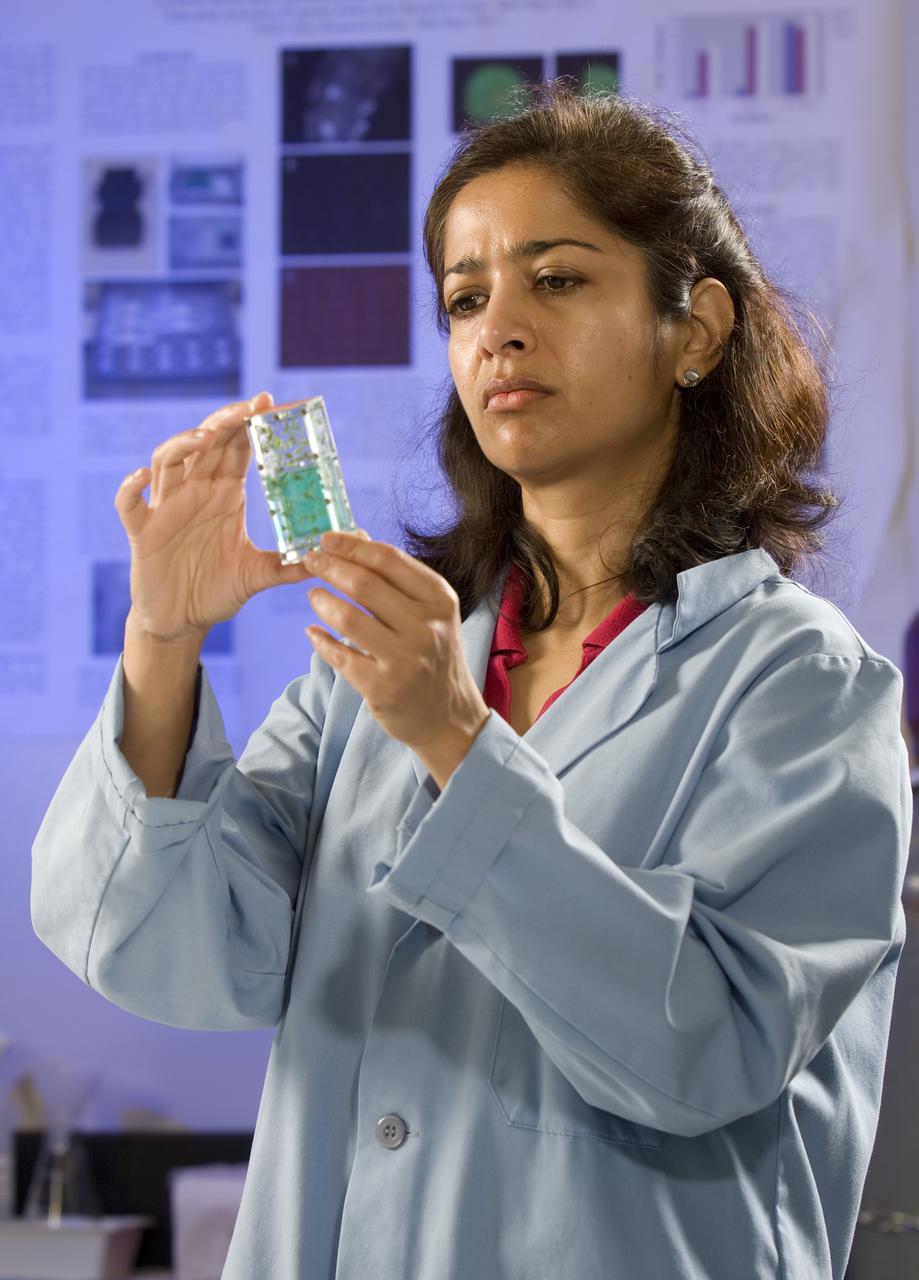
Sharmila Bhattacharya is the principal investigator for the STS-121 space shuttle flight experiment, Fly Immunity and Tumors (FIT). She is shown here viewing Drosophila (fruit fly) inside inscet containers used during flight. Living quarters for insects.
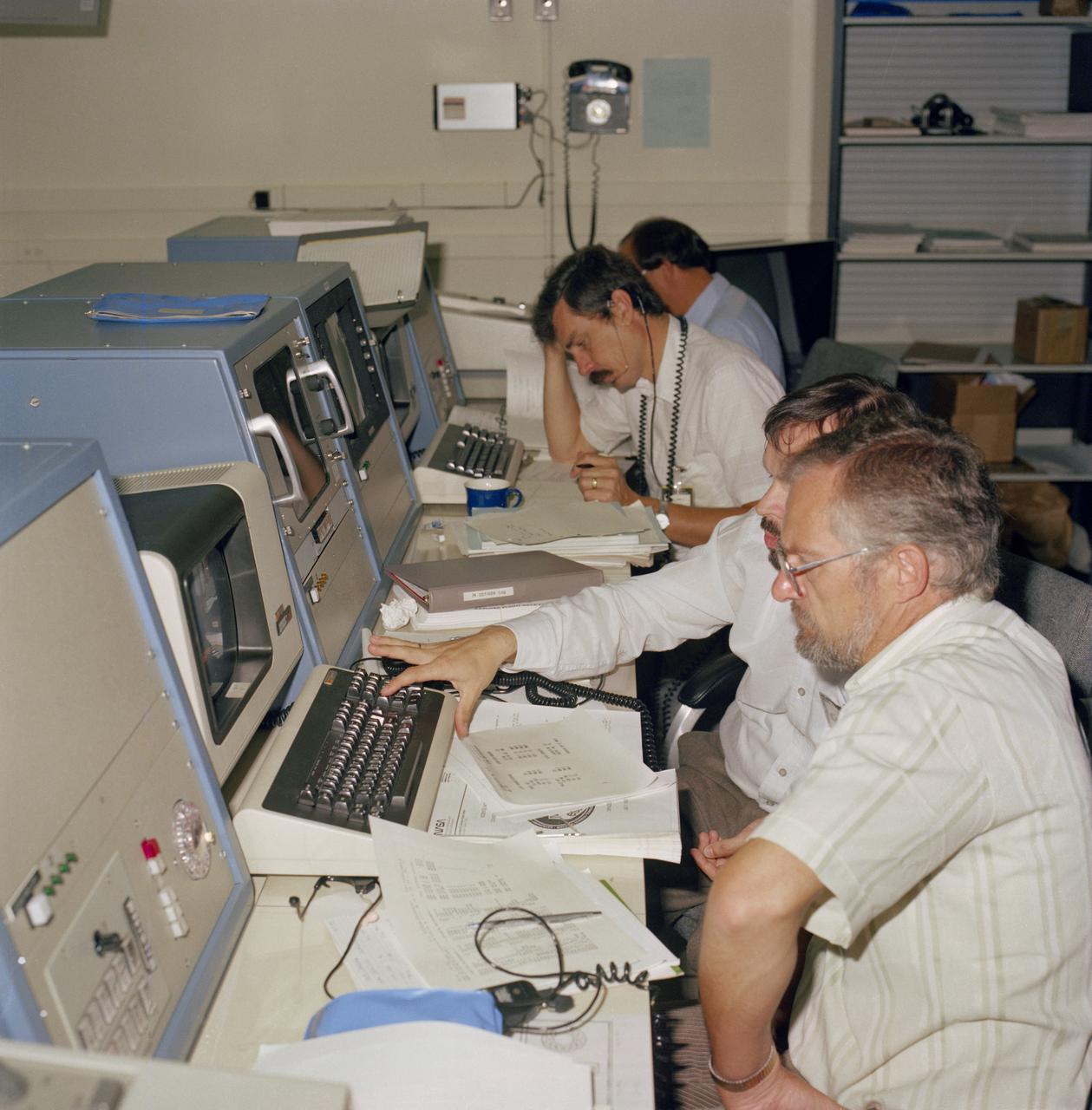
S83-40845 (Dec 1983) --- Principal investigators and their ground support teams follow Spacelab 1 activities in the Science Monitoring Area of the Johnson Space Center's mission control center. NOTE: This area will be manned for the Spacelab Life Sciences-1 (SLS-1) mission, currently scheduled for May of 1991.
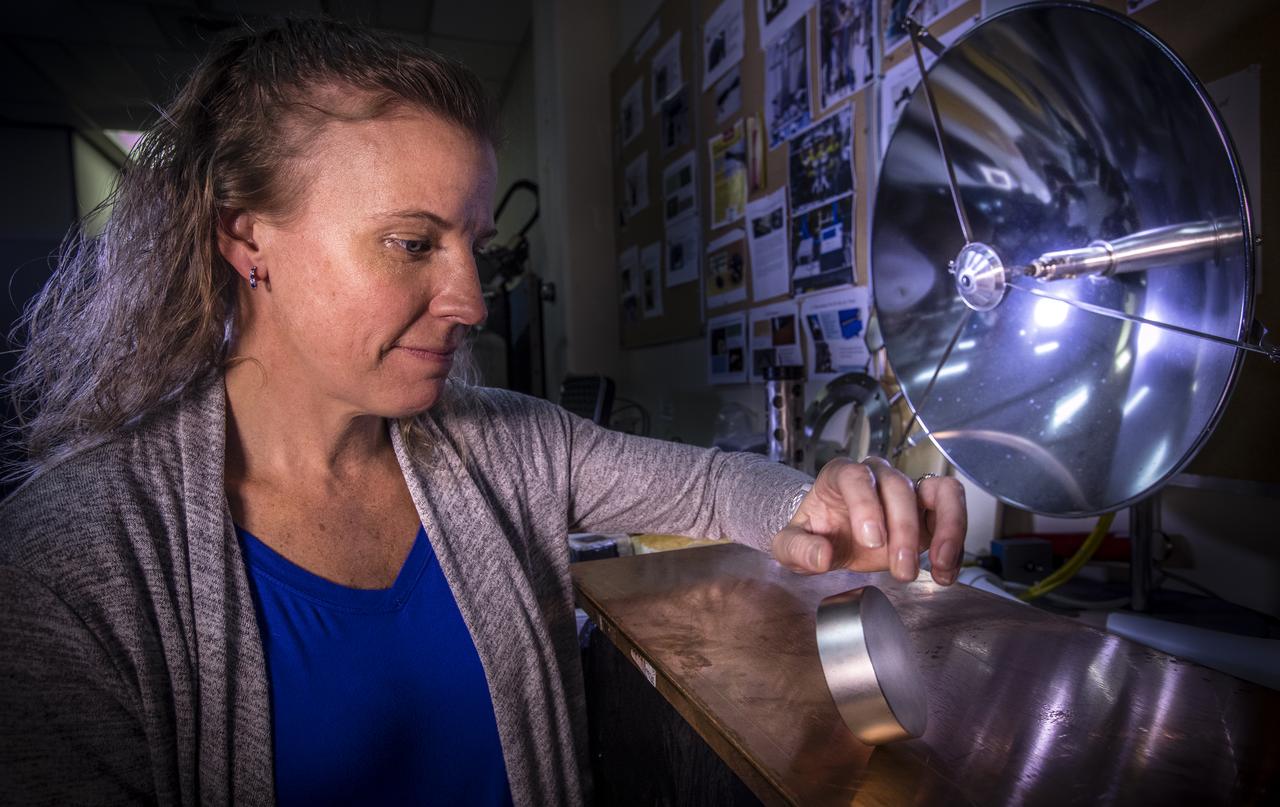
Principal investigator, Dr. Janine Captain, demonstrates the effects of moving a magnet against metal in the Applied Physics Laboratory at NASA’s Kennedy Space Center on Dec. 12, 2018. When dropped or tipped over on a plate of copper, the magnet decelerates and slowly touches down on the plate visually demonstrating the physics of the magnetic field.
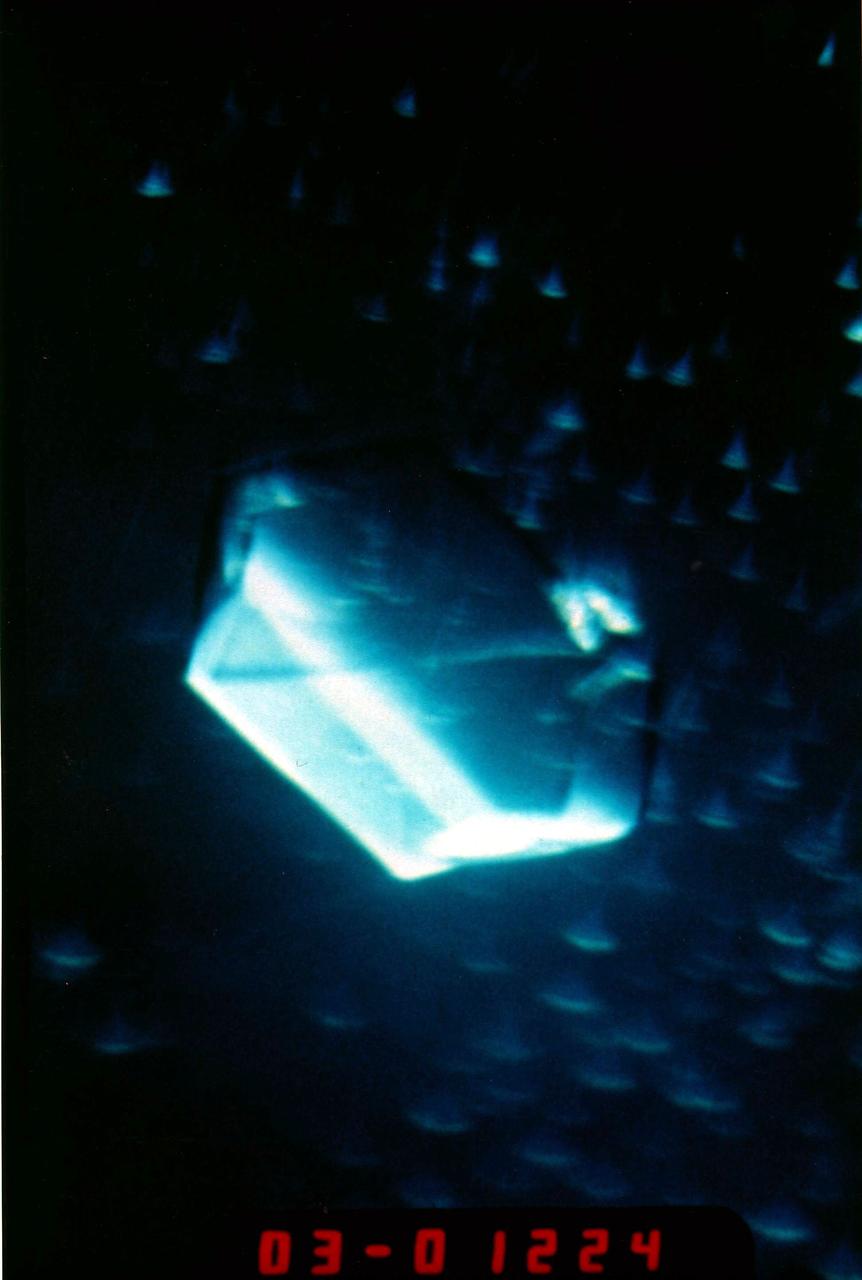
(PCG) Protein Crystal Growth Isocitrate Lysase. Target enzyme for fungicides. A better understanding of this enzyme should lead to the discovery of more potent fungicides to treat serious crop diseases such as rice blast. It regulates the flow of metabolic intermediates required for cell growth. Principal Investigator on STS-26 was Charles Bugg.
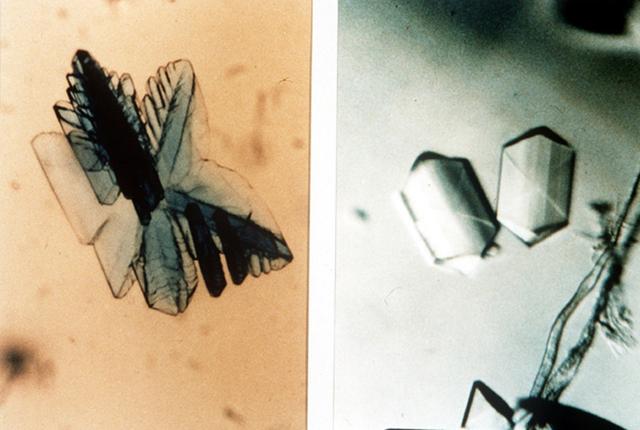
The comparison of protein crystal, Isocitrate Lyase earth-grown (left) and space-grown (right). This is a target enzyme for fungicides. A better understanding of this enzyme should lead to the discovery of more potent fungicides to treat serious crop diseases such as rice blast; it regulates the flow of metabolic intermediates required for cell growth. Principal Investigator is Larry DeLucas.
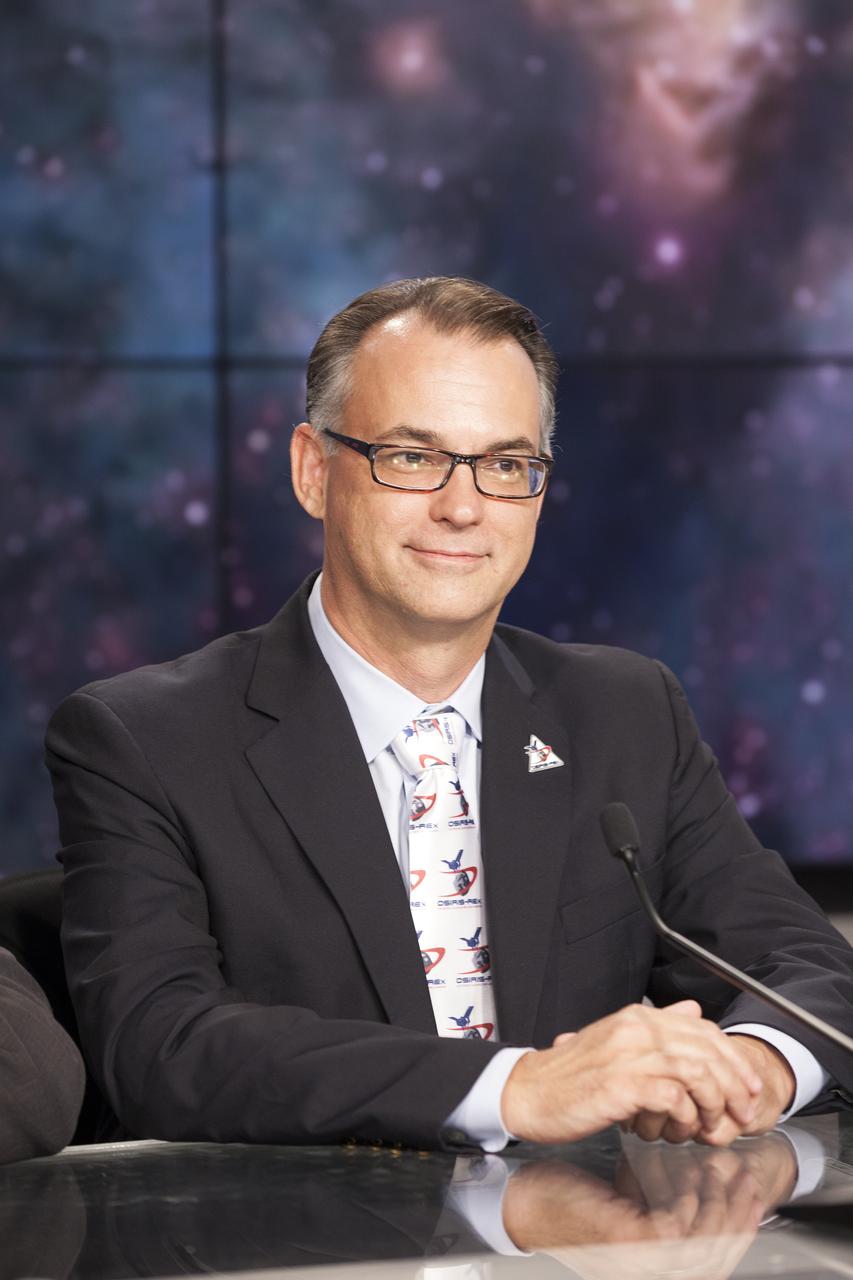
In the Kennedy Space Center’s Press Site auditorium, Dante Lauretta, OSIRIS-REx principal investigator at the University of Arizona, Tucson, speaks to members of the media at a prelaunch news conference for the agency’s Origins, Spectral Interpretation, Resource Identification, Security-Regolith Explorer, or OSIRIS-REx spacecraft.
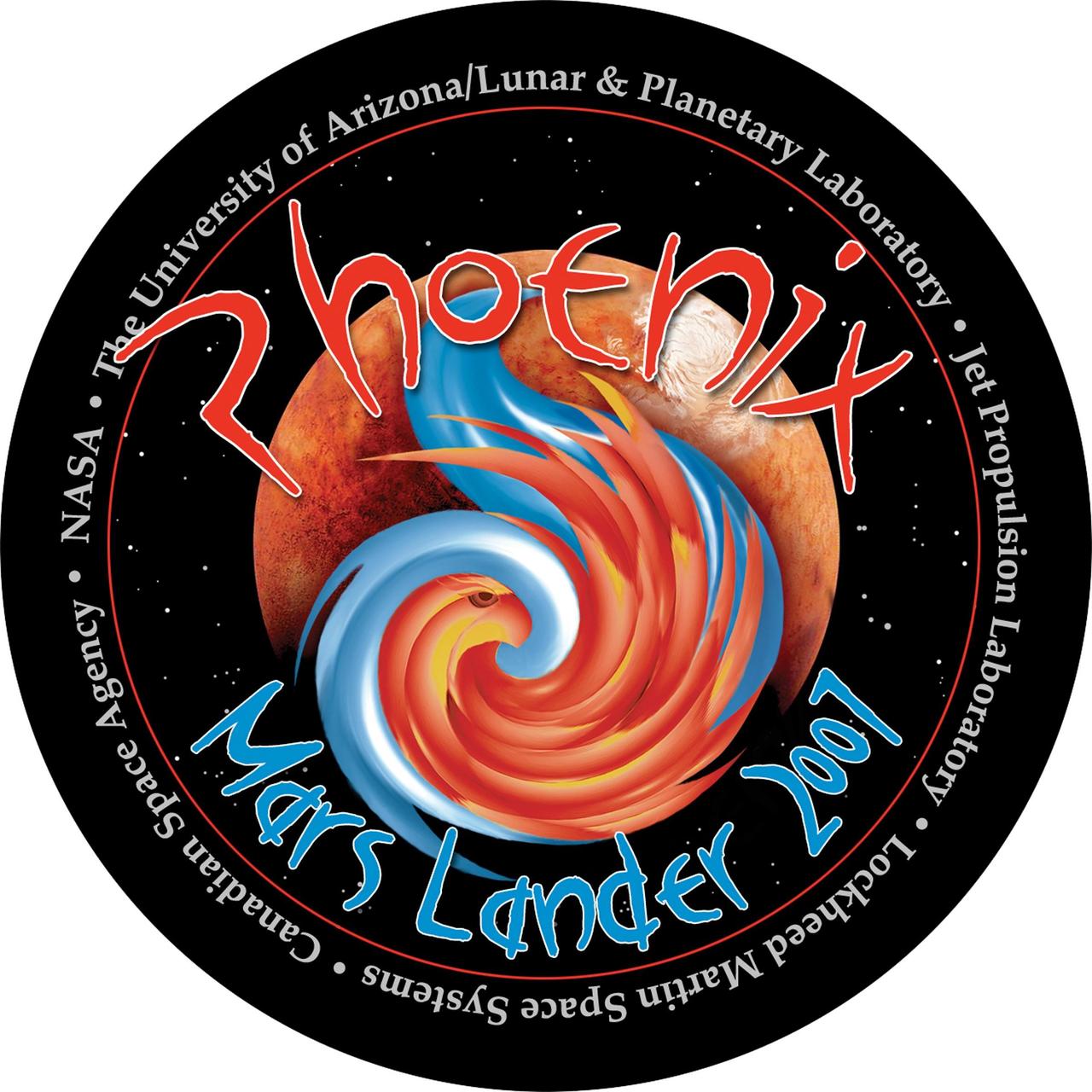
KENNEDY SPACE CENTER, FLA. -- The official Phoenix Mars Lander Mission sticker, designed by Principal Investigator Peter Smith, shows off the Phoenix logo created by Isabelle Tremblay. It also displays all of the mission partners around the border.

George Ricker, TESS principal investigator, MIT Kavli Institute for Astrophysics and Space Research, discusses the upcoming launch of NASA’s next planet hunter, the Transiting Exoplanet Survey Satellite (TESS), Wednesday, March 28, 2018 at NASA Headquarters in Washington. Photo Credit: (NASA/Bill Ingalls)