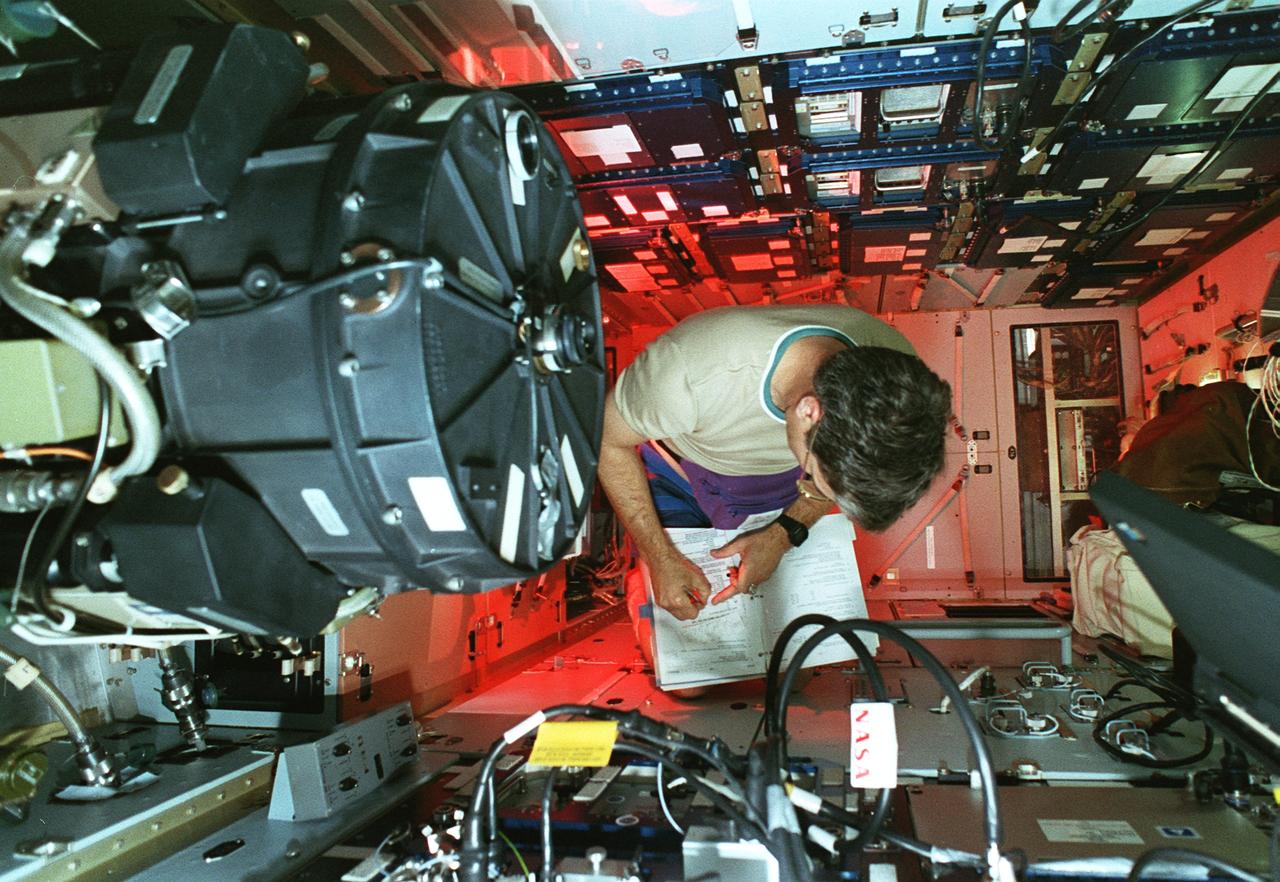
STS079-357-009 (16-26 Sept. 1996) --- Astronaut John E. Blaha, now a full-fledged crewmember of Mir-22, takes notes in the Priroda Module on one of the many experiments stored there. Shortly after assuming his new duties, Blaha's attention was directed toward a bio-reactor experiment, which he quickly repaired.
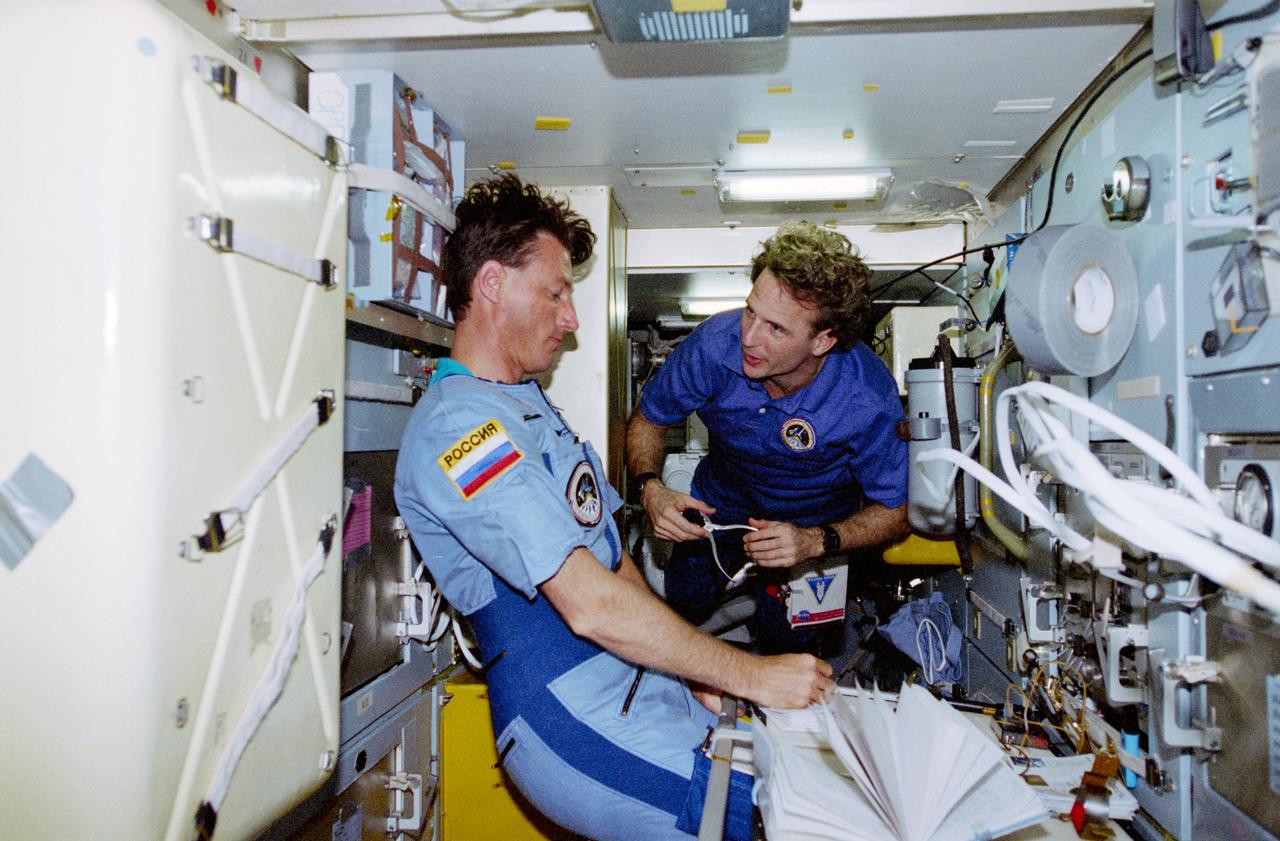
STS084-371-021 (15-21 May 1997) --- Onboard Russia's Mir Space Station's Priroda Module, NASA's most recent participant in the cosmonaut guest researcher role briefs his replacement. Jerry M. Linenger, right, has been aboard the orbiting complex since January of this year, but as evidenced by the uniforms each is wearing, he has turned over that role now to C. Michael Foale.
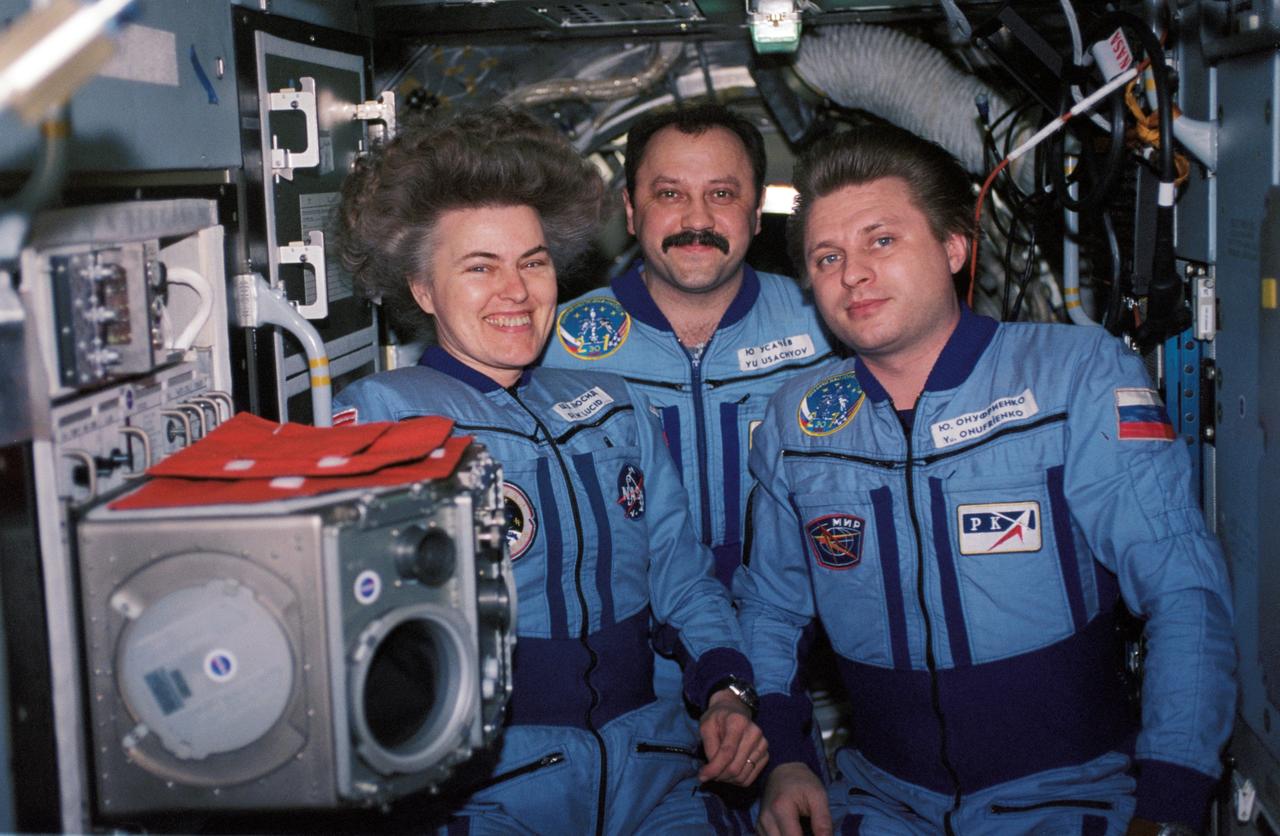
NM21-395-024 (March 1996) --- Posed near a microgravity glove box on the Priroda Module aboard Russia’s Mir Space Station are the Mir-21 crew members. From the left are astronaut Shannon W. Lucid, cosmonaut guest researcher; Yuriy V. Usachov, flight engineer; and Yuriy I. Onufriyenko, commander. Lucid went on to spend a total of 188 consecutive days in space before returning to Earth with the STS-79 crew.
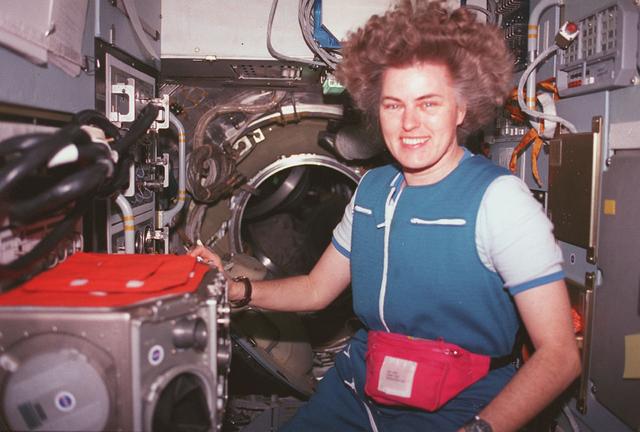
Sharnon Lucid aboard STS-79, with the Glovebox in MIR Priroda module. Priroda is the Russian word for nature.
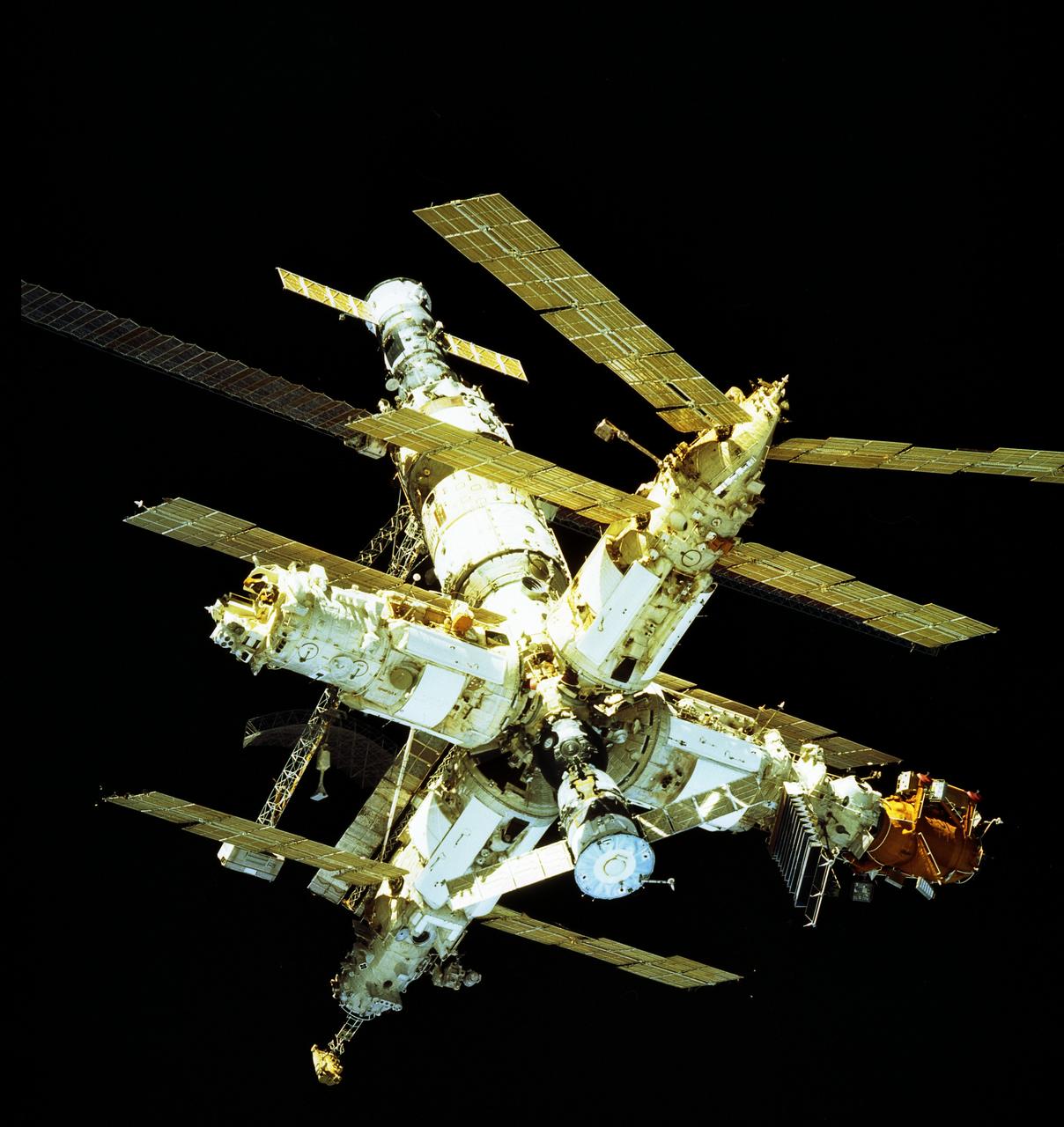
This is a view of the Russian Mir Space Station photographed by a crewmember of the fifth Shuttle/Mir docking mission, STS-81. The image shows: upper center - Progress supply vehicle, Kvant-1 module, and Core module; center left - Priroda module; center right - Spektr module; bottom left - Kvant-2 module; bottom center - Soyuz; and bottom right - Kristall module and Docking module. The Progress was an unmarned, automated version of the Soyuz crew transfer vehicle, designed to resupply the Mir. The Kvant-1 provided research in the physics of galaxies, quasars, and neutron stars, by measuring electromagnetic spectra and x-ray emissions. The Core module served as the heart of the space station and contained the primary living and working areas, life support, and power, as well as the main computer, communications, and control equipment. Priroda's main purpose was Earth remote sensing. The Spektr module provided Earth observation. It also supported research into biotechnology, life sciences, materials science, and space technologies. American astronauts used the Spektr as their living quarters. Kvant-2 was a scientific and airlock module, providing biological research, Earth observations, and EVA (extravehicular activity) capability. The Soyuz typically ferried three crewmembers to and from the Mir. A main purpose of the Kristall module was to develop biological and materials production technologies in the space environment. The Docking module made it possible for the Space Shuttle to dock easily with the Mir. The journey of the 15-year-old Russian Mir Space Station ended March 23, 2001, as the Mir re-entered the Earth's atmosphere and fell into the south Pacific Ocean.
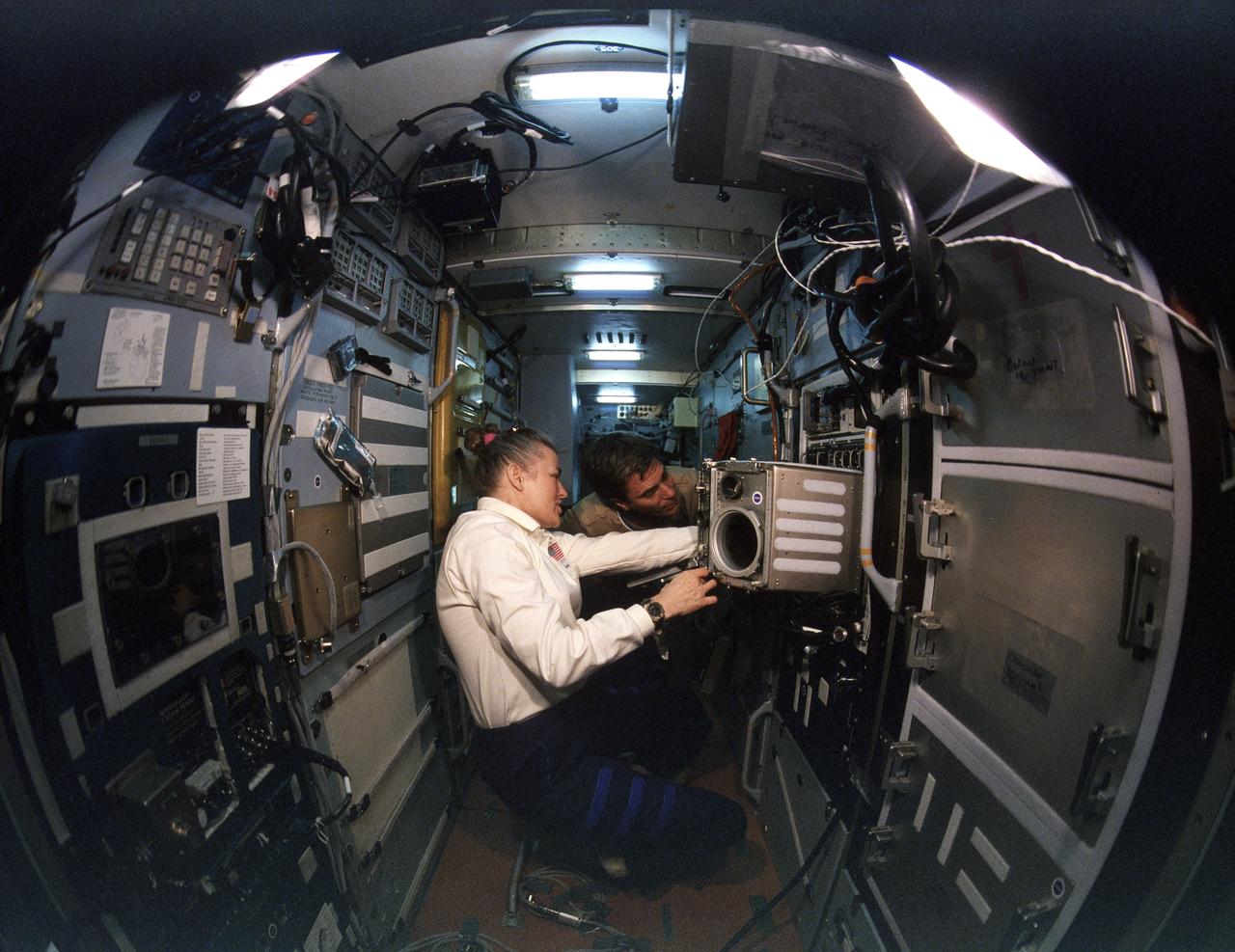
STS079-S-092 (16-26 Sept. 1996) --- Astronauts Shannon W. Lucid and John E. Blaha work at a microgravity glove box on the Priroda Module aboard Russia's Mir Space Station complex. Blaha, who flew into Earth-orbit with the STS-79 crew, and Lucid are the first participants in a series of ongoing exchanges of NASA astronauts serving time as cosmonaut guest researchers onboard Mir. Lucid went on to spend a total of 188 days in space before returning to Earth with the STS-79 crew. During the STS-79 mission, the crew used an IMAX camera to document activities aboard the Space Shuttle Atlantis and the various Mir modules, with the cooperation of the Russian Space Agency (RSA). A hand-held version of the 65mm camera system accompanied the STS-79 crew into space in Atlantis' crew cabin. NASA has flown IMAX camera systems on many Shuttle missions, including a special cargo bay camera's coverage of other recent Shuttle-Mir rendezvous and/or docking missions.
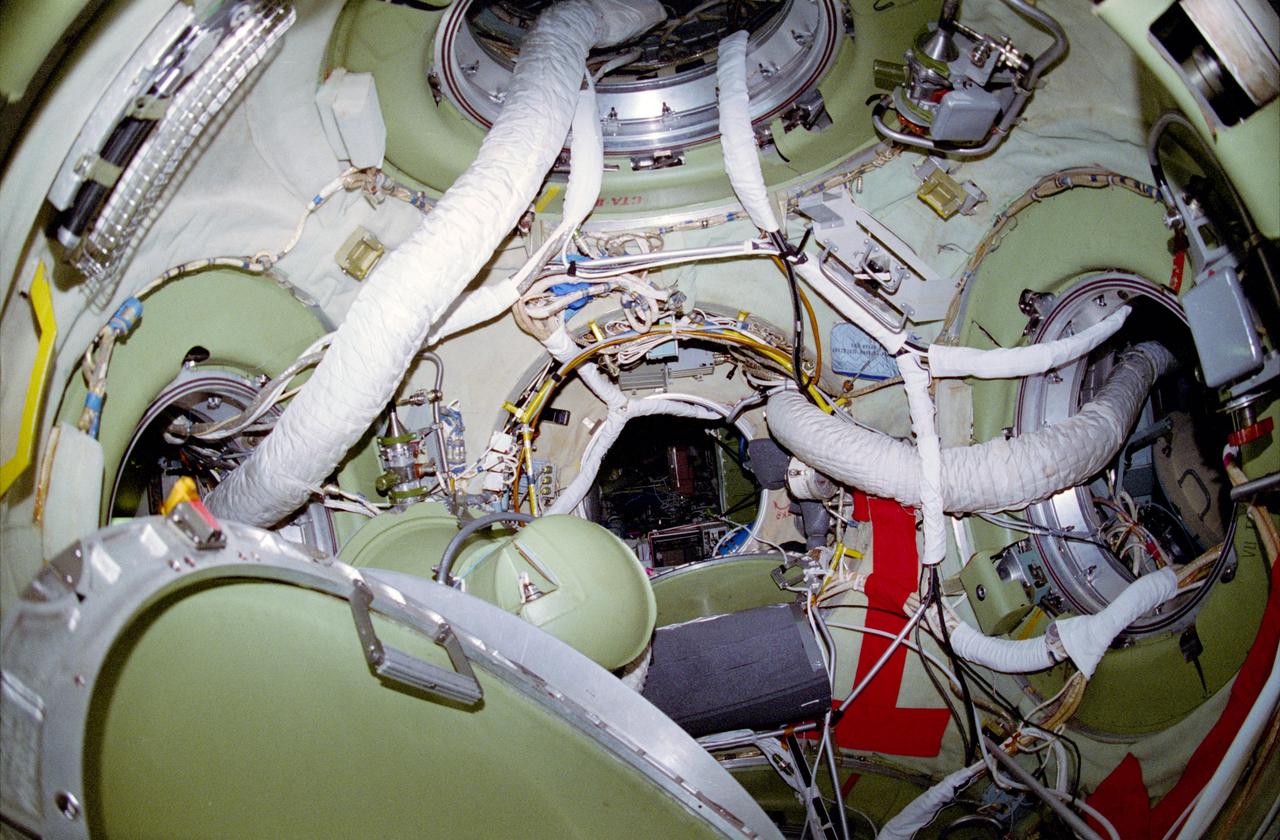
STS084-305-018 (15-24 May 1997) --- As seen from the docked Soyuz hatchway, this 35mm view shows the interior of a Russian Mir Space Station node connected to Kristall (bottom), Priroda (top), Mir Core Module (center), Kvant-2 (left) and Spektr (right). The Mir-23 and STS-84 crew members spent several days sharing joint activities in Earth-orbit as part of an ongoing cooperative program between the Russian Space Agency (RSA) and National Aeronautics and Space Administration (NASA).

S89-E-5302 (26 Jan 1998) --- This Electronic Still Camera (ESC) image shows astronaut Andrew S. W. Thomas, future cosmonaut guest researcher, during tranfer operations onboard the Space Shuttle Endeavour. Thomas, replacing astronaut David A. Wolf as cosmonaut guest researcher, will be the last American astronaut to serve a tour onboard Mir. This ESC view was taken on January 26, 1998, at 14:55:37 MET.
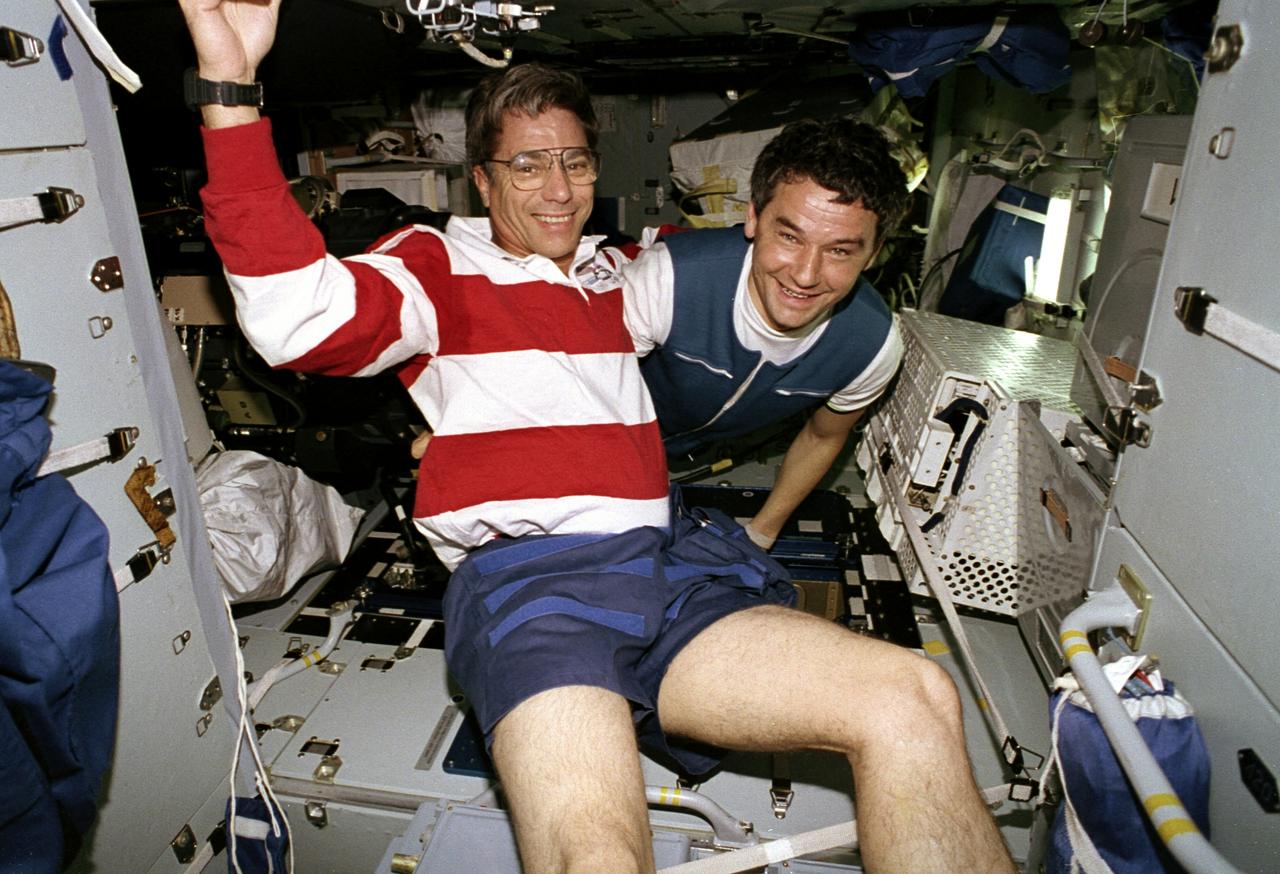
STS079-350-028 (16-26 Sept. 1996) --- Aboard Russian Mir Space Station's Spektr Module, astronaut John E. Blaha, now a cosmonaut guest researcher, visits with Valeri G. Korzun, his mission commander for Mir-22. This photograph is one of fifteen 35mm frames (along with four 70mm frames) of still photography documenting the activities of NASA's STS-79 mission, which began with a Sept. 16, 1996, liftoff from Launch Pad 39A the Kennedy Space Center (KSC) and ended with a landing at KSC on September 26, 1996. Onboard for the launch were astronauts William F. Readdy, commander; Terrence W. Wilcutt, pilot; Blaha, Jerome (Jay) Apt, Thomas D. Akers and Carl E. Walz, all mission specialists. On flight day 4, the crew docked with Mir. Shannon W. Lucid, who had spent six months aboard Mir, switched cosmonaut guest researcher roles with Blaha. The latter joined fellow Mir-22 crewmembers Korzun, and Aleksandr Y. Kaleri, flight engineer.
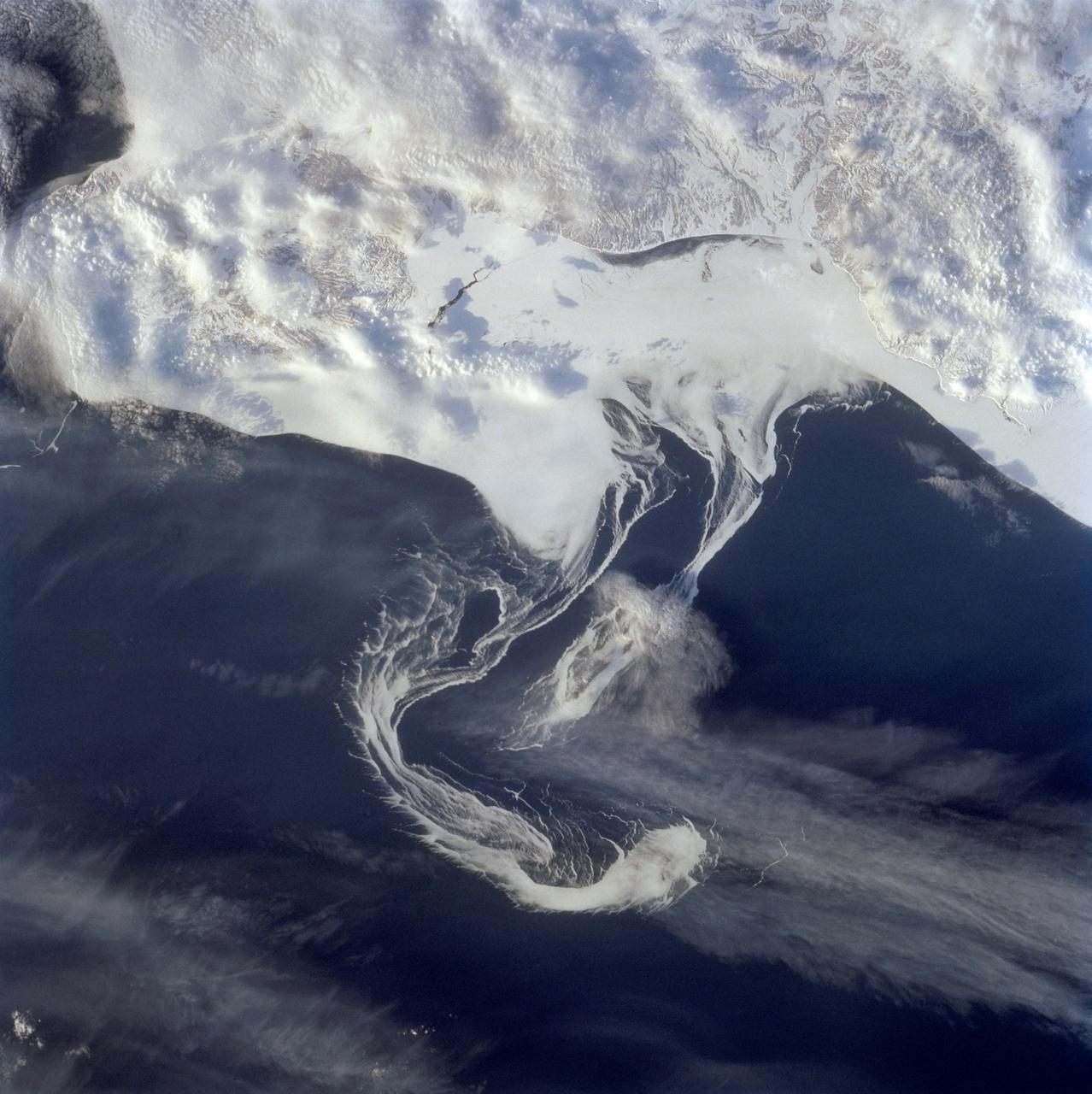
STS060-73-038 (3-11 Feb 1994) --- Pack ice is documented in this photograph along the coast of the Kamchatka Peninsula of Russia in Zaliv Ozernoj. Newly formed ice continually breaks away from the land and takes the form imposed by coastal currents. Detailed photographs of the ice provide information to scientists in both Russia and the united States about the location and fluctuation of ice edges, and how this new sea ice interacts with ocean and littoral currents. This information results in better ice warnings to shipping traffic and provides data points for long-range climate change research for both the Mission-To-Planet Earth and the Russian Priroda ("Nature") monitoring and assessment programs that are respectively coordinated by NASA and the Russian Academy of Sciences. This photography of ice development in the North Pacific, North Atlantic, the Southern Ocean, the Baltic and North Seas, and the Great Lakes is of great interest to the international scientific community. NASA scientists feel high-resolution analog and digital photography from the Space Shuttle and future craft can be a particularly important component in satisfying their data needs on both an operational and a long-term research basis.