
This archival photo shows the Voyager Proof Test Model (in the foreground right of center) undergoing a mechanical preparation and weight center of gravity test at NASA's Jet Propulsion Laboratory, Pasadena, California, on January 12, 1977. https://photojournal.jpl.nasa.gov/catalog/PIA21476

This archival photo shows the Voyager Proof Test Model undergoing a mechanical preparation and weight center of gravity test at NASA's Jet Propulsion Laboratory, Pasadena, California, on January 12, 1977. The stack of three white cylinders seen near center is a stand-in for the spacecraft's power generators (called RTGs). Above that, a silvery canister holds the spacecraft's magnetometer in its stowed configuration. https://photojournal.jpl.nasa.gov/catalog/PIA21477
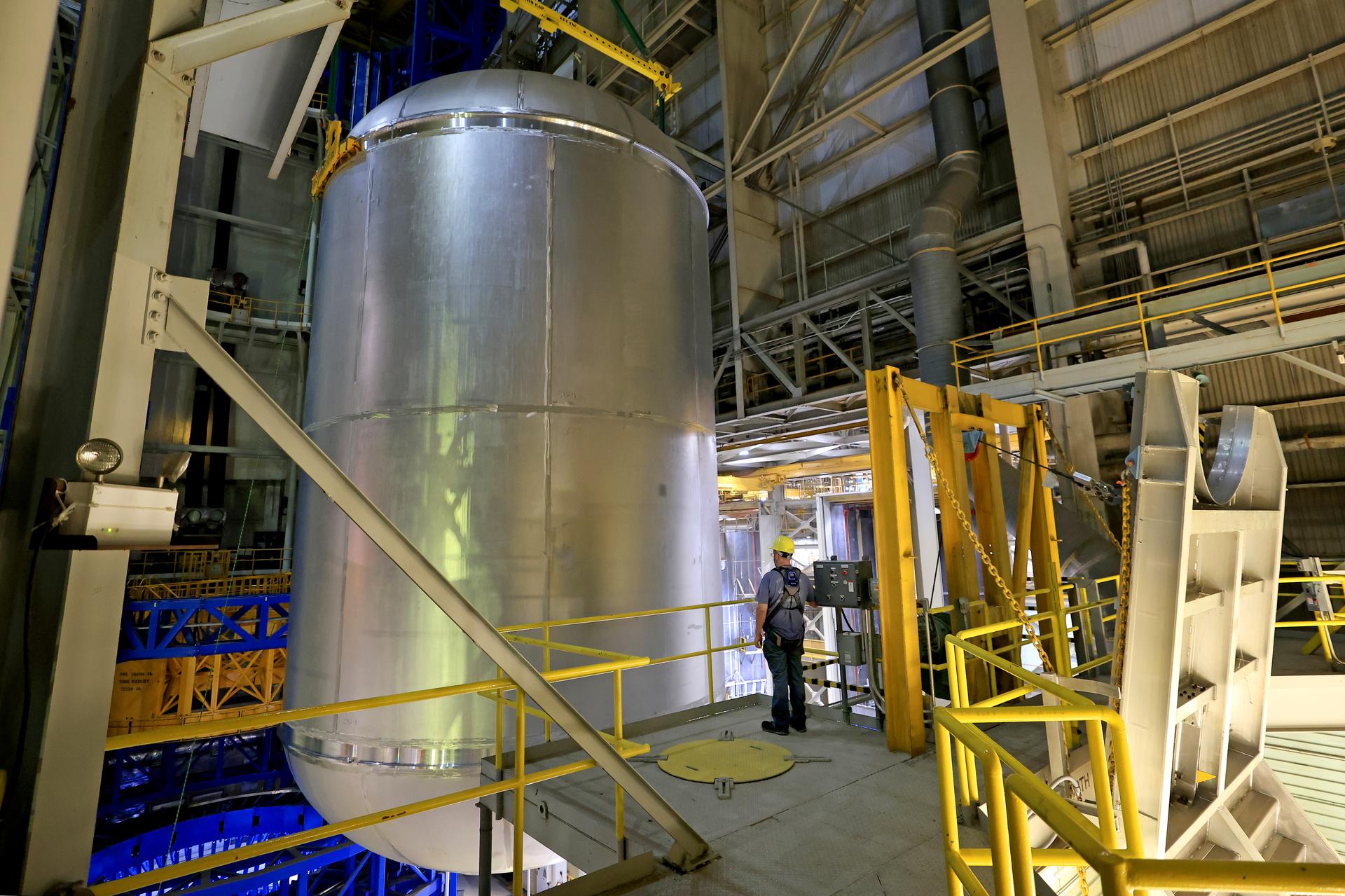
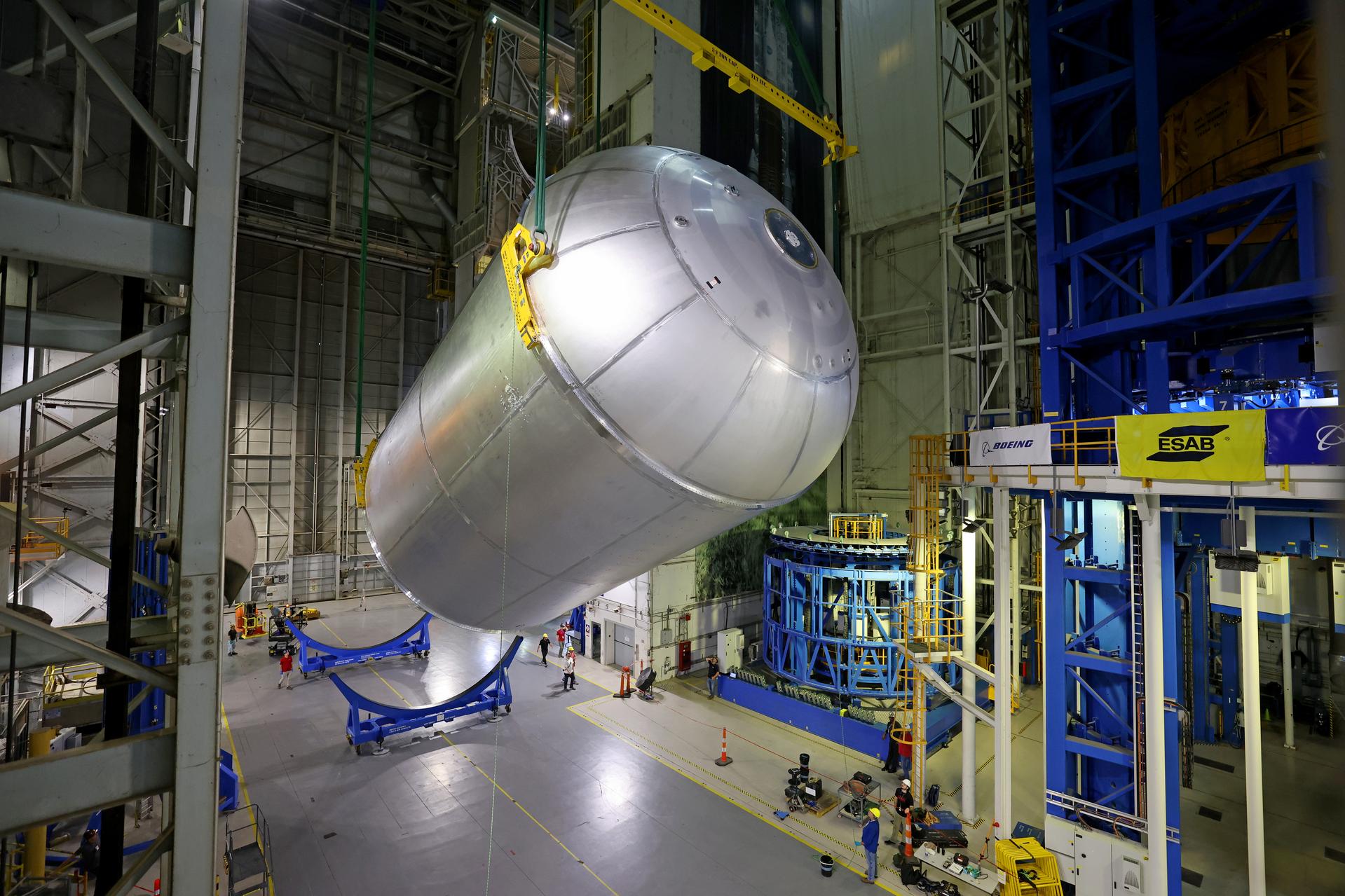
Teams at NASA’s Michoud Assembly Facility in New Orleans lift a 51-foot-tall liquid oxygen tank out of the high bay’s hydrostatic proof testing cell on July 20, 2026. The liquid oxygen tank, which will form part of the SLS (Space Launch System) rocket for NASA’s Artemis IV mission to the Moon, is rotated from a vertical to a horizontal configuration and placed into two static cradles in the main aisle of the vertical assembly building. Having completed proof testing, teams prepare the tank for transport to a production area in the main factory where they will perform post-proof non-destructive evaluations. The propellant tank will hold more than 196,000 gallons of super-cooled liquid oxygen at launch and is one of five major elements that make up the 212-foot-tall SLS rocket stage. The core stage, along with its four RS-25 engines at its base, produces more than two million pounds of thrust to help launch NASA’s Orion spacecraft, astronauts, and supplies beyond Earth’s orbit and to the lunar surface for Artemis. Image credit: NASA/Michael DeMocker
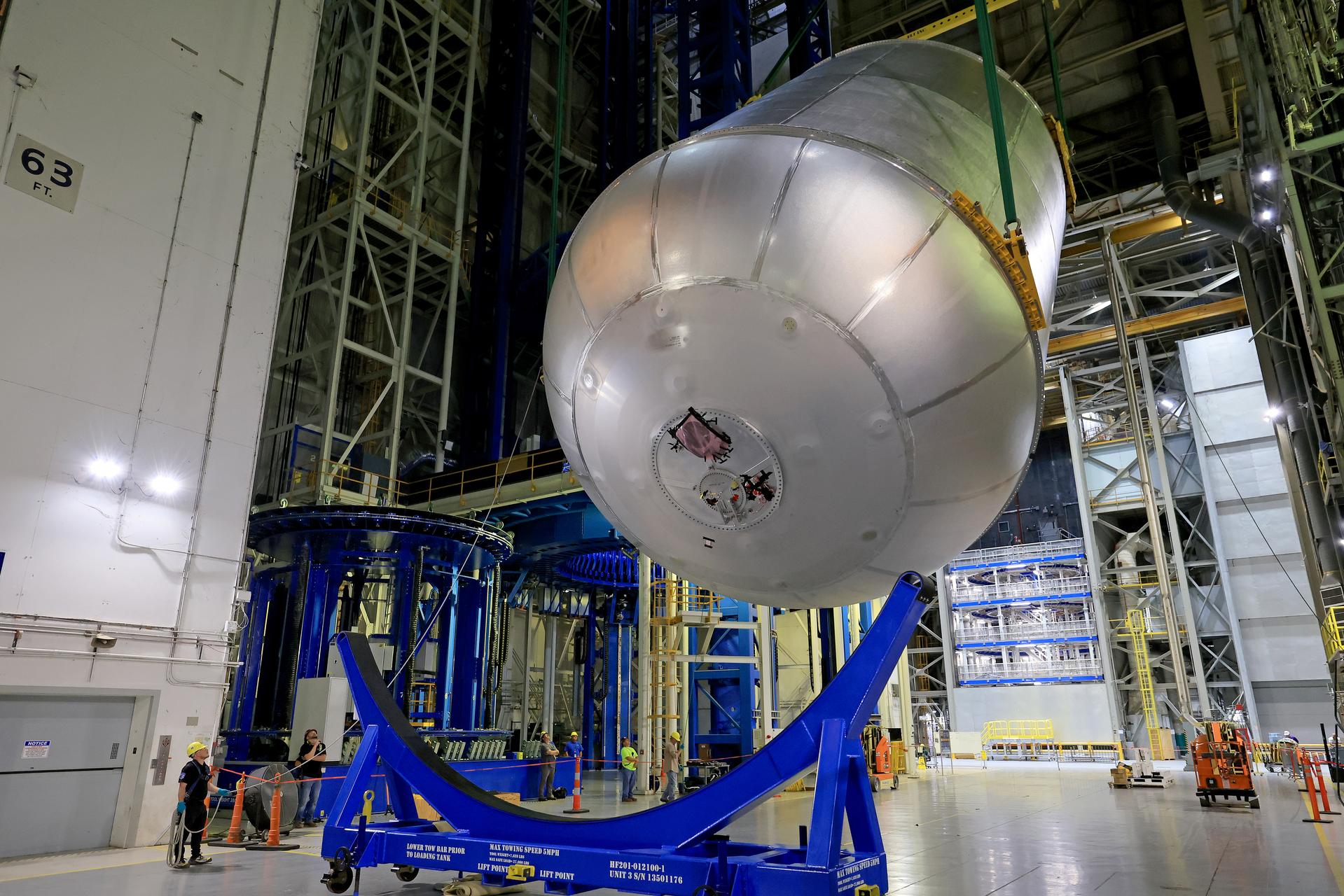
Teams at NASA’s Michoud Assembly Facility in New Orleans lift a 51-foot-tall liquid oxygen tank out of the high bay’s hydrostatic proof testing cell on July 20, 2026. The liquid oxygen tank, which will form part of the SLS (Space Launch System) rocket for NASA’s Artemis IV mission to the Moon, is rotated from a vertical to a horizontal configuration and placed into two static cradles in the main aisle of the vertical assembly building. Having completed proof testing, teams prepare the tank for transport to a production area in the main factory where they will perform post-proof non-destructive evaluations. The propellant tank will hold more than 196,000 gallons of super-cooled liquid oxygen at launch and is one of five major elements that make up the 212-foot-tall SLS rocket stage. The core stage, along with its four RS-25 engines at its base, produces more than two million pounds of thrust to help launch NASA’s Orion spacecraft, astronauts, and supplies beyond Earth’s orbit and to the lunar surface for Artemis. Image credit: NASA/Michael DeMocker
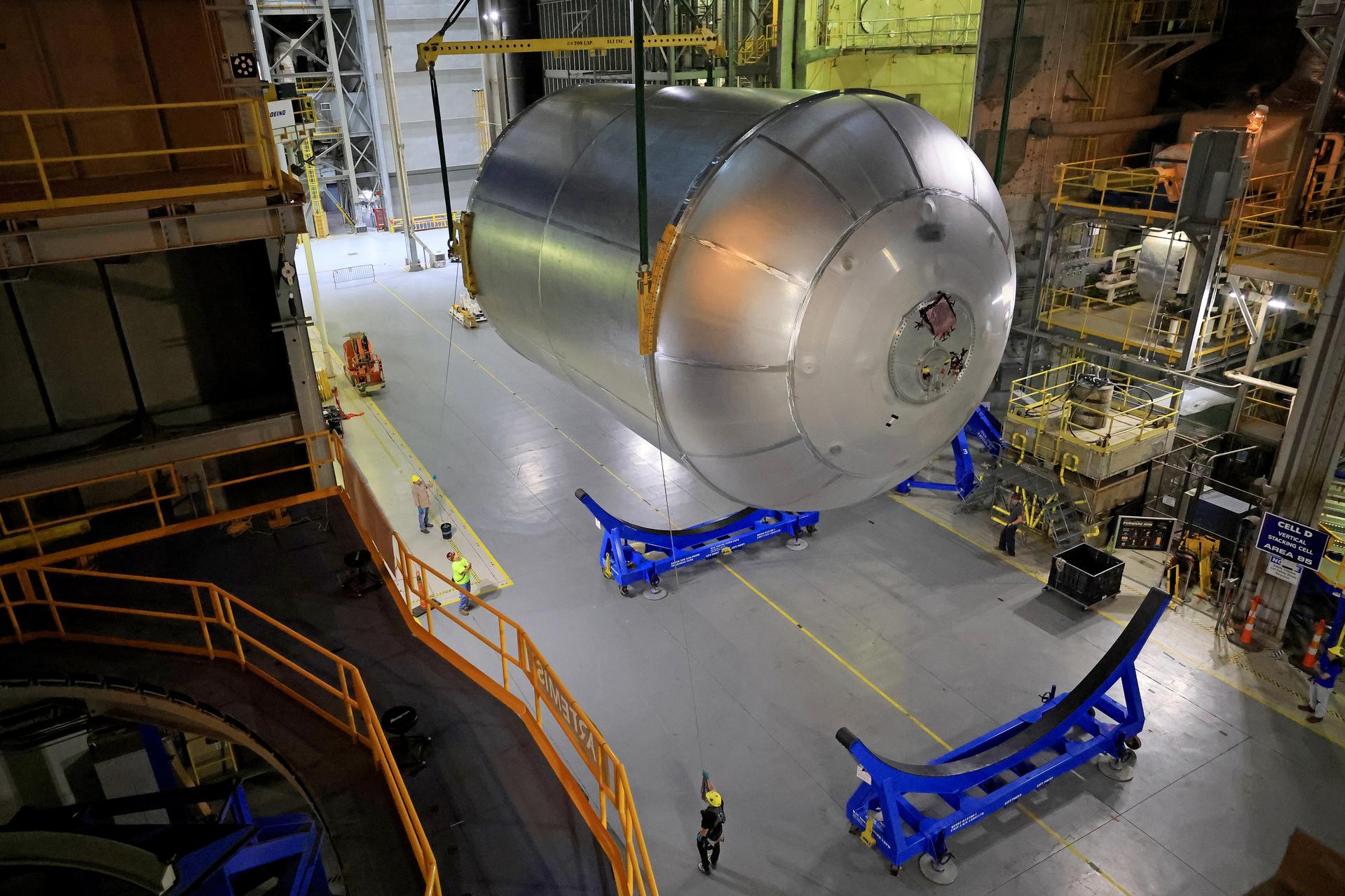
Teams at NASA’s Michoud Assembly Facility in New Orleans lift a 51-foot-tall liquid oxygen tank out of the high bay’s hydrostatic proof testing cell on July 20, 2026. The liquid oxygen tank, which will form part of the SLS (Space Launch System) rocket for NASA’s Artemis IV mission to the Moon, is rotated from a vertical to a horizontal configuration and placed into two static cradles in the main aisle of the vertical assembly building. Having completed proof testing, teams prepare the tank for transport to a production area in the main factory where they will perform post-proof non-destructive evaluations. The propellant tank will hold more than 196,000 gallons of super-cooled liquid oxygen at launch and is one of five major elements that make up the 212-foot-tall SLS rocket stage. The core stage, along with its four RS-25 engines at its base, produces more than two million pounds of thrust to help launch NASA’s Orion spacecraft, astronauts, and supplies beyond Earth’s orbit and to the lunar surface for Artemis. Image credit: NASA/Michael DeMocker
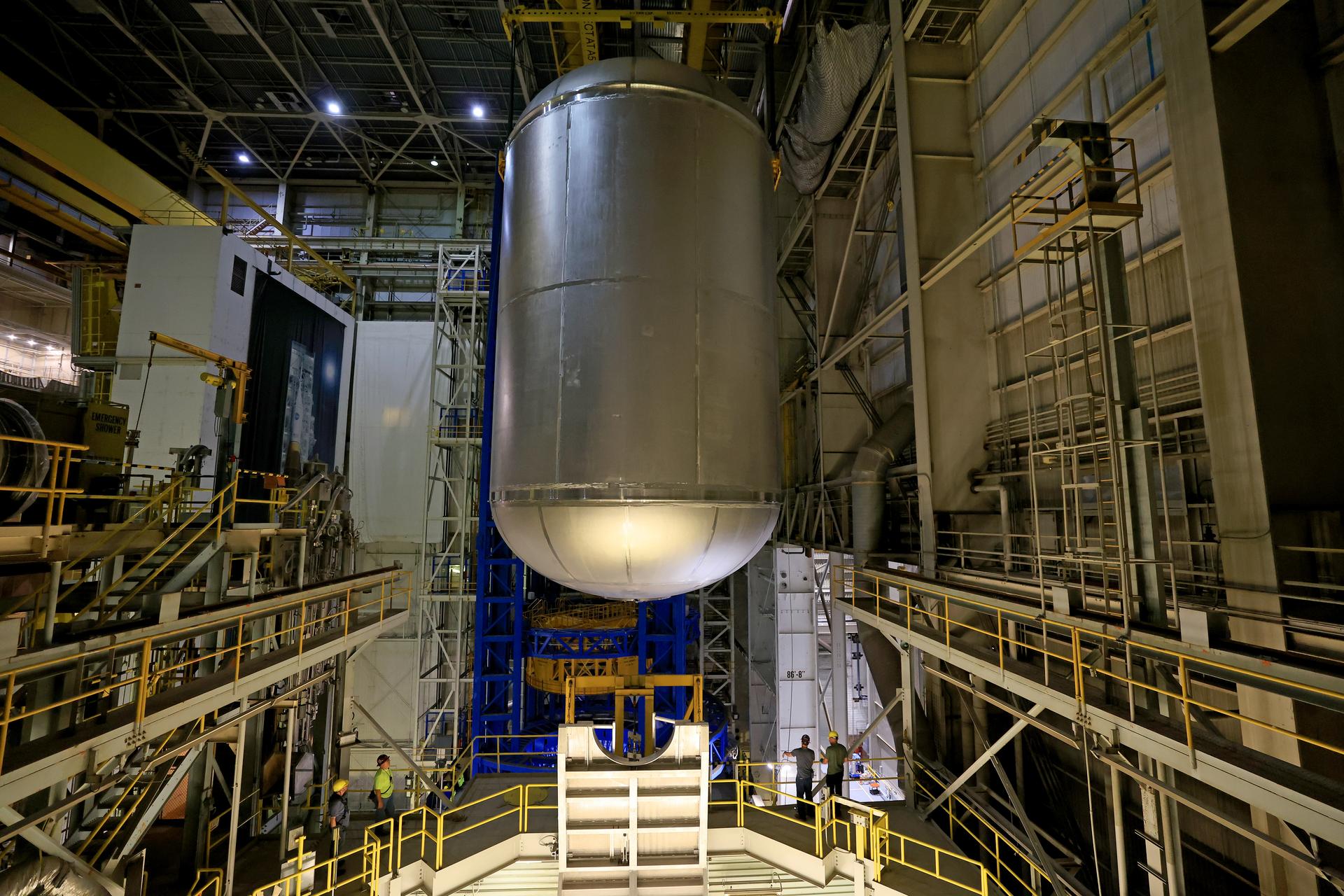
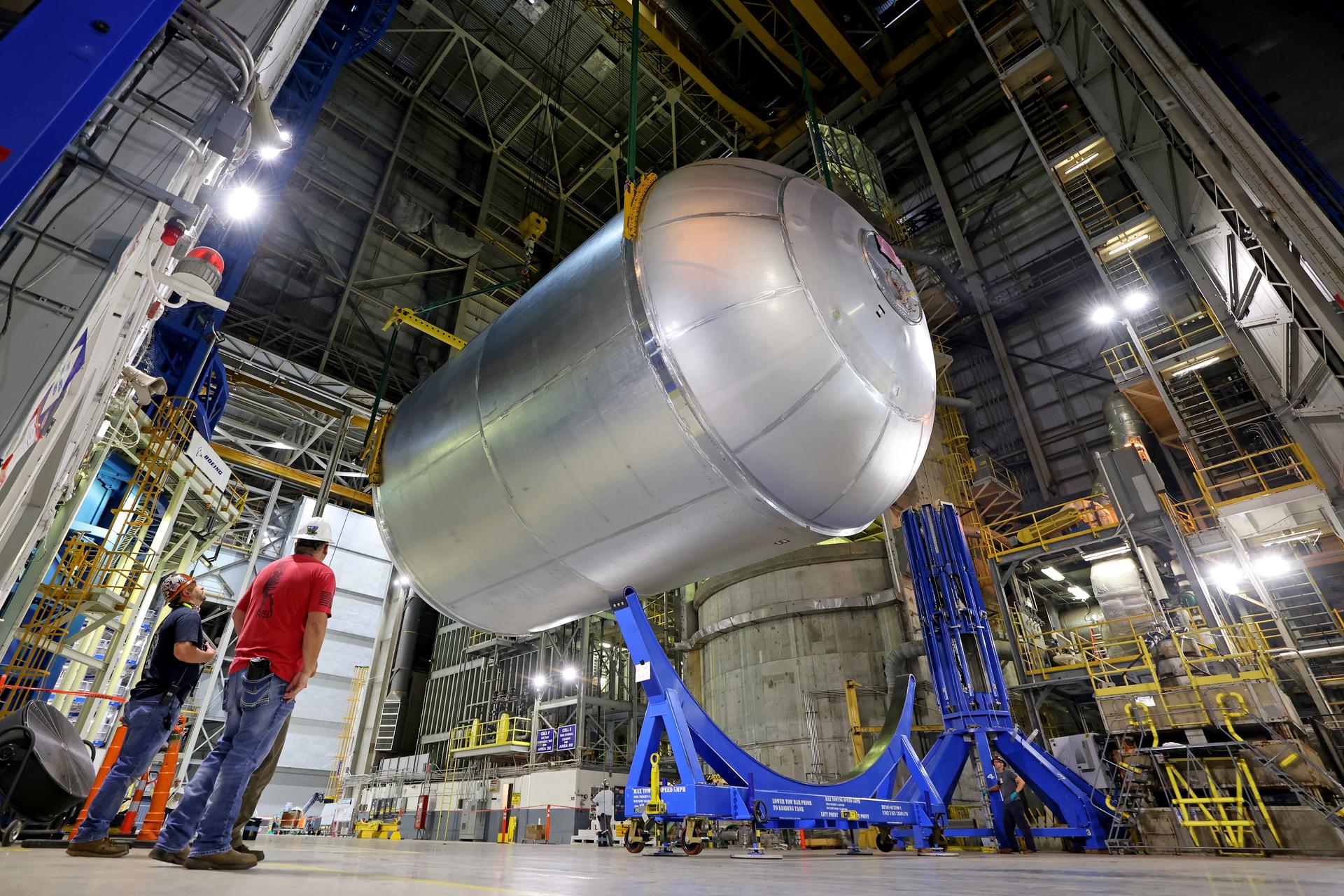
Teams at NASA’s Michoud Assembly Facility in New Orleans lift a 51-foot-tall liquid oxygen tank out of the high bay’s hydrostatic proof testing cell on July 20, 2026. The liquid oxygen tank, which will form part of the SLS (Space Launch System) rocket for NASA’s Artemis IV mission to the Moon, is rotated from a vertical to a horizontal configuration and placed into two static cradles in the main aisle of the vertical assembly building. Having completed proof testing, teams prepare the tank for transport to a production area in the main factory where they will perform post-proof non-destructive evaluations. The propellant tank will hold more than 196,000 gallons of super-cooled liquid oxygen at launch and is one of five major elements that make up the 212-foot-tall SLS rocket stage. The core stage, along with its four RS-25 engines at its base, produces more than two million pounds of thrust to help launch NASA’s Orion spacecraft, astronauts, and supplies beyond Earth’s orbit and to the lunar surface for Artemis. Image credit: NASA/Michael DeMocker
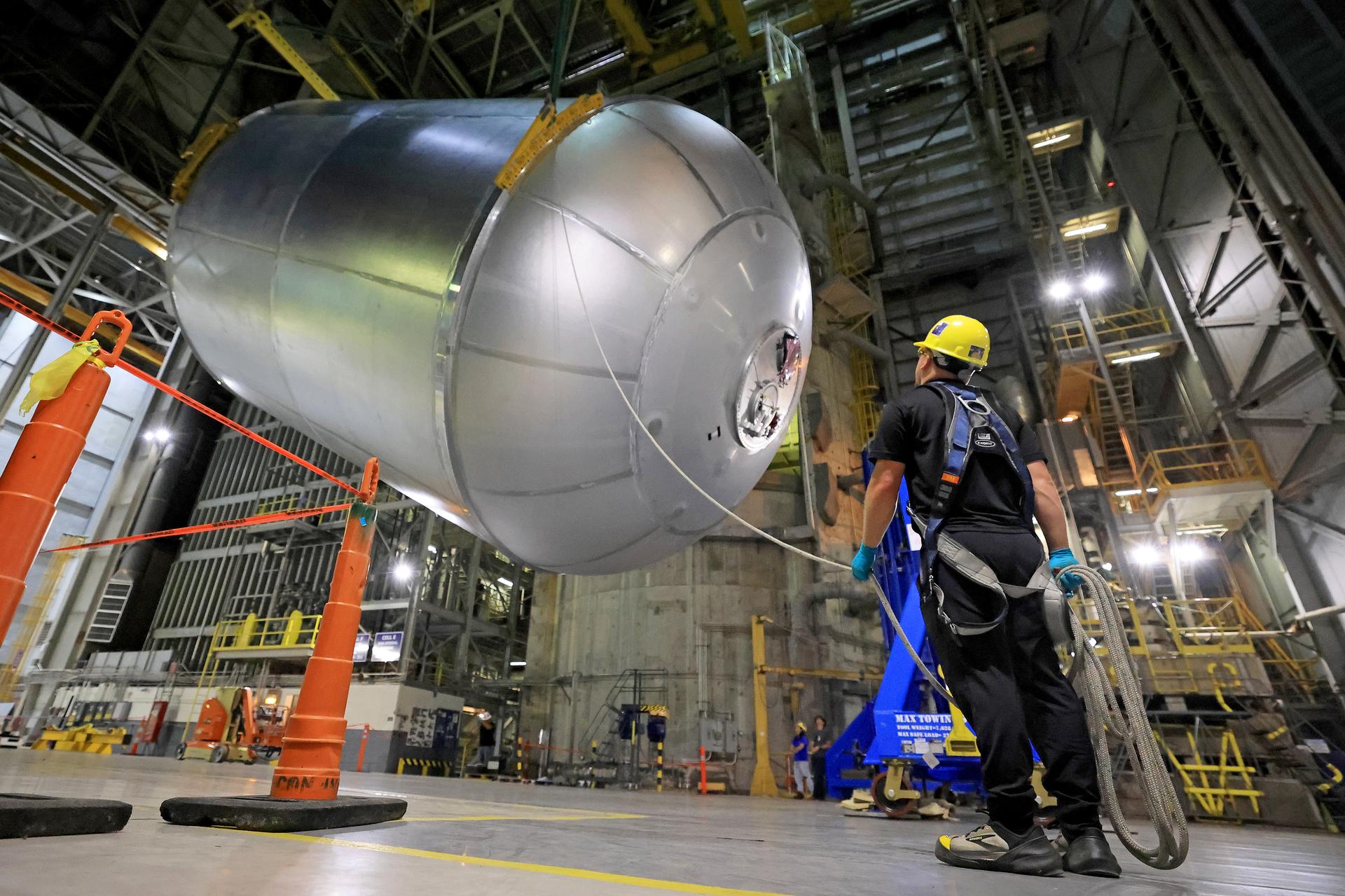
Teams at NASA’s Michoud Assembly Facility in New Orleans lift a 51-foot-tall liquid oxygen tank out of the high bay’s hydrostatic proof testing cell on July 20, 2026. The liquid oxygen tank, which will form part of the SLS (Space Launch System) rocket for NASA’s Artemis IV mission to the Moon, is rotated from a vertical to a horizontal configuration and placed into two static cradles in the main aisle of the vertical assembly building. Having completed proof testing, teams prepare the tank for transport to a production area in the main factory where they will perform post-proof non-destructive evaluations. The propellant tank will hold more than 196,000 gallons of super-cooled liquid oxygen at launch and is one of five major elements that make up the 212-foot-tall SLS rocket stage. The core stage, along with its four RS-25 engines at its base, produces more than two million pounds of thrust to help launch NASA’s Orion spacecraft, astronauts, and supplies beyond Earth’s orbit and to the lunar surface for Artemis. Image credit: NASA/Michael DeMocker
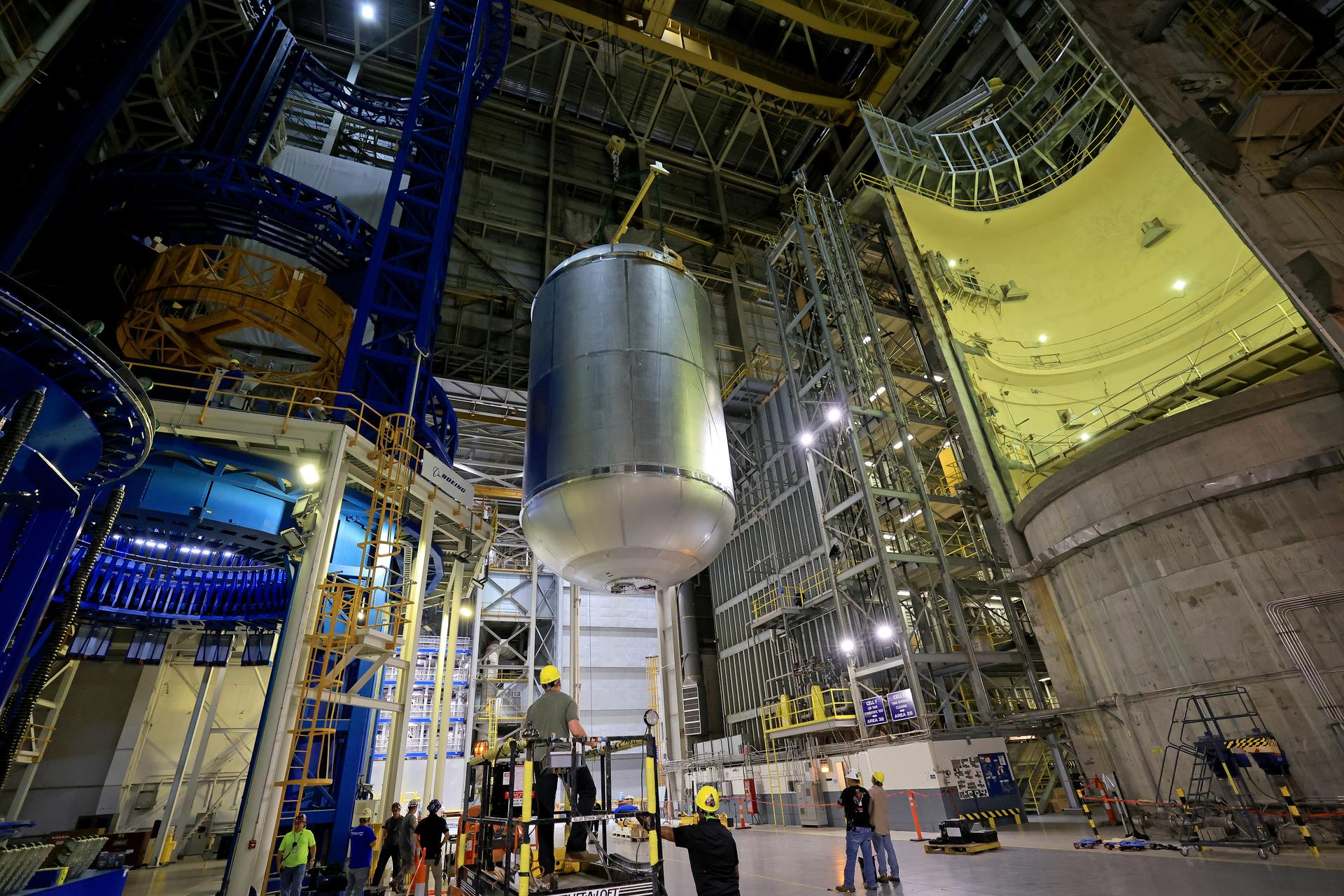
Teams at NASA’s Michoud Assembly Facility in New Orleans lift a 51-foot-tall liquid oxygen tank out of the high bay’s hydrostatic proof testing cell on July 20, 2026. The liquid oxygen tank, which will form part of the SLS (Space Launch System) rocket for NASA’s Artemis IV mission to the Moon, is rotated from a vertical to a horizontal configuration and placed into two static cradles in the main aisle of the vertical assembly building. Having completed proof testing, teams prepare the tank for transport to a production area in the main factory where they will perform post-proof non-destructive evaluations. The propellant tank will hold more than 196,000 gallons of super-cooled liquid oxygen at launch and is one of five major elements that make up the 212-foot-tall SLS rocket stage. The core stage, along with its four RS-25 engines at its base, produces more than two million pounds of thrust to help launch NASA’s Orion spacecraft, astronauts, and supplies beyond Earth’s orbit and to the lunar surface for Artemis. Image credit: NASA/Michael DeMocker
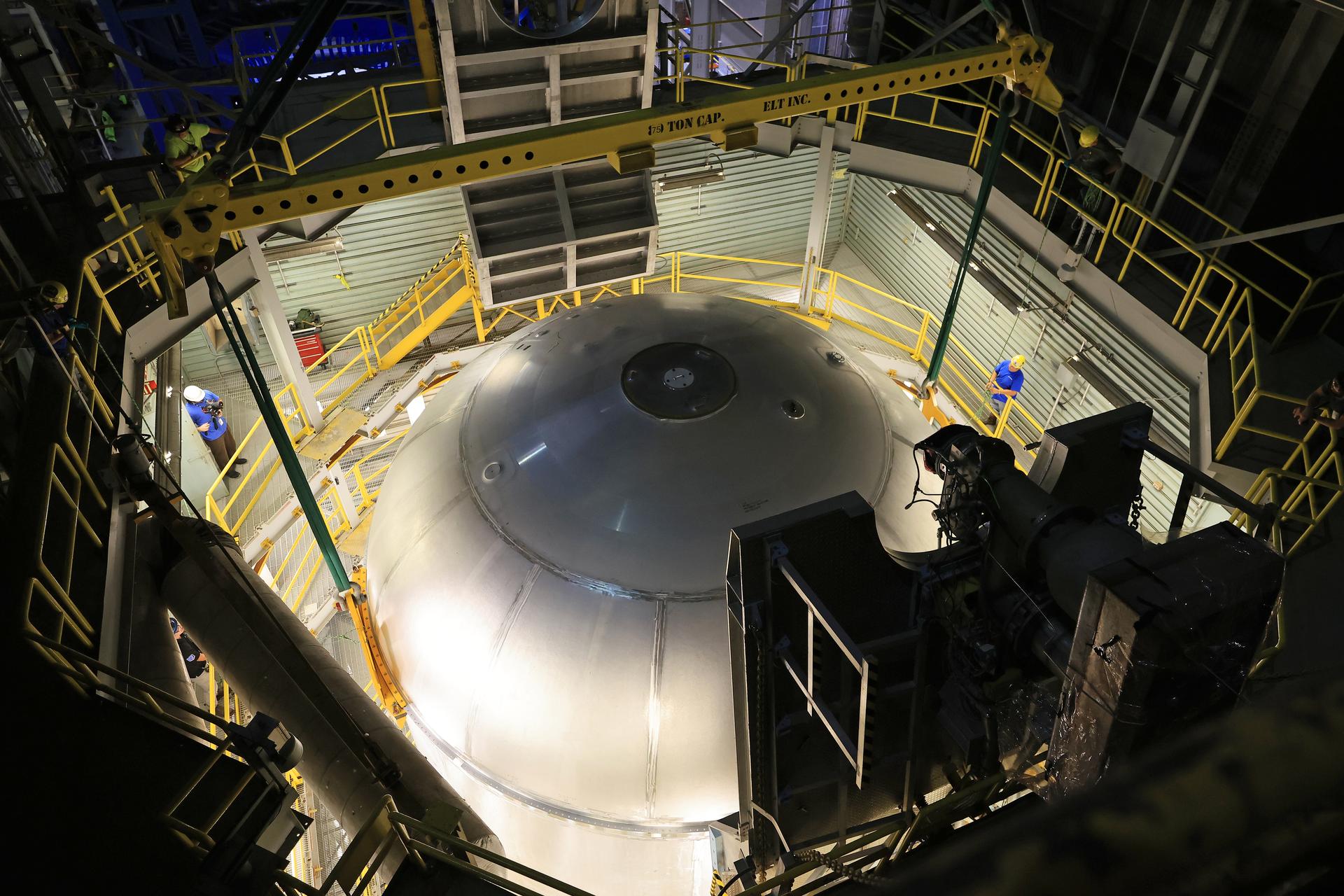
Teams at NASA’s Michoud Assembly Facility in New Orleans lift a 51-foot-tall liquid oxygen tank out of the high bay’s hydrostatic proof testing cell on July 20, 2026. The liquid oxygen tank, which will form part of the SLS (Space Launch System) rocket for NASA’s Artemis IV mission to the Moon, is rotated from a vertical to a horizontal configuration and placed into two static cradles in the main aisle of the vertical assembly building. Having completed proof testing, teams prepare the tank for transport to a production area in the main factory where they will perform post-proof non-destructive evaluations. The propellant tank will hold more than 196,000 gallons of super-cooled liquid oxygen at launch and is one of five major elements that make up the 212-foot-tall SLS rocket stage. The core stage, along with its four RS-25 engines at its base, produces more than two million pounds of thrust to help launch NASA’s Orion spacecraft, astronauts, and supplies beyond Earth’s orbit and to the lunar surface for Artemis. Image credit: NASA/Michael DeMocker
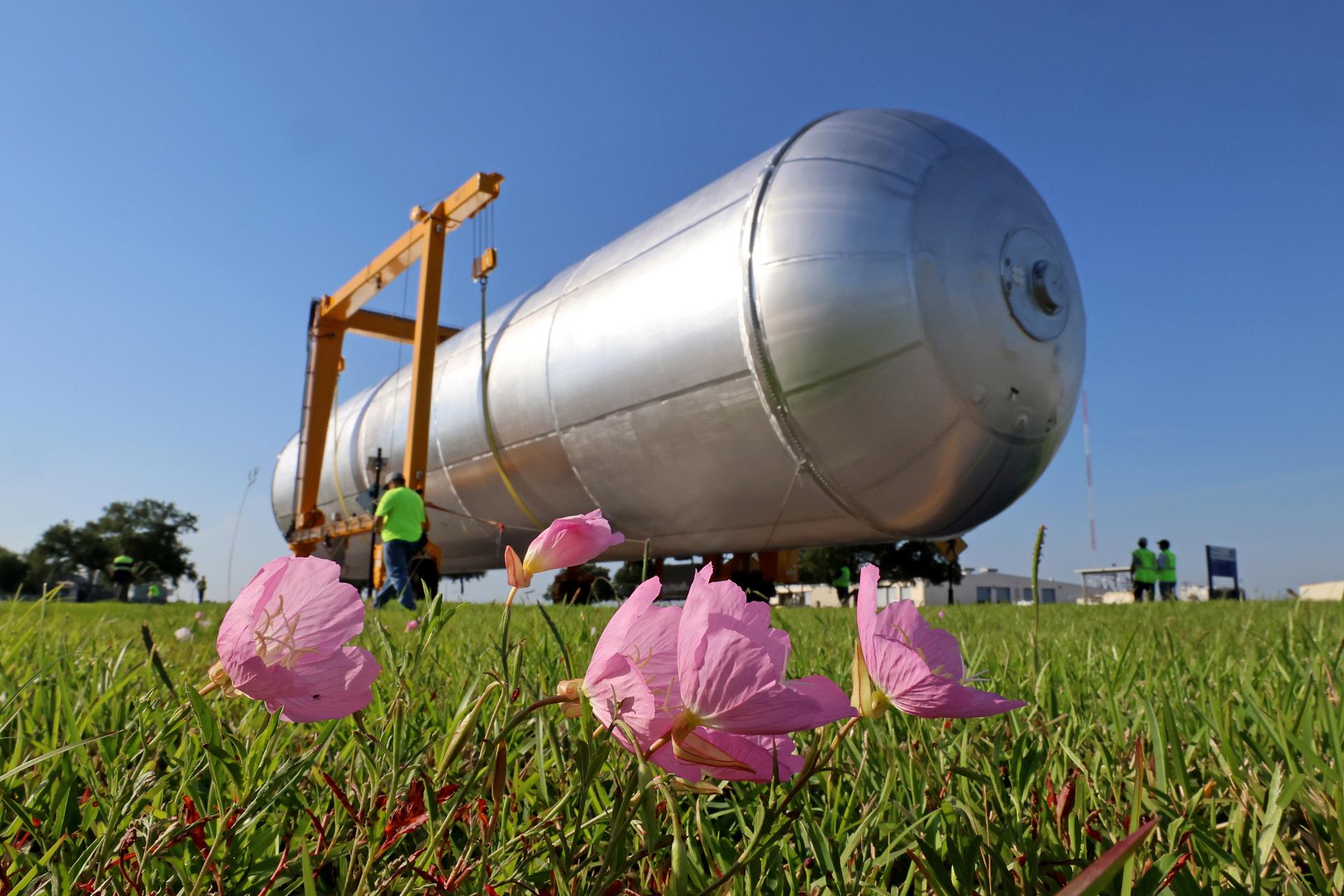
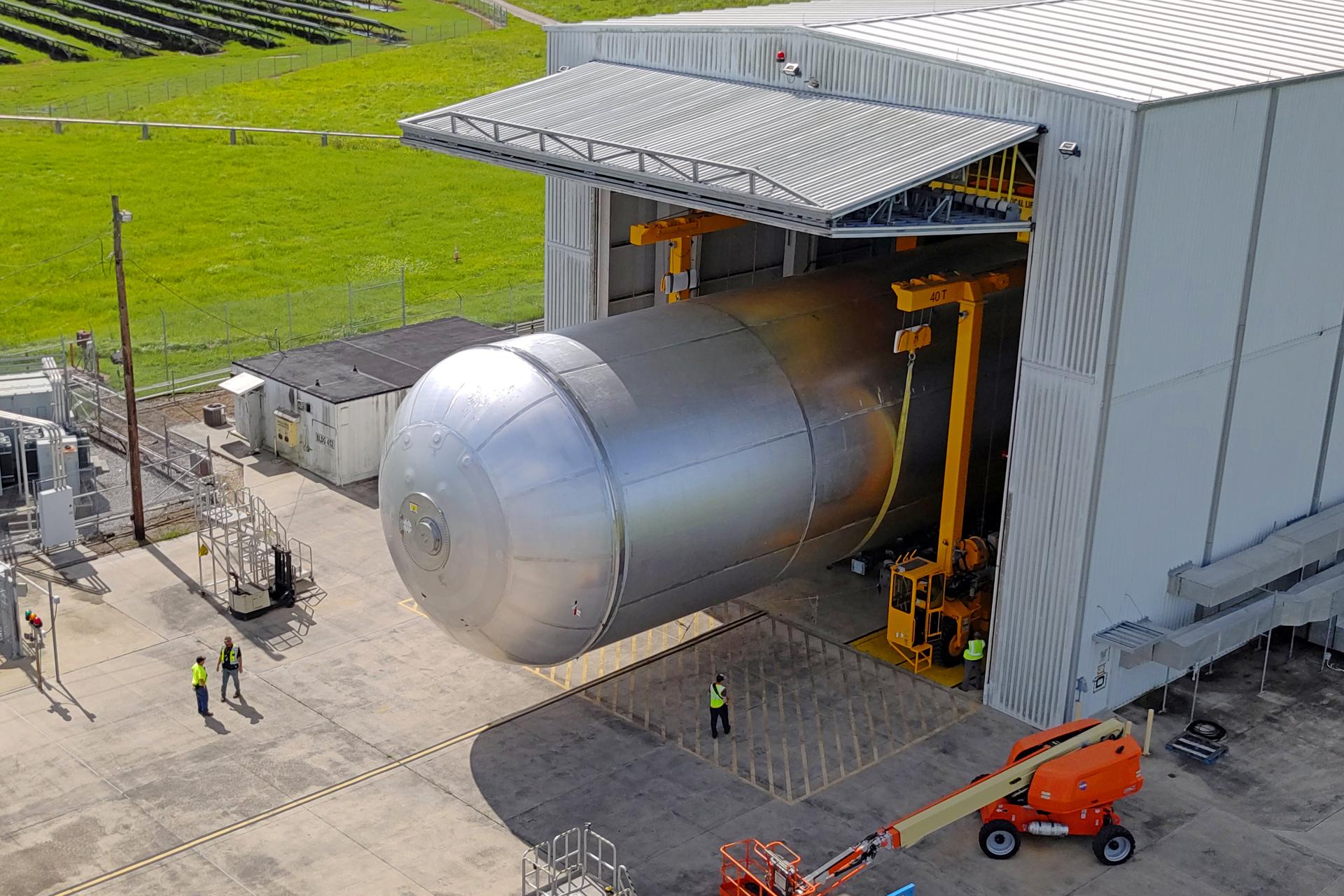
Crews at NASA’s Michoud Assembly Facility in New Orleans transport the 130-foot-tall liquid hydrogen tank out of a production cell inside the main factory building into a detached test building on a separate portion of the 829-acre site. The liquid hydrogen tank will form part of the core stage for the SLS (Space Launch System) rocket, providing thousands of gallons of super-cold propellant to one of four RS-25 engines. Inside the test cell, teams will perform non-destructive evaluation proof testing on the tank. Proof testing ensures the structural integrity of the flight hardware before crews begin the next phase of production. The liquid hydrogen propellant tank is one of five major elements that make up the 212-foot-tall SLS rocket stage. The core stage, along with its four RS-25 engines at its base, produce more than two million pounds of thrust to help launch NASA’s Orion spacecraft, astronauts, and supplies beyond Earth’s orbit and to the lunar surface for Artemis. Image credit: NASA/Michael DeMocker
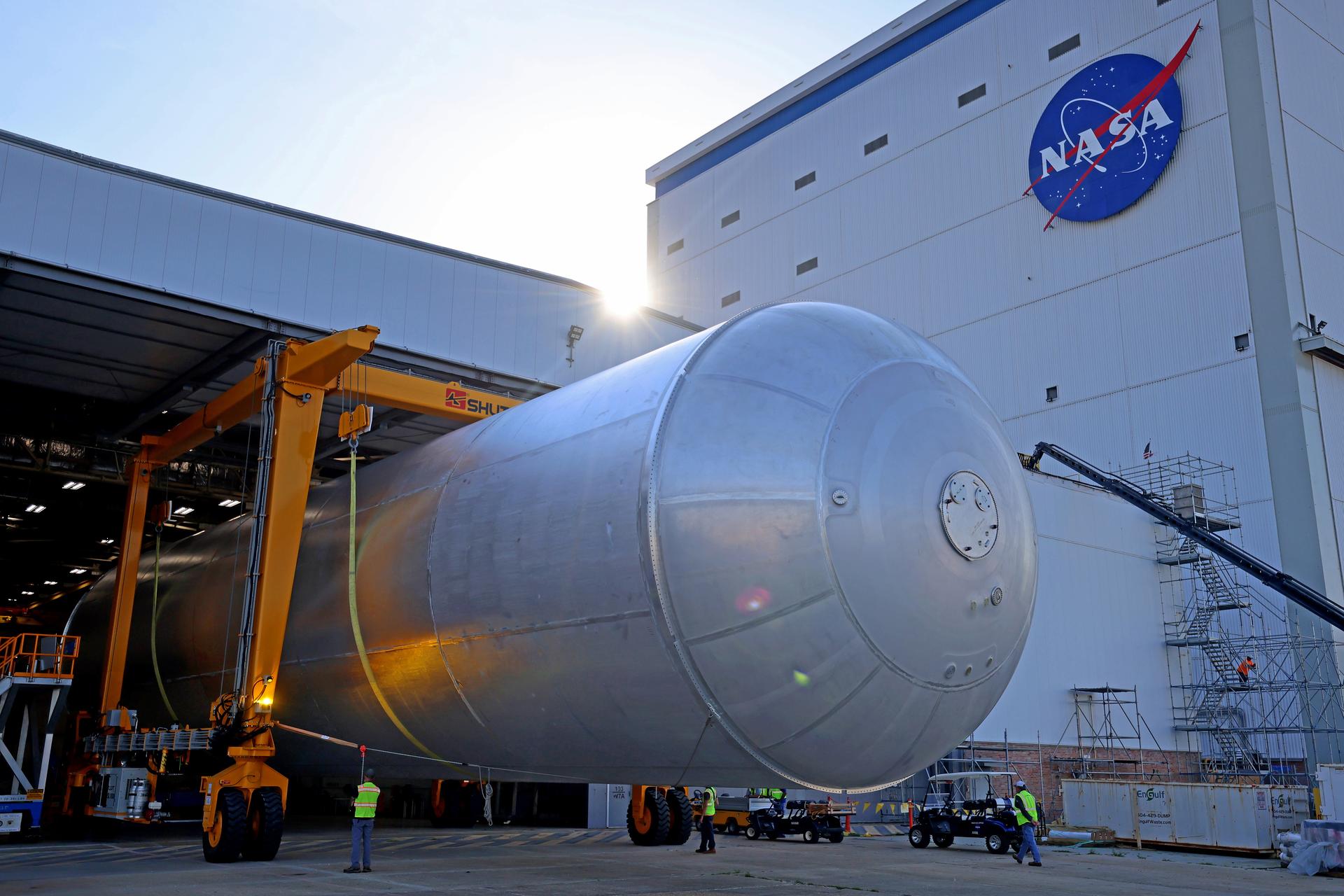
Crews at NASA’s Michoud Assembly Facility in New Orleans transport the 130-foot-tall liquid hydrogen tank out of a production cell inside the main factory building into a detached test building on a separate portion of the 829-acre site. The liquid hydrogen tank will form part of the core stage for the SLS (Space Launch System) rocket, providing thousands of gallons of super-cold propellant to one of four RS-25 engines. Inside the test cell, teams will perform non-destructive evaluation proof testing on the tank. Proof testing ensures the structural integrity of the flight hardware before crews begin the next phase of production. The liquid hydrogen propellant tank is one of five major elements that make up the 212-foot-tall SLS rocket stage. The core stage, along with its four RS-25 engines at its base, produce more than two million pounds of thrust to help launch NASA’s Orion spacecraft, astronauts, and supplies beyond Earth’s orbit and to the lunar surface for Artemis. Image credit: NASA/Michael DeMocker
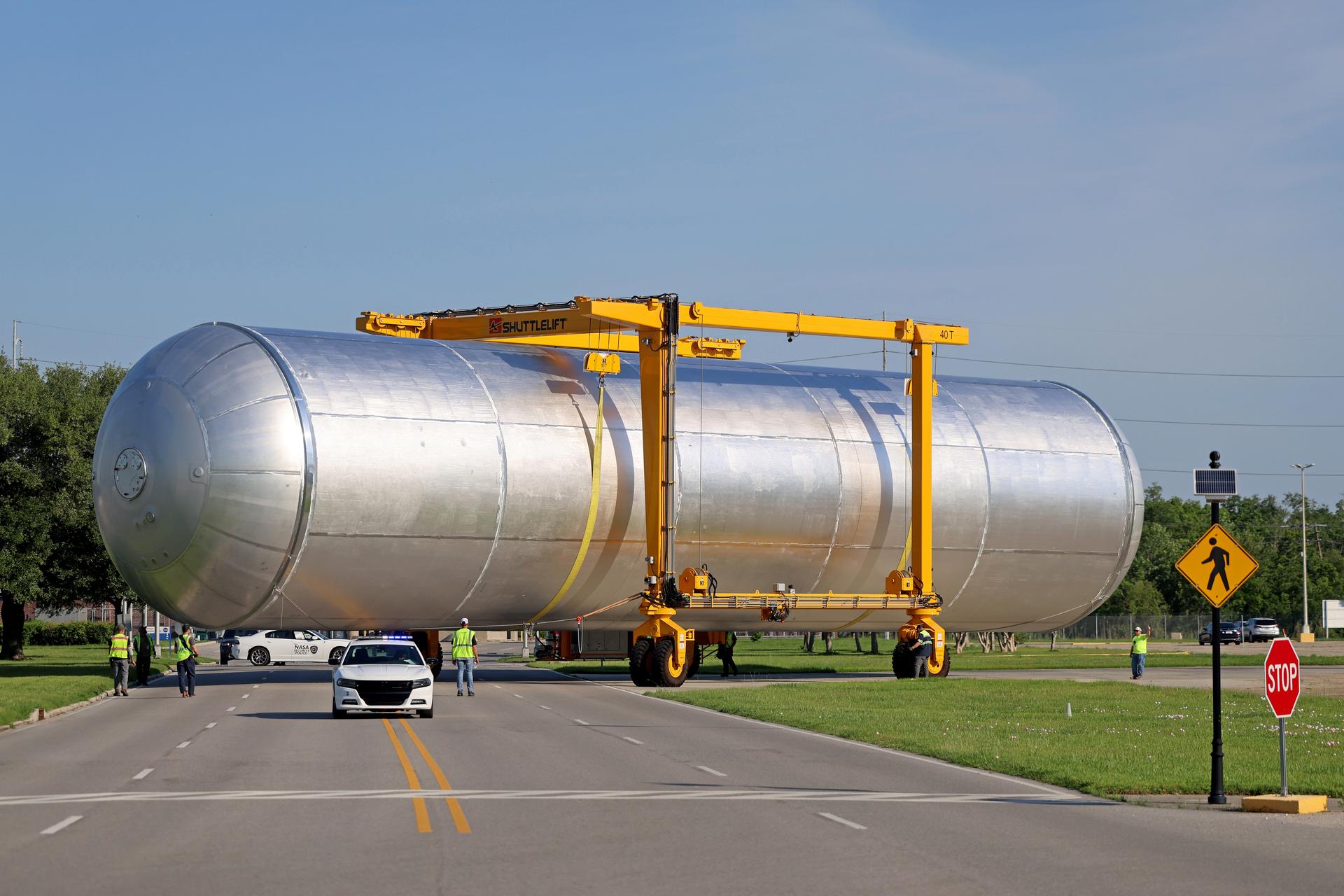
Crews at NASA’s Michoud Assembly Facility in New Orleans transport the 130-foot-tall liquid hydrogen tank out of a production cell inside the main factory building into a detached test building on a separate portion of the 829-acre site. The liquid hydrogen tank will form part of the core stage for the SLS (Space Launch System) rocket, providing thousands of gallons of super-cold propellant to one of four RS-25 engines. Inside the test cell, teams will perform non-destructive evaluation proof testing on the tank. Proof testing ensures the structural integrity of the flight hardware before crews begin the next phase of production. The liquid hydrogen propellant tank is one of five major elements that make up the 212-foot-tall SLS rocket stage. The core stage, along with its four RS-25 engines at its base, produce more than two million pounds of thrust to help launch NASA’s Orion spacecraft, astronauts, and supplies beyond Earth’s orbit and to the lunar surface for Artemis. Image credit: NASA/Michael DeMocker
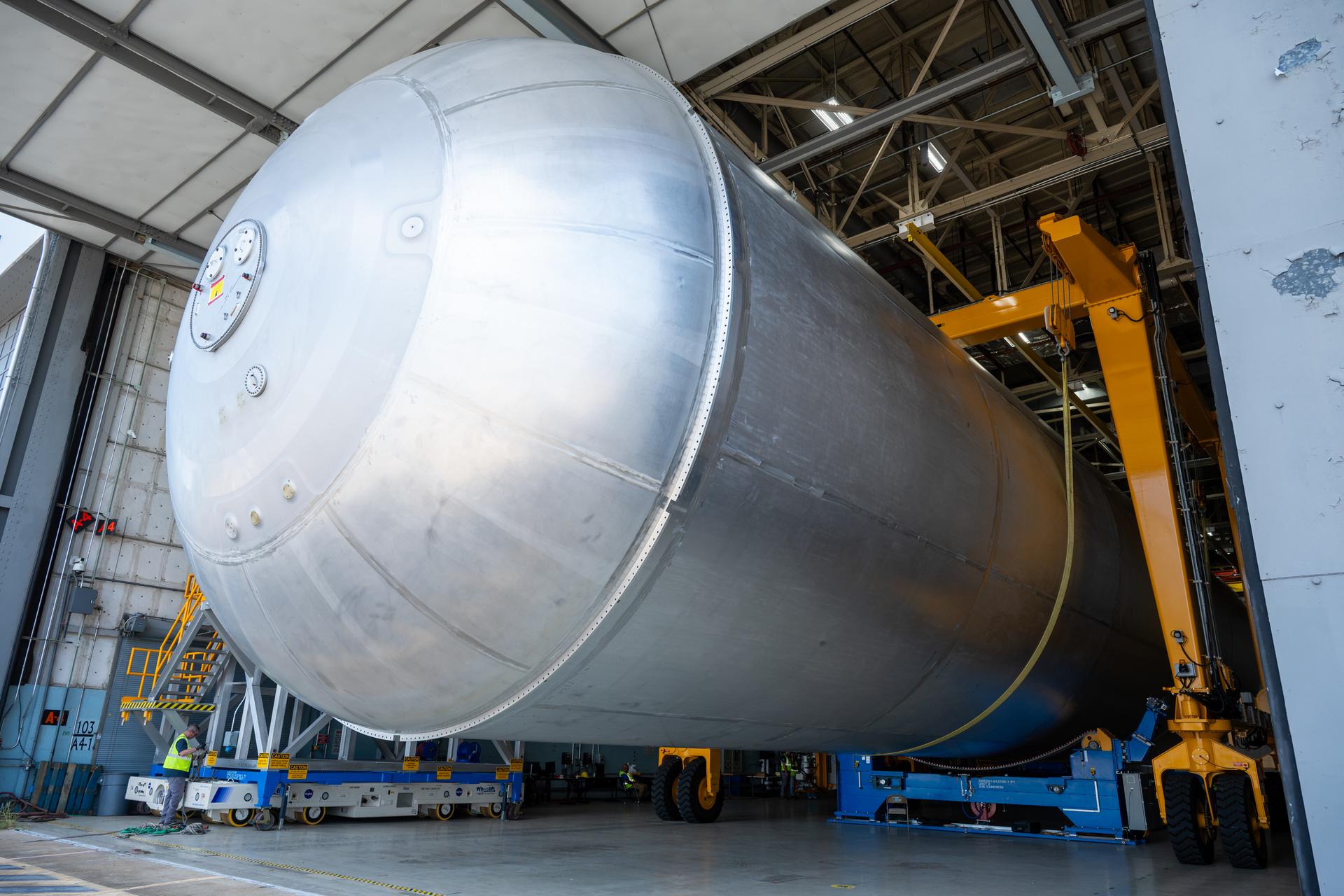
Crews at NASA’s Michoud Assembly Facility in New Orleans transport the 130-foot-tall liquid hydrogen tank from the proof testing building to the main factory on July 15. The liquid hydrogen tank will form part of the core stage for the SLS (Space Launch System) rocket for the agency’s Artemis IV mission, providing thousands of gallons of super-cold propellant to the rocket engines during launch. Soon, teams with SLS prime contractor, Boeing, will move the tank into the facility’s vertical assembly building for cleaning operations. The liquid hydrogen propellant tank is one of five major elements that make up the 212-foot-tall SLS rocket stage. The core stage, along with its four RS-25 engines at its base, produce more than two million pounds of thrust to help launch NASA’s Orion spacecraft, astronauts, and supplies beyond Earth’s orbit and to the lunar surface for Artemis.
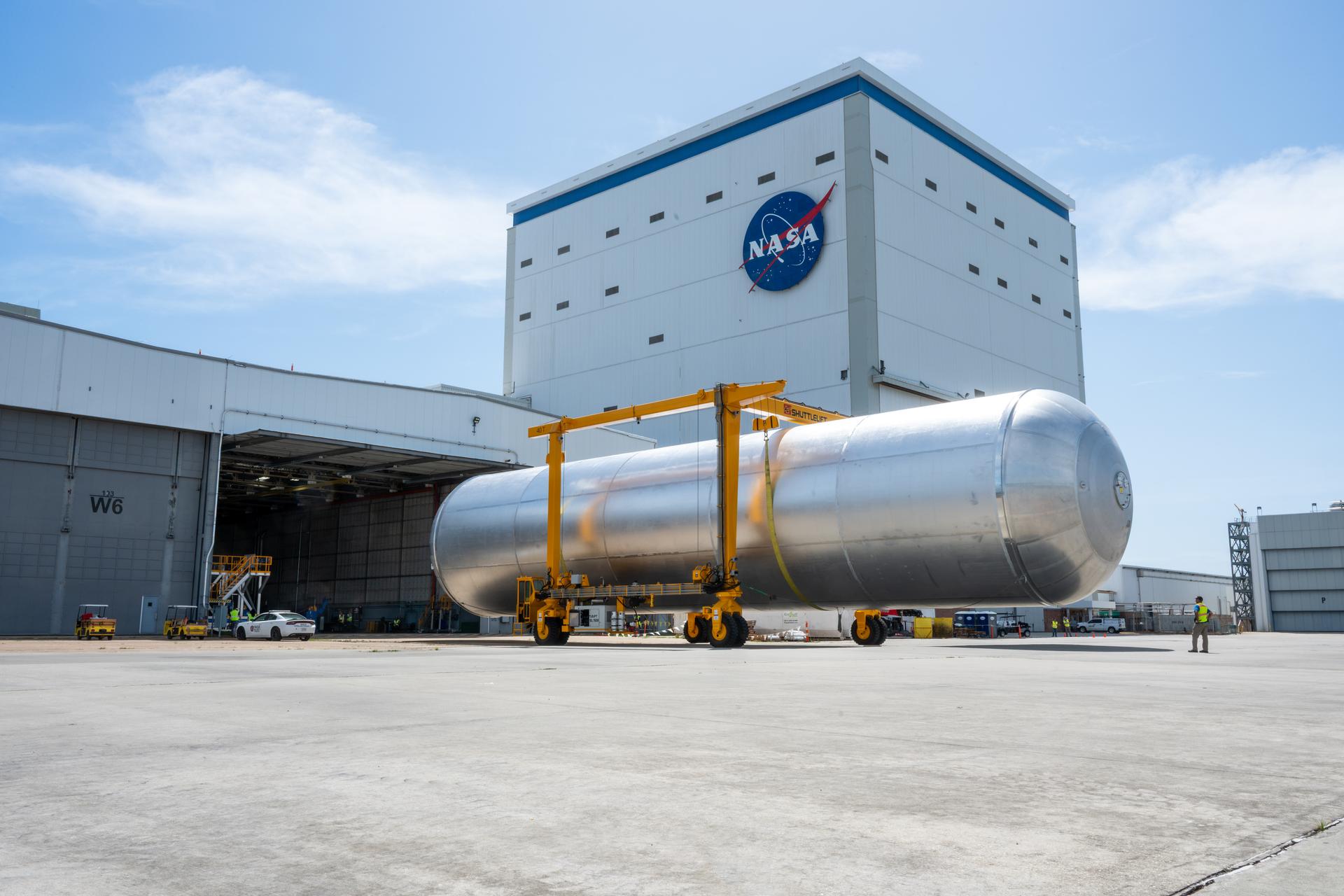
Crews at NASA’s Michoud Assembly Facility in New Orleans transport the 130-foot-tall liquid hydrogen tank from the proof testing building to the main factory on July 10. The liquid hydrogen tank will form part of the core stage for the SLS (Space Launch System) rocket for the agency’s Artemis IV mission, providing thousands of gallons of super-cold propellant to the rocket engines during launch. Soon, teams with SLS prime contractor, Boeing, will move the tank into the facility’s vertical assembly building for cleaning operations. The liquid hydrogen propellant tank is one of five major elements that make up the 212-foot-tall SLS rocket stage. The core stage, along with its four RS-25 engines at its base, produce more than two million pounds of thrust to help launch NASA’s Orion spacecraft, astronauts, and supplies beyond Earth’s orbit and to the lunar surface for Artemis.
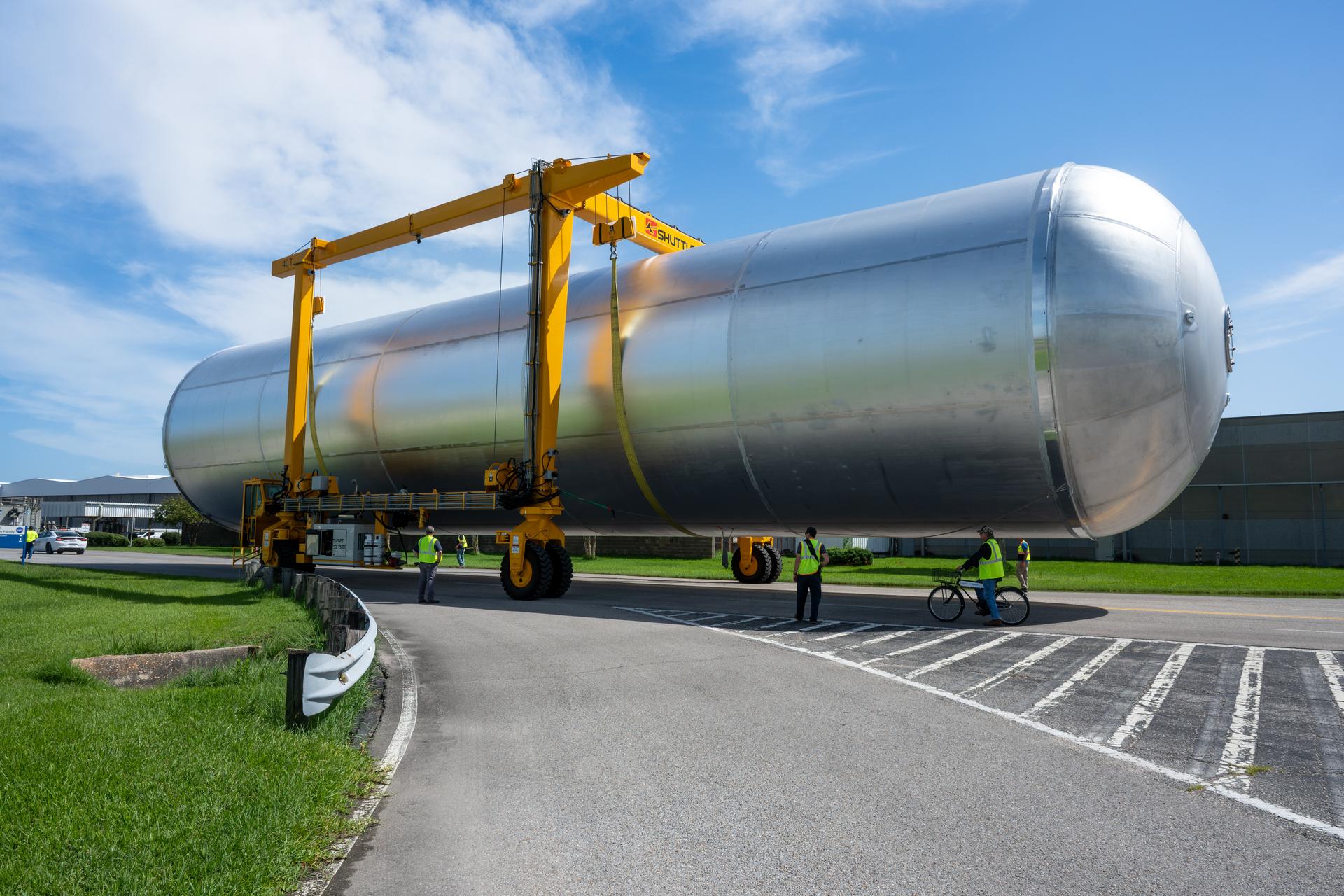
Crews at NASA’s Michoud Assembly Facility in New Orleans transport the 130-foot-tall liquid hydrogen tank from the proof testing building to the main factory on July 15. The liquid hydrogen tank will form part of the core stage for the SLS (Space Launch System) rocket for the agency’s Artemis IV mission, providing thousands of gallons of super-cold propellant to the rocket engines during launch. Soon, teams with SLS prime contractor, Boeing, will move the tank into the facility’s vertical assembly building for cleaning operations. The liquid hydrogen propellant tank is one of five major elements that make up the 212-foot-tall SLS rocket stage. The core stage, along with its four RS-25 engines at its base, produce more than two million pounds of thrust to help launch NASA’s Orion spacecraft, astronauts, and supplies beyond Earth’s orbit and to the lunar surface for Artemis.
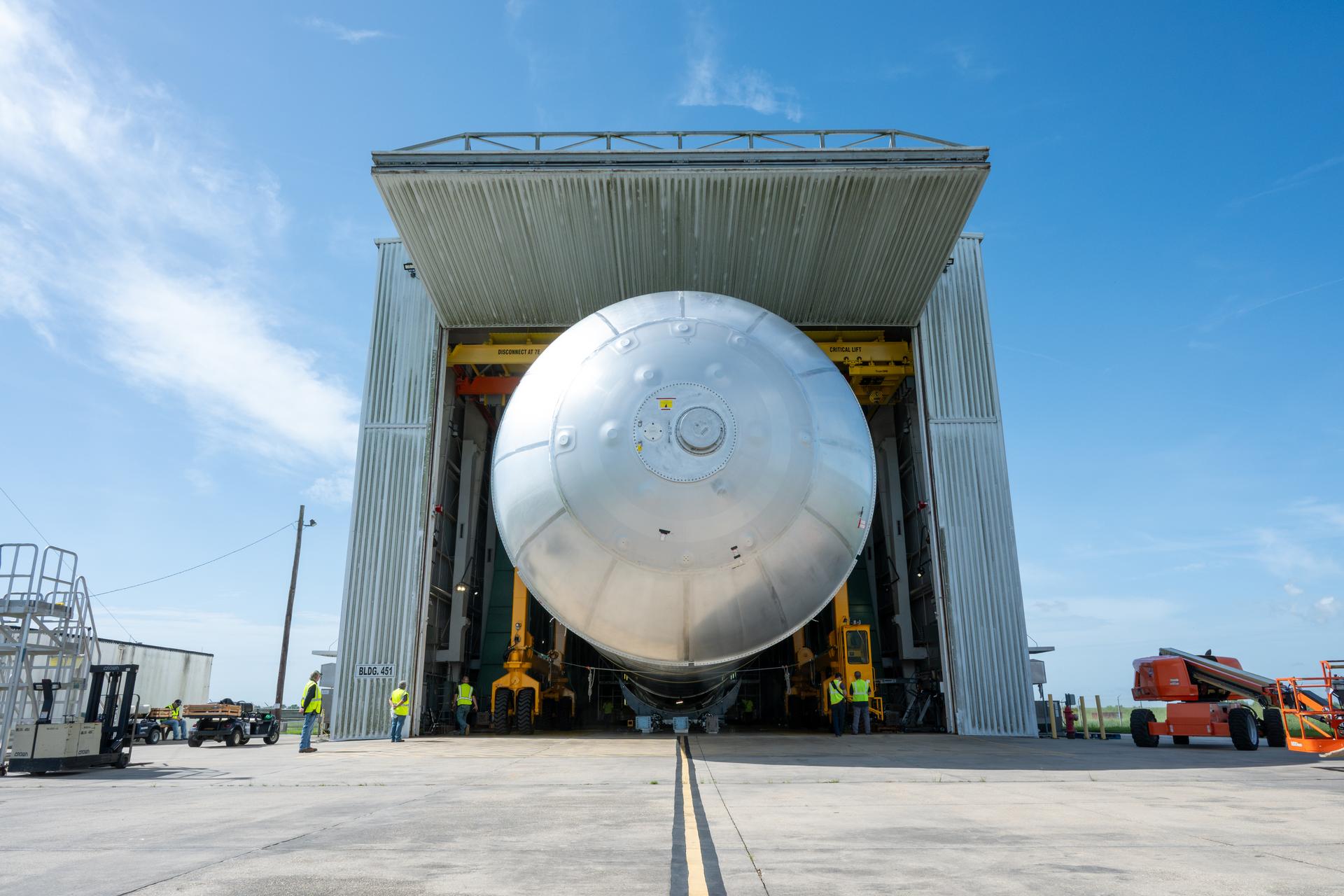
Crews at NASA’s Michoud Assembly Facility in New Orleans transport the 130-foot-tall liquid hydrogen tank from the proof testing building to the main factory on July 15. The liquid hydrogen tank will form part of the core stage for the SLS (Space Launch System) rocket for the agency’s Artemis IV mission, providing thousands of gallons of super-cold propellant to the rocket engines during launch. Soon, teams with SLS prime contractor, Boeing, will move the tank into the facility’s vertical assembly building for cleaning operations. The liquid hydrogen propellant tank is one of five major elements that make up the 212-foot-tall SLS rocket stage. The core stage, along with its four RS-25 engines at its base, produce more than two million pounds of thrust to help launch NASA’s Orion spacecraft, astronauts, and supplies beyond Earth’s orbit and to the lunar surface for Artemis.
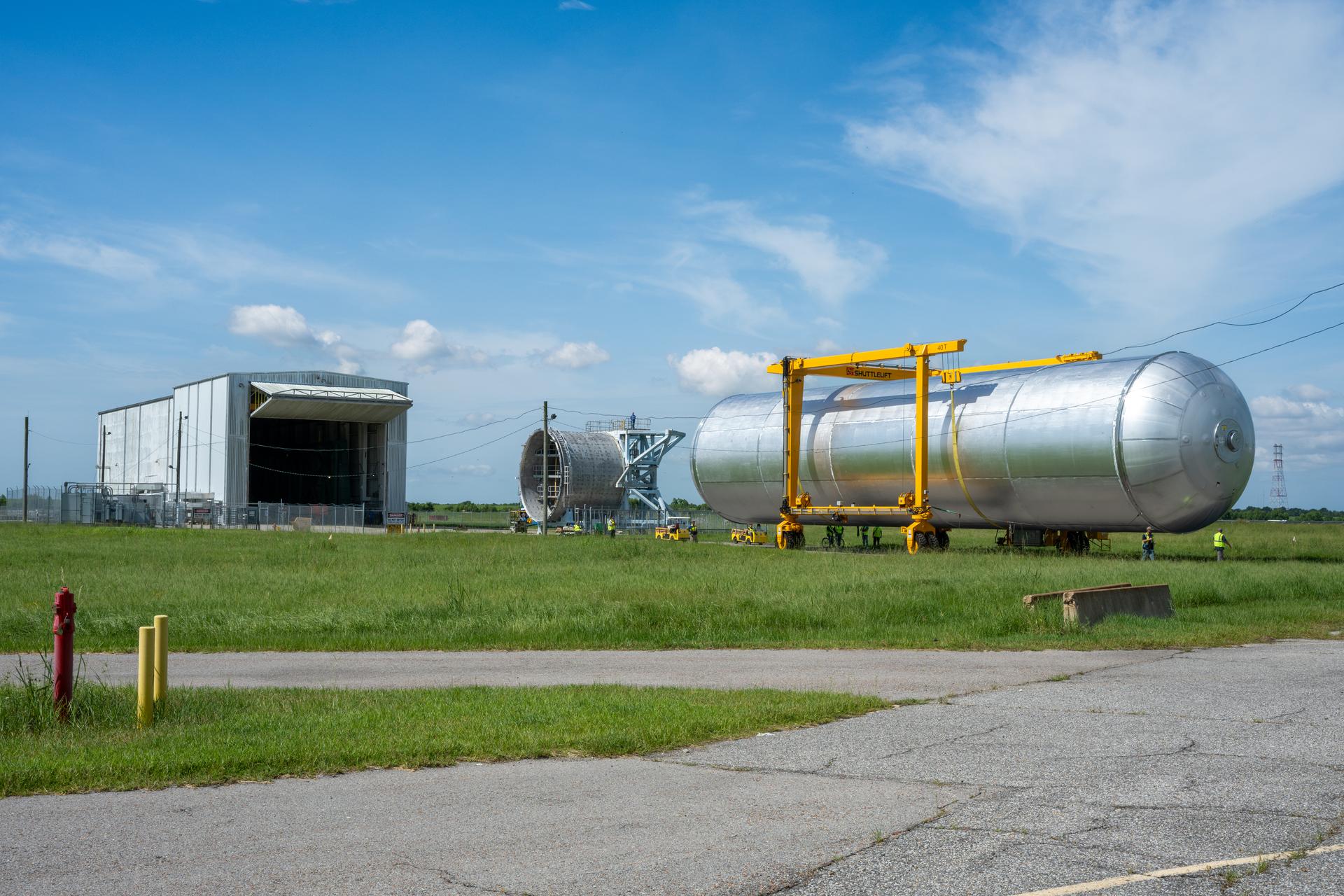
Crews at NASA’s Michoud Assembly Facility in New Orleans transport the 130-foot-tall liquid hydrogen tank from the proof testing building to the main factory on July 15. The liquid hydrogen tank will form part of the core stage for the SLS (Space Launch System) rocket for the agency’s Artemis IV mission, providing thousands of gallons of super-cold propellant to the rocket engines during launch. Soon, teams with SLS prime contractor, Boeing, will move the tank into the facility’s vertical assembly building for cleaning operations. The liquid hydrogen propellant tank is one of five major elements that make up the 212-foot-tall SLS rocket stage. The core stage, along with its four RS-25 engines at its base, produce more than two million pounds of thrust to help launch NASA’s Orion spacecraft, astronauts, and supplies beyond Earth’s orbit and to the lunar surface for Artemis.
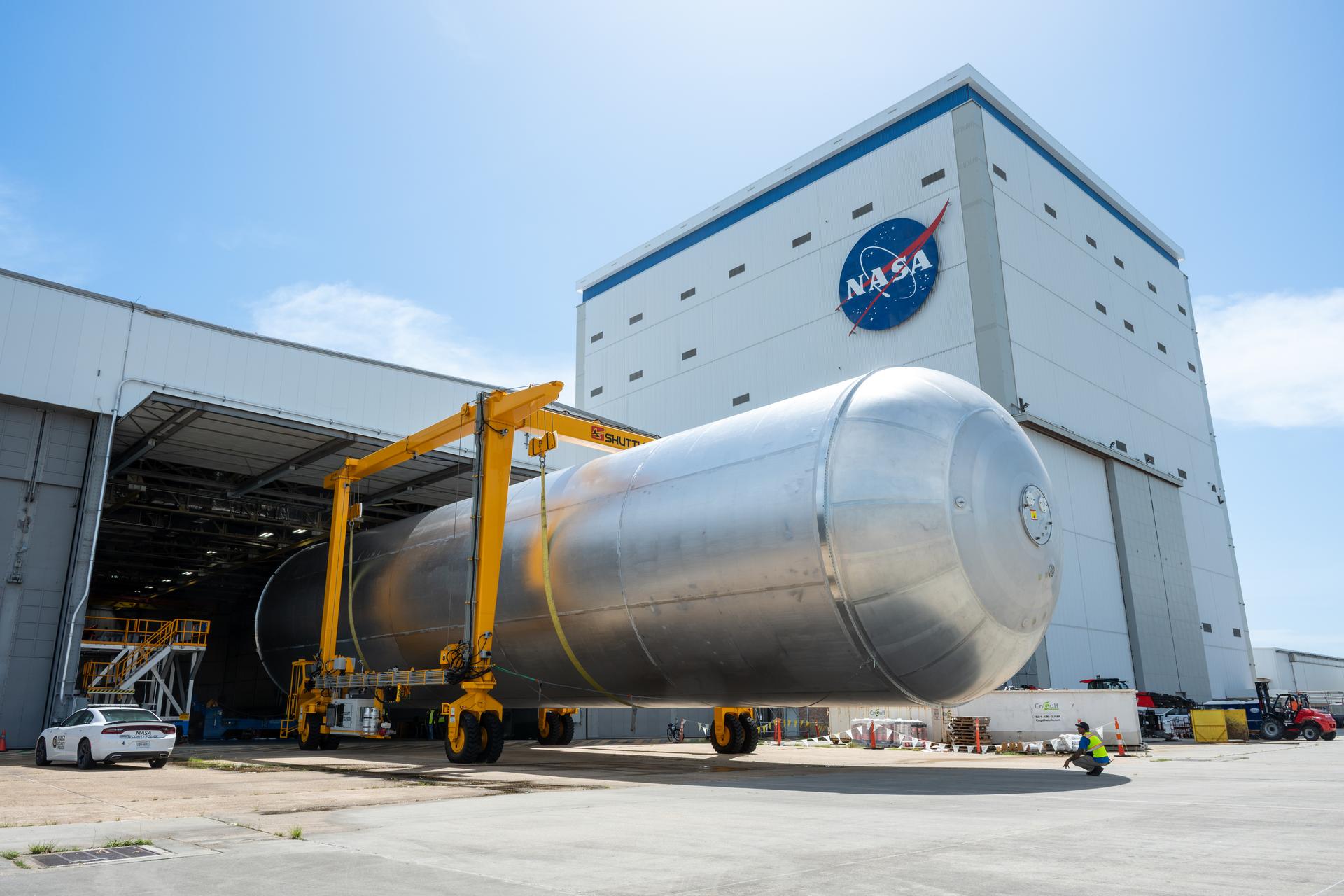
Crews at NASA’s Michoud Assembly Facility in New Orleans transport the 130-foot-tall liquid hydrogen tank from the proof testing building to the main factory on July 15. The liquid hydrogen tank will form part of the core stage for the SLS (Space Launch System) rocket for the agency’s Artemis IV mission, providing thousands of gallons of super-cold propellant to the rocket engines during launch. Soon, teams with SLS prime contractor, Boeing, will move the tank into the facility’s vertical assembly building for cleaning operations. The liquid hydrogen propellant tank is one of five major elements that make up the 212-foot-tall SLS rocket stage. The core stage, along with its four RS-25 engines at its base, produce more than two million pounds of thrust to help launch NASA’s Orion spacecraft, astronauts, and supplies beyond Earth’s orbit and to the lunar surface for Artemis.
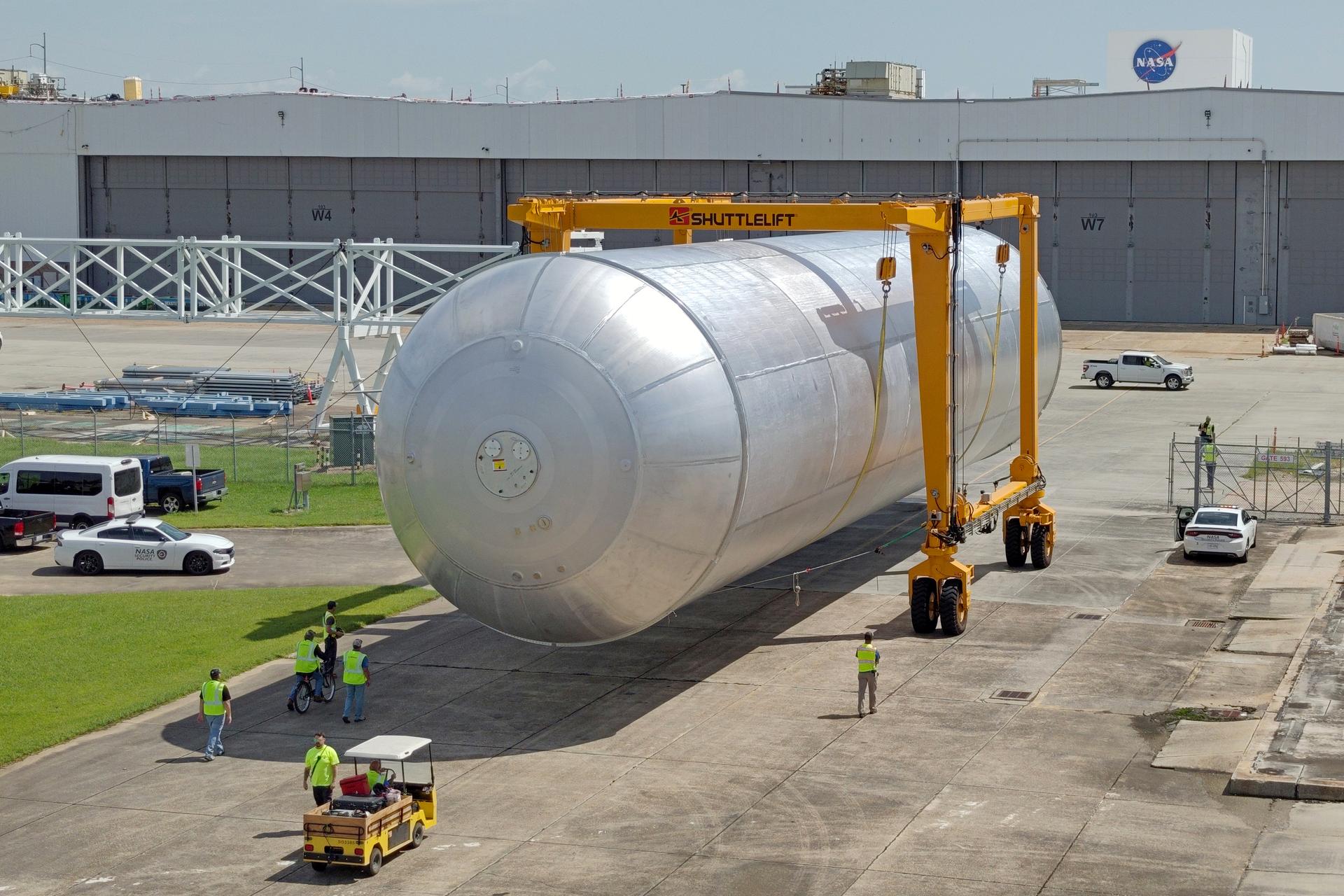
Crews at NASA’s Michoud Assembly Facility in New Orleans transport the 130-foot-tall liquid hydrogen tank from the proof testing building to the main factory on July 10. The liquid hydrogen tank will form part of the core stage for the SLS (Space Launch System) rocket for the agency’s Artemis IV mission, providing thousands of gallons of super-cold propellant to the rocket engines during launch. Soon, teams with SLS prime contractor, Boeing, will move the tank into the facility’s vertical assembly building for cleaning operations. The liquid hydrogen propellant tank is one of five major elements that make up the 212-foot-tall SLS rocket stage. The core stage, along with its four RS-25 engines at its base, produce more than two million pounds of thrust to help launch NASA’s Orion spacecraft, astronauts, and supplies beyond Earth’s orbit and to the lunar surface for Artemis. Image credit: NASA/Eric Bordelon & Michael DeMocker
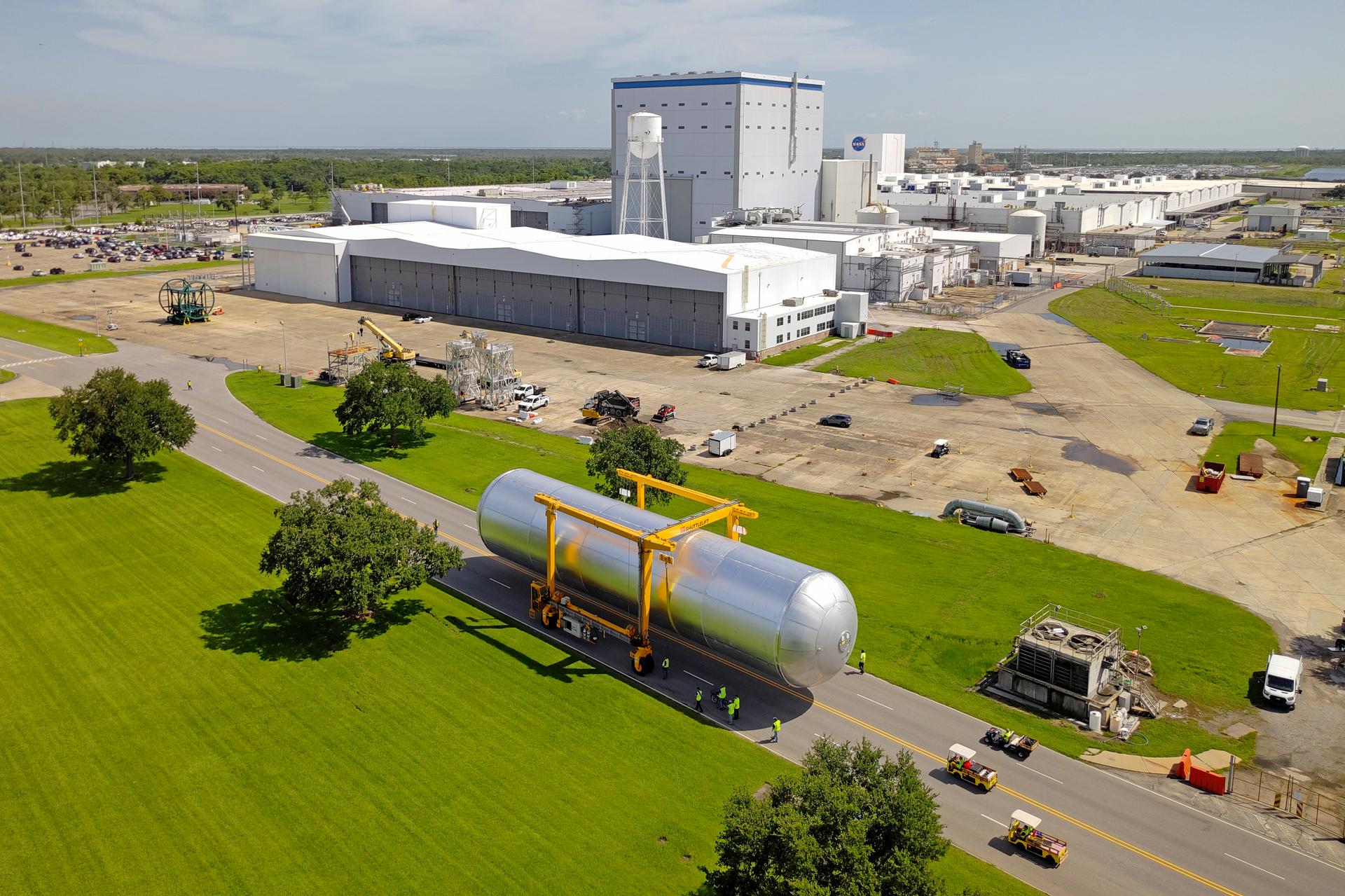
Crews at NASA’s Michoud Assembly Facility in New Orleans transport the 130-foot-tall liquid hydrogen tank from the proof testing building to the main factory on July 10. The liquid hydrogen tank will form part of the core stage for the SLS (Space Launch System) rocket for the agency’s Artemis IV mission, providing thousands of gallons of super-cold propellant to the rocket engines during launch. Soon, teams with SLS prime contractor, Boeing, will move the tank into the facility’s vertical assembly building for cleaning operations. The liquid hydrogen propellant tank is one of five major elements that make up the 212-foot-tall SLS rocket stage. The core stage, along with its four RS-25 engines at its base, produce more than two million pounds of thrust to help launch NASA’s Orion spacecraft, astronauts, and supplies beyond Earth’s orbit and to the lunar surface for Artemis. Image credit: NASA/Eric Bordelon & Michael DeMocker
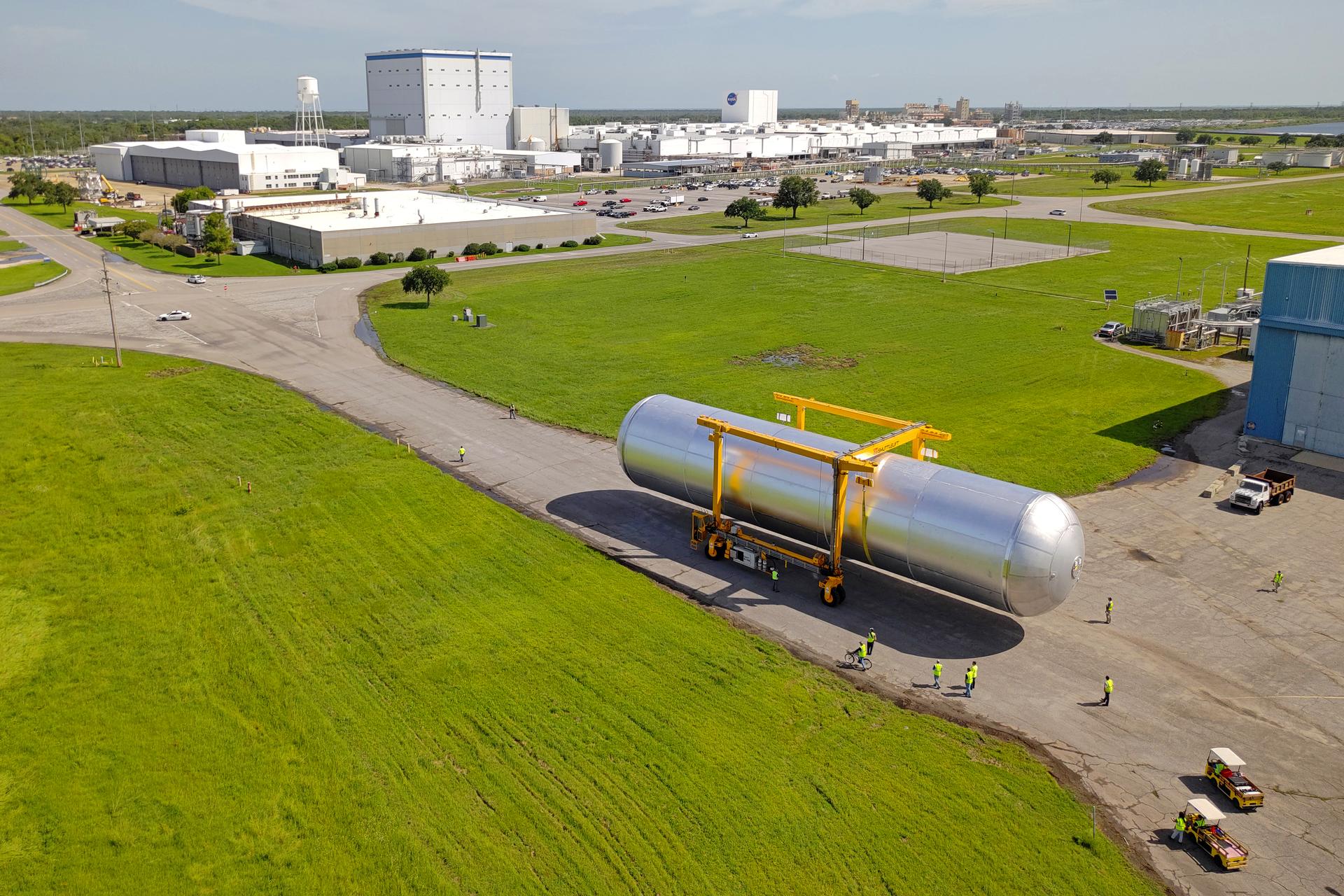
Crews at NASA’s Michoud Assembly Facility in New Orleans transport the 130-foot-tall liquid hydrogen tank from the proof testing building to the main factory on July 10. The liquid hydrogen tank will form part of the core stage for the SLS (Space Launch System) rocket for the agency’s Artemis IV mission, providing thousands of gallons of super-cold propellant to the rocket engines during launch. Soon, teams with SLS prime contractor, Boeing, will move the tank into the facility’s vertical assembly building for cleaning operations. The liquid hydrogen propellant tank is one of five major elements that make up the 212-foot-tall SLS rocket stage. The core stage, along with its four RS-25 engines at its base, produce more than two million pounds of thrust to help launch NASA’s Orion spacecraft, astronauts, and supplies beyond Earth’s orbit and to the lunar surface for Artemis. Image credit: NASA/Eric Bordelon & Michael DeMocker
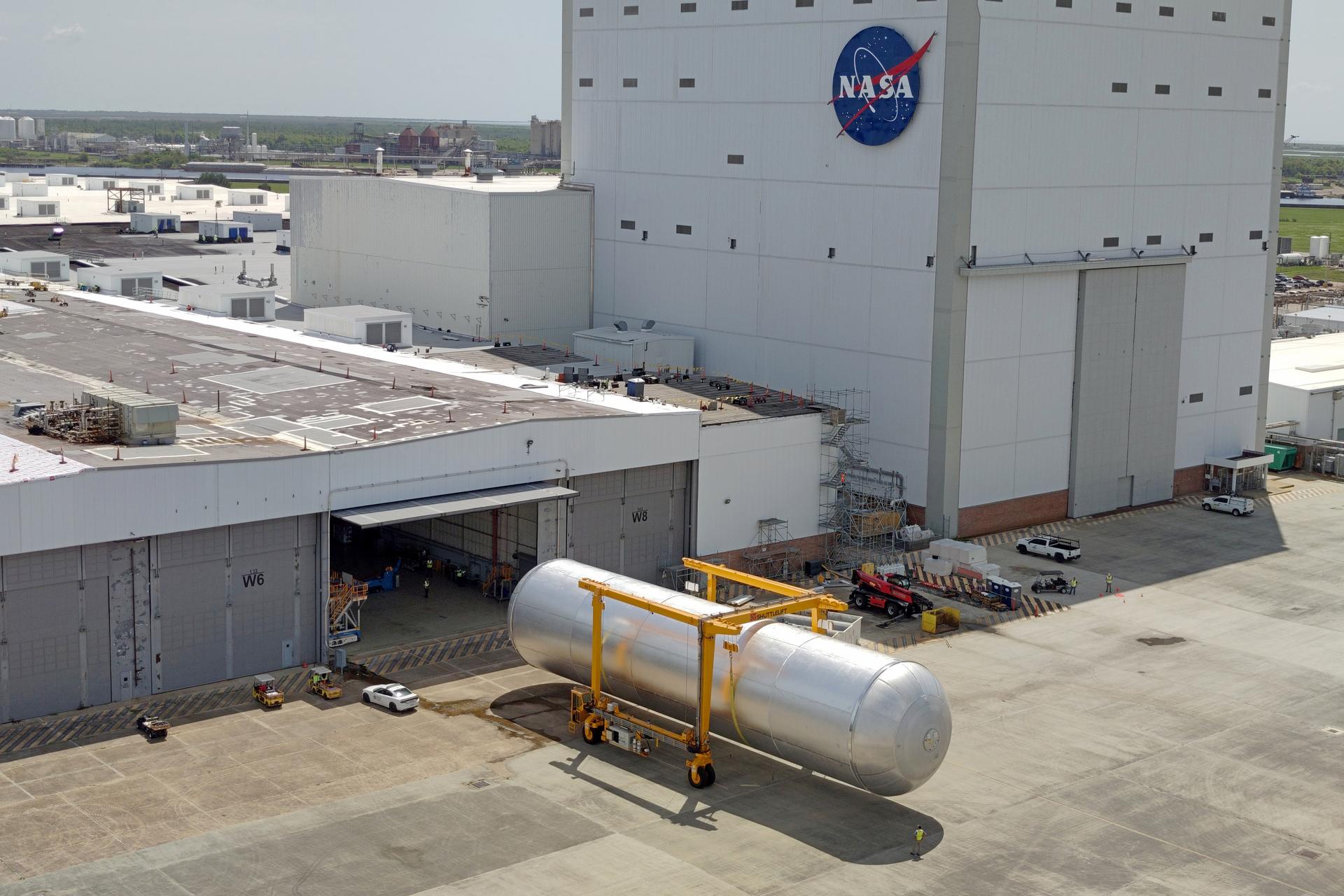
Crews at NASA’s Michoud Assembly Facility in New Orleans transport the 130-foot-tall liquid hydrogen tank from the proof testing building to the main factory on July 10. The liquid hydrogen tank will form part of the core stage for the SLS (Space Launch System) rocket for the agency’s Artemis IV mission, providing thousands of gallons of super-cold propellant to the rocket engines during launch. Soon, teams with SLS prime contractor, Boeing, will move the tank into the facility’s vertical assembly building for cleaning operations. The liquid hydrogen propellant tank is one of five major elements that make up the 212-foot-tall SLS rocket stage. The core stage, along with its four RS-25 engines at its base, produce more than two million pounds of thrust to help launch NASA’s Orion spacecraft, astronauts, and supplies beyond Earth’s orbit and to the lunar surface for Artemis. Image credit: NASA/Eric Bordelon & Michael DeMocker
Crews at NASA’s Michoud Assembly Facility in New Orleans transport the 130-foot-tall liquid hydrogen tank from the proof testing building to the main factory on July 10. The liquid hydrogen tank will form part of the core stage for the SLS (Space Launch System) rocket for the agency’s Artemis IV mission, providing thousands of gallons of super-cold propellant to the rocket engines during launch. Soon, teams with SLS prime contractor, Boeing, will move the tank into the facility’s vertical assembly building for cleaning operations. The liquid hydrogen propellant tank is one of five major elements that make up the 212-foot-tall SLS rocket stage. The core stage, along with its four RS-25 engines at its base, produce more than two million pounds of thrust to help launch NASA’s Orion spacecraft, astronauts, and supplies beyond Earth’s orbit and to the lunar surface for Artemis. Image credit: NASA/Eric Bordelon & Michael DeMocker
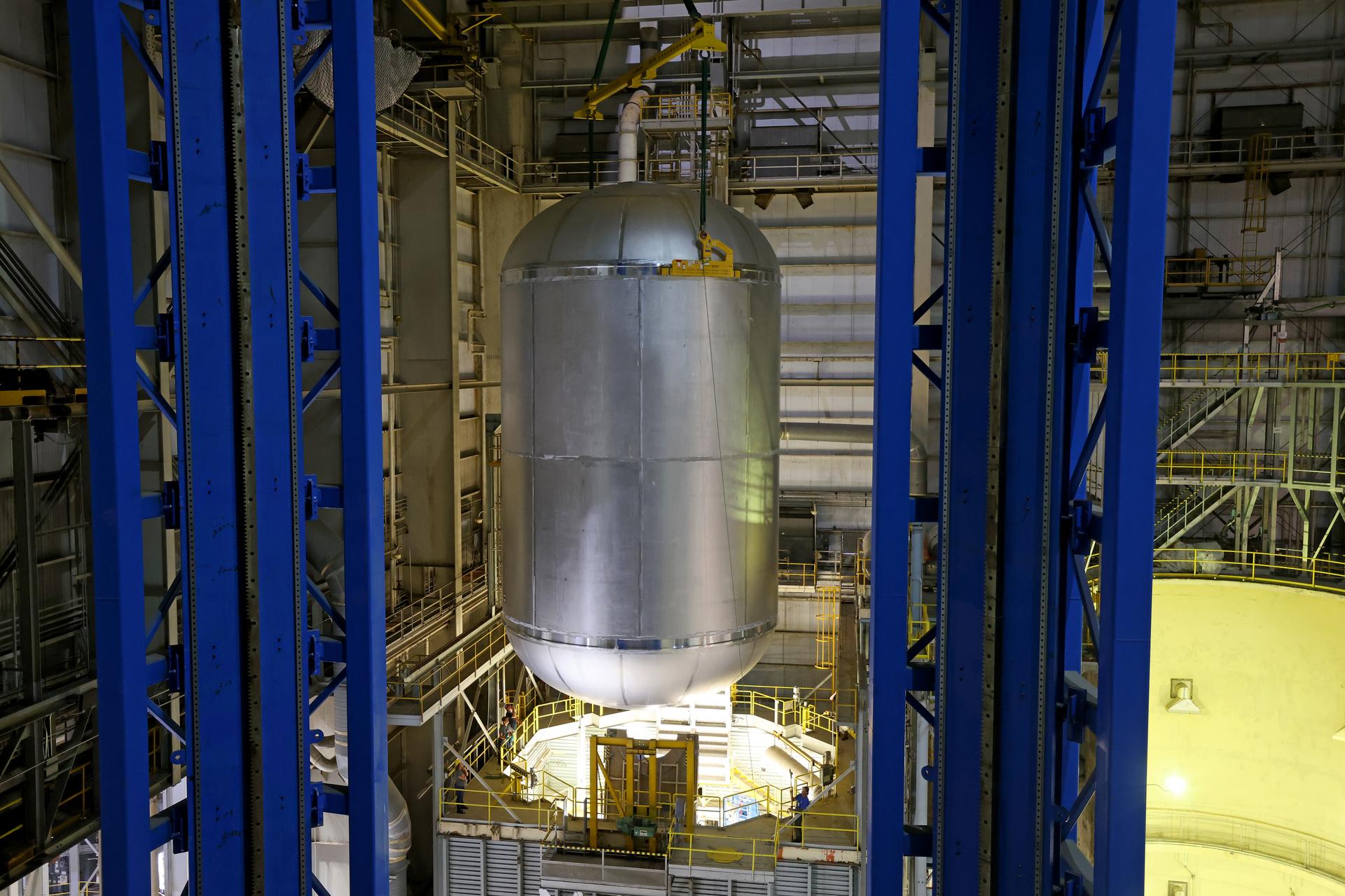
Teams at NASA’s Michoud Assembly Facility in New Orleans move a liquid oxygen tank from the main rocket factory into the adjacent vertical assembly building. The liquid oxygen tank, which will form part of the SLS (Space Launch System) rocket for NASA’s Artemis IV mission to the Moon, is rotated from a horizontal to a vertical configuration and loaded into the high bay’s hydrostatic proof testing cell. This non-destructive evaluation method tests the structural integrity of the tank’s welds by filling the tank with water, simulating the propellant used during launch. The propellant tank will hold more than 196,000 gallons of super-cooled liquid oxygen at launch and is one of five major elements that make up the 212-foot-tall SLS rocket stage. The core stage, along with its four RS-25 engines at its base, produces more than two million pounds of thrust to help launch NASA’s Orion spacecraft, astronauts, and supplies beyond Earth’s orbit and to the lunar surface for Artemis. Image credit: NASA/Michael DeMocker
Teams at NASA’s Michoud Assembly Facility in New Orleans move a liquid oxygen tank from the main rocket factory into the adjacent vertical assembly building. The liquid oxygen tank, which will form part of the SLS (Space Launch System) rocket for NASA’s Artemis IV mission to the Moon, is rotated from a horizontal to a vertical configuration and loaded into the high bay’s hydrostatic proof testing cell. This non-destructive evaluation method tests the structural integrity of the tank’s welds by filling the tank with water, simulating the propellant used during launch. The propellant tank will hold more than 196,000 gallons of super-cooled liquid oxygen at launch and is one of five major elements that make up the 212-foot-tall SLS rocket stage. The core stage, along with its four RS-25 engines at its base, produces more than two million pounds of thrust to help launch NASA’s Orion spacecraft, astronauts, and supplies beyond Earth’s orbit and to the lunar surface for Artemis. Image credit: NASA/Michael DeMocker
Teams at NASA’s Michoud Assembly Facility in New Orleans move a liquid oxygen tank from the main rocket factory into the adjacent vertical assembly building. The liquid oxygen tank, which will form part of the SLS (Space Launch System) rocket for NASA’s Artemis IV mission to the Moon, is rotated from a horizontal to a vertical configuration and loaded into the high bay’s hydrostatic proof testing cell. This non-destructive evaluation method tests the structural integrity of the tank’s welds by filling the tank with water, simulating the propellant used during launch. The propellant tank will hold more than 196,000 gallons of super-cooled liquid oxygen at launch and is one of five major elements that make up the 212-foot-tall SLS rocket stage. The core stage, along with its four RS-25 engines at its base, produces more than two million pounds of thrust to help launch NASA’s Orion spacecraft, astronauts, and supplies beyond Earth’s orbit and to the lunar surface for Artemis. Image credit: NASA/Michael DeMocker
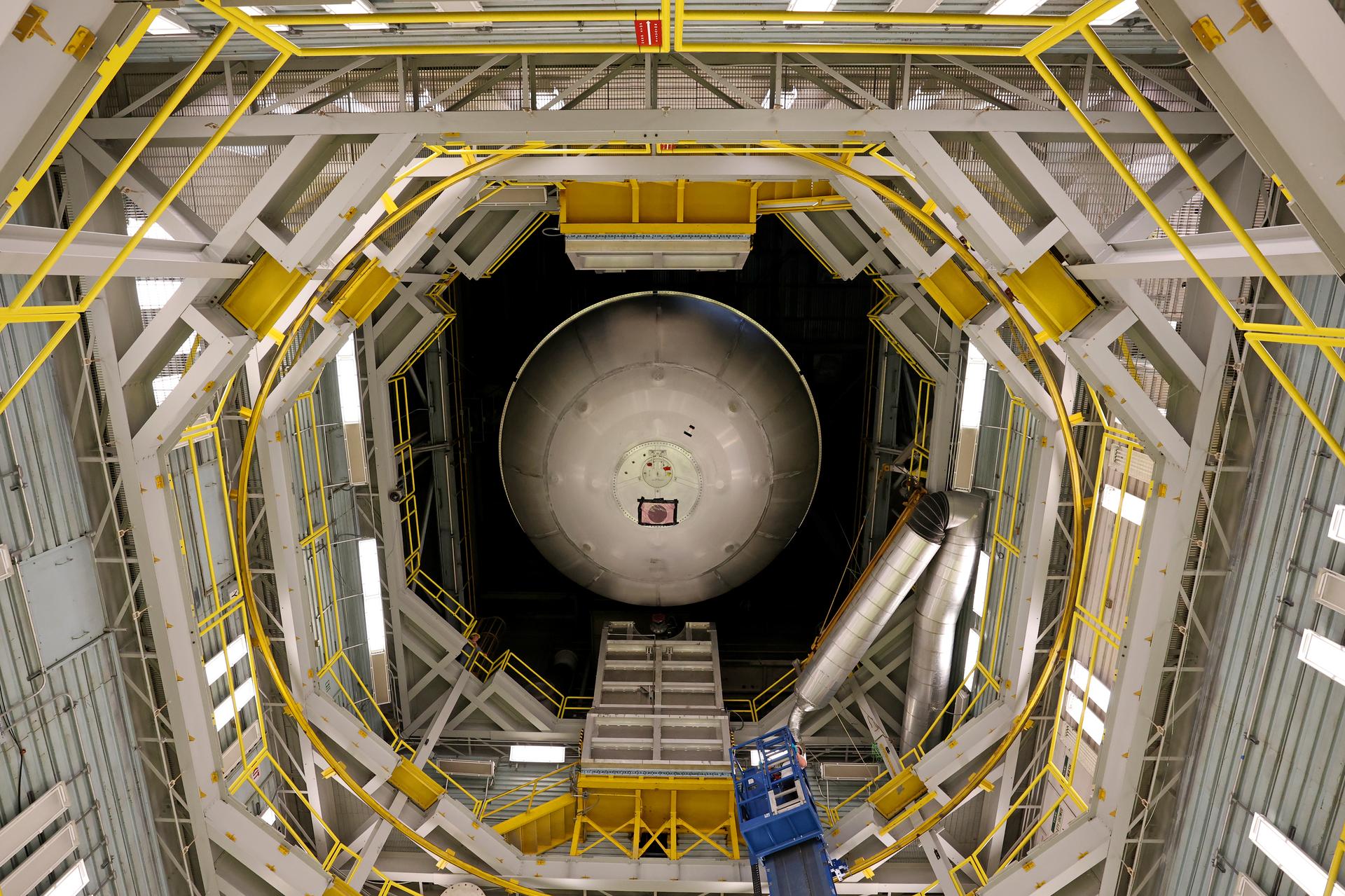
Teams at NASA’s Michoud Assembly Facility in New Orleans move a liquid oxygen tank from the main rocket factory into the adjacent vertical assembly building. The liquid oxygen tank, which will form part of the SLS (Space Launch System) rocket for NASA’s Artemis IV mission to the Moon, is rotated from a horizontal to a vertical configuration and loaded into the high bay’s hydrostatic proof testing cell. This non-destructive evaluation method tests the structural integrity of the tank’s welds by filling the tank with water, simulating the propellant used during launch. The propellant tank will hold more than 196,000 gallons of super-cooled liquid oxygen at launch and is one of five major elements that make up the 212-foot-tall SLS rocket stage. The core stage, along with its four RS-25 engines at its base, produces more than two million pounds of thrust to help launch NASA’s Orion spacecraft, astronauts, and supplies beyond Earth’s orbit and to the lunar surface for Artemis. Image credit: NASA/Michael DeMocker
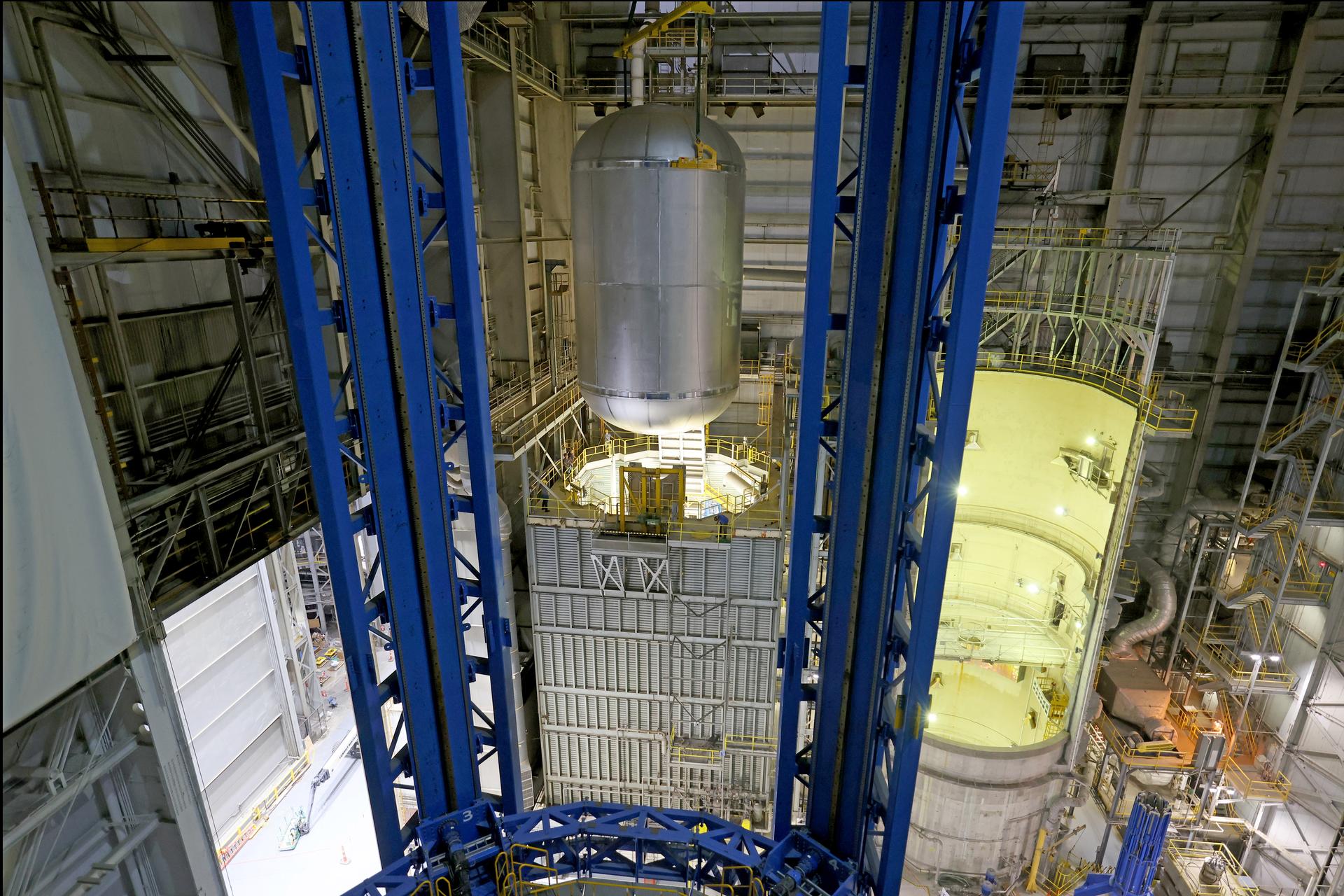
Teams at NASA’s Michoud Assembly Facility in New Orleans move a liquid oxygen tank from the main rocket factory into the adjacent vertical assembly building. The liquid oxygen tank, which will form part of the SLS (Space Launch System) rocket for NASA’s Artemis IV mission to the Moon, is rotated from a horizontal to a vertical configuration and loaded into the high bay’s hydrostatic proof testing cell. This non-destructive evaluation method tests the structural integrity of the tank’s welds by filling the tank with water, simulating the propellant used during launch. The propellant tank will hold more than 196,000 gallons of super-cooled liquid oxygen at launch and is one of five major elements that make up the 212-foot-tall SLS rocket stage. The core stage, along with its four RS-25 engines at its base, produces more than two million pounds of thrust to help launch NASA’s Orion spacecraft, astronauts, and supplies beyond Earth’s orbit and to the lunar surface for Artemis. Image credit: NASA/Michael DeMocker
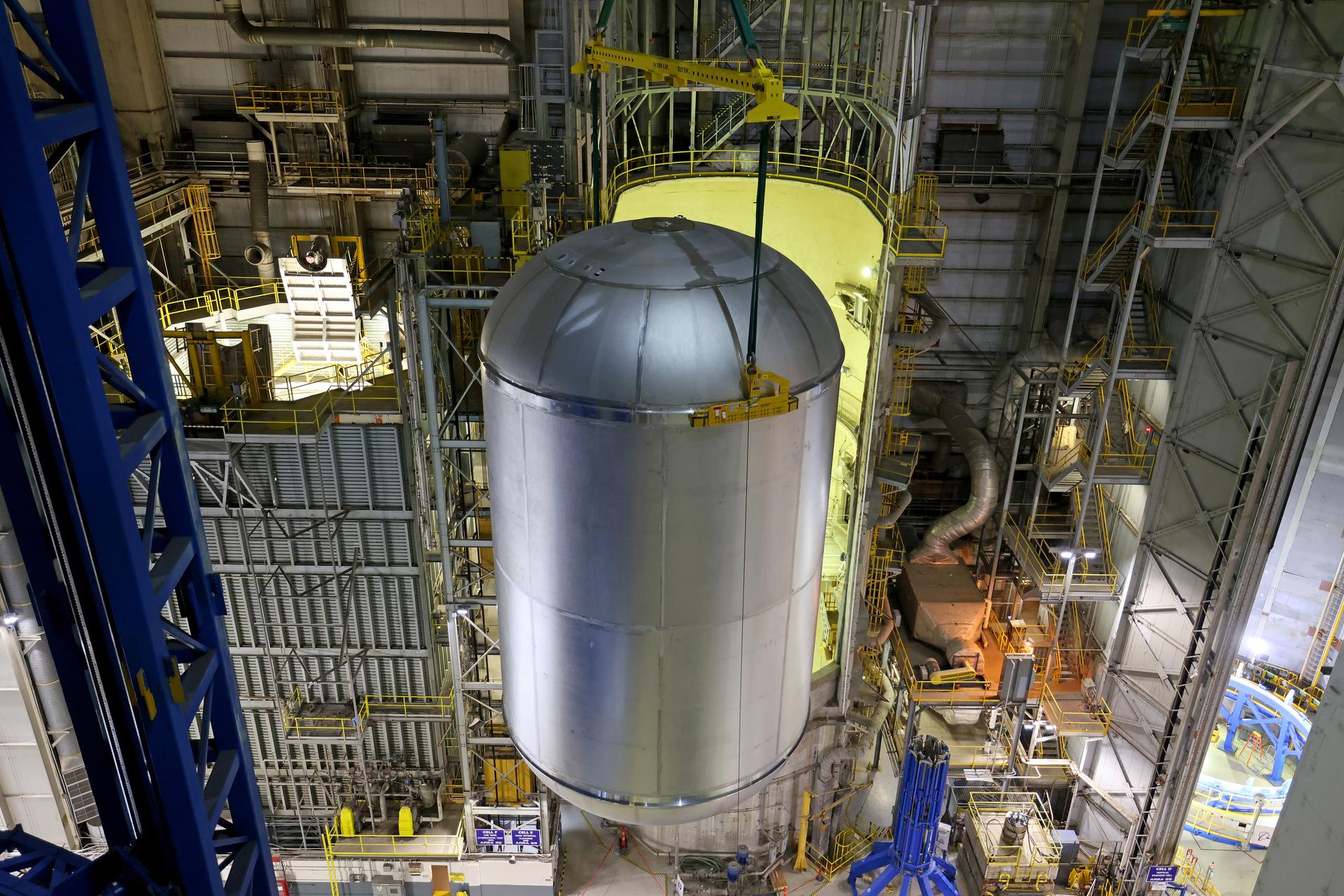
Teams at NASA’s Michoud Assembly Facility in New Orleans move a liquid oxygen tank from the main rocket factory into the adjacent vertical assembly building. The liquid oxygen tank, which will form part of the SLS (Space Launch System) rocket for NASA’s Artemis IV mission to the Moon, is rotated from a horizontal to a vertical configuration and loaded into the high bay’s hydrostatic proof testing cell. This non-destructive evaluation method tests the structural integrity of the tank’s welds by filling the tank with water, simulating the propellant used during launch. The propellant tank will hold more than 196,000 gallons of super-cooled liquid oxygen at launch and is one of five major elements that make up the 212-foot-tall SLS rocket stage. The core stage, along with its four RS-25 engines at its base, produces more than two million pounds of thrust to help launch NASA’s Orion spacecraft, astronauts, and supplies beyond Earth’s orbit and to the lunar surface for Artemis. Image credit: NASA/Michael DeMocker
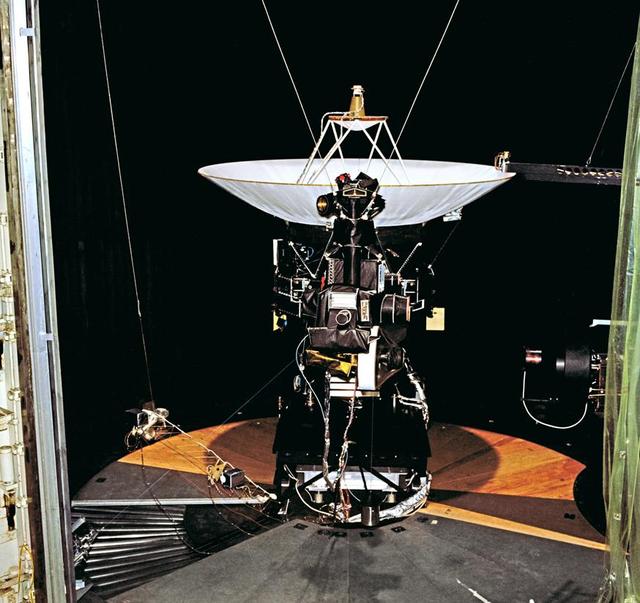
This archival photo shows the Voyager proof test model, which did not fly in space, in the 25-foot space simulator chamber at NASA's Jet Propulsion Laboratory, Pasadena, California. https://photojournal.jpl.nasa.gov/catalog/PIA21726

This archival photo shows the Voyager proof test model, which did not fly in space, in the 25-foot space simulator chamber at NASA's Jet Propulsion Laboratory on December 3, 1976. https://photojournal.jpl.nasa.gov/catalog/PIA21735
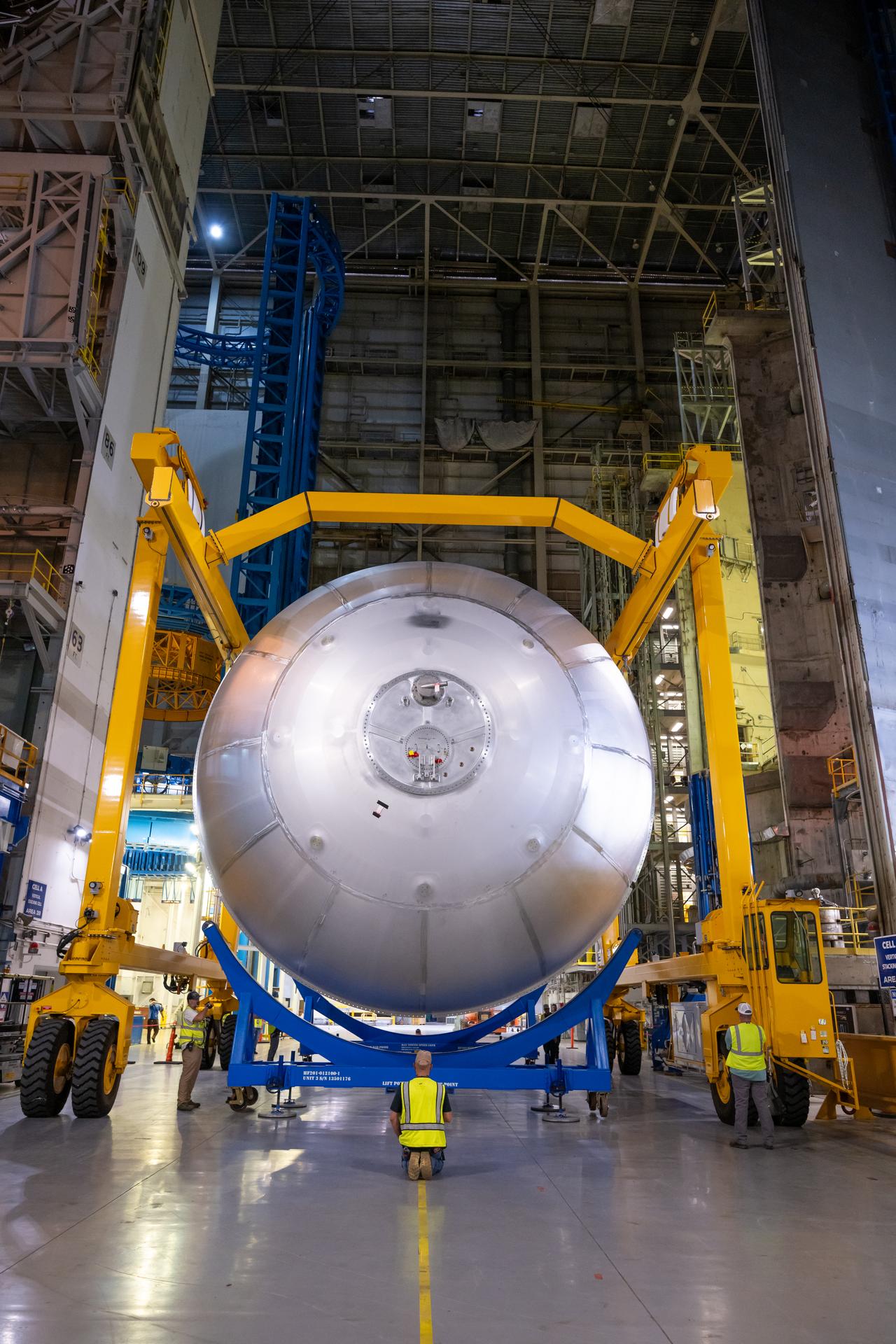
Teams at NASA’s Michoud Assembly Facility in New Orleans move a liquid oxygen tank from the main rocket factory into the adjacent vertical assembly building. The liquid oxygen tank, which will form part of the SLS (Space Launch System) rocket for NASA’s Artemis IV mission to the Moon, is rotated from a horizontal to a vertical configuration and loaded into the high bay’s hydrostatic proof testing cell. This non-destructive evaluation method tests the structural integrity of the tank’s welds by filling the tank with water, simulating the propellant used during launch. The propellant tank will hold more than 196,000 gallons of super-cooled liquid oxygen at launch and is one of five major elements that make up the 212-foot-tall SLS rocket stage. The core stage, along with its four RS-25 engines at its base, produces more than two million pounds of thrust to help launch NASA’s Orion spacecraft, astronauts, and supplies beyond Earth’s orbit and to the lunar surface for Artemis.
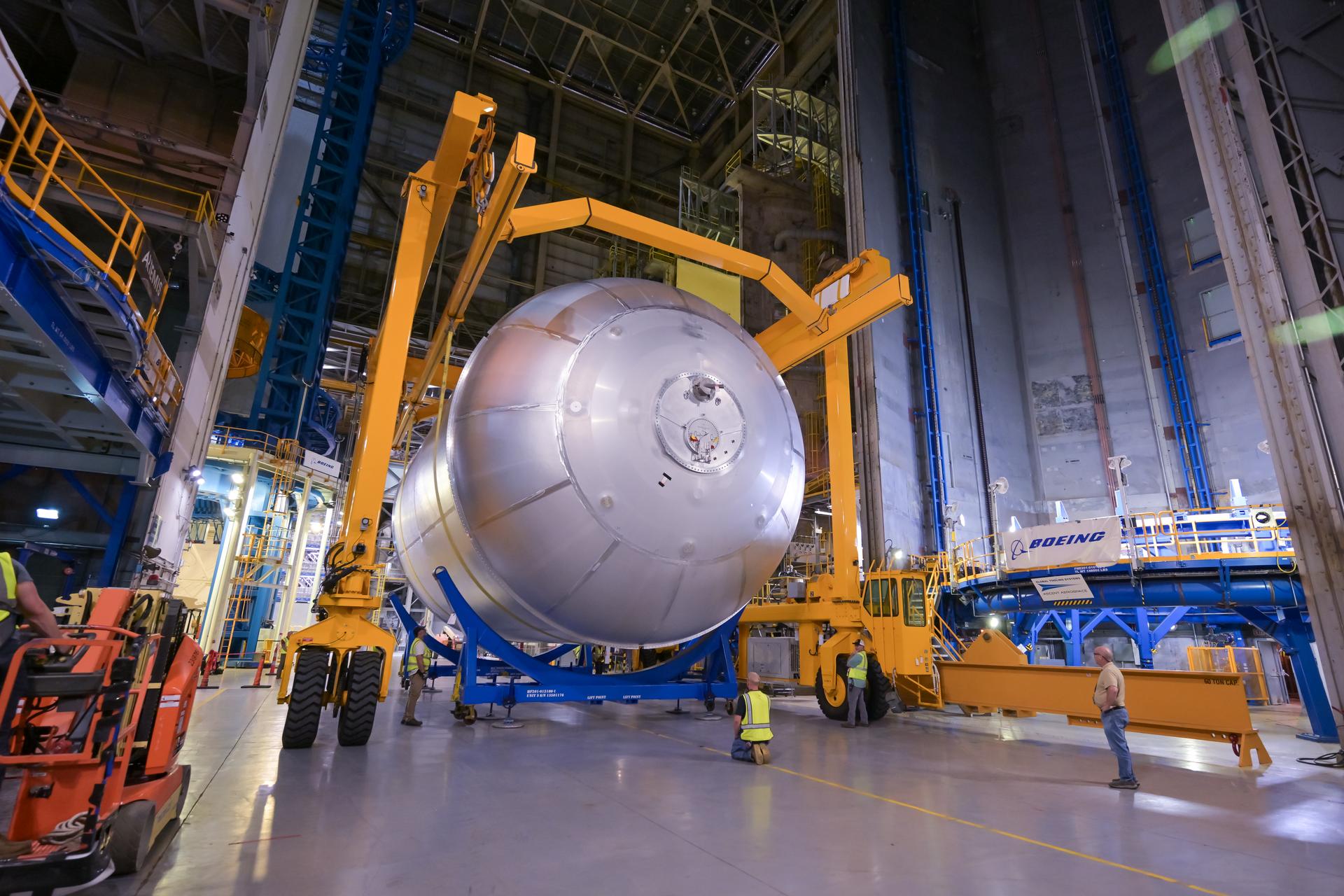
Teams at NASA’s Michoud Assembly Facility in New Orleans move a liquid oxygen tank from the main rocket factory into the adjacent vertical assembly building. The liquid oxygen tank, which will form part of the SLS (Space Launch System) rocket for NASA’s Artemis IV mission to the Moon, is rotated from a horizontal to a vertical configuration and loaded into the high bay’s hydrostatic proof testing cell. This non-destructive evaluation method tests the structural integrity of the tank’s welds by filling the tank with water, simulating the propellant used during launch. The propellant tank will hold more than 196,000 gallons of super-cooled liquid oxygen at launch and is one of five major elements that make up the 212-foot-tall SLS rocket stage. The core stage, along with its four RS-25 engines at its base, produces more than two million pounds of thrust to help launch NASA’s Orion spacecraft, astronauts, and supplies beyond Earth’s orbit and to the lunar surface for Artemis.
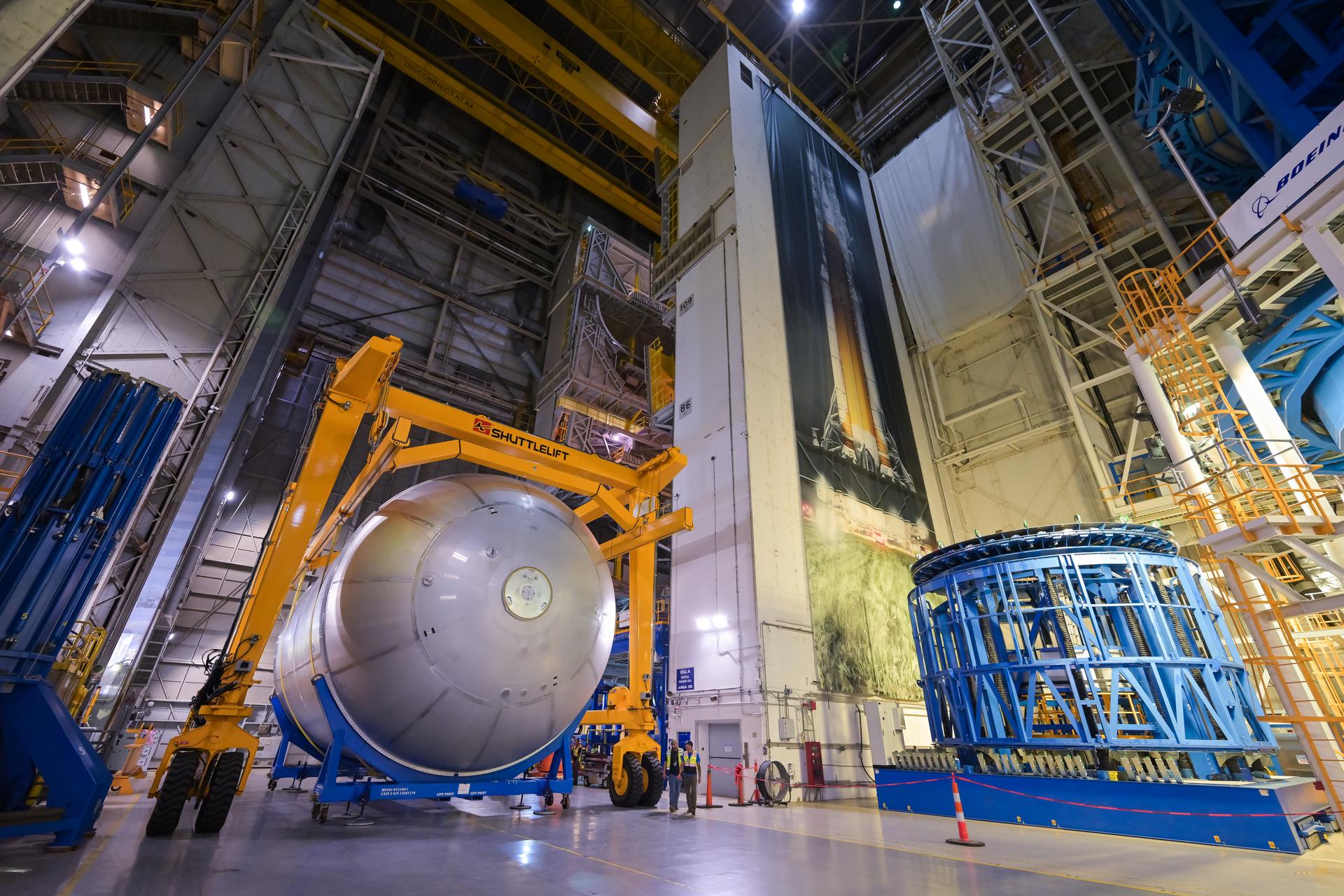
Teams at NASA’s Michoud Assembly Facility in New Orleans move a liquid oxygen tank from the main rocket factory into the adjacent vertical assembly building. The liquid oxygen tank, which will form part of the SLS (Space Launch System) rocket for NASA’s Artemis IV mission to the Moon, is rotated from a horizontal to a vertical configuration and loaded into the high bay’s hydrostatic proof testing cell. This non-destructive evaluation method tests the structural integrity of the tank’s welds by filling the tank with water, simulating the propellant used during launch. The propellant tank will hold more than 196,000 gallons of super-cooled liquid oxygen at launch and is one of five major elements that make up the 212-foot-tall SLS rocket stage. The core stage, along with its four RS-25 engines at its base, produces more than two million pounds of thrust to help launch NASA’s Orion spacecraft, astronauts, and supplies beyond Earth’s orbit and to the lunar surface for Artemis.
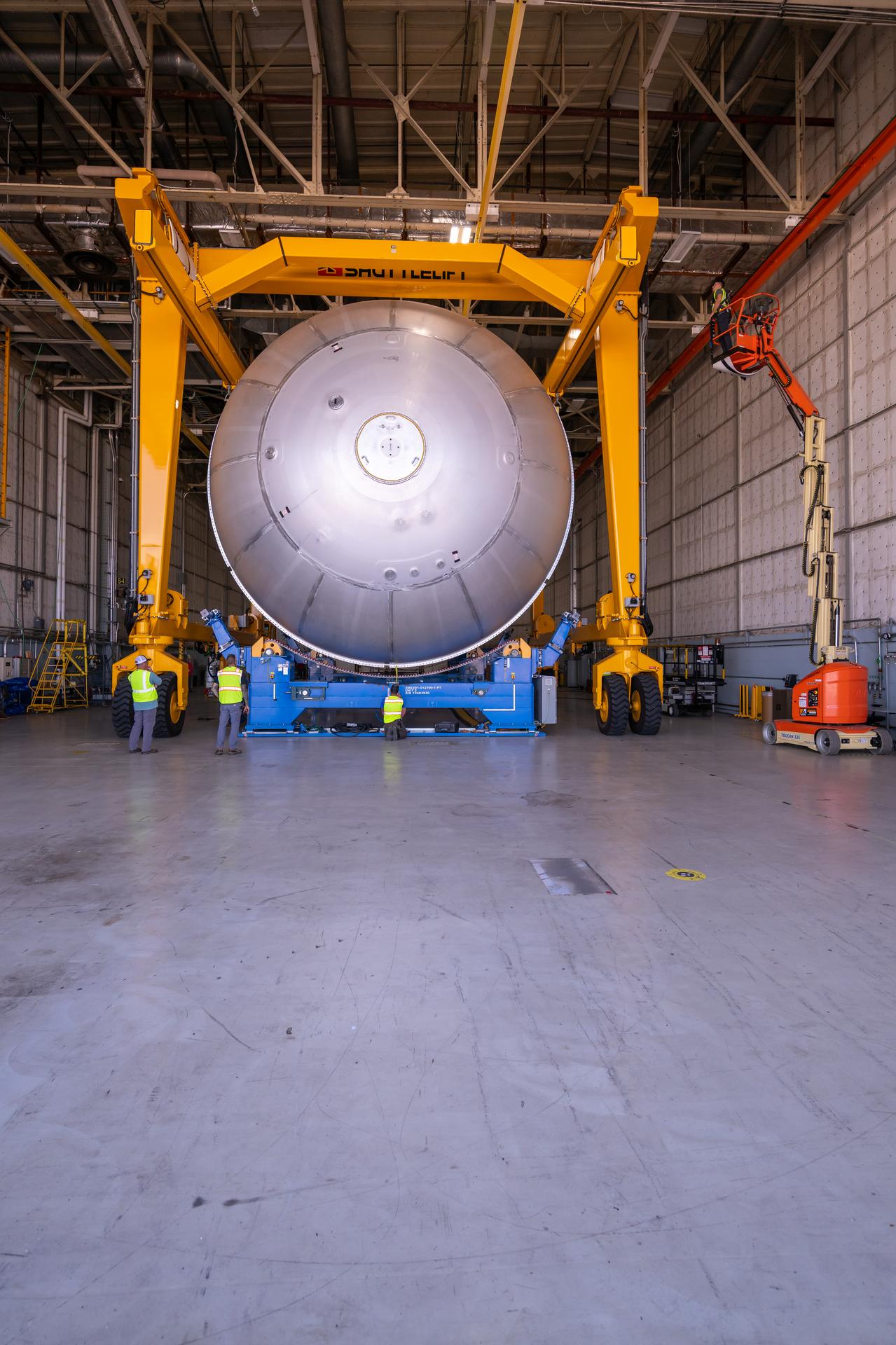
Teams at NASA’s Michoud Assembly Facility in New Orleans move a liquid oxygen tank from the main rocket factory into the adjacent vertical assembly building. The liquid oxygen tank, which will form part of the SLS (Space Launch System) rocket for NASA’s Artemis IV mission to the Moon, is rotated from a horizontal to a vertical configuration and loaded into the high bay’s hydrostatic proof testing cell. This non-destructive evaluation method tests the structural integrity of the tank’s welds by filling the tank with water, simulating the propellant used during launch. The propellant tank will hold more than 196,000 gallons of super-cooled liquid oxygen at launch and is one of five major elements that make up the 212-foot-tall SLS rocket stage. The core stage, along with its four RS-25 engines at its base, produces more than two million pounds of thrust to help launch NASA’s Orion spacecraft, astronauts, and supplies beyond Earth’s orbit and to the lunar surface for Artemis.
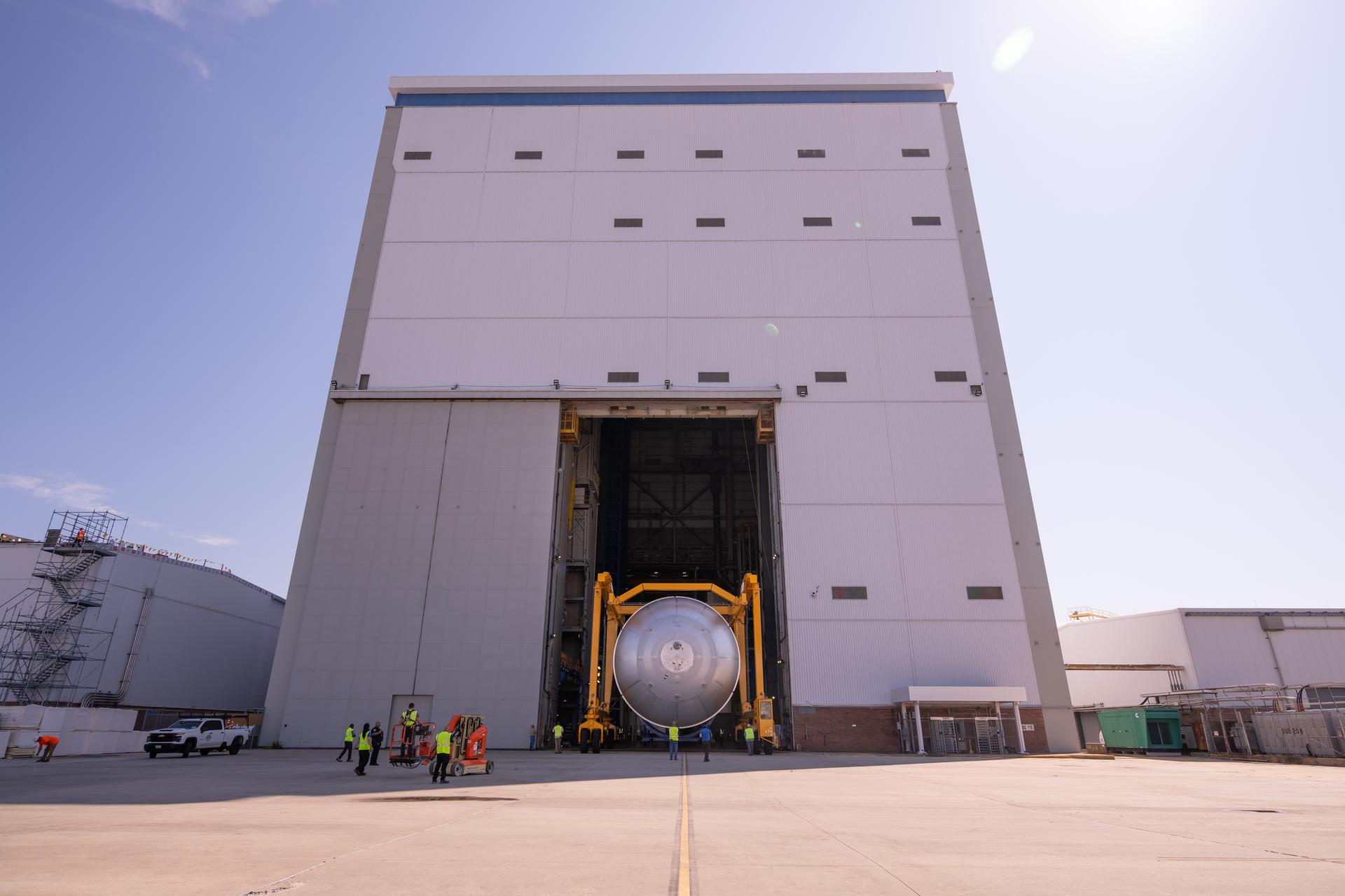
Teams at NASA’s Michoud Assembly Facility in New Orleans move a liquid oxygen tank from the main rocket factory into the adjacent vertical assembly building. The liquid oxygen tank, which will form part of the SLS (Space Launch System) rocket for NASA’s Artemis IV mission to the Moon, is rotated from a horizontal to a vertical configuration and loaded into the high bay’s hydrostatic proof testing cell. This non-destructive evaluation method tests the structural integrity of the tank’s welds by filling the tank with water, simulating the propellant used during launch. The propellant tank will hold more than 196,000 gallons of super-cooled liquid oxygen at launch and is one of five major elements that make up the 212-foot-tall SLS rocket stage. The core stage, along with its four RS-25 engines at its base, produces more than two million pounds of thrust to help launch NASA’s Orion spacecraft, astronauts, and supplies beyond Earth’s orbit and to the lunar surface for Artemis.
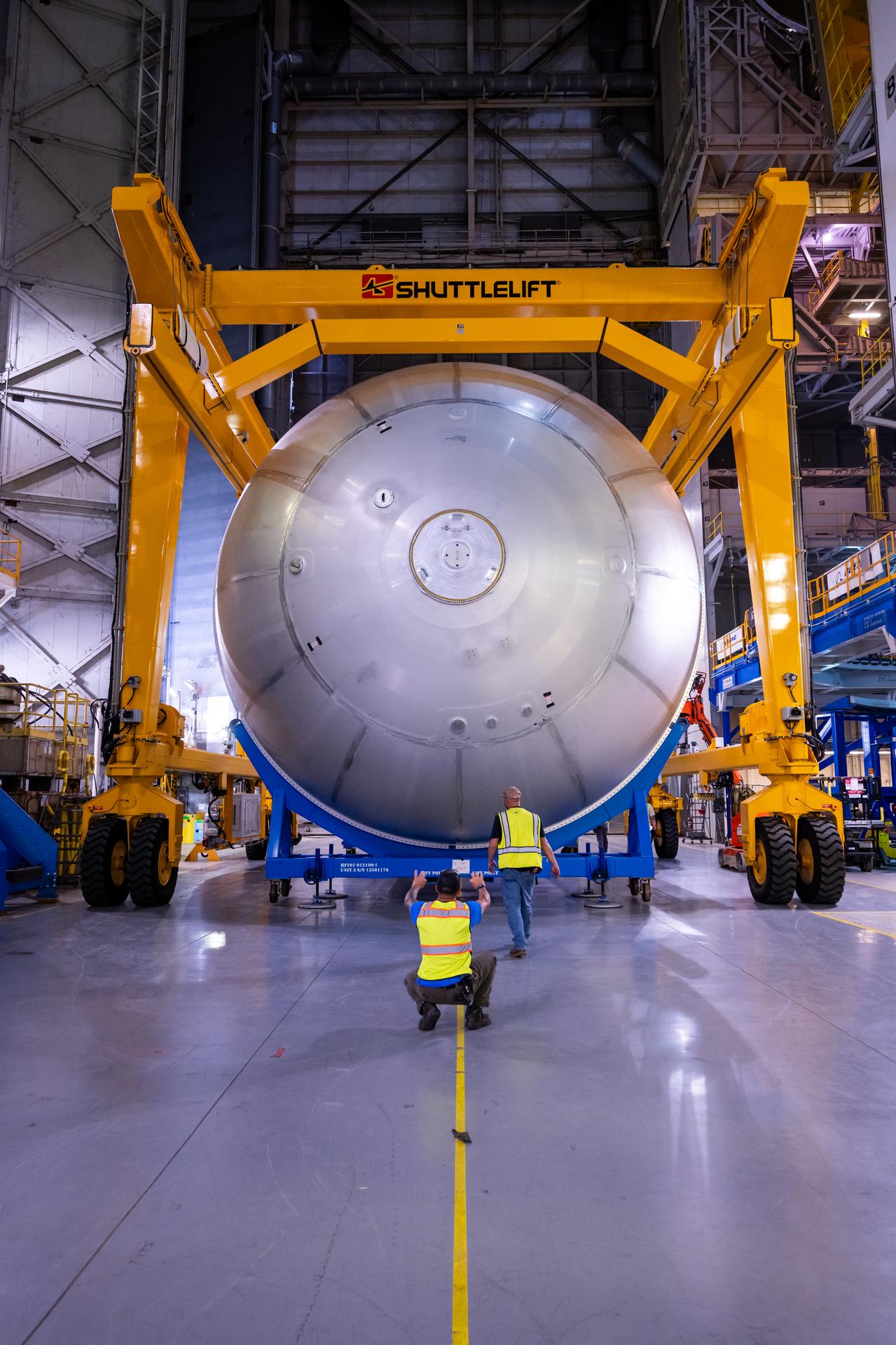
Teams at NASA’s Michoud Assembly Facility in New Orleans move a liquid oxygen tank from the main rocket factory into the adjacent vertical assembly building. The liquid oxygen tank, which will form part of the SLS (Space Launch System) rocket for NASA’s Artemis IV mission to the Moon, is rotated from a horizontal to a vertical configuration and loaded into the high bay’s hydrostatic proof testing cell. This non-destructive evaluation method tests the structural integrity of the tank’s welds by filling the tank with water, simulating the propellant used during launch. The propellant tank will hold more than 196,000 gallons of super-cooled liquid oxygen at launch and is one of five major elements that make up the 212-foot-tall SLS rocket stage. The core stage, along with its four RS-25 engines at its base, produces more than two million pounds of thrust to help launch NASA’s Orion spacecraft, astronauts, and supplies beyond Earth’s orbit and to the lunar surface for Artemis.
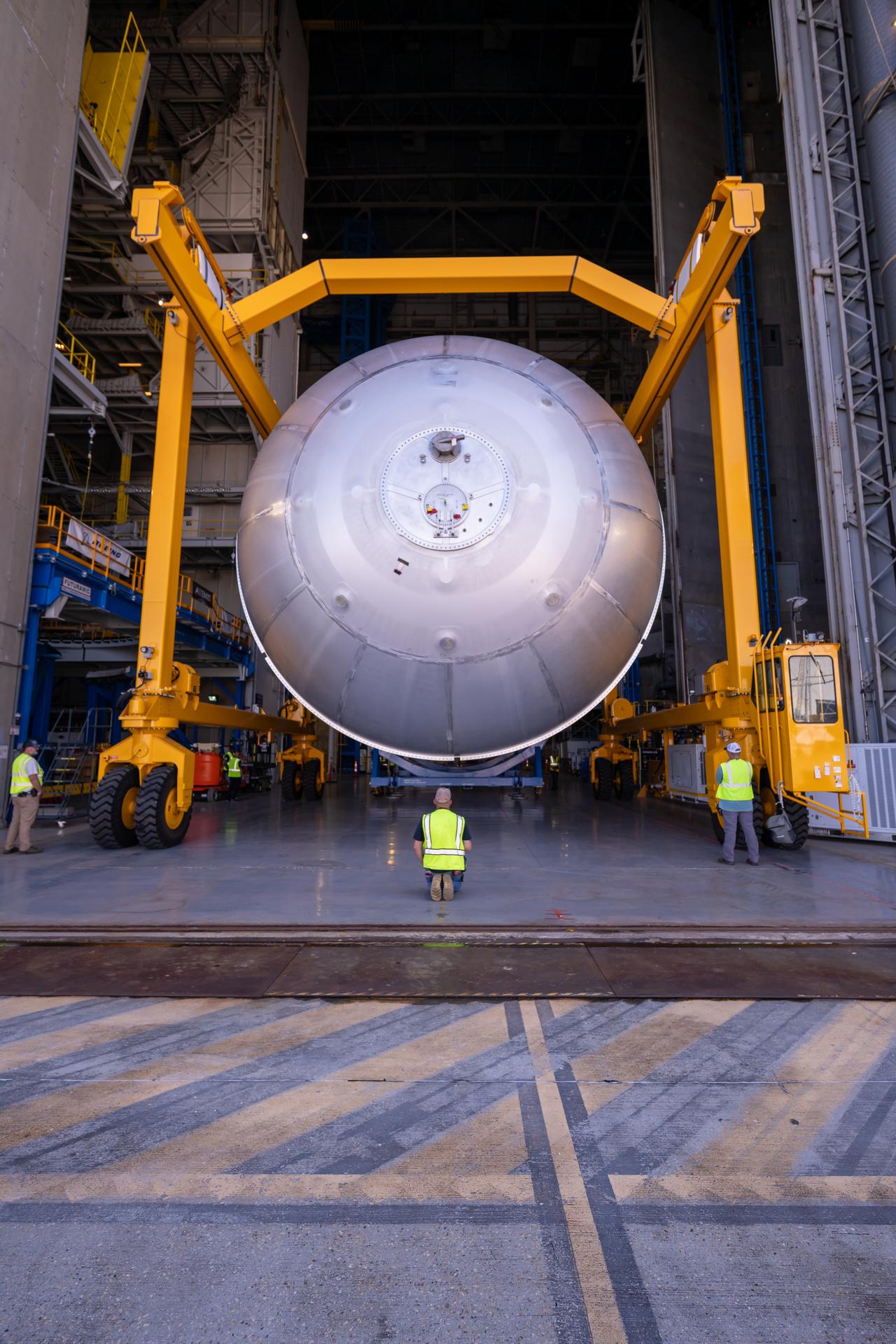
Teams at NASA’s Michoud Assembly Facility in New Orleans move a liquid oxygen tank from the main rocket factory into the adjacent vertical assembly building. The liquid oxygen tank, which will form part of the SLS (Space Launch System) rocket for NASA’s Artemis IV mission to the Moon, is rotated from a horizontal to a vertical configuration and loaded into the high bay’s hydrostatic proof testing cell. This non-destructive evaluation method tests the structural integrity of the tank’s welds by filling the tank with water, simulating the propellant used during launch. The propellant tank will hold more than 196,000 gallons of super-cooled liquid oxygen at launch and is one of five major elements that make up the 212-foot-tall SLS rocket stage. The core stage, along with its four RS-25 engines at its base, produces more than two million pounds of thrust to help launch NASA’s Orion spacecraft, astronauts, and supplies beyond Earth’s orbit and to the lunar surface for Artemis.
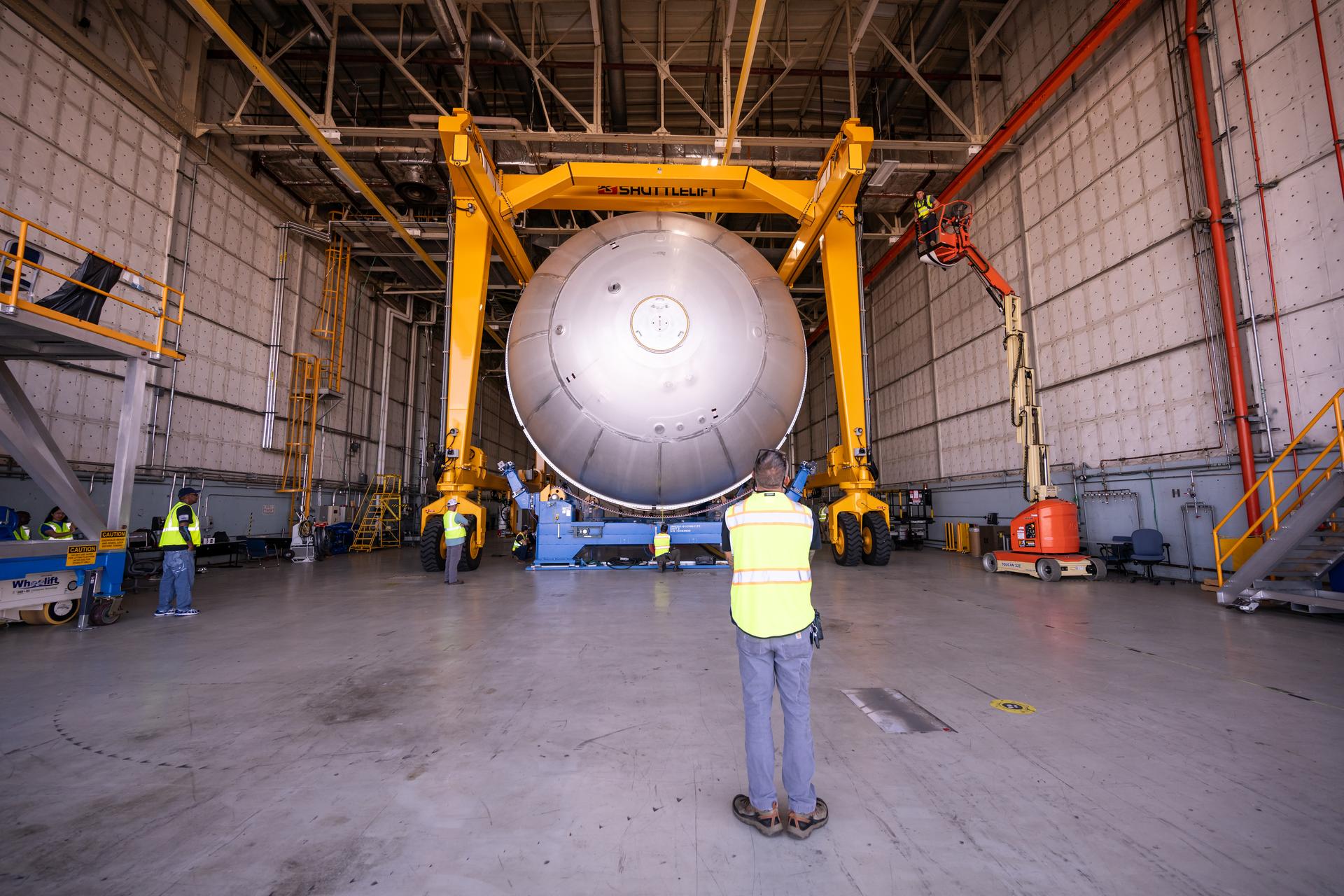
Teams at NASA’s Michoud Assembly Facility in New Orleans move a liquid oxygen tank from the main rocket factory into the adjacent vertical assembly building. The liquid oxygen tank, which will form part of the SLS (Space Launch System) rocket for NASA’s Artemis IV mission to the Moon, is rotated from a horizontal to a vertical configuration and loaded into the high bay’s hydrostatic proof testing cell. This non-destructive evaluation method tests the structural integrity of the tank’s welds by filling the tank with water, simulating the propellant used during launch. The propellant tank will hold more than 196,000 gallons of super-cooled liquid oxygen at launch and is one of five major elements that make up the 212-foot-tall SLS rocket stage. The core stage, along with its four RS-25 engines at its base, produces more than two million pounds of thrust to help launch NASA’s Orion spacecraft, astronauts, and supplies beyond Earth’s orbit and to the lunar surface for Artemis.
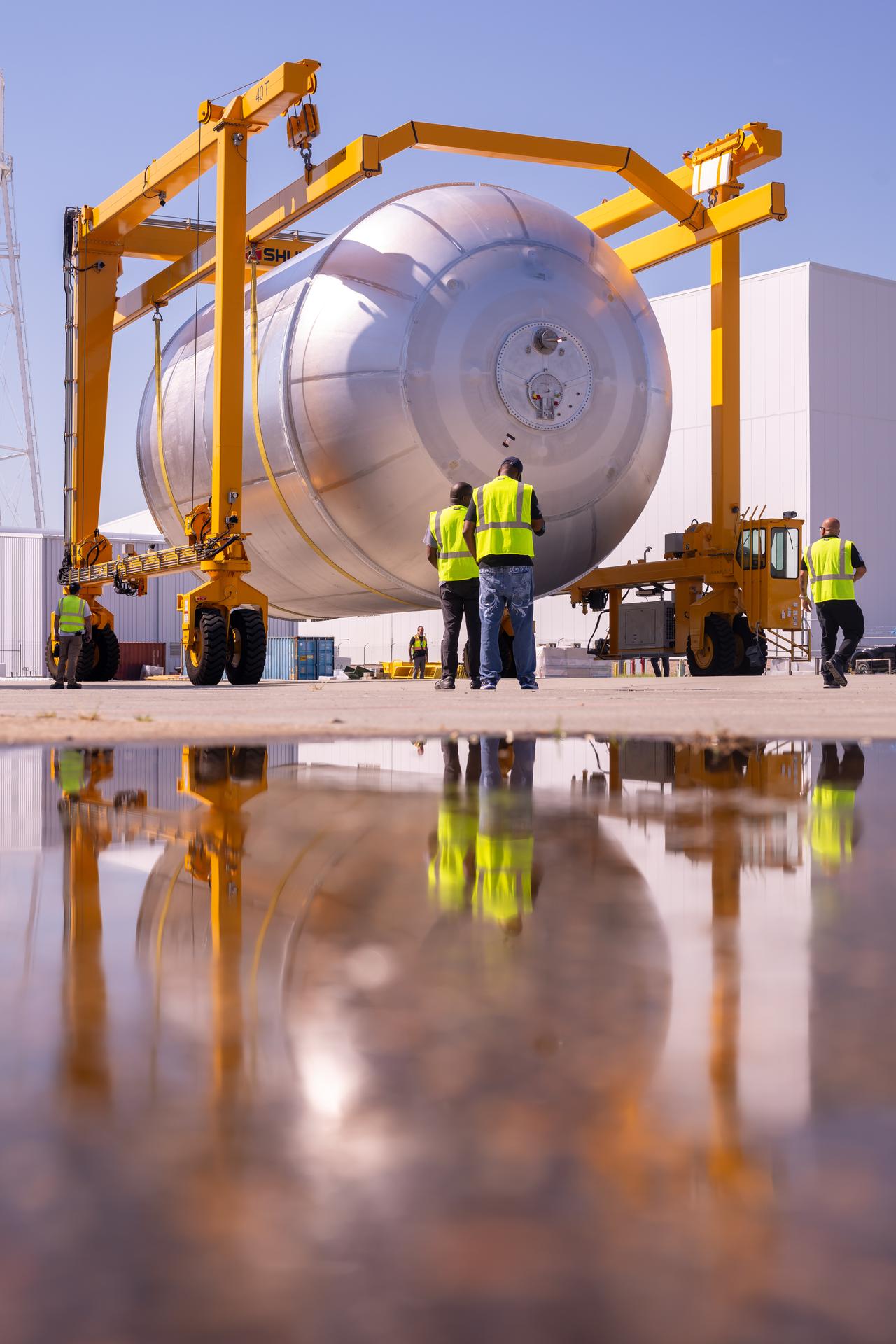
Teams at NASA’s Michoud Assembly Facility in New Orleans move a liquid oxygen tank from the main rocket factory into the adjacent vertical assembly building. The liquid oxygen tank, which will form part of the SLS (Space Launch System) rocket for NASA’s Artemis IV mission to the Moon, is rotated from a horizontal to a vertical configuration and loaded into the high bay’s hydrostatic proof testing cell. This non-destructive evaluation method tests the structural integrity of the tank’s welds by filling the tank with water, simulating the propellant used during launch. The propellant tank will hold more than 196,000 gallons of super-cooled liquid oxygen at launch and is one of five major elements that make up the 212-foot-tall SLS rocket stage. The core stage, along with its four RS-25 engines at its base, produces more than two million pounds of thrust to help launch NASA’s Orion spacecraft, astronauts, and supplies beyond Earth’s orbit and to the lunar surface for Artemis.
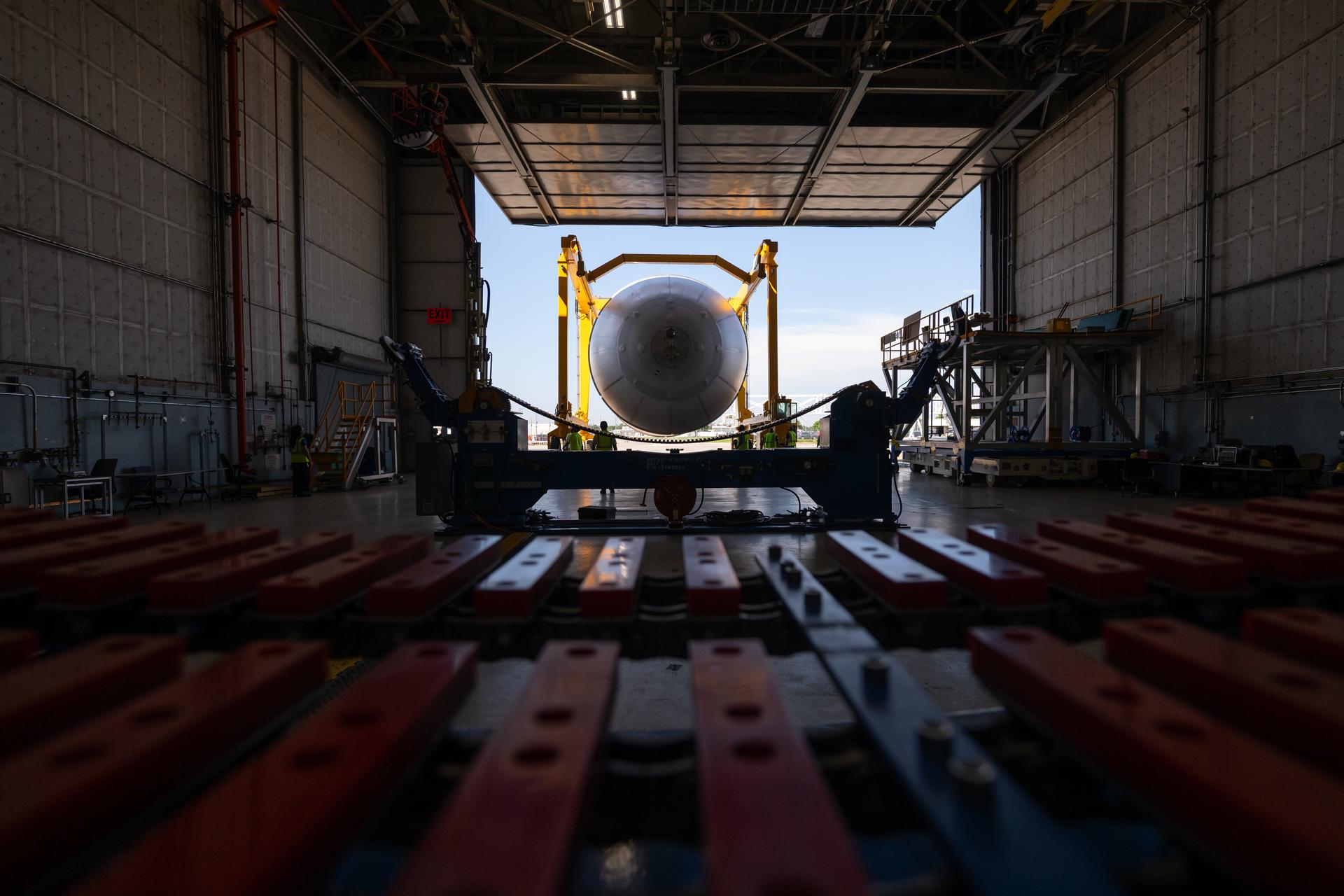
Teams at NASA’s Michoud Assembly Facility in New Orleans move a liquid oxygen tank from the main rocket factory into the adjacent vertical assembly building. The liquid oxygen tank, which will form part of the SLS (Space Launch System) rocket for NASA’s Artemis IV mission to the Moon, is rotated from a horizontal to a vertical configuration and loaded into the high bay’s hydrostatic proof testing cell. This non-destructive evaluation method tests the structural integrity of the tank’s welds by filling the tank with water, simulating the propellant used during launch. The propellant tank will hold more than 196,000 gallons of super-cooled liquid oxygen at launch and is one of five major elements that make up the 212-foot-tall SLS rocket stage. The core stage, along with its four RS-25 engines at its base, produces more than two million pounds of thrust to help launch NASA’s Orion spacecraft, astronauts, and supplies beyond Earth’s orbit and to the lunar surface for Artemis.
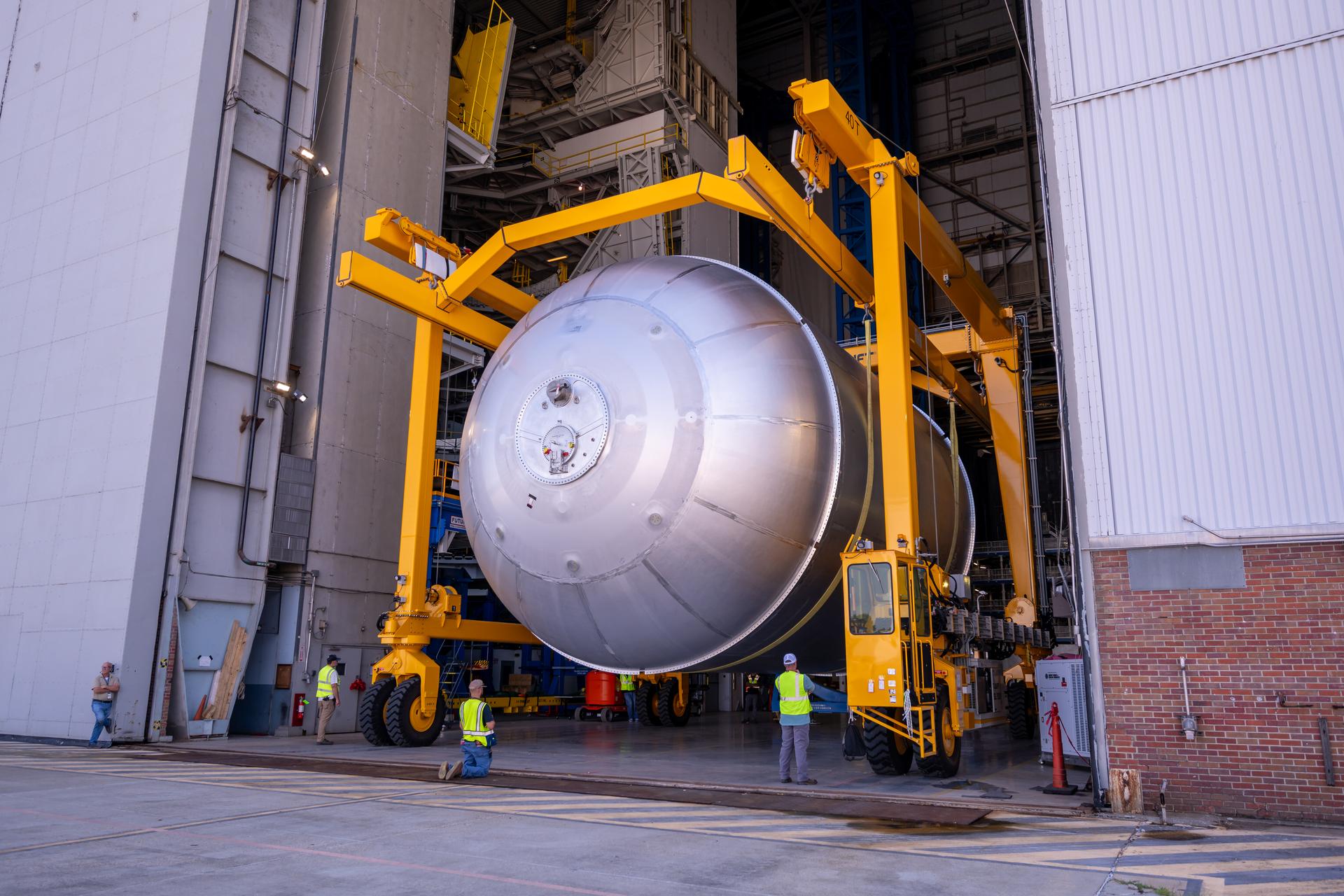
Teams at NASA’s Michoud Assembly Facility in New Orleans move a liquid oxygen tank from the main rocket factory into the adjacent vertical assembly building. The liquid oxygen tank, which will form part of the SLS (Space Launch System) rocket for NASA’s Artemis IV mission to the Moon, is rotated from a horizontal to a vertical configuration and loaded into the high bay’s hydrostatic proof testing cell. This non-destructive evaluation method tests the structural integrity of the tank’s welds by filling the tank with water, simulating the propellant used during launch. The propellant tank will hold more than 196,000 gallons of super-cooled liquid oxygen at launch and is one of five major elements that make up the 212-foot-tall SLS rocket stage. The core stage, along with its four RS-25 engines at its base, produces more than two million pounds of thrust to help launch NASA’s Orion spacecraft, astronauts, and supplies beyond Earth’s orbit and to the lunar surface for Artemis.
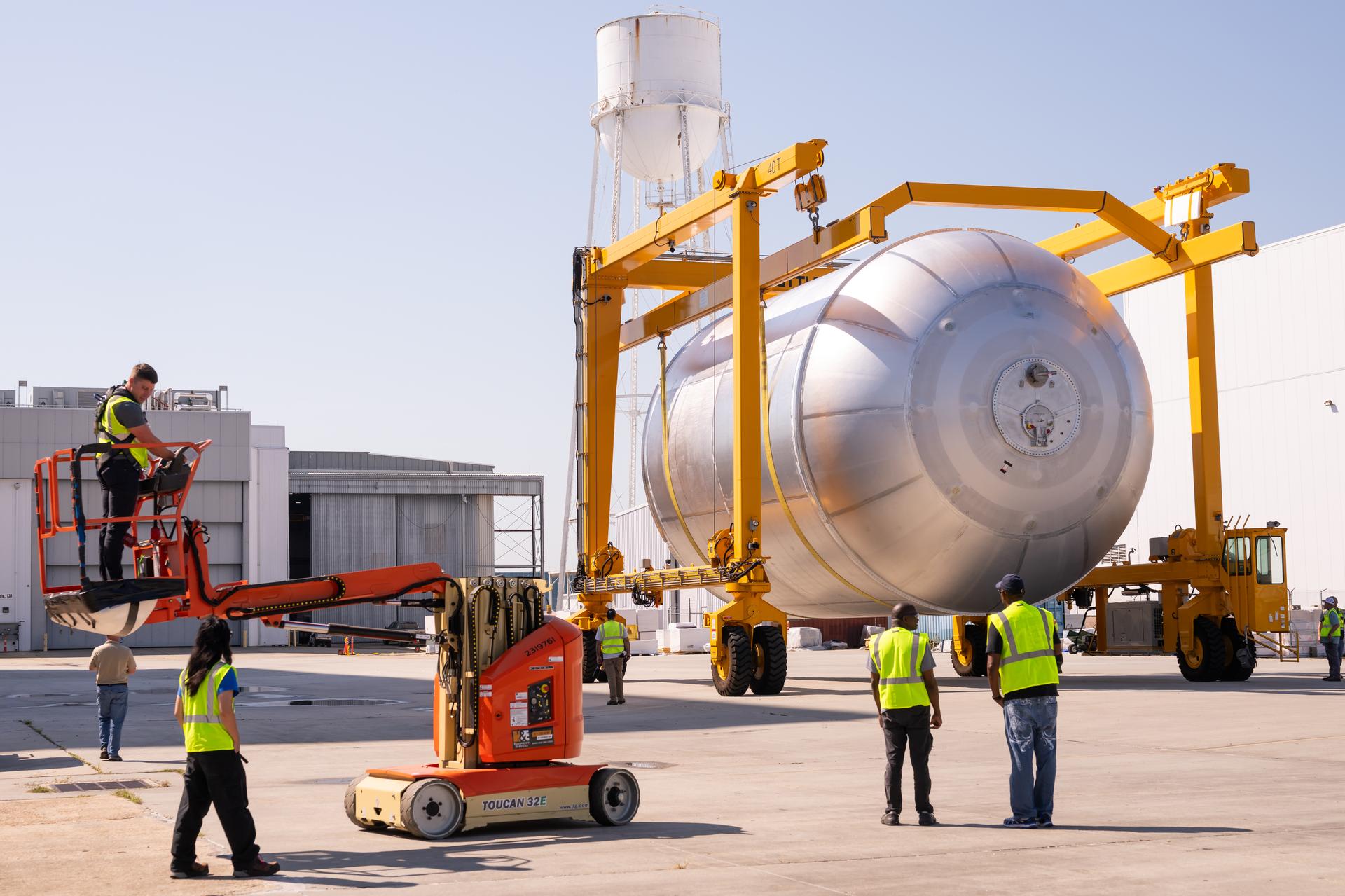
Teams at NASA’s Michoud Assembly Facility in New Orleans move a liquid oxygen tank from the main rocket factory into the adjacent vertical assembly building. The liquid oxygen tank, which will form part of the SLS (Space Launch System) rocket for NASA’s Artemis IV mission to the Moon, is rotated from a horizontal to a vertical configuration and loaded into the high bay’s hydrostatic proof testing cell. This non-destructive evaluation method tests the structural integrity of the tank’s welds by filling the tank with water, simulating the propellant used during launch. The propellant tank will hold more than 196,000 gallons of super-cooled liquid oxygen at launch and is one of five major elements that make up the 212-foot-tall SLS rocket stage. The core stage, along with its four RS-25 engines at its base, produces more than two million pounds of thrust to help launch NASA’s Orion spacecraft, astronauts, and supplies beyond Earth’s orbit and to the lunar surface for Artemis.
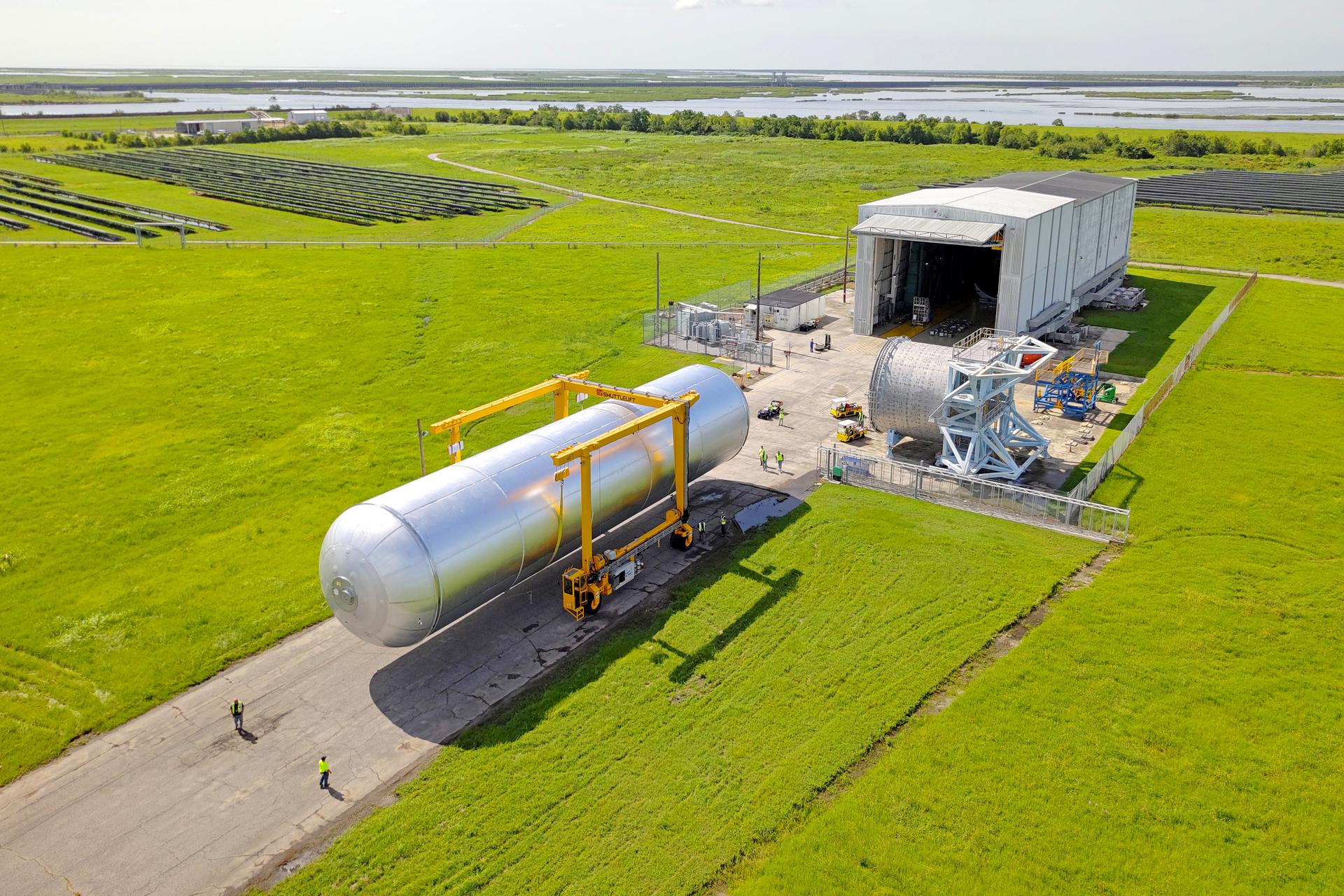
Crews at NASA’s Michoud Assembly Facility in New Orleans transport the 130-foot-tall liquid hydrogen tank from the proof testing building to the main factory on July 10. The liquid hydrogen tank will form part of the core stage for the SLS (Space Launch System) rocket for the agency’s Artemis IV mission, providing thousands of gallons of super-cold propellant to the rocket engines during launch. Soon, teams with SLS prime contractor, Boeing, will move the tank into the facility’s vertical assembly building for cleaning operations. The liquid hydrogen propellant tank is one of five major elements that make up the 212-foot-tall SLS rocket stage. The core stage, along with its four RS-25 engines at its base, produce more than two million pounds of thrust to help launch NASA’s Orion spacecraft, astronauts, and supplies beyond Earth’s orbit and to the lunar surface for Artemis. Image credit: NASA/Eric Bordelon & Michael DeMocker
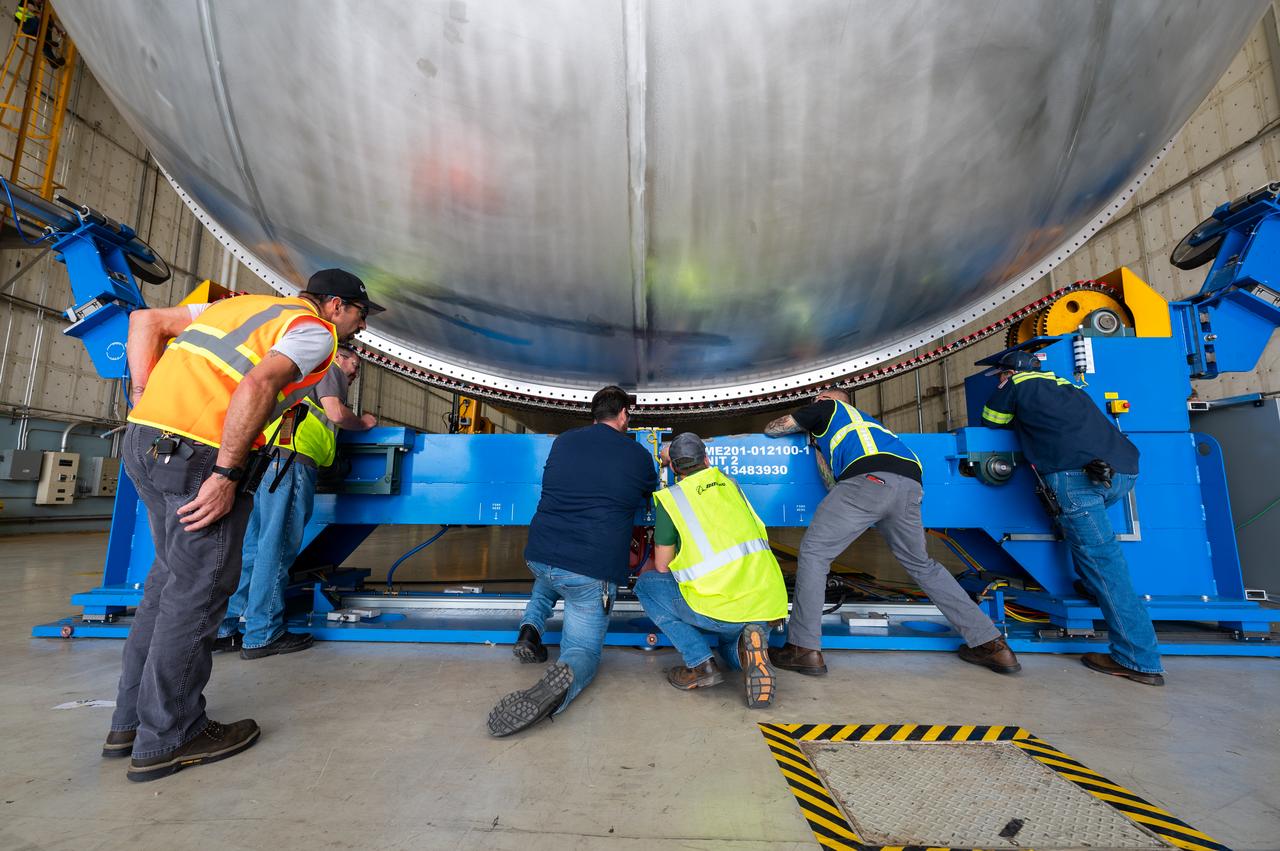
The core stage liquid hydrogen tank for the Artemis III mission completed proof testing, and technicians returned it to the main factory building at NASA’s Michoud Assembly Facility in New Orleans where it will undergo more outfitting. As part of proof testing, technicians apply a simple soap solution and check for leaks by observing any bubble formation on the welds. The technician removed the bubble solution with distilled water and then dried the area of application to prevent corrosion. To build the Space Launch System (SLS) rocket’s 130-foot core stage liquid hydrogen tank, engineers use robotic tools to weld five-barrel segments. This process results in a tank with around 1,900 feet, or more than six football fields, of welds that must be tested by hand. After the leak tests, the core stage lead, Boeing, pressurized the SLS tank to further ensure there were no leaks. After it passed proof testing, technicians moved the Artemis III liquid hydrogen tank to Michoud’s main factory. Soon, the technicians will prime and apply a foam-based thermal protection system that protects the tank during launch. Later, the tank will be joined with other parts of the core stage to form the entire 212-foot rocket stage with its four RS-25 engines that produce 2 million pounds of thrust to help launch the rocket. Artemis III will land the first astronauts on the lunar surface.
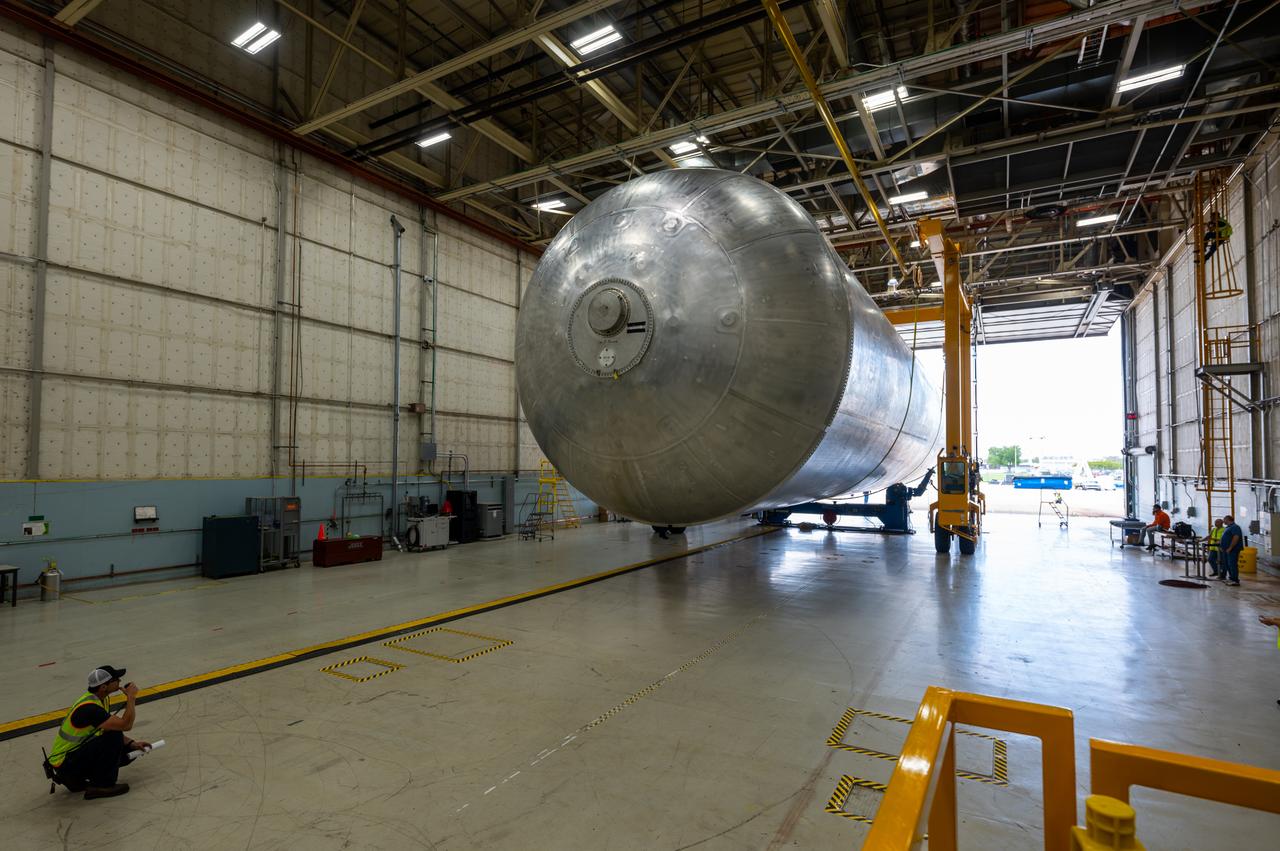
The core stage liquid hydrogen tank for the Artemis III mission completed proof testing, and technicians returned it to the main factory building at NASA’s Michoud Assembly Facility in New Orleans where it will undergo more outfitting. As part of proof testing, technicians apply a simple soap solution and check for leaks by observing any bubble formation on the welds. The technician removed the bubble solution with distilled water and then dried the area of application to prevent corrosion. To build the Space Launch System (SLS) rocket’s 130-foot core stage liquid hydrogen tank, engineers use robotic tools to weld five-barrel segments. This process results in a tank with around 1,900 feet, or more than six football fields, of welds that must be tested by hand. After the leak tests, the core stage lead, Boeing, pressurized the SLS tank to further ensure there were no leaks. After it passed proof testing, technicians moved the Artemis III liquid hydrogen tank to Michoud’s main factory. Soon, the technicians will prime and apply a foam-based thermal protection system that protects the tank during launch. Later, the tank will be joined with other parts of the core stage to form the entire 212-foot rocket stage with its four RS-25 engines that produce 2 million pounds of thrust to help launch the rocket. Artemis III will land the first astronauts on the lunar surface.
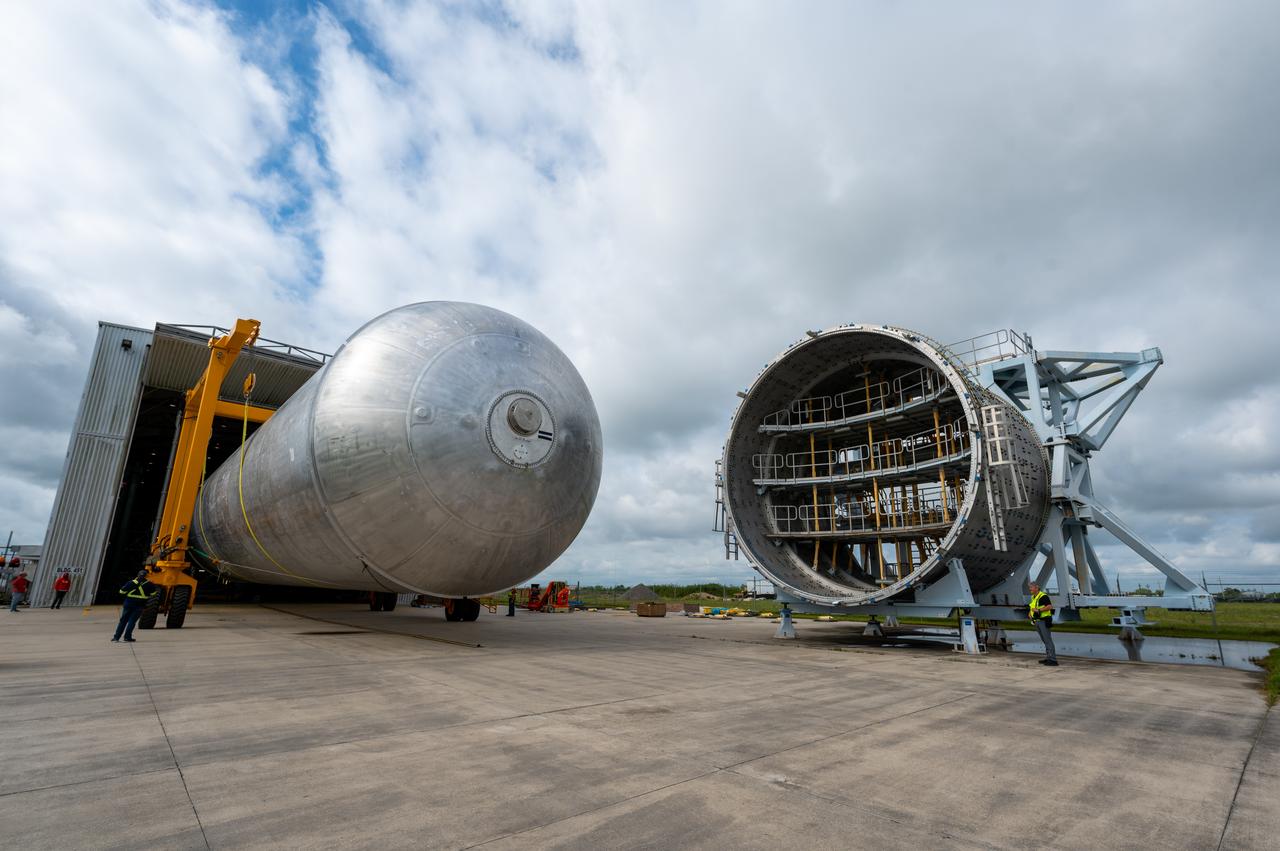
The core stage liquid hydrogen tank for the Artemis III mission completed proof testing, and technicians returned it to the main factory building at NASA’s Michoud Assembly Facility in New Orleans where it will undergo more outfitting. As part of proof testing, technicians apply a simple soap solution and check for leaks by observing any bubble formation on the welds. The technician removed the bubble solution with distilled water and then dried the area of application to prevent corrosion. To build the Space Launch System (SLS) rocket’s 130-foot core stage liquid hydrogen tank, engineers use robotic tools to weld five-barrel segments. This process results in a tank with around 1,900 feet, or more than six football fields, of welds that must be tested by hand. After the leak tests, the core stage lead, Boeing, pressurized the SLS tank to further ensure there were no leaks. After it passed proof testing, technicians moved the Artemis III liquid hydrogen tank to Michoud’s main factory. Soon, the technicians will prime and apply a foam-based thermal protection system that protects the tank during launch. Later, the tank will be joined with other parts of the core stage to form the entire 212-foot rocket stage with its four RS-25 engines that produce 2 million pounds of thrust to help launch the rocket. Artemis III will land the first astronauts on the lunar surface.
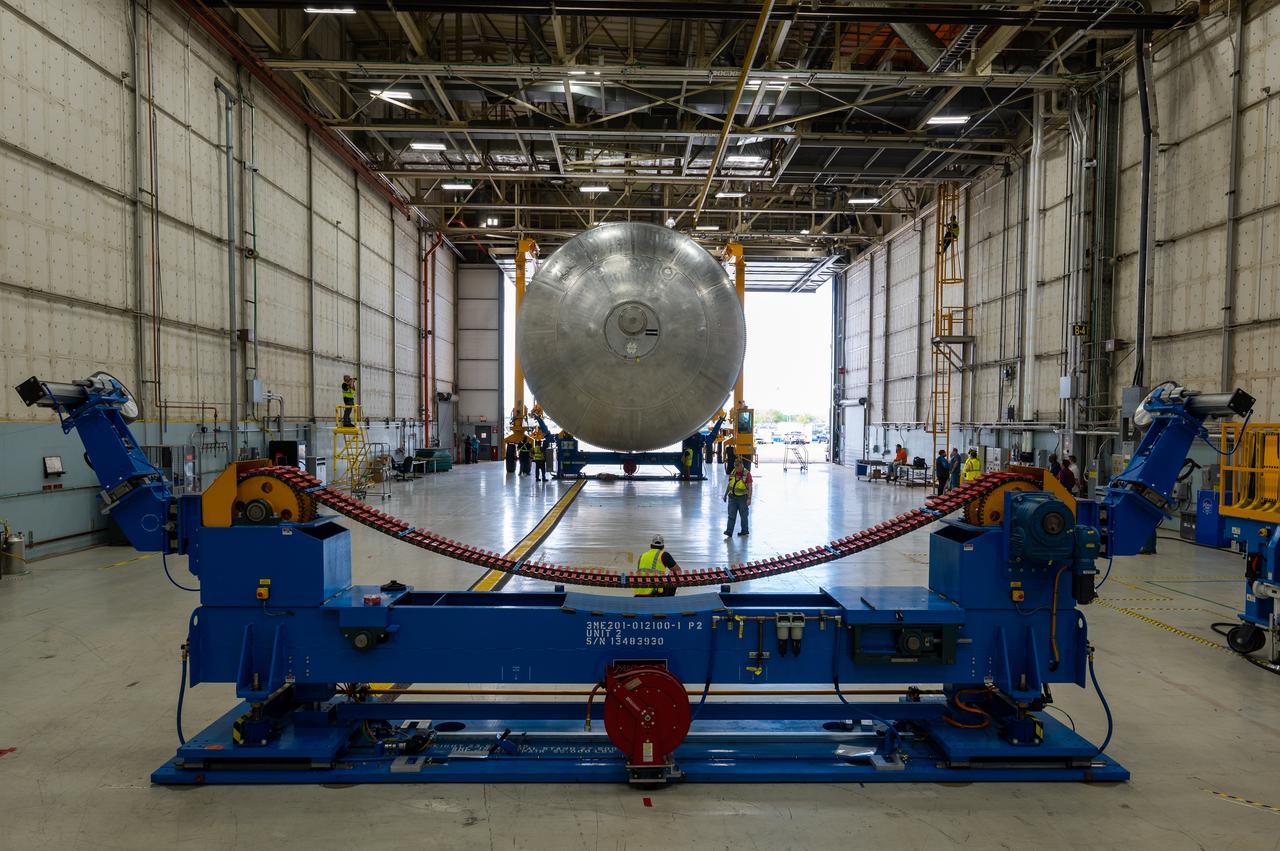
The core stage liquid hydrogen tank for the Artemis III mission completed proof testing, and technicians returned it to the main factory building at NASA’s Michoud Assembly Facility in New Orleans where it will undergo more outfitting. As part of proof testing, technicians apply a simple soap solution and check for leaks by observing any bubble formation on the welds. The technician removed the bubble solution with distilled water and then dried the area of application to prevent corrosion. To build the Space Launch System (SLS) rocket’s 130-foot core stage liquid hydrogen tank, engineers use robotic tools to weld five-barrel segments. This process results in a tank with around 1,900 feet, or more than six football fields, of welds that must be tested by hand. After the leak tests, the core stage lead, Boeing, pressurized the SLS tank to further ensure there were no leaks. After it passed proof testing, technicians moved the Artemis III liquid hydrogen tank to Michoud’s main factory. Soon, the technicians will prime and apply a foam-based thermal protection system that protects the tank during launch. Later, the tank will be joined with other parts of the core stage to form the entire 212-foot rocket stage with its four RS-25 engines that produce 2 million pounds of thrust to help launch the rocket. Artemis III will land the first astronauts on the lunar surface.
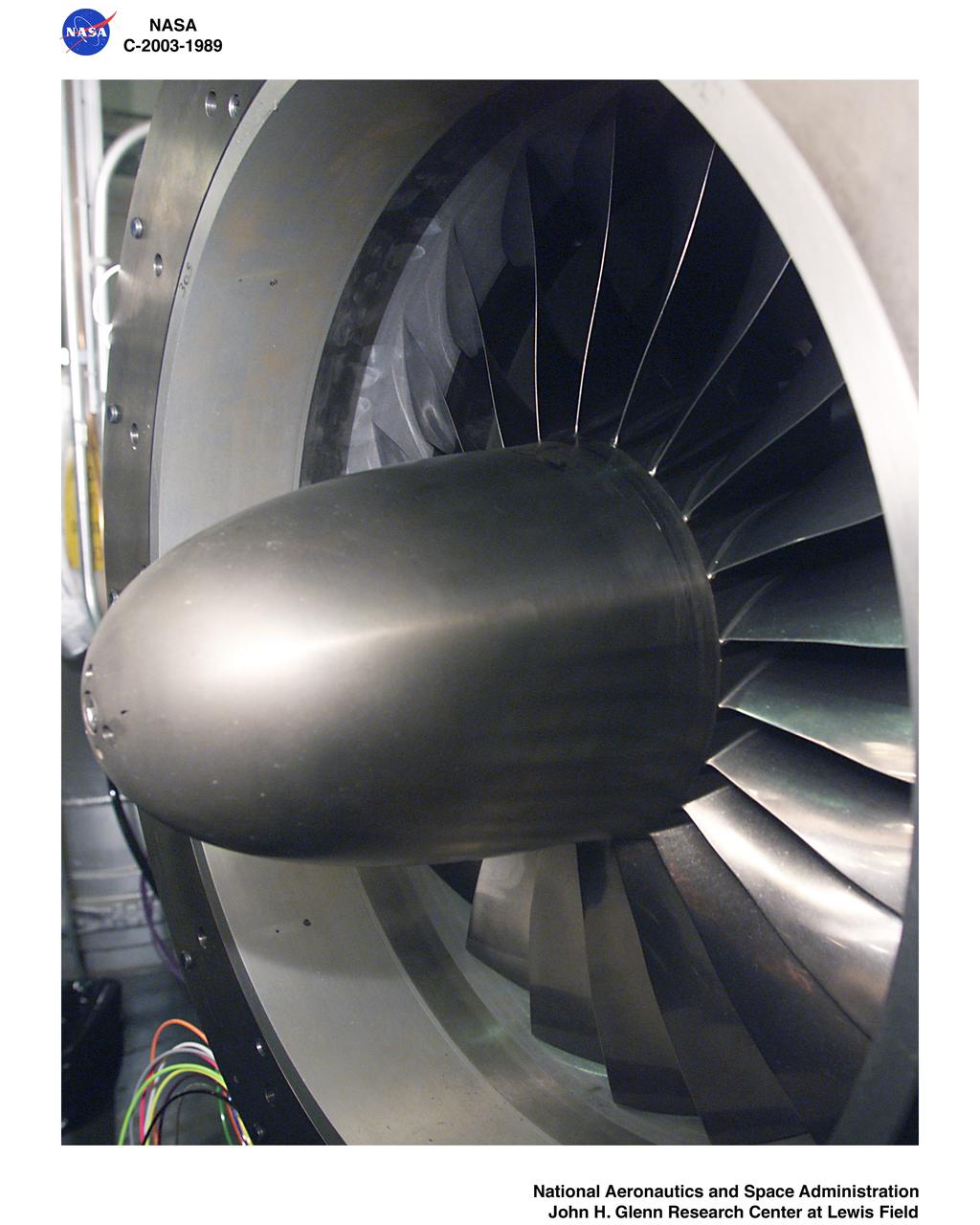
Ultra-Efficient Engine Technology - UEET - Proof of Concept Compressor - POCC - Advanced Compressor Casing Treatment Testing
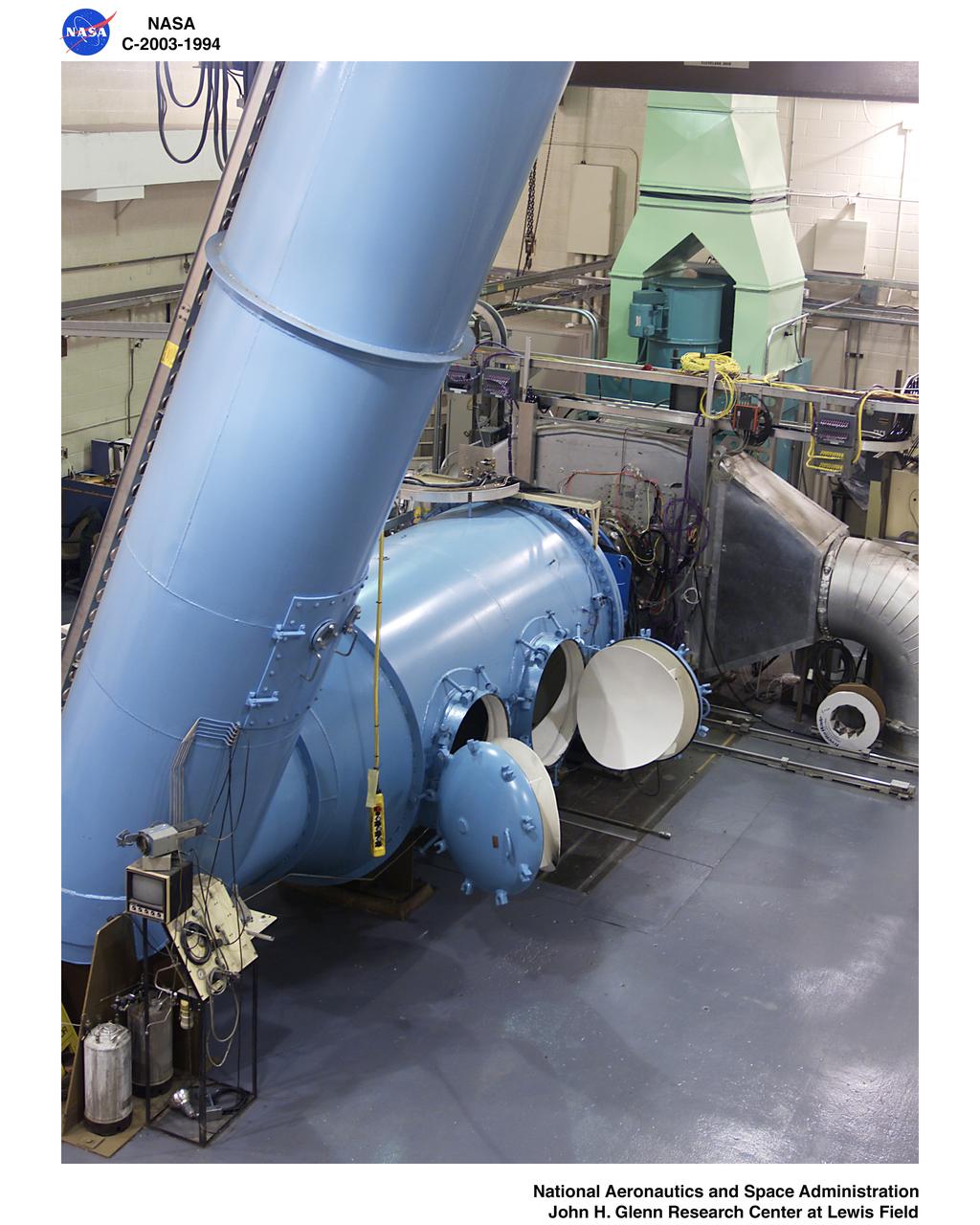
Ultra-Efficient Engine Technology - UEET - Proof of Concept Compressor - POCC - Advanced Compressor Casing Treatment Testing
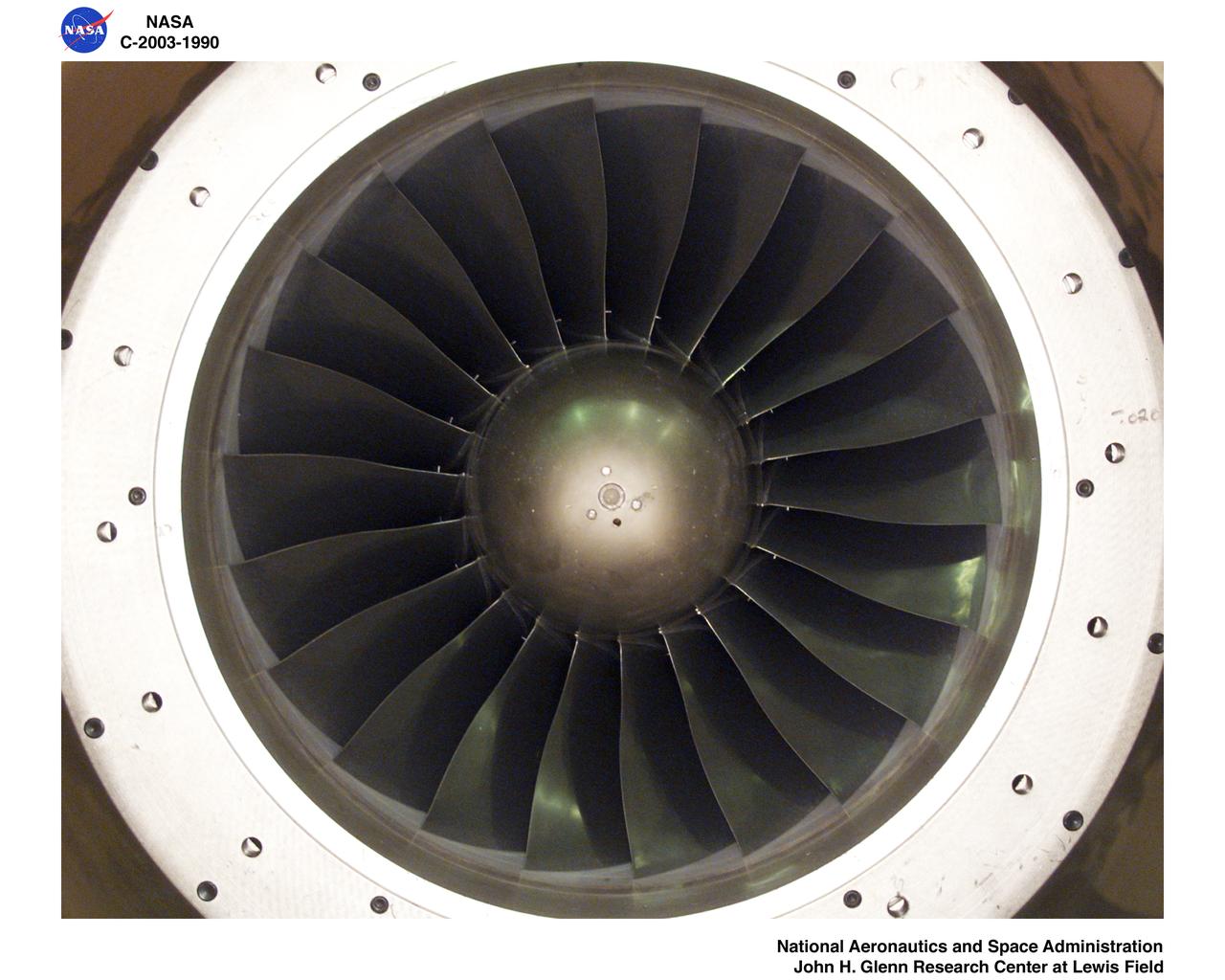
Ultra-Efficient Engine Technology - UEET - Proof of Concept Compressor - POCC - Advanced Compressor Casing Treatment Testing
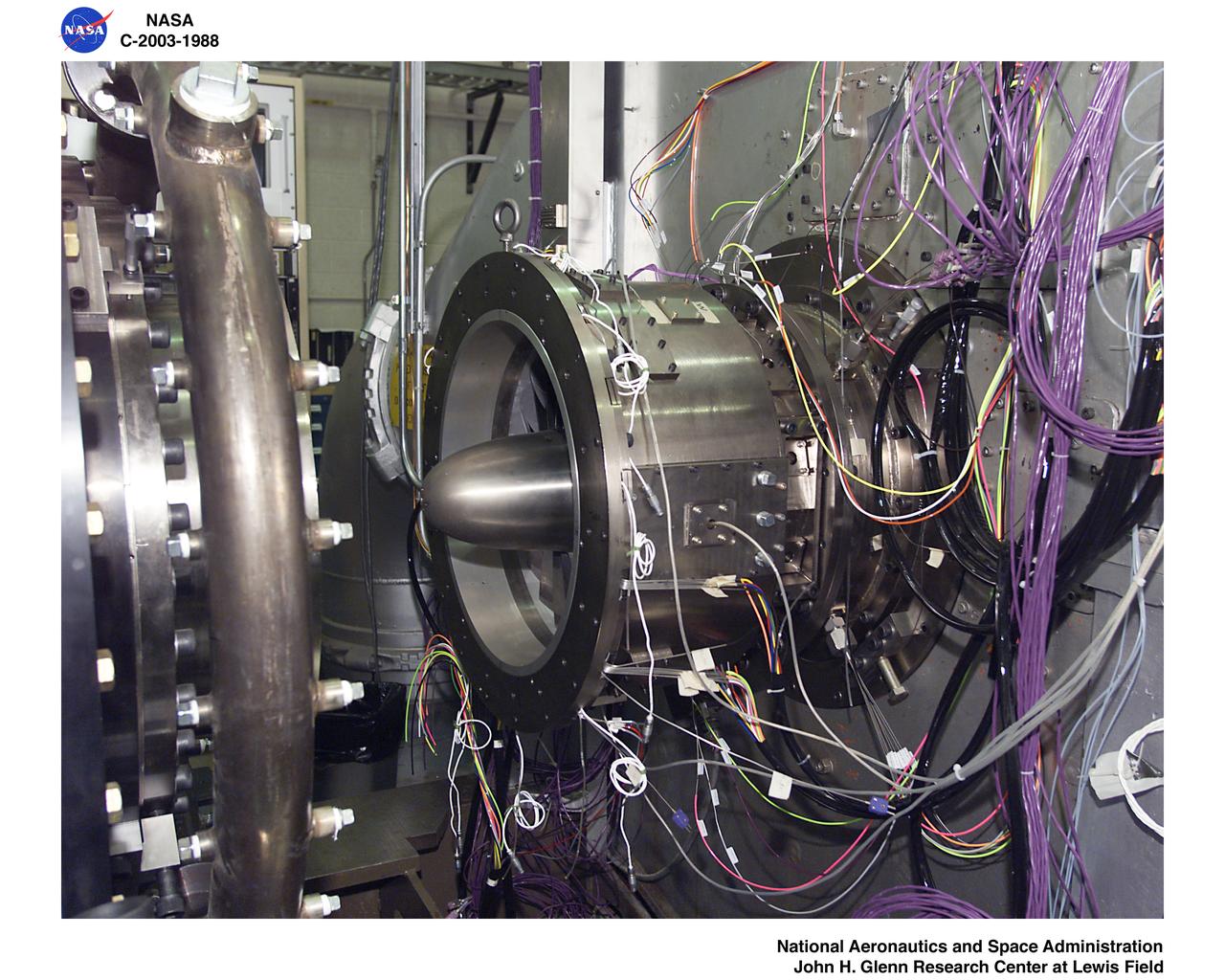
Ultra-Efficient Engine Technology - UEET - Proof of Concept Compressor - POCC - Advanced Compressor Casing Treatment Testing
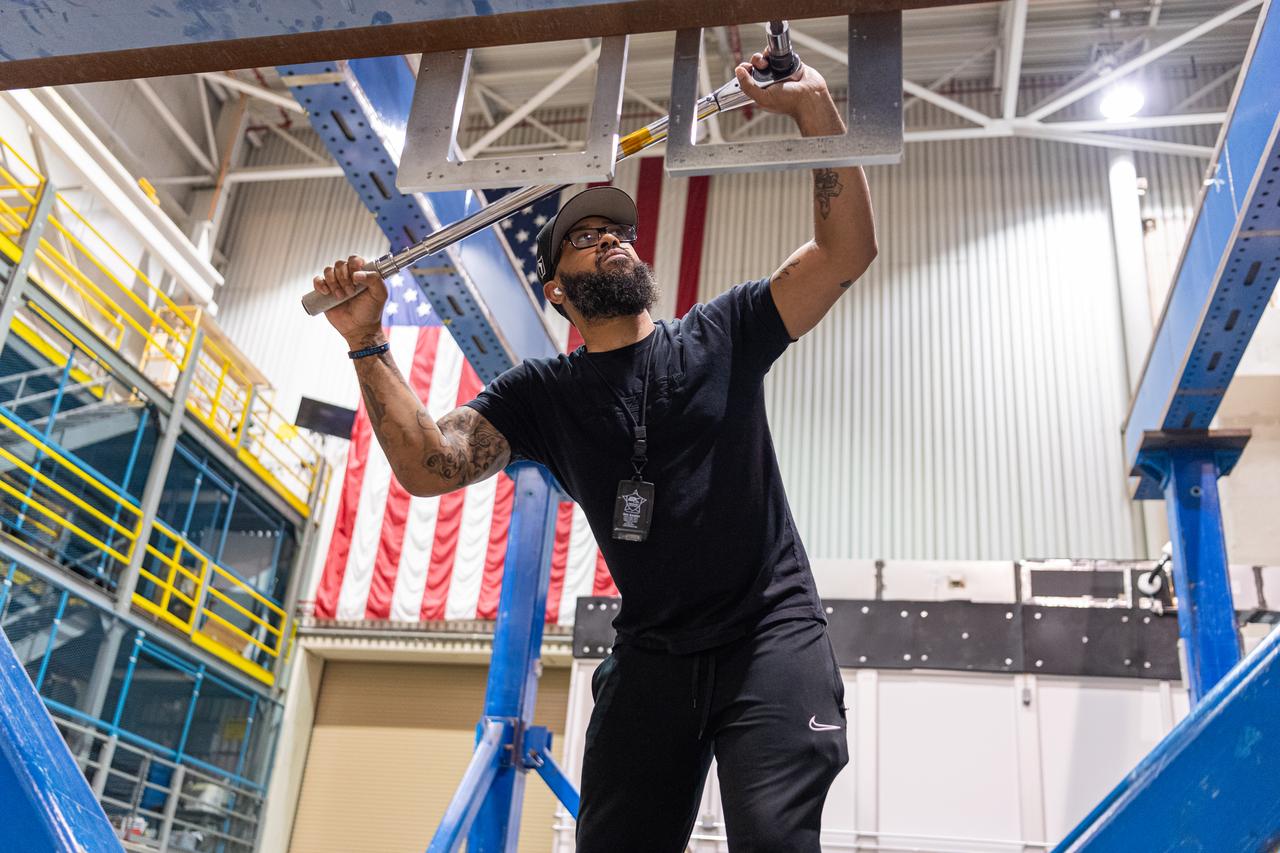
Mechanical engineering and integration technician Ivan Pratt installs brackets onto the static load testing platform in preparation of an OSAM-1 ground support equipment proof test at Goddard Space Flight Center, Greenbelt Md., July 19, 2023. This photo has been reviewed by OSAM1 project management and the Export Control Office and is released for public view. NASA/Mike Guinto
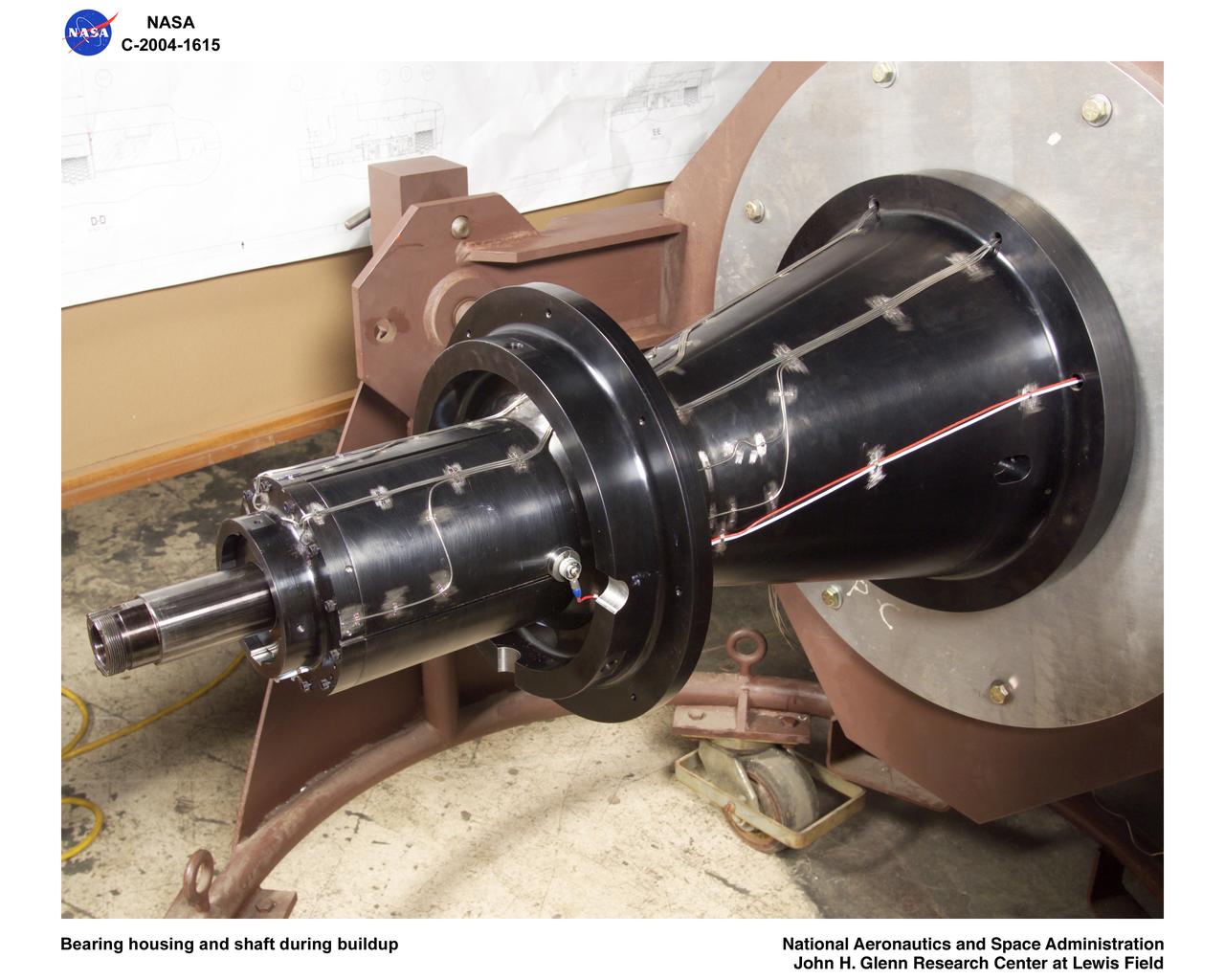
Ultra-Efficient Engine Technology (UEET), Proof of Concept Compressor, Advanced Compressor Casing Treatment testing; bearing housing and shaft during build-up
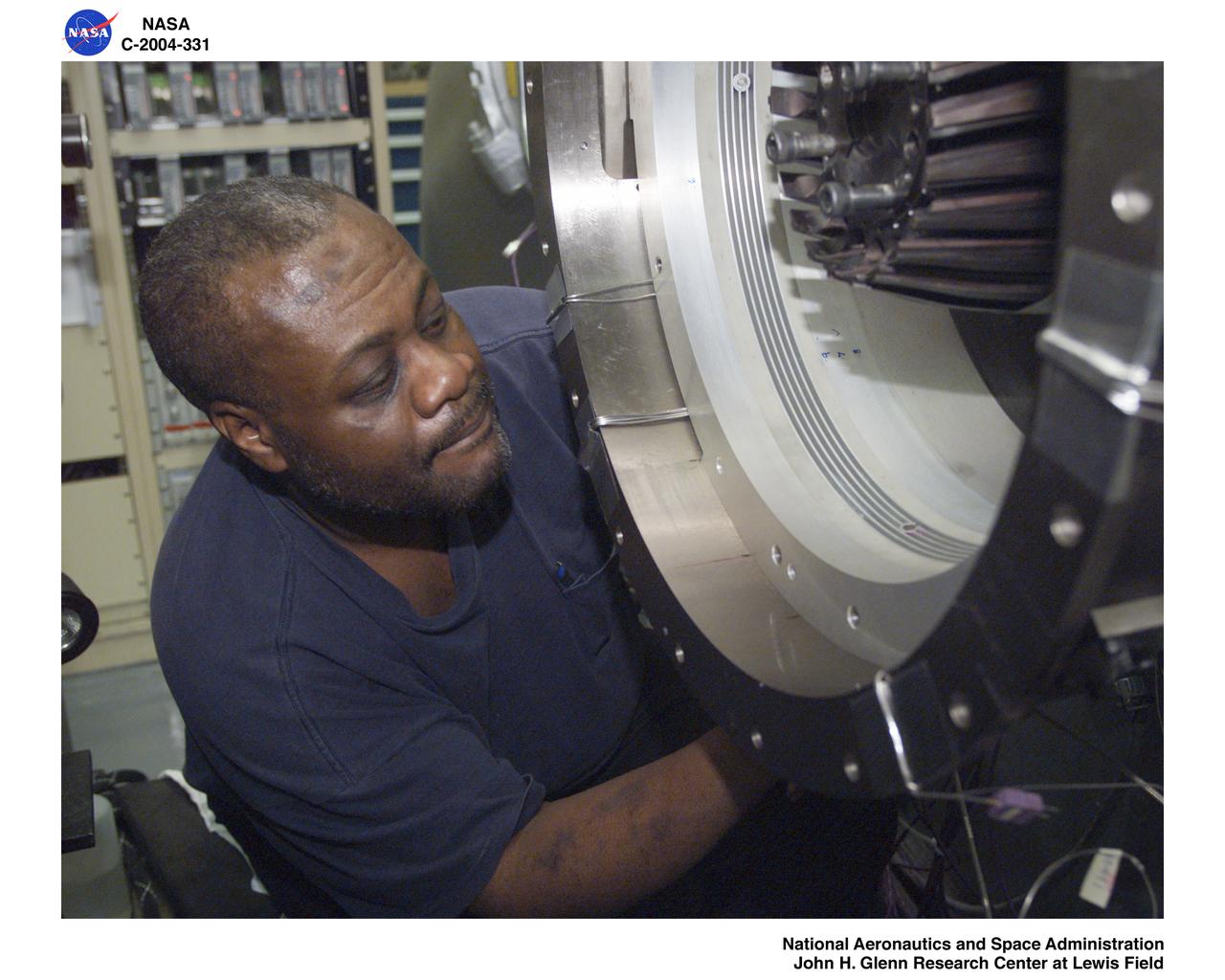
Ultra-Efficient Engine Technology (UEET) Proof of Concept Compressor, Advanced Compressor Casing Treatment testing, First Research Configuration (concentric grooves)
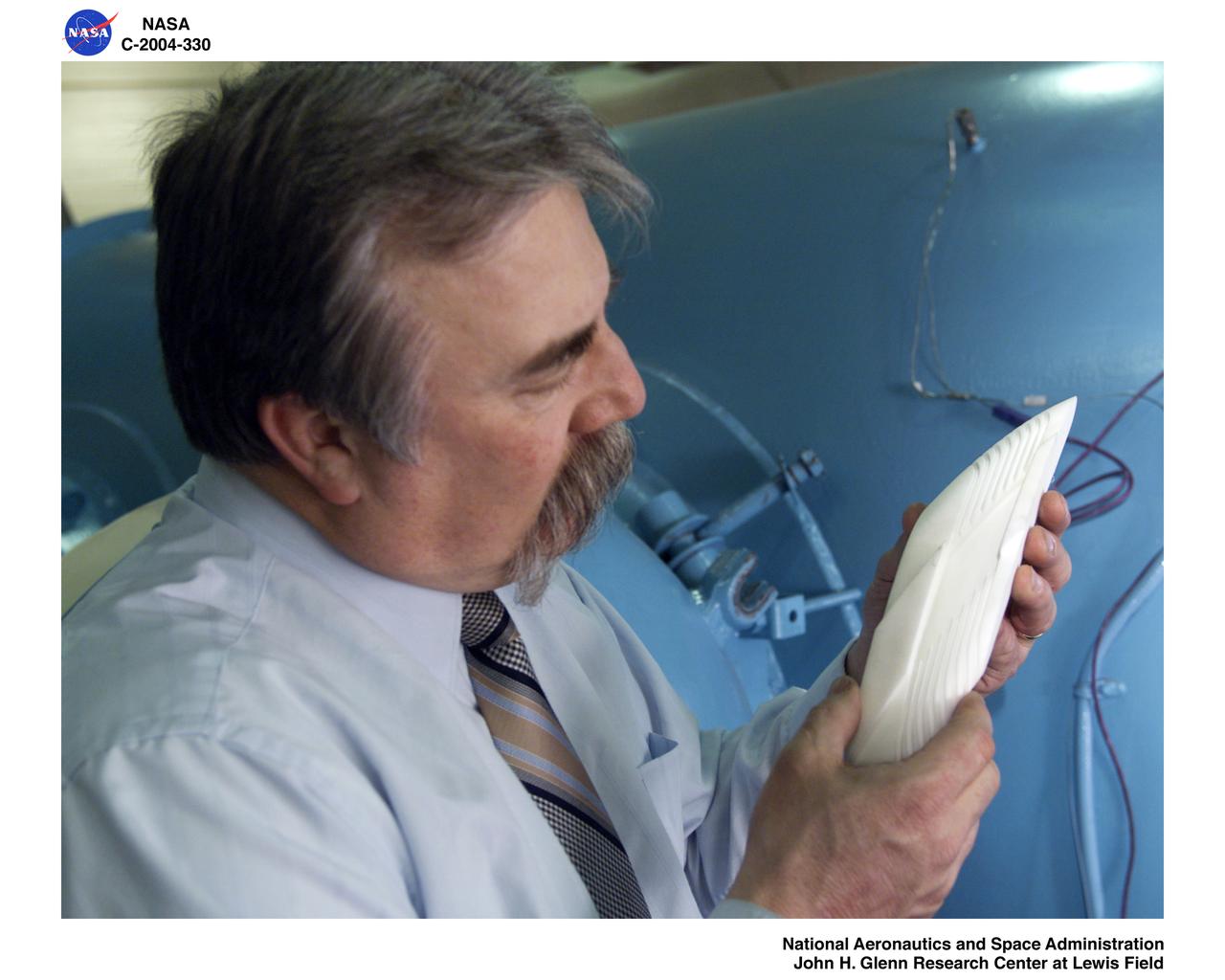
Ultra-Efficient Engine Technology (UEET) Proof of Concept Compressor, Advanced Compressor Casing Treatment testing, First Research Configuration (concentric grooves)
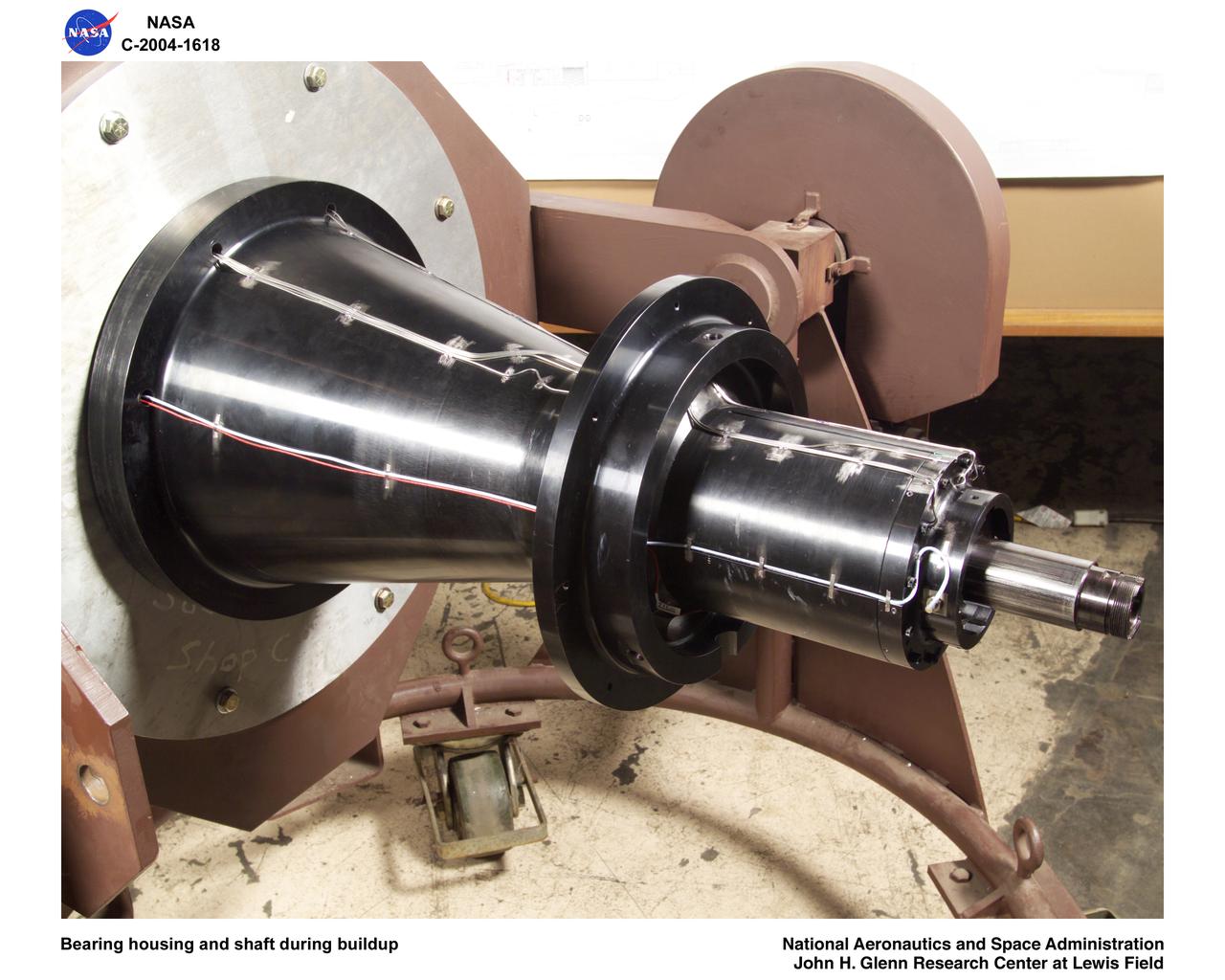
Ultra-Efficient Engine Technology (UEET), Proof of Concept Compressor, Advanced Compressor Casing Treatment testing; bearing housing and shaft during build-up
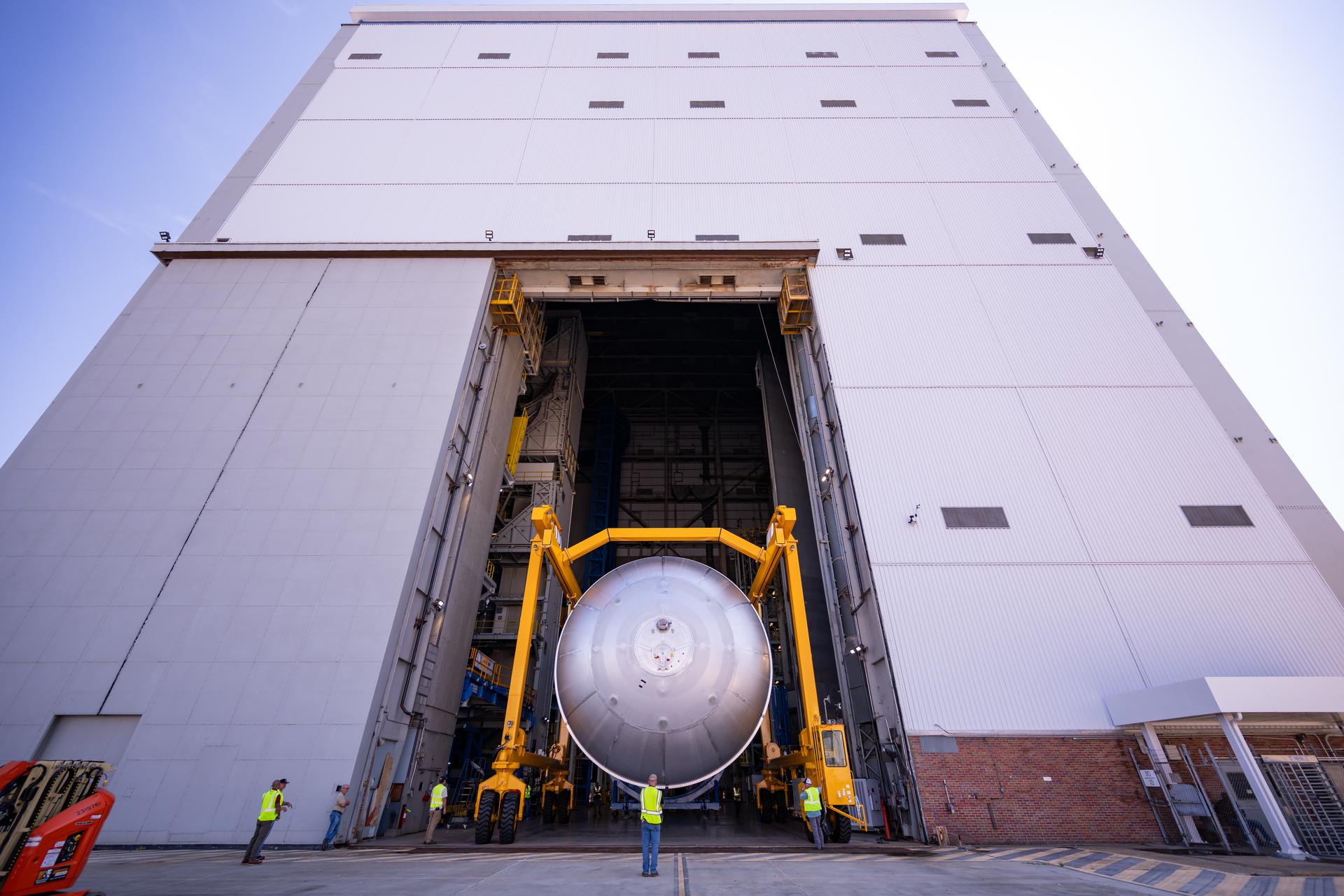
Teams at NASA’s Michoud Assembly Facility in New Orleans move a liquid oxygen tank from the main rocket factory into the adjacent vertical assembly building. The liquid oxygen tank, which will form part of the SLS (Space Launch System) rocket for NASA’s Artemis IV mission to the Moon, is rotated from a horizontal to a vertical configuration and loaded into the high bay’s hydrostatic proof testing cell. This non-destructive evaluation method tests the structural integrity of the tank’s welds by filling the tank with water, simulating the propellant used during launch. The propellant tank will hold more than 196,000 gallons of super-cooled liquid oxygen at launch and is one of five major elements that make up the 212-foot-tall SLS rocket stage. The core stage, along with its four RS-25 engines at its base, produces more than two million pounds of thrust to help launch NASA’s Orion spacecraft, astronauts, and supplies beyond Earth’s orbit and to the lunar surface for Artemis.
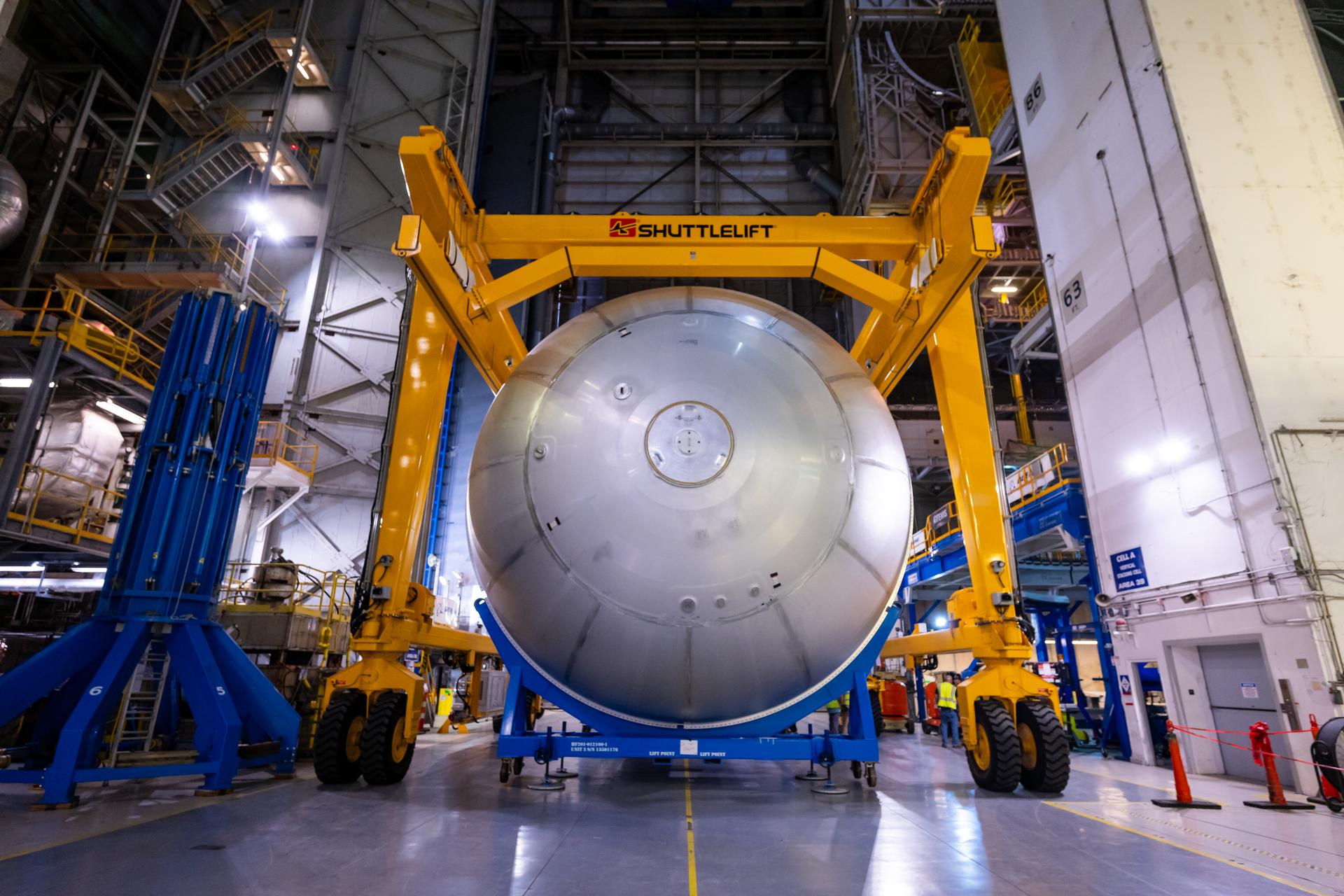
Teams at NASA’s Michoud Assembly Facility in New Orleans move a liquid oxygen tank from the main rocket factory into the adjacent vertical assembly building. The liquid oxygen tank, which will form part of the SLS (Space Launch System) rocket for NASA’s Artemis IV mission to the Moon, is rotated from a horizontal to a vertical configuration and loaded into the high bay’s hydrostatic proof testing cell. This non-destructive evaluation method tests the structural integrity of the tank’s welds by filling the tank with water, simulating the propellant used during launch. The propellant tank will hold more than 196,000 gallons of super-cooled liquid oxygen at launch and is one of five major elements that make up the 212-foot-tall SLS rocket stage. The core stage, along with its four RS-25 engines at its base, produces more than two million pounds of thrust to help launch NASA’s Orion spacecraft, astronauts, and supplies beyond Earth’s orbit and to the lunar surface for Artemis.
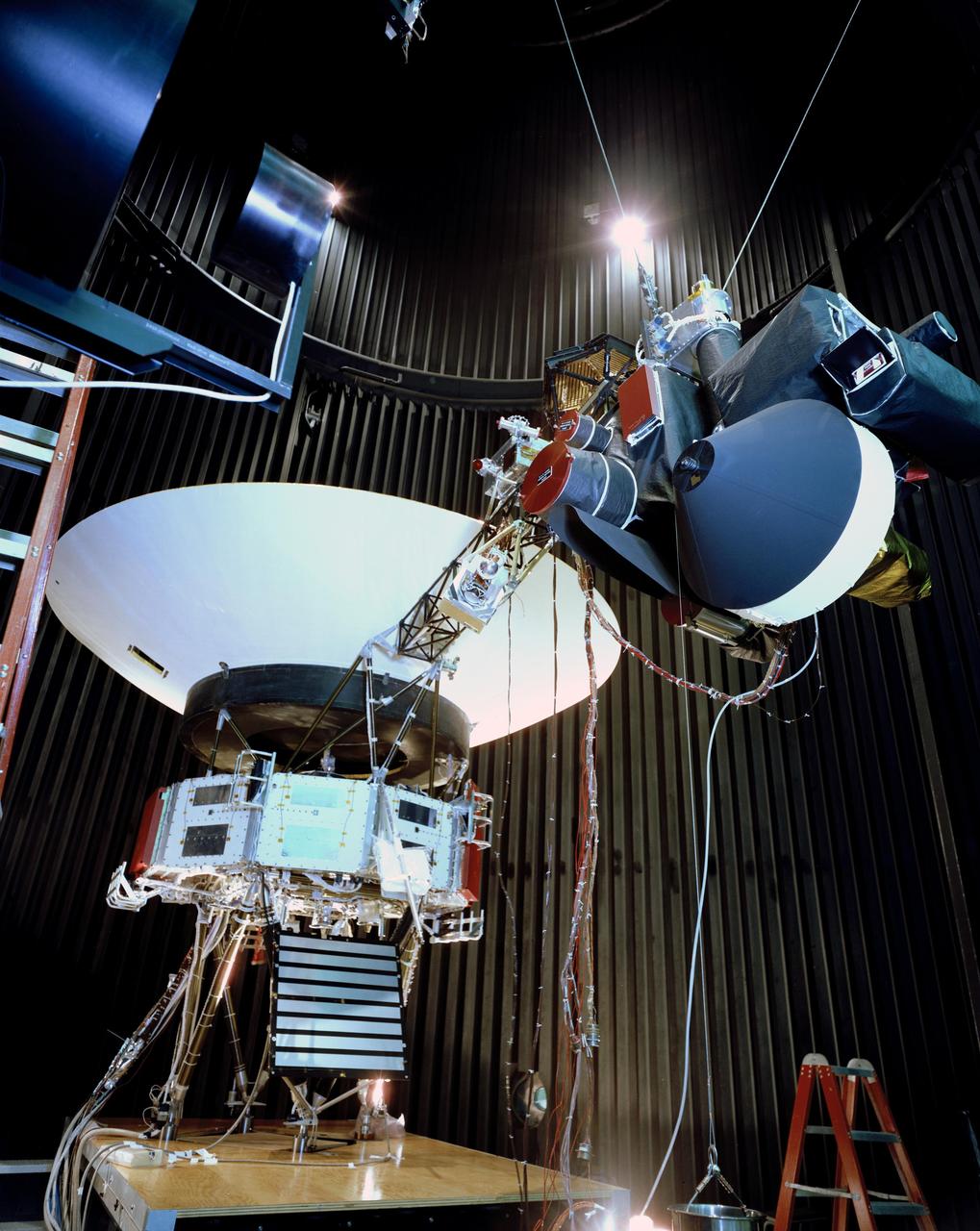
This archival photo shows the Voyager proof test model, which did not fly in space, in the 25-foot space simulator chamber at NASA's Jet Propulsion Laboratory, Pasadena, California, on December 3, 1976. The spacecraft is seen here with its scan platform, which holds several of its science instruments, in the deployed position. https://photojournal.jpl.nasa.gov/catalog/PIA21734
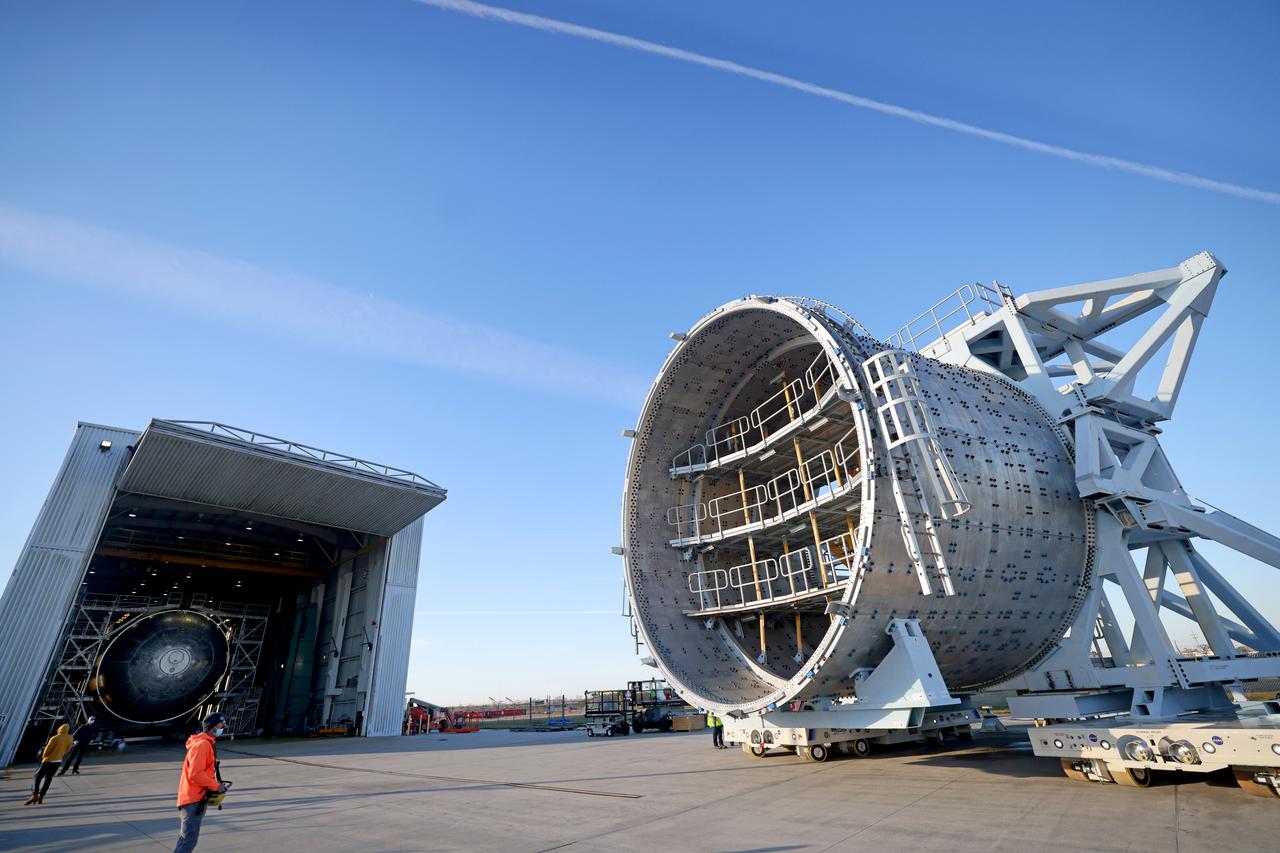
The liquid hydrogen tank that will be part of the Space Launch System rocket’s core stage is being prepared for the Artemis III mission at NASA’s Michoud Assembly Facility in New Orleans. Eventually, the tank will be connected to the engine section that will house the four RS-25 engines. The engine section is still being outfitted, so for this test crews attached an engine section aft simulator during proof testing on January 27, 2022. Once the aft simulator is attached, the LH2 tank undergoes non-destructive evaluation, which will test weld strength and ensure the tank is structurally sound. The SLS core stage is made up of five unique elements: the forward skirt, liquid oxygen tank, intertank, liquid hydrogen tank, and the engine section. The tank holds 537,000 gallons of liquid hydrogen cooled to minus 432 degrees Fahrenheit and sits between the core stage’s intertank and engine section. The liquid hydrogen hardware, along with the liquid oxygen tank, will provide propellant to the four RS-25 engines at the bottom of the core stage to produce more than two million pounds of thrust to help launch the Artemis III mission to the Moon. Together with its four RS-25 engines, the rocket’s massive 212-foot-tall core stage — the largest stage NASA has ever built — and its twin solid rocket boosters will produce 8.8 million pounds of thrust to send NASA’s Orion spacecraft, astronauts and supplies beyond Earth’s orbit to the Moon. Image credit: NASA/Michael DeMocker
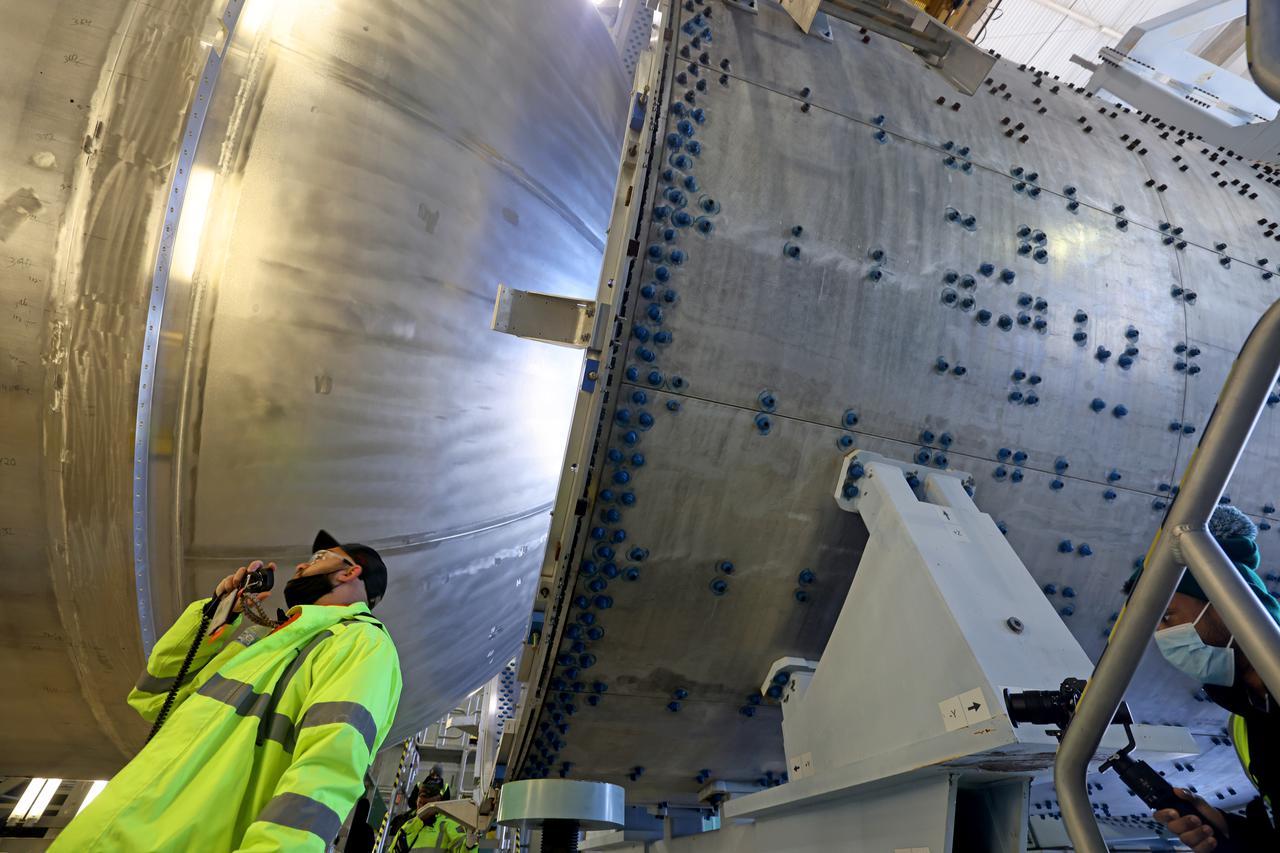
The liquid hydrogen tank that will be part of the Space Launch System rocket’s core stage is being prepared for the Artemis III mission at NASA’s Michoud Assembly Facility in New Orleans. Eventually, the tank will be connected to the engine section that will house the four RS-25 engines. The engine section is still being outfitted, so for this test crews attached an engine section aft simulator during proof testing on January 27, 2022. Once the aft simulator is attached, the LH2 tank undergoes non-destructive evaluation, which will test weld strength and ensure the tank is structurally sound. The SLS core stage is made up of five unique elements: the forward skirt, liquid oxygen tank, intertank, liquid hydrogen tank, and the engine section. The tank holds 537,000 gallons of liquid hydrogen cooled to minus 432 degrees Fahrenheit and sits between the core stage’s intertank and engine section. The liquid hydrogen hardware, along with the liquid oxygen tank, will provide propellant to the four RS-25 engines at the bottom of the core stage to produce more than two million pounds of thrust to help launch the Artemis III mission to the Moon. Together with its four RS-25 engines, the rocket’s massive 212-foot-tall core stage — the largest stage NASA has ever built — and its twin solid rocket boosters will produce 8.8 million pounds of thrust to send NASA’s Orion spacecraft, astronauts and supplies beyond Earth’s orbit to the Moon. Image credit: NASA/Michael DeMocker
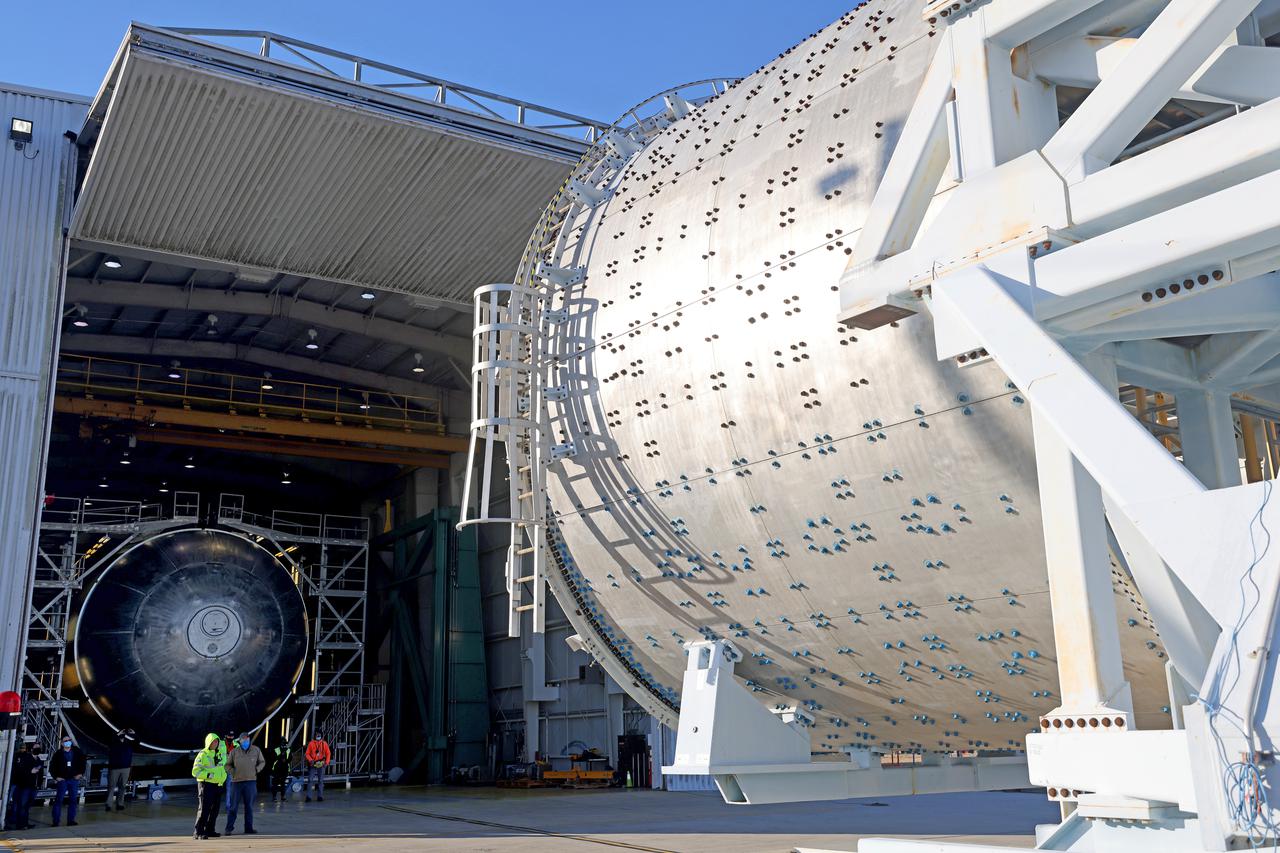
The liquid hydrogen tank that will be part of the Space Launch System rocket’s core stage is being prepared for the Artemis III mission at NASA’s Michoud Assembly Facility in New Orleans. Eventually, the tank will be connected to the engine section that will house the four RS-25 engines. The engine section is still being outfitted, so for this test crews attached an engine section aft simulator during proof testing on January 27, 2022. Once the aft simulator is attached, the LH2 tank undergoes non-destructive evaluation, which will test weld strength and ensure the tank is structurally sound. The SLS core stage is made up of five unique elements: the forward skirt, liquid oxygen tank, intertank, liquid hydrogen tank, and the engine section. The tank holds 537,000 gallons of liquid hydrogen cooled to minus 432 degrees Fahrenheit and sits between the core stage’s intertank and engine section. The liquid hydrogen hardware, along with the liquid oxygen tank, will provide propellant to the four RS-25 engines at the bottom of the core stage to produce more than two million pounds of thrust to help launch the Artemis III mission to the Moon. Together with its four RS-25 engines, the rocket’s massive 212-foot-tall core stage — the largest stage NASA has ever built — and its twin solid rocket boosters will produce 8.8 million pounds of thrust to send NASA’s Orion spacecraft, astronauts and supplies beyond Earth’s orbit to the Moon. Image credit: NASA/Michael DeMocker
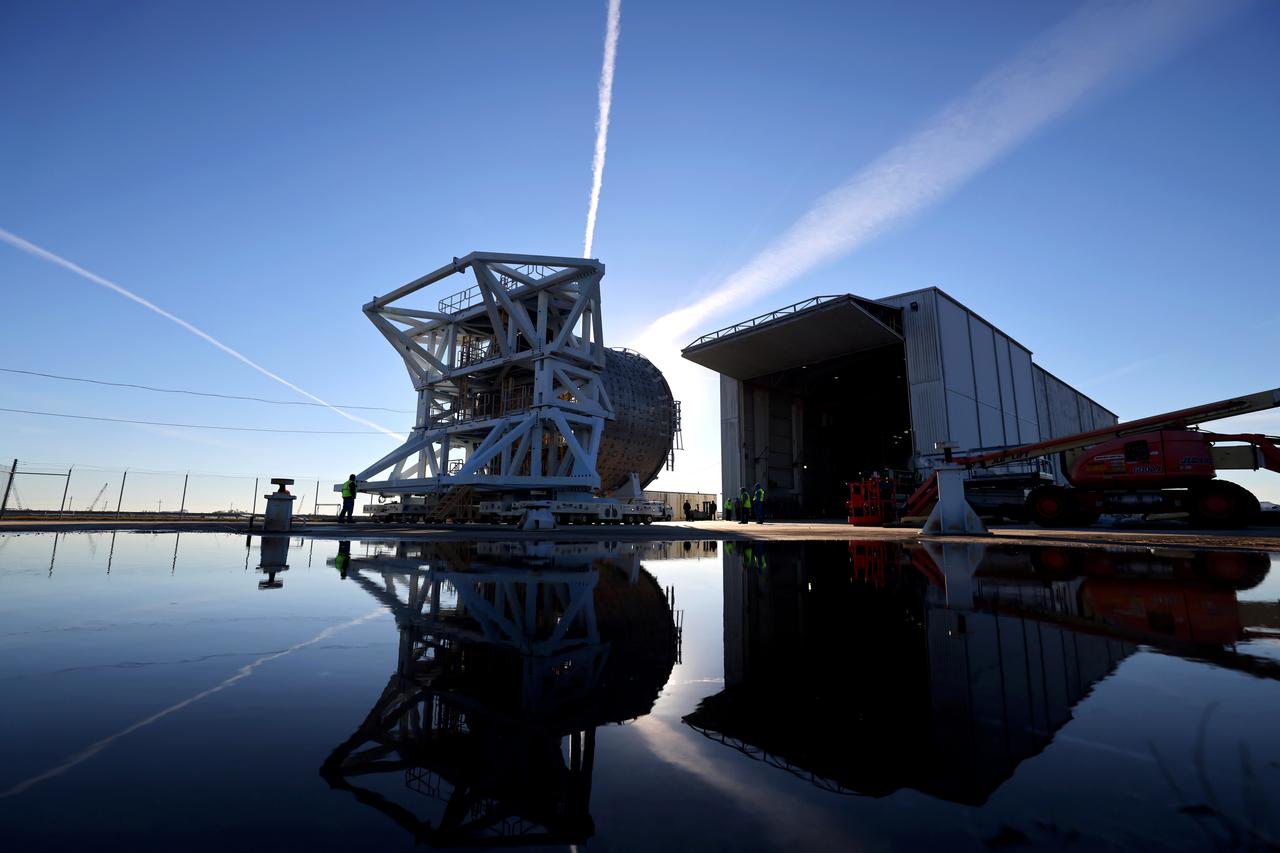
The liquid hydrogen tank that will be part of the Space Launch System rocket’s core stage is being prepared for the Artemis III mission at NASA’s Michoud Assembly Facility in New Orleans. Eventually, the tank will be connected to the engine section that will house the four RS-25 engines. The engine section is still being outfitted, so for this test crews attached an engine section aft simulator during proof testing on January 27, 2022. Once the aft simulator is attached, the LH2 tank undergoes non-destructive evaluation, which will test weld strength and ensure the tank is structurally sound. The SLS core stage is made up of five unique elements: the forward skirt, liquid oxygen tank, intertank, liquid hydrogen tank, and the engine section. The tank holds 537,000 gallons of liquid hydrogen cooled to minus 432 degrees Fahrenheit and sits between the core stage’s intertank and engine section. The liquid hydrogen hardware, along with the liquid oxygen tank, will provide propellant to the four RS-25 engines at the bottom of the core stage to produce more than two million pounds of thrust to help launch the Artemis III mission to the Moon. Together with its four RS-25 engines, the rocket’s massive 212-foot-tall core stage — the largest stage NASA has ever built — and its twin solid rocket boosters will produce 8.8 million pounds of thrust to send NASA’s Orion spacecraft, astronauts and supplies beyond Earth’s orbit to the Moon. Image credit: NASA/Michael DeMocker
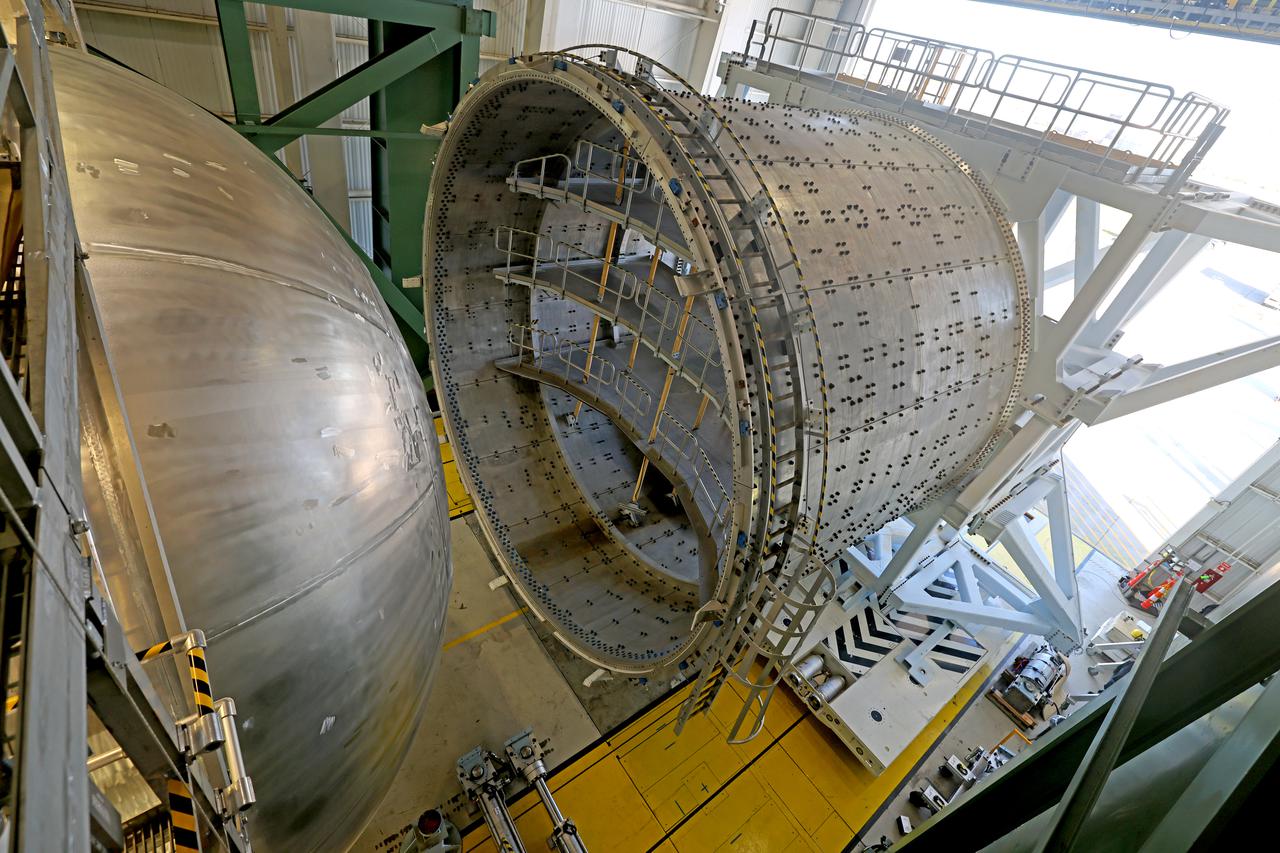
The liquid hydrogen tank that will be part of the Space Launch System rocket’s core stage is being prepared for the Artemis III mission at NASA’s Michoud Assembly Facility in New Orleans. Eventually, the tank will be connected to the engine section that will house the RS-25 engines. The engine section is still being outfitted, so for this test crews attached an engine section aft simulator during proof testing on January 27, 2022. Once the aft simulator is attached, the LH2 tank undergoes non-destructive evaluation, which will test weld strength and ensure the tank is structurally sound. The SLS core stage is made up of five unique elements: the forward skirt, liquid oxygen tank, intertank, liquid hydrogen tank, and the engine section. The tank holds 537,000 gallons of liquid hydrogen cooled to minus 432 degrees Fahrenheit and sits between the core stage’s intertank and engine section. The liquid hydrogen hardware, along with the liquid oxygen tank, will provide propellant to the four RS-25 engines at the bottom of the core stage to produce more than two million pounds of thrust to help launch the Artemis III mission to the Moon. Together with its four RS-25 engines, the rocket’s massive 212-foot-tall core stage — the largest stage NASA has ever built — and its twin solid rocket boosters will produce 8.8 million pounds of thrust to send NASA’s Orion spacecraft, astronauts and supplies beyond Earth’s orbit to the Moon. Image credit: NASA/Michael DeMocker

The Perseus proof-of-concept vehicle flies over Rogers Dry Lake at the Dryden Flight Research Center, Edwards, California, to test basic design concepts for the remotely-piloted, high-altitude vehicle.
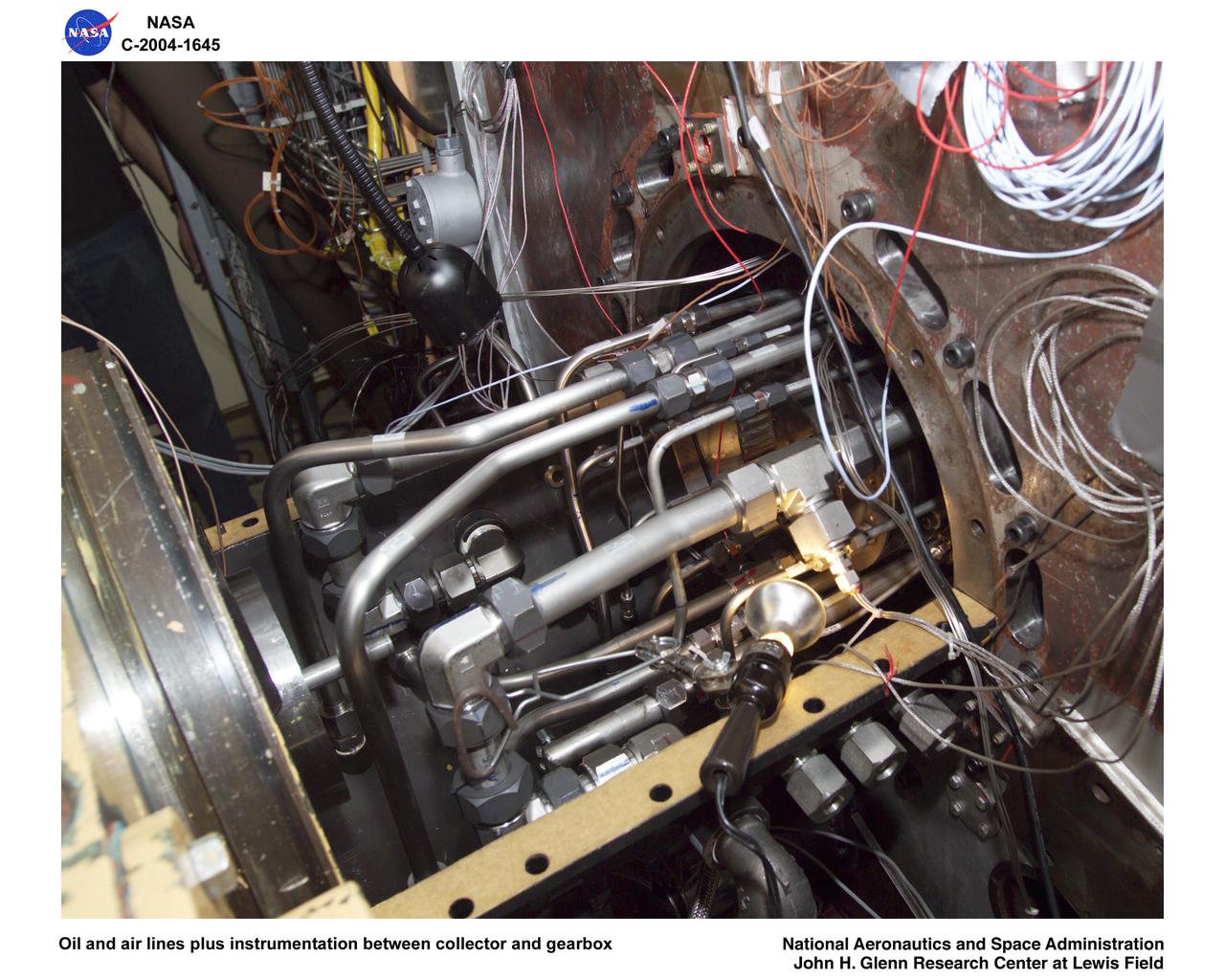
Ultra-Efficient Engine Technology (UEET), Proof of Concept Compressor, Advanced Compressor Casing Treatment testing; oil and air lines plus instrumentation between collector and gearbox
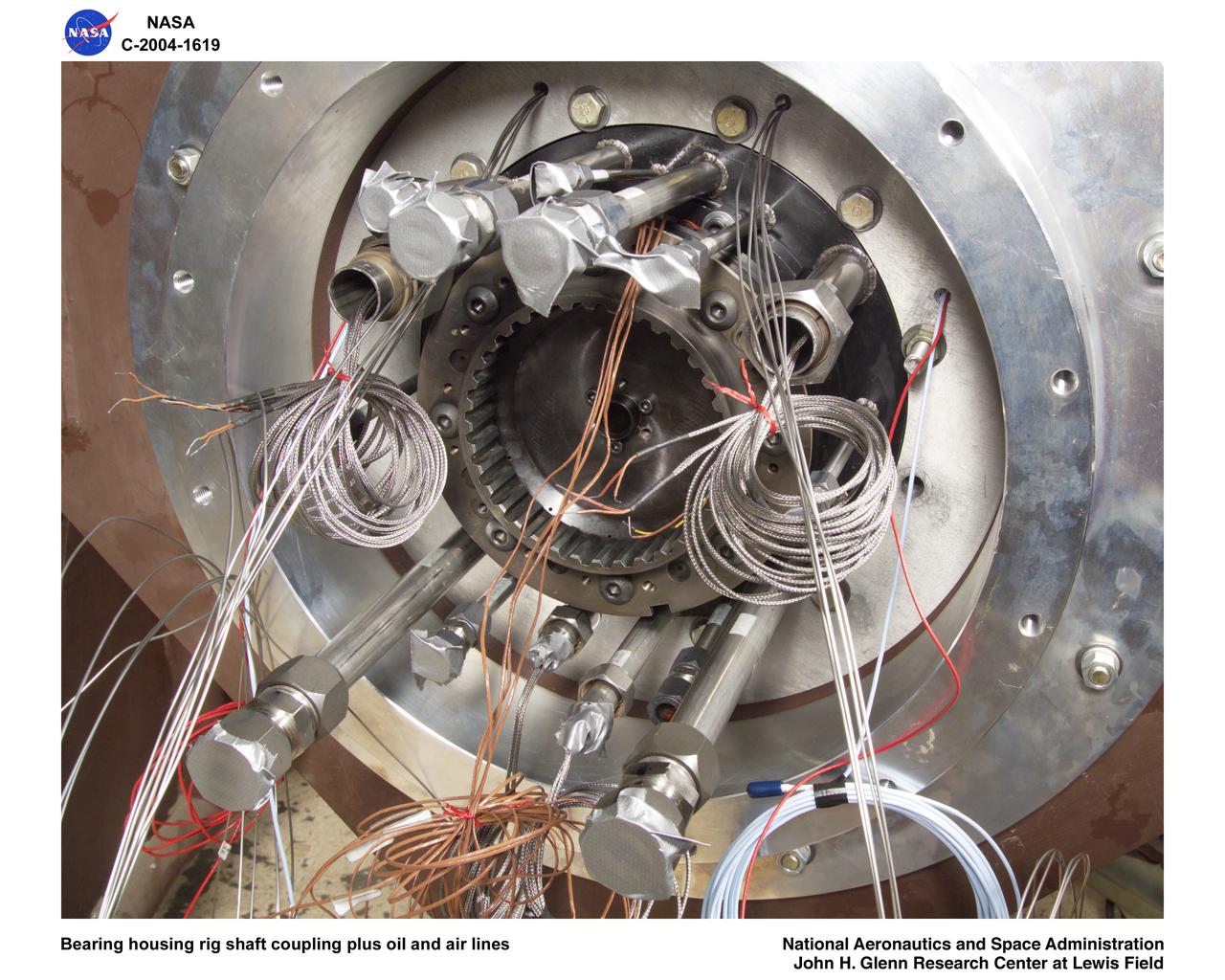
Ultra-Efficient Engine Technology (UEET), Proof of Concept Compressor, Advanced Compressor Casing Treatment testing; bearing housing rig shaft coupling and oil, air lines

Crew members check out the Perseus proof-of-concept vehicle on Rogers Dry Lake, adjacent to the Dryden Flight Research Center, Edwards, California, after a test flight in 1991.
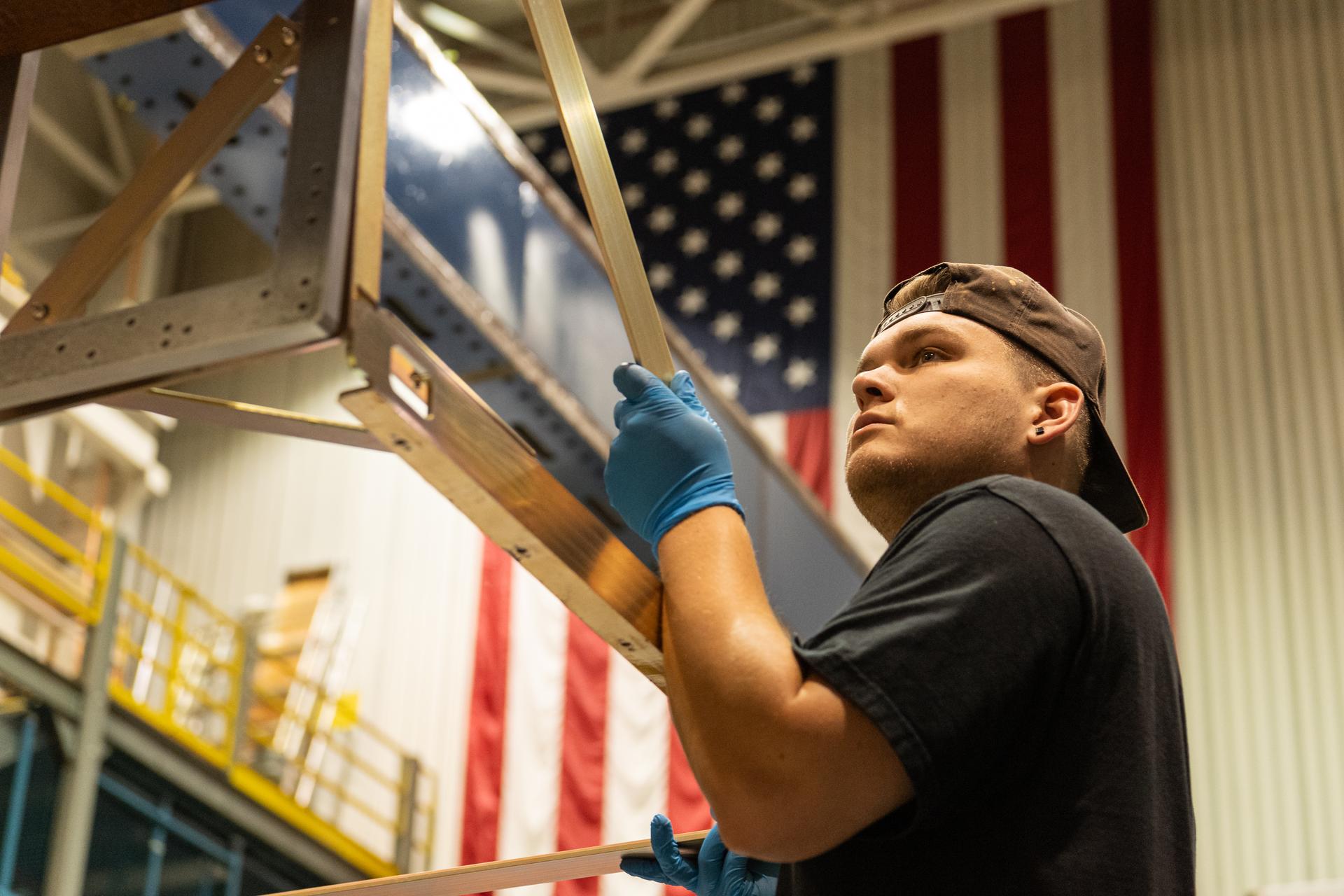
Mechanical engineering and integration technician, Lucas Keim, holds up a piece of ground support equipment during a proof test at Goddard Space Flight Center, Greenbelt Md., June 22, 2023. This photo has been reviewed by OSAM1 project management and the Export Control Office and is released for public view. NASA/Mike Guinto
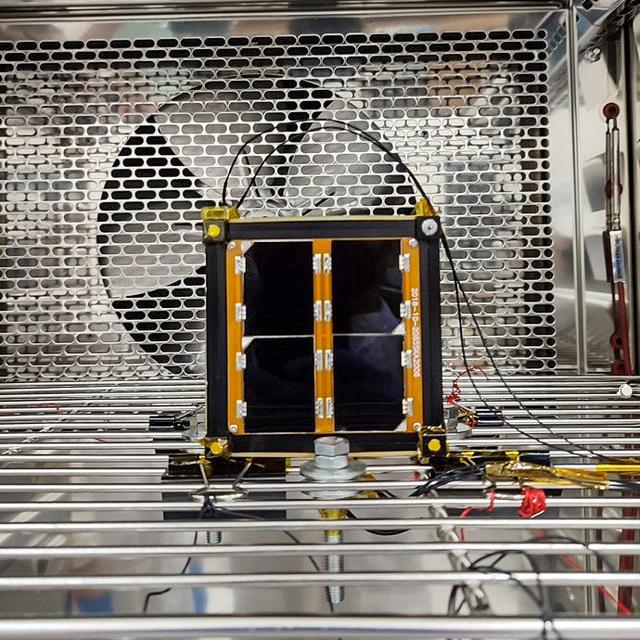
jsc2022e068264 (12/1/2021) --- A preflight view of the Surya Satellite-1 (SS-1) during Thermal Testing. The Surya Satellite-1 (SS-1) is the first Indonesian nanosatellite developed by university students at Surya University. SS-1 tests a satellite telecommunication system to serve amateur radio stations, and serves as a proof of concept of sensoric information transfer in rural areas for disaster mitigation application. Image Courtesy of The SS-1 Team.
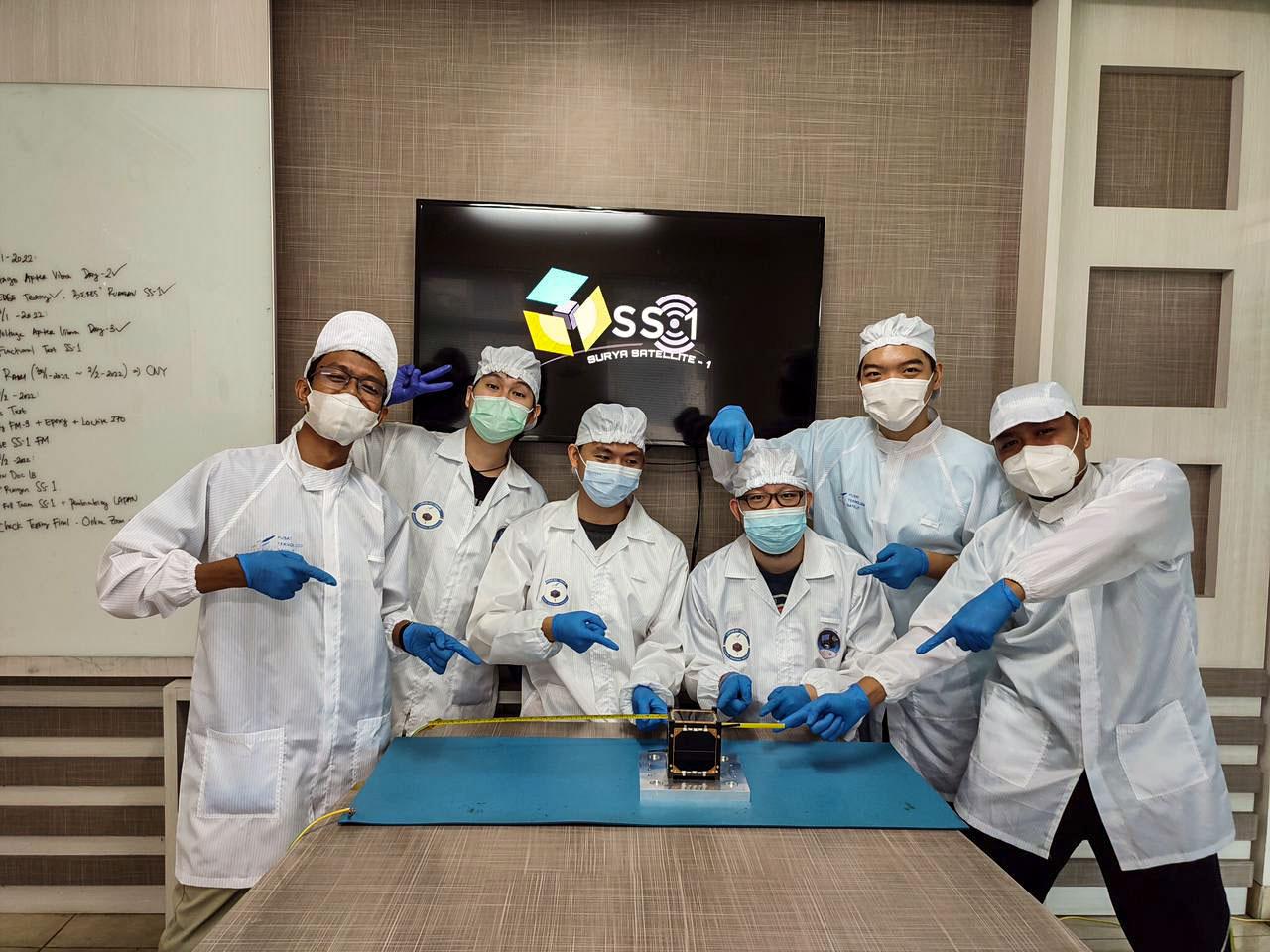
jsc2022e068260 (11/1/2021) --- The Surya Satellite-1 and its Developer Team After Deployment Testing, shown left to right: Zulfa, Hery, Setra, Roberto, Suhan, Afiq. The Surya Satellite-1 (SS-1) is the first Indonesian nanosatellite developed by university students at Surya University. SS-1 tests a satellite telecommunication system to serve amateur radio stations, and serves as a proof of concept of sensoric information transfer in rural areas for disaster mitigation application. Image Courtesy of The SS-1 Team.
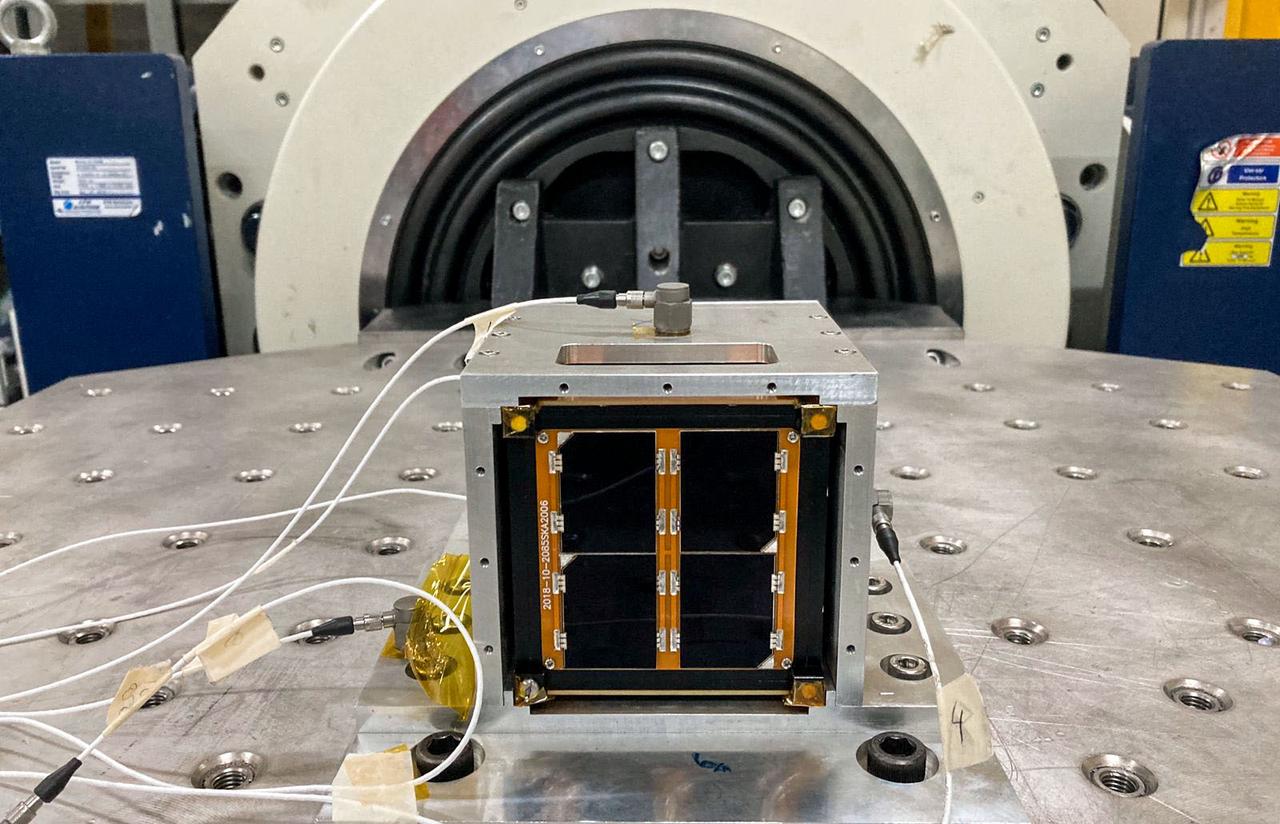
jsc2022e068265 (3/1/2022) --- A preflight view of the Surya Satellite-1 (SS-1) during Vibration Testing. The Surya Satellite-1 (SS-1) is the first Indonesian nanosatellite developed by university students at Surya University. SS-1 tests a satellite telecommunication system to serve amateur radio stations, and serves as a proof of concept of sensoric information transfer in rural areas for disaster mitigation application. Image Courtesy of The SS-1 Team.

jsc2022e068261 (11/1/2021) --- The Surya Satellite-1 and its developer team after Vibration Testing, shown left to right: Afiq, Roberto, Setra, Suhan, Hery, Zulfa. The Surya Satellite-1 (SS-1) is the first Indonesian nanosatellite developed by university students at Surya University. SS-1 tests a satellite telecommunication system to serve amateur radio stations, and serves as a proof of concept of sensoric information transfer in rural areas for disaster mitigation application. Image Courtesy of The SS-1 Team.
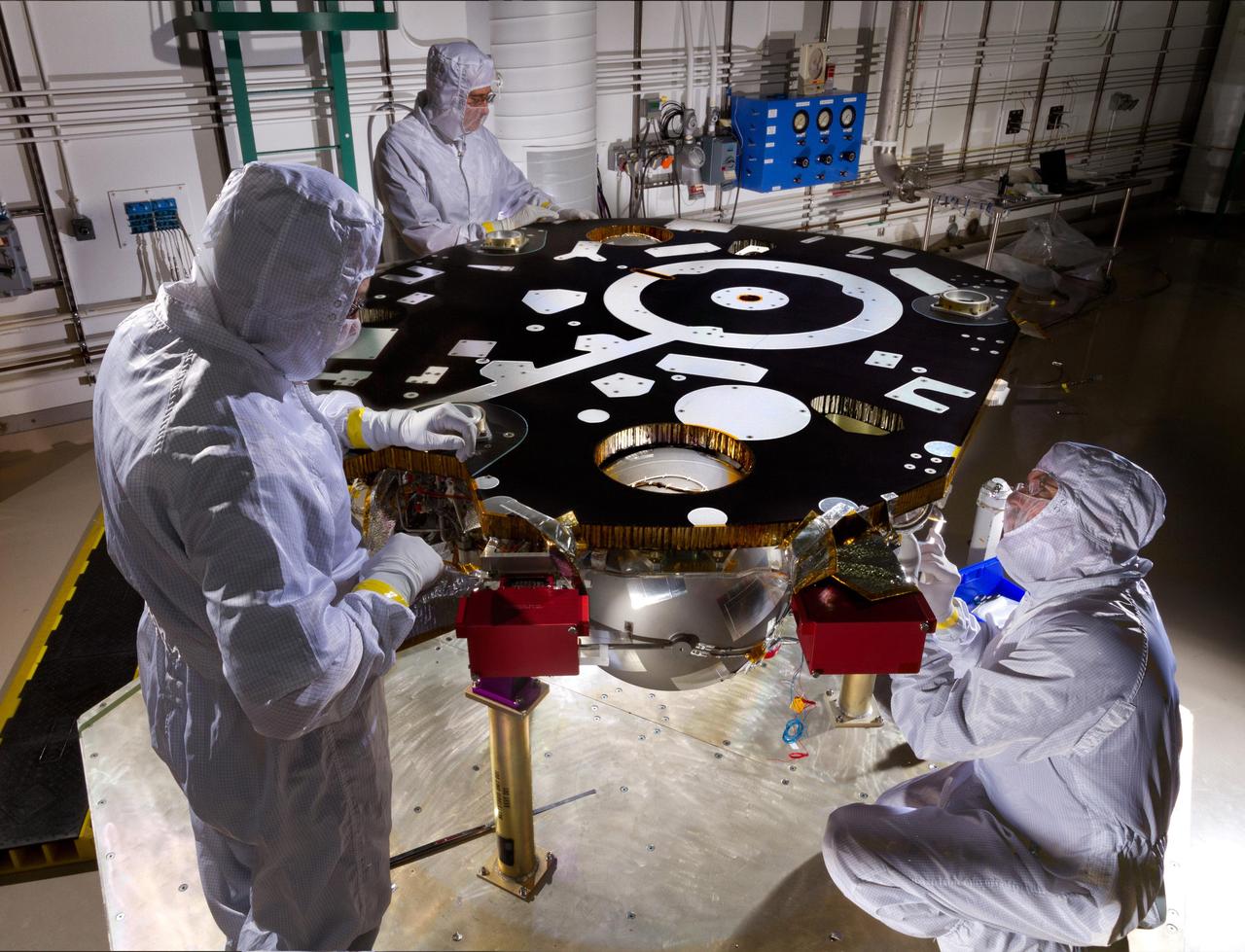
Technicians in a Lockheed Martin clean room near Denver prepare NASA's InSight Mars lander for propulsion proof and leak testing on Oct. 31, 2014. Following the test, the lander was moved to another clean room for the start of the mission's assembly, test and launch operations (ATLO) phase. The assembly portion of ATLO will last about six months. The InSight mission (for Interior Exploration using Seismic Investigations, Geodesy and Heat Transport) is scheduled to launch in March 2016 and land on Mars six months later. It will investigate processes that formed and shaped Mars and will help scientists better understand the evolution of our inner solar system's rocky planets, including Earth. Note: After thorough examination, NASA managers have decided to suspend the planned March 2016 launch of the Interior Exploration using Seismic Investigations Geodesy and Heat Transport (InSight) mission. The decision follows unsuccessful attempts to repair a leak in a section of the prime instrument in the science payload. http://photojournal.jpl.nasa.gov/catalog/PIA18884
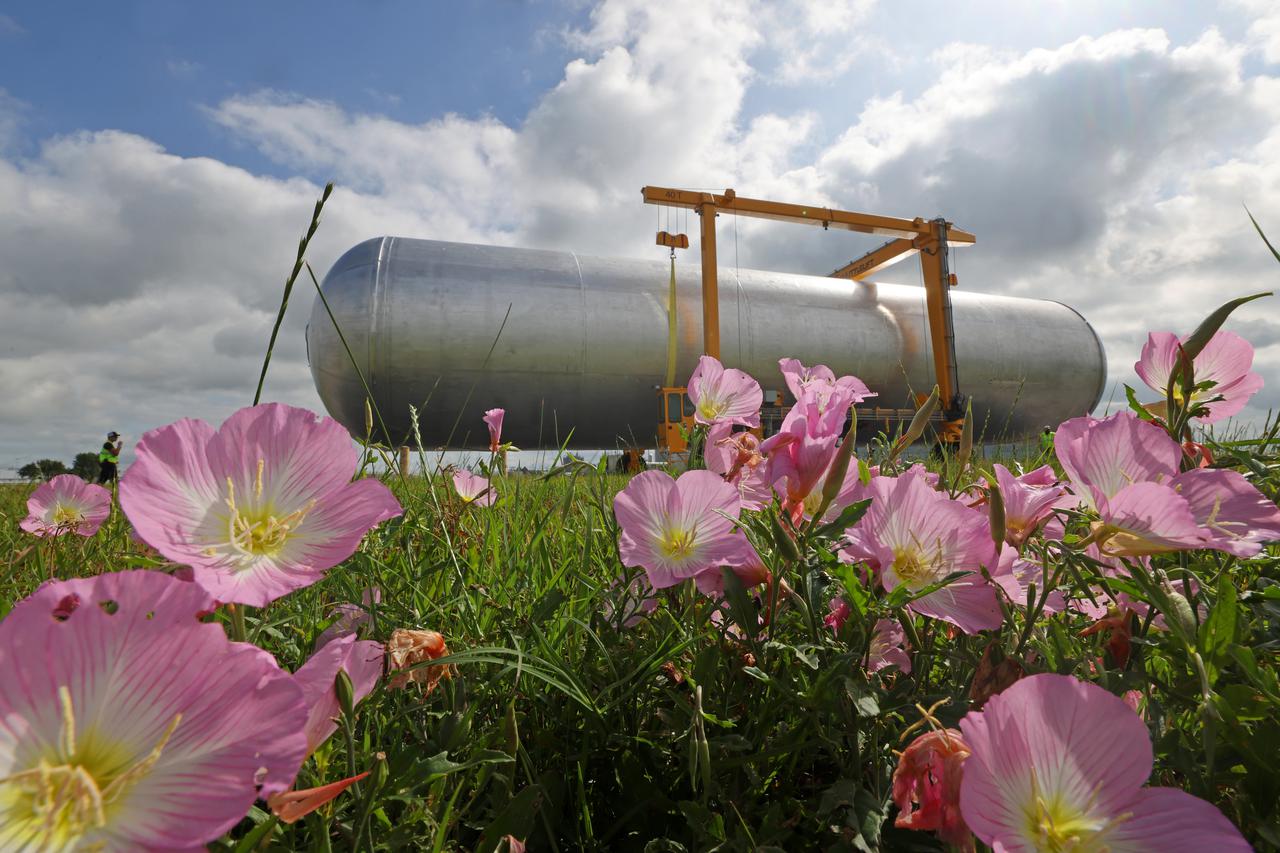
The core stage liquid hydrogen tank for the Artemis III mission completed proof testing, and technicians returned it to the main factory building at NASA’s Michoud Assembly Facility in New Orleans where it will undergo more outfitting. As part of proof testing, technicians apply a simple soap solution and check for leaks by observing any bubble formation on the welds. The technician removed the bubble solution with distilled water and then dried the area of application to prevent corrosion. To build the Space Launch System (SLS) rocket’s 130-foot core stage liquid hydrogen tank, engineers use robotic tools to weld five-barrel segments. This process results in a tank with around 1,900 feet, or more than six football fields, of welds that must be tested by hand. After the leak tests, the core stage lead, Boeing, pressurized the SLS tank to further ensure there were no leaks. After it passed proof testing, technicians moved the Artemis III liquid hydrogen tank to Michoud’s main factory. Soon, the technicians will prime and apply a foam-based thermal protection system that protects the tank during launch. Later, the tank will be joined with other parts of the core stage to form the entire 212-foot rocket stage with its four RS-25 engines that produce 2 million pounds of thrust to help launch the rocket. Artemis III will land the first astronauts on the lunar surface. Photographed on Monday, April 18, 2022. Image credit: NASA/Michael DeMocker
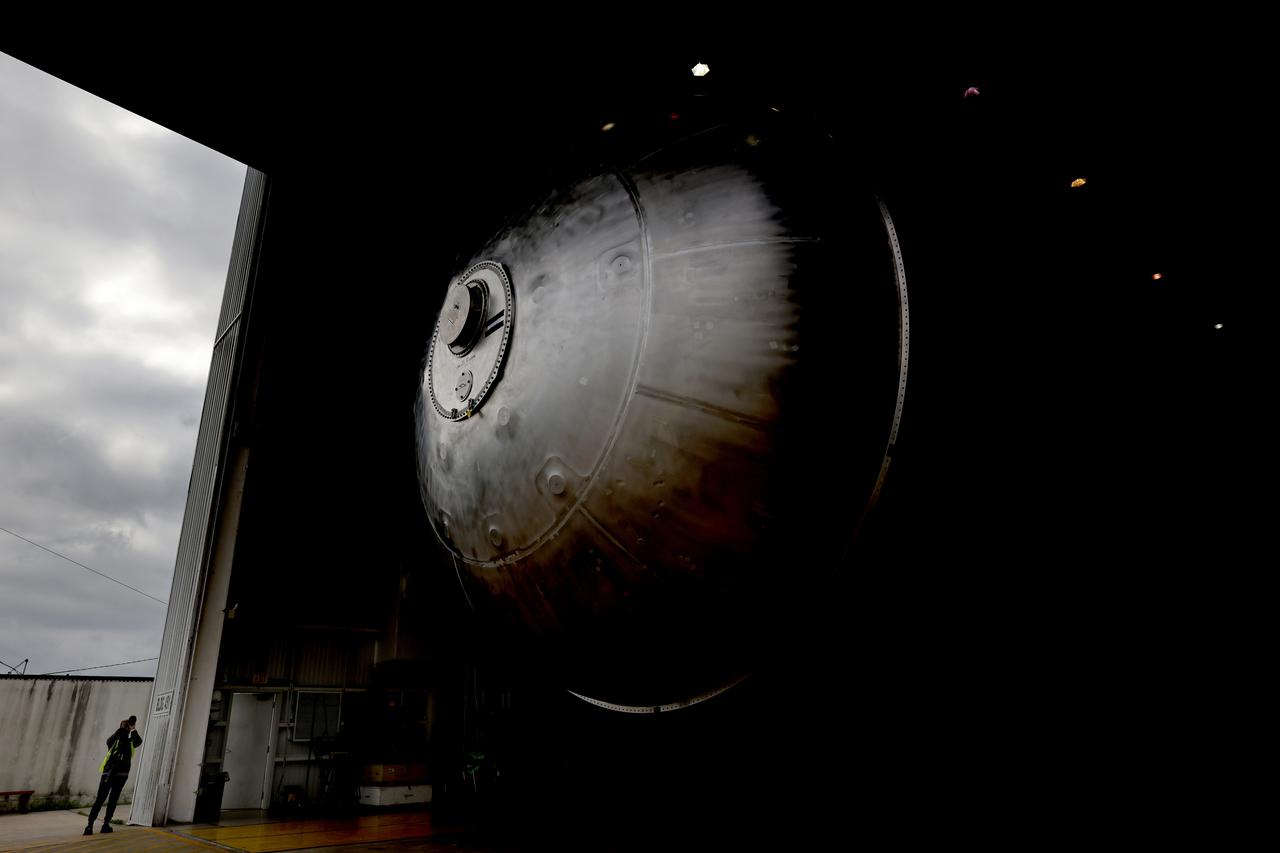
The core stage liquid hydrogen tank for the Artemis III mission completed proof testing, and technicians returned it to the main factory building at NASA’s Michoud Assembly Facility in New Orleans where it will undergo more outfitting. As part of proof testing, technicians apply a simple soap solution and check for leaks by observing any bubble formation on the welds. The technician removed the bubble solution with distilled water and then dried the area of application to prevent corrosion. To build the Space Launch System (SLS) rocket’s 130-foot core stage liquid hydrogen tank, engineers use robotic tools to weld five-barrel segments. This process results in a tank with around 1,900 feet, or more than six football fields, of welds that must be tested by hand. After the leak tests, the core stage lead, Boeing, pressurized the SLS tank to further ensure there were no leaks. After it passed proof testing, technicians moved the Artemis III liquid hydrogen tank to Michoud’s main factory. Soon, the technicians will prime and apply a foam-based thermal protection system that protects the tank during launch. Later, the tank will be joined with other parts of the core stage to form the entire 212-foot rocket stage with its four RS-25 engines that produce 2 million pounds of thrust to help launch the rocket. Artemis III will land the first astronauts on the lunar surface. Photographed on Monday, April 18, 2022. Image credit: NASA/Michael DeMocker
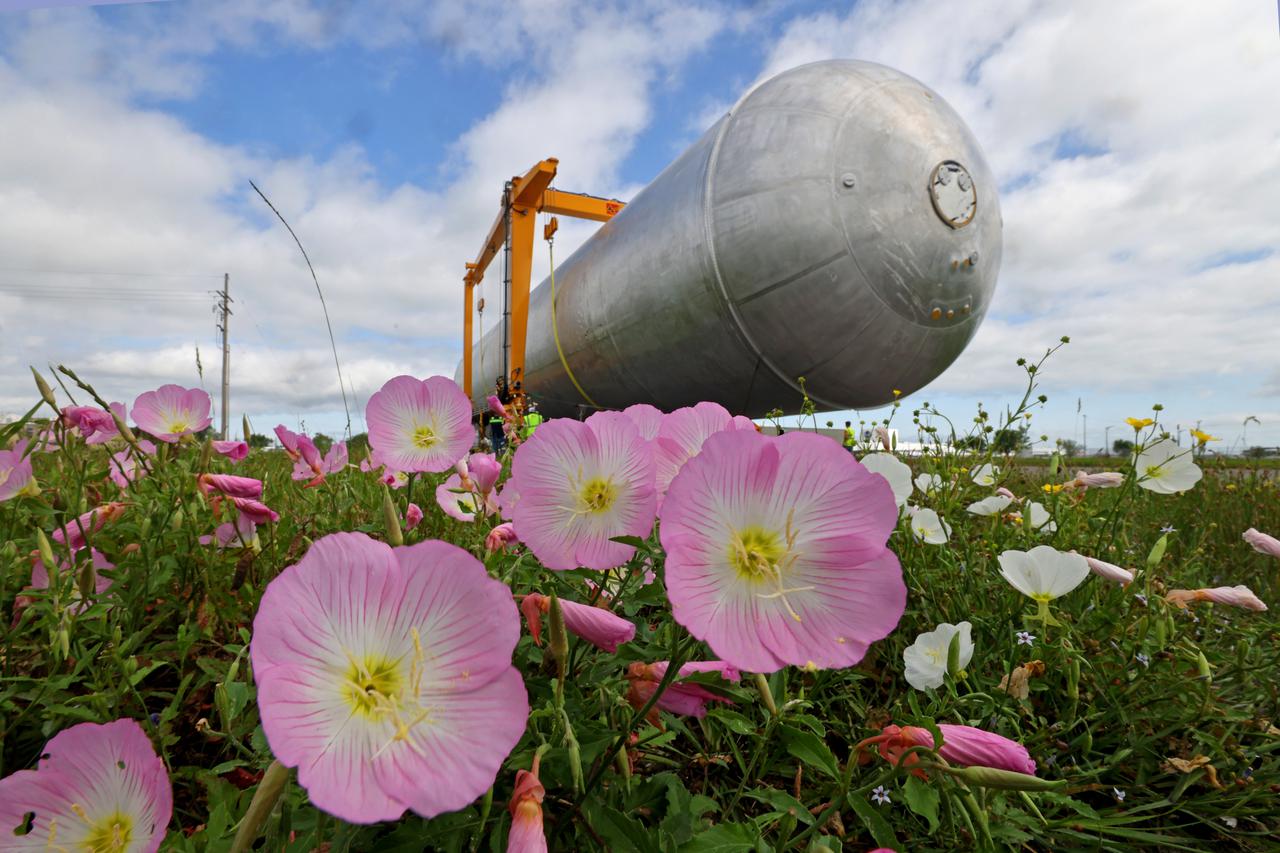
The core stage liquid hydrogen tank for the Artemis III mission completed proof testing, and technicians returned it to the main factory building at NASA’s Michoud Assembly Facility in New Orleans where it will undergo more outfitting. As part of proof testing, technicians apply a simple soap solution and check for leaks by observing any bubble formation on the welds. The technician removed the bubble solution with distilled water and then dried the area of application to prevent corrosion. To build the Space Launch System (SLS) rocket’s 130-foot core stage liquid hydrogen tank, engineers use robotic tools to weld five-barrel segments. This process results in a tank with around 1,900 feet, or more than six football fields, of welds that must be tested by hand. After the leak tests, the core stage lead, Boeing, pressurized the SLS tank to further ensure there were no leaks. After it passed proof testing, technicians moved the Artemis III liquid hydrogen tank to Michoud’s main factory. Soon, the technicians will prime and apply a foam-based thermal protection system that protects the tank during launch. Later, the tank will be joined with other parts of the core stage to form the entire 212-foot rocket stage with its four RS-25 engines that produce 2 million pounds of thrust to help launch the rocket. Artemis III will land the first astronauts on the lunar surface. Photographed on Monday, April 18, 2022. Image credit: NASA/Michael DeMocker
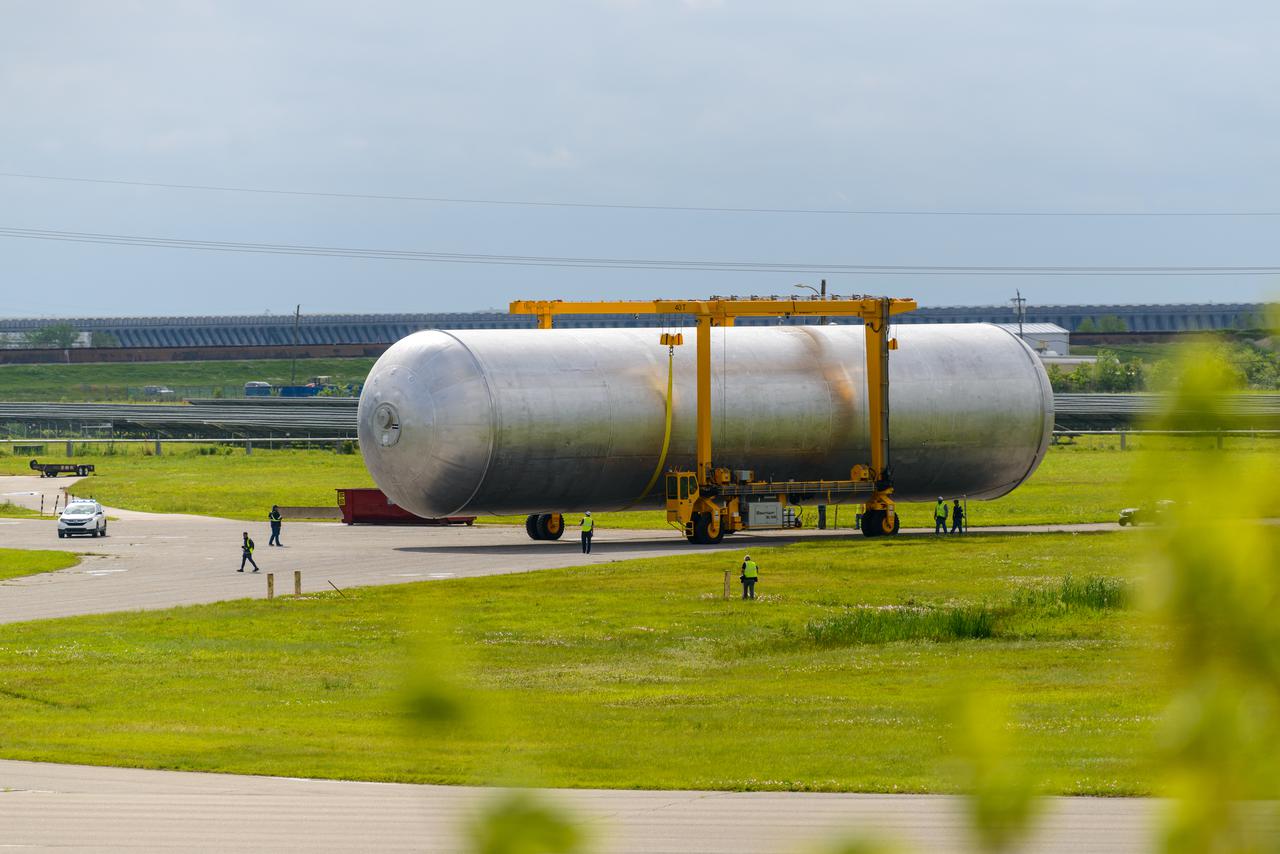
The core stage liquid hydrogen tank for the Artemis III mission completed proof testing, and technicians returned it to the main factory building at NASA’s Michoud Assembly Facility in New Orleans where it will undergo more outfitting. As part of proof testing, technicians apply a simple soap solution and check for leaks by observing any bubble formation on the welds. The technician removed the bubble solution with distilled water and then dried the area of application to prevent corrosion. To build the Space Launch System (SLS) rocket’s 130-foot core stage liquid hydrogen tank, engineers use robotic tools to weld five-barrel segments. This process results in a tank with around 1,900 feet, or more than six football fields, of welds that must be tested by hand. After the leak tests, the core stage lead, Boeing, pressurized the SLS tank to further ensure there were no leaks. After it passed proof testing, technicians moved the Artemis III liquid hydrogen tank to Michoud’s main factory. Soon, the technicians will prime and apply a foam-based thermal protection system that protects the tank during launch. Later, the tank will be joined with other parts of the core stage to form the entire 212-foot rocket stage with its four RS-25 engines that produce 2 million pounds of thrust to help launch the rocket. Artemis III will land the first astronauts on the lunar surface. Photographed on Monday, April 18, 2022.
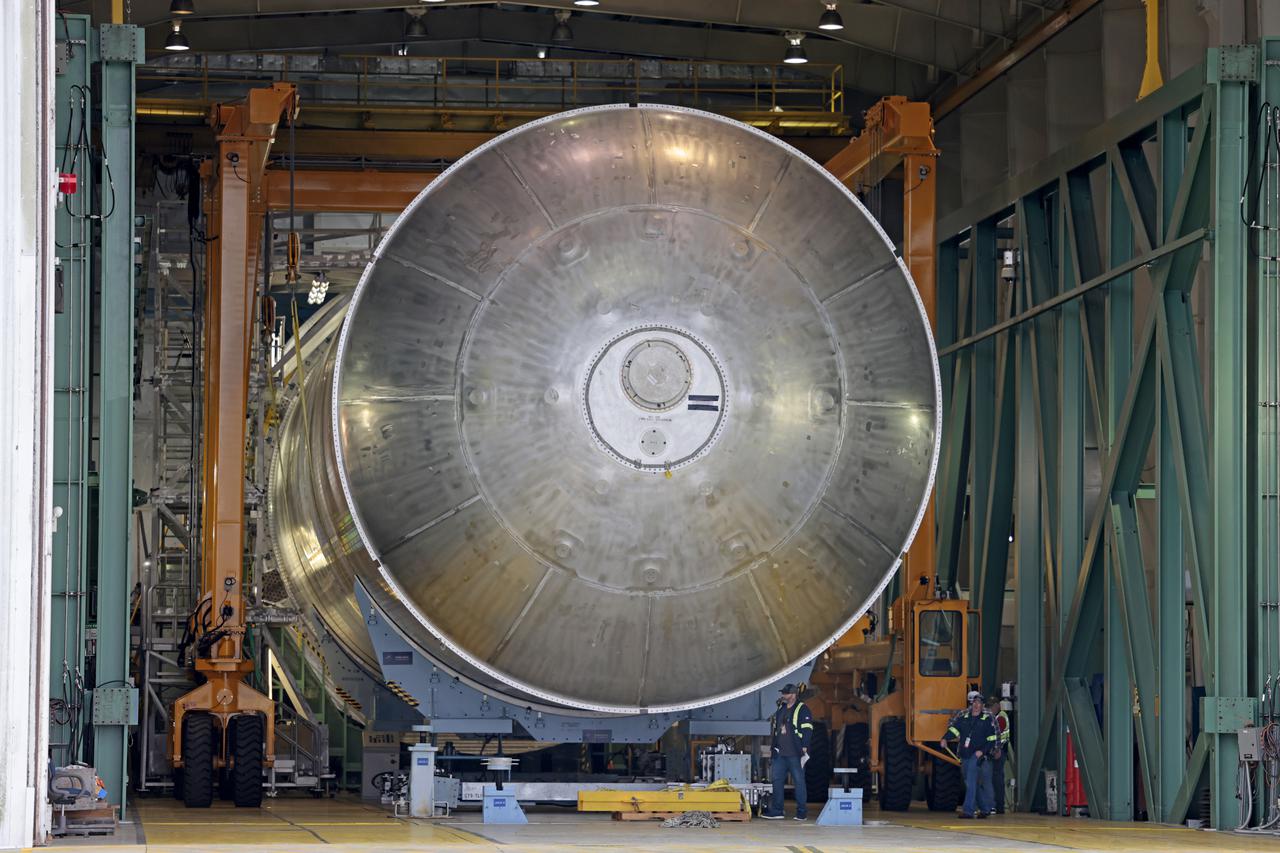
The core stage liquid hydrogen tank for the Artemis III mission completed proof testing, and technicians returned it to the main factory building at NASA’s Michoud Assembly Facility in New Orleans where it will undergo more outfitting. As part of proof testing, technicians apply a simple soap solution and check for leaks by observing any bubble formation on the welds. The technician removed the bubble solution with distilled water and then dried the area of application to prevent corrosion. To build the Space Launch System (SLS) rocket’s 130-foot core stage liquid hydrogen tank, engineers use robotic tools to weld five-barrel segments. This process results in a tank with around 1,900 feet, or more than six football fields, of welds that must be tested by hand. After the leak tests, the core stage lead, Boeing, pressurized the SLS tank to further ensure there were no leaks. After it passed proof testing, technicians moved the Artemis III liquid hydrogen tank to Michoud’s main factory. Soon, the technicians will prime and apply a foam-based thermal protection system that protects the tank during launch. Later, the tank will be joined with other parts of the core stage to form the entire 212-foot rocket stage with its four RS-25 engines that produce 2 million pounds of thrust to help launch the rocket. Artemis III will land the first astronauts on the lunar surface. Photographed on Monday, April 18, 2022. Image credit: NASA/Michael DeMocker

The core stage liquid hydrogen tank for the Artemis III mission completed proof testing, and technicians returned it to the main factory building at NASA’s Michoud Assembly Facility in New Orleans where it will undergo more outfitting. As part of proof testing, technicians apply a simple soap solution and check for leaks by observing any bubble formation on the welds. The technician removed the bubble solution with distilled water and then dried the area of application to prevent corrosion. To build the Space Launch System (SLS) rocket’s 130-foot core stage liquid hydrogen tank, engineers use robotic tools to weld five-barrel segments. This process results in a tank with around 1,900 feet, or more than six football fields, of welds that must be tested by hand. After the leak tests, the core stage lead, Boeing, pressurized the SLS tank to further ensure there were no leaks. After it passed proof testing, technicians moved the Artemis III liquid hydrogen tank to Michoud’s main factory. Soon, the technicians will prime and apply a foam-based thermal protection system that protects the tank during launch. Later, the tank will be joined with other parts of the core stage to form the entire 212-foot rocket stage with its four RS-25 engines that produce 2 million pounds of thrust to help launch the rocket. Artemis III will land the first astronauts on the lunar surface. Photographed on Monday, April 18, 2022.
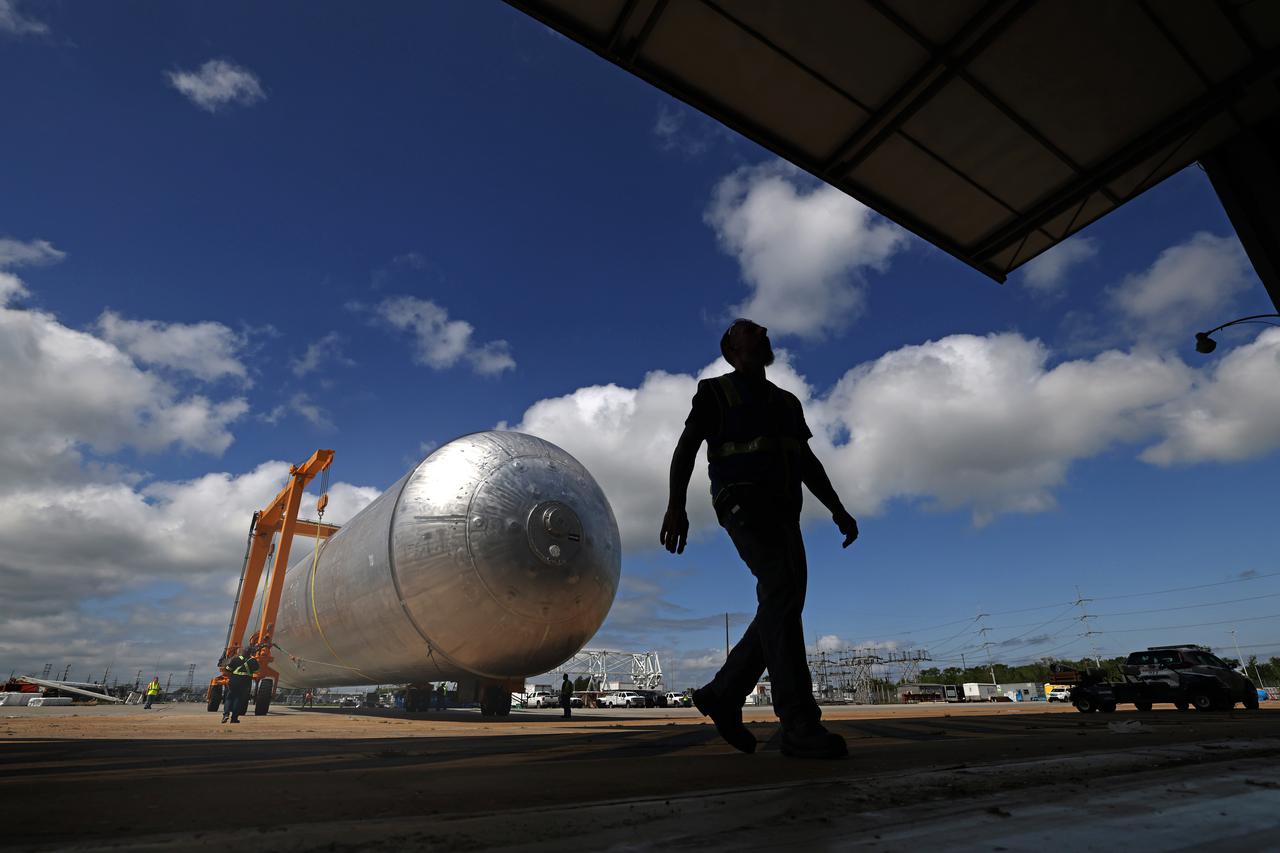
The core stage liquid hydrogen tank for the Artemis III mission completed proof testing, and technicians returned it to the main factory building at NASA’s Michoud Assembly Facility in New Orleans where it will undergo more outfitting. As part of proof testing, technicians apply a simple soap solution and check for leaks by observing any bubble formation on the welds. The technician removed the bubble solution with distilled water and then dried the area of application to prevent corrosion. To build the Space Launch System (SLS) rocket’s 130-foot core stage liquid hydrogen tank, engineers use robotic tools to weld five-barrel segments. This process results in a tank with around 1,900 feet, or more than six football fields, of welds that must be tested by hand. After the leak tests, the core stage lead, Boeing, pressurized the SLS tank to further ensure there were no leaks. After it passed proof testing, technicians moved the Artemis III liquid hydrogen tank to Michoud’s main factory. Soon, the technicians will prime and apply a foam-based thermal protection system that protects the tank during launch. Later, the tank will be joined with other parts of the core stage to form the entire 212-foot rocket stage with its four RS-25 engines that produce 2 million pounds of thrust to help launch the rocket. Artemis III will land the first astronauts on the lunar surface. Photographed on Monday, April 18, 2022. Image credit: NASA/Michael DeMocker
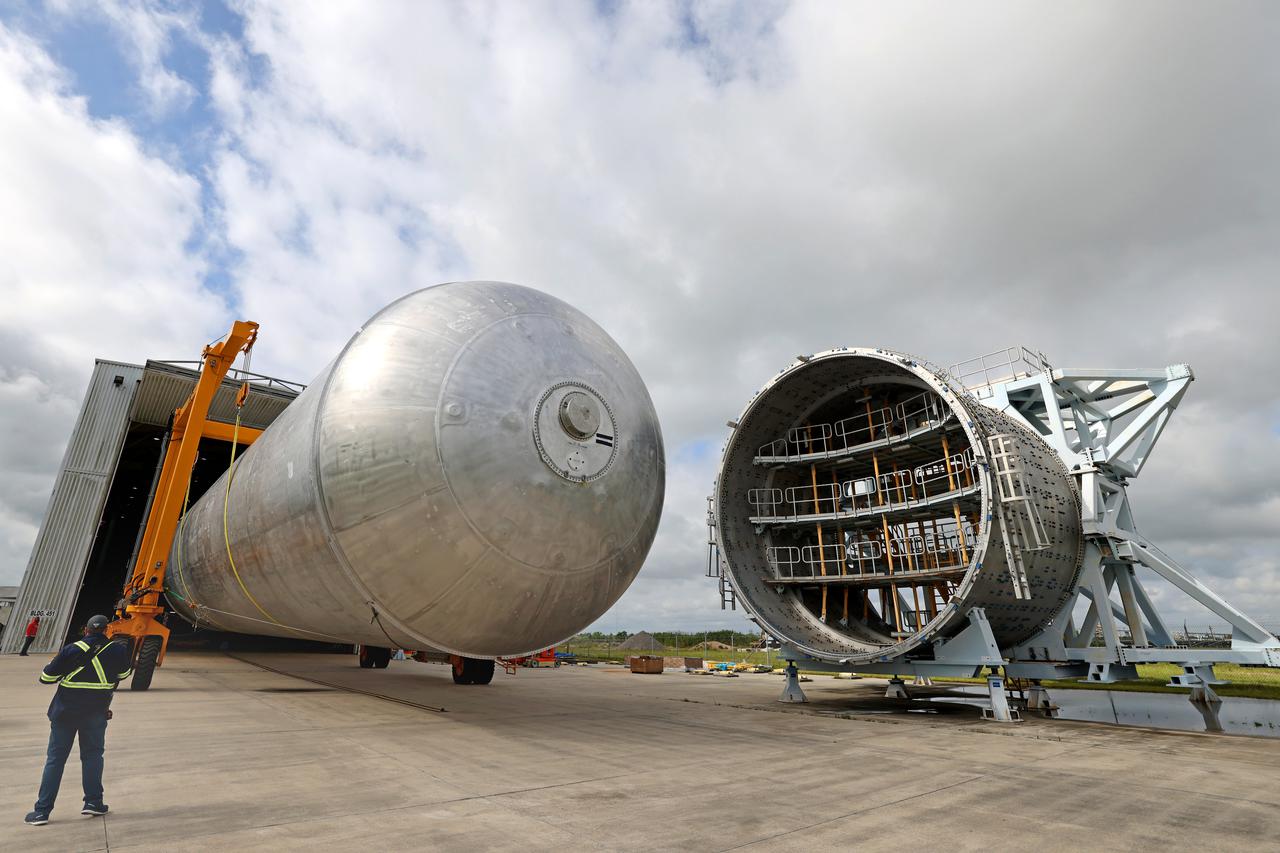
The core stage liquid hydrogen tank for the Artemis III mission completed proof testing, and technicians returned it to the main factory building at NASA’s Michoud Assembly Facility in New Orleans where it will undergo more outfitting. As part of proof testing, technicians apply a simple soap solution and check for leaks by observing any bubble formation on the welds. The technician removed the bubble solution with distilled water and then dried the area of application to prevent corrosion. To build the Space Launch System (SLS) rocket’s 130-foot core stage liquid hydrogen tank, engineers use robotic tools to weld five-barrel segments. This process results in a tank with around 1,900 feet, or more than six football fields, of welds that must be tested by hand. After the leak tests, the core stage lead, Boeing, pressurized the SLS tank to further ensure there were no leaks. After it passed proof testing, technicians moved the Artemis III liquid hydrogen tank to Michoud’s main factory. Soon, the technicians will prime and apply a foam-based thermal protection system that protects the tank during launch. Later, the tank will be joined with other parts of the core stage to form the entire 212-foot rocket stage with its four RS-25 engines that produce 2 million pounds of thrust to help launch the rocket. Artemis III will land the first astronauts on the lunar surface. Photographed on Monday, April 18, 2022. Image credit: NASA/Michael DeMocker
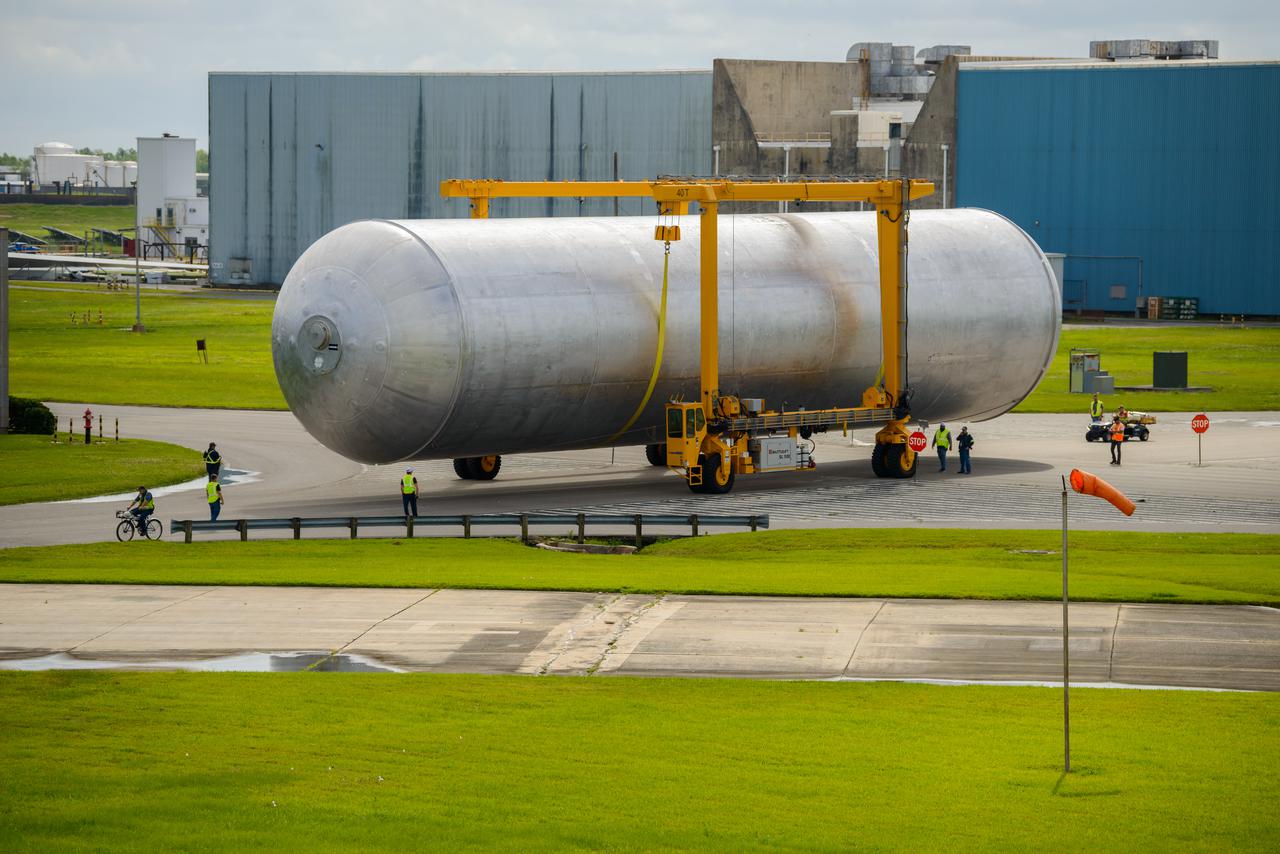
The core stage liquid hydrogen tank for the Artemis III mission completed proof testing, and technicians returned it to the main factory building at NASA’s Michoud Assembly Facility in New Orleans where it will undergo more outfitting. As part of proof testing, technicians apply a simple soap solution and check for leaks by observing any bubble formation on the welds. The technician removed the bubble solution with distilled water and then dried the area of application to prevent corrosion. To build the Space Launch System (SLS) rocket’s 130-foot core stage liquid hydrogen tank, engineers use robotic tools to weld five-barrel segments. This process results in a tank with around 1,900 feet, or more than six football fields, of welds that must be tested by hand. After the leak tests, the core stage lead, Boeing, pressurized the SLS tank to further ensure there were no leaks. After it passed proof testing, technicians moved the Artemis III liquid hydrogen tank to Michoud’s main factory. Soon, the technicians will prime and apply a foam-based thermal protection system that protects the tank during launch. Later, the tank will be joined with other parts of the core stage to form the entire 212-foot rocket stage with its four RS-25 engines that produce 2 million pounds of thrust to help launch the rocket. Artemis III will land the first astronauts on the lunar surface. Photographed on Monday, April 18, 2022.
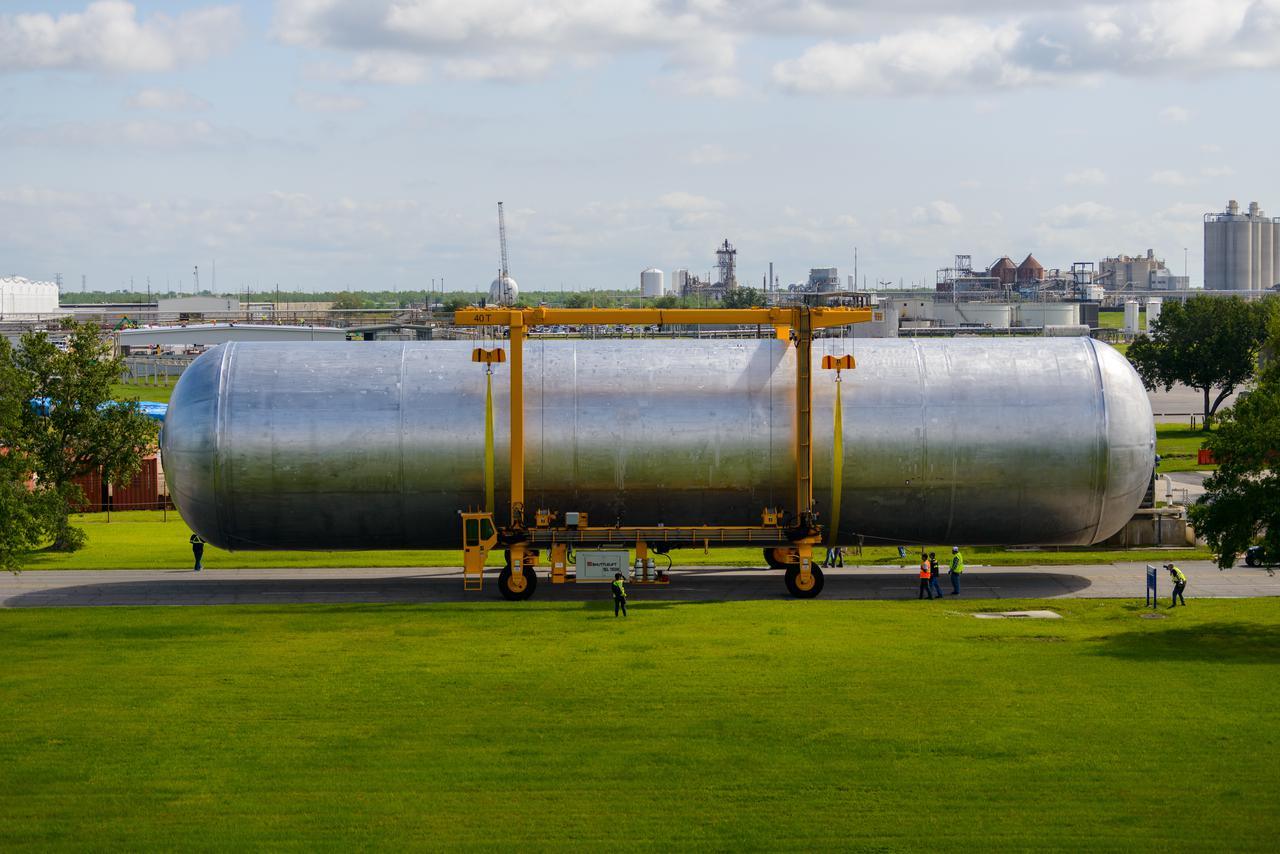
The core stage liquid hydrogen tank for the Artemis III mission completed proof testing, and technicians returned it to the main factory building at NASA’s Michoud Assembly Facility in New Orleans where it will undergo more outfitting. As part of proof testing, technicians apply a simple soap solution and check for leaks by observing any bubble formation on the welds. The technician removed the bubble solution with distilled water and then dried the area of application to prevent corrosion. To build the Space Launch System (SLS) rocket’s 130-foot core stage liquid hydrogen tank, engineers use robotic tools to weld five-barrel segments. This process results in a tank with around 1,900 feet, or more than six football fields, of welds that must be tested by hand. After the leak tests, the core stage lead, Boeing, pressurized the SLS tank to further ensure there were no leaks. After it passed proof testing, technicians moved the Artemis III liquid hydrogen tank to Michoud’s main factory. Soon, the technicians will prime and apply a foam-based thermal protection system that protects the tank during launch. Later, the tank will be joined with other parts of the core stage to form the entire 212-foot rocket stage with its four RS-25 engines that produce 2 million pounds of thrust to help launch the rocket. Artemis III will land the first astronauts on the lunar surface. Photographed on Monday, April 18, 2022.
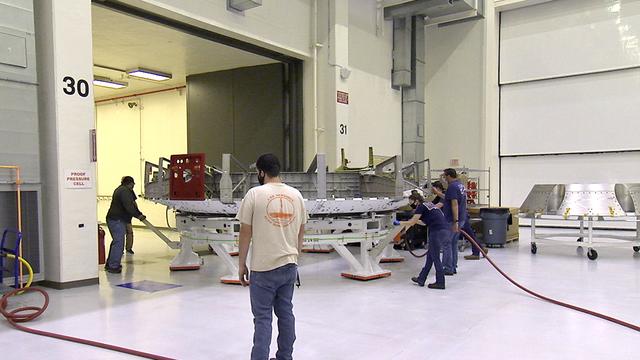
Inside the Neil Armstrong Operations and Checkout Building at NASA's Kennedy Space Center in Florida, the Artemis II crew module adapter (CMA) is being relocated from the clean room to the Pressure Proof Cell for additional testing and maintenance. The CMA connects the crew module to the service module. Artemis II is the first crewed mission in a series of missions to the Moon and on to Mars. Artemis II will confirm all of the Orion spacecraft’s systems operate as designed in the actual environment of deep space with astronauts aboard.
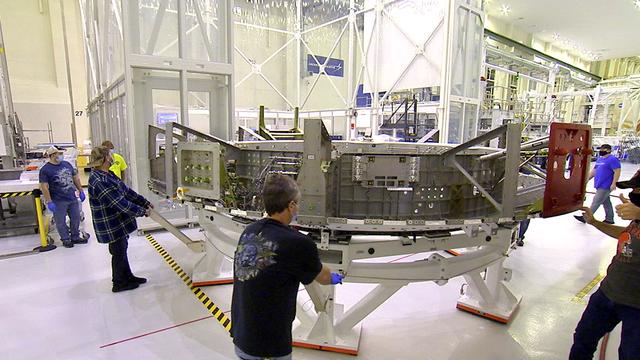
Inside the Neil Armstrong Operations and Checkout Building at NASA's Kennedy Space Center in Florida, the Artemis II crew module adapter (CMA) is being relocated from the clean room to the Pressure Proof Cell for additional testing and maintenance. The CMA connects the crew module to the service module. Artemis II is the first crewed mission in a series of missions to the Moon and on to Mars. Artemis II will confirm all of the Orion spacecraft’s systems operate as designed in the actual environment of deep space with astronauts aboard.
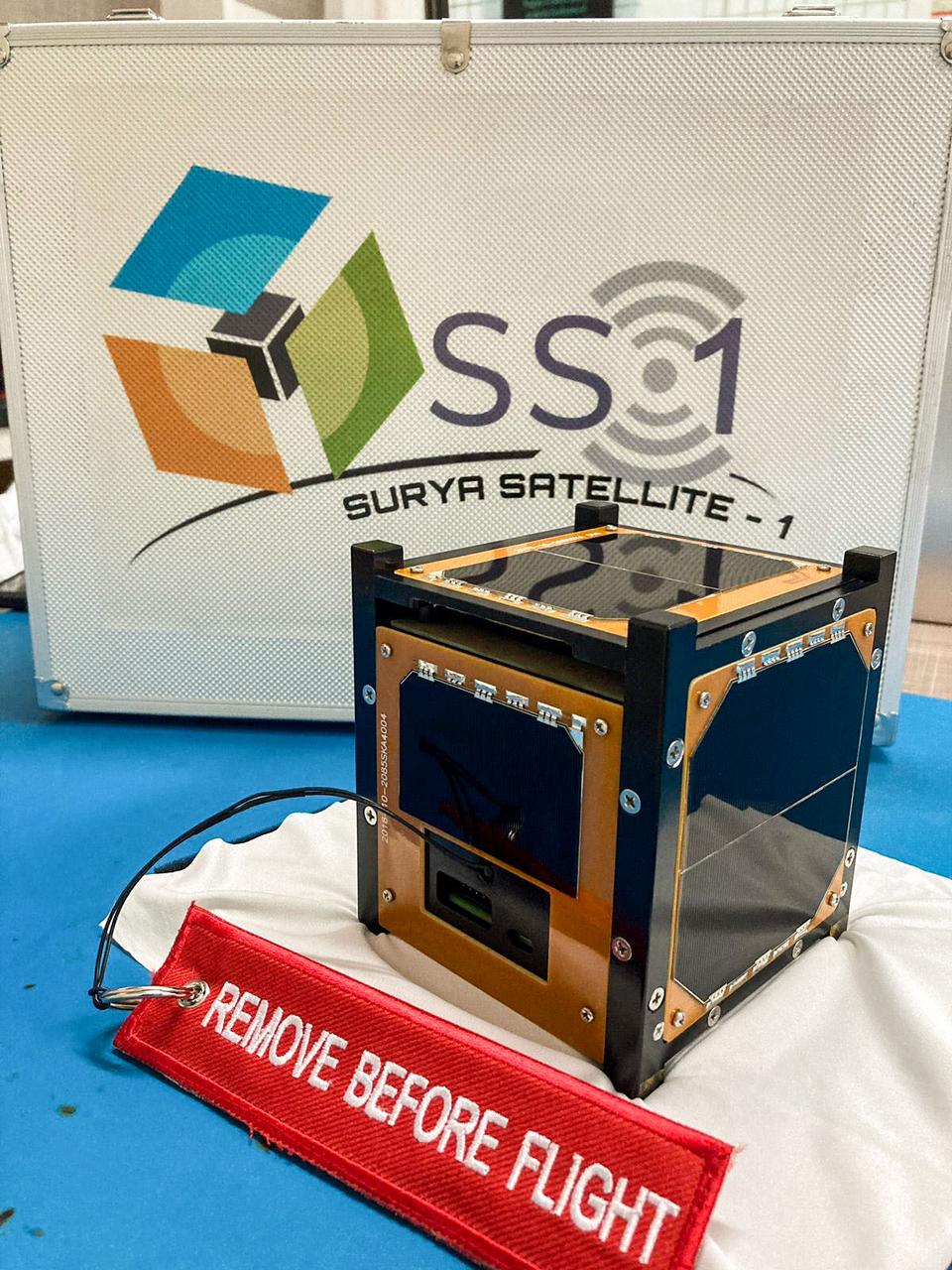
jsc2022e068263 (5/1/2022) --- A preflight view of the Surya Satellite-1 (SS-1) Flight Model. The Surya Satellite-1 (SS-1) is the first Indonesian nanosatellite developed by university students at Surya University. SS-1 tests a satellite telecommunication system to serve amateur radio stations, and serves as a proof of concept of sensoric information transfer in rural areas for disaster mitigation application. Image Courtesy of The SS-1 Team.

jsc2022e068262 (5/1/2022) --- A view of the SS-1 Team during the JAXA Safety Review. The Surya Satellite-1 (SS-1) is the first Indonesian nanosatellite developed by university students at Surya University. SS-1 tests a satellite telecommunication system to serve amateur radio stations, and serves as a proof of concept of sensoric information transfer in rural areas for disaster mitigation application. Image Courtesy of The SS-1 Team.
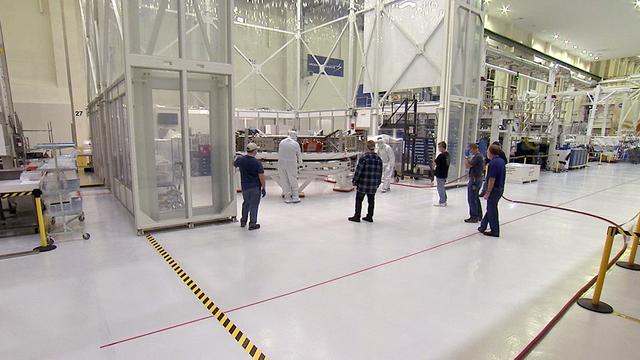
Inside the Neil Armstrong Operations and Checkout Building at NASA's Kennedy Space Center in Florida, the Artemis II crew module adapter (CMA) is being relocated from the clean room to the Pressure Proof Cell for additional testing and maintenance. The CMA connects the crew module to the service module. Artemis II is the first crewed mission in a series of missions to the Moon and on to Mars. Artemis II will confirm all of the Orion spacecraft’s systems operate as designed in the actual environment of deep space with astronauts aboard.
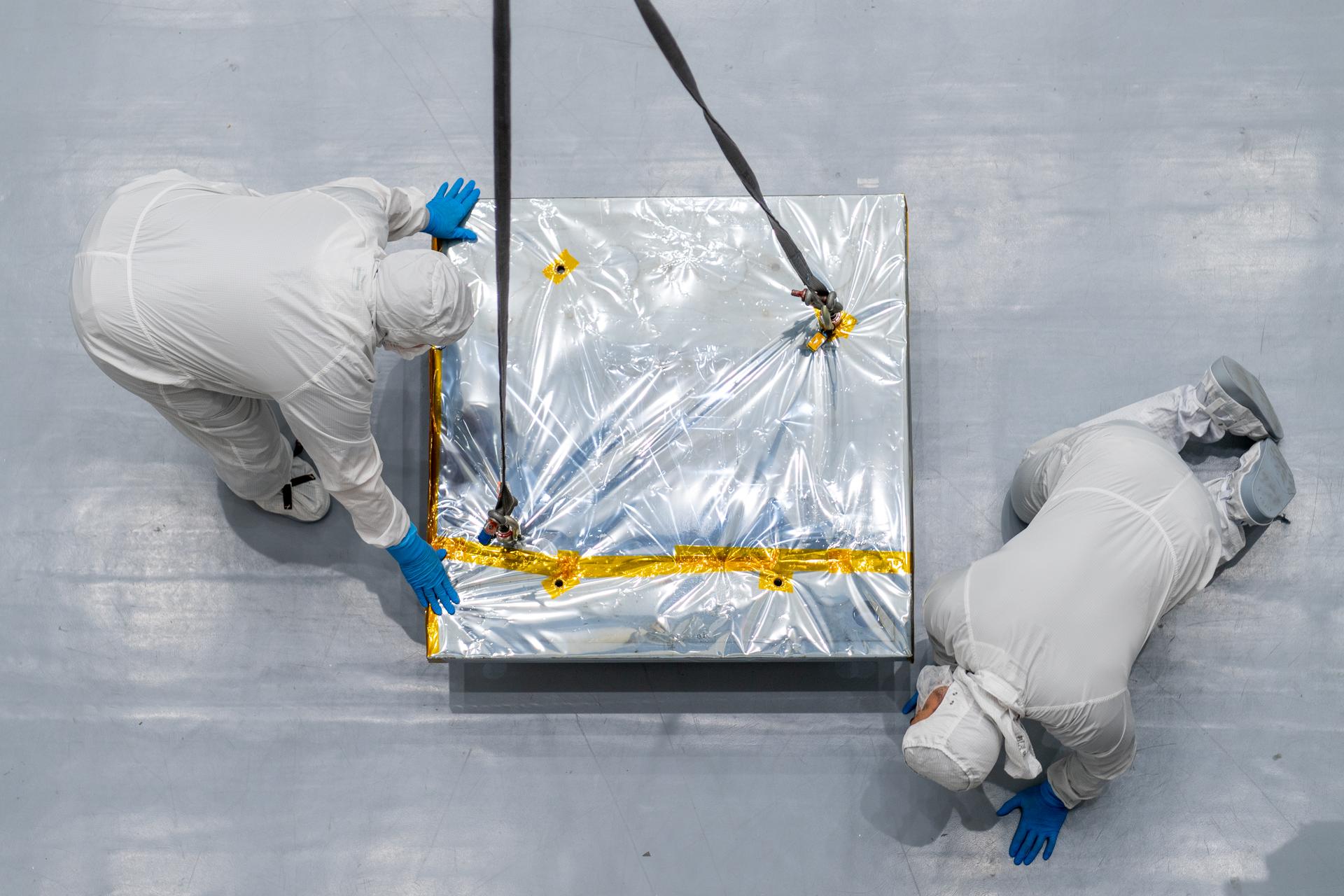
OSAM-1 team members prepare a weight to be crane lifted onto the SPIKA work platform as part of its commissioning workmanship test inside the cleanroom at Goddard Space Flight Center, Greenbelt Md., Mar 20, 2023. This photo has been reviewed by OSAM1 project management and the Export Control Office and is released for public view. NASA/Mike Guinto
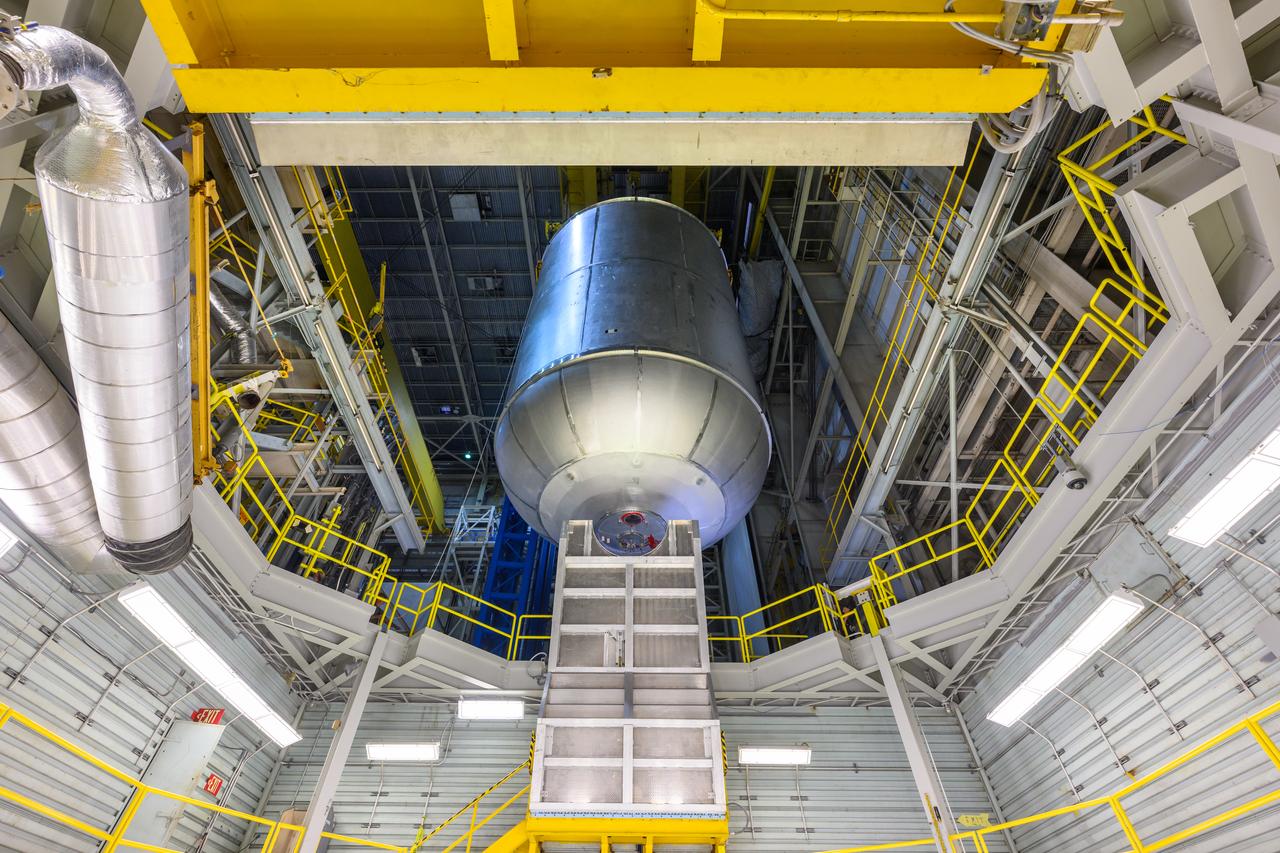
Teams at NASA’s Michoud Assembly Facility in New Orleans successfully completed hydrostatic proof testing of the core stage liquid oxygen tank for the agency’s Artemis III mission. The non-destructive evaluation method tests the structural integrity of the tank’s welds by filling the tank with water, simulating the propellant used during launch. The hardware was then moved to an adjacent cell for internal cleaning. Next, the tank will be readied for primer and application of its thermal protection system. The propellant tank is one of five major elements that make up the 212-foot-tall rocket stage. The core stage, along with its four RS-25 engines, produce two million pounds of thrust to help launch NASA’s Orion spacecraft, astronauts, and supplies beyond Earth’s orbit and to the lunar surface for Artemis.
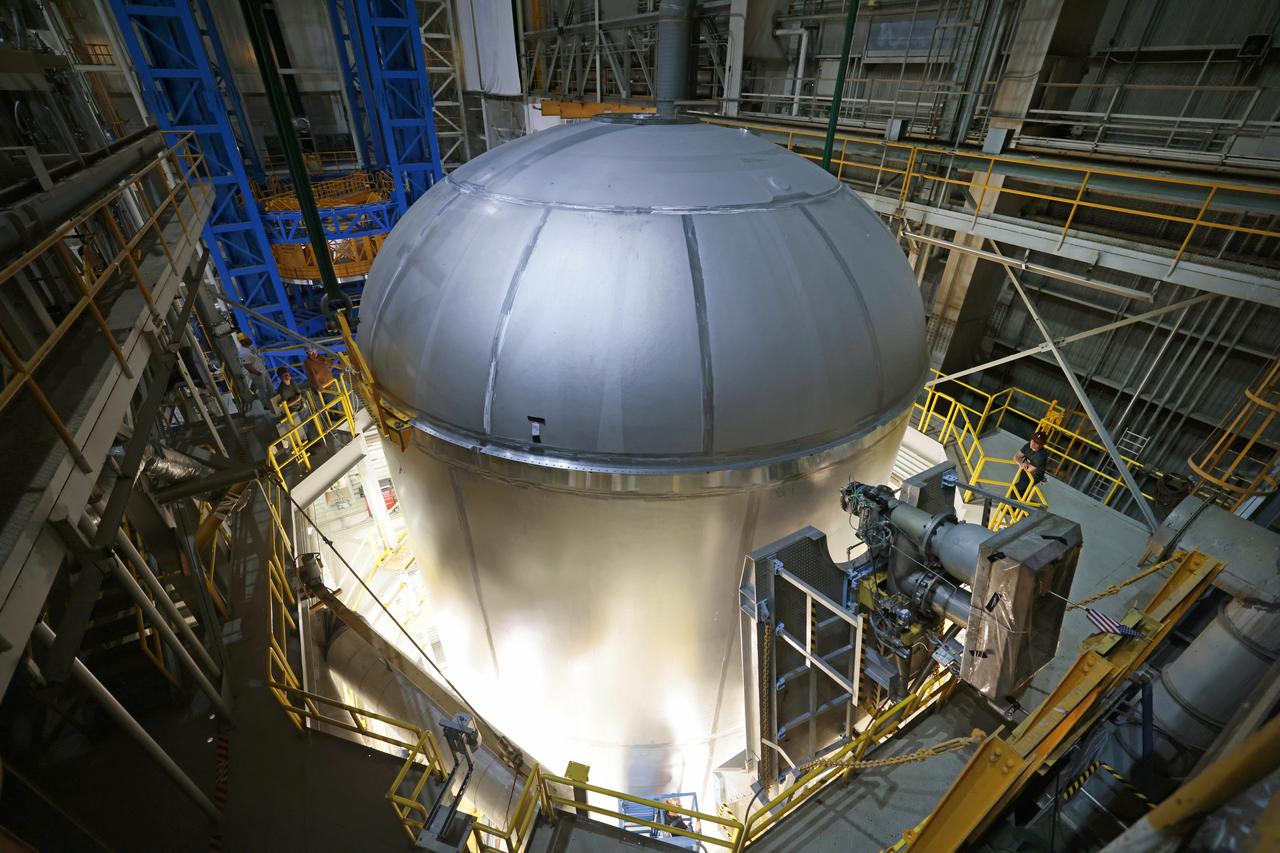
Teams at NASA’s Michoud Assembly Facility in New Orleans successfully completed hydrostatic proof testing of the core stage liquid oxygen tank for the agency’s Artemis III mission. The non-destructive evaluation method tests the structural integrity of the tank’s welds by filling the tank with water, simulating the propellant used during launch. The hardware was then moved to an adjacent cell for internal cleaning. Next, the tank will be readied for primer and application of its thermal protection system. The propellant tank is one of five major elements that make up the 212-foot-tall rocket stage. The core stage, along with its four RS-25 engines, produce two million pounds of thrust to help launch NASA’s Orion spacecraft, astronauts, and supplies beyond Earth’s orbit and to the lunar surface for Artemis. Image credit: NASA/Michael DeMocker
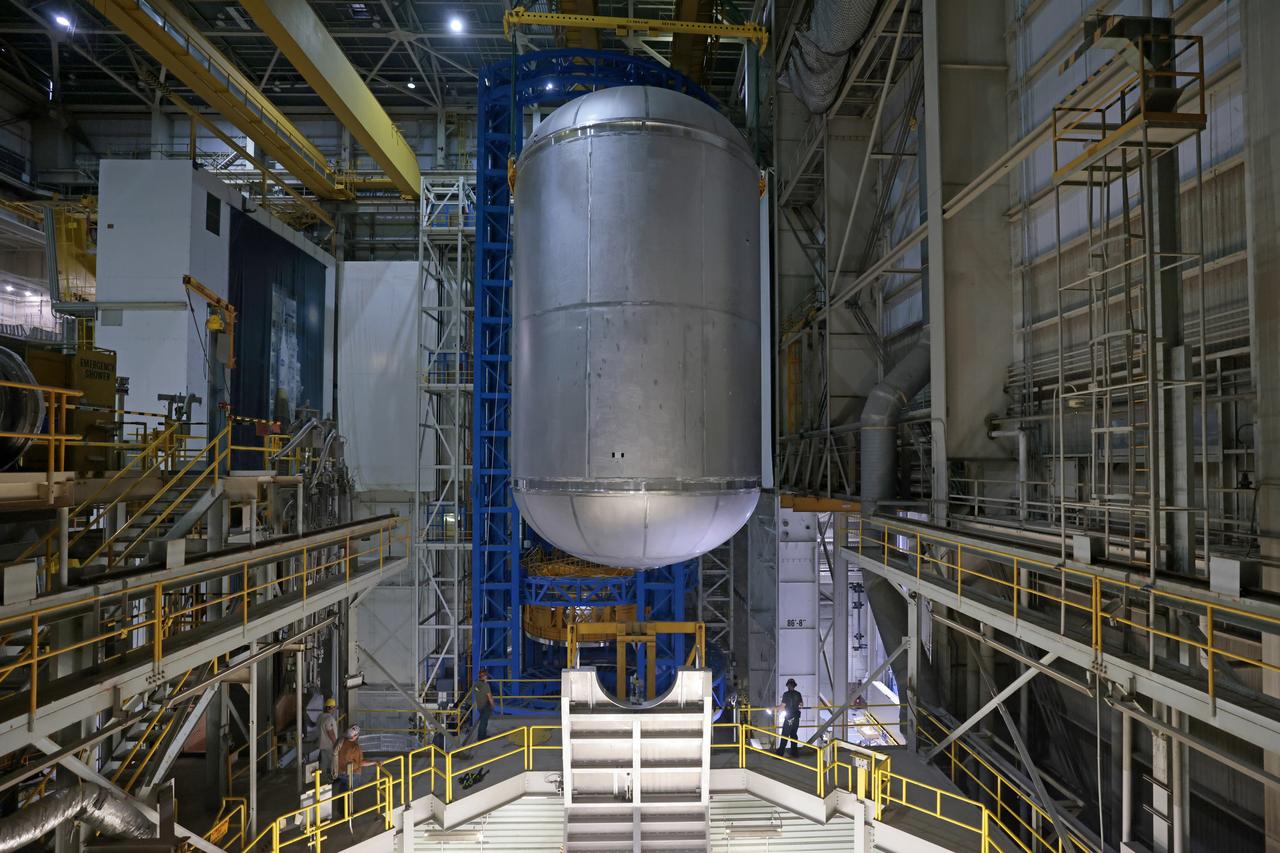
Teams at NASA’s Michoud Assembly Facility in New Orleans successfully completed hydrostatic proof testing of the core stage liquid oxygen tank for the agency’s Artemis III mission. The non-destructive evaluation method tests the structural integrity of the tank’s welds by filling the tank with water, simulating the propellant used during launch. The hardware was then moved to an adjacent cell for internal cleaning. Next, the tank will be readied for primer and application of its thermal protection system. The propellant tank is one of five major elements that make up the 212-foot-tall rocket stage. The core stage, along with its four RS-25 engines, produce two million pounds of thrust to help launch NASA’s Orion spacecraft, astronauts, and supplies beyond Earth’s orbit and to the lunar surface for Artemis. Image credit: NASA/Michael DeMocker
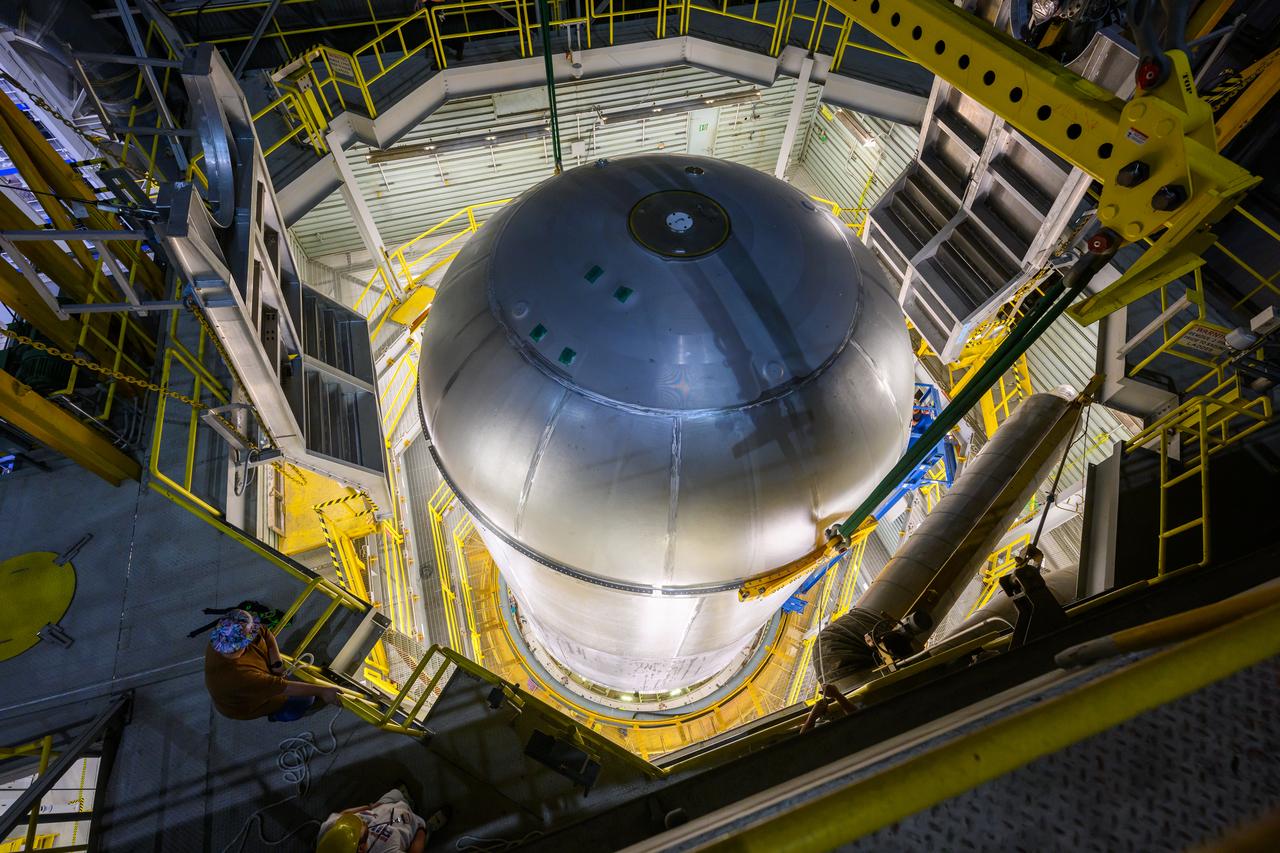
Teams at NASA’s Michoud Assembly Facility in New Orleans successfully completed hydrostatic proof testing of the core stage liquid oxygen tank for the agency’s Artemis III mission. The non-destructive evaluation method tests the structural integrity of the tank’s welds by filling the tank with water, simulating the propellant used during launch. The hardware was then moved to an adjacent cell for internal cleaning. Next, the tank will be readied for primer and application of its thermal protection system. The propellant tank is one of five major elements that make up the 212-foot-tall rocket stage. The core stage, along with its four RS-25 engines, produce two million pounds of thrust to help launch NASA’s Orion spacecraft, astronauts, and supplies beyond Earth’s orbit and to the lunar surface for Artemis.
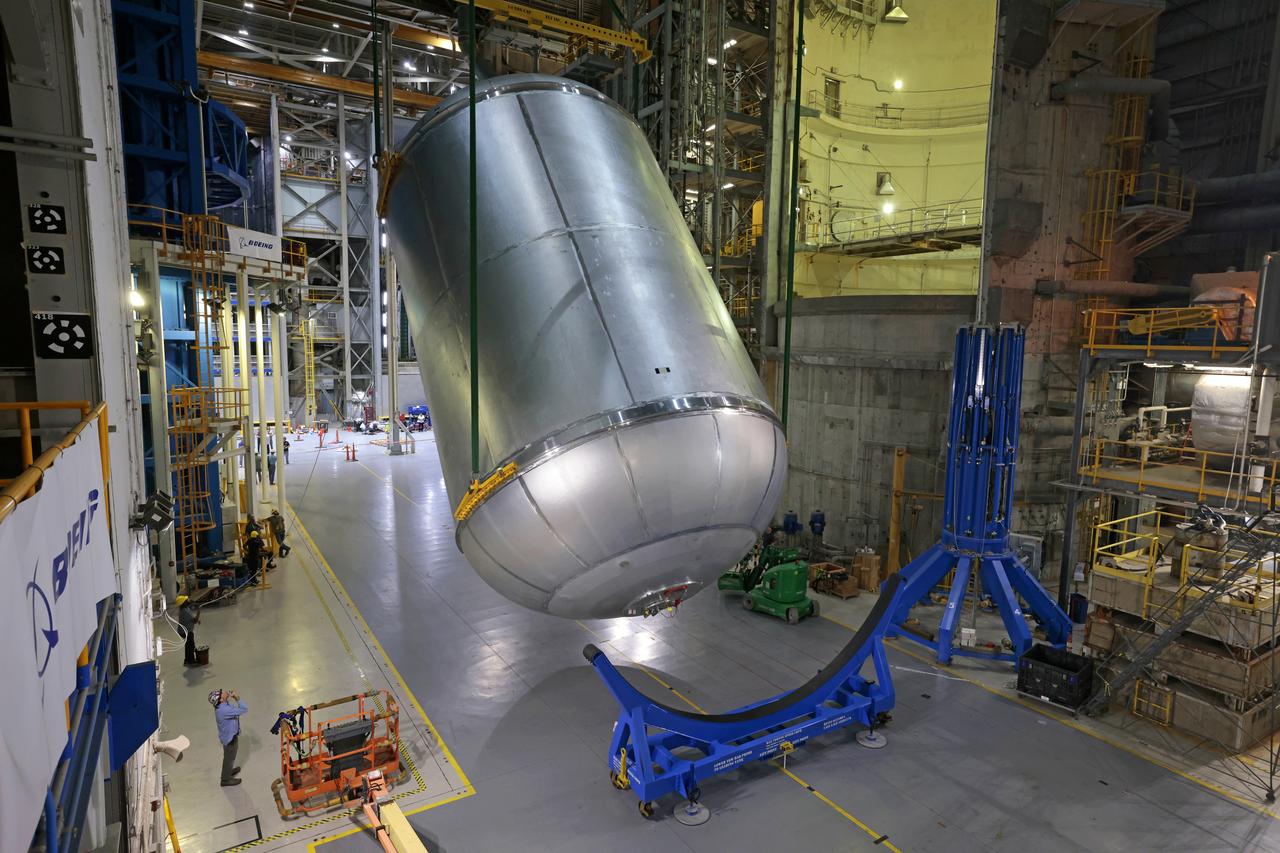
Teams at NASA’s Michoud Assembly Facility in New Orleans successfully completed hydrostatic proof testing of the core stage liquid oxygen tank for the agency’s Artemis III mission. The non-destructive evaluation method tests the structural integrity of the tank’s welds by filling the tank with water, simulating the propellant used during launch. The hardware was then moved to an adjacent cell for internal cleaning. Next, the tank will be readied for primer and application of its thermal protection system. The propellant tank is one of five major elements that make up the 212-foot-tall rocket stage. The core stage, along with its four RS-25 engines, produce two million pounds of thrust to help launch NASA’s Orion spacecraft, astronauts, and supplies beyond Earth’s orbit and to the lunar surface for Artemis. Image credit: NASA/Michael DeMocker
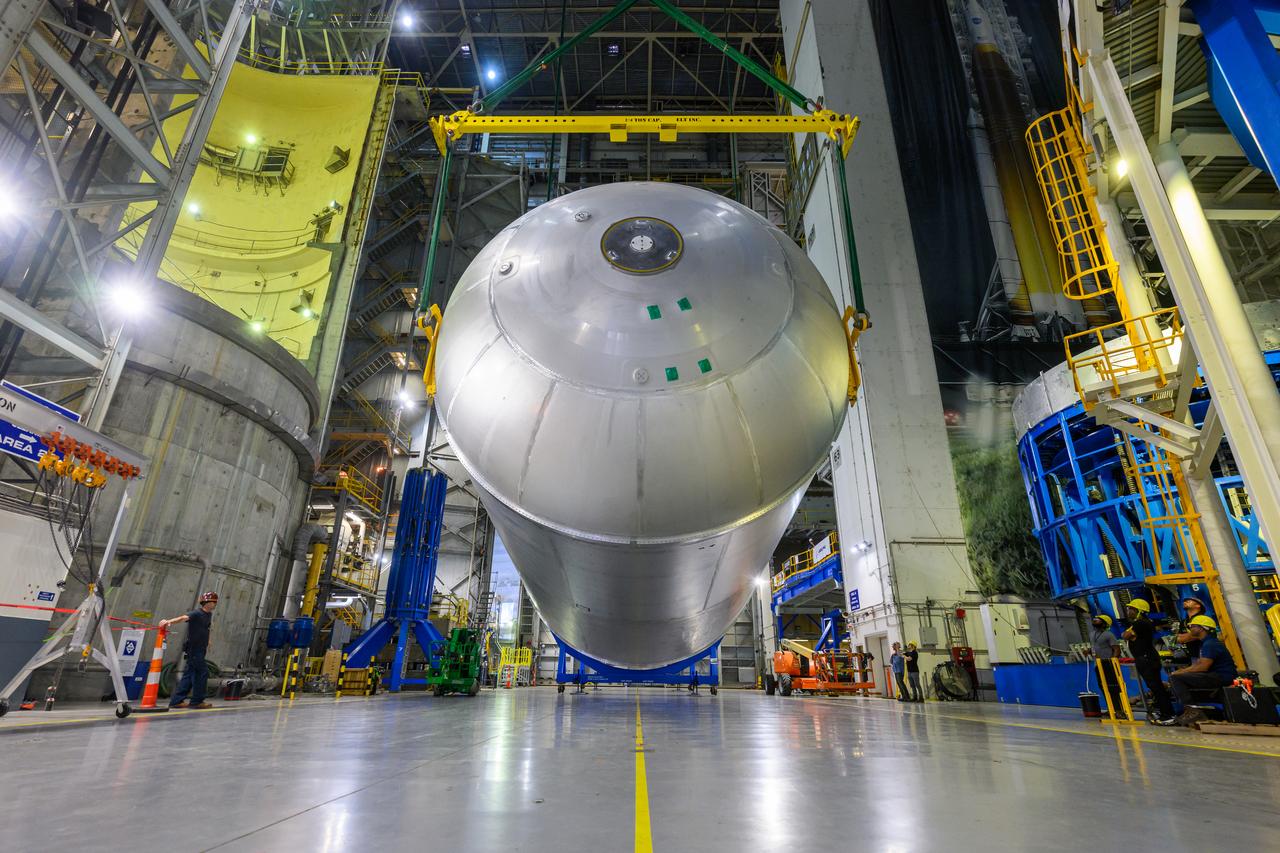
Teams at NASA’s Michoud Assembly Facility in New Orleans successfully completed hydrostatic proof testing of the core stage liquid oxygen tank for the agency’s Artemis III mission. The non-destructive evaluation method tests the structural integrity of the tank’s welds by filling the tank with water, simulating the propellant used during launch. The hardware was then moved to an adjacent cell for internal cleaning. Next, the tank will be readied for primer and application of its thermal protection system. The propellant tank is one of five major elements that make up the 212-foot-tall rocket stage. The core stage, along with its four RS-25 engines, produce two million pounds of thrust to help launch NASA’s Orion spacecraft, astronauts, and supplies beyond Earth’s orbit and to the lunar surface for Artemis.
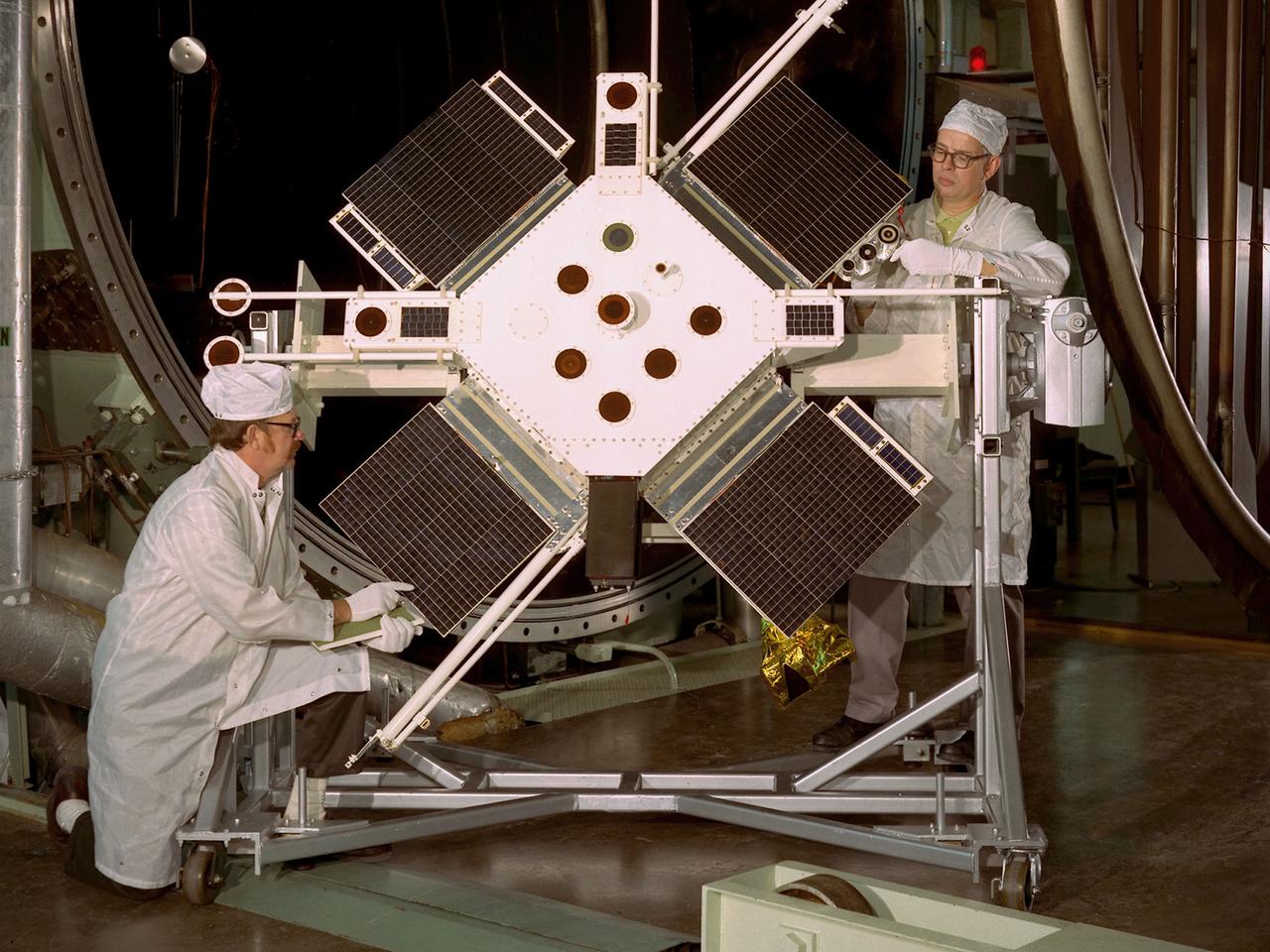
Researchers examine the Space Plasma-High Voltage Interaction Experiment (SPHINX) satellite in the Electric Propulsion Laboratory at the National Aeronautics and Space Administration (NASA) Lewis Research Center. Lewis’ Spacecraft Technology Division designed SPHINX to study the electrical interaction of its experimental surfaces with space plasma. They sought to determine if higher orbits would improve the transmission quality of communications satellites. Robert Lovell, the Project Manager, oversaw vibrational and plasma simulation testing of the satellite in the Electric Propulsion Laboratory, seen here. SPHINX was an add-on payload for the first Titan/Centaur proof launch in early 1974. Lewis successfully managed the Centaur Program since 1962, but this would be the first Centaur launch with a Titan booster. Since the proof test did not have a scheduled payload, the Lewis-designed SPHINX received a free ride. The February 11, 1974 launch, however, proved to be one of the Launch Vehicle Division’s lowest days. Twelve minutes after the vehicle departed the launch pad, the booster and Centaur separated as designed, but Centaur’s two RL-10 engines failed to ignite. The launch pad safety officer destroyed the vehicle, and SPHINX never made it into orbit. Overall Centaur has an excellent success rate, but the failed SPHINX launch attempt caused deep disappointment across the center.

CAPE CANAVERAL, Fla. – The Orion Exploration Flight Test 1 crew module is undergoing proof pressure testing at the Operations and Checkout Building at NASA's Kennedy Space Center in Florida. The test incrementally pressurizes the spacecraft with breathing air and is designed to demonstrate weld strength capability and structural performance at maximum flight operating pressures. Orion is the exploration spacecraft designed to carry crews to space beyond low Earth orbit. It will provide emergency abort capability, sustain the crew during the space travel and provide safe re-entry from deep space return velocities. The first unpiloted test flight of the Orion is scheduled to launch in 2014 atop a Delta IV rocket and in 2017 on a Space Launch System rocket. For more information, visit http://www.nasa.gov/orion Photo credit: NASA/Ben Smegelsky

CAPE CANAVERAL, Fla. – The Orion Exploration Flight Test 1 crew module is undergoing proof pressure testing at the Operations and Checkout Building at NASA's Kennedy Space Center in Florida. The test incrementally pressurizes the spacecraft with breathing air and is designed to demonstrate weld strength capability and structural performance at maximum flight operating pressures. Orion is the exploration spacecraft designed to carry crews to space beyond low Earth orbit. It will provide emergency abort capability, sustain the crew during the space travel and provide safe re-entry from deep space return velocities. The first unpiloted test flight of the Orion is scheduled to launch in 2014 atop a Delta IV rocket and in 2017 on a Space Launch System rocket. For more information, visit http://www.nasa.gov/orion Photo credit: NASA/Ben Smegelsky