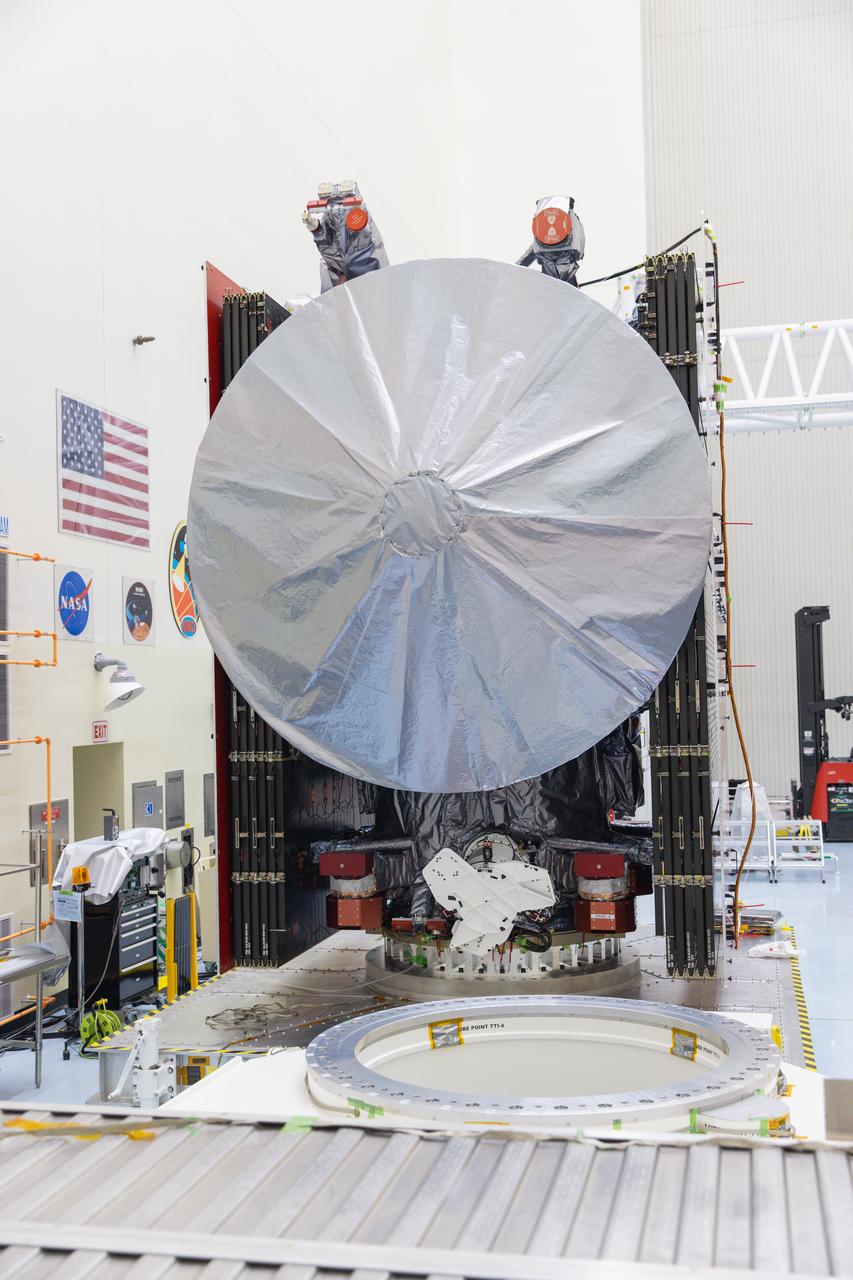
Technicians work to complete operations before propellant load occurs ahead of launch for NASA’s Europa Clipper spacecraft inside the Payload Hazardous Servicing Facility at the agency’s Kennedy Space Center in Florida on Tuesday, Sept. 11, 2024. Europa could have all the “ingredients” for life as we know it: water, organics, chemical energy, and stability. Europa Clipper’s launch period opens on October 10, 2024.
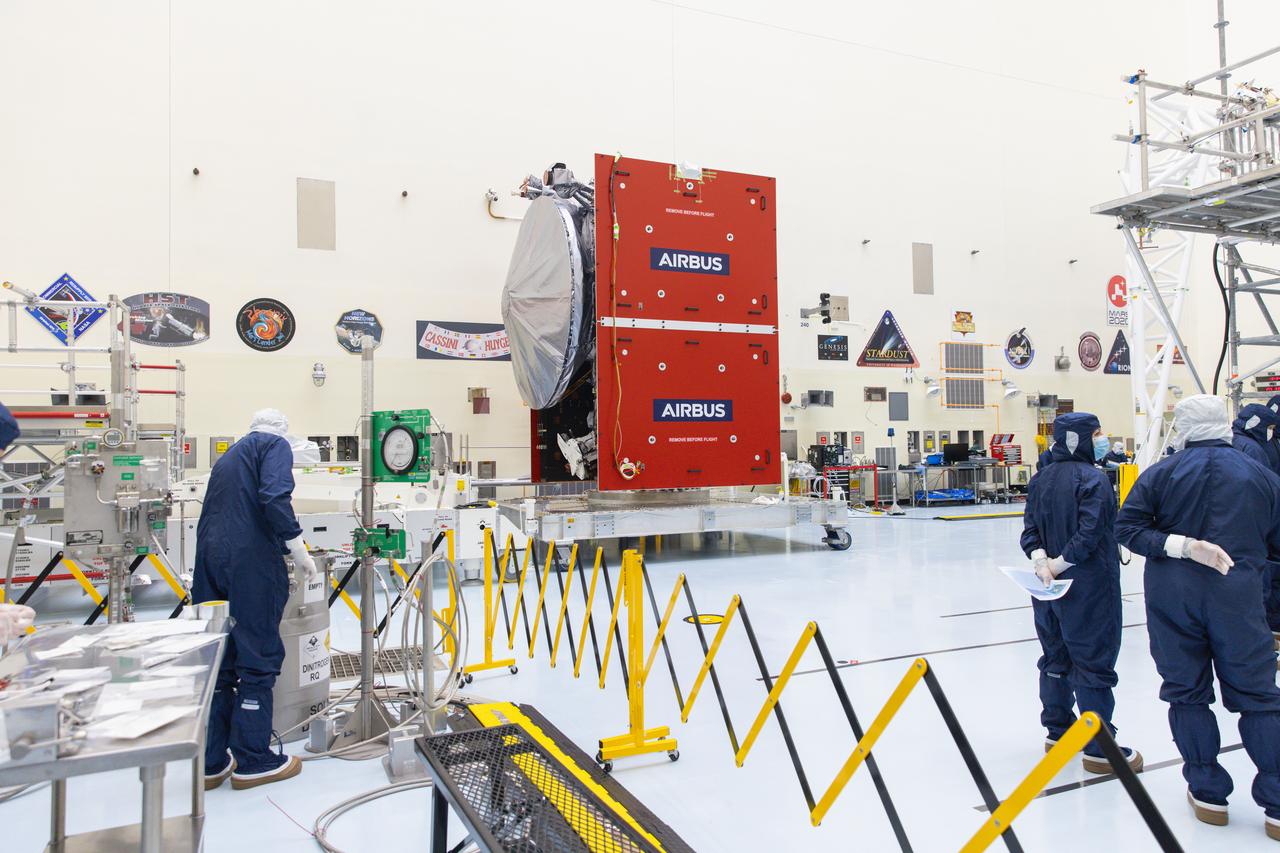
Technicians work to complete operations before propellant load occurs ahead of launch for NASA’s Europa Clipper spacecraft inside the Payload Hazardous Servicing Facility at the agency’s Kennedy Space Center in Florida on Tuesday, Sept. 11, 2024. Europa could have all the “ingredients” for life as we know it: water, organics, chemical energy, and stability. Europa Clipper’s launch period opens on October 10, 2024.
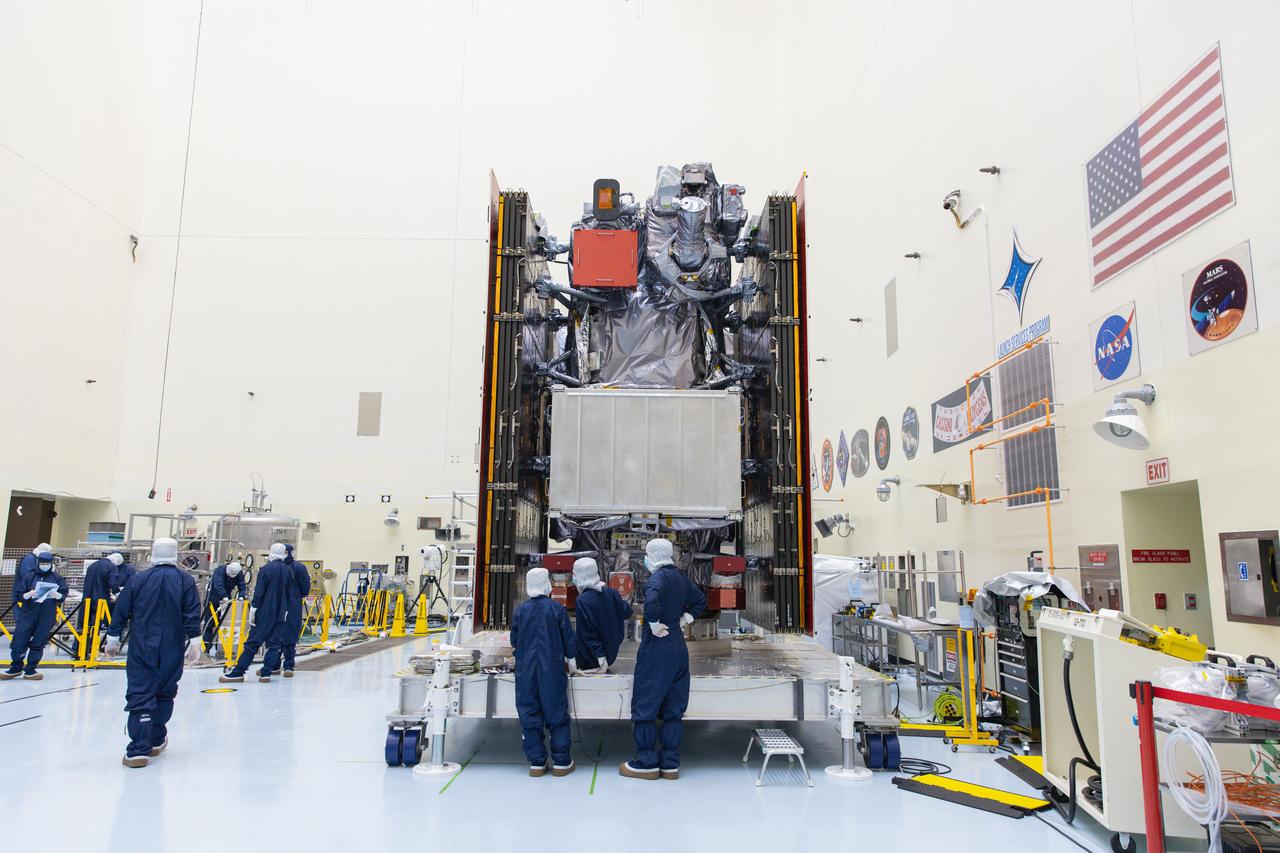
Technicians work to complete operations before propellant load occurs ahead of launch for NASA’s Europa Clipper spacecraft inside the Payload Hazardous Servicing Facility at the agency’s Kennedy Space Center in Florida on Tuesday, Sept. 11, 2024. Europa could have all the “ingredients” for life as we know it: water, organics, chemical energy, and stability. Europa Clipper’s launch period opens on October 10, 2024.
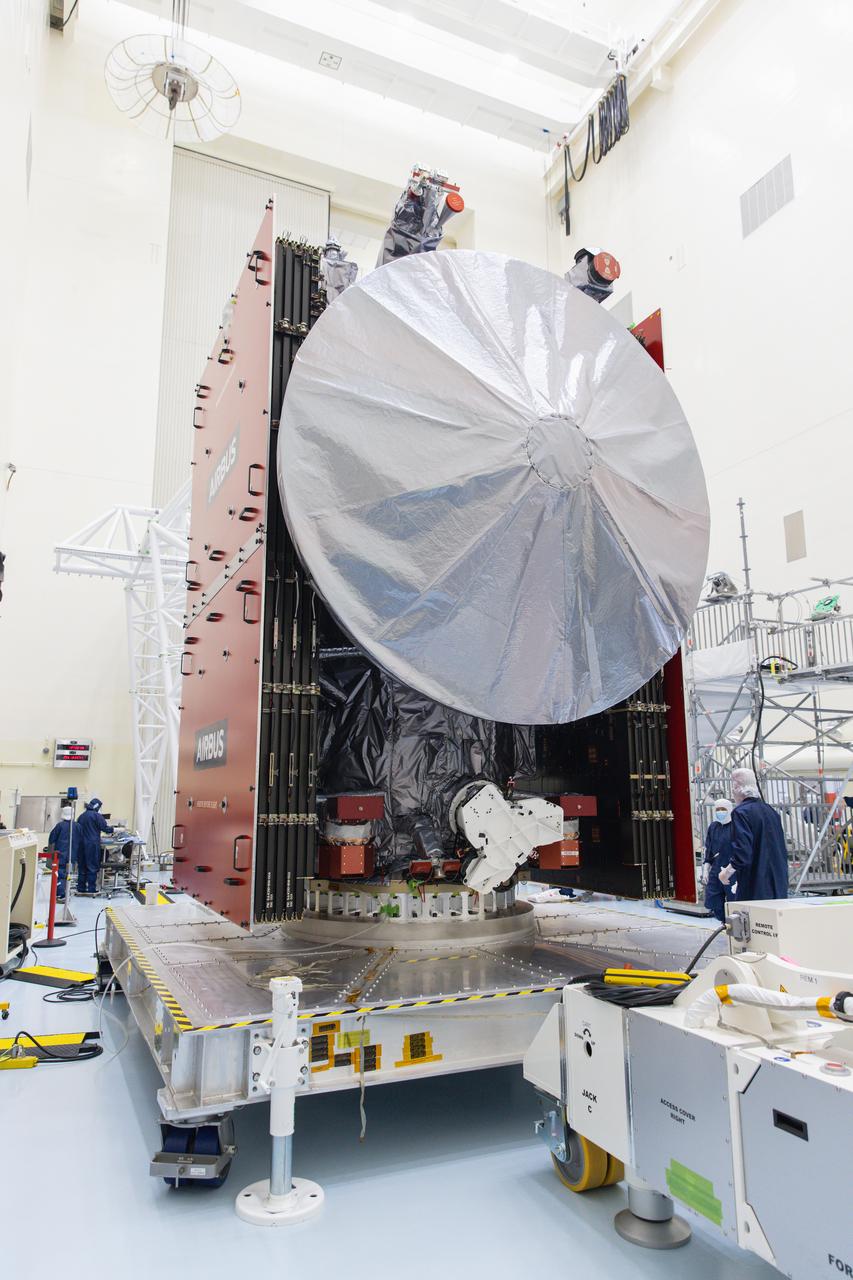
Technicians work to complete operations before propellant load occurs ahead of launch for NASA’s Europa Clipper spacecraft inside the Payload Hazardous Servicing Facility at the agency’s Kennedy Space Center in Florida on Tuesday, Sept. 11, 2024. Europa could have all the “ingredients” for life as we know it: water, organics, chemical energy, and stability. Europa Clipper’s launch period opens on October 10, 2024.
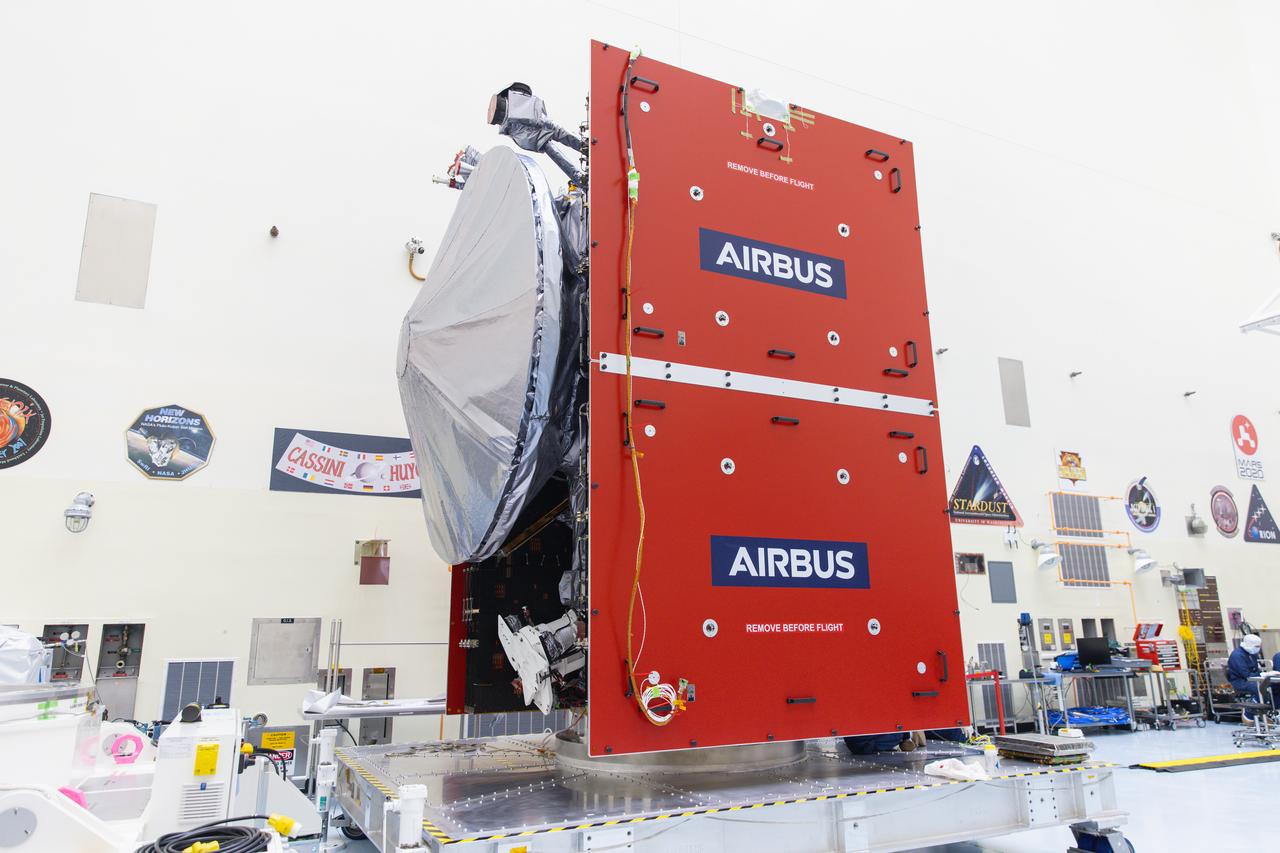
Technicians work to complete operations before propellant load occurs ahead of launch for NASA’s Europa Clipper spacecraft inside the Payload Hazardous Servicing Facility at the agency’s Kennedy Space Center in Florida on Tuesday, Sept. 11, 2024. Europa could have all the “ingredients” for life as we know it: water, organics, chemical energy, and stability. Europa Clipper’s launch period opens on October 10, 2024.
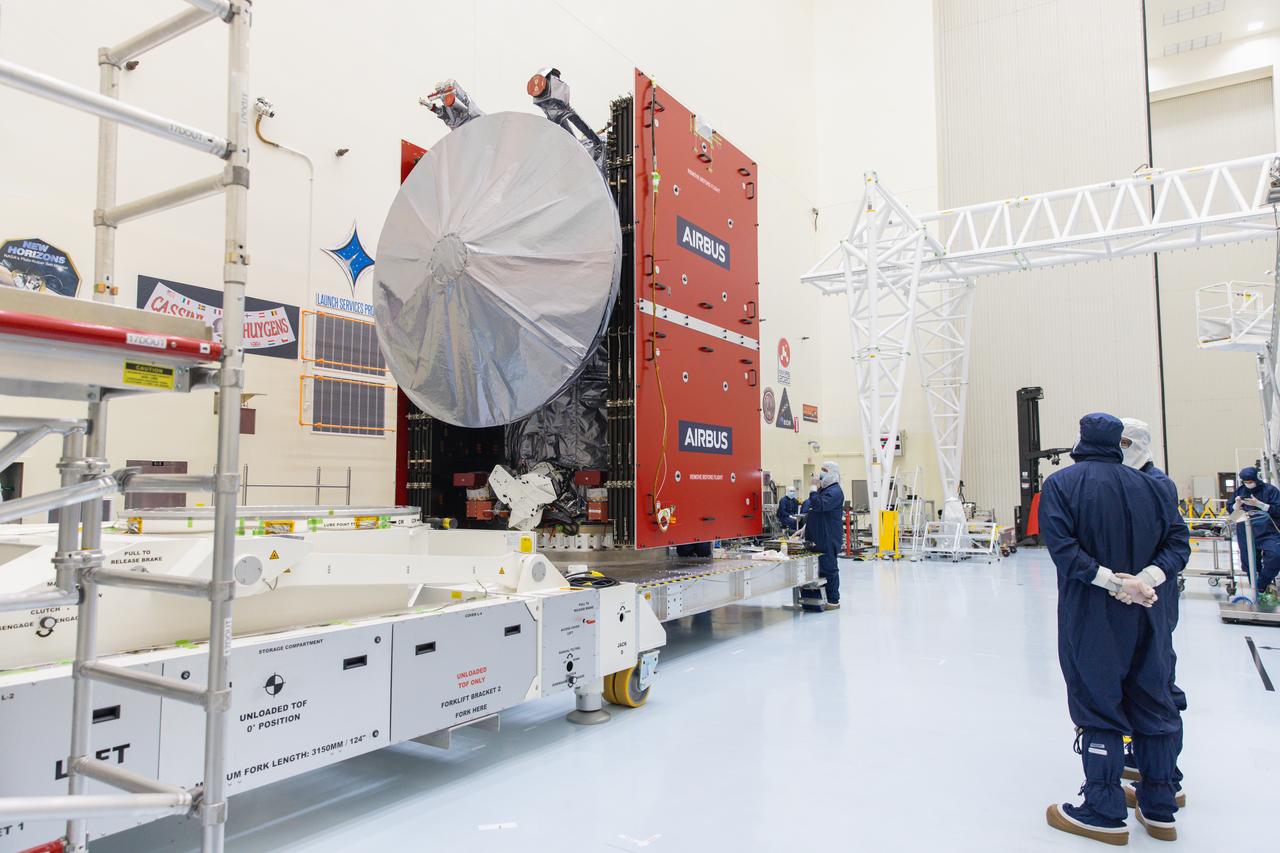
Technicians work to complete operations before propellant load occurs ahead of launch for NASA’s Europa Clipper spacecraft inside the Payload Hazardous Servicing Facility at the agency’s Kennedy Space Center in Florida on Tuesday, Sept. 11, 2024. Europa could have all the “ingredients” for life as we know it: water, organics, chemical energy, and stability. Europa Clipper’s launch period opens on October 10, 2024.
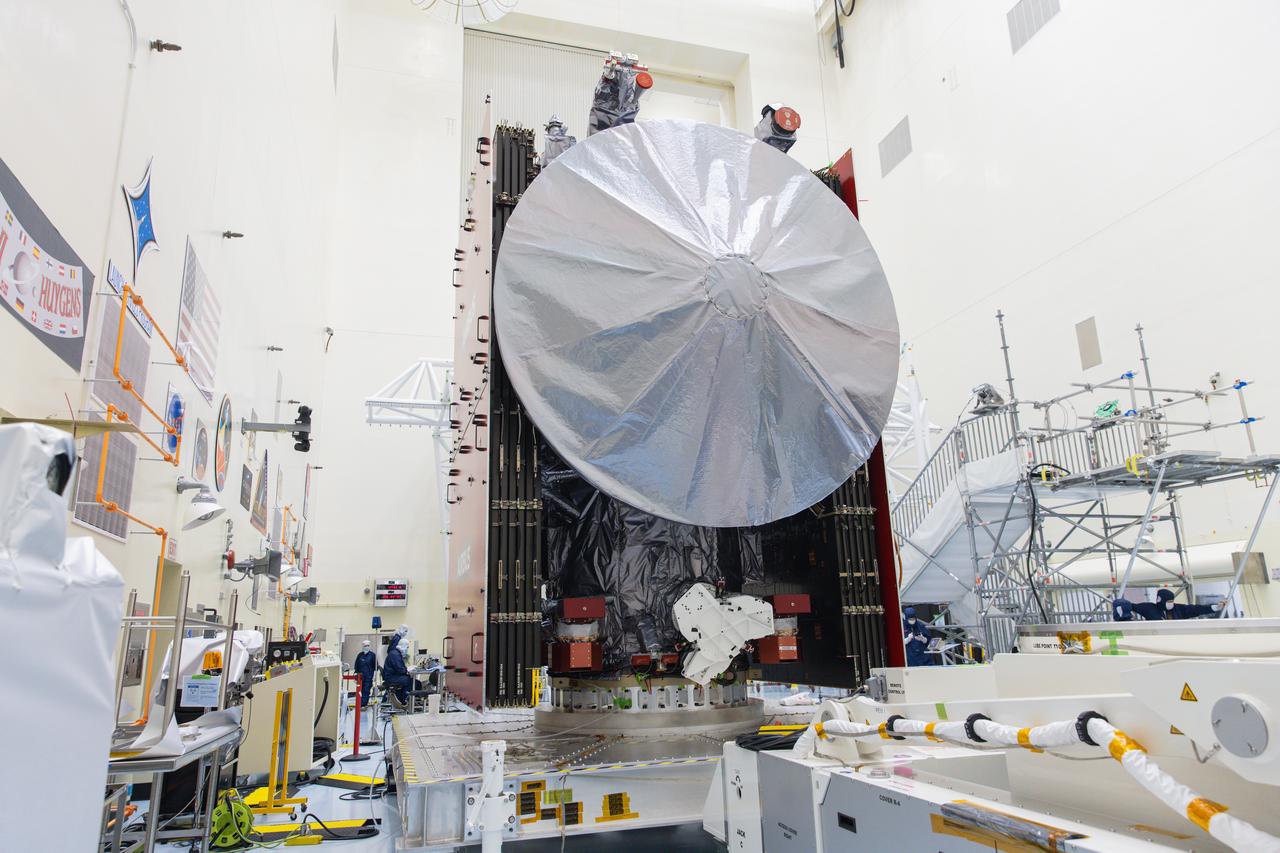
Technicians work to complete operations before propellant load occurs ahead of launch for NASA’s Europa Clipper spacecraft inside the Payload Hazardous Servicing Facility at the agency’s Kennedy Space Center in Florida on Tuesday, Sept. 11, 2024. Europa could have all the “ingredients” for life as we know it: water, organics, chemical energy, and stability. Europa Clipper’s launch period opens on October 10, 2024.
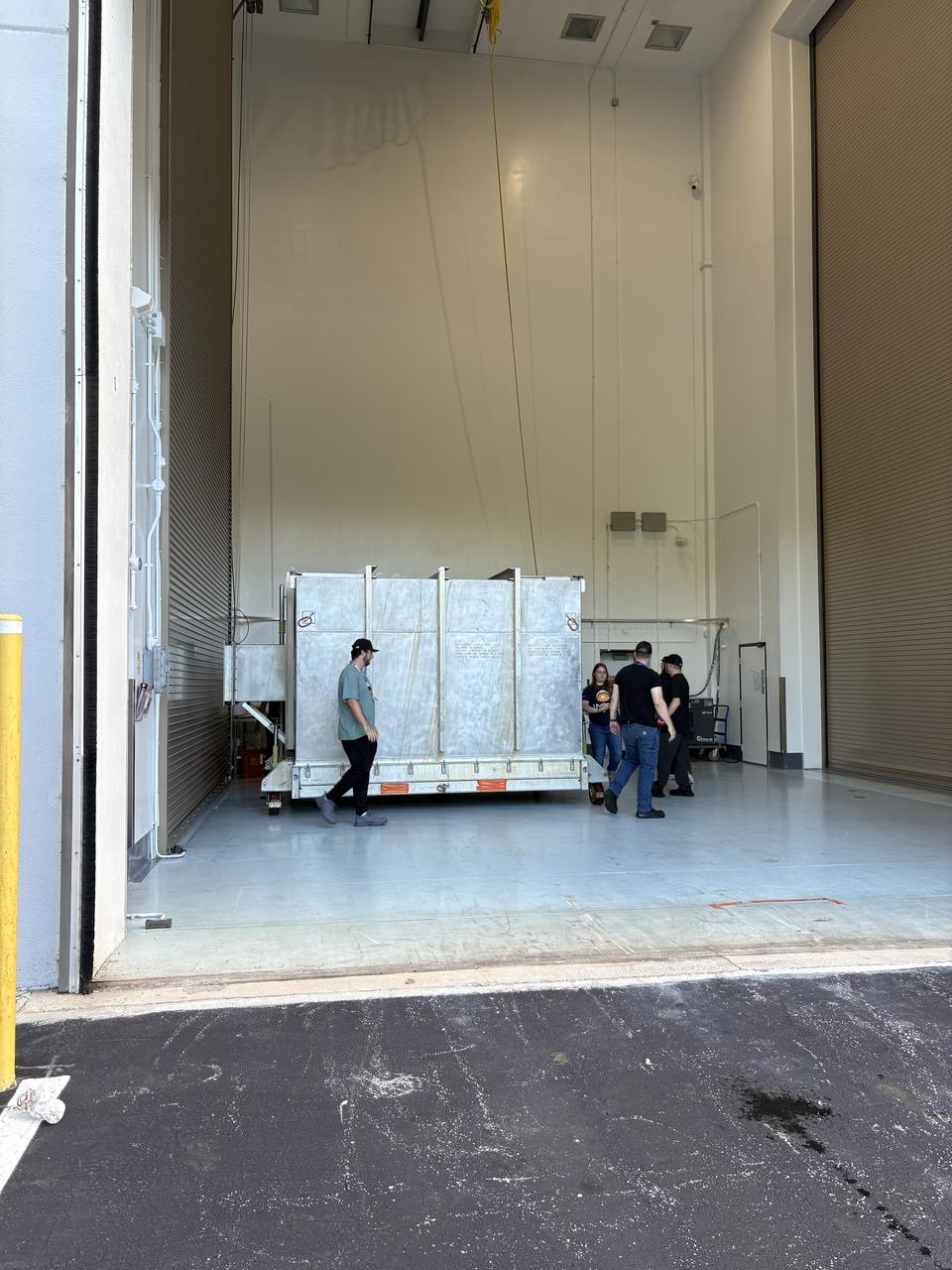
NASA’s IMAP (Interstellar Mapping and Acceleration Probe) observatory arrives at Building 2 where technicians will load 317 pounds (or 144 kilograms) of hydrazine into three tanks into the spacecraft at the Astrotech Space Operations Facility near NASA’s Kennedy Space Center in Florida on Tuesday, Aug. 12, 2025. IMAP will explore and map the boundaries of the heliosphere — a huge bubble created by the Sun’s wind that encapsulates our entire solar system — and study how the heliosphere interacts with the local galactic neighborhood beyond.
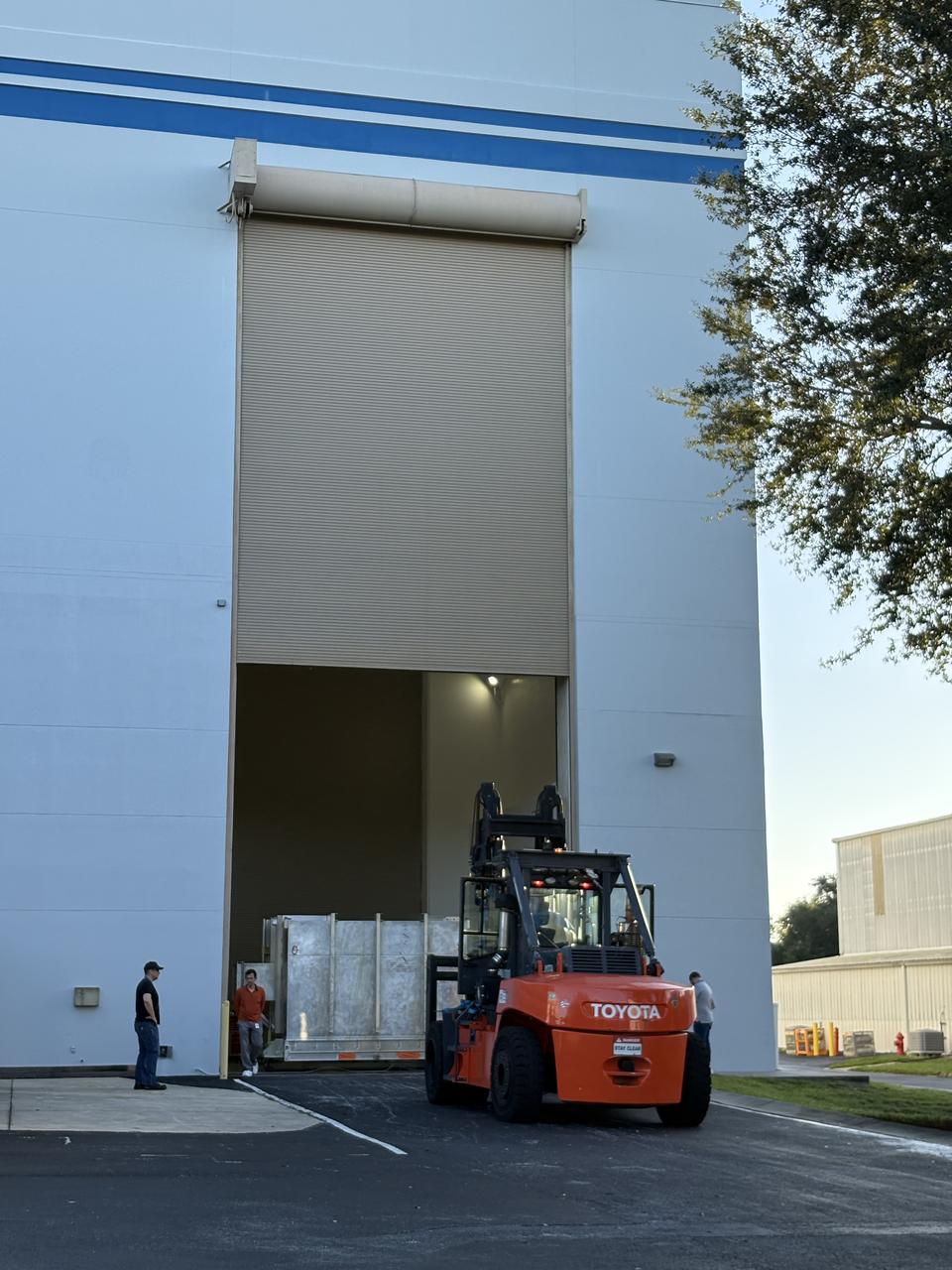
Technicians prepare to transport NASA’s IMAP (Interstellar Mapping and Acceleration Probe) observatory to Building 2 where they will load 317 pounds (or 144 kilograms) of hydrazine into three tanks into the spacecraft at the Astrotech Space Operations Facility near NASA’s Kennedy Space Center in Florida on Tuesday, Aug. 12, 2025. IMAP will explore and map the boundaries of the heliosphere — a huge bubble created by the Sun’s wind that encapsulates our entire solar system — and study how the heliosphere interacts with the local galactic neighborhood beyond.
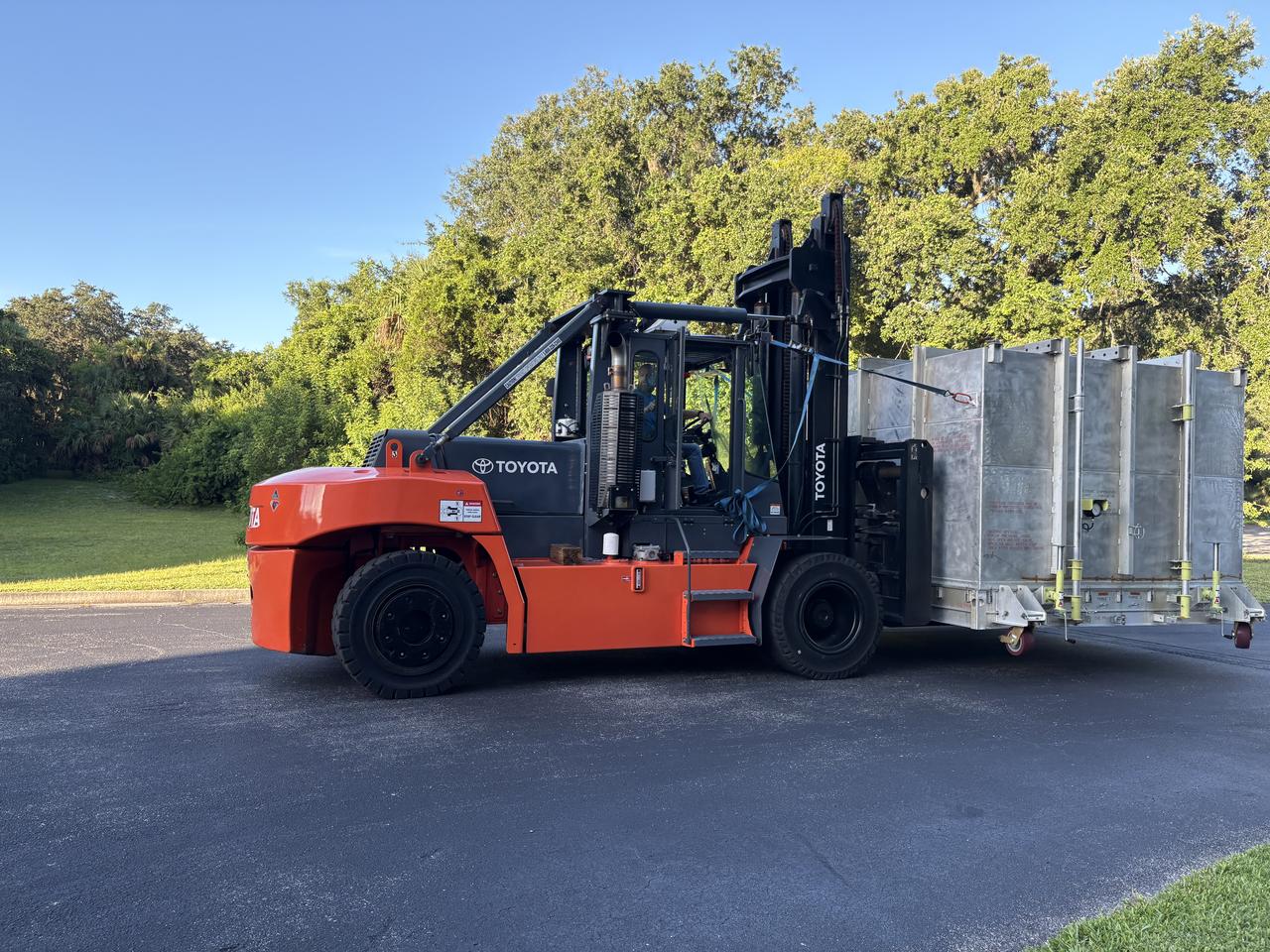
Technicians transport NASA’s IMAP (Interstellar Mapping and Acceleration Probe) observatory to Building 2 where they will load 317 pounds (or 144 kilograms) of hydrazine into three tanks into the spacecraft at the Astrotech Space Operations Facility near NASA’s Kennedy Space Center in Florida on Tuesday, Aug. 12, 2025. IMAP will explore and map the boundaries of the heliosphere — a huge bubble created by the Sun’s wind that encapsulates our entire solar system — and study how the heliosphere interacts with the local galactic neighborhood beyond.
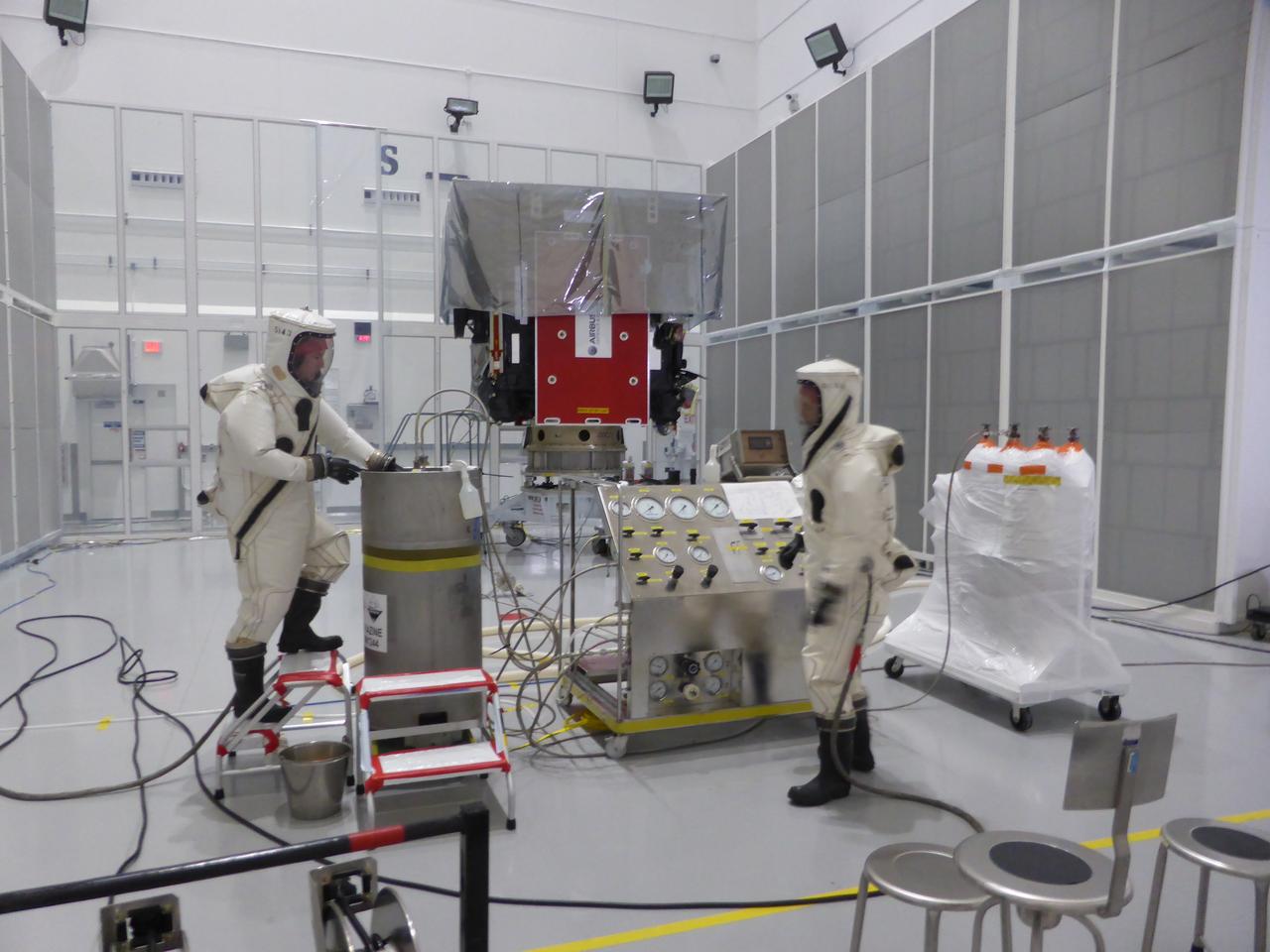
The Solar Orbiter spacecraft is loaded with propellants during processing activities inside the Astrotech Space Operations facility in Titusville, Florida. Solar Orbiter aims to study the Sun, its outer atmosphere and solar wind, and will provide the first images of the Sun’s poles. Solar Orbiter is a space mission of international collaboration between ESA (European Space Agency) and NASA. The spacecraft has been developed by Airbus. NASA’s Launch Services Program based at Kennedy Space Center in Florida is managing the launch. Liftoff is scheduled for Feb. 5, 2020, from Cape Canaveral Air Force Station aboard a United Launch Alliance Atlas V rocket.
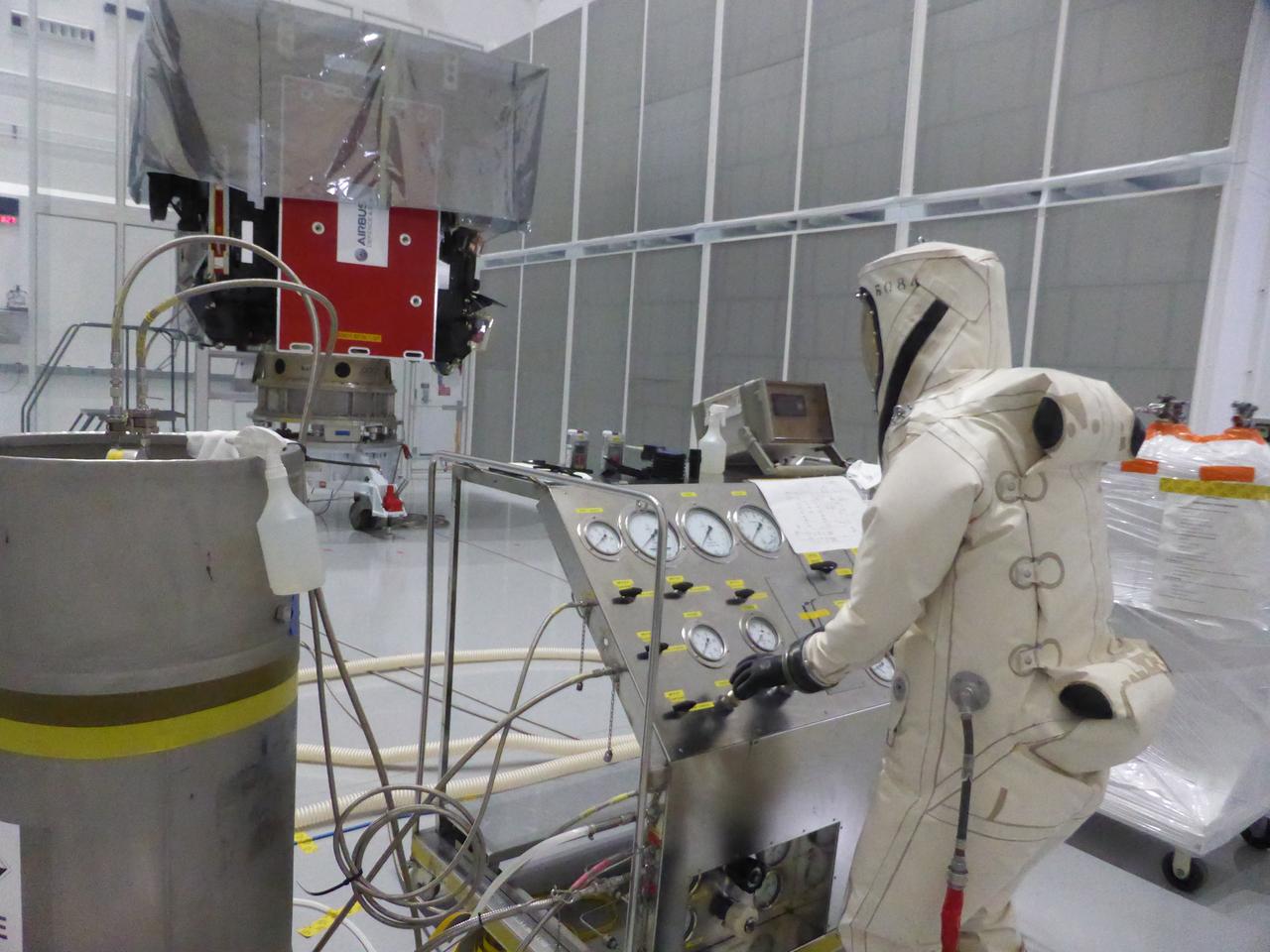
The Solar Orbiter spacecraft is loaded with propellants during processing activities inside the Astrotech Space Operations facility in Titusville, Florida. Solar Orbiter aims to study the Sun, its outer atmosphere and solar wind, and will provide the first images of the Sun’s poles. Solar Orbiter is a space mission of international collaboration between ESA (European Space Agency) and NASA. The spacecraft has been developed by Airbus. NASA’s Launch Services Program based at Kennedy Space Center in Florida is managing the launch. Liftoff is scheduled for Feb. 5, 2020, from Cape Canaveral Air Force Station aboard a United Launch Alliance Atlas V rocket.
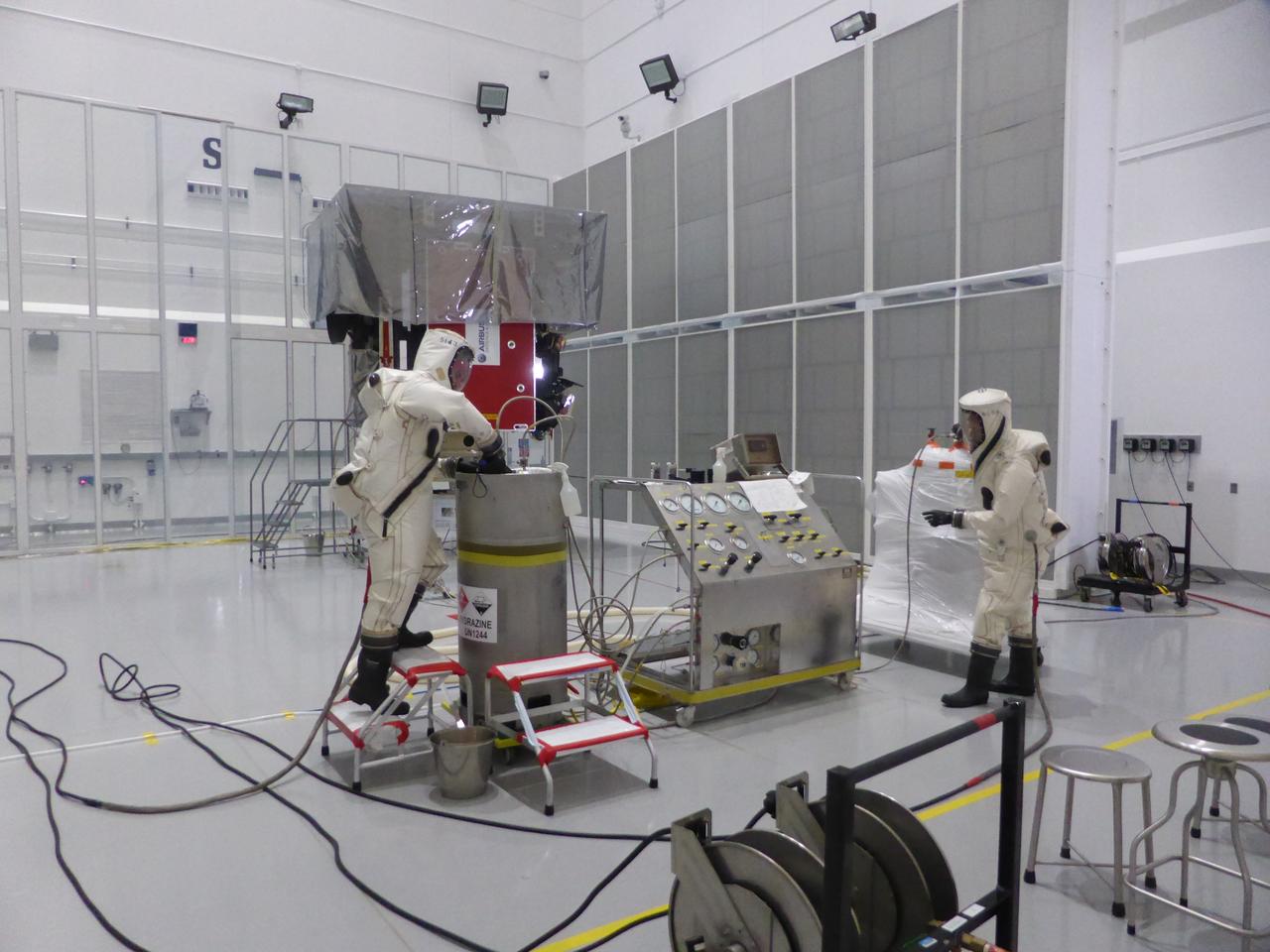
The Solar Orbiter spacecraft is loaded with propellants during processing activities inside the Astrotech Space Operations facility in Titusville, Florida. Solar Orbiter aims to study the Sun, its outer atmosphere and solar wind, and will provide the first images of the Sun’s poles. Solar Orbiter is a space mission of international collaboration between ESA (European Space Agency) and NASA. The spacecraft has been developed by Airbus. NASA’s Launch Services Program based at Kennedy Space Center in Florida is managing the launch. Liftoff is scheduled for Feb. 5, 2020, from Cape Canaveral Air Force Station aboard a United Launch Alliance Atlas V rocket.
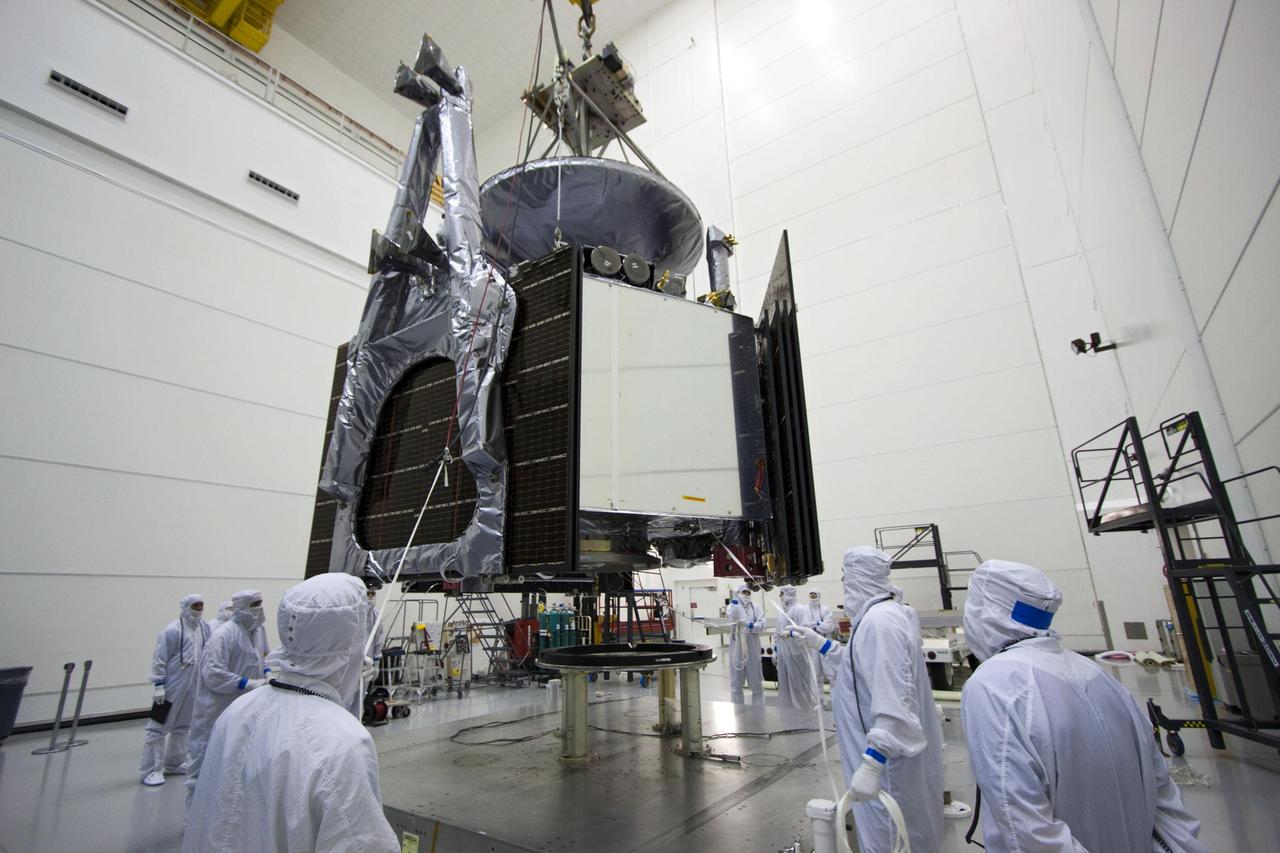
Technicians use an overhead crane to lower NASA Juno spacecraft onto a fueling stand where the spacecraft will be loaded with the propellant necessary for its mission to Jupiter.
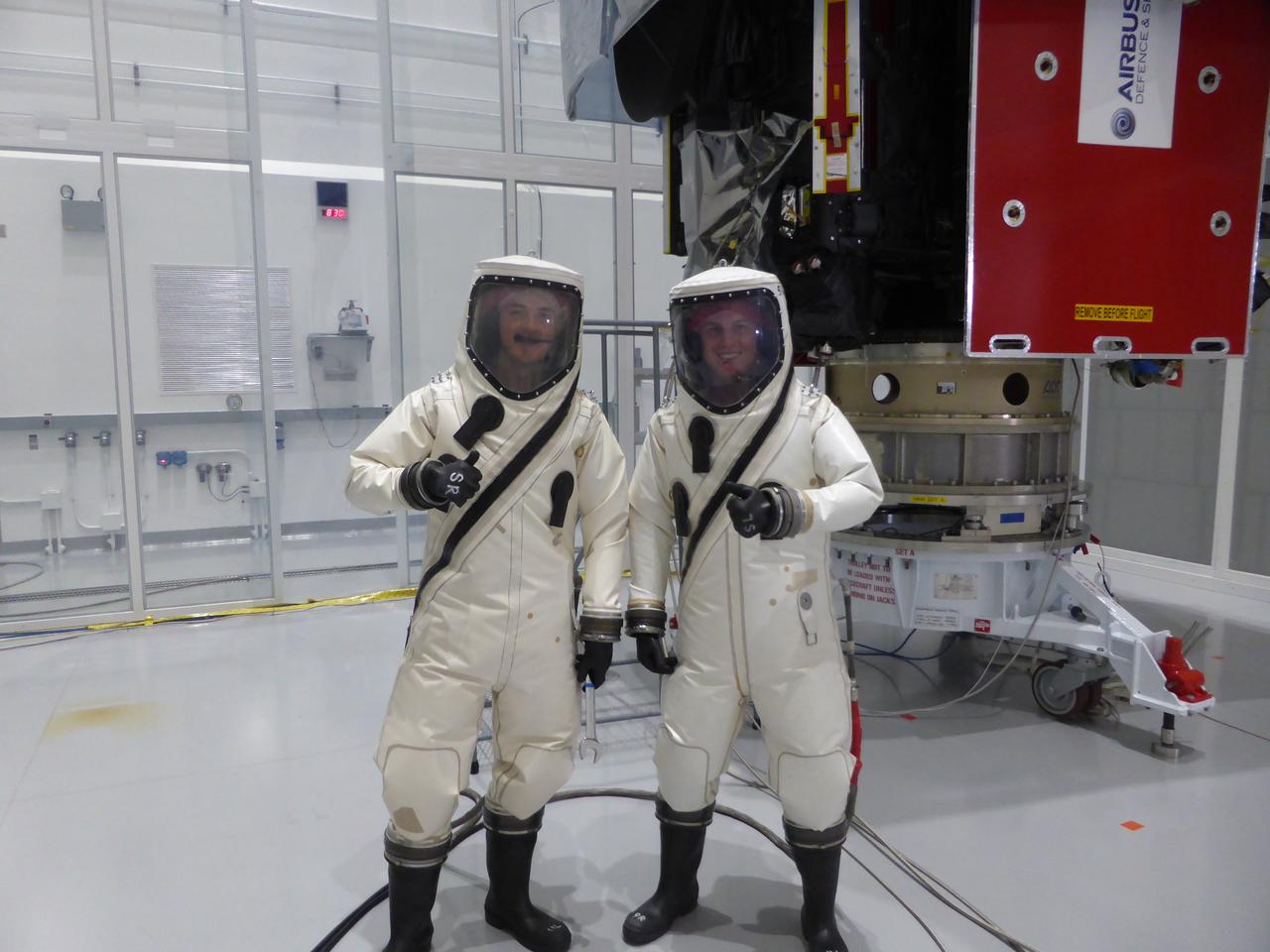
Members of the Airbus team preparing the Solar Orbiter spacecraft for launch pause for a photo inside the Astrotech Space Operations facility in Titusville, Florida. Solar Orbiter aims to study the Sun, its outer atmosphere and solar wind, and will provide the first images of the Sun’s poles. Solar Orbiter is a space mission of international collaboration between ESA (European Space Agency) and NASA. The spacecraft has been developed by Airbus. NASA’s Launch Services Program based at Kennedy Space Center in Florida is managing the launch. Liftoff is scheduled for Feb. 5, 2020, from Cape Canaveral Air Force Station aboard a United Launch Alliance Atlas V rocket.
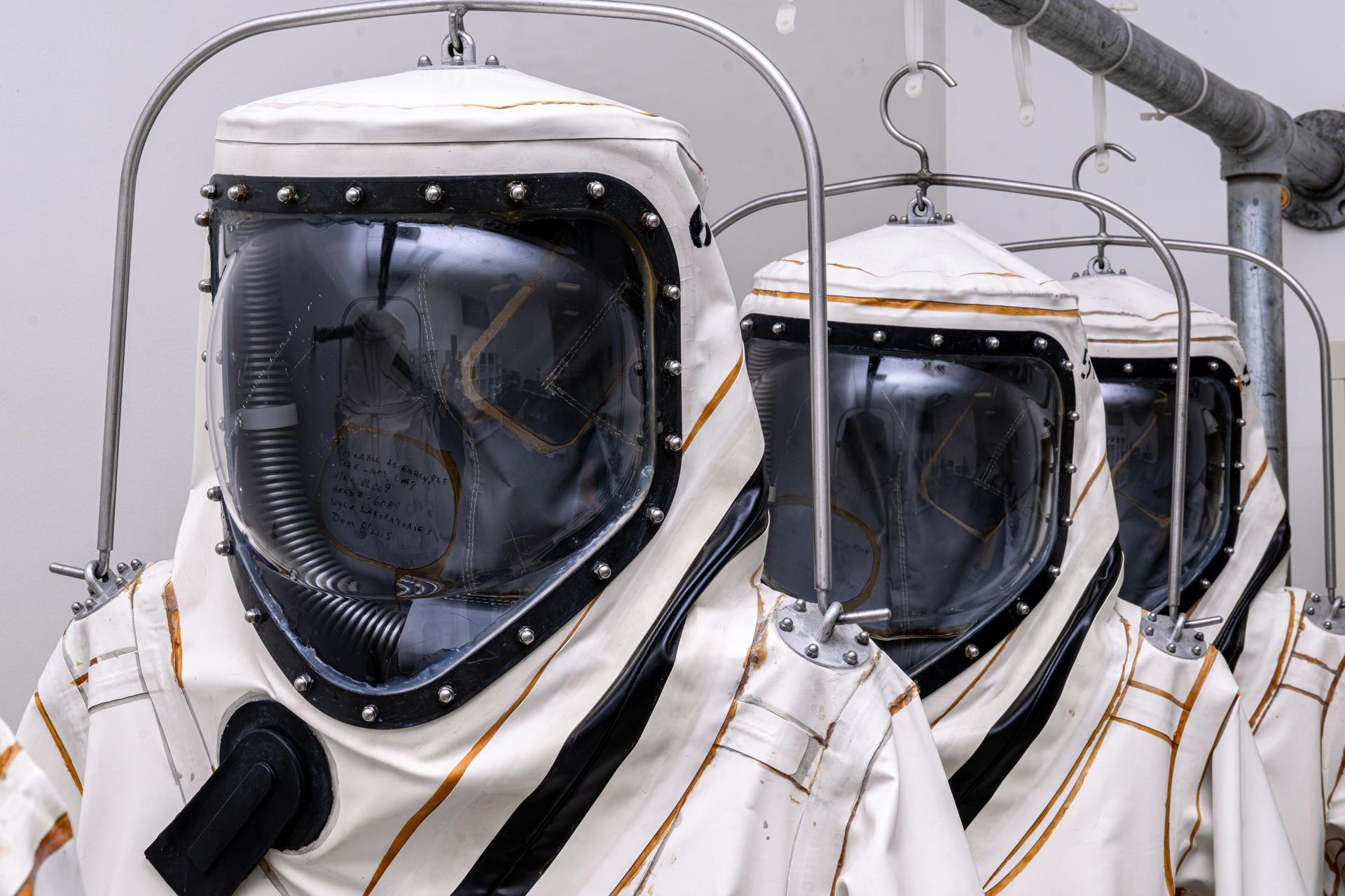
Self-Contained Atmospheric Protective Ensemble (SCAPE) suits hang on a rack the Multi Operations Support Building on Thursday, July 23, 2026, before technicians began operations to load propellant into NASA's Nancy Grace Roman Space Telescope. Once suited up technicians fueled Roman inside the Payload Hazardous Servicing Facility at NASA’s Kennedy Space Center in Florida with about 290 gallons (roughly 1,100 liters) of hydrazine. Roman’s primary mission is to settle essential questions about dark energy, exoplanets, and infrared astrophysics by conducting wide-field surveys that explore the universe’s structure, evolution, and composition. Liftoff atop a SpaceX Falcon Heavy rocket from NASA Kennedy’s Launch Complex 39A is targeted no earlier than Sunday, Aug. 30, 2026.
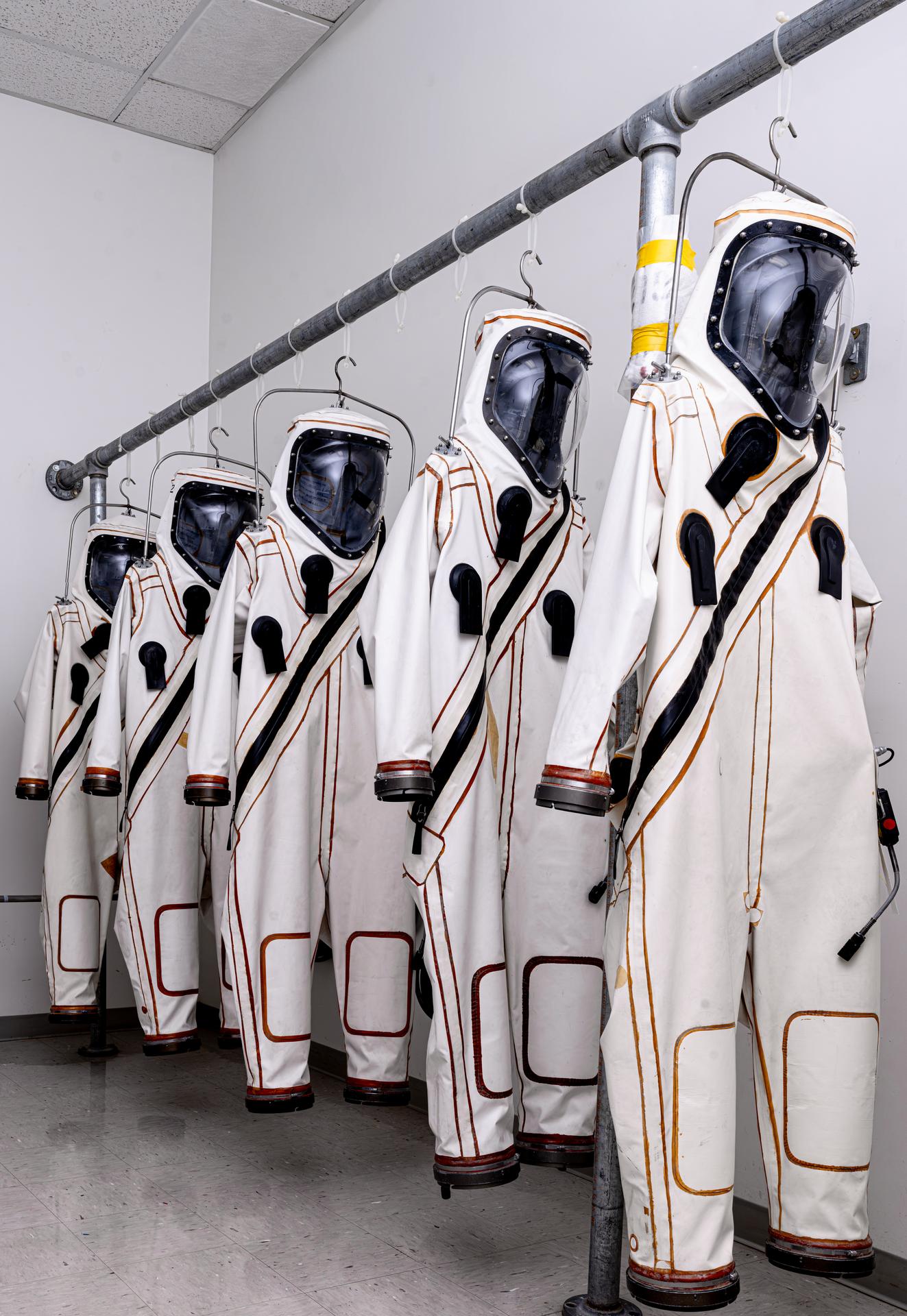
Self-Contained Atmospheric Protective Ensemble (SCAPE) suits hang on a rack the Multi Operations Support Building on Thursday, July 23, 2026, before technicians began operations to load propellant into NASA's Nancy Grace Roman Space Telescope. Once suited up technicians fueled Roman inside the Payload Hazardous Servicing Facility at NASA’s Kennedy Space Center in Florida with about 290 gallons (roughly 1,100 liters) of hydrazine. Roman’s primary mission is to settle essential questions about dark energy, exoplanets, and infrared astrophysics by conducting wide-field surveys that explore the universe’s structure, evolution, and composition. Liftoff atop a SpaceX Falcon Heavy rocket from NASA Kennedy’s Launch Complex 39A is targeted no earlier than Sunday, Aug. 30, 2026.
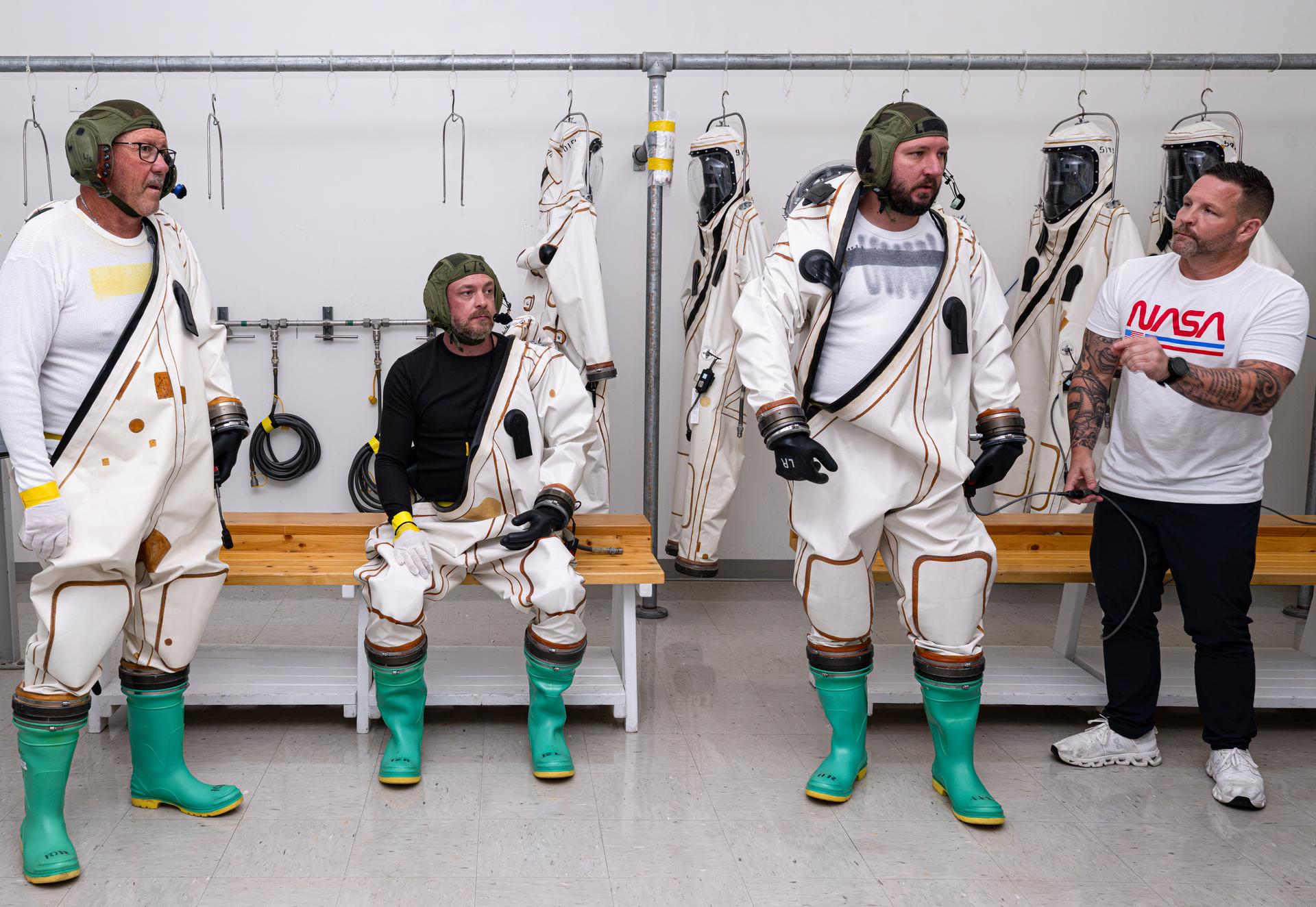
Technicians don Self-Contained Atmospheric Protective Ensemble (SCAPE) suits as they prepare to perform propellant loading operations inside the Payload Hazardous Servicing Facility at NASA’s Kennedy Space Center in Florida for the agency’s Nancy Grace Roman Space Telescope on Thursday, July 23, 2026. With fuel tanks capable of carrying about 290 gallons (roughly 1,100 liters) of hydrazine, Roman’s primary mission is to settle essential questions about dark energy, exoplanets, and infrared astrophysics by conducting wide-field surveys that explore the universe’s structure, evolution, and composition. Liftoff atop a SpaceX Falcon Heavy rocket from NASA Kennedy’s Launch Complex 39A is targeted no earlier than Sunday, Aug. 30, 2026.

Artemis I Launch Director Charlie Blackwell-Thompson stands at her console inside the Launch Control Center’s Firing Room 1 at NASA’s Kennedy Space Center in Florida during a simulation rehearsing propellant loading on Aug. 18, 2020. The simulation involved members of the launch team practicing the procedures for loading the Space Launch System (SLS) rocket with cryogenics, or super cold propellants. During the exercise, potential problem scenarios were introduced to test the tools, processes, and procedures necessary for fueling the rocket. Artemis I will be the first integrated test flight of SLS and the Orion spacecraft – the system that will ultimately land the first woman and the next man on the Moon by 2024.

Artemis I Launch Director Charlie Blackwell-Thompson stands at her console inside the Launch Control Center’s Firing Room 1 at NASA’s Kennedy Space Center in Florida during a simulation rehearsing propellant loading on Aug. 18, 2020. The simulation involved members of the launch team practicing the procedures for loading the Space Launch System (SLS) rocket with cryogenics, or super cold propellants. During the exercise, potential problem scenarios were introduced to test the tools, processes, and procedures necessary for fueling the rocket. Artemis I will be the first integrated test flight of SLS and the Orion spacecraft – the system that will ultimately land the first woman and the next man on the Moon by 2024.

Inside the Multi-Operations Support Building near the Multi-Payload Processing Facility (MPPF) at NASA’s Kennedy Space Center in Florida on Aug. 16, 2019, rows of gloves that are part of Self-Contained Atmospheric Protective Ensemble (SCAPE) suits are in view inside a changing room. SCAPE technicians will practice putting on SCAPE suits for a test simulation of loading propellants into a replicated test tank for Orion. Exploration Ground Systems is preparing for Artemis 1 with a series of hazardous hyper test events at the MPPF. After donning their suits, the technicians will complete a tanking to test the system before Orion arrives for processing. During preparations for launch, these teams will be responsible for loading the Orion vehicle with propellants prior to transportation to the Vehicle Assembly Building, where it will be secured atop the Space Launch System rocket. SCAPE suits are used in operations involving toxic propellants and are supplied with air either through a hardline or through a self-contained environmental control unit.
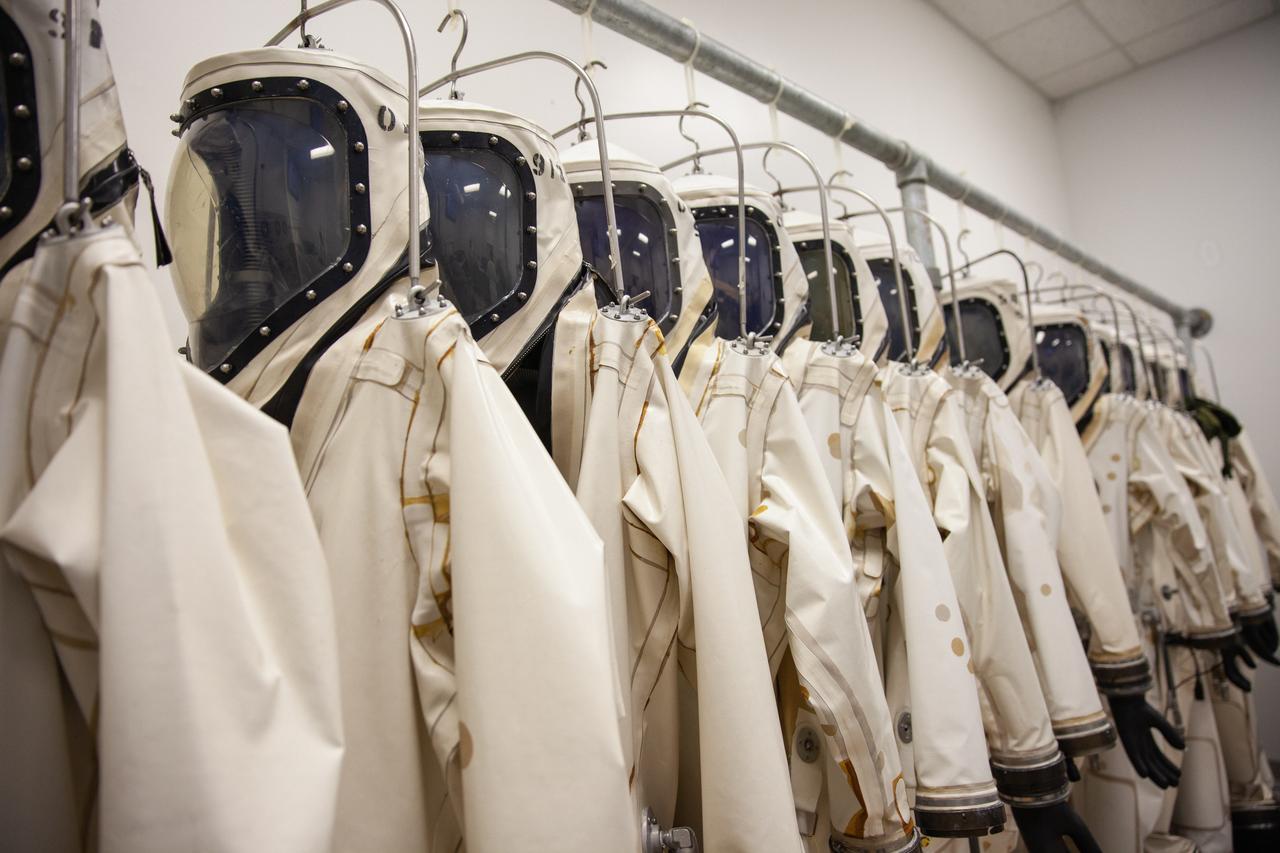
Inside the Multi-Operations Support Building near the Multi-Payload Processing Facility (MPPF) at NASA’s Kennedy Space Center in Florida on Aug. 16, 2019, a row of Self-Contained Atmospheric Protective Ensemble (SCAPE) suits are hanging inside a changing room. SCAPE technicians are practicing putting on the suits for a test simulation of loading propellants into a replicated test tank for Orion. Exploration Ground Systems is preparing for Artemis 1 with a series of hazardous hyper test events at the MPPF. After donning their suits, the technicians will complete a tanking to test the system before Orion arrives for processing. During preparations for launch, these teams will be responsible for loading the Orion vehicle with propellants prior to transportation to the Vehicle Assembly Building, where it will be secured atop the Space Launch System rocket. SCAPE suits are used in operations involving toxic propellants and are supplied with air either through a hardline or through a self-contained environmental control unit.
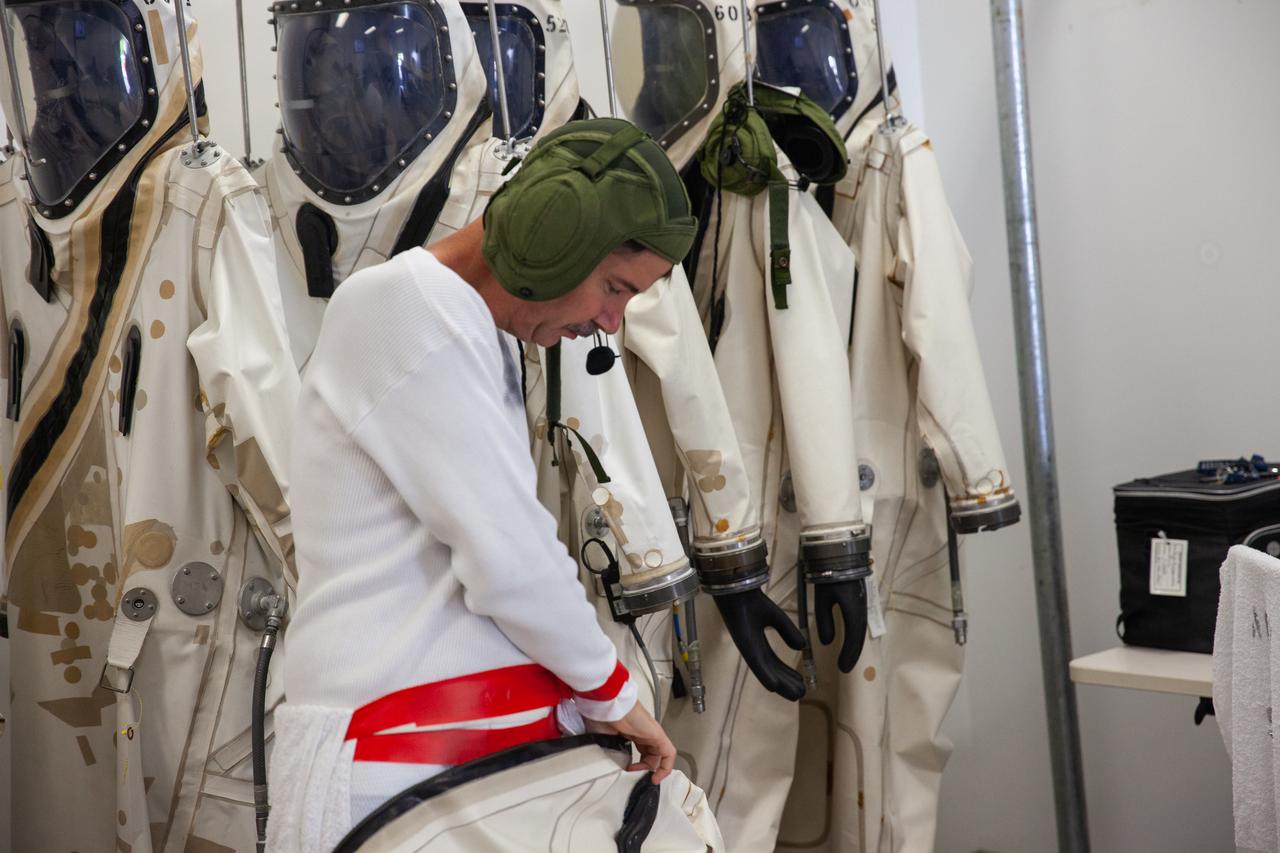
Inside the Multi-Operations Support Building near the Multi-Payload Processing Facility (MPPF) at NASA’s Kennedy Space Center in Florida, a technician prepares to put on a Self-Contained Atmospheric Protective Ensemble (SCAPE) suit inside a changing room on Aug. 16, 2019. SCAPE technicians are practicing putting on the suits for a test simulation of loading propellants into a replicated test tank for Orion. Exploration Ground Systems is preparing for Artemis 1 with a series of hazardous hyper test events at the MPPF. After donning their suits, the technicians will complete a tanking to test the system before Orion arrives for processing. During preparations for launch, these teams will be responsible for loading the Orion vehicle with propellants prior to transportation to the Vehicle Assembly Building, where it will be secured atop the Space Launch System rocket. SCAPE suits are used in operations involving toxic propellants and are supplied with air either through a hardline or through a self-contained environmental control unit.
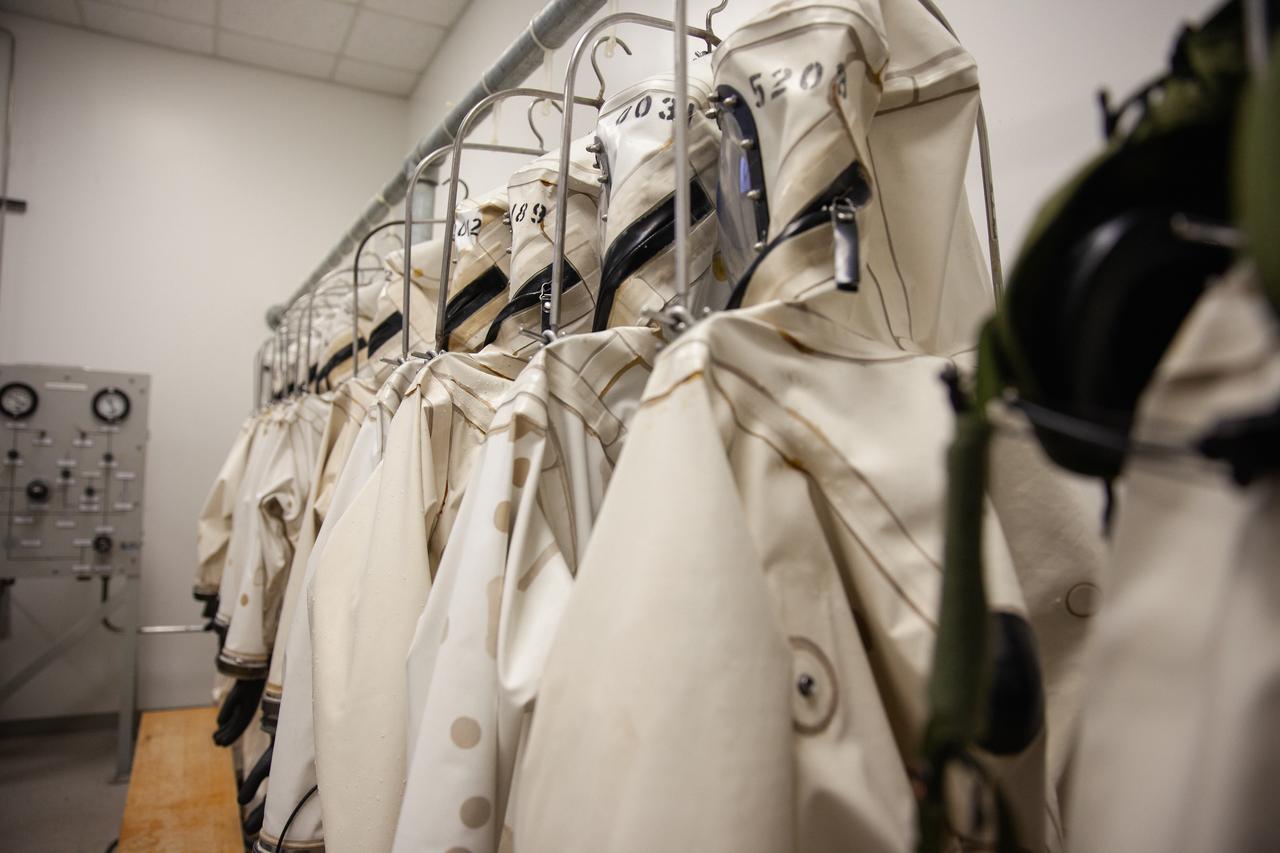
Inside the Multi-Operations Support Building near the Multi-Payload Processing Facility (MPPF) at NASA’s Kennedy Space Center in Florida on Aug. 16, 2019, a row of Self-Contained Atmospheric Protective Ensemble (SCAPE) suits are hanging inside a changing room. SCAPE technicians are practicing putting on their suits for a test simulation of loading propellants into a replicated test tank for Orion. Exploration Ground Systems is preparing for Artemis 1 with a series of hazardous hyper test events at the MPPF. After donning their suits, the technicians will complete a tanking to test the system before Orion arrives for processing. During preparations for launch, these teams will be responsible for loading the Orion vehicle with propellants prior to transportation to the Vehicle Assembly Building, where it will be secured atop the Space Launch System rocket. SCAPE suits are used in operations involving toxic propellants and are supplied with air either through a hardline or through a self-contained environmental control unit.
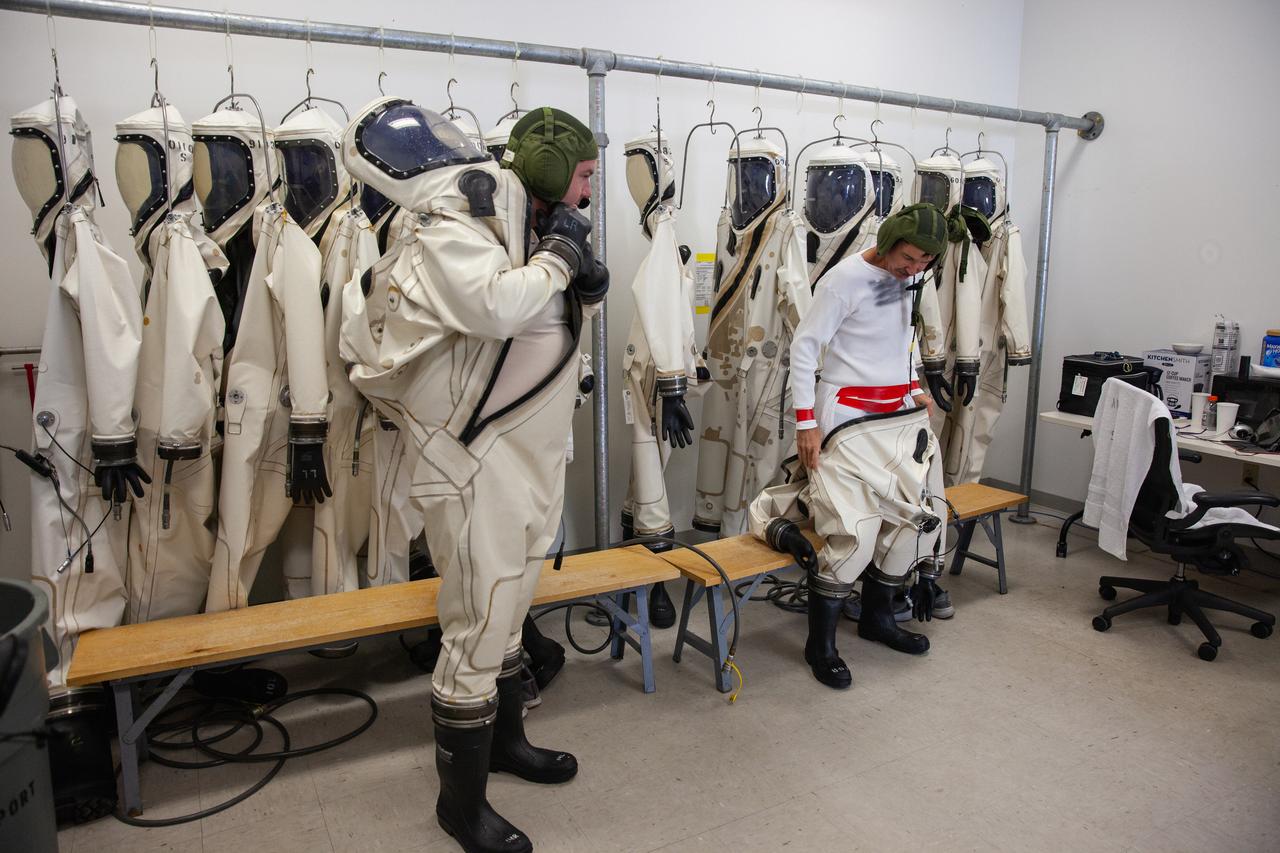
Inside the Multi-Operations Support Building near the Multi-Payload Processing Facility (MPPF) at NASA’s Kennedy Space Center in Florida, technicians put on Self-Contained Atmospheric Protective Ensemble (SCAPE) suits inside a changing room on Aug. 16, 2019. SCAPE technicians are practicing putting on the suits for a test simulation of loading propellants into a replicated test tank for Orion. Exploration Ground Systems is preparing for Artemis 1 with a series of hazardous hyper test events at the MPPF. After donning their suits, the technicians will complete a tanking to test the system before Orion arrives for processing. During preparations for launch, these teams will be responsible for loading the Orion vehicle with propellants prior to transportation to the Vehicle Assembly Building, where it will be secured atop the Space Launch System rocket. SCAPE suits are used in operations involving toxic propellants and are supplied with air either through a hardline or through a self-contained environmental control unit.
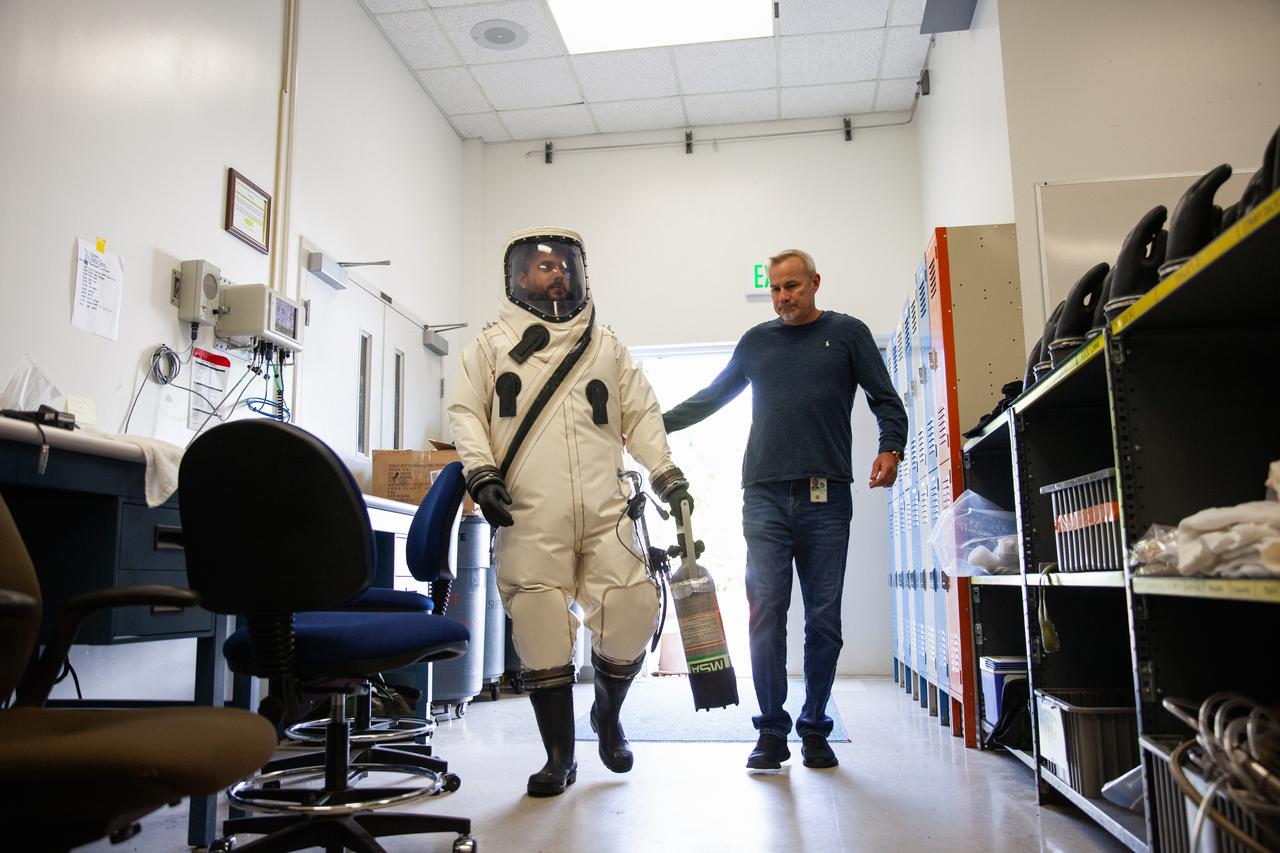
Inside the Multi-Operations Support Building near the Multi-Payload Processing Facility (MPPF) at NASA’s Kennedy Space Center in Florida, a technician is wearing a Self-Contained Atmospheric Protective Ensemble (SCAPE) suit to prepare for a test simulation of loading propellants into a replicated test tank for Orion, on Aug. 16, 2019. Exploration Ground Systems is preparing for Artemis 1 with a series of hazardous hyper test events at the MPPF. After donning their suits, the technicians will complete tanking to test the system before Orion arrives for processing. During preparations for launch, these teams will be responsible for loading the Orion vehicle with propellants prior to transportation to the Vehicle Assembly Building, where it will be secured atop the Space Launch System rocket. SCAPE suits are used in operations involving toxic propellants and are supplied with air either through a hardline or through a self-contained environmental control unit.
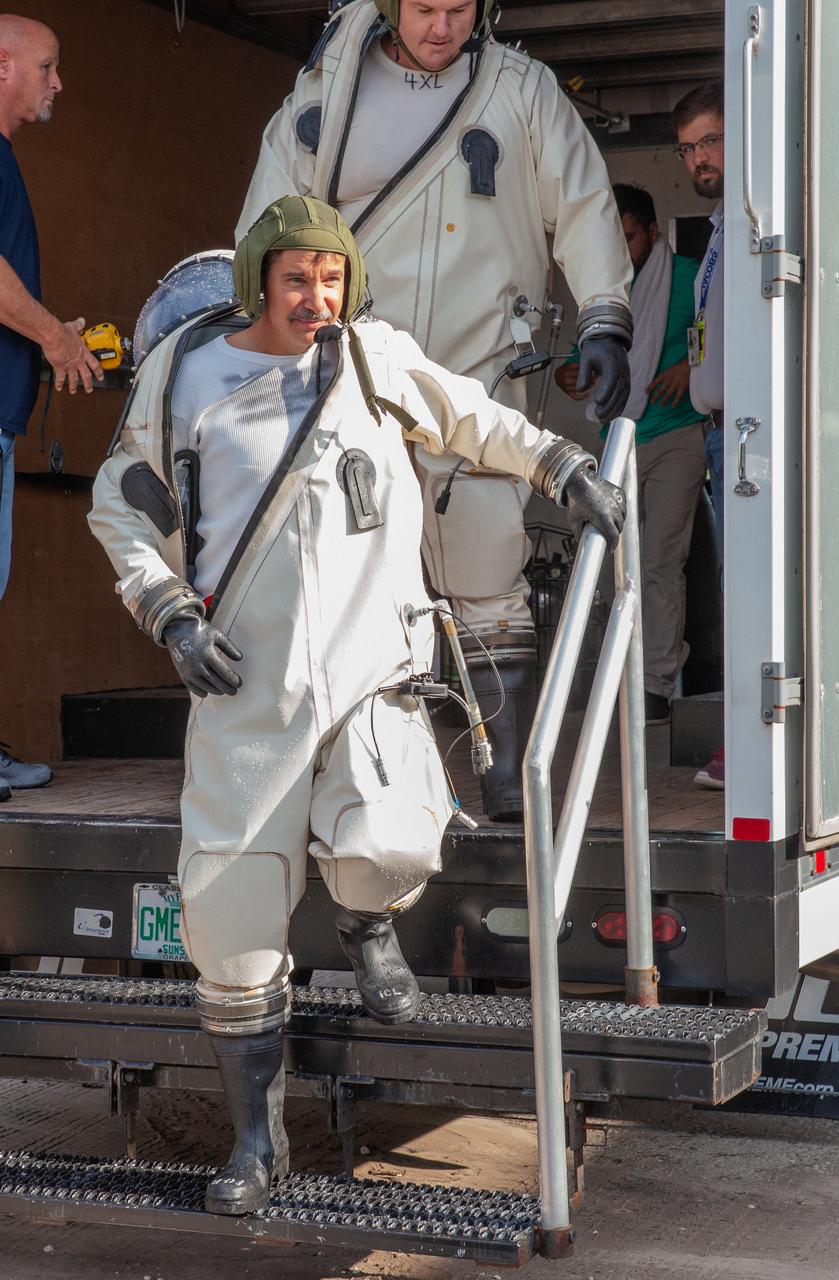
Technicians in Self-Contained Atmospheric Protective Ensemble (SCAPE) suits exit a truck near the Multi-Payload Processing Facility (MPPF) at NASA’s Kennedy Space Center in Florida, for a test simulation of loading propellants into a replicated test tank for Orion on Aug. 16, 2019. Exploration Ground Systems is preparing for Artemis 1 with a series of hazardous hyper test events at the MPPF. The technicians will complete a tanking to test the system before Orion arrives for processing. During preparations for launch, these teams will be responsible for loading the Orion vehicle with propellants prior to transportation to the Vehicle Assembly Building, where it will be secured atop the Space Launch System rocket. SCAPE suits are used in operations involving toxic propellants and are supplied with air either through a hardline or through a self-contained environmental control unit.
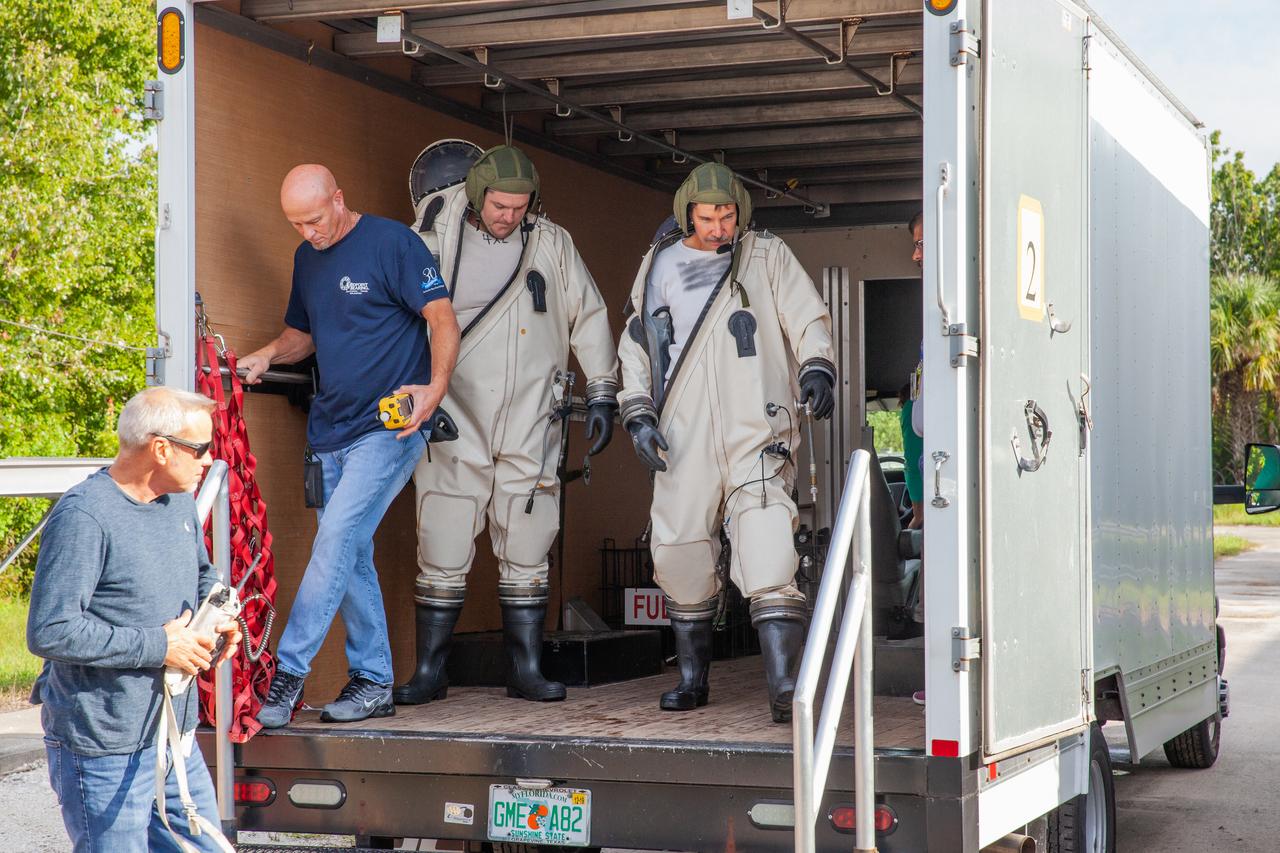
Technicians in Self-Contained Atmospheric Protective Ensemble (SCAPE) suits exit a truck near the Multi-Payload Processing Facility (MPPF) at NASA’s Kennedy Space Center in Florida, for a test simulation of loading propellants into a replicated test tank for Orion on Aug. 16, 2019. Exploration Ground Systems is preparing for Artemis 1 with a series of hazardous hyper test events at the MPPF. The technicians will complete a tanking to test the system before Orion arrives for processing. During preparations for launch, these teams will be responsible for loading the Orion vehicle with propellants prior to transportation to the Vehicle Assembly Building, where it will be secured atop the Space Launch System rocket. SCAPE suits are used in operations involving toxic propellants and are supplied with air either through a hardline or through a self-contained environmental control unit.
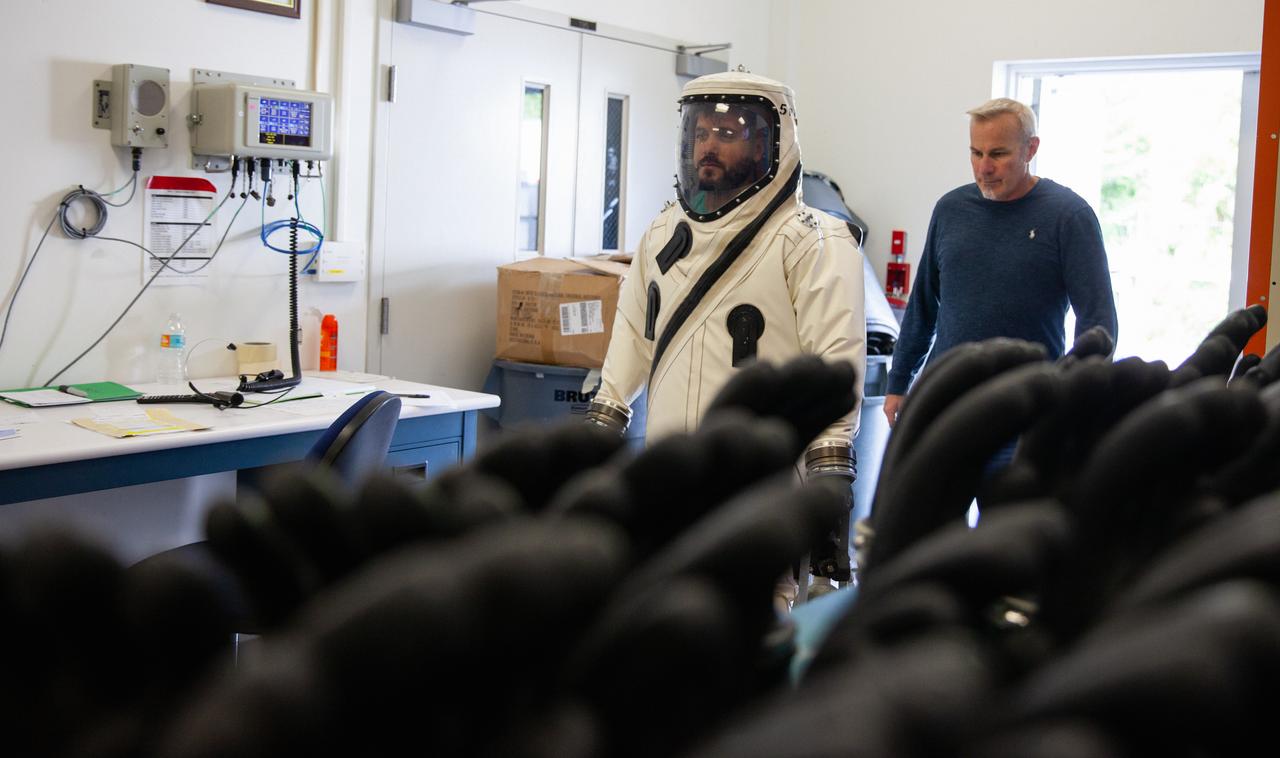
Inside the Multi-Operations Support Building near the Multi-Payload Processing Facility (MPPF) at NASA’s Kennedy Space Center in Florida, a technician is wearing a Self-Contained Atmospheric Protective Ensemble (SCAPE) suit to prepare for a test simulation of loading propellants into a replicated test tank for Orion, on Aug. 16, 2019. Exploration Ground Systems is preparing for Artemis 1 with a series of hazardous hyper test events at the MPPF. After donning their suits, the technicians will complete a tanking to test the system before Orion arrives for processing. During preparations for launch, these teams will be responsible for loading the Orion vehicle with propellants prior to transportation to the Vehicle Assembly Building, where it will be secured atop the Space Launch System rocket. SCAPE suits are used in operations involving toxic propellants and are supplied with air either through a hardline or through a self-contained environmental control unit.
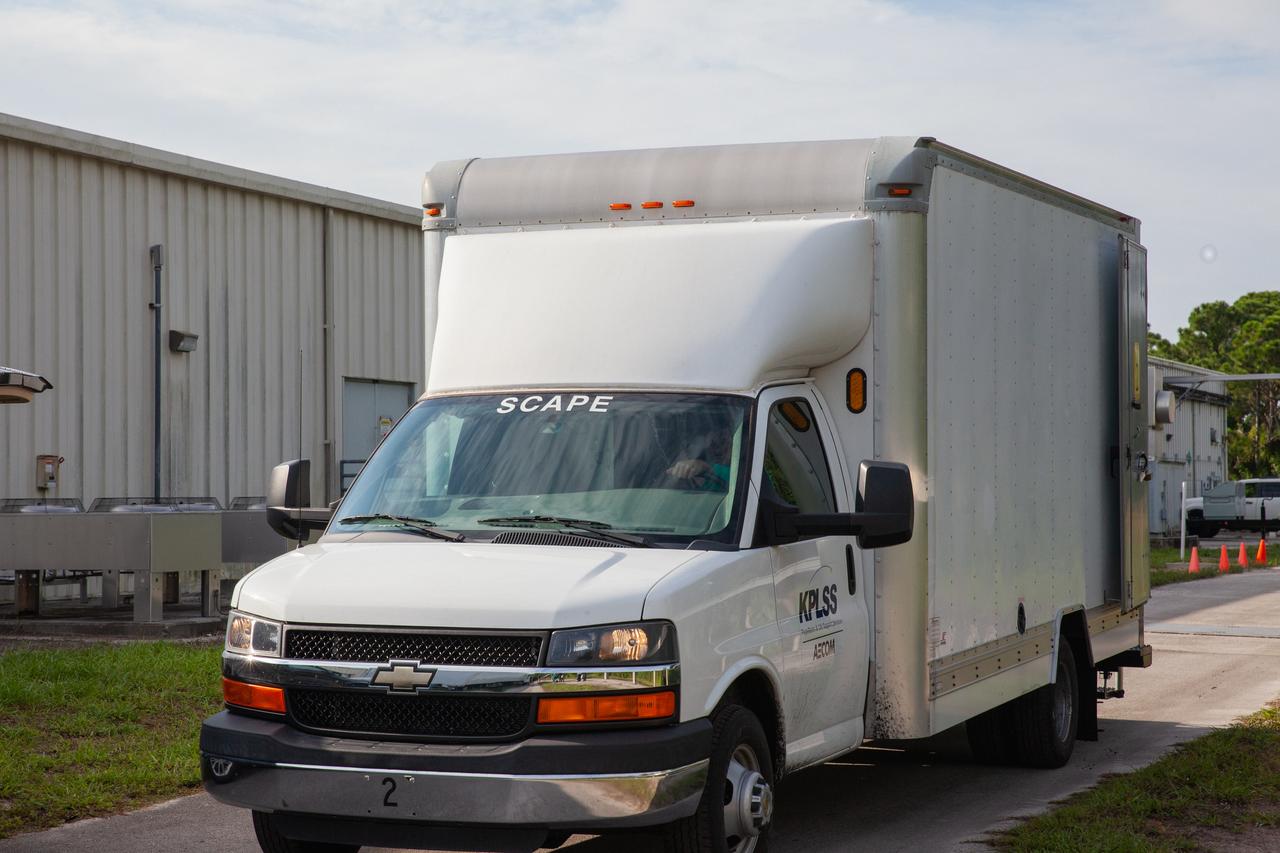
A truck transports technicians wearing Self-Contained Atmospheric Protective Ensemble (SCAPE) suits and operations support personnel to the Multi-Payload Processing Facility (MPPF) at NASA’s Kennedy Space Center in Florida, for a test simulation of loading propellants into a replicated test tank for Orion on Aug. 16, 2019. Exploration Ground Systems is preparing for Artemis 1 with a series of hazardous hyper test events at the MPPF. The technicians will complete a tanking to test the system before Orion arrives for processing. During preparations for launch, these teams will be responsible for loading the Orion vehicle with propellants prior to transportation to the Vehicle Assembly Building, where it will be secured atop the Space Launch System rocket. SCAPE suits are used in operations involving toxic propellants and are supplied with air either through a hardline or through a self-contained environmental control unit.
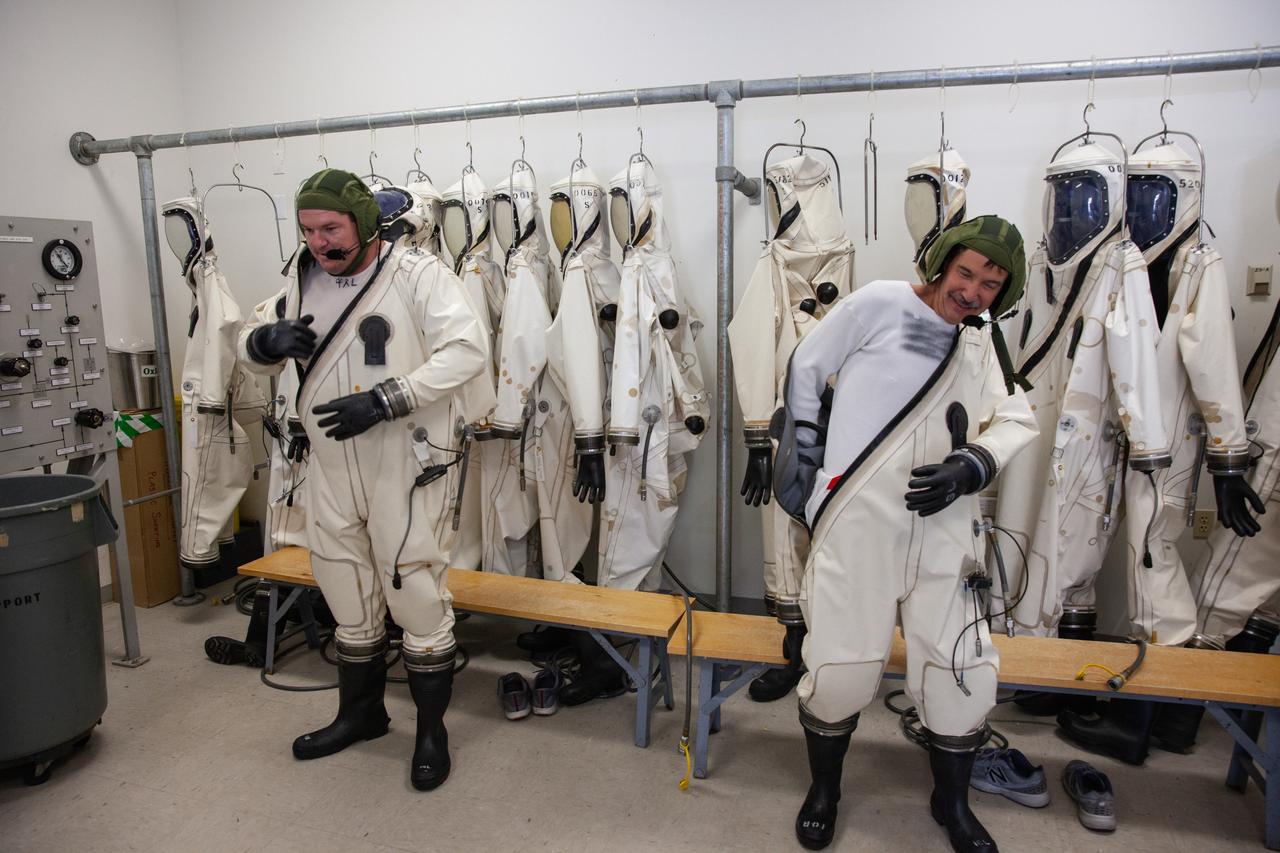
Inside the Multi-Operations Support Building near the Multi-Payload Processing Facility (MPPF) at NASA’s Kennedy Space Center in Florida, technicians put on Self-Contained Atmospheric Protective Ensemble (SCAPE) suits inside a changing room on Aug. 16, 2019. SCAPE technicians are practicing putting on the suits for a test simulation of loading propellants into a replicated test tank for Orion. Exploration Ground Systems is preparing for Artemis 1 with a series of hazardous hyper test events at the MPPF. After donning their suits, the technicians will complete a tanking to test the system before Orion arrives for processing. During preparations for launch, these teams will be responsible for loading the Orion vehicle with propellants prior to transportation to the Vehicle Assembly Building, where it will be secured atop the Space Launch System rocket. SCAPE suits are used in operations involving toxic propellants and are supplied with air either through a hardline or through a self-contained environmental control unit.
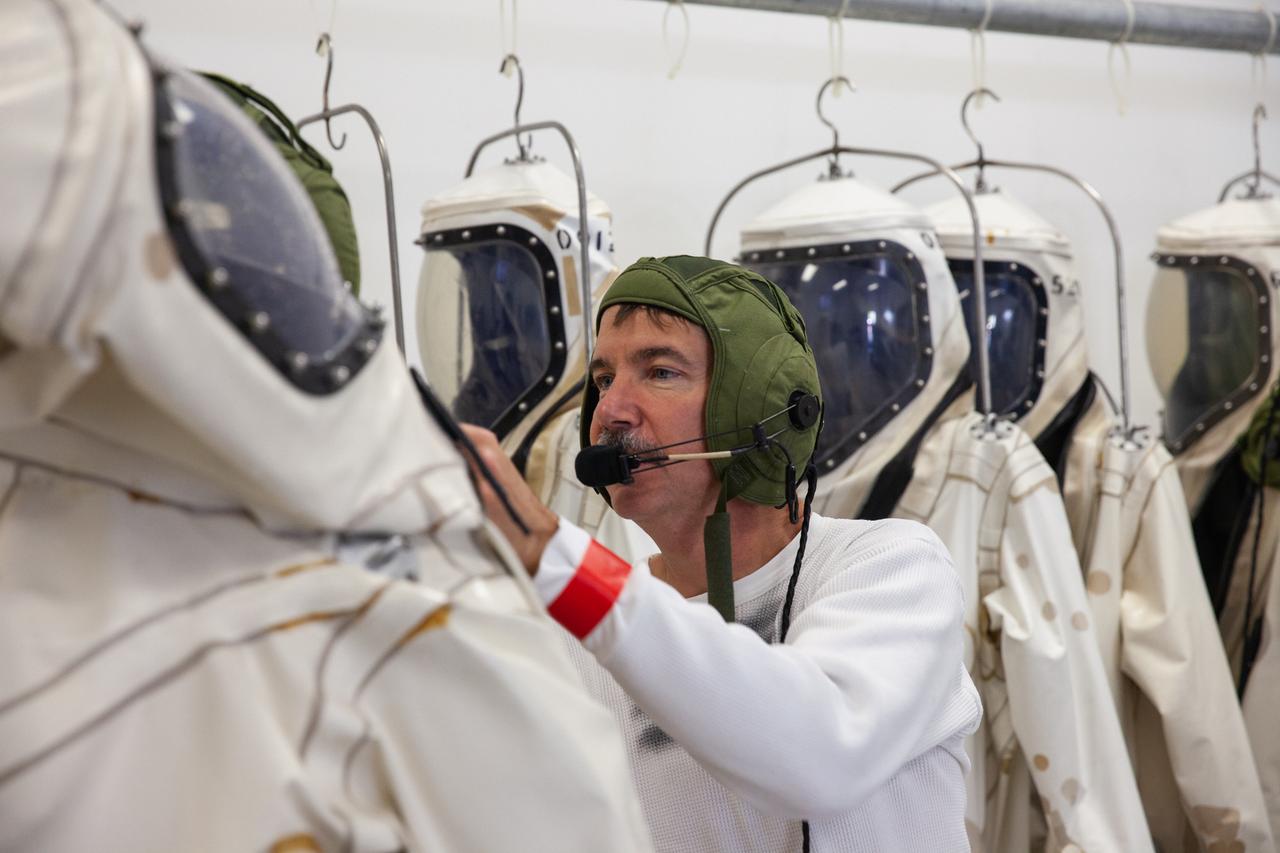
Inside the Multi-Operations Support Building near the Multi-Payload Processing Facility (MPPF) at NASA’s Kennedy Space Center in Florida, a technician prepares to put on a Self-Contained Atmospheric Protective Ensemble (SCAPE) suit inside a changing room on Aug. 16, 2019. SCAPE technicians are practicing putting on their suits for a test simulation of loading propellants into a replicated test tank for Orion. Exploration Ground Systems is preparing for Artemis 1 with a series of hazardous hyper test events at the MPPF. After donning their suits, the technicians will complete a tanking to test the system before Orion arrives for processing. During preparations for launch, these teams will be responsible for loading the Orion vehicle with propellants prior to transportation to the Vehicle Assembly Building, where it will be secured atop the Space Launch System rocket. SCAPE suits are used in operations involving toxic propellants and are supplied with air either through a hardline or through a self-contained environmental control unit.
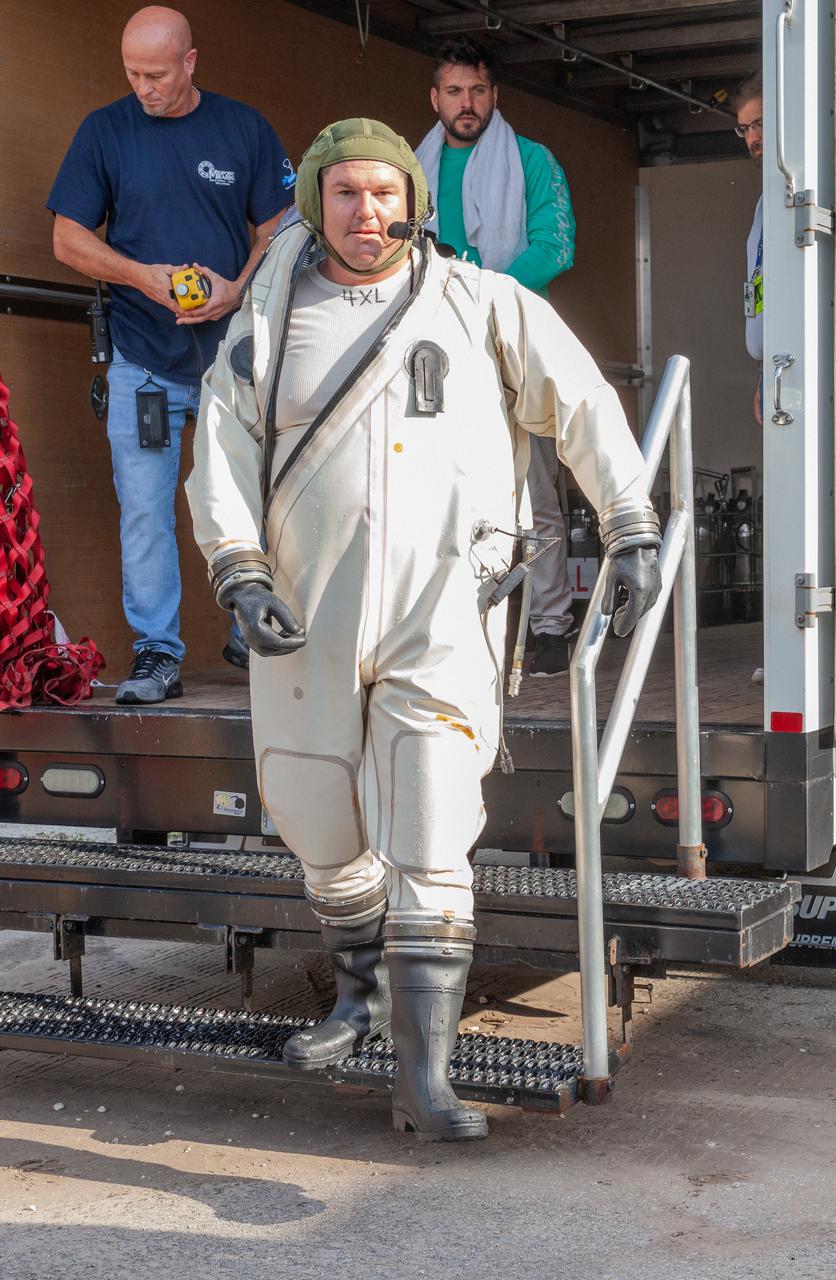
A technician in a Self-Contained Atmospheric Protective Ensemble (SCAPE) suit exits a truck near the Multi-Payload Processing Facility (MPPF) at NASA’s Kennedy Space Center in Florida on Aug. 16, 2019. SCAPE technicians are practicing by putting on the suits for a test simulation of loading propellants into a replicated test tank for Orion. Exploration Ground Systems is preparing for Artemis 1 with a series of hazardous hyper test events at the MPPF. After donning their suits, the technicians will complete a tanking to test the system before Orion arrives for processing. During preparations for launch, these teams will be responsible for loading the Orion vehicle with propellants prior to transportation to the Vehicle Assembly Building, where it will be secured atop the Space Launch System rocket. SCAPE suits are used in operations involving toxic propellants and are supplied with air either through a hardline or through a self-contained environmental control unit.
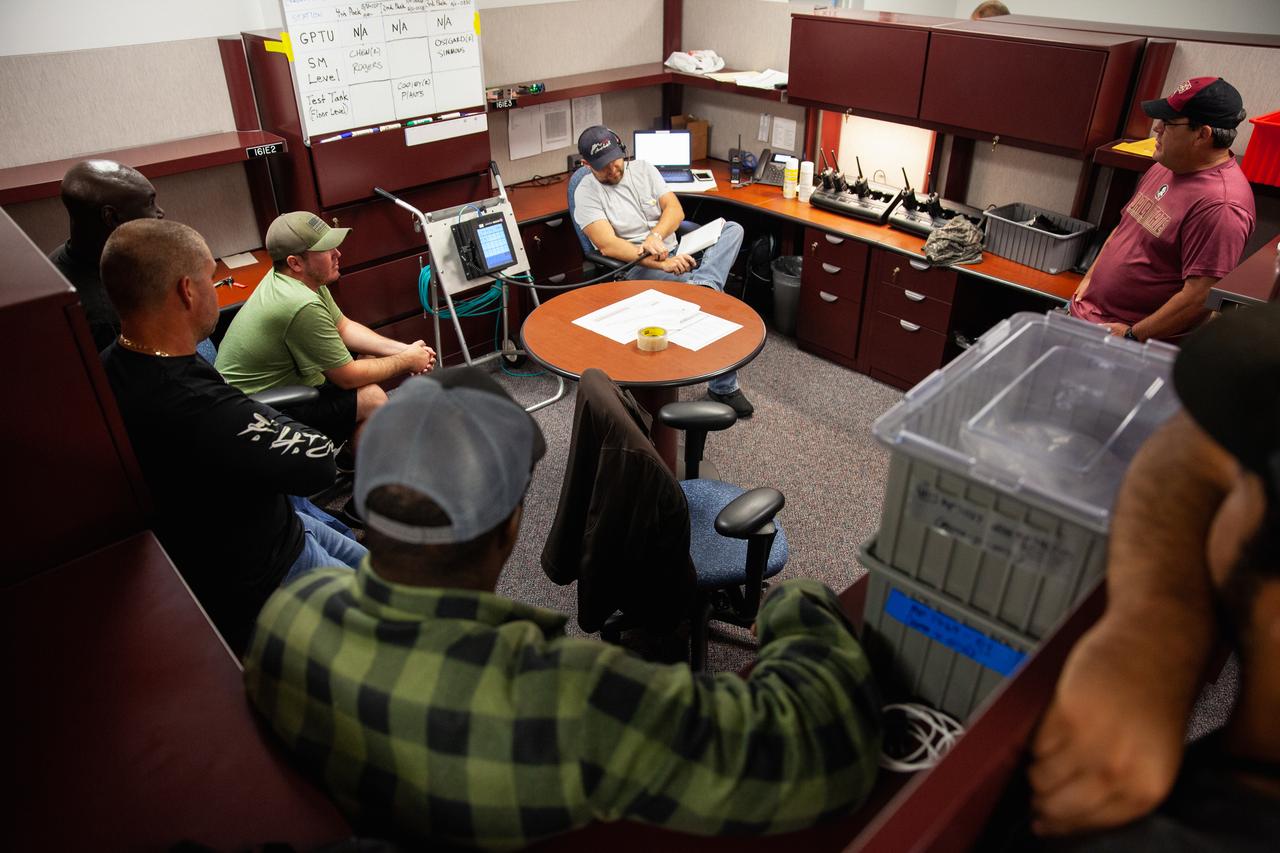
Inside the Multi-Operations Support Building near the Multi-Payload Processing Facility (MPPF) at NASA’s Kennedy Space Center in Florida, technicians and operations personnel review procedures for a test simulation of loading propellants into a replicated test tank for Orion, on Aug. 16, 2019. Exploration Ground Systems is preparing for Artemis 1 with a series of hazardous hyper test events at the MPPF. Technicians will practice putting on Self-Contained Atmospheric Protective Ensemble (SCAPE) suits and then complete tanking to test the system before Orion arrives for processing. During preparations for launch, these teams will be responsible for loading the Orion vehicle with propellants prior to transportation to the Vehicle Assembly Building, where it will be secured atop the Space Launch System rocket. SCAPE suits are used in operations involving toxic propellants and are supplied with air either through a hardline or through a self-contained environmental control unit.
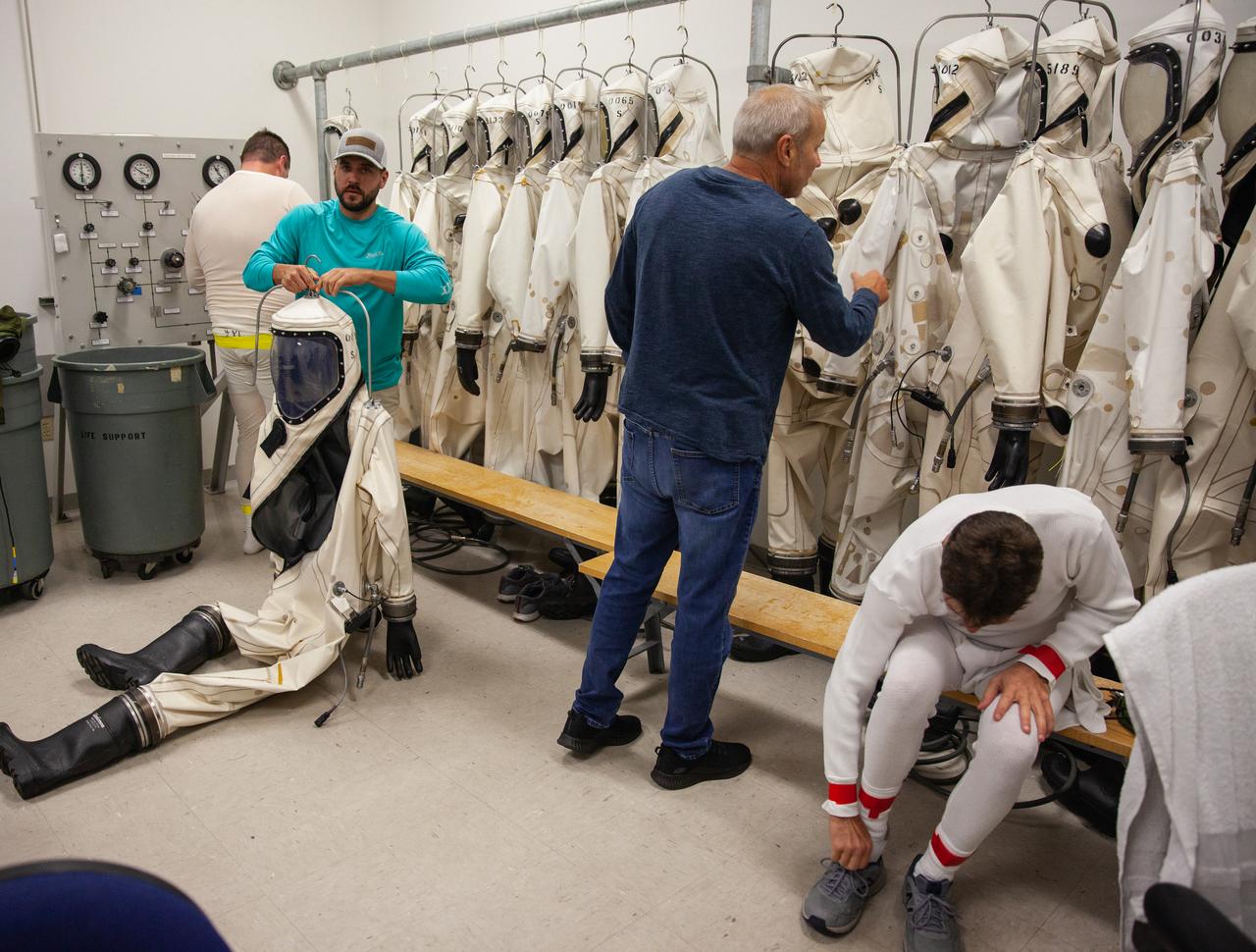
Inside the Multi-Operations Support Building near the Multi-Payload Processing Facility (MPPF) at NASA’s Kennedy Space Center in Florida, technicians are putting on Self-Contained Atmospheric Protective Ensemble (SCAPE) suits inside a changing room on Aug. 16, 2019. SCAPE technicians are practicing by putting on the suits for a test simulation of loading propellants into a replicated test tank for Orion. Exploration Ground Systems is preparing for Artemis 1 with a series of hazardous hyper test events at the MPPF. After donning their suits, the technicians will complete a tanking to test the system before Orion arrives for processing. During preparations for launch, these teams will be responsible for loading the Orion vehicle with propellants prior to transportation to the Vehicle Assembly Building, where it will be secured atop the Space Launch System rocket. SCAPE suits are used in operations involving toxic propellants and are supplied with air either through a hardline or through a self-contained environmental control unit.
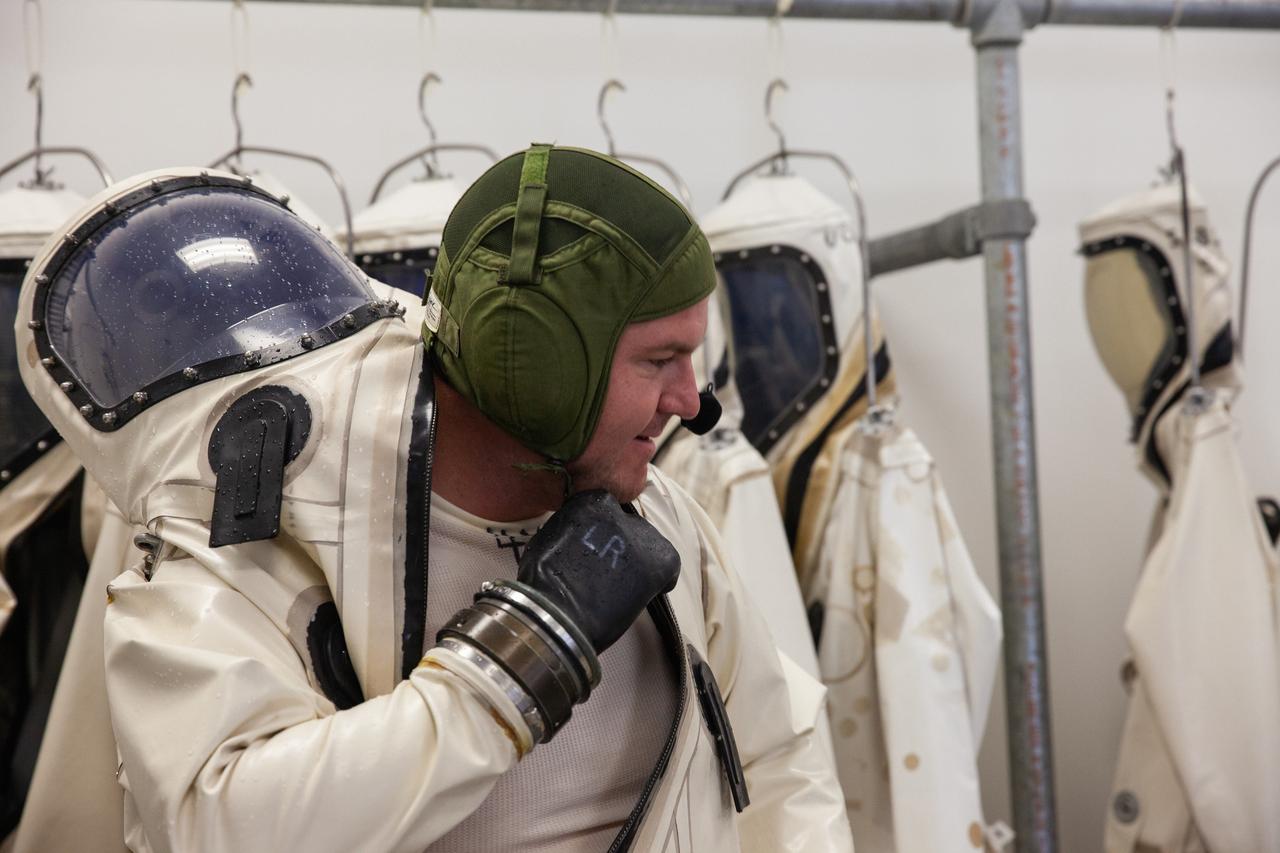
Inside the Multi-Operations Support Building near the Multi-Payload Processing Facility (MPPF) at NASA’s Kennedy Space Center in Florida, a technician puts on a Self-Contained Atmospheric Protective Ensemble (SCAPE) suit inside a changing room on Aug. 16, 2019. SCAPE technicians are practicing putting on the suits for a test simulation of loading propellants into a replicated test tank for Orion. Exploration Ground Systems is preparing for Artemis 1 with a series of hazardous hyper test events at the MPPF. After donning their suits, the technicians will complete a tanking to test the system before Orion arrives for processing. During preparations for launch, these teams will be responsible for loading the Orion vehicle with propellants prior to transportation to the Vehicle Assembly Building, where it will be secured atop the Space Launch System rocket. SCAPE suits are used in operations involving toxic propellants and are supplied with air either through a hardline or through a self-contained environmental control unit.
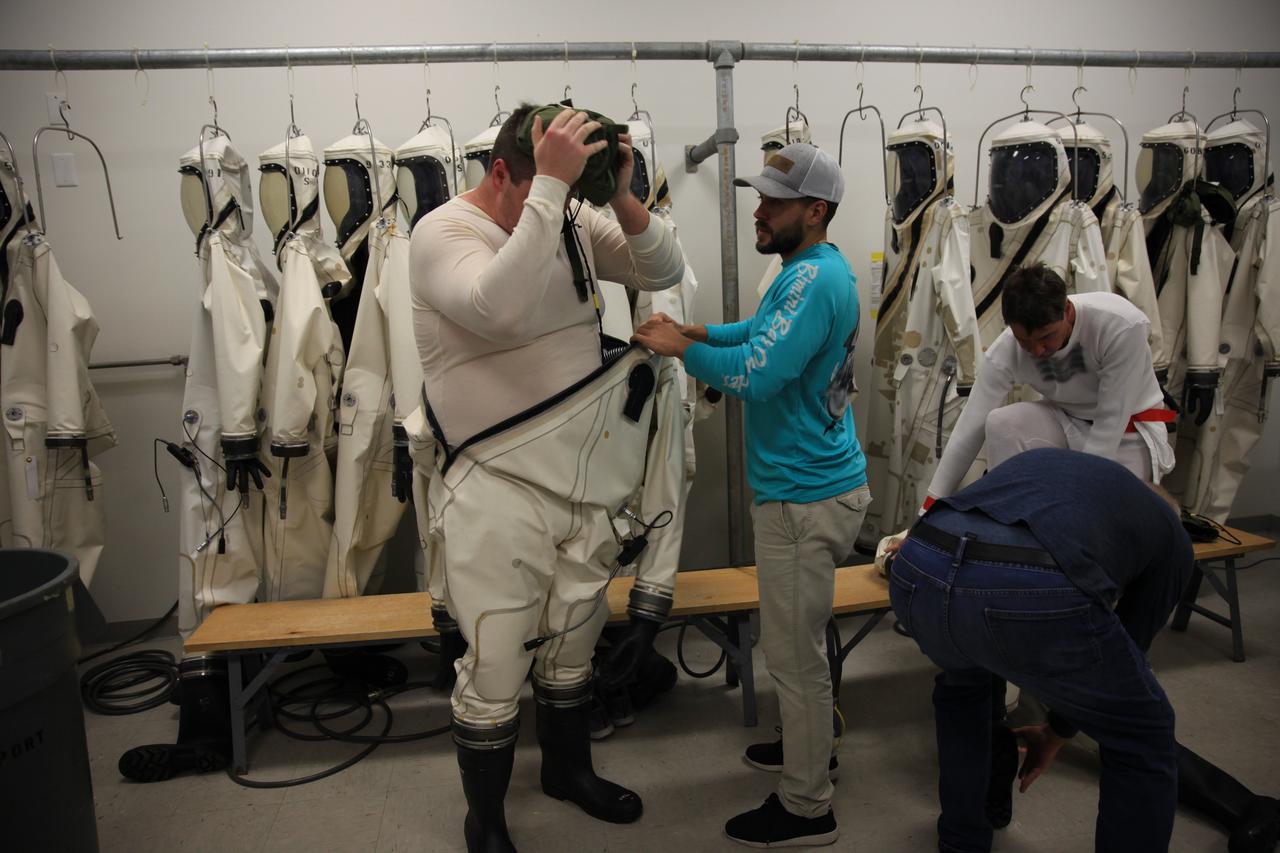
Inside the Multi-Operations Support Building near the Multi-Payload Processing Facility (MPPF) at NASA’s Kennedy Space Center in Florida, technicians put on Self-Contained Atmospheric Protective Ensemble (SCAPE) suits inside a changing room on Aug. 16, 2019. SCAPE technicians are practicing by putting on the suits for a test simulation of loading propellants into a replicated test tank for Orion. Exploration Ground Systems is preparing for Artemis 1 with a series of hazardous hyper test events at the MPPF. After donning their suits, the technicians will complete a tanking to test the system before Orion arrives for processing. During preparations for launch, these teams will be responsible for loading the Orion vehicle with propellants prior to transportation to the Vehicle Assembly Building, where it will be secured atop the Space Launch System rocket. SCAPE suits are used in operations involving toxic propellants and are supplied with air either through a hardline or through a self-contained environmental control unit.
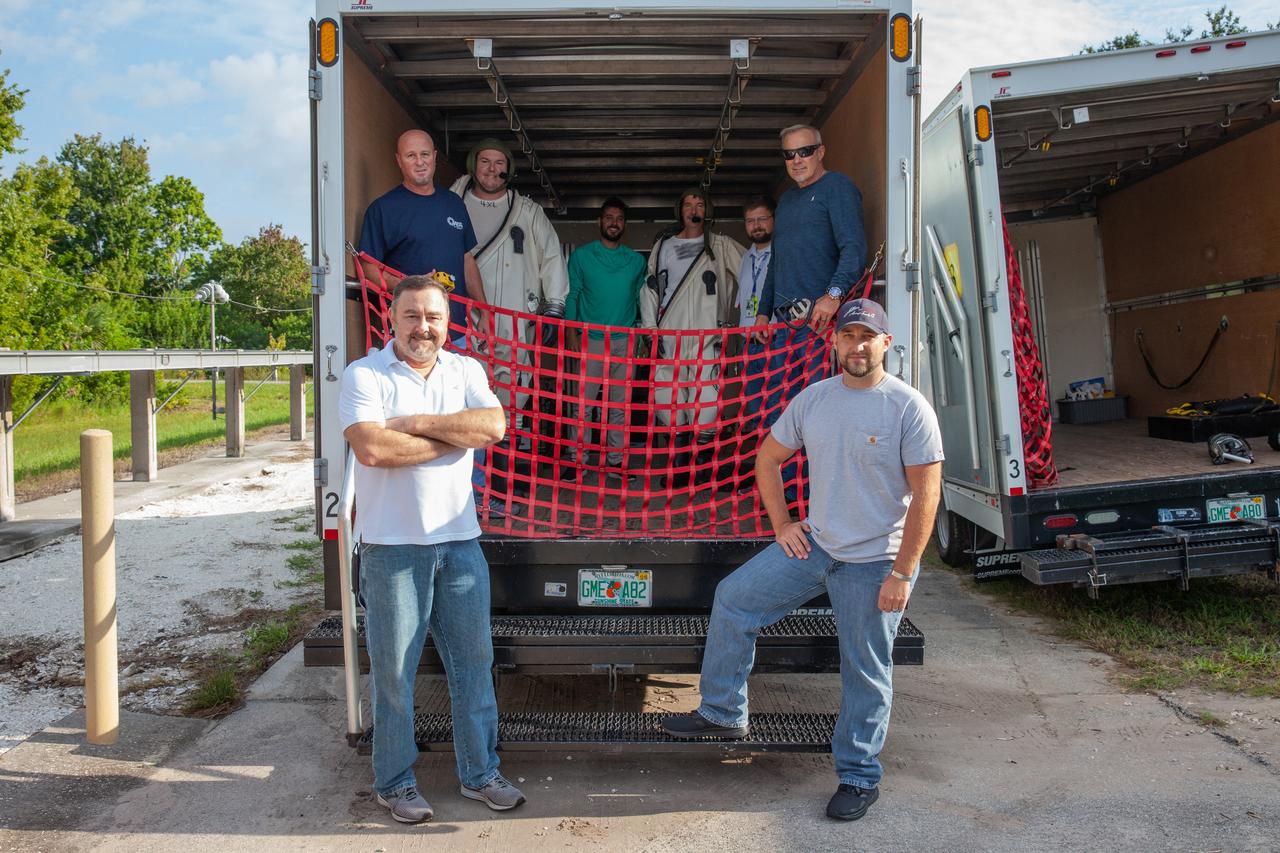
Technicians wearing Self-Contained Atmospheric Protective Ensemble (SCAPE) suits and operations support personnel prepare for a test simulation of loading propellants into a replicated test tank for Orion on Aug. 16, 2019, at NASA’s Kennedy Space Center in Florida. They are in a transport truck at the Multi-Operations Support Building near the Multi-Payload Processing Facility (MPPF). Exploration Ground Systems is preparing for Artemis 1 with a series of hazardous hyper test events at the MPPF. The technicians will complete a tanking to test the system before Orion arrives for processing. During preparations for launch, these teams will be responsible for loading the Orion vehicle with propellants prior to transportation to the Vehicle Assembly Building, where it will be secured atop the Space Launch System rocket. SCAPE suits are used in operations involving toxic propellants and are supplied with air either through a hardline or through a self-contained environmental control unit.
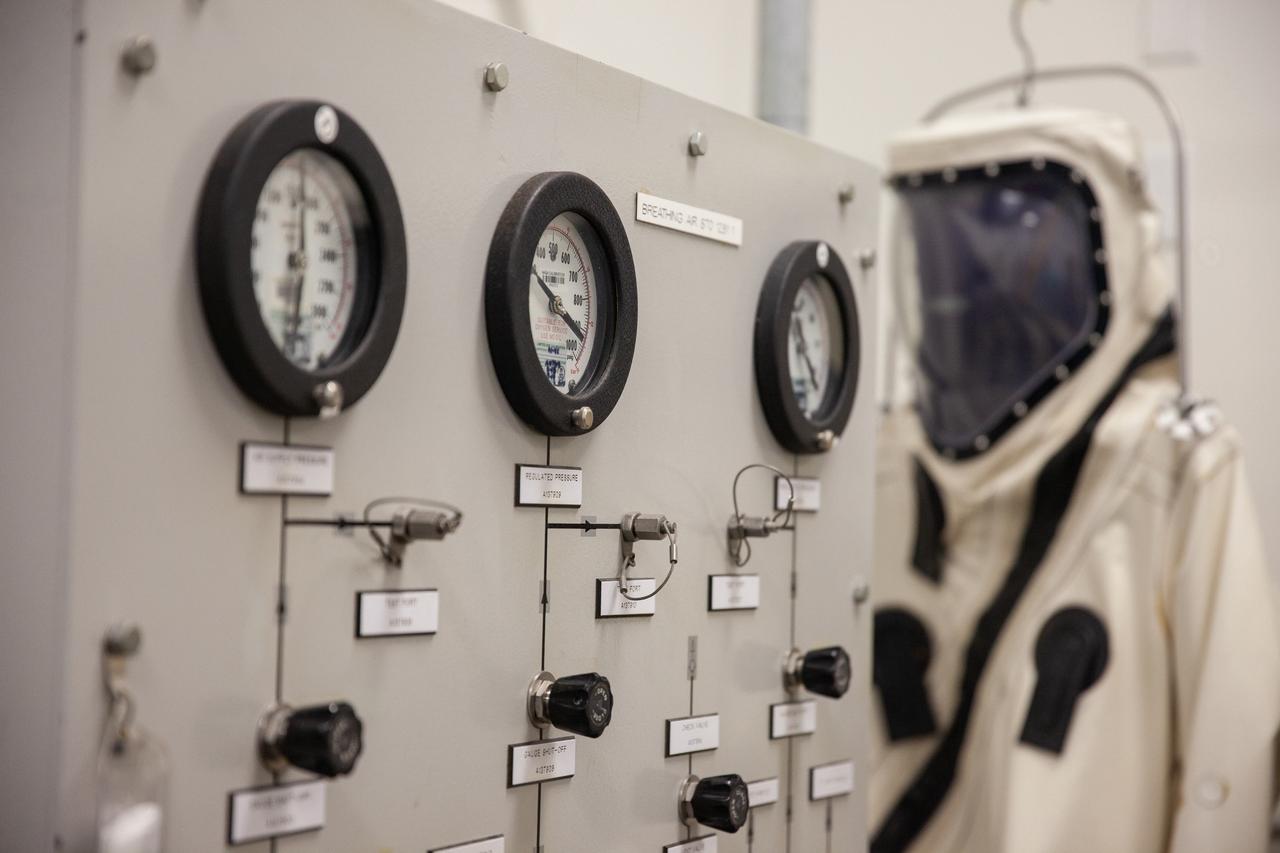
Inside the Multi-Operations Support Building near the Multi-Payload Processing Facility (MPPF) at NASA’s Kennedy Space Center in Florida on Aug. 16, 2019, a Self-Contained Atmospheric Protective Ensemble (SCAPE) suit is in view inside a changing room. SCAPE technicians are practicing putting on SCAPE suits and preparing for a test simulation of loading propellants into a replicated test tank for Orion. Exploration Ground Systems is preparing for Artemis 1 with a series of hazardous hyper test events at the MPPF. After donning their suits, the technicians will complete a tanking to test the system before Orion arrives for processing. During preparations for launch, these teams will be responsible for loading the Orion vehicle with propellants prior to transportation to the Vehicle Assembly Building, where it will be secured atop the Space Launch System rocket. SCAPE suits are used in operations involving toxic propellants and are supplied with air either through a hardline or through a self-contained environmental control unit.
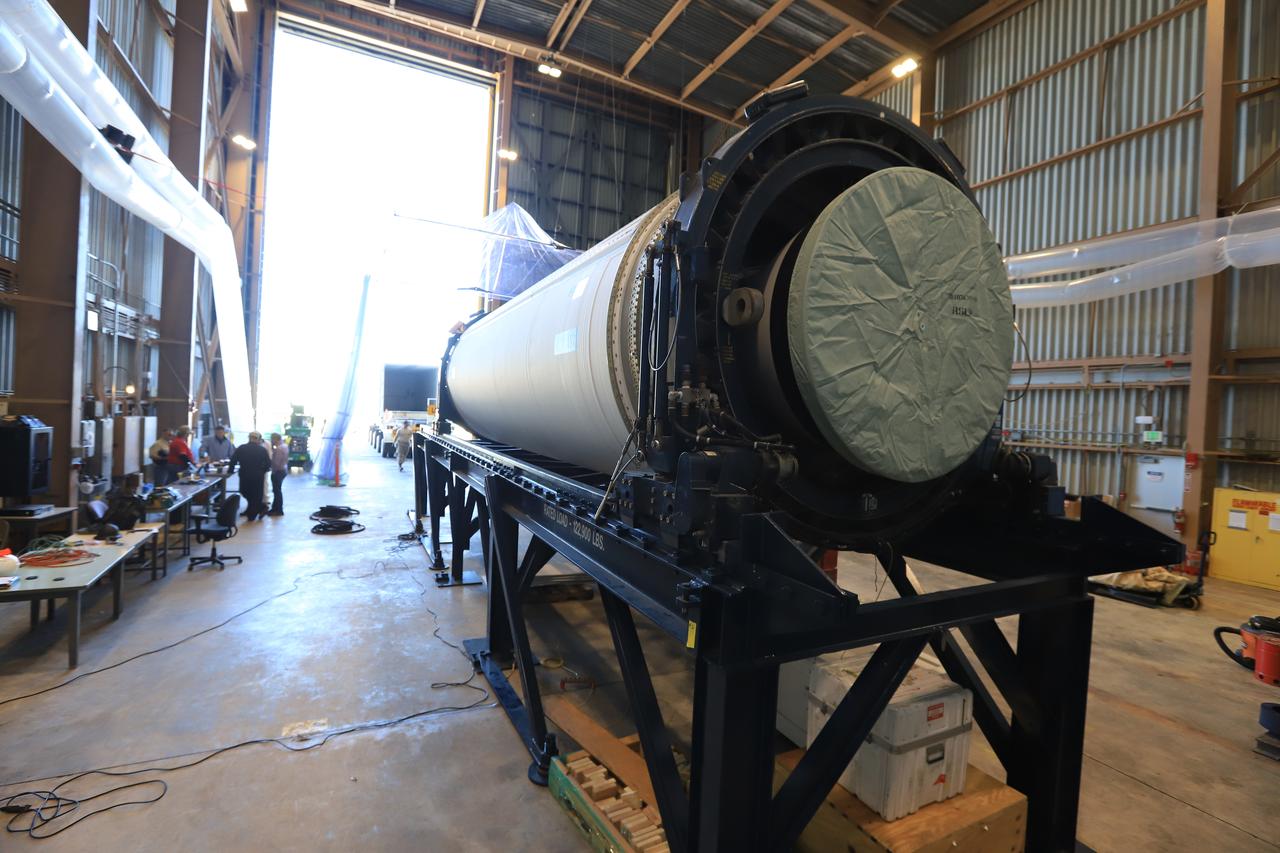
The Northrup Grumman SR118 for Ascent Abort-2 (AA-2) which is loaded with propellants moves from the Launch Abort System Facility (LASF) to the Rotation Protection and Surge Facility at Kennedy Space Center for continued flight processing on Jan. 29, 2019.
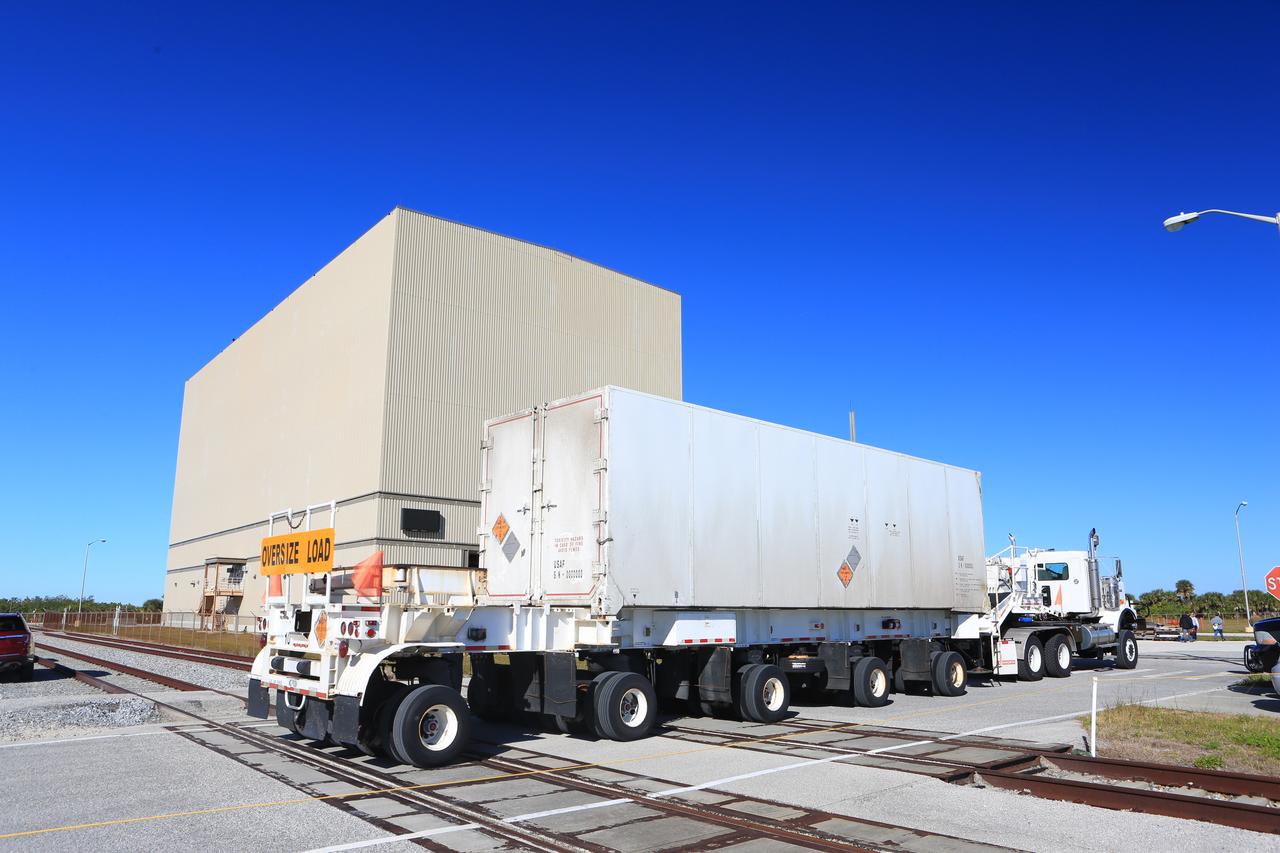
The Northrup Grumman SR118 for Ascent Abort-2 (AA-2) which is loaded with propellants moves from the Launch Abort System Facility (LASF) to the Rotation Protection and Surge Facility at Kennedy Space Center for continued flight processing on Jan. 29, 2019.
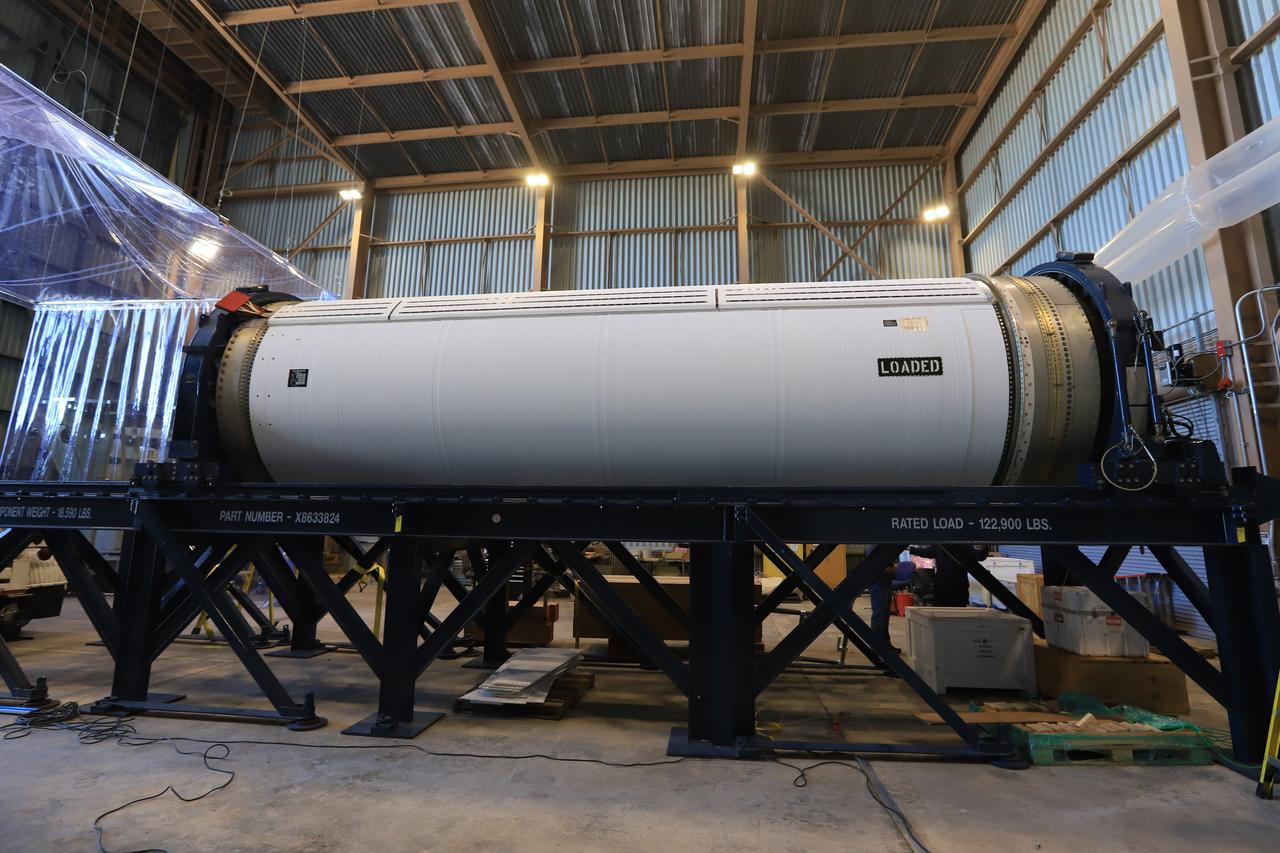
The Northrup Grumman SR118 for Ascent Abort-2 (AA-2) which is loaded with propellants moves from the Launch Abort System Facility (LASF) to the Rotation Protection and Surge Facility at Kennedy Space Center for continued flight processing on Jan. 29, 2019.

Artemis launch team members are seen in Firing Room 1 of NASA Kennedy's Launch Control Center in Florida for an Artemis III cryogenic propellant loading simulation on Wednesday, May 6, 2026. This marked the first simulation the launch team performed ahead of Artemis III.

Joshua Jones, Artemis cryogenics manager, participates in the Artemis III cryogenic propellant loading launch simulation on Wednesday, May 6, 2026, inside Firing Room 1 of the Rocco A. Petrone Launch Control Center at NASA’s Kennedy Space Center in Florida. This marked the first simulation the launch team performed ahead of Artemis III.
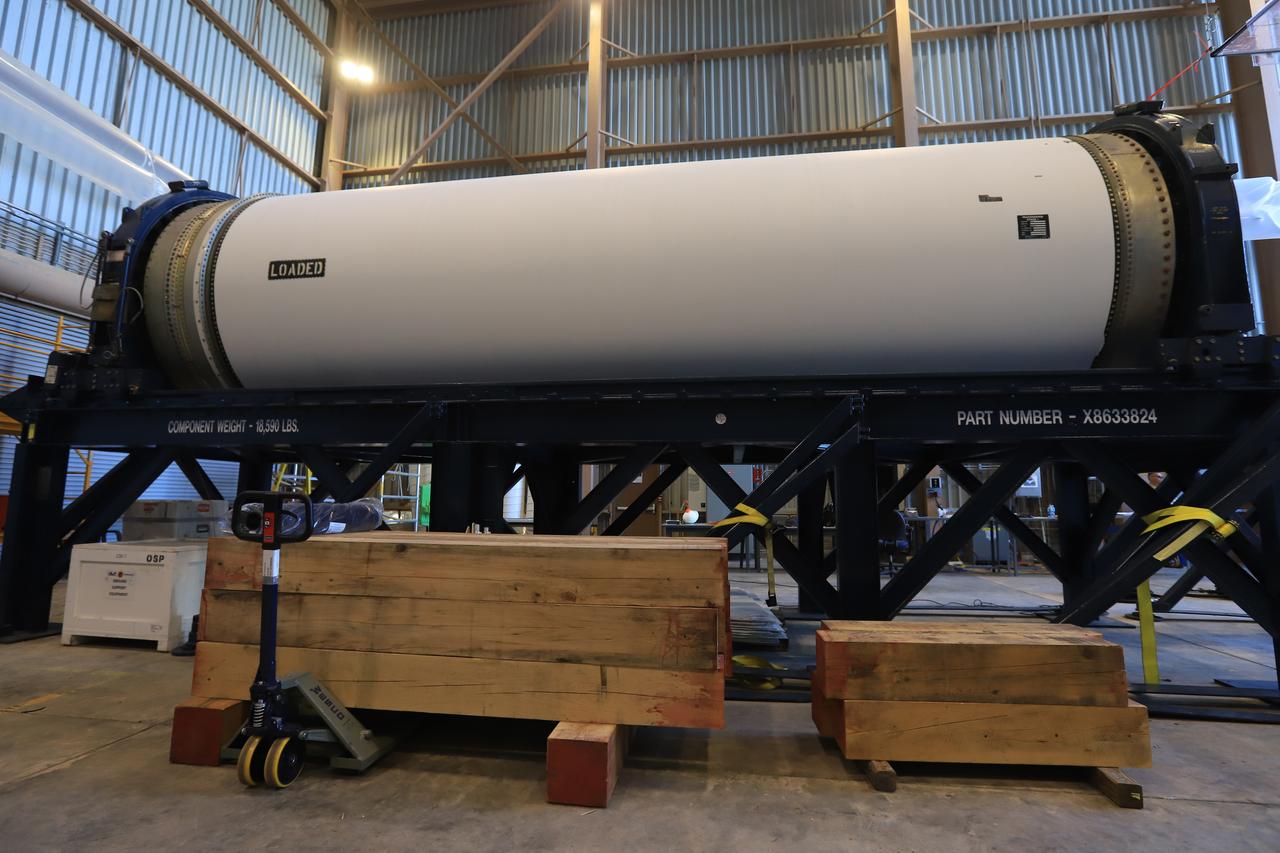
The Northrup Grumman SR118 for Ascent Abort-2 (AA-2) which is loaded with propellants moves from the Launch Abort System Facility (LASF) to the Rotation Protection and Surge Facility at Kennedy Space Center for continued flight processing on Jan. 29, 2019.

Artemis launch team members are seen in Firing Room 1 of NASA Kennedy's Launch Control Center in Florida for an Artemis III cryogenic propellant loading simulation on Wednesday, May 6, 2026. This marked the first simulation the launch team performed ahead of Artemis III.
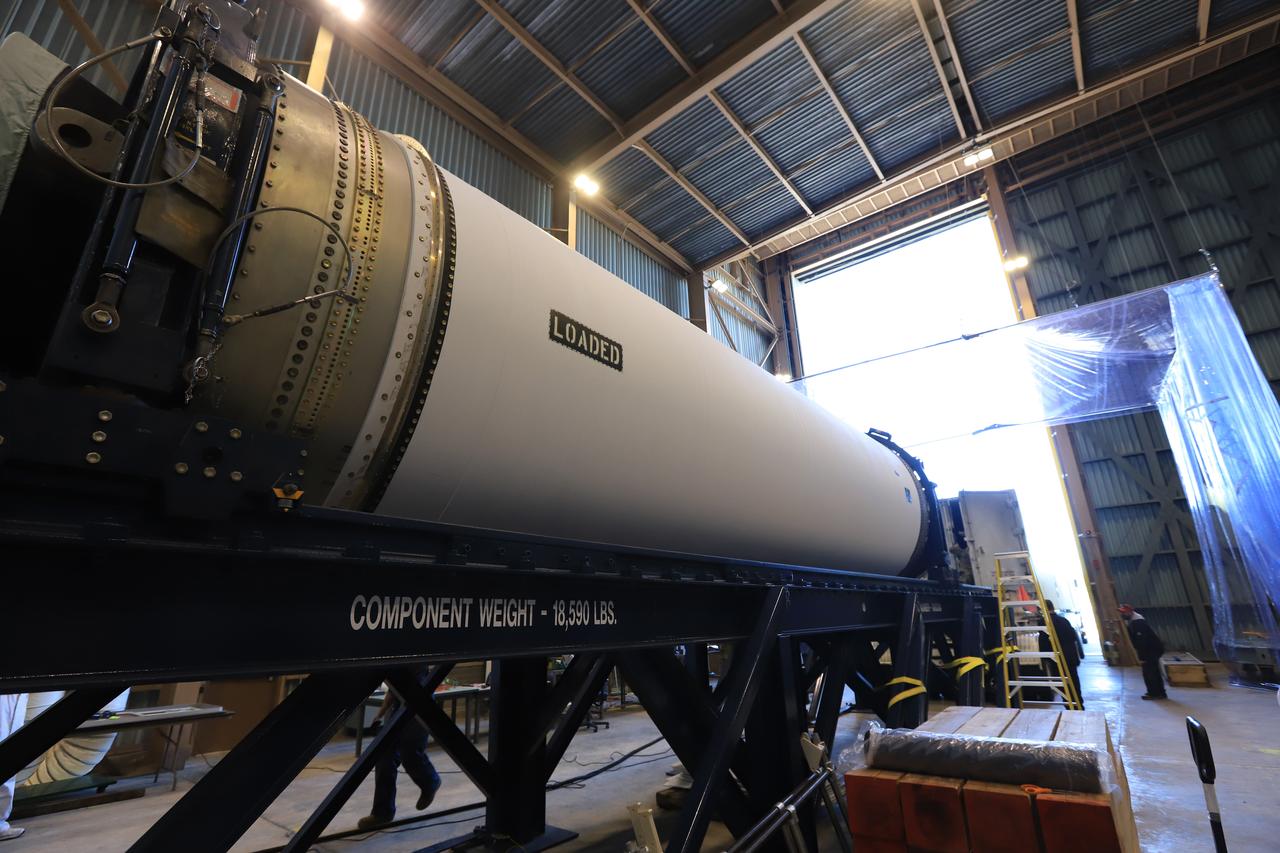
The Northrup Grumman SR118 for Ascent Abort-2 (AA-2) which is loaded with propellants moves from the Launch Abort System Facility (LASF) to the Rotation Protection and Surge Facility at Kennedy Space Center for continued flight processing on Jan. 29, 2019.
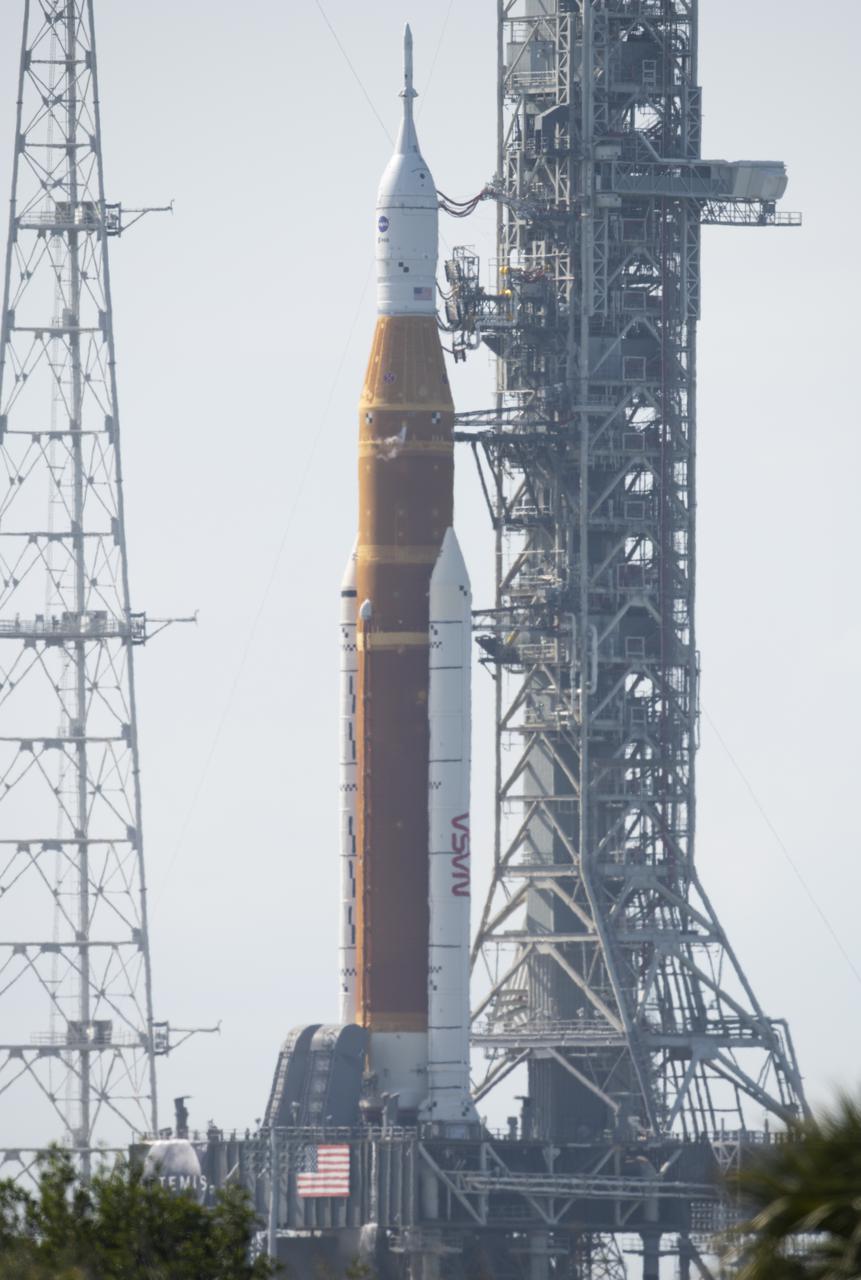
NASA’s Space Launch System (SLS) rocket with the Orion spacecraft aboard is seen atop a mobile launcher at Launch Complex 39B, Monday, April 4, 2022, as the Artemis I launch teams load more than 700,000 gallons of cryogenic propellants including liquid hydrogen and liquid oxygen during the wet dress rehearsal test at NASA’s Kennedy Space Center in Florida. Ahead of NASA’s Artemis I flight test, the wet dress rehearsal will run the Artemis I launch team through operations to load propellant, conduct a full launch countdown, demonstrate the ability to recycle the countdown clock, and drain the tanks to practice timelines and procedures for launch. Photo Credit: (NASA/Joel Kowsky)
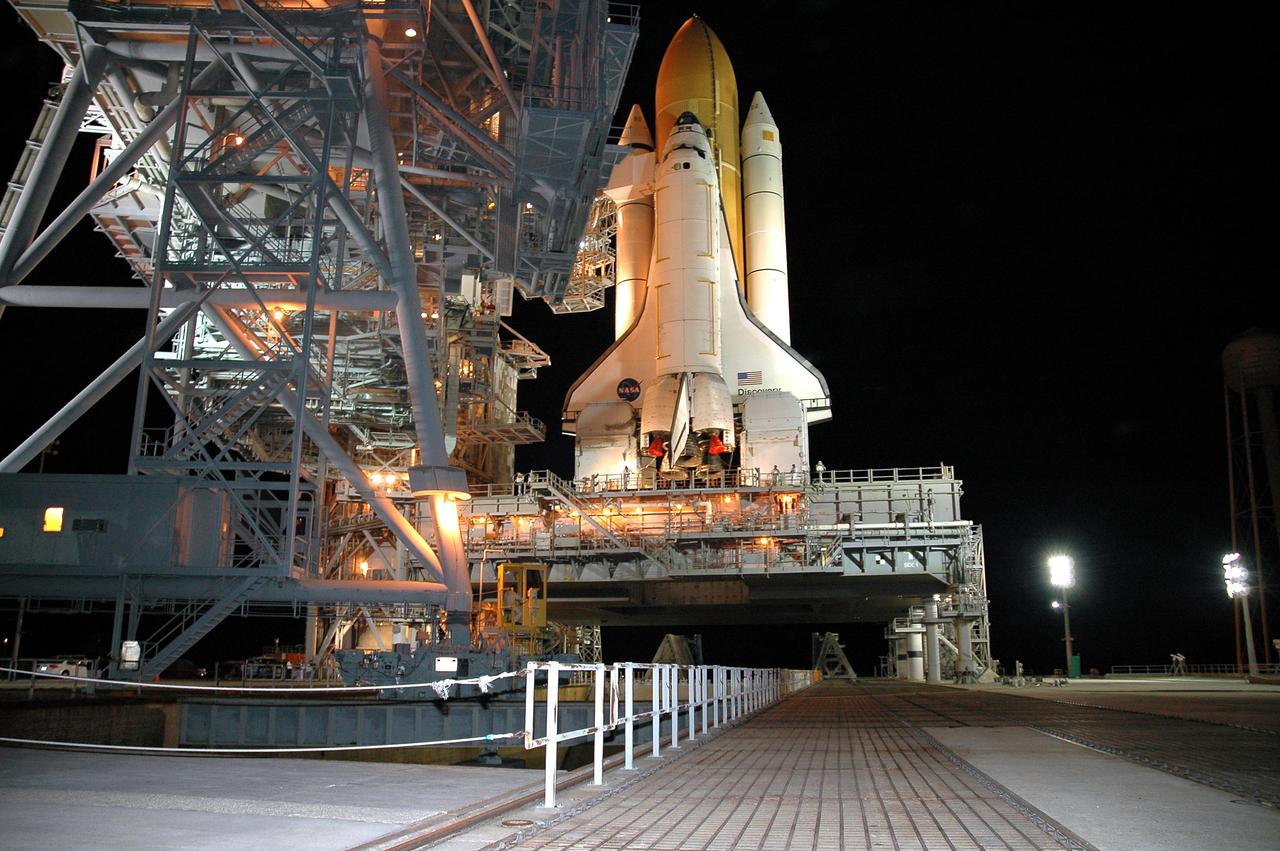
KENNEDY SPACE CENTER, FLA. -- The Rotating Service Structure is rolled back at Launch Pad 39B revealing Space Shuttle Discovery. A propellant-loading test of Discovery's External Tank (ET) is scheduled for April 14. During the test, the tank will be filled to launch levels with ultra-cold hydrogen and oxygen propellants, known as 'cryogenics.' The test is designed to evaluate how the tank, orbiter, Solid Rocket Boosters and ground systems are performing under full 'cryo-load.' Throughout testing, engineers will observe the effectiveness of key safety modifications made to the External Tank. NASA’s Return to Flight mission, STS-114 on Space Shuttle Discovery, is targeted for launch on May 15 with a launch window that extends to June 3.
KENNEDY SPACE CENTER, FLA. -- The Rotating Service Structure is rolled back at Launch Pad 39B revealing Space Shuttle Discovery. A propellant-loading test of Discovery's External Tank (ET) is scheduled for April 14. During the test, the tank will be filled to launch levels with ultra-cold hydrogen and oxygen propellants, known as 'cryogenics.' The test is designed to evaluate how the tank, orbiter, Solid Rocket Boosters and ground systems are performing under full 'cryo-load.' Throughout testing, engineers will observe the effectiveness of key safety modifications made to the External Tank. NASA’s Return to Flight mission, STS-114 on Space Shuttle Discovery, is targeted for launch on May 15 with a launch window that extends to June 3.
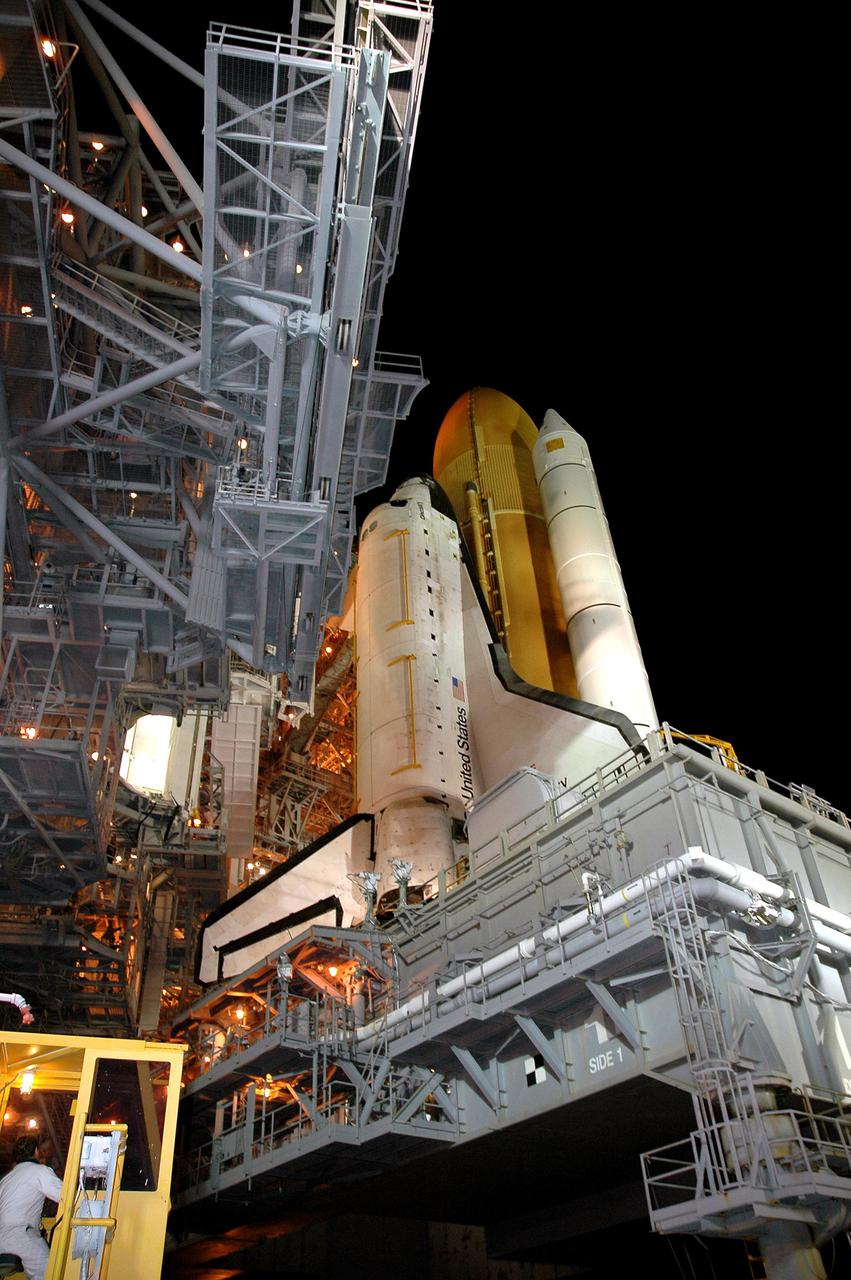
KENNEDY SPACE CENTER, FLA. -- The Rotating Service Structure is rolled back from around Space Shuttle Discovery at Launch Pad 39B for a propellant-loading test of Discovery's External Tank (ET) on April 14. During the test, the tank will be filled to launch levels with ultra-cold hydrogen and oxygen propellants, known as 'cryogenics.' The test is designed to evaluate how the tank, orbiter, Solid Rocket Boosters and ground systems are performing under full 'cryo-load.' Throughout testing, engineers will observe the effectiveness of key safety modifications made to the External Tank. NASA’s Return to Flight mission, STS-114 on Space Shuttle Discovery, is targeted for launch on May 15 with a launch window that extends to June 3.
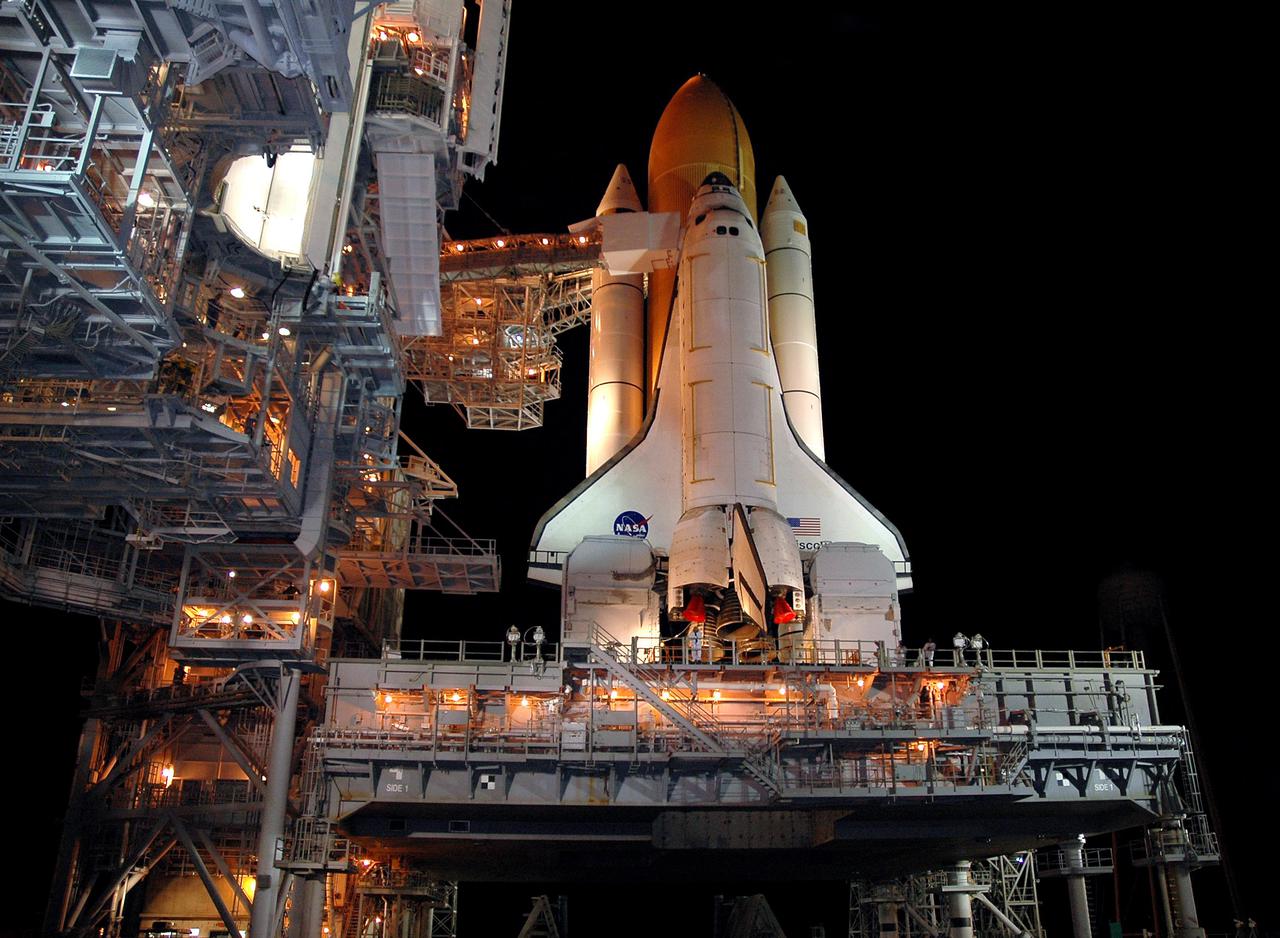
KENNEDY SPACE CENTER, FLA. -- The Rotating Service Structure is rolled back at Launch Pad 39B revealing Space Shuttle Discovery. A propellant-loading test of Discovery's External Tank (ET) is scheduled for April 14. During the test, the tank will be filled to launch levels with ultra-cold hydrogen and oxygen propellants, known as 'cryogenics.' The test is designed to evaluate how the tank, orbiter, Solid Rocket Boosters and ground systems are performing under full 'cryo-load.' Throughout testing, engineers will observe the effectiveness of key safety modifications made to the External Tank. NASA’s Return to Flight mission, STS-114 on Space Shuttle Discovery, is targeted for launch on May 15 with a launch window that extends to June 3.
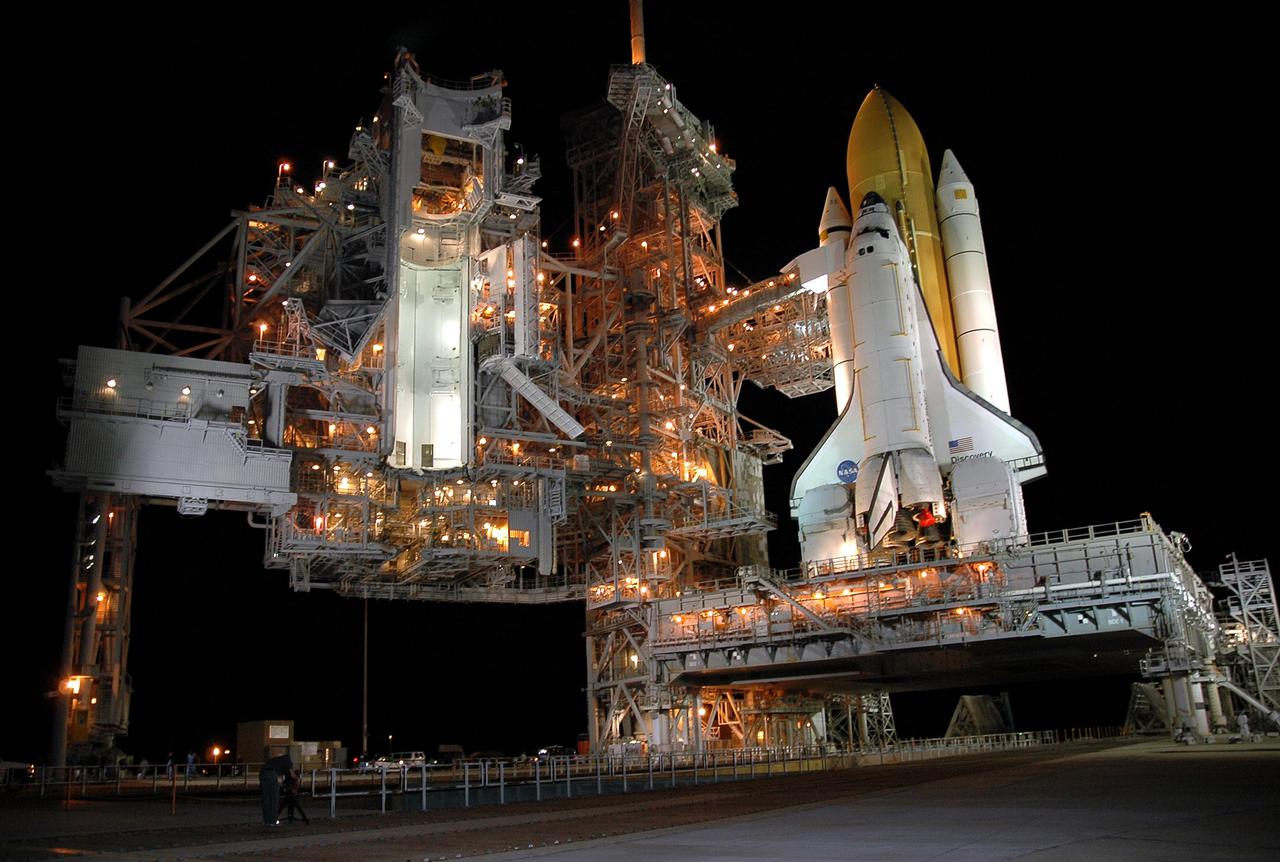
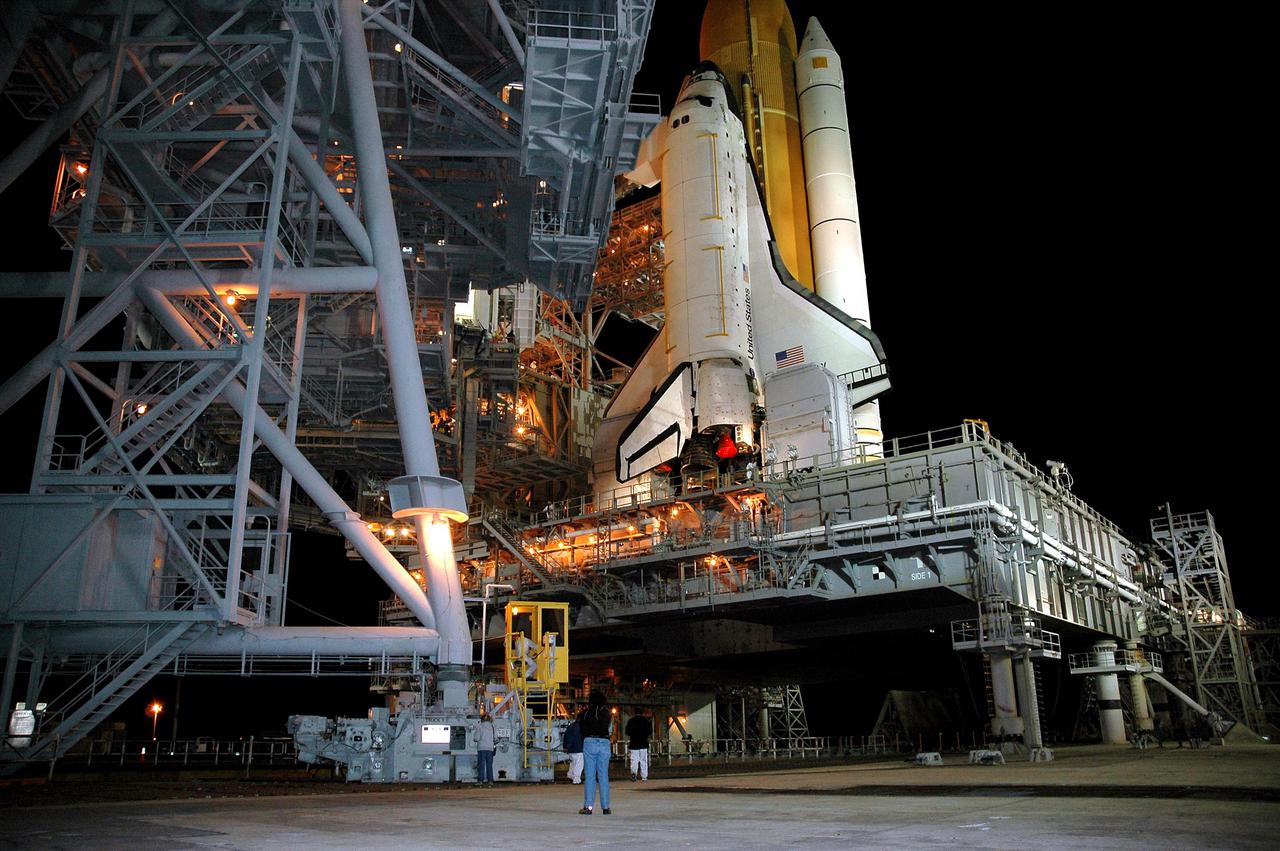
KENNEDY SPACE CENTER, FLA. -- The xenon lights on Launch Pad 39B illuminate Space Shuttle Discovery following the rollback of the Rotating Service Structure. A propellant-loading test of Discovery's External Tank (ET) is scheduled for April 14. During the test, the tank will be filled to launch levels with ultra-cold hydrogen and oxygen propellants, known as 'cryogenics.' The test is designed to evaluate how the tank, orbiter, Solid Rocket Boosters and ground systems are performing under full 'cryo-load.' Throughout testing, engineers will observe the effectiveness of key safety modifications made to the External Tank. NASA’s Return to Flight mission, STS-114 on Space Shuttle Discovery, is targeted for launch on May 15 with a launch window that extends to June 3.
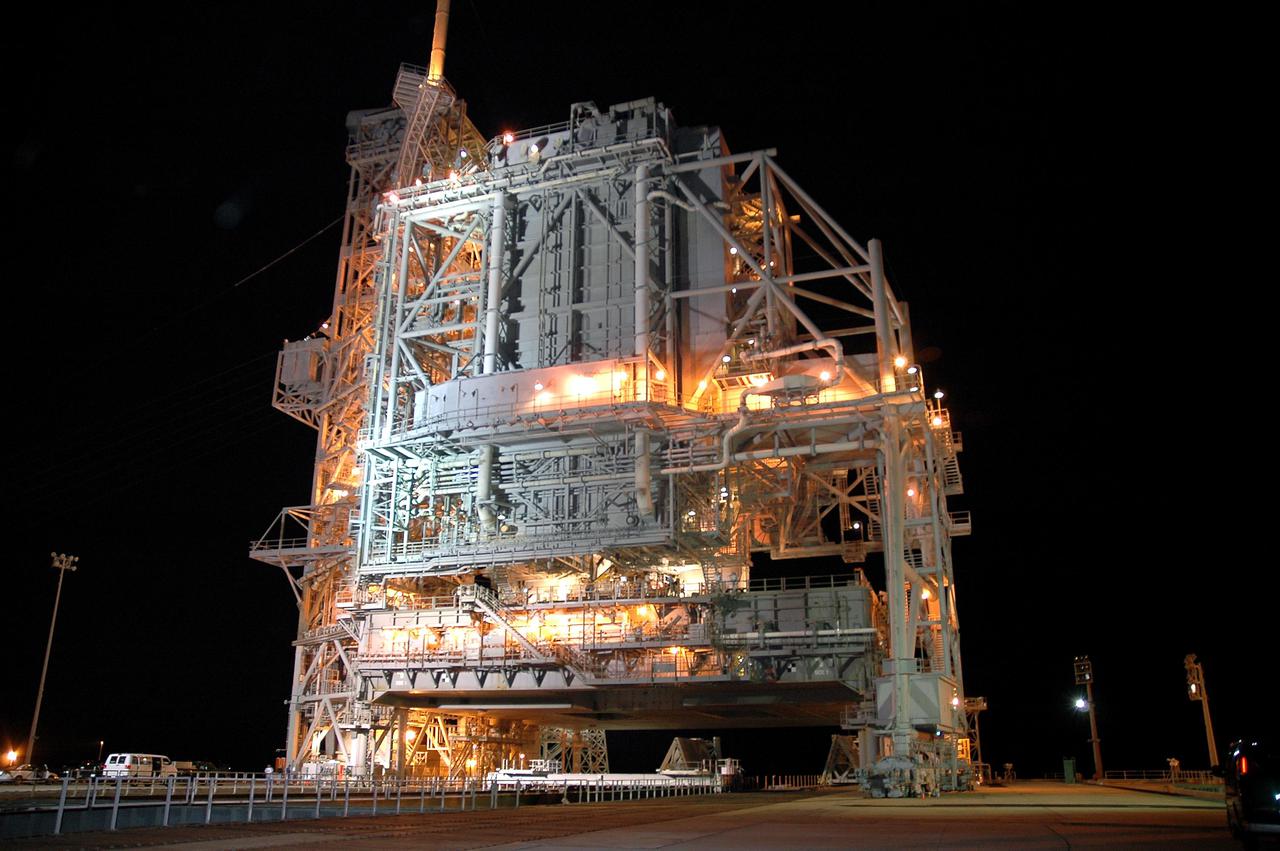
KENNEDY SPACE CENTER, FLA. -- Preparations are made to roll back the Rotating Service Structure from around Space Shuttle Discovery at Launch Pad 39B for a propellant-loading test of Discovery's External Tank (ET) on April 14. During the test, the tank will be filled to launch levels with ultra-cold hydrogen and oxygen propellants, known as 'cryogenics.' The test is designed to evaluate how the tank, orbiter, Solid Rocket Boosters and ground systems are performing under full 'cryo-load.' Throughout testing, engineers will observe the effectiveness of key safety modifications made to the External Tank. NASA’s Return to Flight mission, STS-114 on Space Shuttle Discovery, is targeted for launch on May 15 with a launch window that extends to June 3.
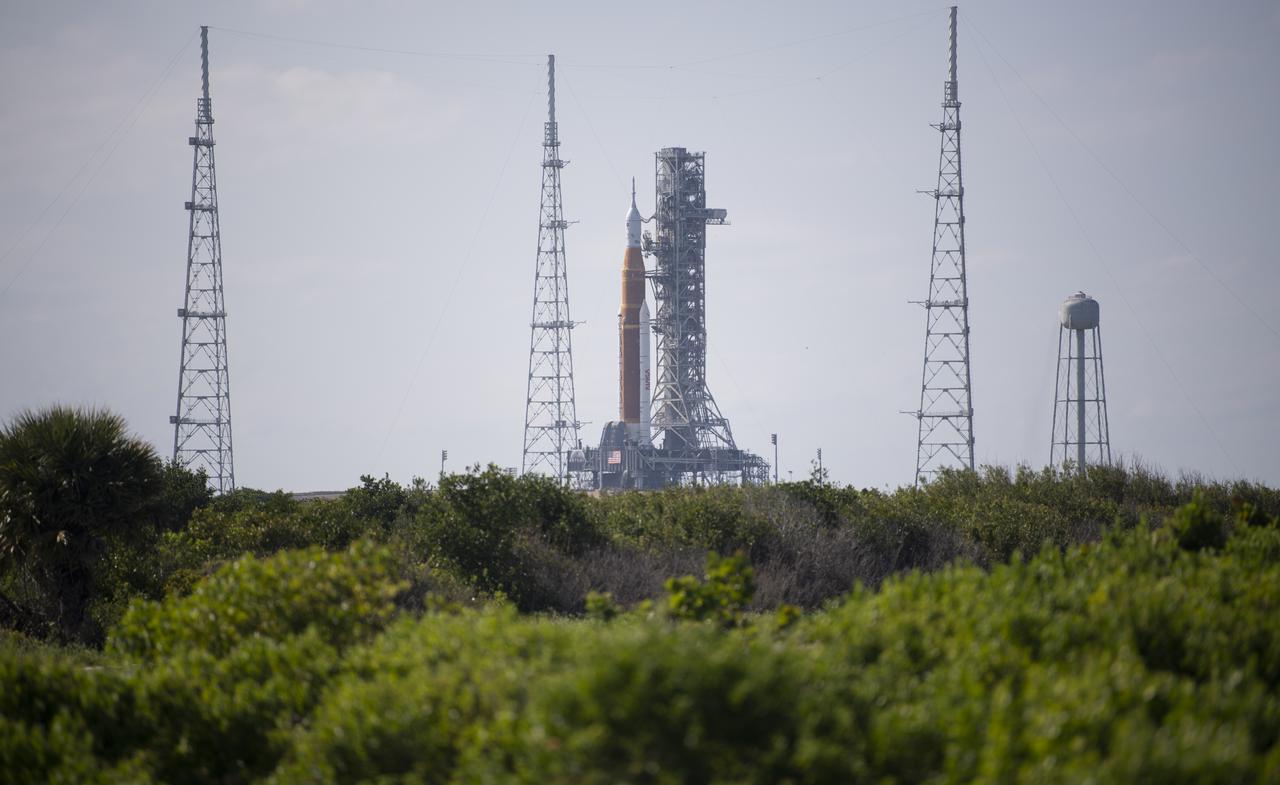
NASA’s Space Launch System (SLS) rocket with the Orion spacecraft aboard is seen atop a mobile launcher at Launch Complex 39B, Monday, April 4, 2022, as the Artemis I launch teams load more than 700,000 gallons of cryogenic propellants including liquid hydrogen and liquid oxygen during the wet dress rehearsal test at NASA’s Kennedy Space Center in Florida. Ahead of NASA’s Artemis I flight test, the wet dress rehearsal will run the Artemis I launch team through operations to load propellant, conduct a full launch countdown, demonstrate the ability to recycle the countdown clock, and drain the tanks to practice timelines and procedures for launch. Photo Credit: (NASA/Joel Kowsky)
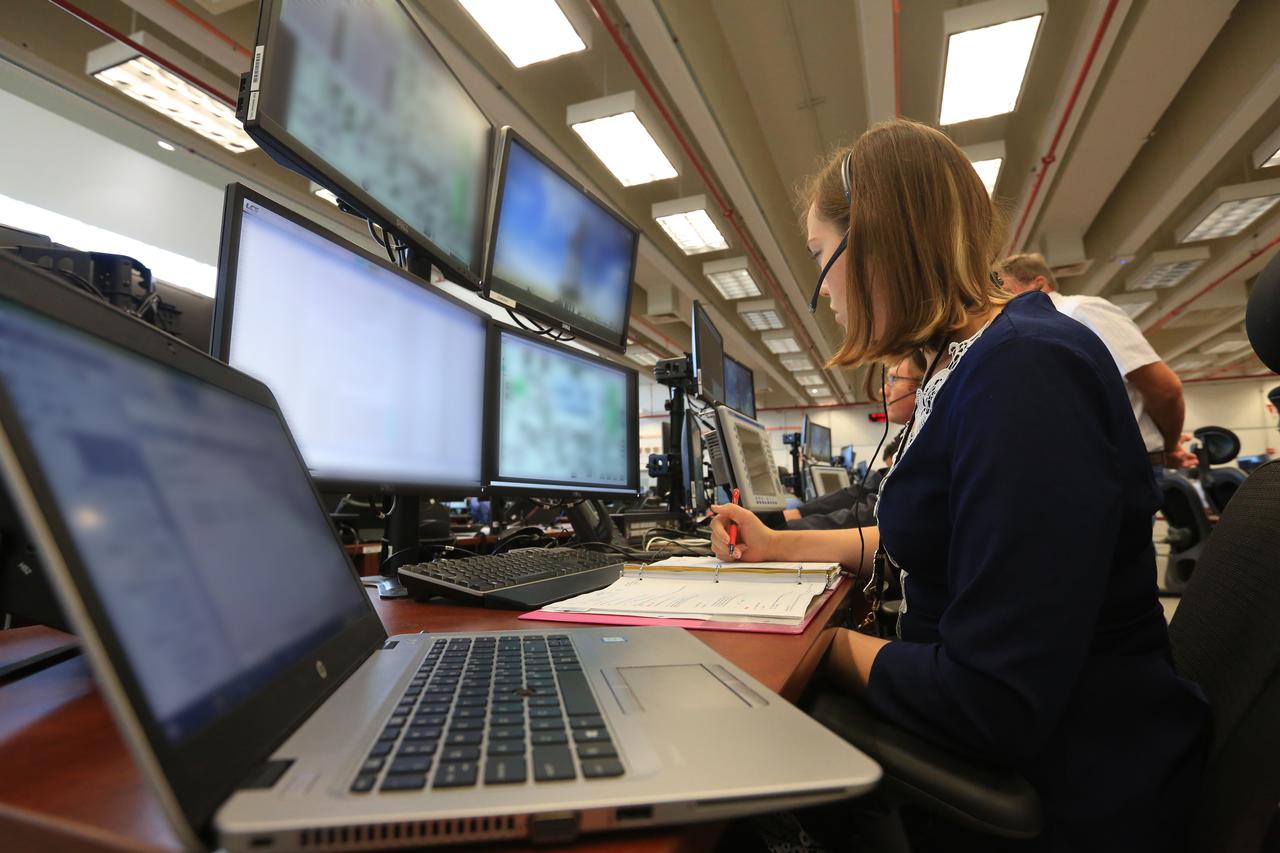
Engineers with NASA and contractor Jacobs monitor their consoles during a countdown demonstration event of cryogenic propellant loading April 12, 2019, inside Firing Room 2 in the Launch Control Center at NASA’s Kennedy Space Center in Florida. The practice simulation involved loading of liquid hydrogen and liquid oxygen into the Space Launch System rocket’s core and upper stages to prepare for Exploration Mission-1 (EM-1). During the tanking exercise, the team worked through surprise issues in real-time. The practice countdown events are training opportunities coordinated by EM-1 Launch Director Charlie Blackwell-Thompson with Exploration Ground Systems.
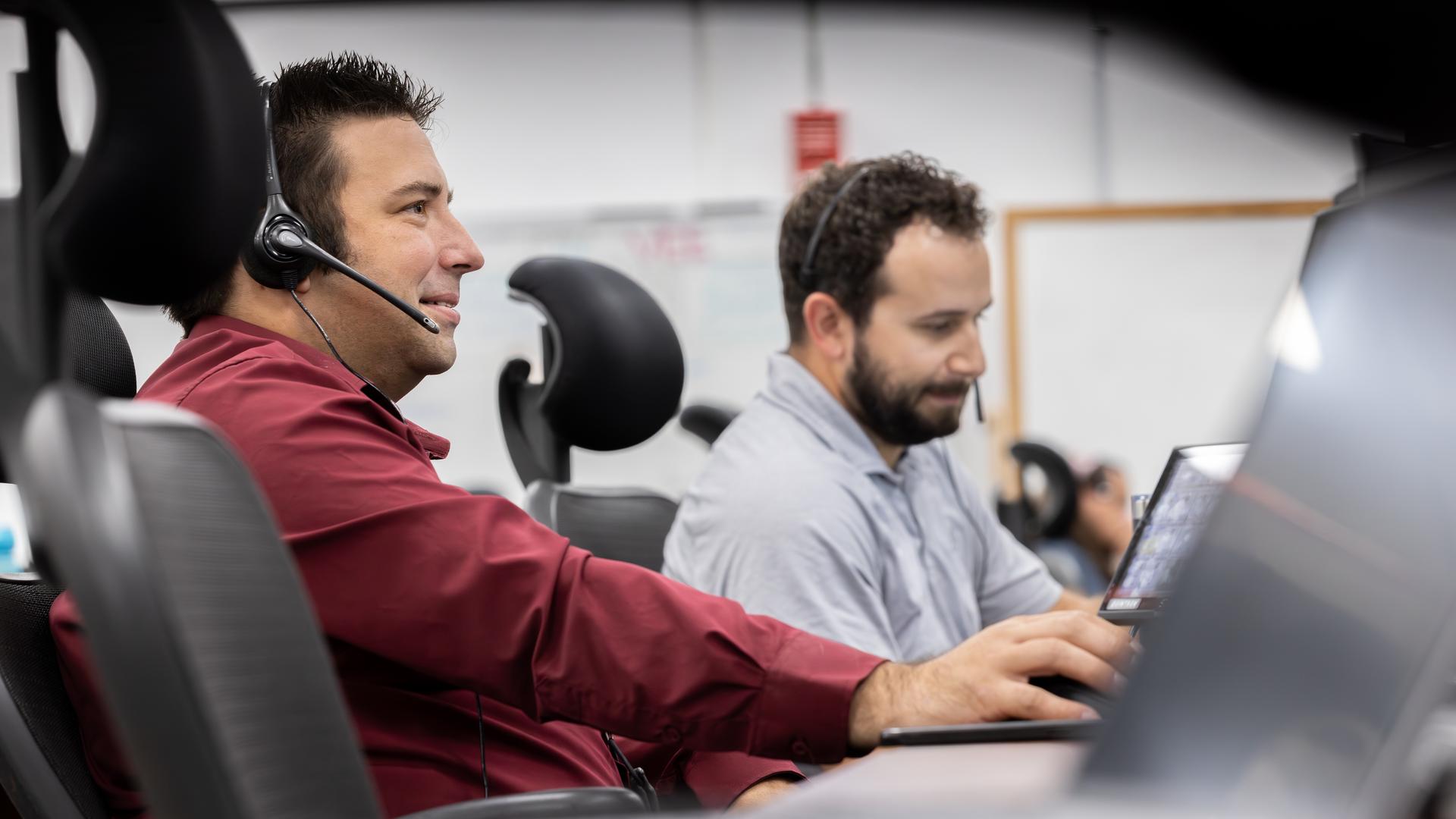
Artemis launch team members participate in a cryogenic propellant loading simulation for NASA’s Artemis III mission on Wednesday, Aug. 5, 2026, inside Firing Rooms 1 and 2 of the Rocco A. Petrone Launch Control Center at the agency’s Kennedy Space Center in Florida. Members of NASA’s Exploration Ground Systems team rehearse the steps to load the super-cooled liquid hydrogen and liquid oxygen into the SLS (Space Launch System) rocket core stage, a process that starts several hours before liftoff for the Artemis III mission. Artemis III will carry out a series of objectives in low Earth orbit designed to demonstrate critical systems needed for future lunar landings, beginning with Artemis IV.

Artemis III launch team members participate in a cryogenic propellant loading simulation on Wednesday, June 10, 2026, inside Firing Room 1 and 2 of the Rocco A. Petrone Launch Control Center at NASA’s Kennedy Space Center in Florida. Members of NASA’s Exploration Ground Systems team rehearse the steps to load the super-cooled liquid hydrogen and liquid oxygen into the SLS (Space Launch System) rocket core stage, a process that starts several hours before liftoff for the Artemis III mission. Artemis III will carry out a series of objectives in low Earth orbit designed to demonstrate critical systems needed for future lunar landings, beginning with Artemis IV.
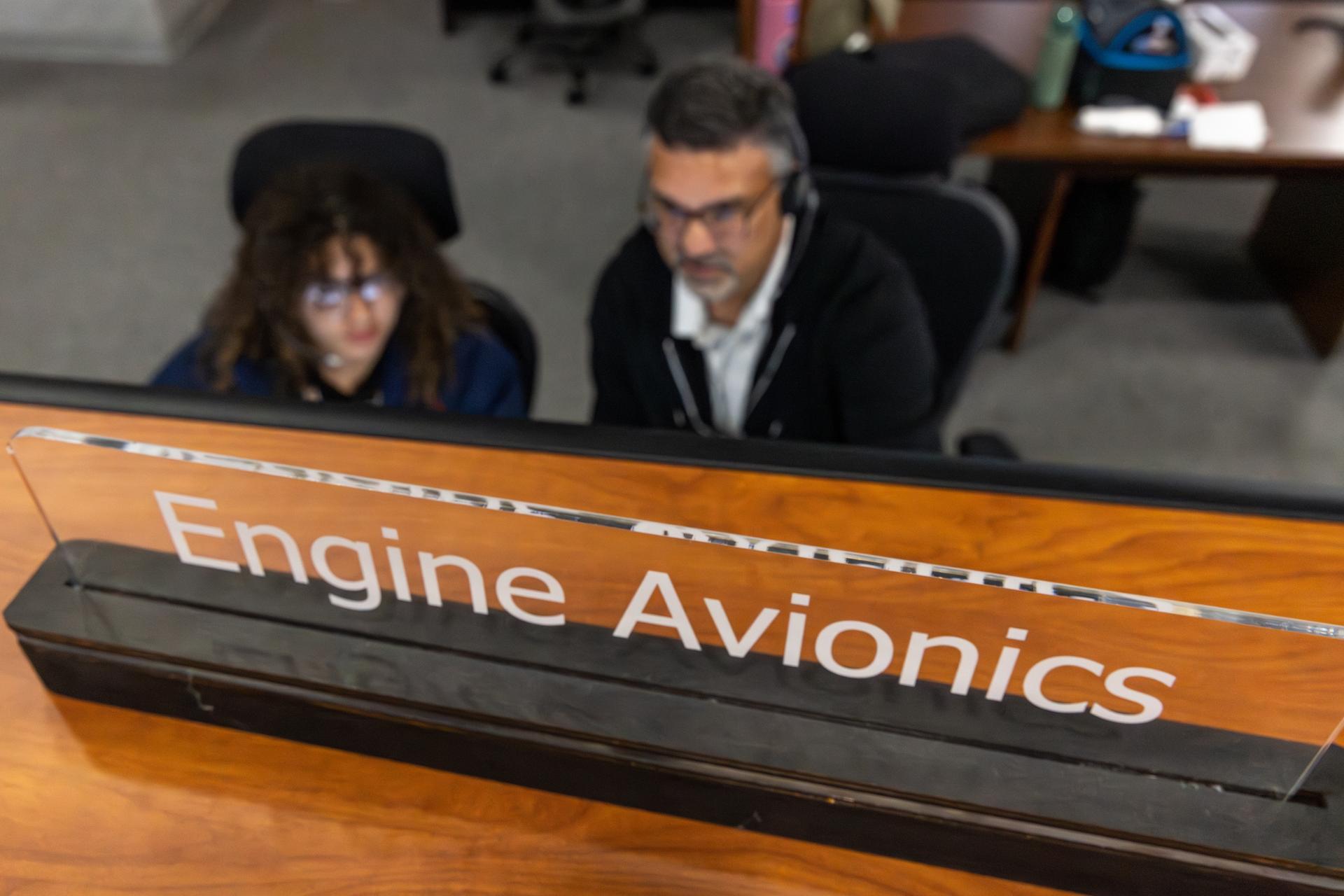
Artemis launch team members participate in a cryogenic propellant loading simulation for NASA’s Artemis III mission on Wednesday, Aug. 5, 2026, inside Firing Rooms 1 and 2 of the Rocco A. Petrone Launch Control Center at the agency’s Kennedy Space Center in Florida. Members of NASA’s Exploration Ground Systems team rehearse the steps to load the super-cooled liquid hydrogen and liquid oxygen into the SLS (Space Launch System) rocket core stage, a process that starts several hours before liftoff for the Artemis III mission. Artemis III will carry out a series of objectives in low Earth orbit designed to demonstrate critical systems needed for future lunar landings, beginning with Artemis IV.
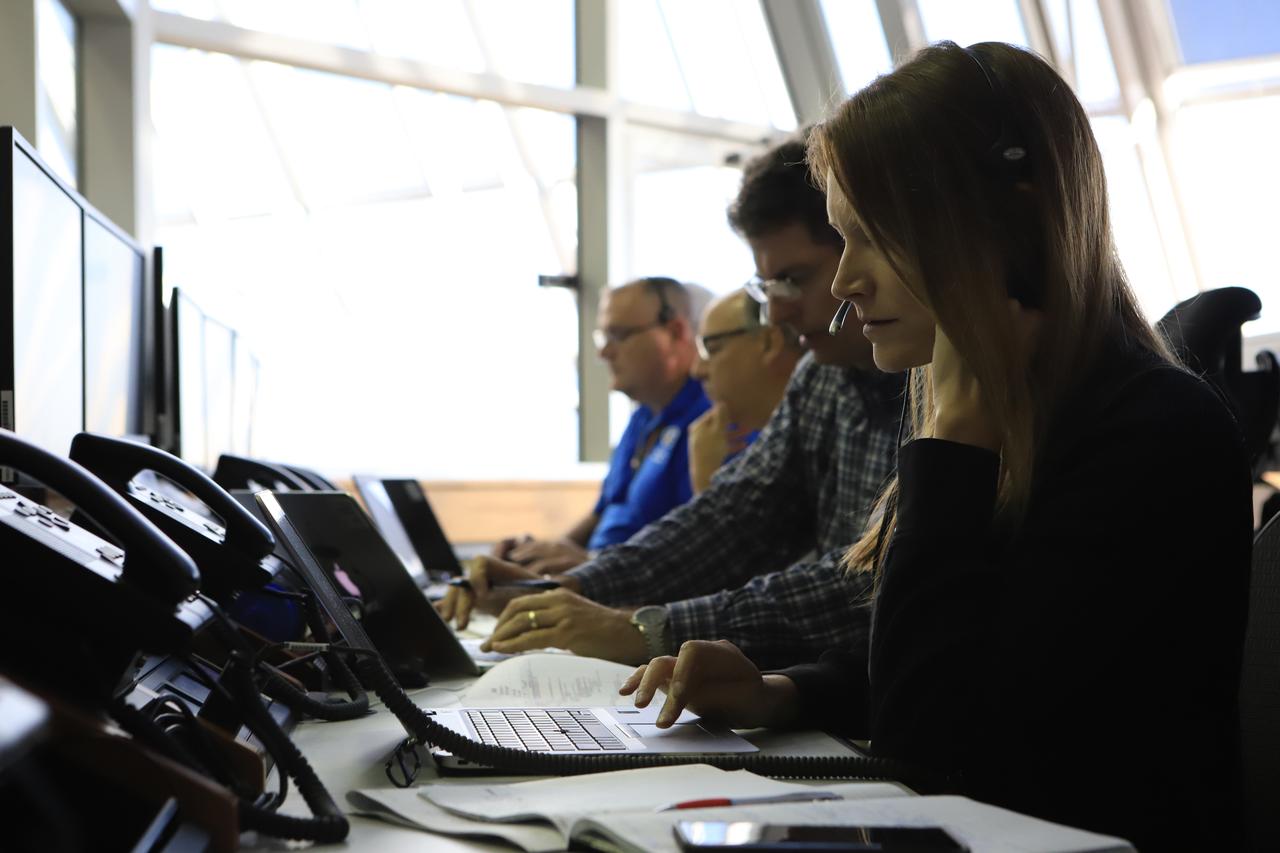
Engineers with NASA and contractor Jacobs monitor their consoles during a countdown demonstration event of cryogenic propellant loading April 12, 2019, inside Firing Room 2 in the Launch Control Center at NASA’s Kennedy Space Center in Florida. The practice simulation involved loading of liquid hydrogen and liquid oxygen into the Space Launch System rocket’s core and upper stages to prepare for Exploration Mission-1 (EM-1). During the tanking exercise, the team worked through surprise issues in real-time. The practice countdown events are training opportunities coordinated by EM-1 Launch Director Charlie Blackwell-Thompson with Exploration Ground Systems.
Charlie Blackwell-Thompson, Exploration Mission-1 (EM-1) launch director, leads a countdown demonstration event of cryogenic propellant loading April 12, 2019, inside Firing Room 2 in the Launch Control Center at NASA’s Kennedy Space Center in Florida. The practice simulation involved loading of liquid hydrogen and liquid oxygen into the Space Launch System rocket’s core and upper stages to prepare for EM-1. During the tanking exercise, the team worked through surprise issues in real-time. The practice countdown events are training opportunities coordinated by Blackwell-Thompson with Exploration Ground Systems.
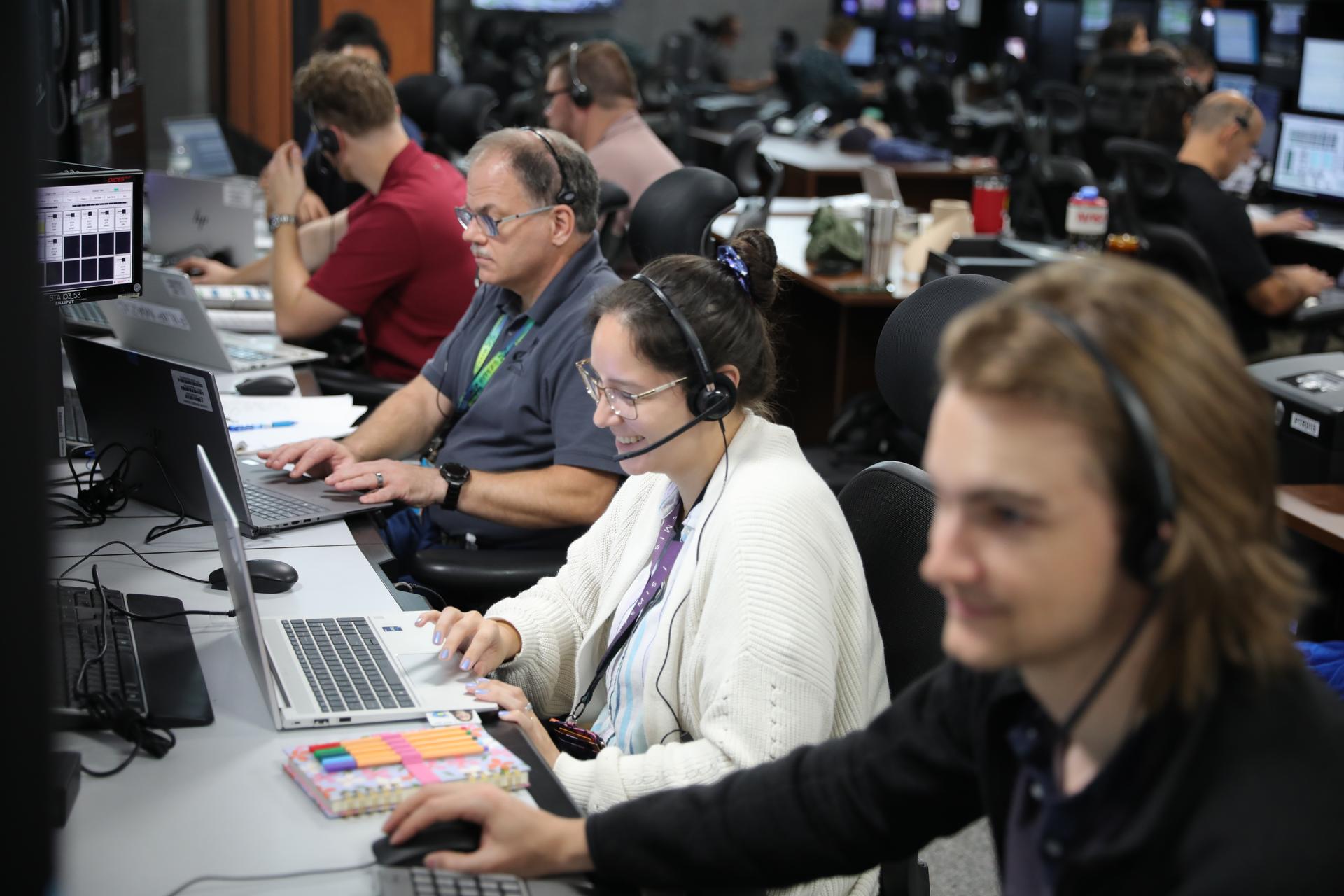
Artemis launch team members participate in a cryogenic propellant loading simulation for NASA’s Artemis III mission on Wednesday, Sept. 9, 2026, inside Firing Rooms 1 and 2 of the Rocco A. Petrone Launch Control Center at the agency’s Kennedy Space Center in Florida. Members of NASA’s Exploration Ground Systems team rehearse the steps to load the super-cooled liquid hydrogen and liquid oxygen into the SLS (Space Launch System) rocket core stage, a process that starts several hours before liftoff for the Artemis III mission. Artemis III will carry out a series of objectives in low Earth orbit designed to demonstrate critical systems needed for future lunar landings, beginning with Artemis IV.
Engineers with NASA and contractor Jacobs monitor their consoles during a countdown demonstration event of cryogenic propellant loading April 12, 2019, inside Firing Room 2 in the Launch Control Center at NASA’s Kennedy Space Center in Florida. The practice simulation involved loading of liquid hydrogen and liquid oxygen into the Space Launch System rocket’s core and upper stages to prepare for Exploration Mission-1 (EM-1). During the tanking exercise, the team worked through surprise issues in real-time. The practice countdown events are training opportunities coordinated by EM-1 Launch Director Charlie Blackwell-Thompson with Exploration Ground Systems.

Aaron Sherman, launch project engineer, participates in a cryogenic propellant loading simulation for NASA’s Artemis III mission on Wednesday, June 10, 2026, inside Firing Room 1 of the Rocco A. Petrone Launch Control Center at the agency’s Kennedy Space Center in Florida. Members of NASA’s Exploration Ground Systems team rehearse the steps to load the super-cooled liquid hydrogen and liquid oxygen into the SLS (Space Launch System) rocket core stage, a process that starts several hours before liftoff for the Artemis III mission. Artemis III will carry out a series of objectives in low Earth orbit designed to demonstrate critical systems needed for future lunar landings, beginning with Artemis IV.
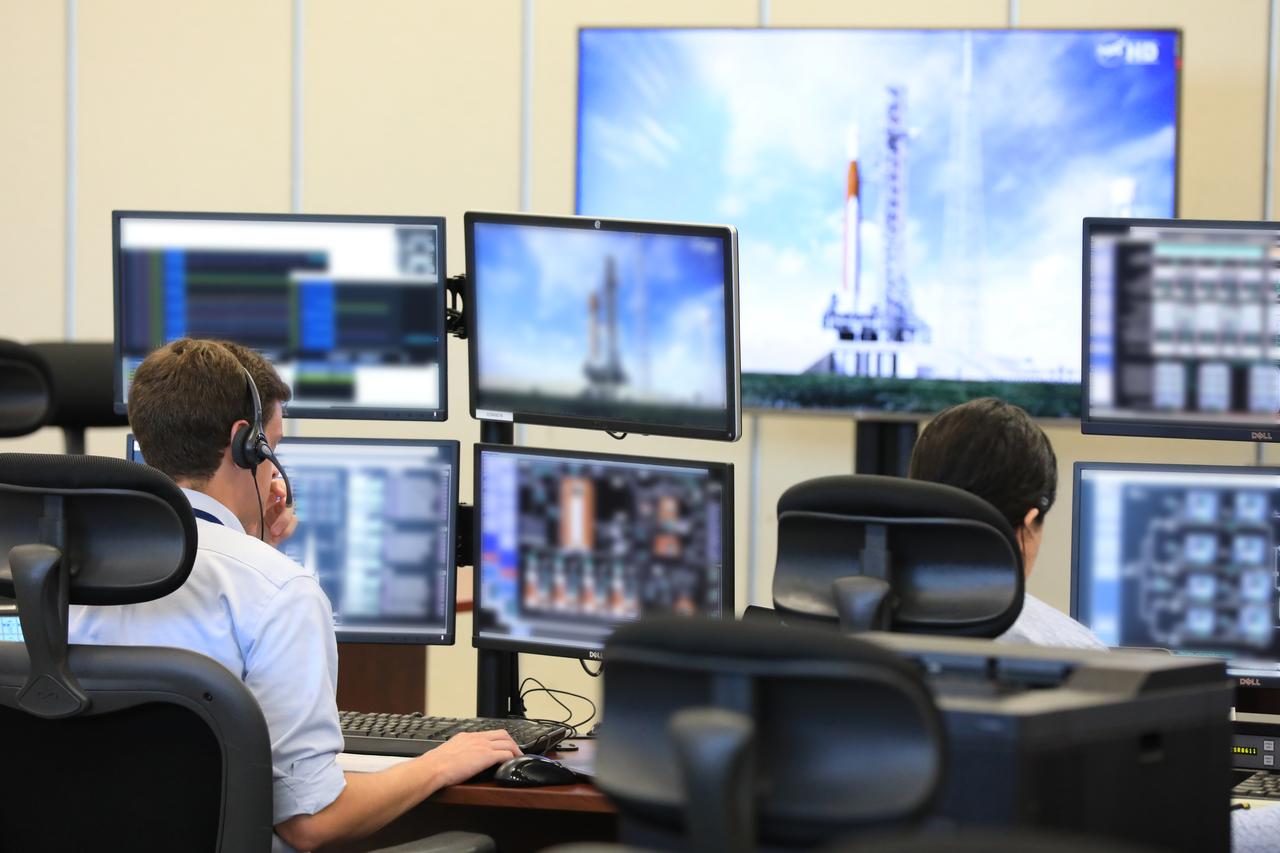
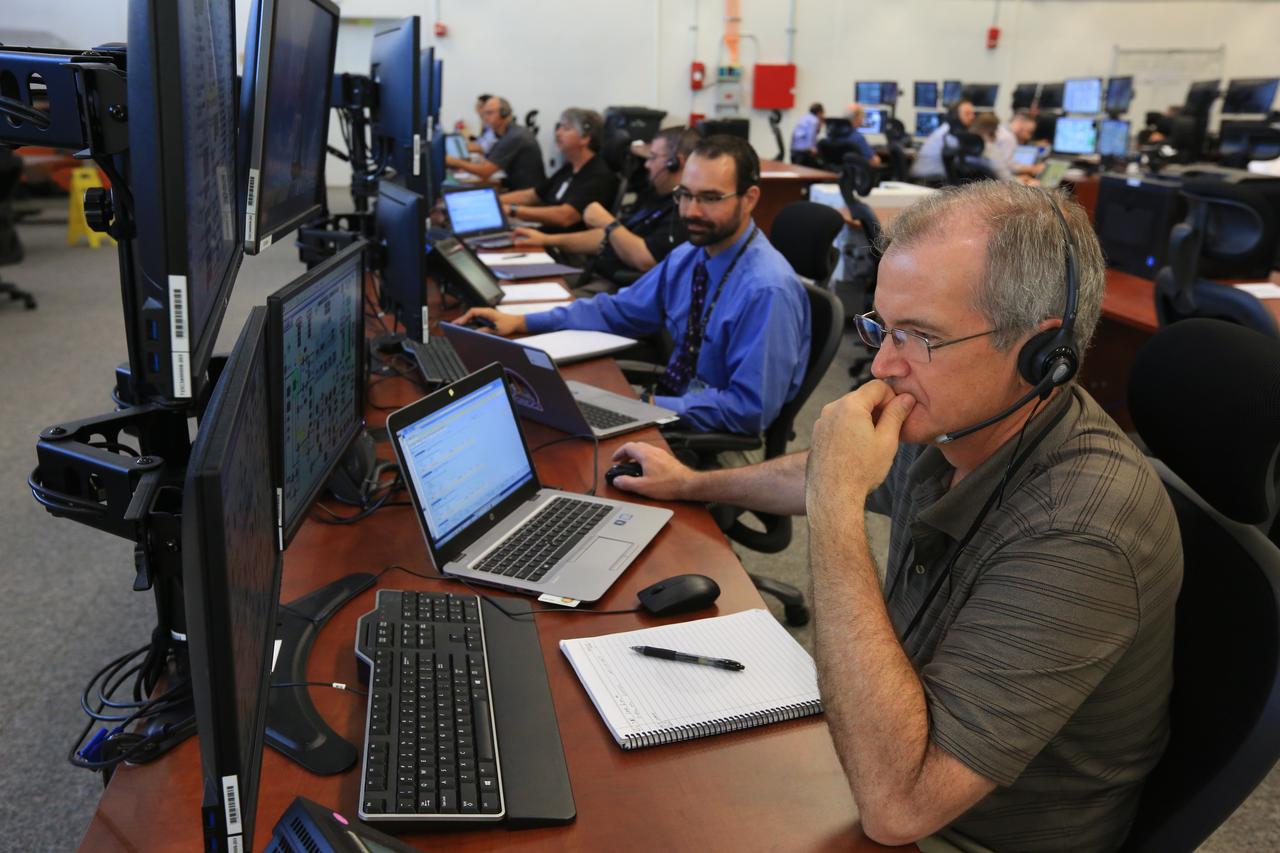
Engineers with Exploration Ground Systems monitor their consoles during a countdown demonstration event of cryogenic propellant loading April 12, 2019, inside Firing Room 2 in the Launch Control Center at NASA’s Kennedy Space Center in Florida. The practice simulation involved loading of liquid hydrogen and liquid oxygen into the Space Launch System rocket’s core and upper stages to prepare for Exploration Mission-1 (EM-1). During the tanking exercise, the team worked through surprise issues in real-time. The practice countdown events are training opportunities coordinated by EM-1 Launch Director Charlie Blackwell-Thompson with Exploration Ground Systems.
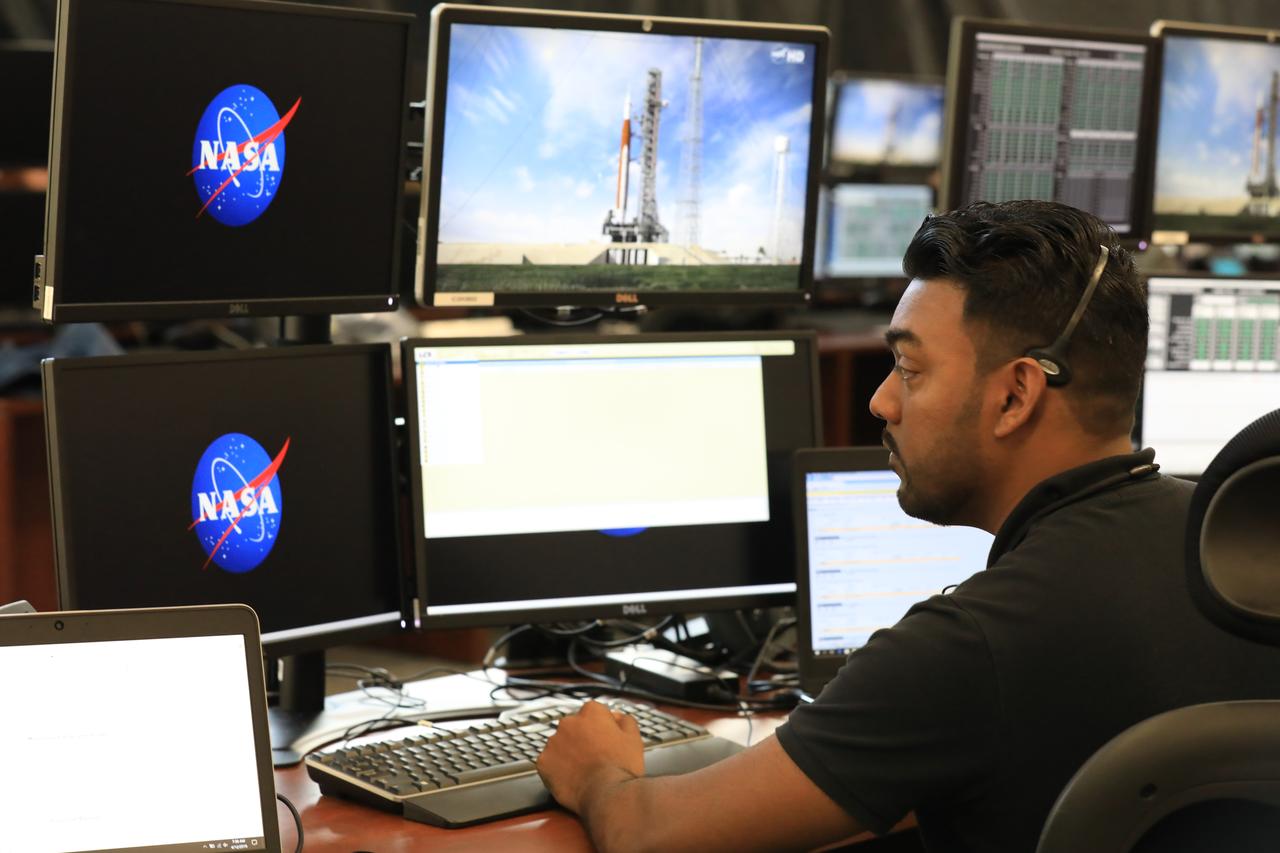
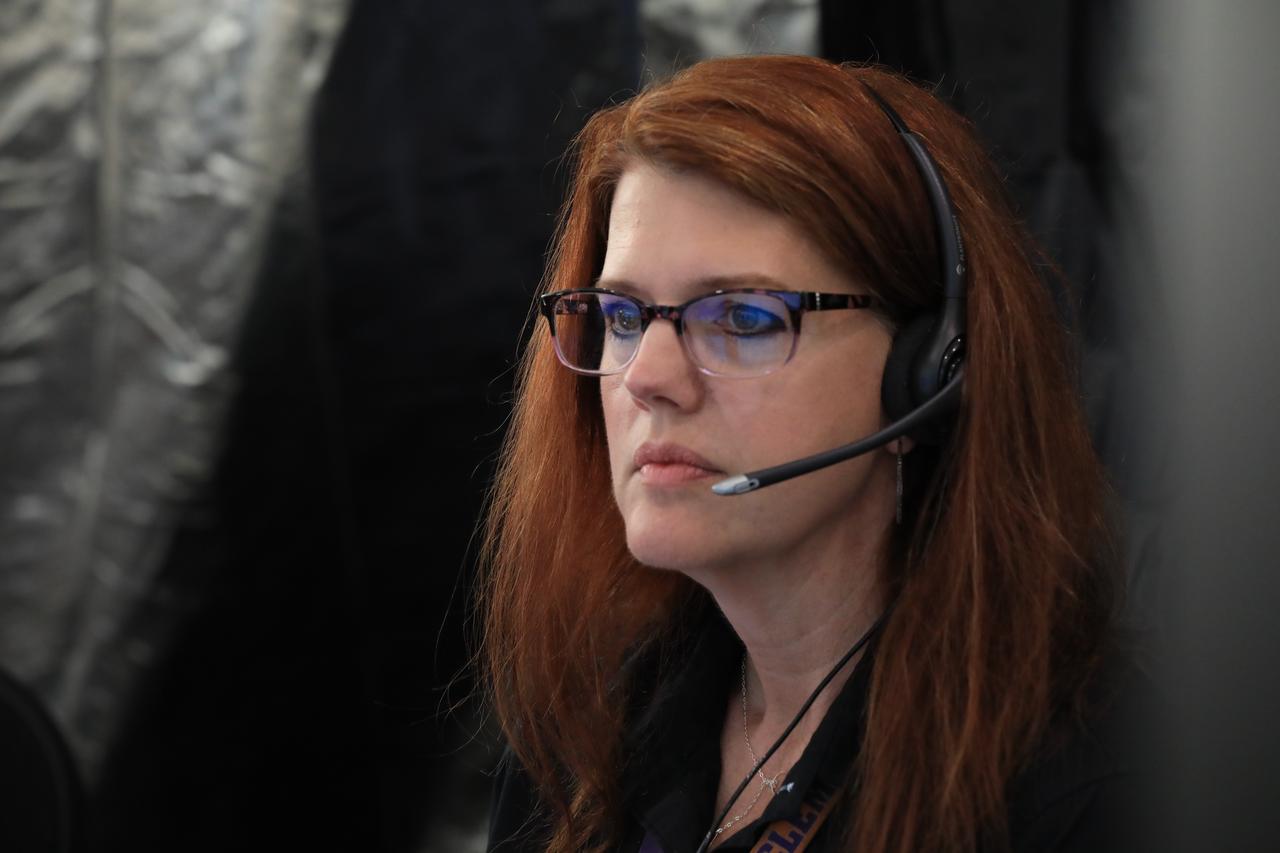
Anthony Bharrat, NASA engine avionics engineer, monitors his console during a countdown demonstration event of cryogenic propellant loading April 12, 2019, inside Firing Room 2 in the Launch Control Center at NASA’s Kennedy Space Center in Florida. The practice simulation involved loading of liquid hydrogen and liquid oxygen into the Space Launch System rocket’s core and upper stages to prepare for Exploration Mission-1 (EM-1). During the tanking exercise, the team worked through surprise issues in real-time. The practice countdown events are training opportunities coordinated by EM-1 Launch Director Charlie Blackwell-Thompson with Exploration Ground Systems.
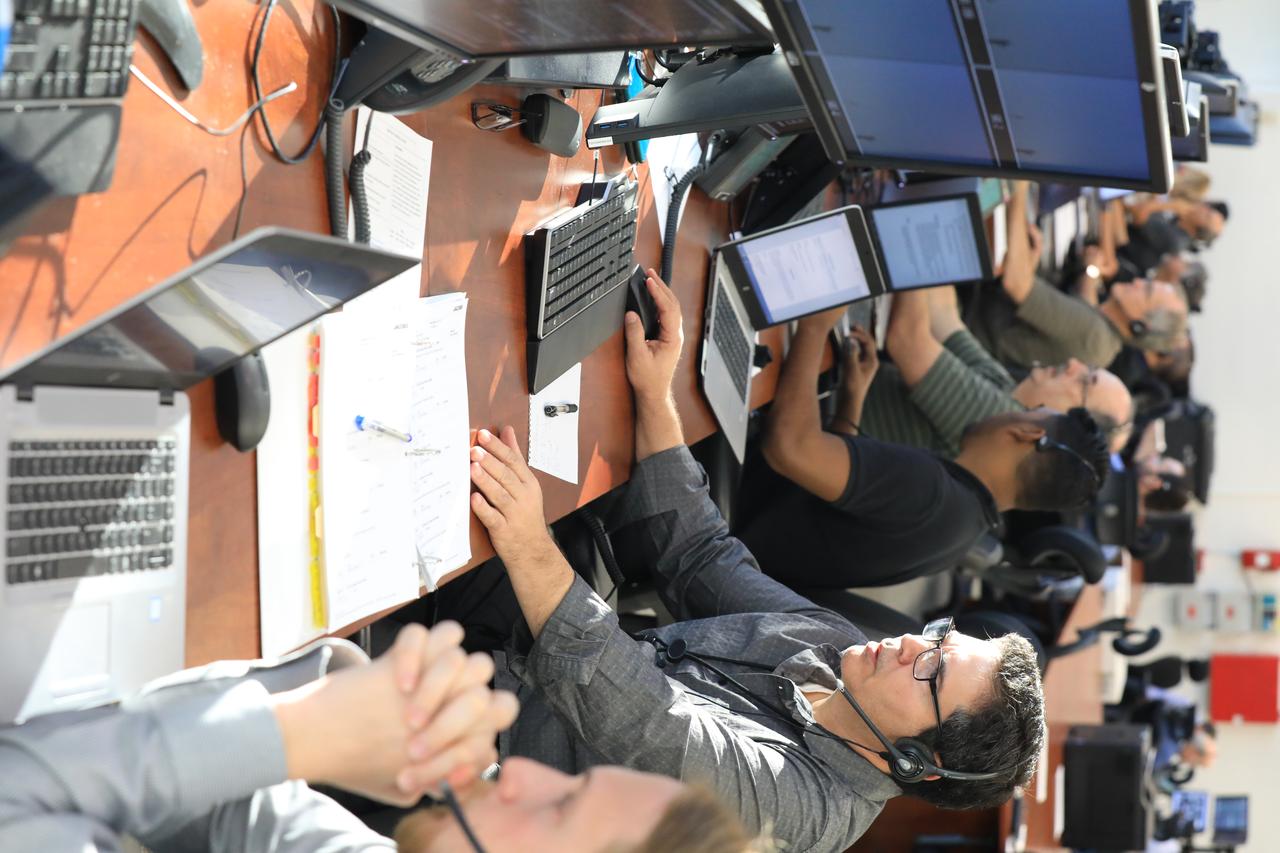
Engineers with NASA and contractor Jacobs monitor their consoles during a countdown demonstration event of cryogenic propellant loading April 12, 2019, inside Firing Room 2 in the Launch Control Center at NASA’s Kennedy Space Center in Florida. The practice simulation involved loading of liquid hydrogen and liquid oxygen into the Space Launch System rocket’s core and upper stages to prepare for Exploration Mission-1 (EM-1). During the tanking exercise, the team worked through surprise issues in real-time. The practice countdown events are training opportunities coordinated by EM-1 Launch Director Charlie Blackwell-Thompson with Exploration Ground Systems.
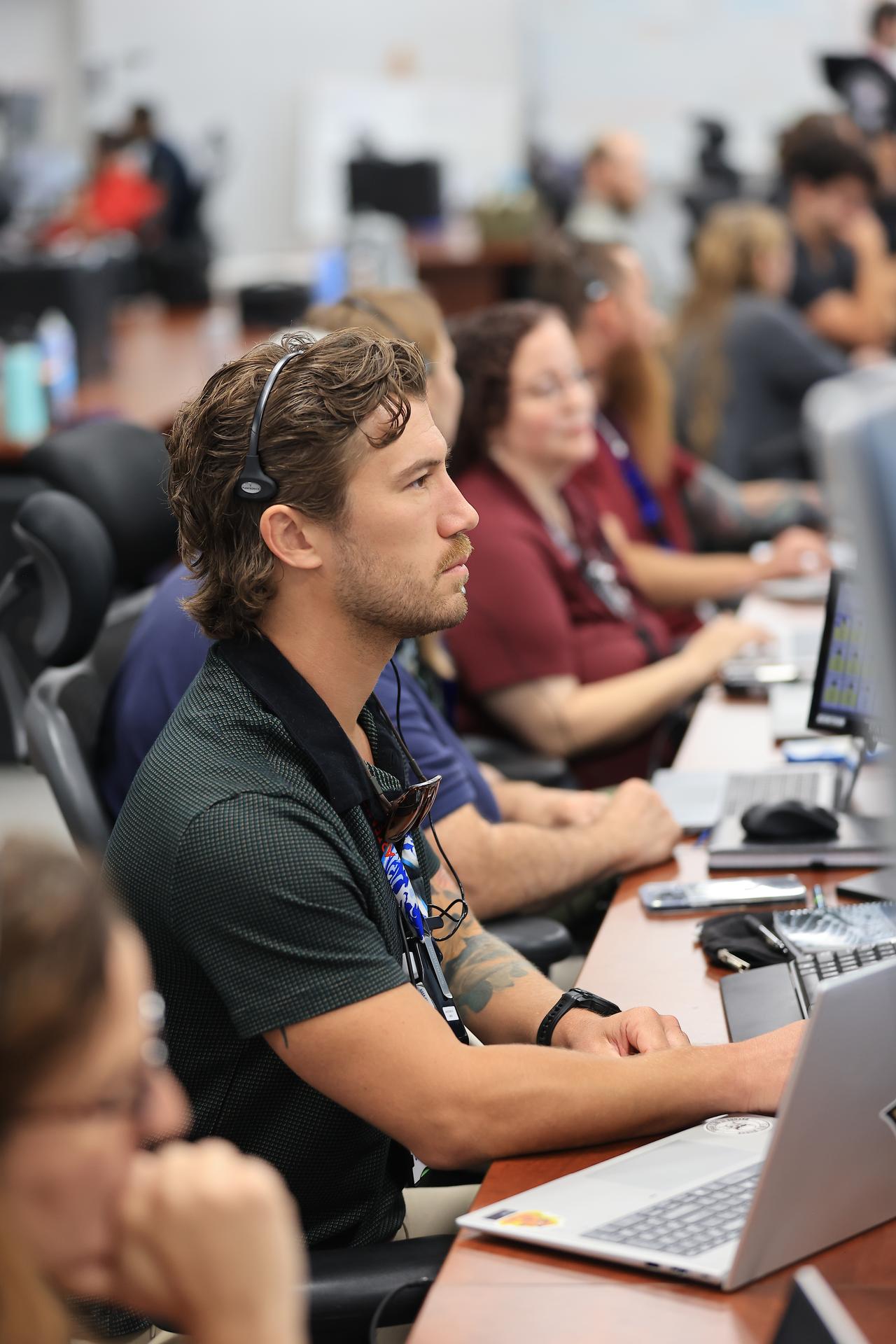
Artemis launch team members participate in a cryogenic propellant loading simulation for NASA’s Artemis III mission on Wednesday, Sept. 9, 2026, inside Firing Rooms 1 and 2 of the Rocco A. Petrone Launch Control Center at the agency’s Kennedy Space Center in Florida. Members of NASA’s Exploration Ground Systems team rehearse the steps to load the super-cooled liquid hydrogen and liquid oxygen into the SLS (Space Launch System) rocket core stage, a process that starts several hours before liftoff for the Artemis III mission. Artemis III will carry out a series of objectives in low Earth orbit designed to demonstrate critical systems needed for future lunar landings, beginning with Artemis IV.
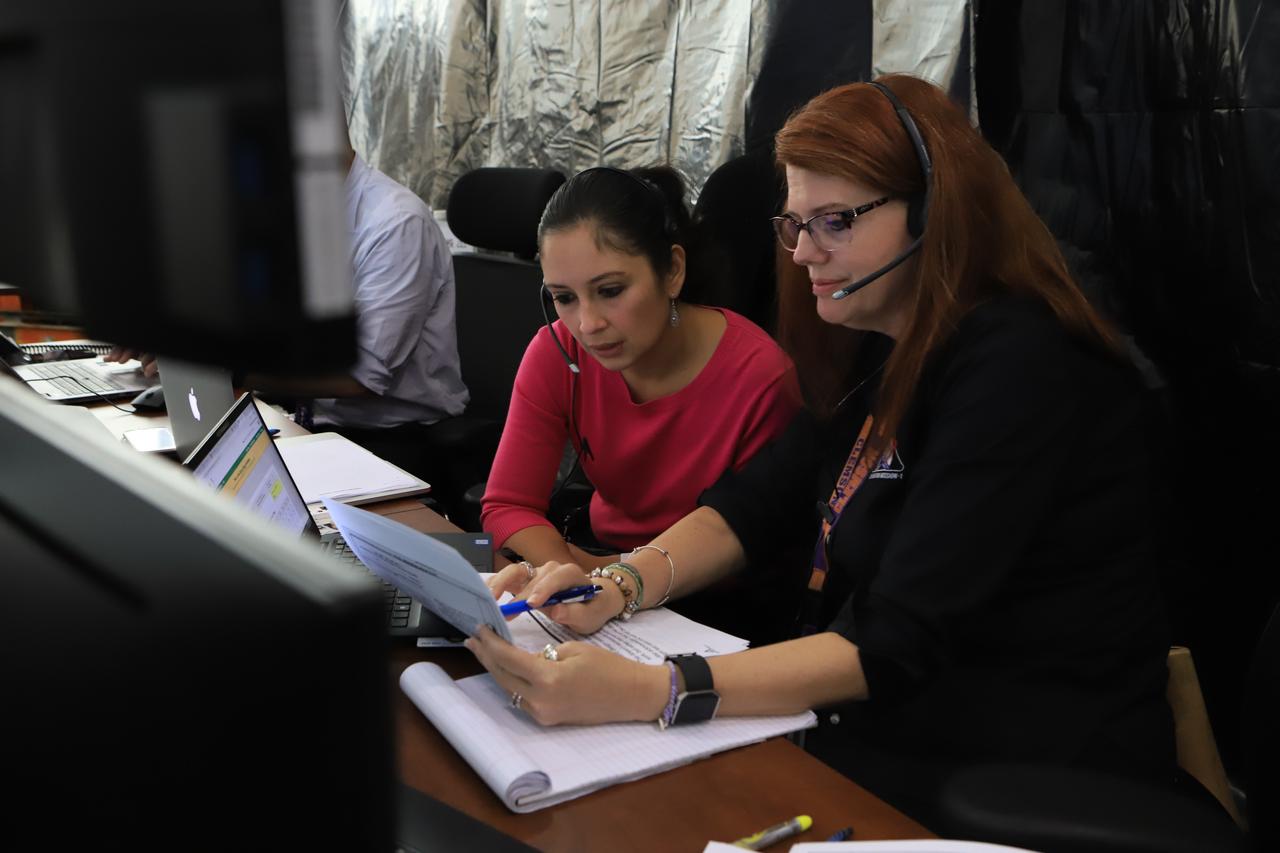
Charlie Blackwell-Thompson, right, Exploration Mission-1 (EM-1) launch director, reviews procedures during a countdown demonstration event of cryogenic propellant loading April 12, 2019, inside Firing Room 2 in the Launch Control Center at NASA’s Kennedy Space Center in Florida. The practice simulation involved loading of liquid hydrogen and liquid oxygen into the Space Launch System rocket’s core and upper stages to prepare for EM-1. During the tanking exercise, the team worked through surprise issues in real-time. The practice countdown events are training opportunities coordinated by Blackwell-Thompson with Exploration Ground Systems.
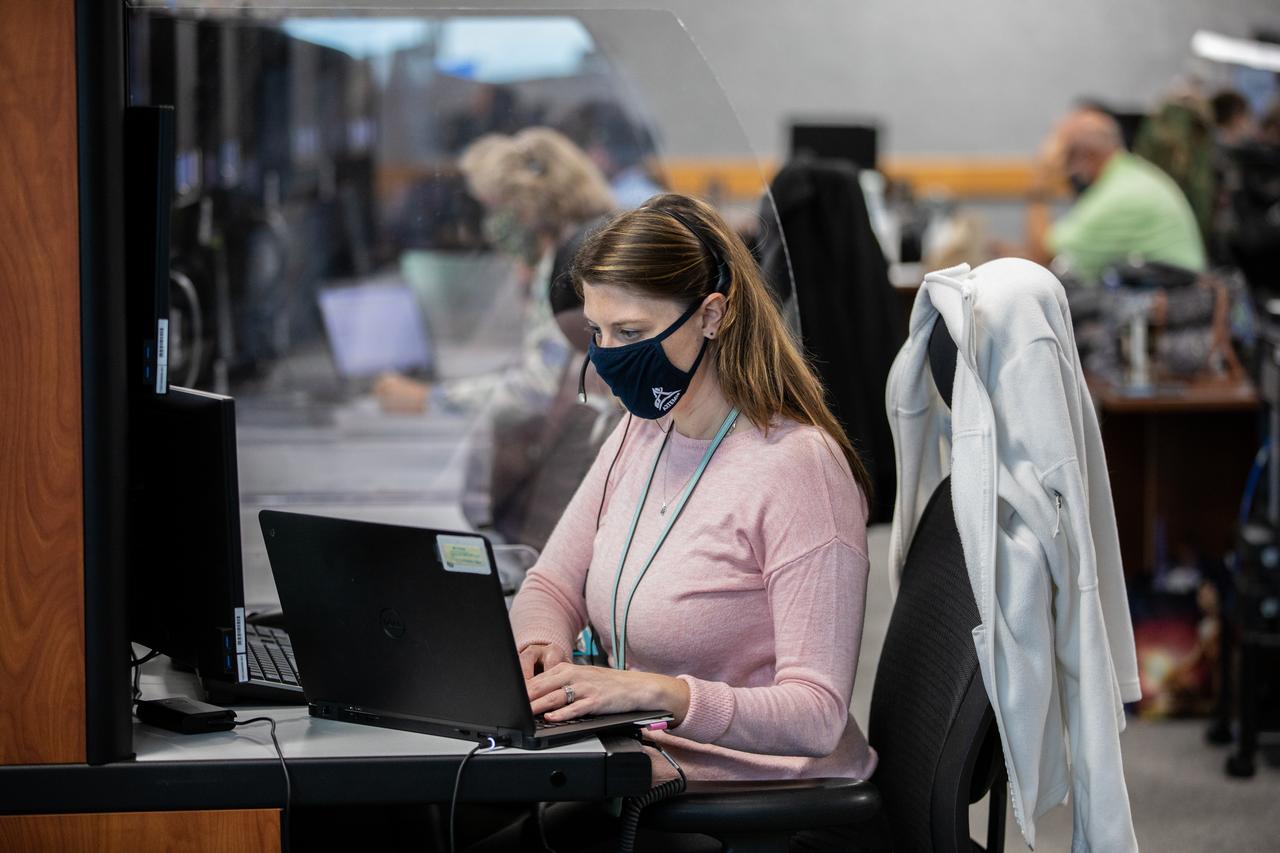
Amanda Arrieta, a members of the cryogenics launch team, participates in a cryogenic propellant loading simulation inside Firing Room 1 in the Launch Control Center on Nov. 2, 2020, at NASA’s Kennedy Space Center in Florida. A team of engineers with Exploration Ground Systems and Jacobs are rehearsing the steps to load the super-cooled liquid hydrogen and liquid oxygen into the Space Launch System’s (SLS) core and second stages to prepare for Artemis I. The first in a series of increasingly complex missions, Artemis I will test the Orion spacecraft and Space Launch System as an integrated system ahead of crewed flights to the Moon. NASA will land the first woman and the next man on the Moon in 2024.
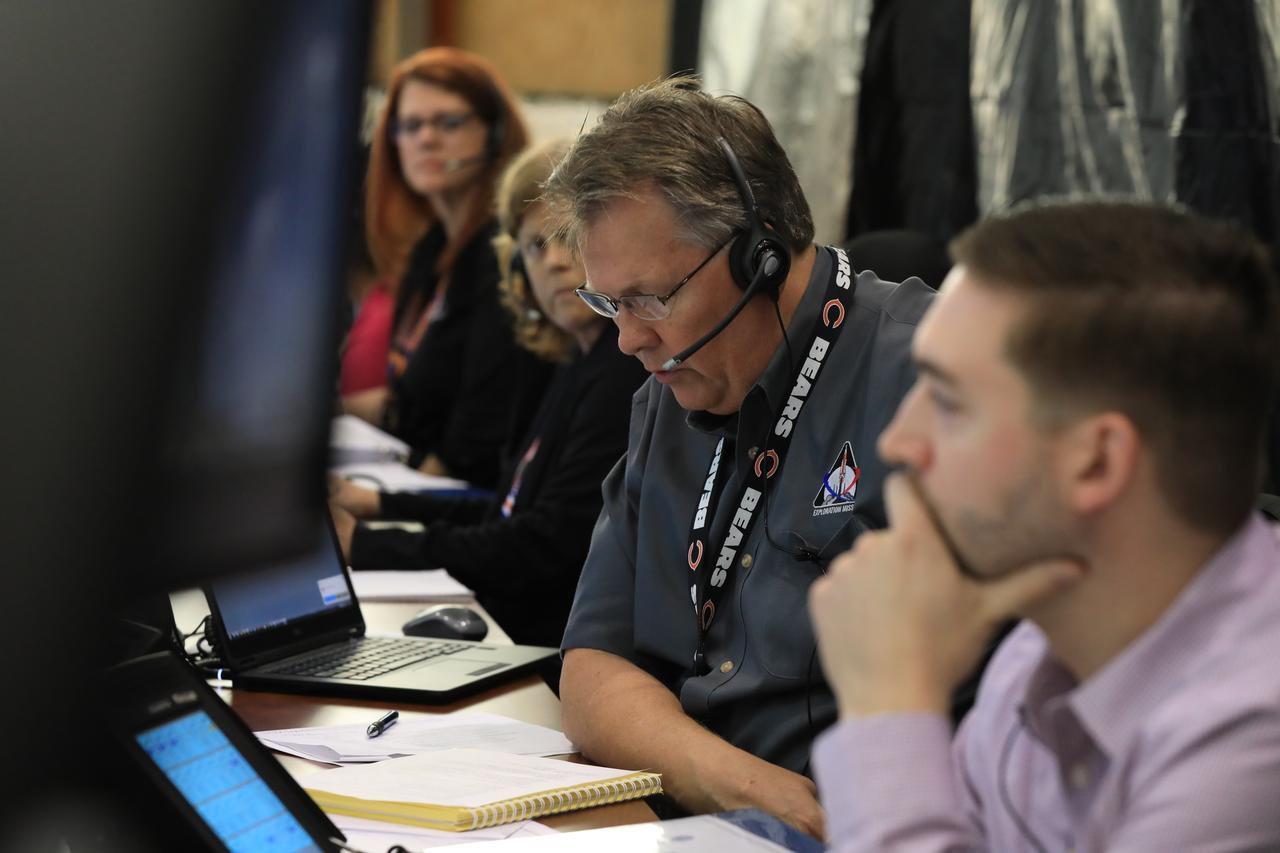
Charlie Blackwell-Thompson, far left, Exploration Mission-1 (EM-1) launch director, and engineers with NASA and Jacobs, participate in a countdown demonstration event of cryogenic propellant loading April 12, 2019, inside Firing Room 2 in the Launch Control Center at NASA’s Kennedy Space Center in Florida. The practice simulation involved loading of liquid hydrogen and liquid oxygen into the Space Launch System rocket’s core and upper stages to prepare for EM-1. During the tanking exercise, the team worked through surprise issues in real-time. The practice countdown events are training opportunities coordinated by Blackwell-Thompson with Exploration Ground Systems.
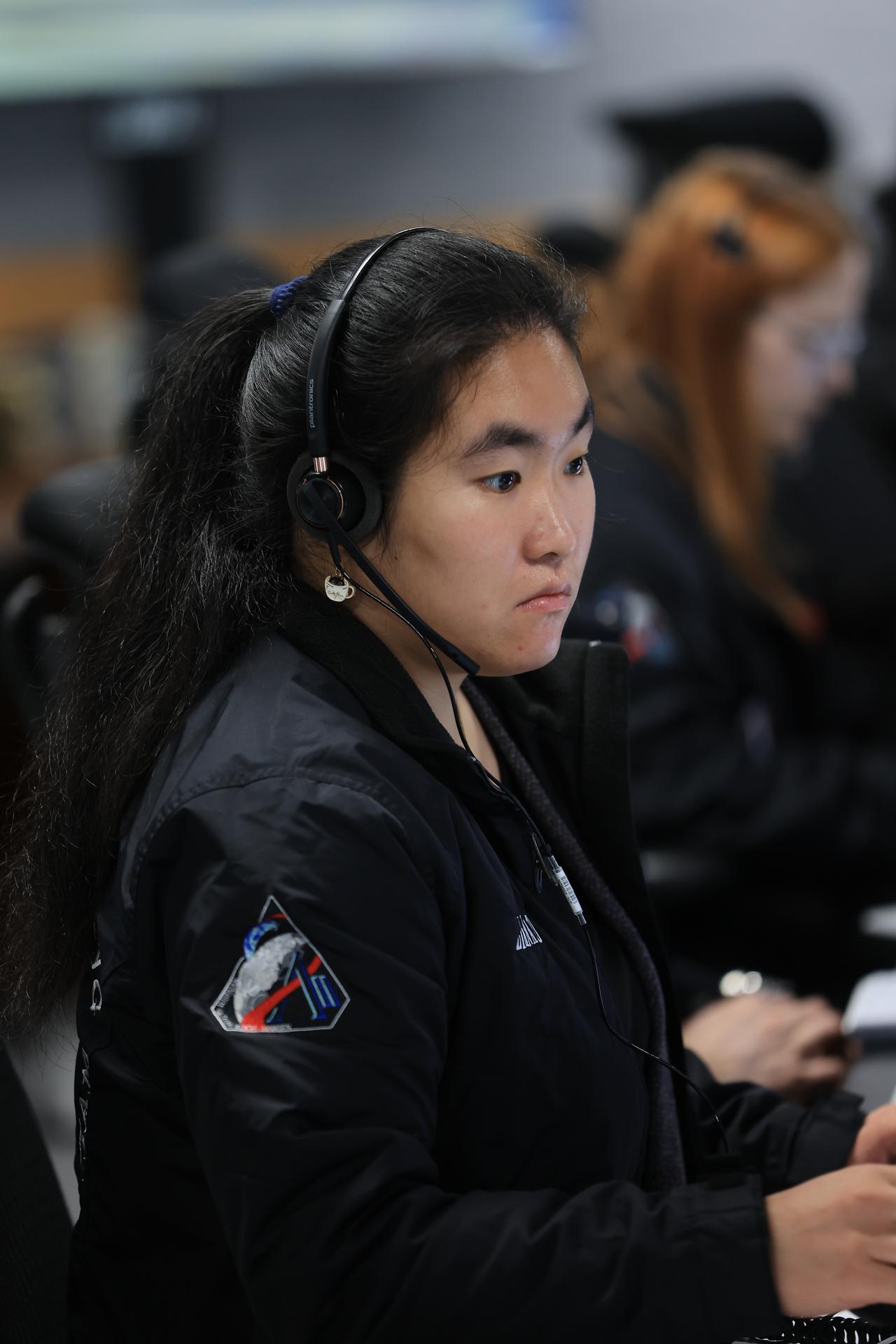
Artemis launch team members participate in a cryogenic propellant loading simulation for NASA’s Artemis III mission on Wednesday, Sept. 9, 2026, inside Firing Rooms 1 and 2 of the Rocco A. Petrone Launch Control Center at the agency’s Kennedy Space Center in Florida. Members of NASA’s Exploration Ground Systems team rehearse the steps to load the super-cooled liquid hydrogen and liquid oxygen into the SLS (Space Launch System) rocket core stage, a process that starts several hours before liftoff for the Artemis III mission. Artemis III will carry out a series of objectives in low Earth orbit designed to demonstrate critical systems needed for future lunar landings, beginning with Artemis IV.

Artemis III launch team members participate in a cryogenic propellant loading simulation on Wednesday, June 10, 2026, inside Firing Room 1 and 2 of the Rocco A. Petrone Launch Control Center at NASA’s Kennedy Space Center in Florida. Members of NASA’s Exploration Ground Systems team rehearse the steps to load the super-cooled liquid hydrogen and liquid oxygen into the SLS (Space Launch System) rocket core stage, a process that starts several hours before liftoff for the Artemis III mission. Artemis III will carry out a series of objectives in low Earth orbit designed to demonstrate critical systems needed for future lunar landings, beginning with Artemis IV.
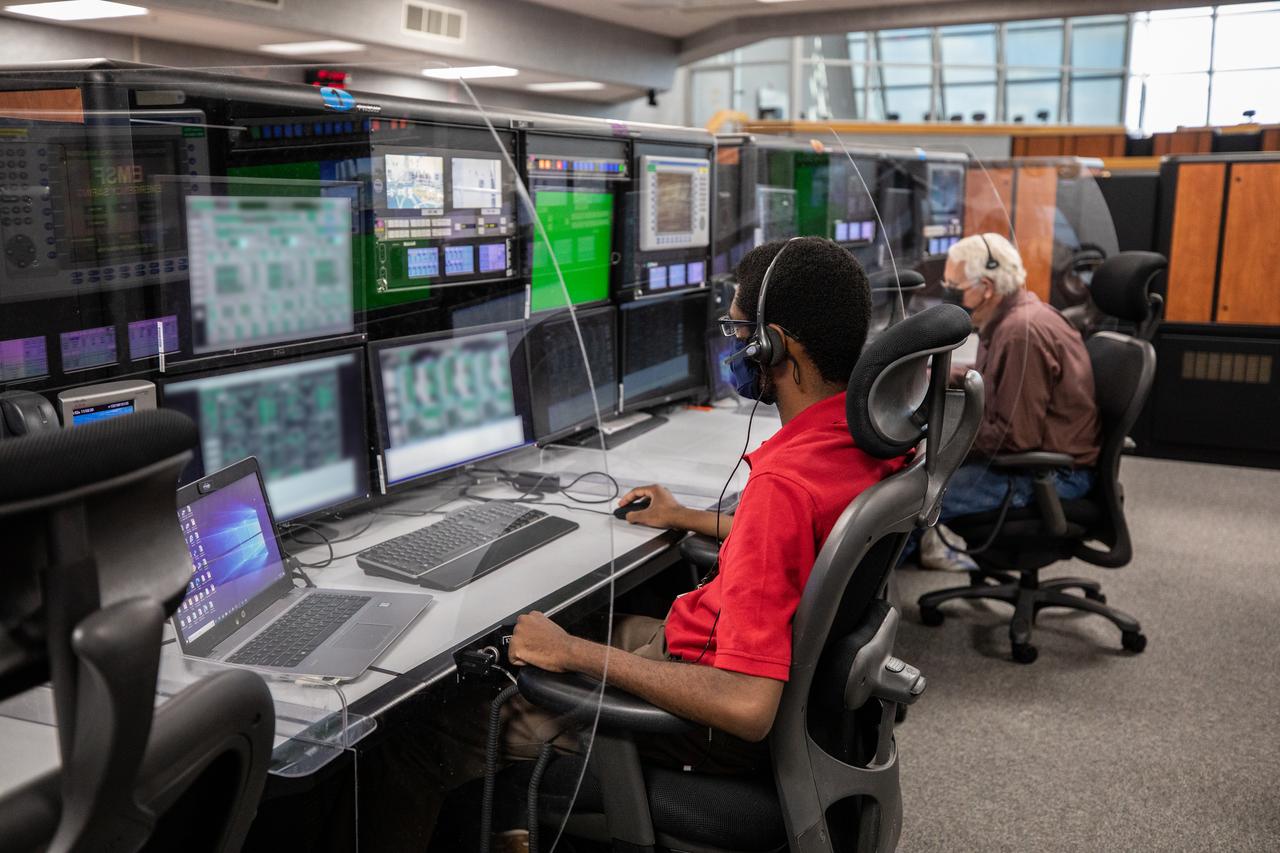
Theo Henderson, left, and Phillip Youmans, members of the cryogenics launch team, participate in a cryogenic propellant loading simulation inside Firing Room 1 in the Launch Control Center on Nov. 2, 2020, at NASA’s Kennedy Space Center in Florida. A team of engineers with Exploration Ground Systems and Jacobs are rehearsing the steps to load the super-cooled liquid hydrogen and liquid oxygen into the Space Launch System’s (SLS) core and second stages to prepare for Artemis I. The first in a series of increasingly complex missions, Artemis I will test the Orion spacecraft and Space Launch System as an integrated system ahead of crewed flights to the Moon. NASA will land the first woman and the next man on the Moon in 2024.
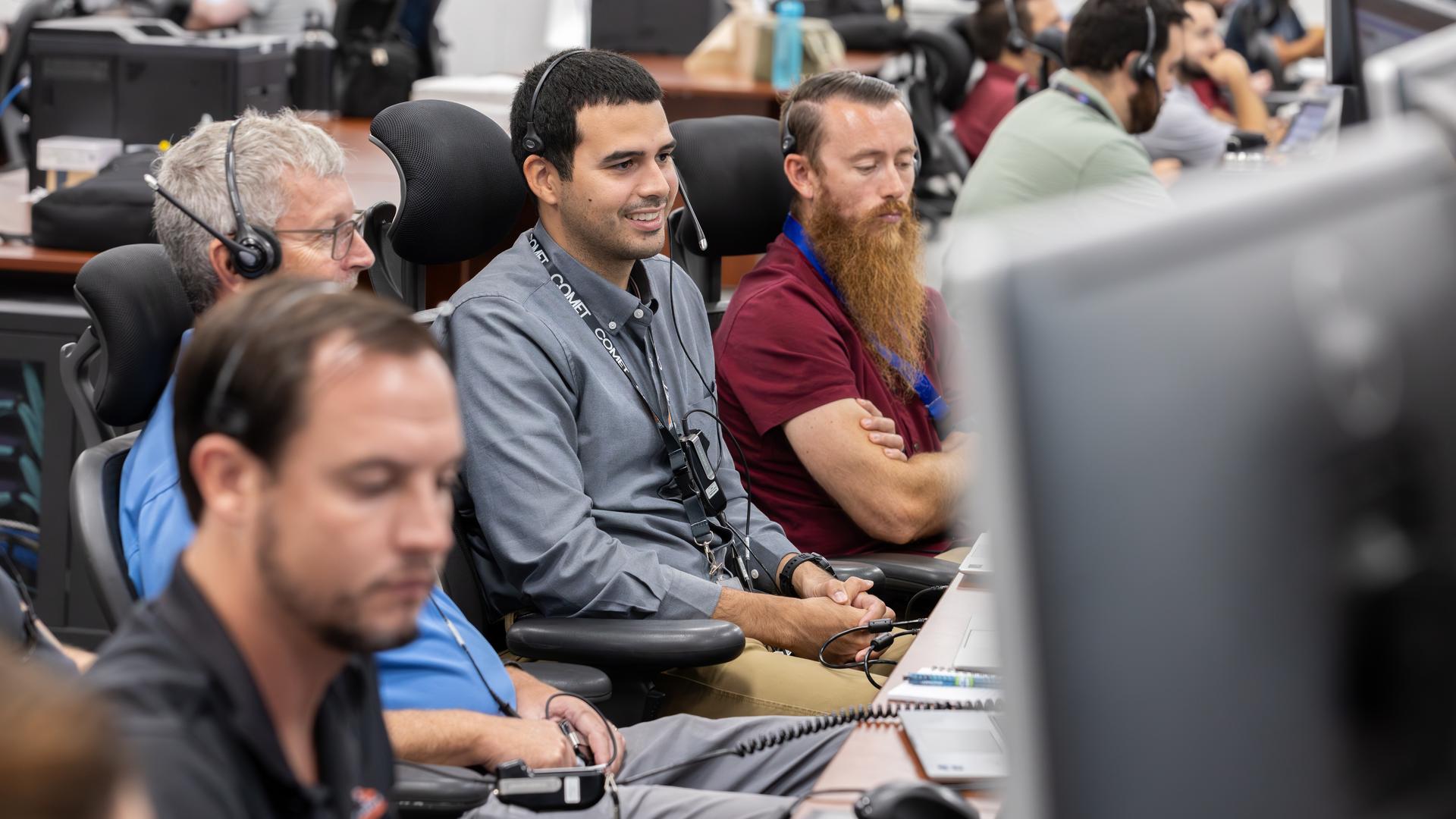
Artemis launch team members participate in a cryogenic propellant loading simulation for NASA’s Artemis III mission on Wednesday, Aug. 5, 2026, inside Firing Rooms 1 and 2 of the Rocco A. Petrone Launch Control Center at the agency’s Kennedy Space Center in Florida. Members of NASA’s Exploration Ground Systems team rehearse the steps to load the super-cooled liquid hydrogen and liquid oxygen into the SLS (Space Launch System) rocket core stage, a process that starts several hours before liftoff for the Artemis III mission. Artemis III will carry out a series of objectives in low Earth orbit designed to demonstrate critical systems needed for future lunar landings, beginning with Artemis IV.

Artemis III launch team members participate in a cryogenic propellant loading simulation on Wednesday, June 10, 2026, inside Firing Room 1 and 2 of the Rocco A. Petrone Launch Control Center at NASA’s Kennedy Space Center in Florida. Members of NASA’s Exploration Ground Systems team rehearse the steps to load the super-cooled liquid hydrogen and liquid oxygen into the SLS (Space Launch System) rocket core stage, a process that starts several hours before liftoff for the Artemis III mission. Artemis III will carry out a series of objectives in low Earth orbit designed to demonstrate critical systems needed for future lunar landings, beginning with Artemis IV.

Artemis III launch team members participate in a cryogenic propellant loading simulation on Wednesday, June 10, 2026, inside Firing Room 1 and 2 of the Rocco A. Petrone Launch Control Center at NASA’s Kennedy Space Center in Florida. Members of NASA’s Exploration Ground Systems team rehearse the steps to load the super-cooled liquid hydrogen and liquid oxygen into the SLS (Space Launch System) rocket core stage, a process that starts several hours before liftoff for the Artemis III mission. Artemis III will carry out a series of objectives in low Earth orbit designed to demonstrate critical systems needed for future lunar landings, beginning with Artemis IV.

Artemis launch team members participate in a cryogenic propellant loading simulation for NASA’s Artemis III mission on Wednesday, Sept. 9, 2026, inside Firing Rooms 1 and 2 of the Rocco A. Petrone Launch Control Center at the agency’s Kennedy Space Center in Florida. Members of NASA’s Exploration Ground Systems team rehearse the steps to load the super-cooled liquid hydrogen and liquid oxygen into the SLS (Space Launch System) rocket core stage, a process that starts several hours before liftoff for the Artemis III mission. Artemis III will carry out a series of objectives in low Earth orbit designed to demonstrate critical systems needed for future lunar landings, beginning with Artemis IV.
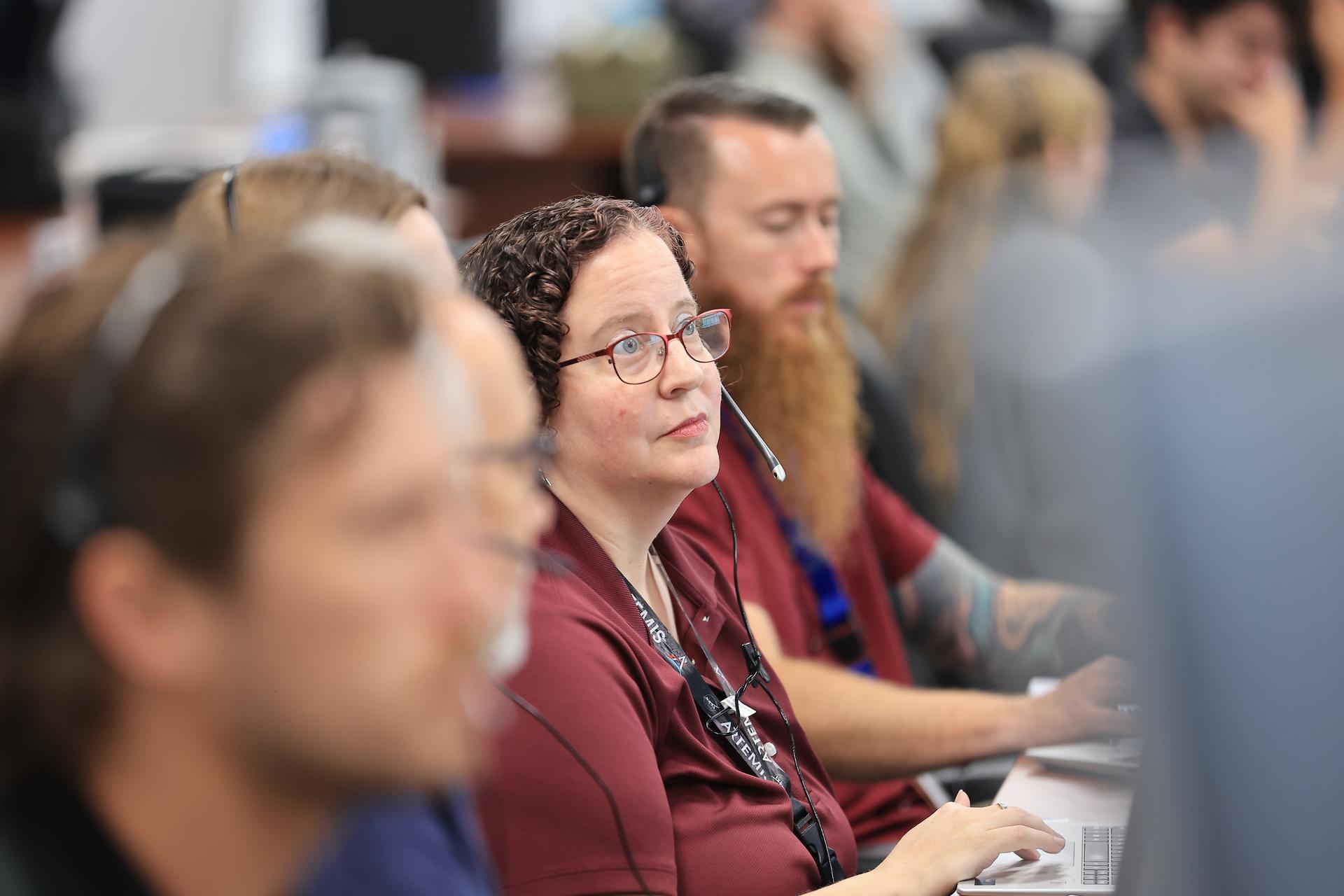
Artemis launch team members participate in a cryogenic propellant loading simulation for NASA’s Artemis III mission on Wednesday, Sept. 9, 2026, inside Firing Rooms 1 and 2 of the Rocco A. Petrone Launch Control Center at the agency’s Kennedy Space Center in Florida. Members of NASA’s Exploration Ground Systems team rehearse the steps to load the super-cooled liquid hydrogen and liquid oxygen into the SLS (Space Launch System) rocket core stage, a process that starts several hours before liftoff for the Artemis III mission. Artemis III will carry out a series of objectives in low Earth orbit designed to demonstrate critical systems needed for future lunar landings, beginning with Artemis IV.
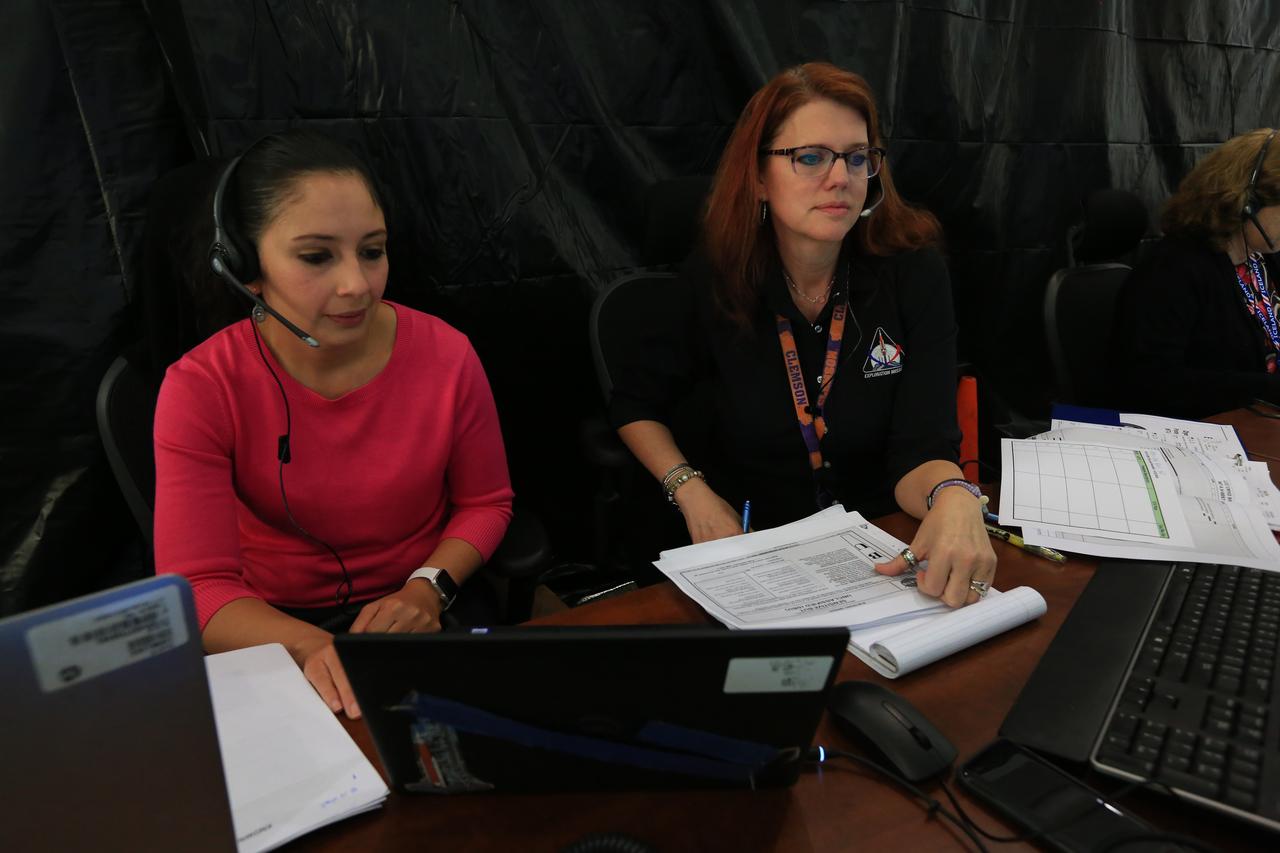
Charlie Blackwell-Thompson, at right, Exploration Mission-1 (EM-1) launch director, leads a countdown demonstration event of cryogenic propellant loading April 12, 2019, inside Firing Room 2 in the Launch Control Center at NASA’s Kennedy Space Center in Florida. Seated next to her is Jessica Parsons, technical assitant to the launch director. The practice simulation involved loading of liquid hydrogen and liquid oxygen into the Space Launch System rocket’s core and upper stages to prepare for EM-1. During the tanking exercise, the team worked through surprise issues in real-time. The practice countdown events are training opportunities coordinated by Blackwell-Thompson with Exploration Ground Systems.
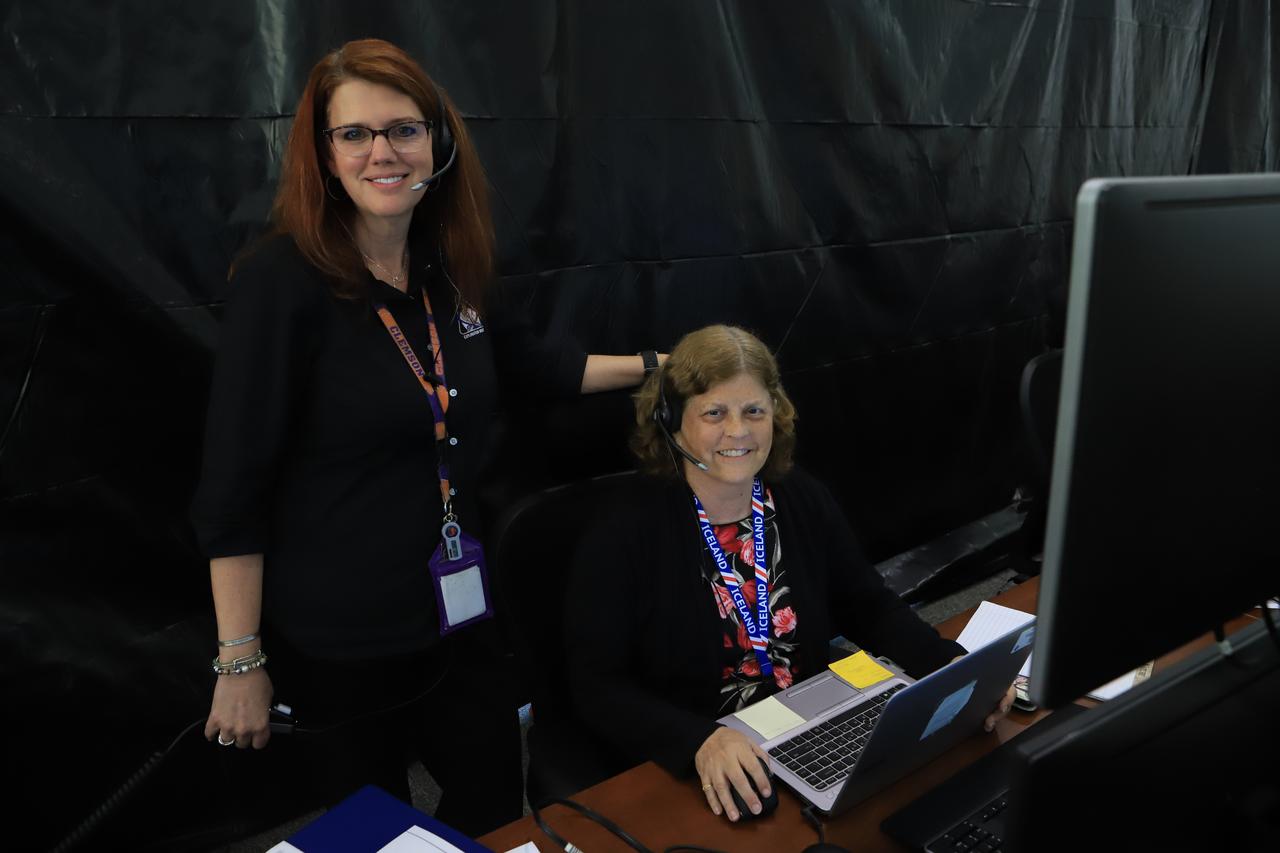
Charlie Blackwell-Thompson, standing, Exploration Mission-1 (EM-1) launch director, leads a countdown demonstration event of cryogenic propellant loading April 12, 2019, inside Firing Room 2 in the Launch Control Center at NASA’s Kennedy Space Center in Florida. Seated is Roberta Wyrick, spacecraft test conductor with contractor Jacobs. The practice simulation involved loading of liquid hydrogen and liquid oxygen into the Space Launch System rocket’s core and upper stages to prepare for EM-1. During the tanking exercise, the team worked through surprise issues in real-time. The practice countdown events are training opportunities coordinated by Blackwell-Thompson with Exploration Ground Systems.
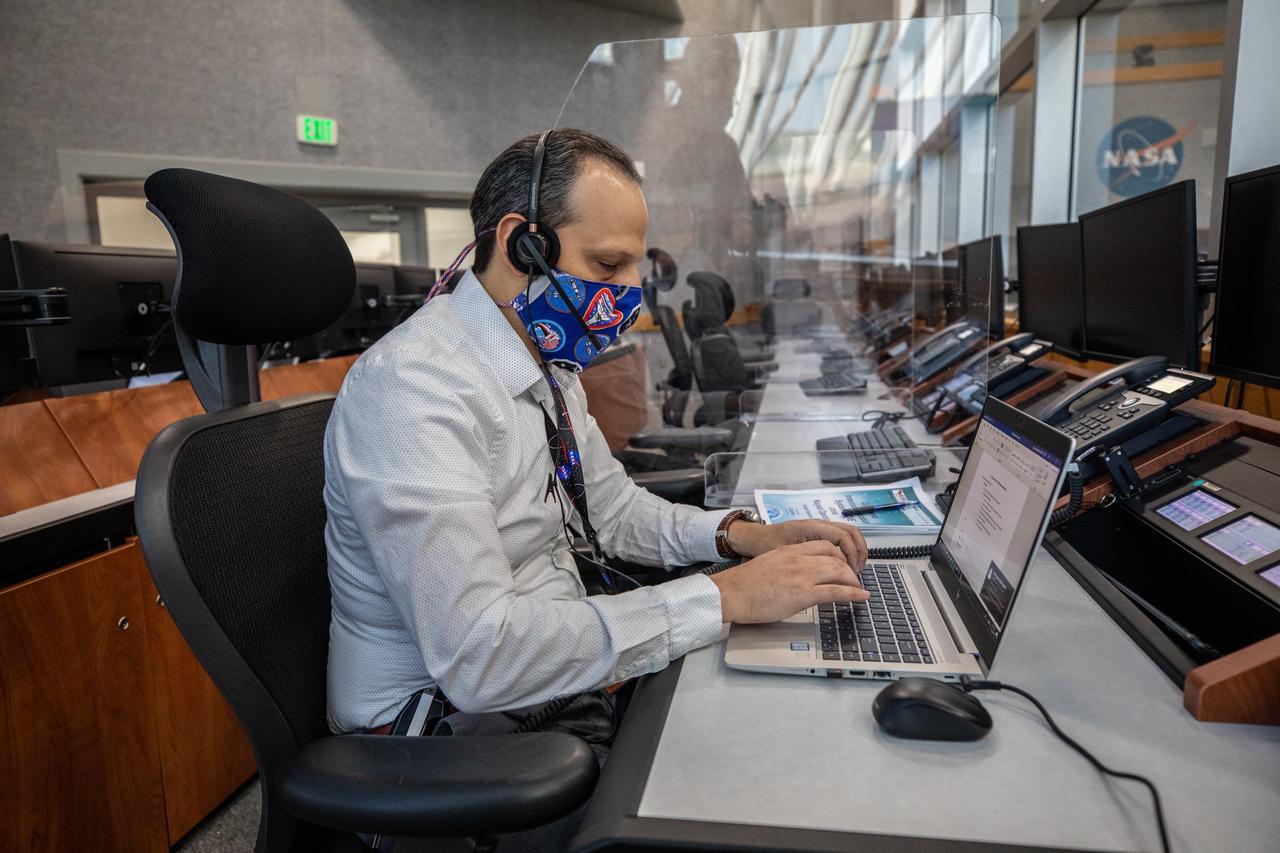
Pete Dizuzio, a system safety engineer, participates in a cryogenic propellant loading simulation inside Firing Room 1 in the Launch Control Center on Nov. 2, 2020, at NASA’s Kennedy Space Center in Florida. A team of engineers with Exploration Ground Systems and Jacobs, members of the cryogenics launch team, are rehearsing the steps to load the super-cooled liquid hydrogen and liquid oxygen into the Space Launch System’s (SLS) core and second stages to prepare for Artemis I. The first in a series of increasingly complex missions, Artemis I will test the Orion spacecraft and Space Launch System as an integrated system ahead of crewed flights to the Moon. NASA will land the first woman and the next man on the Moon in 2024.
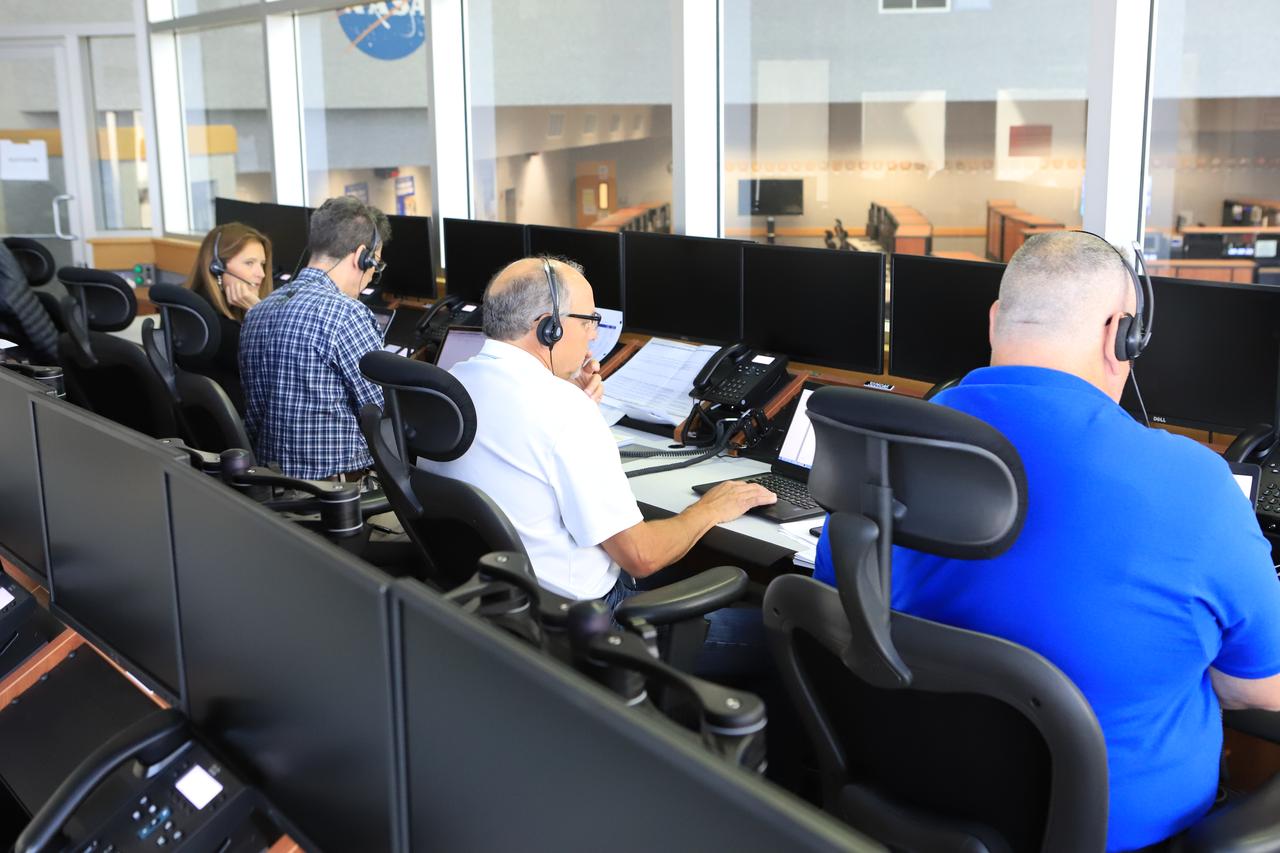
Engineers with NASA and contractor Jacobs monitor their consoles during a countdown demonstration event of cryogenic propellant loading April 12, 2019, inside Firing Room 2 in the Launch Control Center at NASA’s Kennedy Space Center in Florida. The practice simulation involved loading of liquid hydrogen and liquid oxygen into the Space Launch System rocket’s core and upper stages to prepare for Exploration Mission-1 (EM-1). During the tanking exercise, the team worked through surprise issues in real-time. The practice countdown events are training opportunities coordinated by EM-1 Launch Director Charlie Blackwell-Thompson with Exploration Ground Systems.
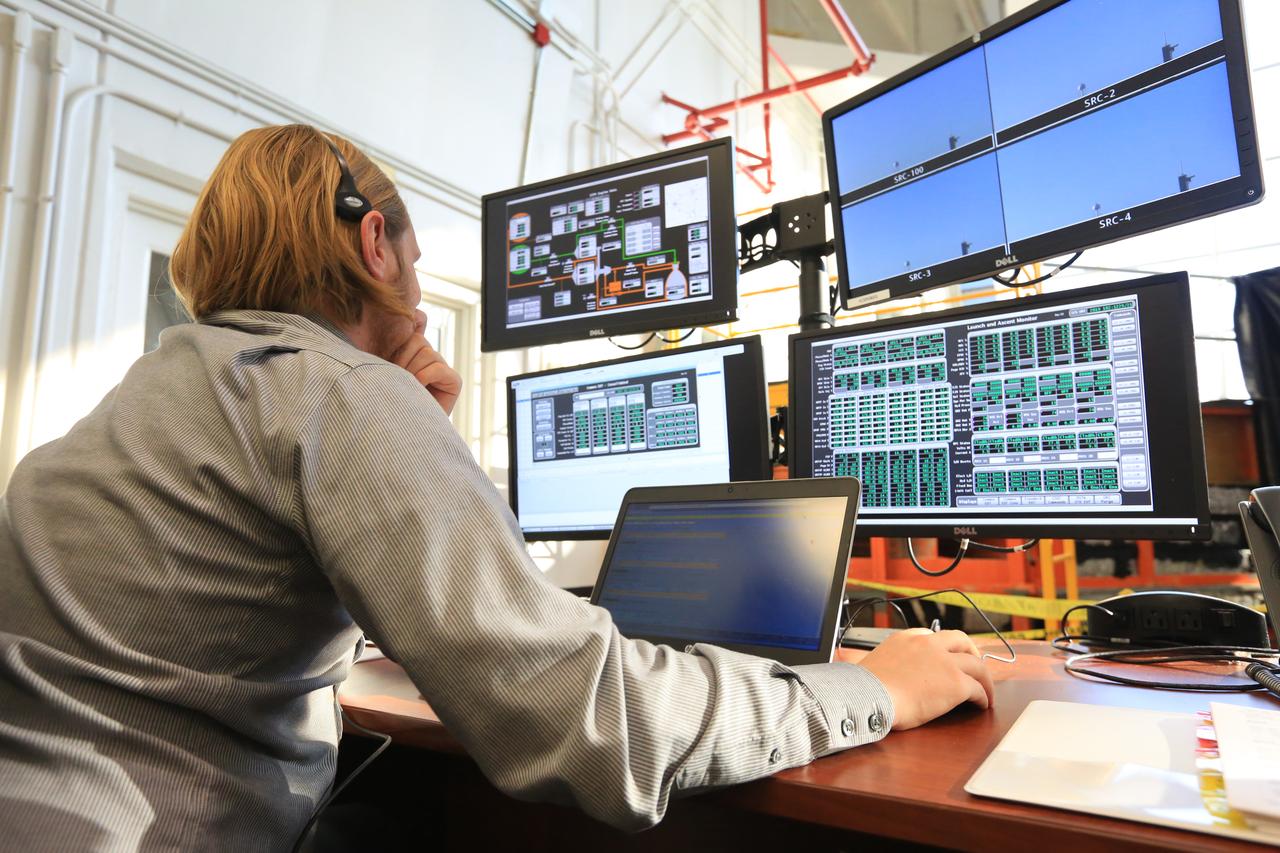
An engineer with NASA monitors his console during a countdown demonstration event of cryogenic propellant loading April 12, 2019, inside Firing Room 2 in the Launch Control Center at NASA’s Kennedy Space Center in Florida. The practice simulation involved loading of liquid hydrogen and liquid oxygen into the Space Launch System rocket’s core and upper stages to prepare for Exploration Mission-1 (EM-1). During the tanking exercise, the team worked through surprise issues in real-time. The practice countdown events are training opportunities coordinated by EM-1 Launch Director Charlie Blackwell-Thompson with Exploration Ground Systems.
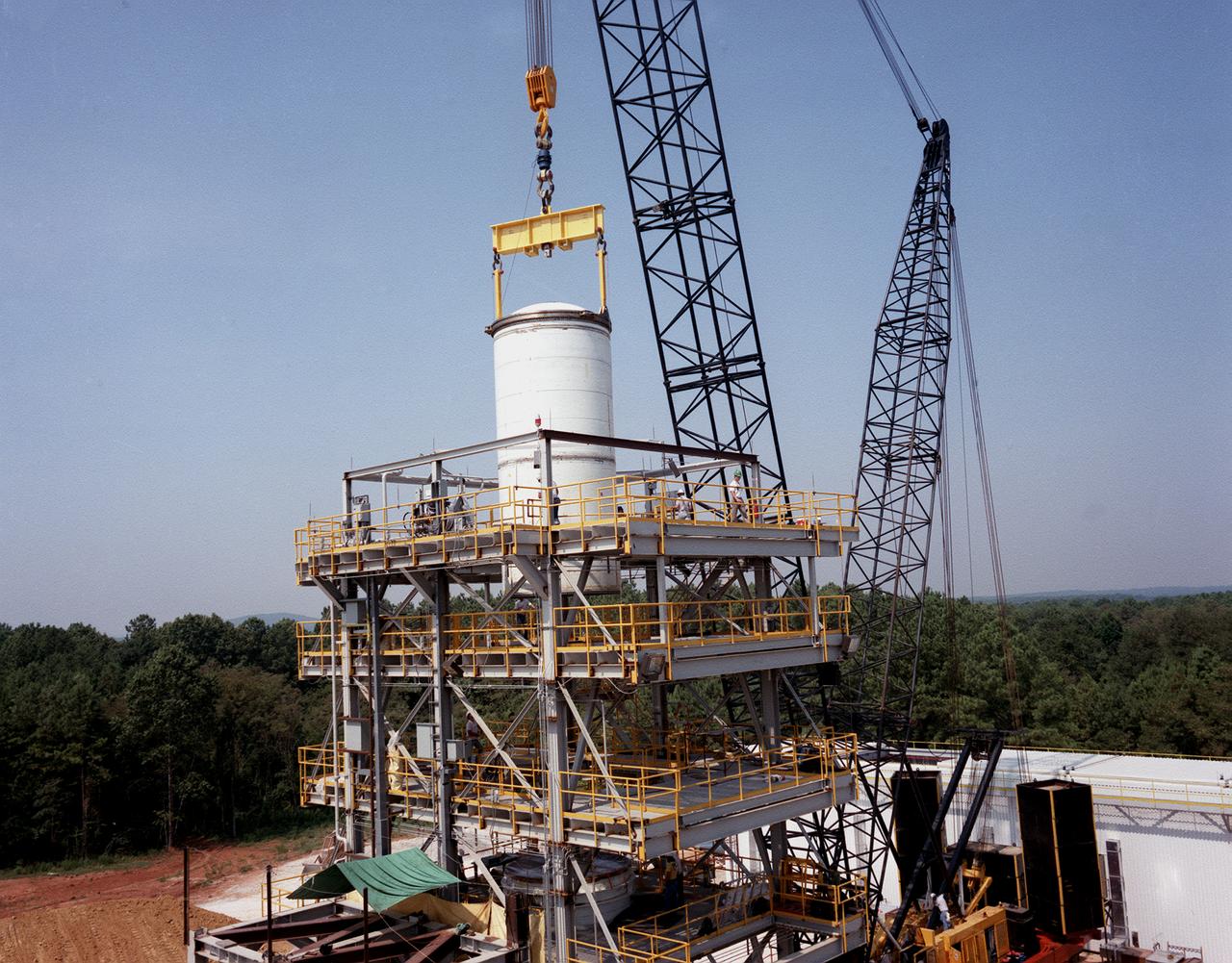
A forward segment is being lowered into the Transient Pressure Test Article (TPTA) test stand at the Marshall Space Flight Center (MSFC) east test area. The TPTA test stand, 14-feet wide, 27-feet long, and 33-feet high, was built in 1987 to provide data to verify the sealing capability of the redesign solid rocket motor (SRM) field and nozzle joints. The test facility applies pressure, temperature, and external loads to a short stack of solid rocket motor hardware. The simulated SRM ignition pressure and temperature transients are achieved by firing a small amount of specially configured solid propellant. The pressure transient is synchronized with external programmable dynamic loads that simulate lift off loads at the external tank attach points. Approximately one million pounds of dead weight on top of the test article simulates the weight of the other Shuttle elements.
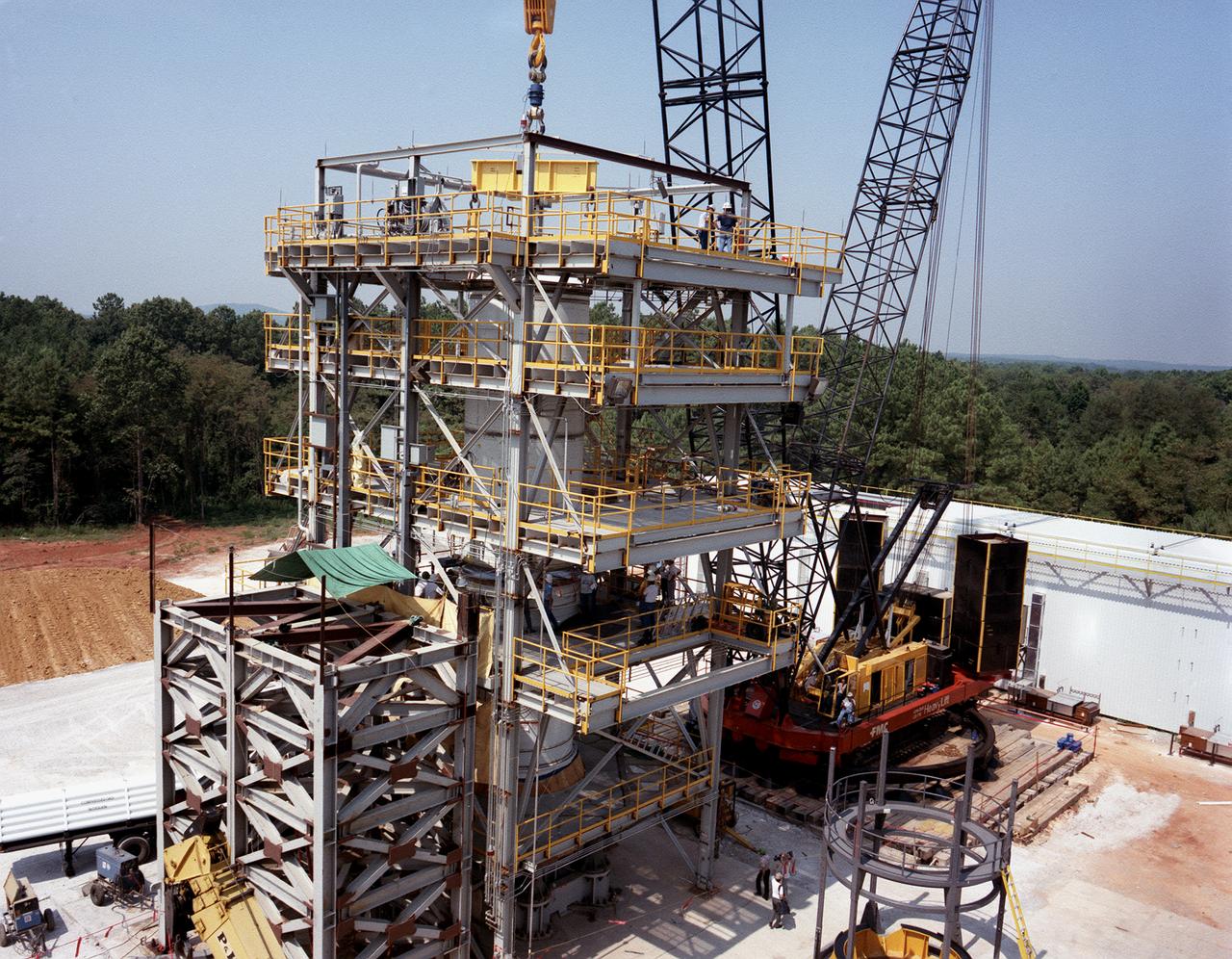
A forward segment is being lowered into the Transient Pressure Test Article (TPTA) test stand at thw Marshall Space Flight Center (MSFC) east test area. The TPTA test stand, 14-feet wide, 27-feet long, and 33-feet high, was built in 1987 to provide data to verify the sealing capability of the redesign solid rocket motor (SRM) field and nozzle joints. The test facility applies pressure, temperature, and external loads to a short stack of solid rocket motor hardware. The simulated SRM ignition pressure and temperature transients are achieved by firing a small amount of specially configured solid propellant. The pressure transient is synchronized with external programmable dynamic loads that simulate lift off loads at the external tank attach points. Approximately one million pounds of dead weight on top of the test article simulates the weight of the other Shuttle elements.

Teams completed the welding of the Artemis III core stage liquid oxygen tank dome at the NASA’s Michoud Assembly Facility in New Orleans. Crews moved the dome, which is the top of the tank. The dome was moved to an assembly area where it will be loaded into a robotic welder that will join it with the forward barrel to create half of the liquid oxygen tank. Later another barrel and dome will be added to complete the entire tank. The Space Launch System (SLS) core stage liquid oxygen tank holds 196,000 gallons of super-cooled liquid propellant that serves as one of the propellants for the four RS-25 engines. The SLS core stage is made up of five unique elements: the forward skirt, liquid oxygen tank, intertank, liquid hydrogen tank, and the engine section. The liquid oxygen and the liquid hydrogen tank will provide propellant to the four RS-25 engines to produce more than two million pounds of thrust to help launch NASA’s Orion spacecraft, astronauts, and supplies beyond Earth’s orbit to the Moon. Image credit: NASA/Michael DeMocker
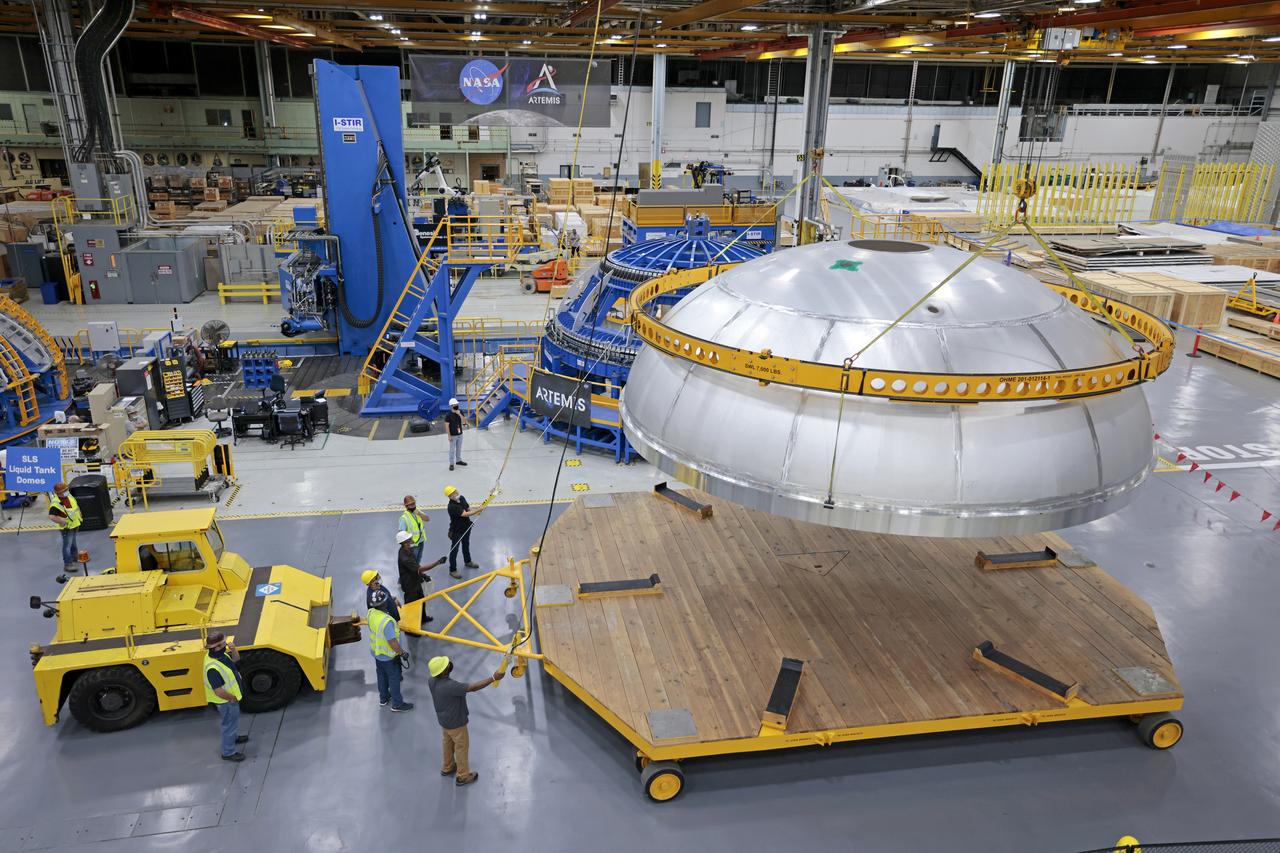
Teams completed the welding of the Artemis III core stage liquid oxygen tank dome at the NASA’s Michoud Assembly Facility in New Orleans. Crews moved the dome, which is the top of the tank. The dome was moved to an assembly area where it will be loaded into a robotic welder that will join it with the forward barrel to create half of the liquid oxygen tank. Later another barrel and dome will be added to complete the entire tank. The Space Launch System (SLS) core stage liquid oxygen tank holds 196,000 gallons of super-cooled liquid propellant that serves as one of the propellants for the four RS-25 engines. The SLS core stage is made up of five unique elements: the forward skirt, liquid oxygen tank, intertank, liquid hydrogen tank, and the engine section. The liquid oxygen and the liquid hydrogen tank will provide propellant to the four RS-25 engines to produce more than two million pounds of thrust to help launch NASA’s Orion spacecraft, astronauts, and supplies beyond Earth’s orbit to the Moon. Image credit: NASA/Michael DeMocker
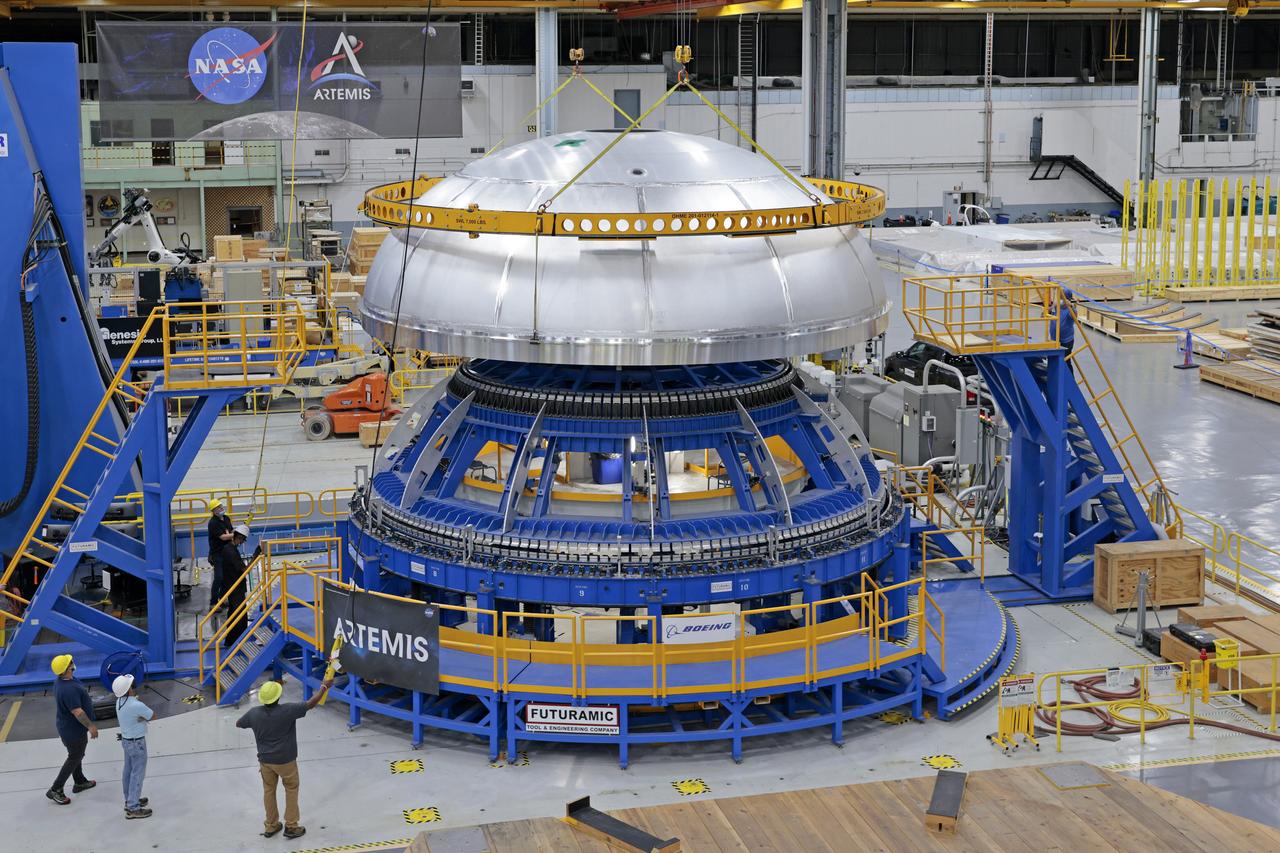
Teams completed the welding of the Artemis III core stage liquid oxygen tank dome at the NASA’s Michoud Assembly Facility in New Orleans. Crews moved the dome, which is the top of the tank. The dome was moved to an assembly area where it will be loaded into a robotic welder that will join it with the forward barrel to create half of the liquid oxygen tank. Later another barrel and dome will be added to complete the entire tank. The Space Launch System (SLS) core stage liquid oxygen tank holds 196,000 gallons of super-cooled liquid propellant that serves as one of the propellants for the four RS-25 engines. The SLS core stage is made up of five unique elements: the forward skirt, liquid oxygen tank, intertank, liquid hydrogen tank, and the engine section. The liquid oxygen and the liquid hydrogen tank will provide propellant to the four RS-25 engines to produce more than two million pounds of thrust to help launch NASA’s Orion spacecraft, astronauts, and supplies beyond Earth’s orbit to the Moon. Image credit: NASA/Michael DeMocker

Teams completed the welding of the Artemis III core stage liquid oxygen tank dome at the NASA’s Michoud Assembly Facility in New Orleans. Crews moved the dome, which is the top of the tank. The dome was moved to an assembly area where it will be loaded into a robotic welder that will join it with the forward barrel to create half of the liquid oxygen tank. Later another barrel and dome will be added to complete the entire tank. The Space Launch System (SLS) core stage liquid oxygen tank holds 196,000 gallons of super-cooled liquid propellant that serves as one of the propellants for the four RS-25 engines. The SLS core stage is made up of five unique elements: the forward skirt, liquid oxygen tank, intertank, liquid hydrogen tank, and the engine section. The liquid oxygen and the liquid hydrogen tank will provide propellant to the four RS-25 engines to produce more than two million pounds of thrust to help launch NASA’s Orion spacecraft, astronauts, and supplies beyond Earth’s orbit to the Moon. Image credit: NASA/Michael DeMocker

Teams completed the welding of the Artemis III core stage liquid oxygen tank dome at the NASA’s Michoud Assembly Facility in New Orleans. Crews moved the dome, which is the top of the tank. The dome was moved to an assembly area where it will be loaded into a robotic welder that will join it with the forward barrel to create half of the liquid oxygen tank. Later another barrel and dome will be added to complete the entire tank. The Space Launch System (SLS) core stage liquid oxygen tank holds 196,000 gallons of super-cooled liquid propellant that serves as one of the propellants for the four RS-25 engines. The SLS core stage is made up of five unique elements: the forward skirt, liquid oxygen tank, intertank, liquid hydrogen tank, and the engine section. The liquid oxygen and the liquid hydrogen tank will provide propellant to the four RS-25 engines to produce more than two million pounds of thrust to help launch NASA’s Orion spacecraft, astronauts, and supplies beyond Earth’s orbit to the Moon. Image credit: NASA/Michael DeMocker

Teams completed the welding of the Artemis III core stage liquid oxygen tank dome at the NASA’s Michoud Assembly Facility in New Orleans. Crews moved the dome, which is the top of the tank. The dome was moved to an assembly area where it will be loaded into a robotic welder that will join it with the forward barrel to create half of the liquid oxygen tank. Later another barrel and dome will be added to complete the entire tank. The Space Launch System (SLS) core stage liquid oxygen tank holds 196,000 gallons of super-cooled liquid propellant that serves as one of the propellants for the four RS-25 engines. The SLS core stage is made up of five unique elements: the forward skirt, liquid oxygen tank, intertank, liquid hydrogen tank, and the engine section. The liquid oxygen and the liquid hydrogen tank will provide propellant to the four RS-25 engines to produce more than two million pounds of thrust to help launch NASA’s Orion spacecraft, astronauts, and supplies beyond Earth’s orbit to the Moon. Image credit: NASA/Michael DeMocker
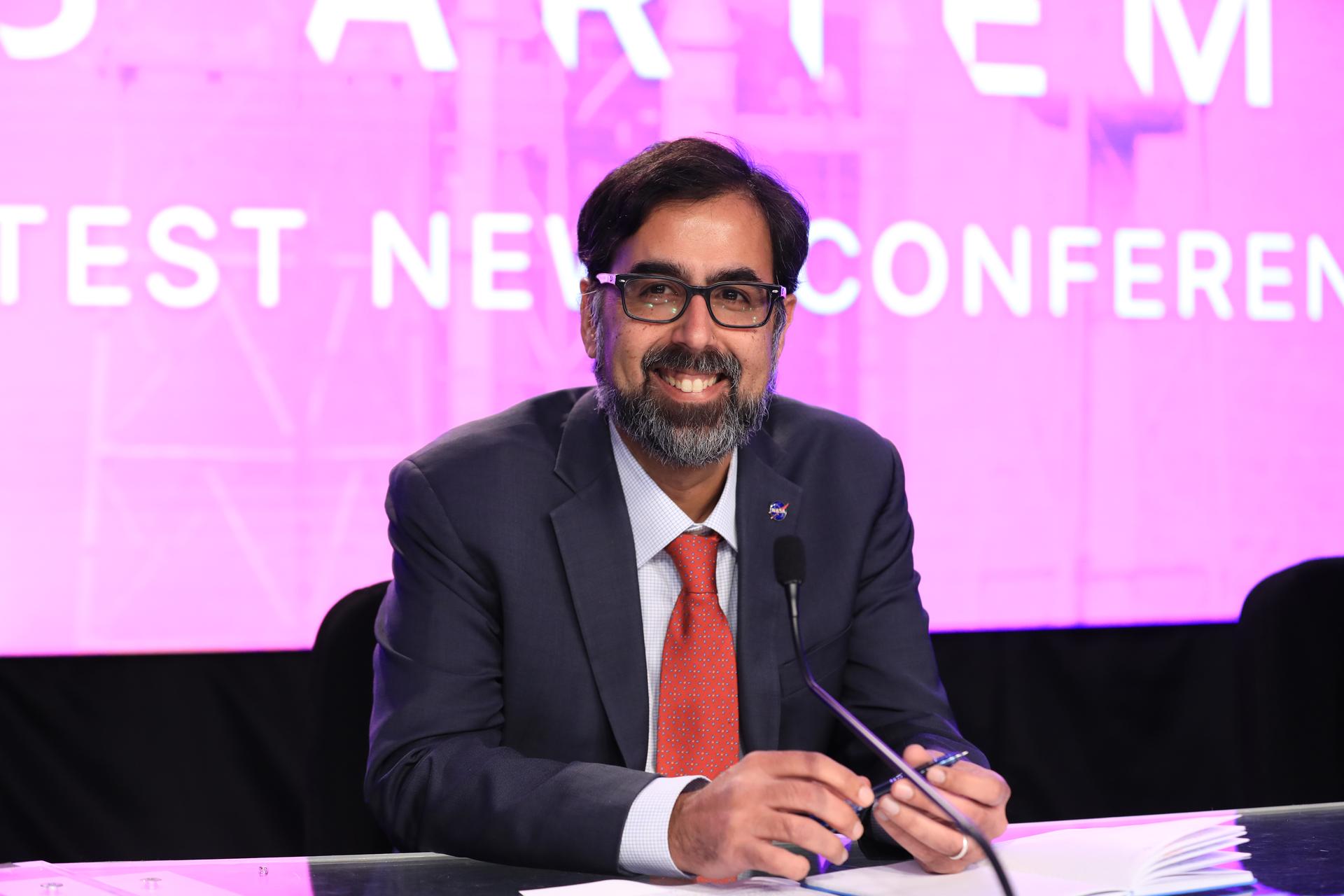
NASA Associate Administrator Amit Kshatriya participates in a news conference on Tuesday, Feb. 3, 2026, to discuss the completion of Artemis II wet dress rehearsal at NASA’s Kennedy Space Center in Florida. The wet dress rehearsal allows the Artemis II launch team to run through operations to load propellant, conduct a full launch countdown, demonstrate the ability to recycle the countdown clock, and drain the tanks to practice timelines and procedures for launch.

KENNEDY SPACE CENTER, FLA. - At Astrotech Space Operations in Titusville, Fla., the MESSENGER spacecraft is prepared for a move to a hazardous processing facility where the spacecraft’s complement of hypergolic propellants will be loaded. MESSENGER is scheduled to launch Aug. 2 aboard a Boeing Delta II rocket from Pad 17-B, Cape Canaveral Air Force Station, Fla., bound for Mercury. The spacecraft is expected to reach orbit around Mercury in March 2011. MESSENGER was built for NASA by the Johns Hopkins University Applied Physics Laboratory in Laurel, Md.
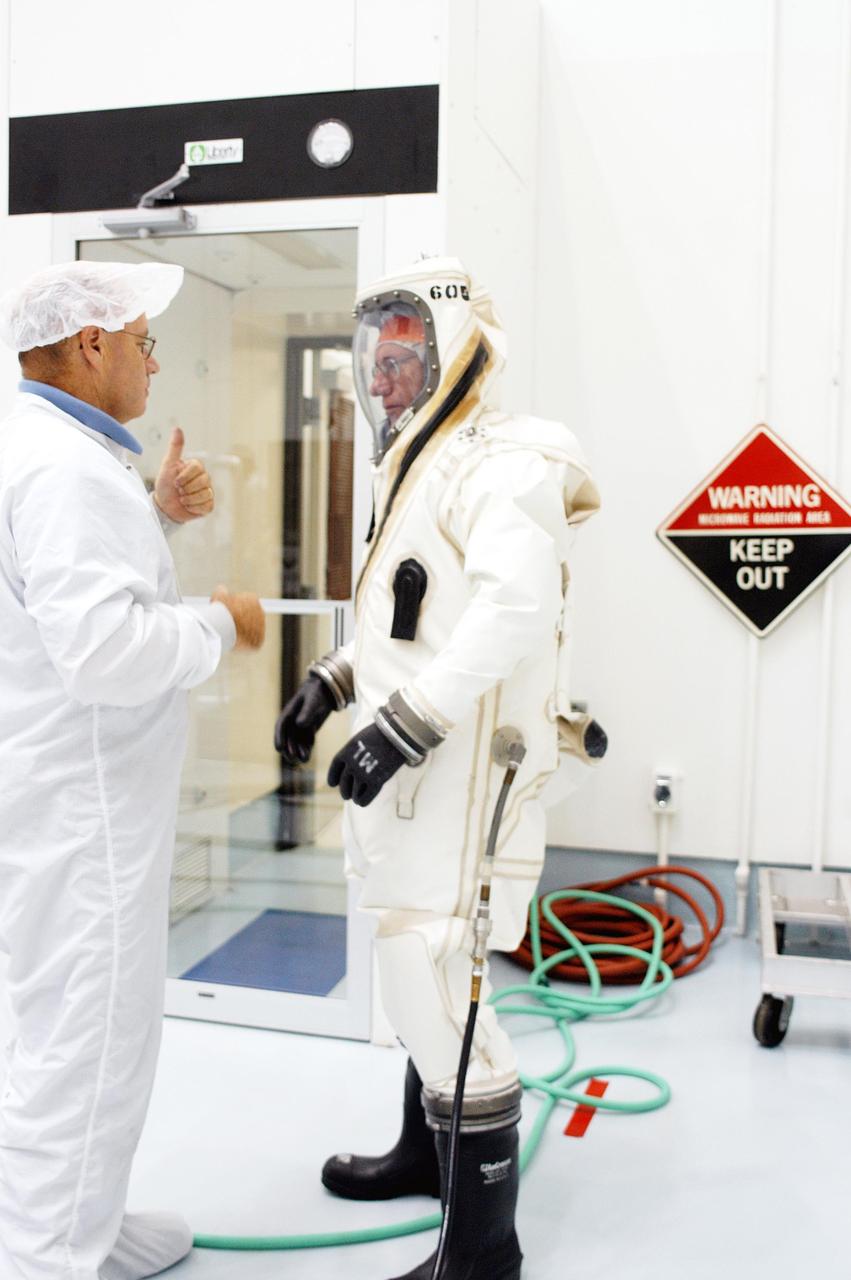
KENNEDY SPACE CENTER, FLA. - A worker (left) at Astrotech Space Operations in Titusville, Fla., questions another worker about the oxygen connection in his protective suit before spacecraft propellant loading of the MESSENGER (Mercury Surface, Space Environment, Geochemistry and Ranging) spacecraft. Liftoff of MESSENGER aboard a Boeing Delta II Heavy rocket, bound for Mercury, is scheduled for Aug. 2. The spacecraft is expected to reach orbit around the planet in March 2011. MESSENGER was built for NASA by the Johns Hopkins University Applied Physics Laboratory in Laurel, Md.
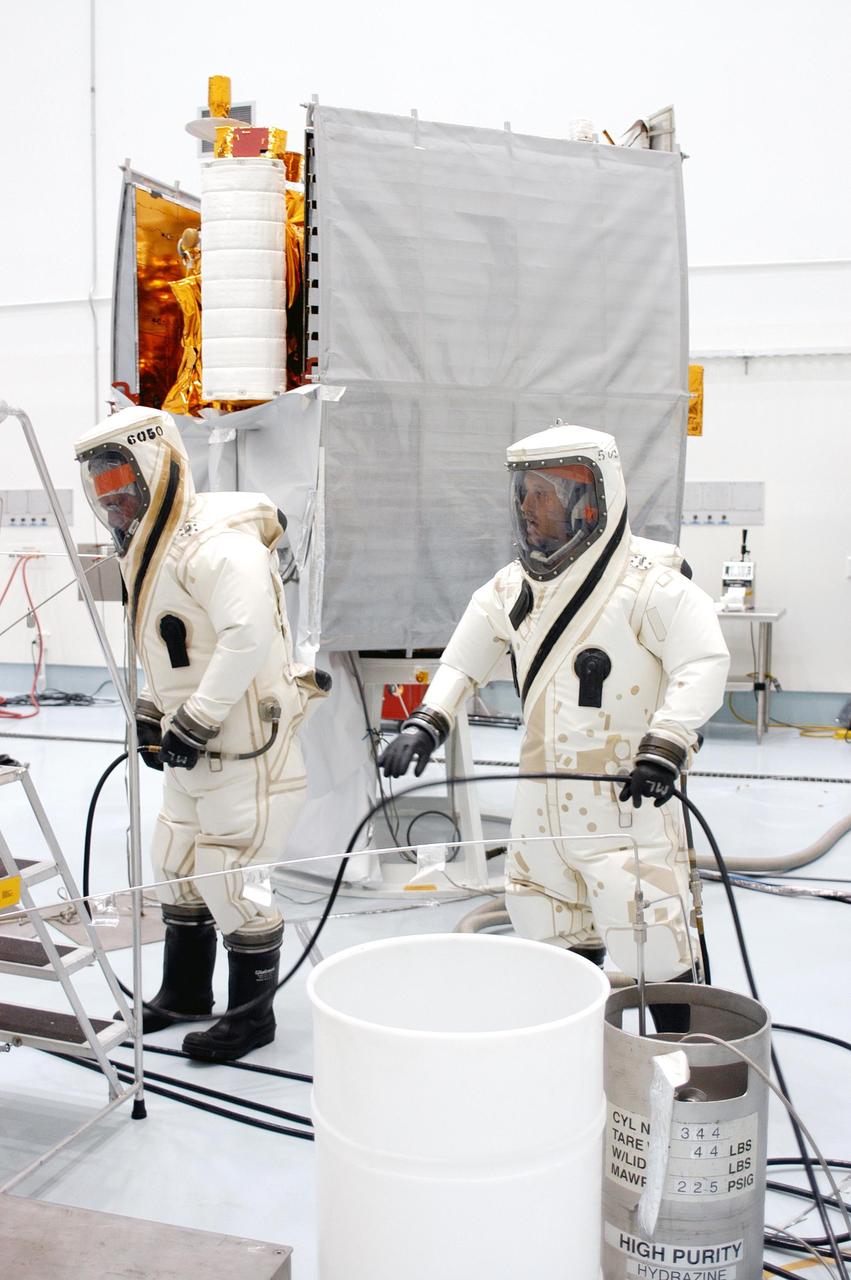
KENNEDY SPACE CENTER, FLA. - Two workers at Astrotech Space Operations in Titusville, Fla., are fully suited and ready for spacecraft propellant loading of the MESSENGER (Mercury Surface, Space Environment, Geochemistry and Ranging) spacecraft. Liftoff of MESSENGER aboard a Boeing Delta II Heavy rocket, bound for Mercury, is scheduled for Aug. 2. The spacecraft is expected to reach orbit around the planet in March 2011. MESSENGER was built for NASA by the Johns Hopkins University Applied Physics Laboratory in Laurel, Md.
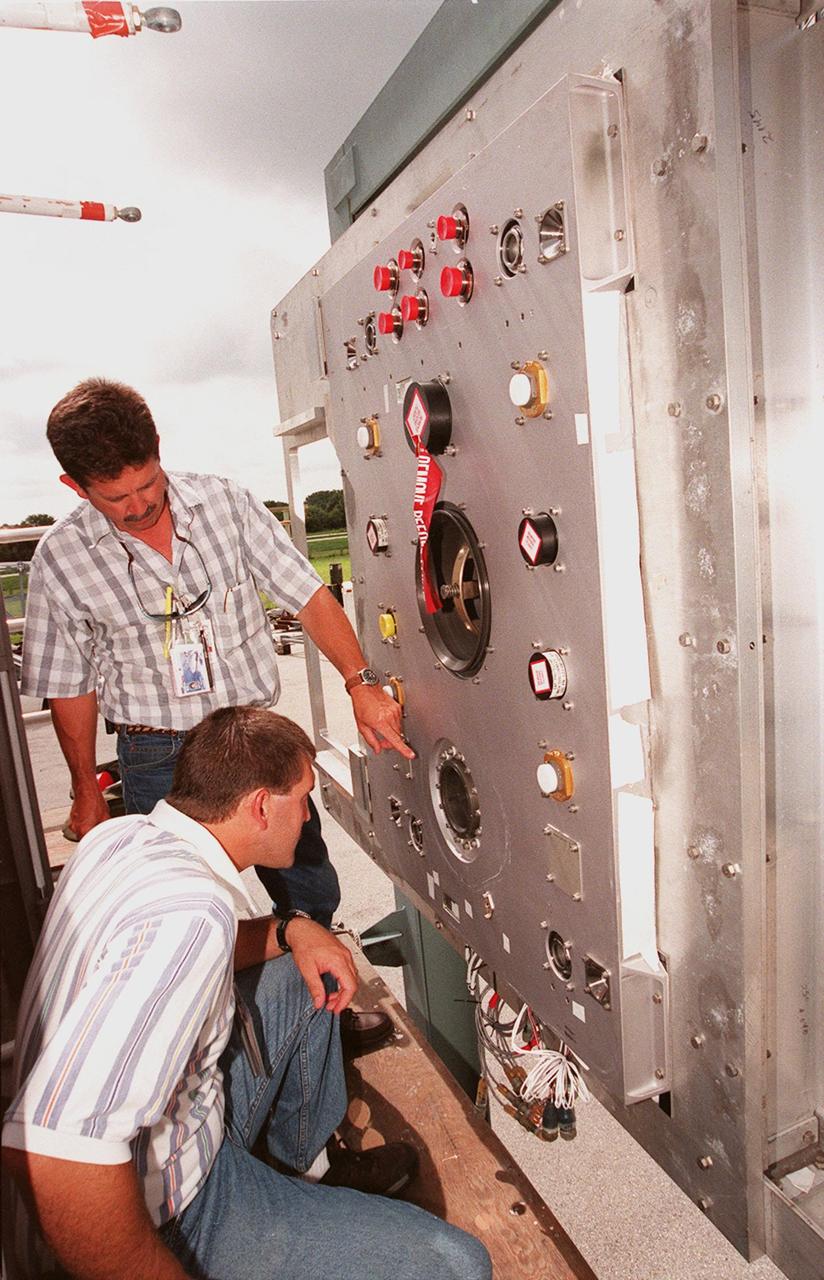
At the Launch Equipment Test Facility, , Will Reaves and Mike Solomon (kneeling), both with Lockheed Martin Technical Operations, observe parts of the X-33 umbilical system during testing. A team of Kennedy Space Center experts developed the umbilical system, comprising panels, valves and hoses that provide the means to load the X-33 with super-cold propellant. The X-33, under construction at Lockheed Martin Skunk Works in Palmdale, Calif., is a half-scale prototype of the planned operational reusable launch vehicle dubbed VentureStar

KENNEDY SPACE CENTER, FLA. - A suited worker at Astrotech Space Operations in Titusville, Fla., checks gauges during propellant loading of the MESSENGER (Mercury Surface, Space Environment, Geochemistry and Ranging) spacecraft. Liftoff of MESSENGER aboard a Boeing Delta II Heavy rocket, bound for Mercury, is scheduled for Aug. 2. The spacecraft is expected to reach orbit around the planet in March 2011. MESSENGER was built for NASA by the Johns Hopkins University Applied Physics Laboratory in Laurel, Md.
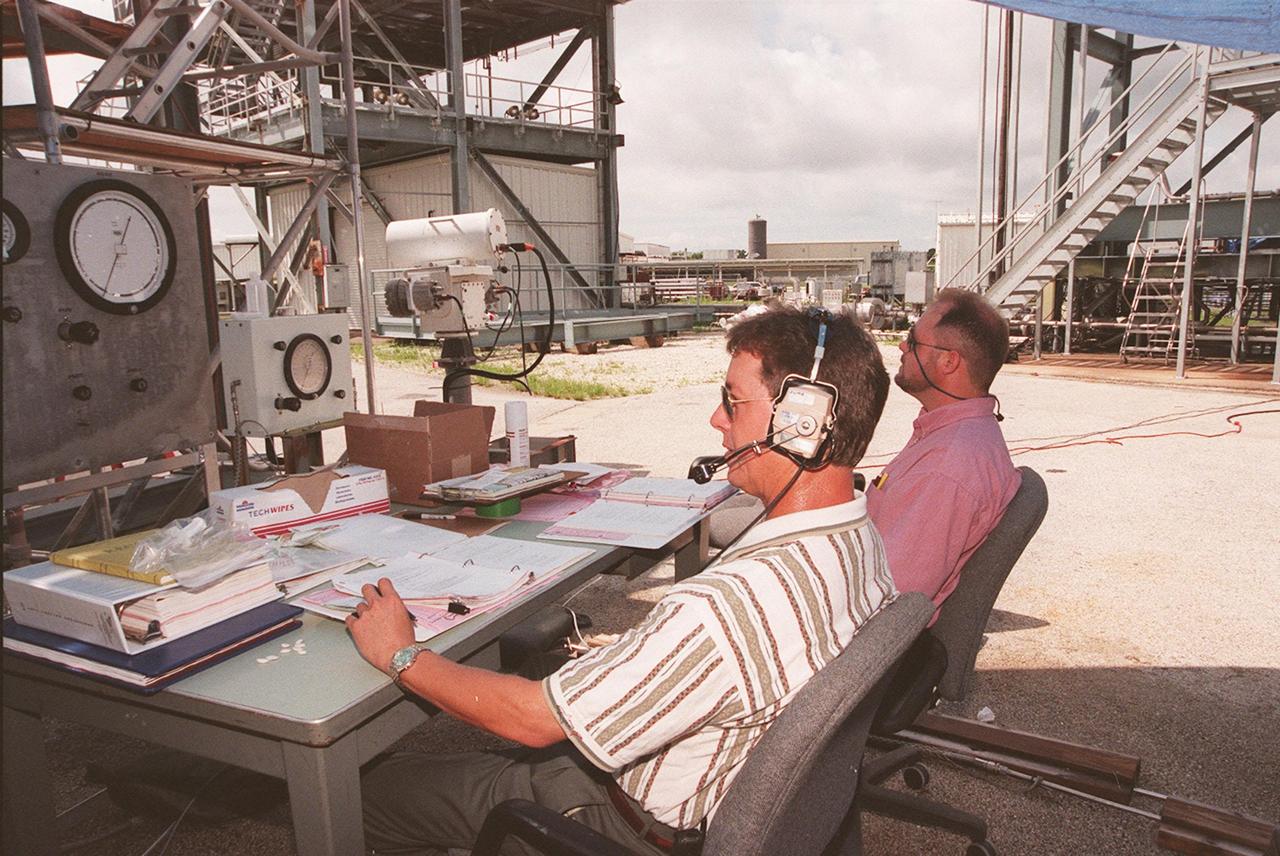
At the Launch Equipment Test Facility, Mike Ynclan, with Dynacs, and Greg Melton, a NASA engineer, look at measurements during testing of the X-33 umbilical system. A team of Kennedy Space Center experts developed the umbilical system, comprising panels, valves and hoses that provide the means to load the X-33 with super-cold propellant. The X-33, under construction at Lockheed Martin Skunk Works in Palmdale, Calif., is a half-scale prototype of the planned operational reusable launch vehicle dubbed VentureStar

KENNEDY SPACE CENTER, FLA. - A suited worker at Astrotech Space Operations in Titusville, Fla., checks fuel tanks before spacecraft propellant loading of the MESSENGER (Mercury Surface, Space Environment, Geochemistry and Ranging) spacecraft (seen in the background). Liftoff of MESSENGER aboard a Boeing Delta II Heavy rocket, bound for Mercury, is scheduled for Aug. 2. The spacecraft is expected to reach orbit around the planet in March 2011. MESSENGER was built for NASA by the Johns Hopkins University Applied Physics Laboratory in Laurel, Md.