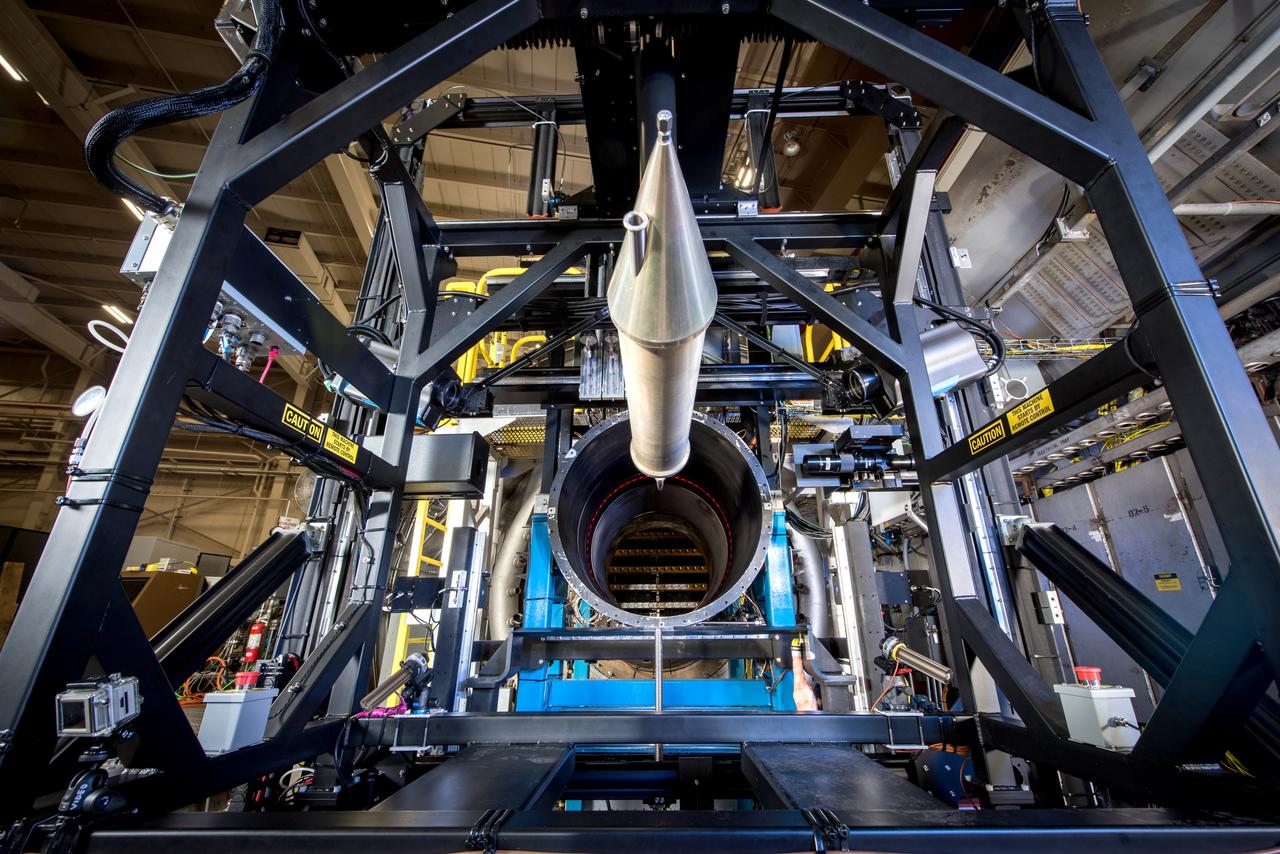
Propulsion Systems Laboratory, PSL Fundamental Aero Test
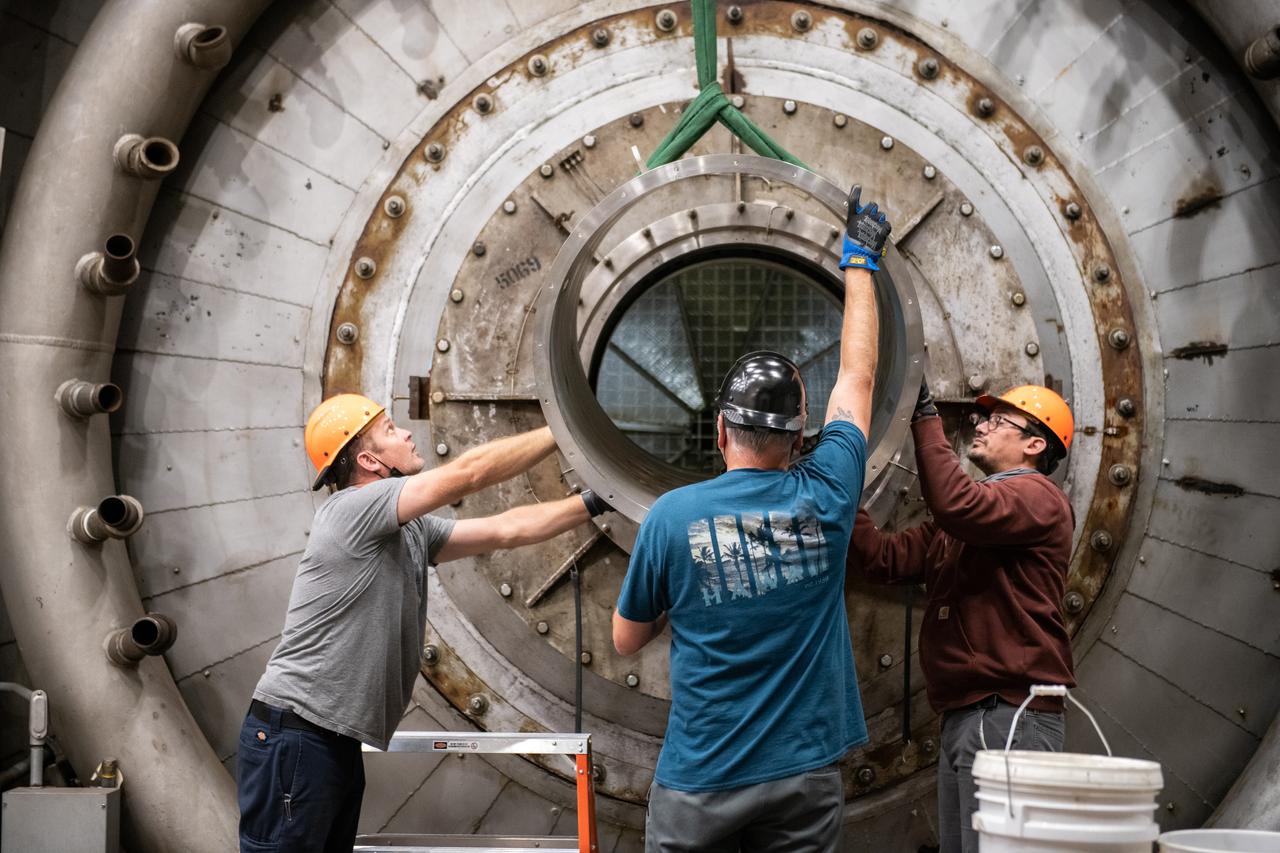
American Society of Mechanical Engineers, ASME Nozzle Test at Propulsion Systems Laboratory, PSL Documentation Photographs
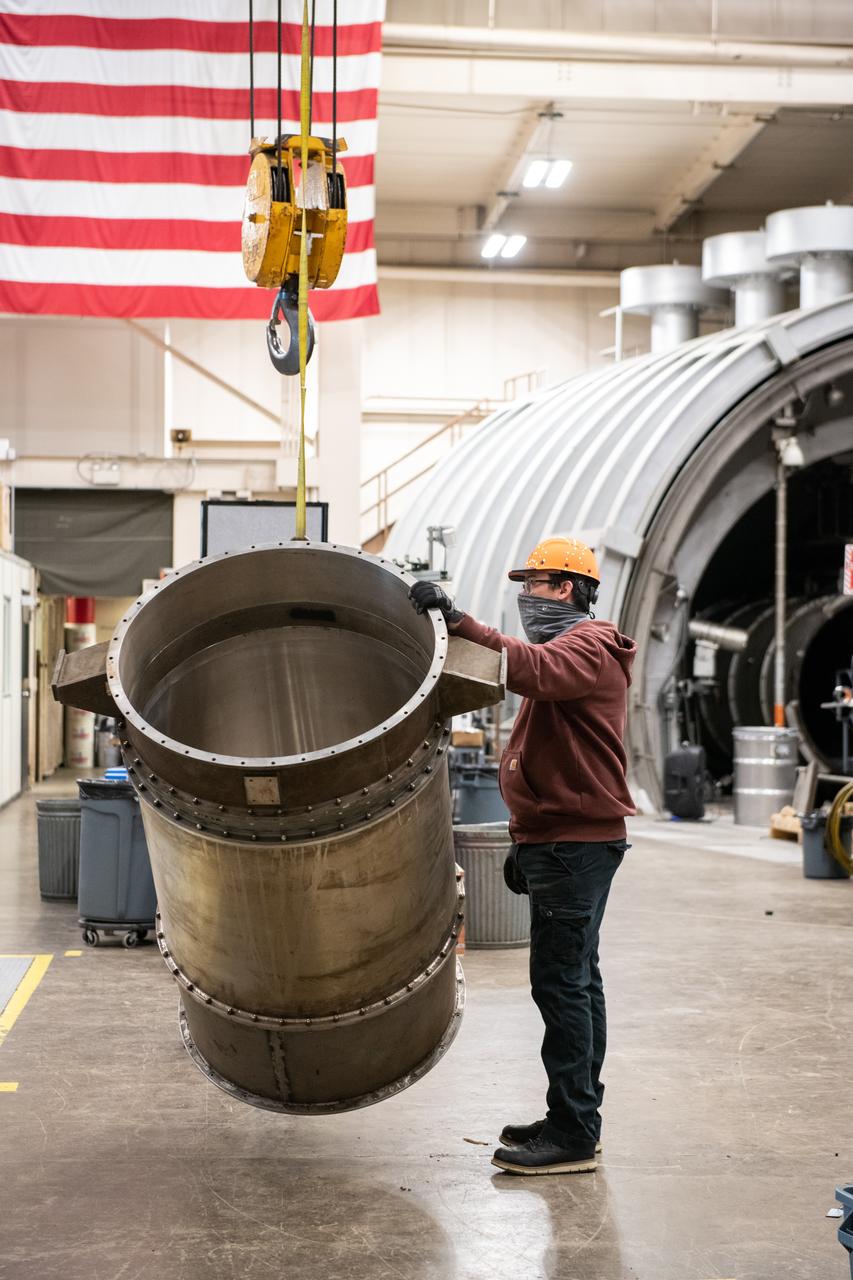
American Society of Mechanical Engineers, ASME Nozzle Test at Propulsion Systems Laboratory, PSL
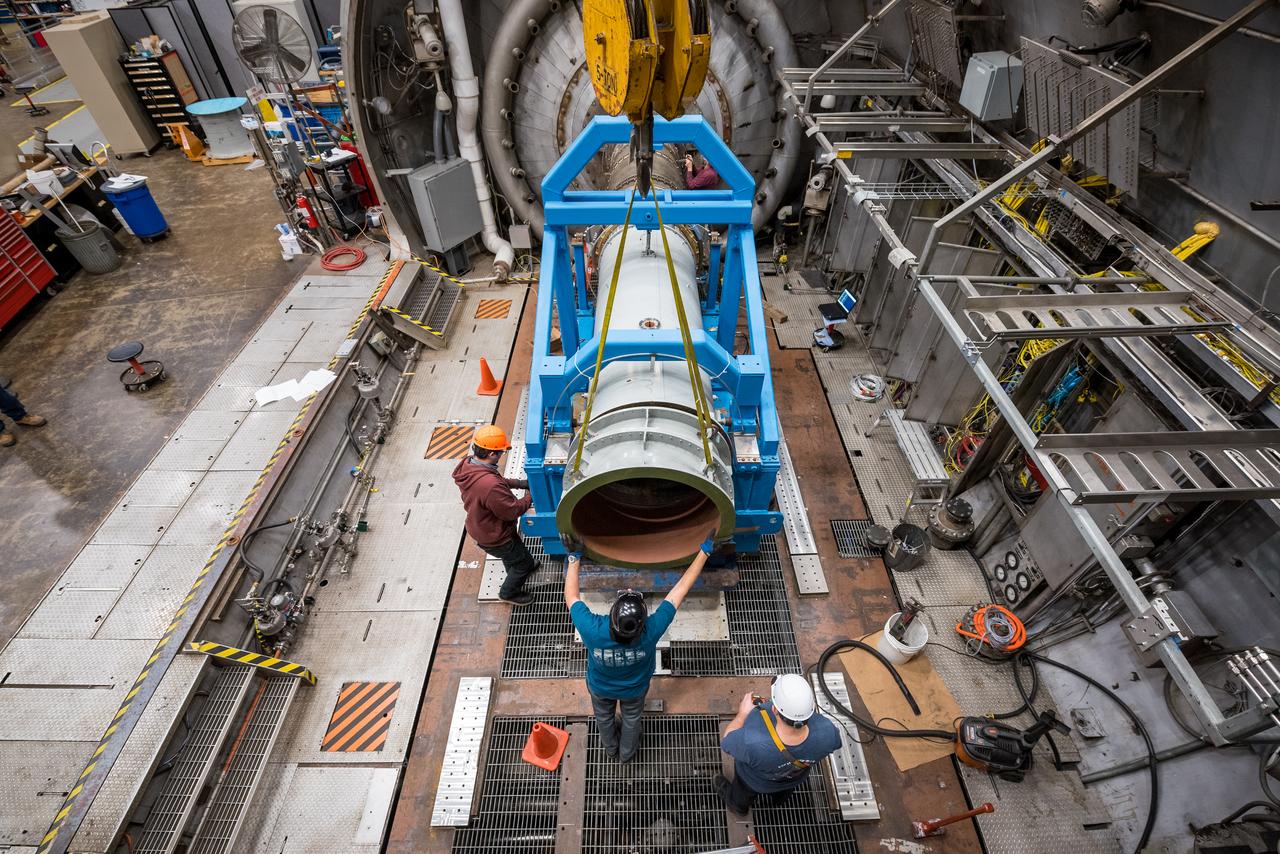
American Society of Mechanical Engineers, ASME Nozzle Test at Propulsion Systems Laboratory, PSL

One of the two primary coolers at the Propulsion Systems Laboratory at the National Advisory Committee for Aeronautics (NACA) Lewis Flight Propulsion Laboratory. Engines could be run in simulated altitude conditions inside the facility’s two 14-foot-diameter and 24-foot-long test chambers. The Propulsion Systems Laboratory was the nation’s only facility that could run large full-size engine systems in controlled altitude conditions. At the time of this photograph, construction of the facility had recently been completed. Although not a wind tunnel, the Propulsion Systems Laboratory generated high-speed airflow through the interior of the engine. The air flow was pushed through the system by large compressors, adjusted by heating or refrigerating equipment, and de-moisturized by air dryers. The exhaust system served two roles: reducing the density of the air in the test chambers to simulate high altitudes and removing hot gases exhausted by the engines being tested. It was necessary to reduce the temperature of the extremely hot engine exhaust before the air reached the exhauster equipment. As the air flow exited through exhaust section of the test chamber, it entered into the giant primary cooler seen in this photograph. Narrow fins or vanes inside the cooler were filled with water. As the air flow passed between the vanes, its heat was transferred to the cooling water. The cooling water was cycled out of the system, carrying with it much of the exhaust heat.
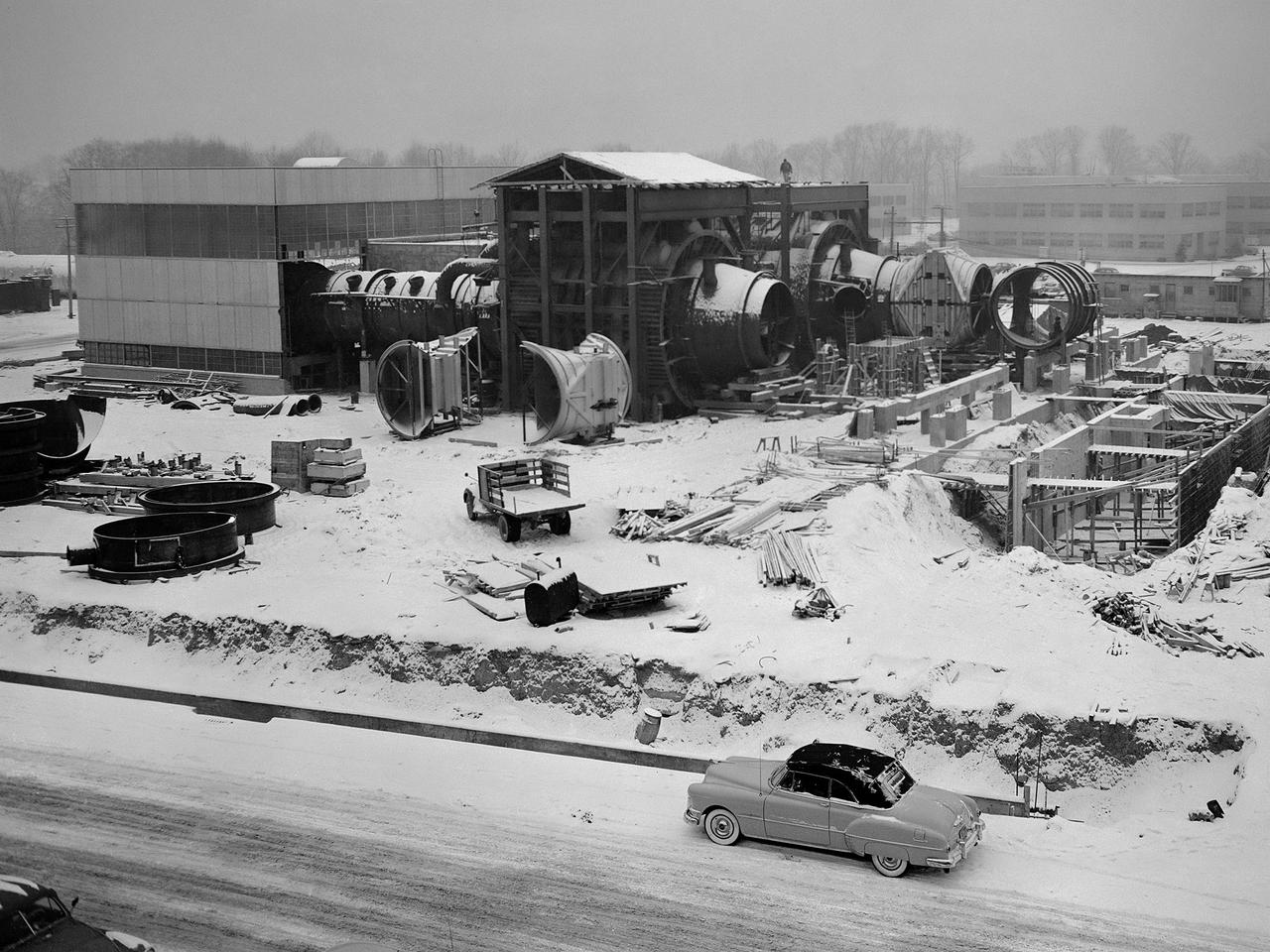
Construction of the Propulsion Systems Laboratory No. 1 and 2 at the National Advisory Committee for Aeronautics (NACA) Lewis Flight Propulsion Laboratory. When it began operation in late 1952, the Propulsion Systems Laboratory was the NACA’s most powerful facility for testing full-scale engines at simulated flight altitudes. The facility contained two altitude simulating test chambers which were a technological combination of the static sea-level test stands and the complex Altitude Wind Tunnel, which recreated actual flight conditions on a larger scale. NACA Lewis began designing the new facility in 1947 as part of a comprehensive plan to improve the altitude testing capabilities across the lab. The exhaust, refrigeration, and combustion air systems from all the major test facilities were linked. In this way, different facilities could be used to complement the capabilities of one another. Propulsion Systems Laboratory construction began in late summer 1949 with the installation of an overhead exhaust pipe connecting the facility to the Altitude Wind Tunnel and Engine Research Building. The large test section pieces arriving in early 1951, when this photograph was taken. The two primary coolers for the altitude exhaust are in place within the framework near the center of the photograph.
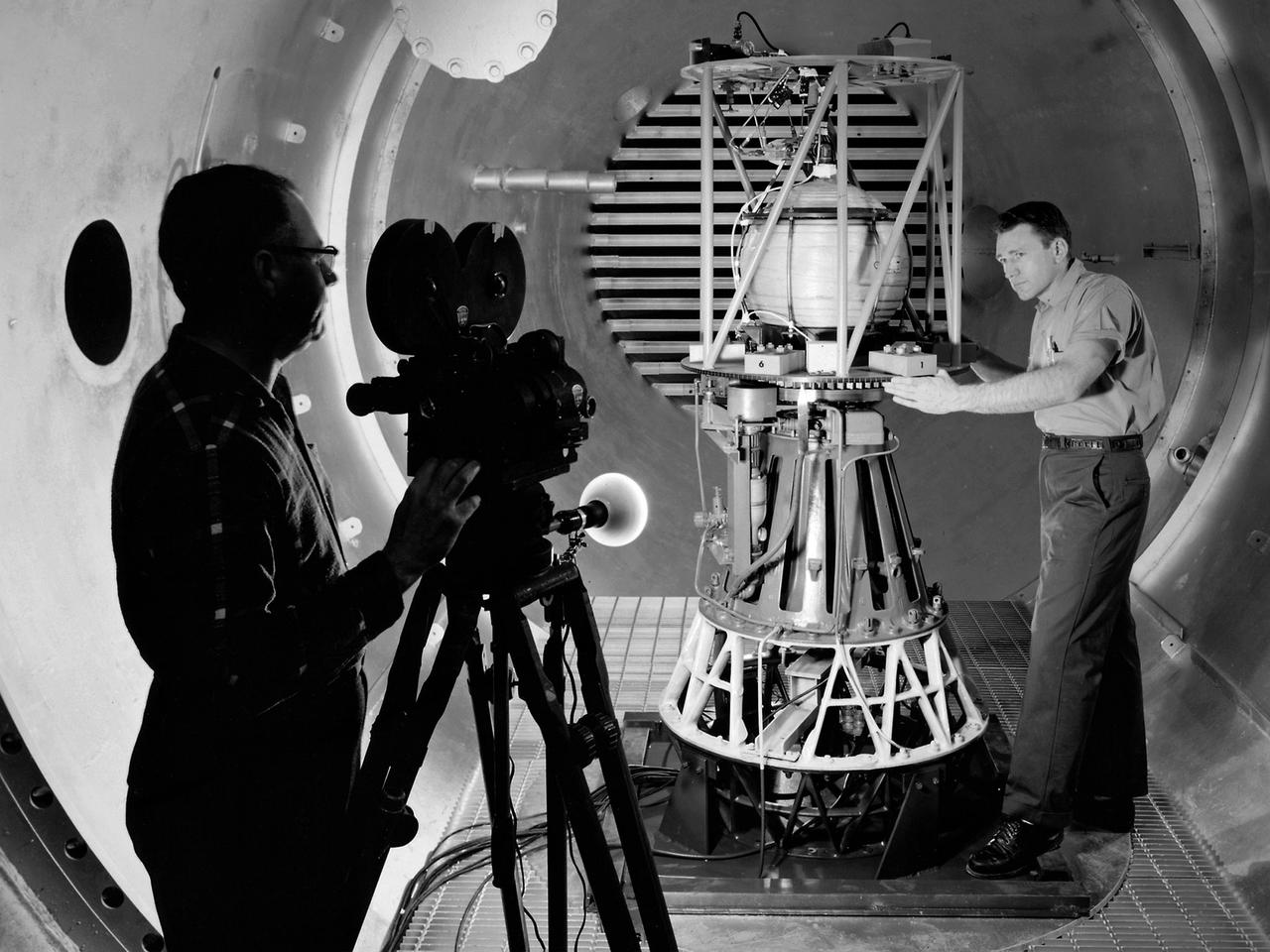
Mechanic Howard Wine inspects the setup of a spin isolator in Cell 2 of the Propulsion Systems Laboratory at the National Aeronautics and Space Administration (NASA) Lewis Research Center. Photographer Al Jecko filmed the proceedings. This test was unique in that the chamber’s altitude system was used, but not its inlet air flow. The test was in preparation for an upcoming launch of modified liquid hydrogen propellant tank on a sounding rocket. This Weightlessness Analysis Sounding Probe (WASP) was part of Lewis investigation into methods for controlling partially filled liquid hydrogen fuel tanks during flight. Second-stage rockets, the Centaur in particular, were designed to stop their engines and coast, then restart them when needed. During this coast period, the propellant often shifted inside the tank. This movement could throw the rocket off course or result in the sloshing of fuel away from the fuel pump. Wine was one of only three journeymen mechanics at Lewis when he was hired in January 1954. He spent his first decade in the Propulsion Systems Laboratory and was soon named a section head. Wine went on to serve as Assistant Division Chief and later served as an assistant to the director. Jecko joined the center in 1947 as a photographer and artist. He studied at the Cleveland School or Art and was known for his cartoon drawing. He worked at the center for 26 years.
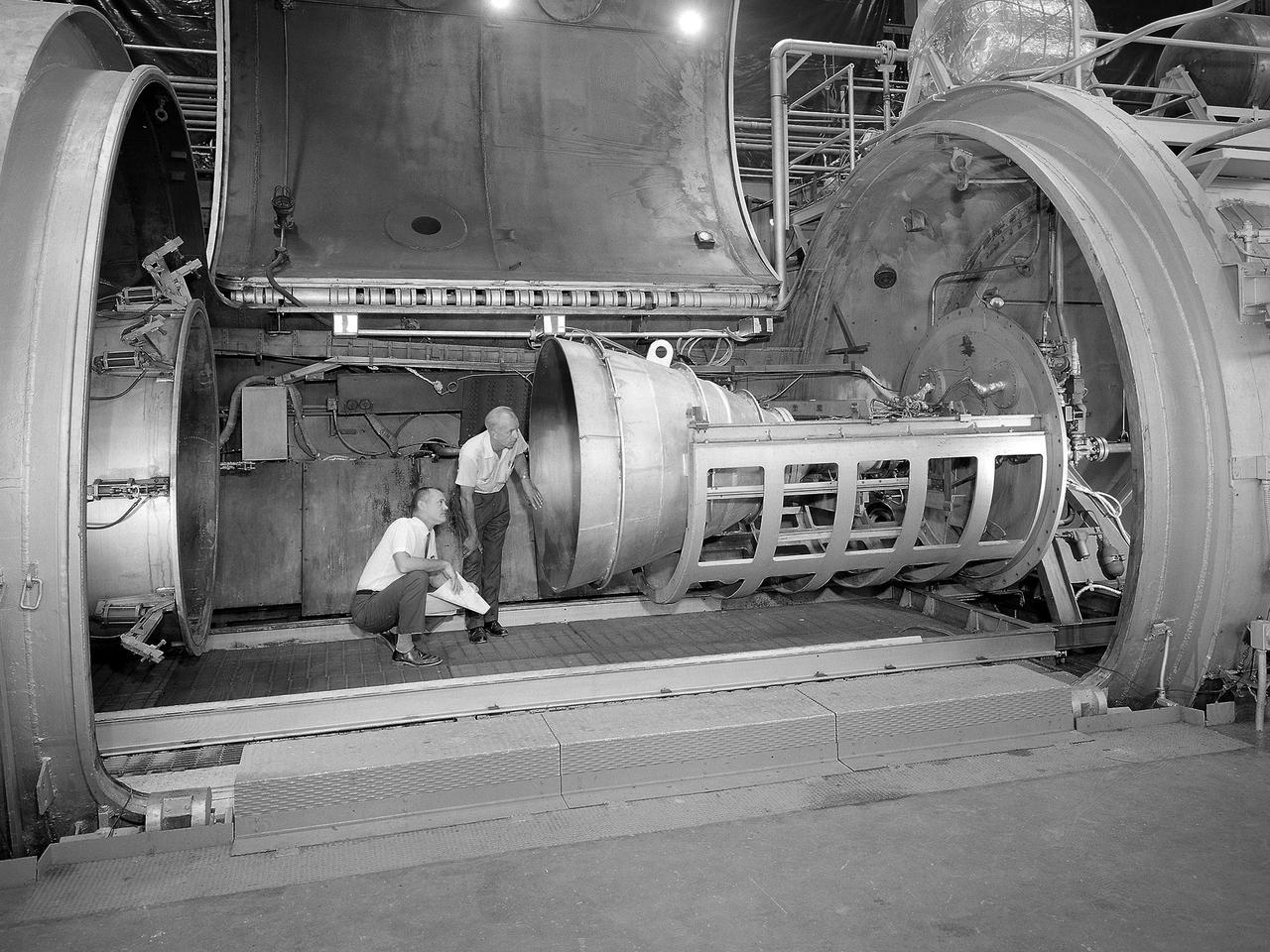
Bill Harrison and Bud Meilander check the setup of an Apollo Contour rocket nozzle in the Propulsion Systems Laboratory at the National Aeronautics and Space Administration (NASA) Lewis Research Center. The Propulsion Systems Laboratory contained two 14-foot diameter test chambers that could simulate conditions found at very high altitudes. The facility was used in the 1960s to study complex rocket engines such as the Pratt and Whitney RL-10 and rocket components such as the Apollo Contour nozzle, seen here. Meilander oversaw the facility’s mechanics and the installation of test articles into the chambers. Harrison was head of the Supersonic Tunnels Branch in the Test Installations Division. Researchers sought to determine the impulse value of the storable propellant mix, classify and improve the internal engine performance, and compare the results with analytical tools. A special setup was installed in the chamber that included a device to measure the thrust load and a calibration stand. Both cylindrical and conical combustion chambers were examined with the conical large area ratio nozzles. In addition, two contour nozzles were tested, one based on the Apollo Service Propulsion System and the other on the Air Force’s Titan transtage engine. Three types of injectors were investigated, including a Lewis-designed model that produced 98-percent efficiency. It was determined that combustion instability did not affect the nozzle performance. Although much valuable information was obtained during the tests, attempts to improve the engine performance were not successful.
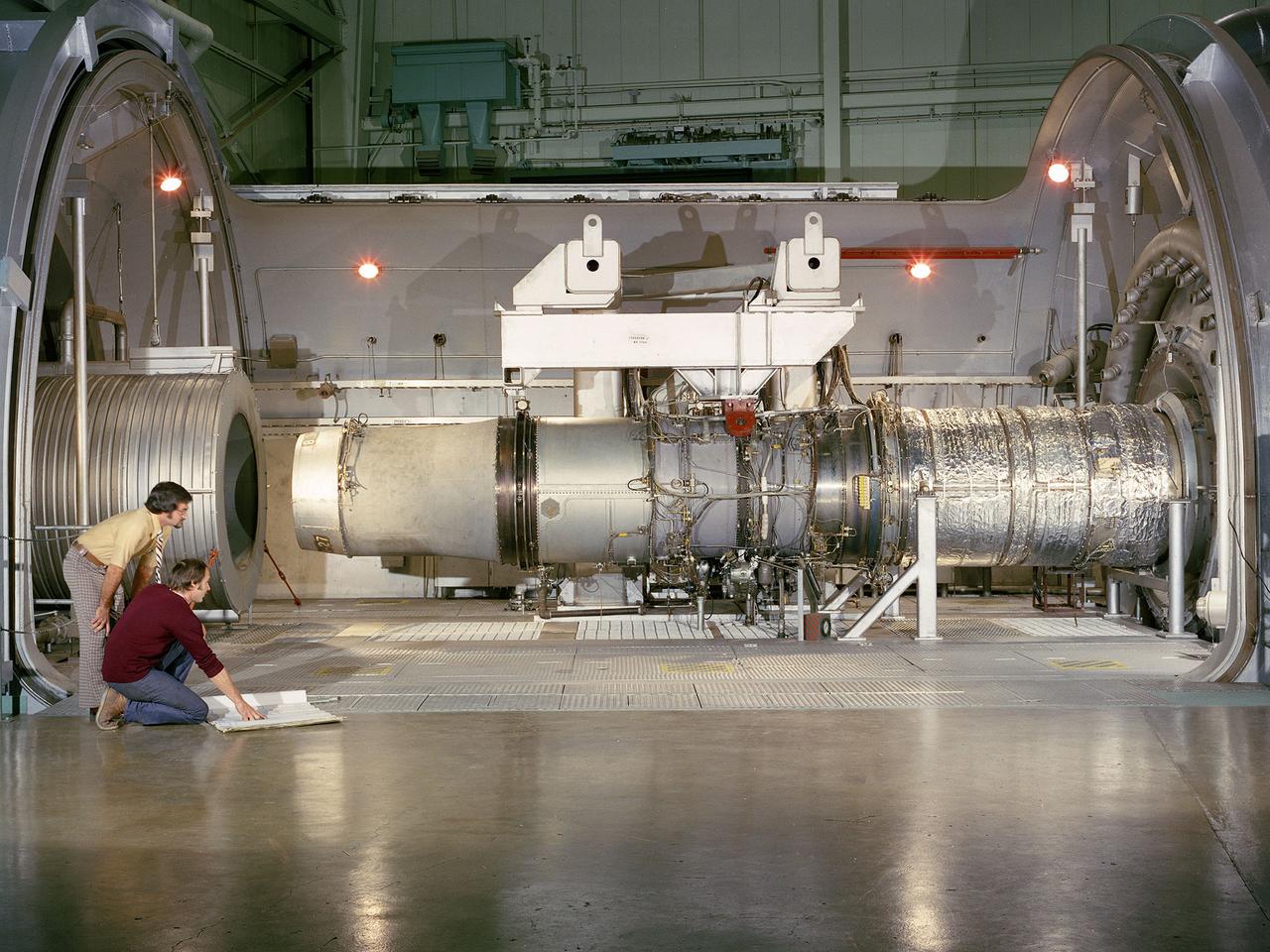
A refanned Pratt and Whitney JT-8D-109 turbofan engine installed in Cell 4 of the Propulsion Systems Laboratory at the National Aeronautics and Space Administration (NASA) Lewis Research Center. NASA Lewis’ Refan Program sought to demonstrate that noise reduction modifications could be applied to existing aircraft engines with minimal costs and without diminishing the engine’s performance or integrity. At the time, Pratt and Whitney’s JT-8D turbofans were one of the most widely used engines in the commercial airline industry. The engines powered Boeing’s 727 and 737 and McDonnell Douglas’ DC-9 aircraft. Pratt and Whitney worked with the airline manufacturers on a preliminary study that verified feasibility of replacing the JT-8D’s two-stage fan with a larger single-stage fan. The new fan slowed the engine’s exhaust, which significantly reduced the amount of noise it generated. Booster stages were added to maintain the proper level of airflow through the engine. Pratt and Whitney produced six of the modified engines, designated JT-8D-109, and performed the initial testing. One of the JT-8D-109 engines, seen here, was tested in simulated altitude conditions in NASA Lewis’ Propulsion Systems Laboratory. The Refan engine was ground-tested on an actual aircraft before making a series of flight tests on 727 and DC-9 aircraft in early 1976. The Refan Program reduced the JT-8D’s noise by 50 percent while increasing the fuel efficiency. The retro-fit kits were estimated to cost between $1 million and $1.7 million per aircraft.
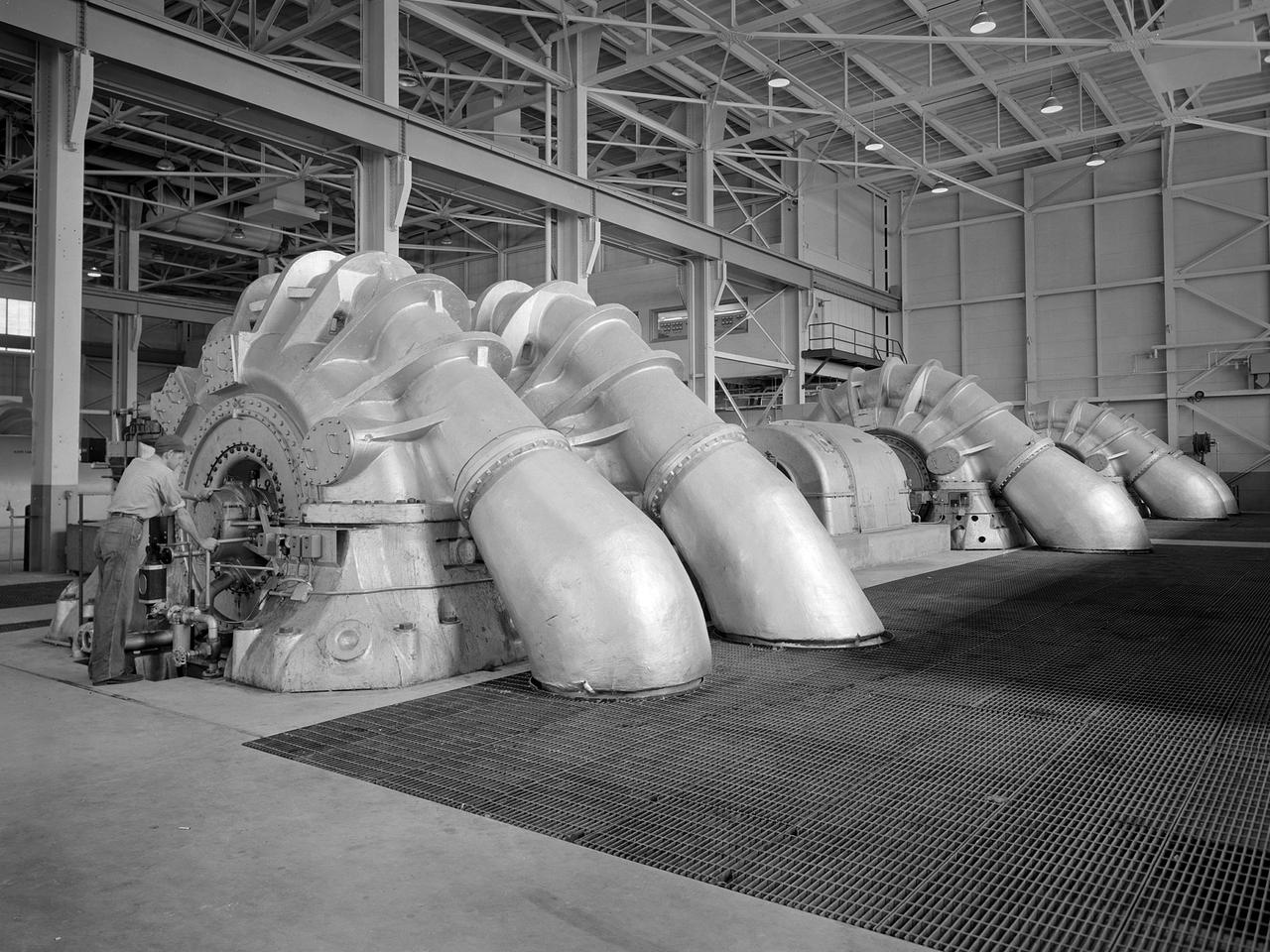
The Propulsion Systems Laboratory’s exhaust system was expanded in 1955 at the National Advisory Committee for Aeronautics (NACA) Lewis Flight Propulsion Laboratory. The facility contained two altitude chambers that were first used to study the increasingly-powerful jet engines of the early 1950s and the ramjets for missile programs such as Navaho and Bomarc. Later, the facility tested large rocket engines and a variety of turbofan engines. The exhaust system served two roles: reducing the density of the air in the test chambers to simulate high altitudes and removing the hot gases exhausted by the engines being tested. These tasks were accomplished by large Roots-Connersville exhauster equipment in the Equipment Building. The original configuration could exhaust the 3500° F gases at a rate of 100 pounds per second when the simulated altitude was 50,000 feet. In 1955, three years after operation started, a fourth line of exhausters was added. There were three centrifugal exhausters capable of supplying 166 pounds of air per second at the test chamber altitude of 50,000 feet or 384 pounds per second at 32,000 feet. These exhausters had two first-stage castings driven by a 10,000-horsepower motor; one second; one third; and one fourth-stage casting driven by a 16,500-horsepower motor. The total inlet volume of the exhausters is 1,650,000 cubic feet of gas per minute. The exhausters were continually improved and upgraded over the years.
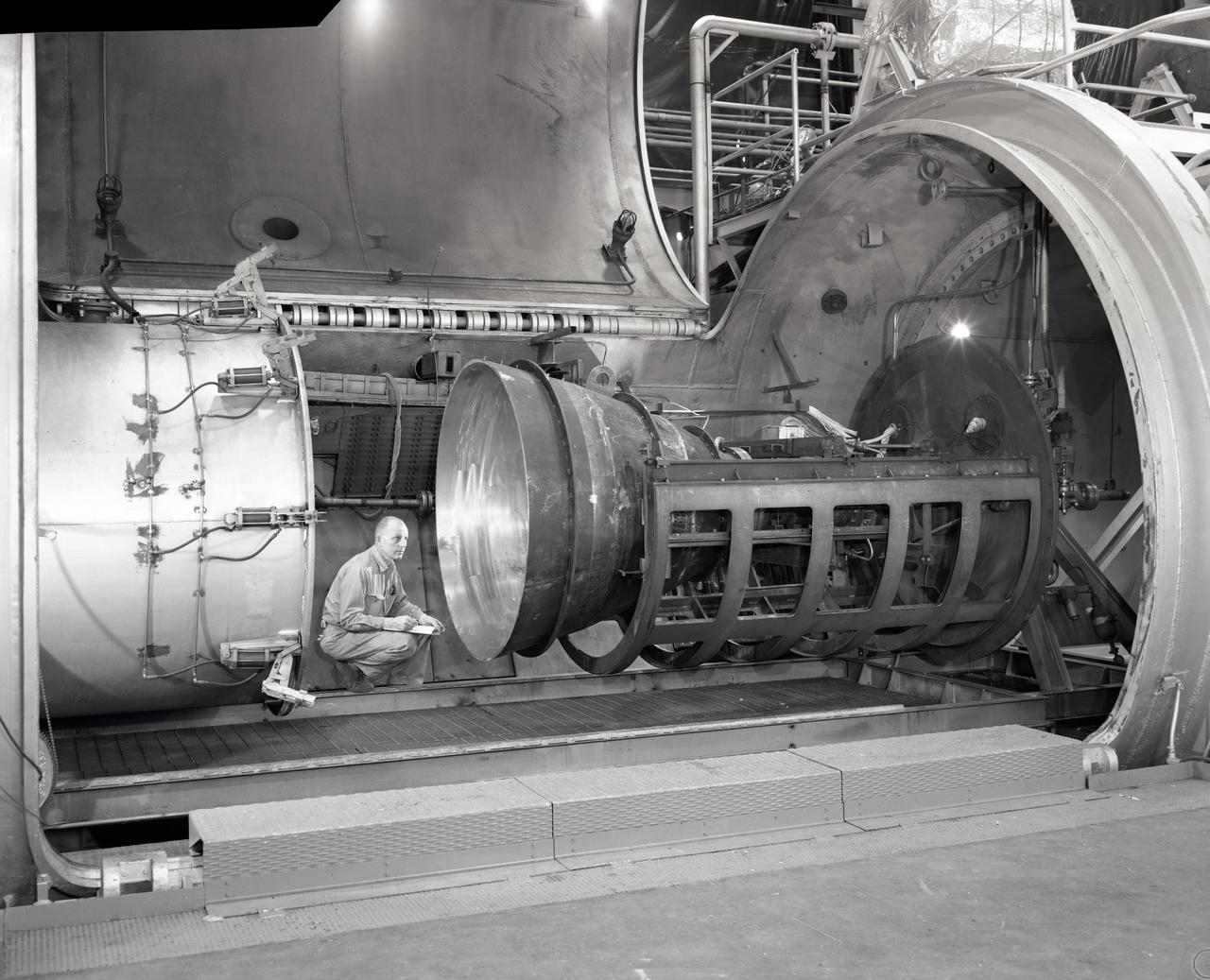
APOLLO CONTOUR ENGINE MOUNTED IN THE PROPULSION SYSTEMS LABORATORY PSL NO. 2 TEST CELL
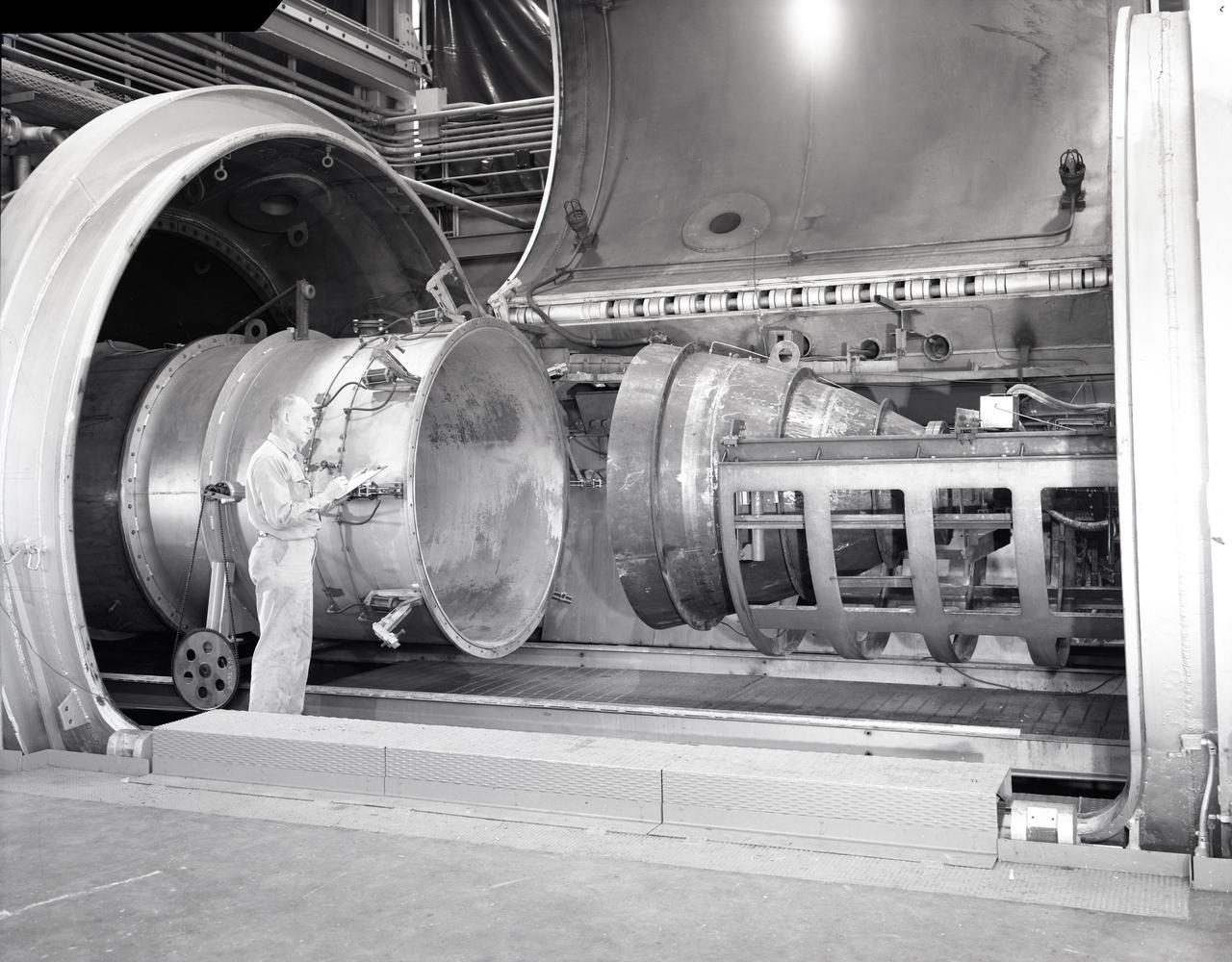
APOLLO CONTOUR ENGINE MOUNTED IN THE PROPULSION SYSTEMS LABORATORY PSL NO. 2 TEST CELL
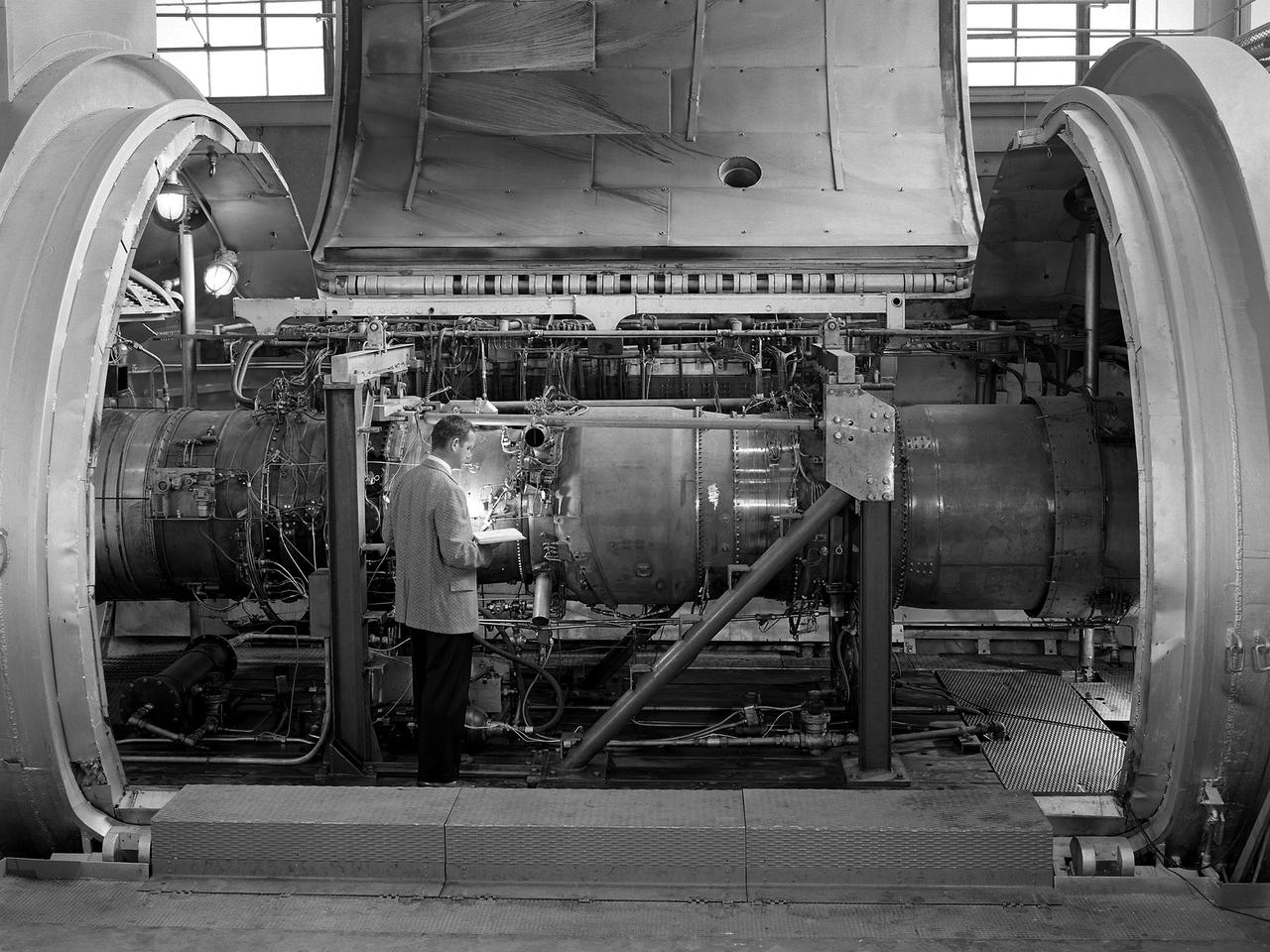
A researcher examines the Orenda Iroquois PS.13 turbojet in a Propulsion Systems Laboratory test chamber at the National Advisory Committee for Aeronautics (NACA) Lewis Flight Propulsion Laboratory. The Iroquois was being developed to power the CF-105 Arrow fighter designed by the Avro Canada Company. Avro began design work on the Arrow jet fighter in 1952. The company’s Orenda branch suggested building a titanium-based PS.13 Iroquois engine after development problems arose with the British engines that Avro had originally intended to use. The 10-stage, 20,000-pound-thrust Iroquois would prove to be more powerful than any contemporary US or British turbojet. It was also significantly lighter and more fuel efficient. An Iroquois was sent to Cleveland in April 1957 so that Lewis researchers could study the engine’s basic performance for the air force in the Propulsion Systems Laboratory. The tests were run over a wide range of speeds and altitudes with variations in exhaust-nozzle area. Initial studies determined the Iroquois’s windmilling and ignition characteristics at high altitude. After operating for 64 minutes, the engine was reignited at altitudes up to the 63,000-foot limit of the facility. Various modifications were attempted to reduce the occurrence of stall but did not totally eradicate the problem. The Arrow jet fighter made its initial flight in March 1958 powered by a substitute engine. In February 1959, however, both the engine and the aircraft programs were cancelled. The world’s superpowers had quickly transitioned from bombers to ballistic missiles which rendered the Avro Arrow prematurely obsolete.
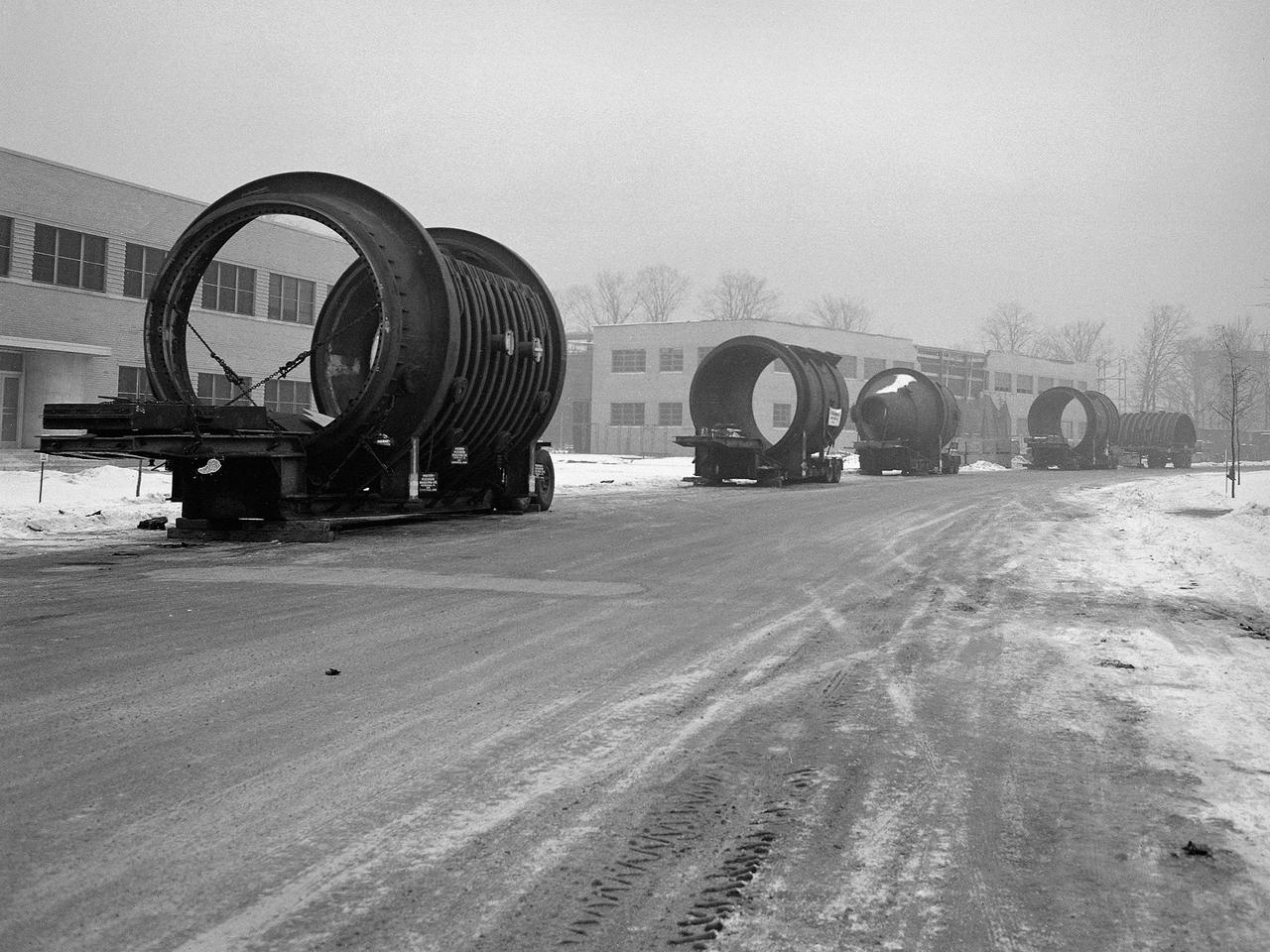
A caravan of large steel castings arrived at the National Advisory Committee for Aeronautics (NACA) Lewis Flight Propulsion Laboratory in January 1951. These pieces would serve as the two 14-foot diameter test chambers in the new Propulsion Systems Laboratory (PSL). NACA Lewis specialized in aircraft engines and offered many engine test facilities. In the late 1940s, however, the NACA realized a larger facility was required to test the newest jet engines. When completed in October 1952, PSL became the nation’s most powerful facility for testing full-scale engines at simulated flight altitudes. NACA engineers began designing the PSL in 1947, and excavations commenced in September 1949. In the spring of 1950, the facility’s supports were erected, and the two large exhaust gas coolers were installed. Work on the Access Building began in early 1951 with the arrival of the large test section pieces, seen in this photograph. The massive pieces were delivered to the area from the Henry Pratt Company by rail and then loaded on a series of flatbed trucks that transported them to Lewis. The nearest vehicle has one of the clamshell access hatches. PSL was initially used to study the jet engines of the early 1950s and ramjets for missile programs such as Navaho and Bomarc. With the advent of the space program in the late 1950s, the facility was used to investigate complex rocket engines, including the Pratt and Whitney RL-10.

A Wright Aeronautical XRJ47-W-5 ramjet installed in a test chamber of the National Advisory Committee for Aeronautics’ (NACA) new Propulsion Systems Laboratory at the Lewis Flight Propulsion Laboratory. Construction of the facility had only recently been completed, and NACA engineers were still testing the various operating systems. The Propulsion Systems Laboratory was the NACA’s most powerful facility for testing full-scale engines in simulated flight altitudes. It contained two 14-foot diameter and 100-foot-long altitude chambers that ran parallel to one another with a control room in between. The engine being tested was installed inside the test section of one of the chambers, seen in this photograph. Extensive instrumentation was fitted onto the engine prior to the test. Once the chamber was sealed, the altitude conditions were introduced, and the engine was ignited. Operators in the control room could run the engine at the various speeds and adjust the altitude conditions to the desired levels. The engine’s exhaust was ejected into the cooling equipment. Two 48-inch diameter XRJ47-W-5 ramjets were used to power the North American Aviation Navaho Missile. The Navaho was a winged missile that was intended to travel up to 3000 miles carrying a nuclear warhead. It was launched using rocket booster engines that were ejected after the missile’s ramjet engines were ignited.
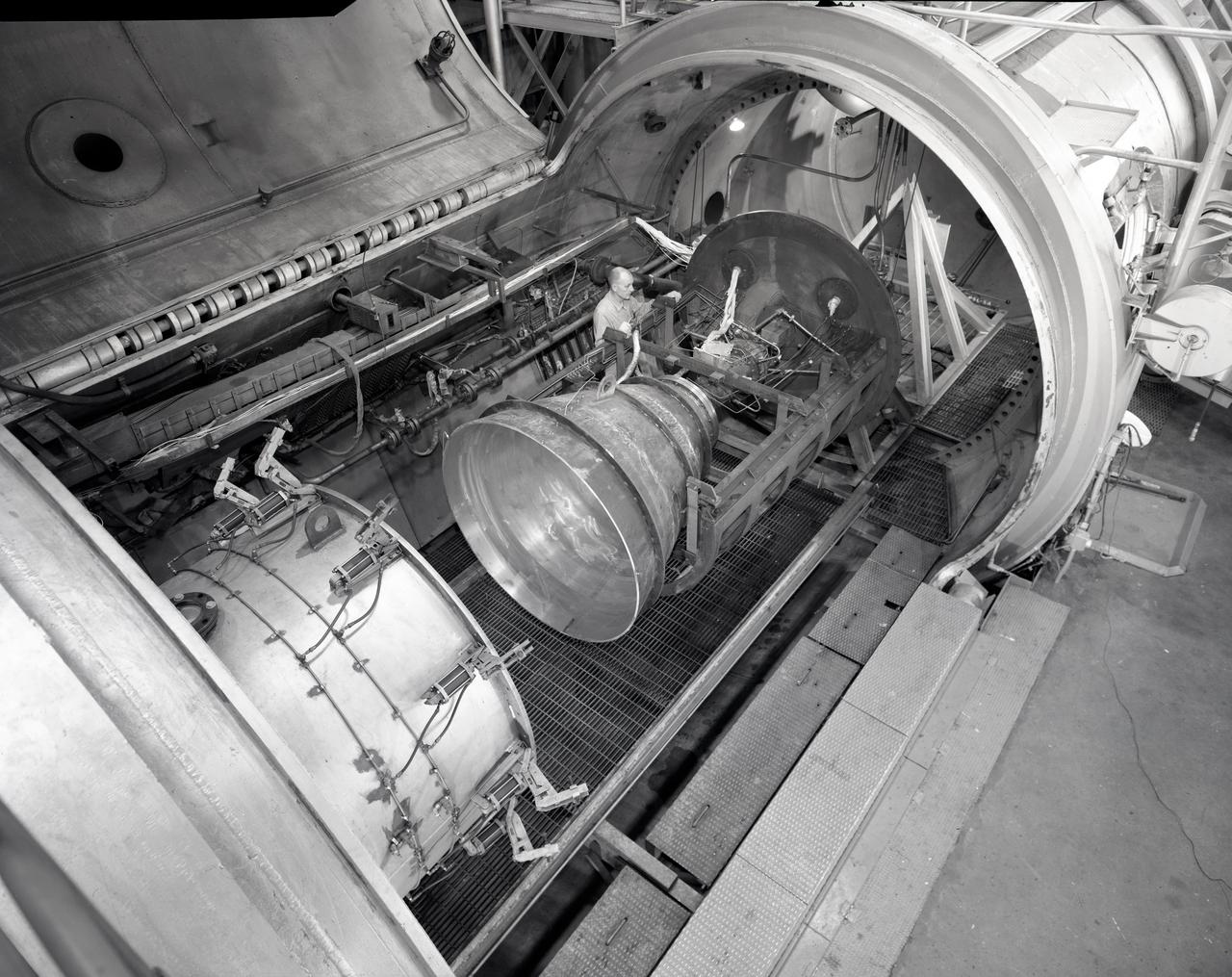
APOLLO CONTOUR ENGINE MOUNTED IN THE PROPULSION SYSTEMS LABORATORY PSL NO. 2 TEST CELL
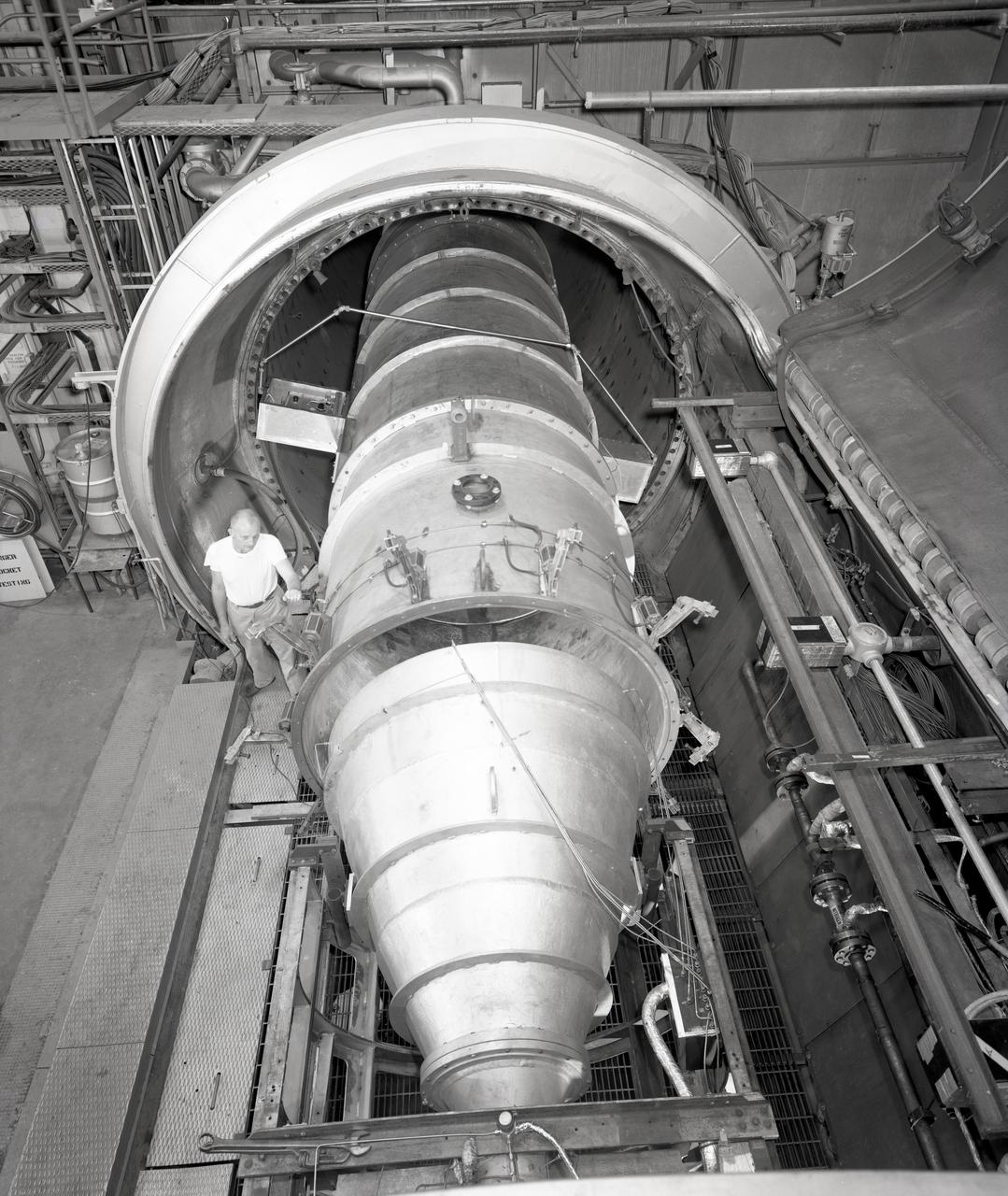
Apollo Contour Engine Model being tested in the NASA Lewis Research Center, Propulsion Systems Laboratory, PSL
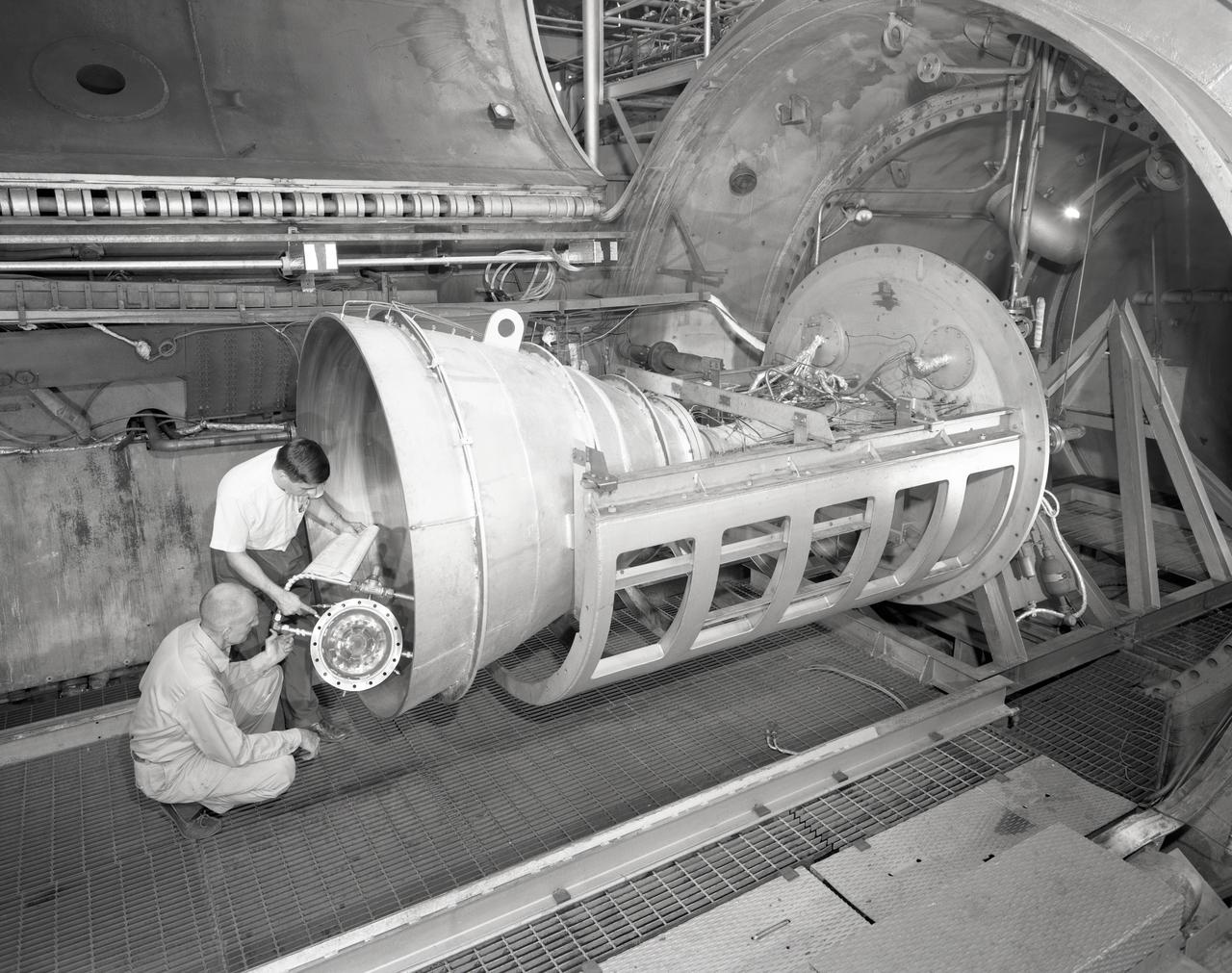
Apollo Contour Engine Model being tested in the NASA Lewis Research Center, Propulsion Systems Laboratory, PSL
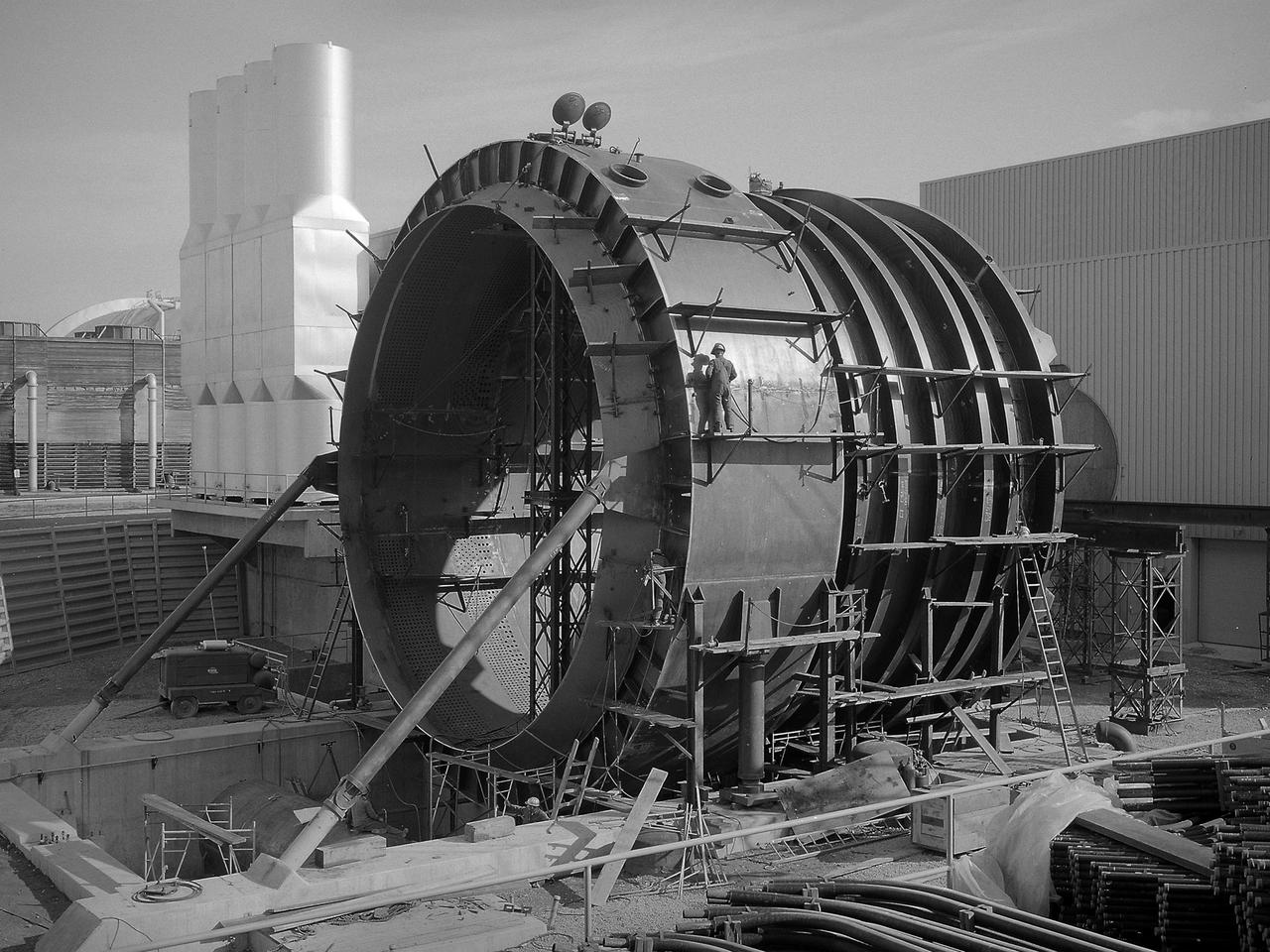
The 50-foot diameter primary cooler for the new Propulsion Systems Laboratory No. 3 and 4 facility constructed at the National Aeronautics and Space Administration (NASA) Lewis Research Center. In 1968, 20 years after planning began for the original Propulsion Systems Laboratory test chambers, No. 1 and 2, NASA Lewis began preparations to add two additional and more powerful chambers. The move coincided with the center’s renewed focus on aeronautics in 1966. The new 40-foot long and 24-foot diameter chambers were capable of testing engines twice as powerful any then in existence and significantly larger than those in the original two test chambers. After exiting the engine nozzle, the hot exhaust air passed through a 17-foot diameter water exhaust duct and the 50-foot diameter primary cooler. Twenty-seven hundred water-filled tubes inside the cooler reduced the temperature of the air flow as it passed between the tubes from 3000 to 600 °F. A spray cooler further reduced the temperature of the gases to 150 °F before they were sent to the Central Air Building. Excavations for the new facility were completed by October 1967, and the shell of the building was completed a year later. In September 1968, work began on the new test chambers and associated infrastructure. Construction was completed in late 1972, and the first test was scheduled for February 1973.
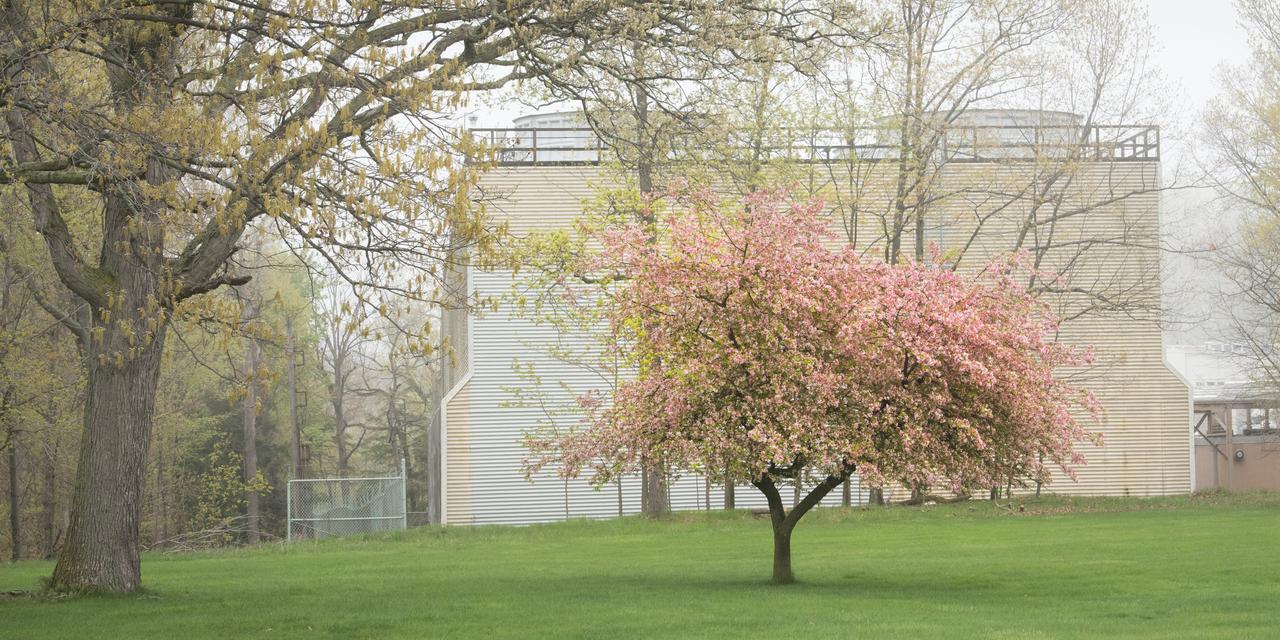
Flowering Crab Apple Tree in full Bloom in front of the Propulsion Systems Laboratory, PSL Cooling Tower #6 on a Foggy Day in Early Spring
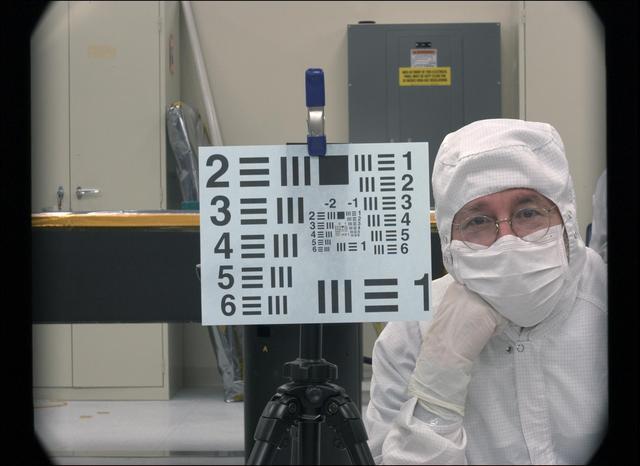
Malin Space Science Systems, San Diego, delivered the two cameras for the Mast Camera Mastcam instrument of NASA Mars Science Laboratory rover to NASA Jet Propulsion Laboratory, Pasadena, Calif., in March 2011.
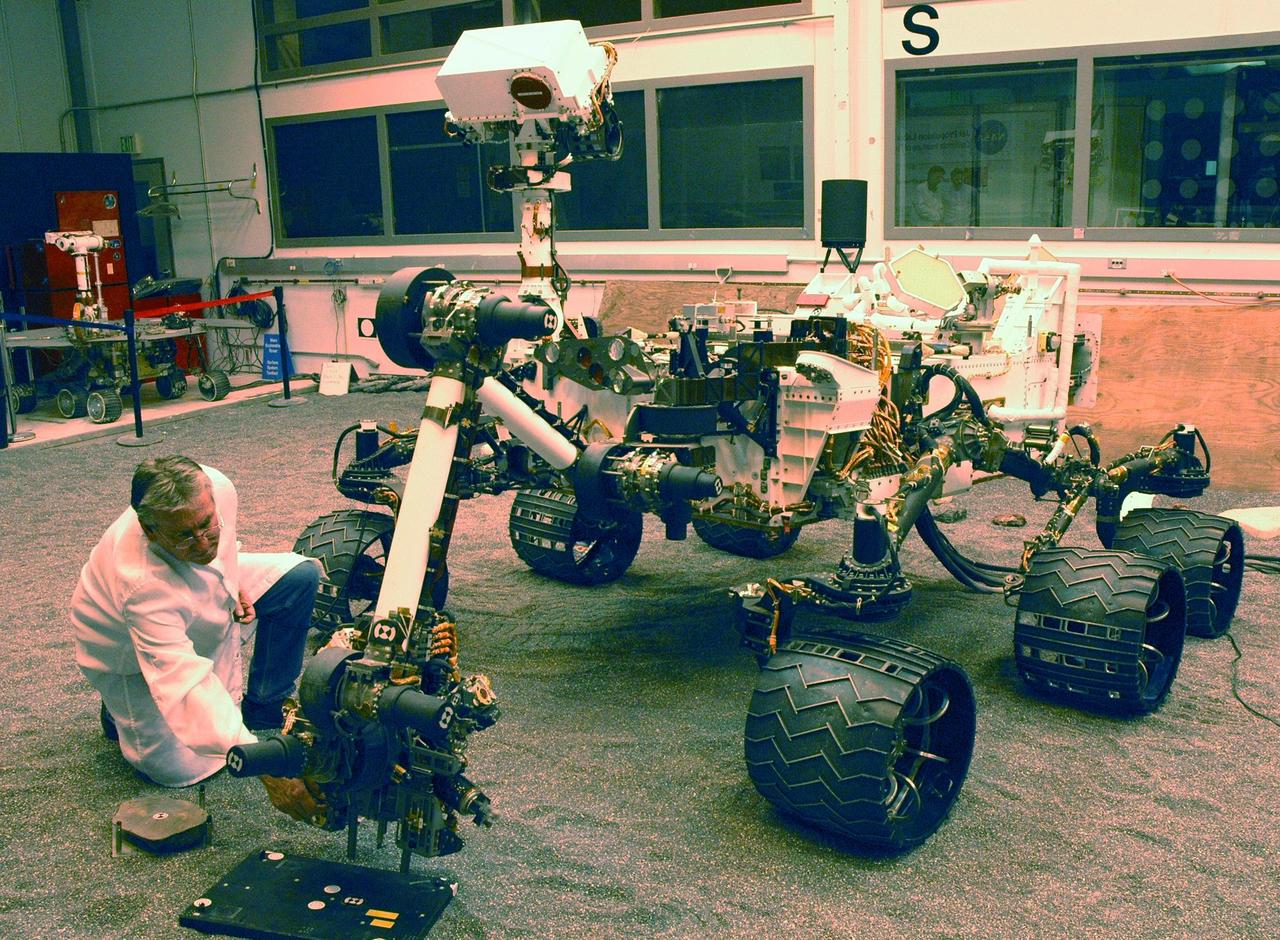
A NASA Mars Science Laboratory test rover called the Vehicle System Test Bed, or VSTB, at NASA Jet Propulsion Laboratory, Pasadena, CA serves as the closest double for Curiosity in evaluations of the mission hardware and software.
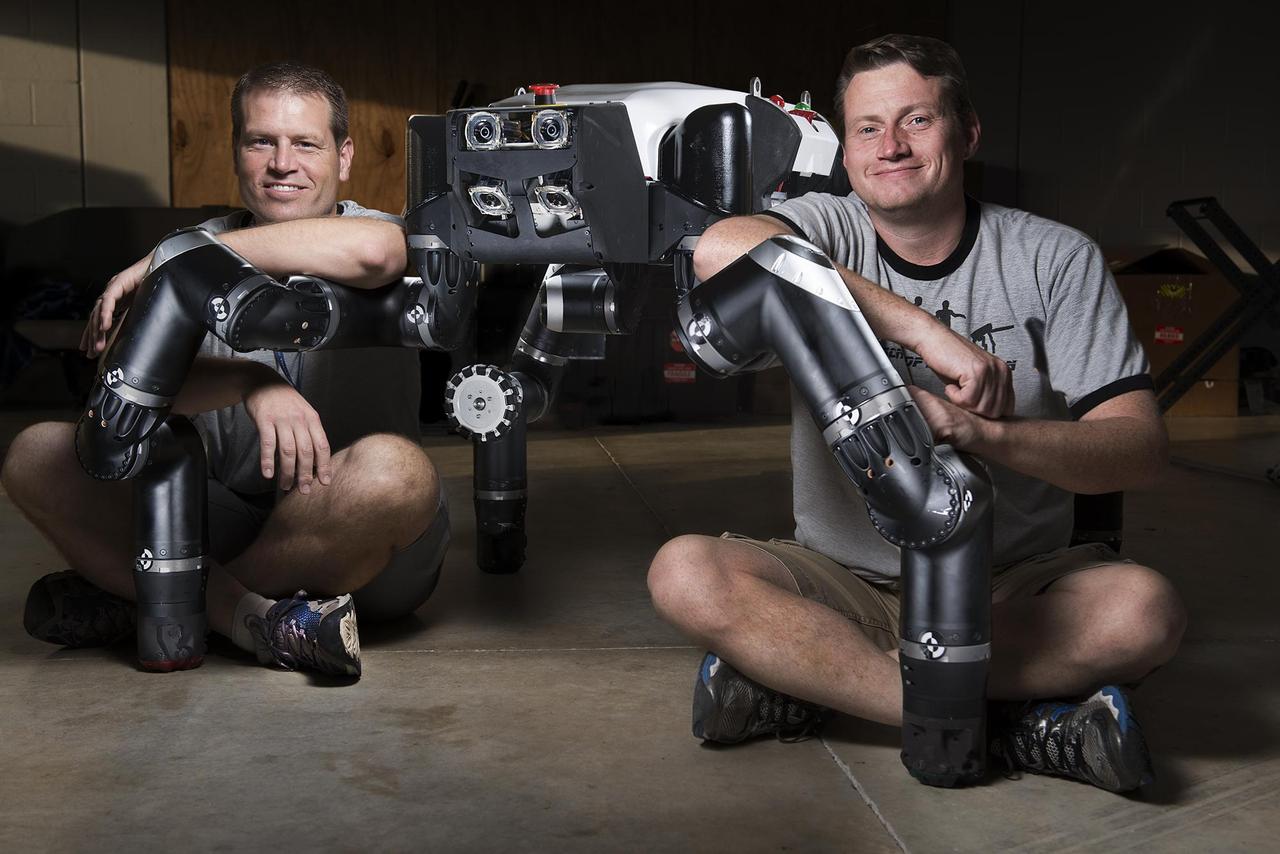
Limbed robot RoboSimian was developed at NASA Jet Propulsion Laboratory, seen here with Brett Kennedy, supervisor of the JPL Robotic Vehicles and Manipulators Group, and Chuck Bergh, a senior engineer in JPL Robotic Hardware Systems Group.
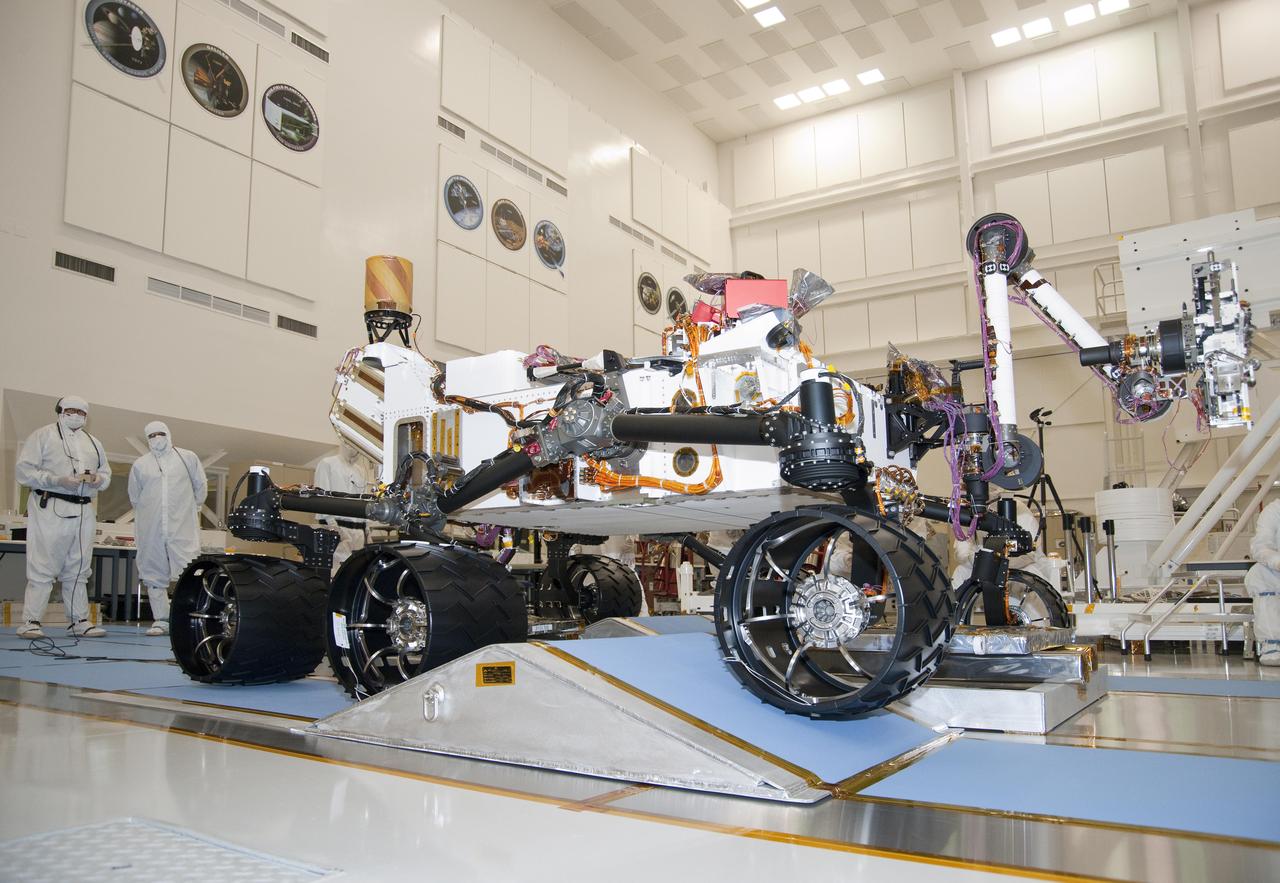
The suspension system on NASA Mars rover Curiosity easily accommodates rolling over a ramp in this Sept. 10, 2010, test drive inside the Spacecraft Assembly Facility at NASA Jet Propulsion Laboratory, Pasadena, Calif.
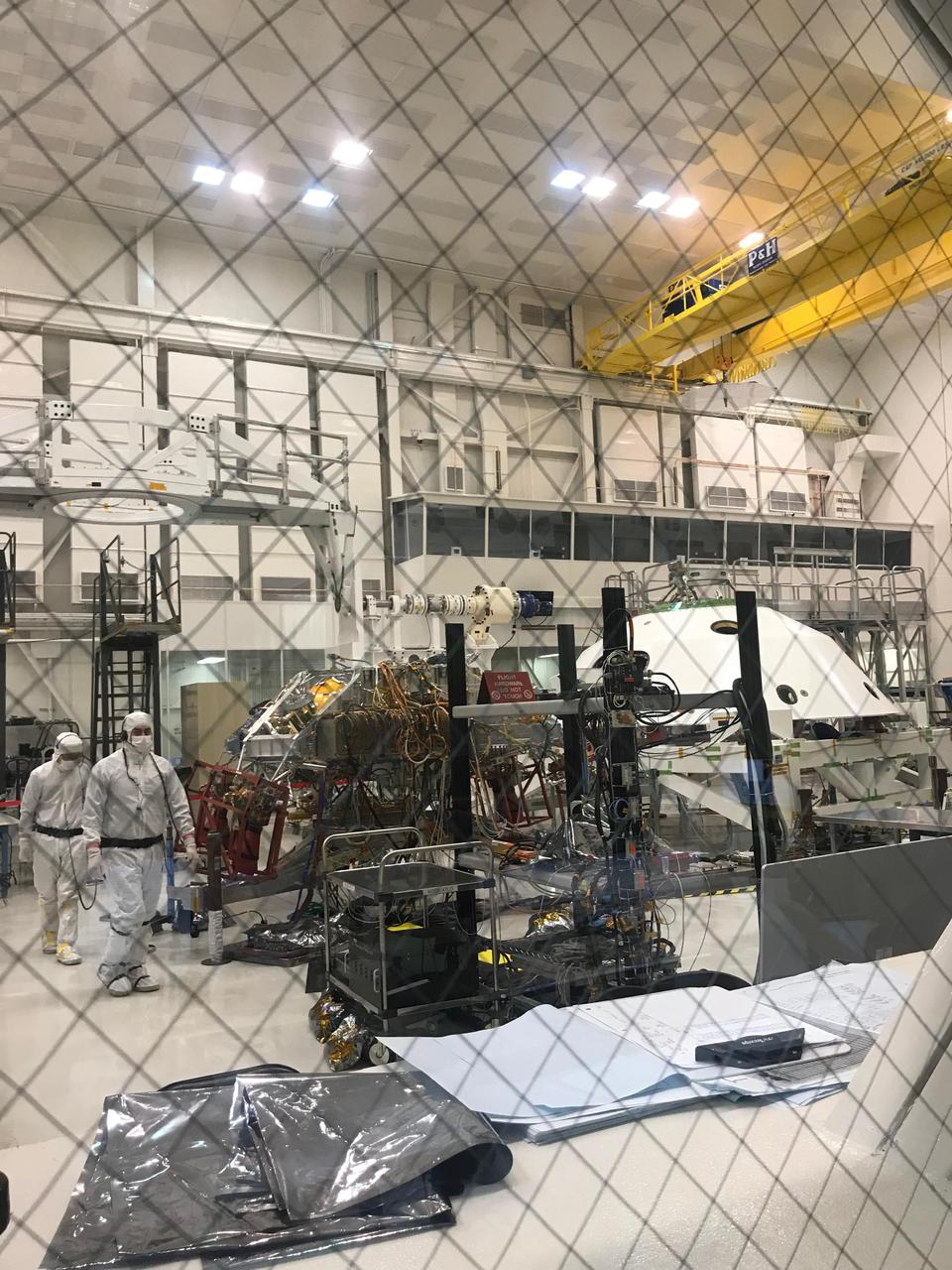
Technicians working Mars 2020's System's Test 1 approach their workstation in the Spacecraft Assembly Facility at NASA's Jet Propulsion Laboratory in Pasadena, Calif. Over two weeks in January 2019, 72 engineers and technicians assigned to the 2020 mission took over the High Bay 1 cleanroom in JPL's Spacecraft Assembly Facility to put the software and electrical systems aboard the mission's cruise, entry capsule, descent stage and rover through their paces. https://photojournal.jpl.nasa.gov/catalog/PIA23097
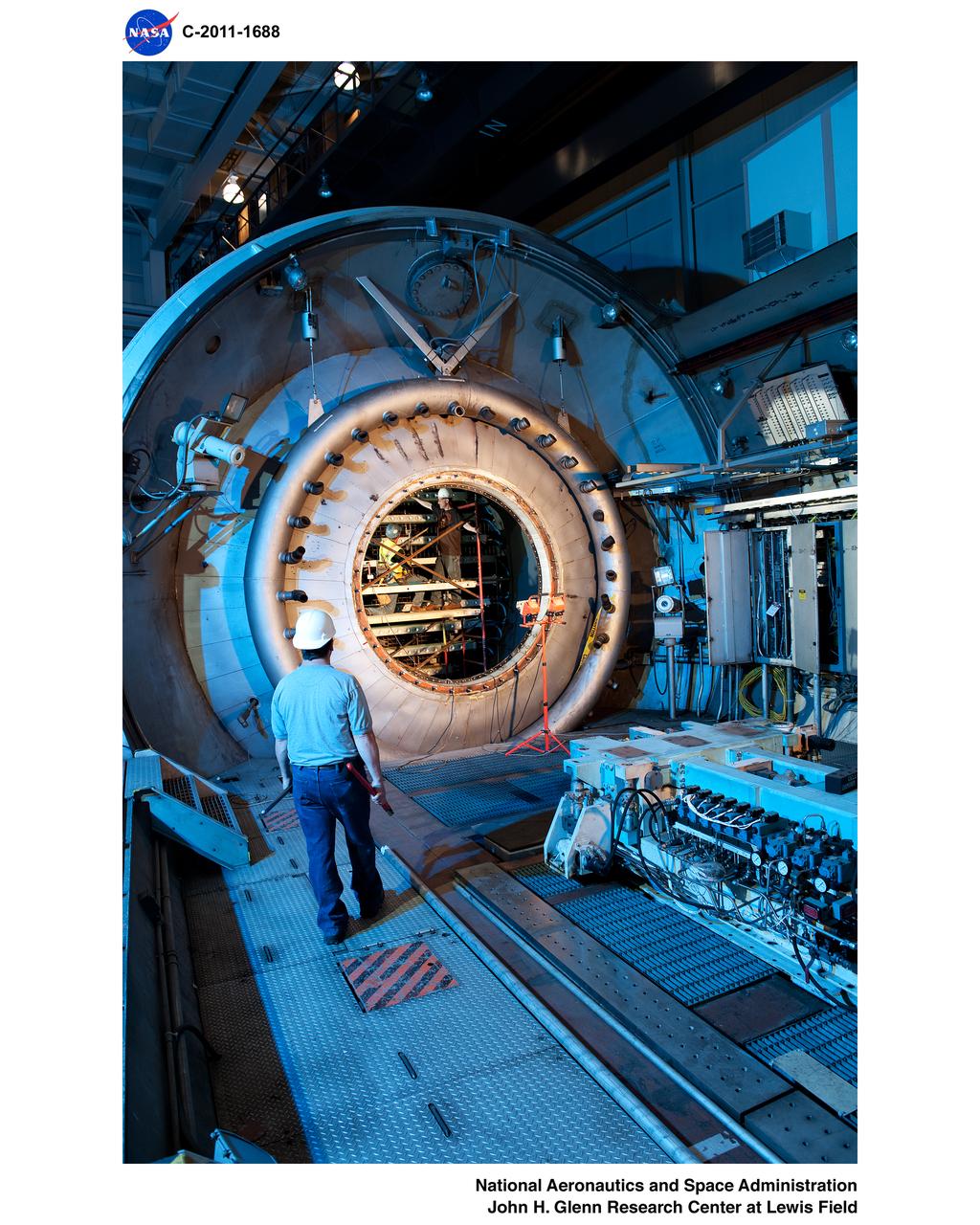
Icing Spray Bar Installation to the Propulsion System Laboratory, PSL, Cell 3
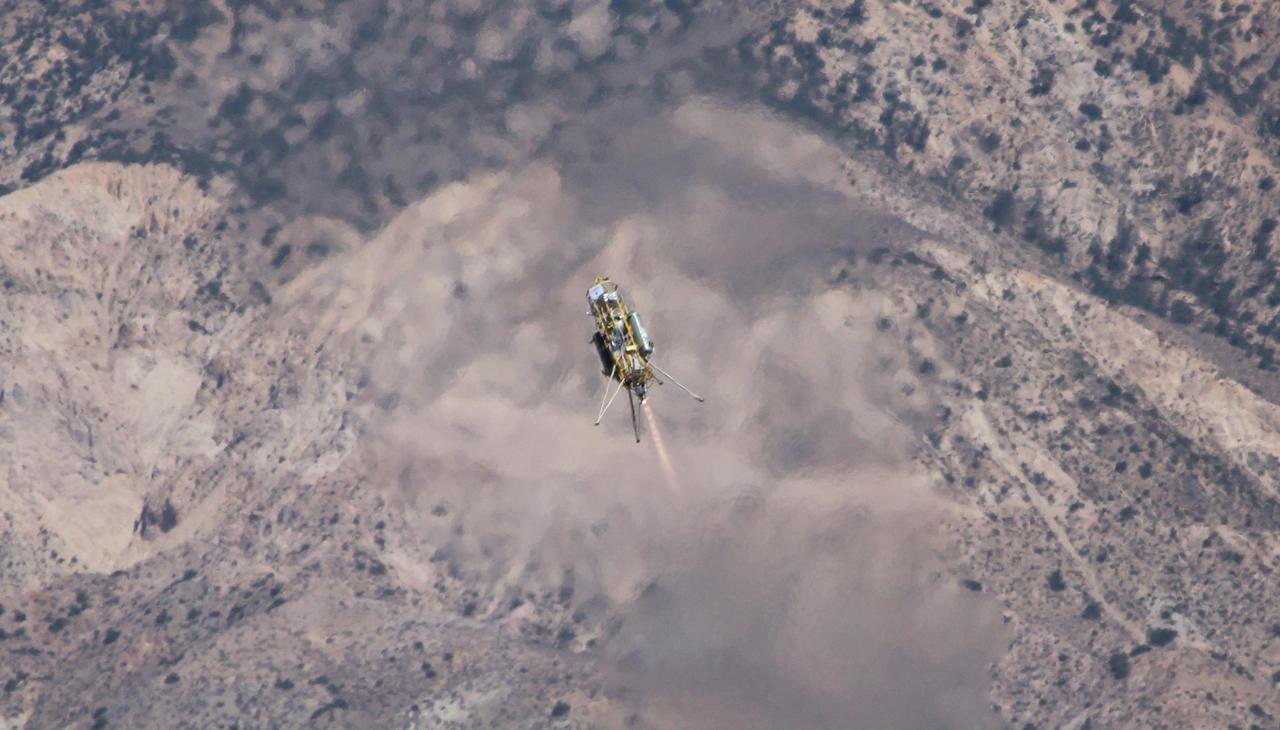
A Xombie technology demonstrator from Masten Space Systems, Mojave, Calif., ascends from its pad at Mojave Air and Space Port on a test for NASA Jet Propulsion Laboratory. The vehicle is a vertical-takeoff, vertical-landing experimental rocket.
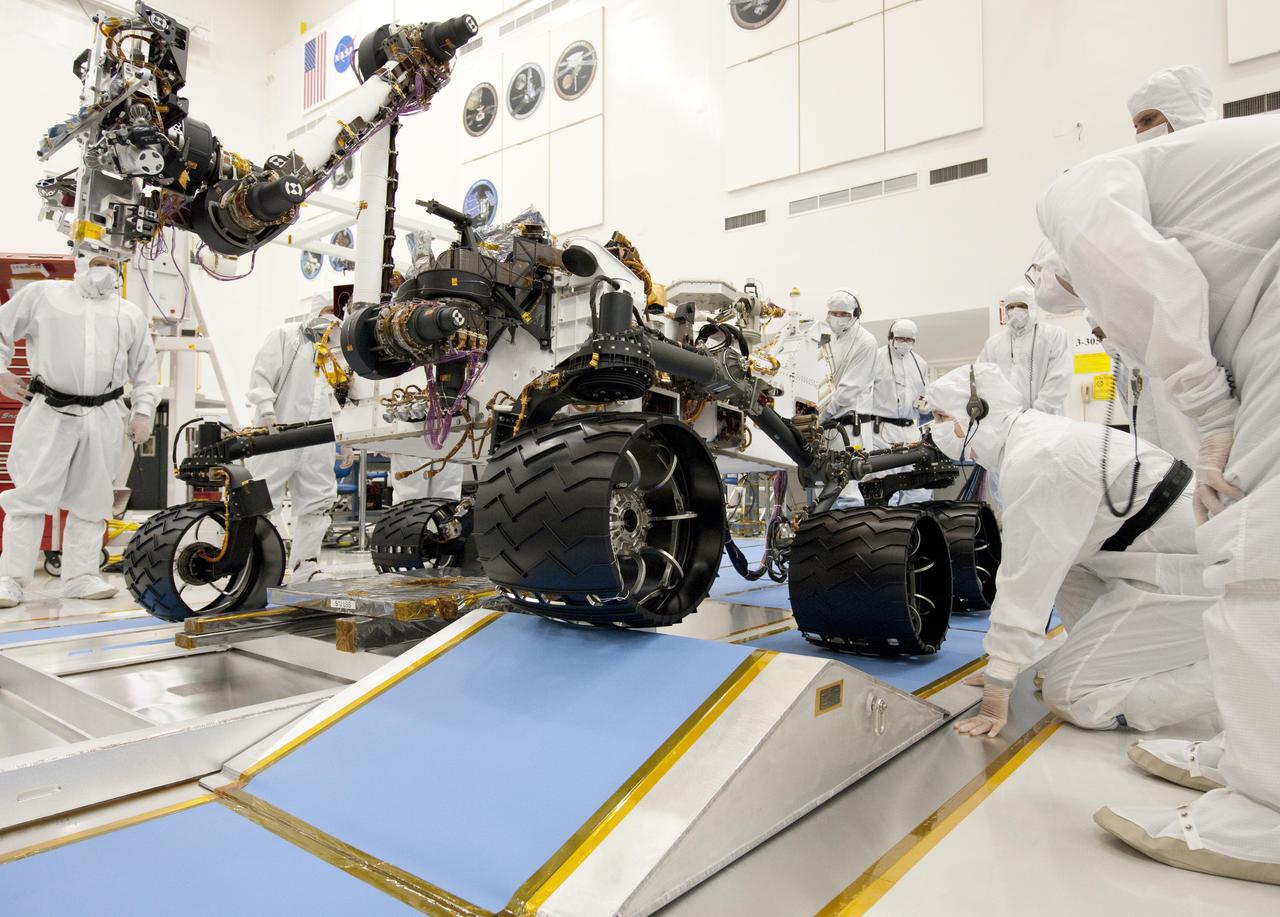
NASA next Mars rover, Curiosity, drives up a ramp during a test at NASA Jet Propulsion Laboratory, Pasadena, Calif. The rover, like its smaller predecessors already on Mars, uses a rocker bogie suspension system to drive over uneven ground.
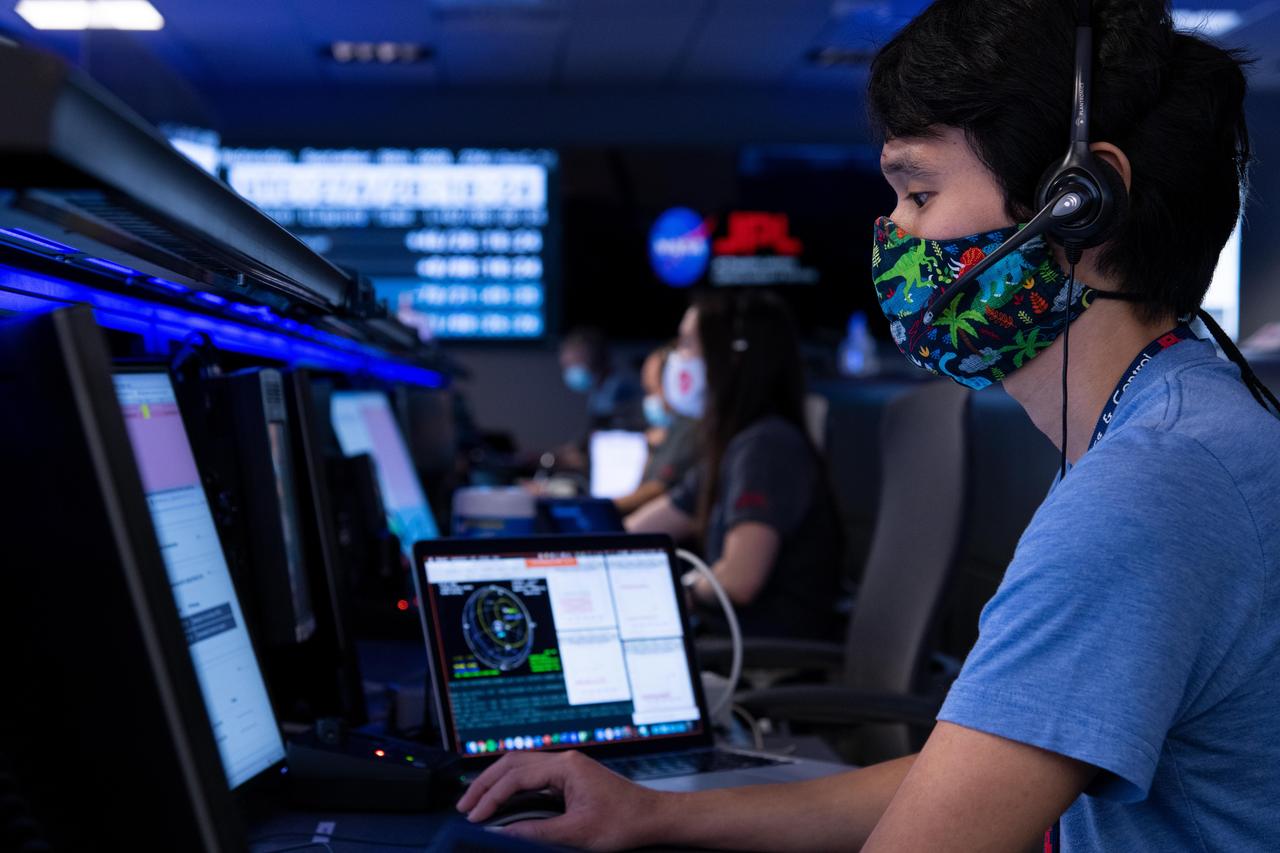
Attitude Control Systems lead Chris Pong donned a dinosaur-themed mask for his participation in the Mars 2020 mission's second trajectory correction maneuver at NASA's Jet Propulsion Laboratory in Southern California. The navigation team successfully sent commands to the spacecraft to adjust its flight path during its long cruise to Mars. https://photojournal.jpl.nasa.gov/catalog/PIA24191
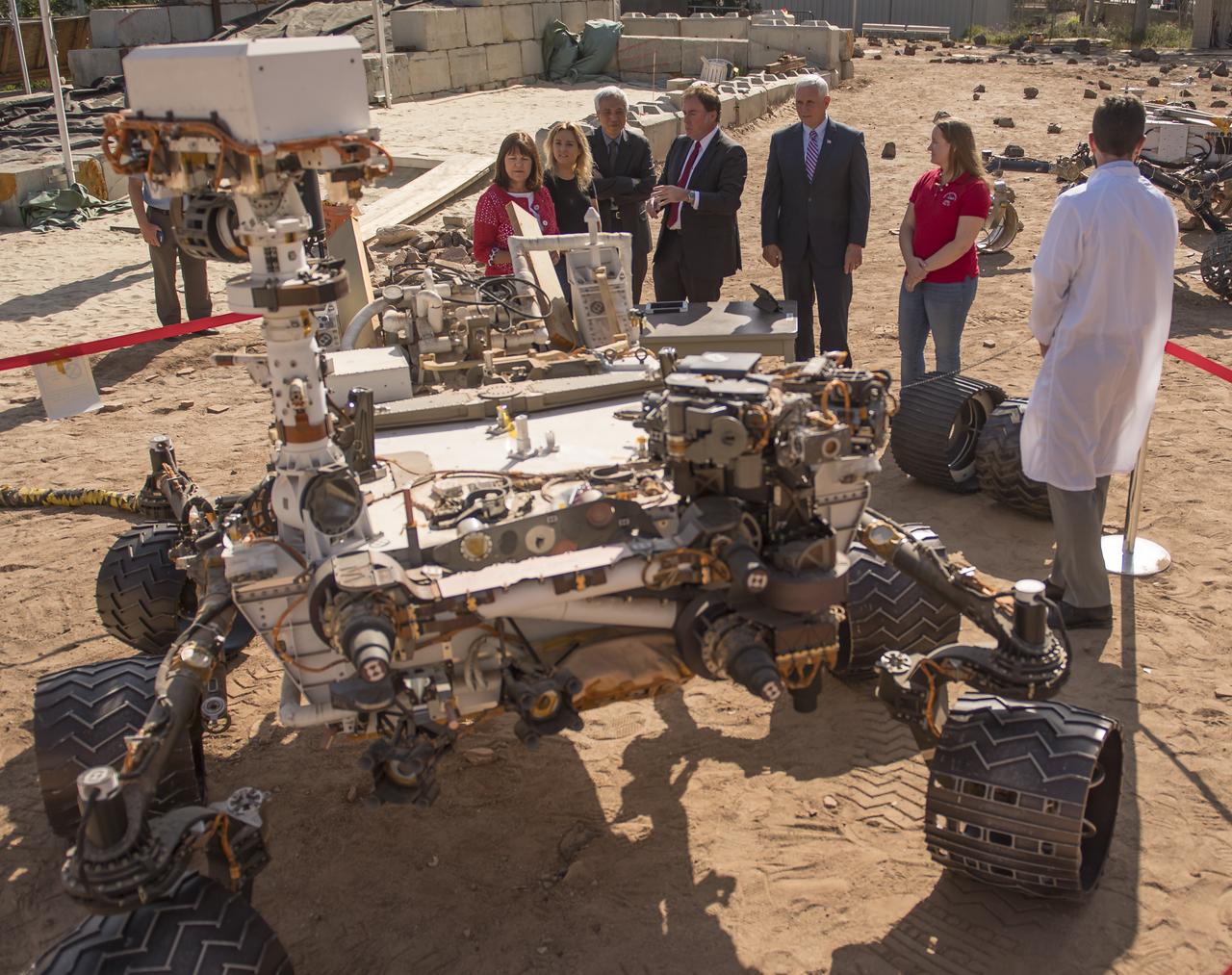
U.S. Vice President Mike Pence, 5th from left, joined by his wife Karen Pence, left, and daughter Charlotte Pence. 2nd from left, view the Vehicle System Test Bed (VSTB) rover in the Mars Yard during a tour of NASA's Jet Propulsion Laboratory, Saturday, April 28, 2018 in Pasadena, California. NASA Mars Exploration Manager Li Fuk, 2nd from left, JPL Director Michael Watkins, Mars Curiosity Engineering Operations Team Chief Megan Lin, and MSL Engineer Sean McGill, right, helped explain to the Vice President and his family how they use these test rovers. Photo Credit: (NASA/Bill Ingalls)
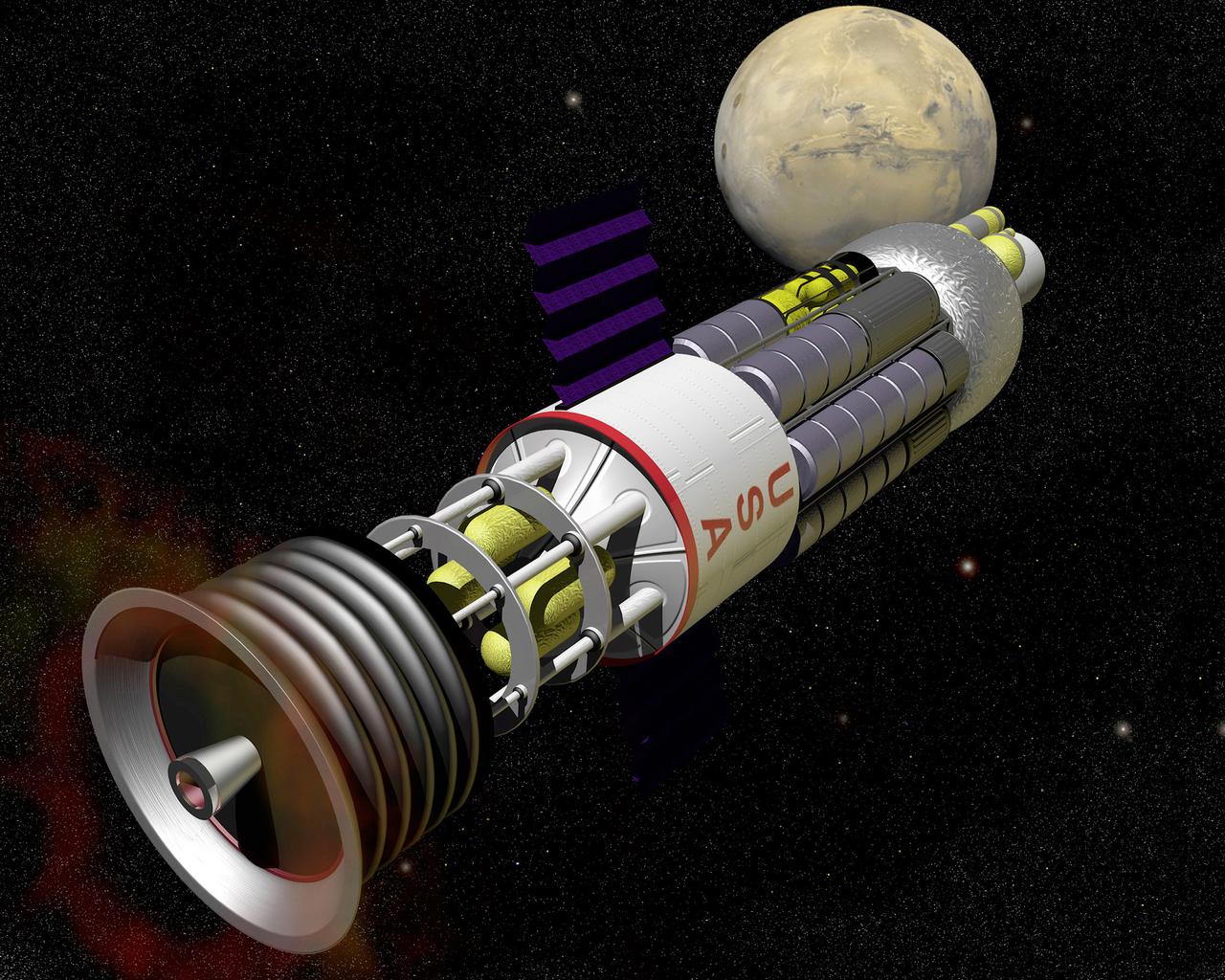
In the 1960's U.S. Government laboratories, under Project Orion, investigated a pulsed nuclear fission propulsion system. Small nuclear pulse units would be sequentially discharged from the aft end of the vehicle. A blast shield and shock absorber system would protect the crew and convert the shock loads into a continuous propulsive force.
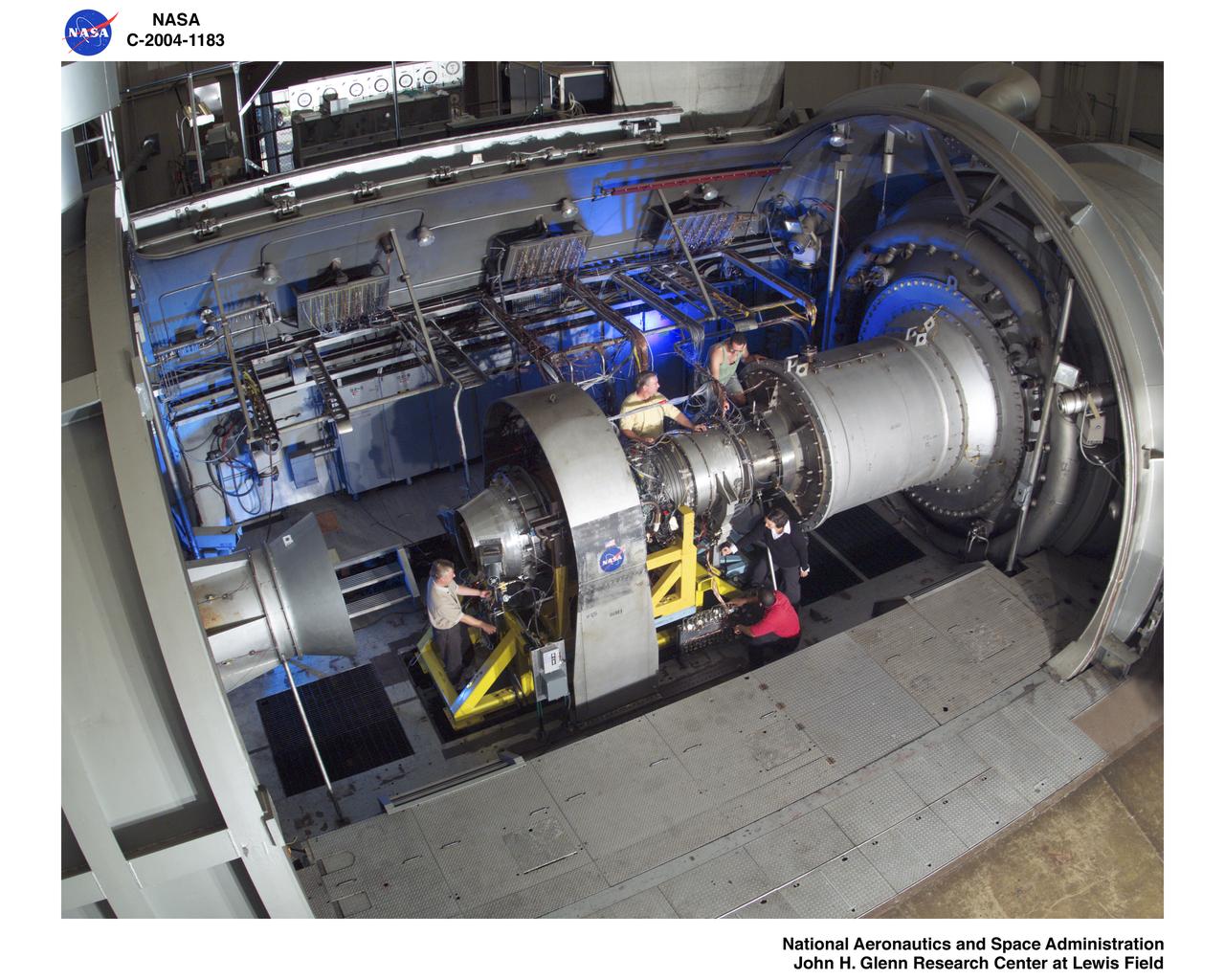
Gary Klann, Greg Hill, Eric Roessler, Queito Thomas, Joyel Schaefer prepare an engine for testing in the NASA Glenn Research Center's Propulsion Systems Laboratory
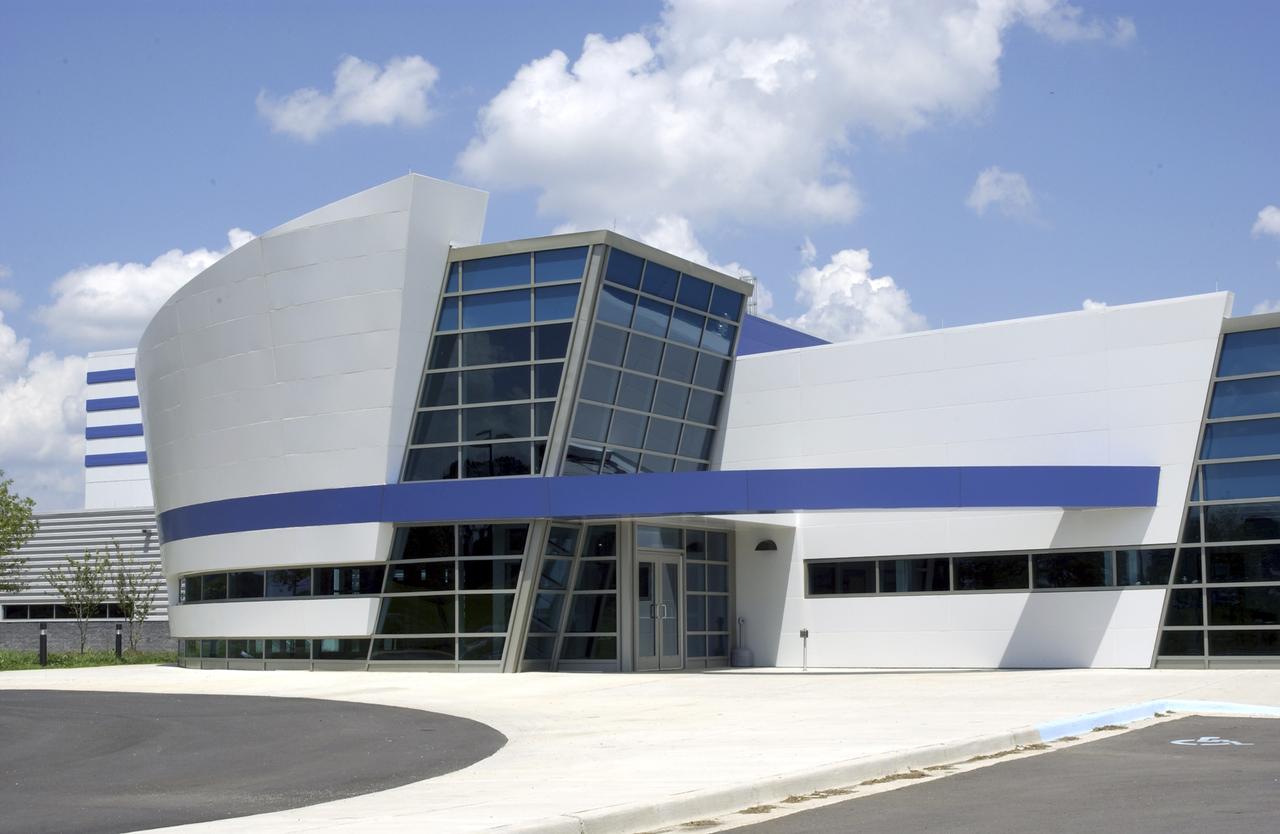
The grand opening of NASA’s new, world-class laboratory for research into future space transportation technologies located at the Marshall Space Flight Center (MSFC) in Huntsville, Alabama, took place in July 2004. The state-of-the-art Propulsion Research Laboratory (PRL) serves as a leading national resource for advanced space propulsion research. Its purpose is to conduct research that will lead to the creation and development of innovative propulsion technologies for space exploration. The facility is the epicenter of the effort to move the U.S. space program beyond the confines of conventional chemical propulsion into an era of greatly improved access to space and rapid transit throughout the solar system. The laboratory is designed to accommodate researchers from across the United States, including scientists and engineers from NASA, the Department of Defense, the Department of Energy, universities, and industry. The facility, with 66,000 square feet of useable laboratory space, features a high degree of experimental capability. Its flexibility allows it to address a broad range of propulsion technologies and concepts, such as plasma, electromagnetic, thermodynamic, and propellant propulsion. An important area of emphasis is the development and utilization of advanced energy sources, including highly energetic chemical reactions, solar energy, and processes based on fission, fusion, and antimatter. The Propulsion Research Laboratory is vital for developing the advanced propulsion technologies needed to open up the space frontier, and sets the stage of research that could revolutionize space transportation for a broad range of applications.
The grand opening of NASA’s new, world-class laboratory for research into future space transportation technologies located at the Marshall Space Flight Center (MSFC) in Huntsville, Alabama, took place in July 2004. The state-of-the-art Propulsion Research Laboratory (PRL) serves as a leading national resource for advanced space propulsion research. Its purpose is to conduct research that will lead to the creation and development of innovative propulsion technologies for space exploration. The facility is the epicenter of the effort to move the U.S. space program beyond the confines of conventional chemical propulsion into an era of greatly improved access to space and rapid transit throughout the solar system. The laboratory is designed to accommodate researchers from across the United States, including scientists and engineers from NASA, the Department of Defense, the Department of Energy, universities, and industry. The facility, with 66,000 square feet of useable laboratory space, features a high degree of experimental capability. Its flexibility allows it to address a broad range of propulsion technologies and concepts, such as plasma, electromagnetic, thermodynamic, and propellant propulsion. An important area of emphasis is the development and utilization of advanced energy sources, including highly energetic chemical reactions, solar energy, and processes based on fission, fusion, and antimatter. The Propulsion Research Laboratory is vital for developing the advanced propulsion technologies needed to open up the space frontier, and sets the stage of research that could revolutionize space transportation for a broad range of applications.
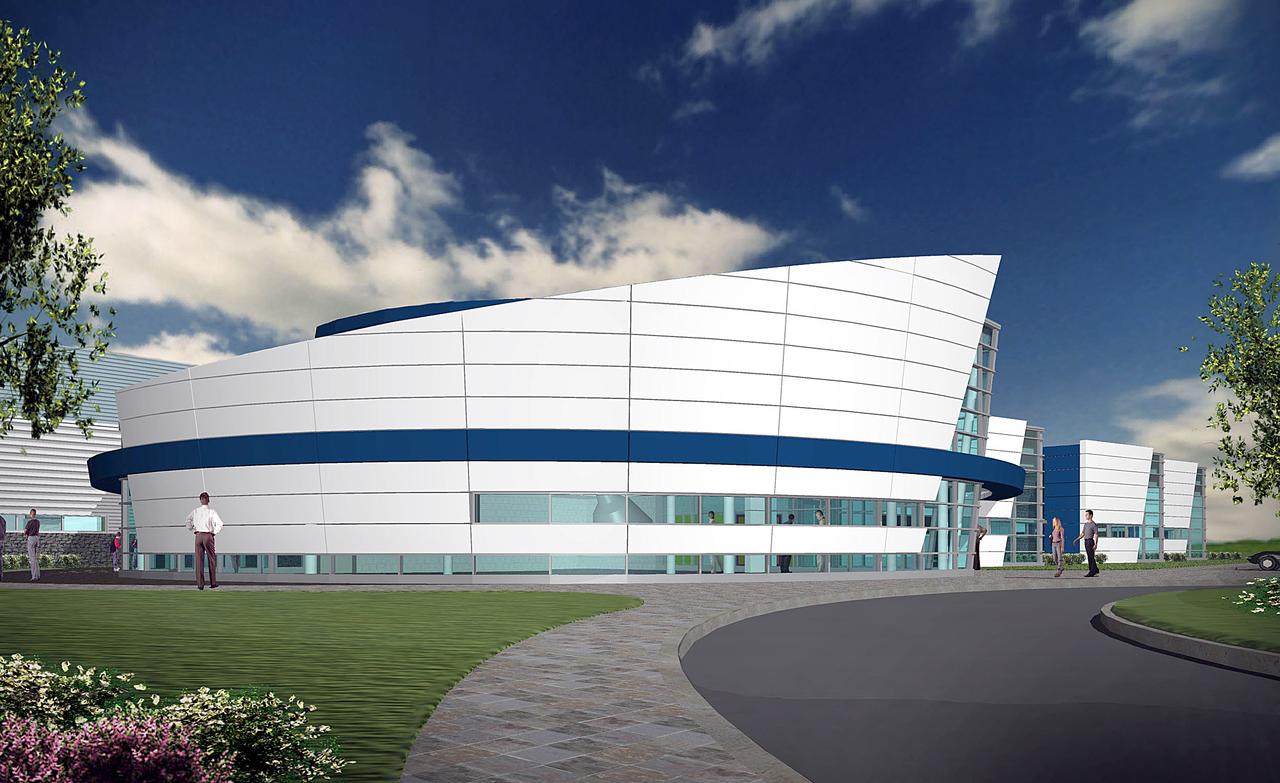
A new, world-class laboratory for research into future space transportation technologies is under construction at the Marshall Space Flight Center (MSFC) in Huntsville, AL. The state-of-the-art Propulsion Research Laboratory will serve as a leading national resource for advanced space propulsion research. Its purpose is to conduct research that will lead to the creation and development of irnovative propulsion technologies for space exploration. The facility will be the epicenter of the effort to move the U.S. space program beyond the confines of conventional chemical propulsion into an era of greatly improved access to space and rapid transit throughout the solar system. The Laboratory is designed to accommodate researchers from across the United States, including scientists and engineers from NASA, the Department of Defense, the Department of Energy, universities, and industry. The facility, with 66,000 square feet of useable laboratory space, will feature a high degree of experimental capability. Its flexibility will allow it to address a broad range of propulsion technologies and concepts, such as plasma, electromagnetic, thermodynamic, and propellantless propulsion. An important area of emphasis will be development and utilization of advanced energy sources, including highly energetic chemical reactions, solar energy, and processes based on fission, fusion, and antimatter. The Propulsion Research Laboratory is vital for developing the advanced propulsion technologies needed to open up the space frontier, and will set the stage of research that could revolutionize space transportation for a broad range of applications.
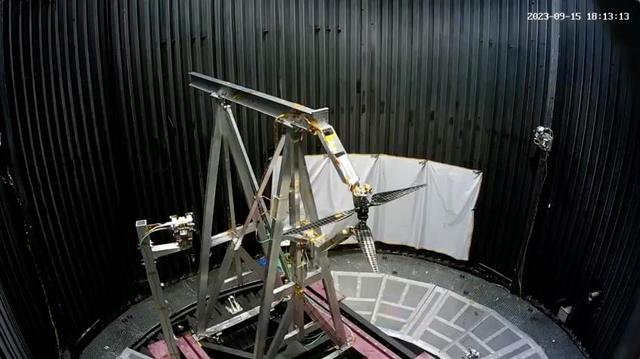
A dual rotor system for the next generation of Mars helicopters is tested in the 25-Foot Space Simulator at NASA's Jet Propulsion Laboratory in Southern California on Sept.15, 2023. Over three weeks, the carbon-fiber blades were spun up at ever-higher speeds and greater pitch angles to see if they would remain intact as their tips approached supersonic speeds. Longer and stronger than those used on NASA's Ingenuity Mars Helicopter, the blades reached Mach 0.95 during the test. The simulator's vacuum chamber allows engineers to test spacecraft and components in conditions like those they would face on Mars. The inset at upper right shows the same test from the perspective of a second camera also located inside the chamber. Movie available at https://photojournal.jpl.nasa.gov/catalog/PIA26079
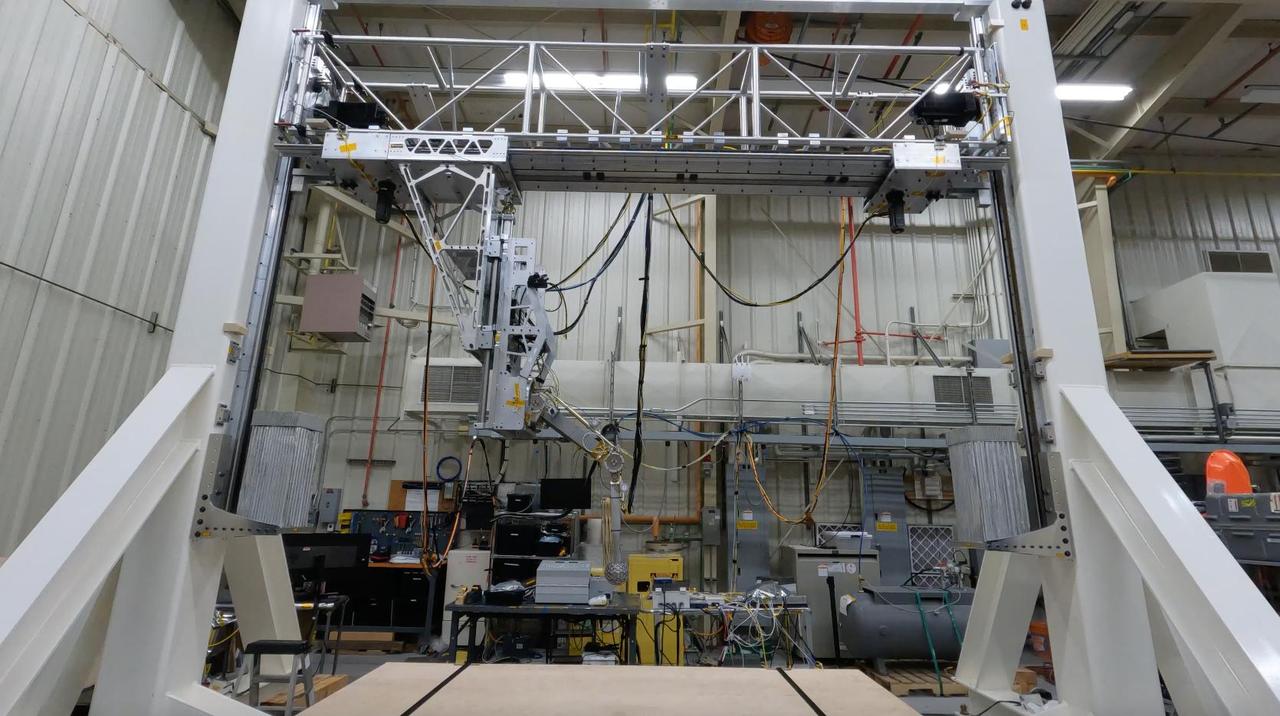
Engineers test the mechanical landing system for the proposed Europa Lander project at NASA's Jet Propulsion Laboratory on Sept. 15, 2022. This test, using the Europa Lander landing gear testbed, fully exercises the Europa Lander landing gear mechanism through a simulated dynamic landing. Europa Lander is a concept for a potential future mission that would look for signs of life in the icy surface material of Jupiter's moon Europa. The moon is thought to contain a global ocean of salty water beneath its frozen crust. If life exists in that ocean, signs of its existence called biosignatures could potentially find their way to the surface. In this mission concept, a spacecraft would land on Europa and collect and study samples from about 4 inches (10 centimeters) beneath the surface, looking for signs of life. The Europa Lander landing gear testbed was developed to test and inform the design of the landing gear for the spacecraft: It mimics the landing loads and ground interaction forces that a single flight landing gear would experience when touching down on the Europan surface. It does this by using gravity offloading to simulate the reduced gravity on Europa, and by replicating the mass and inertial properties of a flight lander as well as all the degrees of freedom that the landing gear would experience. Video available at https://photojournal.jpl.nasa.gov/catalog/PIA26199
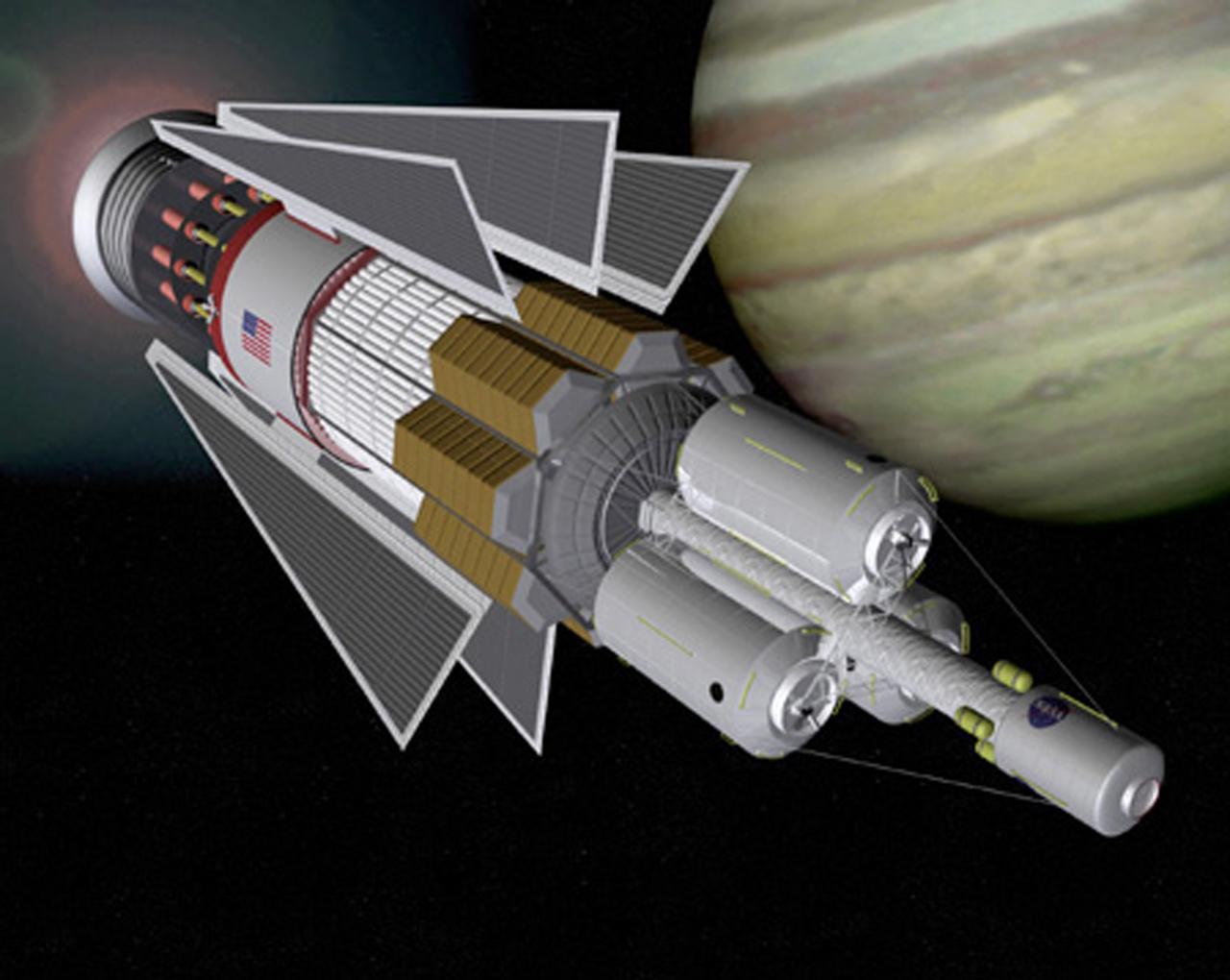
In the 1960's U.S. Government laboratories, under Project Orion, investigated a pulsed nuclear fission propulsion system. Based on Project Orion, an interplanetary vehicle using pulsed fission propulsion would incorporate modern technologies for momentum transfer, thermal management, and habitation design.
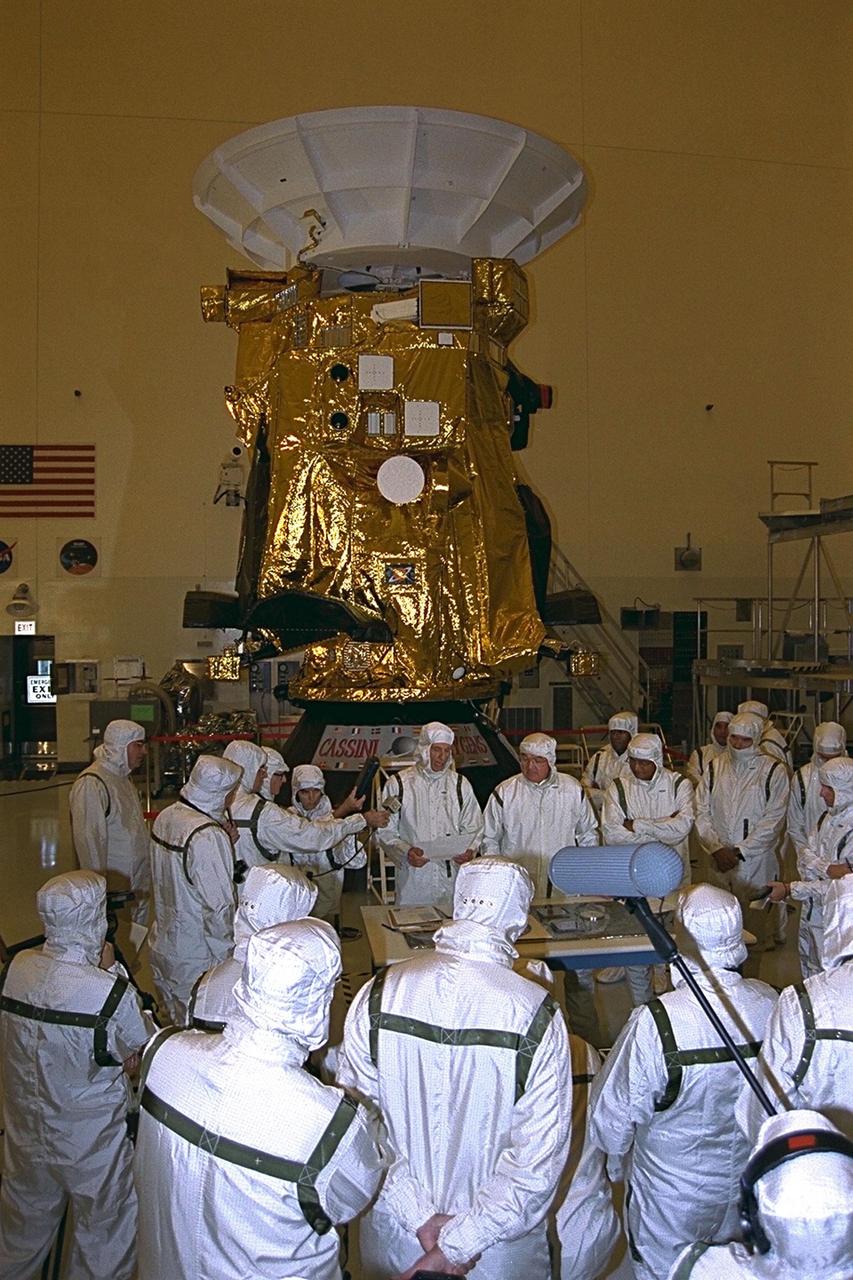
Scientists from the Cassini project at the Jet Propulsion Laboratory and the European Space Agency talk to photojournalists, news reporters, writers, television broadcasters, and cameramen in the Payload Hazardous Servicing Facility (PHSF) during the Cassini press showing. Cassini will launch on Oct. 6, 1997, on an Air Force Titan IV/Centaur launch vehicle and will arrive at Saturn in July 2004 to begin an international scientific mission to study the planet and its systems. Cassini is managed for NASA by the Jet Propulsion Laboratory at Pasadena, Calif
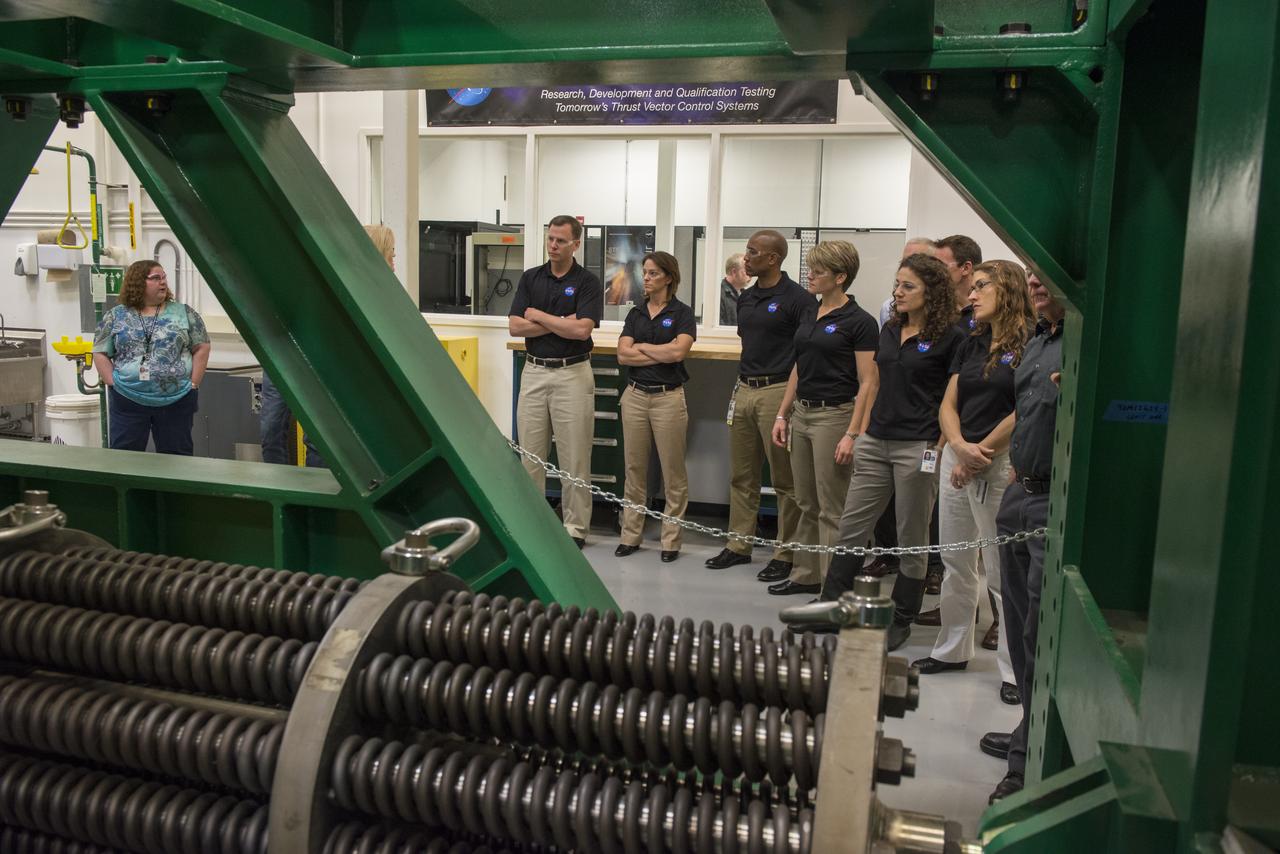
THE 2013 ASTRONAUT CANDIDATE CLASS VISITED THE THRUST VECTOR CONTROL TEST LAB AT MARSHALL'S PROPULSION RESEARCH DEVELOPMENT LABORATORY WHERE ENGINEERS ARE DEVELOPING AND TESTING THE SPACE LAUNCH SYSTEM'S GUIDANCE, NAVIGATION AND CONTROL SOFTWARE AND AVIONICS HARDWARE.
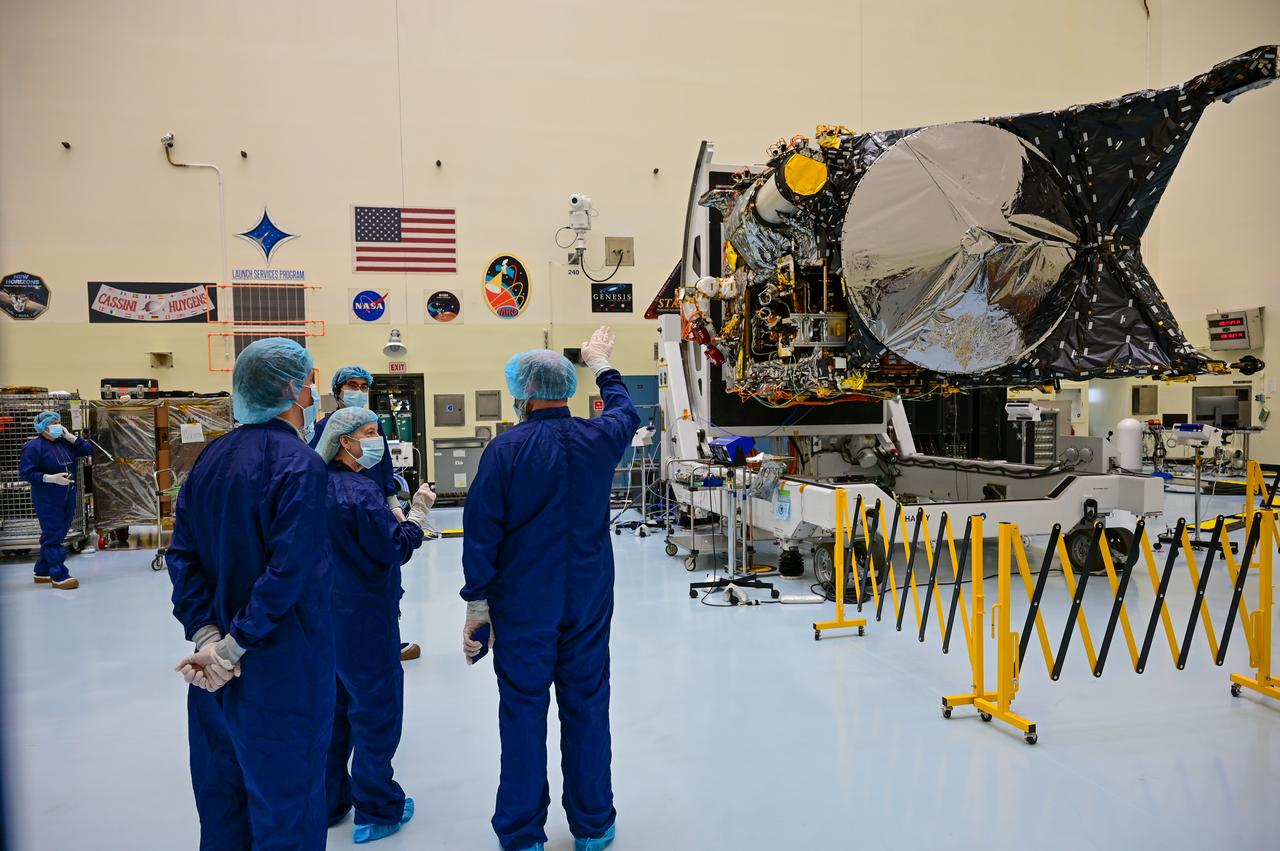
NASA Deputy Administrator Pam Melroy visits Kennedy Space Center in Florida and receives a briefing by team members from the Jet Propulsion Laboratory on the agency’s Psyche spacecraft inside the Payload Hazardous Servicing Facility on May 19, 2022. Melroy is in view second from right. The mission is targeting an Aug. 1 launch atop a SpaceX Falcon Heavy rocket from Launch Complex 39A at Kennedy. The spacecraft will use solar-electric propulsion to travel approximately 1.5 billion miles to rendezvous with its namesake asteroid in 2026. The Psyche mission is led by Arizona State University. NASA’s Jet Propulsion Laboratory, which is managed for the agency by Caltech in Pasadena, California, is responsible for the mission’s overall management, system engineering, integration and testing, and mission operations. Maxar Technologies in Palo Alto, California, provided the high-power solar electric propulsion spacecraft chassis. NASA’s Launch Services Program (LSP), based at Kennedy, is managing the launch.
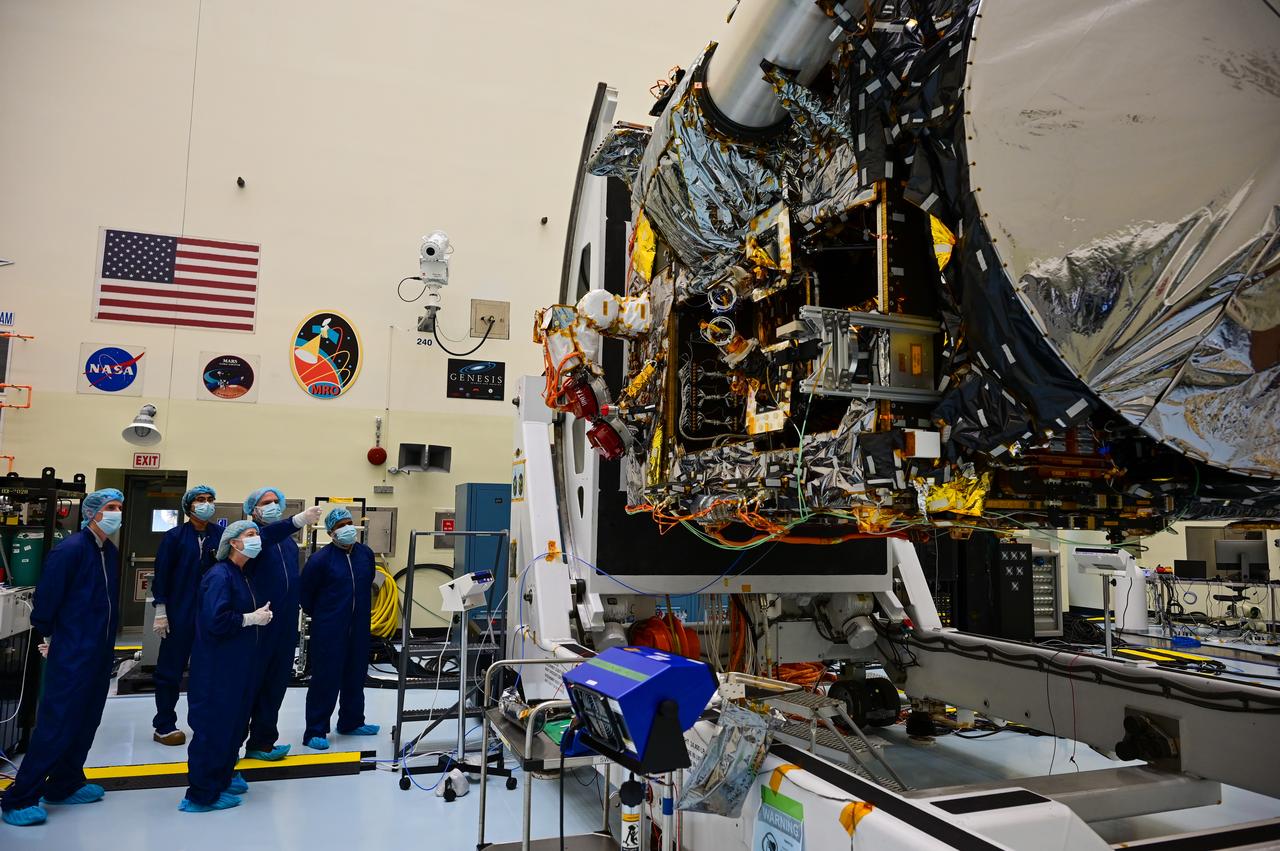
NASA Deputy Administrator Pam Melroy visits Kennedy Space Center in Florida and receives a briefing by team members from the Jet Propulsion Laboratory on the agency’s Psyche spacecraft inside the Payload Hazardous Servicing Facility on May 19, 2022. Melroy is standing in front of the group. The mission is targeting an Aug. 1 launch atop a SpaceX Falcon Heavy rocket from Launch Complex 39A at Kennedy. The spacecraft will use solar-electric propulsion to travel approximately 1.5 billion miles to rendezvous with its namesake asteroid in 2026. The Psyche mission is led by Arizona State University. NASA’s Jet Propulsion Laboratory, which is managed for the agency by Caltech in Pasadena, California, is responsible for the mission’s overall management, system engineering, integration and testing, and mission operations. Maxar Technologies in Palo Alto, California, provided the high-power solar electric propulsion spacecraft chassis. NASA’s Launch Services Program (LSP), based at Kennedy, is managing the launch.
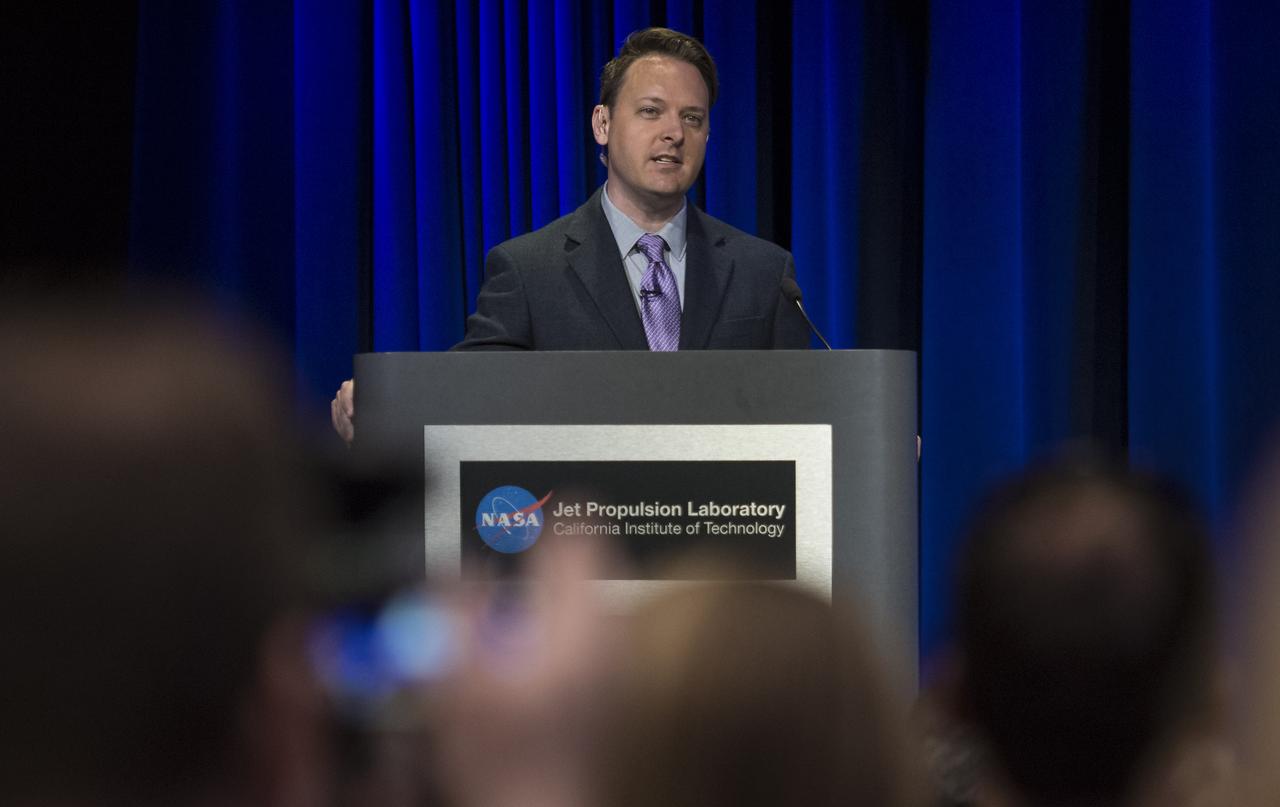
Preston Dyches, media relations specialist at NASA's Jet Propulsion Laboratory, during a press conference previewing Cassini's End of Mission, Wednesday, Sept. 13, 2017 at NASA's Jet Propulsion Laboratory in Pasadena, California. Since its arrival in 2004, the Cassini-Huygens mission has been a discovery machine, revolutionizing our knowledge of the Saturn system and captivating us with data and images never before obtained with such detail and clarity. On Sept. 15, 2017, operators will deliberately plunge the spacecraft into Saturn, as Cassini gathered science until the end. The “plunge” ensures Saturn’s moons will remain pristine for future exploration. During Cassini’s final days, mission team members from all around the world gathered at NASA’s Jet Propulsion Laboratory, Pasadena, California, to celebrate the achievements of this historic mission. Photo Credit: (NASA/Joel Kowsky)
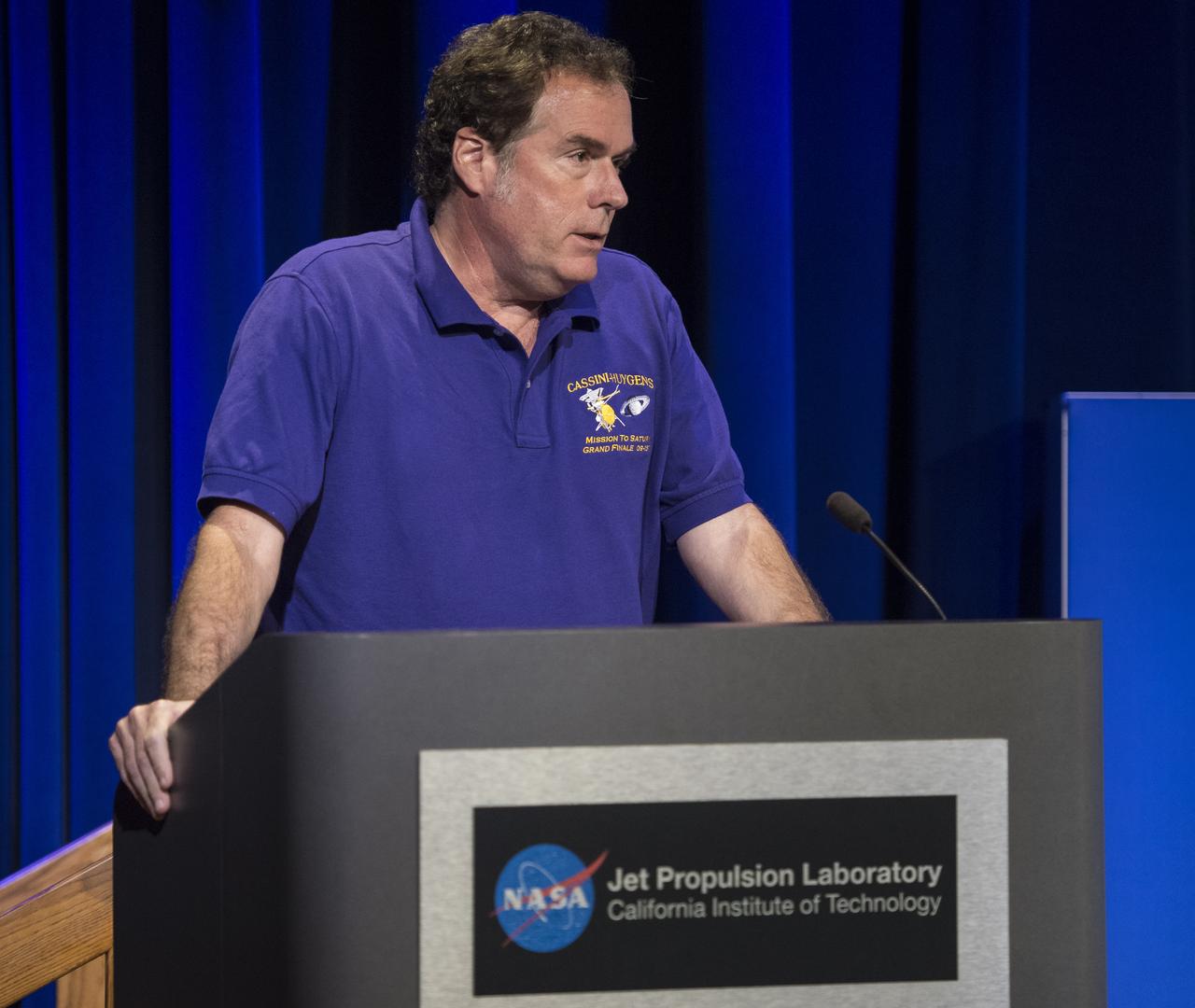
Director of NASA's Jet Propulsion Laboratory, Michael Watkins speaks during a press conference held after the end of the Cassini mission, Friday, Sept. 15, 2017 at NASA's Jet Propulsion Laboratory in Pasadena, California. Since its arrival in 2004, the Cassini-Huygens mission has been a discovery machine, revolutionizing our knowledge of the Saturn system and captivating us with data and images never before obtained with such detail and clarity. On Sept. 15, 2017, operators deliberately plunged the spacecraft into Saturn, as Cassini gathered science until the end. Loss of contact with the Cassini spacecraft occurred at 7:55 a.m. EDT (4:55 a.m. PDT). The “plunge” ensures Saturn’s moons will remain pristine for future exploration. During Cassini’s final days, mission team members from all around the world gathered at NASA’s Jet Propulsion Laboratory, Pasadena, California, to celebrate the achievements of this historic mission. Photo Credit: (NASA/Joel Kowsky)

A new, world-class laboratory for research into future space transportation technologies is under construction at the Marshall Space Flight Center (MSFC) in Huntsville, AL. The state-of-the-art Propulsion Research Laboratory will serve as a leading national resource for advanced space propulsion research. Its purpose is to conduct research that will lead to the creation and development of irnovative propulsion technologies for space exploration. The facility will be the epicenter of the effort to move the U.S. space program beyond the confines of conventional chemical propulsion into an era of greatly improved access to space and rapid transit throughout the solar system. The Laboratory is designed to accommodate researchers from across the United States, including scientists and engineers from NASA, the Department of Defense, the Department of Energy, universities, and industry. The facility, with 66,000 square feet of useable laboratory space, will feature a high degree of experimental capability. Its flexibility will allow it to address a broad range of propulsion technologies and concepts, such as plasma, electromagnetic, thermodynamic, and propellantless propulsion. An important area of emphasis will be development and utilization of advanced energy sources, including highly energetic chemical reactions, solar energy, and processes based on fission, fusion, and antimatter. The Propulsion Research Laboratory is vital for developing the advanced propulsion technologies needed to open up the space frontier, and will set the stage of research that could revolutionize space transportation for a broad range of applications. This photo depicts construction workers taking part in a tree topping ceremony as the the final height of the laboratory is framed. The ceremony is an old German custom of paying homage to the trees that gave their lives in preparation of the building site.
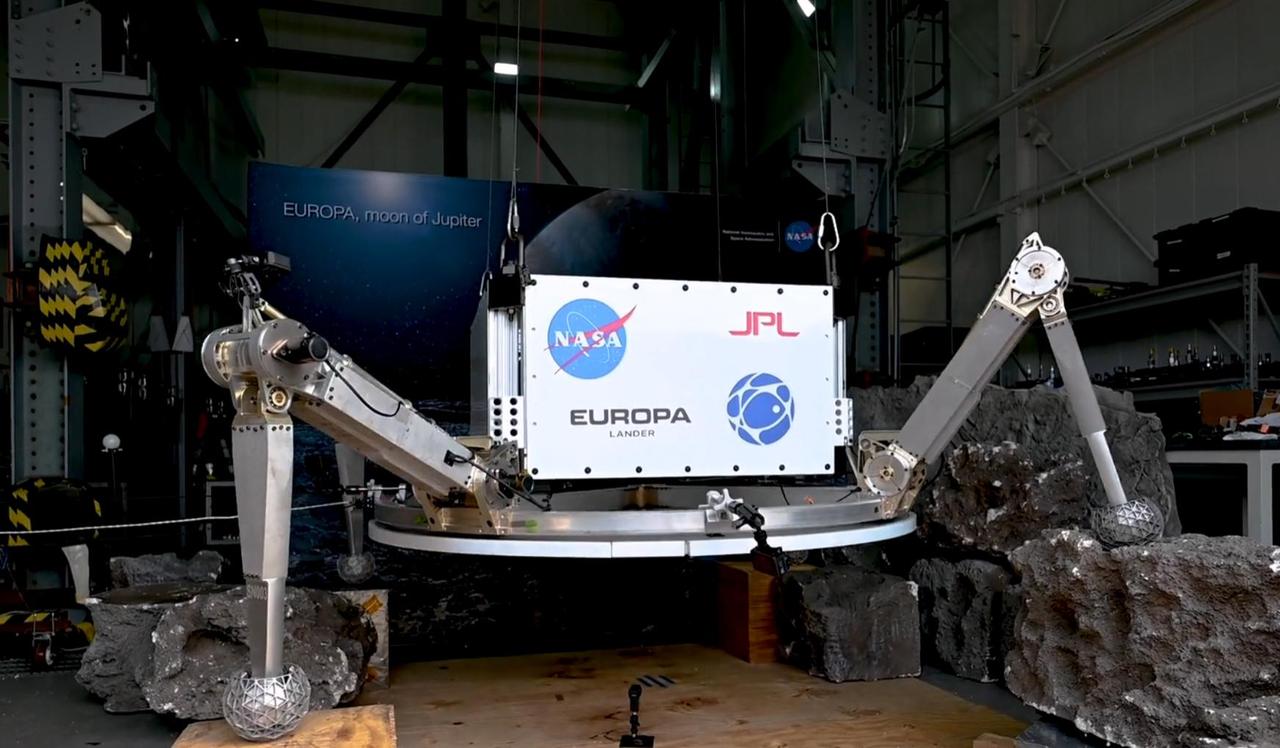
On Aug. 17 and 18, 2023, engineers at NASA's Jet Propulsion Laboratory in Southern California tested the landing system for a proposed future mission that would touch down on Jupiter's icy moon Europa. This system for the proposed Europa Lander is an evolution of hardware used on previous NASA lander missions. It includes the architecture used for the "sky crane maneuver" that helped lower NASA's Curiosity and Perseverance rovers onto the Martian surface, which would give the lander the stability it needs during touchdown. Although this landing architecture was developed with Europa as the target, it could be adapted for use at other moons and celestial bodies with challenging terrain. Four bridles, suspended from an overhead simulated propulsive descent stage, maintain a level lander body. The four legs conform passively to the terrain they encounter as the lander body continues to descend toward the surface. Each leg consists of a four-bar linkage mechanism that controls the leg's pose before and during landing. The legs are preloaded downward with a constant force spring to help them rearrange and compress the surface they encounter prior to landing, giving them extra traction and stability during and after the landing event. Acting like a skid plate, the belly pan provides the underside of the spacecraft with protection from potentially harmful terrain. The belly pan also resists shear motion on the terrain it interacts with. Once the belly pan contacts the surface, sensors trigger a mechanism that quickly locks the legs' "hip" and "knee" rotary joints, resulting in a table-like stance. At this point, the job of ensuring lander stability shifts from the bridles to the legs. This shift keeps the lander level after the bridles are unloaded. In the event the belly pan does not encounter terrain during the touchdown process, sensors in each leg can also declare touchdown. After the leg joints lock, the belly pan would be suspended above the landed terrain, and the lander would be supported only by the four legs. Not pictured in the video is the period after the bridles are offloaded and flyaway is commanded. The bridles would then be cut, and the hovering propulsive stage would fly away, leaving the lander in a stable stance on the surface. Movie available at https://photojournal.jpl.nasa.gov/catalog/PIA26010
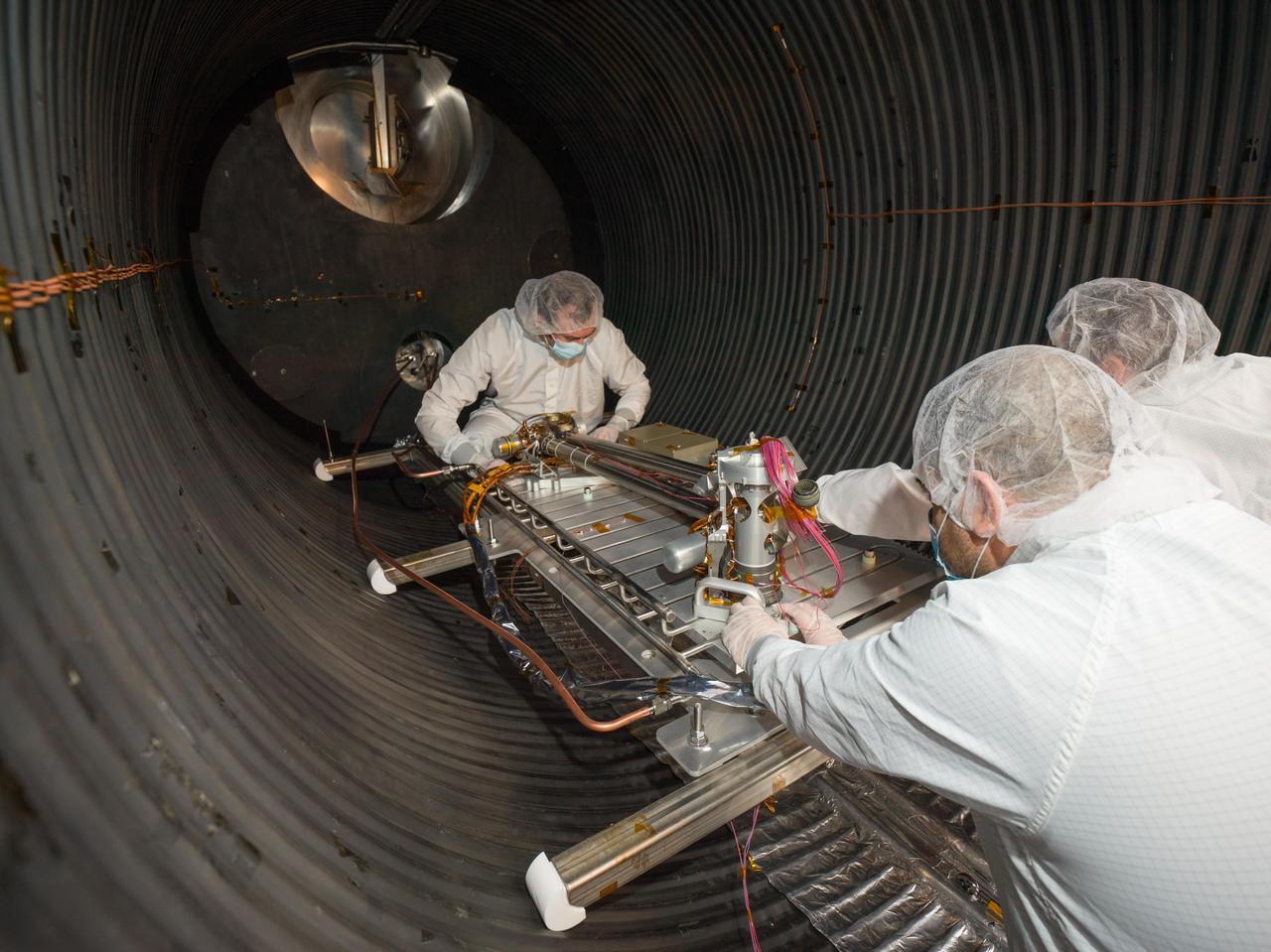
Engineers and technicians prepare NASA's Cold Operable Lunar Deployable Arm (COLDArm) robotic arm system for testing in a thermal vacuum chamber at the agency's Jet Propulsion Laboratory in Southern California in November 2023. Successful testing in this chamber, which was reduced to minus 292 F (minus 180 C), demonstrates the arm can withstand the conditions it would face on the surface of the Moon. To operate in the cold, COLDArm combines several key new technologies: gears made of bulk metallic glass, which require no wet lubrication or heating; cold motor controllers that don't need to be kept warm in an electronics box near the core of the spacecraft, and a cryogenic six-axis force torque sensor that lets the arm "feel" what it's doing and make adjustments. A variety of attachments and small instruments could go on the end of the arm, including a 3D-printed titanium scoop that could be used for collecting samples from a celestial body's surface. Like the arm on NASA's InSight Mars lander, COLDArm could deploy science instruments to the surface. https://photojournal.jpl.nasa.gov/catalog/PIA26162
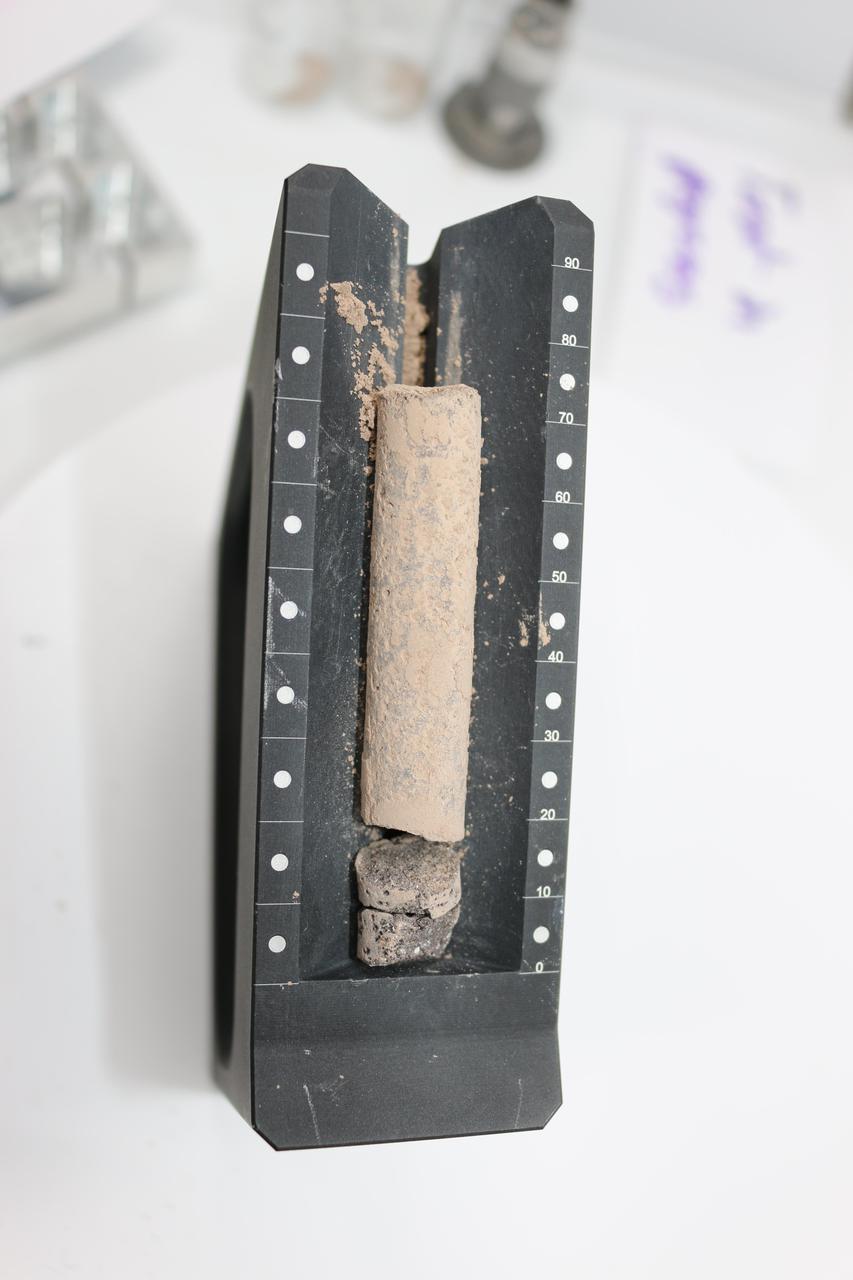
This image shows a core, about 2.8 inches (71.1 millimeters) in length, collected from a basaltic rock during a test of the Perseverance rover's Sampling and Caching System at NASA's Jet Propulsion Laboratory in Southern California. After a sampling test is completed, engineers carefully remove the core from its sample tube and place it in a sample tray, as they've done here, to document the result. A key objective for Perseverance's mission on Mars is astrobiology, including the search for signs of ancient microbial life. The rover will characterize the planet's geology and past climate, pave the way for human exploration of the Red Planet, and be the first mission to collect and cache Martian rock and regolith (broken rock and dust). Subsequent NASA missions, in cooperation with ESA (European Space Agency), would send spacecraft to Mars to collect these sealed samples from the surface and return them to Earth for in-depth analysis. The Mars 2020 Perseverance mission is part of NASA's Moon to Mars exploration approach, which includes Artemis missions to the Moon that will help prepare for human exploration of the Red Planet. https://photojournal.jpl.nasa.gov/catalog/PIA24809
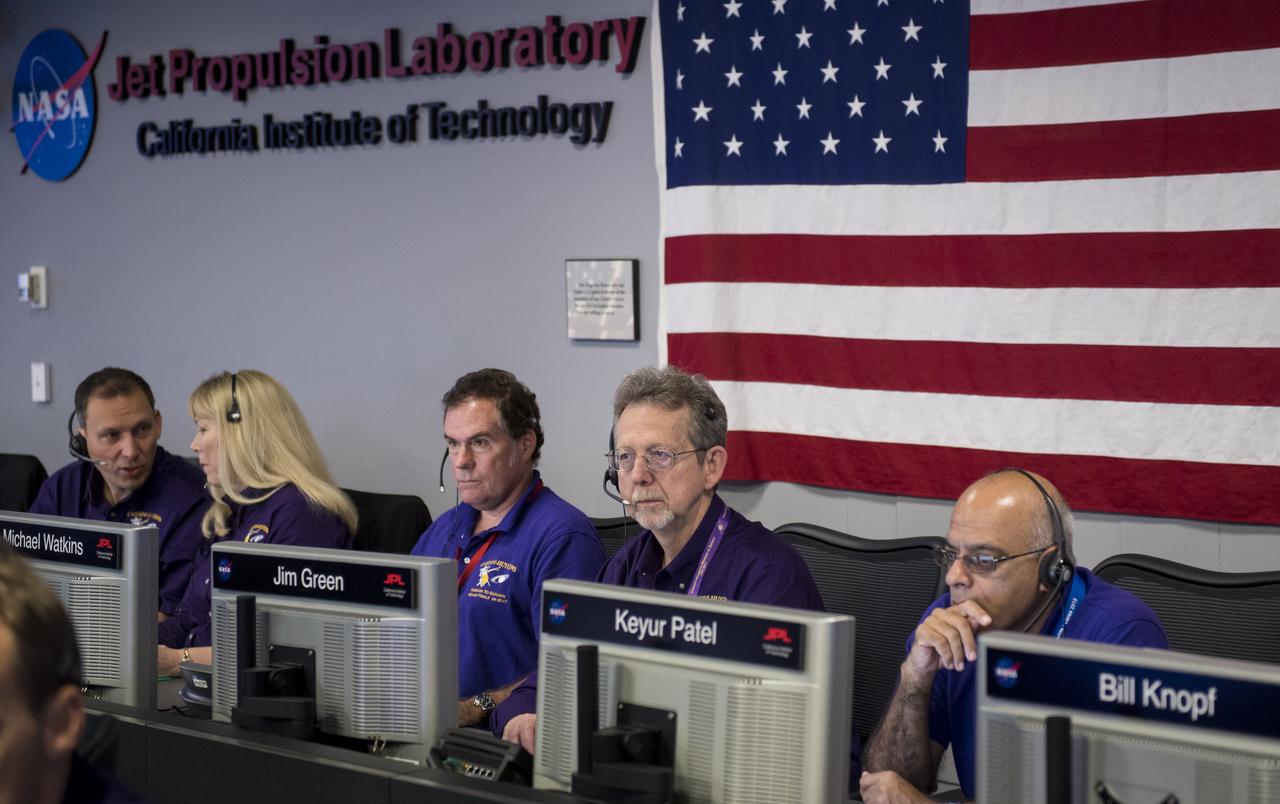
Associate administrator for NASA's Science Mission Directorate Thomas Zurbuchen, left, Cassini project scientist at JPL, Linda Spilker, second from left, director of NASA's Jet Propulsion Laboratory, Michael Watkins, center, director of NASA's Planetary Science Division, Jim Green, second from right, and director of the interplanetary network directorate at NASA's Jet Propulsion Laboratory, Keyur Patel, left, are seen in mission control, Friday, Sept. 15, 2017 at NASA's Jet Propulsion Laboratory in Pasadena, California. Since its arrival in 2004, the Cassini-Huygens mission has been a discovery machine, revolutionizing our knowledge of the Saturn system and captivating us with data and images never before obtained with such detail and clarity. On Sept. 15, 2017, operators deliberately plunged the spacecraft into Saturn, as Cassini gathered science until the end. Loss of contact with the Cassini spacecraft occurred at 7:55 a.m. EDT (4:55 a.m. PDT). The “plunge” ensures Saturn’s moons will remain pristine for future exploration. During Cassini’s final days, mission team members from all around the world gathered at NASA’s Jet Propulsion Laboratory, Pasadena, California, to celebrate the achievements of this historic mission. Photo Credit: (NASA/Joel Kowsky)
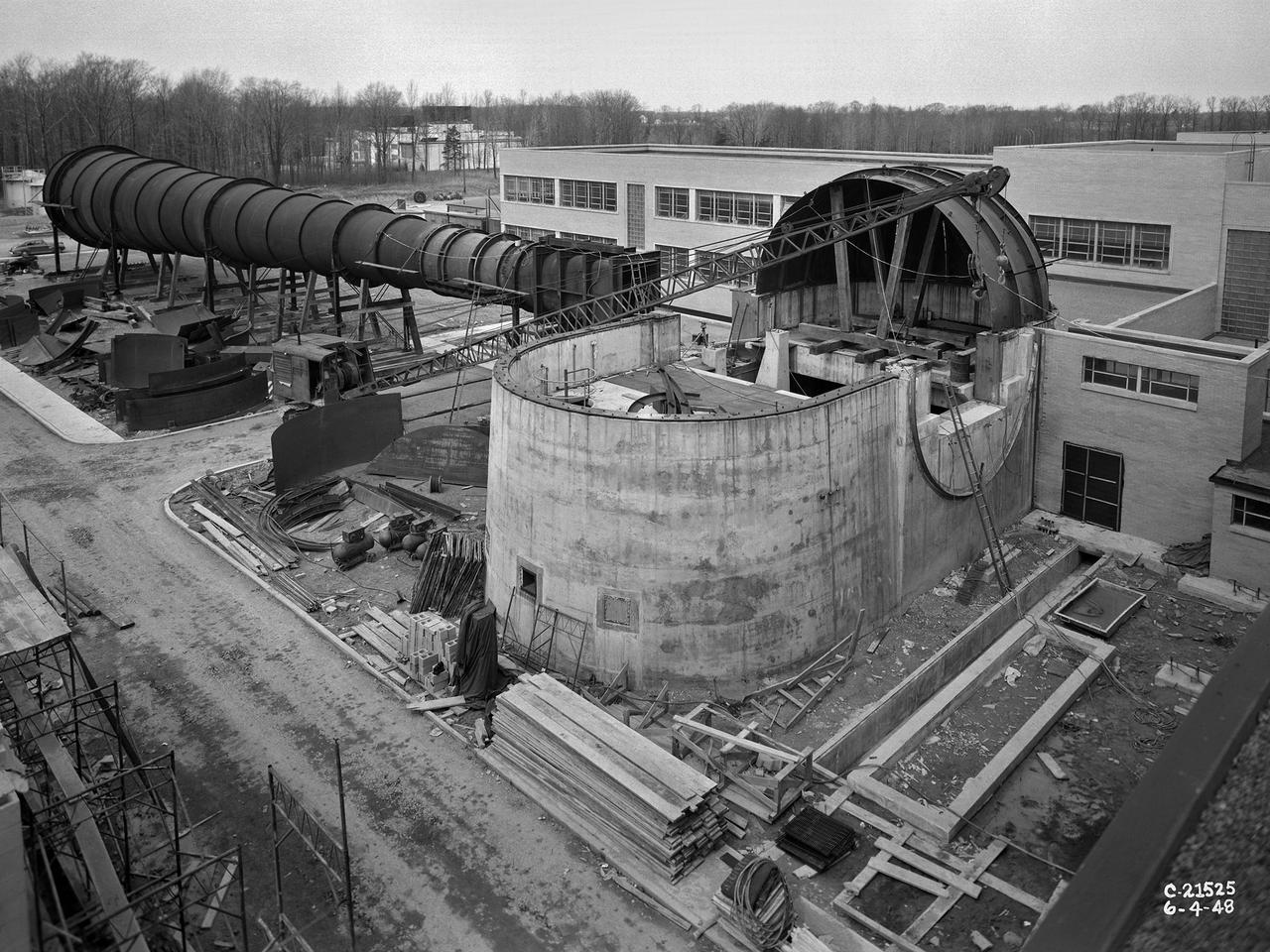
The 8- by 6-Foot Supersonic Wind Tunnel at the National Advisory Committee for Aeronautics (NACA) Lewis Flight Propulsion Laboratory was the nation’s largest supersonic facility when it began operation in April 1949. The emergence of new propulsion technologies such as turbojets, ramjets, and rockets during World War II forced the NACA and the aircraft industry to develop new research tools. In late 1945 the NACA began design work for new large supersonic wind tunnels at its three laboratories. The result was the 4- by 4-Foot Supersonic Wind Tunnel at Langley Memorial Aeronautical Laboratory, 6- by 6-foot supersonic wind tunnel at Ames Aeronautical Laboratory, and the largest facility, the 8- by 6-Foot Supersonic Wind Tunnel in Cleveland. The two former tunnels were to study aerodynamics, while the 8- by 6 facility was designed for supersonic propulsion. The 8- by 6-Foot Supersonic Wind Tunnel was used to study propulsion systems, including inlets and exit nozzles, combustion fuel injectors, flame holders, exit nozzles, and controls on ramjet and turbojet engines. Flexible sidewalls alter the tunnel’s nozzle shape to vary the Mach number during operation. A seven-stage axial compressor, driven by three electric motors that yield a total of 87,000 horsepower, generates air speeds from Mach 0.36 to 2.0. A section of the tunnel is seen being erected in this photograph.
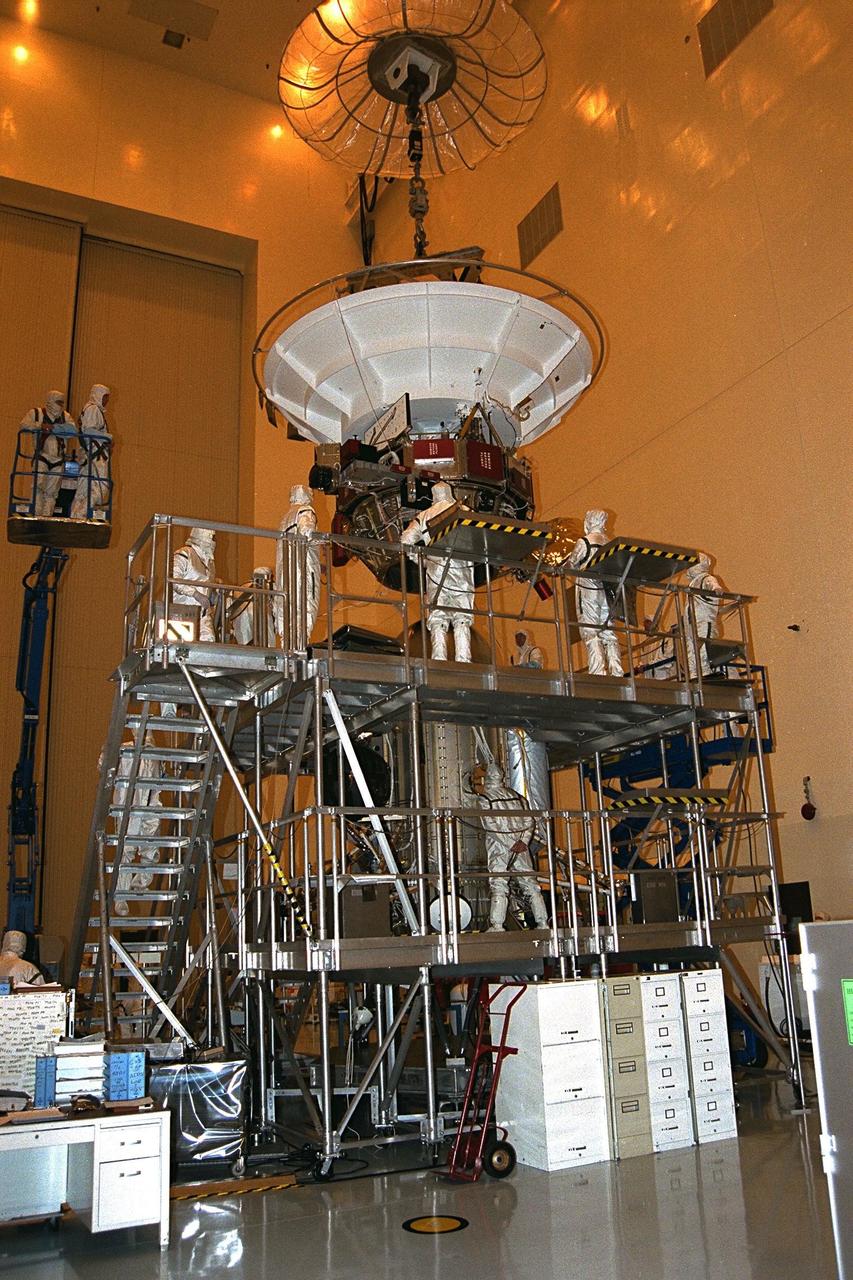
Technicians from the Jet Propulsion Laboratory (JPL) attach the upper equipment module to the propulsion module and the lower equipment module in the Payload Hazardous Servicing Facility in July prior to installation on the Cassini spacecraft at KSC. A four-year, close-up study of the Saturnian system, the mission is scheduled for launch from Cape Canaveral Air Station in October 1997. It will take seven years for the spacecraft to reach Saturn. JPL is managing the Cassini project for NASA
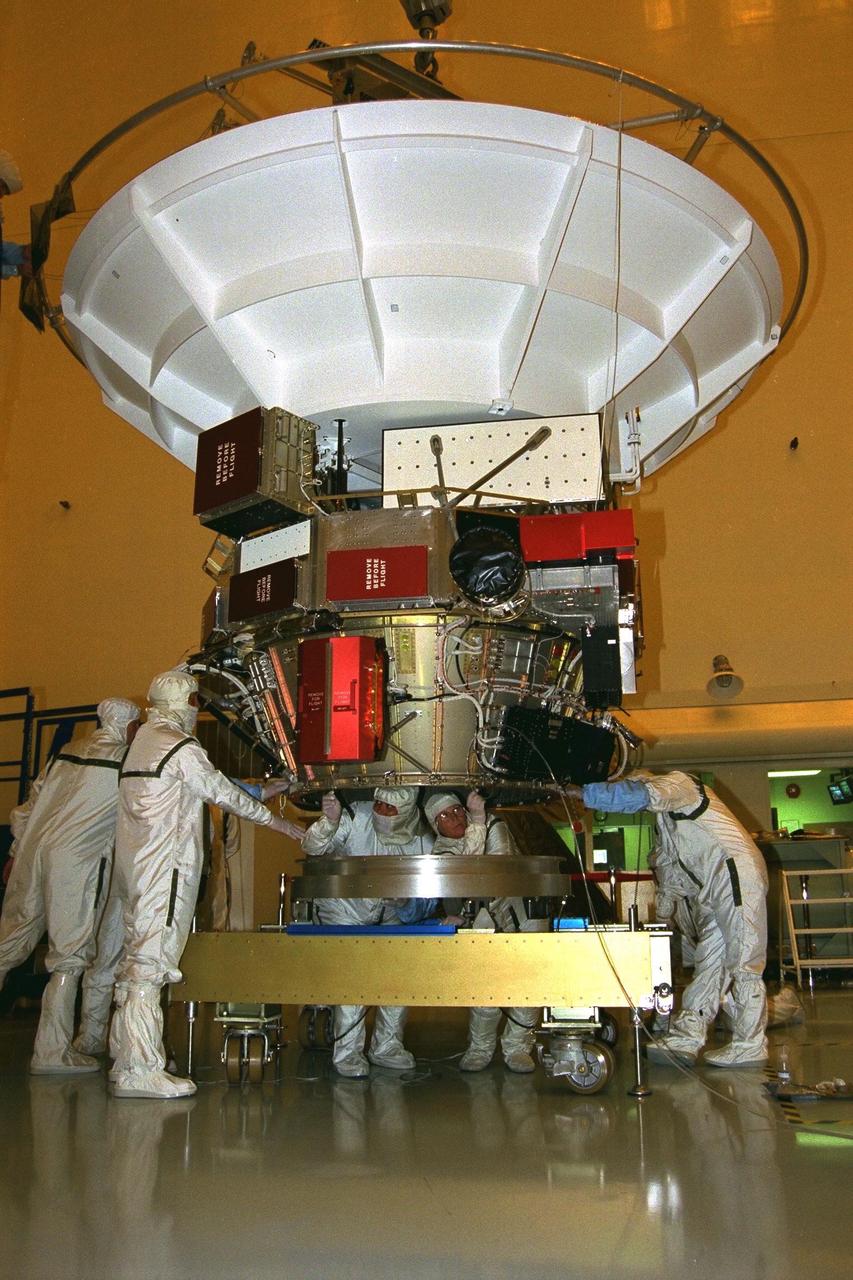
Jet Propulsion Laboratory (JPL) technicians clean and prepare the upper equipment module for mating with the propulsion module subsystem of the Cassini orbiter in the Payload Hazardous Servicing Facility at KSC in July. A four- year, close-up study of the Saturnian system, the Cassini mission is scheduled for launch from Cape Canaveral Air Station in October 1997. It will take seven years for the spacecraft to reach Saturn. Scientific instruments carried aboard the spacecraft will study Saturn’s atmosphere, magnetic field, rings, and several moons. JPL is managing the Cassini project for NASA

A truck arrives at NASA's Jet Propulsion Laboratory in Southern California on June 3, 2024, to deliver the Medium Articulating Transportation System (MATS), which will be used during the construction and transportation of components for NASA's Near-Earth Object Surveyor mission. Originating at the aerospace company Beyond Gravity in Vienna, Austria, the MATS traveled via ship through the Panama Canal to Port Hueneme, California, before arriving by road at JPL. Construction has begun on NEO Surveyor's instrument enclosure in the High Bay 1 clean room at JPL's Spacecraft Assembly Facility. When the enclosure is complete later this year, it will be moved inside the MATS to NASA's Johnson Space Center in Houston for environmental testing. The MATS is a transportable clean room with its own filtration and climate control systems that keep the spacecraft and components clean, stable, and safe while being moved between facilities. NEO Surveyor's instrument enclosure contains the spacecraft's telescope, mirrors, and infrared sensors that will be used to detect, track, and characterize the most hazardous near-Earth objects. BAE Systems, Space Dynamics Laboratory, and Teledyne are among the aerospace and engineering companies contracted to build the spacecraft and its instrumentation. The Laboratory for Atmospheric and Space Physics at the University of Colorado, Boulder will support operations, and IPAC at Caltech in Pasadena, California, is responsible for processing survey data and producing the mission's data products. JPL manages the project; Caltech manages JPL for NASA. Launching no earlier than 2027, NEO Surveyor supports the objectives of NASA's Planetary Defense Coordination Office (PDCO) at NASA Headquarters in Washington. The NASA Authorization Act of 2005 directed NASA to discover and characterize at least 90% of the near-Earth objects more than 140 meters (460 feet) across that come within 30 million miles (48 million kilometers) of our planet's orbit. Objects of this size can cause significant regional damage, or worse, should they impact the Earth. https://photojournal.jpl.nasa.gov/catalog/PIA26381

Farah Alibay, a systems engineer working on the Mars 2020 rover at NASA’s Jet Propulsion Laboratory, speaks about her path to working at NASA during an interactive STEM discussion with students attending the 70th International Astronautical Congress, Wednesday, Oct. 23, 2019, at NASA Headquarters in Washington. Photo Credit: (NASA/Joel Kowsky)
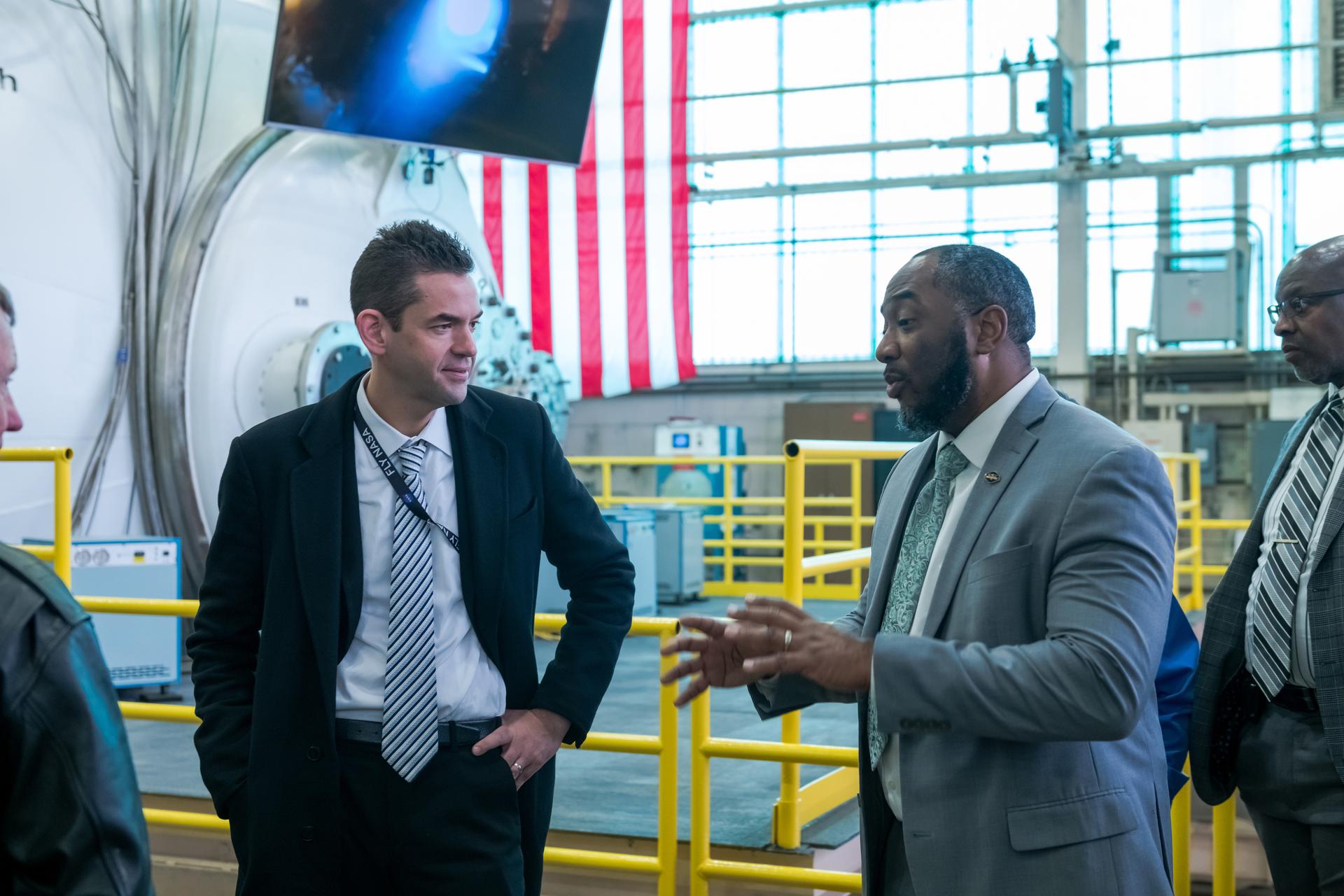
During a visit to NASA's Glenn Research Center in Cleveland on Tuesday, Jan. 27, 2026, NASA Administrator Jared Isaacman speaks with Carl Sandifer, manager of the Radioisotope Power Systems Program, inside the Electric Propulsion and Power Laboratory as Rickey Shyne, director of Research and Engineering, looks on.
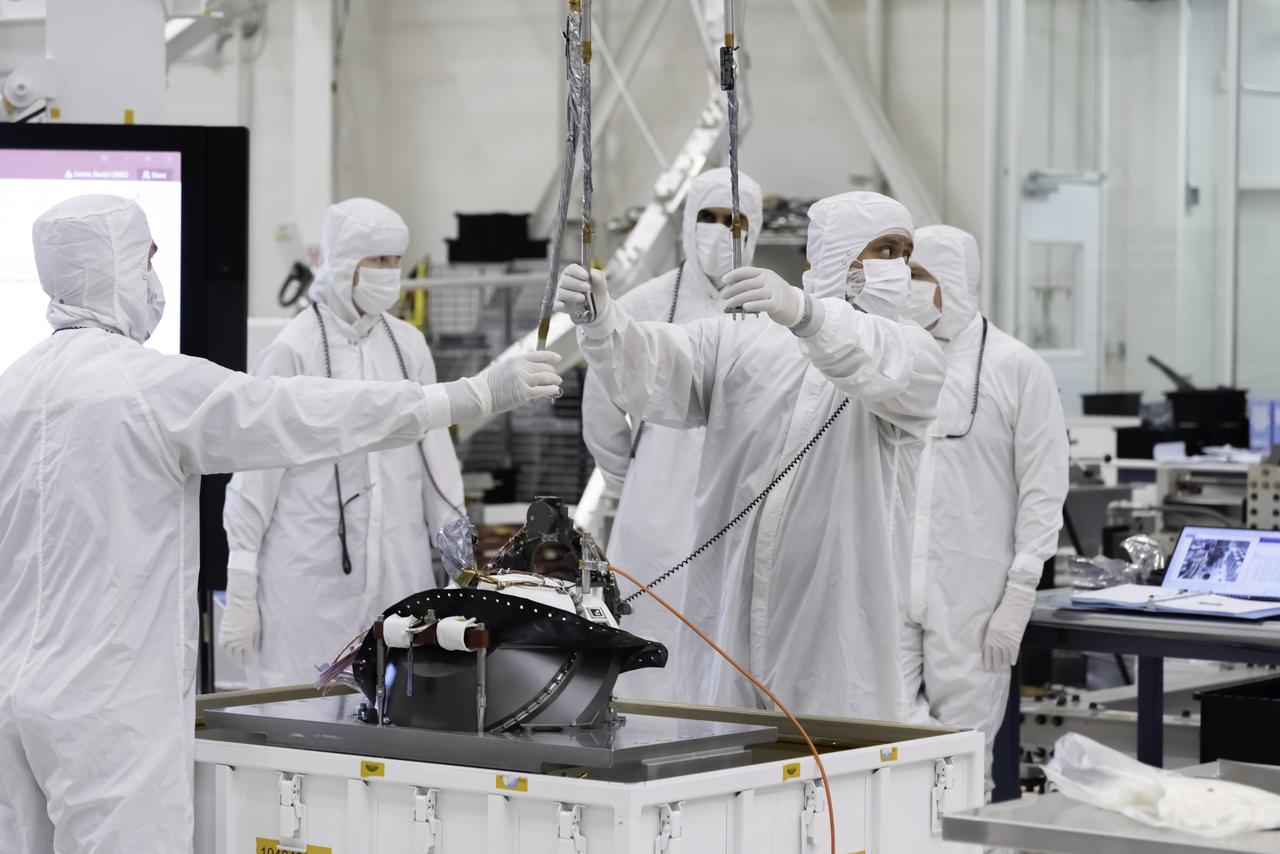
Engineers at NASA's Jet Propulsion Laboratory lift the Mars 2020 rover's bit carousel out of its storage container. The bit carousel is a mechanism that is at the heart of the rover's Sample Caching System. The image was taken on Aug. 5, 2019, in the Spacecraft Assembly Facility's High Bay 1 at JPL. https://photojournal.jpl.nasa.gov/catalog/PIA23320
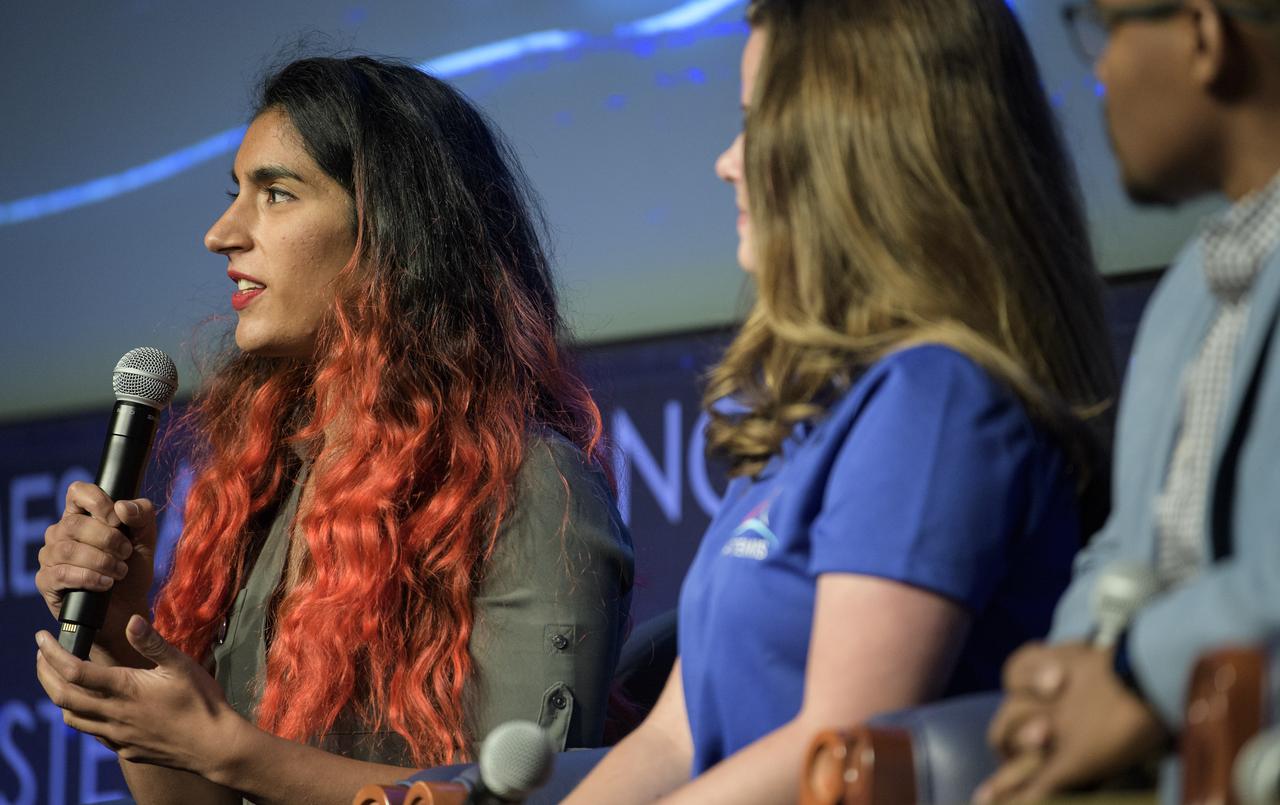
Farah Alibay, a systems engineer working on the Mars 2020 rover at NASA’s Jet Propulsion Laboratory, speaks about her path to working at NASA during an interactive STEM discussion with students attending the 70th International Astronautical Congress, Wednesday, Oct. 23, 2019, at NASA Headquarters in Washington. Photo Credit: (NASA/Joel Kowsky)
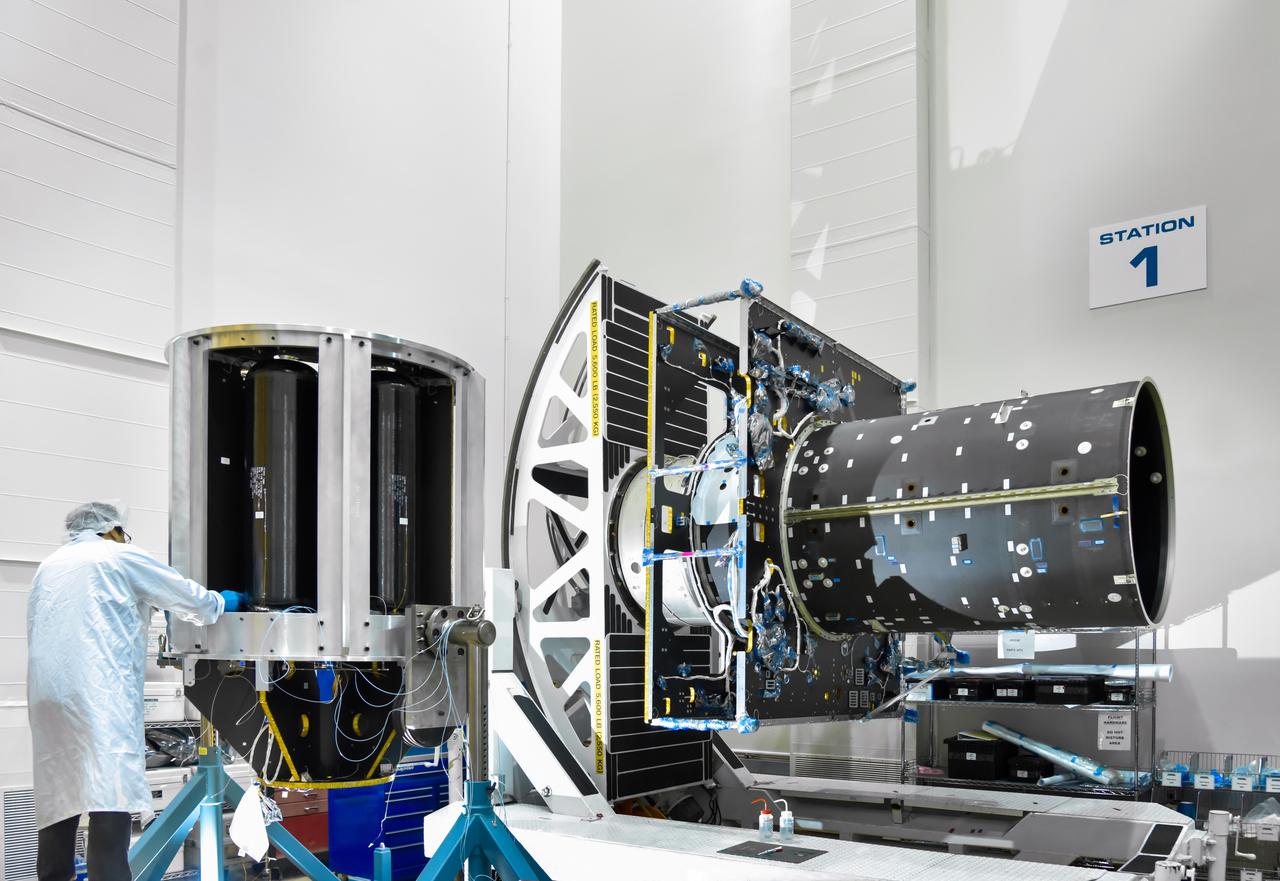
The main body of NASA's Psyche spacecraft, called the Solar Electric Propulsion (SEP) Chassis, is in a clean room at Maxar Technologies in Palo Alto, California, where a technician prepares to integrate part of the electric propulsion system onto the chassis. Maxar will deliver the SEP Chassis to NASA's Jet Propulsion Laboratory in Southern California in February 2021. Set to launch in August 2022, Psyche's will explore a metal-rich asteroid of the same name that lies in the main asteroid belt between Mars and Jupiter. The spacecraft will arrive in early 2026, and orbit the asteroid for nearly two years to investigate its composition. https://photojournal.jpl.nasa.gov/catalog/PIA23877

At NASA's Jet Propulsion Laboratory in Southern California, on June 7, 2024, clean room technicians use a crane to lift the lid of the Medium Articulating Transportation System (MATS) that will be used during the construction and transportation of components for NASA's Near-Earth Object Surveyor mission. Inside the MATS is the Medium Articulating Assembly Dolly (MAAD), a platform that will support the spacecraft's instrument enclosure, which is being constructed inside the High Bay 1 clean room at JPL's Spacecraft Assembly Facility. The MAAD is an articulating platform on which a spacecraft (or spacecraft components) can be mounted securely and positioned as required during assembly. It can tilt a spacecraft vertically and horizontally, rotating it 360 degrees. JPL plans to use the MAAD for future missions to reduce the number of crane lifts during assembly, test, and launch operations, known as ATLO. NEO Surveyor is the first mission to use the platform. NEO Surveyor's instrument enclosure contains the spacecraft's telescope, mirrors, and infrared sensors that will be used to detect, track, and characterize the most hazardous near-Earth objects. BAE Systems, Space Dynamics Laboratory, and Teledyne are among the aerospace and engineering companies contracted to build the spacecraft and its instrumentation. The Laboratory for Atmospheric and Space Physics at the University of Colorado, Boulder will support operations, and IPAC at Caltech in Pasadena, California, is responsible for processing survey data and producing the mission's data products. JPL manages the project; Caltech manages JPL for NASA. Launching no earlier than 2027, NEO Surveyor supports the objectives of NASA's Planetary Defense Coordination Office (PDCO) at NASA Headquarters in Washington. The NASA Authorization Act of 2005 directed NASA to discover and characterize at least 90% of the near-Earth objects more than 140 meters (460 feet) across that come within 30 million miles (48 million kilometers) of our planet's orbit. Objects of this size can cause significant regional damage, or worse, should they impact the Earth. https://photojournal.jpl.nasa.gov/catalog/PIA26382
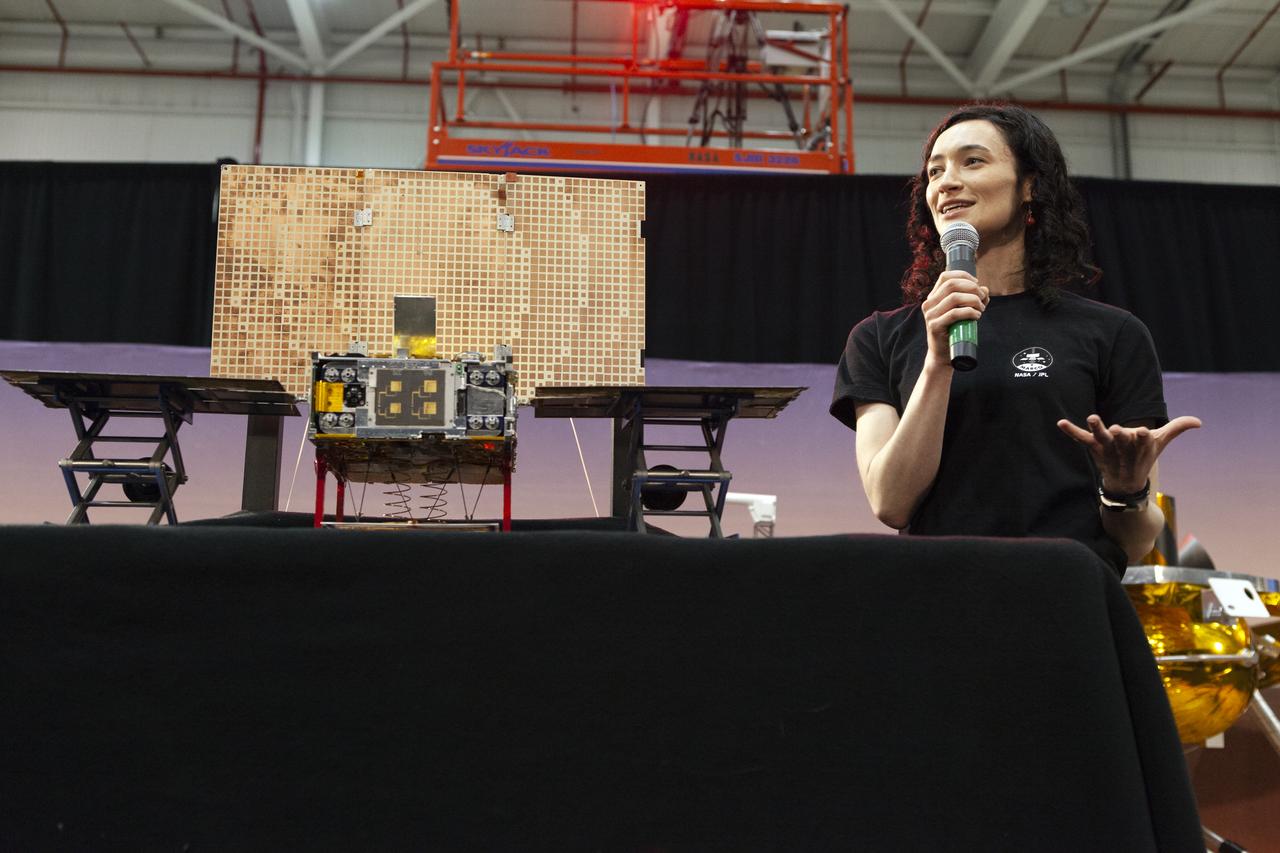
During a prelaunch briefing at Vandenberg Air Force Base in California, Annie Marinan, MarCO Systems Engineer at NASA's Jet Propulsion Laboratory, speaks to members of the media. The presentation focused on NASA's Interior Exploration using Seismic Investigations, Geodesy and Heat Transport, or InSight, Mars lander. InSight is scheduled for liftoff May 5, 2018, atop a United Launch Alliance (ULA) Atlas V rocket from Space Launch Complex 3 at Vandenberg. The spacecraft will be the first mission to look deep beneath the Martian surface studying the planet's interior by measuring its heat output and listen for marsquakes.

An artist illustrates a panel discussion titled, “Europa Clipper: Making a Mission to Understand Our Place in the Universe,” with panelists Robert Pappalardo, Europa Clipper Project Scientist, NASA Jet Propulsion Laboratory (JPL); Karen Kirby, Europa Clipper Deputy Project System Engineer, Applied Physics Laboratory (APL); Jennifer Dooley, Europa Clipper Project Systems Engineer, JPL; Thomas Magner, Manager, APL; and Bill Nye, Chief Executive Officer, The Planetary Society, during the 70th International Astronautical Congress, Wednesday, Oct. 23, 2019 at the Walter E. Washington Convention Center in Washington. Photo credit: (NASA/Aubrey Gemignani)
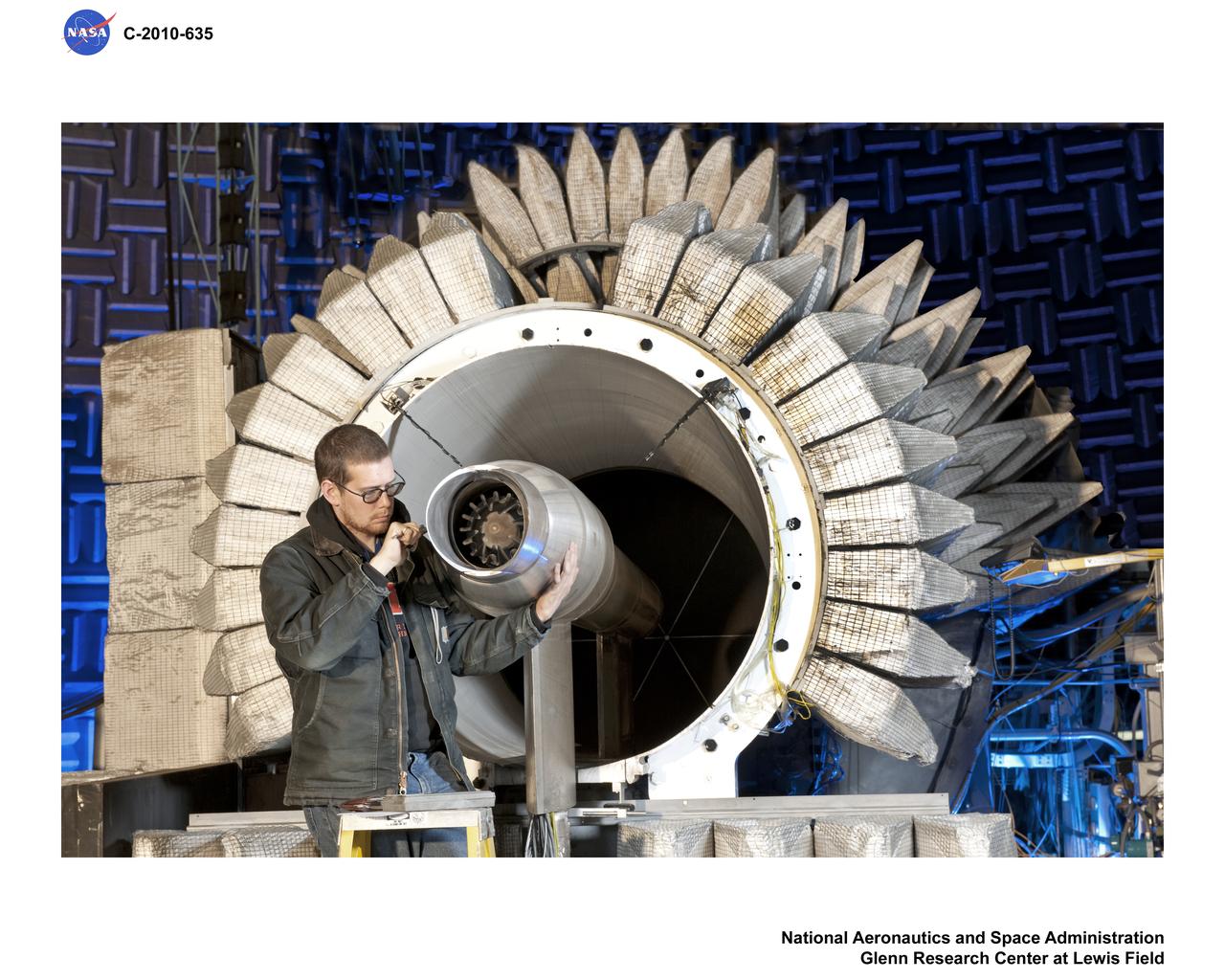
New testing is underway in the Aero-Acoustic Propulsion Laboratory (AAPL) at NASA's Glenn Research Center. The research focuses on a model called the Highly Variable Cycle Exhaust System -- a 0.17 scale model of an exhaust system that will operate at subsonic, transonic and supersonic exhaust speeds in a future supersonic business jet. The model features ejector doors used at different angles. Researchers are investigating the impact of these ejectors on the resulting acoustic radiation. Here, Steven Sedensky, a mechanical engineer with Jacobs Sverdrup, takes measurements of the ejector door positions.
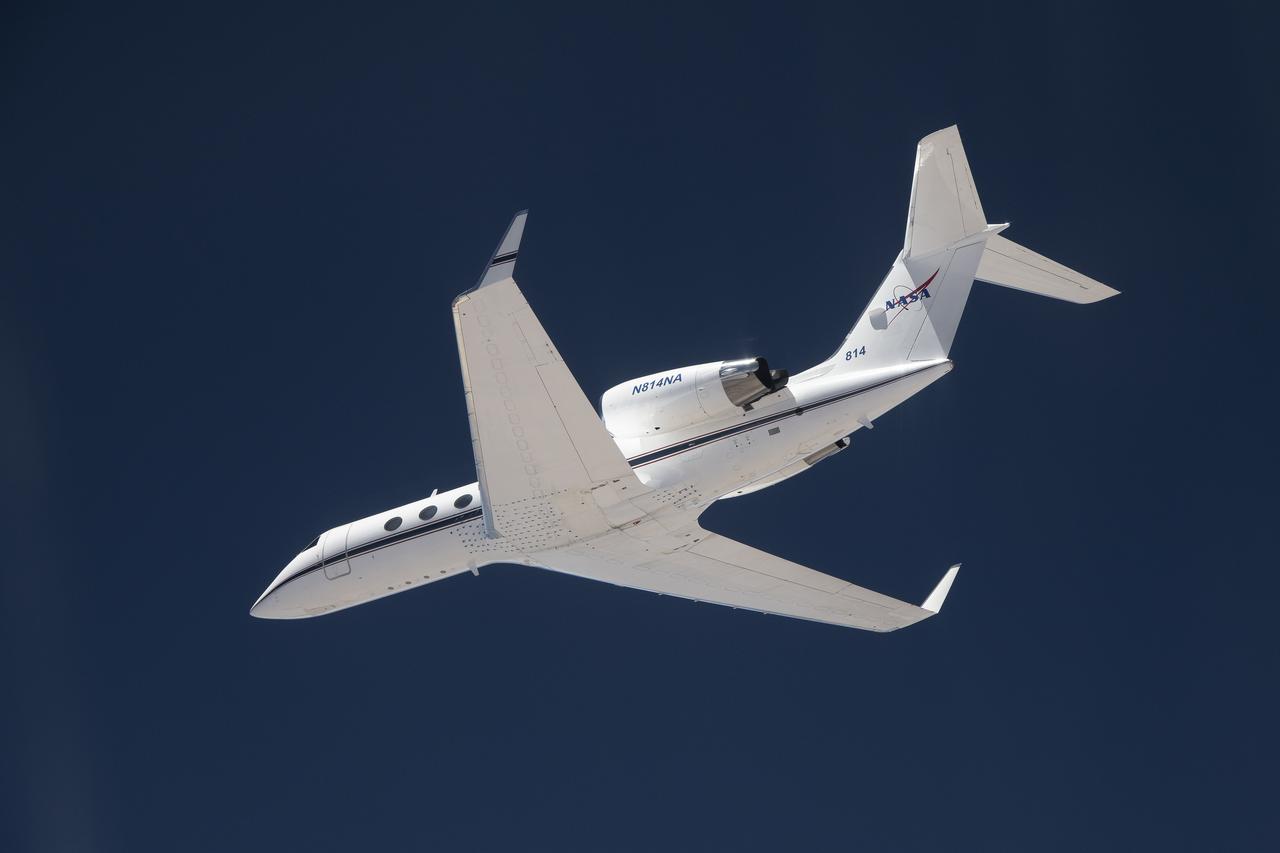
The G-IV aircraft flies overhead in the Mojave Desert near NASA’s Armstrong Flight Research Center in Edwards, California. Baseline flights like this one occurred in June 2024, and future flights in service of science research will benefit from the installment of the Soxnav navigational system, developed in collaboration with NASA’s Jet Propulsion Laboratory in Southern California and the Bay Area Environmental Research Institute in California’s Silicon Valley. This navigational system provides precise, economical aircraft guidance for a variety of aircraft types moving at high speeds.
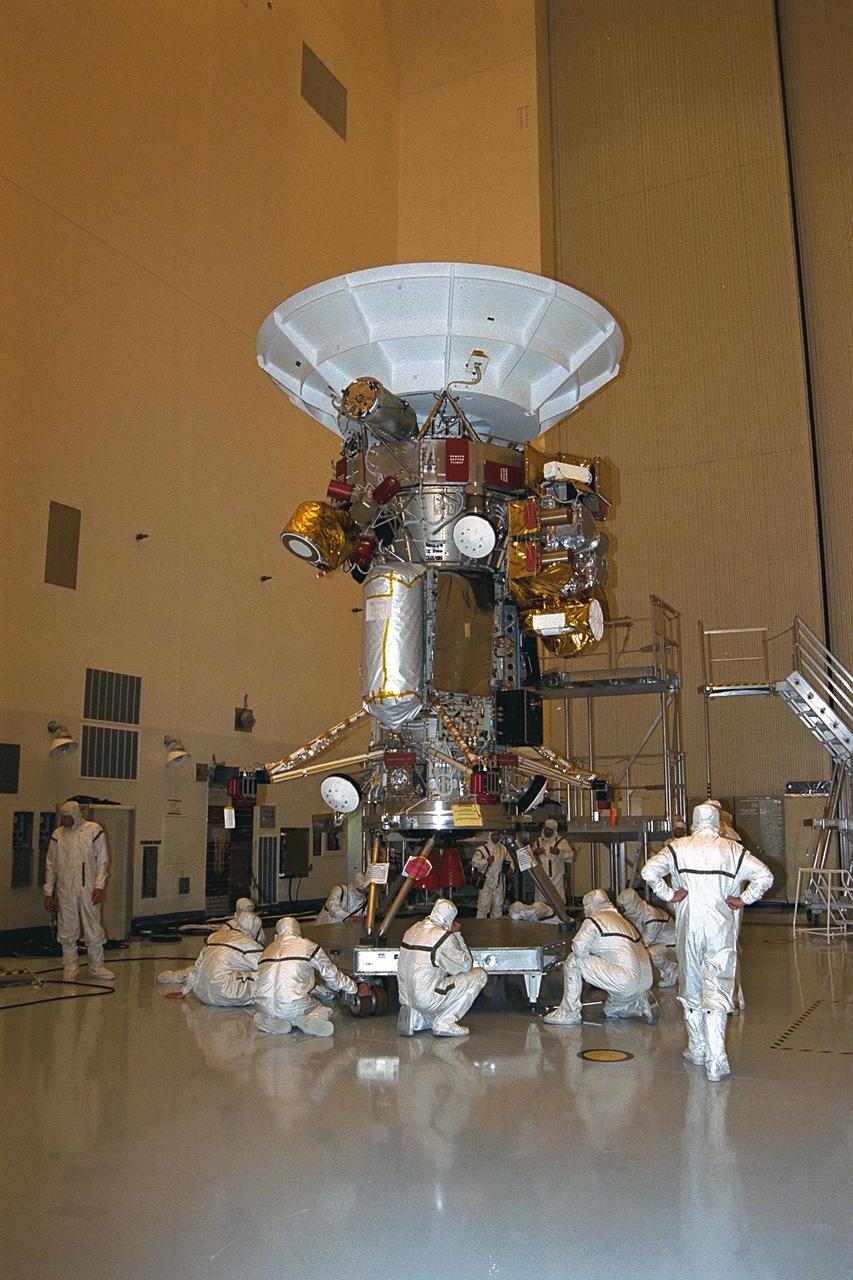
Jet Propulsion Laboratory (JPL) technicians reposition and level the Cassini orbiter in the Payload Hazardous Servicing Facility at KSC in July after stacking the craft’s upper equipment module on the propulsion module. A four-year, close-up study of the Saturnian system, the Cassini mission is scheduled for launch from Cape Canaveral Air Station in October 1997. It will take seven years for the spacecraft to reach Saturn. Scientific instruments carried aboard the spacecraft will study Saturn’s atmosphere, magnetic field, rings, and several moons. JPL is managing the Cassini project for NASA
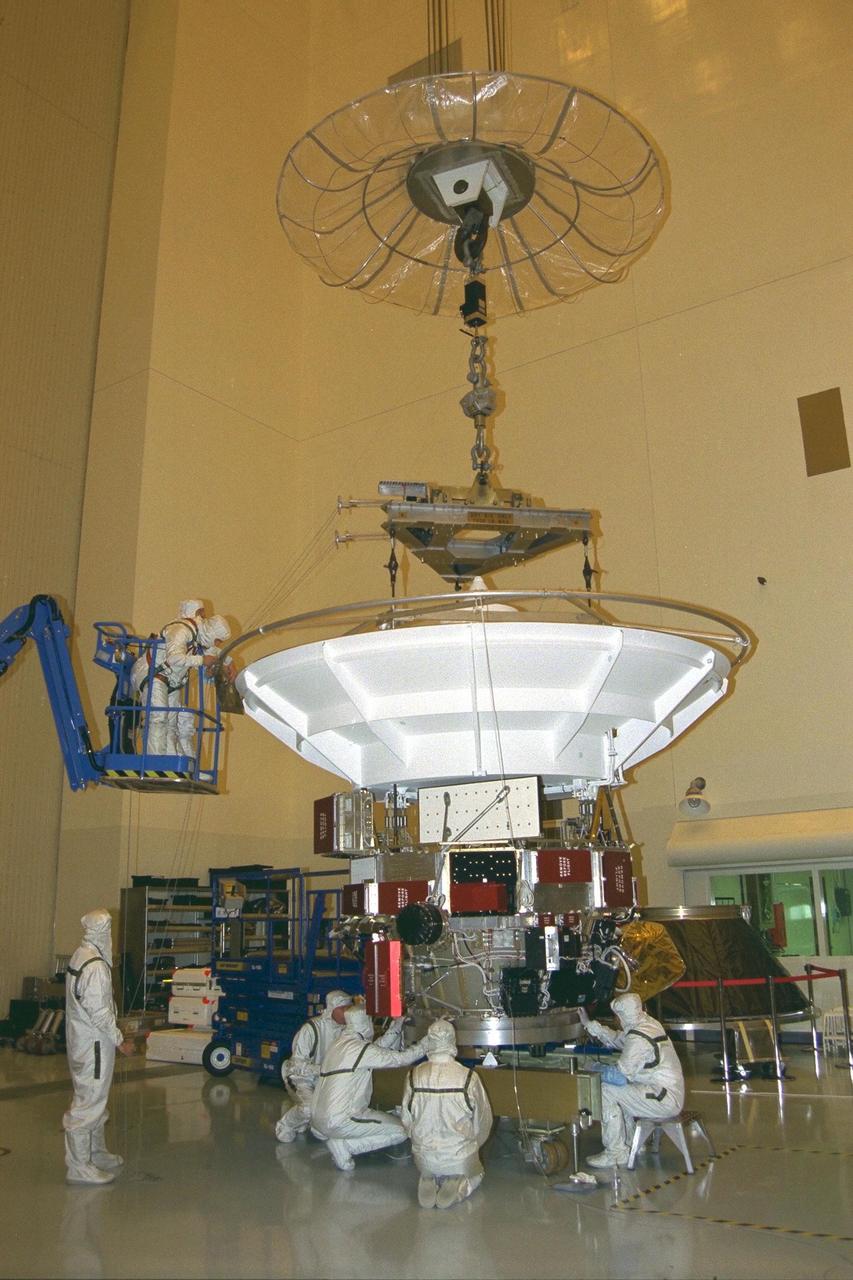
Jet Propulsion Laboratory (JPL) technicians in a blue crane at the top of the white upper equipment module (UEM) level the UEM prior to separation from its dolly. The module will be prepared for stacking atop Cassini’s propulsion module in the Payload Hazardous Servicing Facility at KSC. Cassini, a four-year, close-up study of the Saturnian system, is scheduled for launch from Cape Canaveral Air Station in October 1997. It will take seven years for the spacecraft to reach Saturn. Scientific instruments carried aboard the spacecraft will study Saturn’s atmosphere, magnetic field, rings, and several moons. JPL is managing the Cassini project for NASA
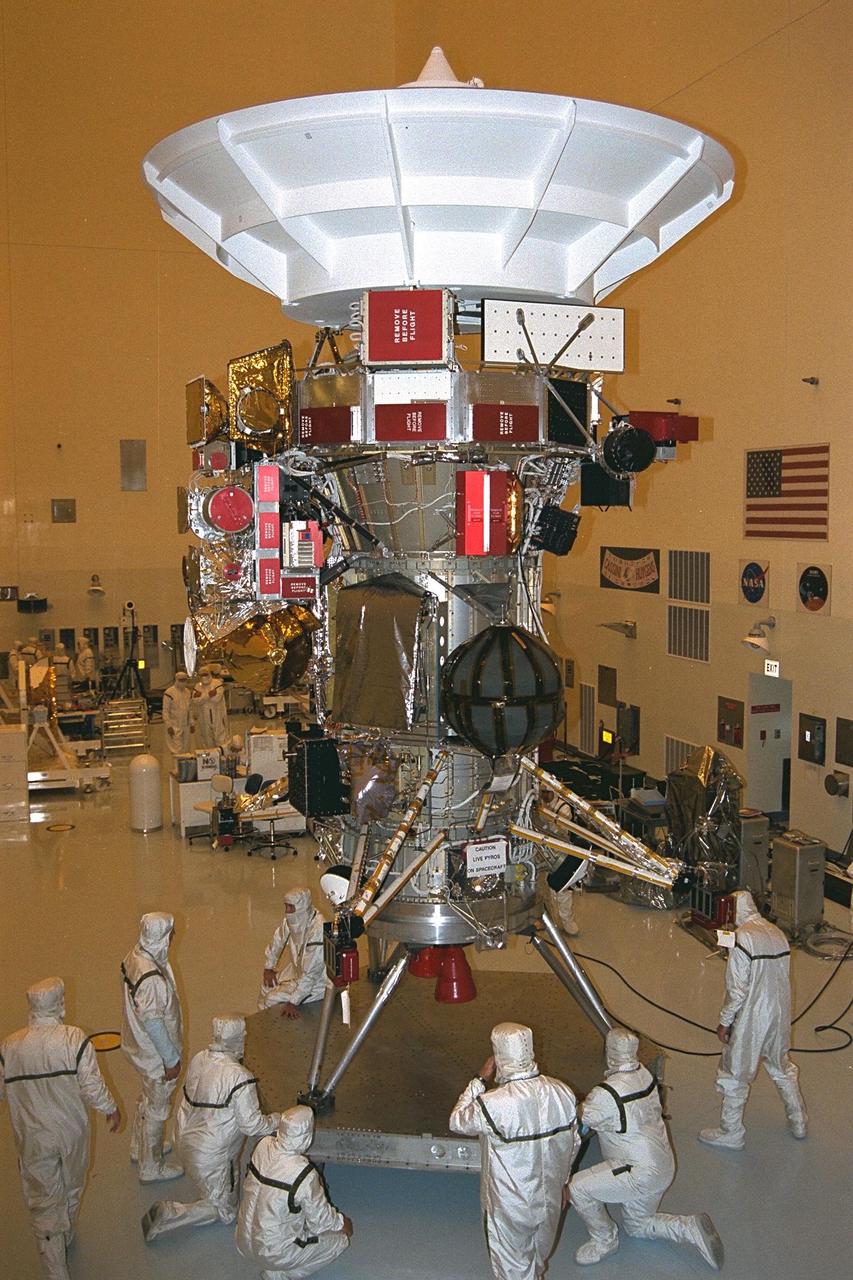
Jet Propulsion Laboratory (JPL) technicians reposition and level the Cassini orbiter in the Payload Hazardous Servicing Facility at KSC in July after stacking the craft’s upper equipment module on the propulsion module. A four-year, close-up study of the Saturnian system, the Cassini mission is scheduled for launch from Cape Canaveral Air Station in October 1997. It will take seven years for the spacecraft to reach Saturn. Scientific instruments carried aboard the spacecraft will study Saturn’s atmosphere, magnetic field, rings, and several moons. JPL is managing the Cassini project for NASA
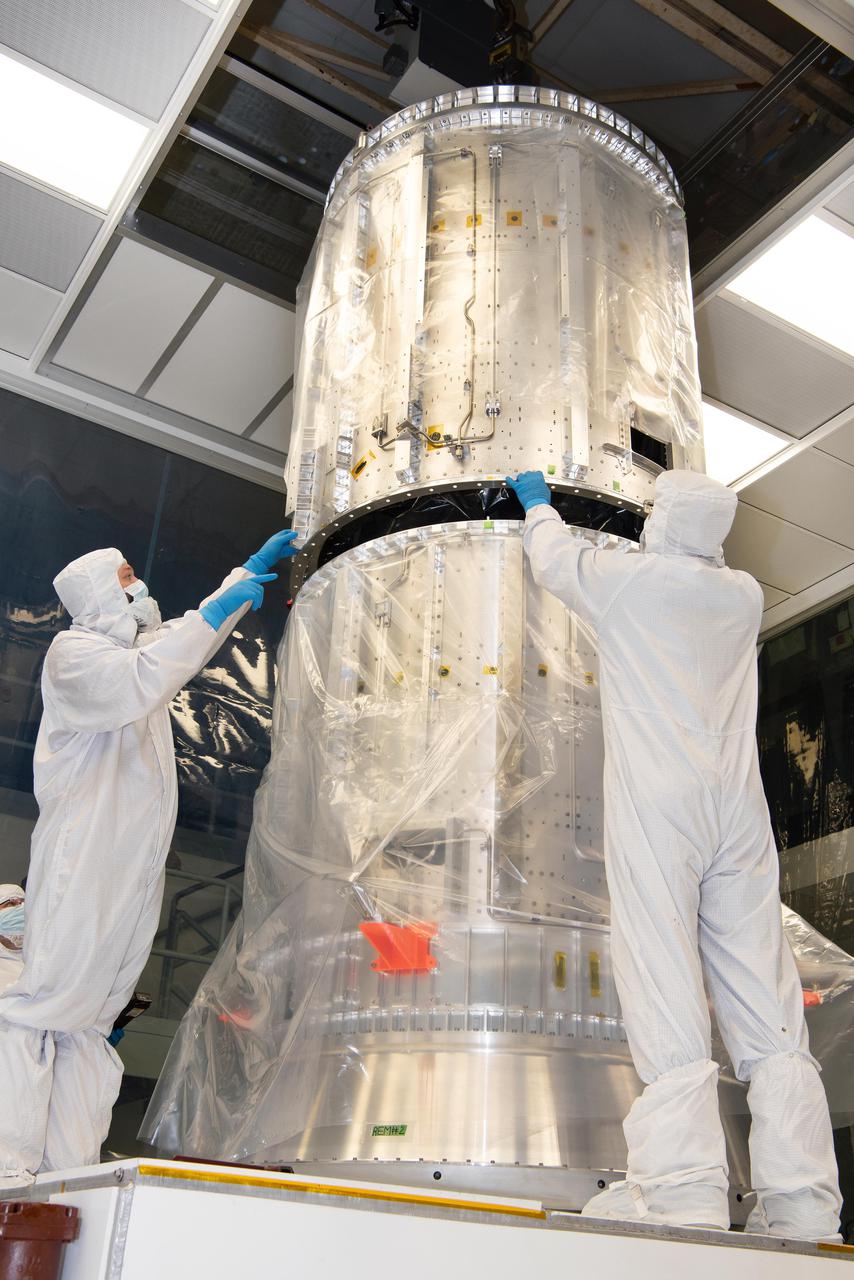
Technicians in a clean room at NASA's Goddard Space Flight Center in Greenbelt, Maryland, check the fit of the upper and lower cylinders of the propulsion module core of NASA's Europa Clipper spacecraft on Oct. 15, 2020. The stacked cylinders stand almost 10 feet (3 meters) high and hold the propulsion tanks and rocket engines that will propel Europa Clipper once it leaves Earth's atmosphere on its path toward Jupiter's moon Europa. In this photo, the cylinders are stacked atop an adapter ring that's about 1 foot (0.3 meters) high. The cylinders were built by the Johns Hopkins Applied Physics Laboratory (APL) in Laurel, Maryland. They were shipped to NASA's Jet Propulsion Laboratory in Southern California for installation of the Heat Redistribution System (HRS) tubing, which helps control the spacecraft's temperature. The cylinders were then shipped to Goddard for the propulsion subsystem installation. With an internal global ocean twice the size of Earth's oceans combined, Europa may have the potential to harbor life. The Europa Clipper orbiter will swoop around Jupiter on an elliptical path, dipping close to the moon on each flyby to collect data. Understanding Europa's habitability will help scientists better understand how life developed on Earth and the potential for finding life beyond our planet. Europa Clipper is aiming for a launch readiness date of 2024. https://photojournal.jpl.nasa.gov/catalog/PIA24322
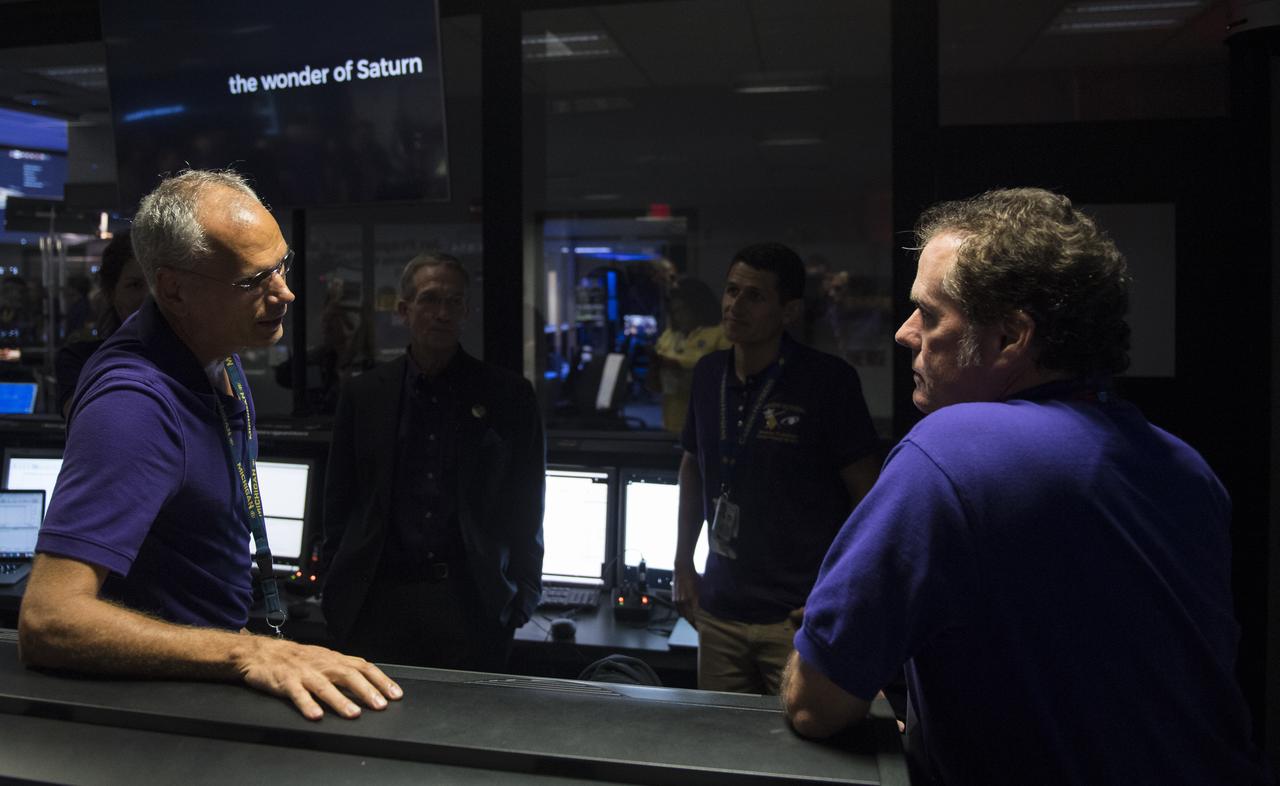
Duane Roth, of Cassini's navigation team, left, speaks with director of NASA's Jet Propulsion Laboratory, Michael Watkins, right, after Cassini's mission was declared over, Friday, Sept. 15, 2017 in mission control at NASA's Jet Propulsion Laboratory in Pasadena, California. Since its arrival in 2004, the Cassini-Huygens mission has been a discovery machine, revolutionizing our knowledge of the Saturn system and captivating us with data and images never before obtained with such detail and clarity. On Sept. 15, 2017, operators deliberately plunged the spacecraft into Saturn, as Cassini gathered science until the end. Loss of contact with the Cassini spacecraft occurred at 7:55 a.m. EDT (4:55 a.m. PDT). The “plunge” ensures Saturn’s moons will remain pristine for future exploration. During Cassini’s final days, mission team members from all around the world gathered at NASA’s Jet Propulsion Laboratory, Pasadena, California, to celebrate the achievements of this historic mission. Photo Credit: (NASA/Joel Kowsky)
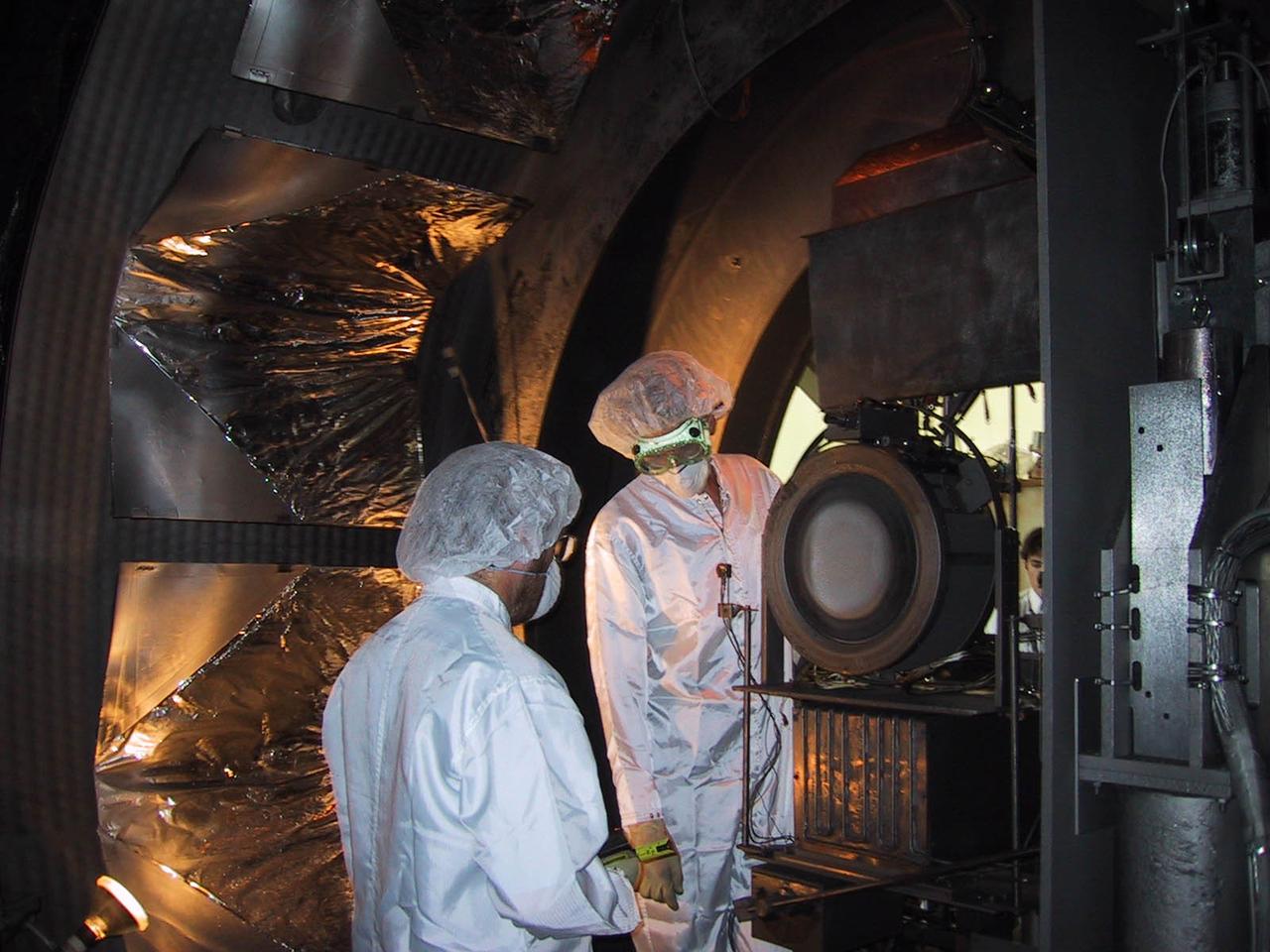
An ion thruster is removed from a vacuum chamber at NASA's Jet Propulsion Laboratory in Pasadena, California. The thruster, a spare engine from NASA's Deep Space 1 mission, with a designed life of 8,000 hours, ran for a record 30,352 hours (nearly 5 years) giving researchers the ability to observe its performance and wear at different power levels throughout the test. This information will be vital to future missions that use ion propulsion. Ion propulsion systems can be very lightweight, rurning on just a few grams of xenon gas a day. Xenon is the same gas that is found in photo flash bulbs. This fuel efficiency can lower launch vehicle costs. The successful Deep Space 1 mission featured the first use of an ion engine as the primary means of propulsion on a NASA spacecraft. NASA's next-generation ion propulsion efforts are implemented by the Marshall Space Flight Center. The program seeks to develop advanced propulsion technologies that will significantly reduce cost, mass, or travel times.
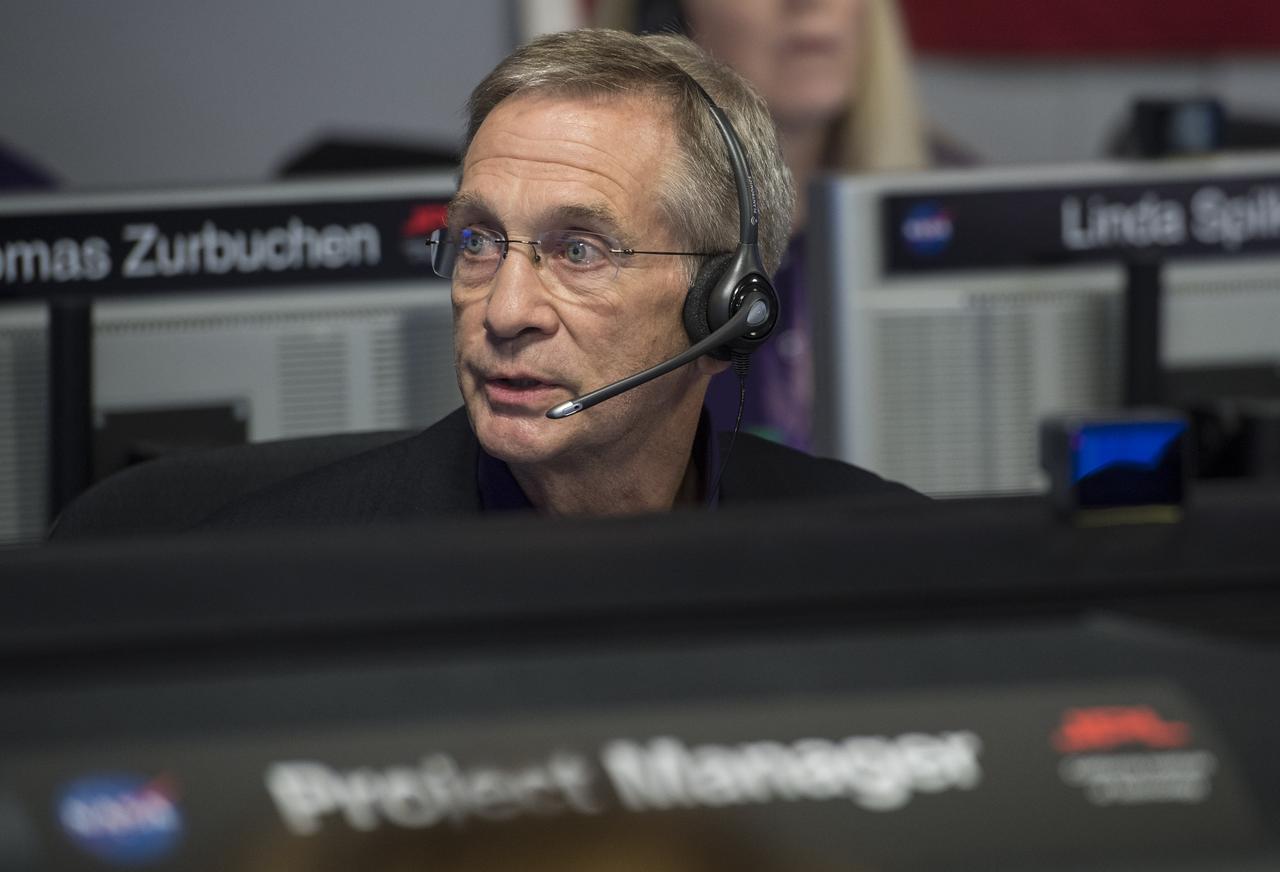
Cassini program manager at JPL, Earl Maize, center row, calls out the end of the Cassini mission, Friday, Sept. 15, 2017 at NASA's Jet Propulsion Laboratory in Pasadena, California. Since its arrival in 2004, the Cassini-Huygens mission has been a discovery machine, revolutionizing our knowledge of the Saturn system and captivating us with data and images never before obtained with such detail and clarity. On Sept. 15, 2017, operators deliberately plunged the spacecraft into Saturn, as Cassini gathered science until the end. The “plunge” ensures Saturn’s moons will remain pristine for future exploration. During Cassini’s final days, mission team members from all around the world gathered at NASA’s Jet Propulsion Laboratory, Pasadena, California, to celebrate the achievements of this historic mission. Photo Credit: (NASA/Joel Kowsky)
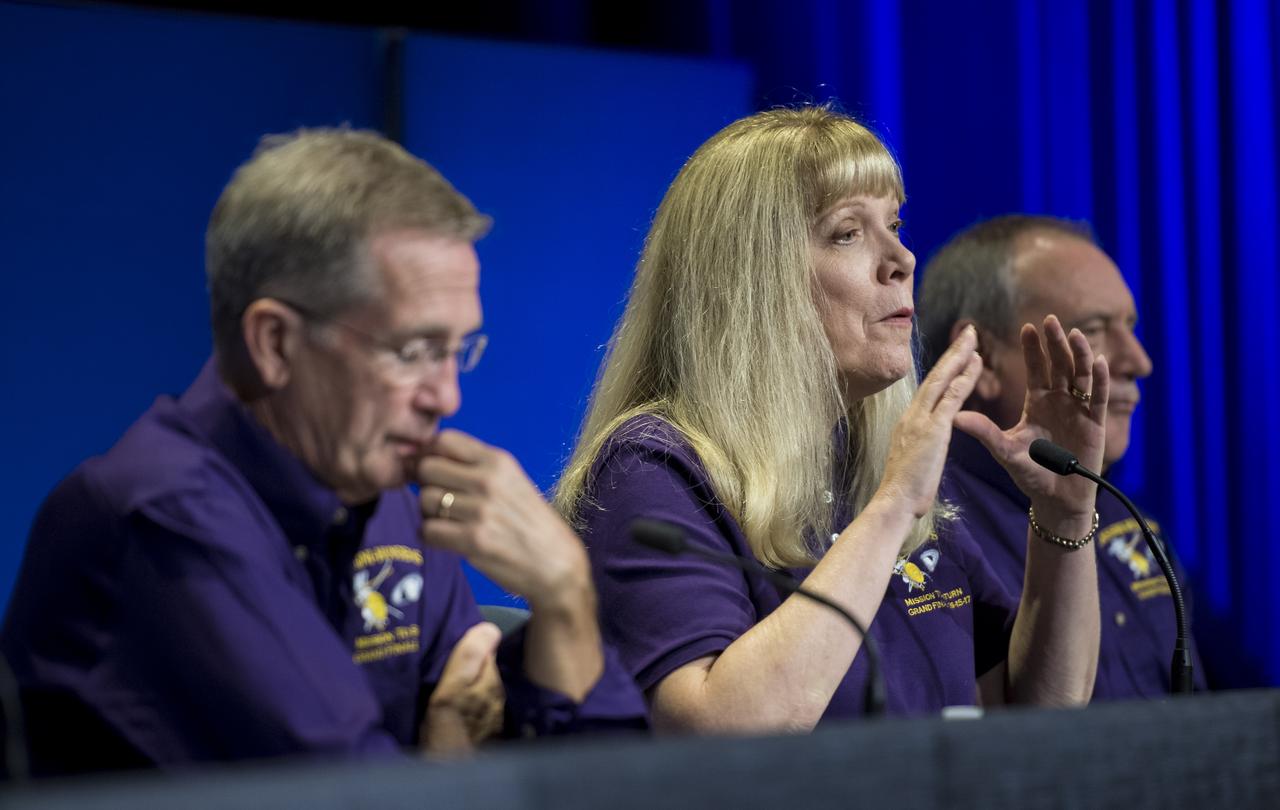
Cassini project scientist at JPL, Linda Spilker answers questions from members of the media during a press conference previewing Cassini's End of Mission, Wednesday, Sept. 13, 2017 at NASA's Jet Propulsion Laboratory in Pasadena, California. Since its arrival in 2004, the Cassini-Huygens mission has been a discovery machine, revolutionizing our knowledge of the Saturn system and captivating us with data and images never before obtained with such detail and clarity. On Sept. 15, 2017, operators will deliberately plunge the spacecraft into Saturn, as Cassini gathered science until the end. The “plunge” ensures Saturn’s moons will remain pristine for future exploration. During Cassini’s final days, mission team members from all around the world gathered at NASA’s Jet Propulsion Laboratory, Pasadena, California, to celebrate the achievements of this historic mission. Photo Credit: (NASA/Joel Kowsky)
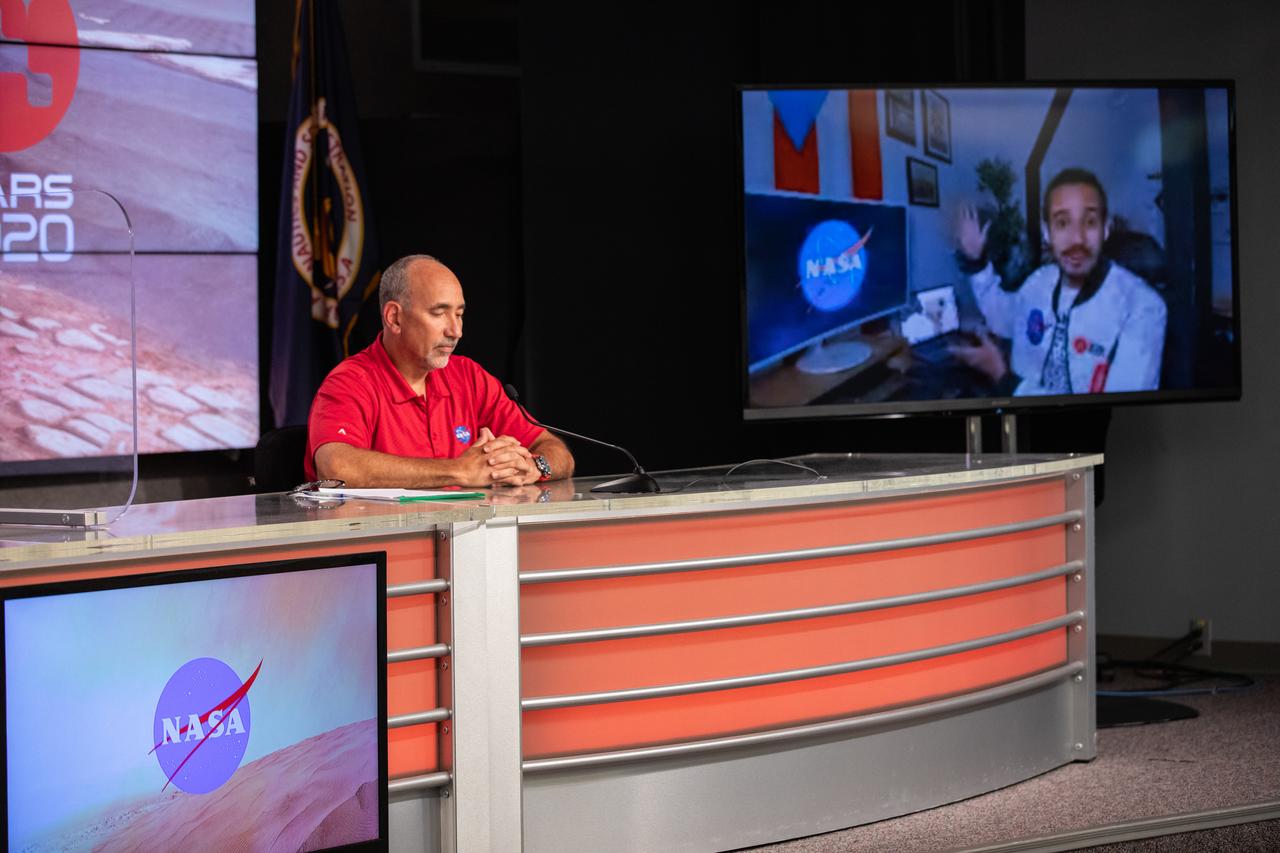
Elio Morillo, a Mars 2020 system testbed engineer from NASA’s Jet Propulsion Laboratory, speaks remotely while Albert Sierra, NASA’s Launch Services Program (LSP) chief of Flight Projects Office, listens during a “Mars 2020 Social Media Q&A: En Español” program on Wednesday, July 22, at NASA’s Kennedy Space Center in Florida. The event featured representatives from LSP and NASA’s Jet Propulsion Laboratory. The Mars Perseverance rover is scheduled to lift off aboard a United Launch Alliance Atlas V 541 rocket from Cape Canaveral Air Force Station’s Space Launch Complex 41 on Thursday, July 30. The two-hour window opens at 7:50 a.m. EDT. LSP, based at Kennedy, is managing the launch.

director of NASA's Planetary Science Division, Jim Green answers questions a press conference previewing Cassini's End of Mission, Wednesday, Sept. 13, 2017 at NASA's Jet Propulsion Laboratory in Pasadena, California. Since its arrival in 2004, the Cassini-Huygens mission has been a discovery machine, revolutionizing our knowledge of the Saturn system and captivating us with data and images never before obtained with such detail and clarity. On Sept. 15, 2017, operators will deliberately plunge the spacecraft into Saturn, as Cassini gathered science until the end. The “plunge” ensures Saturn’s moons will remain pristine for future exploration. During Cassini’s final days, mission team members from all around the world gathered at NASA’s Jet Propulsion Laboratory, Pasadena, California, to celebrate the achievements of this historic mission. Photo Credit: (NASA/Joel Kowsky)
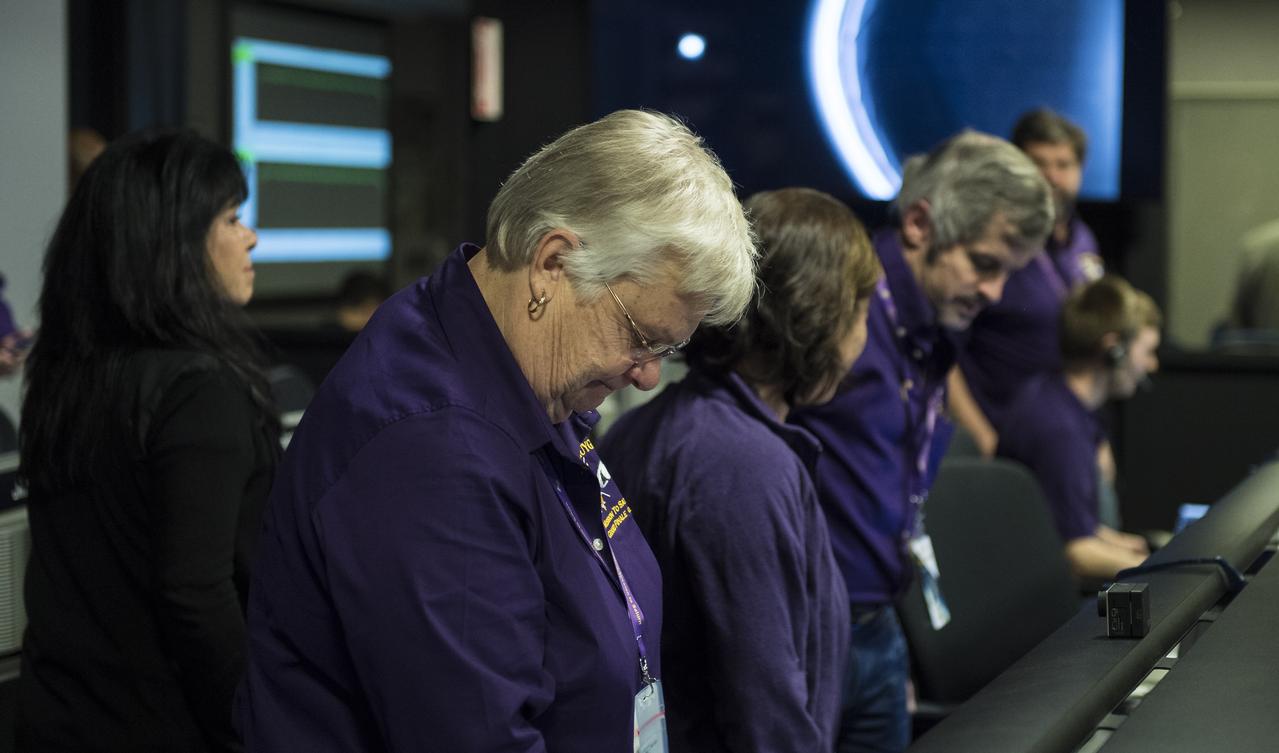
Spacecraft operations team manager for the Cassini mission at Saturn, Julie Webster is seen after the end of the Cassini mission, Friday, Sept. 15, 2017 at NASA's Jet Propulsion Laboratory in Pasadena, California. Since its arrival in 2004, the Cassini-Huygens mission has been a discovery machine, revolutionizing our knowledge of the Saturn system and captivating us with data and images never before obtained with such detail and clarity. On Sept. 15, 2017, operators deliberately plunged the spacecraft into Saturn, as Cassini gathered science until the end. Loss of contact with the Cassini spacecraft occurred at 7:55 a.m. EDT (4:55 a.m. PDT). The “plunge” ensures Saturn’s moons will remain pristine for future exploration. During Cassini’s final days, mission team members from all around the world gathered at NASA’s Jet Propulsion Laboratory, Pasadena, California, to celebrate the achievements of this historic mission. Photo Credit: (NASA/Joel Kowsky)
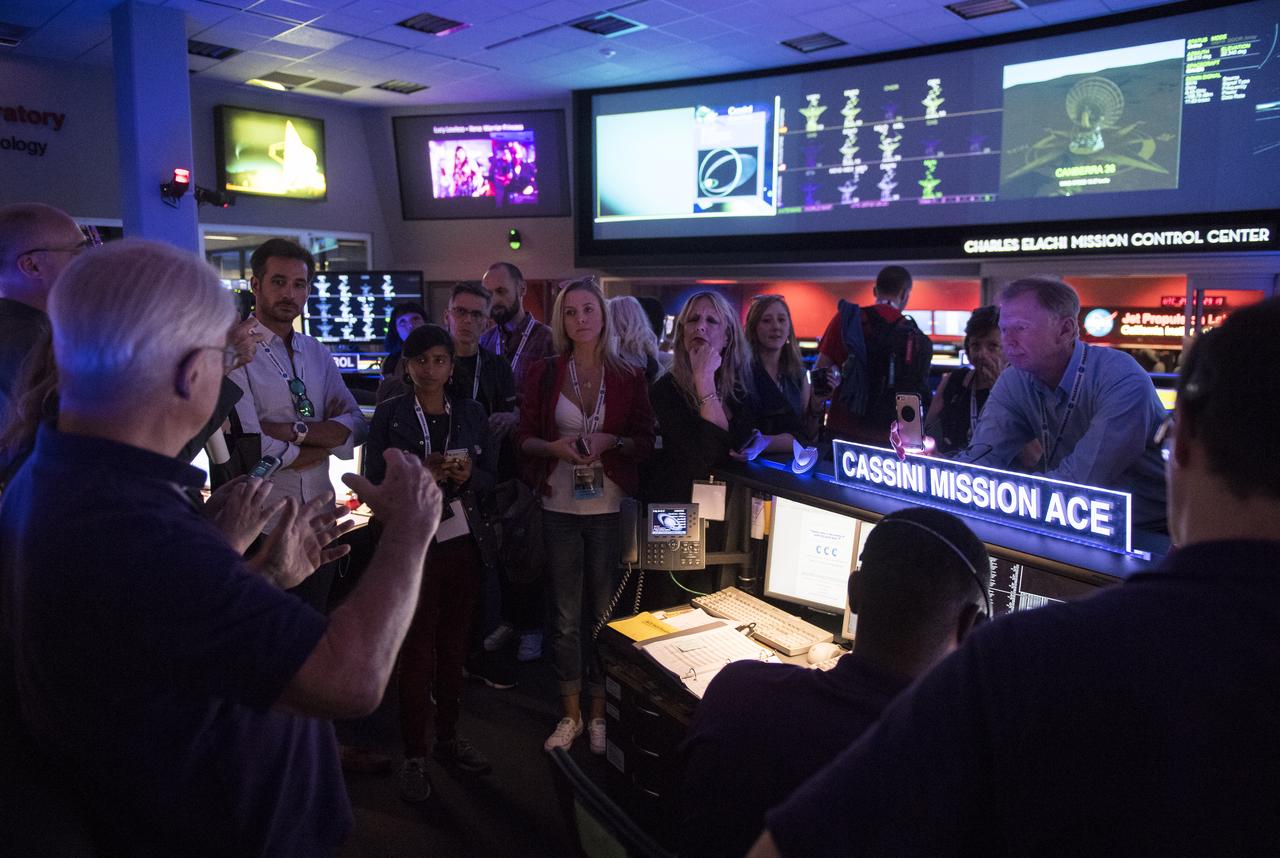
Cassini NASA Social attendees speak with members of the Cassini mission team in the Charles Elachi Mission Control Center in the Space Flight Operation Center, Thursday, Sept. 14, 2017 at NASA's Jet Propulsion Laboratory in Pasadena, California. Since its arrival in 2004, the Cassini-Huygens mission has been a discovery machine, revolutionizing our knowledge of the Saturn system and captivating us with data and images never before obtained with such detail and clarity. On Sept. 15, 2017, operators will deliberately plunge the spacecraft into Saturn, as Cassini gathered science until the end. The “plunge” ensures Saturn’s moons will remain pristine for future exploration. During Cassini’s final days, mission team members from all around the world gathered at NASA’s Jet Propulsion Laboratory, Pasadena, California, to celebrate the achievements of this historic mission. Photo Credit: (NASA/Joel Kowsky)

Cassini program manager at JPL, Earl Maize, watches monitors in mission control of the Space Flight Operations Center as the Cassini spacecraft begins downlink data through NASA's Deep Space Network, Thursday, Sept. 14, 2017 at NASA's Jet Propulsion Laboratory in Pasadena, California. Since its arrival in 2004, the Cassini-Huygens mission has been a discovery machine, revolutionizing our knowledge of the Saturn system and captivating us with data and images never before obtained with such detail and clarity. On Sept. 15, 2017, operators will deliberately plunge the spacecraft into Saturn, as Cassini gathered science until the end. The “plunge” ensures Saturn’s moons will remain pristine for future exploration. During Cassini’s final days, mission team members from all around the world gathered at NASA’s Jet Propulsion Laboratory, Pasadena, California, to celebrate the achievements of this historic mission. Photo Credit: (NASA/Joel Kowsky)
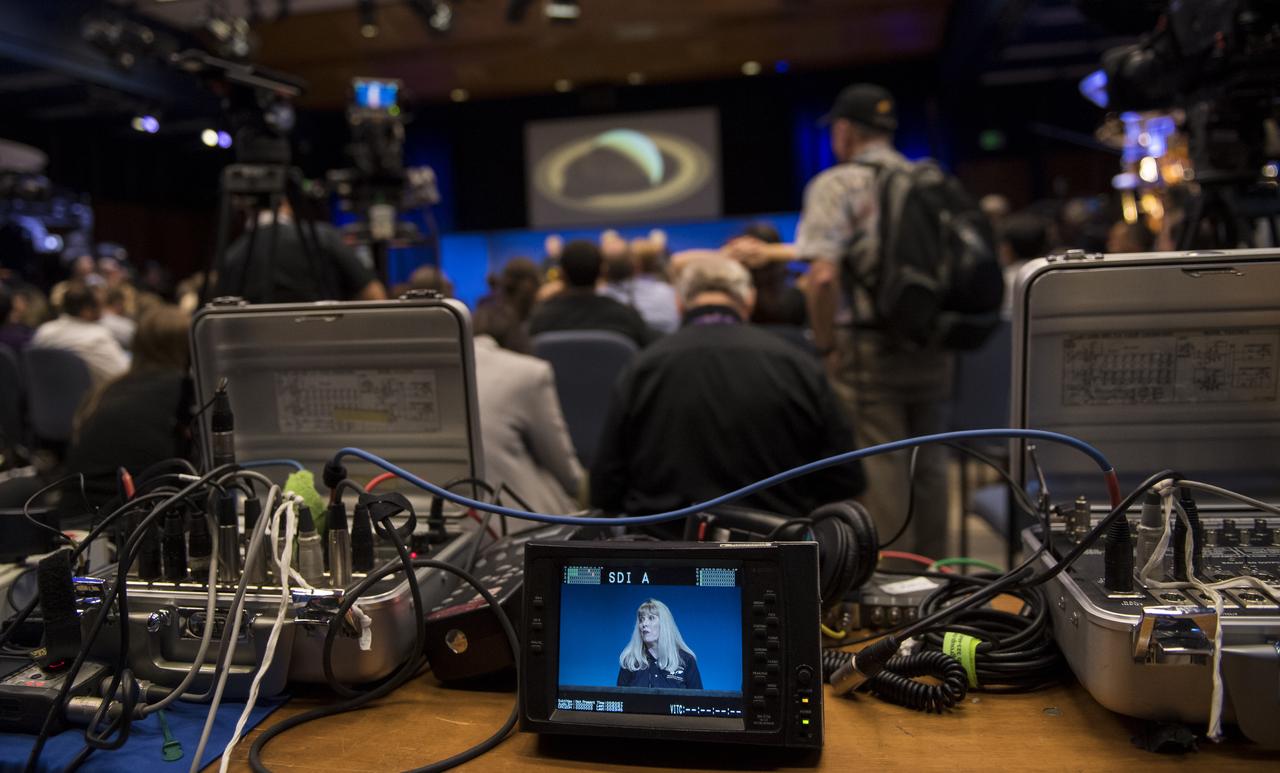
Cassini project scientist at JPL, Linda Spilker is seen on a monitor during a press conference held after the end of the Cassini mission, Friday, Sept. 15, 2017 at NASA's Jet Propulsion Laboratory in Pasadena, California. Since its arrival in 2004, the Cassini-Huygens mission has been a discovery machine, revolutionizing our knowledge of the Saturn system and captivating us with data and images never before obtained with such detail and clarity. On Sept. 15, 2017, operators deliberately plunged the spacecraft into Saturn, as Cassini gathered science until the end. Loss of contact with the Cassini spacecraft occurred at 7:55 a.m. EDT (4:55 a.m. PDT). The “plunge” ensures Saturn’s moons will remain pristine for future exploration. During Cassini’s final days, mission team members from all around the world gathered at NASA’s Jet Propulsion Laboratory, Pasadena, California, to celebrate the achievements of this historic mission. Photo Credit: (NASA/Joel Kowsky)

Cassini program manager at JPL, Earl Maize speaks during a press conference held after the end of the Cassini mission, Friday, Sept. 15, 2017 at NASA's Jet Propulsion Laboratory in Pasadena, California. Since its arrival in 2004, the Cassini-Huygens mission has been a discovery machine, revolutionizing our knowledge of the Saturn system and captivating us with data and images never before obtained with such detail and clarity. On Sept. 15, 2017, operators deliberately plunged the spacecraft into Saturn, as Cassini gathered science until the end. Loss of contact with the Cassini spacecraft occurred at 7:55 a.m. EDT (4:55 a.m. PDT). The “plunge” ensures Saturn’s moons will remain pristine for future exploration. During Cassini’s final days, mission team members from all around the world gathered at NASA’s Jet Propulsion Laboratory, Pasadena, California, to celebrate the achievements of this historic mission. Photo Credit: (NASA/Joel Kowsky)
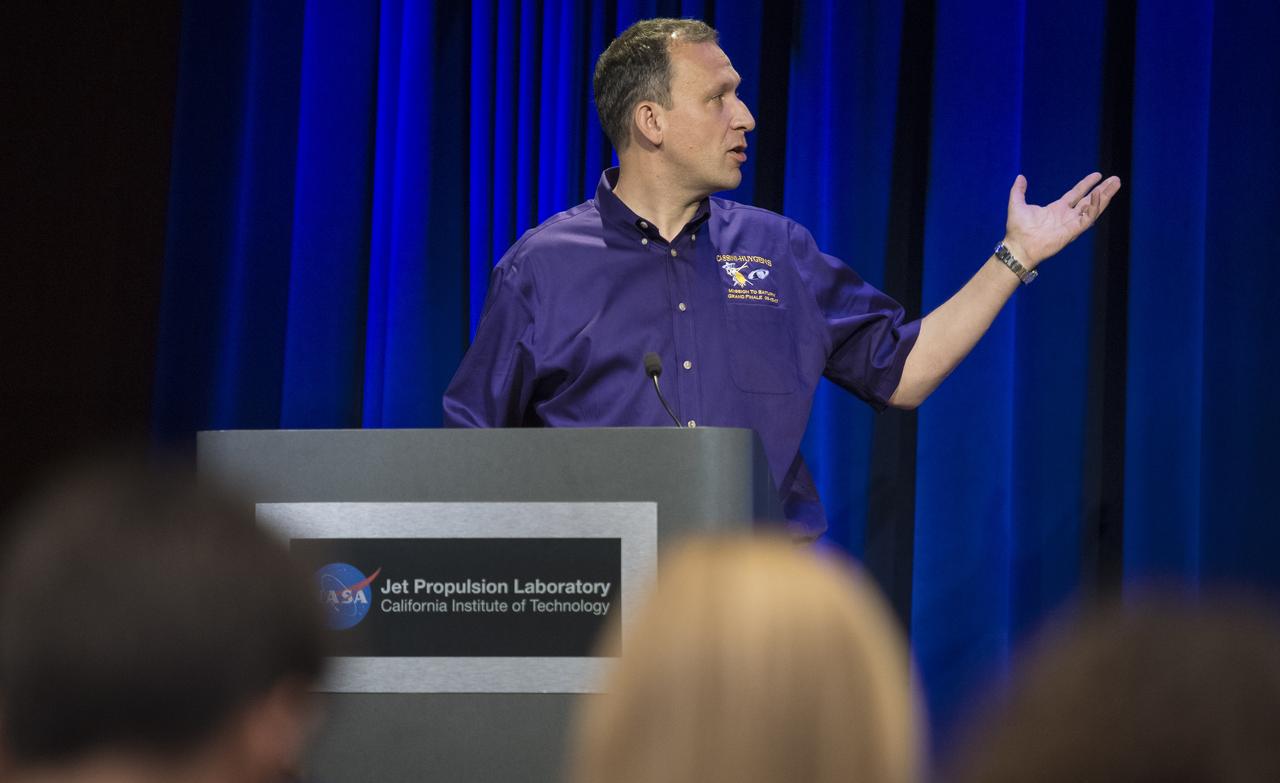
Associate administrator for NASA's Science Mission Directorate Thomas Zurbuchen speaks during a press conference held after the end of the Cassini mission, Friday, Sept. 15, 2017 at NASA's Jet Propulsion Laboratory in Pasadena, California. Since its arrival in 2004, the Cassini-Huygens mission has been a discovery machine, revolutionizing our knowledge of the Saturn system and captivating us with data and images never before obtained with such detail and clarity. On Sept. 15, 2017, operators deliberately plunged the spacecraft into Saturn, as Cassini gathered science until the end. Loss of contact with the Cassini spacecraft occurred at 7:55 a.m. EDT (4:55 a.m. PDT). The “plunge” ensures Saturn’s moons will remain pristine for future exploration. During Cassini’s final days, mission team members from all around the world gathered at NASA’s Jet Propulsion Laboratory, Pasadena, California, to celebrate the achievements of this historic mission. Photo Credit: (NASA/Joel Kowsky)
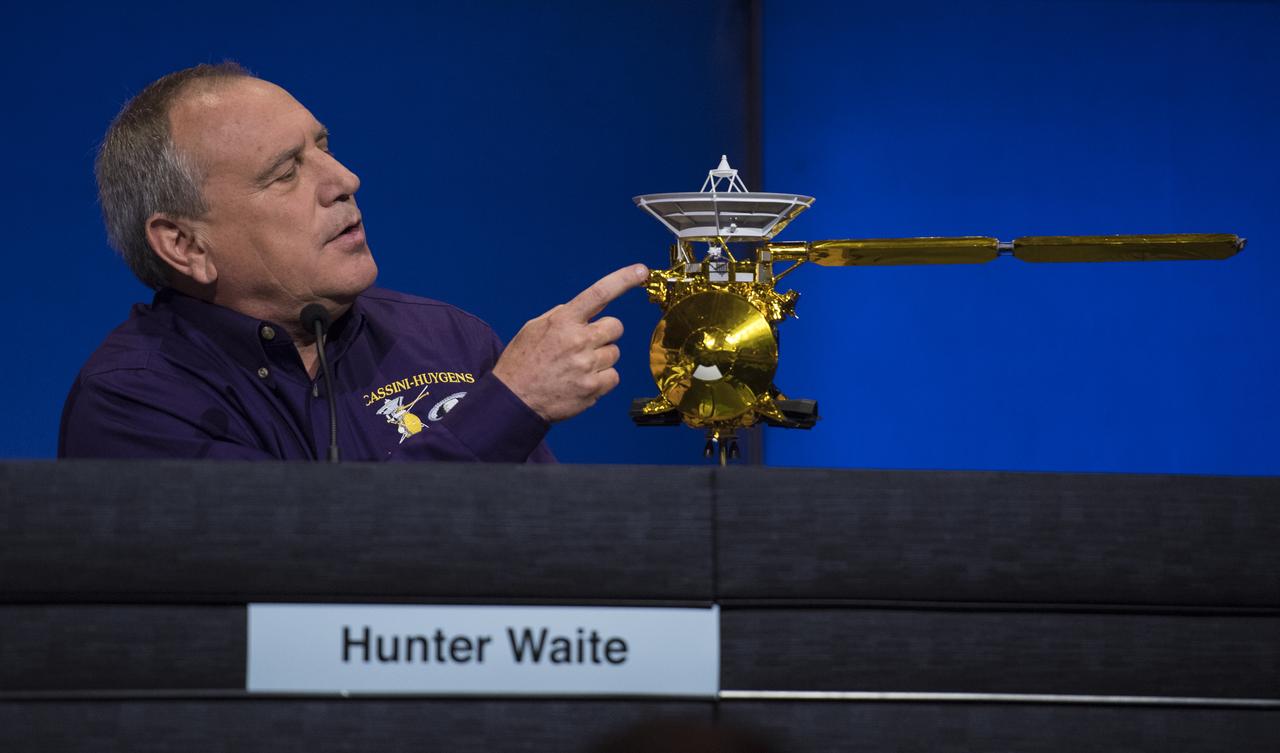
Principle investigator for the Ion and Neutral Mass Spectrometer (INMS) at the Southwest Research Institute, Hunter Waite, points to the location of the INMS during a press conference previewing Cassini's End of Mission, Wednesday, Sept. 13, 2017 at NASA's Jet Propulsion Laboratory in Pasadena, California. Since its arrival in 2004, the Cassini-Huygens mission has been a discovery machine, revolutionizing our knowledge of the Saturn system and captivating us with data and images never before obtained with such detail and clarity. On Sept. 15, 2017, operators will deliberately plunge the spacecraft into Saturn, as Cassini gathered science until the end. The “plunge” ensures Saturn’s moons will remain pristine for future exploration. During Cassini’s final days, mission team members from all around the world gathered at NASA’s Jet Propulsion Laboratory, Pasadena, California, to celebrate the achievements of this historic mission. Photo Credit: (NASA/Joel Kowsky)
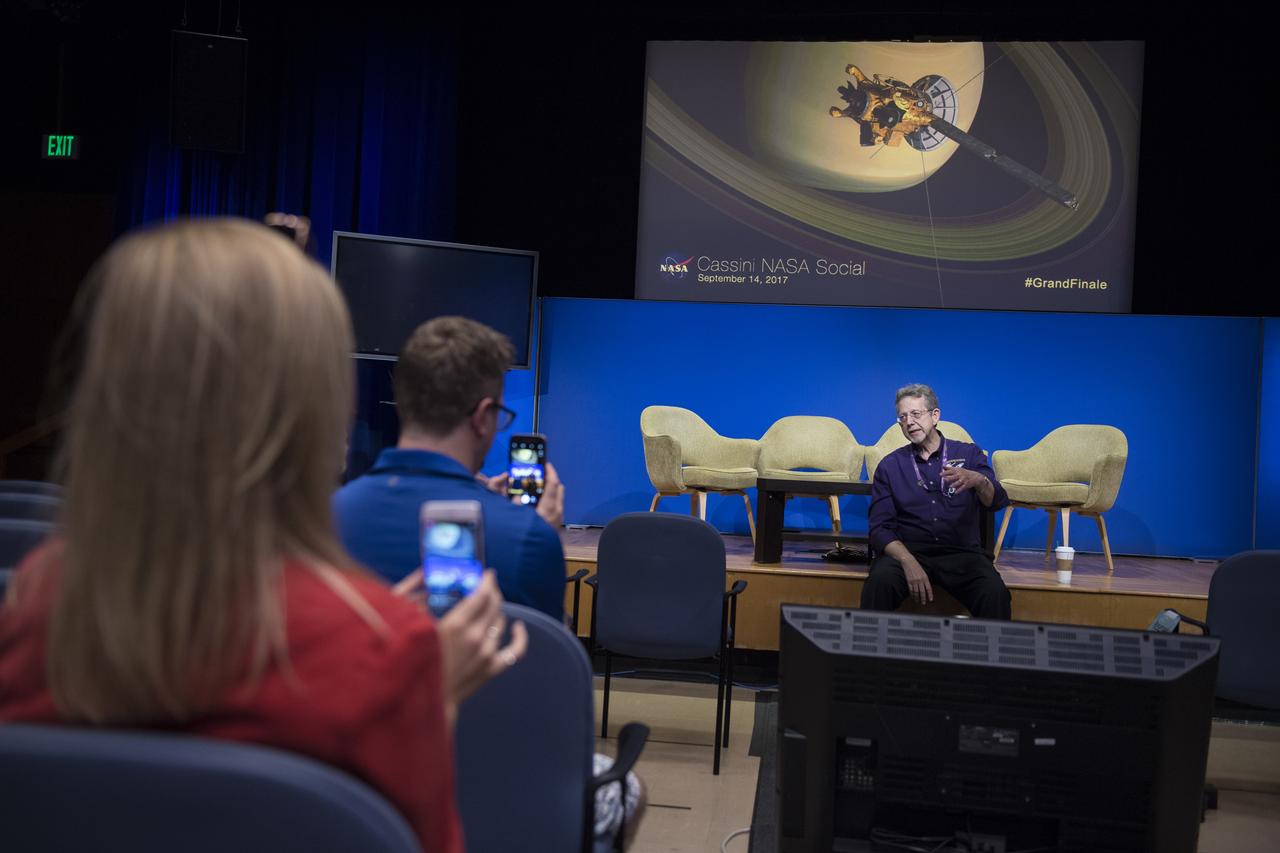
NASA Social attendees film director of NASA's Planetary Science Division, Jim Green as he discusses the Cassini mission, Thursday, Sept. 14, 2017 at NASA's Jet Propulsion Laboratory in Pasadena, California. Since its arrival in 2004, the Cassini-Huygens mission has been a discovery machine, revolutionizing our knowledge of the Saturn system and captivating us with data and images never before obtained with such detail and clarity. On Sept. 15, 2017, operators will deliberately plunge the spacecraft into Saturn, as Cassini gathered science until the end. The “plunge” ensures Saturn’s moons will remain pristine for future exploration. During Cassini’s final days, mission team members from all around the world gathered at NASA’s Jet Propulsion Laboratory, Pasadena, California, to celebrate the achievements of this historic mission. Photo Credit: (NASA/Joel Kowsky)
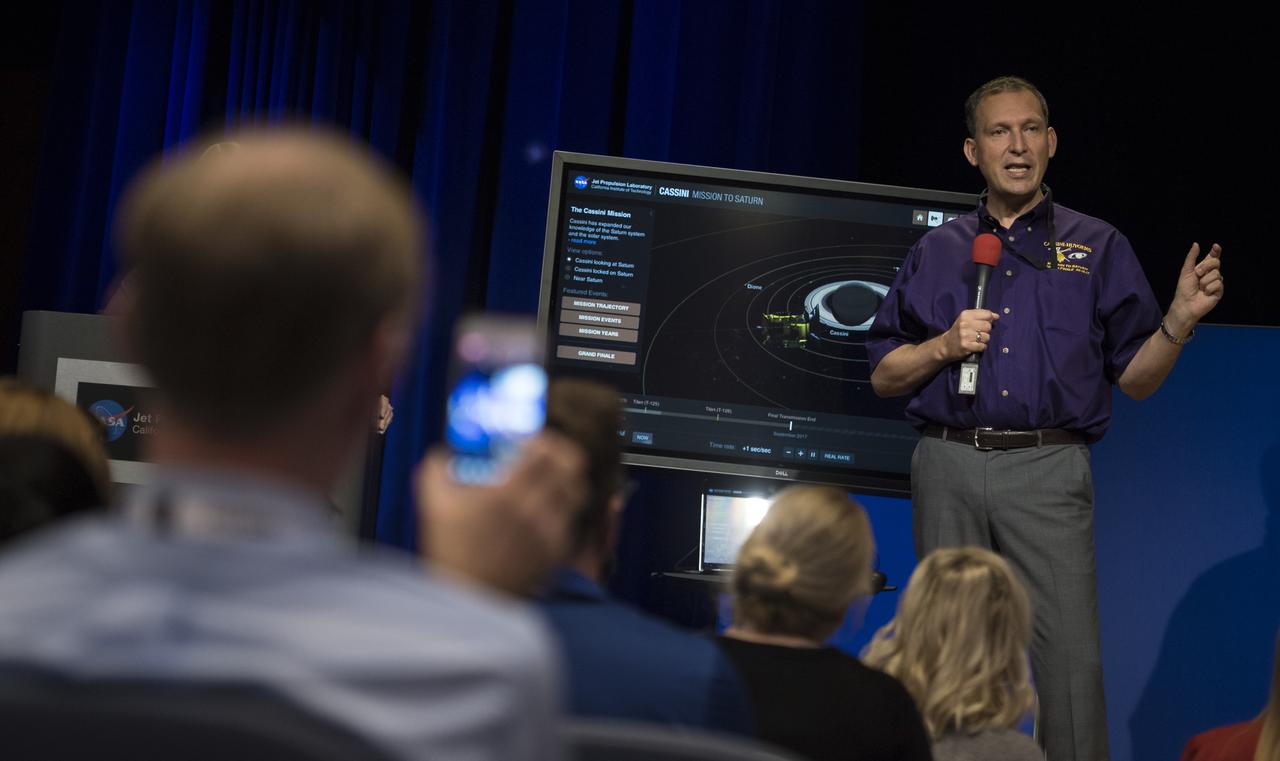
Associate administrator for NASA's Science Mission Directorate Thomas Zurbuchen, speaks to NASA Social attendees about the Cassini mission, Thursday, Sept. 14, 2017 at NASA's Jet Propulsion Laboratory in Pasadena, California. Since its arrival in 2004, the Cassini-Huygens mission has been a discovery machine, revolutionizing our knowledge of the Saturn system and captivating us with data and images never before obtained with such detail and clarity. On Sept. 15, 2017, operators will deliberately plunge the spacecraft into Saturn, as Cassini gathered science until the end. The “plunge” ensures Saturn’s moons will remain pristine for future exploration. During Cassini’s final days, mission team members from all around the world gathered at NASA’s Jet Propulsion Laboratory, Pasadena, California, to celebrate the achievements of this historic mission. Photo Credit: (NASA/Joel Kowsky)
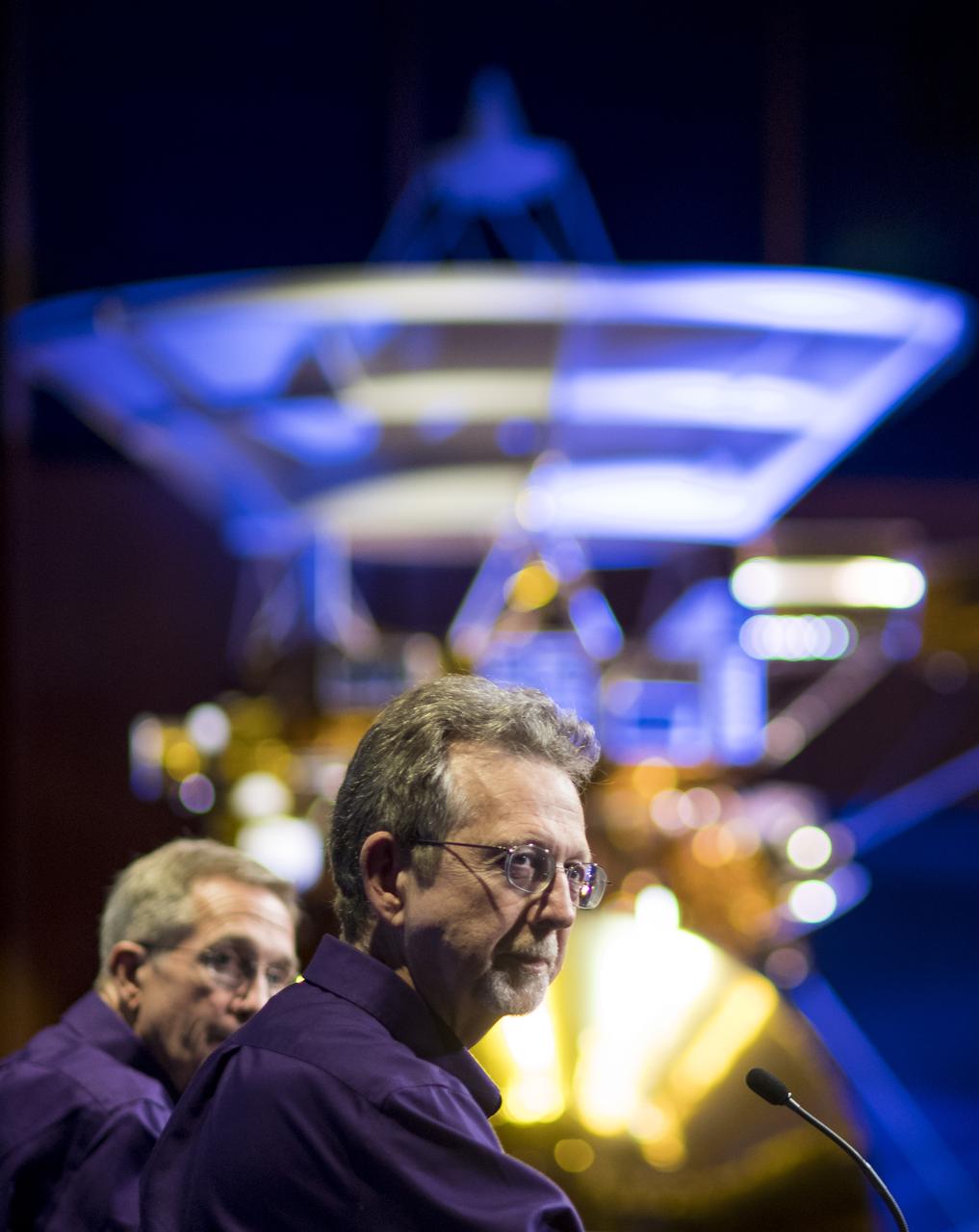
Director of NASA's Planetary Science Division, Jim Green, is seen during a press conference previewing Cassini's End of Mission, Wednesday, Sept. 13, 2017 at NASA's Jet Propulsion Laboratory in Pasadena, California. Since its arrival in 2004, the Cassini-Huygens mission has been a discovery machine, revolutionizing our knowledge of the Saturn system and captivating us with data and images never before obtained with such detail and clarity. On Sept. 15, 2017, operators will deliberately plunge the spacecraft into Saturn, as Cassini gathered science until the end. The “plunge” ensures Saturn’s moons will remain pristine for future exploration. During Cassini’s final days, mission team members from all around the world gathered at NASA’s Jet Propulsion Laboratory, Pasadena, California, to celebrate the achievements of this historic mission. Photo Credit: (NASA/Joel Kowsky)
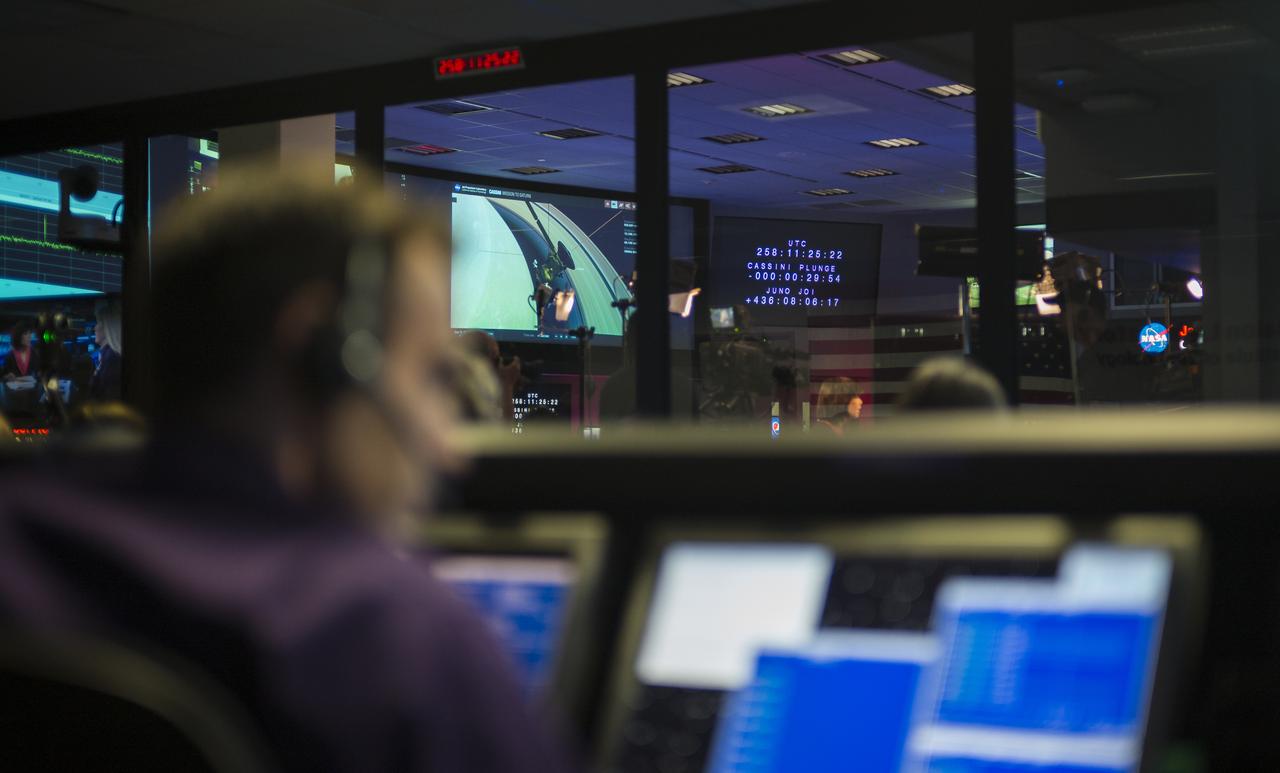
A monitor in mission control shows the time remaining until Cassini makes its final plunge into Saturn, Friday, Sept. 15, 2017 at NASA's Jet Propulsion Laboratory in Pasadena, California. Since its arrival in 2004, the Cassini-Huygens mission has been a discovery machine, revolutionizing our knowledge of the Saturn system and captivating us with data and images never before obtained with such detail and clarity. On Sept. 15, 2017, operators deliberately plunged the spacecraft into Saturn, as Cassini gathered science until the end. Loss of contact with the Cassini spacecraft occurred at 7:55 a.m. EDT (4:55 a.m. PDT). The “plunge” ensures Saturn’s moons will remain pristine for future exploration. During Cassini’s final days, mission team members from all around the world gathered at NASA’s Jet Propulsion Laboratory, Pasadena, California, to celebrate the achievements of this historic mission. Photo Credit: (NASA/Joel Kowsky)
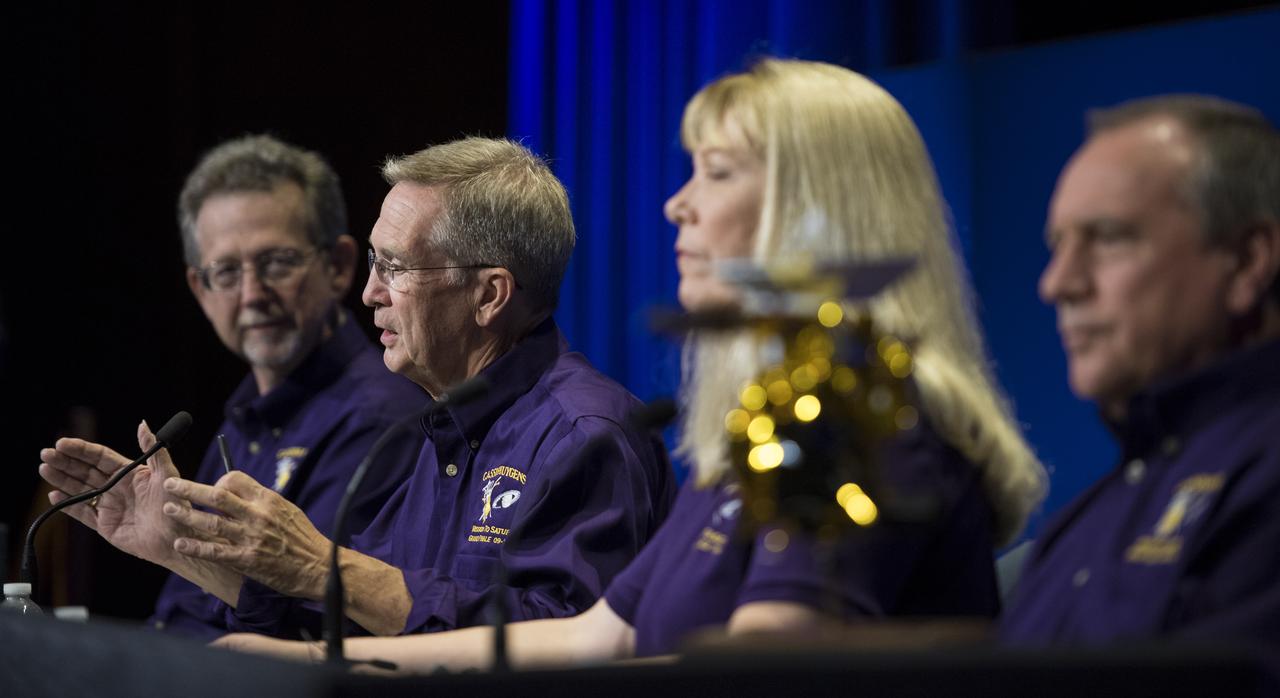
Cassini program manager at JPL, Earl Maize, speaks during a press conference previewing Cassini's End of Mission, Wednesday, Sept. 13, 2017 at NASA's Jet Propulsion Laboratory in Pasadena, California. Since its arrival in 2004, the Cassini-Huygens mission has been a discovery machine, revolutionizing our knowledge of the Saturn system and captivating us with data and images never before obtained with such detail and clarity. On Sept. 15, 2017, operators will deliberately plunge the spacecraft into Saturn, as Cassini gathered science until the end. The “plunge” ensures Saturn’s moons will remain pristine for future exploration. During Cassini’s final days, mission team members from all around the world gathered at NASA’s Jet Propulsion Laboratory, Pasadena, California, to celebrate the achievements of this historic mission. Photo Credit: (NASA/Joel Kowsky)
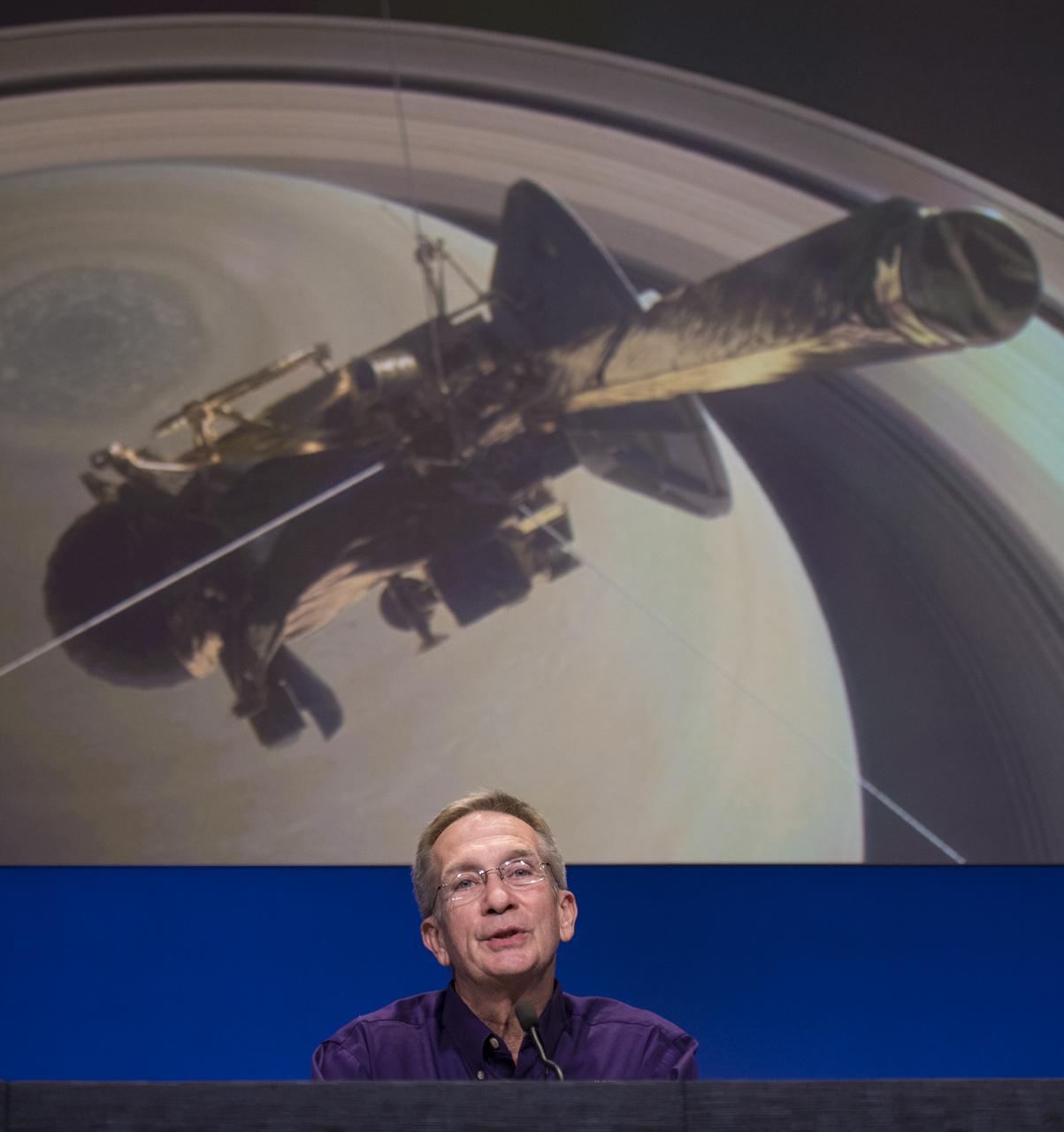
Cassini program manager at JPL, Earl Maize speaks during a press conference previewing Cassini's End of Mission, Wednesday, Sept. 13, 2017 at NASA's Jet Propulsion Laboratory in Pasadena, California. Since its arrival in 2004, the Cassini-Huygens mission has been a discovery machine, revolutionizing our knowledge of the Saturn system and captivating us with data and images never before obtained with such detail and clarity. On Sept. 15, 2017, operators will deliberately plunge the spacecraft into Saturn, as Cassini gathered science until the end. The “plunge” ensures Saturn’s moons will remain pristine for future exploration. During Cassini’s final days, mission team members from all around the world gathered at NASA’s Jet Propulsion Laboratory, Pasadena, California, to celebrate the achievements of this historic mission. Photo Credit: (NASA/Joel Kowsky)
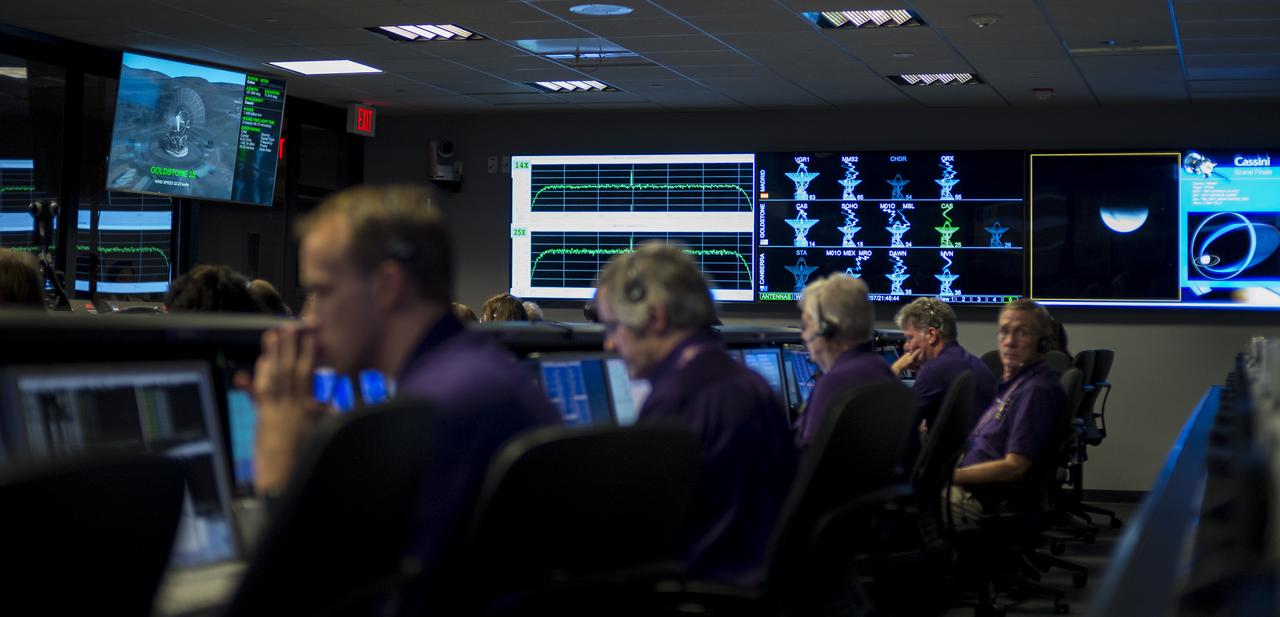
Monitors in mission control of the Space Flight Operations Center display the status of NASA's Deep Space Network as the Cassini spacecraft begins the final playback of its data recorder, Thursday, Sept. 14, 2017 at NASA's Jet Propulsion Laboratory in Pasadena, California. Since its arrival in 2004, the Cassini-Huygens mission has been a discovery machine, revolutionizing our knowledge of the Saturn system and captivating us with data and images never before obtained with such detail and clarity. On Sept. 15, 2017, operators will deliberately plunge the spacecraft into Saturn, as Cassini gathered science until the end. The “plunge” ensures Saturn’s moons will remain pristine for future exploration. During Cassini’s final days, mission team members from all around the world gathered at NASA’s Jet Propulsion Laboratory, Pasadena, California, to celebrate the achievements of this historic mission. Photo Credit: (NASA/Joel Kowsky)
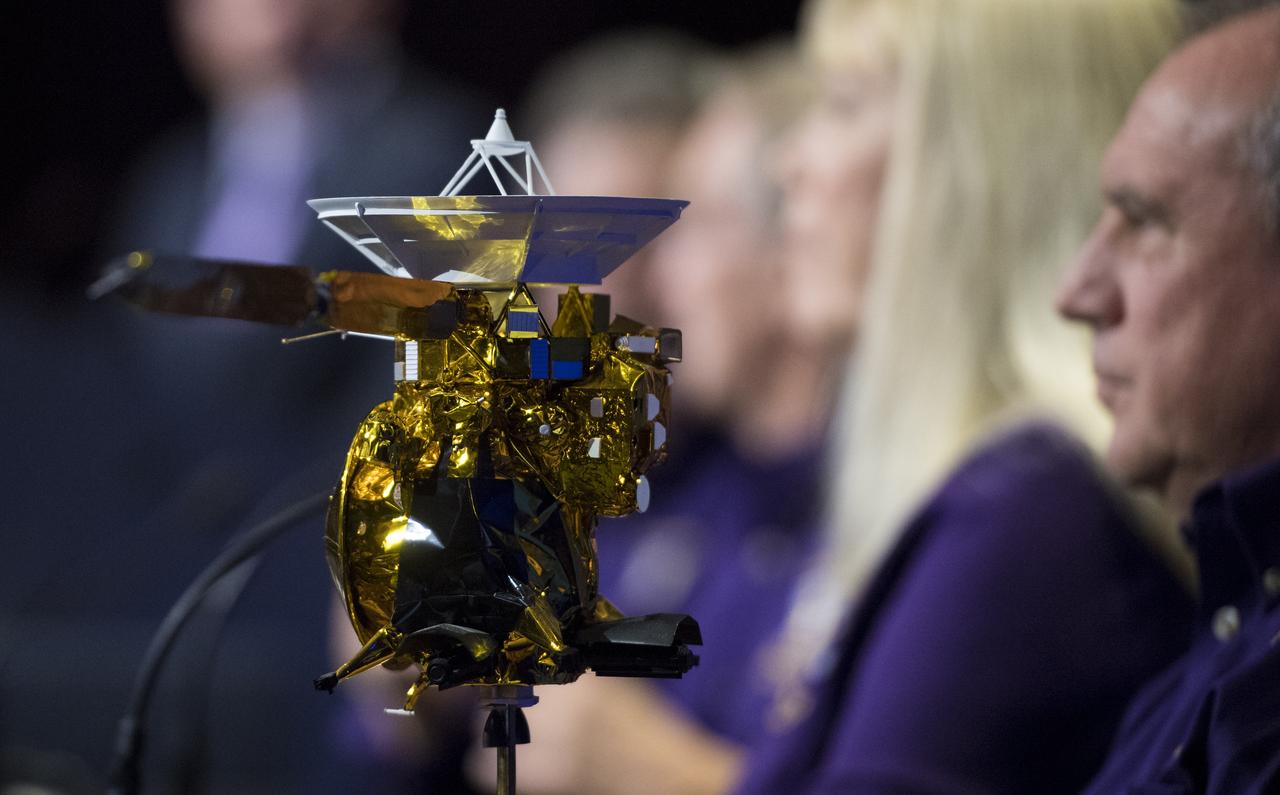
A model of the Cassini-Huygens spacecraft is seen during a press conference previewing Cassini's End of Mission, Wednesday, Sept. 13, 2017 at NASA's Jet Propulsion Laboratory in Pasadena, California. Since its arrival in 2004, the Cassini-Huygens mission has been a discovery machine, revolutionizing our knowledge of the Saturn system and captivating us with data and images never before obtained with such detail and clarity. On Sept. 15, 2017, operators will deliberately plunge the spacecraft into Saturn, as Cassini gathered science until the end. The “plunge” ensures Saturn’s moons will remain pristine for future exploration. During Cassini’s final days, mission team members from all around the world gathered at NASA’s Jet Propulsion Laboratory, Pasadena, California, to celebrate the achievements of this historic mission. Photo Credit: (NASA/Joel Kowsky)
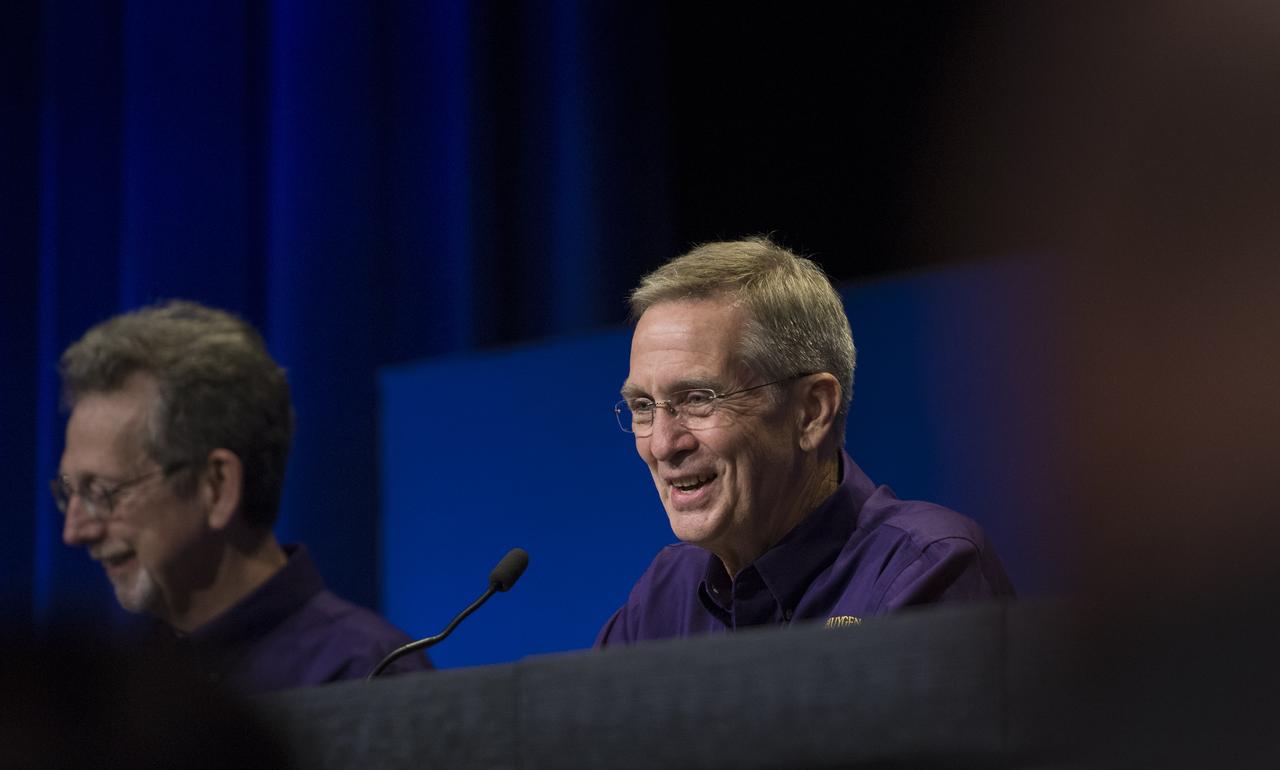
Cassini program manager at JPL, Earl Maize speaks during a press conference previewing Cassini's End of Mission, Wednesday, Sept. 13, 2017 at NASA's Jet Propulsion Laboratory in Pasadena, California. Since its arrival in 2004, the Cassini-Huygens mission has been a discovery machine, revolutionizing our knowledge of the Saturn system and captivating us with data and images never before obtained with such detail and clarity. On Sept. 15, 2017, operators will deliberately plunge the spacecraft into Saturn, as Cassini gathered science until the end. The “plunge” ensures Saturn’s moons will remain pristine for future exploration. During Cassini’s final days, mission team members from all around the world gathered at NASA’s Jet Propulsion Laboratory, Pasadena, California, to celebrate the achievements of this historic mission. Photo Credit: (NASA/Joel Kowsky)
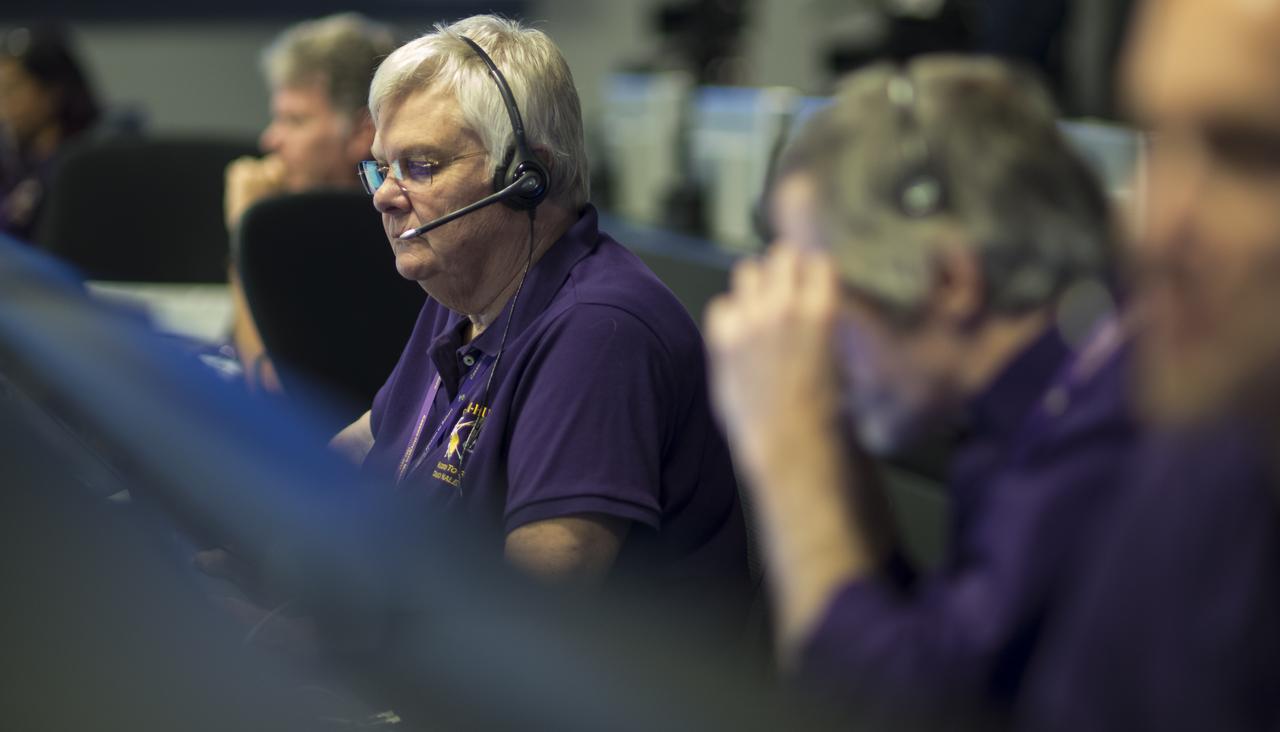
Spacecraft operations team manager for the Cassini mission at Saturn, Julie Webster, watches monitors in mission control of the Space Flight Operations Center as the Cassini spacecraft begins downlink data through NASA's Deep Space Network, Thursday, Sept. 14, 2017 at NASA's Jet Propulsion Laboratory in Pasadena, California. Since its arrival in 2004, the Cassini-Huygens mission has been a discovery machine, revolutionizing our knowledge of the Saturn system and captivating us with data and images never before obtained with such detail and clarity. On Sept. 15, 2017, operators will deliberately plunge the spacecraft into Saturn, as Cassini gathered science until the end. The “plunge” ensures Saturn’s moons will remain pristine for future exploration. During Cassini’s final days, mission team members from all around the world gathered at NASA’s Jet Propulsion Laboratory, Pasadena, California, to celebrate the achievements of this historic mission. Photo Credit: (NASA/Joel Kowsky)
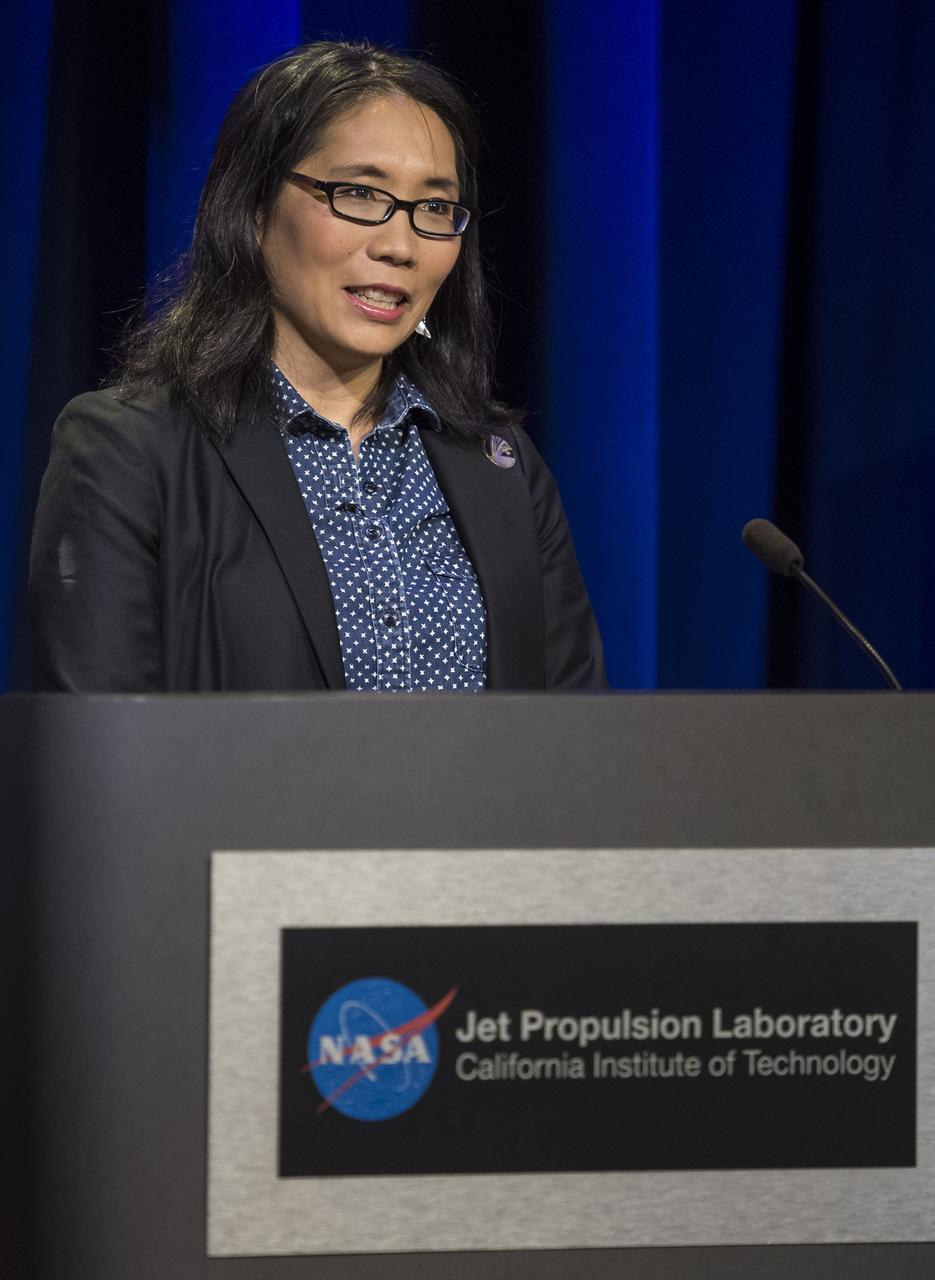
Jia-Rui Cook, media relations representative at JPL, moderates a press conference held after the end of the Cassini mission, Friday, Sept. 15, 2017 at NASA's Jet Propulsion Laboratory in Pasadena, California. Since its arrival in 2004, the Cassini-Huygens mission has been a discovery machine, revolutionizing our knowledge of the Saturn system and captivating us with data and images never before obtained with such detail and clarity. On Sept. 15, 2017, operators deliberately plunged the spacecraft into Saturn, as Cassini gathered science until the end. Loss of contact with the Cassini spacecraft occurred at 7:55 a.m. EDT (4:55 a.m. PDT). The “plunge” ensures Saturn’s moons will remain pristine for future exploration. During Cassini’s final days, mission team members from all around the world gathered at NASA’s Jet Propulsion Laboratory, Pasadena, California, to celebrate the achievements of this historic mission. Photo Credit: (NASA/Joel Kowsky)
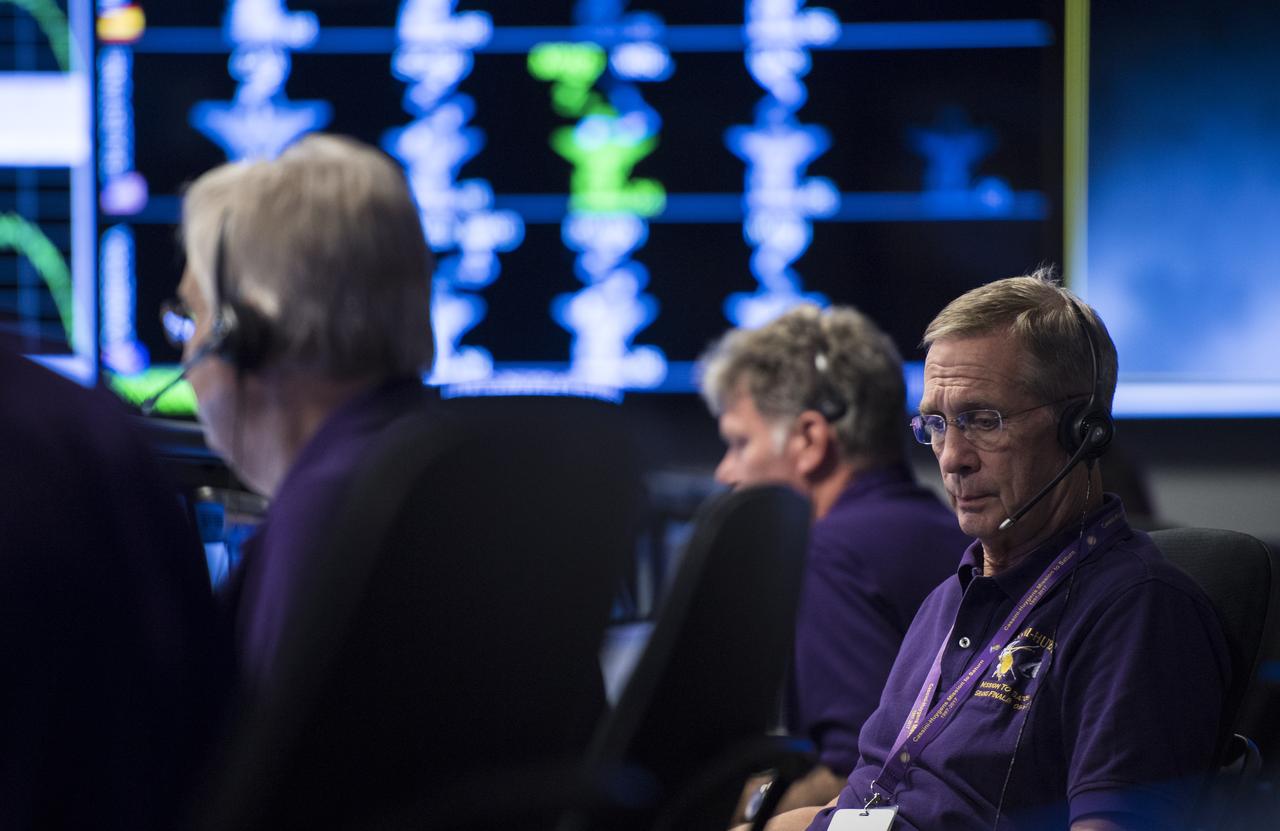
Cassini program manager at JPL, Earl Maize, is seen in mission control of the Space Flight Operations Center as the Cassini team wait for the spacecraft to establish a connection with NASA's Deep Space Network to begin the final playback of its data recorder, Thursday, Sept. 14, 2017 at NASA's Jet Propulsion Laboratory in Pasadena, California. Since its arrival in 2004, the Cassini-Huygens mission has been a discovery machine, revolutionizing our knowledge of the Saturn system and captivating us with data and images never before obtained with such detail and clarity. On Sept. 15, 2017, operators will deliberately plunge the spacecraft into Saturn, as Cassini gathered science until the end. The “plunge” ensures Saturn’s moons will remain pristine for future exploration. During Cassini’s final days, mission team members from all around the world gathered at NASA’s Jet Propulsion Laboratory, Pasadena, California, to celebrate the achievements of this historic mission. Photo Credit: (NASA/Joel Kowsky)
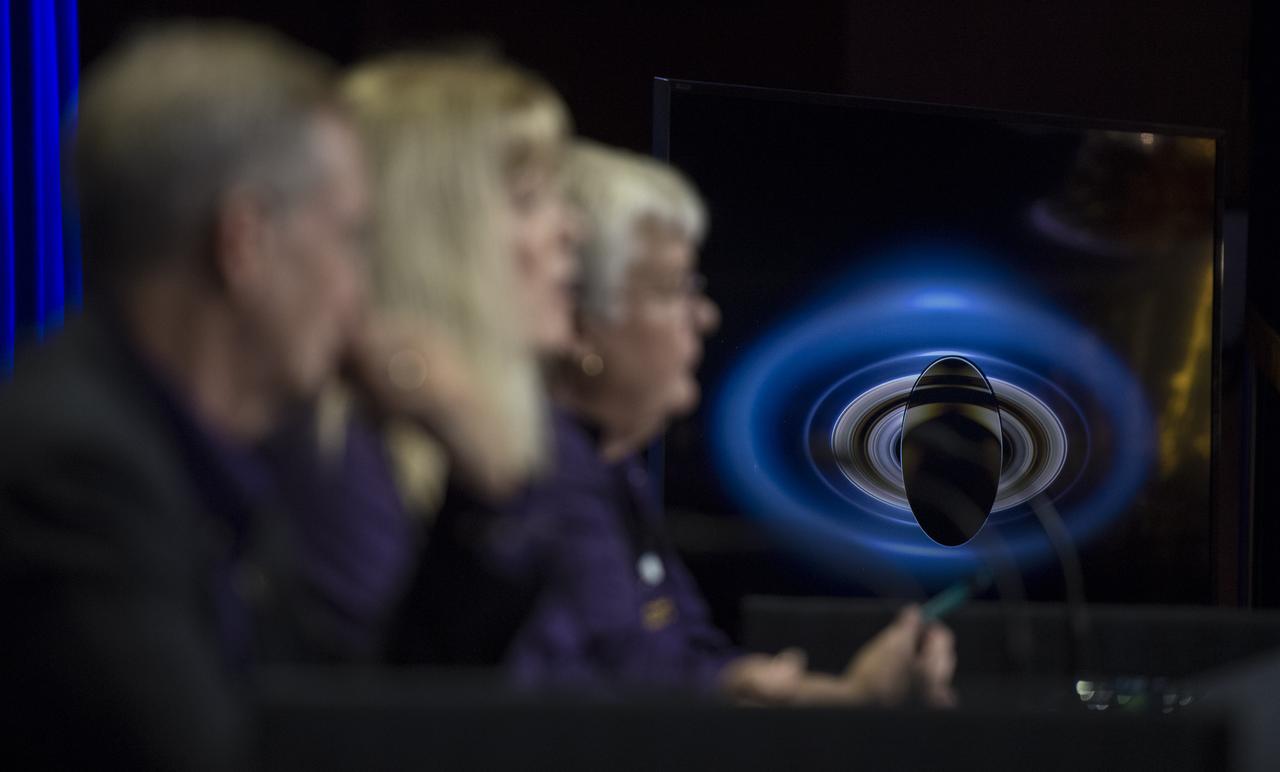
An image of Saturn is seen on a monitor during a press conference held after the end of the Cassini mission, Friday, Sept. 15, 2017 at NASA's Jet Propulsion Laboratory in Pasadena, California. Since its arrival in 2004, the Cassini-Huygens mission has been a discovery machine, revolutionizing our knowledge of the Saturn system and captivating us with data and images never before obtained with such detail and clarity. On Sept. 15, 2017, operators deliberately plunged the spacecraft into Saturn, as Cassini gathered science until the end. Loss of contact with the Cassini spacecraft occurred at 7:55 a.m. EDT (4:55 a.m. PDT). The “plunge” ensures Saturn’s moons will remain pristine for future exploration. During Cassini’s final days, mission team members from all around the world gathered at NASA’s Jet Propulsion Laboratory, Pasadena, California, to celebrate the achievements of this historic mission. Photo Credit: (NASA/Joel Kowsky)
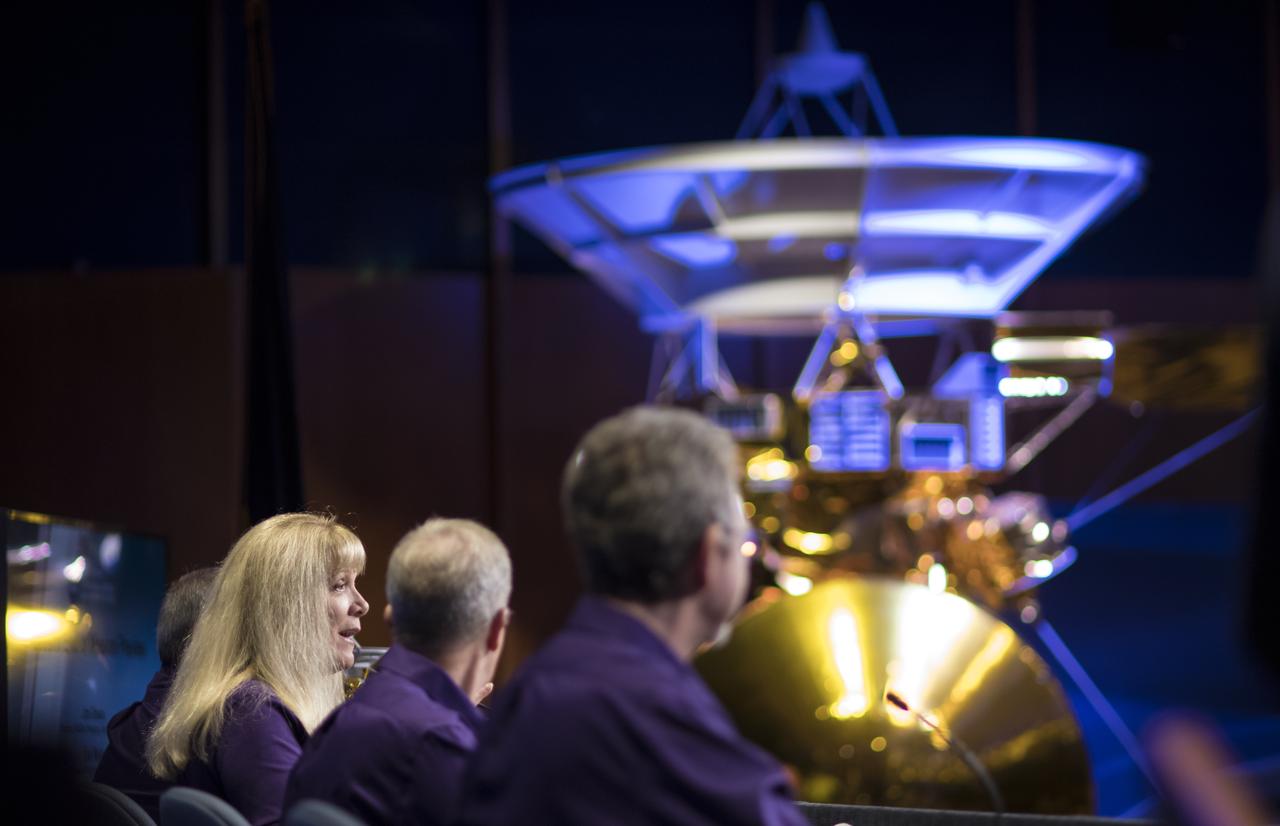
Cassini project scientist at JPL, Linda Spilker answers questions from members of the media during a press conference previewing Cassini's End of Mission, Wednesday, Sept. 13, 2017 at NASA's Jet Propulsion Laboratory in Pasadena, California. Since its arrival in 2004, the Cassini-Huygens mission has been a discovery machine, revolutionizing our knowledge of the Saturn system and captivating us with data and images never before obtained with such detail and clarity. On Sept. 15, 2017, operators will deliberately plunge the spacecraft into Saturn, as Cassini gathered science until the end. The “plunge” ensures Saturn’s moons will remain pristine for future exploration. During Cassini’s final days, mission team members from all around the world gathered at NASA’s Jet Propulsion Laboratory, Pasadena, California, to celebrate the achievements of this historic mission. Photo Credit: (NASA/Joel Kowsky)
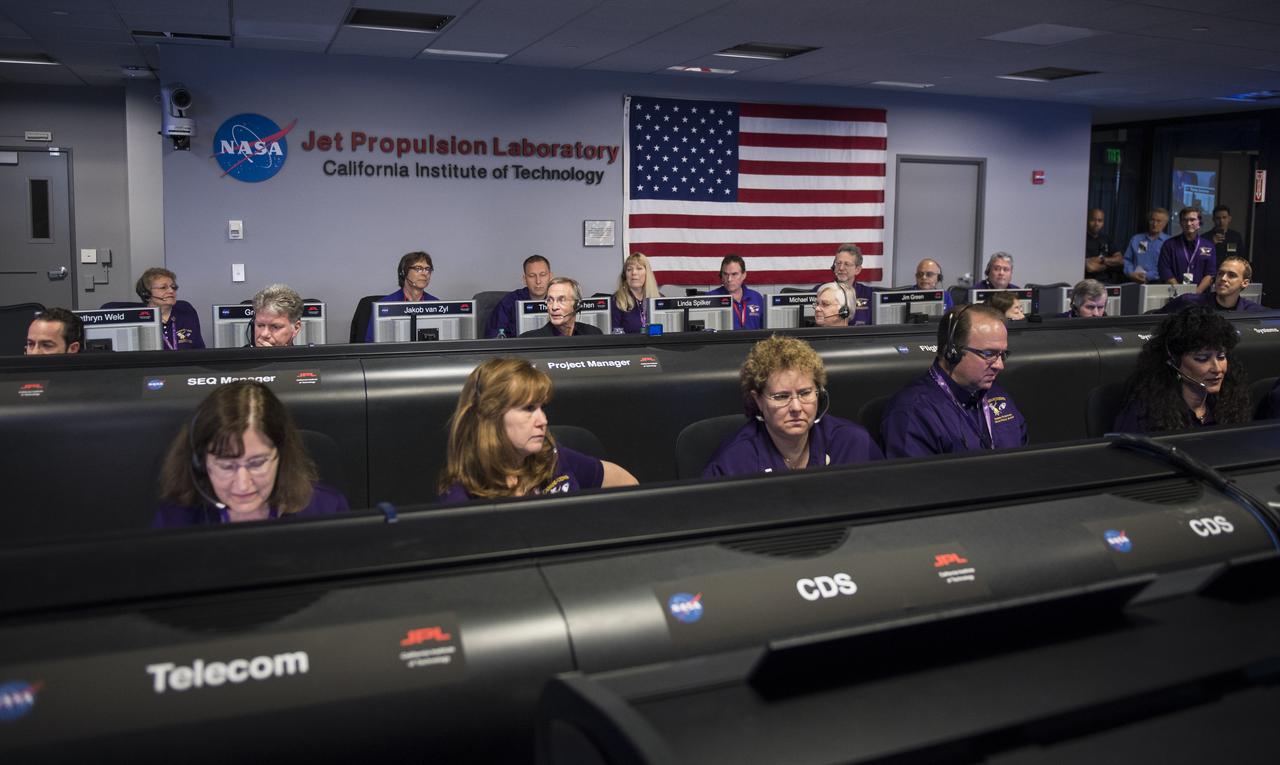
Cassini program manager at JPL, Earl Maize, center row, calls out the end of the Cassini mission, Friday, Sept. 15, 2017 at NASA's Jet Propulsion Laboratory in Pasadena, California. Since its arrival in 2004, the Cassini-Huygens mission has been a discovery machine, revolutionizing our knowledge of the Saturn system and captivating us with data and images never before obtained with such detail and clarity. On Sept. 15, 2017, operators deliberately plunged the spacecraft into Saturn, as Cassini gathered science until the end. The “plunge” ensures Saturn’s moons will remain pristine for future exploration. During Cassini’s final days, mission team members from all around the world gathered at NASA’s Jet Propulsion Laboratory, Pasadena, California, to celebrate the achievements of this historic mission. Photo Credit: (NASA/Joel Kowsky)
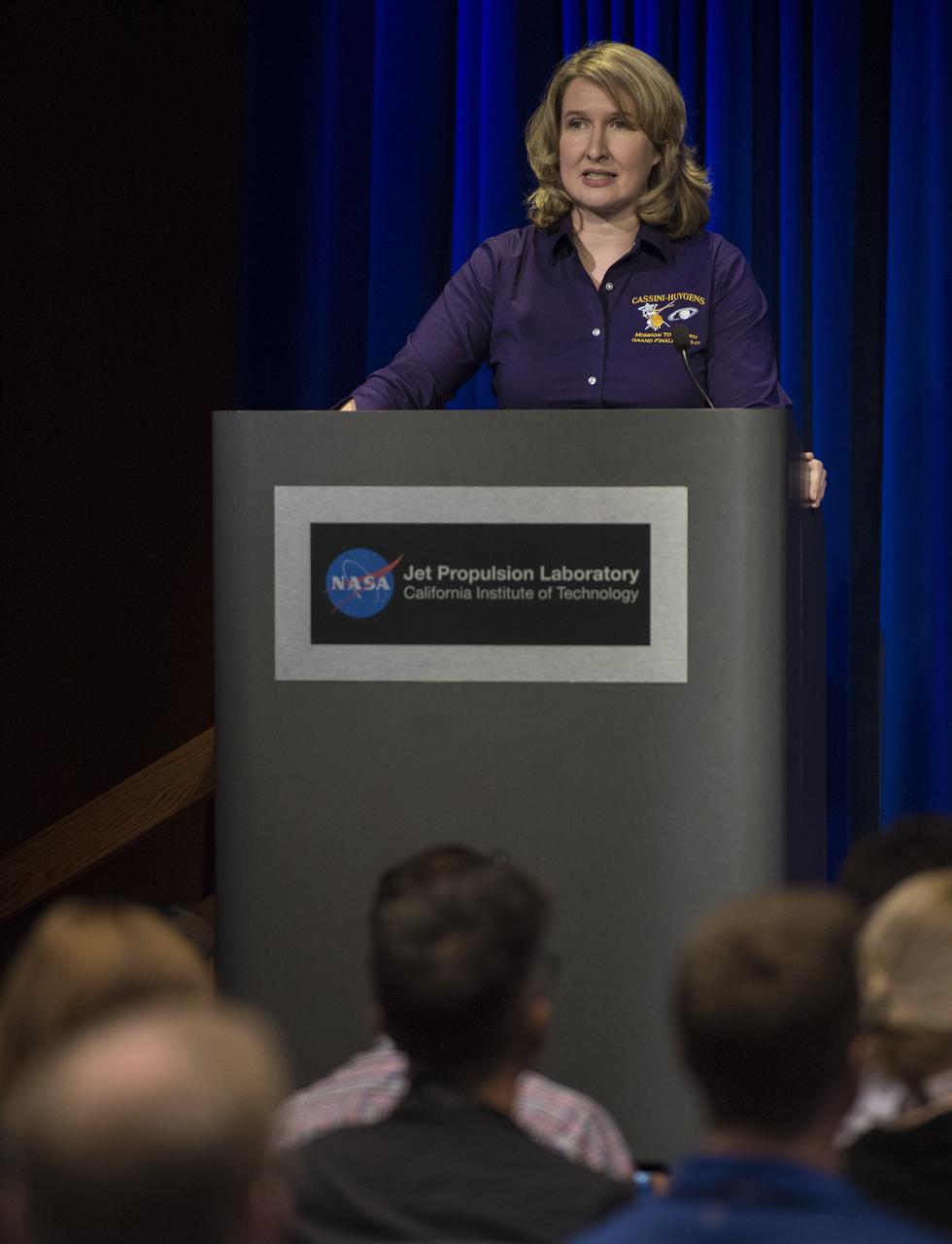
NASA JPL digital and social media lead Stephanie Smith, introduces technical producer for NASA's Eyes at JPL, Jason Craig, Thursday, Sept. 14, 2017 at NASA's Jet Propulsion Laboratory in Pasadena, California. Since its arrival in 2004, the Cassini-Huygens mission has been a discovery machine, revolutionizing our knowledge of the Saturn system and captivating us with data and images never before obtained with such detail and clarity. On Sept. 15, 2017, operators will deliberately plunge the spacecraft into Saturn, as Cassini gathered science until the end. The “plunge” ensures Saturn’s moons will remain pristine for future exploration. During Cassini’s final days, mission team members from all around the world gathered at NASA’s Jet Propulsion Laboratory, Pasadena, California, to celebrate the achievements of this historic mission. Photo Credit: (NASA/Joel Kowsky)
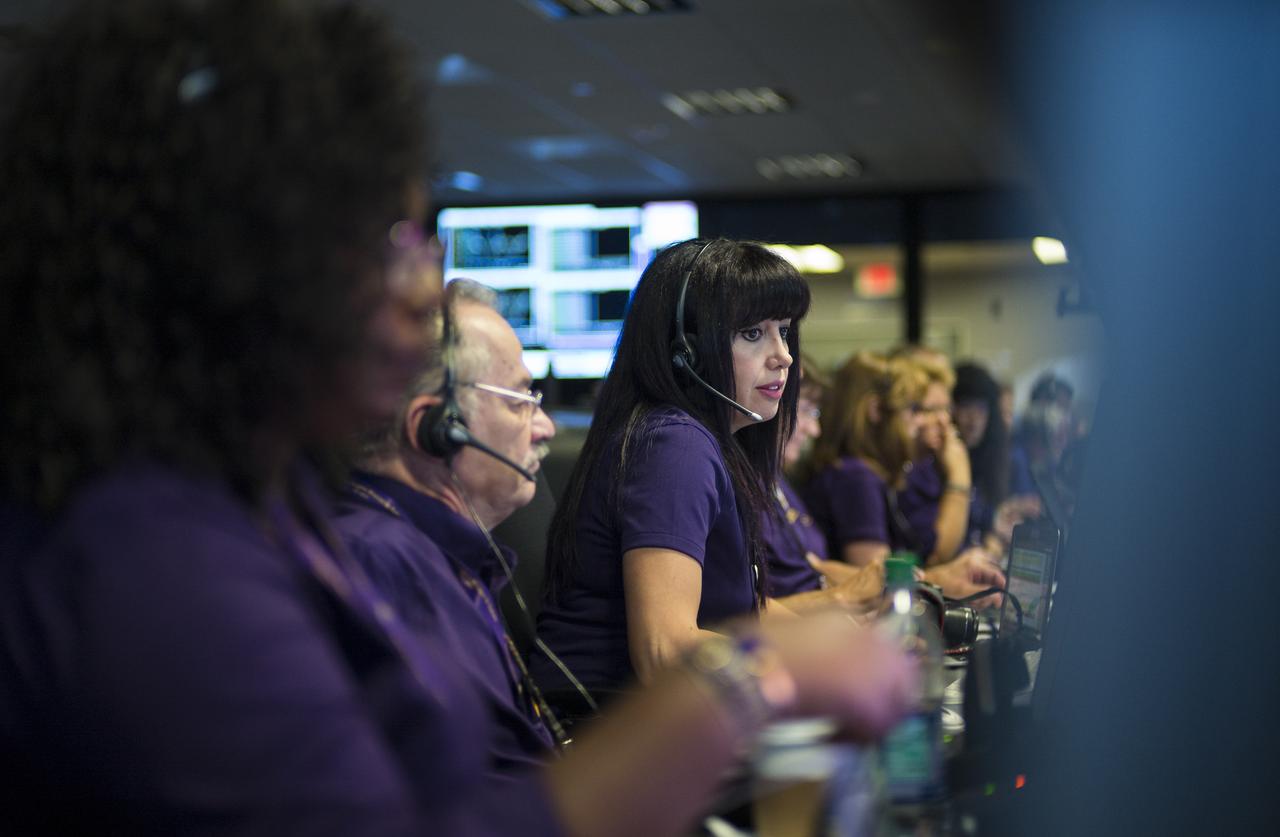
Aseel Anabtawi, of Cassini's radio science team, monitors her console in mission control during Cassini's final plunge into Saturn, Friday, Sept. 15, 2017 at NASA's Jet Propulsion Laboratory in Pasadena, California. Since its arrival in 2004, the Cassini-Huygens mission has been a discovery machine, revolutionizing our knowledge of the Saturn system and captivating us with data and images never before obtained with such detail and clarity. On Sept. 15, 2017, operators deliberately plunged the spacecraft into Saturn, as Cassini gathered science until the end. Loss of contact with the Cassini spacecraft occurred at 7:55 a.m. EDT (4:55 a.m. PDT). The “plunge” ensures Saturn’s moons will remain pristine for future exploration. During Cassini’s final days, mission team members from all around the world gathered at NASA’s Jet Propulsion Laboratory, Pasadena, California, to celebrate the achievements of this historic mission. Photo Credit: (NASA/Joel Kowsky)

Cassini program manager at JPL, Earl Maize is seen during a press conference previewing Cassini's End of Mission, Wednesday, Sept. 13, 2017 at NASA's Jet Propulsion Laboratory in Pasadena, California. Since its arrival in 2004, the Cassini-Huygens mission has been a discovery machine, revolutionizing our knowledge of the Saturn system and captivating us with data and images never before obtained with such detail and clarity. On Sept. 15, 2017, operators will deliberately plunge the spacecraft into Saturn, as Cassini gathered science until the end. The “plunge” ensures Saturn’s moons will remain pristine for future exploration. During Cassini’s final days, mission team members from all around the world gathered at NASA’s Jet Propulsion Laboratory, Pasadena, California, to celebrate the achievements of this historic mission. Photo Credit: (NASA/Joel Kowsky)
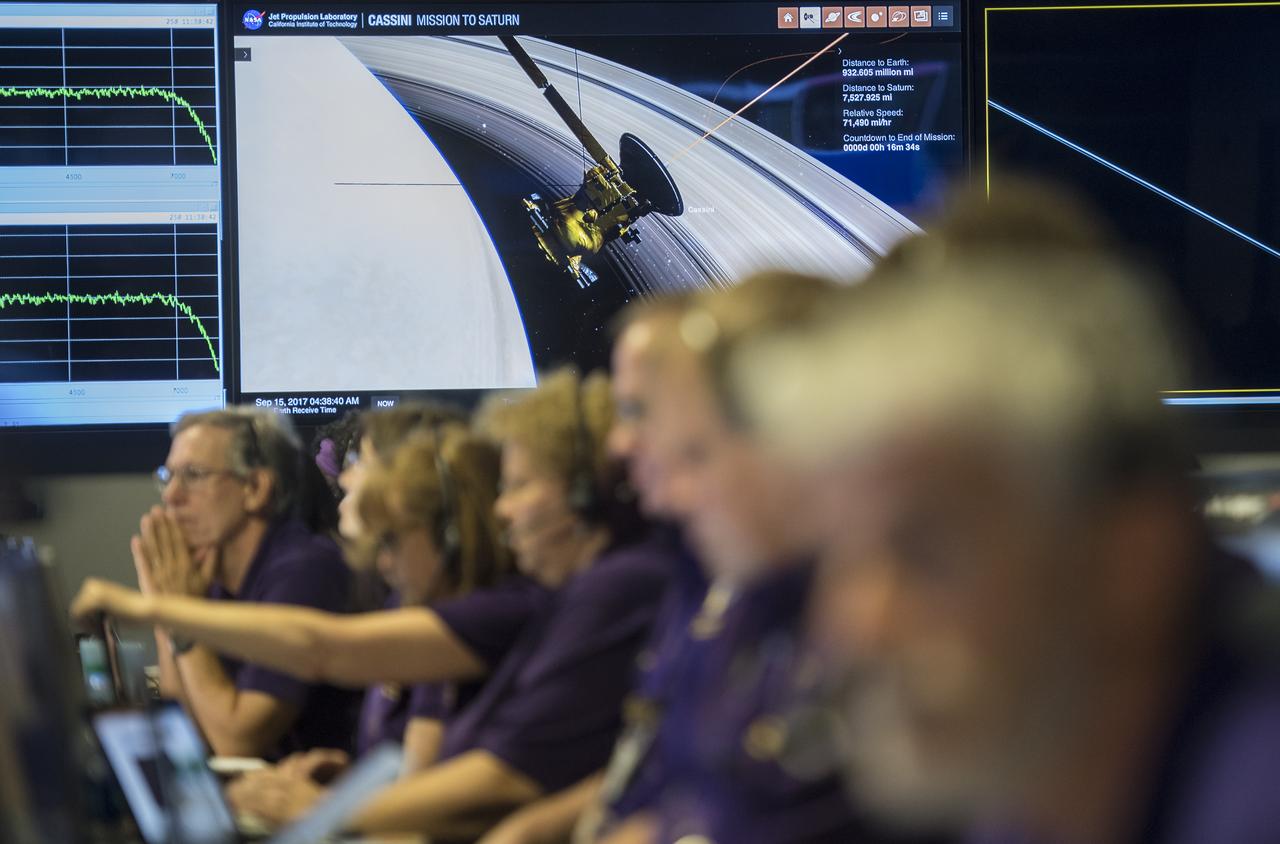
A monitor in the mission control room shows a visualization of Cassini as it makes its final plunge into Saturn, Friday, Sept. 15, 2017 at NASA's Jet Propulsion Laboratory in Pasadena, California. Since its arrival in 2004, the Cassini-Huygens mission has been a discovery machine, revolutionizing our knowledge of the Saturn system and captivating us with data and images never before obtained with such detail and clarity. On Sept. 15, 2017, operators deliberately plunged the spacecraft into Saturn, as Cassini gathered science until the end. Loss of contact with the Cassini spacecraft occurred at 7:55 a.m. EDT (4:55 a.m. PDT). The “plunge” ensures Saturn’s moons will remain pristine for future exploration. During Cassini’s final days, mission team members from all around the world gathered at NASA’s Jet Propulsion Laboratory, Pasadena, California, to celebrate the achievements of this historic mission. Photo Credit: (NASA/Joel Kowsky)
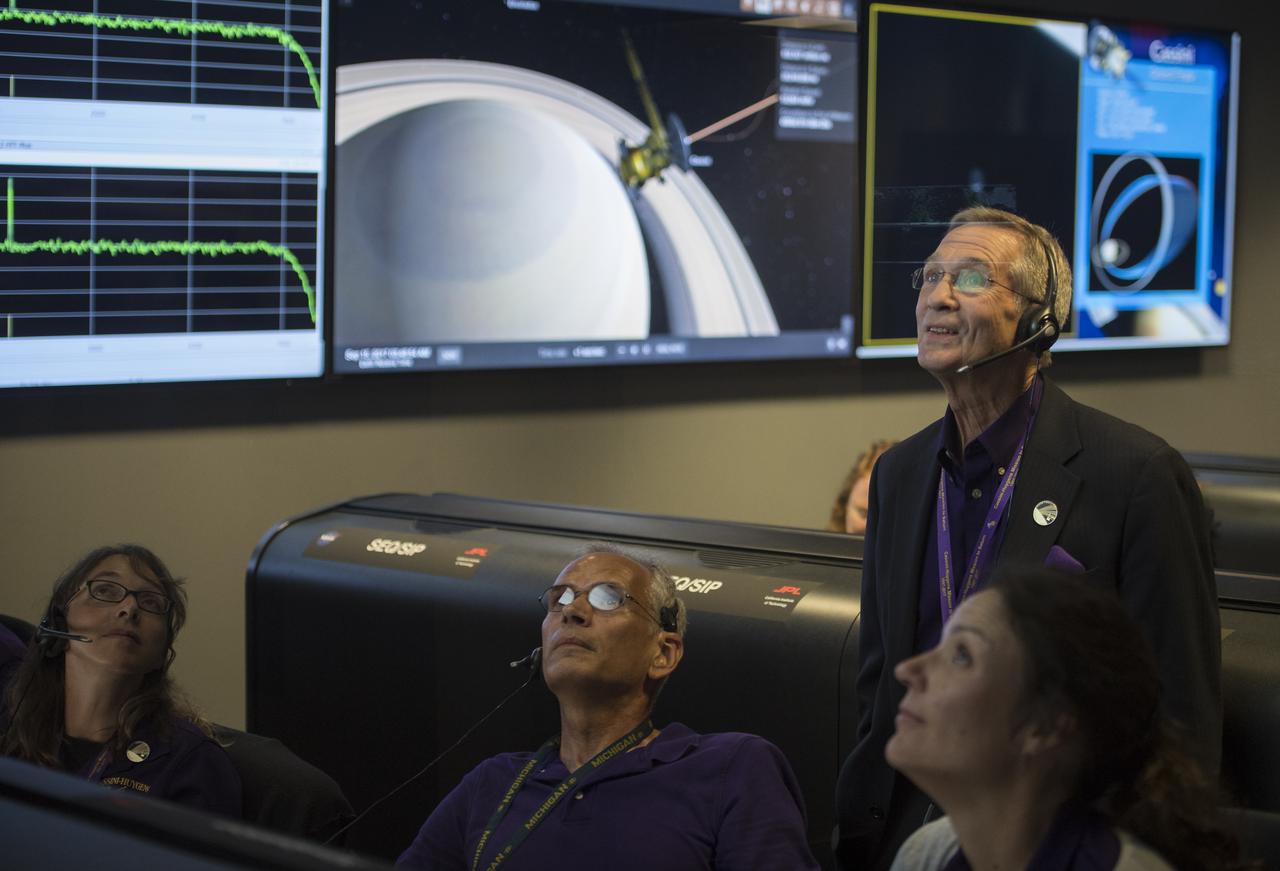
Cassini program manager at JPL, Earl Maize, standing, watches telemetry come in from Cassini with Julie Bellerose, left, Duane Roth, second from left, and Mar Vaquero of the Cassini navigation team in the mission control room, Friday, Sept. 15, 2017 at NASA's Jet Propulsion Laboratory in Pasadena, California. Since its arrival in 2004, the Cassini-Huygens mission has been a discovery machine, revolutionizing our knowledge of the Saturn system and captivating us with data and images never before obtained with such detail and clarity. On Sept. 15, 2017, operators deliberately plunged the spacecraft into Saturn, as Cassini gathered science until the end. The “plunge” ensures Saturn’s moons will remain pristine for future exploration. During Cassini’s final days, mission team members from all around the world gathered at NASA’s Jet Propulsion Laboratory, Pasadena, California, to celebrate the achievements of this historic mission. Photo Credit: (NASA/Joel Kowsky)