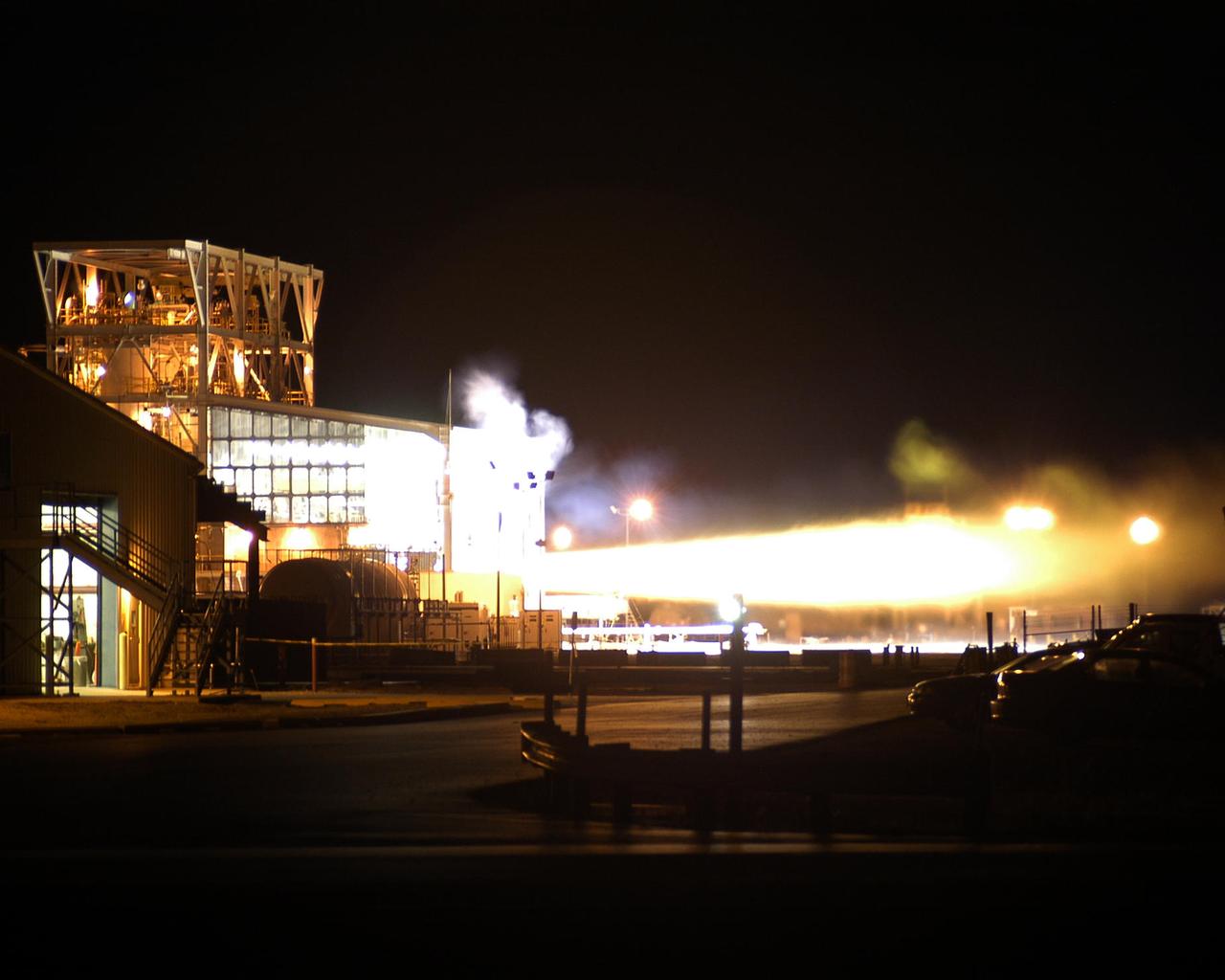
The Integrated Powerhead Demonstrator test fires with Wayne North as test conductor. The engine was tested at the E Complex of NASA's Stennis Space Center near Bay St. Louis, Miss. on Dec. 8, 2005.
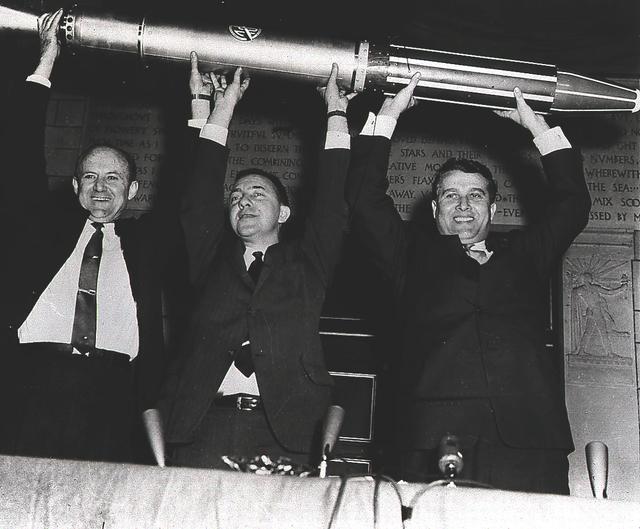
Jet Propulsion Laboratory Director Dr. William Pickering, Dr. James van Allen of the State University of Iowa, and Army Ballistic missionile Agency Technical Director Dr. Wernher von Braun triumphantly display a model of the Explorer I, America's first satellite, shortly after the satellite's launch on January 31, 1958. The Jet Propulsion Laboratory packed and tested the payload, a radiation detection experiment designed by Dr. van Allen. Dr. von Braun's rocket team at Redstone Arsenal in Huntsville, Alabama, developed the Juno I launch vehicle, a modified Jupiter-C.
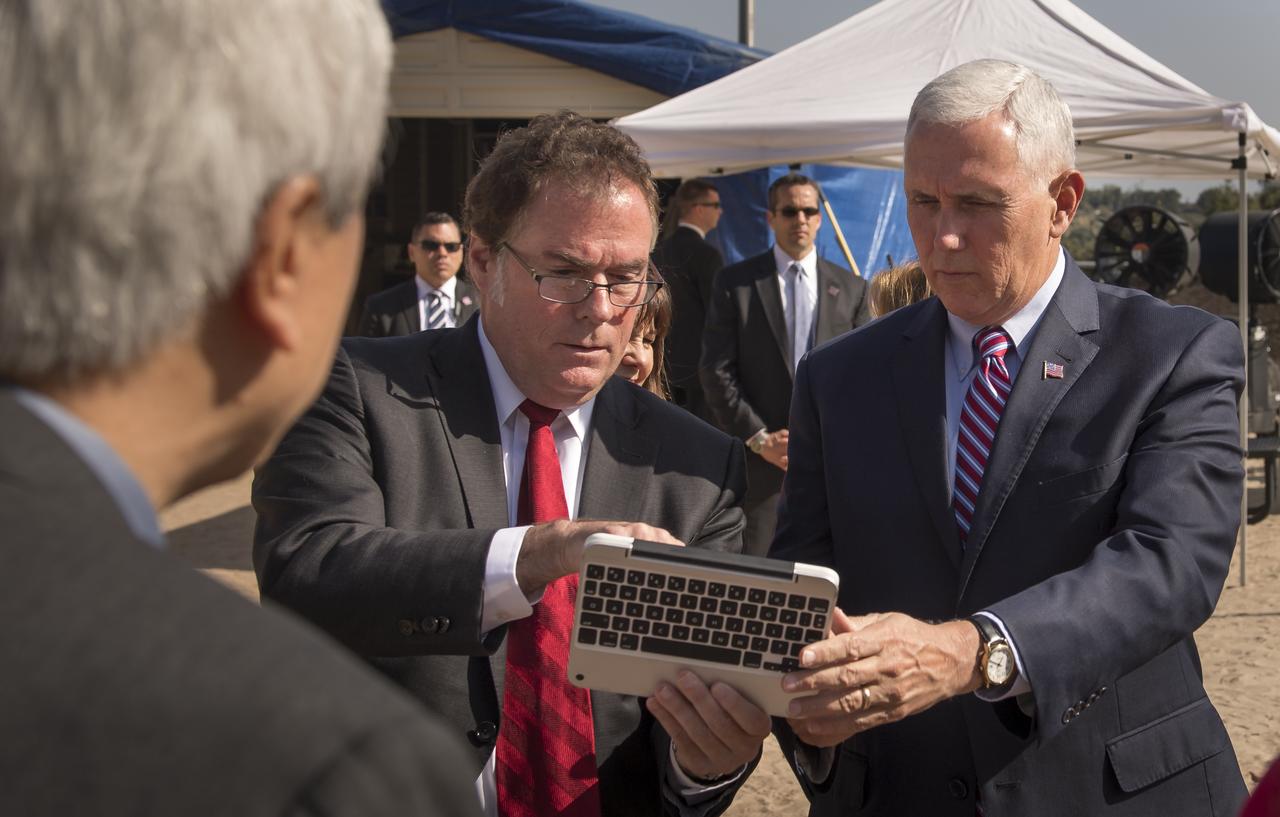
U.S. Vice President Mike Pence is given instructions on how to drive a rover nicknamed "Scarecrow" by JPL Director Michael Watkins at NASA's Jet Propulsion Laboratory Mars Yard, Saturday, April 28, 2018 in Pasadena, California. Scarecrow is used to test mobility of rovers on Mars. Photo Credit: (NASA/Bill Ingalls)
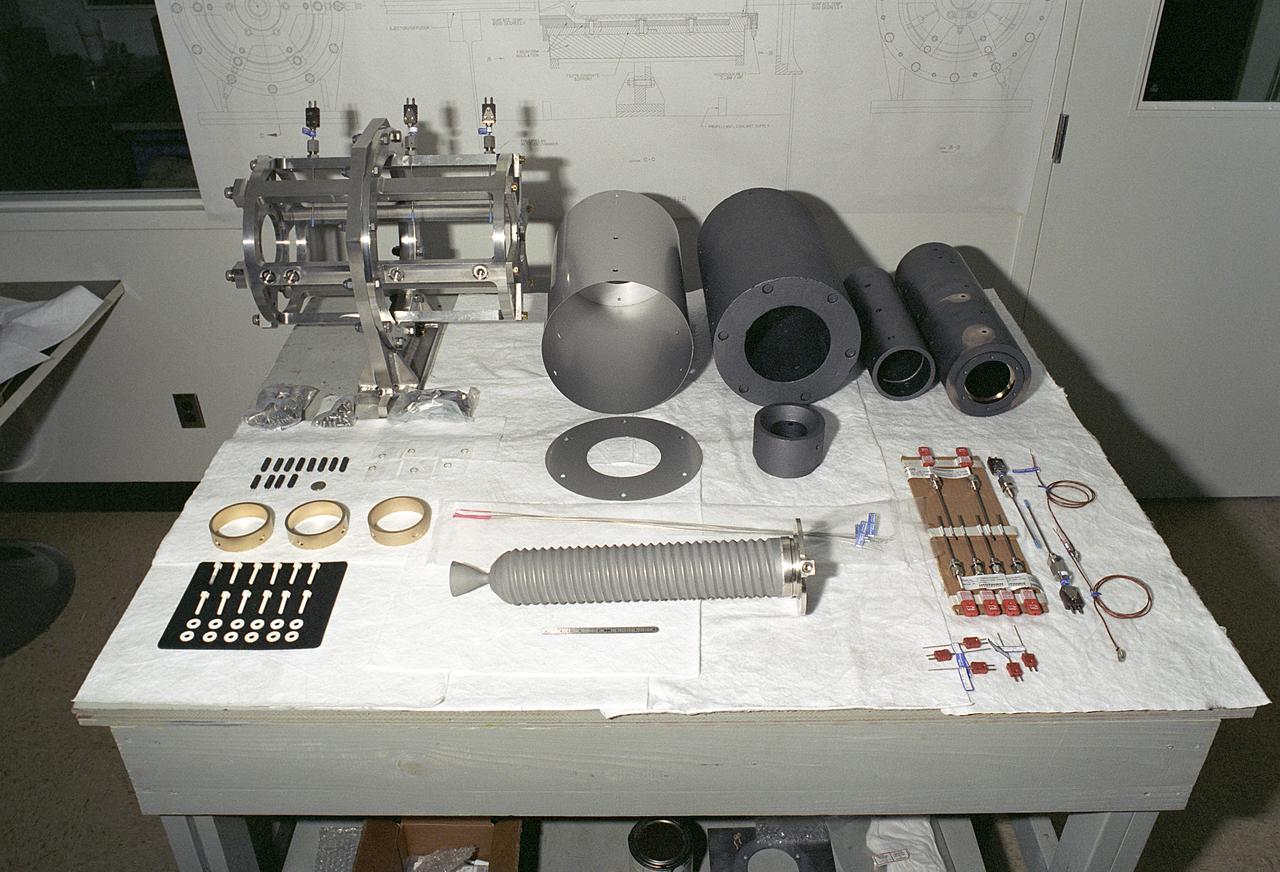
Researchers at the Marshall Space Flight Center (MSFC) have designed, fabricated, and tested the first solar thermal engine, a non-chemical rocket engine that produces lower thrust but has better thrust efficiency than a chemical combustion engine. This photograph shows components for the thermal propulsion engine being laid out prior to assembly. MSFC turned to solar thermal propulsion in the early 1990s due to its simplicity, safety, low cost, and commonality with other propulsion systems. As part of MSFC's Space Transportation Directorate, the Propulsion Research Center serves as a national resource for research of advanced, revolutionary propulsion technologies. The mission is to move the Nation's capabilities beyond the confines of conventional chemical propulsion into an era of aircraft-like access to Earth-orbit, rapid travel throughout the solar system, and exploration of interstellar space.
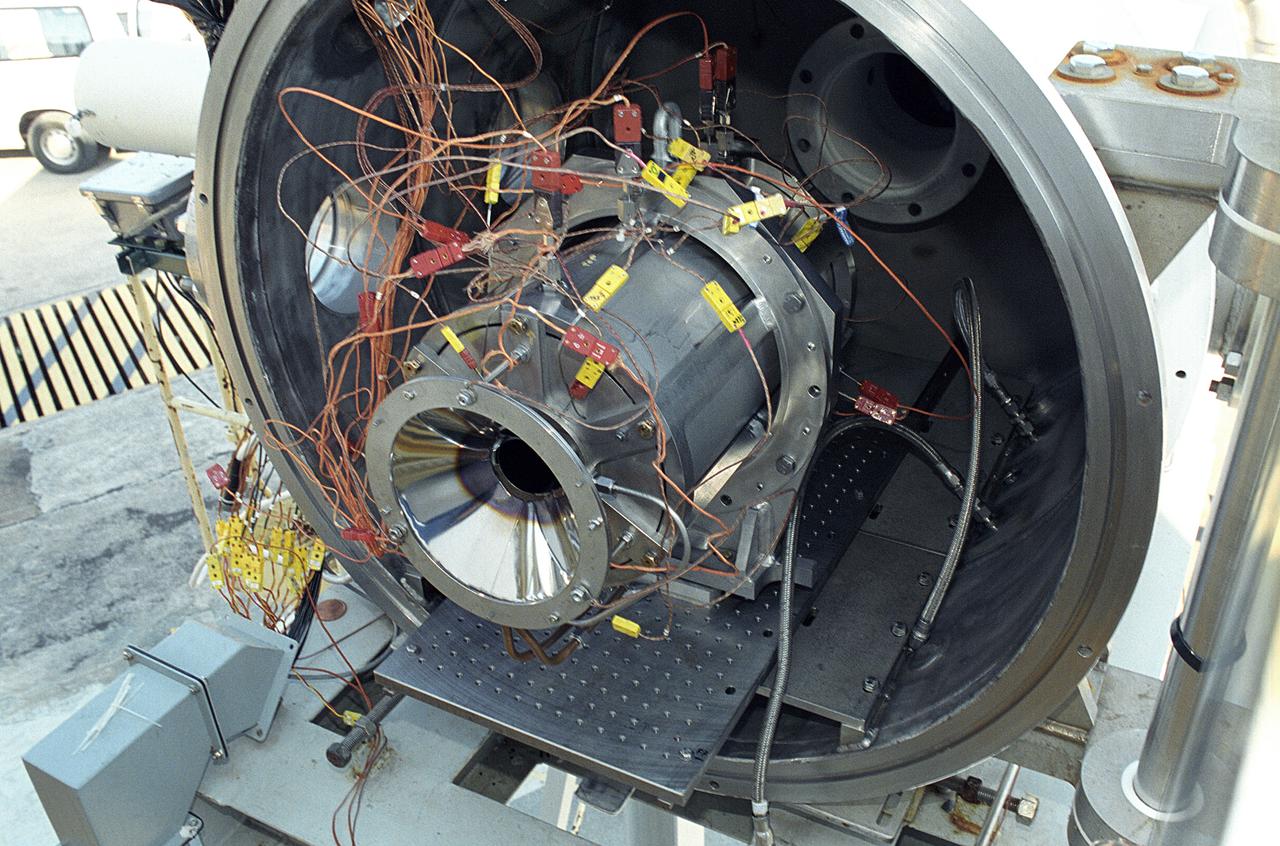
Researchers at the Marshall Space Flight Center (MSFC) have designed, fabricated, and tested the first solar thermal engine, a non-chemical rocket engine that produces lower thrust but has better thrust efficiency than a chemical combustion engine. MSFC turned to solar thermal propulsion in the early 1990s due to its simplicity, safety, low cost, and commonality with other propulsion systems. Solar thermal propulsion works by acquiring and redirecting solar energy to heat a propellant. This photograph shows a fully assembled solar thermal engine placed inside the vacuum chamber at the test facility prior to testing. The 20- by 24-ft heliostat mirror (not shown in this photograph) has a dual-axis control that keeps a reflection of the sunlight on the 18-ft diameter concentrator mirror, which then focuses the sunlight to a 4-in focal point inside the vacuum chamber. The focal point has 10 kilowatts of intense solar power. As part of MSFC's Space Transportation Directorate, the Propulsion Research Center serves as a national resource for research of advanced, revolutionary propulsion technologies. The mission is to move theNation's capabilities beyond the confines of conventional chemical propulsion into an era of aircraft-like access to Earth orbit, rapid travel throughout the solar system, and exploration of interstellar space.
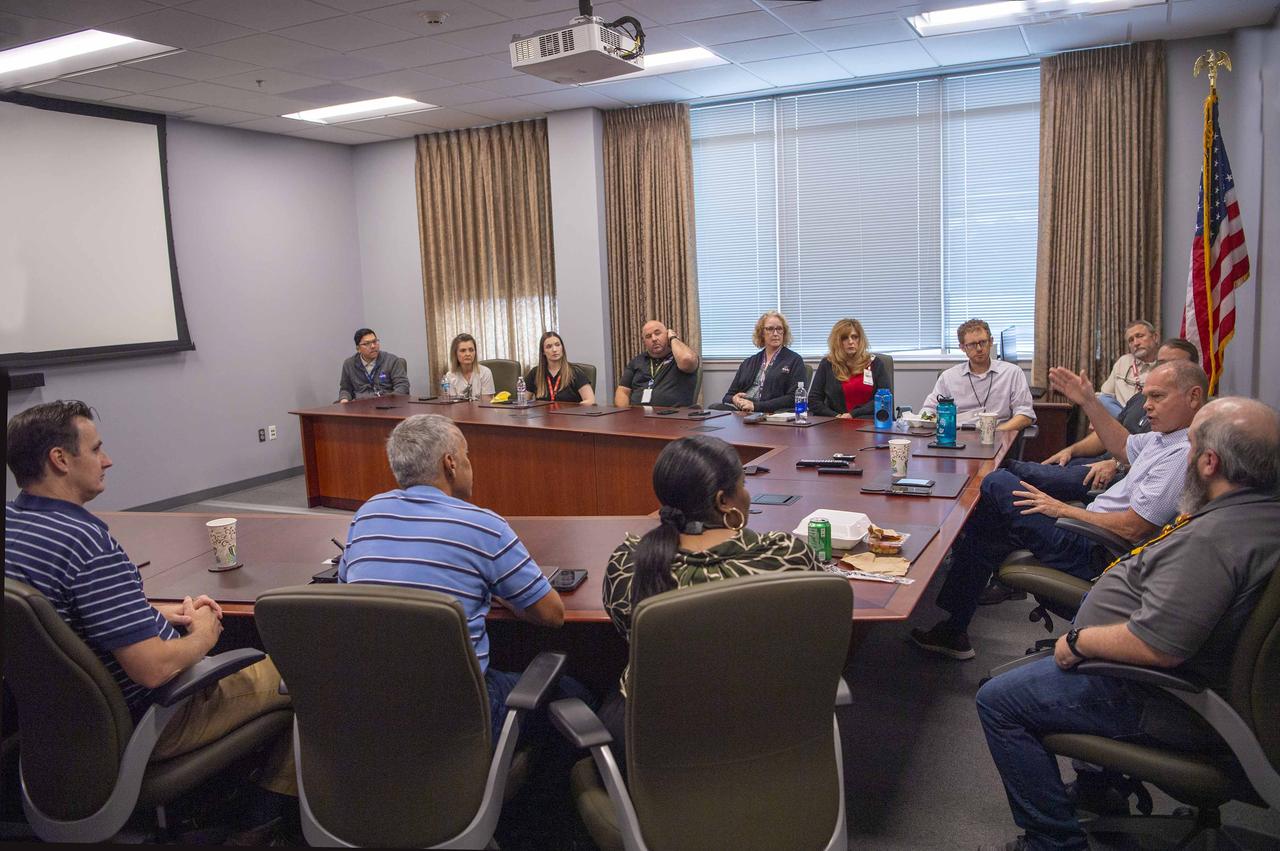
NASA Stennis Director John Bailey hosted the latest Java with John session on Nov. 19 with employees from the NASA Stennis Safety and Mission Assurance Directorate, Rocket Propulsion Test Program Office, and Office of the Chief Information Officer. Java with John is an employee-led discussion in a casual environment aimed at fostering a culture in which employees are welcome to share what matters most to them at work.
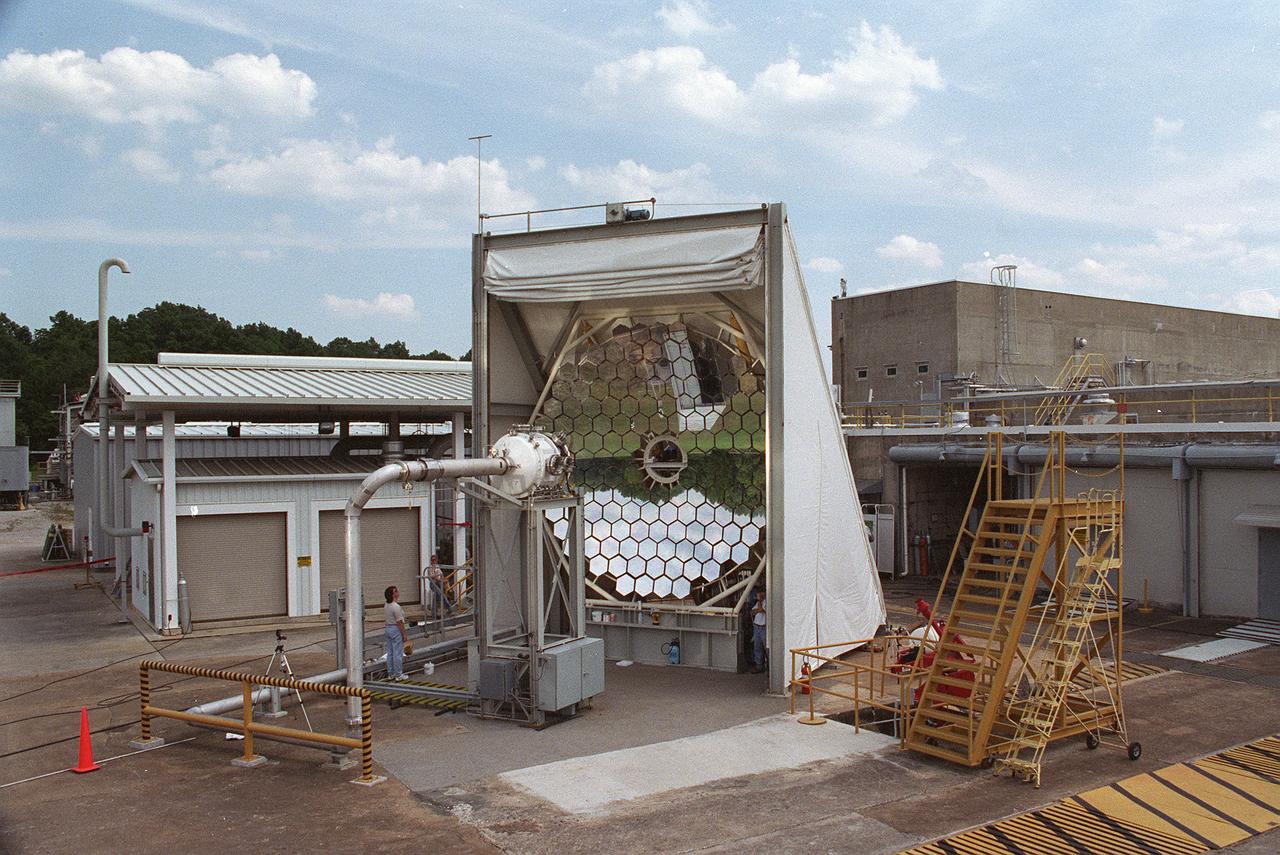
Researchers at the Marshall Space Flight Center (MSFC) have designed, fabricated and tested the first solar thermal engine, a non-chemical rocket engine that produces lower thrust but has better thrust efficiency than a chemical combustion engine. MSFC turned to solar thermal propulsion in the early 1990s due to its simplicity, safety, low cost, and commonality with other propulsion systems. Solar thermal propulsion works by acquiring and redirecting solar energy to heat a propellant. This photograph, taken at MSFC's Solar Thermal Propulsion Test Facility, shows a concentrator mirror, a combination of 144 mirrors forming this 18-ft diameter concentrator, and a vacuum chamber that houses the focal point. The 20- by 24-ft heliostat mirror (not shown in this photograph) has a dual-axis control that keeps a reflection of the sunlight on the 18-foot diameter concentrator mirror, which then focuses the sunlight to a 4-in focal point inside the vacuum chamber. The focal point has 10 kilowatts of intense solar power. As part of MSFC's Space Transportation Directorate, the Propulsion Research Center serves as a national resource for research of advanced, revolutionary propulsion technologies. The mission is to move the Nation's capabilities beyond the confines of conventional chemical propulsion into an era of aircraft-like access to Earth-orbit, rapid travel throughout the solar system, and exploration of interstellar space.
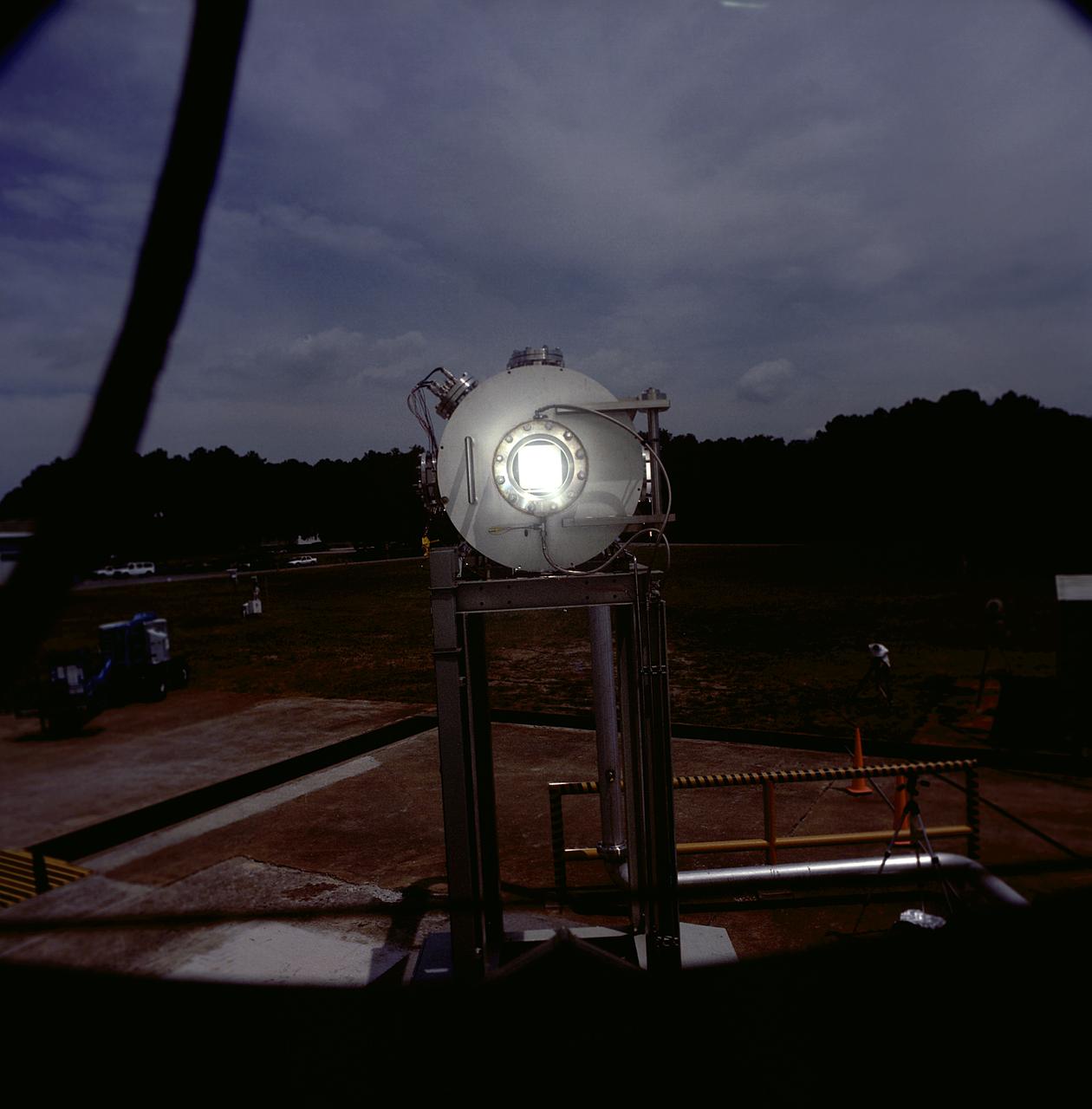
Researchers at the Marshall Space Flight Center (MSFC) have designed, fabricated, and tested the first solar thermal engine, a non-chemical rocket engine that produces lower thrust but has better thrust efficiency than a chemical combustion engine. MSFC turned to solar thermal propulsion in the early 1990s due to its simplicity, safety, low cost, and commonality with other propulsion systems. Solar thermal propulsion works by acquiring and redirecting solar energy to heat a propellant. The 20- by 24-ft heliostat mirror (not shown in this photograph) has dual-axis control that keeps a reflection of the sunlight on an 18-ft diameter concentrator mirror, which then focuses the sunlight to a 4-in focal point inside the vacuum chamber. The focal point has 10 kilowatts of intense solar power. This photograph is a close-up view of a 4-in focal point inside the vacuum chamber at the MSFC Solar Thermal Propulsion Test facility. As part of MSFC's Space Transportation Directorate, the Propulsion Research Center serves as a national resource for research of advanced, revolutionary propulsion technologies. The mission is to move the Nation's capabilities beyond the confines of conventional chemical propulsion into an era of aircraft-like access to Earth orbit, rapid travel throughout the solar system, and exploration of interstellar space.
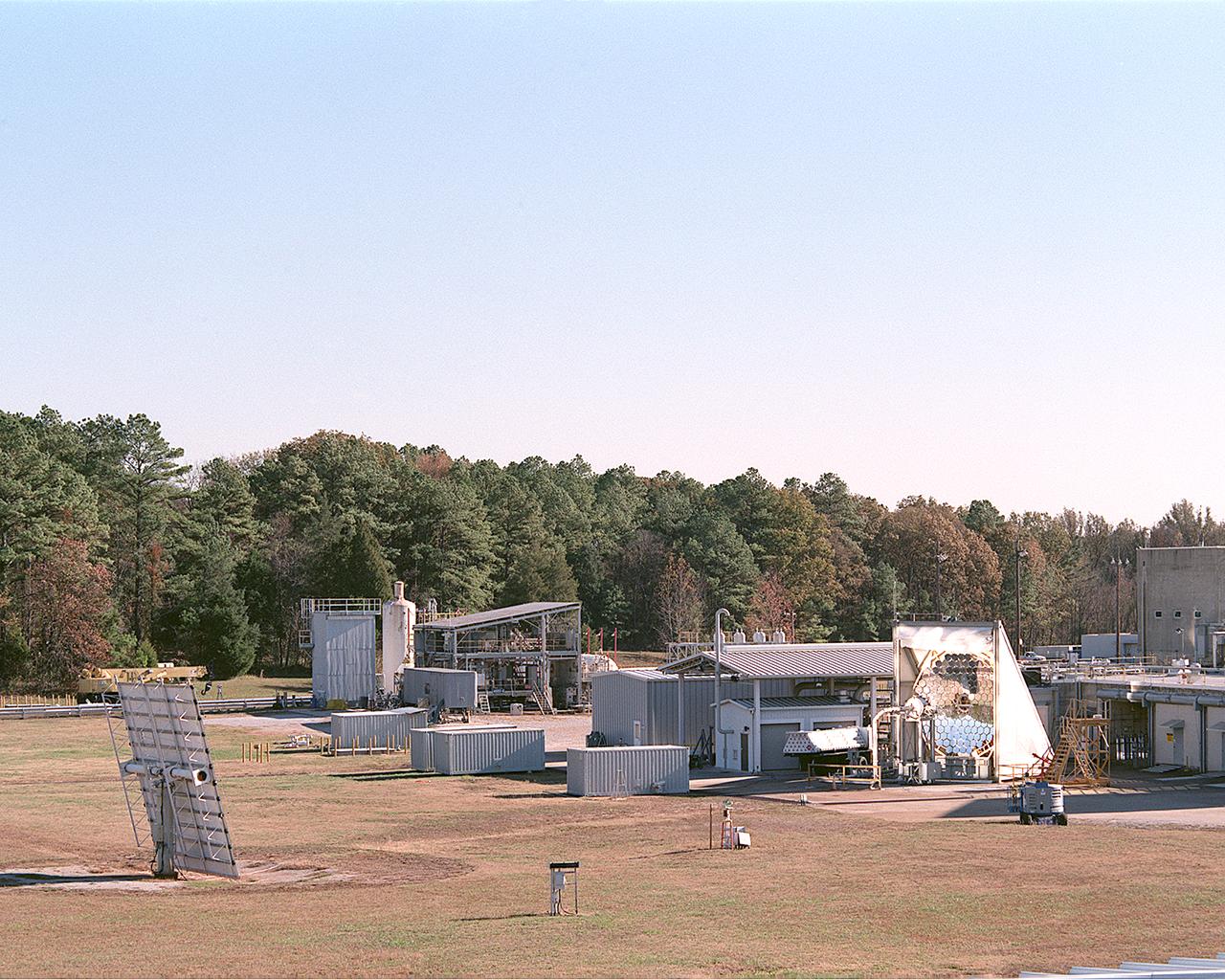
This photograph shows an overall view of the Solar Thermal Propulsion Test Facility at the Marshall Space Flight Center (MSFC). The 20-by 24-ft heliostat mirror, shown at the left, has dual-axis control that keeps a reflection of the sunlight on an 18-ft diameter concentrator mirror (right). The concentrator mirror then focuses the sunlight to a 4-in focal point inside the vacuum chamber, shown at the front of concentrator mirror. Researchers at MSFC have designed, fabricated, and tested the first solar thermal engine, a non-chemical rocket engine that produces lower thrust but has better thrust efficiency than chemical a combustion engine. MSFC turned to solar thermal propulsion in the early 1990s due to its simplicity, safety, low cost, and commonality with other propulsion systems. Solar thermal propulsion works by acquiring and redirecting solar energy to heat a propell nt. As part of MSFC's Space Transportation Directorate, the Propulsion Research Center serves as a national resource for research of advanced, revolutionary propulsion technologies. The mission is to move the Nation's capabilities beyond the confines of conventional chemical propulsion into an era of aircraft-like access to Earth-orbit, rapid travel throughout the solar system, and exploration of interstellar space.
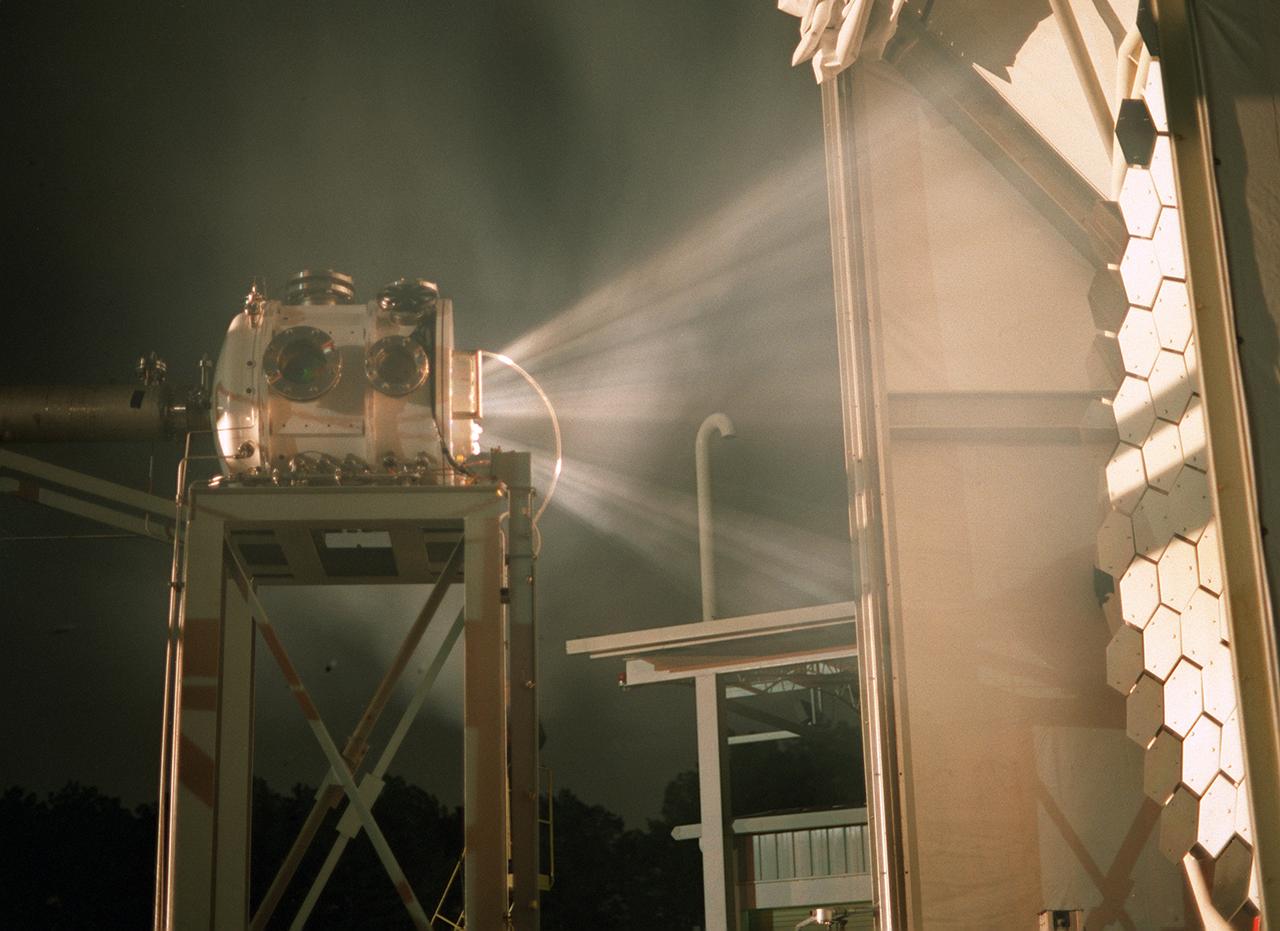
Researchers at the Marshall Space Flight Center (MSFC) have designed, fabricated, and tested the first solar thermal engine, a non-chemical rocket engine that produces lower thrust but has better thrust efficiency than a chemical combustion engine. MSFC turned to solar thermal propulsion in the early 1990s due to its simplicity, safety, low cost, and commonality with other propulsion systems. Solar thermal propulsion works by acquiring and redirecting solar energy to heat a propellant. The 20- by 24-ft heliostat mirror (not shown in this photograph) has a dual-axis control that keeps a reflection of the sunlight on the 18-ft diameter concentrator mirror, which then focuses the sunlight to a 4-in focal point inside the vacuum chamber. The focal point has 10 kilowatts of intense solar power. This image, taken during the test, depicts the light being concentrated into the focal point inside the vacuum chamber. As part of MSFC's Space Transportation Directorate, the Propulsion Research Center serves as a national resource for research of advanced, revolutionary propulsion technologies. The mission is to move the Nation's capabilities beyond the confines of conventional chemical propulsion into an era of aircraft-like access to Earth orbit, rapid travel throughout the solar system, and exploration of interstellar space.
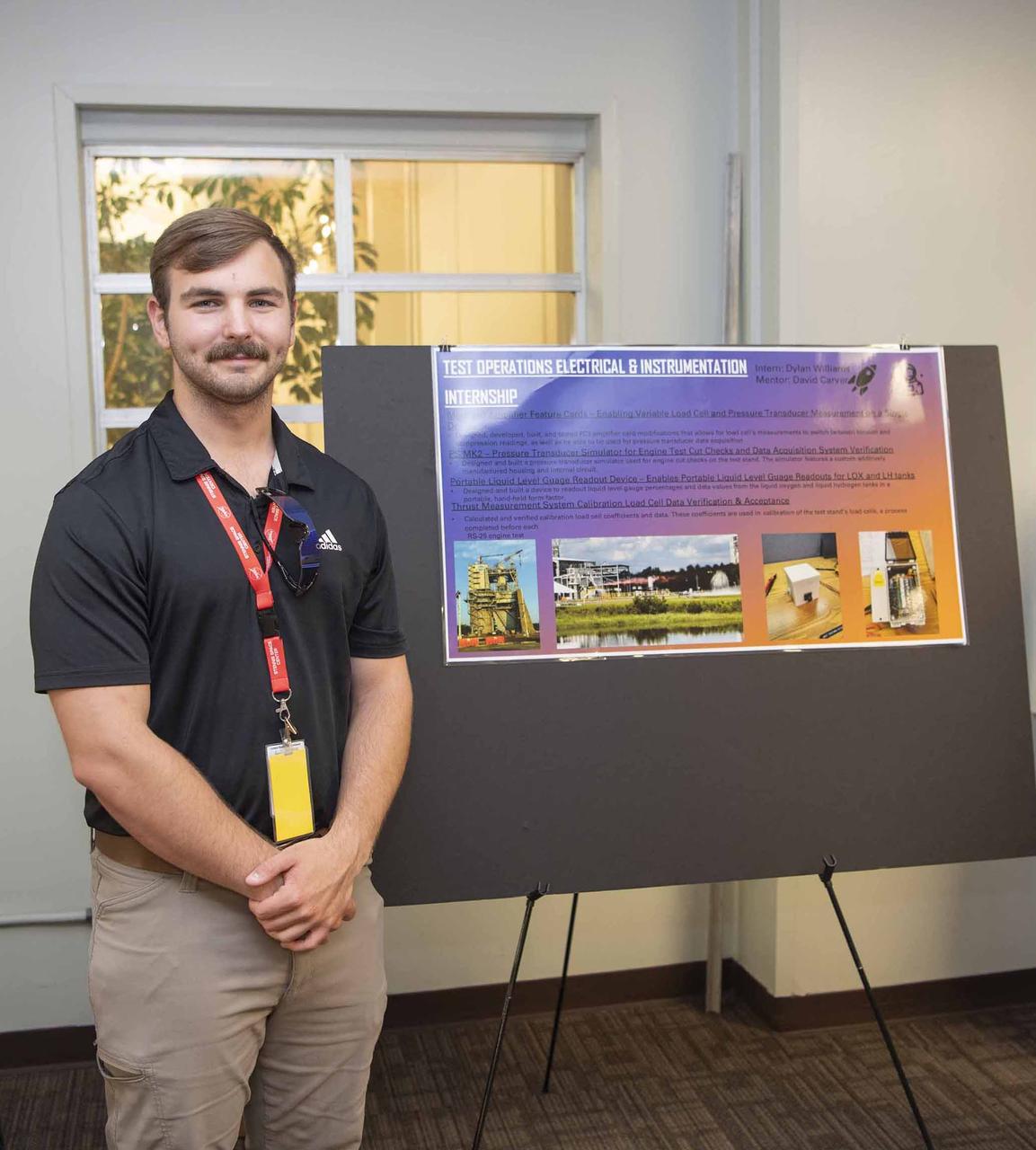
NASA Stennis summer intern Dylan Williams is shown with his presentation highlighting work with test operations during an Aug. 7 event hosted by the Office of STEM Engagement. Williams, a student at Meridian Community College in Meridian, Mississippi, worked with the NASA Stennis Engineering and Test Directorate. The poster symposium highlighted research topics, including propulsion test operations, lunar robotics, autonomous systems, STEM education, and more. NASA’s Office of STEM Engagement paid internships allow high school and college-level students to contribute to the agency’s mission to advance science, technology, aeronautics, and space exploration.
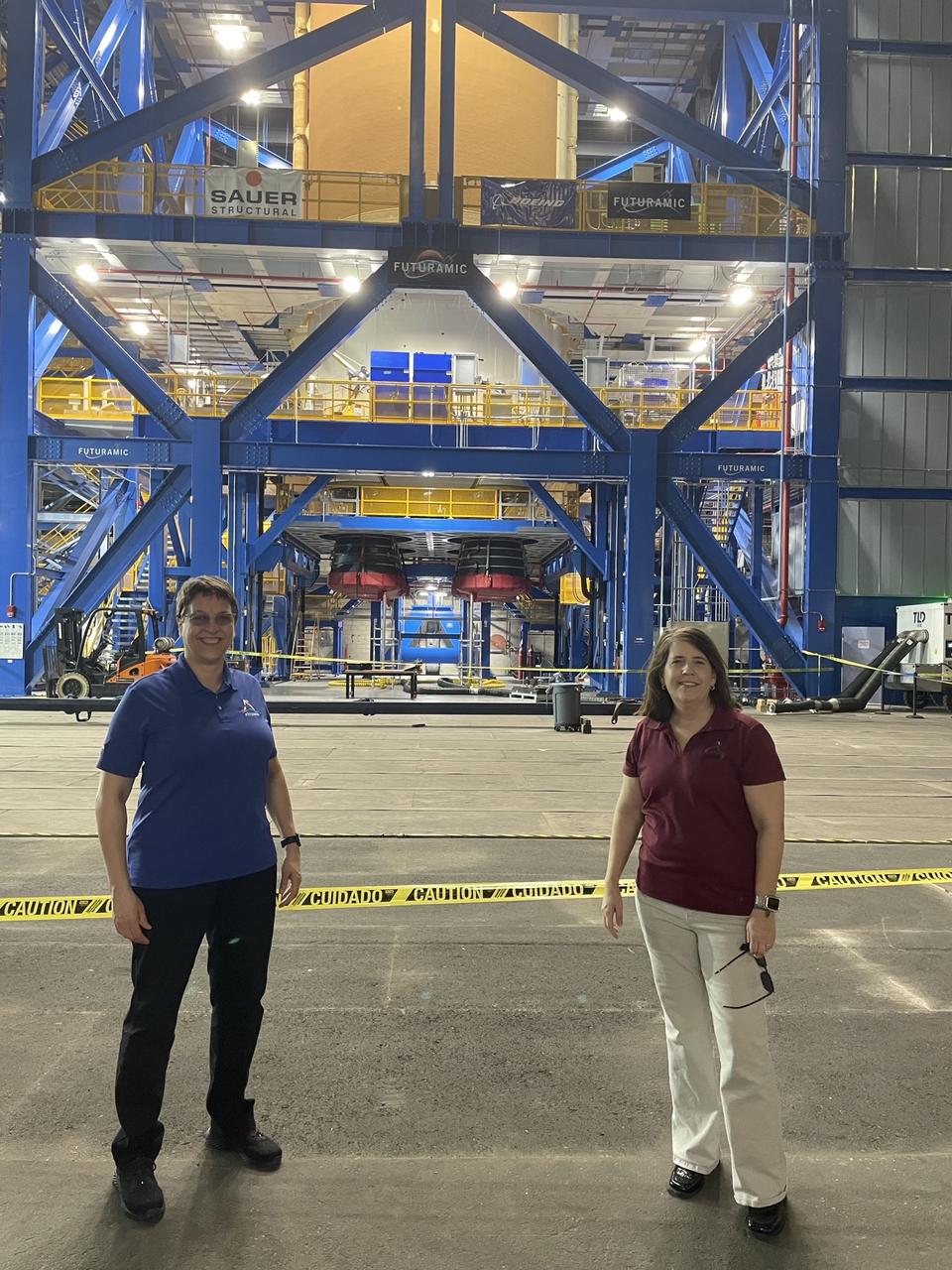
NASA Stennis Deputy Director Christine Powell and NASA Rocket Propulsion Test Program Manager Michele Beisler tour the Vehicle Assembly Building to view the SLS (Space Launch System) rocket expected to fly on the Artemis II mission and the mobile launcher ground structure used to assemble, process, and launch SLS during a visit to NASA’s Kennedy Space Center on Jan. 31.
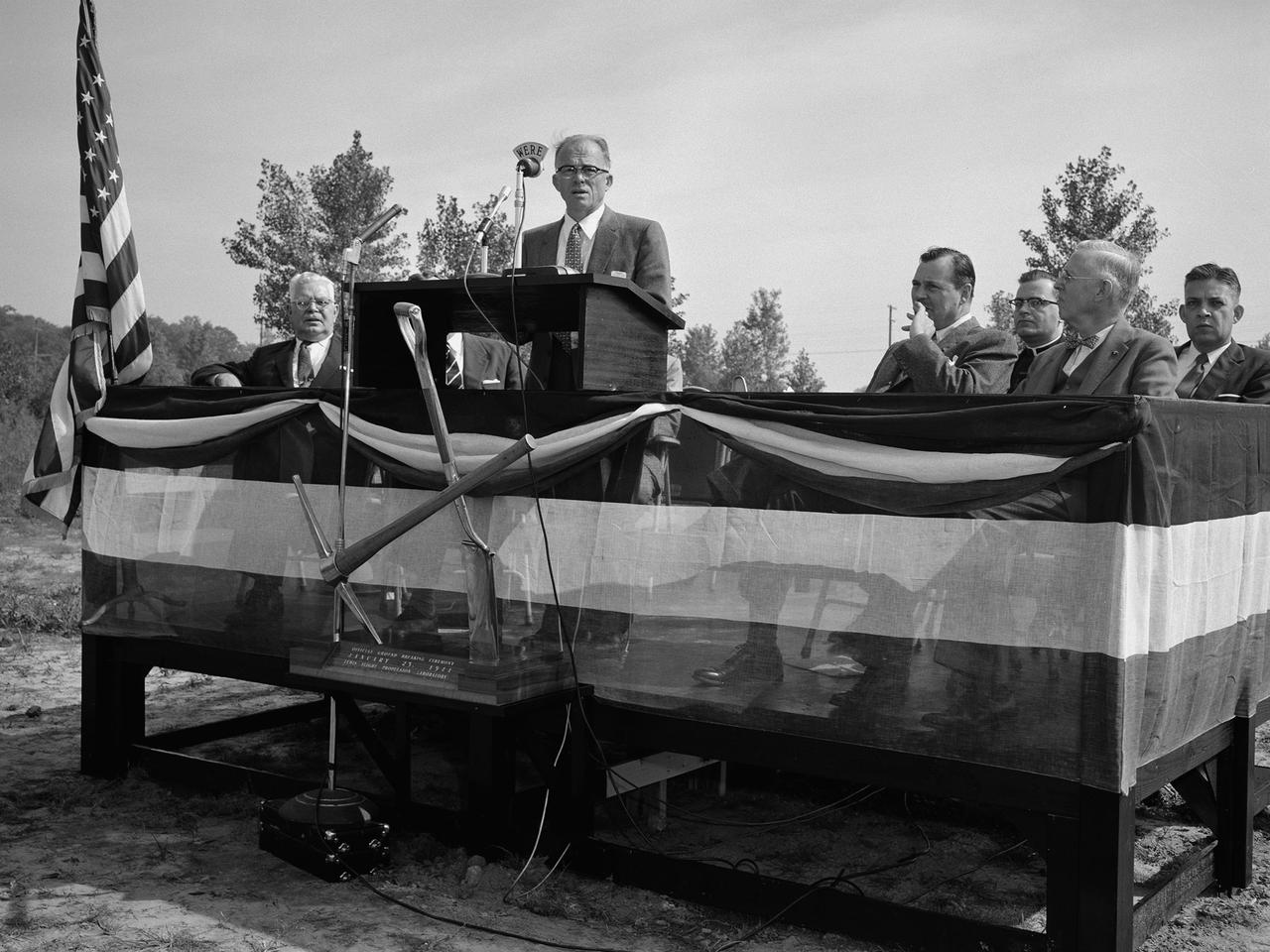
Addison Rothrock, the National Advisory Committee for Aeronautics’s (NACA) Assistant Director of Research, speaks at the groundbreaking ceremony for the Lewis Flight Propulsion Laboratory’s new test reactor at Plum Brook Station. This dedication event was held almost exactly one year after the NACA announced that it would build its $4.5 million nuclear reactor on 500 acres of the army’s 9000-acre Plum Brook Ordnance Works. The site was located in Sandusky, Ohio, approximately 60 miles west of the NACA Lewis laboratory in Cleveland. Lewis Director Raymond Sharp is seated to the left of Rothrock, Congressman Albert Baumhart and NACA Secretary John Victory are to the right. Many government and local officials were on hand for the press conference and ensuing luncheon. In the wake of World War II the military, the Atomic Energy Commission, and the NACA became interested in the use of atomic energy for propulsion and power. A Nuclear Division was established at NACA Lewis in the early 1950s. The division’s request for a 60-megawatt research reactor was approved in 1955. The semi-remote Plum Brook location was selected over 17 other possible sites. Construction of the Plum Brook Reactor Facility lasted five years. By the time of its first trial runs in 1961 the aircraft nuclear propulsion program had been cancelled. The space age had arrived, however, and the reactor would be used to study materials for a nuclear powered rocket.
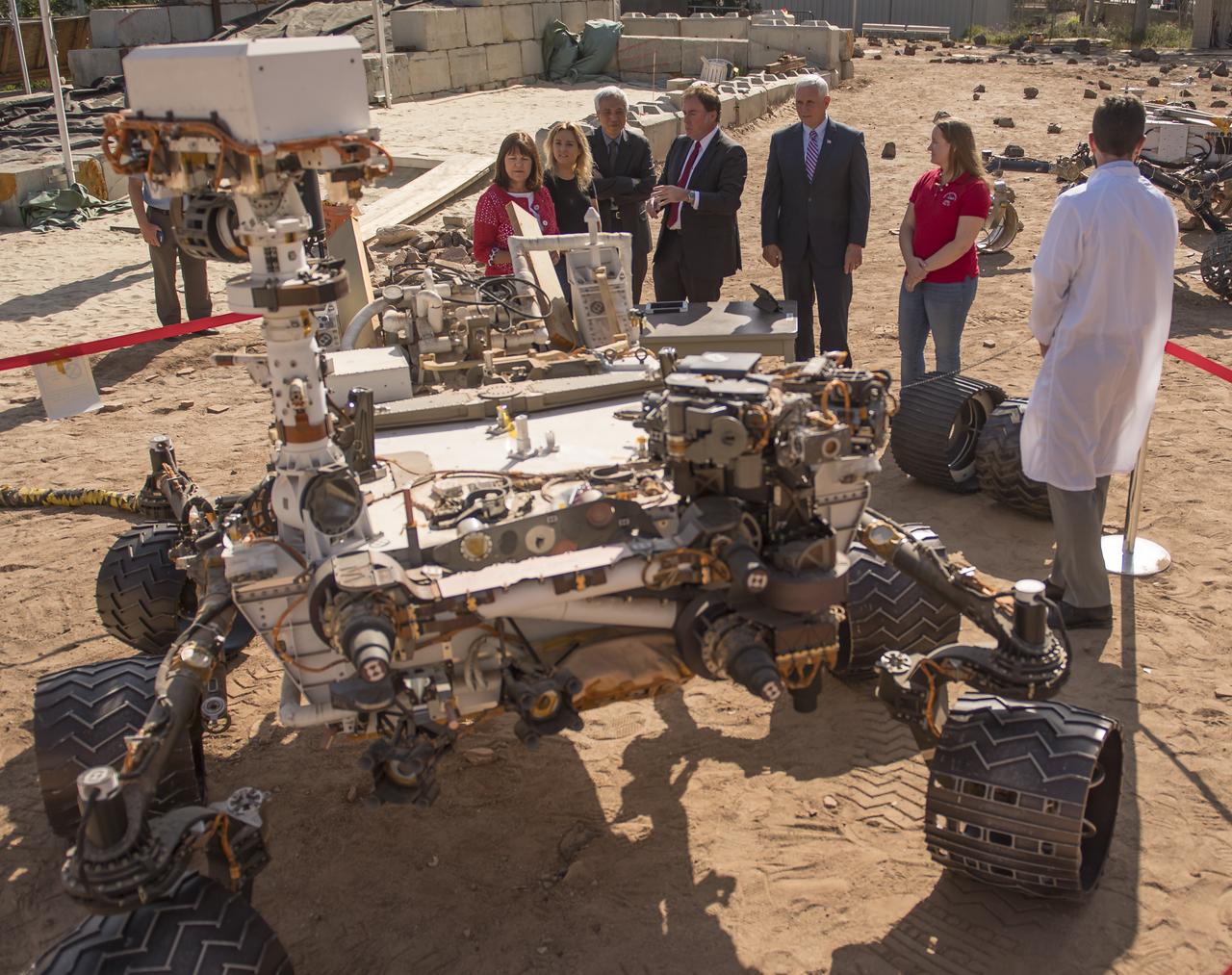
U.S. Vice President Mike Pence, 5th from left, joined by his wife Karen Pence, left, and daughter Charlotte Pence. 2nd from left, view the Vehicle System Test Bed (VSTB) rover in the Mars Yard during a tour of NASA's Jet Propulsion Laboratory, Saturday, April 28, 2018 in Pasadena, California. NASA Mars Exploration Manager Li Fuk, 2nd from left, JPL Director Michael Watkins, Mars Curiosity Engineering Operations Team Chief Megan Lin, and MSL Engineer Sean McGill, right, helped explain to the Vice President and his family how they use these test rovers. Photo Credit: (NASA/Bill Ingalls)
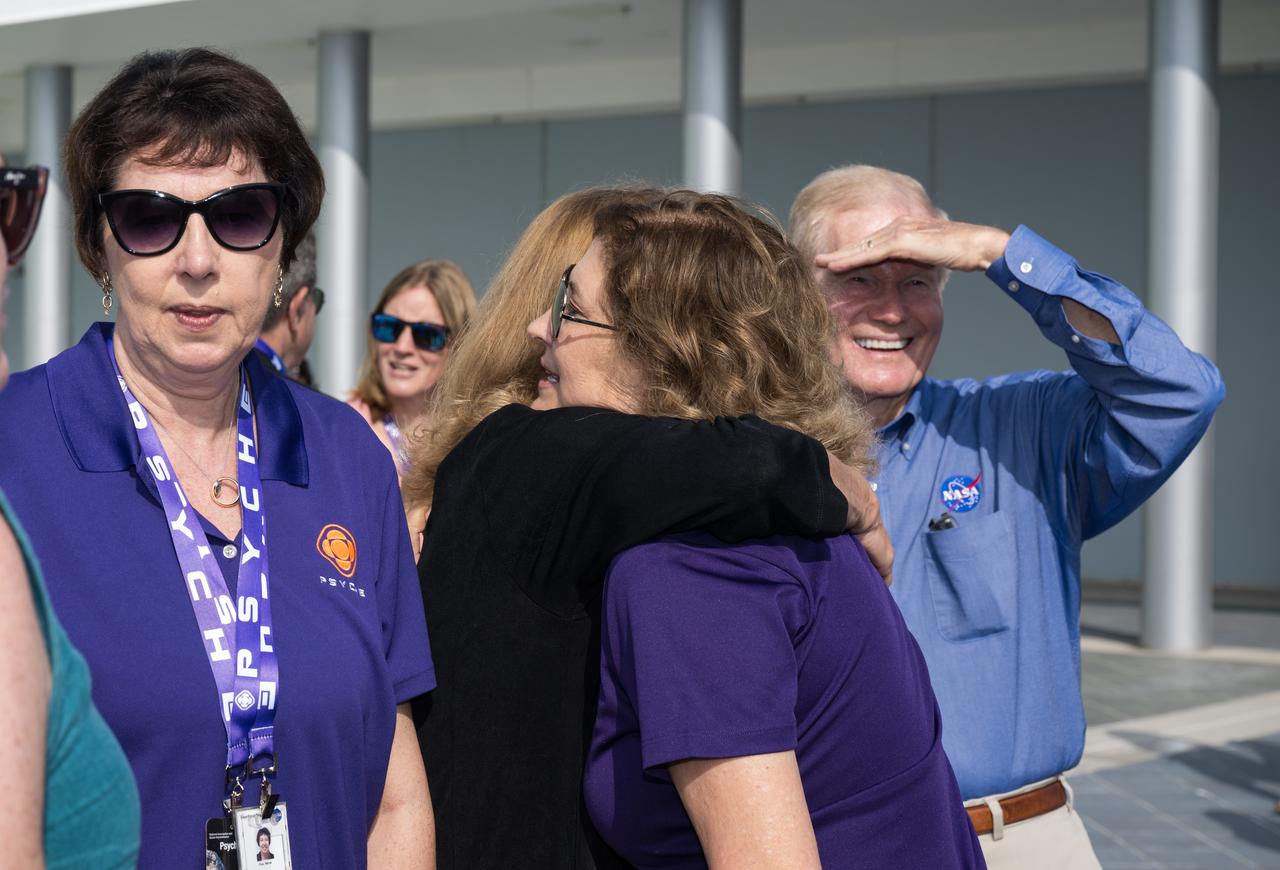
NASA Headquarters Planetary Science Division director Lori Glaze, left, hugs Jet Propulsion Laboratory director Laurie Leshin as NASA Administrator Bill Nelson, right, and Associate Administrator, NASA’s Science Mission Directorate, Nicola Fox watch for the return of the boosters after the launch of a SpaceX Falcon Heavy rocket with the Psyche spacecraft onboard from Launch Complex 39A, Friday, Oct. 13, 2023, at NASA’s Kennedy Space Center in Florida. NASA’s Psyche spacecraft will travel to a metal-rich asteroid by the same name orbiting the Sun between Mars and Jupiter to study it’s composition. The spacecraft also carries the agency's Deep Space Optical Communications technology demonstration, which will test laser communications beyond the Moon. Photo Credit: (NASA/Aubrey Gemignani)
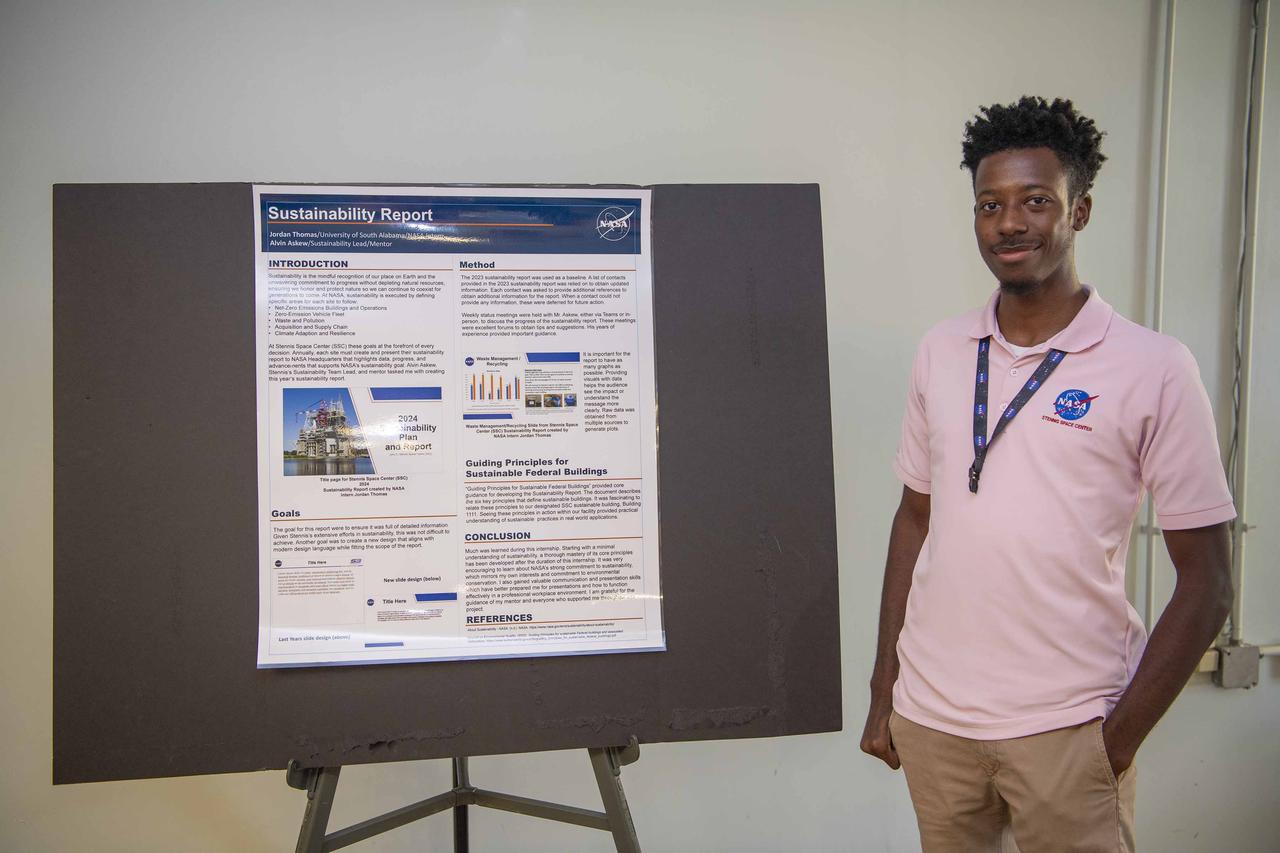
NASA Stennis summer intern Jordan Thomas is shown with his presentation on the 2024 Sustainability Report for NASA Stennis during an Aug. 7 event hosted by the Office of STEM Engagement. Thomas, a student at the University of South Alabama in Mobile, worked with the NASA Stennis Center Operations Directorate. The poster symposium highlighted research topics, including propulsion test operations, lunar robotics, autonomous systems, STEM education, and more. NASA’s Office of STEM Engagement paid internships allow high school and college-level students to contribute to the agency’s mission to advance science, technology, aeronautics, and space exploration.
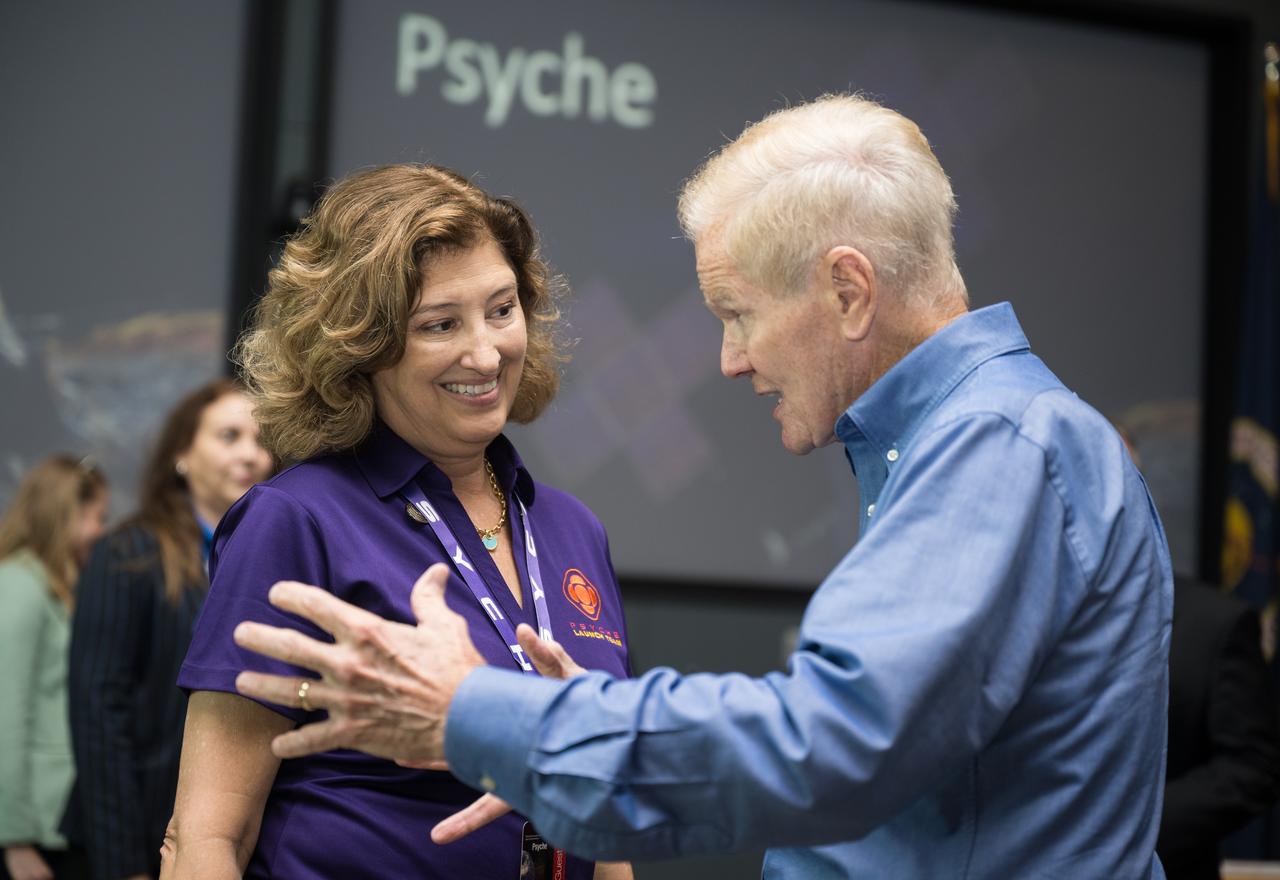
Jet Propulsion Laboratory Director Laurie Leshin, left, speaks with NASA Administrator Bill Nelson prior to the launch of the SpaceX Falcon Heavy rocket with the Psyche spacecraft onboard from Launch Complex 39A, Friday, Oct. 13, 2023, at NASA’s Kennedy Space Center in Florida. NASA’s Psyche spacecraft will travel to a metal-rich asteroid by the same name orbiting the Sun between Mars and Jupiter to study it’s composition. The spacecraft also carries the agency's Deep Space Optical Communications technology demonstration, which will test laser communications beyond the Moon. Photo Credit: (NASA/Aubrey Gemignani)
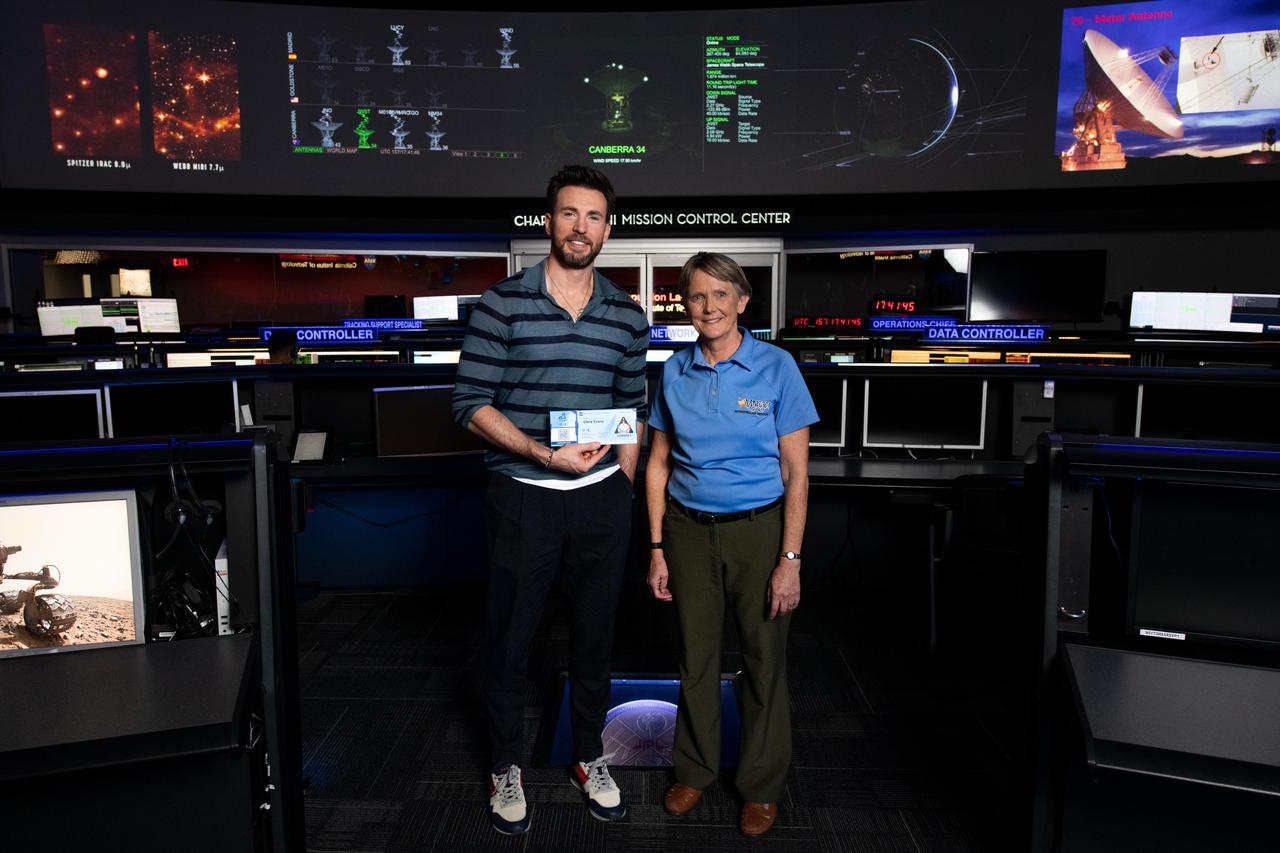
Actor Chris Evans (left) receives a "boarding pass" to the Moon from Suzanne Dodd, director of the Interplanetary Network Directorate at NASA's Jet Propulsion Laboratory in Southern California. The pair are seen in the Space Flight Operations Facility at JPL on June 6, 2022. Evans visited JPL to learn more about space missions after starring as the lead voice in the space-themed movie "Lightyear." More than 3 million names, including Evans', were submitted online and will be included on a flash drive that will fly on the Orion spacecraft during NASA's Artemis I mission to the Moon. Artemis I will be the first uncrewed flight test of the Space Launch System rocket and the Orion spacecraft launching from NASA's Kennedy Space Center in Florida. NASA's Artemis program aims to establish a sustained human presence on the Moon that will serve as a launching pad for exploring Mars and beyond. https://photojournal.jpl.nasa.gov/catalog/PIA25311
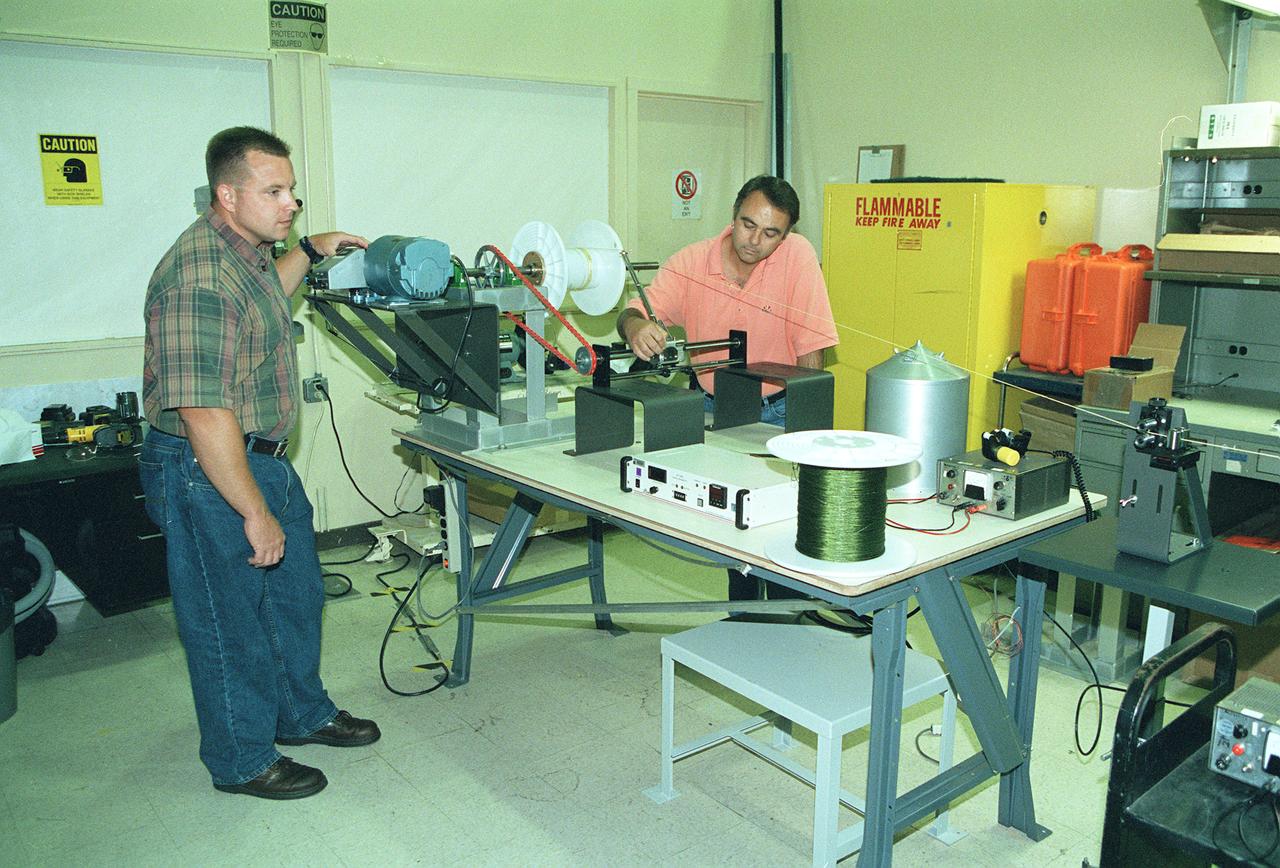
This photograph shows two Marshall Space Flight Center (MSFC) engineers, Mark Vaccaro (left) and Ken Welzyn, testing electrodynamic tethers in the MSFC Tether Winding and Spark Testing Facility. For 4 years, MSFC and industry partners have been developing the Propulsive Small Expendable Deployer System experiment, called ProSEDS. ProSEDS will test electrodynamic tether propulsion technology. Electrodynamic tethers are long, thin wires that collect electrical current when passing through a magnetic field. The tether works as a thruster as a magnetic field exerts a force on a current-carrying wire. Since electrodynamic tethers require no propellant, they could substantially reduce the weight of the spacecraft and provide a cost-effective method of reboosting spacecraft. The initial flight of ProSEDS is scheduled to fly aboard an Air Force Delta II rocket in the summer of 2002. In orbit, ProSEDS will deploy from a Delta II second stage. It will be a 3.1-mile (5 kilometer) long, ultrathin base-wire tether cornected with a 6.2-mile (10 kilometer) long non-conducting tether. This photograph shows Less Johnson, a scientist at MSFC, inspecting the nonconducting part of a tether as it exits a deployer similar to the one to be used in the ProSEDS experiment. The ProSEDS experiment is managed by the Space Transportation Directorate at MSFC.
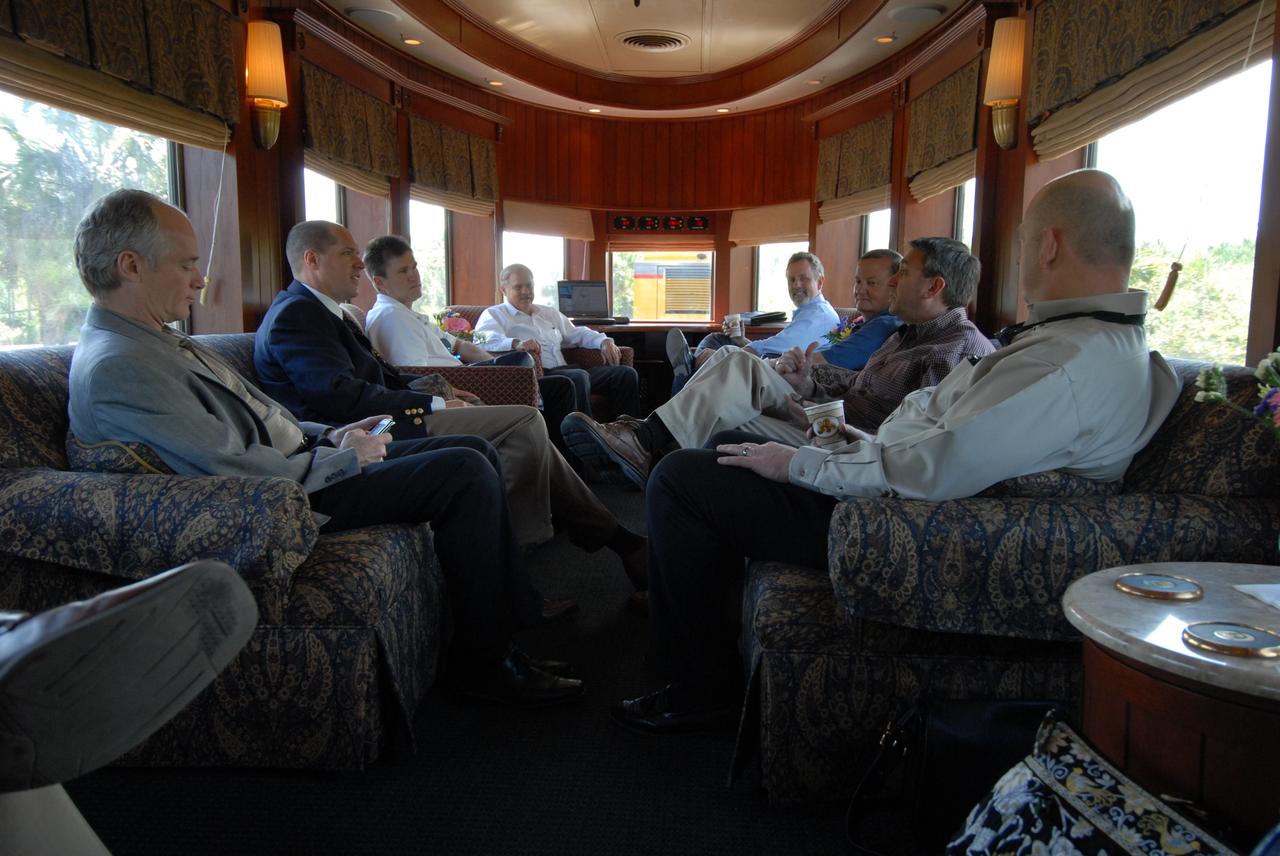
CAPE CANAVERAL, Fla. – ATK and NASA officials accompanied the Florida East Coast Railroad train carrying the booster segments for the Ares I-X test rocket on its route to NASA's Kennedy Space Center in Florida from Jacksonville, Fla. Seen here in the passenger car are, from left, ATK Vice President Space Launch Systems Charlie Precourt, a Florida East Coast Railroad representative, ATK Deputy Site Director in Florida Ted Shaffner, ATK Vice President Of Space Launch Propulsion Cary Ralston, NASA KSC Shuttle Launch Director Mike Leinbach, a Florida East Coast Railroad representative and ATK Ares I First Stage program Director Fred Brasfield. The four reusable motor segments and the nozzle exit cone, manufactured by the Ares I first-stage prime contractor Alliant Techsystems Inc., or ATK, departed Utah March 12 on the seven-day, cross-country trip to Florida. The segments will be delivered to the Rotation, Processing and Surge Facility for final processing and integration. The booster used for the Ares I-X launch is being modified by adding new forward structures and a fifth segment simulator. The motor is the final hardware needed for the rocket's upcoming test flight this summer. The stacking operations are scheduled to begin in the Vehicle Assembly Building in April. Photo credit: NASA/Kim Shiflett
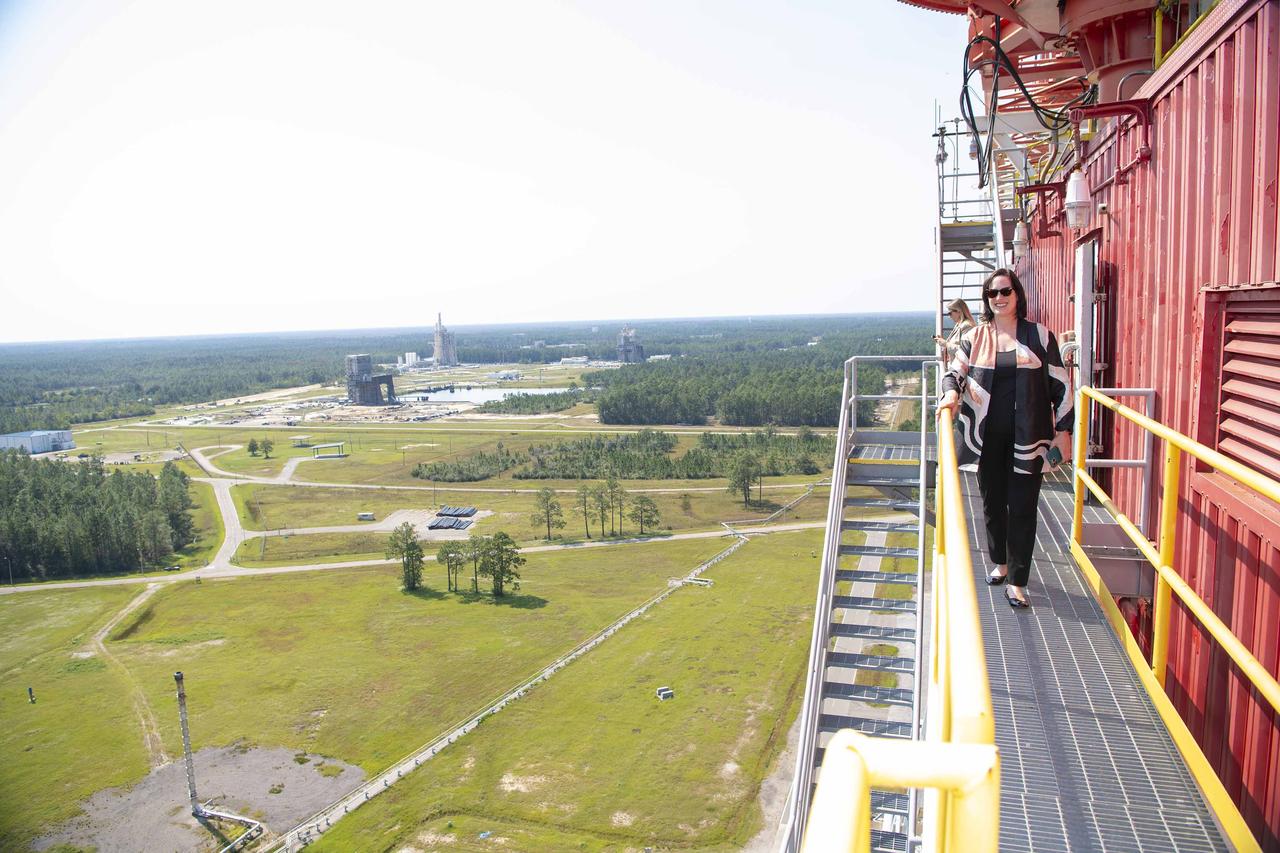
Heide Fulton, U.S. Ambassador to the Oriental Republic of Uruguay, visits NASA Stennis on Oct. 8 to meet with site leadership and tour test complex facilities. During her visit, Fulton met with NASA Stennis Director John Bailey and other leaders of the center and the NASA Shared Services Center located onsite. She also toured the rocket propulsion test complex, visiting the B-2 side of the Thad Cochran Test Stand, where she was briefed by B-2 Stand Director Ryan Roberts about NASA Stennis testing for the SLS (Space Launch System) rocket and NASA’s Artemis missions to the Moon and beyond. Uruguay is one of 45 nations who have signed the Artemis Accords, which establish a practical set of principles to guide space exploration cooperation among nations. The country became the 36th nation to sign the Artemis Accords during a Washington, D.C. ceremony in February. Ambassador Fulton was joined on the visit by Cmdr. Brendan Rok, chief of the U.S. Navy Office of Defense Cooperation at the U.S. Embassy in Montevideo, Uruguay; and Leah Thorstenson, foreign policy advisor with the U.S. Marines Corps. Forces South.
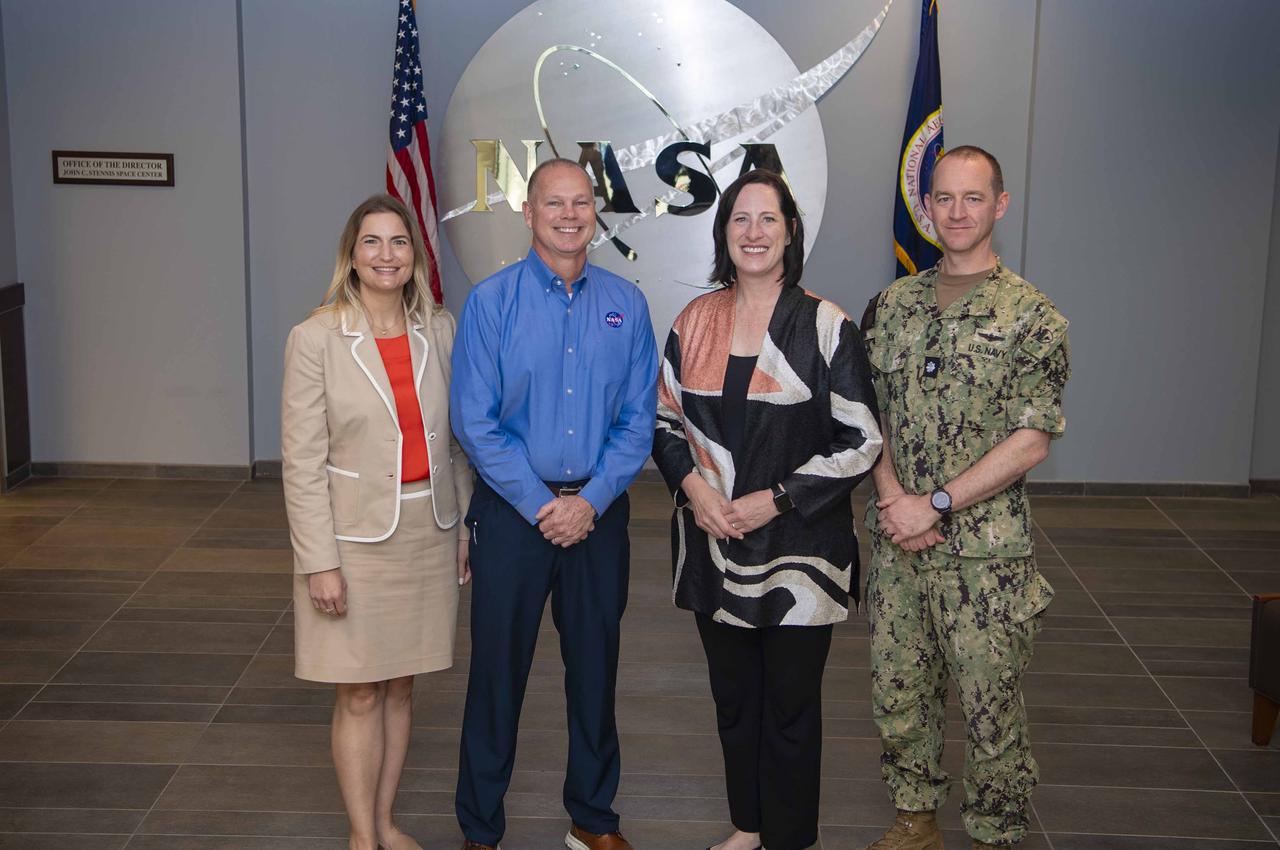
Heide Fulton, U.S. Ambassador to the Oriental Republic of Uruguay, visits NASA Stennis on Oct. 8 to meet with site leadership and tour test complex facilities. During her visit, Fulton met with NASA Stennis Director John Bailey and other leaders of the center and the NASA Shared Services Center located onsite. She also toured the rocket propulsion test complex, visiting the B-2 side of the Thad Cochran Test Stand, where she was briefed by B-2 Stand Director Ryan Roberts about NASA Stennis testing for the SLS (Space Launch System) rocket and NASA’s Artemis missions to the Moon and beyond. Uruguay is one of 45 nations who have signed the Artemis Accords, which establish a practical set of principles to guide space exploration cooperation among nations. The country became the 36th nation to sign the Artemis Accords during a Washington, D.C. ceremony in February. Ambassador Fulton was joined on the visit by Cmdr. Brendan Rok, chief of the U.S. Navy Office of Defense Cooperation at the U.S. Embassy in Montevideo, Uruguay; and Leah Thorstenson, foreign policy advisor with the U.S. Marines Corps. Forces South.
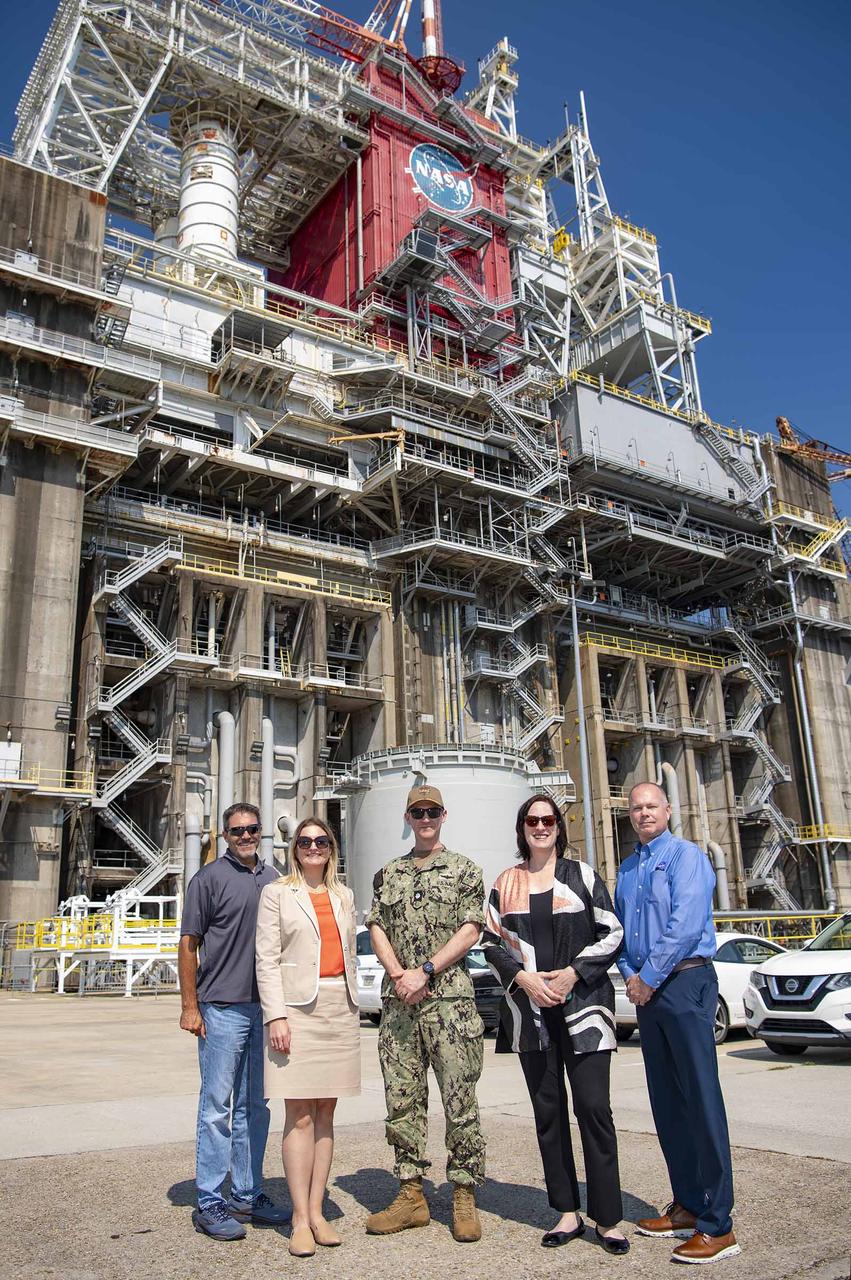
Heide Fulton, U.S. Ambassador to the Oriental Republic of Uruguay, visits NASA Stennis on Oct. 8 to meet with site leadership and tour test complex facilities. During her visit, Fulton met with NASA Stennis Director John Bailey and other leaders of the center and the NASA Shared Services Center located onsite. She also toured the rocket propulsion test complex, visiting the B-2 side of the Thad Cochran Test Stand, where she was briefed by B-2 Stand Director Ryan Roberts about NASA Stennis testing for the SLS (Space Launch System) rocket and NASA’s Artemis missions to the Moon and beyond. Uruguay is one of 45 nations who have signed the Artemis Accords, which establish a practical set of principles to guide space exploration cooperation among nations. The country became the 36th nation to sign the Artemis Accords during a Washington, D.C. ceremony in February. Ambassador Fulton was joined on the visit by Cmdr. Brendan Rok, chief of the U.S. Navy Office of Defense Cooperation at the U.S. Embassy in Montevideo, Uruguay; and Leah Thorstenson, foreign policy advisor with the U.S. Marines Corps. Forces South.
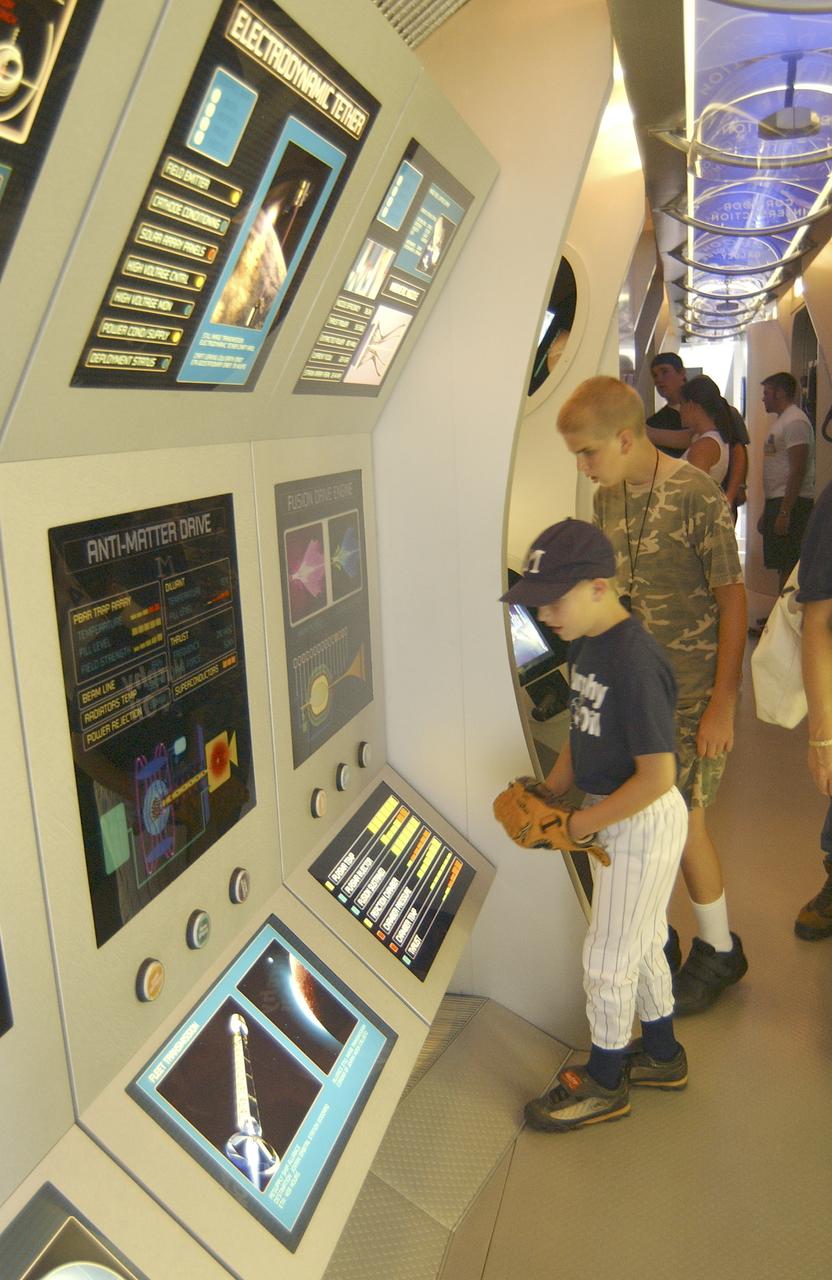
This photograph shows onlookers viewing displays within the Starship 2040 exhibit on display at Joe Davis Stadium in Huntsville, Alabama. Developed by the Space Transportation Directorate at Marshall Space Flight Center (MSFC), the Starship 2040 exhibit is housed in a 48-ft (14.6-m) tractor and trailer rig, permitting it to travel around the Nation, demonstrating NASA's vision of what commercial spaceflight might be like 40 years from now. All the irnovations suggested aboard the exhibit (automated vehicle health monitoring systems, high-energy propulsion drive, navigational aids, and emergency and safety systems) are based on concepts and technologies now being studied at NASA Centers and partner institutions around the Nation. NASA is the Nation's premier agency for development of the space transportation system, including future-generation reusable launch vehicles. Such systems, the keys to a "real" Starship 2040, require revolutionary advances in critical aerospace technologies, from thermal, magnetic, chemical, and propellantless propulsion systems to new energy sources such as space solar power or antimatter propulsion. These and other advances are now being studied, developed, and tested at NASA field centers and partner institutions all over the Nation.
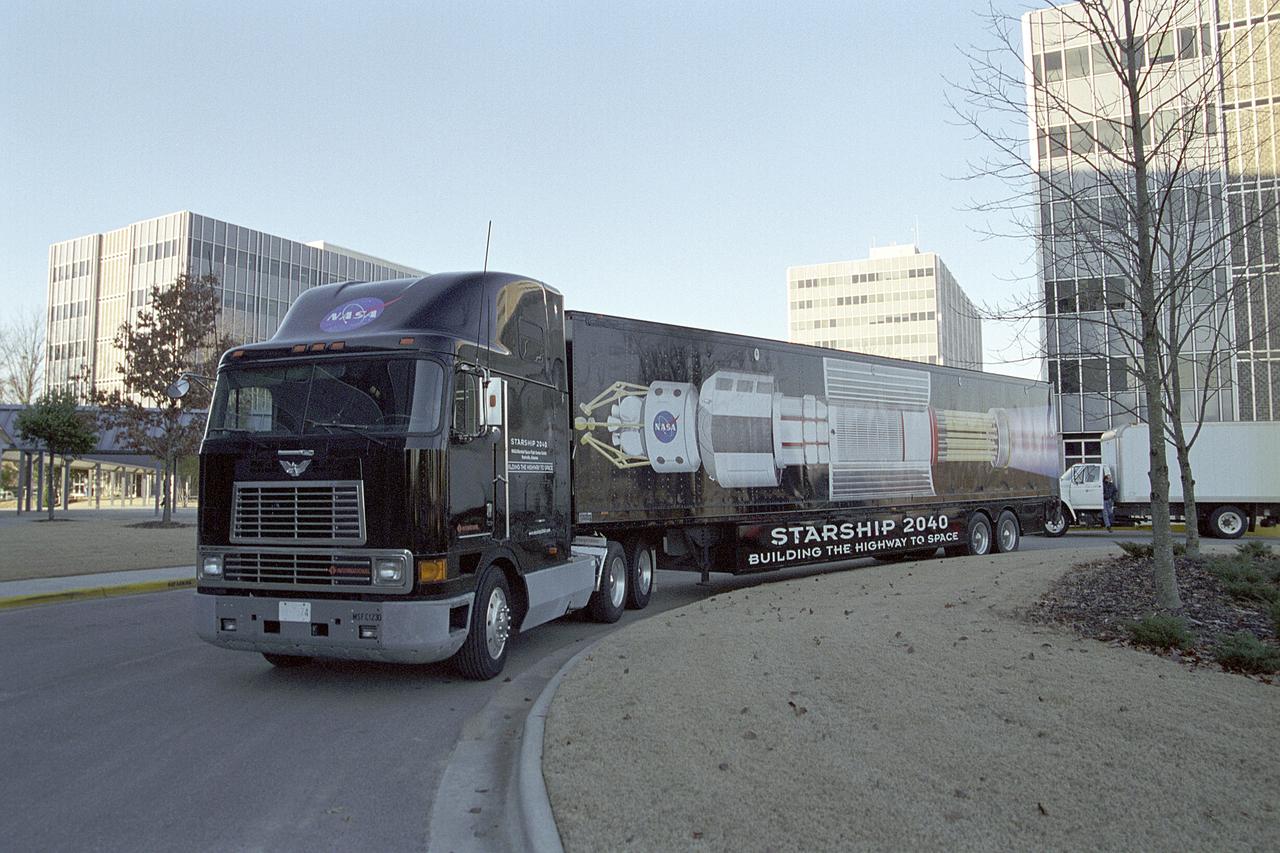
This photograph shows the Starship 2040 leaving the Marshall Space Flight Center (MSFC) for the exhibit site. Developed by the Space Transportation Directorate at MSFC, the Starship 2040 exhibit is housed in a 48-ft (14.6-m) tractor and trailer rig, permitting it to travel around the Nation, demonstrating NASA's vision of what commercial spaceflight might be like 40 years from now. All the irnovations suggested aboard the exhibit, automated vehicle health monitoring systems, high-energy propulsion drive, navigational aids and emergency and safety systems, are based on concepts and technologies now being studied at NASA Centers and partner institutions around the Nation. NASA is the nation's premier agency for development of the space transportation system, including future-generation reusable launch vehicles. Such systems, the keys to a "real" Starship 2040, require revolutionary advances in critical aerospace technologies, from thermal, magnetic, chemical, and propellantless propulsion systems to new energy sources such as space solar power or antimatter propulsion. These and other advances are now being studied, developed, and tested at NASA field centers and partner institutions all over the Nation.
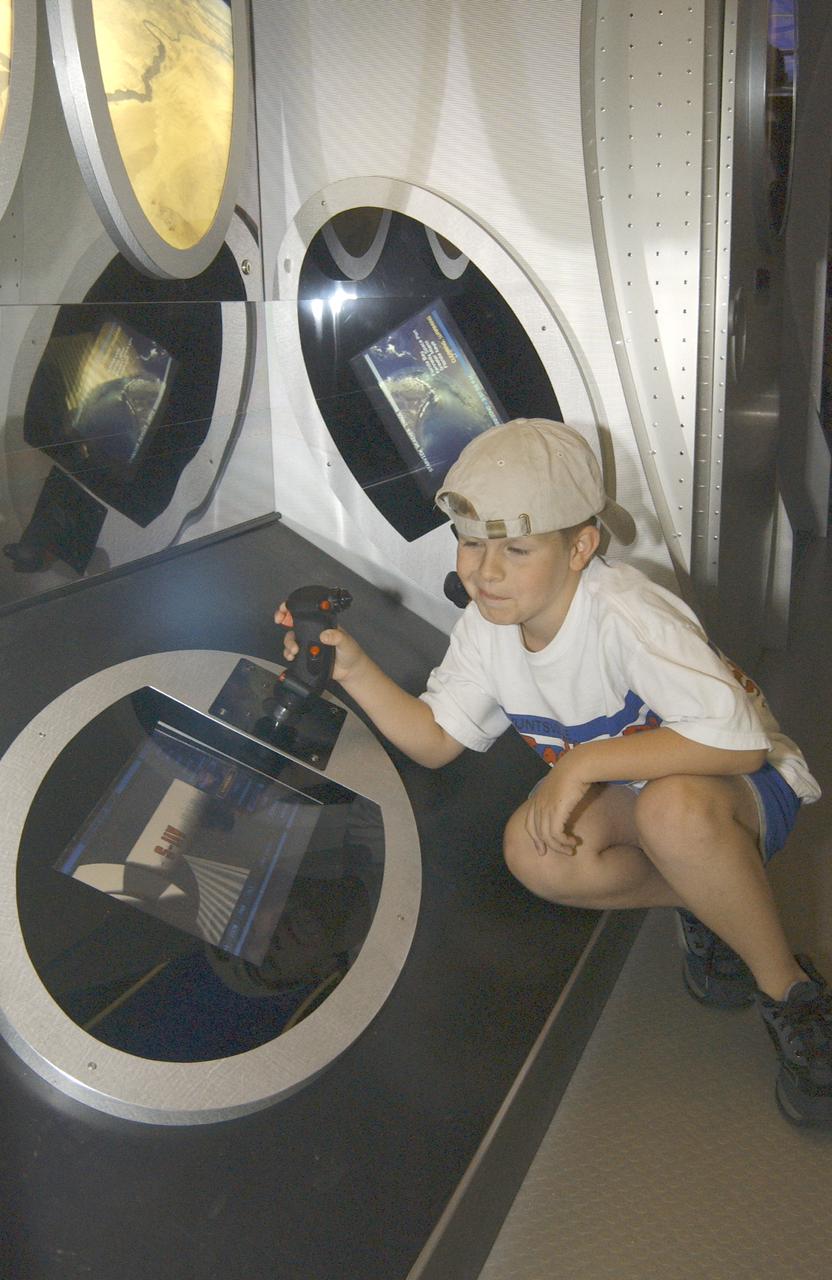
This photograph shows Justin Varnadore, son of a Marshall TV employee, at the controls of one of the many displays within the Starship 2040 exhibit on display at Joe Davis Stadium in Huntsville, Alabama. Developed by the Space Transportation Directorate at Marshall Space Flight Center (MSFC), the Starship 2040 exhibit is housed in a 48-ft (14.6-m) tractor and trailer rig, permitting it to travel around the Nation, demonstrating NASA's vision of what commercial spaceflight might be like 40 years from now. All the irnovations suggested aboard the exhibit (automated vehicle health monitoring systems, high-energy propulsion drive, navigational aids, and emergency and safety systems) are based on concepts and technologies now being studied at NASA Centers and partner institutions around the Nation. NASA is the Nation's premier agency for development of the space transportation system, including future-generation reusable launch vehicles. Such systems, the keys to a "real" Starship 2040, require revolutionary advances in critical aerospace technologies, from thermal, magnetic, chemical, and propellantless propulsion systems to new energy sources such as space solar power or antimatter propulsion. These and other advances are now being studied, developed, and tested at NASA field centers and partner institutions all over the Nation.
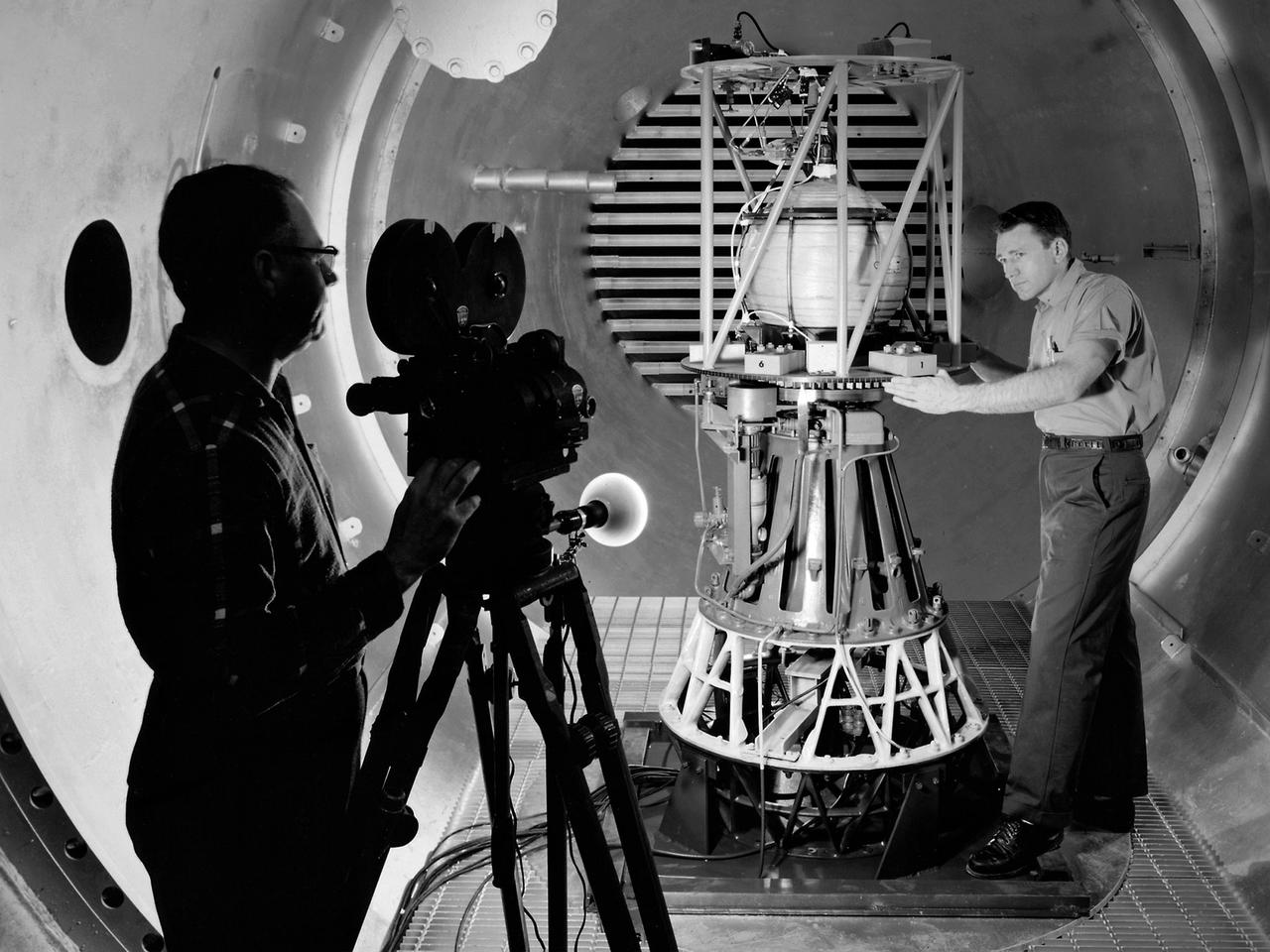
Mechanic Howard Wine inspects the setup of a spin isolator in Cell 2 of the Propulsion Systems Laboratory at the National Aeronautics and Space Administration (NASA) Lewis Research Center. Photographer Al Jecko filmed the proceedings. This test was unique in that the chamber’s altitude system was used, but not its inlet air flow. The test was in preparation for an upcoming launch of modified liquid hydrogen propellant tank on a sounding rocket. This Weightlessness Analysis Sounding Probe (WASP) was part of Lewis investigation into methods for controlling partially filled liquid hydrogen fuel tanks during flight. Second-stage rockets, the Centaur in particular, were designed to stop their engines and coast, then restart them when needed. During this coast period, the propellant often shifted inside the tank. This movement could throw the rocket off course or result in the sloshing of fuel away from the fuel pump. Wine was one of only three journeymen mechanics at Lewis when he was hired in January 1954. He spent his first decade in the Propulsion Systems Laboratory and was soon named a section head. Wine went on to serve as Assistant Division Chief and later served as an assistant to the director. Jecko joined the center in 1947 as a photographer and artist. He studied at the Cleveland School or Art and was known for his cartoon drawing. He worked at the center for 26 years.

CAPE CANAVERAL, Fla. - NASA's Morpheus lander, a vertical test bed vehicle, is unloaded at the Kennedy Space Center in Florida. Morpheus is designed to demonstrate new green propellant propulsion systems and autonomous landing and an Autonomous Landing and Hazard Avoidance Technology, or ALHAT, system. Checkout of the prototype lander has been ongoing at NASA’s Johnson Space Center in Houston in preparation for its first free flight. The SLF site will provide the lander with the kind of field necessary for realistic testing. Project Morpheus is one of 20 small projects comprising the Advanced Exploration Systems, or AES, program in NASA’s Human Exploration and Operations Mission Directorate. AES projects pioneer new approaches for rapidly developing prototype systems, demonstrating key capabilities and validating operational concepts for future human missions beyond Earth orbit. For more information on Project Morpheus, visit http://www.nasa.gov/centers/johnson/exploration/morpheus/index.html Photo credit: NASA/ Charisse Nahser
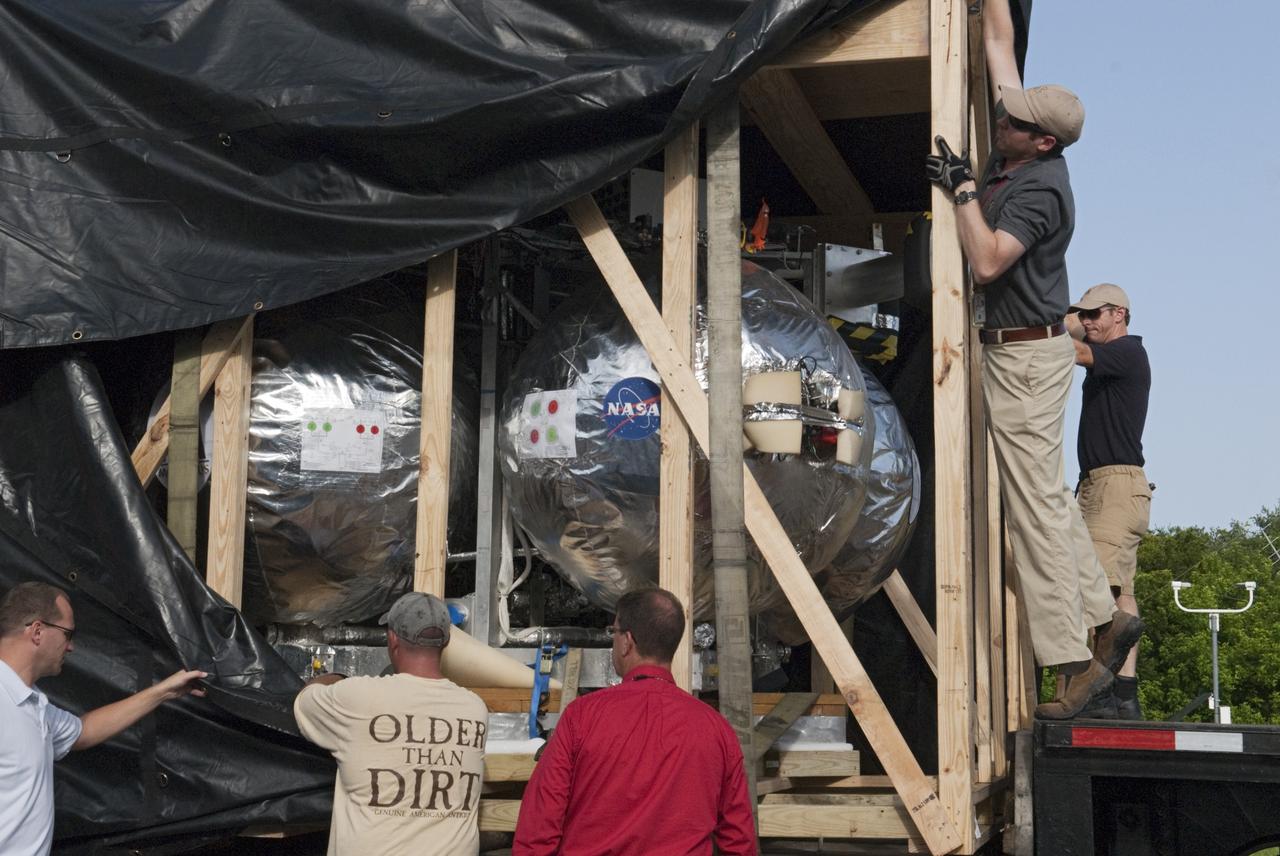
CAPE CANAVERAL, Fla. - NASA's Morpheus lander, a vertical test bed vehicle, is unloaded at the Kennedy Space Center in Florida. Morpheus is designed to demonstrate new green propellant propulsion systems and autonomous landing and an Autonomous Landing and Hazard Avoidance Technology, or ALHAT, system. Checkout of the prototype lander has been ongoing at NASA’s Johnson Space Center in Houston in preparation for its first free flight. The SLF site will provide the lander with the kind of field necessary for realistic testing. Project Morpheus is one of 20 small projects comprising the Advanced Exploration Systems, or AES, program in NASA’s Human Exploration and Operations Mission Directorate. AES projects pioneer new approaches for rapidly developing prototype systems, demonstrating key capabilities and validating operational concepts for future human missions beyond Earth orbit. For more information on Project Morpheus, visit http://www.nasa.gov/centers/johnson/exploration/morpheus/index.html Photo credit: NASA/ Charisse Nahser
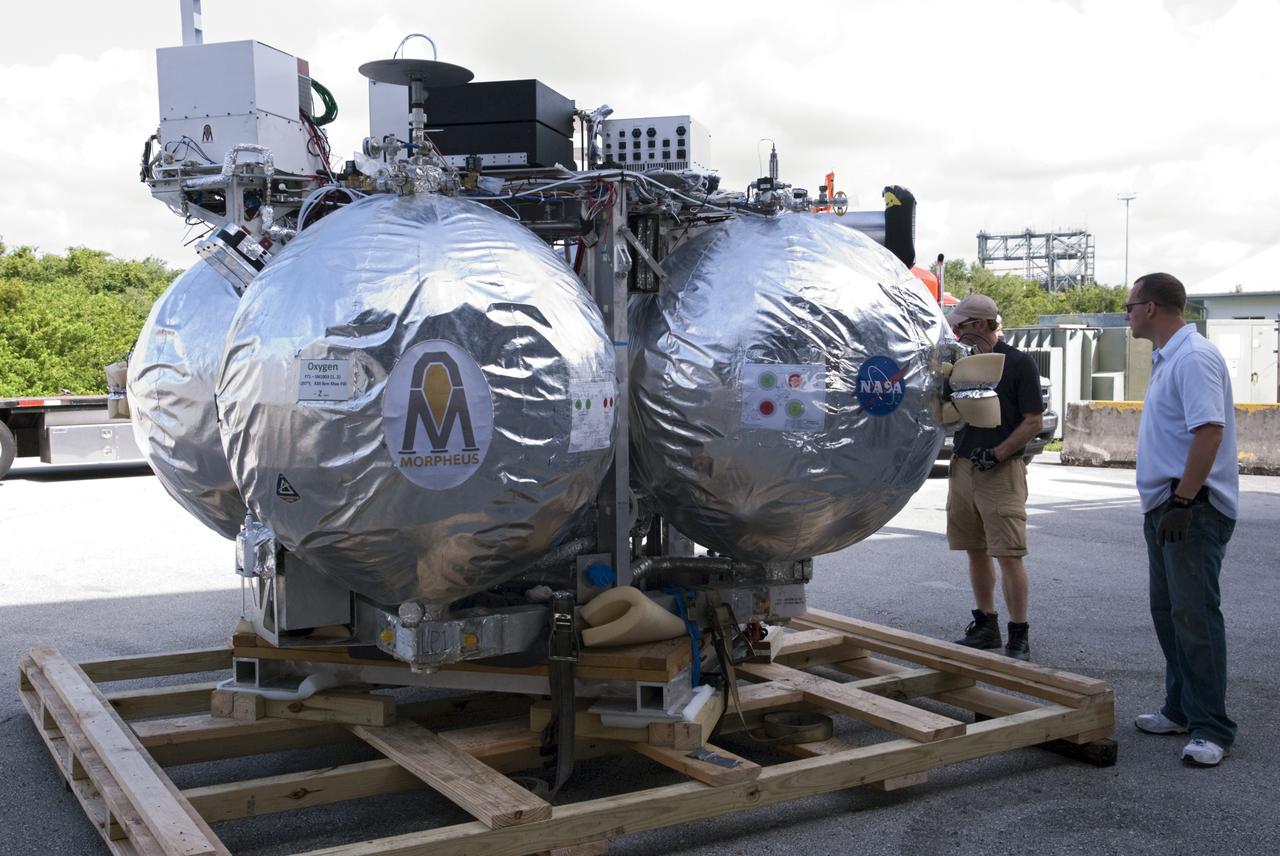
CAPE CANAVERAL, Fla. - NASA's Morpheus lander, a vertical test bed vehicle, is unloaded at the Kennedy Space Center in Florida. Morpheus is designed to demonstrate new green propellant propulsion systems and autonomous landing and an Autonomous Landing and Hazard Avoidance Technology, or ALHAT, system. Checkout of the prototype lander has been ongoing at NASA’s Johnson Space Center in Houston in preparation for its first free flight. The SLF site will provide the lander with the kind of field necessary for realistic testing. Project Morpheus is one of 20 small projects comprising the Advanced Exploration Systems, or AES, program in NASA’s Human Exploration and Operations Mission Directorate. AES projects pioneer new approaches for rapidly developing prototype systems, demonstrating key capabilities and validating operational concepts for future human missions beyond Earth orbit. For more information on Project Morpheus, visit http://www.nasa.gov/centers/johnson/exploration/morpheus/index.html Photo credit: NASA/ Charisse Nahser
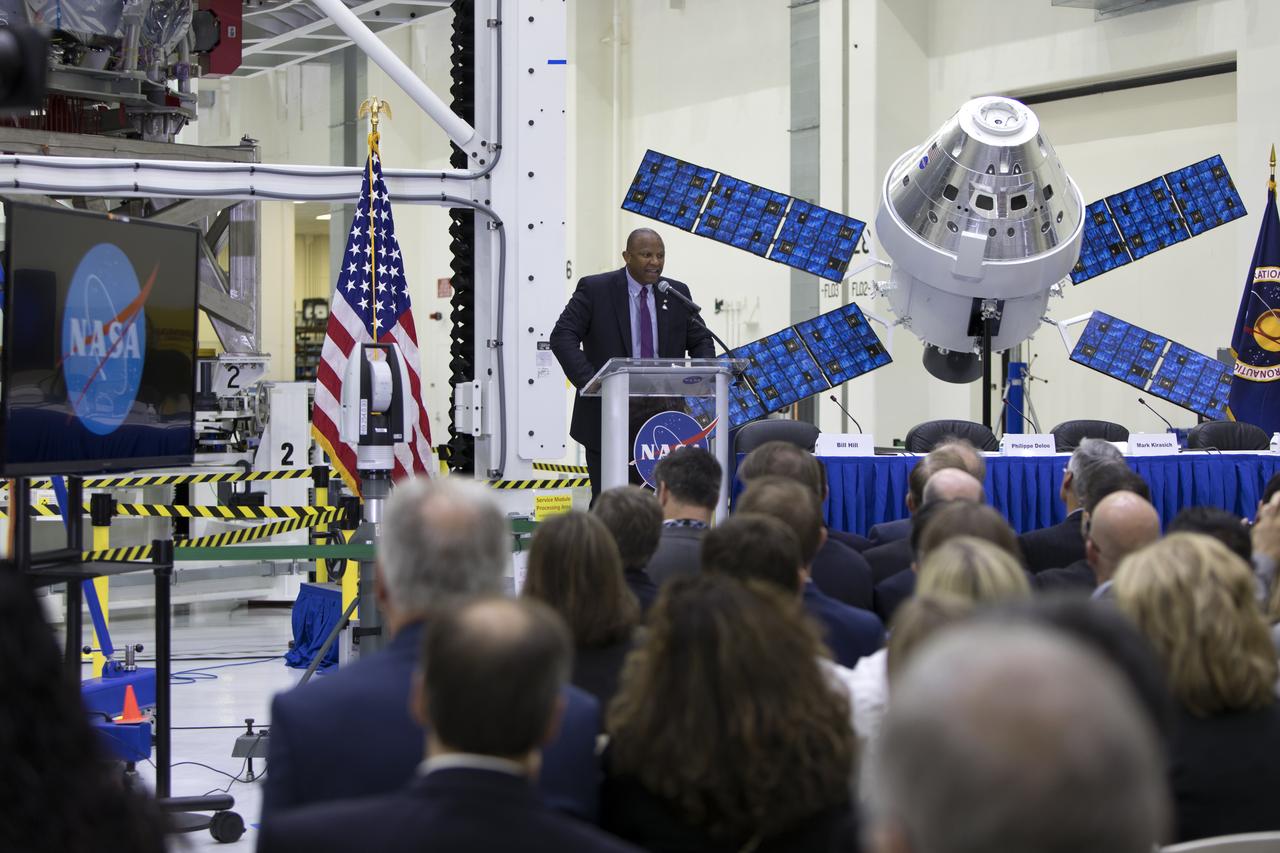
Kennedy Space Center Associate Director Kelvin Manning speaks to guests at NASA's "Powering Exploration Mission-1" ceremony in the high bay of the Neil Armstrong Operations and Checkout Building at the center on Nov. 16, 2018. The event was held to mark a major milestone, the arrival of the European Service Module (ESM) for Orion's Exploration Mission-1. The service module, built by the European Space Agency, will supply the main propulsion system and power to the Orion spacecraft during EM-1, a mission to the Moon. The ESM also will house air and water for astronauts on future missions. EM-1 will be an uncrewed flight test that will provide a foundation for human deep space exploration to destinations beyond Earth orbit. EM-1 will be the first integrated test of NASA's Space Launch System, Orion and the ground systems at Kennedy.
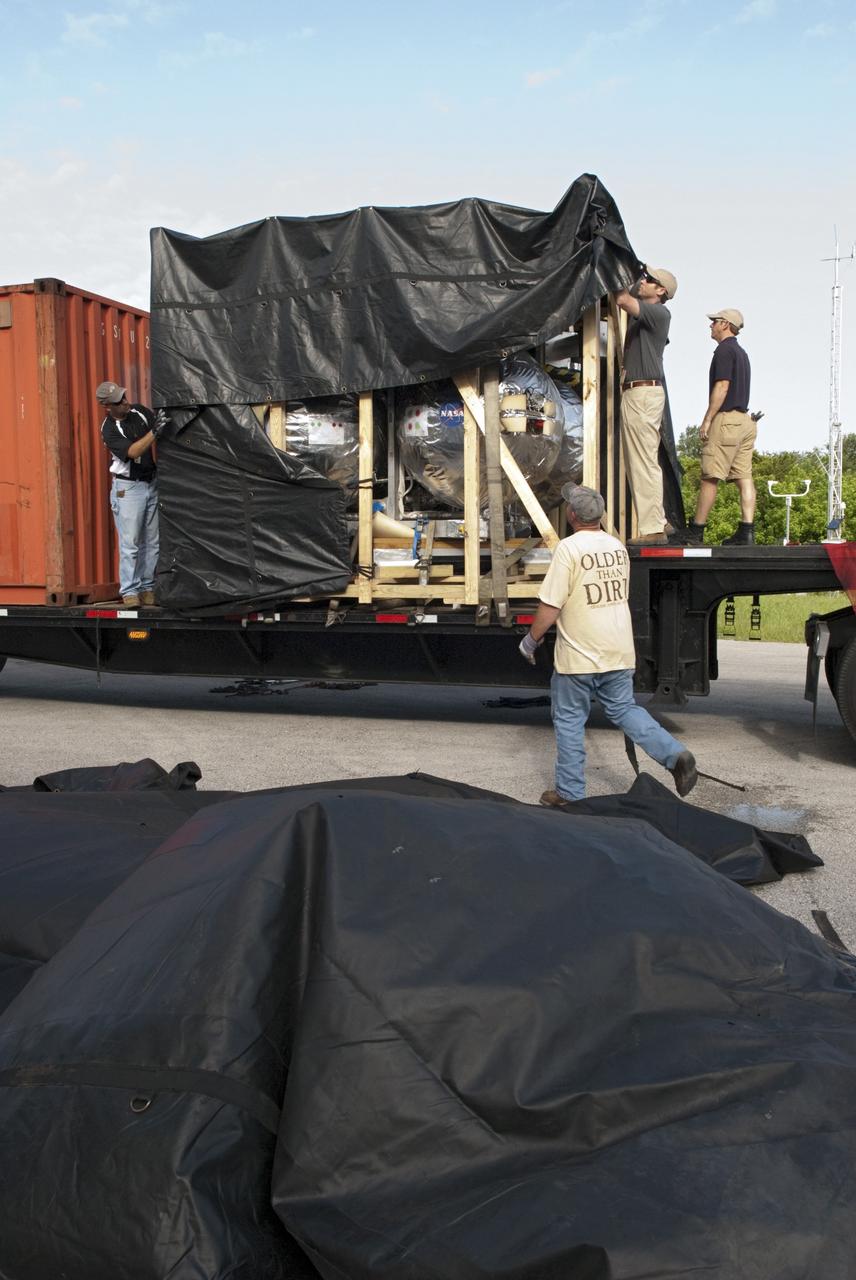
CAPE CANAVERAL, Fla. - NASA's Morpheus lander, a vertical test bed vehicle, is unloaded at the Kennedy Space Center in Florida. Morpheus is designed to demonstrate new green propellant propulsion systems and autonomous landing and an Autonomous Landing and Hazard Avoidance Technology, or ALHAT, system. Checkout of the prototype lander has been ongoing at NASA’s Johnson Space Center in Houston in preparation for its first free flight. The SLF site will provide the lander with the kind of field necessary for realistic testing. Project Morpheus is one of 20 small projects comprising the Advanced Exploration Systems, or AES, program in NASA’s Human Exploration and Operations Mission Directorate. AES projects pioneer new approaches for rapidly developing prototype systems, demonstrating key capabilities and validating operational concepts for future human missions beyond Earth orbit. For more information on Project Morpheus, visit http://www.nasa.gov/centers/johnson/exploration/morpheus/index.html Photo credit: NASA/ Charisse Nahser
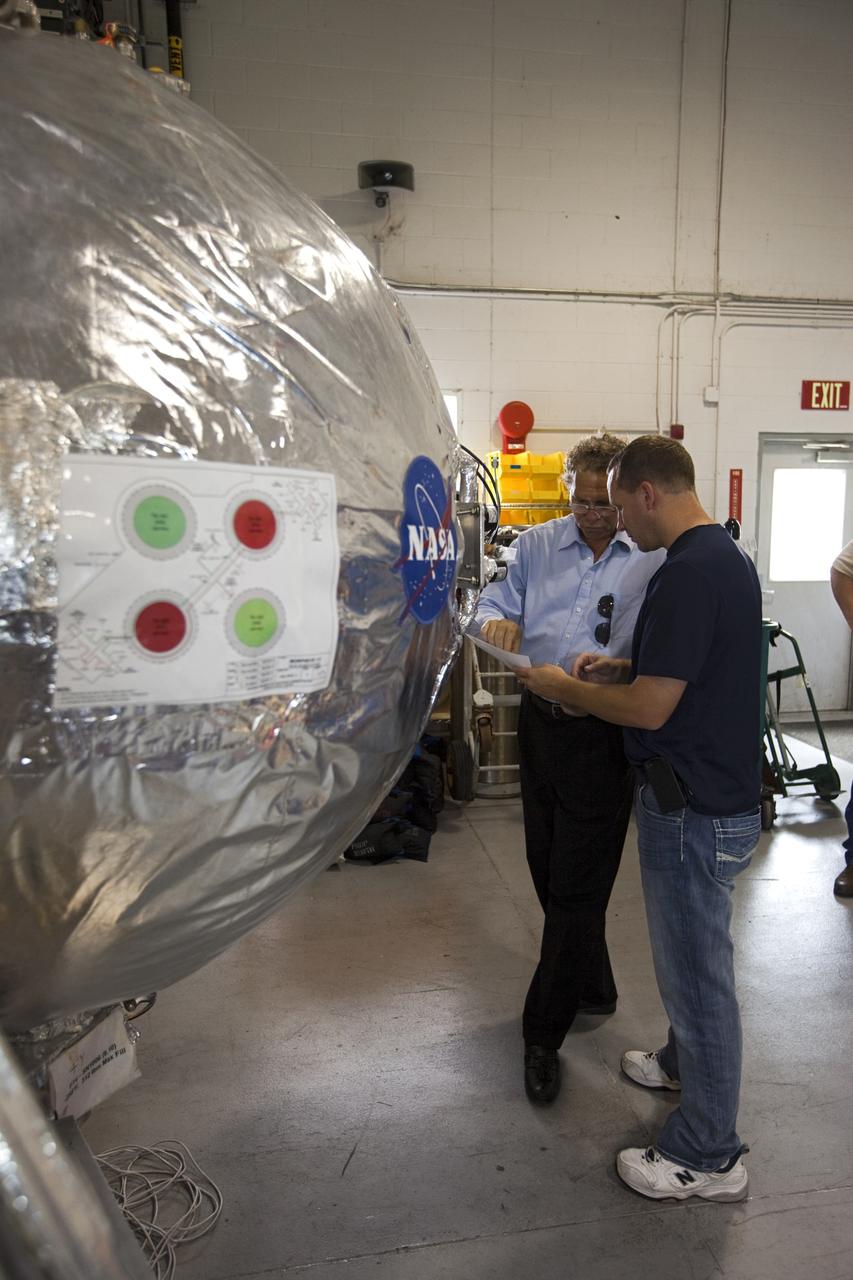
CAPE CANAVERAL, Fla. - Russell Romanella, director of Safety and Mission Assurance at NASA's Kennedy Space Center in Florida, left, is briefed on NASA's Morpheus lander, a vertical test bed vehicle. Morpheus is being checked out by technicians and engineers in a building at the Shuttle Landing Facility, or SLF, at Kennedy. Morpheus is designed to demonstrate new green propellant propulsion systems and autonomous landing and an Autonomous Landing and Hazard Avoidance Technology, or ALHAT, system. Checkout of the prototype lander has been ongoing at NASA’s Johnson Space Center in Houston in preparation for its first free flight. The SLF site will provide the lander with the kind of field necessary for realistic testing. Project Morpheus is one of 20 small projects comprising the Advanced Exploration Systems, or AES, program in NASA’s Human Exploration and Operations Mission Directorate. AES projects pioneer new approaches for rapidly developing prototype systems, demonstrating key capabilities and validating operational concepts for future human missions beyond Earth orbit. For more information on Project Morpheus, visit http://www.nasa.gov/centers/johnson/exploration/morpheus/index.html Photo credit: NASA/Dimitri Gerondidakis
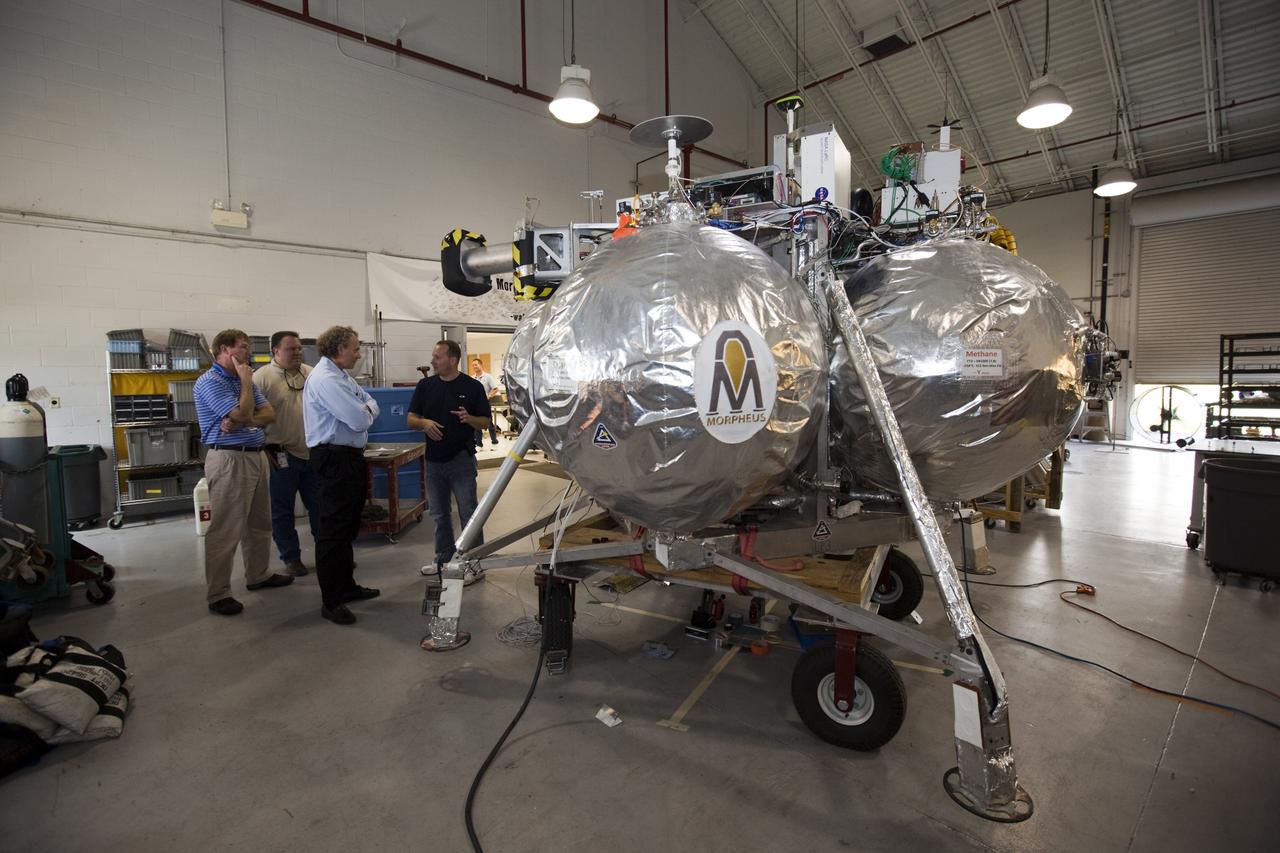
CAPE CANAVERAL, Fla. - Russell Romanella, director of Safety and Mission Assurance at NASA's Kennedy Space Center in Florida, right-center, is briefed on NASA's Morpheus lander, a vertical test bed vehicle. Morpheus is being checked out by technicians and engineers in a building at the Shuttle Landing Facility, or SLF, at Kennedy. Morpheus is designed to demonstrate new green propellant propulsion systems and autonomous landing and an Autonomous Landing and Hazard Avoidance Technology, or ALHAT, system. Checkout of the prototype lander has been ongoing at NASA’s Johnson Space Center in Houston in preparation for its first free flight. The SLF site will provide the lander with the kind of field necessary for realistic testing. Project Morpheus is one of 20 small projects comprising the Advanced Exploration Systems, or AES, program in NASA’s Human Exploration and Operations Mission Directorate. AES projects pioneer new approaches for rapidly developing prototype systems, demonstrating key capabilities and validating operational concepts for future human missions beyond Earth orbit. For more information on Project Morpheus, visit http://www.nasa.gov/centers/johnson/exploration/morpheus/index.html Photo credit: NASA/Dimitri Gerondidakis
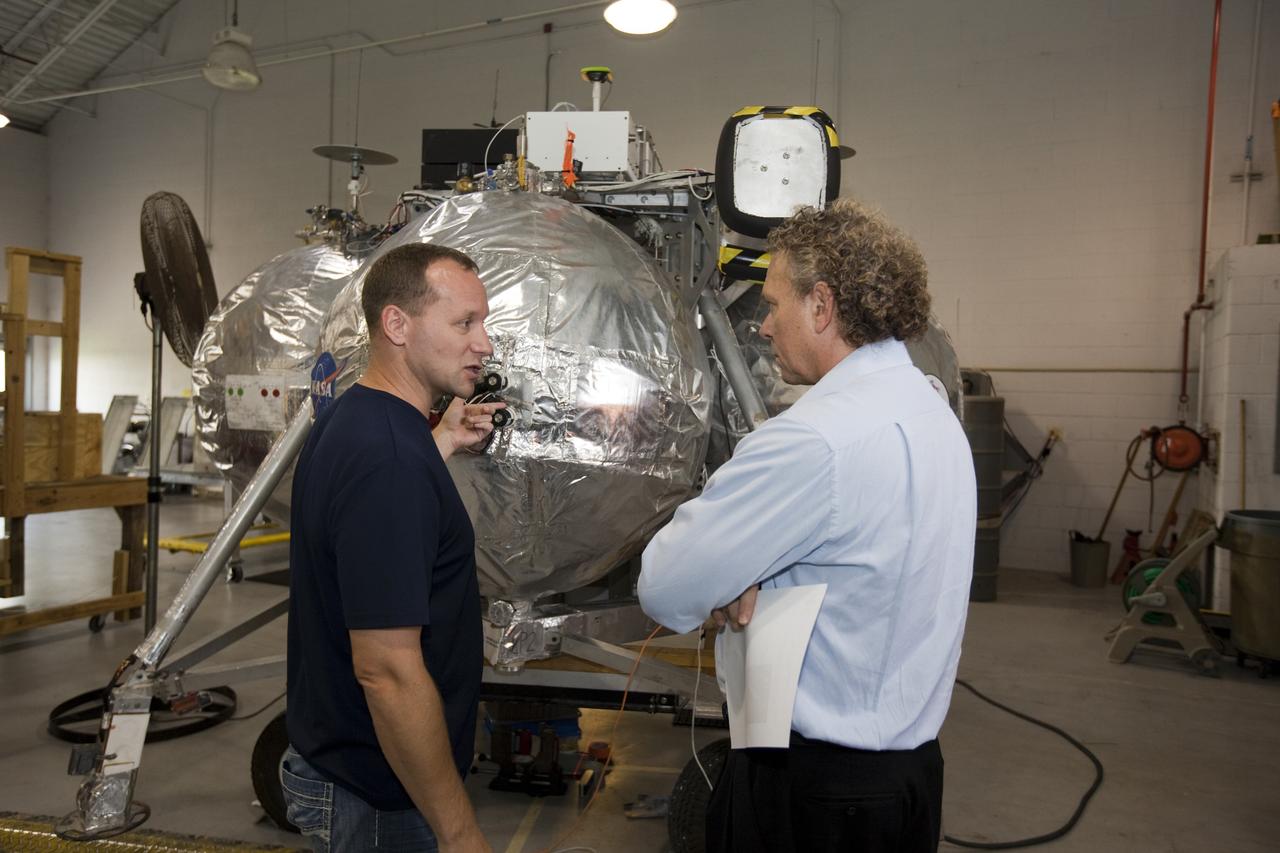
CAPE CANAVERAL, Fla. - Russell Romanella, director of Safety and Mission Assurance at NASA's Kennedy Space Center in Florida, right, is briefed on NASA's Morpheus lander, a vertical test bed vehicle. Morpheus is being checked out by technicians and engineers in a building at the Shuttle Landing Facility, or SLF, at Kennedy. Morpheus is designed to demonstrate new green propellant propulsion systems and autonomous landing and an Autonomous Landing and Hazard Avoidance Technology, or ALHAT, system. Checkout of the prototype lander has been ongoing at NASA’s Johnson Space Center in Houston in preparation for its first free flight. The SLF site will provide the lander with the kind of field necessary for realistic testing. Project Morpheus is one of 20 small projects comprising the Advanced Exploration Systems, or AES, program in NASA’s Human Exploration and Operations Mission Directorate. AES projects pioneer new approaches for rapidly developing prototype systems, demonstrating key capabilities and validating operational concepts for future human missions beyond Earth orbit. For more information on Project Morpheus, visit http://www.nasa.gov/centers/johnson/exploration/morpheus/index.html Photo credit: NASA/Dimitri Gerondidakis
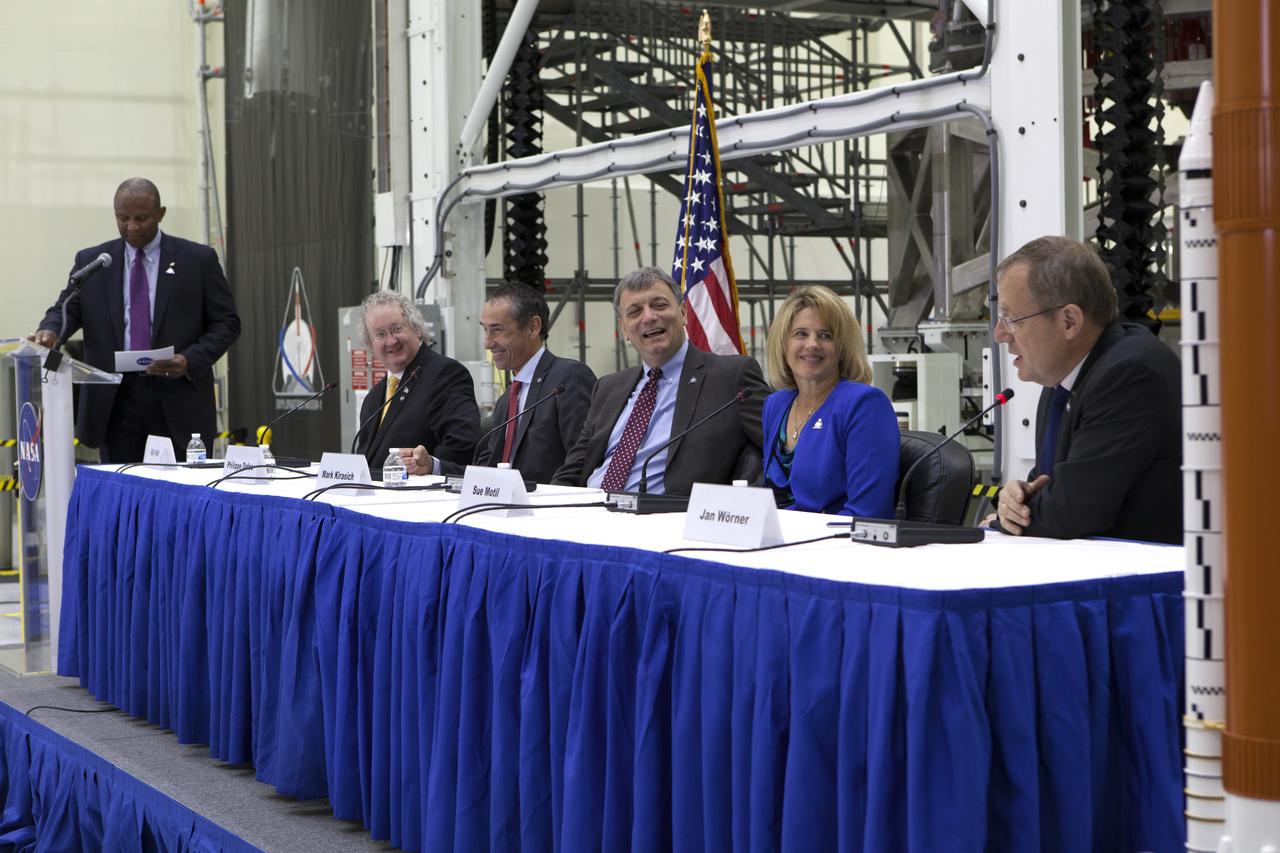
Kennedy Space Center Associate Director Kelvin Manning, far left, moderates questions to NASA and European Space Agency (ESA) senior managers during the "Powering Exploration Mission-1" ceremony in the high bay of the Neil Armstrong Operations and Checkout Building at the center on Nov. 16, 2016. From left, are Bill Hill, deputy associate administrator for Exploration Systems Development; Phillippe Deloo, European Service Module program manager at ESA; Mark Kirasich, Orion Program manager at the agency's Johnson Space Center in Houston; Sue Motil, Orion European Service Module integration manager at the agency's Glenn Research Center; and Jan Worner, ESA director general. The event was held to mark a major milestone, the arrival of the European Service Module (ESM) for Orion's Exploration Mission-1. The service module, built by the European Space Agency, will supply the main propulsion system and power to the Orion spacecraft during EM-1, a mission to the Moon. The ESM also will house air and water for astronauts on future missions. EM-1 will be an uncrewed flight test that will provide a foundation for human deep space exploration to destinations beyond Earth orbit. EM-1 will be the first integrated test of NASA's Space Launch System, Orion and the ground systems at Kennedy.
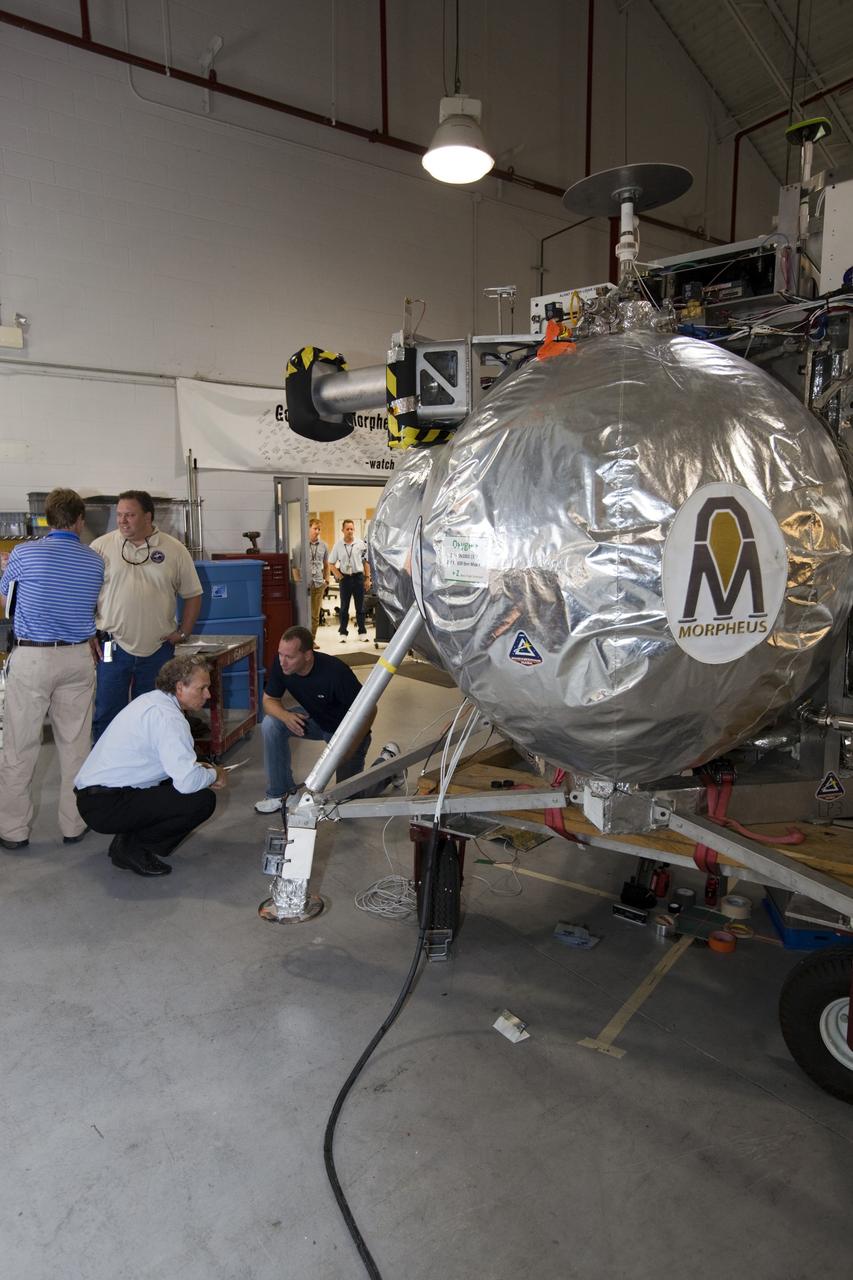
CAPE CANAVERAL, Fla. - Russell Romanella, director of Safety and Mission Assurance at NASA's Kennedy Space Center in Florida, kneeling on the left, is briefed on NASA's Morpheus lander, a vertical test bed vehicle. Morpheus is being checked out by technicians and engineers in a building at the Shuttle Landing Facility, or SLF, at Kennedy. Morpheus is designed to demonstrate new green propellant propulsion systems and autonomous landing and an Autonomous Landing and Hazard Avoidance Technology, or ALHAT, system. Checkout of the prototype lander has been ongoing at NASA’s Johnson Space Center in Houston in preparation for its first free flight. The SLF site will provide the lander with the kind of field necessary for realistic testing. Project Morpheus is one of 20 small projects comprising the Advanced Exploration Systems, or AES, program in NASA’s Human Exploration and Operations Mission Directorate. AES projects pioneer new approaches for rapidly developing prototype systems, demonstrating key capabilities and validating operational concepts for future human missions beyond Earth orbit. For more information on Project Morpheus, visit http://www.nasa.gov/centers/johnson/exploration/morpheus/index.html Photo credit: NASA/Dimitri Gerondidakis
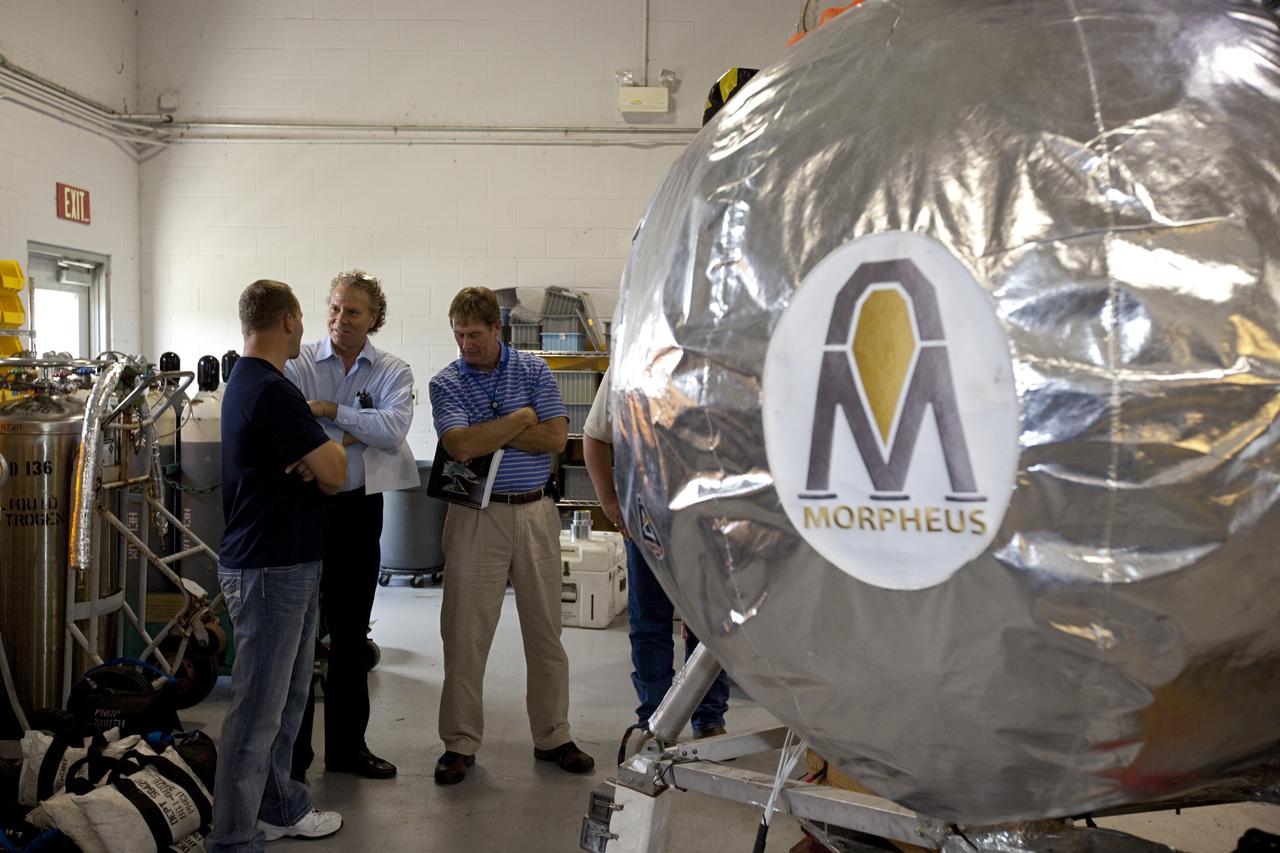
CAPE CANAVERAL, Fla. - Russell Romanella, director of Safety and Mission Assurance at NASA's Kennedy Space Center in Florida, center, is briefed on NASA's Morpheus lander, a vertical test bed vehicle. Morpheus is being checked out by technicians and engineers in a building at the Shuttle Landing Facility, or SLF, at Kennedy. Morpheus is designed to demonstrate new green propellant propulsion systems and autonomous landing and an Autonomous Landing and Hazard Avoidance Technology, or ALHAT, system. Checkout of the prototype lander has been ongoing at NASA’s Johnson Space Center in Houston in preparation for its first free flight. The SLF site will provide the lander with the kind of field necessary for realistic testing. Project Morpheus is one of 20 small projects comprising the Advanced Exploration Systems, or AES, program in NASA’s Human Exploration and Operations Mission Directorate. AES projects pioneer new approaches for rapidly developing prototype systems, demonstrating key capabilities and validating operational concepts for future human missions beyond Earth orbit. For more information on Project Morpheus, visit http://www.nasa.gov/centers/johnson/exploration/morpheus/index.html Photo credit: NASA/Dimitri Gerondidakis
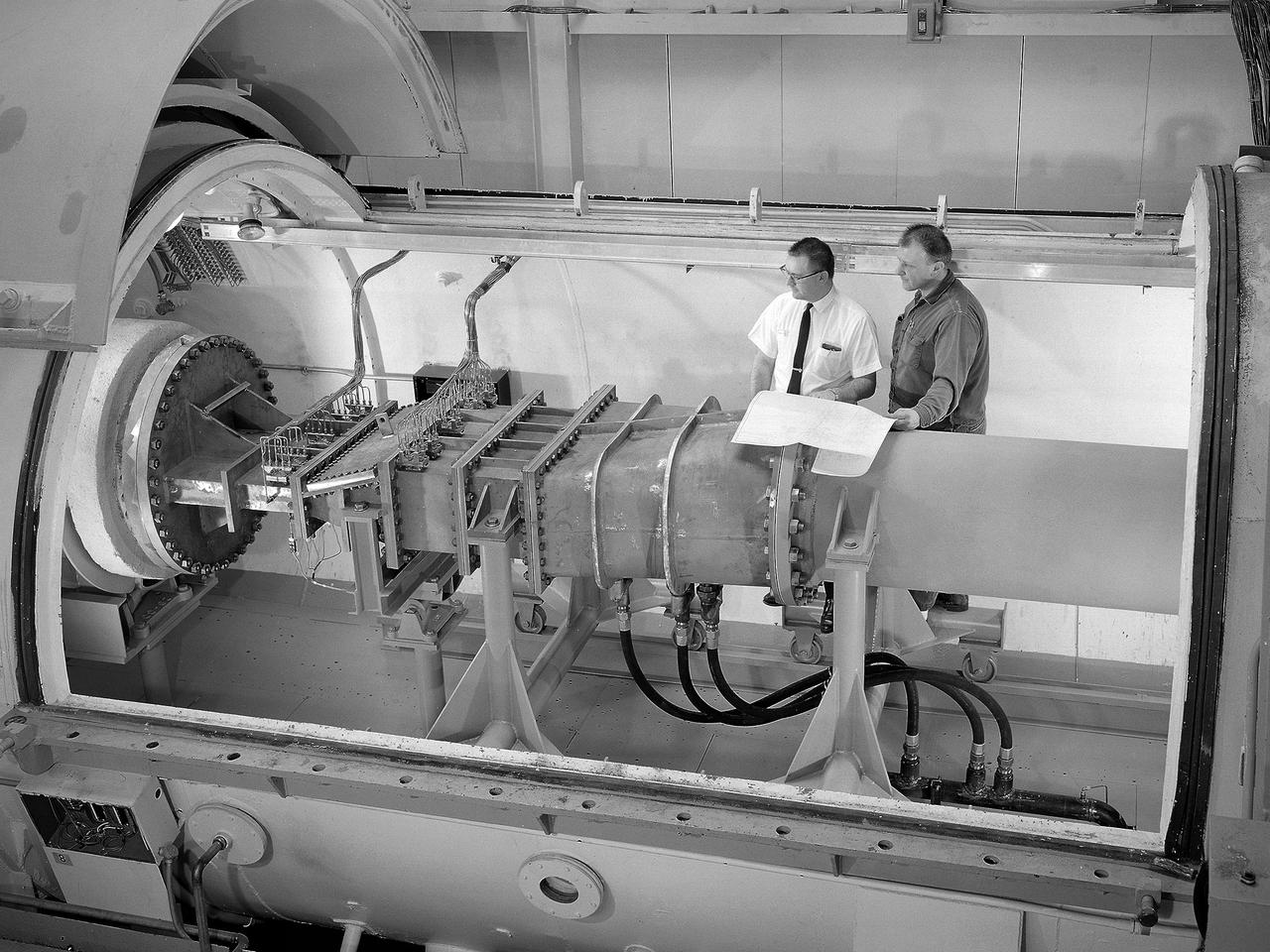
Engineer Frank Kutina and a National Aeronautics and Space Administration (NASA) mechanic examine the setup of an advanced combustor rig inside one of the test cells at the Lewis Research Center’s Four Burner Area in the Engine Research Building. Kutina, of the Research Operations Branch, served as go-between for the researchers and the mechanics. He helped develop the test configurations and get the hardware installed. At the time of this photograph, Lewis Center Director Abe Silverstein had just established the Airbreathing Engine Division to address the new propulsion of the 1960s. After nearly a decade of focusing almost exclusively on space, NASA Lewis began tackling issues relating to the new turbofan engine, noise reduction, energy efficiency, supersonic transport, and the never-ending quest for higher performance levels with smaller and more lightweight engines. The Airbreathing Engine Division’s Combustion Branch was dedicated to the study and mitigation of the high temperatures and pressures found in advanced combustor designs. These high temperatures and pressures could destroy engine components. The Lewis investigation included film cooling, diffuser flow, and jet mixing. Components were tested in smaller test cells, but a full-scale augmenting burner rig, seen here, was tested extensively in the Four Burner Area test cell.
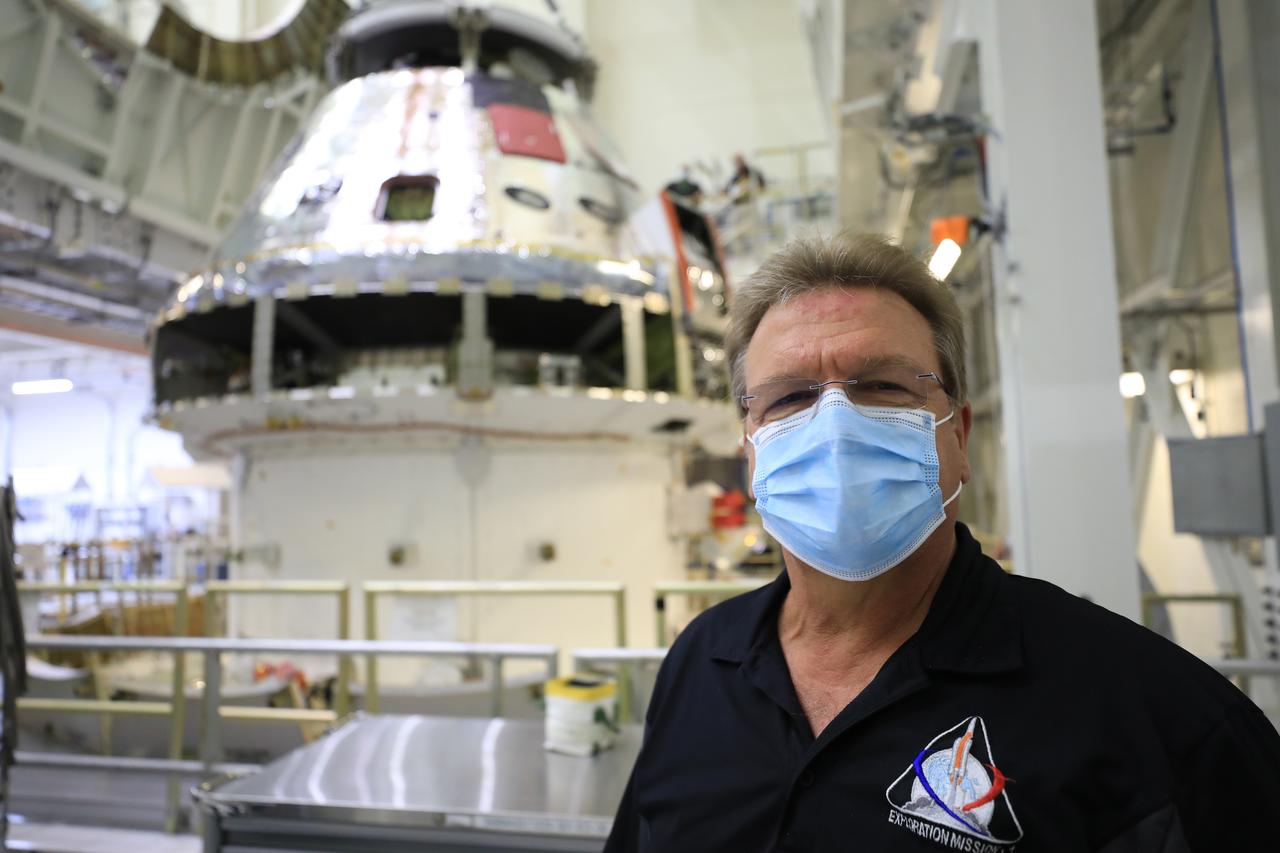
Jules Schneider, Lockheed Martin Assembly, Test and Launch Operations director, is shown inside the Neil Armstrong Operations and Checkout Building high bay in front of the FAST cell as the Artemis I Orion spacecraft is lowered by crane after installation of the spacecraft adapter (SA) cone was completed on Aug. 20, 2020. This is one of the final major hardware operations the spacecraft will undergo during closeout processing prior to being integrated with the Space Launch System (SLS) rocket in preparation for the first Artemis mission. The spacecraft adapter cone connects the bottom portion of Orion’s service module to the top part of the rocket known as the interim cryogenic propulsion stage (ICPS). Orion will fly on the agency’s Artemis I mission – the first in a series of increasingly complex missions to the Moon that will ultimately lead to the exploration of Mars.
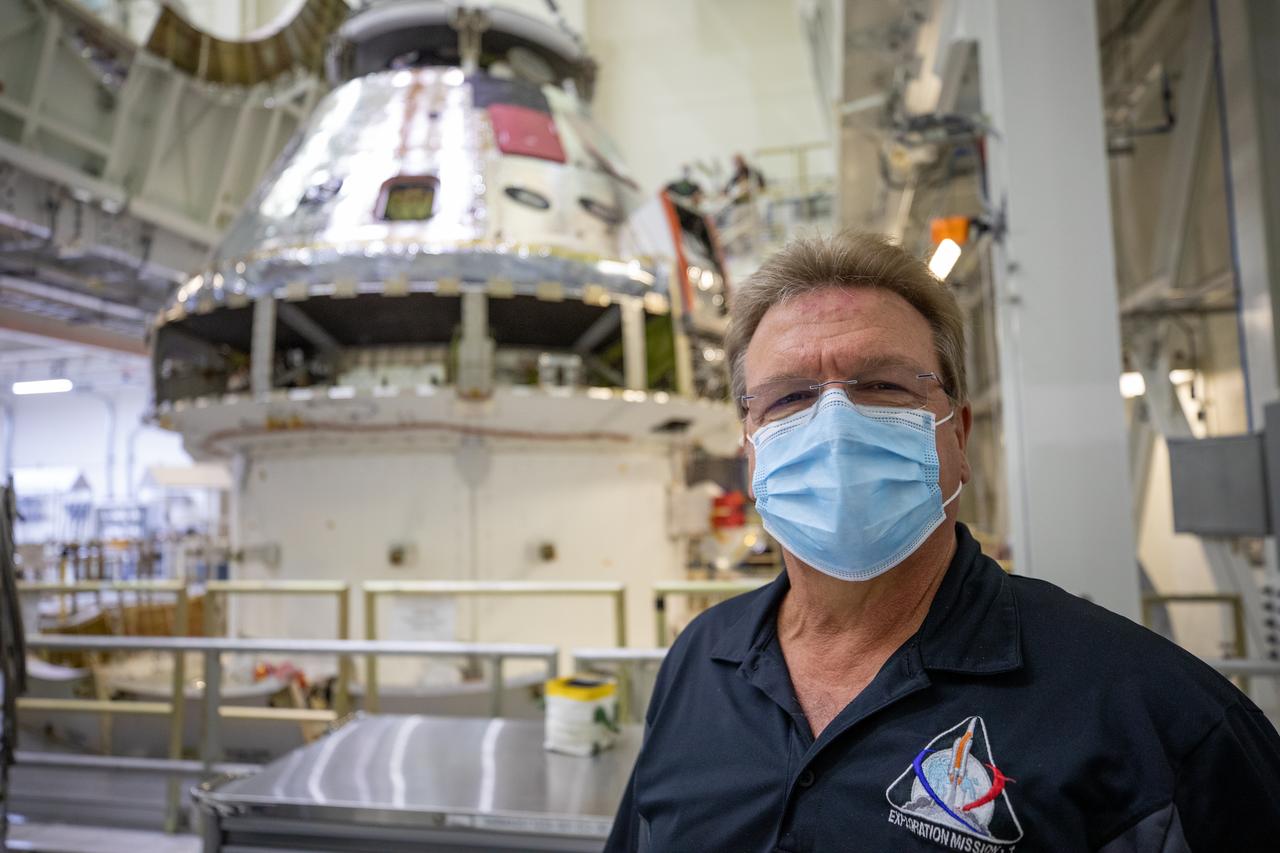
Jules Schneider, Lockheed Martin Assembly, Test and Launch Operations director, is shown inside the Neil Armstrong Operations and Checkout Building high bay in front of the FAST cell as the Artemis I Orion spacecraft is lowered by crane after installation of the spacecraft adapter (SA) cone was completed on Aug. 20, 2020. This is one of the final major hardware operations the spacecraft will undergo during closeout processing prior to being integrated with the Space Launch System (SLS) rocket in preparation for the first Artemis mission. The spacecraft adapter cone connects the bottom portion of Orion’s service module to the top part of the rocket known as the interim cryogenic propulsion stage (ICPS). Orion will fly on the agency’s Artemis I mission – the first in a series of increasingly complex missions to the Moon that will ultimately lead to the exploration of Mars.
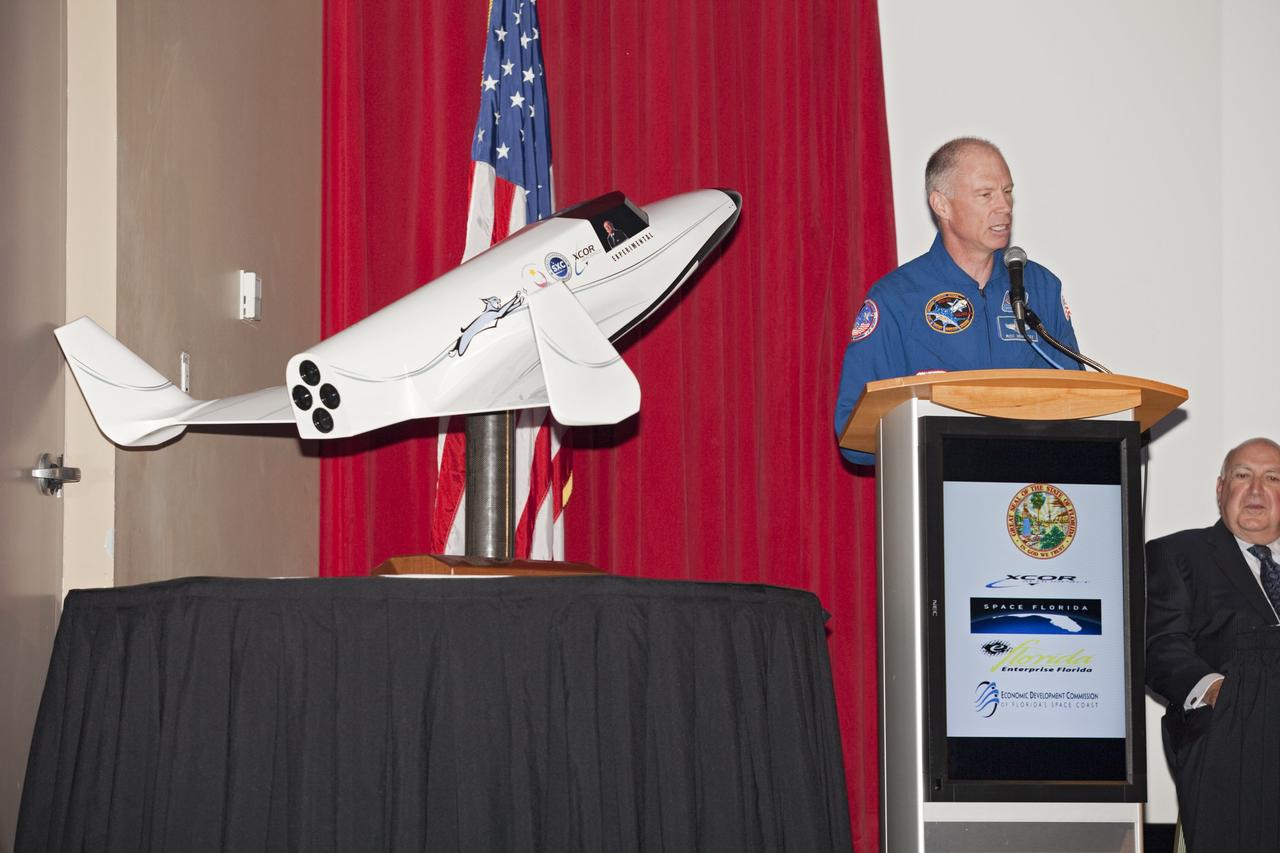
CAPE CANAVERAL, Fla. - At NASA's Kennedy Space Center in Florida, XCOR Director of Flight Test Operations Rick Searfoss, a former NASA astronaut, addresses guests at a presentation during which XCOR Aerospace announced plans to open a manufacturing operation in Brevard County. Space Florida President Frank DiBello is seated to the right. The company's suborbital Lynx Mark II spacecraft possibly will take off and land at Kennedy's shuttle landing facility. XCOR Aerospace is a small, privately held California corporation with focus on the research, development, project management and production of reusable launch vehicles, rocket engines and rocket propulsion systems. XCOR will focus on space tourism, experimental flights and launching satellites. Photo credit: NASA/ Frankie Martin
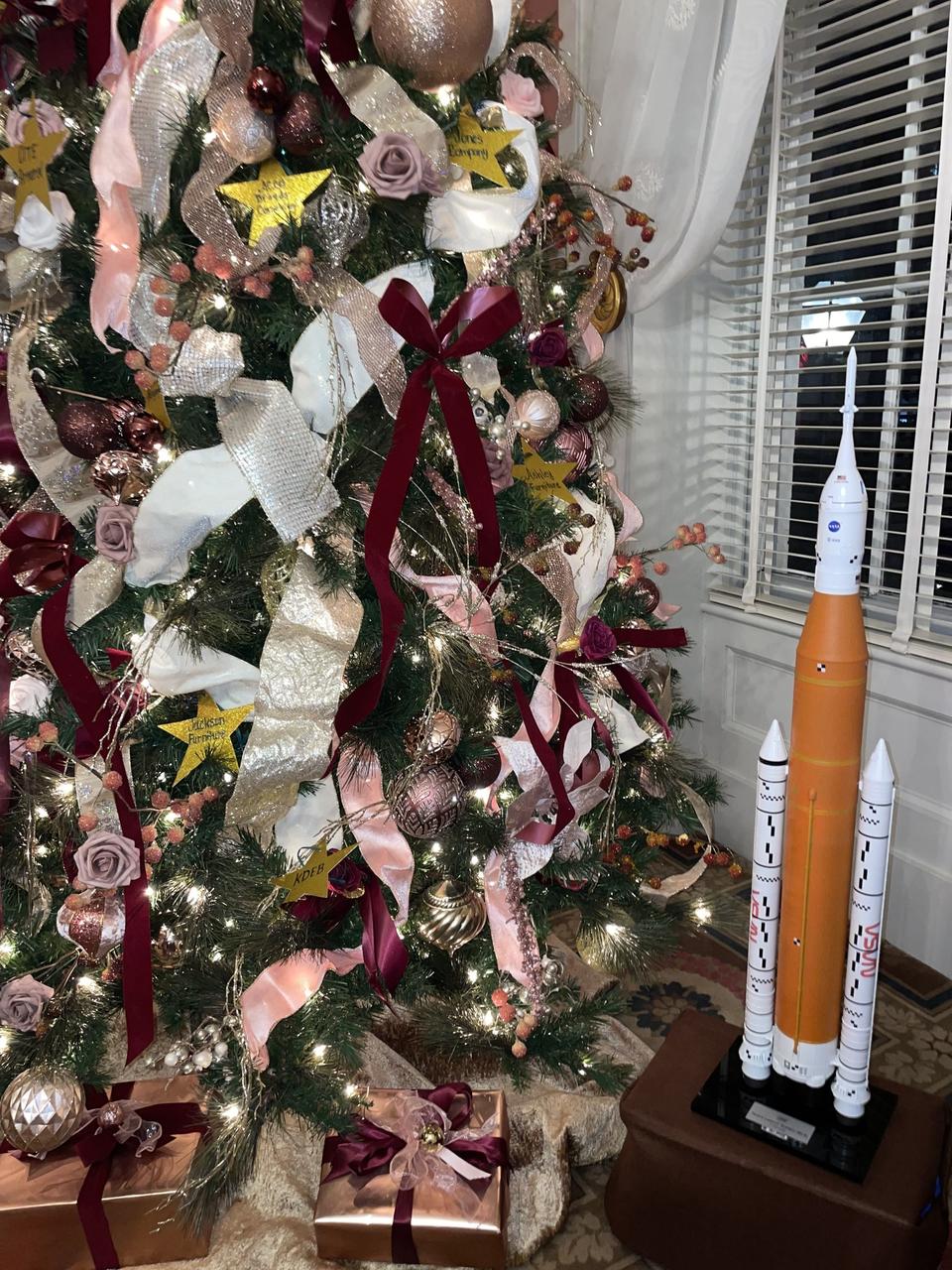
A model of NASA’s SLS (Space Launch System) rocket is part of the holiday display in the Mississippi Governor’s Mansion in Jackson, the official residence of state Gov. Tate Reeves. The model symbolizes the longtime relationship and shared history between the state of Mississippi and NASA’s Stennis Space Center near Bay St. Louis, Mississippi, the nation’s largest rocket propulsion test site. Built in the 1960s, NASA Stennis tested Apollo rocket stages that carried humans to the Moon and every main engine that helped launch 135 space shuttle missions. It now is testing engines and systems for NASA’s Artemis missions and operates as a powerful aerospace and technology hub for the region and state. “We are grateful for our ongoing relationship with the state of Mississippi,” NASA Stennis Director John Bailey said. “We appreciate every opportunity to highlight the role NASA Stennis and the state play in helping to power the nation’s human space exploration program. We look forward to 2025 and continuing our work to test engines and systems that will help launch Artemis missions back to the Moon and beyond.”
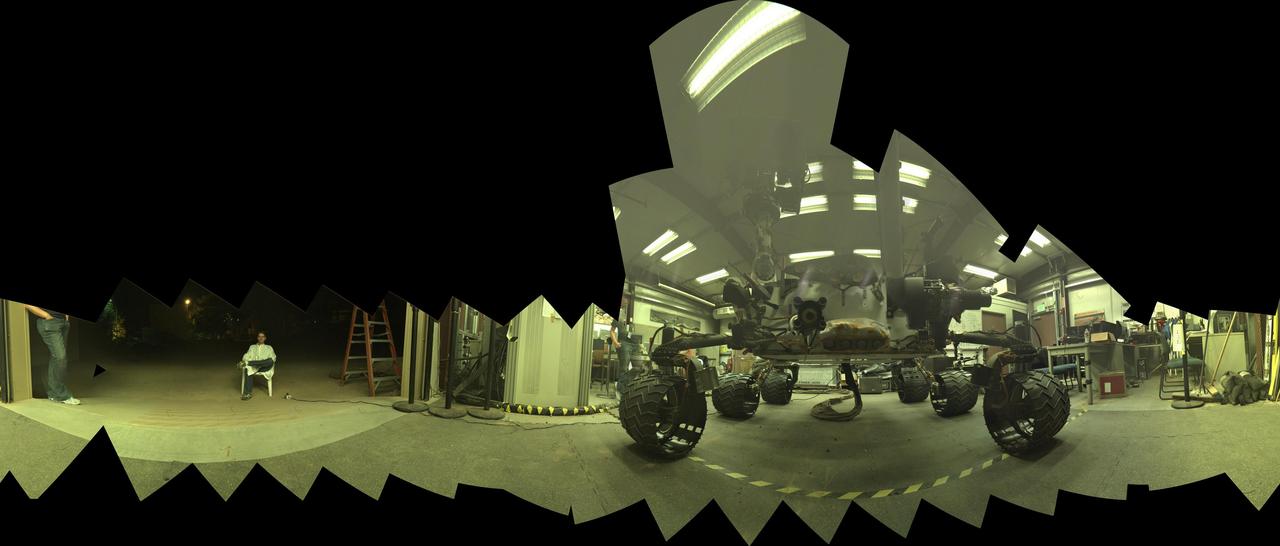
This view of a test rover at NASA's Jet Propulsion Laboratory, Pasadena, California, results from advance testing of arm positions and camera pointings for taking a low-angle self-portrait of NASA's Curiosity Mars rover. This rehearsal in California led to a dramatic Aug. 5, 2015, selfie of Curiosity, online at PIA19807. Curiosity's arm-mounted Mars Hand Lens Imager (MAHLI) camera took 92 of component images that were assembled into that mosaic. The rover team positioned the camera lower in relation to the rover body than for any previous full self-portrait of Curiosity. This practice version was taken at JPL's Mars Yard in July 2013, using the Vehicle System Test Bed (VSTB) rover, which has a test copy of MAHLI on its robotic arm. MAHLI was built by Malin Space Science Systems, San Diego. JPL, a division of the California Institute of Technology in Pasadena, manages the Mars Science Laboratory Project for the NASA Science Mission Directorate, Washington. JPL designed and built the project's Curiosity rover. http://photojournal.jpl.nasa.gov/catalog/PIA19810

Edward Saxe-Coburg-Gotha, the Duke of Windsor, visits the National Advisory Committee for Aeronautics (NACA) Lewis Flight Propulsion Laboratory in Cleveland, Ohio. He is seen in this photograph shaking hands with Associate Director Abe Silverstein. Lewis Director Ray Sharp is in the background. Cleveland mayor Thomas Burke and other local officials were also on hand to greet Edward. Silverstein led the group on a tour of Lewis’ new 8- by 6-Foot Supersonic Wind Tunnel where the Duke inquired about the operation of the facility’s flexible walls, the types of components tested, and the generation of airflow. The Duke was in town in 1951 to promote his new autobiography, A King’s Story, at the American Booksellers Convention. Edward had assumed the British throne in January 1936, only to renounce the position less than a year later to controversially marry Wallis Simpson. Ongoing concerns over the couple’s relationship to the German government resulted in his World War II assignment to the Bahamas. Edward spent the remainder of his life in France.

Ronnie Rigney (r), chief of the Propulsion Test Office in the Project Directorate at Stennis Space Center, stands with agency colleagues to receive the prestigious American Institute of Aeronautics and Astronautics George M. Low Space Transportation Award on Sept. 12. Rigney accepted the award on behalf of the NASA and contractor team at Stennis for their support of the Space Shuttle Program that ended last summer. From 1975 to 2009, Stennis Space Center tested every main engine used to power 135 space shuttle missions. Stennis continued to provide flight support services through the end of the Space Shuttle Program in July 2011. The center also supported transition and retirement of shuttle hardware and assets through September 2012. The 2012 award was presented to the space shuttle team 'for excellence in the conception, development, test, operation and retirement of the world's first and only reusable space transportation system.' Joining Rigney for the award ceremony at the 2012 AIAA Conference in Pasadena, Calif., were: (l to r) Allison Zuniga, NASA Headquarters; Michael Griffin, former NASA administrator; Don Noah, Johnson Space Center in Houston; Steve Cash, Marshall Space Flight Center in Huntsville, Ala.; and Pete Nickolenko, Kennedy Space Center in Florida.

Ronnie Rigney (r), chief of the Propulsion Test Office in the Project Directorate at Stennis Space Center, stands with agency colleagues to receive the prestigious American Institute of Aeronautics and Astronautics George M. Low Space Transportation Award on Sept. 12. Rigney accepted the award on behalf of the NASA and contractor team at Stennis for their support of the Space Shuttle Program that ended last summer. From 1975 to 2009, Stennis Space Center tested every main engine used to power 135 space shuttle missions. Stennis continued to provide flight support services through the end of the Space Shuttle Program in July 2011. The center also supported transition and retirement of shuttle hardware and assets through September 2012. The 2012 award was presented to the space shuttle team 'for excellence in the conception, development, test, operation and retirement of the world's first and only reusable space transportation system.' Joining Rigney for the award ceremony at the 2012 AIAA Conference in Pasadena, Calif., were: (l to r) Allison Zuniga, NASA Headquarters; Michael Griffin, former NASA administrator; Don Noah, Johnson Space Center in Houston; Steve Cash, Marshall Space Flight Center in Huntsville, Ala.; and Pete Nickolenko, Kennedy Space Center in Florida.
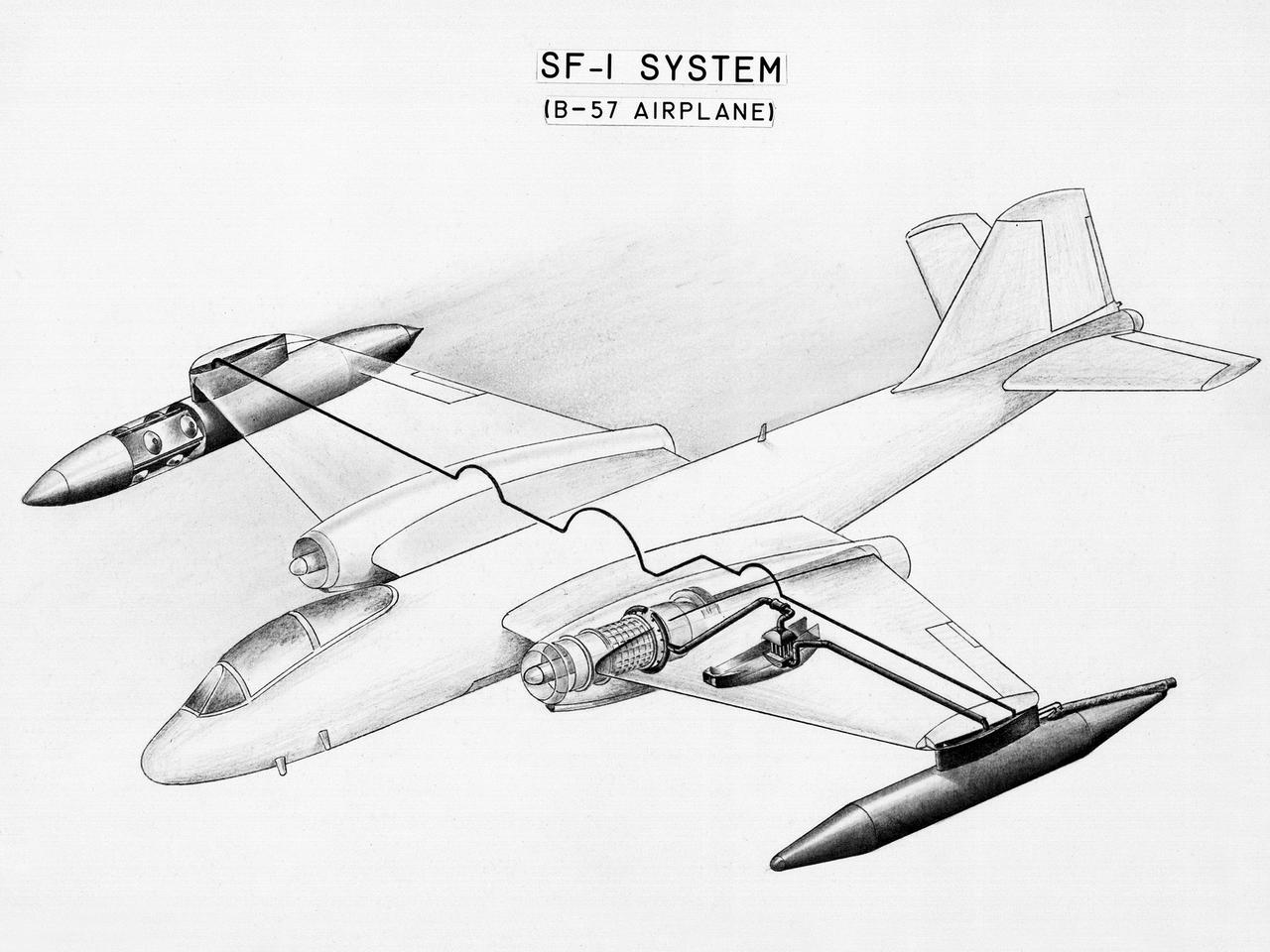
This diagram shows a hydrogen fuel system designed by researchers at the National Advisory Committee for Aeronautics (NACA) Lewis Flight Propulsion Laboratory and installed on a Martin B-57B Canberra aircraft. Lewis researchers accelerated their studies of high energy propellants in the early 1950s. In late 1954, Lewis researchers studied the combustion characteristics of gaseous hydrogen in a turbojet combustor. It was found that the hydrogen provided a very high efficiency. Almost immediately thereafter, Associate Director Abe Silverstein became focused on the possibilities of hydrogen for aircraft propulsion. That fall, Silverstein secured a contract to work with the air force to examine the practicality of liquid hydrogen aircraft. A B-57B Canberra was obtained by the air force especially for this project, referred to as Project Bee. The aircraft was powered by two Wright J65 engines, one of which was modified so that it could be operated using either traditional or liquid hydrogen propellants. The engine and its liquid hydrogen fuel system were tested extensively in the Altitude Wind Tunnel and the Four Burner Area test cells in 1955 and 1956. A B-57B flight program was planned to test the system on an actual aircraft. The aircraft would take off using jet fuel, switch to liquid hydrogen while over Lake Erie, then after burning the hydrogen supply switch back to jet fuel for the landing. The third test flight, in February 1957, was a success, and the ensuing B-57B flights remain the only demonstration of hydrogen-powered aircraft.
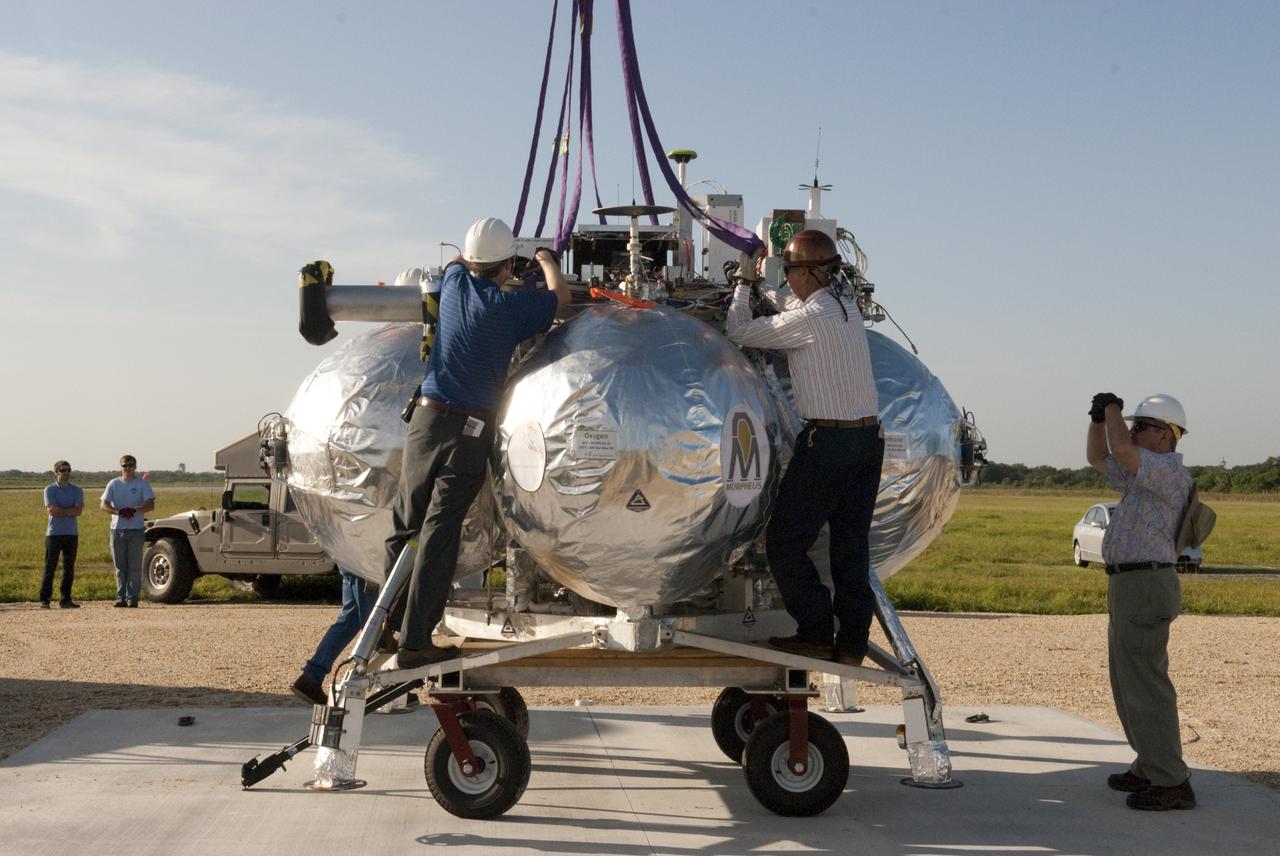
CAPE CANAVERAL, Fla. - Technicians secure connections for a crane which will be used to set up NASA's Morpheus lander, a vertical test bed vehicle, at its launch position along the runway at the Shuttle Landing Facility, or SLF, at the Kennedy Space Center in Florida. Morpheus is designed to demonstrate new green propellant propulsion systems and autonomous landing and an Autonomous Landing and Hazard Avoidance Technology, or ALHAT, system. Checkout of the prototype lander has been ongoing at NASA’s Johnson Space Center in Houston in preparation for its first free flight. The SLF site will provide the lander with the kind of field necessary for realistic testing. Project Morpheus is one of 20 small projects comprising the Advanced Exploration Systems, or AES, program in NASA’s Human Exploration and Operations Mission Directorate. AES projects pioneer new approaches for rapidly developing prototype systems, demonstrating key capabilities and validating operational concepts for future human missions beyond Earth orbit. For more information on Project Morpheus, visit http://www.nasa.gov/centers/johnson/exploration/morpheus/index.html Photo credit: NASA/Dimitri Gerondidakis
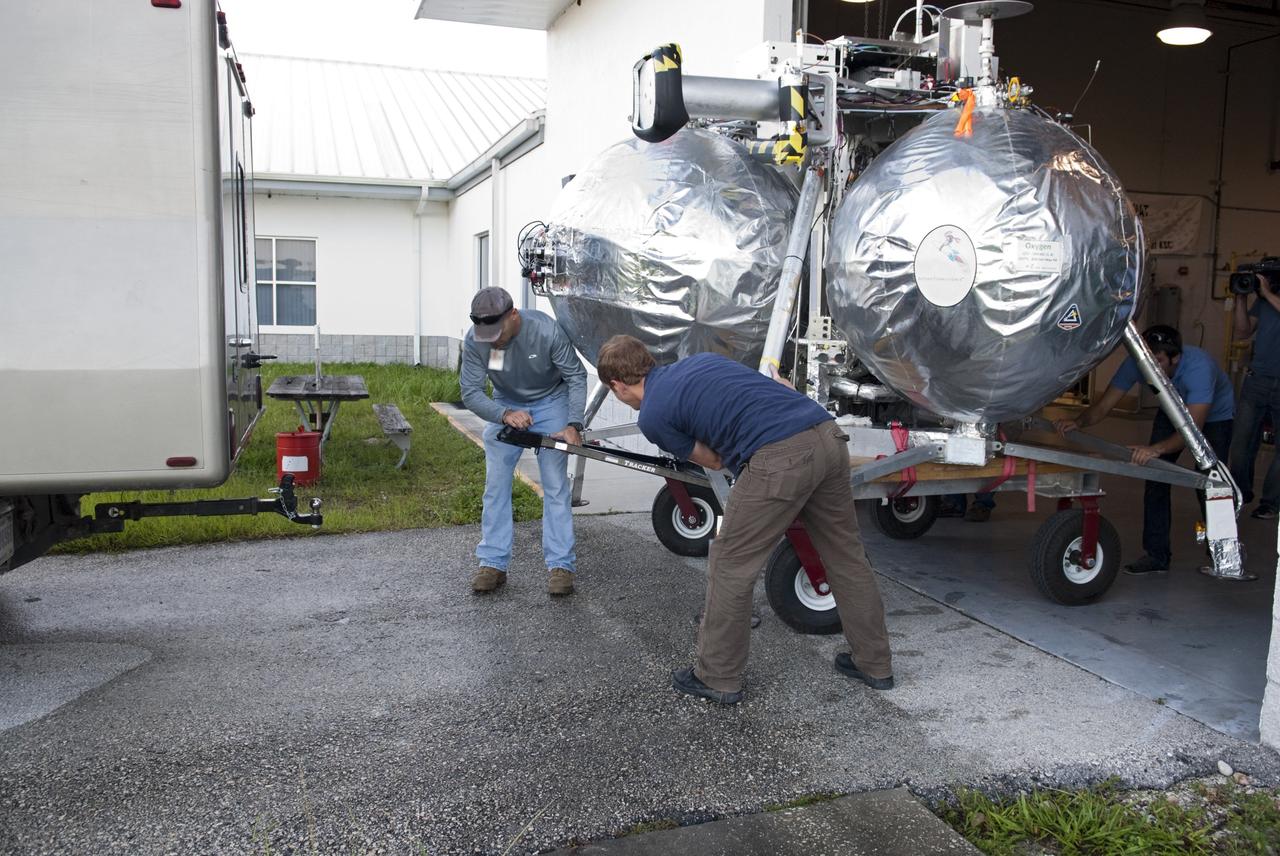
CAPE CANAVERAL, Fla. - NASA's Morpheus lander, a vertical test bed vehicle, is being moved out of its checkout building for a short trip to a launch position at the Shuttle Landing Facility, or SLF, at the Kennedy Space Center in Florida. Morpheus is designed to demonstrate new green propellant propulsion systems and autonomous landing and an Autonomous Landing and Hazard Avoidance Technology, or ALHAT, system. Checkout of the prototype lander has been ongoing at NASA’s Johnson Space Center in Houston in preparation for its first free flight. The SLF site will provide the lander with the kind of field necessary for realistic testing. Project Morpheus is one of 20 small projects comprising the Advanced Exploration Systems, or AES, program in NASA’s Human Exploration and Operations Mission Directorate. AES projects pioneer new approaches for rapidly developing prototype systems, demonstrating key capabilities and validating operational concepts for future human missions beyond Earth orbit. For more information on Project Morpheus, visit http://www.nasa.gov/centers/johnson/exploration/morpheus/index.html Photo credit: NASA/Dimitri Gerondidakis
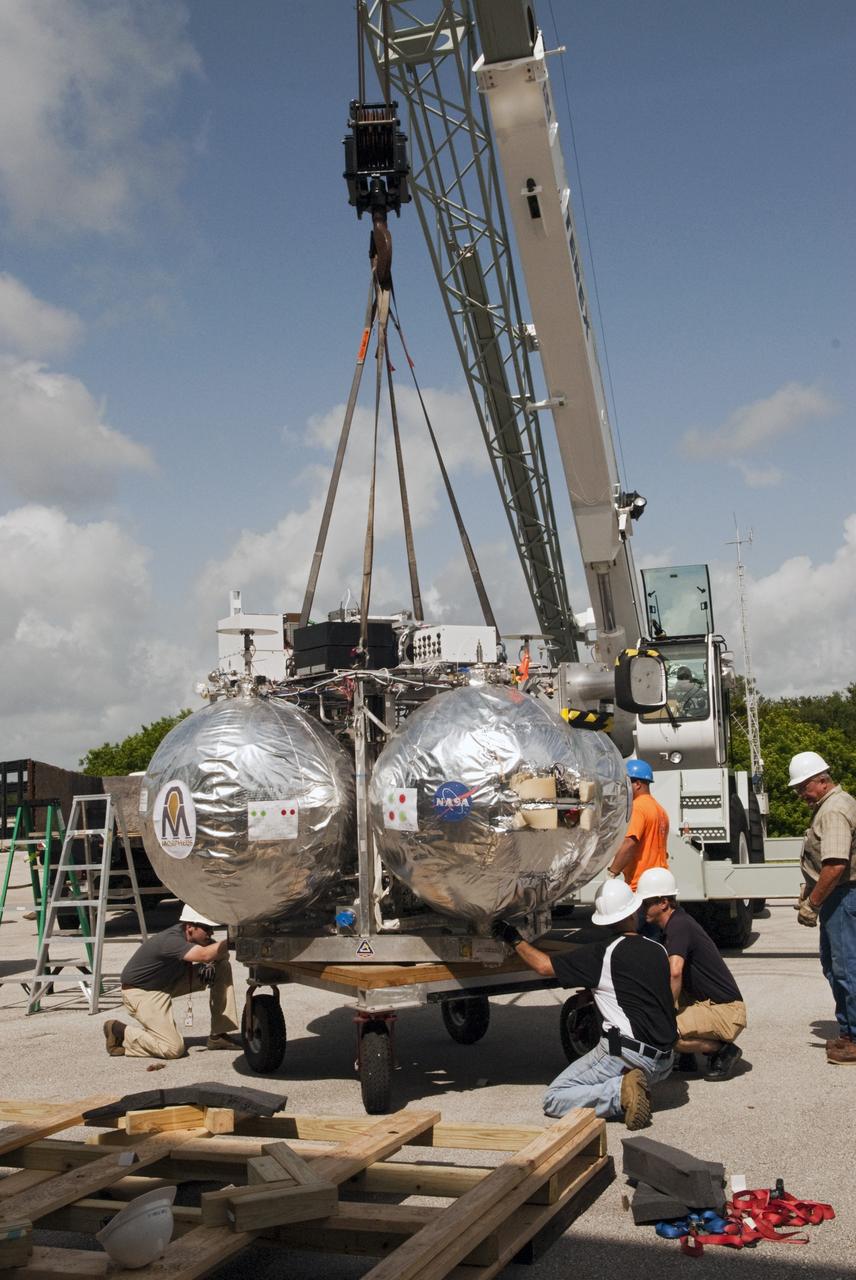
CAPE CANAVERAL, Fla. - A crane supports unloading of NASA's Morpheus lander, a vertical test bed vehicle, at the Kennedy Space Center in Florida. Morpheus is designed to demonstrate new green propellant propulsion systems and autonomous landing and an Autonomous Landing and Hazard Avoidance Technology, or ALHAT, system. Checkout of the prototype lander has been ongoing at NASA’s Johnson Space Center in Houston in preparation for its first free flight. The SLF site will provide the lander with the kind of field necessary for realistic testing. Project Morpheus is one of 20 small projects comprising the Advanced Exploration Systems, or AES, program in NASA’s Human Exploration and Operations Mission Directorate. AES projects pioneer new approaches for rapidly developing prototype systems, demonstrating key capabilities and validating operational concepts for future human missions beyond Earth orbit. For more information on Project Morpheus, visit http://www.nasa.gov/centers/johnson/exploration/morpheus/index.html Photo credit: NASA/ Charisse Nahser
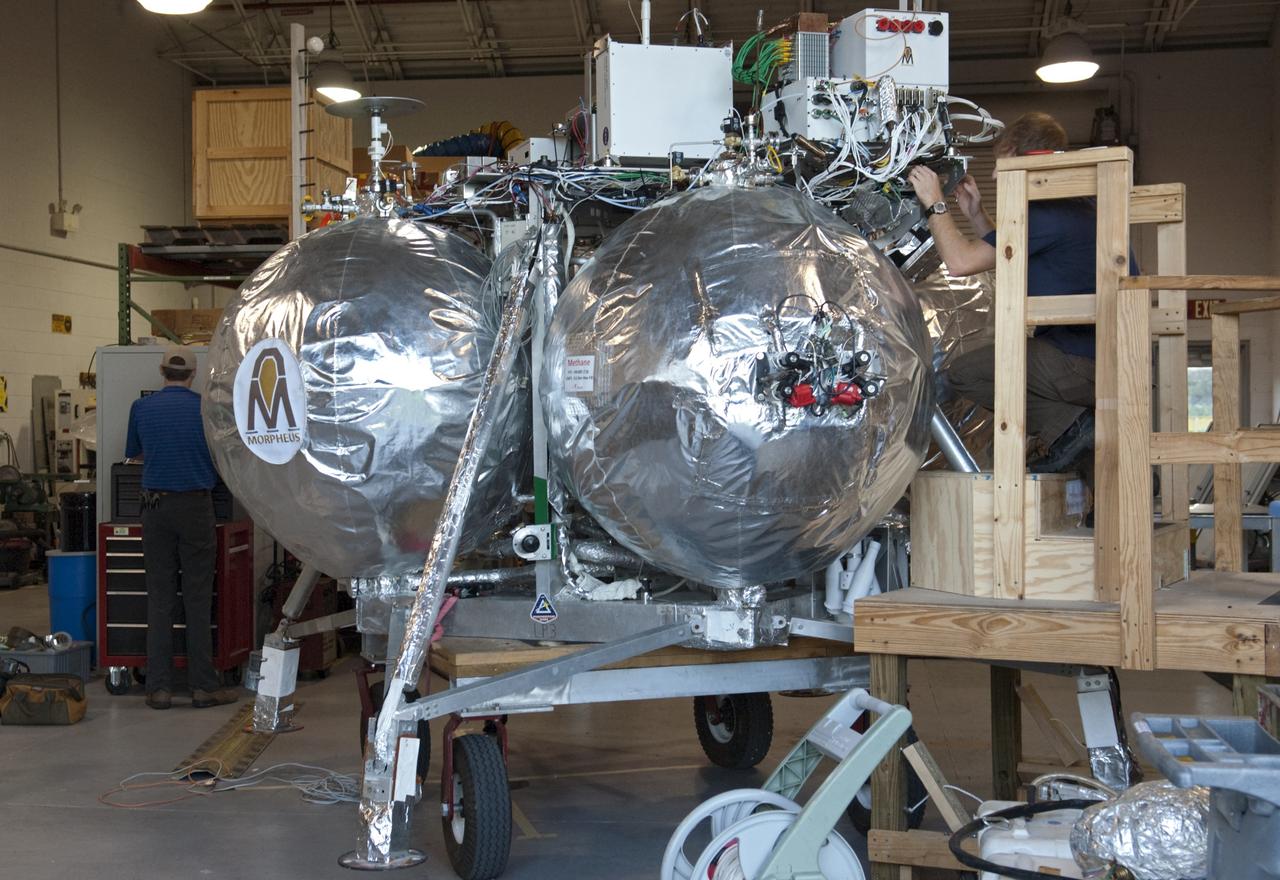
CAPE CANAVERAL, Fla. - NASA's Morpheus lander, a vertical test bed vehicle, is being checked out in a building at the Shuttle Landing Facility, or SLF, at the Kennedy Space Center in Florida. Morpheus is designed to demonstrate new green propellant propulsion systems and autonomous landing and an Autonomous Landing and Hazard Avoidance Technology, or ALHAT, system. Checkout of the prototype lander has been ongoing at NASA’s Johnson Space Center in Houston in preparation for its first free flight. The SLF site will provide the lander with the kind of field necessary for realistic testing. Project Morpheus is one of 20 small projects comprising the Advanced Exploration Systems, or AES, program in NASA’s Human Exploration and Operations Mission Directorate. AES projects pioneer new approaches for rapidly developing prototype systems, demonstrating key capabilities and validating operational concepts for future human missions beyond Earth orbit. For more information on Project Morpheus, visit http://www.nasa.gov/centers/johnson/exploration/morpheus/index.html Photo credit: NASA/Dimitri Gerondidakis
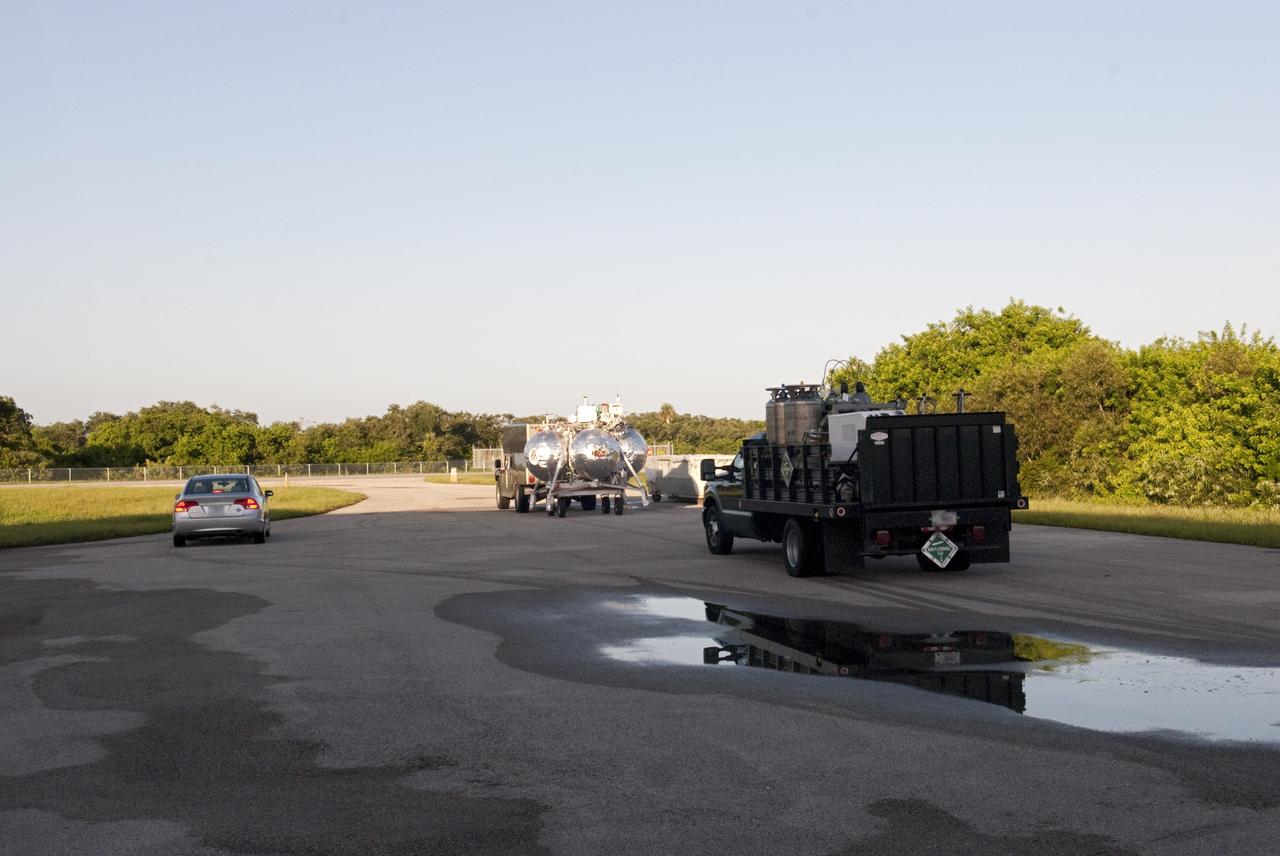
CAPE CANAVERAL, Fla. - NASA's Morpheus lander, a vertical test bed vehicle, is being transported out from its checkout building for a short trip to a launch position at the Shuttle Landing Facility, or SLF, at the Kennedy Space Center in Florida. Morpheus is designed to demonstrate new green propellant propulsion systems and autonomous landing and an Autonomous Landing and Hazard Avoidance Technology, or ALHAT, system. Checkout of the prototype lander has been ongoing at NASA’s Johnson Space Center in Houston in preparation for its first free flight. The SLF site will provide the lander with the kind of field necessary for realistic testing. Project Morpheus is one of 20 small projects comprising the Advanced Exploration Systems, or AES, program in NASA’s Human Exploration and Operations Mission Directorate. AES projects pioneer new approaches for rapidly developing prototype systems, demonstrating key capabilities and validating operational concepts for future human missions beyond Earth orbit. For more information on Project Morpheus, visit http://www.nasa.gov/centers/johnson/exploration/morpheus/index.html Photo credit: NASA/Dimitri Gerondidakis
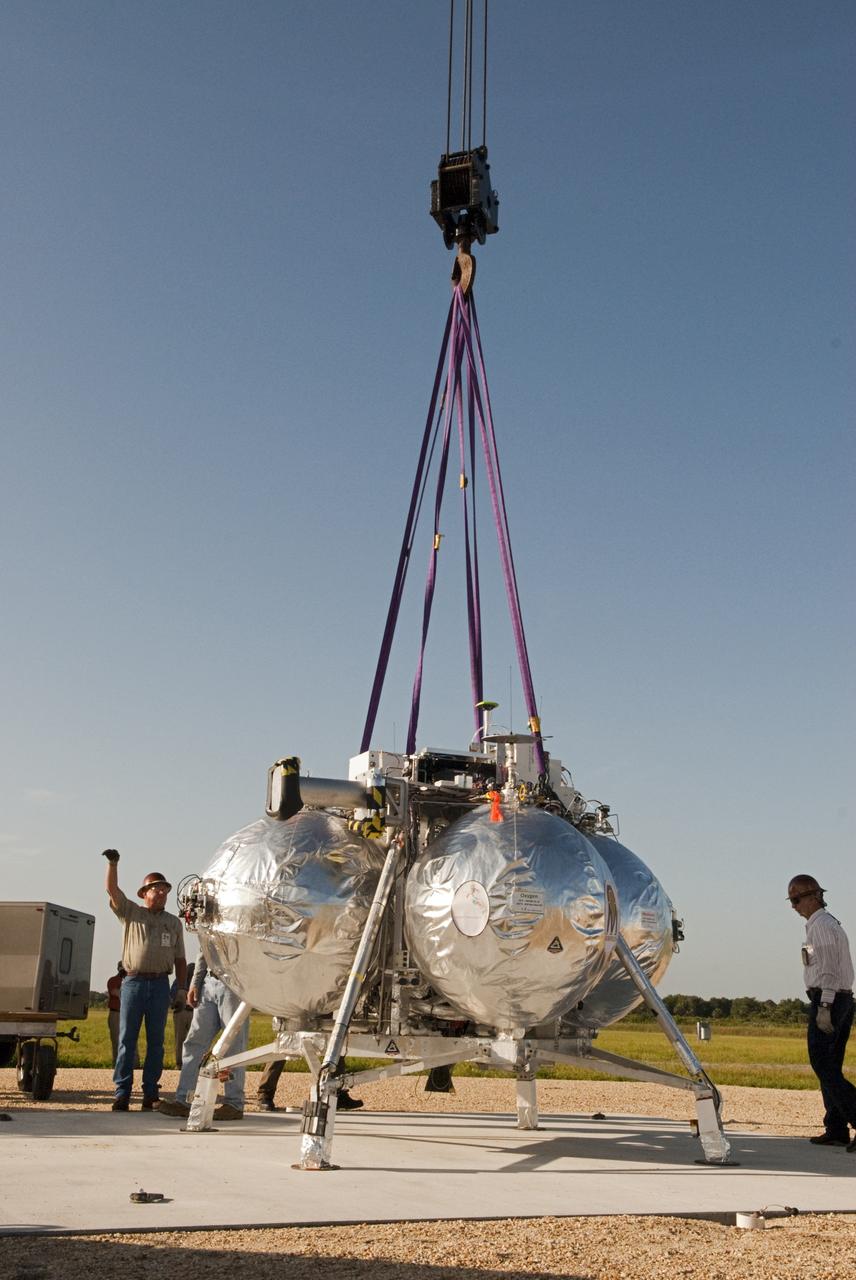
CAPE CANAVERAL, Fla. - A crane is being used to set up NASA's Morpheus lander, a vertical test bed vehicle, at its launch position along the runway at the Shuttle Landing Facility, or SLF, at the Kennedy Space Center in Florida. Morpheus is designed to demonstrate new green propellant propulsion systems and autonomous landing and an Autonomous Landing and Hazard Avoidance Technology, or ALHAT, system. Checkout of the prototype lander has been ongoing at NASA’s Johnson Space Center in Houston in preparation for its first free flight. The SLF site will provide the lander with the kind of field necessary for realistic testing. Project Morpheus is one of 20 small projects comprising the Advanced Exploration Systems, or AES, program in NASA’s Human Exploration and Operations Mission Directorate. AES projects pioneer new approaches for rapidly developing prototype systems, demonstrating key capabilities and validating operational concepts for future human missions beyond Earth orbit. For more information on Project Morpheus, visit http://www.nasa.gov/centers/johnson/exploration/morpheus/index.html Photo credit: NASA/Dimitri Gerondidakis
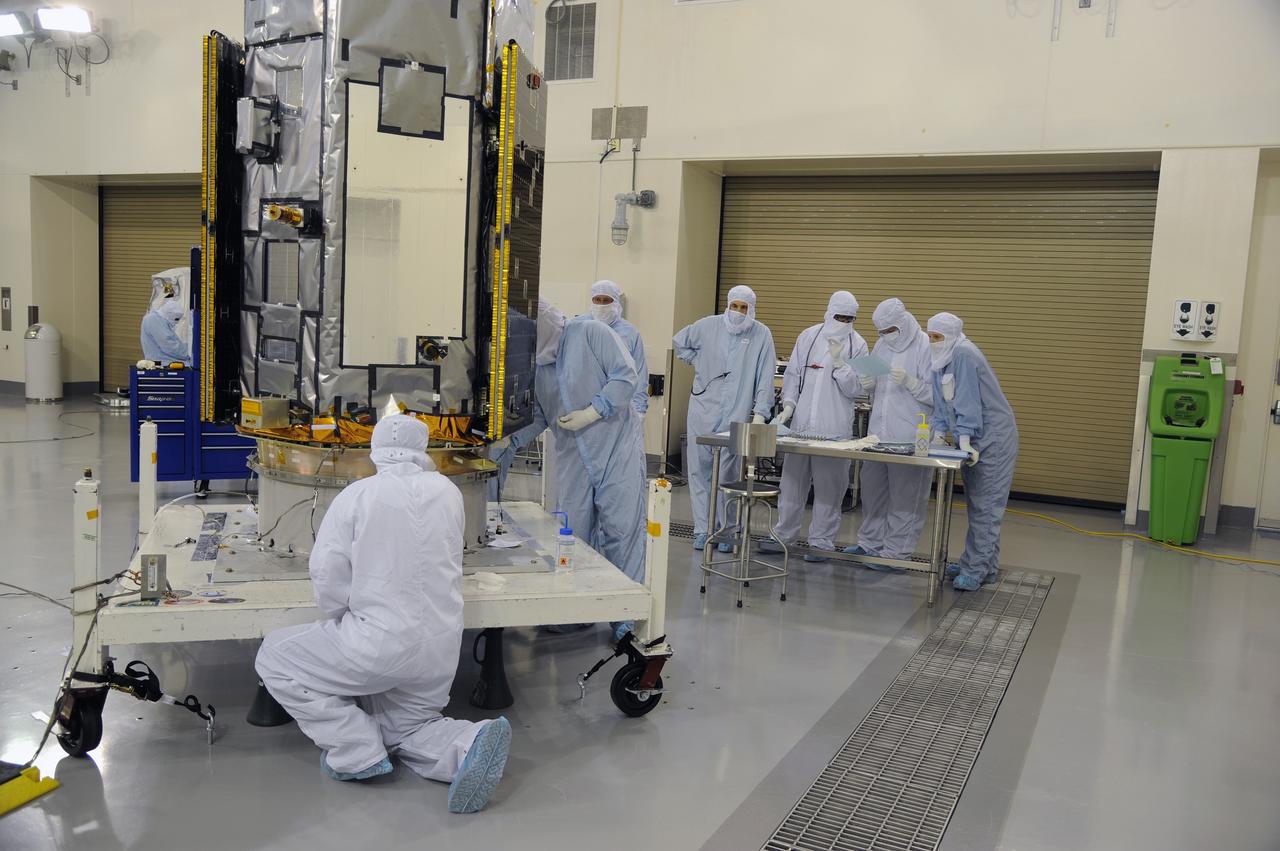
VANDENBERG AIR FORCE BASE, Calif. – In the Astrotech payload processing facility on Vandenberg Air Force Base in California, Orbital Sciences workers and technicians secure NASA's Orbiting Carbon Observatory-2, or OCO-2, onto a test fixture. Testing and launch preparations now will get underway for its launch from Space Launch Complex 2 aboard a United Launch Alliance Delta II rocket, scheduled for July 1, 2014. The observatory will collect precise global measurements of carbon dioxide in the Earth's atmosphere and provide scientists with a better idea of the chemical compound's impacts on climate change. Scientists will analyze this data to improve our understanding of the natural processes and human activities that regulate the abundance and distribution of this important atmospheric gas. OCO-2 is a NASA Earth System Science Pathfinder Program mission managed by NASA's Jet Propulsion Laboratory JPL in Pasadena, California, for NASA's Science Mission Directorate in Washington. Orbital Sciences built the spacecraft and provides mission operations under JPL’s leadership. To learn more about OCO-2, visit http://oco.jpl.nasa.gov. Photo credit: NASA/Doug Gruben, 30th Space Wing
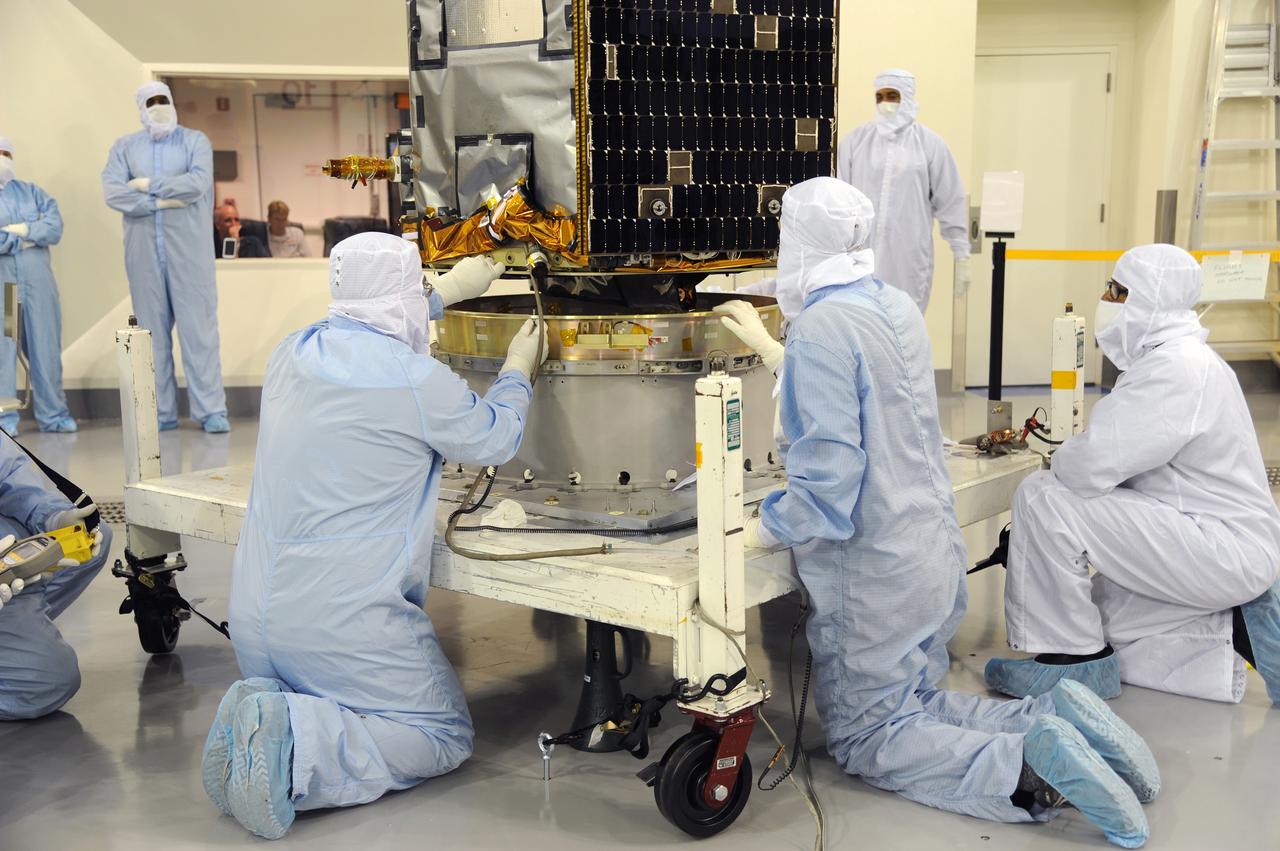
VANDENBERG AIR FORCE BASE, Calif. – In the Astrotech payload processing facility on Vandenberg Air Force Base in California, Orbital Sciences workers and technicians position NASA's Orbiting Carbon Observatory-2, or OCO-2, onto a test fixture. Testing and launch preparations now will get underway for its launch from Space Launch Complex 2 aboard a United Launch Alliance Delta II rocket, scheduled for July 1, 2014. The observatory will collect precise global measurements of carbon dioxide in the Earth's atmosphere and provide scientists with a better idea of the chemical compound's impacts on climate change. Scientists will analyze this data to improve our understanding of the natural processes and human activities that regulate the abundance and distribution of this important atmospheric gas. OCO-2 is a NASA Earth System Science Pathfinder Program mission managed by NASA's Jet Propulsion Laboratory JPL in Pasadena, California, for NASA's Science Mission Directorate in Washington. Orbital Sciences built the spacecraft and provides mission operations under JPL’s leadership. To learn more about OCO-2, visit http://oco.jpl.nasa.gov. Photo credit: NASA/Doug Gruben, 30th Space Wing
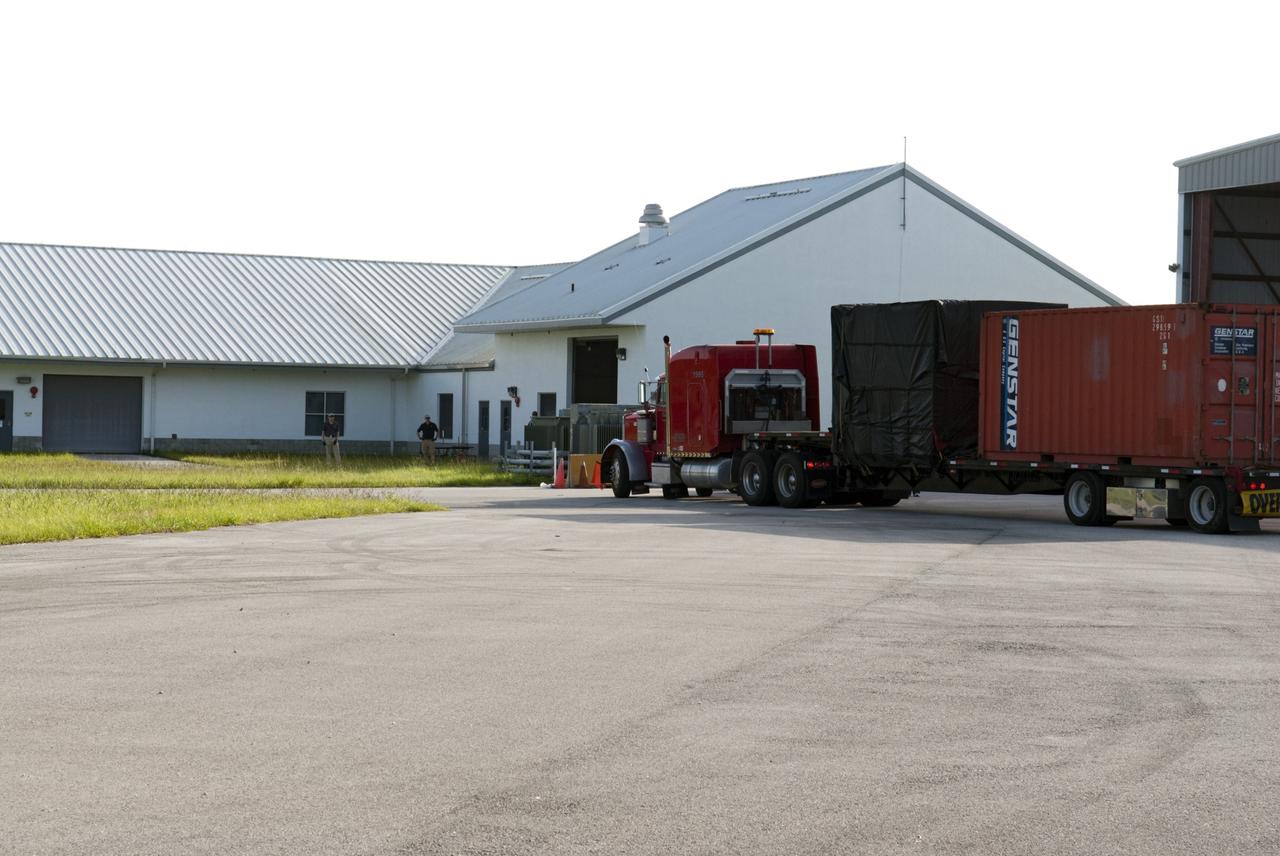
CAPE CANAVERAL, Fla. - A truck transporting NASA's Morpheus lander, a vertical test bed vehicle, arrives at a building at the Shuttle Landing Facility, or SLF, at the Kennedy Space Center in Florida for unloading. Morpheus is designed to demonstrate new green propellant propulsion systems and autonomous landing and an Autonomous Landing and Hazard Avoidance Technology, or ALHAT, system. Checkout of the prototype lander has been ongoing at NASA’s Johnson Space Center in Houston in preparation for its first free flight. The SLF site will provide the lander with the kind of field necessary for realistic testing. Project Morpheus is one of 20 small projects comprising the Advanced Exploration Systems, or AES, program in NASA’s Human Exploration and Operations Mission Directorate. AES projects pioneer new approaches for rapidly developing prototype systems, demonstrating key capabilities and validating operational concepts for future human missions beyond Earth orbit. For more information on Project Morpheus, visit http://www.nasa.gov/centers/johnson/exploration/morpheus/index.html Photo credit: NASA/ Charisse Nahser
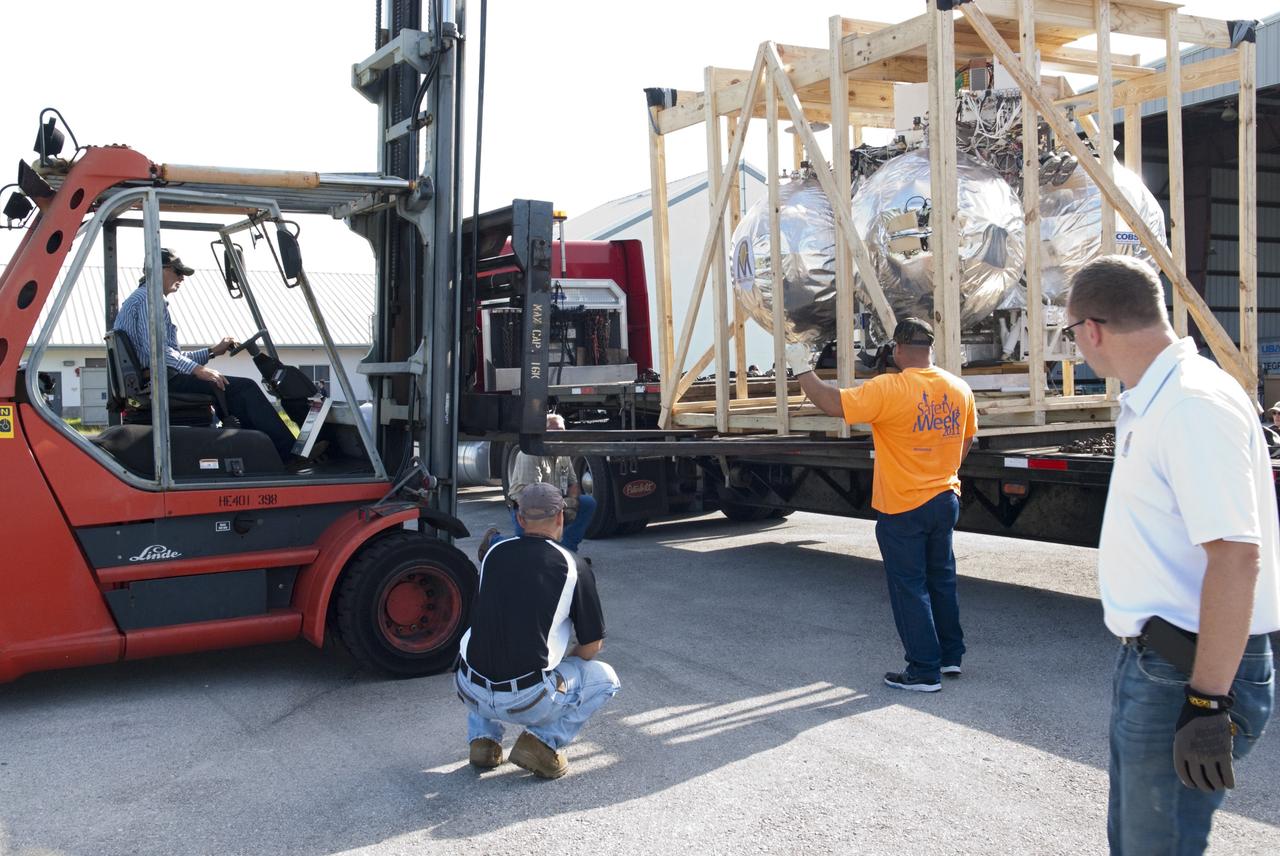
CAPE CANAVERAL, Fla. - NASA's Morpheus lander, a vertical test bed vehicle, is unloaded at a building at the Shuttle Landing Facility, or SLF, at the Kennedy Space Center in Florida. Morpheus is designed to demonstrate new green propellant propulsion systems and autonomous landing and an Autonomous Landing and Hazard Avoidance Technology, or ALHAT, system. Checkout of the prototype lander has been ongoing at NASA’s Johnson Space Center in Houston in preparation for its first free flight. The SLF site will provide the lander with the kind of field necessary for realistic testing. Project Morpheus is one of 20 small projects comprising the Advanced Exploration Systems, or AES, program in NASA’s Human Exploration and Operations Mission Directorate. AES projects pioneer new approaches for rapidly developing prototype systems, demonstrating key capabilities and validating operational concepts for future human missions beyond Earth orbit. For more information on Project Morpheus, visit http://www.nasa.gov/centers/johnson/exploration/morpheus/index.html Photo credit: NASA/ Charisse Nahser
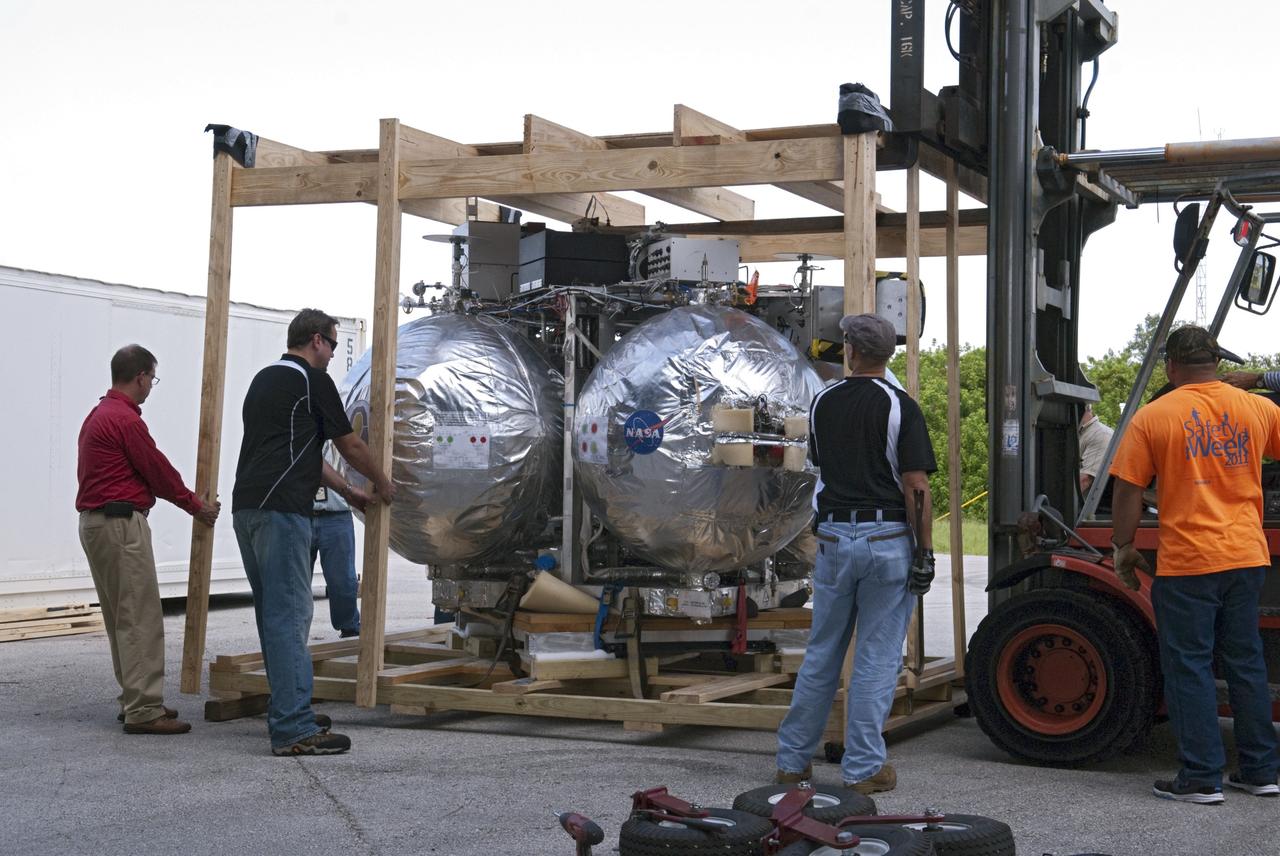
CAPE CANAVERAL, Fla. - NASA's Morpheus lander, a vertical test bed vehicle, is uncrated after unloading at the Kennedy Space Center in Florida. Morpheus is designed to demonstrate new green propellant propulsion systems and autonomous landing and an Autonomous Landing and Hazard Avoidance Technology, or ALHAT, system. Checkout of the prototype lander has been ongoing at NASA’s Johnson Space Center in Houston in preparation for its first free flight. The SLF site will provide the lander with the kind of field necessary for realistic testing. Project Morpheus is one of 20 small projects comprising the Advanced Exploration Systems, or AES, program in NASA’s Human Exploration and Operations Mission Directorate. AES projects pioneer new approaches for rapidly developing prototype systems, demonstrating key capabilities and validating operational concepts for future human missions beyond Earth orbit. For more information on Project Morpheus, visit http://www.nasa.gov/centers/johnson/exploration/morpheus/index.html Photo credit: NASA/ Charisse Nahser
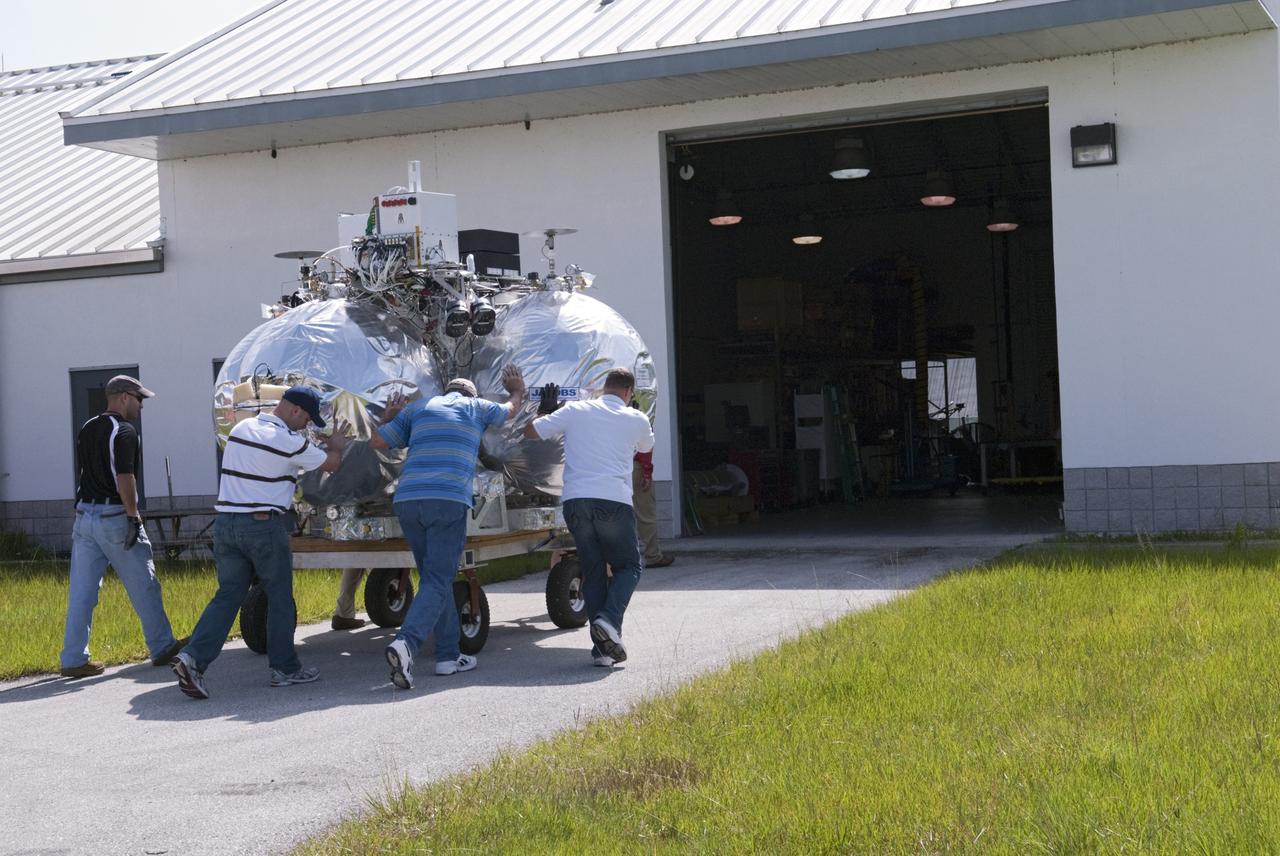
CAPE CANAVERAL, Fla. - NASA's Morpheus lander, a vertical test bed vehicle, is moved into a building at the Shuttle Landing Facility, or SLF, at the Kennedy Space Center in Florida. Morpheus is designed to demonstrate new green propellant propulsion systems and autonomous landing and an Autonomous Landing and Hazard Avoidance Technology, or ALHAT, system. Checkout of the prototype lander has been ongoing at NASA’s Johnson Space Center in Houston in preparation for its first free flight. The SLF site will provide the lander with the kind of field necessary for realistic testing. Project Morpheus is one of 20 small projects comprising the Advanced Exploration Systems, or AES, program in NASA’s Human Exploration and Operations Mission Directorate. AES projects pioneer new approaches for rapidly developing prototype systems, demonstrating key capabilities and validating operational concepts for future human missions beyond Earth orbit. For more information on Project Morpheus, visit http://www.nasa.gov/centers/johnson/exploration/morpheus/index.html Photo credit: NASA/ Charisse Nahser
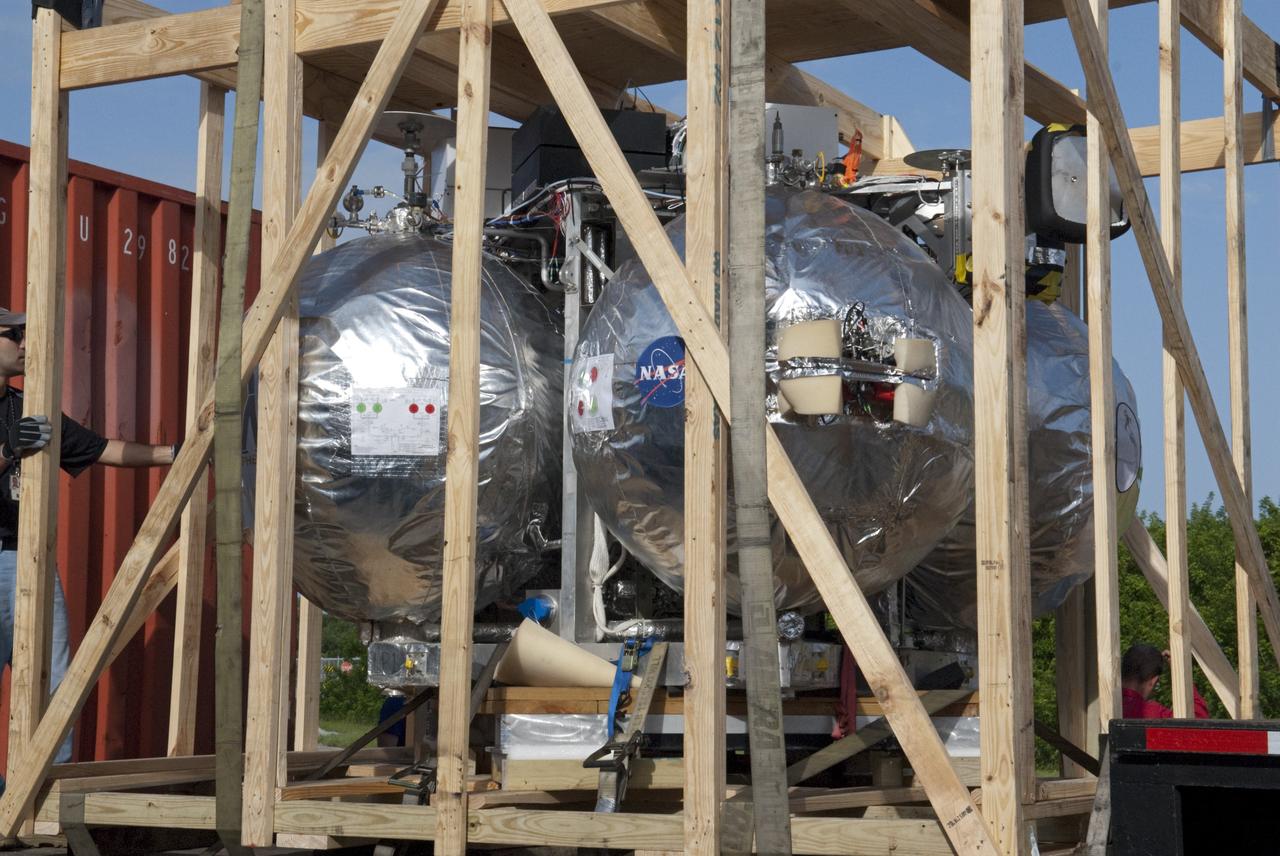
CAPE CANAVERAL, Fla. - NASA's Morpheus lander, a vertical test bed vehicle, is ready to be uncrated at the Kennedy Space Center in Florida. Morpheus is designed to demonstrate new green propellant propulsion systems and autonomous landing and an Autonomous Landing and Hazard Avoidance Technology, or ALHAT, system. Checkout of the prototype lander has been ongoing at NASA’s Johnson Space Center in Houston in preparation for its first free flight. The SLF site will provide the lander with the kind of field necessary for realistic testing. Project Morpheus is one of 20 small projects comprising the Advanced Exploration Systems, or AES, program in NASA’s Human Exploration and Operations Mission Directorate. AES projects pioneer new approaches for rapidly developing prototype systems, demonstrating key capabilities and validating operational concepts for future human missions beyond Earth orbit. For more information on Project Morpheus, visit http://www.nasa.gov/centers/johnson/exploration/morpheus/index.html Photo credit: NASA/ Charisse Nahser

CAPE CANAVERAL, Fla. - NASA's Morpheus lander, a vertical test bed vehicle, arrives at its launch position along the runway at the Shuttle Landing Facility, or SLF, at the Kennedy Space Center in Florida. Morpheus is designed to demonstrate new green propellant propulsion systems and autonomous landing and an Autonomous Landing and Hazard Avoidance Technology, or ALHAT, system. Checkout of the prototype lander has been ongoing at NASA’s Johnson Space Center in Houston in preparation for its first free flight. The SLF site will provide the lander with the kind of field necessary for realistic testing. Project Morpheus is one of 20 small projects comprising the Advanced Exploration Systems, or AES, program in NASA’s Human Exploration and Operations Mission Directorate. AES projects pioneer new approaches for rapidly developing prototype systems, demonstrating key capabilities and validating operational concepts for future human missions beyond Earth orbit. For more information on Project Morpheus, visit http://www.nasa.gov/centers/johnson/exploration/morpheus/index.html Photo credit: NASA/Dimitri Gerondidakis
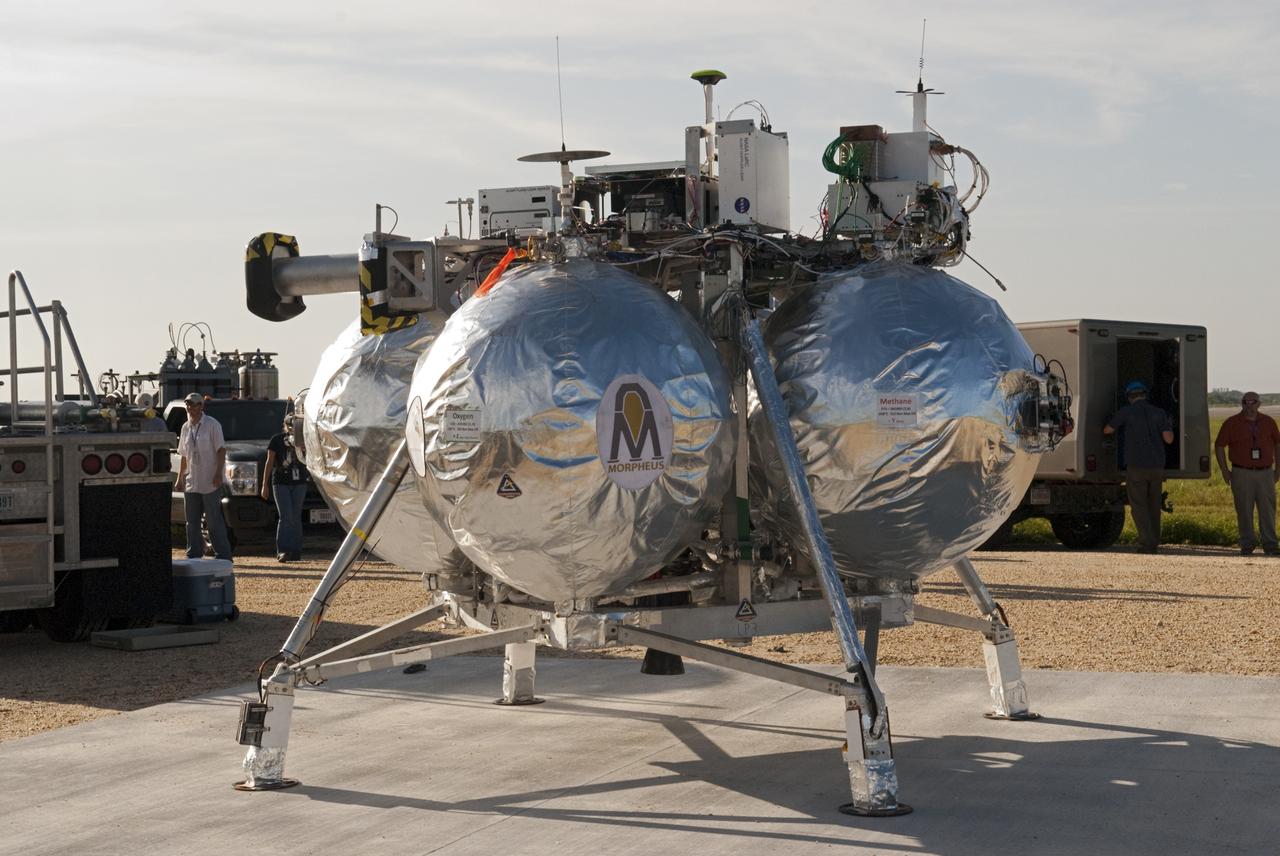
CAPE CANAVERAL, Fla. - NASA's Morpheus lander, a vertical test bed vehicle, has been set up at its launch position along the runway at the Shuttle Landing Facility, or SLF, at the Kennedy Space Center in Florida. Morpheus is designed to demonstrate new green propellant propulsion systems and autonomous landing and an Autonomous Landing and Hazard Avoidance Technology, or ALHAT, system. Checkout of the prototype lander has been ongoing at NASA’s Johnson Space Center in Houston in preparation for its first free flight. The SLF site will provide the lander with the kind of field necessary for realistic testing. Project Morpheus is one of 20 small projects comprising the Advanced Exploration Systems, or AES, program in NASA’s Human Exploration and Operations Mission Directorate. AES projects pioneer new approaches for rapidly developing prototype systems, demonstrating key capabilities and validating operational concepts for future human missions beyond Earth orbit. For more information on Project Morpheus, visit http://www.nasa.gov/centers/johnson/exploration/morpheus/index.html Photo credit: NASA/Dimitri Gerondidakis
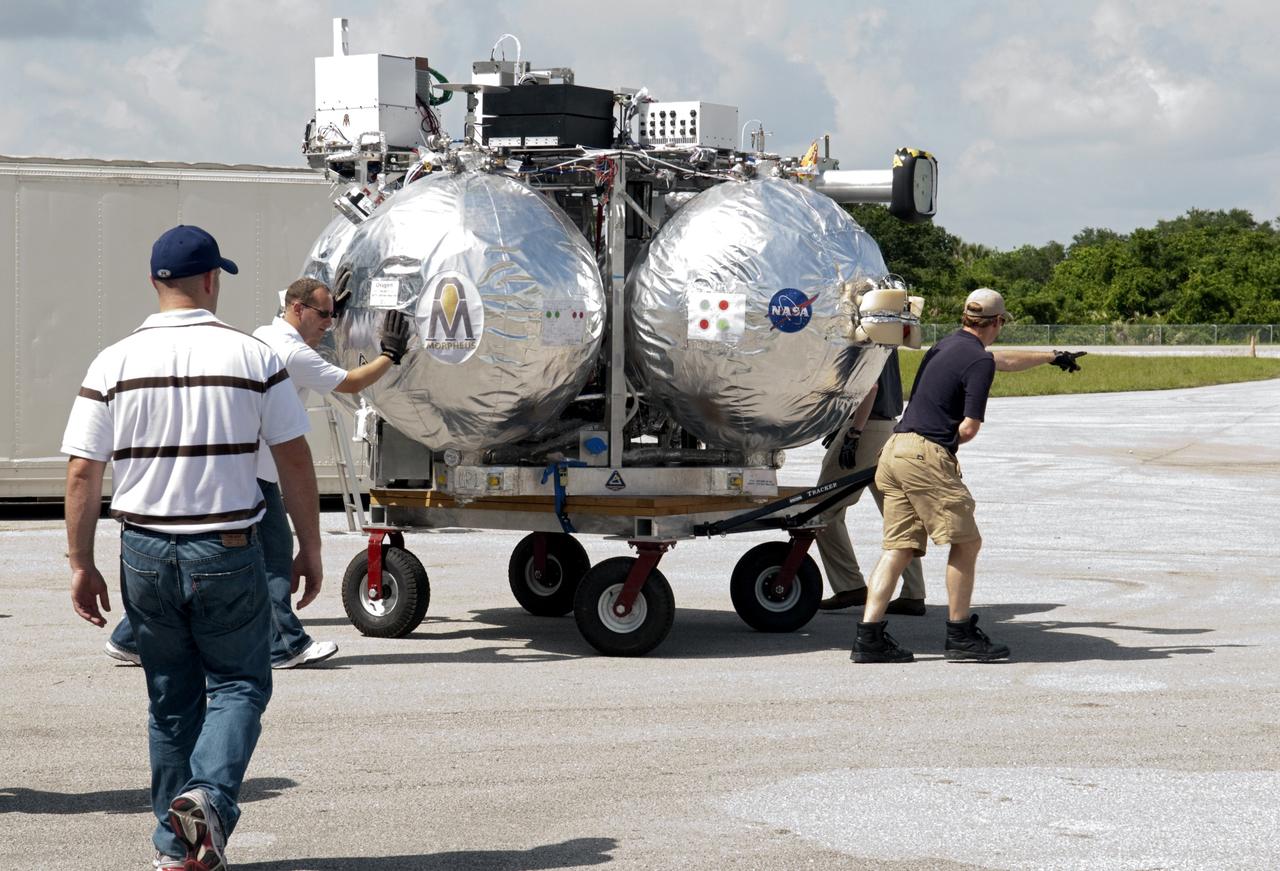
CAPE CANAVERAL, Fla. - NASA's Morpheus lander, a vertical test bed vehicle, is moved into a building at the Shuttle Landing Facility, or SLF, at the Kennedy Space Center in Florida. Morpheus is designed to demonstrate new green propellant propulsion systems and autonomous landing and an Autonomous Landing and Hazard Avoidance Technology, or ALHAT, system. Checkout of the prototype lander has been ongoing at NASA’s Johnson Space Center in Houston in preparation for its first free flight. The SLF site will provide the lander with the kind of field necessary for realistic testing. Project Morpheus is one of 20 small projects comprising the Advanced Exploration Systems, or AES, program in NASA’s Human Exploration and Operations Mission Directorate. AES projects pioneer new approaches for rapidly developing prototype systems, demonstrating key capabilities and validating operational concepts for future human missions beyond Earth orbit. For more information on Project Morpheus, visit http://www.nasa.gov/centers/johnson/exploration/morpheus/index.html Photo credit: NASA/ Charisse Nahser

CAPE CANAVERAL, Fla. - NASA's Morpheus lander, a vertical test bed vehicle, is being transported along the Shuttle Landing Facility, or SLF, at the Kennedy Space Center in Florida for a short trip to a launch position along the runway. Morpheus is designed to demonstrate new green propellant propulsion systems and autonomous landing and an Autonomous Landing and Hazard Avoidance Technology, or ALHAT, system. Checkout of the prototype lander has been ongoing at NASA’s Johnson Space Center in Houston in preparation for its first free flight. The SLF site will provide the lander with the kind of field necessary for realistic testing. Project Morpheus is one of 20 small projects comprising the Advanced Exploration Systems, or AES, program in NASA’s Human Exploration and Operations Mission Directorate. AES projects pioneer new approaches for rapidly developing prototype systems, demonstrating key capabilities and validating operational concepts for future human missions beyond Earth orbit. For more information on Project Morpheus, visit http://www.nasa.gov/centers/johnson/exploration/morpheus/index.html Photo credit: NASA/Dimitri Gerondidakis
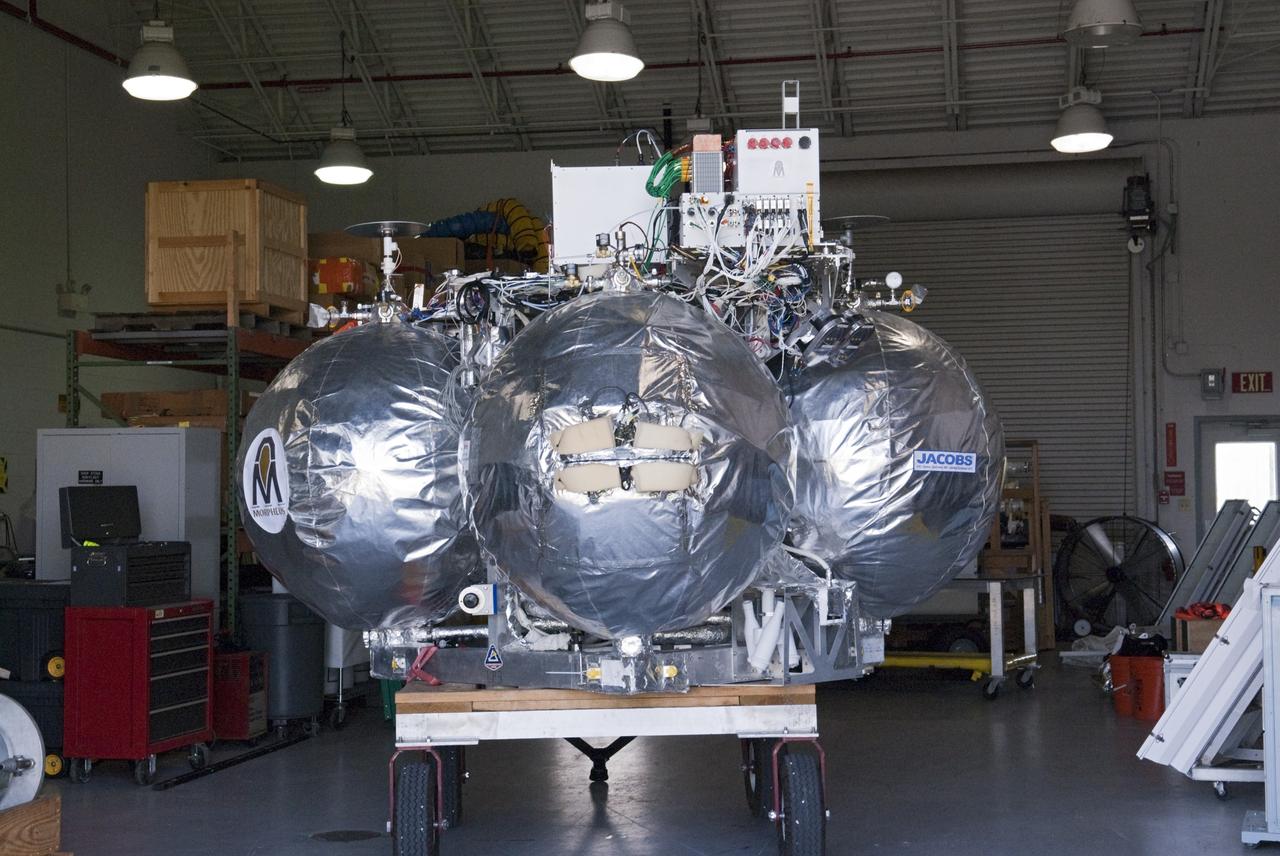
CAPE CANAVERAL, Fla. - NASA's Morpheus lander, a vertical test bed vehicle, has been moved into a building at the Shuttle Landing Facility, or SLF, at the Kennedy Space Center in Florida. Morpheus is designed to demonstrate new green propellant propulsion systems and autonomous landing and an Autonomous Landing and Hazard Avoidance Technology, or ALHAT, system. Checkout of the prototype lander has been ongoing at NASA’s Johnson Space Center in Houston in preparation for its first free flight. The SLF site will provide the lander with the kind of field necessary for realistic testing. Project Morpheus is one of 20 small projects comprising the Advanced Exploration Systems, or AES, program in NASA’s Human Exploration and Operations Mission Directorate. AES projects pioneer new approaches for rapidly developing prototype systems, demonstrating key capabilities and validating operational concepts for future human missions beyond Earth orbit. For more information on Project Morpheus, visit http://www.nasa.gov/centers/johnson/exploration/morpheus/index.html Photo credit: NASA/ Charisse Nahser
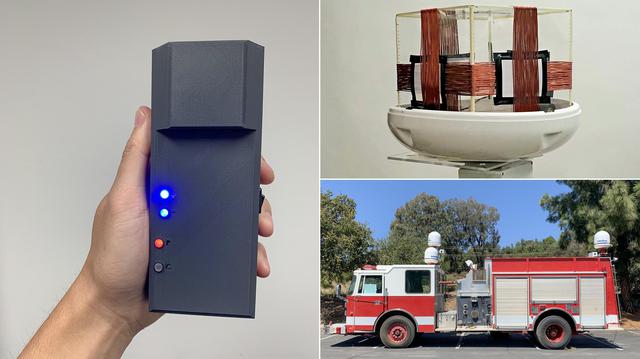
To help locate and track firefighters inside buildings, where other positioning technologies fail, NASA's Jet Propulsion Laboratory and the Department of Homeland Security Science and Technology Directorate (S&T) are developing POINTER. Short for Precision Outdoor and Indoor Navigation and Tracking for Emergency Responders, the system began taking shape in 2014 and is being matured for use by fire departments nationwide. The POINTER system is composed of three parts: a receiver, transmitter, and base station. The receiver (left) has been shrunk from the size of a backpack to the size of a large smartphone, and further development will miniaturize it so it can be easily clipped to a belt buckle. The transmitter (top right) is a system of coils that generate the magnetoquasistatic fields, which — unlike the radio waves used by GPS and radio-frequency identification — are able to pass through construction materials to interact with the receiver, enabling fire crews to track the location and orientation of firefighters. To test the system, transmitters have been attached to an out-of-service firetruck (lower right). Through 2021, POINTER will undergo field tests and a commercial version of POINTER will be made available to fire departments in 2022. https://photojournal.jpl.nasa.gov/catalog/PIA24562
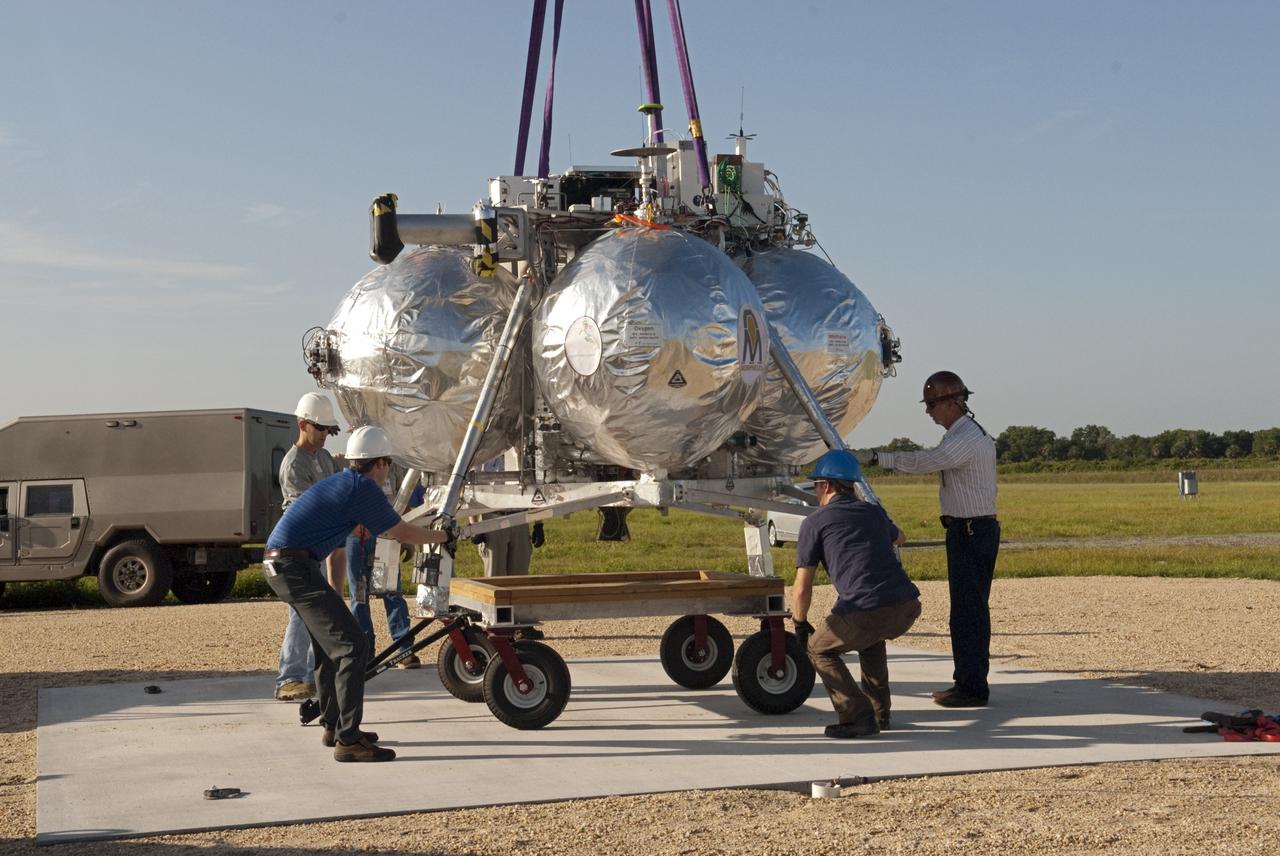
CAPE CANAVERAL, Fla. - Technicians set up NASA's Morpheus lander, a vertical test bed vehicle, at its launch position along the runway at the Shuttle Landing Facility, or SLF, at the Kennedy Space Center in Florida. Morpheus is designed to demonstrate new green propellant propulsion systems and autonomous landing and an Autonomous Landing and Hazard Avoidance Technology, or ALHAT, system. Checkout of the prototype lander has been ongoing at NASA’s Johnson Space Center in Houston in preparation for its first free flight. The SLF site will provide the lander with the kind of field necessary for realistic testing. Project Morpheus is one of 20 small projects comprising the Advanced Exploration Systems, or AES, program in NASA’s Human Exploration and Operations Mission Directorate. AES projects pioneer new approaches for rapidly developing prototype systems, demonstrating key capabilities and validating operational concepts for future human missions beyond Earth orbit. For more information on Project Morpheus, visit http://www.nasa.gov/centers/johnson/exploration/morpheus/index.html Photo credit: NASA/Dimitri Gerondidakis
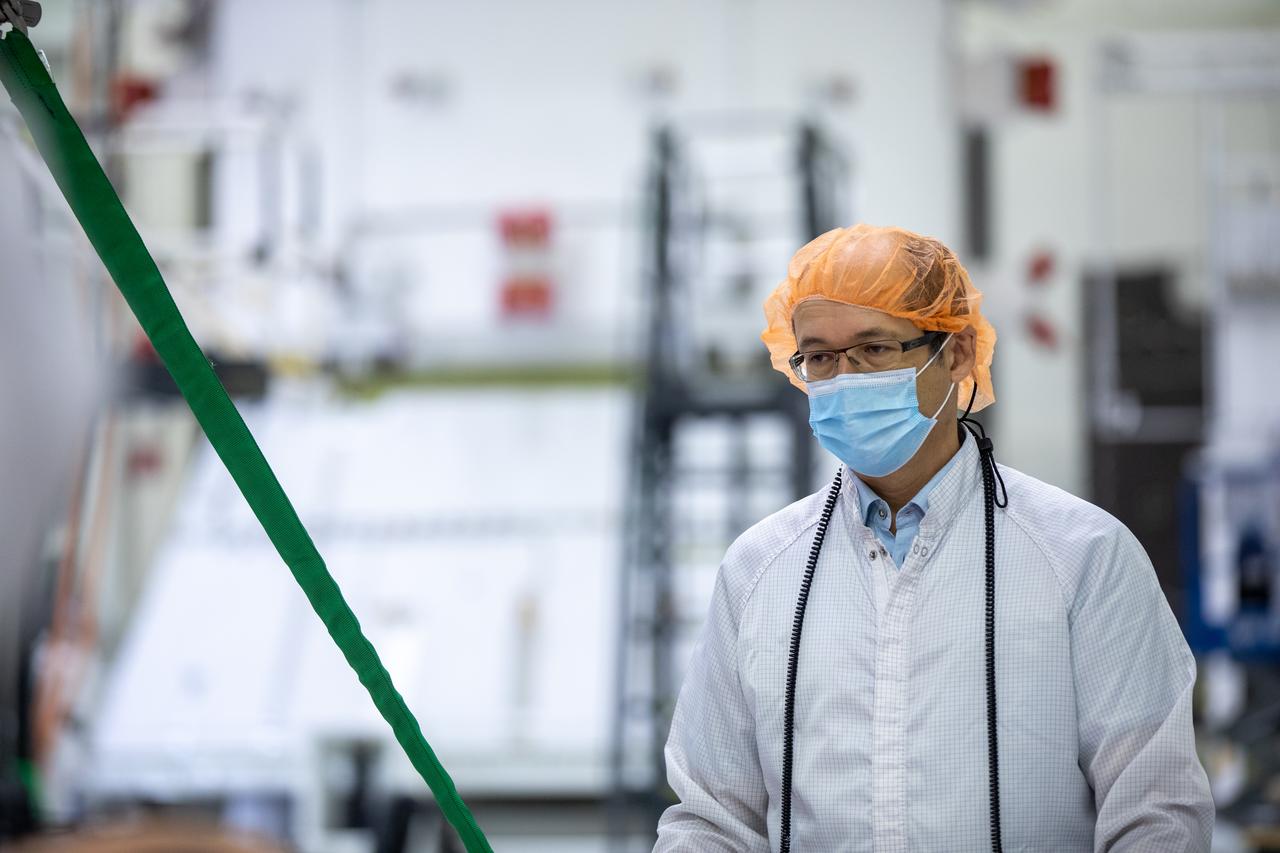
Rachid Amekrane, Airbus Defence and Space Integration test director, assists with securing a protective cover as a crane prepares to lift the panel during installation of one of four solar array wings inside the Neil Armstrong Operations and Checkout Building high bay at NASA’s Kennedy Space Center in Florida on Sept. 23, 2020. The Orion spacecraft for Artemis I is shown in the background. The solar arrays were extended, inspected, and then retracted, before installation on the spacecraft. Each solar array panel will generate 11 kilowatts of power and span about 63 feet. The array is a component of Orion’s service module, which is provided by the European Space Agency and built by Airbus Defence and Space to supply Orion’s power, propulsion, air and water. The first in a series of increasingly complex missions, Artemis I will test the Orion spacecraft and Space Launch System as an integrated system ahead of crewed flights to the Moon. Under the Artemis program, NASA will land the first woman and the next man on the Moon in 2024.

CAPE CANAVERAL, Fla. - NASA's Morpheus lander, a vertical test bed vehicle, is inspected after unloading at the Kennedy Space Center in Florida. Morpheus is designed to demonstrate new green propellant propulsion systems and autonomous landing and an Autonomous Landing and Hazard Avoidance Technology, or ALHAT, system. Checkout of the prototype lander has been ongoing at NASA’s Johnson Space Center in Houston in preparation for its first free flight. The SLF site will provide the lander with the kind of field necessary for realistic testing. Project Morpheus is one of 20 small projects comprising the Advanced Exploration Systems, or AES, program in NASA’s Human Exploration and Operations Mission Directorate. AES projects pioneer new approaches for rapidly developing prototype systems, demonstrating key capabilities and validating operational concepts for future human missions beyond Earth orbit. For more information on Project Morpheus, visit http://www.nasa.gov/centers/johnson/exploration/morpheus/index.html Photo credit: NASA/ Charisse Nahser
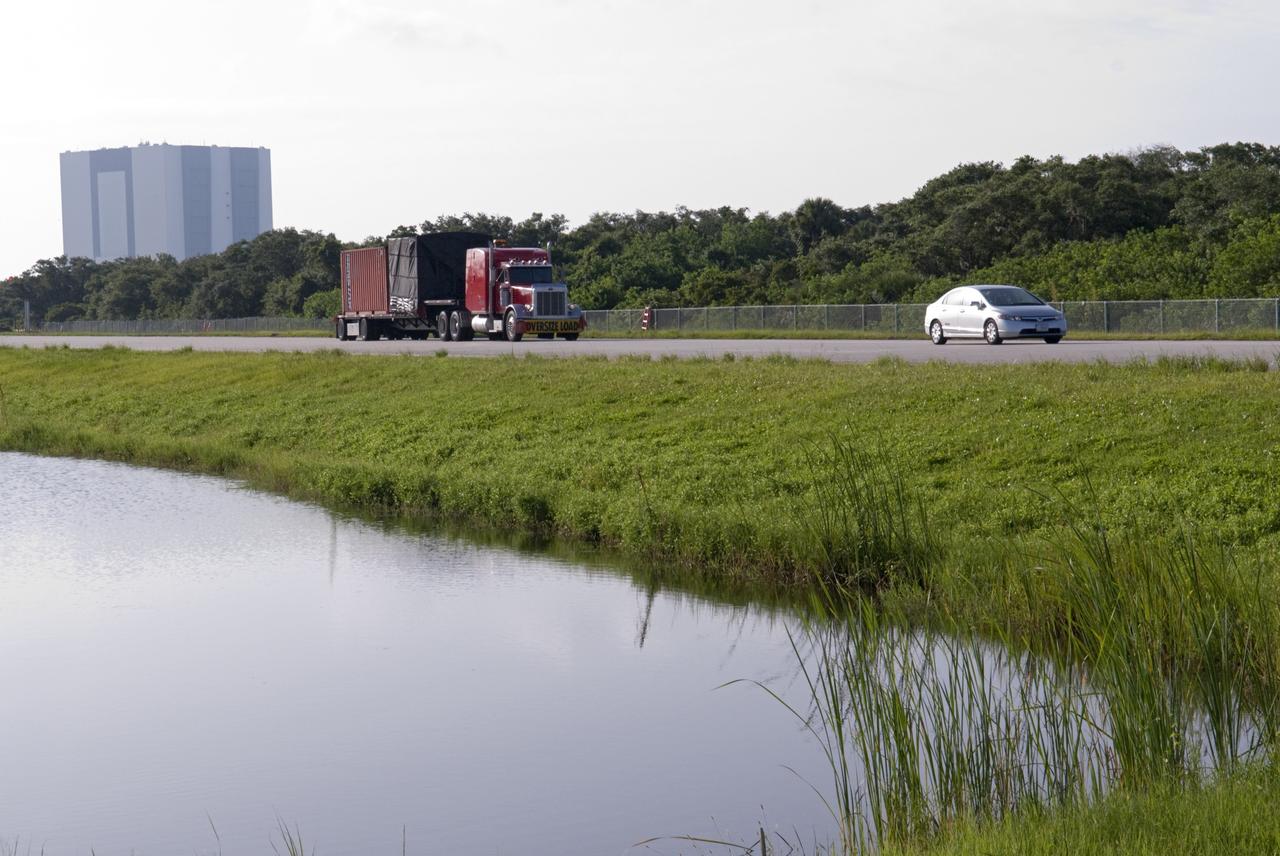
CAPE CANAVERAL, Fla. - A truck transporting NASA's Morpheus lander, a vertical test bed vehicle, heads towards the Shuttle Landing Facility, or SLF, at the Kennedy Space Center in Florida for unloading. Morpheus is designed to demonstrate new green propellant propulsion systems and autonomous landing and an Autonomous Landing and Hazard Avoidance Technology, or ALHAT, system. Checkout of the prototype lander has been ongoing at NASA’s Johnson Space Center in Houston in preparation for its first free flight. The SLF site will provide the lander with the kind of field necessary for realistic testing. Project Morpheus is one of 20 small projects comprising the Advanced Exploration Systems, or AES, program in NASA’s Human Exploration and Operations Mission Directorate. AES projects pioneer new approaches for rapidly developing prototype systems, demonstrating key capabilities and validating operational concepts for future human missions beyond Earth orbit. For more information on Project Morpheus, visit http://www.nasa.gov/centers/johnson/exploration/morpheus/index.html Photo credit: NASA/ Charisse Nahser
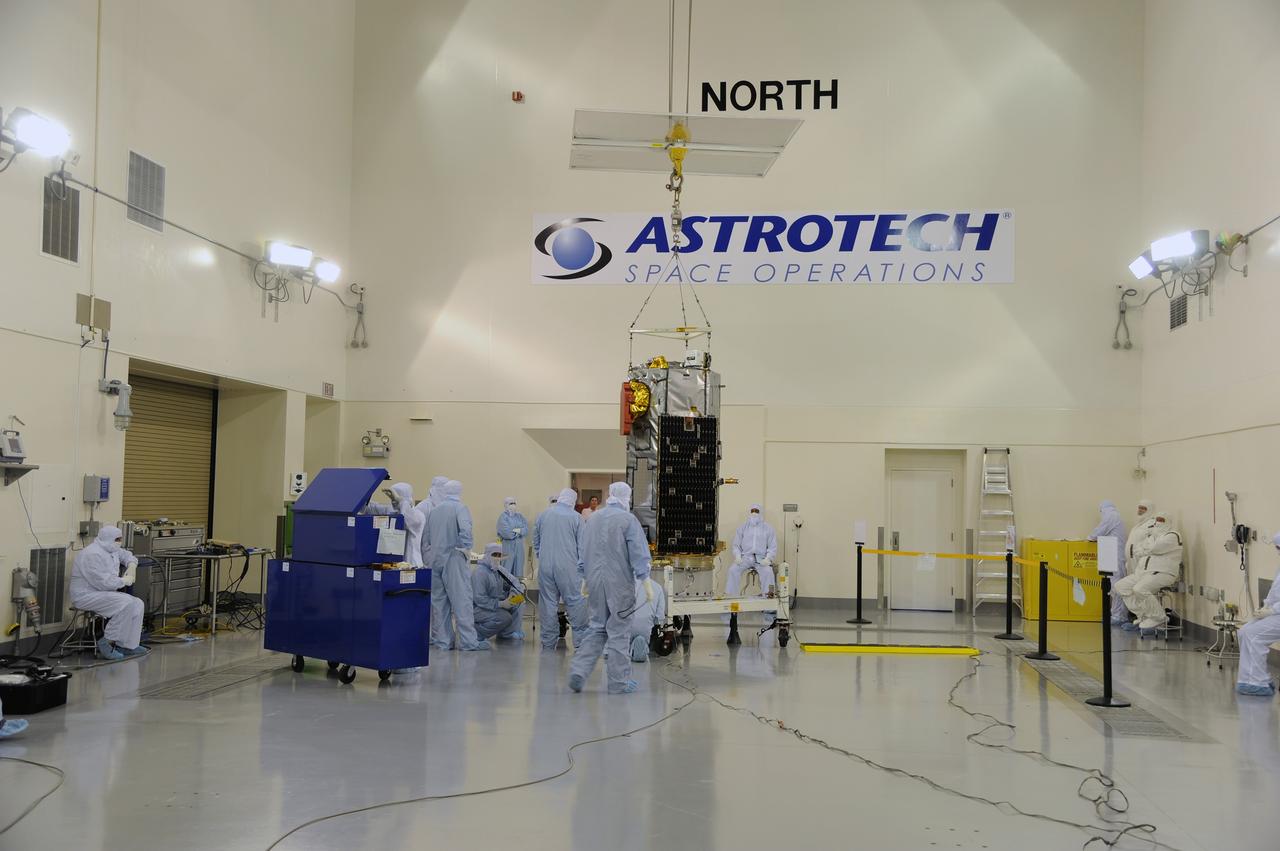
VANDENBERG AIR FORCE BASE, Calif. – In the Astrotech payload processing facility on Vandenberg Air Force Base in California, NASA's Orbiting Carbon Observatory-2, or OCO-2, is secured onto a test fixture. Testing and launch preparations now will get underway for its launch from Space Launch Complex 2 aboard a United Launch Alliance Delta II rocket, scheduled for July 1, 2014. The observatory will collect precise global measurements of carbon dioxide in the Earth's atmosphere and provide scientists with a better idea of the chemical compound's impacts on climate change. Scientists will analyze this data to improve our understanding of the natural processes and human activities that regulate the abundance and distribution of this important atmospheric gas. OCO-2 is a NASA Earth System Science Pathfinder Program mission managed by NASA's Jet Propulsion Laboratory JPL in Pasadena, California, for NASA's Science Mission Directorate in Washington. Orbital Sciences built the spacecraft and provides mission operations under JPL’s leadership. To learn more about OCO-2, visit http://oco.jpl.nasa.gov. Photo credit: NASA/Doug Gruben, 30th Space Wing
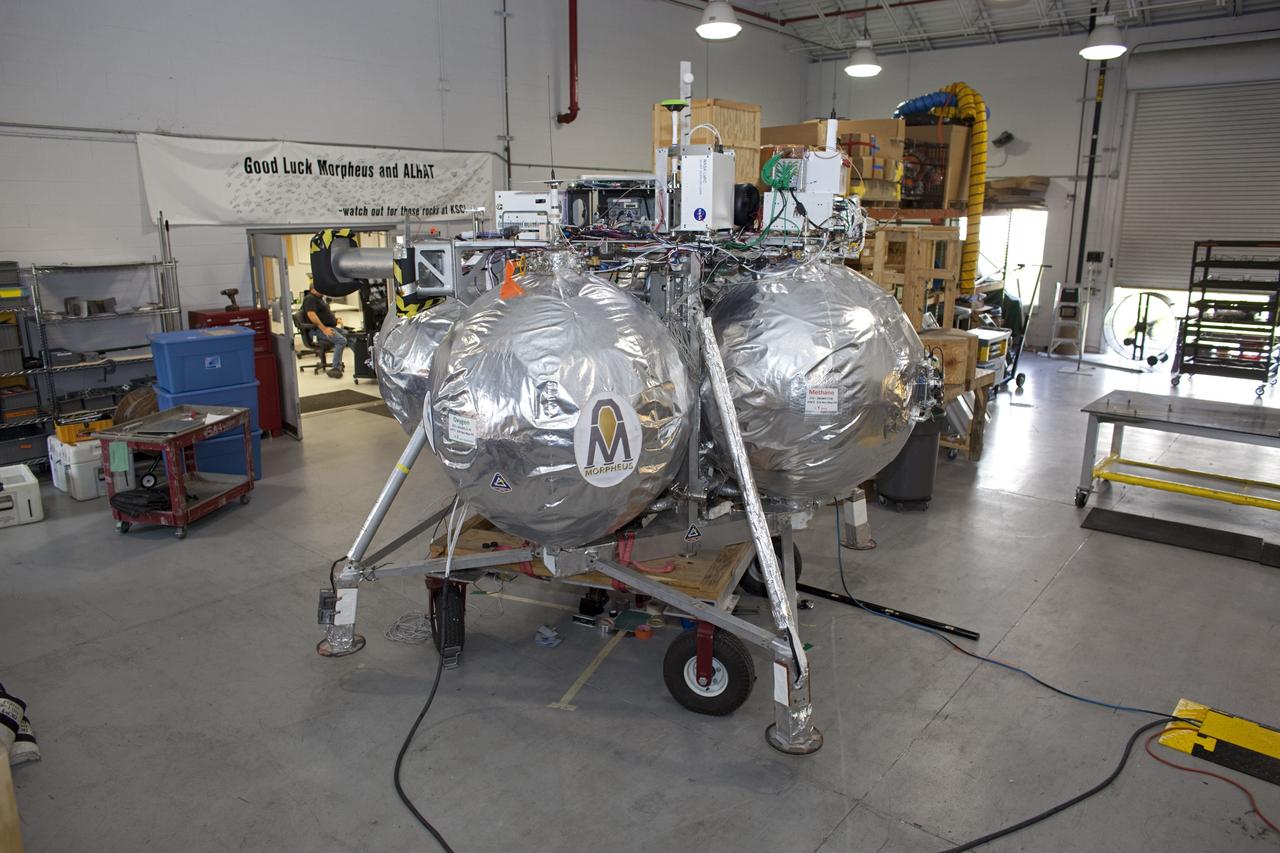
CAPE CANAVERAL, Fla. - NASA's Morpheus lander, a vertical test bed vehicle, is being checked out in a building at the Shuttle Landing Facility, or SLF, at the Kennedy Space Center in Florida. Morpheus is designed to demonstrate new green propellant propulsion systems and autonomous landing and an Autonomous Landing and Hazard Avoidance Technology, or ALHAT, system. Checkout of the prototype lander has been ongoing at NASA’s Johnson Space Center in Houston in preparation for its first free flight. The SLF site will provide the lander with the kind of field necessary for realistic testing. Project Morpheus is one of 20 small projects comprising the Advanced Exploration Systems, or AES, program in NASA’s Human Exploration and Operations Mission Directorate. AES projects pioneer new approaches for rapidly developing prototype systems, demonstrating key capabilities and validating operational concepts for future human missions beyond Earth orbit. For more information on Project Morpheus, visit http://www.nasa.gov/centers/johnson/exploration/morpheus/index.html Photo credit: NASA/Dimitri Gerondidakis
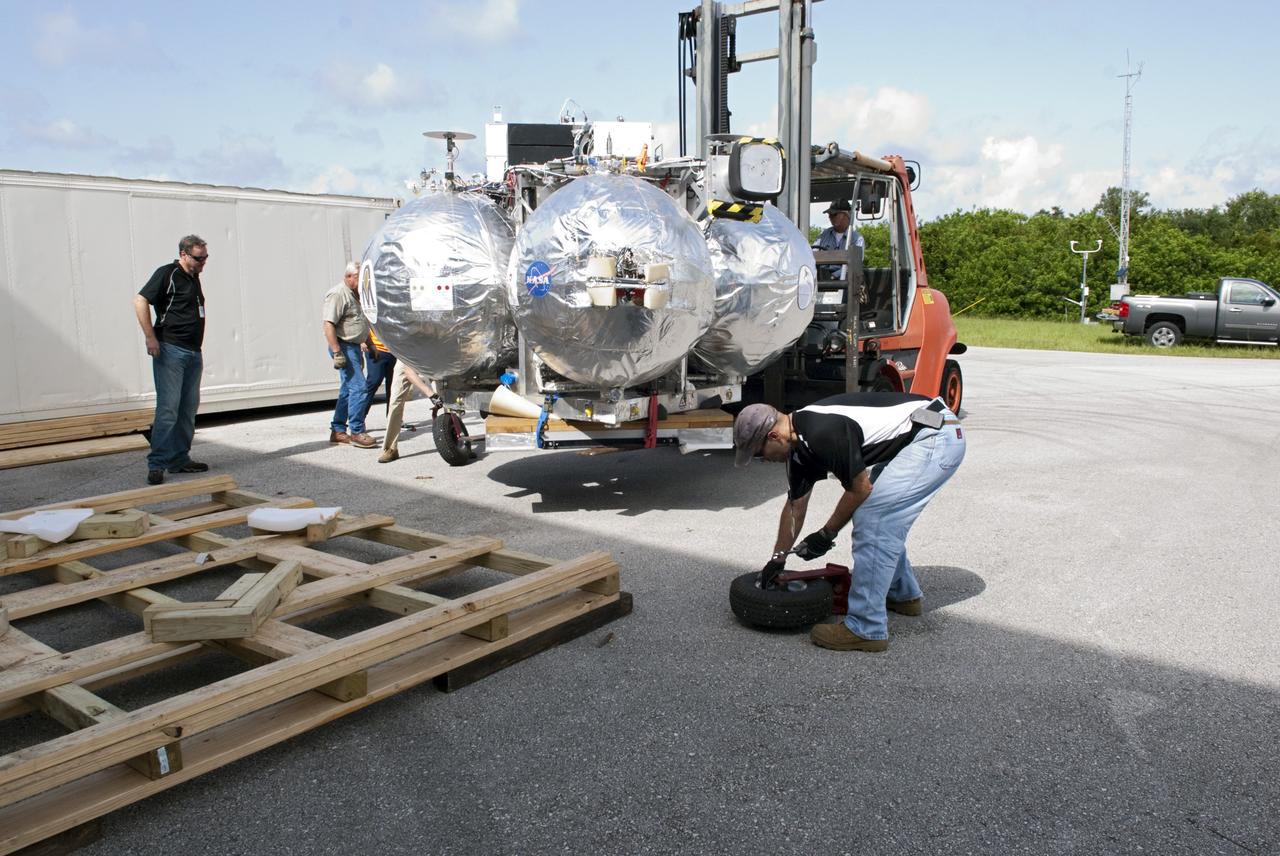
CAPE CANAVERAL, Fla. - Wheels are assembled for transporting NASA's Morpheus lander, a vertical test bed vehicle after its arrival at the Kennedy Space Center in Florida. Morpheus is designed to demonstrate new green propellant propulsion systems and autonomous landing and an Autonomous Landing and Hazard Avoidance Technology, or ALHAT, system. Checkout of the prototype lander has been ongoing at NASA’s Johnson Space Center in Houston in preparation for its first free flight. The SLF site will provide the lander with the kind of field necessary for realistic testing. Project Morpheus is one of 20 small projects comprising the Advanced Exploration Systems, or AES, program in NASA’s Human Exploration and Operations Mission Directorate. AES projects pioneer new approaches for rapidly developing prototype systems, demonstrating key capabilities and validating operational concepts for future human missions beyond Earth orbit. For more information on Project Morpheus, visit http://www.nasa.gov/centers/johnson/exploration/morpheus/index.html Photo credit: NASA/ Charisse Nahser
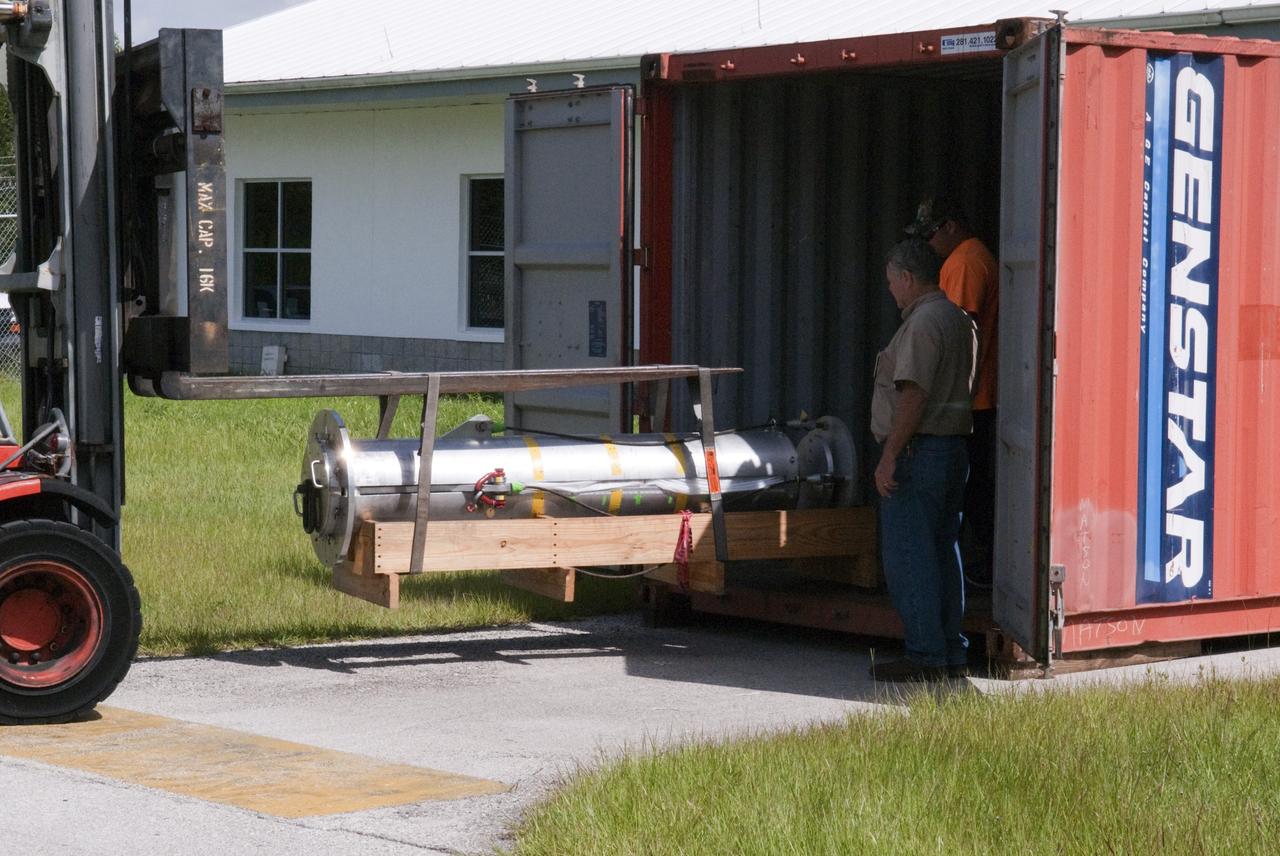
CAPE CANAVERAL, Fla. - Support equipment for NASA's Morpheus lander, a vertical test bed vehicle, is unloaded at a building at the Shuttle Landing Facility, or SLF, at the Kennedy Space Center in Florida. Morpheus is designed to demonstrate new green propellant propulsion systems and autonomous landing and an Autonomous Landing and Hazard Avoidance Technology, or ALHAT, system. Checkout of the prototype lander has been ongoing at NASA’s Johnson Space Center in Houston in preparation for its first free flight. The SLF site will provide the lander with the kind of field necessary for realistic testing. Project Morpheus is one of 20 small projects comprising the Advanced Exploration Systems, or AES, program in NASA’s Human Exploration and Operations Mission Directorate. AES projects pioneer new approaches for rapidly developing prototype systems, demonstrating key capabilities and validating operational concepts for future human missions beyond Earth orbit. For more information on Project Morpheus, visit http://www.nasa.gov/centers/johnson/exploration/morpheus/index.html Photo credit: NASA/ Charisse Nahser
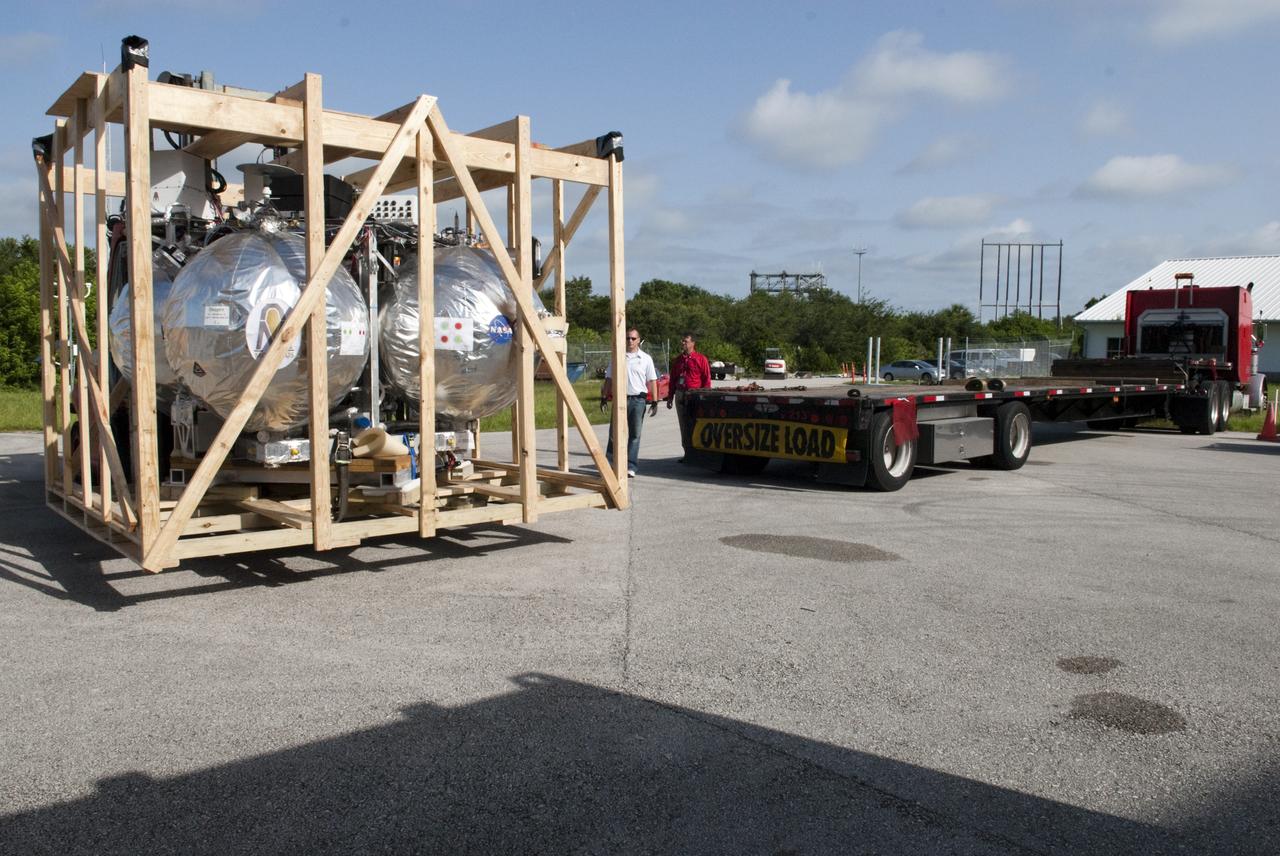
CAPE CANAVERAL, Fla. - NASA's Morpheus lander, a vertical test bed vehicle, has been unloaded at the Kennedy Space Center in Florida. Morpheus is designed to demonstrate new green propellant propulsion systems and autonomous landing and an Autonomous Landing and Hazard Avoidance Technology, or ALHAT, system. Checkout of the prototype lander has been ongoing at NASA’s Johnson Space Center in Houston in preparation for its first free flight. The SLF site will provide the lander with the kind of field necessary for realistic testing. Project Morpheus is one of 20 small projects comprising the Advanced Exploration Systems, or AES, program in NASA’s Human Exploration and Operations Mission Directorate. AES projects pioneer new approaches for rapidly developing prototype systems, demonstrating key capabilities and validating operational concepts for future human missions beyond Earth orbit. For more information on Project Morpheus, visit http://www.nasa.gov/centers/johnson/exploration/morpheus/index.html Photo credit: NASA/ Charisse Nahser

CAPE CANAVERAL, Fla. - A crane is being used to set up NASA's Morpheus lander, a vertical test bed vehicle, at its launch position along the runway at the Shuttle Landing Facility, or SLF, at the Kennedy Space Center in Florida. Morpheus is designed to demonstrate new green propellant propulsion systems and autonomous landing and an Autonomous Landing and Hazard Avoidance Technology, or ALHAT, system. Checkout of the prototype lander has been ongoing at NASA’s Johnson Space Center in Houston in preparation for its first free flight. The SLF site will provide the lander with the kind of field necessary for realistic testing. Project Morpheus is one of 20 small projects comprising the Advanced Exploration Systems, or AES, program in NASA’s Human Exploration and Operations Mission Directorate. AES projects pioneer new approaches for rapidly developing prototype systems, demonstrating key capabilities and validating operational concepts for future human missions beyond Earth orbit. For more information on Project Morpheus, visit http://www.nasa.gov/centers/johnson/exploration/morpheus/index.html Photo credit: NASA/Dimitri Gerondidakis
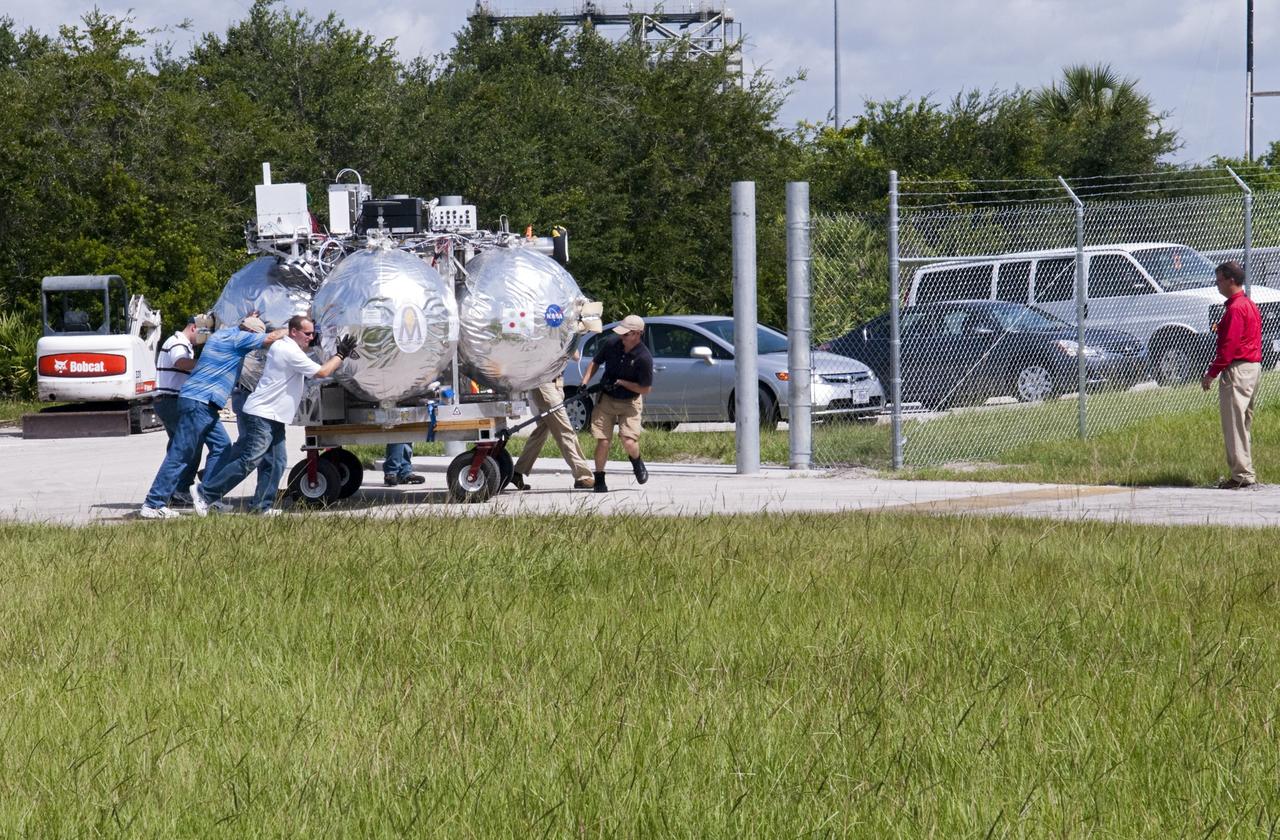
CAPE CANAVERAL, Fla. - NASA's Morpheus lander, a vertical test bed vehicle, is moved into a building at the Shuttle Landing Facility, or SLF, at the Kennedy Space Center in Florida. Morpheus is designed to demonstrate new green propellant propulsion systems and autonomous landing and an Autonomous Landing and Hazard Avoidance Technology, or ALHAT, system. Checkout of the prototype lander has been ongoing at NASA’s Johnson Space Center in Houston in preparation for its first free flight. The SLF site will provide the lander with the kind of field necessary for realistic testing. Project Morpheus is one of 20 small projects comprising the Advanced Exploration Systems, or AES, program in NASA’s Human Exploration and Operations Mission Directorate. AES projects pioneer new approaches for rapidly developing prototype systems, demonstrating key capabilities and validating operational concepts for future human missions beyond Earth orbit. For more information on Project Morpheus, visit http://www.nasa.gov/centers/johnson/exploration/morpheus/index.html Photo credit: NASA/ Charisse Nahser
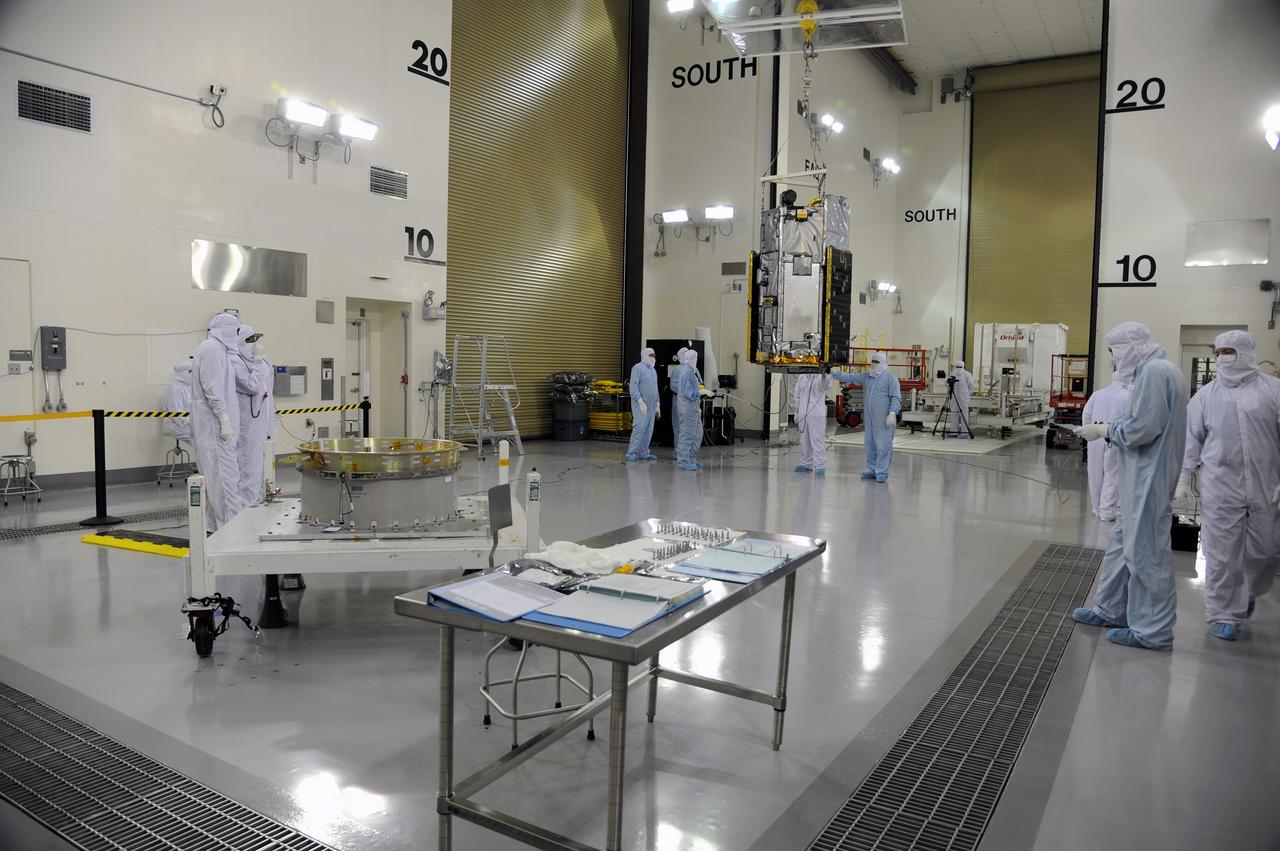
VANDENBERG AIR FORCE BASE, Calif. – In the Astrotech payload processing facility on Vandenberg Air Force Base in California, Orbital Sciences workers and technicians steady NASA's Orbiting Carbon Observatory-2, or OCO-2, as it glides across the room from its transportation trailer toward a test fixture. Testing and launch preparations now will get underway for its launch from Space Launch Complex 2 aboard a United Launch Alliance Delta II rocket, scheduled for July 1, 2014. The observatory will collect precise global measurements of carbon dioxide in the Earth's atmosphere and provide scientists with a better idea of the chemical compound's impacts on climate change. Scientists will analyze this data to improve our understanding of the natural processes and human activities that regulate the abundance and distribution of this important atmospheric gas. OCO-2 is a NASA Earth System Science Pathfinder Program mission managed by NASA's Jet Propulsion Laboratory JPL in Pasadena, California, for NASA's Science Mission Directorate in Washington. Orbital Sciences built the spacecraft and provides mission operations under JPL’s leadership. To learn more about OCO-2, visit http://oco.jpl.nasa.gov. Photo credit: NASA/Doug Gruben, 30th Space Wing
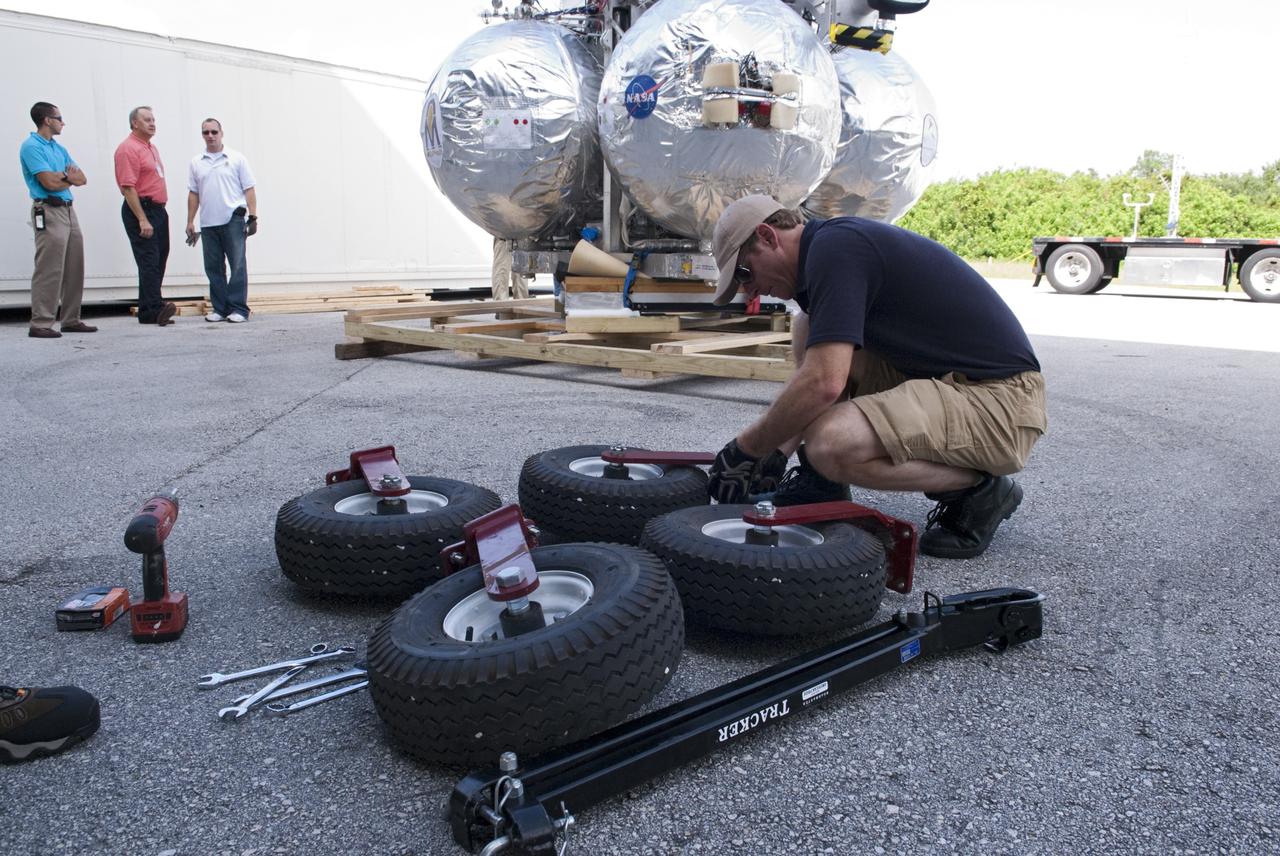
CAPE CANAVERAL, Fla. - Wheels are assembled for transporting NASA's Morpheus lander, a vertical test bed vehicle after its arrival at the Kennedy Space Center in Florida. Morpheus is designed to demonstrate new green propellant propulsion systems and autonomous landing and an Autonomous Landing and Hazard Avoidance Technology, or ALHAT, system. Checkout of the prototype lander has been ongoing at NASA’s Johnson Space Center in Houston in preparation for its first free flight. The SLF site will provide the lander with the kind of field necessary for realistic testing. Project Morpheus is one of 20 small projects comprising the Advanced Exploration Systems, or AES, program in NASA’s Human Exploration and Operations Mission Directorate. AES projects pioneer new approaches for rapidly developing prototype systems, demonstrating key capabilities and validating operational concepts for future human missions beyond Earth orbit. For more information on Project Morpheus, visit http://www.nasa.gov/centers/johnson/exploration/morpheus/index.html Photo credit: NASA/ Charisse Nahser
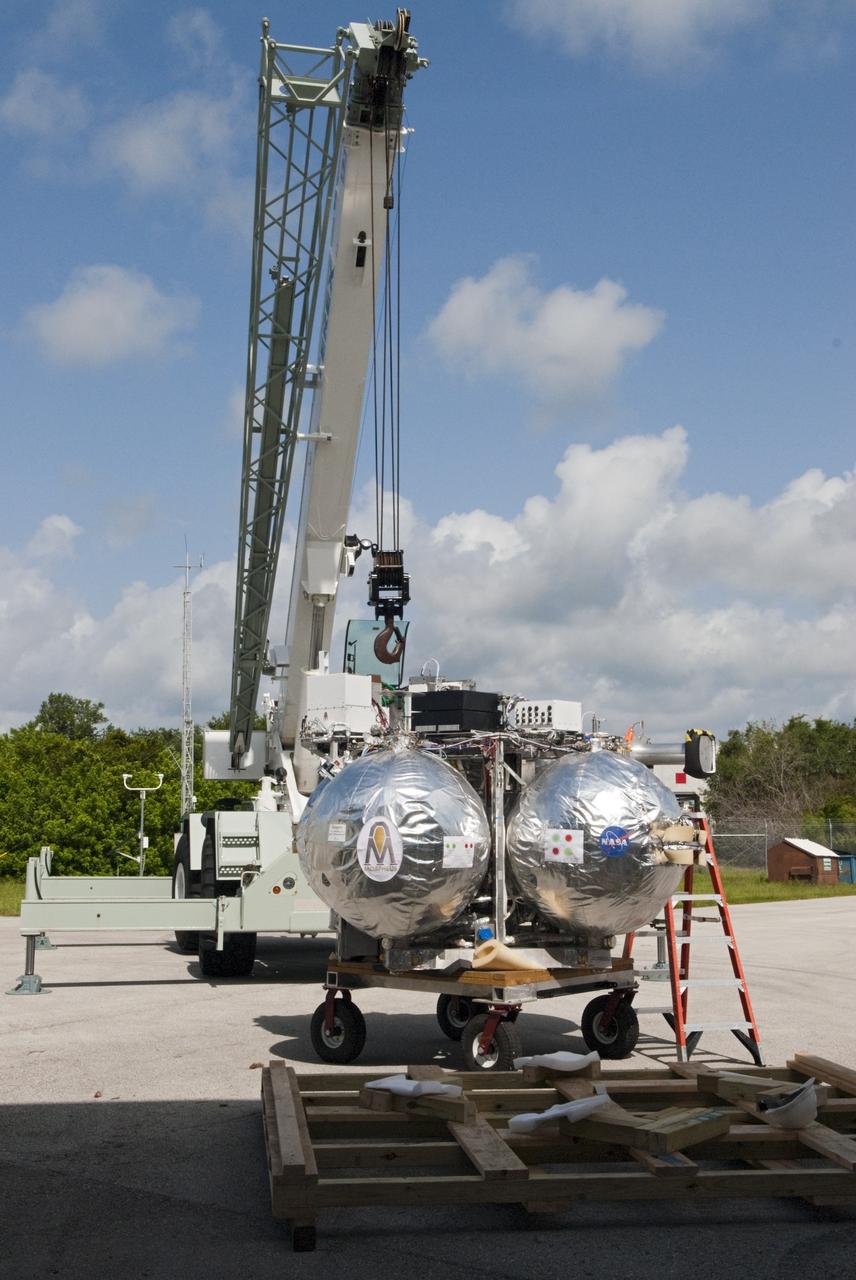
CAPE CANAVERAL, Fla. - A crane supports unloading of NASA's Morpheus lander, a vertical test bed vehicle, at the Kennedy Space Center in Florida. Morpheus is designed to demonstrate new green propellant propulsion systems and autonomous landing and an Autonomous Landing and Hazard Avoidance Technology, or ALHAT, system. Checkout of the prototype lander has been ongoing at NASA’s Johnson Space Center in Houston in preparation for its first free flight. The SLF site will provide the lander with the kind of field necessary for realistic testing. Project Morpheus is one of 20 small projects comprising the Advanced Exploration Systems, or AES, program in NASA’s Human Exploration and Operations Mission Directorate. AES projects pioneer new approaches for rapidly developing prototype systems, demonstrating key capabilities and validating operational concepts for future human missions beyond Earth orbit. For more information on Project Morpheus, visit http://www.nasa.gov/centers/johnson/exploration/morpheus/index.html Photo credit: NASA/ Charisse Nahser
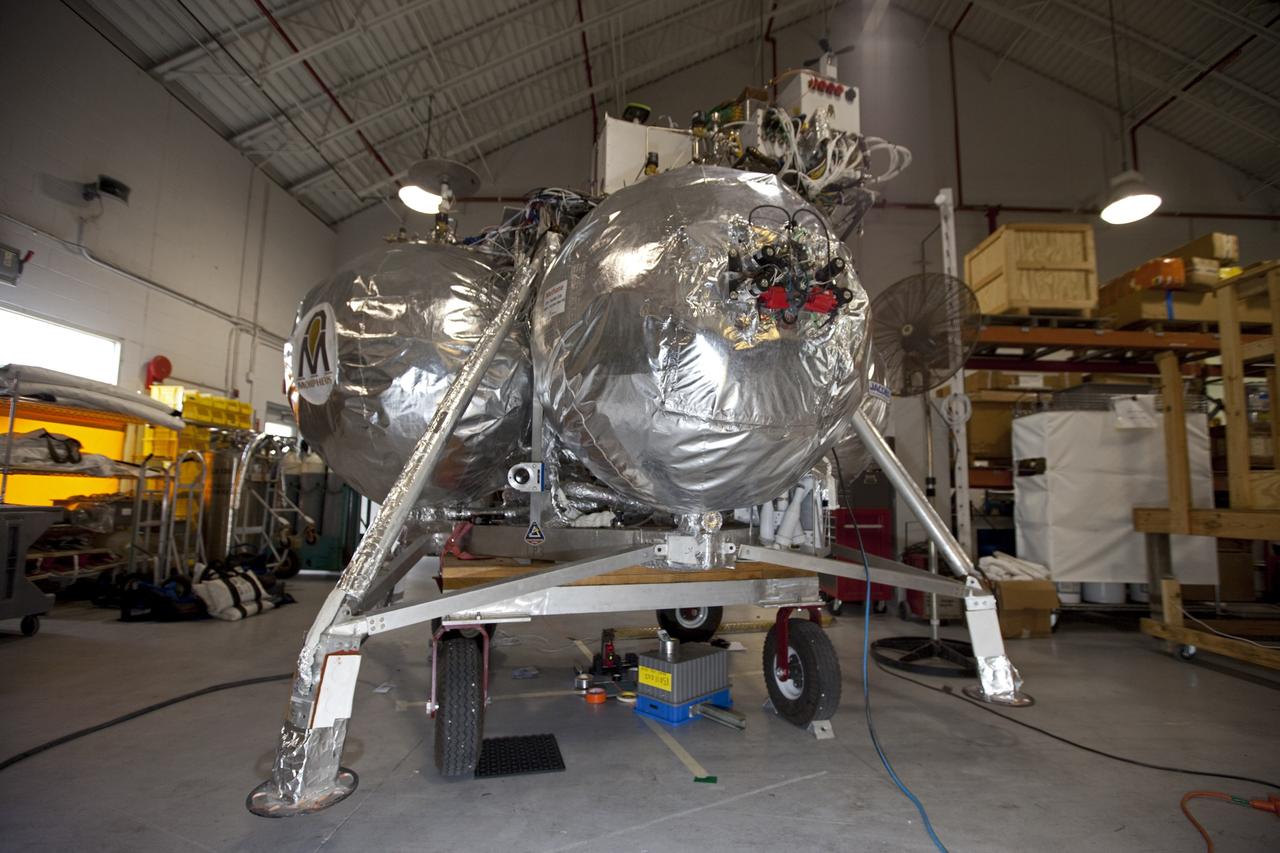
CAPE CANAVERAL, Fla. - NASA's Morpheus lander, a vertical test bed vehicle, is being checked out in a building at the Shuttle Landing Facility, or SLF, at the Kennedy Space Center in Florida. Morpheus is designed to demonstrate new green propellant propulsion systems and autonomous landing and an Autonomous Landing and Hazard Avoidance Technology, or ALHAT, system. Checkout of the prototype lander has been ongoing at NASA’s Johnson Space Center in Houston in preparation for its first free flight. The SLF site will provide the lander with the kind of field necessary for realistic testing. Project Morpheus is one of 20 small projects comprising the Advanced Exploration Systems, or AES, program in NASA’s Human Exploration and Operations Mission Directorate. AES projects pioneer new approaches for rapidly developing prototype systems, demonstrating key capabilities and validating operational concepts for future human missions beyond Earth orbit. For more information on Project Morpheus, visit http://www.nasa.gov/centers/johnson/exploration/morpheus/index.html Photo credit: NASA/Dimitri Gerondidakis
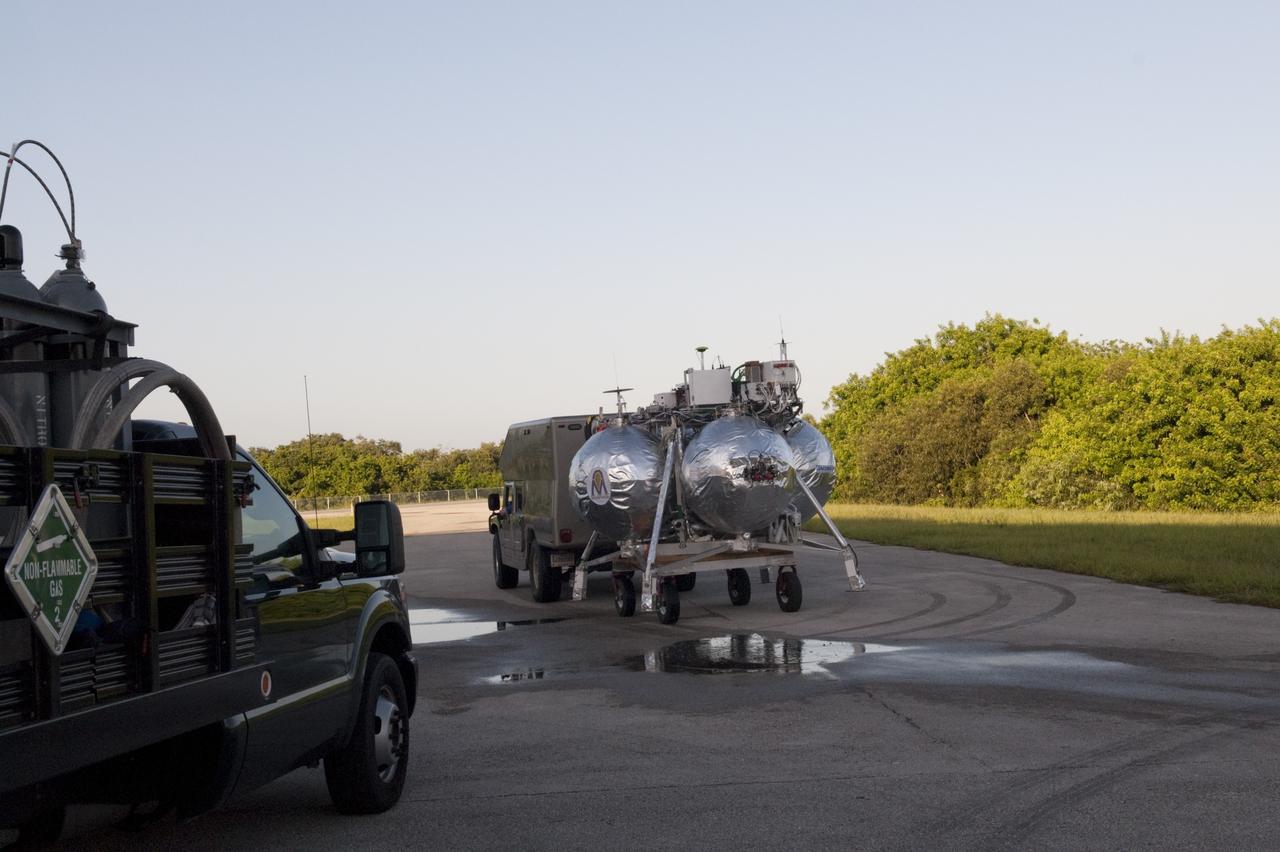
CAPE CANAVERAL, Fla. - NASA's Morpheus lander, a vertical test bed vehicle, is being transported out from its checkout building for a short trip to a launch position at the Shuttle Landing Facility, or SLF, at the Kennedy Space Center in Florida. Morpheus is designed to demonstrate new green propellant propulsion systems and autonomous landing and an Autonomous Landing and Hazard Avoidance Technology, or ALHAT, system. Checkout of the prototype lander has been ongoing at NASA’s Johnson Space Center in Houston in preparation for its first free flight. The SLF site will provide the lander with the kind of field necessary for realistic testing. Project Morpheus is one of 20 small projects comprising the Advanced Exploration Systems, or AES, program in NASA’s Human Exploration and Operations Mission Directorate. AES projects pioneer new approaches for rapidly developing prototype systems, demonstrating key capabilities and validating operational concepts for future human missions beyond Earth orbit. For more information on Project Morpheus, visit http://www.nasa.gov/centers/johnson/exploration/morpheus/index.html Photo credit: NASA/Dimitri Gerondidakis
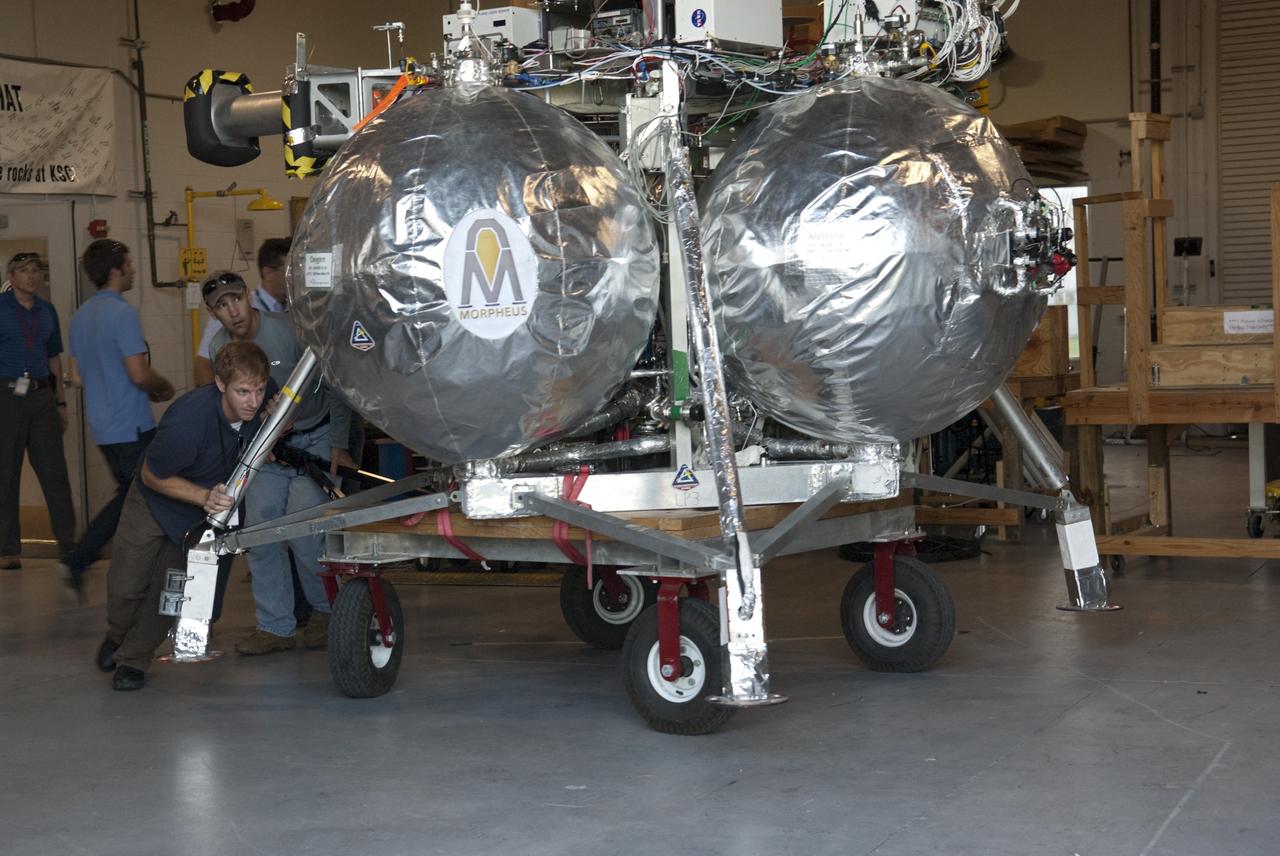
CAPE CANAVERAL, Fla. - NASA's Morpheus lander, a vertical test bed vehicle, is being moved out of its checkout building for a short trip to a launch position at the Shuttle Landing Facility, or SLF, at the Kennedy Space Center in Florida. Morpheus is designed to demonstrate new green propellant propulsion systems and autonomous landing and an Autonomous Landing and Hazard Avoidance Technology, or ALHAT, system. Checkout of the prototype lander has been ongoing at NASA’s Johnson Space Center in Houston in preparation for its first free flight. The SLF site will provide the lander with the kind of field necessary for realistic testing. Project Morpheus is one of 20 small projects comprising the Advanced Exploration Systems, or AES, program in NASA’s Human Exploration and Operations Mission Directorate. AES projects pioneer new approaches for rapidly developing prototype systems, demonstrating key capabilities and validating operational concepts for future human missions beyond Earth orbit. For more information on Project Morpheus, visit http://www.nasa.gov/centers/johnson/exploration/morpheus/index.html Photo credit: NASA/Dimitri Gerondidakis
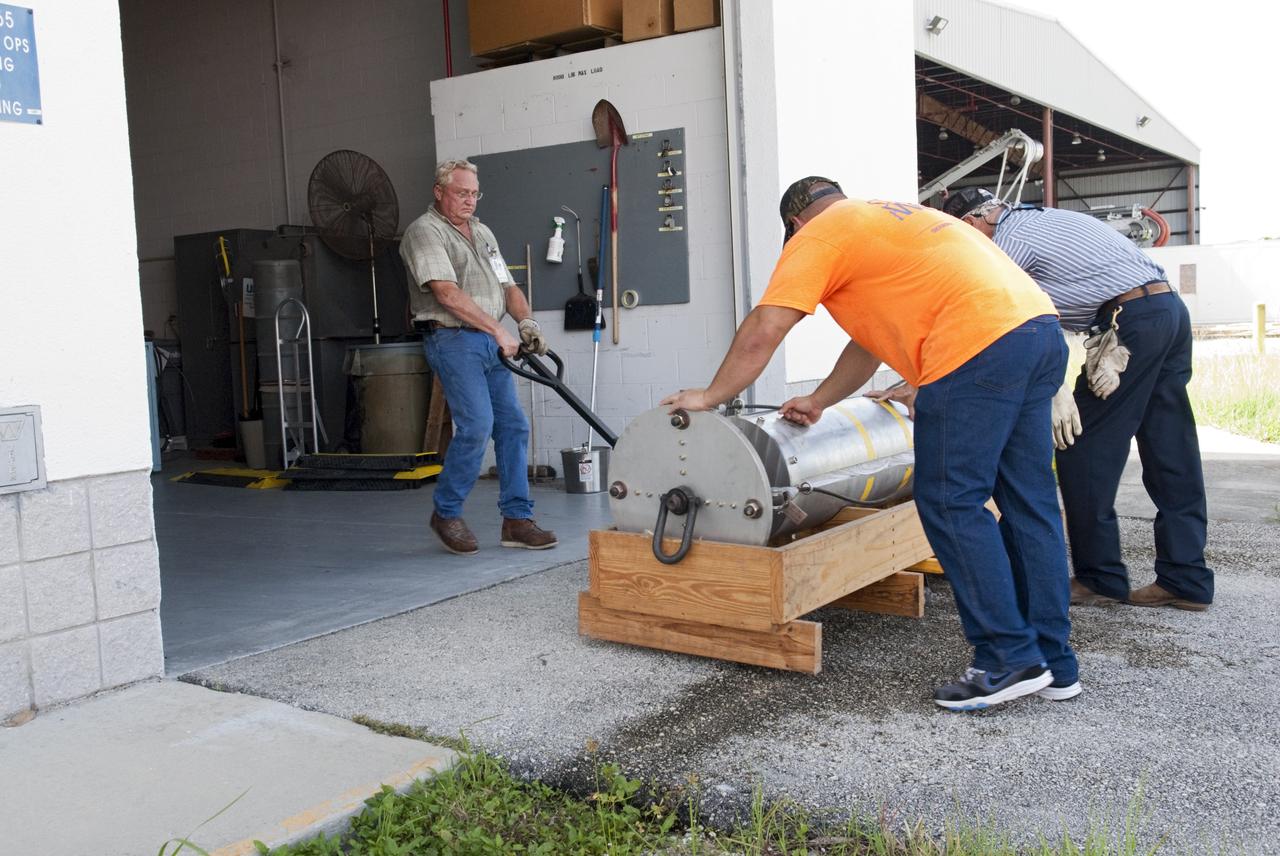
CAPE CANAVERAL, Fla. - Support equipment for NASA's Morpheus lander, a vertical test bed vehicle, is moved into a building at the Shuttle Landing Facility, or SLF, at the Kennedy Space Center in Florida. Morpheus is designed to demonstrate new green propellant propulsion systems and autonomous landing and an Autonomous Landing and Hazard Avoidance Technology, or ALHAT, system. Checkout of the prototype lander has been ongoing at NASA’s Johnson Space Center in Houston in preparation for its first free flight. The SLF site will provide the lander with the kind of field necessary for realistic testing. Project Morpheus is one of 20 small projects comprising the Advanced Exploration Systems, or AES, program in NASA’s Human Exploration and Operations Mission Directorate. AES projects pioneer new approaches for rapidly developing prototype systems, demonstrating key capabilities and validating operational concepts for future human missions beyond Earth orbit. For more information on Project Morpheus, visit http://www.nasa.gov/centers/johnson/exploration/morpheus/index.html Photo credit: NASA/ Charisse Nahser
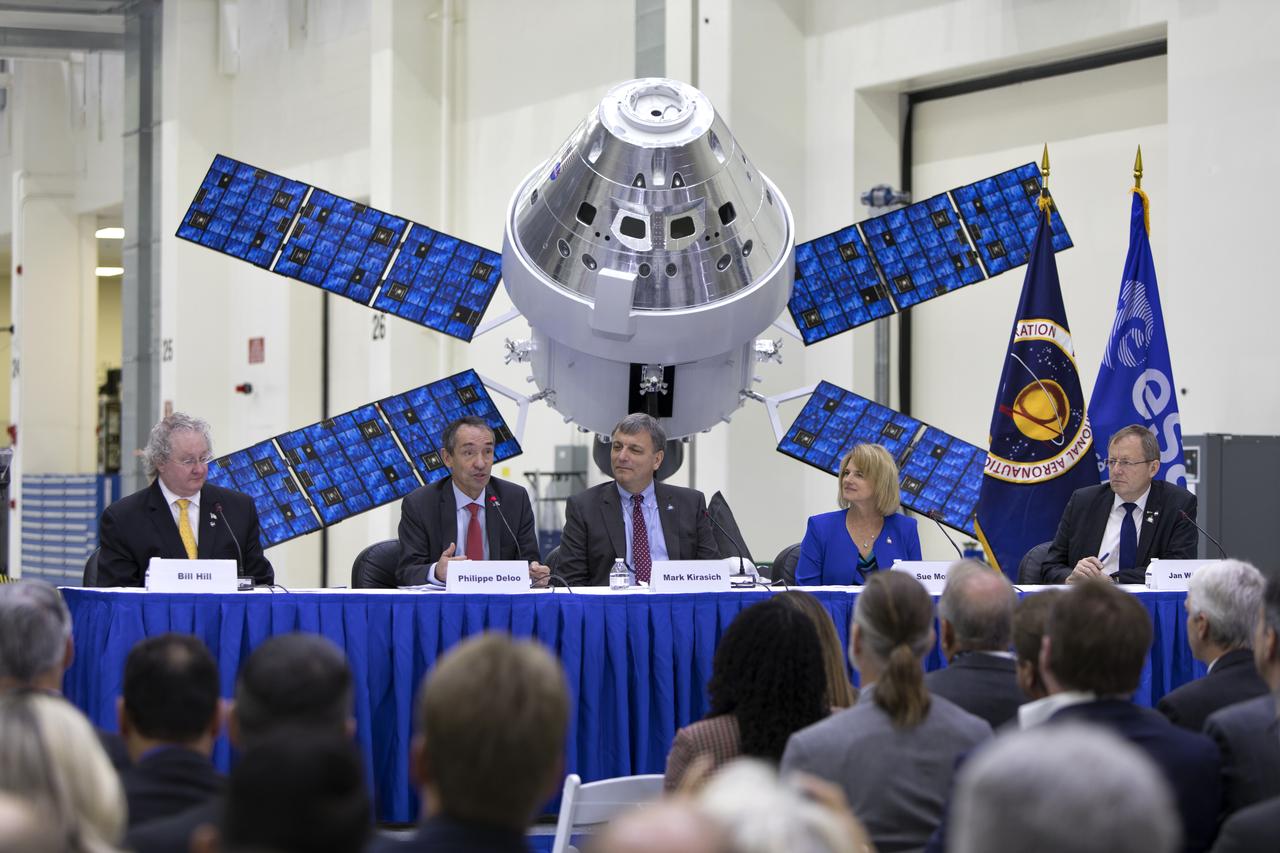
NASA and European Space Agency (ESA) senior managers answer questions during a "Powering Exploration Mission-1" ceremony in the Neil Armstrong Operations and Checkout Building high bay at NASA's Kennedy Space Center on Nov. 16, 2018. From left, are Bill Hill, deputy associate administrator for Exploration Systems Development; Phillippe Deloo, European Service Module program manager at ESA; Mark Kirasich, Orion Program manager at the agency's Johnson Space Center in Houston; Sue Motil, Orion European Service Module integration manager at the agency's Glenn Research Center; and Jan Worner, ESA director general. The event was held to mark a major milestone, the arrival of the European Service Module (ESM) for Orion's Exploration Mission-1. The service module, built by the European Space Agency, will supply the main propulsion system and power to the Orion spacecraft during EM-1, a mission to the Moon. The ESM also will house air and water for astronauts on future missions. EM-1 will be an uncrewed flight test that will provide a foundation for human deep space exploration to destinations beyond Earth orbit. EM-1 will be the first integrated test of NASA's Space Launch System, Orion and the ground systems at Kennedy.
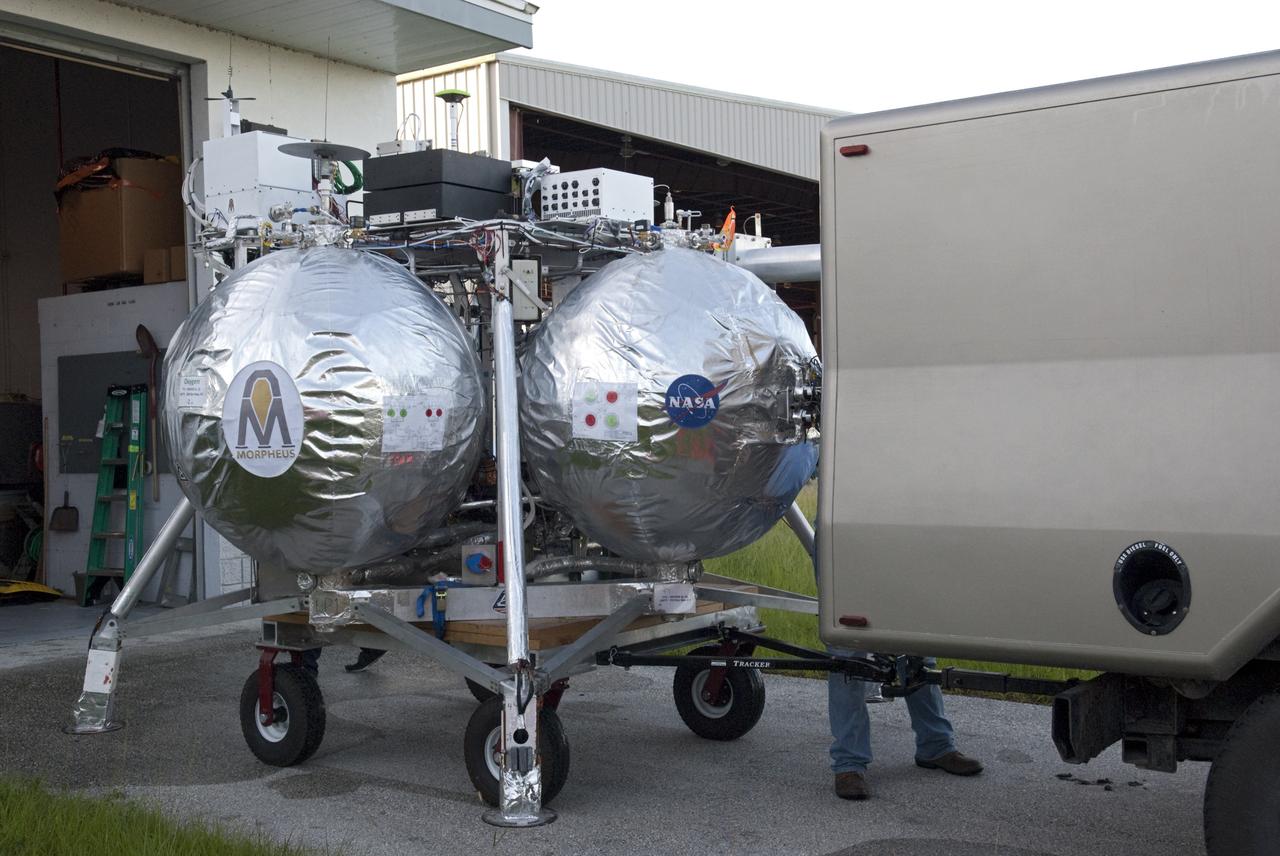
CAPE CANAVERAL, Fla. - NASA's Morpheus lander, a vertical test bed vehicle, is being transported out of its checkout building for a short trip to a launch position at the Shuttle Landing Facility, or SLF, at the Kennedy Space Center in Florida. Morpheus is designed to demonstrate new green propellant propulsion systems and autonomous landing and an Autonomous Landing and Hazard Avoidance Technology, or ALHAT, system. Checkout of the prototype lander has been ongoing at NASA’s Johnson Space Center in Houston in preparation for its first free flight. The SLF site will provide the lander with the kind of field necessary for realistic testing. Project Morpheus is one of 20 small projects comprising the Advanced Exploration Systems, or AES, program in NASA’s Human Exploration and Operations Mission Directorate. AES projects pioneer new approaches for rapidly developing prototype systems, demonstrating key capabilities and validating operational concepts for future human missions beyond Earth orbit. For more information on Project Morpheus, visit http://www.nasa.gov/centers/johnson/exploration/morpheus/index.html Photo credit: NASA/Dimitri Gerondidakis
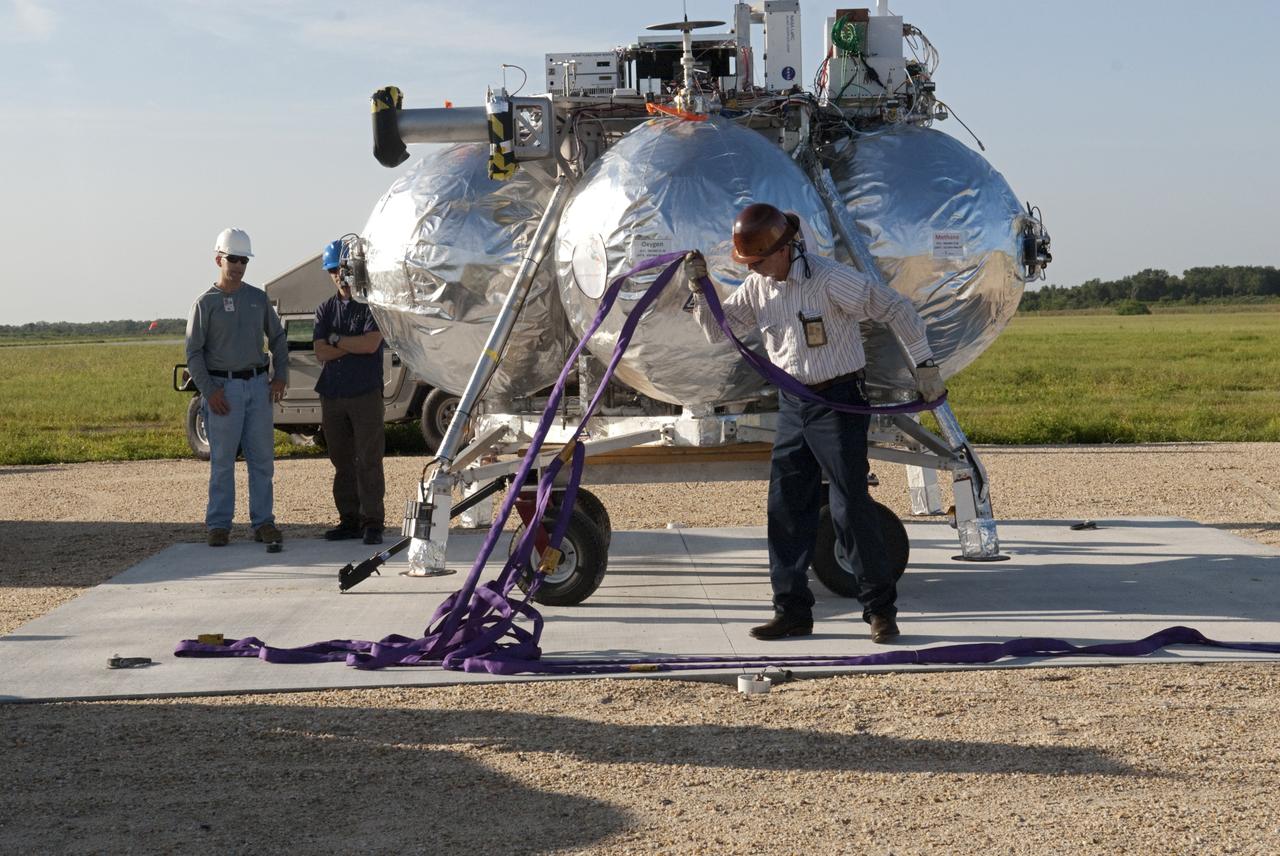
CAPE CANAVERAL, Fla. - NASA's Morpheus lander, a vertical test bed vehicle, is being set up at its launch position along the runway at the Shuttle Landing Facility, or SLF, at the Kennedy Space Center in Florida. Morpheus is designed to demonstrate new green propellant propulsion systems and autonomous landing and an Autonomous Landing and Hazard Avoidance Technology, or ALHAT, system. Checkout of the prototype lander has been ongoing at NASA’s Johnson Space Center in Houston in preparation for its first free flight. The SLF site will provide the lander with the kind of field necessary for realistic testing. Project Morpheus is one of 20 small projects comprising the Advanced Exploration Systems, or AES, program in NASA’s Human Exploration and Operations Mission Directorate. AES projects pioneer new approaches for rapidly developing prototype systems, demonstrating key capabilities and validating operational concepts for future human missions beyond Earth orbit. For more information on Project Morpheus, visit http://www.nasa.gov/centers/johnson/exploration/morpheus/index.html Photo credit: NASA/Dimitri Gerondidakis
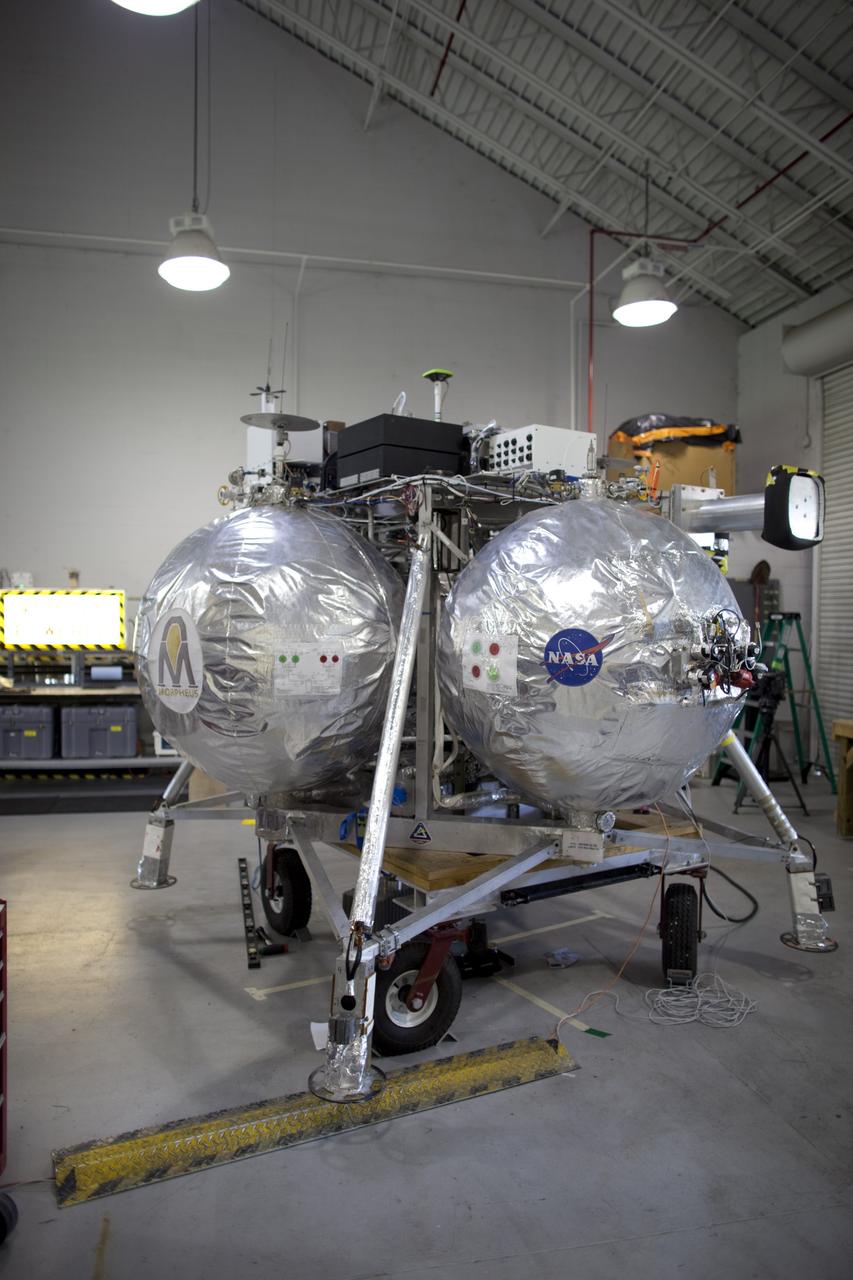
CAPE CANAVERAL, Fla. - NASA's Morpheus lander, a vertical test bed vehicle, is being checked out in a building at the Shuttle Landing Facility, or SLF, at the Kennedy Space Center in Florida. Morpheus is designed to demonstrate new green propellant propulsion systems and autonomous landing and an Autonomous Landing and Hazard Avoidance Technology, or ALHAT, system. Checkout of the prototype lander has been ongoing at NASA’s Johnson Space Center in Houston in preparation for its first free flight. The SLF site will provide the lander with the kind of field necessary for realistic testing. Project Morpheus is one of 20 small projects comprising the Advanced Exploration Systems, or AES, program in NASA’s Human Exploration and Operations Mission Directorate. AES projects pioneer new approaches for rapidly developing prototype systems, demonstrating key capabilities and validating operational concepts for future human missions beyond Earth orbit. For more information on Project Morpheus, visit http://www.nasa.gov/centers/johnson/exploration/morpheus/index.html Photo credit: NASA/Dimitri Gerondidakis
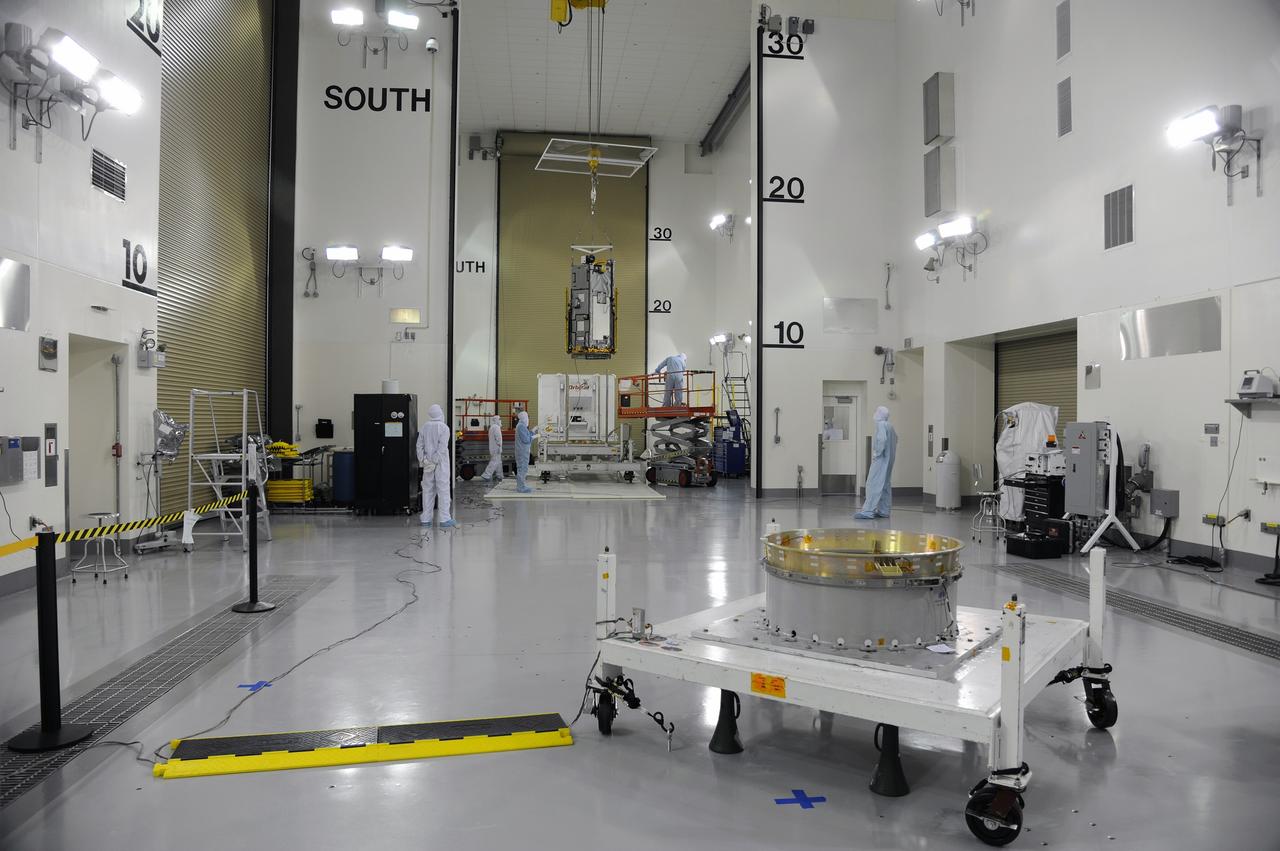
VANDENBERG AIR FORCE BASE, Calif. – In the Astrotech payload processing facility on Vandenberg Air Force Base in California, NASA's Orbiting Carbon Observatory-2, or OCO-2, is lifted from its transportation trailer for its move onto the test fixture in the foreground. Testing and launch preparations now will get underway for its launch from Space Launch Complex 2 aboard a United Launch Alliance Delta II rocket, scheduled for July 1, 2014. The observatory will collect precise global measurements of carbon dioxide in the Earth's atmosphere and provide scientists with a better idea of the chemical compound's impacts on climate change. Scientists will analyze this data to improve our understanding of the natural processes and human activities that regulate the abundance and distribution of this important atmospheric gas. OCO-2 is a NASA Earth System Science Pathfinder Program mission managed by NASA's Jet Propulsion Laboratory JPL in Pasadena, California, for NASA's Science Mission Directorate in Washington. Orbital Sciences built the spacecraft and provides mission operations under JPL’s leadership. To learn more about OCO-2, visit http://oco.jpl.nasa.gov. Photo credit: NASA/Doug Gruben, 30th Space Wing
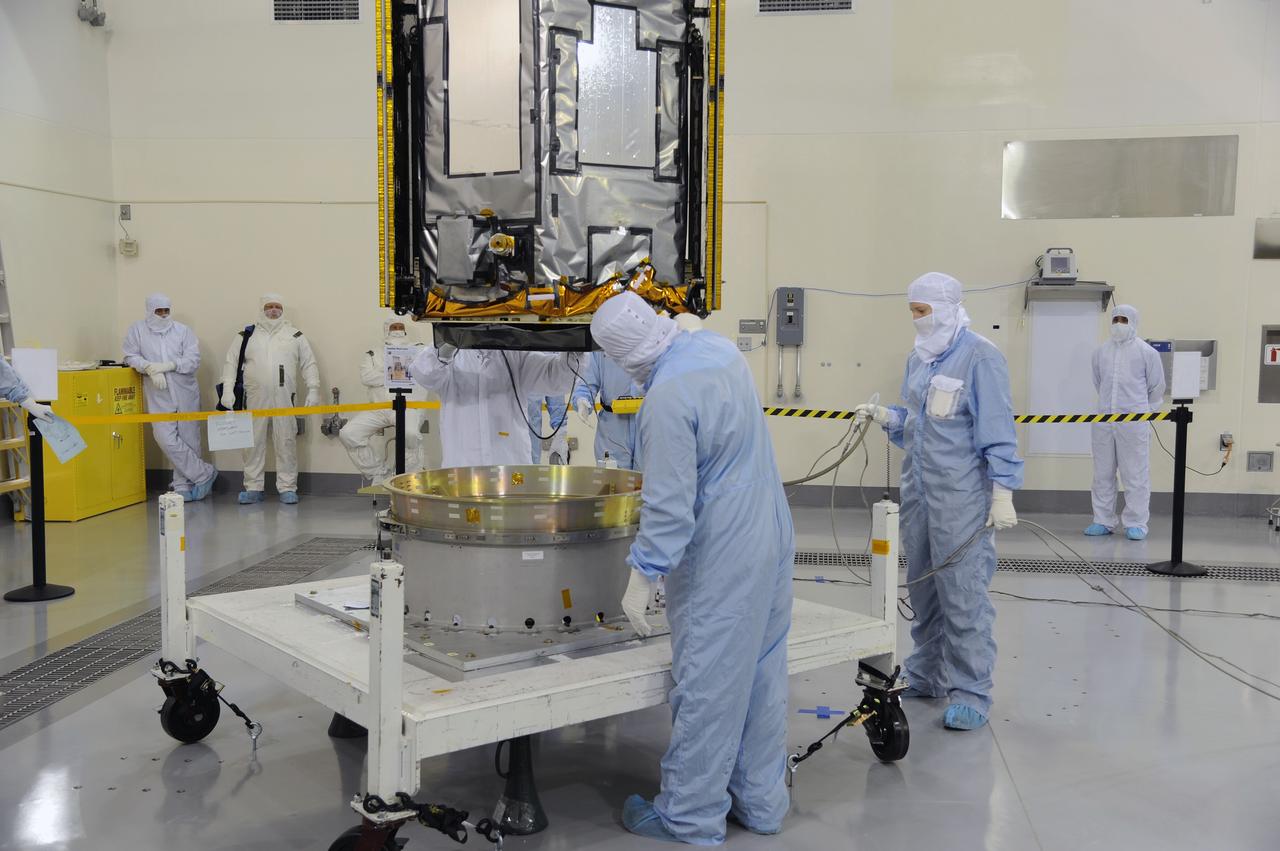
VANDENBERG AIR FORCE BASE, Calif. – In the Astrotech payload processing facility on Vandenberg Air Force Base in California, NASA's Orbiting Carbon Observatory-2, or OCO-2, is lowered onto a test fixture. Testing and launch preparations now will get underway for its launch from Space Launch Complex 2 aboard a United Launch Alliance Delta II rocket, scheduled for July 1, 2014. The observatory will collect precise global measurements of carbon dioxide in the Earth's atmosphere and provide scientists with a better idea of the chemical compound's impacts on climate change. Scientists will analyze this data to improve our understanding of the natural processes and human activities that regulate the abundance and distribution of this important atmospheric gas. OCO-2 is a NASA Earth System Science Pathfinder Program mission managed by NASA's Jet Propulsion Laboratory JPL in Pasadena, California, for NASA's Science Mission Directorate in Washington. Orbital Sciences built the spacecraft and provides mission operations under JPL’s leadership. To learn more about OCO-2, visit http://oco.jpl.nasa.gov. Photo credit: NASA/Doug Gruben, 30th Space Wing
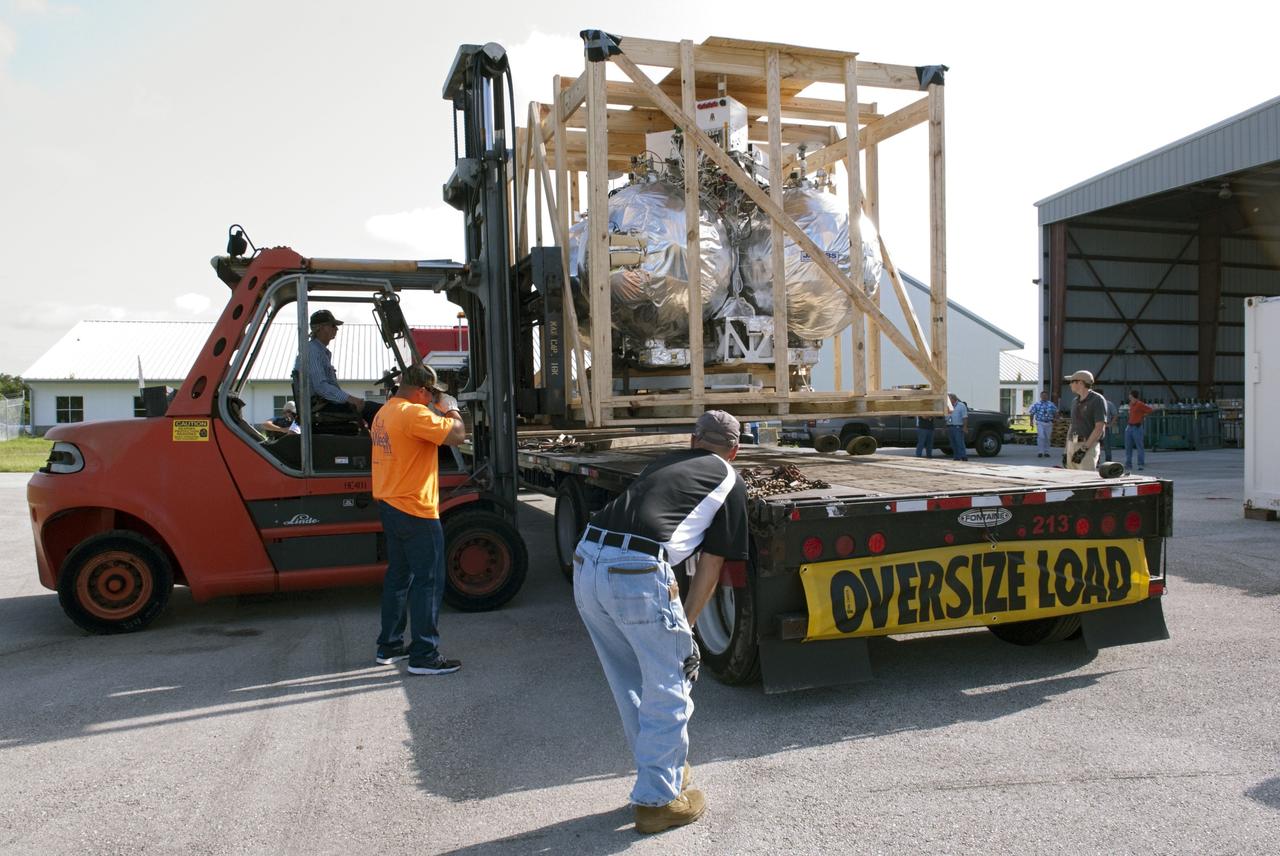
CAPE CANAVERAL, Fla. - A forklift is used at the Kennedy Space Center in Florida to unload NASA's Morpheus lander, a vertical test bed vehicle. Morpheus is designed to demonstrate new green propellant propulsion systems and autonomous landing and an Autonomous Landing and Hazard Avoidance Technology, or ALHAT, system. Checkout of the prototype lander has been ongoing at NASA’s Johnson Space Center in Houston in preparation for its first free flight. The SLF site will provide the lander with the kind of field necessary for realistic testing. Project Morpheus is one of 20 small projects comprising the Advanced Exploration Systems, or AES, program in NASA’s Human Exploration and Operations Mission Directorate. AES projects pioneer new approaches for rapidly developing prototype systems, demonstrating key capabilities and validating operational concepts for future human missions beyond Earth orbit. For more information on Project Morpheus, visit http://www.nasa.gov/centers/johnson/exploration/morpheus/index.html Photo credit: NASA/ Charisse Nahser
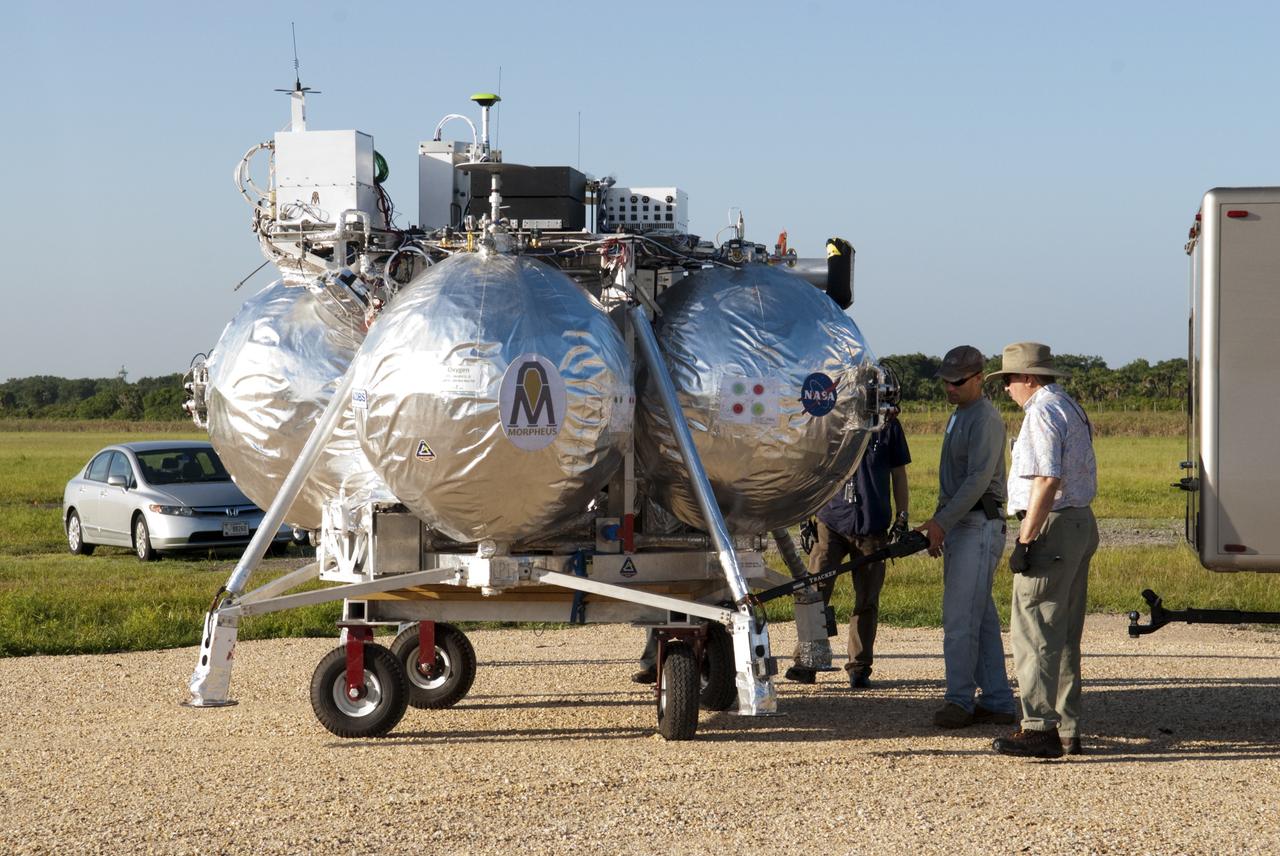
CAPE CANAVERAL, Fla. - NASA's Morpheus lander, a vertical test bed vehicle, is being set up at its launch position along the runway at the Shuttle Landing Facility, or SLF, at the Kennedy Space Center in Florida. Morpheus is designed to demonstrate new green propellant propulsion systems and autonomous landing and an Autonomous Landing and Hazard Avoidance Technology, or ALHAT, system. Checkout of the prototype lander has been ongoing at NASA’s Johnson Space Center in Houston in preparation for its first free flight. The SLF site will provide the lander with the kind of field necessary for realistic testing. Project Morpheus is one of 20 small projects comprising the Advanced Exploration Systems, or AES, program in NASA’s Human Exploration and Operations Mission Directorate. AES projects pioneer new approaches for rapidly developing prototype systems, demonstrating key capabilities and validating operational concepts for future human missions beyond Earth orbit. For more information on Project Morpheus, visit http://www.nasa.gov/centers/johnson/exploration/morpheus/index.html Photo credit: NASA/Dimitri Gerondidakis
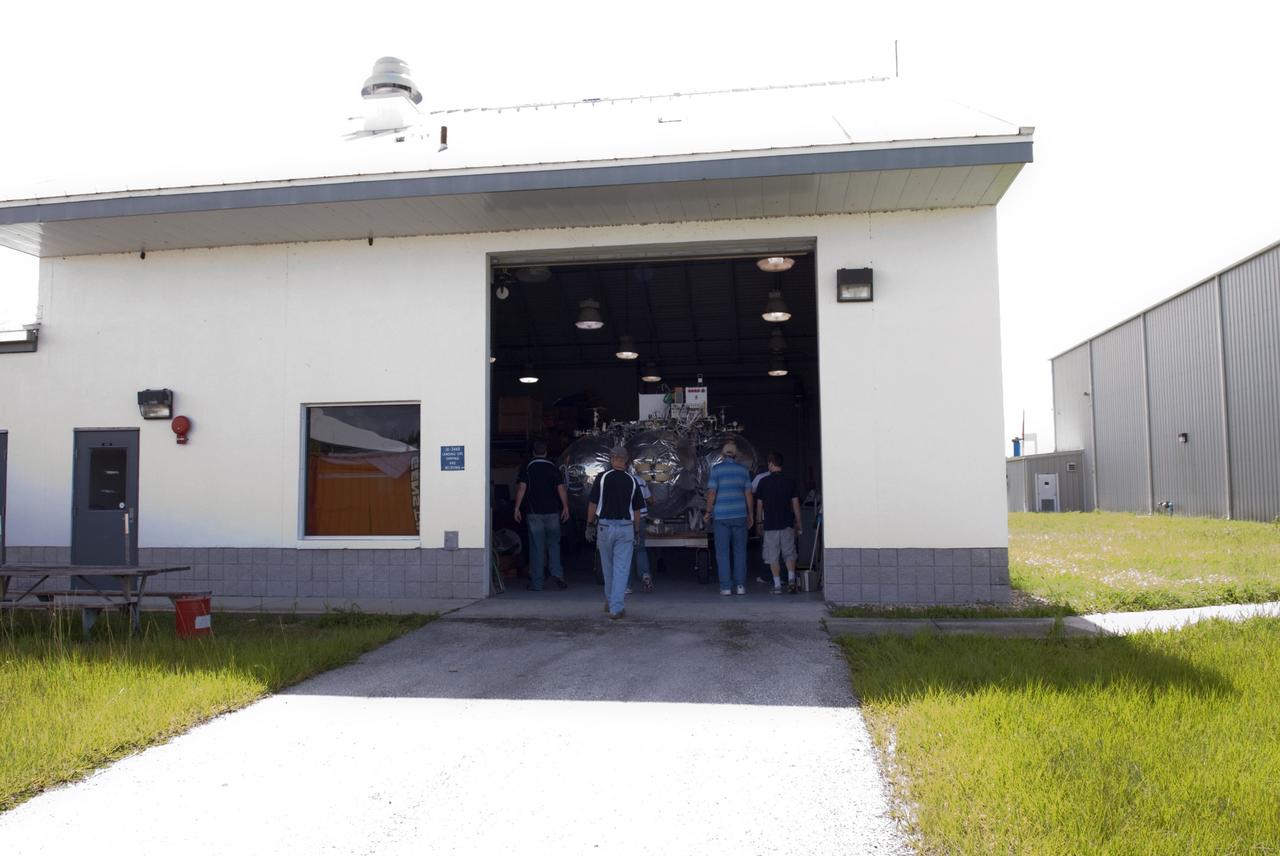
CAPE CANAVERAL, Fla. - NASA's Morpheus lander, a vertical test bed vehicle, has been moved into a building at the Shuttle Landing Facility, or SLF, at the Kennedy Space Center in Florida. Morpheus is designed to demonstrate new green propellant propulsion systems and autonomous landing and an Autonomous Landing and Hazard Avoidance Technology, or ALHAT, system. Checkout of the prototype lander has been ongoing at NASA’s Johnson Space Center in Houston in preparation for its first free flight. The SLF site will provide the lander with the kind of field necessary for realistic testing. Project Morpheus is one of 20 small projects comprising the Advanced Exploration Systems, or AES, program in NASA’s Human Exploration and Operations Mission Directorate. AES projects pioneer new approaches for rapidly developing prototype systems, demonstrating key capabilities and validating operational concepts for future human missions beyond Earth orbit. For more information on Project Morpheus, visit http://www.nasa.gov/centers/johnson/exploration/morpheus/index.html Photo credit: NASA/ Charisse Nahser
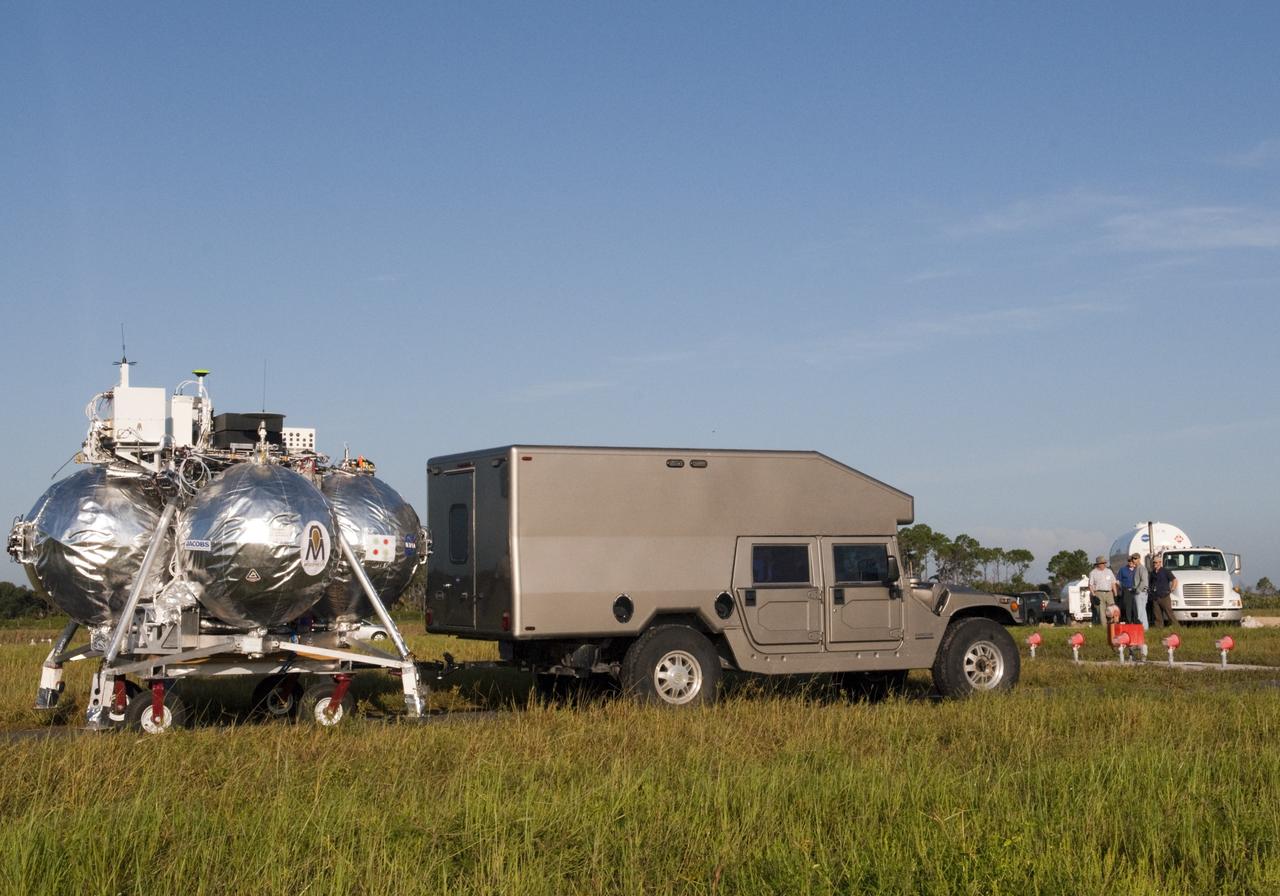
CAPE CANAVERAL, Fla. - NASA's Morpheus lander, a vertical test bed vehicle, is being transported along the Shuttle Landing Facility, or SLF, at the Kennedy Space Center in Florida for a short trip to a launch position along the runway. Morpheus is designed to demonstrate new green propellant propulsion systems and autonomous landing and an Autonomous Landing and Hazard Avoidance Technology, or ALHAT, system. Checkout of the prototype lander has been ongoing at NASA’s Johnson Space Center in Houston in preparation for its first free flight. The SLF site will provide the lander with the kind of field necessary for realistic testing. Project Morpheus is one of 20 small projects comprising the Advanced Exploration Systems, or AES, program in NASA’s Human Exploration and Operations Mission Directorate. AES projects pioneer new approaches for rapidly developing prototype systems, demonstrating key capabilities and validating operational concepts for future human missions beyond Earth orbit. For more information on Project Morpheus, visit http://www.nasa.gov/centers/johnson/exploration/morpheus/index.html Photo credit: NASA/Dimitri Gerondidakis
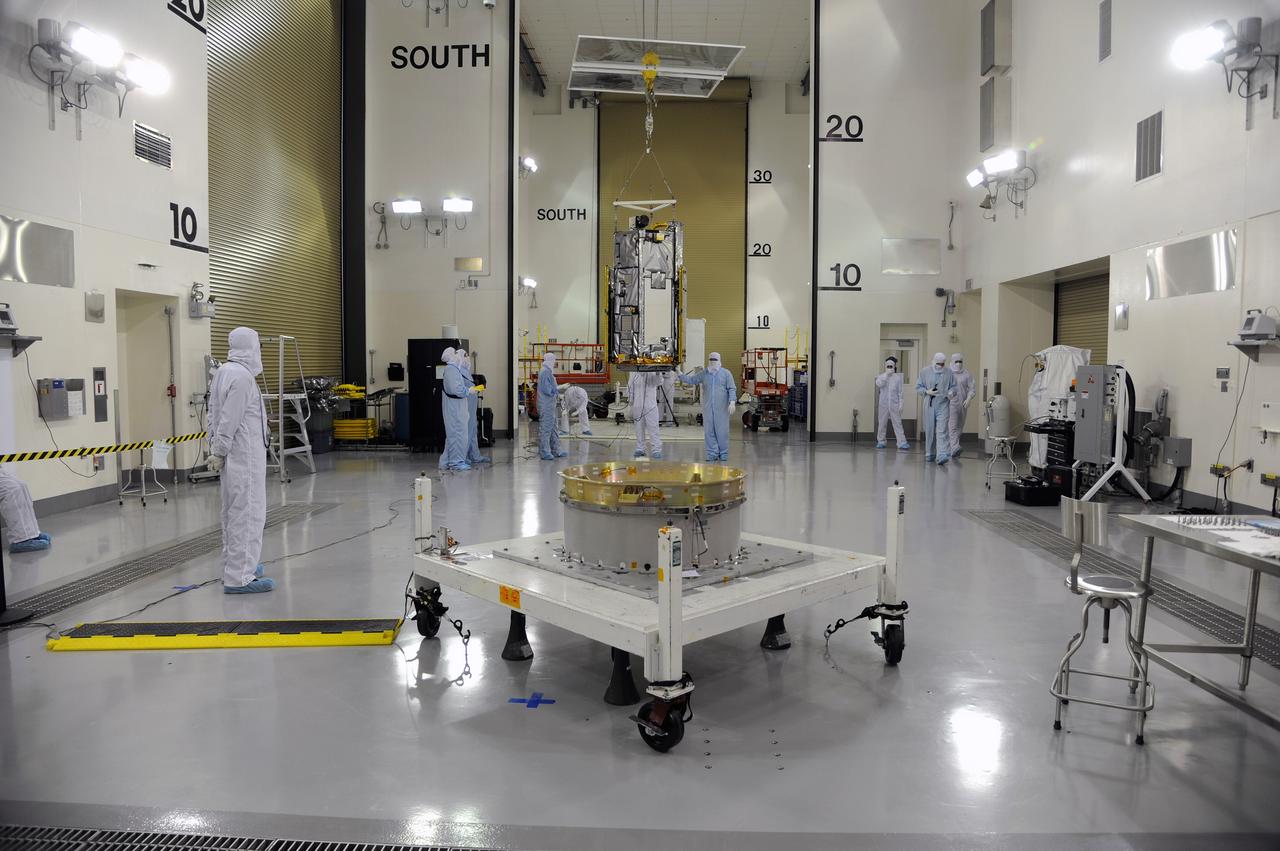
VANDENBERG AIR FORCE BASE, Calif. – In the Astrotech payload processing facility on Vandenberg Air Force Base in California, Orbital Sciences workers and technicians monitor NASA's Orbiting Carbon Observatory-2, or OCO-2, as it glides across the room from its transportation trailer toward a test fixture. Testing and launch preparations now will get underway for its launch from Space Launch Complex 2 aboard a United Launch Alliance Delta II rocket, scheduled for July 1, 2014. The observatory will collect precise global measurements of carbon dioxide in the Earth's atmosphere and provide scientists with a better idea of the chemical compound's impacts on climate change. Scientists will analyze this data to improve our understanding of the natural processes and human activities that regulate the abundance and distribution of this important atmospheric gas. OCO-2 is a NASA Earth System Science Pathfinder Program mission managed by NASA's Jet Propulsion Laboratory JPL in Pasadena, California, for NASA's Science Mission Directorate in Washington. Orbital Sciences built the spacecraft and provides mission operations under JPL’s leadership. To learn more about OCO-2, visit http://oco.jpl.nasa.gov. Photo credit: NASA/Doug Gruben, 30th Space Wing
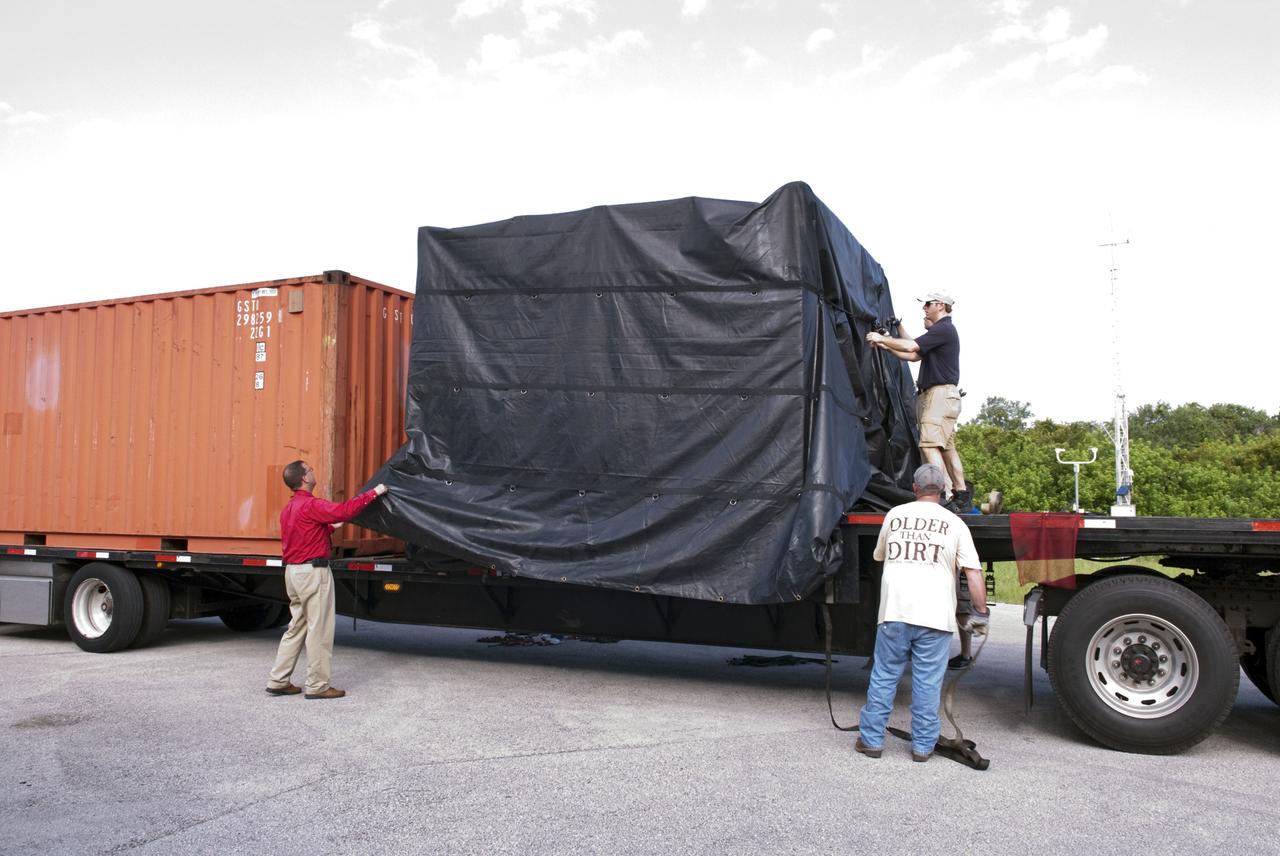
CAPE CANAVERAL, Fla. - NASA's Morpheus lander, a vertical test bed vehicle, is unloaded at a building at the Shuttle Landing Facility, or SLF, at the Kennedy Space Center in Florida. Morpheus is designed to demonstrate new green propellant propulsion systems and autonomous landing and an Autonomous Landing and Hazard Avoidance Technology, or ALHAT, system. Checkout of the prototype lander has been ongoing at NASA’s Johnson Space Center in Houston in preparation for its first free flight. The SLF site will provide the lander with the kind of field necessary for realistic testing. Project Morpheus is one of 20 small projects comprising the Advanced Exploration Systems, or AES, program in NASA’s Human Exploration and Operations Mission Directorate. AES projects pioneer new approaches for rapidly developing prototype systems, demonstrating key capabilities and validating operational concepts for future human missions beyond Earth orbit. For more information on Project Morpheus, visit http://www.nasa.gov/centers/johnson/exploration/morpheus/index.html Photo credit: NASA/ Charisse Nahser
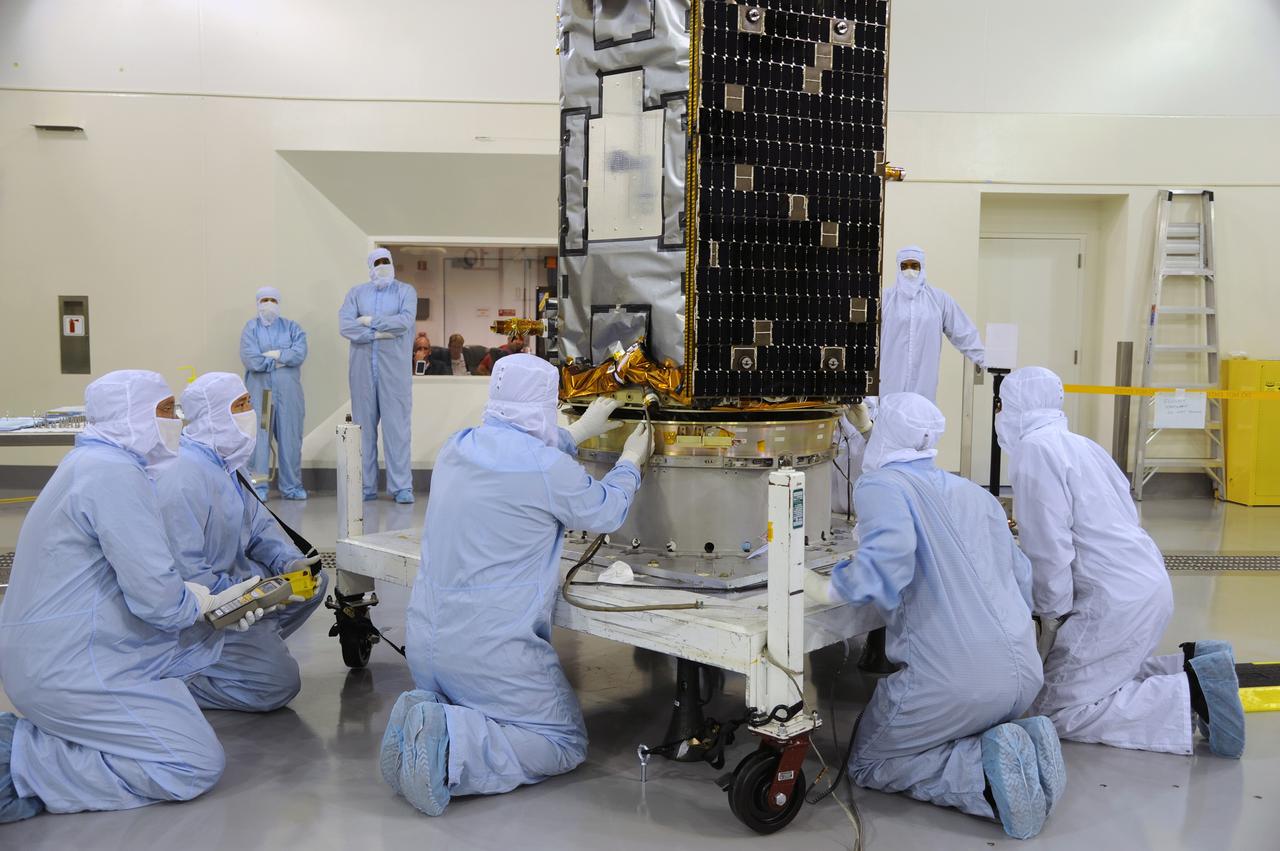
VANDENBERG AIR FORCE BASE, Calif. – In the Astrotech payload processing facility on Vandenberg Air Force Base in California, Orbital Sciences workers and technicians secure NASA's Orbiting Carbon Observatory-2, or OCO-2, onto a test fixture. Testing and launch preparations now will get underway for its launch from Space Launch Complex 2 aboard a United Launch Alliance Delta II rocket, scheduled for July 1, 2014. The observatory will collect precise global measurements of carbon dioxide in the Earth's atmosphere and provide scientists with a better idea of the chemical compound's impacts on climate change. Scientists will analyze this data to improve our understanding of the natural processes and human activities that regulate the abundance and distribution of this important atmospheric gas. OCO-2 is a NASA Earth System Science Pathfinder Program mission managed by NASA's Jet Propulsion Laboratory JPL in Pasadena, California, for NASA's Science Mission Directorate in Washington. Orbital Sciences built the spacecraft and provides mission operations under JPL’s leadership. To learn more about OCO-2, visit http://oco.jpl.nasa.gov. Photo credit: NASA/Doug Gruben, 30th Space Wing
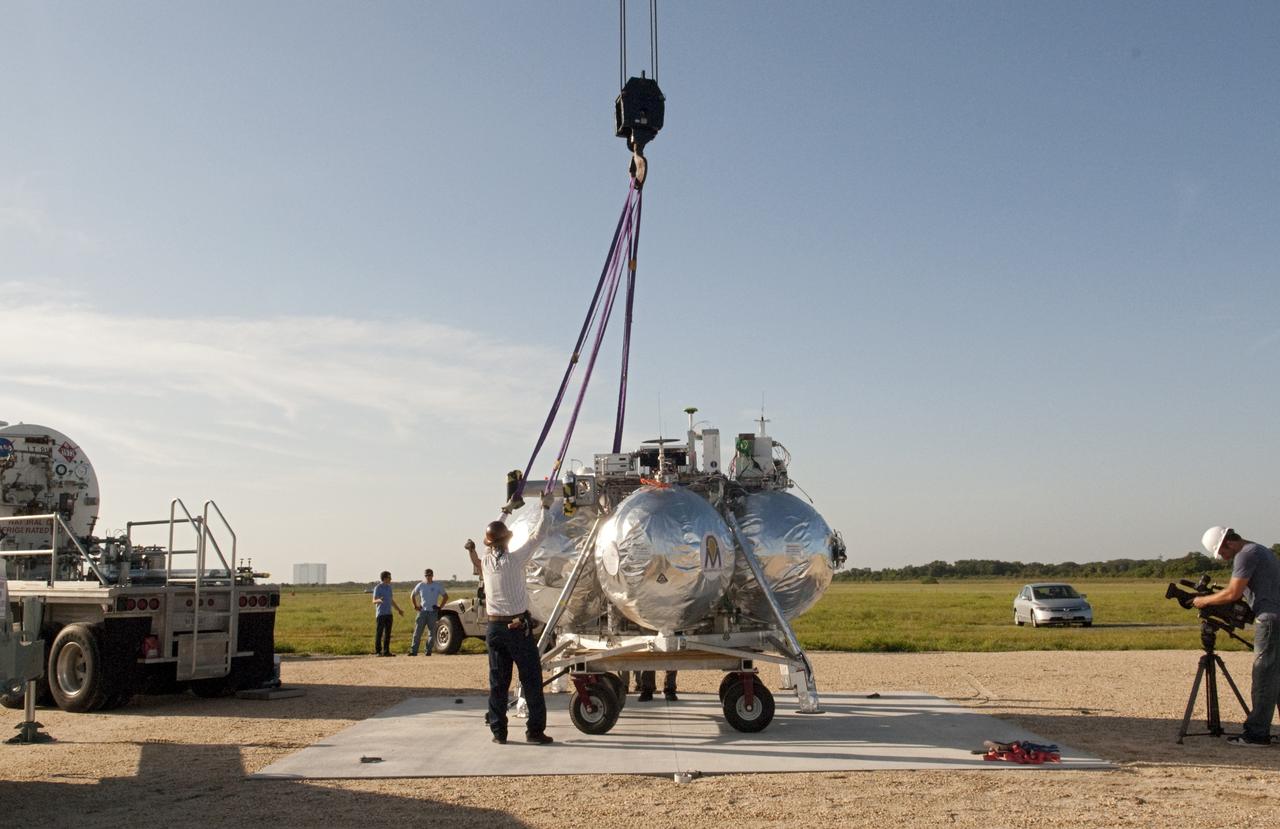
CAPE CANAVERAL, Fla. - A crane is being used to set up NASA's Morpheus lander, a vertical test bed vehicle, at its launch position along the runway at the Shuttle Landing Facility, or SLF, at the Kennedy Space Center in Florida. Morpheus is designed to demonstrate new green propellant propulsion systems and autonomous landing and an Autonomous Landing and Hazard Avoidance Technology, or ALHAT, system. Checkout of the prototype lander has been ongoing at NASA’s Johnson Space Center in Houston in preparation for its first free flight. The SLF site will provide the lander with the kind of field necessary for realistic testing. Project Morpheus is one of 20 small projects comprising the Advanced Exploration Systems, or AES, program in NASA’s Human Exploration and Operations Mission Directorate. AES projects pioneer new approaches for rapidly developing prototype systems, demonstrating key capabilities and validating operational concepts for future human missions beyond Earth orbit. For more information on Project Morpheus, visit http://www.nasa.gov/centers/johnson/exploration/morpheus/index.html Photo credit: NASA/Dimitri Gerondidakis
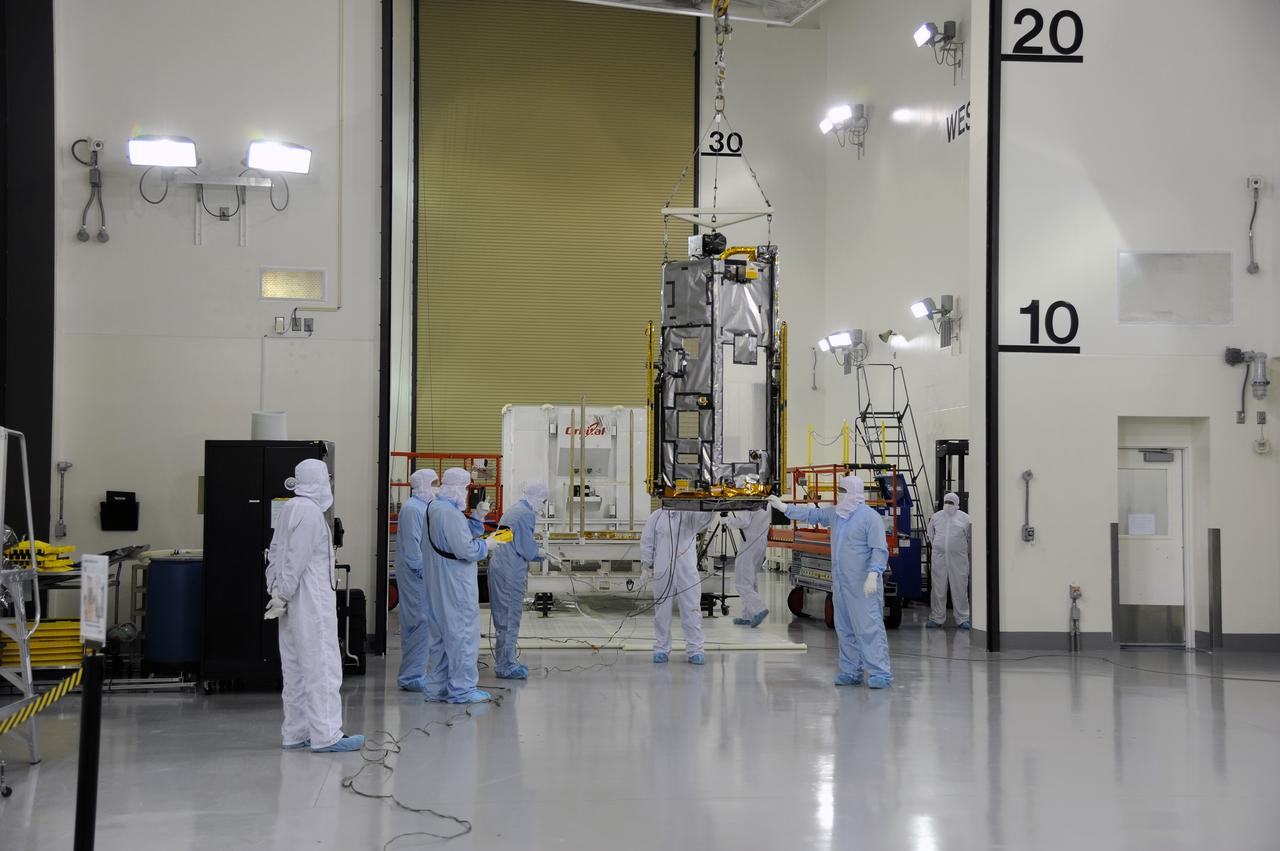
VANDENBERG AIR FORCE BASE, Calif. – In the Astrotech payload processing facility on Vandenberg Air Force Base in California, NASA's Orbiting Carbon Observatory-2, or OCO-2, glides across the room from its transportation trailer toward a test fixture. Testing and launch preparations now will get underway for its launch from Space Launch Complex 2 aboard a United Launch Alliance Delta II rocket, scheduled for July 1, 2014. The observatory will collect precise global measurements of carbon dioxide in the Earth's atmosphere and provide scientists with a better idea of the chemical compound's impacts on climate change. Scientists will analyze this data to improve our understanding of the natural processes and human activities that regulate the abundance and distribution of this important atmospheric gas. OCO-2 is a NASA Earth System Science Pathfinder Program mission managed by NASA's Jet Propulsion Laboratory JPL in Pasadena, California, for NASA's Science Mission Directorate in Washington. Orbital Sciences built the spacecraft and provides mission operations under JPL’s leadership. To learn more about OCO-2, visit http://oco.jpl.nasa.gov. Photo credit: NASA/Doug Gruben, 30th Space Wing