
jsc2026e019217 (April 1, 2026) – Lead Artemis II Flight Director Jeff Radigan in the White Flight Control Room at the Mission Control Center at NASA’s Johnson Space Center in Houston. At the time of this photograph, a little over three hours into the mission, the Artemis II crew was conducting a manual piloting test called the proximity operations demonstration. During the demonstration, mission controllers monitored Orion as the astronauts transitioned the spacecraft to manual mode and piloted its flight path and orientation. This demonstration will provide performance data and operational experience that cannot be readily gained on the ground in preparation for critical rendezvous, proximity operations, docking, and undocking for future Artemis missions. Credit: NASA

jsc2026e019242 (April 1, 2026) – Artemis II Flight Controller Jeremy Raush in the White Flight Control Room at the Mission Control Center at NASA’s Johnson Space Center in Houston. At the time of this photograph, a little over three hours into the mission, the Artemis II crew began a manual piloting test called the proximity operations demonstration. During the demonstration, mission controllers monitored Orion as the astronauts transitioned the spacecraft to manual mode and piloted its flight path and orientation. This demonstration will provide performance data and operational experience that cannot be readily gained on the ground in preparation for critical rendezvous, proximity operations, docking, and undocking for future Artemis missions. Credit: NASA
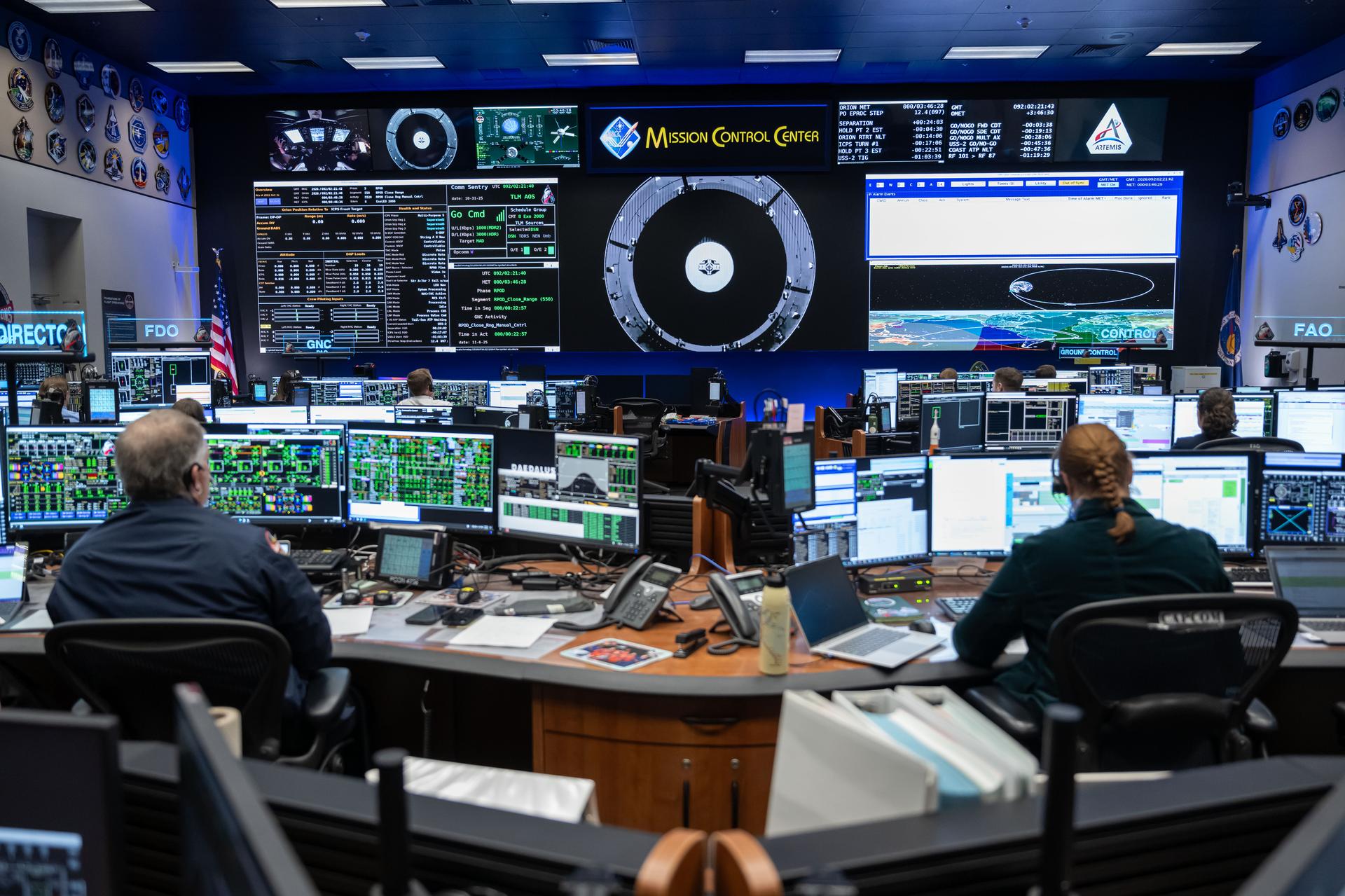
jsc2026e019255 (April 1, 2026) – Lead Artemis II Flight Director Jeff Radigan (left) and capsule communicator (capcom) Amy Dill (right) in the White Flight Control Room at the Mission Control Center at NASA’s Johnson Space Center in Houston. At the time of this photograph, a little over three hours into the mission, the Artemis II crew conducting a manual piloting test called the proximity operations demonstration. During the demonstration, mission controllers monitored Orion as the astronauts transitioned the spacecraft to manual mode and piloted its flight path and orientation. This demonstration will provide performance data and operational experience that cannot be readily gained on the ground in preparation for critical rendezvous, proximity operations, docking, and undocking for future Artemis missions. Credit: NASA
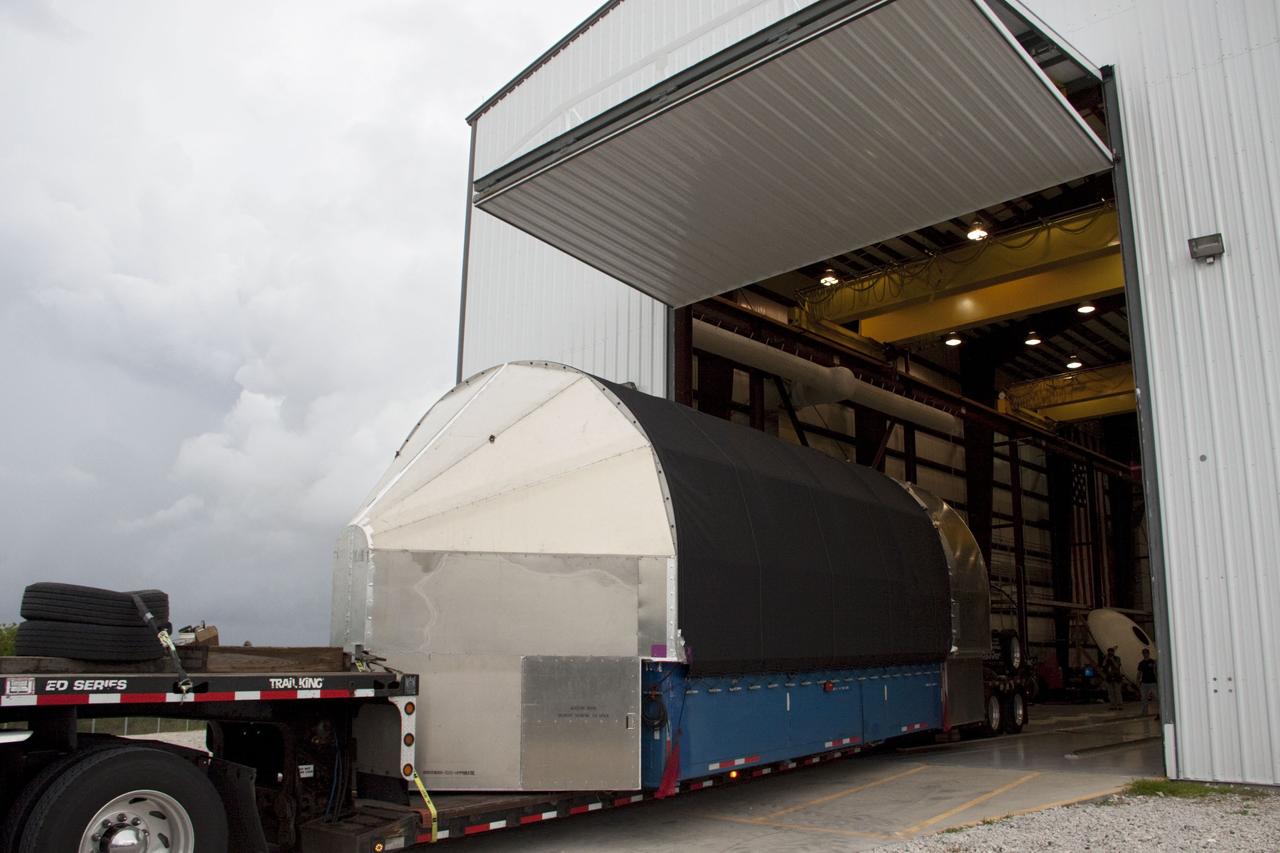
CAPE CANAVERAL, Fla. -- The second stage for the Space Exploration Technologies Corp., or SpaceX, Falcon 9 rocket is delivered to the SpaceX hangar at Pad 40 at Cape Canaveral Air Force Station in Florida. The Falcon 9 rocket will launch a second Dragon spacecraft, called Dragon C2, in late 2011. The mission will demonstrate proximity operations during an approach within six miles of the International Space Station. The company is building the Dragon to fly on resupply missions to the station. SpaceX was awarded procurement for three demonstration flights under the Commercial Orbital Transportation Services, or COTS, program managed by NASA's Johnson Space Center in Houston. The SpaceX contract provides for 12 missions to resupply the station from 2011 through 2015. Photo credit: NASA/Jim Grossmann

CAPE CANAVERAL, Fla. -- The second stage for the Space Exploration Technologies Corp., or SpaceX, Falcon 9 rocket is delivered to the SpaceX hangar at Pad 40 at Cape Canaveral Air Force Station in Florida. The Falcon 9 rocket will launch a second Dragon spacecraft, called Dragon C2, in late 2011. The mission will demonstrate proximity operations during an approach within six miles of the International Space Station. The company is building the Dragon to fly on resupply missions to the station. SpaceX was awarded procurement for three demonstration flights under the Commercial Orbital Transportation Services, or COTS, program managed by NASA's Johnson Space Center in Houston. The SpaceX contract provides for 12 missions to resupply the station from 2011 through 2015. Photo credit: NASA/Jim Grossmann
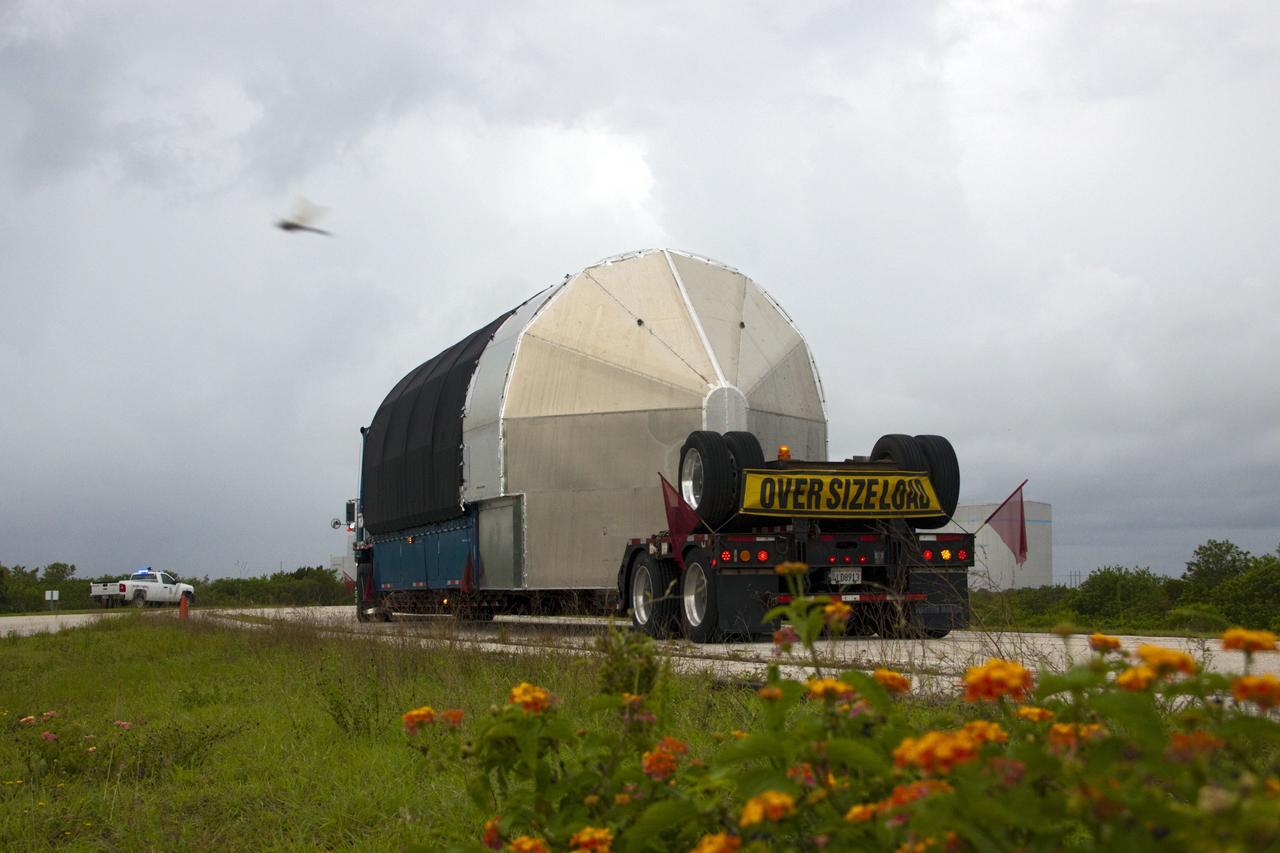
CAPE CANAVERAL, Fla. -- The second stage for the Space Exploration Technologies Corp., or SpaceX, Falcon 9 rocket is transported to the SpaceX hangar at Pad 40 at Cape Canaveral Air Force Station in Florida. The Falcon 9 rocket will launch a second Dragon spacecraft, called Dragon C2, in late 2011. The mission will demonstrate proximity operations during an approach within six miles of the International Space Station. The company is building the Dragon to fly on resupply missions to the station. SpaceX was awarded procurement for three demonstration flights under the Commercial Orbital Transportation Services, or COTS, program managed by NASA's Johnson Space Center in Houston. The SpaceX contract provides for 12 missions to resupply the station from 2011 through 2015. Photo credit: NASA/Jim Grossmann
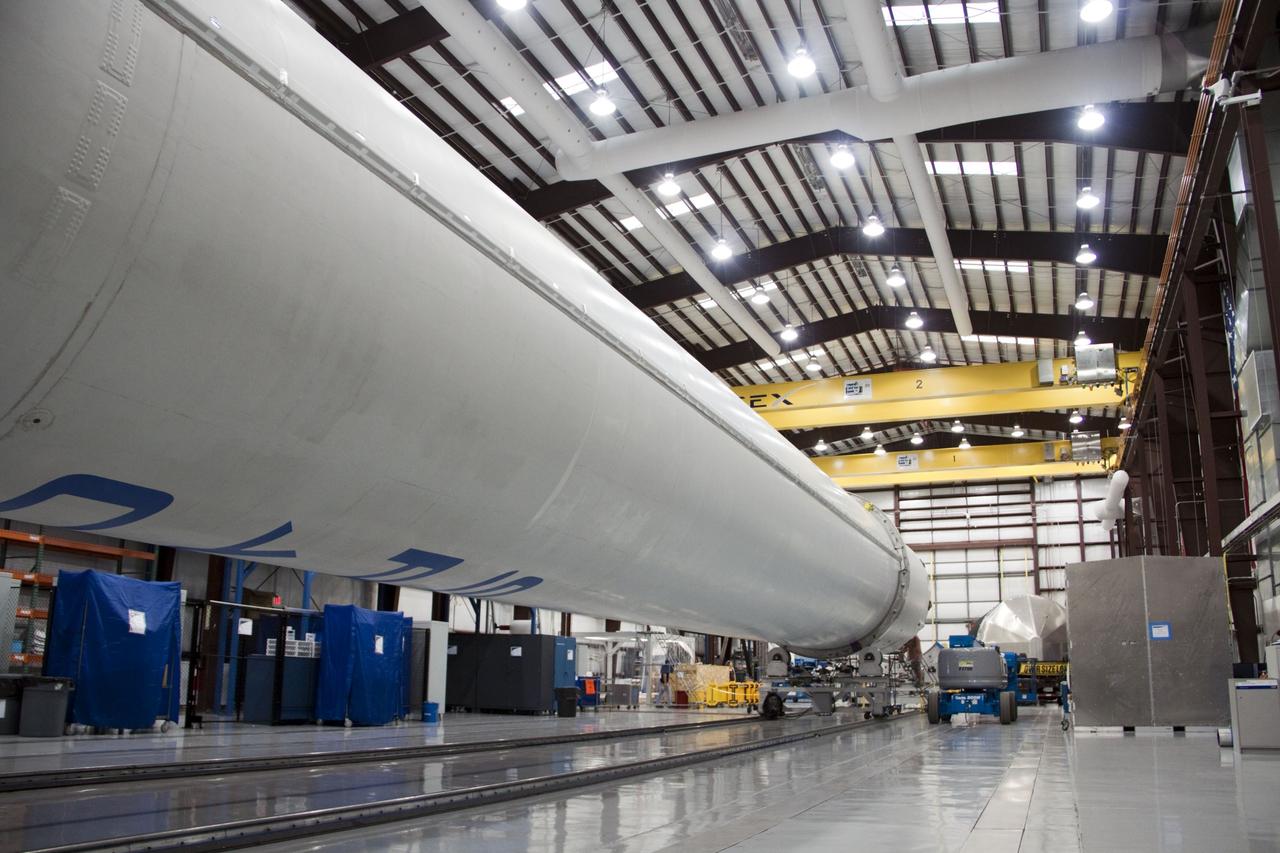
CAPE CANAVERAL, Fla. -- The second stage for the Space Exploration Technologies Corp., or SpaceX, Falcon 9 rocket is delivered to the SpaceX hangar at Pad 40 at Cape Canaveral Air Force Station in Florida. Also seen here in the foreground is the first stage of the Falcon 9. The Falcon 9 rocket will launch a second Dragon spacecraft, called Dragon C2, in late 2011. The mission will demonstrate proximity operations during an approach within six miles of the International Space Station. The company is building the Dragon to fly on resupply missions to the station. SpaceX was awarded procurement for three demonstration flights under the Commercial Orbital Transportation Services, or COTS, program managed by NASA's Johnson Space Center in Houston. The SpaceX contract provides for 12 missions to resupply the station from 2011 through 2015. Photo credit: NASA/Jim Grossmann
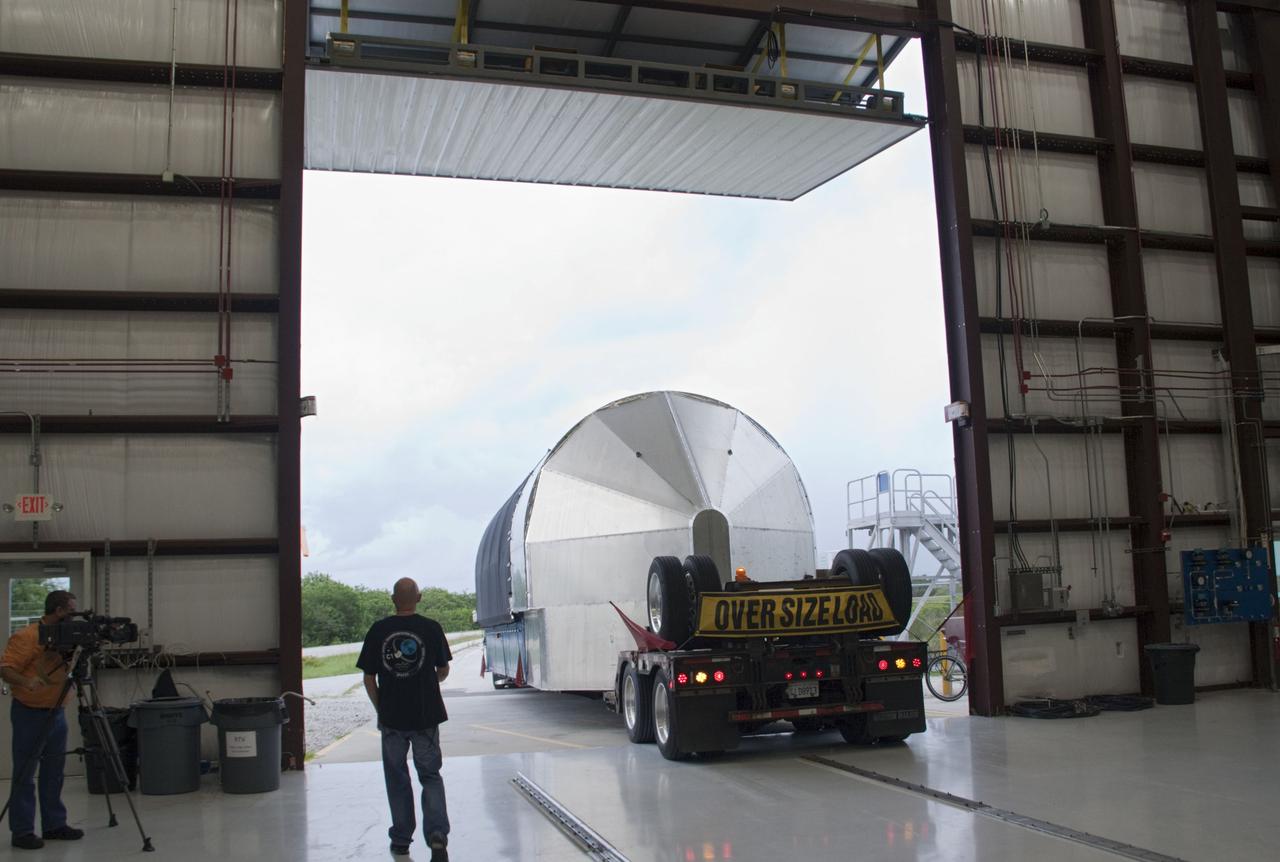
CAPE CANAVERAL, Fla. -- The second stage for the Space Exploration Technologies Corp., or SpaceX, Falcon 9 rocket is delivered to the SpaceX hangar at Pad 40 at Cape Canaveral Air Force Station in Florida. The Falcon 9 rocket will launch a second Dragon spacecraft, called Dragon C2, in late 2011. The mission will demonstrate proximity operations during an approach within six miles of the International Space Station. The company is building the Dragon to fly on resupply missions to the station. SpaceX was awarded procurement for three demonstration flights under the Commercial Orbital Transportation Services, or COTS, program managed by NASA's Johnson Space Center in Houston. The SpaceX contract provides for 12 missions to resupply the station from 2011 through 2015. Photo credit: NASA/Jim Grossmann
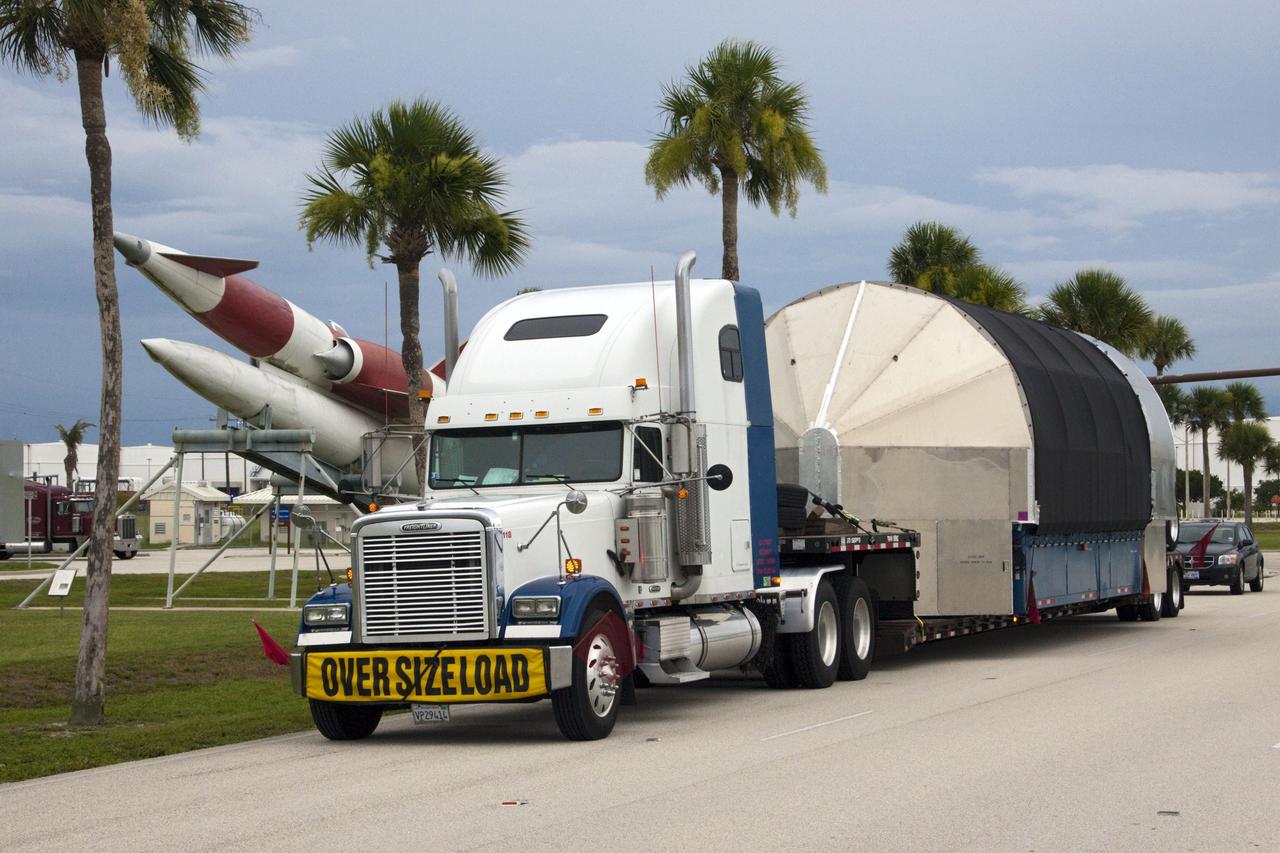
CAPE CANAVERAL, Fla. -- The second stage for the Space Exploration Technologies Corp., or SpaceX, Falcon 9 rocket is transported to the SpaceX hangar at Pad 40 at Cape Canaveral Air Force Station in Florida. The Falcon 9 rocket will launch a second Dragon spacecraft, called Dragon C2, in late 2011. The mission will demonstrate proximity operations during an approach within six miles of the International Space Station. The company is building the Dragon to fly on resupply missions to the station. SpaceX was awarded procurement for three demonstration flights under the Commercial Orbital Transportation Services, or COTS, program managed by NASA's Johnson Space Center in Houston. The SpaceX contract provides for 12 missions to resupply the station from 2011 through 2015. Photo credit: NASA/Jim Grossmann
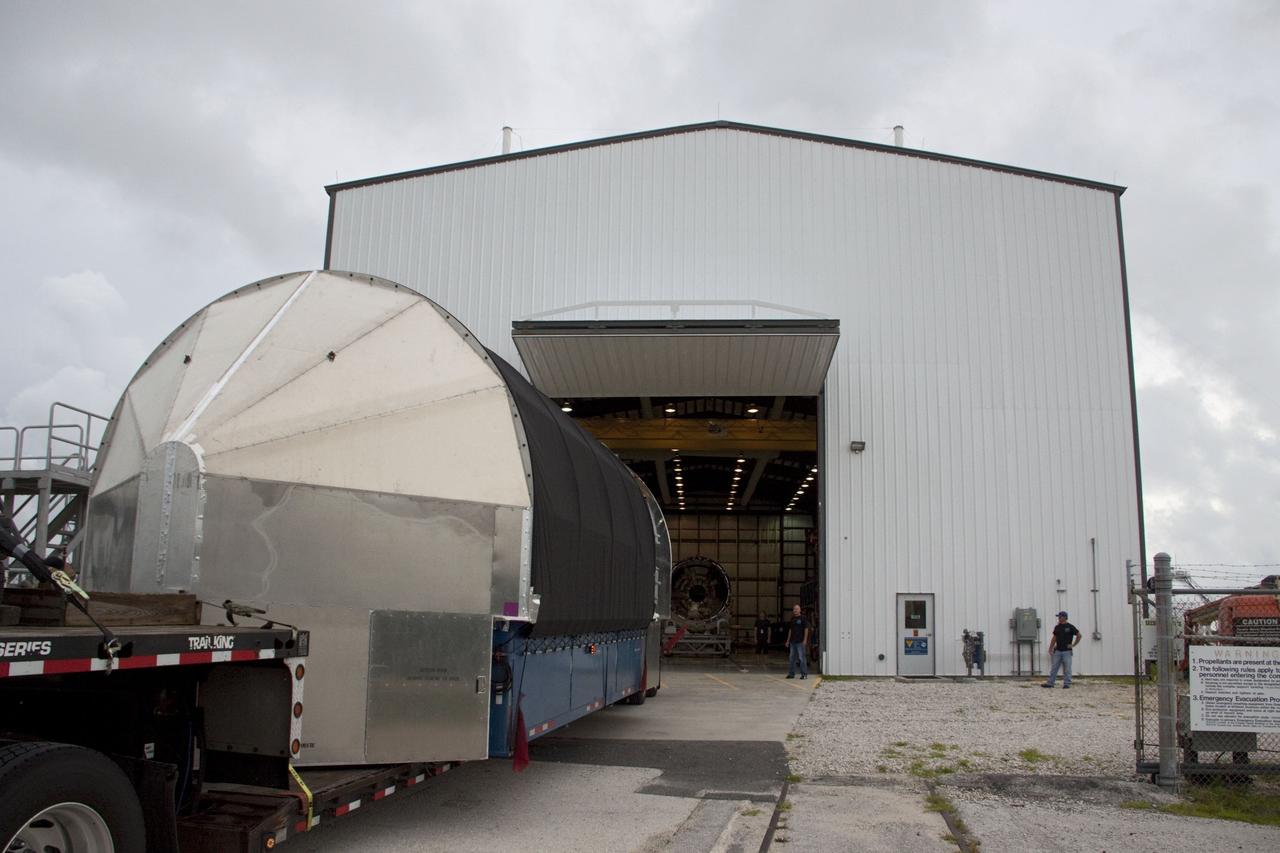
CAPE CANAVERAL, Fla. -- The second stage for the Space Exploration Technologies Corp., or SpaceX, Falcon 9 rocket is delivered to the SpaceX hangar at Pad 40 at Cape Canaveral Air Force Station in Florida. The Falcon 9 rocket will launch a second Dragon spacecraft, called Dragon C2, in late 2011. The mission will demonstrate proximity operations during an approach within six miles of the International Space Station. The company is building the Dragon to fly on resupply missions to the station. SpaceX was awarded procurement for three demonstration flights under the Commercial Orbital Transportation Services, or COTS, program managed by NASA's Johnson Space Center in Houston. The SpaceX contract provides for 12 missions to resupply the station from 2011 through 2015. Photo credit: NASA/Jim Grossmann
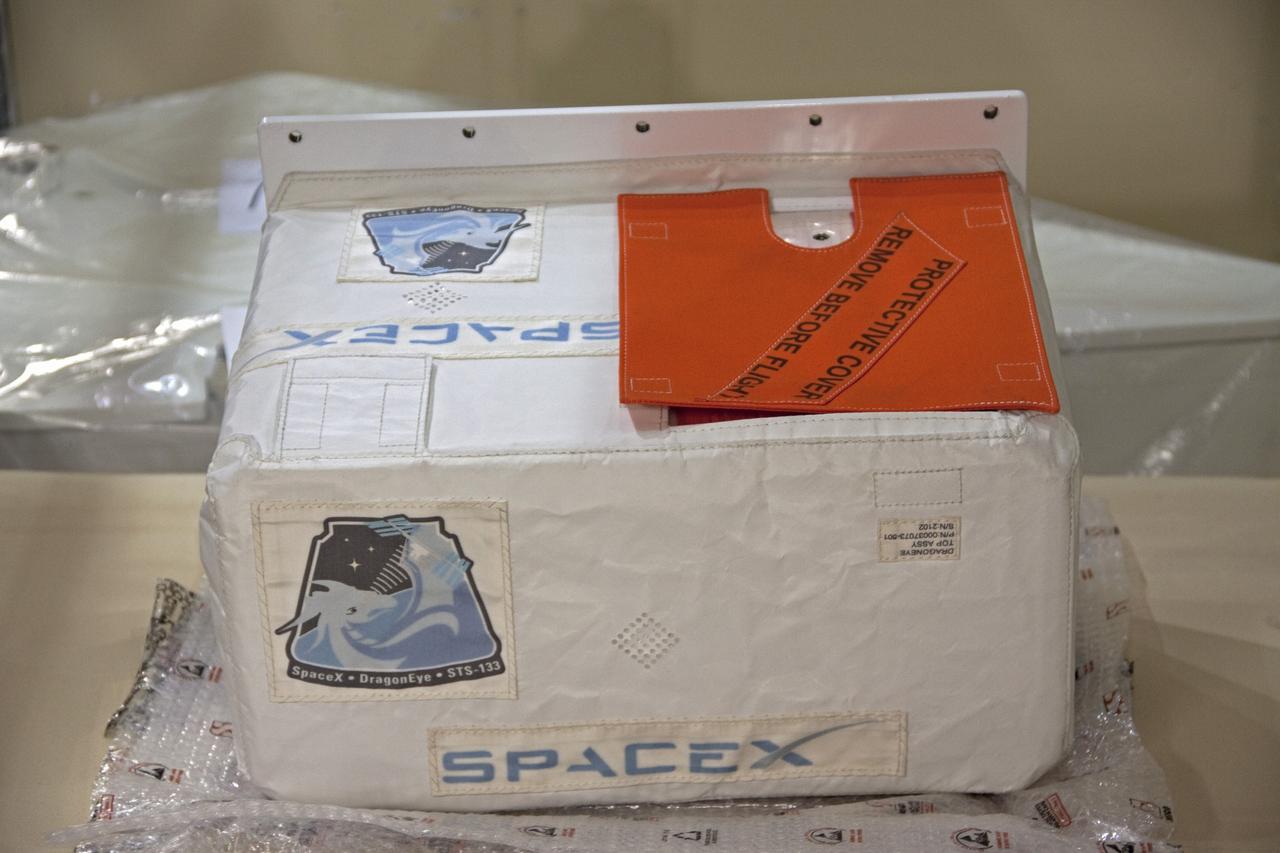
CAPE CANAVERAL, Fla. -- A DragonEye proximity sensor developed by Space Exploration Technologies (SpaceX) is prepared for installation while space shuttle Discovery is in Orbiter Processing Facility-3 at NASA's Kennedy Space Center in Florida. DragonEye is a Laser Imaging Detection and Ranging (LIDAR) sensor that will be tested on Discovery's docking operation with the International Space Station. Discovery's STS-133 mission, targeted to launch Nov. 1, will be the second demonstration of the sensor, following shuttle Endeavour's STS-127 mission in 2009. The DragonEye sensor will guide SpaceX's Dragon spacecraft as it approaches and berths to the station on future cargo re-supply missions. The Dragon spacecraft is a free-flying, reusable spacecraft being developed by SpaceX, which is contracted by NASA's Commercial Orbital Transportation Services (COTS) program. Photo credit: NASA/Jim Grossmann
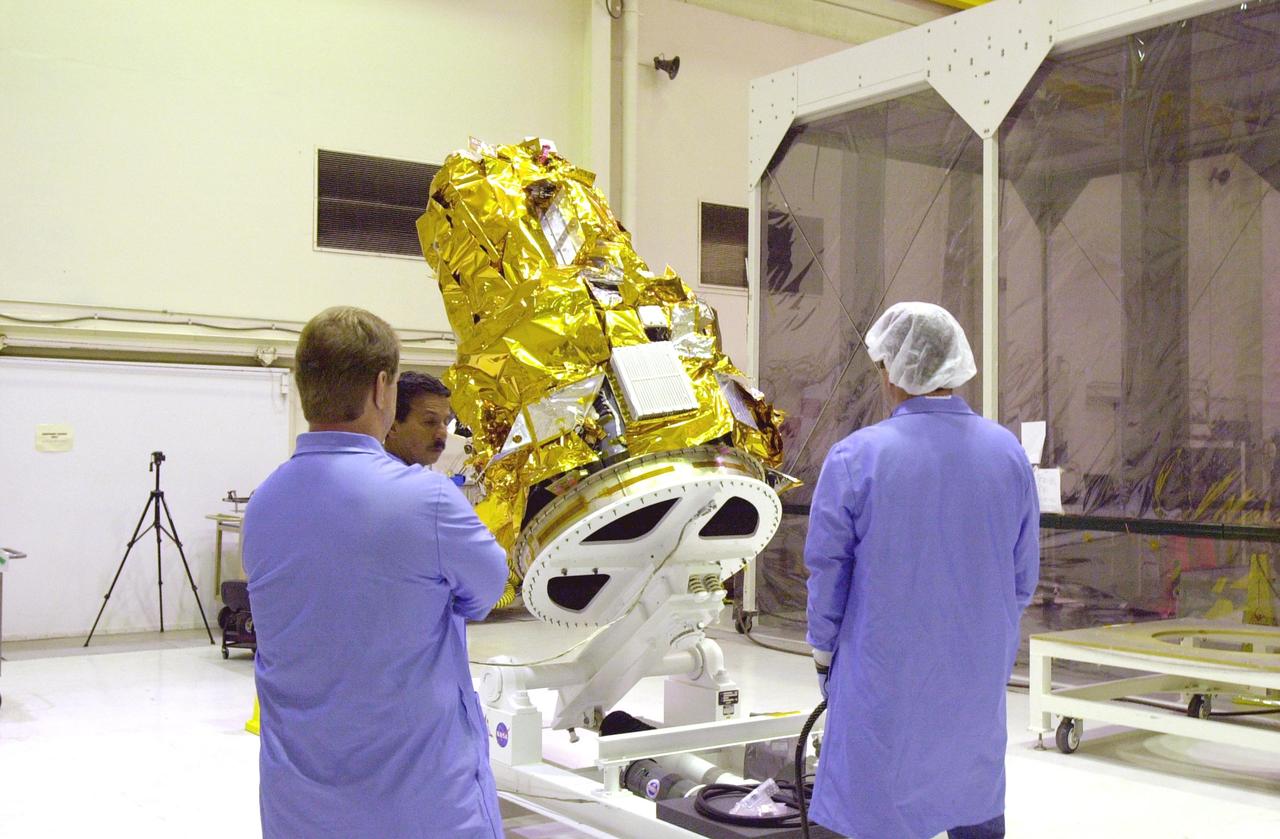
KENNEDY SPACE CENTER, FLA. - At Vandenberg Air Force Base in California, the Demonstration of Autonomous Rendezvous Technology (DART) spacecraft is raised to a vertical position. It will be lifted onto a test stand for launch processing activities. The spacecraft was developed for NASA by Orbital Sciences Corporation in Dulles, Va., to prove technologies for locating and maneuvering near an orbiting satellite. DART will be launched on a Pegasus launch vehicle. At about 40,000 feet over the Pacific Ocean, the Pegasus will be released from Orbital’s Stargazer L-1011 aircraft, fire its rocket motors and boost DART into a polar orbit approximately 472 miles by 479 miles. Once in orbit, DART will rendezvous with a target satellite, the Multiple Paths, Beyond-Line-of-Site Communications satellite, also built by Orbital Sciences. DART will then perform several close proximity operations, such as moving toward and away from the satellite using navigation data provided by onboard sensors. DART is scheduled for launch no earlier than Oct. 18.
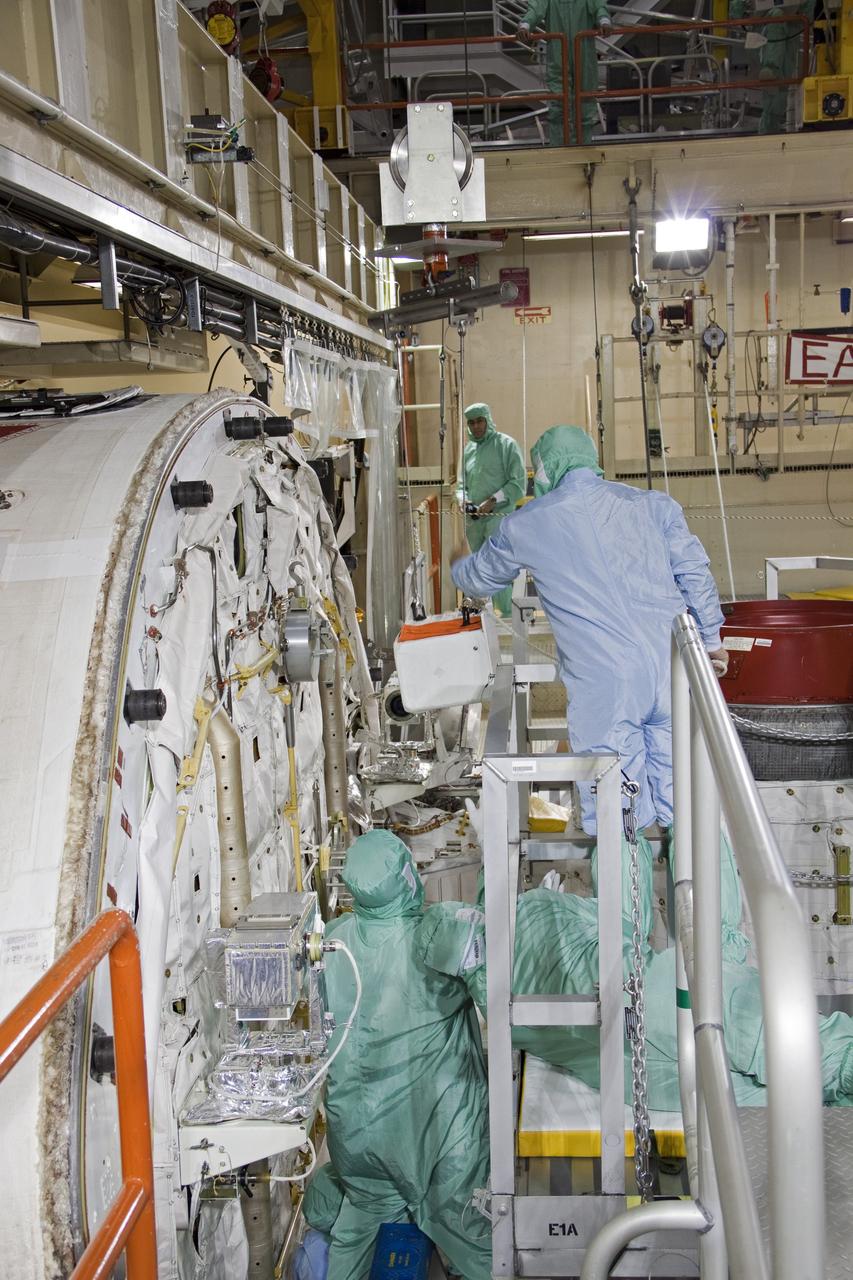
CAPE CANAVERAL, Fla. -- A DragonEye proximity sensor developed by Space Exploration Technologies (SpaceX) is installed while space shuttle Discovery is in Orbiter Processing Facility-3 at NASA's Kennedy Space Center in Florida. DragonEye is a Laser Imaging Detection and Ranging (LIDAR) sensor that will be tested on Discovery's docking operation with the International Space Station. Discovery's STS-133 mission, targeted to launch Nov. 1, will be the second demonstration of the sensor, following shuttle Endeavour's STS-127 mission in 2009. The DragonEye sensor will guide SpaceX's Dragon spacecraft as it approaches and berths to the station on future cargo re-supply missions. The Dragon spacecraft is a free-flying, reusable spacecraft being developed by SpaceX, which is contracted by NASA's Commercial Orbital Transportation Services (COTS) program. Photo credit: NASA/Jim Grossmann
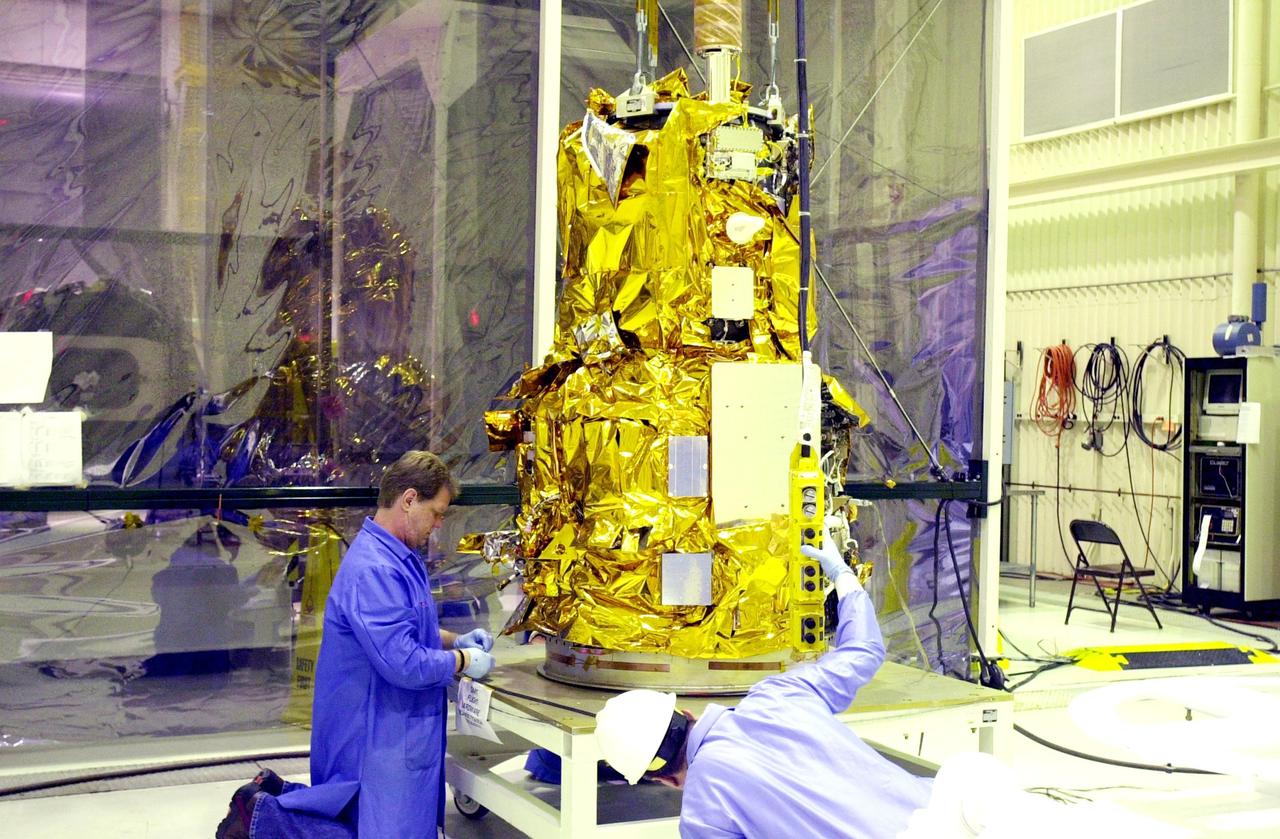
KENNEDY SPACE CENTER, FLA. - At Vandenberg Air Force Base in California, the Demonstration of Autonomous Rendezvous Technology (DART) spacecraft is placed on a work stand for processing activities. The spacecraft was developed for NASA by Orbital Sciences Corporation in Dulles, Va., to prove technologies for locating and maneuvering near an orbiting satellite. DART will be launched on a Pegasus launch vehicle. At about 40,000 feet over the Pacific Ocean, the Pegasus will be released from Orbital’s Stargazer L-1011 aircraft, fire its rocket motors and boost DART into a polar orbit approximately 472 miles by 479 miles. Once in orbit, DART will rendezvous with a target satellite, the Multiple Paths, Beyond-Line-of-Site Communications satellite, also built by Orbital Sciences. DART will then perform several close proximity operations, such as moving toward and away from the satellite using navigation data provided by onboard sensors. DART is scheduled for launch no earlier than Oct. 18.
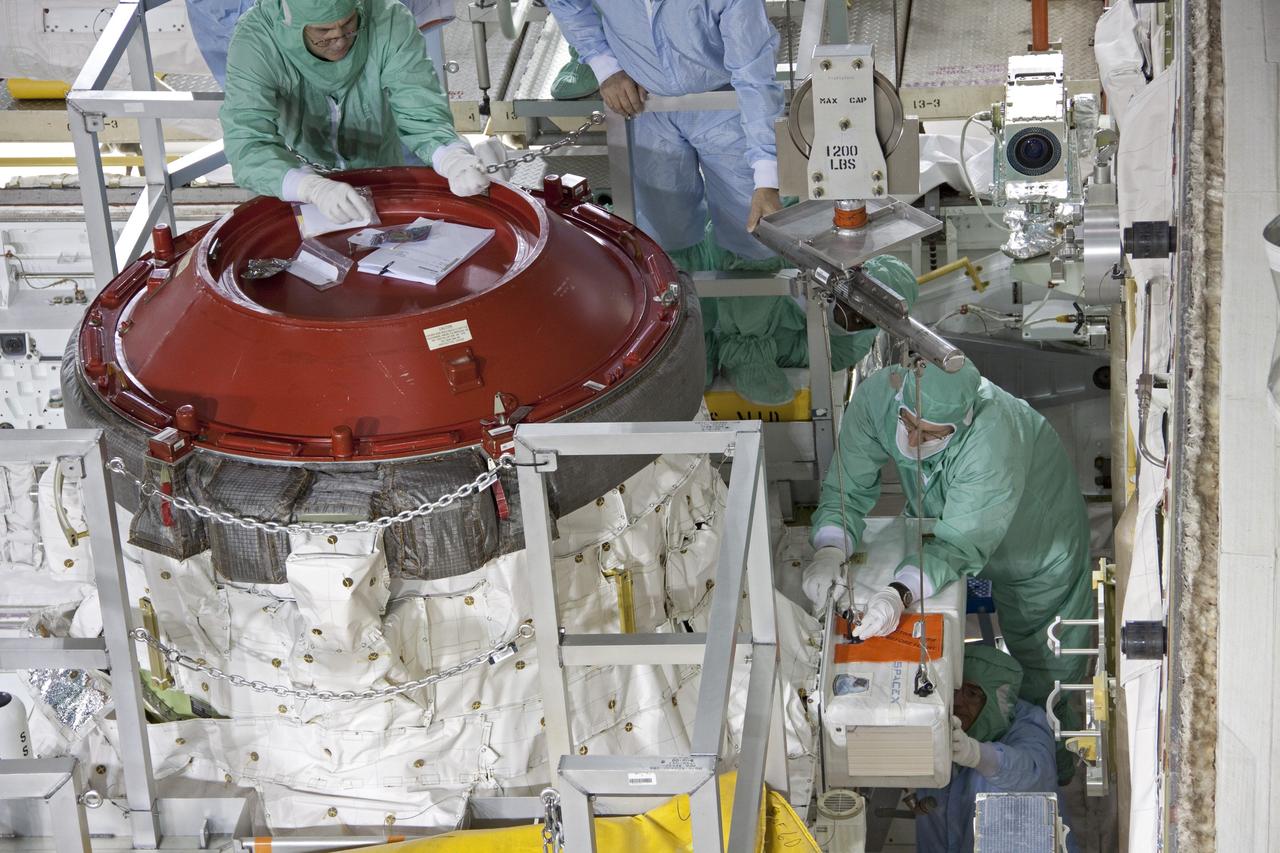
CAPE CANAVERAL, Fla. -- A DragonEye proximity sensor developed by Space Exploration Technologies (SpaceX) is installed while space shuttle Discovery is in Orbiter Processing Facility-3 at NASA's Kennedy Space Center in Florida. DragonEye is a Laser Imaging Detection and Ranging (LIDAR) sensor that will be tested on Discovery's docking operation with the International Space Station. Discovery's STS-133 mission, targeted to launch Nov. 1, will be the second demonstration of the sensor, following shuttle Endeavour's STS-127 mission in 2009. The DragonEye sensor will guide SpaceX's Dragon spacecraft as it approaches and berths to the station on future cargo re-supply missions. The Dragon spacecraft is a free-flying, reusable spacecraft being developed by SpaceX, which is contracted by NASA's Commercial Orbital Transportation Services (COTS) program. Photo credit: NASA/Jim Grossmann
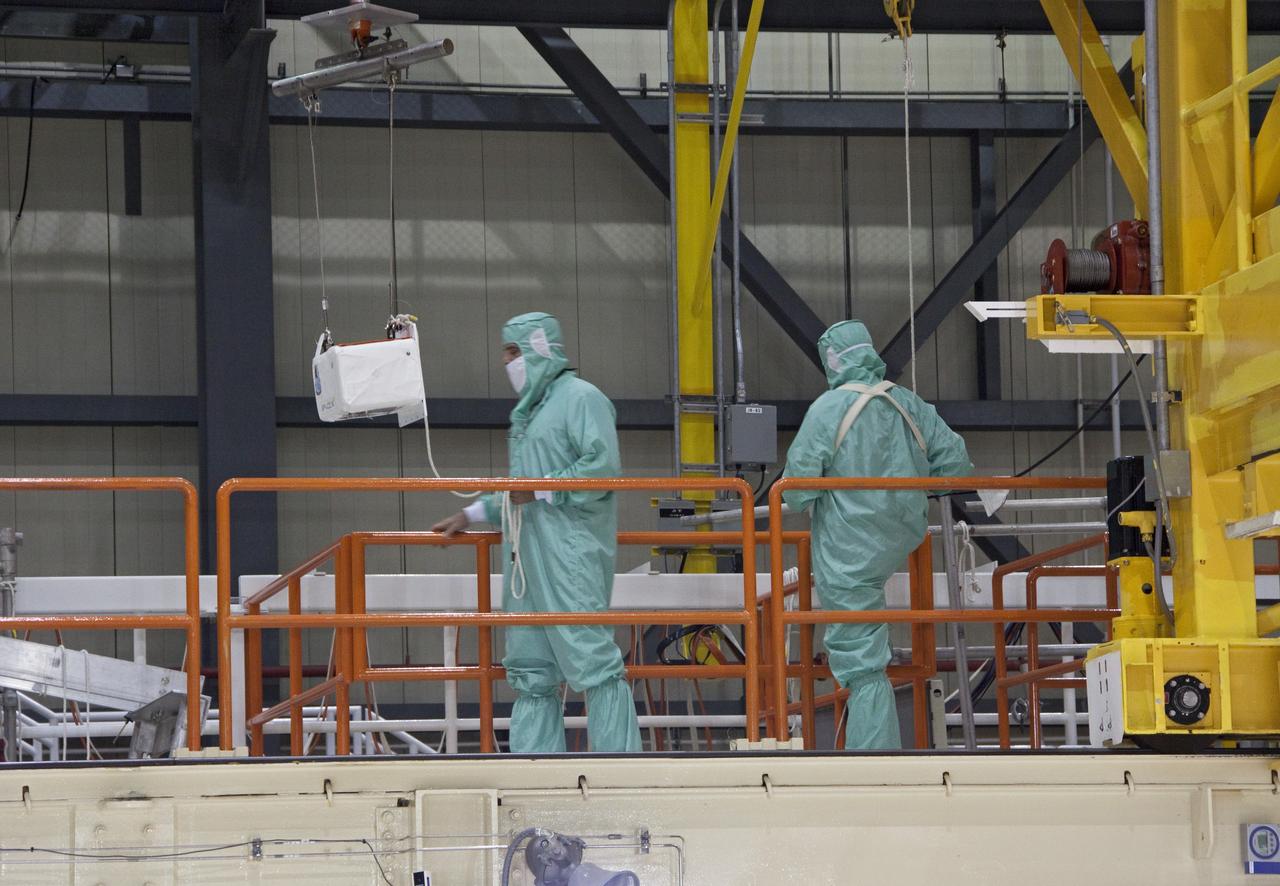
CAPE CANAVERAL, Fla. -- A DragonEye proximity sensor developed by Space Exploration Technologies (SpaceX) is installed while space shuttle Discovery is in Orbiter Processing Facility-3 at NASA's Kennedy Space Center in Florida. DragonEye is a Laser Imaging Detection and Ranging (LIDAR) sensor that will be tested on Discovery's docking operation with the International Space Station. Discovery's STS-133 mission, targeted to launch Nov. 1, will be the second demonstration of the sensor, following shuttle Endeavour's STS-127 mission in 2009. The DragonEye sensor will guide SpaceX's Dragon spacecraft as it approaches and berths to the station on future cargo re-supply missions. The Dragon spacecraft is a free-flying, reusable spacecraft being developed by SpaceX, which is contracted by NASA's Commercial Orbital Transportation Services (COTS) program. Photo credit: NASA/Jim Grossmann
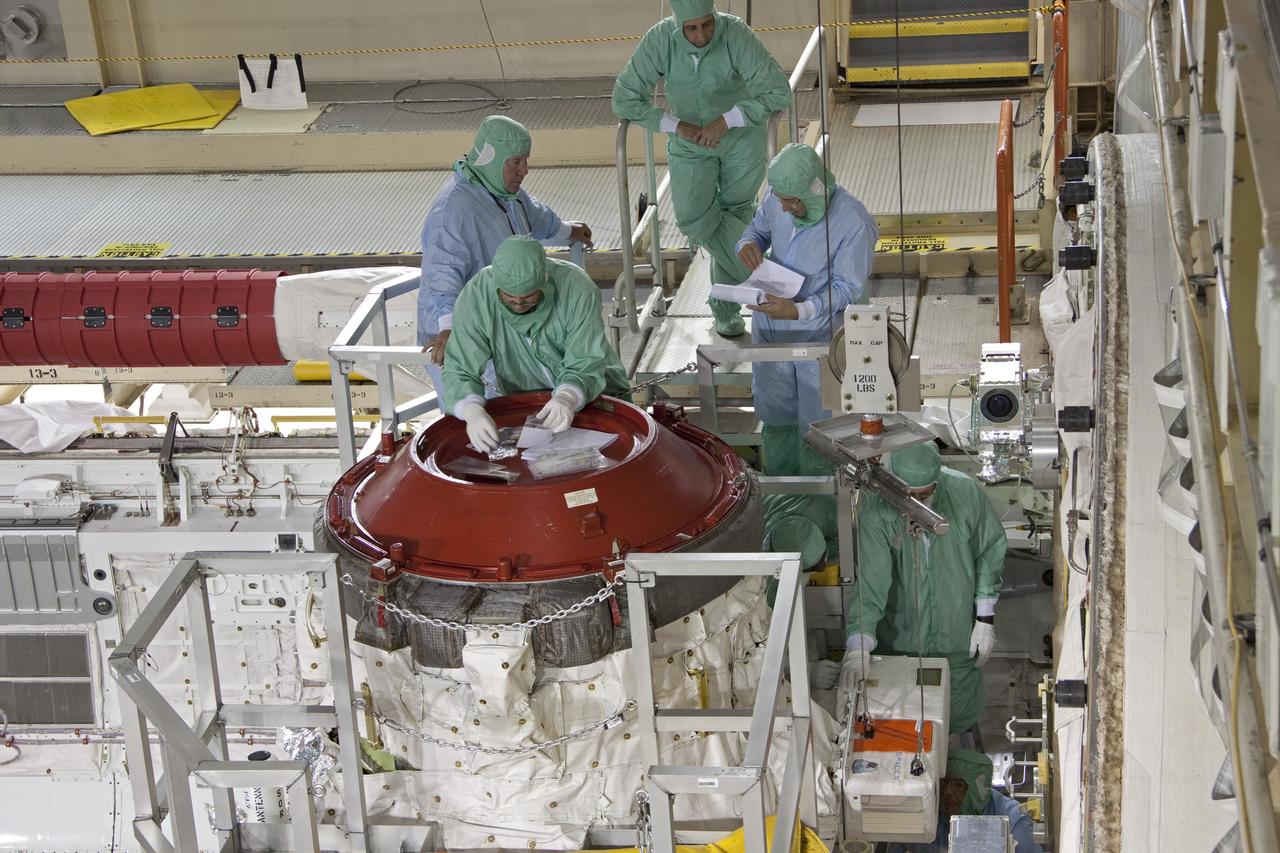
CAPE CANAVERAL, Fla. -- A DragonEye proximity sensor developed by Space Exploration Technologies (SpaceX) is installed while space shuttle Discovery is in Orbiter Processing Facility-3 at NASA's Kennedy Space Center in Florida. DragonEye is a Laser Imaging Detection and Ranging (LIDAR) sensor that will be tested on Discovery's docking operation with the International Space Station. Discovery's STS-133 mission, targeted to launch Nov. 1, will be the second demonstration of the sensor, following shuttle Endeavour's STS-127 mission in 2009. The DragonEye sensor will guide SpaceX's Dragon spacecraft as it approaches and berths to the station on future cargo re-supply missions. The Dragon spacecraft is a free-flying, reusable spacecraft being developed by SpaceX, which is contracted by NASA's Commercial Orbital Transportation Services (COTS) program. Photo credit: NASA/Jim Grossmann
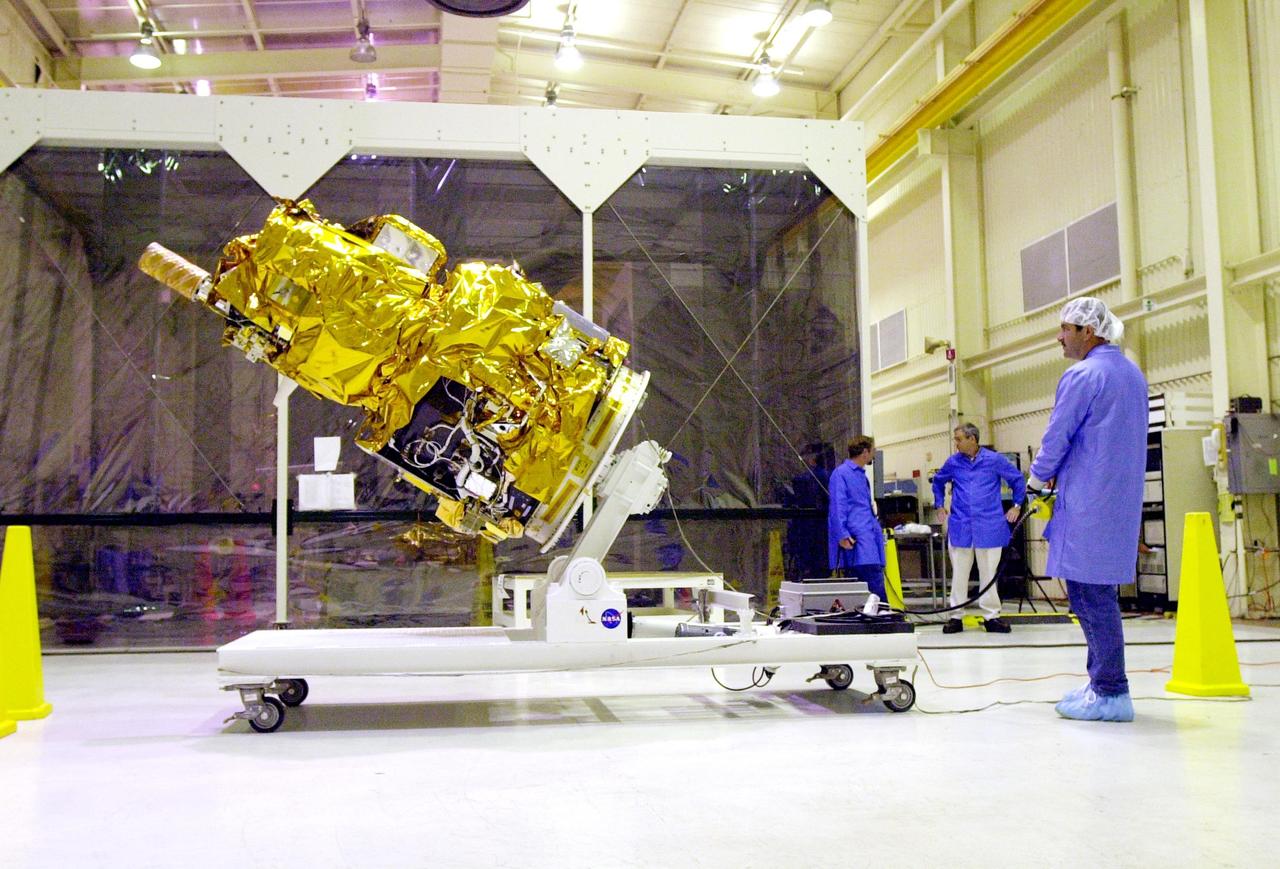
KENNEDY SPACE CENTER, FLA. - At Vandenberg Air Force Base in California, the Demonstration of Autonomous Rendezvous Technology (DART) spacecraft is raised to a vertical position. It will be lifted onto a test stand for launch processing activities. The spacecraft was developed for NASA by Orbital Sciences Corporation in Dulles, Va., to prove technologies for locating and maneuvering near an orbiting satellite. DART will be launched on a Pegasus launch vehicle. At about 40,000 feet over the Pacific Ocean, the Pegasus will be released from Orbital’s Stargazer L-1011 aircraft, fire its rocket motors and boost DART into a polar orbit approximately 472 miles by 479 miles. Once in orbit, DART will rendezvous with a target satellite, the Multiple Paths, Beyond-Line-of-Site Communications satellite, also built by Orbital Sciences. DART will then perform several close proximity operations, such as moving toward and away from the satellite using navigation data provided by onboard sensors. DART is scheduled for launch no earlier than Oct. 18.
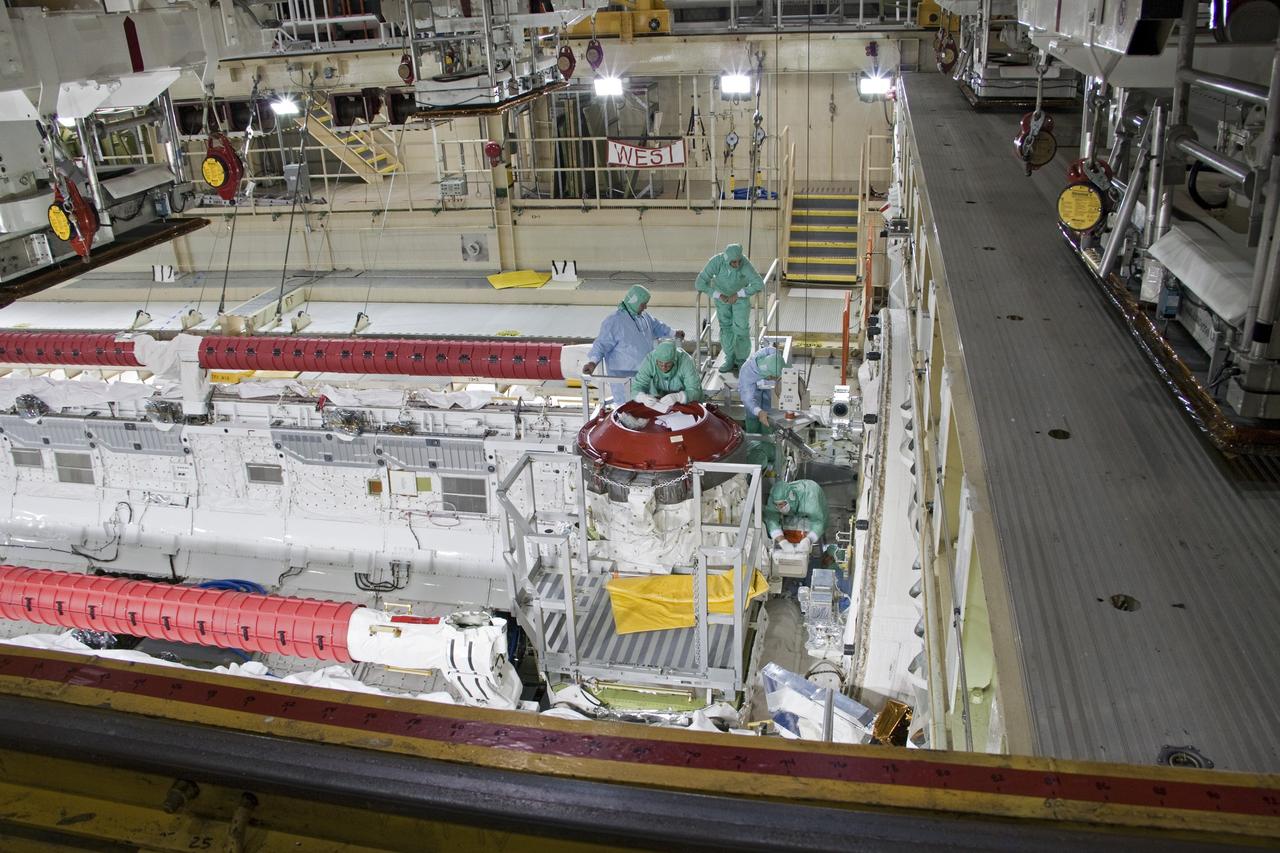
CAPE CANAVERAL, Fla. -- A DragonEye proximity sensor developed by Space Exploration Technologies (SpaceX) is installed while space shuttle Discovery is in Orbiter Processing Facility-3 at NASA's Kennedy Space Center in Florida. DragonEye is a Laser Imaging Detection and Ranging (LIDAR) sensor that will be tested on Discovery's docking operation with the International Space Station. Discovery's STS-133 mission, targeted to launch Nov. 1, will be the second demonstration of the sensor, following shuttle Endeavour's STS-127 mission in 2009. The DragonEye sensor will guide SpaceX's Dragon spacecraft as it approaches and berths to the station on future cargo re-supply missions. The Dragon spacecraft is a free-flying, reusable spacecraft being developed by SpaceX, which is contracted by NASA's Commercial Orbital Transportation Services (COTS) program. Photo credit: NASA/Jim Grossmann
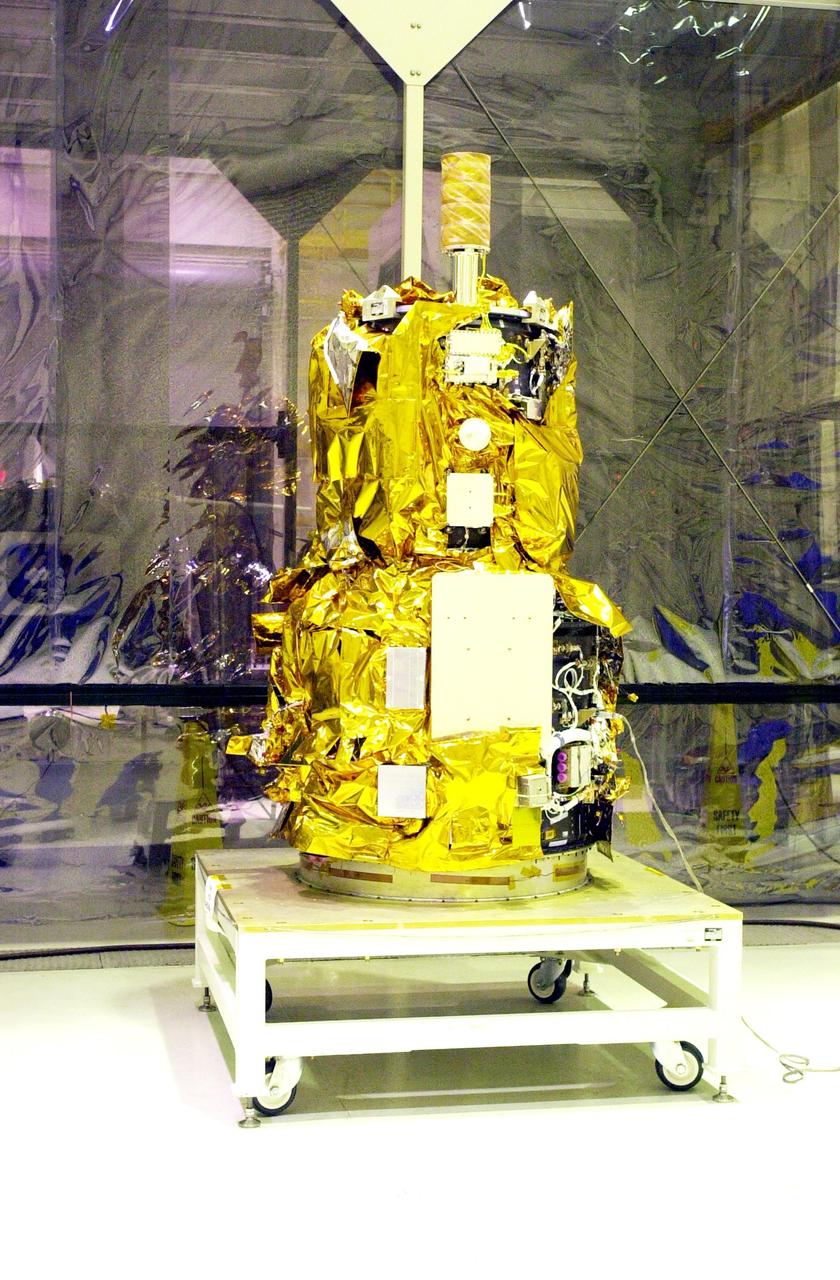
KENNEDY SPACE CENTER, FLA. - At Vandenberg Air Force Base in California, the Demonstration of Autonomous Rendezvous Technology (DART) spacecraft is on a work stand waiting for processing activities. The spacecraft was developed for NASA by Orbital Sciences Corporation in Dulles, Va., to prove technologies for locating and maneuvering near an orbiting satellite. DART will be launched on a Pegasus launch vehicle. At about 40,000 feet over the Pacific Ocean, the Pegasus will be released from Orbital’s Stargazer L-1011 aircraft, fire its rocket motors and boost DART into a polar orbit approximately 472 miles by 479 miles. Once in orbit, DART will rendezvous with a target satellite, the Multiple Paths, Beyond-Line-of-Site Communications satellite, also built by Orbital Sciences. DART will then perform several close proximity operations, such as moving toward and away from the satellite using navigation data provided by onboard sensors. DART is scheduled for launch no earlier than Oct. 18.
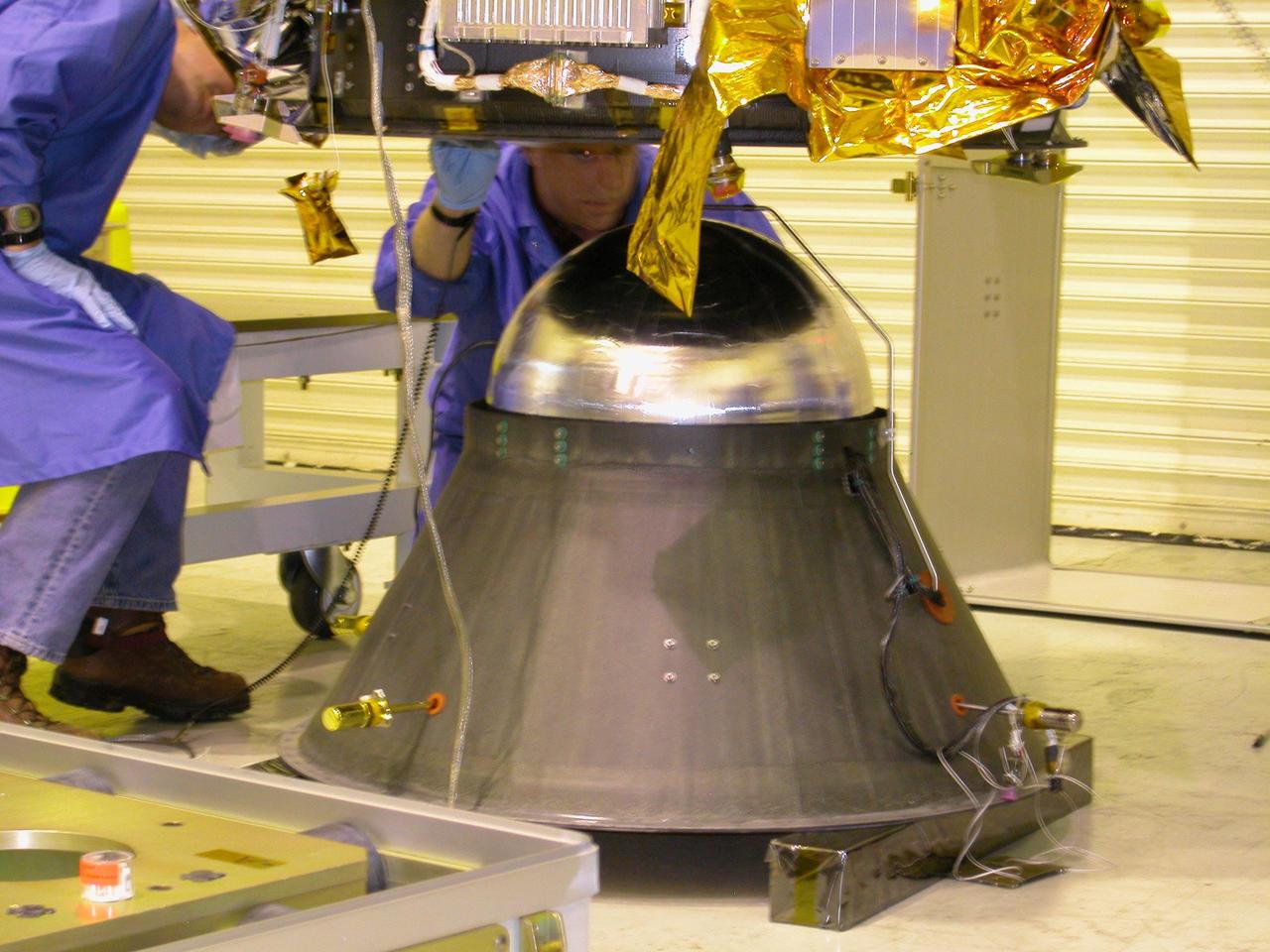
KENNEDY SPACE CENTER, FLA. - At Vandenberg Air Force Base in California, Orbital Sciences technicians watch closely as the DART (Demonstration for Autonomous Rendezvous Technology) flight demonstrator is lowered onto a stand. The spacecraft was developed to prove technologies for locating and maneuvering near an orbiting satellite. Future applications of technologies developed by the DART project will benefit the nation in future space-vehicle systems development requiring in-space assembly, services or other autonomous rendezvous operations. Designed and developed for NASA by Orbital Sciences Corporation in Dulles, Va., the DART spacecraft will be launched on a Pegasus launch vehicle. At about 40,000 feet over the Pacific Ocean, the Pegasus will be released from Orbital’s Stargazer L-1011 aircraft, fire its rocket motors and boost DART into a polar orbit approximately 472 miles by 479 miles. Once in orbit, DART will rendezvous with a target satellite, the Multiple Paths, Beyond-Line-of-Site Communications satellite, also built by Orbital Sciences. DART will then perform several close proximity operations, such as moving toward and away from the satellite using navigation data provided by onboard sensors. DART is scheduled for launch no earlier than Oct. 18.
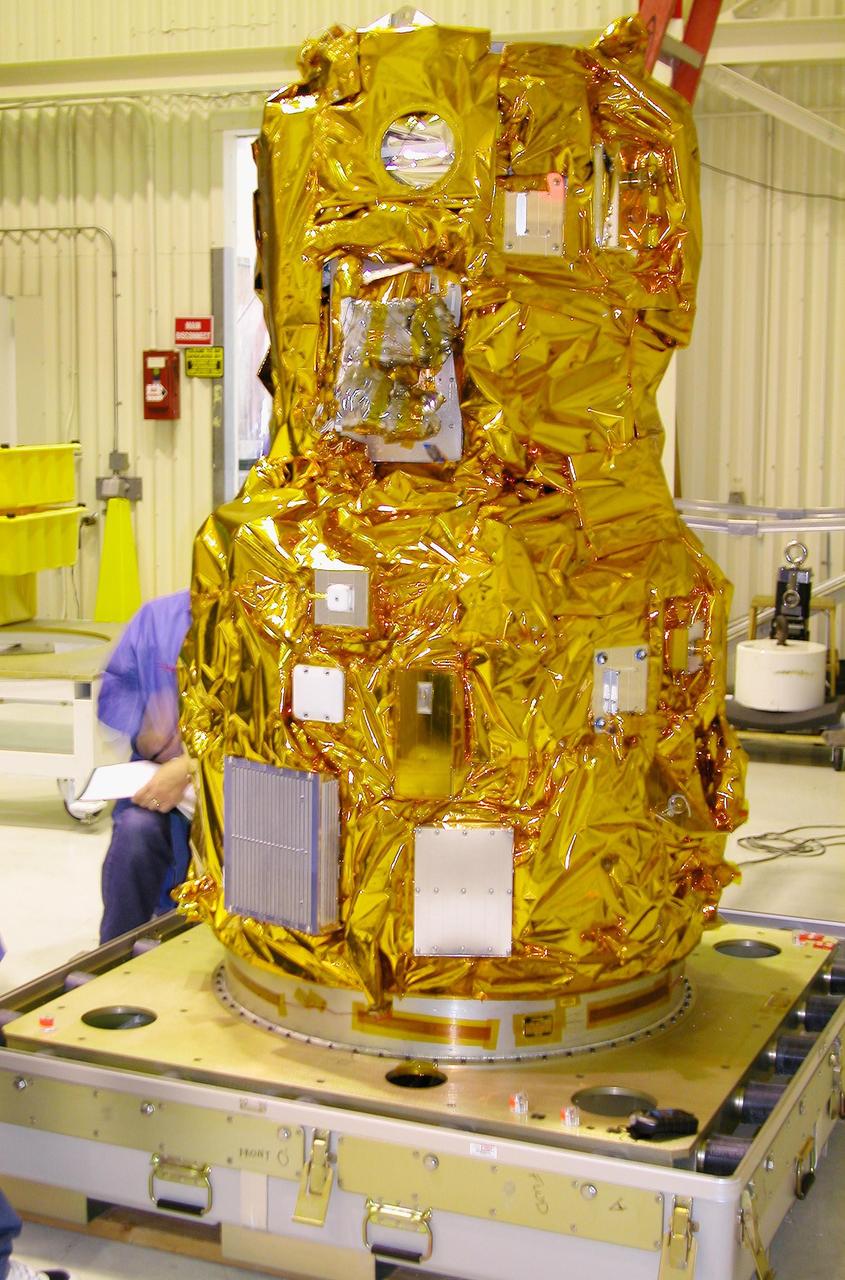
KENNEDY SPACE CENTER, FLA. - At Vandenberg Air Force Base in California, the DART (Demonstration for Autonomous Rendezvous Technology) flight demonstrator is revealed after its protective cover has been removed. The spacecraft was developed to prove technologies for locating and maneuvering near an orbiting satellite. Future applications of technologies developed by the DART project will benefit the nation in future space-vehicle systems development requiring in-space assembly, services or other autonomous rendezvous operations. Designed and developed for NASA by Orbital Sciences Corporation in Dulles, Va., the DART spacecraft will be launched on a Pegasus launch vehicle. At about 40,000 feet over the Pacific Ocean, the Pegasus will be released from Orbital’s Stargazer L-1011 aircraft, fire its rocket motors and boost DART into a polar orbit approximately 472 miles by 479 miles. Once in orbit, DART will rendezvous with a target satellite, the Multiple Paths, Beyond-Line-of-Site Communications satellite, also built by Orbital Sciences. DART will then perform several close proximity operations, such as moving toward and away from the satellite using navigation data provided by onboard sensors. DART is scheduled for launch no earlier than Oct. 18.
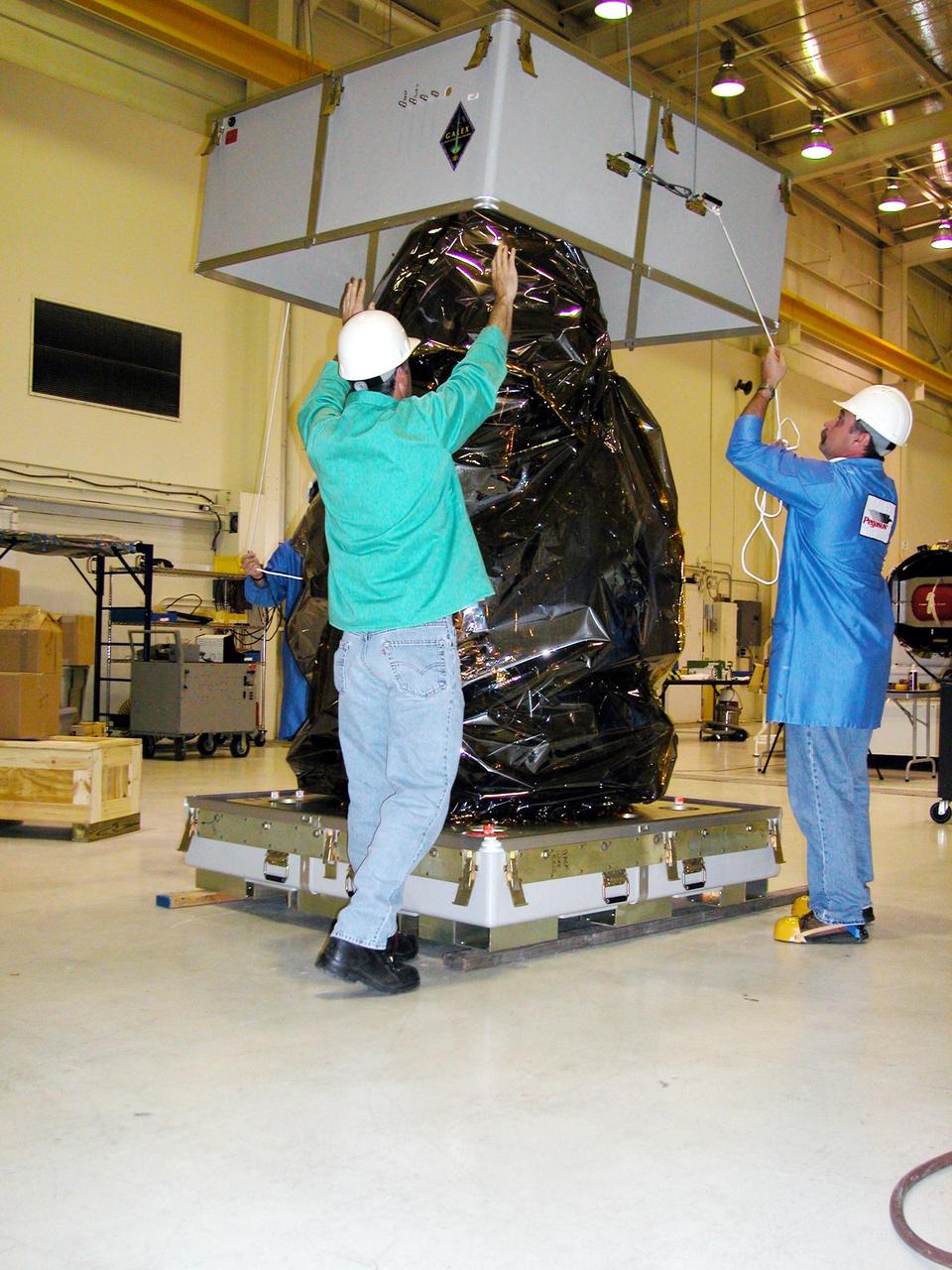
KENNEDY SPACE CENTER, FLA. - At Vandenberg Air Force Base in California, Orbital Sciences workers remove the canister from the DART (Demonstration for Autonomous Rendezvous Technology) flight demonstrator, a spacecraft developed to prove technologies for locating and maneuvering near an orbiting satellite. Future applications of technologies developed by the DART project will benefit the nation in future space-vehicle systems development requiring in-space assembly, services or other autonomous rendezvous operations. Designed and developed for NASA by Orbital Sciences Corporation in Dulles, Va., the DART spacecraft will be launched on a Pegasus launch vehicle. At about 40,000 feet over the Pacific Ocean, the Pegasus will be released from Orbital’s Stargazer L-1011 aircraft, fire its rocket motors and boost DART into a polar orbit approximately 472 miles by 479 miles. Once in orbit, DART will rendezvous with a target satellite, the Multiple Paths, Beyond-Line-of-Site Communications satellite, also built by Orbital Sciences. DART will then perform several close proximity operations, such as moving toward and away from the satellite using navigation data provided by onboard sensors. DART is scheduled for launch no earlier than Oct. 18.
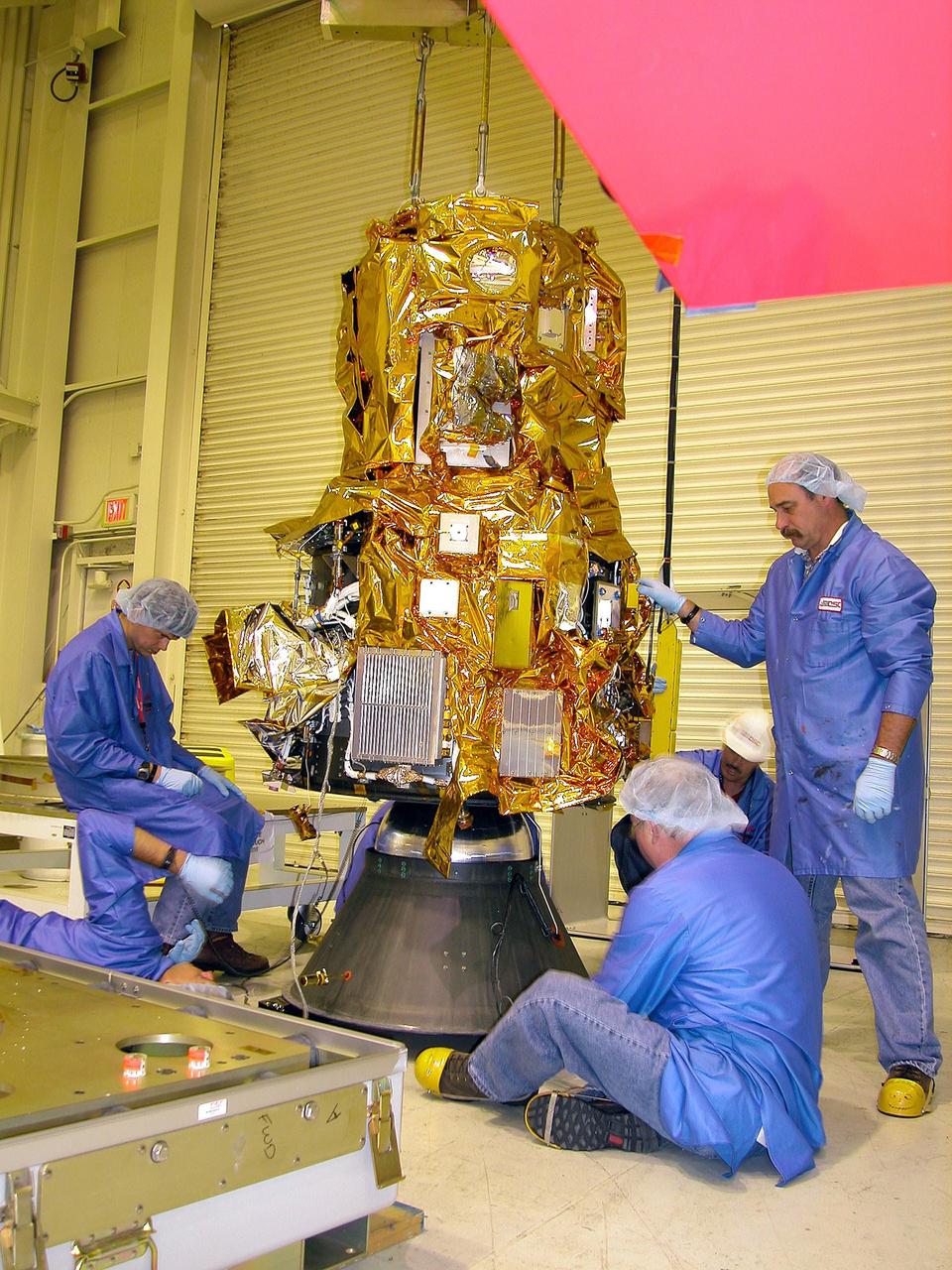
KENNEDY SPACE CENTER, FLA. - At Vandenberg Air Force Base in California, Orbital Sciences technicians observe closely the movement of the DART (Demonstration for Autonomous Rendezvous Technology) flight demonstrator as it is lowered onto a stand. The spacecraft was developed to prove technologies for locating and maneuvering near an orbiting satellite. Future applications of technologies developed by the DART project will benefit the nation in future space-vehicle systems development requiring in-space assembly, services or other autonomous rendezvous operations. Designed and developed for NASA by Orbital Sciences Corporation in Dulles, Va., the DART spacecraft will be launched on a Pegasus launch vehicle. At about 40,000 feet over the Pacific Ocean, the Pegasus will be released from Orbital’s Stargazer L-1011 aircraft, fire its rocket motors and boost DART into a polar orbit approximately 472 miles by 479 miles. Once in orbit, DART will rendezvous with a target satellite, the Multiple Paths, Beyond-Line-of-Site Communications satellite, also built by Orbital Sciences. DART will then perform several close proximity operations, such as moving toward and away from the satellite using navigation data provided by onboard sensors. DART is scheduled for launch no earlier than Oct. 18.

KENNEDY SPACE CENTER, FLA. - At Vandenberg Air Force Base in California, Orbital Sciences technicians check the bottom of the DART (Demonstration for Autonomous Rendezvous Technology) flight demonstrator as it is raised off its platform. The spacecraft was developed to prove technologies for locating and maneuvering near an orbiting satellite. Future applications of technologies developed by the DART project will benefit the nation in future space-vehicle systems development requiring in-space assembly, services or other autonomous rendezvous operations. Designed and developed for NASA by Orbital Sciences Corporation in Dulles, Va., the DART spacecraft will be launched on a Pegasus launch vehicle. At about 40,000 feet over the Pacific Ocean, the Pegasus will be released from Orbital’s Stargazer L-1011 aircraft, fire its rocket motors and boost DART into a polar orbit approximately 472 miles by 479 miles. Once in orbit, DART will rendezvous with a target satellite, the Multiple Paths, Beyond-Line-of-Site Communications satellite, also built by Orbital Sciences. DART will then perform several close proximity operations, such as moving toward and away from the satellite using navigation data provided by onboard sensors. DART is scheduled for launch no earlier than Oct. 18.
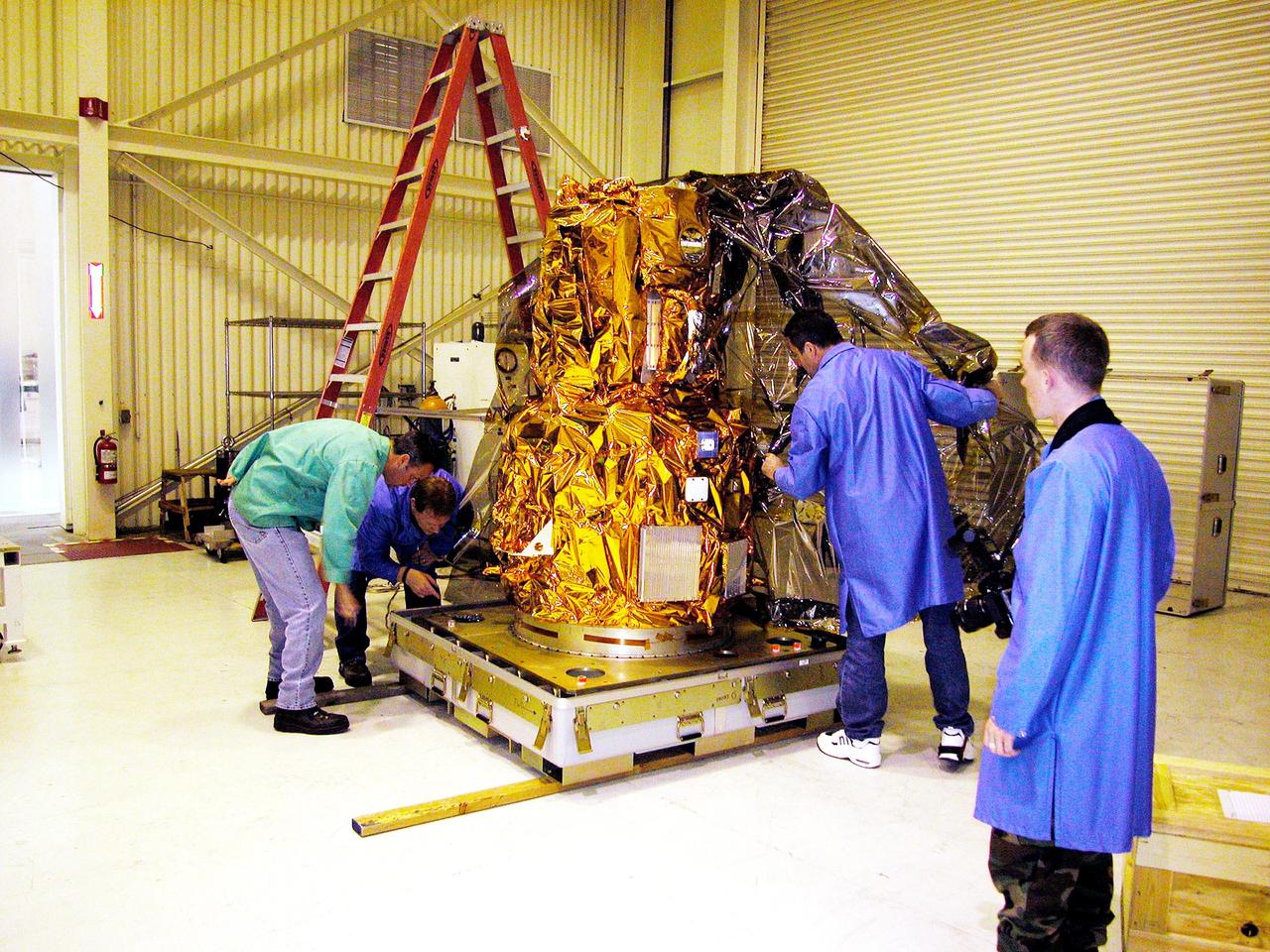
KENNEDY SPACE CENTER, FLA. - At Vandenberg Air Force Base in California, the DART (Demonstration for Autonomous Rendezvous Technology) flight demonstrator is revealed after its protective cover has been removed. The spacecraft was developed to prove technologies for locating and maneuvering near an orbiting satellite. Future applications of technologies developed by the DART project will benefit the nation in future space-vehicle systems development requiring in-space assembly, services or other autonomous rendezvous operations. Designed and developed for NASA by Orbital Sciences Corporation in Dulles, Va., the DART spacecraft will be launched on a Pegasus launch vehicle. At about 40,000 feet over the Pacific Ocean, the Pegasus will be released from Orbital’s Stargazer L-1011 aircraft, fire its rocket motors and boost DART into a polar orbit approximately 472 miles by 479 miles. Once in orbit, DART will rendezvous with a target satellite, the Multiple Paths, Beyond-Line-of-Site Communications satellite, also built by Orbital Sciences. DART will then perform several close proximity operations, such as moving toward and away from the satellite using navigation data provided by onboard sensors. DART is scheduled for launch no earlier than Oct. 18.
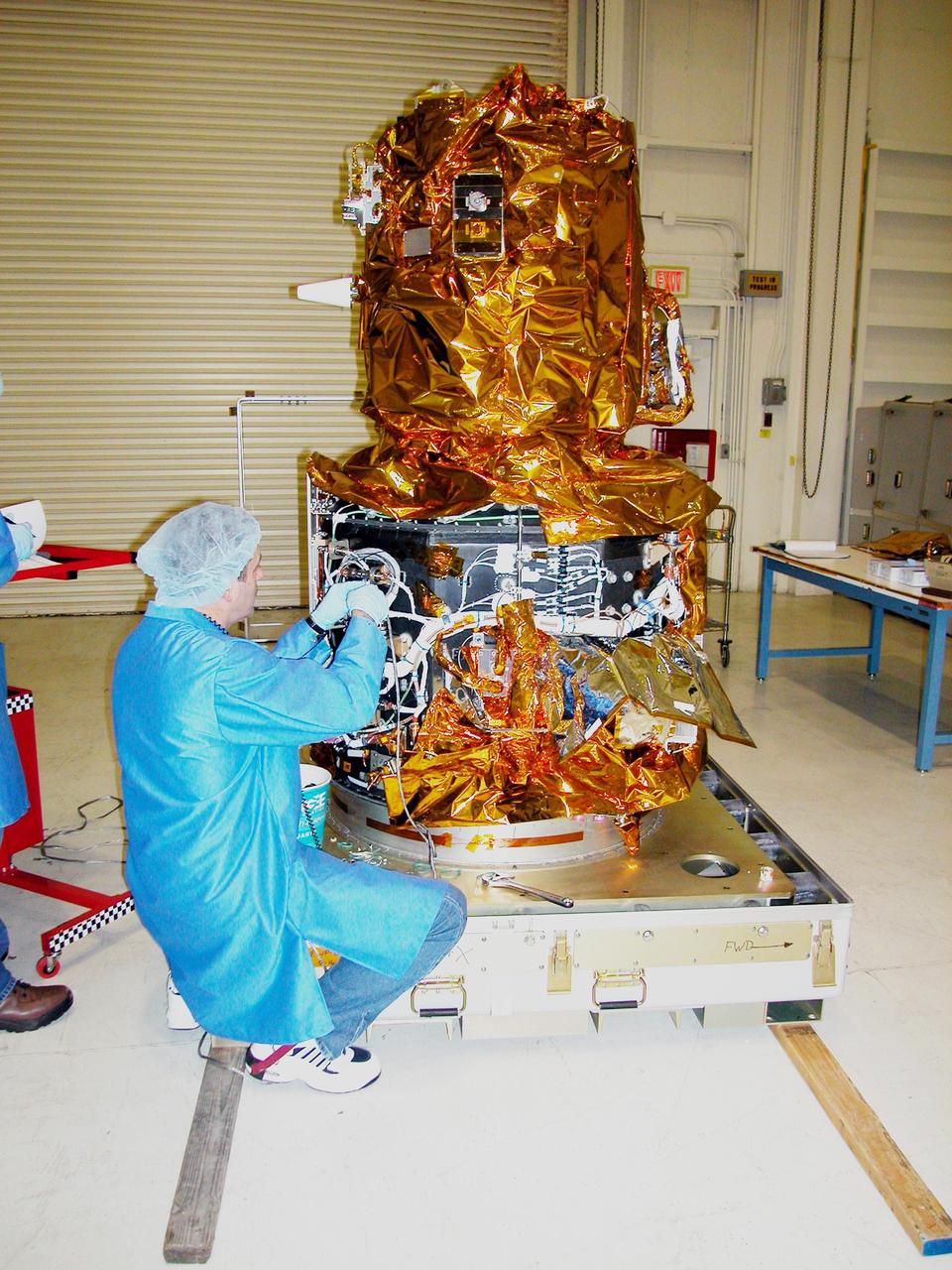
KENNEDY SPACE CENTER, FLA. - At Vandenberg Air Force Base in California, an Orbital Sciences technician works with wiring on the DART (Demonstration for Autonomous Rendezvous Technology) flight demonstrator, a spacecraft developed to prove technologies for locating and maneuvering near an orbiting satellite. Future applications of technologies developed by the DART project will benefit the nation in future space-vehicle systems development requiring in-space assembly, services or other autonomous rendezvous operations. Designed and developed for NASA by Orbital Sciences Corporation in Dulles, Va., the DART spacecraft will be launched on a Pegasus launch vehicle. At about 40,000 feet over the Pacific Ocean, the Pegasus will be released from Orbital’s Stargazer L-1011 aircraft, fire its rocket motors and boost DART into a polar orbit approximately 472 miles by 479 miles. Once in orbit, DART will rendezvous with a target satellite, the Multiple Paths, Beyond-Line-of-Site Communications satellite, also built by Orbital Sciences. DART will then perform several close proximity operations, such as moving toward and away from the satellite using navigation data provided by onboard sensors. DART is scheduled for launch no earlier than Oct. 18.
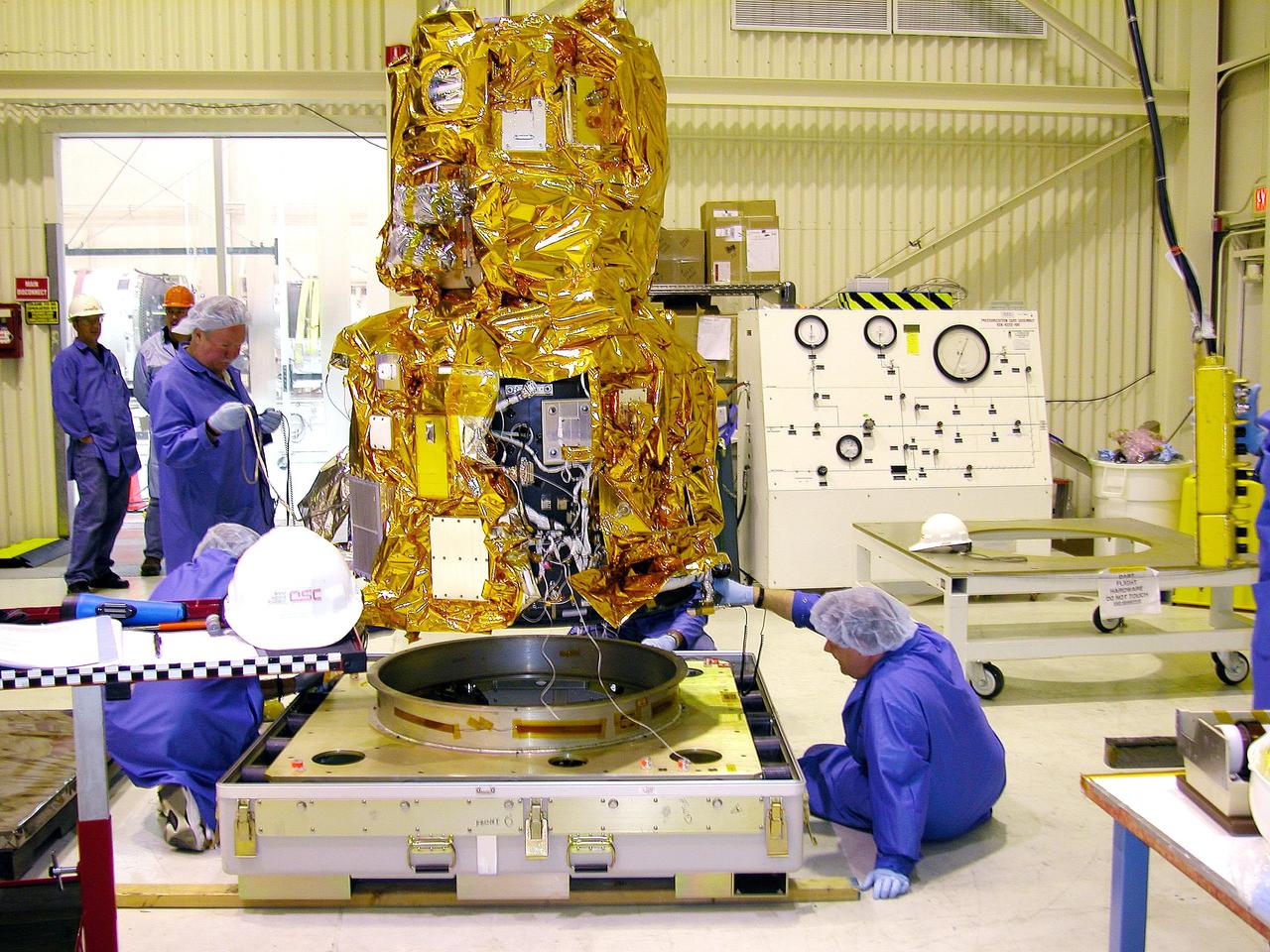
KENNEDY SPACE CENTER, FLA. - At Vandenberg Air Force Base in California, Orbital Sciences technicians check the bottom of the DART (Demonstration for Autonomous Rendezvous Technology) flight demonstrator as it is raised of its platform. The spacecraft was developed to prove technologies for locating and maneuvering near an orbiting satellite. Future applications of technologies developed by the DART project will benefit the nation in future space-vehicle systems development requiring in-space assembly, services or other autonomous rendezvous operations. Designed and developed for NASA by Orbital Sciences Corporation in Dulles, Va., the DART spacecraft will be launched on a Pegasus launch vehicle. At about 40,000 feet over the Pacific Ocean, the Pegasus will be released from Orbital’s Stargazer L-1011 aircraft, fire its rocket motors and boost DART into a polar orbit approximately 472 miles by 479 miles. Once in orbit, DART will rendezvous with a target satellite, the Multiple Paths, Beyond-Line-of-Site Communications satellite, also built by Orbital Sciences. DART will then perform several close proximity operations, such as moving toward and away from the satellite using navigation data provided by onboard sensors. DART is scheduled for launch no earlier than Oct. 18.
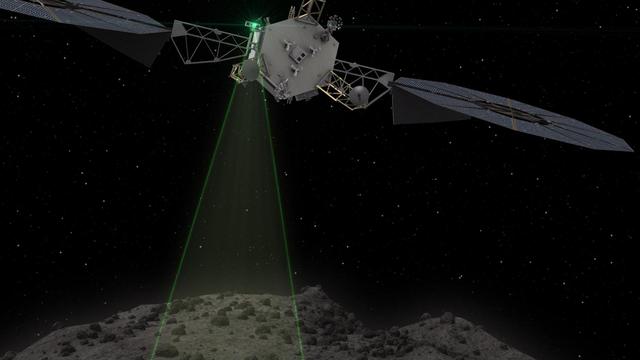
This graphic depicts the Asteroid Redirect Vehicle conducting a flyby of its target asteroid. During these flybys, the Asteroid Redirect Mission (ARM) would come within 0.6 miles (1 kilometer), generating imagery with resolution of up to 0.4 of an inch (1 centimeter) per pixel. The robotic segment of ARM will demonstrate advanced, high-power, high-throughput solar electric propulsion; advanced autonomous precision proximity operations at a low-gravity planetary body; and controlled touchdown and liftoff with a multi-ton mass. The crew segment of the mission will include spacewalk activities for sample selection, extraction, containment and return; and mission operations of integrated robotic and crewed vehicle stack -- all key components of future in-space operations for human missions to the Mars system. After collecting a multi-ton boulder from the asteroid, the robotic spacecraft will redirect the boulder to a crew-accessible orbit around the moon, where NASA plans to conduct a series of proving ground missions in the 2020s that will help validate capabilities needed for NASA's Journey to Mars. http://photojournal.jpl.nasa.gov/catalog/PIA21062
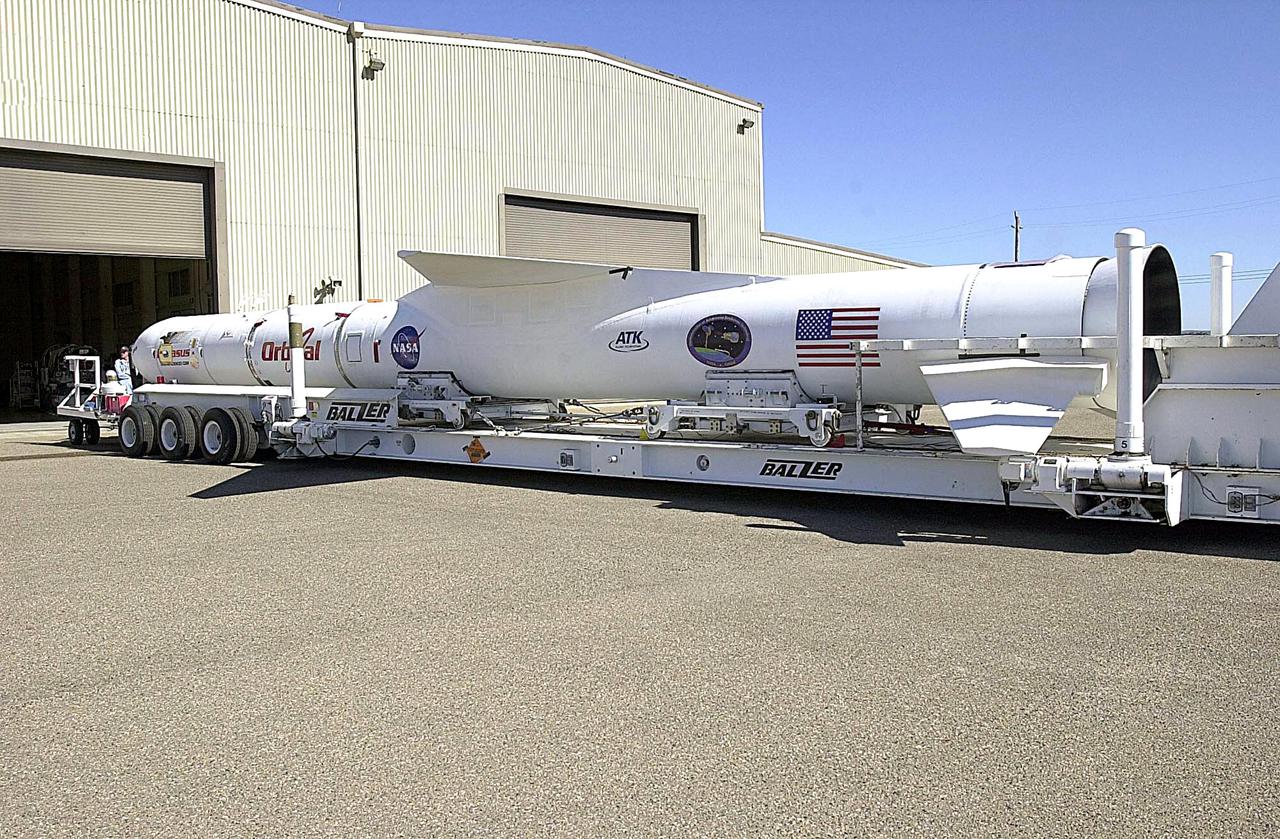
KENNEDY SPACE CENTER, FLA. - The Orbital Sciences Pegasus XL launch vehicle and Demonstration of Autonomous Rendezvous Technology (DART) spacecraft roll out of the hangar at Vandenberg Air Force Base in California. They will head to the runway and be attached to the underbelly of the Orbital Sciences L-1011 aircraft for launch Nov. 9. DART was designed and built for NASA by Orbital Sciences as an advanced flight demonstrator to locate and maneuver near an orbiting satellite. The DART spacecraft weighs about 800 pounds and is nearly 6 feet long and 3 feet in diameter. The Pegasus XL vehicle will launch DART into a circular polar orbit of approximately 475 miles. Once in orbit, DART will make contact with a target satellite, the Multiple Paths, Beyond-Line-of-Sight Communications (MUBLCOM), also built by Orbital Sciences and launched in 1999. DART will then perform several close-proximity operations, such as moving toward and away from the satellite using navigation data provided by on-board sensors. The entire mission will last only 24 hours and will be accomplished without human intervention. The DART flight computer will determine its own path to accomplish its mission objectives.
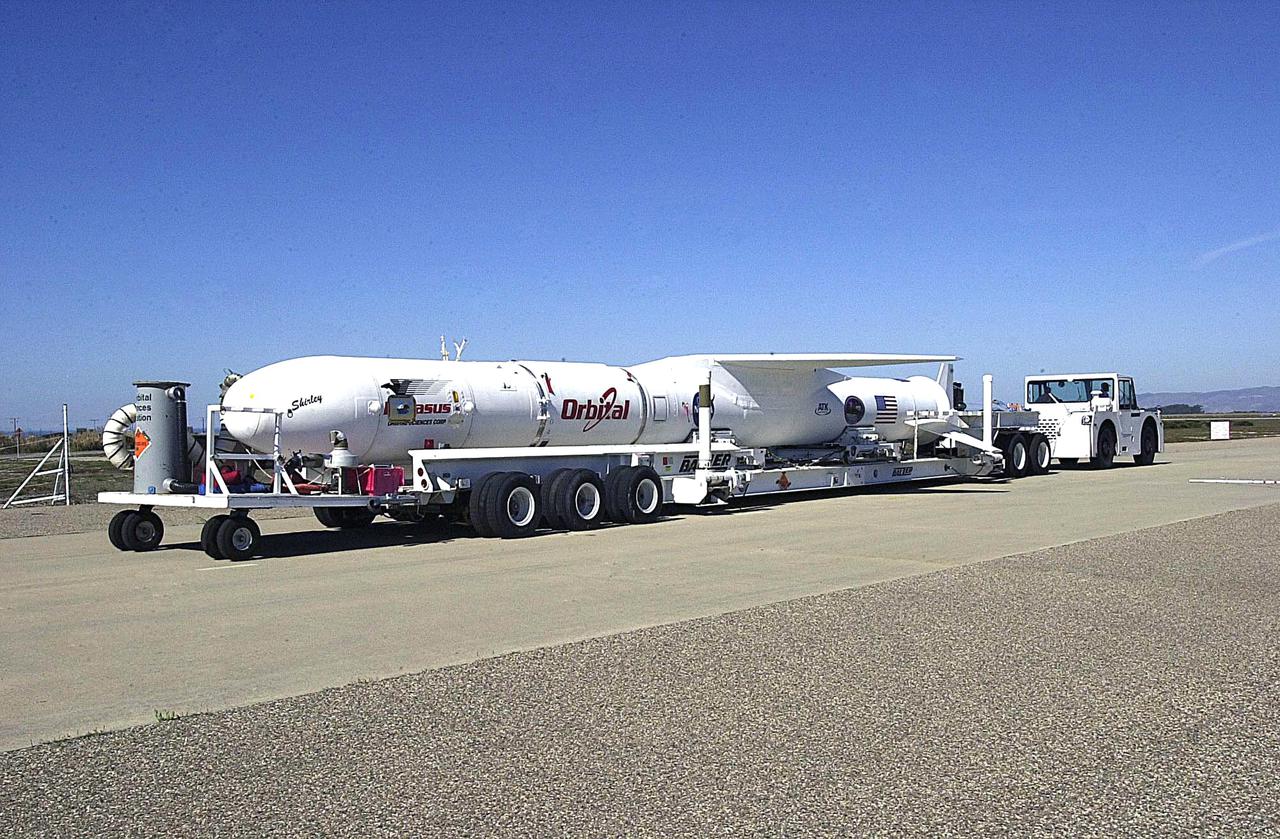
KENNEDY SPACE CENTER, FLA. - The Orbital Sciences Pegasus XL launch vehicle and Demonstration of Autonomous Rendezvous Technology (DART) spacecraft head for the runway at Vandenberg Air Force Base in California and the waiting Orbital Sciences L-1011 aircraft. The Pegasus_DART will be attached to the underbelly of the L-1011 for launch Nov. 9. DART was designed and built for NASA by Orbital Sciences as an advanced flight demonstrator to locate and maneuver near an orbiting satellite. The DART spacecraft weighs about 800 pounds and is nearly 6 feet long and 3 feet in diameter. The Pegasus XL vehicle will launch DART into a circular polar orbit of approximately 475 miles. Once in orbit, DART will make contact with a target satellite, the Multiple Paths, Beyond-Line-of-Sight Communications (MUBLCOM), also built by Orbital Sciences and launched in 1999. DART will then perform several close-proximity operations, such as moving toward and away from the satellite using navigation data provided by on-board sensors. The entire mission will last only 24 hours and will be accomplished without human intervention. The DART flight computer will determine its own path to accomplish its mission objectives.
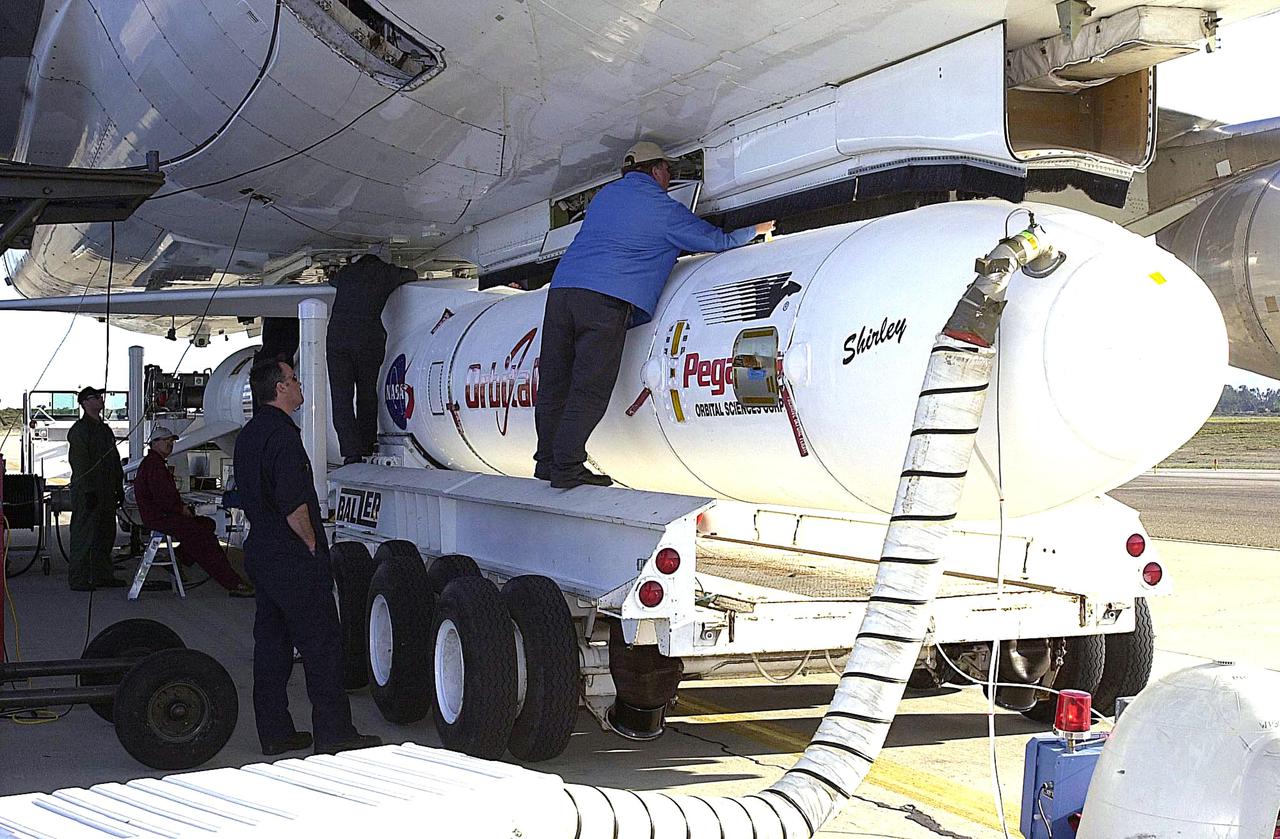
KENNEDY SPACE CENTER, FLA. - At Vandenberg Air Force Base in California, a worker stands on the transporter to attach the Orbital Sciences Pegasus XL launch vehicle and Demonstration of Autonomous Rendezvous Technology (DART) spacecraft to the underbelly of the Orbital Sciences L-1011 aircraft for launch Nov. 9. DART was designed and built for NASA by Orbital Sciences as an advanced flight demonstrator to locate and maneuver near an orbiting satellite. The DART spacecraft weighs about 800 pounds and is nearly 6 feet long and 3 feet in diameter. The Pegasus XL vehicle will launch DART into a circular polar orbit of approximately 475 miles. Once in orbit, DART will make contact with a target satellite, the Multiple Paths, Beyond-Line-of-Sight Communications (MUBLCOM), also built by Orbital Sciences and launched in 1999. DART will then perform several close-proximity operations, such as moving toward and away from the satellite using navigation data provided by on-board sensors. The entire mission will last only 24 hours and will be accomplished without human intervention. The DART flight computer will determine its own path to accomplish its mission objectives.
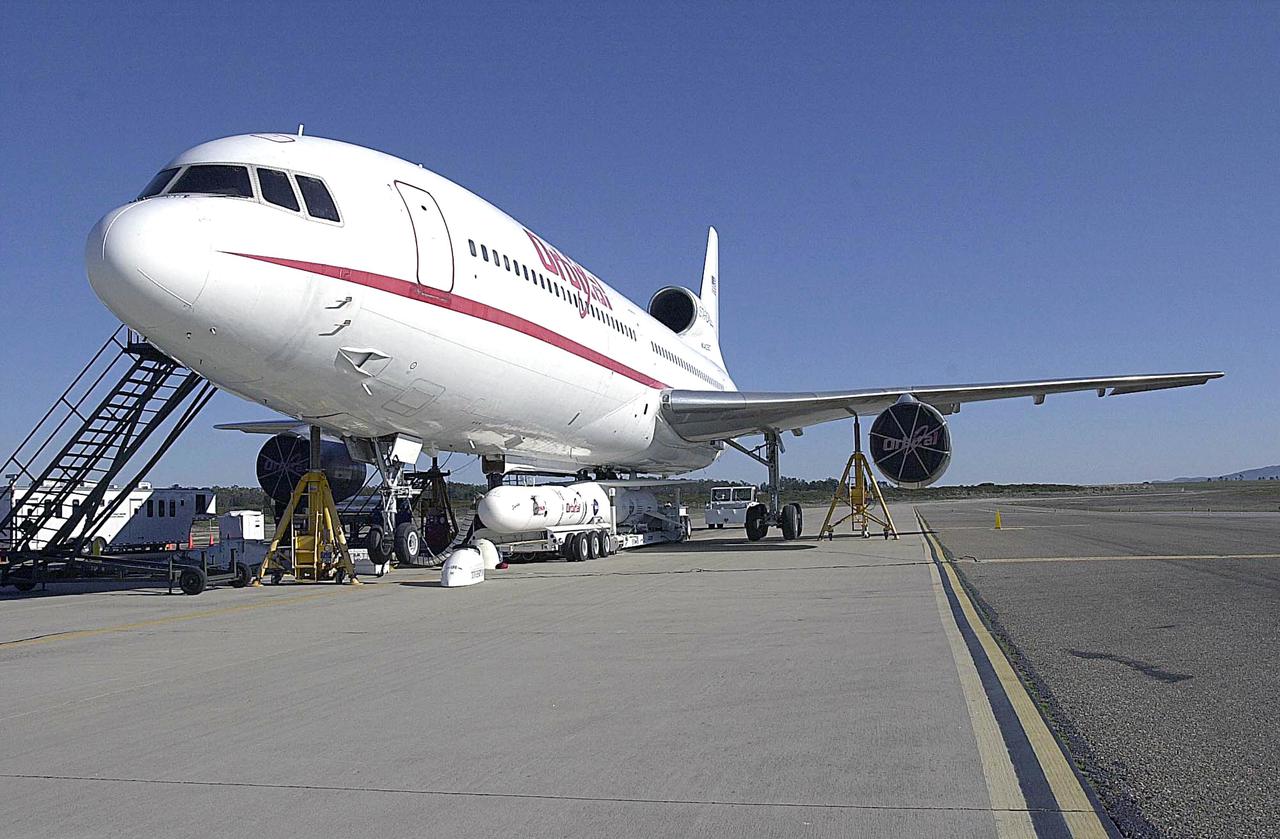
KENNEDY SPACE CENTER, FLA. - At Vandenberg Air Force Base in California, the Orbital Sciences Pegasus XL launch vehicle and Demonstration of Autonomous Rendezvous Technology (DART) spacecraft, which are mated, are being attached to the underbelly of the Orbital Sciences L-1011 aircraft for launch Nov. 9. DART was designed and built for NASA by Orbital Sciences as an advanced flight demonstrator to locate and maneuver near an orbiting satellite. The DART spacecraft weighs about 800 pounds and is nearly 6 feet long and 3 feet in diameter. The Pegasus XL vehicle will launch DART into a circular polar orbit of approximately 475 miles. Once in orbit, DART will make contact with a target satellite, the Multiple Paths, Beyond-Line-of-Sight Communications (MUBLCOM), also built by Orbital Sciences and launched in 1999. DART will then perform several close-proximity operations, such as moving toward and away from the satellite using navigation data provided by on-board sensors. The entire mission will last only 24 hours and will be accomplished without human intervention. The DART flight computer will determine its own path to accomplish its mission objectives.
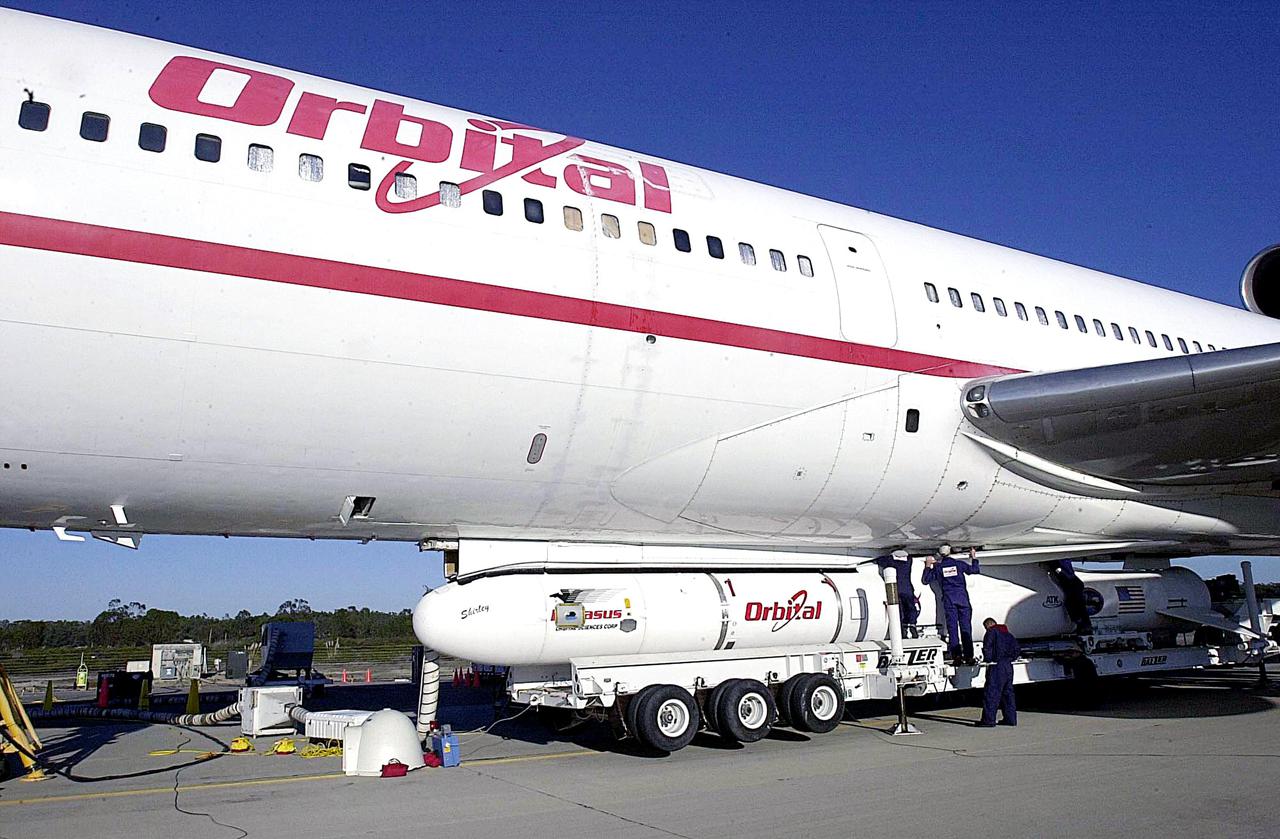
KENNEDY SPACE CENTER, FLA. - Workers at Vandenberg Air Force Base in California finish attaching the Orbital Sciences Pegasus XL launch vehicle and Demonstration of Autonomous Rendezvous Technology (DART) spacecraft to the underbelly of the Orbital Sciences L-1011 aircraft for launch Nov. 9. DART was designed and built for NASA by Orbital Sciences as an advanced flight demonstrator to locate and maneuver near an orbiting satellite. The DART spacecraft weighs about 800 pounds and is nearly 6 feet long and 3 feet in diameter. The Pegasus XL vehicle will launch DART into a circular polar orbit of approximately 475 miles. Once in orbit, DART will make contact with a target satellite, the Multiple Paths, Beyond-Line-of-Sight Communications (MUBLCOM), also built by Orbital Sciences and launched in 1999. DART will then perform several close-proximity operations, such as moving toward and away from the satellite using navigation data provided by on-board sensors. The entire mission will last only 24 hours and will be accomplished without human intervention. The DART flight computer will determine its own path to accomplish its mission objectives.
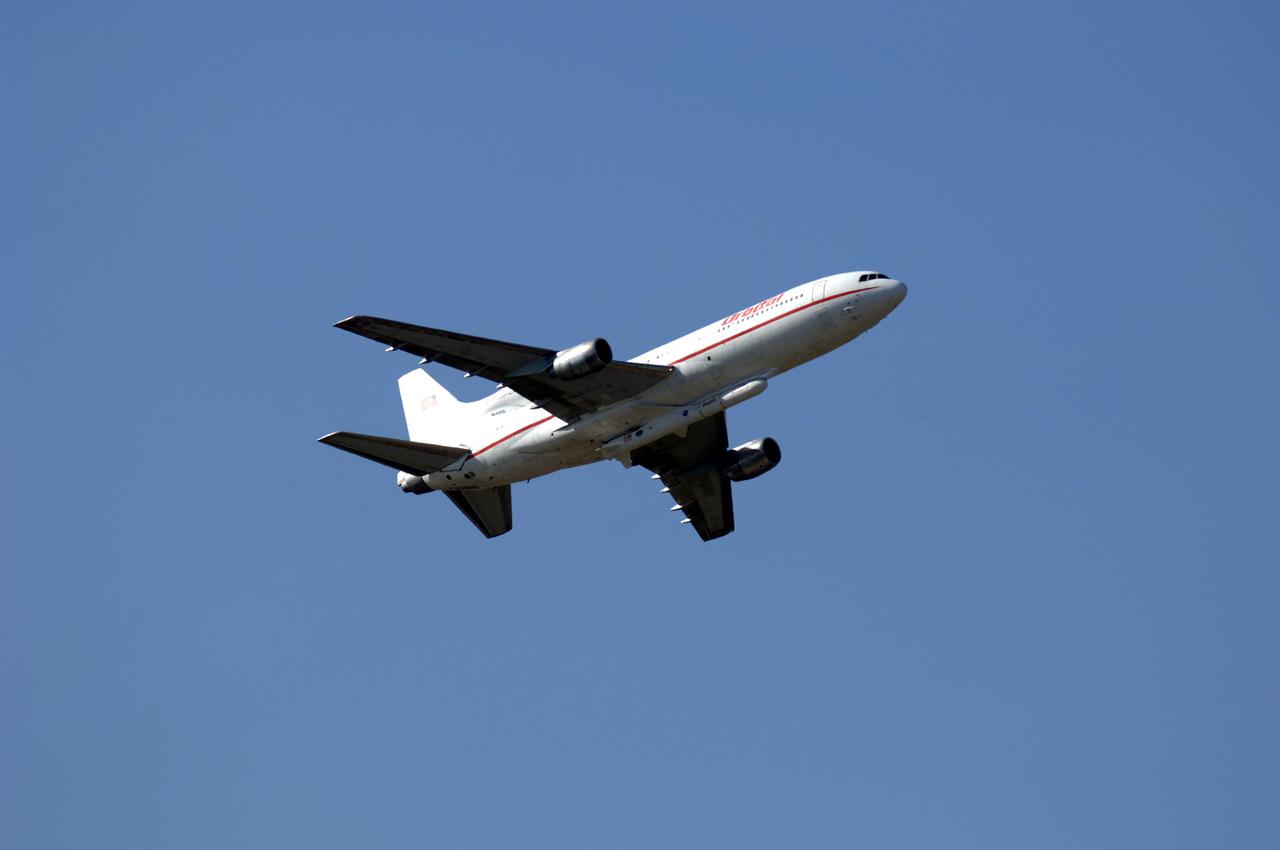
VANDENBERG AIR FORCE BASE, FLA. - The Orbital Sciences L-1011 aircraft soars through the sky to launch the Orbital Sciences Pegasus XL launch vehicle and Demonstration of Autonomous Rendezvous Technology (DART) spacecraft attached to its underbelly. DART was designed and built for NASA by Orbital Sciences as an advanced flight demonstrator to locate and maneuver near an orbiting satellite. The DART spacecraft weighs about 800 pounds and is nearly 6 feet long and 3 feet in diameter. The Pegasus XL vehicle will launch DART into a circular polar orbit of approximately 475 miles. Once in orbit, DART will make contact with a target satellite, the Multiple Paths, Beyond-Line-of-Sight Communications (MUBLCOM), also built by Orbital Sciences and launched in 1999. DART will then perform several close-proximity operations, such as moving toward and away from the satellite using navigation data provided by on-board sensors. The entire mission will last only 24 hours and will be accomplished without human intervention. The DART flight computer will determine its own path to accomplish its mission objectives.
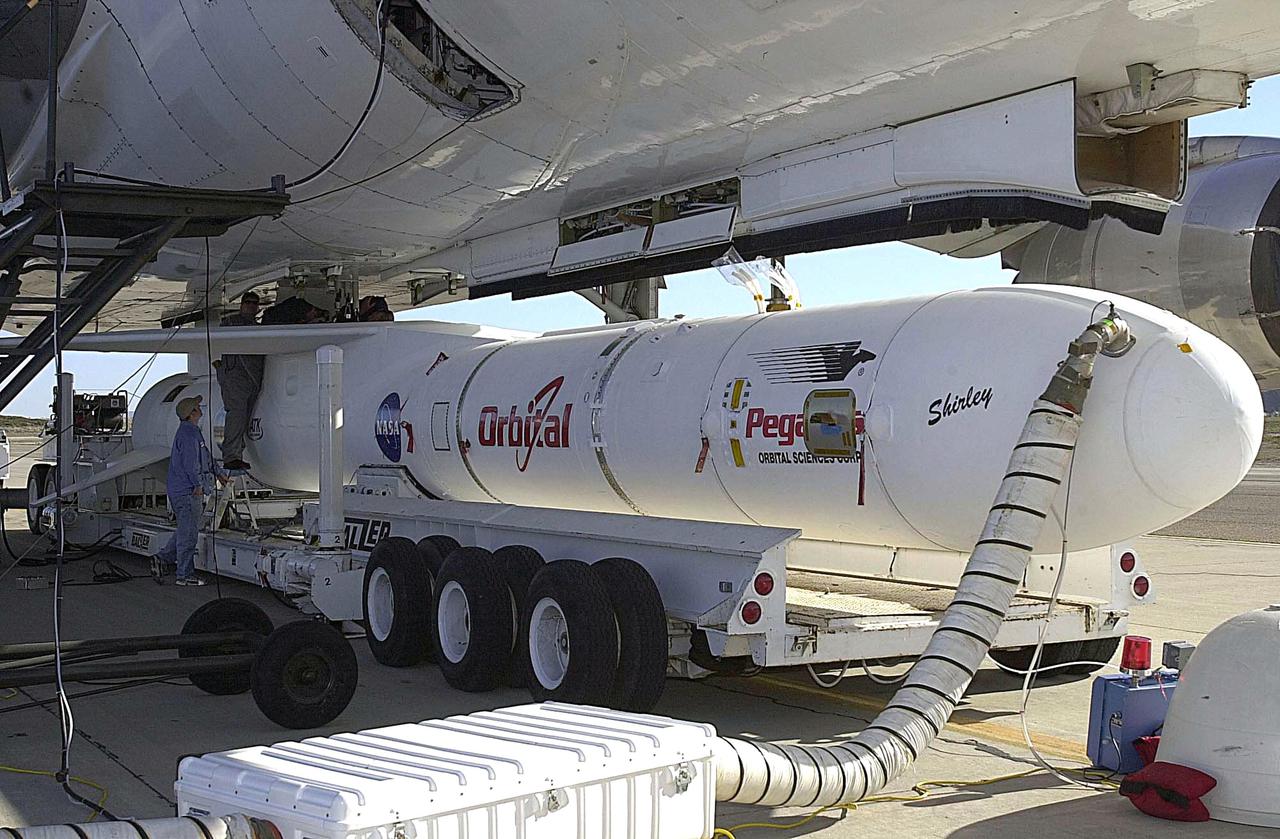
KENNEDY SPACE CENTER, FLA. - At Vandenberg Air Force Base in California, the Orbital Sciences Pegasus XL launch vehicle and Demonstration of Autonomous Rendezvous Technology (DART) spacecraft, which are mated, are being attached to the underbelly of the Orbital Sciences L-1011 aircraft for launch Nov. 9. DART was designed and built for NASA by Orbital Sciences as an advanced flight demonstrator to locate and maneuver near an orbiting satellite. The DART spacecraft weighs about 800 pounds and is nearly 6 feet long and 3 feet in diameter. The Pegasus XL vehicle will launch DART into a circular polar orbit of approximately 475 miles. Once in orbit, DART will make contact with a target satellite, the Multiple Paths, Beyond-Line-of-Sight Communications (MUBLCOM), also built by Orbital Sciences and launched in 1999. DART will then perform several close-proximity operations, such as moving toward and away from the satellite using navigation data provided by on-board sensors. The entire mission will last only 24 hours and will be accomplished without human intervention. The DART flight computer will determine its own path to accomplish its mission objectives.
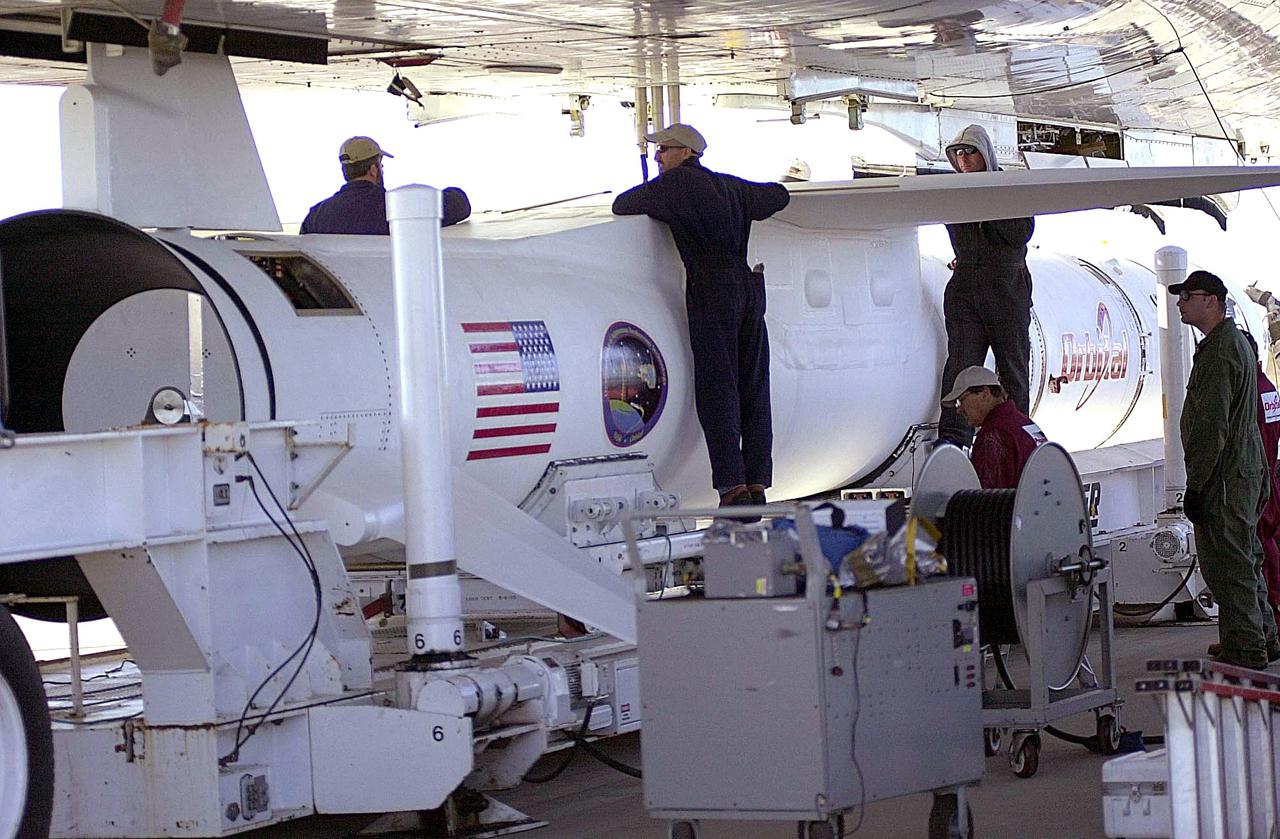
KENNEDY SPACE CENTER, FLA. - At Vandenberg Air Force Base in California, the Orbital Sciences Pegasus XL launch vehicle and Demonstration of Autonomous Rendezvous Technology (DART) spacecraft, which are mated, are being attached to the underbelly of the Orbital Sciences L-1011 aircraft for launch Nov. 9. DART was designed and built for NASA by Orbital Sciences as an advanced flight demonstrator to locate and maneuver near an orbiting satellite. The DART spacecraft weighs about 800 pounds and is nearly 6 feet long and 3 feet in diameter. The Pegasus XL vehicle will launch DART into a circular polar orbit of approximately 475 miles. Once in orbit, DART will make contact with a target satellite, the Multiple Paths, Beyond-Line-of-Sight Communications (MUBLCOM), also built by Orbital Sciences and launched in 1999. DART will then perform several close-proximity operations, such as moving toward and away from the satellite using navigation data provided by on-board sensors. The entire mission will last only 24 hours and will be accomplished without human intervention. The DART flight computer will determine its own path to accomplish its mission objectives.
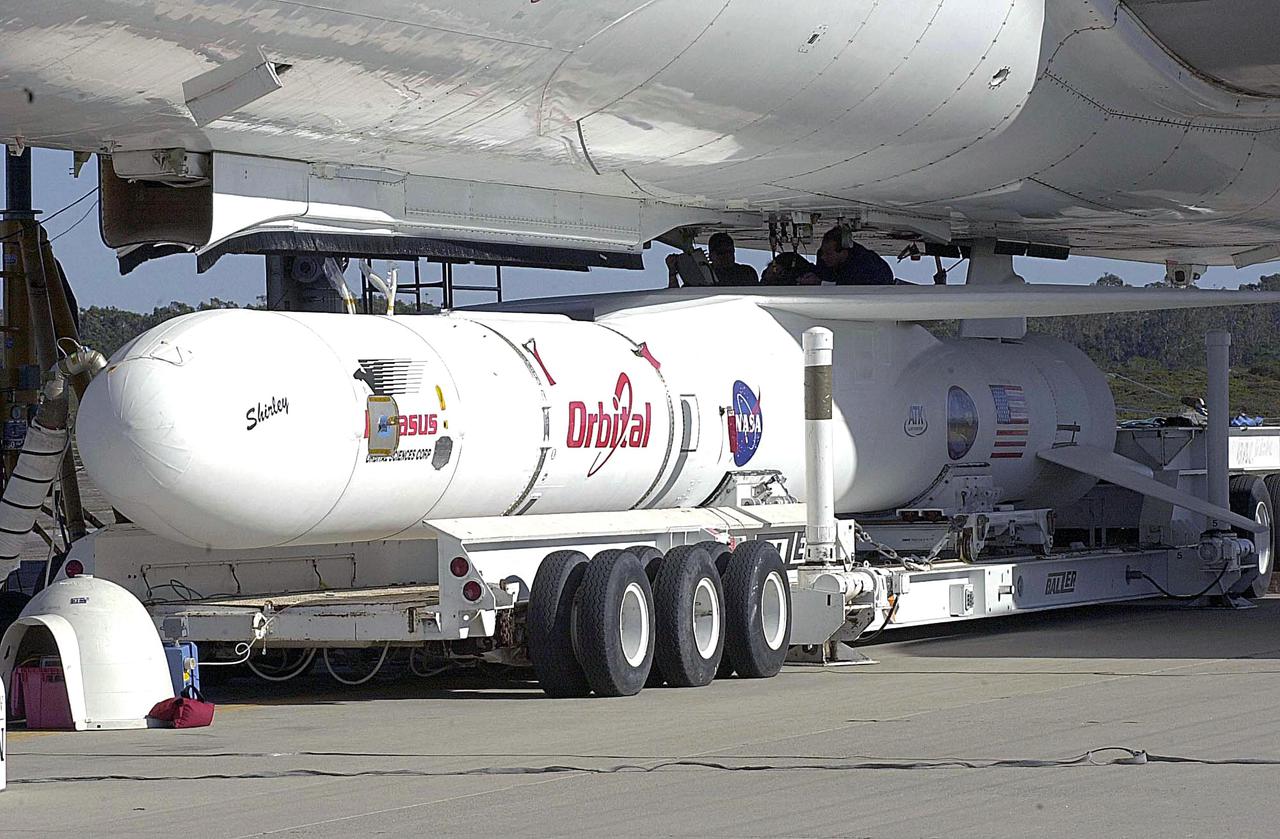
KENNEDY SPACE CENTER, FLA. - At Vandenberg Air Force Base in California, the Orbital Sciences Pegasus XL launch vehicle and Demonstration of Autonomous Rendezvous Technology (DART) spacecraft, which are mated, are being attached to the underbelly of the Orbital Sciences L-1011 aircraft for launch Nov. 9. DART was designed and built for NASA by Orbital Sciences as an advanced flight demonstrator to locate and maneuver near an orbiting satellite. The DART spacecraft weighs about 800 pounds and is nearly 6 feet long and 3 feet in diameter. The Pegasus XL vehicle will launch DART into a circular polar orbit of approximately 475 miles. Once in orbit, DART will make contact with a target satellite, the Multiple Paths, Beyond-Line-of-Sight Communications (MUBLCOM), also built by Orbital Sciences and launched in 1999. DART will then perform several close-proximity operations, such as moving toward and away from the satellite using navigation data provided by on-board sensors. The entire mission will last only 24 hours and will be accomplished without human intervention. The DART flight computer will determine its own path to accomplish its mission objectives.

VANDENBERG AIR FORCE BASE, FLA. - The Orbital Sciences L-1011 aircraft soars through the sky to launch the Orbital Sciences Pegasus XL launch vehicle and Demonstration of Autonomous Rendezvous Technology (DART) spacecraft attached to its underbelly. DART was designed and built for NASA by Orbital Sciences as an advanced flight demonstrator to locate and maneuver near an orbiting satellite. The DART spacecraft weighs about 800 pounds and is nearly 6 feet long and 3 feet in diameter. The Pegasus XL vehicle will launch DART into a circular polar orbit of approximately 475 miles. Once in orbit, DART will make contact with a target satellite, the Multiple Paths, Beyond-Line-of-Sight Communications (MUBLCOM), also built by Orbital Sciences and launched in 1999. DART will then perform several close-proximity operations, such as moving toward and away from the satellite using navigation data provided by on-board sensors. The entire mission will last only 24 hours and will be accomplished without human intervention. The DART flight computer will determine its own path to accomplish its mission objectives.
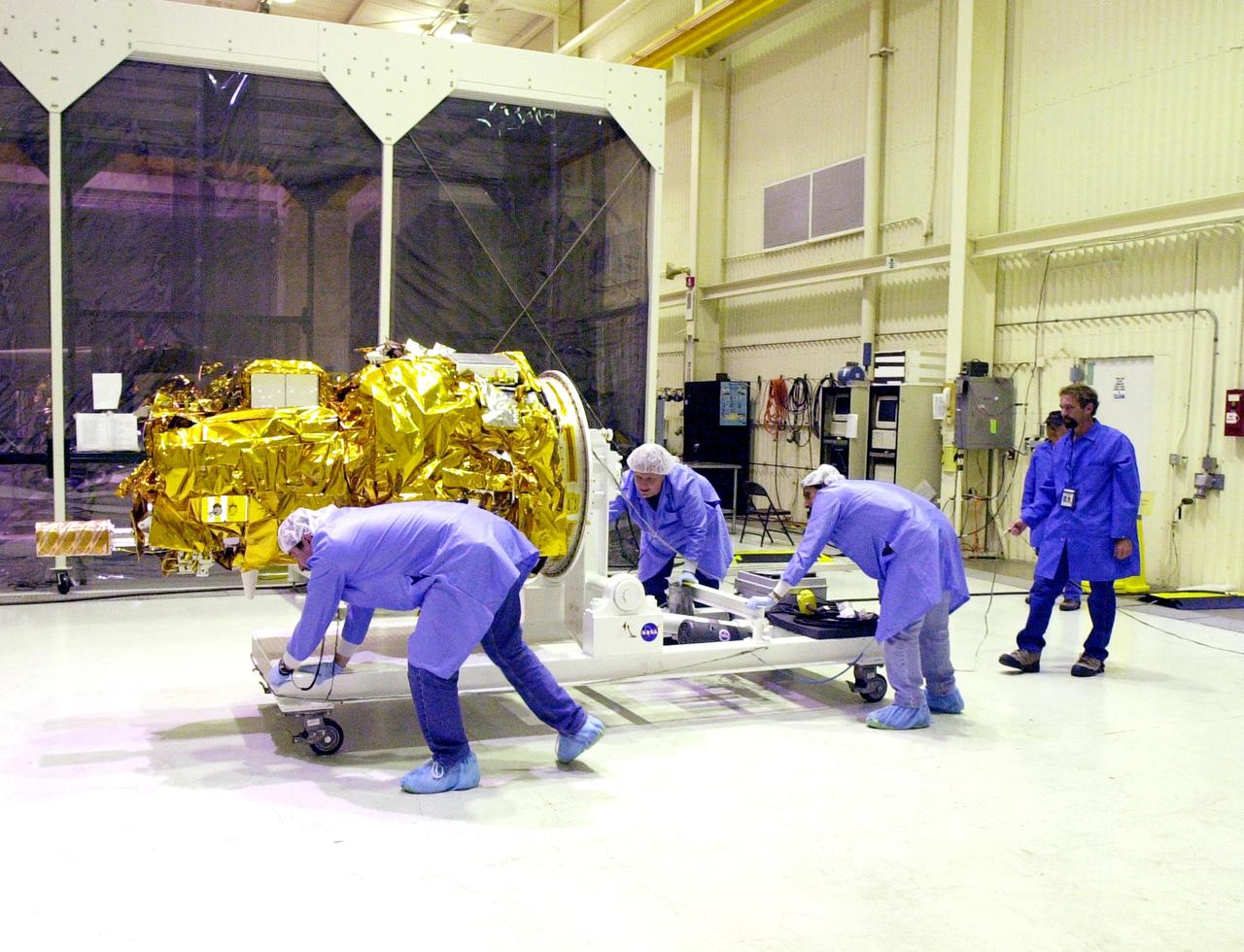
KENNEDY SPACE CENTER, FLA. - At Vandenberg Air Force Base in California, the Demonstration of Autonomous Rendezvous Technology (DART) spacecraft is prepared for rotation from horizontal to vertical. It will be lifted onto a test stand for launch processing activities. The spacecraft was developed for NASA by Orbital Sciences Corporation in Dulles, Va., to prove technologies for locating and maneuvering near an orbiting satellite. DART will be launched on a Pegasus launch vehicle. At about 40,000 feet over the Pacific Ocean, the Pegasus will be released from Orbital’s Stargazer L-1011 aircraft, fire its rocket motors and boost DART into a polar orbit approximately 472 miles by 479 miles. Once in orbit, DART will rendezvous with a target satellite, the Multiple Paths, Beyond-Line-of-Site Communications satellite, also built by Orbital Sciences. DART will then perform several close proximity operations, such as moving toward and away from the satellite using navigation data provided by onboard sensors. DART is scheduled for launch no earlier than Oct. 18.