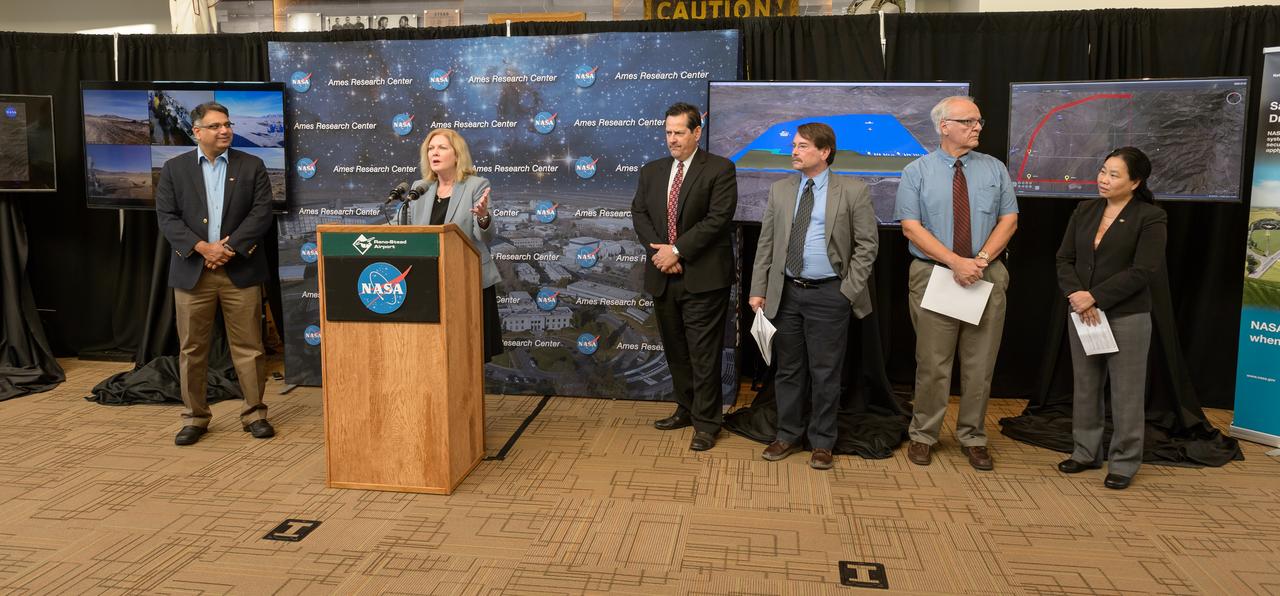
News Conference following the test of Unmanned Aircraft Systems Traffic Management (UTM) technical capability Level 2 (TCL2) at Reno-Stead Airport, Nevada. The UTM Reno Press Conference on Oct. 19, 2016. (Left to Right) Parimal Kopardekar, NASA Ames Senior Engineer for Air Transportation Systems gave an overview of UTM; Maril Mora, President / CEO of the Reno -Tahoe Airport Authority welcomes NASA and Partners; Tom Wilczek, Aerospace and Defence industry representative and Nevada Governor's Office of Economic Development; Mark Baker, Director of Business Development, Nevada Institute of Autonomous Systems; Manos Maragakis, Dean of the College of Engineering, University of Nevada, Reno.
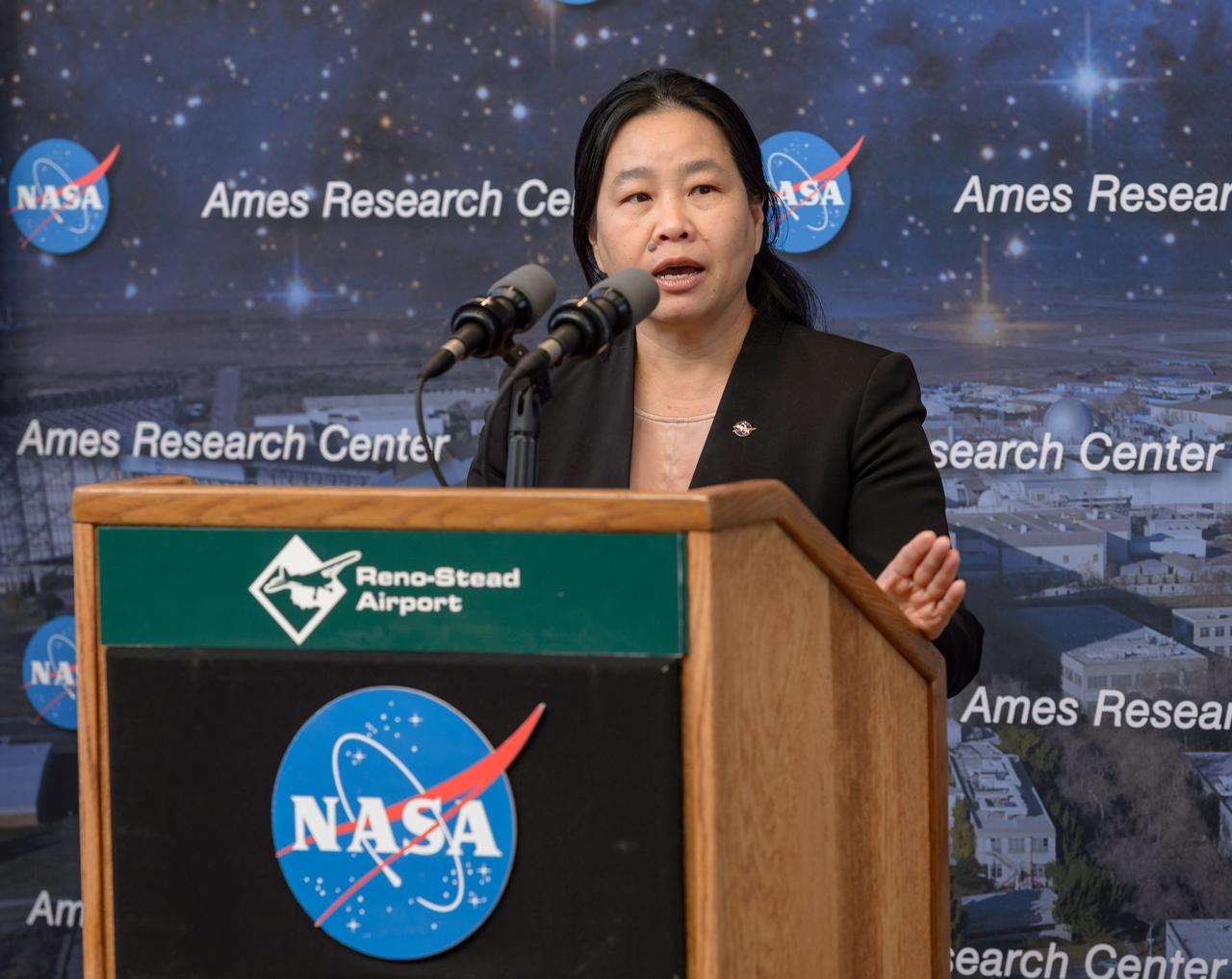
News Conference following the test of Unmanned Aircraft Systems Traffic Management (UTM) technical capability Level 2 (TCL2) at Reno-Stead Airport, Nevada. Huy Tran, NASA Ames Aeronautics Director gives a NASA UTM Project Overview.
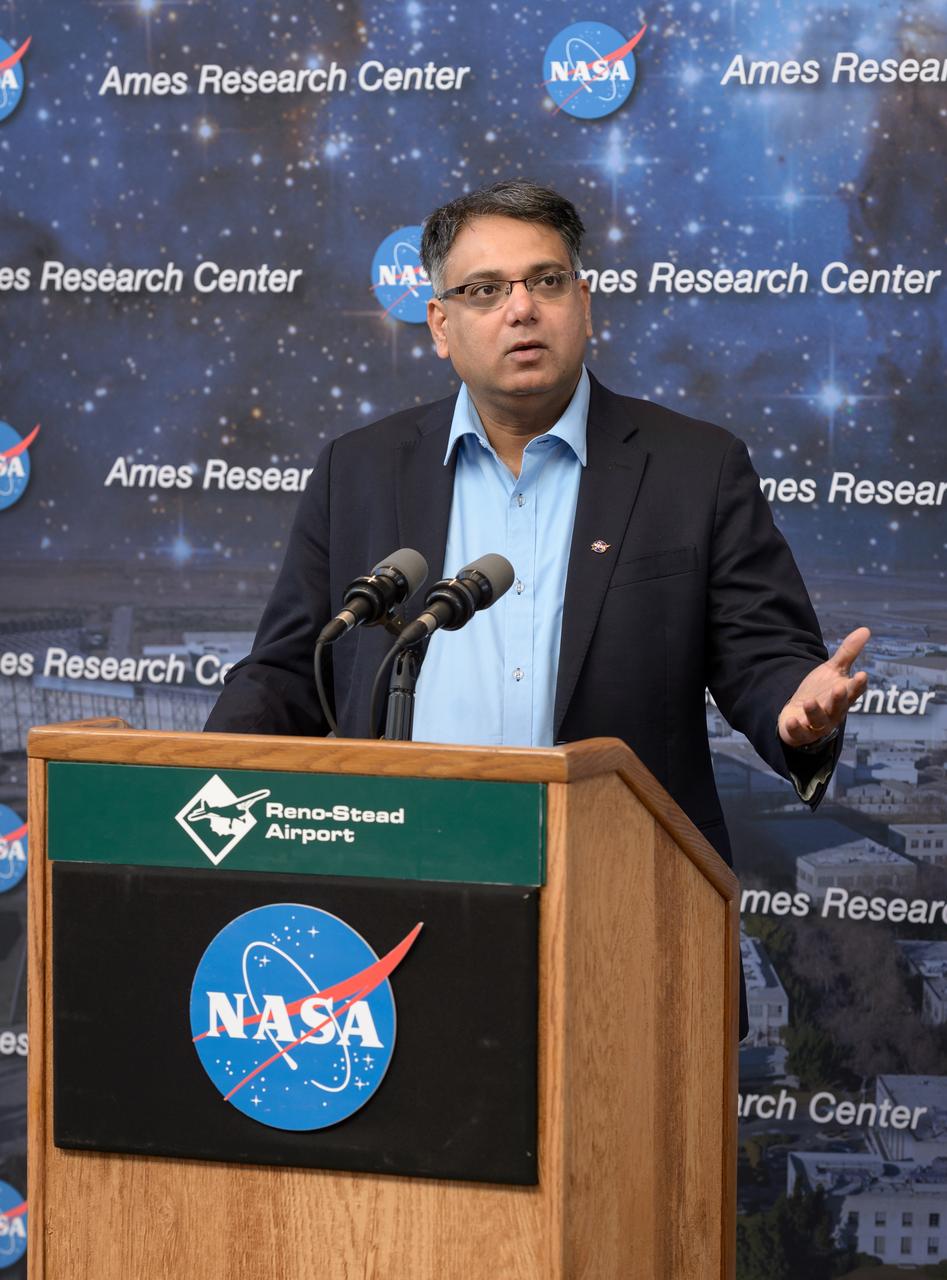
News Conference following the test of Unmanned Aircraft Systems Traffic Management (UTM) technical capability Level 2 (TCL2) at Reno-Stead Airport, Nevada. Parimal Kopardekar, NASA Ames Senior Engineer for Ait Transportation Systems gave an overview of UTM.
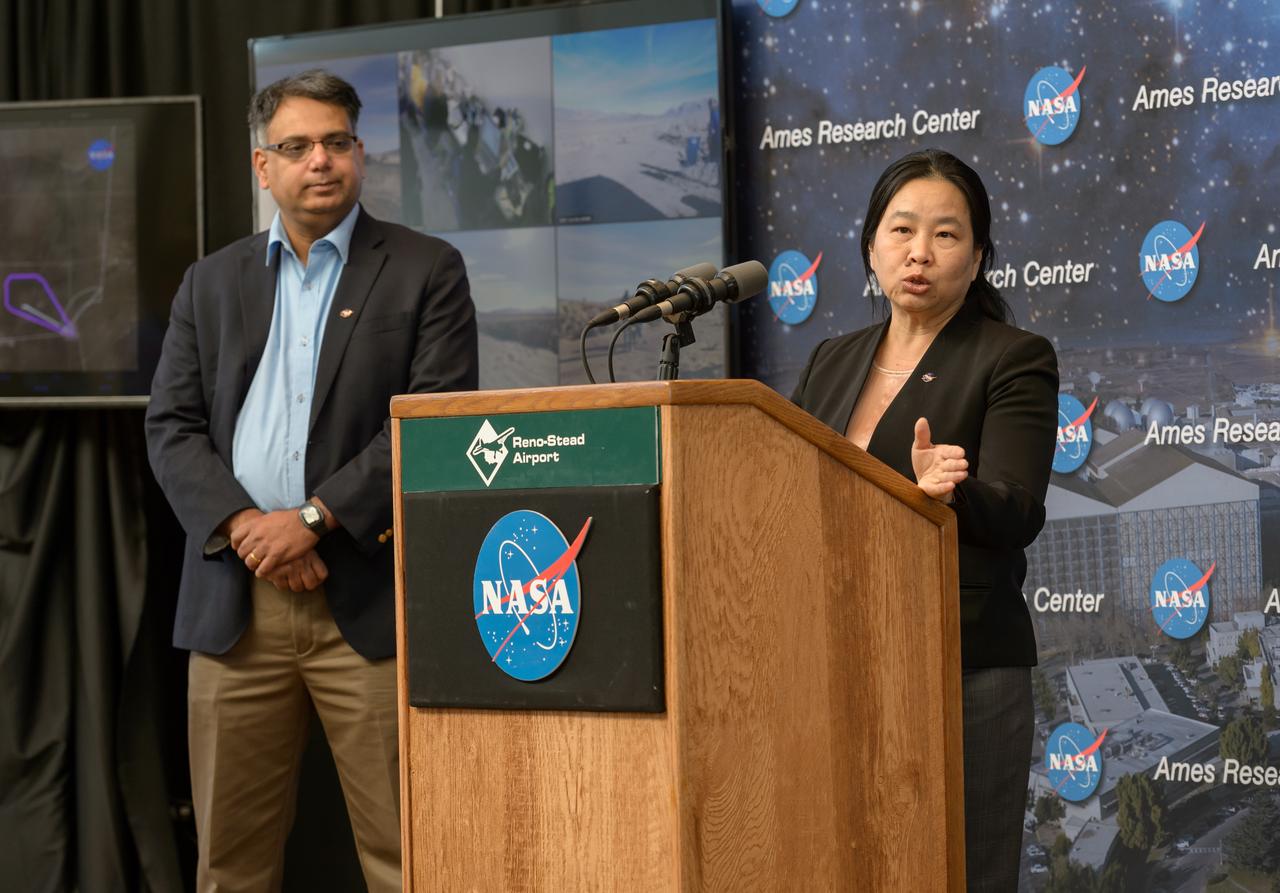
News Conference following the test of Unmanned Aircraft Systems Traffic Management (UTM) technical capability Level 2 (TCL2) at Reno-Stead Airport, Nevada. Parimal Kopardekar, NASA Ames Senior Engineer for Ait Transportation Systems gave an overview of UTM (Left). Huy Tran, NASA Ames Aeronautics Director, presents NASA UTM Project Overview.
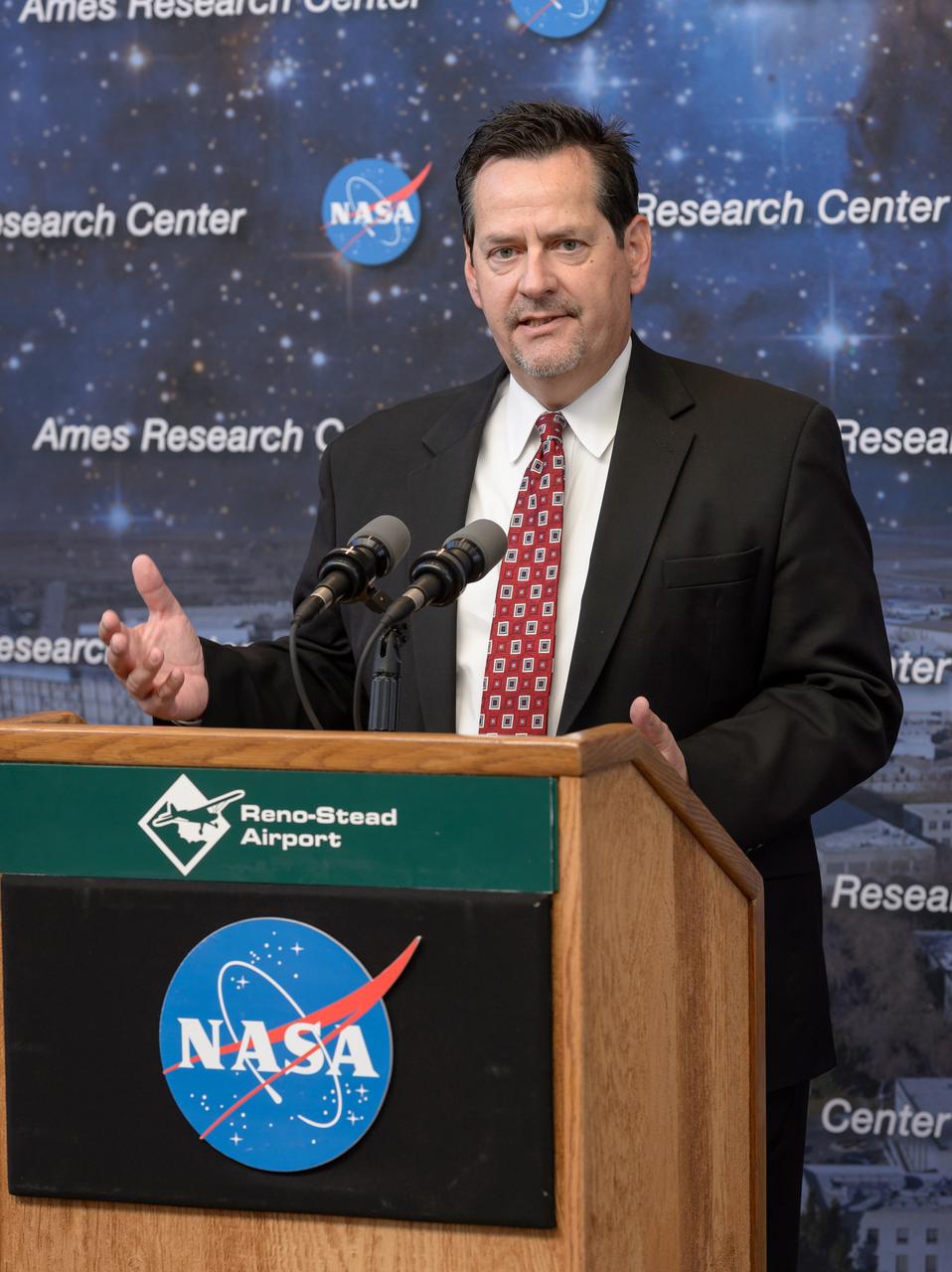
News Conference following the test of Unmanned Aircraft Systems Traffic Management (UTM) technical capability Level 2 (TCL2) at Reno-Stead Airport, Nevada. Tom Wilczek, Aerospace and Defence industry representative and Nevada Govenor's Office of Economic Development.
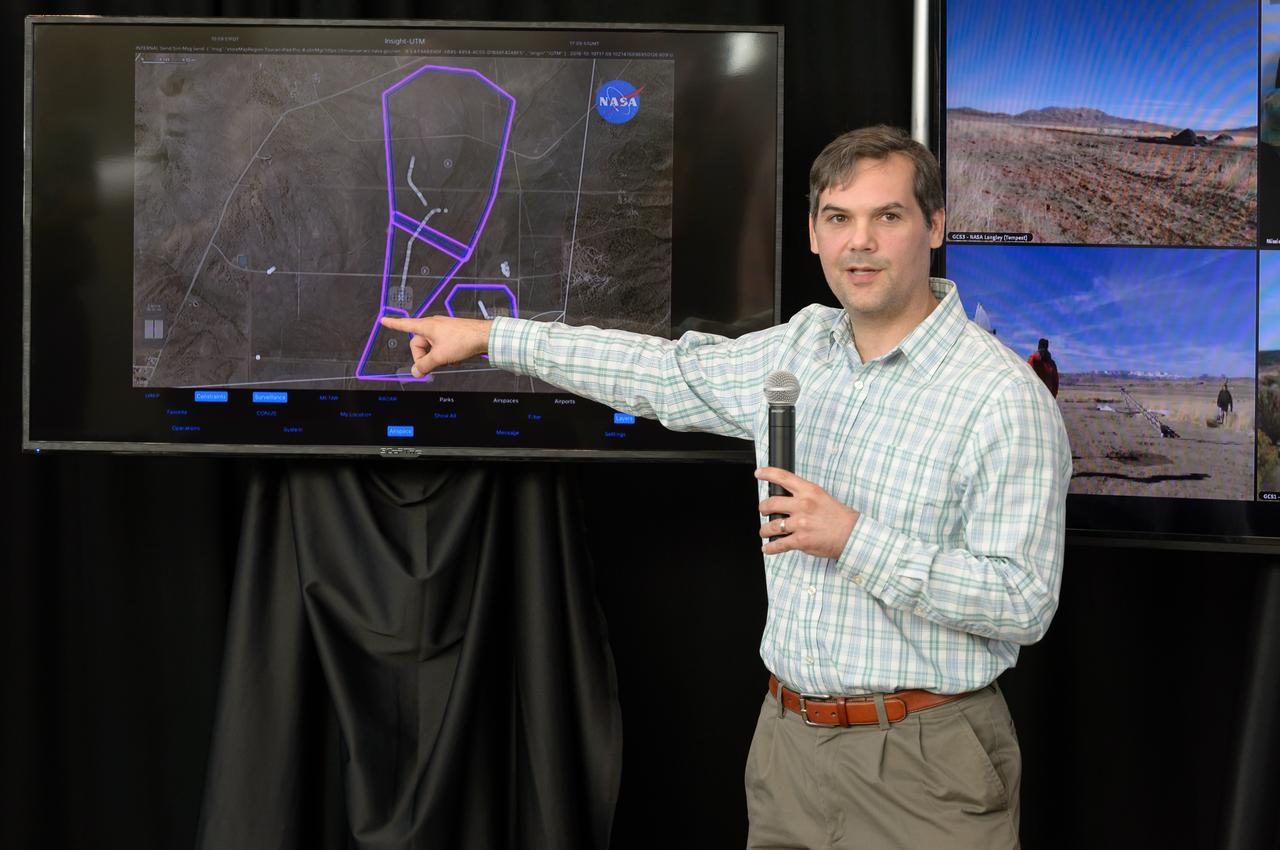
News Conference following the test of Unmanned Aircraft Systems Traffic Management (UTM) technical capability Level 2 (TCL2) at Reno-Stead Airport, Nevada. Joseph Rios, NASA Ames Aerospace Engineer and UTM Technical Lead, describes the purpose of the test and flight scenarios.
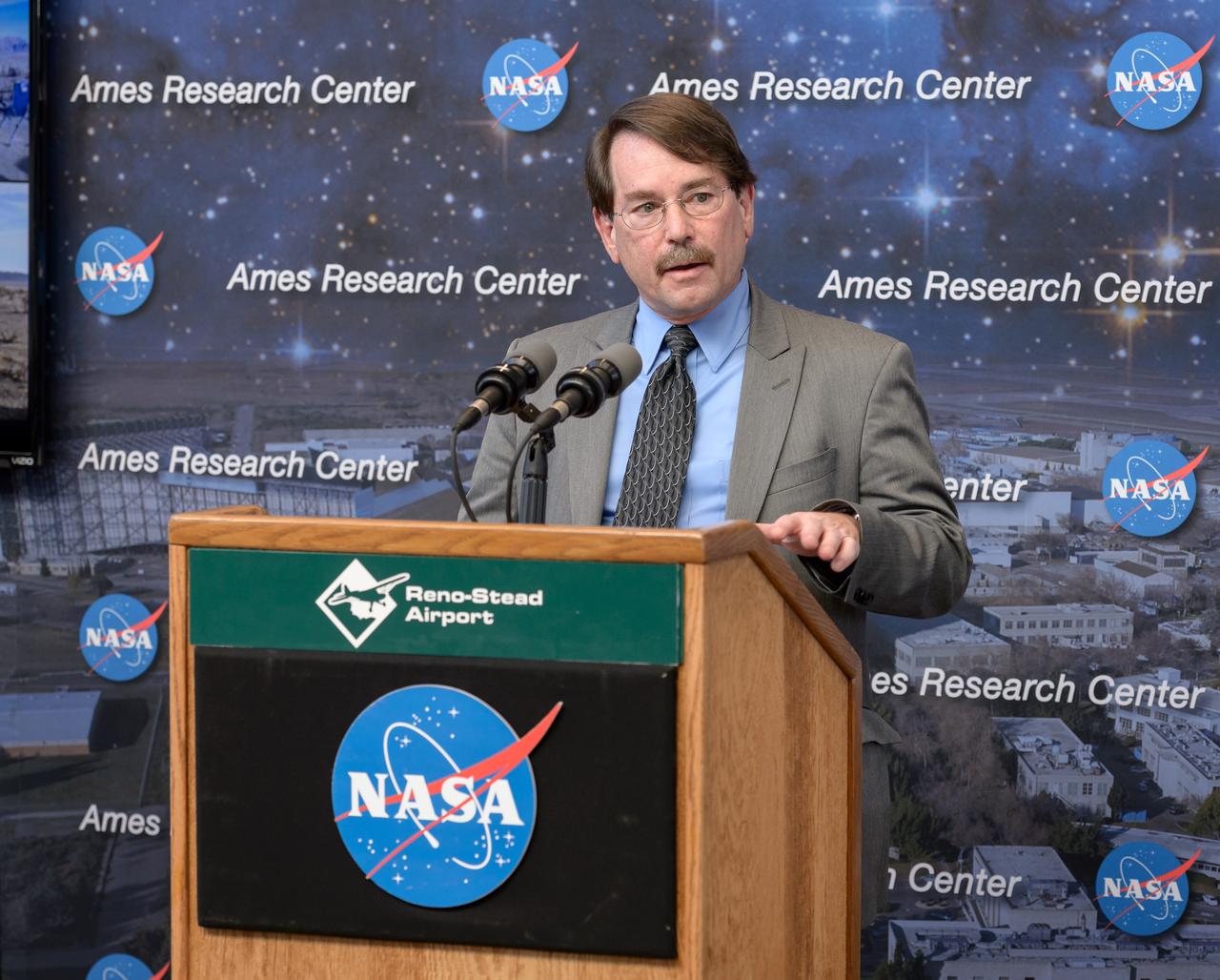
News Conference following the test of Unmanned Aircraft Systems Traffic Management (UTM) technical capability Level 2 (TCL2) at Reno-Stead Airport, Nevada. Mark Baker, Director of Business Development, Nevada Institute of Autonomous Systems.
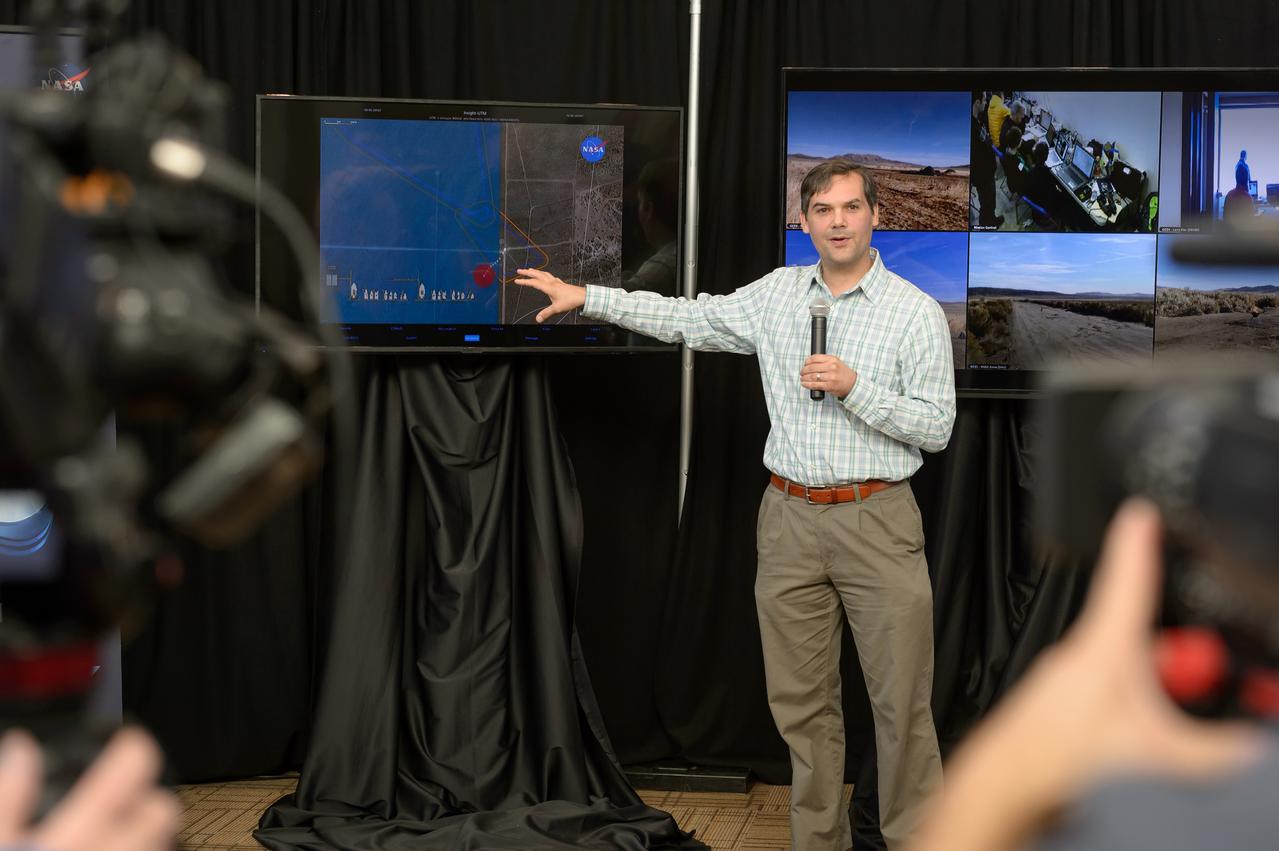
News Conference following the test of Unmanned Aircraft Systems Traffic Management (UTM) technical capability Level 2 (TCL2) at Reno-Stead Airport, Nevada. Joseph Rios, NASA Ames Aerospace Engineer and UTM Technical Lead, describes the purpose of the test and flight scenarios.
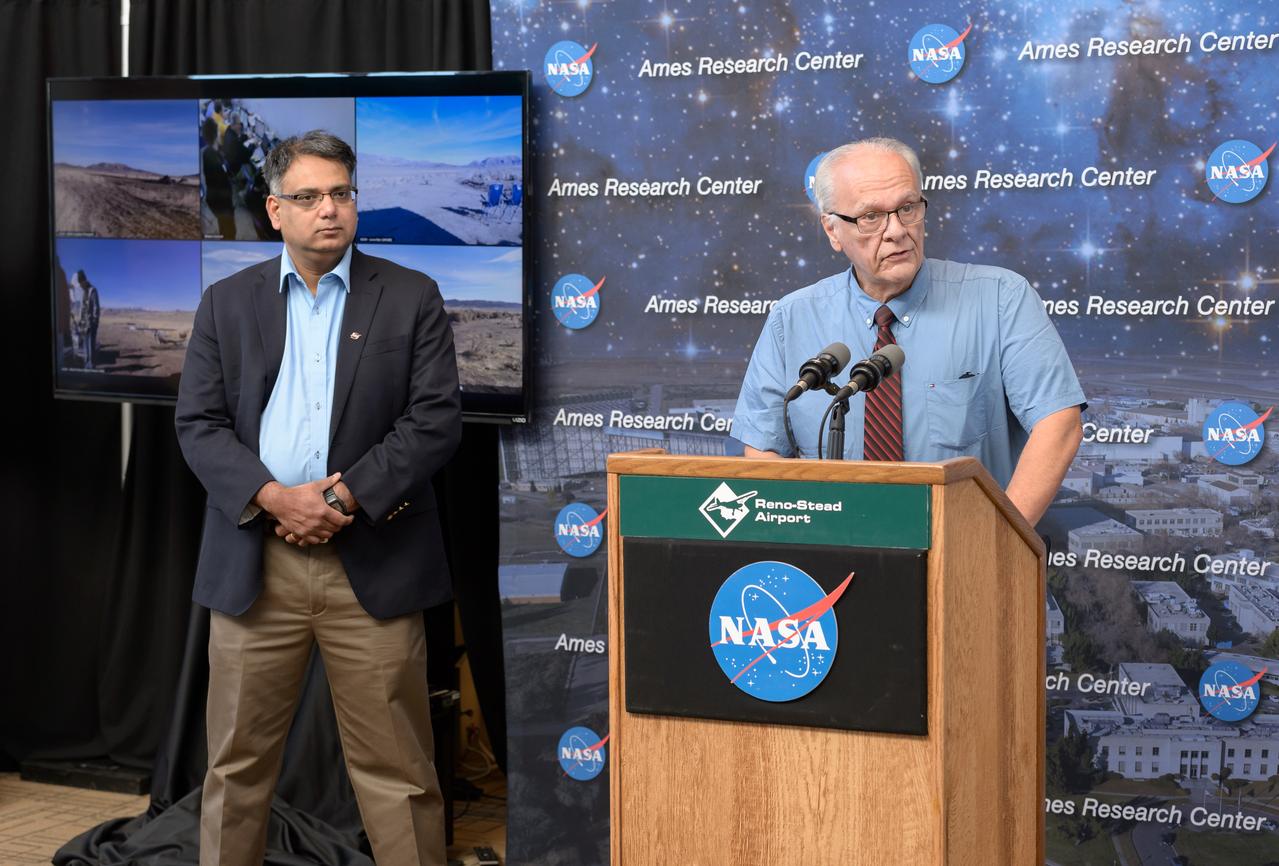
News Conference following the test of Unmanned Aircraft Systems Traffic Management (UTM) technical capability Level 2 (TCL2) at Reno-Stead Airport, Nevada. Parimal Kopardekar, NASA Ames Senior Engineer for Ait Transportation Systems gave an overview of UTM (Left).
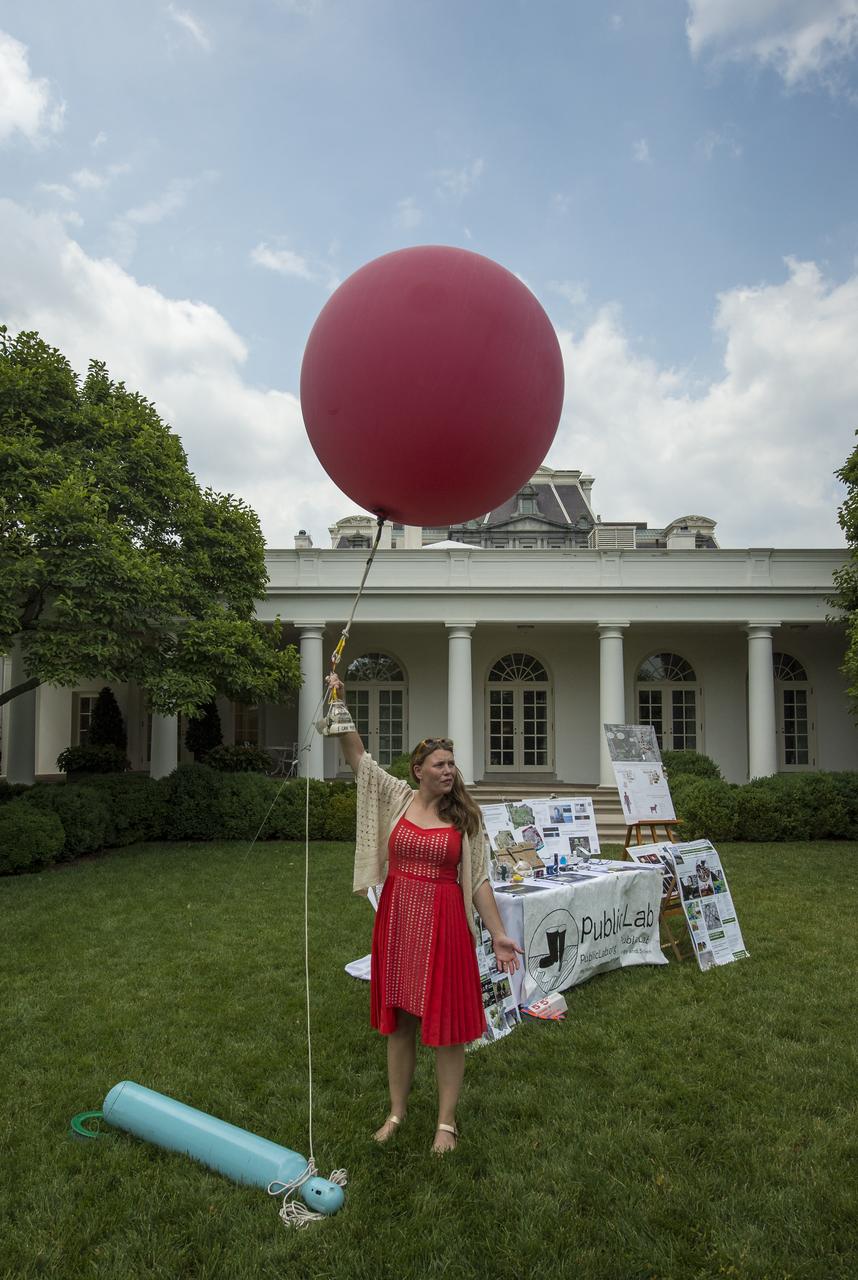
Sara Ann Wylie of Public Lab shows the do to yourself Balloon Mapping Kit, during the first ever White House Maker Faire, which brings together students, entrepreneurs, and everyday citizens who are using new tools and techniques to launch new businesses, learn vital skills in science, technology, engineering, and math (STEM), and fuel the renaissance in American manufacturing, at the White House, Wednesday, June 18, 2014 in Washington. The Balloon Mapping Kit enables you to take your own aerial photos from 1000 ft or higher. The President announced new steps the Administration and its partners are taking to support the ability of more Americans, young and old, to have to access to these tools and techniques and brings their ideas to life. Photo Credit: (NASA/Bill Ingalls)

ISS039-E-003124 (14 March 2014) --- Expedition 39 Commander Koichi Wakata of the Japan Aerospace Exploration Agency (JAXA) clowns with Robonaut 2, a humanoid robot, in the U.S. lab Destiny while preparing for a public TV event.
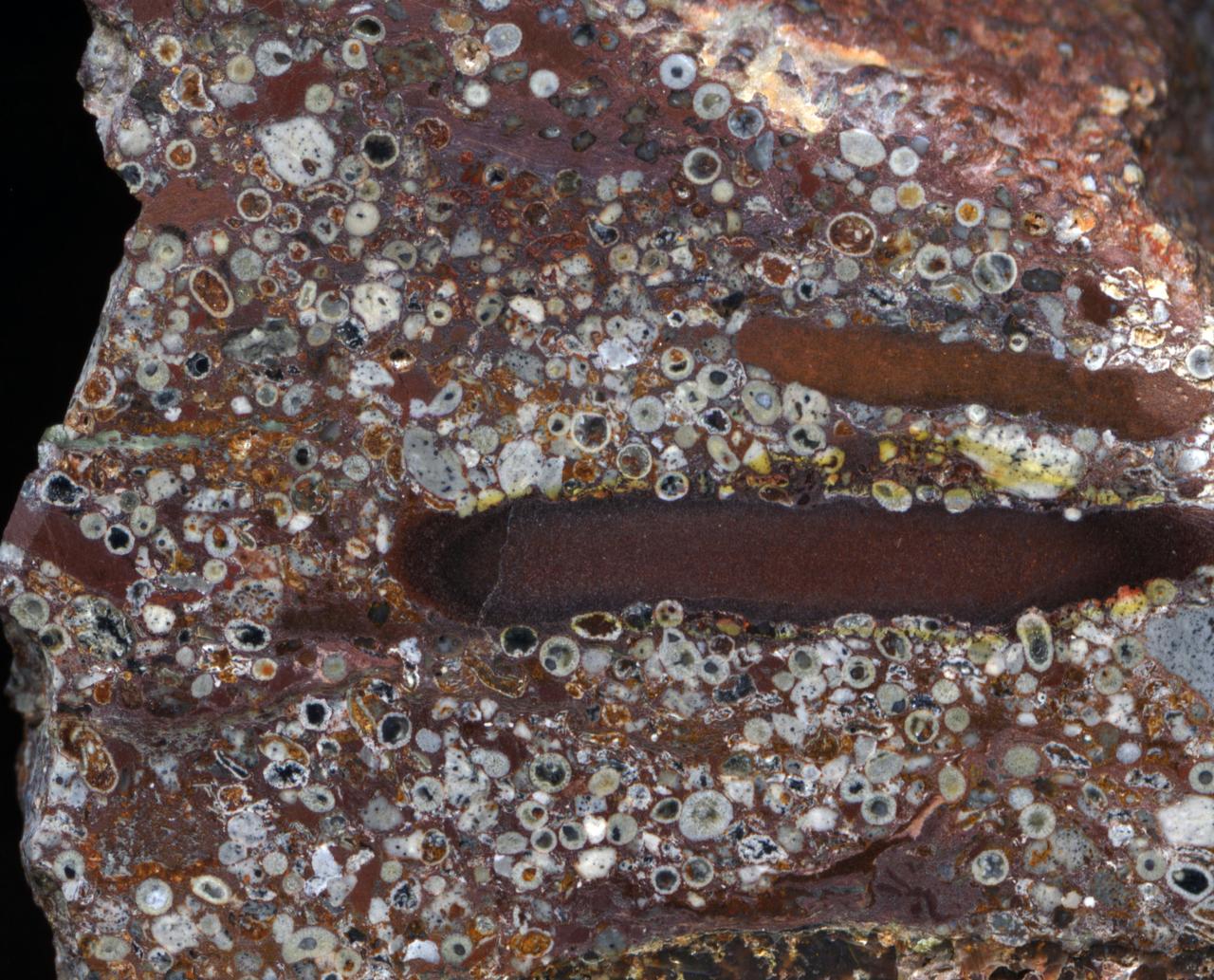
The millimeter-scale circles and irregular gray particles in this sample are formerly molten droplets ejected into space when a asteroid hit the Earth 2.63 billion years ago late in the Archean period. Credit: Bruce Simonson, Oberlin College and Conservatory. The sample was cut and polished in Bruce's lab in Ohio, where the photo was taken, but the sample itself came from a spherule bed in Australia. Copyright released with permission for public distribution.
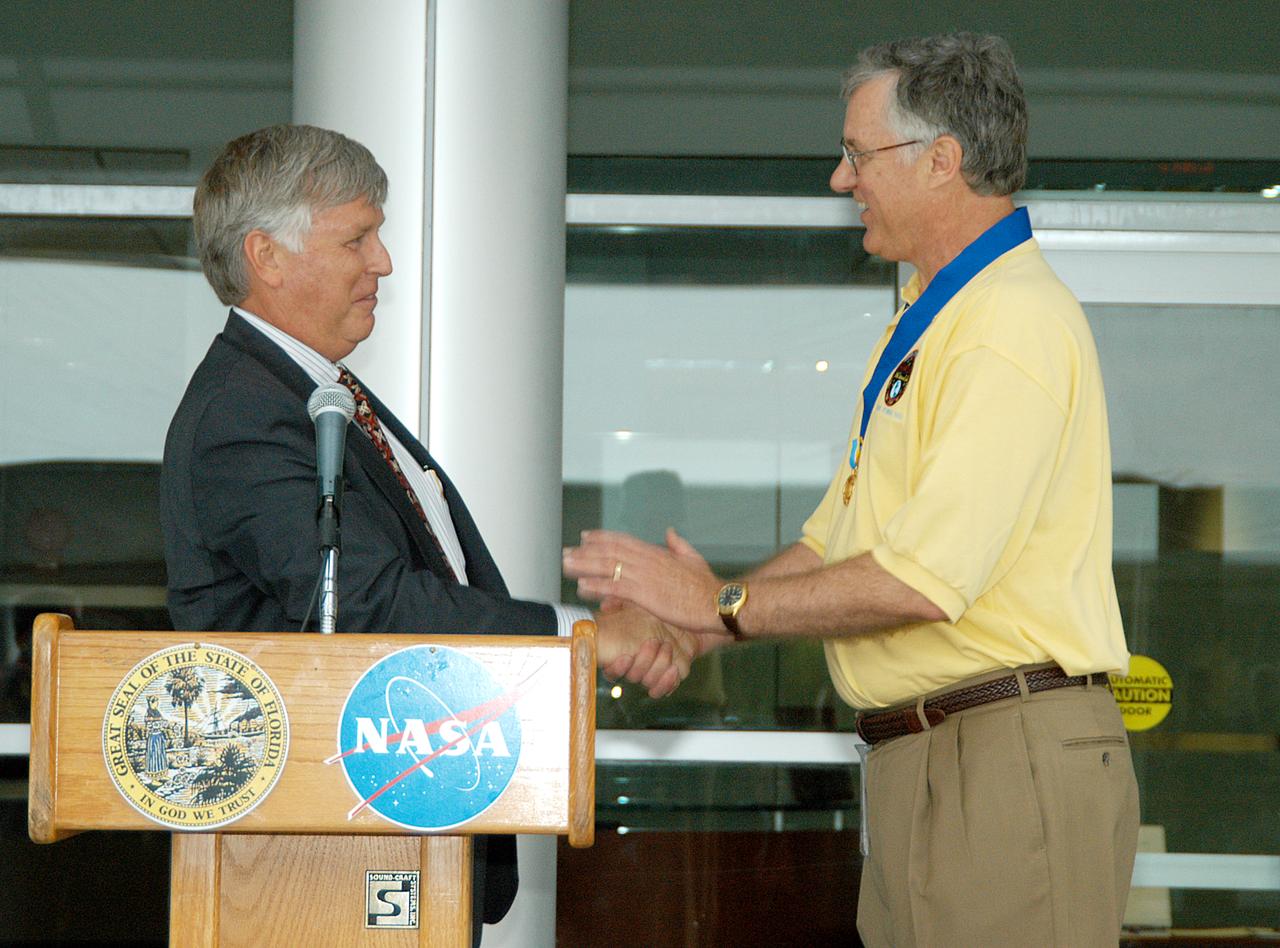
Center Director Jim Kennedy presents a NASA Public Service Award to Douglas Britt of the Dynamac Corp. at a dedication and ribbon-cutting ceremony for the Space Life Sciences Lab hosted by NASA-Kennedy Space Center and the state of Florida at the new lab. Britt received the award for his many years of exceptional service to NASA in managing the Life Sciences contracts at the Kennedy Space Center and his contributions to conceptualization and collaborations that helped make the Space Life Sciences Lab possible. Completed in August, the facility encompasses more than 100,000 square feet and was formerly known as the Space Experiment Research and Processing Laboratory or SERPL. The state, through the Florida Space Authority, built the research lab which is host to NASA, NASA’s Life Sciences Services contractor Dynamac Corp., Bionetics Corp., and researchers from the University of Florida. Dynamac Corp. leases the facility. The Florida Space Research Institute is responsible for gaining additional tenants from outside the NASA community.
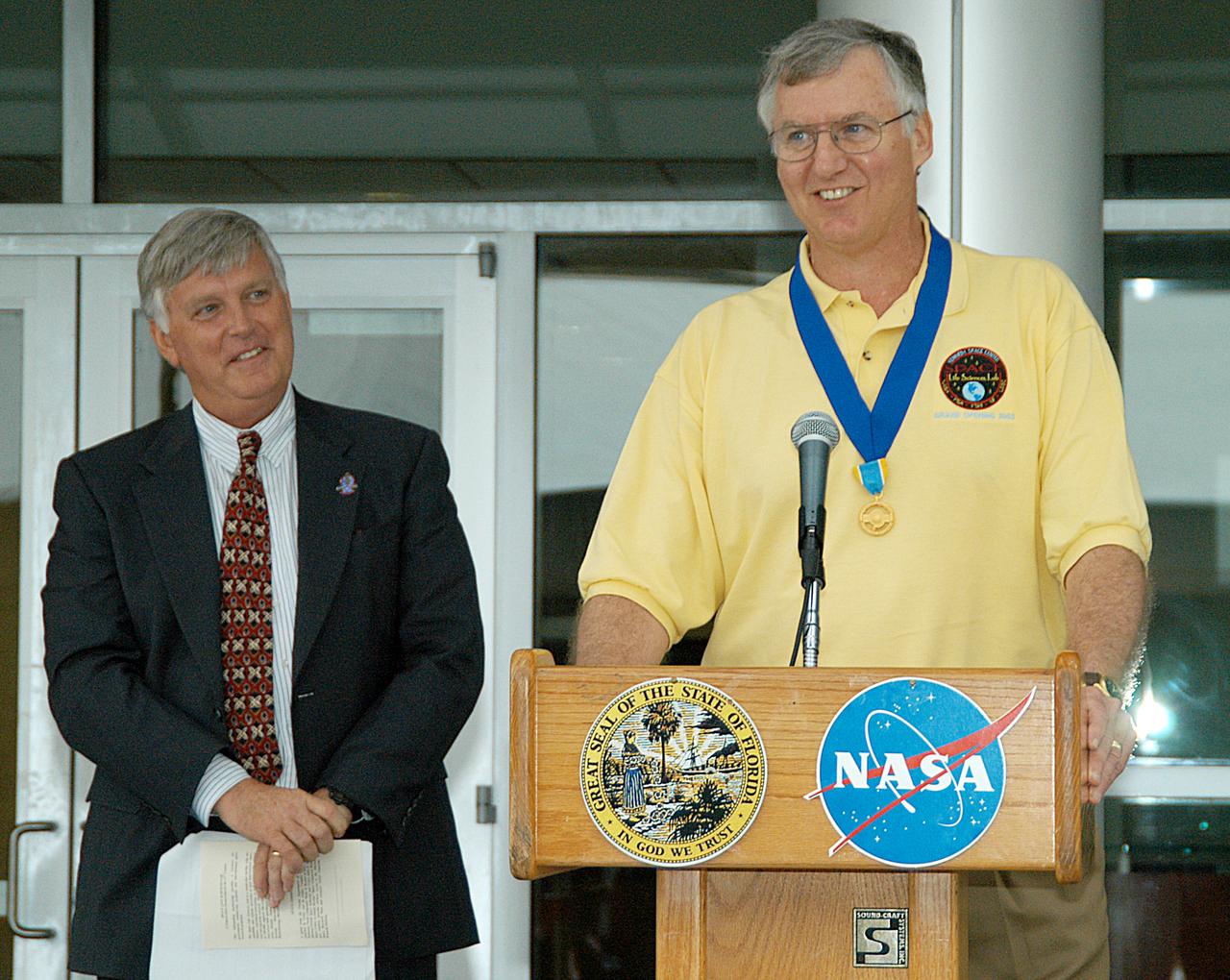
Center Director Jim Kennedy presents a NASA Public Service Award to Douglas Britt of the Dynamac Corp. at a dedication and ribbon-cutting ceremony for the Space Life Sciences Lab hosted by NASA-Kennedy Space Center and the state of Florida at the new lab. Britt received the award for his many years of exceptional service to NASA in managing the Life Sciences contracts at the Kennedy Space Center and his contributions to conceptualization and collaborations that helped make the Space Life Sciences Lab possible. Completed in August, the facility encompasses more than 100,000 square feet and was formerly known as the Space Experiment Research and Processing Laboratory or SERPL. The state, through the Florida Space Authority, built the research lab which is host to NASA, NASA’s Life Sciences Services contractor Dynamac Corp., Bionetics Corp., and researchers from the University of Florida. Dynamac Corp. leases the facility. The Florida Space Research Institute is responsible for gaining additional tenants from outside the NASA community.
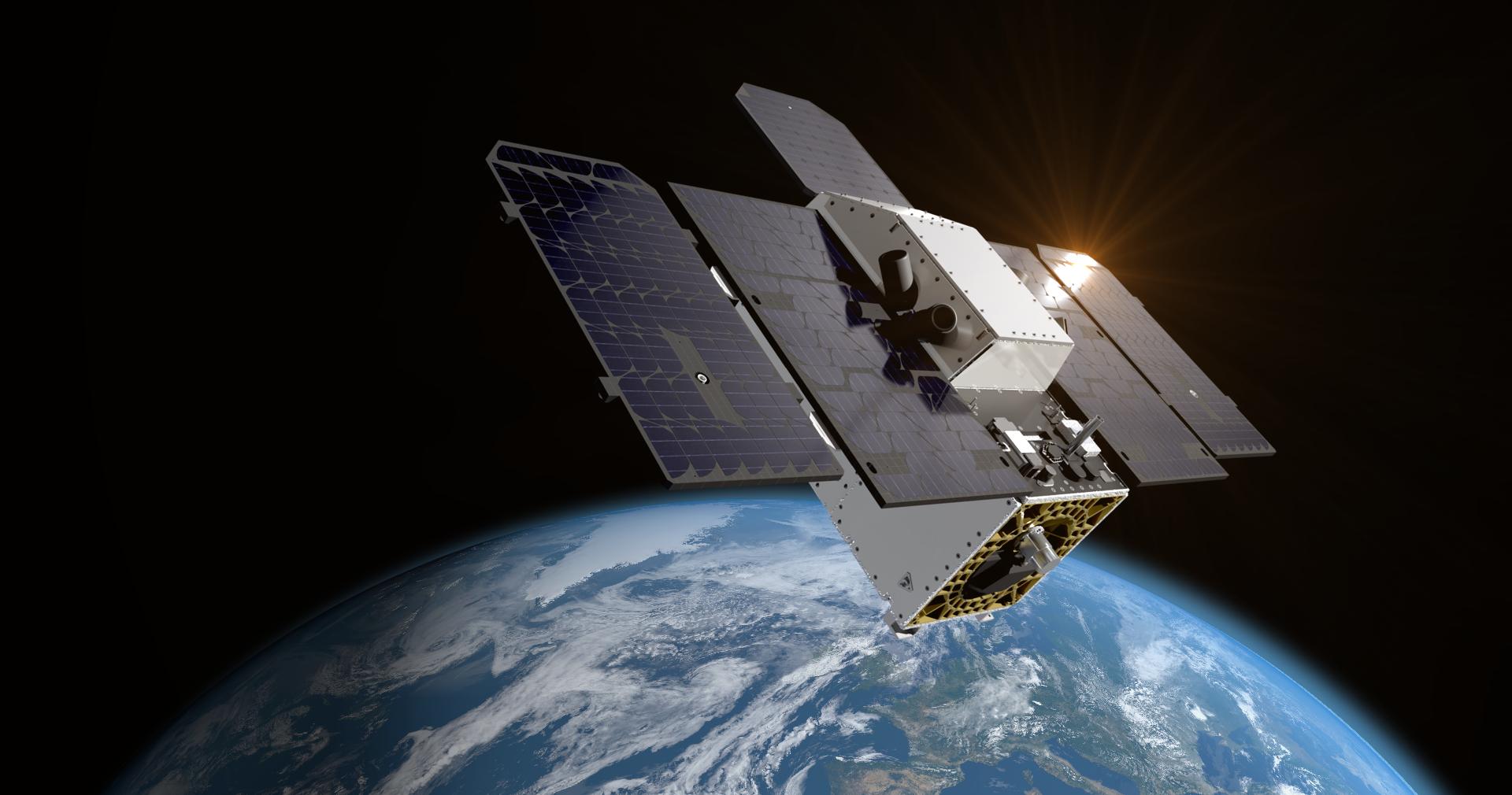
An artist's concept depicts one of the Carbon Mapper Coalition's Tanager satellites, which will use imaging spectrometer technology developed at NASA's Jet Propulsion Laboratory in Southern California to measure methane and carbon dioxide point-source emissions, down to the level of individual facilities and equipment, on a global scale. The Tanager-1 satellite, launched from Vandenberg Space Force Based in California on Aug. 16, 2024, was developed as part of a philanthropically funded public-private coalition led by the nonprofit Carbon Mapper. JPL and Planet Labs PBC, which built Tanager-1, are both members of the Carbon Mapper Coalition. The group plans to launch a second Tanager satellite, called Tanager-2, also being built by Planet Labs and equipped with a JPL-built imaging spectrometer. https://photojournal.jpl.nasa.gov/catalog/PIA26411
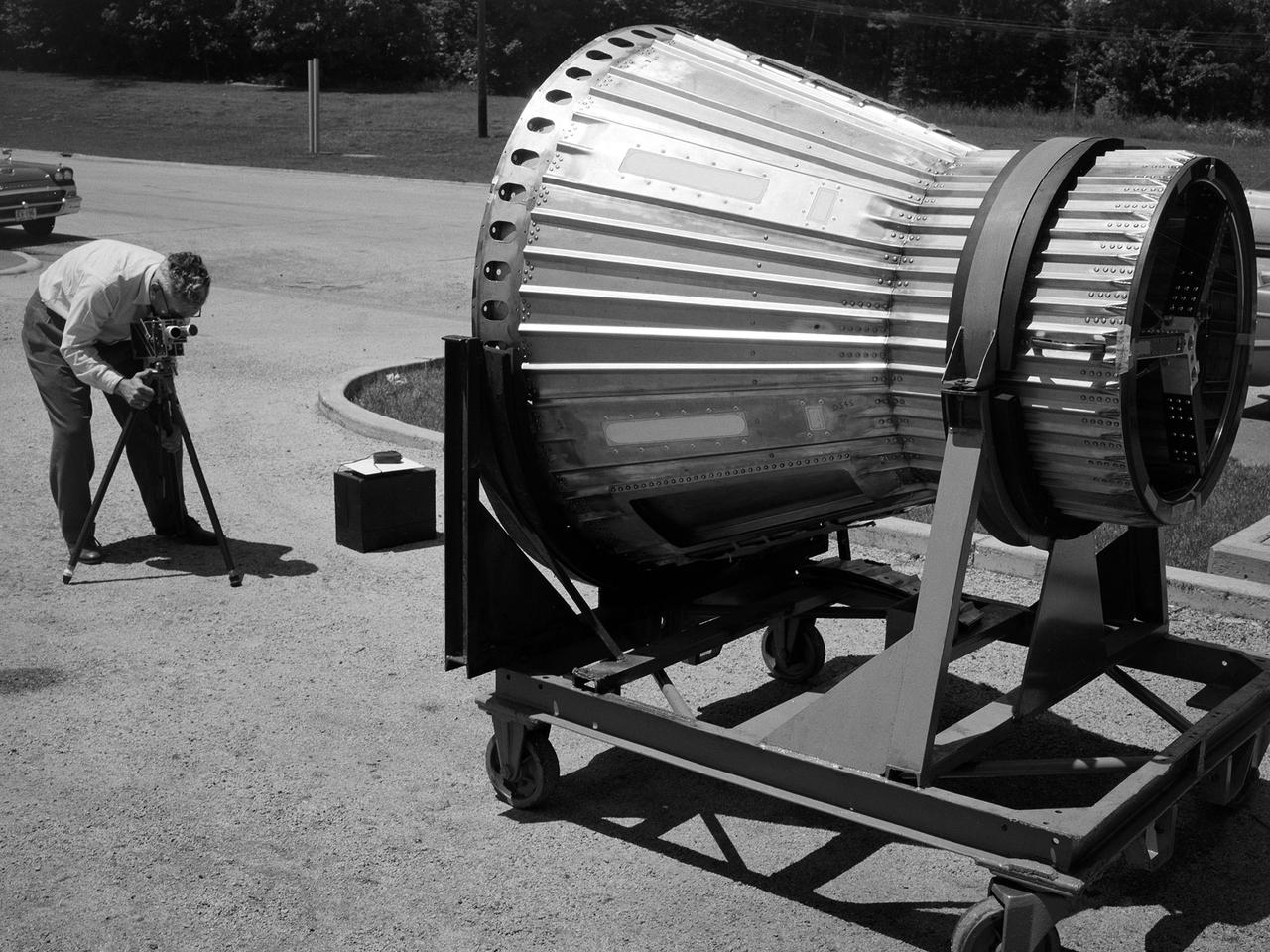
National Aeronautics and Space Administration (NASA) photographer Arthur Laufman sets up a camera to film a Mercury capsule that was constructed by the Lewis Research Center staff. Lewis engineers and mechanics built two of the capsules for the upcoming Big Joe launches in September 1959. Big Joe was an attempt early in Project Mercury to use a full-scale Atlas booster to simulate the reentry of a mock-up Mercury capsule without actually placing it in orbit. The Photographic Branch, referred to as the Photo Lab, was part of the center’s Technical Reports Division. Originally the group performed normal and high-speed still image and motion picture photography. The photographers documented construction, performed publicity work, created images for reports, photographed data on manometer boards, and recorded test footage. Laufman joined the Photo Lab staff in 1948 and began producing full-length technical films as a tool to educate those outside of the agency on the research being conducted at Lewis. He worked with engineers to determine proper subjects for these films and develop a script. Laufman not only filmed tests, but also supporting footage of facilities, models, and staff members. He then edited the footage and added audio, visuals, and narration. The film masters were assigned standard identification numbers and add to the Photo Lab’s catalogue.
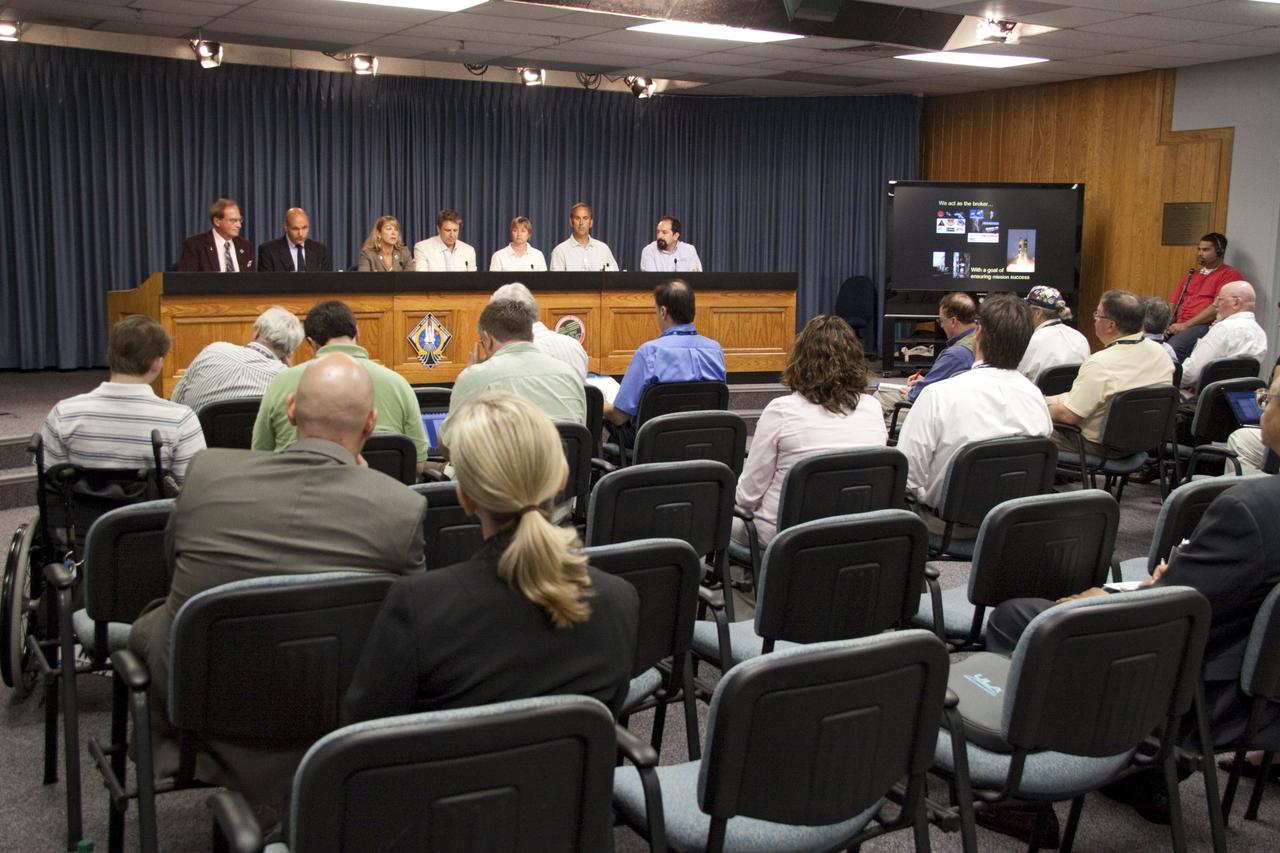
CAPE CANAVERAL, Fla. -- In the Press Site auditorium at NASA's Kennedy Space Center in Florida, media were briefed about NASA's future science missions. Seen here are NASA Public Affairs Officer George Diller (left); Waleed Abdalati, NASA chief scientist; Amanda Mitskevich, NASA Launch Services Program manager; Scott Bolton, Juno principal investigator with the Southwest Research Institute, San Antonio; Maria Zuber, GRAIL principal investigator with the Massachusetts Institute of Technology; John Grotzinger, Mars Science Lab project scientist with the California Institute of Technology and Daniel Stern, NuStar project scientist with NASA's Jet Propulsion Laboratory in Calif. Photo credit: NASA/Jack Pfaller
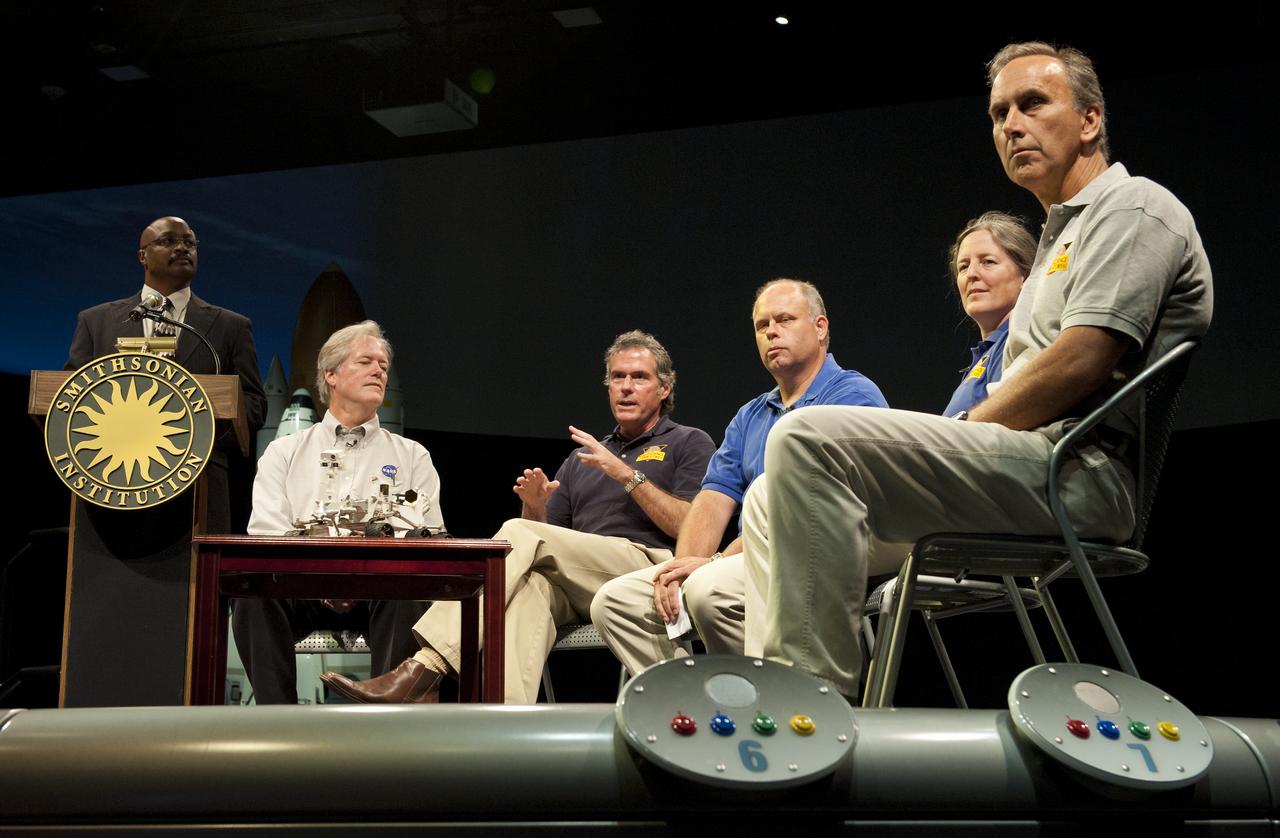
Michael Watkins (third from left), mission manager and project engineer, Mars Science Laboratory (MSL), Jet Propulsion Lab, Pasadena, Calif., speaks at a press conference at the Smithsonian's National Air and Space Museum on Friday, July 22, 2011 in Washington. From left to right, Watkins is joined by Dwayne Brown, NASA Headquarters public affairs officer; Michael Meyer, lead scientist Mars Exploration Program, NASA Headquarters; Watkins; John Grant, geologist, Smithsonian National Air and Space Museum in Washington; Dawn Sumner, geologist, University of California, Davis and John Grotzinger, MSL project scientist, JPL. Photo Credit: (NASA/Carla Cioffi)
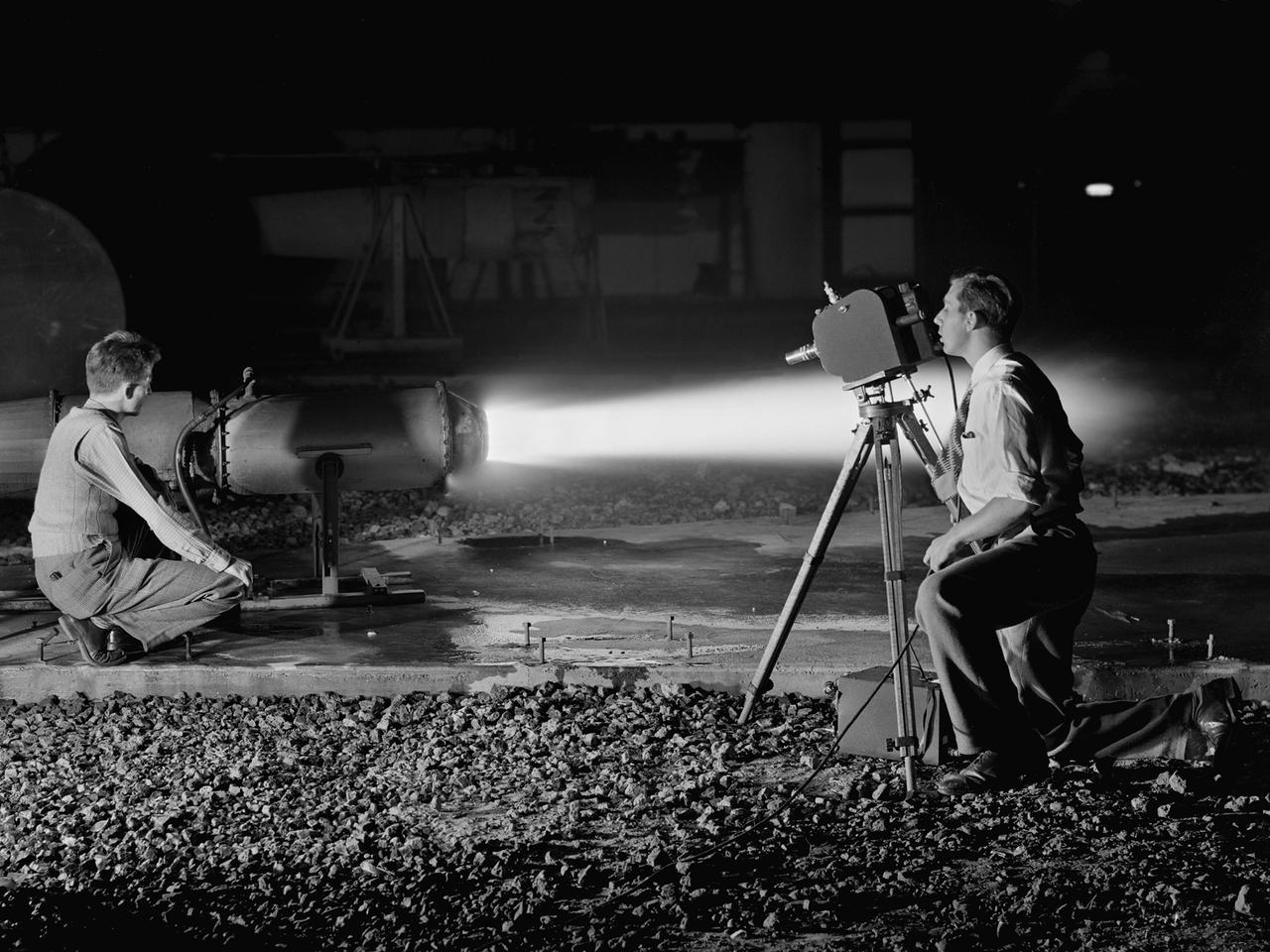
A National Advisory Committee for Aeronautics (NACA) photographer films the test of a ramjet engine at the Lewis Flight Propulsion Laboratory. The laboratory had an arsenal of facilities to test the engines and their components, and immersed itself in the study of turbojet and ramjet engines during the mid-1940s. Combustion, fuel injection, flameouts, and performance at high altitudes were of particular interest to researchers. They devised elaborate schemes to instrument the engines in order to record temperature, pressure, and other data. Many of the tests were also filmed so Lewis researchers could visually review the combustion performance along with the data. The photographer in this image was using high-speed film to document a thrust augmentation study at Lewis’ Jet Static Propulsion Laboratory. The ramjet in this photograph was equipped with a special afterburner as part of a general effort to improve engine performance. Lewis’ Photo Lab was established in 1942. The staff was expanded over the next few years as more test facilities became operational. The Photo Lab’s staff and specialized equipment have been key research tools for decades. They accompany pilots on test flights, use high-speed cameras to capture fleeting processes like combustion, and work with technology, such as the Schlieren camera, to capture supersonic aerodynamics. In addition, the group has documented construction projects, performed publicity work, created images for reports, and photographed data recording equipment.
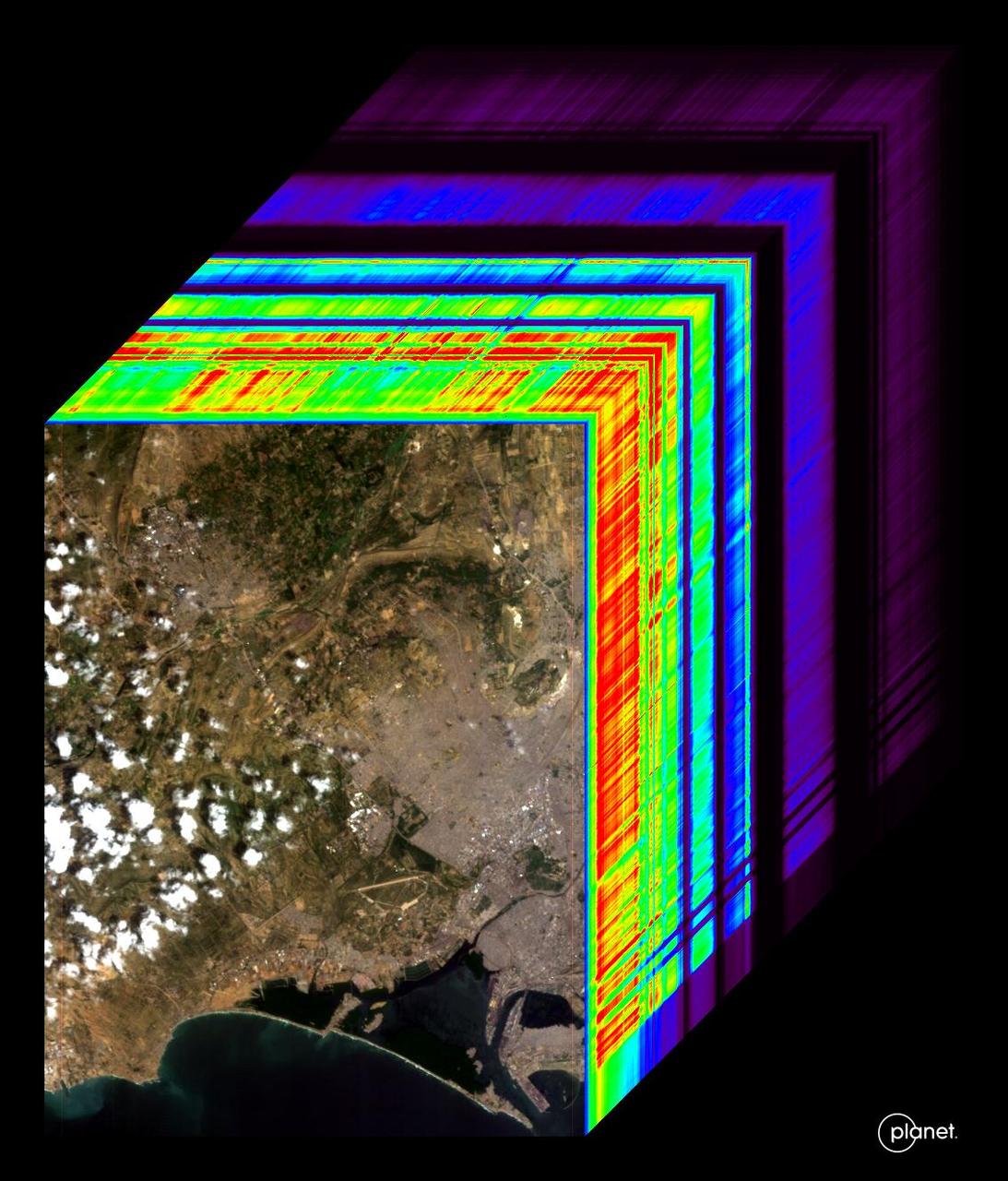
An imaging spectrometer designed by NASA's Jet Propulsion Laboratory captured its first data over Karachi, Pakistan, on Sept. 19, 2024. The instrument is aboard the Carbon Mapper Coalition's Tanager-1 satellite, which was built by Planet Labs PBC. An imaging spectrometer can measure hundreds of wavelengths of light that are reflected by Earth's surface. Different compounds in the planet's atmosphere and on the ground absorb different wavelengths of light, leaving spectral "fingerprints" that researchers can identify. The imaging spectrometer aboard Tanager-1 will enable the satellite to measure methane and carbon dioxide point-source emissions, down to the level of individual facilities and equipment, on a global scale. The image at the front of the cube shows a mix of information on land cover and water in the city and surrounding area, including exposed soil (brown), vegetation (green), and clouds. The rainbow colors extending through the main part of the cube are the wavelengths of light from corresponding spots in the front image. Tanager-1, which launched on Aug. 16, 2024, was developed as part of a philanthropically funded public-private coalition led by the nonprofit Carbon Mapper. Planet Labs and JPL are both members of the Carbon Mapper Coalition. https://photojournal.jpl.nasa.gov/catalog/PIA26412
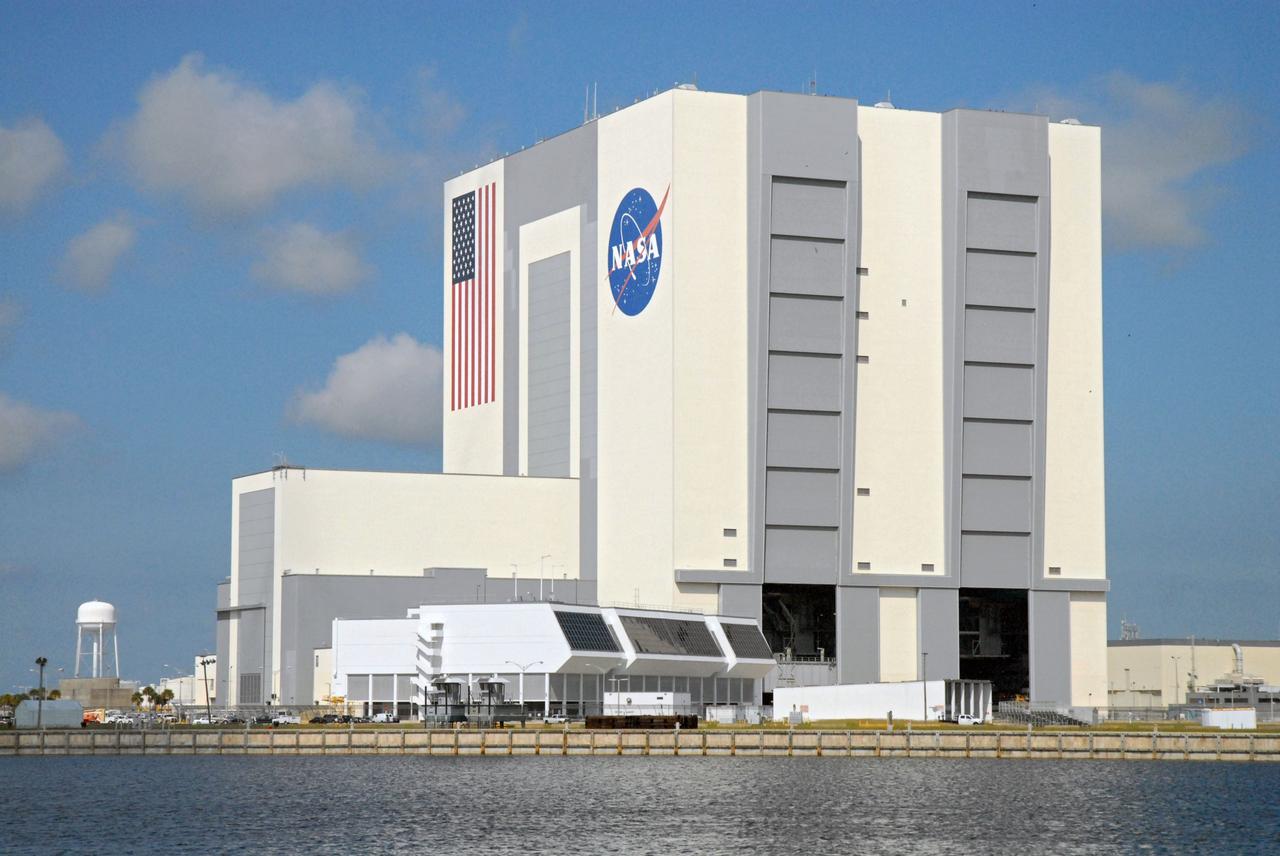
CAPE CANAVERAL, Fla. – The Vehicle Assembly Building, or VAB, is seen during a field-guided boat tour of NASA's Kennedy Space Center in Florida. As part of the center's first-ever Innovation Expo, the tour, called "Living Outdoor Laboratory for Environmental Sustainability," is giving employees the opportunity to see the unique estuarine ecosystems that are protected from development by the presence of Kennedy and the Merritt Island National Wildlife Refuge. The diverse and healthy area encompassing about 140,000 acres of central Florida's east coast has been closed to the public for 50 years, allowing the coastal dunes, saltwater estuaries and marshes, freshwater impoundments, scrub, pine flatwoods, and hardwood hammocks to provide habitats for more than 1,000 species of plants and animals. Innovation Expo is showcasing the innovative work taking place throughout the center's facilities and labs to encourage employees to work together to solve future challenges. For more information, visit http://www.nasa.gov/kennedy. Photo credit: NASA
![ISS007-E-18086 (26 October 2003) --- The fires in the San Bernardino Mountains, fueled by Santa Ana winds, burned out of control on the morning of Oct. 26, 2003, when this image and several others were taken from the International Space Station. This frame and image numbers 18087 and 18088 were taken at approximately 19:54 GMT, October 26, 2003 with a digital still camera equipped with a 400mm lens. Lake Arrowhead and Silverwood Lake are just out of frame. Content was provided by JSC’s Earth Observation Lab. The International Space Station Program {link to http://spaceflight.nasa.gov} supports the laboratory to help astronauts take pictures of Earth that will be of the greatest value to scientists and the public, and to make those images freely available on the Internet. Additional images taken by astronauts and cosmonauts can be viewed at the NASA/JSC Gateway to Astronaut Photography of Earth [link to http://eol.jsc.nasa.gov/].](https://images-assets.nasa.gov/image/iss007e18086/iss007e18086~medium.jpg)
ISS007-E-18086 (26 October 2003) --- The fires in the San Bernardino Mountains, fueled by Santa Ana winds, burned out of control on the morning of Oct. 26, 2003, when this image and several others were taken from the International Space Station. This frame and image numbers 18087 and 18088 were taken at approximately 19:54 GMT, October 26, 2003 with a digital still camera equipped with a 400mm lens. Lake Arrowhead and Silverwood Lake are just out of frame. Content was provided by JSC’s Earth Observation Lab. The International Space Station Program {link to http://spaceflight.nasa.gov} supports the laboratory to help astronauts take pictures of Earth that will be of the greatest value to scientists and the public, and to make those images freely available on the Internet. Additional images taken by astronauts and cosmonauts can be viewed at the NASA/JSC Gateway to Astronaut Photography of Earth [link to http://eol.jsc.nasa.gov/].
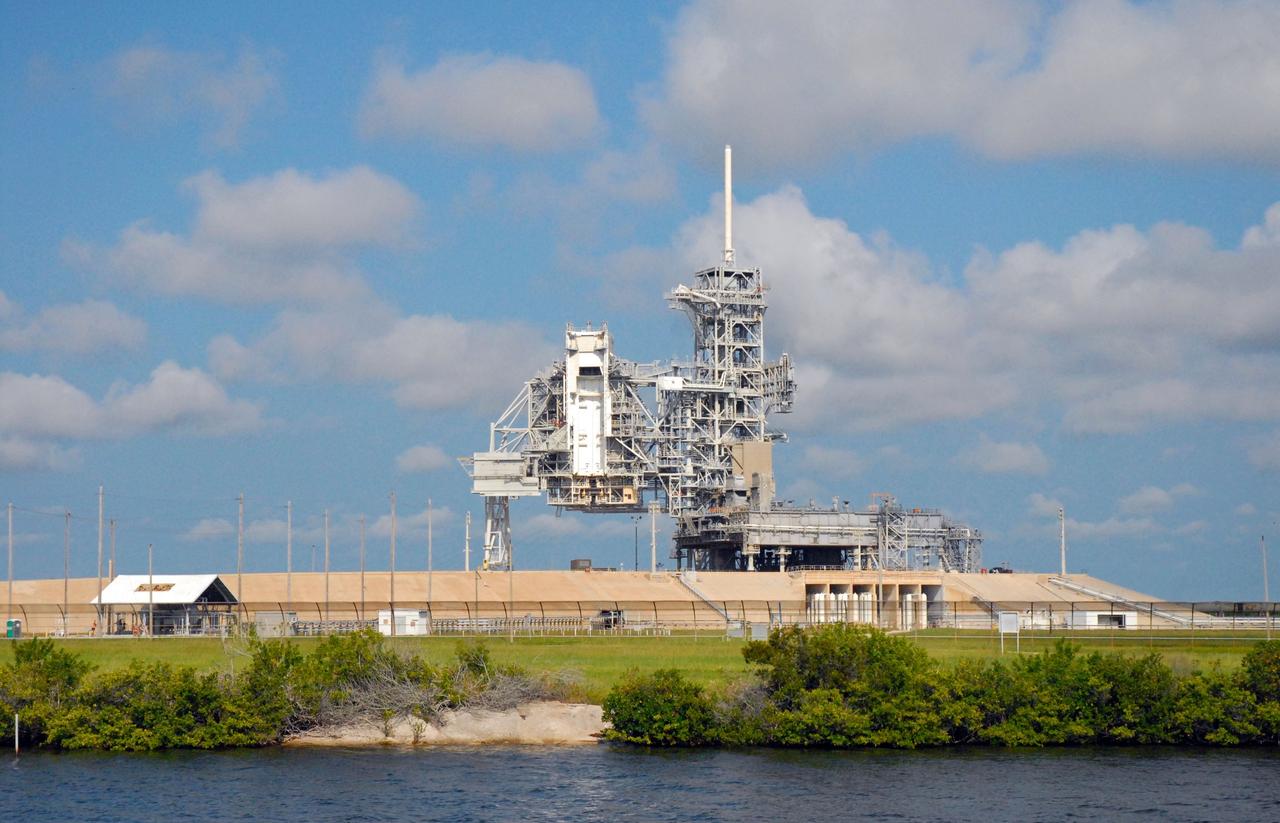
CAPE CANAVERAL, Fla. – Launch Pad 39A is seen during a field-guided boat tour of NASA's Kennedy Space Center in Florida. As part of the center's first-ever Innovation Expo, the tour, called "Living Outdoor Laboratory for Environmental Sustainability," is giving employees the opportunity to see the unique estuarine ecosystems that are protected from development by the presence of Kennedy and the Merritt Island National Wildlife Refuge. The diverse and healthy area encompassing about 140,000 acres of central Florida's east coast has been closed to the public for 50 years, allowing the coastal dunes, saltwater estuaries and marshes, freshwater impoundments, scrub, pine flatwoods, and hardwood hammocks to provide habitats for more than 1,000 species of plants and animals. Innovation Expo is showcasing the innovative work taking place throughout the center's facilities and labs to encourage employees to work together to solve future challenges. For more information, visit http://www.nasa.gov/kennedy. Photo credit: NASA
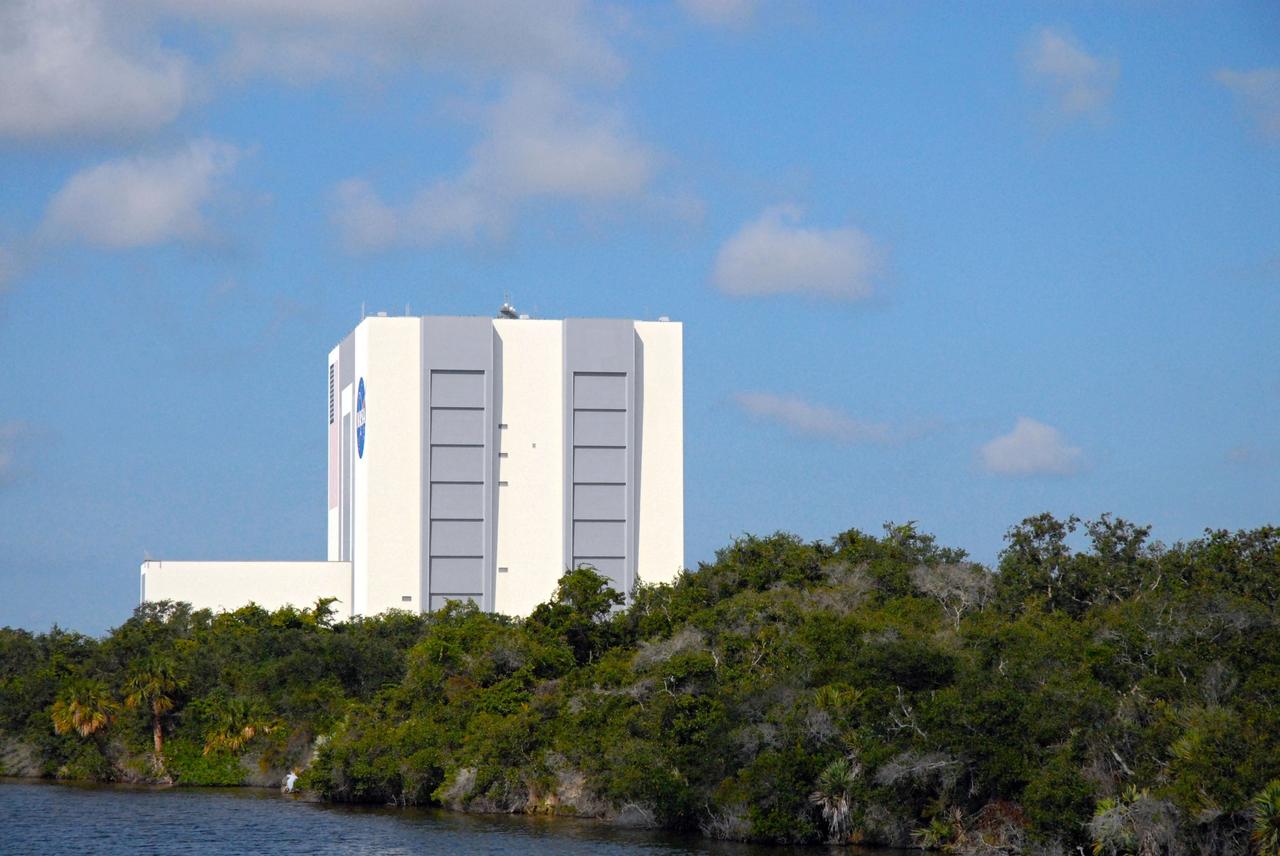
CAPE CANAVERAL, Fla. – The Vehicle Assembly Building, or VAB, is seen during a field-guided boat tour of NASA's Kennedy Space Center in Florida. As part of the center's first-ever Innovation Expo, the tour, called "Living Outdoor Laboratory for Environmental Sustainability," is giving employees the opportunity to see the unique estuarine ecosystems that are protected from development by the presence of Kennedy and the Merritt Island National Wildlife Refuge. The diverse and healthy area encompassing about 140,000 acres of central Florida's east coast has been closed to the public for 50 years, allowing the coastal dunes, saltwater estuaries and marshes, freshwater impoundments, scrub, pine flatwoods, and hardwood hammocks to provide habitats for more than 1,000 species of plants and animals. Innovation Expo is showcasing the innovative work taking place throughout the center's facilities and labs to encourage employees to work together to solve future challenges. For more information, visit http://www.nasa.gov/kennedy. Photo credit: NASA
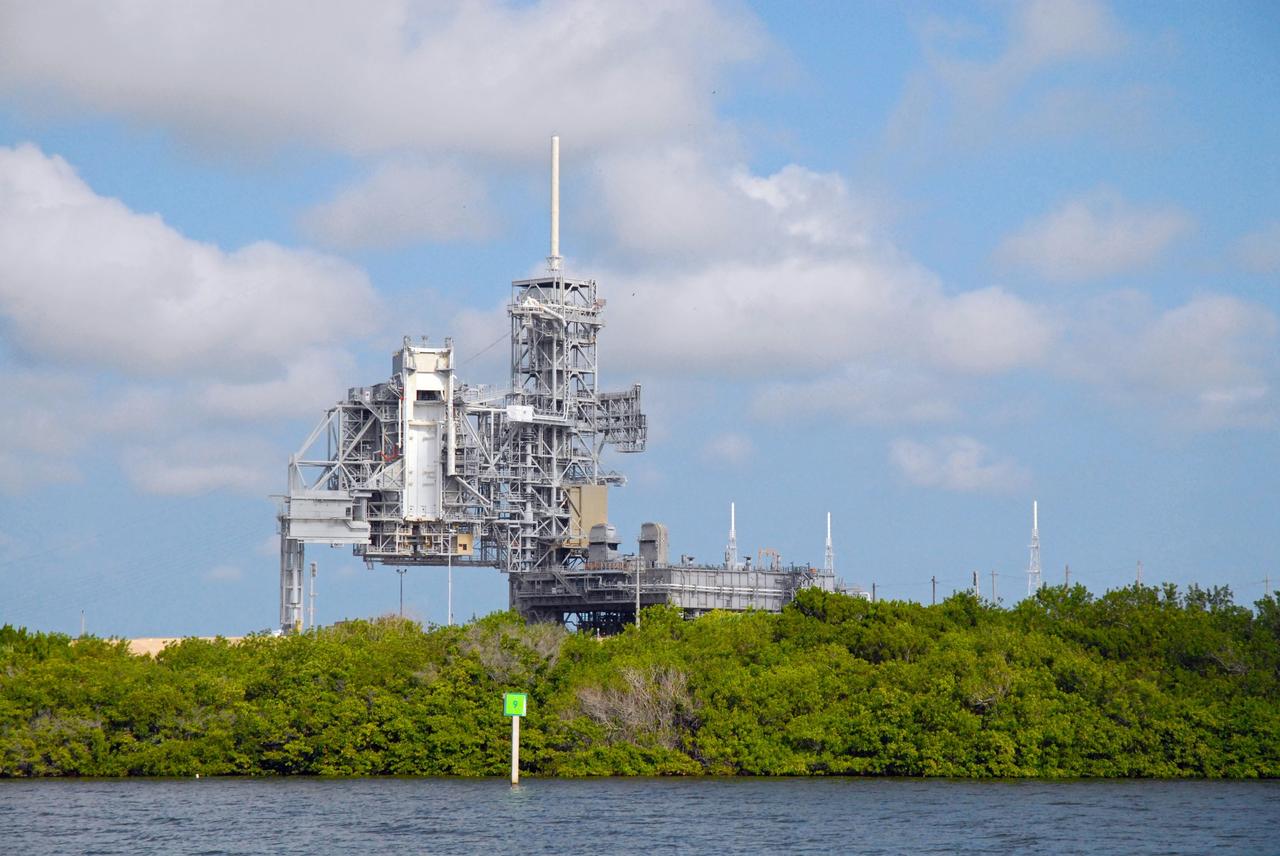
CAPE CANAVERAL, Fla. – Launch Pad 39A is seen during a field-guided boat tour of NASA's Kennedy Space Center in Florida. As part of the center's first-ever Innovation Expo, the tour, called "Living Outdoor Laboratory for Environmental Sustainability," is giving employees the opportunity to see the unique estuarine ecosystems that are protected from development by the presence of Kennedy and the Merritt Island National Wildlife Refuge. The diverse and healthy area encompassing about 140,000 acres of central Florida's east coast has been closed to the public for 50 years, allowing the coastal dunes, saltwater estuaries and marshes, freshwater impoundments, scrub, pine flatwoods, and hardwood hammocks to provide habitats for more than 1,000 species of plants and animals. Innovation Expo is showcasing the innovative work taking place throughout the center's facilities and labs to encourage employees to work together to solve future challenges. For more information, visit http://www.nasa.gov/kennedy. Photo credit: NASA
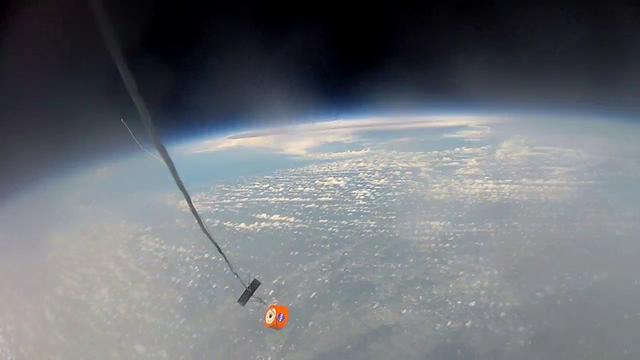
CAPE CANAVERAL, Fla. – An instrument-laden capsule begins its descent from 105,000 feet above Earth during a flight hosted by Rocket University participants. After the high-altitude balloon carrying it burst, the capsule free-fell to 50,000 feet and then deployed a parachute to land safely on the ground. The test flight was used to evaluate the stability of the capsule as it fell to Earth before its parachute opened. Rocket University is a program of courses, workshops, labs and projects offered to engineering and research pros of all stripes to keep their skills fresh and broaden their experiences. Photo credit: Courtesy of Rocket University The work is part of Transition and Retirement of the remaining space shuttles, Atlantis and Endeavour. Atlantis is being prepared for public display at Kennedy's Visitor Complex. Over the course of its 26-year career, Atlantis spent 293 days in space during 33 missions. For more information, visit http://www.nasa.gov/transition Photo credit: NASA/Kim Shiflett
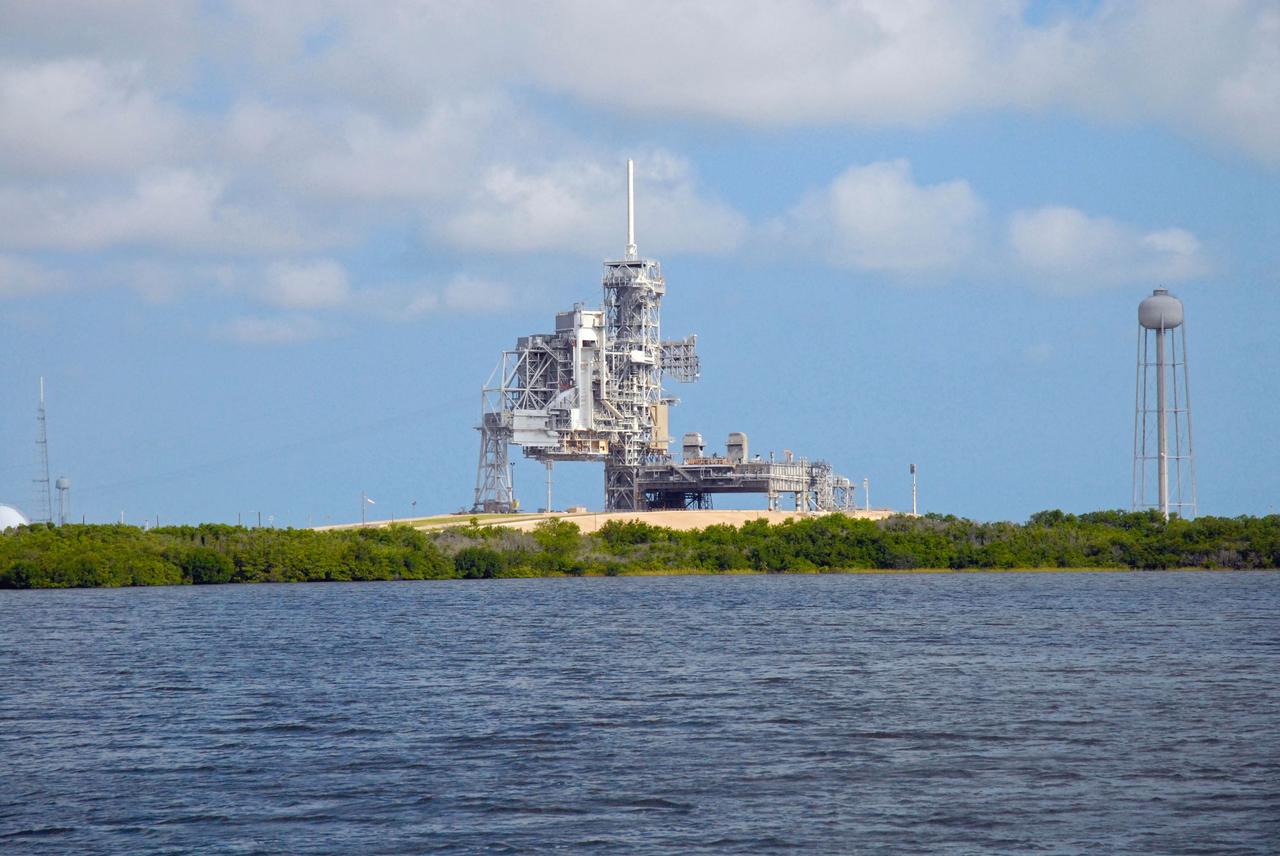
CAPE CANAVERAL, Fla. – Launch Pad 39A is seen during a field-guided boat tour of NASA's Kennedy Space Center in Florida. As part of the center's first-ever Innovation Expo, the tour, called "Living Outdoor Laboratory for Environmental Sustainability," is giving employees the opportunity to see the unique estuarine ecosystems that are protected from development by the presence of Kennedy and the Merritt Island National Wildlife Refuge. The diverse and healthy area encompassing about 140,000 acres of central Florida's east coast has been closed to the public for 50 years, allowing the coastal dunes, saltwater estuaries and marshes, freshwater impoundments, scrub, pine flatwoods, and hardwood hammocks to provide habitats for more than 1,000 species of plants and animals. Innovation Expo is showcasing the innovative work taking place throughout the center's facilities and labs to encourage employees to work together to solve future challenges. For more information, visit http://www.nasa.gov/kennedy. Photo credit: NASA
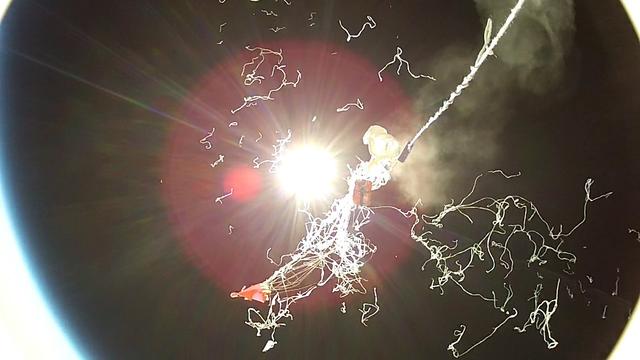
CAPE CANAVERAL, Fla. – The high-altitude balloon that carried an instrument-laden capsule bursts 105,000 feet above Earth during a flight hosted by Rocket University participants. The bursting of the balloon allowed the capsule to free-fall to 50,000 feet and then deploy a parachute to land safely on the ground. The test flight was used to evaluate the stability of an instrumented capsule as it fell to Earth before its parachute opened. Rocket University is a program of courses, workshops, labs and projects offered to engineering and research pros of all stripes to keep their skills fresh and broaden their experiences. Photo credit: Courtesy of Rocket University The work is part of Transition and Retirement of the remaining space shuttles, Atlantis and Endeavour. Atlantis is being prepared for public display at Kennedy's Visitor Complex. Over the course of its 26-year career, Atlantis spent 293 days in space during 33 missions. For more information, visit http://www.nasa.gov/transition Photo credit: NASA/Kim Shiflett
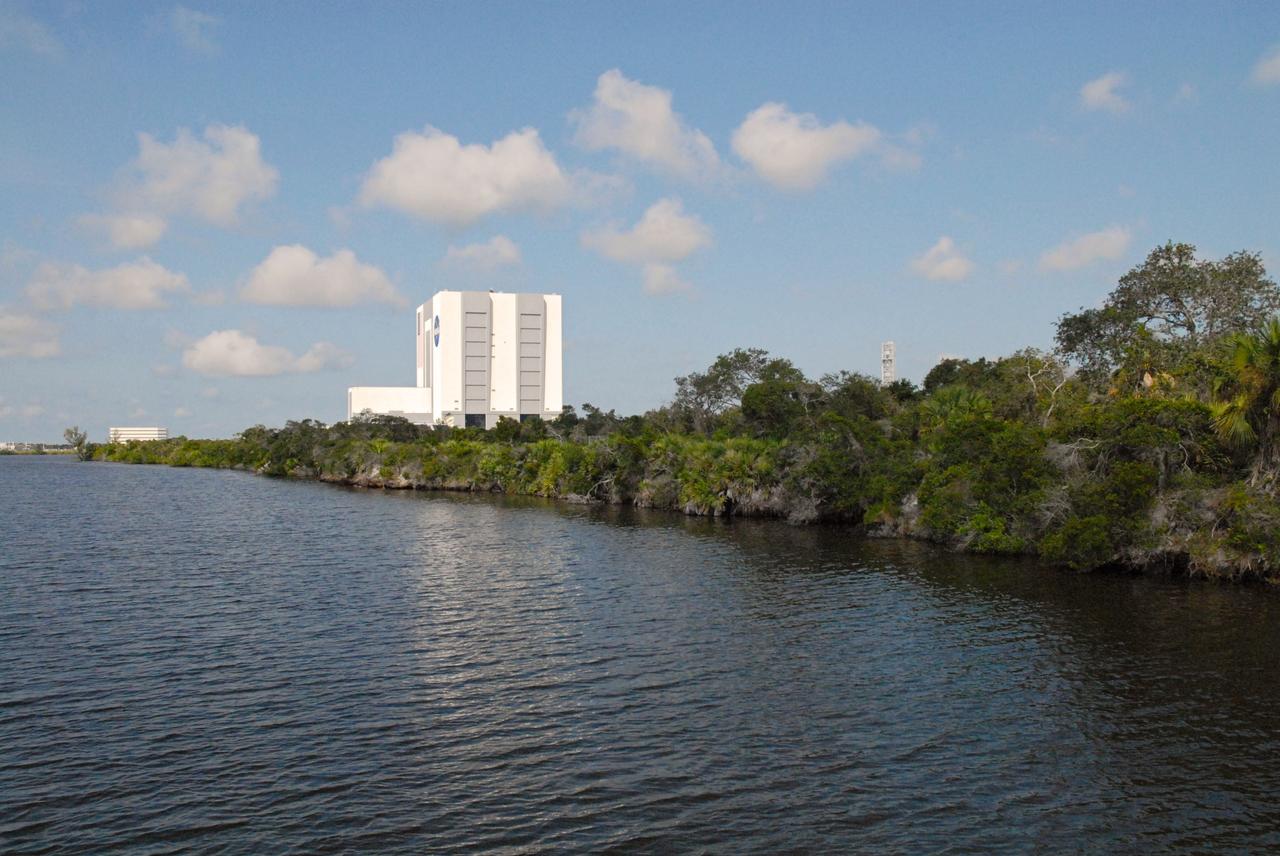
CAPE CANAVERAL, Fla. – Launch Complex 39 is seen during a field-guided boat tour of NASA's Kennedy Space Center in Florida. As part of the center's first-ever Innovation Expo, the tour, called "Living Outdoor Laboratory for Environmental Sustainability," is giving employees the opportunity to see the unique estuarine ecosystems that are protected from development by the presence of Kennedy and the Merritt Island National Wildlife Refuge. The diverse and healthy area encompassing about 140,000 acres of central Florida's east coast has been closed to the public for 50 years, allowing the coastal dunes, saltwater estuaries and marshes, freshwater impoundments, scrub, pine flatwoods, and hardwood hammocks to provide habitats for more than 1,000 species of plants and animals. Innovation Expo is showcasing the innovative work taking place throughout the center's facilities and labs to encourage employees to work together to solve future challenges. For more information, visit http://www.nasa.gov/kennedy. Photo credit: NASA
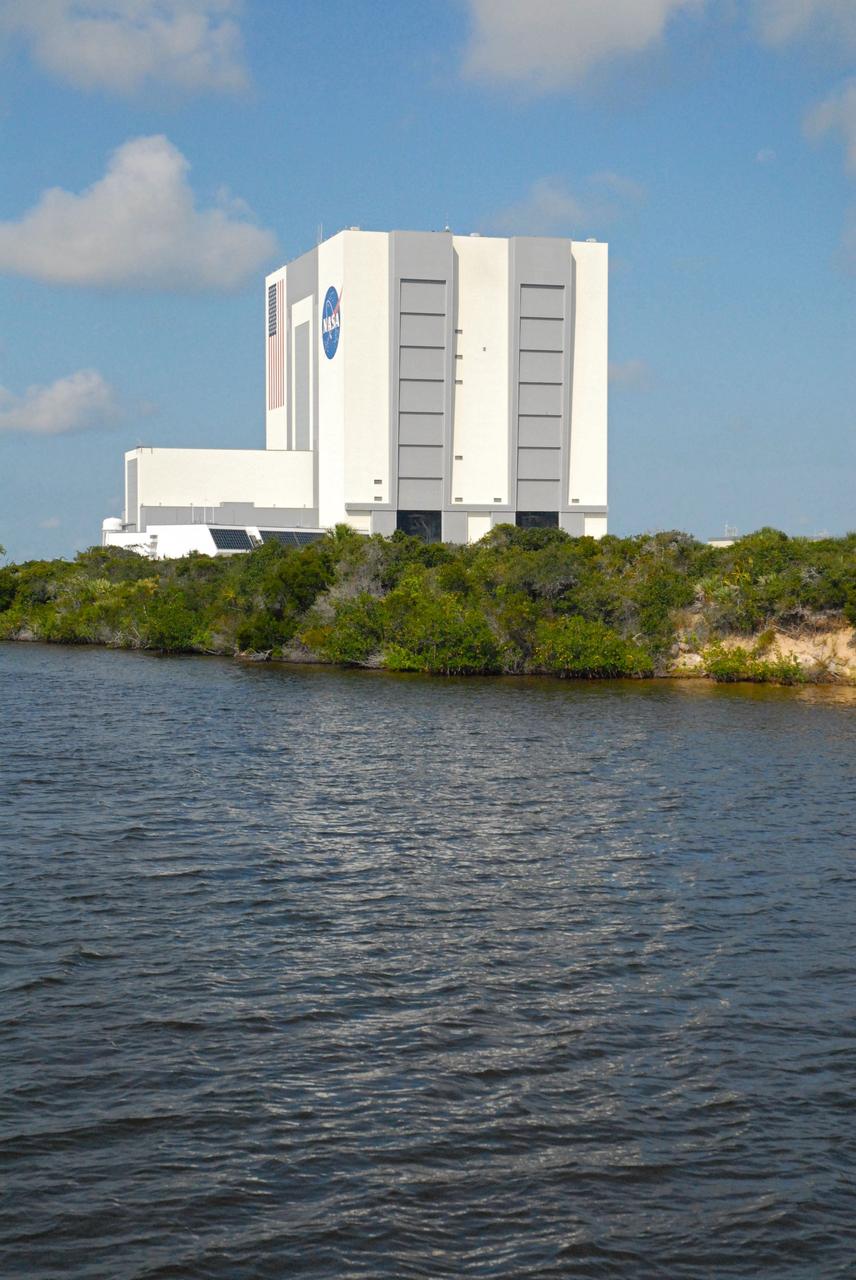
CAPE CANAVERAL, Fla. – The Vehicle Assembly Building, or VAB, is seen during a field-guided boat tour of NASA's Kennedy Space Center in Florida. As part of the center's first-ever Innovation Expo, the tour, called "Living Outdoor Laboratory for Environmental Sustainability," is giving employees the opportunity to see the unique estuarine ecosystems that are protected from development by the presence of Kennedy and the Merritt Island National Wildlife Refuge. The diverse and healthy area encompassing about 140,000 acres of central Florida's east coast has been closed to the public for 50 years, allowing the coastal dunes, saltwater estuaries and marshes, freshwater impoundments, scrub, pine flatwoods, and hardwood hammocks to provide habitats for more than 1,000 species of plants and animals. Innovation Expo is showcasing the innovative work taking place throughout the center's facilities and labs to encourage employees to work together to solve future challenges. For more information, visit http://www.nasa.gov/kennedy. Photo credit: NASA
![ISS007-E-18088 (26 October 2003) --- The fires in the San Bernardino Mountains, fueled by Santa Ana winds, burned out of control on the morning of Oct. 26, 2003, when this image and several others were taken from the International Space Station. This frame and image numbers 18086 and 18087 were taken at approximately 19:54 GMT, October 26, 2003 with a digital still camera equipped with a 400mm lens. Lake Arrowhead and Silverwood Lake are left and right, respectively, at bottom frame. Content was provided by JSC’s Earth Observation Lab. The International Space Station Program {link to http://spaceflight.nasa.gov} supports the laboratory to help astronauts take pictures of Earth that will be of the greatest value to scientists and the public, and to make those images freely available on the Internet. Additional images taken by astronauts and cosmonauts can be viewed at the NASA/JSC Gateway to Astronaut Photography of Earth [link to http://eol.jsc.nasa.gov/] .](https://images-assets.nasa.gov/image/iss007e18088/iss007e18088~medium.jpg)
ISS007-E-18088 (26 October 2003) --- The fires in the San Bernardino Mountains, fueled by Santa Ana winds, burned out of control on the morning of Oct. 26, 2003, when this image and several others were taken from the International Space Station. This frame and image numbers 18086 and 18087 were taken at approximately 19:54 GMT, October 26, 2003 with a digital still camera equipped with a 400mm lens. Lake Arrowhead and Silverwood Lake are left and right, respectively, at bottom frame. Content was provided by JSC’s Earth Observation Lab. The International Space Station Program {link to http://spaceflight.nasa.gov} supports the laboratory to help astronauts take pictures of Earth that will be of the greatest value to scientists and the public, and to make those images freely available on the Internet. Additional images taken by astronauts and cosmonauts can be viewed at the NASA/JSC Gateway to Astronaut Photography of Earth [link to http://eol.jsc.nasa.gov/] .
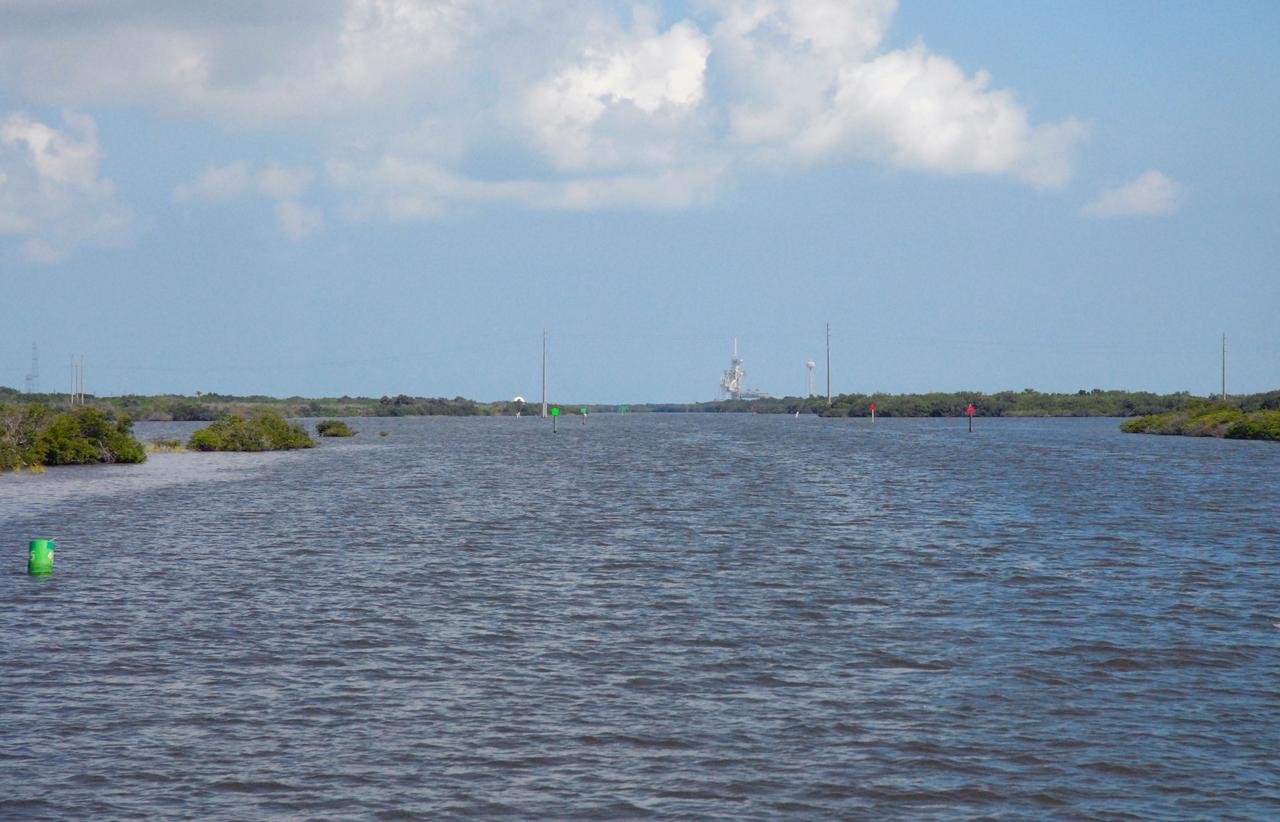
CAPE CANAVERAL, Fla. – Launch Pad 39A is seen in the distance during a field-guided boat tour of NASA's Kennedy Space Center in Florida. As part of the center's first-ever Innovation Expo, the tour, called "Living Outdoor Laboratory for Environmental Sustainability," is giving employees the opportunity to see the unique estuarine ecosystems that are protected from development by the presence of Kennedy and the Merritt Island National Wildlife Refuge. The diverse and healthy area encompassing about 140,000 acres of central Florida's east coast has been closed to the public for 50 years, allowing the coastal dunes, saltwater estuaries and marshes, freshwater impoundments, scrub, pine flatwoods, and hardwood hammocks to provide habitats for more than 1,000 species of plants and animals. Innovation Expo is showcasing the innovative work taking place throughout the center's facilities and labs to encourage employees to work together to solve future challenges. For more information, visit http://www.nasa.gov/kennedy. Photo credit: NASA
![ISS007-E-18087 (26 October 2003) --- The fires in the San Bernardino Mountains, fueled by Santa Ana winds, burned out of control on the morning of Oct. 26, 2003, when this image and several others were taken from the International Space Station. This frame and image numbers 18086 and 18088 were taken at approximately 19:54 GMT, October 26, 2003 with a digital still camera equipped with a 400mm lens. Silverwood Lake is visible at the bottom of the image. Content was provided by JSC’s Earth Observation Lab. The International Space Station Program {link to http://spaceflight.nasa.gov} supports the laboratory to help astronauts take pictures of Earth that will be of the greatest value to scientists and the public, and to make those images freely available on the Internet. Additional images taken by astronauts and cosmonauts can be viewed at the NASA/JSC Gateway to Astronaut Photography of Earth [link to http://eol.jsc.nasa.gov/].](https://images-assets.nasa.gov/image/iss007e18087/iss007e18087~medium.jpg)
ISS007-E-18087 (26 October 2003) --- The fires in the San Bernardino Mountains, fueled by Santa Ana winds, burned out of control on the morning of Oct. 26, 2003, when this image and several others were taken from the International Space Station. This frame and image numbers 18086 and 18088 were taken at approximately 19:54 GMT, October 26, 2003 with a digital still camera equipped with a 400mm lens. Silverwood Lake is visible at the bottom of the image. Content was provided by JSC’s Earth Observation Lab. The International Space Station Program {link to http://spaceflight.nasa.gov} supports the laboratory to help astronauts take pictures of Earth that will be of the greatest value to scientists and the public, and to make those images freely available on the Internet. Additional images taken by astronauts and cosmonauts can be viewed at the NASA/JSC Gateway to Astronaut Photography of Earth [link to http://eol.jsc.nasa.gov/].
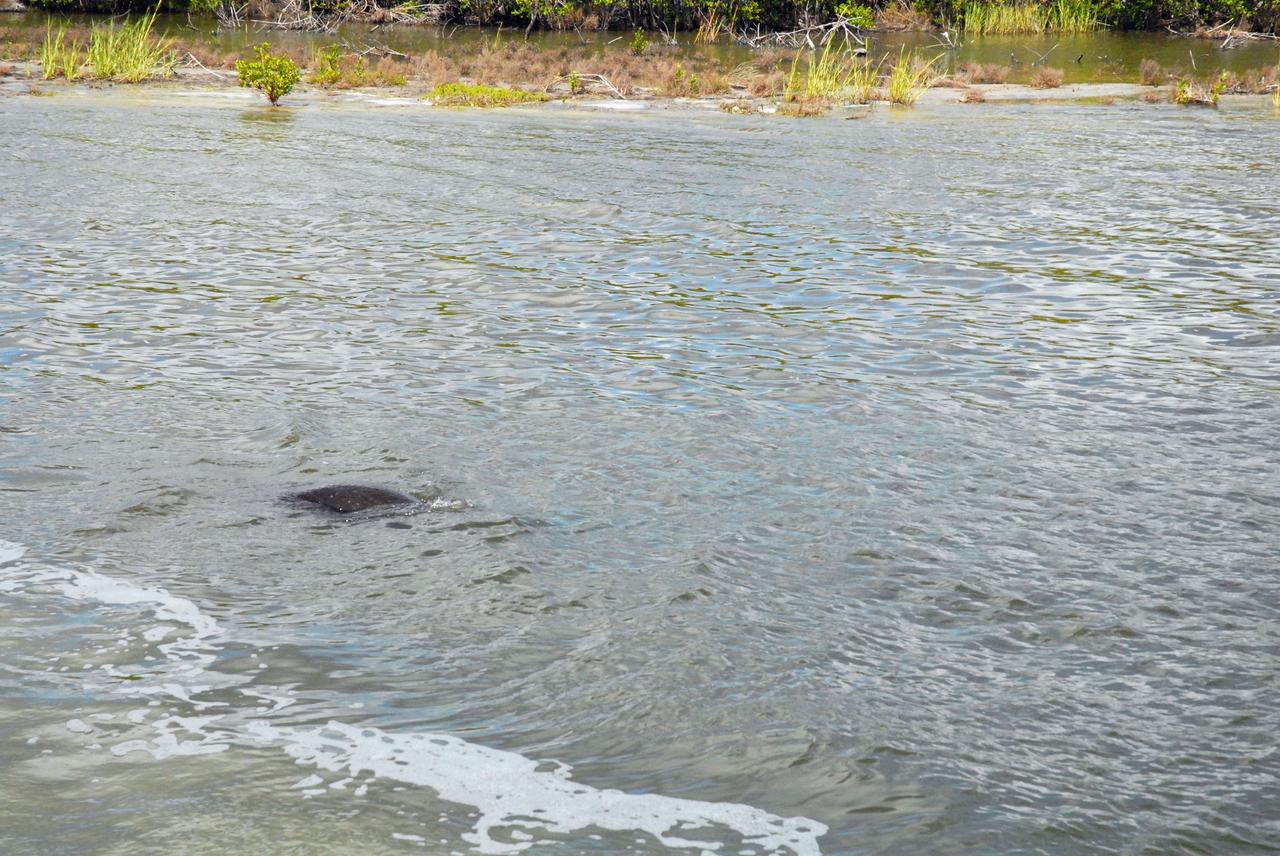
CAPE CANAVERAL, Fla. – A manatee swims in the Banana River during a field-guided boat tour of NASA's Kennedy Space Center in Florida. As part of the center's first-ever Innovation Expo, the tour, called "Living Outdoor Laboratory for Environmental Sustainability," is giving employees the opportunity to see the unique estuarine ecosystems that are protected from development by the presence of Kennedy and the Merritt Island National Wildlife Refuge. Manatees are one of the many threatened or endangered species that call the refuge home. The diverse and healthy area encompassing about 140,000 acres of central Florida's east coast has been closed to the public for 50 years, allowing the coastal dunes, saltwater estuaries and marshes, freshwater impoundments, scrub, pine flatwoods, and hardwood hammocks to provide habitats for more than 1,000 species of plants and animals. Innovation Expo is showcasing the innovative work taking place throughout the center's facilities and labs to encourage employees to work together to solve future challenges. For more information, visit http://www.nasa.gov/kennedy. Photo credit: NASA
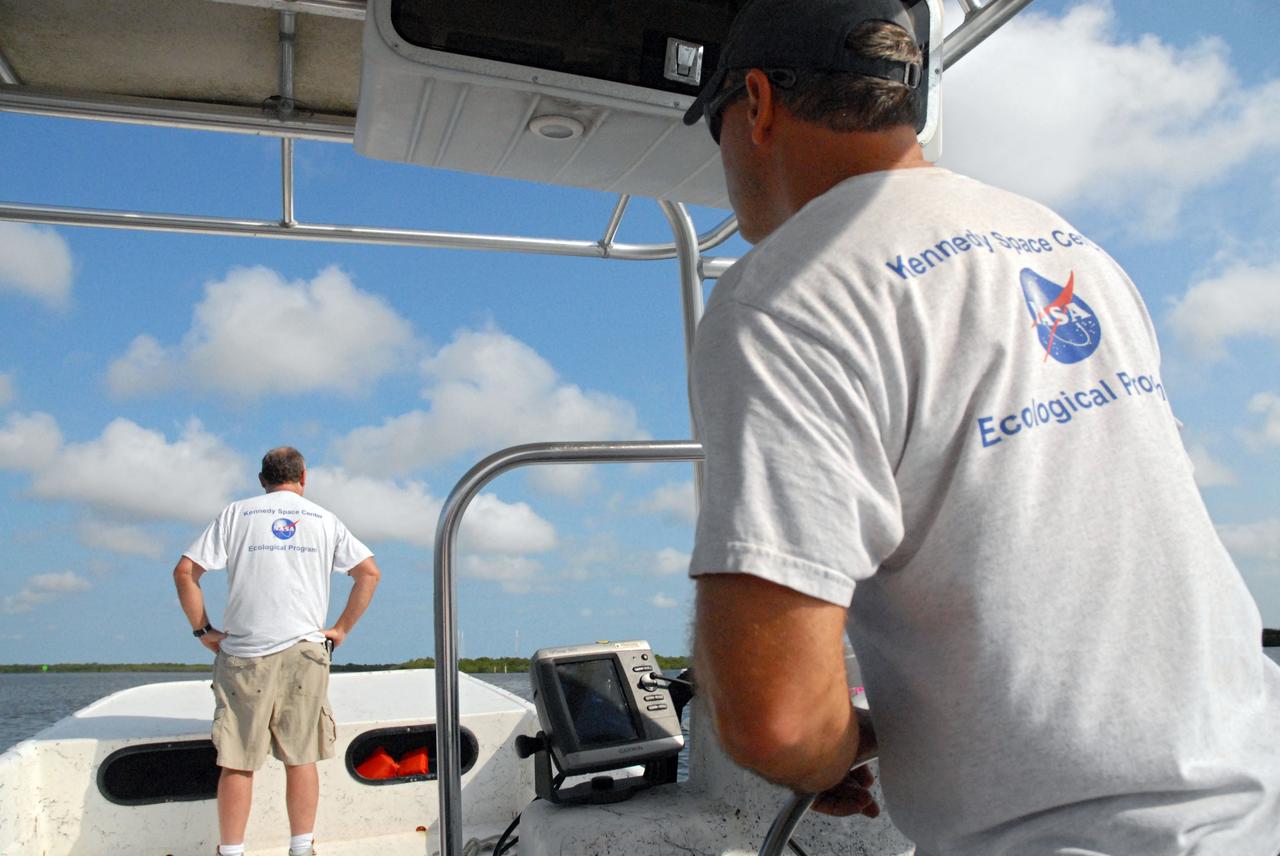
CAPE CANAVERAL, Fla. – Aquatic biologist Eric Reyier with Innovative Health Applications, or IHA, drives a skiff boat during a field-guided tour of NASA's Kennedy Space Center in Florida. As part of the center's first-ever Innovation Expo, the tour, called "Living Outdoor Laboratory for Environmental Sustainability," is giving employees the opportunity to see the unique estuarine ecosystems that are protected from development by the presence of Kennedy and the Merritt Island National Wildlife Refuge. Aquatic biologist Doug Scheidt searches for landmarks and wildlife during the tour. The diverse and healthy area encompassing about 140,000 acres of central Florida's east coast has been closed to the public for 50 years, allowing the coastal dunes, saltwater estuaries and marshes, freshwater impoundments, scrub, pine flatwoods, and hardwood hammocks to provide habitats for more than 1,000 species of plants and animals. Innovation Expo is showcasing the innovative work taking place throughout the center's facilities and labs to encourage employees to work together to solve future challenges. For more information, visit http://www.nasa.gov/kennedy. Photo credit: NASA
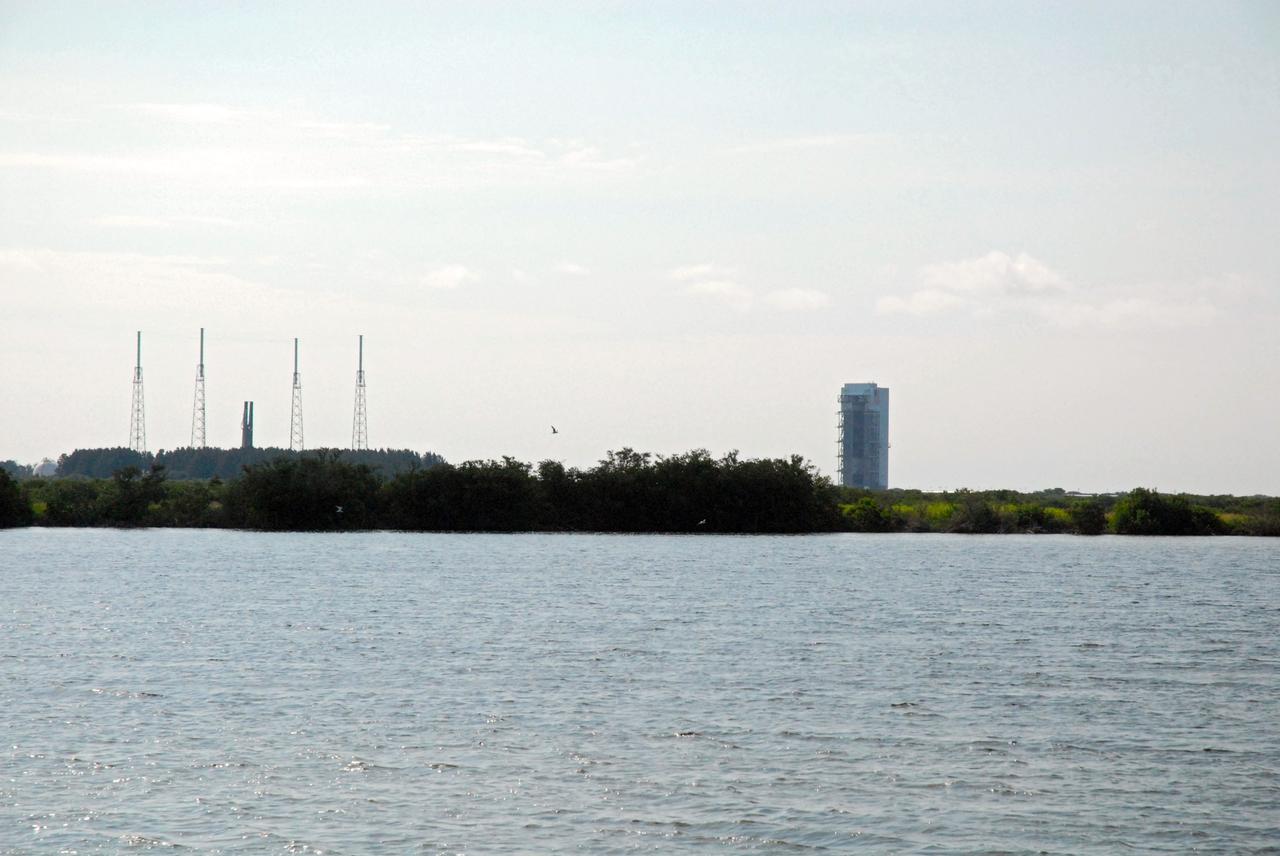
CAPE CANAVERAL, Fla. – Cape Canaveral Air Force Station's Space Launch Complex 41 and the Vertical Integration Facility, or VIF, are seen in the distance during a field-guided boat tour of NASA's Kennedy Space Center in Florida. As part of the center's first-ever Innovation Expo, the tour, called "Living Outdoor Laboratory for Environmental Sustainability," is giving employees the opportunity to see the unique estuarine ecosystems that are protected from development by the presence of Kennedy and the Merritt Island National Wildlife Refuge. The diverse and healthy area encompassing about 140,000 acres of central Florida's east coast has been closed to the public for 50 years, allowing the coastal dunes, saltwater estuaries and marshes, freshwater impoundments, scrub, pine flatwoods, and hardwood hammocks to provide habitats for more than 1,000 species of plants and animals. Innovation Expo is showcasing the innovative work taking place throughout the center's facilities and labs to encourage employees to work together to solve future challenges. For more information, visit http://www.nasa.gov/kennedy. Photo credit: NASA
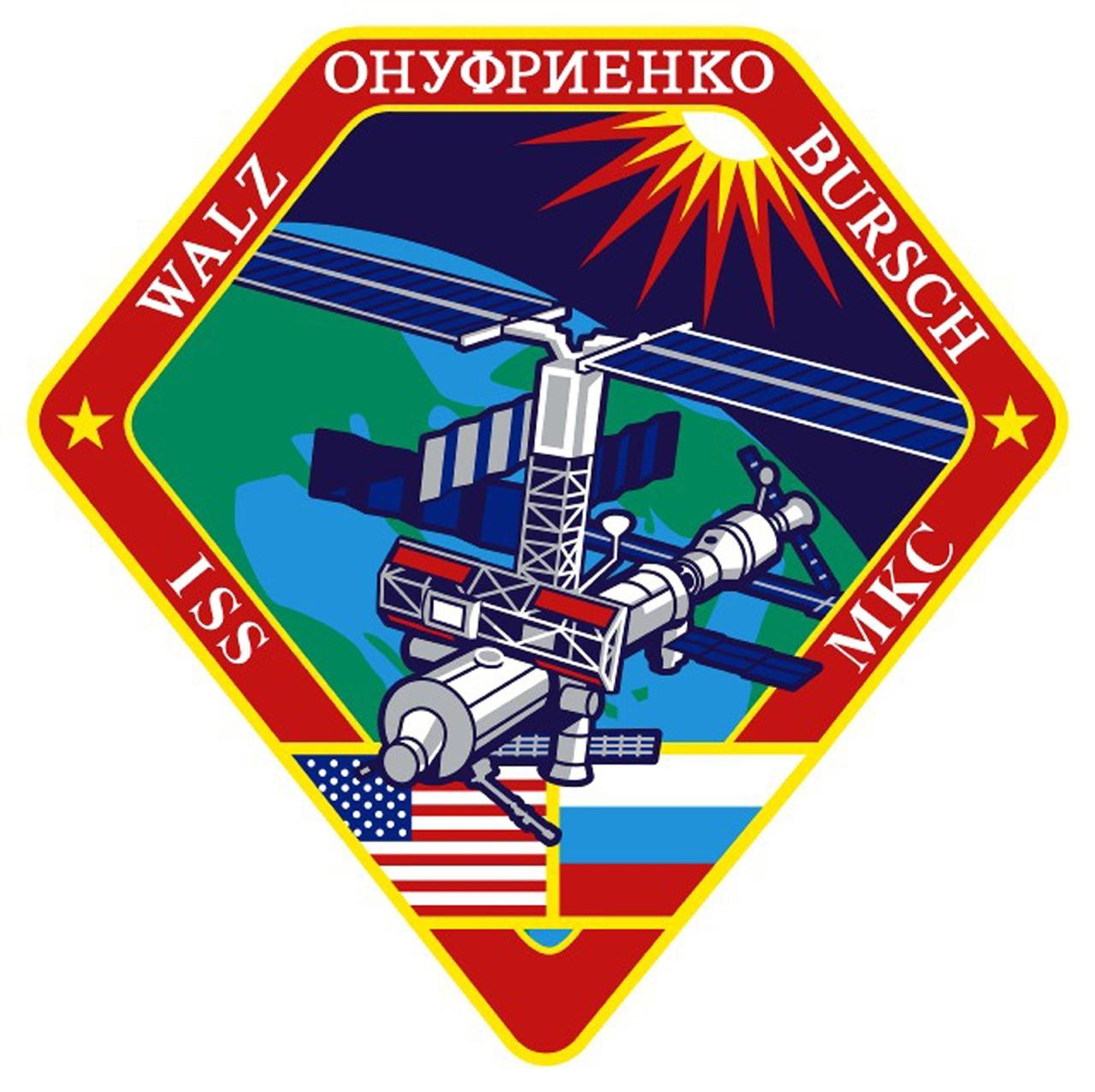
JOHNSON SPACE CENTER, HOUSTON, TEXAS -- EXPEDITION FOUR INSIGNIA -- The International Space Station (ISS) Expedition Four crew patch has an overall diamond shape, showing the "diamond in the rough" configuration of the Station during expedition four. The red hexagonal shape with stylized American and Russian flags represents the cross-sectional view of the S0 truss segment, which the crew will attach to the U.S. Lab Destiny. The persistent Sun shining on the Earth and Station represents the constant challenges that the crew and ground support team will face every day while operating the International Space Station, while shedding new light through daily research. The green portion of the Earth represents the fourth color in the visible spectrum and the black void of space represents humankind's constant quest to explore the unknown. The NASA insignia design for Shuttle flights ts is reserved for use by the astronauts and for other official use as the NASA Administrator may authorize. Public availability has been approved only in the forms of illustrations by the various news media. When and if there is any change in this policy, which we do not anticipate, it will be publicly announced
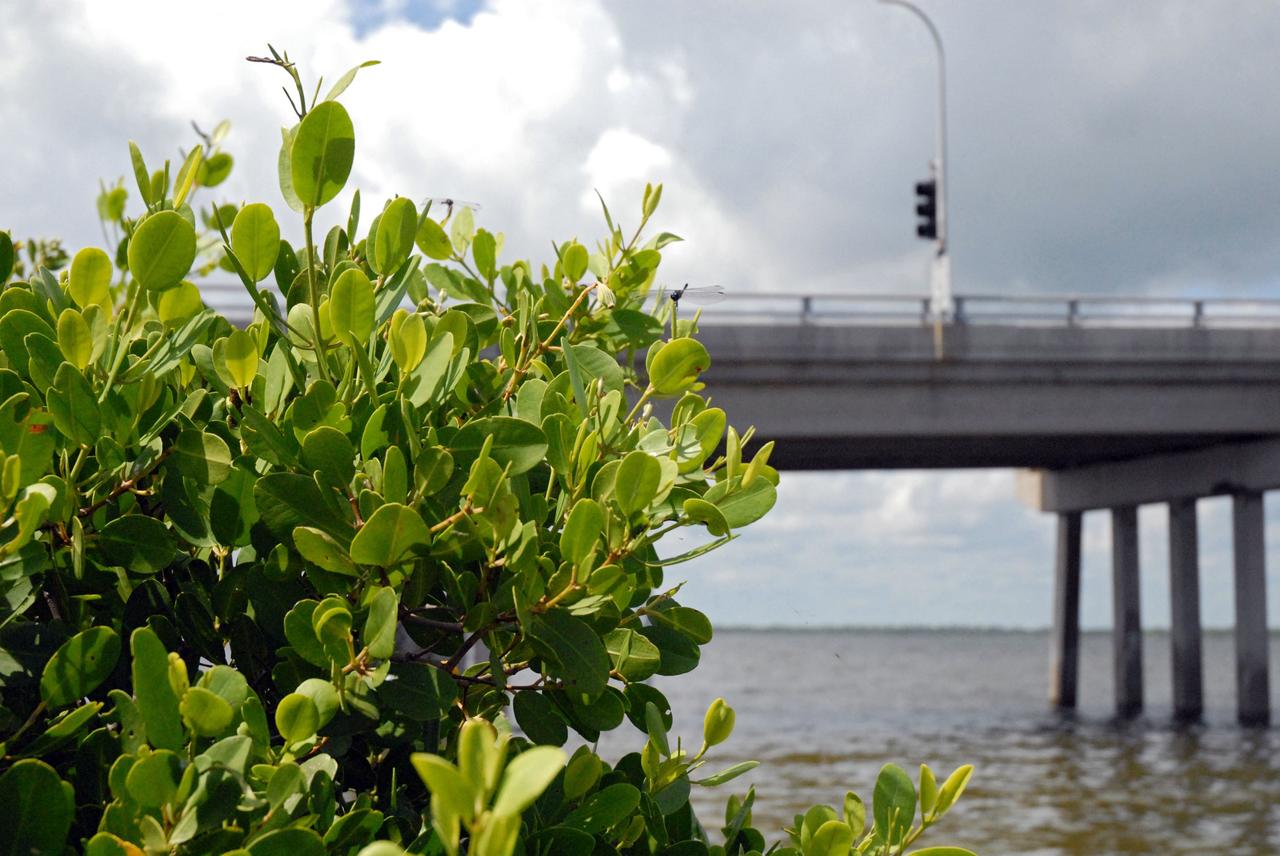
CAPE CANAVERAL, Fla. – The Roy D. Bridges Jr. Bridge connecting NASA Kennedy Space Center's Industrial Area to Cape Canaveral Air Force Station's Industrial Area is seen during a field-guided boat tour. As part of the Kennedy's first-ever Innovation Expo, the tour, called "Living Outdoor Laboratory for Environmental Sustainability," is giving employees the opportunity to see the unique estuarine ecosystems that are protected from development by the presence of the center and the Merritt Island National Wildlife Refuge. The diverse and healthy area encompassing about 140,000 acres of central Florida's east coast has been closed to the public for 50 years, allowing the coastal dunes, saltwater estuaries and marshes, freshwater impoundments, scrub, pine flatwoods, and hardwood hammocks to provide habitats for more than 1,000 species of plants and animals. Innovation Expo is showcasing the innovative work taking place throughout the center's facilities and labs to encourage employees to work together to solve future challenges. For more information, visit http://www.nasa.gov/kennedy. Photo credit: NASA
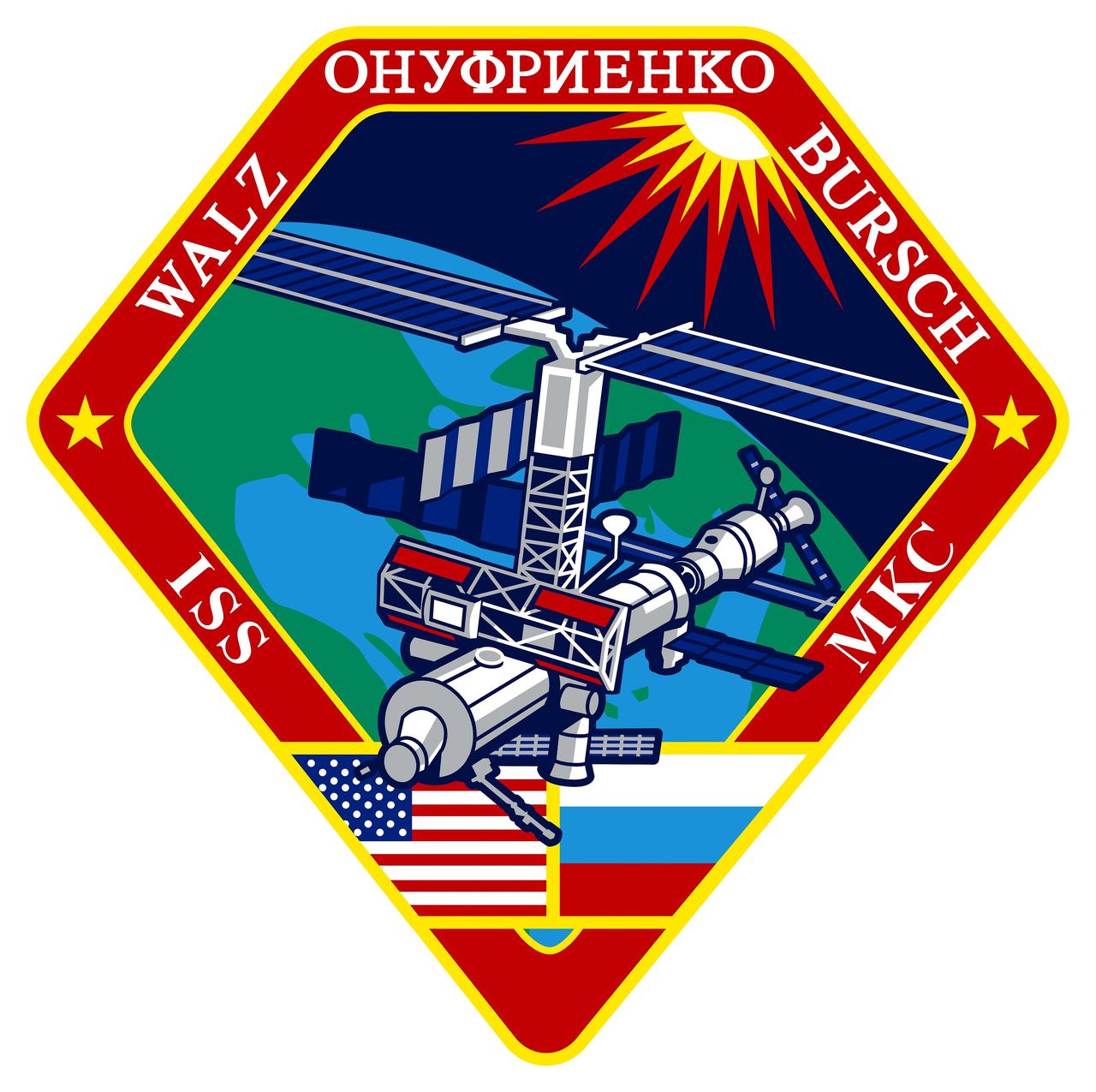
ISS004-S-001 (August 2001) --- The International Space Station (ISS) Expedition 4 crew patch has an overall diamond shape, showing the “diamond in the rough” configuration of the Station during expedition 4. The red hexagonal shape with stylized American and Russian flags represents the cross-sectional view of the S0 truss segment, which the crew will attach to the U.S. Lab Destiny. The persistent Sun shining on the Earth and Station represents the constant challenges that the crew and ground support team will face every day while operating the International Space Station, while shedding new light through daily research. The green portion of the Earth represents the fourth color in the visible spectrum and the black void of space represents humankind’s constant quest to explore the unknown. The NASA insignia design for Shuttle flights is reserved for use by the astronauts and for other official use as the NASA Administrator may authorize. Public availability has been approved only in the forms of illustrations by the various news media. When and if there is any change in this policy, which is not anticipated, the change will be publicly announced.
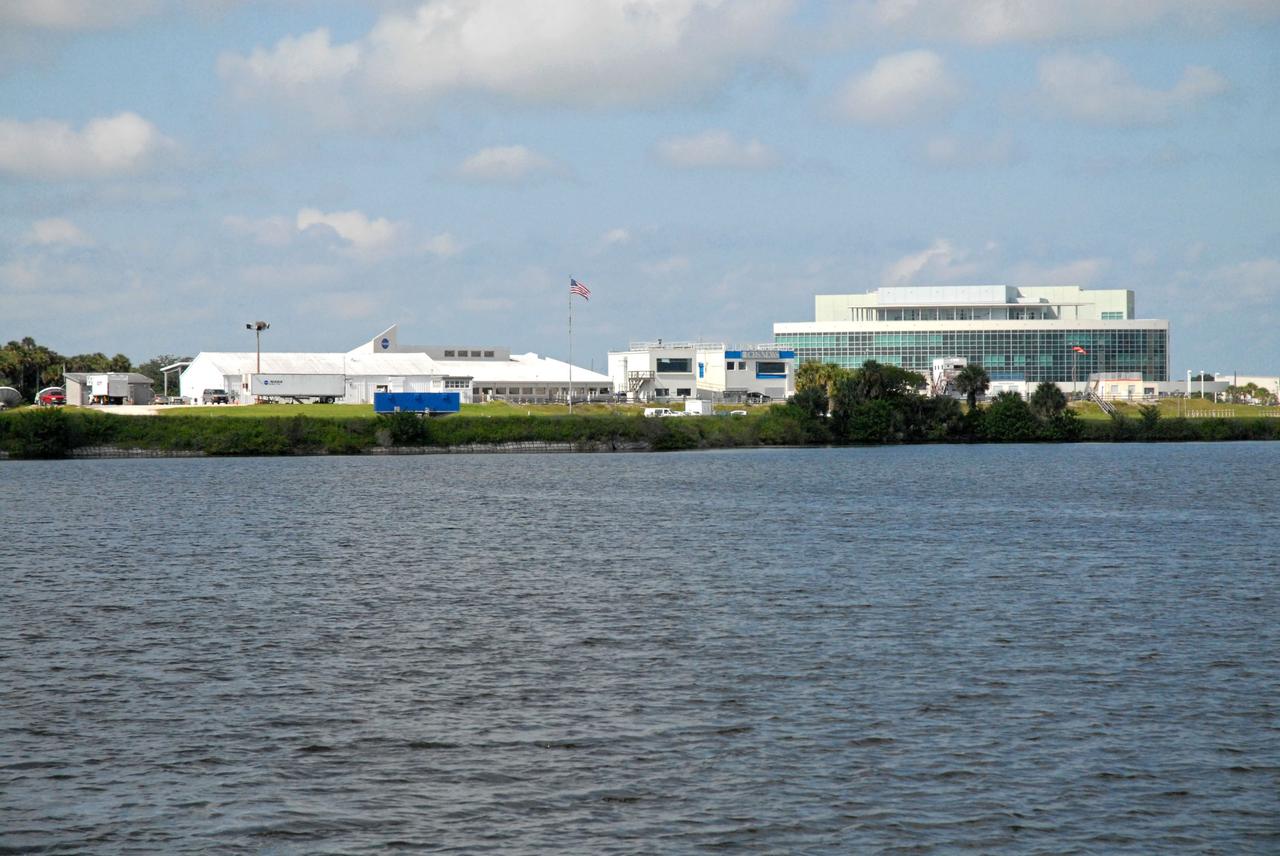
CAPE CANAVERAL, Fla. – The NASA News Center and Operations Support Building II, or OSBII, in Launch Complex 39 are seen in the distance during a field-guided boat tour of NASA's Kennedy Space Center in Florida. As part of the center's first-ever Innovation Expo, the tour, called "Living Outdoor Laboratory for Environmental Sustainability," is giving employees the opportunity to see the unique estuarine ecosystems that are protected from development by the presence of Kennedy and the Merritt Island National Wildlife Refuge. The diverse and healthy area encompassing about 140,000 acres of central Florida's east coast has been closed to the public for 50 years, allowing the coastal dunes, saltwater estuaries and marshes, freshwater impoundments, scrub, pine flatwoods, and hardwood hammocks to provide habitats for more than 1,000 species of plants and animals. Innovation Expo is showcasing the innovative work taking place throughout the center's facilities and labs to encourage employees to work together to solve future challenges. For more information, visit http://www.nasa.gov/kennedy. Photo credit: NASA
![ISS007-E-18082 (26 October 2003) --- The fires in the San Bernardino Mountains, fueled by Santa Ana winds, burned out of control on the morning of Oct. 26, 2003, when these images were taken from the International Space Station at roughly 11 a.m. (PST). Thick yellow smoke blows south, blanketing the valley below. This image and ISS007-E-18078, looking southeast, capture the smoke pall as the ISS approached and passed over the region. Image numbers 18078 and 18082 were taken roughly a minute apart. A small break in the smoke marks Cajon pass. Content was provided by JSC’s Earth Observation Lab. The International Space Station Program {link to http://spaceflight.nasa.gov} supports the laboratory to help crew members take pictures of Earth that will be of the greatest value to scientists and the public, and to make those images freely available on the Internet. Additional images taken by astronauts and cosmonauts can be viewed at the NASA/JSC Gateway to Astronaut Photography of Earth [link to http://eol.jsc.nasa.gov/].](https://images-assets.nasa.gov/image/iss007e18082/iss007e18082~medium.jpg)
ISS007-E-18082 (26 October 2003) --- The fires in the San Bernardino Mountains, fueled by Santa Ana winds, burned out of control on the morning of Oct. 26, 2003, when these images were taken from the International Space Station at roughly 11 a.m. (PST). Thick yellow smoke blows south, blanketing the valley below. This image and ISS007-E-18078, looking southeast, capture the smoke pall as the ISS approached and passed over the region. Image numbers 18078 and 18082 were taken roughly a minute apart. A small break in the smoke marks Cajon pass. Content was provided by JSC’s Earth Observation Lab. The International Space Station Program {link to http://spaceflight.nasa.gov} supports the laboratory to help crew members take pictures of Earth that will be of the greatest value to scientists and the public, and to make those images freely available on the Internet. Additional images taken by astronauts and cosmonauts can be viewed at the NASA/JSC Gateway to Astronaut Photography of Earth [link to http://eol.jsc.nasa.gov/].
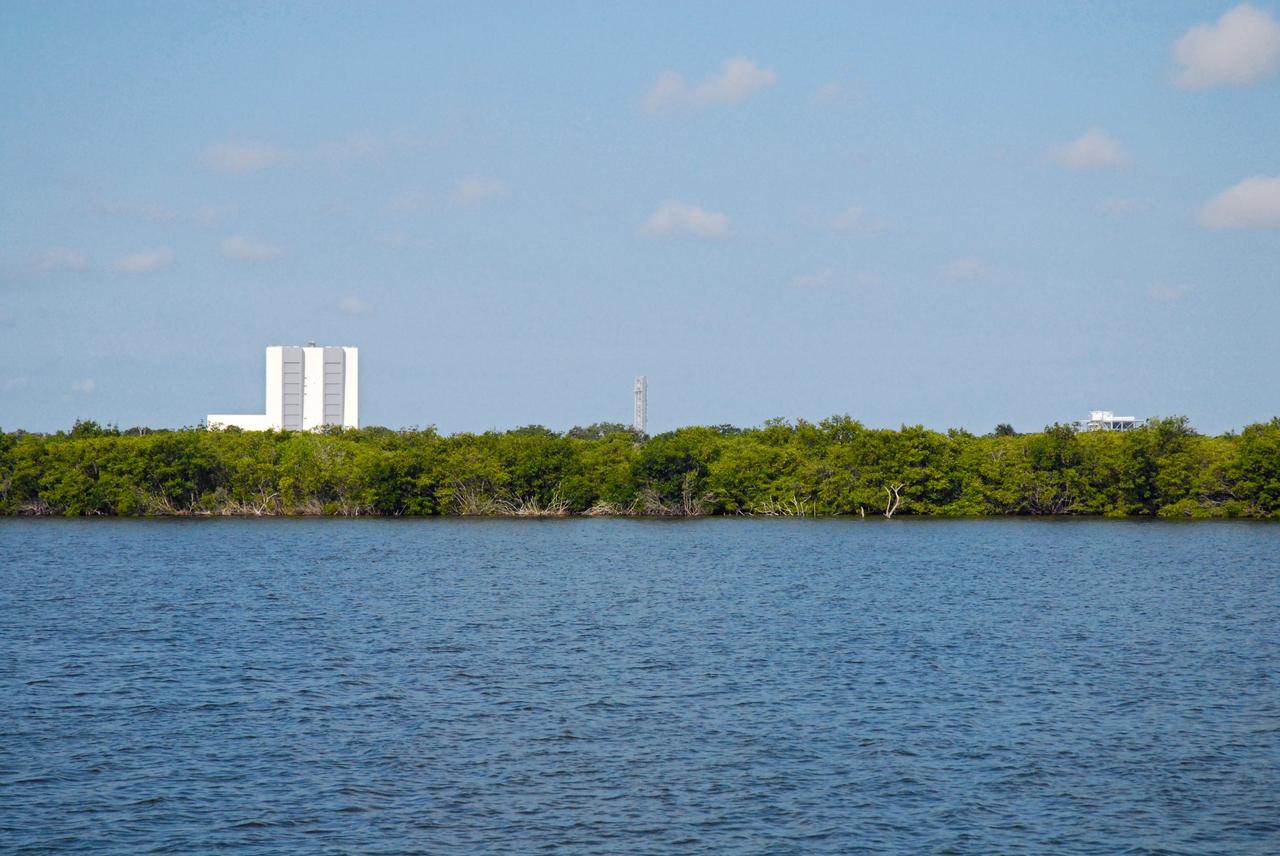
CAPE CANAVERAL, Fla. – The Vehicle Assembly Building, or VAB, and NASA's new mobile launcher, or ML, are seen in the distance during a field-guided boat tour of NASA's Kennedy Space Center in Florida. As part of the center's first-ever Innovation Expo, the tour, called "Living Outdoor Laboratory for Environmental Sustainability," is giving employees the opportunity to see the unique estuarine ecosystems that are protected from development by the presence of Kennedy and the Merritt Island National Wildlife Refuge. The 355-foot-tall ML structure, which took about two years to construct, will be modified by NASA’s Ground Systems Development and Operations, or GSDO, Program to support NASA’s Space Launch System, the heavy-lift rocket that will launch astronauts into deep space on future exploration missions. The diverse and healthy area encompassing about 140,000 acres of central Florida's east coast has been closed to the public for 50 years, allowing the coastal dunes, saltwater estuaries and marshes, freshwater impoundments, scrub, pine flatwoods, and hardwood hammocks to provide habitats for more than 1,000 species of plants and animals. Innovation Expo is showcasing the innovative work taking place throughout the center's facilities and labs to encourage employees to work together to solve future challenges. For more information, visit http://www.nasa.gov/kennedy. Photo credit: NASA
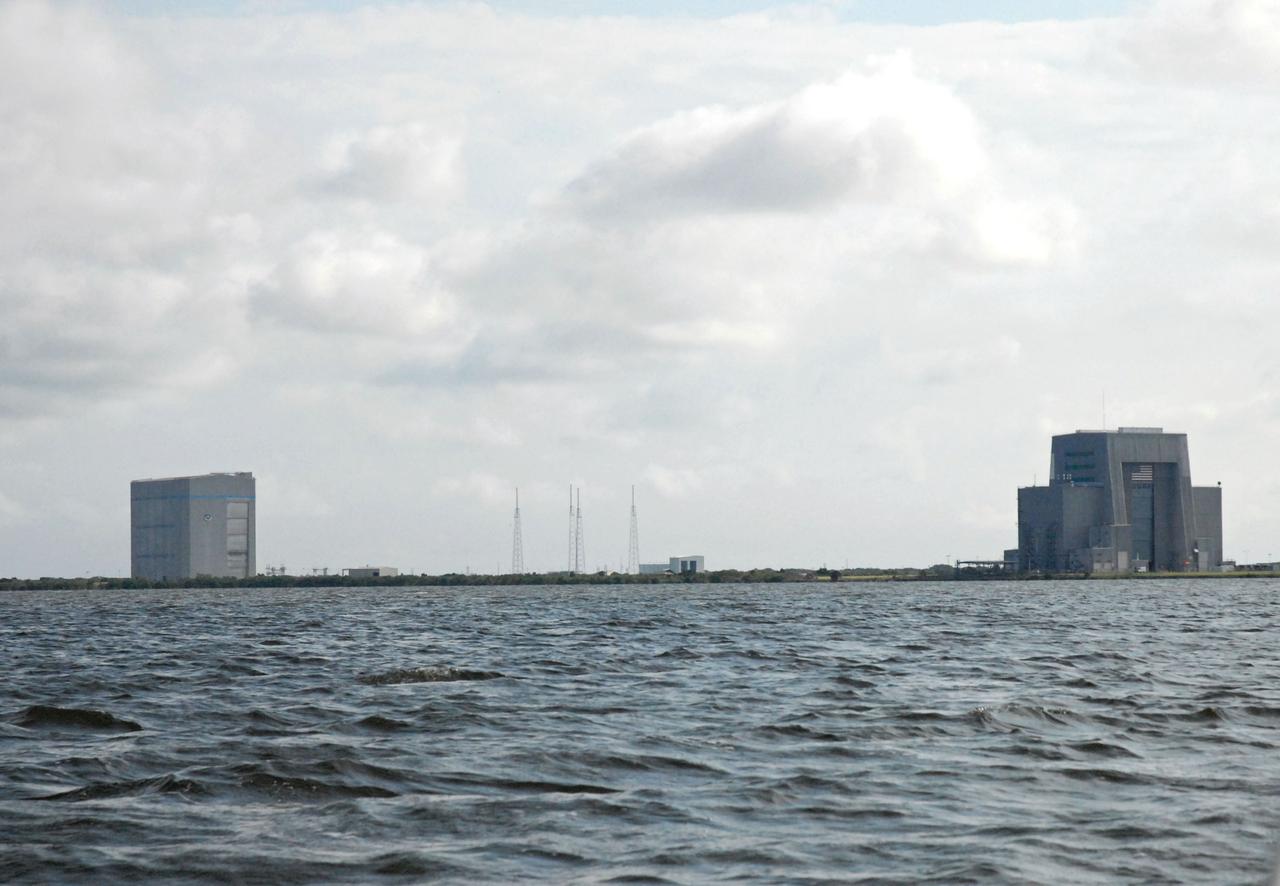
CAPE CANAVERAL, Fla. – Cape Canaveral Air Force Station's Solid Motor Assembly and Readiness Facility, or SMARF, Space Launch Complex 40, Space Exploration Technologies, or SpaceX, facility, and Solid Motor Assembly Building, or SMAB, are seen in the distance during a field-guided boat tour of NASA's Kennedy Space Center in Florida. As part of the center's first-ever Innovation Expo, the tour, called "Living Outdoor Laboratory for Environmental Sustainability," is giving employees the opportunity to see the unique estuarine ecosystems that are protected from development by the presence of Kennedy and the Merritt Island National Wildlife Refuge. The diverse and healthy area encompassing about 140,000 acres of central Florida's east coast has been closed to the public for 50 years, allowing the coastal dunes, saltwater estuaries and marshes, freshwater impoundments, scrub, pine flatwoods, and hardwood hammocks to provide habitats for more than 1,000 species of plants and animals. Innovation Expo is showcasing the innovative work taking place throughout the center's facilities and labs to encourage employees to work together to solve future challenges. For more information, visit http://www.nasa.gov/kennedy. Photo credit: NASA
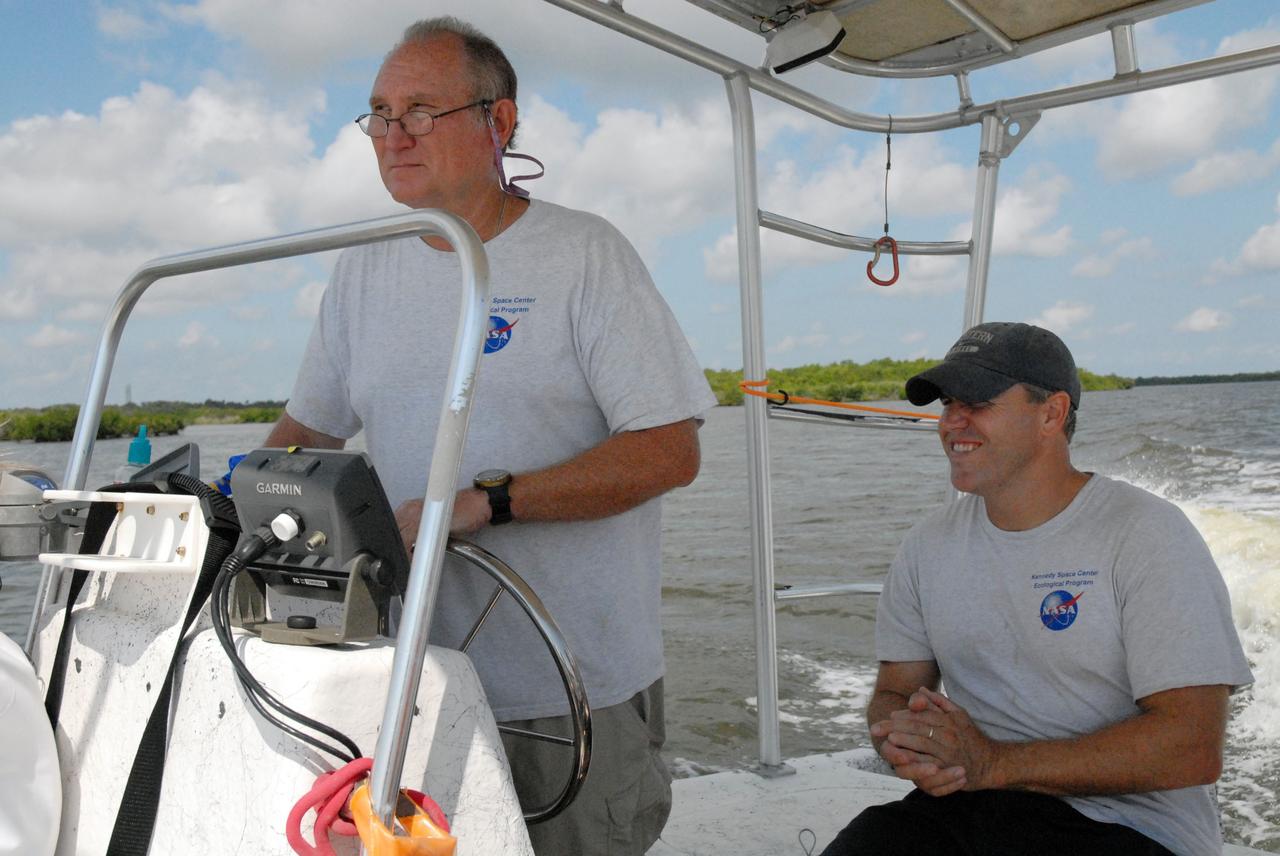
CAPE CANAVERAL, Fla. – Aquatic biologists Doug Scheidt, left, and Eric Reyier with Innovative Health Applications, or IHA, lead a field-guided boat tour of NASA's Kennedy Space Center in Florida. As part of the center's first-ever Innovation Expo, the tour, called "Living Outdoor Laboratory for Environmental Sustainability," is giving employees the opportunity to see the unique estuarine ecosystems that are protected from development by the presence of Kennedy and the Merritt Island National Wildlife Refuge. The diverse and healthy area encompassing about 140,000 acres of central Florida's east coast has been closed to the public for 50 years, allowing the coastal dunes, saltwater estuaries and marshes, freshwater impoundments, scrub, pine flatwoods, and hardwood hammocks to provide habitats for more than 1,000 species of plants and animals. Innovation Expo is showcasing the innovative work taking place throughout the center's facilities and labs to encourage employees to work together to solve future challenges. For more information, visit http://www.nasa.gov/kennedy. Photo credit: NASA
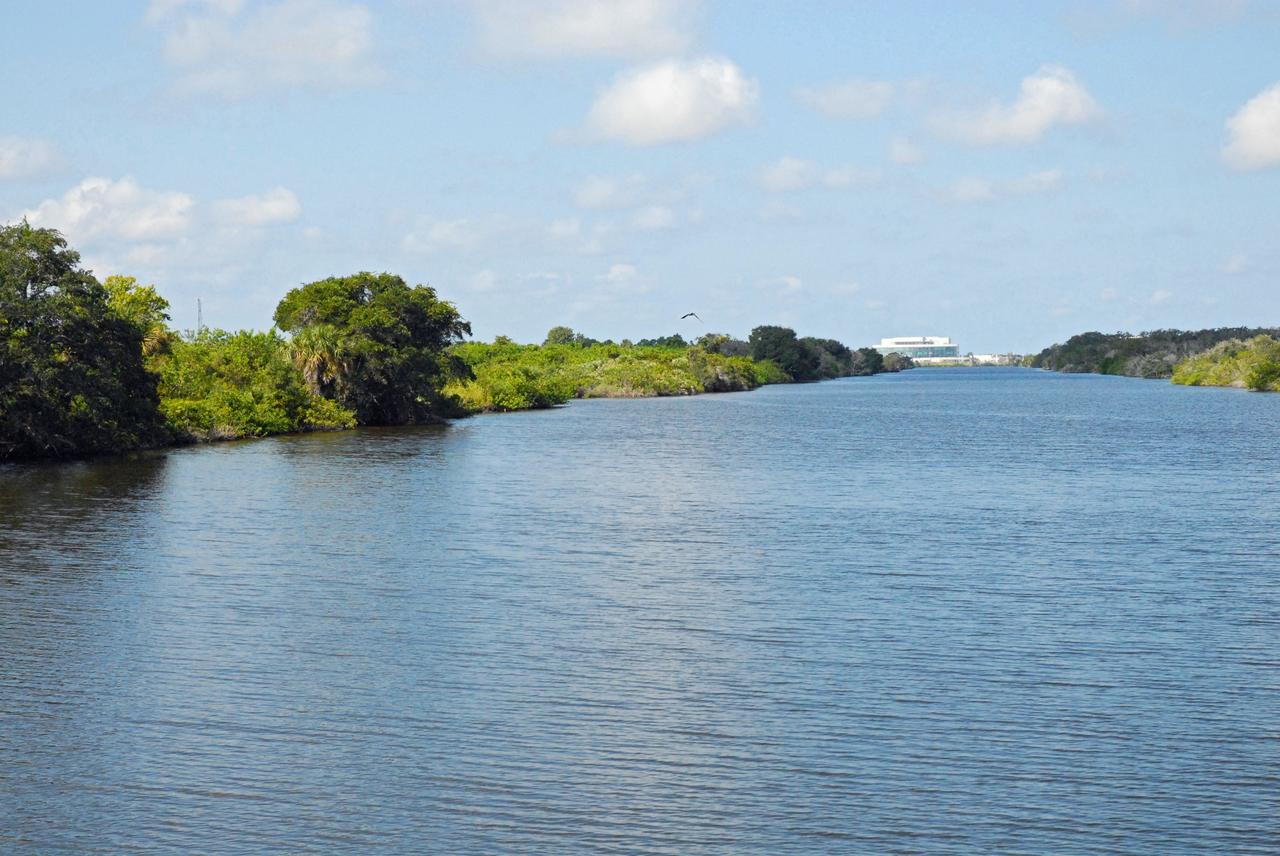
CAPE CANAVERAL, Fla. – Operations Support Building II, or OSBII, is seen in the distance during a field-guided boat tour of NASA's Kennedy Space Center in Florida. As part of the center's first-ever Innovation Expo, the tour, called "Living Outdoor Laboratory for Environmental Sustainability," is giving employees the opportunity to see the unique estuarine ecosystems that are protected from development by the presence of Kennedy and the Merritt Island National Wildlife Refuge. The diverse and healthy area encompassing about 140,000 acres of central Florida's east coast has been closed to the public for 50 years, allowing the coastal dunes, saltwater estuaries and marshes, freshwater impoundments, scrub, pine flatwoods, and hardwood hammocks to provide habitats for more than 1,000 species of plants and animals. Innovation Expo is showcasing the innovative work taking place throughout the center's facilities and labs to encourage employees to work together to solve future challenges. For more information, visit http://www.nasa.gov/kennedy. Photo credit: NASA
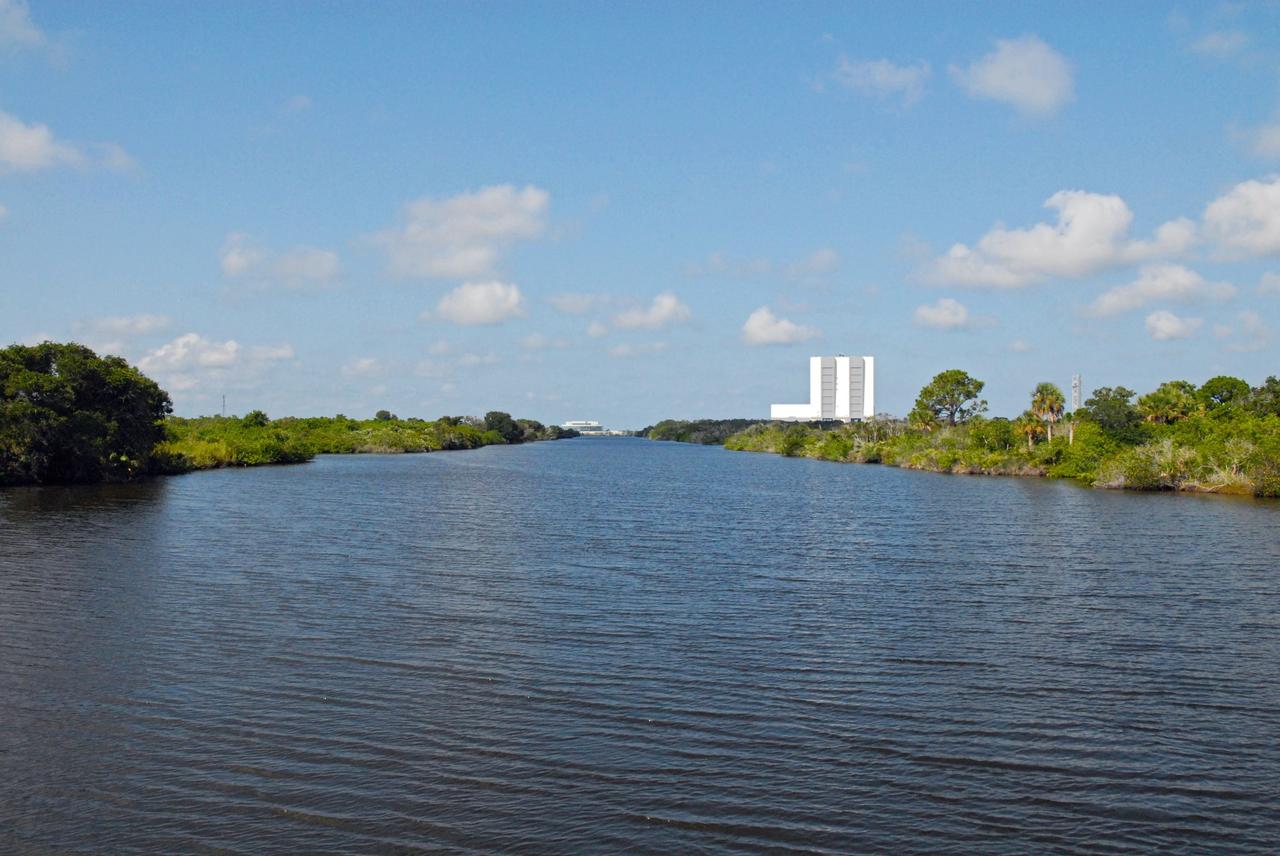
CAPE CANAVERAL, Fla. – Operations Support Building II, or OSBII, left, and the Vehicle Assembly Building, or VAB, are seen in the distance during a field-guided boat tour of NASA's Kennedy Space Center in Florida. As part of the center's first-ever Innovation Expo, the tour, called "Living Outdoor Laboratory for Environmental Sustainability," is giving employees the opportunity to see the unique estuarine ecosystems that are protected from development by the presence of Kennedy and the Merritt Island National Wildlife Refuge. The diverse and healthy area encompassing about 140,000 acres of central Florida's east coast has been closed to the public for 50 years, allowing the coastal dunes, saltwater estuaries and marshes, freshwater impoundments, scrub, pine flatwoods, and hardwood hammocks to provide habitats for more than 1,000 species of plants and animals. Innovation Expo is showcasing the innovative work taking place throughout the center's facilities and labs to encourage employees to work together to solve future challenges. For more information, visit http://www.nasa.gov/kennedy. Photo credit: NASA
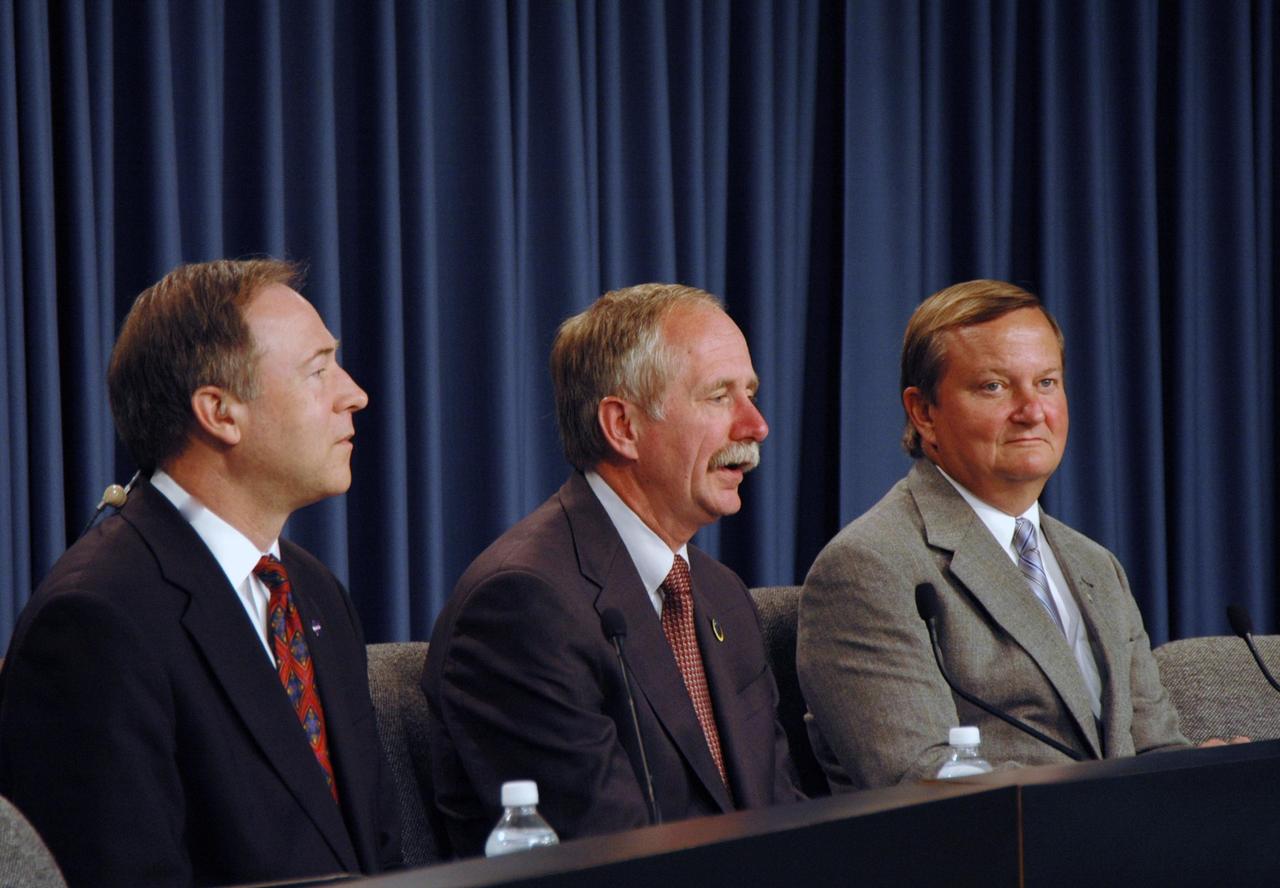
KENNEDY SPACE CENTER, FLA. -- At a post-landing news conference, NASA Associate Administrator for Space Operations William Gerstenmaier (center) responds to a question from the media. At right is Shuttle Launch Director Mike Leinbach; at left is Assistant Administrator for NASA Public Affairs David Mould. After a round trip of nearly 5.3 million miles, space shuttle Atlantis and crew returned to Earth with a landing at 9:07 a.m. EST. The shuttle landed on orbit 202 to complete the 13-day STS-122 mission. Main gear touchdown was 9:07:10 a.m. Nose gear touchdown was 9:07:20 a.m. Wheel stop was at 9:08:08 a.m. Mission elapsed time was 12 days, 18 hours, 21 minutes and 44 seconds. During the mission, Atlantis' crew installed the new Columbus laboratory, leaving a larger space station and one with increased science capabilities. The Columbus Research Module adds nearly 1,000 cubic feet of habitable volume and affords room for 10 experiment racks, each an independent science lab. Photo credit: NASA/Jim Grossmann
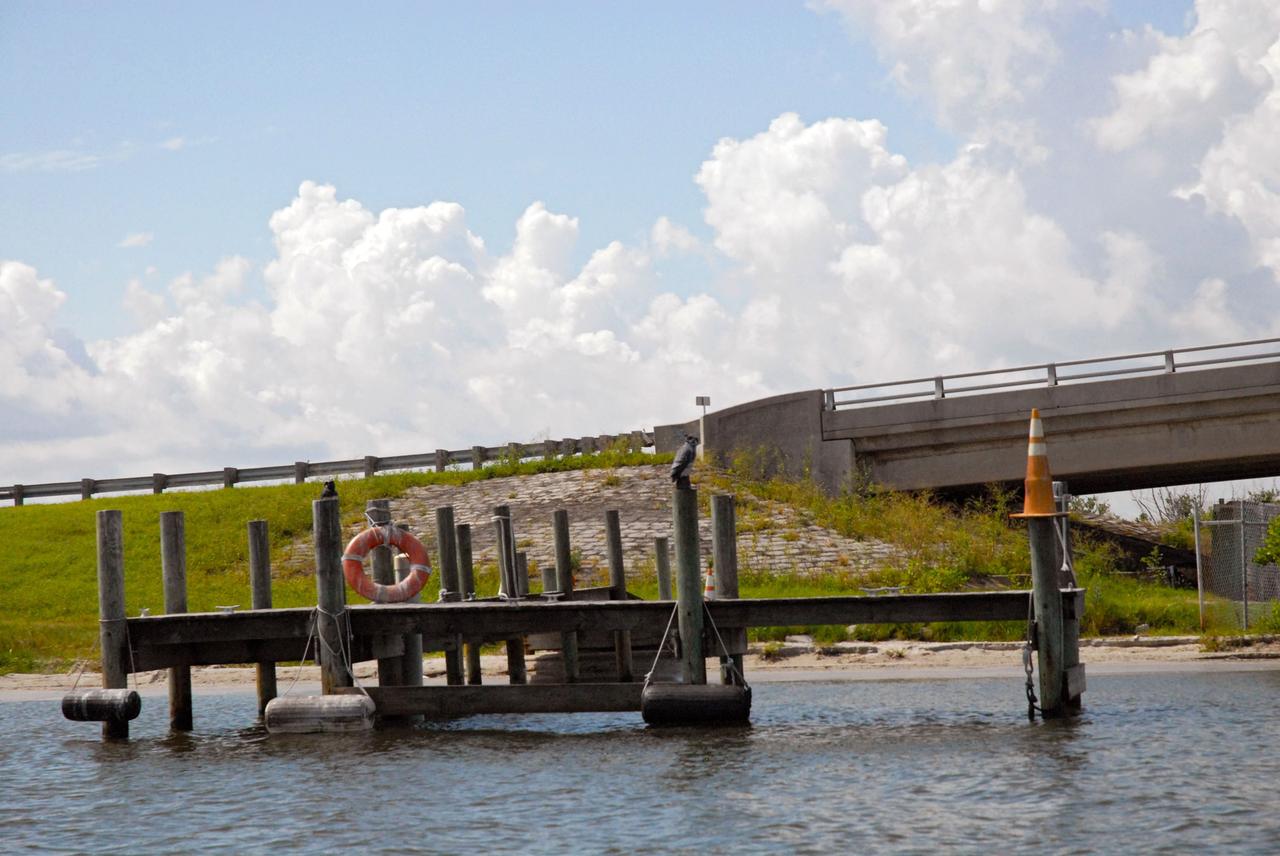
CAPE CANAVERAL, Fla. – A boat dock and the Roy D. Bridges Jr. Bridge connecting NASA Kennedy Space Center's Industrial Area to Cape Canaveral Air Force Station's Industrial Area are seen during a field-guided boat tour. As part of the Kennedy's first-ever Innovation Expo, the tour, called "Living Outdoor Laboratory for Environmental Sustainability," is giving employees the opportunity to see the unique estuarine ecosystems that are protected from development by the presence of the center and the Merritt Island National Wildlife Refuge. The diverse and healthy area encompassing about 140,000 acres of central Florida's east coast has been closed to the public for 50 years, allowing the coastal dunes, saltwater estuaries and marshes, freshwater impoundments, scrub, pine flatwoods, and hardwood hammocks to provide habitats for more than 1,000 species of plants and animals. Innovation Expo is showcasing the innovative work taking place throughout the center's facilities and labs to encourage employees to work together to solve future challenges. For more information, visit http://www.nasa.gov/kennedy. Photo credit: NASA
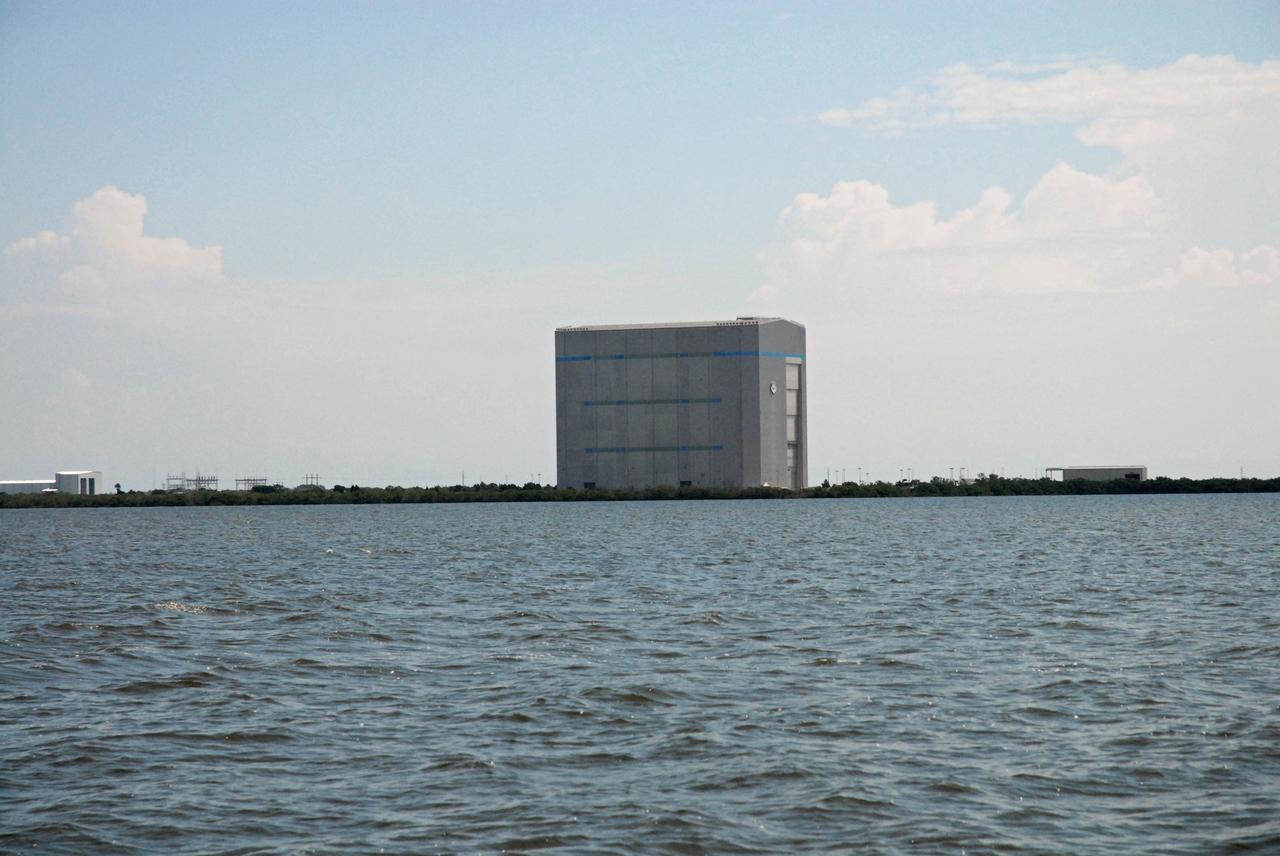
CAPE CANAVERAL, Fla. – Cape Canaveral Air Force Station's Solid Motor Assembly and Readiness Facility, or SMARF, Space Launch Complex 40, and Space Exploration Technologies, or SpaceX, facility, is seen in the distance during a field-guided boat tour of NASA's Kennedy Space Center in Florida. As part of the center's first-ever Innovation Expo, the tour, called "Living Outdoor Laboratory for Environmental Sustainability," is giving employees the opportunity to see the unique estuarine ecosystems that are protected from development by the presence of Kennedy and the Merritt Island National Wildlife Refuge. The diverse and healthy area encompassing about 140,000 acres of central Florida's east coast has been closed to the public for 50 years, allowing the coastal dunes, saltwater estuaries and marshes, freshwater impoundments, scrub, pine flatwoods, and hardwood hammocks to provide habitats for more than 1,000 species of plants and animals. Innovation Expo is showcasing the innovative work taking place throughout the center's facilities and labs to encourage employees to work together to solve future challenges. For more information, visit http://www.nasa.gov/kennedy. Photo credit: NASA
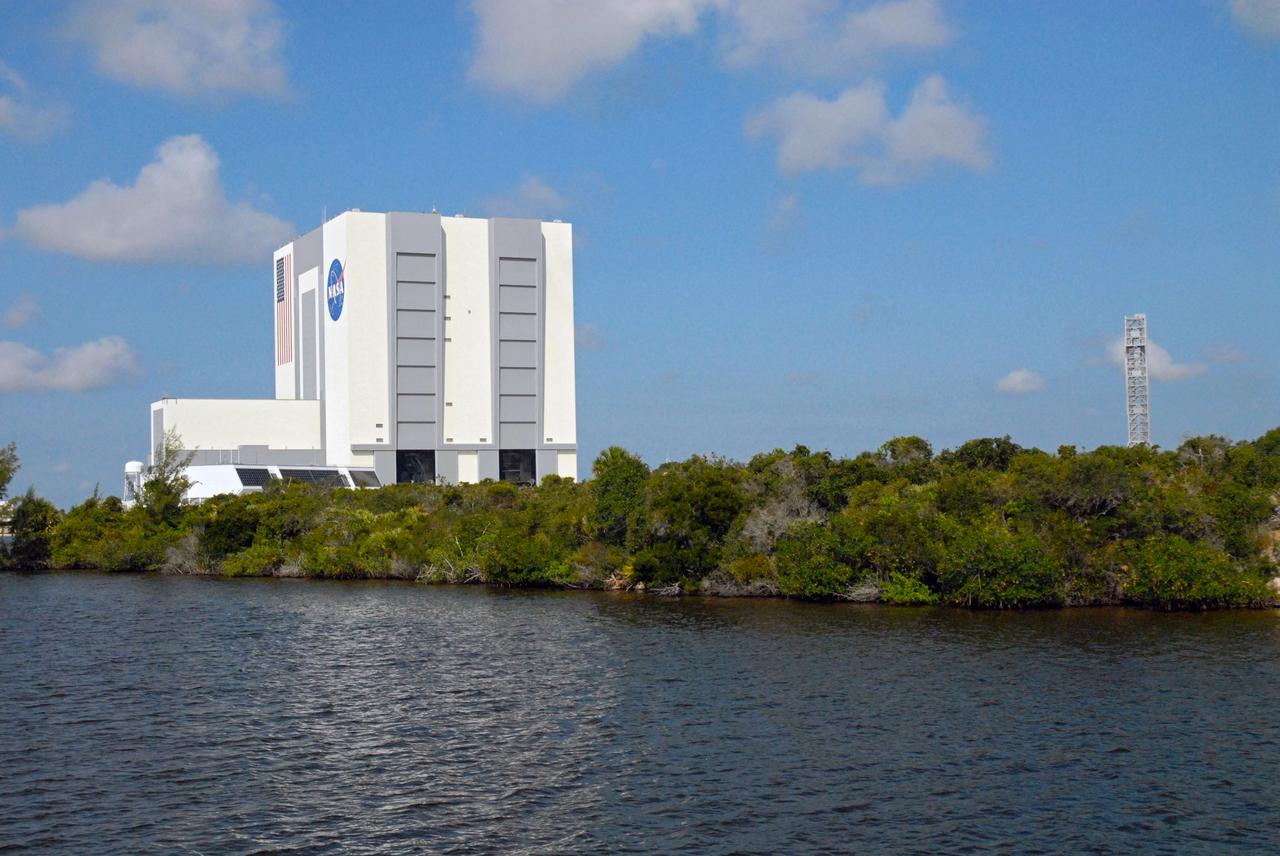
CAPE CANAVERAL, Fla. – The Vehicle Assembly Building, or VAB, and NASA's new mobile launcher, or ML, are seen during a field-guided boat tour of NASA's Kennedy Space Center in Florida. As part of the center's first-ever Innovation Expo, the tour, called "Living Outdoor Laboratory for Environmental Sustainability," is giving employees the opportunity to see the unique estuarine ecosystems that are protected from development by the presence of Kennedy and the Merritt Island National Wildlife Refuge. The 355-foot-tall ML structure, which took about two years to construct, will be modified by NASA’s Ground Systems Development and Operations, or GSDO, Program to support NASA’s Space Launch System, the heavy-lift rocket that will launch astronauts into deep space on future exploration missions. The diverse and healthy area encompassing about 140,000 acres of central Florida's east coast has been closed to the public for 50 years, allowing the coastal dunes, saltwater estuaries and marshes, freshwater impoundments, scrub, pine flatwoods, and hardwood hammocks to provide habitats for more than 1,000 species of plants and animals. Innovation Expo is showcasing the innovative work taking place throughout the center's facilities and labs to encourage employees to work together to solve future challenges. For more information, visit http://www.nasa.gov/kennedy. Photo credit: NASA
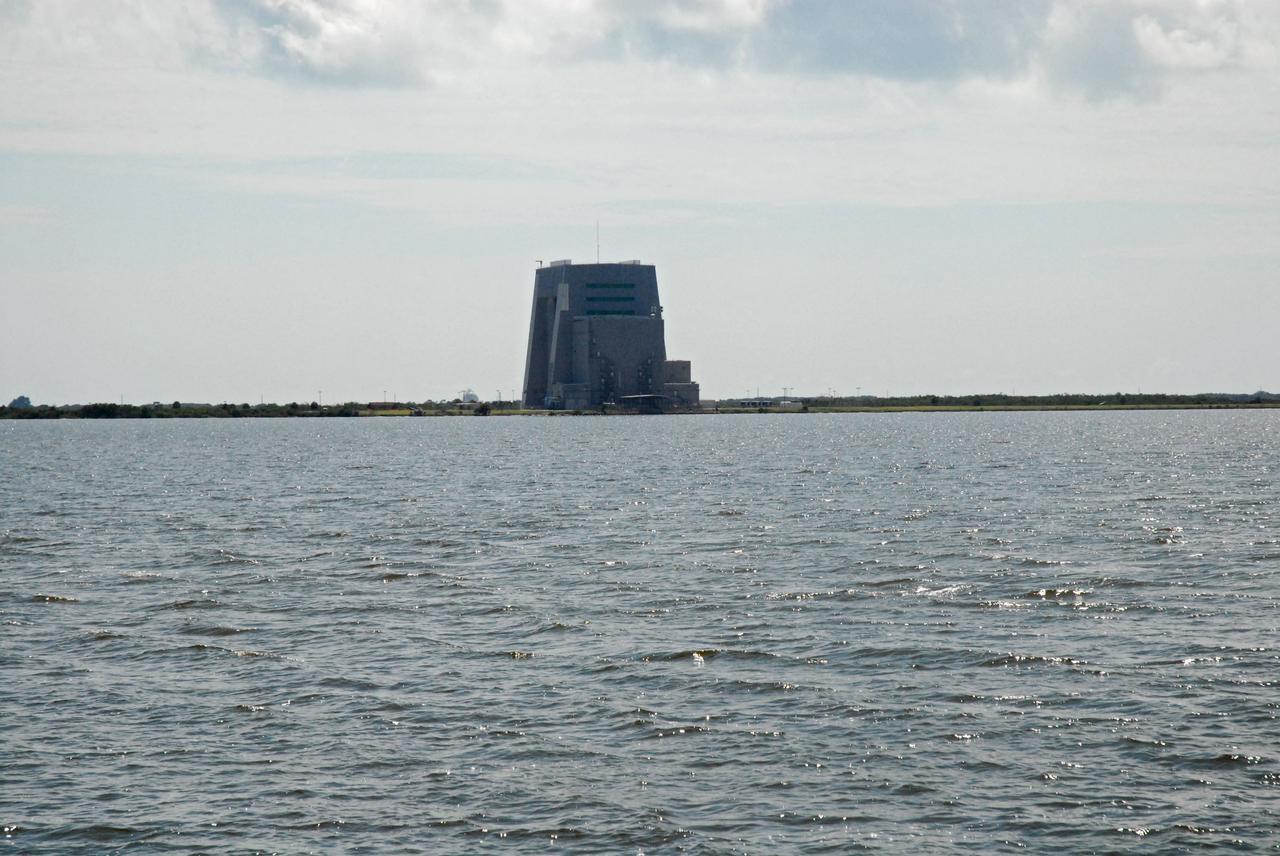
CAPE CANAVERAL, Fla. – Cape Canaveral Air Force Station's Solid Motor Assembly Building, or SMAB, is seen in the distance during a field-guided boat tour of NASA's Kennedy Space Center in Florida. As part of the center's first-ever Innovation Expo, the tour, called "Living Outdoor Laboratory for Environmental Sustainability," is giving employees the opportunity to see the unique estuarine ecosystems that are protected from development by the presence of Kennedy and the Merritt Island National Wildlife Refuge. The diverse and healthy area encompassing about 140,000 acres of central Florida's east coast has been closed to the public for 50 years, allowing the coastal dunes, saltwater estuaries and marshes, freshwater impoundments, scrub, pine flatwoods, and hardwood hammocks to provide habitats for more than 1,000 species of plants and animals. Innovation Expo is showcasing the innovative work taking place throughout the center's facilities and labs to encourage employees to work together to solve future challenges. For more information, visit http://www.nasa.gov/kennedy. Photo credit: NASA
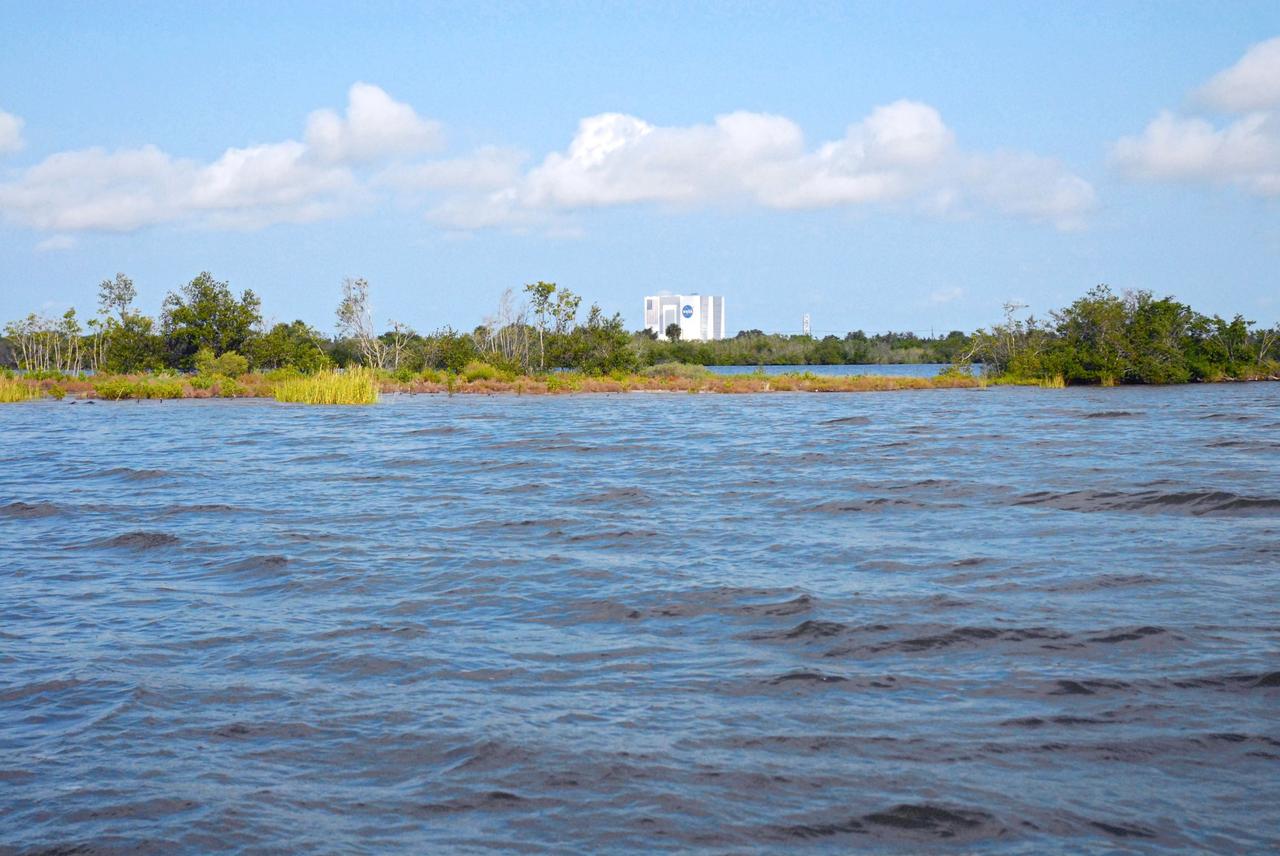
CAPE CANAVERAL, Fla. – The Vehicle Assembly Building, or VAB, is seen in the distance during a field-guided boat tour of NASA's Kennedy Space Center in Florida. As part of the center's first-ever Innovation Expo, the tour, called "Living Outdoor Laboratory for Environmental Sustainability," is giving employees the opportunity to see the unique estuarine ecosystems that are protected from development by the presence of Kennedy and the Merritt Island National Wildlife Refuge. The diverse and healthy area encompassing about 140,000 acres of central Florida's east coast has been closed to the public for 50 years, allowing the coastal dunes, saltwater estuaries and marshes, freshwater impoundments, scrub, pine flatwoods, and hardwood hammocks to provide habitats for more than 1,000 species of plants and animals. Innovation Expo is showcasing the innovative work taking place throughout the center's facilities and labs to encourage employees to work together to solve future challenges. For more information, visit http://www.nasa.gov/kennedy. Photo credit: NASA
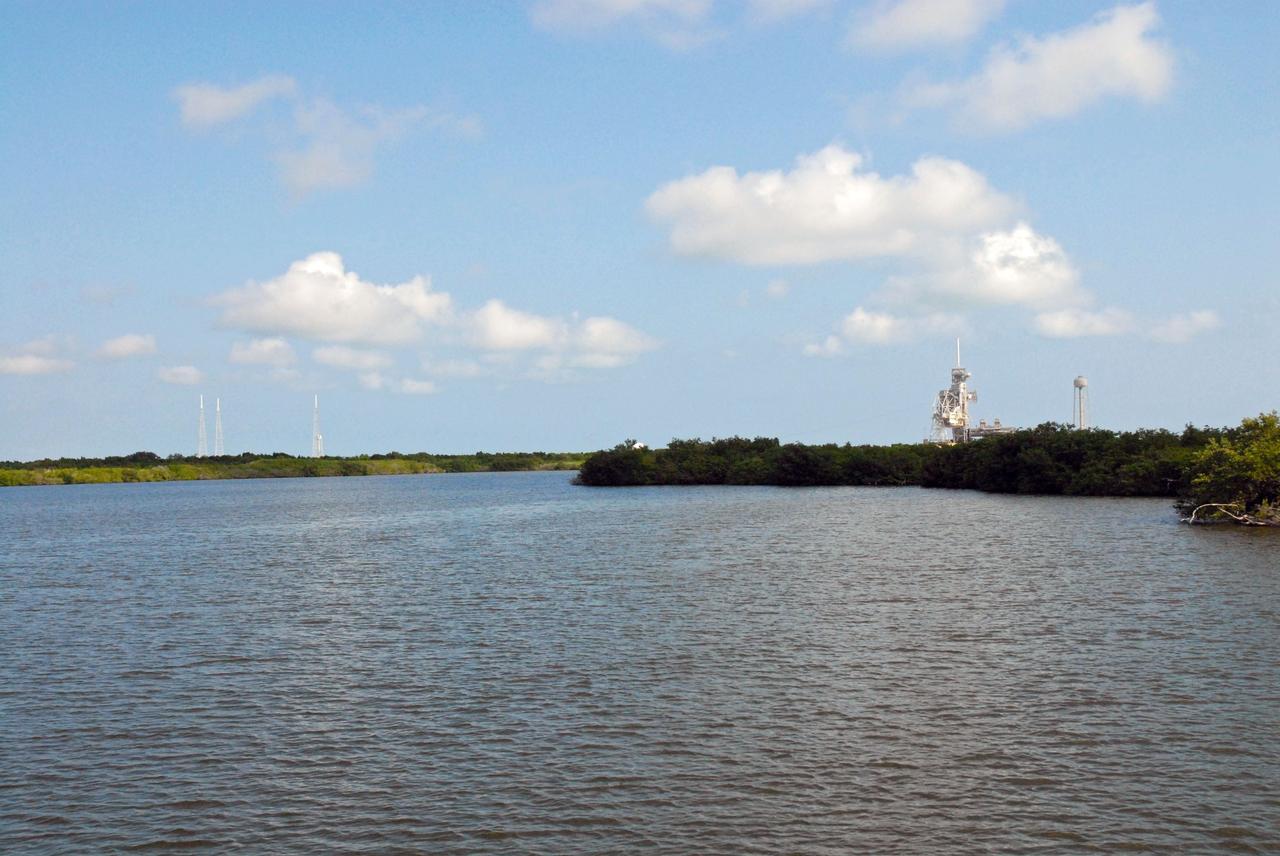
CAPE CANAVERAL, Fla. – Launch Pads 39A, right, and 39B, left, are seen in the distance during a field-guided boat tour of NASA's Kennedy Space Center in Florida. As part of the center's first-ever Innovation Expo, the tour, called "Living Outdoor Laboratory for Environmental Sustainability," is giving employees the opportunity to see the unique estuarine ecosystems that are protected from development by the presence of Kennedy and the Merritt Island National Wildlife Refuge. The diverse and healthy area encompassing about 140,000 acres of central Florida's east coast has been closed to the public for 50 years, allowing the coastal dunes, saltwater estuaries and marshes, freshwater impoundments, scrub, pine flatwoods, and hardwood hammocks to provide habitats for more than 1,000 species of plants and animals. Innovation Expo is showcasing the innovative work taking place throughout the center's facilities and labs to encourage employees to work together to solve future challenges. For more information, visit http://www.nasa.gov/kennedy. Photo credit: NASA
![ISS007-E-18078 (26 October 2003) --- The fires in the San Bernardino Mountains, fueled by Santa Ana winds, burned out of control on the morning of Oct. 26, 2003, when these images were taken from the International Space Station at roughly 11 a.m. (PST). Thick yellow smoke blows south, blanketing the valley below. This image and ISS007-E-18082, looking southeast, capture the smoke pall as the ISS approached and passed over the region. Image numbers 18078 and 18082 were taken roughly a minute apart. A small break in the smoke marks Cajon pass. Content was provided by JSC’s Earth Observation Lab. The International Space Station Program {link to http://spaceflight.nasa.gov} supports the laboratory to help crew members take pictures of Earth that will be of the greatest value to scientists and the public, and to make those images freely available on the Internet. Additional images taken by astronauts and cosmonauts can be viewed at the NASA/JSC Gateway to Astronaut Photography of Earth [link to http://eol.jsc.nasa.gov/].](https://images-assets.nasa.gov/image/iss007e18078/iss007e18078~medium.jpg)
ISS007-E-18078 (26 October 2003) --- The fires in the San Bernardino Mountains, fueled by Santa Ana winds, burned out of control on the morning of Oct. 26, 2003, when these images were taken from the International Space Station at roughly 11 a.m. (PST). Thick yellow smoke blows south, blanketing the valley below. This image and ISS007-E-18082, looking southeast, capture the smoke pall as the ISS approached and passed over the region. Image numbers 18078 and 18082 were taken roughly a minute apart. A small break in the smoke marks Cajon pass. Content was provided by JSC’s Earth Observation Lab. The International Space Station Program {link to http://spaceflight.nasa.gov} supports the laboratory to help crew members take pictures of Earth that will be of the greatest value to scientists and the public, and to make those images freely available on the Internet. Additional images taken by astronauts and cosmonauts can be viewed at the NASA/JSC Gateway to Astronaut Photography of Earth [link to http://eol.jsc.nasa.gov/].
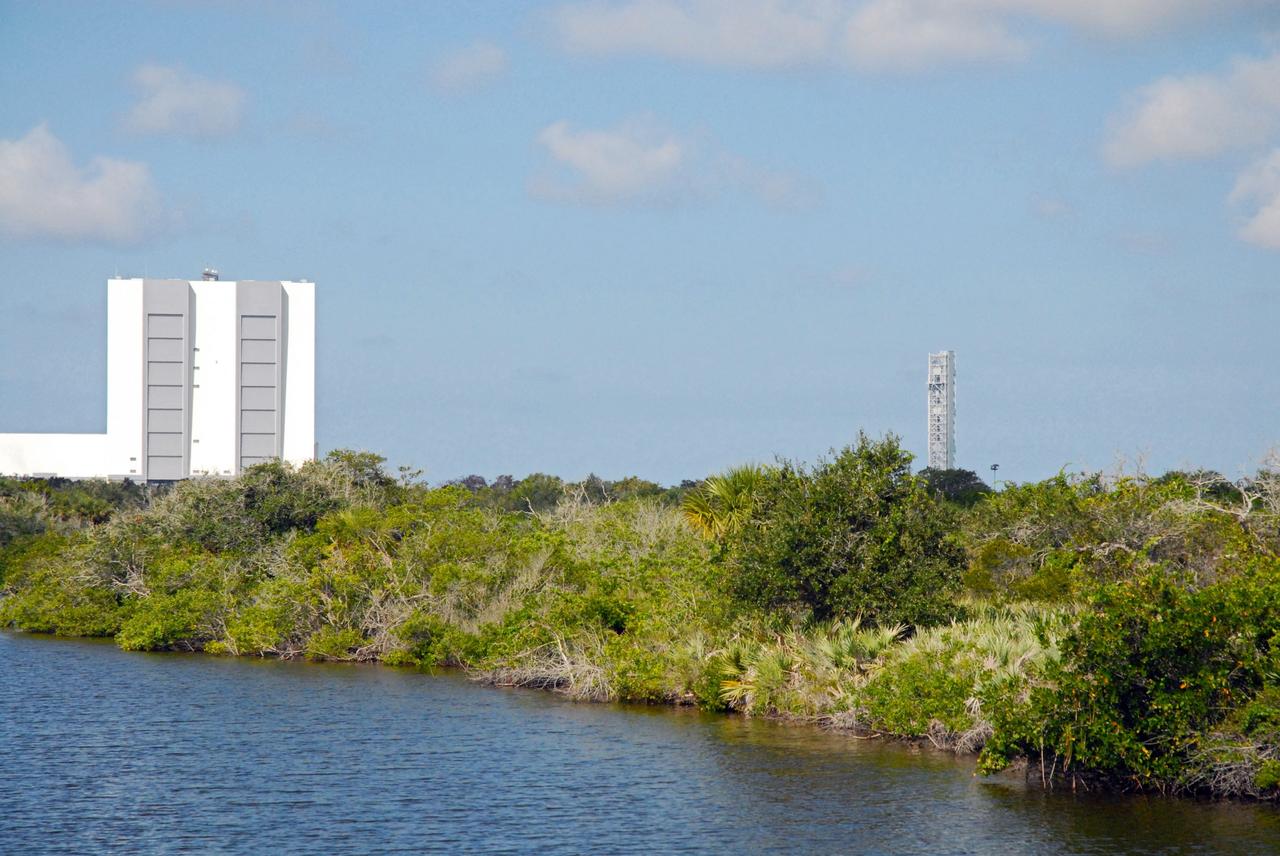
CAPE CANAVERAL, Fla. – The Vehicle Assembly Building, or VAB, and NASA's new mobile launcher, or ML, are seen in the distance during a field-guided boat tour of NASA's Kennedy Space Center in Florida. As part of the center's first-ever Innovation Expo, the tour, called "Living Outdoor Laboratory for Environmental Sustainability," is giving employees the opportunity to see the unique estuarine ecosystems that are protected from development by the presence of Kennedy and the Merritt Island National Wildlife Refuge. The 355-foot-tall ML structure, which took about two years to construct, will be modified by NASA’s Ground Systems Development and Operations, or GSDO, Program to support NASA’s Space Launch System, the heavy-lift rocket that will launch astronauts into deep space on future exploration missions. The diverse and healthy area encompassing about 140,000 acres of central Florida's east coast has been closed to the public for 50 years, allowing the coastal dunes, saltwater estuaries and marshes, freshwater impoundments, scrub, pine flatwoods, and hardwood hammocks to provide habitats for more than 1,000 species of plants and animals. Innovation Expo is showcasing the innovative work taking place throughout the center's facilities and labs to encourage employees to work together to solve future challenges. For more information, visit http://www.nasa.gov/kennedy. Photo credit: NASA
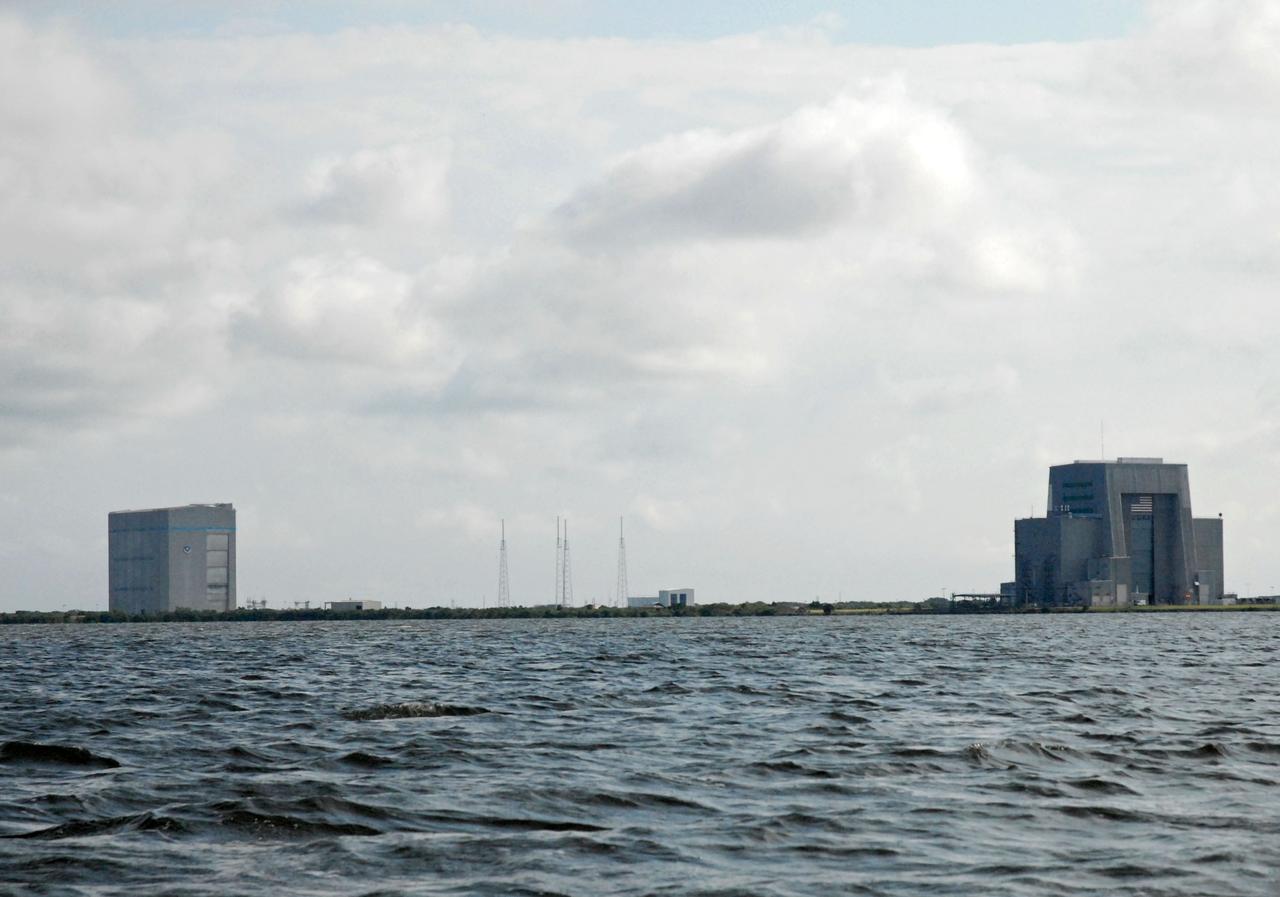
CAPE CANAVERAL, Fla. – The Vehicle Assembly Building, or VAB, is seen in the distance during a field-guided boat tour of NASA's Kennedy Space Center in Florida. As part of the center's first-ever Innovation Expo, the tour, called "Living Outdoor Laboratory for Environmental Sustainability," is giving employees the opportunity to see the unique estuarine ecosystems that are protected from development by the presence of Kennedy and the Merritt Island National Wildlife Refuge. The diverse and healthy area encompassing about 140,000 acres of central Florida's east coast has been closed to the public for 50 years, allowing the coastal dunes, saltwater estuaries and marshes, freshwater impoundments, scrub, pine flatwoods, and hardwood hammocks to provide habitats for more than 1,000 species of plants and animals. Innovation Expo is showcasing the innovative work taking place throughout the center's facilities and labs to encourage employees to work together to solve future challenges. For more information, visit http://www.nasa.gov/kennedy. Photo credit: NASA
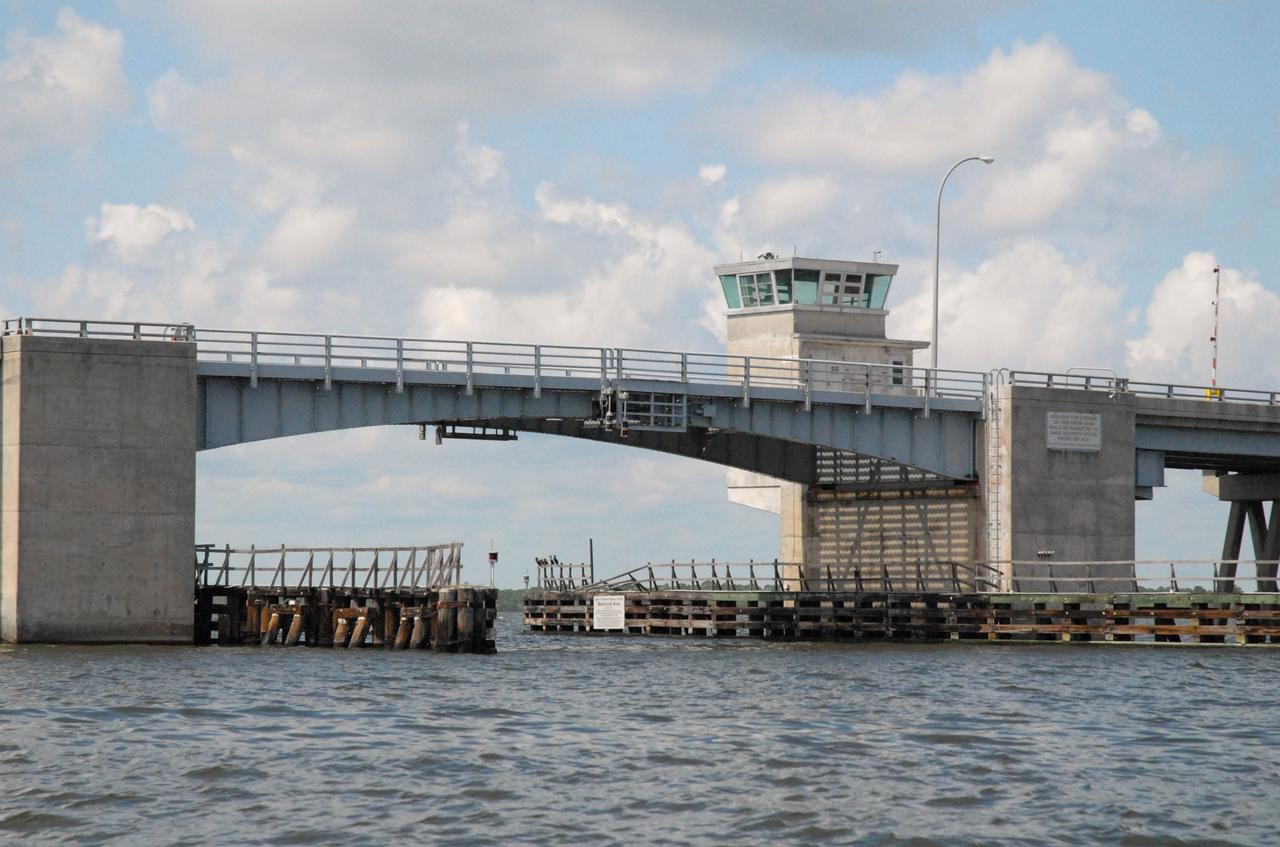
CAPE CANAVERAL, Fla. – The Roy D. Bridges Jr. Bridge connecting NASA Kennedy Space Center's Industrial Area to Cape Canaveral Air Force Station's Industrial Area is seen during a field-guided boat tour. As part of the Kennedy's first-ever Innovation Expo, the tour, called "Living Outdoor Laboratory for Environmental Sustainability," is giving employees the opportunity to see the unique estuarine ecosystems that are protected from development by the presence of the center and the Merritt Island National Wildlife Refuge. The diverse and healthy area encompassing about 140,000 acres of central Florida's east coast has been closed to the public for 50 years, allowing the coastal dunes, saltwater estuaries and marshes, freshwater impoundments, scrub, pine flatwoods, and hardwood hammocks to provide habitats for more than 1,000 species of plants and animals. Innovation Expo is showcasing the innovative work taking place throughout the center's facilities and labs to encourage employees to work together to solve future challenges. For more information, visit http://www.nasa.gov/kennedy. Photo credit: NASA

CAPE CANAVERAL, Fla. -- NASA and The LEGO Group announce a three-year Space Act Agreement meant to spark the interest of children in science, technology, engineering and mathematics (STEM) with the future release of four NASA-inspired products in the toy company's LEGO CITY line. From left, are Debbie Biggs, education specialist for International Space Station National Lab Education Projects, Stephan Turnipseed, president of LEGO Education North America, Leland Melvin, NASA's associate administrator for Education, and Ann Marie Trotta, NASA Public Affairs officer. To commemorate the beginning of the partnership, two small LEGO space shuttles will launch aboard space shuttle Discovery's STS-133 mission to the International Space Station. A 40- by 70-foot activity tent will be set up at Kennedy on Nov. 3 for children of all ages to build their vision of the future with LEGO bricks. LEGO sets also will fly to the space station aboard Endeavour's STS-134 mission, and will be put together on orbit to demonstrate the challenges faced while building things in microgravity. Photo credit: NASA/Jack Pfaller
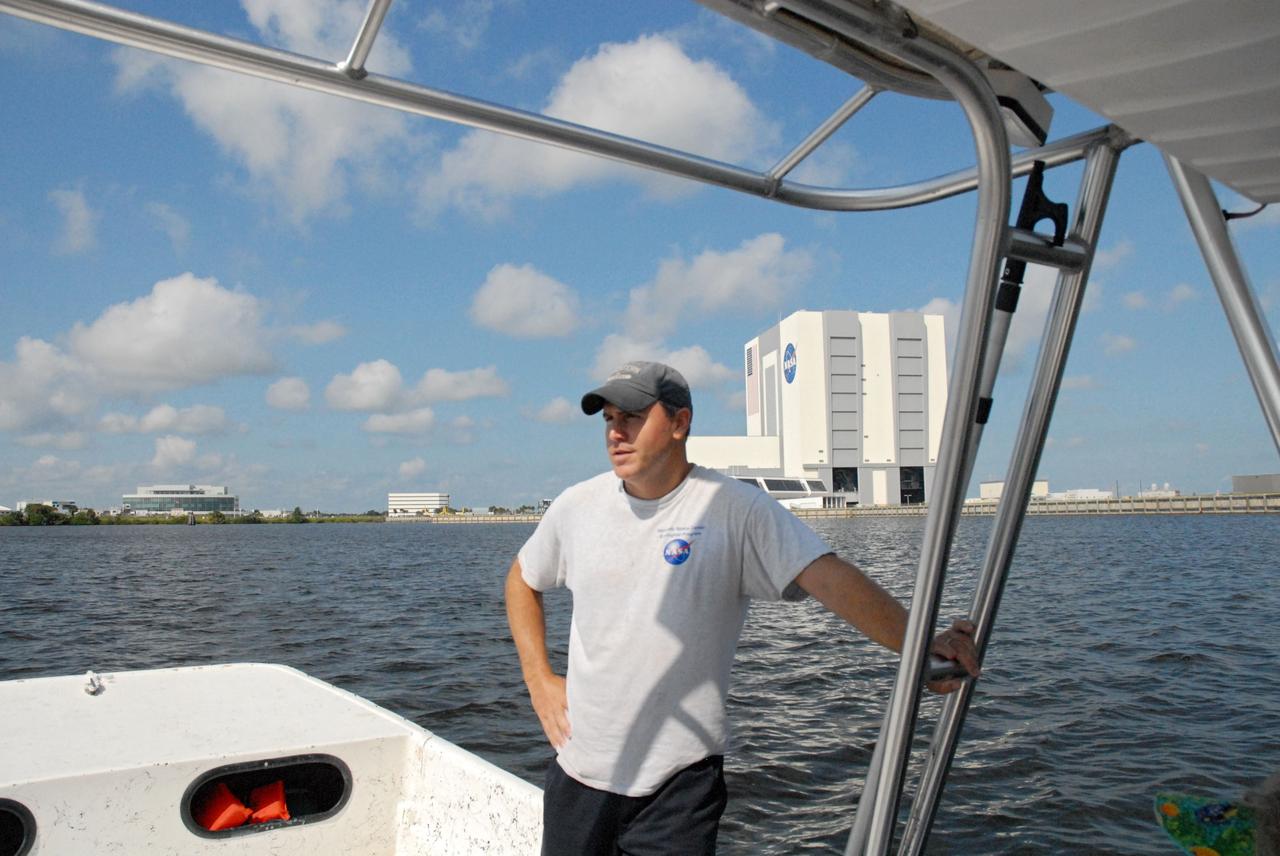
CAPE CANAVERAL, Fla. – Aquatic biologist Eric Reyier with Innovative Health Applications, or IHA, talks about the work that goes into protecting the natural habitat at a launch operations center during a field-guided boat tour of NASA's Kennedy Space Center in Florida. As part of the center's first-ever Innovation Expo, the tour, called "Living Outdoor Laboratory for Environmental Sustainability," is giving employees the opportunity to see the unique estuarine ecosystems that are protected from development by the presence of Kennedy and the Merritt Island National Wildlife Refuge. In the background is Kennedy's Launch Complex 39. The diverse and healthy area encompassing about 140,000 acres of central Florida's east coast has been closed to the public for 50 years, allowing the coastal dunes, saltwater estuaries and marshes, freshwater impoundments, scrub, pine flatwoods, and hardwood hammocks to provide habitats for more than 1,000 species of plants and animals. Innovation Expo is showcasing the innovative work taking place throughout the center's facilities and labs to encourage employees to work together to solve future challenges. For more information, visit http://www.nasa.gov/kennedy. Photo credit: NASA
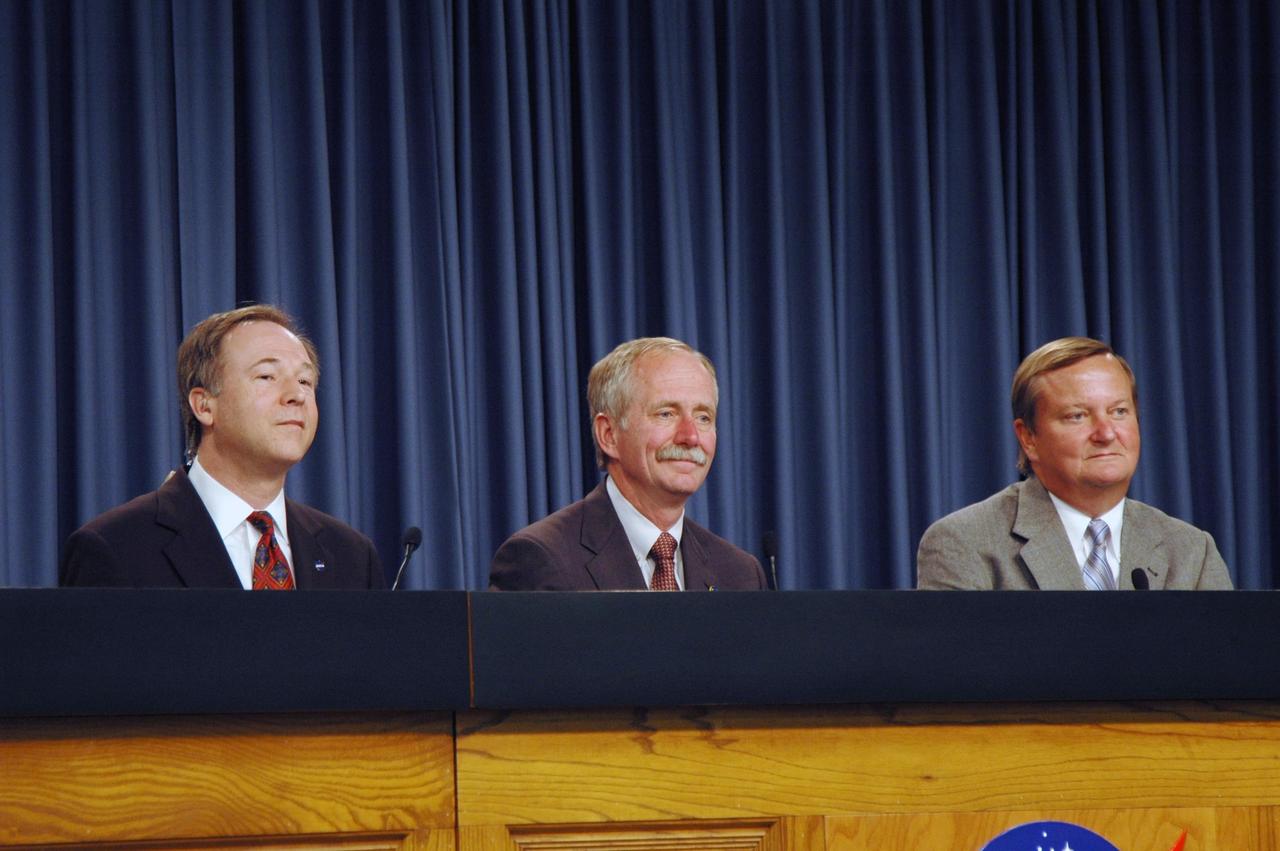
KENNEDY SPACE CENTER, FLA. -- At a post-landing news conference, NASA Associate Administrator for Space Operations William Gerstenmaier and Shuttle Launch Director Mike Leinbach (center and right) answer questions from the media. At left is Assistant Administrator for NASA Public Affairs David Mould. After a round trip of nearly 5.3 million miles, space shuttle Atlantis and crew returned to Earth with a landing at 9:07 a.m. EST. The shuttle landed on orbit 202 to complete the 13-day STS-122 mission. Main gear touchdown was 9:07:10 a.m. Nose gear touchdown was 9:07:20 a.m. Wheel stop was at 9:08:08 a.m. Mission elapsed time was 12 days, 18 hours, 21 minutes and 44 seconds. During the mission, Atlantis' crew installed the new Columbus laboratory, leaving a larger space station and one with increased science capabilities. The Columbus Research Module adds nearly 1,000 cubic feet of habitable volume and affords room for 10 experiment racks, each an independent science lab. Photo credit: NASA/Jim Grossmann
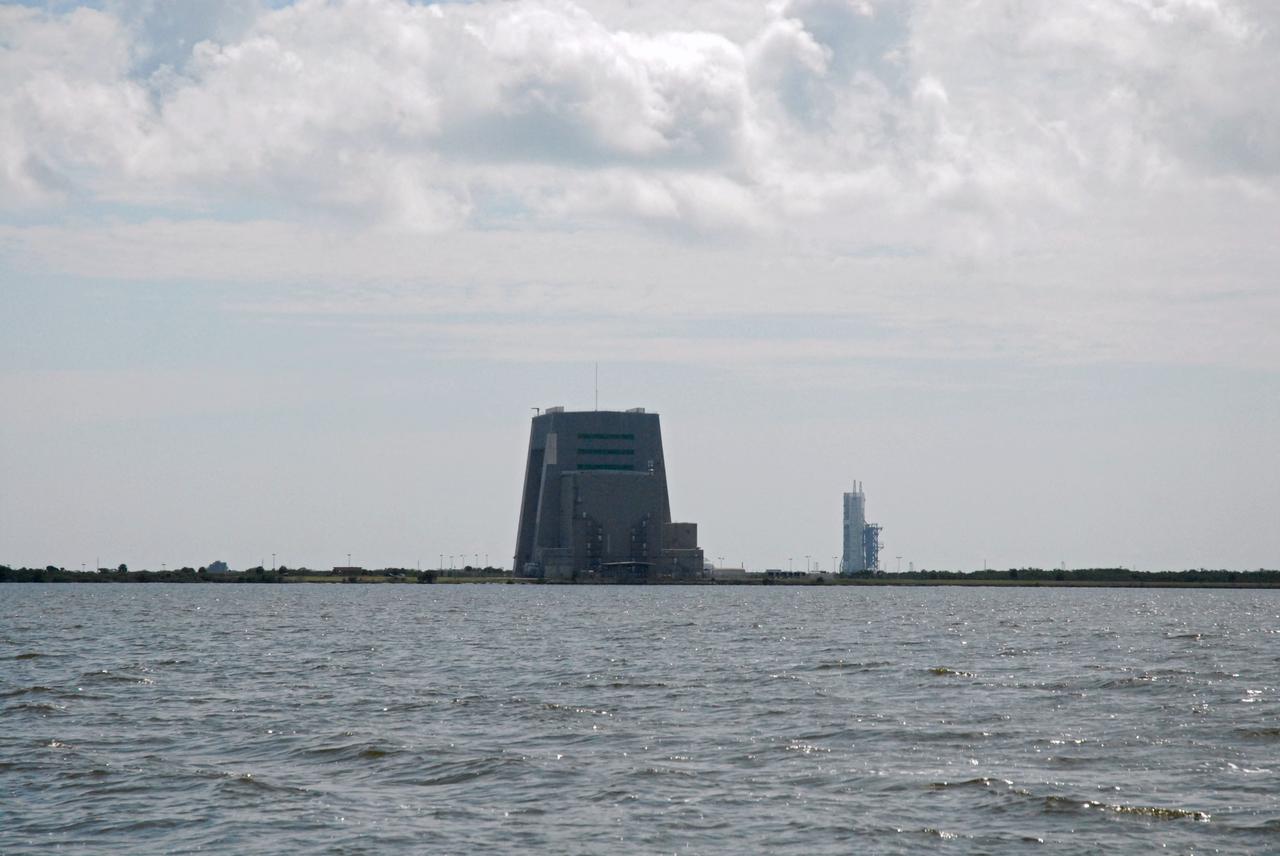
CAPE CANAVERAL, Fla. – Cape Canaveral Air Force Station's Solid Motor Assembly Building, or SMAB, and Launch Complex 37 are seen in the distance during a field-guided boat tour of NASA's Kennedy Space Center in Florida. As part of the center's first-ever Innovation Expo, the tour, called "Living Outdoor Laboratory for Environmental Sustainability," is giving employees the opportunity to see the unique estuarine ecosystems that are protected from development by the presence of Kennedy and the Merritt Island National Wildlife Refuge. The diverse and healthy area encompassing about 140,000 acres of central Florida's east coast has been closed to the public for 50 years, allowing the coastal dunes, saltwater estuaries and marshes, freshwater impoundments, scrub, pine flatwoods, and hardwood hammocks to provide habitats for more than 1,000 species of plants and animals. Innovation Expo is showcasing the innovative work taking place throughout the center's facilities and labs to encourage employees to work together to solve future challenges. For more information, visit http://www.nasa.gov/kennedy. Photo credit: NASA
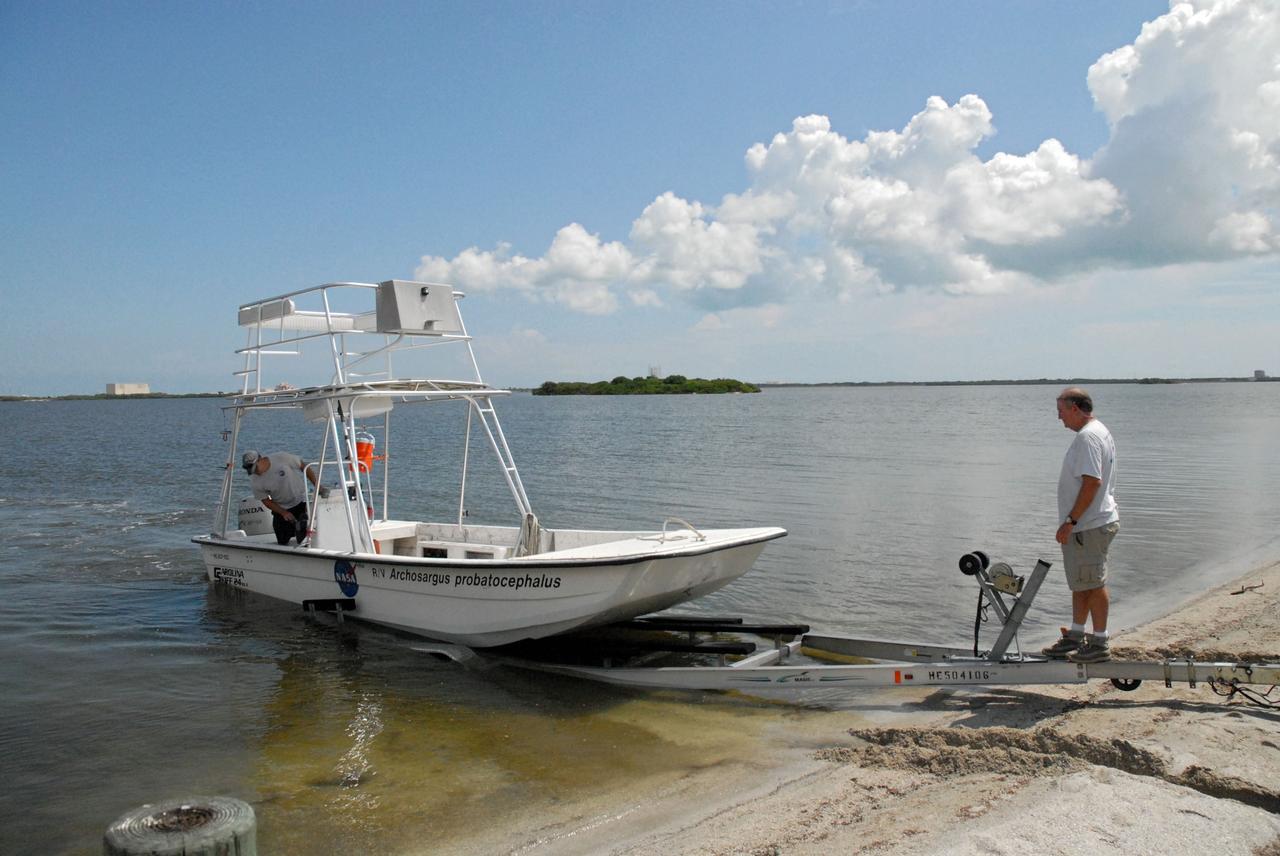
CAPE CANAVERAL, Fla. – Aquatic biologists Eric Reyier, left, and Doug Scheidt with Innovative Health Applications, or IHA, prepare for a field-guided boat tour of NASA's Kennedy Space Center in Florida. As part of the center's first-ever Innovation Expo, the tour, called "Living Outdoor Laboratory for Environmental Sustainability," is giving employees the opportunity to see the unique estuarine ecosystems that are protected from development by the presence of Kennedy and the Merritt Island National Wildlife Refuge. The diverse and healthy area encompassing about 140,000 acres of central Florida's east coast has been closed to the public for 50 years, allowing the coastal dunes, saltwater estuaries and marshes, freshwater impoundments, scrub, pine flatwoods, and hardwood hammocks to provide habitats for more than 1,000 species of plants and animals. Innovation Expo is showcasing the innovative work taking place throughout the center's facilities and labs to encourage employees to work together to solve future challenges. For more information, visit http://www.nasa.gov/kennedy. Photo credit: NASA
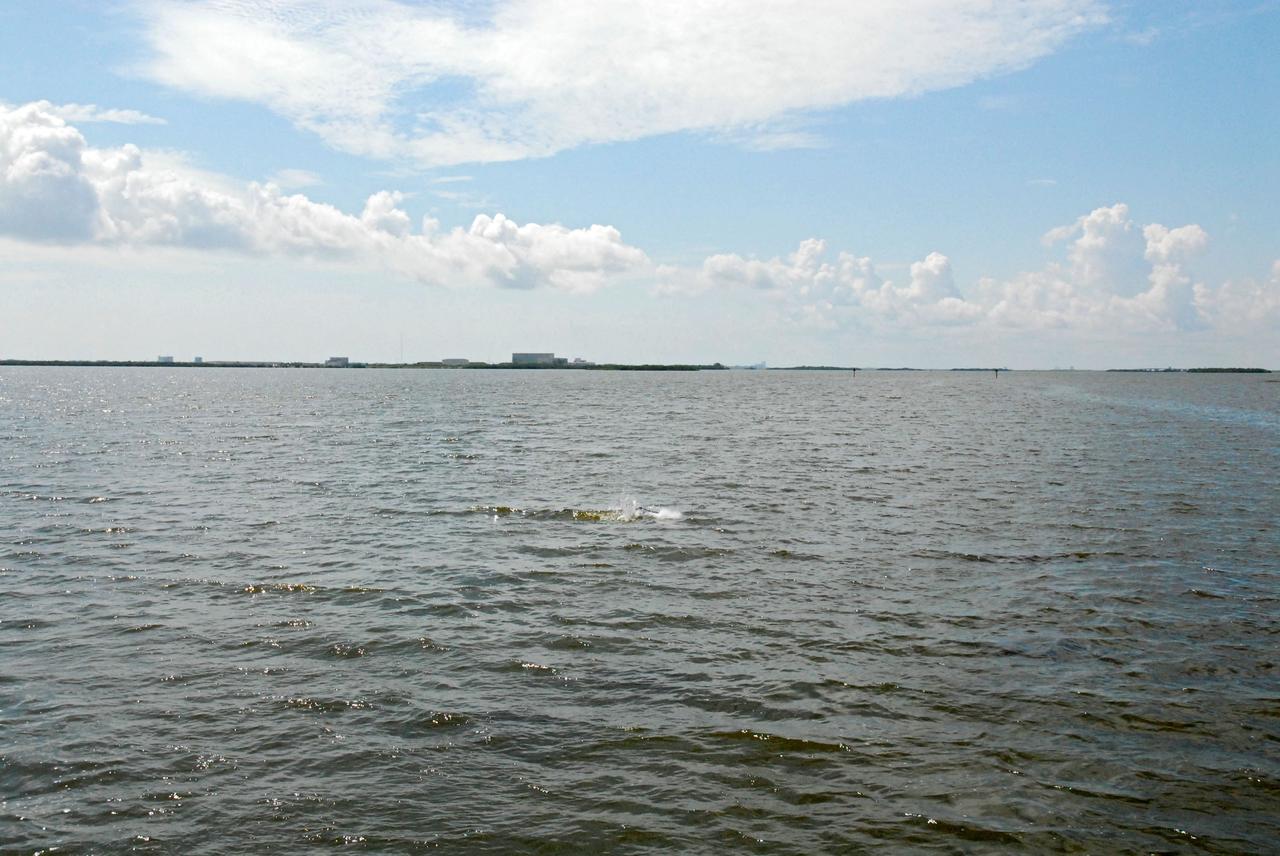
CAPE CANAVERAL, Fla. – A manatee splashes in the Banana River during a field-guided boat tour of NASA's Kennedy Space Center in Florida. As part of the center's first-ever Innovation Expo, the tour, called "Living Outdoor Laboratory for Environmental Sustainability," is giving employees the opportunity to see the unique estuarine ecosystems that are protected from development by the presence of Kennedy and the Merritt Island National Wildlife Refuge. Manatees are one of the many threatened or endangered species that call the refuge home. The diverse and healthy area encompassing about 140,000 acres of central Florida's east coast has been closed to the public for 50 years, allowing the coastal dunes, saltwater estuaries and marshes, freshwater impoundments, scrub, pine flatwoods, and hardwood hammocks to provide habitats for more than 1,000 species of plants and animals. Innovation Expo is showcasing the innovative work taking place throughout the center's facilities and labs to encourage employees to work together to solve future challenges. For more information, visit http://www.nasa.gov/kennedy. Photo credit: NASA
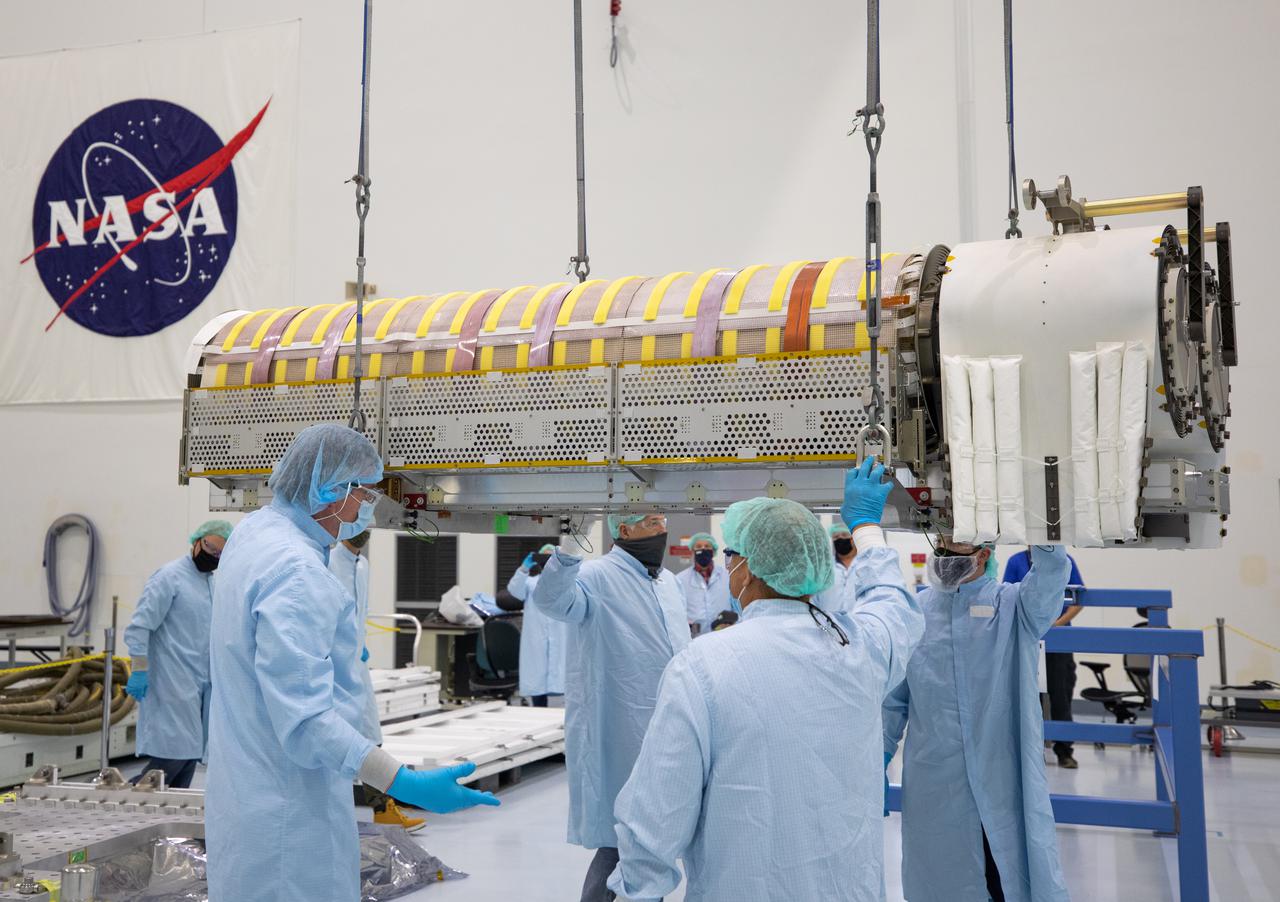
NASA and Boeing workers lift solar arrays into flight support equipment on April 2, 2021, in the Space Station Processing Facility at NASA’s Kennedy Space Center in Florida. The 63- by- 20-foot solar arrays will launch to the International Space Station later this year. They are the first two of six new solar arrays that in total will produce more than 120 kilowatts of electricity from the Sun’s energy, enough to power more than 40 average U.S. homes. Combined with the eight original, larger arrays, this advanced hardware will provide 215 kilowatts of energy, a 20 to 30 percent increase in power, helping maximize the space station’s capabilities for years to come. The arrays will produce electricity to sustain the station’s systems and equipment, plus augment the electricity available to continue a wide variety of public and private experiments and research in the microgravity environment of low-Earth orbit. Most of the station systems, including its batteries, scientific equipment racks, and communications equipment have been upgraded since humans began a continuous presence on the orbiting laboratory in November 2000. For more than two decades, astronauts have lived and worked on this unique orbiting lab, supporting scientific research that has led to numerous discoveries that benefit people on Earth and prepare for future Artemis missions to the Moon and beyond.
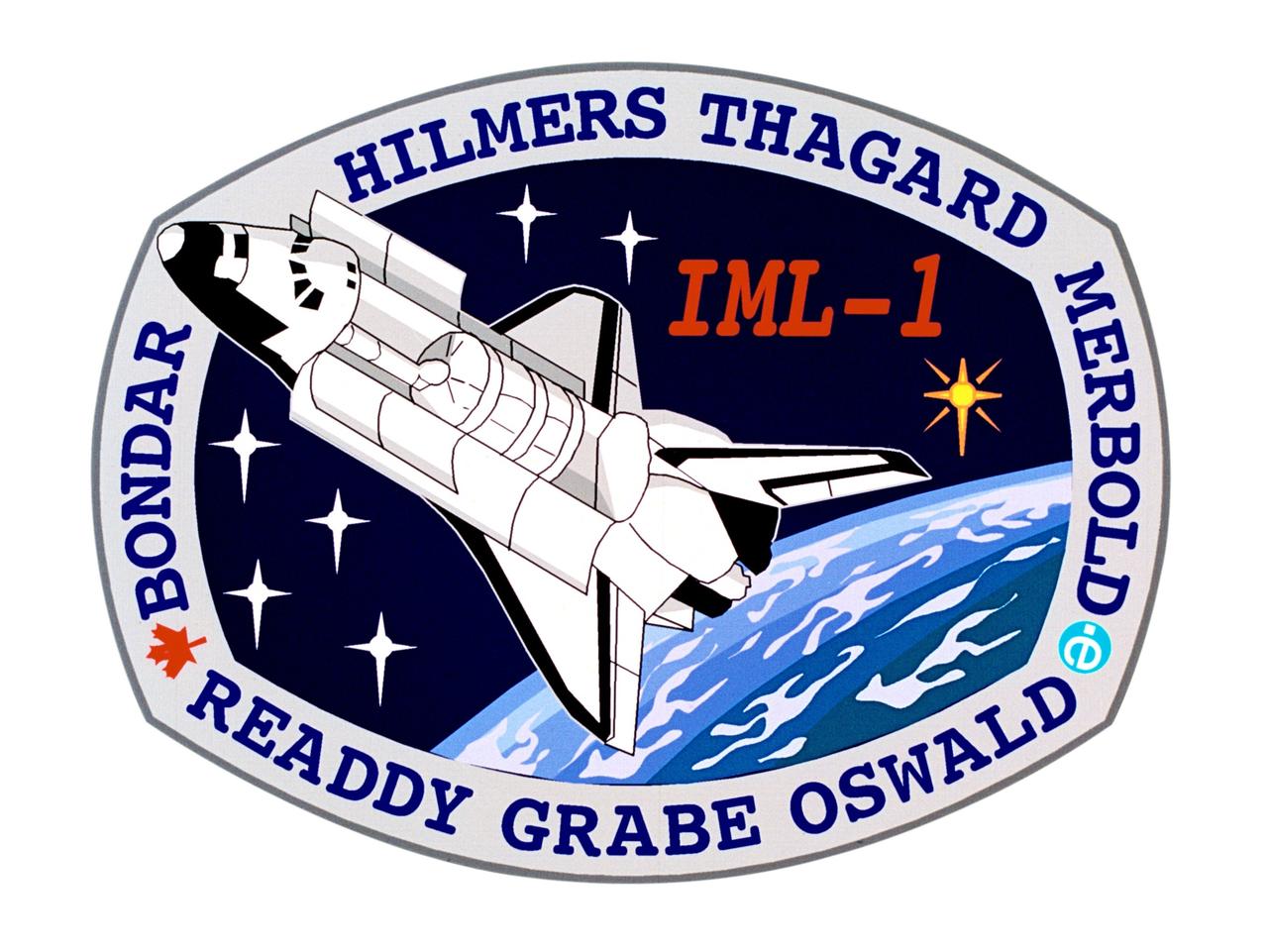
STS042-S-001 (October 1991) --- Designed by the crew members, the International Microgravity Lab-1 (IML-1) insignia depicts the orbiter with the Spacelab Module aboard. The spacecraft is oriented in a quiescent, tail-to-Earth, gravity-gradient attitude to best support the various microgravity payloads and experiments. The international composition of the crew is depicted by symbols representing both the Canadian Space Agency (CSA) and the European Space Agency (ESA). The number 42 is represented by six white stars -- four on one side of the orbiter and two on the other. The single gold star above Earth's horizon honors the memory of astronaut Manley L. (Sonny) Carter, who was killed earlier this year in a commuter plane crash. A crew spokesperson stated that Carter "...was our crew mate, colleague and friend." Blue letters set against white give the surnames of the five astronauts and two payload specialists for the flight. The NASA insignia design for space shuttle flights is reserved for use by the astronauts and for other official use as the NASA Administrator may authorize. Public availability has been approved only in the form of illustrations by the various news media. When and if there is any change in this policy, which is not anticipated, it will be publicly announced. Photo credit: NASA
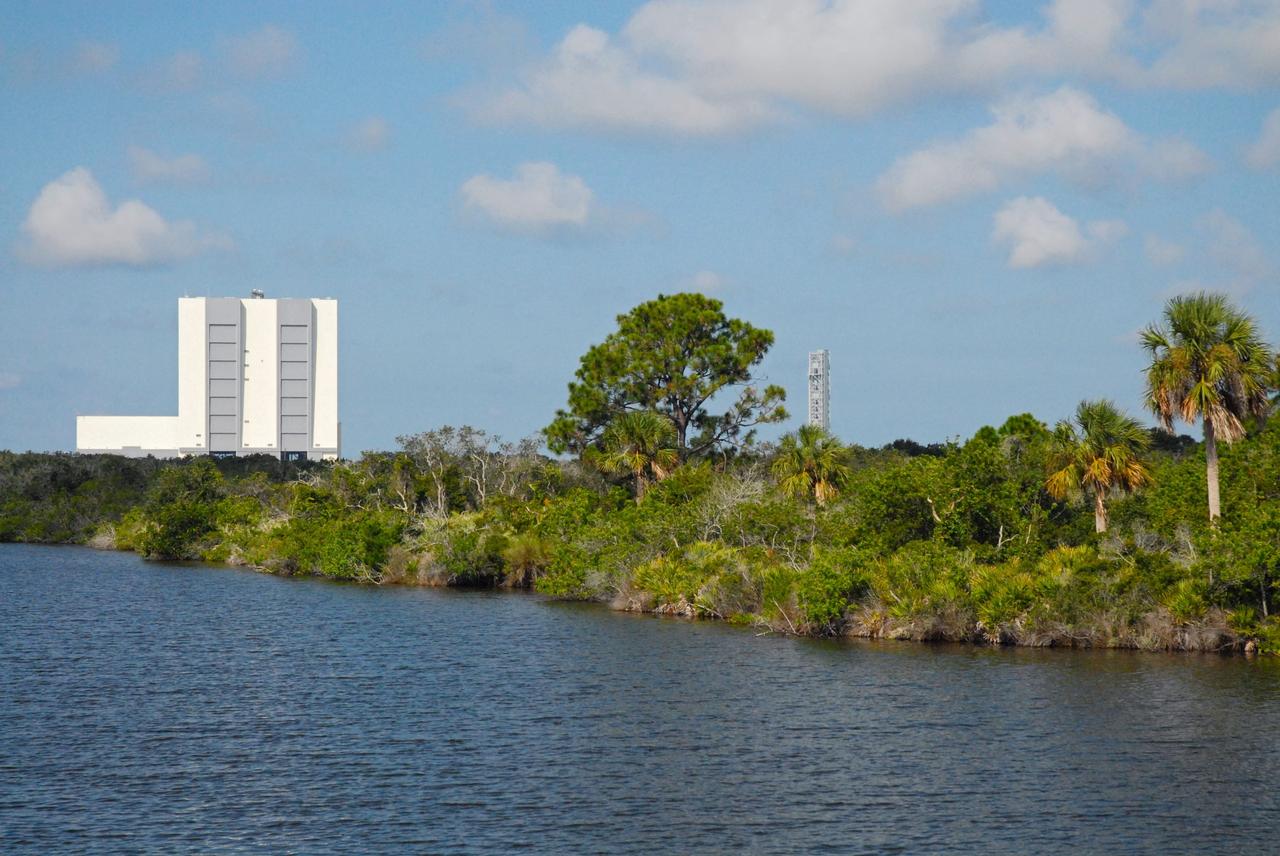
CAPE CANAVERAL, Fla. – The Vehicle Assembly Building, or VAB, and NASA's new mobile launcher, or ML, are seen in the distance during a field-guided boat tour of NASA's Kennedy Space Center in Florida. As part of the center's first-ever Innovation Expo, the tour, called "Living Outdoor Laboratory for Environmental Sustainability," is giving employees the opportunity to see the unique estuarine ecosystems that are protected from development by the presence of Kennedy and the Merritt Island National Wildlife Refuge. The 355-foot-tall ML structure, which took about two years to construct, will be modified by NASA’s Ground Systems Development and Operations, or GSDO, Program to support NASA’s Space Launch System, the heavy-lift rocket that will launch astronauts into deep space on future exploration missions. The diverse and healthy area encompassing about 140,000 acres of central Florida's east coast has been closed to the public for 50 years, allowing the coastal dunes, saltwater estuaries and marshes, freshwater impoundments, scrub, pine flatwoods, and hardwood hammocks to provide habitats for more than 1,000 species of plants and animals. Innovation Expo is showcasing the innovative work taking place throughout the center's facilities and labs to encourage employees to work together to solve future challenges. For more information, visit http://www.nasa.gov/kennedy. Photo credit: NASA
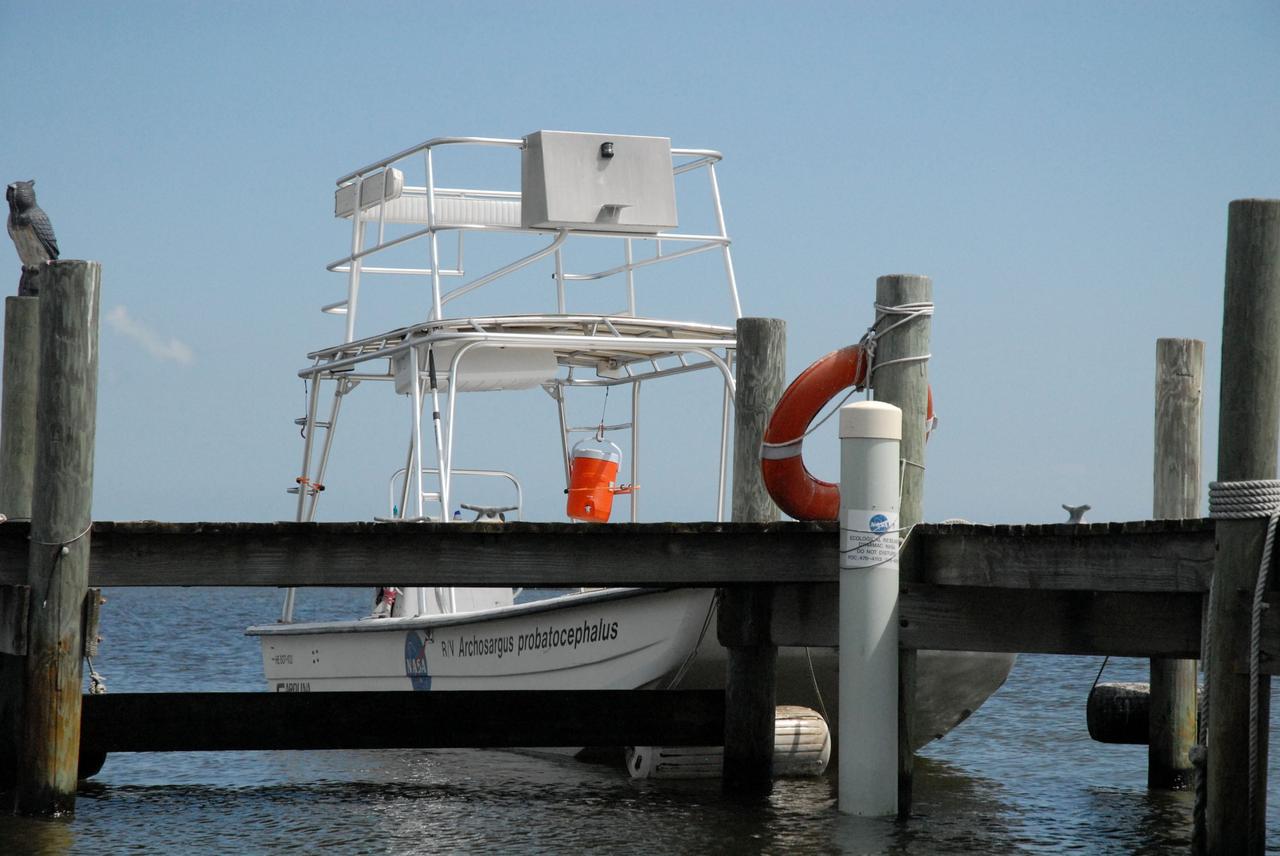
CAPE CANAVERAL, Fla. – A boat dock and skiff boat are seen near the Roy D. Bridges Jr. Bridge that connects NASA Kennedy Space Center's Industrial Area to Cape Canaveral Air Force Station's Industrial Area following a field-guided boat tour. As part of the Kennedy's first-ever Innovation Expo, the tour, called "Living Outdoor Laboratory for Environmental Sustainability," is giving employees the opportunity to see the unique estuarine ecosystems that are protected from development by the presence of the center and the Merritt Island National Wildlife Refuge. The diverse and healthy area encompassing about 140,000 acres of central Florida's east coast has been closed to the public for 50 years, allowing the coastal dunes, saltwater estuaries and marshes, freshwater impoundments, scrub, pine flatwoods, and hardwood hammocks to provide habitats for more than 1,000 species of plants and animals. Innovation Expo is showcasing the innovative work taking place throughout the center's facilities and labs to encourage employees to work together to solve future challenges. For more information, visit http://www.nasa.gov/kennedy. Photo credit: NASA
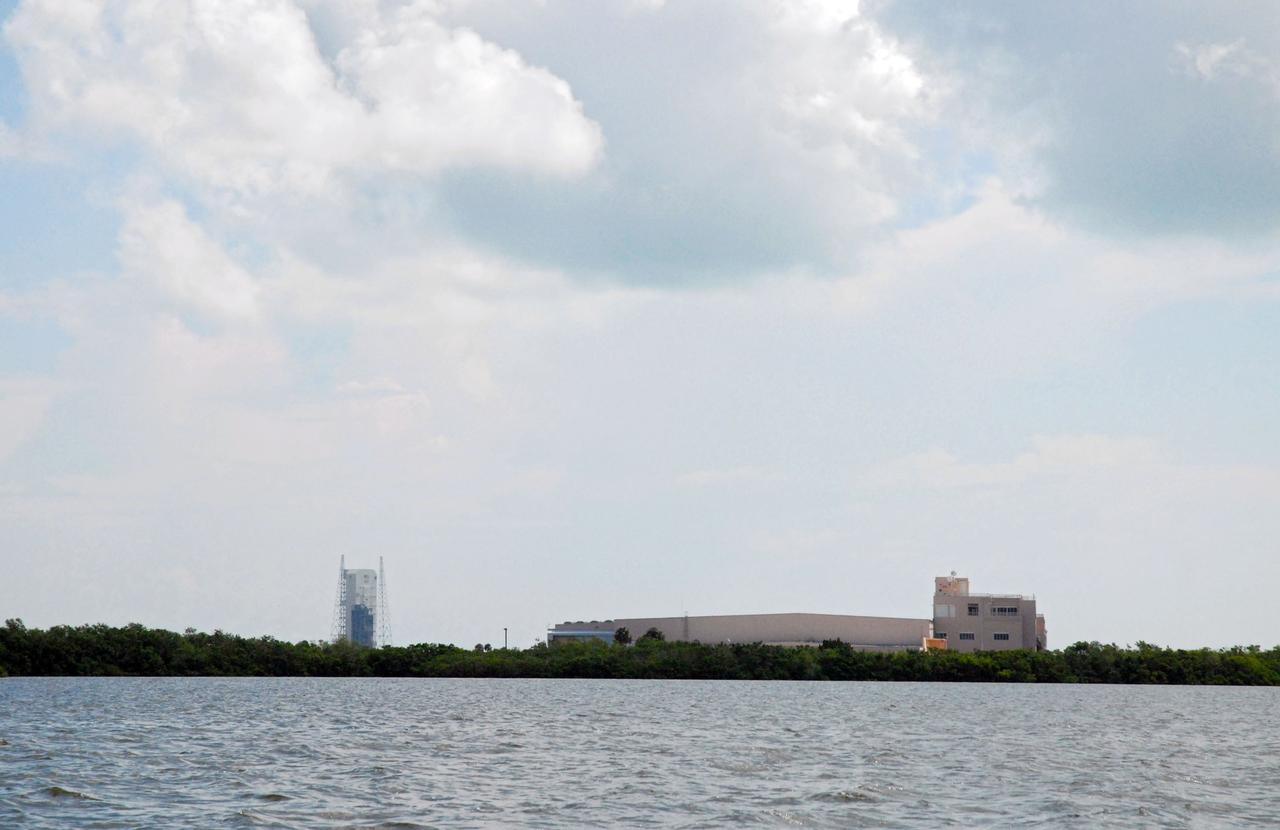
CAPE CANAVERAL, Fla. – Cape Canaveral Air Force Station's Launch Complex 37 and the Atlas V Operations Center, or ASOC, are seen in the distance during a field-guided boat tour of NASA's Kennedy Space Center in Florida. As part of the center's first-ever Innovation Expo, the tour, called "Living Outdoor Laboratory for Environmental Sustainability," is giving employees the opportunity to see the unique estuarine ecosystems that are protected from development by the presence of Kennedy and the Merritt Island National Wildlife Refuge. The diverse and healthy area encompassing about 140,000 acres of central Florida's east coast has been closed to the public for 50 years, allowing the coastal dunes, saltwater estuaries and marshes, freshwater impoundments, scrub, pine flatwoods, and hardwood hammocks to provide habitats for more than 1,000 species of plants and animals. Innovation Expo is showcasing the innovative work taking place throughout the center's facilities and labs to encourage employees to work together to solve future challenges. For more information, visit http://www.nasa.gov/kennedy. Photo credit: NASA
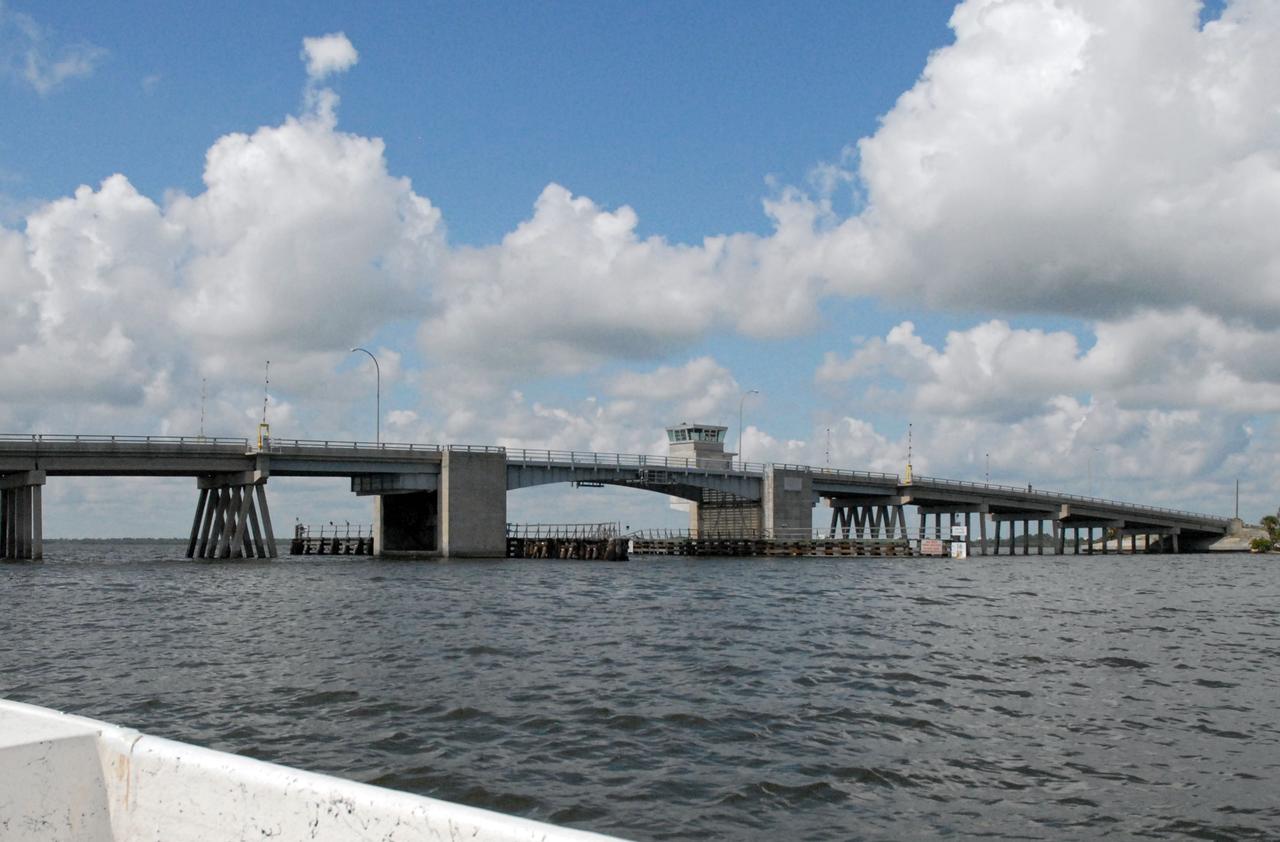
CAPE CANAVERAL, Fla. – The Roy D. Bridges Jr. Bridge connecting NASA Kennedy Space Center's Industrial Area to Cape Canaveral Air Force Station's Industrial Area is seen during a field-guided boat tour. As part of the Kennedy's first-ever Innovation Expo, the tour, called "Living Outdoor Laboratory for Environmental Sustainability," is giving employees the opportunity to see the unique estuarine ecosystems that are protected from development by the presence of the center and the Merritt Island National Wildlife Refuge. The diverse and healthy area encompassing about 140,000 acres of central Florida's east coast has been closed to the public for 50 years, allowing the coastal dunes, saltwater estuaries and marshes, freshwater impoundments, scrub, pine flatwoods, and hardwood hammocks to provide habitats for more than 1,000 species of plants and animals. Innovation Expo is showcasing the innovative work taking place throughout the center's facilities and labs to encourage employees to work together to solve future challenges. For more information, visit http://www.nasa.gov/kennedy. Photo credit: NASA
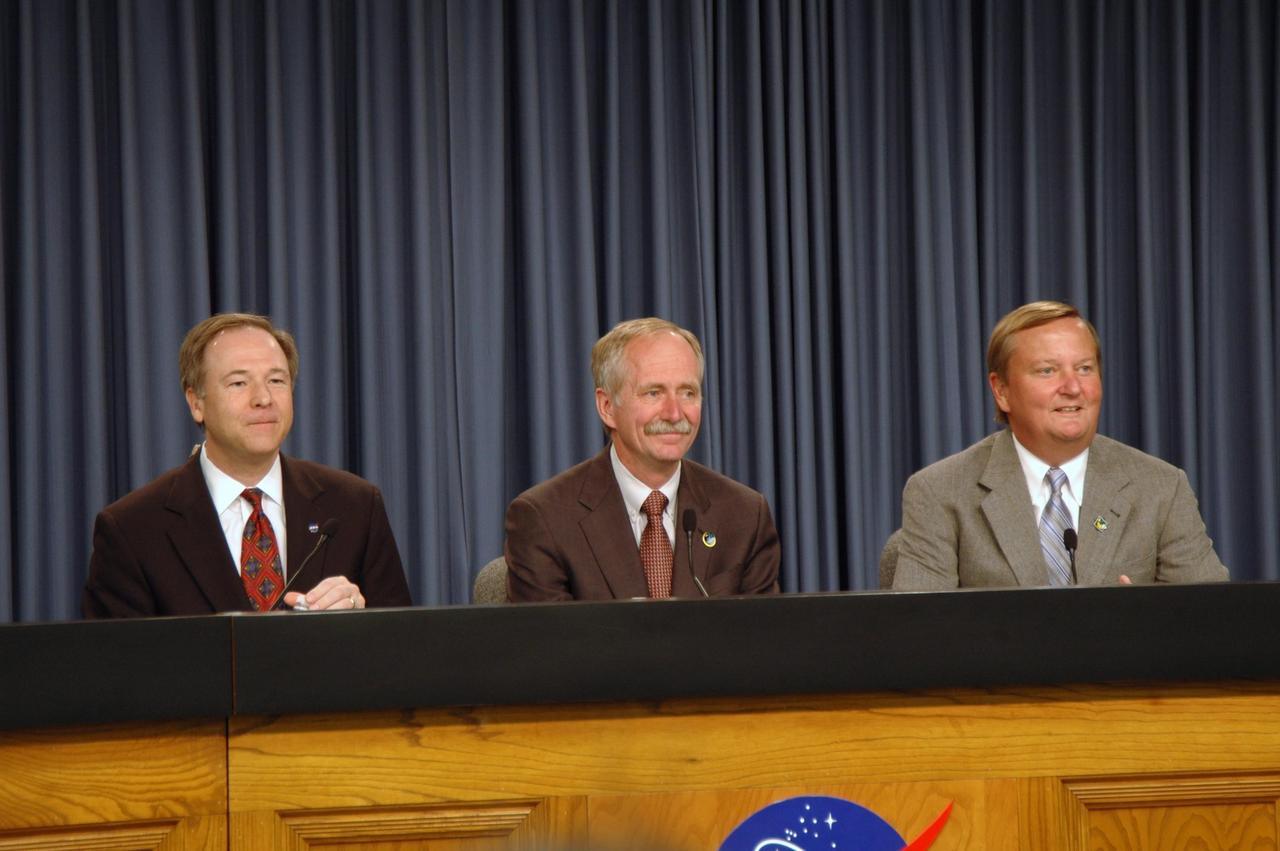
KENNEDY SPACE CENTER, FLA. -- At a post-landing news conference, Assistant Administrator for NASA Public Affairs David Mould (left) introduces NASA Associate Administrator for Space Operations William Gerstenmaier and Shuttle Launch Director Mike Leinbach. They concurred they were happy with the performance of space shuttle Atlantis on the STS-122 mission and looking forward to the next mission, STS-123 in March. After a round trip of nearly 5.3 million miles, space shuttle Atlantis and crew returned to Earth with a landing at 9:07 a.m. EST. The shuttle landed on orbit 202 to complete the 13-day STS-122 mission. Main gear touchdown was 9:07:10 a.m. Nose gear touchdown was 9:07:20 a.m. Wheel stop was at 9:08:08 a.m. Mission elapsed time was 12 days, 18 hours, 21 minutes and 44 seconds. During the mission, Atlantis' crew installed the new Columbus laboratory, leaving a larger space station and one with increased science capabilities. The Columbus Research Module adds nearly 1,000 cubic feet of habitable volume and affords room for 10 experiment racks, each an independent science lab. Photo credit: NASA/Jim Grossmann
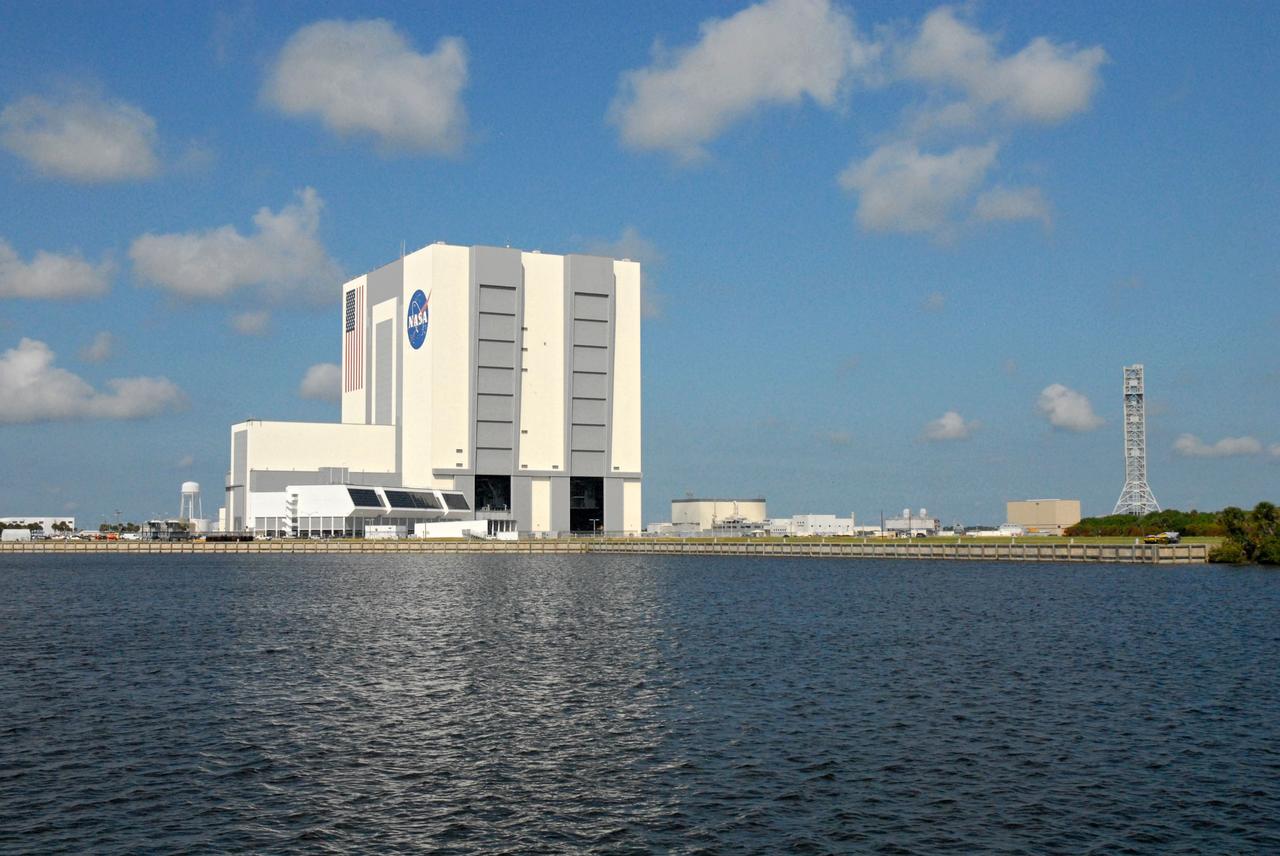
CAPE CANAVERAL, Fla. – The Vehicle Assembly Building, or VAB, and NASA's new mobile launcher, or ML, are seen during a field-guided boat tour of NASA's Kennedy Space Center in Florida. As part of the center's first-ever Innovation Expo, the tour, called "Living Outdoor Laboratory for Environmental Sustainability," is giving employees the opportunity to see the unique estuarine ecosystems that are protected from development by the presence of Kennedy and the Merritt Island National Wildlife Refuge. The 355-foot-tall ML structure, which took about two years to construct, will be modified by NASA’s Ground Systems Development and Operations, or GSDO, Program to support NASA’s Space Launch System, the heavy-lift rocket that will launch astronauts into deep space on future exploration missions. The diverse and healthy area encompassing about 140,000 acres of central Florida's east coast has been closed to the public for 50 years, allowing the coastal dunes, saltwater estuaries and marshes, freshwater impoundments, scrub, pine flatwoods, and hardwood hammocks to provide habitats for more than 1,000 species of plants and animals. Innovation Expo is showcasing the innovative work taking place throughout the center's facilities and labs to encourage employees to work together to solve future challenges. For more information, visit http://www.nasa.gov/kennedy. Photo credit: NASA
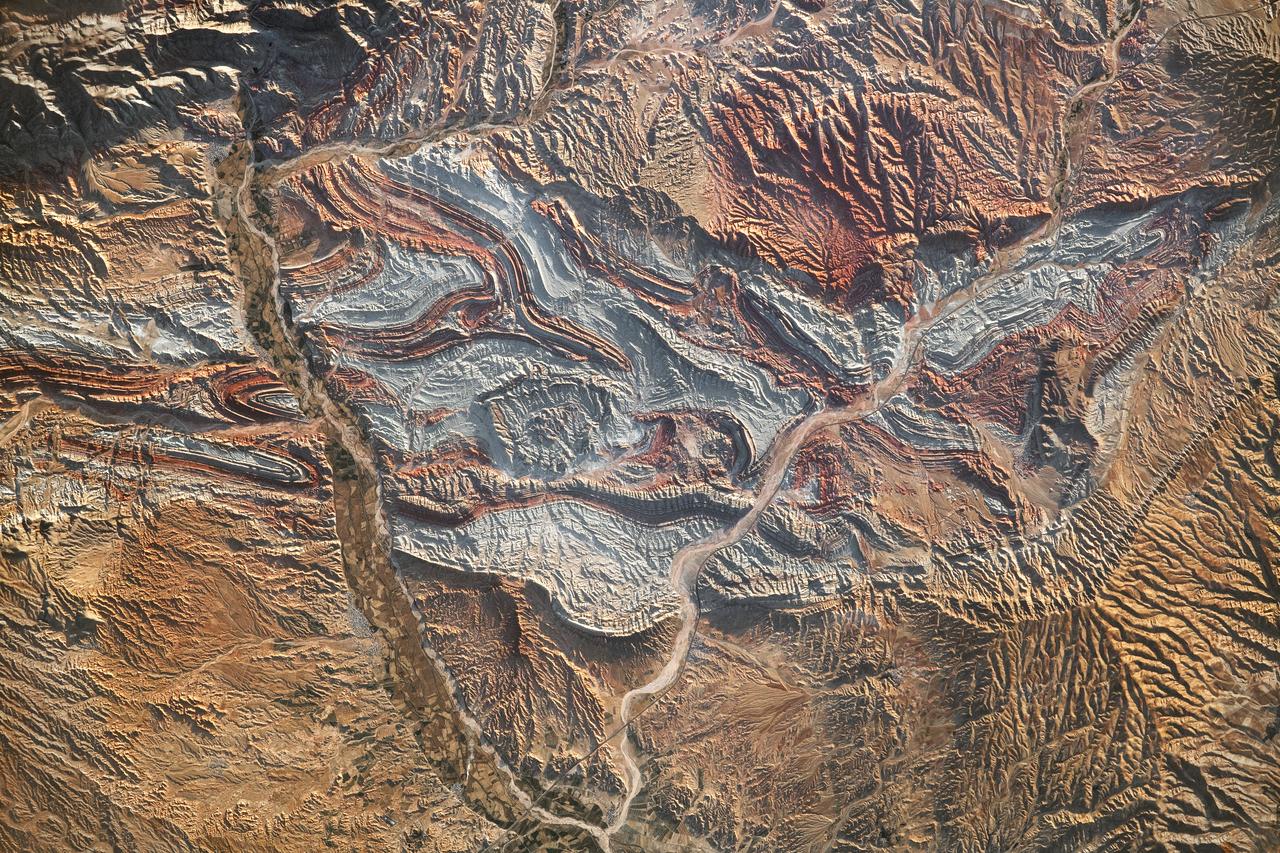
iss069-e-089946_lrg (09/19/2023) --- An astronaut aboard the International Space Station took this photograph of the rugged landscape of the Aladaghlar Mountains in northwestern Iran. Ridges cast shadows in the valleys and other low elevation areas, creating a three-dimensional appearance. Human alterations to the landscape are most evident in riverbeds, where the even topography is easier to build on and navigate. Natural processes over millions of years have folded rock layers of various compositions and colors into the curved patterns seen here. These folds are produced by tectonic forces operating along the convergent plate boundary of the Arabia and Eurasia plates. The convergence of these tectonic plates causes uplift, folding, and deformation of the colorful rock layers, and subsequent erosion exposes them. On the left side of this photo, the Qezel Ozan River, a major river in northern Iran, cuts across the landscape. Agricultural fields are visible along the riverbanks tucked between the mountains. The Qezel Ozan also intersects the Zanjan-Tabriz freeway (Freeway 2), a major thoroughfare built on a dried riverbed connecting the cities of Tehran and Tabriz. Astronaut photograph ISS069-E-89946 was acquired on September 19, 2023, with a Nikon D5 digital camera using a focal length of 400 millimeters. The image was provided by the ISS Crew Earth Observations Facility and the Earth Science and Remote Sensing Unit at Johnson Space Center. The image was taken by a member of the Expedition 69 crew. It has been cropped and enhanced to improve contrast, and lens artifacts have been removed. The International Space Station Program supports the laboratory as part of the ISS National Lab to help astronauts take pictures of Earth that will be of the greatest value to scientists and the public and to make those images freely available on the Internet. Additional images taken by astronauts and cosmonauts can be viewed at the NASA/JSC Gateway to Astronaut Photography of Earth. Caption by Sara Schmidt, GeoControl Systems, JETS II Contract at NASA-JSC and Andrea Wenzel, Jacobs-JETS II Contract at NASA-JSC.
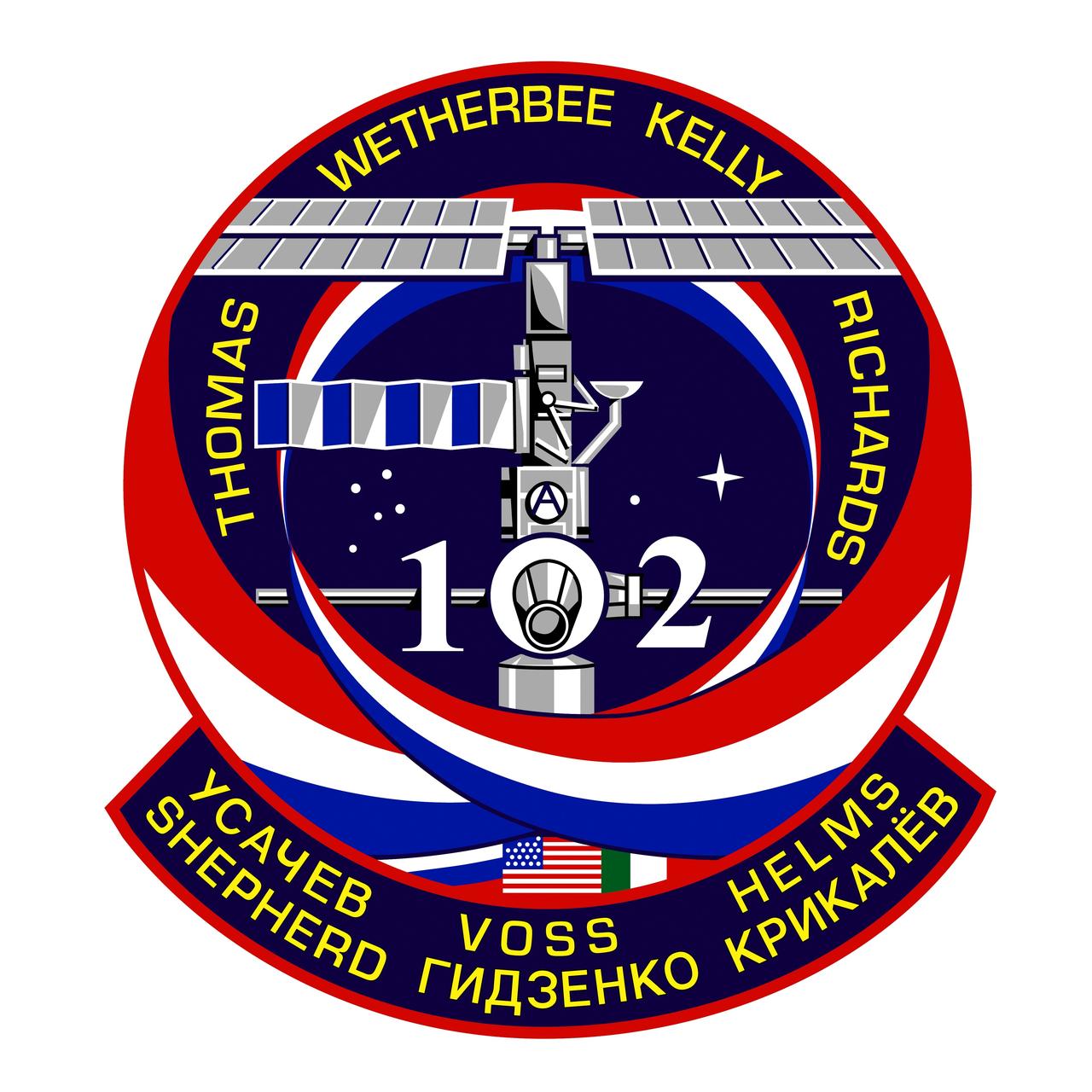
STS102-S-001 (January 2001) --- The central image on the STS-102 crew patch depicts the International Space Station (ISS) in the build configuration that it will have at the time of the arrival and docking of Discovery during the STS-102 mission, the first crew exchange flight to the space station. The station is shown along the direction of the flight as will be seen by the shuttle crew during their final approach and docking, the so-called V-bar approach. The names of the shuttle crew members are depicted in gold around the top of the patch, and surnames of the Expedition crew members being exchanged are shown in the lower banner. The three ribbons swirling up to and around the station signify the rotation of these ISS crew members. The number two is for the Expedition Two crew who fly up to the station, and the number one is for the Expedition One crew who then return down to Earth. In conjunction with the face of the Lab module of the station, these Expedition numbers create the shuttle mission number 102. Shown mated below the ISS is the Italian-built Multi-Purpose Logistics Module, Leonardo, that will fly for the first time on this flight, and which will be attached to the station by the shuttle crew during the docked phase of the mission. The flags of the countries that are the major contributors to this effort, the United States, Russia, and Italy are also shown in the lower part of the patch. The build-sequence number of this flight in the overall station assembly sequence, 5A.1, is captured by the constellations in the background. The NASA insignia design for space shuttle flights is reserved for use by the astronauts and for other official use as the NASA Administrator may authorize. Public availability has been approved only in the forms of illustrations by the various news media. When and if there is any change in this policy, which is not anticipated, the change will be publicly announced. Photo credit: NASA
California, reveals the devastating effect of California's ongoing drought on Sierra Nevada conifer forests. The map will be used to help the U.S. Forest Service assess and respond to the impacts of increased tree mortality caused by the drought, particularly where wildlands meet urban areas within the Sierra National Forest. After several years of extreme drought, the highly stressed conifers (trees or bushes that produce cones and are usually green year-round) of the Sierra Nevada are now more susceptible to bark beetles (Dendroctonus spp.). While bark beetles killing trees in the Sierra Nevada is a natural phenomenon, the scale of mortality in the last couple of years is far greater than previously observed. The U.S. Forest Service is using recent airborne spectroscopic measurements from NASA's Airborne Visible/Infrared Imaging Spectrometer (AVIRIS) instrument aboard NASA's ER-2 aircraft, together with new advanced algorithms, to quantify this impact over this large region of rugged terrain. The high-altitude ER-2 aircraft is based at NASA's Armstrong Flight Research Center, Edwards, California. The image was created by scientists at the USFS's Pacific Southwest Region Remote Sensing Lab, McClellan, California, by performing a time series analysis of AVIRIS images. Scientists evaluated baseline tree mortality on public lands in the summer of 2015 using a machine learning algorithm called "random forest." This algorithm classifies the AVIRIS measurements as dominated by either shrubs, healthy trees or newly dead conifer trees. To quantify how much the amount of dead vegetation increased during the fall of 2015, the Forest Service scientists conducted an advanced spectral mixture analysis. This analysis evaluates each spectrum to determine the fraction of green vegetation, dead vegetation and soil. The full spectral range of AVIRIS is important to separate the signatures of soil and dead vegetation. To produce this comprehensive Sierra National Forest tree mortality map, the result from the summer of 2015 was evaluated to look for increases of more than 10 percent in dead vegetation during the fall of 2015. AVIRIS measures spectra of the Earth system to conduct advanced science research. These western U.S. AVIRIS measurements were acquired as part of NASA's Hyperspectral Infrared Imager (HyspIRI) preparatory airborne campaign. HyspIRI was one of the space missions suggested to NASA by the National Academy of Sciences in its 2007 decadal survey for Earth Science. In the future, HyspIRI could provide spectral and thermal measurements of this type globally for ecosystem research and additional science objectives. http://photojournal.jpl.nasa.gov/catalog/PIA20717
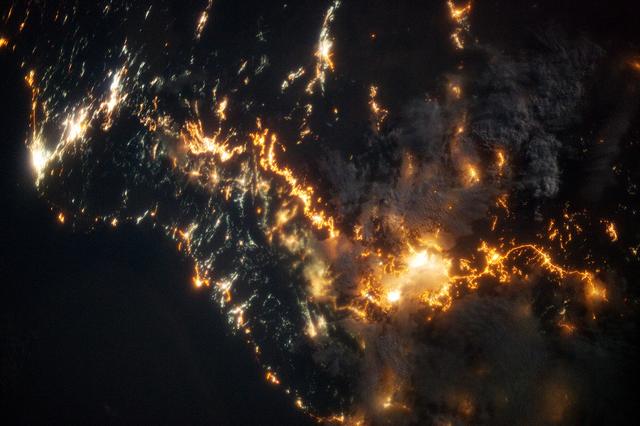
This striking image of the coastline of southwestern Saudi Arabia was taken by astronauts on the International Space Station. Patchy cloud cover partially obscures and blurs the city lights, especially in the vicinity of Khamis Mushait and Abha. While much of the country is lightly populated desert—and relatively dark at night due to lack of city and roadway lights—the southwestern coastal region has a more moderate climate and several large cities. Three brightly lit urban centers are visible at image top left: Jeddah, Mecca, and Taif. Jeddah is the gateway city for Islamic pilgrims going to nearby Mecca, a religious journey known as the Hajj. Taif is located on the slopes of the Sarawat Mountains and provides a summer retreat for the Saudi government from the desert heat of the capital, Riyadh. Bright yellow-orange lighting marks highways that parallel the trend of the Asir Mountains (image center), connecting Mecca to the resort cities of Al Bahah and Abha. Smaller roadways, lit with blue lights, extend to the west to small cities along the Red Sea coastline. The bright yellow-orange glow of the city of Abha is matched by that of Khamis Mushait (or Khamis Mushayt) to the northeast. The brightly lit ribbon of highway continues towards other large cities to the south (Jazan, not shown) and southeast (Najran, not shown). Astronaut photograph ISS036-E-25802 was acquired on July 26, 2013, with a Nikon D3S digital camera using a 50 millimeter lens, and is provided by the ISS Crew Earth Observations experiment and Image Science & Analysis Laboratory, Johnson Space Center. The image was taken by the Expedition 36 crew. It has been cropped and enhanced to improve contrast, and lens artifacts have been removed. The International Space Station Program supports the laboratory as part of the ISS National Lab to help astronauts take pictures of Earth that will be of the greatest value to scientists and the public, and to make those images freely available on the Internet. Additional images taken by astronauts and cosmonauts can be viewed at the NASA/JSC Gateway to Astronaut Photography of Earth. Caption by William L. Stefanov, Jacobs/JETS at NASA-JSC. Instrument: ISS - Digital Camera More info: <a href="http://1.usa.gov/13TqPcr" rel="nofollow">1.usa.gov/13TqPcr</a> Credit: <b><a href="http://www.earthobservatory.nasa.gov/" rel="nofollow"> NASA Earth Observatory</a></b> <b><a href="http://www.nasa.gov/audience/formedia/features/MP_Photo_Guidelines.html" rel="nofollow">NASA image use policy.</a></b> <b><a href="http://www.nasa.gov/centers/goddard/home/index.html" rel="nofollow">NASA Goddard Space Flight Center</a></b> enables NASA’s mission through four scientific endeavors: Earth Science, Heliophysics, Solar System Exploration, and Astrophysics. Goddard plays a leading role in NASA’s accomplishments by contributing compelling scientific knowledge to advance the Agency’s mission. <b>Follow us on <a href="http://twitter.com/NASA_GoddardPix" rel="nofollow">Twitter</a></b> <b>Like us on <a href="http://www.facebook.com/pages/Greenbelt-MD/NASA-Goddard/395013845897?ref=tsd" rel="nofollow">Facebook</a></b> <b>Find us on <a href="http://instagram.com/nasagoddard?vm=grid" rel="nofollow">Instagram</a></b>