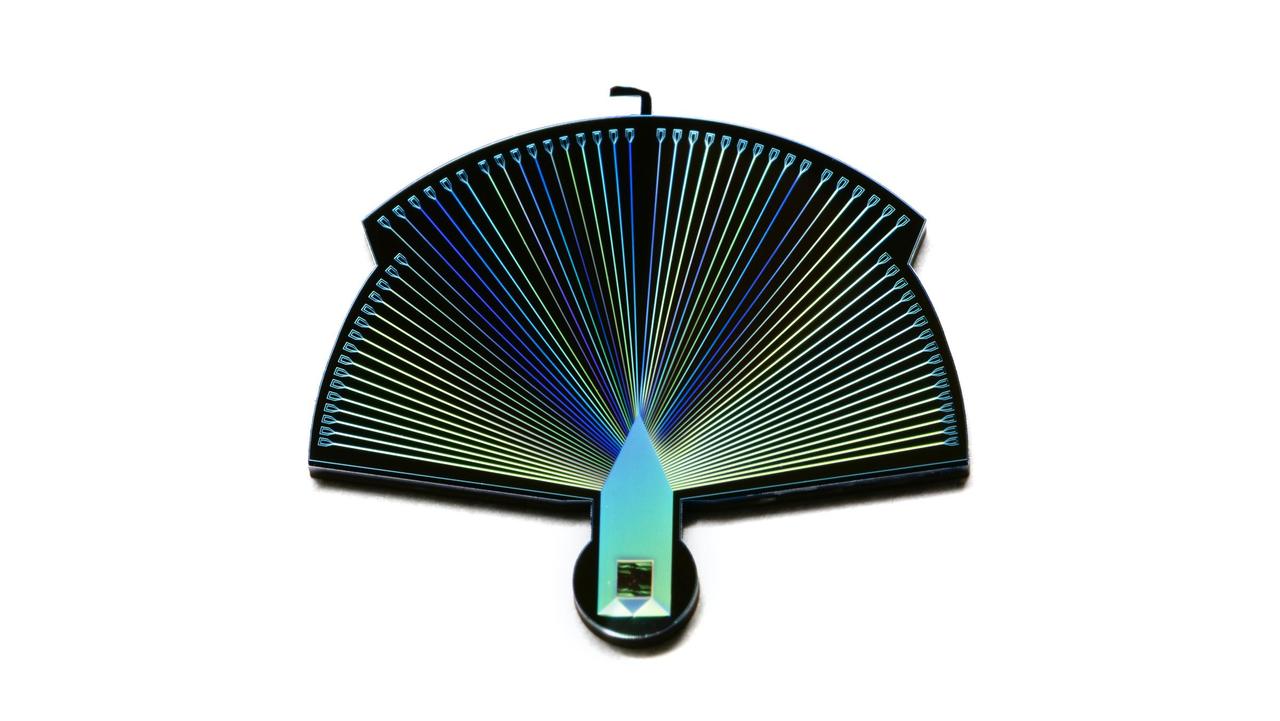
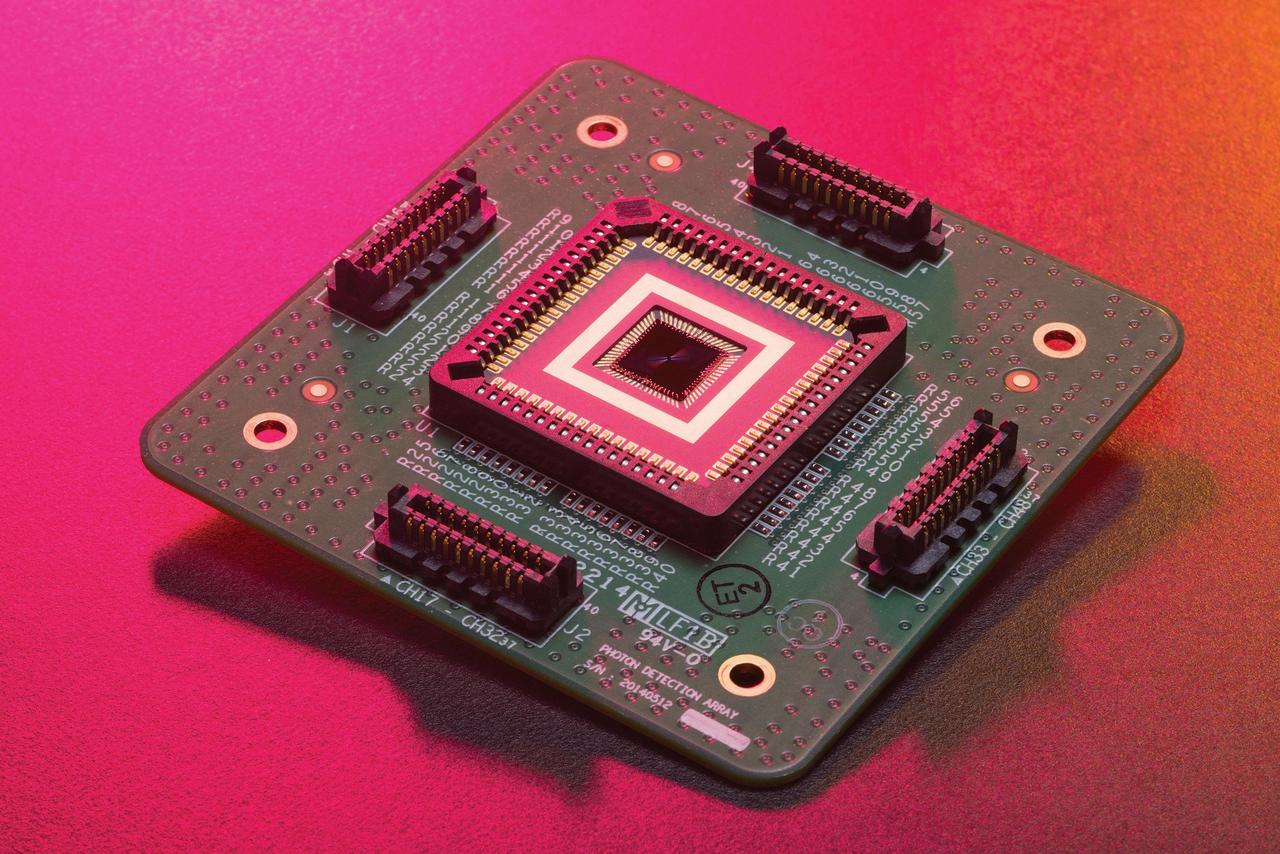
This close-up photograph shows a single Performance-Enhanced Array for Counting Optical Quanta (PEACOQ) detector. Smaller than a dime, a single detector consists of 32 niobium nitride superconducting nanowires on a silicon chip, which is attached to connectors that fan out like the plumage of the device's namesake. Each individual nanowire is about 10,000 times thinner than a human hair and the active detector (housed inside the green-black square at the bottom of the device) measures only 13 microns across. Figure A shows a silicon wafer that has had 32 PEACOQ detectors printed onto it by the Microdevices Laboratory at NASA's Jet Propulsion Laboratory in Southern California. The exquisitely sensitive PEACOQ detector is being developed at JPL to detect single photons – quantum particles of light – at an extremely high rate. Like counting individual droplets of water while being sprayed by a firehose, each PEACOQ detector can measure the precise time each photon hits the detector (to within 100 trillionths of a second) at a rate of 1.5 billion photons per second. No other detector has achieved that rate. The detector could help form a global quantum communications network, facilitating the transfer of data between quantum computers that are separated by hundreds of miles. PEACOQ detectors could be located at ground-based terminals to receive photons encoded with quantum information transmitted from space "nodes" aboard satellites orbiting Earth. https://photojournal.jpl.nasa.gov/catalog/PIA25260
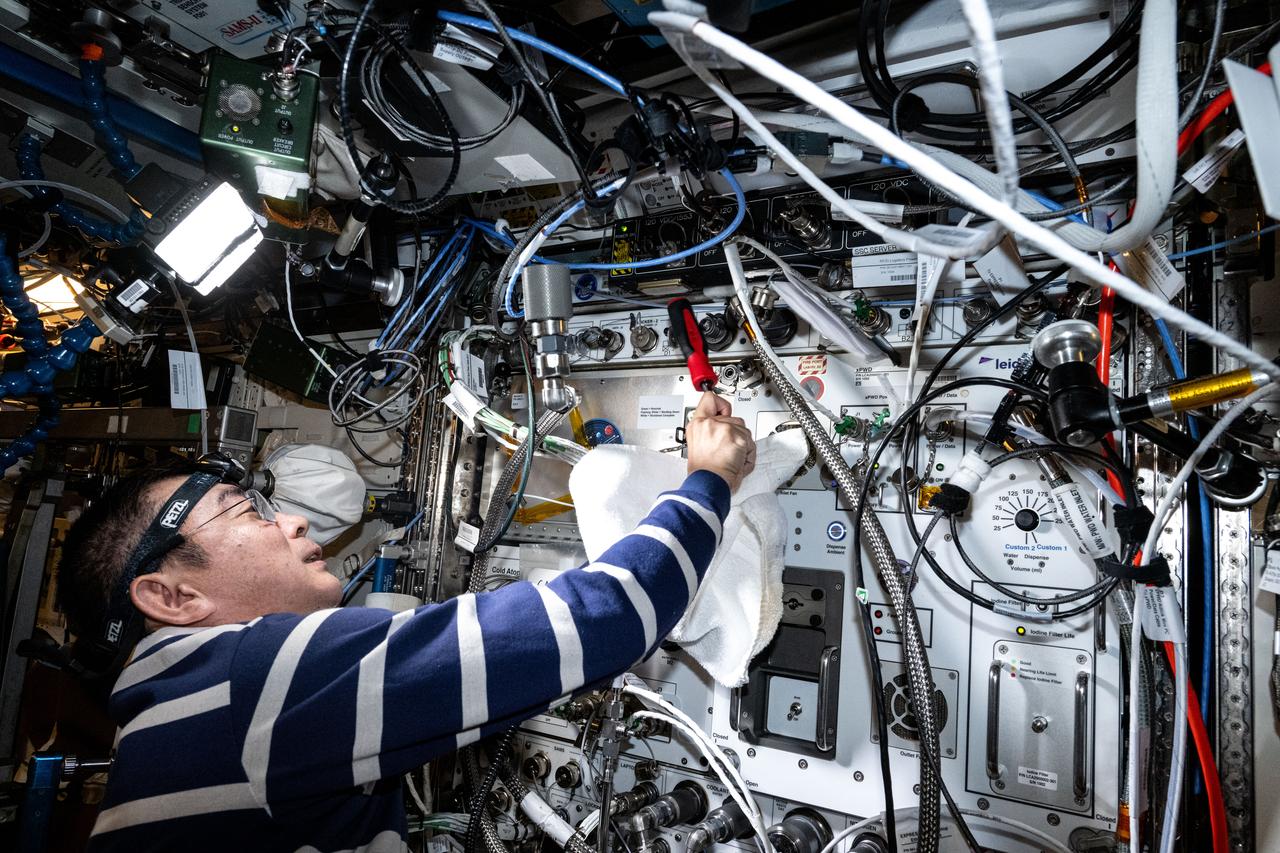
iss073e0431957 (Aug. 12, 2025) --- JAXA (Japan Aerospace Exploration Agency) astronaut and Expedition 73 Flight Engineer Kimiya Yui works on the Cold Atom Lab inside the International Space Station’s Destiny laboratory module. He replaced computer components in the physics research device, which chills atoms to temperatures below the average temperature of the universe enabling scientists to observe atomic wave functions and quantum behaviors not possible on Earth.
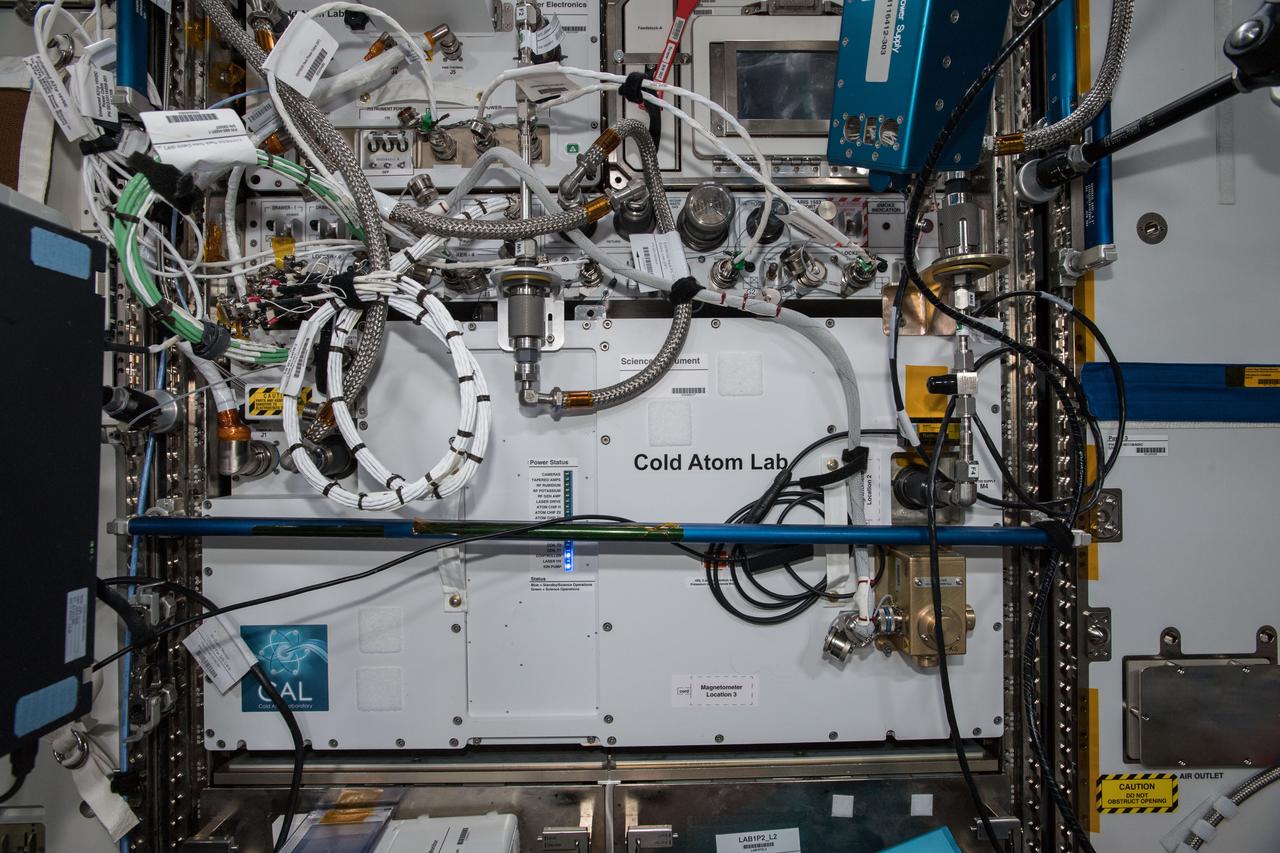
iss057e106407 (11/20/2018) -- A view of the Cold Atom Lab (CAL) in the Destiny module aboard the International Space Station (ISS). The Cold Atom Laboratory (CAL) produces clouds of atoms that are chilled to about one ten billionth of a degree above absolute zero -- much colder than the average temperature of deep space. At these low temperatures, atoms have almost no motion, allowing scientists to study fundamental behaviors and quantum characteristics that are difficult or impossible to probe at higher temperatures
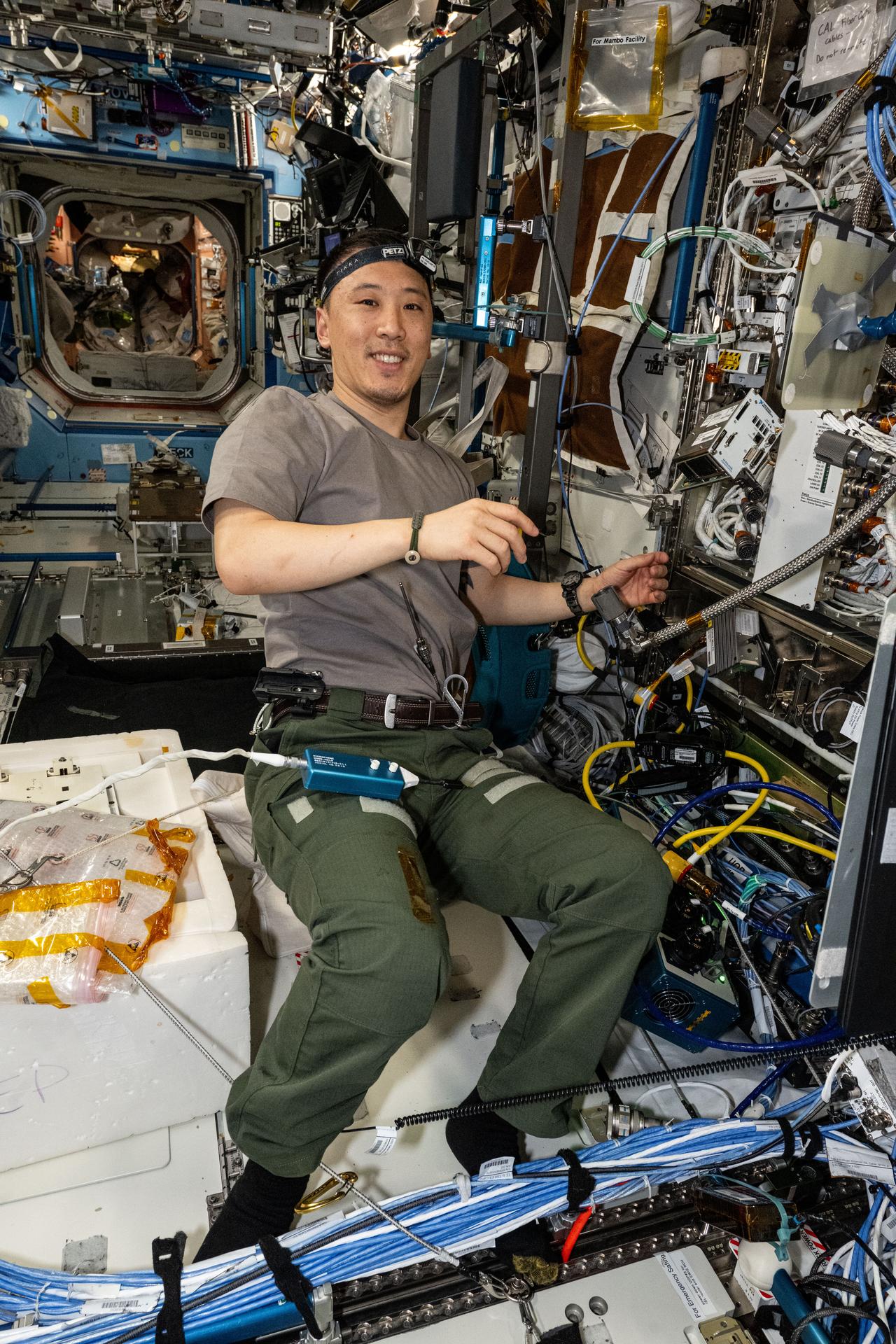
iss073e0817671 (Oct. 2, 2025) --- NASA astronaut and Expedition 73 Flight Engineer Jonny Kim replaces computer hardware inside the Cold Atom Lab aboard the International Space Station’s Destiny laboratory module. The Cold Atom Lab produces clouds of atoms chilled to about one ten-billionth of a degree above absolute zero—far colder than the average temperature of deep space. This extreme cold allows scientists to study fundamental behaviors and quantum characteristics that are difficult or impossible to observe on Earth.
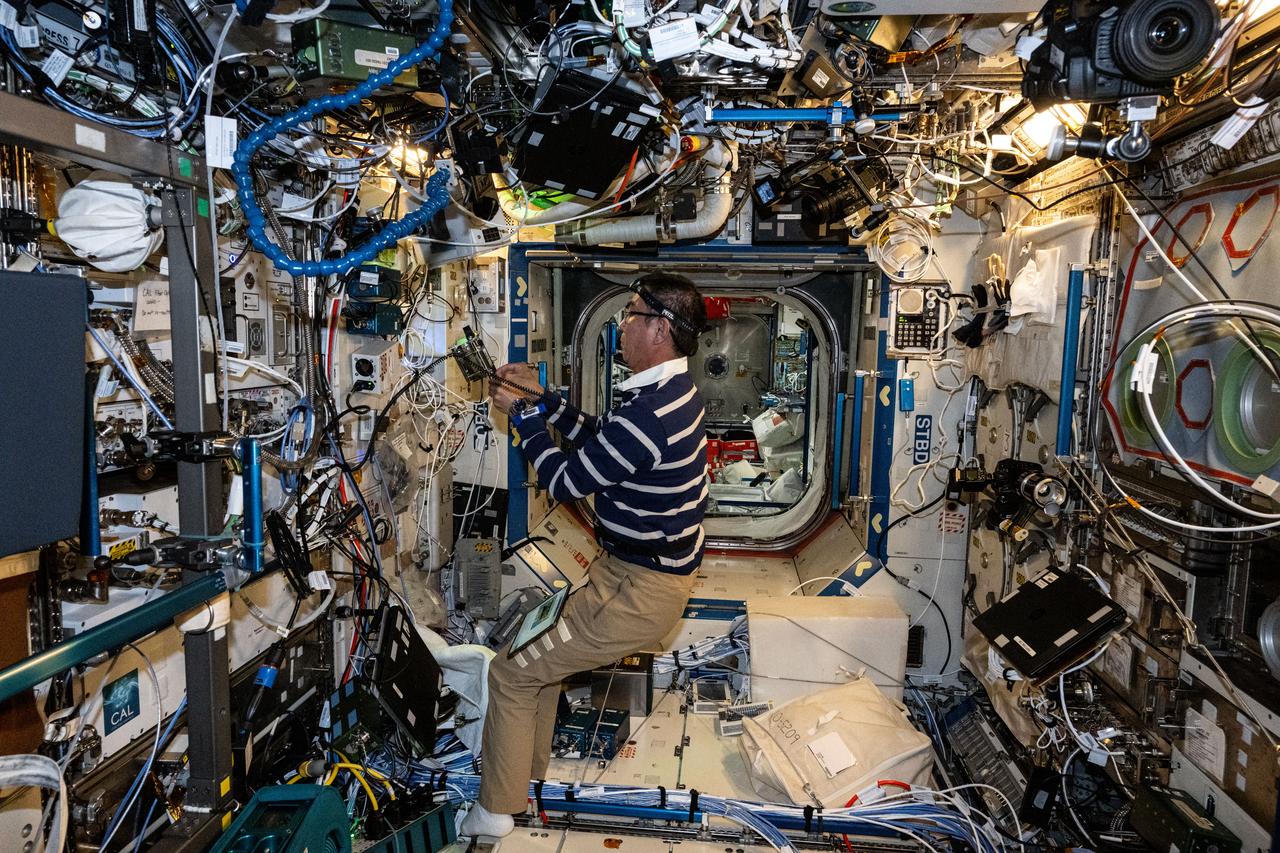
iss073e0431947 (Aug. 12, 2025) --- JAXA (Japan Aerospace Exploration Agency) astronaut and Expedition 73 Flight Engineer Kimiya Yui works on the Cold Atom Lab inside the International Space Station’s Destiny laboratory module. He replaced computer components in the physics research device, which chills atoms to temperatures below the average temperature of the universe enabling scientists to observe atomic wave functions and quantum behaviors not possible on Earth.
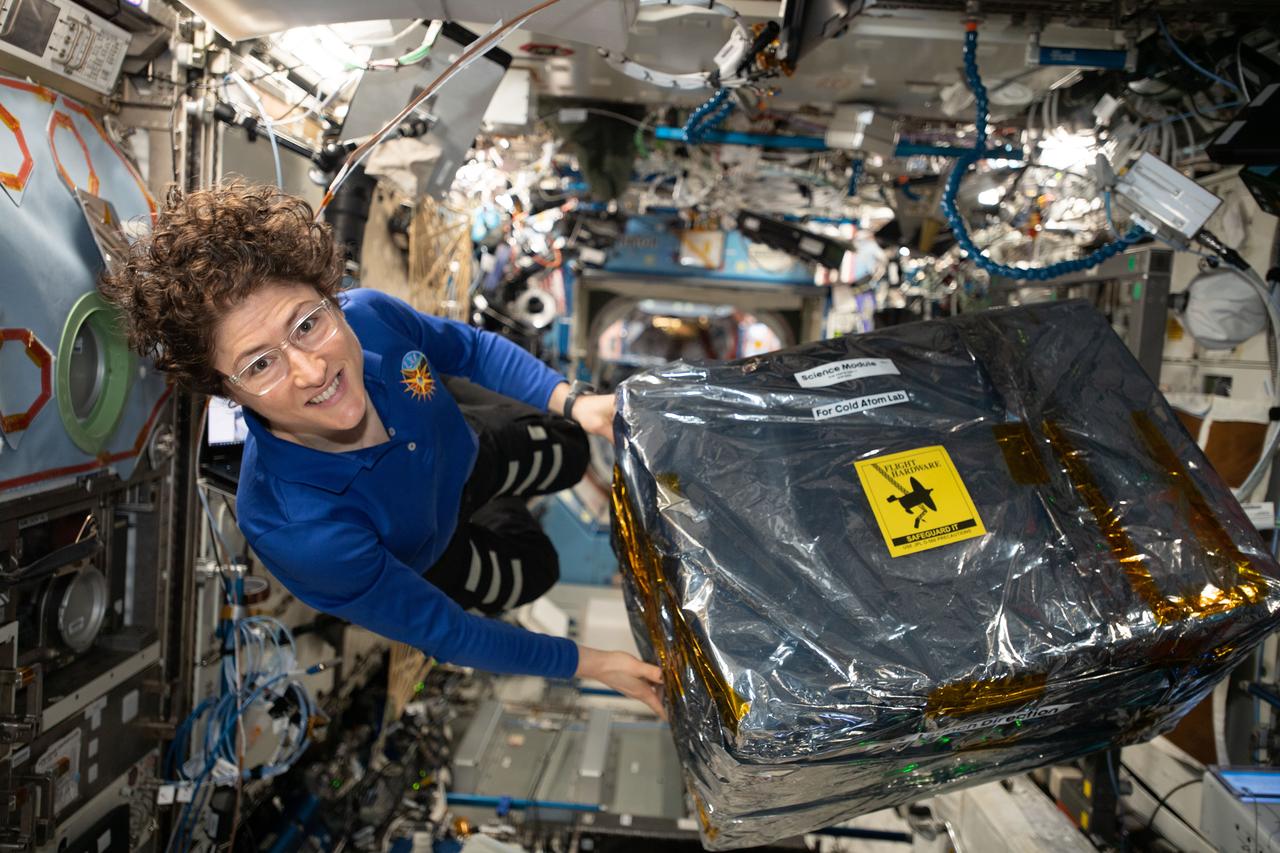
iss061e068045 (Dec. 9, 2019) --- NASA astronaut and Expedition 61 Flight Engineer Christina Koch handles science hardware stowed inside a cargo transfer bag retrieved from the SpaceX Dragon resupply ship. The hardware is part of the the Cold Atom Laboratory that produces clouds of atoms that are chilled to about one ten billionth of a degree above absolute zero -- much colder than the average temperature of deep space. At these low temperatures, atoms have almost no motion, allowing scientists to study fundamental behaviors and quantum characteristics that are difficult or impossible to probe at higher temperatures.
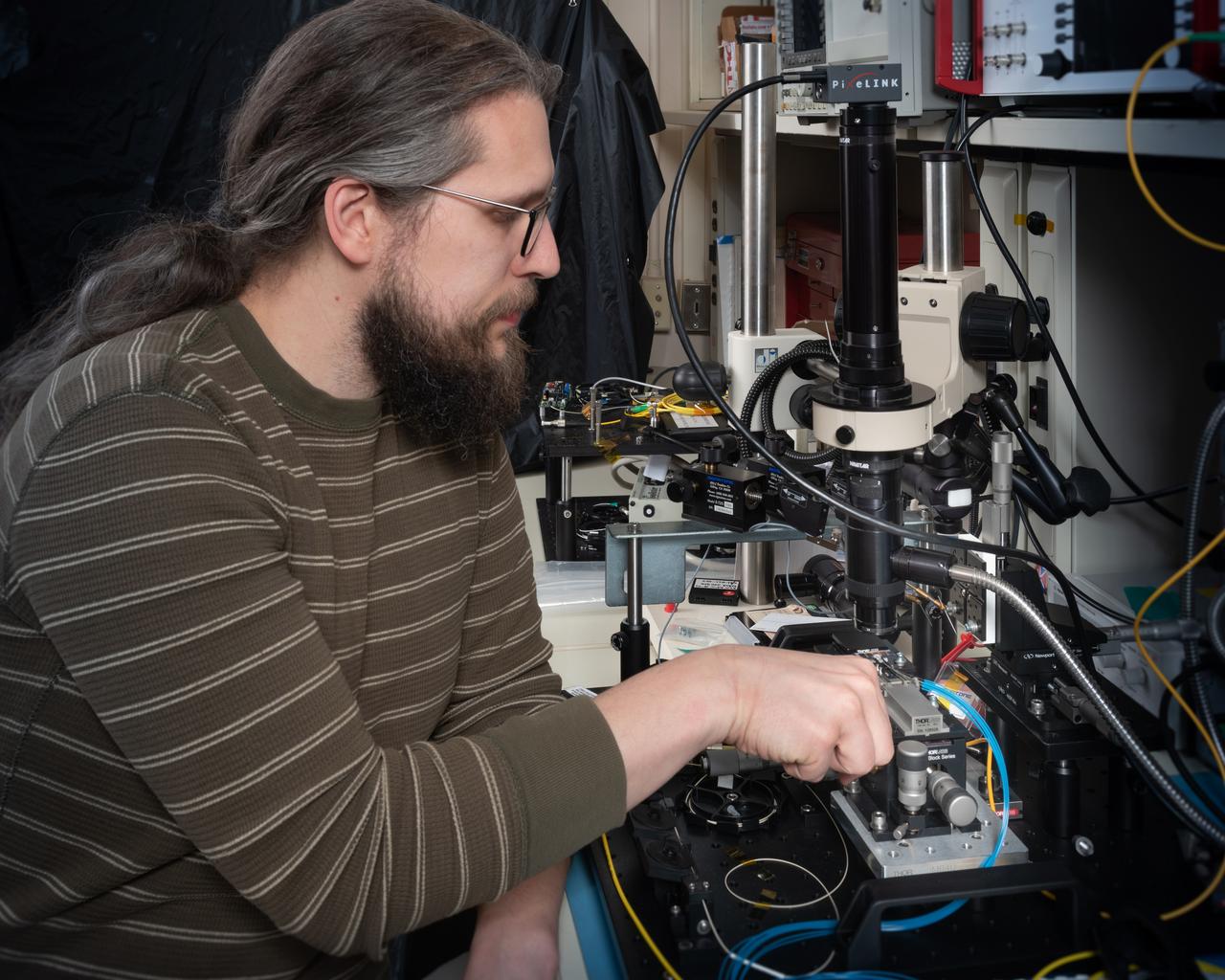
Space Communications and Navigation, SCaN Quantum Metrology Lab

iss071-s-001 (Aug. 31, 2023) --- For nearly a quarter of a century the International Space Station (ISS) has hosted crews and accommodated science experiments even as it has continued to evolve into the highly capable orbiting laboratory of today. With its unique vantage point, the ISS serves as an intersection for discoveries ranging from the vast, such as the search for dark matter and cosmological origins, to the near, such as detailed observation of our home planet and its atmosphere, to the microscopic, including behavior of microbial life, DNA sequencing, and molecular biology in the microgravity environment. The Expedition 71 patch celebrates this science as well as the thousands of multinational scientists and technicians that have contributed to numerous groundbreaking experiments. The ISS is the ultimate destination for the scientifically curious. The symbology represents onboard research into quantum behavior of novel states of matter, antibodies and immune function, the search for dark matter, flame and combustion physics, DNA expression, plant growth and root behavior, and direct earth observation. The human eye and microscope objectives at upper left form the apex of a cone of vision culminating in the Expedition number 71, and represents the deliberate and disciplined practice of scientific observation. Earth’s moon and Mars are also depicted as next steps for exploration, with an anticipation of further rich scientific discovery using many techniques and skills honed aboard the ISS.
Shown here is a prototype of the Deep Space Optical Communications, or DSOC, ground receiver detector built by the Microdevices Laboratory at NASA's Jet Propulsion Laboratory in Southern California. The prototype superconducting nanowire single-photon detector was used by JPL technologists to help develop the detector that – from a station on Earth – will receive near-infrared laser signals from the DSOC flight transceiver traveling with NASA's Psyche mission in deep space. DSOC will test key technologies that could enable high-bandwidth optical, or laser, communications from Mars distances. Bolted to the side of the spacecraft and operating for the first two years of Psyche's journey to the asteroid of the same name, the DSOC flight laser transceiver will transmit high-rate data to Caltech's Palomar Observatory in San Diego County, California, which houses the 200-inch (5.1-meter) Hale Telescope. The downlink detector converts optical signals to electrical signals, which can be processed and decoded. The detector is designed to be both sensitive enough to detect single photons (quantum particles of light) and able to detect many photons arriving all at once. At its farthest point during the technology demonstration's operations period, the transceiver will be up to 240 million miles (390 million kilometers) away, meaning that by the time its weak laser pulses arrive at Earth, the detector will need to efficiently detect a trickle of single photons. But when the spacecraft is closer to Earth and the flight transceiver is delivering its highest bit rate to Palomar, the detector is capable of detecting very high numbers of photons without becoming overwhelmed. Because data is encoded in the timing of the laser pulses, the detector must also be able to determine the time of a photon's arrival with a precision of 100 picoseconds (one picosecond is one trillionth of a second). DSOC is the latest in a series of optical communication technology demonstrations funded by NASA's Technology Demonstrations Missions (TDM) program and the agency's Space Communications and Navigation (SCaN) program. JPL, a division of Caltech in Pasadena, California, manages DSOC for TDM within NASA's Space Technology Mission Directorate and SCaN within the agency's Space Operations Mission Directorate. https://photojournal.jpl.nasa.gov/catalog/PIA25840
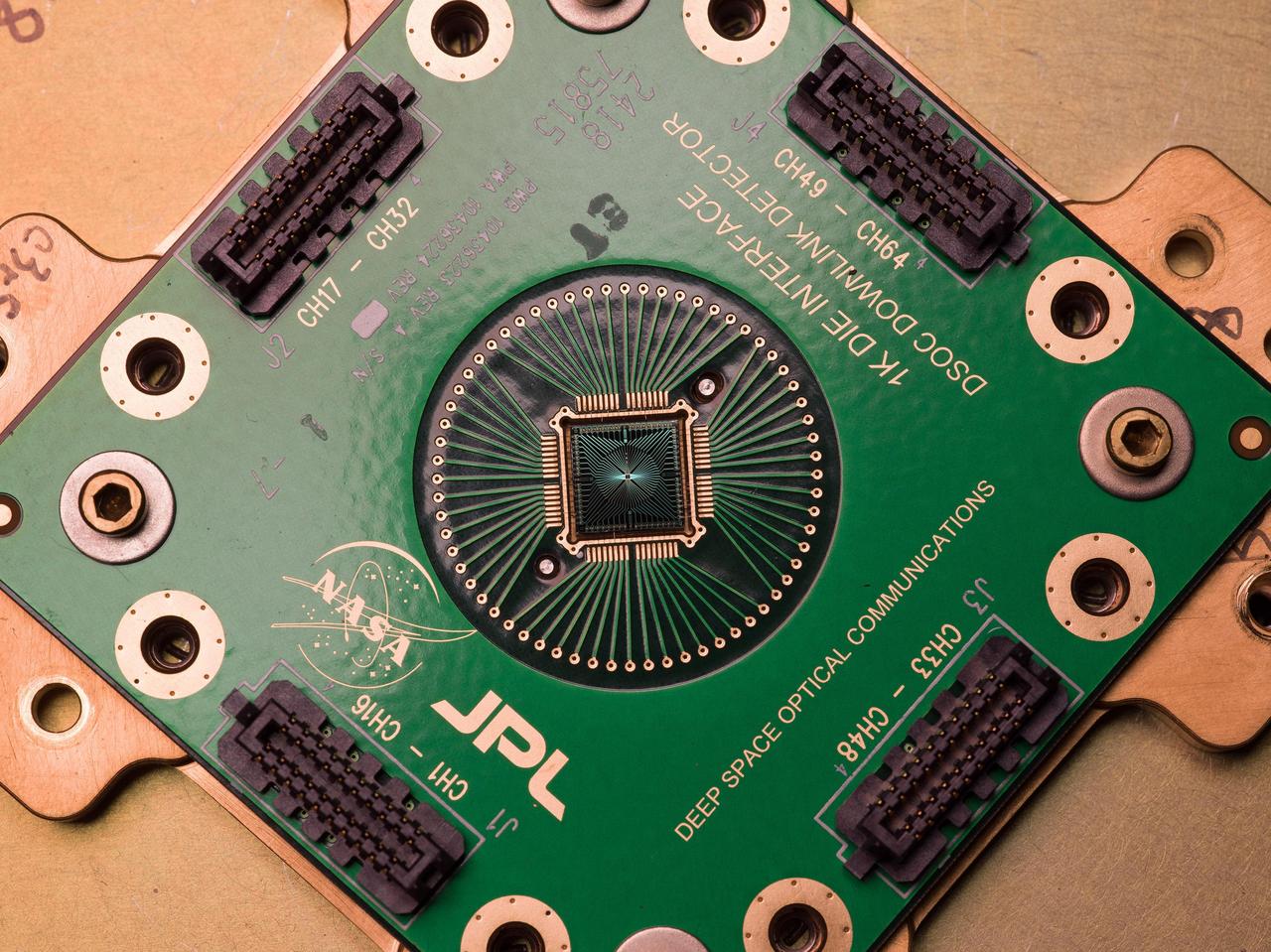
Shown here is an identical copy of the Deep Space Optical Communications, or DSOC, superconducting nanowire single-photon detector that is coupled to the 200-inch (5.1-meter) Hale Telescope located at Caltech's Palomar Observatory in San Diego County, California. Built by the Microdevices Laboratory at NASA's Jet Propulsion Laboratory in Southern California, the detector is designed to receive near-infrared laser signals from the DSOC flight transceiver traveling with NASA's Psyche mission in deep space as a part of the technology demonstration. DSOC will test key technologies that could enable high-bandwidth optical, or laser, communications from Mars distances. Bolted to the side of the spacecraft and operating for the first two years of Psyche's journey to the asteroid of the same name, the DSOC flight laser transceiver will transmit high-rate data to Caltech's Palomar Observatory in San Diego County, California, which houses the 200-inch (5.1-meter) Hale Telescope. The downlink detector converts optical signals to electrical signals, which can be processed and decoded. The detector is designed to be both sensitive enough to detect single photons (quantum particles of light) and able to detect many photons arriving all at once. At its farthest point during the technology demonstration's operations period, the transceiver will be up to 240 million miles (390 million kilometers) away, meaning that by the time its weak laser pulses arrive at Earth, the detector will need to efficiently detect a trickle of single photons. But when the spacecraft is closer to Earth and the flight transceiver is delivering its highest bit rate to Palomar, the detector is capable of detecting very high numbers of photons without becoming overwhelmed. Because data is encoded in the timing of the laser pulses, the detector must also be able to determine the time of a photon's arrival with a precision of 100 picoseconds (one picosecond is one trillionth of a second). To sense single photons, the detector must be in a superconducting state (when electrical current flows with zero resistance), so it is cryogenically cooled to less than minus 458 degrees Fahrenheit (or 1 Kelvin), which is close to absolute zero, or the lowest temperature possible. A photon absorbed in the detector disrupts its superconducting state, creating a measurable electrical pulse as current leaves the detector. DSOC is the latest in a series of optical communication technology demonstrations funded by NASA's Technology Demonstrations Missions (TDM) program and the agency's Space Communications and Navigation (SCaN) program. JPL, a division of Caltech in Pasadena, California, manages DSOC for TDM within NASA's Space Technology Mission Directorate and SCaN within the agency's Space Operations Mission Directorate. https://photojournal.jpl.nasa.gov/catalog/PIA26141