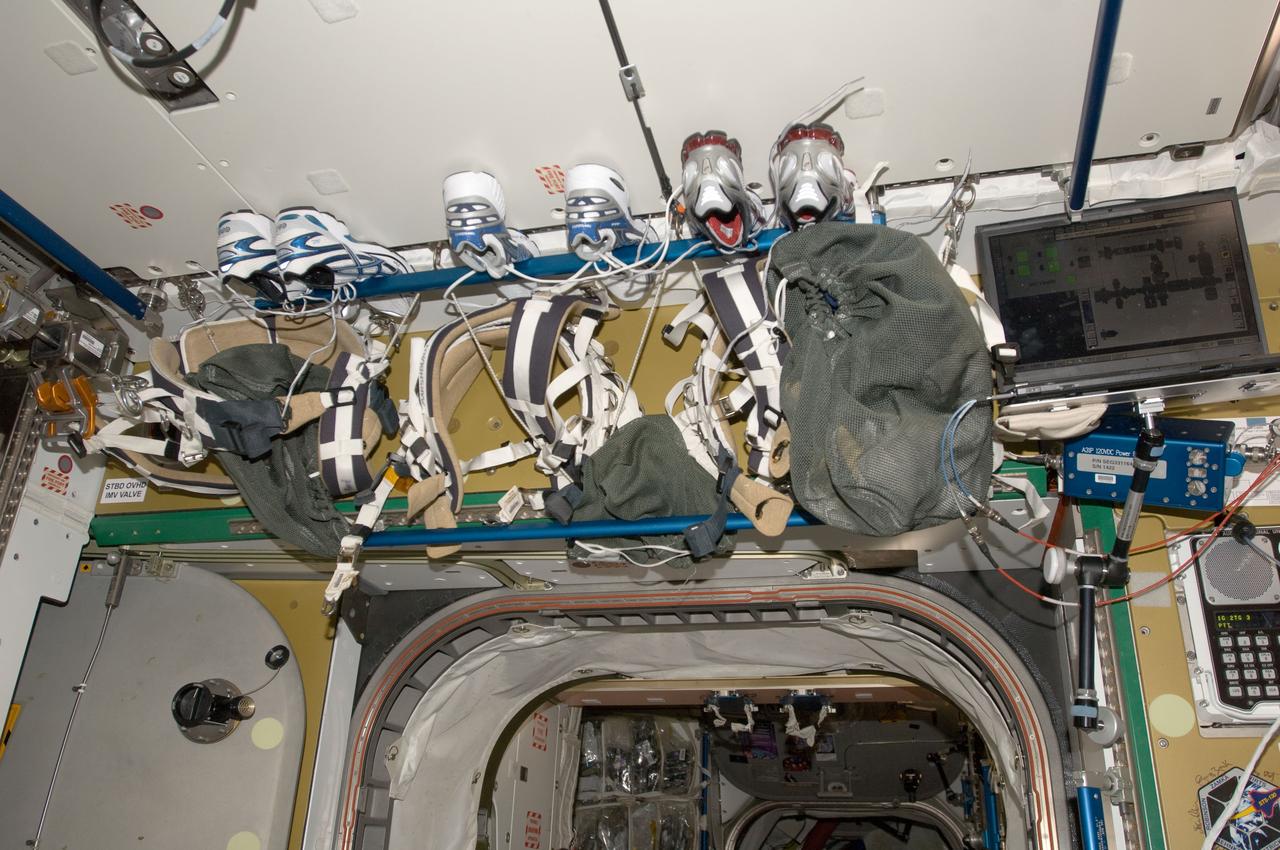
View of Avionics Rack 2 Closeout Panel with tennis shoes,in the Node 3. Photo was taken during Expedition 34.

"NASA astronaut Karen Nyberg,Expedition 36 flight engineer,works with the Combustion Integrated Rack (CIR) Alignment Guide Removal.
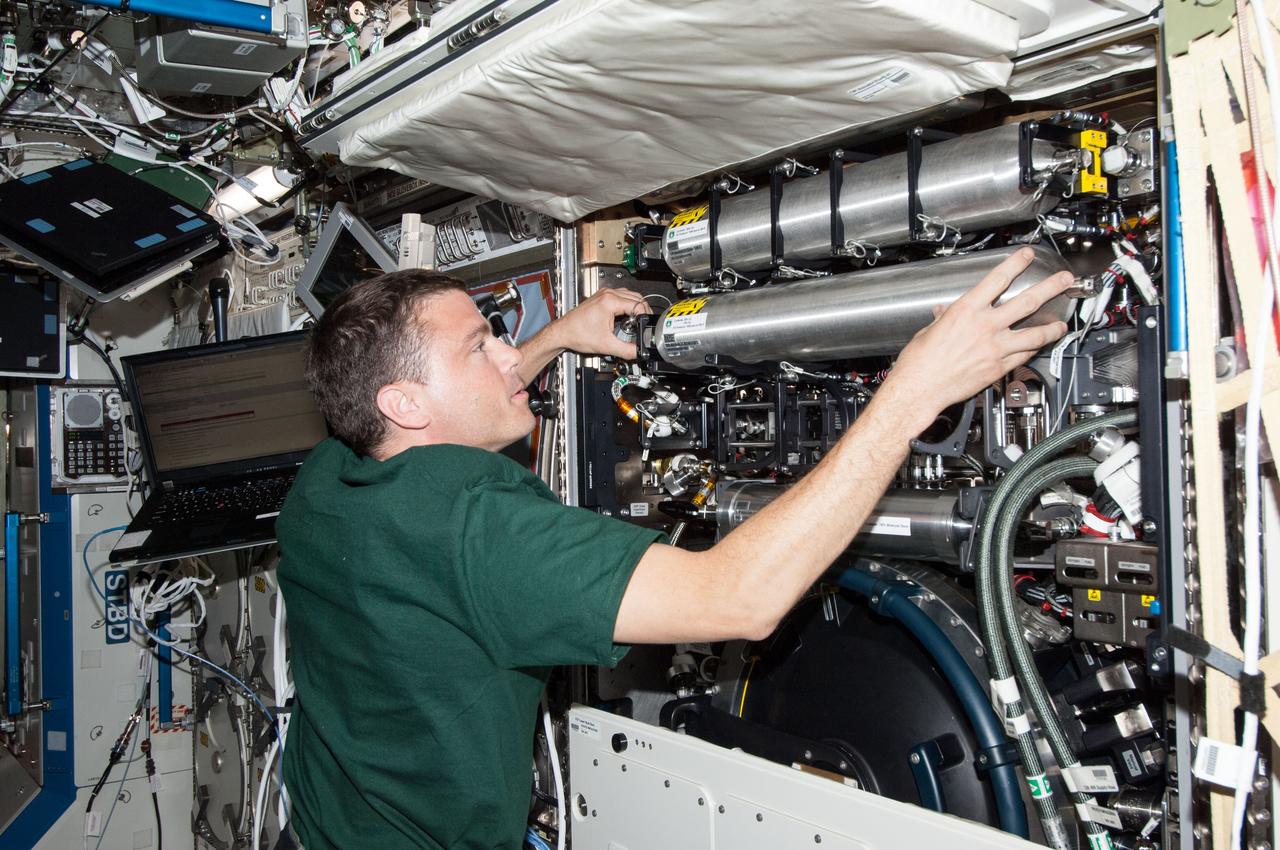
ISS040-E-008521 (9 June 2014) --- NASA astronaut Reid Wiseman, Expedition 40 flight engineer, removes and replaces a new manifold bottle in the Combustion Integration Rack (CIR) in the Destiny laboratory of the International Space Station.
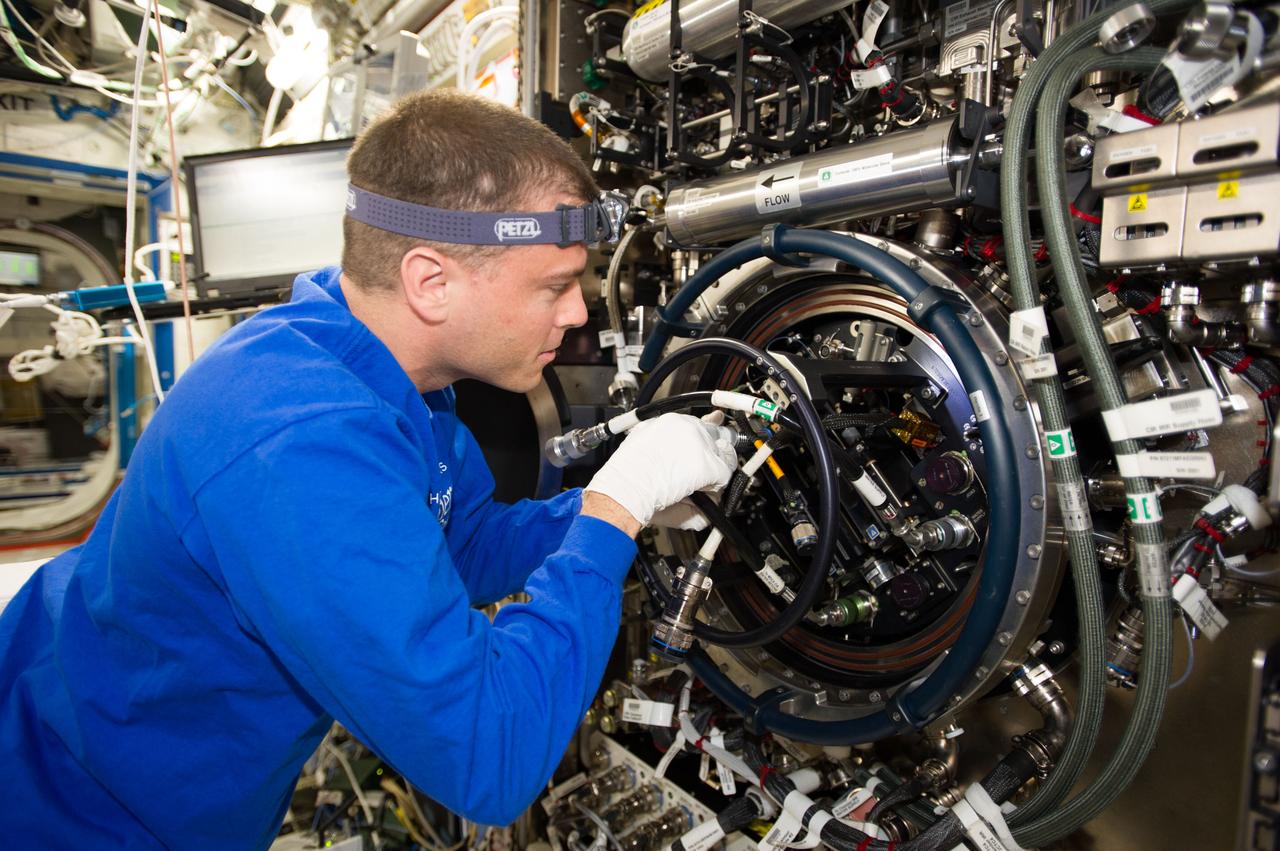
ISS040-E-090493 (11 Aug. 2014) --- NASA astronaut Reid Wiseman, Expedition 40 flight engineer, performs routine in-flight maintenance on the Multi-user Drop Combustion Apparatus (MDCA) inside the Combustion Integrated Rack (CIR) in the Destiny laboratory of the International Space Station. The MDCA contains hardware and software to conduct unique droplet combustion experiments in space.
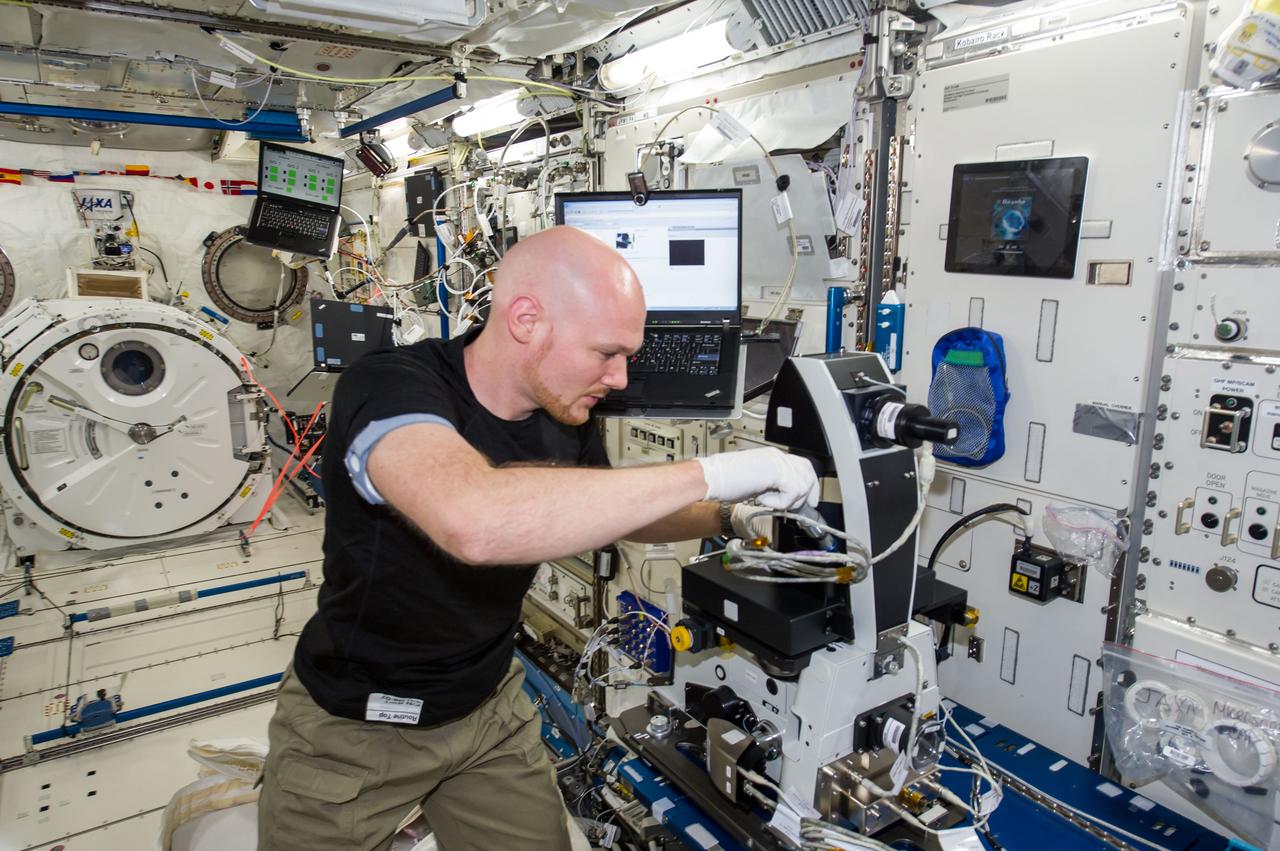
European Space Agency astronaut Alexander Gerst,Expedition 40 flight engineer,installs a microscope for the Cell Mechanosensing-2 experiment in the Kibo laboratory of the International Space Station. The Japanese experiment,which is conducted in Kibos Kobairo rack,seeks to identify gravity sensors in cells that may change the expression of key proteins and genes and allowing muscles to atrophy in microgravity.
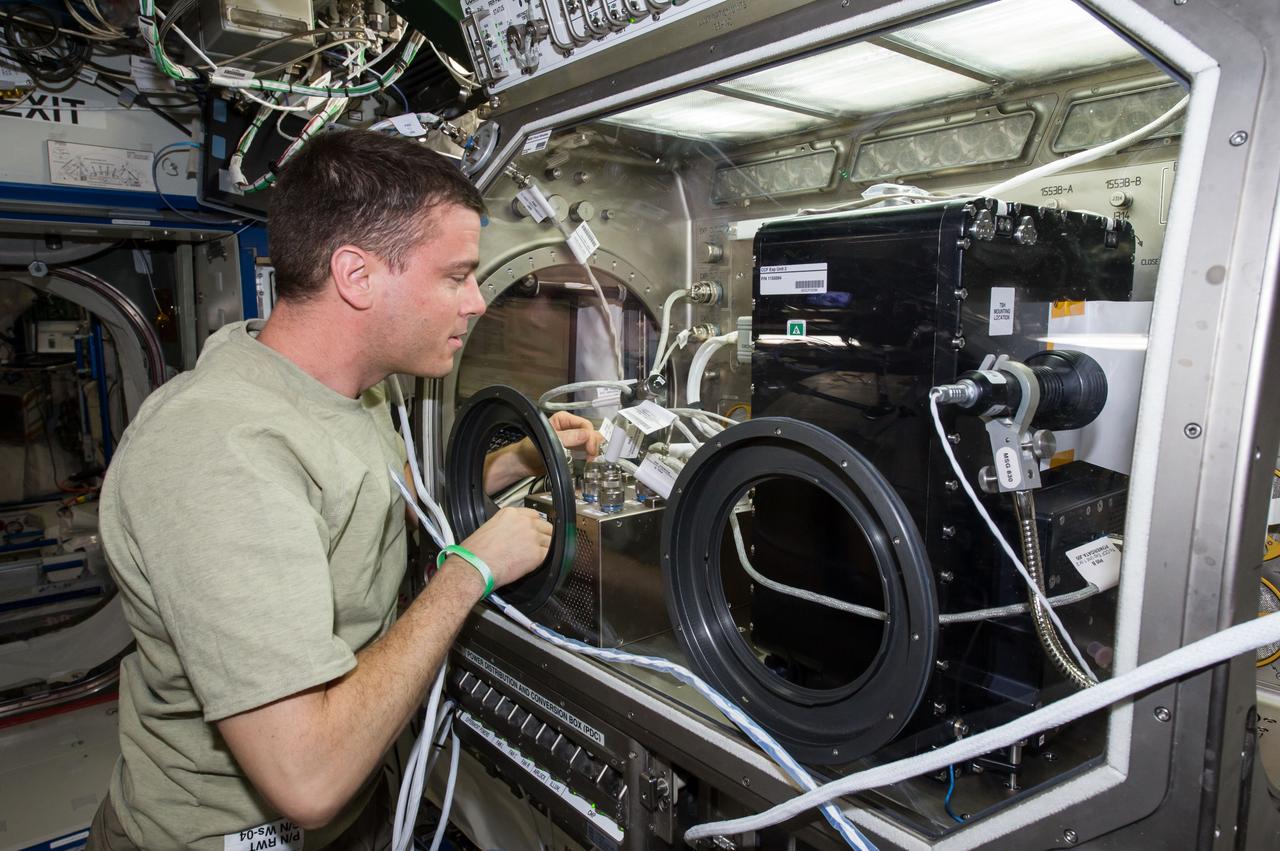
ISS040-E-139616 (10 Sept. 2014) --- NASA astronaut Reid Wiseman, Expedition 40 flight engineer, works with Capillary Channel Flow (CCF) experiment hardware in the Microgravity Science Glovebox (MSG) in the Destiny laboratory of the International Space Station. CCF is a versatile experiment for studying a critical variety of inertial-capillary dominated flows key to spacecraft systems that cannot be studied on the ground.
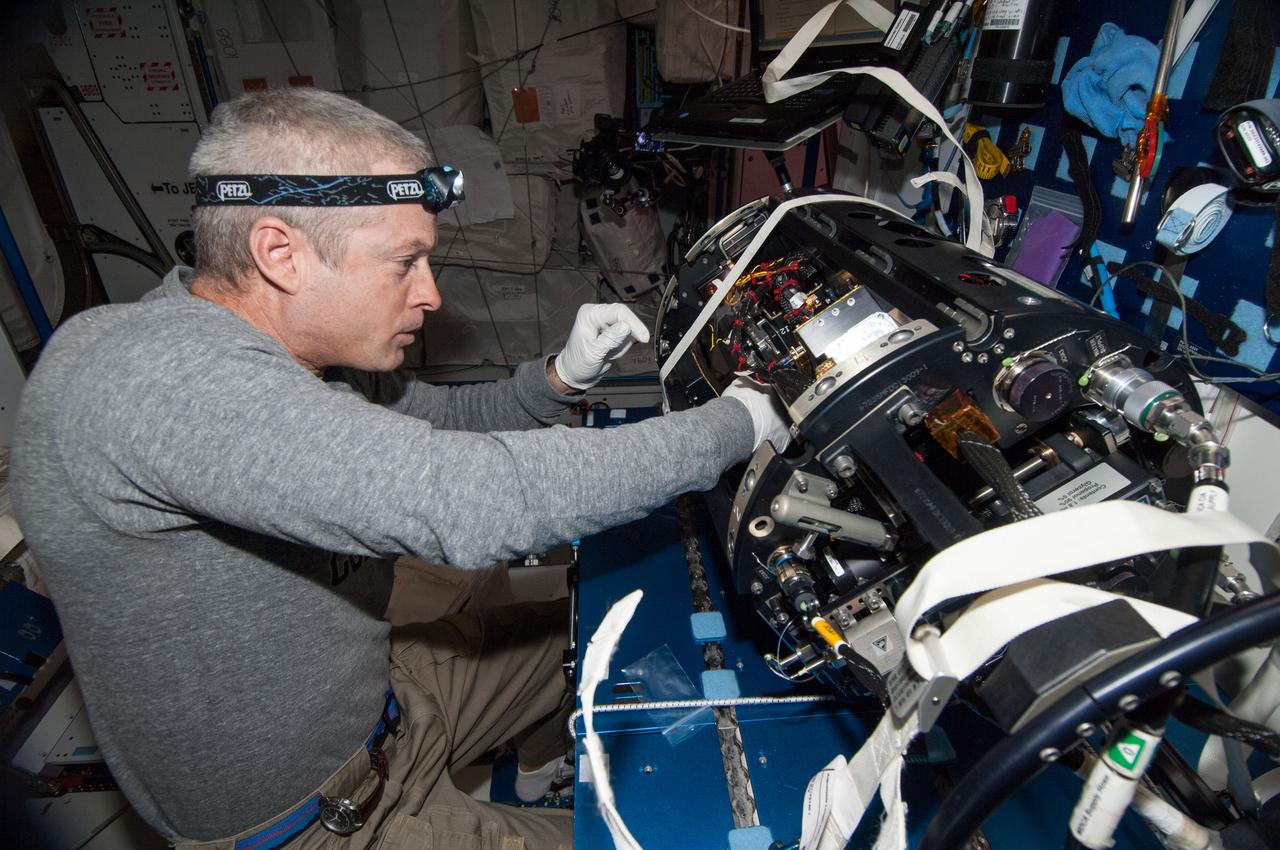
ISS040-E-010261 (11 June 2014) --- NASA astronaut Steve Swanson, Expedition 40 commander, works with the Multi-user Drop Combustion Apparatus (MDCA) at a workstation in the Harmony node of the International Space Station. The MDCA contains hardware and software to conduct unique droplet combustion experiments in space.
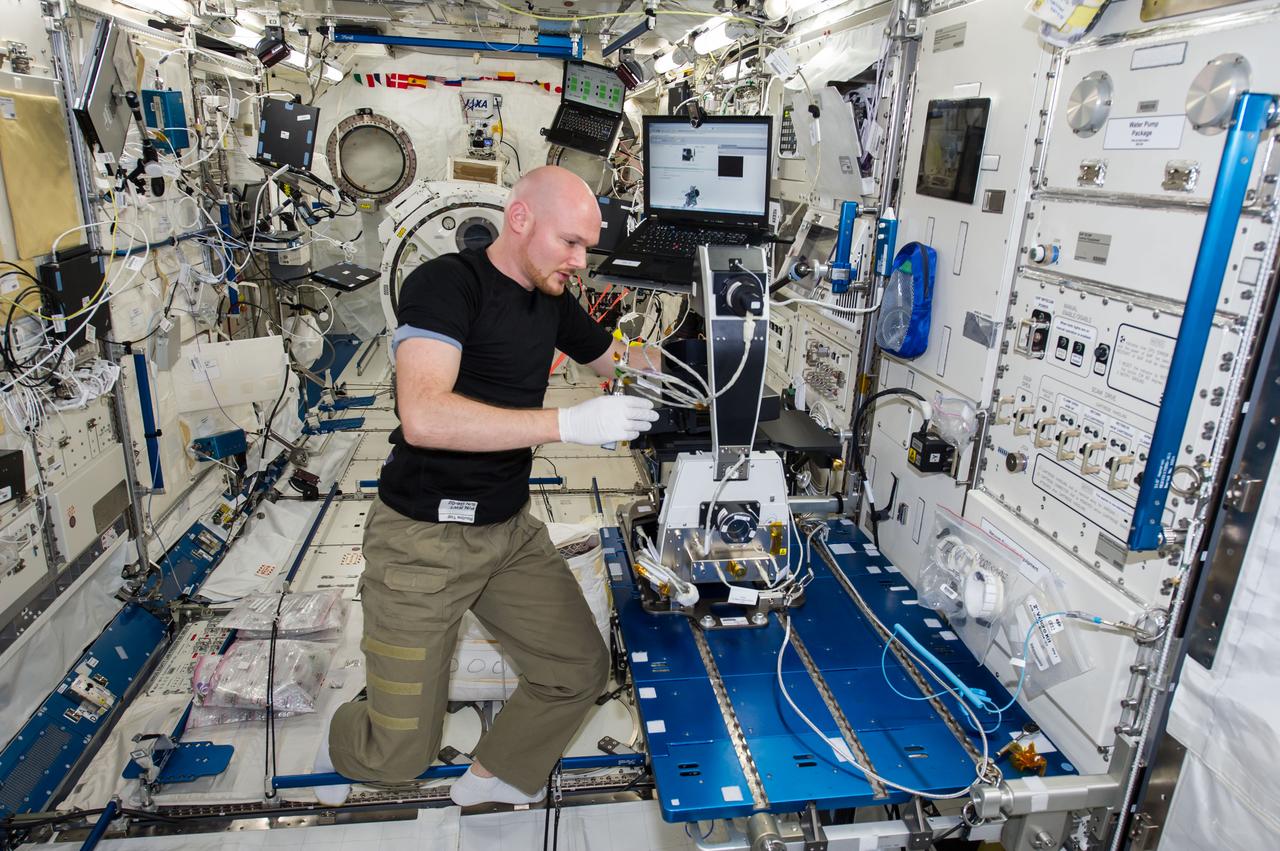
ISS040-E-130233 (9 Sept. 2014) --- European Space Agency astronaut Alexander Gerst, Expedition 40 flight engineer, installs a microscope for the Cell Mechanosensing-2 experiment in the Kibo laboratory of the International Space Station. The Japanese experiment, which is conducted in Kibo’s Kobairo rack, seeks to identify gravity sensors in cells that may change the expression of key proteins and genes and allowing muscles to atrophy in microgravity.
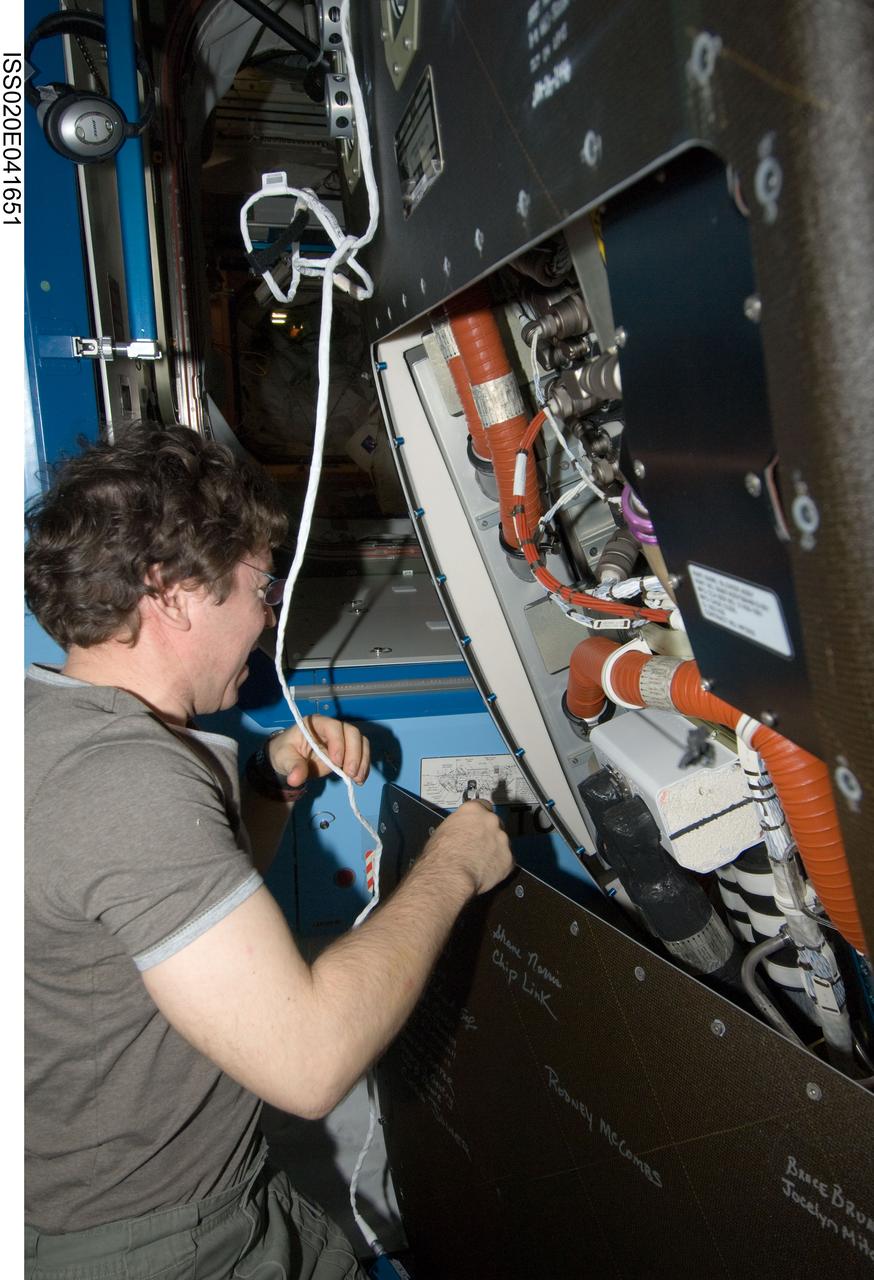
ISS020-E-041651 (22 Sept. 2009) --- NASA astronaut Michael Barratt works with the Atmosphere Revitalization System (ARS) rack in the Destiny laboratory of the International Space Station. Barratt, Canadian Space Agency astronaut Robert Thirsk (out of frame) and European Space Agency astronaut Frank De Winne (out of frame), all Expedition 20 flight engineers, spent several hours with the extensive dual-rack swap/install activity, to move Destiny?s ARS rack to the Kibo laboratory and install in Destiny in its place the newly-delivered ARS rack for Node-3.
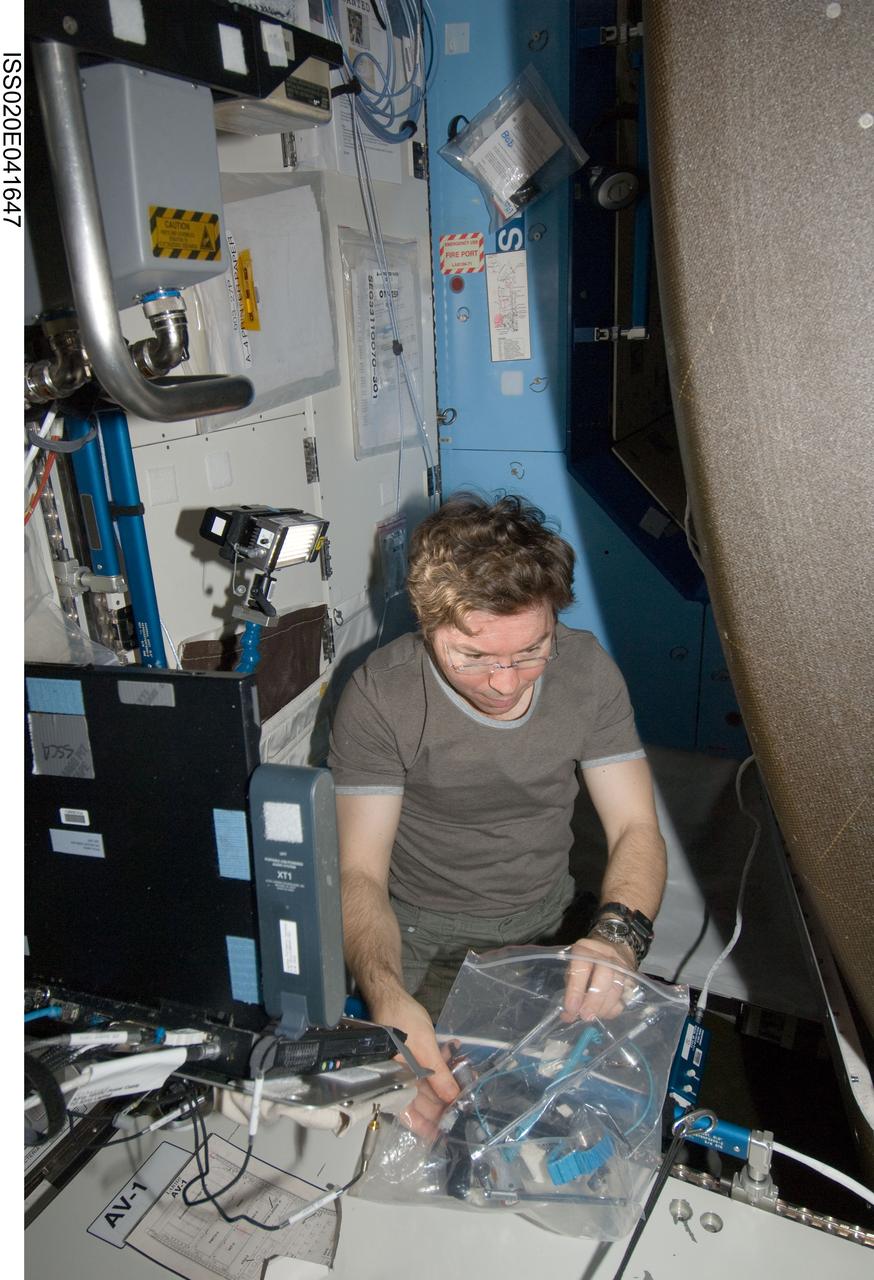
ISS020-E-041647 (22 Sept. 2009) --- NASA astronaut Michael Barratt works with the Atmosphere Revitalization System (ARS) rack in the Destiny laboratory of the International Space Station. Barratt, Canadian Space Agency astronaut Robert Thirsk (out of frame) and European Space Agency astronaut Frank De Winne (out of frame), all Expedition 20 flight engineers, spent several hours with the extensive dual-rack swap/install activity, to move Destiny?s ARS rack to the Kibo laboratory and install in Destiny in its place the newly-delivered ARS rack for Node-3.
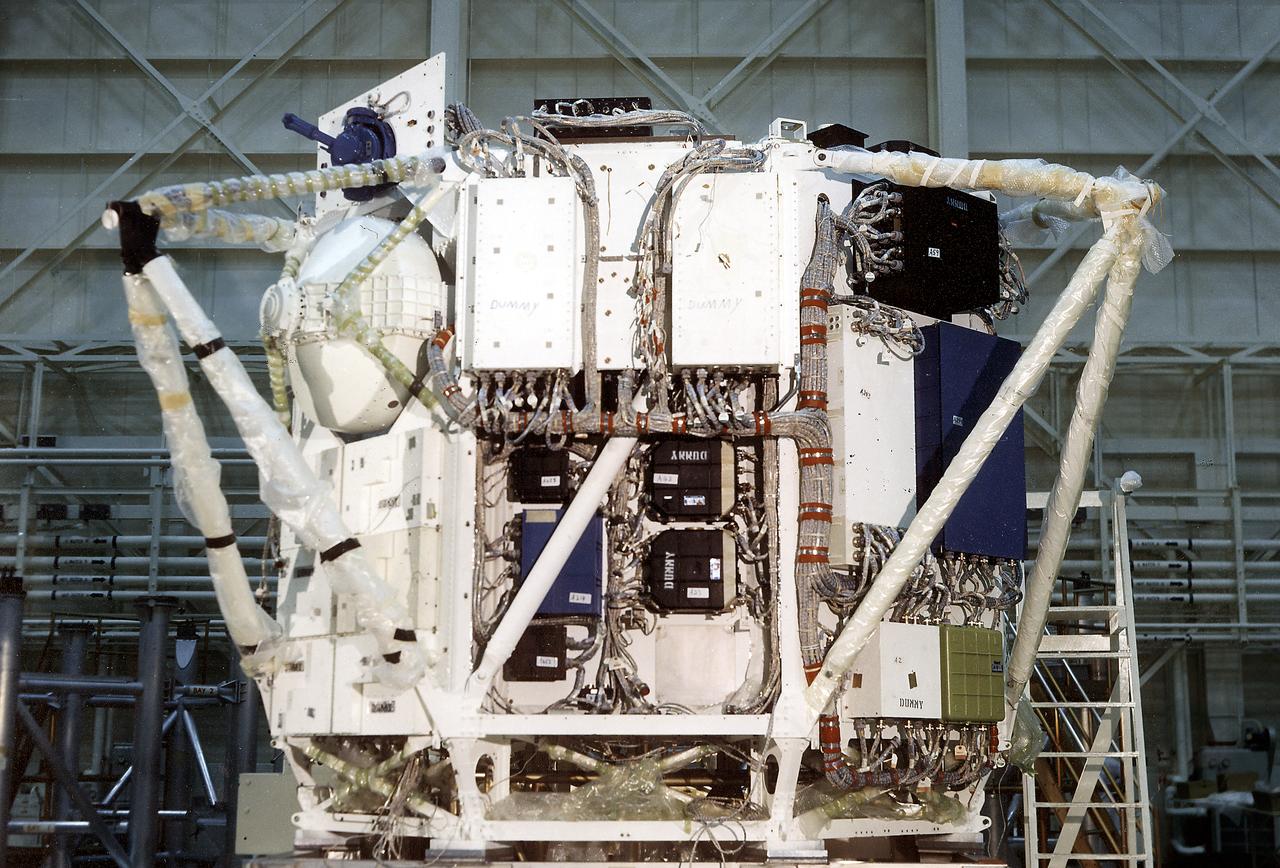
The Apollo Telescope Mount (ATM) was designed and developed by the Marshall Space Flight Center and served as the primary scientific instrument unit aboard Skylab (1973-1979). The ATM consisted of eight scientific instruments as well as a number of smaller experiments. This is a photograph of the assembly of an ATM flight unit rack. The flight unit rack was an octagonal shaped complex outer frame that housed the canister containing the solar instruments.

The Apollo Telescope Mount (ATM) was designed and developed by the Marshall Space Flight Center and served as the primary scientific instrument unit aboard Skylab (1973-1979). The ATM consisted of eight scientific instruments as well as a number of smaller experiments. This is a photograph of the assembly of an ATM flight unit rack. The flight unit rack was an octagonal shaped complex outer frame that housed the canister containing the solar instruments.
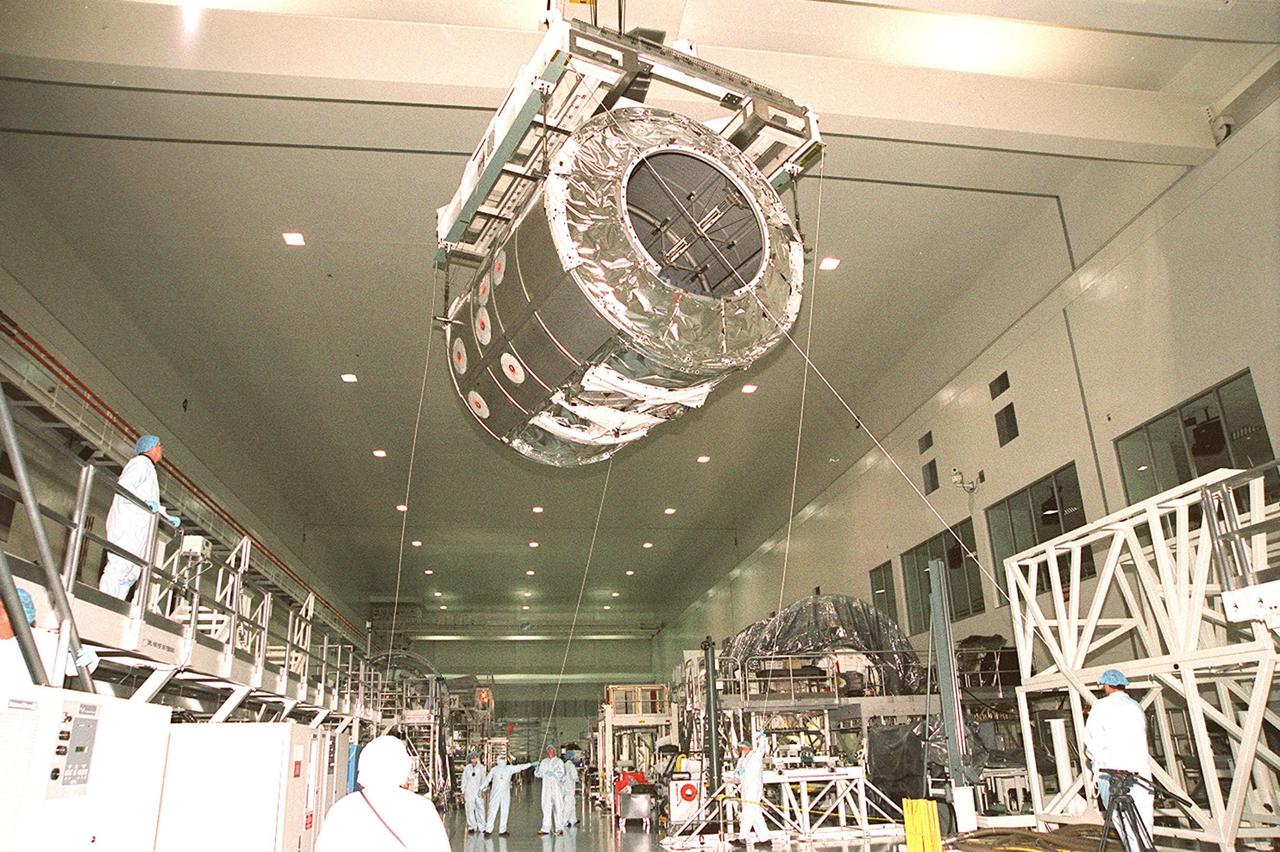
In the Space Station Processing Facility, an overhead frame moves the Italian-built Multi-Purpose Logistics Module “Raffaello” across the facility to a weight-and-balance workstand. Rafaello is the payload on mission STS-100, a Lab outfitting flight. Raffaello carries six system racks and two storage racks for the U.S. Lab. Launch of STS-100 is scheduled for April 19, 2001
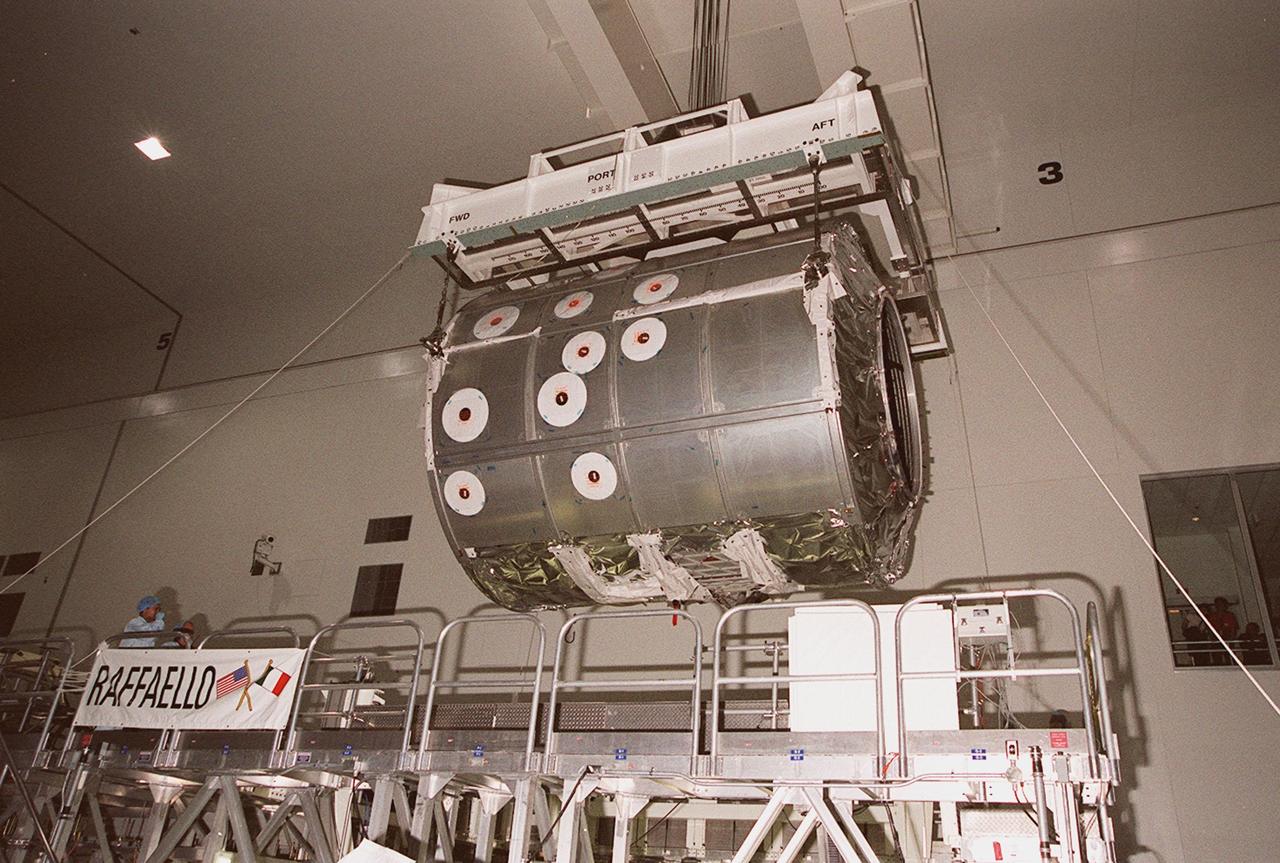
In the Space Station Processing Facility, an overhead frame lifts the Italian-built Multi-Purpose Logistics Module “Raffaello” off its workstand. The module is being moved to a weight-and-balance workstand. Rafaello is the payload on mission STS-100, a Lab outfitting flight. Raffaello carries six system racks and two storage racks for the U.S. Lab. Launch of STS-100 is scheduled for April 19, 2001
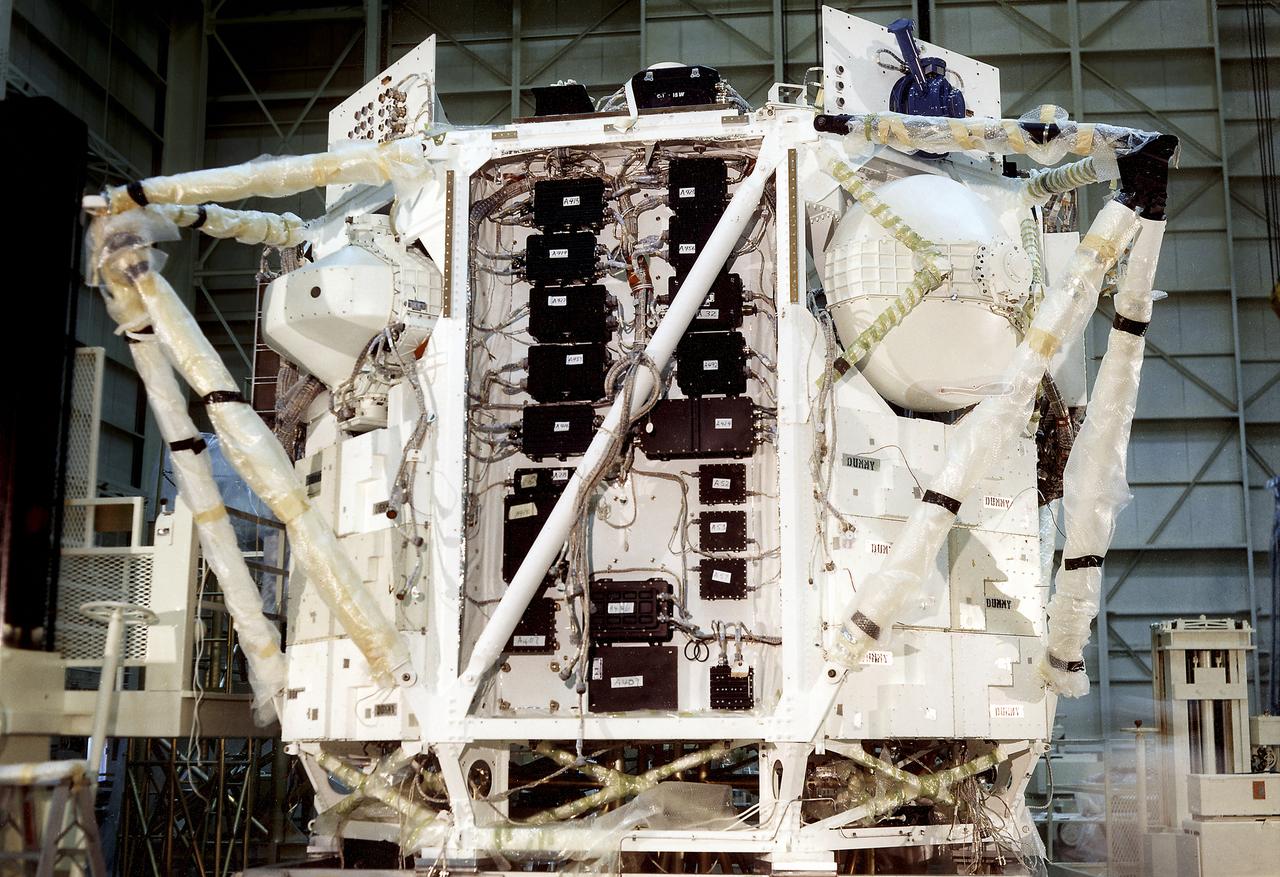
The Apollo Telescope Mount (ATM) was designed and developed by the Marshall Space Flight Center and served as the primary scientific instrument unit aboard Skylab (1973-1979). The ATM consisted of eight scientific instruments as well as a number of smaller experiments. This is a photograph of the assembly of an ATM flight unit rack. The flight unit rack was an octagonal shaped complex outer frame that housed the canister containing the solar instruments.
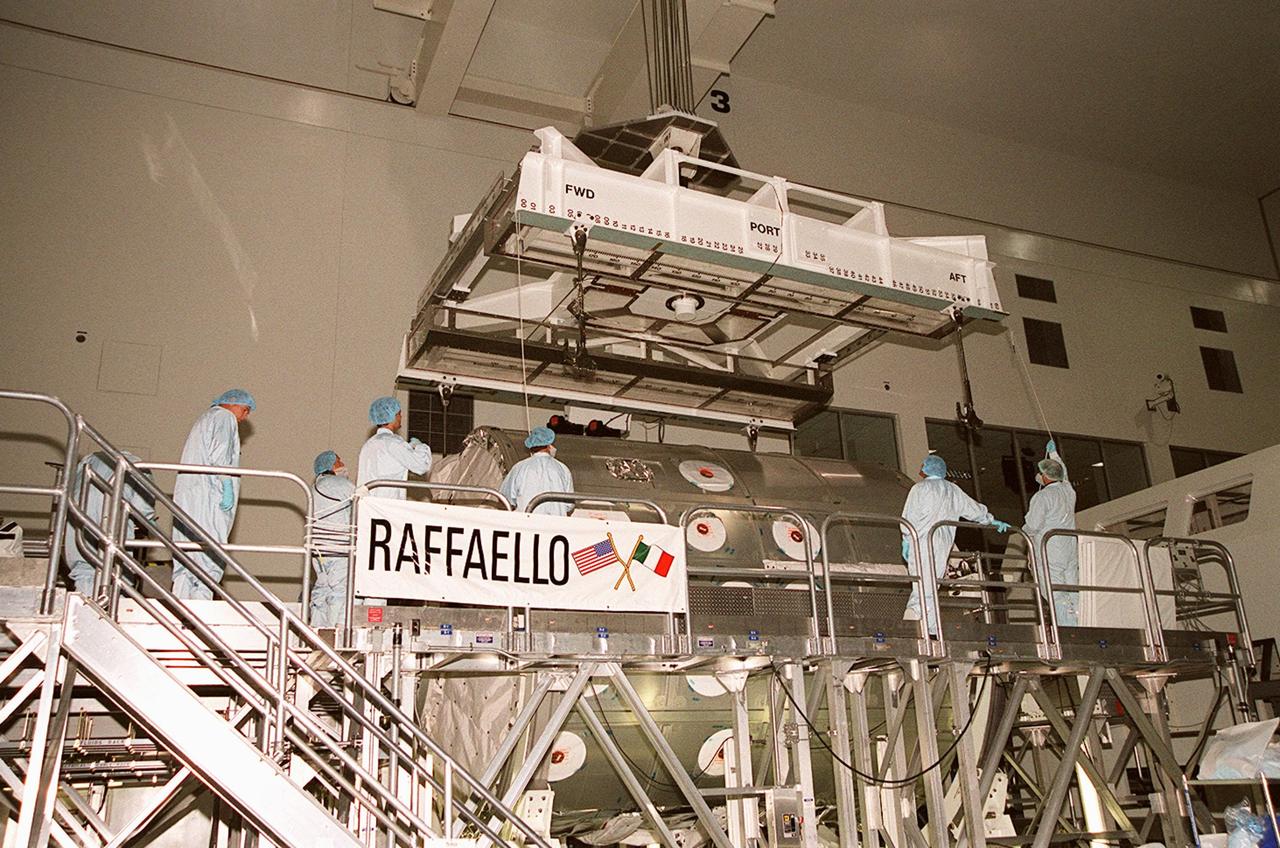
In the Space Station Processing Facility, an overhead frame is attached to the Italian-built Multi-Purpose Logistics Module “Raffaello.” The module will be lifted and moved to a weight-and-balance workstand. Rafaello is the payload on mission STS-100, a Lab outfitting flight. Raffaello carries six system racks and two storage racks for the U.S. Lab. Launch of STS-100 is scheduled for April 19, 2001
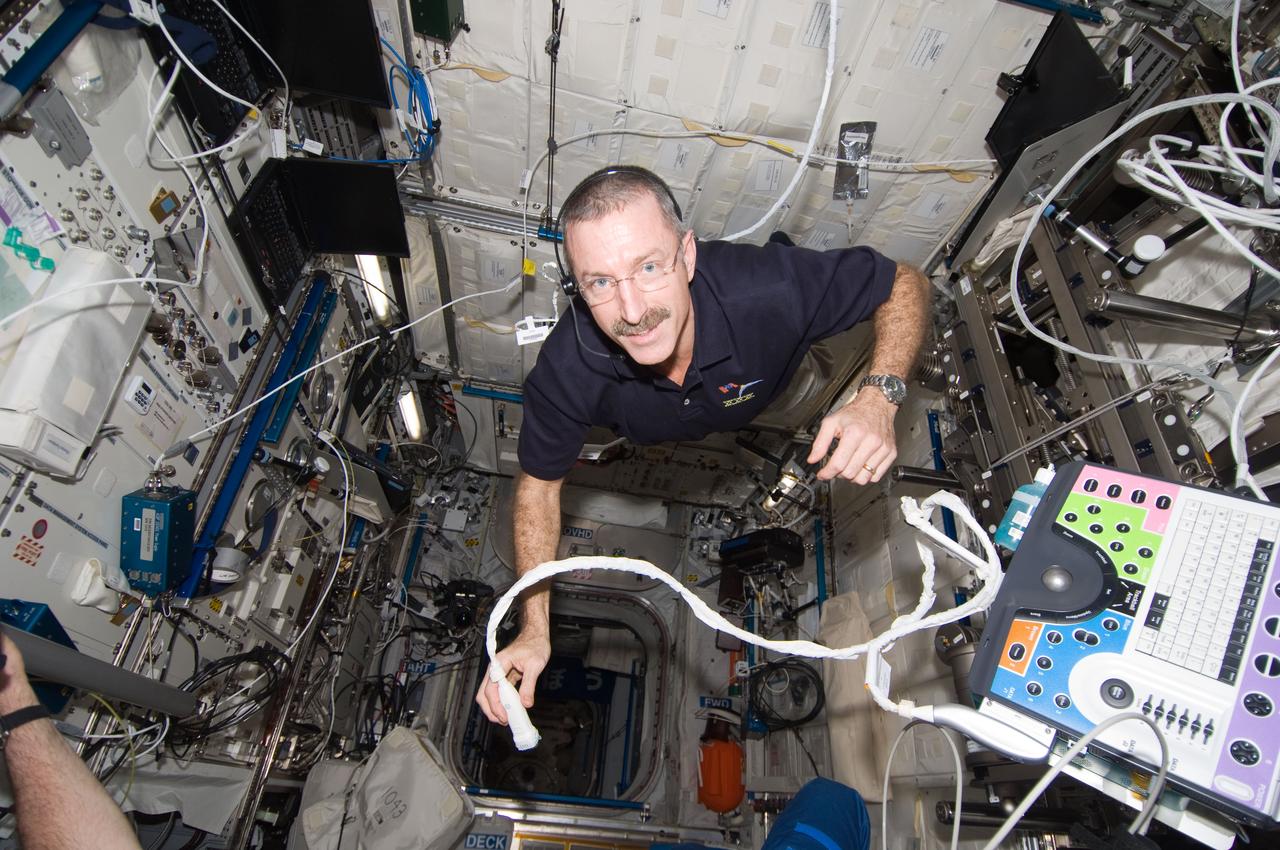
ISS030-E-155942 (20 Jan. 2012) --- NASA astronaut Dan Burbank, Expedition 30 commander, prepares to use the Integrated Cardiovascular (ICV) Resting Echo Scan on a crew member (out of frame) at the Human Research Facility (HRF) rack in the Columbus laboratory of the International Space Station.
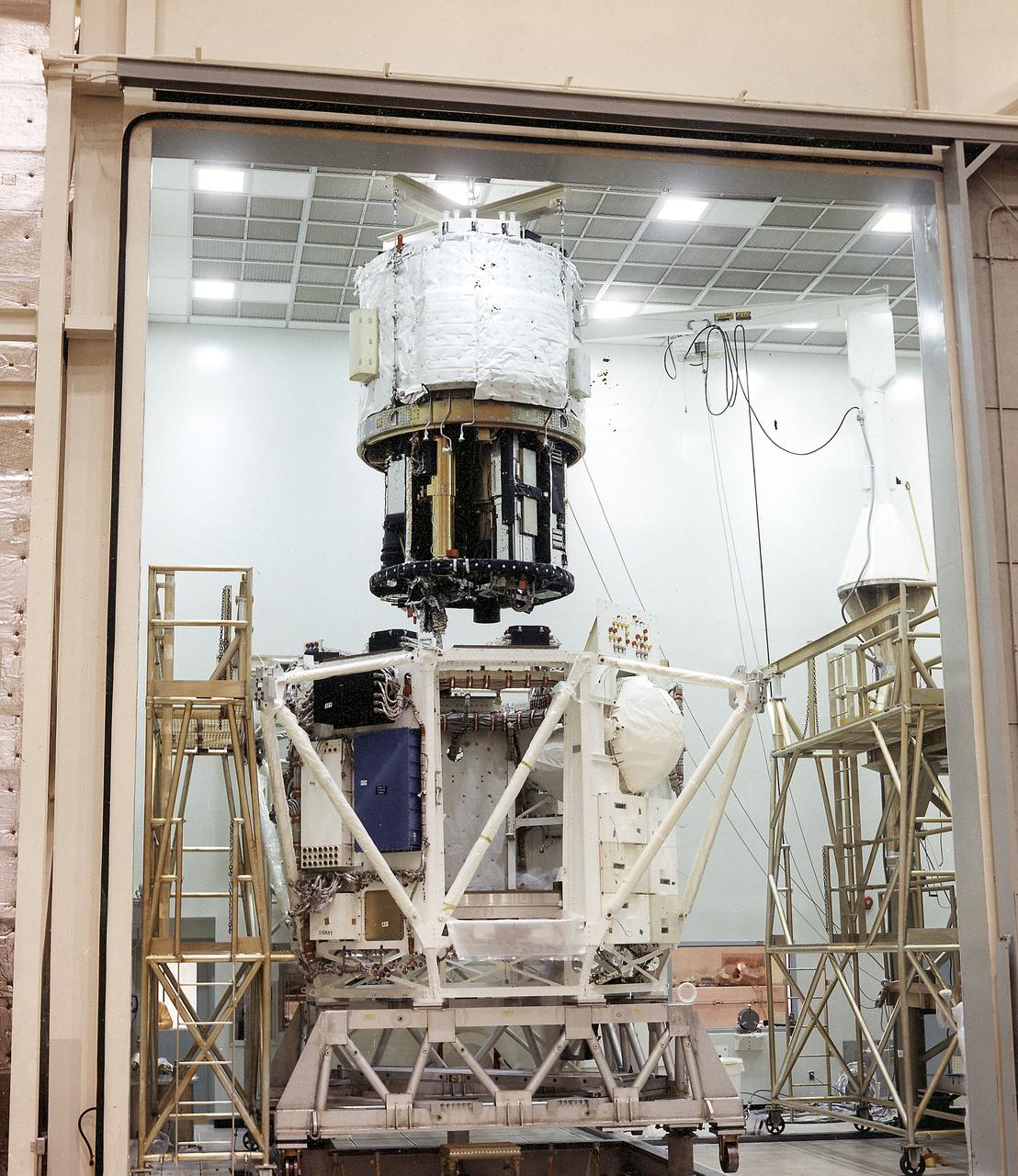
The Apollo Telescope Mount (ATM) was designed and developed by the Marshall Space Flight Center and served as the primary scientific instrument unit aboard Skylab (1973-1979). This photograph shows the spar unit, which housed major solar instruments, being lowered into the rack, the outer octagonal complex frame of the ATM flight unit.
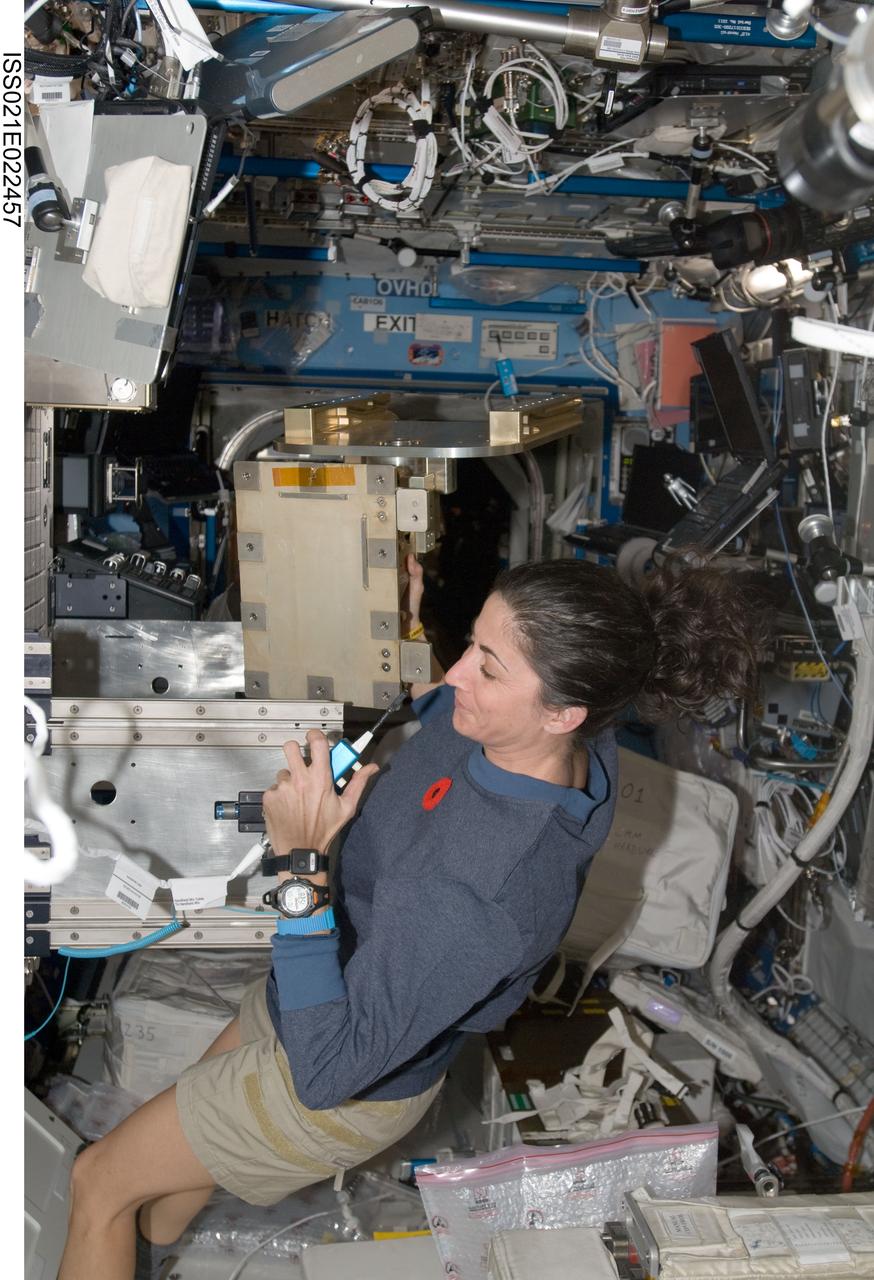
ISS021-E-022457 (9 Nov. 2009) --- NASA astronaut Nicole Stott, Expedition 21 flight engineer, uses a communication system while installing the Light Microscopy Module (LMM) Spindle Bracket Assembly in the Fluids Integrated Rack (FIR) in the Destiny laboratory of the International Space Station. Canadian Space Agency astronaut Robert Thirsk (out of frame) assisted Stott.
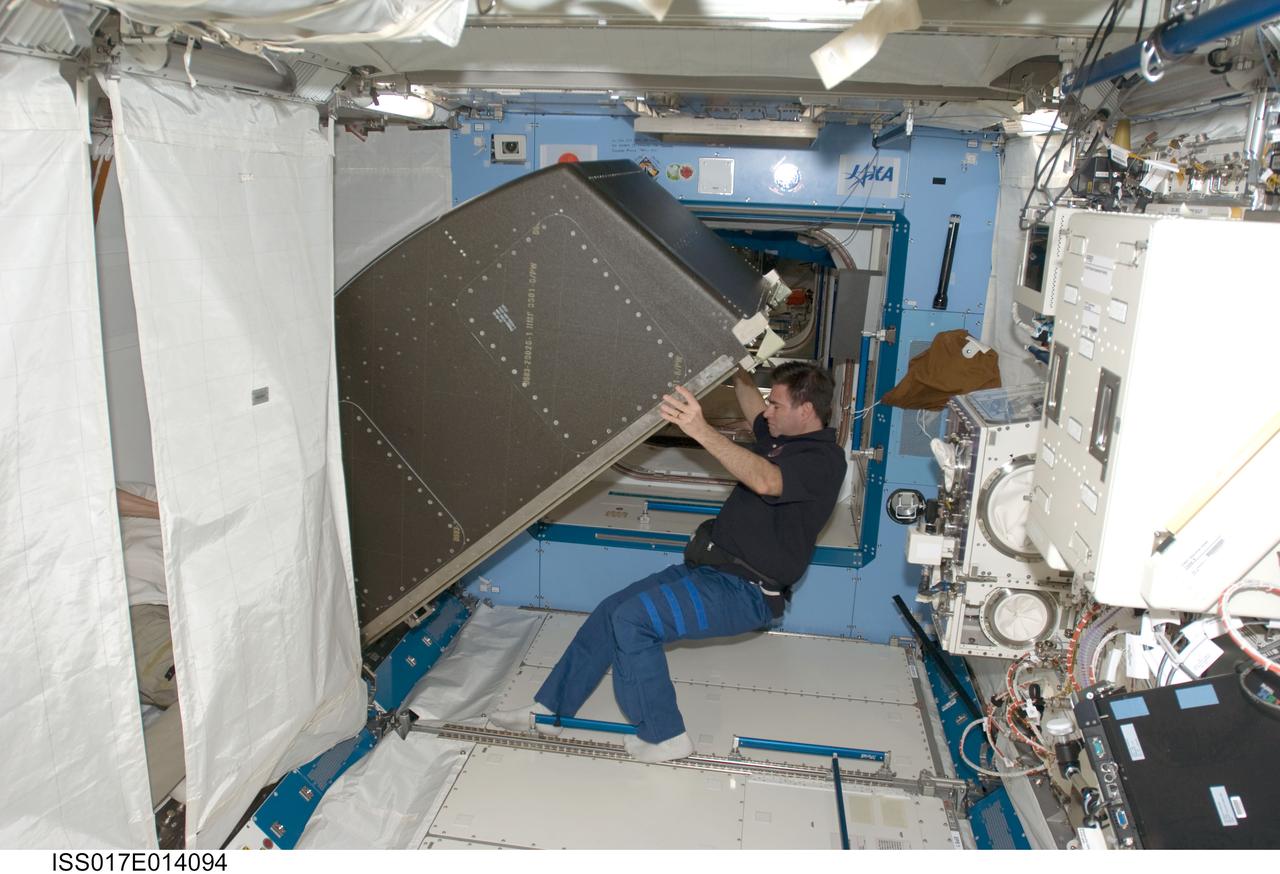
ISS017-E-014094 (26 Aug. 2008) --- Part of the news for the current inhabitants of the International Space Station is that moving day perhaps comes more often in space than on Earth, but the good news is that the weightlessness of space literally lightens the load. Here, in the Kibo laboratory, astronaut Greg Chamitoff, Expedition 17 flight engineer, shares the aid of cosmonaut Sergei Volkov (mostly out of the frame at left), commander, to relocate an experiment rack.
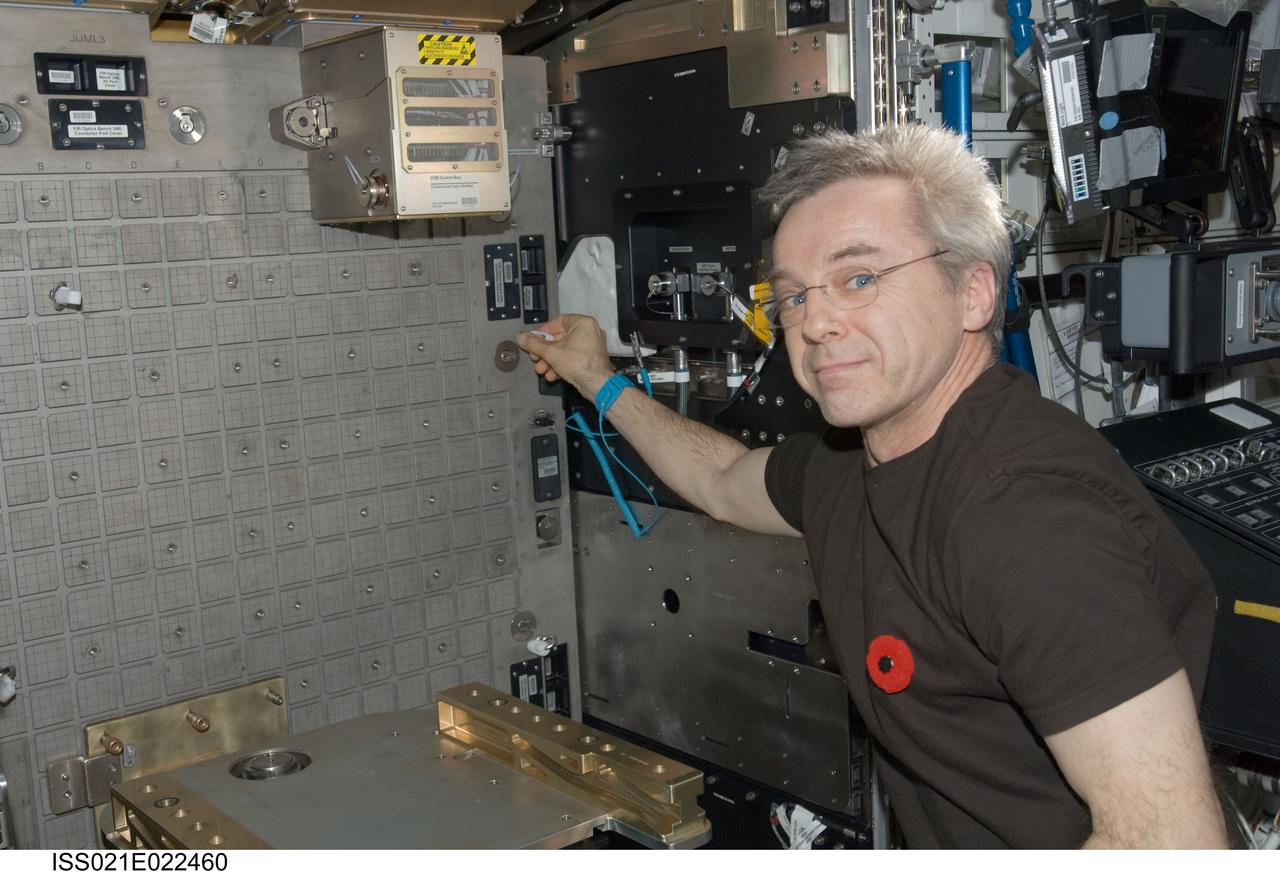
ISS021-E-022460 (9 Nov. 2009) --- Canadian Space Agency astronaut Robert Thirsk, Expedition 21 flight engineer, installs the Light Microscopy Module (LMM) Spindle Bracket Assembly in the Fluids Integrated Rack (FIR) in the Destiny laboratory of the International Space Station. NASA astronaut Nicole Stott (out of frame), flight engineer, assisted Thirsk.
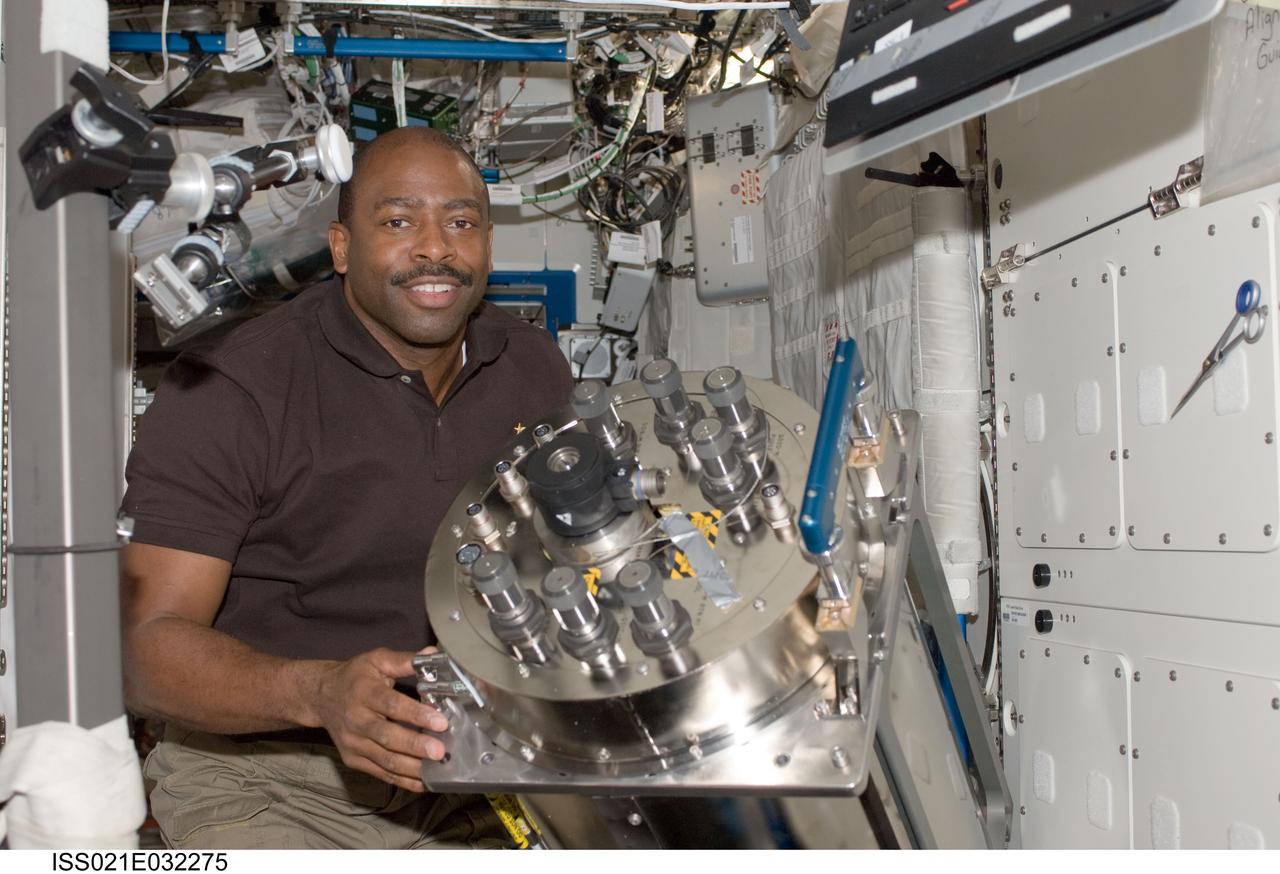
ISS021-E-032275 (23 Nov. 2009) --- NASA astronaut Leland Melvin, STS-129 mission specialist, holds the failed Urine Processor Assembly / Distillation Assembly (UPA DA) in the Destiny laboratory of the International Space Station while space shuttle Atlantis remains docked with the station. Melvin and European Space Agency astronaut Frank De Winne (out of frame), Expedition 21 commander, removed and packed the UPA DA, then transferred it from the Water Recovery System 2 (WRS-2) rack to Atlantis for stowage on the middeck.
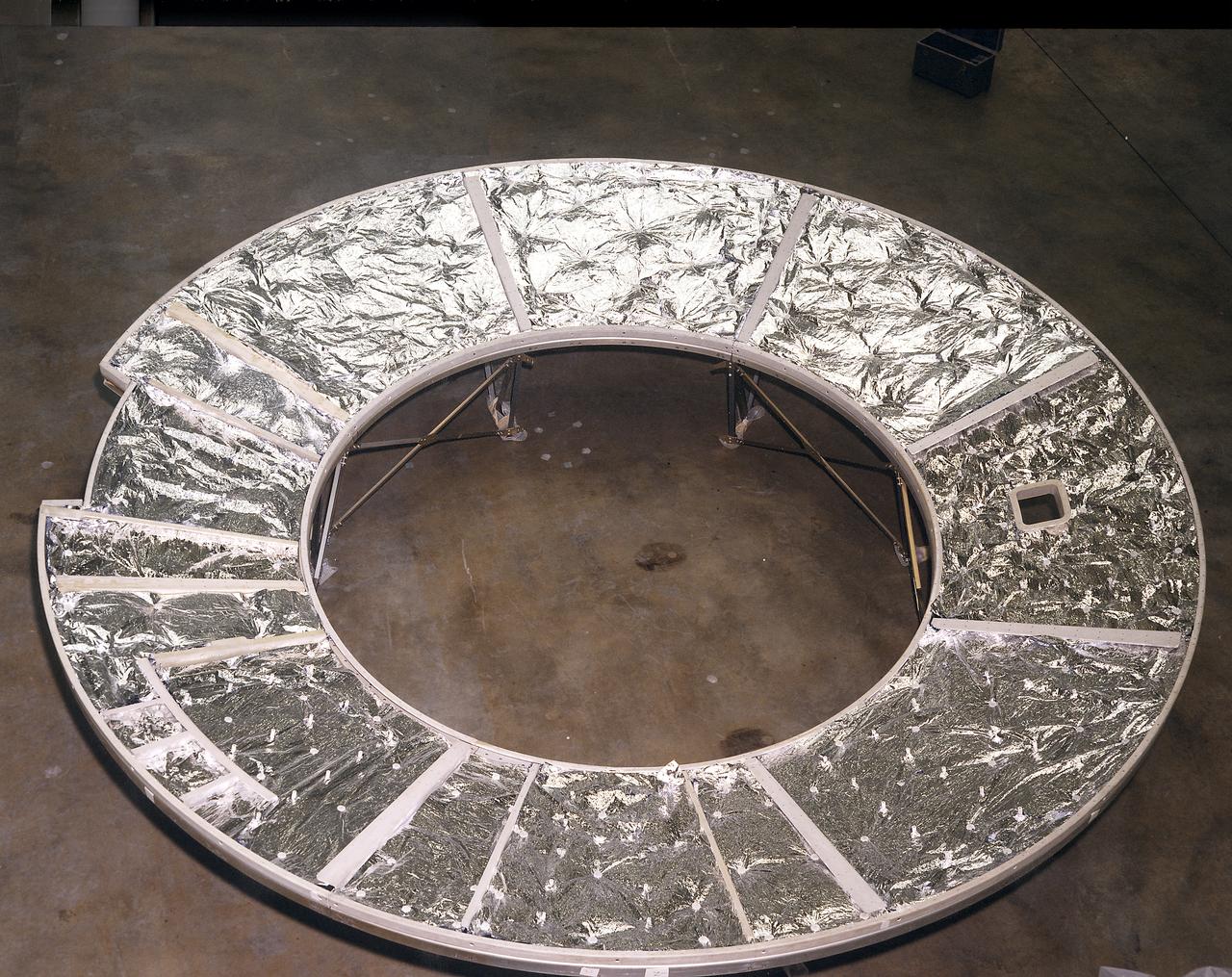
The Apollo Telescope Mount (ATM) was designed and constructed at the Marshall Space Flight Center and served as the primary scientific instrument unit aboard Skylab. The ATM consisted of eight scientific instruments as well as a number of smaller experiments. This photograph shows the flight unit solar shield for the ATM that formed the base for the rack, a complex frame, and the canister that contained the instruments.
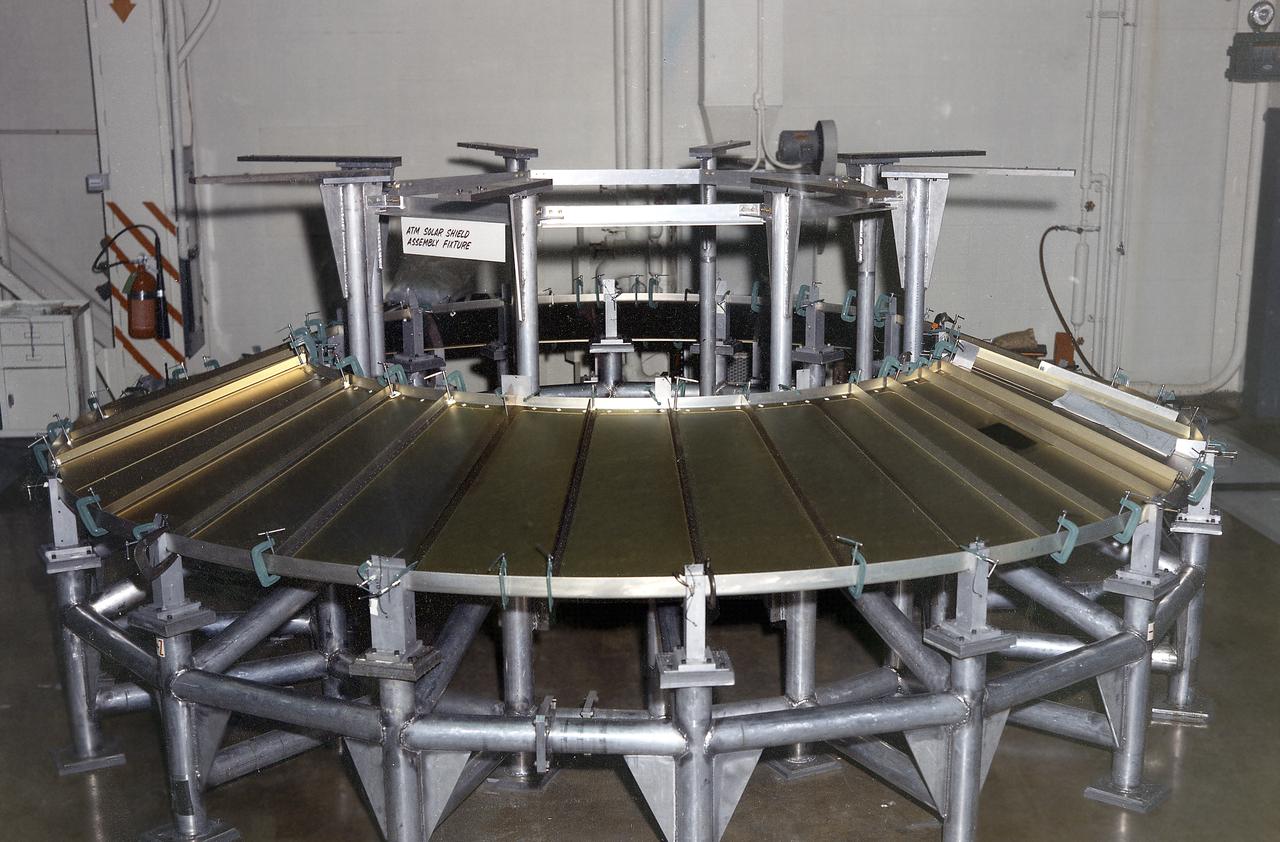
The Apollo Telescope Mount (ATM) was designed and developed by the Marshall Space Flight Center and served as the primary scientific instrument unit aboard Skylab (1973-1979). The ATM consisted of eight scientific instruments as well as a number of smaller experiments. One scientific instrument was the ATM solar shield that formed the base for the rack/frame instrument and the instrument canister. The solar shield contained aperture doors for each instrument to protect against solar radiation and space contamination.

ISS021-E-022459 (9 Nov. 2009) --- NASA astronaut Nicole Stott, Expedition 21 flight engineer, installs the Light Microscopy Module (LMM) Spindle Bracket Assembly in the Fluids Integrated Rack (FIR) in the Destiny laboratory of the International Space Station. Canadian Space Agency astronaut Robert Thirsk (out of frame) assisted Stott.
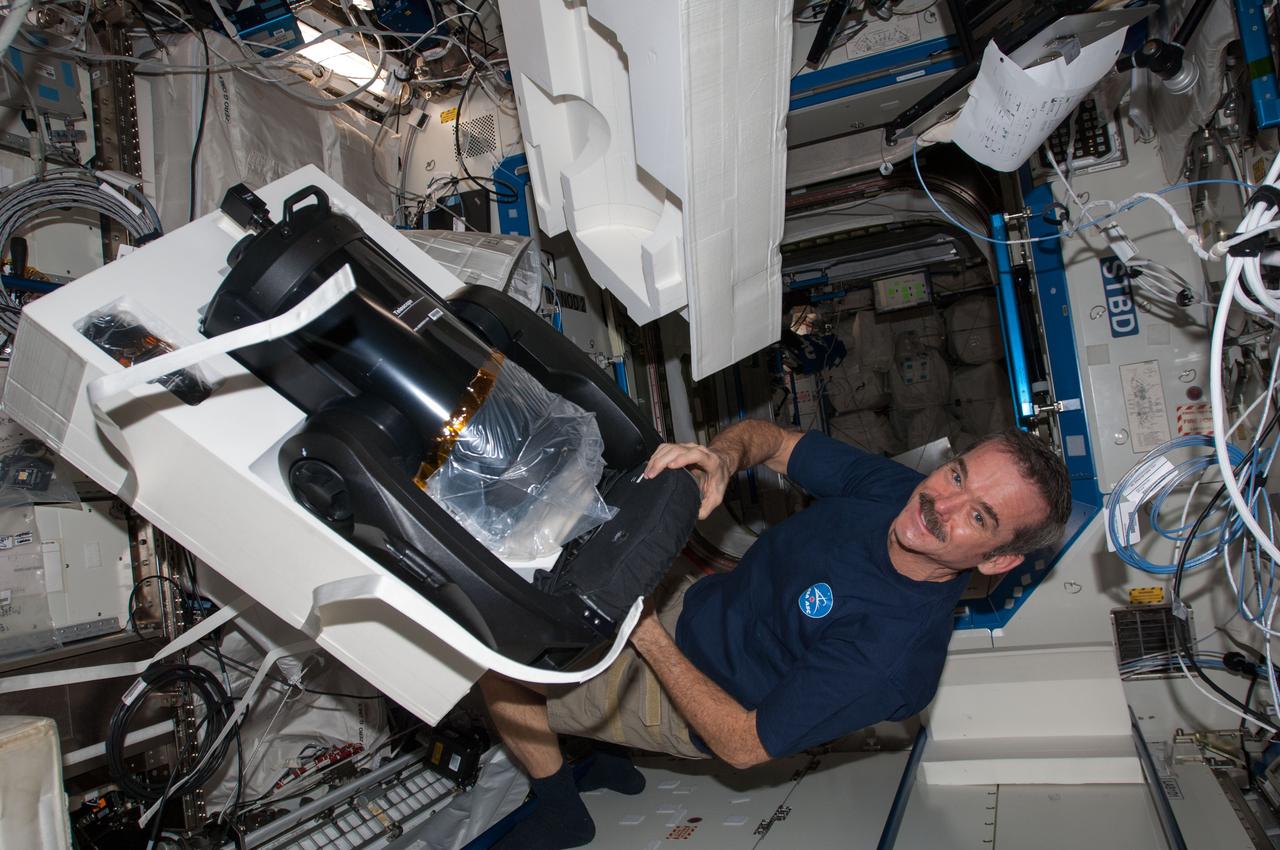
View of Canadian Space Agency (CSA) Chris Hadfield,Expedition 34 Flight Engineer (FE),unpacking ISS SERVIR Environmental Research and Visualization System (ISERV) in the U.S. Laboratory. ISERV is a fully automated image data acquisition system in the Window Observational Research Facility (WORF) rack. Kevin Ford,Expedition 34 Commander is visible on the right of frame. Photo was taken during Expedition 34.
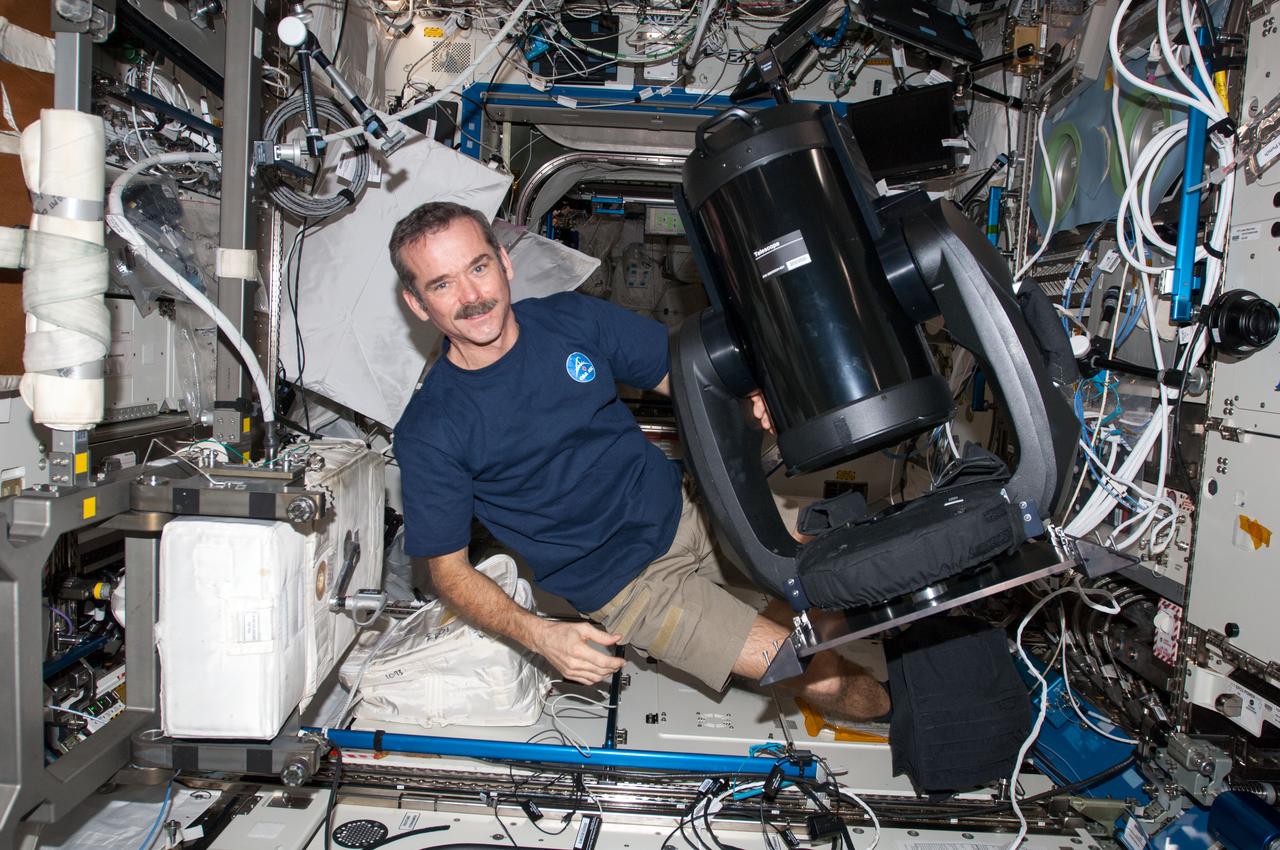
View of Canadian Space Agency (CSA) Chris Hadfield,Expedition 34 Flight Engineer (FE), preparing to setup the ISS SERVIR Environmental Research and Visualization System (ISERV) in the U.S. Laboratory. ISERV is a fully automated image data acquisition system in the Window Observational Research Facility (WORF) rack. Kevin Ford,Expedition 34 Commander is visible on the right of frame. Photo was taken during Expedition 34.
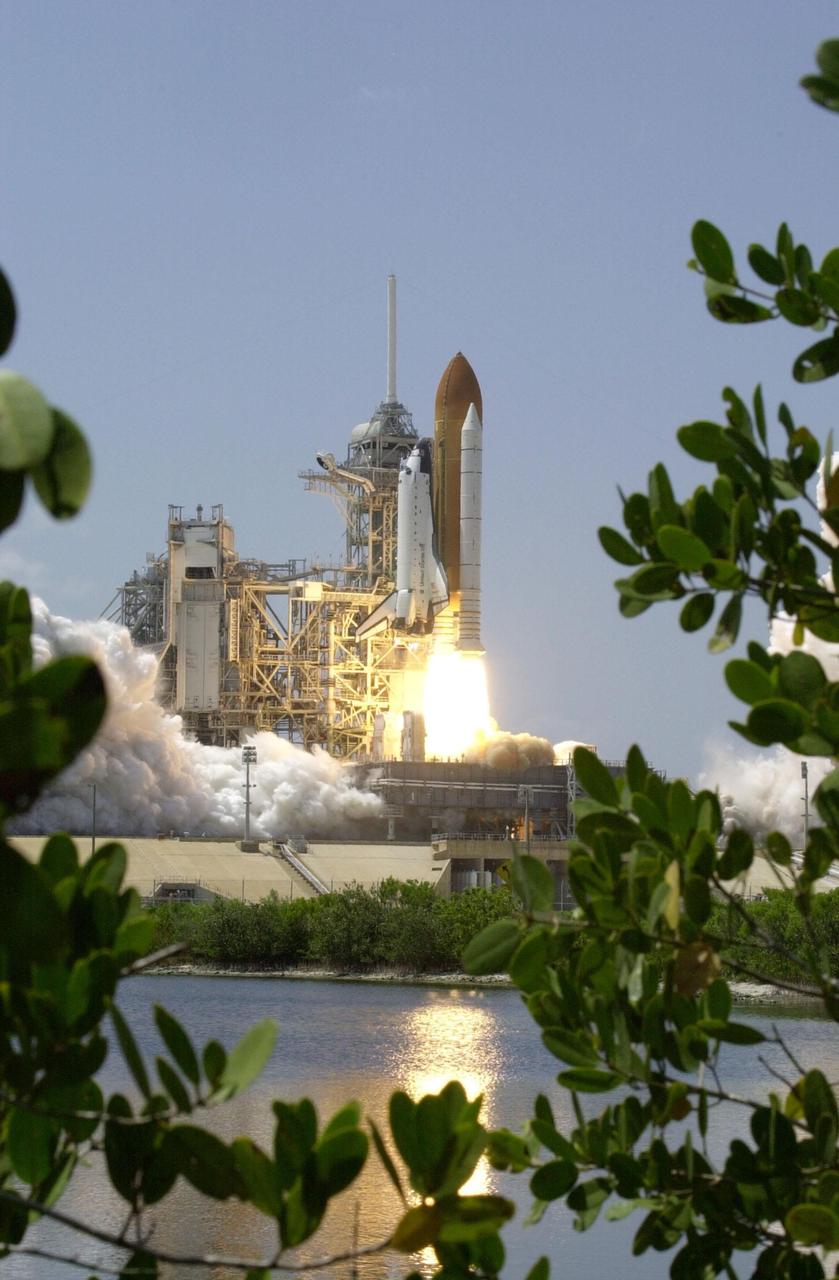
KENNEDY SPACE CENTER, FLA. -- Spring leaves frame the launch of Space Shuttle Endeavour on mission STS-100, the ninth flight to the International Space Station. Liftoff occurred at 2:40:42 p.m. EDT. The 11-day mission will deliver and integrate the Spacelab Logistics Pallet/Launch Deployment Assembly, which includes the Space Station Remote Manipulator System and the UHF Antenna. The mission includes two planned spacewalks for installation of the SSRMS on the Station. Also onboard is the Multi-Purpose Logistics Module Raffaello, carrying resupply stowage racks and resupply/return stowage platform
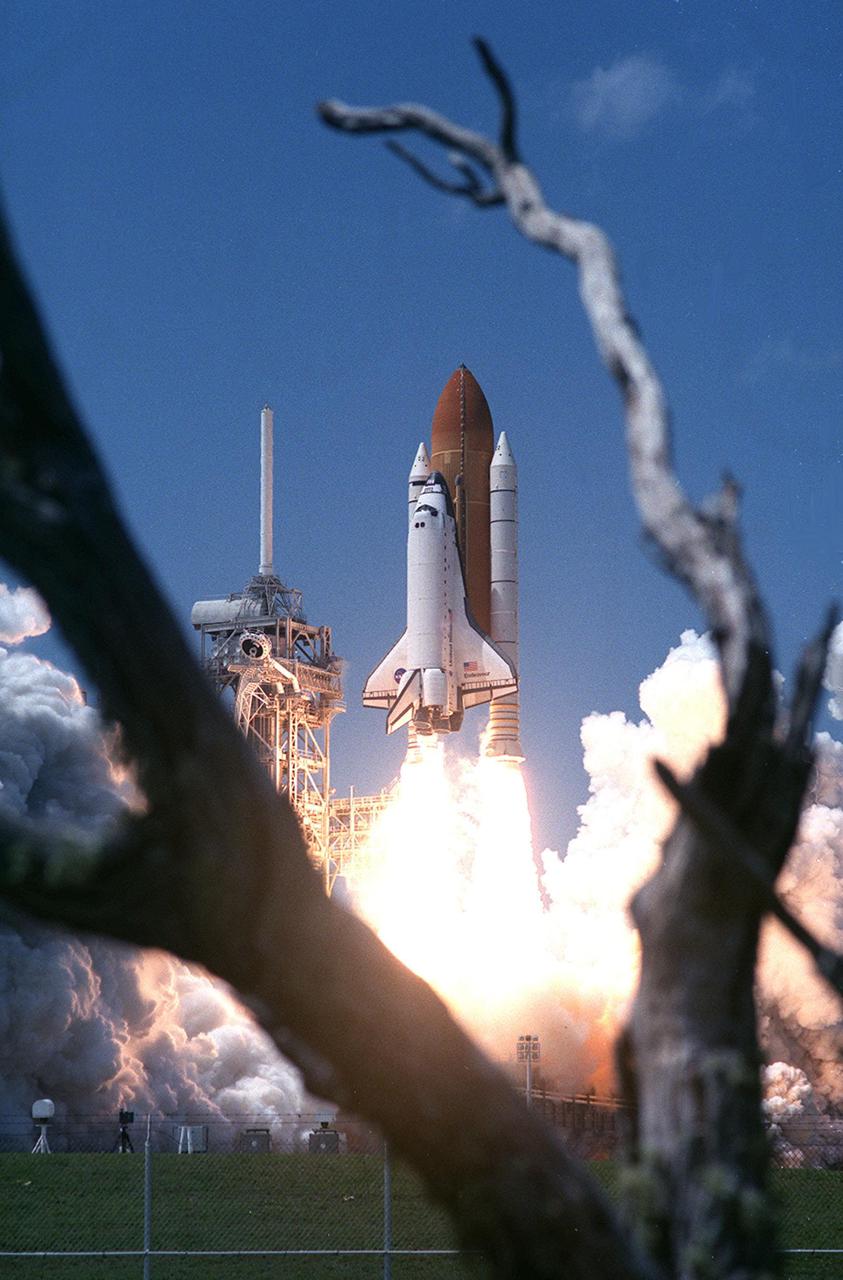
KENNEDY SPACE CENTER, FLA. -- Framed between the branches of a tree, Space Shuttle Endeavour is hurtled into space on mission STS-100. Liftoff of Endeavour on the ninth flight to the International Space Station occurred at 2:40:42 p.m. EDT. The 11-day mission will deliver and integrate the Spacelab Logistics Pallet_Launch Deployment Assembly, which includes the Space Station Remote Manipulator System and the UHF Antenna. The mission includes two planned spacewalks for installation of the SSRMS on the Station. Also onboard is the Multi-Purpose Logistics Module Raffaello, carrying resupply stowage racks and resupply_return stowage platforms
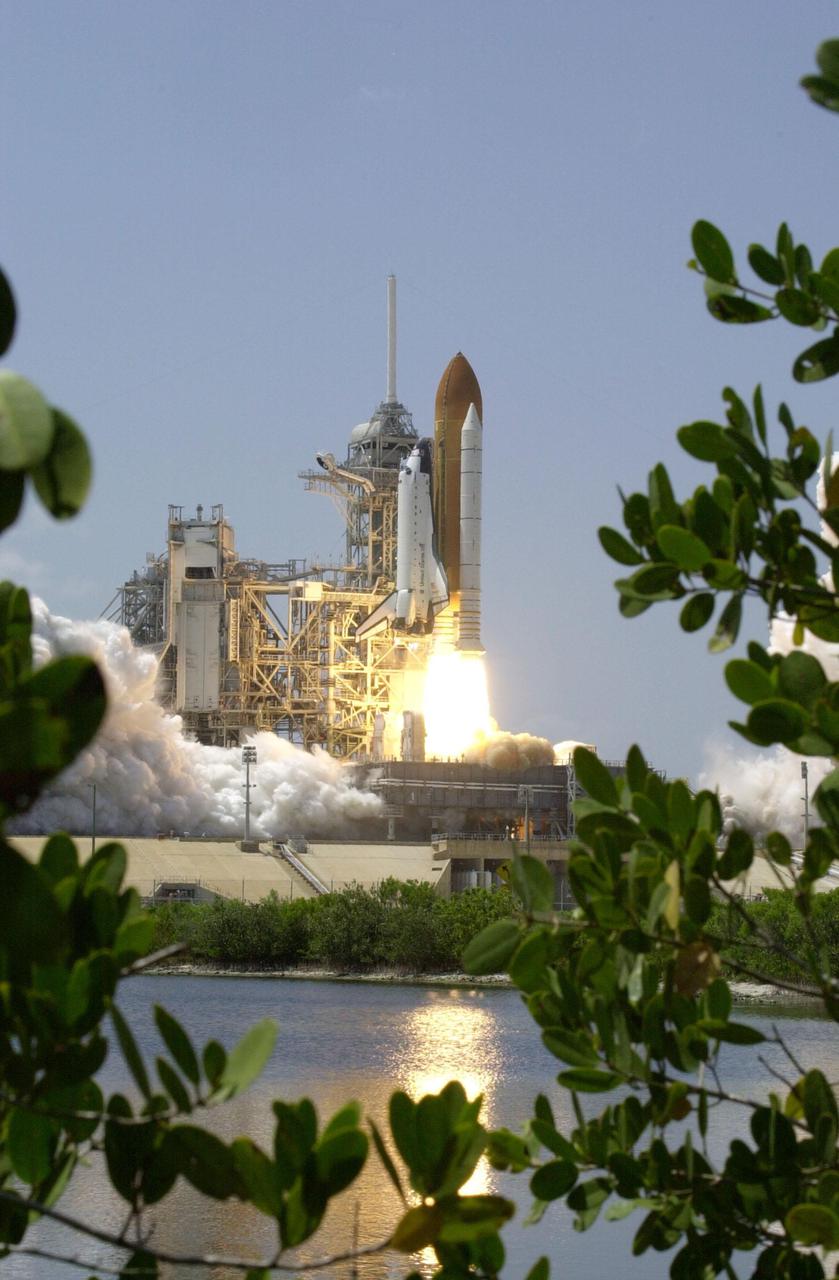
KENNEDY SPACE CENTER, FLA. -- Spring leaves frame the launch of Space Shuttle Endeavour on mission STS-100, the ninth flight to the International Space Station. Liftoff occurred at 2:40:42 p.m. EDT. The 11-day mission will deliver and integrate the Spacelab Logistics Pallet_Launch Deployment Assembly, which includes the Space Station Remote Manipulator System and the UHF Antenna. The mission includes two planned spacewalks for installation of the SSRMS on the Station. Also onboard is the Multi-Purpose Logistics Module Raffaello, carrying resupply stowage racks and resupply_return stowage platform
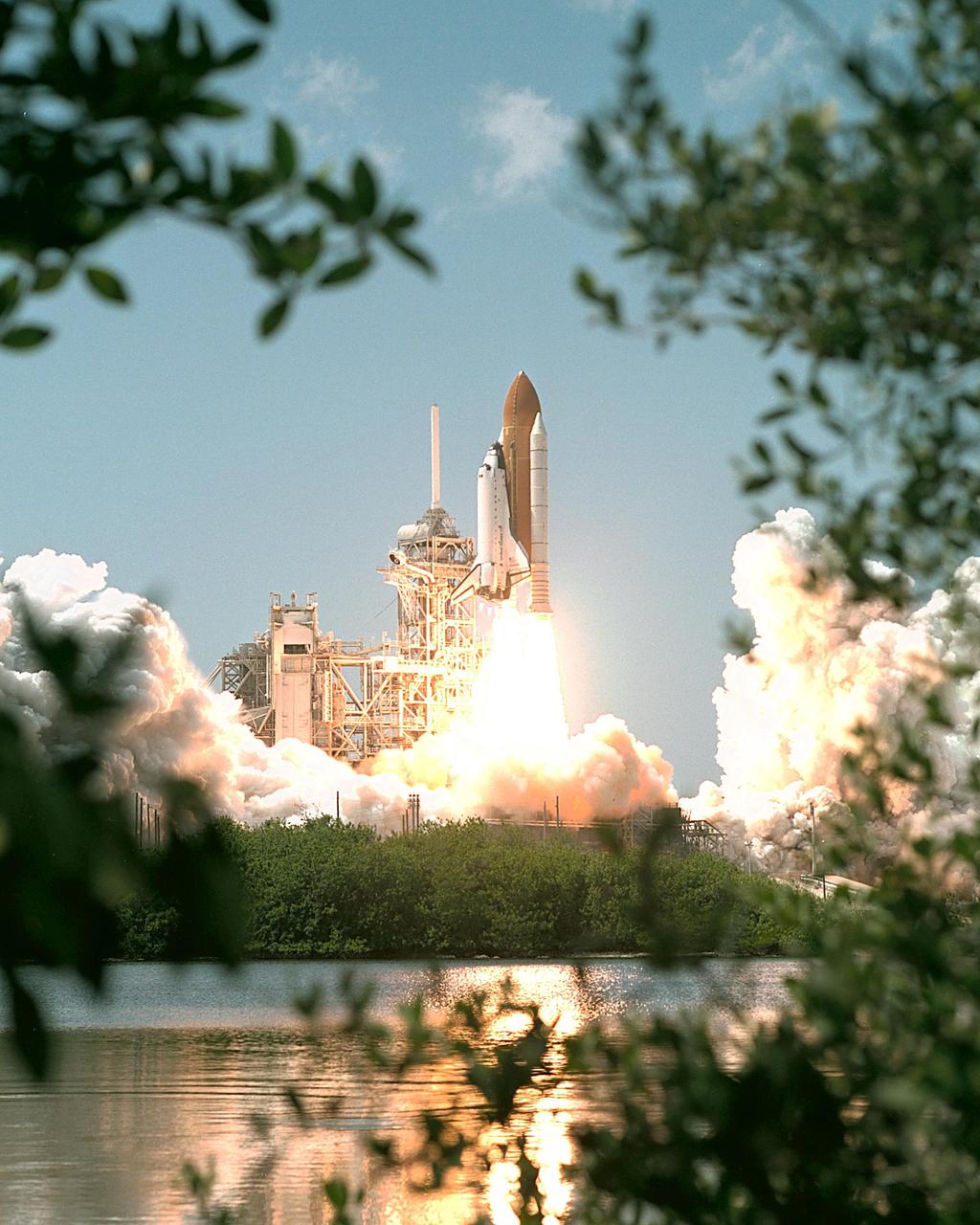
KENNEDY SPACE CENTER, FLA. -- Spring leaves frame Space Shuttle Endeavour as the water captures the launch of mission STS-100. Liftoff of Endeavour on the ninth flight to the International Space Station occurred at 2:40:42 p.m. EDT. The 11-day mission will deliver and integrate the Spacelab Logistics Pallet_Launch Deployment Assembly, which includes the Space Station Remote Manipulator System and the UHF Antenna. The mission includes two planned spacewalks for installation of the SSRMS on the Station. Also onboard is the Multi-Purpose Logistics Module Raffaello, carrying resupply stowage racks and resupply_return stowage platforms
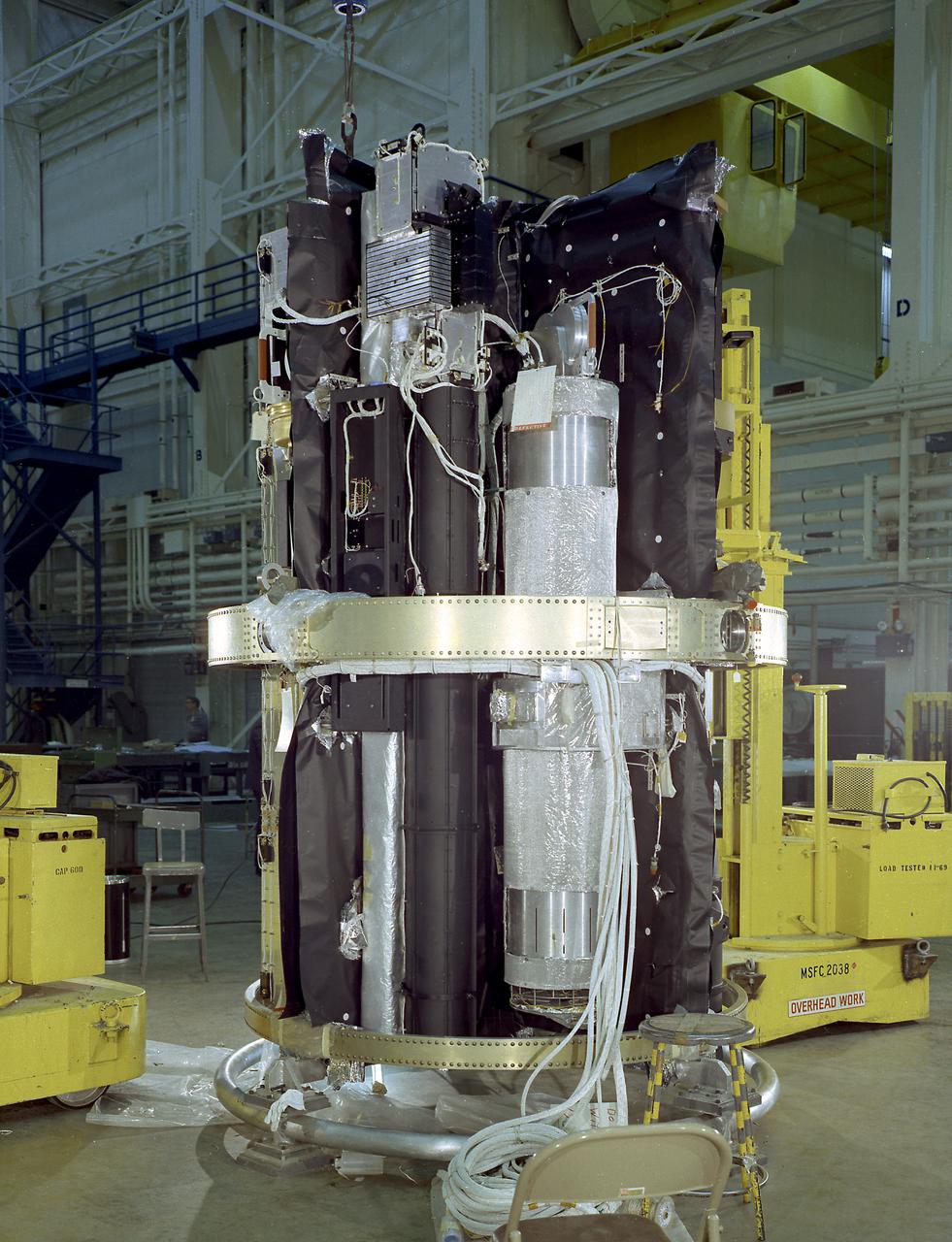
The Apollo Telescope Mount (ATM), designed and developed by the Marshall Space Flight Center, served as the primary scientific instrument unit aboard the Skylab. The ATM contained eight complex astronomical instruments designed to observe the Sun over a wide spectrum from visible light to x-rays. This image shows the ATM spar assembly. All solar telescopes, the fine Sun sensors, and some auxiliary systems are mounted on the spar, a cruciform lightweight perforated metal mounting panel that divides the 10-foot long canister lengthwise into four equal compartments. The spar assembly was nested inside a cylindrical canister that fit into the rack, a complex frame, and was protected by the solar shield.
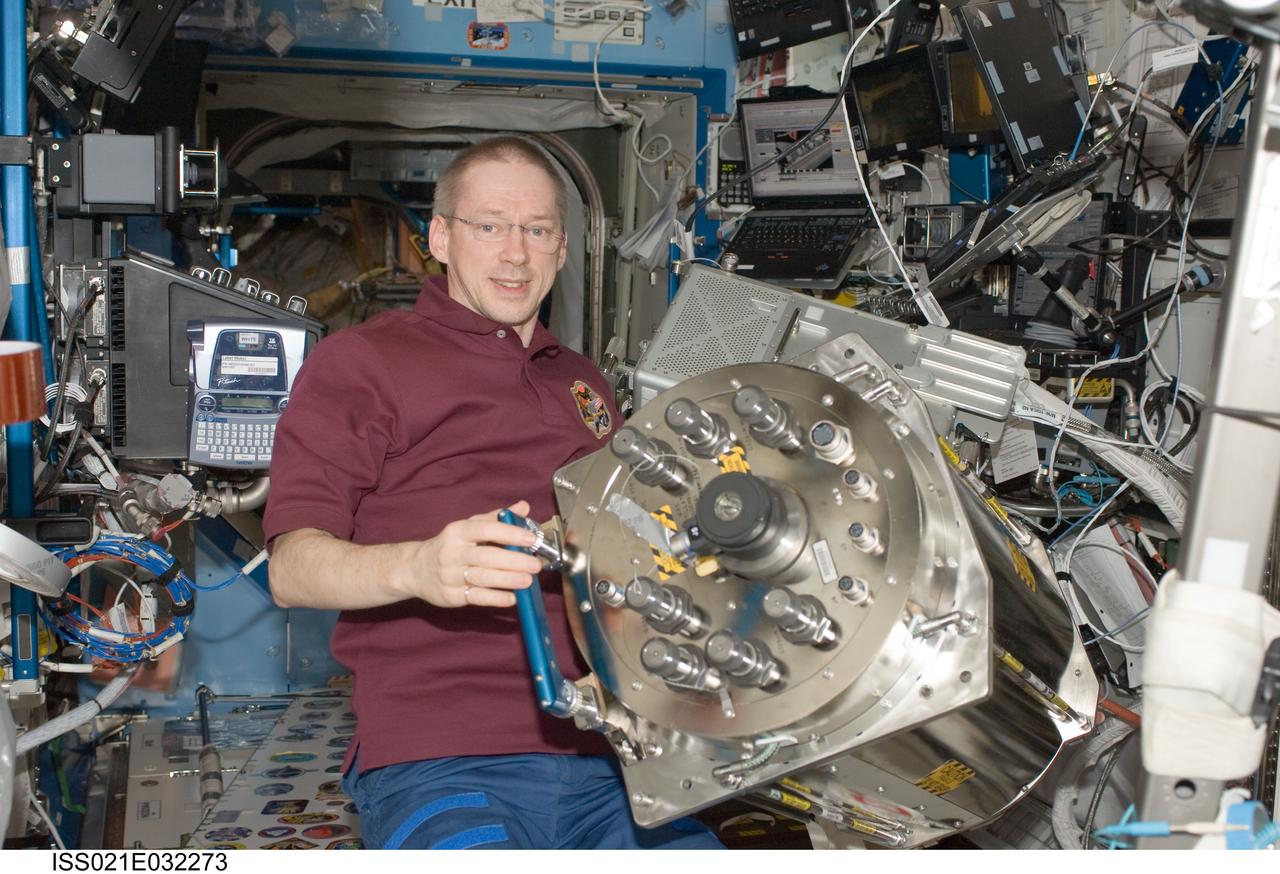
ISS021-E-032273 (23 Nov. 2009) --- European Space Agency astronaut Frank De Winne, Expedition 21 commander, holds the failed Urine Processor Assembly / Distillation Assembly (UPA DA) in the Destiny laboratory of the International Space Station while space shuttle Atlantis remains docked with the station. De Winne and NASA astronaut Leland Melvin (out of frame), STS-129 mission specialist, removed and packed the UPA DA, then transferred it from the Water Recovery System 2 (WRS-2) rack to Atlantis for stowage on the middeck.
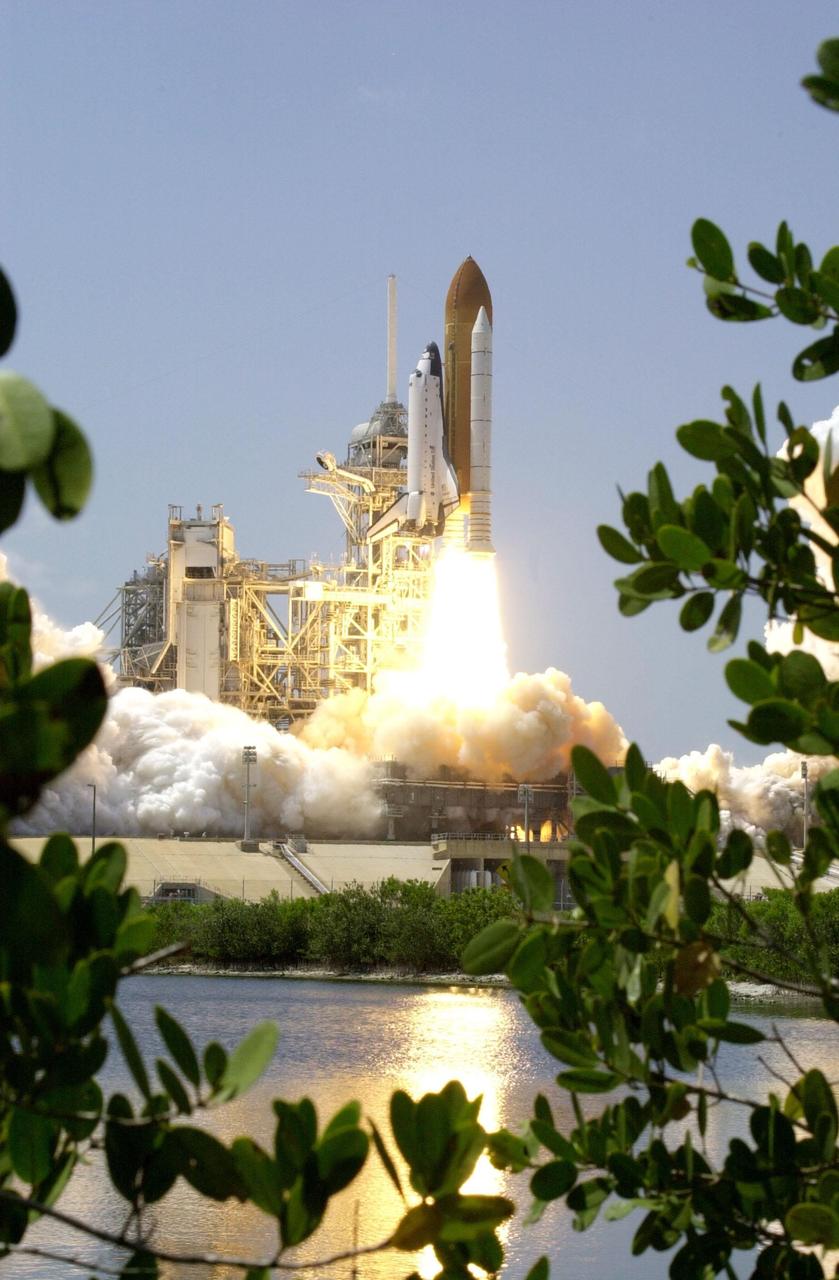
KENNEDY SPACE CENTER, FLA. -- Spring leaves frame the launch of Space Shuttle Endeavour, trailing flames and billows of smoke and steam, as it roars into the blue sky. Liftoff of the ninth flight to the International Space Station occurred at 2:40:42 p.m. EDT. The 11-day mission will deliver and integrate the Spacelab Logistics Pallet/Launch Deployment Assembly, which includes the Space Station Remote Manipulator System and the UHF Antenna. The mission includes two planned spacewalks for installation of the SSRMS on the Station. Also onboard is the Multi-Purpose Logistics Module Raffaello, carrying resupply stowage racks and resupply/return stowage platforms
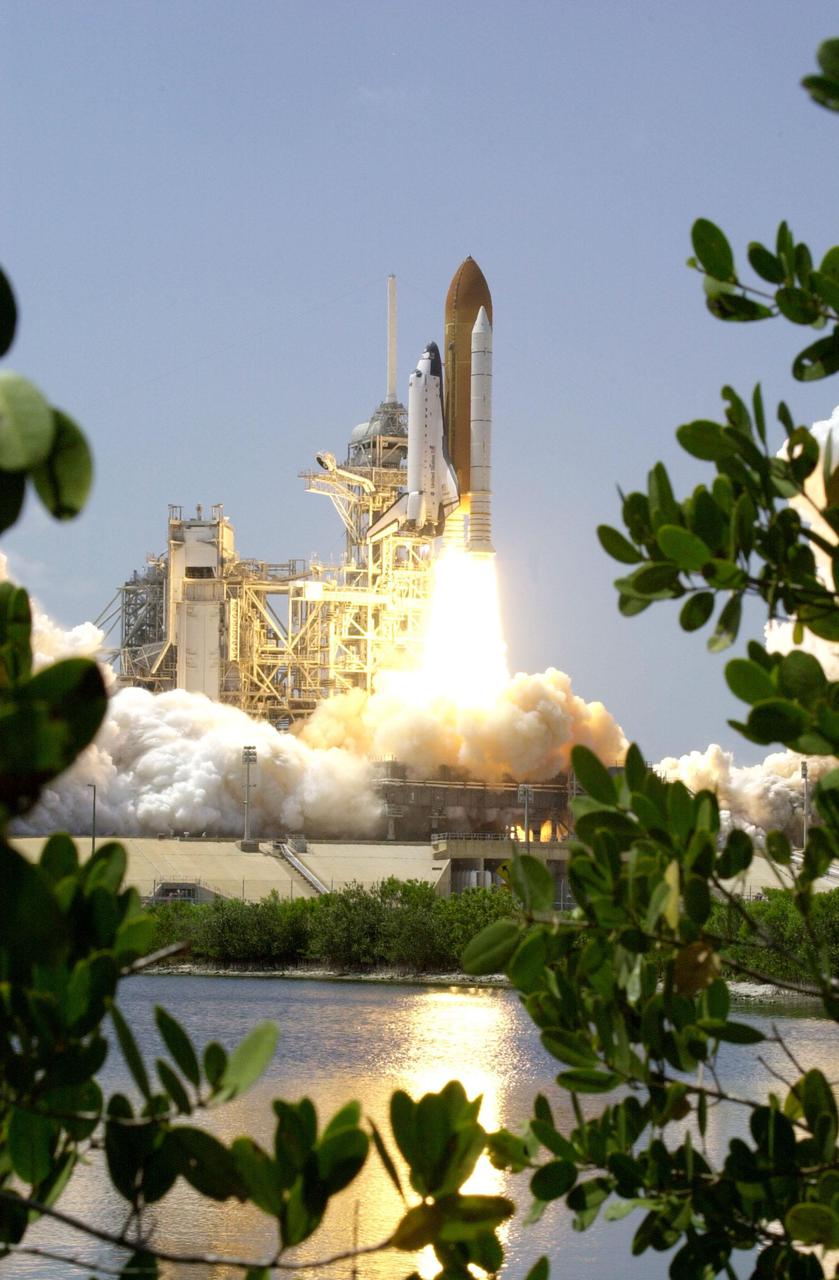
KENNEDY SPACE CENTER, FLA. -- Spring leaves frame the launch of Space Shuttle Endeavour, trailing flames and billows of smoke and steam, as it roars into the blue sky. Liftoff of the ninth flight to the International Space Station occurred at 2:40:42 p.m. EDT. The 11-day mission will deliver and integrate the Spacelab Logistics Pallet_Launch Deployment Assembly, which includes the Space Station Remote Manipulator System and the UHF Antenna. The mission includes two planned spacewalks for installation of the SSRMS on the Station. Also onboard is the Multi-Purpose Logistics Module Raffaello, carrying resupply stowage racks and resupply_return stowage platforms
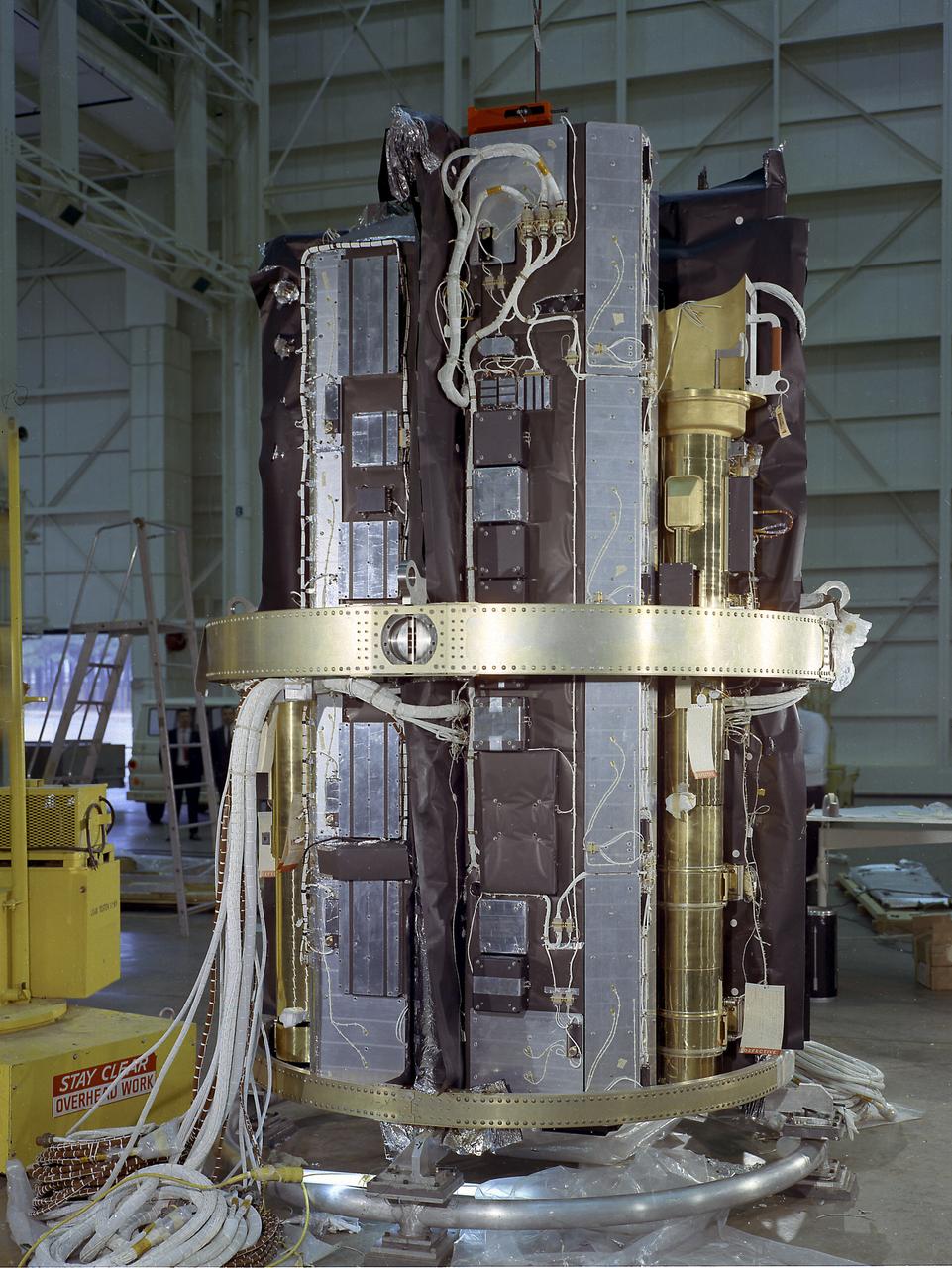
The Apollo Telescope Mount (ATM), designed and developed by the Marshall Space Flight Center, served as the primary scientific instrument unit aboard the Skylab. The ATM contained eight complex astronomical instruments designed to observe the Sun over a wide spectrum from visible light to x-rays. This image shows the ATM spar assembly. All solar telescopes, the fine Sun sensors, and some auxiliary systems are mounted on the spar, a cruciform lightweight perforated metal mounting panel that divides the 10-foot long canister lengthwise into four equal compartments. The spar assembly was nested inside a cylindrical canister that fit into the rack, a complex frame, and was protected by the solar shield.
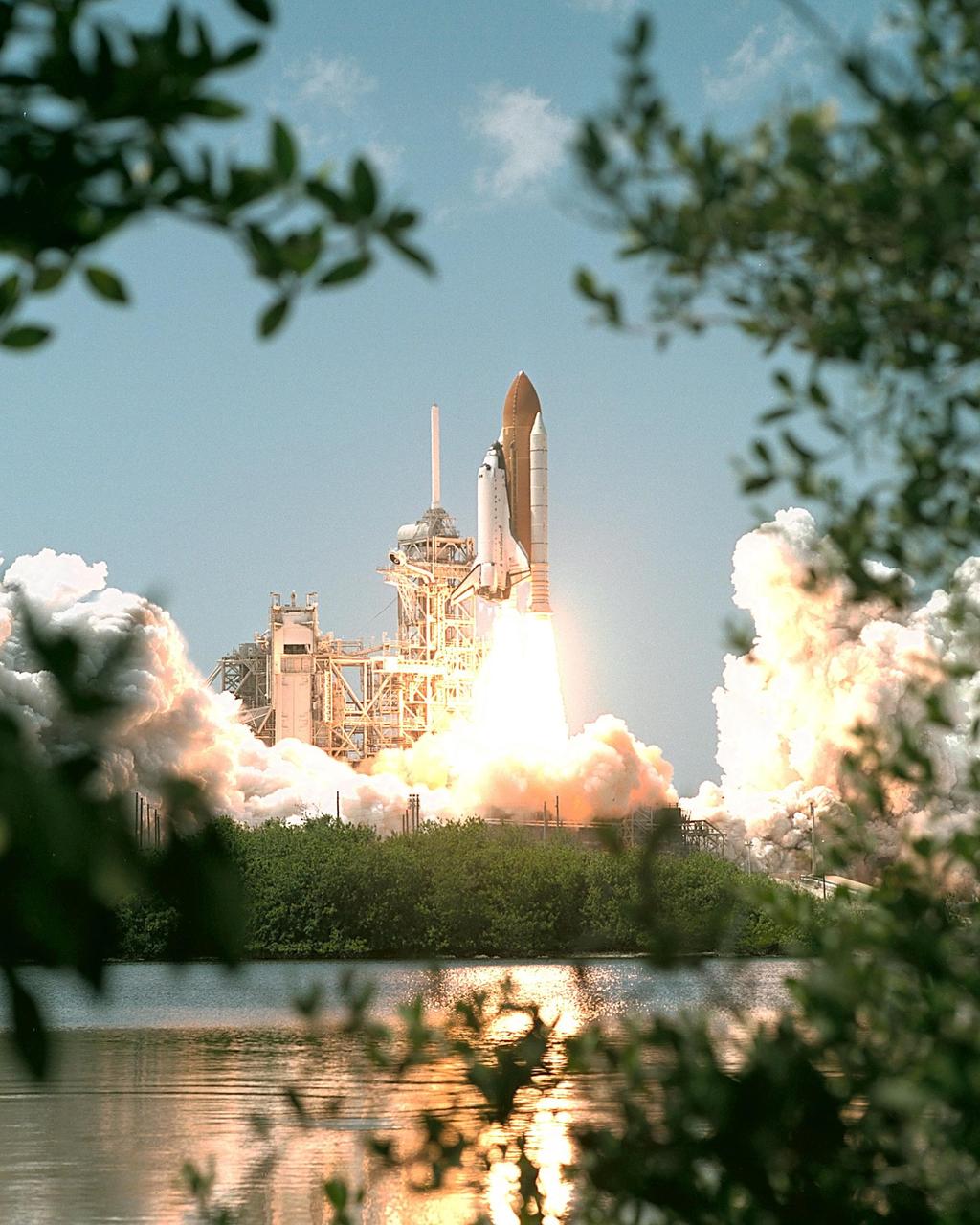
KENNEDY SPACE CENTER, FLA. -- Spring leaves frame Space Shuttle Endeavour as the water captures the launch of mission STS-100. Liftoff of Endeavour on the ninth flight to the International Space Station occurred at 2:40:42 p.m. EDT. The 11-day mission will deliver and integrate the Spacelab Logistics Pallet/Launch Deployment Assembly, which includes the Space Station Remote Manipulator System and the UHF Antenna. The mission includes two planned spacewalks for installation of the SSRMS on the Station. Also onboard is the Multi-Purpose Logistics Module Raffaello, carrying resupply stowage racks and resupply/return stowage platforms
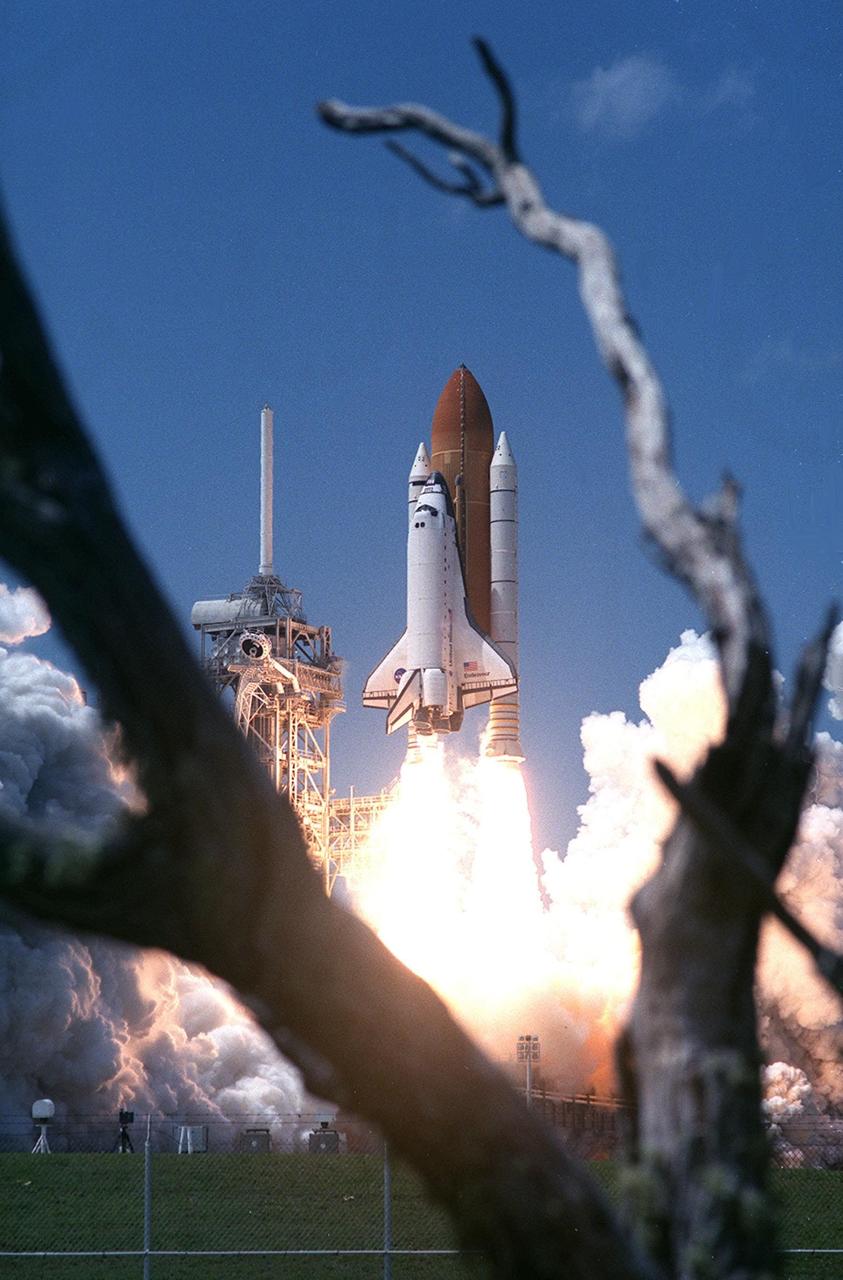
KENNEDY SPACE CENTER, FLA. -- Framed between the branches of a tree, Space Shuttle Endeavour is hurtled into space on mission STS-100. Liftoff of Endeavour on the ninth flight to the International Space Station occurred at 2:40:42 p.m. EDT. The 11-day mission will deliver and integrate the Spacelab Logistics Pallet/Launch Deployment Assembly, which includes the Space Station Remote Manipulator System and the UHF Antenna. The mission includes two planned spacewalks for installation of the SSRMS on the Station. Also onboard is the Multi-Purpose Logistics Module Raffaello, carrying resupply stowage racks and resupply/return stowage platforms
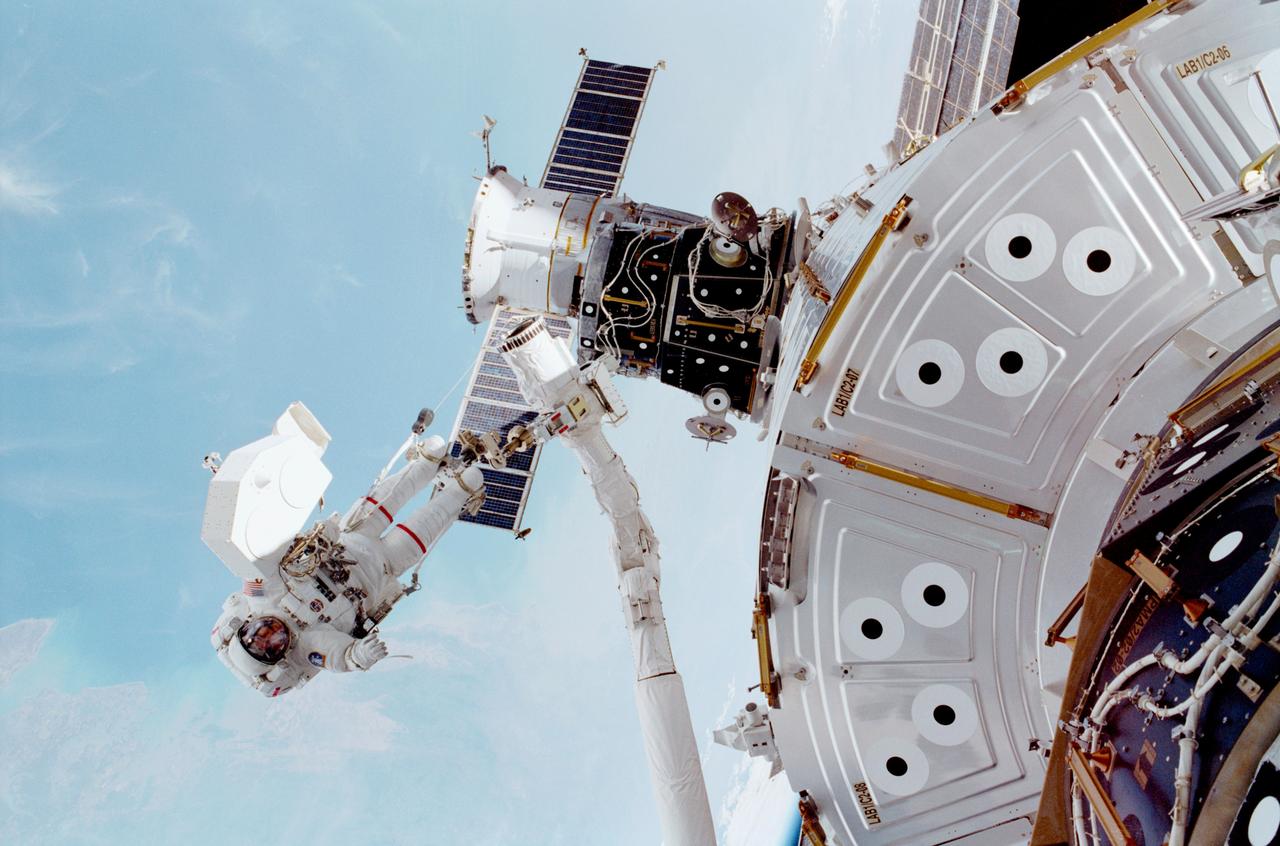
STS-102 astronaut and mission specialist James S. Voss works outside Destiny, the U.S. Laboratory (shown in lower frame) on the International Space Station (ISS), while anchored to the Remote Manipulator System (RMS) robotic arm on the Space Shuttle Discovery during the first of two space walks. During this space walk, the longest to date in space shuttle history, Voss in tandem with Susan Helms (out of frame), prepared the Pressurized Mating Adapter 3 for repositioning from the Unity Module's Earth-facing berth to its port-side berth to make room for the Leonardo Multipurpose Logistics Module (MPLM) supplied by the Italian Space Agency. The The Leonardo MPLM is the first of three such pressurized modules that will serve as the ISS' moving vans, carrying laboratory racks filled with equipment, experiments, and supplies to and from the Station aboard the Space Shuttle. The cylindrical module is approximately 21-feet long and 15- feet in diameter, weighing almost 4.5 tons. It can carry up to 10 tons of cargo in 16 standard Space Station equipment racks. Of the 16 racks the module can carry, 5 can be furnished with power, data, and fluid to support refrigerators or freezers. In order to function as an attached station module as well as a cargo transport, the logistics module also includes components that provide life support, fire detection and suppression, electrical distribution, and computer functions. Launched on May 8, 2001 for nearly 13 days in space, the STS-102 mission was the 8th spacecraft assembly flight to the ISS and NASA's 103rd overall mission. The mission also served as a crew rotation flight. It delivered the Expedition Two crew to the Station and returned the Expedition One crew back to Earth.
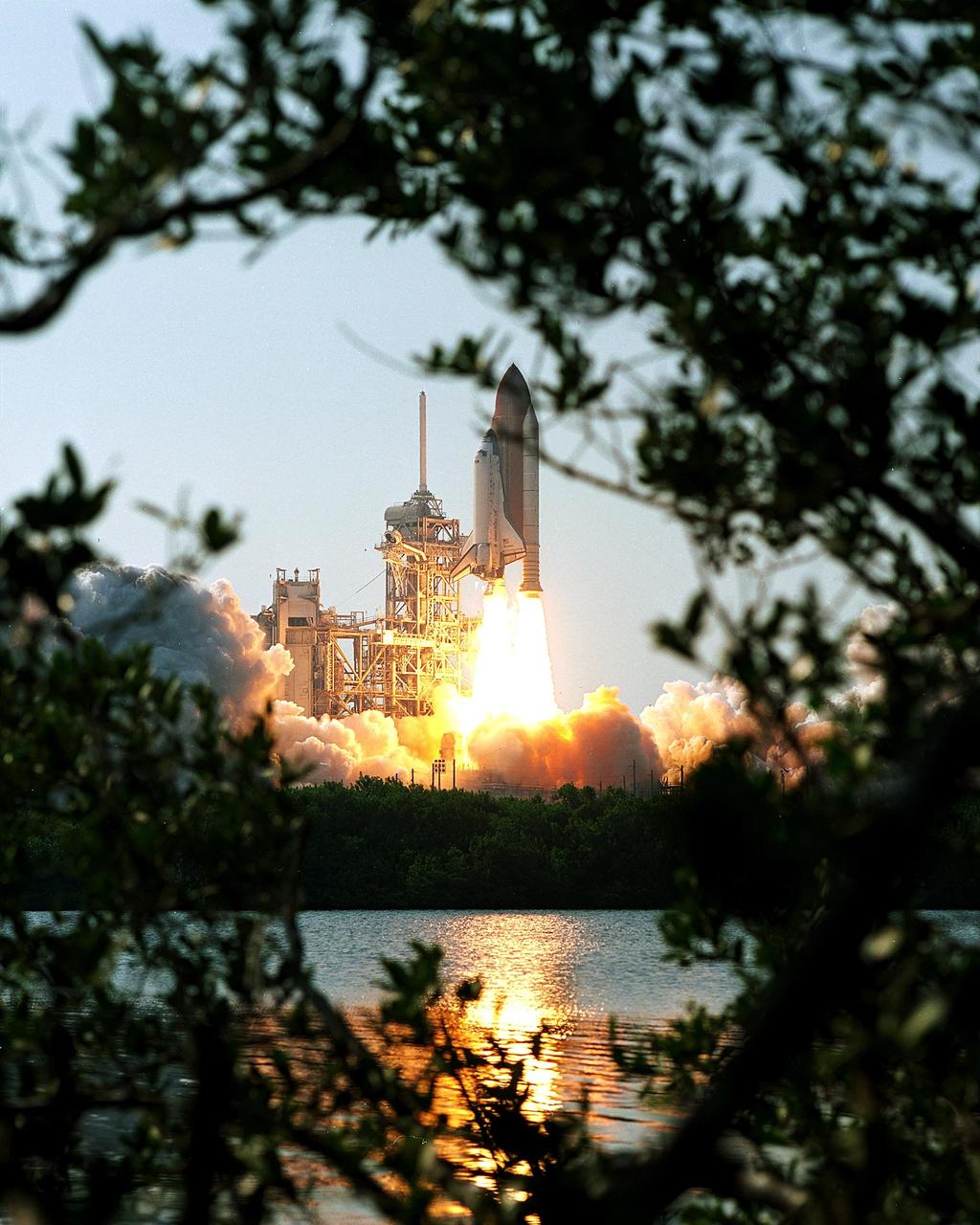
KENNEDY SPACE CENTER, Fla. -- Trees frame Space Shuttle Discovery trailing columns of fire from the solid rocket boosters as it soars into the blue sky on mission STS-105 to the International Space Station. Liftoff from Launch Pad 39A occurred at 5:10:14 p.m. EDT. Besides the Shuttle crew of four, Discovery carries the Expedition Three crew who will replace Expedition Two on the Space Station. The mission payload includes the third flight of the Italian-built Multi-Purpose Logistics Module Leonardo, delivering additional scientific racks, equipment and supplies for the Space Station, and the Early Ammonia Servicer (EAS) tank. The EAS, which will be attached to the Station during two spacewalks, contains spare ammonia for the Station’s cooling system. The three-member Expedition Two crew will be returning to Earth aboard Discovery after a five-month stay on the Station
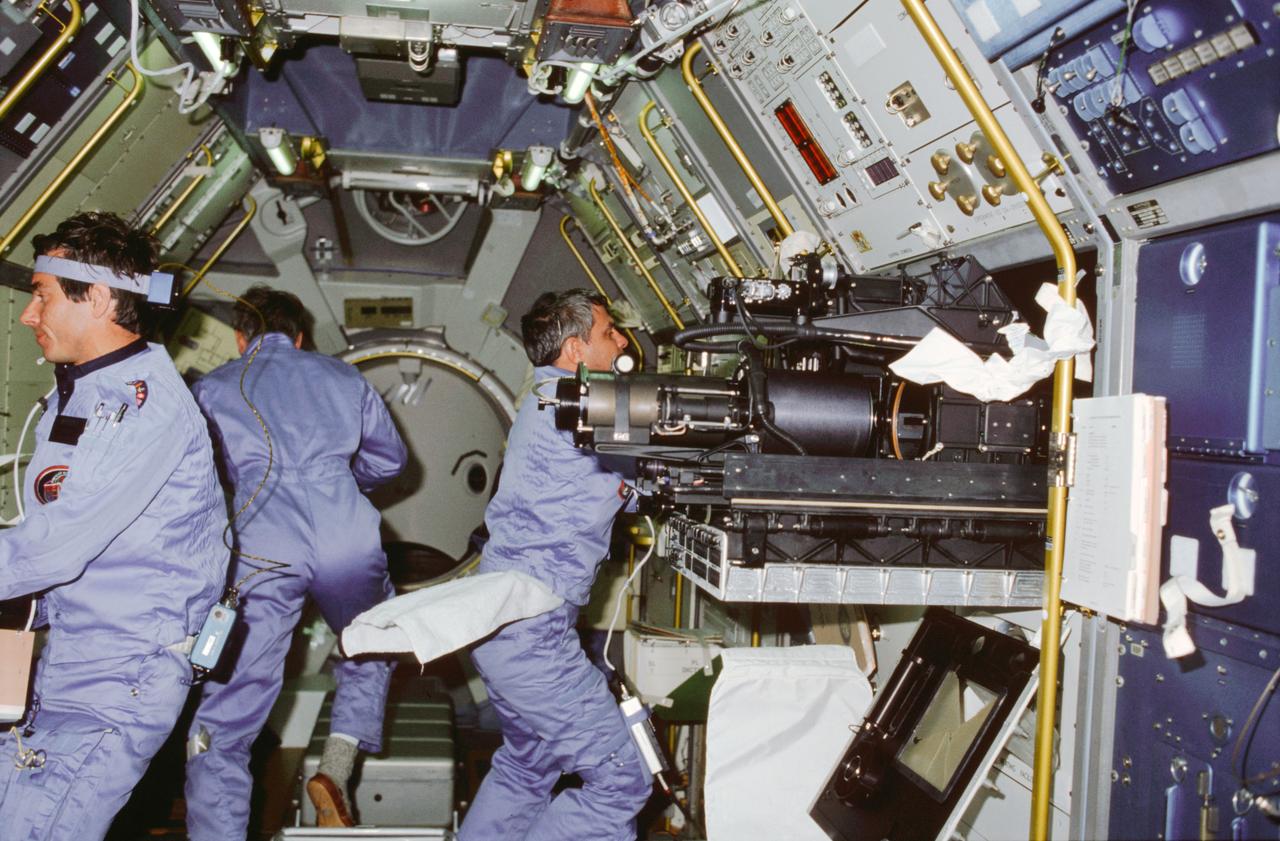
STS009-03-093 (28 Nov-8 Dec 1983) --- A mission specialist and two payload specialists busy themselves in the Spacelab 1 module aboard the Earth orbiting Space Shuttle Columbia. Left to right are Payload Specialist Robert A. R. Parker. Parker is partially obscured by a deployed instrument of the fluid physics module at the materials sciences double rack. Merbold, a physicist from Max-Planck Institute in the Federal Republic of Germany, wears a head band-like device and a recorder as part of an overall effort to learn more about space adaptation. Both Space lab 1 payload specialists wore the devices during most of their waking hours on this 10-day flight. The frame was exposed with a 35mm camera.
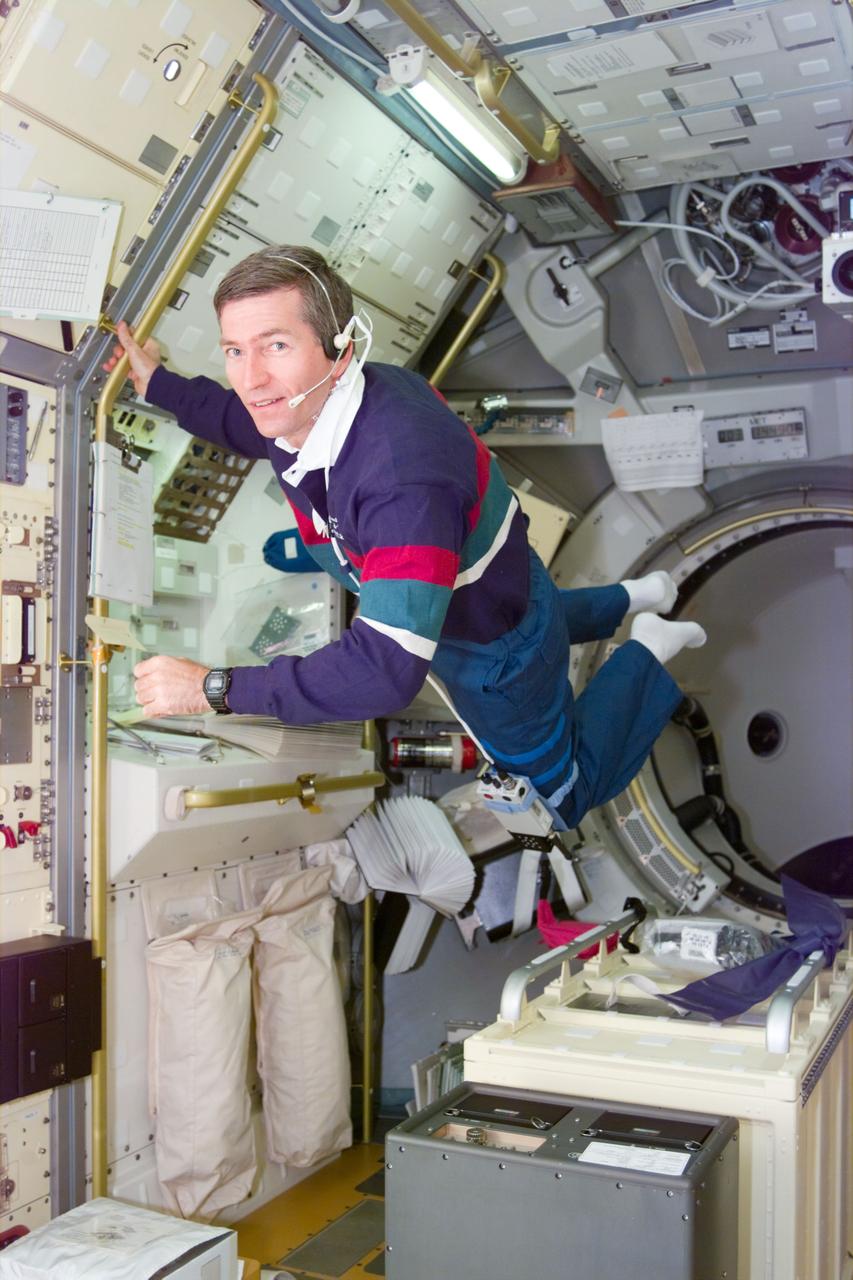
STS073-E-5041 (26 Oct. 1995) --- Fred W. Leslie, STS-73 payload specialist, working out of NASA's Marshall Space Flight Center (MSFC), in Alabama, grabs a support bar on a science workstation rack after floating from the space shuttle Columbia's cabin into the science module. Leslie is one of seven crewmembers in the midst of a 16-day multi-faceted mission aboard Columbia. For the next week and a half, Leslie and the rest of the crew will continue working in shifts around the clock on a diverse assortment of United States Microgravity Laboratory (USML-2) experiments located in the science module. Fields of study include fluid physics, materials science, biotechnology, combustion science and commercial space processing technologies. The frame was exposed with an Electronic Still Camera (ESC).
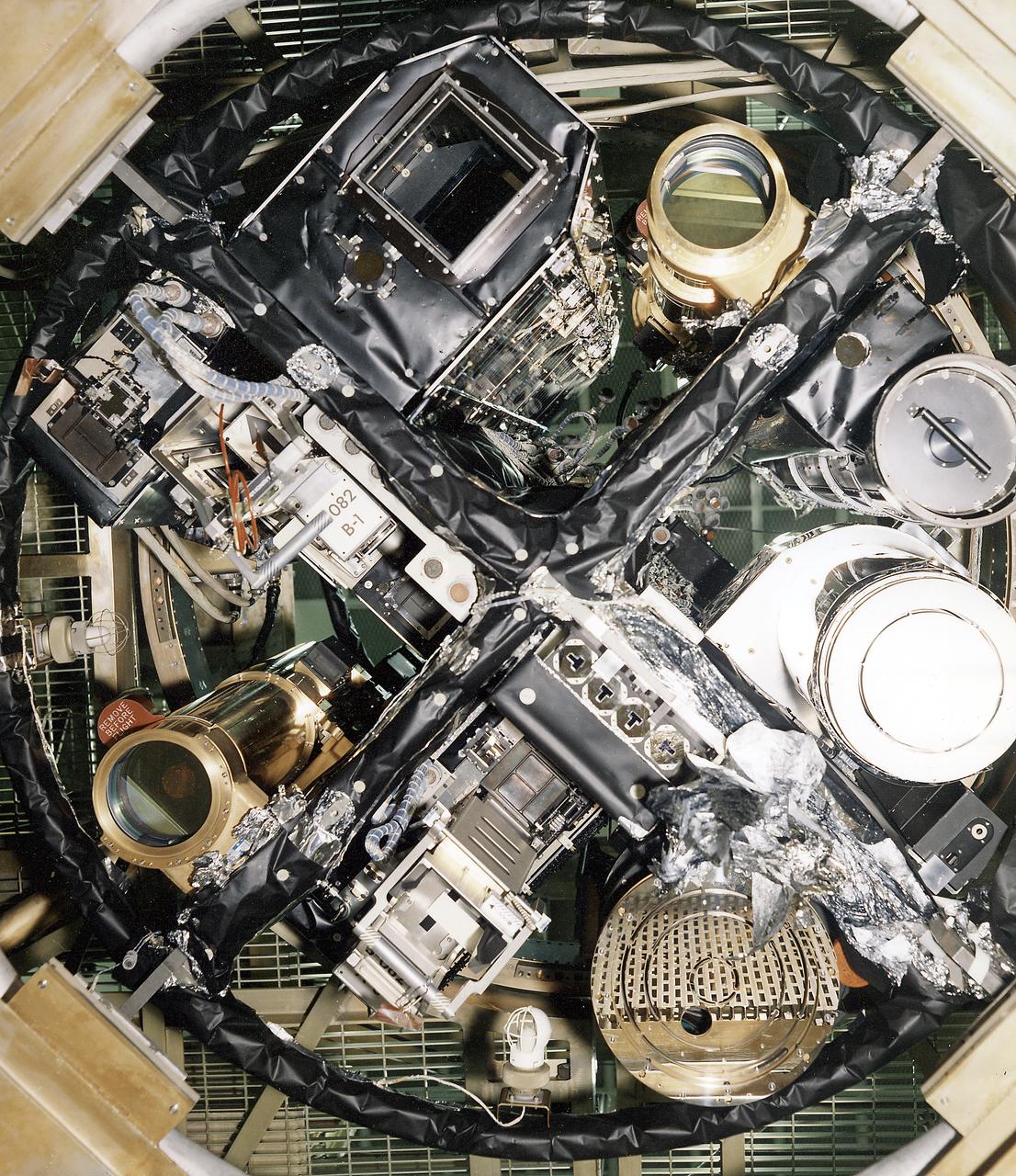
The Apollo Telescope Mount (ATM) was designed and developed by the Marshall Space Flight Center and served as the primary scientific instrument unit aboard Skylab (1973-1979). The ATM contained eight complex astronomical instruments designed to observe the Sun over a wide spectrum from visible light to x-rays. This image depicts the sun end and spar of the ATM flight unit showing individual telescopes. All solar telescopes, the fine Sun sensors, and some auxiliary systems are mounted on the spar, a cruciform lightweight perforated metal mounting panel that divides the canister lengthwise into four equal compartments. The spar assembly was nested inside a cylindrical canister that fit into a complex frame named the rack, and was protected by the solar shield.

STS-102 mission astronauts James S. Voss and James D. Weatherbee share a congratulatory handshake as the Space Shuttle Orbiter Discovery successfully docks with the International Space Station (ISS). Photographed from left to right are: Astronauts Susan J. Helms, mission specialist; James S. Voss, Expedition 2 crew member; James D. Weatherbee, mission commander; Andrew S.W. Thomas, mission specialist; and nearly out of frame is James M. Kelley, Pilot. Launched March 8, 2001, STS-102's primary cargo was the Leonardo, the Italian Space Agency-built Multipurpose Logistics Module (MPLM). The Leonardo MPLM is the first of three such pressurized modules that will serve as ISS' moving vans, carrying laboratory racks filled with equipment, experiments, and supplies to and from the Station aboard the Space Shuttle. The cylindrical module is approximately 21-feet long and 15- feet in diameter, weighing almost 4.5 tons. It can carry up to 10 tons of cargo in 16 standard Space Station equipment racks. Of the 16 racks the module can carry, 5 can be furnished with power, data, and fluid to support refrigerators or freezers. In order to function as an attached station module as well as a cargo transport, the logistics module also includes components that provide life support, fire detection and suppression, electrical distribution, and computer functions. NASA's 103rd overall mission and the 8th Space Station Assembly Flight, STS-102 mission also served as a crew rotation flight. It delivered the Expedition Two crew to the Station and returned the Expedition One crew back to Earth.
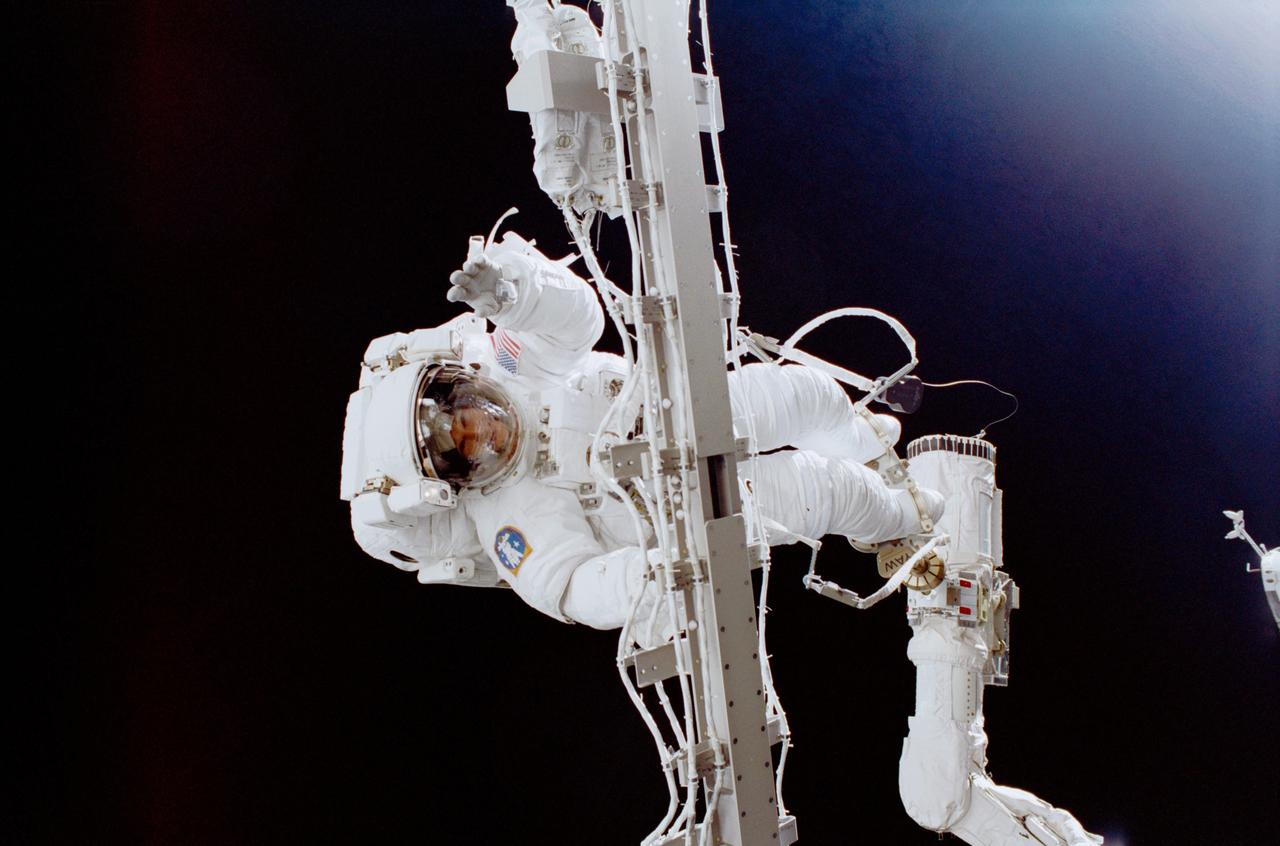
STS-102 mission astronaut Susan J. Helms works outside the International Space Station (ISS) while holding onto a rigid umbilical and her feet anchored to the Remote Manipulator System (RMS) robotic arm on the Space Shuttle Discovery during the first of two space walks. During this space walk, the longest to date in space shuttle history, Helms in tandem with James S. Voss (out of frame), prepared the Pressurized Mating Adapter 3 for repositioning from the Unity Module's Earth-facing berth to its port-side berth to make room for the Leonardo Multipurpose Logistics Module (MPLM) supplied by the Italian Space Agency. The Leonardo MPLM is the first of three such pressurized modules that will serve as the ISS's moving vans, carrying laboratory racks filled with equipment, experiments, and supplies to and from the Station aboard the Space Shuttle. The cylindrical module is approximately 21-feet long and 15- feet in diameter, weighing almost 4.5 tons. It can carry up to 10 tons of cargo in 16 standard Space Station equipment racks. Of the 16 racks the module can carry, 5 can be furnished with power, data, and fluid to support refrigerators or freezers. In order to function as an attached station module as well as a cargo transport, the logistics module also includes components that provide life support, fire detection and suppression, electrical distribution, and computer functions. Launched on May 8, 2001 for nearly 13 days in space, STS-102 mission was the 8th spacecraft assembly flight to the ISS and NASA's 103rd overall mission. The mission also served as a crew rotation flight. It delivered the Expedition Two crew to the Station and returned the Expedition One crew back to Earth.
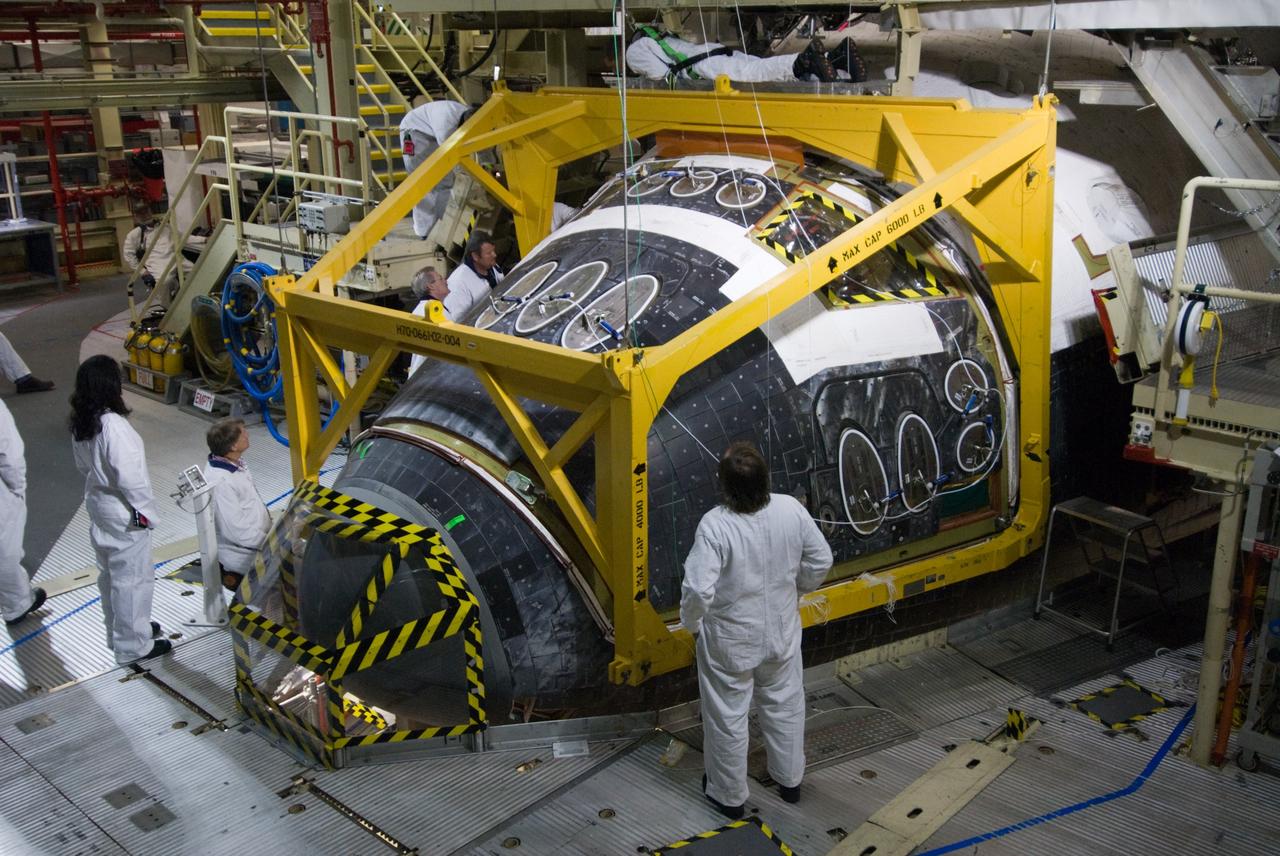
CAPE CANAVERAL, Fla. - In Orbiter Processing Facility Bay 3 at NASA's Kennedy Space Center in Florida, space shuttle Discovery's Forward Reaction Control System, or FRCS, has been returned to its proper place on the shuttle's frame. The FRCS is being reinstalled in the forward fuselage nose area of the shuttle after refurbishment. The FRCS provides the thrust for attitude (rotational) maneuvers (pitch, yaw and roll) and for small velocity changes along the orbiter axis (translation maneuvers). Discovery is being prepared for the STS-131 mission, the 33rd flight to the International Space Station. The seven-member STS-131 crew will deliver a Multi-Purpose Logistics Module filled with resupply stowage platforms and racks to be transferred to locations around the station. Three spacewalks will include work to attach a spare ammonia tank assembly to the station's exterior and return a European experiment from outside the station's Columbus module. Discovery's launch is targeted for March 18, 2010. For information on the STS-131 mission and crew, visit http://www.nasa.gov/mission_pages/shuttle/shuttlemissions/sts131/index.html. Photo credit: NASA/Amanda Diller
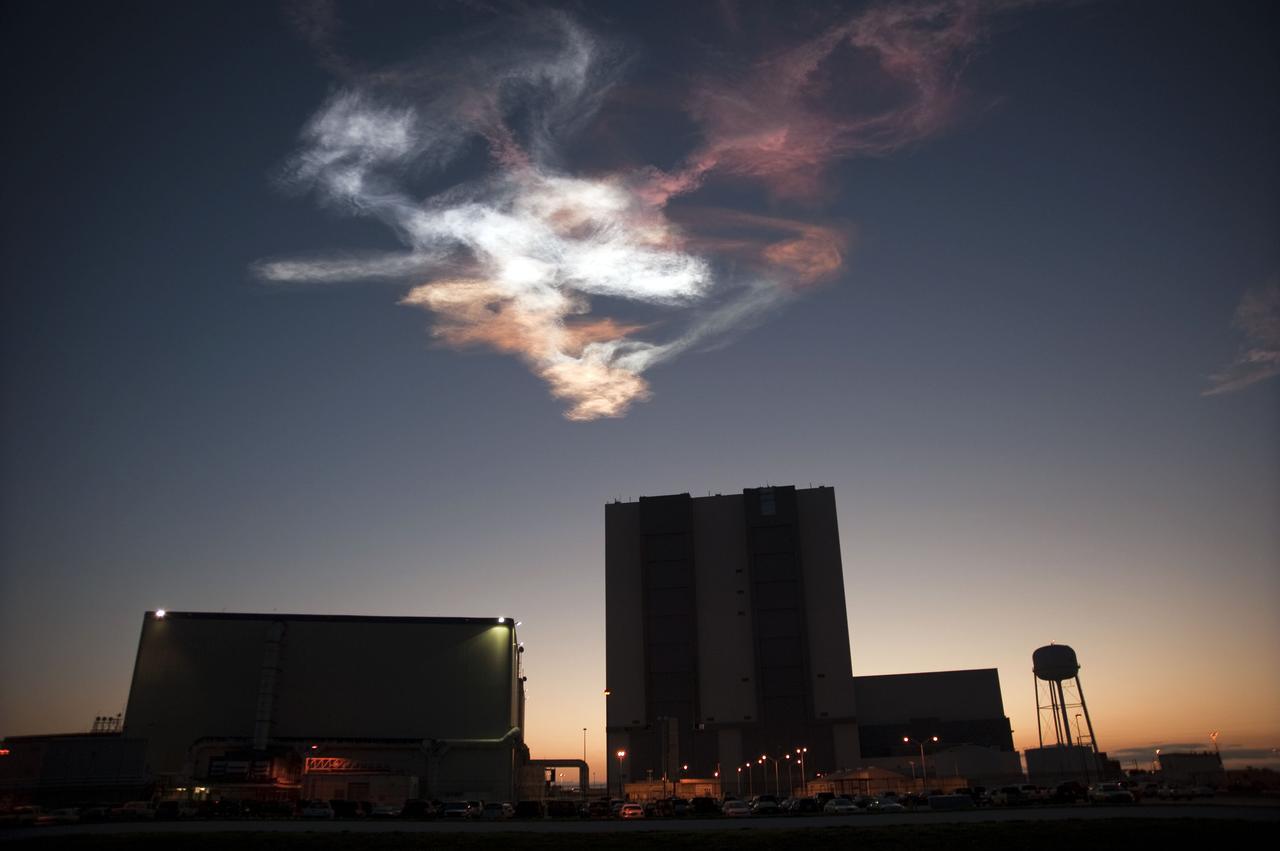
STS131-S-059 (5 April 2010) --- Drifting smoke plumes from the launch of space shuttle Discovery (out of frame) swirl above the Vehicle Assembly Building at NASA's Kennedy Space Center in Florida. Discovery and its seven-member STS-131 crew head toward Earth-orbit and a scheduled link-up with the International Space Station. Liftoff from Kennedy Space Center's launch pad 39A occurred at 6:21 a.m. (EDT) on April 5, 2010. Onboard are NASA astronauts Alan Poindexter, commander; James P. Dutton Jr., pilot; Rick Mastracchio, Dorothy Metcalf-Lindenburger, Stephanie Wilson and Clayton Anderson; along with Japan Aerospace Exploration Agency (JAXA) astronaut Naoko Yamazaki, all mission specialists. The crew will deliver the multi-purpose logistics module Leonardo, filled with supplies, a new crew sleeping quarters and science racks that will be transferred to the International Space Station's laboratories. The crew also will switch out a gyroscope on the station’s truss structure, install a spare ammonia storage tank and retrieve a Japanese experiment from the station’s exterior. STS-131 is the 33rd shuttle mission to the station and the 131st shuttle mission overall.
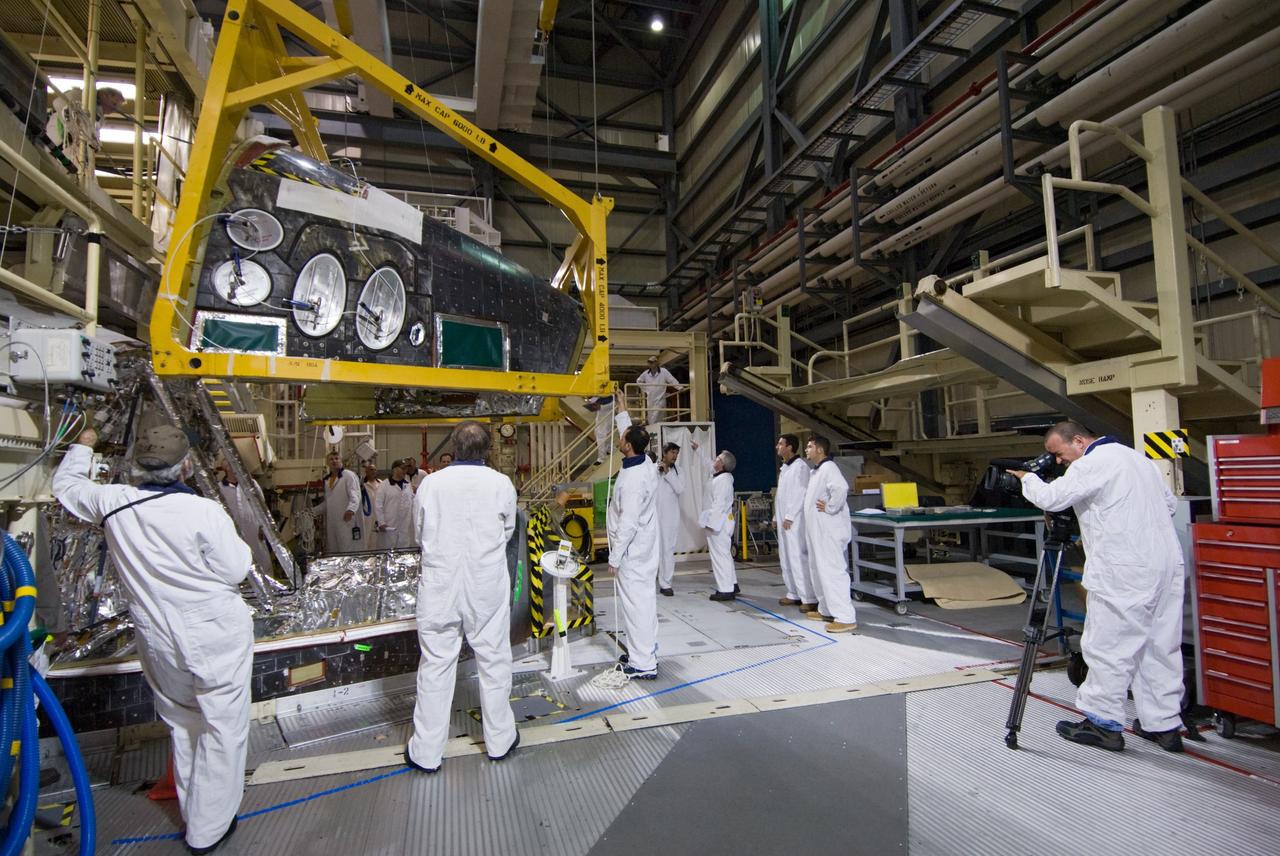
CAPE CANAVERAL, Fla. - In Orbiter Processing Facility Bay 3 at NASA's Kennedy Space Center in Florida, United Space Alliance technicians lower space shuttle Discovery's Forward Reaction Control System, or FRCS, into position over the shuttle's frame. The FRCS is being reinstalled in the forward fuselage nose area of the shuttle after refurbishment. The FRCS provides the thrust for attitude (rotational) maneuvers (pitch, yaw and roll) and for small velocity changes along the orbiter axis (translation maneuvers). Discovery is being prepared for the STS-131 mission, the 33rd flight to the International Space Station. The seven-member STS-131 crew will deliver a Multi-Purpose Logistics Module filled with resupply stowage platforms and racks to be transferred to locations around the station. Three spacewalks will include work to attach a spare ammonia tank assembly to the station's exterior and return a European experiment from outside the station's Columbus module. Discovery's launch is targeted for March 18, 2010. For information on the STS-131 mission and crew, visit http://www.nasa.gov/mission_pages/shuttle/shuttlemissions/sts131/index.html. Photo credit: NASA/Amanda Diller
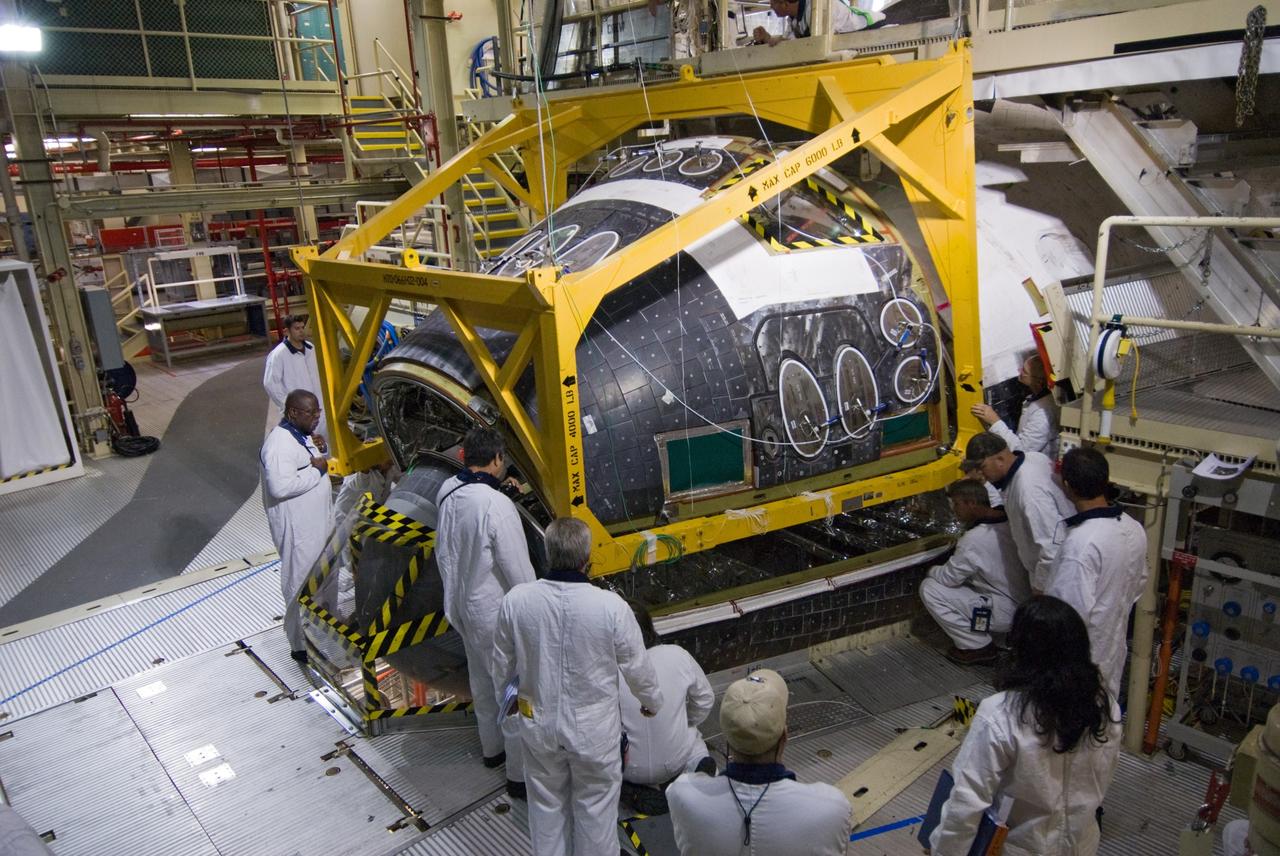
CAPE CANAVERAL, Fla. - In Orbiter Processing Facility Bay 3 at NASA's Kennedy Space Center in Florida, United Space Alliance technicians align space shuttle Discovery's Forward Reaction Control System, or FRCS, into position on the shuttle's frame. The FRCS is being reinstalled in the forward fuselage nose area of the shuttle after refurbishment. The FRCS provides the thrust for attitude (rotational) maneuvers (pitch, yaw and roll) and for small velocity changes along the orbiter axis (translation maneuvers). Discovery is being prepared for the STS-131 mission, the 33rd flight to the International Space Station. The seven-member STS-131 crew will deliver a Multi-Purpose Logistics Module filled with resupply stowage platforms and racks to be transferred to locations around the station. Three spacewalks will include work to attach a spare ammonia tank assembly to the station's exterior and return a European experiment from outside the station's Columbus module. Discovery's launch is targeted for March 18, 2010. For information on the STS-131 mission and crew, visit http://www.nasa.gov/mission_pages/shuttle/shuttlemissions/sts131/index.html. Photo credit: NASA/Amanda Diller
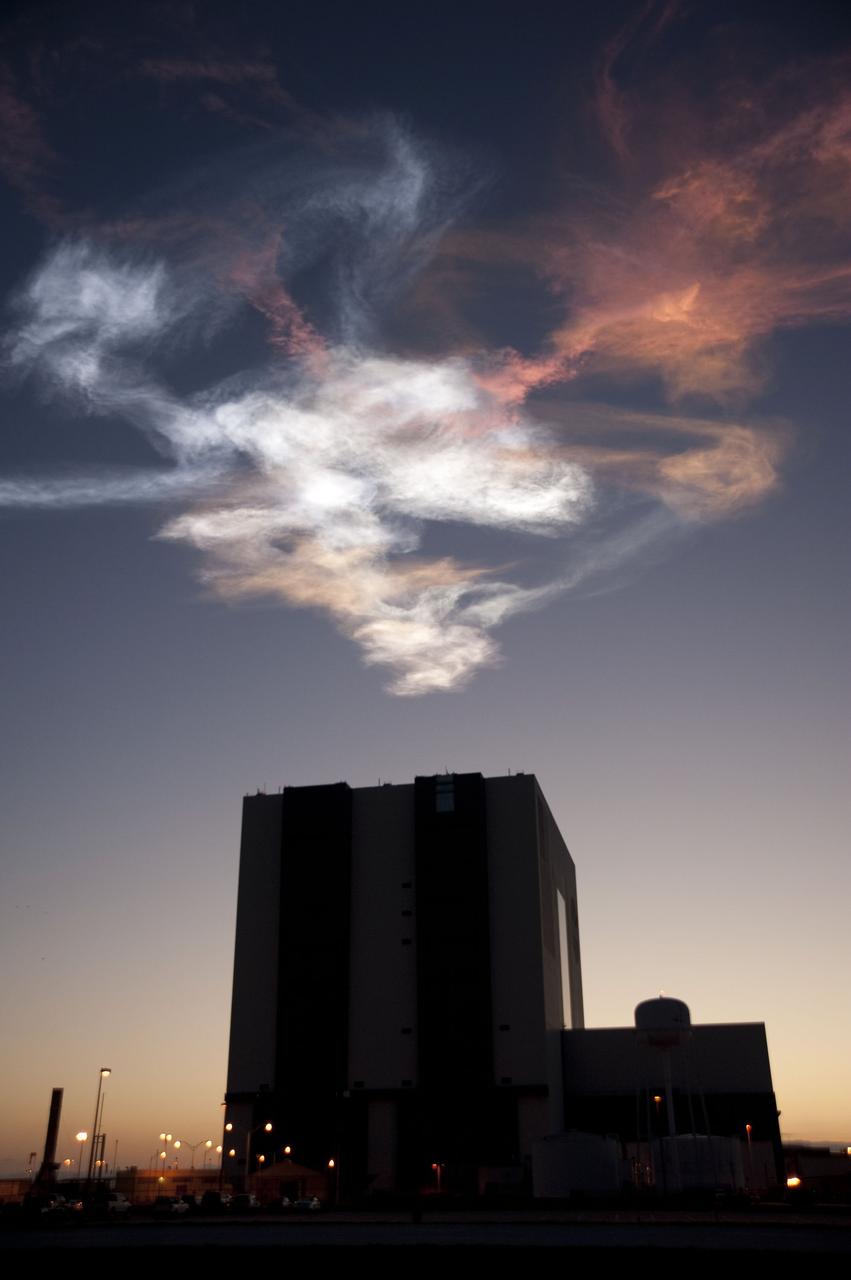
STS131-S-060 (5 April 2010) --- Drifting smoke plumes from the launch of space shuttle Discovery (out of frame) swirl above the Vehicle Assembly Building at NASA's Kennedy Space Center in Florida. Discovery and its seven-member STS-131 crew head toward Earth-orbit and a scheduled link-up with the International Space Station. Liftoff from Kennedy Space Center's launch pad 39A occurred at 6:21 a.m. (EDT) on April 5, 2010. Onboard are NASA astronauts Alan Poindexter, commander; James P. Dutton Jr., pilot; Rick Mastracchio, Dorothy Metcalf-Lindenburger, Stephanie Wilson and Clayton Anderson; along with Japan Aerospace Exploration Agency (JAXA) astronaut Naoko Yamazaki, all mission specialists. The crew will deliver the multi-purpose logistics module Leonardo, filled with supplies, a new crew sleeping quarters and science racks that will be transferred to the International Space Station's laboratories. The crew also will switch out a gyroscope on the station’s truss structure, install a spare ammonia storage tank and retrieve a Japanese experiment from the station’s exterior. STS-131 is the 33rd shuttle mission to the station and the 131st shuttle mission overall.
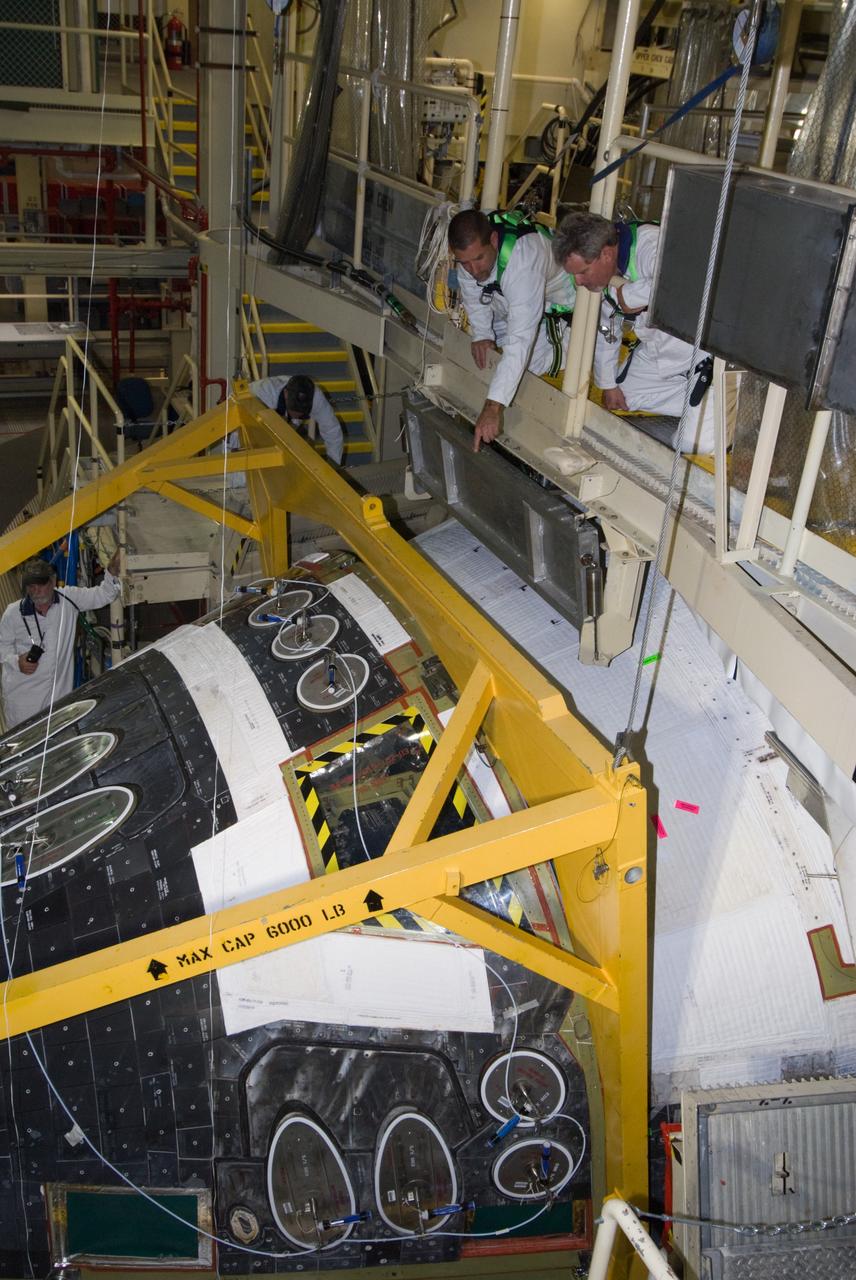
CAPE CANAVERAL, Fla. - In Orbiter Processing Facility Bay 3 at NASA's Kennedy Space Center in Florida, United Space Alliance technicians check the alignment of space shuttle Discovery's Forward Reaction Control System, or FRCS, onto the shuttle's frame. The FRCS is being reinstalled in the forward fuselage nose area of the shuttle after refurbishment. The FRCS provides the thrust for attitude (rotational) maneuvers (pitch, yaw and roll) and for small velocity changes along the orbiter axis (translation maneuvers). Discovery is being prepared for the STS-131 mission, the 33rd flight to the International Space Station. The seven-member STS-131 crew will deliver a Multi-Purpose Logistics Module filled with resupply stowage platforms and racks to be transferred to locations around the station. Three spacewalks will include work to attach a spare ammonia tank assembly to the station's exterior and return a European experiment from outside the station's Columbus module. Discovery's launch is targeted for March 18, 2010. For information on the STS-131 mission and crew, visit http://www.nasa.gov/mission_pages/shuttle/shuttlemissions/sts131/index.html. Photo credit: NASA/Amanda Diller