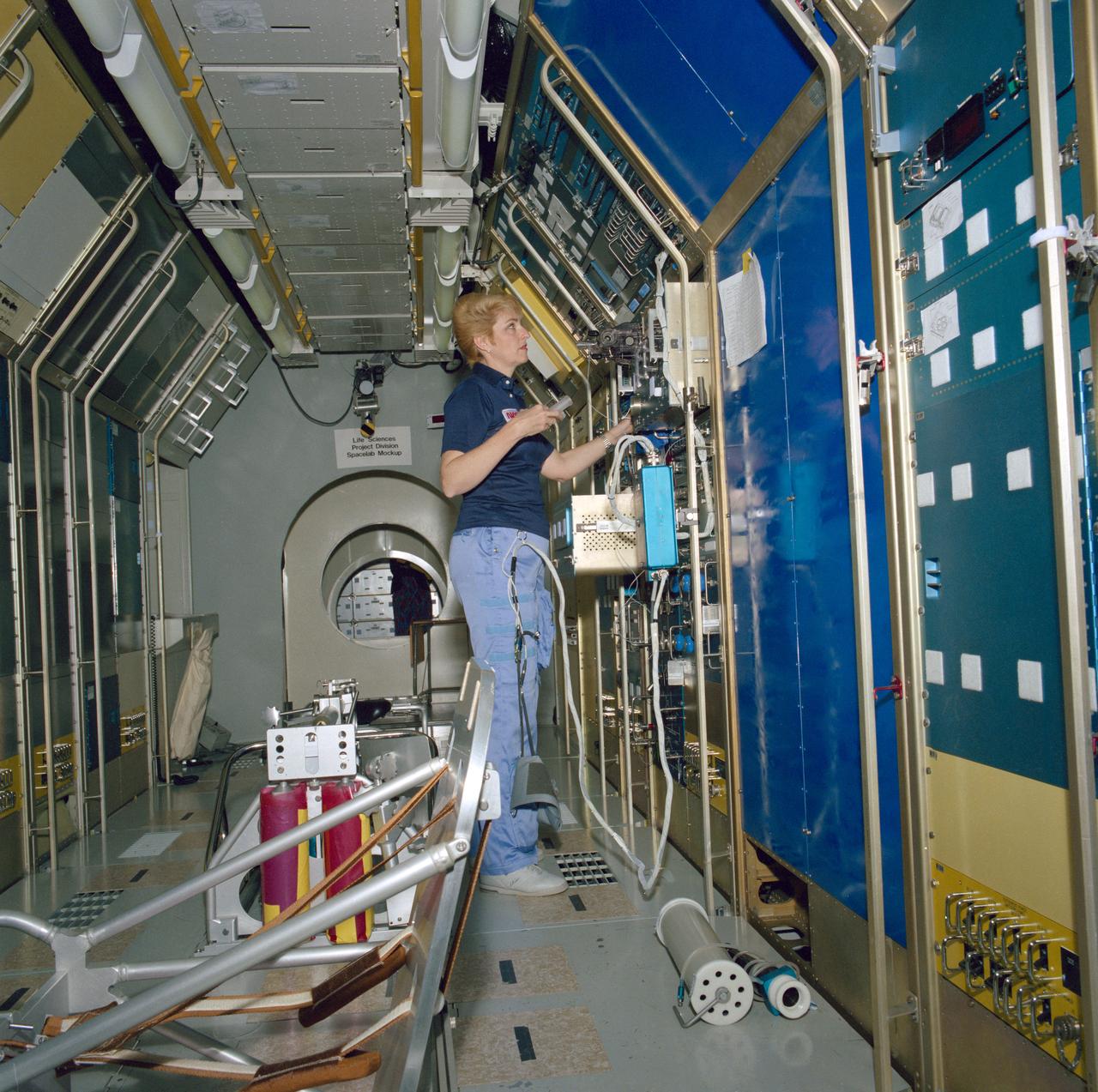
S87-28666 (March 1987) --- Millie Hughes-Fulford, STS-40/SLS-1 payload specialist, stands near the Echocardiograph on Rack 6 of the SLS-1 module, during a rehearsal of experimentation scheduled for her spaceflight.
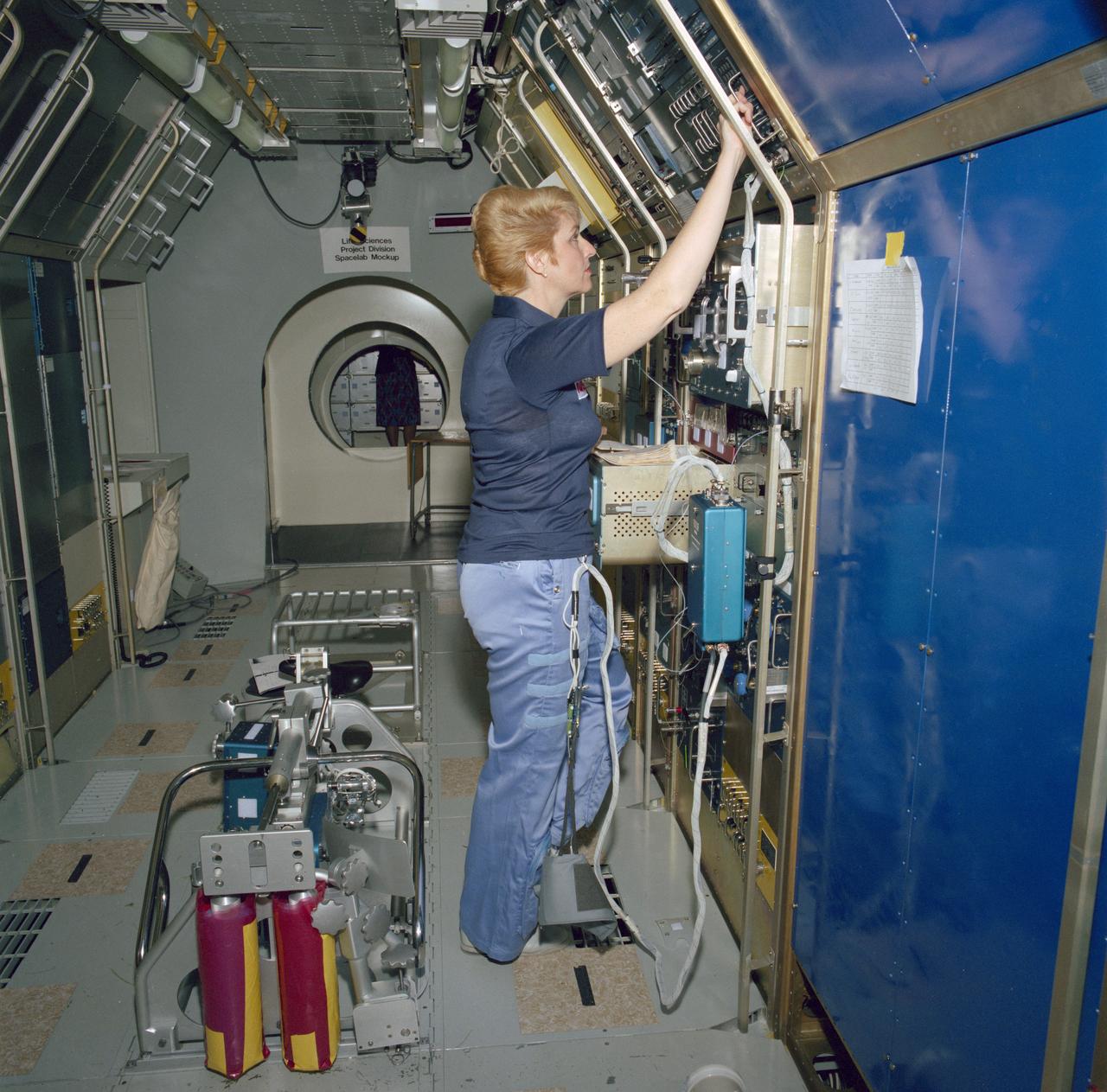
STS-40 Payload Specialist Millie Hughes-Fulford conducts Spacelab Life Sciences 1 (SLS-1) Experiment No. 198, Pulmonary Function During Weightlessness, in JSC's Life Sciences Project Division (LSPD) SLS mockup located in the Bioengineering and Test Support Facility Bldg 36. Hughes-Fulford sets switches on Rack 8. Behind her in the center aisle are the stowed bicycle ergometer (foreground) and the body restraint system.
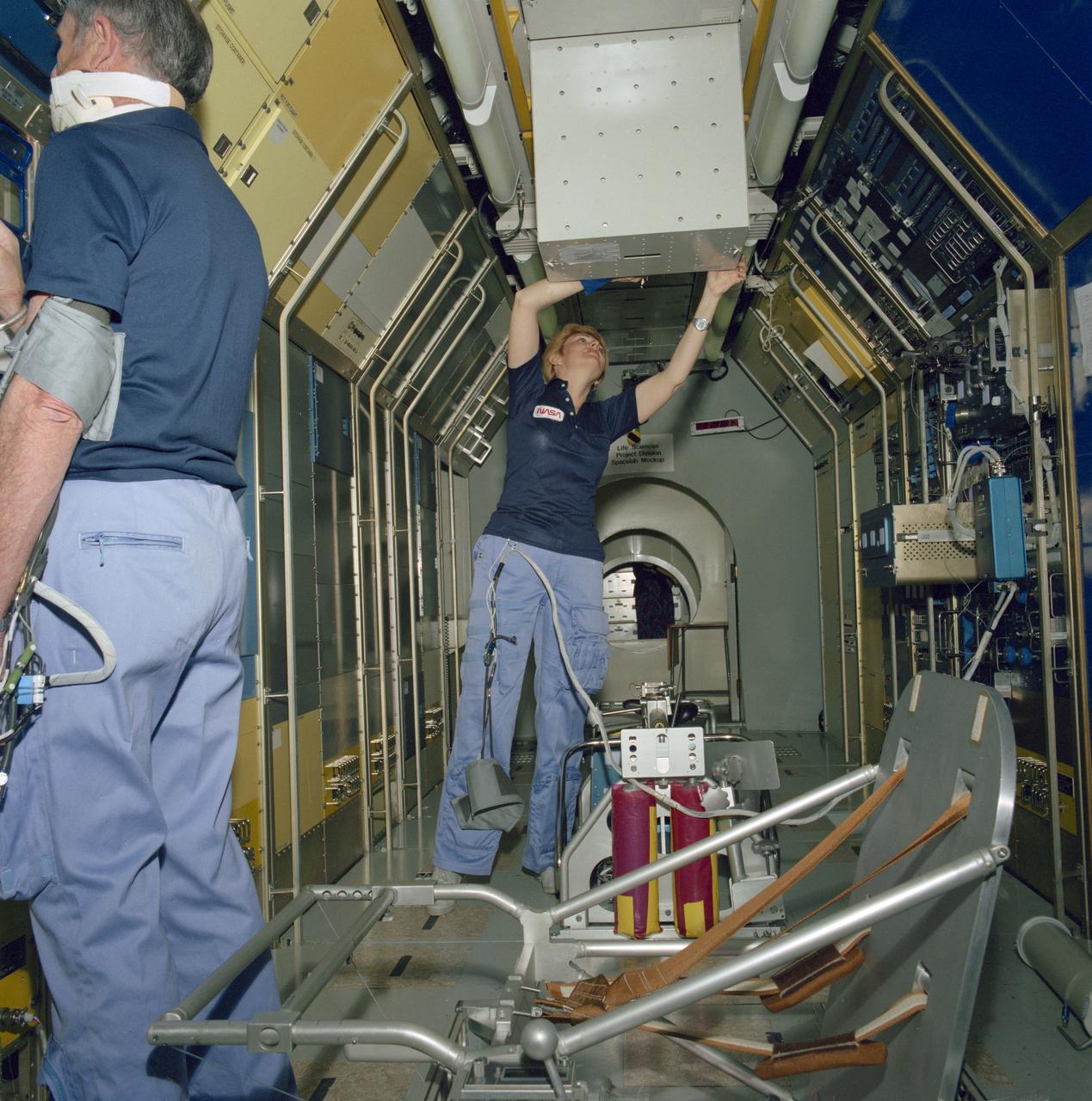
STS-40 Payload Specialist Millie Hughes-Fulford along with backup payload specialist Robert Ward Phillips familiarize themselves with Spacelab Life Sciences 1 (SLS-1) equipment. The two scientists are in JSC's Life Sciences Project Division (LSPD) SLS mockup located in the Bioengineering and Test Support Facility Bldg 36. Hughes-Fulford, in the center aisle, pulls equipment from an overhead stowage locker while Phillips, in the foreground, experiments with the baroreflex neck pressure chamber at Rack 11. The baroreflex collar will be used in conjuction with Experiment No. 022, Influence of Weightlessness Upon Human Autonomic Cardiovascular Control. Behind Phillips in the center aisle are body mass measurement device (BMMD) (foreground) and the stowed bicycle ergometer.
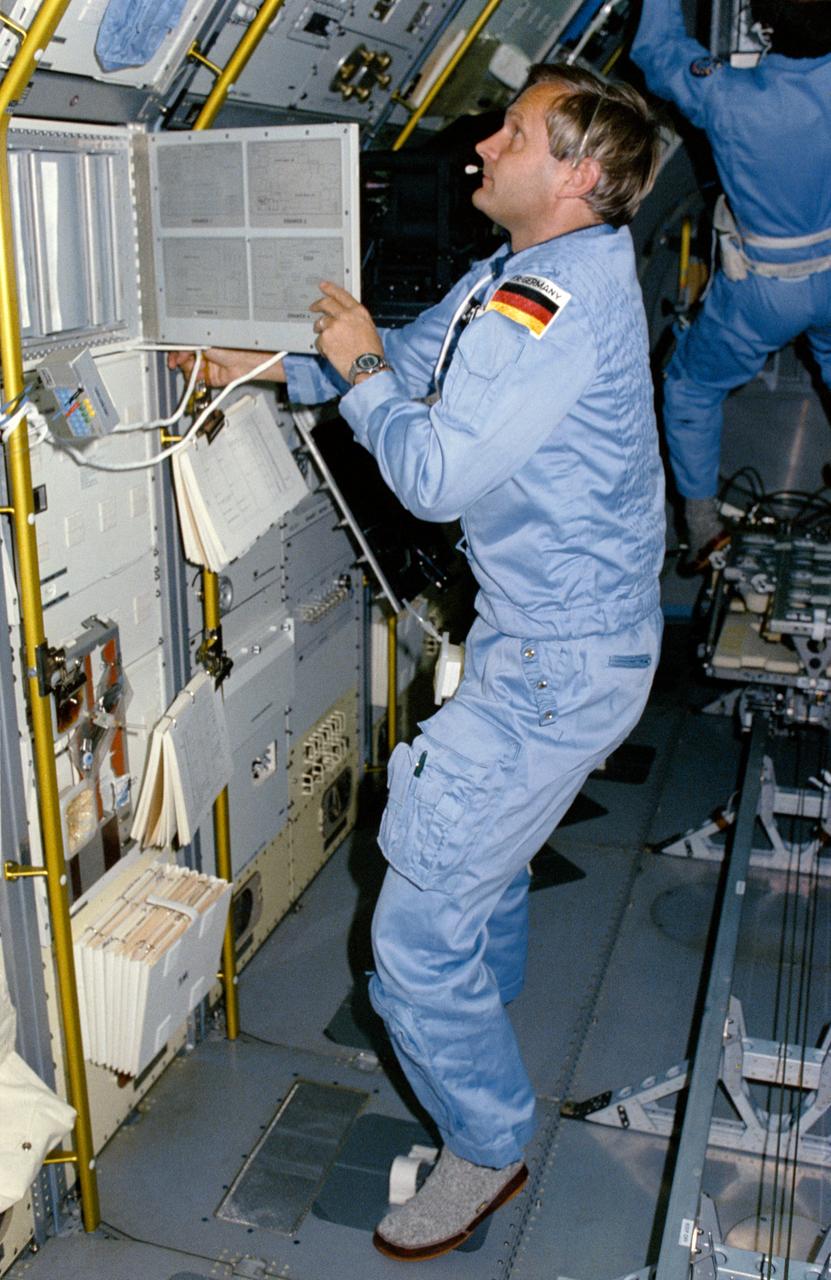
61A-01-032 (30 Oct-6 Nov 1985) --- West German Payload Specialist Ernst Messerschmid, foreground, opens a door on the materials science double rack (MSDR) to begin an experiment while Dutch Payload Specialist Wubbo J. Ockels performs a "run" on the vestibular sled in the background.
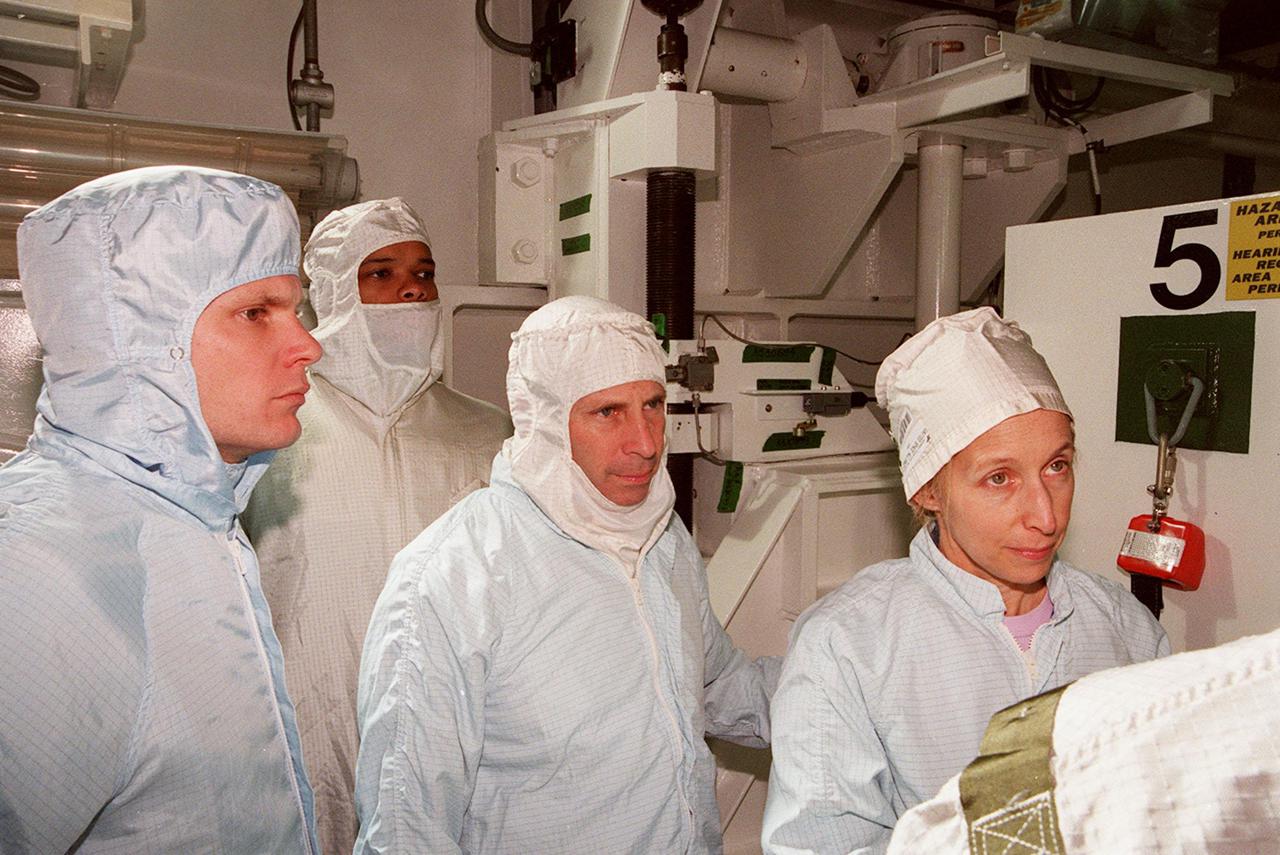
KENNEDY SPACE CENTER, FLA. -- Along with Scott Thurston (left), of the VITT office, members of the STS-98 crew Mission Specialist Robert Curbeam, Commander Ken Cockrell and Mission Specialist Marsha Ivins are in Atlantis’ payload bay to check out their mission payload, the U.S. Lab Destiny. The crew is at KSC for Terminal Countdown Demonstration Test activities, which also include a simulated launch countdown. A key element in the construction of the International Space Station, Destiny is a pressurized module designed to accommodate pressurized payloads. It has a capacity of 24 rack locations. Payload racks will occupy 13 locations especially designed to support experiments. The module already has five system racks installed inside. Launch of STS-98 on its 11-day mission is scheduled for Jan. 19 at 2:11 a.m. EST
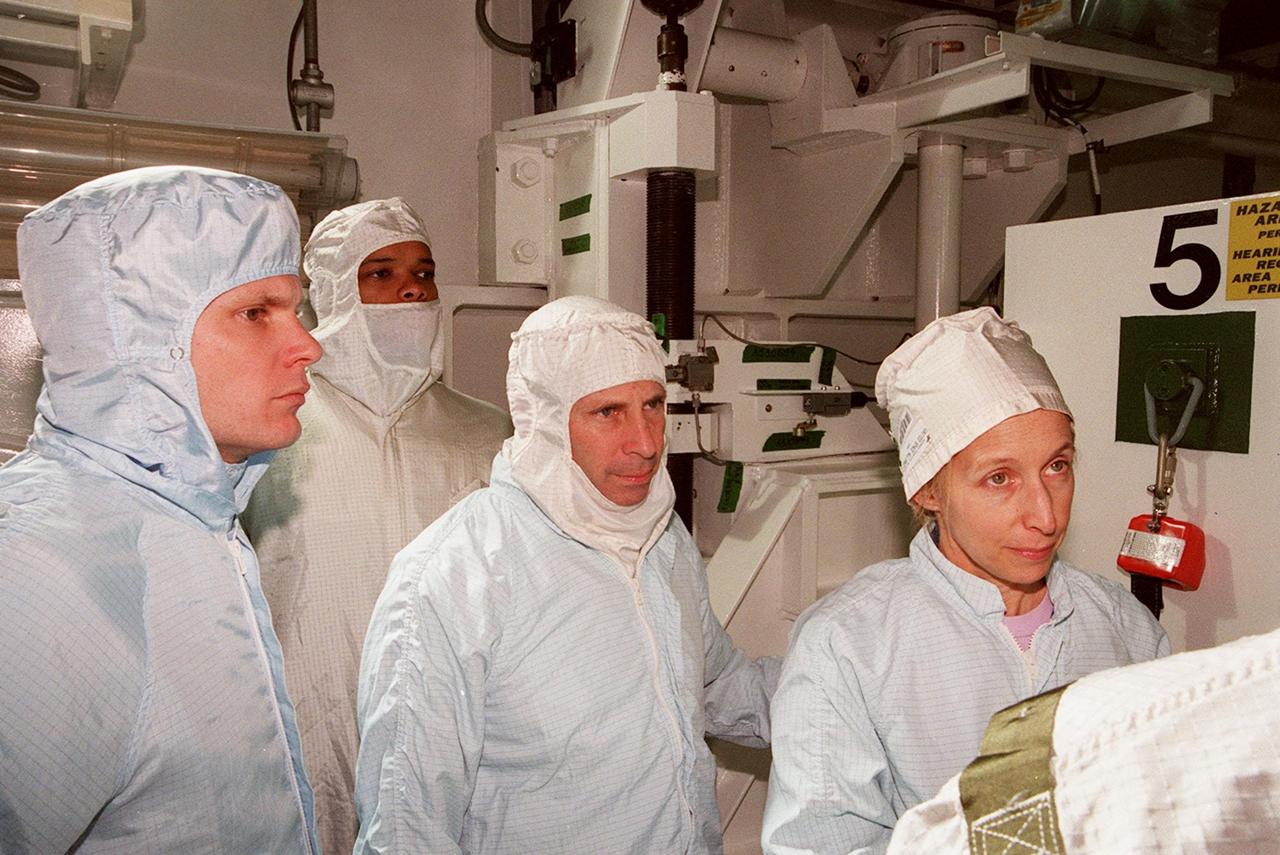
KENNEDY SPACE CENTER, FLA. -- Along with Scott Thurston (left), of the VITT office, members of the STS-98 crew Mission Specialist Robert Curbeam, Commander Ken Cockrell and Mission Specialist Marsha Ivins are in Atlantis’ payload bay to check out their mission payload, the U.S. Lab Destiny. The crew is at KSC for Terminal Countdown Demonstration Test activities, which also include a simulated launch countdown. A key element in the construction of the International Space Station, Destiny is a pressurized module designed to accommodate pressurized payloads. It has a capacity of 24 rack locations. Payload racks will occupy 13 locations especially designed to support experiments. The module already has five system racks installed inside. Launch of STS-98 on its 11-day mission is scheduled for Jan. 19 at 2:11 a.m. EST
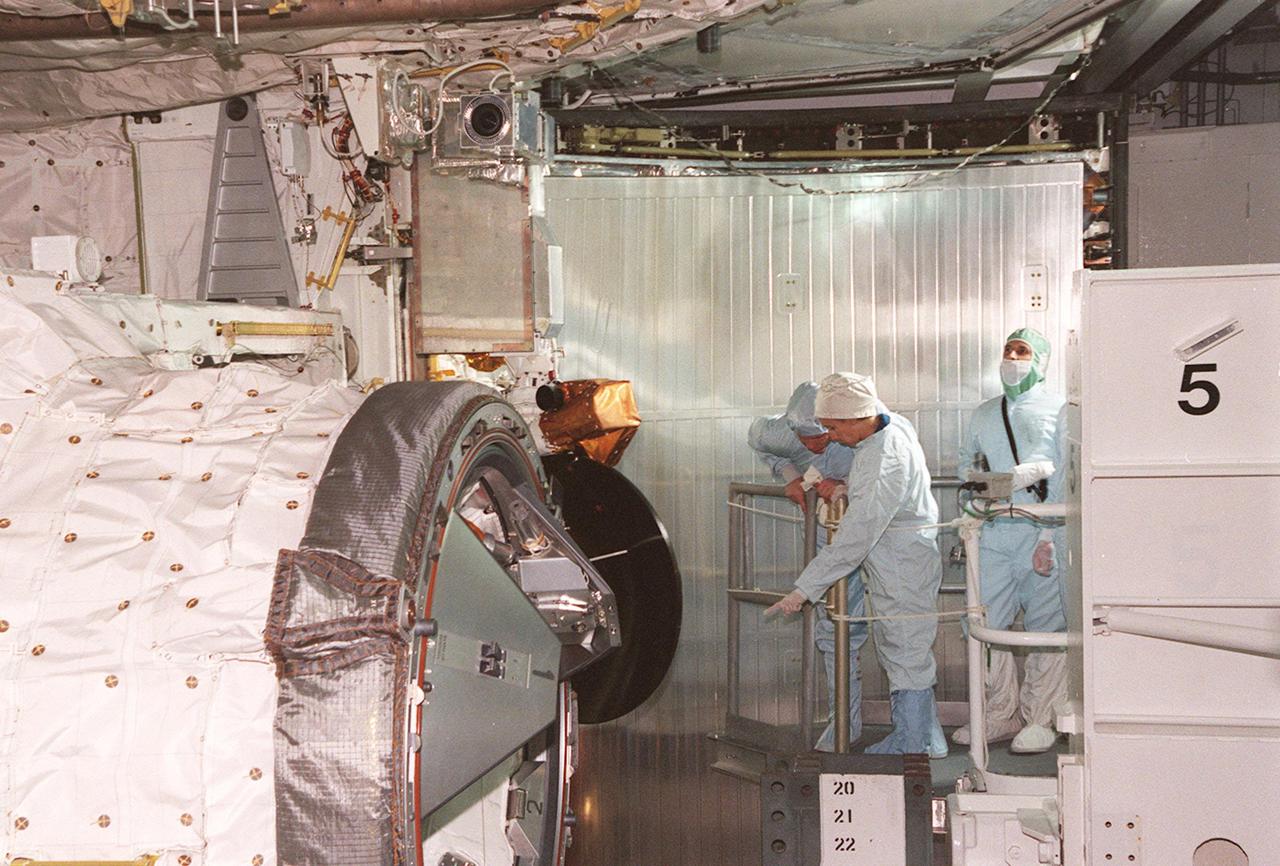
KENNEDY SPACE CENTER, FLA. -- STS-98 Mission Specialist Marsha Ivins (center, pointing) checks out the U.S. Lab Destiny in the payload bay of the orbiter Atlantis. The crew is at KSC for Terminal Countdown Demonstration Test activities, which also include a simulated launch countdown. Destiny, a key element in the construction of the International Space Station, is a pressurized module designed to accommodate pressurized payloads. It has a capacity of 24 rack locations. Payload racks will occupy 13 locations especially designed to support experiments. The module already has five system racks installed inside. Launch of STS-98 on its 11-day mission is scheduled for Jan. 19 at 2:11 a.m. EST
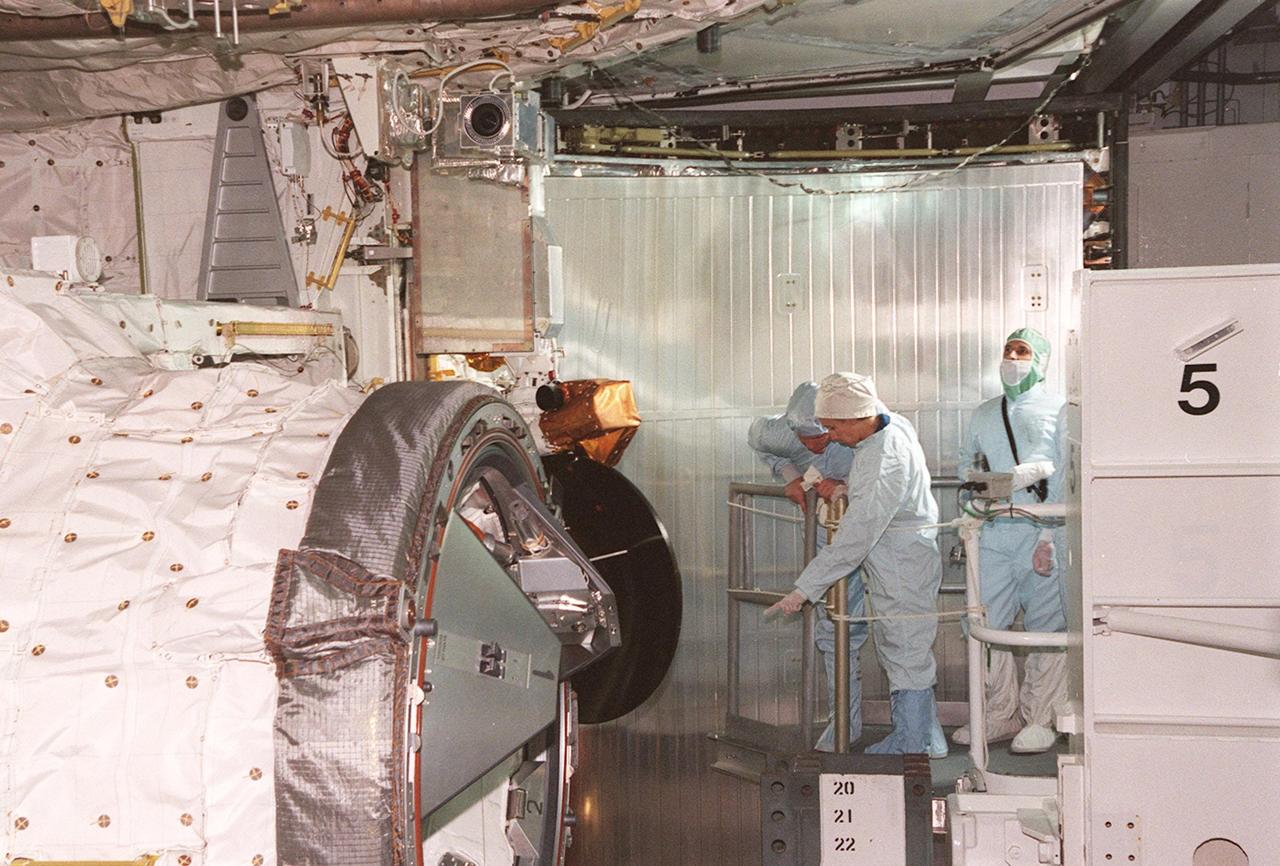
KENNEDY SPACE CENTER, FLA. -- STS-98 Mission Specialist Marsha Ivins (center, pointing) checks out the U.S. Lab Destiny in the payload bay of the orbiter Atlantis. The crew is at KSC for Terminal Countdown Demonstration Test activities, which also include a simulated launch countdown. Destiny, a key element in the construction of the International Space Station, is a pressurized module designed to accommodate pressurized payloads. It has a capacity of 24 rack locations. Payload racks will occupy 13 locations especially designed to support experiments. The module already has five system racks installed inside. Launch of STS-98 on its 11-day mission is scheduled for Jan. 19 at 2:11 a.m. EST
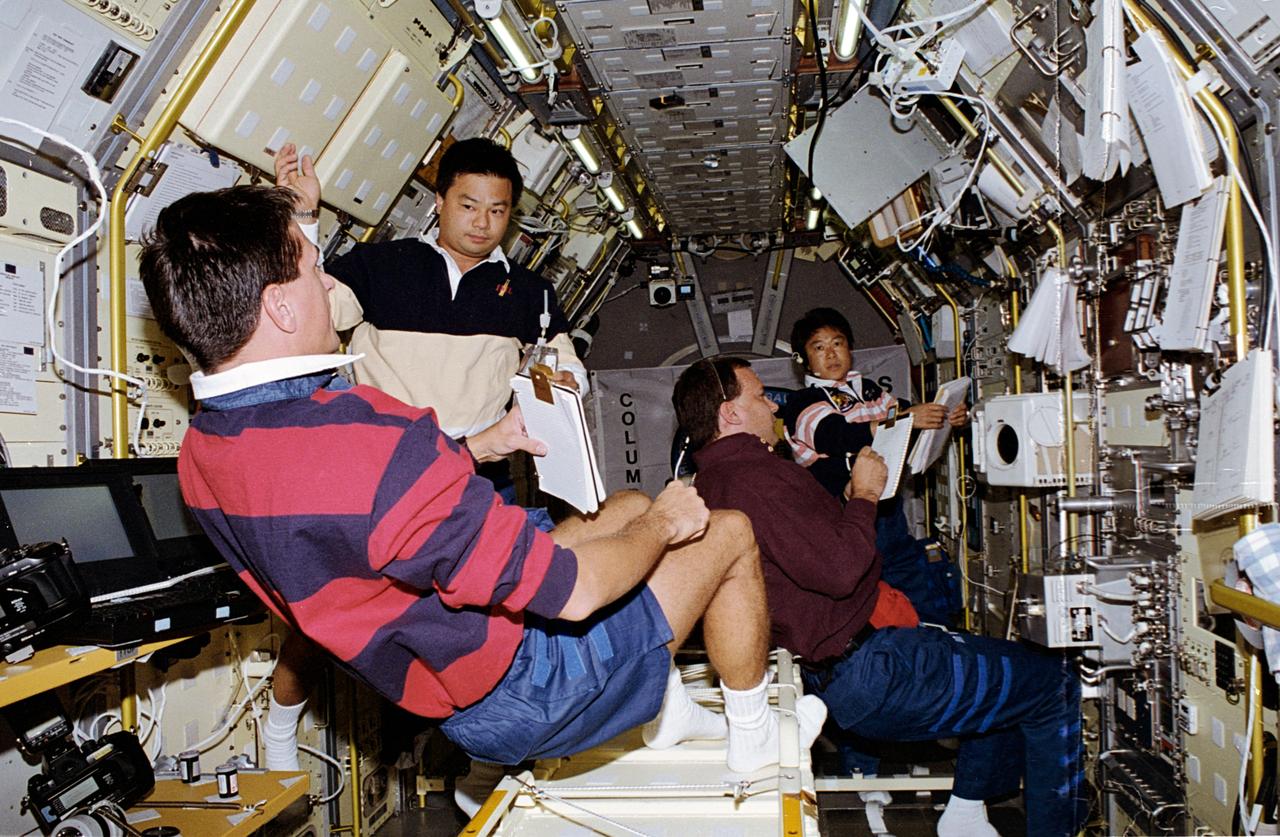
STS065-05-037 (8-23 July 1994) --- In the science module aboard the Space Shuttle Columbia, four members of the crew busy themselves with experiments in support of the second International Microgravity Laboratory (IML-2) mission. Left to right are Donald A. Thomas and Leroy Chiao, both mission specialists; Richard J. Hieb, payload commander, and Dr. Chiaki Mukai of NASDA, payload specialist.
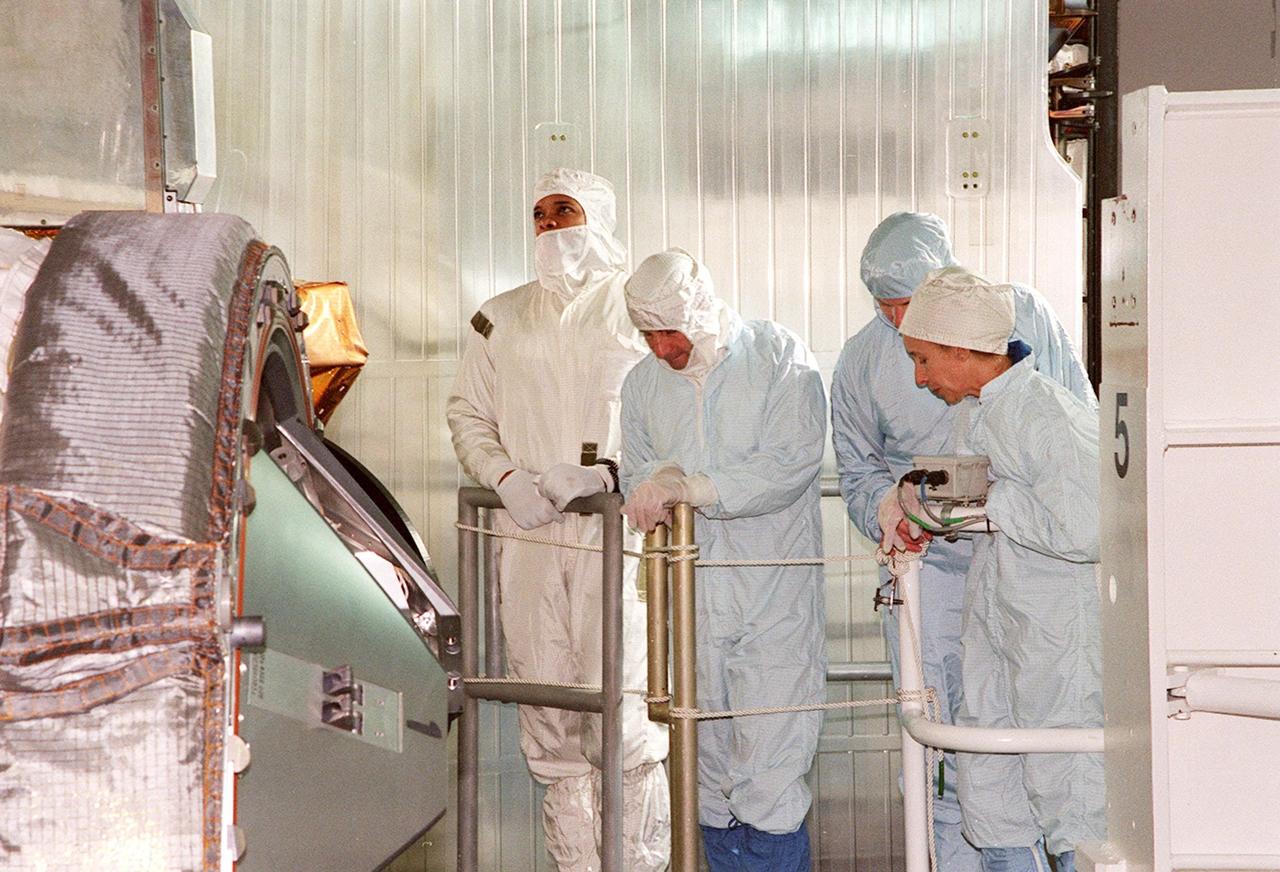
KENNEDY SPACE CENTER, FLA. -- STS-98 Mission Specialist Robert Curbeam (left), Commander Ken Cockrell (center) and Mission Specialist Marsha Ivins (right) look over the U.S. Lab Destiny in the payload bay of the orbiter Atlantis. Behind Ivins is Scott Thurston, of the VITT office. The crew is at KSC for Terminal Countdown Demonstration Test activities, which also include a simulated launch countdown. A key element in the construction of the International Space Station, Destiny is a pressurized module designed to accommodate pressurized payloads. It has a capacity of 24 rack locations. Payload racks will occupy 13 locations especially designed to support experiments. The module already has five system racks installed inside. Launch of STS-98 on its 11-day mission is scheduled for Jan. 19 at 2:11 a.m. EST
KENNEDY SPACE CENTER, FLA. -- STS-98 Mission Specialist Robert Curbeam (left), Commander Ken Cockrell (center) and Mission Specialist Marsha Ivins (right) look over the U.S. Lab Destiny in the payload bay of the orbiter Atlantis. Behind Ivins is Scott Thurston, of the VITT office. The crew is at KSC for Terminal Countdown Demonstration Test activities, which also include a simulated launch countdown. A key element in the construction of the International Space Station, Destiny is a pressurized module designed to accommodate pressurized payloads. It has a capacity of 24 rack locations. Payload racks will occupy 13 locations especially designed to support experiments. The module already has five system racks installed inside. Launch of STS-98 on its 11-day mission is scheduled for Jan. 19 at 2:11 a.m. EST
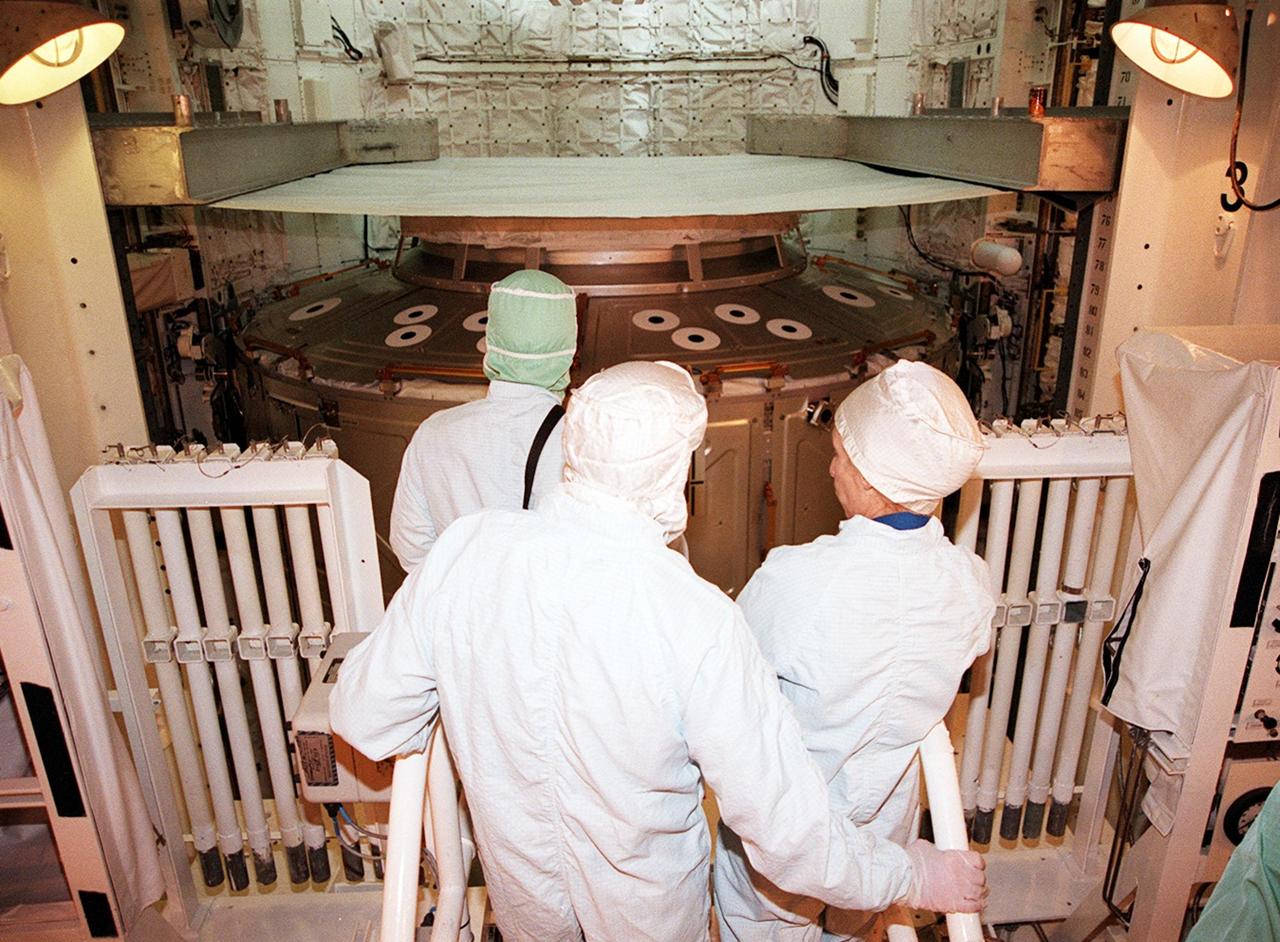
KENNEDY SPACE CENTER, FLA. -- In the payload bay of the orbiter Atlantis, STS-98 Commander Ken Cockrell (center) and Mission Specialist Marsha Ivins (right) look over the mission payload, the U.S. Lab Destiny (in the background). The crew is at KSC for Terminal Countdown Demonstration Test activities, which also include a simulated launch countdown. A key element in the construction of the International Space Station, Destiny is a pressurized module designed to accommodate pressurized payloads. It has a capacity of 24 rack locations. Payload racks will occupy 13 locations especially designed to support experiments. The module already has five system racks installed inside. Launch of STS-98 on its 11-day mission is scheduled for Jan. 19 at 2:11 a.m. EST
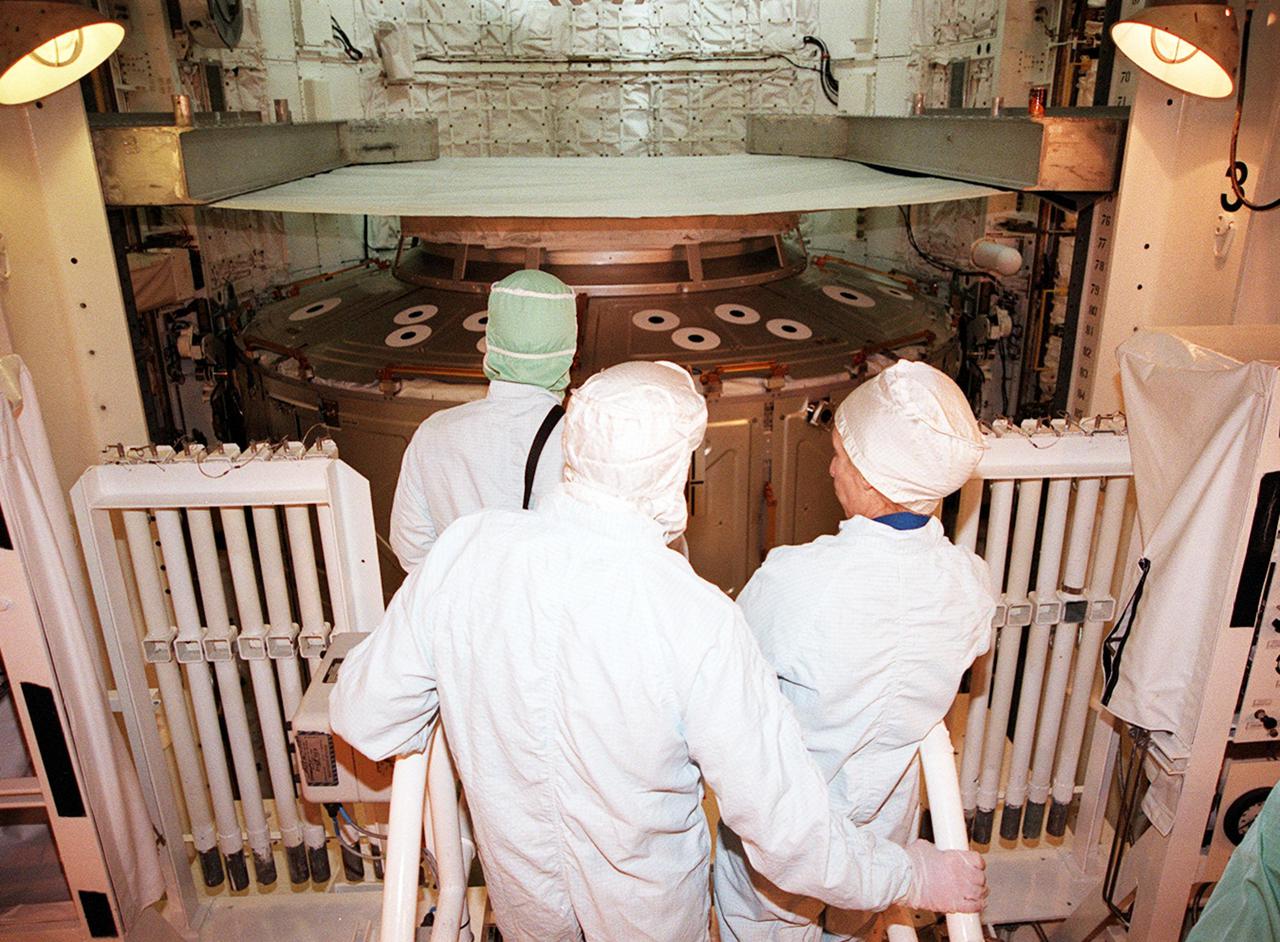
KENNEDY SPACE CENTER, FLA. -- In the payload bay of the orbiter Atlantis, STS-98 Commander Ken Cockrell (center) and Mission Specialist Marsha Ivins (right) look over the mission payload, the U.S. Lab Destiny (in the background). The crew is at KSC for Terminal Countdown Demonstration Test activities, which also include a simulated launch countdown. A key element in the construction of the International Space Station, Destiny is a pressurized module designed to accommodate pressurized payloads. It has a capacity of 24 rack locations. Payload racks will occupy 13 locations especially designed to support experiments. The module already has five system racks installed inside. Launch of STS-98 on its 11-day mission is scheduled for Jan. 19 at 2:11 a.m. EST
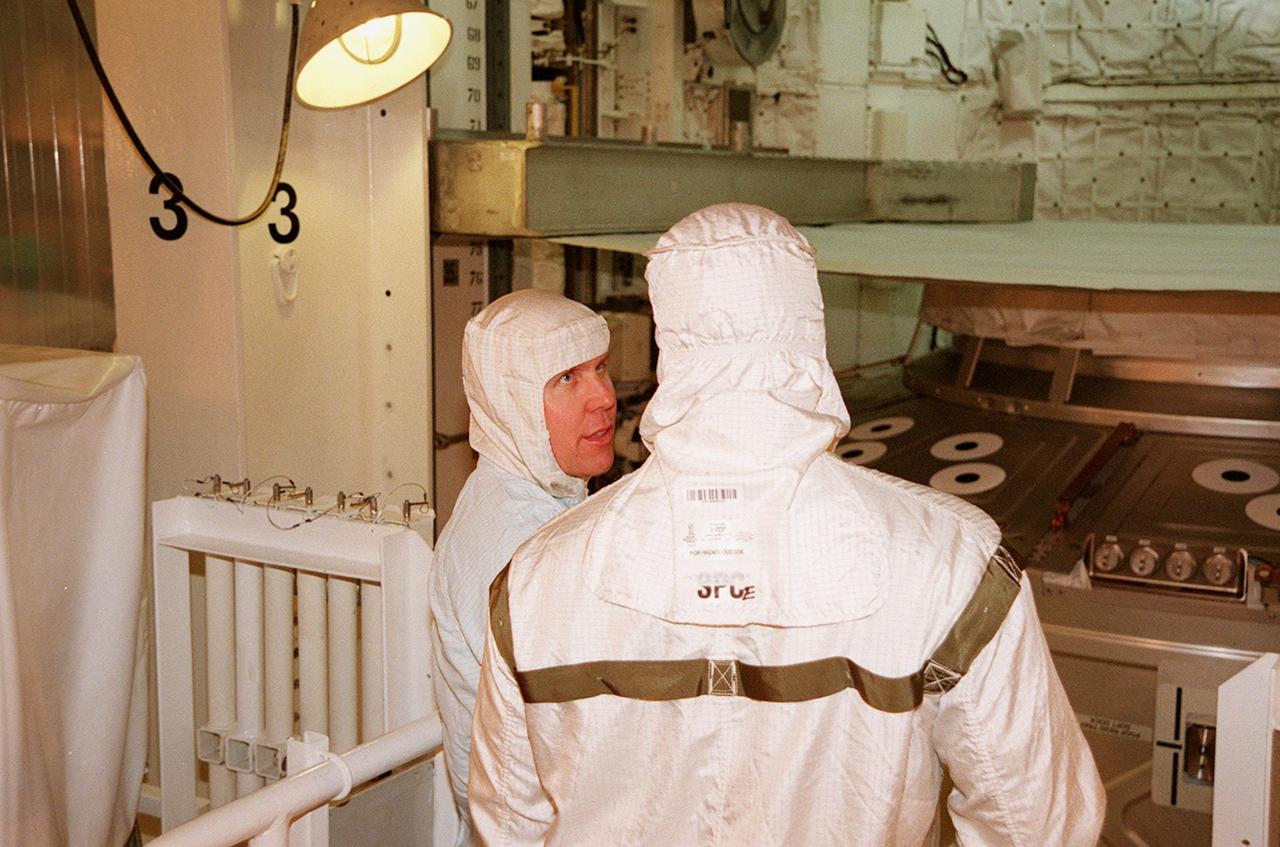
KENNEDY SPACE CENTER, FLA. -- In the payload bay of the orbiter Atlantis, STS-98 Mission Specialists Thomas Jones (left) and Robert Curbeam (right) talk about their mission, attaching the U.S. Lab Destiny (in the background) to the International Space Station. The crew is at KSC for Terminal Countdown Demonstration Test activities, which also include a simulated launch countdown. A key element in the construction of the International Space Station, Destiny is a pressurized module designed to accommodate pressurized payloads. It has a capacity of 24 rack locations. Payload racks will occupy 13 locations especially designed to support experiments. The module already has five system racks installed inside. Launch of STS-98 on its 11-day mission is scheduled for Jan. 19 at 2:11 a.m. EST
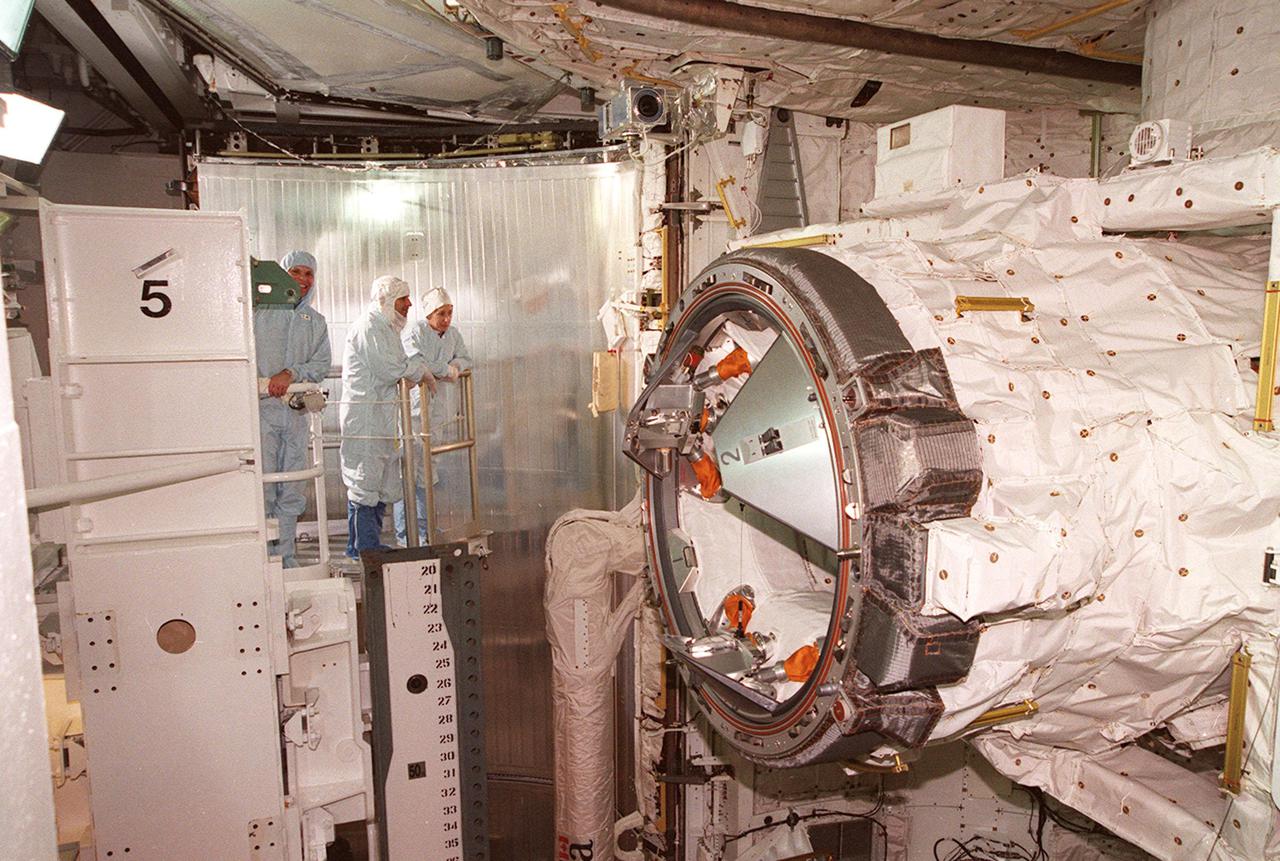
KENNEDY SPACE CENTER, FLA. -- Members of the STS-98 crew, along with Scott Thurston (left), with the VITT office, check out the U.S. Lab Destiny in the payload bay of the orbiter Atlantis. Wearing white caps are Commander Ken Cockrell (center) and Mission Specialist Marsha Ivins (right). The crew is at KSC for Terminal Countdown Demonstration Test activities, which include a simulated launch countdown. Destiny, a key element in the construction of the International Space Station, is a pressurized module designed to accommodate pressurized payloads. It has a capacity of 24 rack locations. Payload racks will occupy 13 locations especially designed to support experiments. The module already has five system racks installed inside. Launch of STS-98 on its 11-day mission is scheduled for Jan. 19 at 2:11 a.m. EST
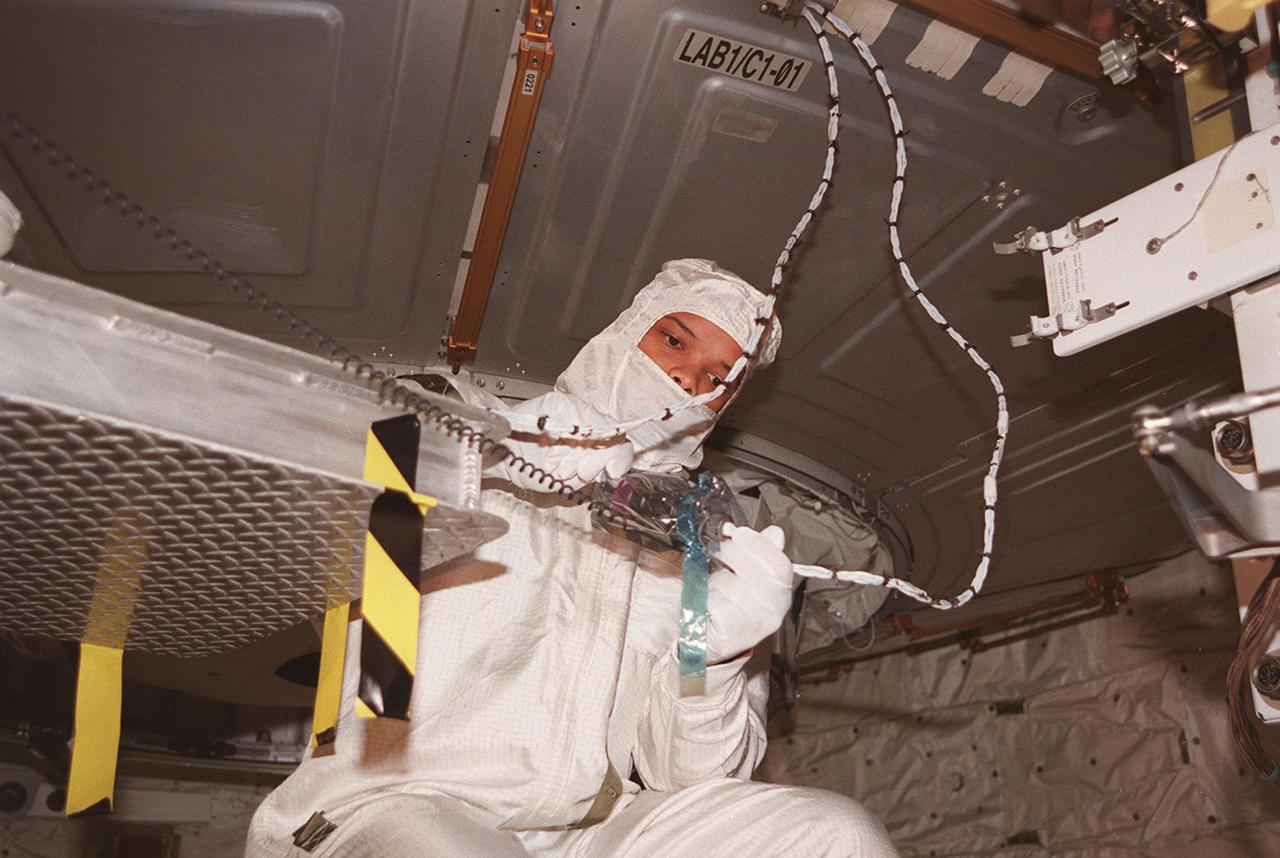
KENNEDY SPACE CENTER, FLA. -- In the payload bay of the orbiter Atlantis, STS-98 Mission Specialist Robert Curbeam works with equipment he will use in space to attach the U.S. Lab Destiny to the International Space Station. The crew is at KSC for Terminal Countdown Demonstration Test activities, which also include a simulated launch countdown. A key element in the construction of the International Space Station, Destiny is a pressurized module designed to accommodate pressurized payloads. It has a capacity of 24 rack locations. Payload racks will occupy 13 locations especially designed to support experiments. The module already has five system racks installed inside. Launch of STS-98 on its 11-day mission is scheduled for Jan. 19 at 2:11 a.m. EST
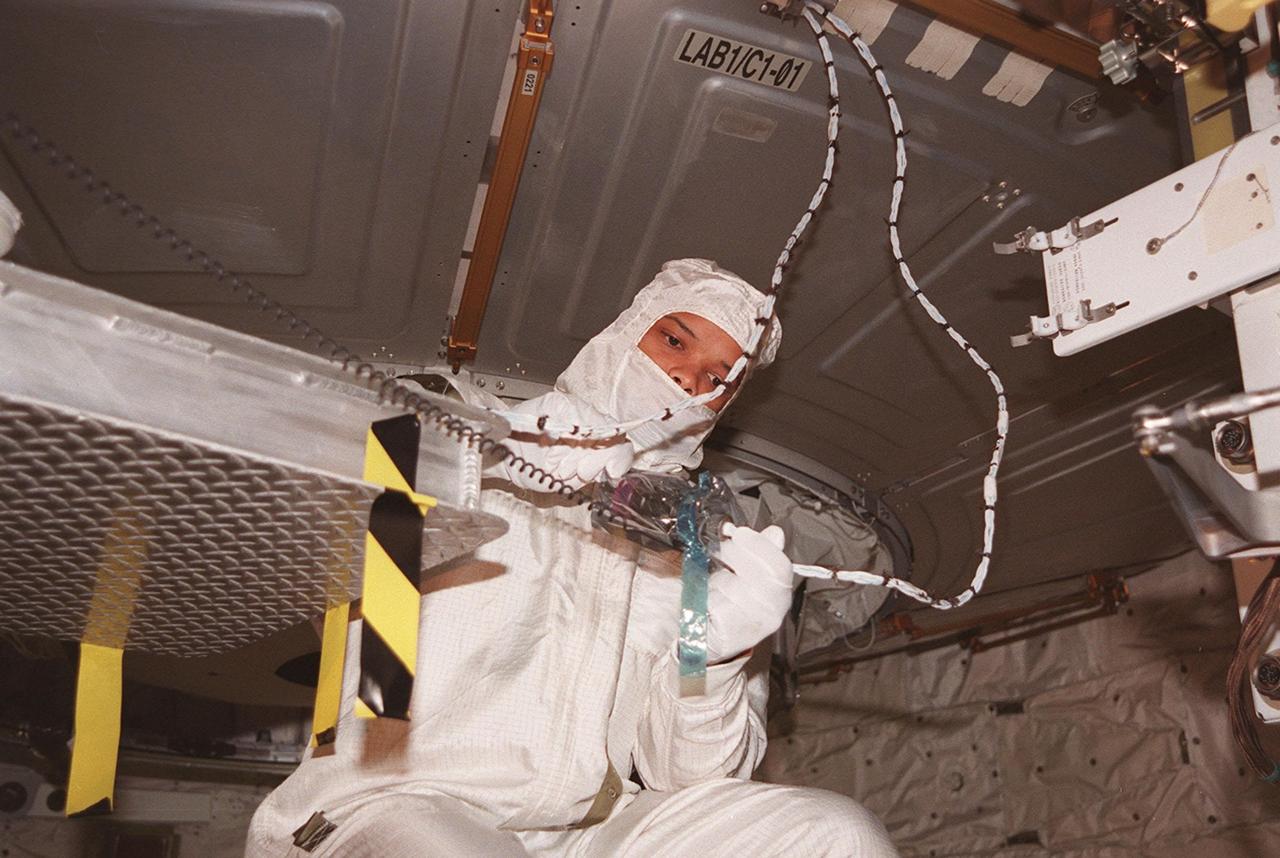
KENNEDY SPACE CENTER, FLA. -- In the payload bay of the orbiter Atlantis, STS-98 Mission Specialist Robert Curbeam works with equipment he will use in space to attach the U.S. Lab Destiny to the International Space Station. The crew is at KSC for Terminal Countdown Demonstration Test activities, which also include a simulated launch countdown. A key element in the construction of the International Space Station, Destiny is a pressurized module designed to accommodate pressurized payloads. It has a capacity of 24 rack locations. Payload racks will occupy 13 locations especially designed to support experiments. The module already has five system racks installed inside. Launch of STS-98 on its 11-day mission is scheduled for Jan. 19 at 2:11 a.m. EST
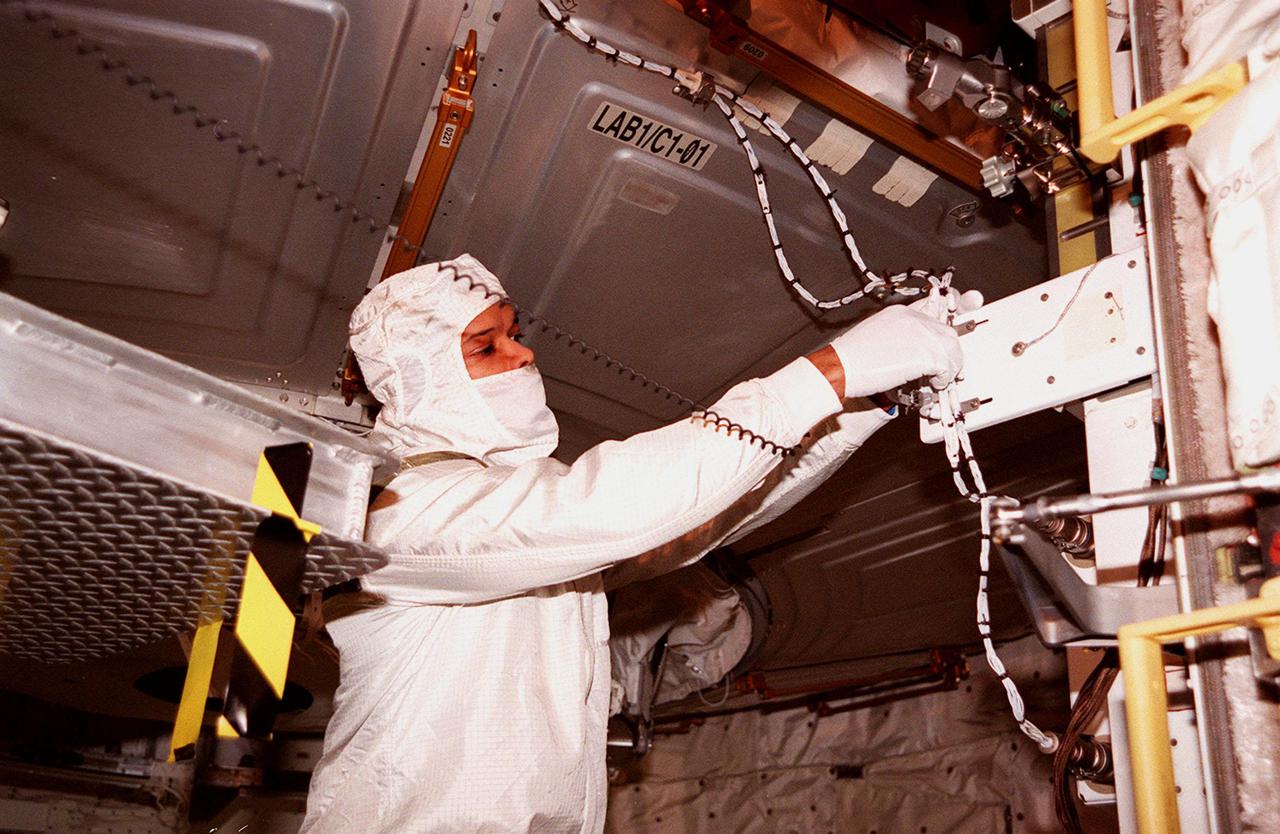
KENNEDY SPACE CENTER, FLA. -- In the payload bay of the orbiter Atlantis, STS-98 Mission Specialist Robert Curbeam works with equipment he will use in space to attach the U.S. Lab Destiny to the International Space Station. The crew is at KSC for Terminal Countdown Demonstration Test activities, which also include a simulated launch countdown. A key element in the construction of the International Space Station, Destiny is a pressurized module designed to accommodate pressurized payloads. It has a capacity of 24 rack locations. Payload racks will occupy 13 locations especially designed to support experiments. The module already has five system racks installed inside. Launch of STS-98 on its 11-day mission is scheduled for Jan. 19 at 2:11 a.m. EST
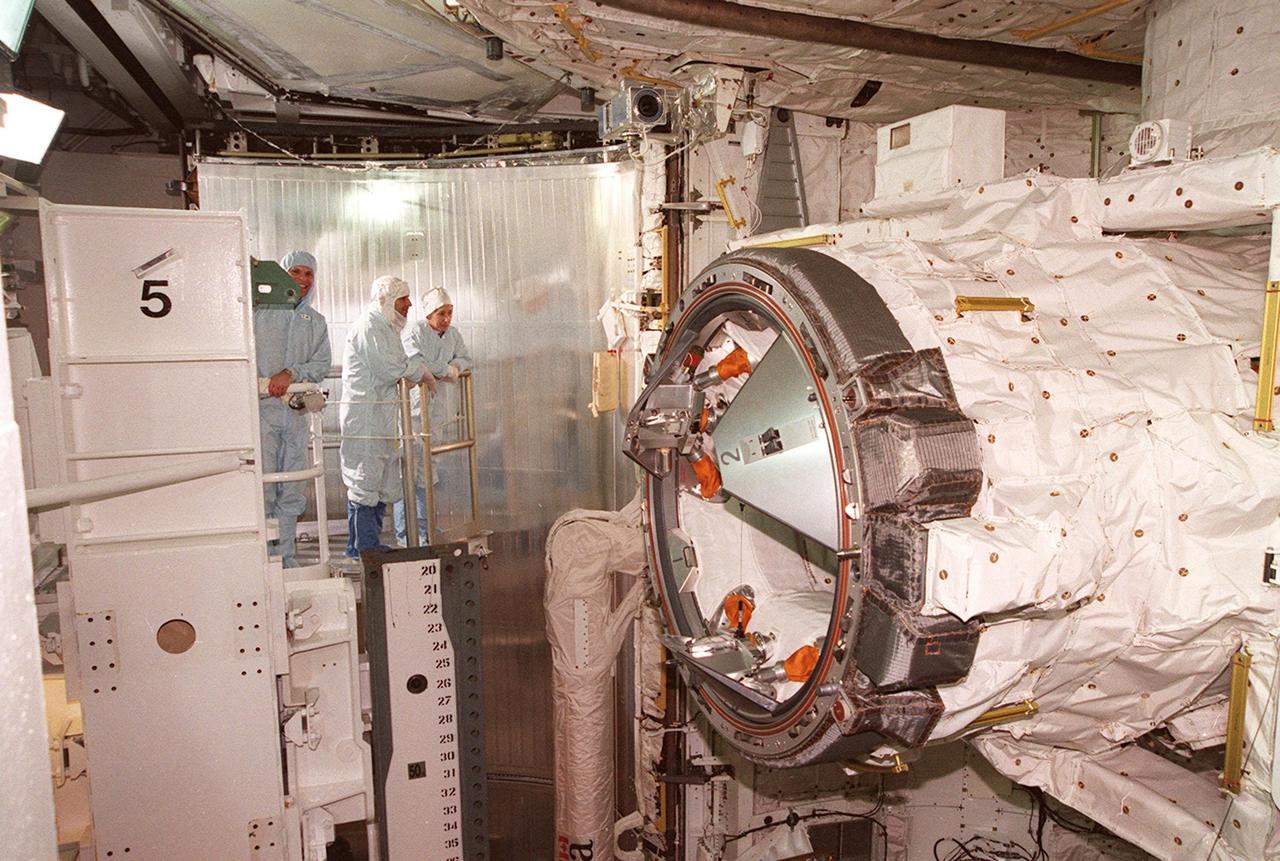
KENNEDY SPACE CENTER, FLA. -- Members of the STS-98 crew, along with Scott Thurston (left), with the VITT office, check out the U.S. Lab Destiny in the payload bay of the orbiter Atlantis. Wearing white caps are Commander Ken Cockrell (center) and Mission Specialist Marsha Ivins (right). The crew is at KSC for Terminal Countdown Demonstration Test activities, which include a simulated launch countdown. Destiny, a key element in the construction of the International Space Station, is a pressurized module designed to accommodate pressurized payloads. It has a capacity of 24 rack locations. Payload racks will occupy 13 locations especially designed to support experiments. The module already has five system racks installed inside. Launch of STS-98 on its 11-day mission is scheduled for Jan. 19 at 2:11 a.m. EST
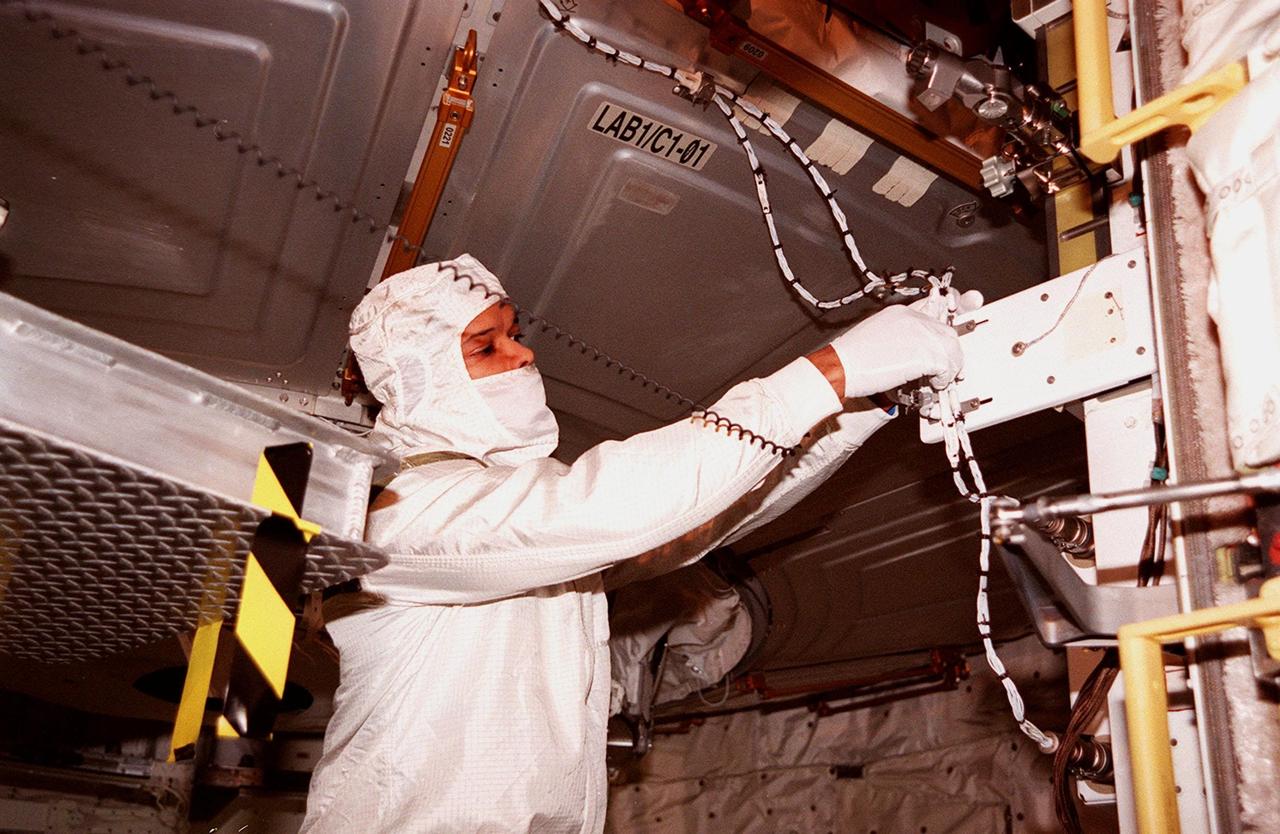
KENNEDY SPACE CENTER, FLA. -- In the payload bay of the orbiter Atlantis, STS-98 Mission Specialist Robert Curbeam works with equipment he will use in space to attach the U.S. Lab Destiny to the International Space Station. The crew is at KSC for Terminal Countdown Demonstration Test activities, which also include a simulated launch countdown. A key element in the construction of the International Space Station, Destiny is a pressurized module designed to accommodate pressurized payloads. It has a capacity of 24 rack locations. Payload racks will occupy 13 locations especially designed to support experiments. The module already has five system racks installed inside. Launch of STS-98 on its 11-day mission is scheduled for Jan. 19 at 2:11 a.m. EST
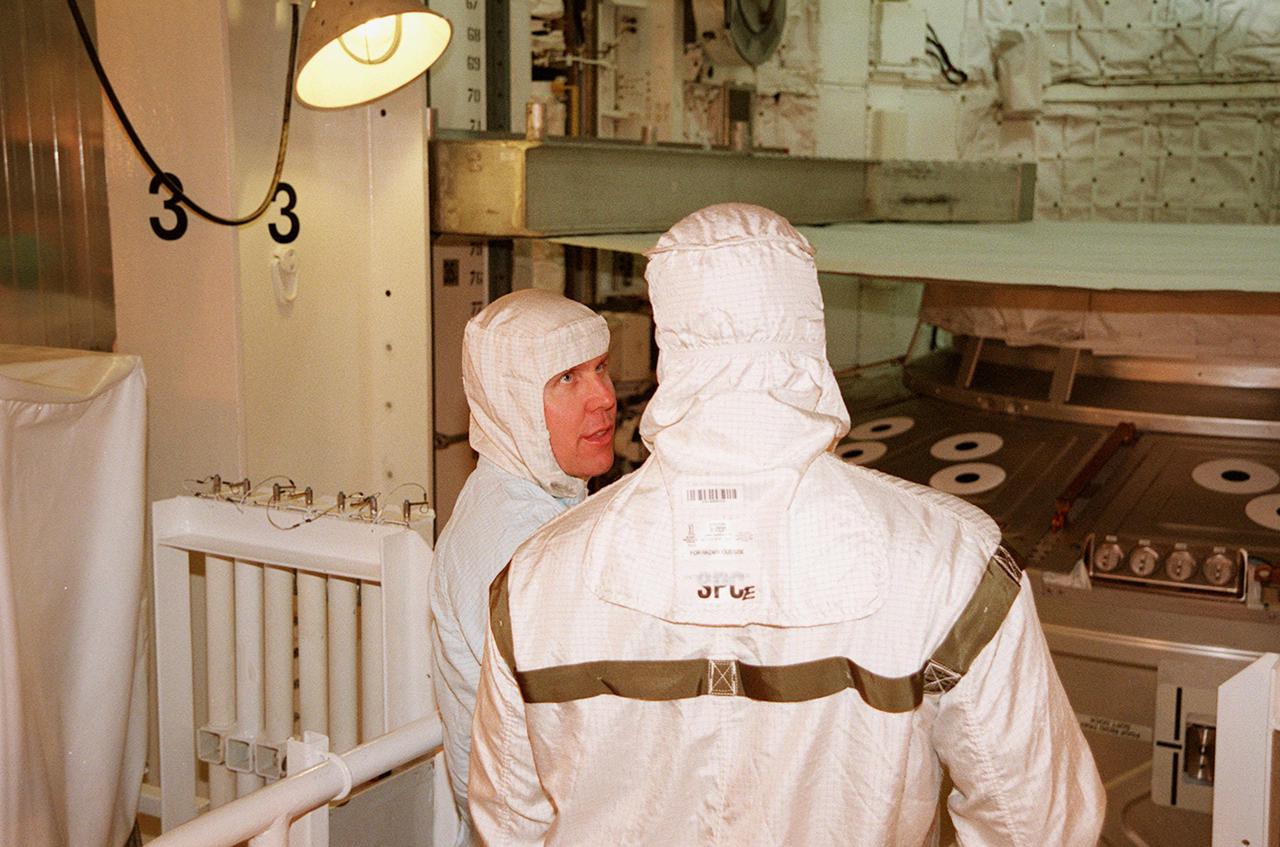
KENNEDY SPACE CENTER, FLA. -- In the payload bay of the orbiter Atlantis, STS-98 Mission Specialists Thomas Jones (left) and Robert Curbeam (right) talk about their mission, attaching the U.S. Lab Destiny (in the background) to the International Space Station. The crew is at KSC for Terminal Countdown Demonstration Test activities, which also include a simulated launch countdown. A key element in the construction of the International Space Station, Destiny is a pressurized module designed to accommodate pressurized payloads. It has a capacity of 24 rack locations. Payload racks will occupy 13 locations especially designed to support experiments. The module already has five system racks installed inside. Launch of STS-98 on its 11-day mission is scheduled for Jan. 19 at 2:11 a.m. EST
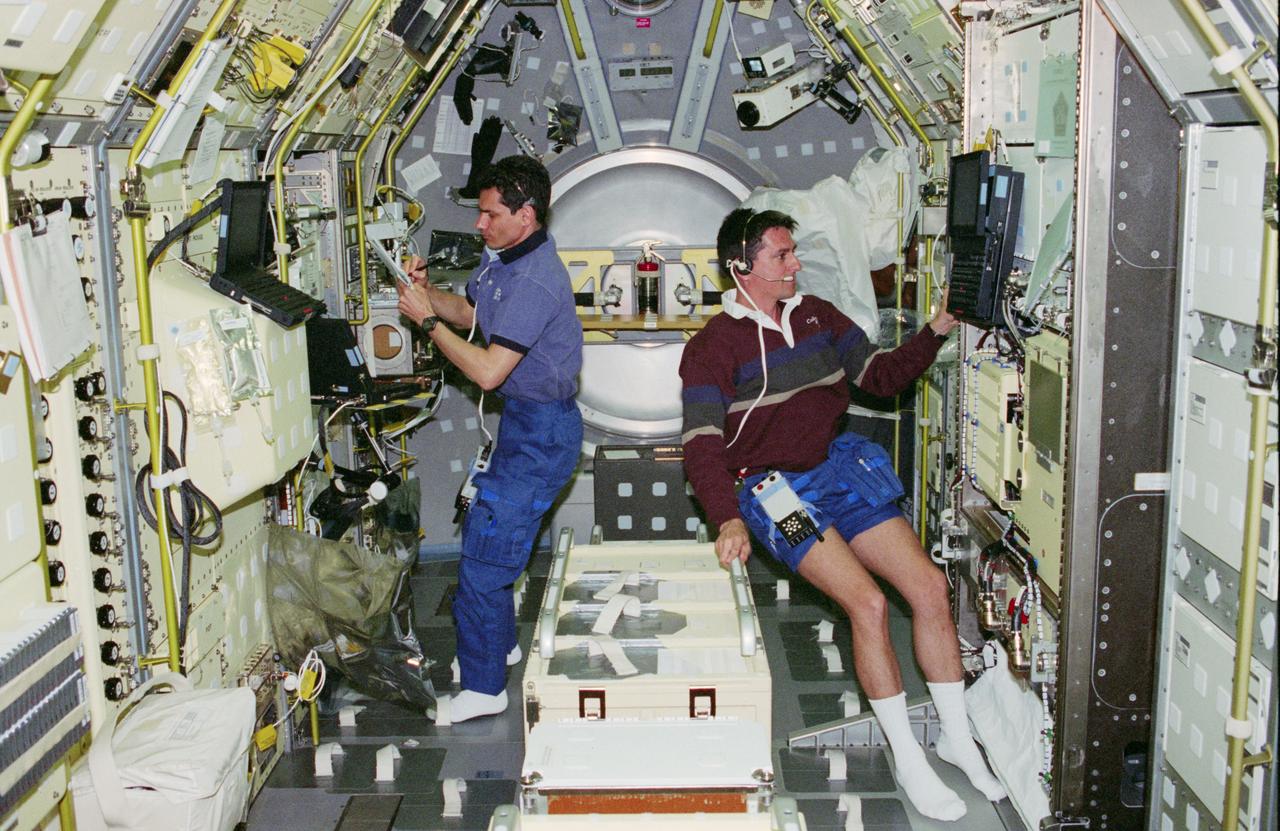
STS083-312-031 (4-8 April 1997) --- Payload specialist Gregory T. Linteris (left) is seen at the Mid Deck Glove Box (MGBX), while astronaut Donald A. Thomas, mission specialist, works at the Expedite the Processing of Experiments to Space Station (EXPRESS) rack. MGBX is a facility that allows scientists the capability of doing tests on hardware and materials that are not approved to be handled in the open Spacelab. It is equipped with photographic, video and data recording capability, allowing a complete record of experiment operations. Experiments performed on STS-83 were Bubble Drop Nonlinear Dynamics and Fiber Supported Droplet Combustion. EXPRESS is designed to provide accommodations for Sub-rack payloads on Space Station. For STS-83, it held two payloads. The Physics of Hard Colloidal Spheres (PHaSE) and ASTRO-Plant Generic Bioprocessing Apparatus (ASTRO-PGBA), a facility with light and atmospheric controls which supports plant growth for commercial research.
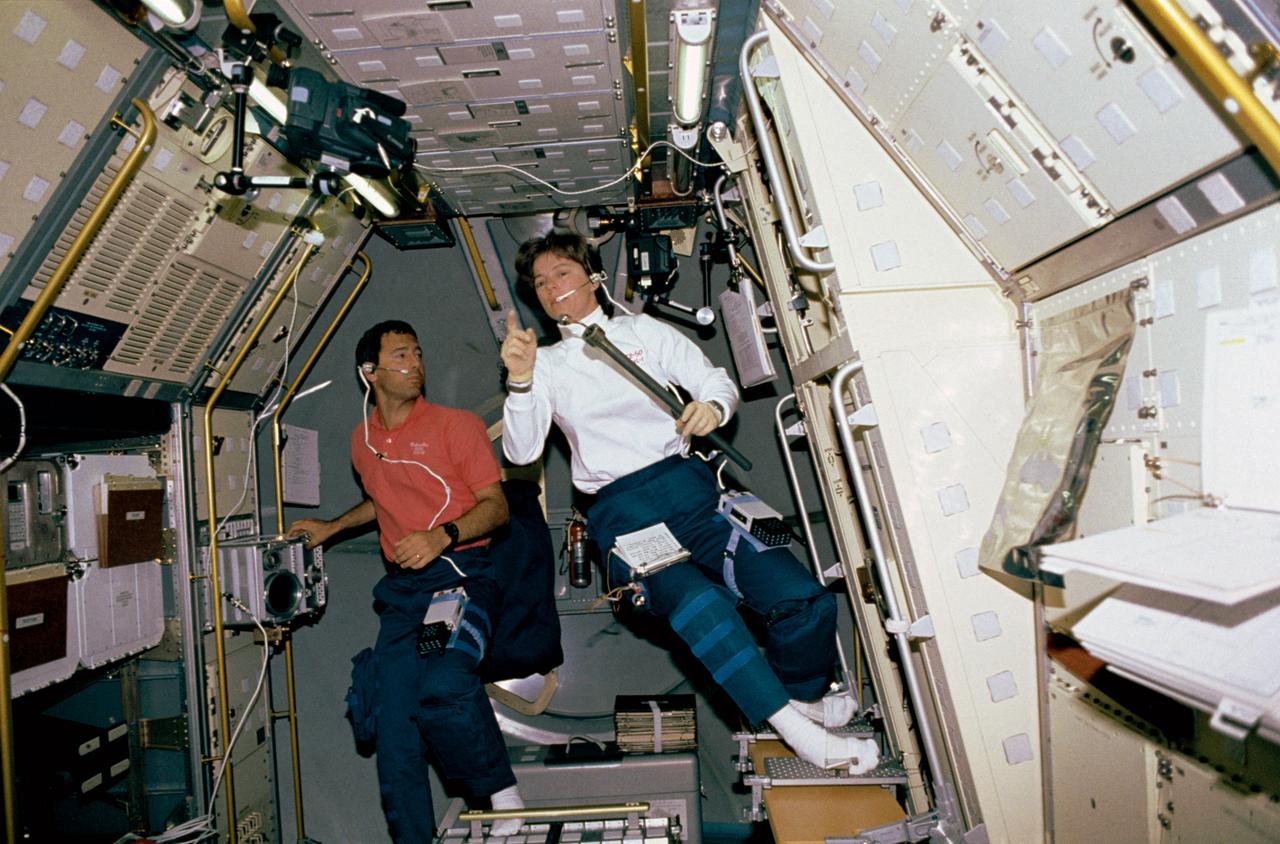
View showing Payload Specialists Bonnie Dunbar and Larry DeLucas in the aft section of the U. S. Microgravity Laboratory-1. Dunbar prepares to load a sample in the Crystal Growth Furnace (CGF) Integrated Furnace Experiment Assembly (IFEA) in rack 9 of the Microgravity Laboratory, while DeLucas checks out the multi-purpose Glovebox Facility.
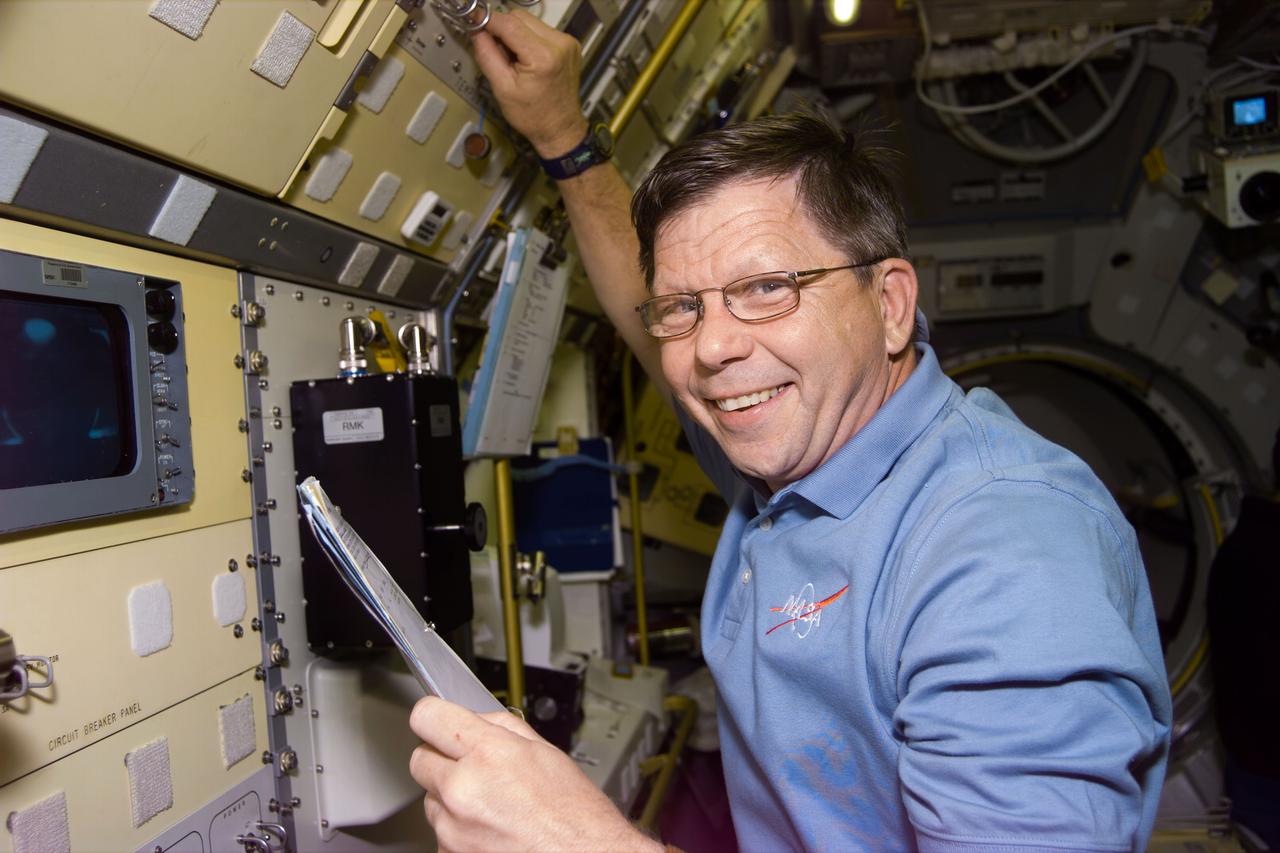
S94-E-5019 (6 July 1997) --- Roger K. Crouch, payload specialist for the Microgravity Sciences Laboratory (MSL-1) mission, is seen at the experiment racks during Flight Day 6 aboard Spacelab. The photo was recorded with an Electronic Still Camera (ESC) and later downlinked to ground controllers in Houston, Texas.
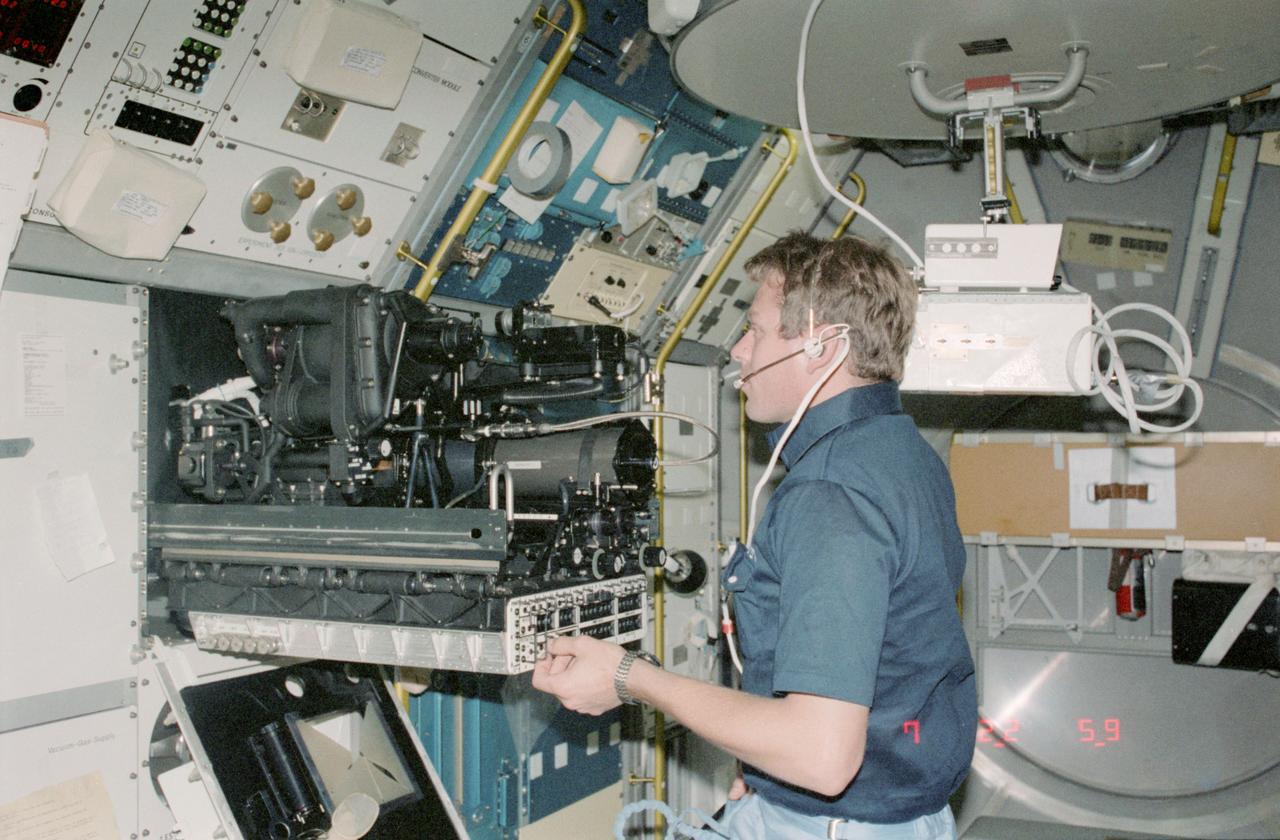
STS009-125-427 (28 Nov 1983) --- Payload Specialist Byron K. Lichtenberg carries out an experiment at the fluid physics module on the busy materials science double rack facility. Two beverage containers can be seen just above the biomedical engineer's head.
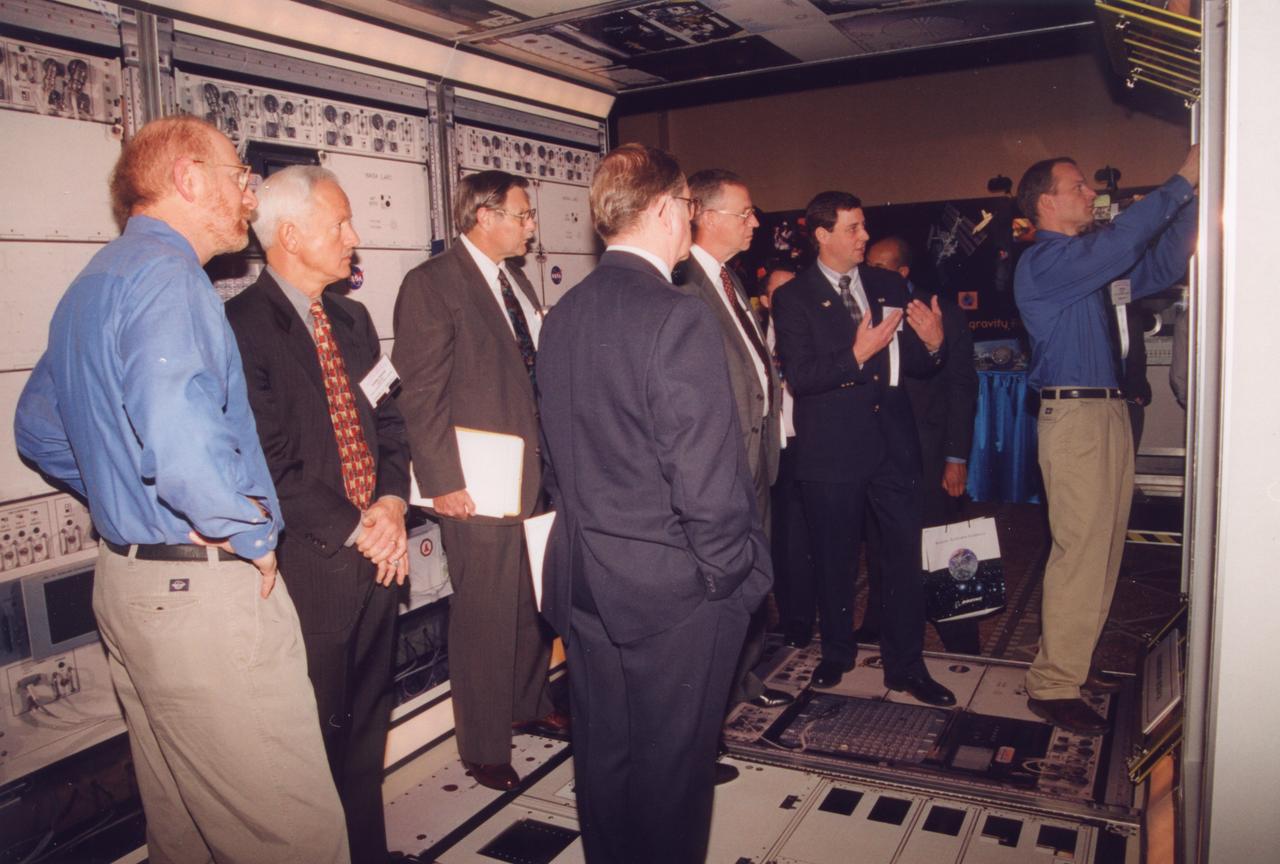
Engineers from NASA's Glenn Research Center demonstrate the access to one of the experiment racks planned for the U.S. Destiny laboratory module on the International Space Station (ISS). This mockup has the full diameter, full corridor width, and half the length of the module. The mockup includes engineering mockups of the Fluids and Combustion Facility being developed by NASA's Glenn Research Center. (The full module will be six racks long; the mockup is three racks long). Listening at left (coat and patterned tie) is John-David Bartoe, ISS research manager at NASA's Johnson Space Center and a payload specialist on Spacelab 2 mission (1985). Photo credit: NASA/Marshall Space Flight Center (MSFC)
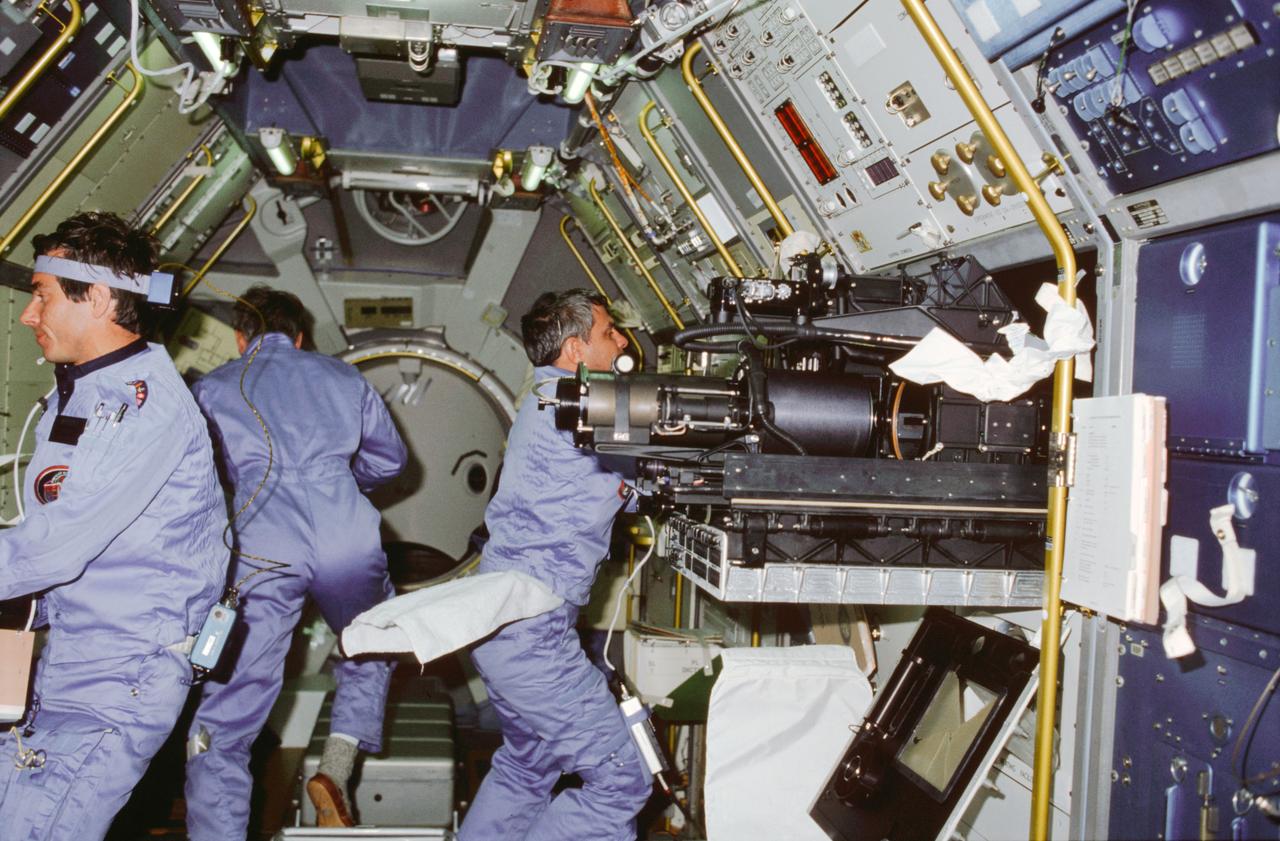
STS009-03-093 (28 Nov-8 Dec 1983) --- A mission specialist and two payload specialists busy themselves in the Spacelab 1 module aboard the Earth orbiting Space Shuttle Columbia. Left to right are Payload Specialist Robert A. R. Parker. Parker is partially obscured by a deployed instrument of the fluid physics module at the materials sciences double rack. Merbold, a physicist from Max-Planck Institute in the Federal Republic of Germany, wears a head band-like device and a recorder as part of an overall effort to learn more about space adaptation. Both Space lab 1 payload specialists wore the devices during most of their waking hours on this 10-day flight. The frame was exposed with a 35mm camera.
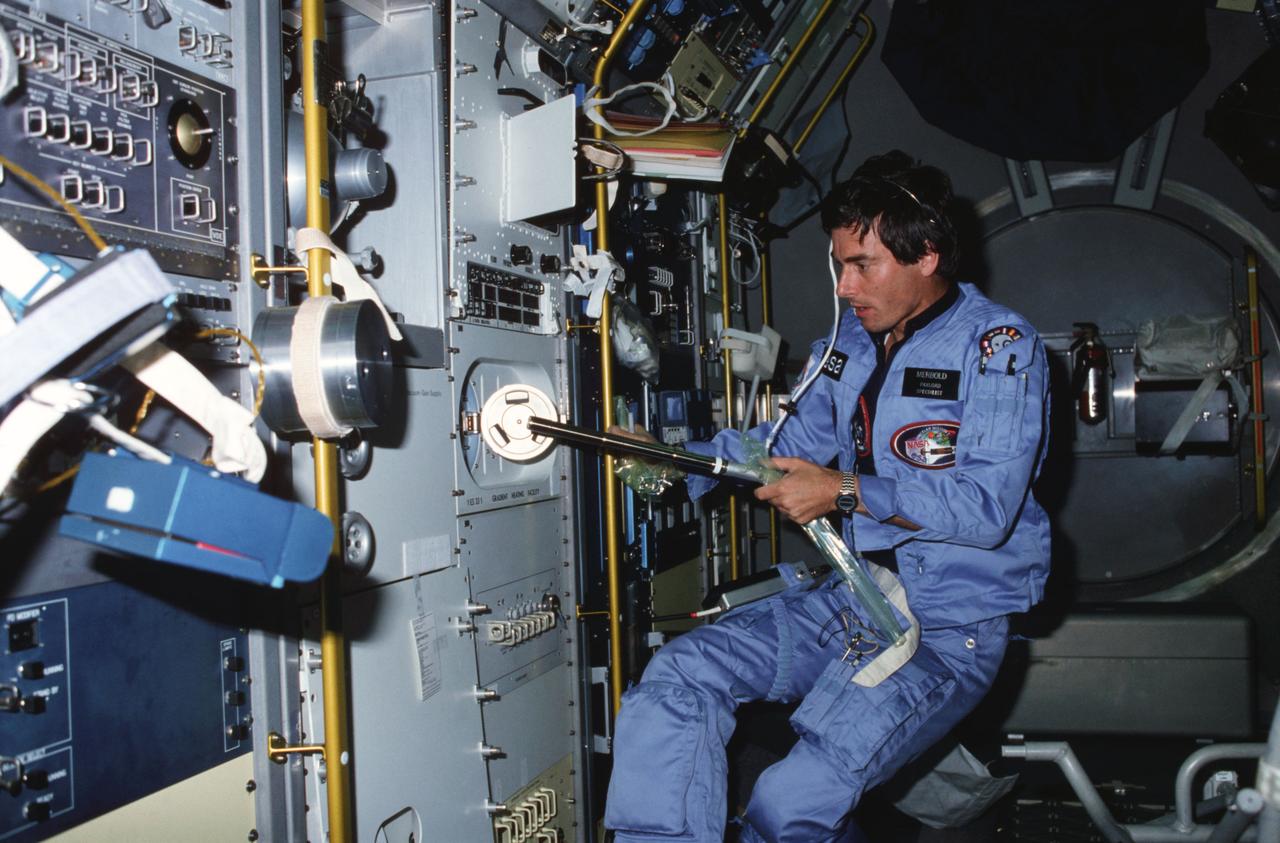
STS009-13-699 (28 Nov - 8 Dec 1983) --? Ulf Merbold, Spacelab 1 payload specialist, carries out one of the experiments using the gradient heating facility on the materials science double rack facility in the busy science module aboard the Earth-orbiting Space Shuttle Columbia. Representing the European Space Agency, Dr. Merbold comes from Max-Planck Institute in Stuttgart, the Federal Republic of Germany. He is a specialist in crystal lattice defects and low temperature physics. The photograph was made with a 35mm camera.
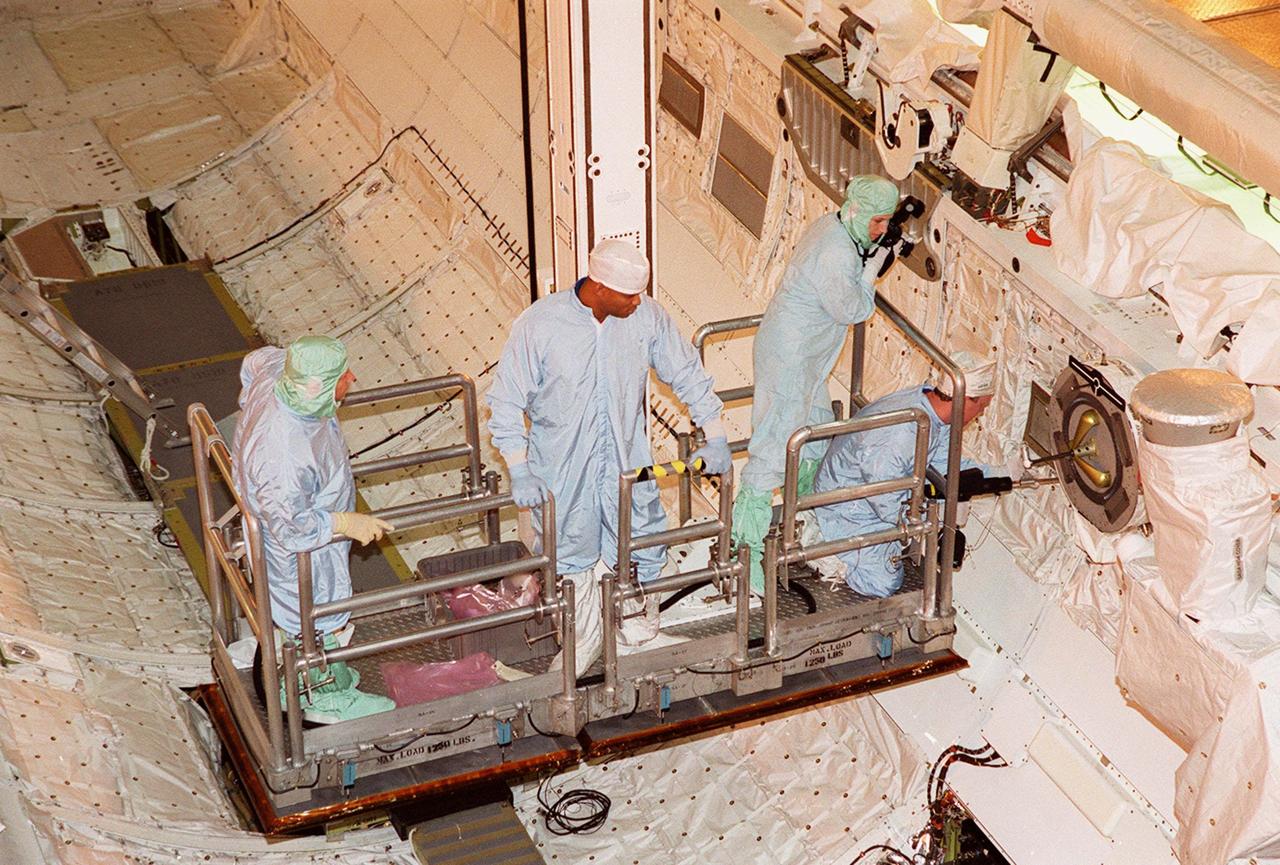
KENNEDY SPACE CENTER, FLA. -- Lowered into the payload bay of the orbiter Atlantis, some of the STS-98 crew look over part of the payload. At center is Mission Specialist Robert Curbeam; at right are Mission Specialists Marsha Ivins (standing) and Tom Jones (kneeling). They and the rest of the crew are at KSC for Crew Equipment Interface Test activities. Launch on mission STS-98 is scheduled for Jan. 18, 2001. It will be transporting the U.S. Lab, Destiny, to the International Space Station with five system racks already installed inside of the module. After delivery of electronics in the lab, electrically powered attitude control for Control Moment Gyroscopes will be activated
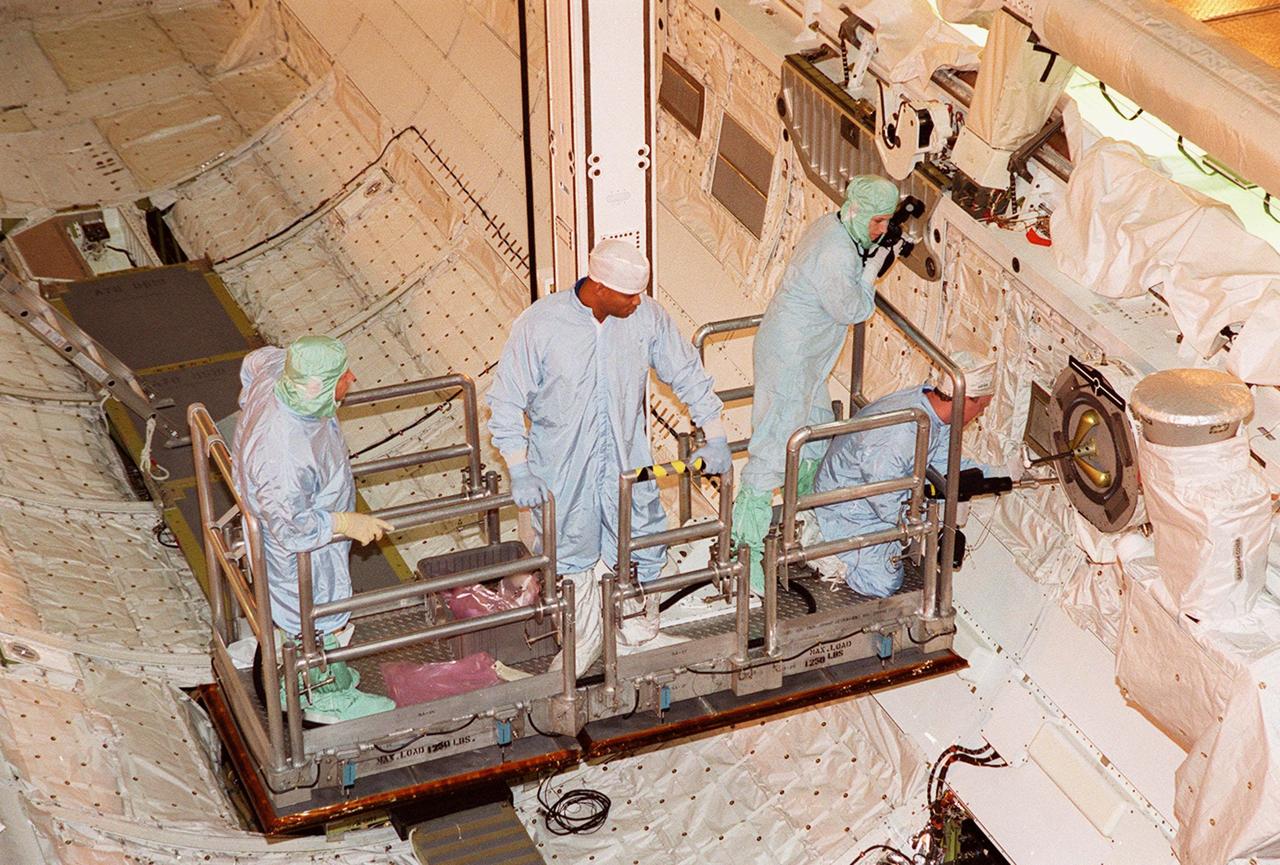
KENNEDY SPACE CENTER, FLA. -- Lowered into the payload bay of the orbiter Atlantis, some of the STS-98 crew look over part of the payload. At center is Mission Specialist Robert Curbeam; at right are Mission Specialists Marsha Ivins (standing) and Tom Jones (kneeling). They and the rest of the crew are at KSC for Crew Equipment Interface Test activities. Launch on mission STS-98 is scheduled for Jan. 18, 2001. It will be transporting the U.S. Lab, Destiny, to the International Space Station with five system racks already installed inside of the module. After delivery of electronics in the lab, electrically powered attitude control for Control Moment Gyroscopes will be activated
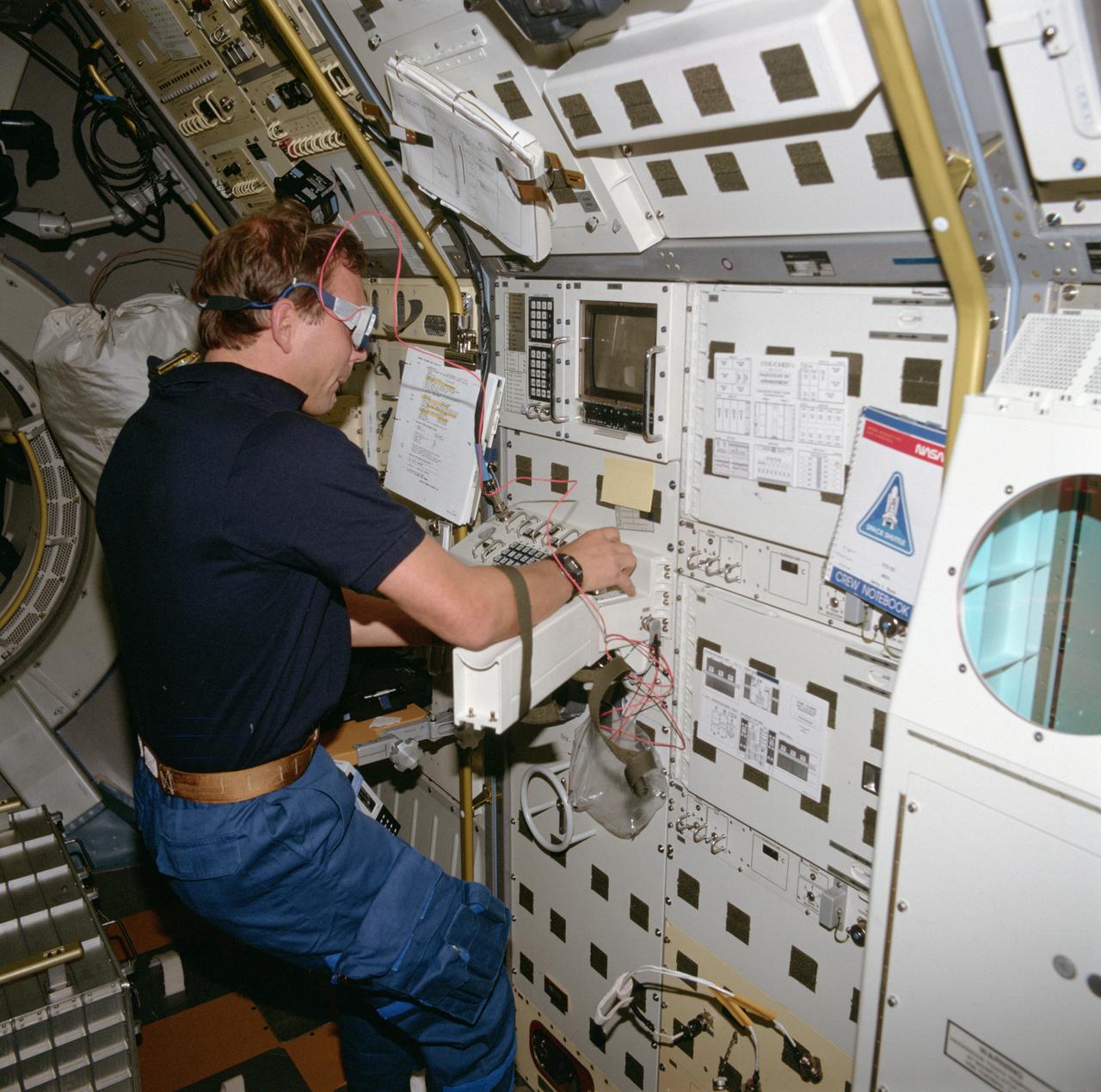
STS055-106-100 (26 April-6 May 1993) --- Hans Schlegel, wearing special glasses, works at the Robotics Experiment (ROTEX) workstation in the science module aboard the Earth-orbiting Space Shuttle Columbia. Schlegel was one of two payload specialists representing the German Aerospace Research Establishment (DLR) on the 10-day Spacelab D-2 mission. ROTEX is a robotic arm that operates within an enclosed workcell in rack 6 of the Spacelab module and uses teleoperation from both an onboard station located nearby in rack 4 and from a station on the ground. The device uses teleprogramming and artificial intelligence to look at the design, verification and operation of advanced autonomous systems for use in future applications.
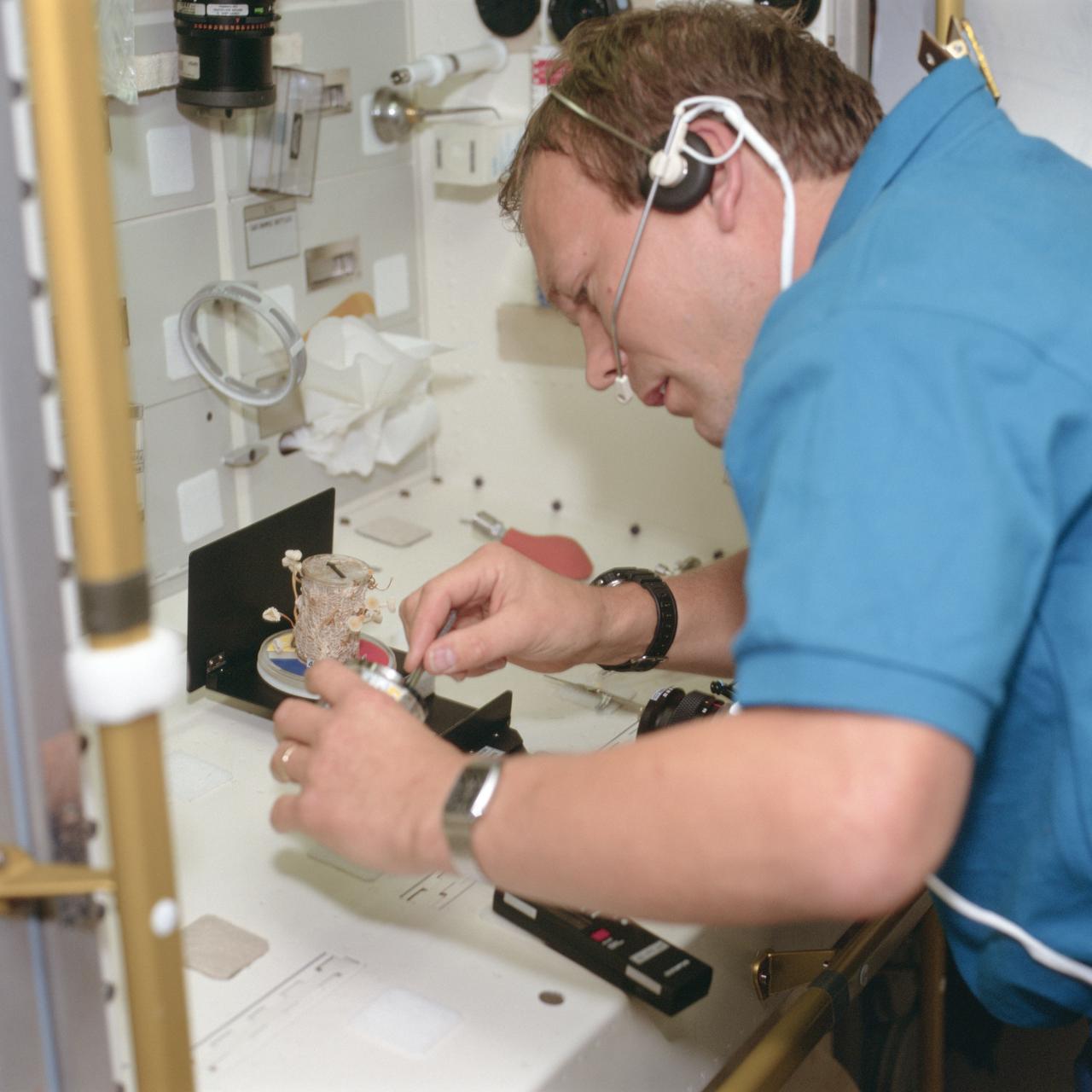
STS055-106-037 (26 April-6 May 1993) --- Hans Schlegel works with a fungi experiment in the Spacelab D-2 Science Module onboard the Earth-orbiting Space Shuttle Columbia. Schlegel was one of two payload specialists representing the German Aerospace Research Establishment (DLR) on the 10-day Spacelab D-2 mission.
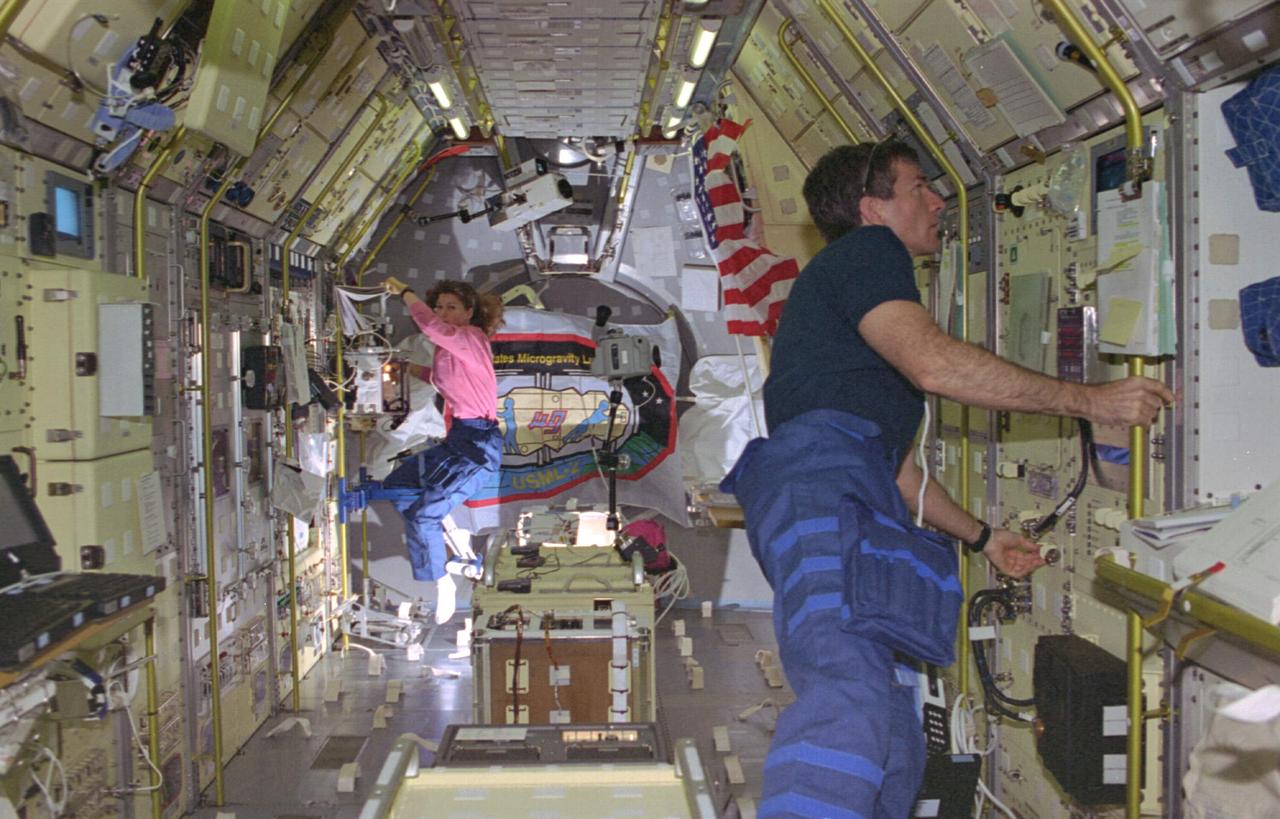
STS073-103-019 (20 October-5 November 1995) --- This wide view gives an overall perspective of the working environment of five astronauts and two guest researchers for 16 days in Earth-orbit. At work in support of the U.S. Microgravity Laboratory (USML-2) mission in this particular scene are astronaut Catherine G. Coleman, who busies herself at the glovebox, and payload specialist Fred W. Leslie, monitoring the Surface-Tension-Driven Convection Experiment (STDCE).
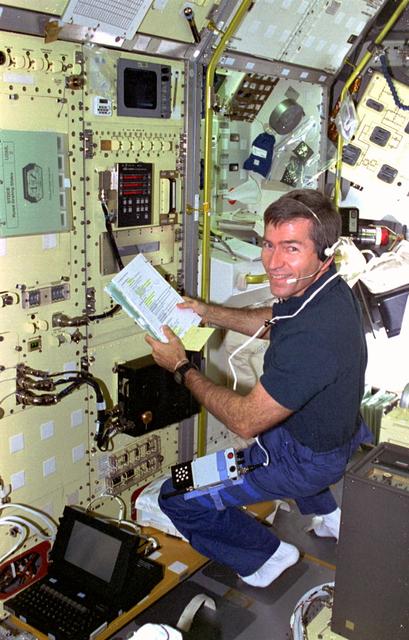
STS073-103-015 (20 October-5 November 1995) --- Payload specialist Fred W. Leslie works with the Surface Tension Driven Convection Experiment (STDCE) aboard the science module in the cargo bay of the Earth-orbiting Space Shuttle Columbia. Leslie joined another guest researcher and five NASA astronauts for 16 full days of in-space research in support of the United States Microgravity Laboratory (USML-2) mission.
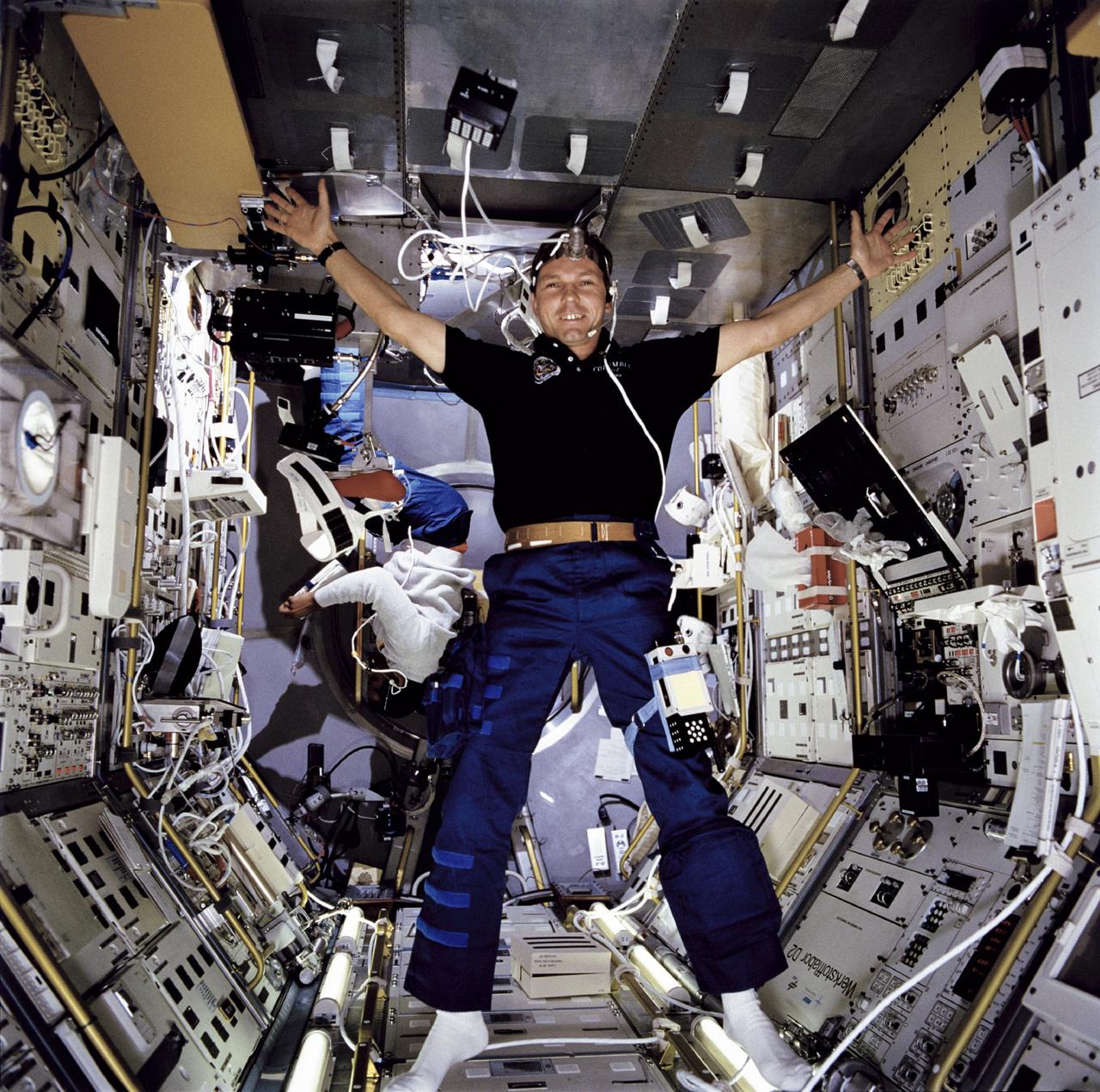
STS055-106-090 (26 April- 6 May 1993) --- Hans Schlegel, one of two STS-55 payload specialists representing the German Aerospace Research Establishment (DLR) onboard the Space Shuttle Columbia, finds plenty of room to "spread out" while participating in a Tissue experiment. Astronaut Bernard A. Harris, Jr., mission specialist, monitors an experiment in the background.
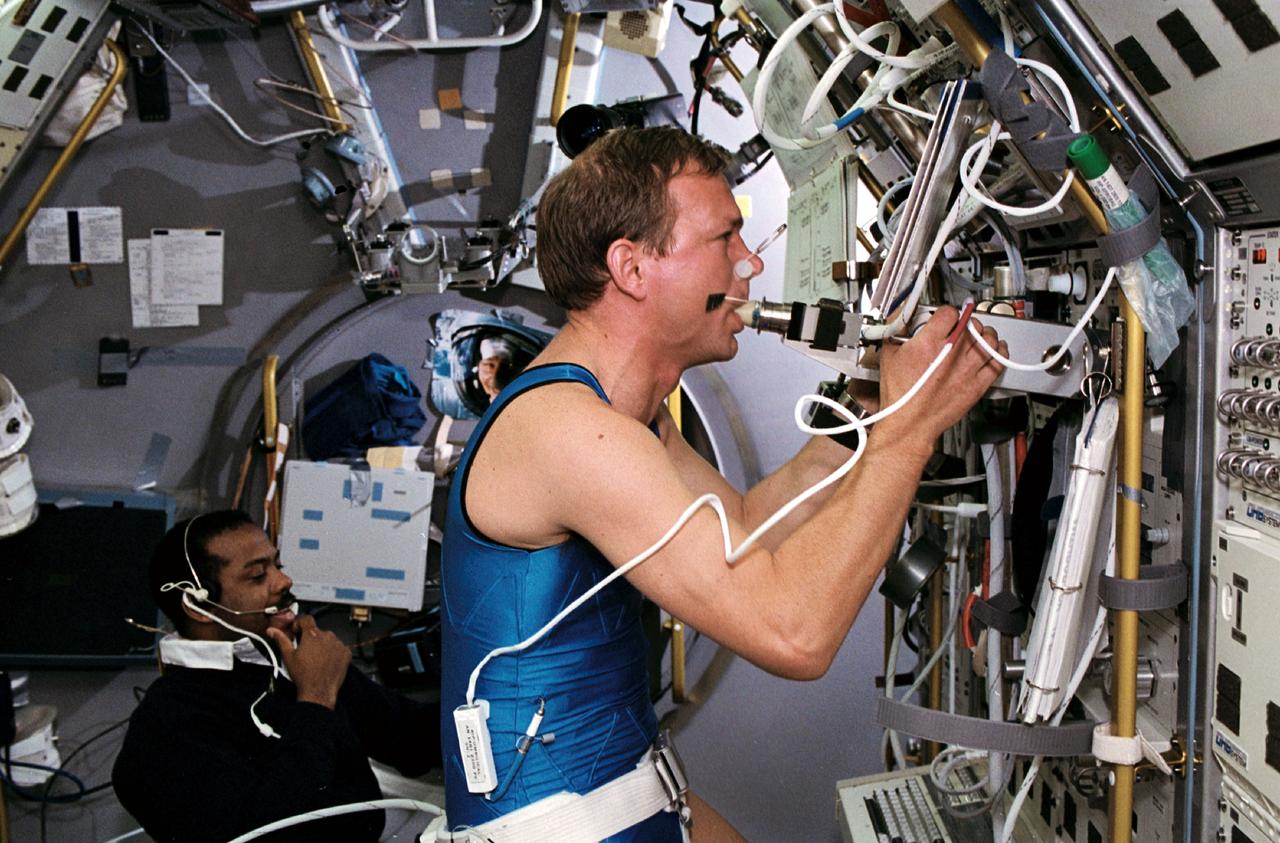
STS055-45-017 (26 April-6 May 1993) --- Hans Schlegel (foreground) participates in the ongoing investigation of human physiology under microgravity conditions as he works out on the ergometer at the Anthrorack. Monitoring the "run" is astronaut Bernard A. Harris, Jr., STS-55 mission specialist. Schlegel is one of two payload specialists representing the German Aerospace Research Establishment (DLR) on the Spacelab D-2 mission.

KENNEDY SPACE CENTER, FLA. - Members of the STS-116 crew examine components of the mission payload at SPACEHAB in Cape Canaveral, Fla. In the background are Mission Specialist Robert Curbeam, Pilot William Oefelein and Mission Specialist Joan Higginbotham. In the foreground are Mission Specialist Nicholas Patrick and Sunita Williams. The Swedish Fuglesang represents the European Space Agency. On the table is a rack front stowage tray used inside the SPACEHAB module. Mission crews make frequent trips to the Space Coast to become familiar with the equipment and payloads they will be using. STS-116 will be mission number 20 to the International Space Station and construction flight 12A.1. The mission payload is the SPACEHAB module, the P5 integrated truss structure and other key components. Launch is scheduled for no earlier than Dec. 7. Photo credit: NASA/George Shelton
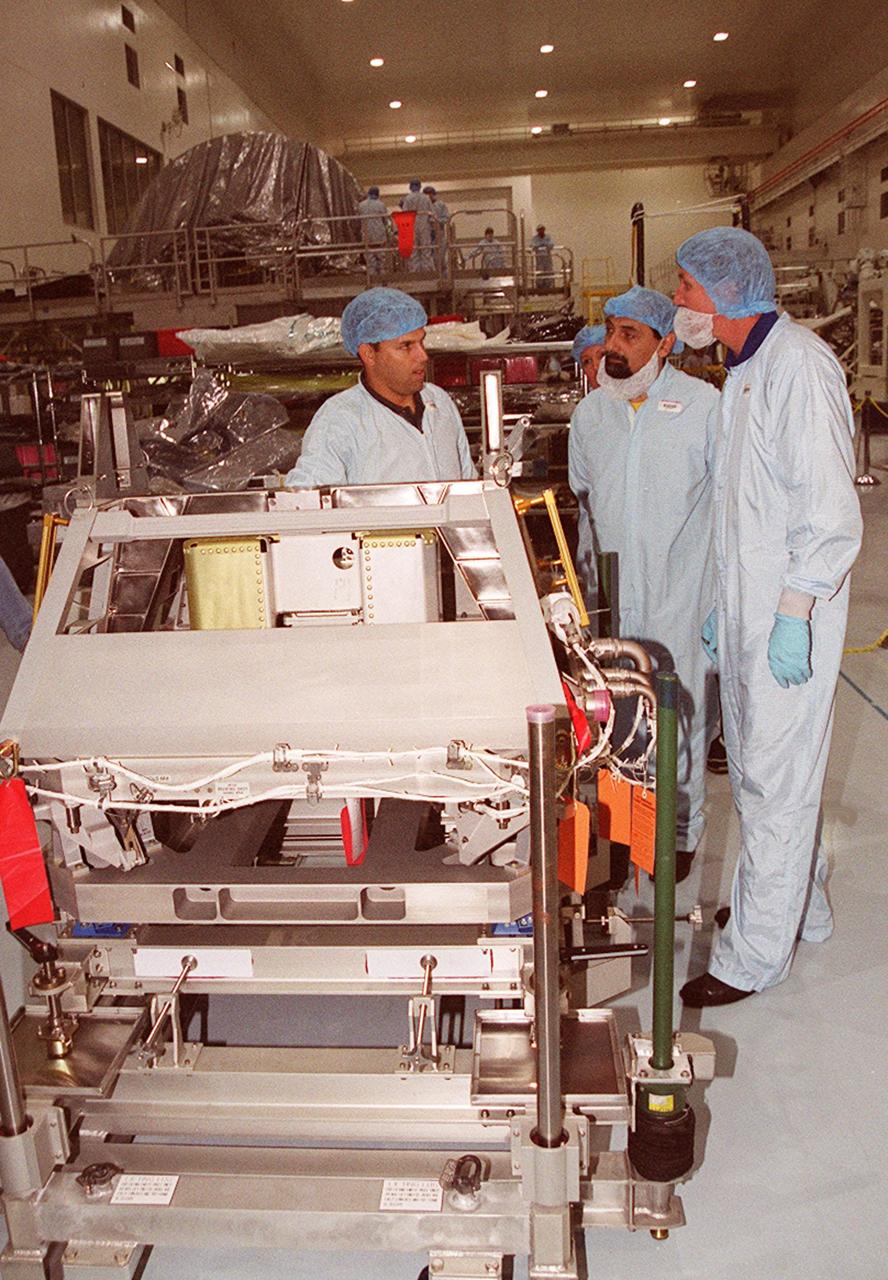
A worker (left) in the Space Station Processing Facility explains use of the equipment in the foreground to STS-100 Mission Specialist Umberto Guidoni (center) and Commander Kent Rominger (right). Guidoni is with the European Space Agency. Mission STS-100, scheduled to launch April 19, 2001, will include the Multi-Purpose Logistics Module (MPLM) Raffaello and the Space Station Remote Manipulator System (SSRMS) as its payload. MPLMs are pressurized modules that will serve as the International Space Station's “moving vans,” carrying laboratory racks filled with equipment, experiments and supplies to and from the station aboard the Space Shuttle. The SSRMS is the primary means of transferring payloads between the orbiter payload bay and the International Space Station for assembly
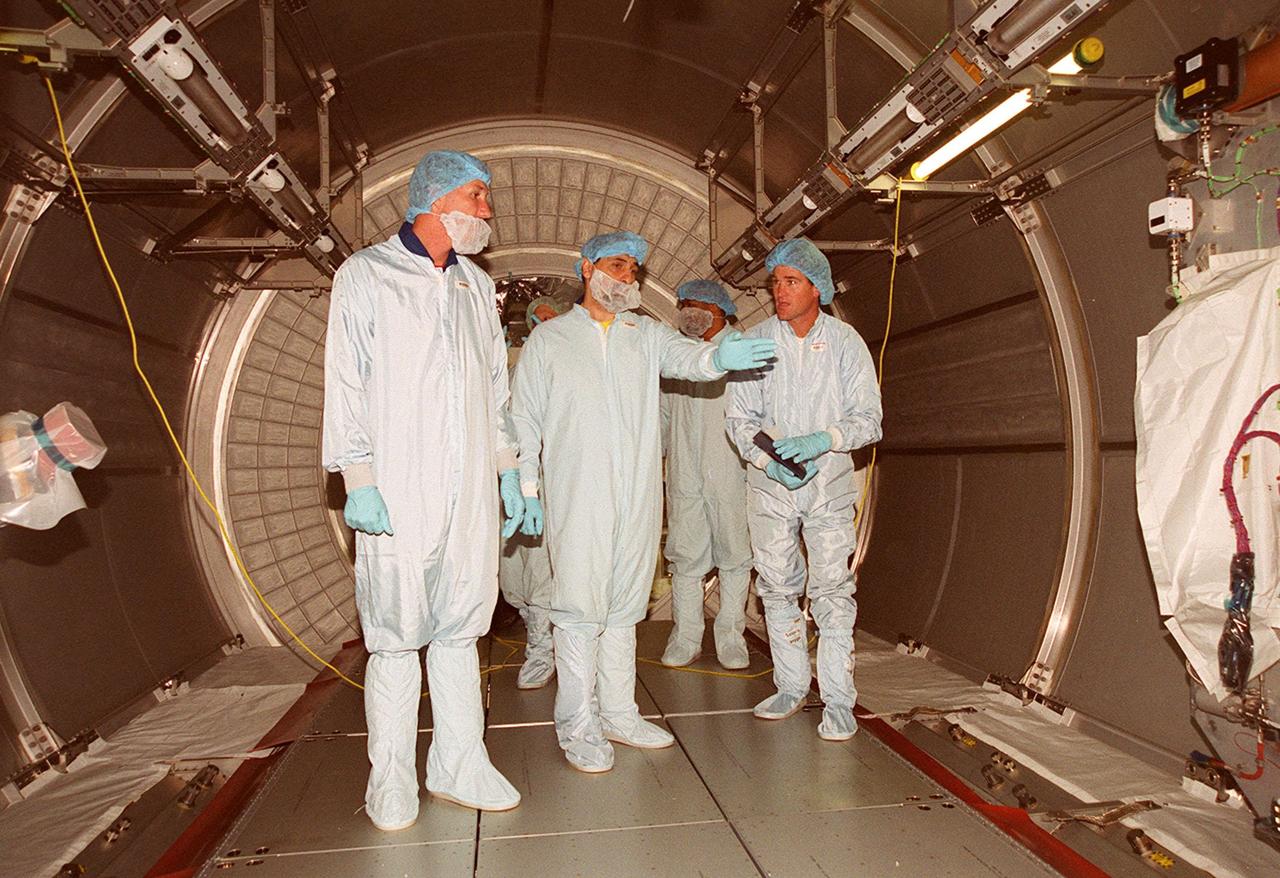
STS-100 Commander Kent Rominger and Mission Specialist Umberto Guidoni, who is with the European Space Agency, look over the inside of Raffaello, a Multi-Purpose Logistics Module. Mission STS-100, scheduled to launch April 19, 2001, will include Raffaello as well as the Space Station Remote Manipulator System (SSRMS) as its payload. MPLMs are pressurized modules that will serve as the International Space Station's “moving vans,” carrying laboratory racks filled with equipment, experiments and supplies to and from the station aboard the Space Shuttle. The SSRMS is the primary means of transferring payloads between the orbiter payload bay and the International Space Station for assembly
With workers (far left and far right) looking on, STS-100 Commander Kent Rominger tries out a piece of equipment while Mission Specialist Umberto Guidoni (leaning over) watches. Guidoni is with the European Space Agency. Mission STS-100, scheduled to launch April 19, 2001, will include Raffaello as well as the Space Station Remote Manipulator System (SSRMS) as its payload. MPLMs are pressurized modules that will serve as the International Space Station's “moving vans,” carrying laboratory racks filled with equipment, experiments and supplies to and from the station aboard the Space Shuttle. The SSRMS is the primary means of transferring payloads between the orbiter payload bay and the International Space Station for assembly
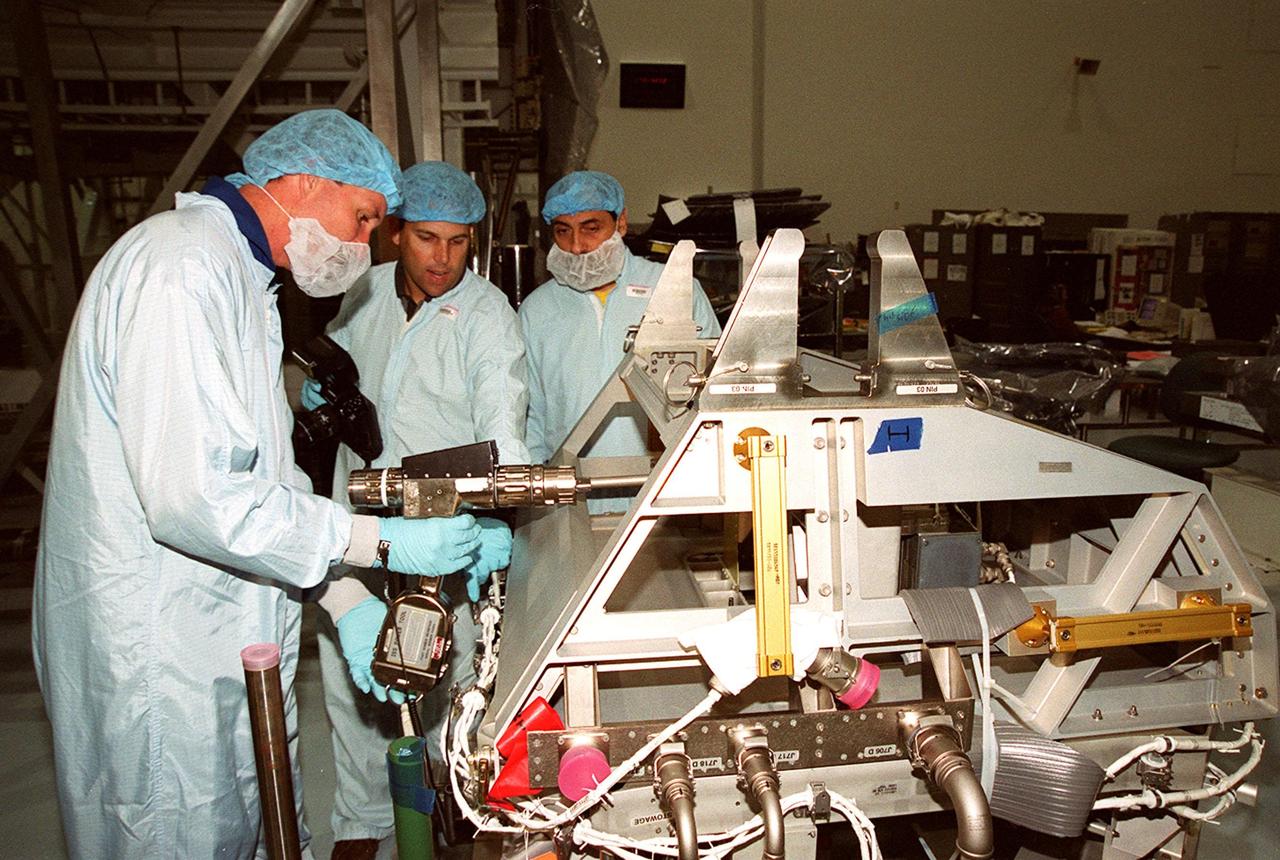
In the Space Station Processing Facility, STS-100 Commander Kent Rominger (left) tries out a piece of equipment while a worker (center) gives directions. Looking on at right is Mission Specialist Umberto Guidoni, with the European Space Agency. Mission STS-100, scheduled to launch April 19, 2001, will include Raffaello as well as the Space Station Remote Manipulator System (SSRMS) as its payload. MPLMs are pressurized modules that will serve as the International Space Station's “moving vans,” carrying laboratory racks filled with equipment, experiments and supplies to and from the station aboard the Space Shuttle. The SSRMS is the primary means of transferring payloads between the orbiter payload bay and the International Space Station for assembly
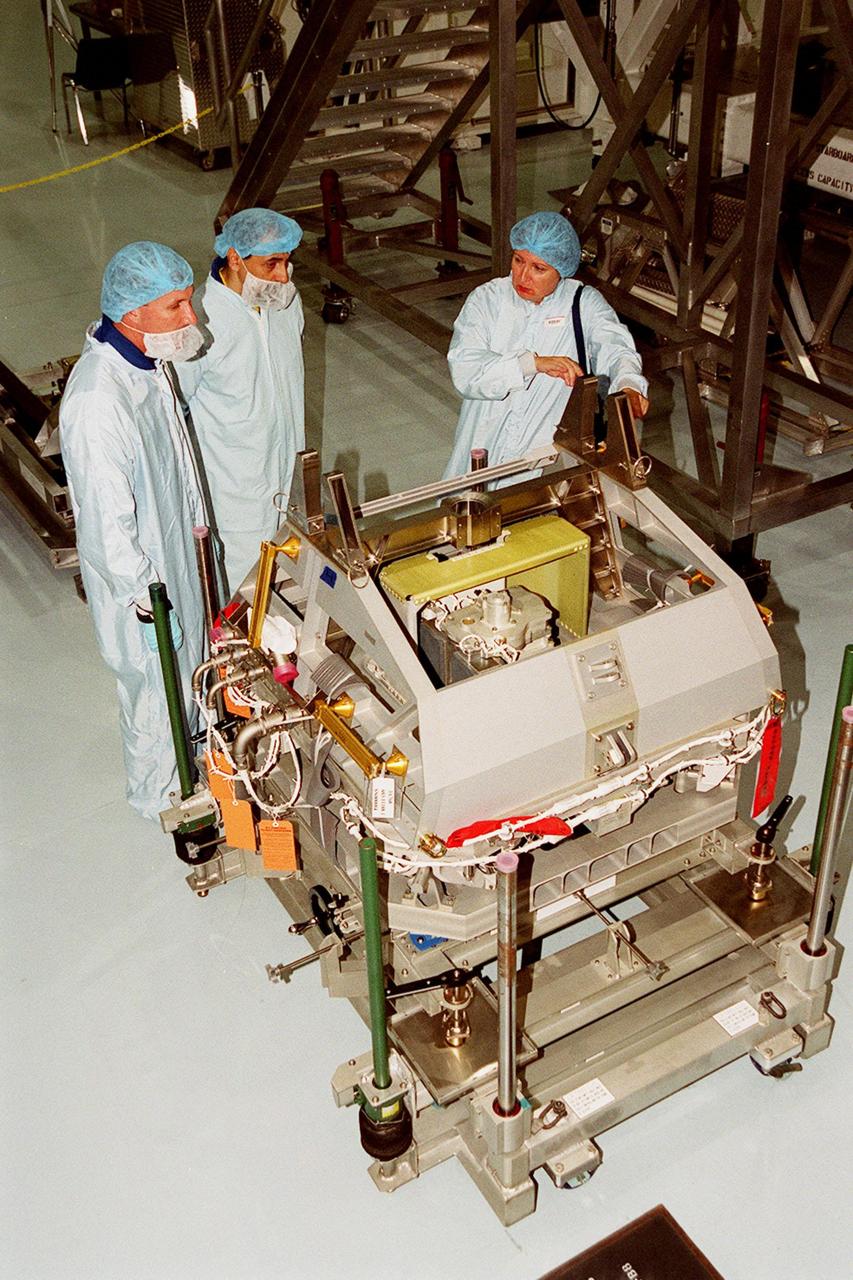
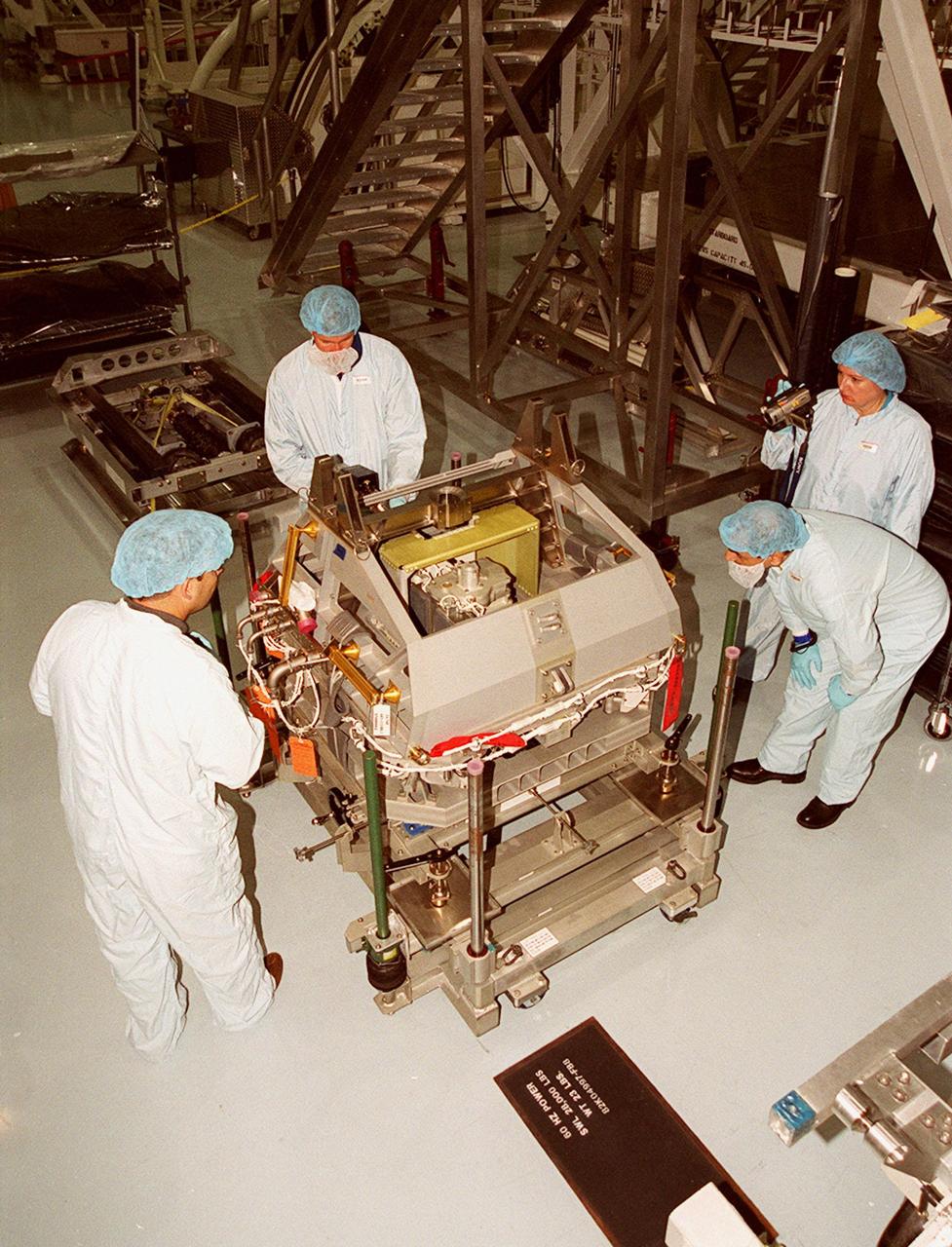
In the Space Station Processing Facility, STS-100 Commander Kent Rominger and Mission Specialist Umberto Guidoni, who is with the European Space Agency, look over equipment on the floor. Mission STS-100, scheduled to launch April 19, 2001, will include the Multi-Purpose Logistics Module (MPLM) Raffaello and the Space Station Remote Manipulator System (SSRMS) as its payload. MPLMs are pressurized modules that will serve as the International Space Station's “moving vans,” carrying laboratory racks filled with equipment, experiments and supplies to and from the station aboard the Space Shuttle. The SSRMS is the primary means of transferring payloads between the orbiter payload bay and the International Space Station for assembly
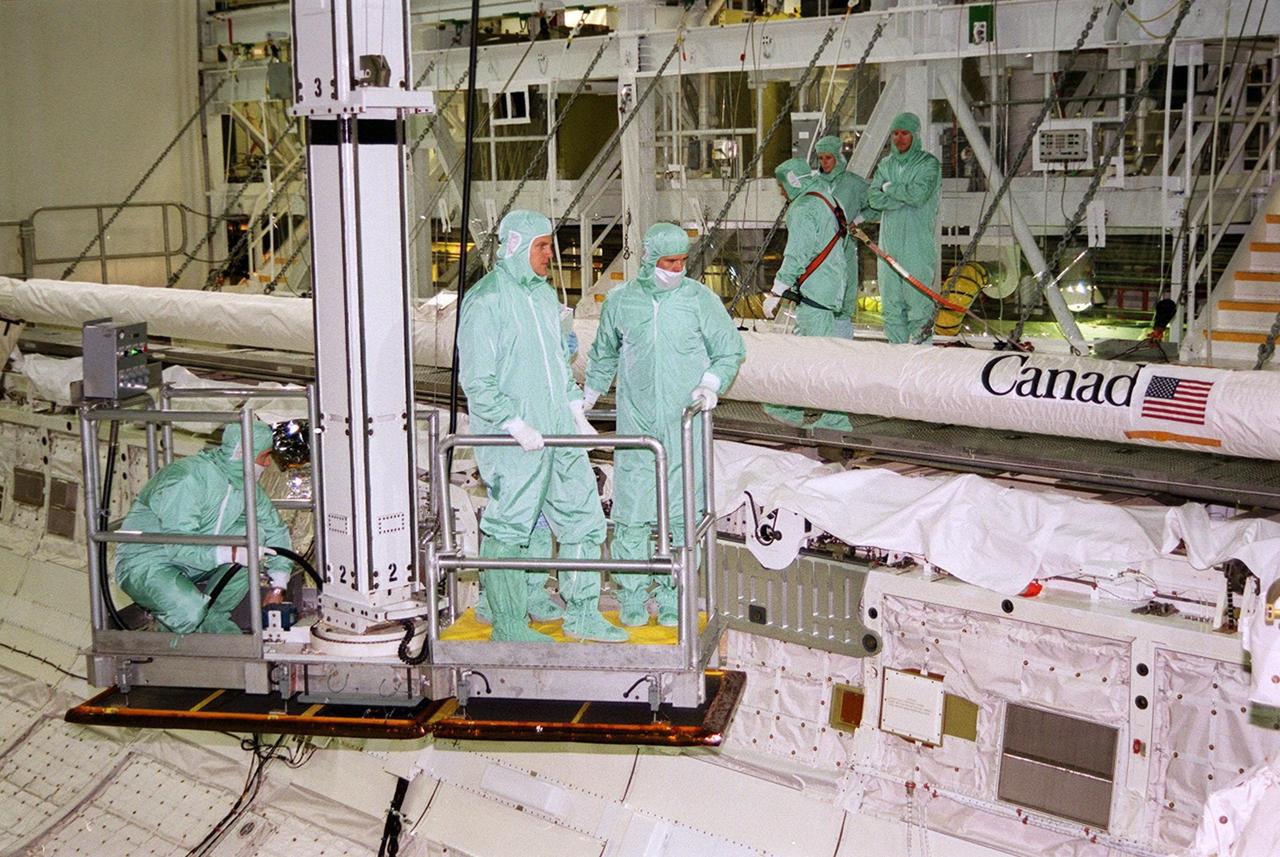
In the Orbiter Processing Facility bay 2, members of the STS-100 crew get a look at the payload inside Endeavour. Stretching the length of the payload bay is the Canadian robotic arm, SSRMS, that they will be attaching to the Space Station for use in assembling future components. . The crew, who are taking part in a Crew Equipment Interface Test (CEIT), comprises Commander Kent V. Rominger, Pilot Jeffrey S. Ashby and Mission Specialists Chris Hadfield, who is with the Canadian Space Agency, Scott Parazynski, John L. Phillips, Umberto Guidoni, who is with the European Space Agency, and Yuri Lonchakov, who is with the Russian Aviation and Space Agency. Endeavour is also carrying the Multi-Purpose Logistics Module Raffaello to the International Space Station. Raffaello carries six system racks and two storage racks for the U.S. Lab. Launch of mission STS-100 is scheduled for April 19 at 2:41 p.m. EDT from Launch Pad 39A
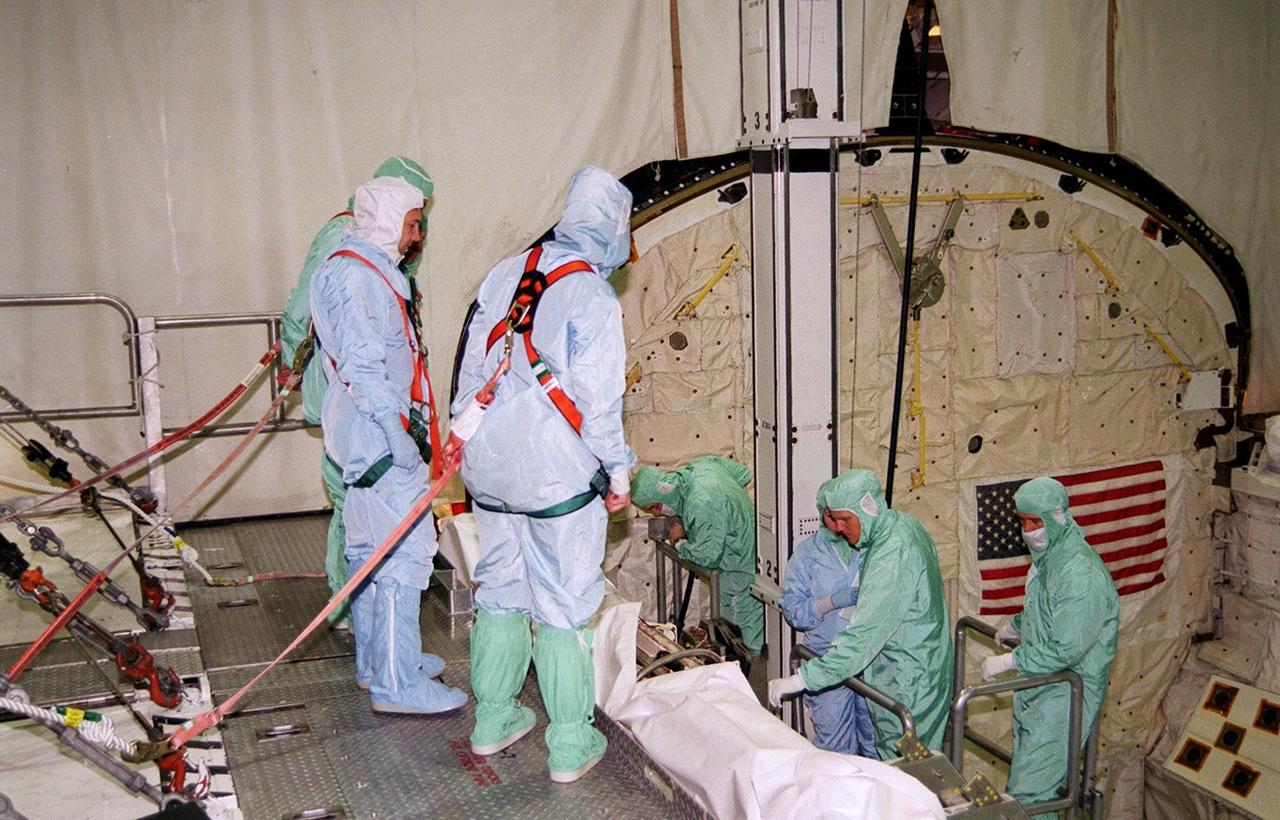
In the Orbiter Processing Facility bay 2, members of the STS-100 crew look over the payload in Endeavour during a Crew Equipment Interface Test (CEIT) at KSC. Lowered into the payload bay, they are looking at the Canadian robotic arm, SSRMS. The crew comprises Commander Kent V. Rominger, Pilot Jeffrey S. Ashby and Mission Specialists Chris Hadfield, who is with the Canadian Space Agency, Scott Parazynski, John L. Phillips, Umberto Guidoni, who is with the European Space Agency, and Yuri Lonchakov, who is with the Russian Aviation and Space Agency. The orbiter is also carrying the Multi-Purpose Logistics Module Raffaello to the International Space Station. Raffaello carries six system racks and two storage racks for the U.S. Lab. The SSRMS will be attached to the Space Station to aid in assembling future components. Launch of mission STS-100 is scheduled for April 19 at 2:41 p.m. EDT from Launch Pad 39A
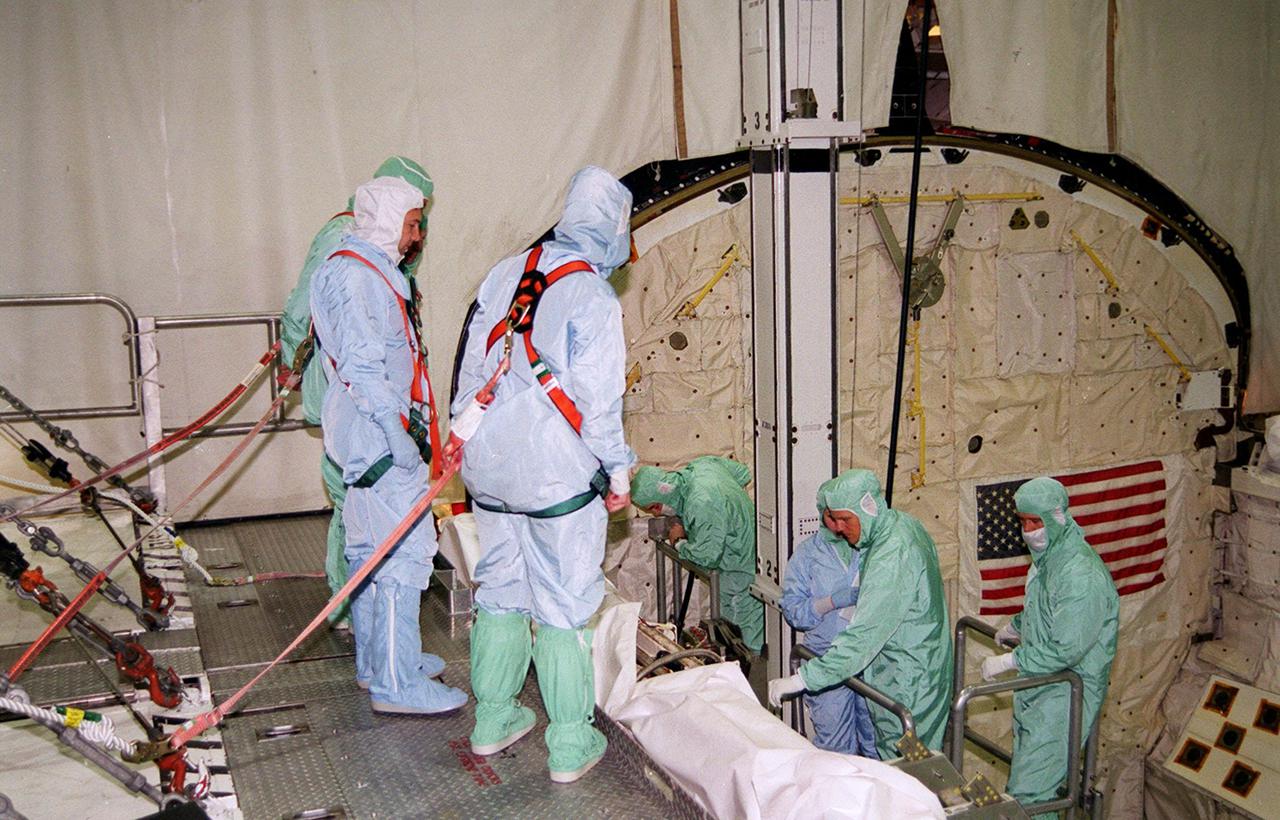
In the Orbiter Processing Facility bay 2, members of the STS-100 crew look over the payload in Endeavour during a Crew Equipment Interface Test (CEIT) at KSC. Lowered into the payload bay, they are looking at the Canadian robotic arm, SSRMS. The crew comprises Commander Kent V. Rominger, Pilot Jeffrey S. Ashby and Mission Specialists Chris Hadfield, who is with the Canadian Space Agency, Scott Parazynski, John L. Phillips, Umberto Guidoni, who is with the European Space Agency, and Yuri Lonchakov, who is with the Russian Aviation and Space Agency. The orbiter is also carrying the Multi-Purpose Logistics Module Raffaello to the International Space Station. Raffaello carries six system racks and two storage racks for the U.S. Lab. The SSRMS will be attached to the Space Station to aid in assembling future components. Launch of mission STS-100 is scheduled for April 19 at 2:41 p.m. EDT from Launch Pad 39A
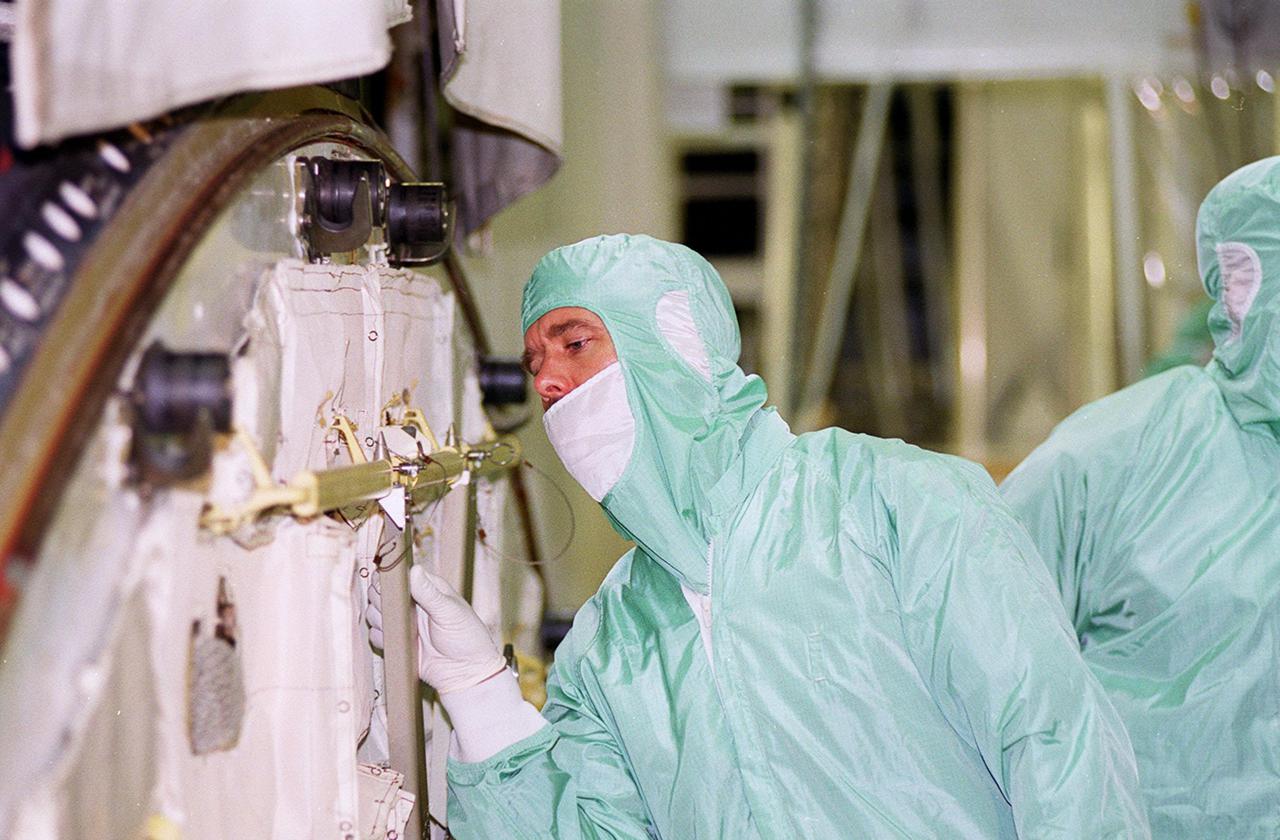
Dressed in protective clothing, STS-100 Mission Specialist Chris Hadfield looks at equipment in the payload bay of orbiter Endeavour during a Crew Equipment Interface Test (CEIT). Other crew members at KSC for the CEIT are Commander Kent V. Rominger, Pilot Jeffrey S. Ashby and Mission Specialists Scott Parazynski, John L. Phillips, Umberto Guidoni, who is with the European Space Agency, and Yuri Lonchakov, who is with the Russian Aviation and Space Agency. Hadfield is with the Canadian Space Agency. Endeavour is also carrying the Multi-Purpose Logistics Module Raffaello to the International Space Station. Raffaello carries six system racks and two storage racks for the U.S. Lab. Launch of mission STS-100 is scheduled for April 19 at 2:41 p.m. EDT from Launch Pad 39A
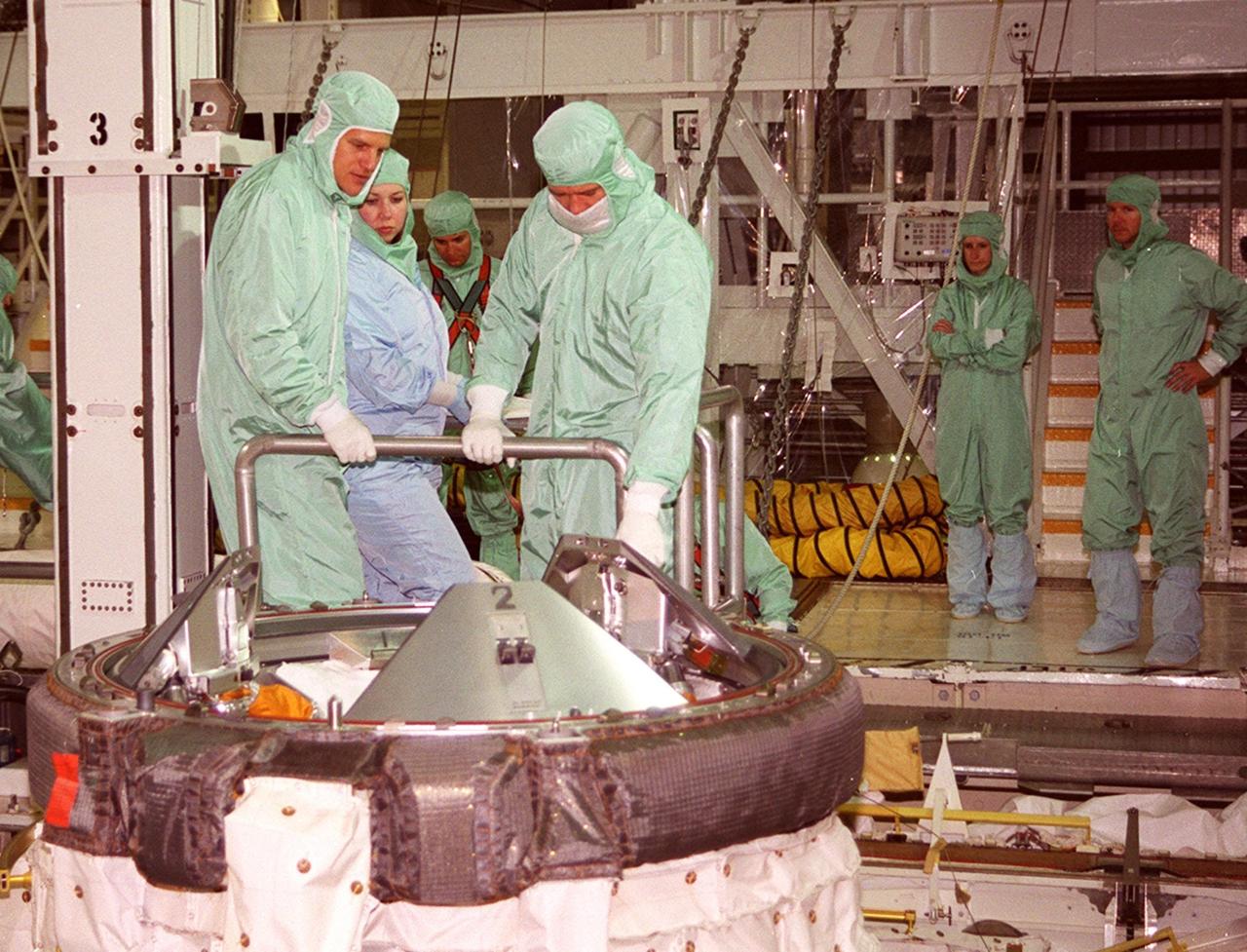
In the Orbiter Processing Facility bay 2, STS-100 Mission Specialist Scott Parazynski (left, foreground) and Chris Hadfield (right, foreground) look over the docking mechanism in payload bay of Endeavour. They are taking part in a Crew Equipment Interface Test (CEIT) along with other crew members Commander Kent V. Rominger, Pilot Jeffrey S. Ashby and Mission Specialists John L. Phillips, Umberto Guidoni, who is with the European Space Agency, and Yuri Lonchakov, who is with the Russian Aviation and Space Agency. Endeavour is also carrying the Multi-Purpose Logistics Module Raffaello to the International Space Station. Raffaello carries six system racks and two storage racks for the U.S. Lab. Launch of mission STS-100 is scheduled for April 19 at 2:41 p.m. EDT from Launch Pad 39A
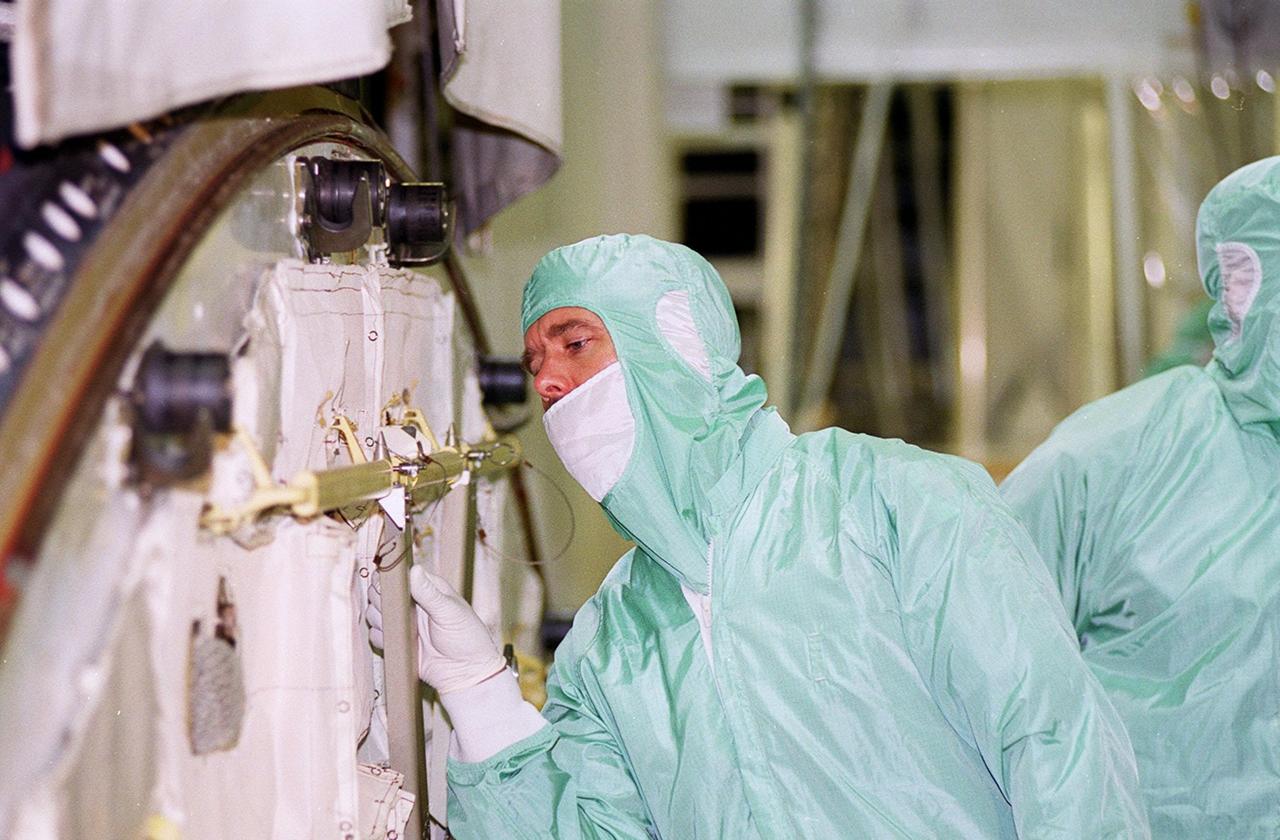
Dressed in protective clothing, STS-100 Mission Specialist Chris Hadfield looks at equipment in the payload bay of orbiter Endeavour during a Crew Equipment Interface Test (CEIT). Other crew members at KSC for the CEIT are Commander Kent V. Rominger, Pilot Jeffrey S. Ashby and Mission Specialists Scott Parazynski, John L. Phillips, Umberto Guidoni, who is with the European Space Agency, and Yuri Lonchakov, who is with the Russian Aviation and Space Agency. Hadfield is with the Canadian Space Agency. Endeavour is also carrying the Multi-Purpose Logistics Module Raffaello to the International Space Station. Raffaello carries six system racks and two storage racks for the U.S. Lab. Launch of mission STS-100 is scheduled for April 19 at 2:41 p.m. EDT from Launch Pad 39A
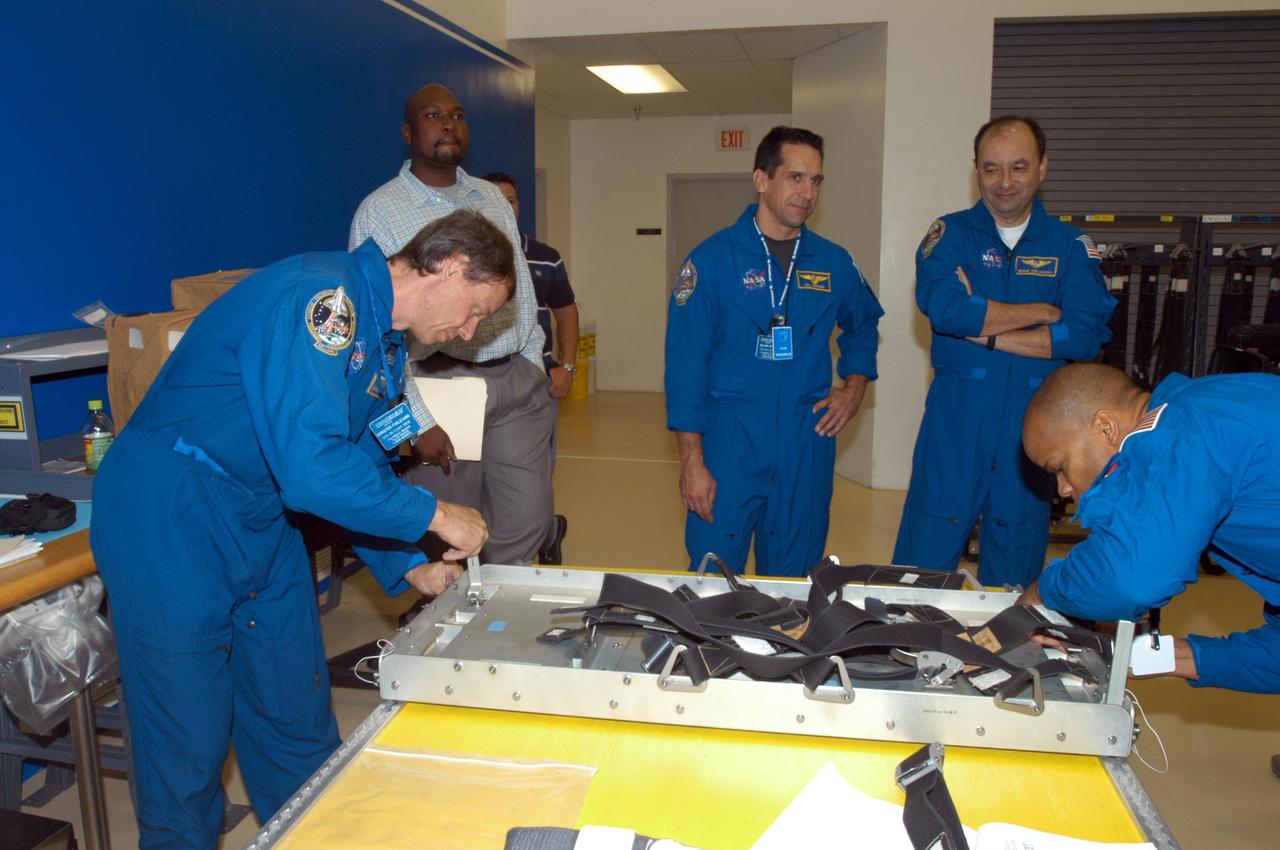
KENNEDY SPACE CENTER, FLA. - Members of the STS-116 crew examine components of the mission payload at SPACEHAB in Cape Canaveral, Fla. From left are Mission Specialist Christer Fuglesang , Pilot William Oefelein, Commander Mark Polansky and Mission Specialist Robert Curbeam. Fuglesang, who represents the European Space Agency, and Curbeam practice techniques for removing and replacing the rack front stowage tray, used inside the SPACEHAB module. Mission crews make frequent trips to the Space Coast to become familiar with the equipment and payloads they will be using. STS-116 will be mission number 20 to the International Space Station and construction flight 12A.1. The mission payload is the SPACEHAB module, the P5 integrated truss structure and other key components. Launch is scheduled for no earlier than Dec. 7. Photo credit: NASA/George Shelton
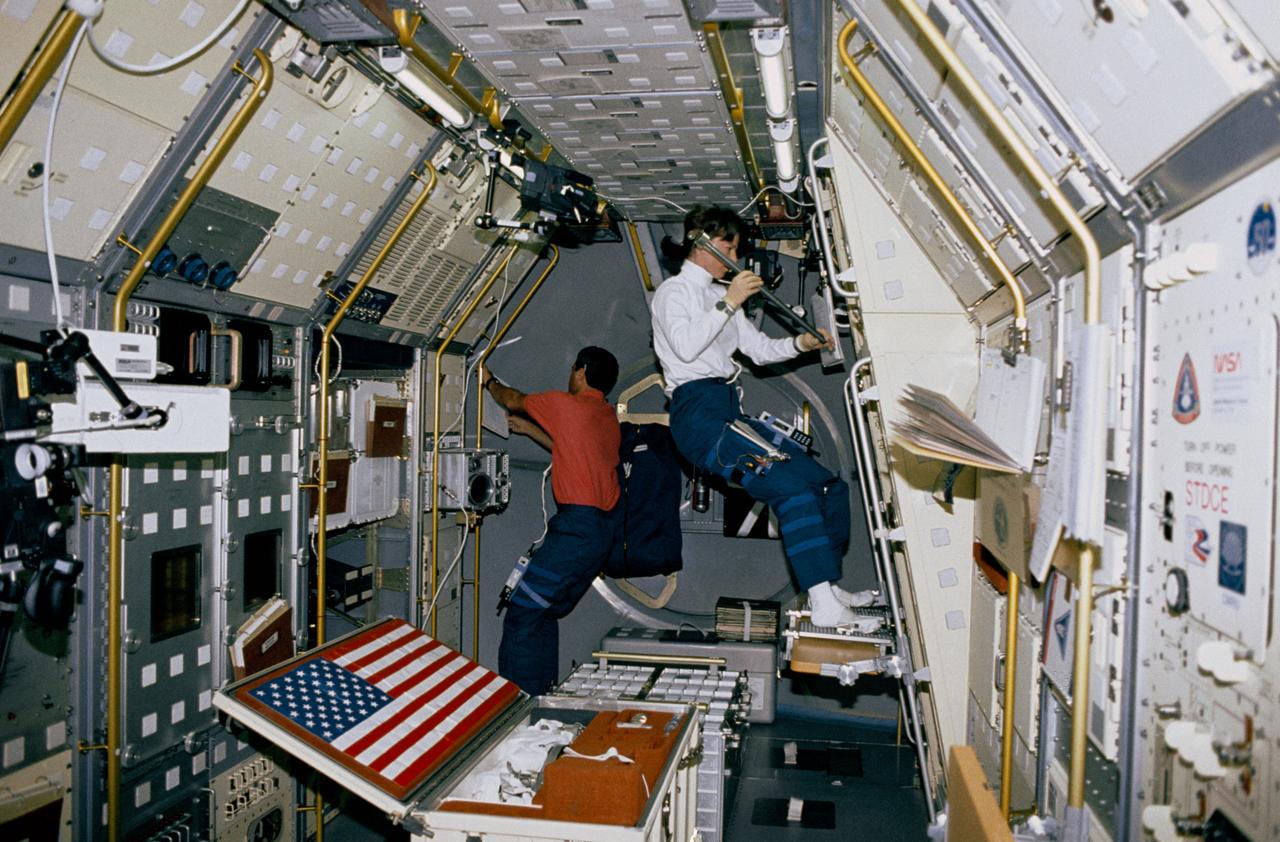
STS050-02-001 (9 July 1992) --- View showing Payload Specialists Bonnie Dunbar and Larry DeLucas in the aft section of the U. S. Microgravity Laboratory-1. Dunbar is preparing to load a sample in the Crystal Growth Furnace (CGF) Integrated Furnace Experiment Assembly (IFEA) in rack 9 of the Microgravity Laboratory. DeLucas is checking out the multipurpose Glovebox Facility.
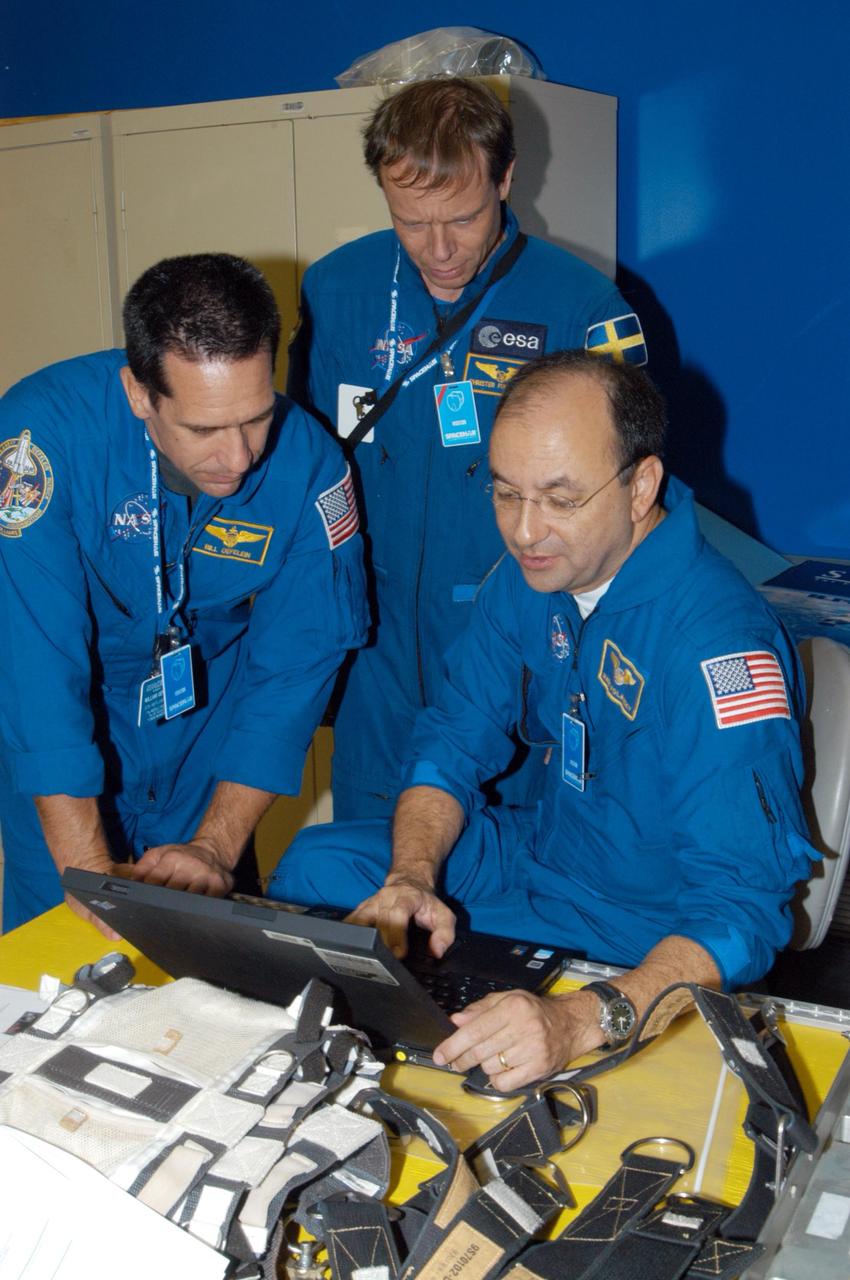
KENNEDY SPACE CENTER, FLA. - At SPACEHAB in Cape Canaveral, Fla., STS-116 Pilot William Oefelein, Mission Specialist Christer Fuglesang and Commander Mark Polansky check data on a computer while examining the rack front stowage trays that are used inside the SPACEHAB module. Mission crews make frequent trips to the Space Coast to become familiar with the equipment and payloads they will be using. STS-116 will be mission number 20 to the International Space Station and construction flight 12A.1. The mission payload is the SPACEHAB module, the P5 integrated truss structure and other key components. Launch is scheduled for no earlier than Dec. 7. Photo credit: NASA/George Shelton
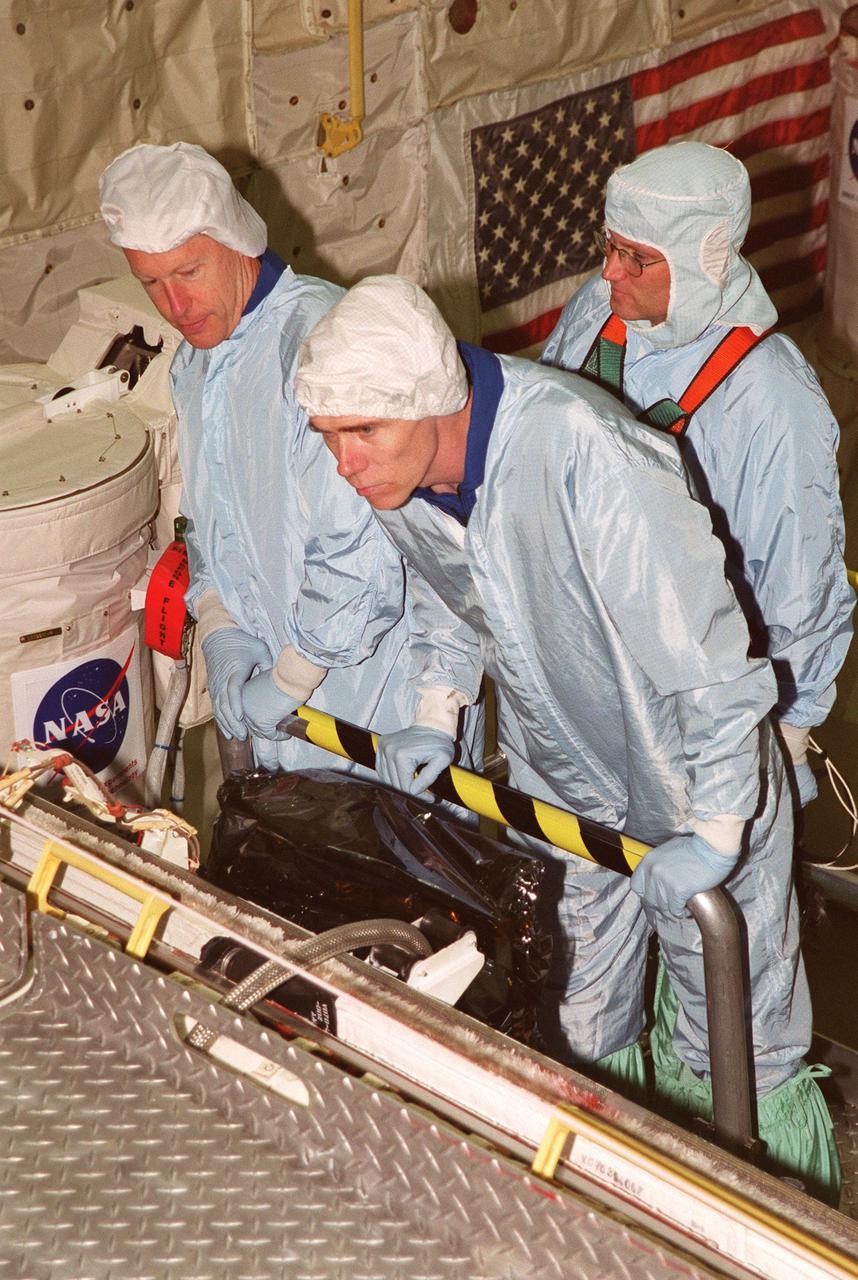
KENNEDY SPACE CENTER, FLA. -- During Crew Equipment Interface Test activities in Orbiter Processing Facility bay 2, members of the STS-105 crew take a close look at equipment and some of the payload. From left are Mission Specialists Patrick Forrester and Daniel Barry. Behind them is a Boeing technician. STS-105 is the 11th mission to the International Space Station. The payload includes the Multi-Purpose Logistics Module Leonardo, which was built by the Italian Space Agency. Leonardo will be outfitted with 12 racks of experiments and equipment. Discovery is scheduled to launch July 12 from Launch Pad 39A
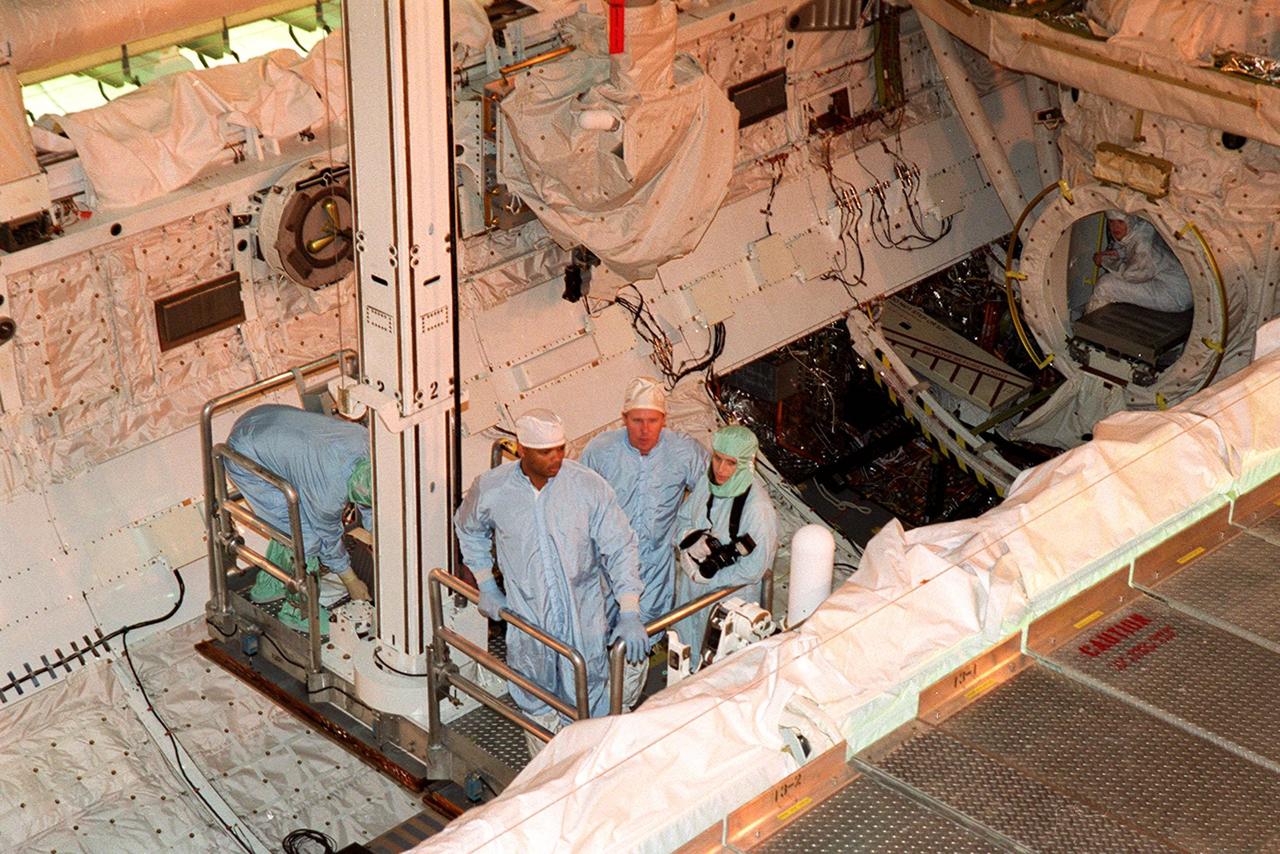
KENNEDY SPACE CENTER, FLA. -- Lowered into the payload bay of the orbiter Atlantis, some of the STS-98 crew (center of the photo) look over part of the payload. From left are Mission Specialists Robert Curbeam, Tom Jones and Marsha Ivins. They and the rest of the crew are at KSC for Crew Equipment Interface Test activities. Launch on mission STS-98 is scheduled for Jan. 18, 2001. It will be transporting the U.S. Lab, Destiny, to the International Space Station with five system racks already installed inside of the module. After delivery of electronics in the lab, electrically powered attitude control for Control Moment Gyroscopes will be activated
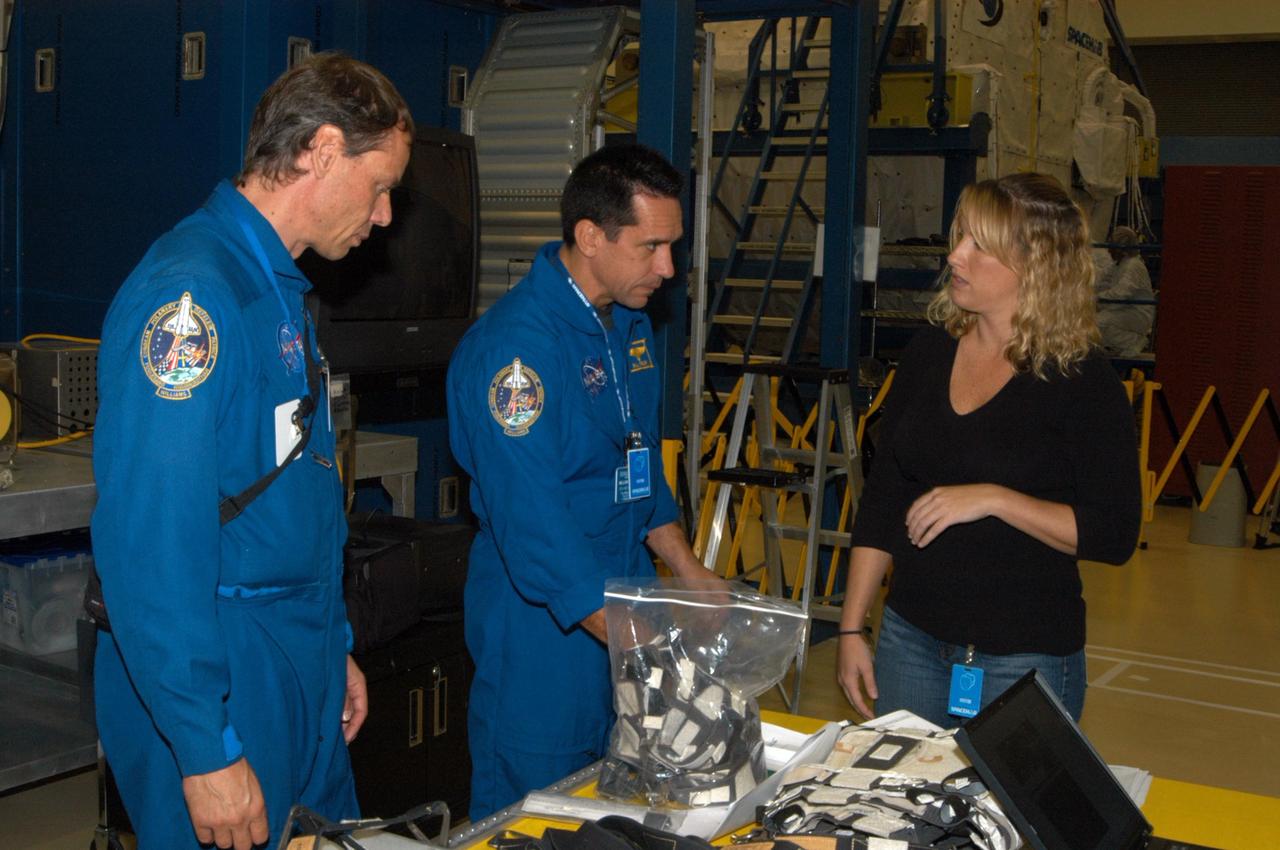
KENNEDY SPACE CENTER, FLA. - At SPACEHAB in Cape Canaveral, Fla., STS-116 Mission Specialist Christer Fuglesang (left) and Pilot William Oefelein look at the rack front stowage trays that are used inside the SPACEHAB module. Mission crews make frequent trips to the Space Coast to become familiar with the equipment and payloads they will be using. STS-116 will be mission number 20 to the International Space Station and construction flight 12A.1. The mission payload is the SPACEHAB module, the P5 integrated truss structure and other key components. Launch is scheduled for no earlier than Dec. 7. Photo credit: NASA/George Shelton
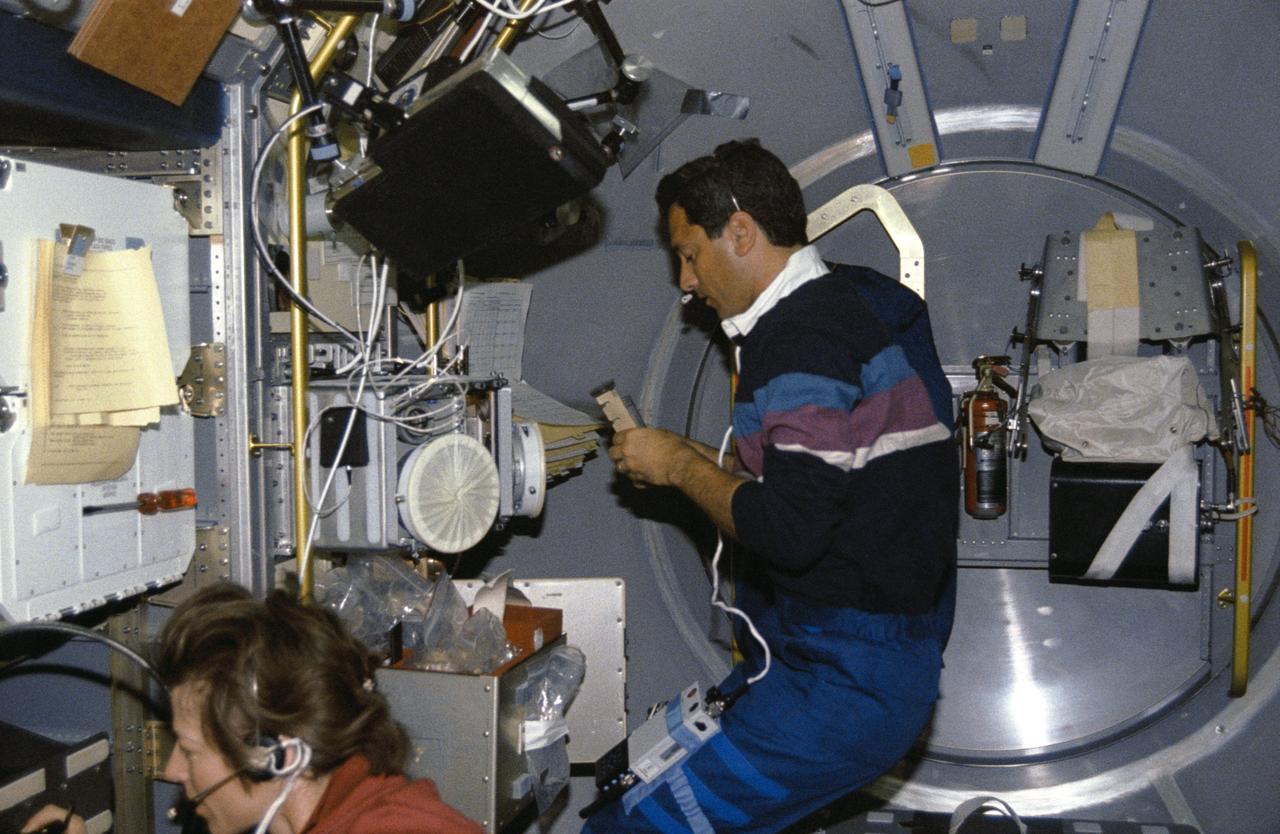
STS050-254-007 (25 June-9 July 1992) --- Lawrence J. DeLucas, payload specialist, handles a Protein Crystal Growth (PCG) sample at the multipurpose glovebox aboard the Earth-orbiting Space Shuttle Columbia. Astronaut Bonnie J. Dunbar, payload commander, communicates with ground controllers about the Solid Surface Combustion Experiment (SSCE), one of the United States Microgravity Laboratory 1’s (USML-1) three experiments on Rack 10. Five other crew members joined the pair for a record-setting 14-days of scientific data gathering.
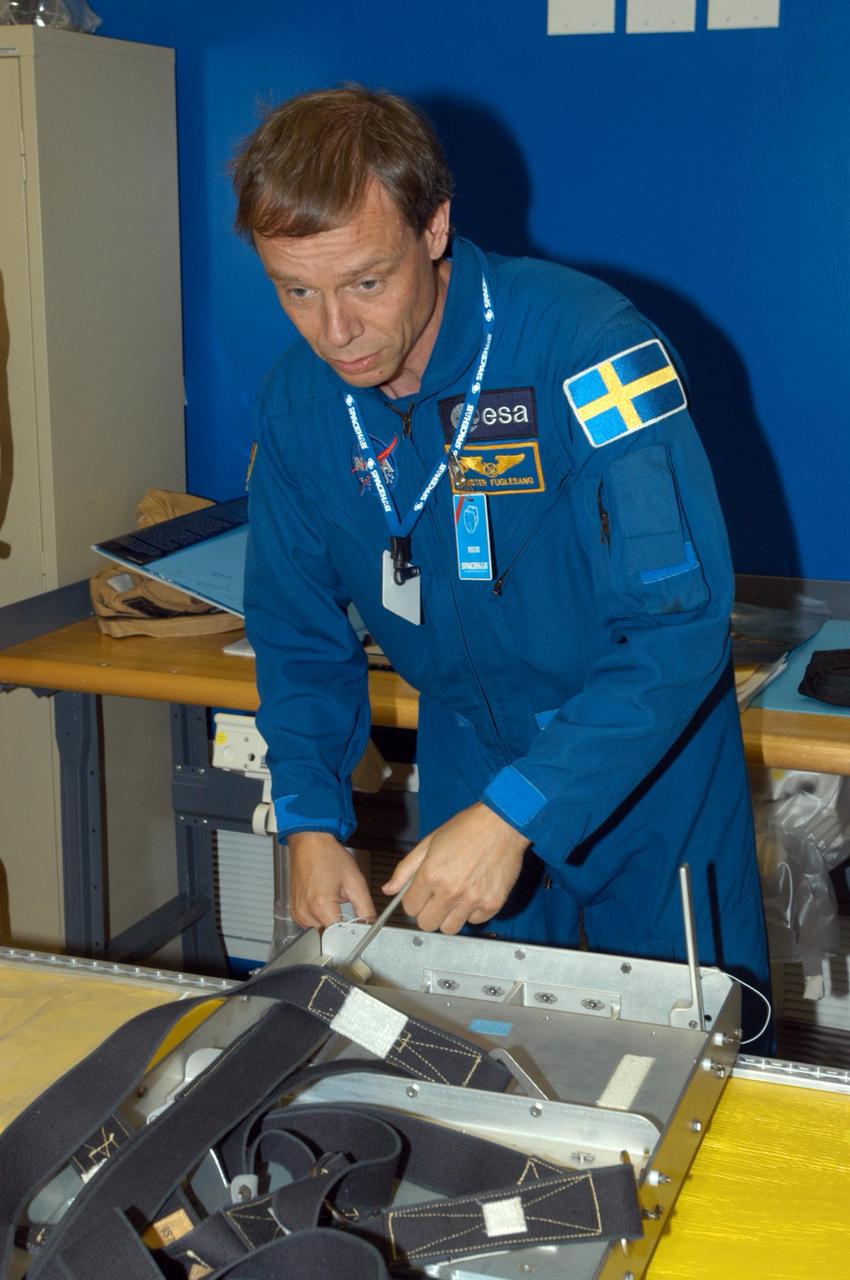
KENNEDY SPACE CENTER, FLA. - At SPACEHAB in Cape Canaveral, Fla., STS-116 Mission Specialist Christer Fuglesang practices techniques for removing and replacing the rack front stowage tray, used inside the SPACEHAB module. Fuglesang , from Sweden, represents the European Space Agency. Mission crews make frequent trips to the Space Coast to become familiar with the equipment and payloads they will be using. STS-116 will be mission number 20 to the International Space Station and construction flight 12A.1. The mission payload is the SPACEHAB module, the P5 integrated truss structure and other key components. Launch is scheduled for no earlier than Dec. 7. Photo credit: NASA/George Shelton
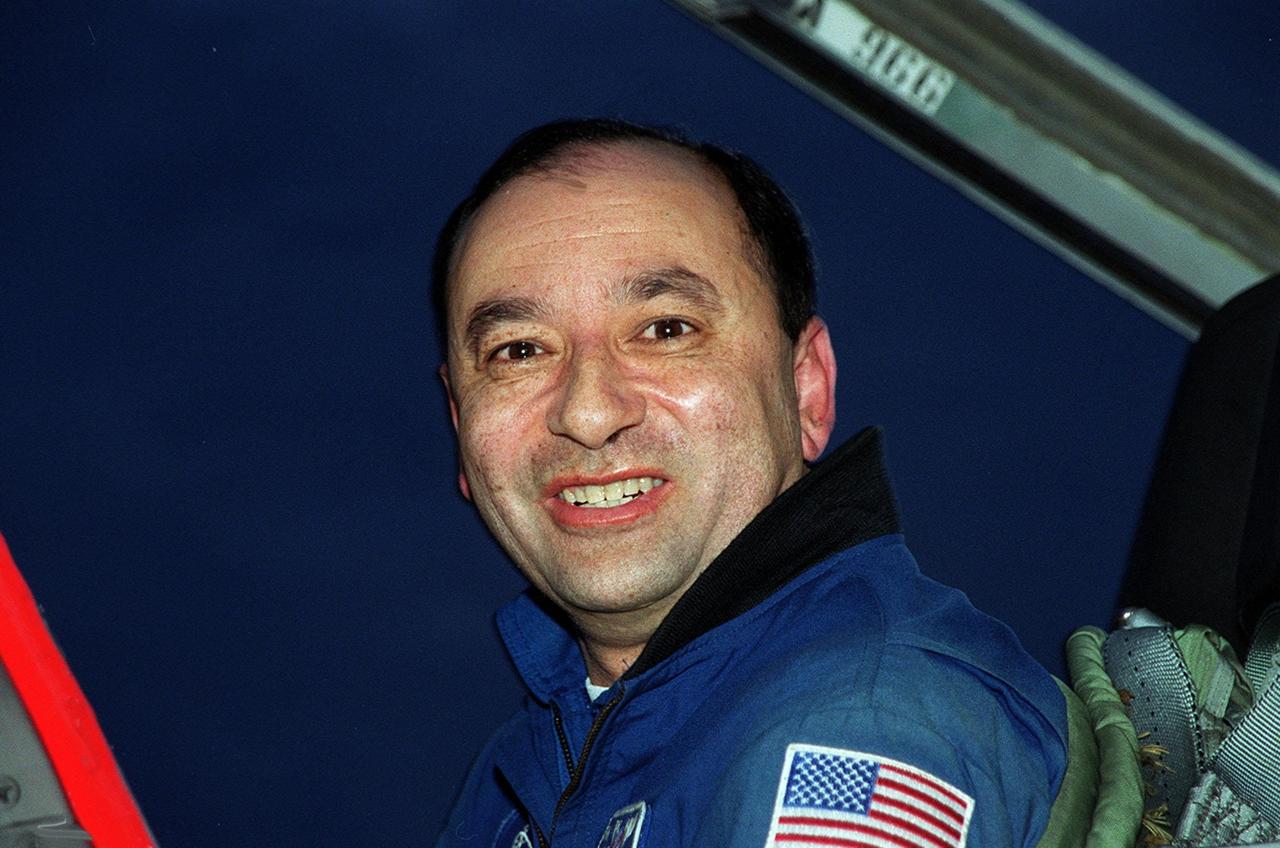
STS-98 Pilot Mark Polansky is pleased to arrive at KSC’s Shuttle Landing Facility for Terminal Countdown Test Activities. In preparation for the Jan. 19 launch, he and the rest of the crew Commander Ken Cockrell and Mission Specialists Robert Curbeam, Thomas Jones and Marsha Ivins will be training in emergency procedures from the pad, checking the payload and taking part in a simulated countdown. The payload for the mission is the U.S. Lab Destiny, a key element in the construction of the International Space Station. The lab has five system racks already installed inside the module. After delivery of electronics in the lab, electrically powered attitude control for Control Moment Gyroscopes will be activated. STS-98 is the seventh construction flight to the ISS.<br
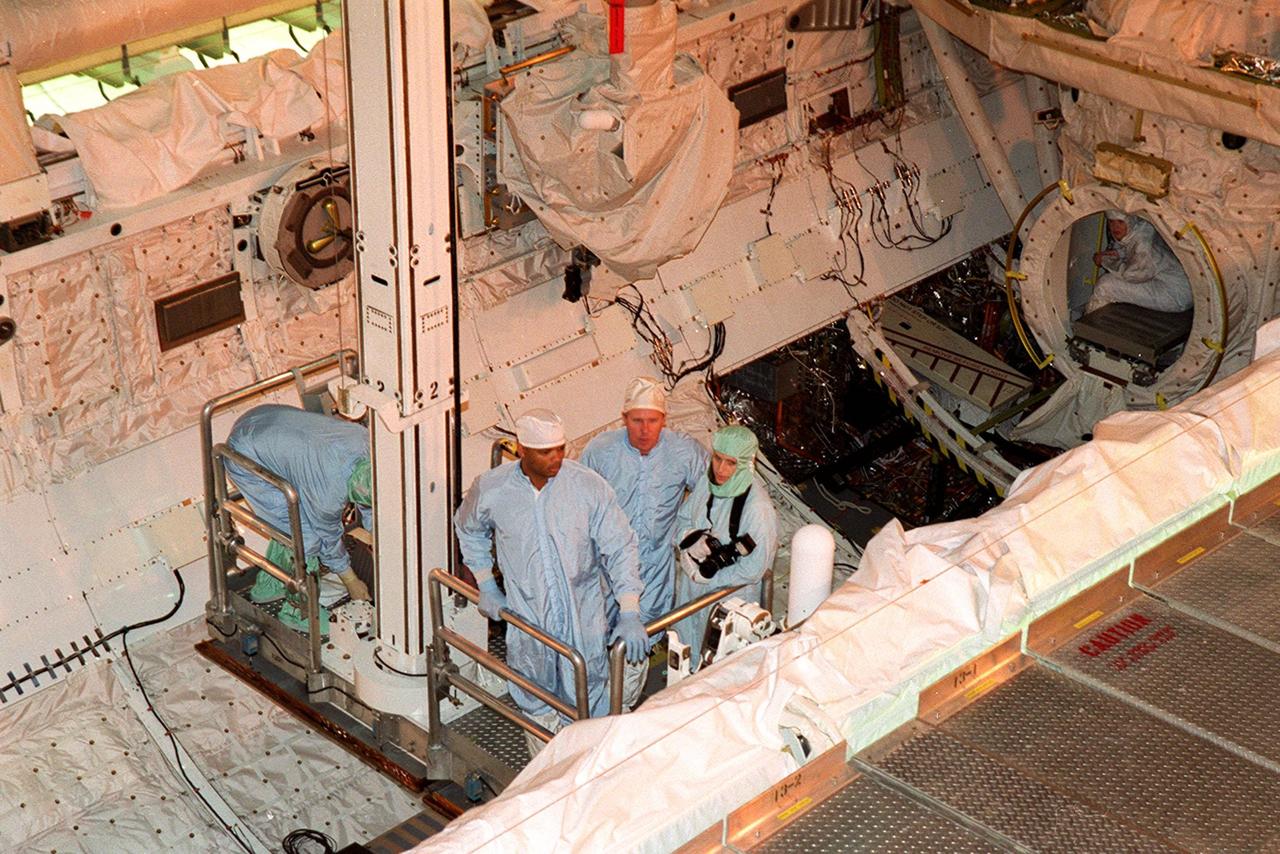
KENNEDY SPACE CENTER, FLA. -- Lowered into the payload bay of the orbiter Atlantis, some of the STS-98 crew (center of the photo) look over part of the payload. From left are Mission Specialists Robert Curbeam, Tom Jones and Marsha Ivins. They and the rest of the crew are at KSC for Crew Equipment Interface Test activities. Launch on mission STS-98 is scheduled for Jan. 18, 2001. It will be transporting the U.S. Lab, Destiny, to the International Space Station with five system racks already installed inside of the module. After delivery of electronics in the lab, electrically powered attitude control for Control Moment Gyroscopes will be activated
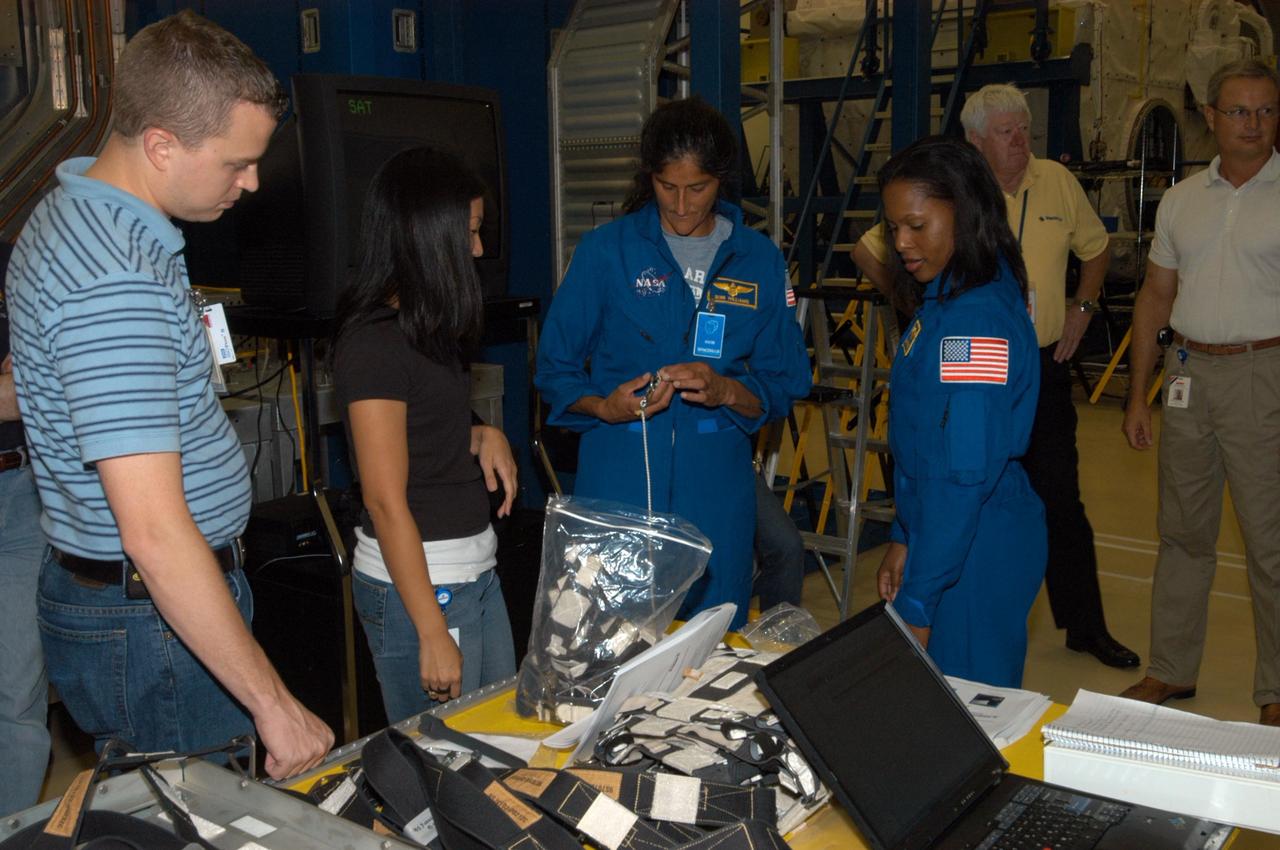
KENNEDY SPACE CENTER, FLA. - At SPACEHAB in Cape Canaveral, Fla., STS-116 Mission Specialists Sunita Williams (left) and Joan Higginbotham get a close look at the rack front stowage trays that are used inside the SPACEHAB module. Mission crews make frequent trips to the Space Coast to become familiar with the equipment and payloads they will be using. STS-116 will be mission number 20 to the International Space Station and construction flight 12A.1. The mission payload is the SPACEHAB module, the P5 integrated truss structure and other key components. Launch is scheduled for no earlier than Dec. 7. Photo credit: NASA/George Shelton
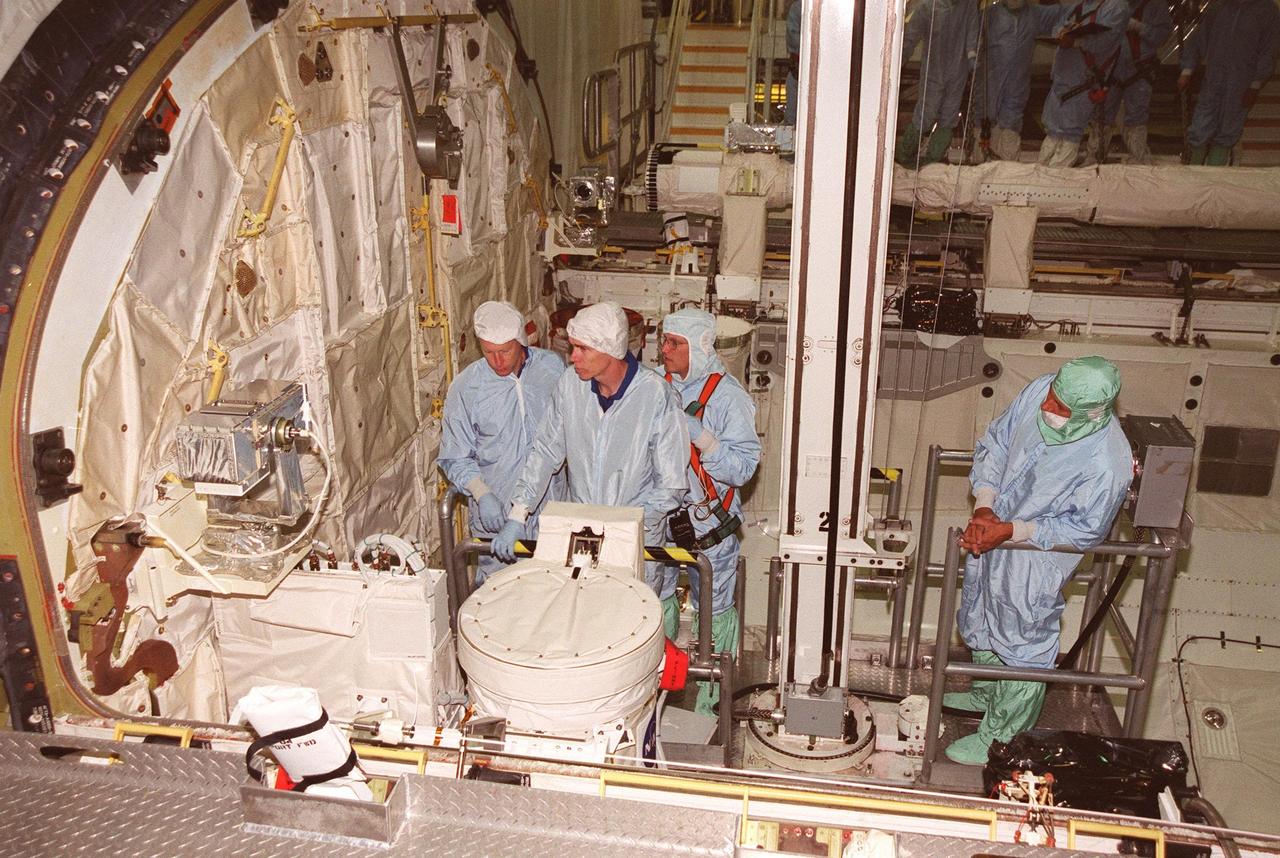
KENNEDY SPACE CENTER, FLA. -- During Crew Equipment Interface Test activities in Orbiter Processing Facility bay 2, members of the STS-105 crew check out some of the payload, doing sharp edge inspection. From left are Mission Specialists Patrick Forrester and Daniel Barry, accompanied by a Boeing technician (behind) and the bucket operator (right). STS-105 is the 11th mission to the International Space Station. The payload includes the Multi-Purpose Logistics Module Leonardo, which was built by the Italian Space Agency. Leonardo will be outfitted with 12 racks of experiments and equipment. Discovery is scheduled to launch July 12 from Launch Pad 39A
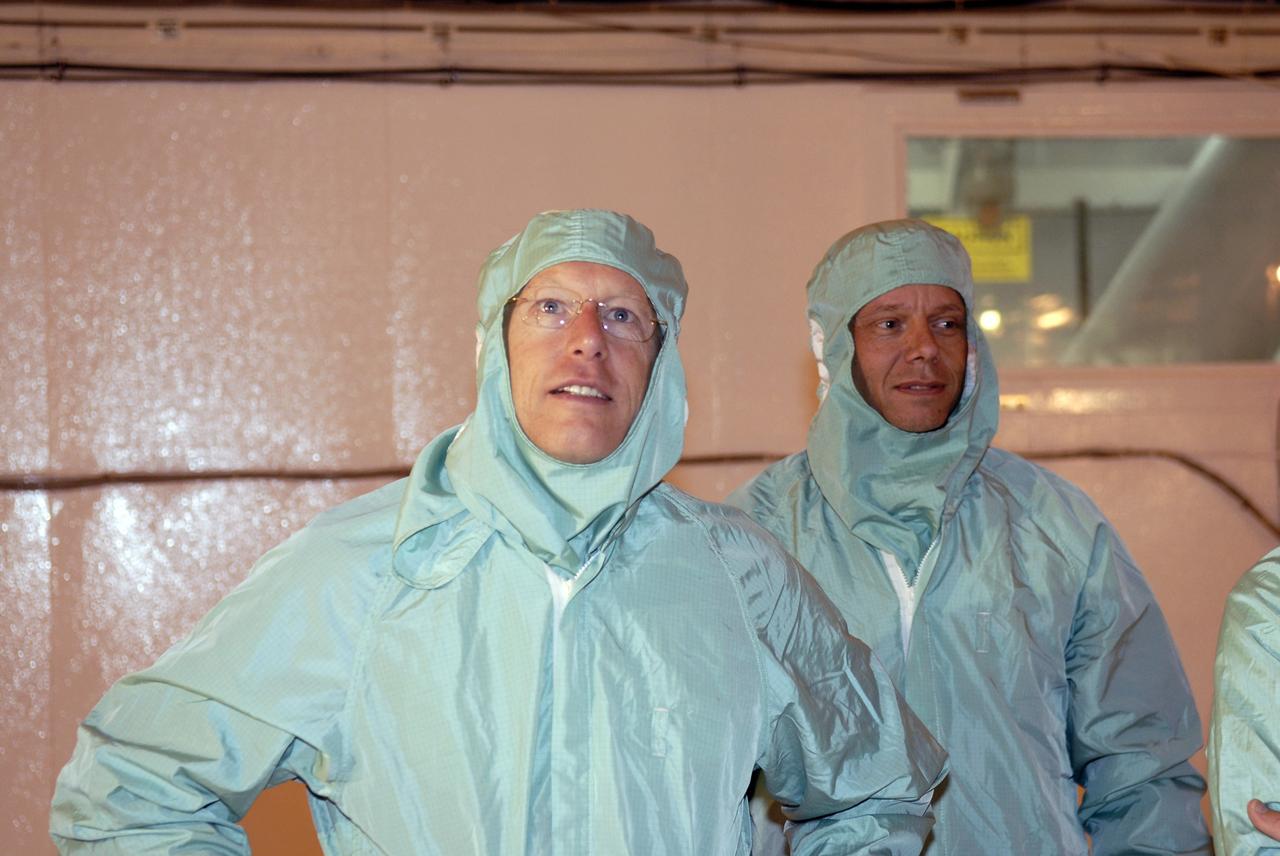
CAPE CANAVERAL, Fla. – In the Payload Changeout Room on NASA Kennedy Space Center's Launch Pad 39A, STS-128 Mission Specialists Patrick Forrester (left) and Christer Fuglesang take a close look at the payloads to be installed in space shuttle Discovery. The crew is at Kennedy to take part in the terminal countdown demonstration test, or TCDT, which includes equipment familiarization, emergency exit training and a simulated countdown. On the STS-128 mission, Discovery will deliver 33,000 pounds of equipment to the station, including science and storage racks, a freezer to store research samples, a new sleeping compartment and the COLBERT treadmill. Launch is targeted for late August. Photo credit: NASA/Kim Shiflett
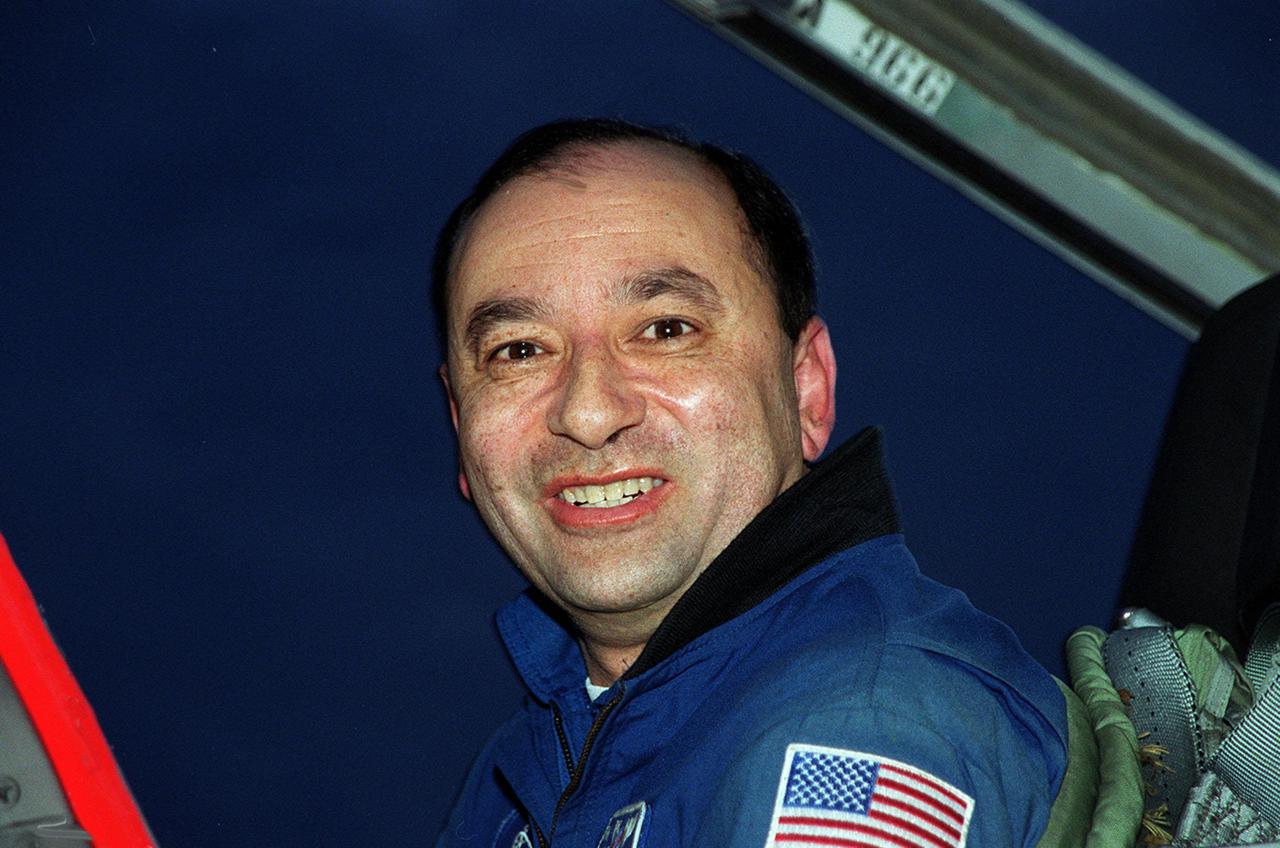
STS-98 Pilot Mark Polansky is pleased to arrive at KSC’s Shuttle Landing Facility for Terminal Countdown Test Activities. In preparation for the Jan. 19 launch, he and the rest of the crew Commander Ken Cockrell and Mission Specialists Robert Curbeam, Thomas Jones and Marsha Ivins will be training in emergency procedures from the pad, checking the payload and taking part in a simulated countdown. The payload for the mission is the U.S. Lab Destiny, a key element in the construction of the International Space Station. The lab has five system racks already installed inside the module. After delivery of electronics in the lab, electrically powered attitude control for Control Moment Gyroscopes will be activated. STS-98 is the seventh construction flight to the ISS.<br
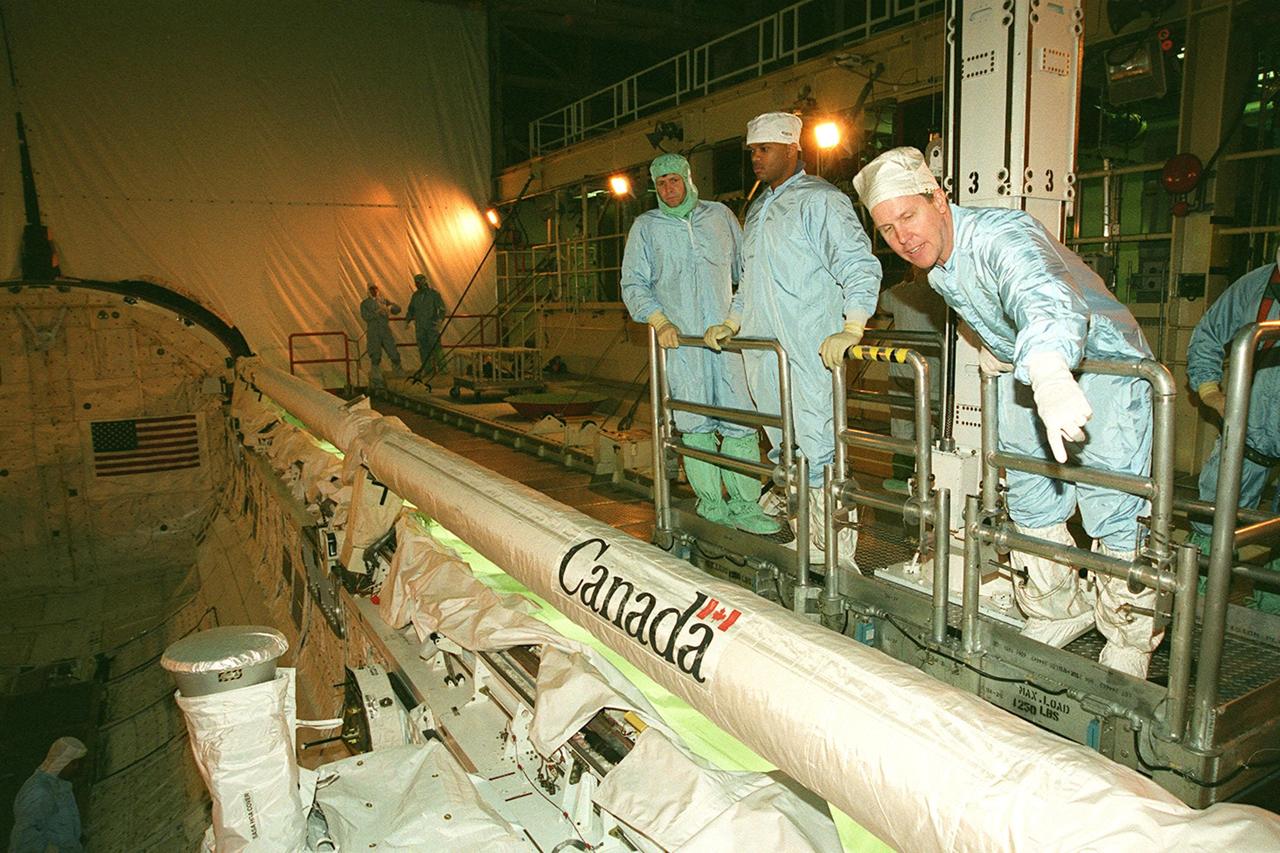
KENNEDY SPACE CENTER, FLA. -- Some of the STS-98 crew look over the Canadian robotic arm in the payload bay of orbiter Atlantis, which is undergoing testing in the Orbiter Processing Facility bay 3. At right, pointing, is Mission Specialist Tom Jones. Second from right is Mission Specialist Robert Curbeam. They and the rest of the crew are at KSC for Crew Equipment Interface Test activities. Launch on mission STS-98 is scheduled for Jan. 18, 2001. It will be transporting the U.S. Lab, Destiny, to the International Space Station with five system racks already installed inside of the module. After delivery of electronics in the lab, electrically powered attitude control for Control Moment Gyroscopes will be activated

CAPE CANAVERAL, Fla. – In Orbiter Processing Facility 3 at NASA's Kennedy Space Center in Florida, STS-128 crew members are lowered into space shuttle Discovery's payload bay to check equipment. At left is Mission Specialist John "Danny" Olivas and at right is Mission Specialist Christer Fuglesang. The crew is at Kennedy for a crew equipment interface test, or CEIT, which provides hands-on training and observation of shuttle and flight hardware. The STS-128 flight will carry science and storage racks to the International Space Station on Discovery. Launch is targeted for Aug. 7. Photo credit: NASA/Jim Grossmann
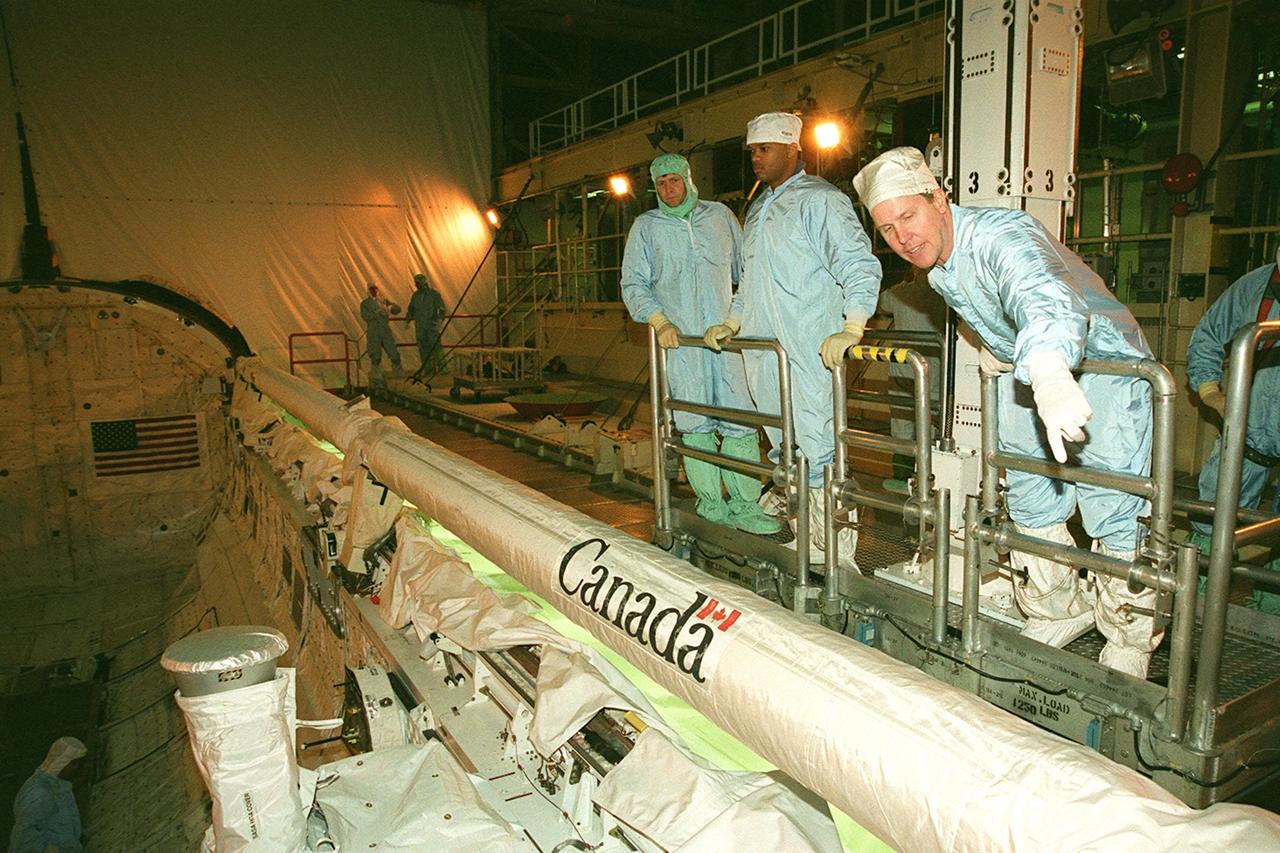
KENNEDY SPACE CENTER, FLA. -- Some of the STS-98 crew look over the Canadian robotic arm in the payload bay of orbiter Atlantis, which is undergoing testing in the Orbiter Processing Facility bay 3. At right, pointing, is Mission Specialist Tom Jones. Second from right is Mission Specialist Robert Curbeam. They and the rest of the crew are at KSC for Crew Equipment Interface Test activities. Launch on mission STS-98 is scheduled for Jan. 18, 2001. It will be transporting the U.S. Lab, Destiny, to the International Space Station with five system racks already installed inside of the module. After delivery of electronics in the lab, electrically powered attitude control for Control Moment Gyroscopes will be activated
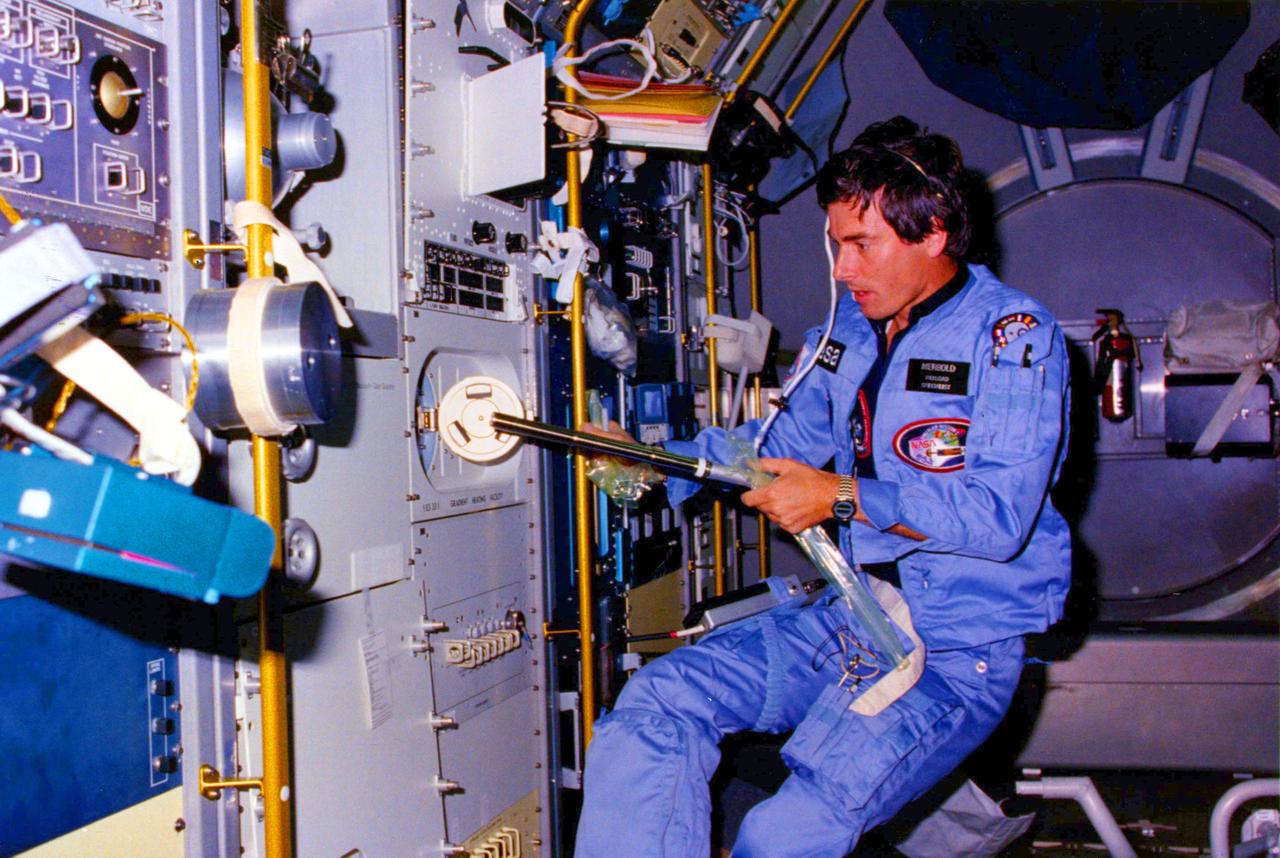
The Space Shuttle was designed to carry large payloads into Earth orbit. One of the most important payloads is Spacelab. The Spacelab serves as a small but well-equipped laboratory in space to perform experiments in zero-gravity and make astronomical observations above the Earth's obscuring atmosphere. In this photograph, Payload Specialist, Ulf Merbold, is working at Gradient Heating Facility on the Materials Science Double Rack (MSDR) inside the science module in the Orbiter Columbia's payload bay during STS-9, Spacelab-1 mission. Spacelab-1, the joint ESA (European Space Agency)/NASA mission, was the first operational flight for the Spacelab, and demonstrated new instruments and methods for conducting experiments that are difficult or impossible in ground-based laboratories. This facility performed, in extremely low gravity, a wide variety of materials processing experiments in crystal growth, fluid physics, and metallurgy. The Marshall Space Flight Center had overall management responsibilities.
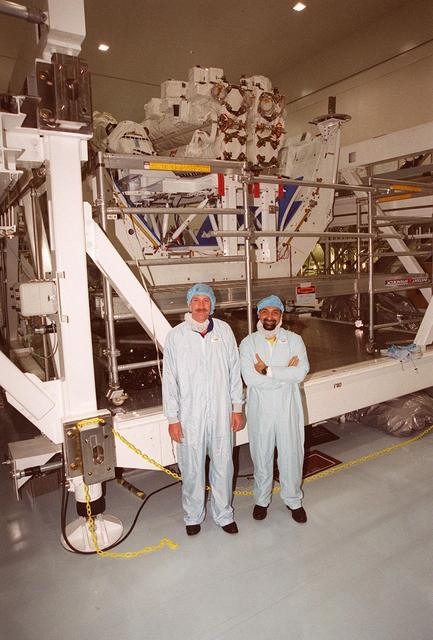
STS-100 Commander Kent Rominger and Mission Specialist Umberto Guidoni (right), with the European Space Agency, pose for a photo during Crew Equipment Interface Test activities in the Space Station Processing Facility. Behind them is the Space Station Remote Manipulator System (SSRMS), also known as the Canadian arm, which is part of the payload on their mission. The SSRMS is the primary means of transferring payloads between the orbiter payload bay and the International Space Station for assembly. The 56-foot-long robotic arm includes two 12-foot booms joined by a hinge. Seven joints on the arm allow highly flexible and precise movement. The payload also includes the Multi-Purpose Logistics Module (MPLM) Raffaello. MPLMs are pressurized modules that will serve as the International Space Station's “moving vans,” carrying laboratory racks filled with equipment, experiments and supplies to and from the station aboard the Space Shuttle. Mission STS-100 is scheduled to launch April 19, 2001
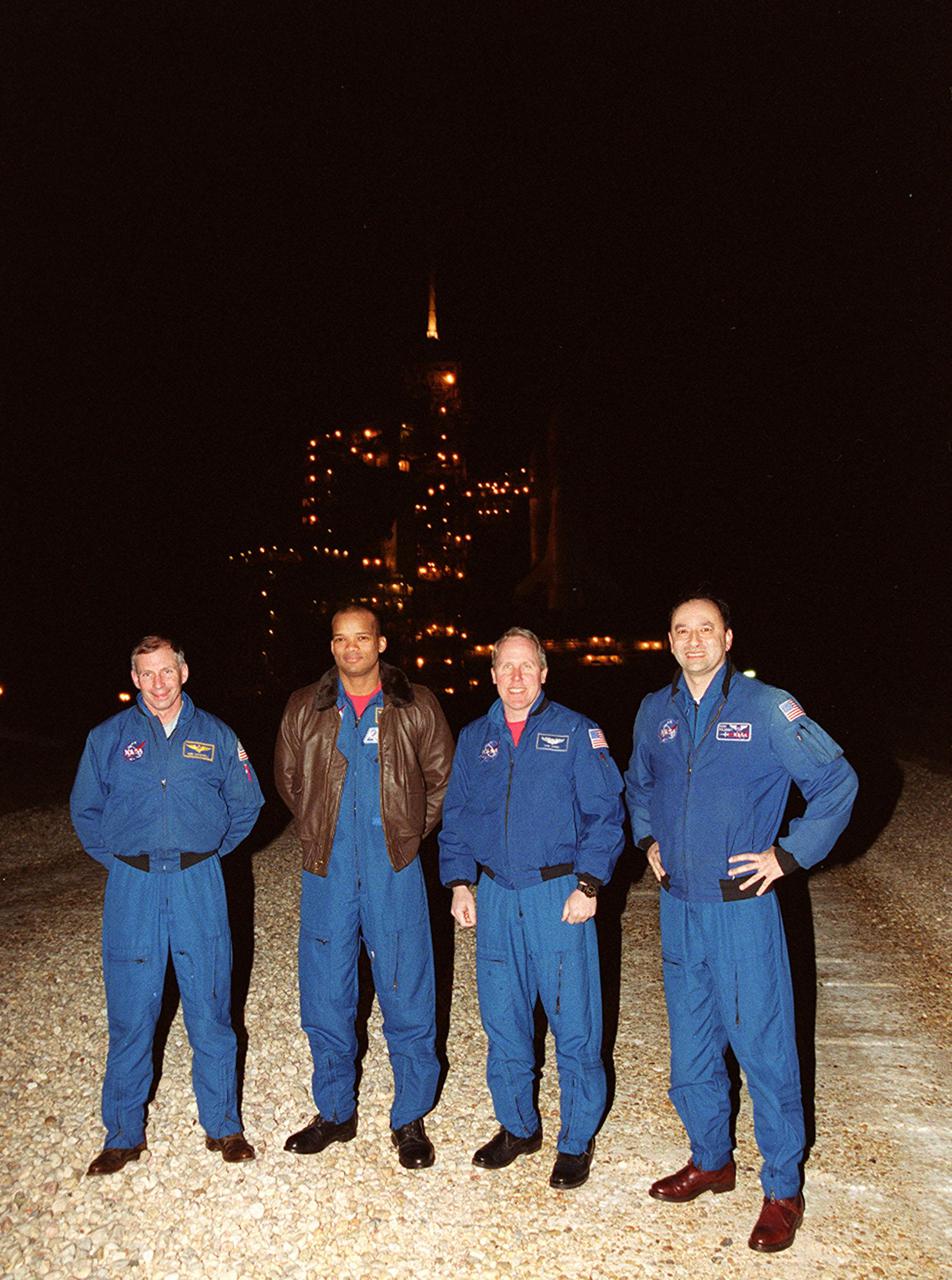
Members of the STS-98 crew pause for a photo after their arrival at KSC. From left, they are Commander Ken Cockrell, Mission Specialists Robert Curbeam and Thomas Jones, and Pilot Mark Polansky. Missing is Mission Specialist Marsha Ivins who was planning to arrive later. The crew is at KSC to take part in Terminal Countdown Test Demonstration activities in preparation for launch. They will be training in emergency procedures from the pad, checking the payload and taking part in a simulated countdown. The payload for the mission is the U.S. Lab Destiny, a key element in the construction of the International Space Station. The lab has five system racks already installed inside the module. After delivery of electronics in the lab, electrically powered attitude control for Control Moment Gyroscopes will be activated. STS-98 is the seventh construction flight to the ISS
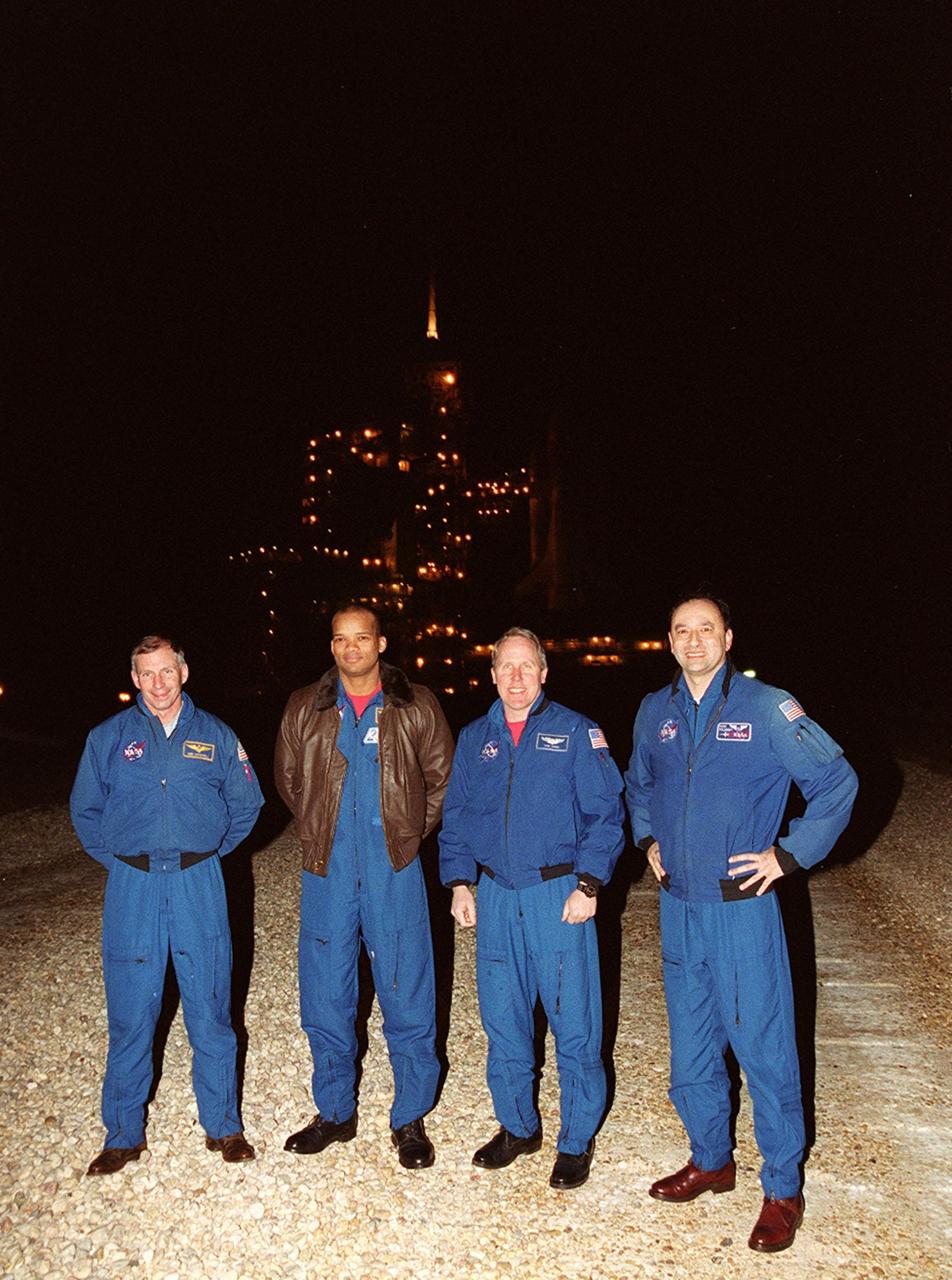
Members of the STS-98 crew pause for a photo after their arrival at KSC. From left, they are Commander Ken Cockrell, Mission Specialists Robert Curbeam and Thomas Jones, and Pilot Mark Polansky. Missing is Mission Specialist Marsha Ivins who was planning to arrive later. The crew is at KSC to take part in Terminal Countdown Test Demonstration activities in preparation for launch. They will be training in emergency procedures from the pad, checking the payload and taking part in a simulated countdown. The payload for the mission is the U.S. Lab Destiny, a key element in the construction of the International Space Station. The lab has five system racks already installed inside the module. After delivery of electronics in the lab, electrically powered attitude control for Control Moment Gyroscopes will be activated. STS-98 is the seventh construction flight to the ISS
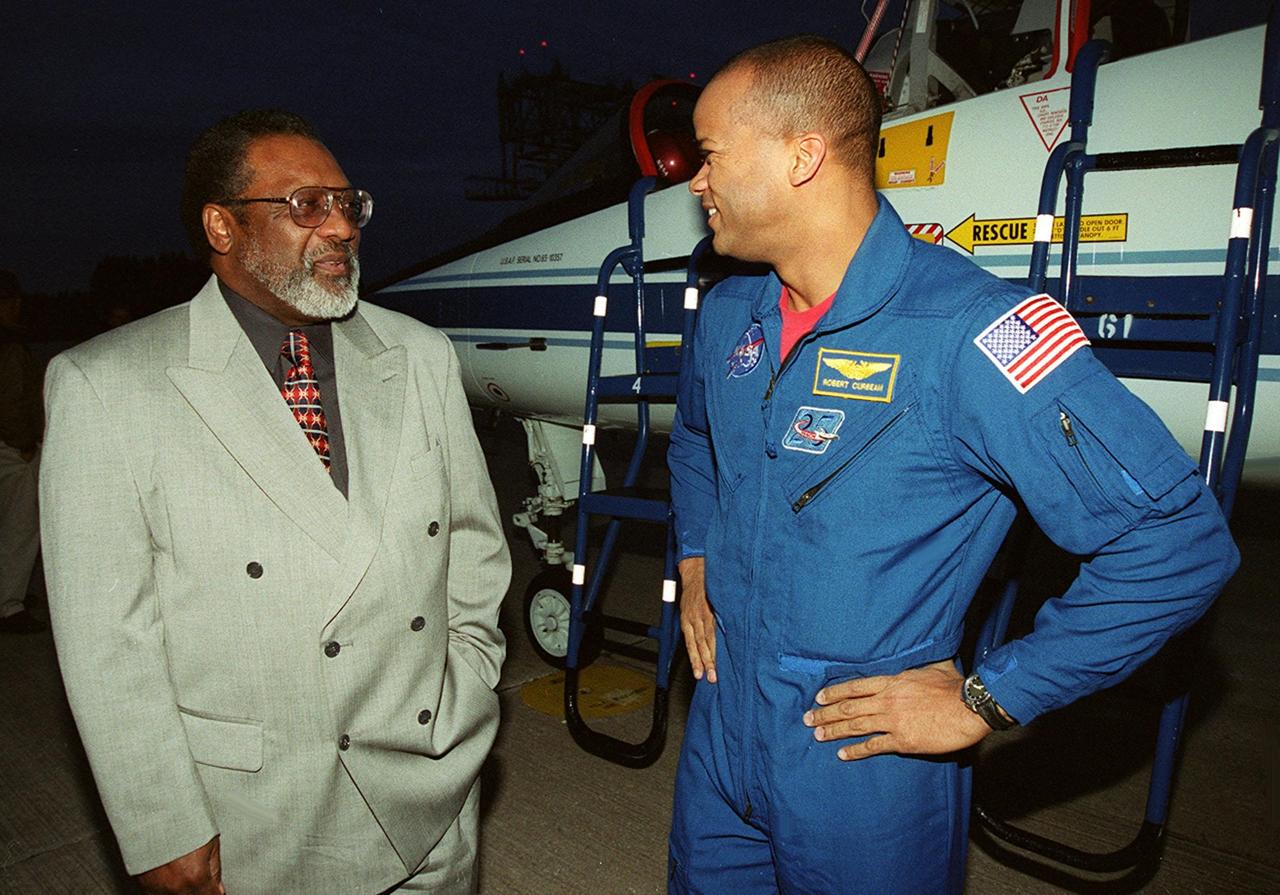
KSC’s Deputy Director James Jennings (left) welcomes STS-98 Mission Specialist Robert Curbeam to KSC. The STS-98 crew Commander Ken Cockrell, Pilot Mark Polansky and Mission Specialists Curbeam, Thomas Jones and Marsha Ivins arrived to take part in Terminal Countdown Test Demonstration activities in preparation for launch. They will be training in emergency procedures from the pad, checking the payload and taking part in a simulated countdown. The payload for the mission is the U.S. Lab Destiny, a key element in the construction of the International Space Station. The lab has five system racks already installed inside the module. After delivery of electronics in the lab, electrically powered attitude control for Control Moment Gyroscopes will be activated. STS-98 is the seventh construction flight to the ISS
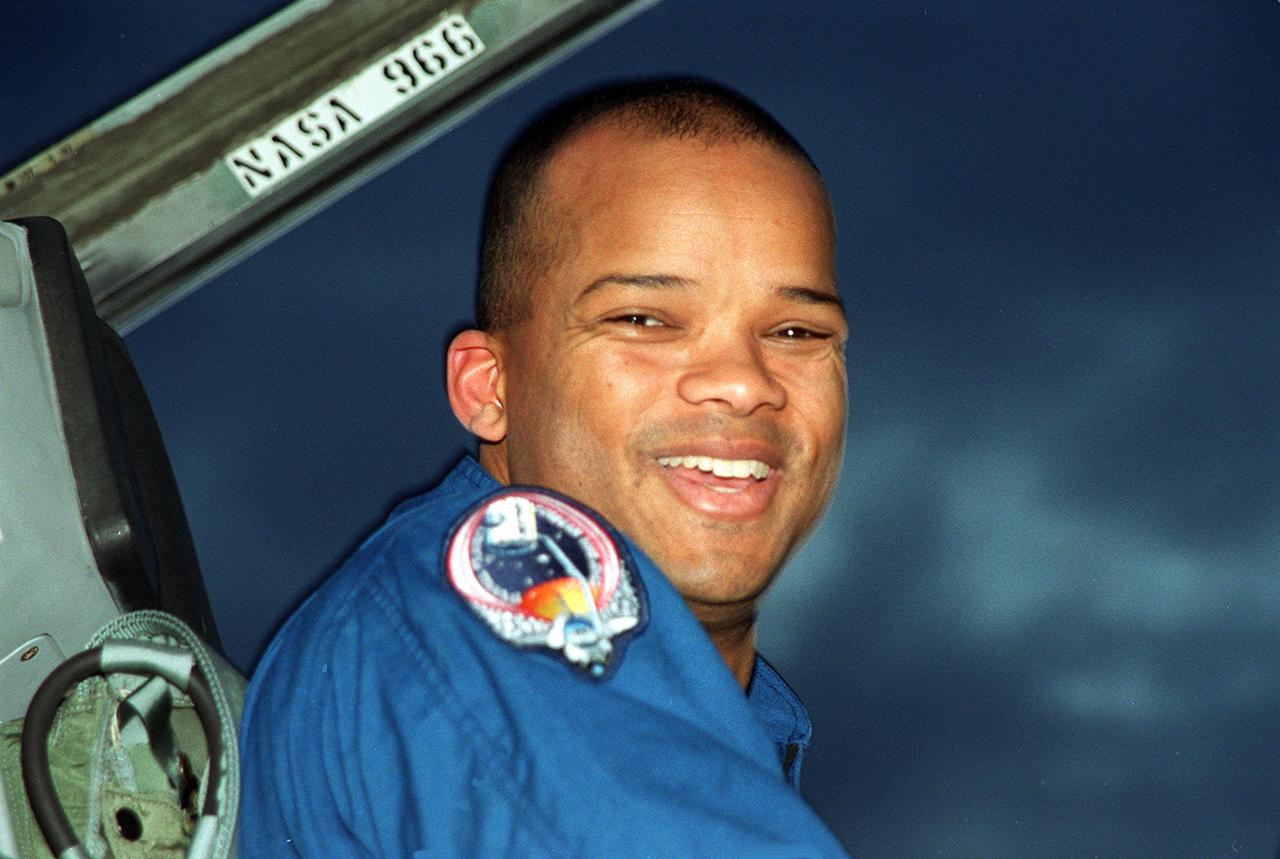
STS-98 Mission Specialist Robert Curbeam grins after his arrival at KSC’s Shuttle Landing Facility for Terminal Countdown Test Activities. In preparation for the Jan. 19 launch, he and the rest of the crew Commander Ken Cockrell, Pilot Mark Polansky and Mission Specialists Thomas Jones and Marsha Ivins will be training in emergency procedures from the pad, checking the payload and taking part in a simulated countdown. The payload for the mission is the U.S. Lab Destiny, a key element in the construction of the International Space Station. The lab has five system racks already installed inside the module. After delivery of electronics in the lab, electrically powered attitude control for Control Moment Gyroscopes will be activated. STS-98 is the seventh construction flight to the ISS.<br
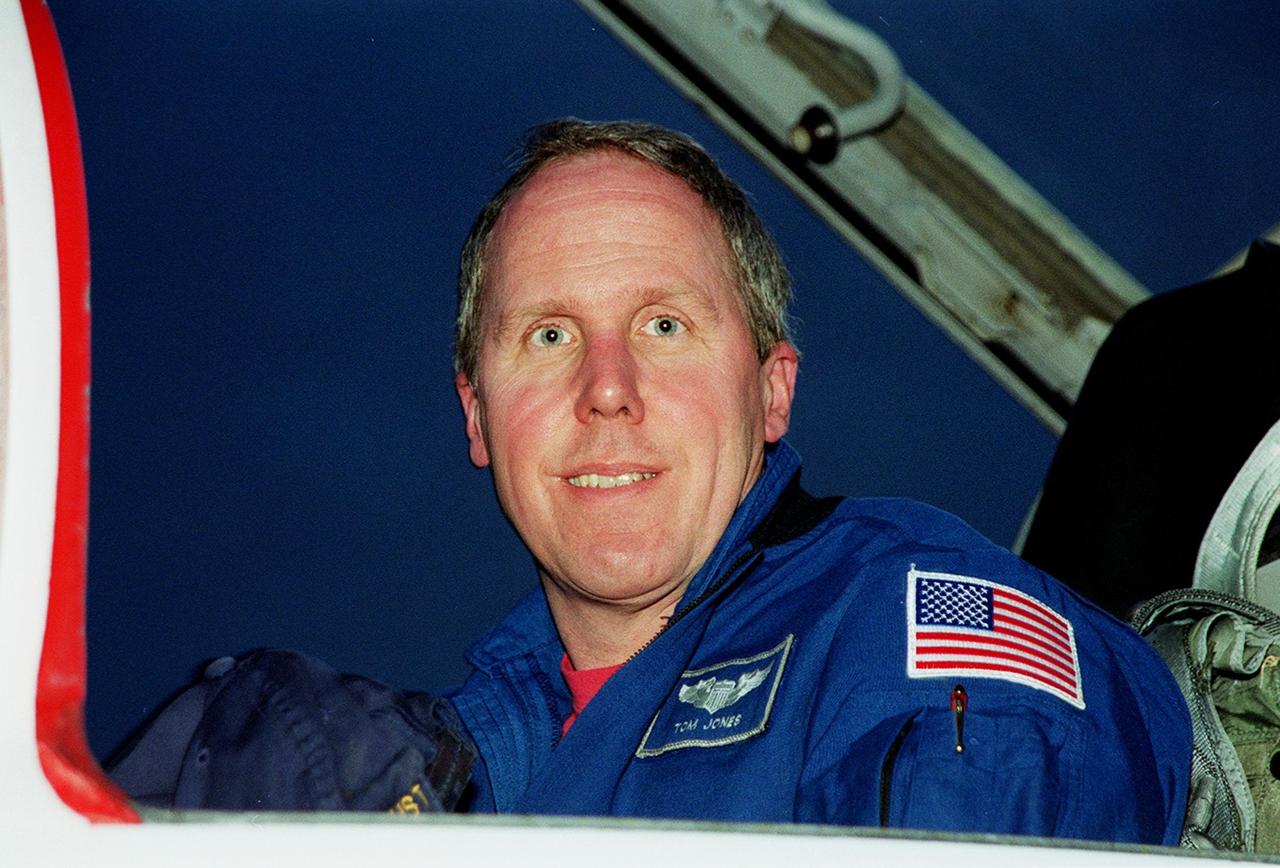
STS-98 Mission Specialist Thomas Jones happily arrives at KSC’s Shuttle Landing Facility for Terminal Countdown Test Activities. In preparation for the Jan. 19 launch, he and the rest of the crew Commander Ken Cockrell, Pilot Mark Polansky and Mission Specialists Robert Curbeam and Marsha Ivins will be training in emergency procedures from the pad, checking the payload and taking part in a simulated countdown. The payload for the mission is the U.S. Lab Destiny, a key element in the construction of the International Space Station. The lab has five system racks already installed inside the module. After delivery of electronics in the lab, electrically powered attitude control for Control Moment Gyroscopes will be activated. STS-98 is the seventh construction flight to the ISS.<br
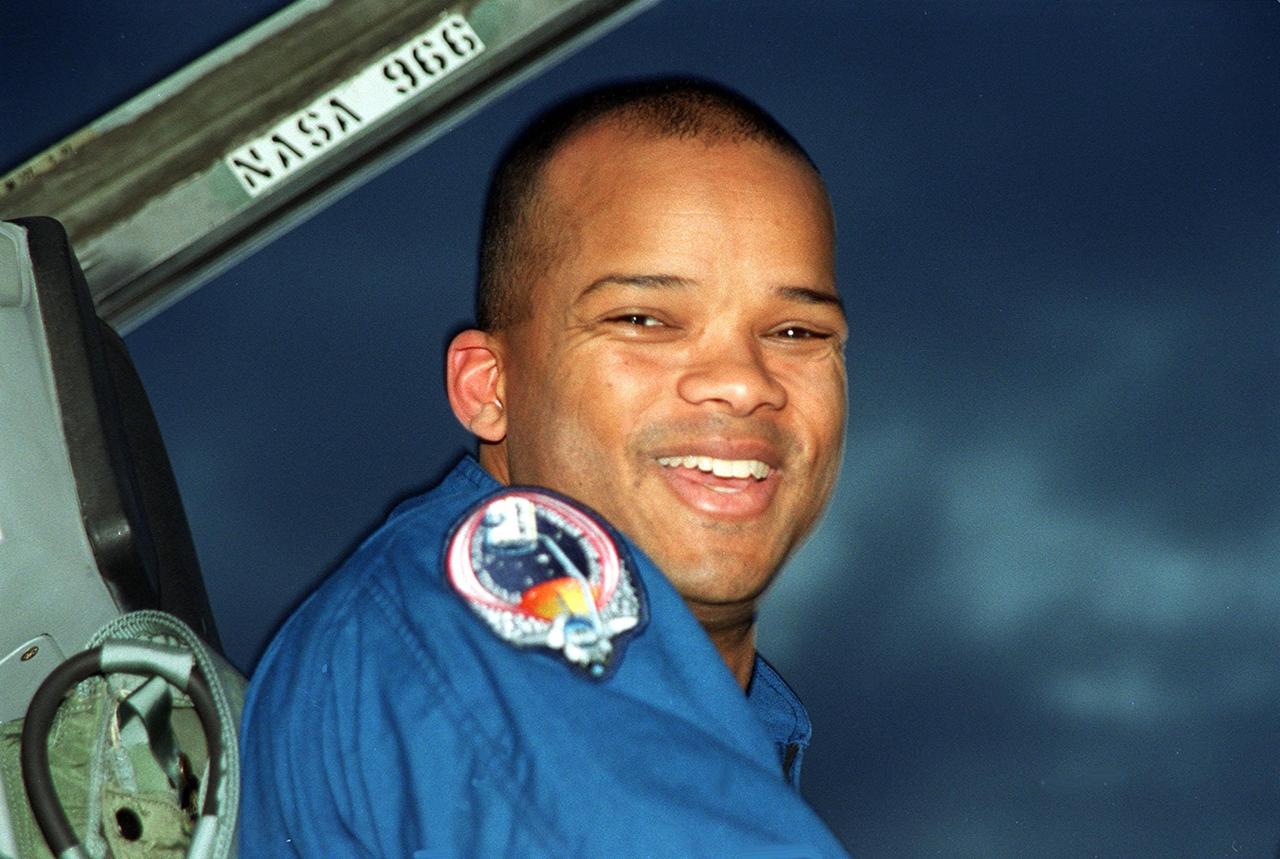
STS-98 Mission Specialist Robert Curbeam grins after his arrival at KSC’s Shuttle Landing Facility for Terminal Countdown Test Activities. In preparation for the Jan. 19 launch, he and the rest of the crew Commander Ken Cockrell, Pilot Mark Polansky and Mission Specialists Thomas Jones and Marsha Ivins will be training in emergency procedures from the pad, checking the payload and taking part in a simulated countdown. The payload for the mission is the U.S. Lab Destiny, a key element in the construction of the International Space Station. The lab has five system racks already installed inside the module. After delivery of electronics in the lab, electrically powered attitude control for Control Moment Gyroscopes will be activated. STS-98 is the seventh construction flight to the ISS.<br
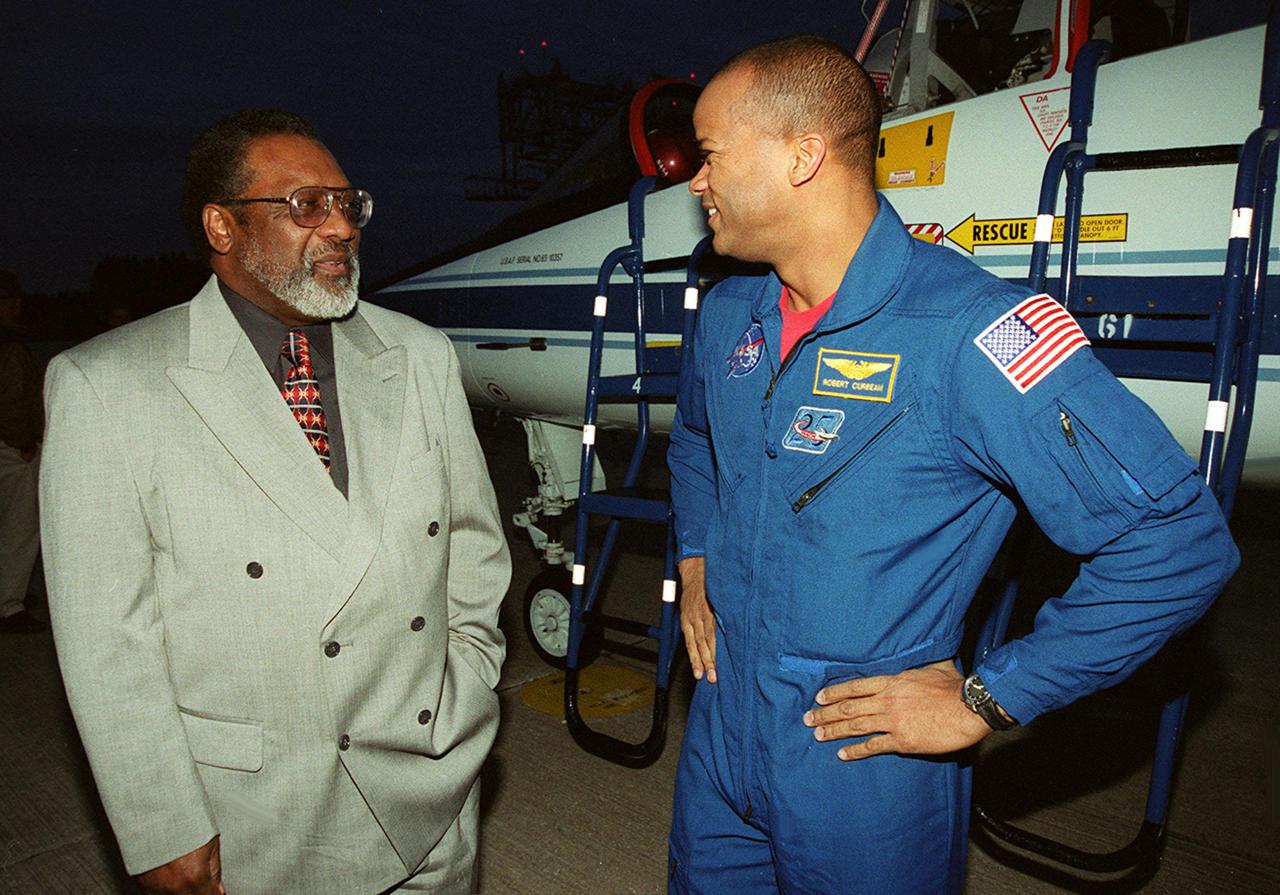
KSC’s Deputy Director James Jennings (left) welcomes STS-98 Mission Specialist Robert Curbeam to KSC. The STS-98 crew Commander Ken Cockrell, Pilot Mark Polansky and Mission Specialists Curbeam, Thomas Jones and Marsha Ivins arrived to take part in Terminal Countdown Test Demonstration activities in preparation for launch. They will be training in emergency procedures from the pad, checking the payload and taking part in a simulated countdown. The payload for the mission is the U.S. Lab Destiny, a key element in the construction of the International Space Station. The lab has five system racks already installed inside the module. After delivery of electronics in the lab, electrically powered attitude control for Control Moment Gyroscopes will be activated. STS-98 is the seventh construction flight to the ISS
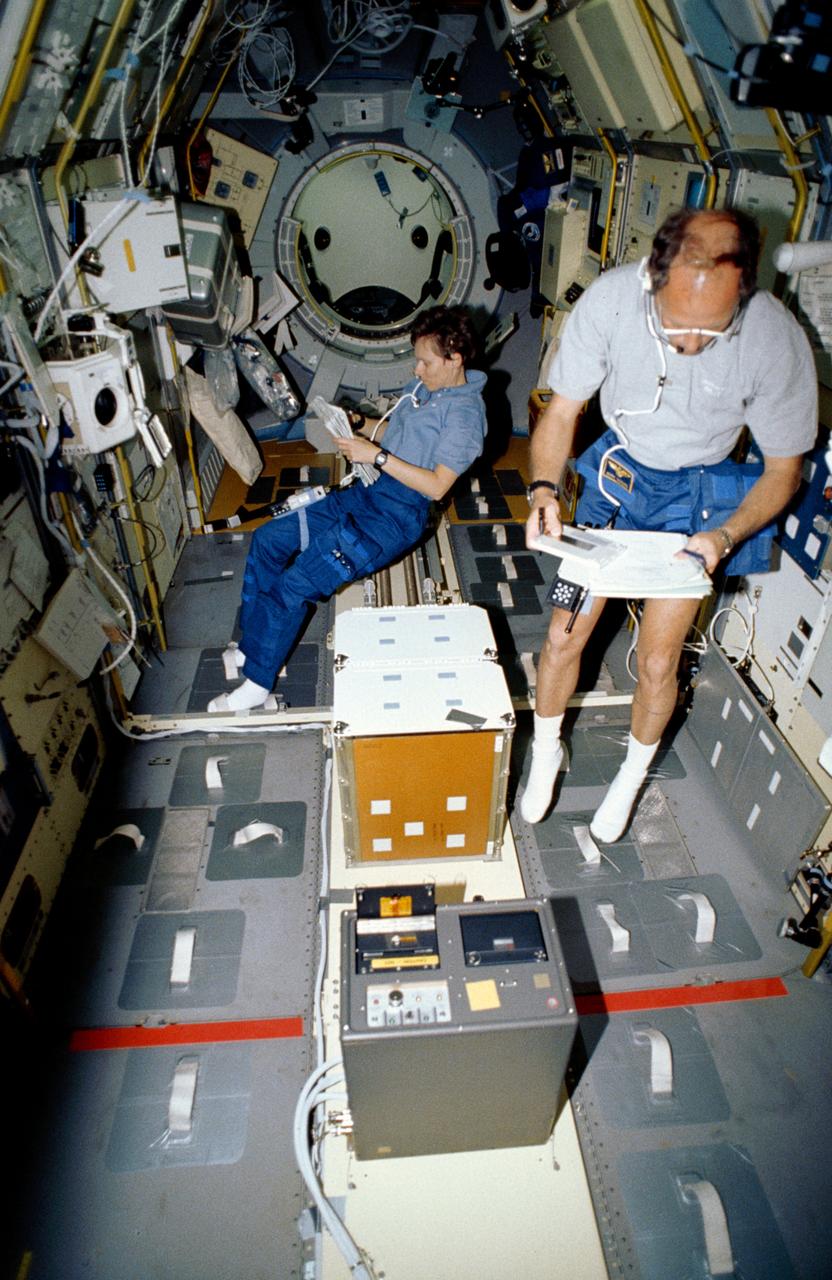
STS042-11-016 (30 Jan 1992) --- Astronaut Norman E. Thagard, STS-42 missions specialist and payload commander, and payload specialist Roberta L. Bondar are busily engaged with experiments in the International Microgravity Laboratory 1 (IML-1) Spacelab module. Bondar reads a checklist near the Rack 5 Biorack and glovebox while Thagard performs a VCR tape change-out. The Space Acceleration Measurement System (SAMS) (foreground) and shuttle middeck lockers are secured in IML-1's center aisle. In the background the open hatch and Spacelab tunnel interior are visible. Crewmembers enter and exit the IML-1 module via the Spacelab tunnel which connects to Discovery's, Orbiter Vehicle (OV) 103's, airlock.
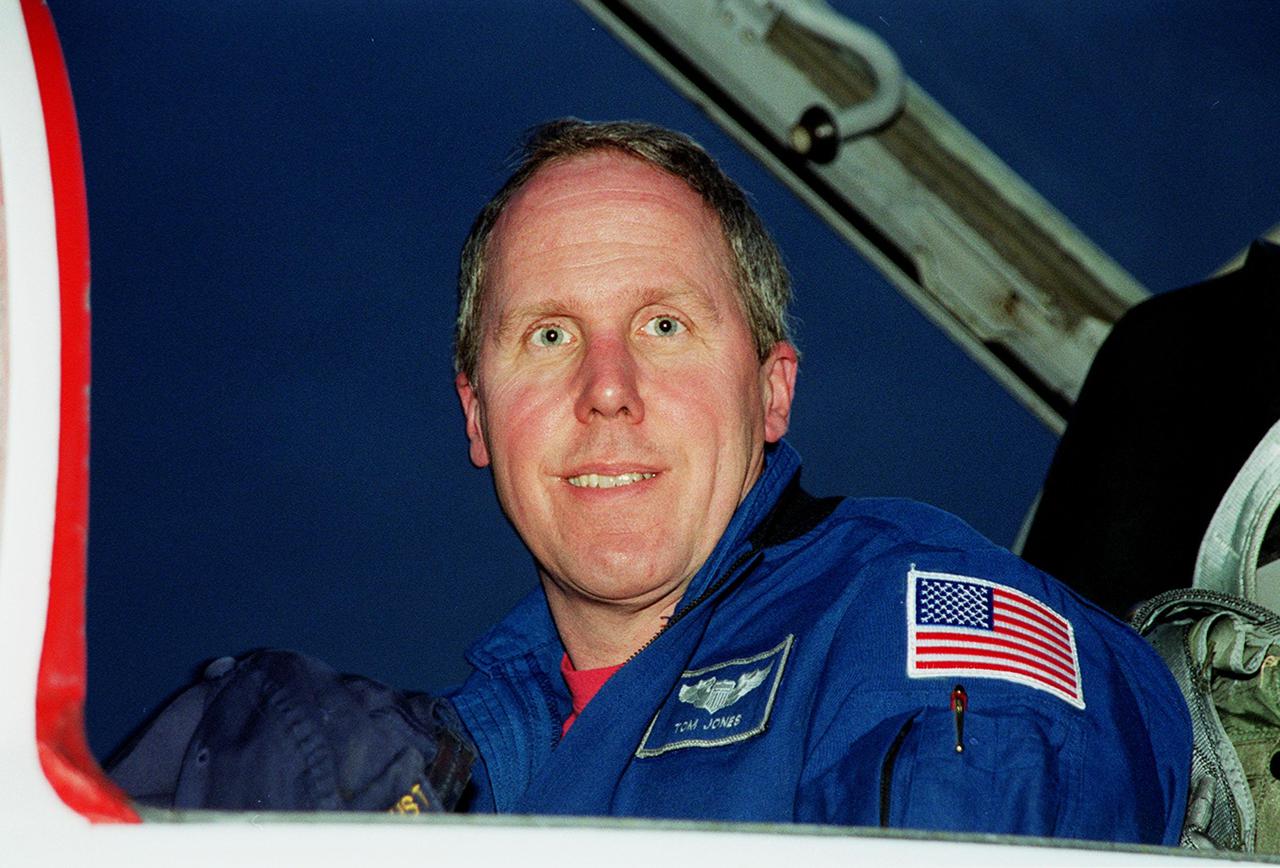
STS-98 Mission Specialist Thomas Jones happily arrives at KSC’s Shuttle Landing Facility for Terminal Countdown Test Activities. In preparation for the Jan. 19 launch, he and the rest of the crew Commander Ken Cockrell, Pilot Mark Polansky and Mission Specialists Robert Curbeam and Marsha Ivins will be training in emergency procedures from the pad, checking the payload and taking part in a simulated countdown. The payload for the mission is the U.S. Lab Destiny, a key element in the construction of the International Space Station. The lab has five system racks already installed inside the module. After delivery of electronics in the lab, electrically powered attitude control for Control Moment Gyroscopes will be activated. STS-98 is the seventh construction flight to the ISS.<br
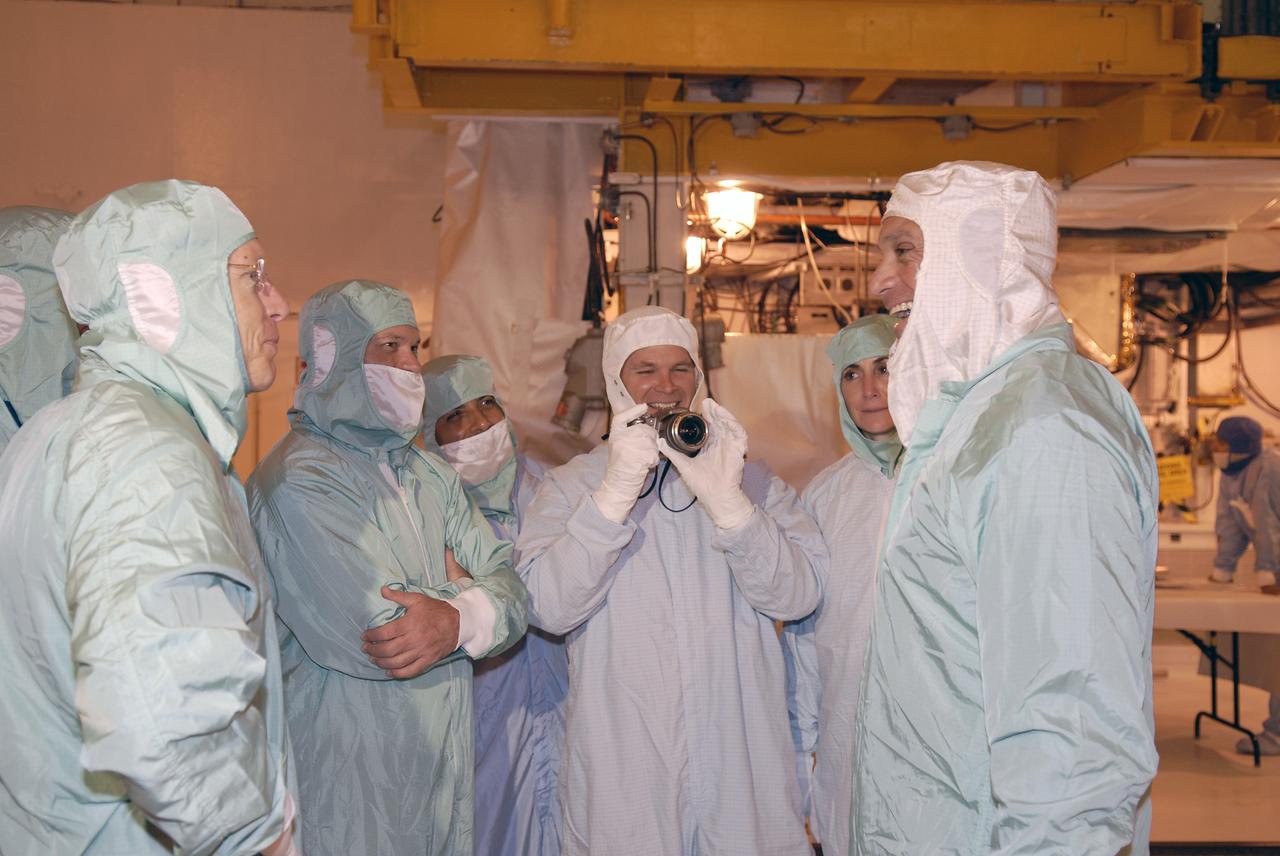
CAPE CANAVERAL, Fla. – In In the Payload Changeout Room on NASA Kennedy Space Center's Launch Pad 39A, STS-128 crew members relax after looking over the payloads to be installed in space shuttle Discovery. At left is Mission Specialist Patrick Forrester; at center is Pilot Kevin Ford; at right are Mission Specialists Nicole Stott and Danny Olivas. The crew is at Kennedy to take part in the terminal countdown demonstration test, or TCDT, which includes equipment familiarization, emergency exit training and a simulated countdown. On the STS-128 mission, Discovery will deliver 33,000 pounds of equipment to the station, including science and storage racks, a freezer to store research samples, a new sleeping compartment and the COLBERT treadmill. Launch is targeted for late August. Photo credit: NASA/Kim Shiflett
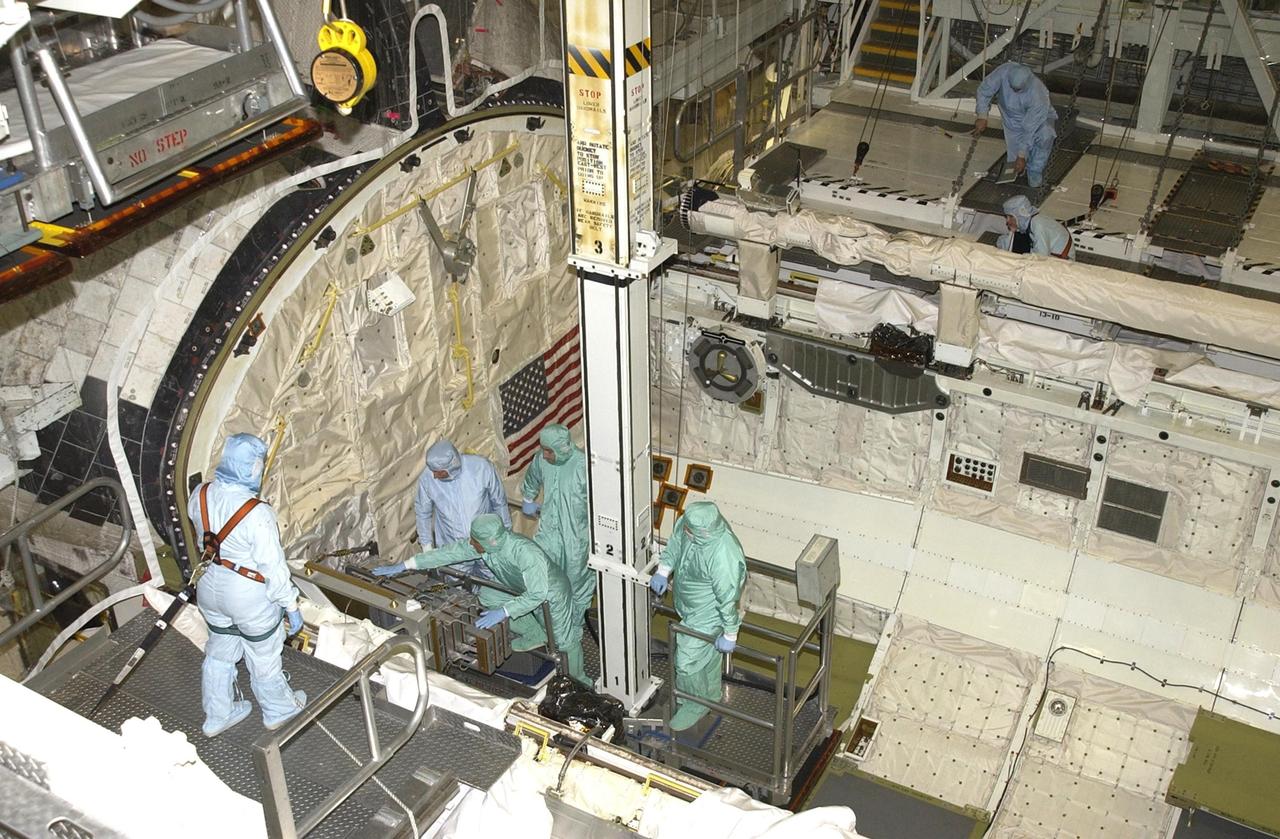
KENNEDY SPACE CENTER, FLA. -- Members of the STS-111 crew (dressed in green) look over equipment in the payload bay of Endeavour. The crew comprises Commander Kenneth Cockrell, Pilot Paul Lockhart and Mission Specialists Franklin Chang-Diaz and Phillipe Perrin, who is with the French Space Agency (CNES). The crew is taking part in a Crew Equipment Interface Test in preparation for launch. Mission STS-111 will carry to the International Space Station the Multipurpose Logistics Module (MPLM), filled with experiment racks and three stowage and resupply racks, and the Mobile Base System (MBS), which will attach to the Mobile Transporter and complete the Canadian Mobile Servicing System, or MSS. The Station's mechanical arm will then have the capability to "inchworm" from the U.S. Lab to the MSS and travel along the truss to work sites on the Station. Launch of Endeavour on mission STS-111 is scheduled for May 30, 2002
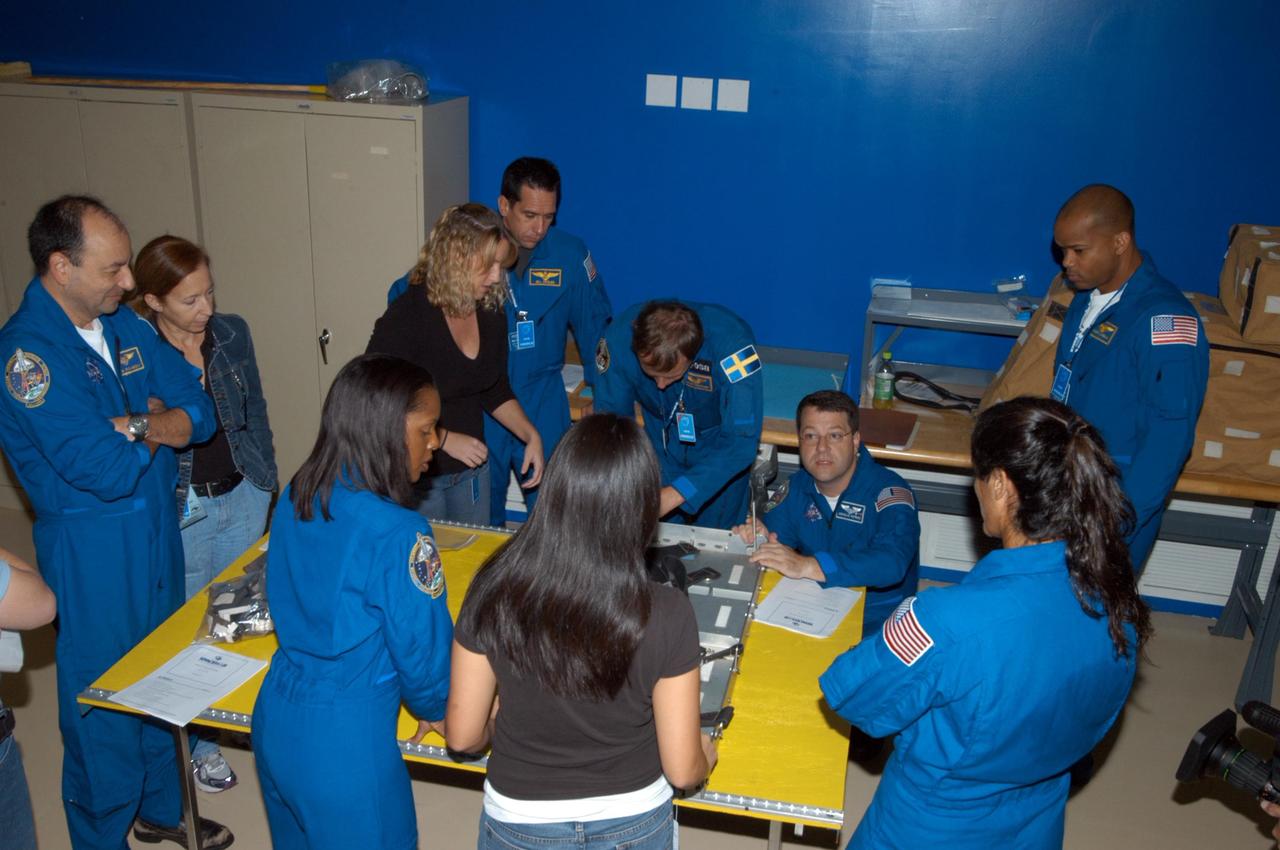
KENNEDY SPACE CENTER, FLA. - Members of the STS-116 crew examine components of the mission payload at SPACEHAB in Cape Canaveral, Fla. From left (in their blue uniforms) around the table are Commander Mark Polansky and Mission Specialists Joan Higginbotham, Christer Fuglesang, Nicholas Patrick, Sunita Williams and Robert Curbeam. In the background is Pilot William Oefelein. The Swedish Fuglesang represents the European Space Agency. They are practicing techniques for removing and replacing the rack front stowage trays used inside the SPACEHAB module. Mission crews make frequent trips to the Space Coast to become familiar with the equipment and payloads they will be using. STS-116 will be mission number 20 to the International Space Station and construction flight 12A.1. The mission payload is the SPACEHAB module, the P5 integrated truss structure and other key components. Launch is scheduled for no earlier than Dec. 7. Photo credit: NASA/George Shelton
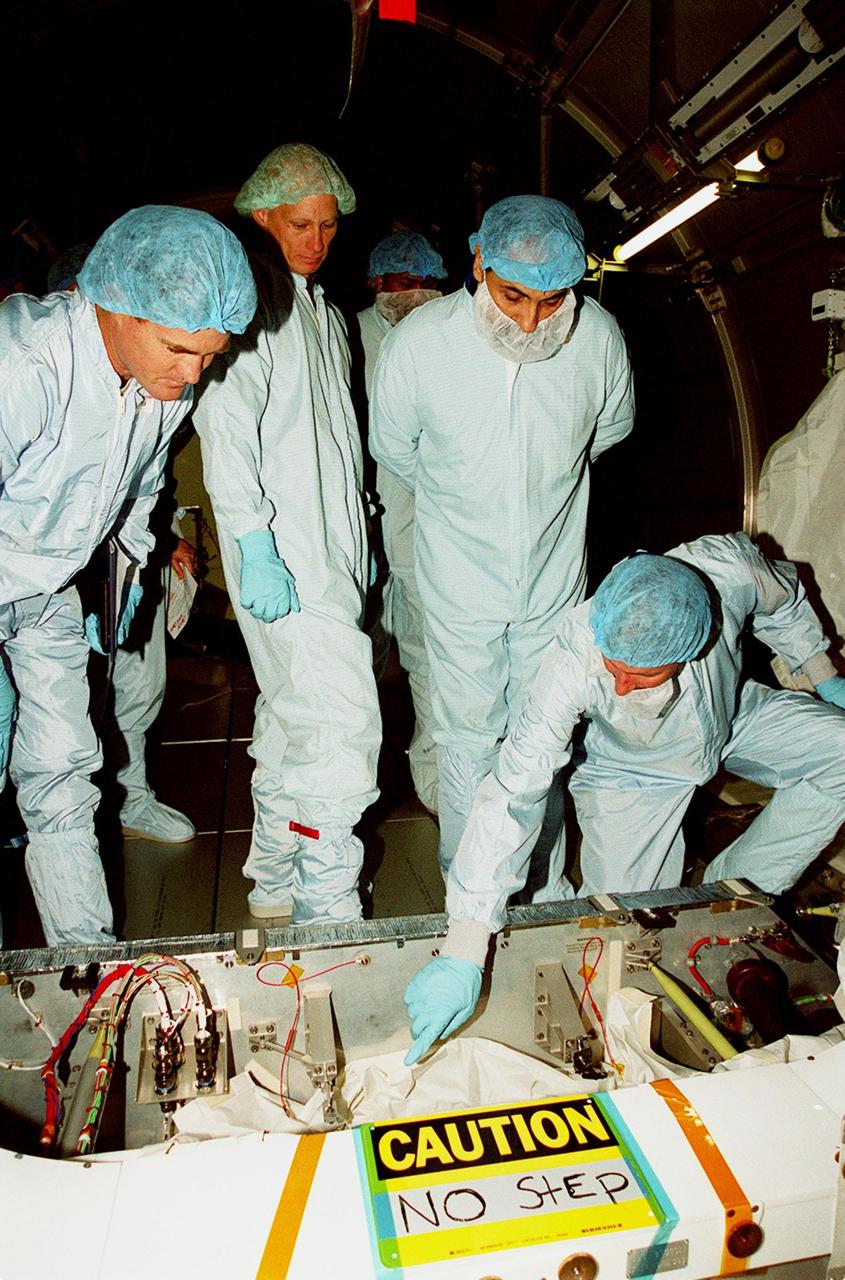
With workers at left looking on, STS-100 crew members check out equipment inside the Multi-Purpose Logistics Module Raffaello, located in the Space Station Processing Facility. At right is Commander Kent Rominger; to his left in the photo is Mission Specialist Umberto Guidoni, with the European Space Agency. Mission STS-100, scheduled to launch April 19, 2001, will include Raffaello as well as the Space Station Remote Manipulator System (SSRMS) as its payload. MPLMs are pressurized modules that will serve as the International Space Station's “moving vans,” carrying laboratory racks filled with equipment, experiments and supplies to and from the station aboard the Space Shuttle. The SSRMS is the primary means of transferring payloads between the orbiter payload bay and the International Space Station for assembly
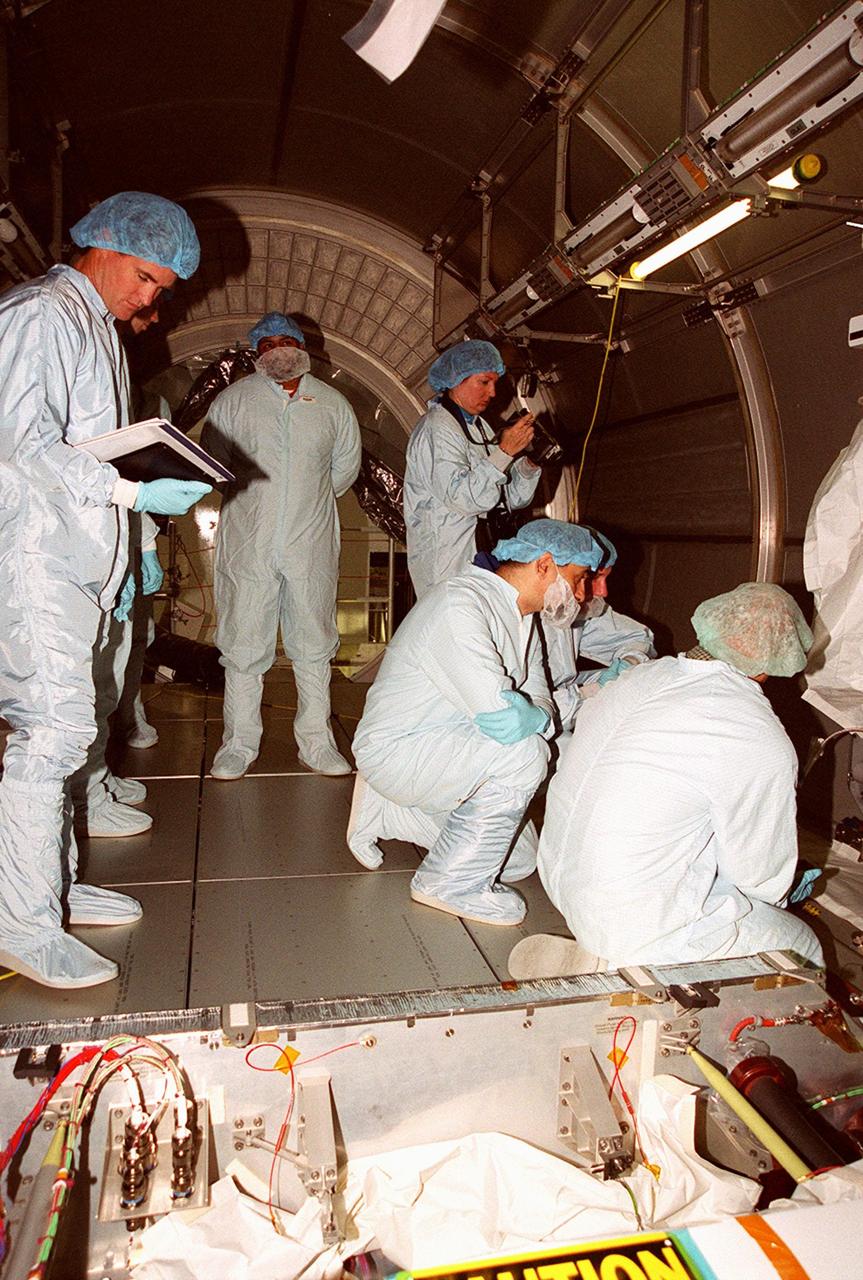
With workers looking on, STS-100 crew members check out equipment inside the Multi-Purpose Logistics Module Raffaello, located in the Space Station Processing Facility. Standing at center is Mission Specialist Umberto Guidoni, with the European Space Agency. Kneeling at right is Commander Kent Rominger. Mission STS-100, scheduled to launch April 19, 2001, will include Raffaello as well as the Space Station Remote Manipulator System (SSRMS) as its payload. MPLMs are pressurized modules that will serve as the International Space Station's “moving vans,” carrying laboratory racks filled with equipment, experiments and supplies to and from the station aboard the Space Shuttle. The SSRMS is the primary means of transferring payloads between the orbiter payload bay and the International Space Station for assembly
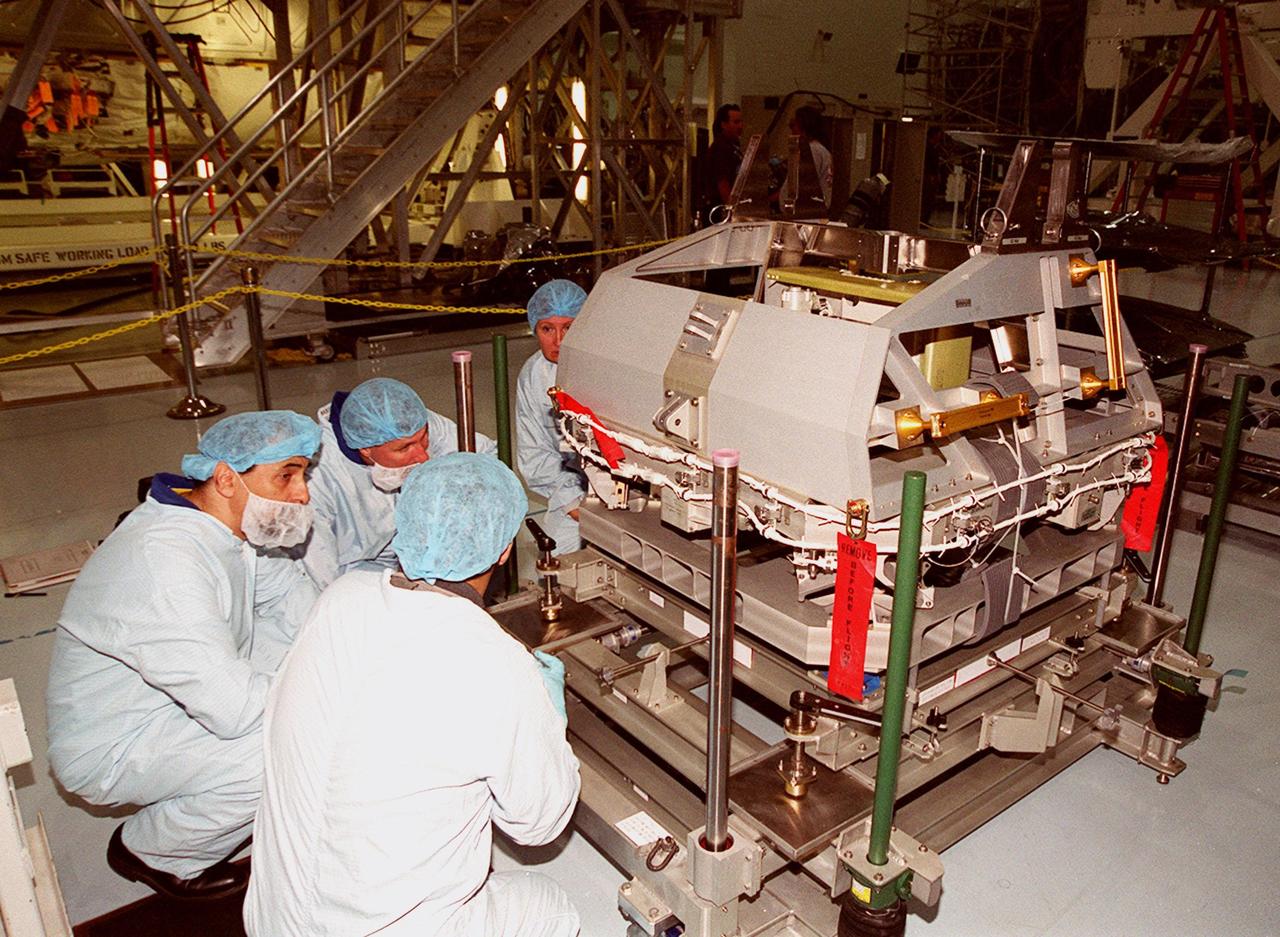
In the Space Station Processing Facility, STS-100 Mission Specialist Umberto Guidoni (left) and Commander Kent Rominger (center back), along with two workers, take a close look at equipment on the floor. Guidoni is with the European Space Agency. Mission STS-100, scheduled to launch April 19, 2001, will include the Multi-Purpose Logistics Module (MPLM) Raffaello and the Space Station Remote Manipulator System (SSRMS) as its payload. MPLMs are pressurized modules that will serve as the International Space Station's “moving vans,” carrying laboratory racks filled with equipment, experiments and supplies to and from the station aboard the Space Shuttle. The SSRMS is the primary means of transferring payloads between the orbiter payload bay and the International Space Station for assembly
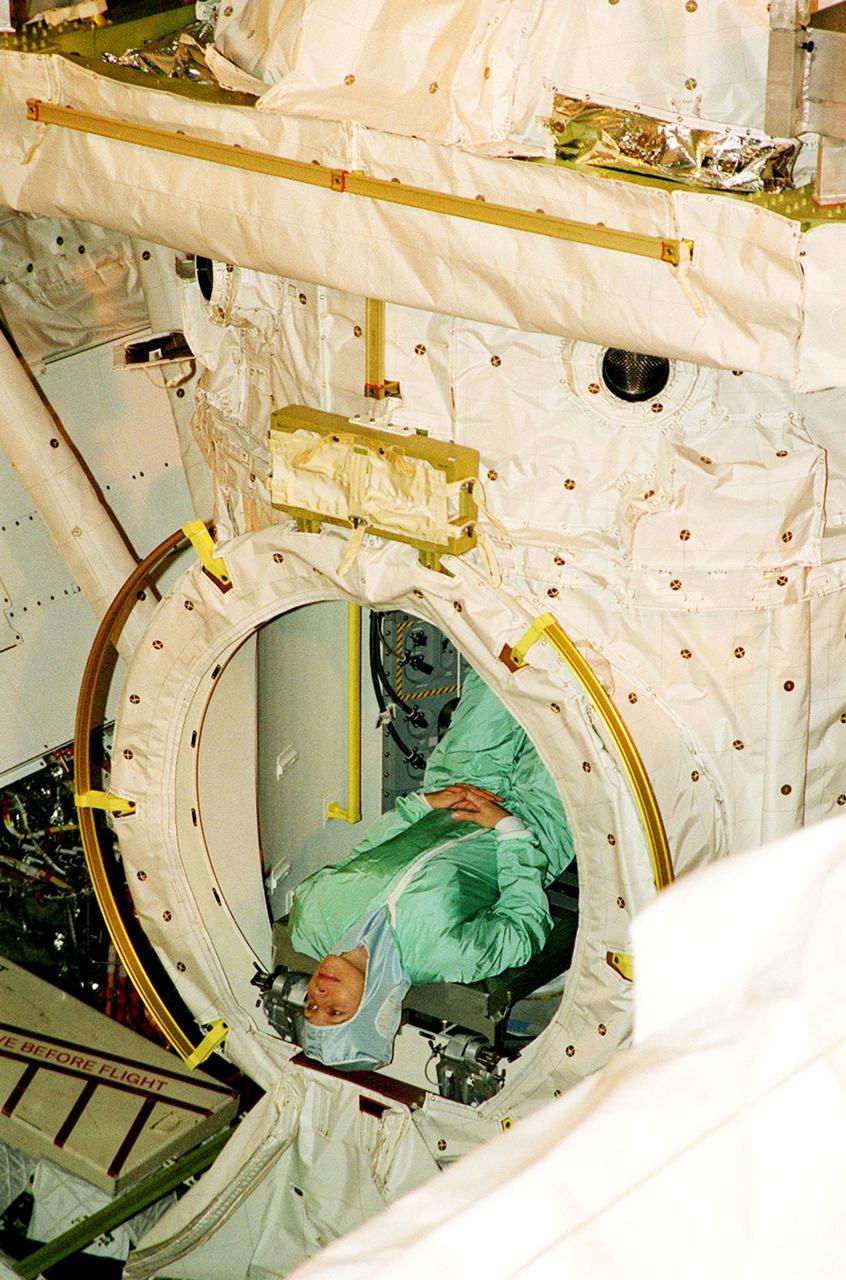
KENNEDY SPACE CENTER, FLA. -- STS-98 Mission Specialist Marsha Ivins takes a topsy-turvy look at the EVA hatch in the Orbiter Docking System, which is already installed in the payload bay of orbiter Atlantis. She and the rest of the crew are at KSC for Crew Equipment Interface Test activities. Launch on mission STS-98 is scheduled for Jan. 18, 2001. It will be transporting the U.S. Lab, Destiny, to the International Space Station with five system racks already installed inside of the module. After delivery of electronics in the lab, electrically powered attitude control for Control Moment Gyroscopes will be activated
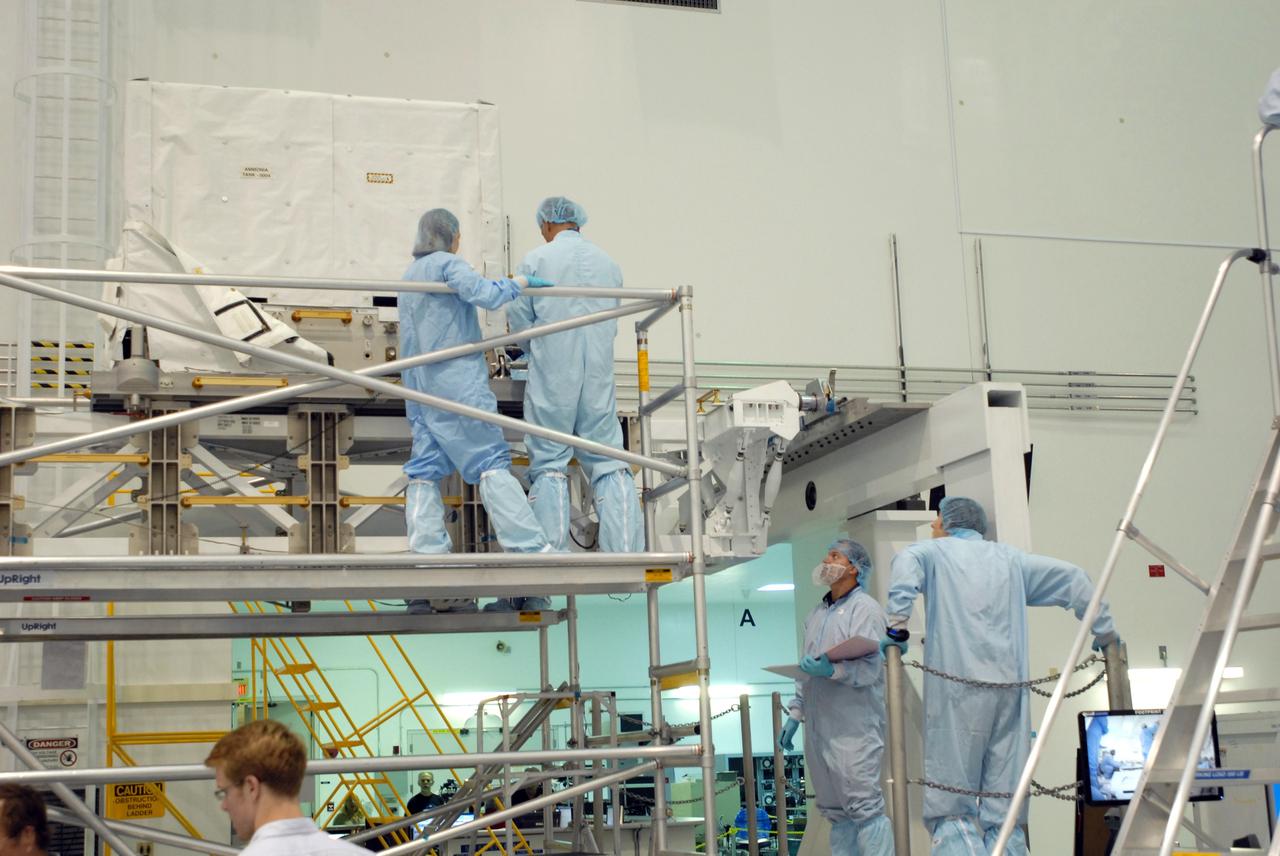
CAPE CANAVERAL, Fla. – In the Space Station Processing Facility at NASA's Kennedy Space Center in Florida, STS-128 Mission Specialists John "Danny" Olivas (top right) and Christer Fugelsang (bottom right) inspect ammonia tanks, part of the payload for their mission. Members of the STS-128 crew are at Kennedy for a crew equipment interface test, or CEIT, which provides hands-on training and observation of shuttle and flight hardware. The STS-128 flight will carry science and storage racks to the International Space Station on space shuttle Discovery. The STS-128 mission is targeted to launch on Aug. 6. Photo credit: NASA/Jim Grossmann
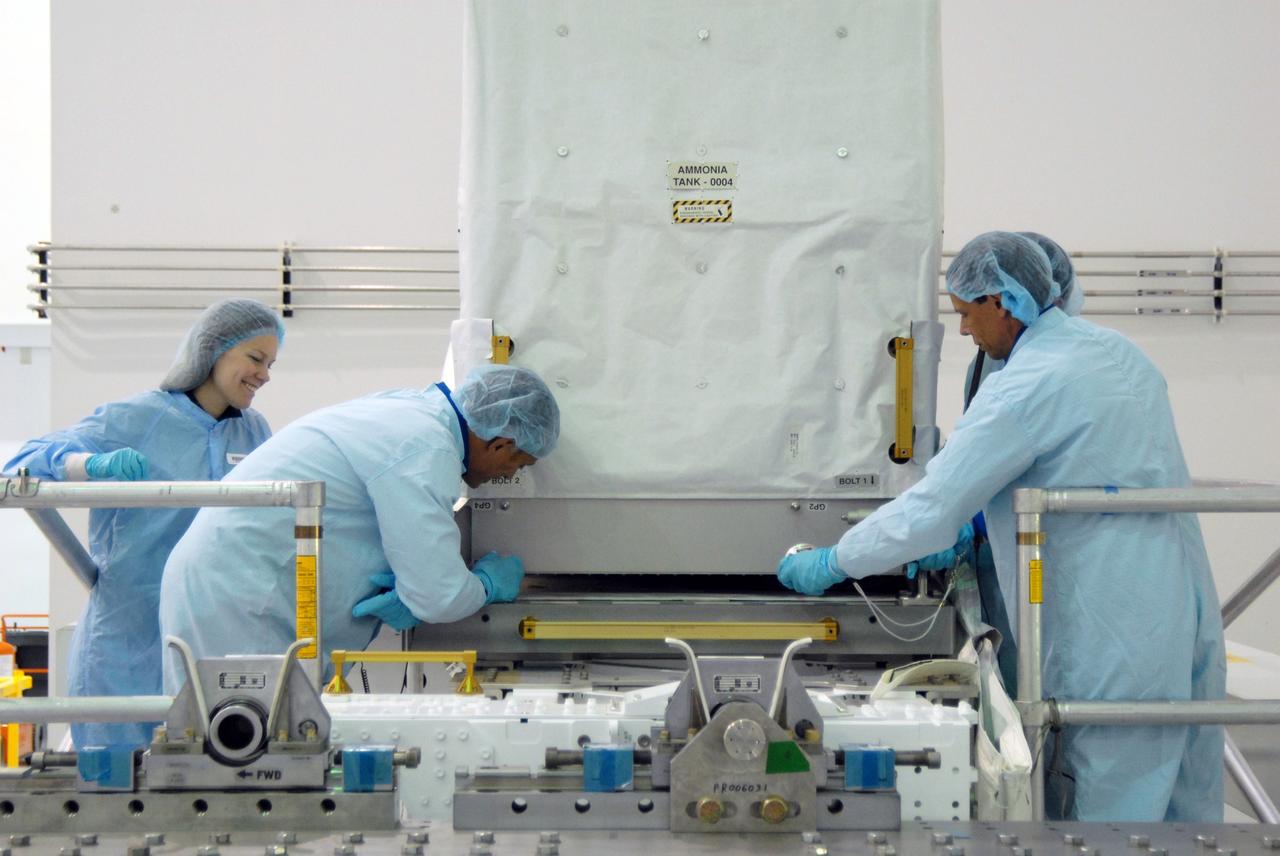
CAPE CANAVERAL, Fla. – In the Space Station Processing Facility at NASA's Kennedy Space Center in Florida, STS-128 Mission Specialists John "Danny" Olivas (second from left) and Christer Fugelsang (right) inspect ammonia tanks, part of the payload for their mission. Fugelsang is with the European Space Agency. Members of the STS-128 crew are at Kennedy for a crew equipment interface test, or CEIT, which provides hands-on training and observation of shuttle and flight hardware. The STS-128 flight will carry science and storage racks to the International Space Station on space shuttle Discovery. The STS-128 mission is targeted to launch on Aug. 6. Photo credit: NASA/Jim Grossmann
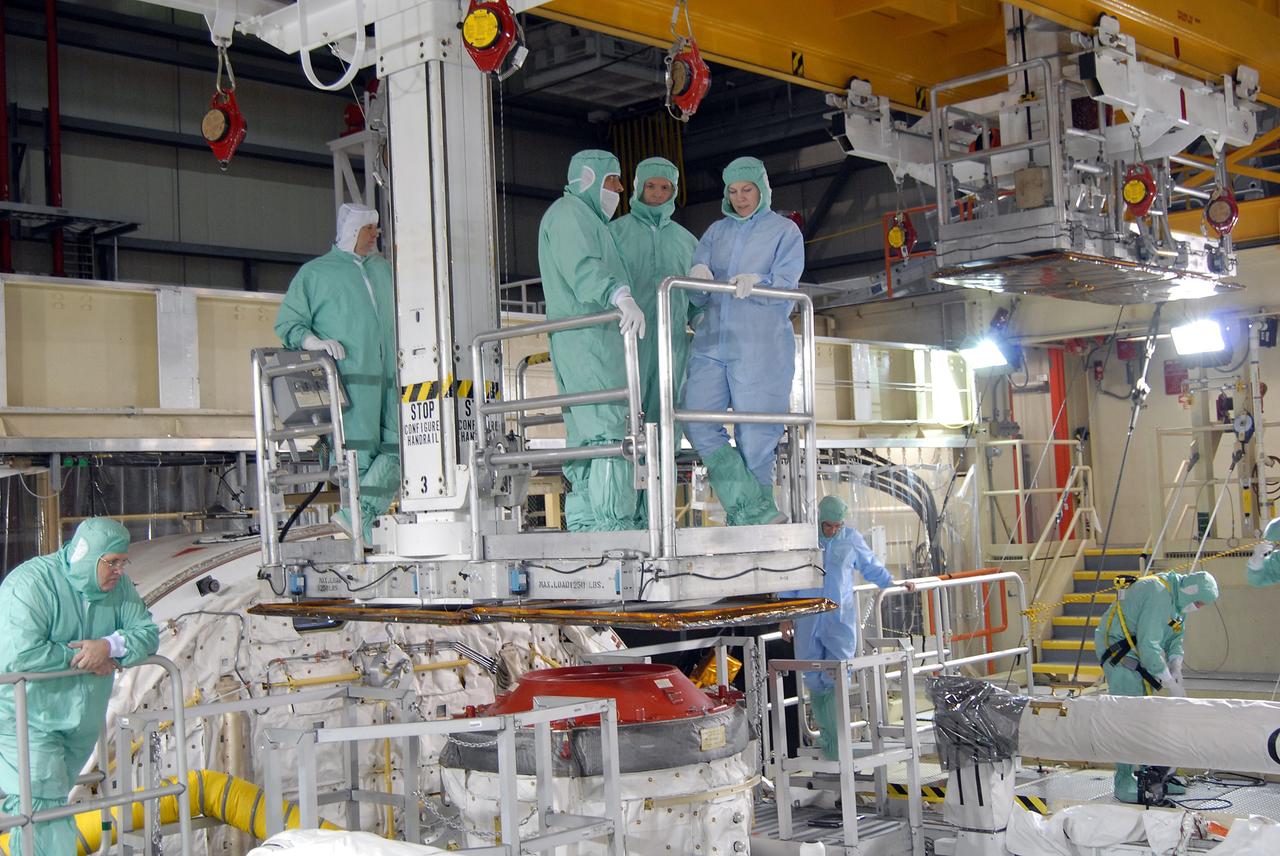
CAPE CANAVERAL, Fla. – In Orbiter Processing Facility 3 at NASA's Kennedy Space Center in Florida, STS-128 crew members are lowered into space shuttle Discovery's payload bay to check equipment. At left is Mission Specialist Jose Hernandez; at center is Commander Rick Sturckow. The crew is at Kennedy for a crew equipment interface test, or CEIT, which provides hands-on training and observation of shuttle and flight hardware. The STS-128 flight will carry science and storage racks to the International Space Station on Discovery. Launch is targeted for Aug. 7. Photo credit: NASA/Jim Grossmann
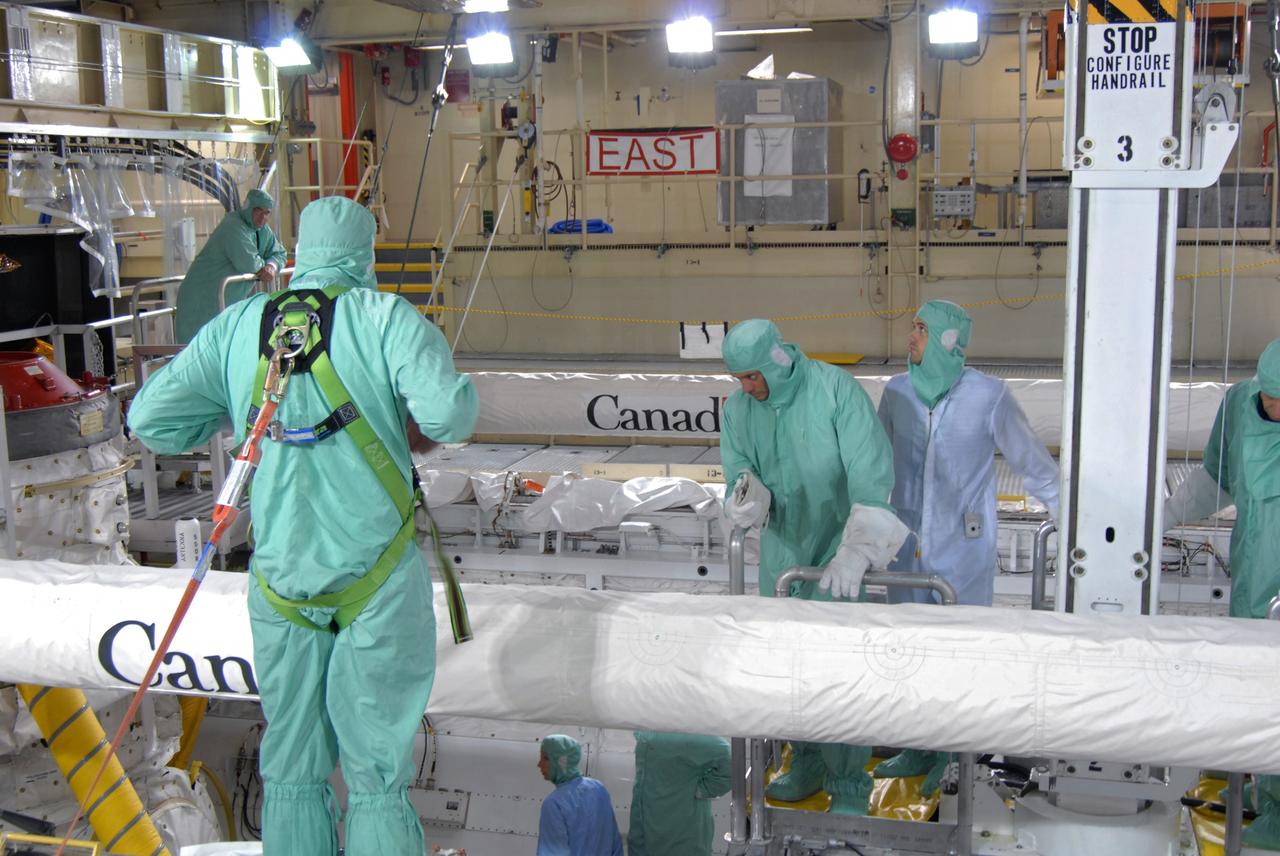
CAPE CANAVERAL, Fla. – TIn Orbiter Processing Facility 3 at NASA's Kennedy Space Center in Florida, STS-128 crew members are lowered into space shuttle Discovery's payload bay to check equipment. At center is Mission Specialist John "Danny" Olivas. The crew is at Kennedy for a crew equipment interface test, or CEIT, which provides hands-on training and observation of shuttle and flight hardware. The STS-128 flight will carry science and storage racks to the International Space Station on Discovery. Launch is targeted for Aug. 7. Photo credit: NASA/Jim Grossmann

CAPE CANAVERAL, Fla. – In Orbiter Processing Facility 3 at NASA's Kennedy Space Center in Florida, STS-128 crew members are lowered into space shuttle Discovery's payload bay. Being lowered are, at left, Mission Specialist Patrick Forester and, at right, Pilot Kevin Ford. The crew is at Kennedy for a crew equipment interface test, or CEIT, which provides hands-on training and observation of shuttle and flight hardware. The STS-128 flight will carry science and storage racks to the International Space Station on Discovery. Launch is targeted for Aug. 7. Photo credit: NASA/Jim Grossmann
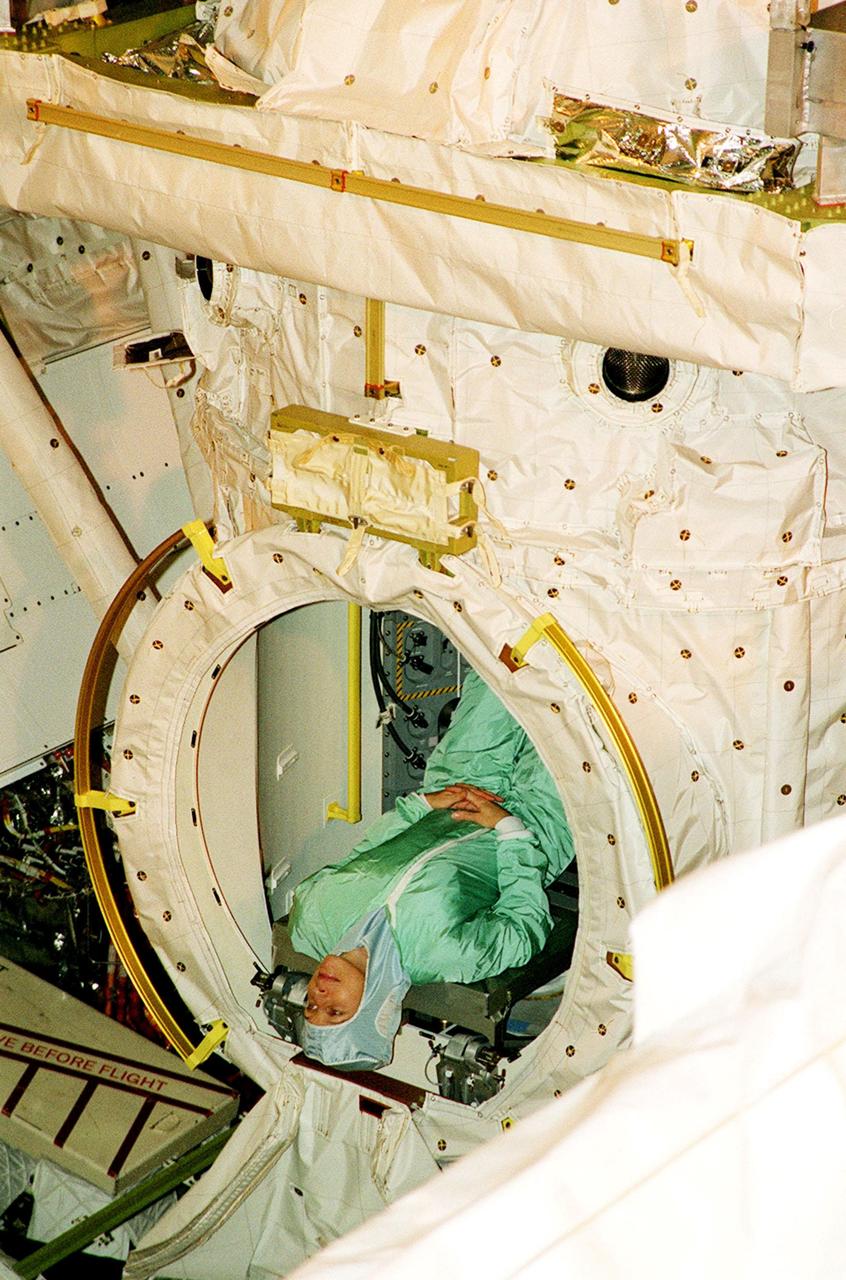
KENNEDY SPACE CENTER, FLA. -- STS-98 Mission Specialist Marsha Ivins takes a topsy-turvy look at the EVA hatch in the Orbiter Docking System, which is already installed in the payload bay of orbiter Atlantis. She and the rest of the crew are at KSC for Crew Equipment Interface Test activities. Launch on mission STS-98 is scheduled for Jan. 18, 2001. It will be transporting the U.S. Lab, Destiny, to the International Space Station with five system racks already installed inside of the module. After delivery of electronics in the lab, electrically powered attitude control for Control Moment Gyroscopes will be activated
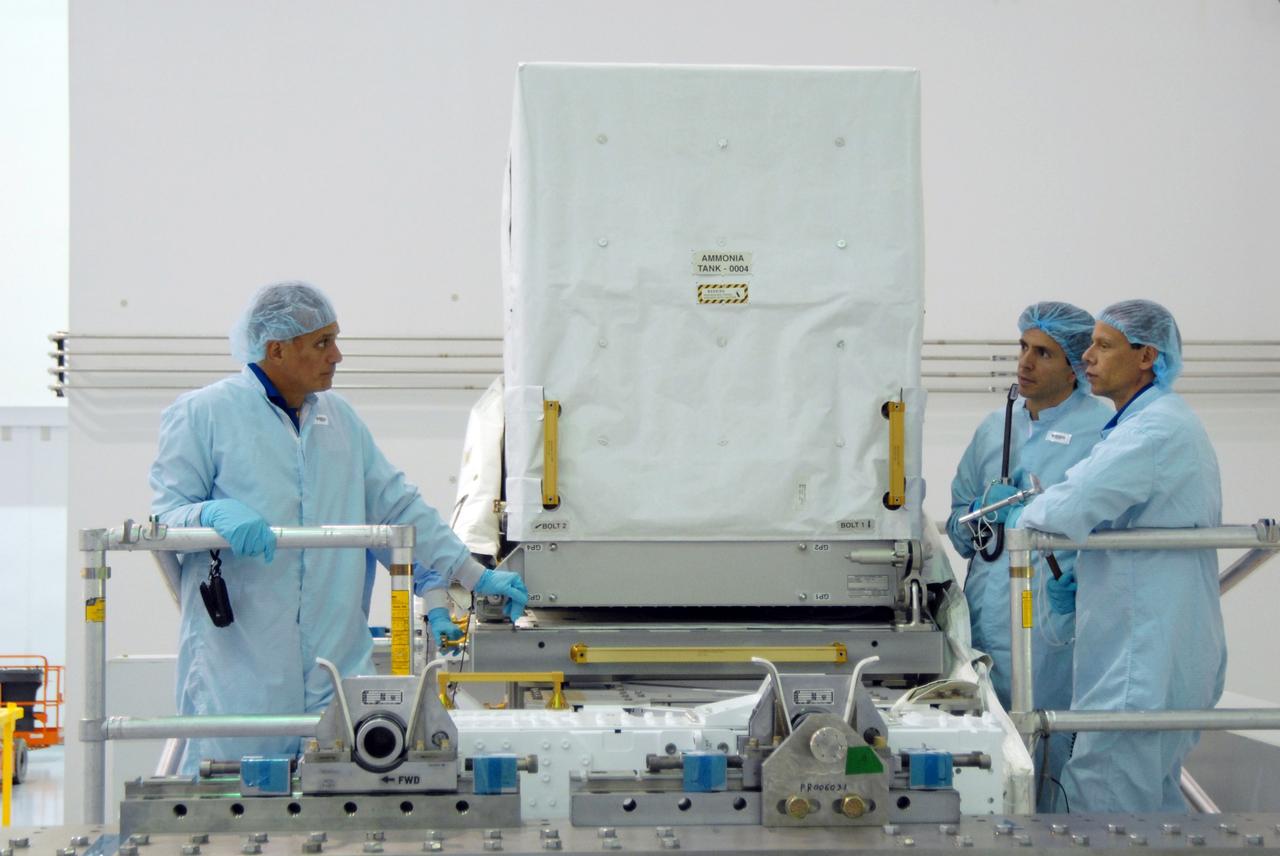
CAPE CANAVERAL, Fla. – In the Space Station Processing Facility at NASA's Kennedy Space Center in Florida, STS-128 Mission Specialists John "Danny" Olivas (left) and Christer Fugelsang (far right) inspect ammonia tanks, part of the payload for their mission. Fugelsang is with the European Space Agency. Members of the STS-128 crew are at Kennedy for a crew equipment interface test, or CEIT, which provides hands-on training and observation of shuttle and flight hardware. The STS-128 flight will carry science and storage racks to the International Space Station on space shuttle Discovery. The STS-128 mission is targeted to launch on Aug. 6. Photo credit: NASA/Jim Grossmann
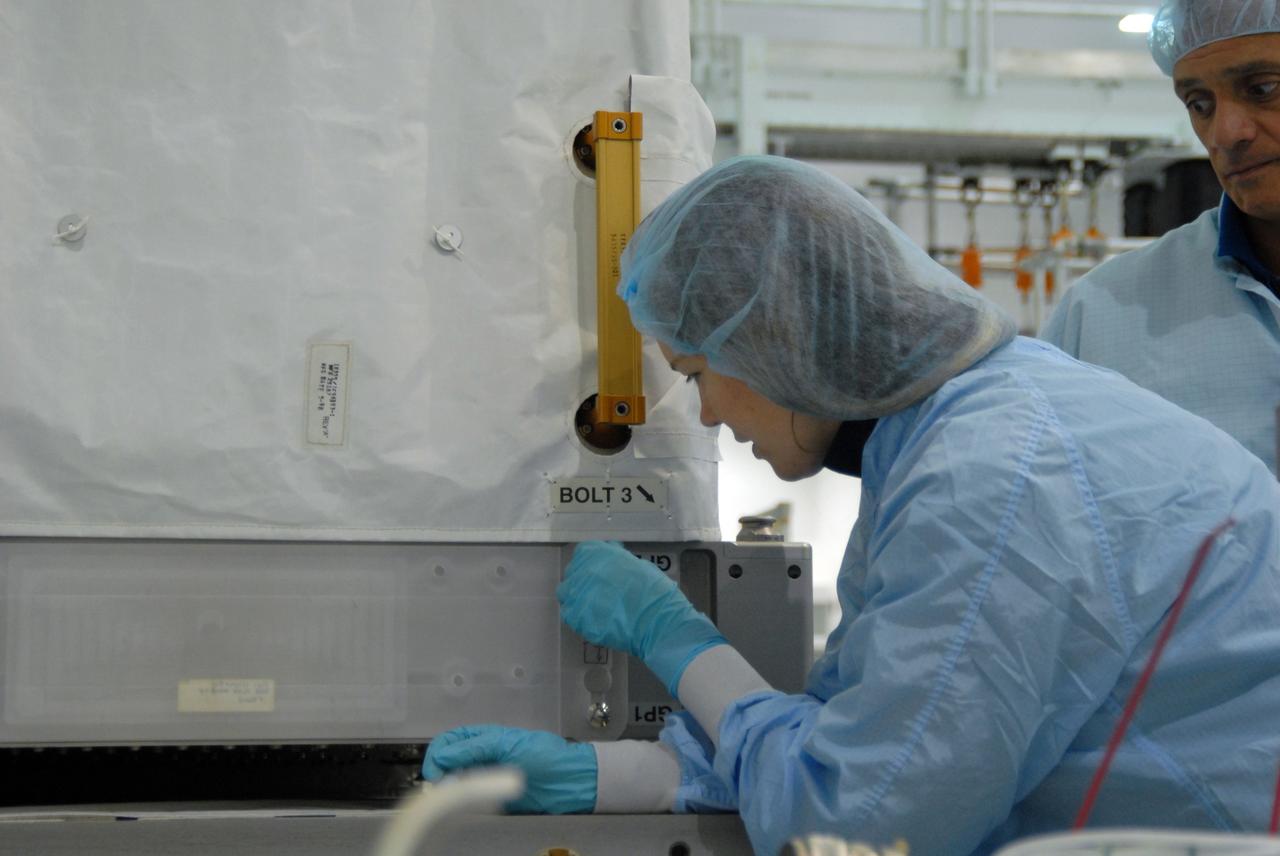
CAPE CANAVERAL, Fla. – In the Space Station Processing Facility at NASA's Kennedy Space Center in Florida, a worker demonstrates an attachment point on ammonia tanks while STS-128 Mission Specialist John "Danny" Olivas (far right) looks on. The tanks are part of the payload for their upcoming STS-128 mission. Members of the STS-128 crew are at Kennedy for a crew equipment interface test, or CEIT, which provides hands-on training and observation of shuttle and flight hardware. The STS-128 flight will carry science and storage racks to the International Space Station on space shuttle Discovery. The STS-128 mission is targeted to launch on Aug. 6. Photo credit: NASA/Jim Grossmann
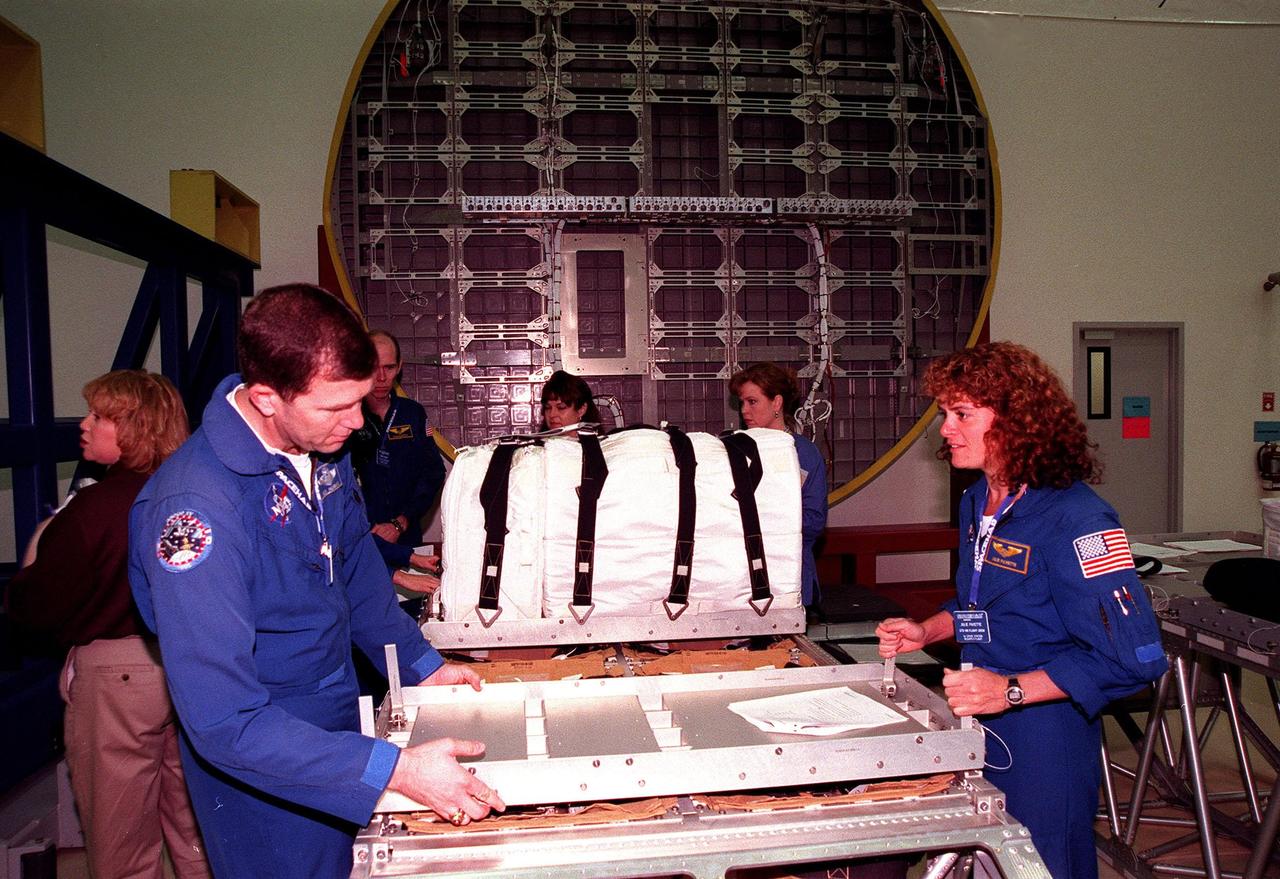
KENNEDY SPACE CENTER, FLA. -- In the SPACEHAB Facility, STS-96 crew members look over equipment during a payload Interface Verification Test (IVT) for their upcoming mission to the International Space Station. From left are Khristal Parker, with Boeing; Mission Specialist Dan Barry, Pilot Rick Husband, Mission Specialist Tamara Jernigan, and at the far right, Mission Specialist Julie Payette. An unidentified worker is in the background. Also at KSC for the IVT are Commander Kent Rominger and Mission Specialists Ellen Ochoa and Valery Tokarev of Russia. Mission STS-96 carries the SPACEHAB Logistics Double Module, which will have equipment to further outfit the International Space Station service module and equipment that can be off-loaded from the early U.S. assembly flights. It carries internal logistics and resupply cargo for station outfitting, plus an external Russian cargo crane to be mounted to the exterior of the Russian station segment and used to perform space walking maintenance activities. The double module stowage provides capacity of up to 10,000 lbs. with the ability to accommodate powered payloads, four external rooftop stowage locations, four double-rack locations (two powered), up to 61 bulkhead-mounted middeck locker locations, and floor storage for large unique items and Soft Stowage. STS-96 is targeted to launch May 20 about 9:32 a.m
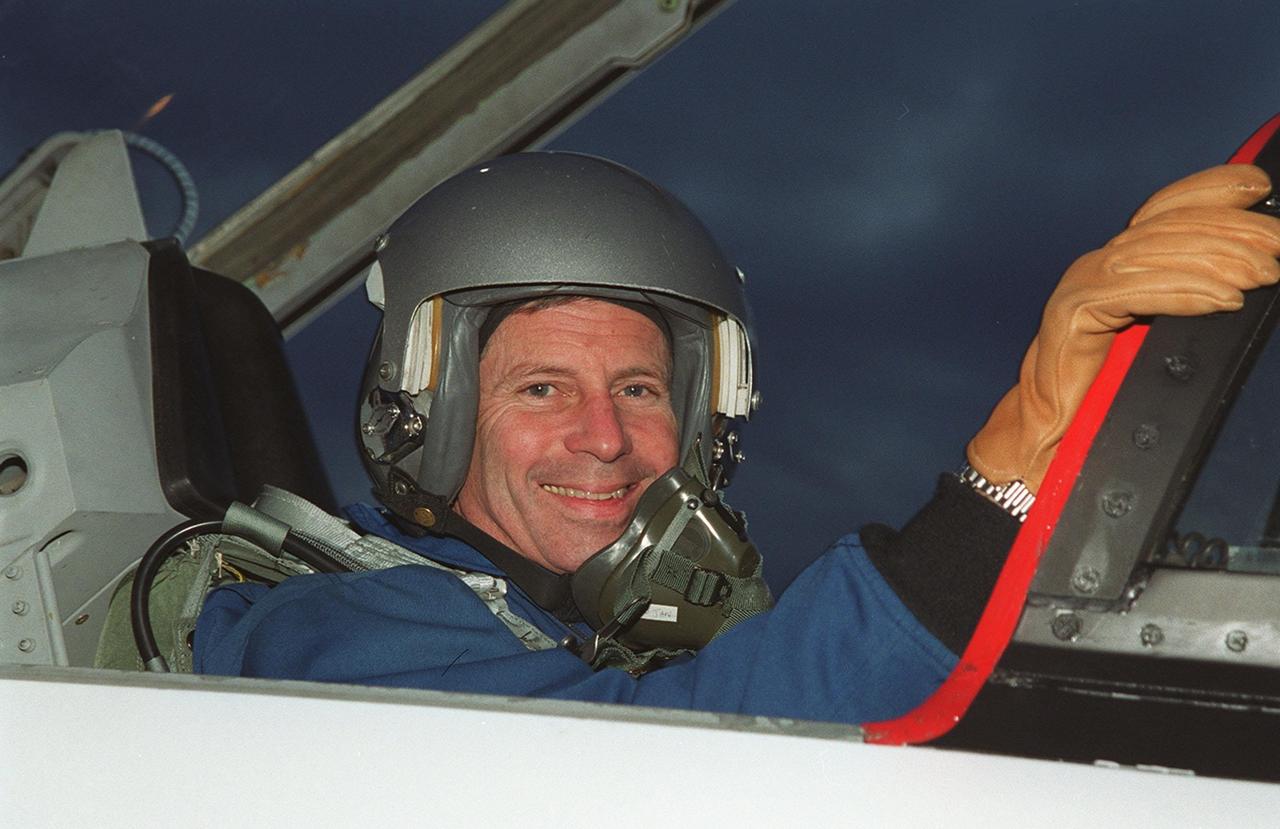
STS-98 Mission Commander shows his pleasure at arriving at KSC’s Shuttle Landing Facility for Terminal Countdown Test Activities. In preparation for the Jan. 19 launch, he and the rest of the crew Pilot Mark Polansky and Mission Specialists Robert Curbeam, Thomas Jones and Marsha Ivins will be training in emergency procedures from the pad, checking the payload and taking part in a simulated countdown. The payload for the mission is the U.S. Lab Destiny, a key element in the construction of the International Space Station. The lab has five system racks already installed inside the module. After delivery of electronics in the lab, electrically powered attitude control for Control Moment Gyroscopes will be activated. STS-98 is the seventh construction flight to the ISS.<br
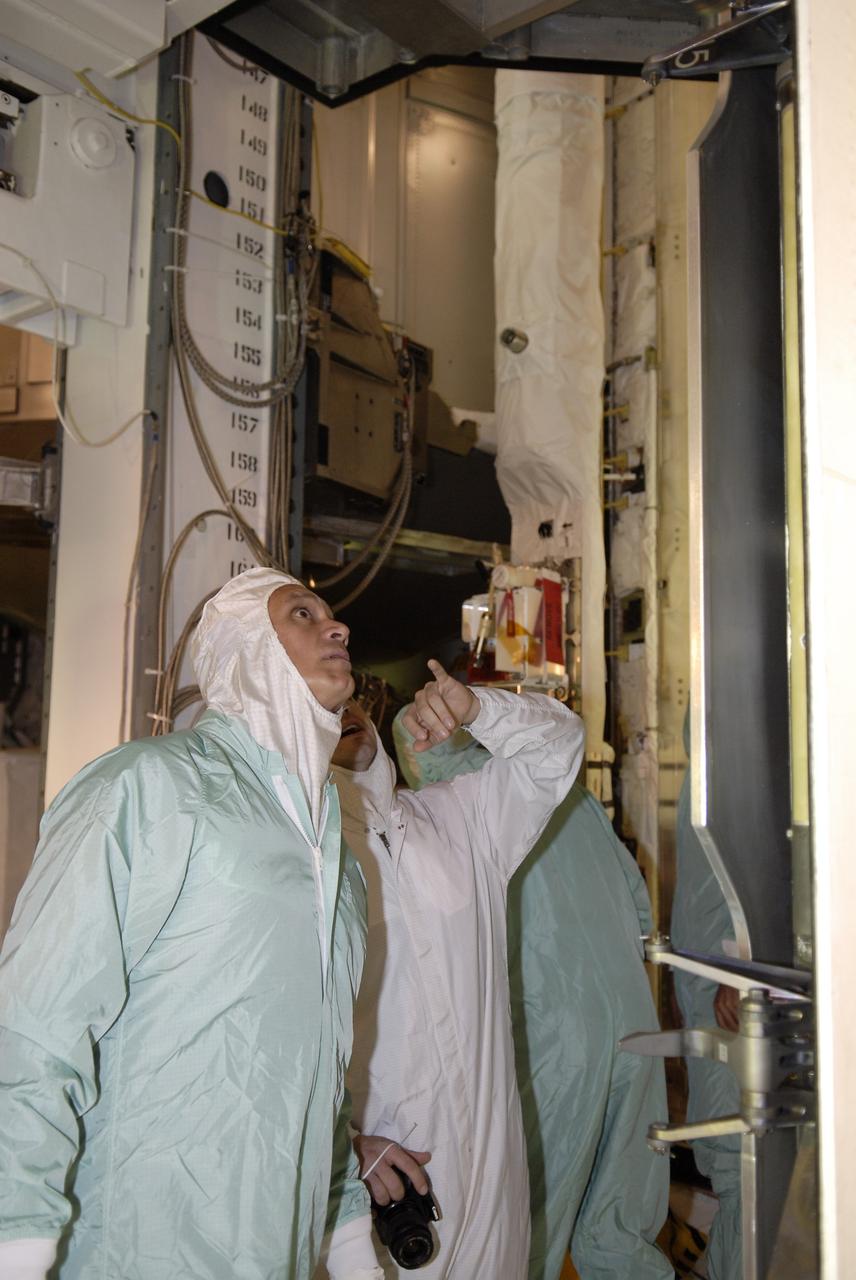
CAPE CANAVERAL, Fla. – – In the Payload Changeout Room on NASA Kennedy Space Center's Launch Pad 39A, STS-128 crew members take a close look at the payloads to be installed in space shuttle Discovery. Seen here are Mission Specialist Danny Olivas and Pilot Kevin Ford (behind him). The crew is at Kennedy to take part in the terminal countdown demonstration test, or TCDT, which includes equipment familiarization, emergency exit training and a simulated countdown. On the STS-128 mission, Discovery will deliver 33,000 pounds of equipment to the station, including science and storage racks, a freezer to store research samples, a new sleeping compartment and the COLBERT treadmill. Launch is targeted for late August. Photo credit: NASA/Kim Shiflett
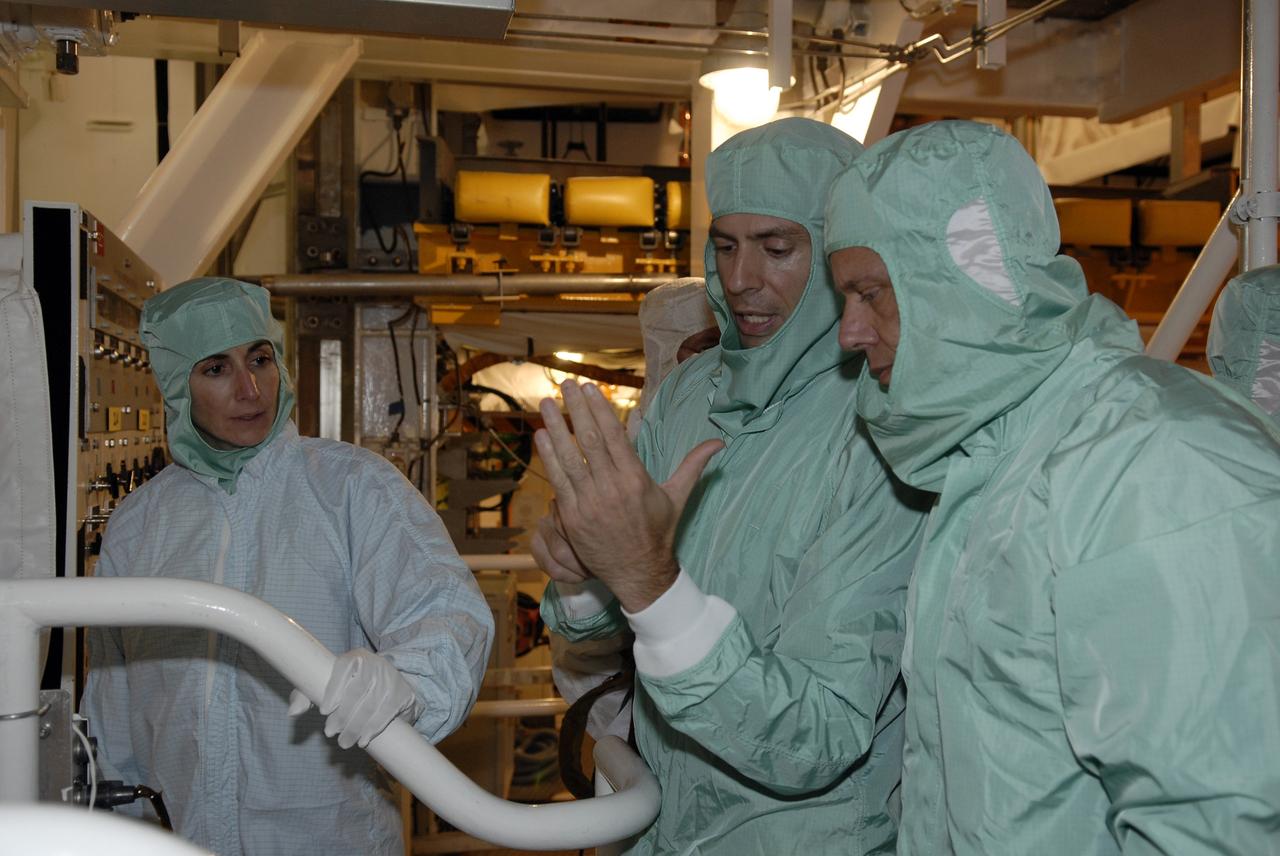
CAPE CANAVERAL, Fla. – In the Payload Changeout Room on NASA Kennedy Space Center's Launch Pad 39A, STS-128 crew members take a close look at the payloads to be installed in space shuttle Discovery. Seen here are Mission Specialists Nicole Stott (left) and Christer Fuglesang (right). The crew is at Kennedy to take part in the terminal countdown demonstration test, or TCDT, which includes equipment familiarization, emergency exit training and a simulated countdown. On the STS-128 mission, Discovery will deliver 33,000 pounds of equipment to the station, including science and storage racks, a freezer to store research samples, a new sleeping compartment and the COLBERT treadmill. Launch is targeted for late August. Photo credit: NASA/Kim Shiflett
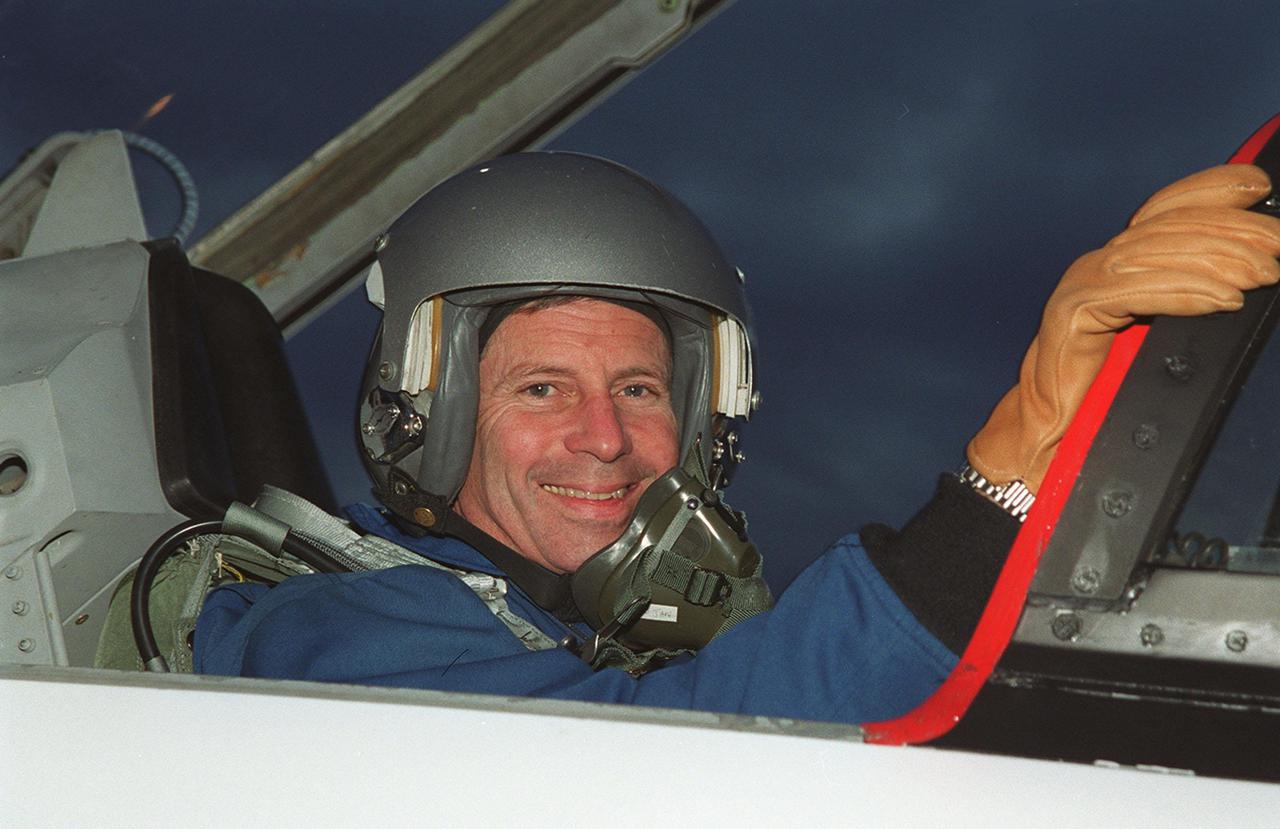
STS-98 Mission Commander shows his pleasure at arriving at KSC’s Shuttle Landing Facility for Terminal Countdown Test Activities. In preparation for the Jan. 19 launch, he and the rest of the crew Pilot Mark Polansky and Mission Specialists Robert Curbeam, Thomas Jones and Marsha Ivins will be training in emergency procedures from the pad, checking the payload and taking part in a simulated countdown. The payload for the mission is the U.S. Lab Destiny, a key element in the construction of the International Space Station. The lab has five system racks already installed inside the module. After delivery of electronics in the lab, electrically powered attitude control for Control Moment Gyroscopes will be activated. STS-98 is the seventh construction flight to the ISS.<br
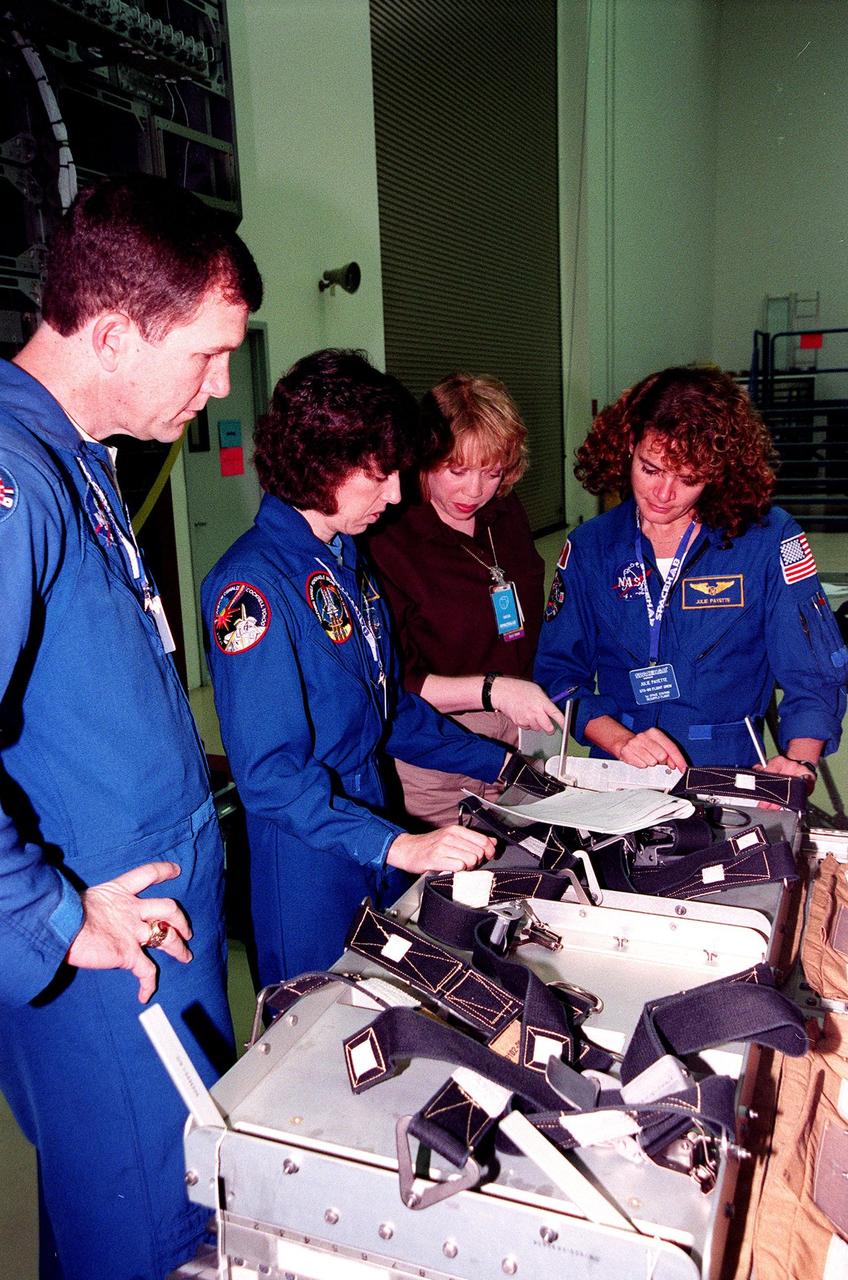
KENNEDY SPACE CENTER, FLA. -- During a payload Interface Verification Test (IVT) in the SPACEHAB Facility, STS-96 Pilot Rick Husband and Mission Specialist Ellen Ochoa (on the left) and Mission Specialist Julie Payette (on the far right) listen to Khristal Parker (second from right), with Boeing, explain about the equipment in front of them. Other crew members at KSC for the IVT are Commander Kent Rominger and Mission Specialists Tamara Jernigan, Dan Barry and Valery Tokarev of Russia. The SSU is part of the cargo on Mission STS-96, which carries the SPACEHAB Logistics Double Module, with equipment to further outfit the International Space Station service module and equipment that can be off-loaded from the early U.S. assembly flights. The SPACEHAB carries internal logistics and resupply cargo for station outfitting, plus an external Russian cargo crane to be mounted to the exterior of the Russian station segment and used to perform space walking maintenance activities. The double module stowage provides capacity of up to 10,000 lbs. with the ability to accommodate powered payloads, four external rooftop stowage locations, four double-rack locations (two powered), up to 61 bulkhead-mounted middeck locker locations, and floor storage for large unique items and Soft Stowage. STS-96 is targeted to launch May 20 about 9:32 a.m
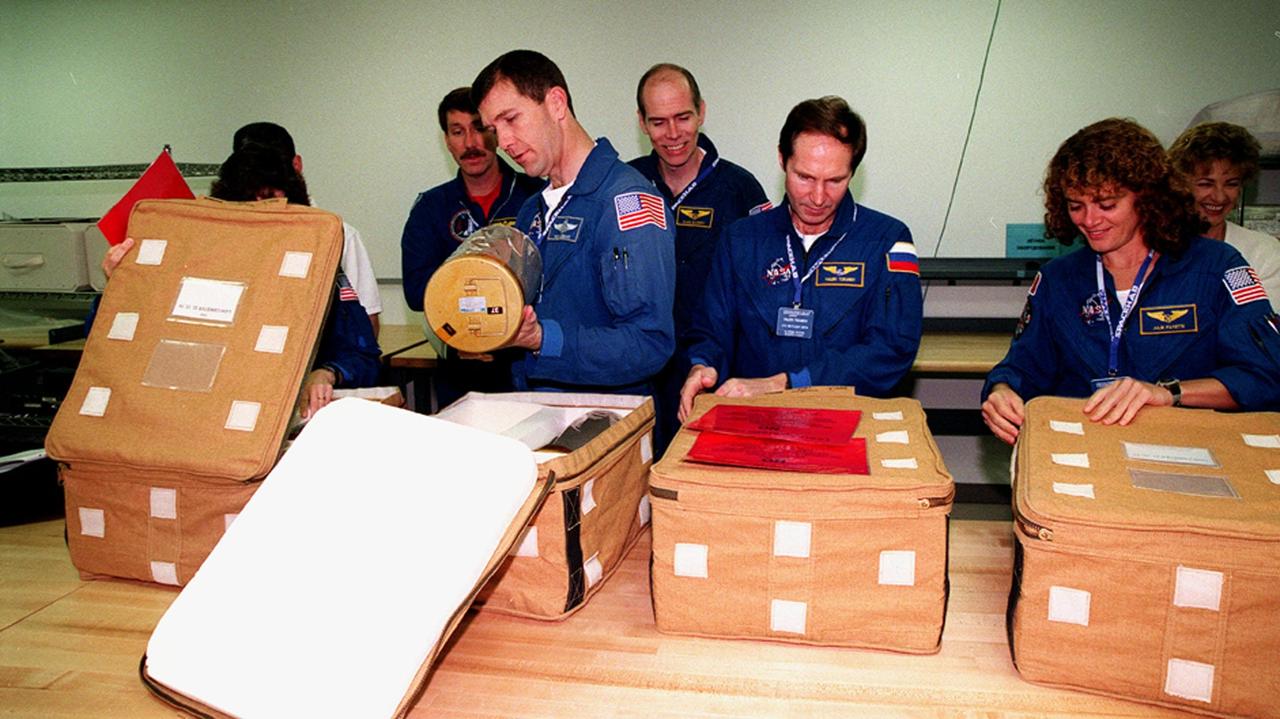
KENNEDY SPACE CENTER, FLA. -- In the SPACEHAB Facility, the STS-96 crew looks at equipment as part of a payload Interface Verification Test (IVT) for their upcoming mission to the International Space Station . From left are Mission Specialist Ellen Ochoa (behind the opened storage cover ), Commander Kent Rominger, Pilot Rick Husband (holding a lithium hydroxide canister) and Mission Specialists Dan Barry, Valery Tokarev of Russia and Julie Payette. In the background is TTI interpreter Valentina Maydell. The other crew member at KSC for the IVT is Mission Specialist Tamara Jernigan. Mission STS-96 carries the SPACEHAB Logistics Double Module, which has equipment to further outfit the International Space Station service module and equipment that can be off-loaded from the early U.S. assembly flights. The SPACEHAB carries internal logistics and resupply cargo for station outfitting, plus an external Russian cargo crane to be mounted to the exterior of the Russian station segment and used to perform space walking maintenance activities. The double module stowage provides capacity of up to 10,000 lbs. with the ability to accommodate powered payloads, four external rooftop stowage locations, four double-rack locations (two powered), up to 61 bulkhead-mounted middeck locker locations, and floor storage for large unique items and Soft Stowage. STS-96 is targeted to launch May 20 about 9:32 a.m

KENNEDY SPACE CENTER, FLA. -- In the SPACEHAB Facility for a payload Interface Verification Test (IVT) for their upcoming mission to the International Space Station are (kneeling) STS-96 Mission Specialists Julie Payette and Ellen Ochoa, Pilot Rick Husband, and (standing at right) Mission Specialist Dan Barry. At the left is James Behling, with Boeing, explaining some of the equipment that will be on board STS-96. Other STS-96 crew members at KSC for the IVT are Commander Kent Rominger and Mission Specialists Tamara Jernigan and Valery Tokarev of Russia. Mission STS-96 carries the SPACEHAB Logistics Double Module, which will have equipment to further outfit the International Space Station service module and equipment that can be off-loaded from the early U.S. assembly flights. It carries internal logistics and resupply cargo for station outfitting, plus an external Russian cargo crane to be mounted to the exterior of the Russian station segment and used to perform space walking maintenance activities. The double module stowage provides capacity of up to 10,000 lbs. with the ability to accommodate powered payloads, four external rooftop stowage locations, four double-rack locations (two powered), up to 61 bulkhead-mounted middeck locker locations, and floor storage for large unique items and Soft Stowage. STS-96 is targeted to launch May 20 about 9:32 a.m
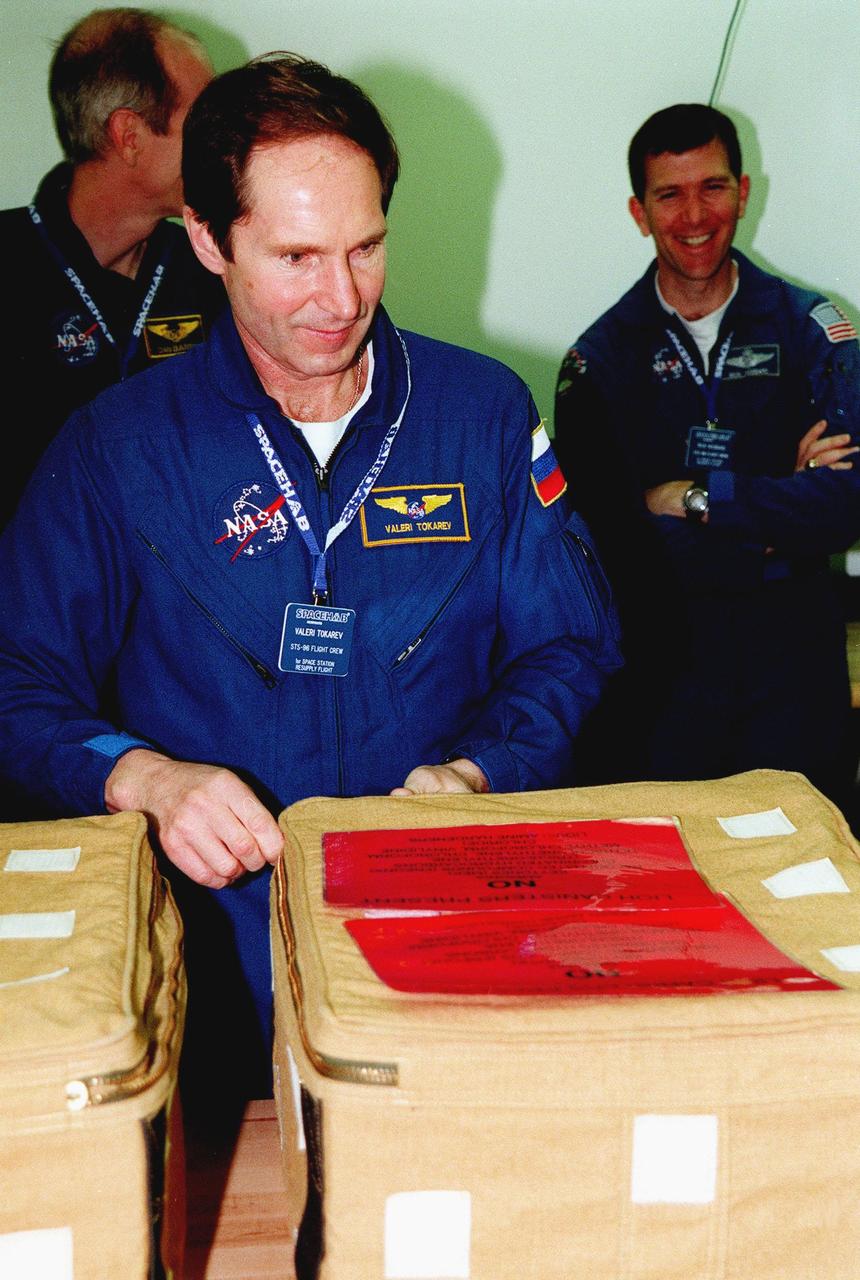
KENNEDY SPACE CENTER, FLA. -- In the SPACEHAB Facility, STS-96 Mission Specialist Valery Tokarev (in foreground) of the Russian Space Agency closes a container, part of the equipment that will be in the SPACEHAB module on mission STS-96. Behind Tokarev are Mission Specialist Dan Barry (left) and Pilot Rick Husband right). Other crew members at KSC for a payload Interface Verification Test for the upcoming mission to the International Space Station are Commander Kent Rominger and Mission Specialists Ellen Ochoa, Tamara Jernigan and Julie Payette. Mission STS-96 carries the SPACEHAB Logistics Double Module, which has equipment to further outfit the International Space Station service module and equipment that can be off-loaded from the early U.S. assembly flights. The SPACEHAB carries internal logistics and resupply cargo for station outfitting, plus an external Russian cargo crane to be mounted to the exterior of the Russian station segment and used to perform space walking maintenance activities. The double module stowage provides capacity of up to 10,000 lbs. with the ability to accommodate powered payloads, four external rooftop stowage locations, four double-rack locations (two powered), up to 61 bulkhead-mounted middeck locker locations, and floor storage for large unique items and Soft Stowage. STS-96 is targeted to launch May 20 about 9:32 a.m