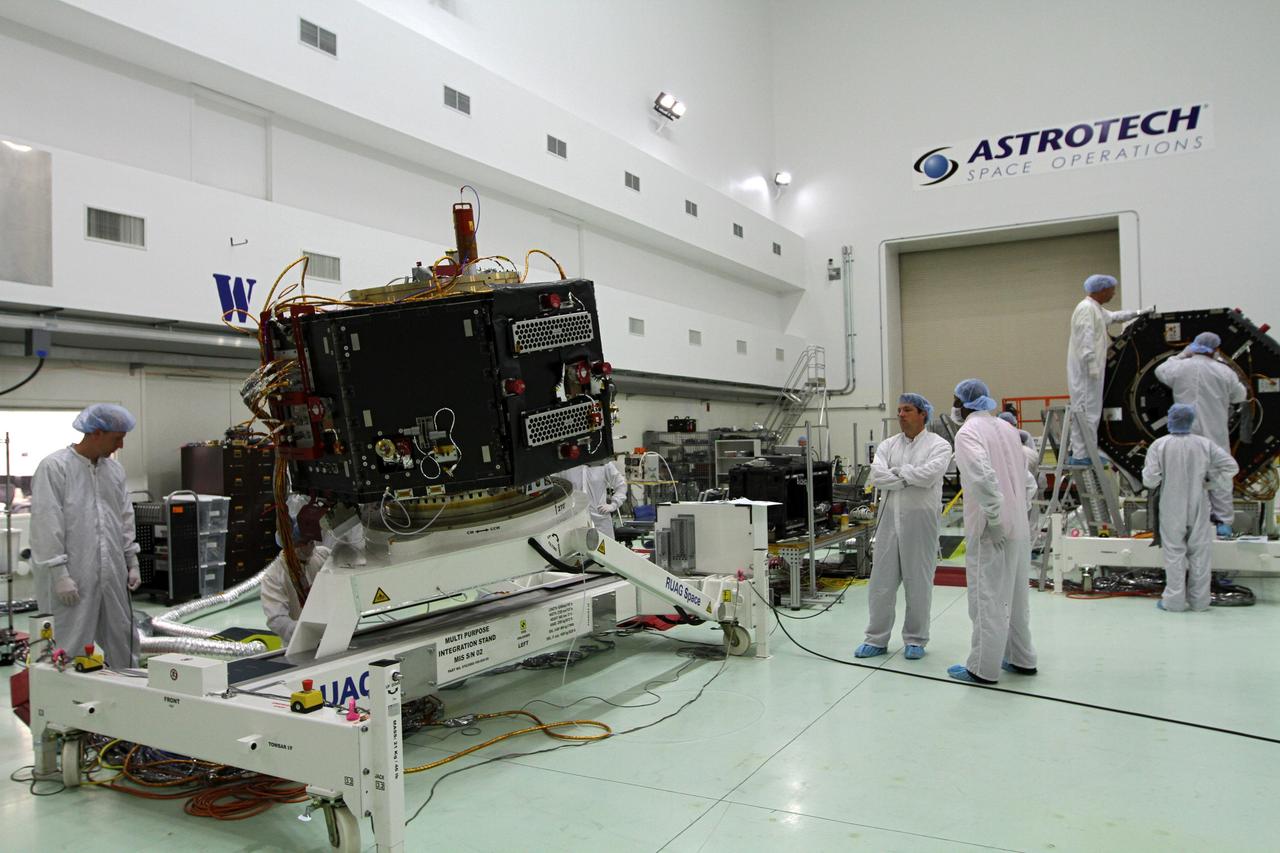
CAPE CANAVERAL, Fla. – Inside the Astrotech payload processing facility near NASA’s Kennedy Space Center in Florida, technicians monitor the progress as the Radiation Belt Storm Probes, or RBSP, spacecraft B is lowered to a horizontal position. The RBSP had been in a vertical position for testing. NASA’s RBSP mission will help us understand the sun’s influence on Earth and near-Earth space by studying the Earth’s radiation belts on various scales of space and time. RBSP will begin its mission of exploration of Earth’s Van Allen radiation belts and the extremes of space weather after its launch aboard a United Launch Alliance Atlas V rocket. Launch is targeted for Aug. 23. For more information, visit http://www.nasa.gov/rbsp. Photo credit: NASA/Kim Shiflett
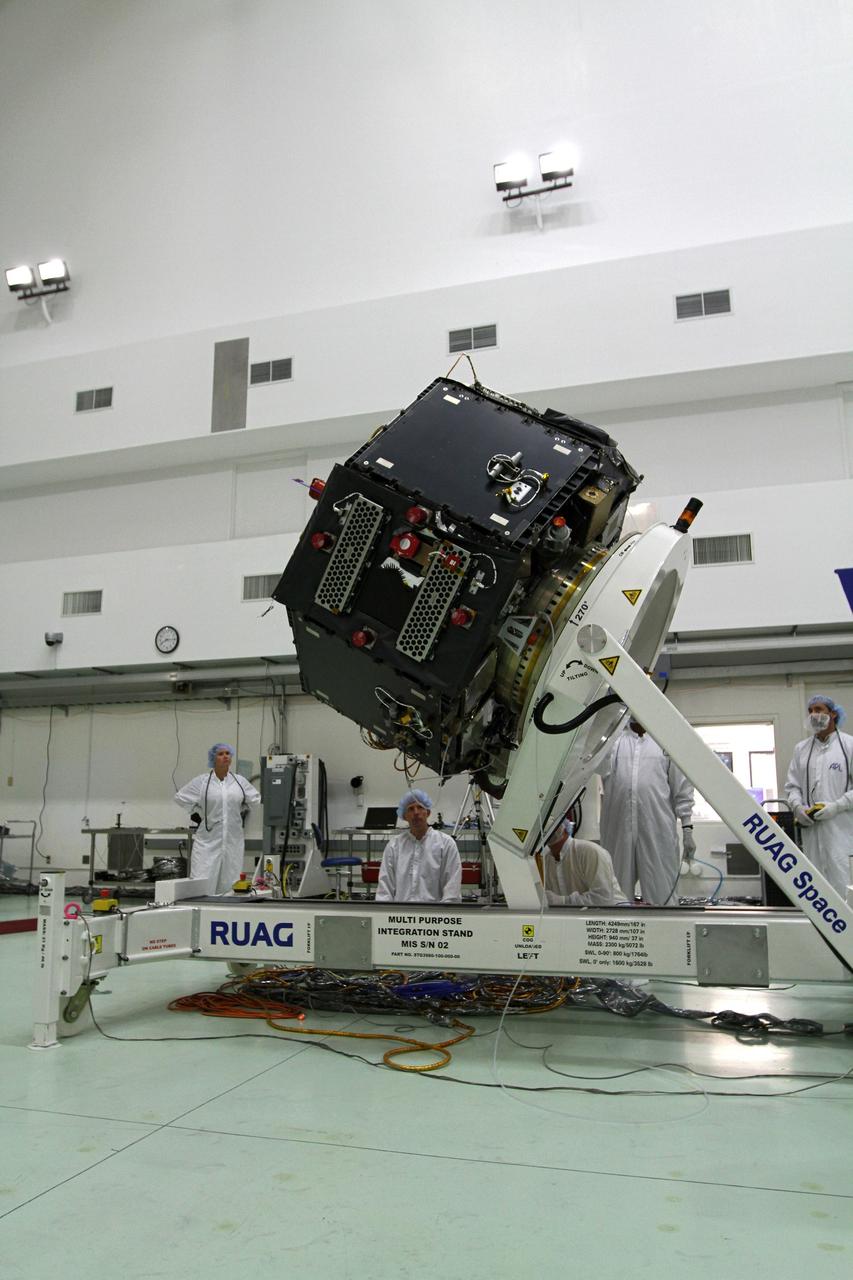
CAPE CANAVERAL, Fla. – Inside the Astrotech payload processing facility near NASA’s Kennedy Space Center in Florida, technicians monitor the progress as the Radiation Belt Storm Probes, or RBSP, spacecraft B is lowered to a horizontal position. The RBSP had been in a vertical position for testing. NASA’s RBSP mission will help us understand the sun’s influence on Earth and near-Earth space by studying the Earth’s radiation belts on various scales of space and time. RBSP will begin its mission of exploration of Earth’s Van Allen radiation belts and the extremes of space weather after its launch aboard a United Launch Alliance Atlas V rocket. Launch is targeted for Aug. 23. For more information, visit http://www.nasa.gov/rbsp. Photo credit: NASA/Kim Shiflett
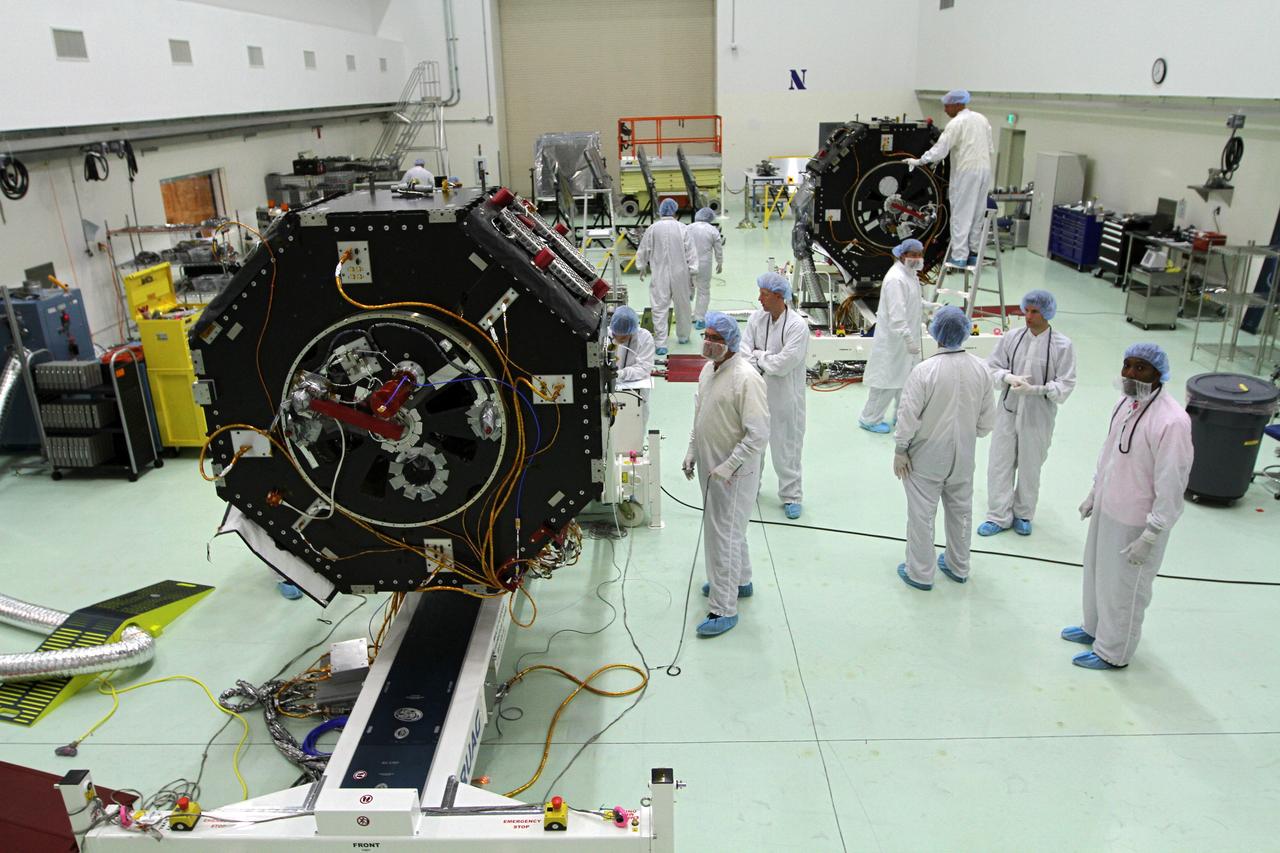
CAPE CANAVERAL, Fla. – Inside the Astrotech payload processing facility near NASA’s Kennedy Space Center in Florida, technicians monitor the progress as the Radiation Belt Storm Probes, or RBSP, spacecraft B is lowered to a horizontal position. The RBSP had been in a vertical position for testing. NASA’s RBSP mission will help us understand the sun’s influence on Earth and near-Earth space by studying the Earth’s radiation belts on various scales of space and time. RBSP will begin its mission of exploration of Earth’s Van Allen radiation belts and the extremes of space weather after its launch aboard a United Launch Alliance Atlas V rocket. Launch is targeted for Aug. 23. For more information, visit http://www.nasa.gov/rbsp. Photo credit: NASA/Kim Shiflett
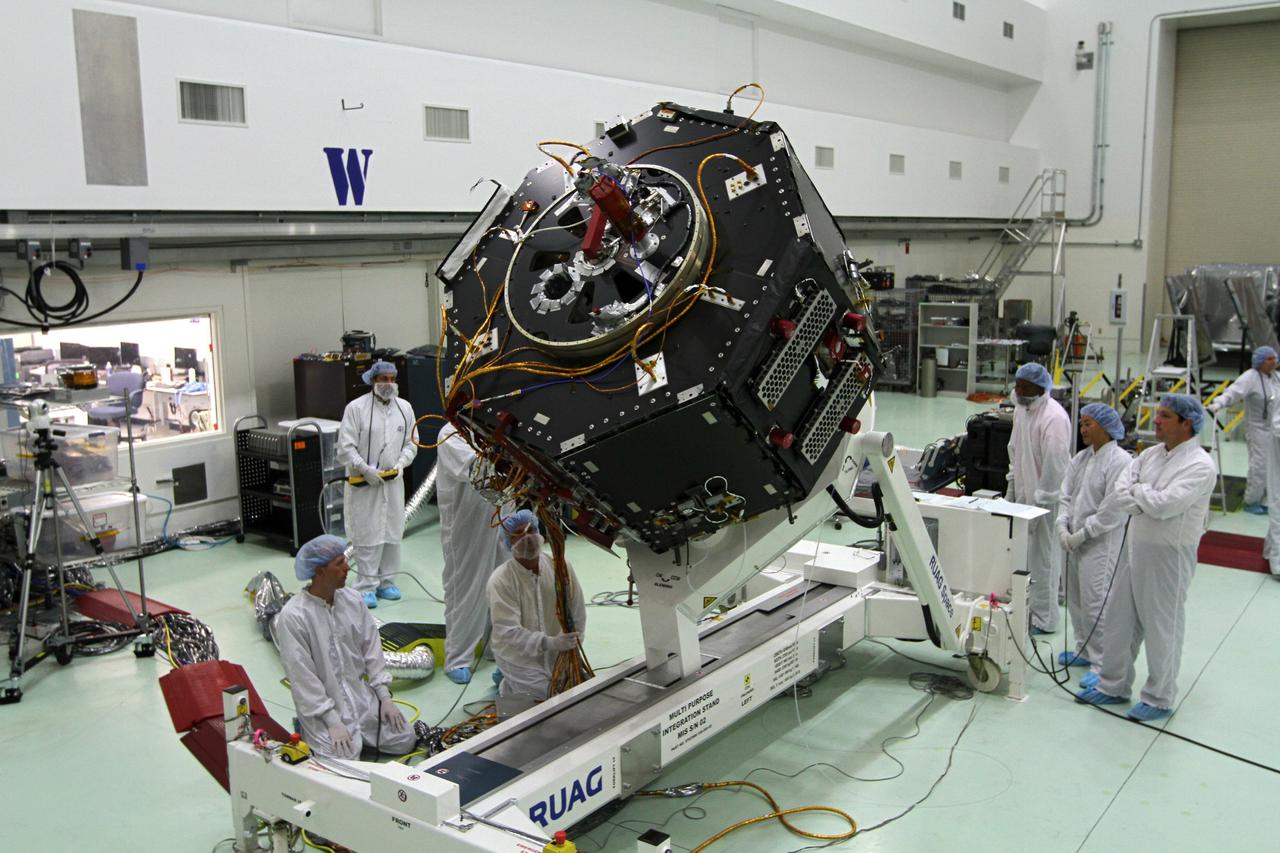
CAPE CANAVERAL, Fla. – Inside the Astrotech payload processing facility near NASA’s Kennedy Space Center in Florida, technicians assist as the Radiation Belt Storm Probes, or RBSP, spacecraft B is lowered to a horizontal position. The RBSP had been in a vertical position for testing. NASA’s RBSP mission will help us understand the sun’s influence on Earth and near-Earth space by studying the Earth’s radiation belts on various scales of space and time. RBSP will begin its mission of exploration of Earth’s Van Allen radiation belts and the extremes of space weather after its launch aboard a United Launch Alliance Atlas V rocket. Launch is targeted for Aug. 23. For more information, visit http://www.nasa.gov/rbsp. Photo credit: NASA/Kim Shiflett
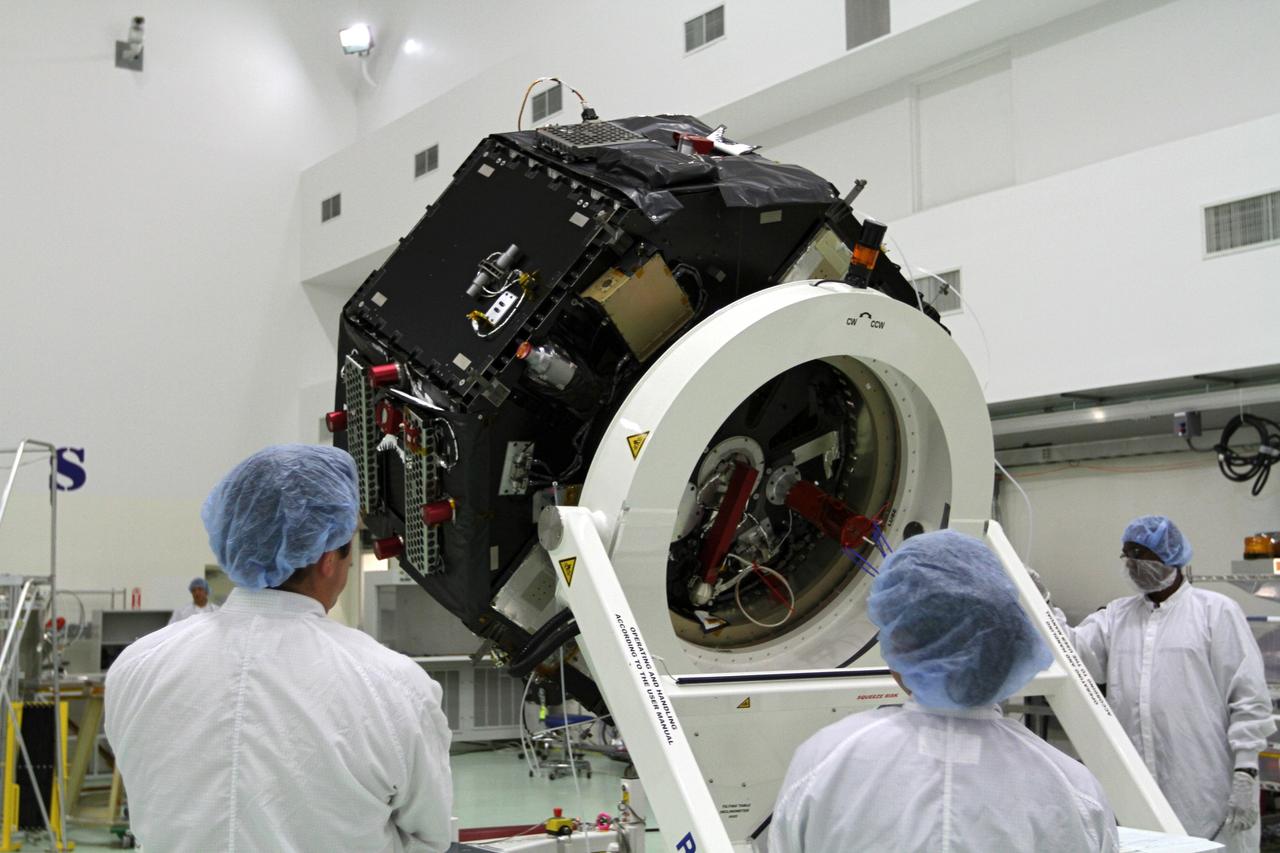
CAPE CANAVERAL, Fla. – Inside the Astrotech payload processing facility near NASA’s Kennedy Space Center in Florida, technicians monitor the progress as the Radiation Belt Storm Probes, or RBSP, spacecraft B is lowered to a horizontal position. The RBSP had been in a vertical position for testing. NASA’s RBSP mission will help us understand the sun’s influence on Earth and near-Earth space by studying the Earth’s radiation belts on various scales of space and time. RBSP will begin its mission of exploration of Earth’s Van Allen radiation belts and the extremes of space weather after its launch aboard a United Launch Alliance Atlas V rocket. Launch is targeted for Aug. 23. For more information, visit http://www.nasa.gov/rbsp. Photo credit: NASA/Kim Shiflett
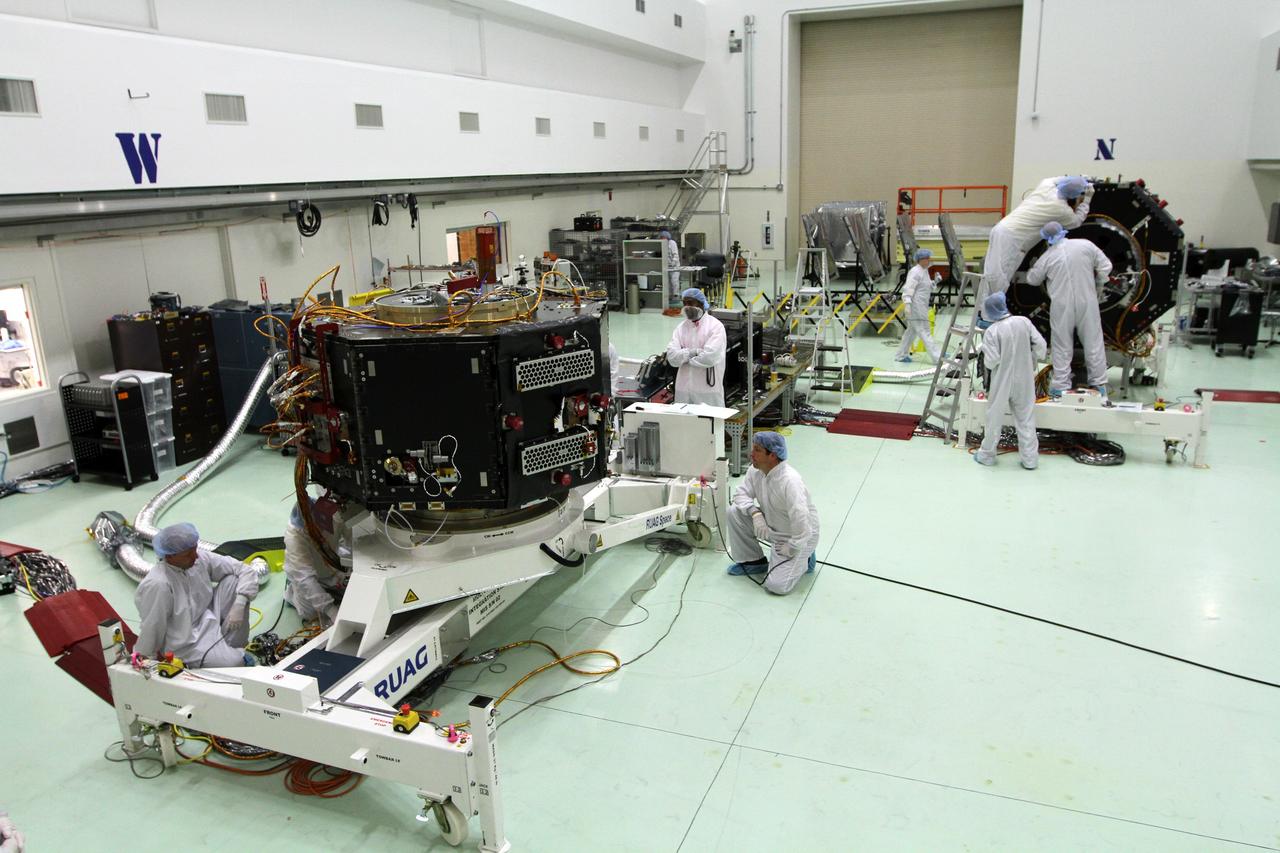
CAPE CANAVERAL, Fla. – Inside the Astrotech payload processing facility near NASA’s Kennedy Space Center in Florida, technicians monitor the progress as the test standing holding the Radiation Belt Storm Probes, or RBSP, spacecraft B is lowered to a horizontal position. The RBSP had been in a vertical position for testing. NASA’s RBSP mission will help us understand the sun’s influence on Earth and near-Earth space by studying the Earth’s radiation belts on various scales of space and time. RBSP will begin its mission of exploration of Earth’s Van Allen radiation belts and the extremes of space weather after its launch aboard a United Launch Alliance Atlas V rocket. Launch is targeted for Aug. 23. For more information, visit http://www.nasa.gov/rbsp. Photo credit: NASA/Kim Shiflett
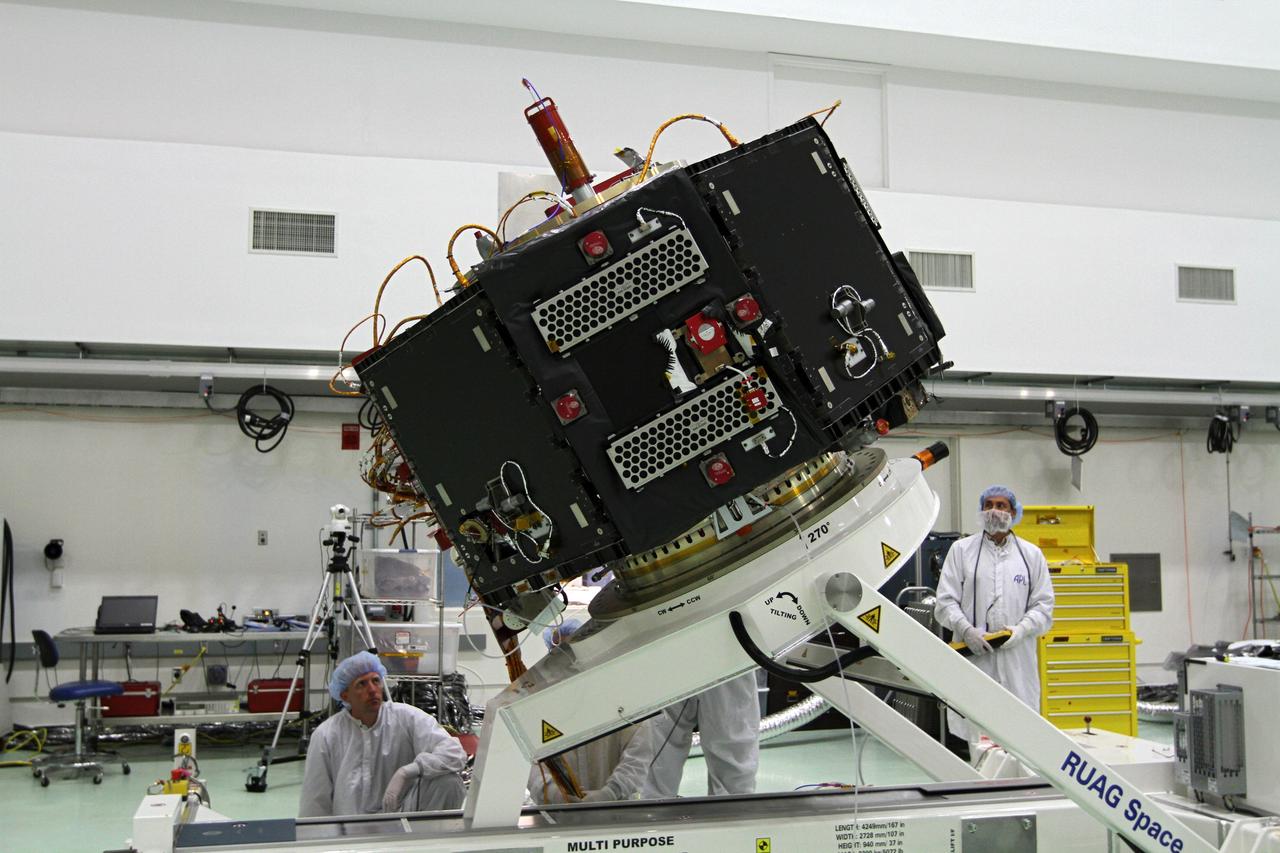
CAPE CANAVERAL, Fla. – Inside the Astrotech payload processing facility near NASA’s Kennedy Space Center in Florida, technicians monitor the progress as the Radiation Belt Storm Probes, or RBSP, spacecraft B is lowered to a horizontal position. The RBSP had been in a vertical position for testing. NASA’s RBSP mission will help us understand the sun’s influence on Earth and near-Earth space by studying the Earth’s radiation belts on various scales of space and time. RBSP will begin its mission of exploration of Earth’s Van Allen radiation belts and the extremes of space weather after its launch aboard a United Launch Alliance Atlas V rocket. Launch is targeted for Aug. 23. For more information, visit http://www.nasa.gov/rbsp. Photo credit: NASA/Kim Shiflett
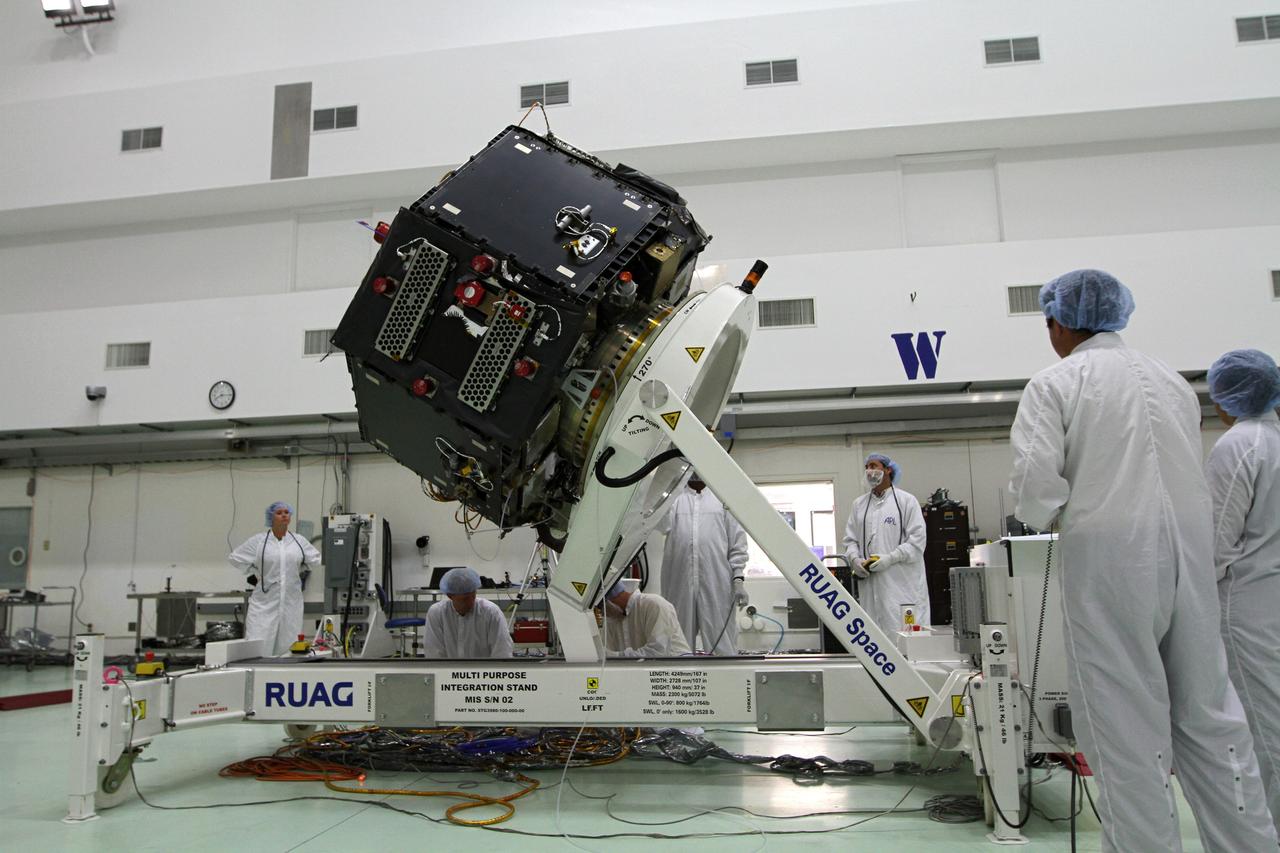
CAPE CANAVERAL, Fla. – Inside the Astrotech payload processing facility near NASA’s Kennedy Space Center in Florida, technicians monitor the progress as the Radiation Belt Storm Probes, or RBSP, spacecraft B is lowered to a horizontal position. The RBSP had been in a vertical position for testing. NASA’s RBSP mission will help us understand the sun’s influence on Earth and near-Earth space by studying the Earth’s radiation belts on various scales of space and time. RBSP will begin its mission of exploration of Earth’s Van Allen radiation belts and the extremes of space weather after its launch aboard a United Launch Alliance Atlas V rocket. Launch is targeted for Aug. 23. For more information, visit http://www.nasa.gov/rbsp. Photo credit: NASA/Kim Shiflett
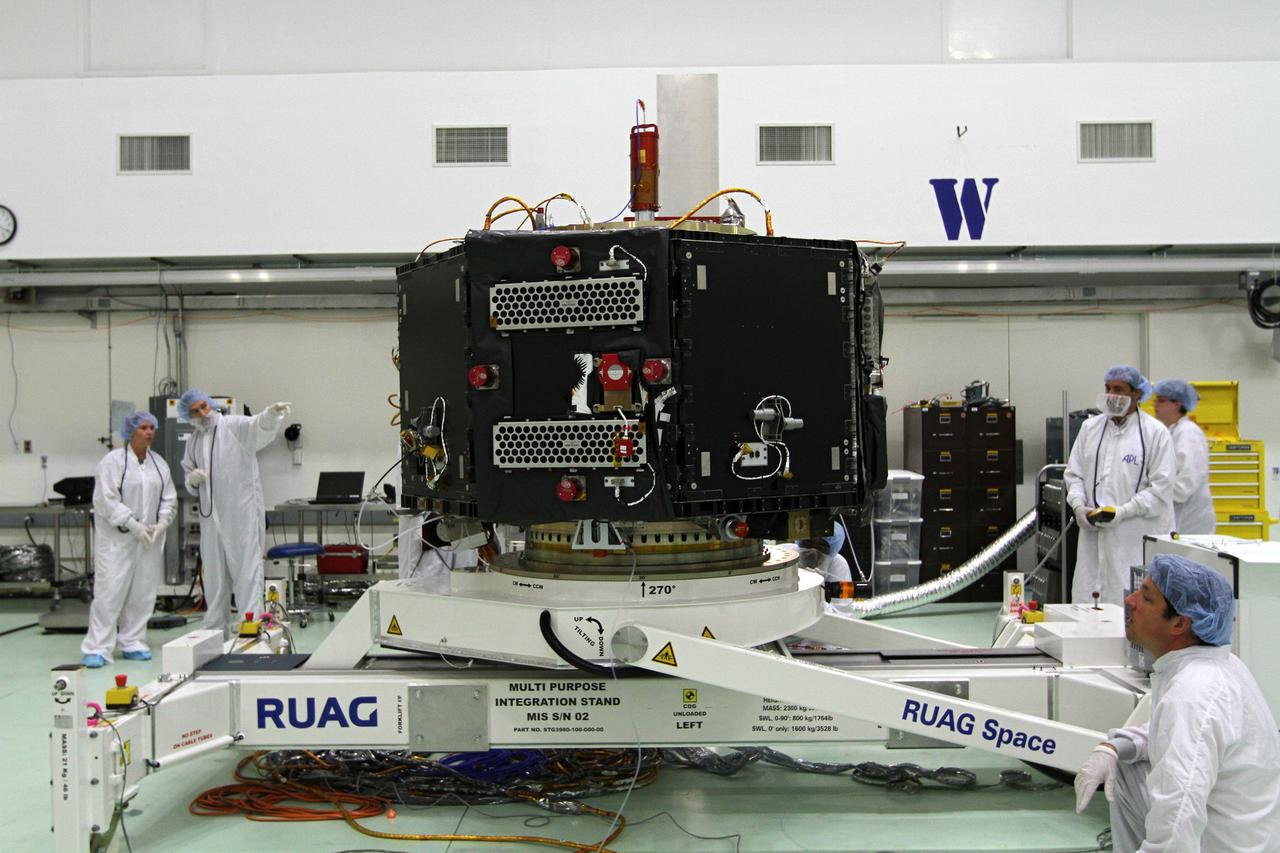
CAPE CANAVERAL, Fla. – Inside the Astrotech payload processing facility near NASA’s Kennedy Space Center in Florida, technicians monitor the progress as the test stand holding the Radiation Belt Storm Probes, or RBSP, spacecraft B is lowered to a horizontal position. The RBSP had been in a vertical position for testing. NASA’s RBSP mission will help us understand the sun’s influence on Earth and near-Earth space by studying the Earth’s radiation belts on various scales of space and time. RBSP will begin its mission of exploration of Earth’s Van Allen radiation belts and the extremes of space weather after its launch aboard a United Launch Alliance Atlas V rocket. Launch is targeted for Aug. 23. For more information, visit http://www.nasa.gov/rbsp. Photo credit: NASA/Kim Shiflett

CAPE CANAVERAL, Fla. – Inside the Astrotech payload processing facility near NASA’s Kennedy Space Center in Florida, technicians monitor the progress as the Radiation Belt Storm Probes, or RBSP, spacecraft B is lowered to a horizontal position. The RBSP had been in a vertical position for testing. NASA’s RBSP mission will help us understand the sun’s influence on Earth and near-Earth space by studying the Earth’s radiation belts on various scales of space and time. RBSP will begin its mission of exploration of Earth’s Van Allen radiation belts and the extremes of space weather after its launch aboard a United Launch Alliance Atlas V rocket. Launch is targeted for Aug. 23. For more information, visit http://www.nasa.gov/rbsp. Photo credit: NASA/Kim Shiflett
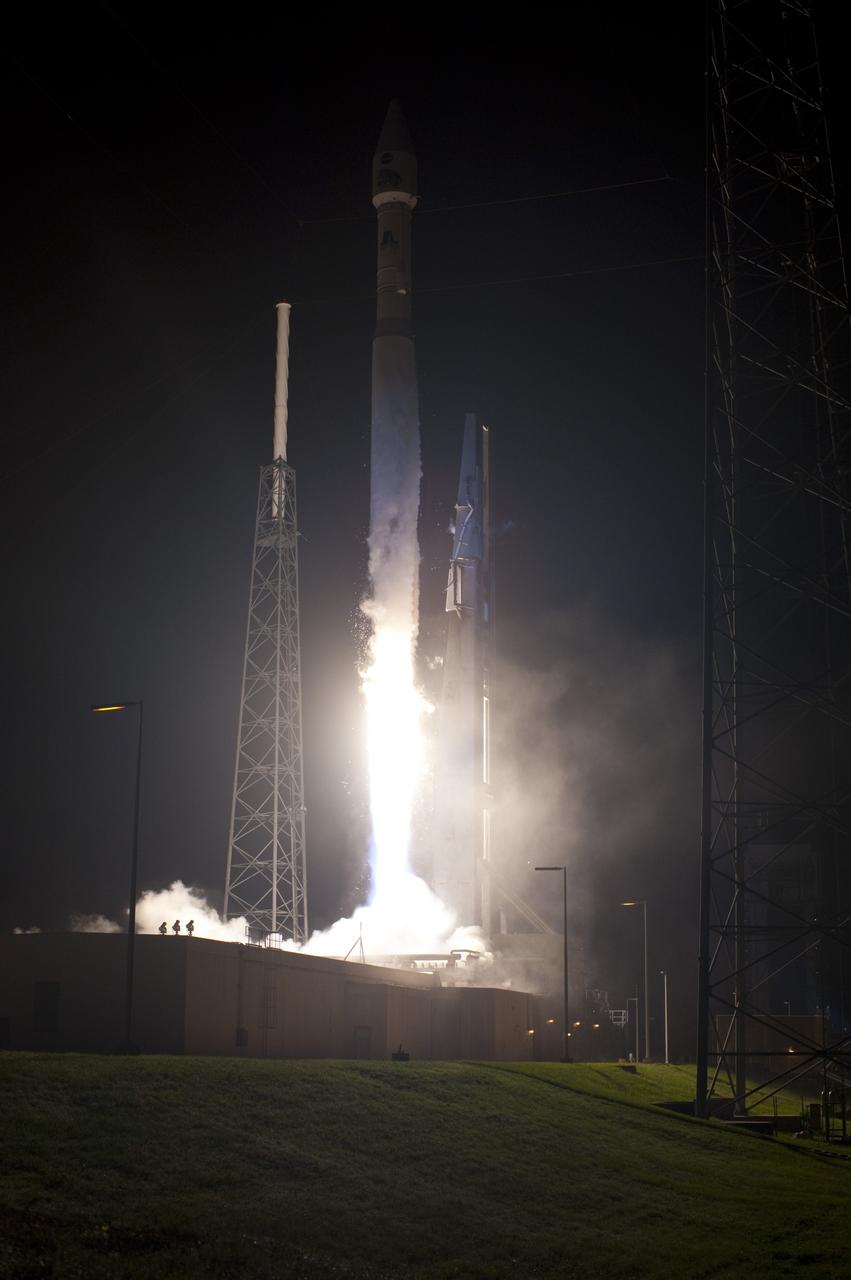
CAPE CANAVERAL, Fla. – The United Launch Alliance Atlas V rocket carrying NASA's Radiation Belt Storm Probes, or RBSP, lifts off Space Launch Complex 41 on Cape Canaveral Air Force Station in Florida at 4:05 a.m. EDT. RBSP will explore changes in Earth's space environment caused by the sun -- known as "space weather" -- that can disable satellites, create power-grid failures and disrupt GPS service. The mission also will provide data on the fundamental radiation and particle acceleration processes throughout the universe. For more information on RBSP, visit http://www.nasa.gov/rbsp. Photo credit: NASA/Tony Gray and Robert Murray
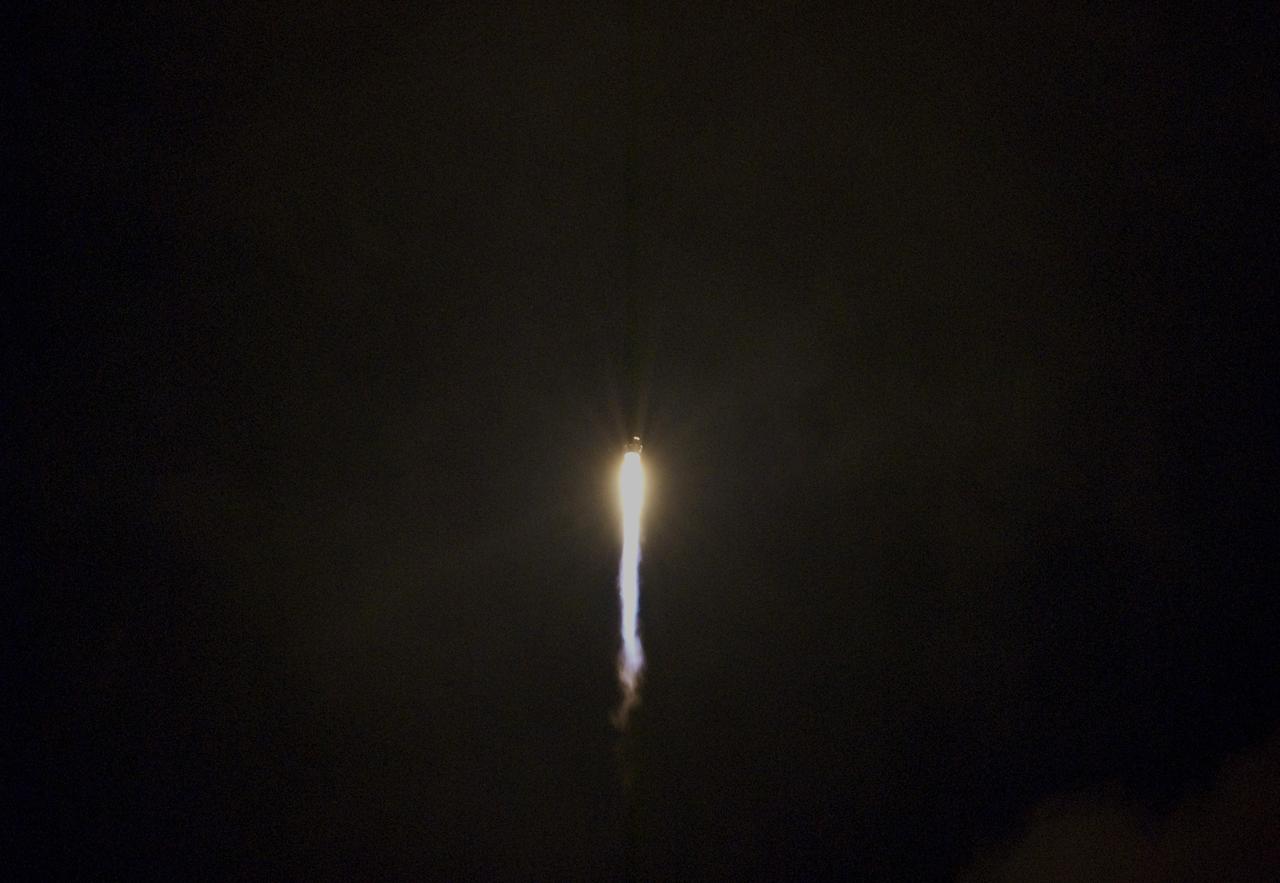
CAPE CANAVERAL, Fla. – The United Launch Alliance Atlas V rocket carrying NASA's Radiation Belt Storm Probes, or RBSP, disappears into the night sky over Space Launch Complex 41 on Cape Canaveral Air Force Station in Florida following liftoff at 4:05 a.m. EDT. RBSP will explore changes in Earth's space environment caused by the sun -- known as "space weather" -- that can disable satellites, create power-grid failures and disrupt GPS service. The mission also will provide data on the fundamental radiation and particle acceleration processes throughout the universe. For more information on RBSP, visit http://www.nasa.gov/rbsp. Photo credit: NASA/Gianni Woods
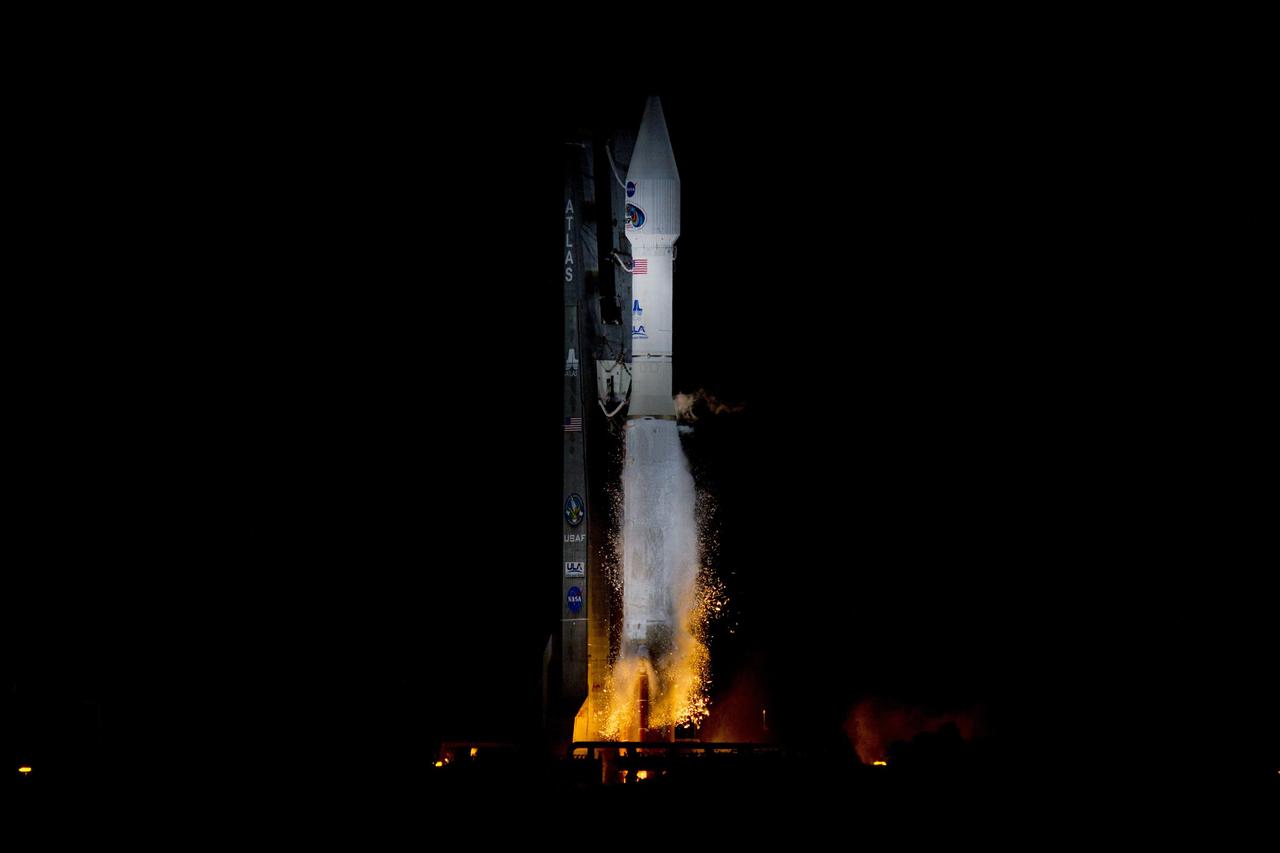
CAPE CANAVERAL, Fla. - The engines ignite under the United Launch Alliance Atlas V rocket at 4:05 a.m. EDT lifting NASA's Radiation Belt Storm Probes, or RBSP, off Space Launch Complex 41 on Cape Canaveral Air Force Station in Florida. RBSP will explore changes in Earth's space environment caused by the sun -- known as "space weather" -- that can disable satellites, create power-grid failures and disrupt GPS service. The mission also will provide data on the fundamental radiation and particle acceleration processes throughout the universe. For more information on RBSP, visit http://www.nasa.gov/rbsp. Photo credit: NASA/Rusty Backer
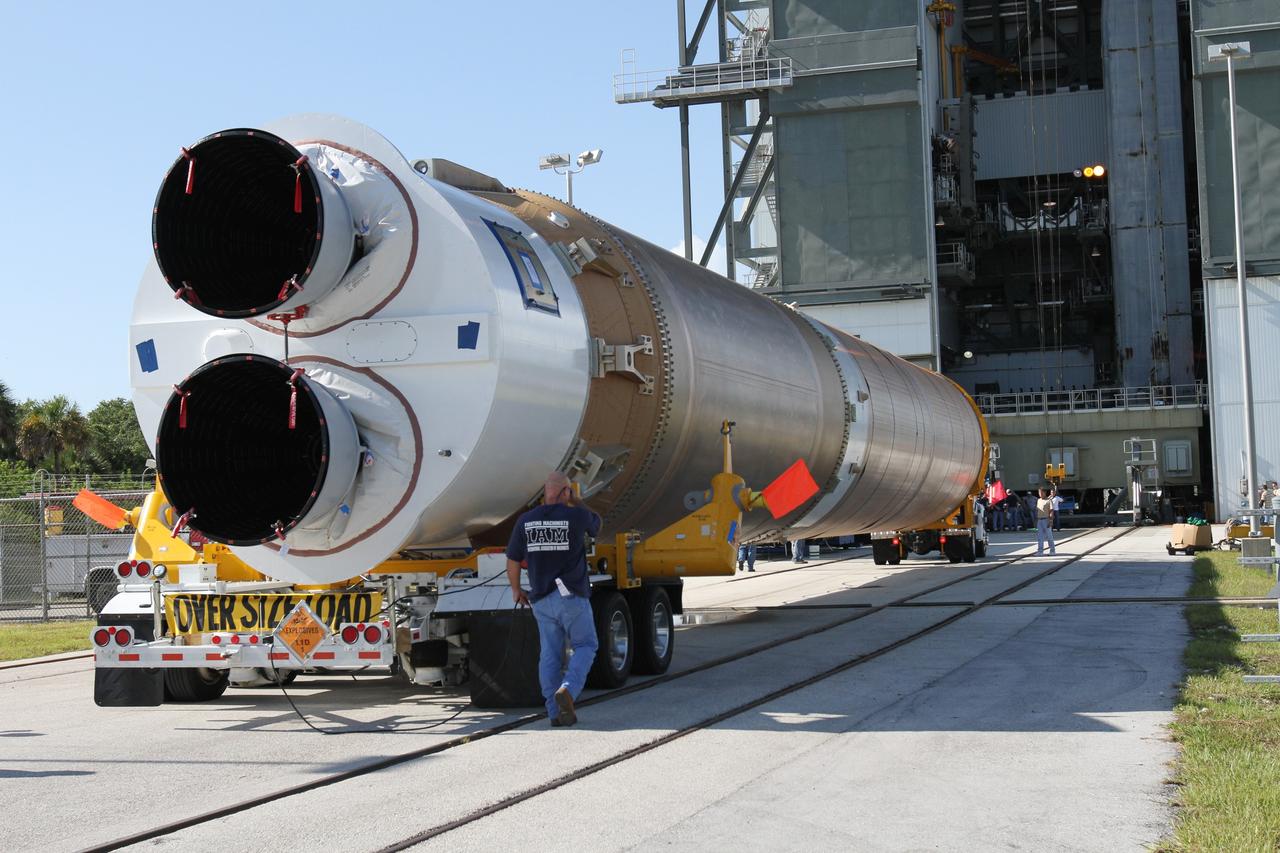
CAPE CANAVERAL, Fla. - The first stage of the United Launch Alliance Atlas V rocket arrives at Launch Complex 41 at Cape Canaveral Air Force Station in Florida for the Radiation Belt Storm Probes, or RBSP, mission. NASA’s RBSP mission will help us understand the sun’s influence on Earth and near-Earth space by studying the Earth’s radiation belts on various scales of space and time. RBSP will begin its mission of exploration of Earth’s Van Allen radiation belts and the extremes of space weather after its launch aboard an Atlas V rocket. Launch is targeted for Aug. 23. For more information, visit http://www.nasa.gov/rbsp. Photo credit: NASA/Cory Huston
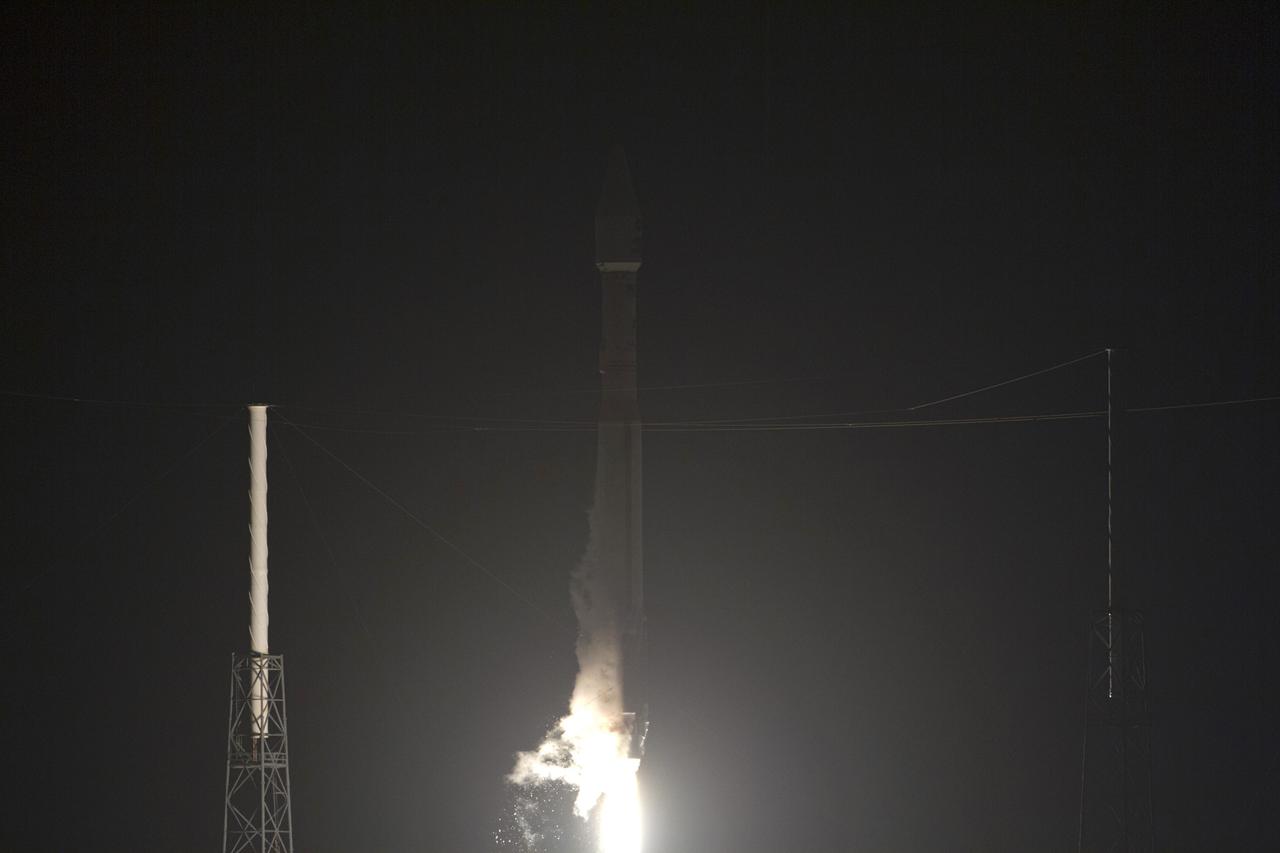
CAPE CANAVERAL, Fla. - The United Launch Alliance Atlas V rocket carrying NASA's Radiation Belt Storm Probes, or RBSP, lifts off Space Launch Complex 41 on Cape Canaveral Air Force Station in Florida at 4:05 a.m. EDT. RBSP will explore changes in Earth's space environment caused by the sun -- known as "space weather" -- that can disable satellites, create power-grid failures and disrupt GPS service. The mission also will provide data on the fundamental radiation and particle acceleration processes throughout the universe. For more information on RBSP, visit http://www.nasa.gov/rbsp. Photo credit: NASA/Kenny Allen
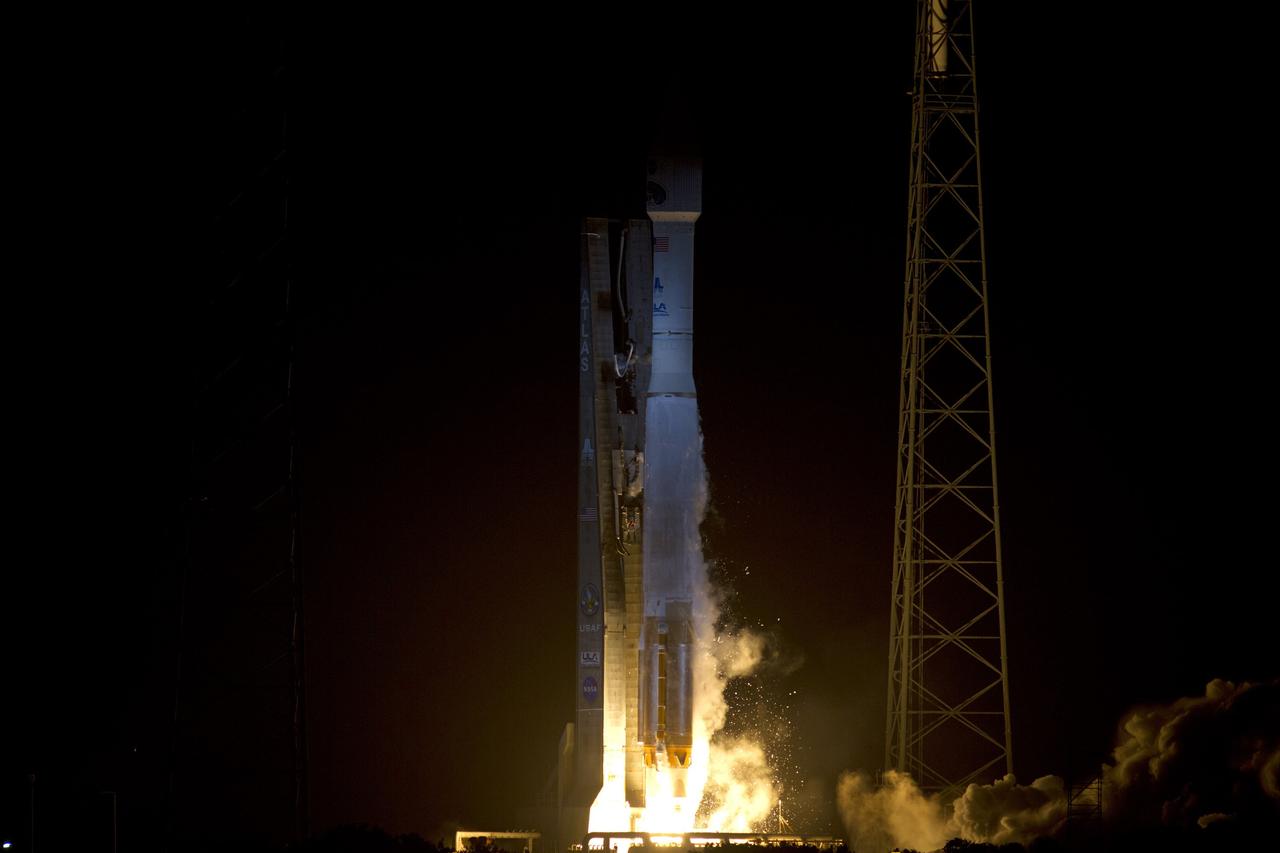
CAPE CANAVERAL, Fla. - The United Launch Alliance Atlas V rocket carrying NASA's Radiation Belt Storm Probes, or RBSP, lifts off Space Launch Complex 41 on Cape Canaveral Air Force Station in Florida at 4:05 a.m. EDT. RBSP will explore changes in Earth's space environment caused by the sun -- known as "space weather" -- that can disable satellites, create power-grid failures and disrupt GPS service. The mission also will provide data on the fundamental radiation and particle acceleration processes throughout the universe. For more information on RBSP, visit http://www.nasa.gov/rbsp. Photo credit: NASA/Rusty Backer
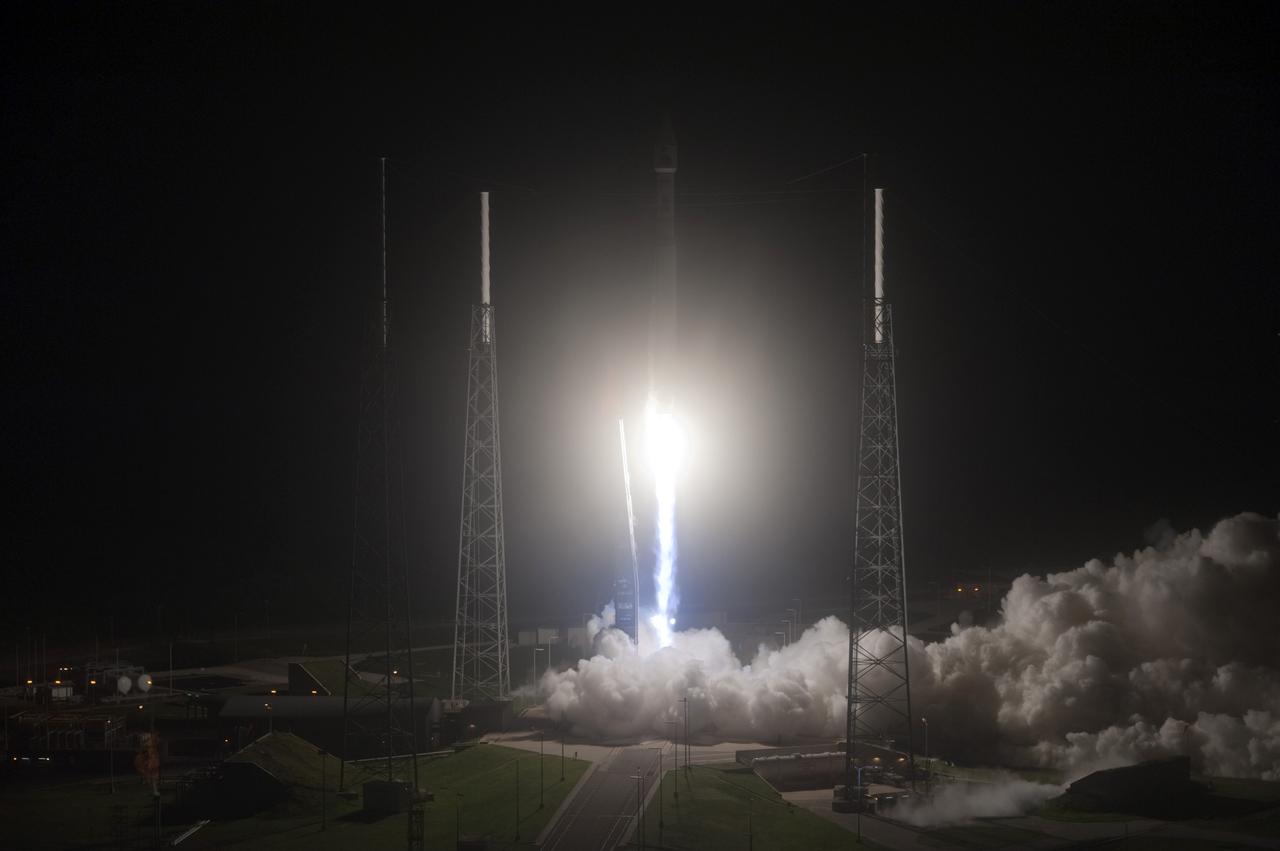
CAPE CANAVERAL, Fla. – The United Launch Alliance Atlas V rocket carrying NASA's Radiation Belt Storm Probes, or RBSP, lifted off Space Launch Complex 41 on Cape Canaveral Air Force Station in Florida at 4:05 a.m. EDT. RBSP will explore changes in Earth's space environment caused by the sun -- known as "space weather" -- that can disable satellites, create power-grid failures and disrupt GPS service. The mission also will provide data on the fundamental radiation and particle acceleration processes throughout the universe. For more information on RBSP, visit http://www.nasa.gov/rbsp. Photo credit: NASA/Tony Gray and Robert Murray
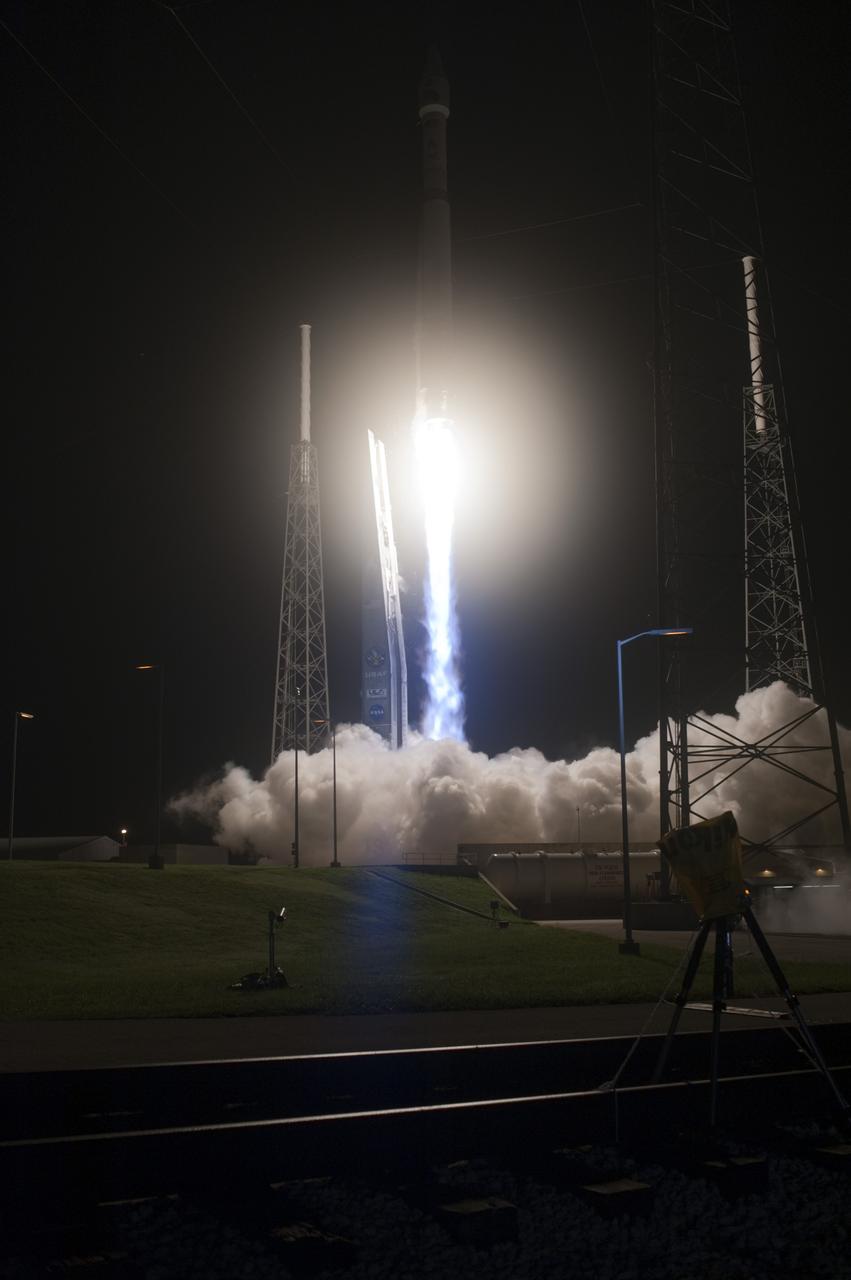
CAPE CANAVERAL, Fla. – The United Launch Alliance Atlas V rocket carrying NASA’s Radiation Belt Storm Probes, or RBSP, spacecraft creates a halo of light at Space Launch Complex 41 on Cape Canaveral Air Force Station in Florida as it lifts off the pad at 4:05 a.m. EDT. RBSP will explore changes in Earth's space environment caused by the sun -- known as "space weather" -- that can disable satellites, create power-grid failures and disrupt GPS service. The mission also will provide data on the fundamental radiation and particle acceleration processes throughout the universe. For more information on RBSP, visit http://www.nasa.gov/rbsp. Photo credit: NASA/Tony Gray and Robert Murray
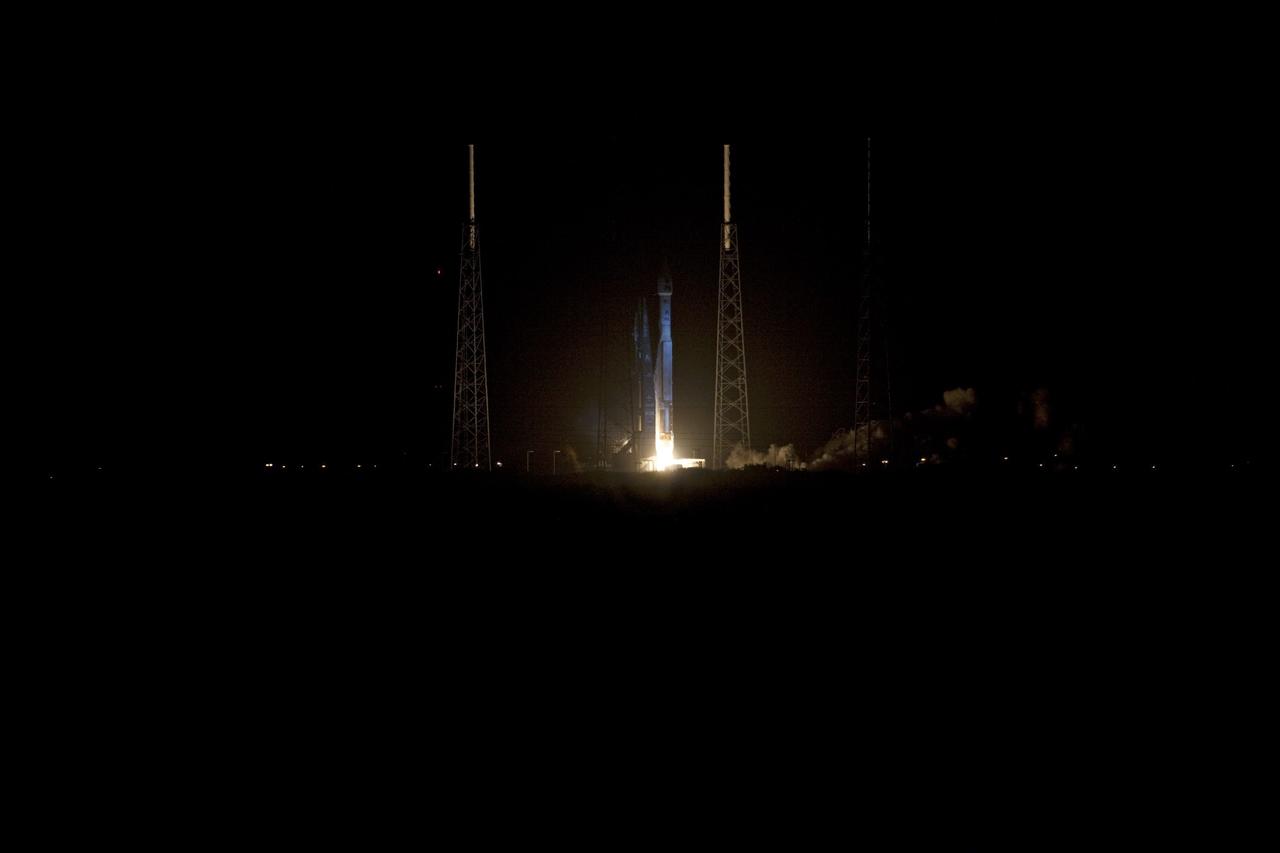
CAPE CANAVERAL, Fla. – NASA's Radiation Belt Storm Probes, or RBSP, lift off Space Launch Complex 41 on Cape Canaveral Air Force Station in Florida aboard a United Launch Alliance Atlas V rocket at 4:05 a.m. EDT. RBSP will explore changes in Earth's space environment caused by the sun -- known as "space weather" -- that can disable satellites, create power-grid failures and disrupt GPS service. The mission also will provide data on the fundamental radiation and particle acceleration processes throughout the universe. For more information on RBSP, visit http://www.nasa.gov/rbsp. Photo credit: NASA/Jim Grossmann
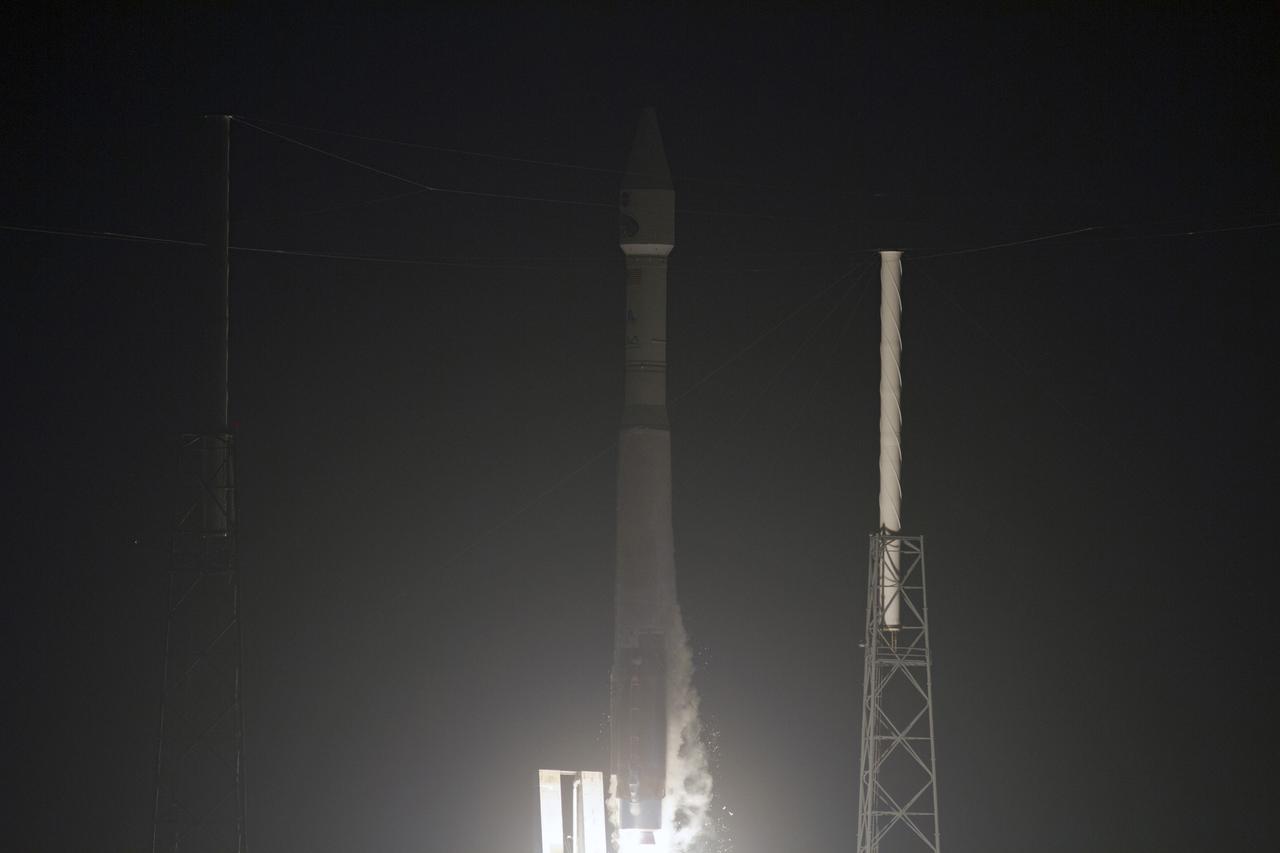
CAPE CANAVERAL, Fla. - The United Launch Alliance Atlas V rocket carrying NASA's Radiation Belt Storm Probes, or RBSP, lifted off Space Launch Complex 41 on Cape Canaveral Air Force Station in Florida at 4:05 a.m. EDT. RBSP will explore changes in Earth's space environment caused by the sun -- known as "space weather" -- that can disable satellites, create power-grid failures and disrupt GPS service. The mission also will provide data on the fundamental radiation and particle acceleration processes throughout the universe. For more information on RBSP, visit http://www.nasa.gov/rbsp. Photo credit: NASA/Rusty Backer
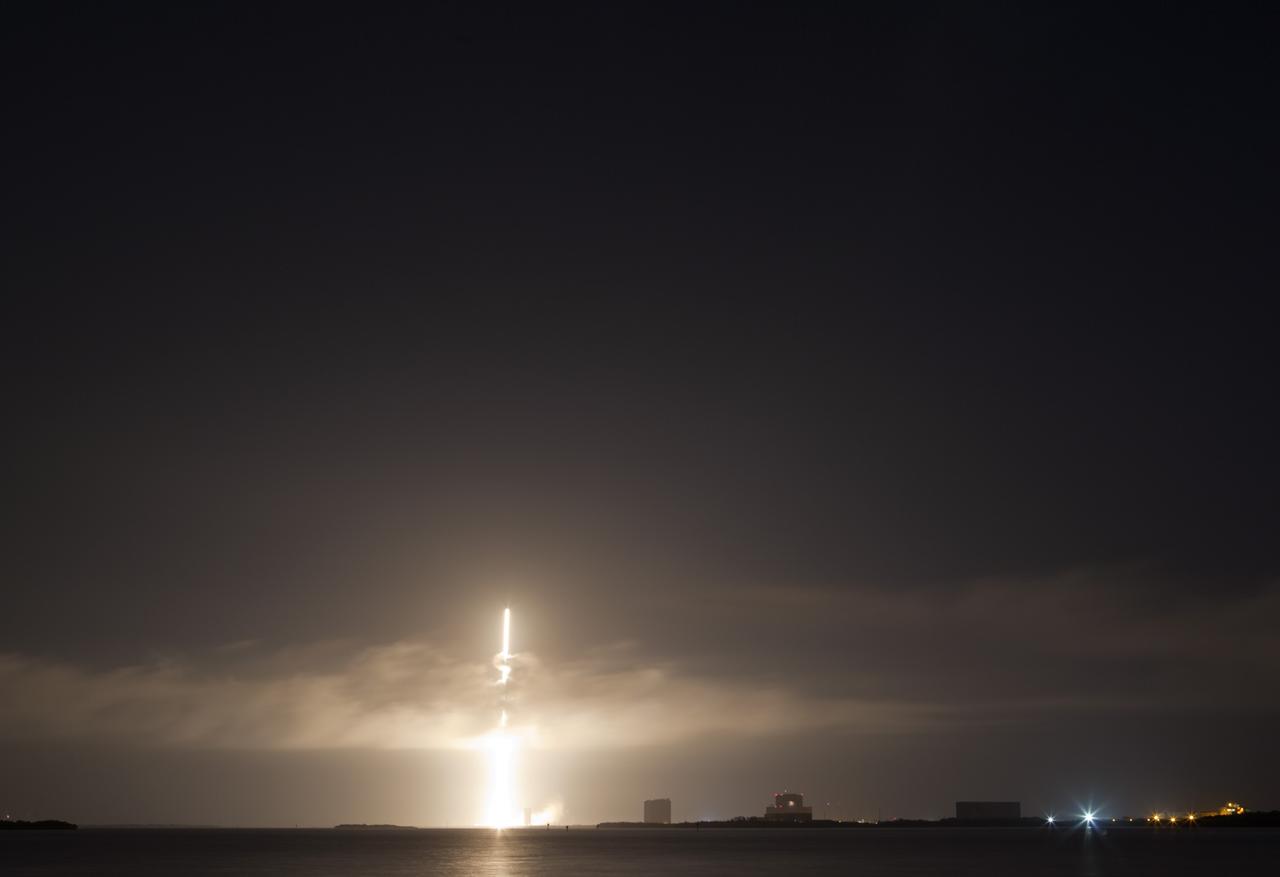
CAPE CANAVERAL, Fla. – The United Launch Alliance Atlas V rocket carrying NASA's Radiation Belt Storm Probes, or RBSP, rises through the clouds over Space Launch Complex 41 on Cape Canaveral Air Force Station in Florida following liftoff at 4:05 a.m. EDT. RBSP will explore changes in Earth's space environment caused by the sun -- known as "space weather" -- that can disable satellites, create power-grid failures and disrupt GPS service. The mission also will provide data on the fundamental radiation and particle acceleration processes throughout the universe. For more information on RBSP, visit http://www.nasa.gov/rbsp. Photo credit: NASA/Ben Smegelsky and Gary Thompson

CAPE CANAVERAL, Fla. – The United Launch Alliance Atlas V rocket carrying NASA’s Radiation Belt Storm Probes, or RBSP, spacecraft creates a halo of light at Space Launch Complex 41 on Cape Canaveral Air Force Station in Florida as it lifts off the pad at 4:05 a.m. EDT. RBSP will explore changes in Earth's space environment caused by the sun -- known as "space weather" -- that can disable satellites, create power-grid failures and disrupt GPS service. The mission also will provide data on the fundamental radiation and particle acceleration processes throughout the universe. For more information on RBSP, visit http://www.nasa.gov/rbsp. Photo credit: NASA/Tony Gray and Robert Murray
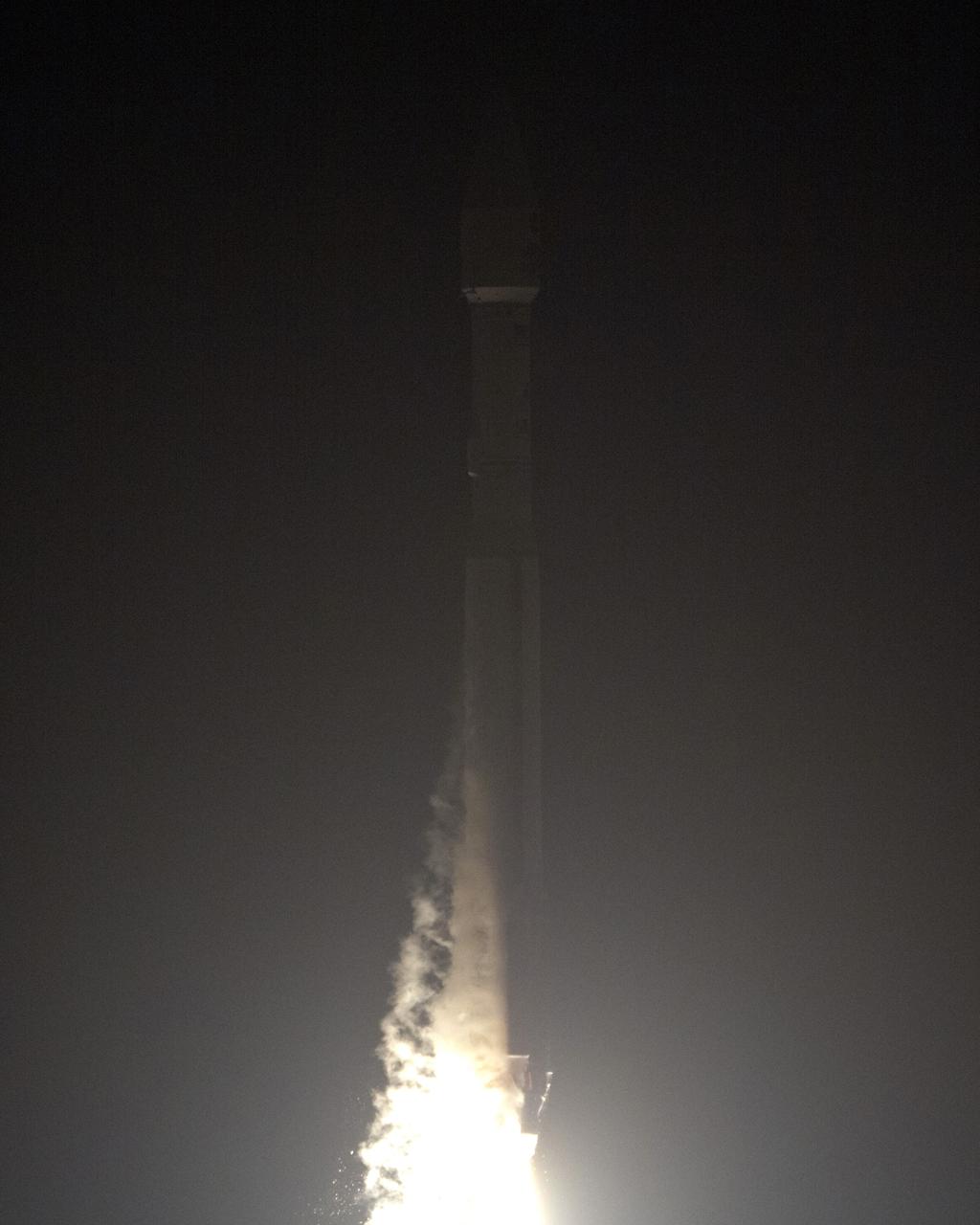
CAPE CANAVERAL, Fla. - The United Launch Alliance Atlas V rocket carrying NASA's Radiation Belt Storm Probes, or RBSP, lifted off Space Launch Complex 41 on Cape Canaveral Air Force Station in Florida at 4:05 a.m. EDT. RBSP will explore changes in Earth's space environment caused by the sun -- known as "space weather" -- that can disable satellites, create power-grid failures and disrupt GPS service. The mission also will provide data on the fundamental radiation and particle acceleration processes throughout the universe. For more information on RBSP, visit http://www.nasa.gov/rbsp. Photo credit: NASA/Kenny Allen

CAPE CANAVERAL, Fla. – Spotlights bounce off the clouds over Space Launch Complex 41 on Cape Canaveral Air Force Station as NASA's Radiation Belt Storm Probes, or RBSP, lift off the pad at 4:05 a.m. EDT aboard a United Launch Alliance Atlas V rocket. RBSP will explore changes in Earth's space environment caused by the sun -- known as "space weather" -- that can disable satellites, create power-grid failures and disrupt GPS service. The mission also will provide data on the fundamental radiation and particle acceleration processes throughout the universe. For more information on RBSP, visit http://www.nasa.gov/rbsp. Photo credit: NASA/Ben Smegelsky and Gary Thompson
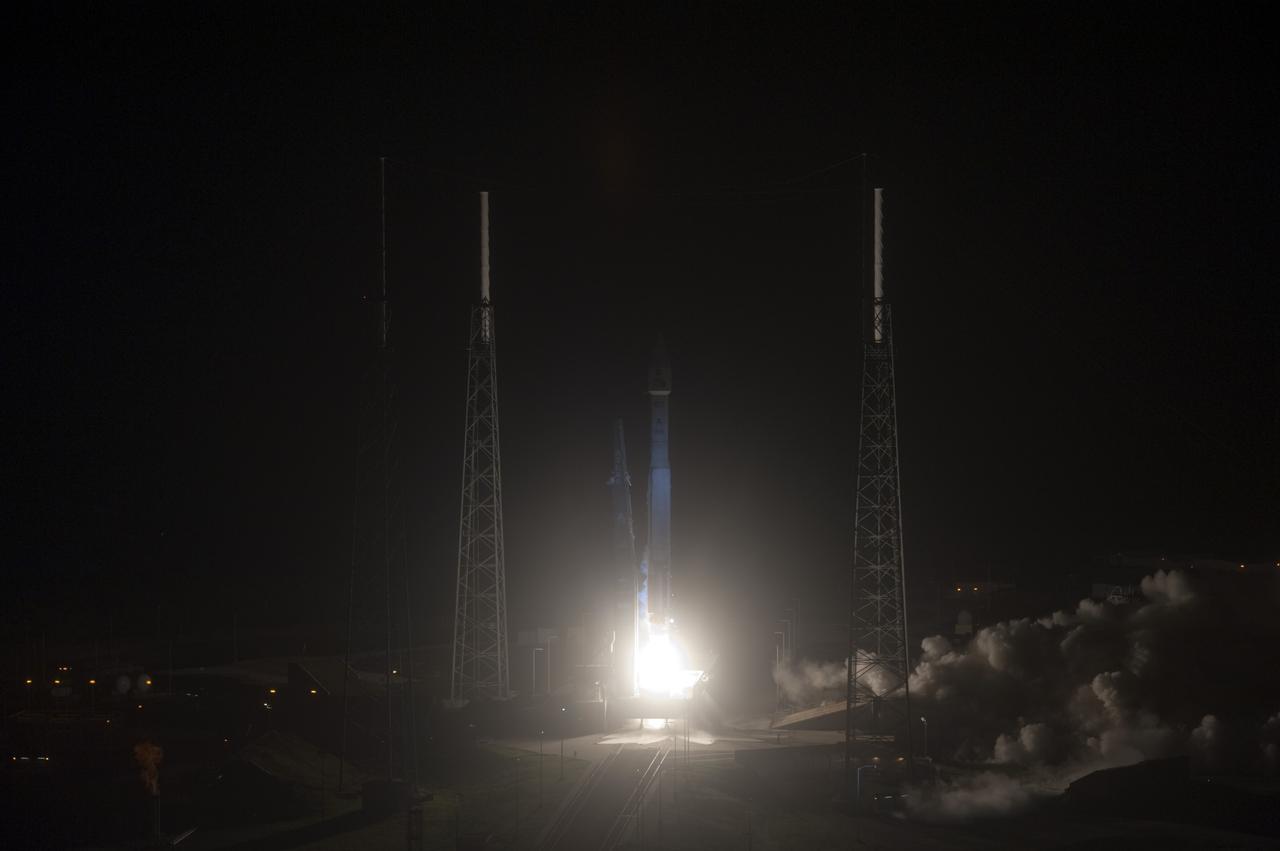
CAPE CANAVERAL, Fla. – The United Launch Alliance Atlas V rocket carrying NASA's Radiation Belt Storm Probes, or RBSP, lifts off Space Launch Complex 41 on Cape Canaveral Air Force Station in Florida at 4:05 a.m. EDT. RBSP will explore changes in Earth's space environment caused by the sun -- known as "space weather" -- that can disable satellites, create power-grid failures and disrupt GPS service. The mission also will provide data on the fundamental radiation and particle acceleration processes throughout the universe. For more information on RBSP, visit http://www.nasa.gov/rbsp. Photo credit: NASA/Tony Gray and Robert Murray

CAPE CANAVERAL, Fla. - The United Launch Alliance Atlas V rocket carrying NASA's Radiation Belt Storm Probes, or RBSP, lifts off Space Launch Complex 41 on Cape Canaveral Air Force Station in Florida at 4:05 a.m. EDT. RBSP will explore changes in Earth's space environment caused by the sun -- known as "space weather" -- that can disable satellites, create power-grid failures and disrupt GPS service. The mission also will provide data on the fundamental radiation and particle acceleration processes throughout the universe. For more information on RBSP, visit http://www.nasa.gov/rbsp. Photo credit: NASA/Rusty Backer
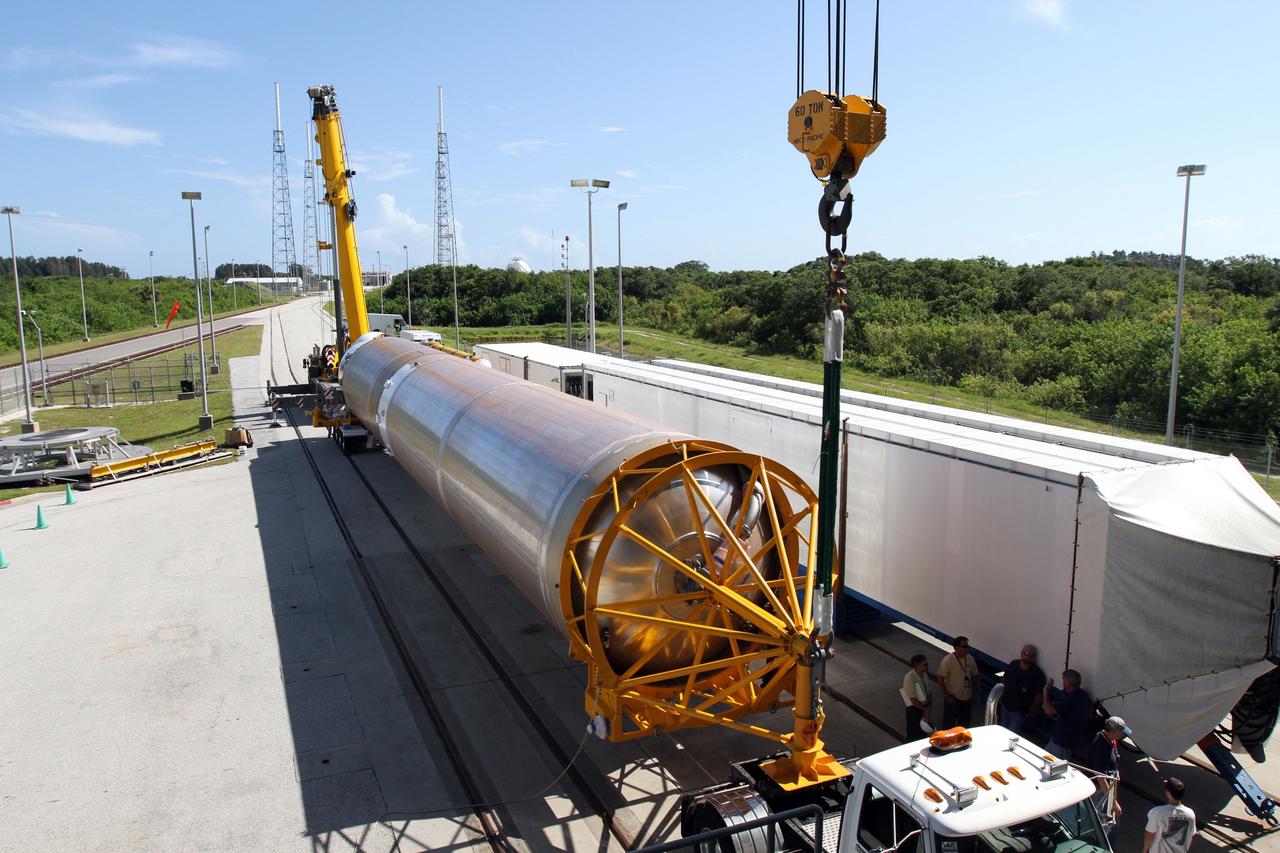
CAPE CANAVERAL, Fla. - The first stage of the United Launch Alliance Atlas V rocket arrives at Launch Complex 41 at Cape Canaveral Air Force Station in Florida for the Radiation Belt Storm Probes, or RBSP, mission. NASA’s RBSP mission will help us understand the sun’s influence on Earth and near-Earth space by studying the Earth’s radiation belts on various scales of space and time. RBSP will begin its mission of exploration of Earth’s Van Allen radiation belts and the extremes of space weather after its launch aboard an Atlas V rocket. Launch is targeted for Aug. 23. For more information, visit http://www.nasa.gov/rbsp. Photo credit: NASA/Cory Huston

CAPE CANAVERAL, Fla. – The United Launch Alliance Atlas V rocket carrying NASA's Radiation Belt Storm Probes, or RBSP, lifts off Space Launch Complex 41 on Cape Canaveral Air Force Station in Florida at 4:05 a.m. EDT. RBSP will explore changes in Earth's space environment caused by the sun -- known as "space weather" -- that can disable satellites, create power-grid failures and disrupt GPS service. The mission also will provide data on the fundamental radiation and particle acceleration processes throughout the universe. For more information on RBSP, visit http://www.nasa.gov/rbsp. Photo credit: NASA/Tony Gray and Robert Murray

CAPE CANAVERAL, Fla. – The engines ignite under the United Launch Alliance Atlas V rocket at 4:05 a.m. EDT lifting NASA's Radiation Belt Storm Probes, or RBSP, off Space Launch Complex 41 on Cape Canaveral Air Force Station in Florida. RBSP will explore changes in Earth's space environment caused by the sun -- known as "space weather" -- that can disable satellites, create power-grid failures and disrupt GPS service. The mission also will provide data on the fundamental radiation and particle acceleration processes throughout the universe. For more information on RBSP, visit http://www.nasa.gov/rbsp. Photo credit: NASA/Jim Grossmann
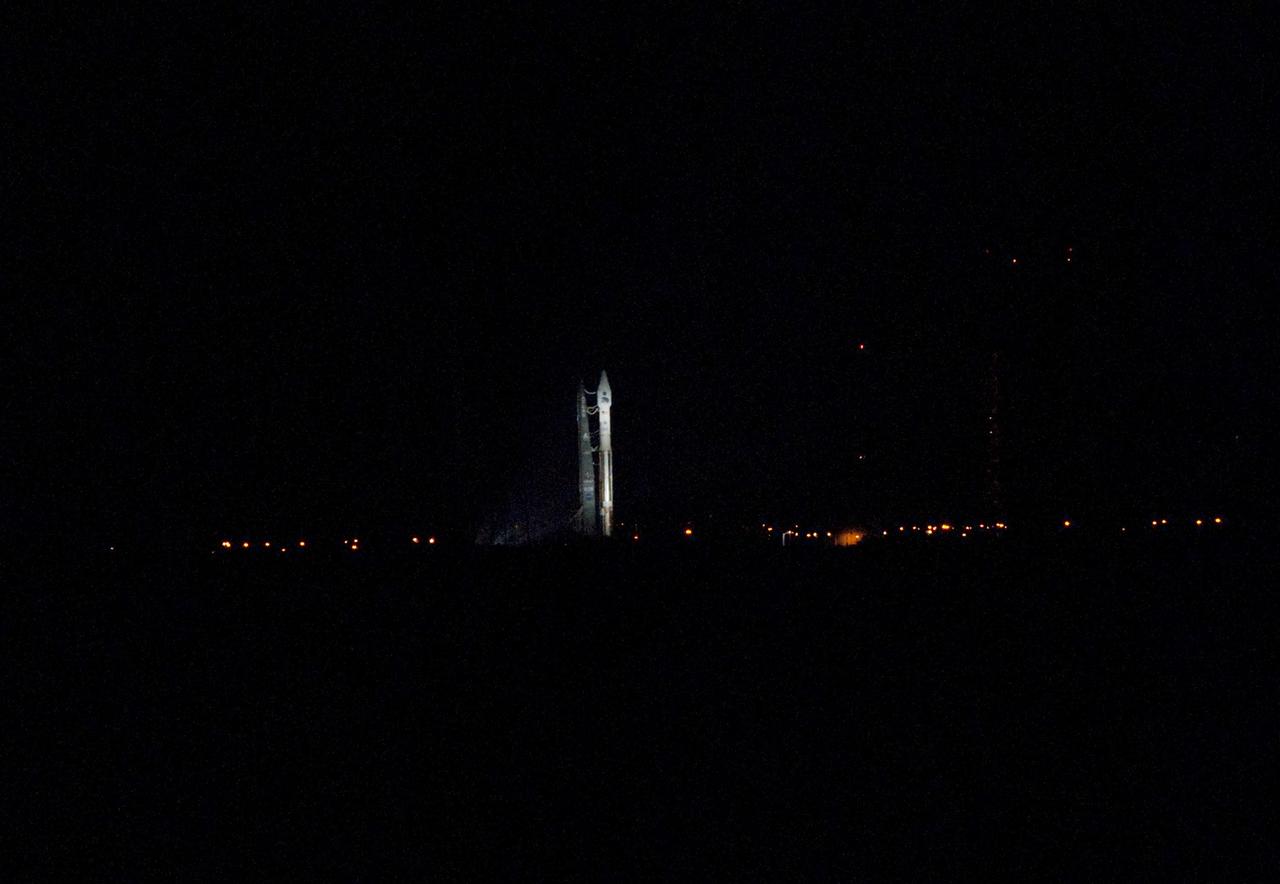
CAPE CANAVERAL, Fla. – The United Launch Alliance Atlas V rocket carrying NASA's Radiation Belt Storm Probes, or RBSP, is a breath away from lifting off Space Launch Complex 41 on Cape Canaveral Air Force Station in Florida at 4:05 a.m. EDT. RBSP will explore changes in Earth's space environment caused by the sun -- known as "space weather" -- that can disable satellites, create power-grid failures and disrupt GPS service. The mission also will provide data on the fundamental radiation and particle acceleration processes throughout the universe. For more information on RBSP, visit http://www.nasa.gov/rbsp. Photo credit: NASA/Ben Smegelsky
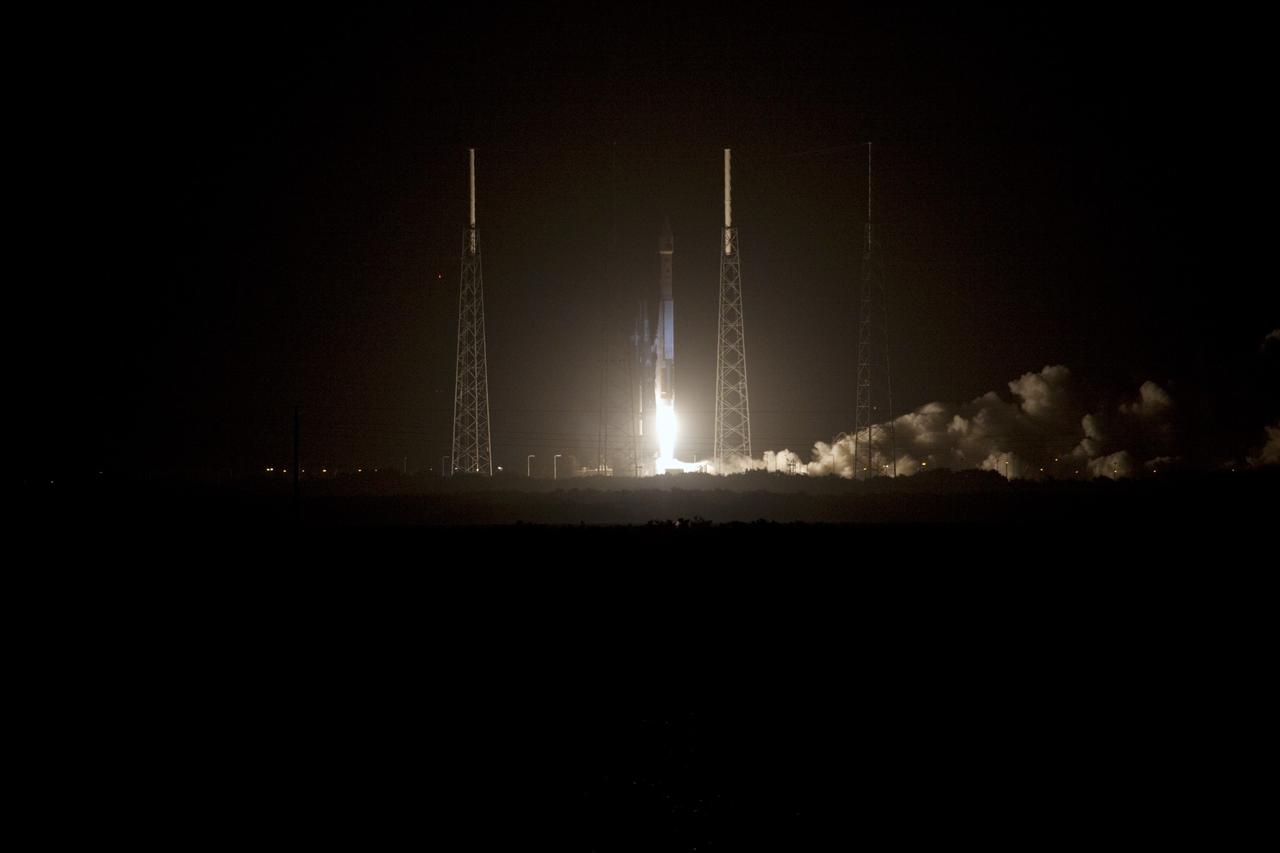
CAPE CANAVERAL, Fla. – The United Launch Alliance Atlas V rocket carrying NASA's Radiation Belt Storm Probes, or RBSP, rumbles off Space Launch Complex 41 on Cape Canaveral Air Force Station in Florida at 4:05 a.m. EDT. RBSP will explore changes in Earth's space environment caused by the sun -- known as "space weather" -- that can disable satellites, create power-grid failures and disrupt GPS service. The mission also will provide data on the fundamental radiation and particle acceleration processes throughout the universe. For more information on RBSP, visit http://www.nasa.gov/rbsp. Photo credit: NASA/Jim Grossmann

CAPE CANAVERAL, Fla. – The United Launch Alliance Atlas V rocket carrying NASA's Radiation Belt Storm Probes, or RBSP, disappears into the night sky over Space Launch Complex 41 on Cape Canaveral Air Force Station in Florida at 4:05 a.m. EDT. RBSP will explore changes in Earth's space environment caused by the sun -- known as "space weather" -- that can disable satellites, create power-grid failures and disrupt GPS service. The mission also will provide data on the fundamental radiation and particle acceleration processes throughout the universe. For more information on RBSP, visit http://www.nasa.gov/rbsp. Photo credit: NASA/Jim Grossmann
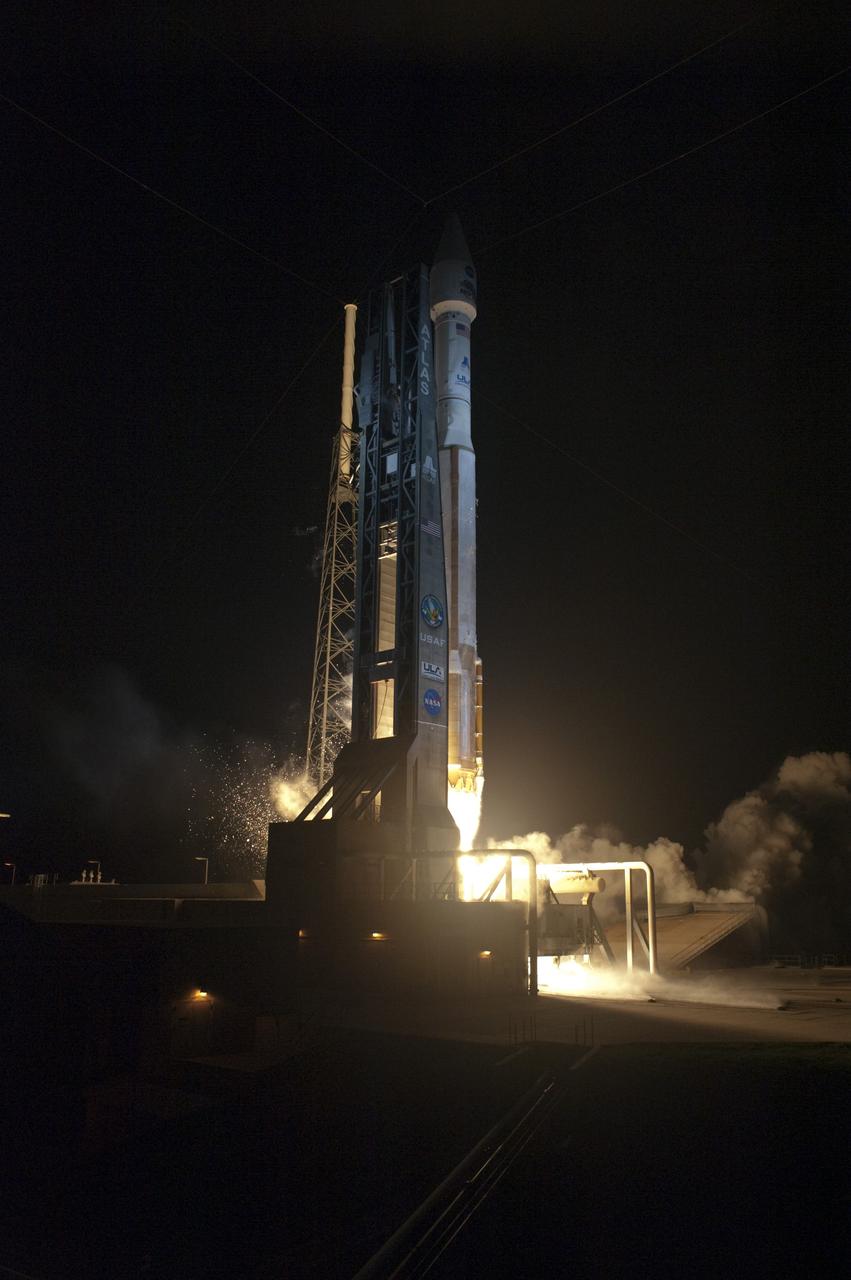
CAPE CANAVERAL, Fla. – The United Launch Alliance Atlas V rocket carrying NASA's Radiation Belt Storm Probes, or RBSP, lifts off Space Launch Complex 41 on Cape Canaveral Air Force Station in Florida at 4:05 a.m. EDT. RBSP will explore changes in Earth's space environment caused by the sun -- known as "space weather" -- that can disable satellites, create power-grid failures and disrupt GPS service. The mission also will provide data on the fundamental radiation and particle acceleration processes throughout the universe. For more information on RBSP, visit http://www.nasa.gov/rbsp. Photo credit: NASA/Tony Gray and Robert Murray
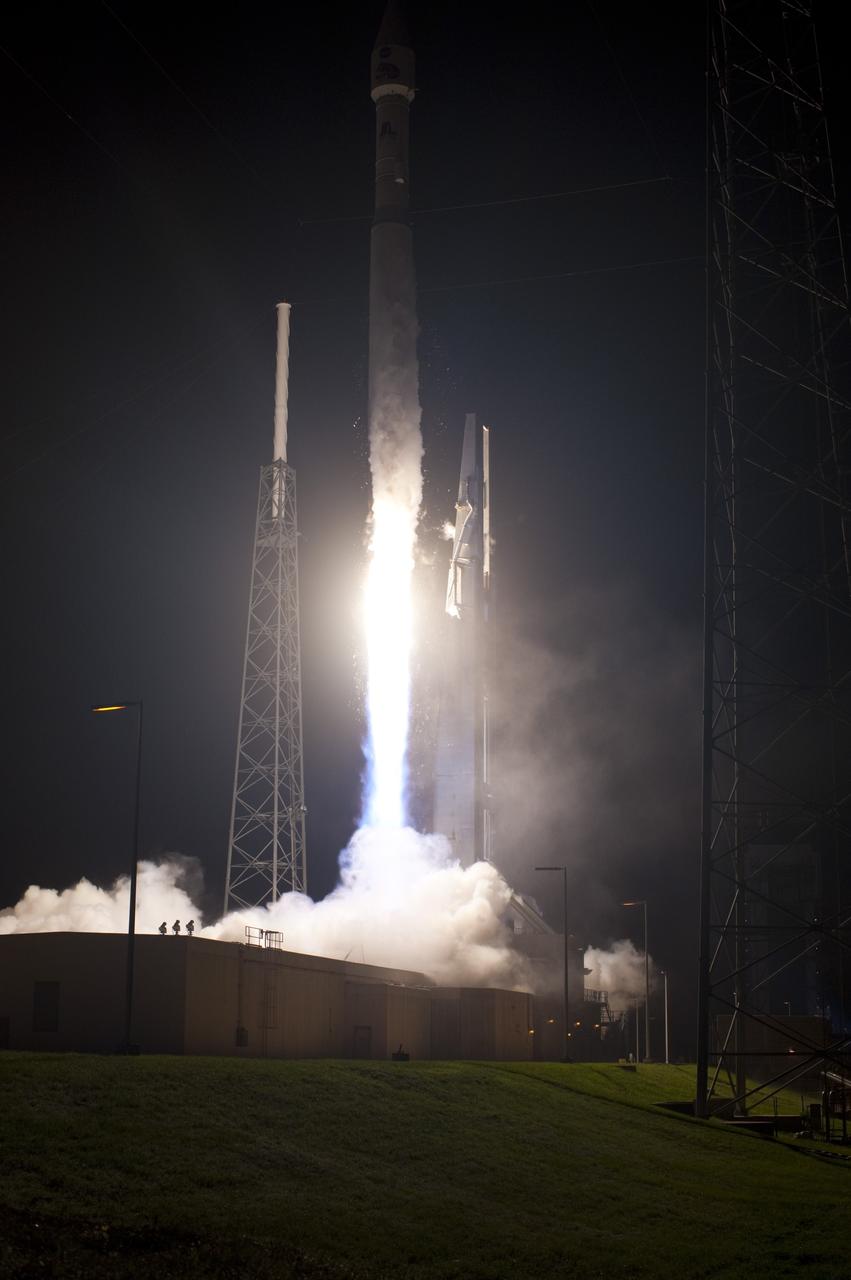
CAPE CANAVERAL, Fla. – The United Launch Alliance Atlas V rocket carrying NASA's Radiation Belt Storm Probes, or RBSP, lifts off Space Launch Complex 41 on Cape Canaveral Air Force Station in Florida at 4:05 a.m. EDT. RBSP will explore changes in Earth's space environment caused by the sun -- known as "space weather" -- that can disable satellites, create power-grid failures and disrupt GPS service. The mission also will provide data on the fundamental radiation and particle acceleration processes throughout the universe. For more information on RBSP, visit http://www.nasa.gov/rbsp. Photo credit: NASA/Tony Gray and Robert Murray

CAPE CANAVERAL, Fla. -The first stage of the United Launch Alliance Atlas V rocket arrives at Launch Complex 41 at Cape Canaveral Air Force Station in Florida for the Radiation Belt Storm Probes, or RBSP, mission. NASA’s RBSP mission will help us understand the sun’s influence on Earth and near-Earth space by studying the Earth’s radiation belts on various scales of space and time. RBSP will begin its mission of exploration of Earth’s Van Allen radiation belts and the extremes of space weather after its launch aboard an Atlas V rocket. Launch is targeted for Aug. 23. For more information, visit http://www.nasa.gov/rbsp. Photo credit: NASA/Cory Huston
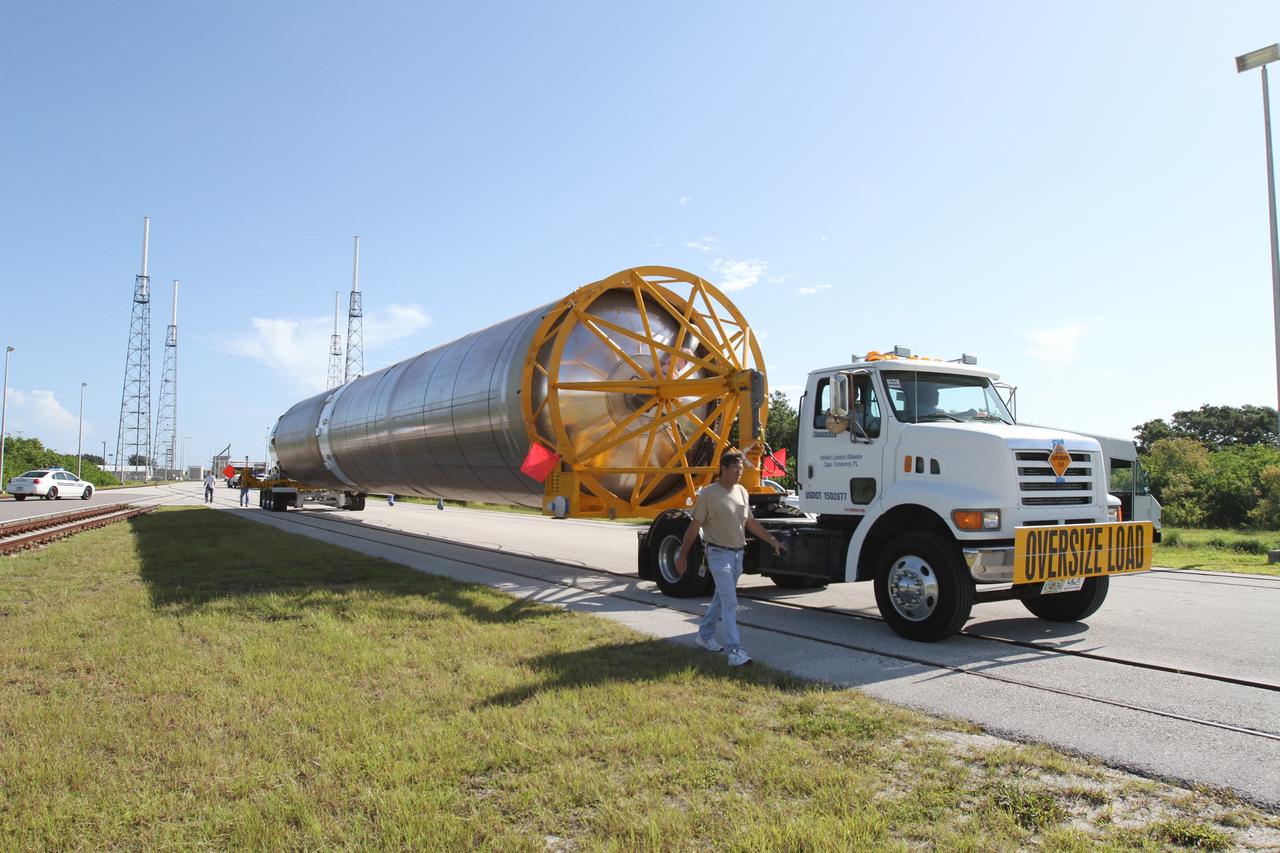
CAPE CANAVERAL, Fla. - The first stage of the United Launch Alliance Atlas V rocket is being transported to Launch Complex 41 at Cape Canaveral Air Force Station in Florida for the Radiation Belt Storm Probes, or RBSP, mission. NASA’s RBSP mission will help us understand the sun’s influence on Earth and near-Earth space by studying the Earth’s radiation belts on various scales of space and time. RBSP will begin its mission of exploration of Earth’s Van Allen radiation belts and the extremes of space weather after its launch aboard an Atlas V rocket. Launch is targeted for Aug. 23. For more information, visit http://www.nasa.gov/rbsp. Photo credit: NASA/Cory Huston
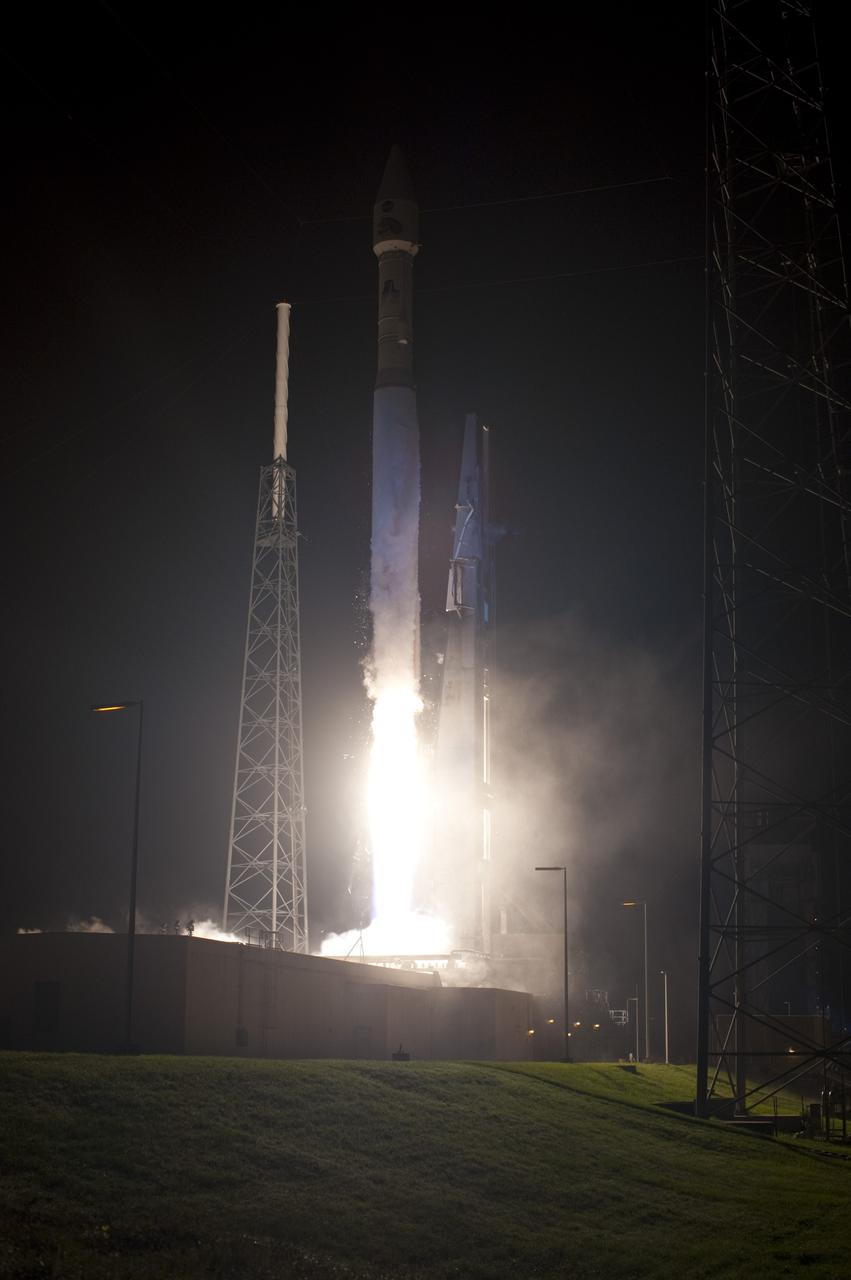
CAPE CANAVERAL, Fla. – The United Launch Alliance Atlas V rocket carrying NASA's Radiation Belt Storm Probes, or RBSP, lifts off Space Launch Complex 41 on Cape Canaveral Air Force Station in Florida at 4:05 a.m. EDT. RBSP will explore changes in Earth's space environment caused by the sun -- known as "space weather" -- that can disable satellites, create power-grid failures and disrupt GPS service. The mission also will provide data on the fundamental radiation and particle acceleration processes throughout the universe. For more information on RBSP, visit http://www.nasa.gov/rbsp. Photo credit: NASA/Tony Gray and Robert Murray
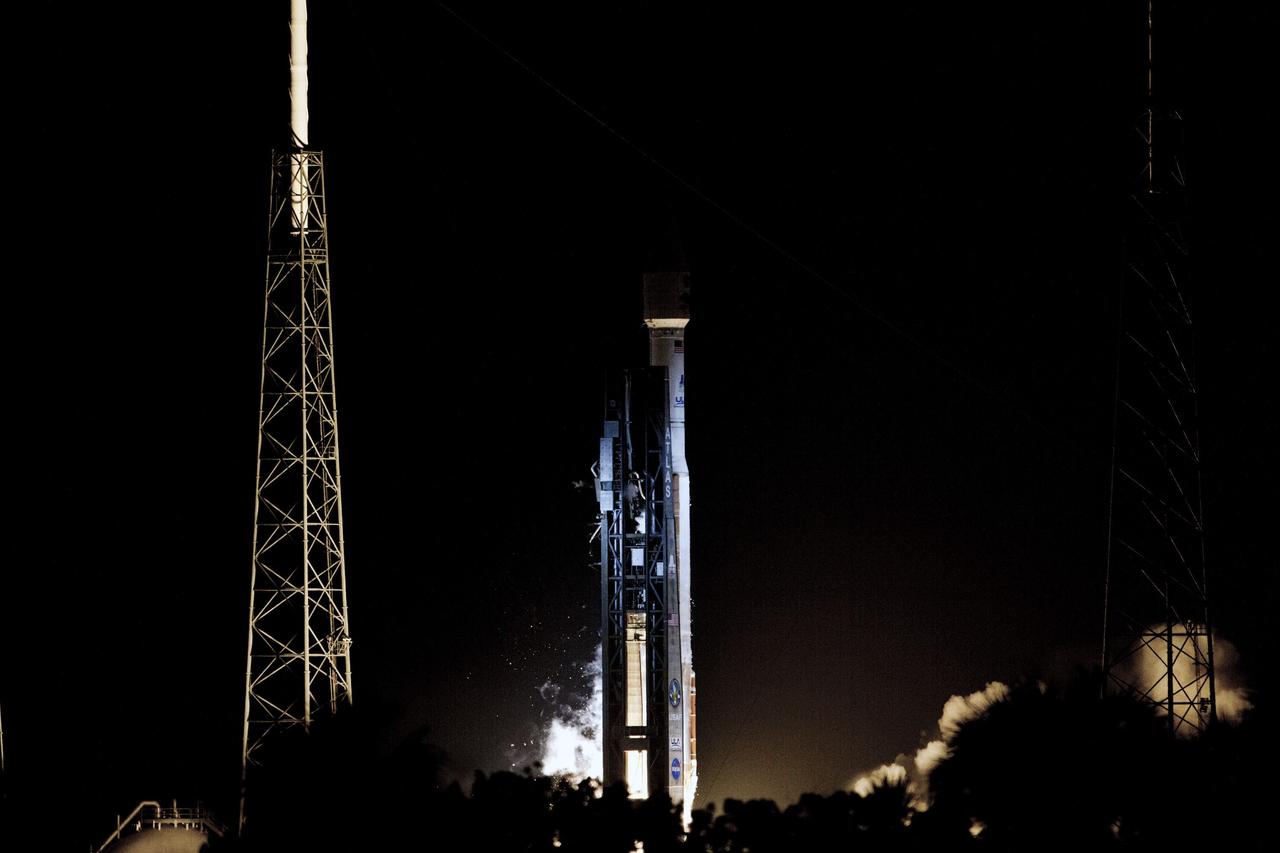
CAPE CANAVERAL, Fla. - The engines ignite under the United Launch Alliance Atlas V rocket at 4:05 a.m. EDT lifting NASA's Radiation Belt Storm Probes, or RBSP, off Space Launch Complex 41 on Cape Canaveral Air Force Station in Florida. RBSP will explore changes in Earth's space environment caused by the sun -- known as "space weather" -- that can disable satellites, create power-grid failures and disrupt GPS service. The mission also will provide data on the fundamental radiation and particle acceleration processes throughout the universe. For more information on RBSP, visit http://www.nasa.gov/rbsp. Photo credit: NASA/Kenny Allen
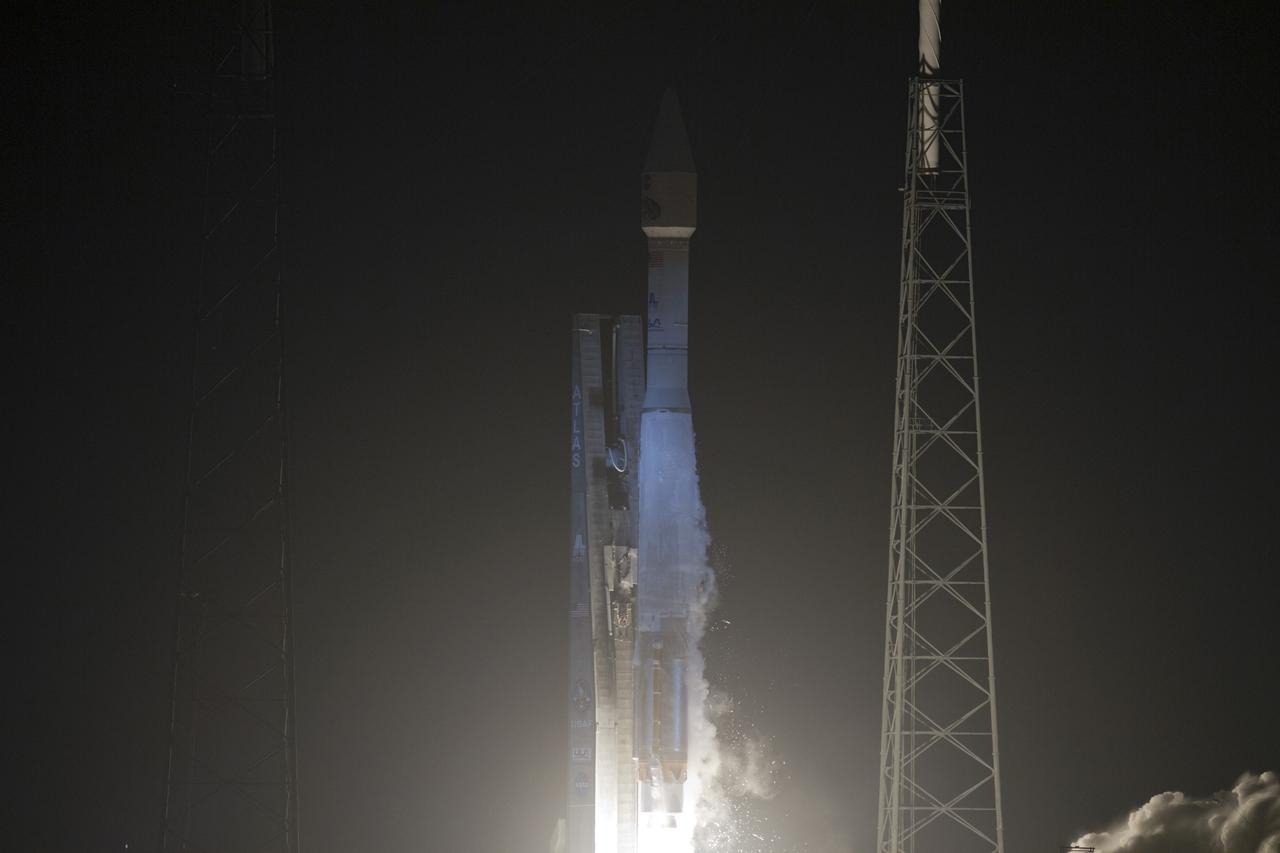
CAPE CANAVERAL, Fla. - The United Launch Alliance Atlas V rocket carrying NASA's Radiation Belt Storm Probes, or RBSP, lifts off Space Launch Complex 41 on Cape Canaveral Air Force Station in Florida at 4:05 a.m. EDT. RBSP will explore changes in Earth's space environment caused by the sun -- known as "space weather" -- that can disable satellites, create power-grid failures and disrupt GPS service. The mission also will provide data on the fundamental radiation and particle acceleration processes throughout the universe. For more information on RBSP, visit http://www.nasa.gov/rbsp. Photo credit: NASA/Rusty Backer
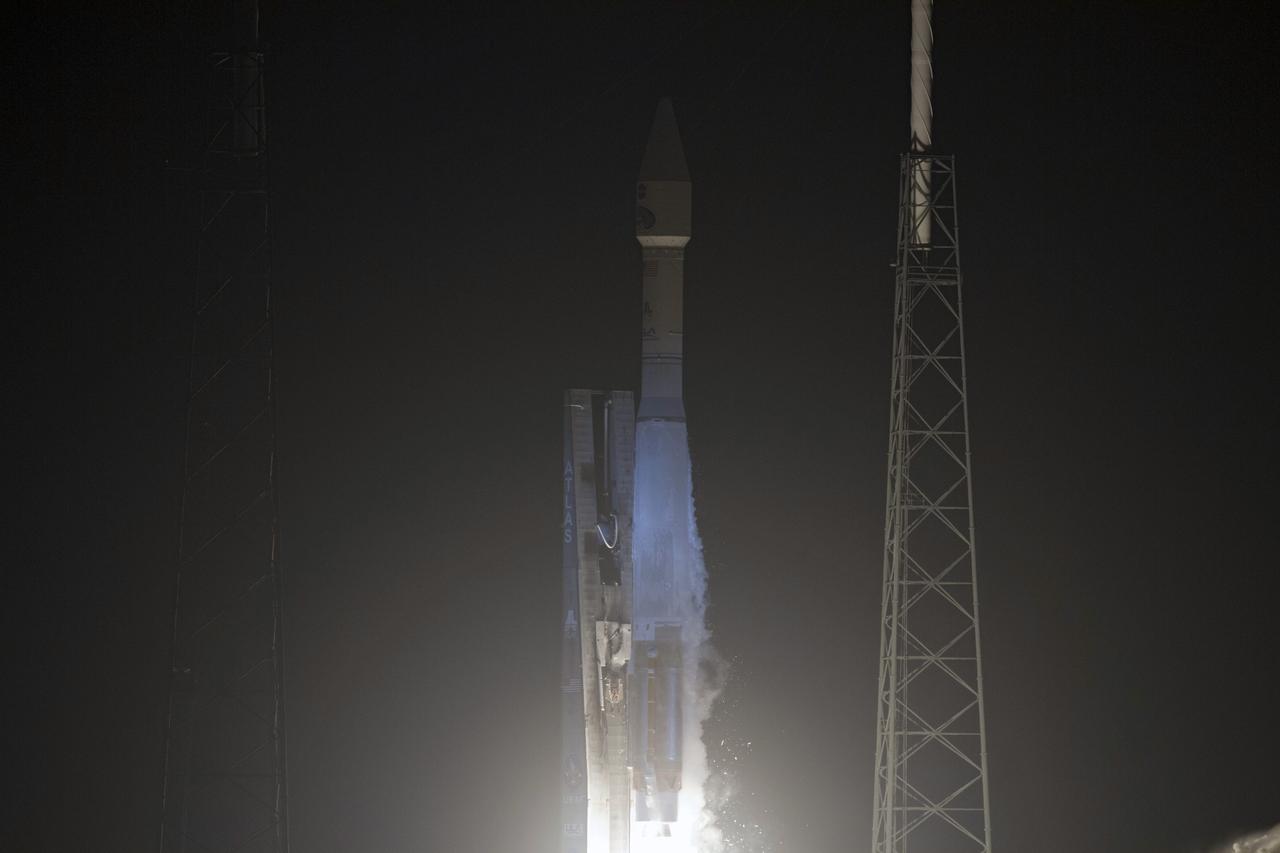
CAPE CANAVERAL, Fla. - The United Launch Alliance Atlas V rocket carrying NASA's Radiation Belt Storm Probes, or RBSP, lifted off Space Launch Complex 41 on Cape Canaveral Air Force Station in Florida at 4:05 a.m. EDT. RBSP will explore changes in Earth's space environment caused by the sun -- known as "space weather" -- that can disable satellites, create power-grid failures and disrupt GPS service. The mission also will provide data on the fundamental radiation and particle acceleration processes throughout the universe. For more information on RBSP, visit http://www.nasa.gov/rbsp. Photo credit: NASA/Rusty Backer
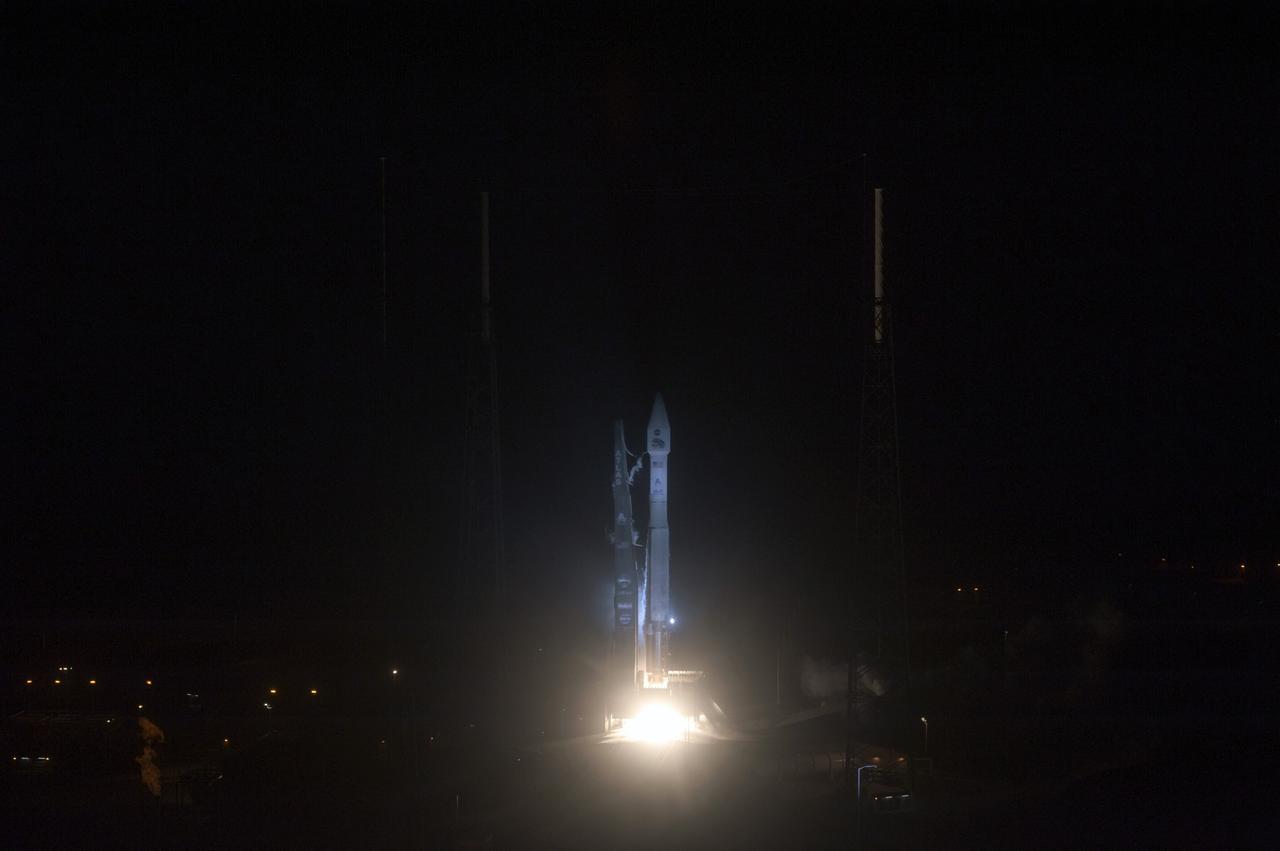
CAPE CANAVERAL, Fla. – The engines ignite under the United Launch Alliance Atlas V rocket at 4:05 a.m. EDT lifting NASA's Radiation Belt Storm Probes, or RBSP, off Space Launch Complex 41 on Cape Canaveral Air Force Station in Florida. RBSP will explore changes in Earth's space environment caused by the sun -- known as "space weather" -- that can disable satellites, create power-grid failures and disrupt GPS service. The mission also will provide data on the fundamental radiation and particle acceleration processes throughout the universe. For more information on RBSP, visit http://www.nasa.gov/rbsp. Photo credit: NASA/Tony Gray and Robert Murray

CAPE CANAVERAL, Fla. – The United Launch Alliance Atlas V rocket carrying NASA's Radiation Belt Storm Probes, or RBSP, roars off Space Launch Complex 41 on Cape Canaveral Air Force Station in Florida at 4:05 a.m. EDT. RBSP will explore changes in Earth's space environment caused by the sun -- known as "space weather" -- that can disable satellites, create power-grid failures and disrupt GPS service. The mission also will provide data on the fundamental radiation and particle acceleration processes throughout the universe. For more information on RBSP, visit http://www.nasa.gov/rbsp. Photo credit: NASA/Jim Grossmann
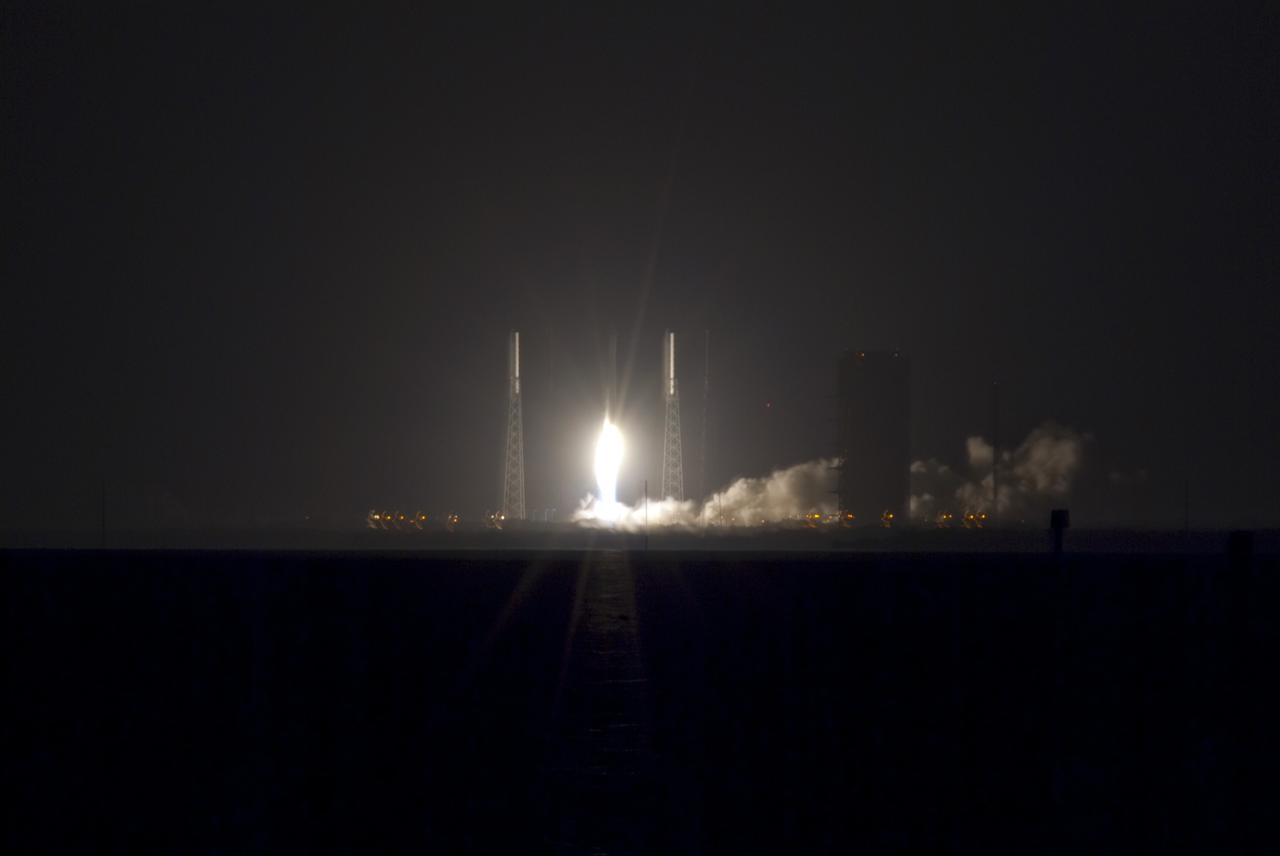
CAPE CANAVERAL, Fla. – The United Launch Alliance Atlas V rocket carrying NASA's Radiation Belt Storm Probes, or RBSP, lifts off Space Launch Complex 41 on Cape Canaveral Air Force Station in Florida at 4:05 a.m. EDT. RBSP will explore changes in Earth's space environment caused by the sun -- known as "space weather" -- that can disable satellites, create power-grid failures and disrupt GPS service. The mission also will provide data on the fundamental radiation and particle acceleration processes throughout the universe. For more information on RBSP, visit http://www.nasa.gov/rbsp. Photo credit: NASA/Ben Smegelsky
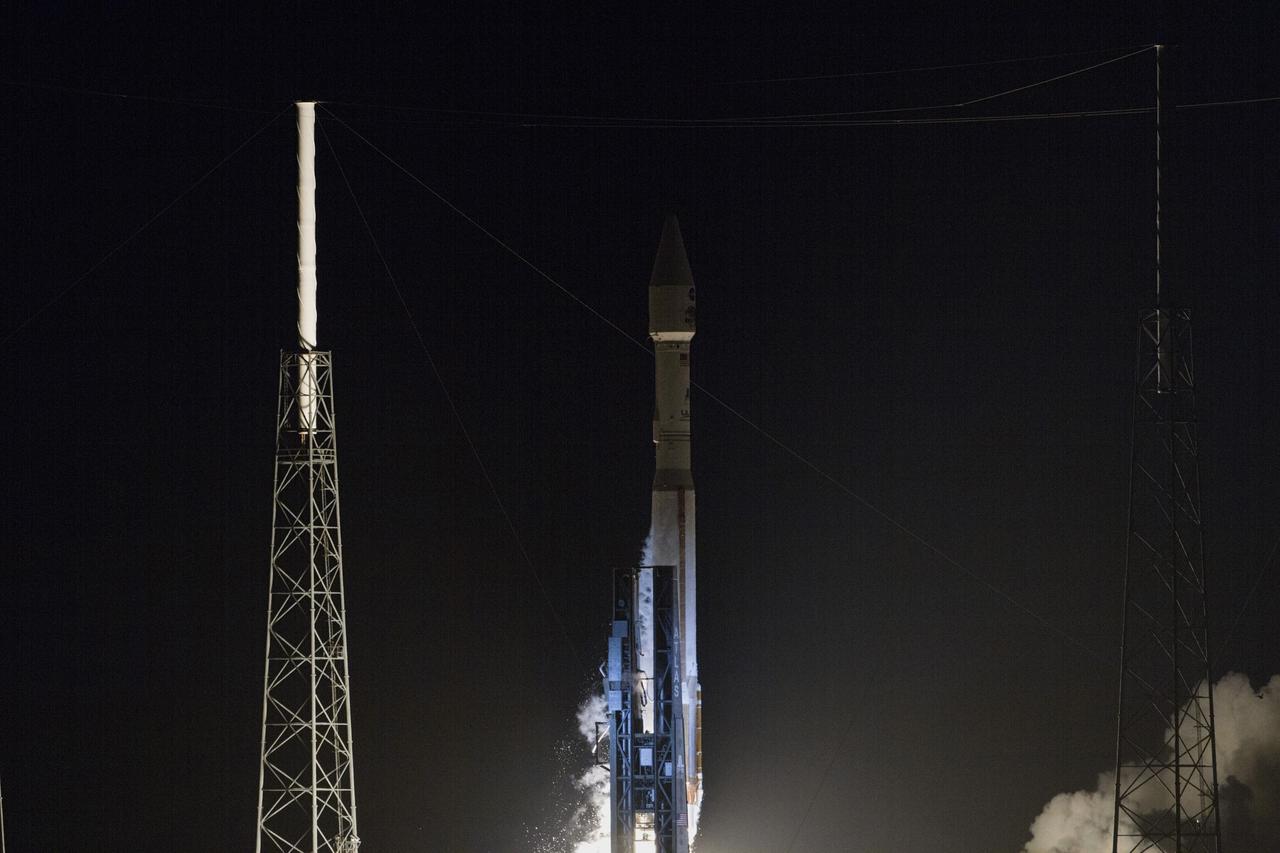
CAPE CANAVERAL, Fla. - The United Launch Alliance Atlas V rocket carrying NASA's Radiation Belt Storm Probes, or RBSP, lifts off Space Launch Complex 41 on Cape Canaveral Air Force Station in Florida at 4:05 a.m. EDT. RBSP will explore changes in Earth's space environment caused by the sun -- known as "space weather" -- that can disable satellites, create power-grid failures and disrupt GPS service. The mission also will provide data on the fundamental radiation and particle acceleration processes throughout the universe. For more information on RBSP, visit http://www.nasa.gov/rbsp. Photo credit: NASA/Kenny Allen
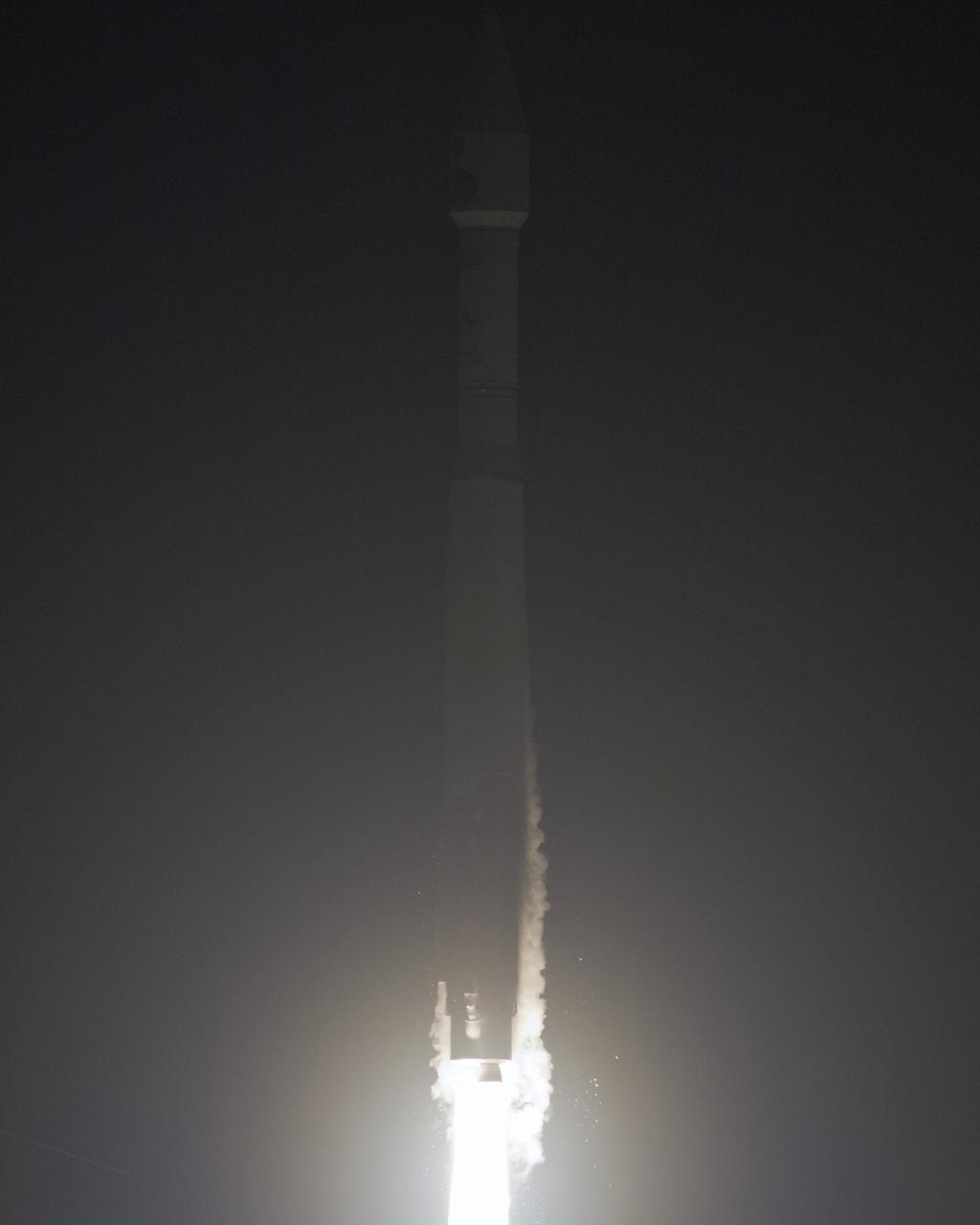
CAPE CANAVERAL, Fla. - The United Launch Alliance Atlas V rocket carrying NASA's Radiation Belt Storm Probes, or RBSP, lifted off Space Launch Complex 41 on Cape Canaveral Air Force Station in Florida at 4:05 a.m. EDT. RBSP will explore changes in Earth's space environment caused by the sun -- known as "space weather" -- that can disable satellites, create power-grid failures and disrupt GPS service. The mission also will provide data on the fundamental radiation and particle acceleration processes throughout the universe. For more information on RBSP, visit http://www.nasa.gov/rbsp. Photo credit: NASA/Rusty Backer
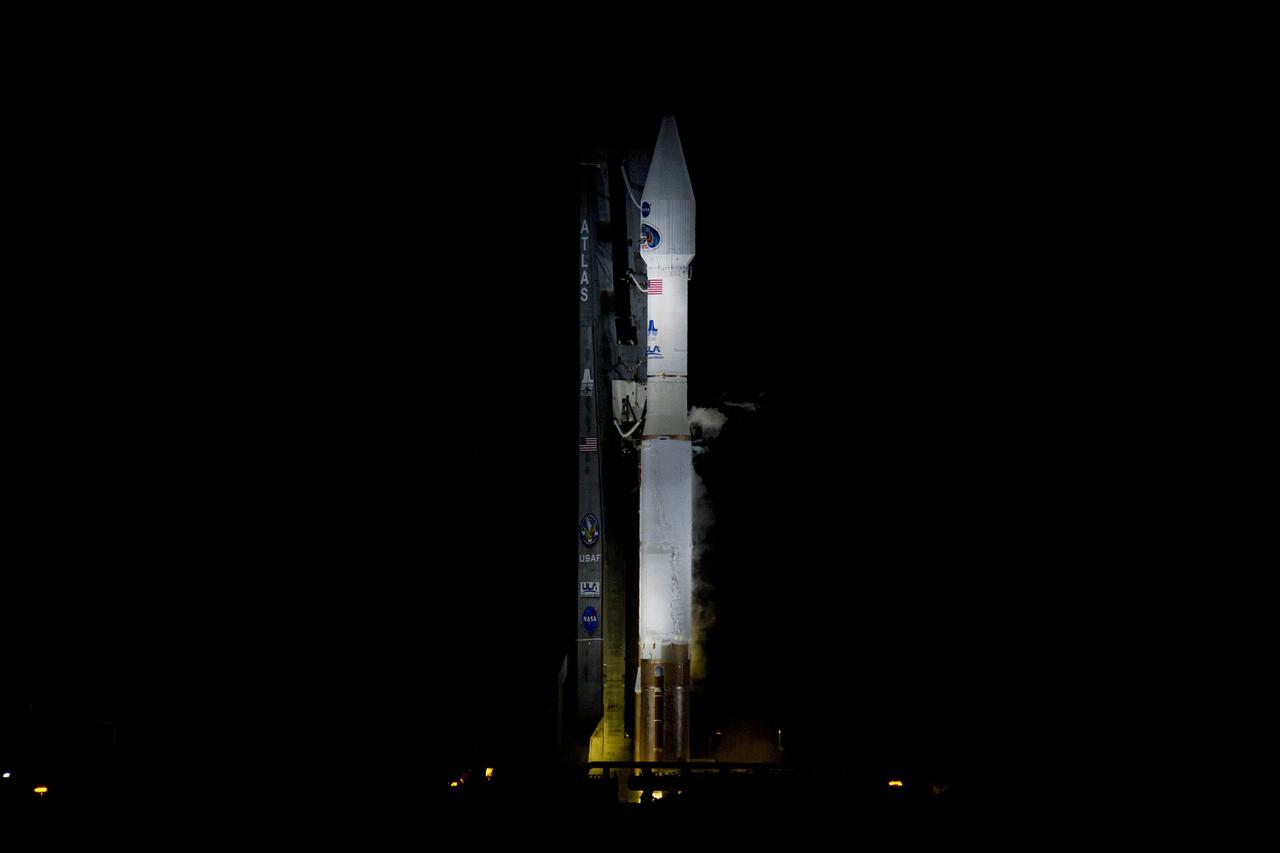
CAPE CANAVERAL, Fla. - The engines ignite under the United Launch Alliance Atlas V rocket at 4:05 a.m. EDT lifting NASA's Radiation Belt Storm Probes, or RBSP, off Space Launch Complex 41 on Cape Canaveral Air Force Station in Florida. RBSP will explore changes in Earth's space environment caused by the sun -- known as "space weather" -- that can disable satellites, create power-grid failures and disrupt GPS service. The mission also will provide data on the fundamental radiation and particle acceleration processes throughout the universe. For more information on RBSP, visit http://www.nasa.gov/rbsp. Photo credit: NASA/Rusty Backer
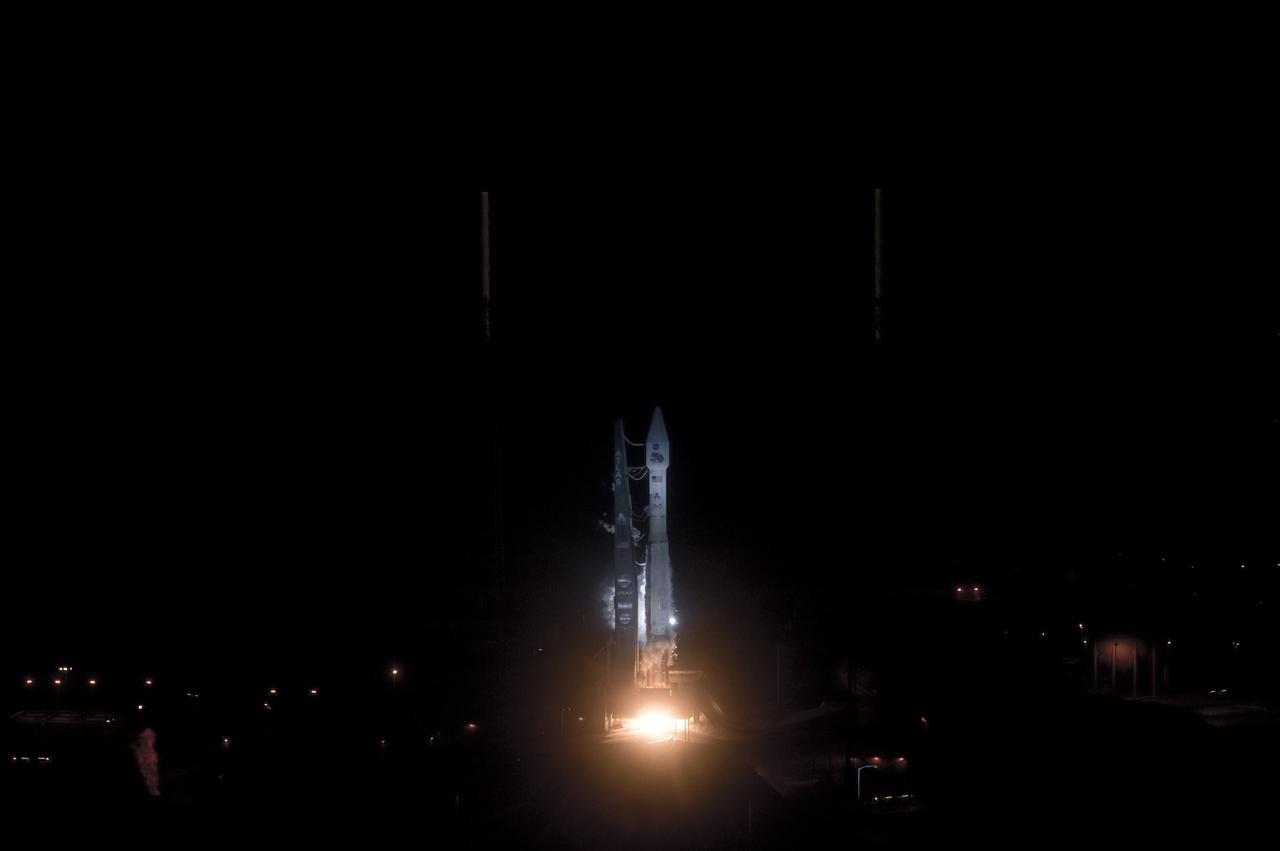
CAPE CANAVERAL, Fla. – The engines ignite under the United Launch Alliance Atlas V rocket at 4:05 a.m. EDT lifting NASA's Radiation Belt Storm Probes, or RBSP, off Space Launch Complex 41 on Cape Canaveral Air Force Station in Florida. RBSP will explore changes in Earth's space environment caused by the sun -- known as "space weather" -- that can disable satellites, create power-grid failures and disrupt GPS service. The mission also will provide data on the fundamental radiation and particle acceleration processes throughout the universe. For more information on RBSP, visit http://www.nasa.gov/rbsp. Photo credit: NASA/Tony Gray and Robert Murray
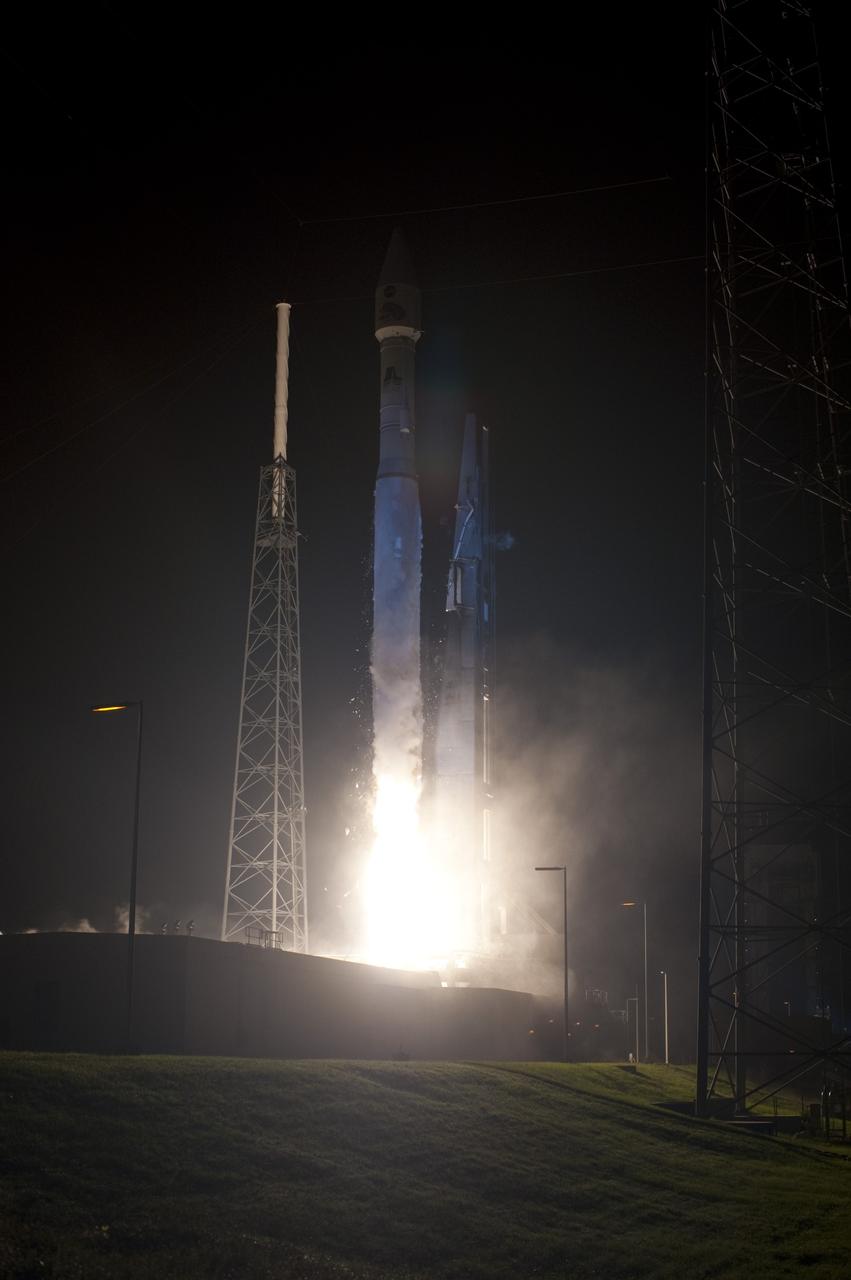
CAPE CANAVERAL, Fla. – The United Launch Alliance Atlas V rocket carrying NASA's Radiation Belt Storm Probes, or RBSP, lifts off Space Launch Complex 41 on Cape Canaveral Air Force Station in Florida at 4:05 a.m. EDT. RBSP will explore changes in Earth's space environment caused by the sun -- known as "space weather" -- that can disable satellites, create power-grid failures and disrupt GPS service. The mission also will provide data on the fundamental radiation and particle acceleration processes throughout the universe. For more information on RBSP, visit http://www.nasa.gov/rbsp. Photo credit: NASA/Tony Gray and Robert Murray
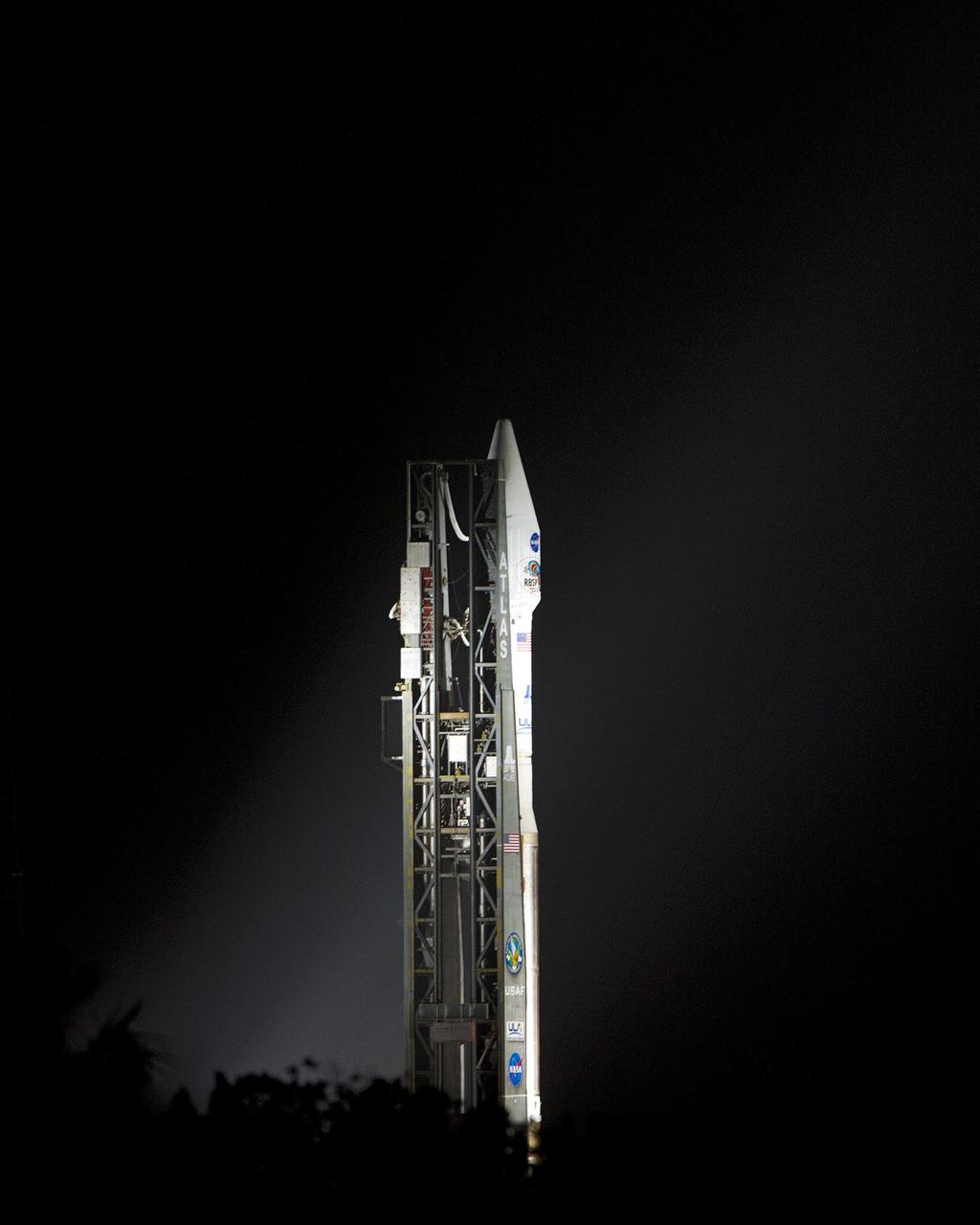
CAPE CANAVERAL, Fla. - The United Launch Alliance Atlas V rocket carrying NASA’s Radiation Belt Storm Probes, or RBSP, is a breath away from lifting off Space Launch Complex 41 on Cape Canaveral Air Force Station in Florida. RBSP will explore changes in Earth's space environment caused by the sun -- known as "space weather" -- that can disable satellites, create power-grid failures and disrupt GPS service. The mission also will provide data on the fundamental radiation and particle acceleration processes throughout the universe. For more information on RBSP, visit http://www.nasa.gov/rbsp. Photo credit: NASA/Kenny Allen
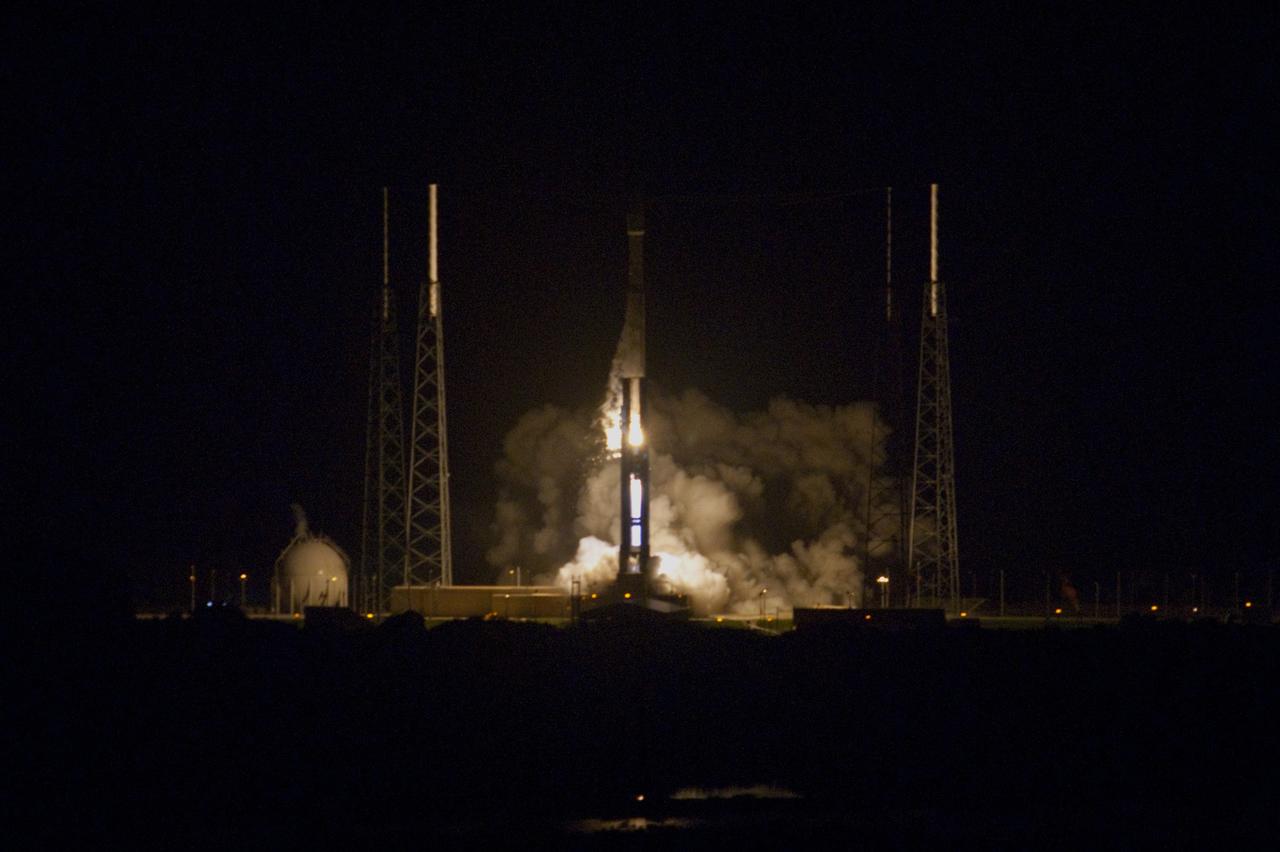
CAPE CANAVERAL, Fla. – Exhaust clouds billow across the pad at Space Launch Complex 41 on Cape Canaveral Air Force Station in Florida as the United Launch Alliance Atlas V rocket carrying NASA's Radiation Belt Storm Probes, or RBSP, lifts off at 4:05 a.m. EDT. RBSP will explore changes in Earth's space environment caused by the sun -- known as "space weather" -- that can disable satellites, create power-grid failures and disrupt GPS service. The mission also will provide data on the fundamental radiation and particle acceleration processes throughout the universe. For more information on RBSP, visit http://www.nasa.gov/rbsp. Photo credit: NASA/Gianni Woods
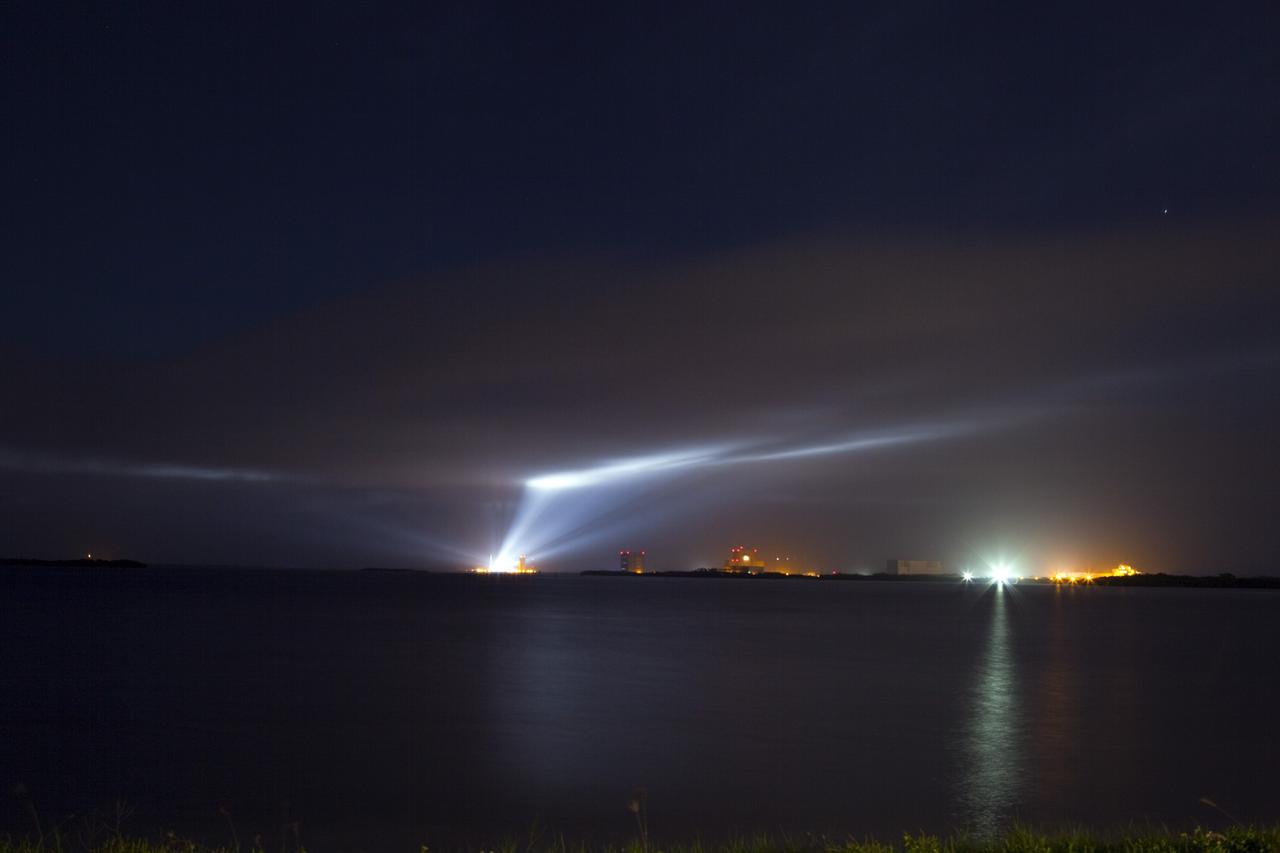
CAPE CANAVERAL, Fla. – Spotlights dance along the clouds over Space Launch Complex 41 on Cape Canaveral Air Force Station as NASA's Radiation Belt Storm Probes, or RBSP, lift off the pad at 4:05 a.m. EDT aboard a United Launch Alliance Atlas V rocket. RBSP will explore changes in Earth's space environment caused by the sun -- known as "space weather" -- that can disable satellites, create power-grid failures and disrupt GPS service. The mission also will provide data on the fundamental radiation and particle acceleration processes throughout the universe. For more information on RBSP, visit http://www.nasa.gov/rbsp. Photo credit: NASA/Ben Smegelsky and Gary Thompson
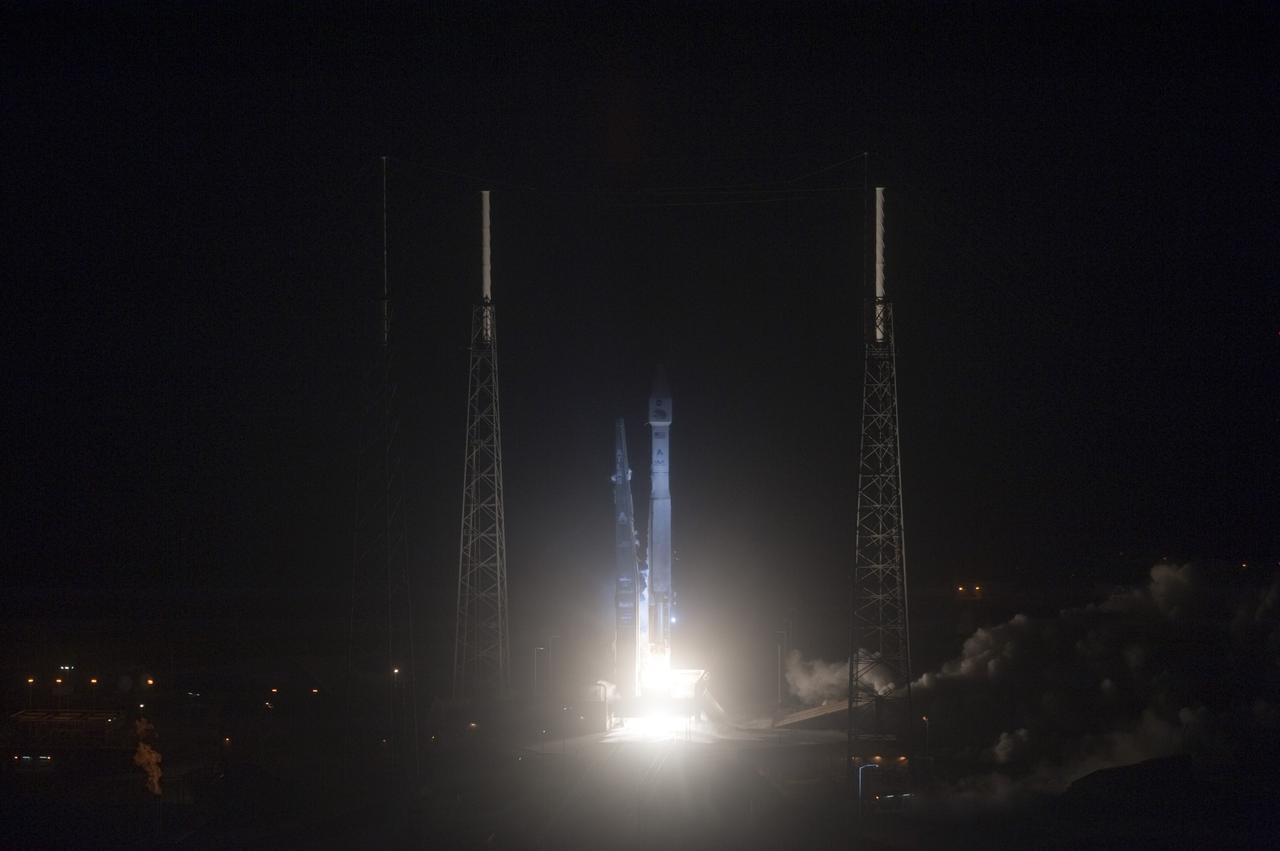
CAPE CANAVERAL, Fla. – The engines ignite under the United Launch Alliance Atlas V rocket at 4:05 a.m. EDT lifting NASA's Radiation Belt Storm Probes, or RBSP, off Space Launch Complex 41 on Cape Canaveral Air Force Station in Florida. RBSP will explore changes in Earth's space environment caused by the sun -- known as "space weather" -- that can disable satellites, create power-grid failures and disrupt GPS service. The mission also will provide data on the fundamental radiation and particle acceleration processes throughout the universe. For more information on RBSP, visit http://www.nasa.gov/rbsp. Photo credit: NASA/Tony Gray and Robert Murray
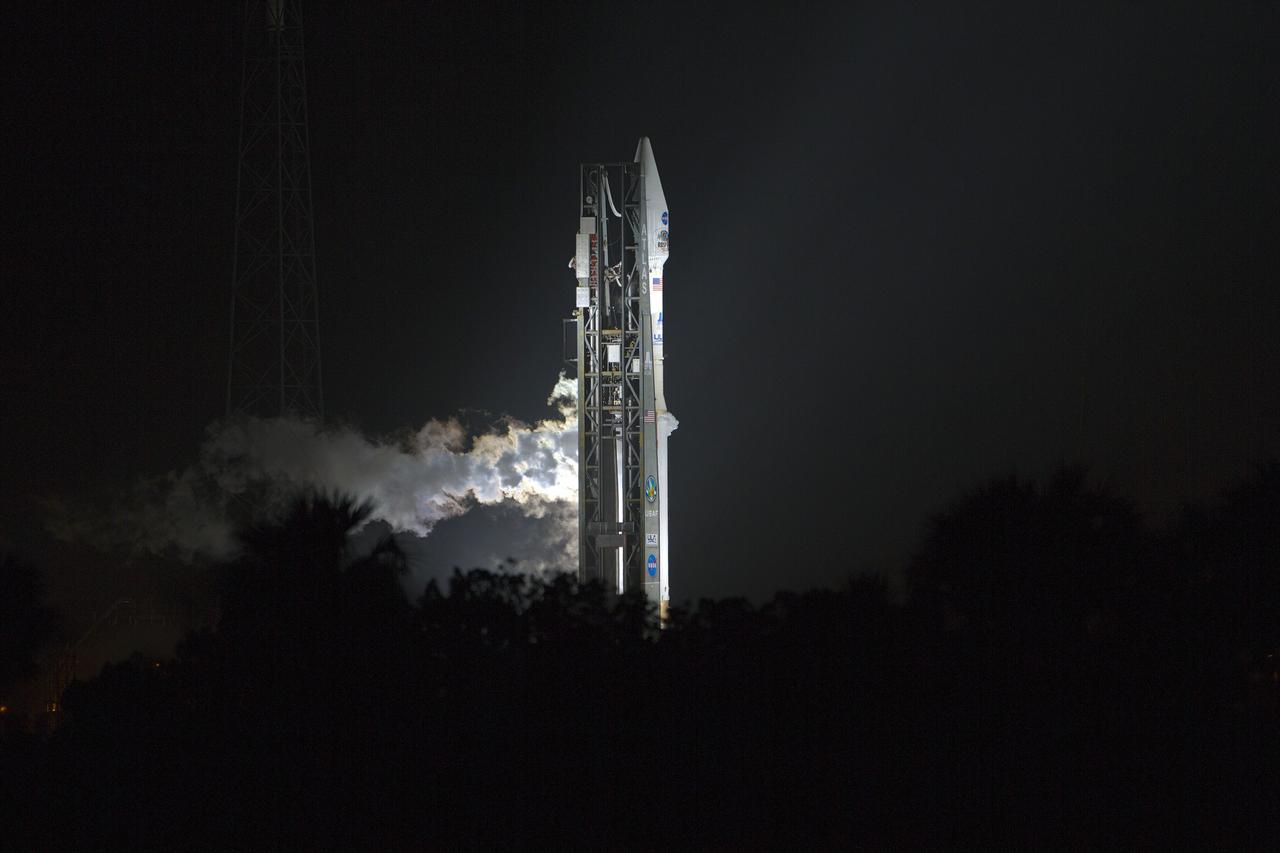
CAPE CANAVERAL, Fla. - The engines ignite under the United Launch Alliance Atlas V rocket at 4:05 a.m. EDT lifting NASA's Radiation Belt Storm Probes, or RBSP, off Space Launch Complex 41 on Cape Canaveral Air Force Station in Florida. RBSP will explore changes in Earth's space environment caused by the sun -- known as "space weather" -- that can disable satellites, create power-grid failures and disrupt GPS service. The mission also will provide data on the fundamental radiation and particle acceleration processes throughout the universe. For more information on RBSP, visit http://www.nasa.gov/rbsp. Photo credit: NASA/Kenny Allen
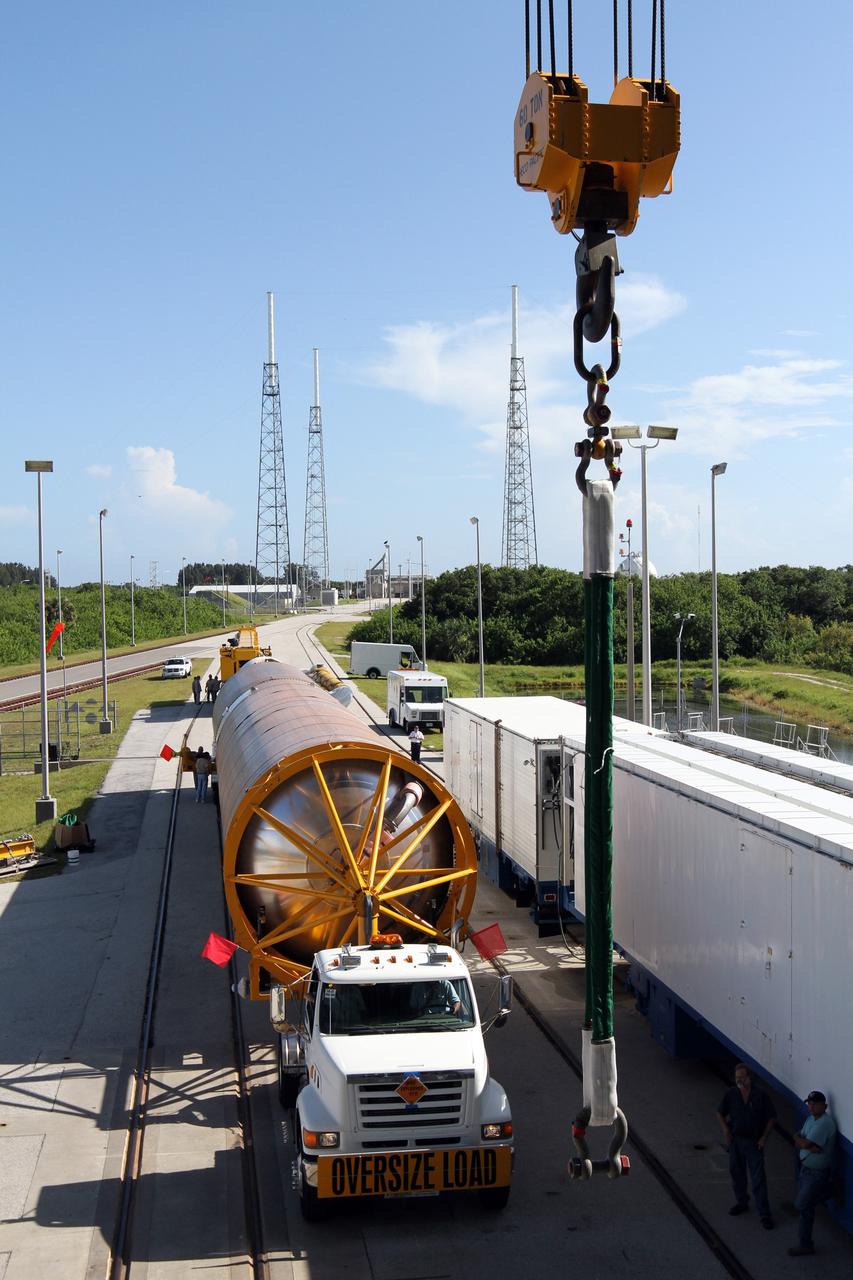
CAPE CANAVERAL, Fla. - The first stage of the United Launch Alliance Atlas V rocket arrives at Launch Complex 41 at Cape Canaveral Air Force Station in Florida for the Radiation Belt Storm Probes, or RBSP, mission. NASA’s RBSP mission will help us understand the sun’s influence on Earth and near-Earth space by studying the Earth’s radiation belts on various scales of space and time. RBSP will begin its mission of exploration of Earth’s Van Allen radiation belts and the extremes of space weather after its launch aboard an Atlas V rocket. Launch is targeted for Aug. 23. For more information, visit http://www.nasa.gov/rbsp. Photo credit: NASA/Cory Huston

CAPE CANAVERAL, Fla. – The United Launch Alliance Atlas V rocket carrying NASA’s Radiation Belt Storm Probes, or RBSP, spacecraft illuminates Space Launch Complex 41 on Cape Canaveral Air Force Station in Florida as it lifts off the pad at 4:05 a.m. EDT. RBSP will explore changes in Earth's space environment caused by the sun -- known as "space weather" -- that can disable satellites, create power-grid failures and disrupt GPS service. The mission also will provide data on the fundamental radiation and particle acceleration processes throughout the universe. For more information on RBSP, visit http://www.nasa.gov/rbsp. Photo credit: NASA/Tony Gray and Robert Murray

CAPE CANAVERAL, Fla. - The first stage of the United Launch Alliance Atlas V rocket arrives at Launch Complex 41 at Cape Canaveral Air Force Station in Florida for the Radiation Belt Storm Probes, or RBSP, mission. NASA’s RBSP mission will help us understand the sun’s influence on Earth and near-Earth space by studying the Earth’s radiation belts on various scales of space and time. RBSP will begin its mission of exploration of Earth’s Van Allen radiation belts and the extremes of space weather after its launch aboard an Atlas V rocket. Launch is targeted for Aug. 23. For more information, visit http://www.nasa.gov/rbsp. Photo credit: NASA/Cory Huston
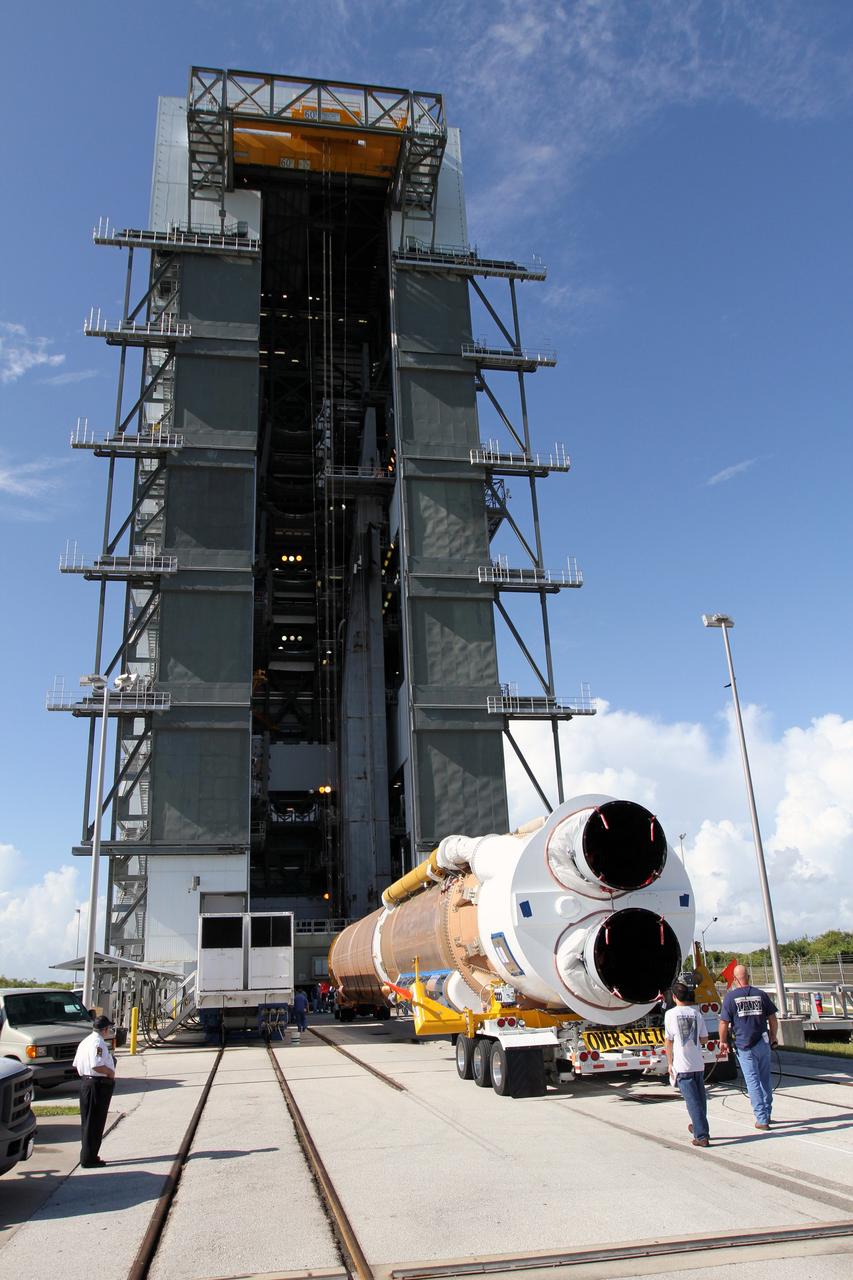
CAPE CANAVERAL, Fla. - The first stage of the United Launch Alliance Atlas V rocket arrives at Launch Complex 41 at Cape Canaveral Air Force Station in Florida for the Radiation Belt Storm Probes, or RBSP, mission. NASA’s RBSP mission will help us understand the sun’s influence on Earth and near-Earth space by studying the Earth’s radiation belts on various scales of space and time. RBSP will begin its mission of exploration of Earth’s Van Allen radiation belts and the extremes of space weather after its launch aboard an Atlas V rocket. Launch is targeted for Aug. 23. For more information, visit http://www.nasa.gov/rbsp. Photo credit: NASA/Cory Huston
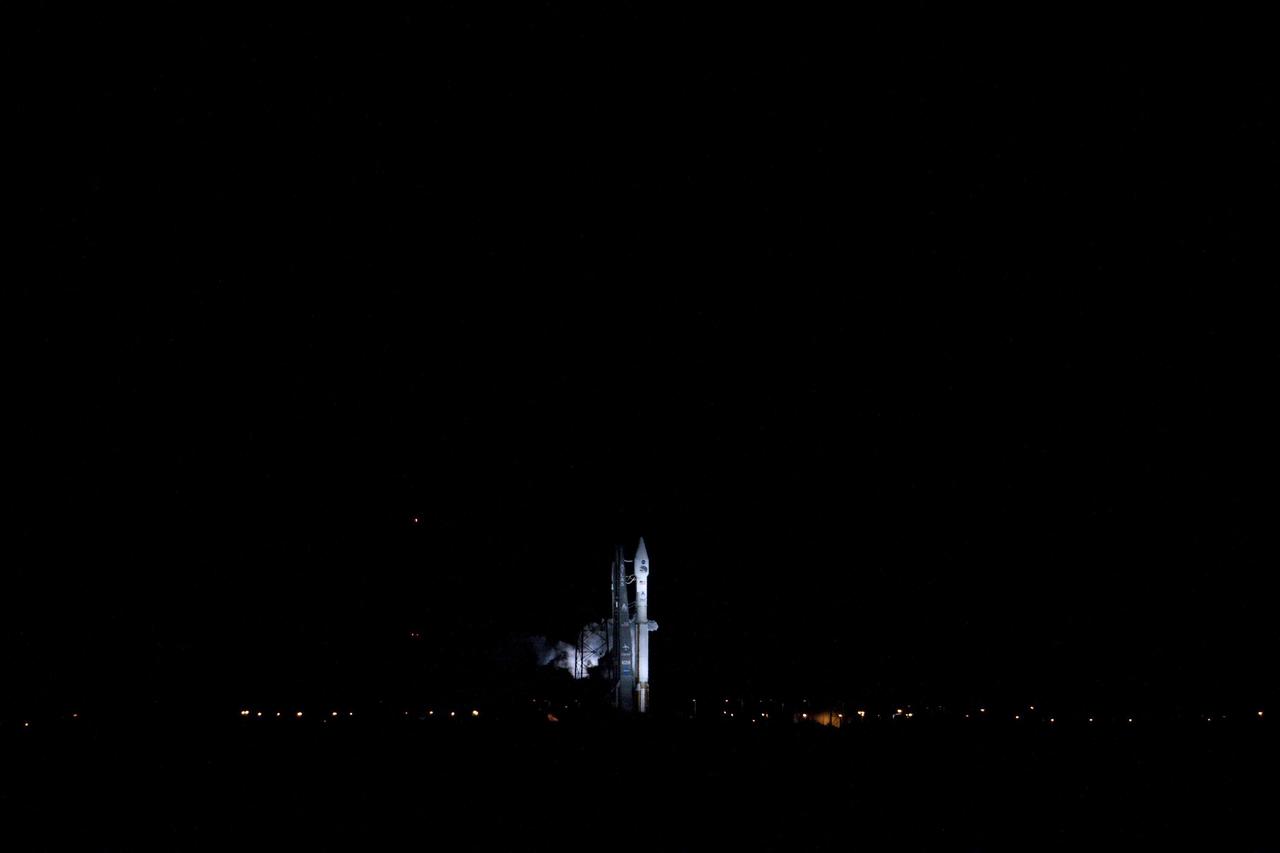
CAPE CANAVERAL, Fla. – Engine ignition under the United Launch Alliance Atlas V rocket at 4:05 a.m. EDT signals liftoff of NASA's Radiation Belt Storm Probes, or RBSP, is imminent from Space Launch Complex 41 on Cape Canaveral Air Force Station in Florida. RBSP will explore changes in Earth's space environment caused by the sun -- known as "space weather" -- that can disable satellites, create power-grid failures and disrupt GPS service. The mission also will provide data on the fundamental radiation and particle acceleration processes throughout the universe. For more information on RBSP, visit http://www.nasa.gov/rbsp. Photo credit: NASA/Jim Grossmann

CAPE CANAVERAL, Fla. – The engines ignite under the United Launch Alliance Atlas V rocket at 4:05 a.m. EDT lifting NASA's Radiation Belt Storm Probes, or RBSP, off Space Launch Complex 41 on Cape Canaveral Air Force Station in Florida. RBSP will explore changes in Earth's space environment caused by the sun -- known as "space weather" -- that can disable satellites, create power-grid failures and disrupt GPS service. The mission also will provide data on the fundamental radiation and particle acceleration processes throughout the universe. For more information on RBSP, visit http://www.nasa.gov/rbsp. Photo credit: NASA/Ben Smegelsky
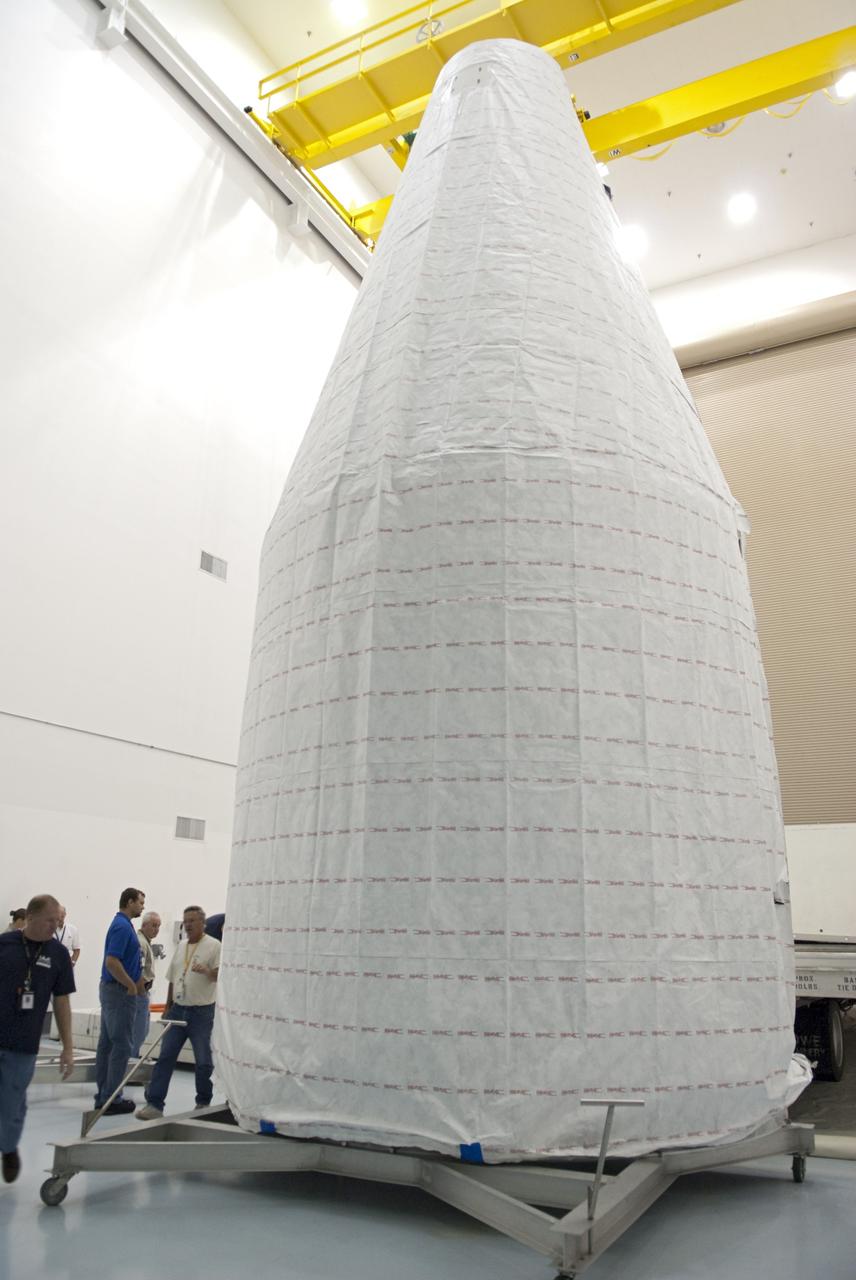
CAPE CANAVERAL, Fla. - Inside the Astrotech payload processing facility near NASA’s Kennedy Space Center in Florida, technicians offload, inspect and prepare to uncover the nose cone fairing for the Radiation Belt Storm Probes, or RBSP, spacecraft. The nose faring will house and protect the RBSP during liftoff aboard an Atlas V rocket. NASA’s RBSP mission will help us understand the sun’s influence on Earth and near-Earth space by studying the Earth’s radiation belts on various scales of space and time. RBSP will begin its mission of exploration of Earth’s Van Allen radiation belts and the extremes of space weather after its liftoff aboard a United Launch Alliance Atlas V from Space Launch Complex 41 at Cape Canaveral Air Force Station, Fla. Liftoff is targeted for Aug. 23, 2012. For more information, visit http://www.nasa.gov/rbsp. Photo credit: NASA/Charisse Nahser
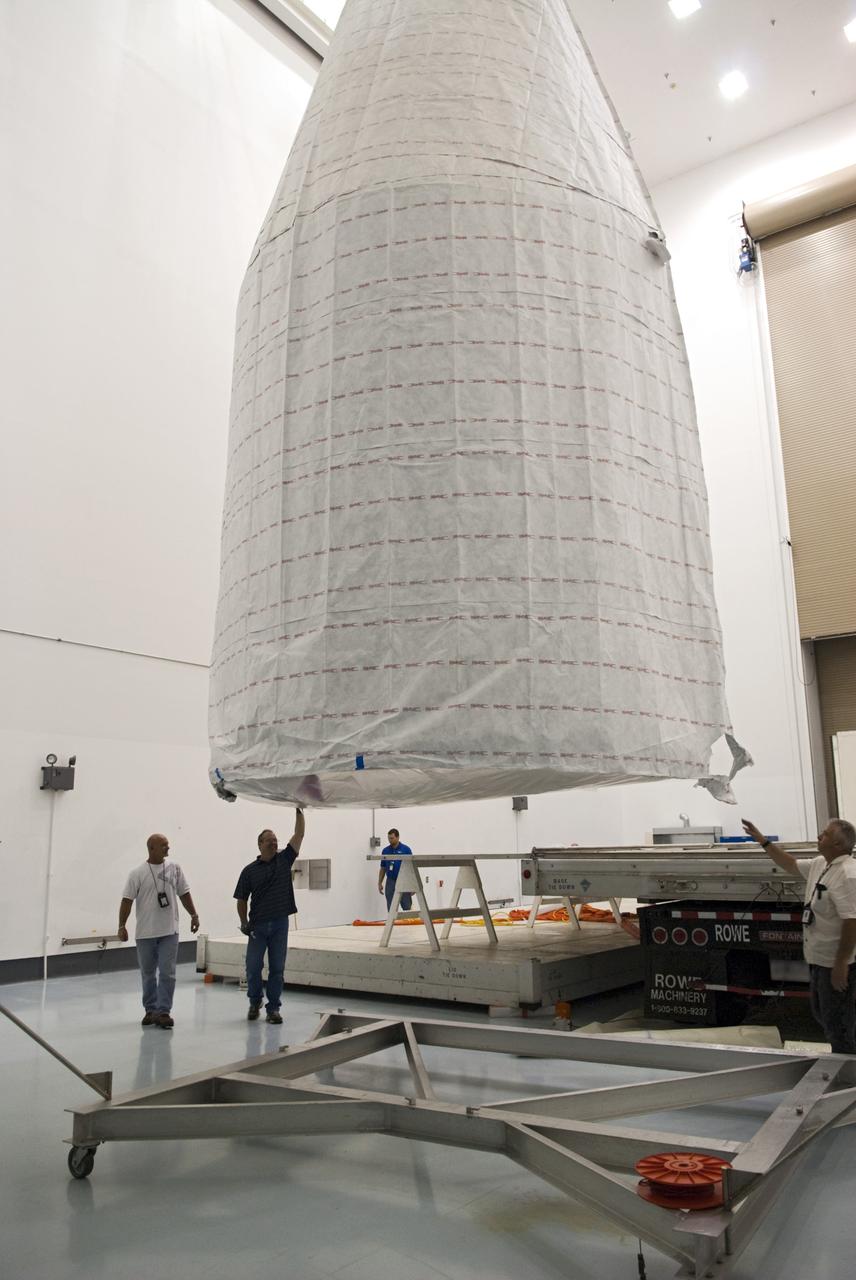
CAPE CANAVERAL, Fla. - Inside the Astrotech payload processing facility near NASA’s Kennedy Space Center in Florida, technicians offload, inspect and prepare to uncover the nose cone fairing for the Radiation Belt Storm Probes, or RBSP, spacecraft. The nose faring will house and protect the RBSP during liftoff aboard an Atlas V rocket. NASA’s RBSP mission will help us understand the sun’s influence on Earth and near-Earth space by studying the Earth’s radiation belts on various scales of space and time. RBSP will begin its mission of exploration of Earth’s Van Allen radiation belts and the extremes of space weather after its liftoff aboard a United Launch Alliance Atlas V from Space Launch Complex 41 at Cape Canaveral Air Force Station, Fla. Liftoff is targeted for Aug. 23, 2012. For more information, visit http://www.nasa.gov/rbsp. Photo credit: NASA/Charisse Nahser
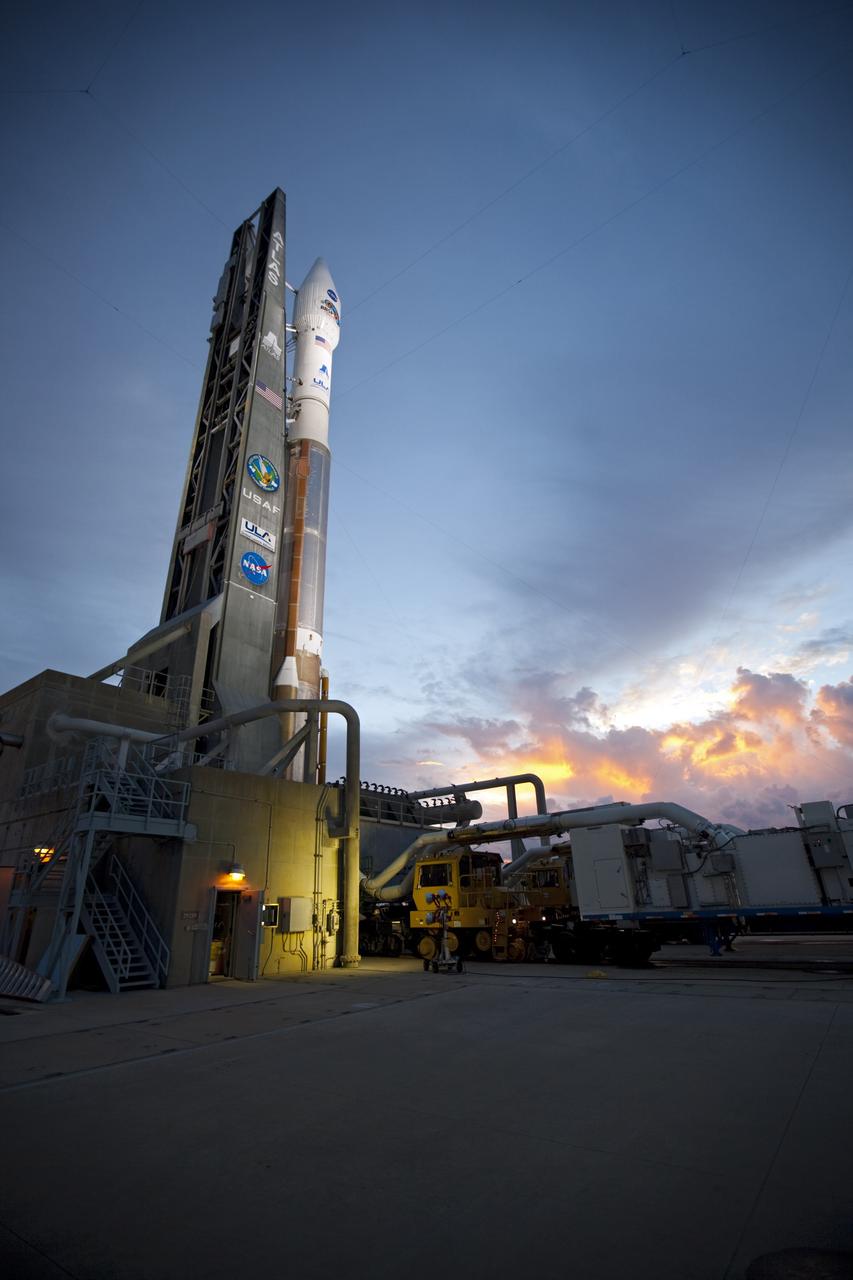
CAPE CANAVERAL, Fla. – An unfavorable weather forecast as a result of Tropical Storm Isaac approaching Florida kept NASA's twin Radiation Belt Storm Probes, or RBSP, on Space Launch Complex 41 at Cape Canaveral Air Force Station in Florida. Managers decided to roll the Atlas V rocket off the launch pad and back to the Vertical Integration Facility to ensure the launch vehicle and RBSP spacecraft are secured and protected from inclement weather. RBSP will explore changes in Earth's space environment caused by the sun -- known as "space weather" -- that can disable satellites, create power-grid failures and disrupt GPS service. The mission also will provide data on the fundamental radiation and particle acceleration processes throughout the universe. The launch is rescheduled for 4:05 a.m. EDT on Aug. 30, pending approval from the range. For more information on RBSP, visit http://www.nasa.gov/rbsp. Photo credit: NASA/Ben Smegelsky
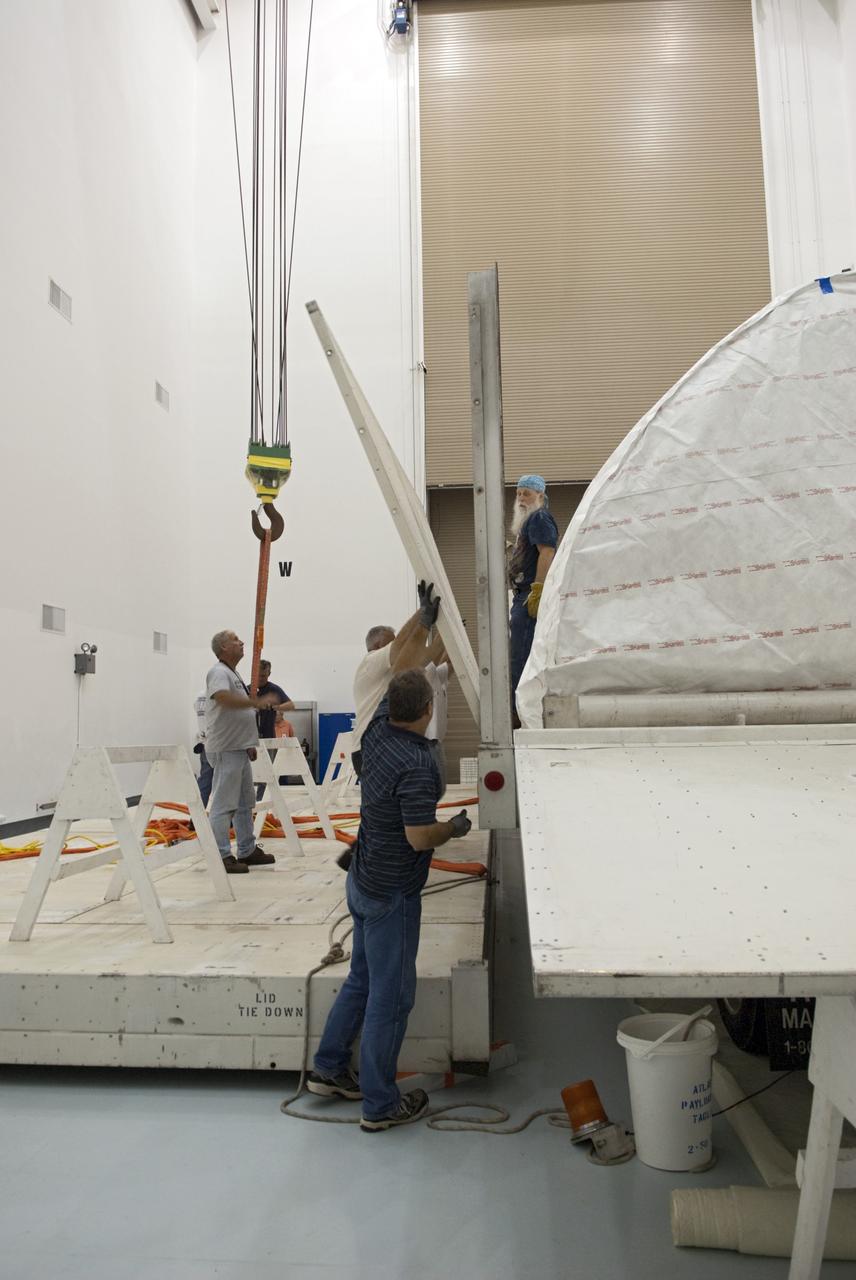
CAPE CANAVERAL, Fla. - Inside the Astrotech payload processing facility near NASA’s Kennedy Space Center in Florida, technicians uncrate and prepare to uncover the nose cone fairing for the Radiation Belt Storm Probes, or RBSP, spacecraft. The nose faring will house and protect the RBSP during liftoff aboard an Atlas V rocket. NASA’s RBSP mission will help us understand the sun’s influence on Earth and near-Earth space by studying the Earth’s radiation belts on various scales of space and time. RBSP will begin its mission of exploration of Earth’s Van Allen radiation belts and the extremes of space weather after its liftoff aboard a United Launch Alliance Atlas V from Space Launch Complex 41 at Cape Canaveral Air Force Station, Fla. Liftoff is targeted for Aug. 23, 2012. For more information, visit http://www.nasa.gov/rbsp. Photo credit: NASA/Charisse Nahser
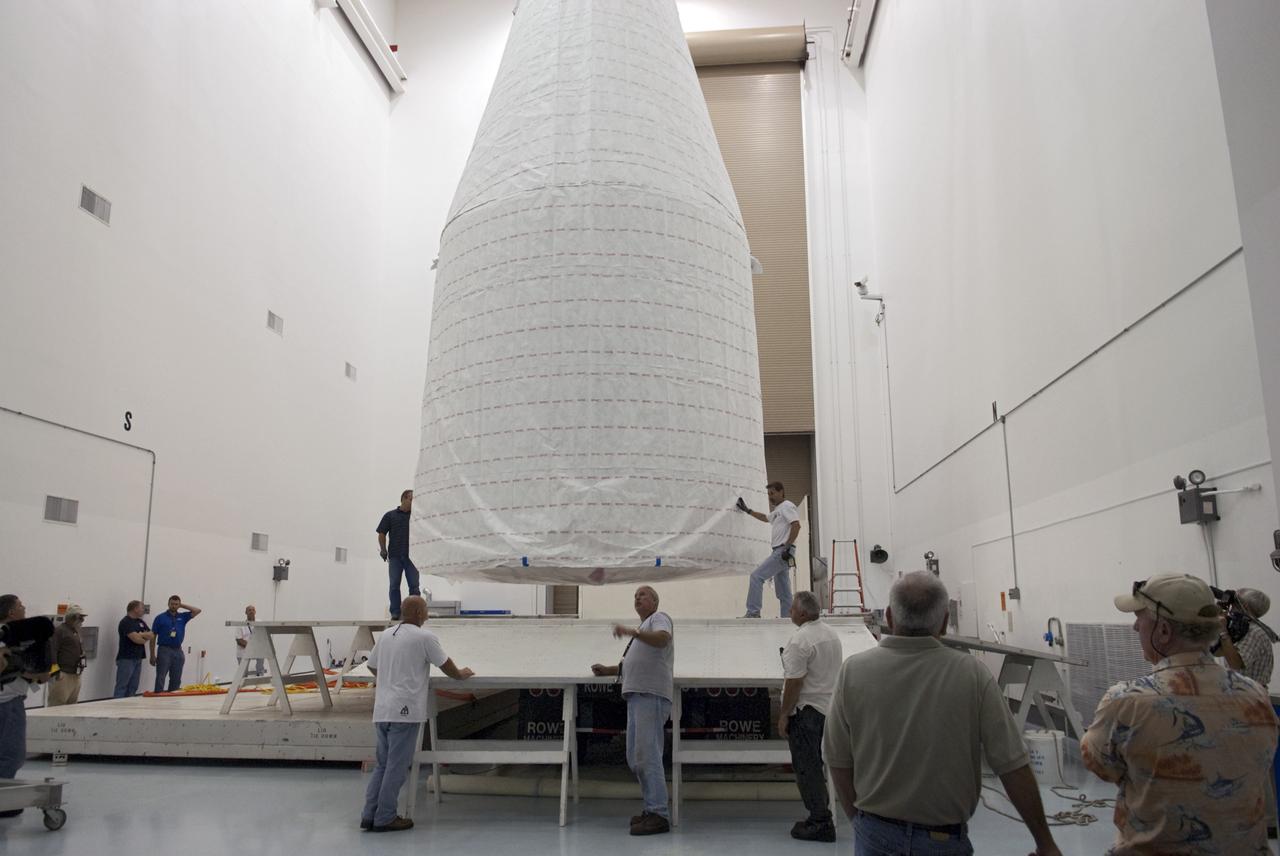
CAPE CANAVERAL, Fla. - Inside the Astrotech payload processing facility near NASA’s Kennedy Space Center in Florida, technicians offload, inspect and prepare to uncover the nose cone fairing for the Radiation Belt Storm Probes, or RBSP, spacecraft. The nose faring will house and protect the RBSP during liftoff aboard an Atlas V rocket. NASA’s RBSP mission will help us understand the sun’s influence on Earth and near-Earth space by studying the Earth’s radiation belts on various scales of space and time. RBSP will begin its mission of exploration of Earth’s Van Allen radiation belts and the extremes of space weather after its liftoff aboard a United Launch Alliance Atlas V from Space Launch Complex 41at Cape Canaveral Air Force Station, Fla. Liftoff is targeted for Aug. 23, 2012. For more information, visit http://www.nasa.gov/rbsp. Photo credit: NASA/Charisse Nahser
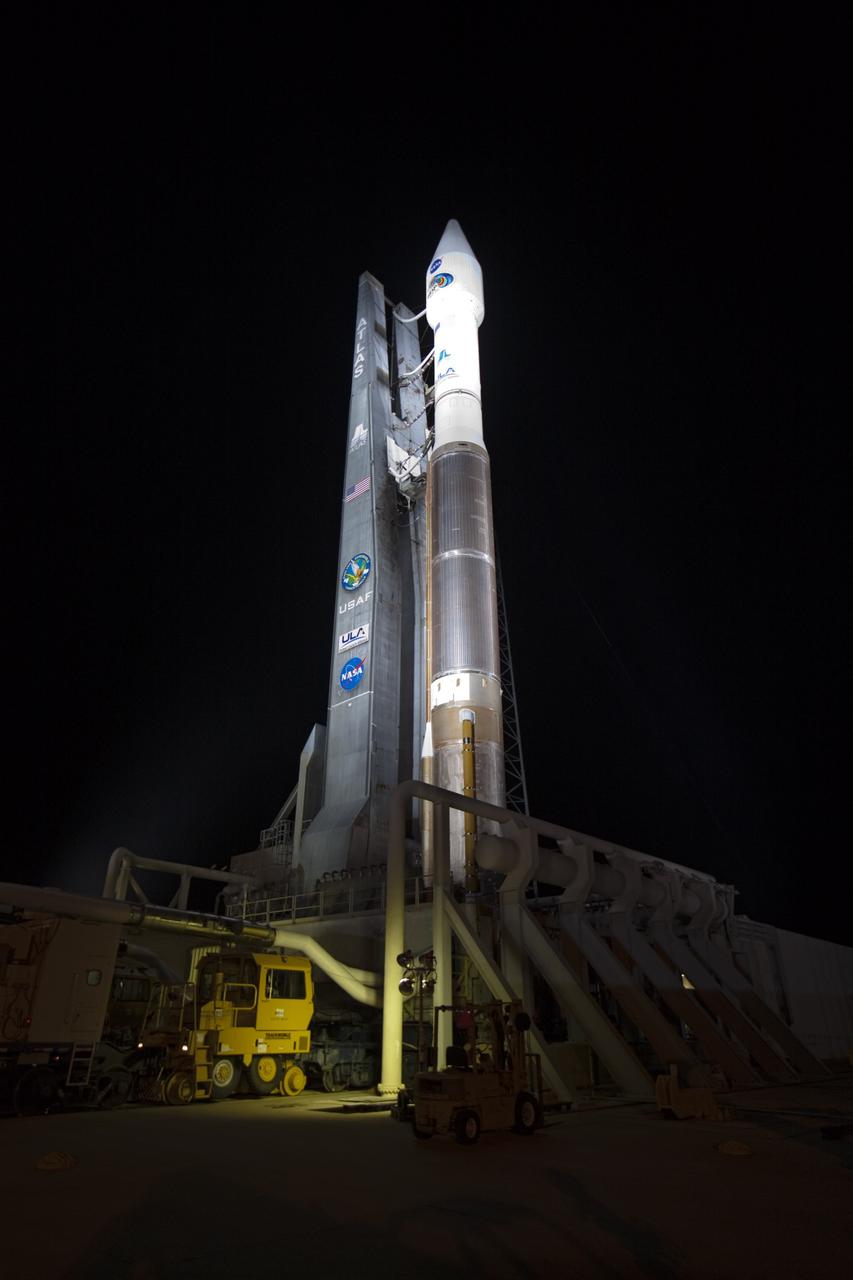
CAPE CANAVERAL, Fla. – An unfavorable weather forecast as a result of Tropical Storm Isaac approaching Florida kept NASA's twin Radiation Belt Storm Probes, or RBSP, on Space Launch Complex 41 at Cape Canaveral Air Force Station in Florida. Managers decided to roll the Atlas V rocket off the launch pad and back to the Vertical Integration Facility to ensure the launch vehicle and RBSP spacecraft are secured and protected from inclement weather. RBSP will explore changes in Earth's space environment caused by the sun -- known as "space weather" -- that can disable satellites, create power-grid failures and disrupt GPS service. The mission also will provide data on the fundamental radiation and particle acceleration processes throughout the universe. The launch is rescheduled for 4:05 a.m. EDT on Aug. 30, pending approval from the range. For more information on RBSP, visit http://www.nasa.gov/rbsp. Photo credit: NASA/Ben Smegelsky

CAPE CANAVERAL, Fla. - Inside the Astrotech payload processing facility near NASA’s Kennedy Space Center in Florida, technicians offload and prepare to uncover the nose cone fairing for the Radiation Belt Storm Probes, or RBSP, spacecraft. The nose faring will house and protect the RBSP during liftoff aboard an Atlas V rocket. NASA’s RBSP mission will help us understand the sun’s influence on Earth and near-Earth space by studying the Earth’s radiation belts on various scales of space and time. RBSP will begin its mission of exploration of Earth’s Van Allen radiation belts and the extremes of space weather after its liftoff aboard a United Launch Alliance Atlas V from Space Launch Complex 41 at Cape Canaveral Air Force Station, Fla. Liftoff is targeted for Aug. 23, 2012. For more information, visit http://www.nasa.gov/rbsp. Photo credit: NASA/Charisse Nahser
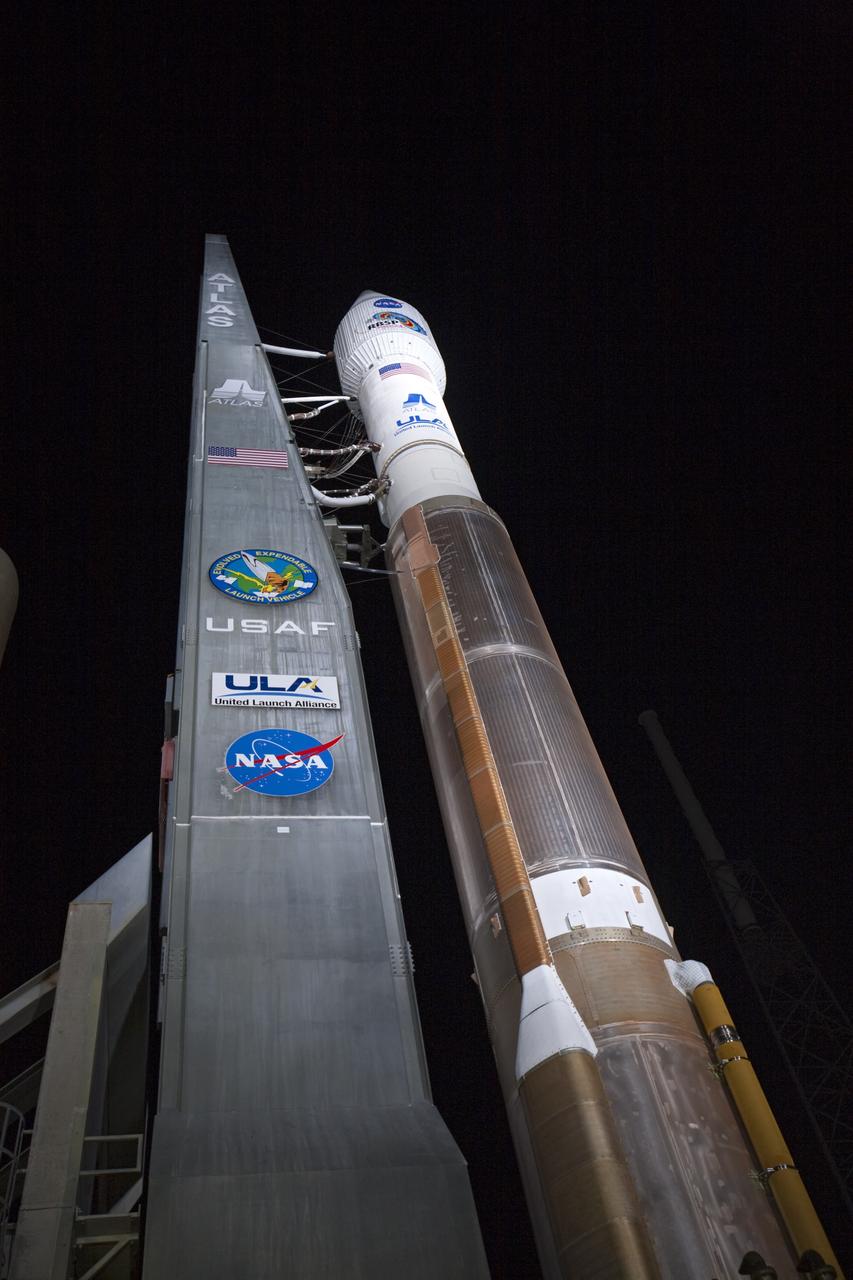
CAPE CANAVERAL, Fla. – An unfavorable weather forecast as a result of Tropical Storm Isaac approaching Florida kept NASA's twin Radiation Belt Storm Probes, or RBSP, on Space Launch Complex 41 at Cape Canaveral Air Force Station in Florida. Managers decided to roll the Atlas V rocket off the launch pad and back to the Vertical Integration Facility to ensure the launch vehicle and RBSP spacecraft are secured and protected from inclement weather. RBSP will explore changes in Earth's space environment caused by the sun -- known as "space weather" -- that can disable satellites, create power-grid failures and disrupt GPS service. The mission also will provide data on the fundamental radiation and particle acceleration processes throughout the universe. The launch is rescheduled for 4:05 a.m. EDT on Aug. 30, pending approval from the range. For more information on RBSP, visit http://www.nasa.gov/rbsp. Photo credit: NASA/Ben Smegelsky
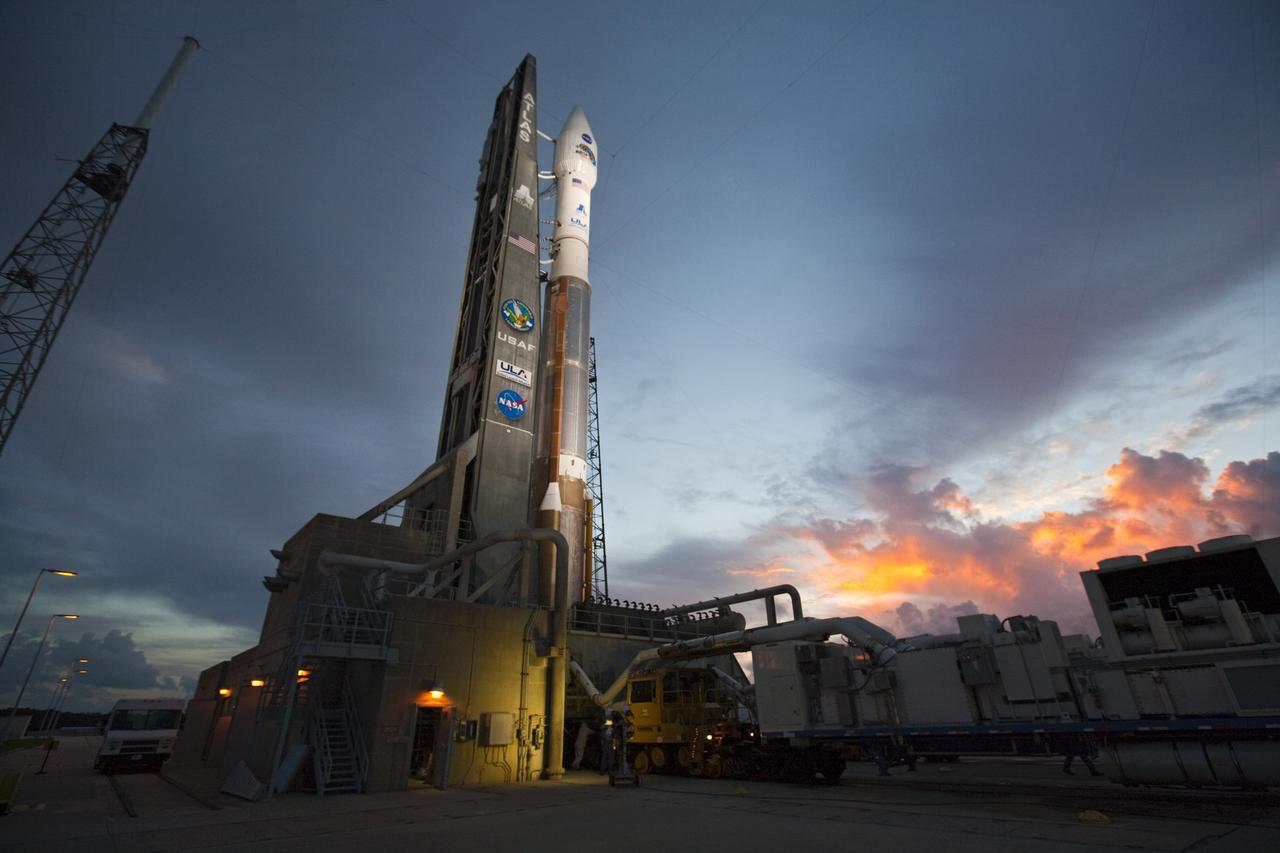
CAPE CANAVERAL, Fla. – An unfavorable weather forecast as a result of Tropical Storm Isaac approaching Florida kept NASA's twin Radiation Belt Storm Probes, or RBSP, on Space Launch Complex 41 at Cape Canaveral Air Force Station in Florida. Managers decided to roll the Atlas V rocket off the launch pad and back to the Vertical Integration Facility to ensure the launch vehicle and RBSP spacecraft are secured and protected from inclement weather. RBSP will explore changes in Earth's space environment caused by the sun -- known as "space weather" -- that can disable satellites, create power-grid failures and disrupt GPS service. The mission also will provide data on the fundamental radiation and particle acceleration processes throughout the universe. The launch is rescheduled for 4:05 a.m. EDT on Aug. 30, pending approval from the range. For more information on RBSP, visit http://www.nasa.gov/rbsp. Photo credit: NASA/Ben Smegelsky

CAPE CANAVERAL, Fla. - Inside the Astrotech payload processing facility near NASA’s Kennedy Space Center in Florida, technicians uncrate and prepare to uncover the nose cone fairing for the Radiation Belt Storm Probes, or RBSP, spacecraft. The nose faring will house and protect the RBSP during liftoff aboard an Atlas V rocket. NASA’s RBSP mission will help us understand the sun’s influence on Earth and near-Earth space by studying the Earth’s radiation belts on various scales of space and time. RBSP will begin its mission of exploration of Earth’s Van Allen radiation belts and the extremes of space weather after its liftoff aboard a United Launch Alliance Atlas V from Space Launch Complex 41 at Cape Canaveral Air Force Station, Fla. Liftoff is targeted for Aug. 23, 2012. For more information, visit http://www.nasa.gov/rbsp. Photo credit: NASA/Charisse Nahser

CAPE CANAVERAL, Fla. - Inside the Astrotech payload processing facility near NASA’s Kennedy Space Center in Florida, technicians uncrate, inspect and prepare to uncover the nose cone fairing for the Radiation Belt Storm Probes, or RBSP, spacecraft. The nose faring will house and protect the RBSP during liftoff aboard an Atlas V rocket. NASA’s RBSP mission will help us understand the sun’s influence on Earth and near-Earth space by studying the Earth’s radiation belts on various scales of space and time. RBSP will begin its mission of exploration of Earth’s Van Allen radiation belts and the extremes of space weather after its liftoff aboard a United Launch Alliance Atlas V from Space Launch Complex 41 at Cape Canaveral Air Force Station, Fla. Liftoff is targeted for Aug. 23, 2012. For more information, visit http://www.nasa.gov/rbsp. Photo credit: NASA/Charisse Nahser
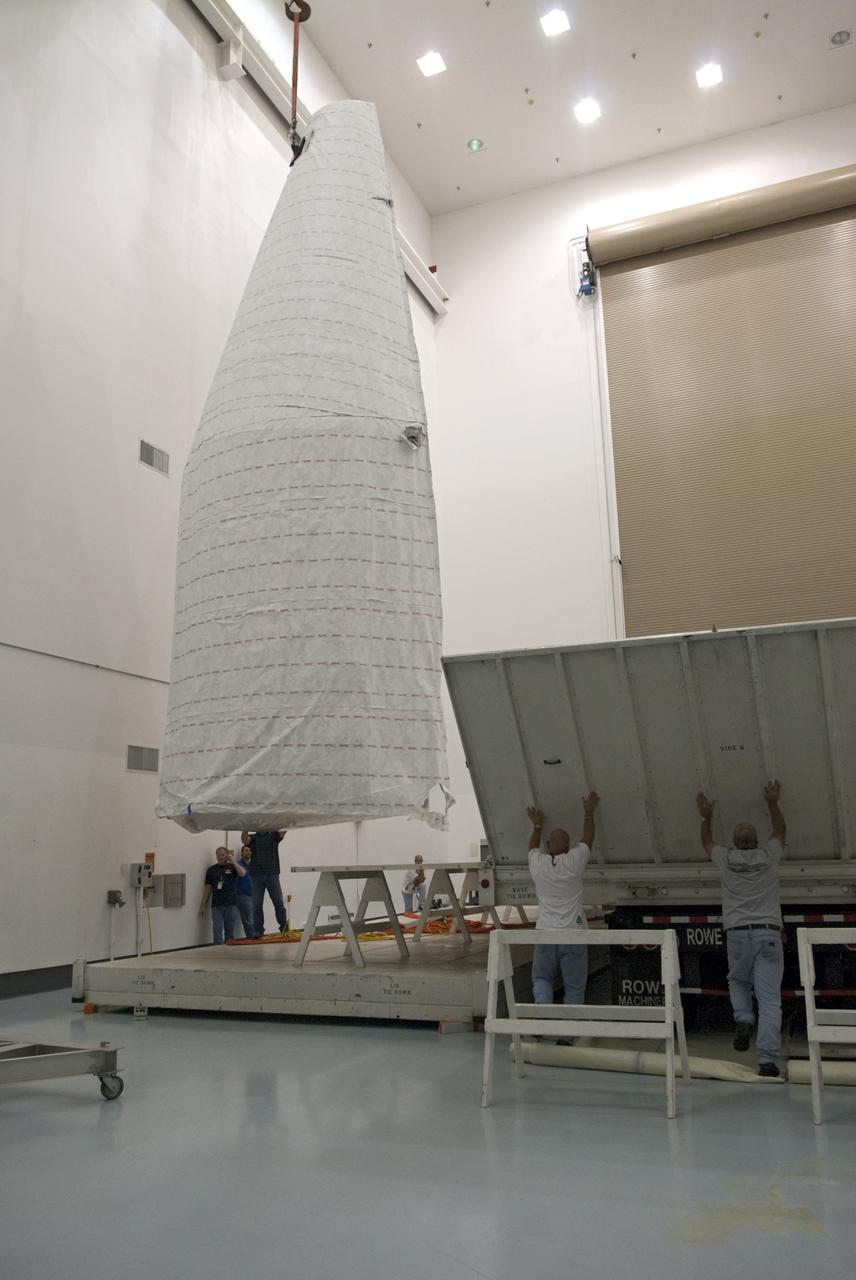
CAPE CANAVERAL, Fla. - Inside the Astrotech payload processing facility near NASA’s Kennedy Space Center in Florida, technicians uncrate, offload and prepare to uncover the nose cone fairing for the Radiation Belt Storm Probes, or RBSP, spacecraft. The nose faring will house and protect the RBSP during liftoff aboard an Atlas V rocket. NASA’s RBSP mission will help us understand the sun’s influence on Earth and near-Earth space by studying the Earth’s radiation belts on various scales of space and time. RBSP will begin its mission of exploration of Earth’s Van Allen radiation belts and the extremes of space weather after its liftoff aboard a United Launch Alliance Atlas V from Space Launch Complex 41 at Cape Canaveral Air Force Station, Fla. Liftoff is targeted for Aug. 23, 2012. For more information, visit http://www.nasa.gov/rbsp. Photo credit: NASA/Charisse Nahser
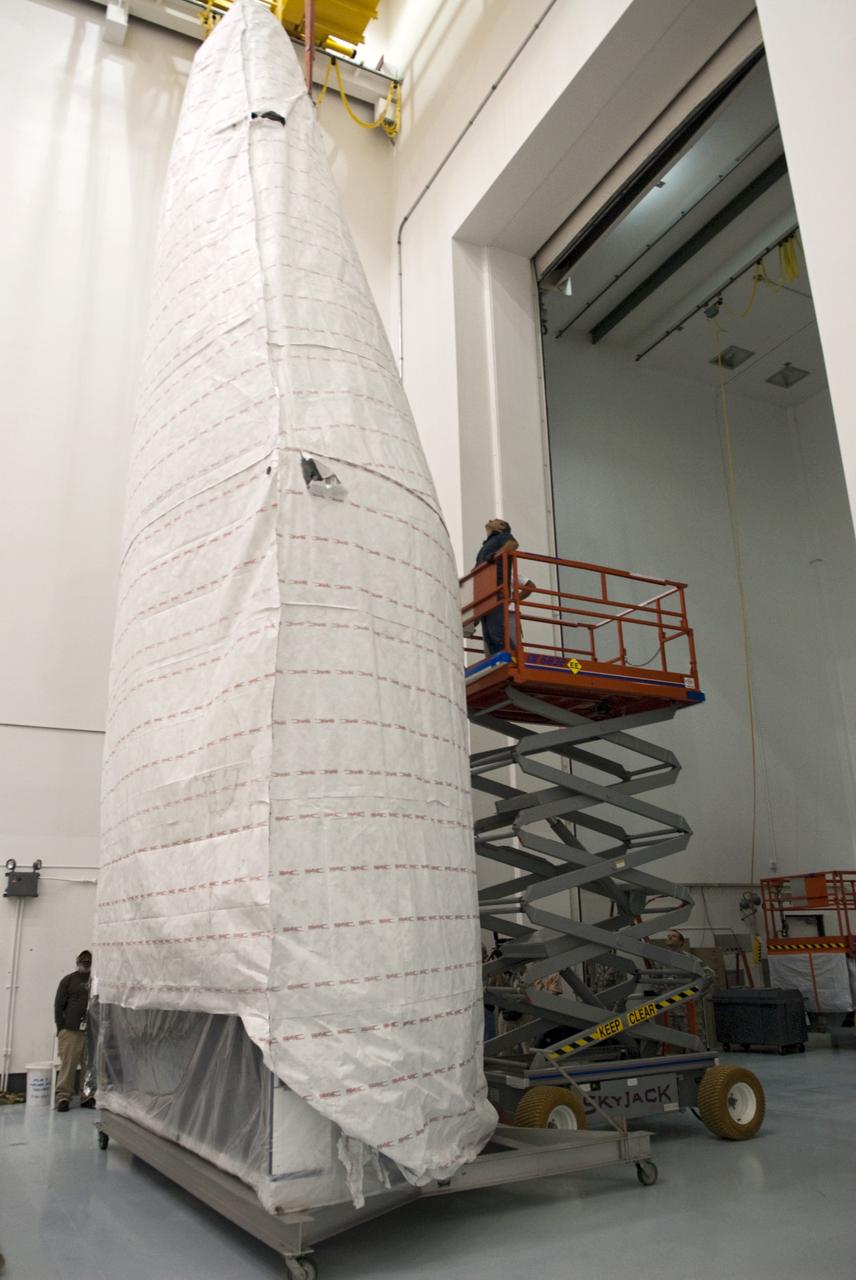
CAPE CANAVERAL, Fla. - Inside the Astrotech payload processing facility near NASA’s Kennedy Space Center in Florida, technicians use a lift to inspect the nose cone fairing for the Radiation Belt Storm Probes, or RBSP, spacecraft. The nose faring will house and protect the RBSP during liftoff aboard an Atlas V rocket. NASA’s RBSP mission will help us understand the sun’s influence on Earth and near-Earth space by studying the Earth’s radiation belts on various scales of space and time. RBSP will begin its mission of exploration of Earth’s Van Allen radiation belts and the extremes of space weather after its liftoff aboard a United Launch Alliance Atlas V from Space Launch Complex 41at Cape Canaveral Air Force Station, Fla. Liftoff is targeted for Aug. 23, 2012. For more information, visit http://www.nasa.gov/rbsp. Photo credit: NASA/Charisse Nahser
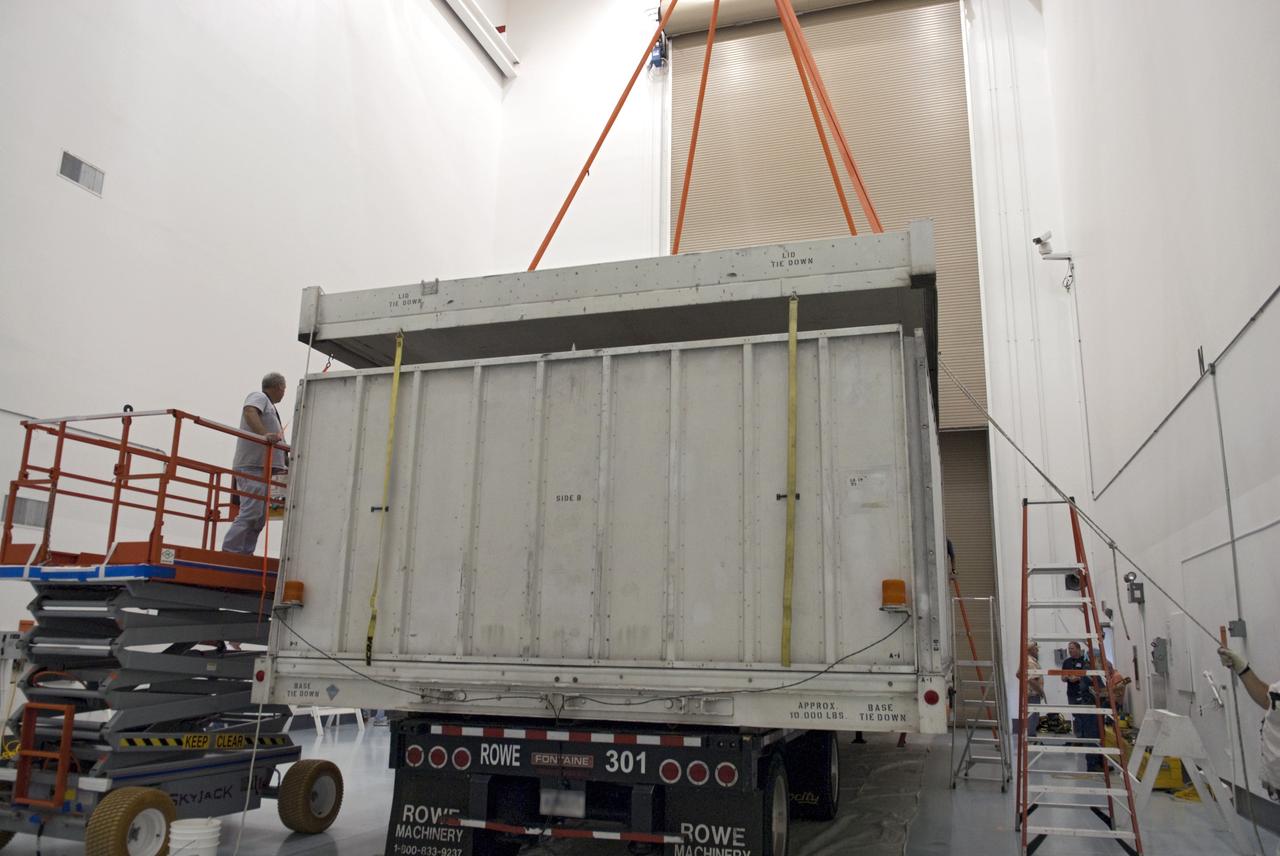
CAPE CANAVERAL, Fla. - Inside the Astrotech payload processing facility near NASA’s Kennedy Space Center in Florida, technicians open the shipping crate containing the nose cone fairing for the Radiation Belt Storm Probes, or RBSP, spacecraft. The nose faring will house and protect the RBSP during liftoff aboard an Atlas V rocket. NASA’s RBSP mission will help us understand the sun’s influence on Earth and near-Earth space by studying the Earth’s radiation belts on various scales of space and time. RBSP will begin its mission of exploration of Earth’s Van Allen radiation belts and the extremes of space weather after its liftoff aboard a United Launch Alliance Atlas V from Space Launch Complex 41 at Cape Canaveral Air Force Station, Fla. Liftoff is targeted for Aug. 23, 2012. For more information, visit http://www.nasa.gov/rbsp. Photo credit: NASA/Charisse Nahser
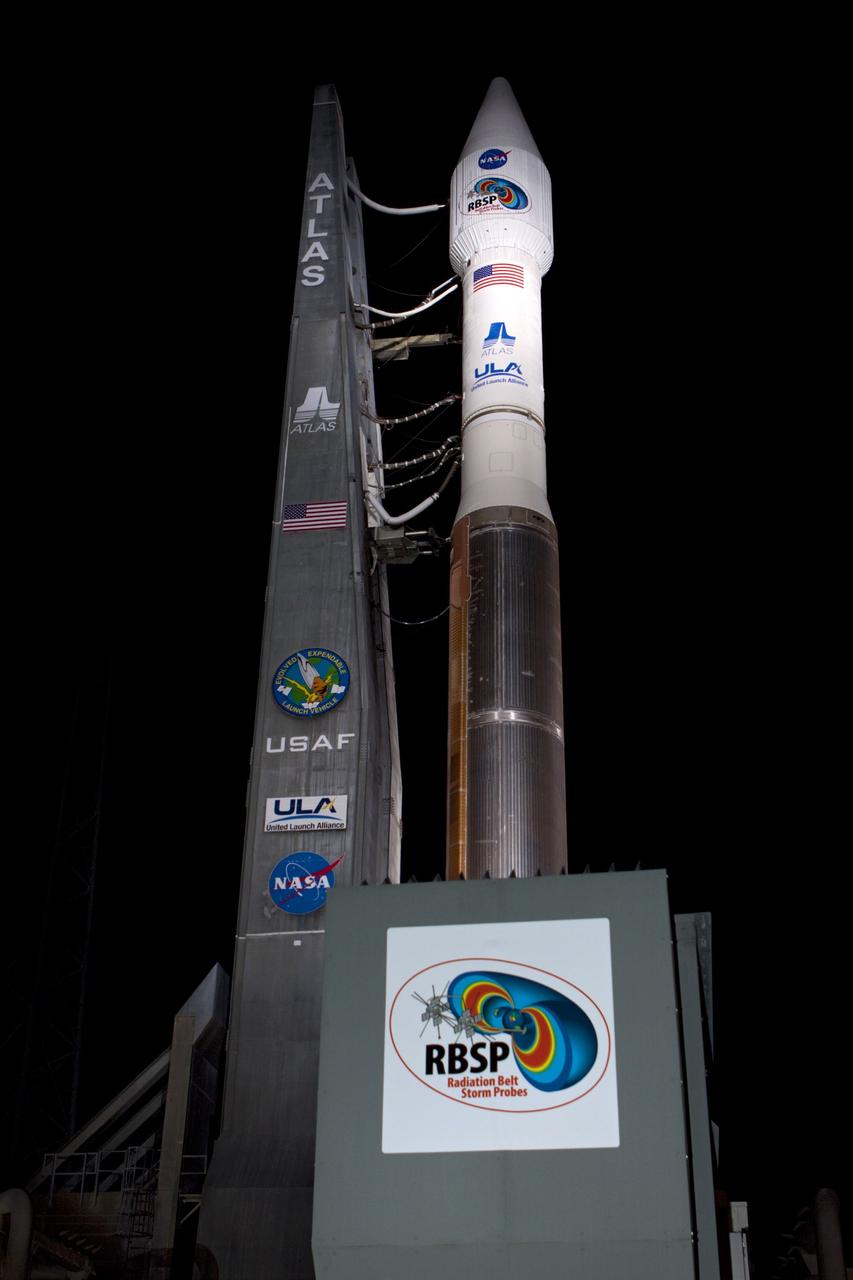
CAPE CANAVERAL, Fla. – An unfavorable weather forecast as a result of Tropical Storm Isaac approaching Florida kept NASA's twin Radiation Belt Storm Probes, or RBSP, on Space Launch Complex 41 at Cape Canaveral Air Force Station in Florida. Managers decided to roll the Atlas V rocket off the launch pad and back to the Vertical Integration Facility to ensure the launch vehicle and RBSP spacecraft are secured and protected from inclement weather. RBSP will explore changes in Earth's space environment caused by the sun -- known as "space weather" -- that can disable satellites, create power-grid failures and disrupt GPS service. The mission also will provide data on the fundamental radiation and particle acceleration processes throughout the universe. The launch is rescheduled for 4:05 a.m. EDT on Aug. 30, pending approval from the range. For more information on RBSP, visit http://www.nasa.gov/rbsp. Photo credit: NASA/Ben Smegelsky
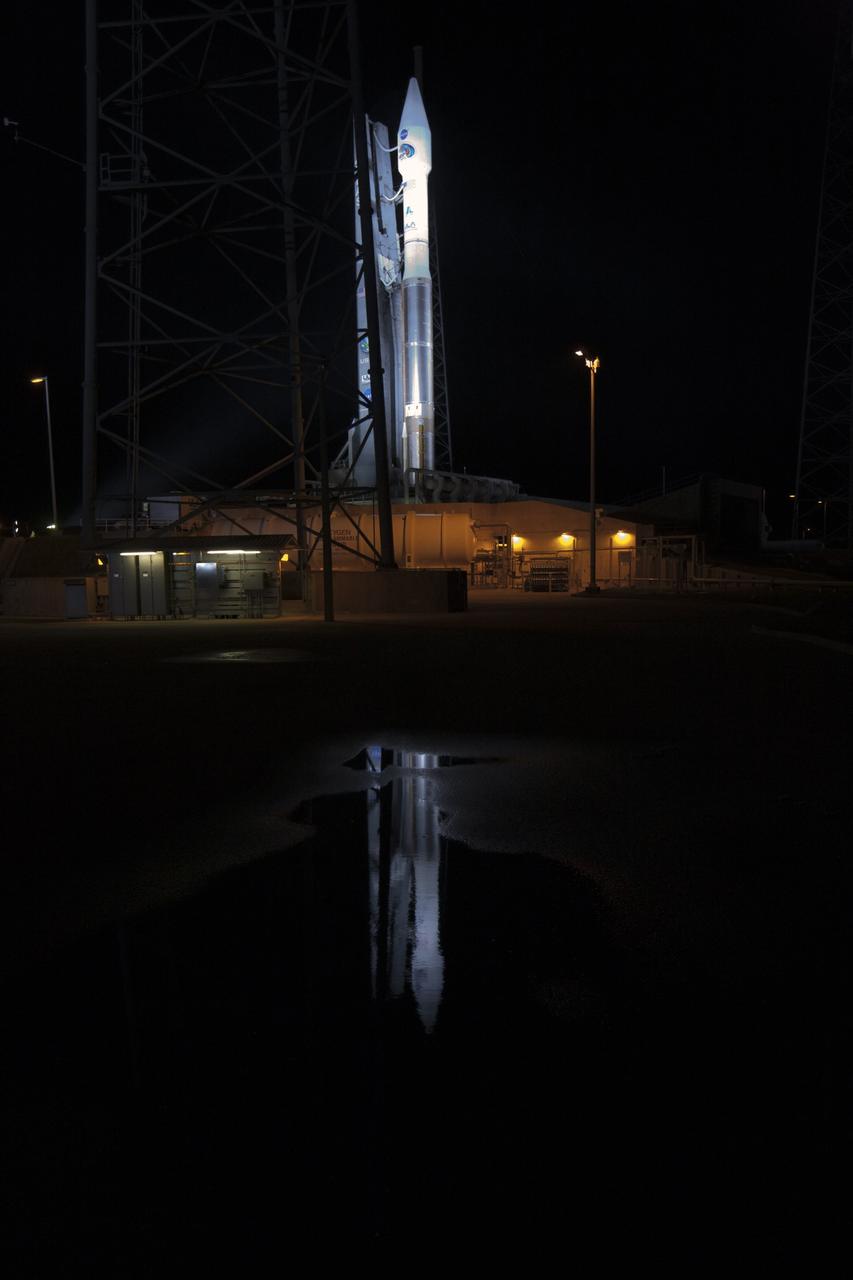
CAPE CANAVERAL, Fla. – An unfavorable weather forecast as a result of Tropical Storm Isaac approaching Florida kept NASA's twin Radiation Belt Storm Probes, or RBSP, on Space Launch Complex 41 at Cape Canaveral Air Force Station in Florida. Managers decided to roll the Atlas V rocket off the launch pad and back to the Vertical Integration Facility to ensure the launch vehicle and RBSP spacecraft are secured and protected from inclement weather. RBSP will explore changes in Earth's space environment caused by the sun -- known as "space weather" -- that can disable satellites, create power-grid failures and disrupt GPS service. The mission also will provide data on the fundamental radiation and particle acceleration processes throughout the universe. The launch is rescheduled for 4:05 a.m. EDT on Aug. 30, pending approval from the range. For more information on RBSP, visit http://www.nasa.gov/rbsp. Photo credit: NASA/Ben Smegelsky

CAPE CANAVERAL, Fla. - Nicky Fox, Radiation Belt Storm Probes, or RBSP, deputy project scientist at Johns Hopkins Applied Physics Laboratory in Laurel, M.D., participates in a postlaunch news conference at NASA Kennedy Space Center’s Press Site in Florida. The RBSP spacecraft launched atop a United Launch Alliance, or ULA, Atlas V rocket at 4:05 a.m. EDT from Space Launch Complex 41 at Cape Canaveral Air Force Station. RBSP will explore changes in Earth's space environment caused by the sun -- known as "space weather" -- that can disable satellites, create power-grid failures and disrupt GPS service. The mission also will provide data on the fundamental radiation and particle acceleration processes throughout the universe. For more information on RBSP, visit http://www.nasa.gov/rbsp. Photo credit: NASA/Jim Grossmann
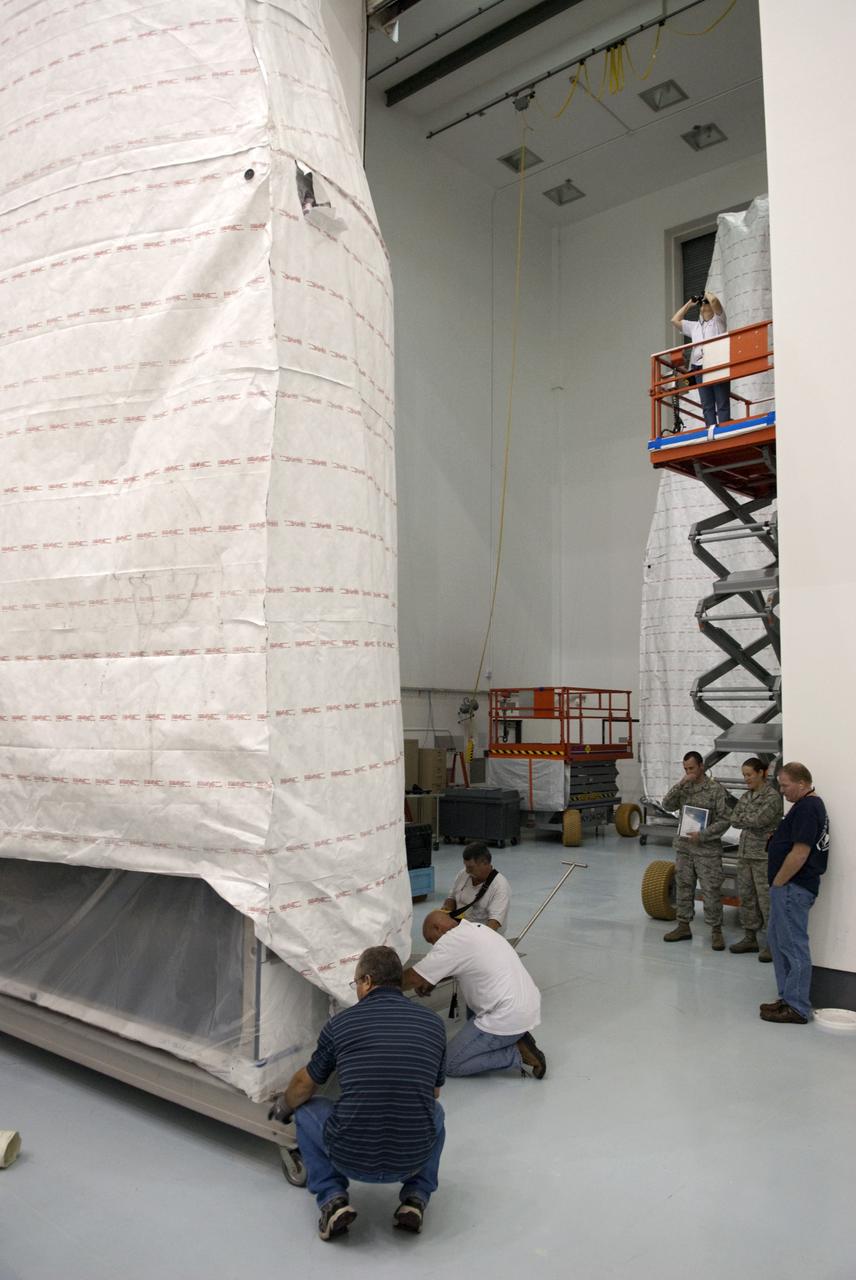
CAPE CANAVERAL, Fla. - Inside the Astrotech payload processing facility near NASA’s Kennedy Space Center in Florida, technicians uncrate, inspect and prepare to uncover the nose cone fairing for the Radiation Belt Storm Probes, or RBSP, spacecraft. The nose faring will house and protect the RBSP during liftoff aboard an Atlas V rocket. NASA’s RBSP mission will help us understand the sun’s influence on Earth and near-Earth space by studying the Earth’s radiation belts on various scales of space and time. RBSP will begin its mission of exploration of Earth’s Van Allen radiation belts and the extremes of space weather after its liftoff aboard a United Launch Alliance Atlas V from Space Launch Complex 41 at Cape Canaveral Air Force Station, Fla. Liftoff is targeted for Aug. 23, 2012. For more information, visit http://www.nasa.gov/rbsp. Photo credit: NASA/Charisse Nahser
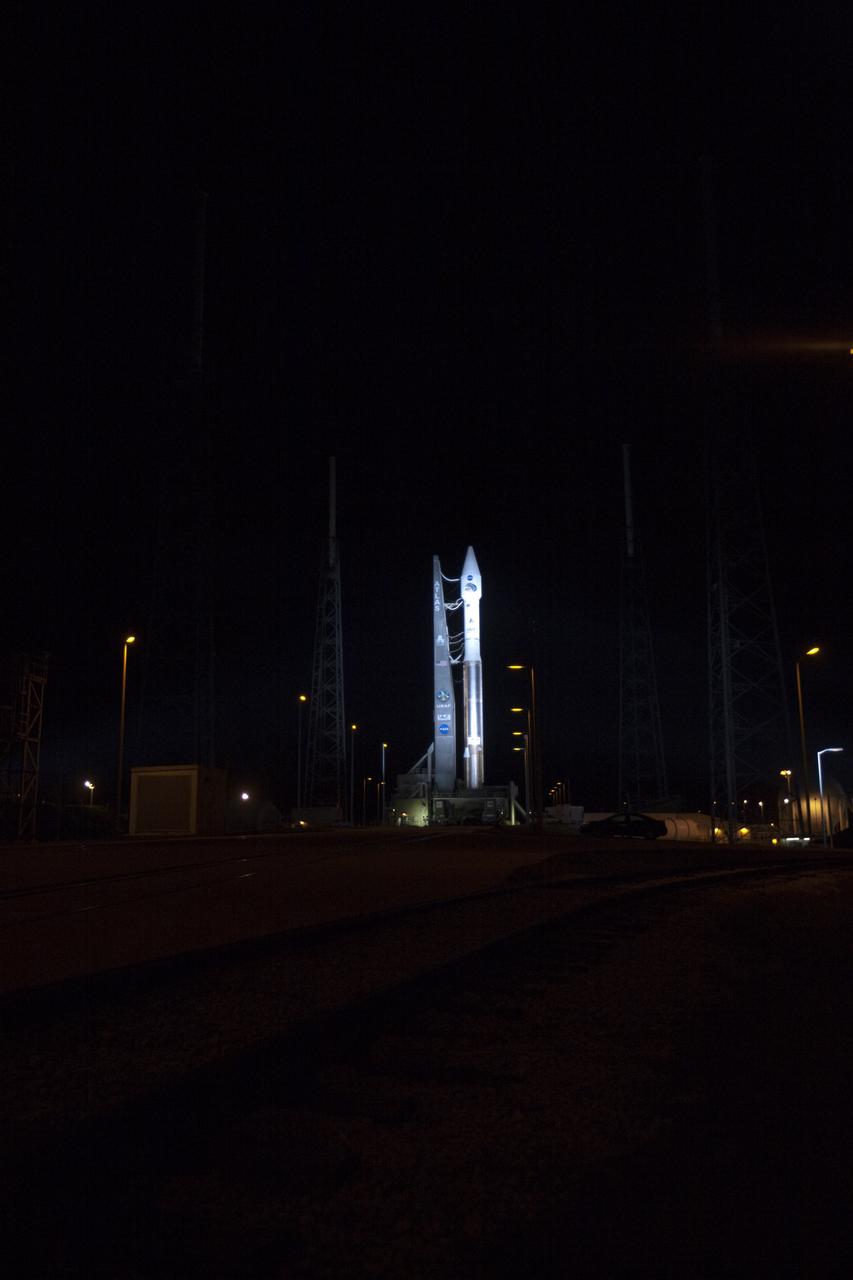
CAPE CANAVERAL, Fla. – An unfavorable weather forecast as a result of Tropical Storm Isaac approaching Florida kept NASA's twin Radiation Belt Storm Probes, or RBSP, on Space Launch Complex 41 at Cape Canaveral Air Force Station in Florida. Managers decided to roll the Atlas V rocket off the launch pad and back to the Vertical Integration Facility to ensure the launch vehicle and RBSP spacecraft are secured and protected from inclement weather. RBSP will explore changes in Earth's space environment caused by the sun -- known as "space weather" -- that can disable satellites, create power-grid failures and disrupt GPS service. The mission also will provide data on the fundamental radiation and particle acceleration processes throughout the universe. The launch is rescheduled for 4:05 a.m. EDT on Aug. 30, pending approval from the range. For more information on RBSP, visit http://www.nasa.gov/rbsp. Photo credit: NASA/Ben Smegelsky
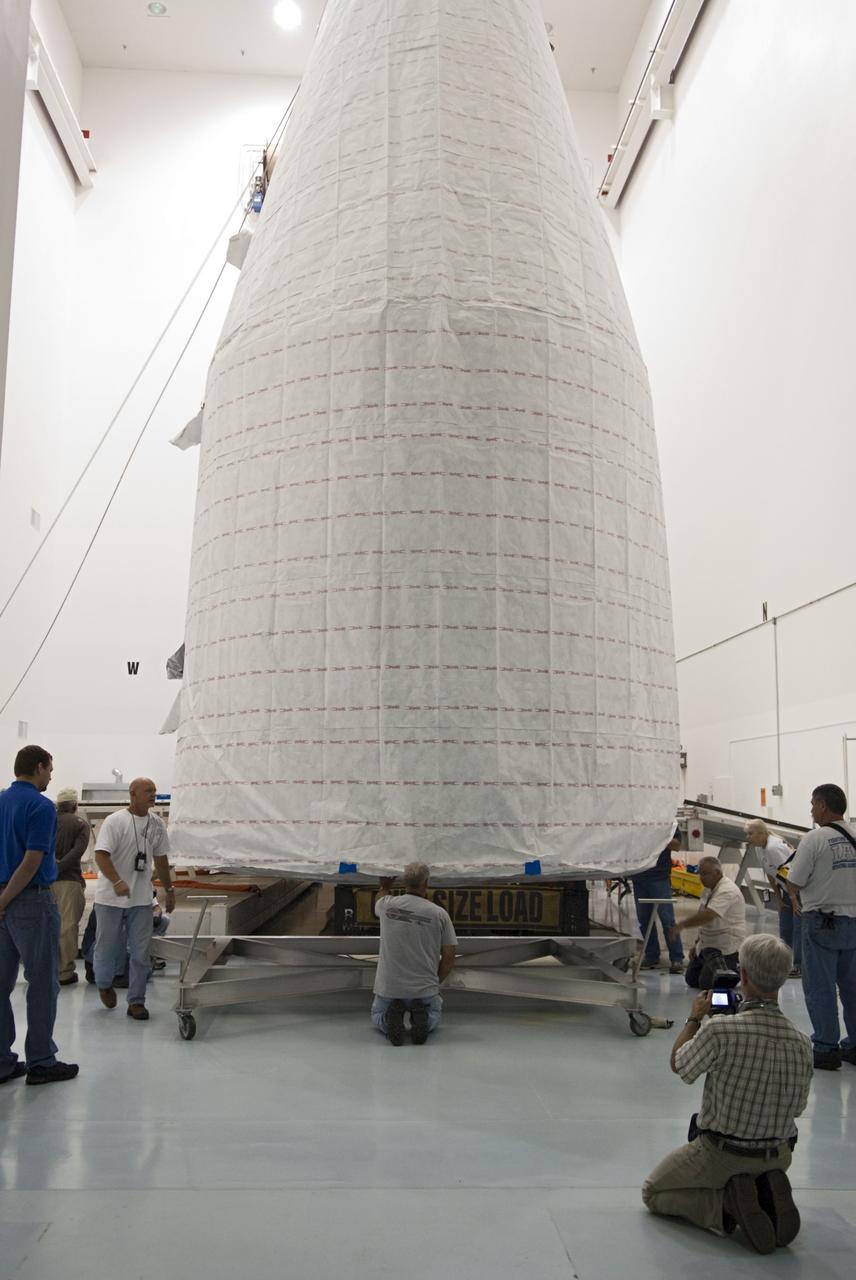
CAPE CANAVERAL, Fla. - Inside the Astrotech payload processing facility near NASA’s Kennedy Space Center in Florida, technicians offload, inspect and prepare to uncover the nose cone fairing for the Radiation Belt Storm Probes, or RBSP, spacecraft. The nose faring will house and protect the RBSP during liftoff aboard an Atlas V rocket. NASA’s RBSP mission will help us understand the sun’s influence on Earth and near-Earth space by studying the Earth’s radiation belts on various scales of space and time. RBSP will begin its mission of exploration of Earth’s Van Allen radiation belts and the extremes of space weather after its liftoff aboard a United Launch Alliance Atlas V from Space Launch Complex 41 at Cape Canaveral Air Force Station, Fla. Liftoff is targeted for Aug. 23, 2012. For more information, visit http://www.nasa.gov/rbsp. Photo credit: NASA/Charisse Nahser
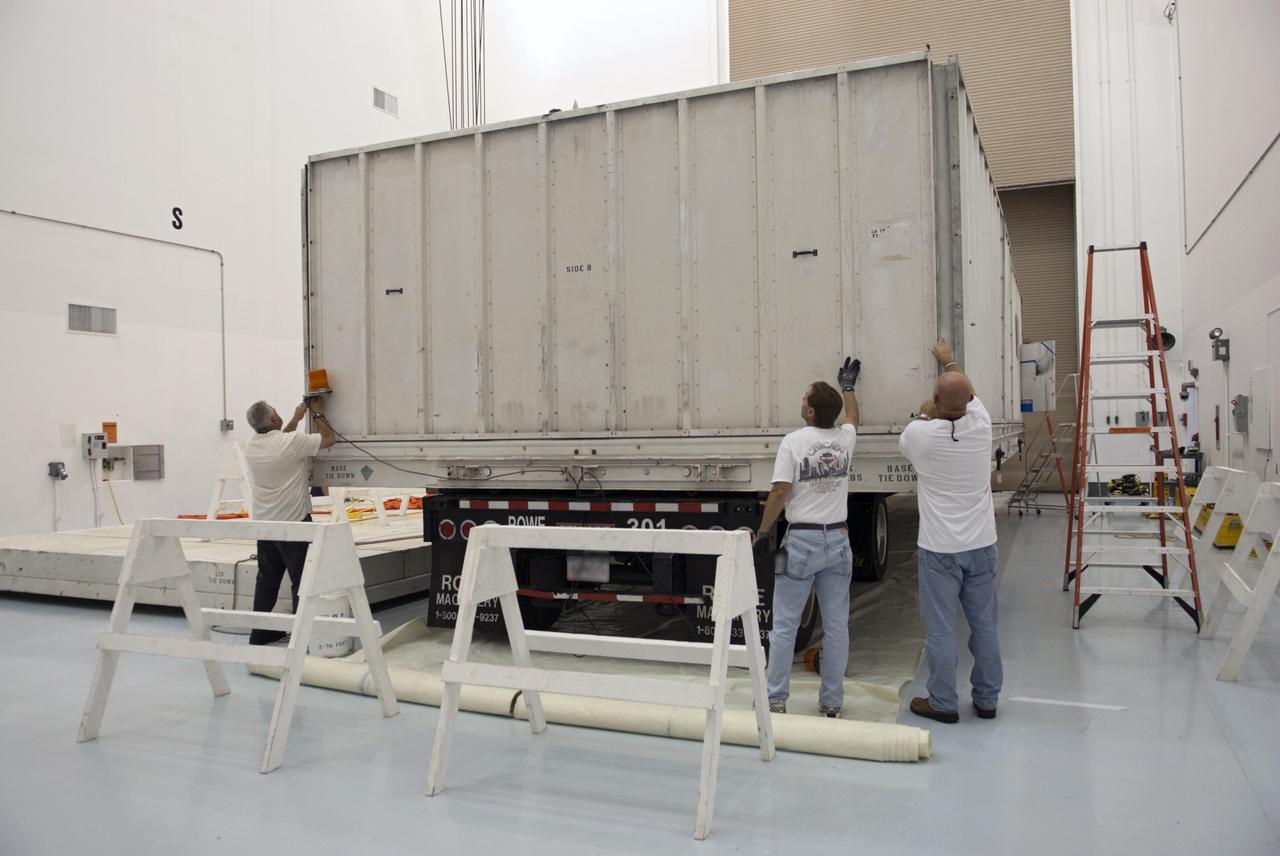
CAPE CANAVERAL, Fla. - Inside the Astrotech payload processing facility near NASA’s Kennedy Space Center in Florida, technicians open the shipping crate containing the nose cone fairing for the Radiation Belt Storm Probes, or RBSP, spacecraft. The nose faring will house and protect the RBSP during liftoff aboard an Atlas V rocket. NASA’s RBSP mission will help us understand the sun’s influence on Earth and near-Earth space by studying the Earth’s radiation belts on various scales of space and time. RBSP will begin its mission of exploration of Earth’s Van Allen radiation belts and the extremes of space weather after its liftoff aboard a United Launch Alliance Atlas V from Space Launch Complex 41 at Cape Canaveral Air Force Station, Fla. Liftoff is targeted for Aug. 23, 2012. For more information, visit http://www.nasa.gov/rbsp. Photo credit: NASA/Charisse Nahser
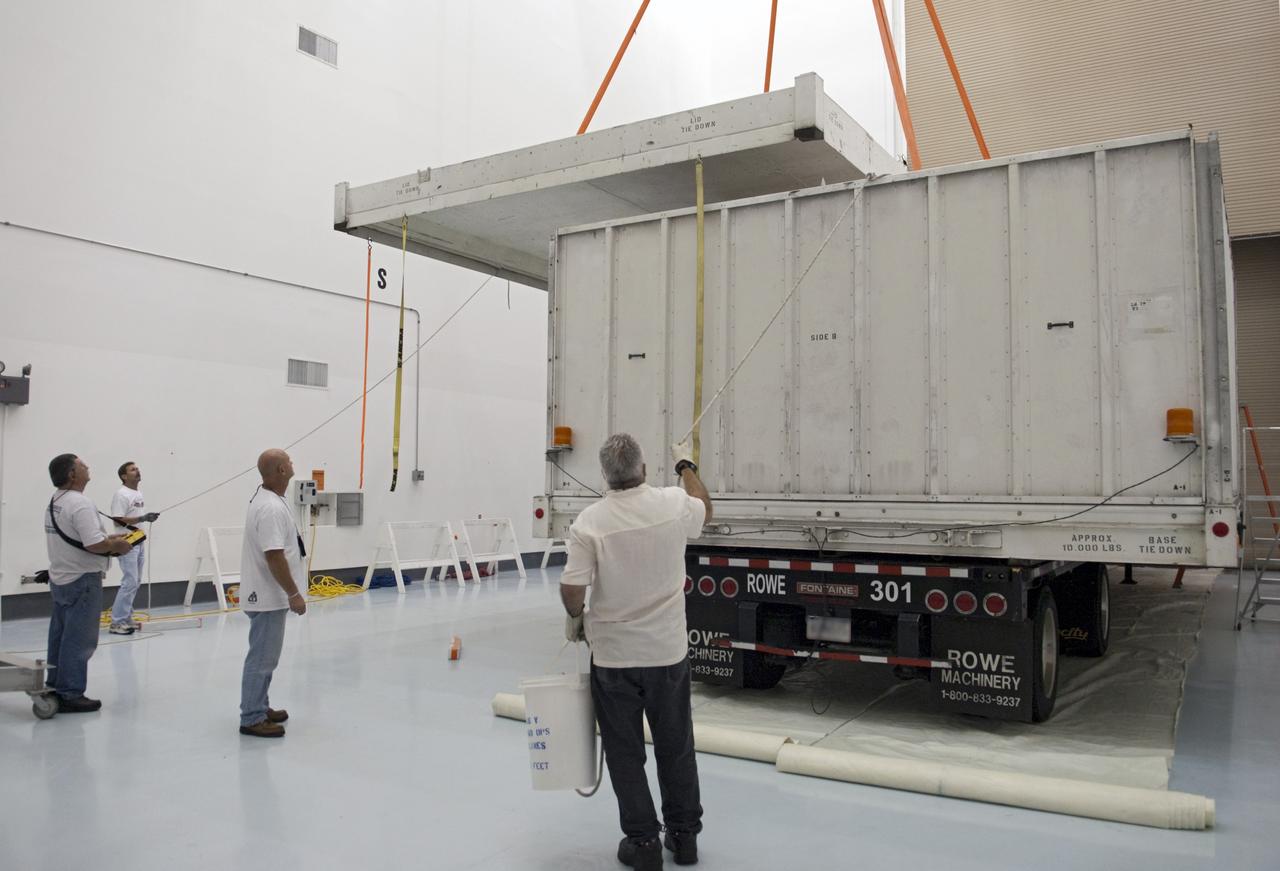
CAPE CANAVERAL, Fla. - Inside the Astrotech payload processing facility near NASA’s Kennedy Space Center in Florida, technicians open the shipping crate containing the nose cone fairing for the Radiation Belt Storm Probes, or RBSP, spacecraft. The nose faring will house and protect the RBSP during liftoff aboard an Atlas V rocket. NASA’s RBSP mission will help us understand the sun’s influence on Earth and near-Earth space by studying the Earth’s radiation belts on various scales of space and time. RBSP will begin its mission of exploration of Earth’s Van Allen radiation belts and the extremes of space weather after its liftoff aboard a United Launch Alliance Atlas V from Space Launch Complex 41 at Cape Canaveral Air Force Station, Fla. Liftoff is targeted for Aug. 23, 2012. For more information, visit http://www.nasa.gov/rbsp. Photo credit: NASA/Charisse Nahser
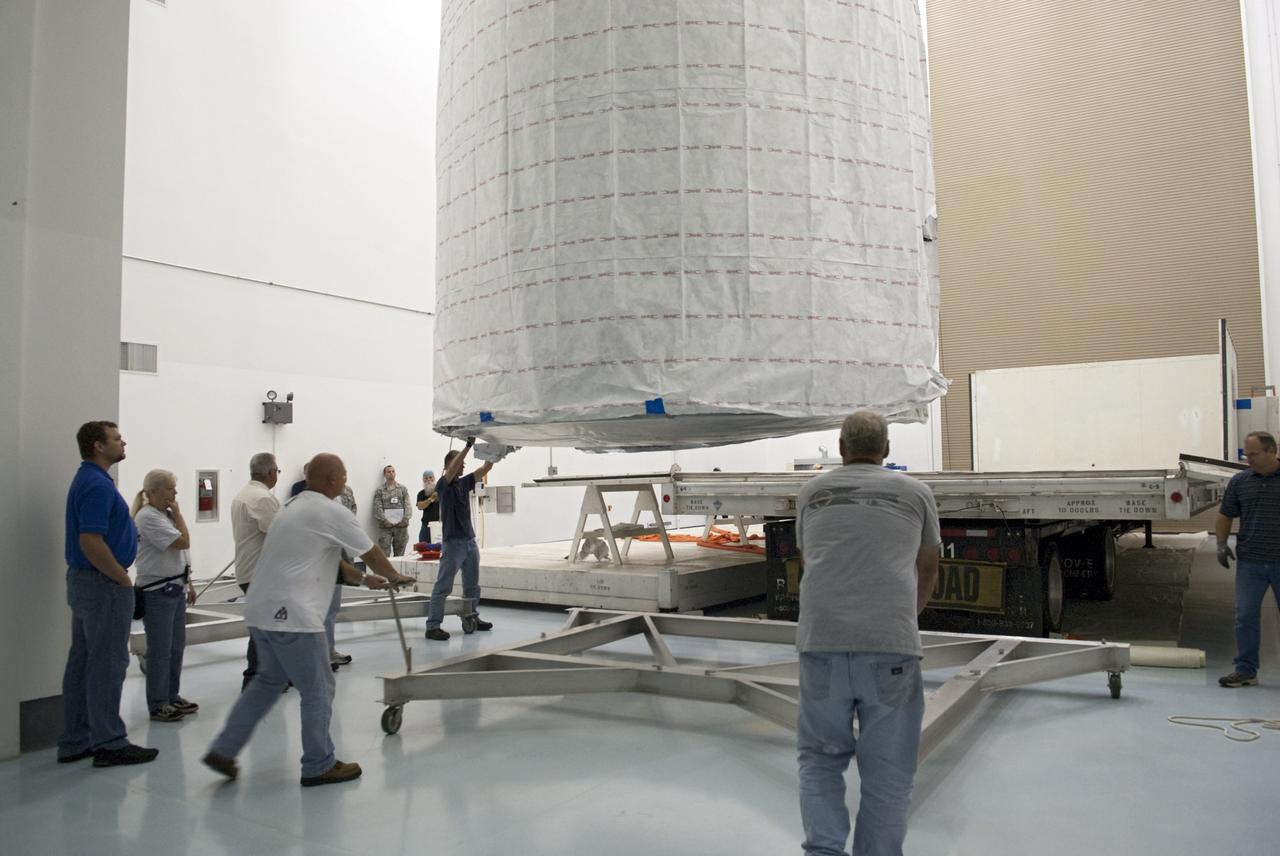
CAPE CANAVERAL, Fla. - Inside the Astrotech payload processing facility near NASA’s Kennedy Space Center in Florida, technicians offload and prepare to uncover the nose cone fairing for the Radiation Belt Storm Probes, or RBSP, spacecraft. The nose faring will house and protect the RBSP during liftoff aboard an Atlas V rocket. NASA’s RBSP mission will help us understand the sun’s influence on Earth and near-Earth space by studying the Earth’s radiation belts on various scales of space and time. RBSP will begin its mission of exploration of Earth’s Van Allen radiation belts and the extremes of space weather after its liftoff aboard a United Launch Alliance Atlas V from Space Launch Complex 41 at Cape Canaveral Air Force Station, Fla. Liftoff is targeted for Aug. 23, 2012. For more information, visit http://www.nasa.gov/rbsp. Photo credit: NASA/Charisse Nahser
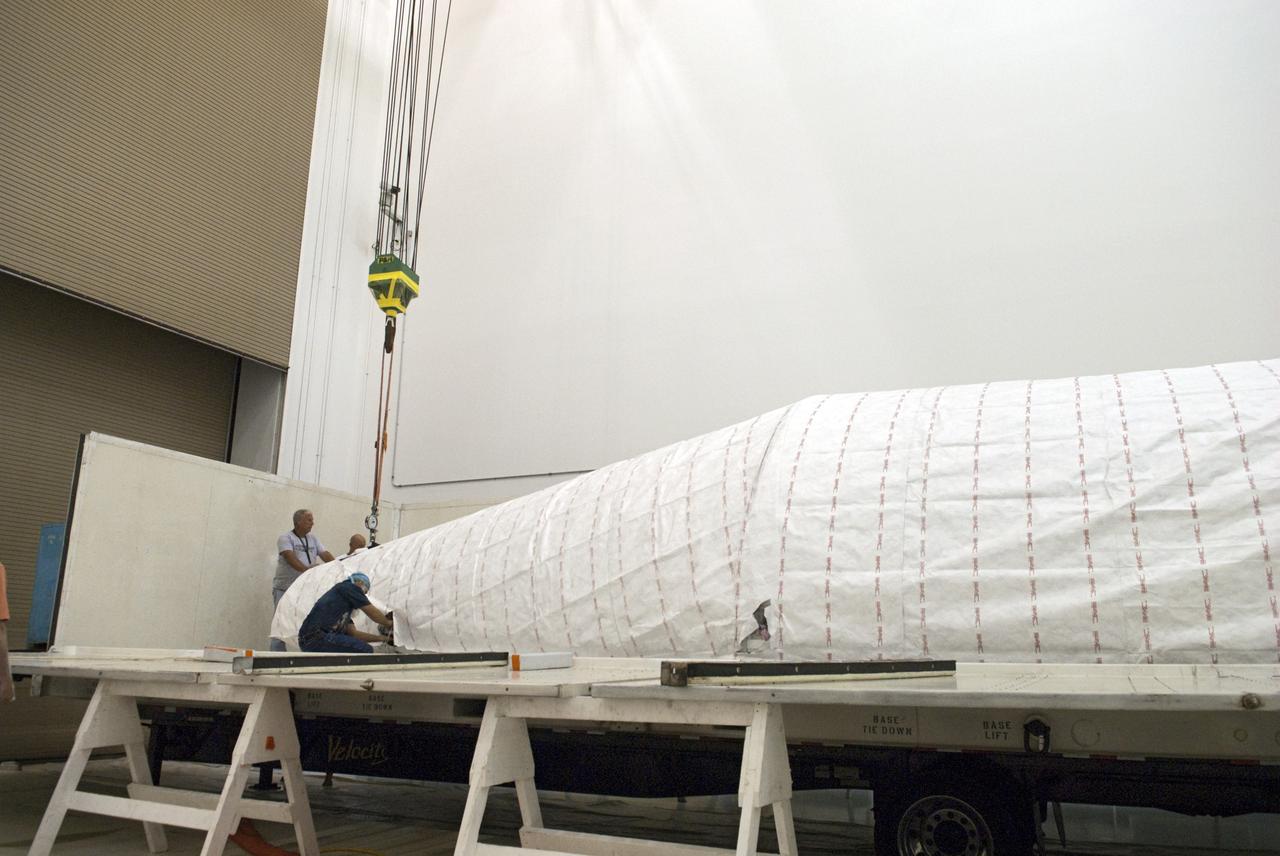
CAPE CANAVERAL, Fla. - Inside the Astrotech payload processing facility near NASA’s Kennedy Space Center in Florida, technicians uncrate and prepare to uncover the nose cone fairing for the Radiation Belt Storm Probes, or RBSP, spacecraft. The nose faring will house and protect the RBSP during liftoff aboard an Atlas V rocket. NASA’s RBSP mission will help us understand the sun’s influence on Earth and near-Earth space by studying the Earth’s radiation belts on various scales of space and time. RBSP will begin its mission of exploration of Earth’s Van Allen radiation belts and the extremes of space weather after its liftoff aboard a United Launch Alliance Atlas V from Space Launch Complex 41 at Cape Canaveral Air Force Station, Fla. Liftoff is targeted for Aug. 23, 2012. For more information, visit http://www.nasa.gov/rbsp. Photo credit: NASA/Charisse Nahser

CAPE CANAVERAL, Fla. – Richard Fitzgerald, Radiation Belt Storm Probes, or RBSP, project manager at Johns Hopkins Applied Physics Laboratory? in Laurel, M.D., participates in a postlaunch news conference at NASA Kennedy Space Center’s Press Site in Florida. The RBSP spacecraft launched atop a United Launch Alliance, or ULA, Atlas V rocket at 4:05 a.m. EDT from Space Launch Complex 41 at Cape Canaveral Air Force Station. RBSP will explore changes in Earth's space environment caused by the sun -- known as "space weather" -- that can disable satellites, create power-grid failures and disrupt GPS service. The mission also will provide data on the fundamental radiation and particle acceleration processes throughout the universe. For more information on RBSP, visit http://www.nasa.gov/rbsp. Photo credit: NASA/Jim Grossmann
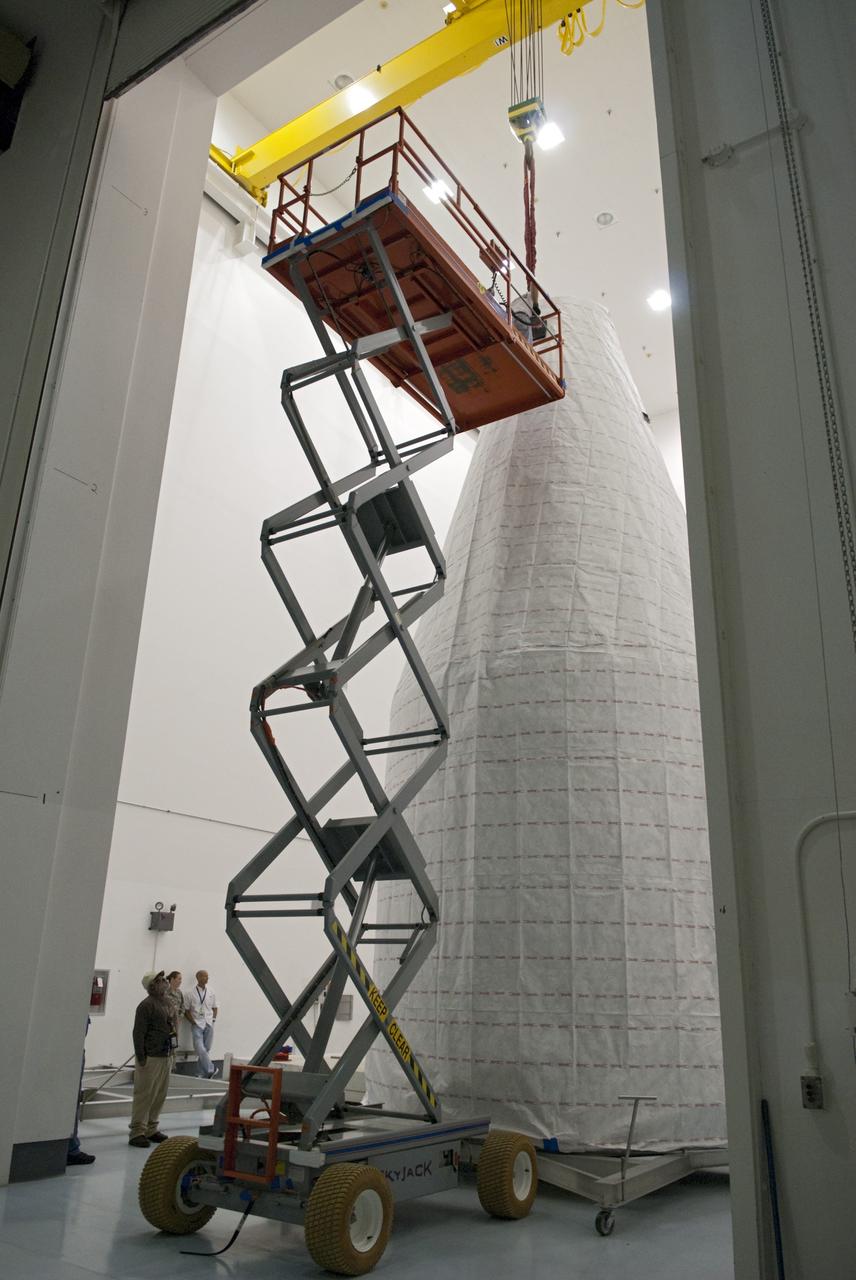
CAPE CANAVERAL, Fla. - Inside the Astrotech payload processing facility near NASA’s Kennedy Space Center in Florida, technicians use a lift to inspect the nose cone fairing for the Radiation Belt Storm Probes, or RBSP, spacecraft. The nose faring will house and protect the RBSP during liftoff aboard an Atlas V rocket. NASA’s RBSP mission will help us understand the sun’s influence on Earth and near-Earth space by studying the Earth’s radiation belts on various scales of space and time. RBSP will begin its mission of exploration of Earth’s Van Allen radiation belts and the extremes of space weather after its liftoff aboard a United Launch Alliance Atlas V from Space Launch Complex 41 at Cape Canaveral Air Force Station, Fla. Liftoff is targeted for Aug. 23, 2012. For more information, visit http://www.nasa.gov/rbsp. Photo credit: NASA/Charisse Nahser
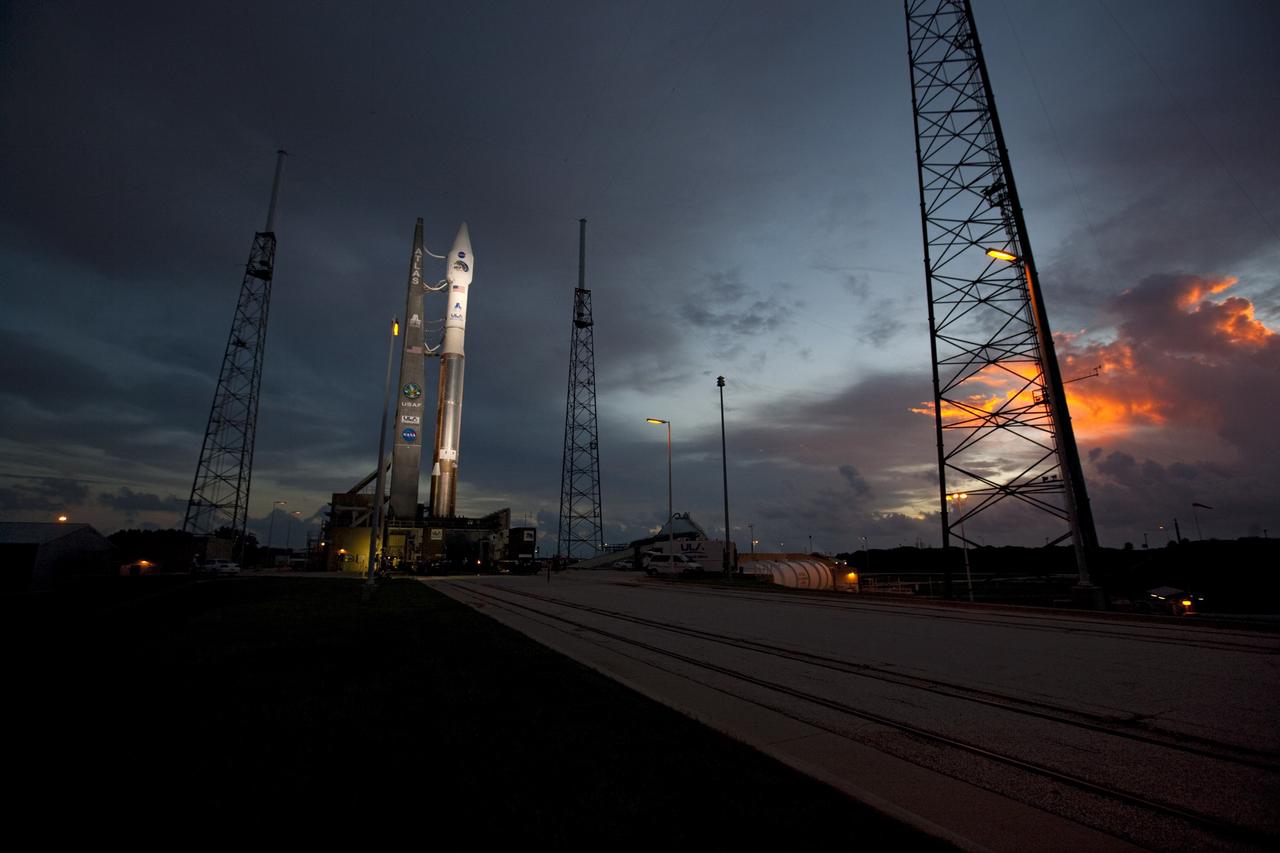
CAPE CANAVERAL, Fla. – An unfavorable weather forecast as a result of Tropical Storm Isaac approaching Florida kept NASA's twin Radiation Belt Storm Probes, or RBSP, on Space Launch Complex 41 at Cape Canaveral Air Force Station in Florida. Managers decided to roll the Atlas V rocket off the launch pad and back to the Vertical Integration Facility to ensure the launch vehicle and RBSP spacecraft are secured and protected from inclement weather. RBSP will explore changes in Earth's space environment caused by the sun -- known as "space weather" -- that can disable satellites, create power-grid failures and disrupt GPS service. The mission also will provide data on the fundamental radiation and particle acceleration processes throughout the universe. The launch is rescheduled for 4:05 a.m. EDT on Aug. 30, pending approval from the range. For more information on RBSP, visit http://www.nasa.gov/rbsp. Photo credit: NASA/Ben Smegelsky
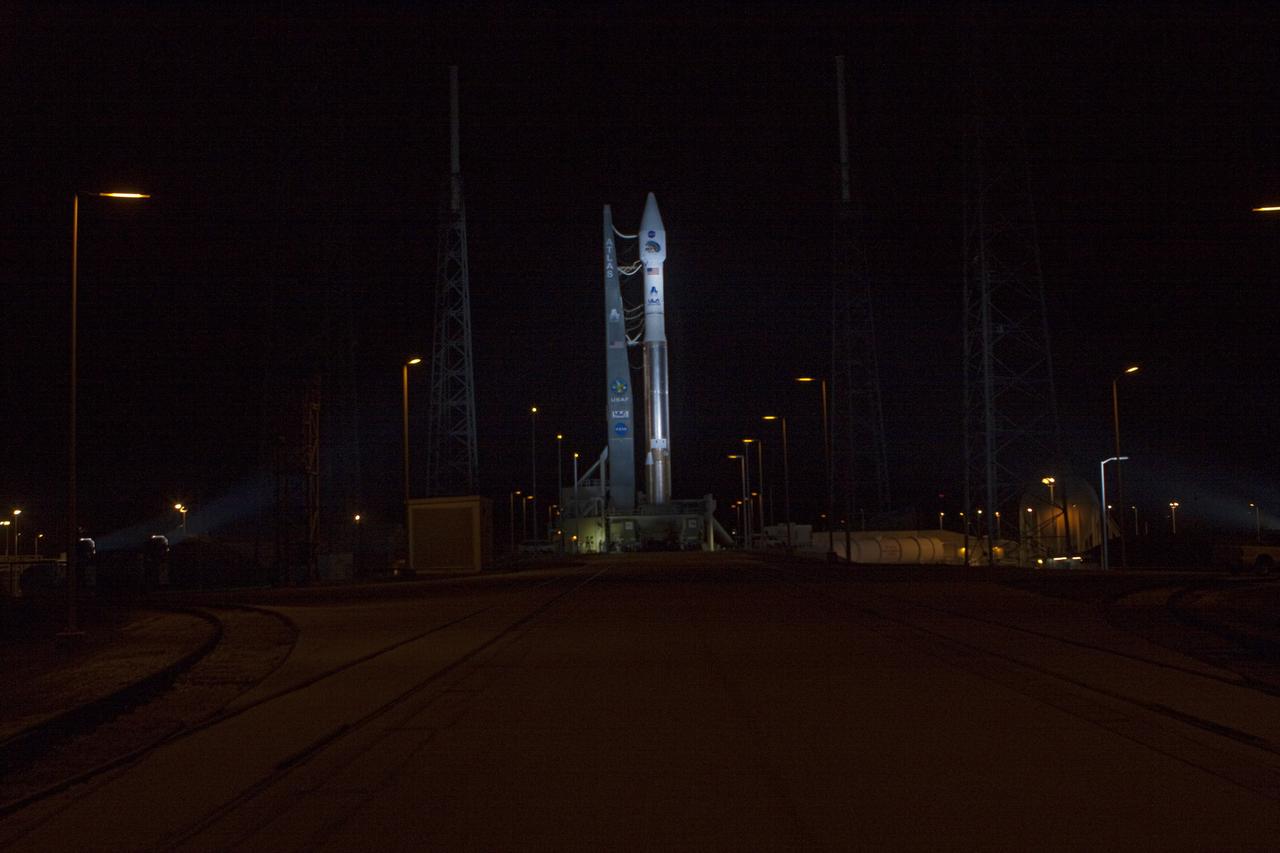
CAPE CANAVERAL, Fla. – An unfavorable weather forecast as a result of Tropical Storm Isaac approaching Florida kept NASA's twin Radiation Belt Storm Probes, or RBSP, on Space Launch Complex 41 at Cape Canaveral Air Force Station in Florida. Managers decided to roll the Atlas V rocket off the launch pad and back to the Vertical Integration Facility to ensure the launch vehicle and RBSP spacecraft are secured and protected from inclement weather. RBSP will explore changes in Earth's space environment caused by the sun -- known as "space weather" -- that can disable satellites, create power-grid failures and disrupt GPS service. The mission also will provide data on the fundamental radiation and particle acceleration processes throughout the universe. The launch is rescheduled for 4:05 a.m. EDT on Aug. 30, pending approval from the range. For more information on RBSP, visit http://www.nasa.gov/rbsp. Photo credit: NASA/Ben Smegelsky

CAPE CANAVERAL, Fla. – An unfavorable weather forecast as a result of Tropical Storm Isaac approaching Florida kept NASA's twin Radiation Belt Storm Probes, or RBSP, on Space Launch Complex 41 at Cape Canaveral Air Force Station in Florida. Managers decided to roll the Atlas V rocket off the launch pad and back to the Vertical Integration Facility to ensure the launch vehicle and RBSP spacecraft are secured and protected from inclement weather. RBSP will explore changes in Earth's space environment caused by the sun -- known as "space weather" -- that can disable satellites, create power-grid failures and disrupt GPS service. The mission also will provide data on the fundamental radiation and particle acceleration processes throughout the universe. The launch is rescheduled for 4:05 a.m. EDT on Aug. 30, pending approval from the range. For more information on RBSP, visit http://www.nasa.gov/rbsp. Photo credit: NASA/Ben Smegelsky
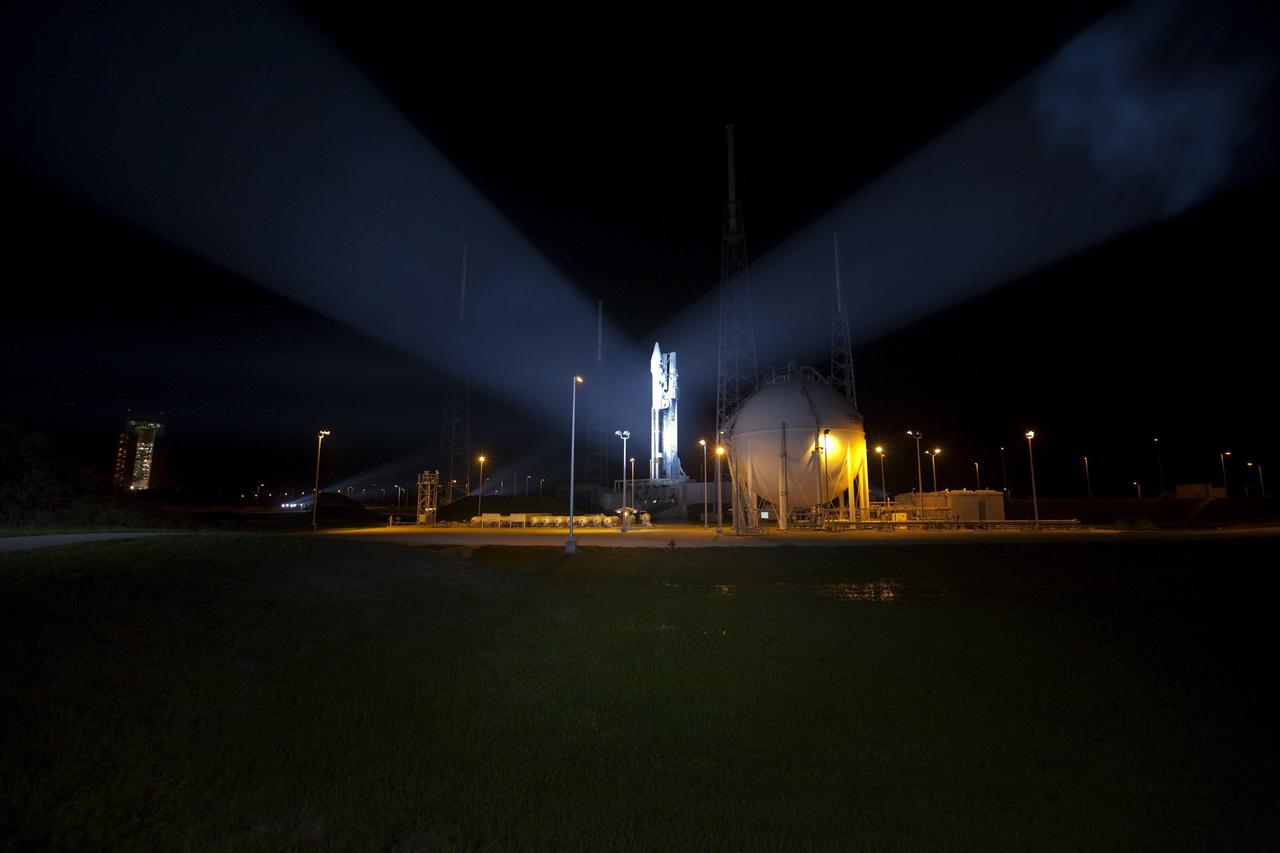
CAPE CANAVERAL, Fla. – An unfavorable weather forecast as a result of Tropical Storm Isaac approaching Florida kept NASA's twin Radiation Belt Storm Probes, or RBSP, on Space Launch Complex 41 at Cape Canaveral Air Force Station in Florida. Managers decided to roll the Atlas V rocket off the launch pad and back to the Vertical Integration Facility to ensure the launch vehicle and RBSP spacecraft are secured and protected from inclement weather. RBSP will explore changes in Earth's space environment caused by the sun -- known as "space weather" -- that can disable satellites, create power-grid failures and disrupt GPS service. The mission also will provide data on the fundamental radiation and particle acceleration processes throughout the universe. The launch is rescheduled for 4:05 a.m. EDT on Aug. 30, pending approval from the range. For more information on RBSP, visit http://www.nasa.gov/rbsp. Photo credit: NASA/Ben Smegelsky
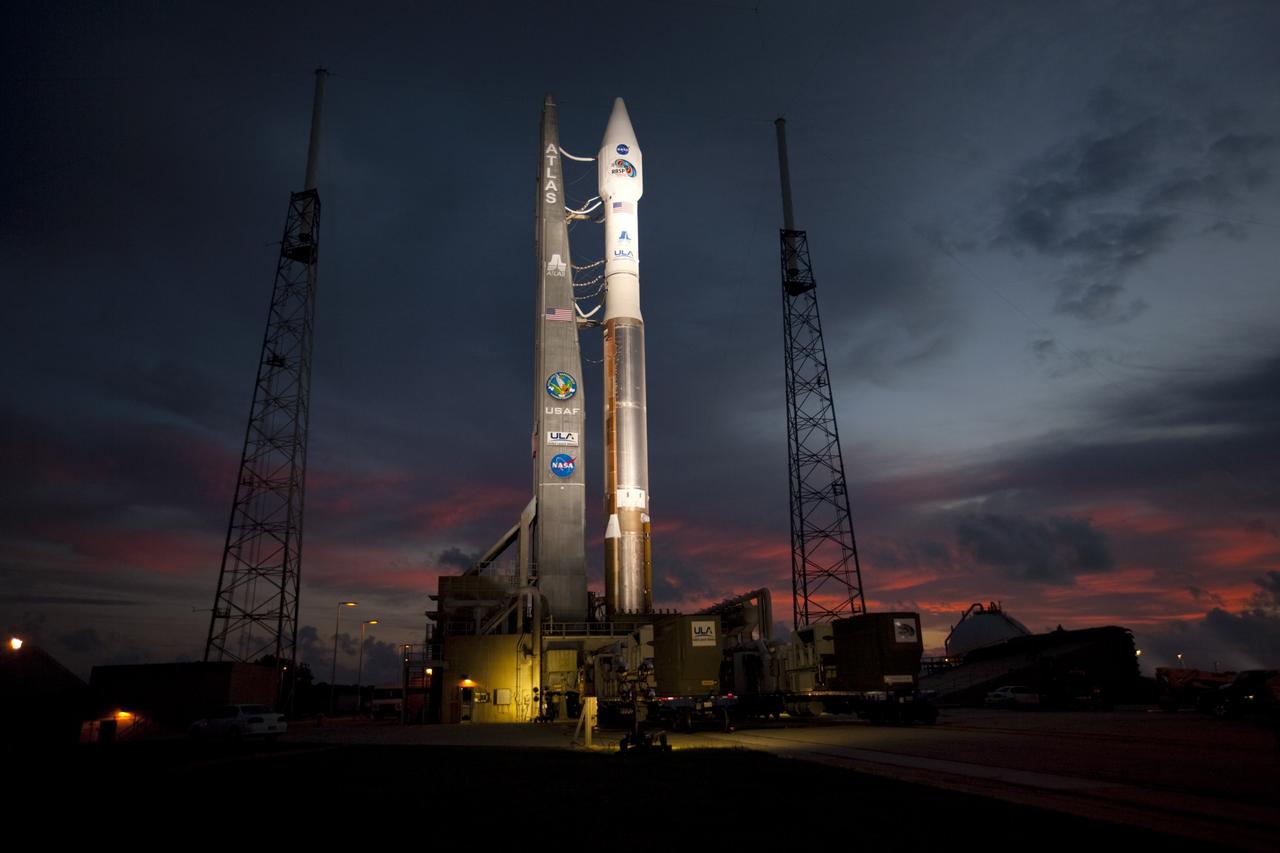
CAPE CANAVERAL, Fla. – An unfavorable weather forecast as a result of Tropical Storm Isaac approaching Florida kept NASA's twin Radiation Belt Storm Probes, or RBSP, on Space Launch Complex 41 at Cape Canaveral Air Force Station in Florida. Managers decided to roll the Atlas V rocket off the launch pad and back to the Vertical Integration Facility to ensure the launch vehicle and RBSP spacecraft are secured and protected from inclement weather. RBSP will explore changes in Earth's space environment caused by the sun -- known as "space weather" -- that can disable satellites, create power-grid failures and disrupt GPS service. The mission also will provide data on the fundamental radiation and particle acceleration processes throughout the universe. The launch is rescheduled for 4:05 a.m. EDT on Aug. 30, pending approval from the range. For more information on RBSP, visit http://www.nasa.gov/rbsp. Photo credit: NASA/Ben Smegelsky
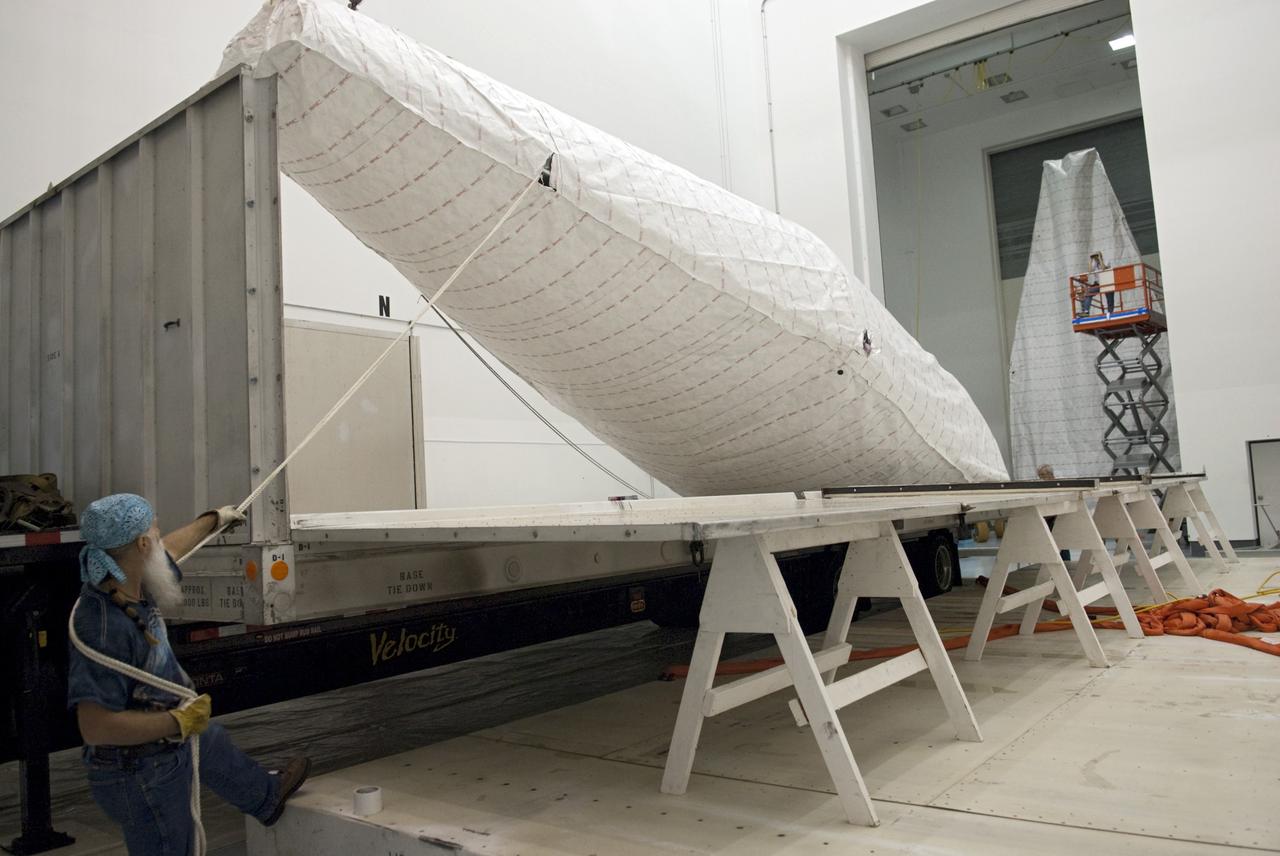
CAPE CANAVERAL, Fla. - Inside the Astrotech payload processing facility near NASA’s Kennedy Space Center in Florida, technicians offload and prepare to uncover the nose cone fairing for the Radiation Belt Storm Probes, or RBSP, spacecraft. The nose faring will house and protect the RBSP during liftoff aboard an Atlas V rocket. NASA’s RBSP mission will help us understand the sun’s influence on Earth and near-Earth space by studying the Earth’s radiation belts on various scales of space and time. RBSP will begin its mission of exploration of Earth’s Van Allen radiation belts and the extremes of space weather after its liftoff aboard a United Launch Alliance Atlas V from Space Launch Complex 41 at Cape Canaveral Air Force Station, Fla. Liftoff is targeted for Aug. 23, 2012. For more information, visit http://www.nasa.gov/rbsp. Photo credit: NASA/Charisse Nahser
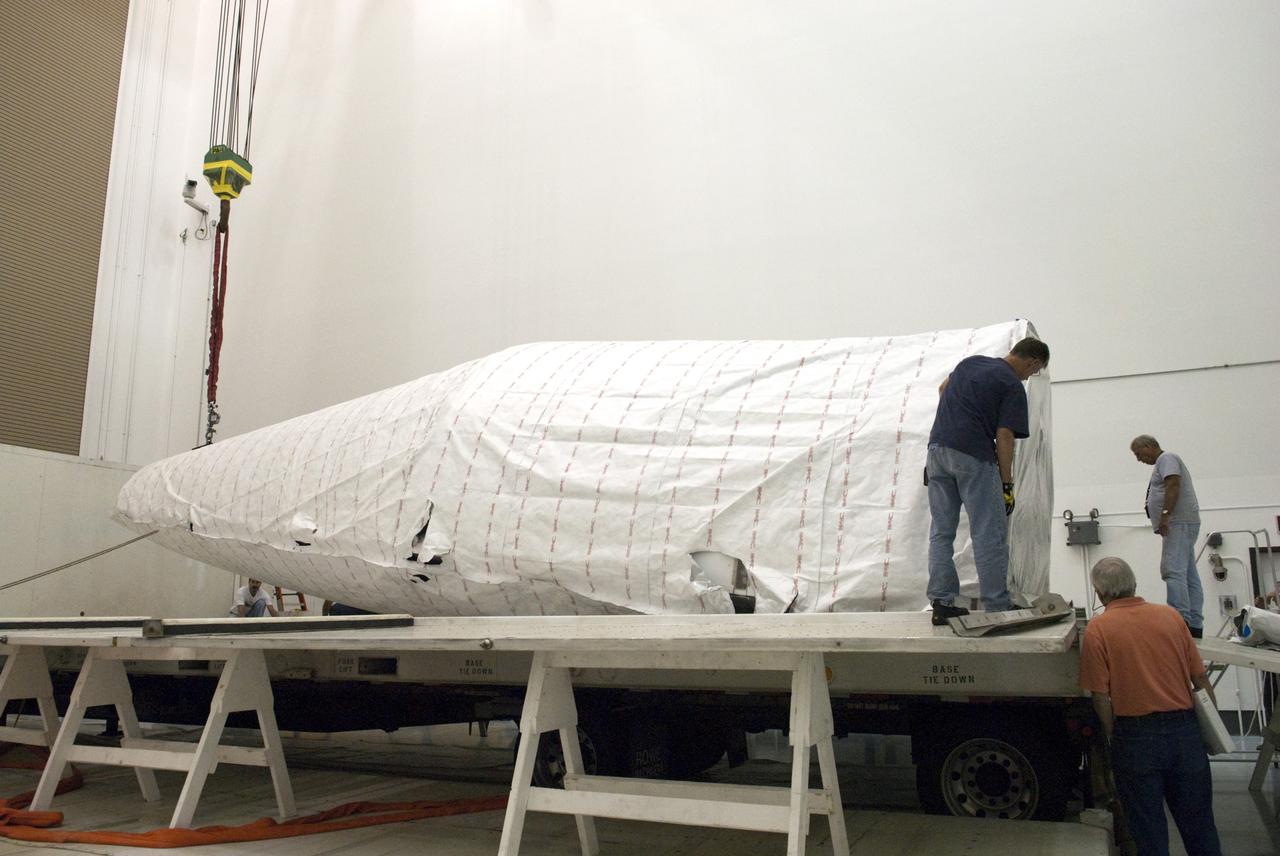
CAPE CANAVERAL, Fla. - Inside the Astrotech payload processing facility near NASA’s Kennedy Space Center in Florida, technicians uncrate and prepare to uncover the nose cone fairing for the Radiation Belt Storm Probes, or RBSP, spacecraft. The nose faring will house and protect the RBSP during liftoff aboard an Atlas V rocket. NASA’s RBSP mission will help us understand the sun’s influence on Earth and near-Earth space by studying the Earth’s radiation belts on various scales of space and time. RBSP will begin its mission of exploration of Earth’s Van Allen radiation belts and the extremes of space weather after its liftoff aboard a United Launch Alliance Atlas V from Space Launch Complex 41 at Cape Canaveral Air Force Station, Fla. Liftoff is targeted for Aug. 23, 2012. For more information, visit http://www.nasa.gov/rbsp. Photo credit: NASA/Charisse Nahser
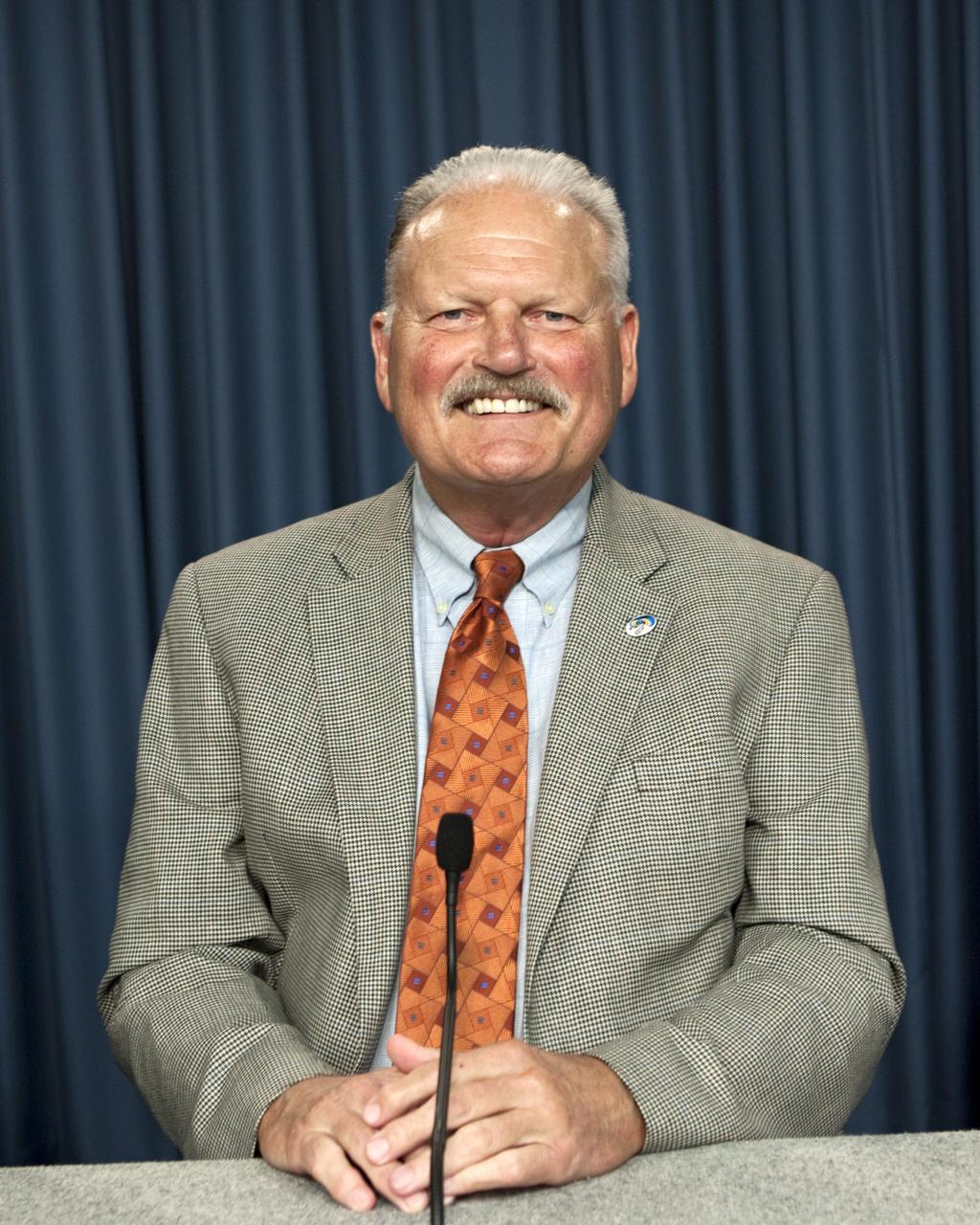
CAPE CANAVERAL, Fla. – Michael Luther, deputy associate administrator of NASA's Science Mission Directorate? at NASA Headquarters, participates in a Radiation Belt Storm Probes, or RBSP, postlaunch news conference at NASA Kennedy Space Center’s Press Site in Florida. The RBSP spacecraft launched atop a United Launch Alliance, or ULA, Atlas V rocket at 4:05 a.m. EDT from Space Launch Complex 41 at Cape Canaveral Air Force Station. RBSP will explore changes in Earth's space environment caused by the sun -- known as "space weather" -- that can disable satellites, create power-grid failures and disrupt GPS service. The mission also will provide data on the fundamental radiation and particle acceleration processes throughout the universe. For more information on RBSP, visit http://www.nasa.gov/rbsp. Photo credit: NASA/Jim Grossmann
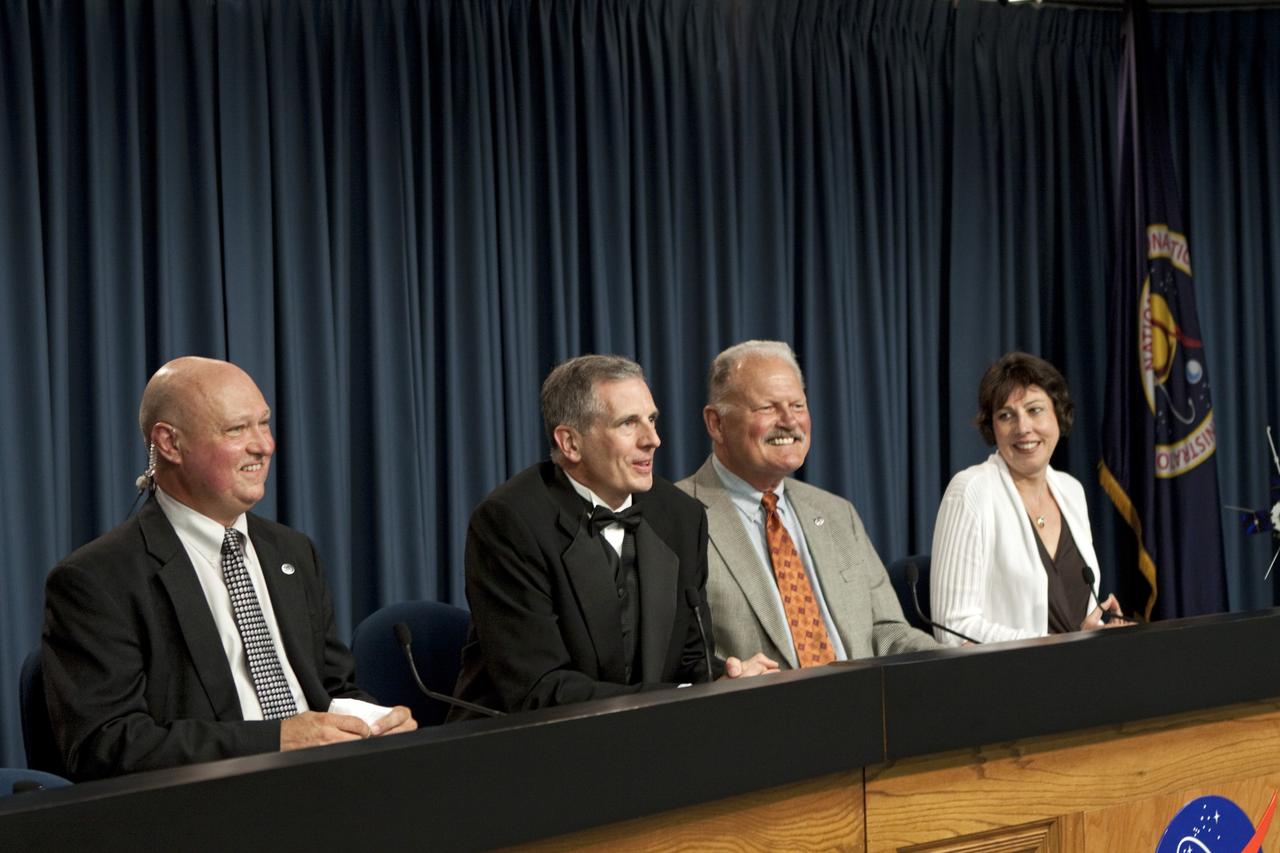
CAPE CANAVERAL, Fla. – A postlaunch news conference is held at NASA Kennedy Space Center’s Press Site in Florida following the launch of the Radiation Belt Storm Probes, or RBSP, mission atop a United Launch Alliance, or ULA, Atlas V rocket at 4:05 a.m. EDT from Space Launch Complex 41 at Cape Canaveral Air Force Station. From left, are Mike Curie of NASA Kennedy Public Affairs, Richard Fitzgerald, RBSP project manager at Johns Hopkins Applied Physics Laboratory? in Laurel, M.D., Michael Luther, deputy associate administrator of NASA's Science Mission Directorate? at NASA Headquarters?, and Nicky Fox, RBSP deputy project scientist at Johns Hopkins. RBSP will explore changes in Earth's space environment caused by the sun -- known as "space weather" -- that can disable satellites, create power-grid failures and disrupt GPS service. The mission also will provide data on the fundamental radiation and particle acceleration processes throughout the universe. For more information on RBSP, visit http://www.nasa.gov/rbsp. Photo credit: NASA/Jim Grossmann

CAPE CANAVERAL, Fla. – A postlaunch news conference is held at NASA Kennedy Space Center’s Press Site in Florida following the launch of the Radiation Belt Storm Probes, or RBSP, mission atop a United Launch Alliance, or ULA, Atlas V rocket at 4:05 a.m. EDT from Space Launch Complex 41 at Cape Canaveral Air Force Station. From left, are Richard Fitzgerald, RBSP project manager at Johns Hopkins Applied Physics Laboratory? in Laurel, M.D., Michael Luther, deputy associate administrator of NASA's Science Mission Directorate? at NASA Headquarters?, and Nicky Fox, RBSP deputy project scientist at Johns Hopkins. RBSP will explore changes in Earth's space environment caused by the sun -- known as "space weather" -- that can disable satellites, create power-grid failures and disrupt GPS service. The mission also will provide data on the fundamental radiation and particle acceleration processes throughout the universe. For more information on RBSP, visit http://www.nasa.gov/rbsp. Photo credit: NASA/Jim Grossmann
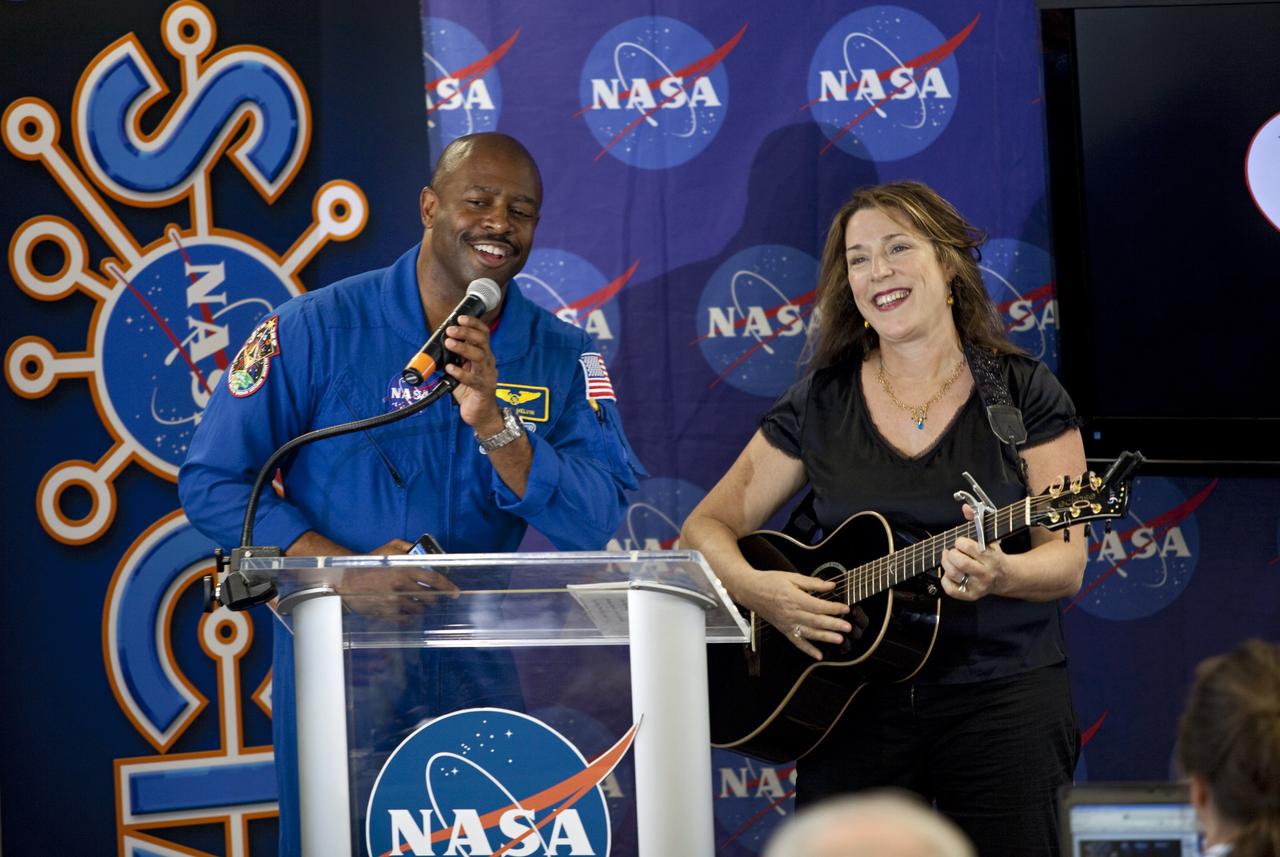
CAPE CANAVERAL, Fla. – At NASA's Kennedy Space Center in Florida, astronaut Leland Melvin, associate administrator of NASA Education, introduces performer Beth Nielson Chapman to agency social media followers during the second day of NASA Social activities revolving around NASA's Radiation Belt Storm Probes, or RBSP, mission. The probes are set to launch aboard a United Launch Alliance, or ULA, Atlas V rocket from nearby Cape Canaveral Air Force Station. About 40 followers were selected to participate in RBSP's prelaunch and launch activities. The RBSP mission will help us understand the sun’s influence on Earth and near-Earth space by studying the Earth’s radiation belts on various scales of space and time. RBSP will begin its mission of exploration of Earth’s Van Allen radiation belts and the extremes of space weather. For more information, visit http://www.nasa.gov/rbsp. Photo credit: NASA/Frankie Martin
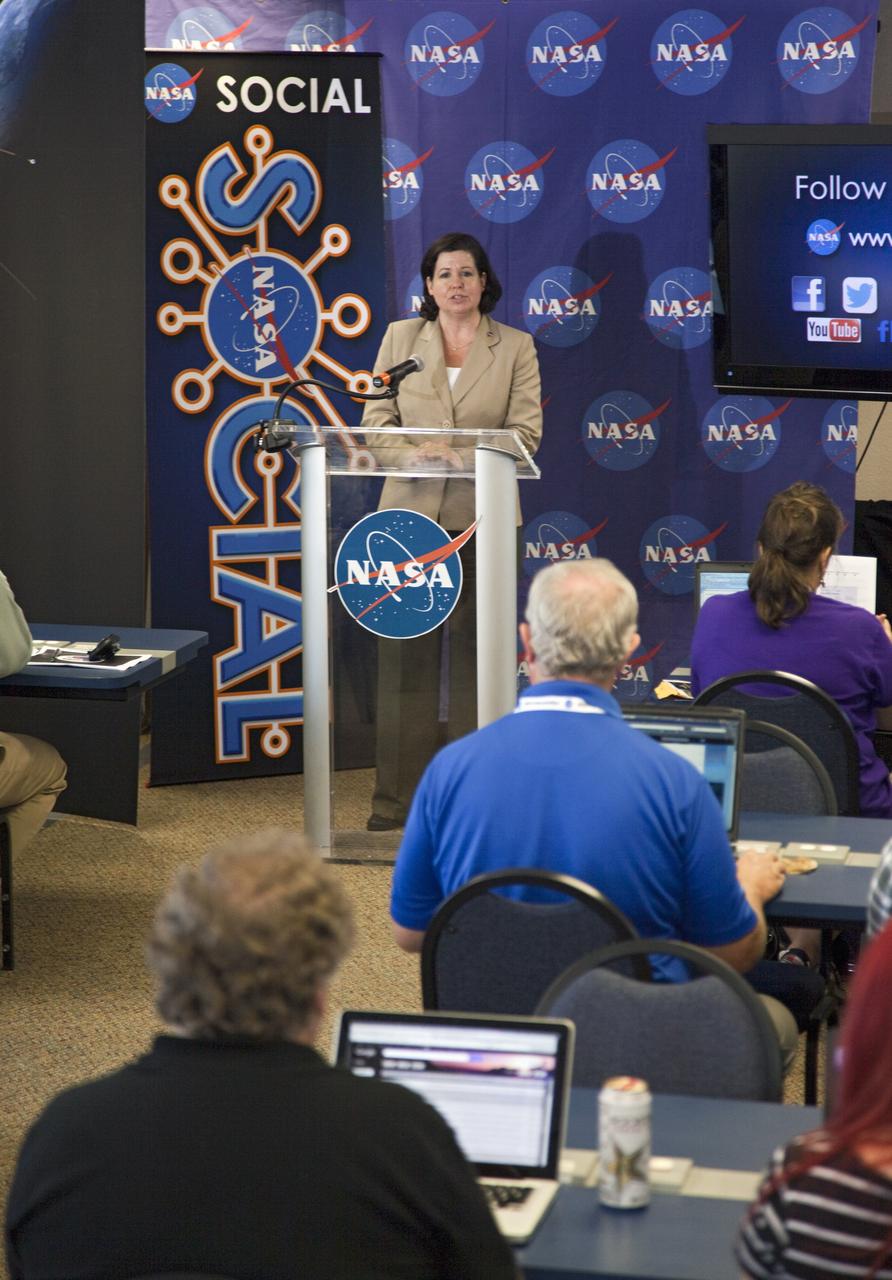
CAPE CANAVERAL, Fla. – At NASA's Kennedy Space Center in Florida, Barbara Giles, director of NASA's Science Mission Directorate Heliophysics Division, talks to agency social media followers during the second day of NASA Social activities revolving around NASA's Radiation Belt Storm Probes, or RBSP, mission. The probes are set to launch aboard a United Launch Alliance, or ULA, Atlas V rocket from nearby Cape Canaveral Air Force Station. About 40 followers were selected to participate in RBSP's prelaunch and launch activities. The RBSP mission will help us understand the sun’s influence on Earth and near-Earth space by studying the Earth’s radiation belts on various scales of space and time. RBSP will begin its mission of exploration of Earth’s Van Allen radiation belts and the extremes of space weather. For more information, visit http://www.nasa.gov/rbsp. Photo credit: NASA/Frankie Martin
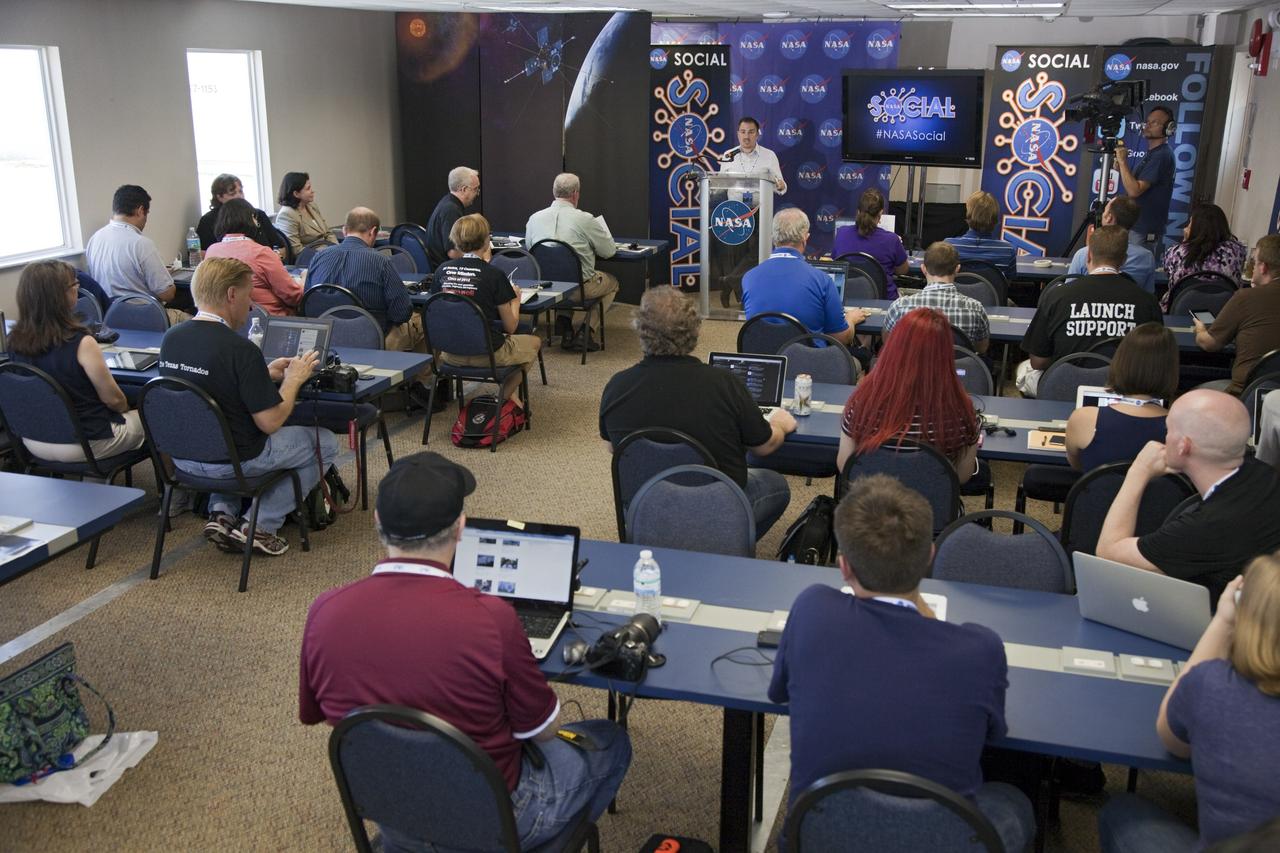
CAPE CANAVERAL, Fla. – At NASA's Kennedy Space Center in Florida, Jason Townsend of NASA's Social Media Team welcomes agency social media followers to the second day of activities revolving around NASA's Radiation Belt Storm Probes, or RBSP, mission. The probes are set to launch aboard a United Launch Alliance, or ULA, Atlas V rocket from nearby Cape Canaveral Air Force Station. About 40 followers were selected to participate in RBSP's prelaunch and launch activities and share them with their own fan base. The RBSP mission will help us understand the sun’s influence on Earth and near-Earth space by studying the Earth’s radiation belts on various scales of space and time. RBSP will begin its mission of exploration of Earth’s Van Allen radiation belts and the extremes of space weather. For more information, visit http://www.nasa.gov/rbsp. Photo credit: NASA/Frankie Martin
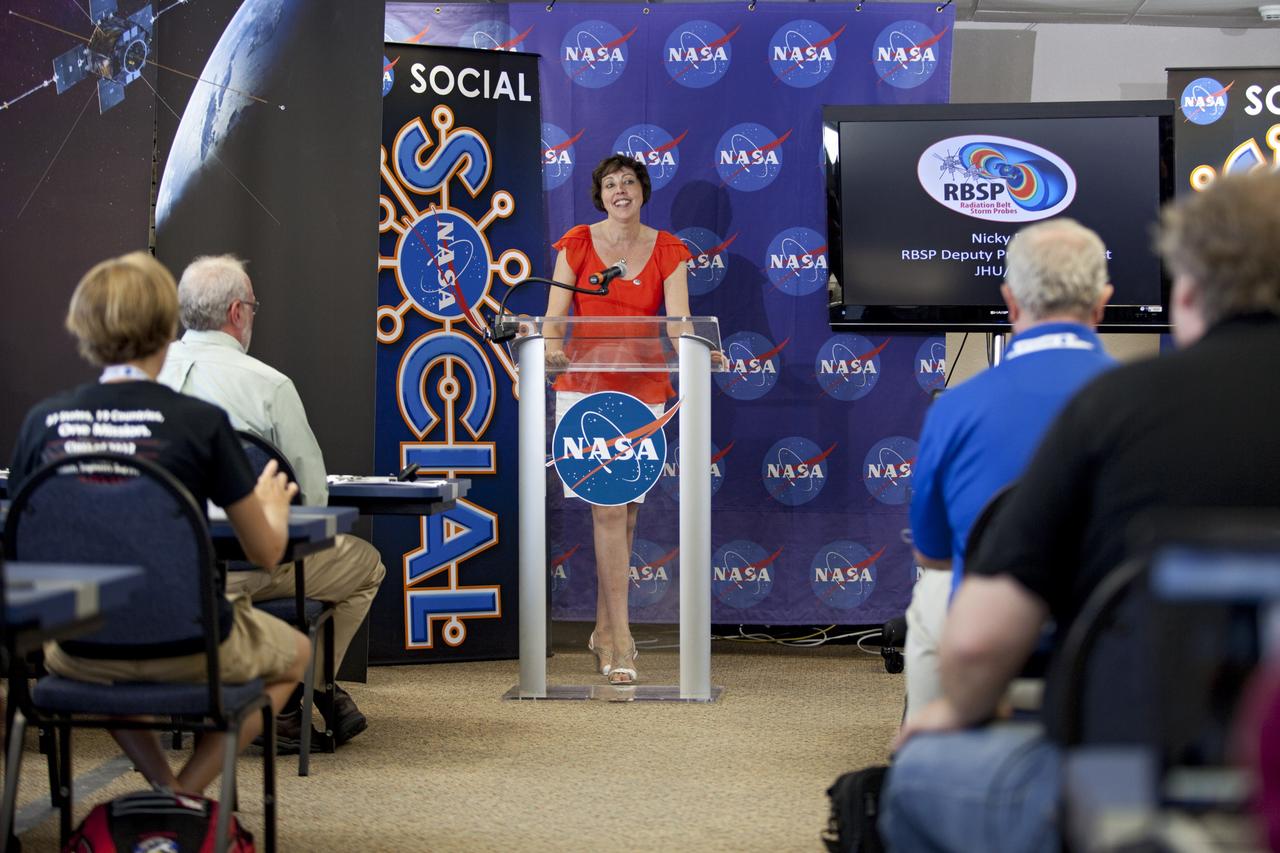
CAPE CANAVERAL, Fla. – At NASA's Kennedy Space Center in Florida, Nicky Fox, deputy project scientist of NASA's Radiation Belt Storm Probes, or RBSP, mission talks to agency social media followers during the second day of NASA Social activities. The probes are set to launch aboard a United Launch Alliance ULA Atlas V rocket from nearby Cape Canaveral Air Force Station. About 40 followers were selected to participate in RBSP's prelaunch and launch activities. The RBSP mission will help us understand the sun’s influence on Earth and near-Earth space by studying the Earth’s radiation belts on various scales of space and time. RBSP will begin its mission of exploration of Earth’s Van Allen radiation belts and the extremes of space weather. For more information, visit http://www.nasa.gov/rbsp. Photo credit: NASA/Frankie Martin
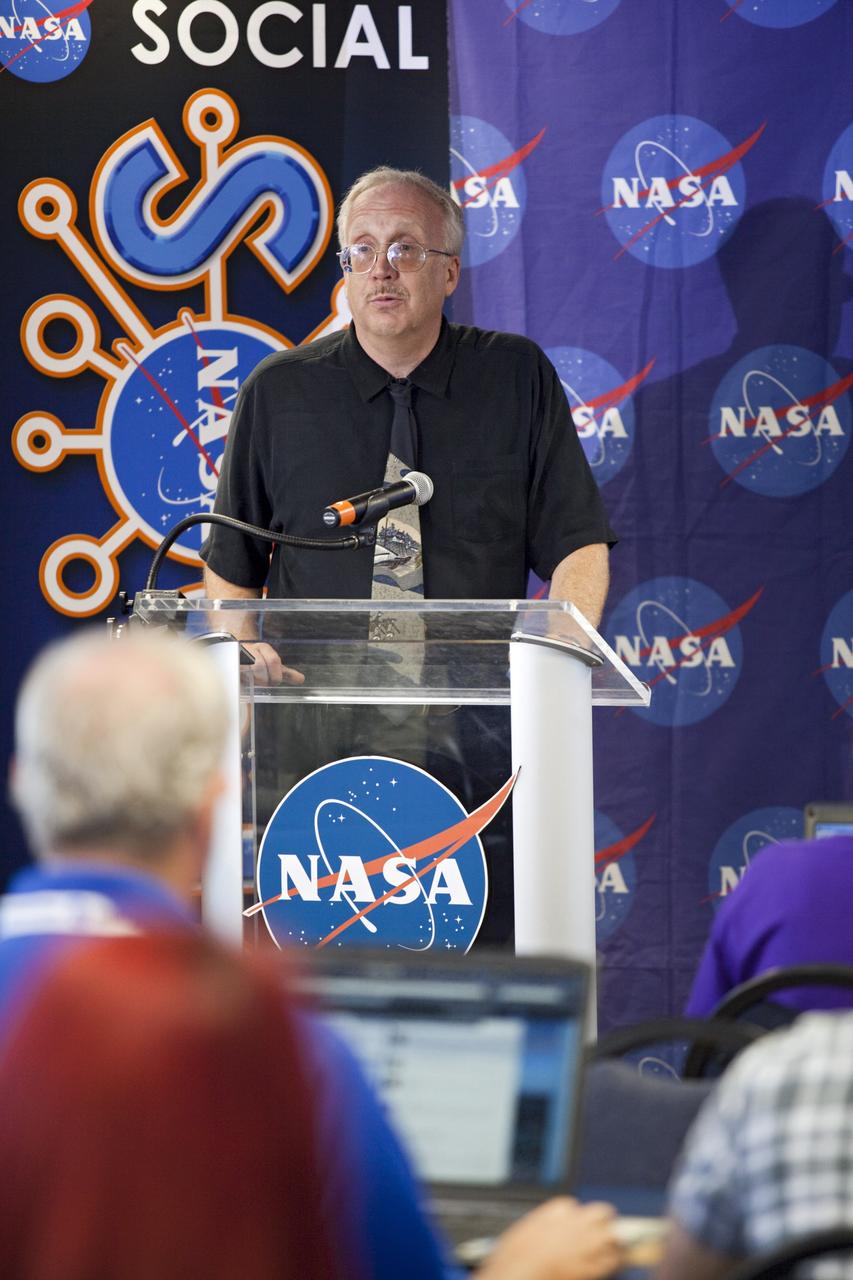
CAPE CANAVERAL, Fla. – At NASA's Kennedy Space Center in Florida, David Sibeck, NASA Living with a Star mission scientist from Goddard Space Flight Center, talks to agency social media followers during the second day of NASA Social activities revolving around NASA's Radiation Belt Storm Probes, or RBSP, mission. The probes are set to launch aboard a United Launch Alliance, or ULA, Atlas V rocket from nearby Cape Canaveral Air Force Station. About 40 followers were selected to participate in RBSP's prelaunch and launch activities. The RBSP mission will help us understand the sun’s influence on Earth and near-Earth space by studying the Earth’s radiation belts on various scales of space and time. RBSP will begin its mission of exploration of Earth’s Van Allen radiation belts and the extremes of space weather. For more information, visit http://www.nasa.gov/rbsp. Photo credit: NASA/Frankie Martin