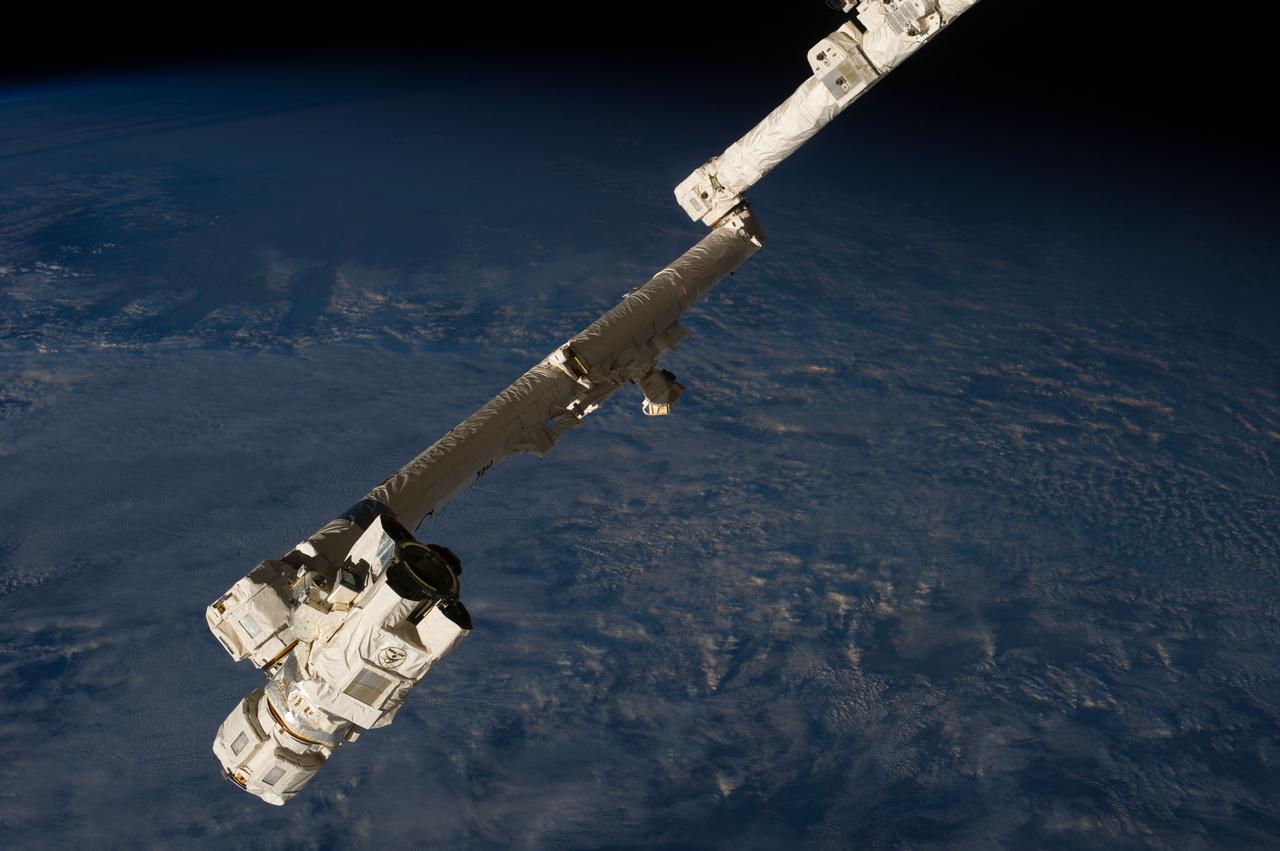
View of Space Station Remote Manipulator System (SSRMS) extended arm with a dark,cloudy Earth in the background. Photo was taken by an Expedition 36 crew member on board the International Space Station (ISS). Per Twitter message: #CanadaArm2 poised and ready to support capture of #HTV4 in just a couple weeks.
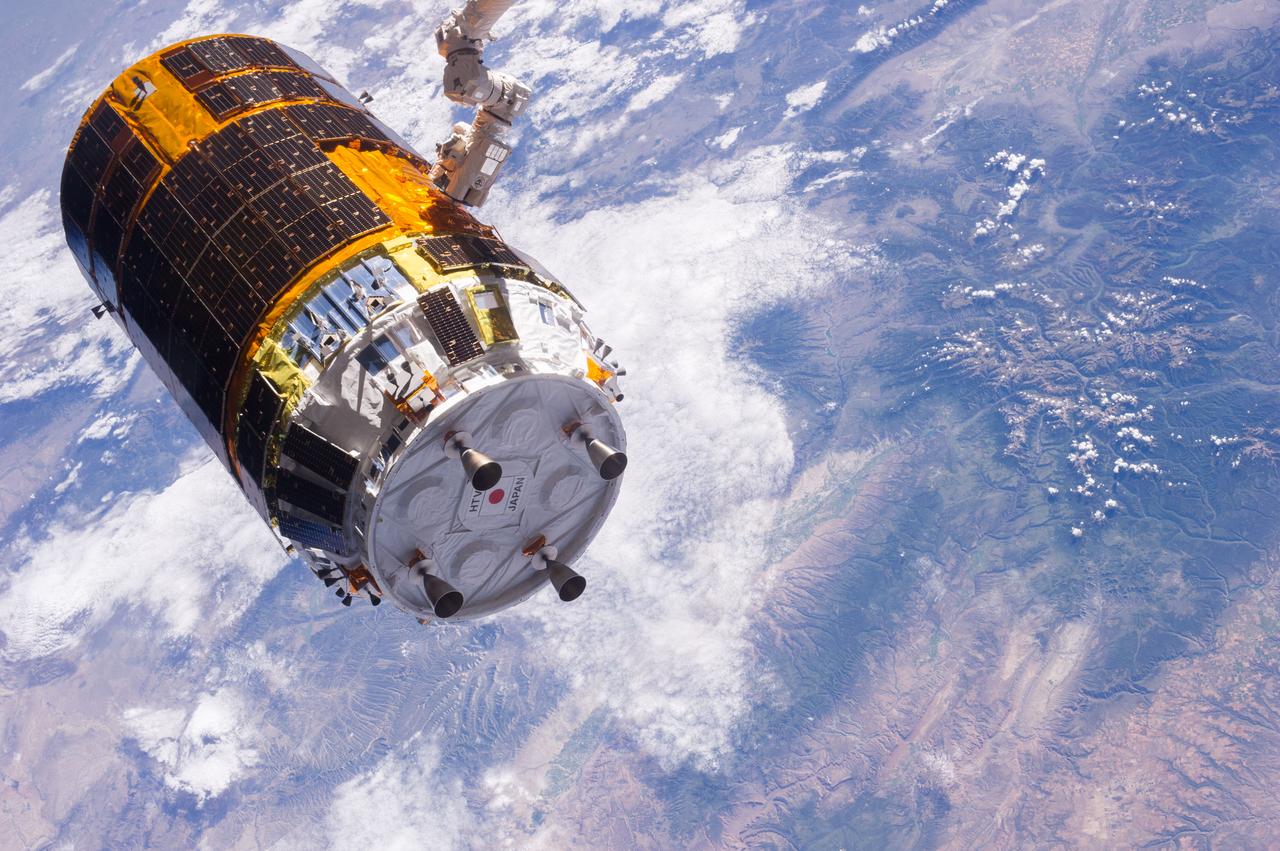
One of the Expedition 36 crew members aboard the International Space Station took this picture of the Japanese HTV-4 unmanned cargo spacecraft,backdropped against a land mass on Earth,following its unberthing but just prior to its release from the orbital outpost's Canadarm2. HTV-4,after backing away from the flying complex,headed for re-entry into Earth's atmosphere,burning upon re-entry. Per Twitter message: Flying over southwestern US, not long before release of #HTV4 by #Canadarm2.
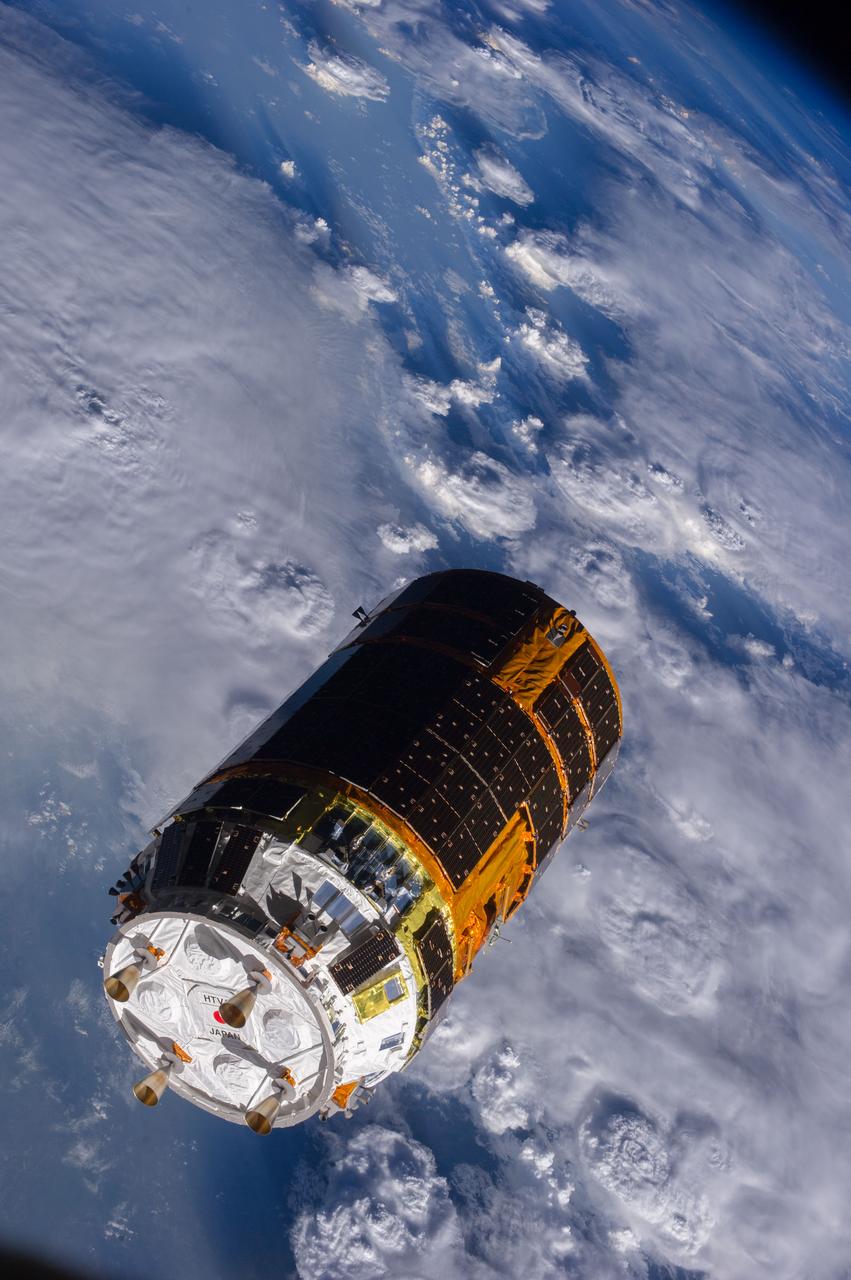
One of the Expedition 36 crew members aboard the International Space Station took this picture of the Japanese HTV-4 unmanned cargo spacecraft,backdropped against the Earth,following its unberthing and release from the orbital outpost. HTV-4,after backing away from the flying complex,headed for re-entry into Earth's atmosphere,burning upon re-entry. Per Twitter message: And, shortly after release of #HTV4, flying over Africa (The storm clouds were amazing).
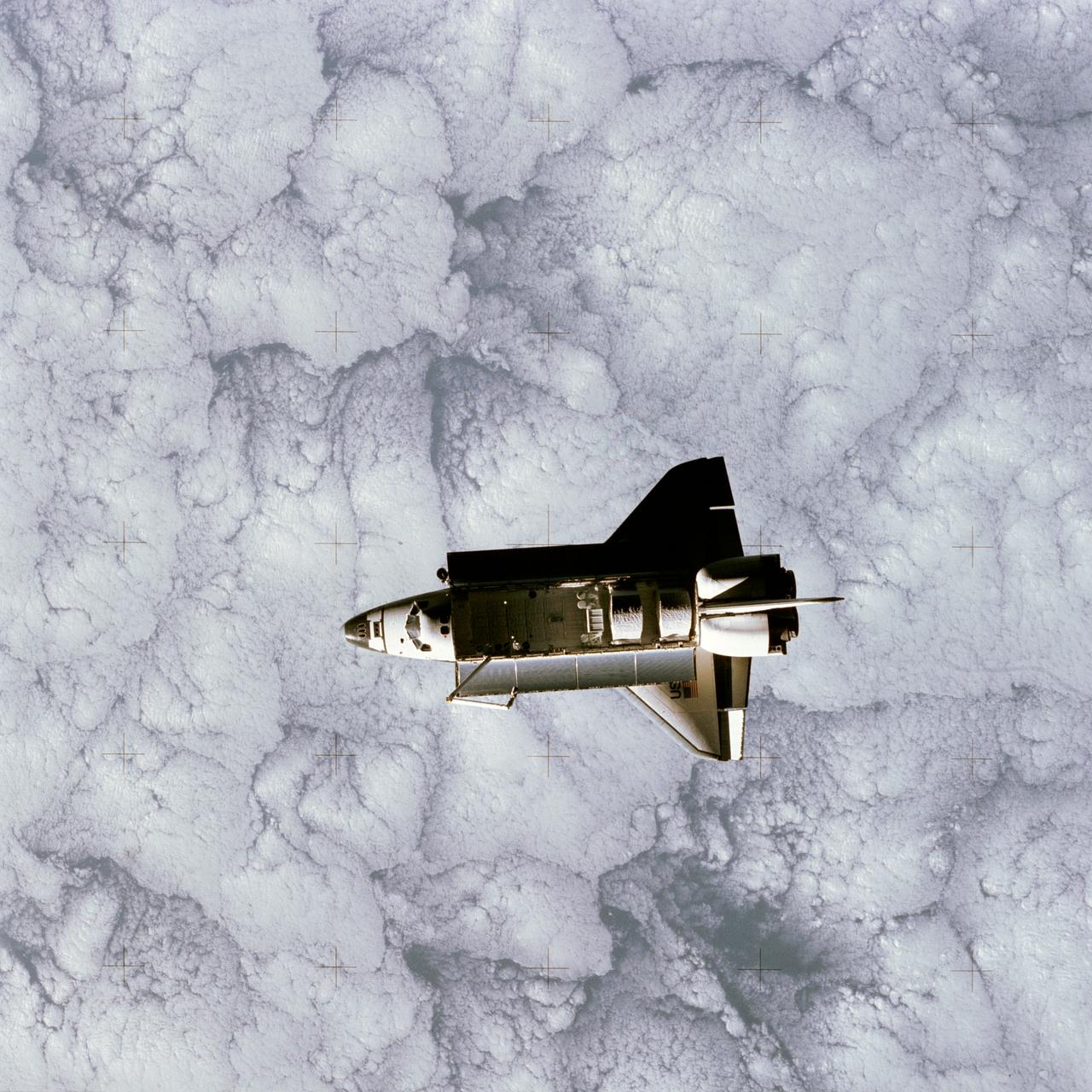
STS007-32-1667 (22 June 1983) --- The Earth-orbiting Space Shuttle Challenger over a heavily cloud-covered portion of the Earth was captured by a 70mm camera onboard the temporarily free-flying Shuttle Pallet Satellite (SPAS-01) during a busy Day 5 on the STS-7 mission. Visible in the cargo bay are the protective cradles for the now vacated Telesat Anik C2 and Palapa-B communications satellites, the pallet for the NASA Office of Space and Terrestrial Applications (OSTA-2); the Remote Manipulator System (RMS) and the KU-Band antenna. The STS-7 astronaut crew and the RMS arm later retrieved the SPAS and returned it to a stowed position in the cargo bay of the Space Shuttle Challenger for the return to Earth.
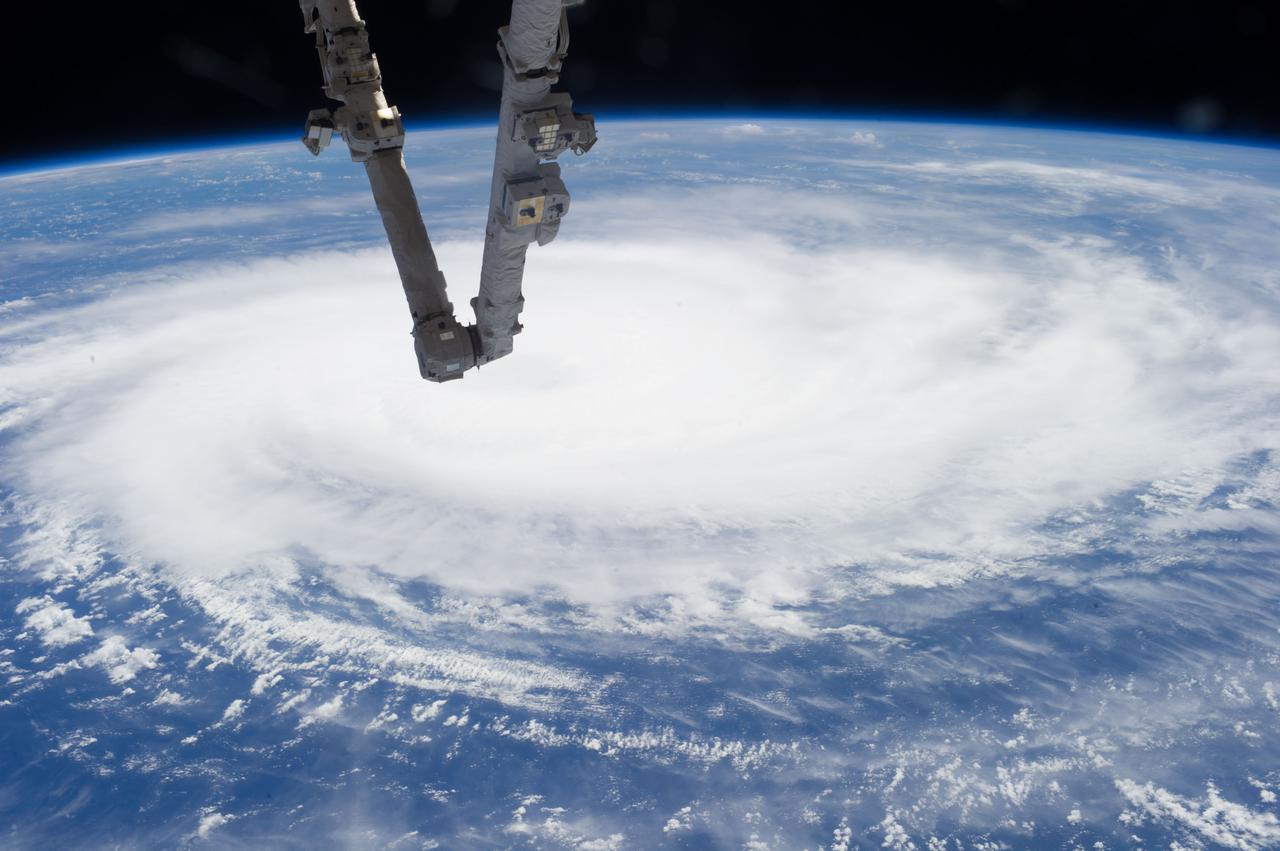
Earth Observations taken by Expedition 38 crewmember. Remote Manipulator System (RMS) is visible. Image was released by astronaut on Twitter.
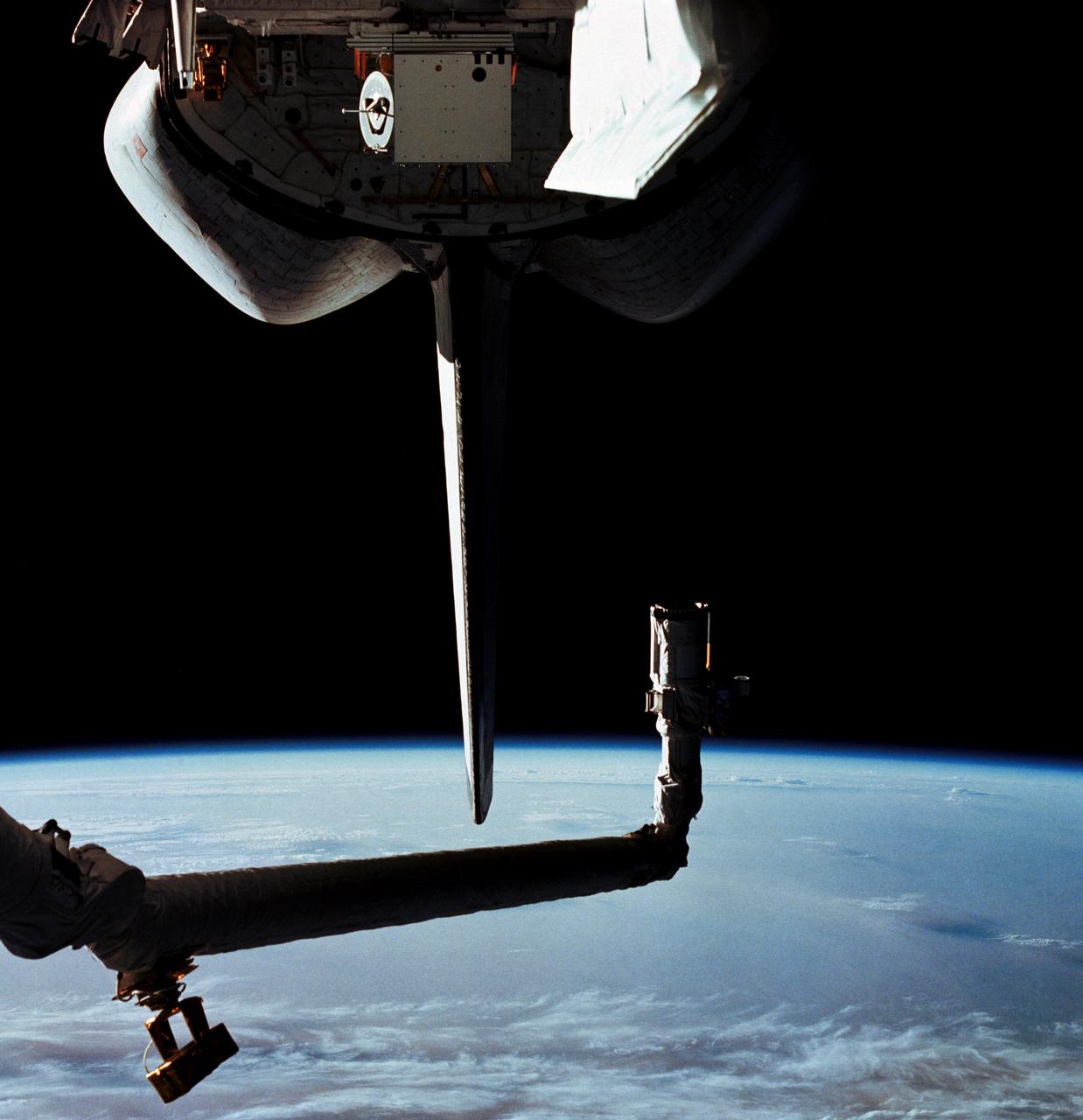
STS002-12-833 (13 Nov. 1981) --- Clouds over Earth and black sky form the background for this unique photograph from the space shuttle Columbia in Earth orbit. The photograph was shot through the aft flight deck windows viewing the cargo bay. Part of the scientific payload of the Office of Space and Terrestrial Applications (OSTA-1) is visible in the open cargo bay. The astronauts inside Columbia's cabin were remotely operating the Canadian-built remote manipulator system (RMS). Note television cameras on its elbow and wrist pieces. Photo credit: NASA
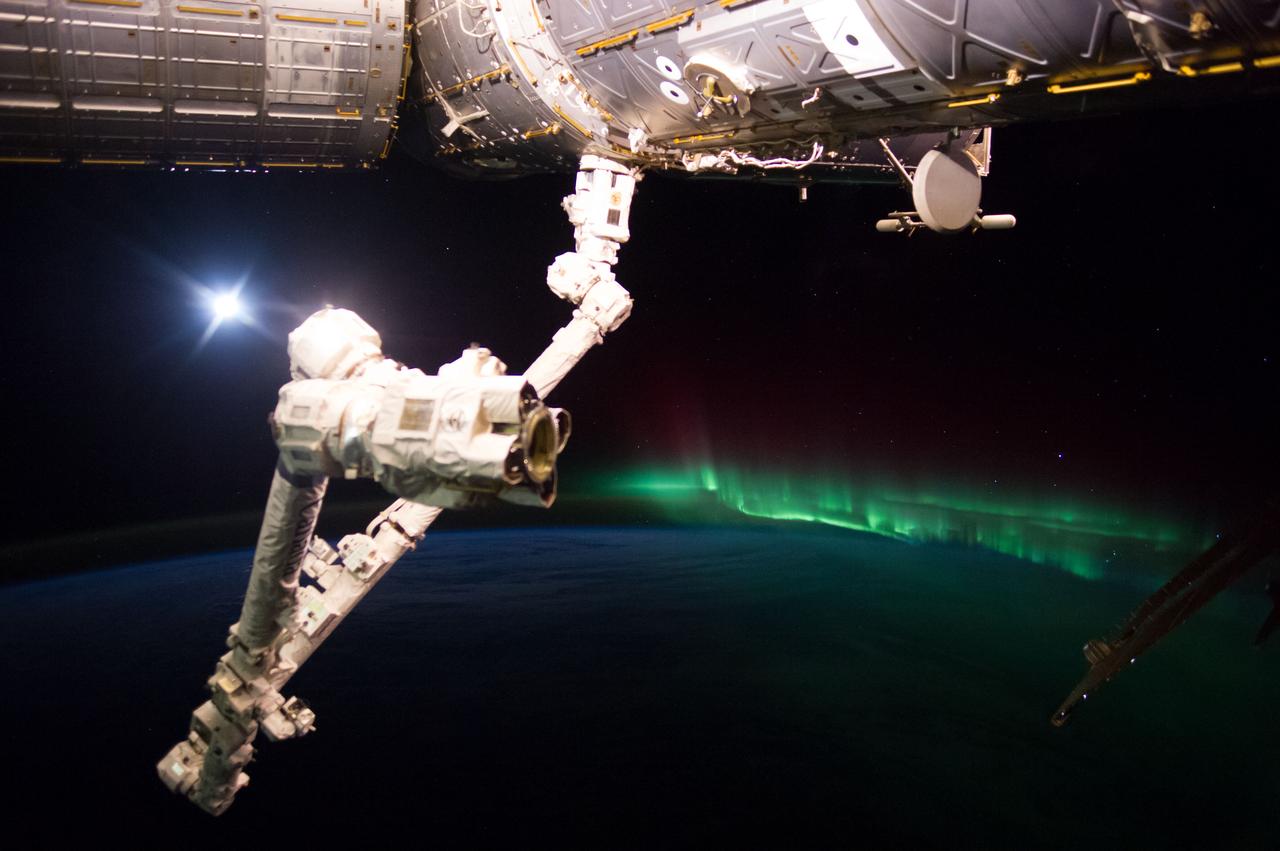
Night Earth Observations taken by Expedition 41 crewmember. Aurora and Remote Manipulator System (RMS) are visible.
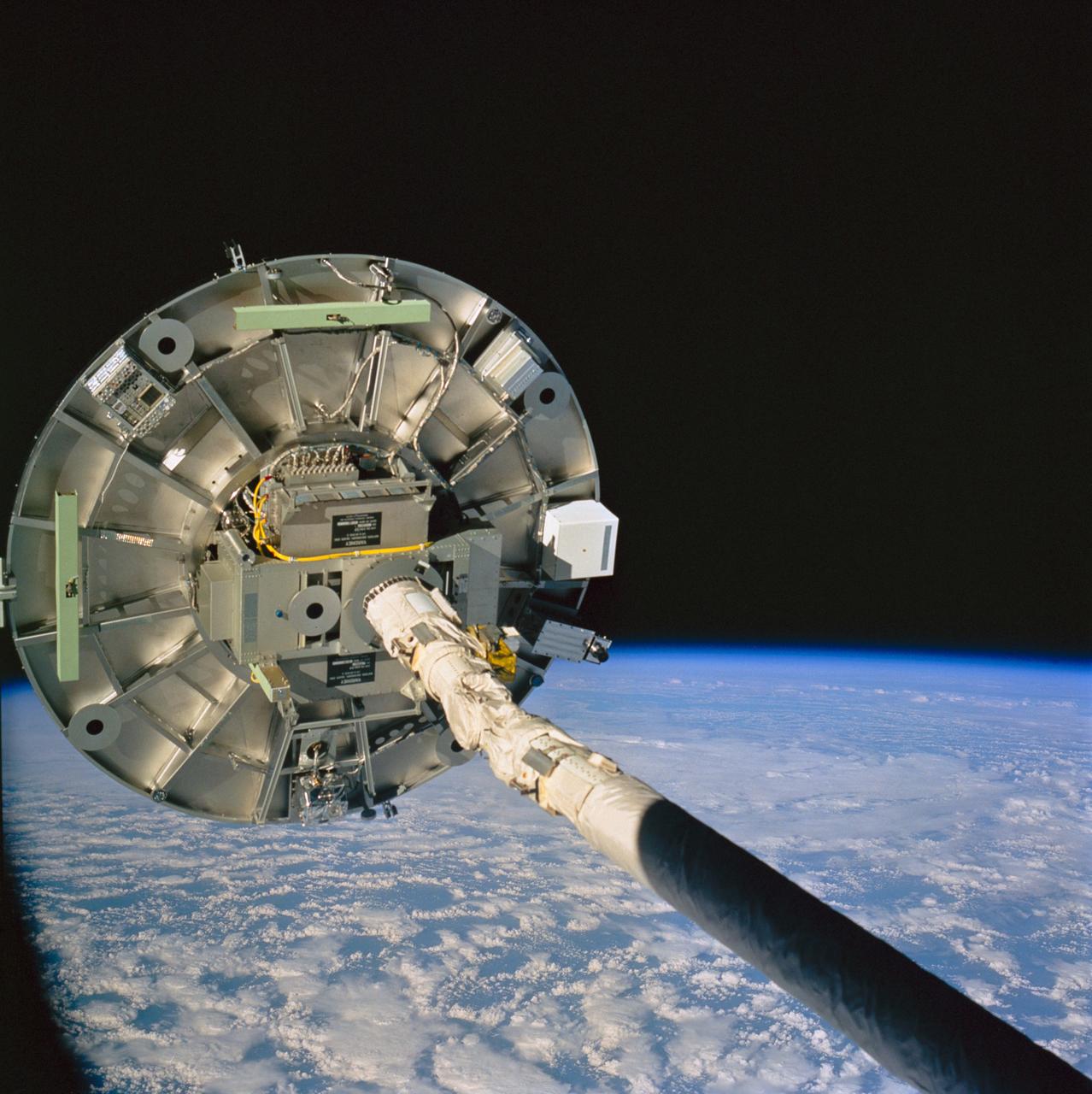
STS060-76-095 (3-11 Feb 1994) --- The ram side of the Wake Shield Facility (WSF) in the grasp of the Space Shuttle Discovery's Remote Manipulator System (RMS) arm is featured in this 70mm frame. Clouds over the Atlantic Ocean and the blackness of space share the backdrop for the picture. Five NASA astronauts and a Russian cosmonaut spent eight days in Earth orbit in support of the STS-60 mission.
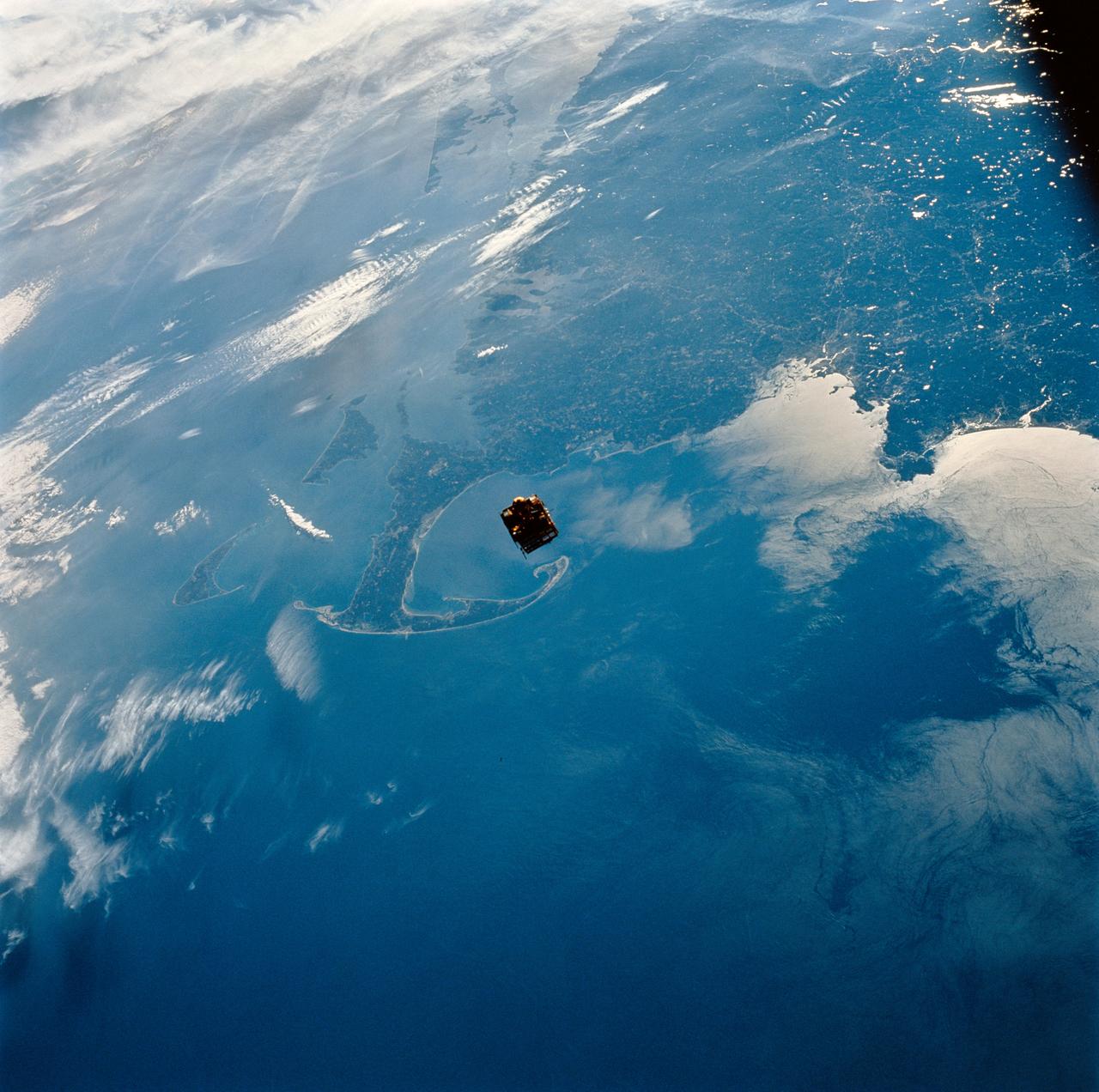
STS064-111-041 (12 Sept. 1994) ---- Backdropped against New England's coast, the Shuttle Pointed Autonomous Research Tool for Astronomy (SPARTAN-201) satellite begins its separation from the space shuttle Discovery. The free-flying spacecraft, 130 nautical miles above Cape Cod at frame center, remained some 40 miles away from Discovery until the crew retrieved it two days later. Photo credit: NASA or National Aeronautics and Space Administration
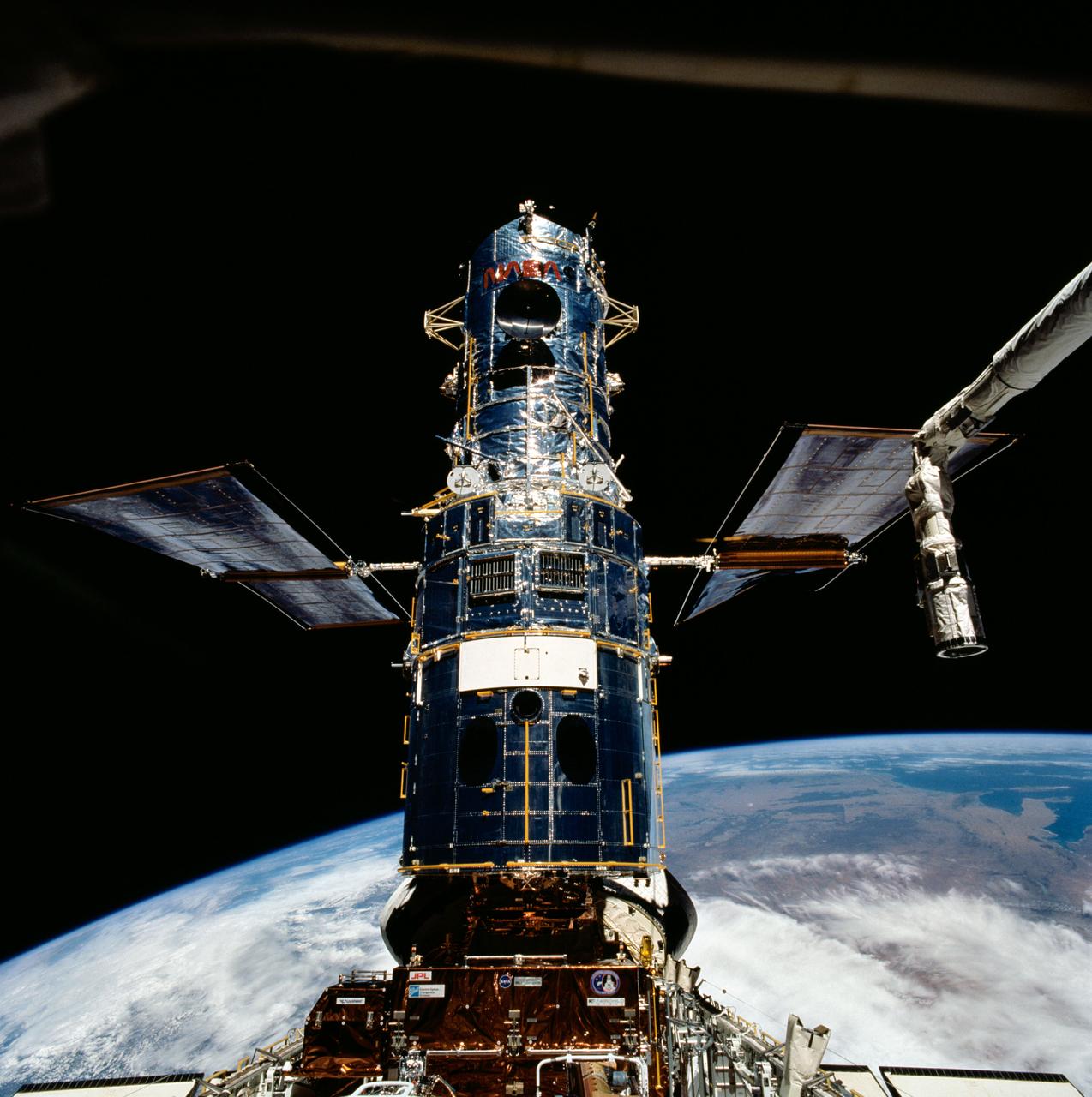
STS061-86-030 (4 Dec 1993) --- The Hubble Space Telescope (HST) is pictured in the Space Shuttle Endeavour's cargo bay following its capture and berthing early in the eleven-day STS-61 mission. The Remote Manipulator System (RMS) arm, with television cameras mounted on it, was maneuvered from inside the cabin in order to survey HST. Five days of space walks followed, during which a variety of servicing tasks were performed by four crew members.
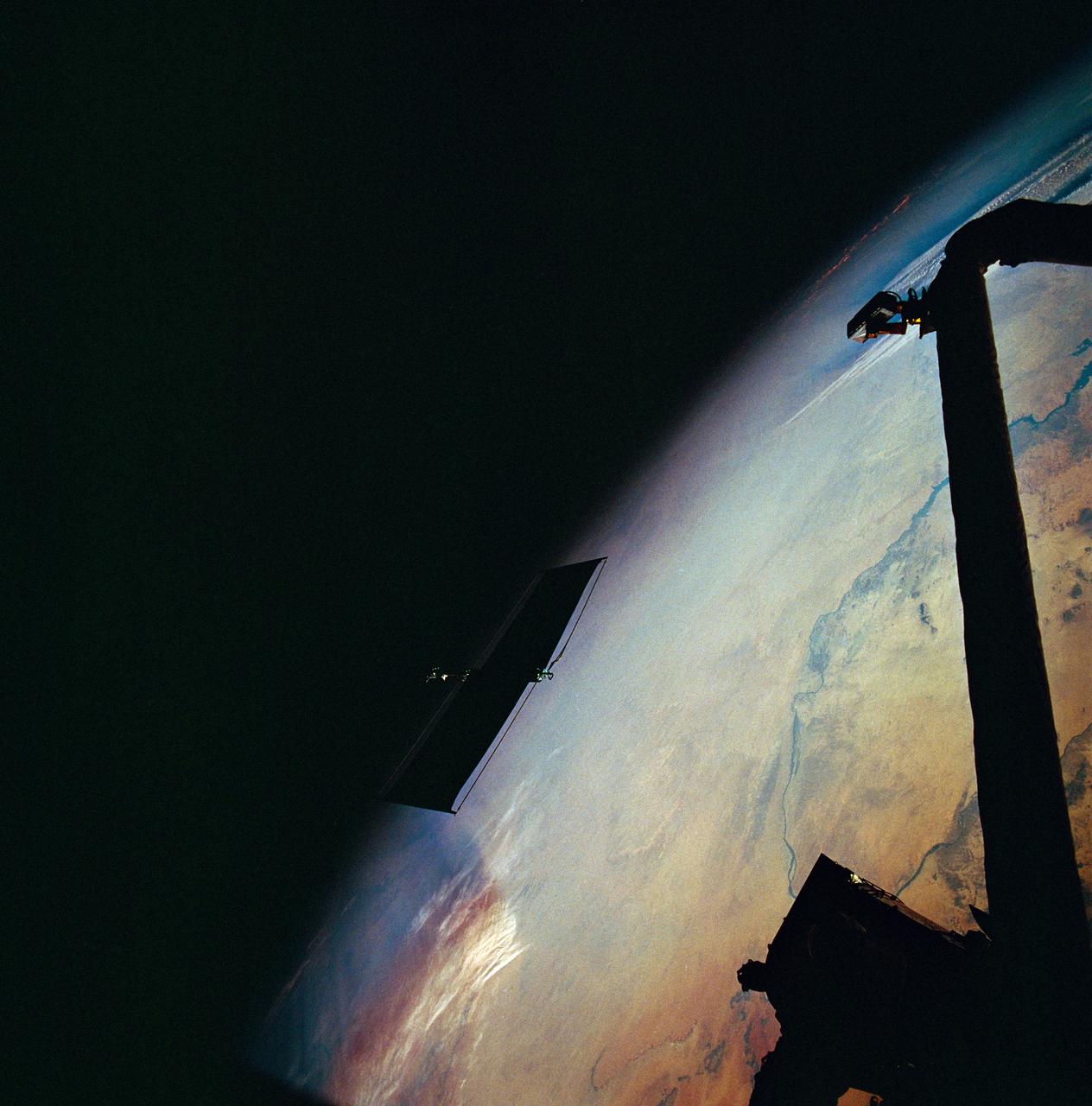
STS061-95-031 (6 Dec 1993) --- The damaged solar array panel removed from the Hubble Space Telescope (HST) is backdropped over northern Sudan. Astronaut Kathryn C. Thornton, just out of frame at top right, watched the panel after releasing it moments earlier.
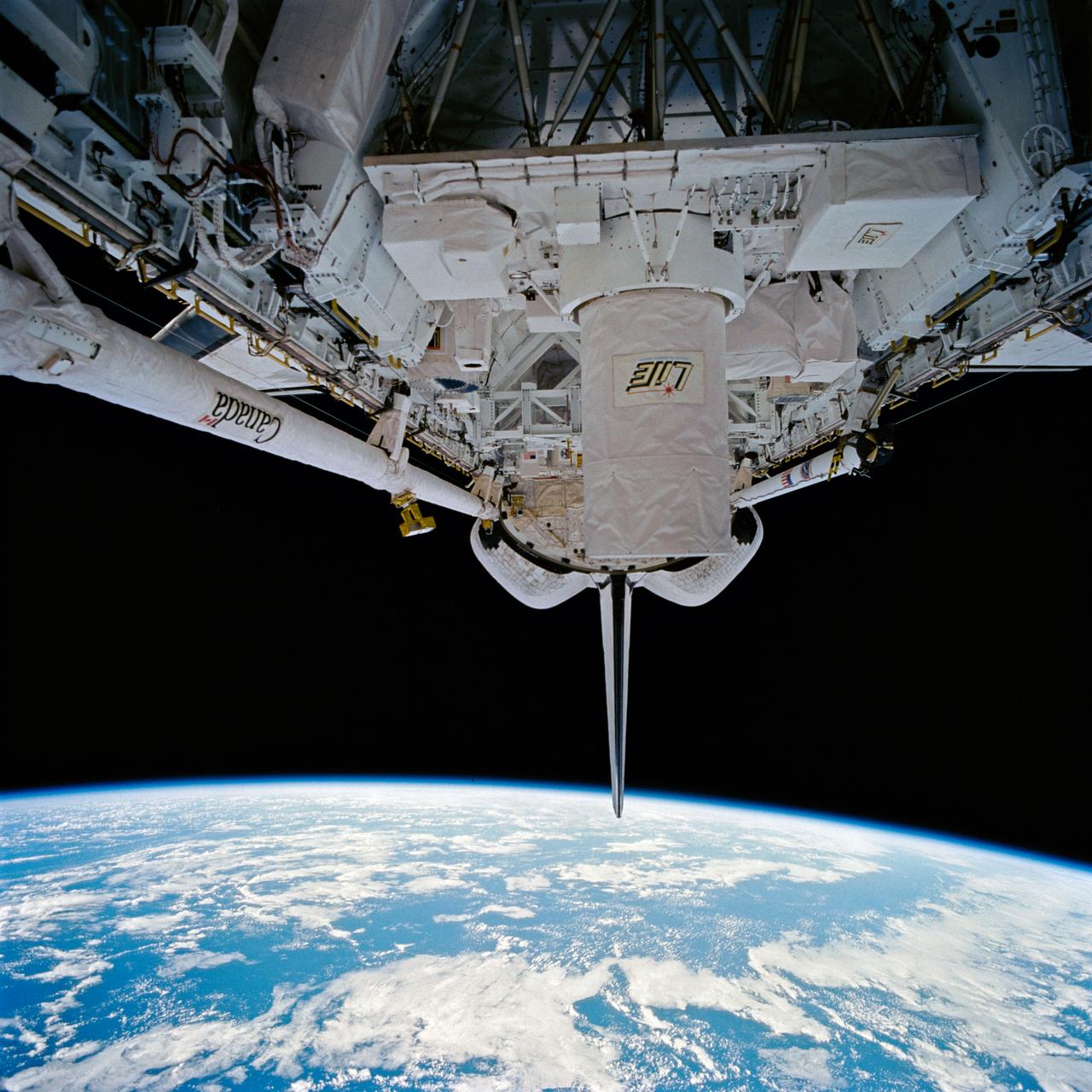
STS064-90-031 (9-20 Sept. 1994) --- Backdropped against the darkness of space beneath Earth's horizon 130 nautical miles away, the cargo bay of the space shuttle Discovery and its related payloads were captured on 70mm film by one of the six cabin-bound astronauts. In the foreground is the Lidar In-space Technology Experiment (LITE). The robot arm portion of the Remote Manipulator System (RMS), busy throughout much of the almost 11-day mission, is in a stowed position on Discovery's port side. Photo credit: NASA or National Aeronautics and Space Administration
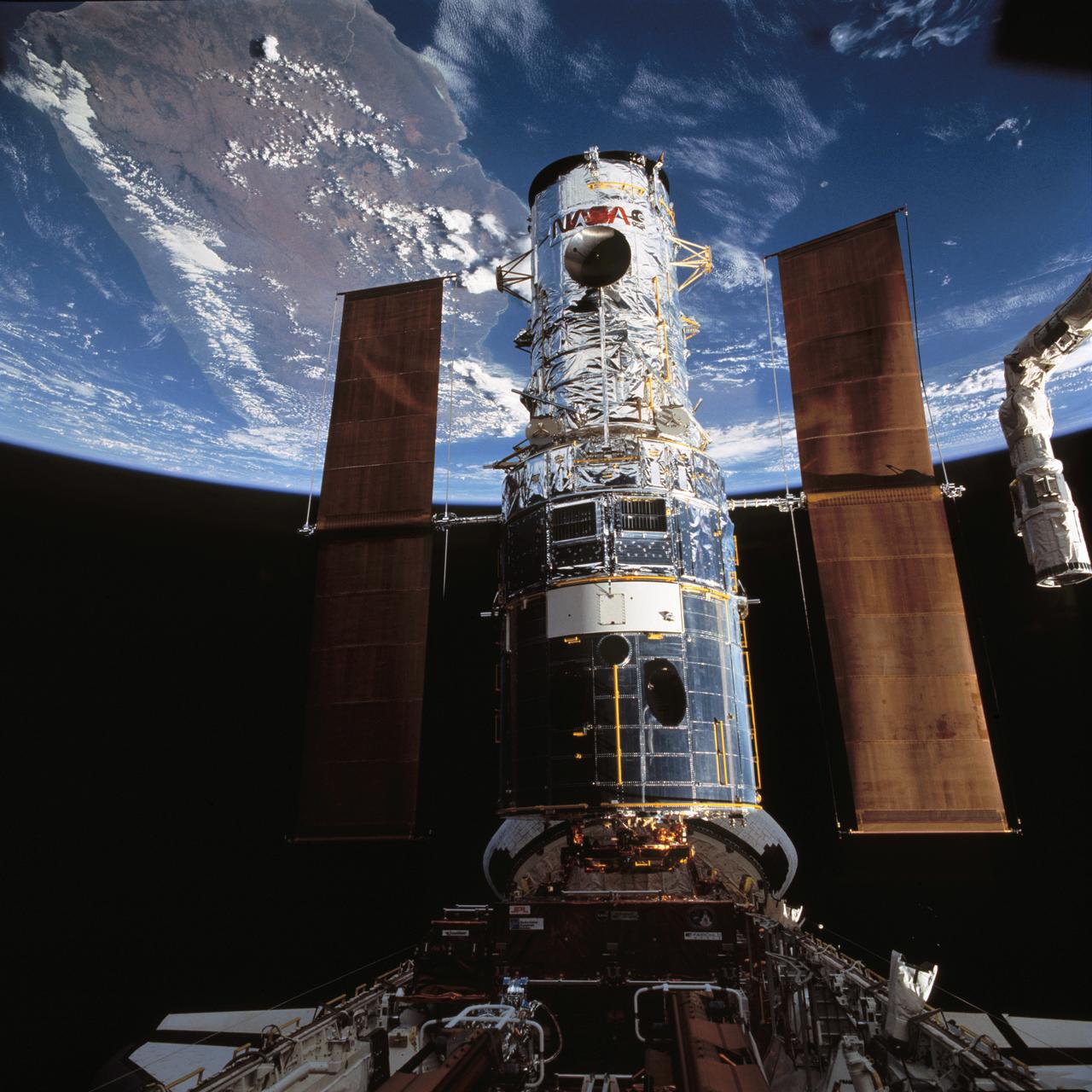
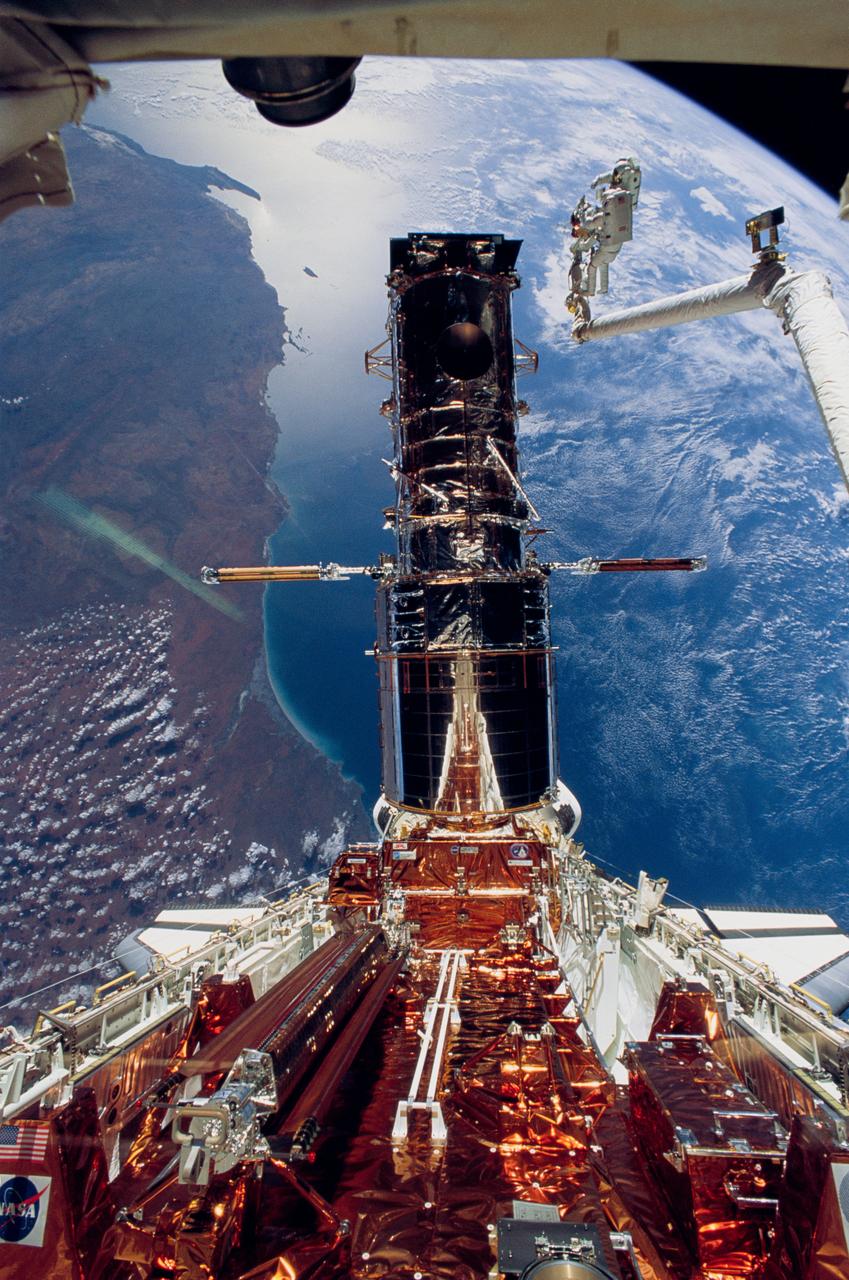
STS061-79-087 (4 Dec. 1993) --- The Hubble Space Telescope (HST), backdropped over Madagascar, is berthed in the space shuttle Endeavour's cargo bay following its capture by the STS-61 astronauts. The crew used TV cameras to survey the spacecraft before sending out four astronauts on five separate sessions of extravehicular activity (EVA) to perform a variety of servicing tasks. Photo credit: NASA
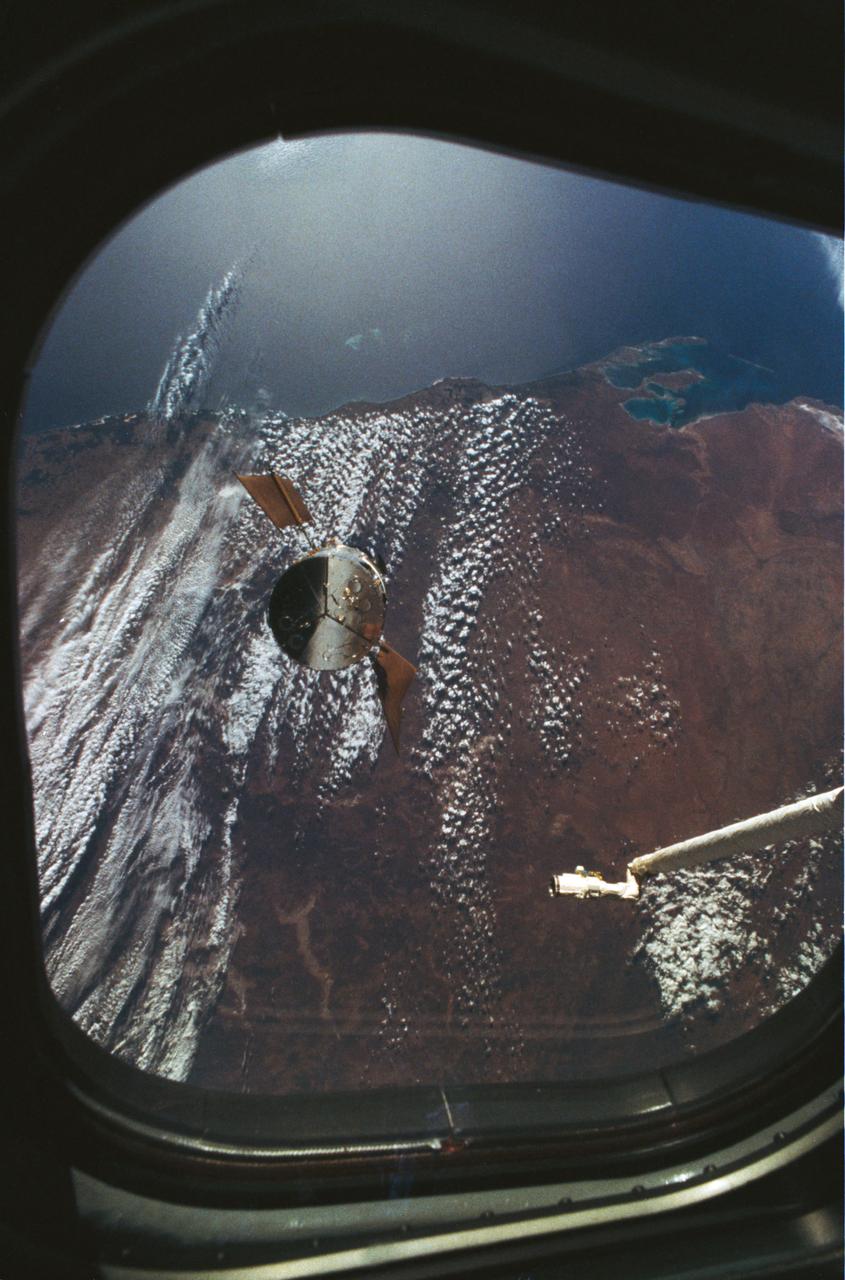
STS061-53-026 (4 Dec 1993) --- One of the Space Shuttle Endeavour's aft flight deck windows frames this view of the Hubble Space Telescope (HST) as it approaches the Endeavour. Backdropped against western Australia, the Remote Manipulator System (RMS) arm awaits the arrival of the telescope. Once berthed in Endeavour's cargo bay, HST underwent five days of servicing provided by four space walking crew members. Shark Bay (upper left) and Perth (lower left) are visible in the frame.

S77-E-5065 (21 May 1996) --- With a cloudy horizon scene as a backdrop, the Spartan 207 free-flyer is held in the grasp of the Space Shuttle Endeavour's Remote Manipulator System (RMS) following its re-capture on May 21, 1996. The view was captured with an onboard Electronic Still Camera (ESC). The six-member crew has spent a portion of the early stages of the mission in various activities involving the Spartan 207 and the related Inflatable Antenna Experiment (IAE). The Spartan project is managed by NASA's Goddard Space Flight Center (GSFC) for NASA's Office of Space Science, Washington, D.C.
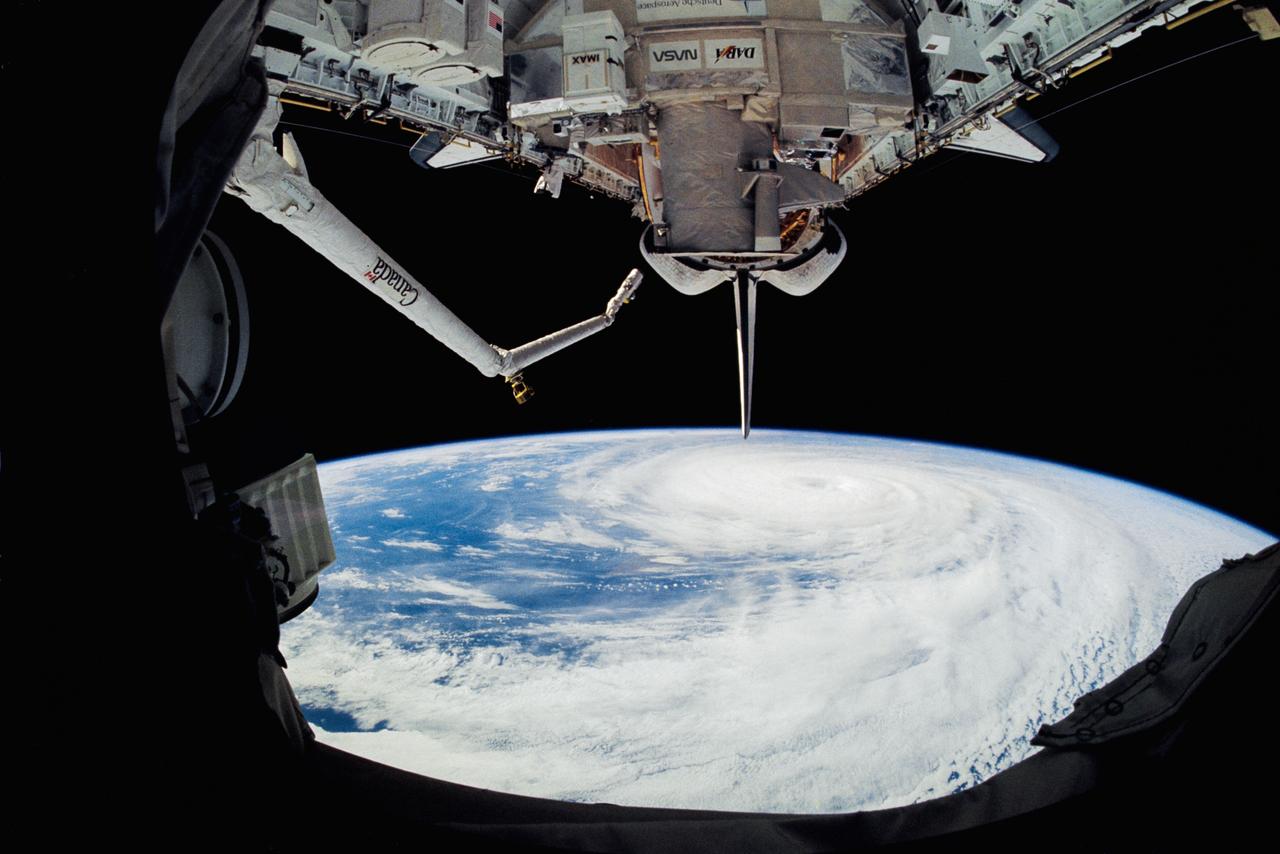
One of the STS-51 astronauts used a "fish-eye" lens on a 35mm cmaera to photograph this view of Hurricane Kenneth in the Pacific Ocean. The Orbiting Retrievable Far and Extreme Ultraviolet Spectrometer/Shuttle Pallet Satellite (ORFEUS/SPAS) is still in the cargo bay. The Remote Manipulator System (RMS) is extended towards the open payload bay.
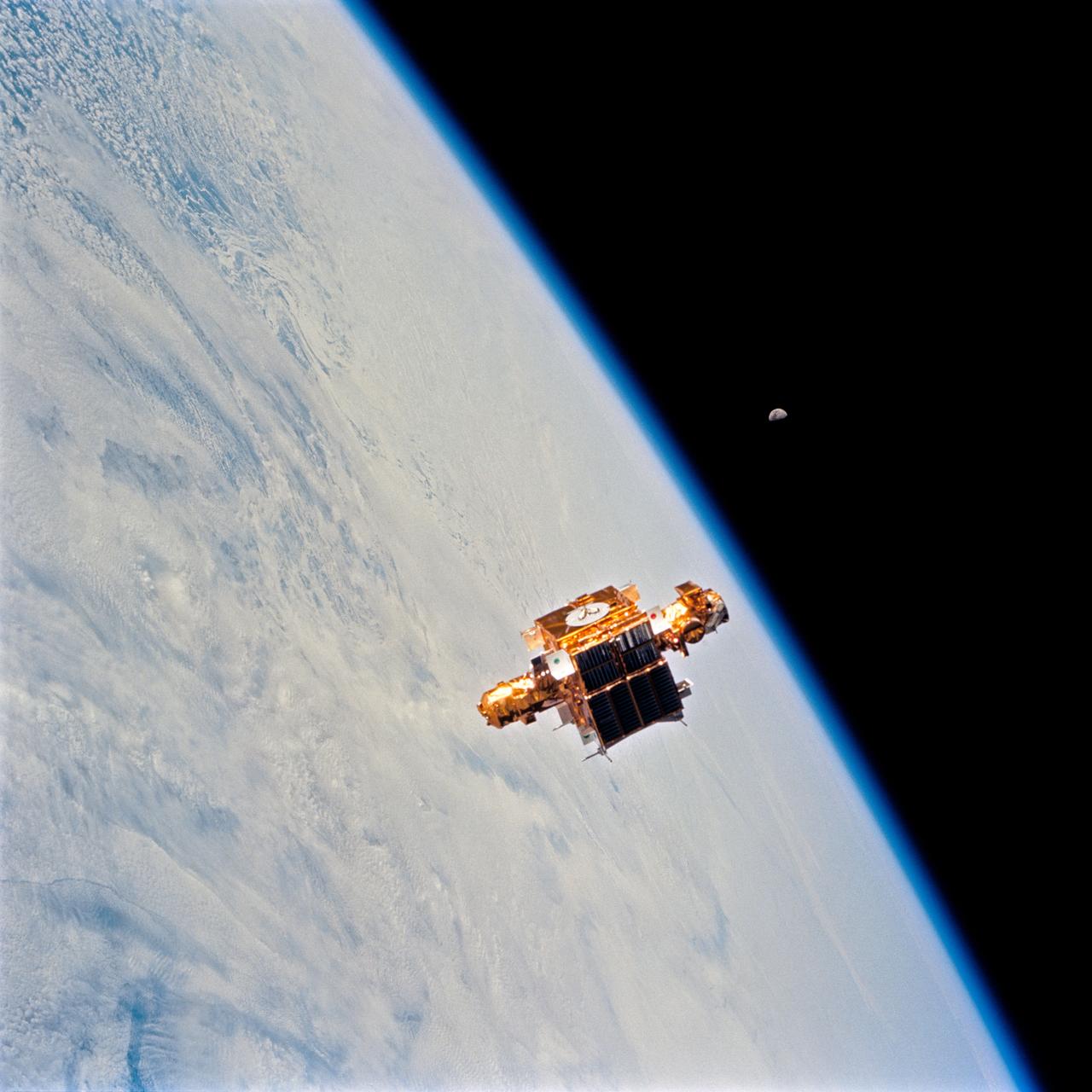
STS064-74-052 (9-20 Sept. 1994) --- Astronauts onboard the space shuttle Discovery used a 70mm camera to capture this photograph of the retrieval operations with the Shuttle Pointed Autonomous Research Tool for Astronomy 201 (SPARTAN 201). A gibbous moon can be seen in the background. Photo credit: NASA or National Aeronautics and Space Administration
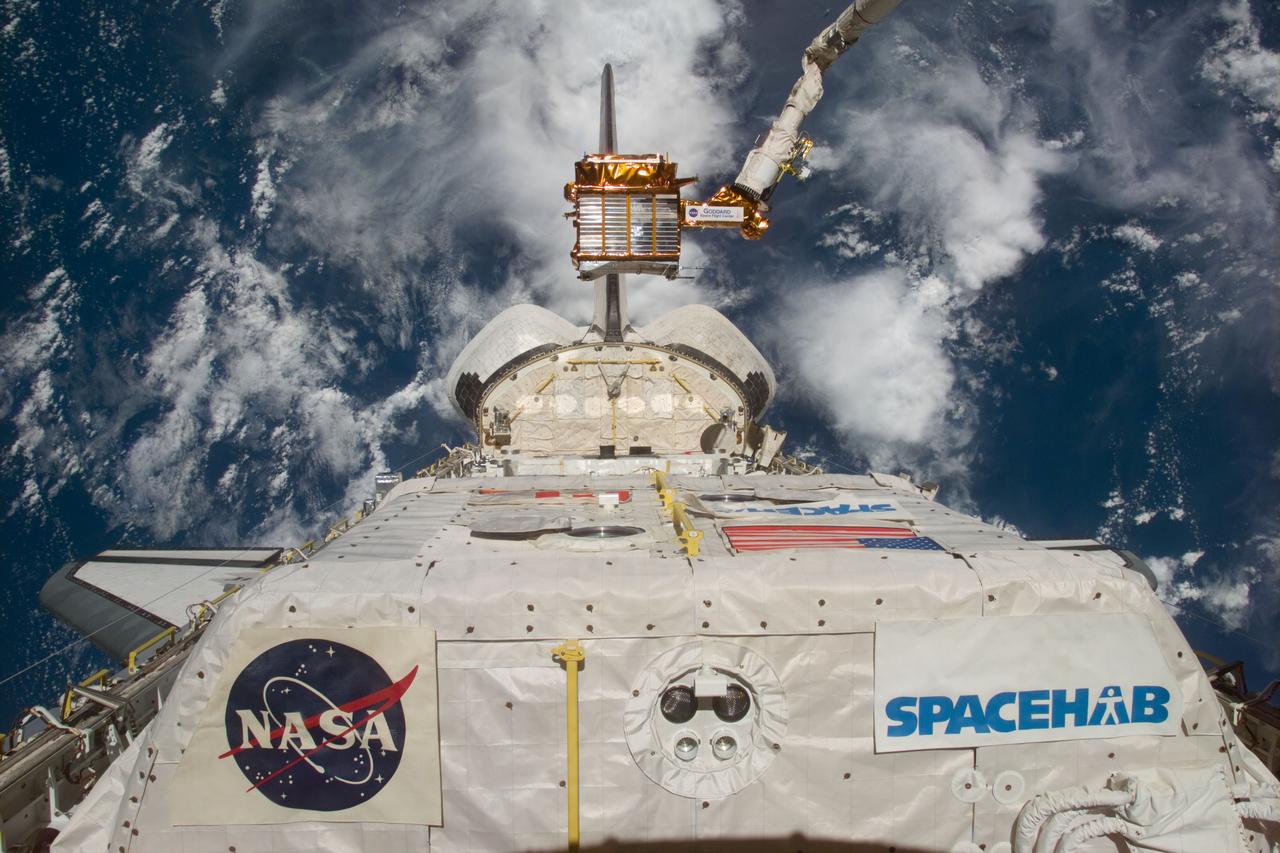
S77-E-5053 (21 May 1996) --- The Spartan 207 free-flyer is held in a low-hover mode above its berth in the Space Shuttle Endeavour's cargo bay in the grasp of the Remote Manipulator System (RMS). The Spacehab module can be seen in the foreground. The free-flyer was re-captured by the six crew members on May 21, 1996. The crew has spent a portion of the early stages of the mission in various activities involving the Spartan 207 and the related Inflatable Antenna Experiment (IAE). The Spartan project is managed by NASA's Goddard Space Flight Center (GSFC) for NASA's Office of Space Science, Washington, D.C.
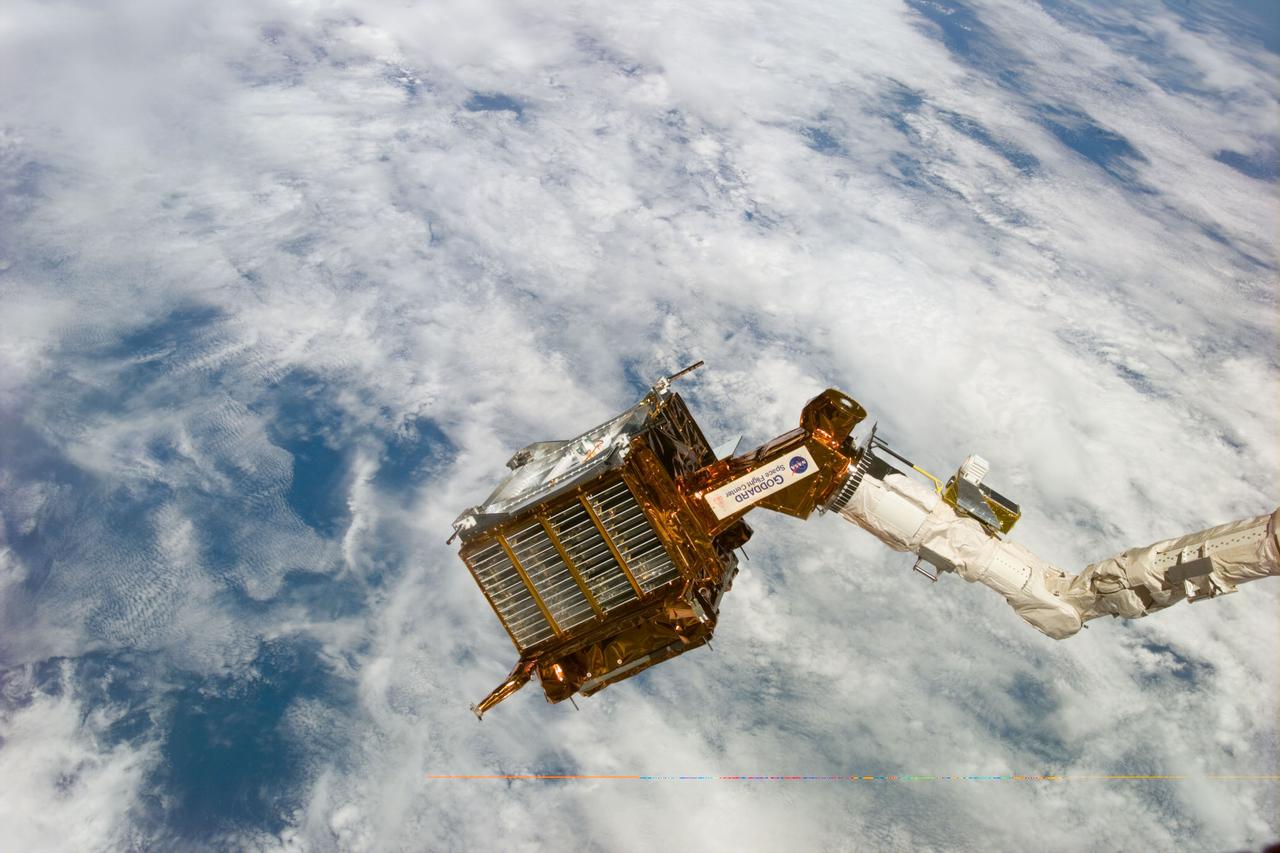
S77-E-5064 (21 May 1996)--- In this medium close-up view, captured by an Electronic Still Camera (ESC), the Spartan 207 free-flyer is held in the grasp of the Space Shuttle Endeavour's Remote Manipulator System (RMS) following its re-capture on May 21, 1996. The six-member crew has spent a portion of the early stages of the mission in various activities involving the Spartan 207 and the related Inflatable Antenna Experiment (IAE). The Spartan project is managed by NASA's Goddard Space Flight Center (GSFC) for NASA's Office of Space Science, Washington, D.C.

STS064-72-093 (10 Sept. 1994) --- With the blue and white Earth as a backdrop 130 miles below, the Shuttle Plume Impingement Flight Experiment (SPIFEX) is at work on the end of the Remote Manipulator System (RMS) arm. The 50-feet-long arm is extended to 80 feet with the temporary addition of the SPIFEX hardware. The image was exposed with a 70mm handheld Hasselblad camera from inside the space shuttle Discovery's crew cabin. Photo credit: NASA or National Aeronautics and Space Administration
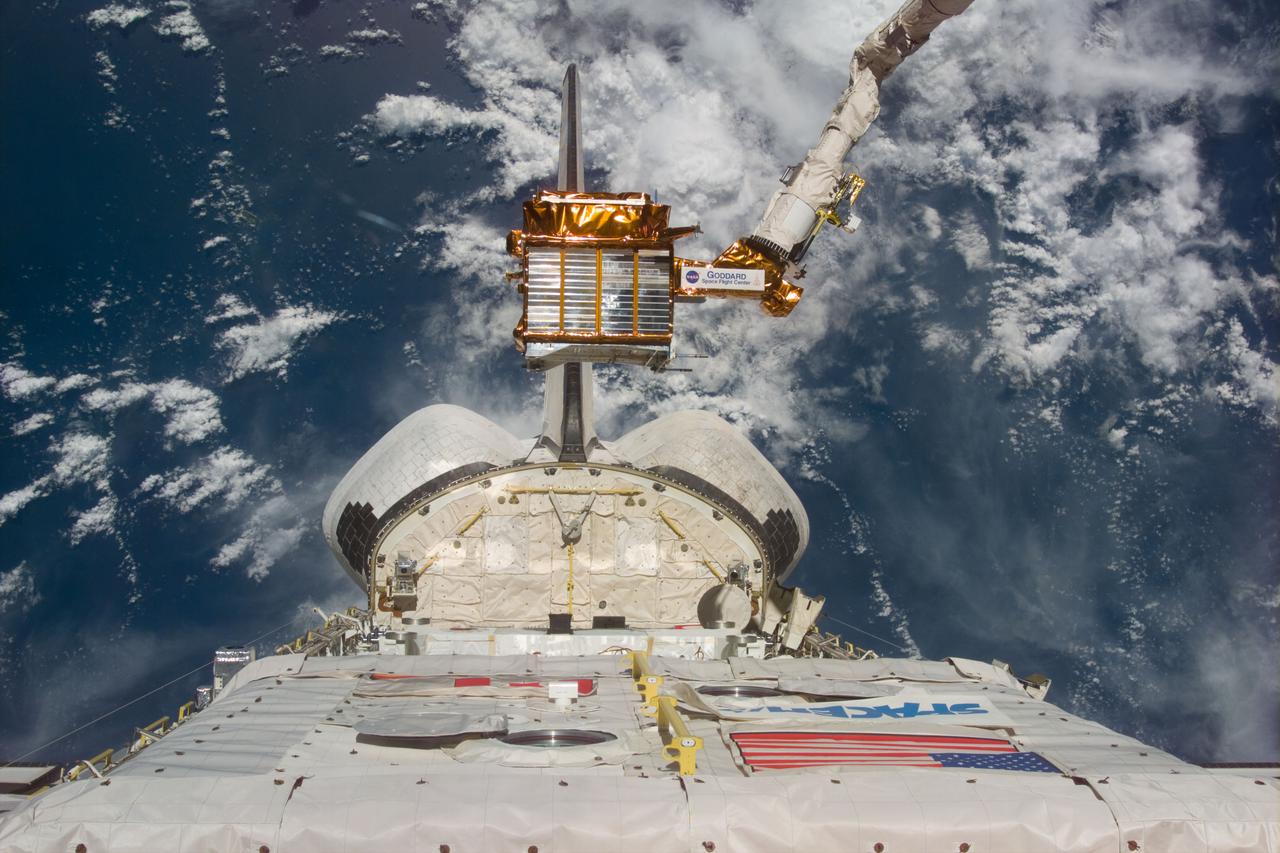
S77-E-5052 (21 May 1996) --- The Spartan 207 free-flyer is held in a low-hover mode above its berth in the Space Shuttle Endeavour's cargo bay in the grasp of the Remote Manipulator System (RMS). The free-flyer was re-captured by the six crew members on May 21, 1996. The crew has spent a portion of the early stages of the mission in various activities involving the Spartan 207 and the related Inflatable Antenna Experiment (IAE). The Spartan project is managed by NASA's Goddard Space Flight Center (GSFC) for NASA's Office of Space Science, Washington, D.C.
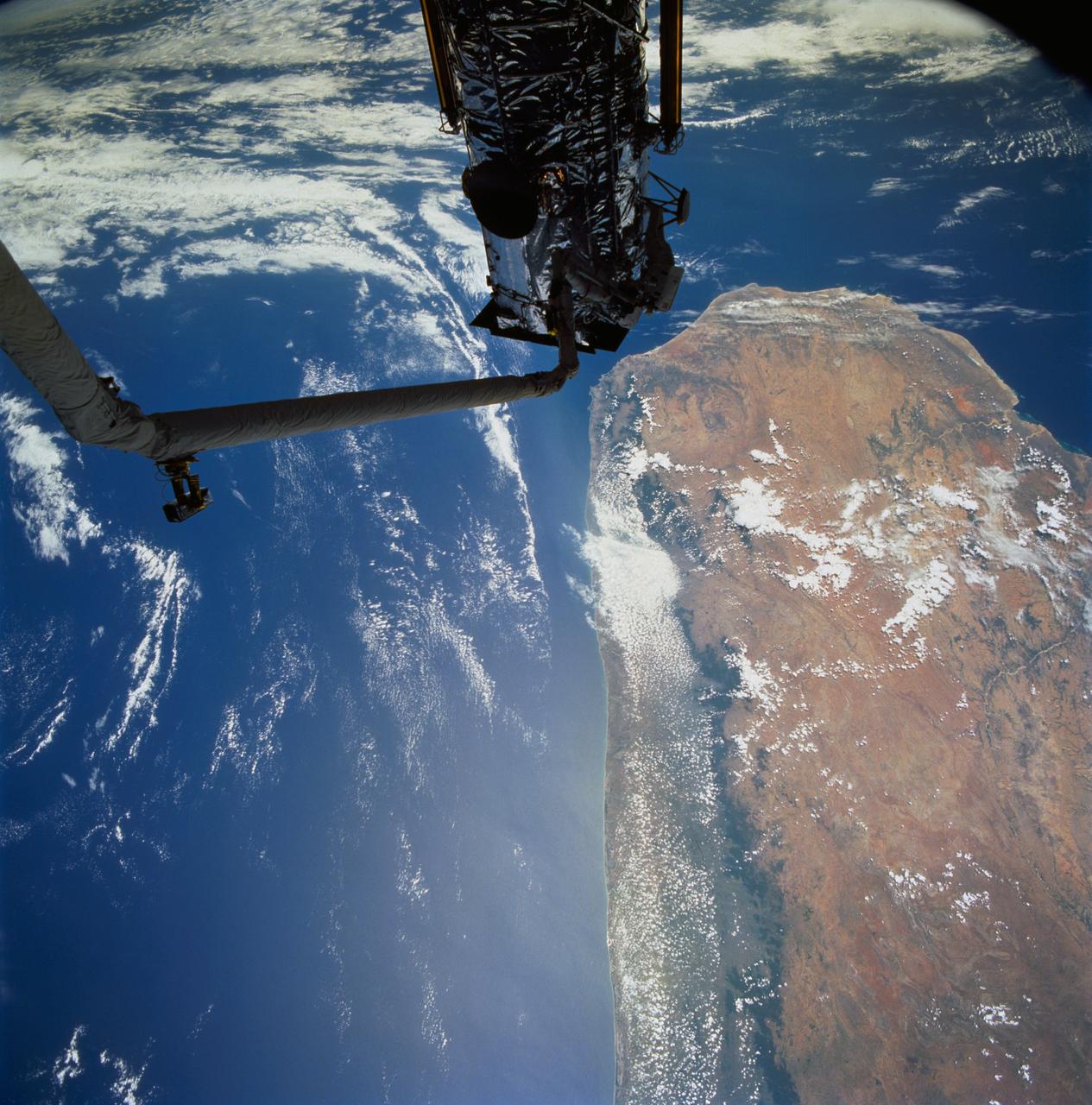
STS061-77-102 (7 Dec 1993) --- Astronauts Jeffrey A. Hoffman (left) and F. Story Musgrave are partially silhouetted against the Indian Ocean as they work to install the Magnetic Sensing System (MSS) on the Hubble Space Telescope (HST). Musgrave is anchored to the end of the Space Shuttle Endeavour's Remote Manipulator System (RMS) arm. The HST is positioned along the southern end of Madagascar, 325 nautical miles away. Visible on the western coast are the sediment laden Onilahy and Fiherenana Rivers which empty into Saint Augustin Bay. North of Fiherenana River is the Mangoky River. The circular feature on the southern end of Madagascar and to the right of HST is the L'ivakoany Mountains. The eastern coast is relatively straight compared to the western coast.
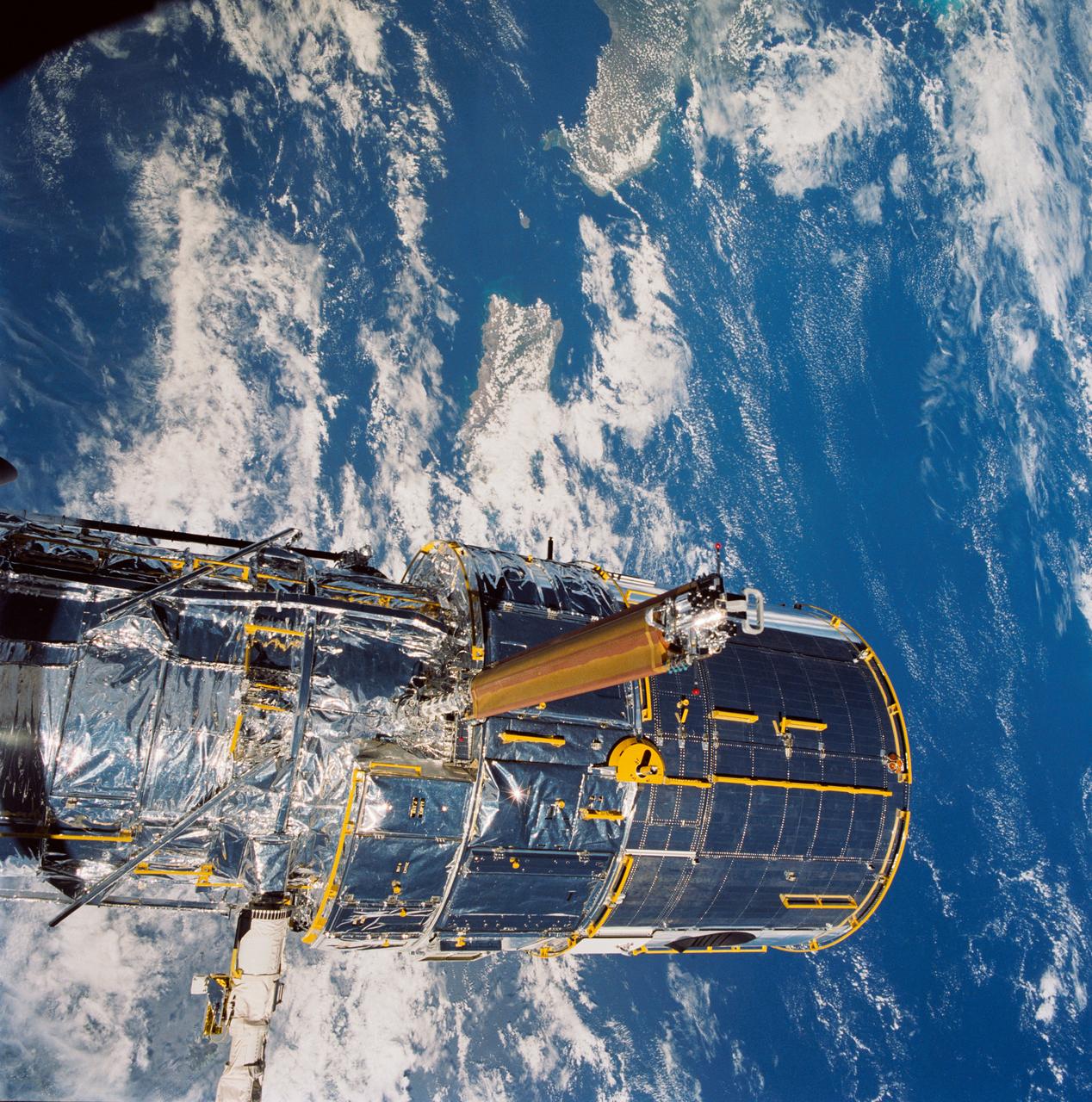
During STS-31, the Hubble Space Telescope (HST) grappled by the remote manipulator system (RMS) end effector is held in appendage deploy position above Discovery, Orbiter Vehicle (OV) 103. The solar array (SA) bistem cassette has been released from its latch fittings. The bistem spreader bars begin to unfurl the SA wing. The secondary deployment mechanism (SDM) handle is visible at the SA end. Stowed against either side of the HST System Support Module (SSM) forward shell are the high-gain antennae (HGA). Puerto Rico and the Dominican Republic are recognizable at the left of the frame.
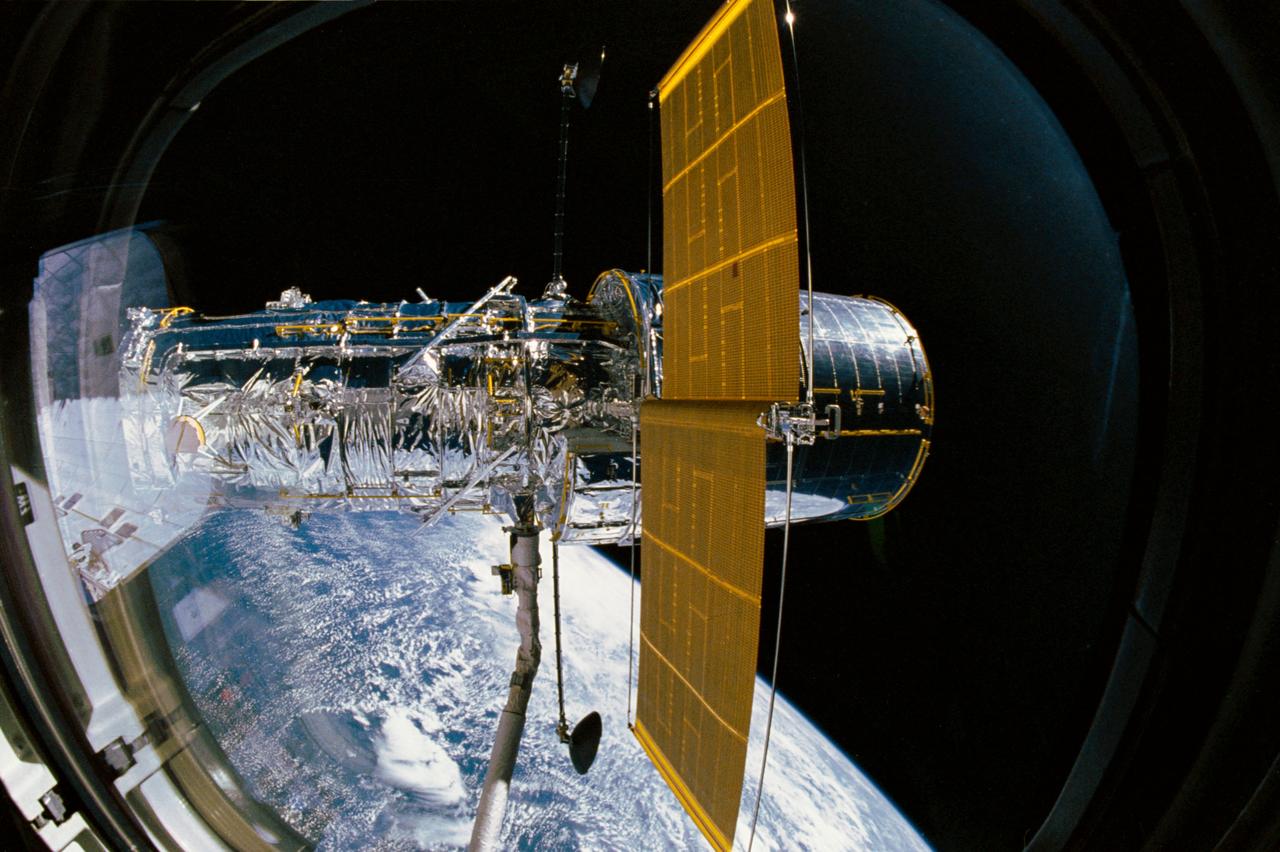
STS031-03-009 (25 April 1990) --- The Hubble Space Telescope (HST), still in the grasp of Discovery's remote manipulator system (RMS), is backdropped over Earth some 332 nautical miles below. In this scene, HST has deployed one of its solar array panels but is yet to have extended the second. This scene was captured with a 35mm camera aimed through an overhead window on the aft flight deck.
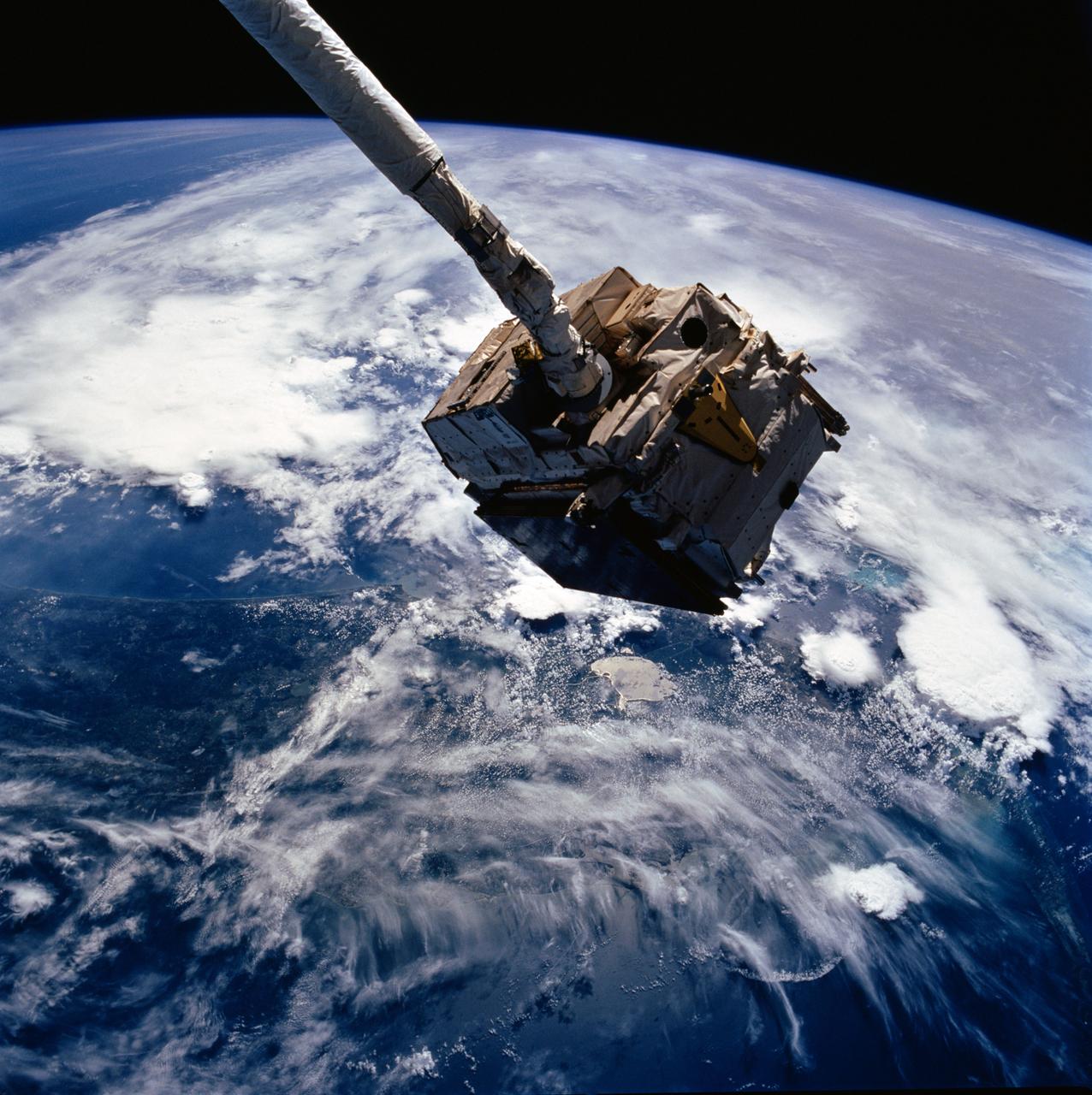
STS057-93-052 (24 June 1993) --- The European Retrievable Carrier (EURECA) is held in the grasp of the Space Shuttle Endeavour's Remote Manipulator System (RMS). The photo was taken after EURECA's "capture" from Earth-orbit but prior to its berthing in the Shuttle's cargo bay. The southern two-thirds of the state of Florida, part of the Gulf of Mexico and clouds over the Atlantic form the backdrop for the 70mm image.
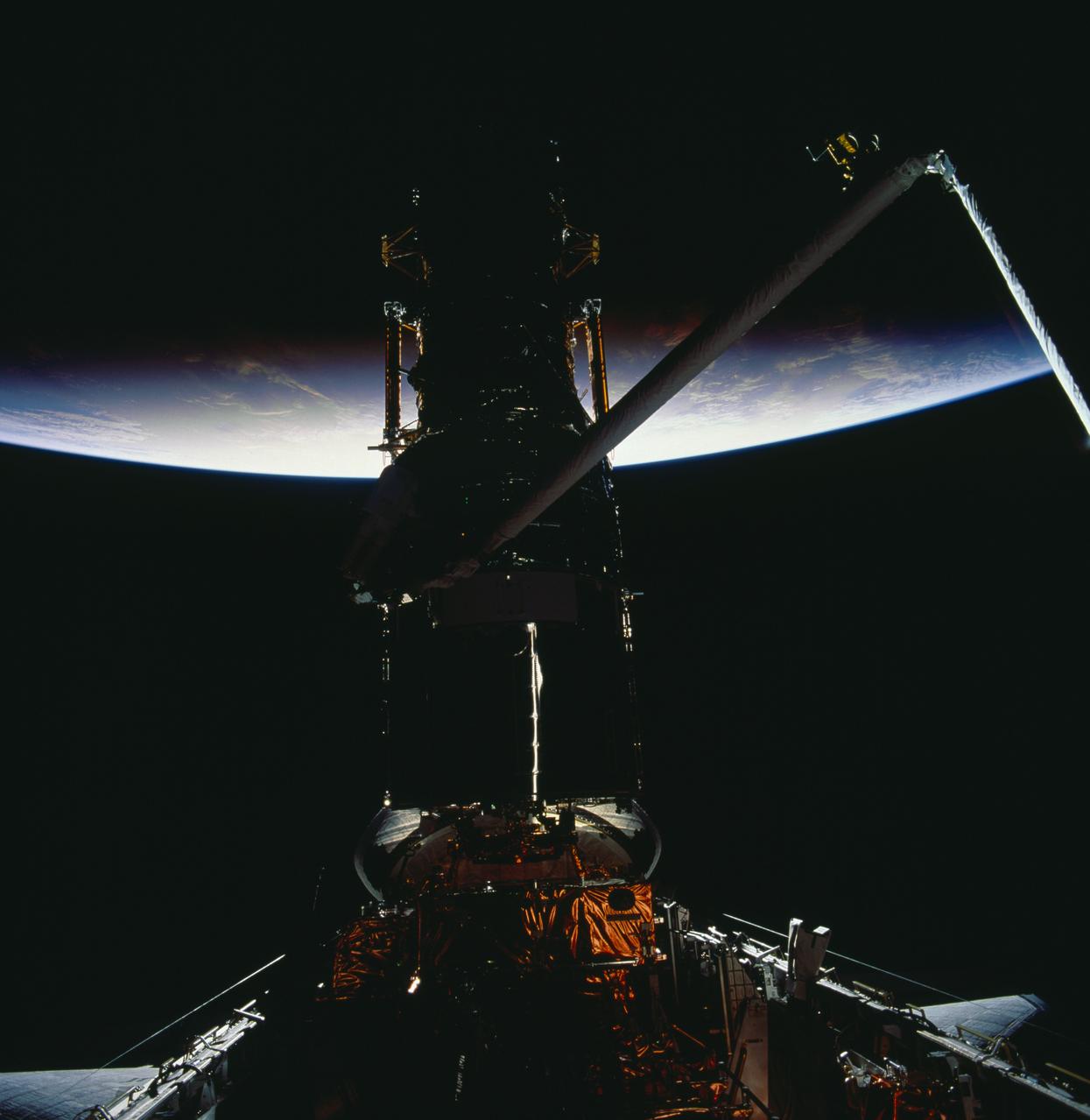
STS061-98-0AR (8 Dec 1993) --- Earth is partially illuminated but the Hubble Space Telescope (HST) and the Space Shuttle Endeavour are still mostly in darkness, in this 70mm frame photographed during the fourth of five space walks. Astronaut Kathryn C. Thornton, barely visible above left center in the frame, works to install the Corrective Optics Space Telescope Axial Replacement (COSTAR).
STS061-48-001 (9 Dec 1993) --- Orbiting Earth at an altitude of 356 nautical miles perched atop a foot restraint on the Space Shuttle Endeavour's Remote Manipulator System (RMS) arm, astronauts F. Story Musgrave (top) and Jeffrey A. Hoffman wrap up the final of five Extravehicular Activities (EVA). The west coast of Australia forms the backdrop for the 35mm frame.
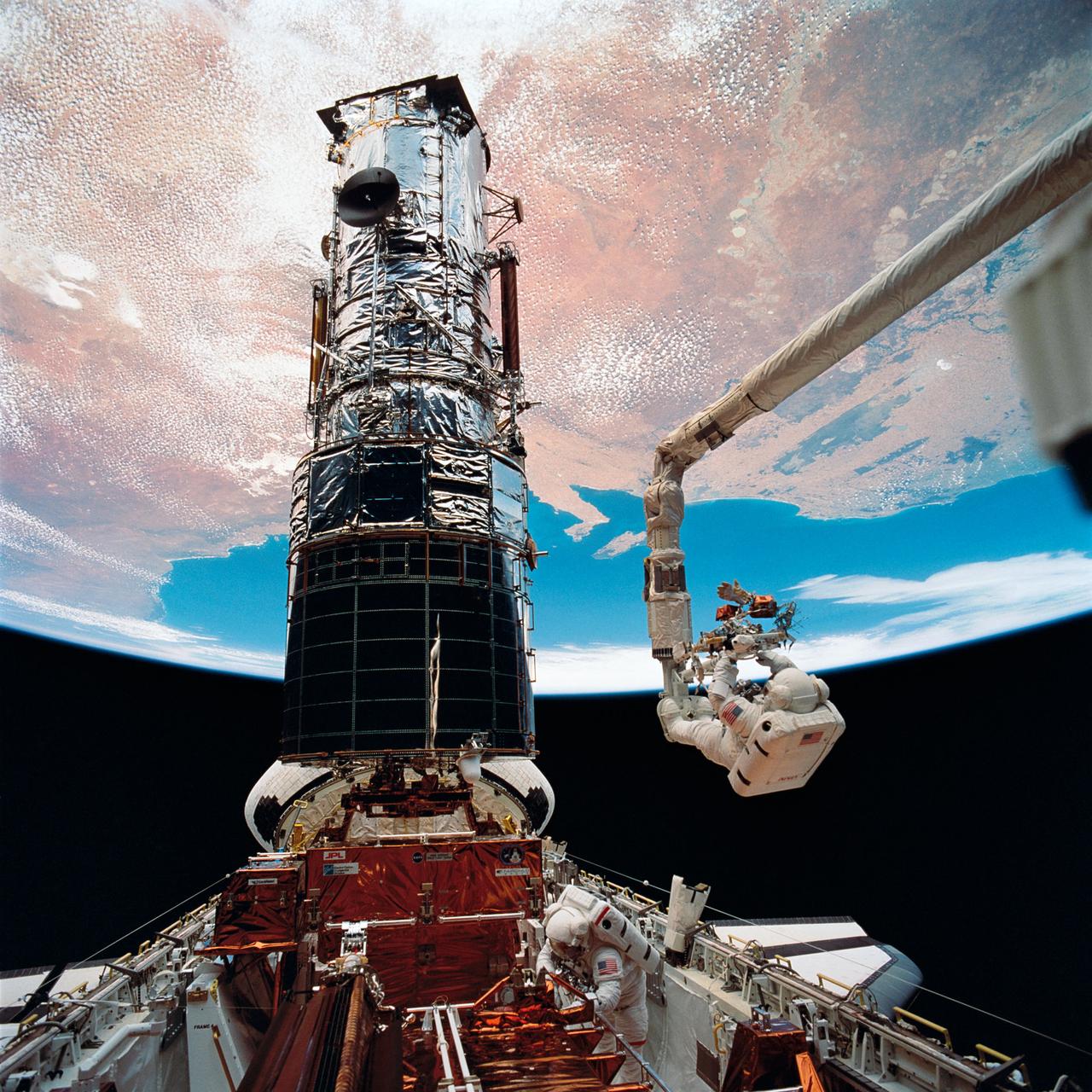
STS061-98-050 (9 Dec 1993) --- Astronaut F. Story Musgrave, anchored on the end of the Remote Manipulator System (RMS) arm, prepares to be elevated to the top of the towering Hubble Space Telescope (HST) to install protective covers on magnetometers. Astronaut Jeffrey A. Hoffman (bottom of frame) assisted Musgrave with final servicing tasks on the telescope, wrapping up five days of extravehicular activities (EVA).
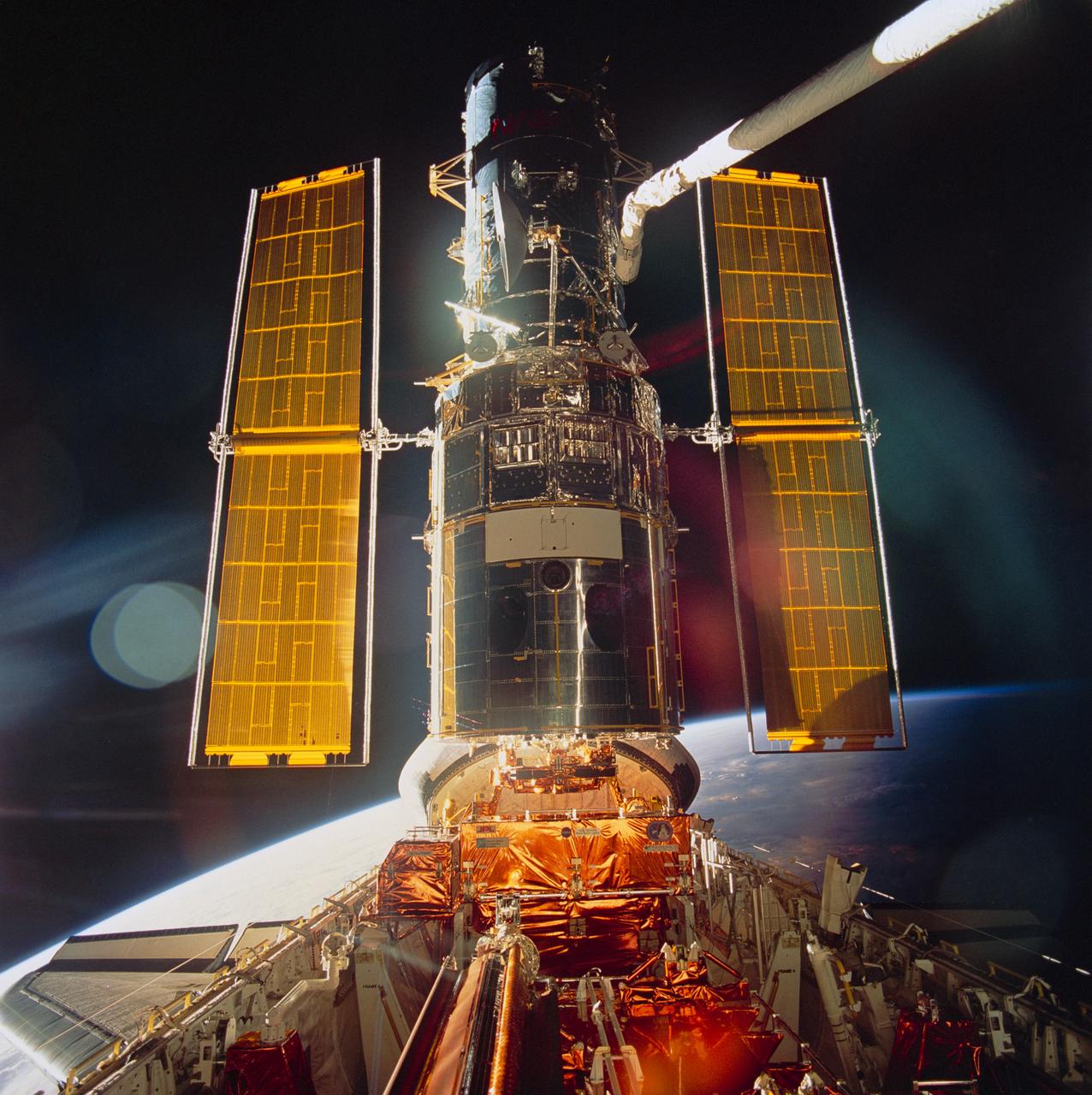
STS061-99-009 (9 Dec 1993) --- Sunlight reflects off the Space Shuttle Endeavour's aft windows and the shiny Hubble Space Telescope (HST) prior to its post-servicing deployment near the end of the eleven-day mission. A handheld Hasselblad camera was used inside Endeavour's cabin to record the image.
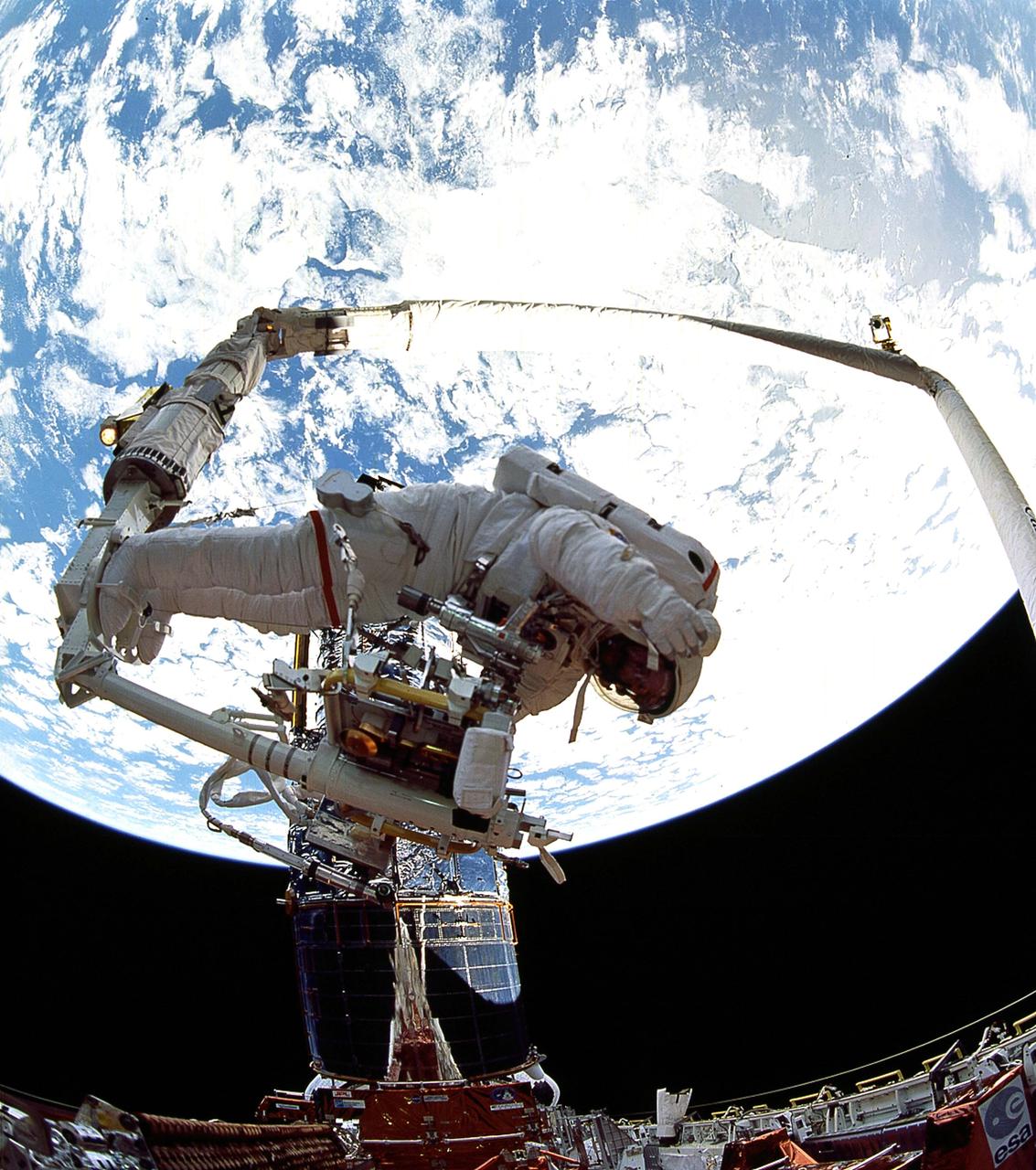
STS061-105-026 (7 Dec. 1993) --- Astronaut Jeffrey A. Hoffman signals directions to European Space Agency (ESA) astronaut Claude Nicollier, as the latter controls the Remote Manipulator System (RMS) arm during the third of five Extravehicular Activities (EVA) on the Hubble Space Telescope (HST) servicing mission. Astronauts Hoffman and F. Story Musgrave earlier changed out the Wide Field\Planetary Camera (WF\PC).
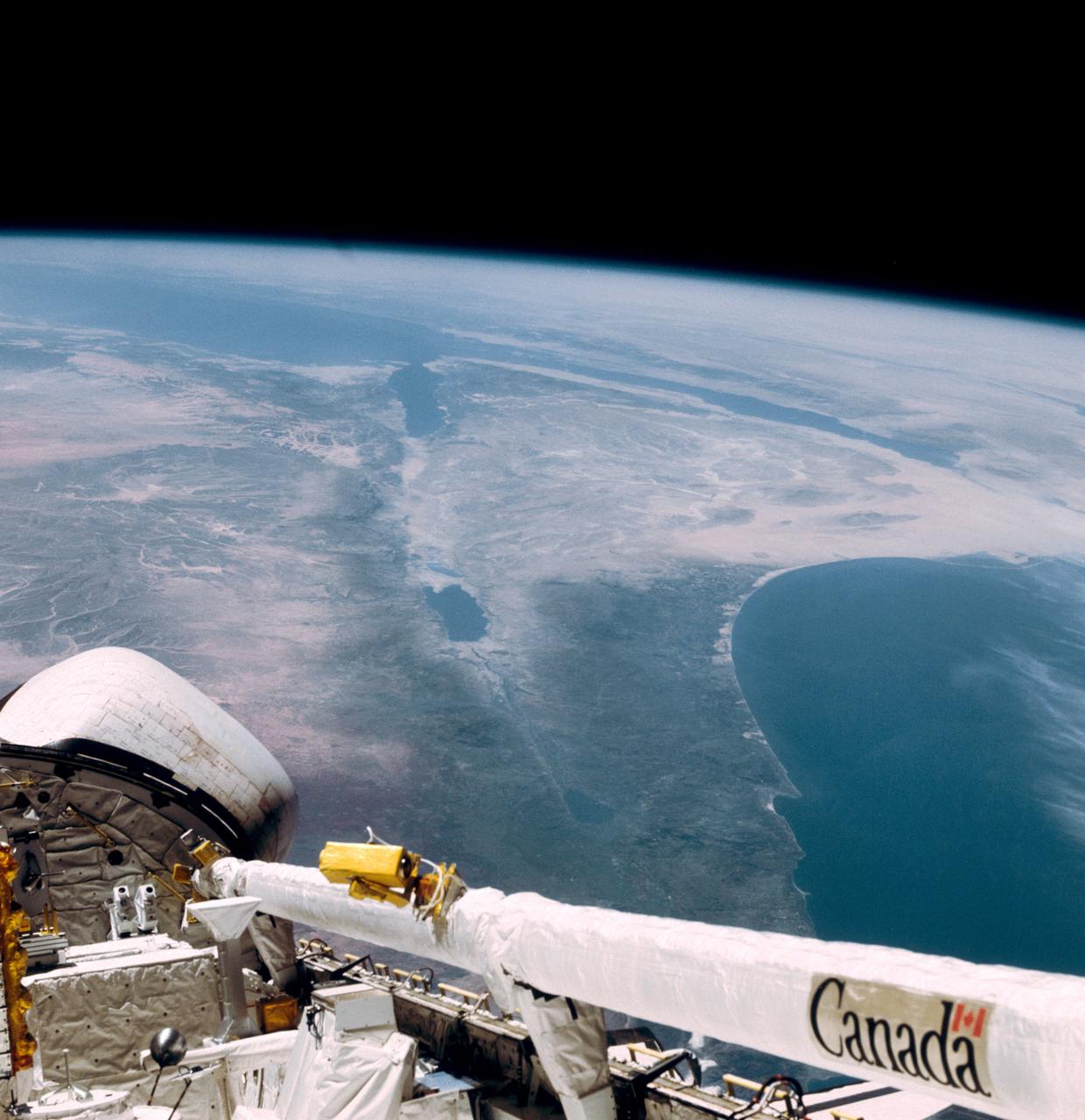
This southerly looking view photographed from the orbiting Space Shuttle Columbia shows a small portion of the vehichle's aft section. The 50-ft Canadian built remote manipulator system (RMS) is in a resting posture (lower right corner) stretched out along the 60-ft. long cargo bay. Many of the components of the OSS-1 payload package are in the bottom center. The Mediterranean Sea is at right foreground. Parts of the Sinai peninsula, Israel, Egypt, Saudi Arabia, Jordan, Palestine, Syria, and Lebanon can be located in the photo. The Red Sea, Gulf of Aqaba, Suez Canal are near the photo's horizon.
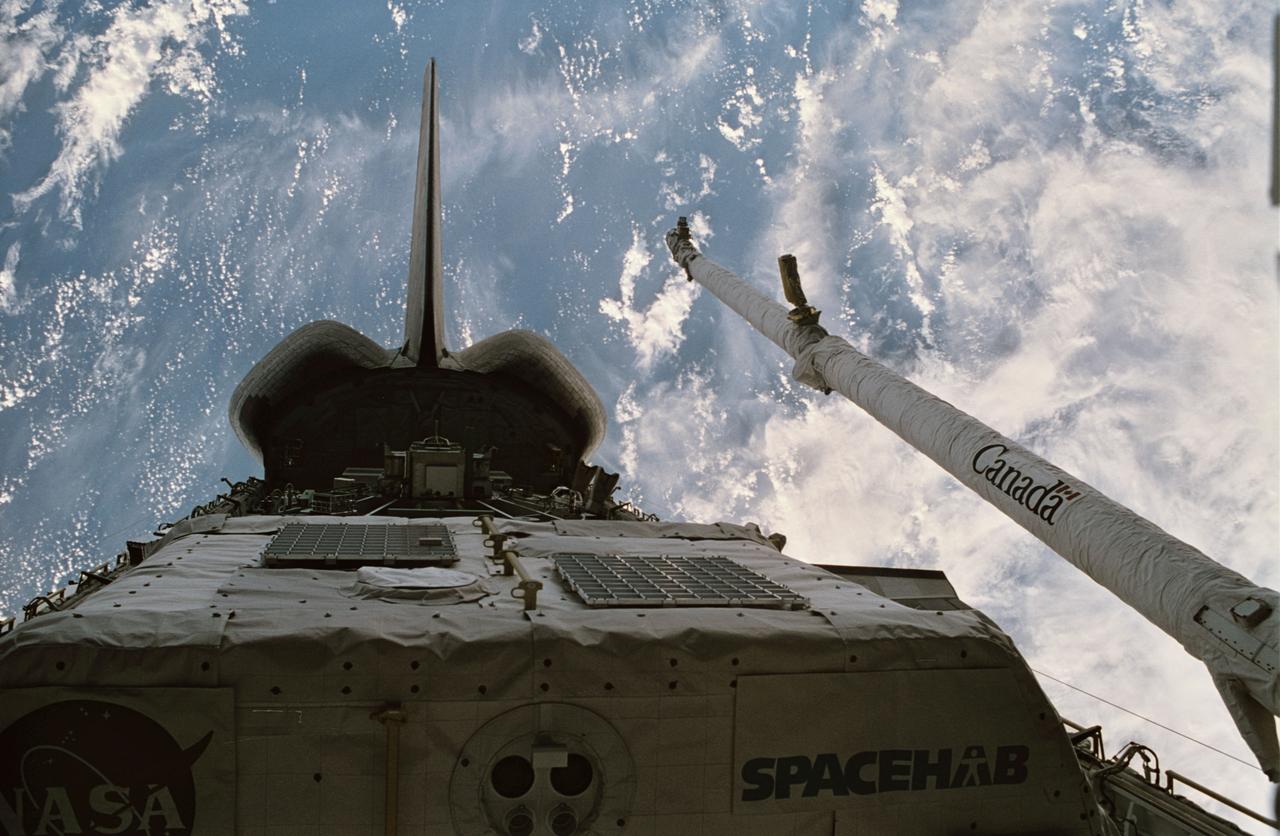
STS060-15-003 (3-11 Feb 1994) --- This 35mm frame shows the major payloads of the Space Shuttle Discovery's STS-60 mission, backdropped against clouds over the Atlantic Ocean. In the foreground is the SPACEHAB module, with the Wake Shield Facility (WSF) partially visible in its berthed position near the Orbital Maneuvering System (OMS) pods and the vertical stabilizer. Television cameras on the Remote Manipulator System (RMS) were being used for a survey of the cargo. Five NASA astronauts and a Russian cosmonaut went on to spend eight days in Earth orbit in support of the mission.
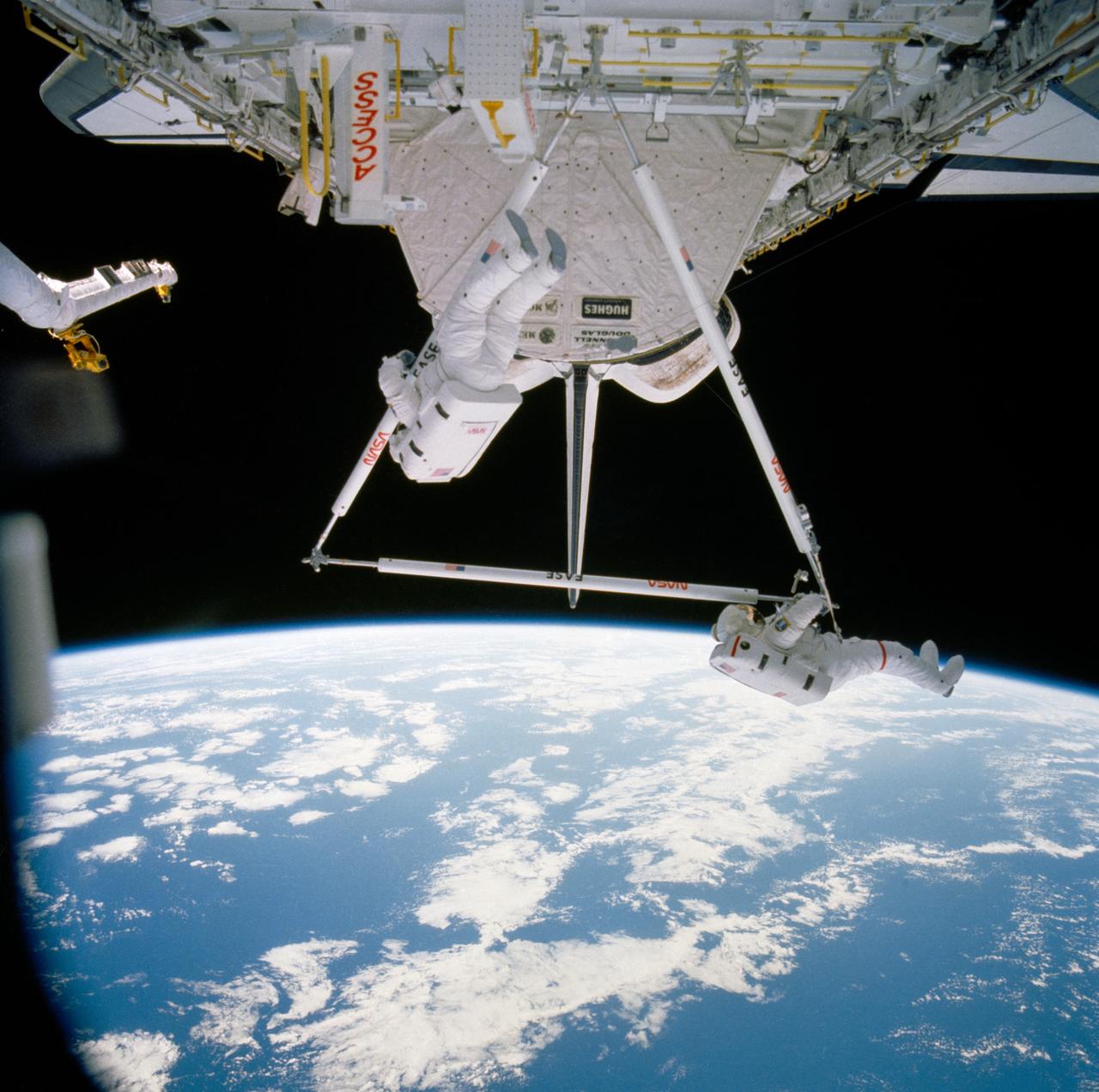
Astronauts Jerry L. Ross (left) and Sherwood C. (Woody) Spring are photographed as they assemble pieces of the Experimental Assembly of Structures in Extravehicular Activities (EASE) device in the open payload bay. The Canadian-built remote manipulator system (RMS) arm (partially obscured in the right portion of the frame) is in position to allow television cameras to record the activity.
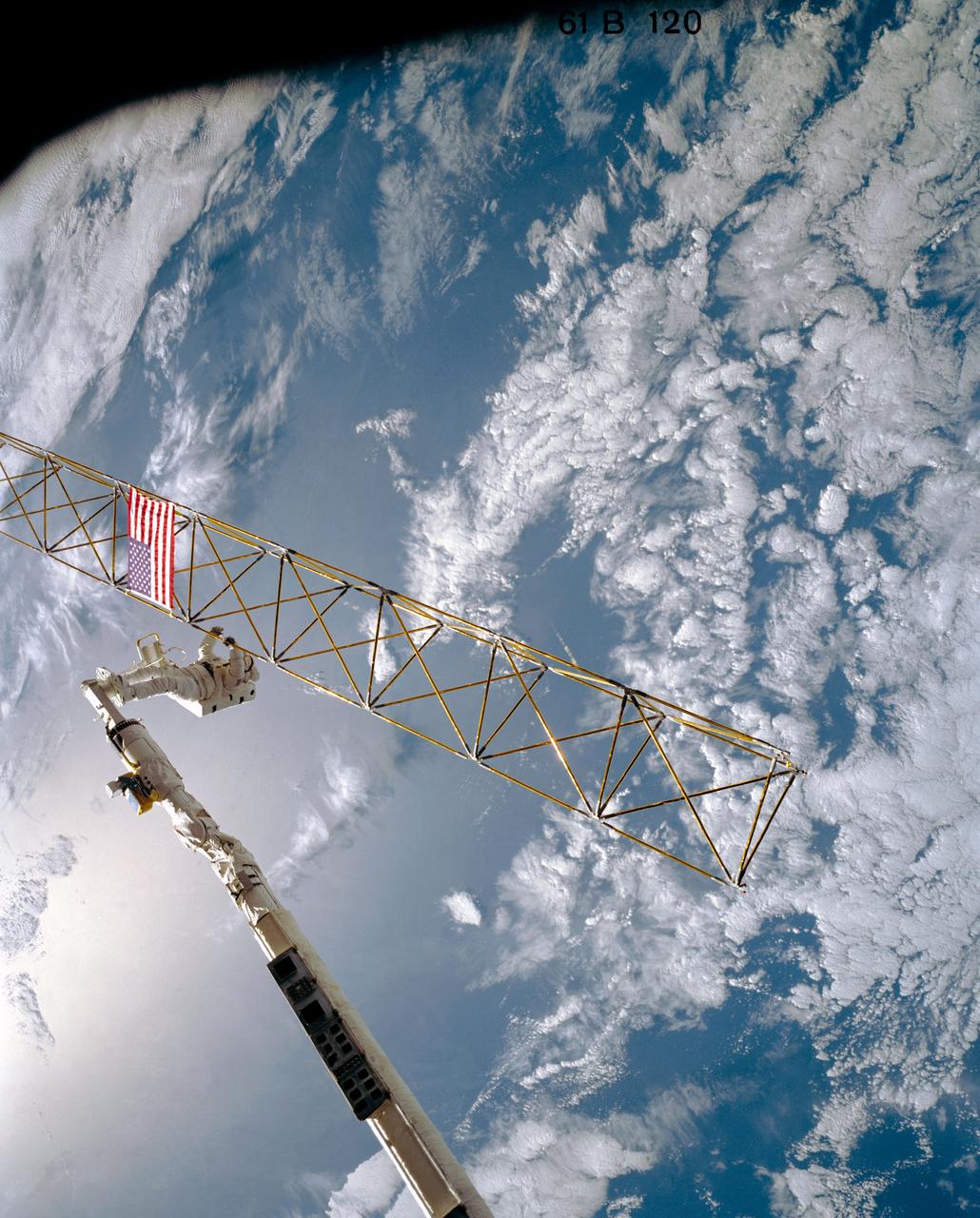
Astronaut Sherwood C. Spring, anchored to the foot restraint on the remote manipulator system (RMS) arm, checks joints on the tower-like Assembly Concept for Construction of Erectable Space Structures (ACCESS) device extending from the payload bay as the Atlantis flies over white clouds and blue ocean waters. The Gulf of Mexico waters form the backdrop for the scene.
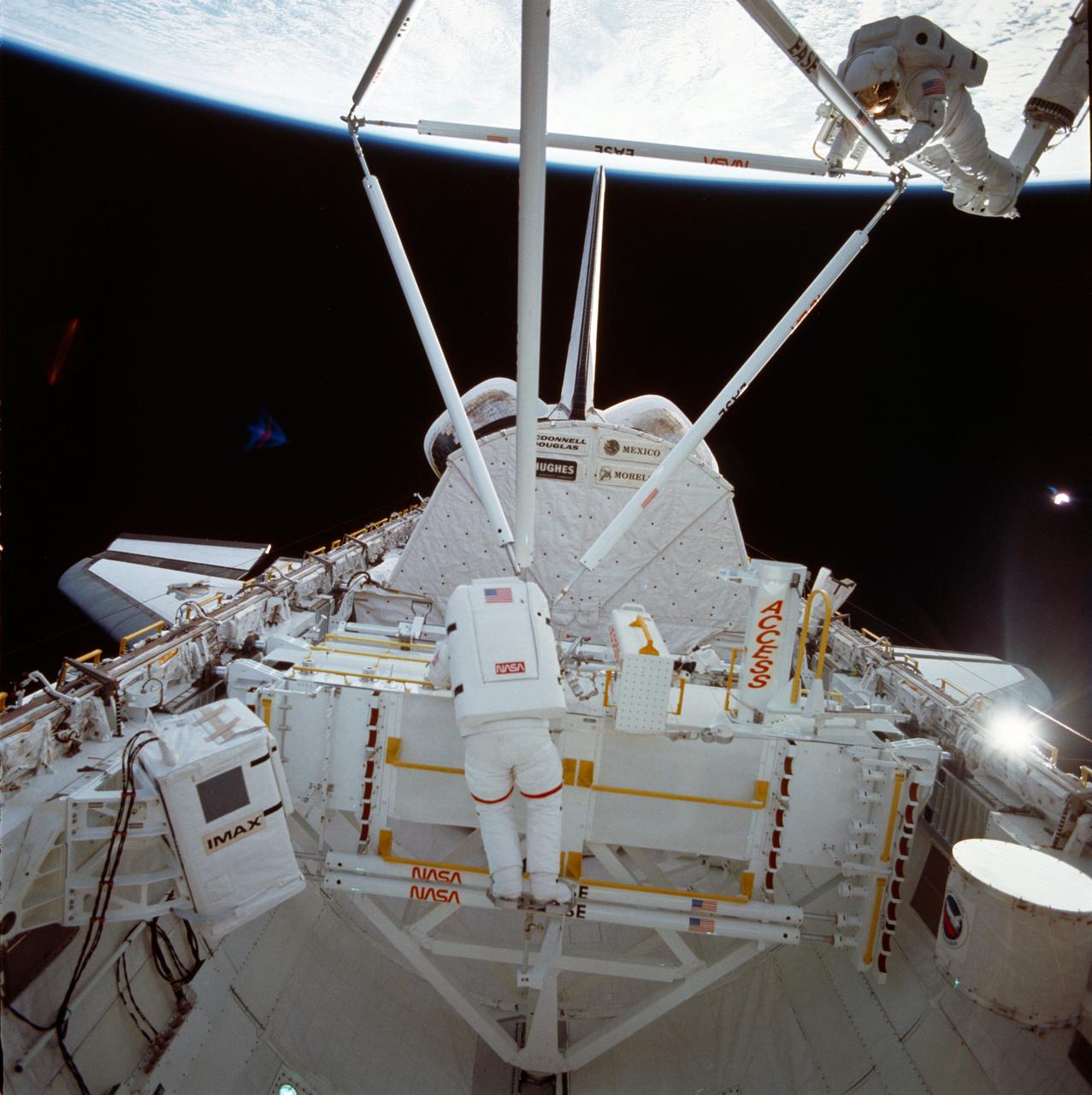
61B-41-047 (1 Dec 1985) --- Astronauts Jerry L. Ross (left) and Sherwood C. (Woody) Spring are photographed by Astronaut Bryan D. O'Connor as they continue to assemble more pieces of the EASE (Experimental Assembly of Structures in Extravehicular Activities) device during the week-long STS 61-B mission. This frame is one of a series covering the structure's build-up.
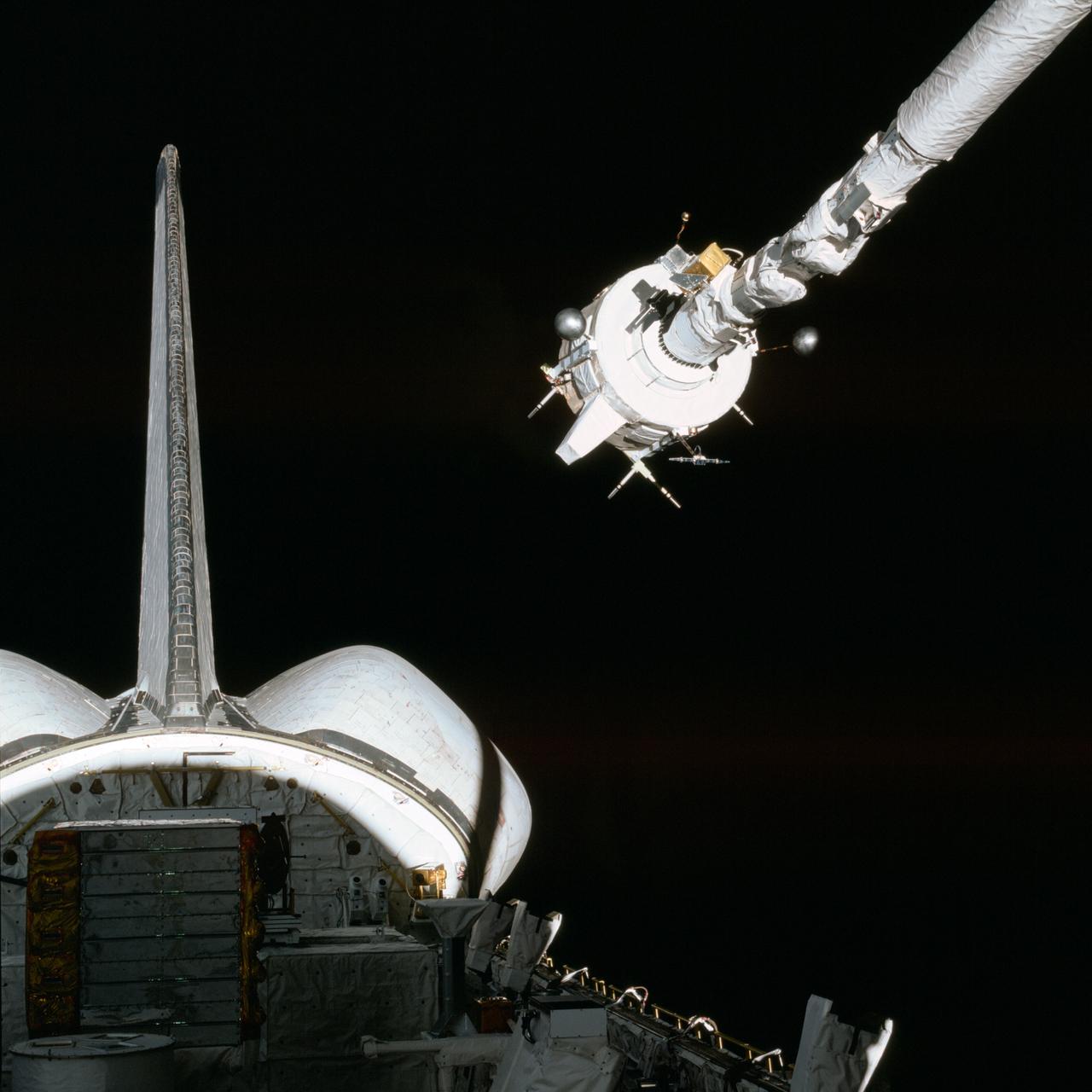
STS003-09-444 (22-30 March 1982) --- The darkness of space provides the backdrop for this scene of the plasma diagnostics package (PDR) experiment in the grasp of the end effector or ?hand? of the remote manipulator system (RMS) arm, and other components of the Office of Space Sciences (OSS-1) package in the aft section of the Columbia?s cargo hold. The PDP is a compact, comprehensive assembly of electromagnetic and particle sensors that will be used to study the interaction of the orbiter with its surrounding environment; to test the capabilities of the shuttle?s remote manipulator system; and to carry out experiments in conjunction with the fast pulse electron generator of the vehicle charging and potential experiment, another experiment on the OSS-1 payload pallet. This photograph was exposed with a 70mm handheld camera by the astronaut crew of STS-3, with a handheld camera aimed through the flight deck?s aft window. Photo credit: NASA
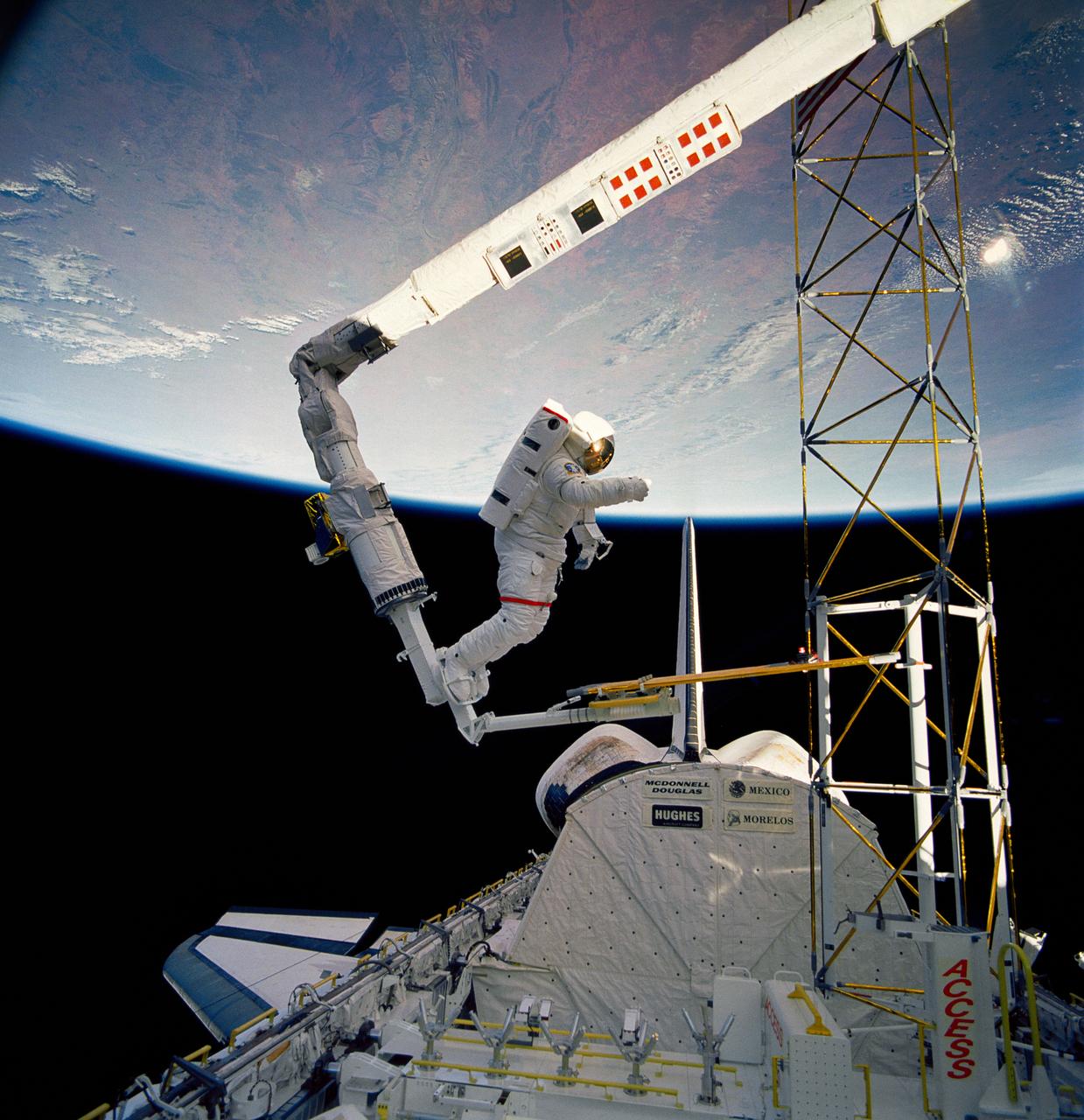
61B-41-019 (26 Nov. ? 3 Dec. 1985) --- Astronaut Jerry L. Ross, one of NASA flight 6l-B's mission specialists, approaches a tower device just erected by Ross and astronaut Sherwood (Woody) C. Spring during the second of two extravehicular activities. The tower was called Assembly Concept for Construction of Erectable Space Structures. Ross is secured on a foot restraint device connected to the Canadian-built remote manipulator system (RMS) arm aboard the Earth orbiting Atlantis.
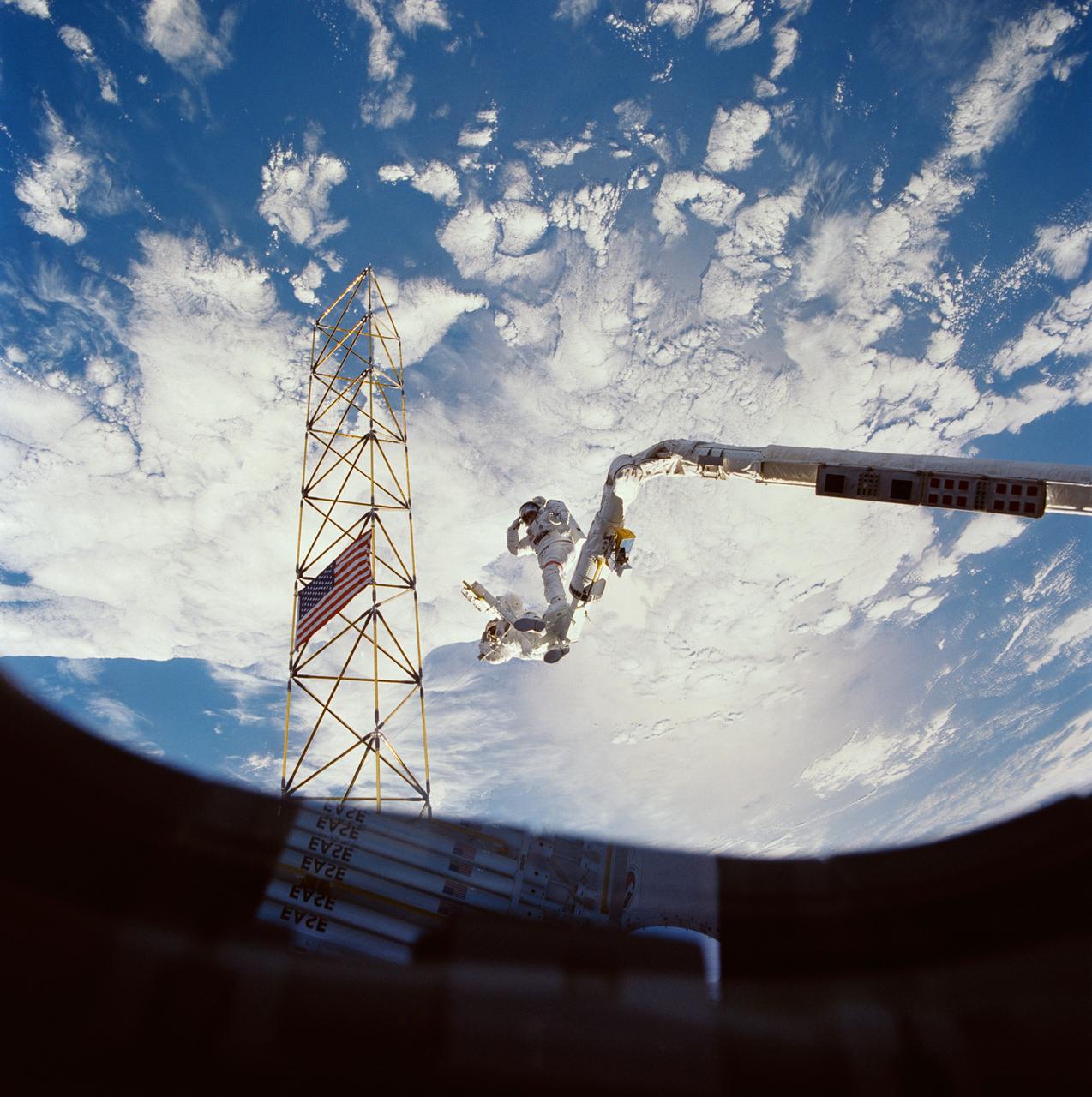
Astronauts Jerry L. Ross (right) and Sherwood C. (Woody) Spring (left) share a foot restraint as they survey the assembled ACCESS components after a lengthy extravehicular activity. Both men salute the American flag placed on the assembled ACCESS tower. Stowed EASE pieces are reflected in the window through which the photo was taken.
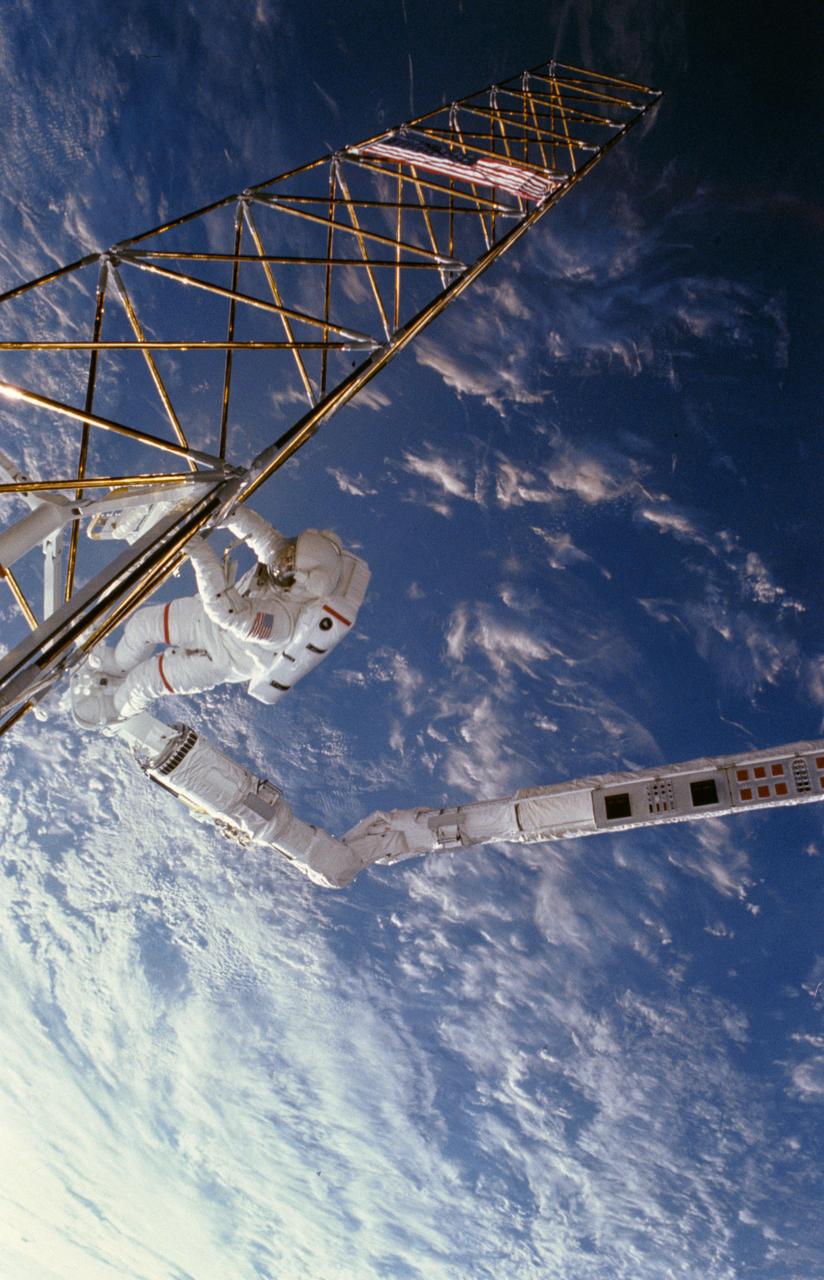
61B-102-022 (1 Dec 1985) --- Astronaut Jerry L. Ross, anchored to the foot restraint on the remote manipulator system (RMS), holds onto the tower-like Assembly Concept for Construction of Erectable Space Structures (ACCESS) device, as the Atlantis flies over white clouds and blue ocean waters. The frame was exposed with a negative-equipped camera held by Astronaut Sherwood C. Spring, who was also on the EVA-task.
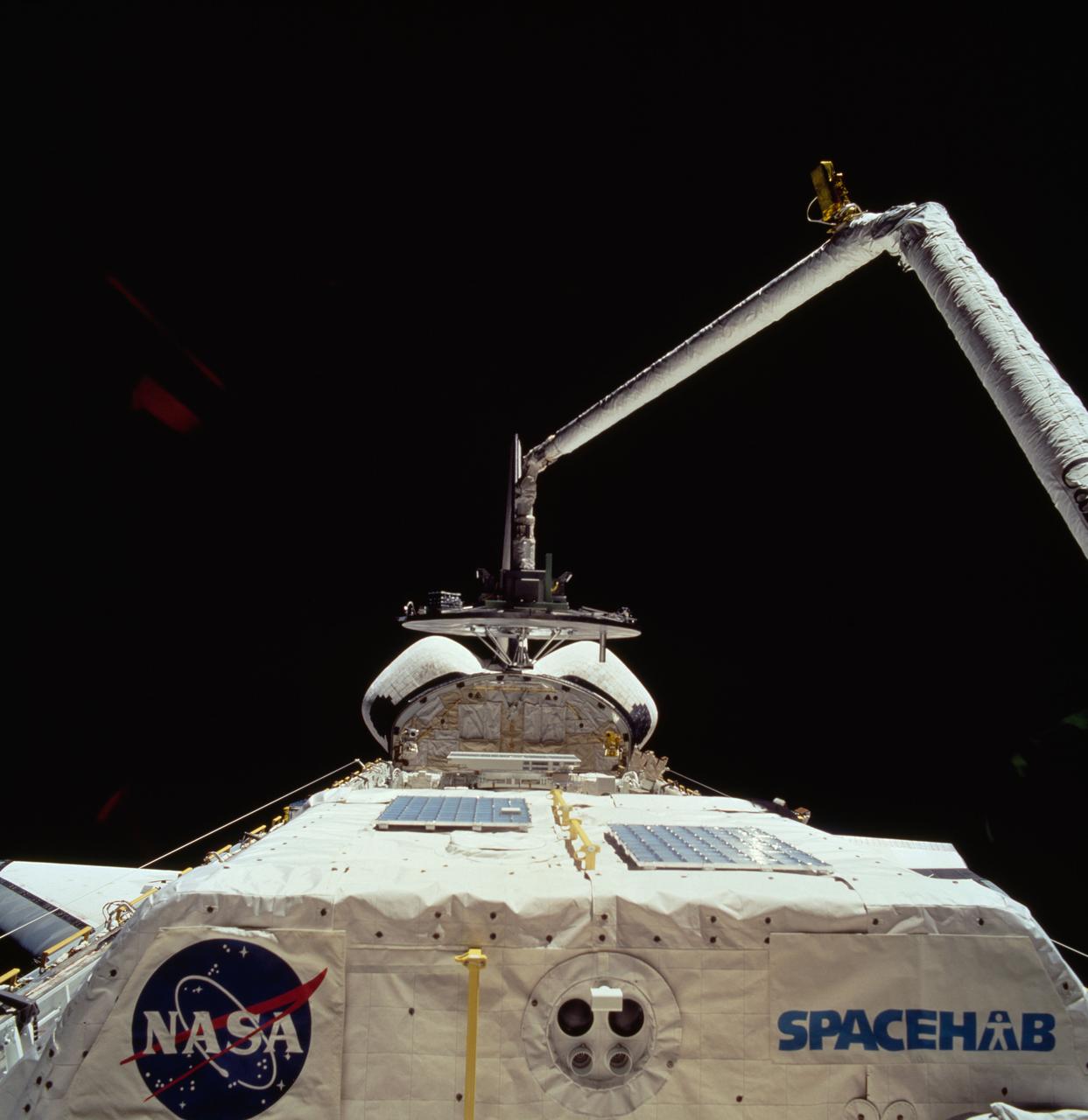
STS060-74-054 (3-11 Feb 1994) --- The Wake Shield Facility (WSF) is held in the grasp of Discovery's Remote Manipulator System (RMS). The 70mm image, backdropped against the blackness of space, also shows the SPACEHAB module in the forward cargo area.
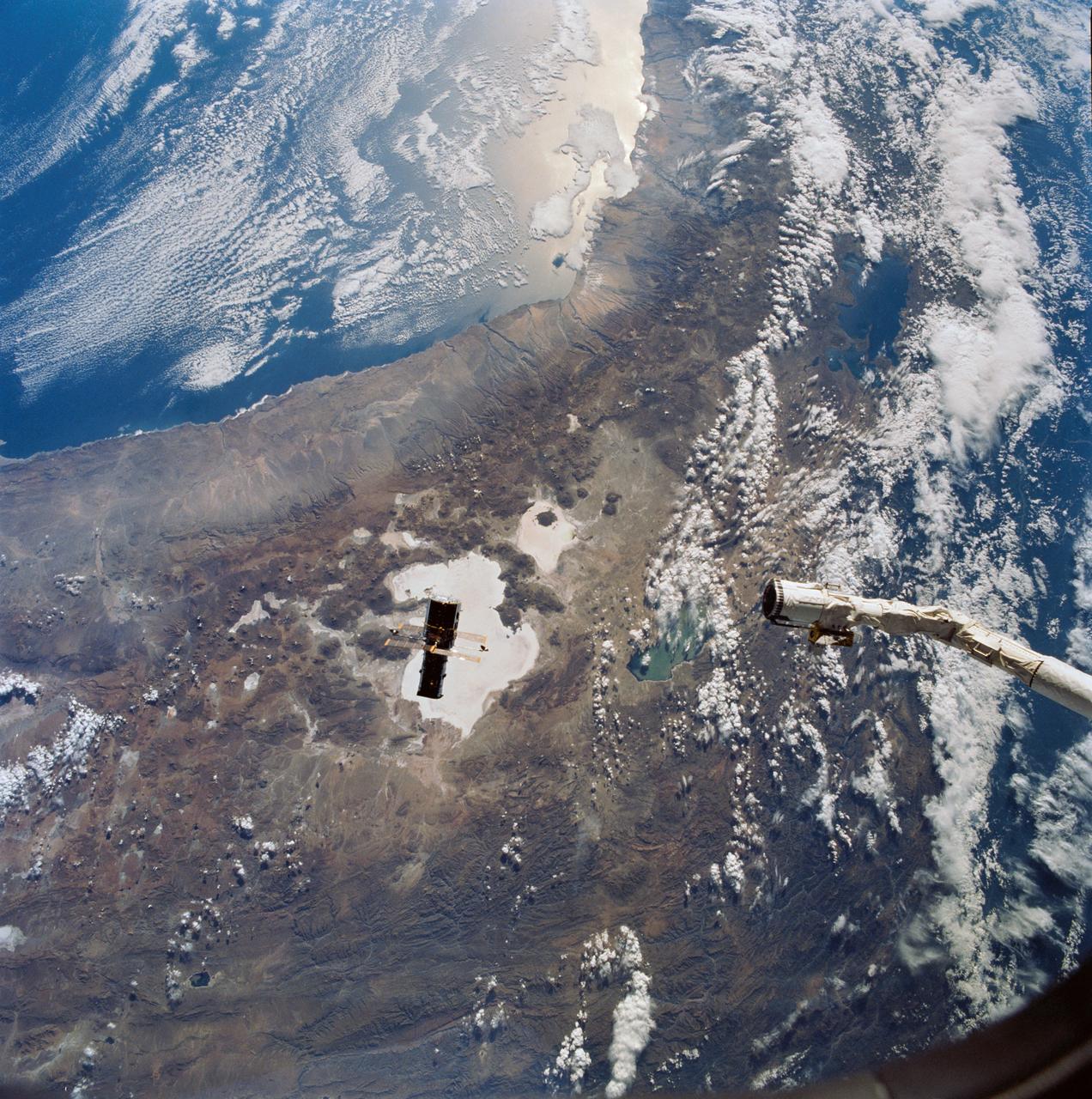
Hubble Space Telescope (HST), with its solar array (SA) wings and high gain antennae (HGA) fully extended,is released from Discovery's, Orbiter Vehicle (OV) 103's, remote manipulator system (RMS) end effector and is set free into Earth orbit by the STS-31 crew. HST drifts away from the end effector over the Andes Mountains.Parts of Bolivia, Peru, Chile, and Argentina are visible. The view covers a huge area of the western half of South America stretching from 14 degrees south latitude to 23 degrees, about 1,000 kilometers.
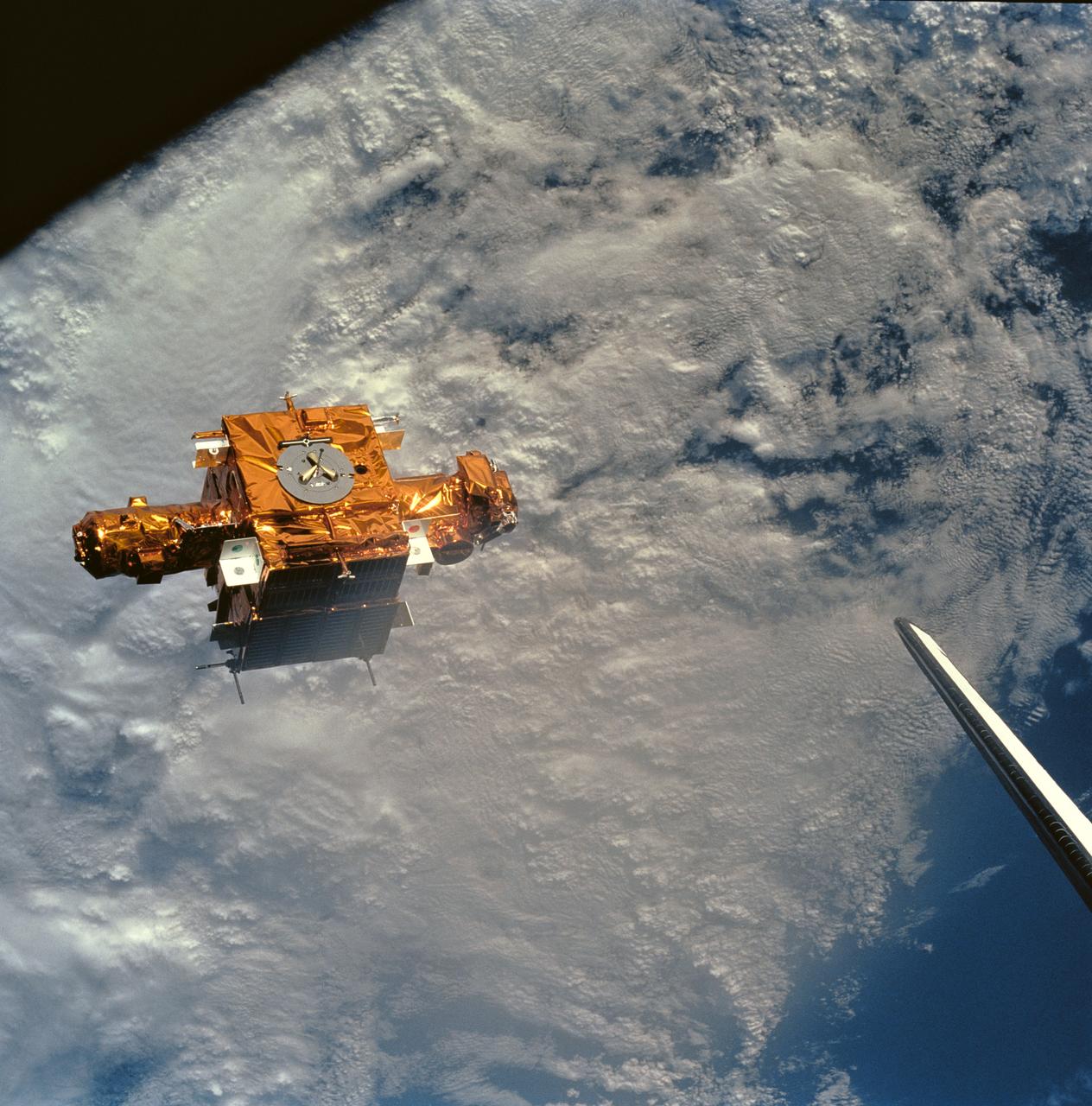
STS056-90-034 (8-17 April 1993) --- Backdropped against heavy cloud cover over the Mediterranean Sea, the SPARTAN-201 satellite was captured on 70mm by crewmembers aboard the Space Shuttle Discovery. SPARTAN is a free-flying payload designed to study the solar wind and part of the sun's corona. The project was conceived in the late 1970s to take advantage of the opportunity offered by the Space Shuttle to provide more observation time for the increasingly more sophisticated experiments than the five to ten minutes provided by sounding rocket flights. On the mission's third day, Astronaut Ellen Ochoa, Mission Specialist, used the remote manipulator system (RMS) to lift the satellite from its support structure on Discovery and release it in space. The reusable craft was later recaptured and returned to Earth with the crew. Note the tip of Discovery's vertical stabilizer at frame's edge.
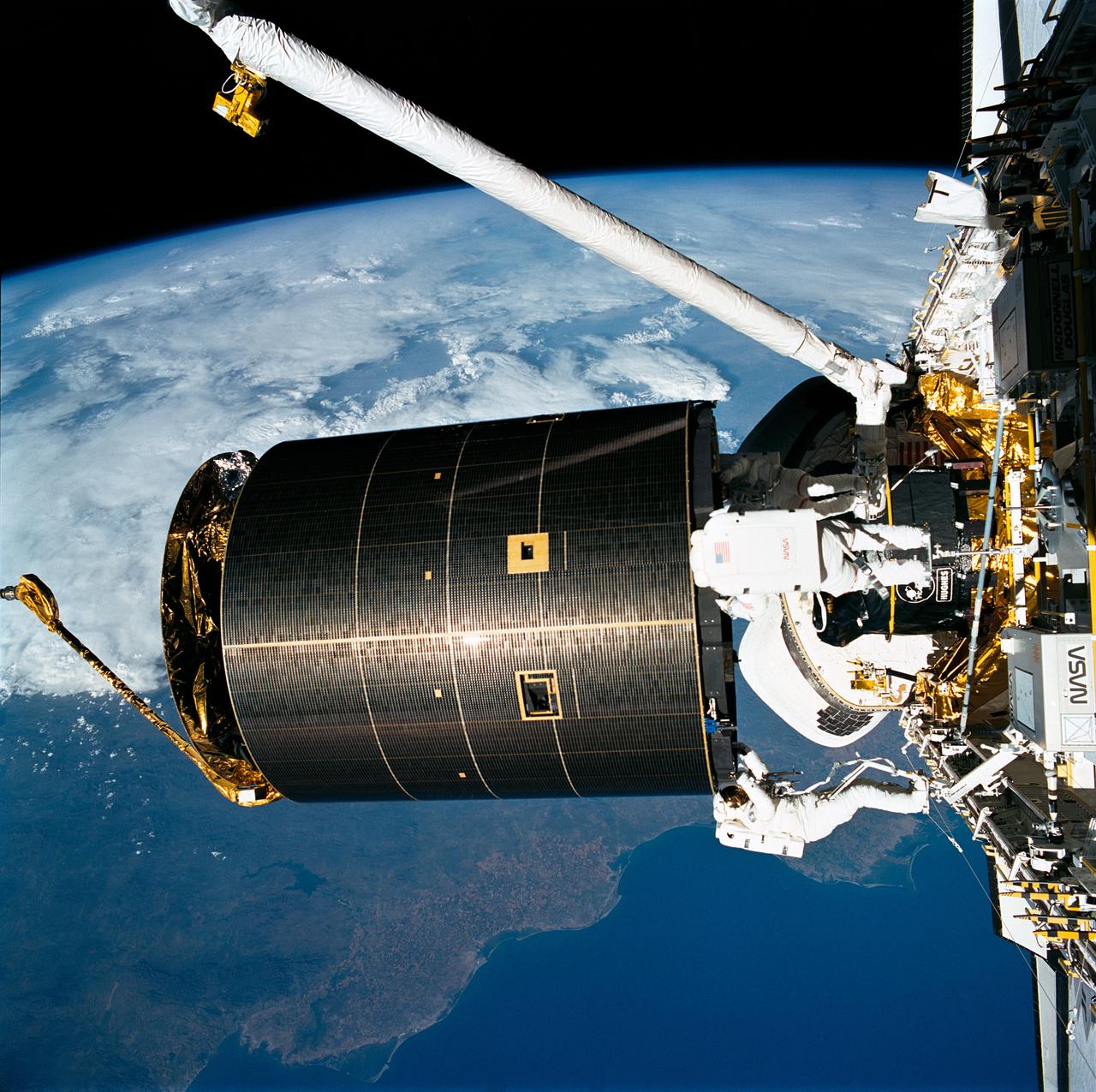
STS049-91-020 (13 May 1992) --- The successful capture of Intelsat VI satellite is recorded over Mexico on this 70mm frame, from inside the Space Shuttle Endeavour's cabin. Left to right, astronauts Richard J. Hieb, Thomas D. Akers and Pierre J. Thuot have handholds on the satellite. Ground coverage in the frame includes an area from Hermosillo, Sonara to Los Mochis in the state of Sinaloa. The nine-day mission accomplished the capture of the Intelsat, subsequent mating of the satellite to a booster and its eventual deployment, as well as a Space Station Freedom preview Extravehicular Activity (EVA). Endeavour's crew members were astronauts Daniel C. Brandenstein, mission commander; Kevin P. Chilton, pilot; and Thomas D. Akers, Richard J. Hieb, Bruce E. Melnick, Kathryn C. Thornton and Pierre J. Thuot, all mission specialists.

JSC2004-E-44645 (September 2004) --- This view of the International Space Station's Cupola features the portion where the grapple fixture is located. The Canadian-built remote manipulator system on either the Station or Space Shuttle will be able to grasp the Cupola with this fixture. This is one of a series of photos showing completed work on the hardware at the Alenia Spazio clean room in Turin, Italy. The personnel have been preparing the hardware for shipment to NASA's launch facility at Cape Kennedy, Florida. From inside the Cupola, a dome-shaped module with seven windows, astronauts have a panoramic view for observing operations on the outside of the orbiting complex. The Cupola module provides external observation capabilities during spacewalks, docking operations, hardware surveys and for Earth and celestial studies. It also serves as the primary location for executing robot arm operations of Canadarm2. Until the Cupola is installed, crews have been using a robotic control computer station located in the Destiny Laboratory to operate the arm. The Cupola’s windows enhance the robotic arm operator's situational awareness, supplementing camera and graphic views provided by the computer workstation. Photo Credit: Alenia Spazio
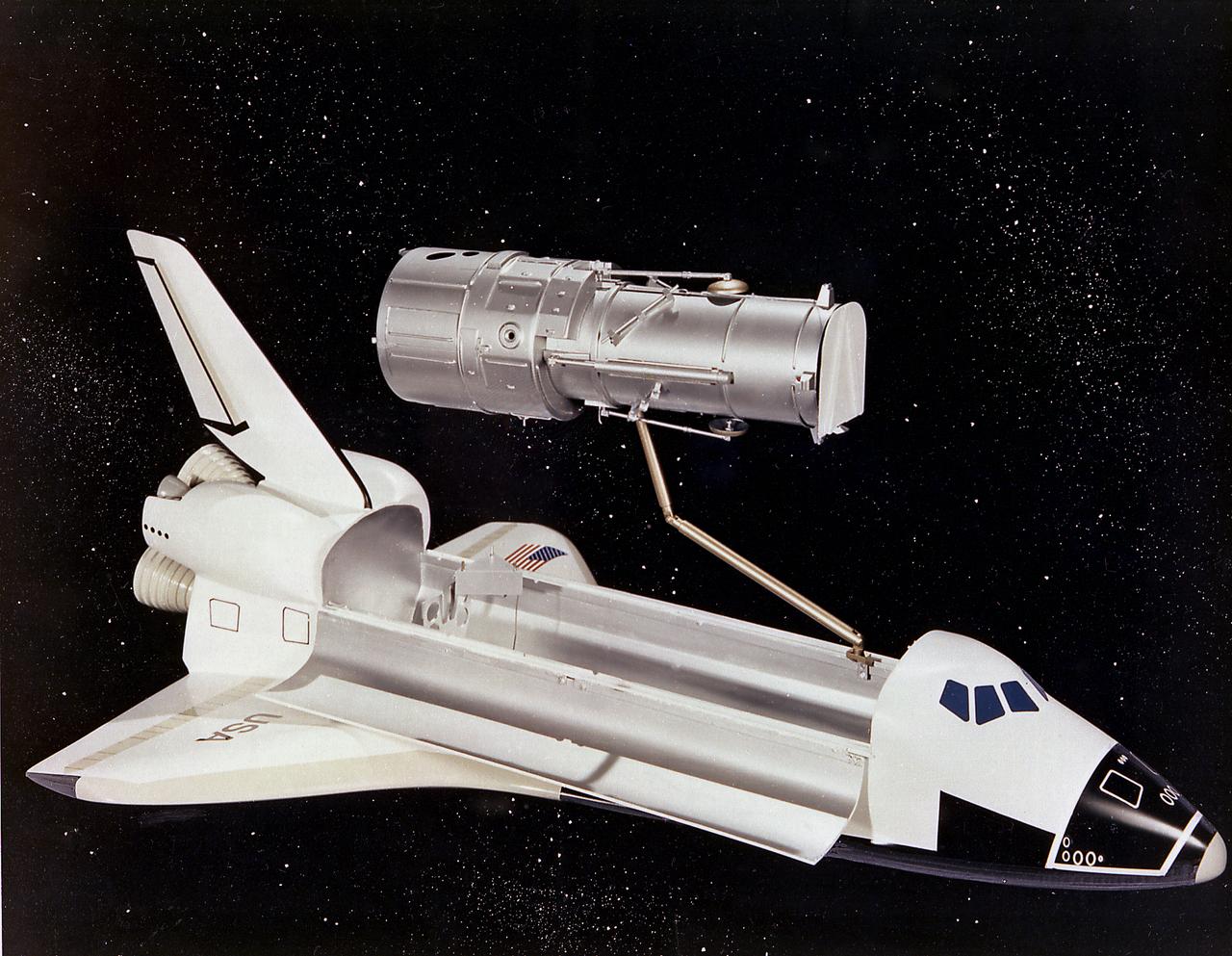
This artist's concept depicts the Hubble Space Telescope (HST) being positioned for release from the Space Shuttle orbiter by the Remote Manipulator System (RMS). The HST is the product of a partnership between NASA, European Space Agency Contractors, and the international community of astronomers. It is named after Edwin P. Hubble, an American Astronomer who discovered the expanding nature of the universe and was the first to realize the true nature of galaxies. The purpose of the HST, the most complex and sensitive optical telescope ever made, is to study the cosmos from a low-Earth orbit. By placing the telescope in space, astronomers are able to collect data that is free of the Earth's atmosphere. The HST detects objects 25 times fainter than the dimmest objects seen from Earth and provides astronomers with an observable universe 250 times larger than visible from ground-based telescopes, perhaps as far away as 14 billion light-years. The HST views galaxies, stars, planets, comets, possibly other solar systems, and even unusual phenomena such as quasars, with 10 times the clarity of ground-based telescopes. The major elements of the HST are the Optical Telescope Assembly (OTA), the Support System Module (SSM), and the Scientific Instruments (SI). The HST is 42.5-feet (13- meters) long and weighs about 25,000 pounds (11,600 kilograms). The HST was deployed from the Space Shuttle Discovery (STS-31 mission) into Earth orbit in April 1990. The Marshall Space Flight Center had responsibility for design, development, and construction of the HST. The Perkin-Elmer Corporation, in Danbury, Cornecticut, developed the optical system and guidance sensors. The Lockheed Missile and Space Company of Sunnyvale, California produced the protective outer shroud and spacecraft systems, and assembled and tested the finished telescope.