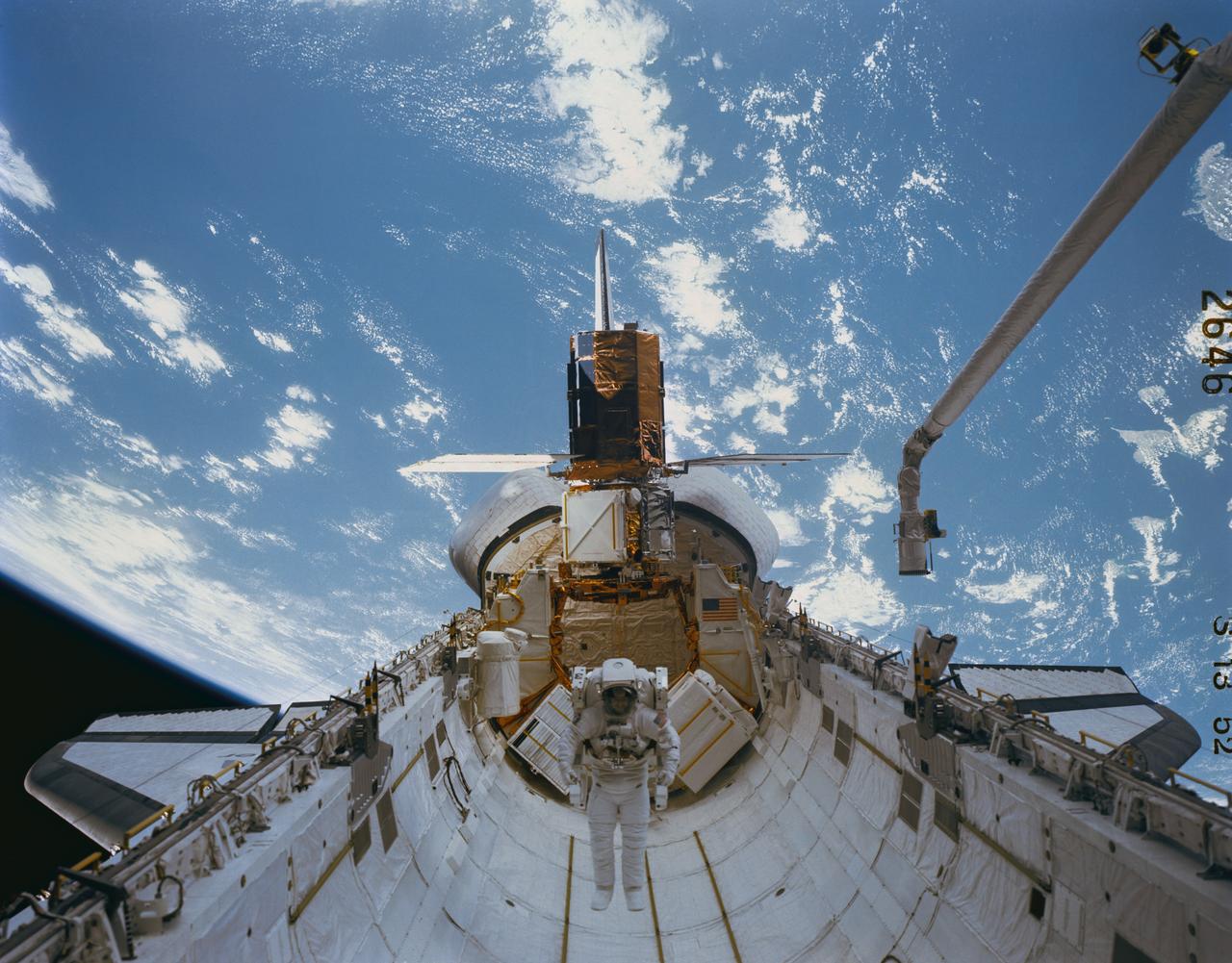
41C-52-2646 (11 April 1984) --- Astronaut James D. van Hoften and a repaired satellite are in a wide panorama recorded on film with a Linhof camera, making its initial flight aboard the Space Shuttle Challenger. Dr. van Hoften is getting in his first "field" test of the Manned Maneuvering Unit (MMU) after months of training in an underwater facility and in a simulator on Earth. The Solar Maximum Mission Satellite (SMMS), revived and almost ready for release into space once more, is docked at the Flight Support System (FSS). The Remote Manipulator System (RMS) is backdropped against the blue and white Earth at frame's edge. Outside of pictures made of the Earth from astronauts on the way to the Moon, this frame showing the planet from 285 nautical miles represents the highest orbital photography in the manned space program.
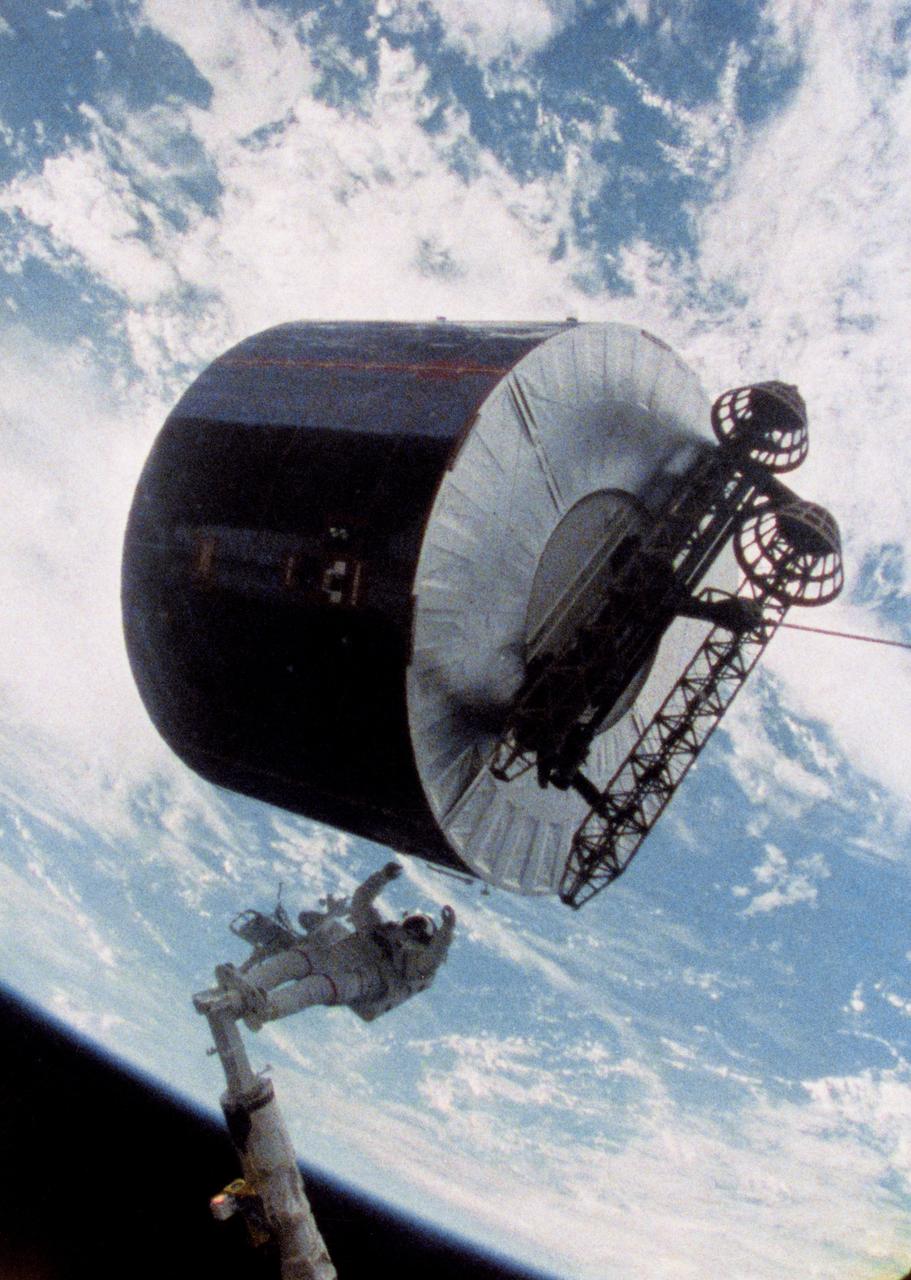
51I-S-237 (1 Sept. 1985) --- A still photo made from a video downlink shows astronaut James D. van Hoften, just after giving a shove to the Syncom IV-3 communications satellite. NASA's 51-I astronaut crew aboard the space shuttle Discovery had earlier captured and repaired the previously errant satellite. Photo credit: NASA
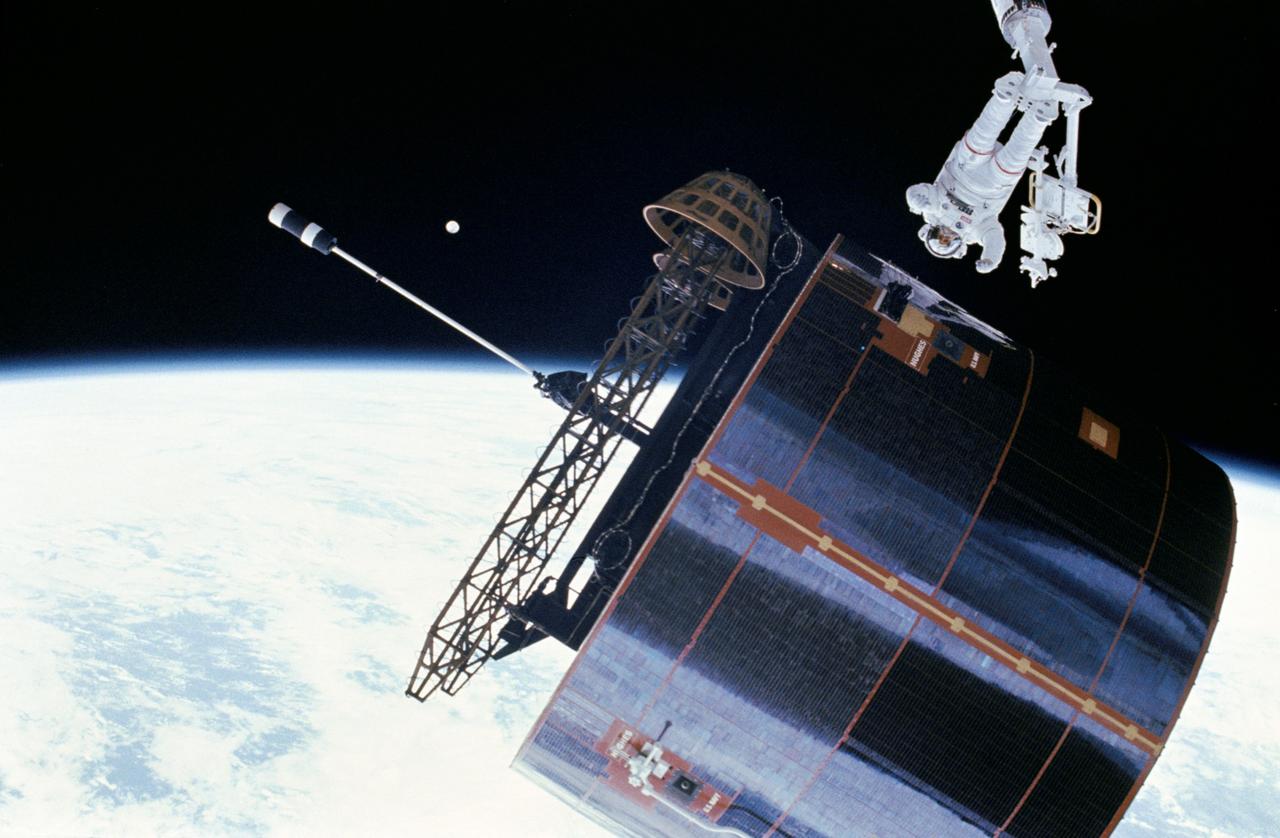
51I-102-029 (31 August - 1 September 1985) --- This is one of a series of six photographs released by NASA covering the extravehicular activity (EVA) of astronauts James D. van Hoften and William F. Fisher, who helped to capture, repair and release the previously errant Syncom IV-3 communications satellite. Here, Dr. van Hoften has just given a shove to the the Syncom. (For orientation, moon should be in lower right quadrant).
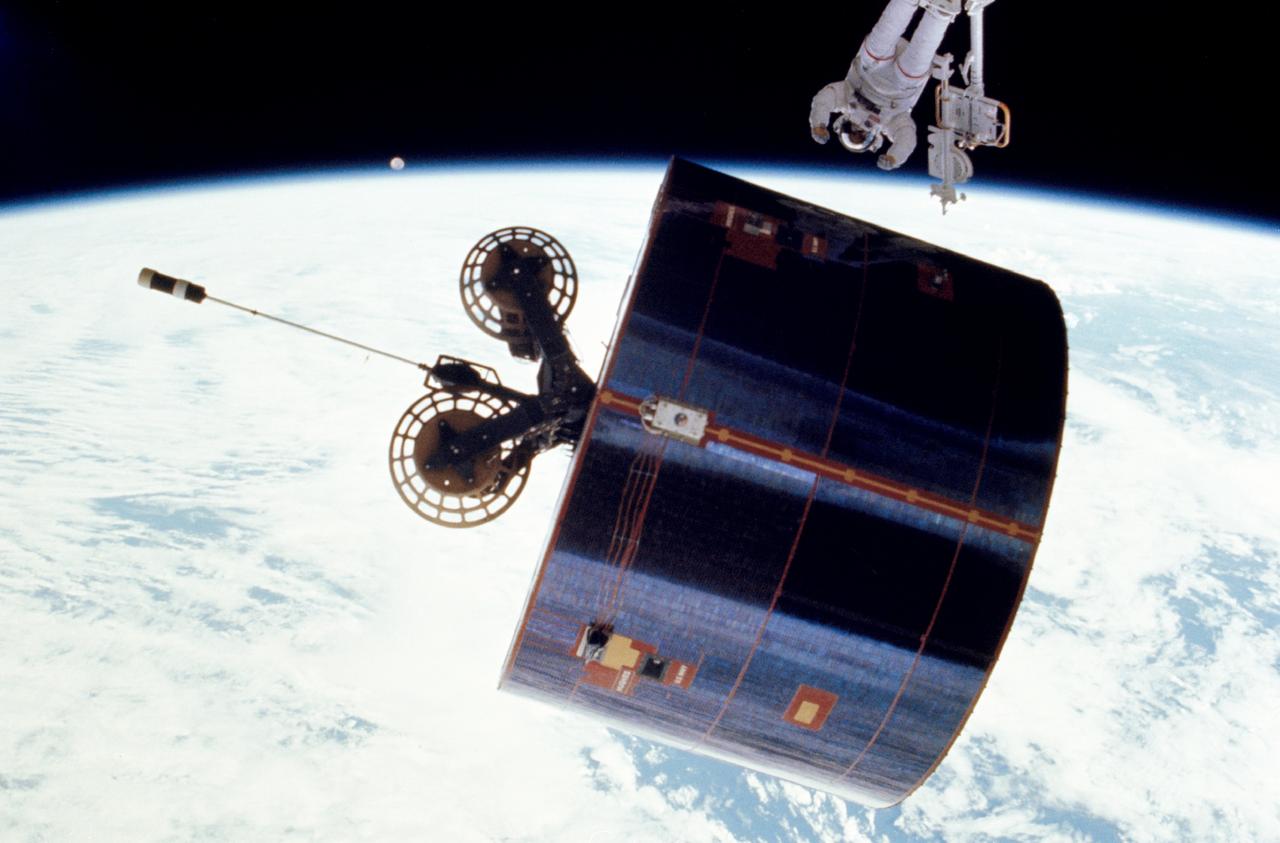
51I-102-033 (31 August - 1 September 1985) --- This is one of a series of six photographs released by NASA covering the extravehicular activity (EVA) of astronauts James D. van Hoften and William F. Fisher, who helped to capture, repair and release the previously errant Syncom IV-3 communications satellite. Here, Dr. van Hoften has just given a shove to the the Syncom. (For orientation, moon should be in lower right quadrant).
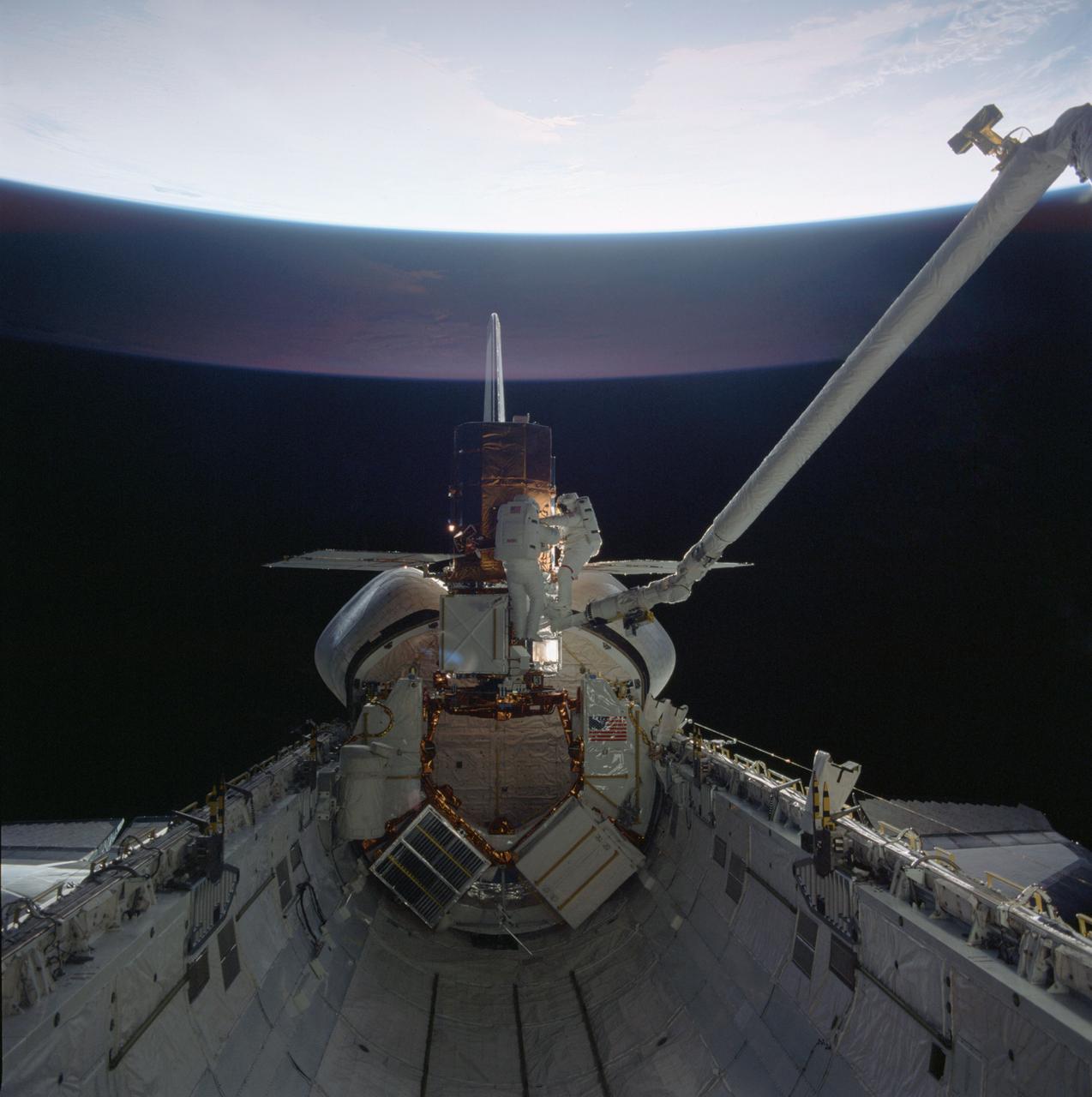
41C-37-1711 (11 April 1984) --- The two mission specialist-EVA participants of Flight 41-C share a repair task at the "captured" Solar Maximum Mission Satellite (SMMS) in the aft end of the Challenger's cargo bay. Astronauts George D. Nelson, right, and James D. van Hoften uses the mobile foot restraint and the Remote Manipulator System (RMS) as a "cherry picker" device for moving about. Later, the RMS lifted the SMMS into space once more.
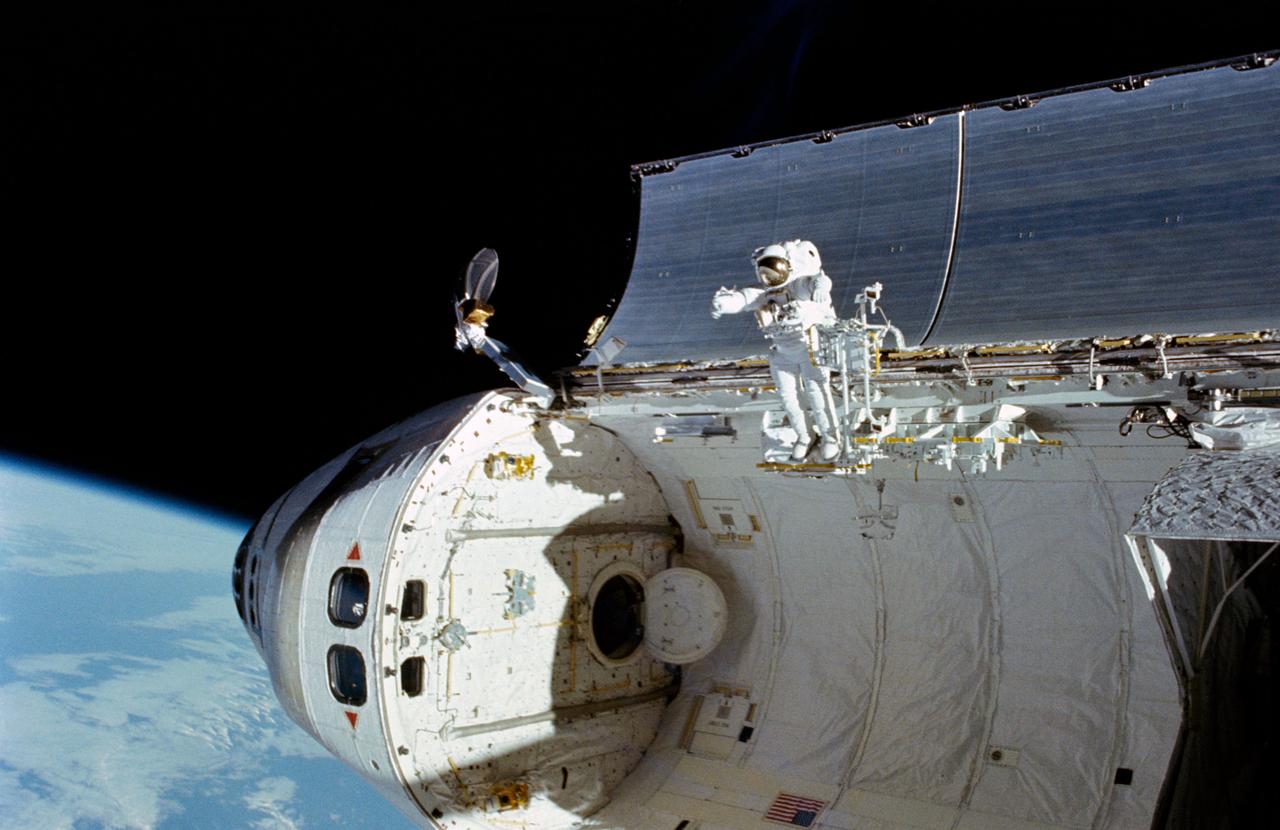
51I-102-048 (4-5 Sept 1985) --- A 35mm frame showing astronaut William F. Fisher standing on the edge of Discovery's cargo bay (in foot restraint) during the second day of a two-day effort to capture, repair and re-release the Syncom IV-3 communications satellite. Astronaut James D. van Hoften, standing on the Discovery's RMS arm, exposed the frame.
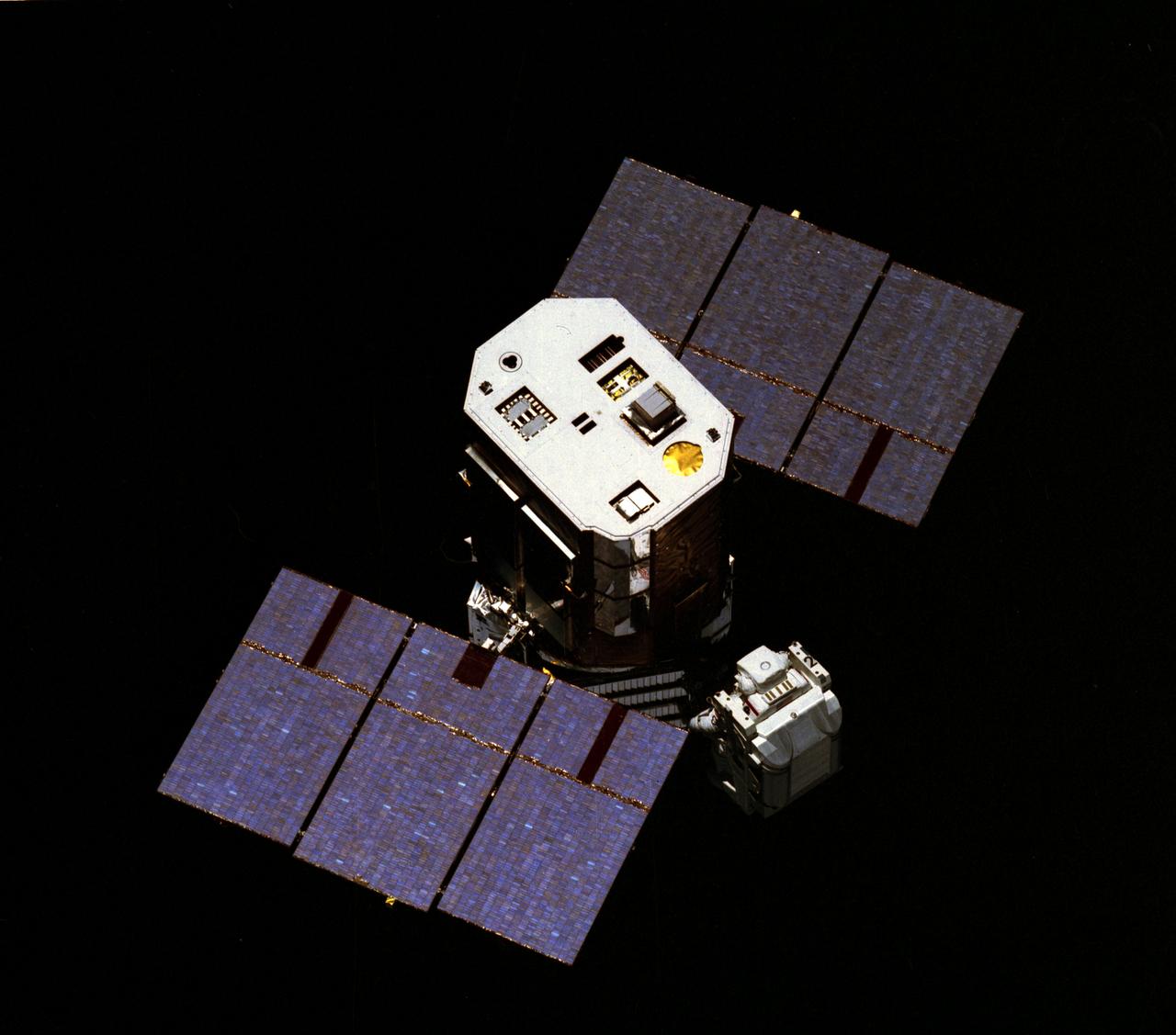
Launched April 6, 1984, one of the goals of the STS-41C mission was to repair the damaged free-flying Solar Maximum Mission Satellite (SMMS), or Solar Max. The original plan was to make an excursion out to the SMMS and capture it for necessary repairs. Pictured is Mission Specialist George Nelson approaching the damaged satellite in a capture attempt. This attempted feat was unsuccessful. It was necessary to capture the satellite via the orbiter's Remote Manipulator System (RMS) and secure it into the cargo bay in order to perform the repairs, which included replacing the altitude control system and the coronograph/polarimeter electronics box. The SMMS was originally launched into space via the Delta Rocket in February 1980, with the purpose to provide a means of studying solar flares during the most active part of the current sunspot cycle. Dr. Einar Tandberg-Hanssen of Marshall Space Flight Center's Space Sciences Lab was principal investigator for the Ultraviolet Spectrometer and Polarimeter, one of the seven experiments of the Solar Max.

RSat is a 3U CubeSat with two seven degree of freedom robotic arms designed to latch onto a host satellite and maneuver around to image and potentially repair malfunctioning components. RSat is part of the AMODS research project developed by a team of Midshipmen from the United States Naval Academy. The three-year-old program aims to employ a small satellite platform to provide both new and legacy spacecraft with cost-effective on-orbit assessments and repair services. Currently, if a satellite makes it to orbit, there is no guarantee it will work as intended. In these cases, not only is the spacecraft lost, but invaluable experience vanishes with it. RSat takes advantage of cost and profile efficiencies of the small satellite platform to offer satellite developers and operators a fundamentally new way to reduce risk, protect investment and effect design improvements correlated against observed space environment experience. RSat-P is launching as part of ELaNa XIX as a free-flying unit intended to validate the on-orbit effectiveness of compact robotic manipulators.
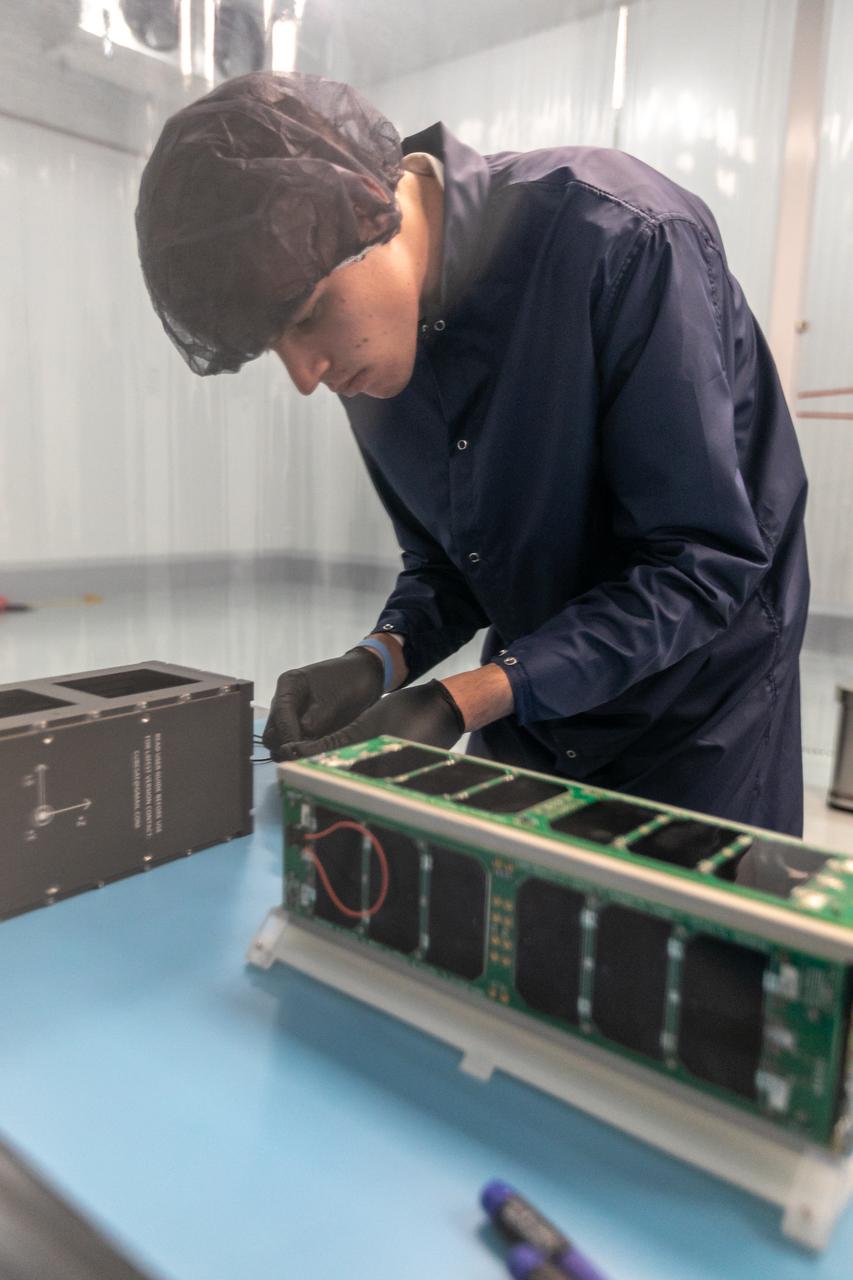
RSat is a 3U CubeSat with two seven degree of freedom robotic arms designed to latch onto a host satellite and maneuver around to image and potentially repair malfunctioning components. RSat is part of the AMODS research project developed by a team of Midshipmen from the United States Naval Academy. The three-year-old program aims to employ a small satellite platform to provide both new and legacy spacecraft with cost-effective on-orbit assessments and repair services. Currently, if a satellite makes it to orbit, there is no guarantee it will work as intended. In these cases, not only is the spacecraft lost, but invaluable experience vanishes with it. RSat takes advantage of cost and profile efficiencies of the small satellite platform to offer satellite developers and operators a fundamentally new way to reduce risk, protect investment and effect design improvements correlated against observed space environment experience. RSat-P is launching as part of ELaNa XIX as a free-flying unit intended to validate the on-orbit effectiveness of compact robotic manipulators.
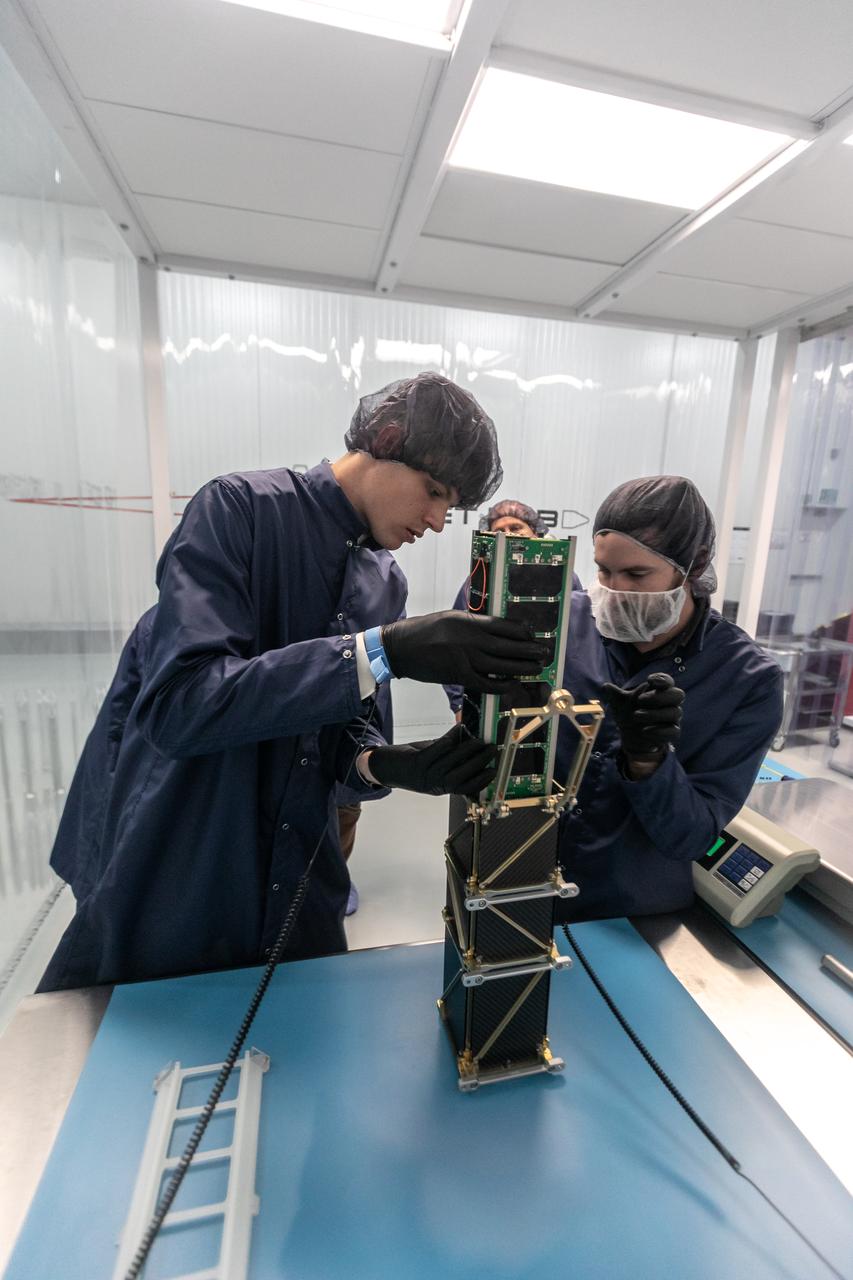
RSat is a 3U CubeSat with two seven degree of freedom robotic arms designed to latch onto a host satellite and maneuver around to image and potentially repair malfunctioning components. RSat is part of the AMODS research project developed by a team of Midshipmen from the United States Naval Academy. The three-year-old program aims to employ a small satellite platform to provide both new and legacy spacecraft with cost-effective on-orbit assessments and repair services. Currently, if a satellite makes it to orbit, there is no guarantee it will work as intended. In these cases, not only is the spacecraft lost, but invaluable experience vanishes with it. RSat takes advantage of cost and profile efficiencies of the small satellite platform to offer satellite developers and operators a fundamentally new way to reduce risk, protect investment and effect design improvements correlated against observed space environment experience. RSat-P is launching as part of ELaNa XIX as a free-flying unit intended to validate the on-orbit effectiveness of compact robotic manipulators.
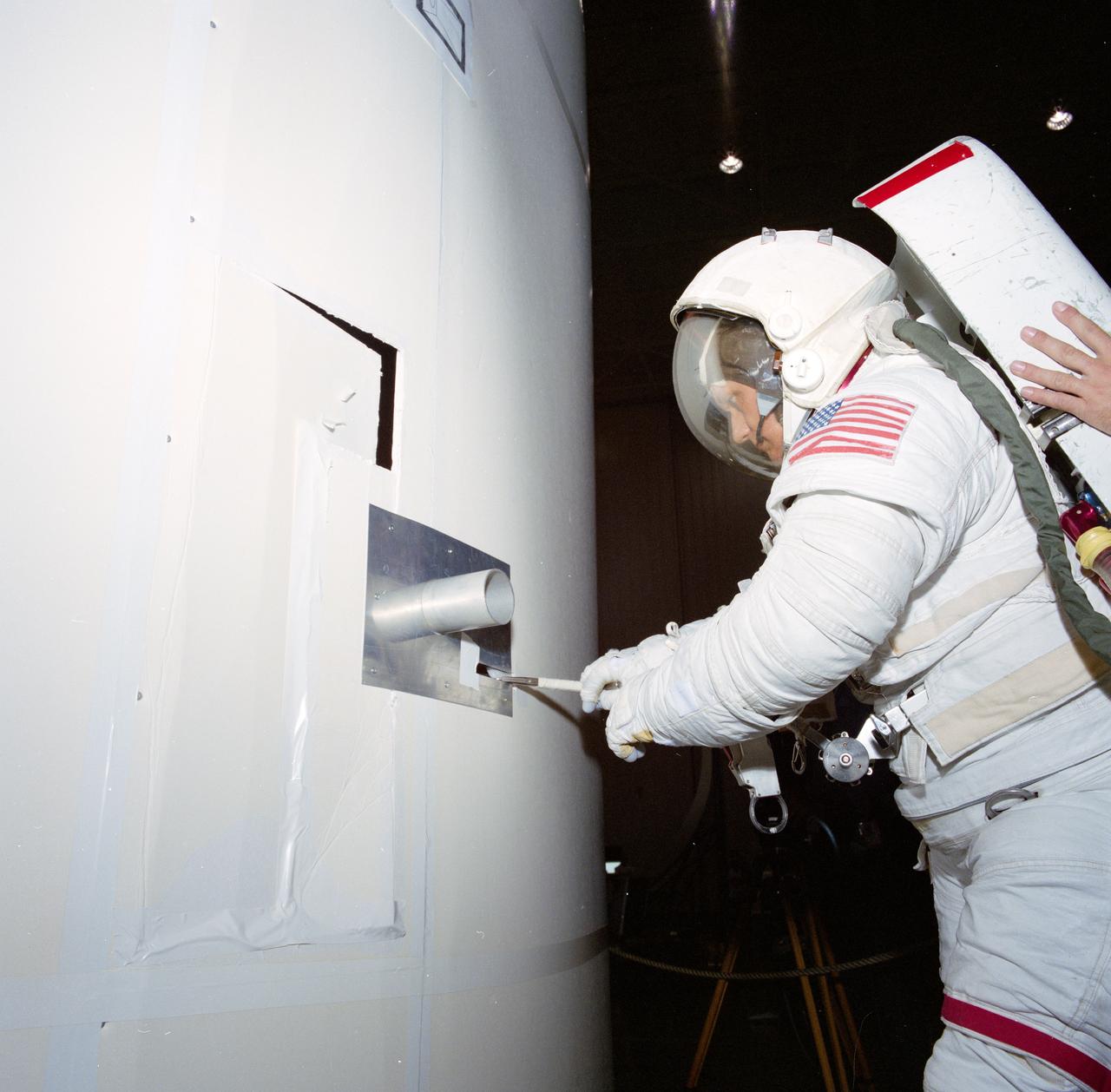
S85-30800 (14 April 1985) --- Astronaut Bruce McCandless II tests one of the possible methods of attempting to activate a switch on the Syncom-IV (LEASAT) satellite released April 13 into space from the Space Shuttle Discovery. The communications spacecraft failed to behave properly upon release and NASA officials and satellite experts are considering possible means of repair. McCandless was using a full scale mockup of the satellite in the Johnson Space Center's (JSC) mockup and integration laboratory.
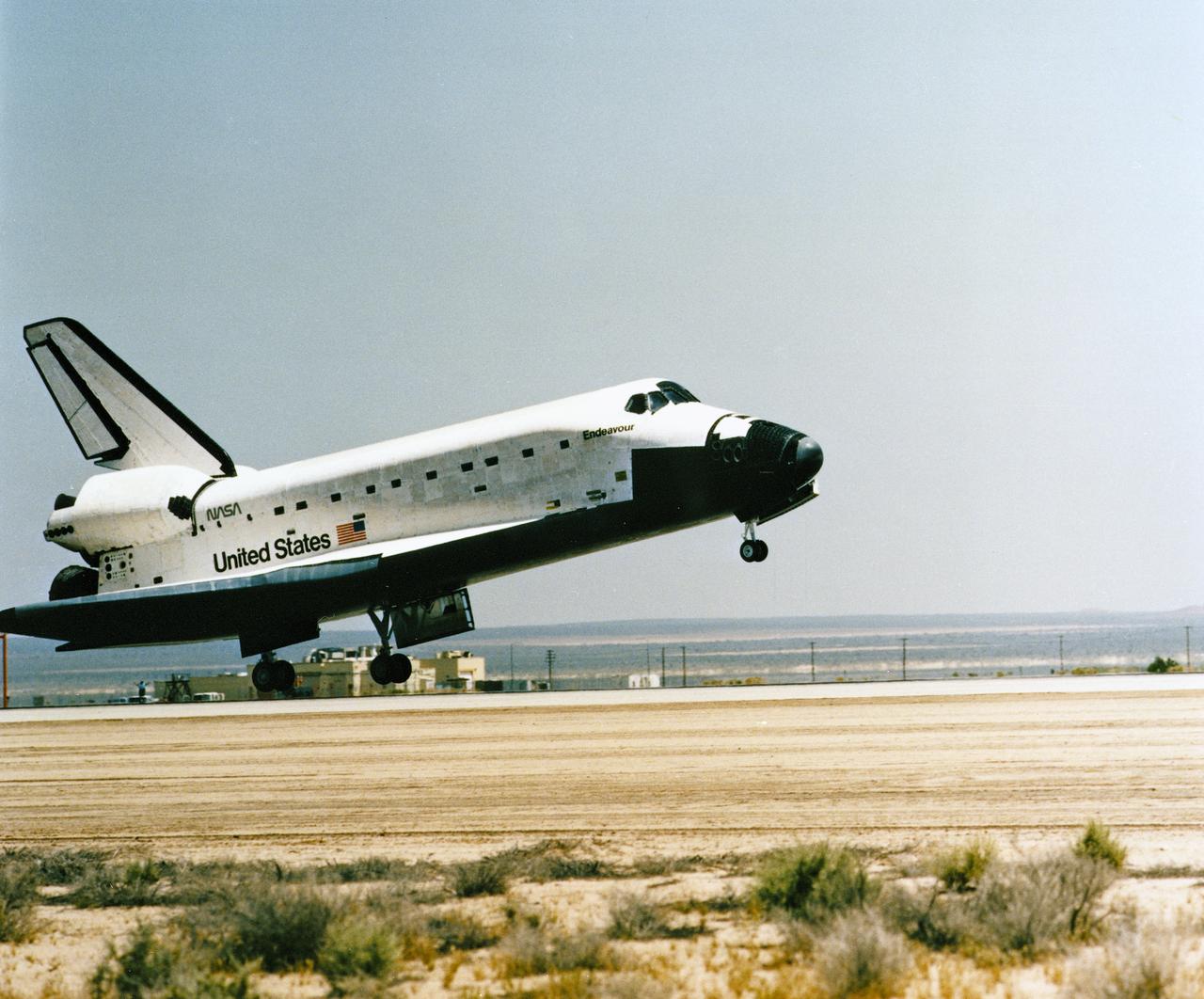
STS-49 Orbiter Endeavour landed at Edwards Air Force Base on May 16, 1992 after a successful nine day mission dedicated to the retrieval, repair, and redeployment of the INTELSAT VI (F-3) satellite. The communication satellite for the International Telecommunication Satellite organization had been stranded in an unusable orbit since its launch aboard the Titan rocket in March 1990. The mission marked the first time 3 astronauts worked simultaneously outside the space craft.
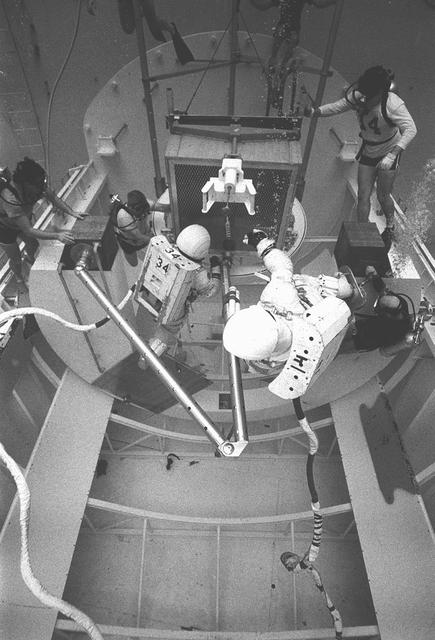
In February 1980, a satellite called Solar Maximum Mission Spacecraft, or Solar Max, was launched into Earth's orbit. Its primary objective was to provide a detailed study of solar flares, active regions on the Sun's surface, sunspots, and other solar activities. Additionally, it was to measure the total output of radiation from the Sun. Not much was known about solar activity at that time except for a slight knowledge of solar flares. After its launch, Solar Max fulfilled everyone's expectations. However, after a year in orbit, Solar Max's Altitude Control System malfunctioned, preventing the precise pointing of instruments at the Sun. NASA scientists were disappointed at the lost data, but not altogether dismayed because Solar Max had been designed for Space Shuttle retrievability enabling the repair of the satellite. On April 6, 1984, Space Shuttle Challenger (STS-41C), Commanded by astronaut Robert L. Crippen and piloted by Francis R. Scobee, launched on a historic voyage. This voyage initiated a series of firsts for NASA; the first satellite retrieval, the first service use of a new space system called the Marned Maneuvering Unit (MMU), the first in-orbit repair, the first use of the Remote Manipulator System (RMS), and the Space Shuttle Challenger's first space flight. The mission was successful in retrieving Solar Max. Mission Specialist Dr. George D. Nelson, using the MMU, left the orbiter's cargo bay and rendezvoused with Solar Max. After attaching himself to the satellite, he awaited the orbiter to maneuver itself nearby. Using the RMS, Solar Max was captured and docked in the cargo bay while Dr. Nelson replaced the altitude control system and the coronagraph/polarimeter electronics box. After the repairs were completed, Solar Max was redeposited in orbit with the assistance of the RMS. Prior to the April 1984 launch, countless man-hours were spent preparing for this mission. The crew of Challenger spent months at Marshall Space Flight Center's (MSFC) Neutral Buoyancy Simulator (NBS) practicing retrieval maneuvers, piloting the MMU, and training on equipment so they could make the needed repairs to Solar Max. Pictured are crew members training on repair tasks.
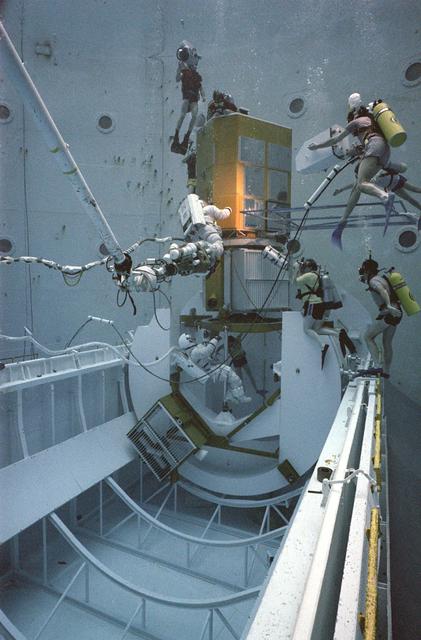
In February 1980, a satellite called Solar Maximum Mission Spacecraft, or Solar Max, was launched into Earth's orbit. Its primary objective was to provide a detailed study of solar flares, active regions on the Sun's surface, sunspots, and other solar activities. Additionally, it was to measure the total output of radiation from the Sun. Not much was known about solar activity at that time except for a slight knowledge of solar flares. After its launch, Solar Max fulfilled everyone's expectations. However, after a year in orbit, Solar Max's Altitude Control System malfunctioned, preventing the precise pointing of instruments at the Sun. NASA scientists were disappointed at the lost data, but not altogether dismayed because Solar Max had been designed for Space Shuttle retrievability enabling the repair of the satellite. On April 6, 1984, Space Shuttle Challenger (STS-41C), Commanded by astronaut Robert L. Crippen and piloted by Francis R. Scobee, launched on a historic voyage. This voyage initiated a series of firsts for NASA; the first satellite retrieval, the first service use of a new space system called the Marned Maneuvering Unit (MMU), the first in-orbit repair, the first use of the Remote Manipulator System (RMS), and the Space Shuttle Challenger's first space flight. The mission was successful in retrieving Solar Max. Mission Specialist Dr. George D. Nelson, using the MMU, left the orbiter's cargo bay and rendezvoused with Solar Max. After attaching himself to the satellite, he awaited the orbiter to maneuver itself nearby. Using the RMS, Solar Max was captured and docked in the cargo bay while Dr. Nelson replaced the altitude control system and the coronagraph/polarimeter electronics box. After the repairs were completed, Solar Max was redeposited in orbit with the assistance of the RMS. Prior to the April 1984 launch, countless man-hours were spent preparing for this mission. The crew of Challenger spent months at Marshall Space Flight Center's (MSFC) Neutral Buoyancy Simulator (NBS) practicing retrieval maneuvers, piloting the MMU, and training on equipment so they could make the needed repairs to Solar Max. Pictured are crew members training for repair tasks.
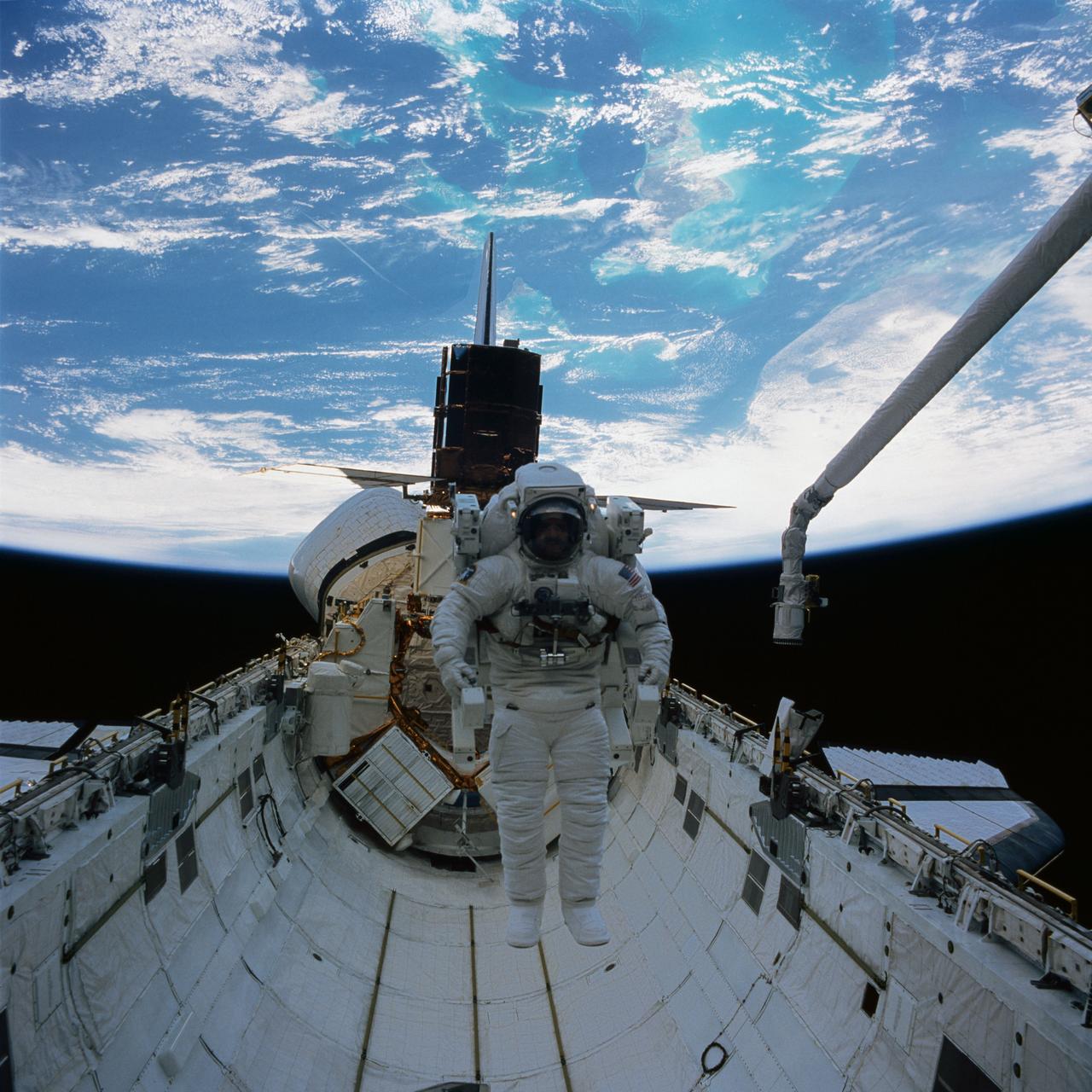
41C-37-1718 (11 April 1984) --- Astronaut James D. van Hoften and a repaired satellite are captured by a Hasselblad camera aimed through Challenger's aft cabin windows toward the cargo bay of the Earth orbiting Challenger. Dr. van Hoften is getting in his first "field" test of the manned maneuvering unit (MMU) after months of training in an underwater facility and in a simulator on Earth. The Solar Maximum Mission Satellite (SMMS), revived and almost ready for release into space once more, is docked at the flight support system (FSS).
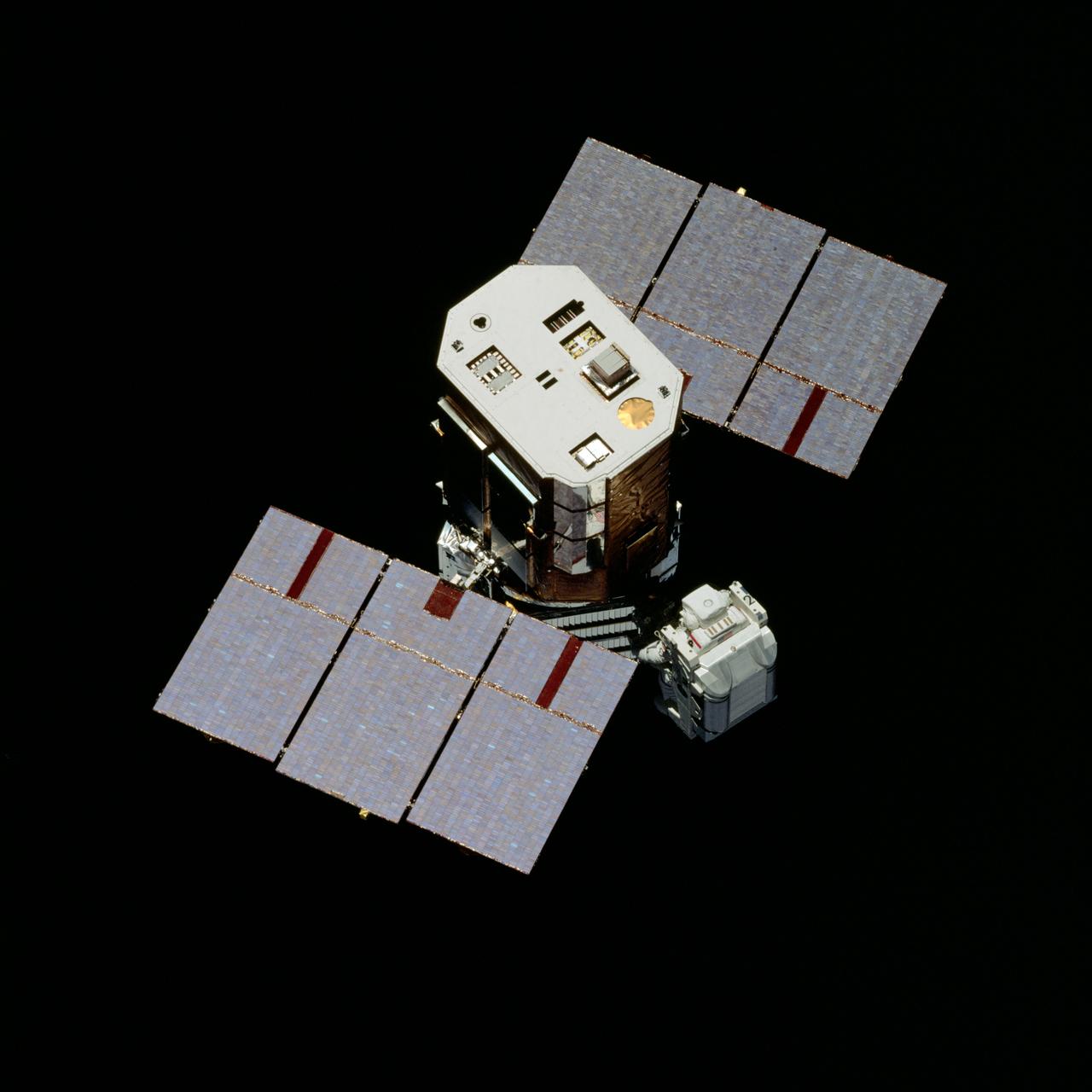
41C-34-1380 (10-11 April 1984) --- Astronaut George D. Nelson, using the manned maneuvering unit (MMU), arrives at the ailing Solar Maximum Mission Satellite (SMMS). After the STS-41C crewmembers captured the errant satellite and temporarily cradled it in Challenger?s payload bay, astronauts Nelson and James D. van Hoften repaired it and later re-released it.
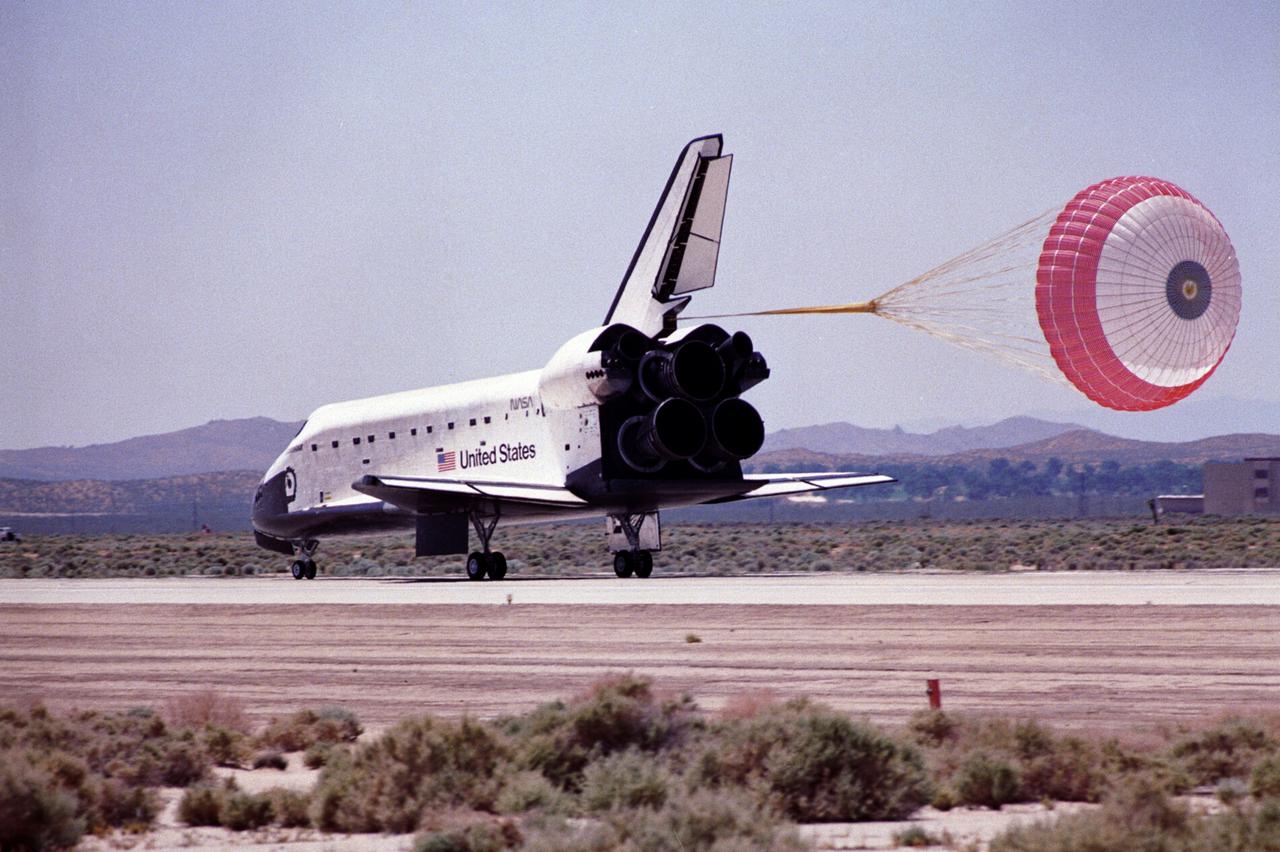
STS-49 Orbiter Endeavour landed at Edwards Air Force Base on May 16, 1992 The drogue chute precedes the main chute in NASA’s first exercise of its detailed test objective on the drag chute system. STS-49 ended its successful nine day mission dedicated to the retrieval, repair, and redeployment of the the INTELSAT VI (F-3) satellite. The communication satellite for the International Telecommunication Satellite organization had been stranded in an unusable orbit since its launch aboard the Titan rocket in March 1990. The mission marked the first time 3 astronauts worked simultaneously outside the space craft.
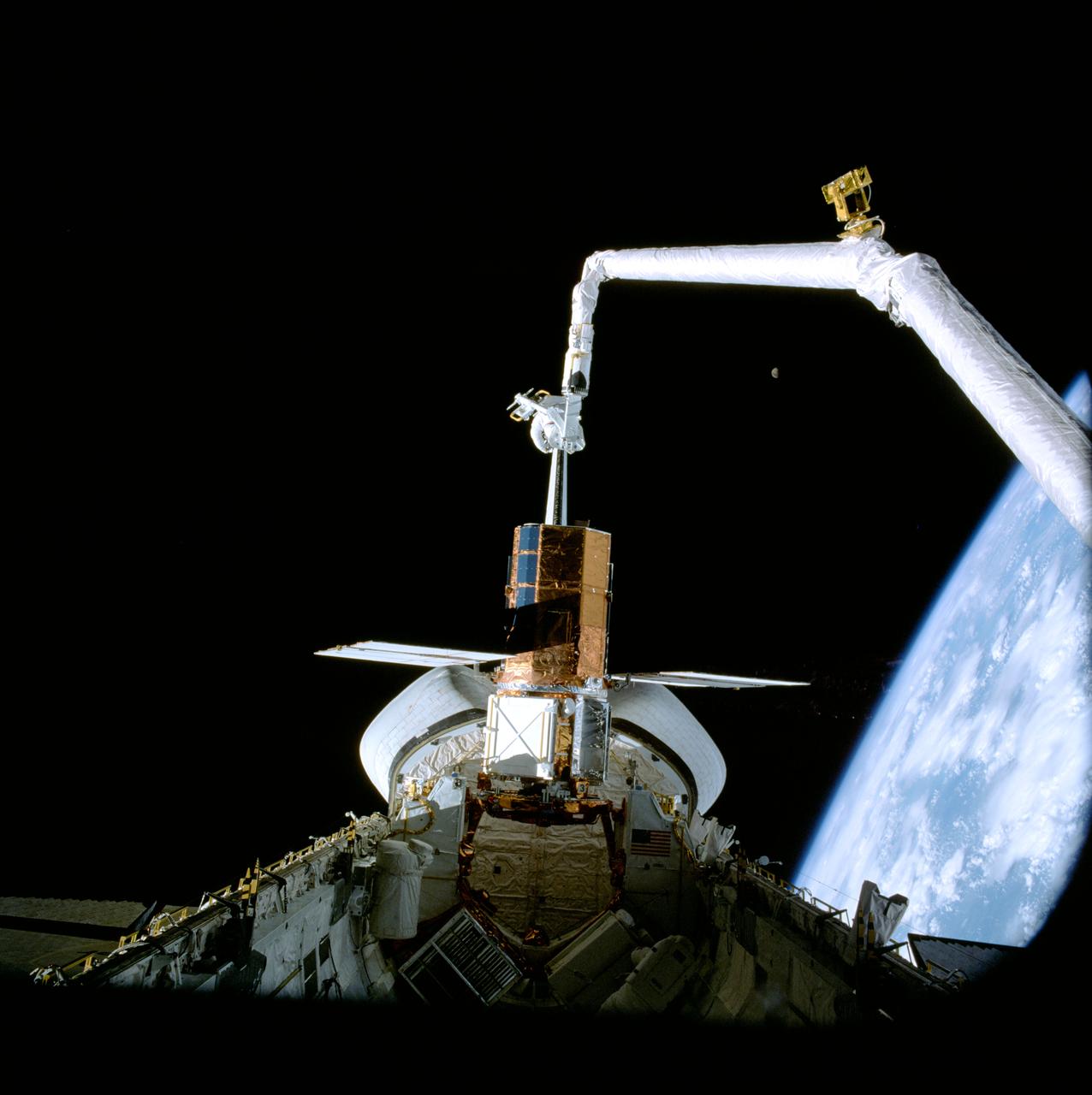
41C-37-1715 (11 April 1984) --- A scenic panorama is captured by an onboard 70mm handheld camera during the April 11, 1984, Solar Maximum Mission Satellite (SMMS) repair job aboard the Earth-orbiting Space Shuttle Challenger. The SMMS is temporarily docked at the Challenger's Flight Support System (FSS) so that astronauts George D. Nelson and James D. van Hoften could perform a series of repair tasks. The Remote Manipulator System (RMS) arm was used to move the astronauts into position for their series of chores. Note the gibbous Moon to the right of center and the horizon of the blue and white Earth in the lower right quadrant.
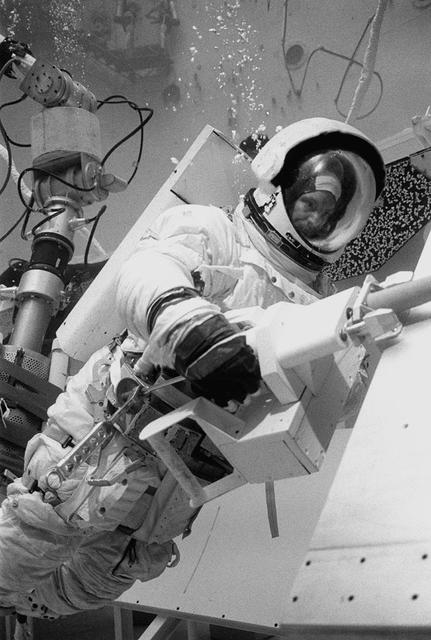
In February 1980, a satellite called Solar Maximum Mission Spacecraft, or Solar Max, was launched into Earth's orbit. Its primary objective was to provide a detailed study of solar flares, active regions on the Sun's surface, sunspots, and other solar activities. Additionally, it was to measure the total output of radiation from the Sun. Not much was known about solar activity at that time except for a slight knowledge of solar flares. After its launch, Solar Max fulfilled everyone's expectations. However, after a year in orbit, Solar Max's Altitude Control System malfunctioned, preventing the precise pointing of instruments at the Sun. NASA scientists were disappointed at the lost data, but not altogether dismayed because Solar Max had been designed for Space Shuttle retrievability enabling repair of the satellite. On April 6, 1984, Space Shuttle Challenger (STS-41C), Commanded by astronaut Robert L. Crippen and piloted by Francis R. Scobee, launched on a historic voyage. This voyage initiated a series of firsts for NASA; the first satellite retrieval, the first service use of a new space system called the Marned Maneuvering Unit (MMU), the first in-orbit repair, the first use of the Remote Manipulator System (RMS), and the Space Shuttle Challenger's first space flight. The mission was successful in retrieving Solar Max. Mission Specialist Dr. George D. Nelson, using the MMU, left the orbiter's cargo bay and rendezvoused with Solar Max. After attaching himself to the satellite, he awaited the orbiter to maneuver itself nearby. Using the RMS, Solar Max was captured and docked in the cargo bay while Dr. Nelson replaced the altitude control system and the coronagraph/polarimeter electronics box. After the repairs were completed, Solar Max was redeposited in orbit with the assistance of the RMS. Prior to the April 1984 launch, countless man-hours were spent preparing for this mission. The crew of Challenger spent months at Marshall Space Flight Center's (MSFC) Neutral Buoyancy Simulator (NBS) practicing retrieval maneuvers, piloting the MMU, and training on equipment so they could make the needed repairs to Solar Max. Pictured is Dr. Nelson performing a replacement task on the Solar Max mock-up in the NBS.
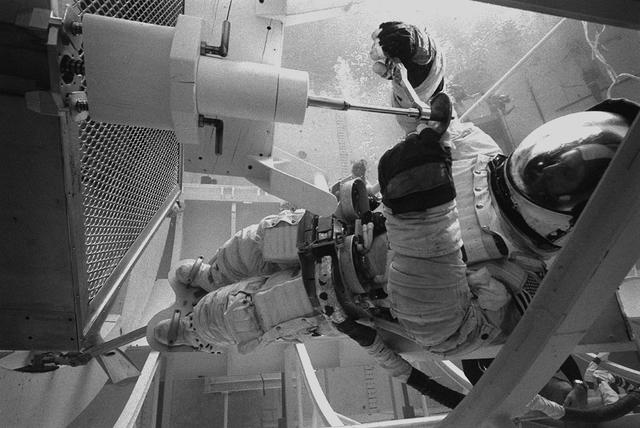
In February 1980, a satellite called Solar Maximum Mission Spacecraft, or Solar Max, was launched into Earth's orbit. Its primary objective was to provide a detailed study of solar flares,active regions on the Sun's surface, sunspots, and other solar activities. Additionally, it was to measure the total output of radiation from the Sun. Not much was known about solar activity at that time except for a slight knowledge of solar flares. After its launch, Solar Max fulfilled everyone's expectations. However, after a year in orbit, Solar Max's Altitude Control System malfunctioned, preventing the precise pointing of instruments at the Sun. NASA scientists were disappointed at the lost data, but not altogether dismayed because Solar Max had been designed for Space Shuttle retrievability enabling the repair of the satellite. On April 6, 1984, Space Shuttle Challenger (STS-41C), Commanded by astronaut Robert L. Crippen and piloted by Francis R. Scobee, launched on a historic voyage. This voyage initiated a series of firsts for NASA; the first satellite retrieval, the first service use of a new space system called the Marned Maneuvering Unit (MMU), the first in-orbit repair, the first use of the Remote Manipulator System (RMS), and the Space Shuttle Challenger's first space flight. The mission was successful in retrieving Solar Max. Mission Specialist Dr. George D. Nelson, using the MMU, left the orbiter's cargo bay and rendezvoused with Solar Max. After attaching himself to the satellite, he awaited the orbiter to maneuver itself nearby. Using the RMS, Solar Max was captured and docked in the cargo bay while Dr. Nelson replaced the altitude control system and the coronagraph/polarimeter electronics box. After the repairs were completed, Solar Max was redeposited in orbit with the assistance of the RMS. Prior to the April 1984 launch, countless man-hours were spent preparing for this mission. The crew of Challenger spent months at Marshall Space Flight Center's (MSFC) Neutral Buoyancy Simulator (NBS) practicing retrieval maneuvers, piloting the MMU, and training on equipment so they could make the needed repairs to Solar Max. Pictured is Dr. Nelson performing a replacement task on the Solar Max mock-up in the NBS.
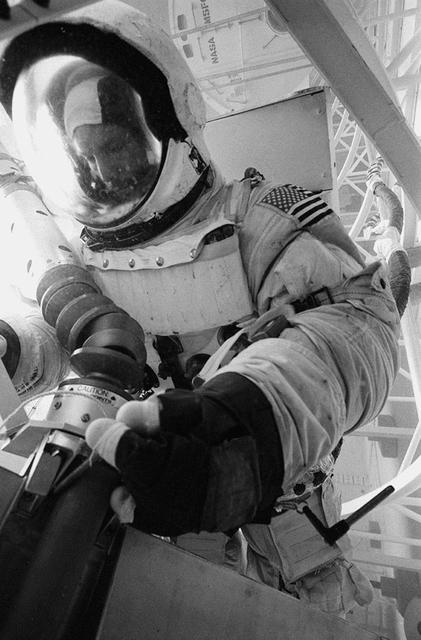
In February 1980, a satellite called Solar Maximum Mission Spacecraft, or Solar Max, was launched into Earth's orbit. Its primary objective was to provide a detailed study of solar flares,active regions on the Sun's surface, sunspots, and other solar activities. Additionally, it was to measure the total output of radiation from the Sun. Not much was known about solar activity at that time except for a slight knowledge of solar flares. After its launch, Solar Max fulfilled everyone's expectations. However, after a year in orbit, Solar Max's Altitude Control System malfunctioned, preventing the precise pointing of instruments at the Sun. NASA scientists were disappointed at the lost data, but not altogether dismayed because Solar Max had been designed for Space Shuttle retrievability, enabling repair to the satellite. On April 6, 1984, Space Shuttle Challenger (STS-41C), Commanded by astronaut Robert L. Crippen and piloted by Francis R. Scobee, launched on a historic voyage. This voyage initiated a series of firsts for NASA; the first satellite retrieval, the first service use of a new space system called the Marned Maneuvering Unit (MMU), the first in-orbit repair, the first use of the Remote Manipulator System (RMS), and the Space Shuttle Challenger's first space flight. The mission was successful in retrieving Solar Max. Mission Specialist Dr. George D. Nelson, using the MMU, left the orbiter's cargo bay and rendezvoused with Solar Max. After attaching himself to the satellite, he awaited the orbiter to maneuver itself nearby. Using the RMS, Solar Max was captured and docked in the cargo bay while Dr. Nelson replaced the altitude control system and the coronagraph/polarimeter electronics box. After the repairs were completed, Solar Max was redeposited in orbit with the assistance of the RMS. Prior to the April 1984 launch, countless man-hours were spent preparing for this mission. The crew of Challenger spent months at Marshall Space Flight Center's (MSFC) Neutral Buoyancy Simulator (NBS) practicing retrieval maneuvers, piloting the MMU, and training on equipment so they could make the needed repairs to Solar Max. Pictured is Dr. Nelson performing a replacement task on the Solar Max mock-up in the NBS.
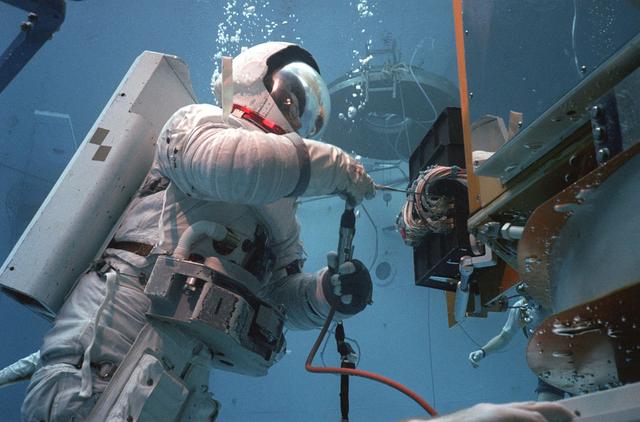
In February 1980, a satellite called Solar Maximum Mission Spacecraft, or Solar Max, was launched into Earth's orbit. Its primary objective was to provide a detailed study of solar flares, active regions on the Sun's surface, sunspots, and other solar activities. Additionally, it was to measure the total output of radiation from the Sun. Not much was known about solar activity at that time except for a slight knowledge of solar flares. After its launch, Solar Max fulfilled everyone's expectations. However, after a year in orbit, Solar Max's Altitude Control System malfunctioned, preventing the precise pointing of instruments at the Sun. NASA scientists were disappointed at the lost data, but not altogether dismayed because Solar Max had been designed for Space Shuttle retrievability enabling the repair of the satellite. On April 6, 1984, Space Shuttle Challenger (STS-41C), Commanded by astronaut Robert L. Crippen and piloted by Francis R. Scobee, launched on a historic voyage. This voyage initiated a series of firsts for NASA; the first satellite retrieval, the first service use of a new space system called the Marned Maneuvering Unit (MMU), the first in-orbit repair, the first use of the Remote Manipulator System (RMS), and the Space Shuttle Challenger's first space flight. The mission was successful in retrieving Solar Max. Mission Specialist Dr. George D. Nelson, using the MMU, left the orbiter's cargo bay and rendezvoused with Solar Max. After attaching himself to the satellite, he awaited the orbiter to maneuver itself nearby. Using the RMS, Solar Max was captured and docked in the cargo bay while Dr. Nelson replaced the altitude control system and the coronagraph/polarimeter electronics box. After the repairs were completed, Solar Max was redeposited in orbit with the assistance of the RMS. Prior to the April 1984 launch, countless man-hours were spent preparing for this mission. The crew of Challenger spent months at Marshall Space Flight Center's (MSFC) Neutral Buoyancy Simulator (NBS) practicing retrieval maneuvers, piloting the MMU, and training on equipment so they could make the needed repairs to Solar Max. Pictured is Dr. Nelson performing a replacement task on the Solar Max mock-up in the NBS.
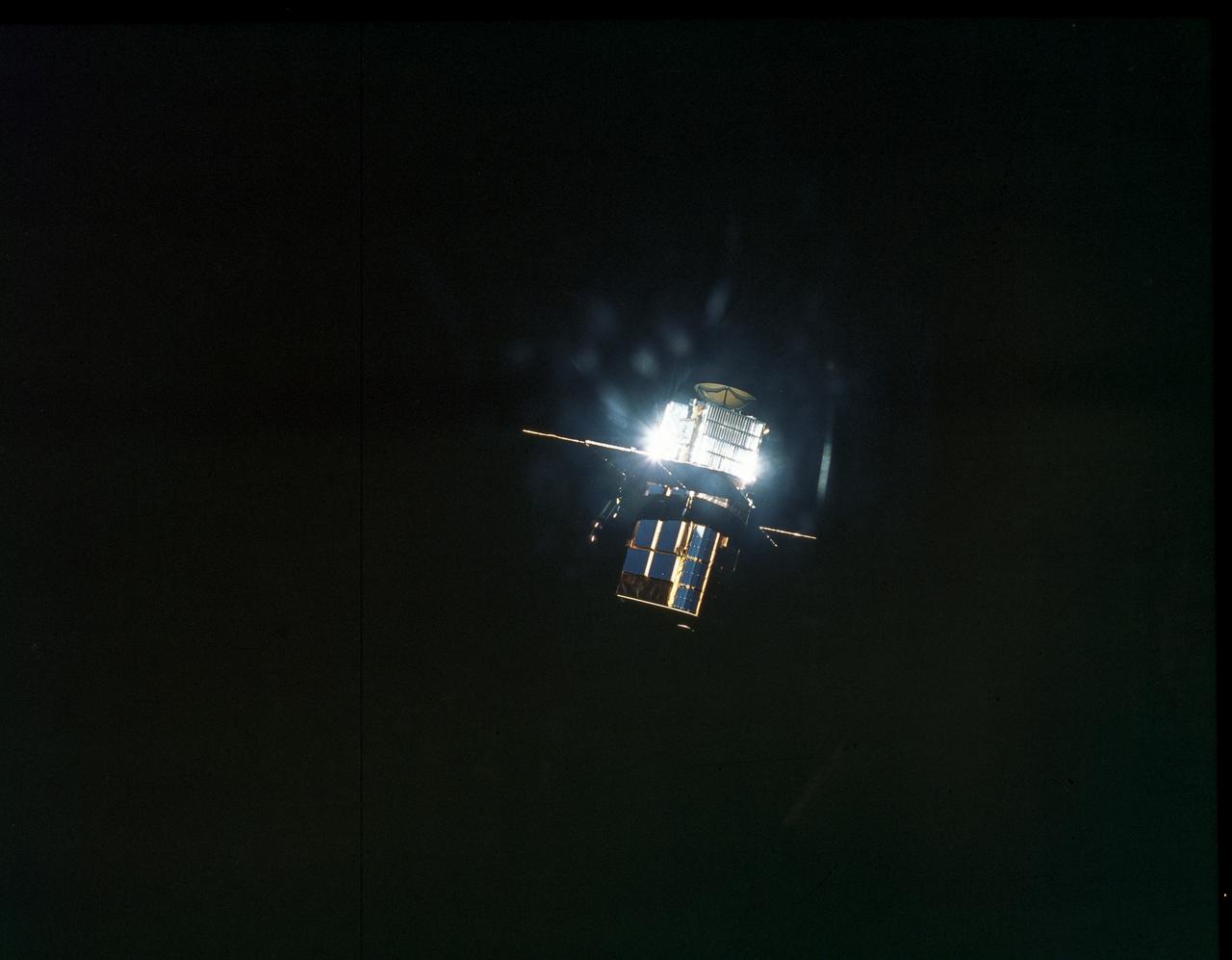
This is a photograph of the free-flying Solar Maximum Mission Satellite (SMMS), or Solar Max, as seen by the approaching Space Shuttle Orbiter Challenger STS-41C mission. Launched April 6, 1984, one of the goals of the STS-41C mission was to repair the damaged Solar Max. The original plan was to make an excursion out to the SMMS for capture to make necessary repairs, however, this attempted feat was unsuccessful. It was necessary to capture the satellite via the orbiter's Remote Manipulator System (RMS) and secure it into the cargo bay in order to perform the repairs, which included replacing the altitude control system and the coronograph/polarimeter electronics box. The SMMS was originally launched into space via the Delta Rocket in February 1980, with the purpose to provide a means of studying solar flares during the most active part of the current sunspot cycle. Dr. Einar Tandberg-Hanssen of Marshall Space Flight Center's Space Sciences Lab was principal investigator for the Ultraviolet Spectrometer and Polarimeter, one of the seven experiments on the Solar Max.
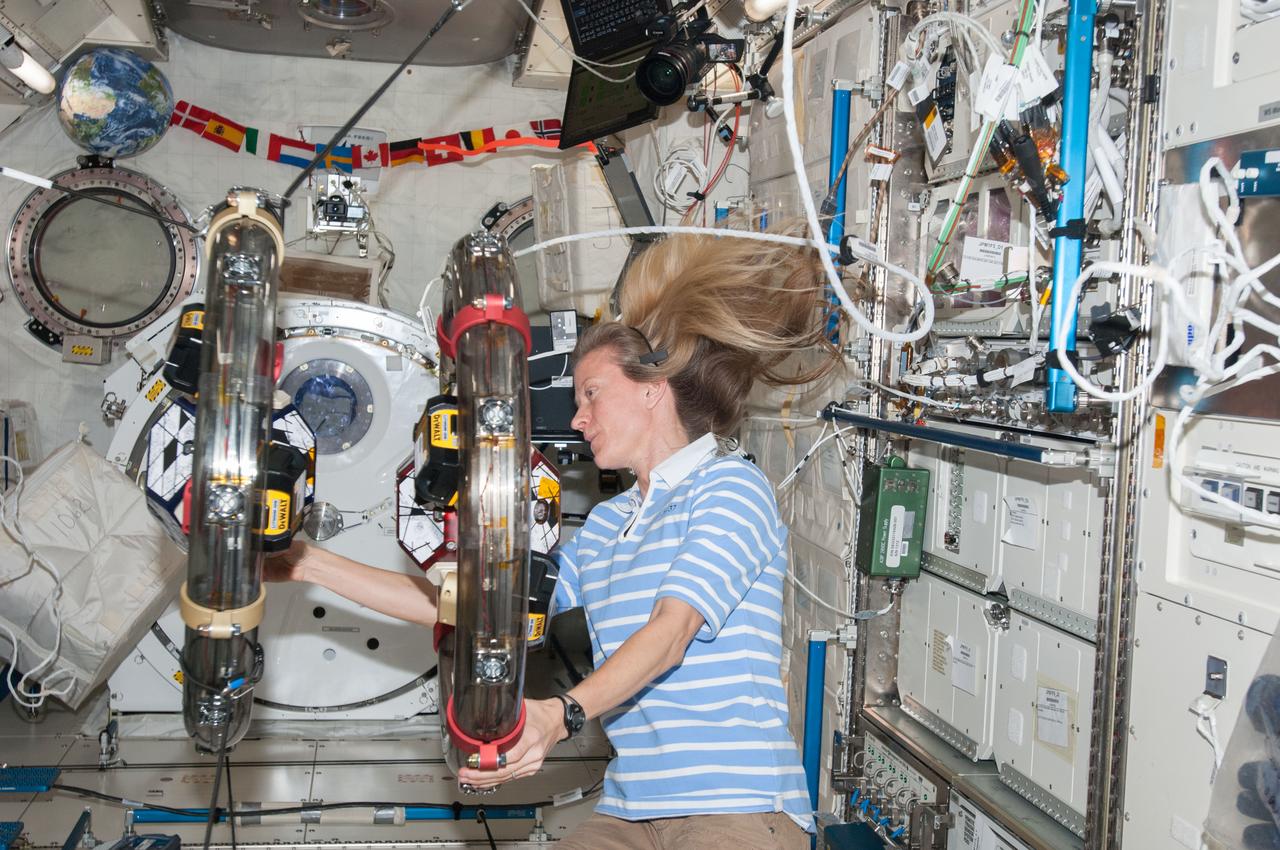
ISS036-E-037288 (27 Aug. 2013) --- In the International Space Station?s Kibo laboratory, NASA astronaut Karen Nyberg, Expedition 36 flight engineer, conducts a session with a pair of bowling-ball-sized free-flying satellites known as Synchronized Position Hold, Engage, Reorient, Experimental Satellites, or SPHERES. Surrounding the two SPHERES mini-satellites with ring-shaped hardware known as the Resonant Inductive Near-field Generation System, or RINGS, Nyberg performed a demonstration of how power can be transferred between two satellites without physical contact. Station crews beginning with Expedition 8 have operated these robots to test techniques that could lead to advancements in automated dockings, satellite servicing, spacecraft assembly and emergency repairs.
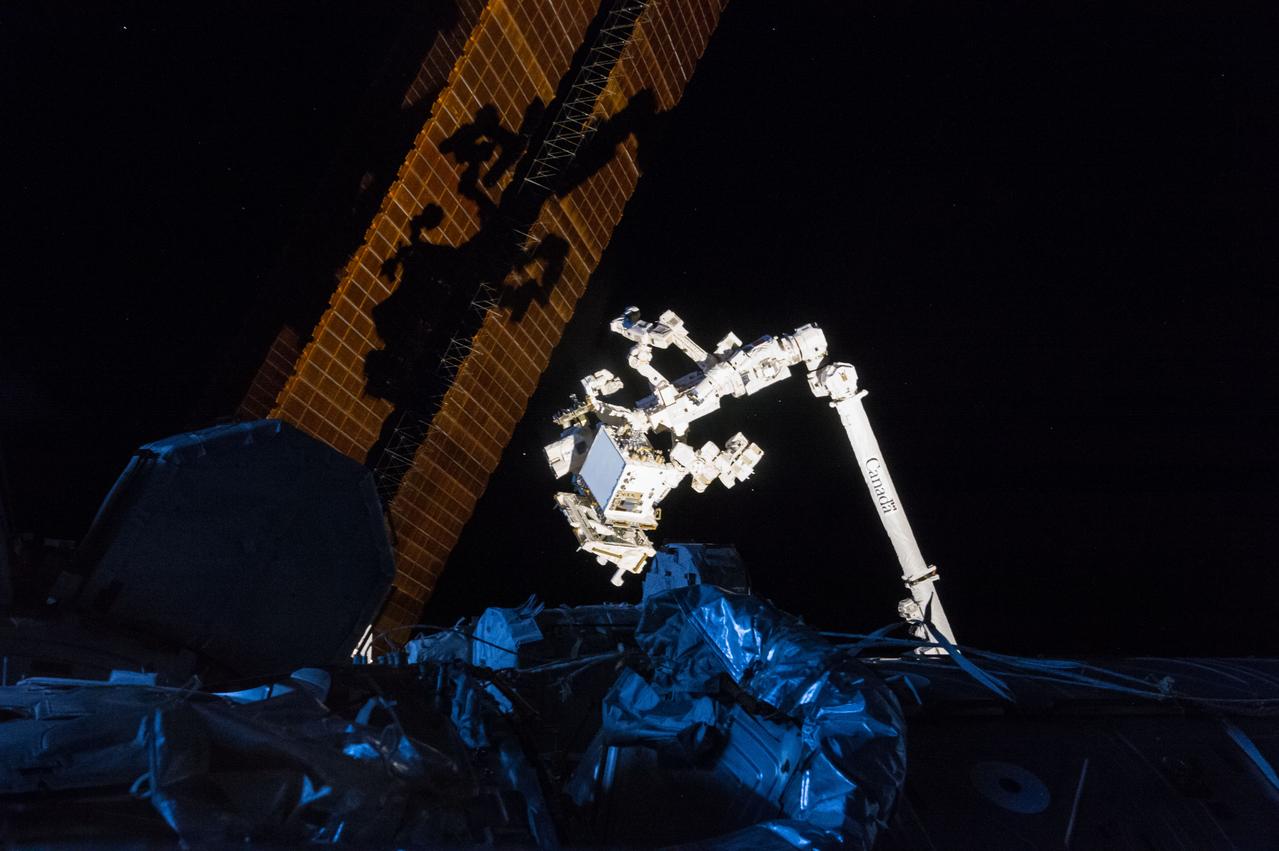
iss050e056301 (3/8/2017) --- A view of the Space Station Remote Manipulator System (SSRMS) during Robotic Refueling Mission-Phase 2 (RRM-P2) operations. NASA's Robotic Refueling Mission (RRM) is an external International Space Station (ISS) investigation that demonstrates and tests the tools, technologies and techniques needed to robotically refuel, repair, and upgrade satellites in space, especially satellites that were not designed to be serviced. A joint effort between NASA and the Canadian Space Agency (CSA), RRM is the first in-orbit attempt to test robotic refueling and servicing techniques for spacecraft not built with in-orbit servicing in mind.

iss072e423785 (1/3/2025) — A view of the CLINGERS Cubesat connection mechanism aboard the International Space Station (ISS). Flight Tech Demo of Docking/Undocking Cubesats Inside ISS (CLINGERS) uses the International Space Station’s Astrobee robots to demonstrate an adaptor for docking and close approach sensing to connect both active and passive objects in space. These are critical functions to enable applications such as satellite servicing, orbital refueling, spacecraft repair and upgrade, and in-orbit manufacturing.
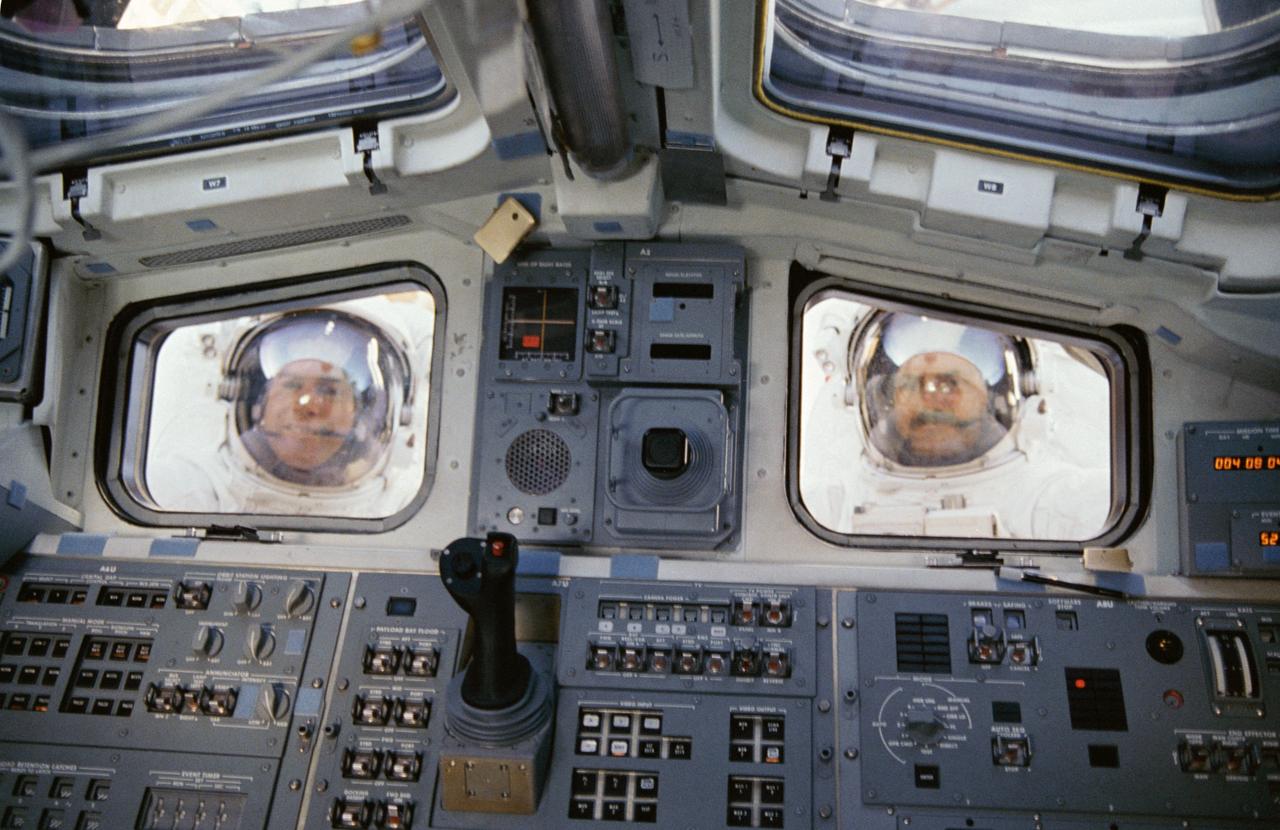
51I-11-027 (1 Sept 1985) --- The extravehicular activity (EVA) of astronauts William F. Fisher (left) and James D. van Hoften succeeded in the capture, repair and re-release of the troubled Syncom IV-3 satellite. Here, the two take a break from the serious side of their EVA to look into the Discovery's cabin. The 51-I crewmembers showed this scene at their Sept. 11 post-flight press conference.

iss072e747124 (March 18, 2025) --- NASA astronaut and Expedition 72 Flight Engineer Nichole Ayers works inside the International Space Station's Kibo laboratory module loading software onto an Astrobee robotic free-flyer. The software is part of a technology investigation demonstrating an adaptor for docking and close approach sensing to connect both active and passive objects in space. Results may enable applications such as satellite servicing, orbital refueling, spacecraft repair and upgrade, and in-orbit manufacturing.
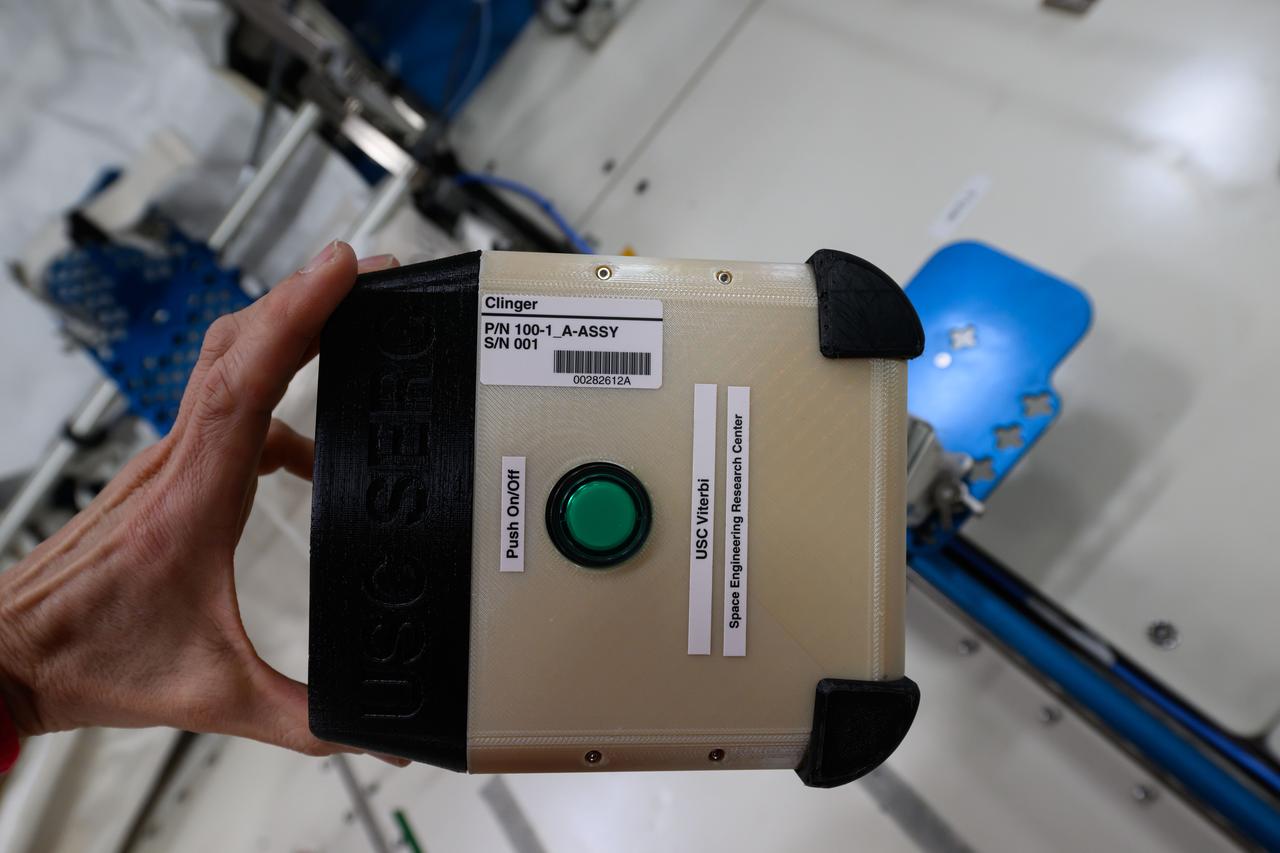
iss072e423784 (1/3/2025) — A view of the CLINGERS Cubesat aboard the International Space Station (ISS). Flight Tech Demo of Docking/Undocking Cubesats Inside ISS (CLINGERS) uses the International Space Station’s Astrobee robots to demonstrate an adaptor for docking and close approach sensing to connect both active and passive objects in space. These are critical functions to enable applications such as satellite servicing, orbital refueling, spacecraft repair and upgrade, and in-orbit manufacturing.
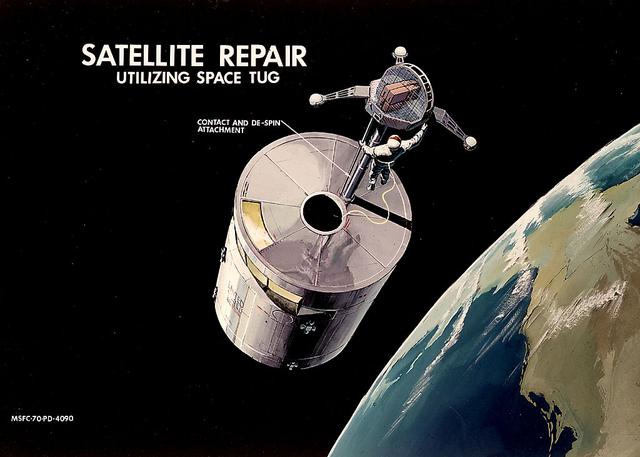
Managed by Marshall Space Flight Center, the Space Tug was a reusable multipurpose space vehicle designed to transport payloads to different orbital inclinations. Utilizing mission-specific combinations of its three primary modules (crew, propulsion, and cargo) and a variety of supplementary kits, the Space Tug was capable of numerous space applications. This 1970 artist's concept depicts the Space Tug during a satellite repair mission with the contact and de-spin attachment kit in place. An astronaut can be seen tethered to the Tug.
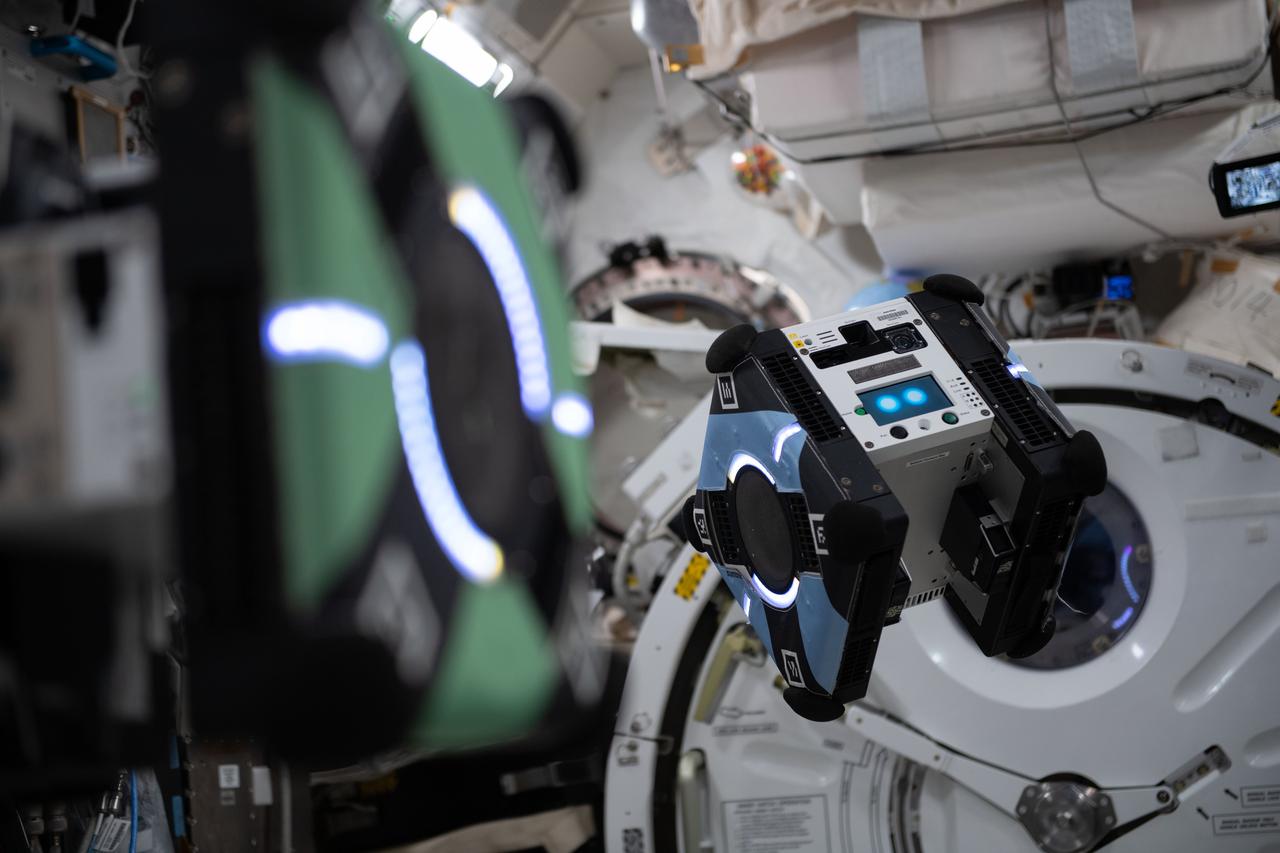
iss066e134729 (Feb. 2, 2022) --- A view of an Astrobee ROAM Operations Session 2 in the JEM during Expedition 66. ROAM demonstrates processes for a robotic craft to rendezvous with debris in space. Space debris includes satellites that could be repaired or taken out of orbit, but many of these objects are tumbling, making rendezvous and docking challenging. ROAM uses the space station’s Astrobee robots to observe and understand how targets tumble and uses this information to plan ways to safely reach them.
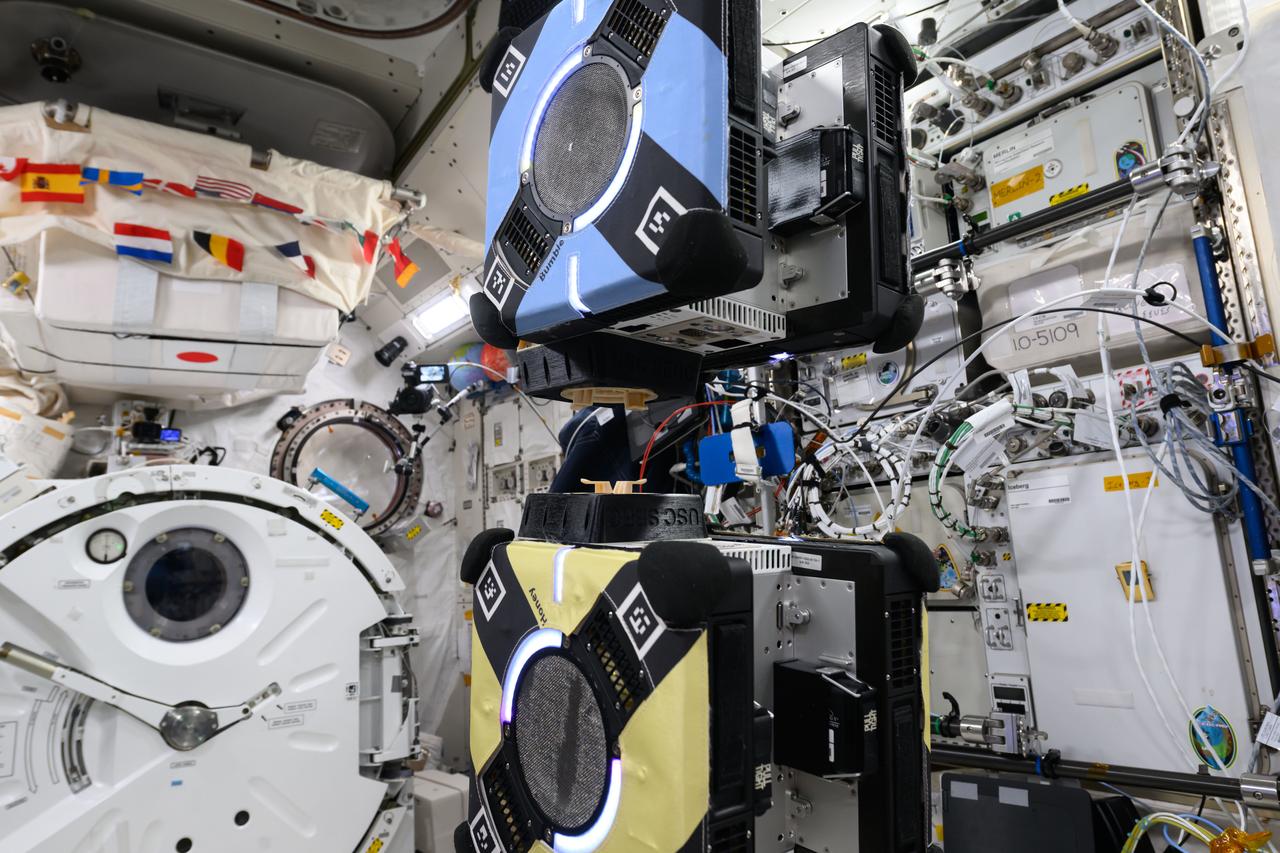
iss072e423875 (1/3/2025) — A view of the CLINGERS Cubesats attached to Astrobee aboard the International Space Station (ISS). Flight Tech Demo of Docking/Undocking Cubesats Inside ISS (CLINGERS) uses the International Space Station’s Astrobee robots to demonstrate an adaptor for docking and close approach sensing to connect both active and passive objects in space. These are critical functions to enable applications such as satellite servicing, orbital refueling, spacecraft repair and upgrade, and in-orbit manufacturing.
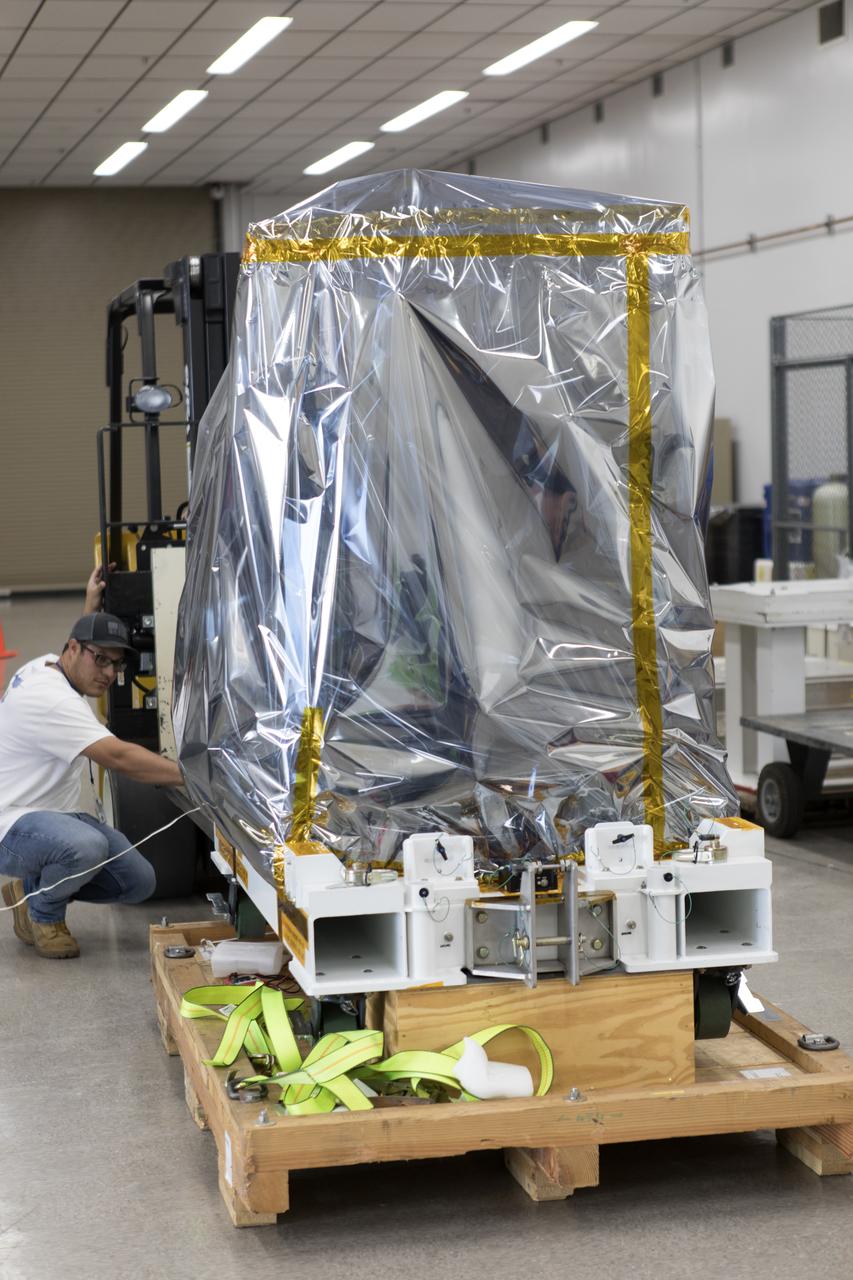
NASA’s Robotic Refueling Mission 3 (RRM3) builds on the first two phases of International Space Station (ISS) technology demonstrations that tested tools, technologies and techniques to refuel and repair satellites in orbit. RRM3, which arrived at Kennedy Space Center’s Space Station Processing Facility on May 8, is planned to launch to the ISS later this year.
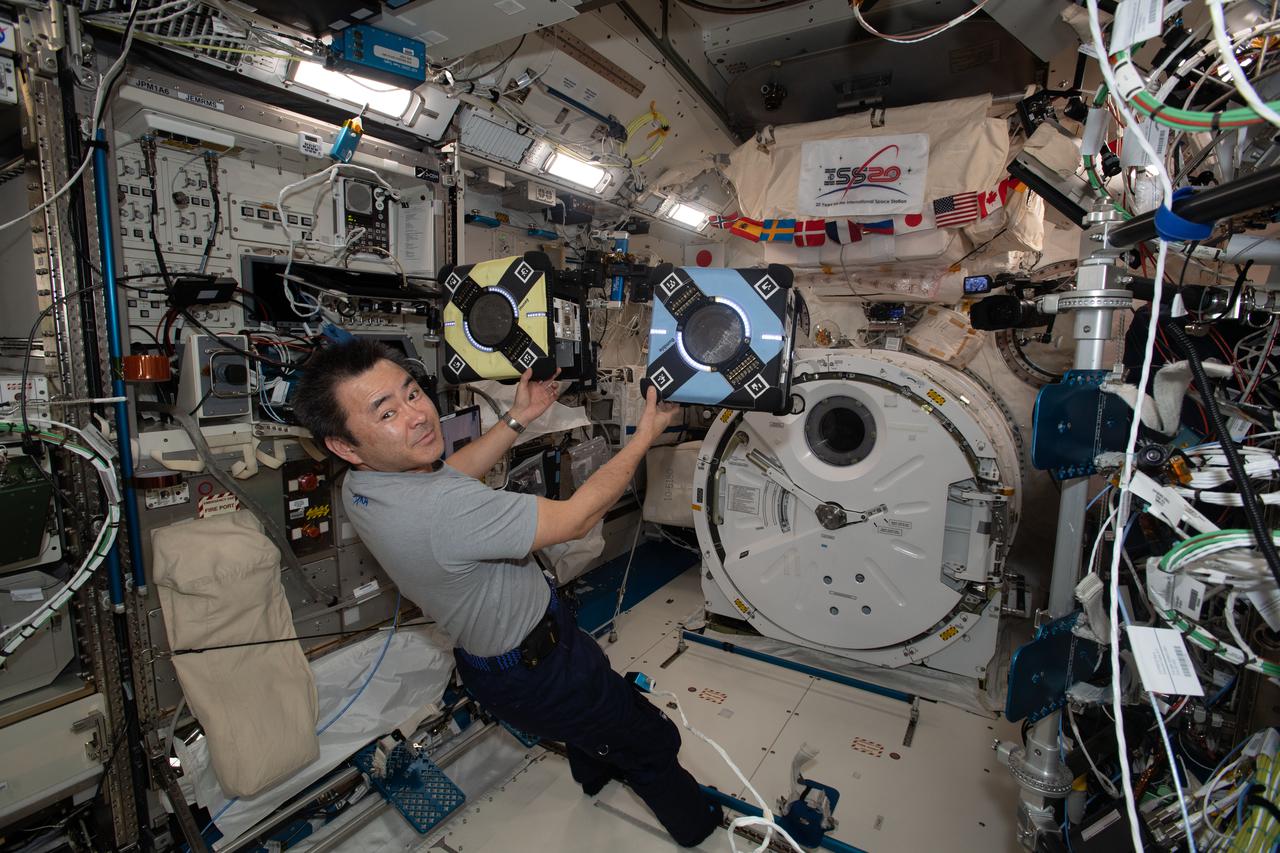
iss065e319330 (Aug. 26, 2021) --- Expedition 65 Commander Akihiko Hoshide of the Japan Aerospace Exploration Agency checks out a pair of Astrobee robotic free-flyers. The toaster-sized robotic assistants are being tested for their ability to autonomously conduct routine orbital chores, monitor station activities and coordinate maneuvers for future satellite repair techniques.
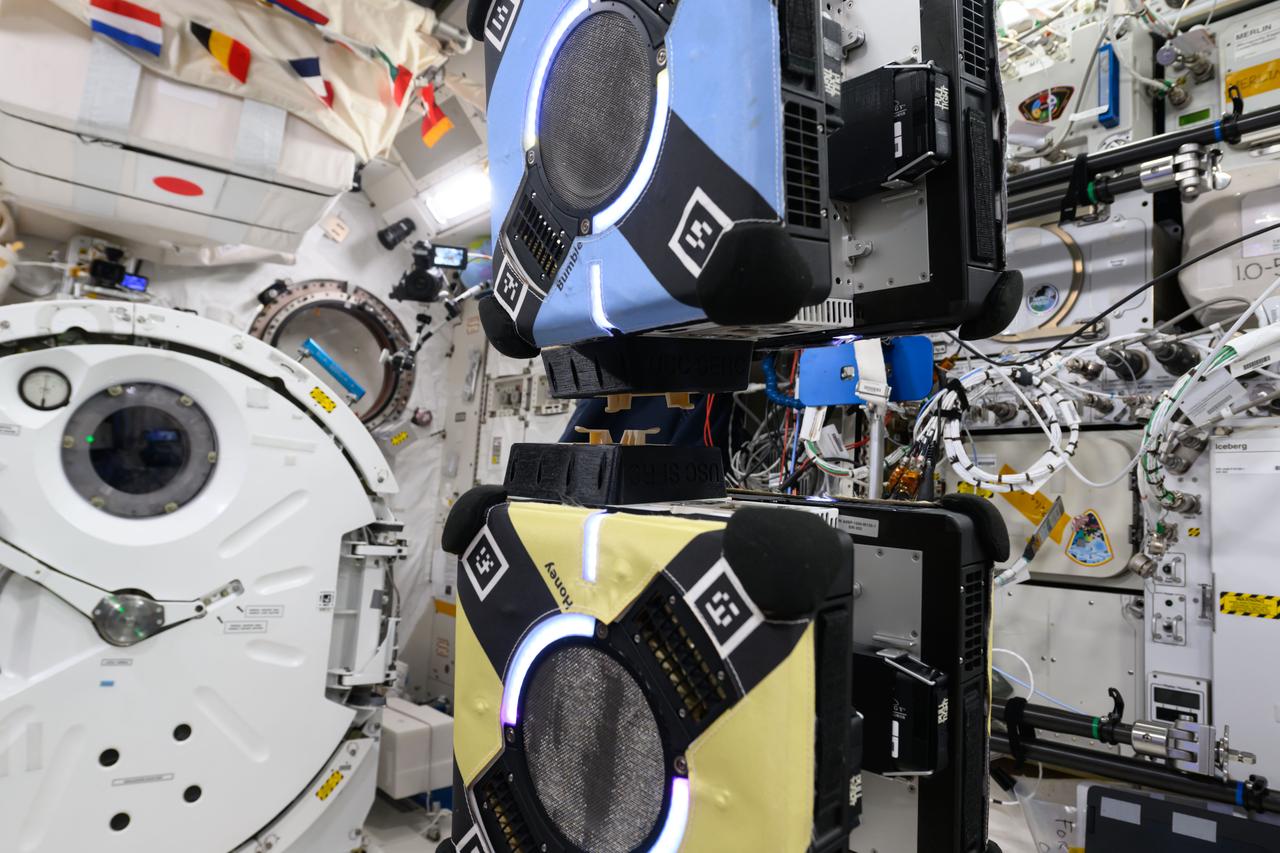
iss072e423864 (1/3/2025) — A view of the CLINGERS Cubesats attached to Astrobee aboard the International Space Station (ISS). Flight Tech Demo of Docking/Undocking Cubesats Inside ISS (CLINGERS) uses the International Space Station’s Astrobee robots to demonstrate an adaptor for docking and close approach sensing to connect both active and passive objects in space. These are critical functions to enable applications such as satellite servicing, orbital refueling, spacecraft repair and upgrade, and in-orbit manufacturing.
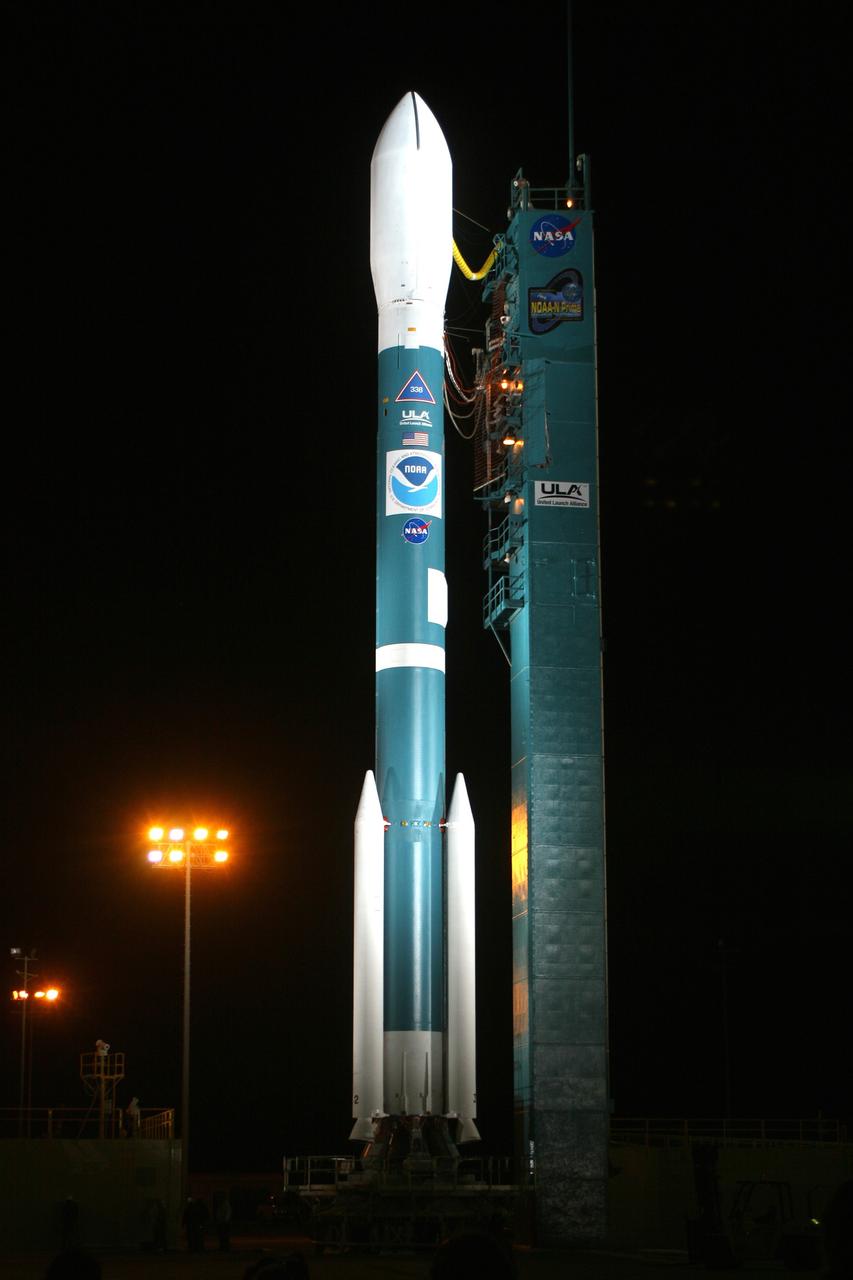
VANDENBERG AIR FORCE BASE, Calif. -- The mobile service tower moves away from the Delta II rocket with NASA's NOAA-N Prime satellite aboard on the Space Launch Complex 2 at Vandenberg Air Force Base in California. The launch of the NOAA-N Prime weather satellite was scrubbed at 5 a.m. EST Feb. 3 when a launch pad gaseous nitrogen pressurization system failed. This system maintains pressurization and purges to various systems of the Delta II rocket prior to launch. Immediate repair to this system was being taken. The next launch attempt will be no earlier than 5:22 a.m. EST Feb. 5, weather permitting. NOAA-N Prime is the latest polar-orbiting operational environmental weather satellite developed by NASA for the National Oceanic and Atmospheric Administration. Photo credit: NASA/Carleton Bailie, VAFB-ULA

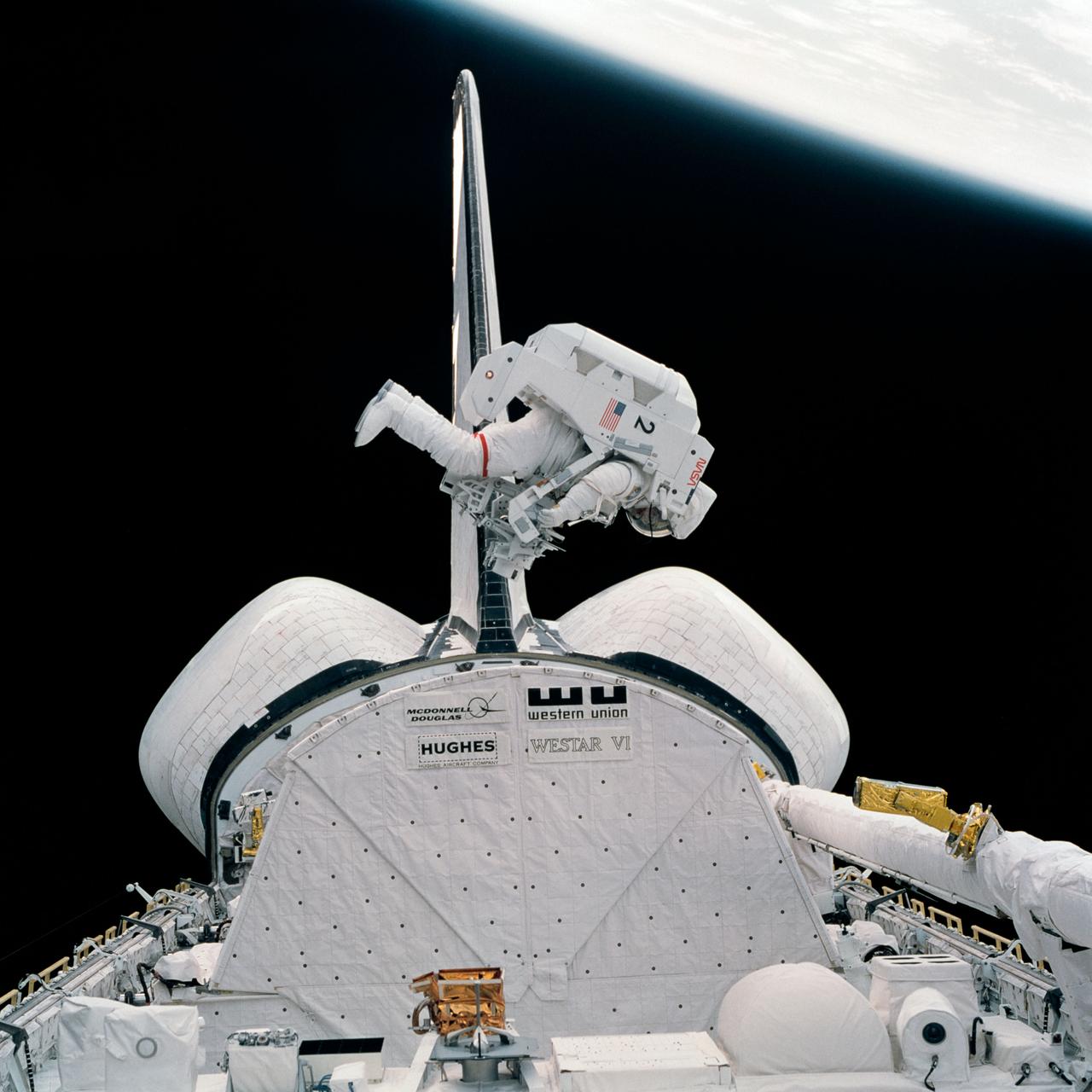
Astronat Dale A. Gardner achieves a hard dock with the previously spinning Westar VI satellite. Gardner uses a "stinger" device to stabilize the communications satellite.
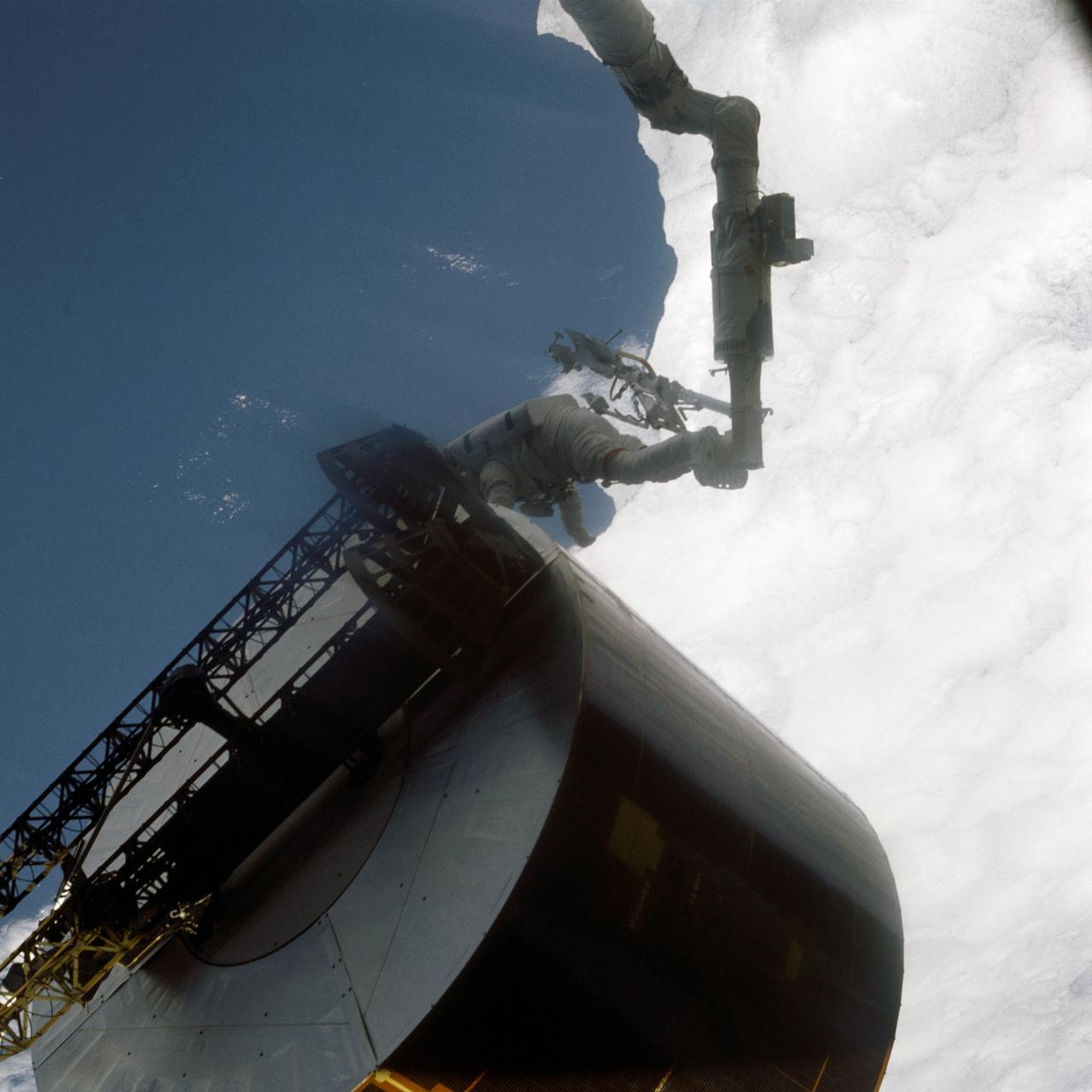
51I-44-014 (31 Aug-1 Sept. 1985) --- This photograph is one of a series of six covering extravehicular activity (EVA) which were released by NASA on Sept. 4, 1985. Here, astronaut James D. van Hoften, dwarfed by the large satellite, moves in for initial contact. Astronaut John M. (Mike) Lounge, out of frame inside cabin, maneuvers the remote manipulator system (RMS) arm to assist astronauts van Hoften and William F. Fisher. Photo credit: NASA

51A-104-008 (14 Nov 1984) --- Astronaut Dale A. Gardner appears to be under the remote manipulator system (RMS) end effector as he makes a turn in space and prepared to traverse, using the manned maneuvering unit (MMU) backpack, to the nearby Westar VI to "Sting" it with the device he carries. The stringer will enter the communications satellite through the nozzle of the spent motor. Gardner achieved a hard dock at 6:32 A.M. and this picture was photographed about five minutes earlier, on Nov. 14, 1984.
S84-27023 (7 Feb 1984) --- This 70mm frame shows astronaut Bruce McCandless II moving in to conduct a test involving the Trunion Pin Attachment Device (TPAD) he carries and the Shuttle Pallet Satellite (SPAS-01A) partially visible at bottom of frame. SPAS was a stand-in for the damaged Solar Maximum Satellite (SMS) which will be visited for repairs by the STS-41C Shuttle crew in early spring. This particular Extravehicular Activity (EVA) session was a rehearsal for the SMS visit. The test and the actual visit to the SMS both involve the use of jet-powered, hand-controlled Manned Maneuvering Unit (MMU). The one McCandless uses is the second unit to be tested on this flight. Astronaut Robert L. Stewart got a chance to work with both MMU's on the two EVA's.
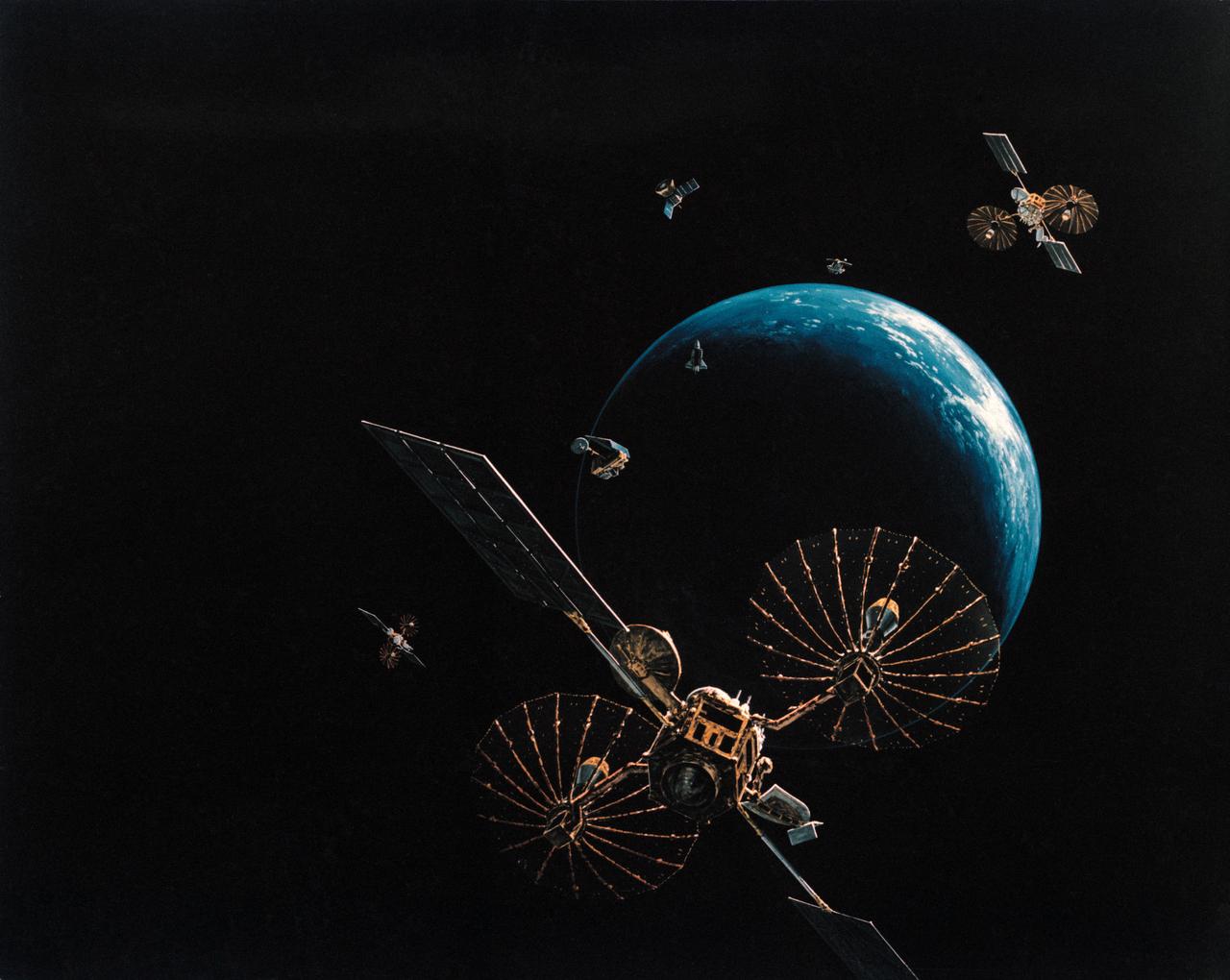
Artist concept shows the Tracking and Data Relay Satellite E (TDRS-E) augmenting a sophisticated TDRS system (TDRSS) communications network after deployment during STS-43 from Atlantis, Orbiter Vehicle (OV) 104. TDRS, built by TRW, will be placed in a geosynchronous orbit and after onorbit testing, which requires several weeks, will be designated TDRS-5. The communications satellite will replace TDRS-3 at 174 degrees West longitude. The backbone of NASA's space-to-ground communications, the TDRSs have increased NASA's ability to send and receive data to spacecraft in low-earth orbit to more than 85 percent of the time. Before TDRS, NASA relied solely on a system of ground stations that permitted communications only 15 percent of the time. Increased coverage has allowed onorbit repairs, live television broadcast from space and continuous dialogues between astronaut crews and ground control during critical periods such as Space Shuttle landings.
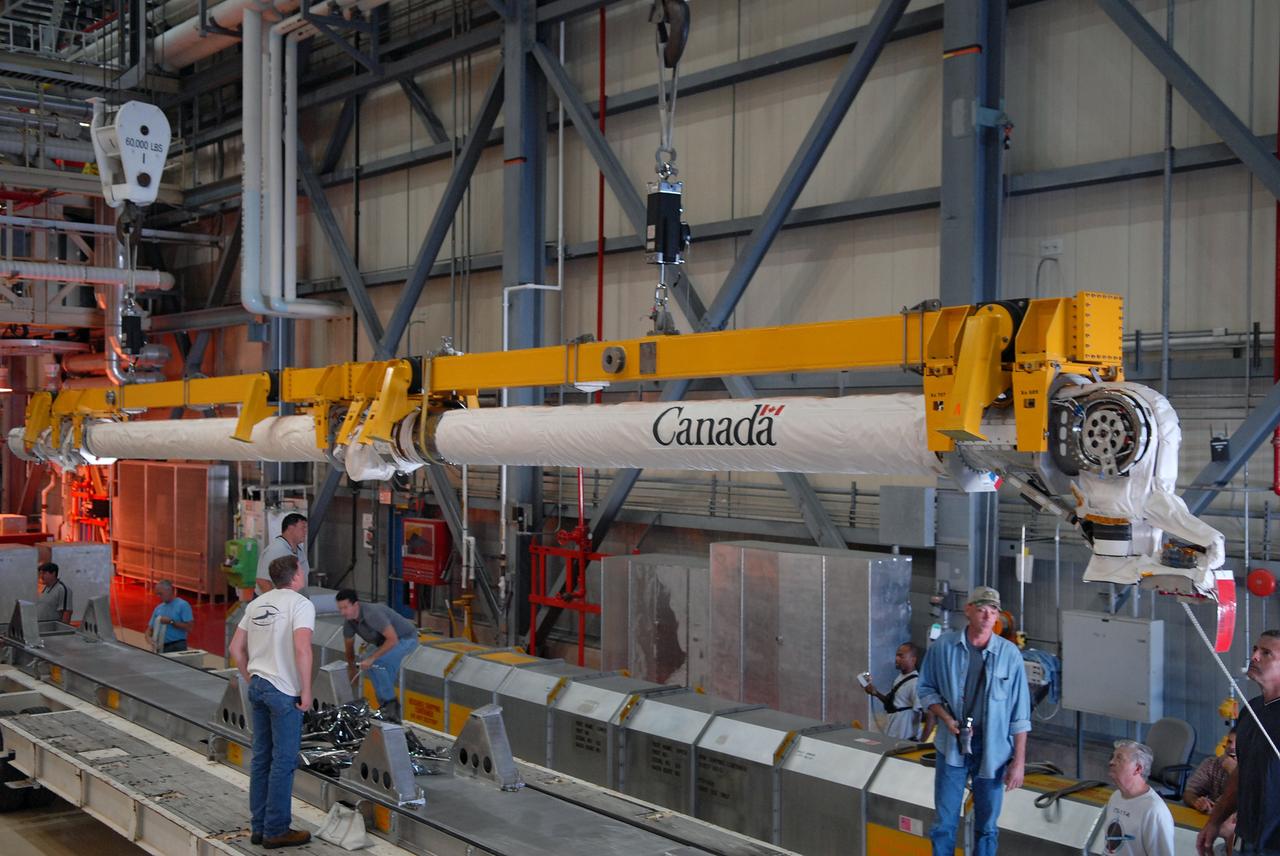
CAPE CANAVERAL, Fla. – In Orbiter Processing Facility bay 3 at NASA's Kennedy Space Center in Florida, the remote manipulator system, or RMS, removed from space shuttle Discovery is lowered toward a storage platform. The RMS is used to grab, or grapple, the payload as well as retrieve, repair and deploy satellites; provide a mobile extension ladder for spacewalking crewmembers; and be used as an inspection aid to allow flight crew members to view the orbiter’s or payload’s surfaces through a TV camera on the arm. Discovery is targeted to launch Aug. 6 on the STS-128 mission. Photo credit: NASA/Jack Pfaller
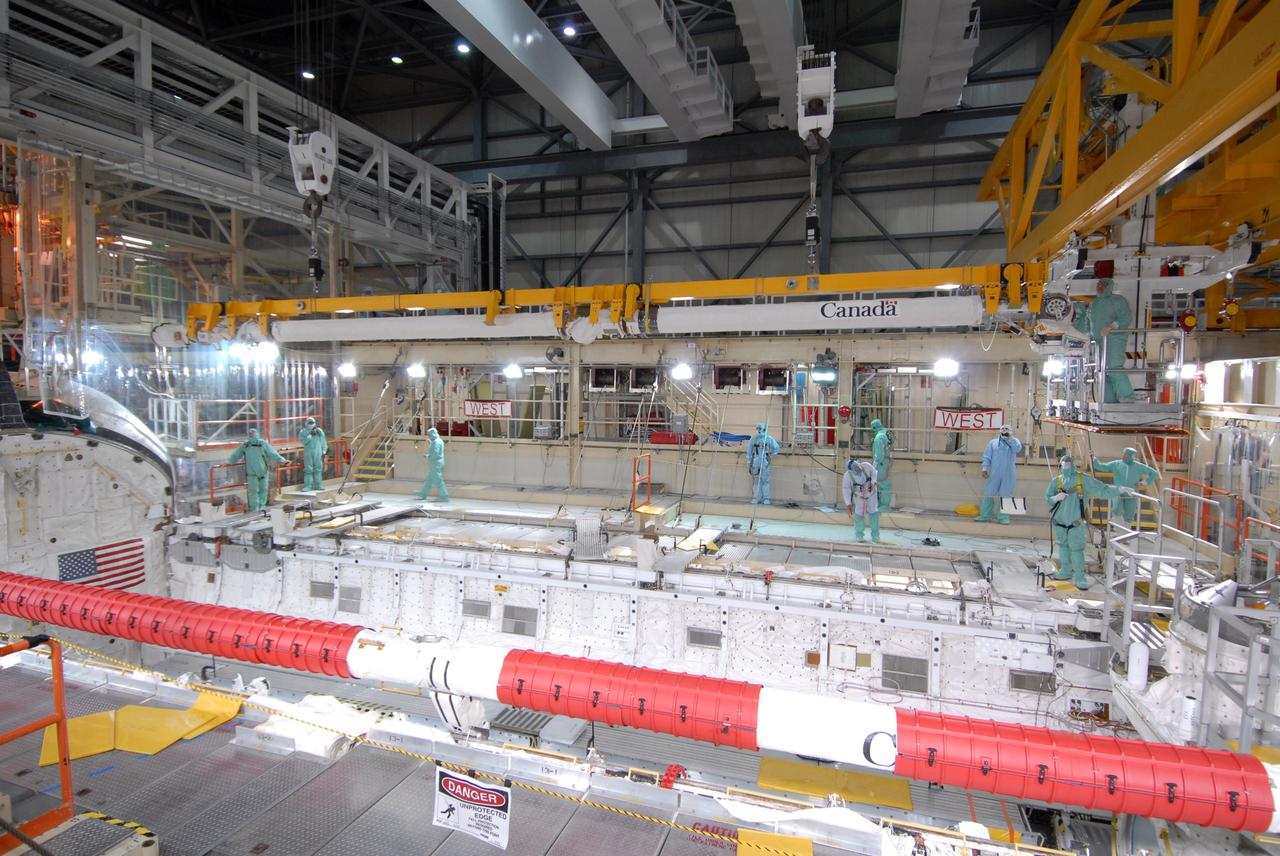
CAPE CANAVERAL, Fla. – In Orbiter Processing Facility bay 3 at NASA's Kennedy Space Center in Florida, the remote manipulator system, or RMS, arm is lifted away from the payload bay of space shuttle Discovery. The RMS is used to grab, or grapple, the payload as well as retrieve, repair and deploy satellites; provide a mobile extension ladder for spacewalking crewmembers; and be used as an inspection aid to allow flight crew members to view the orbiter’s or payload’s surfaces through a TV camera on the arm. Discovery is targeted to launch Aug. 6 on the STS-128 mission. Photo credit: NASA/Jack Pfaller
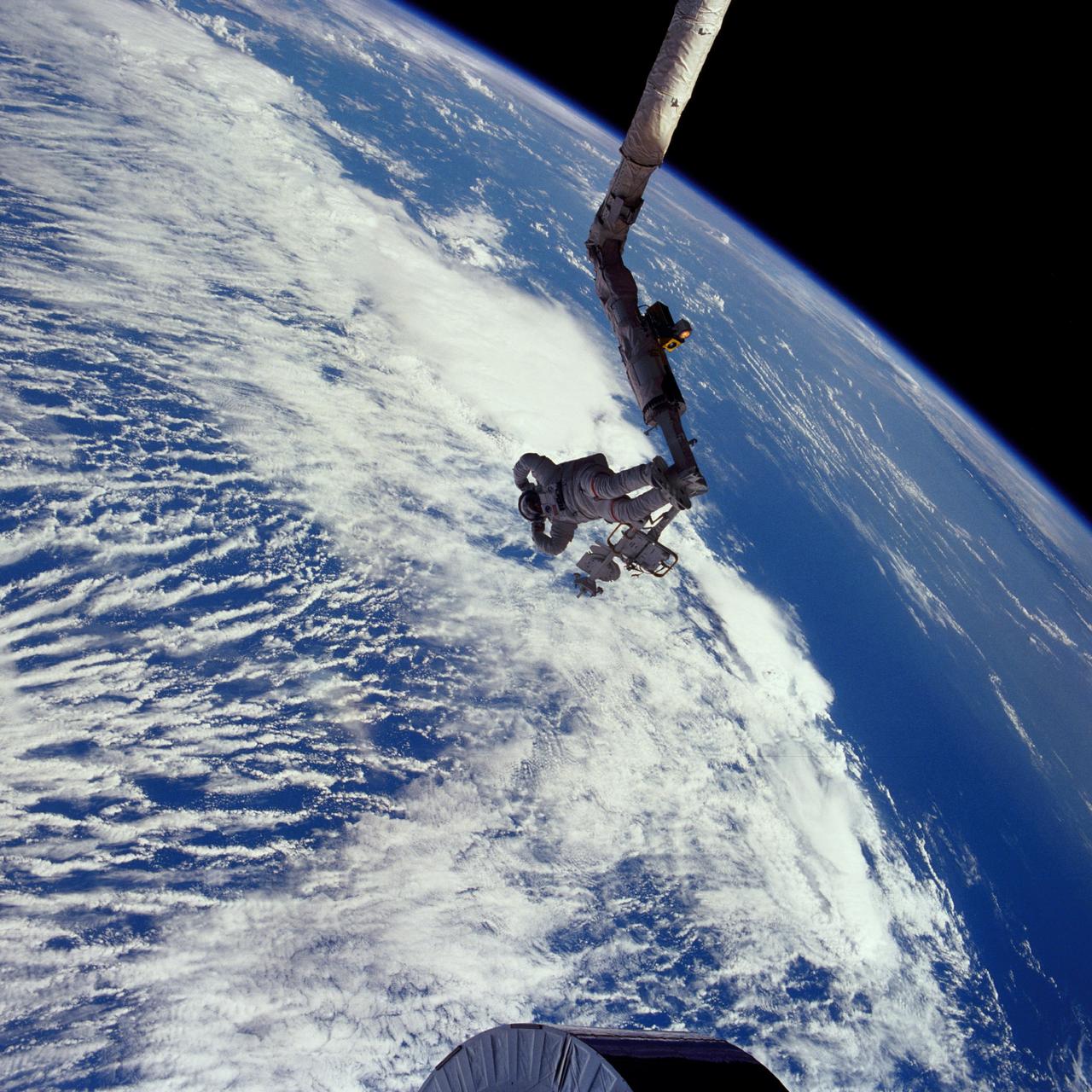
51I-41-086 (1 September 1985) --- Astronaut James D. van Hoften, mission specialist, flexes his muscles in celebration of a triumphant extravehicular task. Clouds over the ocean form the backdrop for this 70mm scene, toward the end of a two-day effort to capture, repair and release the previously errant Syncom IV-3 communications satellite. Van Hoften, anchored to a special foot restraint device on the end of Discovery's Remote Manipulator System (RMS), had just performed the final "shove" that started the relative separation of the Shuttle and the Syncom, which is not far out of frame. He had been joined by astronaut William F. Fisher for the busy two days of EVA.
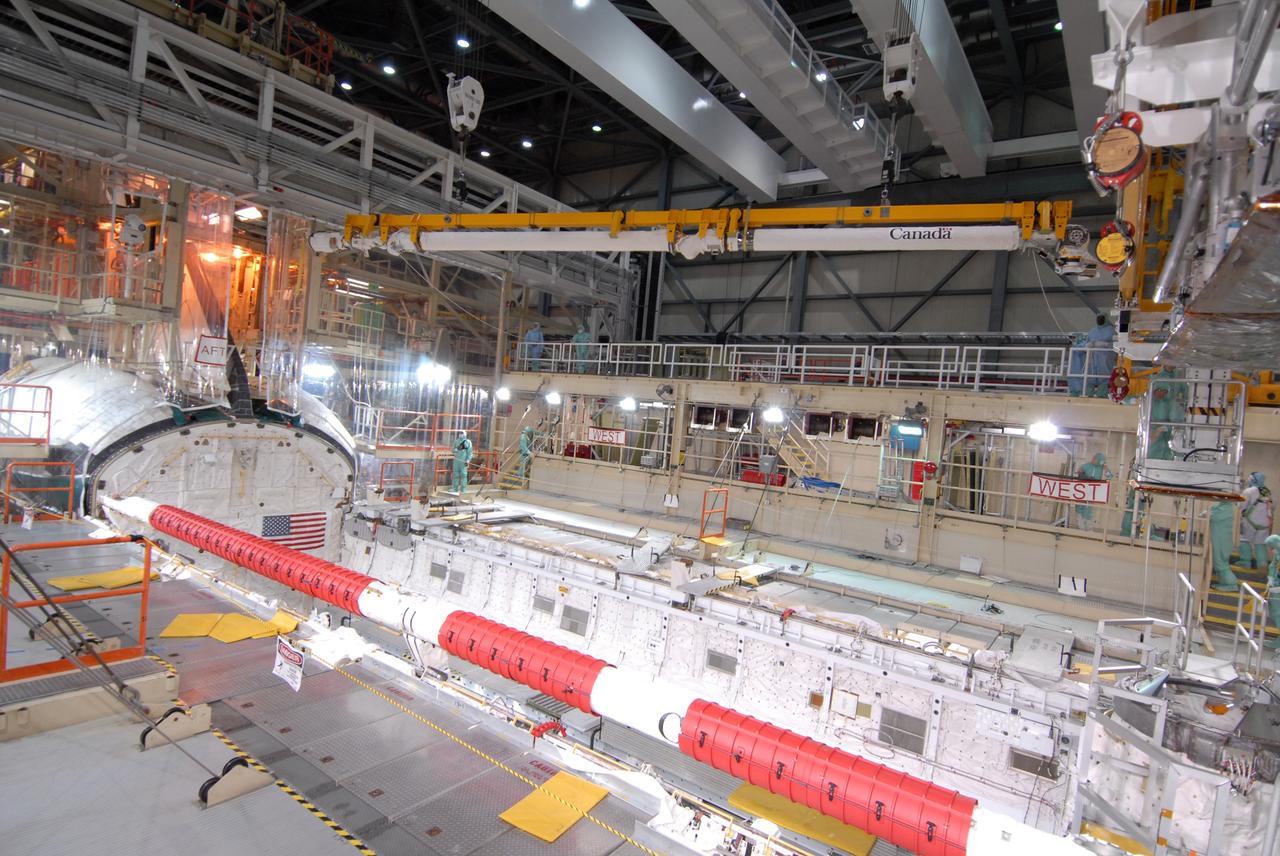
CAPE CANAVERAL, Fla. – In Orbiter Processing Facility bay 3 at NASA's Kennedy Space Center in Florida, the remote manipulator system, or RMS, arm is lifted out of space shuttle Discovery's payload bay. The RMS is used to grab, or grapple, the payload as well as retrieve, repair and deploy satellites; provide a mobile extension ladder for spacewalking crewmembers; and be used as an inspection aid to allow flight crew members to view the orbiter’s or payload’s surfaces through a TV camera on the arm. Discovery is targeted to launch Aug. 6 on the STS-128 mission. Photo credit: NASA/Jack Pfaller
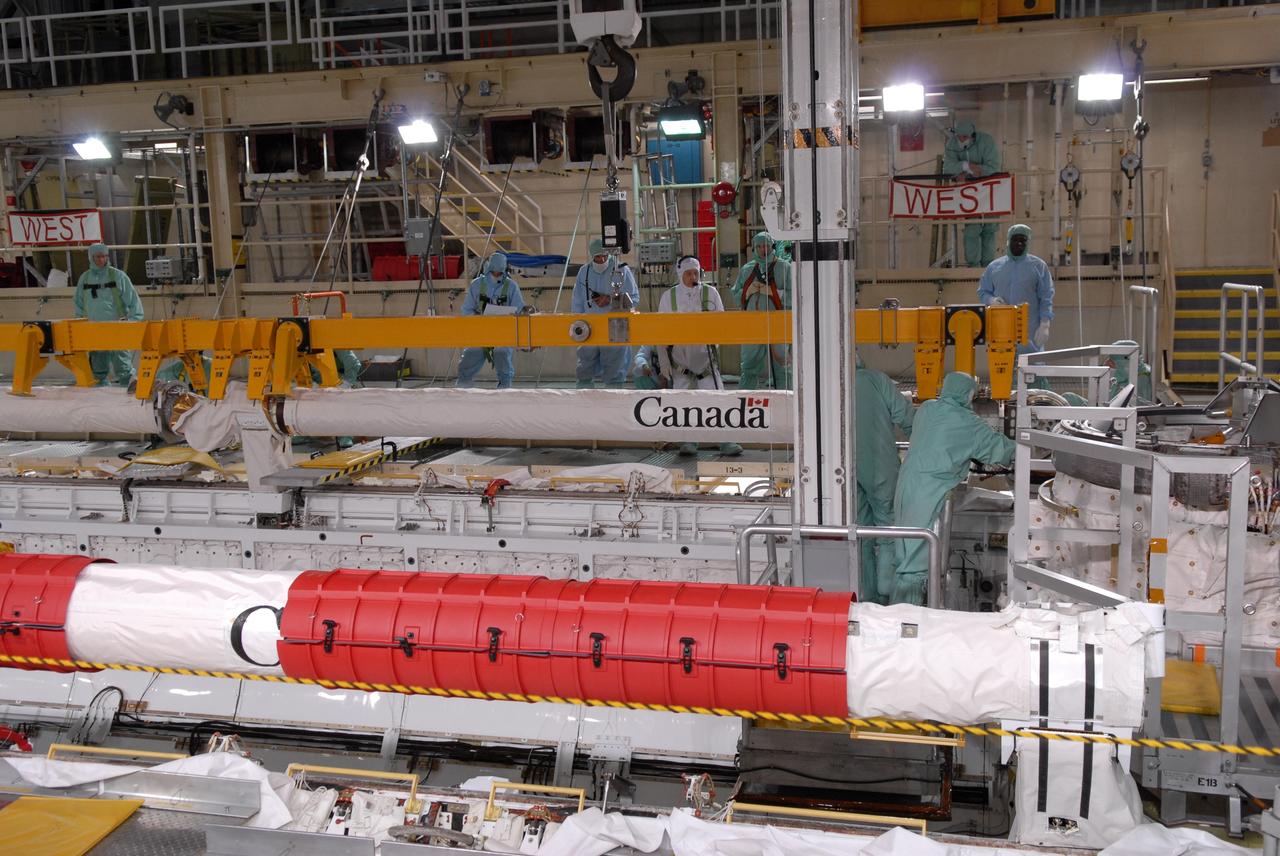
CAPE CANAVERAL, Fla. – In Orbiter Processing Facility bay 3 at NASA's Kennedy Space Center in Florida, technicians prepare to remove the remote manipulator system, or RMS, arm in the payload bay of space shuttle Discovery. The RMS is used to grab, or grapple, the payload as well as retrieve, repair and deploy satellites; provide a mobile extension ladder for spacewalking crewmembers; and be used as an inspection aid to allow flight crew members to view the orbiter’s or payload’s surfaces through a TV camera on the arm. Discovery is targeted to launch Aug. 6 on the STS-128 mission. Photo credit: NASA/Jack Pfaller
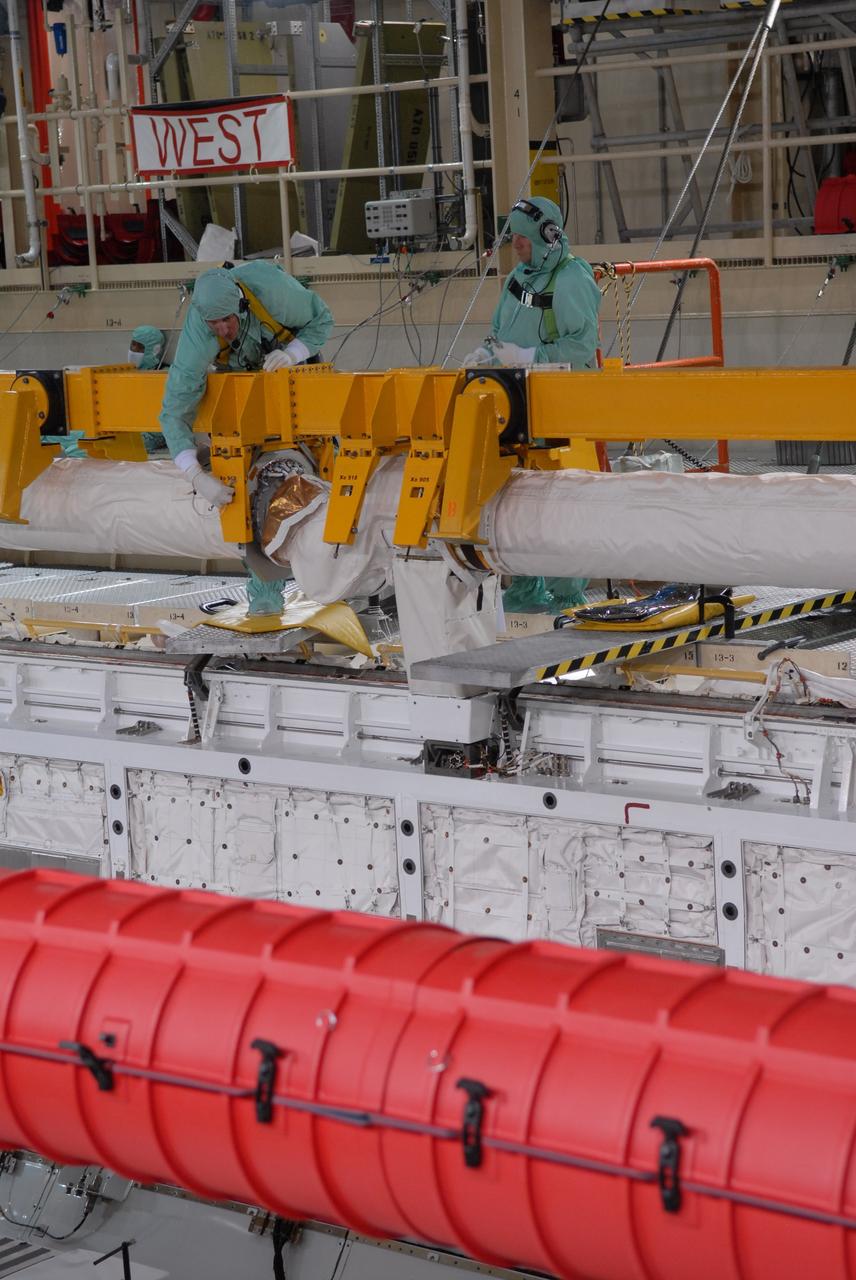
CAPE CANAVERAL, Fla. – In Orbiter Processing Facility bay 3 at NASA's Kennedy Space Center in Florida, technicians prepare to remove remote manipulator system, or RMS, arm in the payload bay of space shuttle Discovery. The RMS is used to grab, or grapple, the payload as well as retrieve, repair and deploy satellites; provide a mobile extension ladder for spacewalking crewmembers; and be used as an inspection aid to allow flight crew members to view the orbiter’s or payload’s surfaces through a TV camera on the arm. Discovery is targeted to launch Aug. 6 on the STS-128 mission. Photo credit: NASA/Jack Pfaller
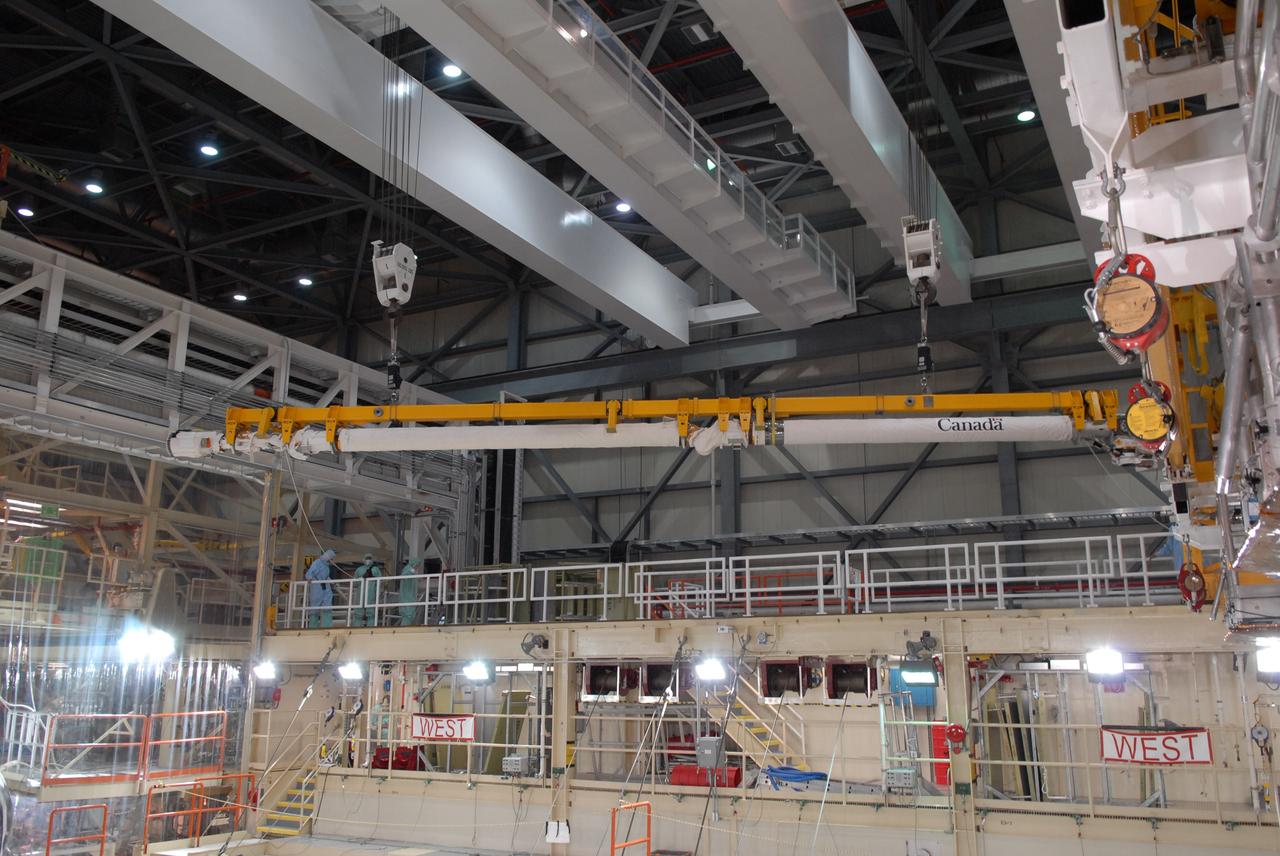
CAPE CANAVERAL, Fla. – In Orbiter Processing Facility bay 3 at NASA's Kennedy Space Center in Florida, the remote manipulator system, or RMS, arm is lifted away from space shuttle Discovery's payload bay. The RMS is used to grab, or grapple, the payload as well as retrieve, repair and deploy satellites; provide a mobile extension ladder for spacewalking crewmembers; and be used as an inspection aid to allow flight crew members to view the orbiter’s or payload’s surfaces through a TV camera on the arm. Discovery is targeted to launch Aug. 6 on the STS-128 mission. Photo credit: NASA/Jack Pfaller
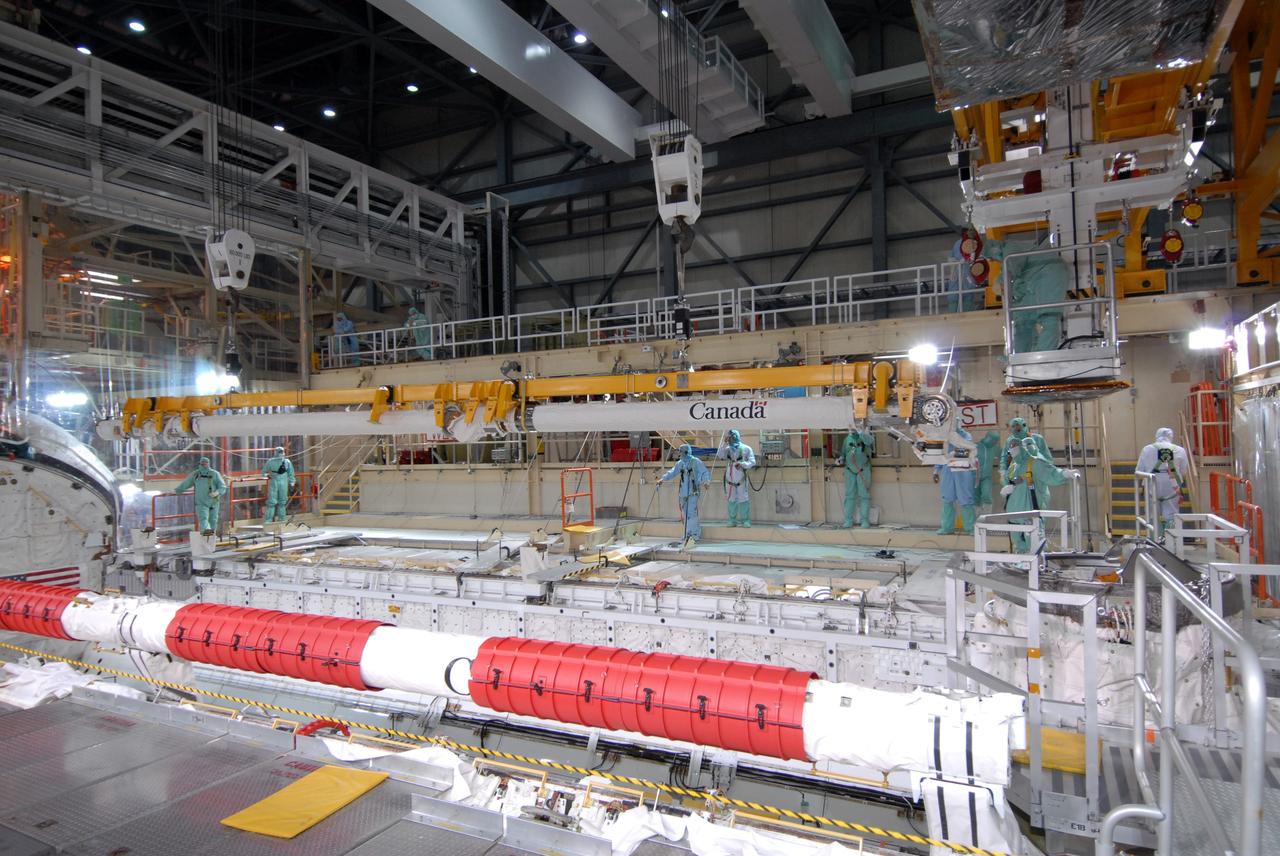
CAPE CANAVERAL, Fla. – In Orbiter Processing Facility bay 3 at NASA's Kennedy Space Center in Florida, the remote manipulator system, or RMS, arm is moved out of the payload bay of space shuttle Discovery. The RMS is used to grab, or grapple, the payload as well as retrieve, repair and deploy satellites; provide a mobile extension ladder for spacewalking crewmembers; and be used as an inspection aid to allow flight crew members to view the orbiter’s or payload’s surfaces through a TV camera on the arm. Discovery is targeted to launch Aug. 6 on the STS-128 mission. Photo credit: NASA/Jack Pfaller
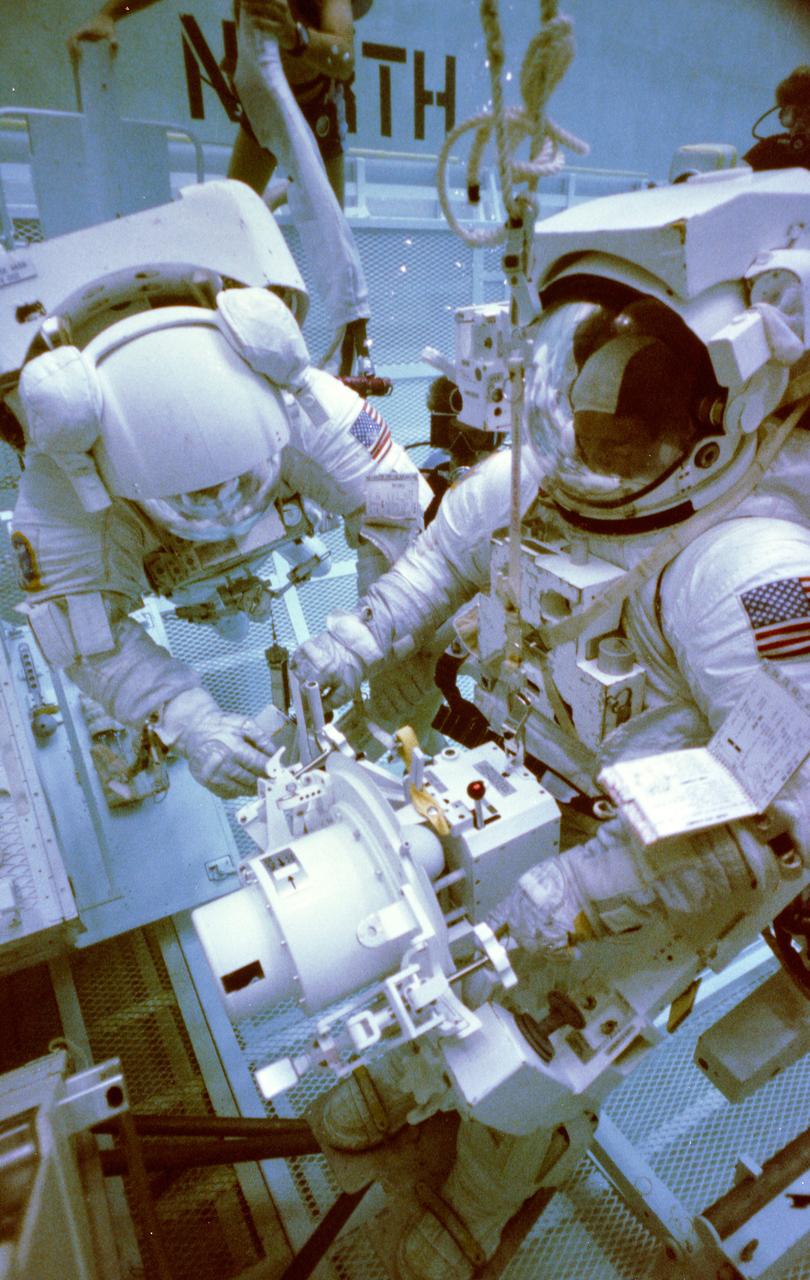
S83-42893 (19 Oct 1983) ---- Astronauts George D. Nelson and James D. van Hoften, two of three STS-41C mission specialists, share an extravehicular activity (EVA) task in this simulation of a Solar Maximum Satellite (SMS) repair visit. The two are making use of the Johnson Space Center's (JSC) weightless environment training facility (WET-F). Dr. Nelson is equipped with the manned maneuvering unit (MMU) trainer and he handles the trunion pin attachment device (TPAD), a major tool to be used on the mission. The photograph was taken by Otis Imboden.
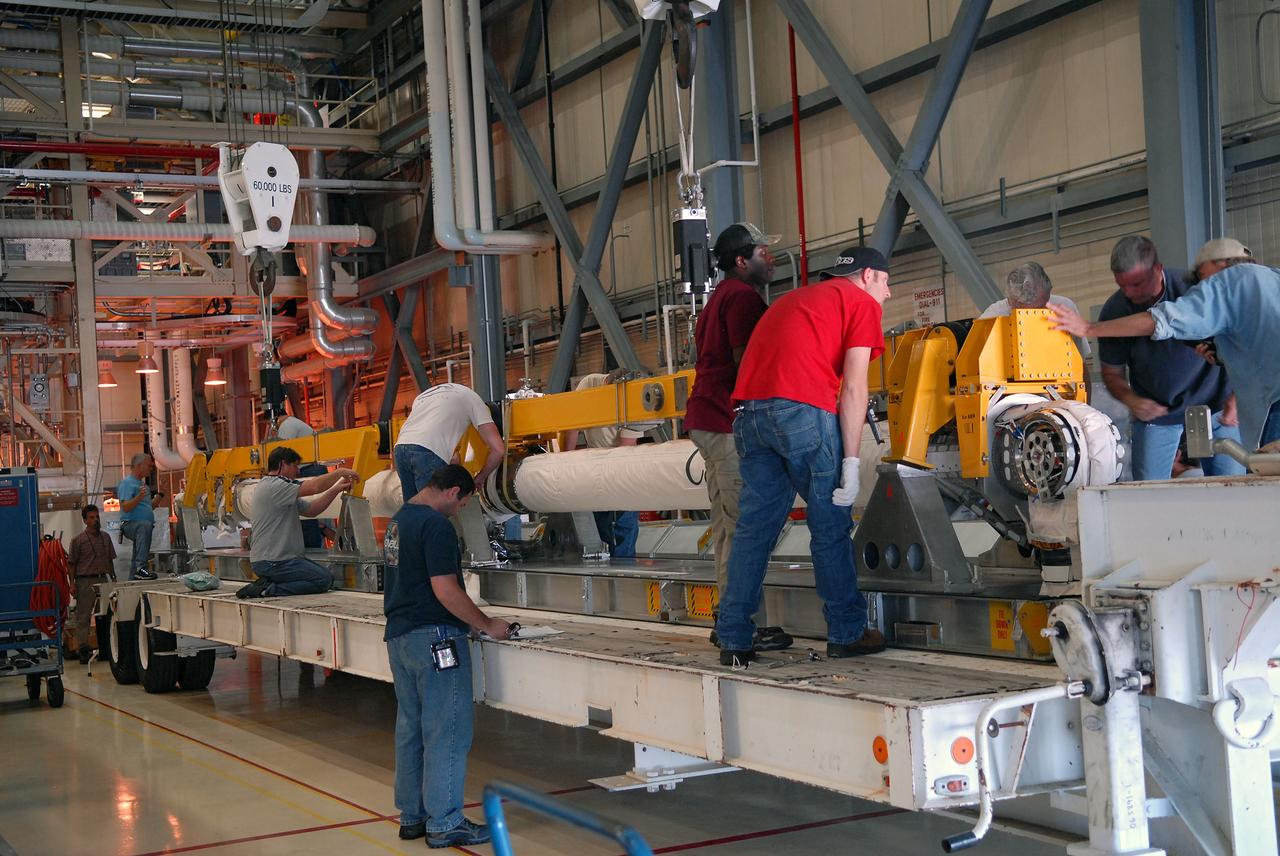
CAPE CANAVERAL, Fla. – In Orbiter Processing Facility bay 3 at NASA's Kennedy Space Center in Florida, technicians secure the remote manipulator system, or RMS, removed from space shuttle Discovery onto a storage platform. The RMS is used to grab, or grapple, the payload as well as retrieve, repair and deploy satellites; provide a mobile extension ladder for spacewalking crewmembers; and be used as an inspection aid to allow flight crew members to view the orbiter’s or payload’s surfaces through a TV camera on the arm. Discovery is targeted to launch Aug. 6 on the STS-128 mission. Photo credit: NASA/Jack Pfaller
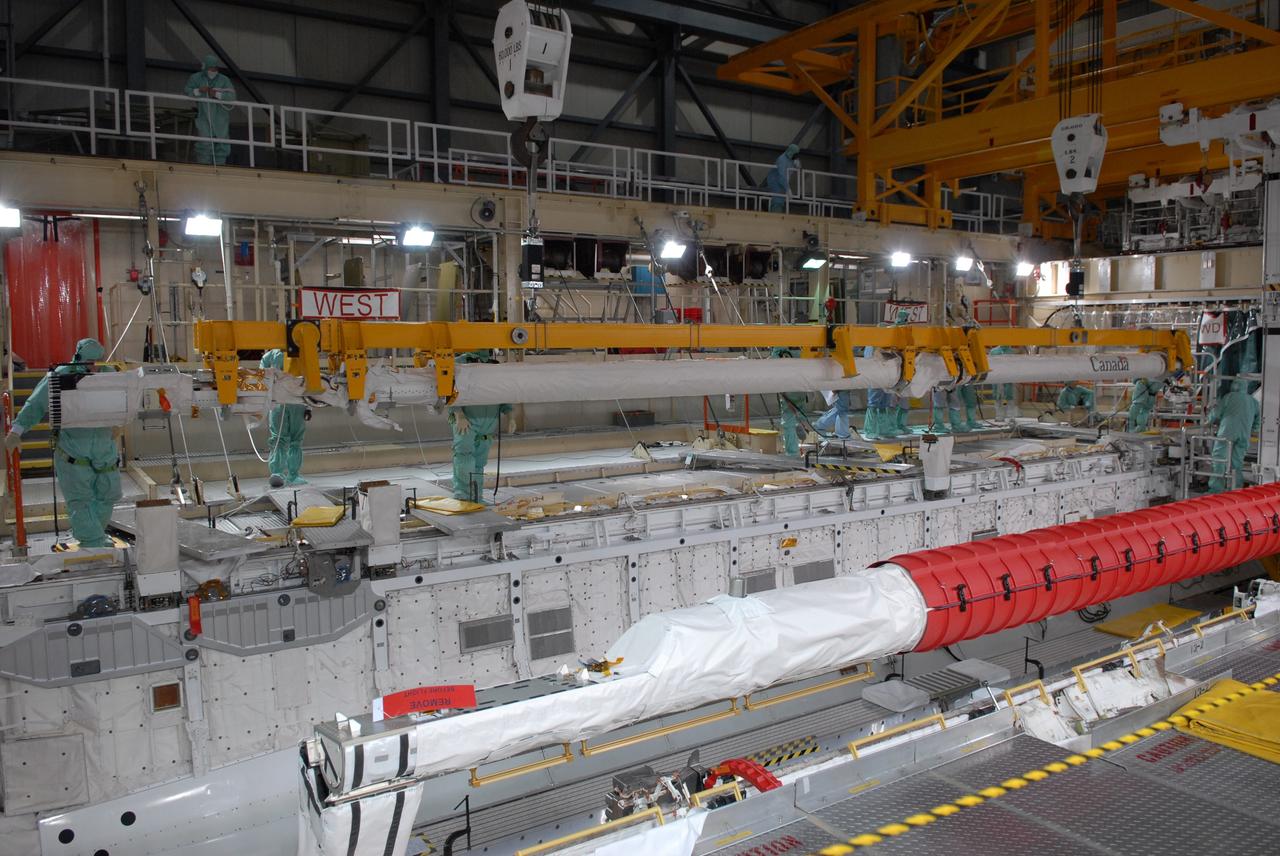
CAPE CANAVERAL, Fla. – In Orbiter Processing Facility bay 3 at NASA's Kennedy Space Center in Florida, remote manipulator system, or RMS, arm is lifted out of the payload bay of space shuttle Discovery. The RMS is used to grab, or grapple, the payload as well as retrieve, repair and deploy satellites; provide a mobile extension ladder for spacewalking crewmembers; and be used as an inspection aid to allow flight crew members to view the orbiter’s or payload’s surfaces through a TV camera on the arm. Discovery is targeted to launch Aug. 6 on the STS-128 mission. Photo credit: NASA/Jack Pfaller

KENNEDY SPACE CENTER, FLA. - Satellite trucks are lined up at NASA Kennedy Space Center’s Shuttle Landing Facility for the early morning landing of Space Shuttle Discovery, returning from the successful Return to Flight mission STS-114. The landing occurred at 8:11 a.m. EDT, guided by Mission Commander Eileen Collins. Discovery spent two weeks in space on Return to Flight mission STS-114, where the crew demonstrated new methods to inspect and repair the Shuttle in orbit. The crew also delivered supplies, outfitted and performed maintenance on the International Space Station. A number of these tasks were conducted during three spacewalks.
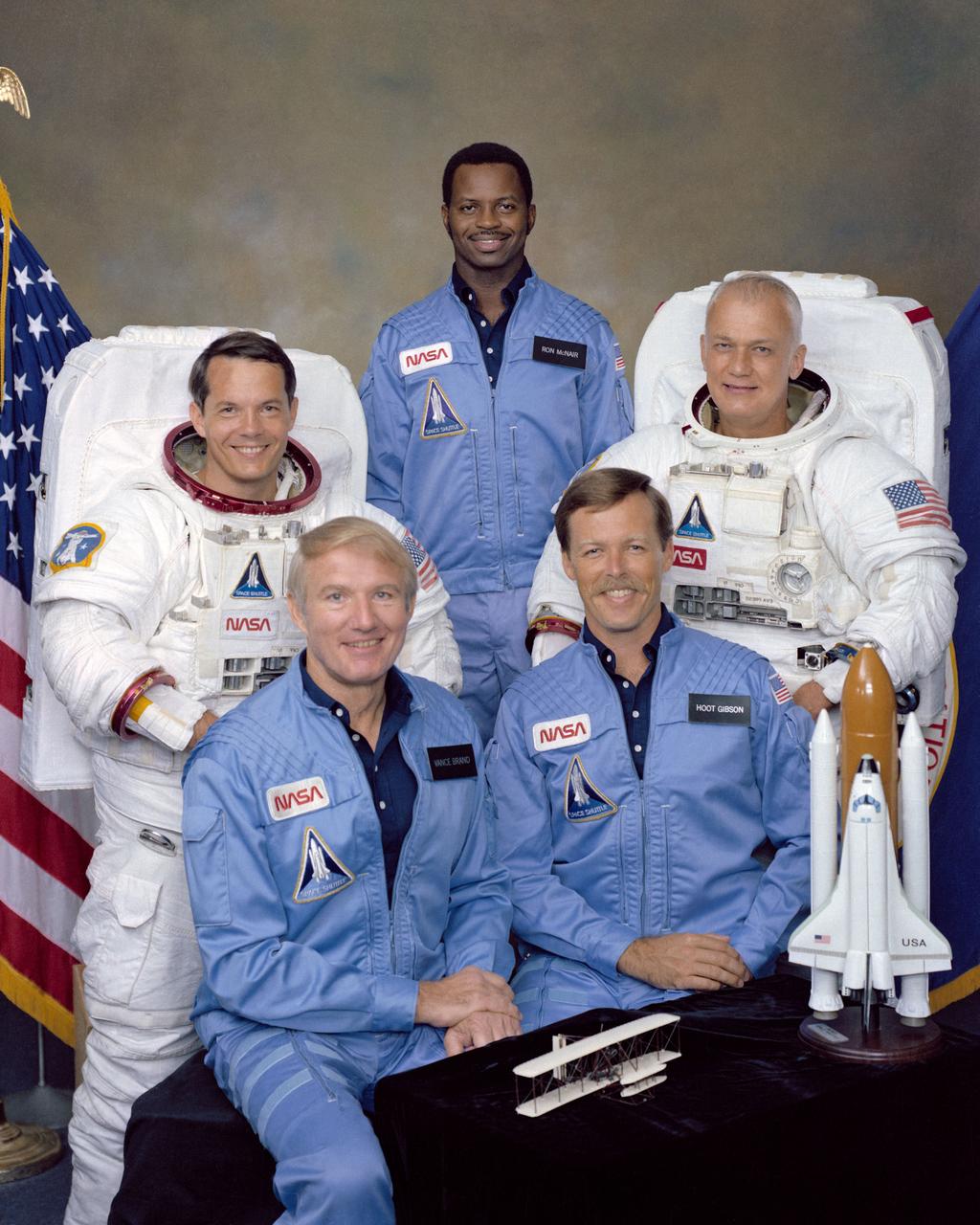
S83-40555 (15 October 1983) --- These five astronauts are in training for the STS-41B mission, scheduled early next year. On the front row are Vance D. Brand, commander; and Robert L. Gibson, pilot. Mission specialists (back row, left to right) are Robert L. Stewart, Dr. Ronald E. McNair and Bruce McCandless II. Stewart and McCandless are wearing Extravehicular Mobility Units (EMU) space suits. The STS program's second extravehicular activity (EVA) is to be performed on this flight, largely as a rehearsal for a scheduled repair visit to the Solar Maximum Satellite (SMS), on a later mission. The Manned Maneuvering Unit (MMU) will make its space debut on STS-41B.
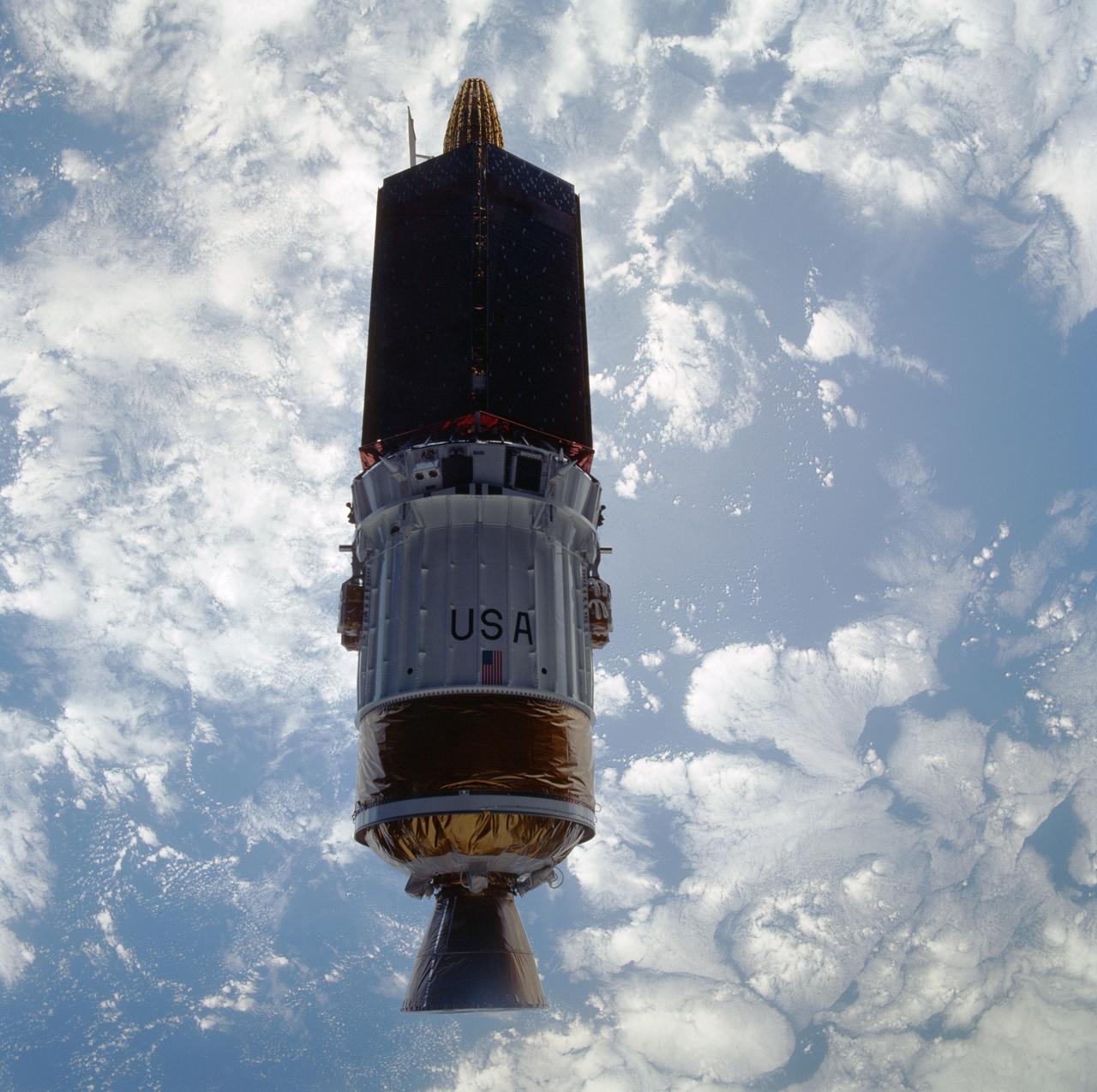
STS043-601-033 (2 Aug 1991) --- The Tracking and Data Relay Satellite (TDRS-E), is seen almost as a silhouette in this 70mm image. The TDRS spacecraft was captured on film as it moved away from the earth-orbiting Atlantis a mere six hours after the shuttle was launched from Pad 39A at Kennedy Space Center, Florida. TDRS, built by TRW, will be placed in a geosynchronous orbit and after on-orbit testing, which requires several weeks, will be designated TDRS-5. The communications satellite will replace TDRS-3 at 174 degrees west longitude. The backbone of NASA's space-to-ground communications, the Tracking and Data Relay Satellites have increased NASA's ability to send and receive data to spacecraft in low-earth orbit to more than 85 percent of the time. Before TDRS, NASA relied solely on a system of ground stations that permitted communications only 15 percent of the time. Increased coverage has allowed on-orbit repairs, live television broadcast from space and continuous dialogues between astronaut crews and ground control during critical periods such as space shuttle landings. The five astronauts of the STS-43 are John E. Blaha, mission commander, Michael a. Baker, pilot, and mission specialists Shannon W. Lucid, G. David Low and James C. Adamson.
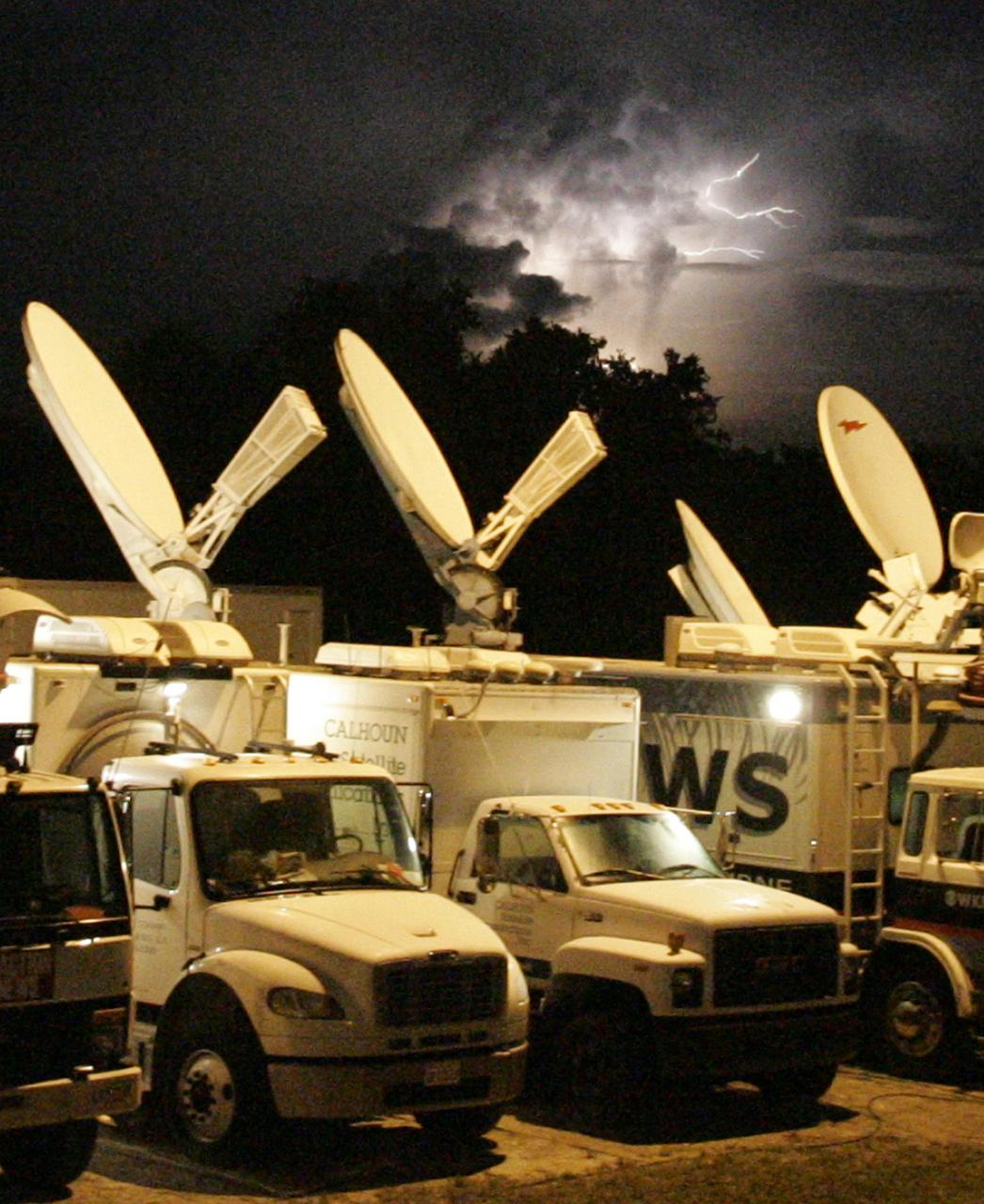
KENNEDY SPACE CENTER, FLA. - Lightning streaks across the sky above satellite trucks at NASA Kennedy Space Center’s Shuttle Landing Facility. The trucks are waiting for the early morning landing of Space Shuttle Discovery, returning from the successful Return to Flight mission STS-114. The landing was eventually deferred to Edwards Air Force Base in California due to weather concerns. The landing occurred at 8:11 a.m. EDT, guided by Mission Commander Eileen Collins. Discovery spent two weeks in space on Return to Flight mission STS-114, where the crew demonstrated new methods to inspect and repair the Shuttle in orbit. The crew also delivered supplies, outfitted and performed maintenance on the International Space Station. A number of these tasks were conducted during three spacewalks. (Photo Credit: Larry Rubenstein)
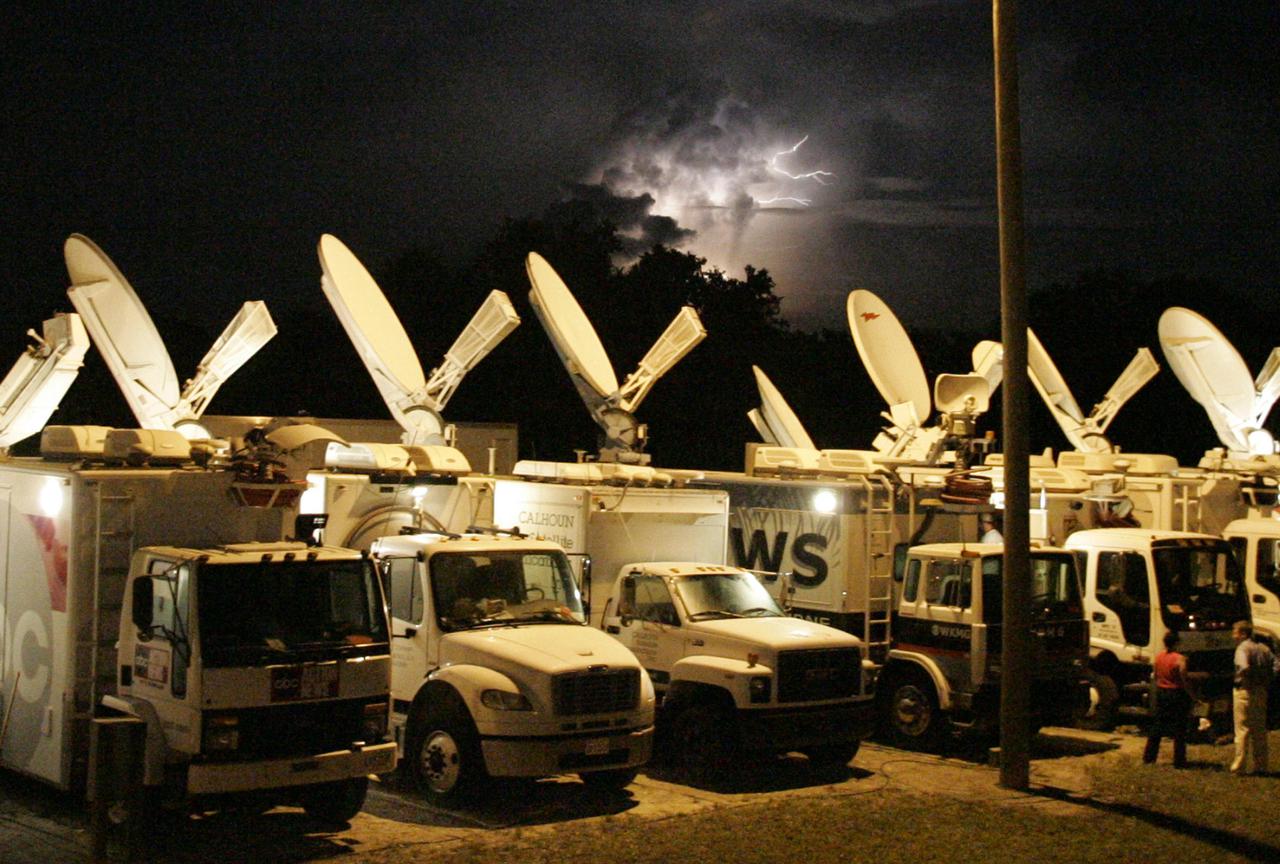
KENNEDY SPACE CENTER, FLA. - Lightning streaks across the sky above satellite trucks at NASA Kennedy Space Center’s Shuttle Landing Facility. The trucks are waiting for the early morning landing of Space Shuttle Discovery, returning from the successful Return to Flight mission STS-114. The landing was eventually deferred to Edwards Air Force Base in California due to weather concerns. The landing occurred at 8:11 a.m. EDT, guided by Mission Commander Eileen Collins. Discovery spent two weeks in space on Return to Flight mission STS-114, where the crew demonstrated new methods to inspect and repair the Shuttle in orbit. The crew also delivered supplies, outfitted and performed maintenance on the International Space Station. A number of these tasks were conducted during three spacewalks. (Photo Credit: Larry Rubenstein)
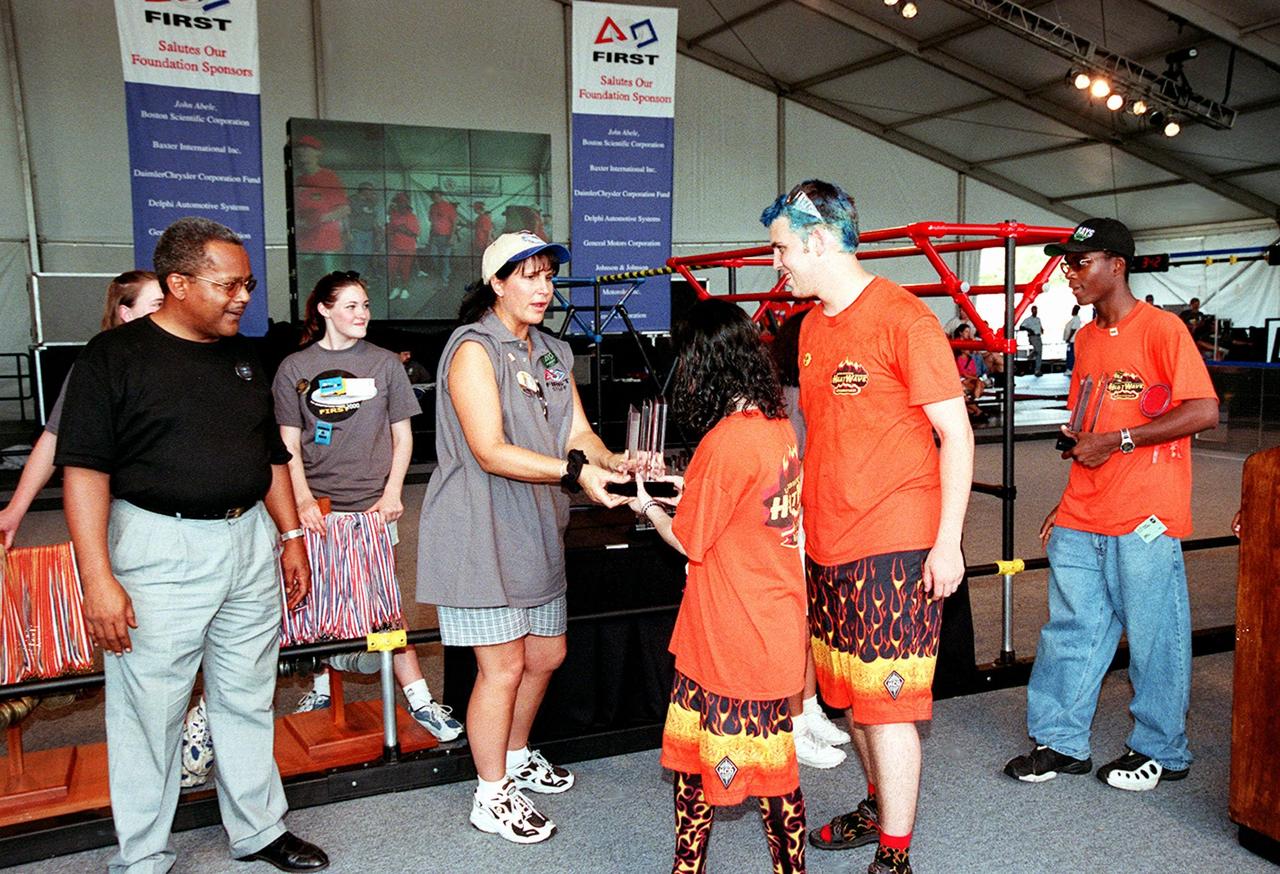
The Hero Team (278) robot, named Hero, is repaired in a Kennedy Space Center research and development machine shop. The team of Edgewater High School students was co-sponsored by NASA Kennedy Space Center and Honeywell. Students from all over the country are at the KSC Visitor Complex for the FIRST (For Inspiration and Recognition of Science and Technology) Southeast Regional competition March 9-11 in the Rocket Garden. Teams of high school students are testing the limits of their imagination using robots they have designed, with the support of business and engineering professionals and corporate sponsors, to compete in a technological battle against other schools' robots. Of the 30 high school teams competing, 16 are Florida teams co-sponsored by NASA and KSC contractors. Local high schools participating are Astronaut, Bayside, Cocoa Beach, Eau Gallie, Melbourne, Melbourne Central Catholic, Palm Bay, Rockledge, Satellite, and Titusville
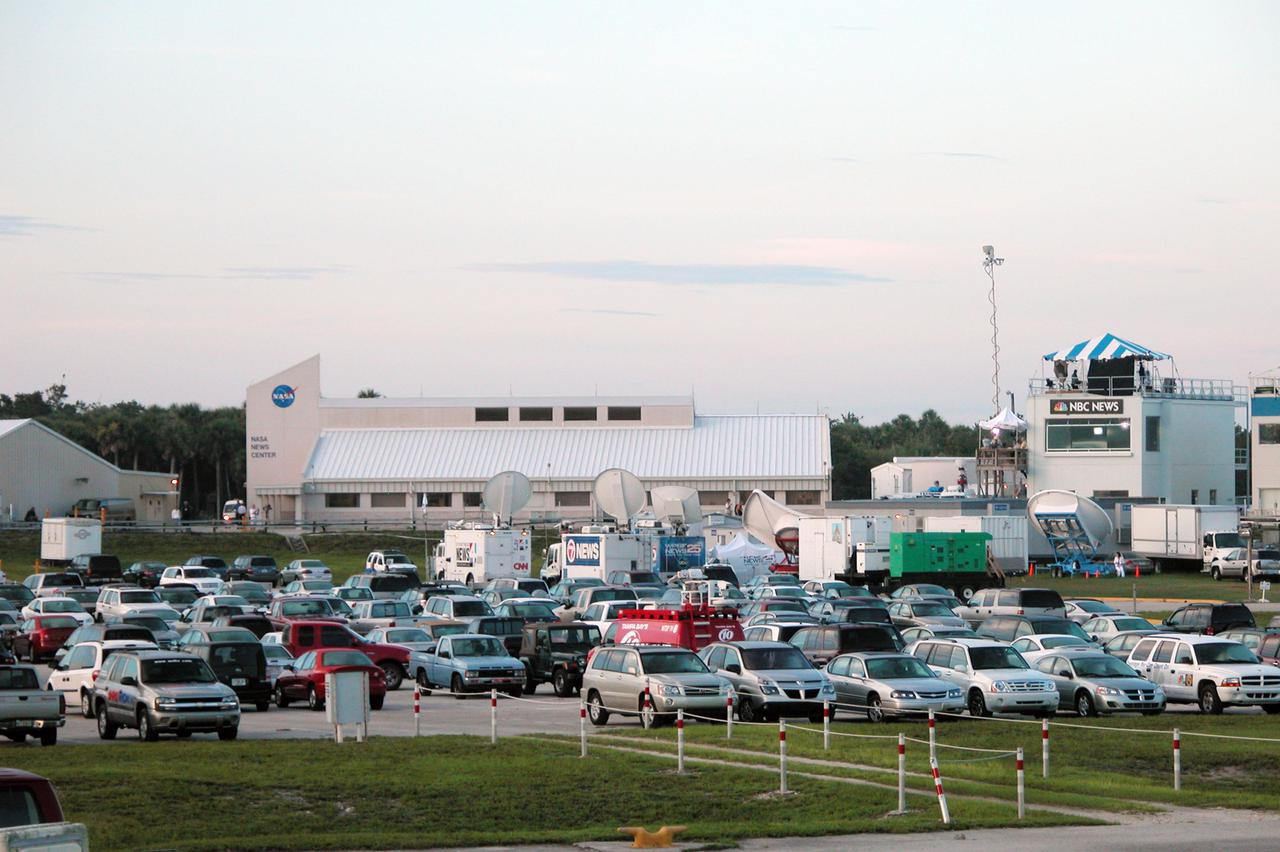
KENNEDY SPACE CENTER, FLA. - The parking lot at the NASA News Center overflows with cars and satellite trucks for the media who hoped to capture the images of Space Shuttle Discovery landing at KSC. Due to weather concerns, the landing was deferred to Edwards Air Force Base in California. The 13-day, 21-hour Return to Flight STS-114 mission ended on Runway 22 at 8:11:22 a.m. EDT with Mission Commander Eileen Collins on the controls. Discovery spent two weeks in space, where the crew demonstrated new methods to inspect and repair the Shuttle in orbit. The crew also delivered supplies, outfitted and performed maintenance on the International Space Station. A number of these tasks were conducted during three spacewalks. Photo credit: NASA_Debbie Kiger
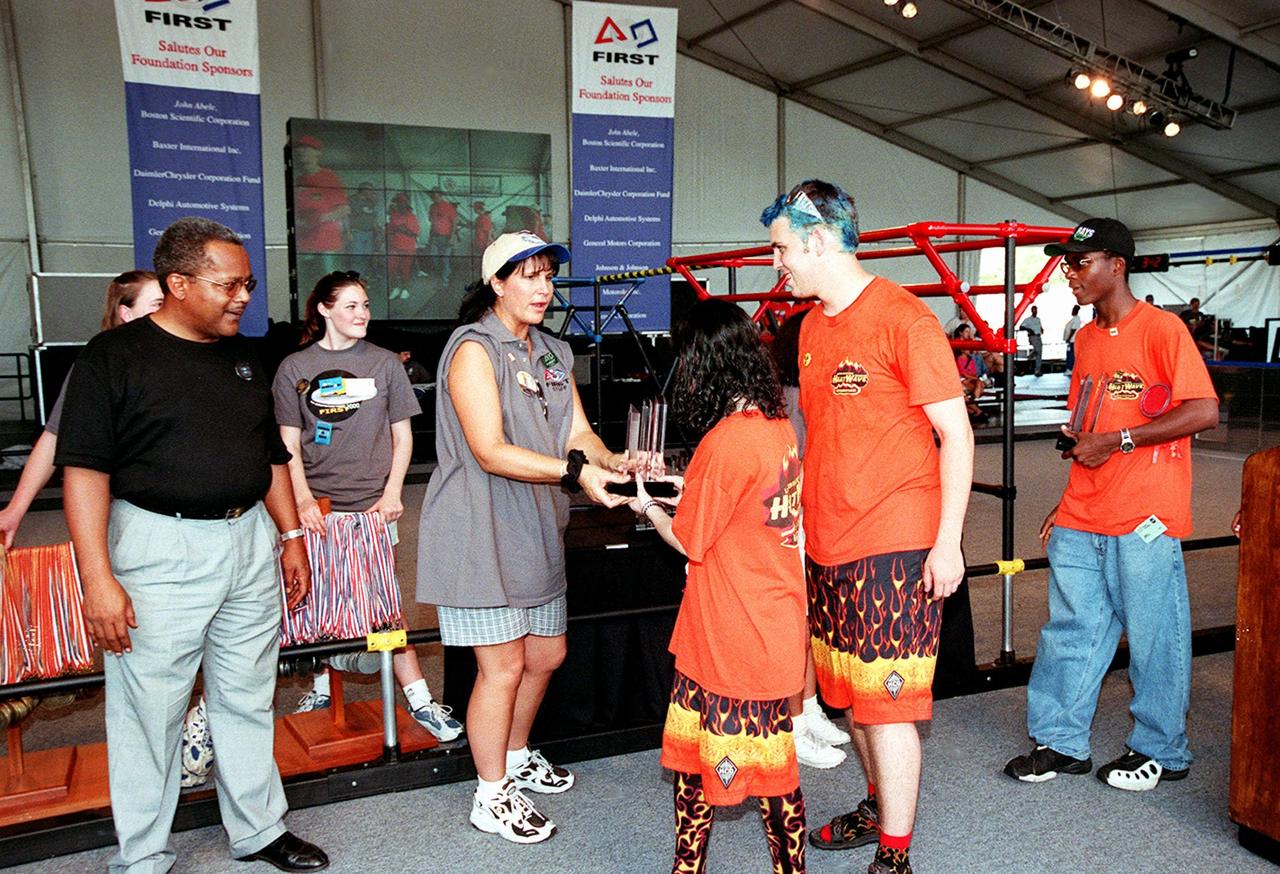
The Hero Team (278) robot, named Hero, is repaired in a Kennedy Space Center research and development machine shop. The team of Edgewater High School students was co-sponsored by NASA Kennedy Space Center and Honeywell. Students from all over the country are at the KSC Visitor Complex for the FIRST (For Inspiration and Recognition of Science and Technology) Southeast Regional competition March 9-11 in the Rocket Garden. Teams of high school students are testing the limits of their imagination using robots they have designed, with the support of business and engineering professionals and corporate sponsors, to compete in a technological battle against other schools' robots. Of the 30 high school teams competing, 16 are Florida teams co-sponsored by NASA and KSC contractors. Local high schools participating are Astronaut, Bayside, Cocoa Beach, Eau Gallie, Melbourne, Melbourne Central Catholic, Palm Bay, Rockledge, Satellite, and Titusville
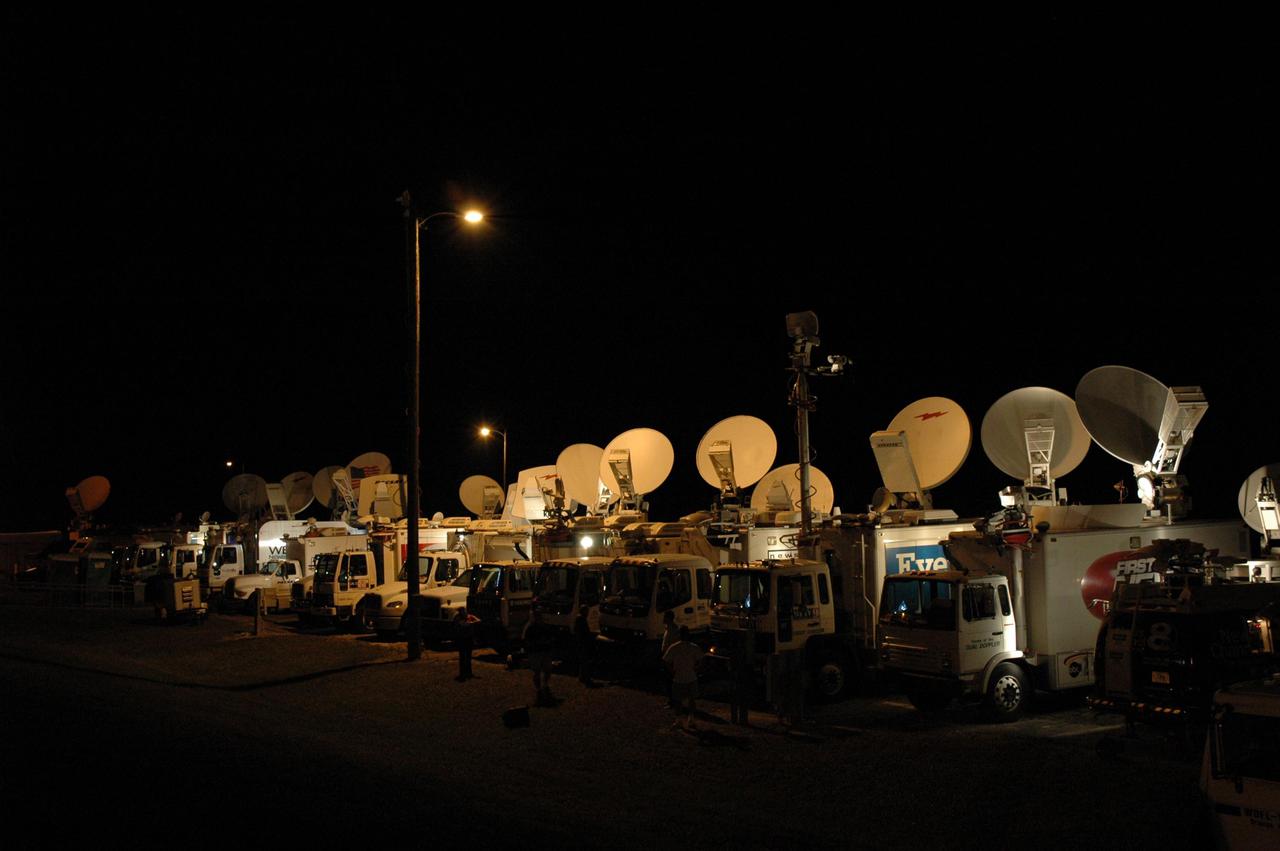
KENNEDY SPACE CENTER, FLA. - Satellite trucks are lined up alongside Runway 33 at NASA Kennedy Space Center’s Shuttle Landing Facility to wait for the early morning landing of Space Shuttle Discovery, returning from the successful Return to Flight mission STS-114. The landing was eventually deferred to Edwards Air Force Base in California due to weather concerns. The landing occurred at 8:11 a.m. EDT, guided by Mission Commander Eileen Collins. Discovery spent two weeks in space on Return to Flight mission STS-114, where the crew demonstrated new methods to inspect and repair the Shuttle in orbit. The crew also delivered supplies, outfitted and performed maintenance on the International Space Station. A number of these tasks were conducted during three spacewalks.
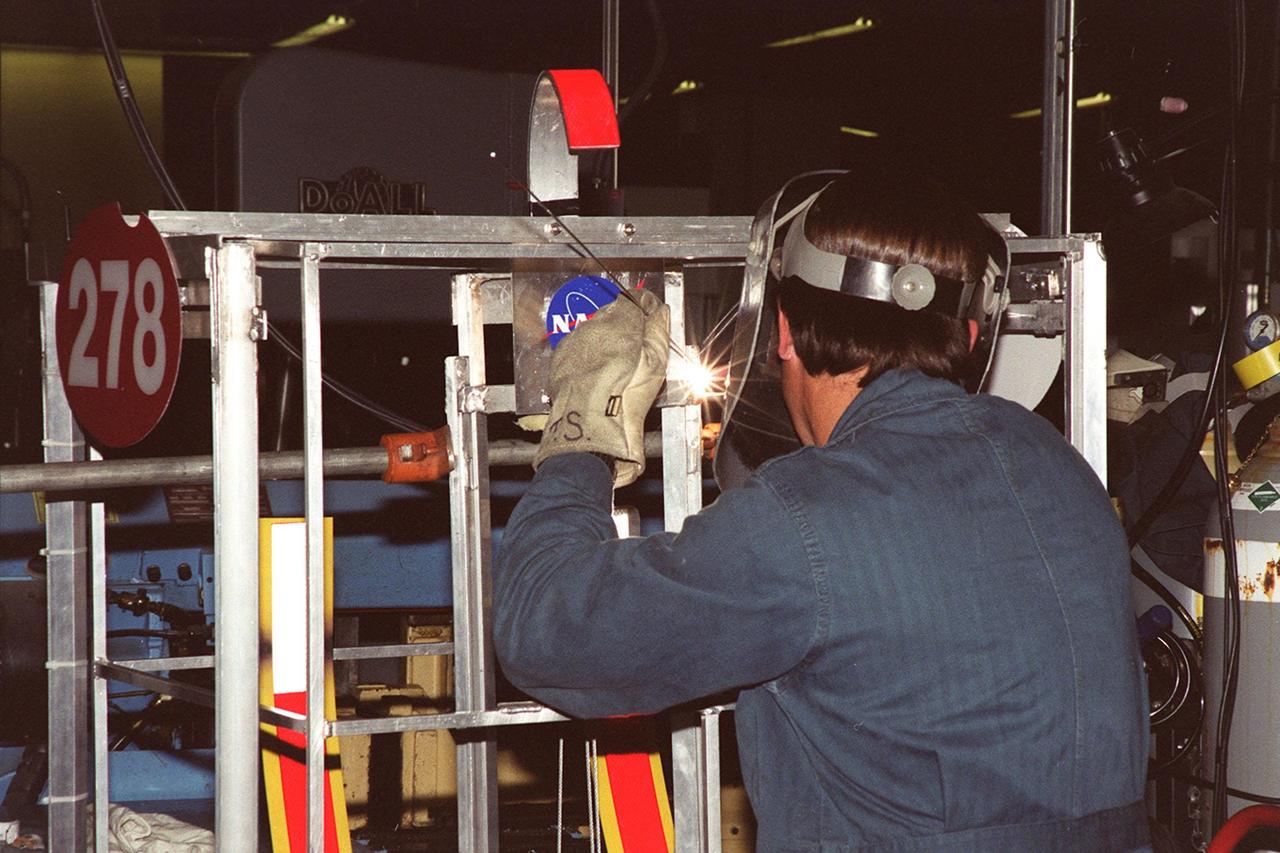
The Hero Team (278) robot, named Hero, is repaired in a Kennedy Space Center research and development machine shop. The team of Edgewater High School students was co-sponsored by NASA Kennedy Space Center and Honeywell. Students from all over the country are at the KSC Visitor Complex for the FIRST (For Inspiration and Recognition of Science and Technology) Southeast Regional competition March 9-11 in the Rocket Garden. Teams of high school students are testing the limits of their imagination using robots they have designed, with the support of business and engineering professionals and corporate sponsors, to compete in a technological battle against other schools' robots. Of the 30 high school teams competing, 16 are Florida teams co-sponsored by NASA and KSC contractors. Local high schools participating are Astronaut, Bayside, Cocoa Beach, Eau Gallie, Melbourne, Melbourne Central Catholic, Palm Bay, Rockledge, Satellite, and Titusville
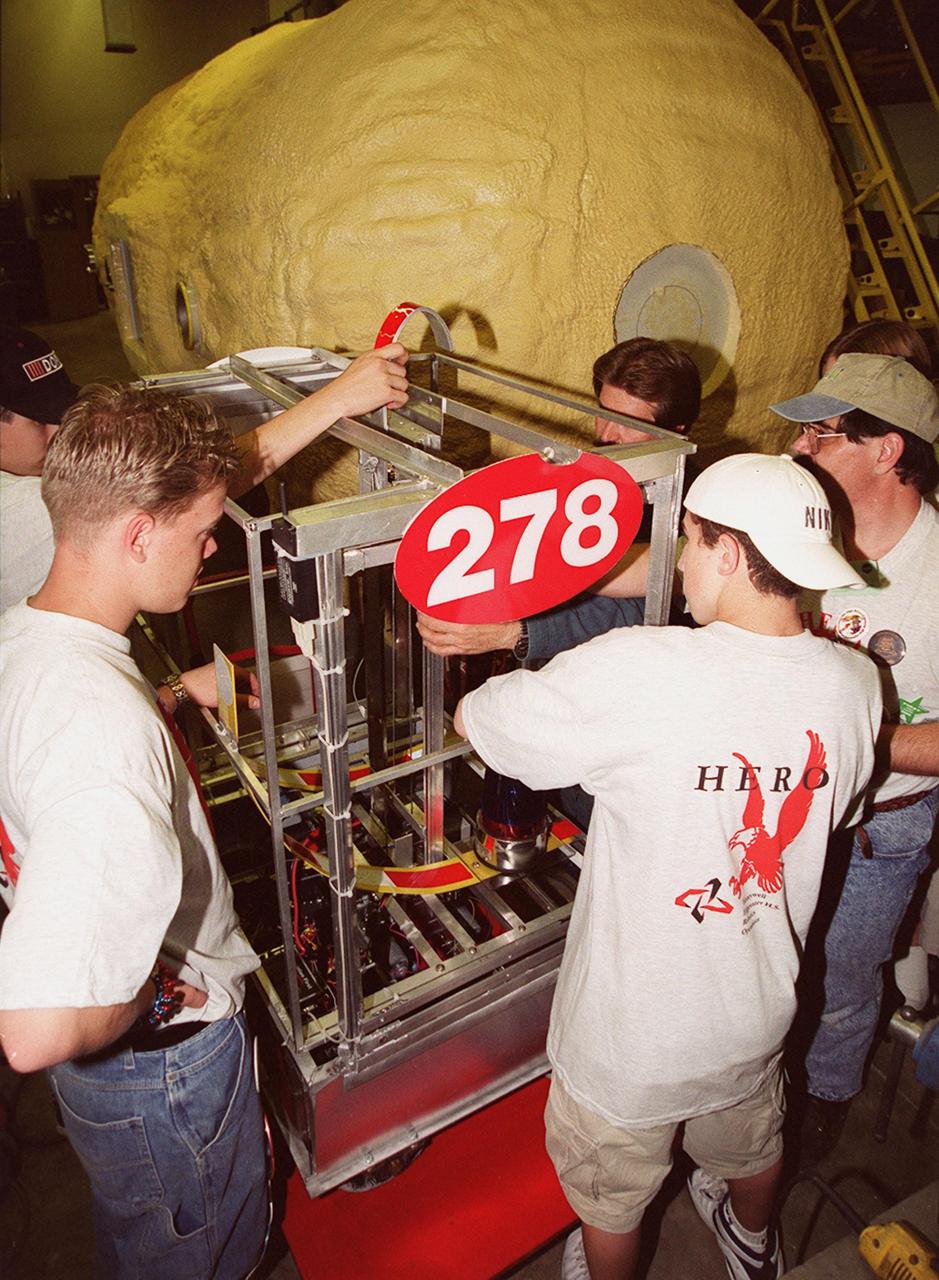
The Hero Team (278) gets some help from a Kennedy Space Center research and development machine shop in repairing their robot, named Hero. The team of Edgewater High School students was co-sponsored by NASA Kennedy Space Center and Honeywell. Students from all over the country are at the KSC Visitor Complex for the FIRST (For Inspiration and Recognition of Science and Technology) Southeast Regional competition March 9-11 in the Rocket Garden. Teams of high school students are testing the limits of their imagination using robots they have designed, with the support of business and engineering professionals and corporate sponsors, to compete in a technological battle against other schools' robots. Of the 30 high school teams competing, 16 are Florida teams co-sponsored by NASA and KSC contractors. Local high schools participating are Astronaut, Bayside, Cocoa Beach, Eau Gallie, Melbourne, Melbourne Central Catholic, Palm Bay, Rockledge, Satellite, and Titusville
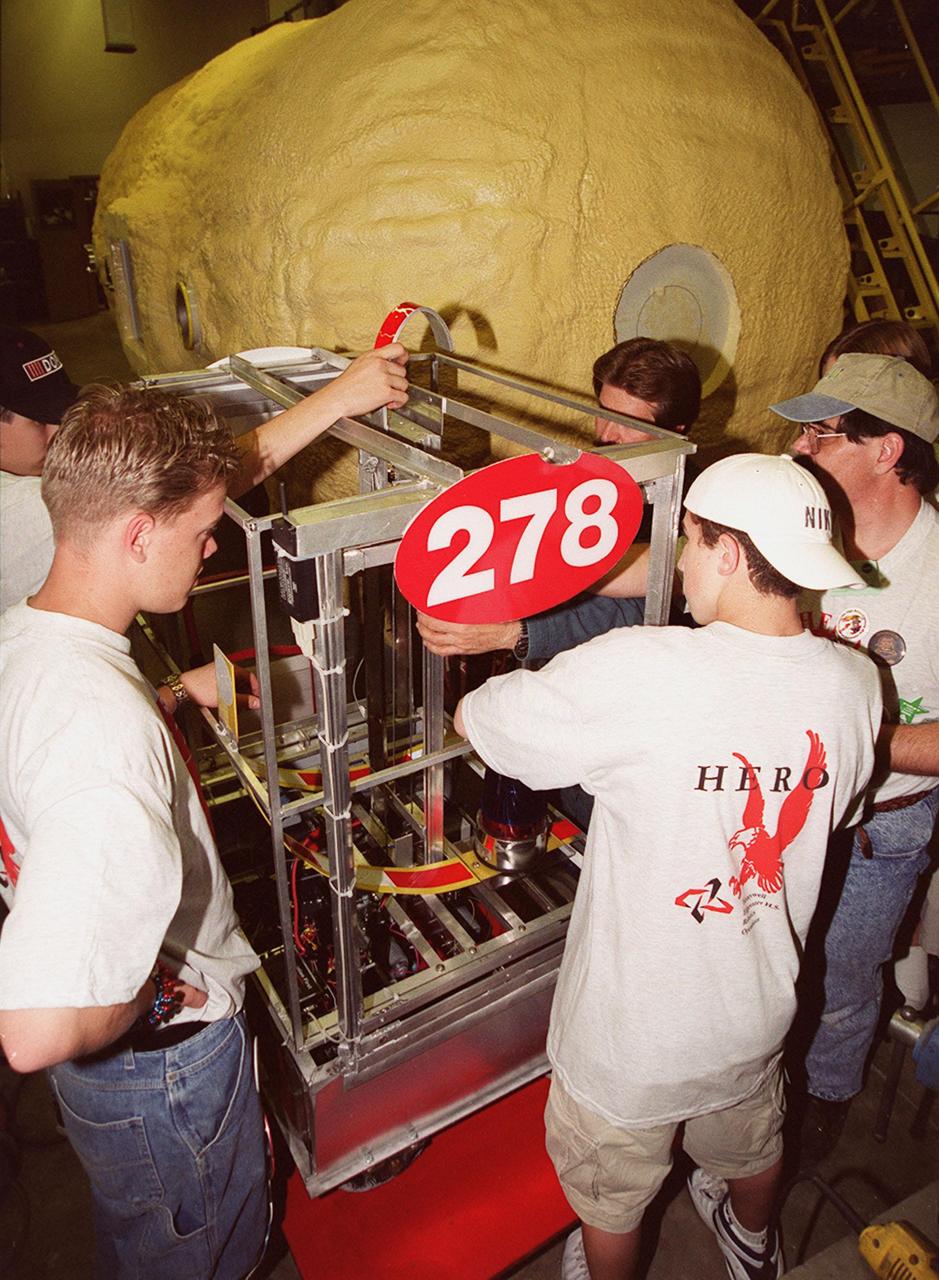
The Hero Team (278) gets some help from a Kennedy Space Center research and development machine shop in repairing their robot, named Hero. The team of Edgewater High School students was co-sponsored by NASA Kennedy Space Center and Honeywell. Students from all over the country are at the KSC Visitor Complex for the FIRST (For Inspiration and Recognition of Science and Technology) Southeast Regional competition March 9-11 in the Rocket Garden. Teams of high school students are testing the limits of their imagination using robots they have designed, with the support of business and engineering professionals and corporate sponsors, to compete in a technological battle against other schools' robots. Of the 30 high school teams competing, 16 are Florida teams co-sponsored by NASA and KSC contractors. Local high schools participating are Astronaut, Bayside, Cocoa Beach, Eau Gallie, Melbourne, Melbourne Central Catholic, Palm Bay, Rockledge, Satellite, and Titusville
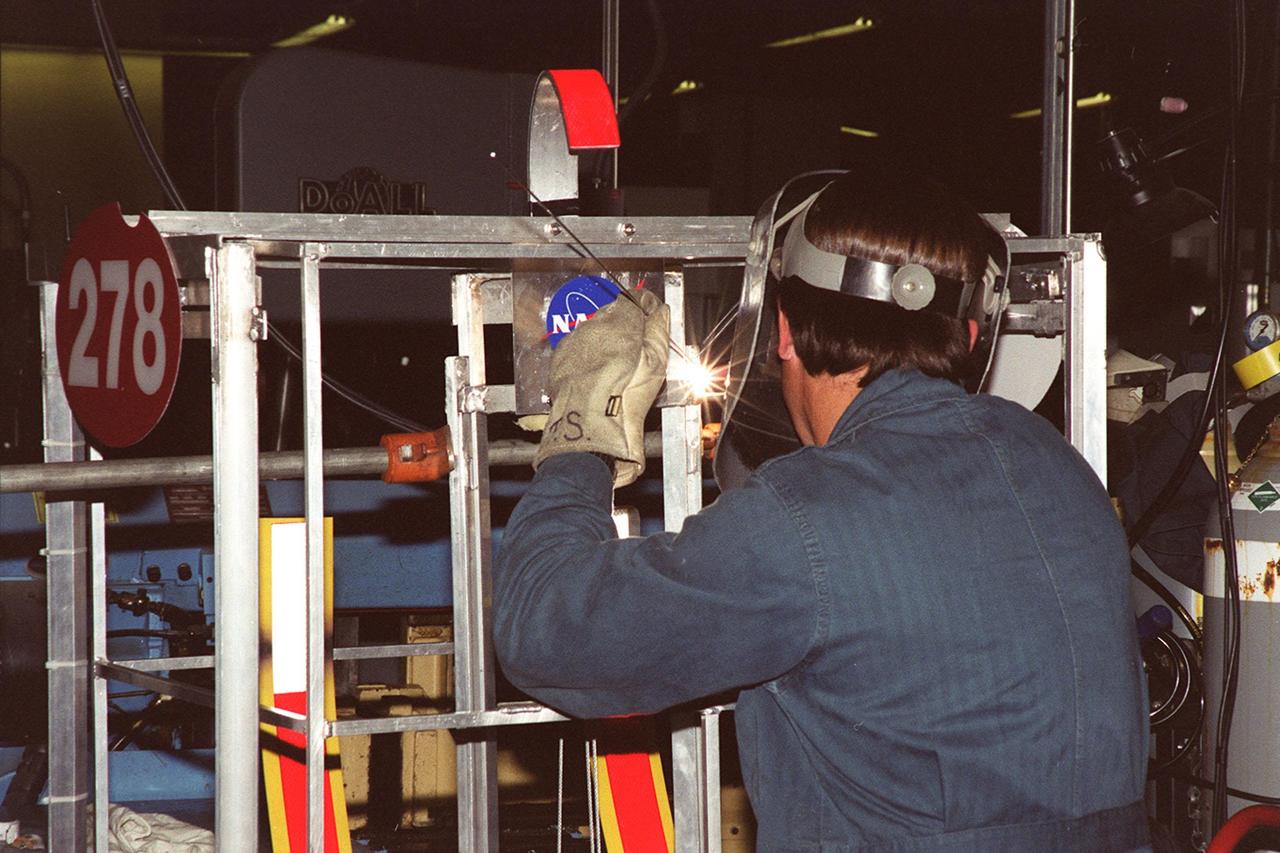
The Hero Team (278) robot, named Hero, is repaired in a Kennedy Space Center research and development machine shop. The team of Edgewater High School students was co-sponsored by NASA Kennedy Space Center and Honeywell. Students from all over the country are at the KSC Visitor Complex for the FIRST (For Inspiration and Recognition of Science and Technology) Southeast Regional competition March 9-11 in the Rocket Garden. Teams of high school students are testing the limits of their imagination using robots they have designed, with the support of business and engineering professionals and corporate sponsors, to compete in a technological battle against other schools' robots. Of the 30 high school teams competing, 16 are Florida teams co-sponsored by NASA and KSC contractors. Local high schools participating are Astronaut, Bayside, Cocoa Beach, Eau Gallie, Melbourne, Melbourne Central Catholic, Palm Bay, Rockledge, Satellite, and Titusville
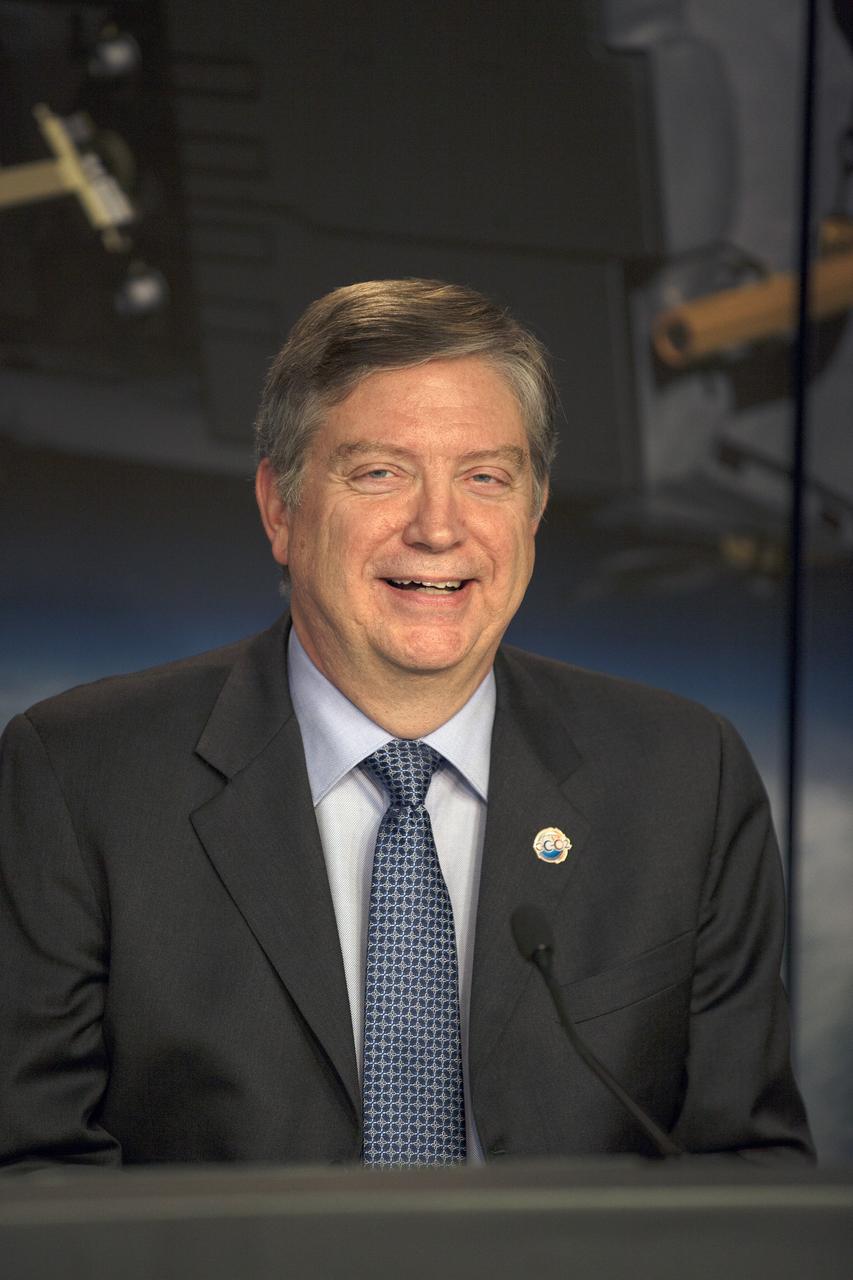
VANDENBERG AIR FORCE BASE, Calif. – Mike Miller, senior vice president, Science and Environmental Satellite Programs, Orbital Sciences Space Systems Group, participates in a post-launch news conference at Vandenberg Air Force Base in California following the successful launch of NASA's Orbiting Carbon Observatory-2, or OCO-2. Orbital Sciences built the satellite for NASA. Liftoff of OCO-2 from Space Launch Complex 2 aboard a United Launch Alliance Delta II rocket was on schedule at 5:56 a.m. EDT on July 2 following the repair of the pad's water suppression system, which failed on the first launch attempt July 1. OCO-2 is NASA’s first mission dedicated to studying atmospheric carbon dioxide, the leading human-produced greenhouse gas driving changes in Earth’s climate. OCO-2 will provide a new tool for understanding the human and natural sources of carbon dioxide emissions and the natural "sinks" that absorb carbon dioxide and help control its buildup. The observatory will measure the global geographic distribution of these sources and sinks and study their changes over time. To learn more about OCO-2, visit http://www.nasa.gov/oco2. Photo credit: NASA/Kim Shiflett

This illustration is an orbiter cutaway view with callouts. The orbiter is both the brains and heart of the Space Transportation System (STS). About the same size and weight as a DC-9 aircraft, the orbiter contains the pressurized crew compartment (which can normally carry up to seven crew members), the huge cargo bay, and the three main engines mounted on its aft end. There are three levels to the crew cabin. Uppermost is the flight deck where the commander and the pilot control the mission. The middeck is where the gallery, toilet, sleep stations, and storage and experiment lockers are found for the basic needs of weightless daily living. Also located in the middeck is the airlock hatch into the cargo bay and space beyond. It is through this hatch and airlock that astronauts go to don their spacesuits and marned maneuvering units in preparation for extravehicular activities, more popularly known as spacewalks. The Space Shuttle's cargo bay is adaptable to hundreds of tasks. Large enough to accommodate a tour bus (60 x 15 feet or 18.3 x 4.6 meters), the cargo bay carries satellites, spacecraft, and spacelab scientific laboratories to and from Earth orbit. It is also a work station for astronauts to repair satellites, a foundation from which to erect space structures, and a hold for retrieved satellites to be returned to Earth. Thermal tile insulation and blankets (also known as the thermal protection system or TPS) cover the underbelly, bottom of the wings, and other heat-bearing surfaces of the orbiter to protect it during its fiery reentry into the Earth's atmosphere. The Shuttle's 24,000 individual tiles are made primarily of pure-sand silicate fibers, mixed with a ceramic binder. The solid rocket boosters (SRB's) are designed as an in-house Marshall Space Flight Center project, with United Space Boosters as the assembly and refurbishment contractor. The solid rocket motor (SRM) is provided by the Morton Thiokol Corporation.
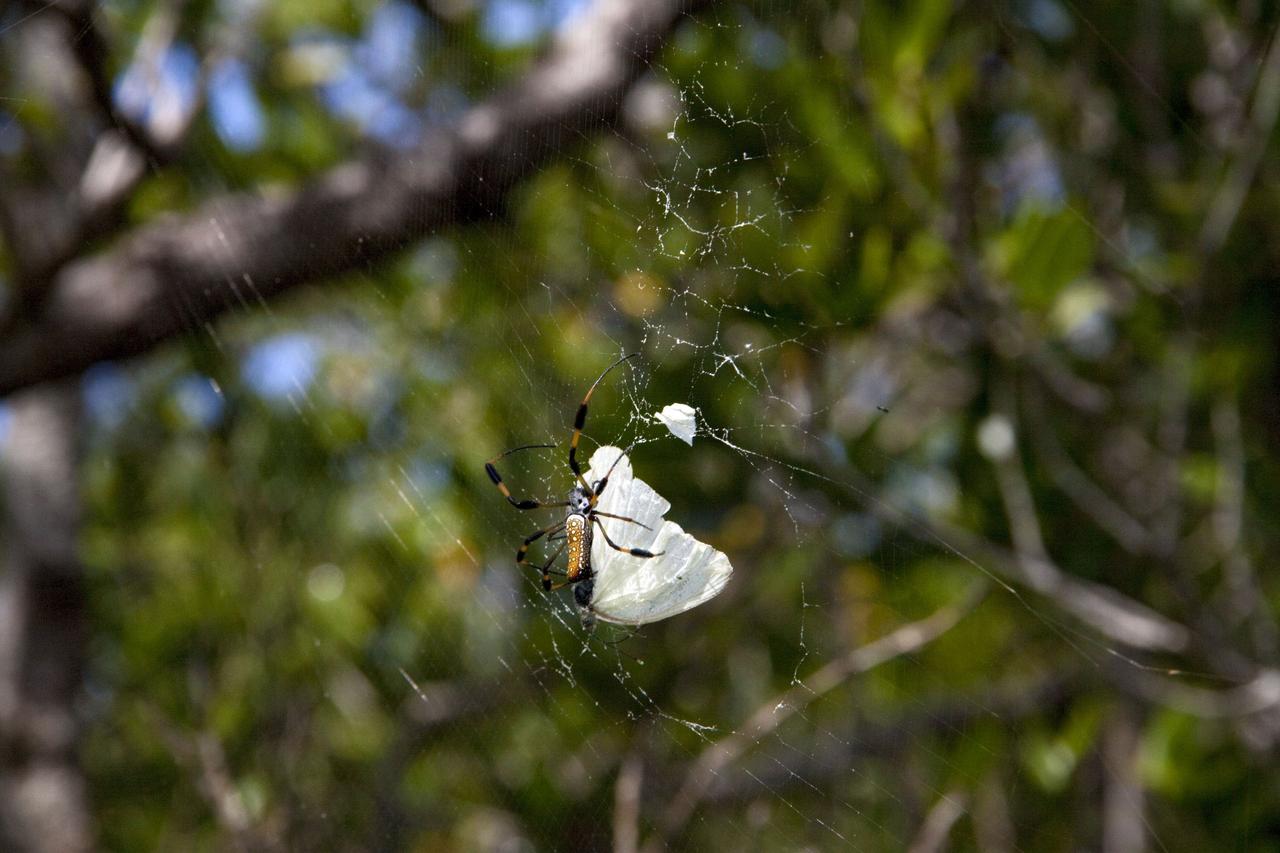
CAPE CANAVERAL, Fla. -- Near Launch Pad 39A at Kennedy Space Center in Florida, a Golden-Silk Spider repairs its web after a capturing a moth. The golden-silk spider repairs the webbing each day, replacing half but never the whole web at one time. Its web may measure two to three feet across. The center shares a boundary with the Merritt Island Wildlife Nature Refuge, consisting of 140,000 acres. The Refuge provides a wide variety of habitats: coastal dunes, saltwater estuaries and marshes, freshwater impoundments, scrub, pine flatwoods, and hardwood hammocks that provide habitat for more than 1,500 species of plants and animals. Atlantis and its crew of four; Commander Chris Ferguson, Pilot Doug Hurley, Mission Specialists Sandy Magnus and Rex Walheim are scheduled to lift off at 11:26 a.m. EDT on July 8 to deliver the Raffaello multi-purpose logistics module packed with supplies and spare parts for the International Space Station. Atlantis also will fly the Robotic Refueling Mission experiment that will investigate the potential for robotically refueling existing satellites in orbit. In addition, Atlantis will return with a failed ammonia pump module to help NASA better understand the failure mechanism and improve pump designs for future systems. STS-135 is the 33rd flight of Atlantis, the 37th shuttle mission to the space station, and the 135th and final mission of NASA's Space Shuttle Program. For more information, visit www.nasa.gov/mission_pages/shuttle/shuttlemissions/sts135/index.html. Photo credit: Ken Thornsley
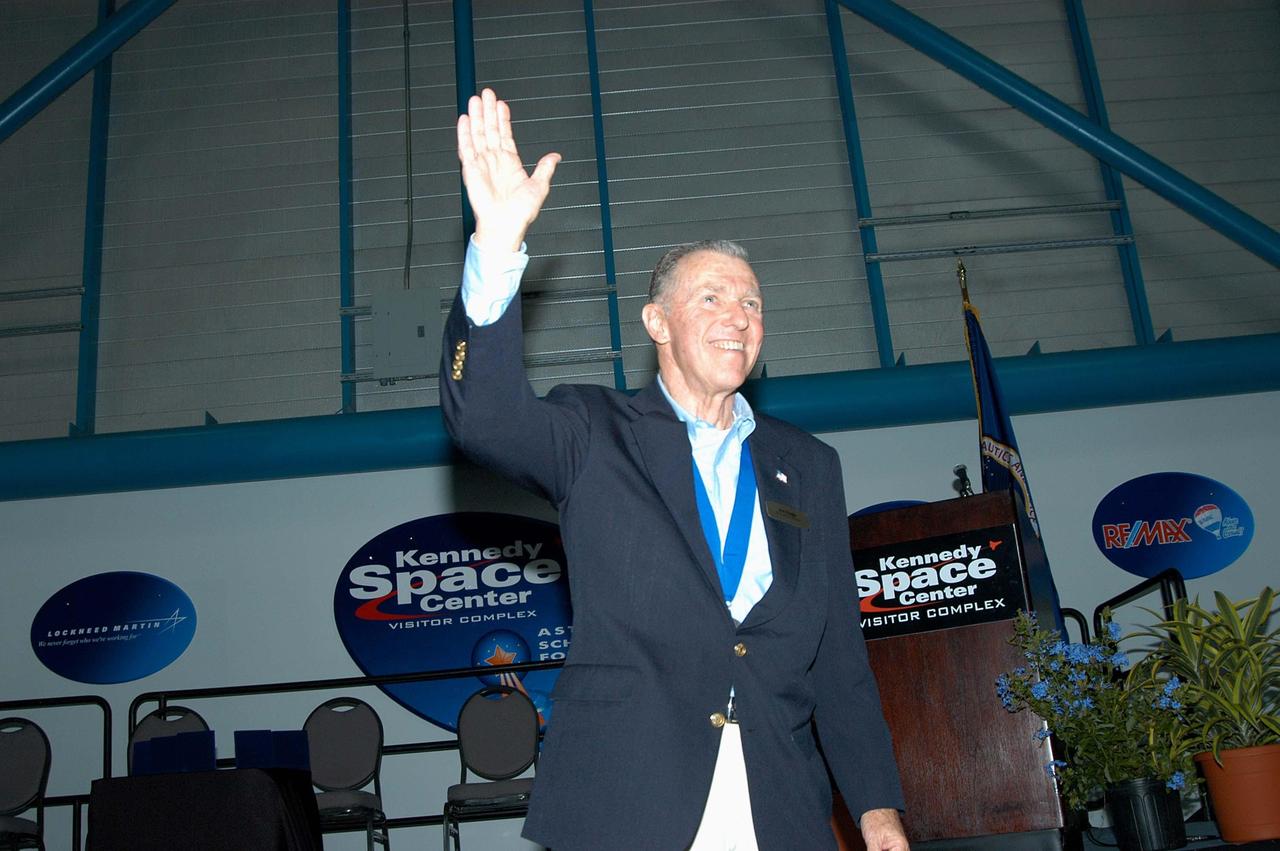
KENNEDY SPACE CENTER, FLA. -- Former astronaut Joe Engle acknowledges the applause as he is introduced as a previous inductee into the U.S. Astronaut Hall of Fame. He and other Hall of Fame members were present for the induction of five new space program heroes into the U.S. Astronaut Hall of Fame: Richard O. Covey, commander of the Hubble Space Telescope repair mission; Norman E. Thagard, the first American to occupy Russia’s Mir space station; the late Francis R. "Dick" Scobee, commander of the ill-fated 1986 Challenger mission; Kathryn D. Sullivan, the first American woman to walk in space; and Frederick D. Gregory, the first African-American to command a space mission and the current NASA deputy administrator. Engle made 16 flights in the X-15 rocket plane before he became a NASA astronaut and flew two Space Shuttle missions. In 1981, he commanded the second flight of Columbia, the first manned spacecraft to be reflown in space, and in 1985 he commanded a five-man crew on the 20th shuttle flight, a satellite-deploy and repair mission. The induction ceremony was held at the Apollo/Saturn V Center at KSC. The U.S. Astronaut Hall of Fame opened in 1990 to provide a place where space travelers could be remembered for their participation and accomplishments in the U.S. space program. The five inductees join 52 previously honored astronauts from the ranks of the Gemini, Apollo, Skylab, Apollo-Soyuz, and Space Shuttle programs.
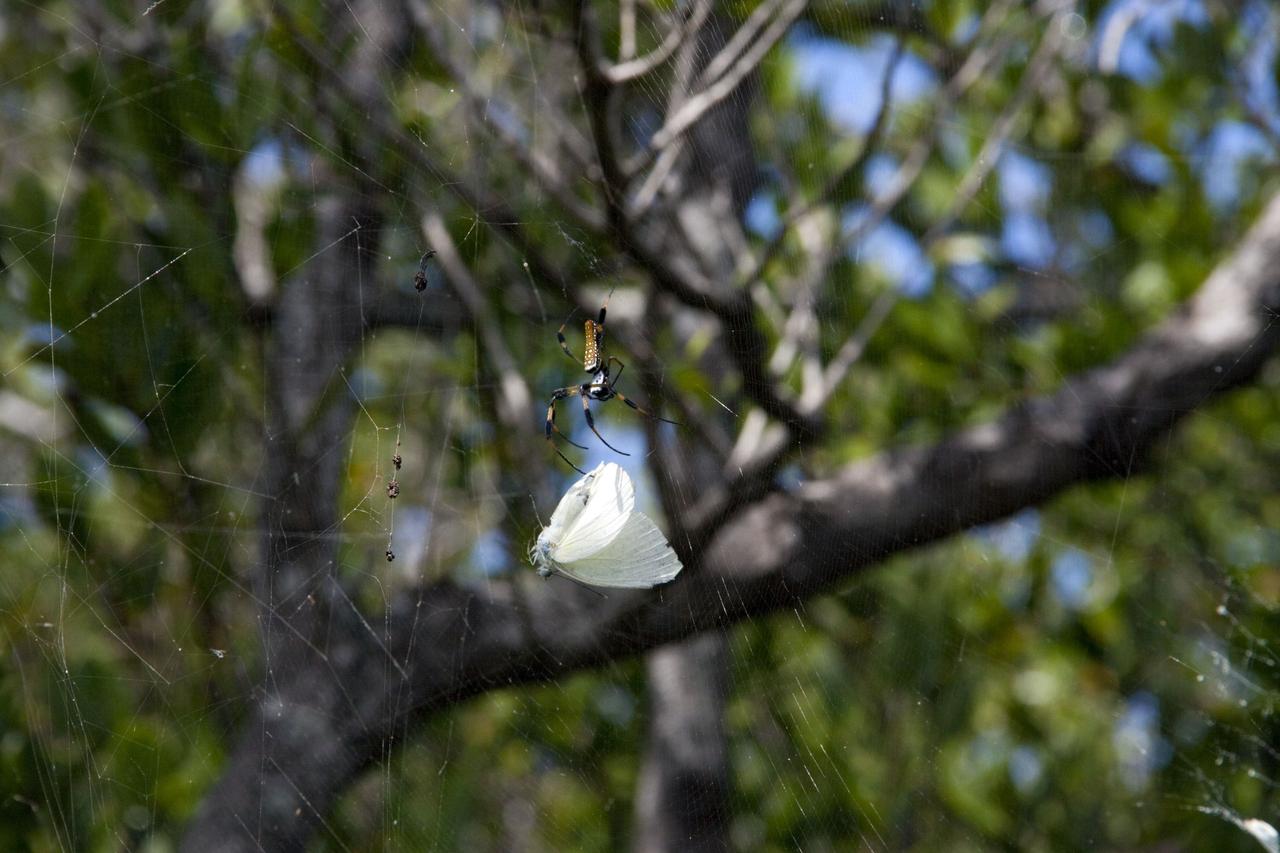
CAPE CANAVERAL, Fla. -- Near Launch Pad 39A at Kennedy Space Center in Florida, a Golden-Silk Spider repairs its web after a capturing a moth. The golden-silk spider repairs the webbing each day, replacing half but never the whole web at one time. Its web may measure two to three feet across. The center shares a boundary with the Merritt Island Wildlife Nature Refuge, consisting of 140,000 acres. The Refuge provides a wide variety of habitats: coastal dunes, saltwater estuaries and marshes, freshwater impoundments, scrub, pine flatwoods, and hardwood hammocks that provide habitat for more than 1,500 species of plants and animals. Atlantis and its crew of four; Commander Chris Ferguson, Pilot Doug Hurley, Mission Specialists Sandy Magnus and Rex Walheim are scheduled to lift off at 11:26 a.m. EDT on July 8 to deliver the Raffaello multi-purpose logistics module packed with supplies and spare parts for the International Space Station. Atlantis also will fly the Robotic Refueling Mission experiment that will investigate the potential for robotically refueling existing satellites in orbit. In addition, Atlantis will return with a failed ammonia pump module to help NASA better understand the failure mechanism and improve pump designs for future systems. STS-135 is the 33rd flight of Atlantis, the 37th shuttle mission to the space station, and the 135th and final mission of NASA's Space Shuttle Program. For more information, visit www.nasa.gov/mission_pages/shuttle/shuttlemissions/sts135/index.html. Photo credit: Ken Thornsley
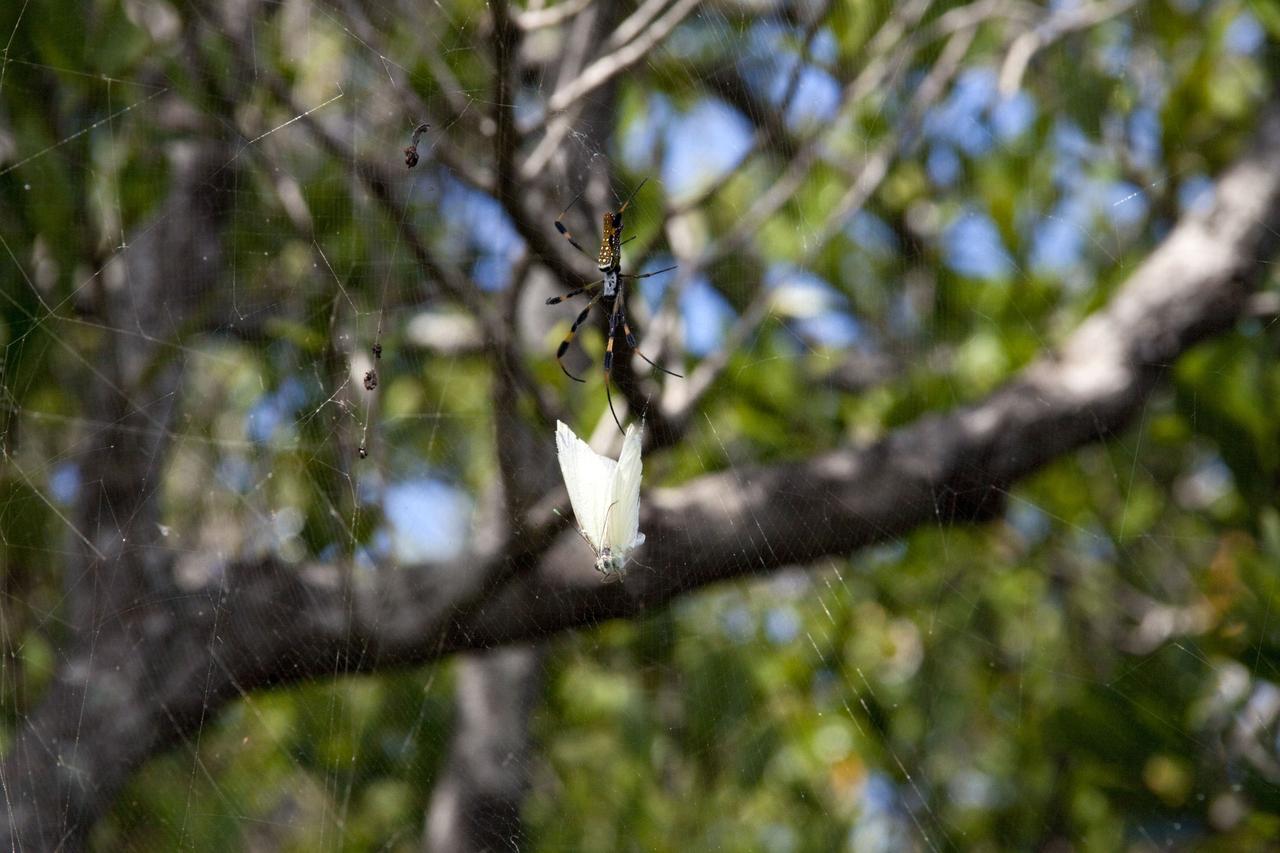
CAPE CANAVERAL, Fla. -- Near Launch Pad 39A at Kennedy Space Center in Florida, a Golden-Silk Spider repairs its web after a capturing a moth. The golden-silk spider repairs the webbing each day, replacing half but never the whole web at one time. Its web may measure two to three feet across. The center shares a boundary with the Merritt Island Wildlife Nature Refuge, consisting of 140,000 acres. The Refuge provides a wide variety of habitats: coastal dunes, saltwater estuaries and marshes, freshwater impoundments, scrub, pine flatwoods, and hardwood hammocks that provide habitat for more than 1,500 species of plants and animals. Atlantis and its crew of four; Commander Chris Ferguson, Pilot Doug Hurley, Mission Specialists Sandy Magnus and Rex Walheim are scheduled to lift off at 11:26 a.m. EDT on July 8 to deliver the Raffaello multi-purpose logistics module packed with supplies and spare parts for the International Space Station. Atlantis also will fly the Robotic Refueling Mission experiment that will investigate the potential for robotically refueling existing satellites in orbit. In addition, Atlantis will return with a failed ammonia pump module to help NASA better understand the failure mechanism and improve pump designs for future systems. STS-135 is the 33rd flight of Atlantis, the 37th shuttle mission to the space station, and the 135th and final mission of NASA's Space Shuttle Program. For more information, visit www.nasa.gov/mission_pages/shuttle/shuttlemissions/sts135/index.html. Photo credit: Ken Thornsley
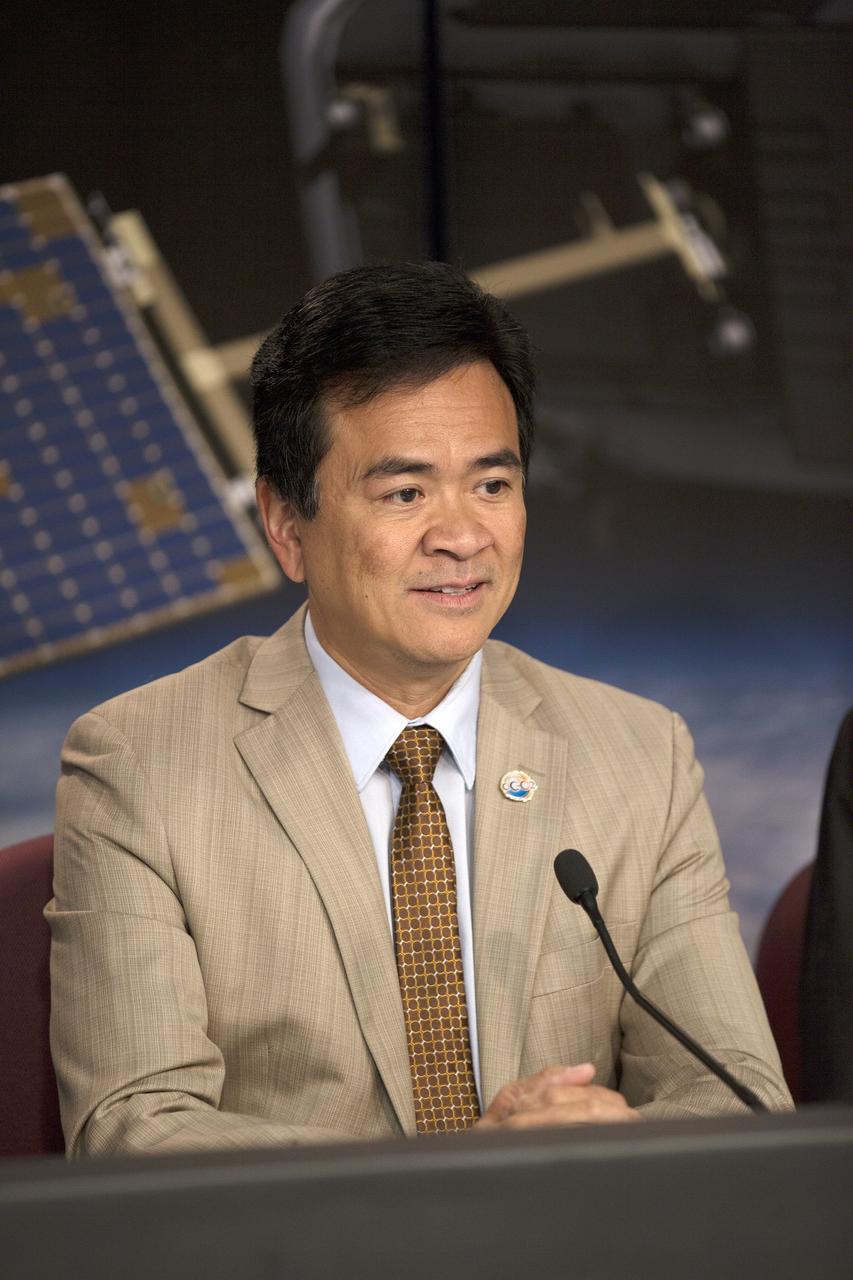
VANDENBERG AIR FORCE BASE, Calif. – Ralph Basilio, project manager for NASA's Orbiting Carbon Observatory-2, or OCO-2, from NASA's Jet Propulsion Laboratory participates in a post-launch news conference at Vandenberg Air Force Base in California following the successful launch of the satellite. Liftoff of OCO-2 from Space Launch Complex 2 aboard a United Launch Alliance Delta II rocket was on schedule at 5:56 a.m. EDT on July 2 following the repair of the pad's water suppression system, which failed on the first launch attempt July 1. OCO-2 is NASA’s first mission dedicated to studying atmospheric carbon dioxide, the leading human-produced greenhouse gas driving changes in Earth’s climate. OCO-2 will provide a new tool for understanding the human and natural sources of carbon dioxide emissions and the natural "sinks" that absorb carbon dioxide and help control its buildup. The observatory will measure the global geographic distribution of these sources and sinks and study their changes over time. To learn more about OCO-2, visit http://www.nasa.gov/oco2. Photo credit: NASA/Kim Shiflett
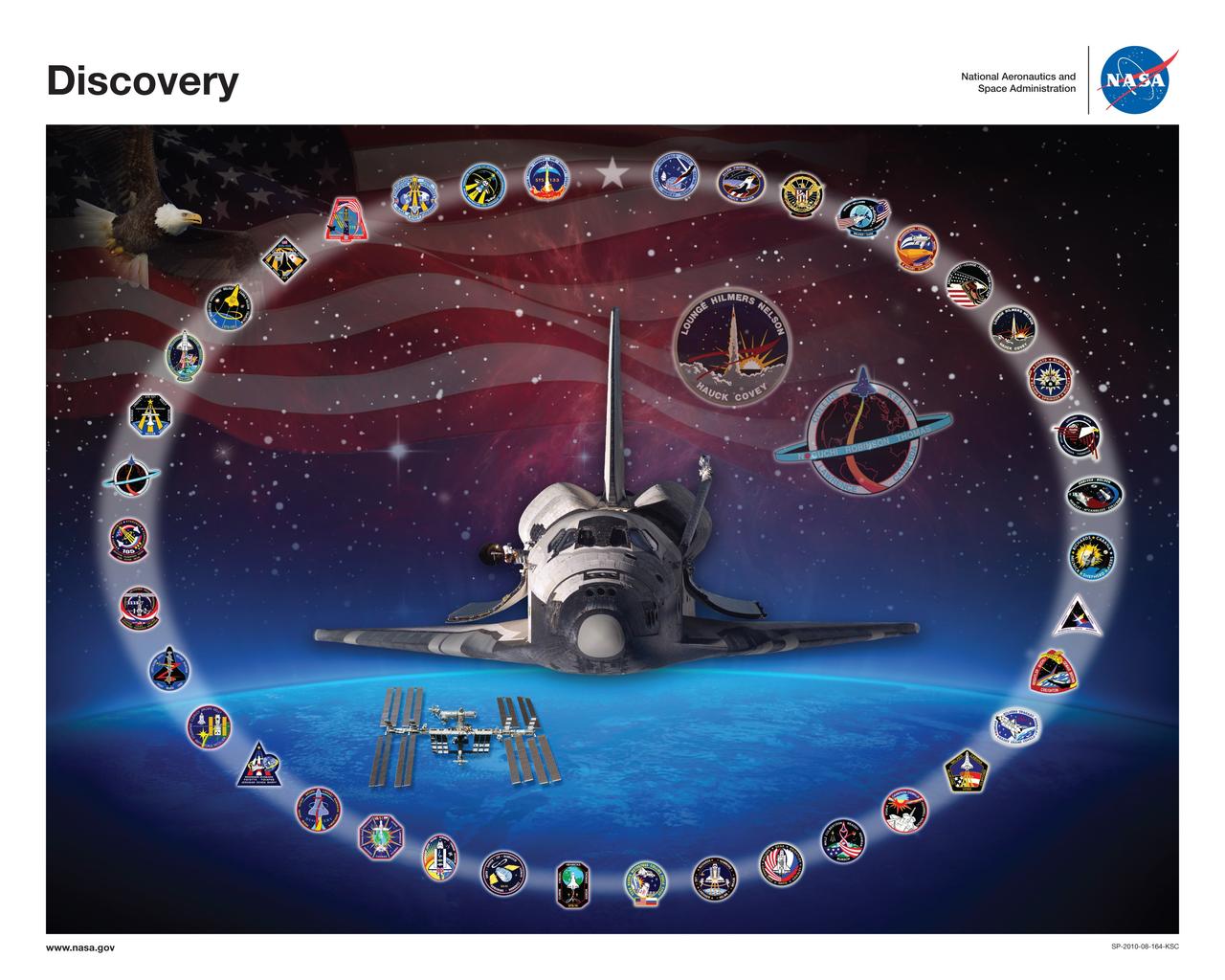
CAPE CANAVERAL, Fla. -- This is a version of space shuttle Discovery's orbiter tribute, or OV-103, which hangs in Firing Room 4 of the Launch Control Center at NASA's Kennedy Space Center in Florida. Discovery’s accomplishments include the first female shuttle pilot, Eileen Collins, on STS-63, John Glenn’s legendary return to space on STS-95, and the celebration of the 100th shuttle mission with STS-92. In addition, Discovery supported a number of Department of Defense programs, satellite deploy and repair missions and 13 International Space Station construction and operation flights. The tribute features Discovery demonstrating the rendezvous pitch maneuver on approach to the International Space Station during STS-114. Having accumulated the most space shuttle flights, Discovery’s 39 mission patches are shown circling the spacecraft. The background image was taken from the Hubble Space Telescope, which launched aboard Discovery on STS-31 and serviced by Discovery on STS-82 and STS-103. The American Flag and Bald Eagle represent Discovery’s two Return-to-Flight missions -- STS-26 and STS-114 -- and symbolize Discovery’s role in returning American astronauts to space. Five orbiter tributes are on display in the firing room, representing Atlantis, Challenger, Columbia, Endeavour and Discovery. Graphic design credit: NASA/Amy Lombardo. NASA publication number: SP-2010-08-164-KSC
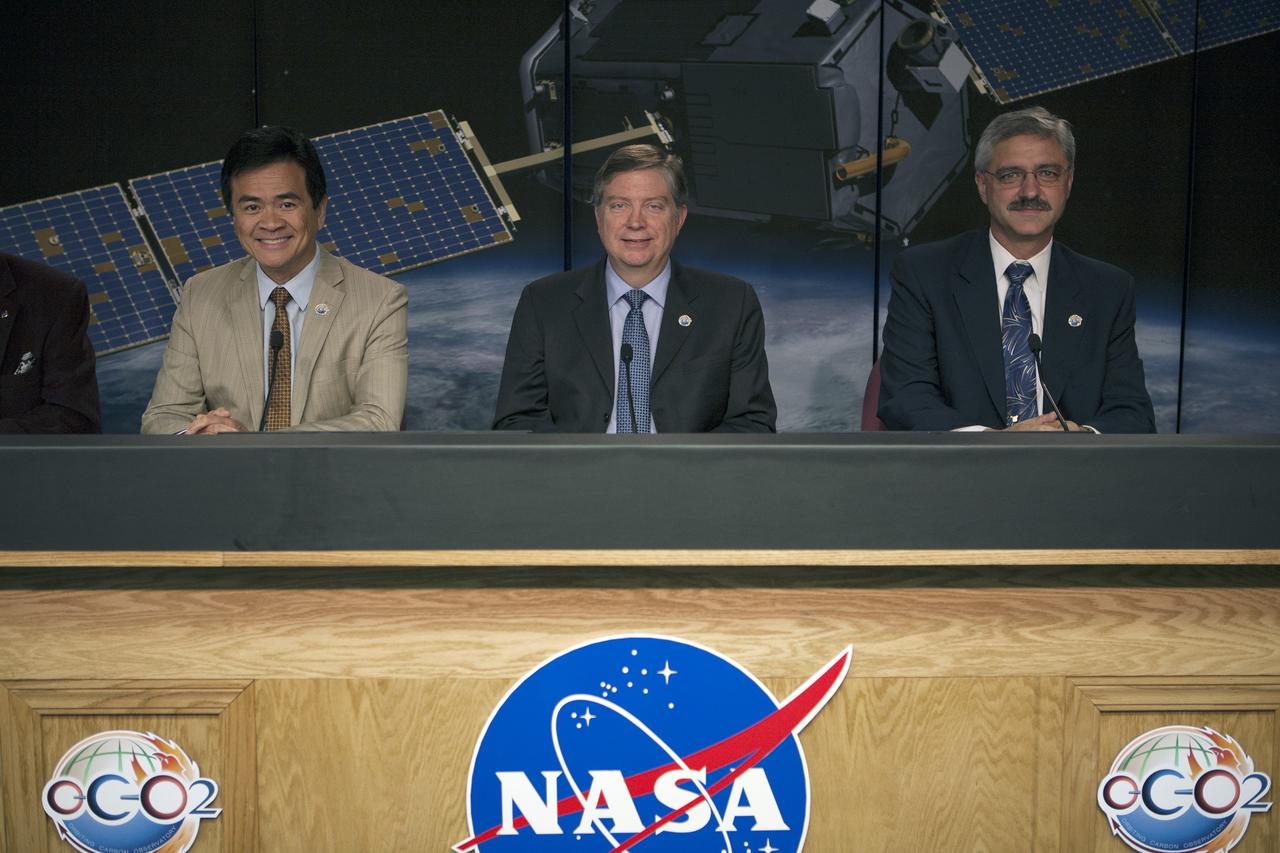
VANDENBERG AIR FORCE BASE, Calif. – A post-launch news conference is held at Vandenberg Air Force Base in California following the successful launch of NASA's Orbiting Carbon Observatory-2, or OCO-2. From left are Ralph Basilio, OCO-2 project manager at NASA's Jet Propulsion Laboratory Mike Miller, senior vice president, Science and Environmental Satellite Programs, Orbital Sciences Space Systems Group and Geoff Yoder, deputy associate administrator for Programs, Science Mission Directorate, NASA Headquarters. Liftoff of OCO-2 from Space Launch Complex 2 aboard a United Launch Alliance Delta II rocket was on schedule at 5:56 a.m. EDT on July 2 following the repair of the pad's water suppression system, which failed on the first launch attempt July 1. OCO-2 is NASA’s first mission dedicated to studying atmospheric carbon dioxide, the leading human-produced greenhouse gas driving changes in Earth’s climate. OCO-2 will provide a new tool for understanding the human and natural sources of carbon dioxide emissions and the natural "sinks" that absorb carbon dioxide and help control its buildup. The observatory will measure the global geographic distribution of these sources and sinks and study their changes over time. To learn more about OCO-2, visit http://www.nasa.gov/oco2. Photo credit: NASA/Kim Shiflett
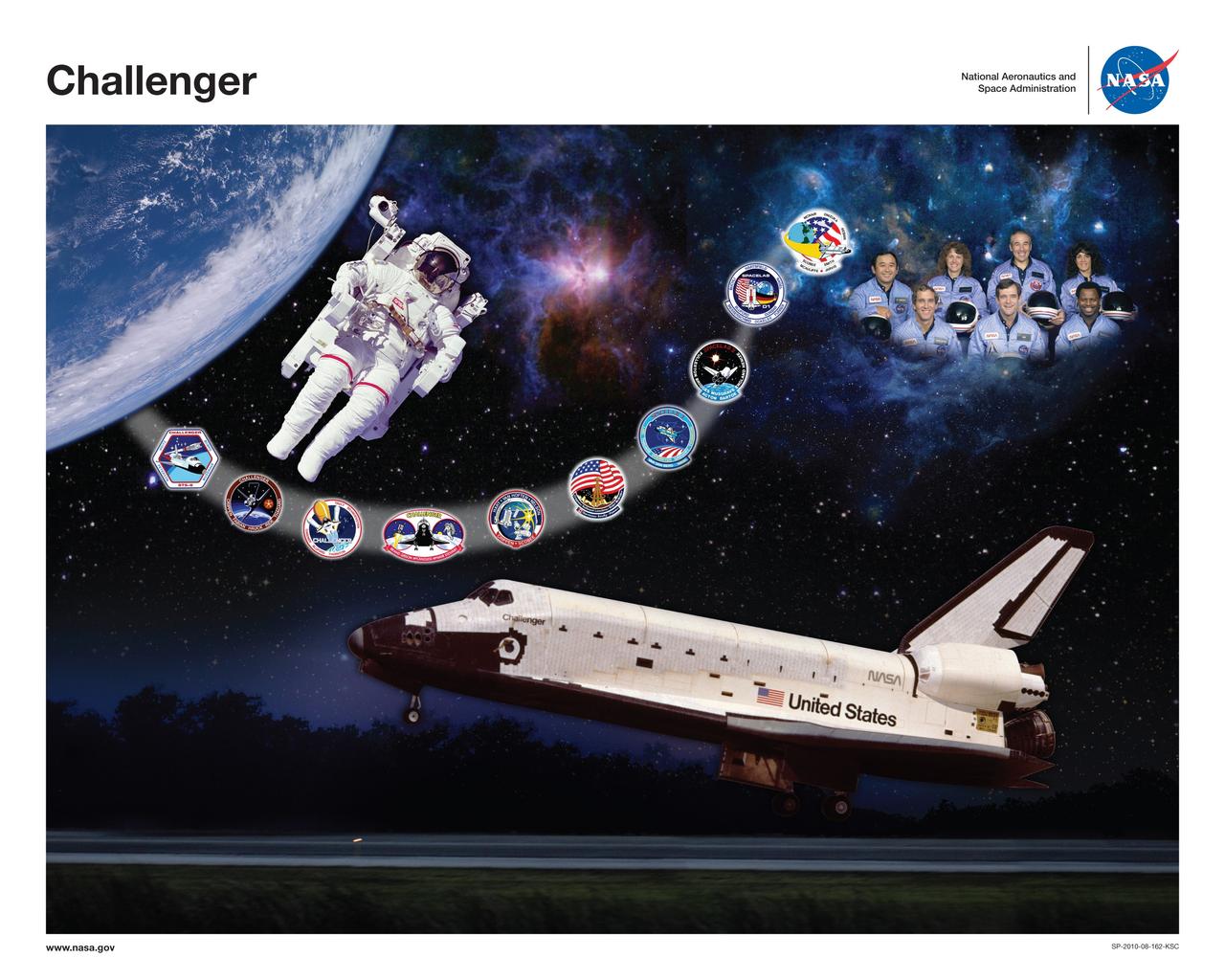
CAPE CANAVERAL, Fla. -- This is a version of space shuttle Challenger's orbiter tribute, or OV-099, which hangs in Firing Room 4 of the Launch Control Center at NASA's Kennedy Space Center in Florida. Challenger's accomplishments include the first night launch and first African-American in space, Guion Bluford, on STS-8, the first in-flight capture, repair and redeployment of an orbiting satellite during STS-41C, the first American woman in space, Sally Ride, on STS-7, and the first American woman to walk in space, Kathryn Sullivan, during STS-41G. Challenger is credited with blazing a trail for NASA's other orbiters with the first night landing at Edwards Air Force Base in California on STS-8 and the first landing at Kennedy on STS-41B. The spacewalker in the tribute represents Challenger’s role in the first spacewalk during STS-6 and the first untethered spacewalk on STS-41B. Crew-designed patches for each of Challenger’s missions lead from Earth toward a remembrance of the STS-51L crew, which was lost 73 seconds after liftoff on Jan. 28, 1986. Five orbiter tributes are on display in the firing room, representing Atlantis, Challenger, Columbia, Endeavour and Discovery. Graphic design credit: NASA/Lynda Brammer. NASA publication number: SP-2010-08-162-KSC
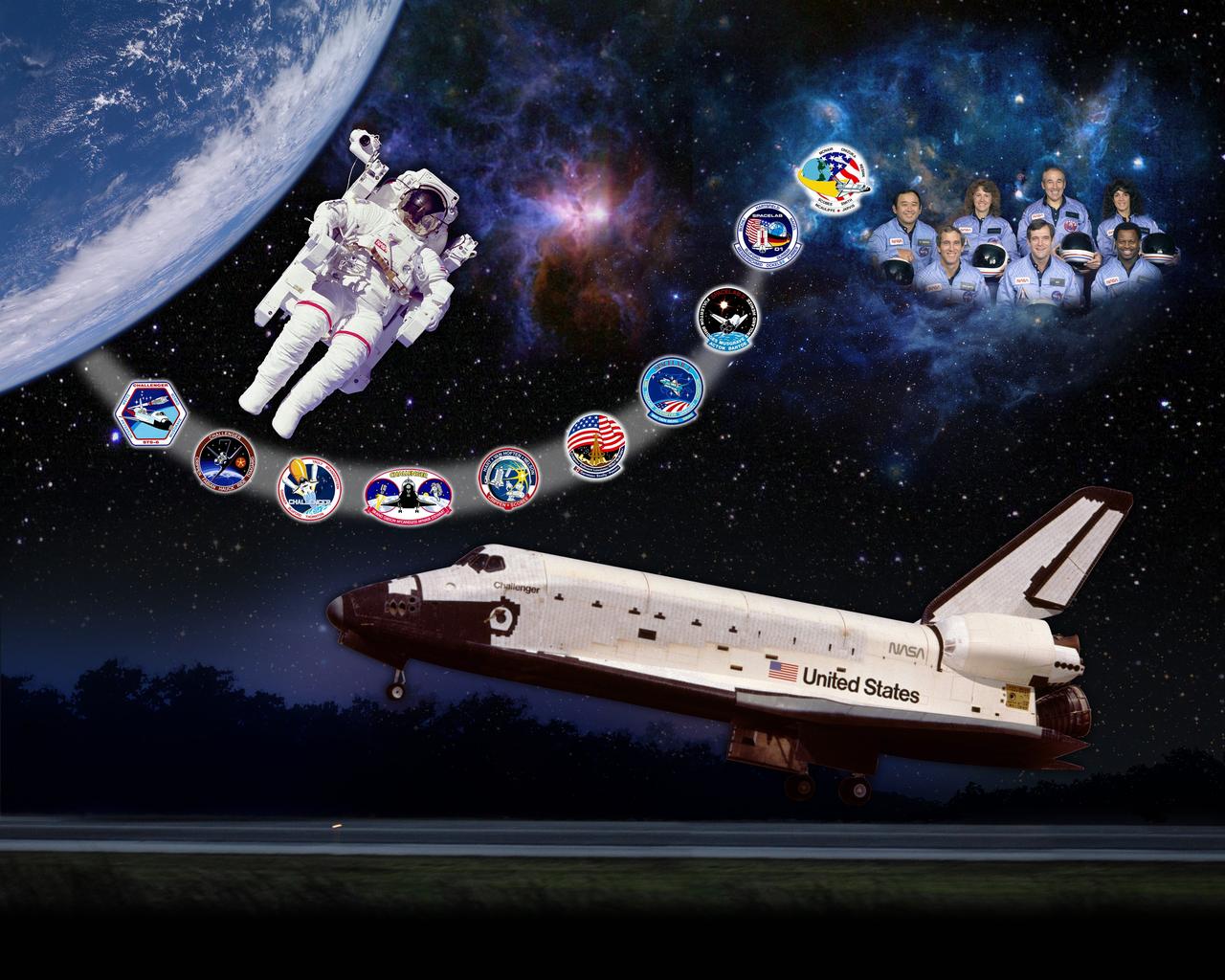
CAPE CANAVERAL, Fla. -- This orbiter tribute of space shuttle Challenger, or OV-099, hangs in Firing Room 4 of the Launch Control Center at NASA's Kennedy Space Center in Florida. Challenger's accomplishments include the first night launch and first African-American in space, Guion Bluford, on STS-8, the first in-flight capture, repair and redeployment of an orbiting satellite during STS-41C, the first American woman in space, Sally Ride, on STS-7, and the first American woman to walk in space, Kathryn Sullivan, during STS-41G. Challenger is credited with blazing a trail for NASA's other orbiters with the first night landing at Edwards Air Force Base in California on STS-8 and the first landing at Kennedy on STS-41B. The spacewalker in the tribute represents Challenger’s role in the first spacewalk during STS-6 and the first untethered spacewalk on STS-41B. Crew-designed patches for each of Challenger’s missions lead from Earth toward a remembrance of the STS-51L crew, which was lost 73 seconds after liftoff on Jan. 28, 1986. Five orbiter tributes are on display in the firing room, representing Atlantis, Challenger, Columbia, Endeavour and Discovery. Graphic design credit: NASA/Lynda Brammer
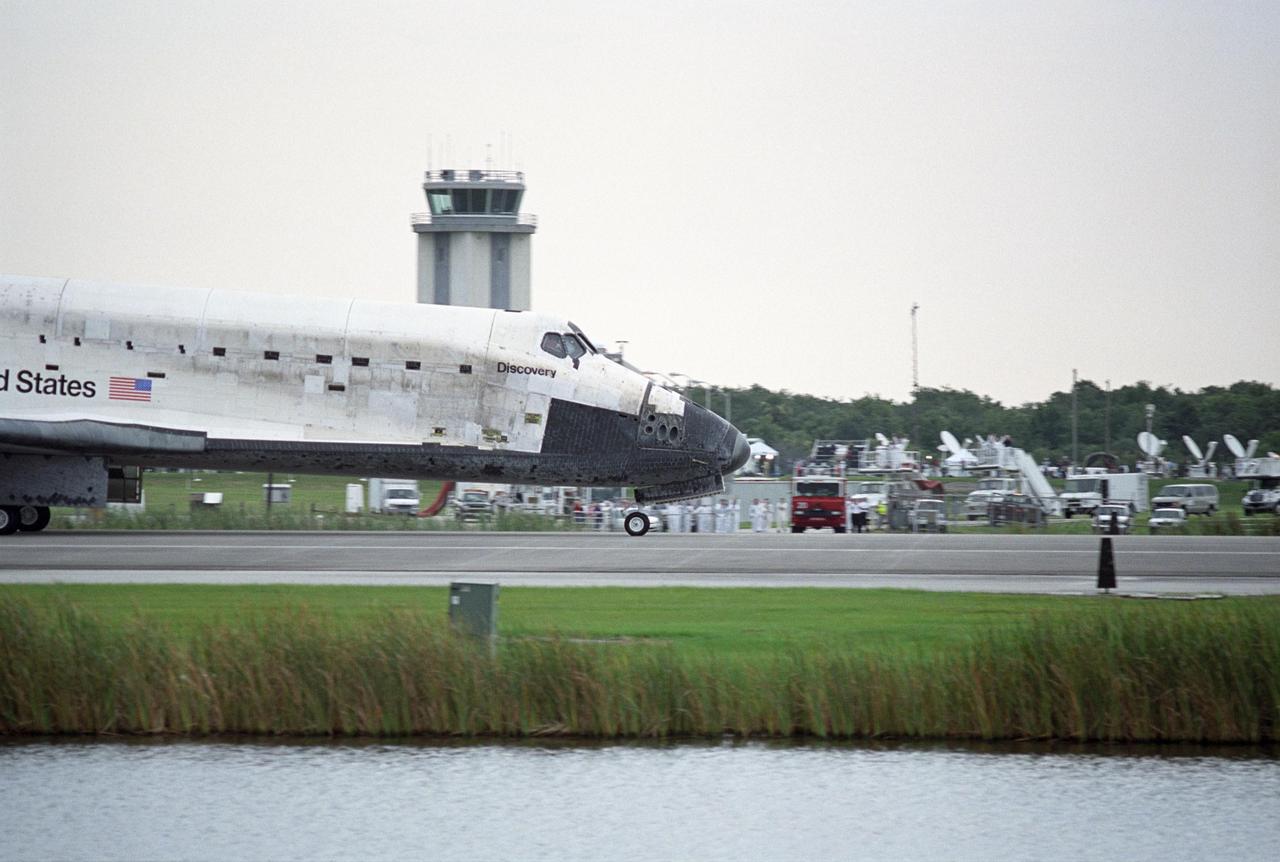
KENNEDY SPACE CENTER, FLA. - The orbiter Discovery passes dozens of satellite trucks and media at midfield after landing on Runway 15 at NASA's Shuttle Landing Facility, completing mission STS-121 to the International Space Station. Discovery traveled 5.3 million miles, landing on orbit 202. Mission elapsed time was 12 days, 18 hours, 37 minutes and 54 seconds. Main gear touchdown occurred on time at 9:14:43 EDT. Wheel stop was at 9:15:49 EDT. The returning crew members aboard are Commander Steven Lindsey, Pilot Mark Kelly and Mission Specialists Piers Sellers, Michael Fossum, Lisa Nowak and Stephanie Wilson. Mission Specialist Thomas Reiter, who launched with the crew on July 4, remained on the station to join the Expedition 13 crew there. The landing is the 62nd at Kennedy Space Center and the 32nd for Discovery. During the mission, the STS-121 crew tested new equipment and procedures to improve shuttle safety, and delivered supplies and made repairs to the International Space Station. Photo credit: NASA/Regina Mitchell-Ryall
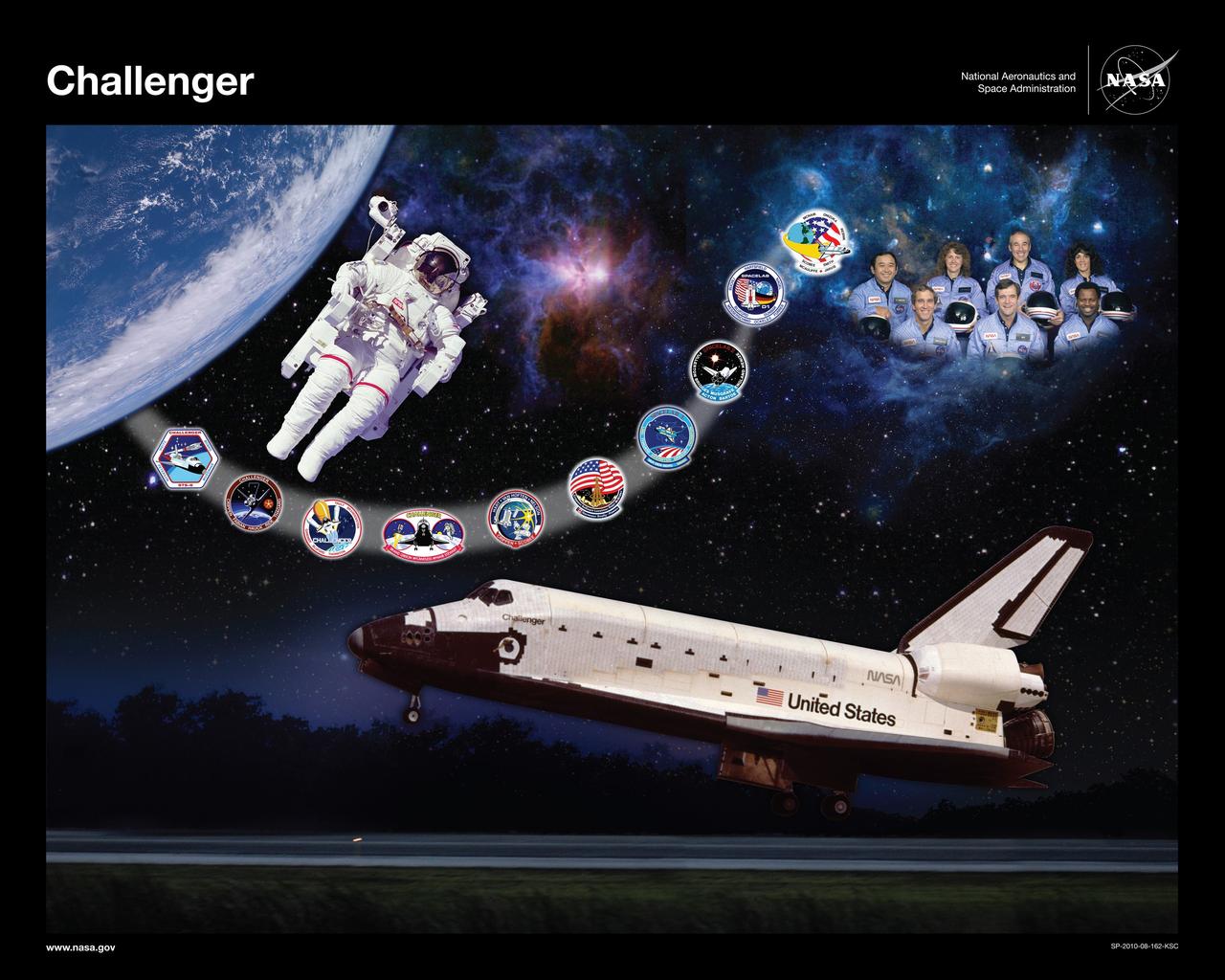
CAPE CANAVERAL, Fla. -- This is a printable version of space shuttle Challenger's orbiter tribute, or OV-099, which hangs in Firing Room 4 of the Launch Control Center at NASA's Kennedy Space Center in Florida. Challenger's accomplishments include the first night launch and first African-American in space, Guion Bluford, on STS-8, the first in-flight capture, repair and redeployment of an orbiting satellite during STS-41C, the first American woman in space, Sally Ride, on STS-7, and the first American woman to walk in space, Kathryn Sullivan, during STS-41G. Challenger is credited with blazing a trail for NASA's other orbiters with the first night landing at Edwards Air Force Base in California on STS-8 and the first landing at Kennedy on STS-41B. The spacewalker in the tribute represents Challenger’s role in the first spacewalk during STS-6 and the first untethered spacewalk on STS-41B. Crew-designed patches for each of Challenger’s missions lead from Earth toward a remembrance of the STS-51L crew, which was lost 73 seconds after liftoff on Jan. 28, 1986. Five orbiter tributes are on display in the firing room, representing Atlantis, Challenger, Columbia, Endeavour and Discovery. Graphic design credit: NASA/Lynda Brammer. NASA publication number: SP-2010-08-162-KSC
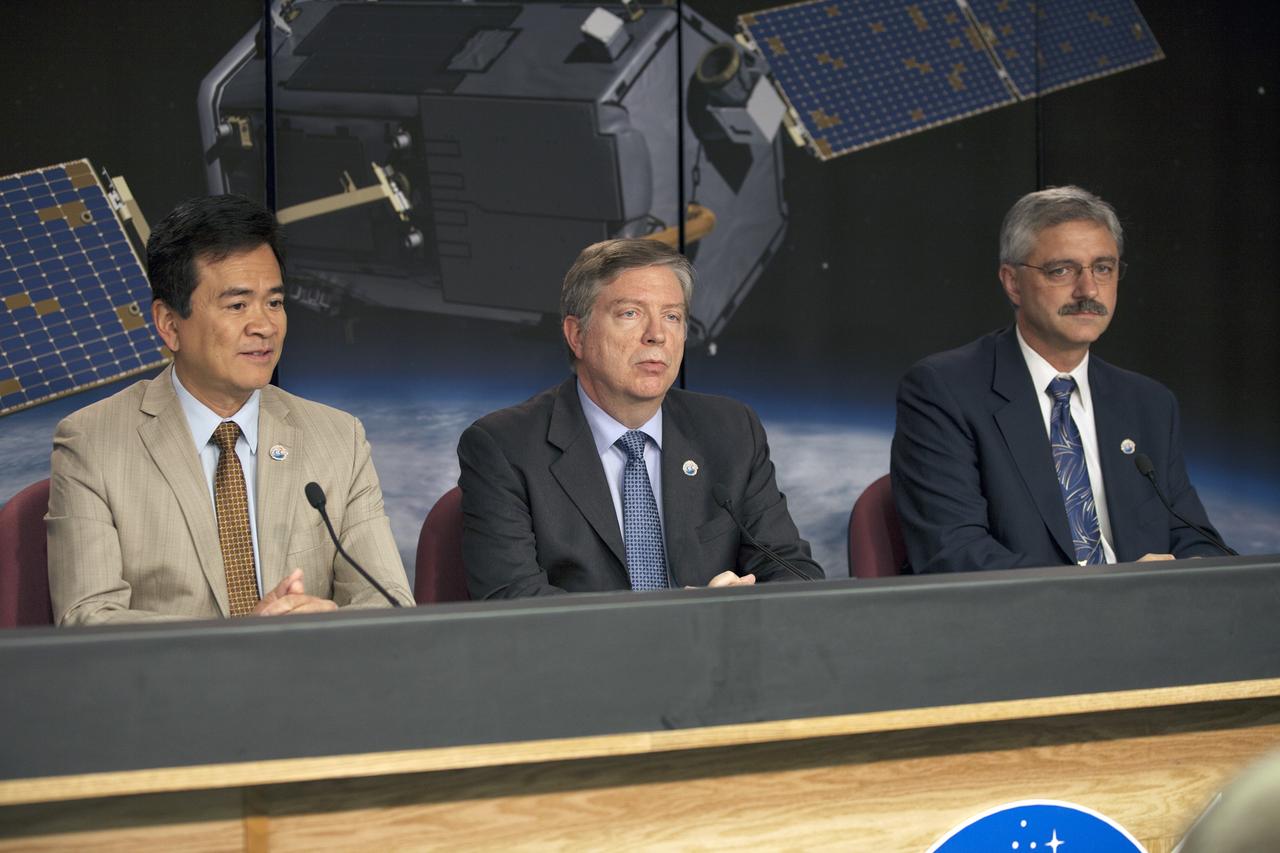
VANDENBERG AIR FORCE BASE, Calif. – A post-launch news conference is held at Vandenberg Air Force Base in California following the successful launch of NASA's Orbiting Carbon Observatory-2, or OCO-2. From left are Ralph Basilio, OCO-2 project manager at NASA's Jet Propulsion Laboratory Mike Miller, senior vice president, Science and Environmental Satellite Programs, Orbital Sciences Space Systems Group and Geoff Yoder, deputy associate administrator for Programs, Science Mission Directorate, NASA Headquarters. Liftoff of OCO-2 from Space Launch Complex 2 aboard a United Launch Alliance Delta II rocket was on schedule at 5:56 a.m. EDT on July 2 following the repair of the pad's water suppression system, which failed on the first launch attempt July 1. OCO-2 is NASA’s first mission dedicated to studying atmospheric carbon dioxide, the leading human-produced greenhouse gas driving changes in Earth’s climate. OCO-2 will provide a new tool for understanding the human and natural sources of carbon dioxide emissions and the natural "sinks" that absorb carbon dioxide and help control its buildup. The observatory will measure the global geographic distribution of these sources and sinks and study their changes over time. To learn more about OCO-2, visit http://www.nasa.gov/oco2. Photo credit: NASA/Kim Shiflett
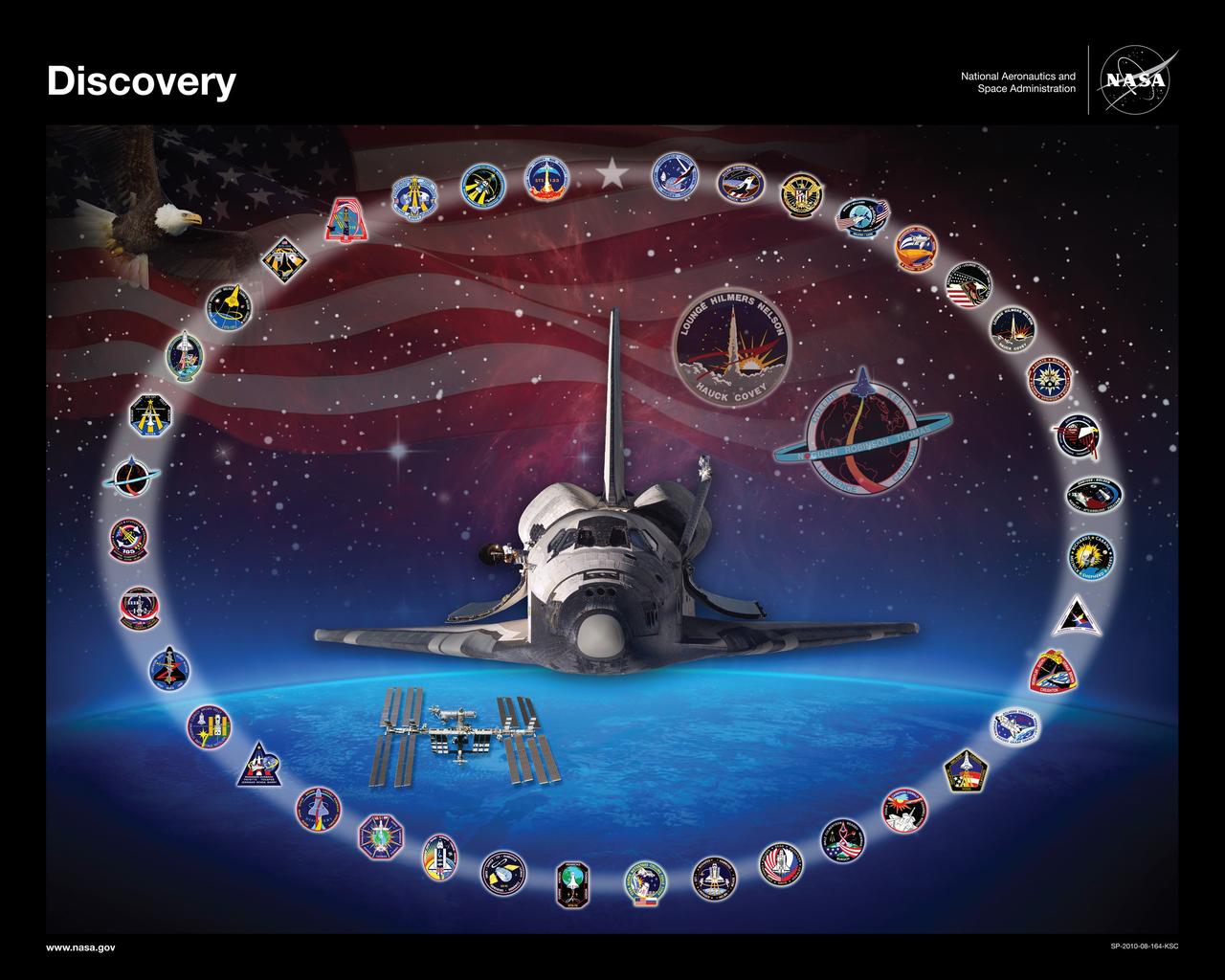
CAPE CANAVERAL, Fla. -- This is a printable version of space shuttle Discovery's orbiter tribute, or OV-103, which hangs in Firing Room 4 of the Launch Control Center at NASA's Kennedy Space Center in Florida. Discovery’s accomplishments include the first female shuttle pilot, Eileen Collins, on STS-63, John Glenn’s legendary return to space on STS-95, and the celebration of the 100th shuttle mission with STS-92. In addition, Discovery supported a number of Department of Defense programs, satellite deploy and repair missions and 13 International Space Station construction and operation flights. The tribute features Discovery demonstrating the rendezvous pitch maneuver on approach to the International Space Station during STS-114. Having accumulated the most space shuttle flights, Discovery’s 39 mission patches are shown circling the spacecraft. The background image was taken from the Hubble Space Telescope, which launched aboard Discovery on STS-31 and serviced by Discovery on STS-82 and STS-103. The American Flag and Bald Eagle represent Discovery’s two Return-to-Flight missions -- STS-26 and STS-114 -- and symbolize Discovery’s role in returning American astronauts to space. Five orbiter tributes are on display in the firing room, representing Atlantis, Challenger, Columbia, Endeavour and Discovery. Graphic design credit: NASA/Amy Lombardo. NASA publication number: SP-2010-08-164-KSC
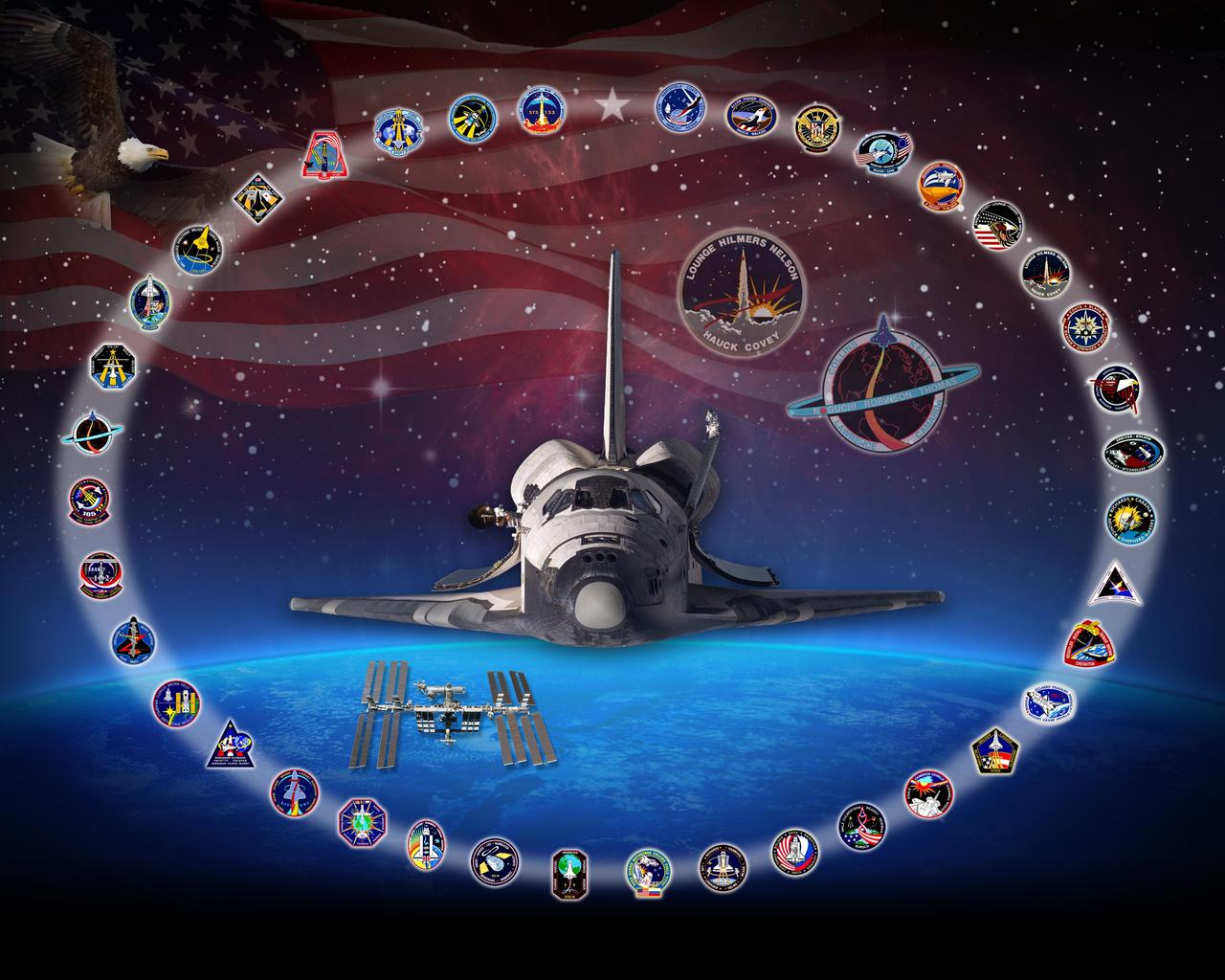
CAPE CANAVERAL, Fla. -- This orbiter tribute of space shuttle Discovery, or OV-103, hangs in Firing Room 4 of the Launch Control Center at NASA's Kennedy Space Center in Florida. Discovery’s accomplishments include the first female shuttle pilot, Eileen Collins, on STS-63, John Glenn’s legendary return to space on STS-95, and the celebration of the 100th shuttle mission with STS-92. In addition, Discovery supported a number of Department of Defense programs, satellite deploy and repair missions and 13 International Space Station construction and operation flights. The tribute features Discovery demonstrating the rendezvous pitch maneuver on approach to the International Space Station during STS-114. Having accumulated the most space shuttle flights, Discovery’s 39 mission patches are shown circling the spacecraft. The background image was taken from the Hubble Space Telescope, which launched aboard Discovery on STS-31 and serviced by Discovery on STS-82 and STS-103. The American Flag and Bald Eagle represent Discovery’s two Return-to-Flight missions -- STS-26 and STS-114 -- and symbolize Discovery’s role in returning American astronauts to space. Five orbiter tributes are on display in the firing room, representing Atlantis, Challenger, Columbia, Endeavour and Discovery. Graphic design credit: NASA/Amy Lombardo
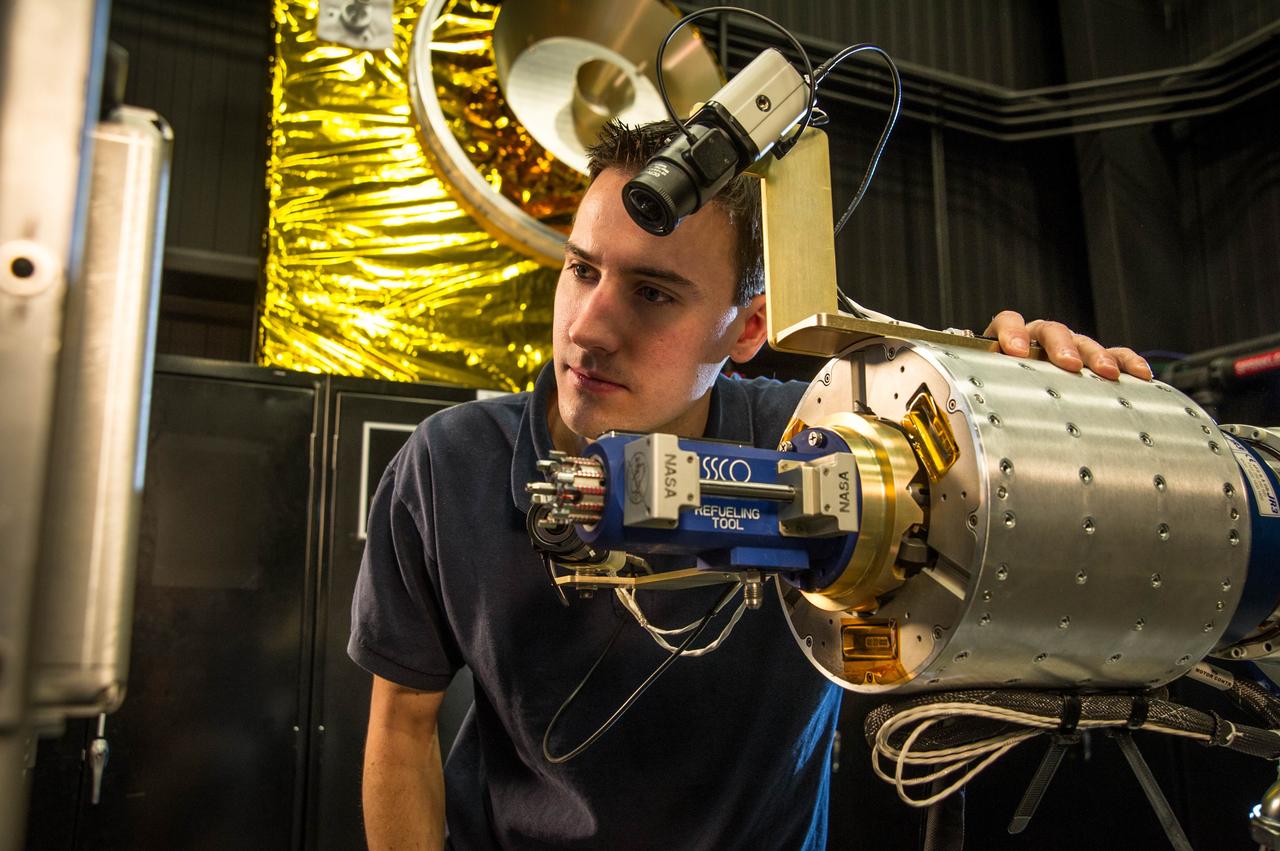
RROxiTT lead roboticist Alex Janas stands with the Oxidizer Nozzle Tool as he examines the work site. Credit: NASA/Goddard/Chris Gunn NASA has successfully concluded a remotely controlled test of new technologies that would empower future space robots to transfer hazardous oxidizer – a type of propellant – into the tanks of satellites in space today. Concurrently on the ground, NASA is incorporating results from this test and the Robotic Refueling Mission on the International Space Station to prepare for an upcoming ground-based test of a full-sized robotic servicer system that will perform tasks on a mock satellite client. Collectively, these efforts are part of an ongoing and aggressive technology development campaign to equip robots and humans with the tools and capabilities needed for spacecraft maintenance and repair, the assembly of large space telescopes, and extended human exploration. Read more here: <a href="http://www.nasa.gov/content/goddard/nasa-tests-new-robotic-refueling-technologies/#.UxeLyyRkLH4" rel="nofollow">www.nasa.gov/content/goddard/nasa-tests-new-robotic-refue...</a> <b><a href="http://www.nasa.gov/audience/formedia/features/MP_Photo_Guidelines.html" rel="nofollow">NASA image use policy.</a></b> <b><a href="http://www.nasa.gov/centers/goddard/home/index.html" rel="nofollow">NASA Goddard Space Flight Center</a></b> enables NASA’s mission through four scientific endeavors: Earth Science, Heliophysics, Solar System Exploration, and Astrophysics. Goddard plays a leading role in NASA’s accomplishments by contributing compelling scientific knowledge to advance the Agency’s mission. <b>Follow us on <a href="http://twitter.com/NASAGoddardPix" rel="nofollow">Twitter</a></b> <b>Like us on <a href="http://www.facebook.com/pages/Greenbelt-MD/NASA-Goddard/395013845897?ref=tsd" rel="nofollow">Facebook</a></b> <b>Find us on <a href="http://instagram.com/nasagoddard?vm=grid" rel="nofollow">Instagram</a></b>
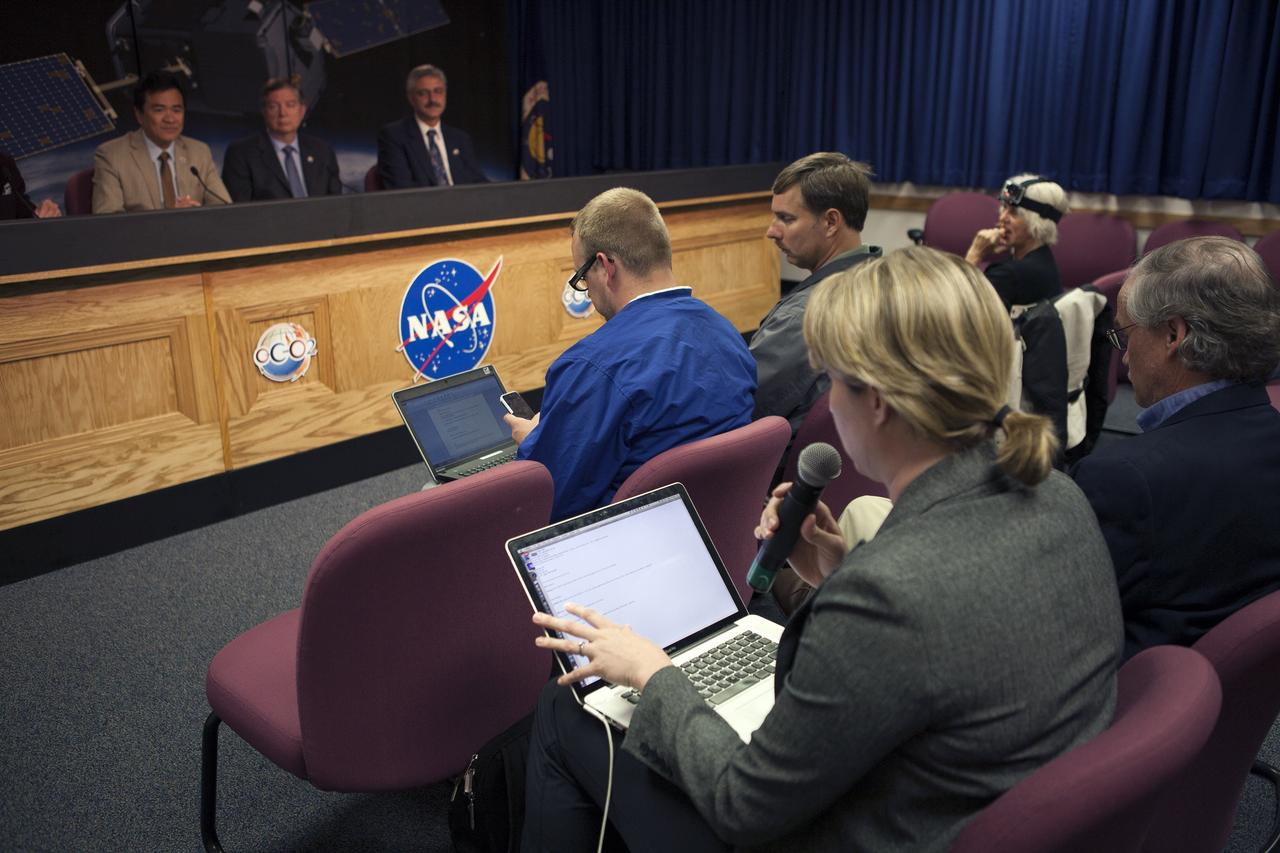
VANDENBERG AIR FORCE BASE, Calif. – Representatives of news and social media outlets participate in a post-launch news conference at Vandenberg Air Force Base in California following the successful launch of NASA's Orbiting Carbon Observatory-2, or OCO-2. On the dais, from left, are Ralph Basilio, OCO-2 project manager at NASA's Jet Propulsion Laboratory Mike Miller, senior vice president, Science and Environmental Satellite Programs, Orbital Sciences Space Systems Group and Geoff Yoder, deputy associate administrator for Programs, Science Mission Directorate, NASA Headquarters. Liftoff of OCO-2 from Space Launch Complex 2 aboard a United Launch Alliance Delta II rocket was on schedule at 5:56 a.m. EDT on July 2 following the repair of the pad's water suppression system, which failed on the first launch attempt July 1. OCO-2 is NASA’s first mission dedicated to studying atmospheric carbon dioxide, the leading human-produced greenhouse gas driving changes in Earth’s climate. OCO-2 will provide a new tool for understanding the human and natural sources of carbon dioxide emissions and the natural "sinks" that absorb carbon dioxide and help control its buildup. The observatory will measure the global geographic distribution of these sources and sinks and study their changes over time. To learn more about OCO-2, visit http://www.nasa.gov/oco2. Photo credit: NASA/Kim Shiflett
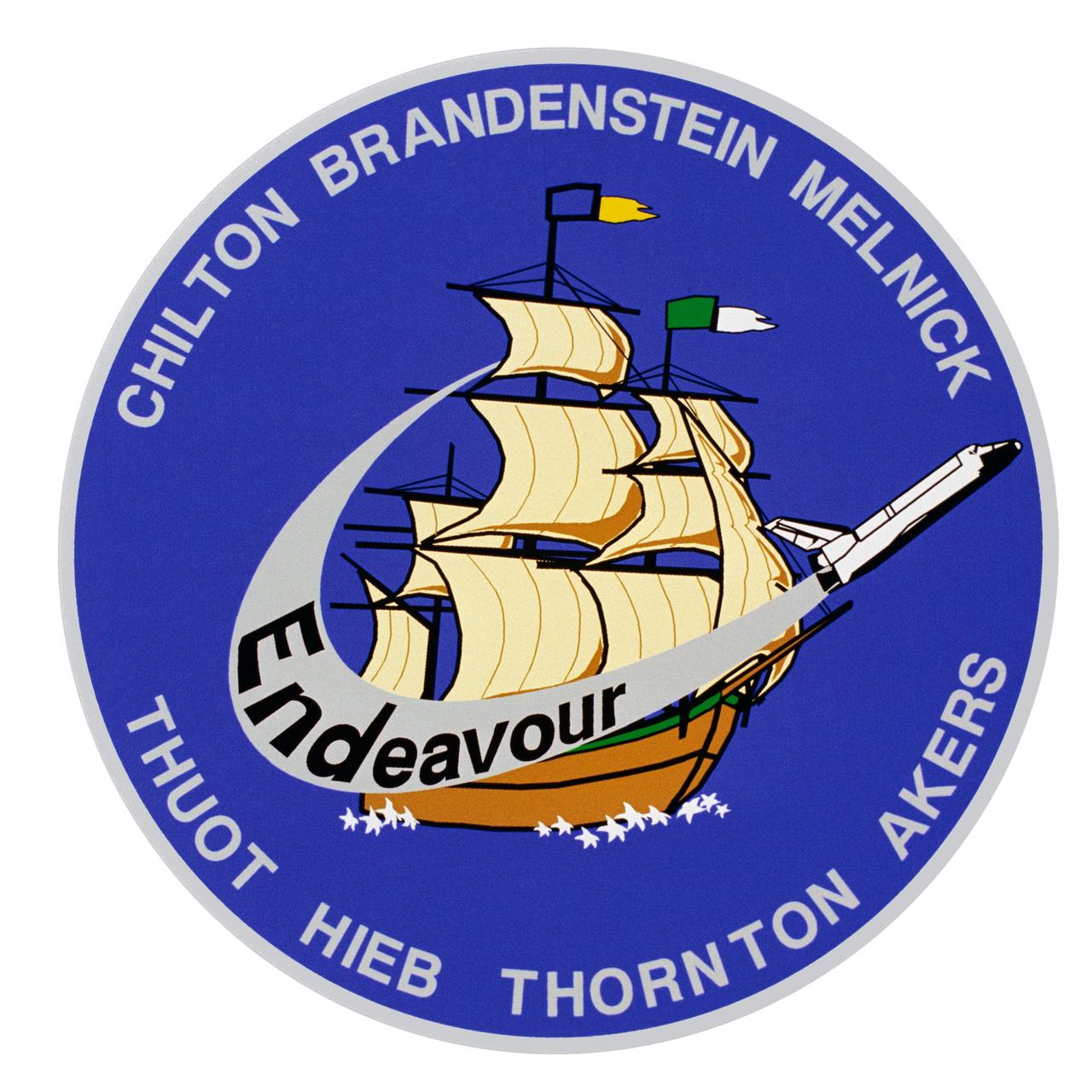
STS049-S-001 (March 1991) --- The patch, designed by its crew members, captures spaceflight's spirit of exploration which has its origins in the early seagoing vessels that explored the uncharted reaches of Earth and its oceans. The ship depicted on the patch is HMS Endeavour, the sailing vessel which Captain James Cook commanded on his first scientific expedition to the South Pacific. Just as Captain Cook engaged in unprecedented feats of exploration during his voyage, on the space shuttle Endeavour's maiden flight, its crew will expand the horizons of space operations with an unprecedented rendezvous and series of three spacewalks. During three consecutive days of extravehicular activity (EVA), the crew will conduct one spacewalk to retrieve, repair and deploy the Intelsat IV-F3 communications satellite, and two additional EVA's to evaluate potential Space Station Freedom assembly concepts. The flags flying high on Endeavour's masts wear the colors of the two schools that won the nationwide contest when Endeavour was chosen as the name of NASA's newest space shuttle: Senatobia (Mississippi) Middle School and Tallulah Falls (Georgia) School. The NASA insignia design for space shuttle flights is reserved for use by the astronauts and for other official use as the NASA Administrator may authorize. Public availability has been approved only in the form of illustrations by the various news media. When and if there is any change in this policy, which is not anticipated, it will be publicly announced. Photo credit: NASA
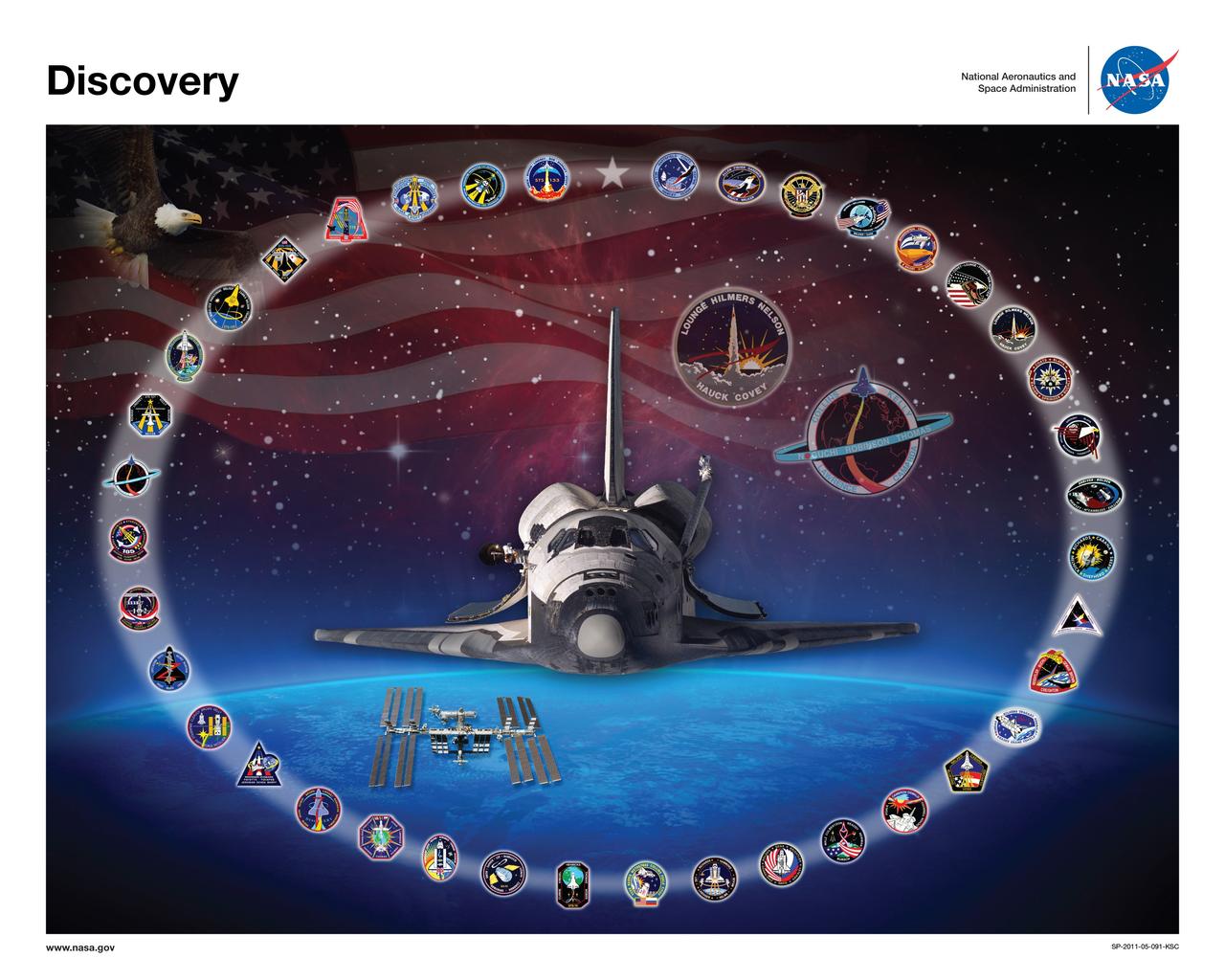
CAPE CANAVERAL, Fla. -- This is a version of space shuttle Discovery's orbiter tribute, or OV-103, which hangs in Firing Room 4 of the Launch Control Center at NASA's Kennedy Space Center in Florida. In 2011, the tribute was updated to reflect the crew member change on Discovery's final mission -- STS-133. Steve Bowen replaced Tim Kopra as a mission specialist on STS-133, after Kopra was injured in a bicycle accident that prevented him from flying into space. Discovery’s accomplishments include the first female shuttle pilot, Eileen Collins, on STS-63, John Glenn’s legendary return to space on STS-95, and the celebration of the 100th shuttle mission with STS-92. In addition, Discovery supported a number of Department of Defense programs, satellite deploy and repair missions and 13 International Space Station construction and operation flights. The tribute features Discovery demonstrating the rendezvous pitch maneuver on approach to the International Space Station during STS-114. Having accumulated the most space shuttle flights, Discovery’s 39 mission patches are shown circling the spacecraft. The background image was taken from the Hubble Space Telescope, which launched aboard Discovery on STS-31 and serviced by Discovery on STS-82 and STS-103. The American Flag and Bald Eagle represent Discovery’s two Return-to-Flight missions -- STS-26 and STS-114 -- and symbolize Discovery’s role in returning American astronauts to space. Five orbiter tributes are on display in the firing room, representing Atlantis, Challenger, Columbia, Endeavour and Discovery. Graphic design credit: NASA/Amy Lombardo. NASA publication number: SP-2010-08-164-KSC
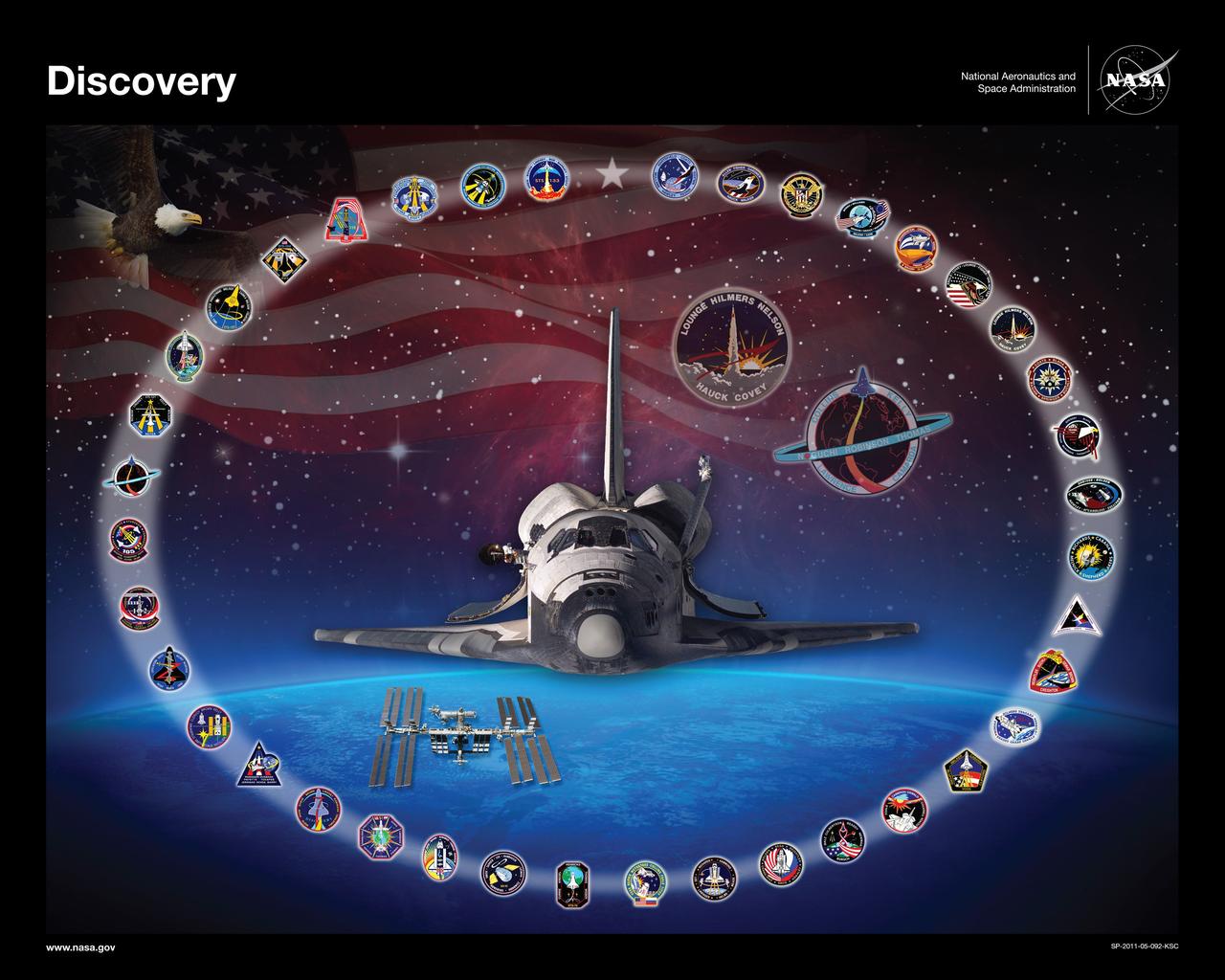
CAPE CANAVERAL, Fla. -- This is a printable version of space shuttle Discovery's orbiter tribute, or OV-103, which hangs in Firing Room 4 of the Launch Control Center at NASA's Kennedy Space Center in Florida. In 2011, the tribute was updated to reflect the crew member change on Discovery's final mission -- STS-133. Steve Bowen replaced Tim Kopra as a mission specialist on STS-133, after Kopra was injured in a bicycle accident that prevented him from flying into space. Discovery’s accomplishments include the first female shuttle pilot, Eileen Collins, on STS-63, John Glenn’s legendary return to space on STS-95, and the celebration of the 100th shuttle mission with STS-92. In addition, Discovery supported a number of Department of Defense programs, satellite deploy and repair missions and 13 International Space Station construction and operation flights. The tribute features Discovery demonstrating the rendezvous pitch maneuver on approach to the International Space Station during STS-114. Having accumulated the most space shuttle flights, Discovery’s 39 mission patches are shown circling the spacecraft. The background image was taken from the Hubble Space Telescope, which launched aboard Discovery on STS-31 and serviced by Discovery on STS-82 and STS-103. The American Flag and Bald Eagle represent Discovery’s two Return-to-Flight missions -- STS-26 and STS-114 -- and symbolize Discovery’s role in returning American astronauts to space. Five orbiter tributes are on display in the firing room, representing Atlantis, Challenger, Columbia, Endeavour and Discovery. Graphic design credit: NASA/Amy Lombardo. NASA publication number: SP-2010-08-164-KSC
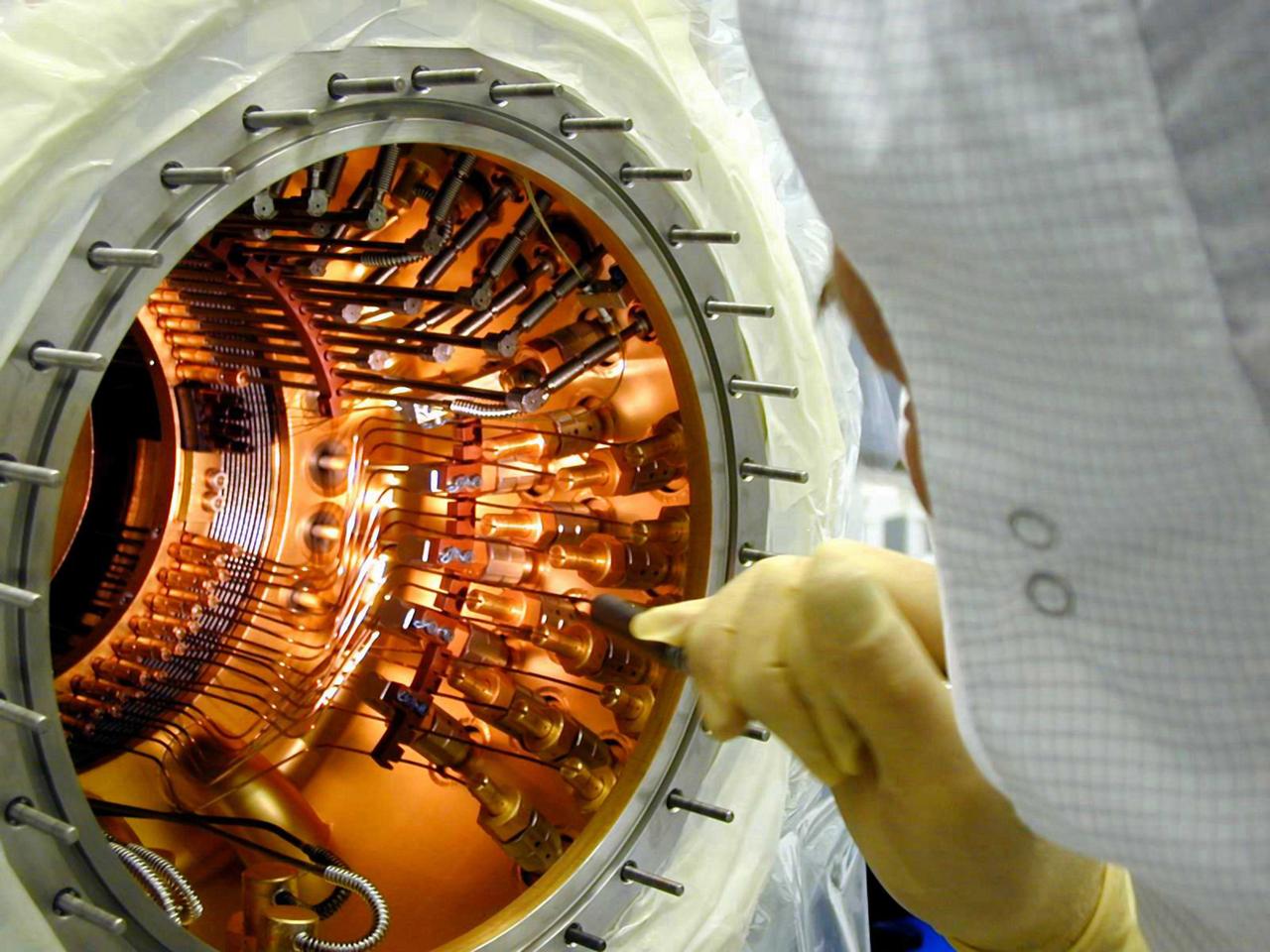
The space vehicle Gravity Probe B (GP-B) is the relativity experiment developed at Stanford University to test two extraordinary predictions of Albert Einstein’s general theory of relativity. The experiment will measure, very precisely, the expected tiny changes in the direction of the spin axes of four gyroscopes contained in an Earth-orbiting satellite at a 400-mile altitude. So free are the gyroscopes from disturbance that they will provide an almost perfect space-time reference system. They will measure how space and time are very slightly warped by the presence of the Earth, and, more profoundly, how the Earth’s rotation very slightly drags space-time around with it. These effects, though small for the Earth, have far-reaching implications for the nature of matter and the structure of the Universe. GP-B is among the most thoroughly researched programs ever undertaken by NASA. This is the story of a scientific quest in which physicists and engineers have collaborated closely over many years. Inspired by their quest, they have invented a whole range of technologies that are already enlivening other branches of science and engineering. In this photograph, engineer Gary Reynolds is inspecting the inside of the probe neck during probe thermal repairs. GP-B is scheduled for launch in April 2004 and managed for NASA by the Marshall Space Flight Center. Development of the GP-B is the responsibility of Stanford University along with major subcontractor Lockheed Martin Corporation. (Image credit to Russ Leese, Gravity Probe B, Stanford University)
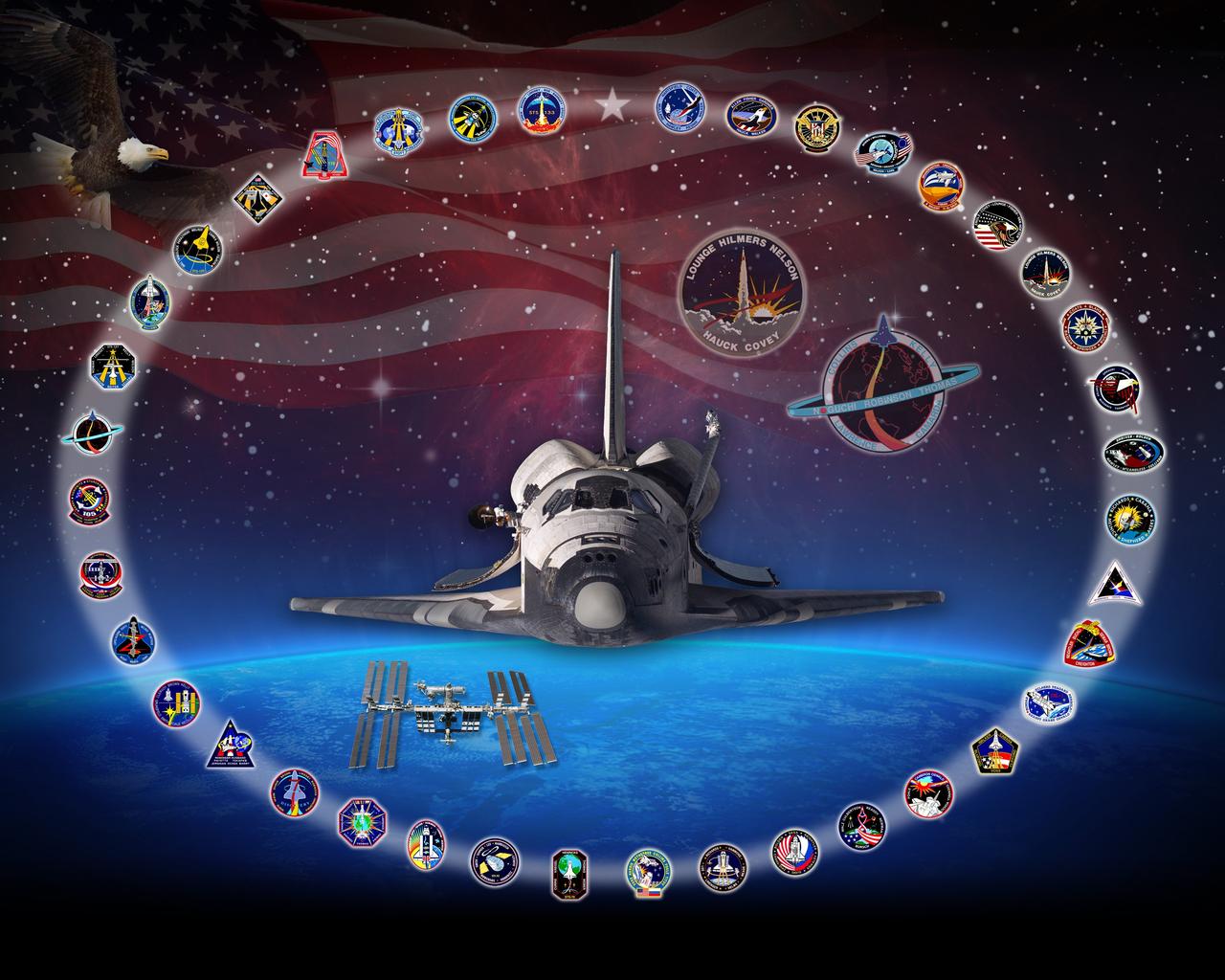
CAPE CANAVERAL, Fla. -- This orbiter tribute of space shuttle Discovery, or OV-103, hangs in Firing Room 4 of the Launch Control Center at NASA's Kennedy Space Center in Florida. In 2011, the tribute was updated to reflect the crew member change on Discovery's final mission -- STS-133. Steve Bowen replaced Tim Kopra as a mission specialist on STS-133, after Kopra was injured in a bicycle accident that prevented him from flying into space. Discovery’s accomplishments include the first female shuttle pilot, Eileen Collins, on STS-63, John Glenn’s legendary return to space on STS-95, and the celebration of the 100th shuttle mission with STS-92. In addition, Discovery supported a number of Department of Defense programs, satellite deploy and repair missions and 13 International Space Station construction and operation flights. The tribute features Discovery demonstrating the rendezvous pitch maneuver on approach to the International Space Station during STS-114. Having accumulated the most space shuttle flights, Discovery’s 39 mission patches are shown circling the spacecraft. The background image was taken from the Hubble Space Telescope, which launched aboard Discovery on STS-31 and serviced by Discovery on STS-82 and STS-103. The American Flag and Bald Eagle represent Discovery’s two Return-to-Flight missions -- STS-26 and STS-114 -- and symbolize Discovery’s role in returning American astronauts to space. Five orbiter tributes are on display in the firing room, representing Atlantis, Challenger, Columbia, Endeavour and Discovery. Graphic design credit: NASA/Amy Lombardo. NASA publication number: SP-2010-08-164-KSC