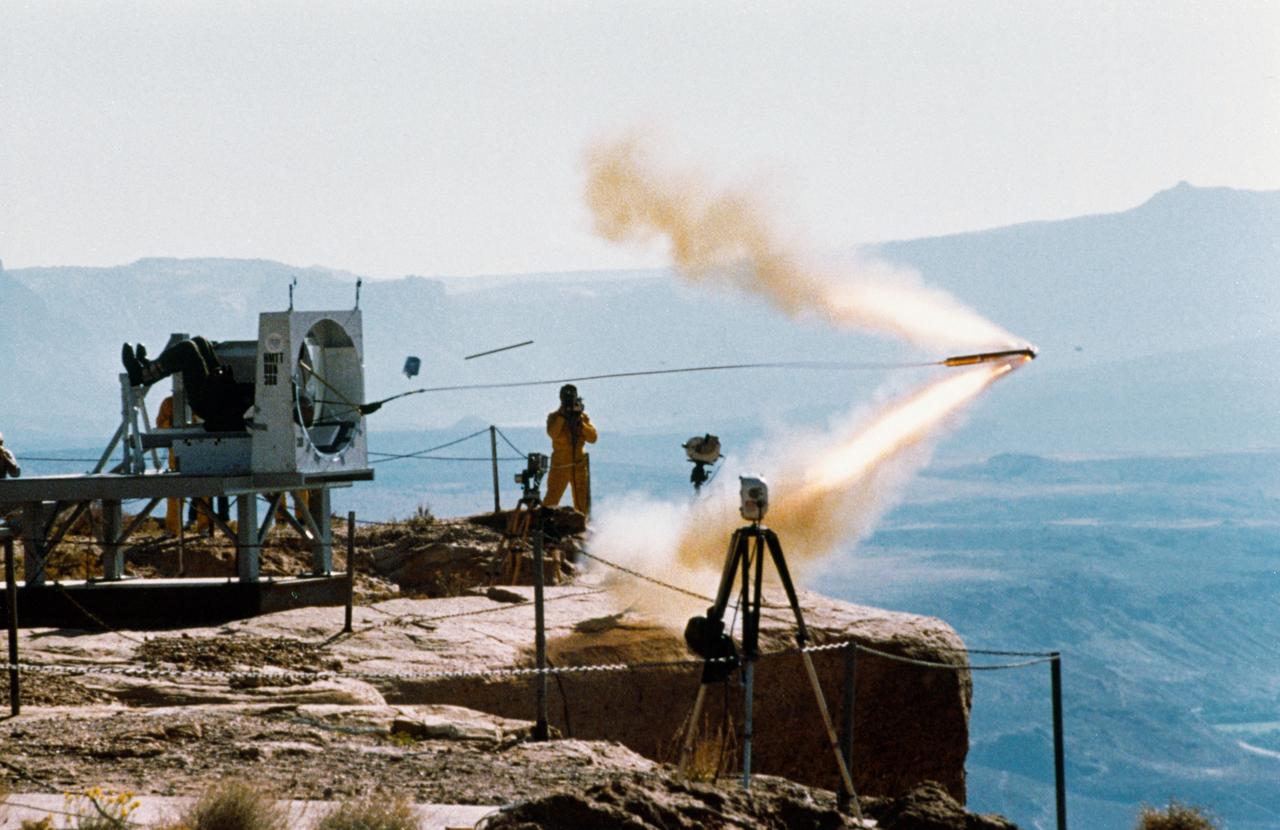
Shuttle crew escape systems (CES) tractor rocket tests conducted at Hurricane Mesa, Utah. This preliminary ground test of the tractor rocket will lead up to in-air evaluations. View shows tractor rocket as it is fired from side hatch mockup. The tractor rocket concept is one of two escape methods being studied to provide crew egress capability during Space Shuttle controlled gliding flight. In-air tests of the system, utilizing a Convair-240 aircraft, will begin 11-19-87 at the Naval Weapons Center in China Lake, California.
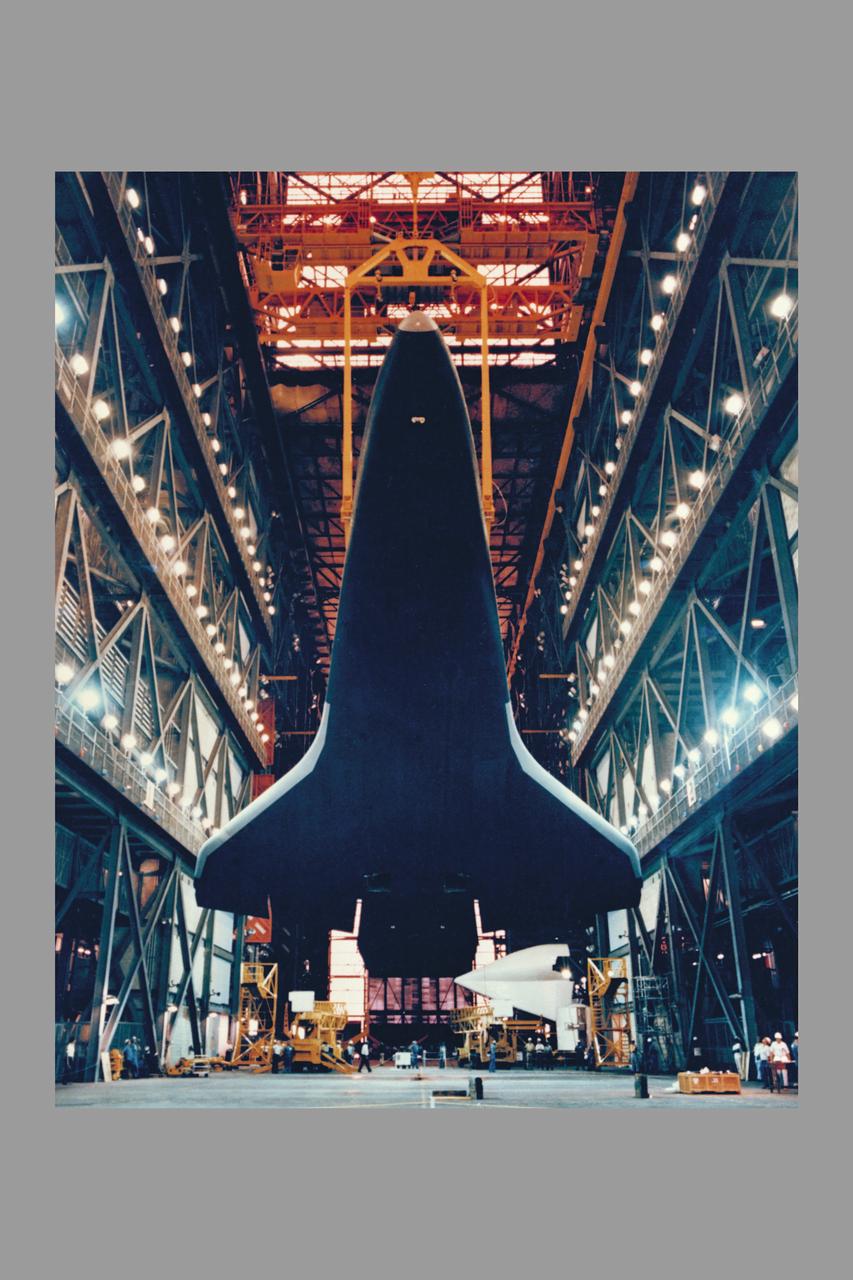
Space Shuttle Orbiter Enterprise is lowered to the floor of the transfer aisle in the Vehicle Assembly Building during destacking operations. The Enterprise, mated to an external tank and twin inert solid rocket boosters, formed a nonlaunchable Space Shuttle which was used for fit and function checks of assembly, test and launch facilities at the nation's Spaceport. Enterprise will be tansported to the Shuttle Landing Facility, mounted piggyback on its 747 Shuttle Carrier Aircraft, and flown to NASA's Dryden Flight Research Center, California.
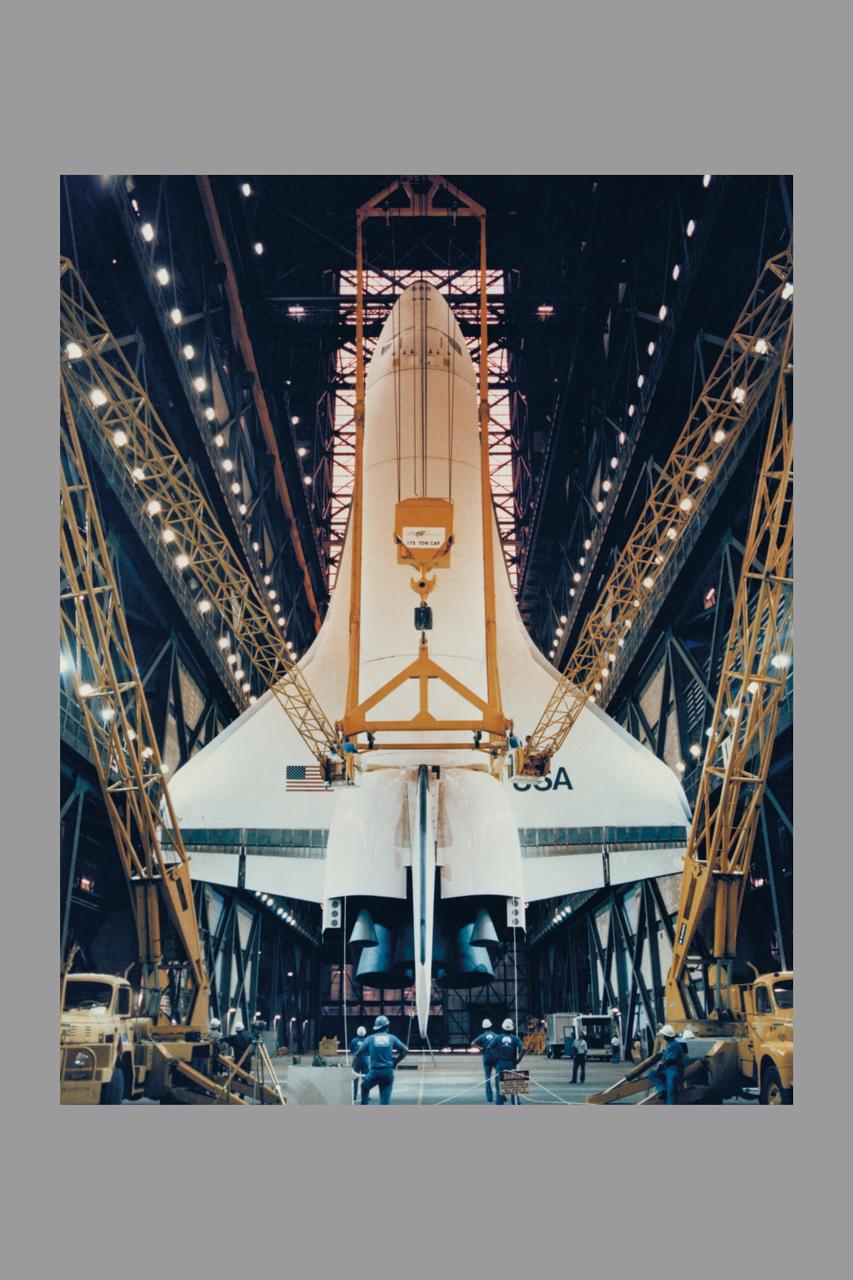
The Space Shuttle Orbiter Enterprise is lowered to the floor of the transfer aisle in the Vehicle Assembly Building during destacking operations. The Enterprise, mated to an external tank and twin inert solid rocket boosters, formed a nonlaunchable Space Shuttle which was used for fit and fuction checks of assembly, test and launch facilities at the nation's Spaceport. Enterprise will be transported to the Shuttle Landing Facility, mounted piggyback on its 747 Shuttle Carrier Aircraft, and flown to NASA's Dryden Flight Research Center, CA.
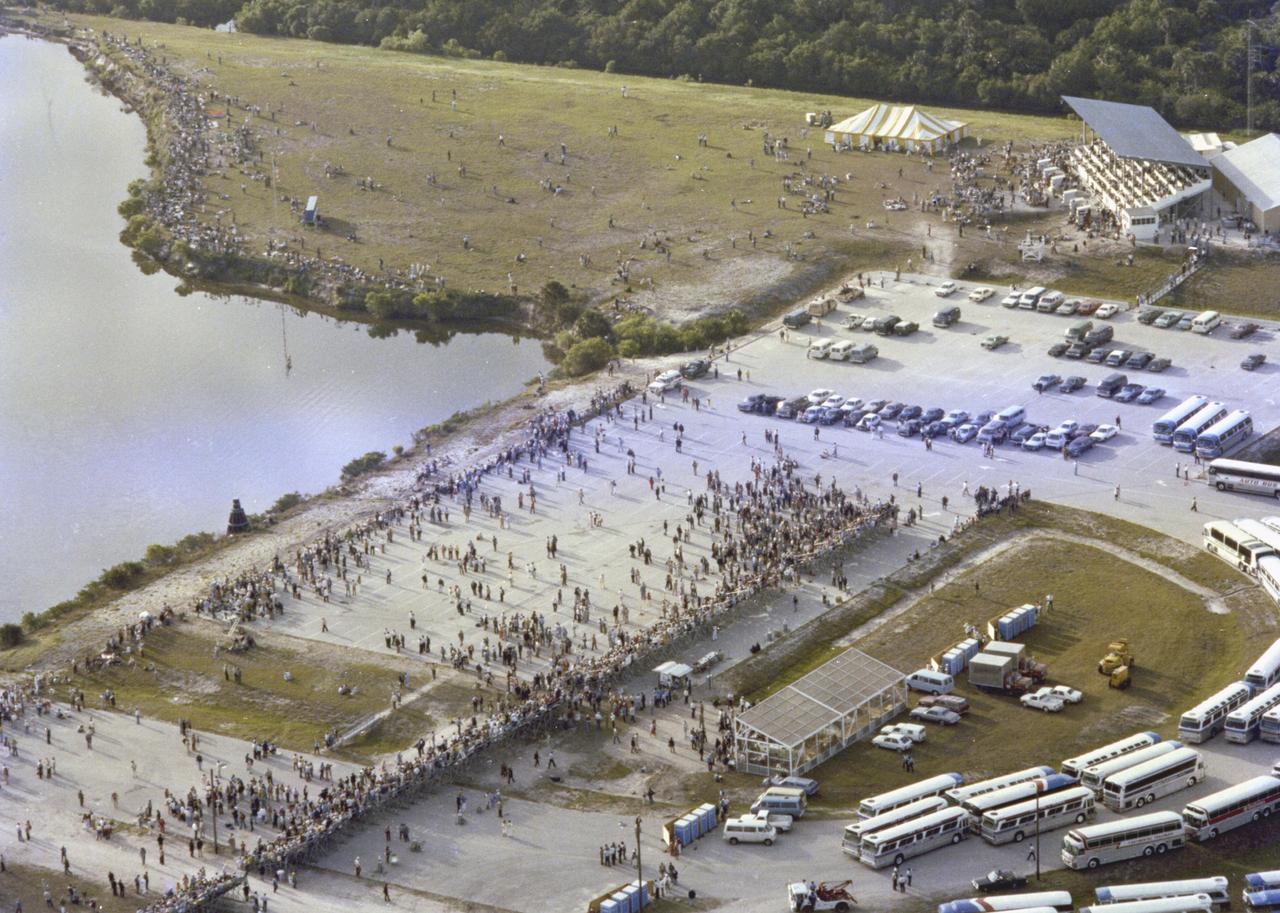
KENNEDY SPACE CENTER, FLA. - Viewed from the top of the Vehicle Assembly Building, crowds wait in vain for the launch of the maiden flight of the Space Shuttle, “scrubbed” on April 10. Visible at center is the “V.I.P.” site, with waiting buses parked at lower right. Above are the NASA Complex 39 Press Site and viewing stands, and major news media facilities. The STS-1 mission, known as a shuttle systems test flight, will seek to demonstrate safe launch into orbit and safe return of the orbiter and crew and verify the combined performance of the entire shuttle vehicle -- orbiter, solid rocket boosters and external tank.
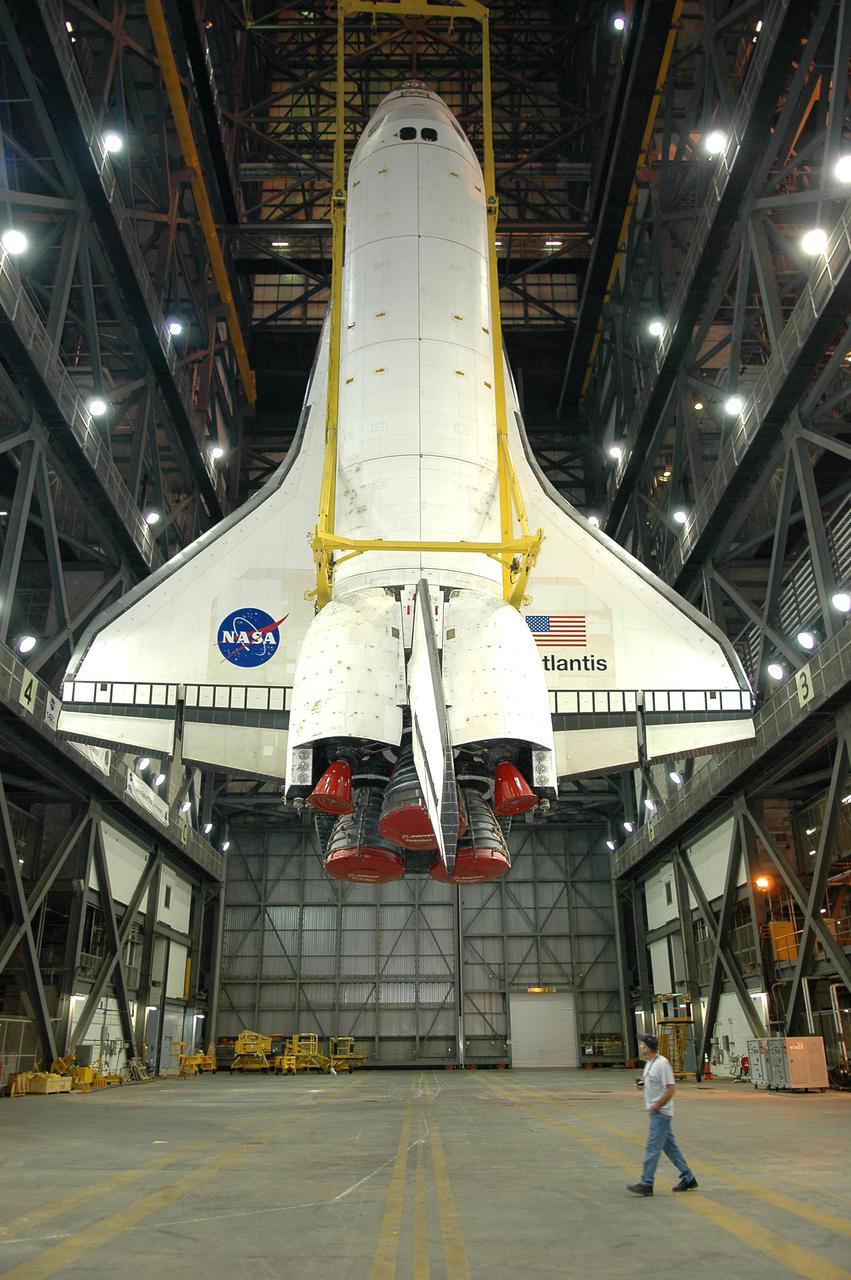
KENNEDY SPACE CENTER, FLA. - In the Vehicle Assembly Building, a technician monitors Space Shuttle Atlantis as it is lowered into the transfer aisle after being demated from its External Tank_Solid Rocket Booster stack. The orbiter will be rolled back to Orbiter Processing Facility bay 1 where processing will begin for mission STS-115, the 19th flight to the International Space Station. The tank, ET-120, is the first redesigned ET to arrive at KSC and will undergo further testing before Return to Flight mission STS-121 next year.
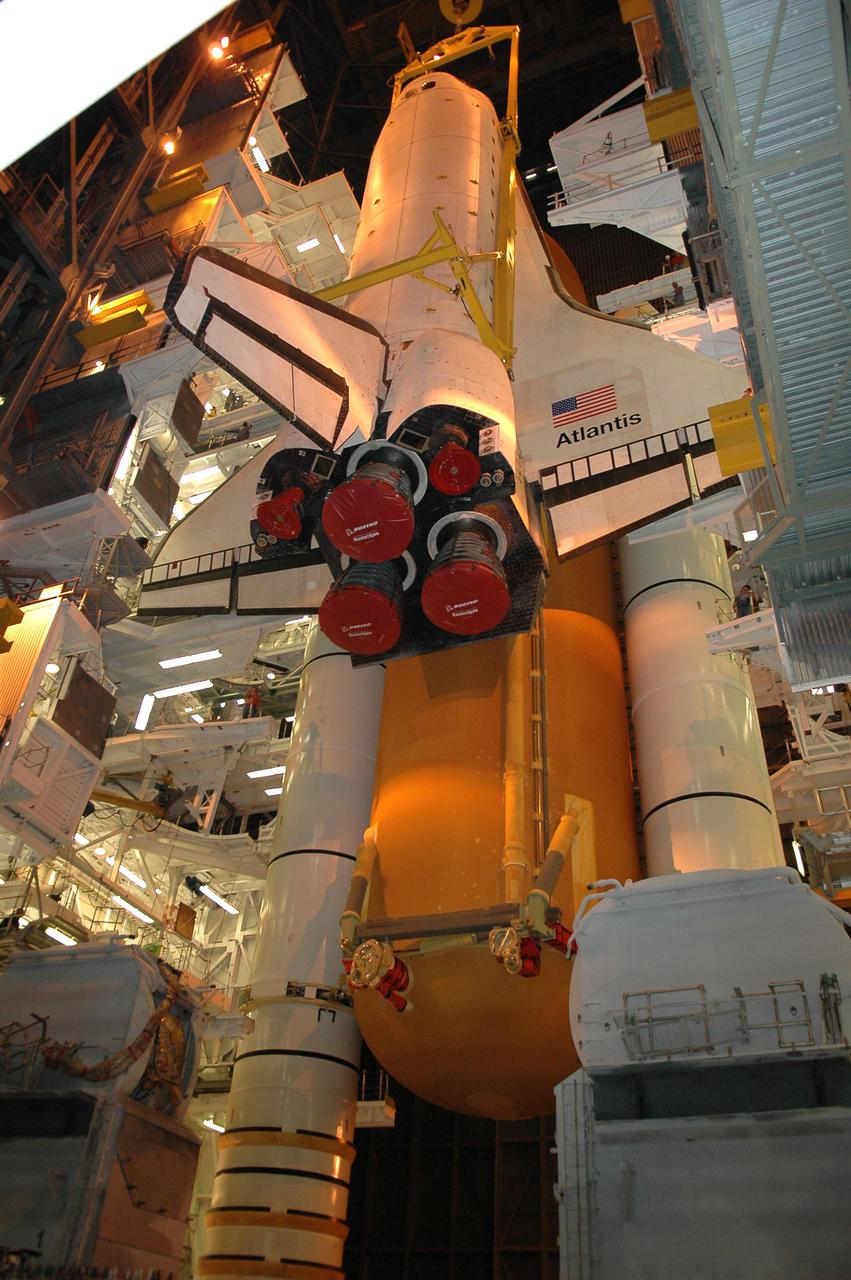
KENNEDY SPACE CENTER, FLA. - In the Vehicle Assembly Building, Space Shuttle Atlantis is lifted from its External Tank_Solid Rocket Booster stack. The orbiter will be lowered into the transfer aisle and rolled back to Orbiter Processing Facility (OPF) bay 1. Once in the OPF, processing will begin for mission STS-115, the 19th flight to the International Space Station. The tank, ET-120, is the first redesigned ET to arrive at KSC and will undergo further testing before Return to Flight mission STS-121 next year.
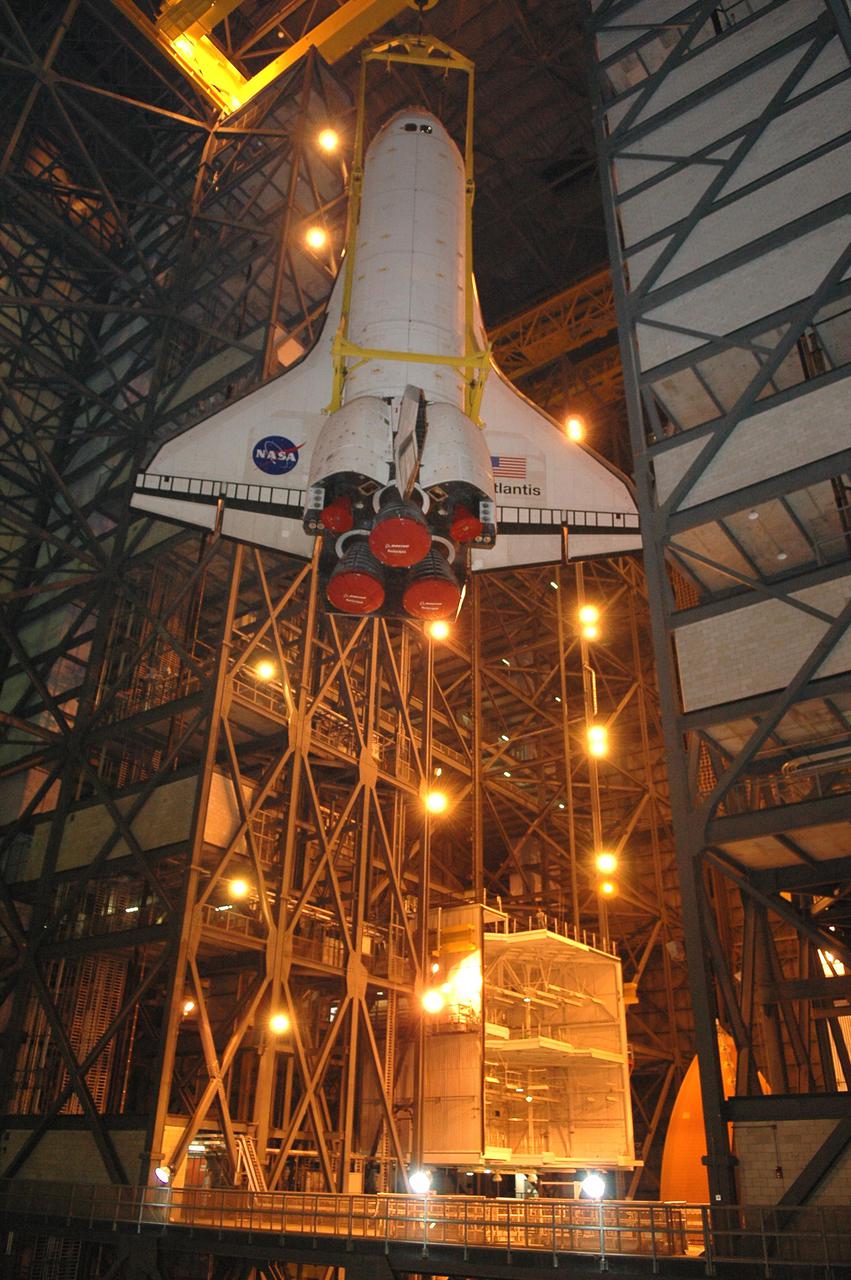
KENNEDY SPACE CENTER, FLA. - In the Vehicle Assembly Building, Space Shuttle Atlantis is lowered into the transfer aisle after being demated from its External Tank_Solid Rocket Booster stack. The orbiter will be rolled back to Orbiter Processing Facility (OPF) bay 1 where processing will begin for mission STS-115, the 19th flight to the International Space Station. The tank, ET-120, is the first redesigned ET to arrive at KSC and will undergo further testing before Return to Flight mission STS-121 next year.
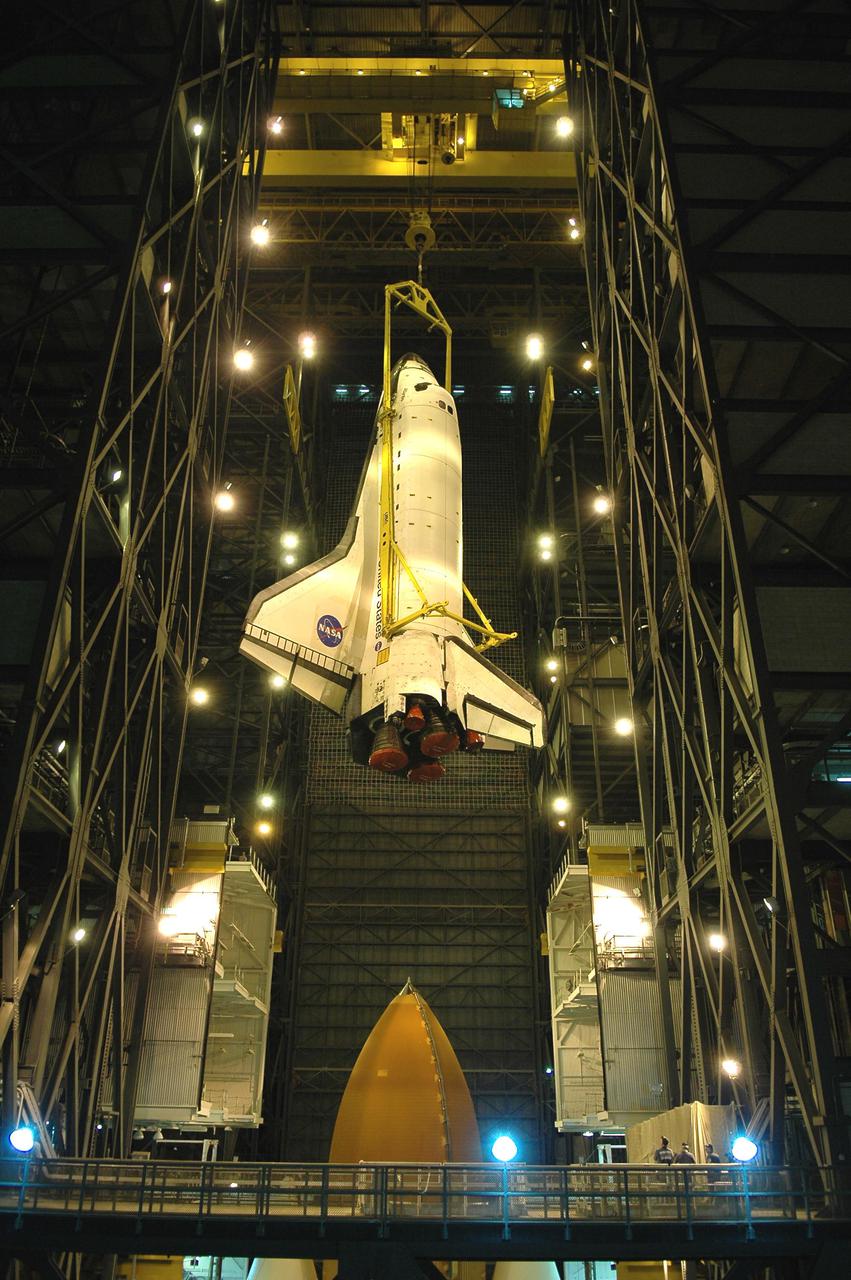
KENNEDY SPACE CENTER, FLA. - In the Vehicle Assembly Building, Space Shuttle Atlantis is lifted above its External Tank_Solid Rocket Booster stack. The orbiter will be lowered into the transfer aisle and rolled back to Orbiter Processing Facility (OPF) bay 1. Once in the OPF, processing will begin for mission STS-115, the 19th flight to the International Space Station. The tank, ET-120, is the first redesigned ET to arrive at KSC and will undergo further testing before Return to Flight mission STS-121 next year.
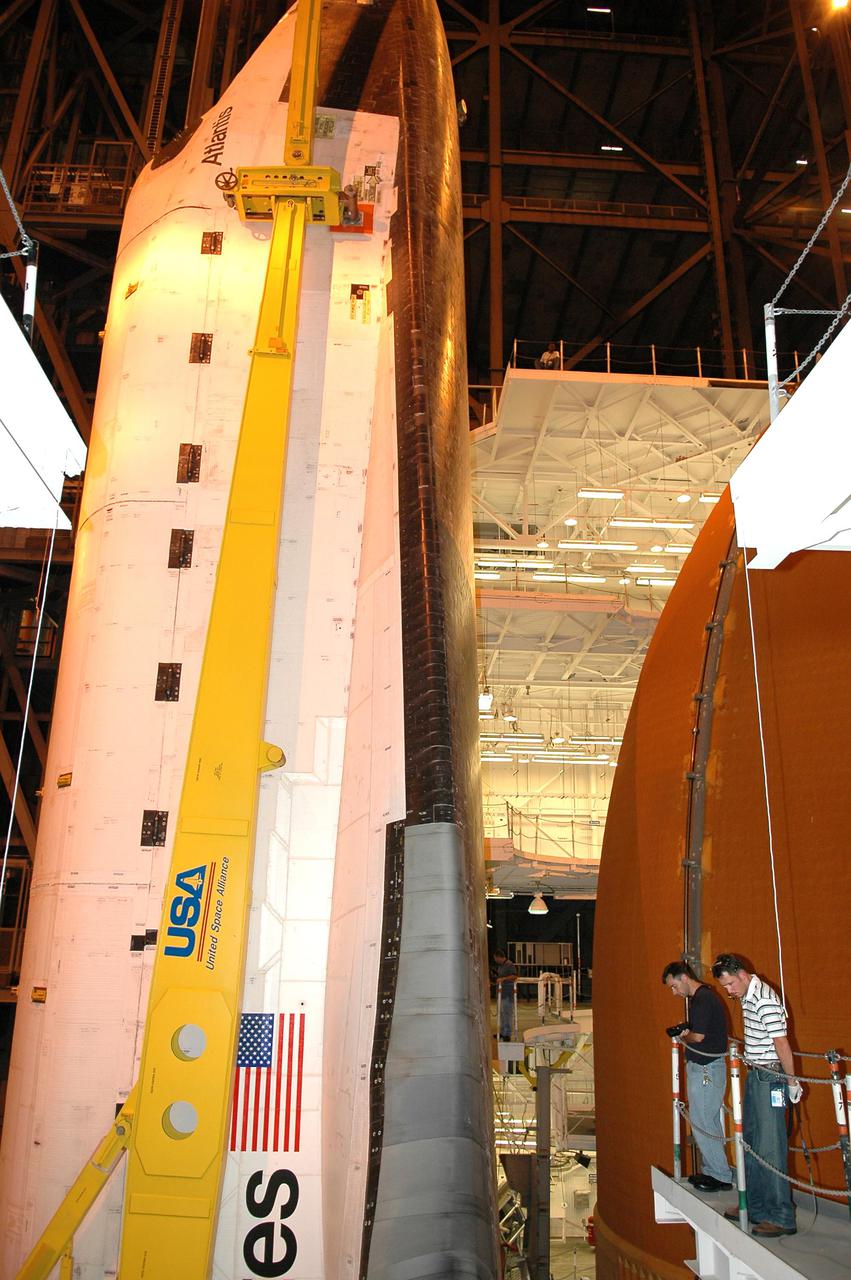
KENNEDY SPACE CENTER, FLA. - In the Vehicle Assembly Building, technicians spot for Space Shuttle Atlantis as it is demated from its External Tank_Solid Rocket Booster stack. The orbiter will be lowered into the transfer aisle and rolled back to Orbiter Processing Facility (OPF) bay 1. Once in the OPF, processing will begin for mission STS-115, the 19th flight to the International Space Station. The tank, ET-120, is the first redesigned ET to arrive at KSC and will undergo further testing before Return to Flight mission STS-121 next year.
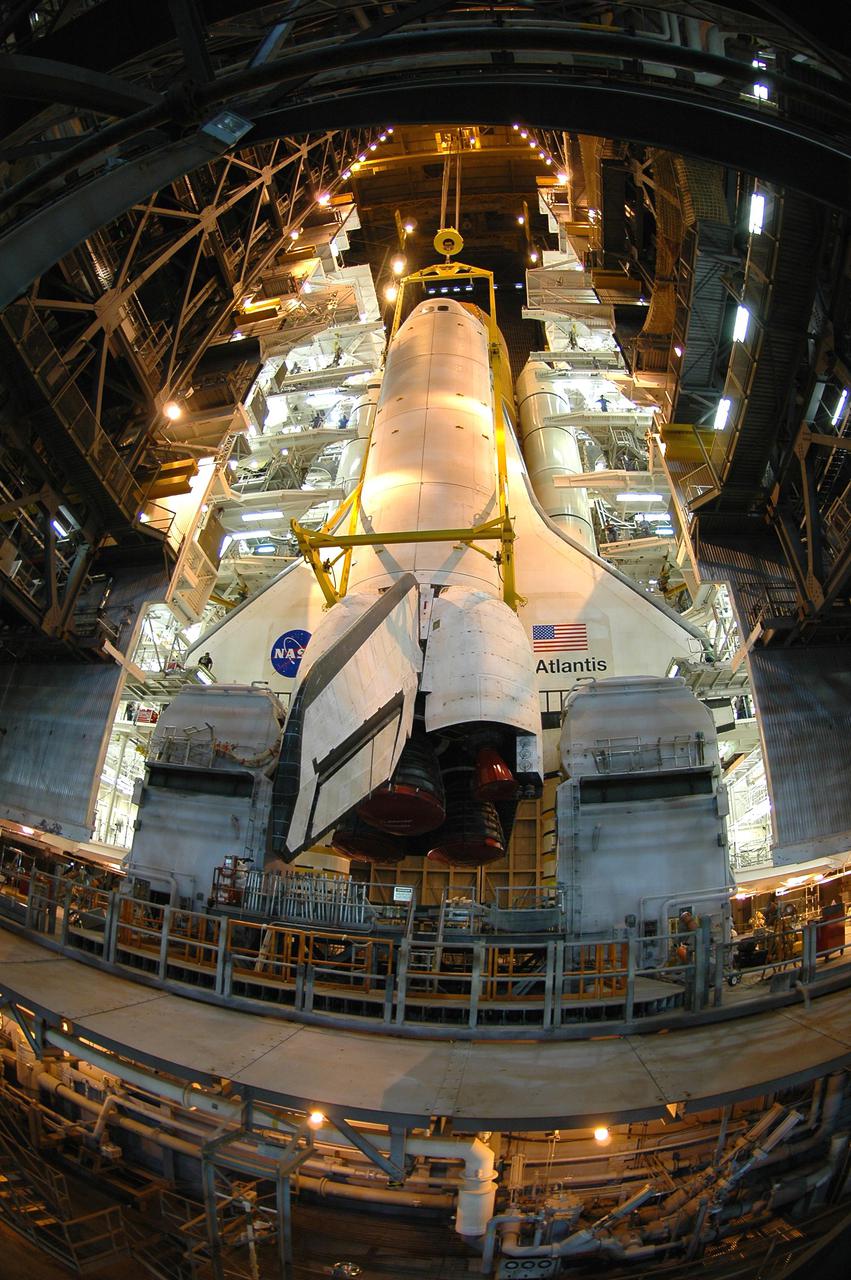
KENNEDY SPACE CENTER, FLA. - In the Vehicle Assembly Building, a fisheye lens captures Space Shuttle Atlantis as it is lifted from its External Tank_Solid Rocket Booster stack. The orbiter will be lowered into the transfer aisle and rolled back to Orbiter Processing Facility (OPF) bay 1. Once in the OPF, processing will begin for mission STS-115, the 19th flight to the International Space Station. The tank, ET-120, is the first redesigned ET to arrive at KSC and will undergo further testing before Return to Flight mission STS-121 next year.
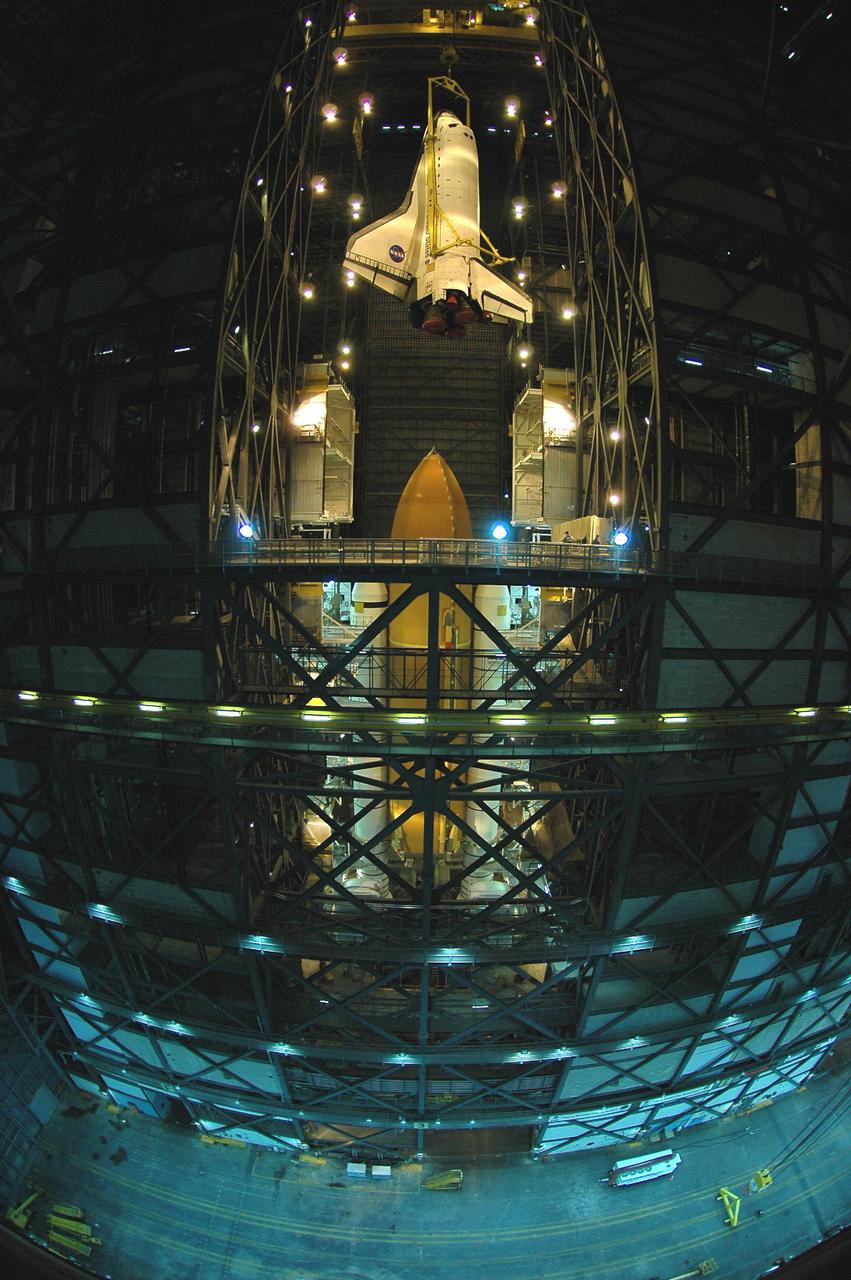
KENNEDY SPACE CENTER, FLA. - In the Vehicle Assembly Building, a fisheye lens captures Space Shuttle Atlantis as it is lifted above its External Tank_Solid Rocket Booster stack. The orbiter will be lowered into the transfer aisle and rolled back to Orbiter Processing Facility (OPF) bay 1. Once in the OPF, processing will begin for mission STS-115, the 19th flight to the International Space Station. The tank, ET-120, is the first redesigned ET to arrive at KSC and will undergo further testing before Return to Flight mission STS-121 next year.
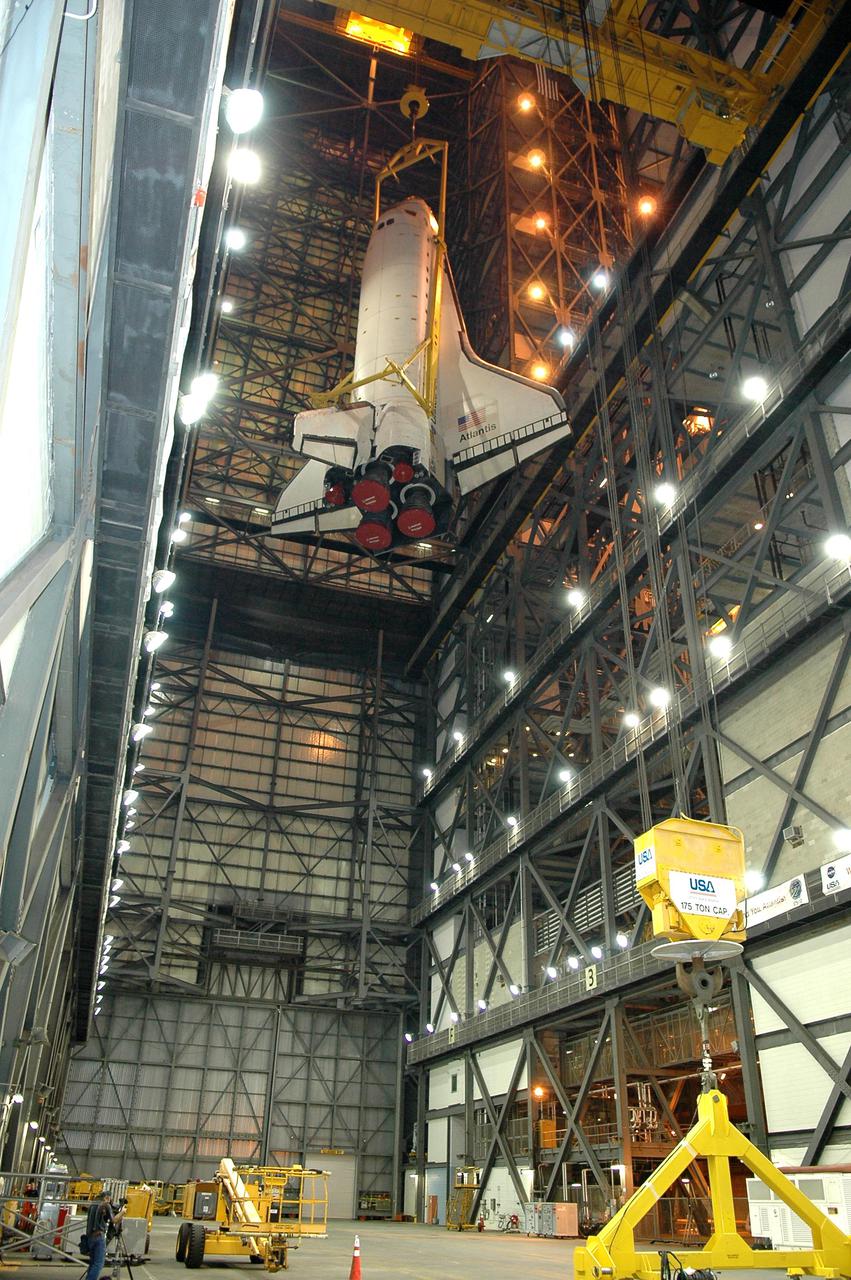
KENNEDY SPACE CENTER, FLA. - In the Vehicle Assembly Building, Space Shuttle Atlantis is lowered into the transfer aisle after being demated from its External Tank_Solid Rocket Booster stack. The orbiter will be rolled back to Orbiter Processing Facility bay 1 where processing will begin for mission STS-115, the 19th flight to the International Space Station. The tank, ET-120, is the first redesigned ET to arrive at KSC and will undergo further testing before Return to Flight mission STS-121 next year.
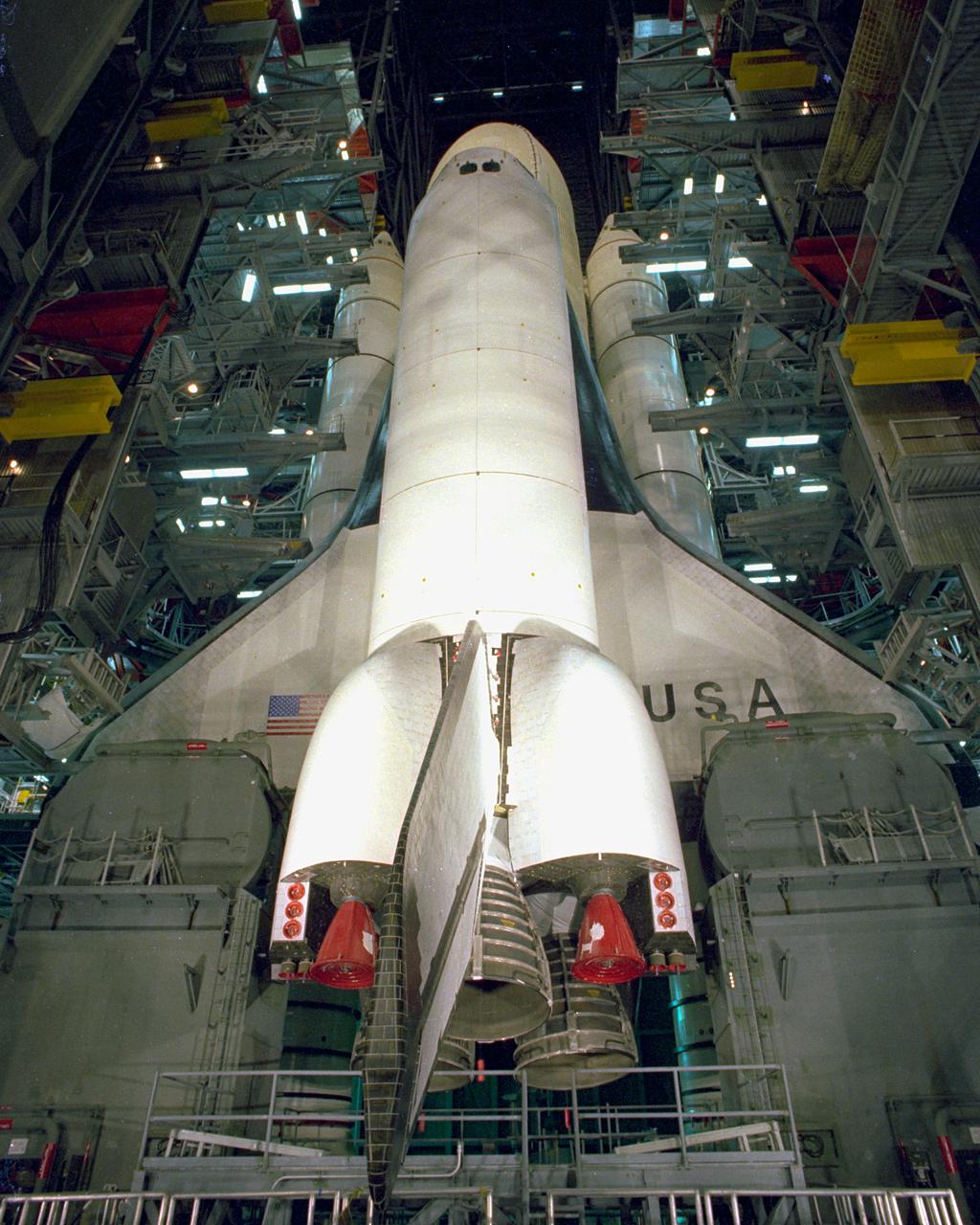
KENNEDY SPACE CENTER, FLA. - Assembly of the first Space Shuttle vehicle, scheduled to make its first orbital test flight in March 1981, was completed today with the mating of the Orbiter Columbia to its external tank in the Vehicle Assembly Building's High Bay 3. Columbia, shown here still attached to its hoisting sling, was moved to the VAB on Nov. 24 having completed tests and tile installation in the adjacent Orbiter Processing Facility. The other Shuttle components, the twin solid rocket boosters and the external propellant tank, were stacked on the Mobile Launcher Platform in High Bay 3 in January and November of this year, respectively. The current schedule calls for the rollout of the assembled Space Shuttle to Pad A at Launch Complex 39 shortly after Christmas.
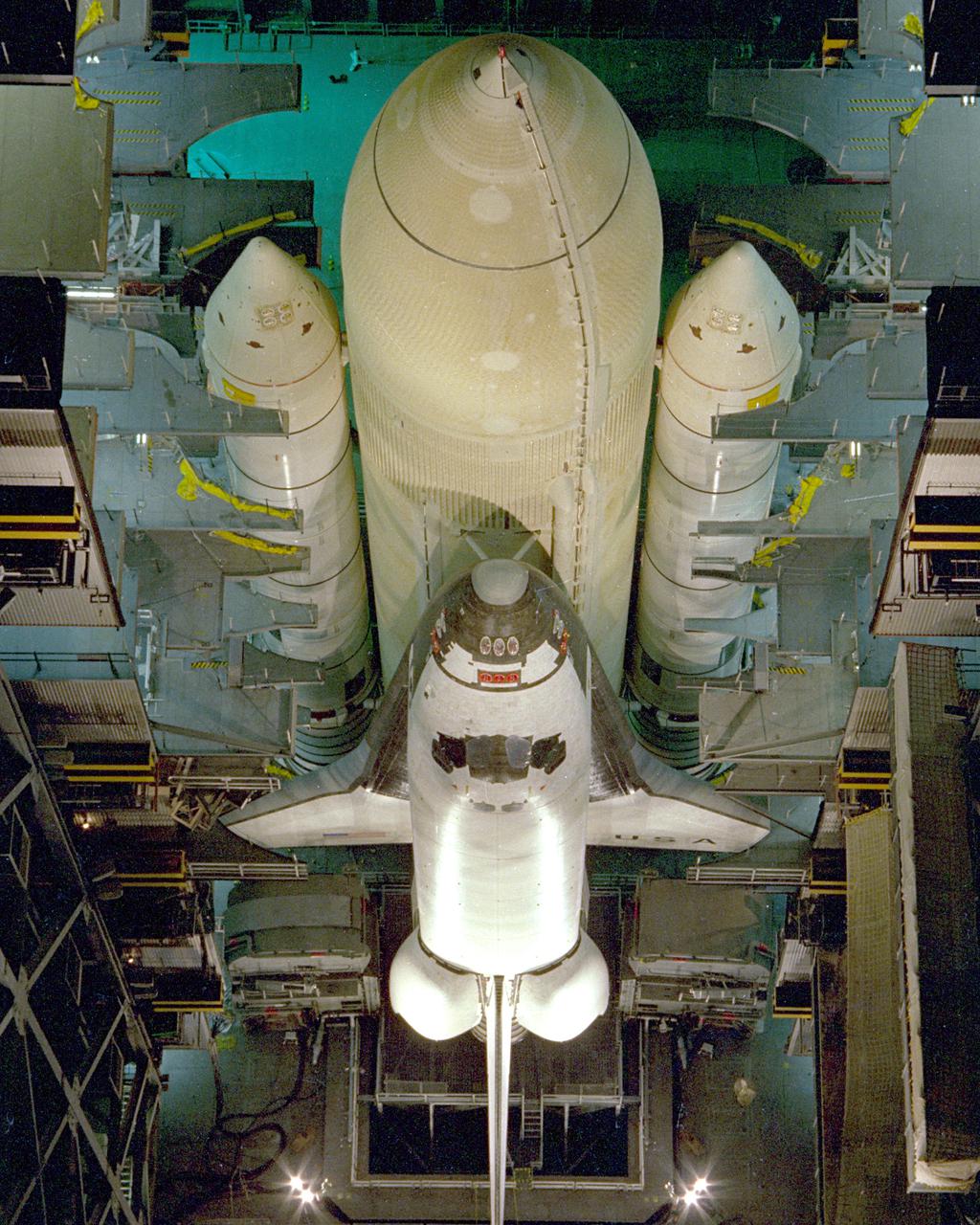
KENNEDY SPACE CENTER, FLA. - Assembly of the first Space Shuttle vehicle, scheduled to make its first orbital test flight in March 1981, was completed today with the mating of the Orbiter Columbia to its external tank in the Vehicle Assembly Building's High Bay 3. Columbia, shown here still attached to its hoisting sling, was moved to the VAB on Nov. 24 having completed tests and tile installation in the adjacent Orbiter Processing Facility. The other Shuttle components, the twin solid rocket boosters and the external propellant tank, were stacked on the Mobile Launcher Platform in High Bay 3 in January and November of this year, respectively. The current schedule calls for the rollout of the assembled Space Shuttle to Pad A at Launch Complex 39 shortly after Christmas.
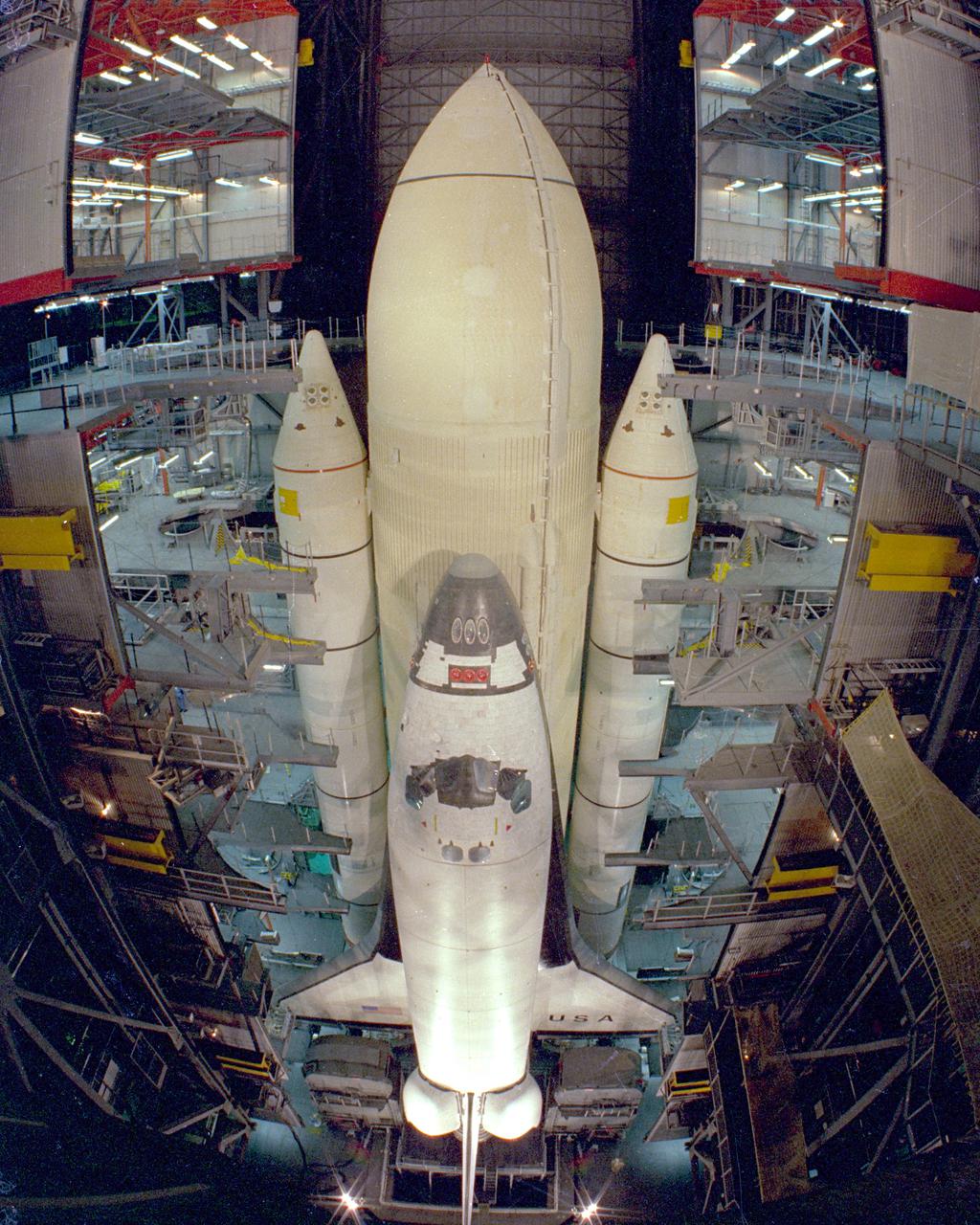
KENNEDY SPACE CENTER, FLA. - Assembly of the first Space Shuttle vehicle, scheduled to make its first orbital test flight in March 1981, was completed today with the mating of the Orbiter Columbia to its eternal tank in the Vehicle Assembly Building's High Bay 3. Columbia, shown here still attached to its hoisting sling, was moved to the VAB on Nov. 24 having completed tests and tile installation in the adjacent Orbiter Processing Facility. The other Shuttle components, the twin solid rocket boosters and the external propellant tank, were stacked on the Mobile launcher Platform in High Bay 3 in January and November of this year, respectively. The current schedule calls for the rollout of the assembled Space Shuttle to Pad A at Launch Complex 39 shortly after Christmas.
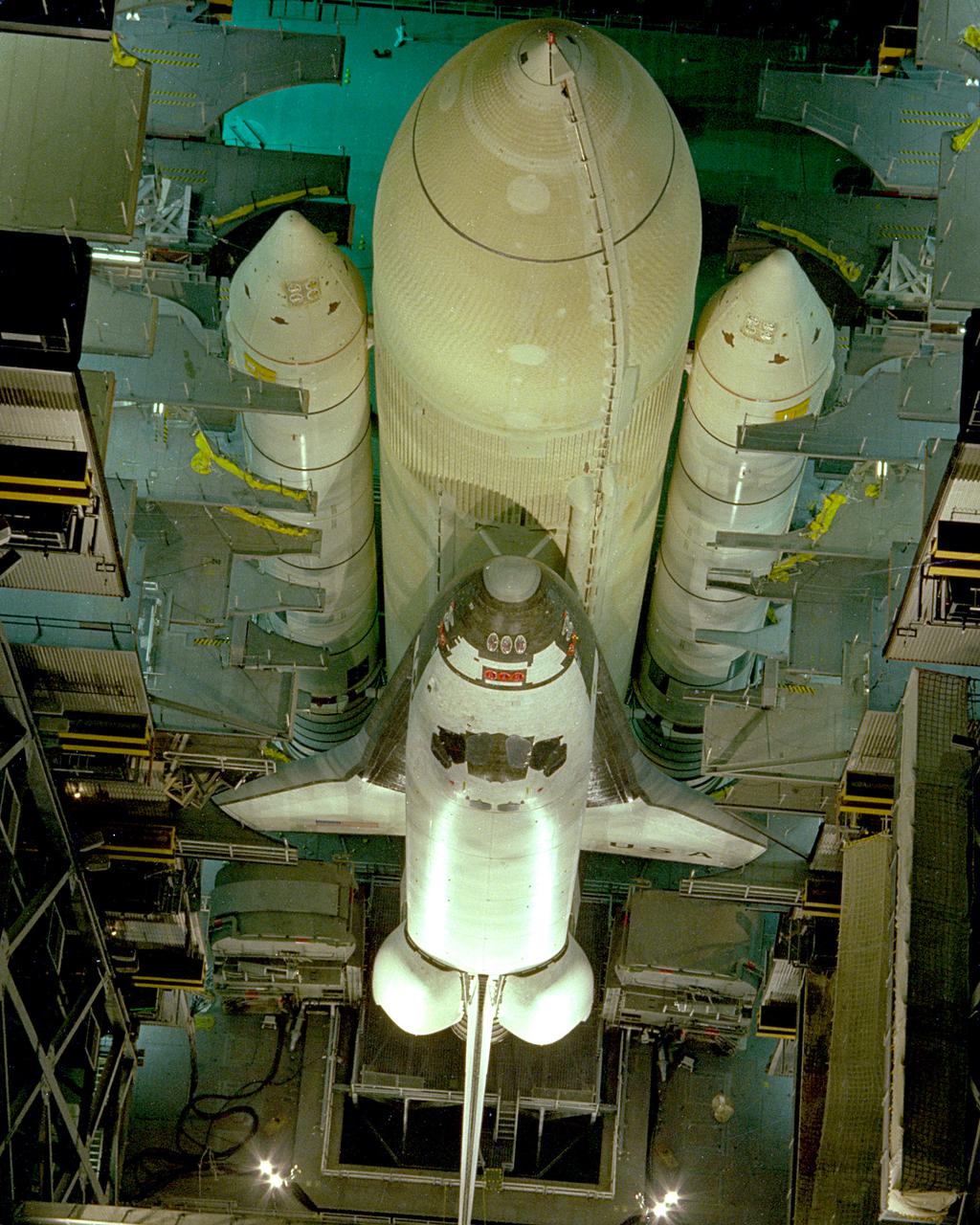
KENNEDY SPACE CENTER, FLA. - Assembly of the first Space Shuttle vehicle, scheduled to make its first orbital test flight in March 1981, was completed today with the mating of the Orbiter Columbia to its eternal tank in the Vehicle Assembly Building's High Bay 3. Columbia, shown here still attached to its hoisting sling, was moved to the VAB on Nov. 24 having completed tests and tile installation in the adjacent Orbiter Processing Facility. The other Shuttle components, the twin solid rocket boosters and the external propellant tank, were stacked on the Mobile launcher Platform in High Bay 3 in January and November of this year, respectively. The current schedule calls for the rollout of the assembled Space Shuttle to Pad A at Launch Complex 39 shortly after Christmas.
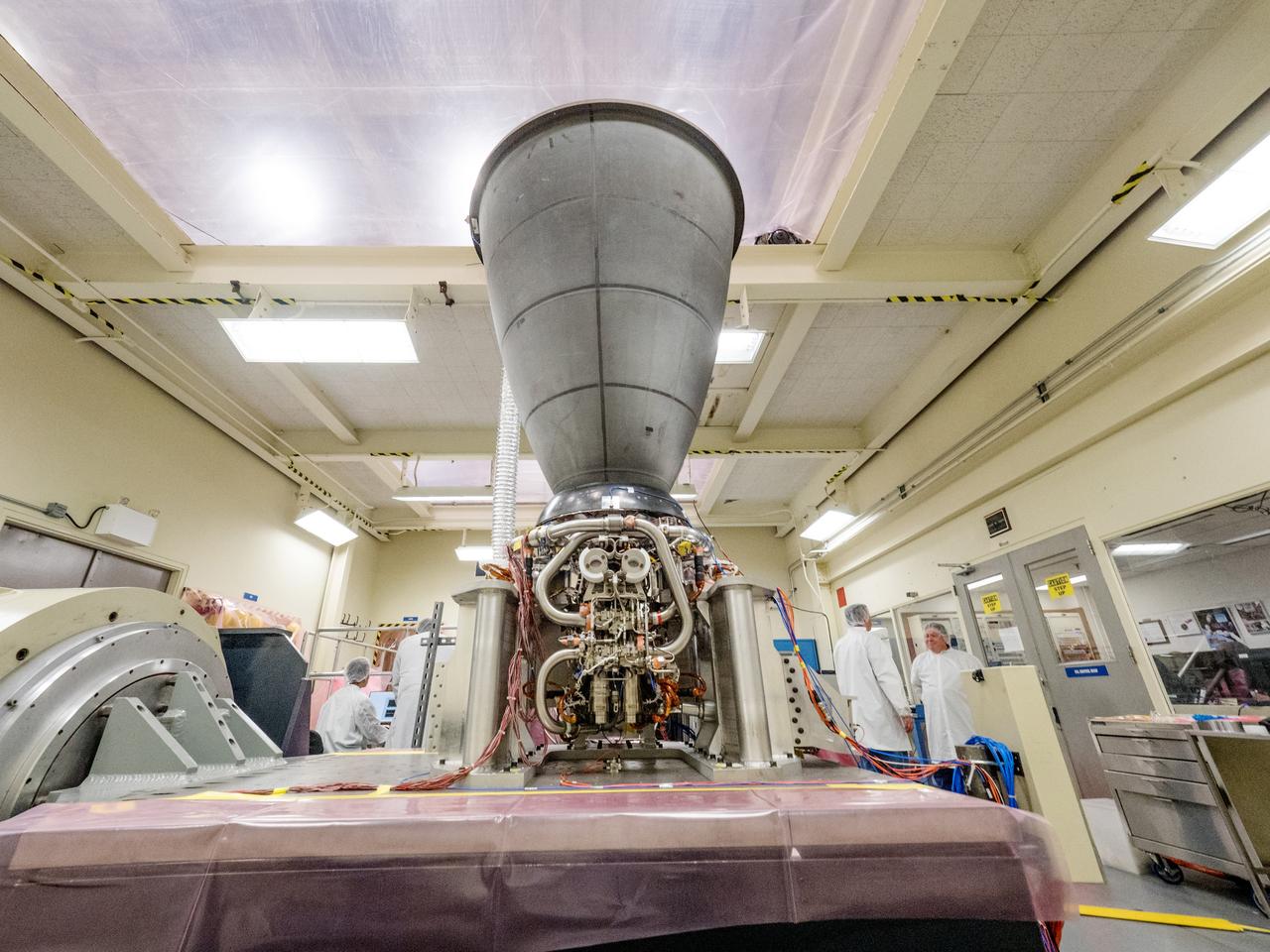
An Orbital Maneuvering System engine is vibration tested at NASA’s Johnson Space Center in Houston on June 16, 2016, before shipment to the agency’s White Sands Test Facility in New Mexico, where it will be fired to qualify the engine for use on Orion’s service module. The vibration testing will help ensure the engine can withstand the loads induced by launch on the agency’s Space Launch System rocket. This summer, another Orbital Maneuvering System engine will be tested at Johnson before it is supplied to ESA (European Space Agency) to integrate into Orion's service module, which will power, propel and cool Orion in space, and also provide consumables like air and water for future crews. ..ESA and its contractor Airbus Defence and Space are providing the service module for Artemis I. This Orbital Maneuvering System engine was used on the space shuttle to provide the thrust for orbital insertion, orbit circularization, orbit transfer, rendezvous, deorbit and abort situations and flew on 31 shuttle flights. The engine flying on Artemis I flew on 19 space shuttle flights, beginning with STS-41G in October 1984 and ending with STS-112 in October 2002.
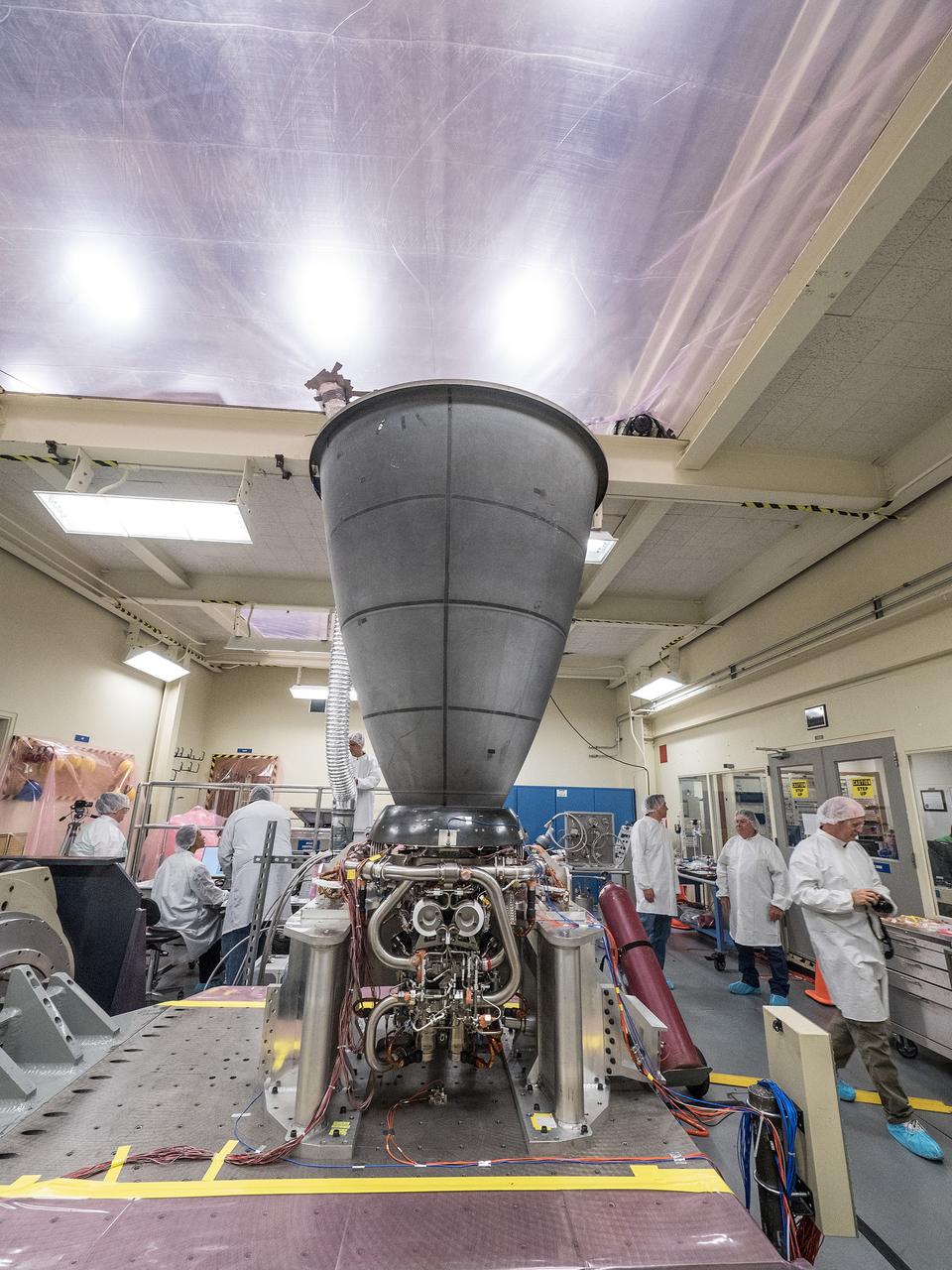
An Orbital Maneuvering System engine is vibration tested at NASA’s Johnson Space Center in Houston on June 16, 2016, before shipment to the agency’s White Sands Test Facility in New Mexico, where it will be fired to qualify the engine for use on Orion’s service module. The vibration testing will help ensure the engine can withstand the loads induced by launch on the agency’s Space Launch System rocket. This summer, another Orbital Maneuvering System engine will be tested at Johnson before it is supplied to ESA (European Space Agency) to integrate into Orion's service module, which will power, propel and cool Orion in space, and also provide consumables like air and water for future crews. ..ESA and its contractor Airbus Defence and Space are providing the service module for Artemis I. This Orbital Maneuvering System engine was used on the space shuttle to provide the thrust for orbital insertion, orbit circularization, orbit transfer, rendezvous, deorbit and abort situations and flew on 31 shuttle flights. The engine flying on Artemis I flew on 19 space shuttle flights, beginning with STS-41G in October 1984 and ending with STS-112 in October 2002.
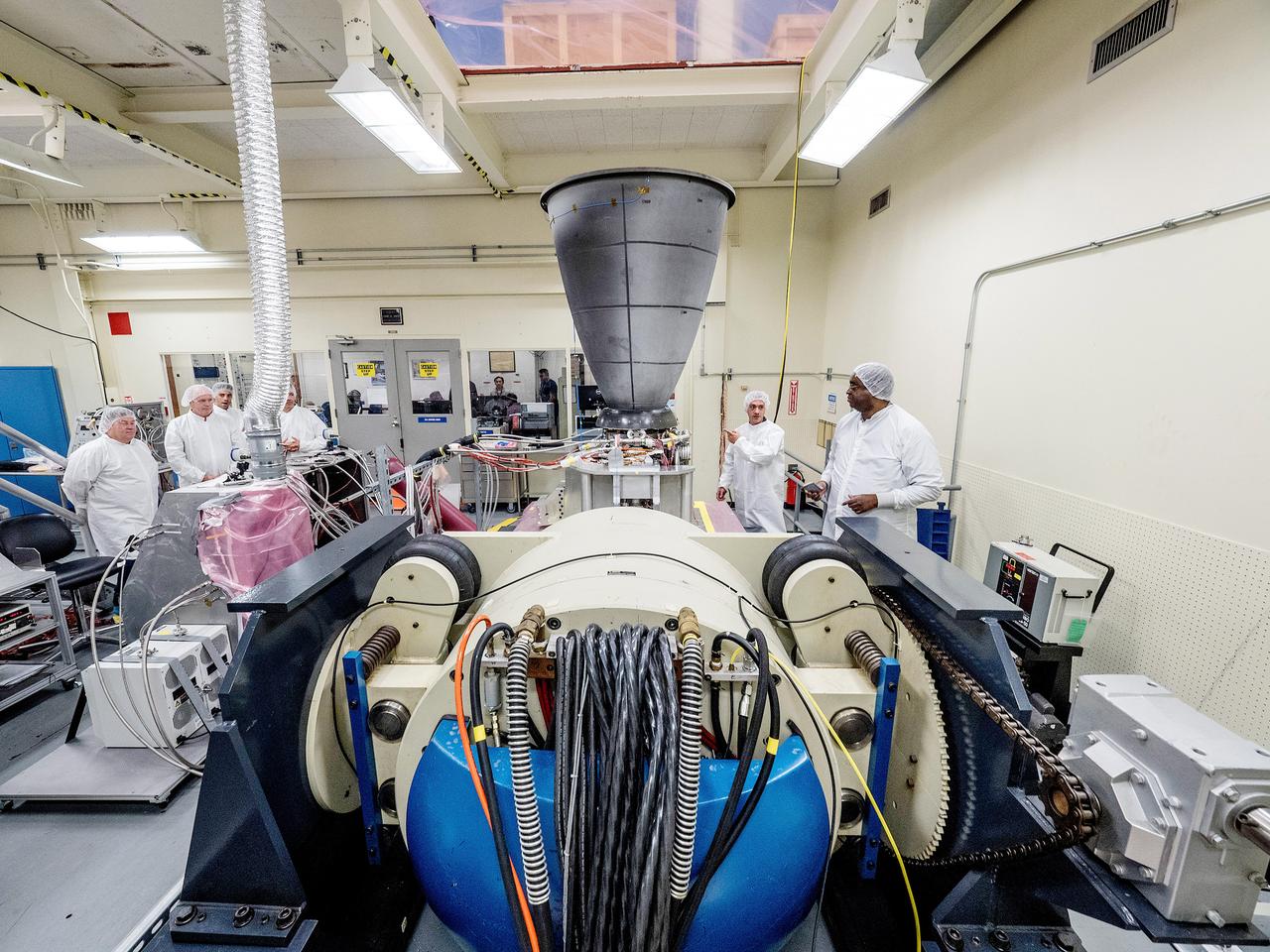
An Orbital Maneuvering System engine is vibration tested at NASA’s Johnson Space Center in Houston on June 16, 2016, before shipment to the agency’s White Sands Test Facility in New Mexico, where it will be fired to qualify the engine for use on Orion’s service module. The vibration testing will help ensure the engine can withstand the loads induced by launch on the agency’s Space Launch System rocket. This summer, another Orbital Maneuvering System engine will be tested at Johnson before it is supplied to ESA (European Space Agency) to integrate into Orion's service module, which will power, propel and cool Orion in space, and also provide consumables like air and water for future crews. ..ESA and its contractor Airbus Defence and Space are providing the service module for Artemis I. This Orbital Maneuvering System engine was used on the space shuttle to provide the thrust for orbital insertion, orbit circularization, orbit transfer, rendezvous, deorbit and abort situations and flew on 31 shuttle flights. The engine flying on Artemis I flew on 19 space shuttle flights, beginning with STS-41G in October 1984 and ending with STS-112 in October 2002.
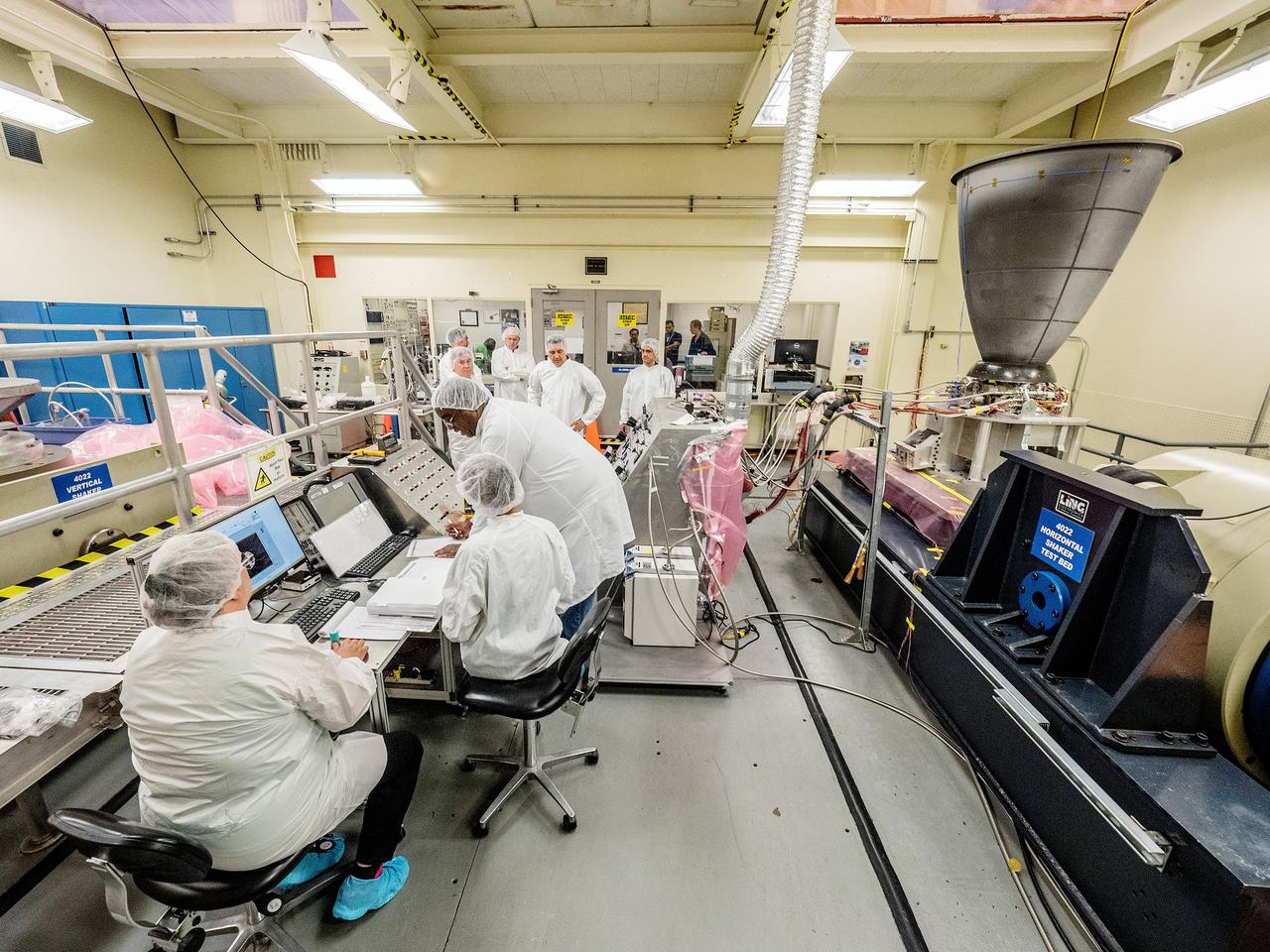
An Orbital Maneuvering System engine is vibration tested at NASA’s Johnson Space Center in Houston on June 16, 2016, before shipment to the agency’s White Sands Test Facility in New Mexico, where it will be fired to qualify the engine for use on Orion’s service module. The vibration testing will help ensure the engine can withstand the loads induced by launch on the agency’s Space Launch System rocket. This summer, another Orbital Maneuvering System engine will be tested at Johnson before it is supplied to ESA (European Space Agency) to integrate into Orion's service module, which will power, propel and cool Orion in space, and also provide consumables like air and water for future crews. ..ESA and its contractor Airbus Defence and Space are providing the service module for Artemis I. This Orbital Maneuvering System engine was used on the space shuttle to provide the thrust for orbital insertion, orbit circularization, orbit transfer, rendezvous, deorbit and abort situations and flew on 31 shuttle flights. The engine flying on Artemis I flew on 19 space shuttle flights, beginning with STS-41G in October 1984 and ending with STS-112 in October 2002.
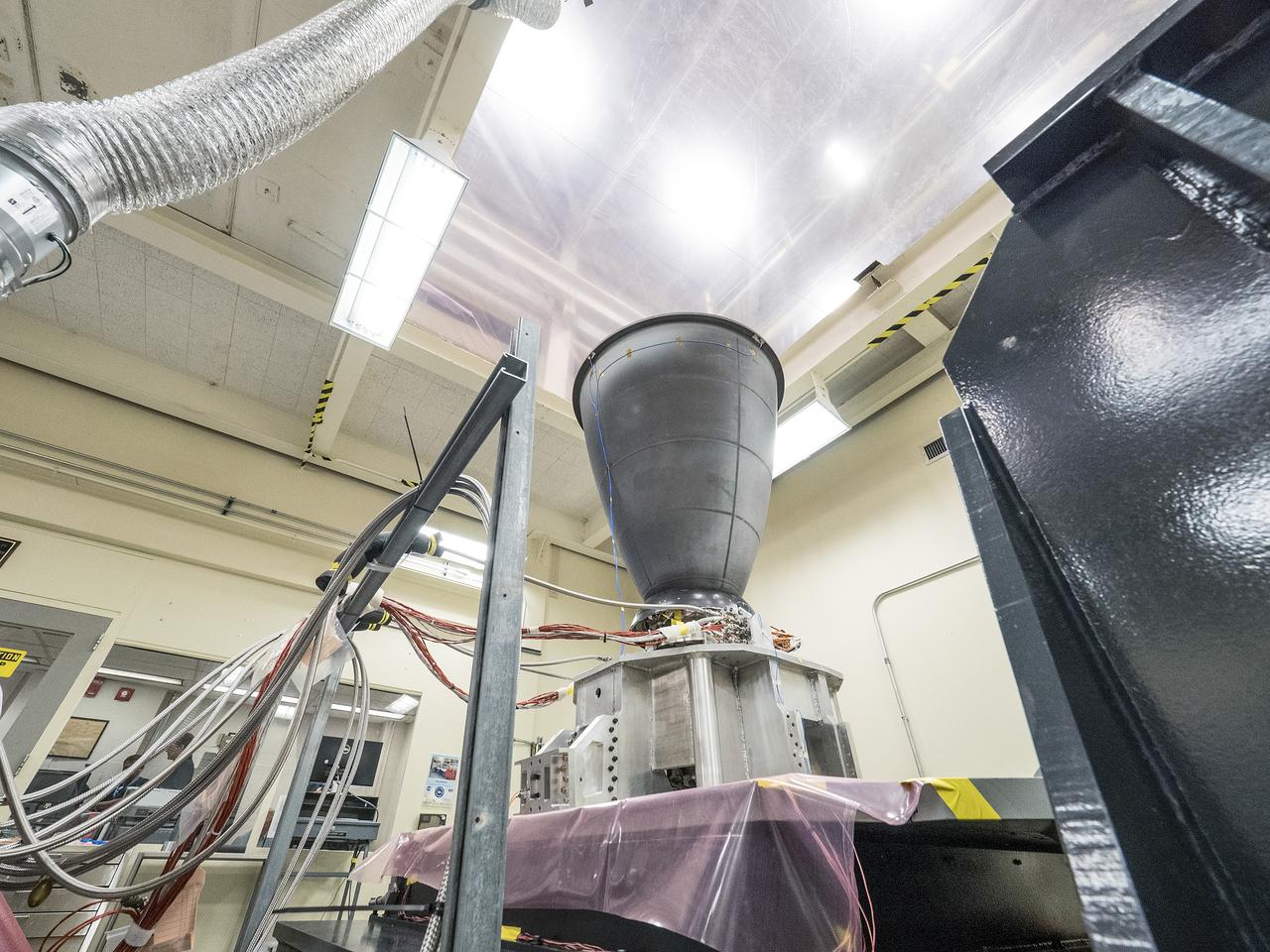
An Orbital Maneuvering System engine is vibration tested at NASA’s Johnson Space Center in Houston on June 16, 2016, before shipment to the agency’s White Sands Test Facility in New Mexico, where it will be fired to qualify the engine for use on Orion’s service module. The vibration testing will help ensure the engine can withstand the loads induced by launch on the agency’s Space Launch System rocket. This summer, another Orbital Maneuvering System engine will be tested at Johnson before it is supplied to ESA (European Space Agency) to integrate into Orion's service module, which will power, propel and cool Orion in space, and also provide consumables like air and water for future crews. ..ESA and its contractor Airbus Defence and Space are providing the service module for Artemis I. This Orbital Maneuvering System engine was used on the space shuttle to provide the thrust for orbital insertion, orbit circularization, orbit transfer, rendezvous, deorbit and abort situations and flew on 31 shuttle flights. The engine flying on Artemis I flew on 19 space shuttle flights, beginning with STS-41G in October 1984 and ending with STS-112 in October 2002.
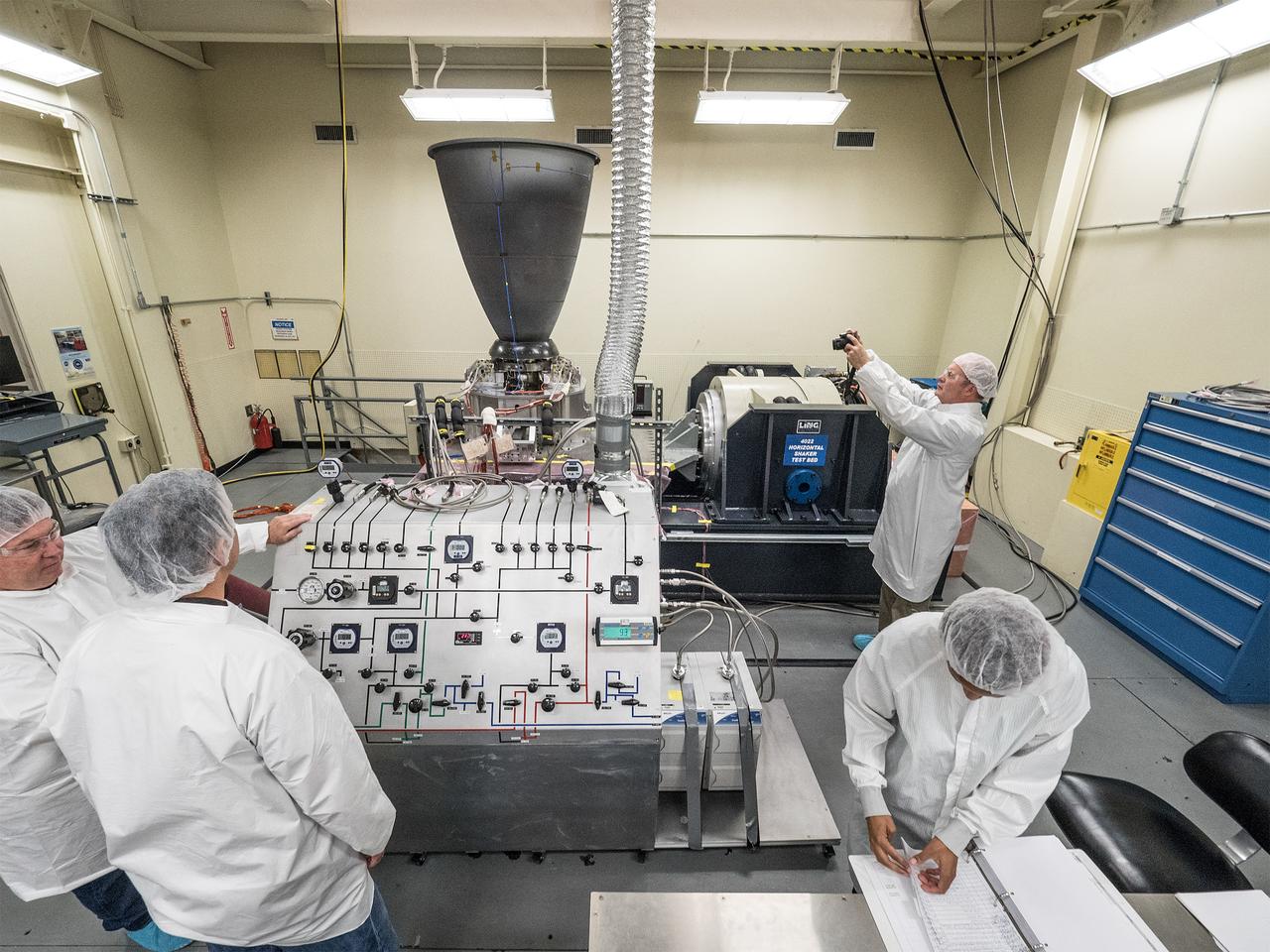
An Orbital Maneuvering System engine is vibration tested at NASA’s Johnson Space Center in Houston on June 16, 2016, before shipment to the agency’s White Sands Test Facility in New Mexico, where it will be fired to qualify the engine for use on Orion’s service module. The vibration testing will help ensure the engine can withstand the loads induced by launch on the agency’s Space Launch System rocket. This summer, another Orbital Maneuvering System engine will be tested at Johnson before it is supplied to ESA (European Space Agency) to integrate into Orion's service module, which will power, propel and cool Orion in space, and also provide consumables like air and water for future crews. ..ESA and its contractor Airbus Defence and Space are providing the service module for Artemis I. This Orbital Maneuvering System engine was used on the space shuttle to provide the thrust for orbital insertion, orbit circularization, orbit transfer, rendezvous, deorbit and abort situations and flew on 31 shuttle flights. The engine flying on Artemis I flew on 19 space shuttle flights, beginning with STS-41G in October 1984 and ending with STS-112 in October 2002.
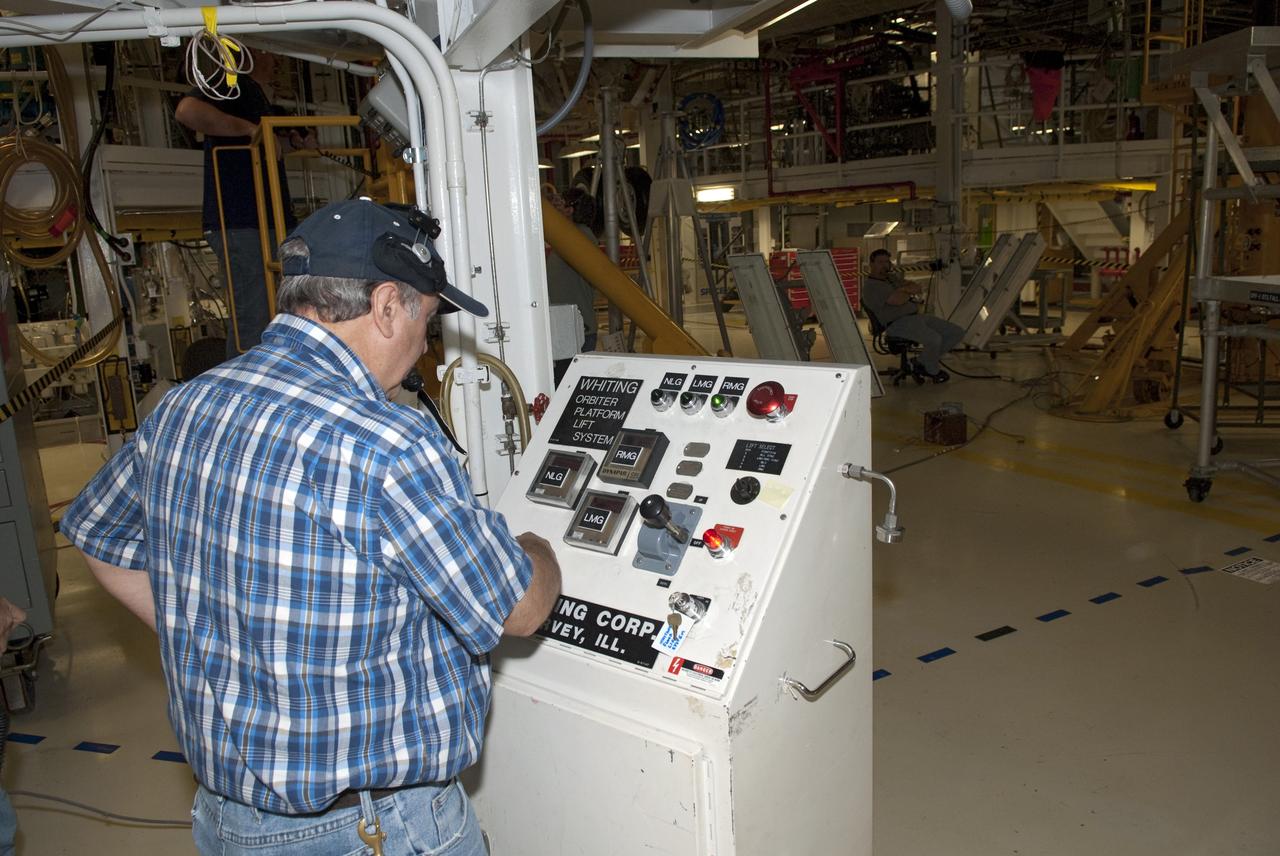
CAPE CANAVERAL, Fla. - In Orbiter Processing Facility-1 at NASA's Kennedy Space Center in Florida, a worker tests the hydraulic system that will lift the shuttle Atlantis off the floor to enable the orbiter transport system, or OTS, to be rolled underneath for its move, or "rollover," to the Vehicle Assembly Building. Once there Atlantis will be joined with the external fuel tank and solid rocket boosters on the mobile launcher platform. Atlantis is being prepared for the STS-135 mission, which will deliver the Raffaello multipurpose logistics module packed with supplies, logistics and spare parts to the International Space Station. STS-135 is targeted to launch June 28, and will be the last spaceflight for the Space Shuttle Program. Photo credit: NASA/Jim Grossmann
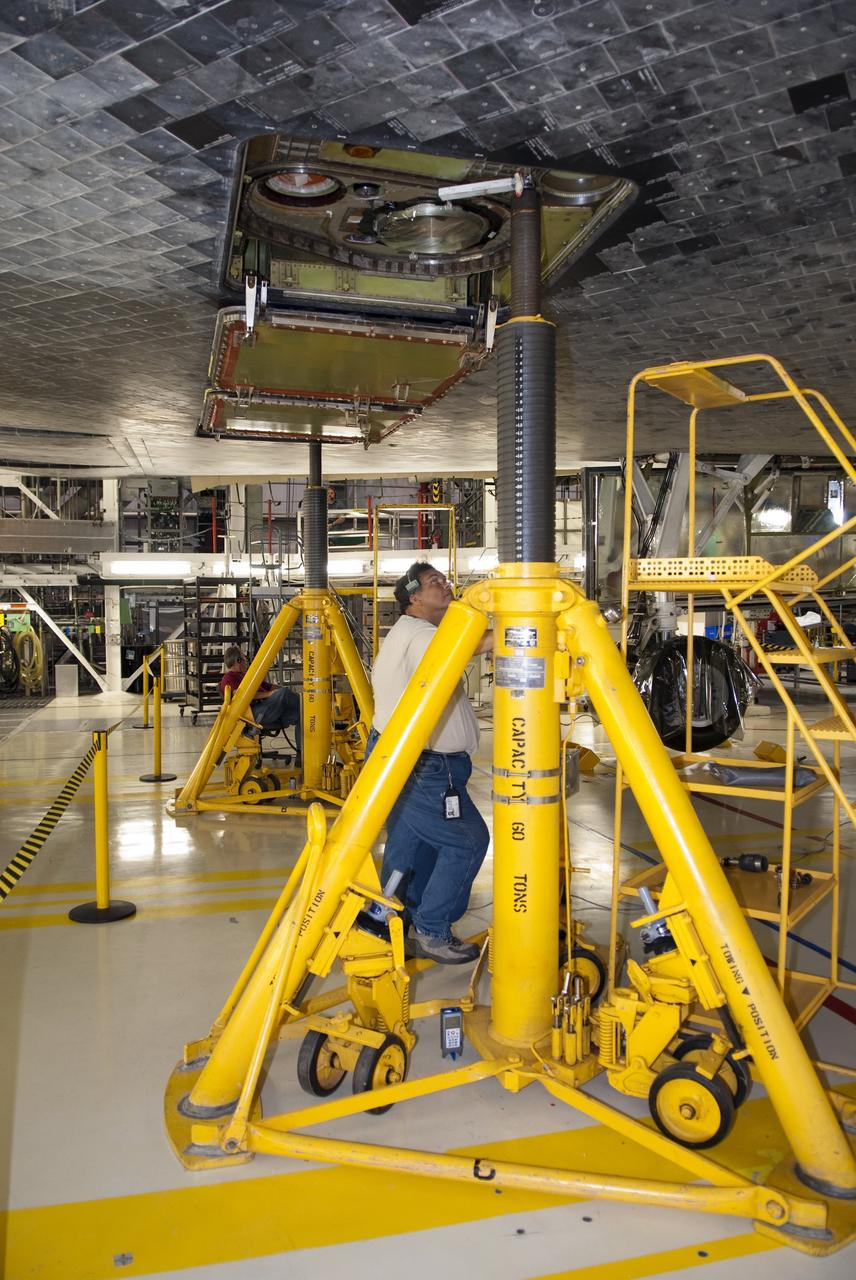
CAPE CANAVERAL, Fla. - In Orbiter Processing Facility-1 at NASA's Kennedy Space Center in Florida, workers install and test the hydraulic system that will lift the shuttle Atlantis off the floor to enable the orbiter transport system, or OTS, to be rolled underneath for its move, or "rollover," to the Vehicle Assembly Building. Once there Atlantis will be joined with the external fuel tank and solid rocket boosters on the mobile launcher platform. Atlantis is being prepared for the STS-135 mission, which will deliver the Raffaello multipurpose logistics module packed with supplies, logistics and spare parts to the International Space Station. STS-135 is targeted to launch June 28, and will be the last spaceflight for the Space Shuttle Program. Photo credit: NASA/Jim Grossmann
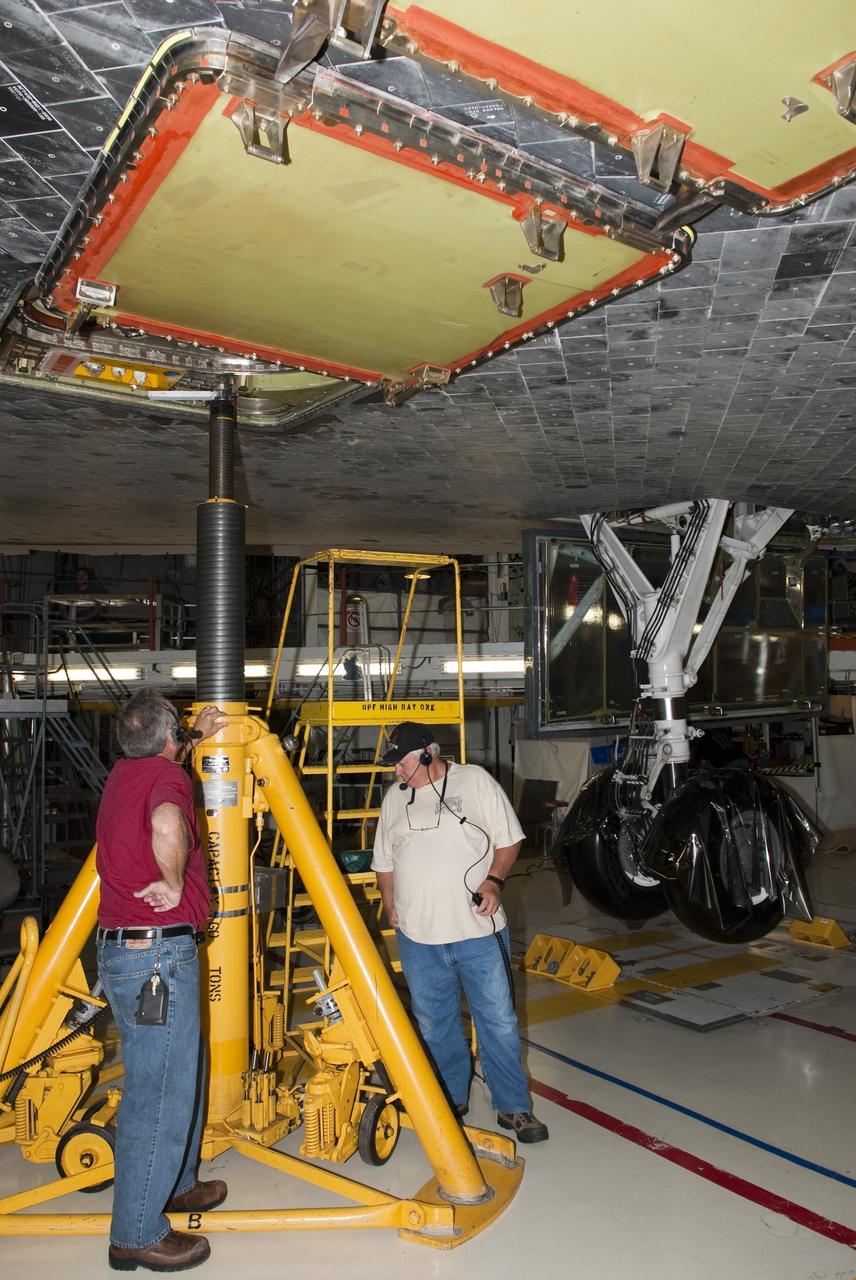
CAPE CANAVERAL, Fla. - In Orbiter Processing Facility-1 at NASA's Kennedy Space Center in Florida, workers test the hydraulic system that will lift the shuttle Atlantis off the floor to enable the orbiter transport system, or OTS, to be rolled underneath for its move, or "rollover," to the Vehicle Assembly Building. Once there Atlantis will be joined with the external fuel tank and solid rocket boosters on the mobile launcher platform. Atlantis is being prepared for the STS-135 mission, which will deliver the Raffaello multipurpose logistics module packed with supplies, logistics and spare parts to the International Space Station. STS-135 is targeted to launch June 28, and will be the last spaceflight for the Space Shuttle Program. Photo credit: NASA/Jim Grossmann

KENNEDY SPACE CENTER, FLA. -- Workers prepare a parachute for an upcoming test at the Parachute Refurbishment Facility. The first stage of the new Ares I rocket and Orion spacecraft will use parachutes to return to Earth. Current tests are being performed in Arizona to make sure the designs can safely handle their intended weight. Ares I is an in-line, two-stage rocket that will transport the Orion crew exploration vehicle to low-Earth orbit. The Ares I first stage will be a five-segment solid rocket booster based on the four-segment design used for the shuttle. As with the shuttle, this booster will fall away when spent, lowered by parachute into the Atlantic Ocean where it can be retrieved for re-use. Unlike the shuttle, the booster will be flying faster, at Mach 6, when its separation from the rest of Ares I occurs. Photo credit: NASA/Kim Shiflett
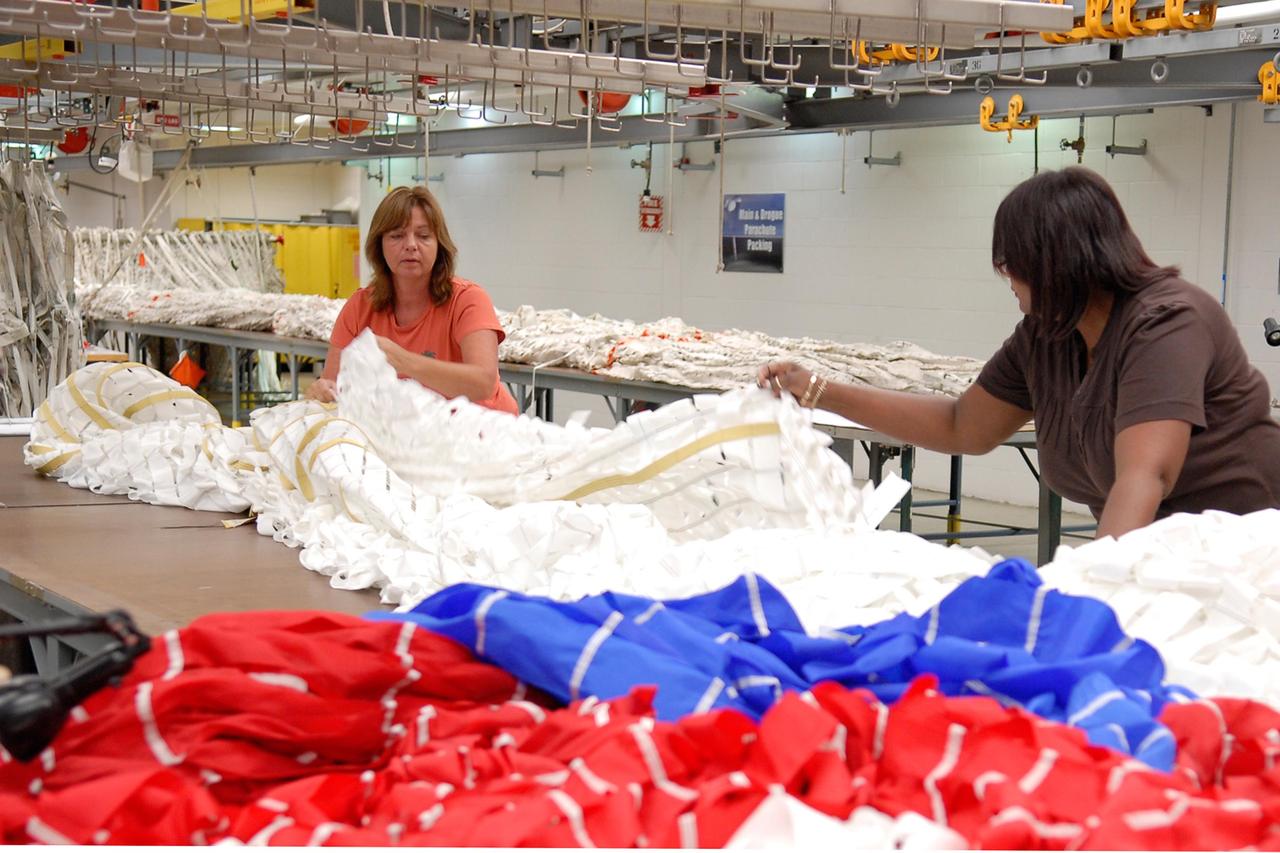
KENNEDY SPACE CENTER, FLA. -- Workers prepare a parachute for an upcoming test at the Parachute Refurbishment Facility. The first stage of the new Ares I rocket and Orion spacecraft will use parachutes to return to Earth. Current tests are being performed in Arizona to make sure the designs can safely handle their intended weight. Ares I is an in-line, two-stage rocket that will transport the Orion crew exploration vehicle to low-Earth orbit. The Ares I first stage will be a five-segment solid rocket booster based on the four-segment design used for the shuttle. As with the shuttle, this booster will fall away when spent, lowered by parachute into the Atlantic Ocean where it can be retrieved for re-use. Unlike the shuttle, the booster will be flying faster, at Mach 6, when its separation from the rest of Ares I occurs. Photo credit: NASA/Kim Shiflett
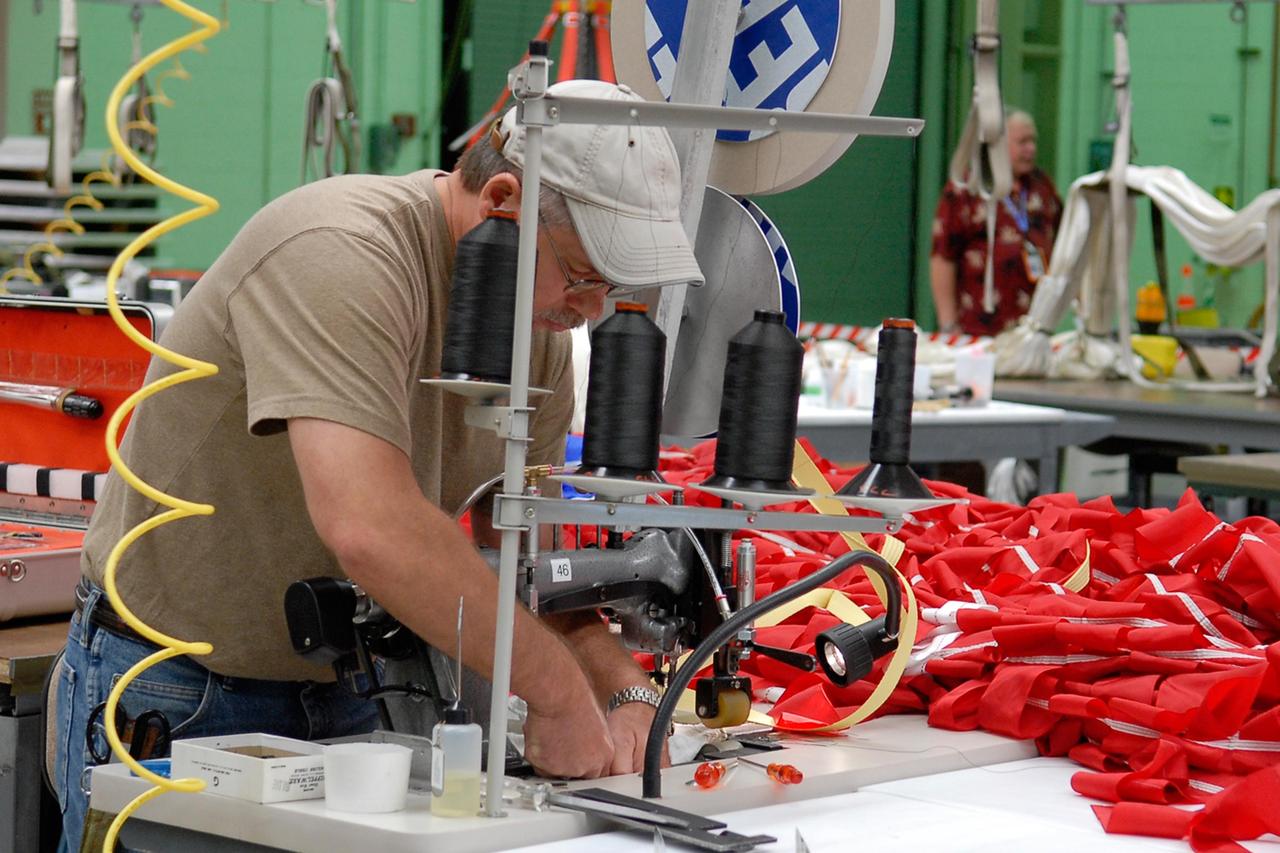
KENNEDY SPACE CENTER, FLA. -- A worker sews a parachute being prepared for an upcoming test at the Parachute Refurbishment Facility. The first stage of the new Ares I rocket and Orion spacecraft will use parachutes to return to Earth. Current tests are being performed in Arizona to make sure the designs can safely handle their intended weight. Ares I is an in-line, two-stage rocket that will transport the Orion crew exploration vehicle to low-Earth orbit. The Ares I first stage will be a five-segment solid rocket booster based on the four-segment design used for the shuttle. As with the shuttle, this booster will fall away when spent, lowered by parachute into the Atlantic Ocean where it can be retrieved for re-use. Unlike the shuttle, the booster will be flying faster, at Mach 6, when its separation from the rest of Ares I occurs. Photo credit: NASA/Kim Shiflett
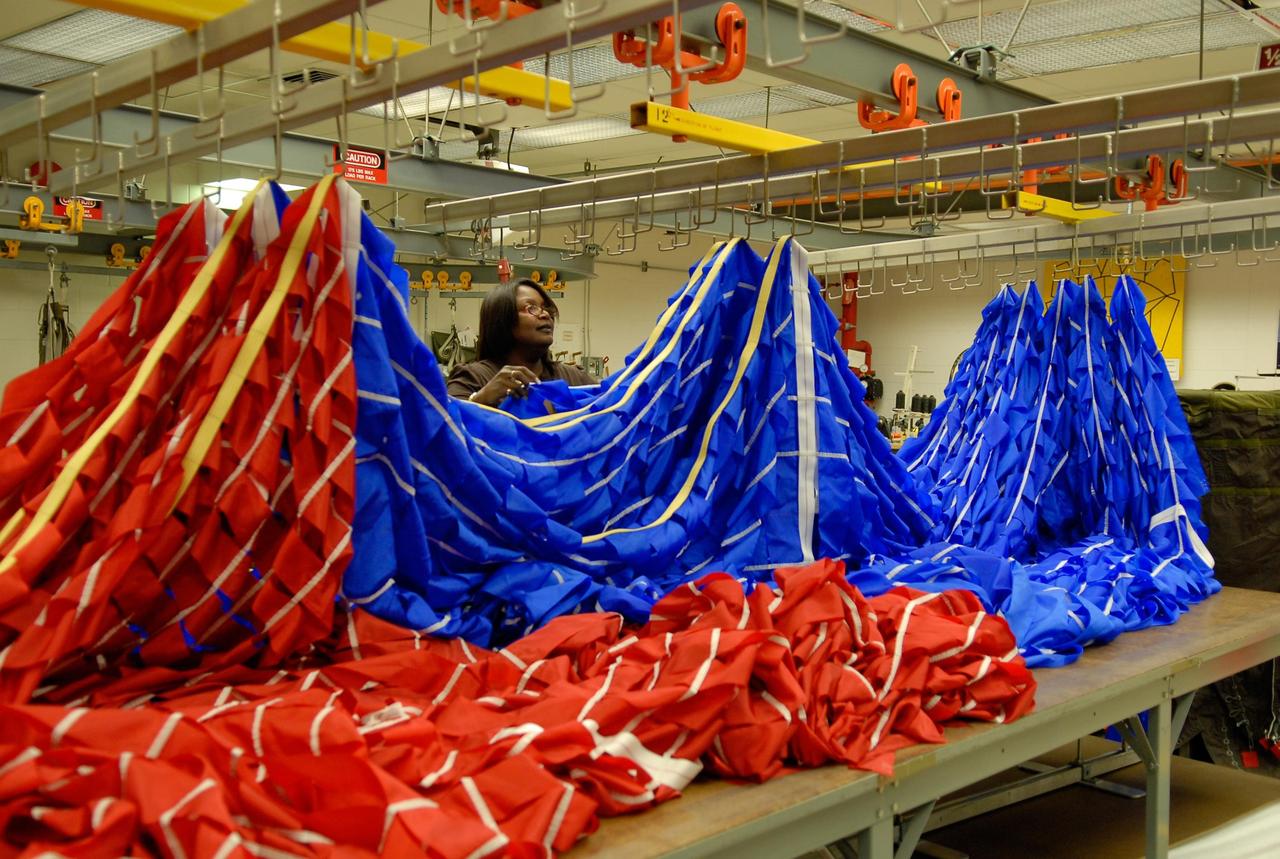
KENNEDY SPACE CENTER, FLA. -- A worker hangs portions of a parachute in preparation for an upcoming test at the Parachute Refurbishment Facility. The first stage of the new Ares I rocket and Orion spacecraft will use parachutes to return to Earth. Current tests are being performed in Arizona to make sure the designs can safely handle their intended weight. Ares I is an in-line, two-stage rocket that will transport the Orion crew exploration vehicle to low-Earth orbit. The Ares I first stage will be a five-segment solid rocket booster based on the four-segment design used for the shuttle. As with the shuttle, this booster will fall away when spent, lowered by parachute into the Atlantic Ocean where it can be retrieved for re-use. Unlike the shuttle, the booster will be flying faster, at Mach 6, when its separation from the rest of Ares I occurs. Photo credit: NASA/Kim Shiflett

KENNEDY SPACE CENTER, FLA. -- A worker prepares a parachute for an upcoming test at the Parachute Refurbishment Facility. The first stage of the new Ares I rocket and Orion spacecraft will use parachutes to return to Earth. Current tests are being performed in Arizona to make sure the designs can safely handle their intended weight. Ares I is an in-line, two-stage rocket that will transport the Orion crew exploration vehicle to low-Earth orbit. The Ares I first stage will be a five-segment solid rocket booster based on the four-segment design used for the shuttle. As with the shuttle, this booster will fall away when spent, lowered by parachute into the Atlantic Ocean where it can be retrieved for re-use. Unlike the shuttle, the booster will be flying faster, at Mach 6, when its separation from the rest of Ares I occurs. Photo credit: NASA/Kim Shiflett
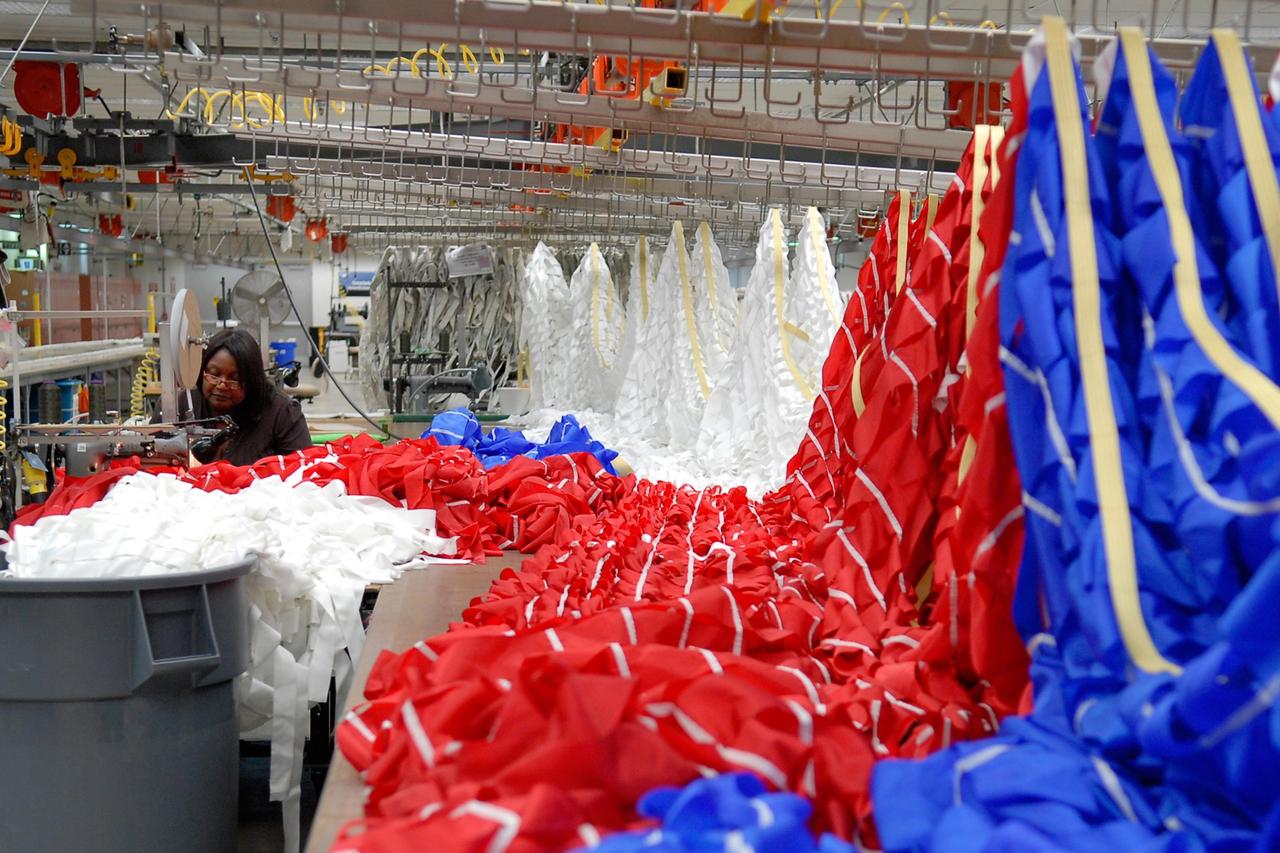
KENNEDY SPACE CENTER, FLA. -- A worker sews a parachute being prepared for an upcoming test at the Parachute Refurbishment Facility. The first stage of the new Ares I rocket and Orion spacecraft will use parachutes to return to Earth. Current tests are being performed in Arizona to make sure the designs can safely handle their intended weight. Ares I is an in-line, two-stage rocket that will transport the Orion crew exploration vehicle to low-Earth orbit. The Ares I first stage will be a five-segment solid rocket booster based on the four-segment design used for the shuttle. As with the shuttle, this booster will fall away when spent, lowered by parachute into the Atlantic Ocean where it can be retrieved for re-use. Unlike the shuttle, the booster will be flying faster, at Mach 6, when its separation from the rest of Ares I occurs. Photo credit: NASA/Kim Shiflett
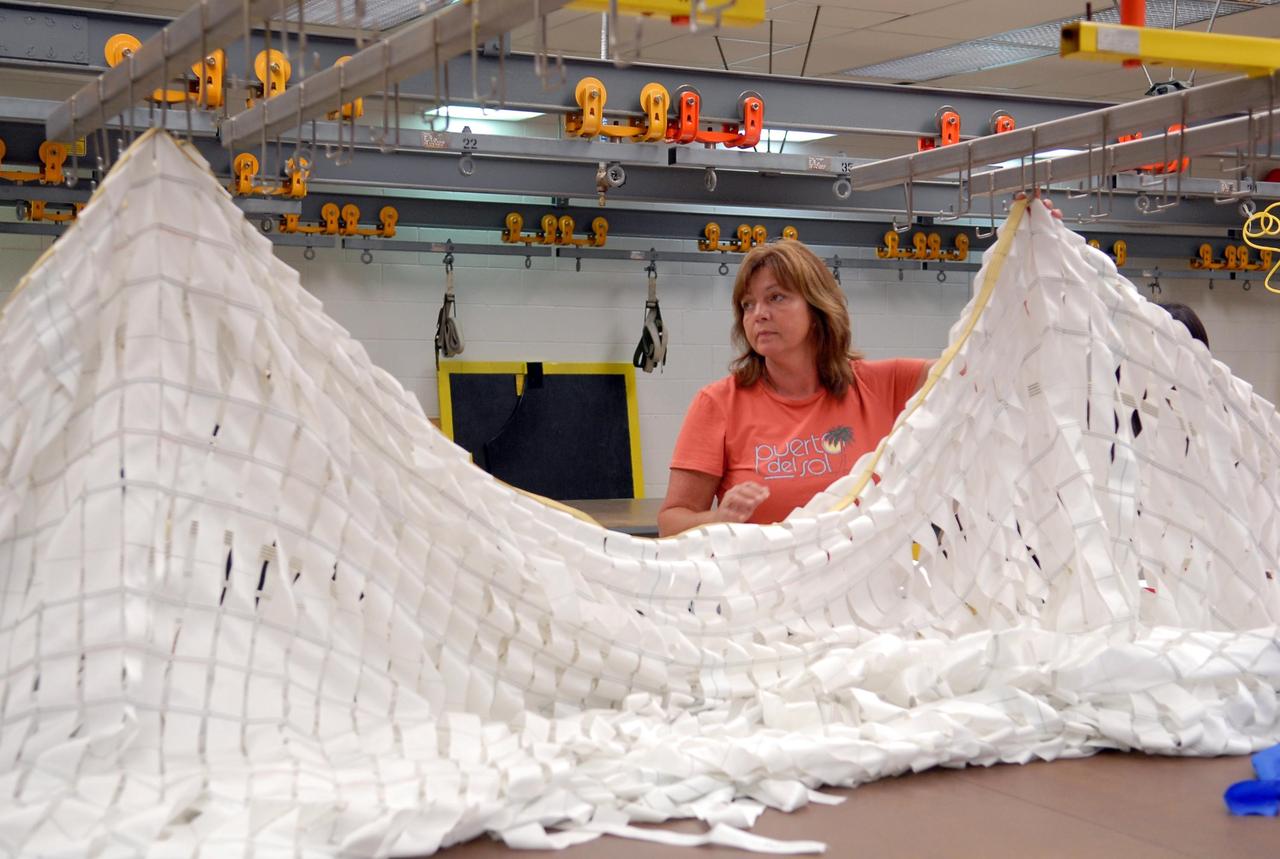
KENNEDY SPACE CENTER, FLA. -- A worker prepares a parachute for an upcoming test at the Parachute Refurbishment Facility. The first stage of the new Ares I rocket and Orion spacecraft will use parachutes to return to Earth. Current tests are being performed in Arizona to make sure the designs can safely handle their intended weight. Ares I is an in-line, two-stage rocket that will transport the Orion crew exploration vehicle to low-Earth orbit. The Ares I first stage will be a five-segment solid rocket booster based on the four-segment design used for the shuttle. As with the shuttle, this booster will fall away when spent, lowered by parachute into the Atlantic Ocean where it can be retrieved for re-use. Unlike the shuttle, the booster will be flying faster, at Mach 6, when its separation from the rest of Ares I occurs. Photo credit: NASA/Kim Shiflett
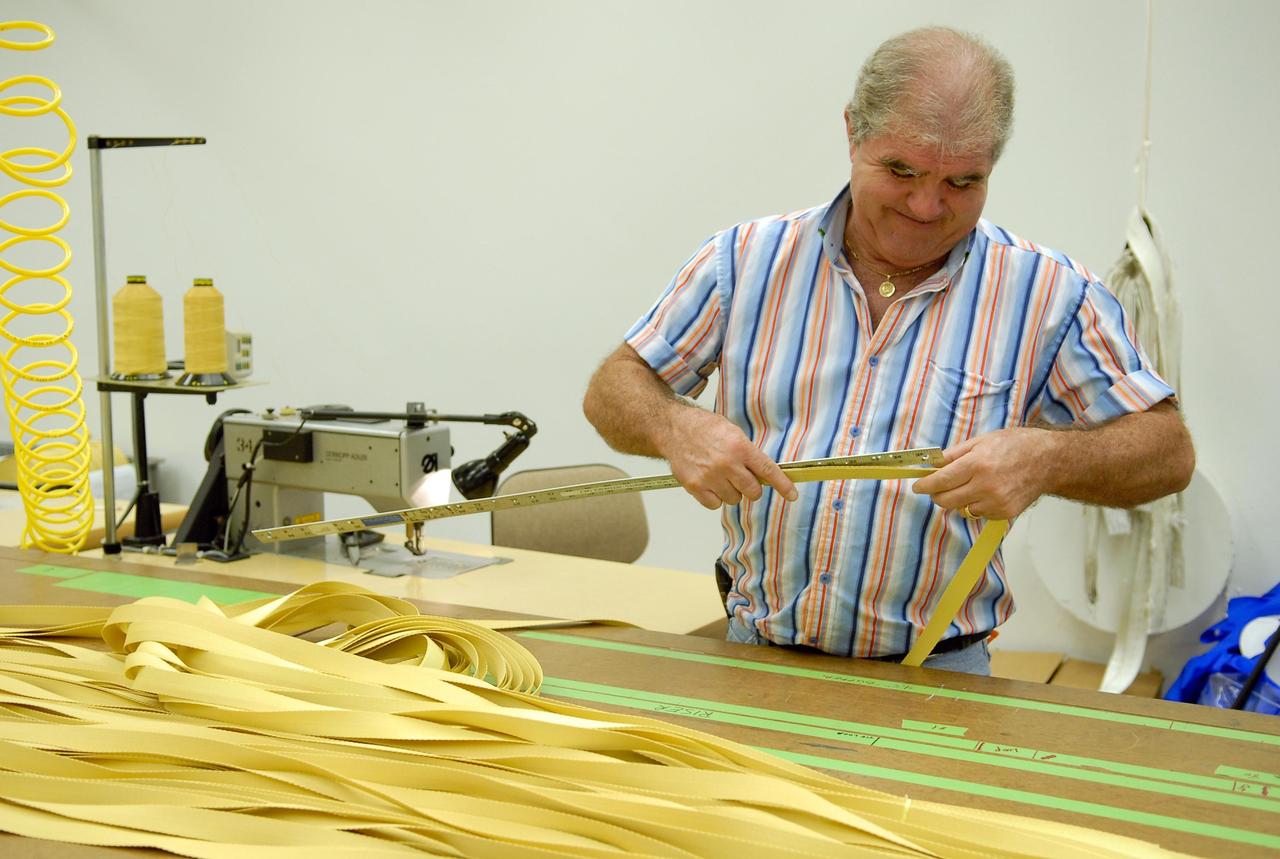
KENNEDY SPACE CENTER, FLA. -- A worker measures straps for parachutes being prepared for an upcoming test at the Parachute Refurbishment Facility. The first stage of the new Ares I rocket and Orion spacecraft will use parachutes to return to Earth. Current tests are being performed in Arizona to make sure the designs can safely handle their intended weight. Ares I is an in-line, two-stage rocket that will transport the Orion crew exploration vehicle to low-Earth orbit. The Ares I first stage will be a five-segment solid rocket booster based on the four-segment design used for the shuttle. As with the shuttle, this booster will fall away when spent, lowered by parachute into the Atlantic Ocean where it can be retrieved for re-use. Unlike the shuttle, the booster will be flying faster, at Mach 6, when its separation from the rest of Ares I occurs. Photo credit: NASA/Kim Shiflett
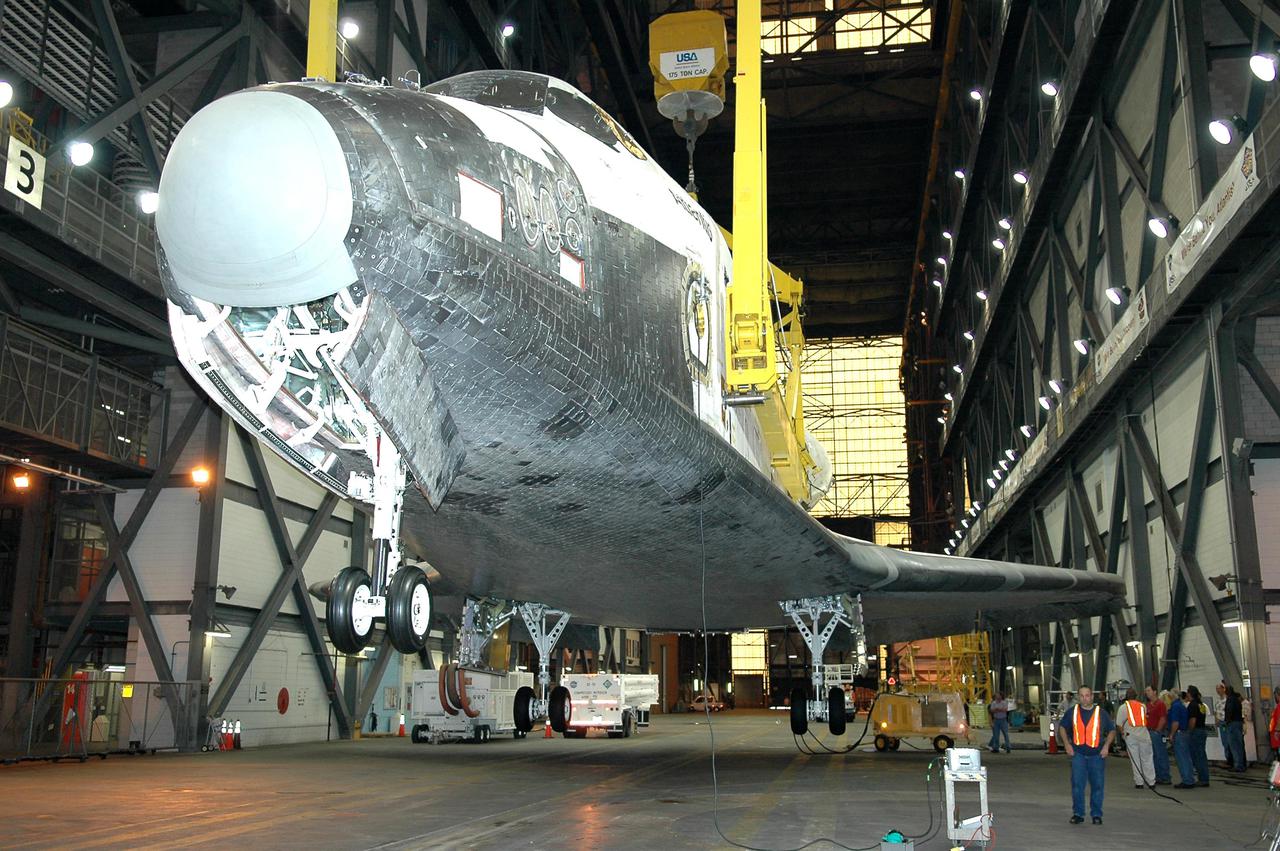
KENNEDY SPACE CENTER, FLA. - In the Vehicle Assembly Building (VAB), the landing gear of Space Shuttle Atlantis is lowered before the orbiter comes to rest on the floor of the transfer aisle. The vehicle was just demated from its External Tank_Solid Rocket Booster stack in one of the VAB's high bays. The orbiter will be rolled back to Orbiter Processing Facility bay 1 where processing will begin for mission STS-115, the 19th flight to the International Space Station. The tank, ET-120, is the first redesigned ET to arrive at KSC and will undergo further testing before Return to Flight mission STS-121 next year.
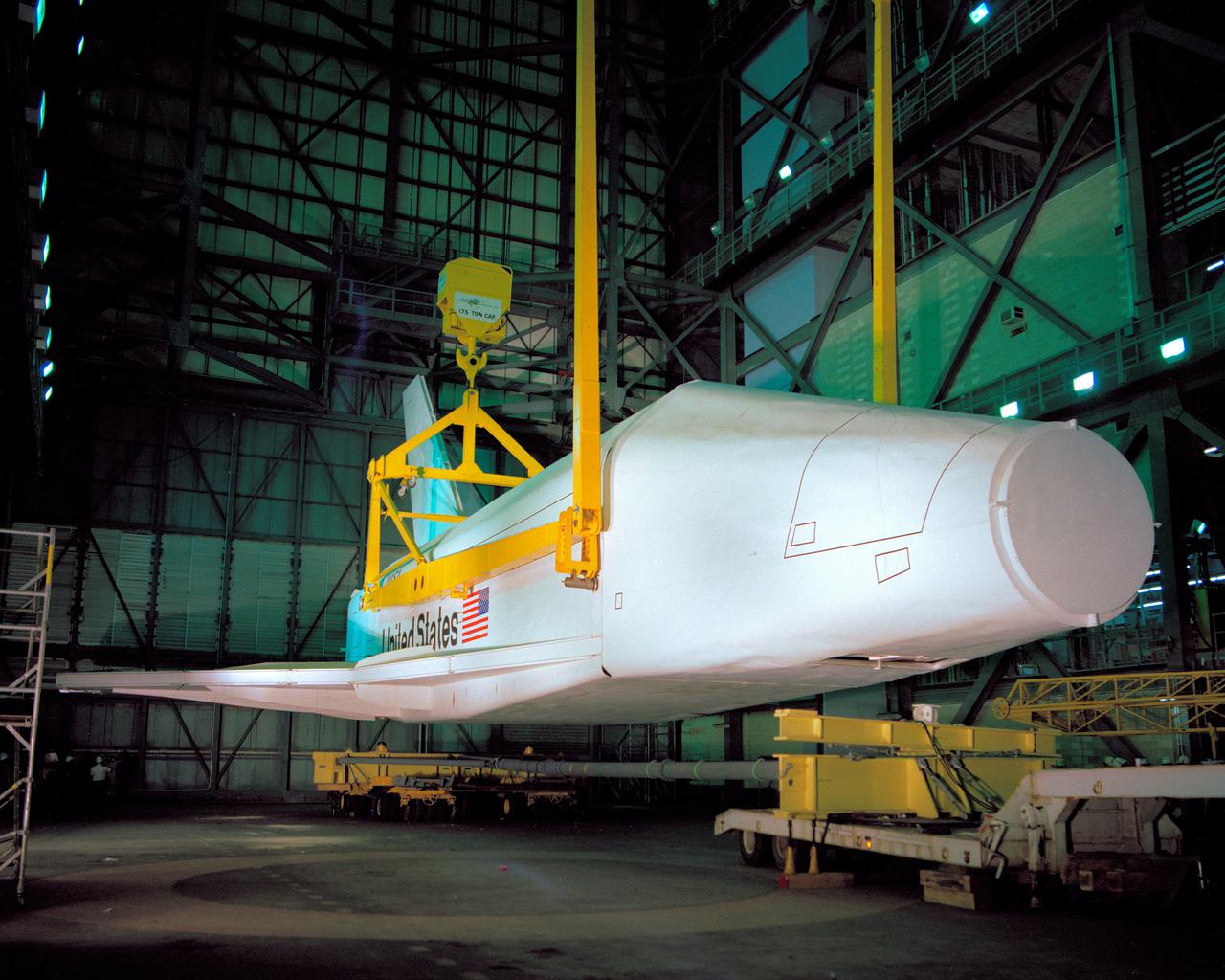
CAPE CANAVERAL, Fla. – At NASA's Kennedy Space Center in Florida, the space shuttle mock-up, dubbed Pathfinder, performs a lift test in the Vehicle Assembly Building on May 31, 1978. The mock-up, constructed at NASA's Marshall Space Flight Center in Huntsville, Ala., possessed the general dimensions, weight and balance of a real space shuttle. It was shipped to Kennedy by barge and then used to fit-check the work platforms of the Mate-Demate Device, orbiter processing facilities and Vehicle Assembly Building, as well as support ground crew training. It also was used to rehearse post-landing procedures at Kennedy's Shuttle Landing Facility. After being on display at the 'Great Space Shuttle Exposition' in Tokyo from June 1983 to August 1984, the mock-up returned to Marshall and now is on permanent display at the U.S. Space and Rocket Center near Huntsville. Photo credit: NASA
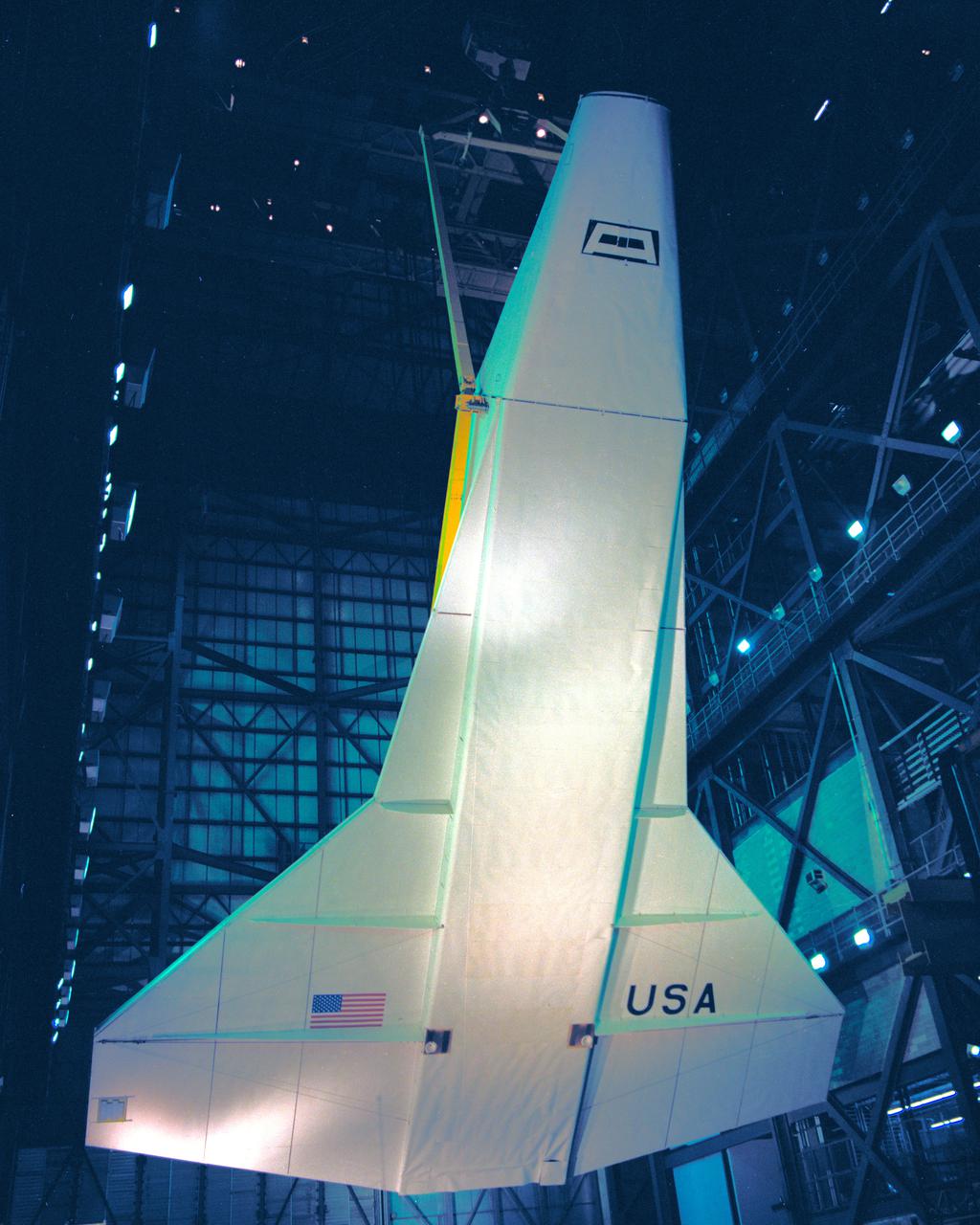
CAPE CANAVERAL, Fla. – At NASA's Kennedy Space Center in Florida, the space shuttle mock-up, dubbed Pathfinder, undergoes a lift test in the Vehicle Assembly Building on May 31, 1978. The mock-up, constructed at NASA's Marshall Space Flight Center in Huntsville, Ala., possessed the general dimensions, weight and balance of a real space shuttle. It was shipped to Kennedy by barge and then used to fit-check the work platforms of the Mate-Demate Device, orbiter processing facilities and Vehicle Assembly Building, as well as support ground crew training. It also was used to rehearse post-landing procedures at Kennedy's Shuttle Landing Facility. After being on display at the 'Great Space Shuttle Exposition' in Tokyo from June 1983 to August 1984, the mock-up returned to Marshall and now is on permanent display at the U.S. Space and Rocket Center near Huntsville. Photo credit: NASA
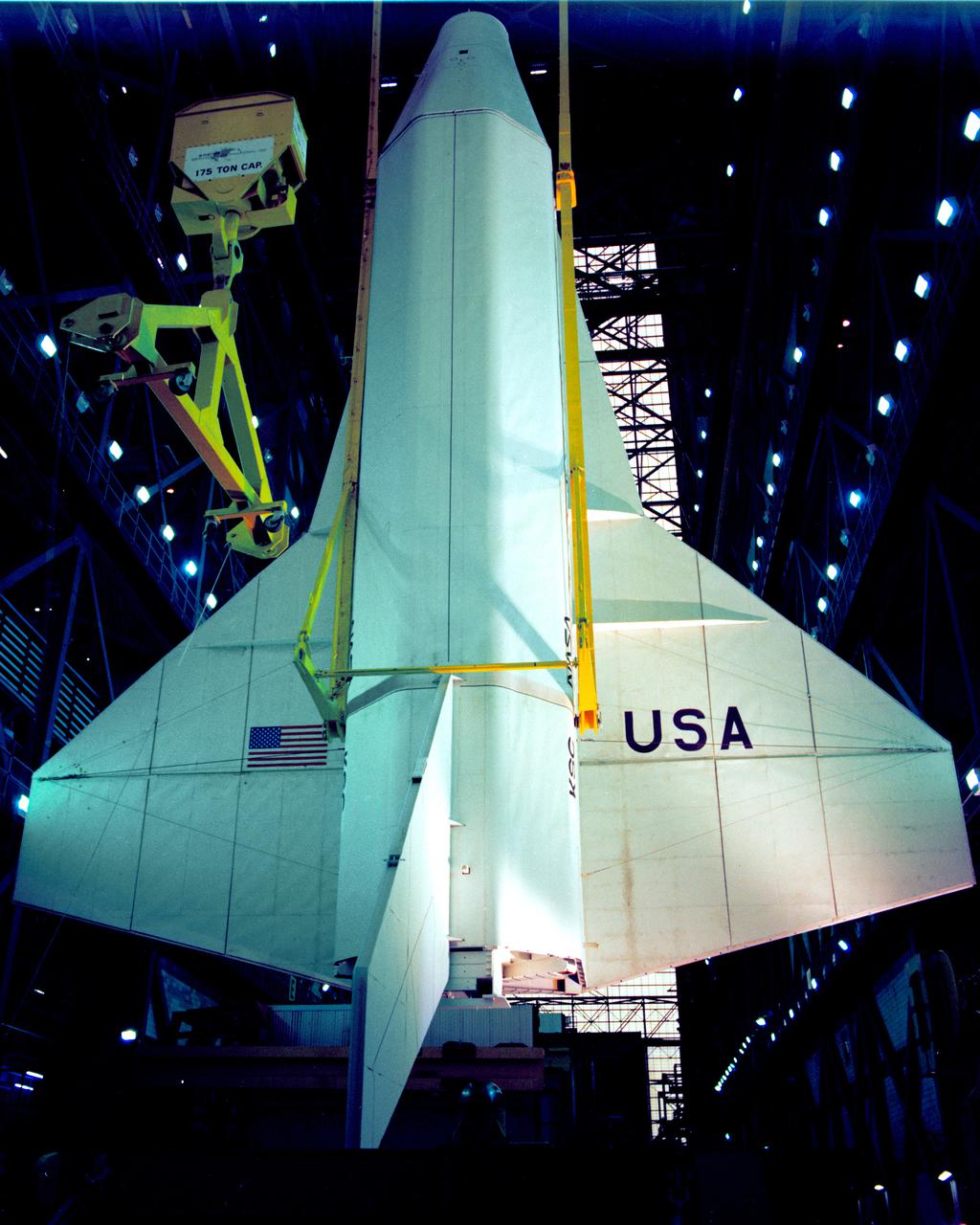
CAPE CANAVERAL, Fla. – At NASA's Kennedy Space Center in Florida, the space shuttle mock-up, dubbed Pathfinder, undergoes a lift test in the Vehicle Assembly Building on May 31, 1978. The mock-up, constructed at NASA's Marshall Space Flight Center in Huntsville, Ala., possessed the general dimensions, weight and balance of a real space shuttle. It was shipped to Kennedy by barge and then used to fit-check the work platforms of the Mate-Demate Device, orbiter processing facilities and Vehicle Assembly Building, as well as support ground crew training. It also was used to rehearse post-landing procedures at Kennedy's Shuttle Landing Facility. After being on display at the 'Great Space Shuttle Exposition' in Tokyo from June 1983 to August 1984, the mock-up returned to Marshall and now is on permanent display at the U.S. Space and Rocket Center near Huntsville. Photo credit: NASA
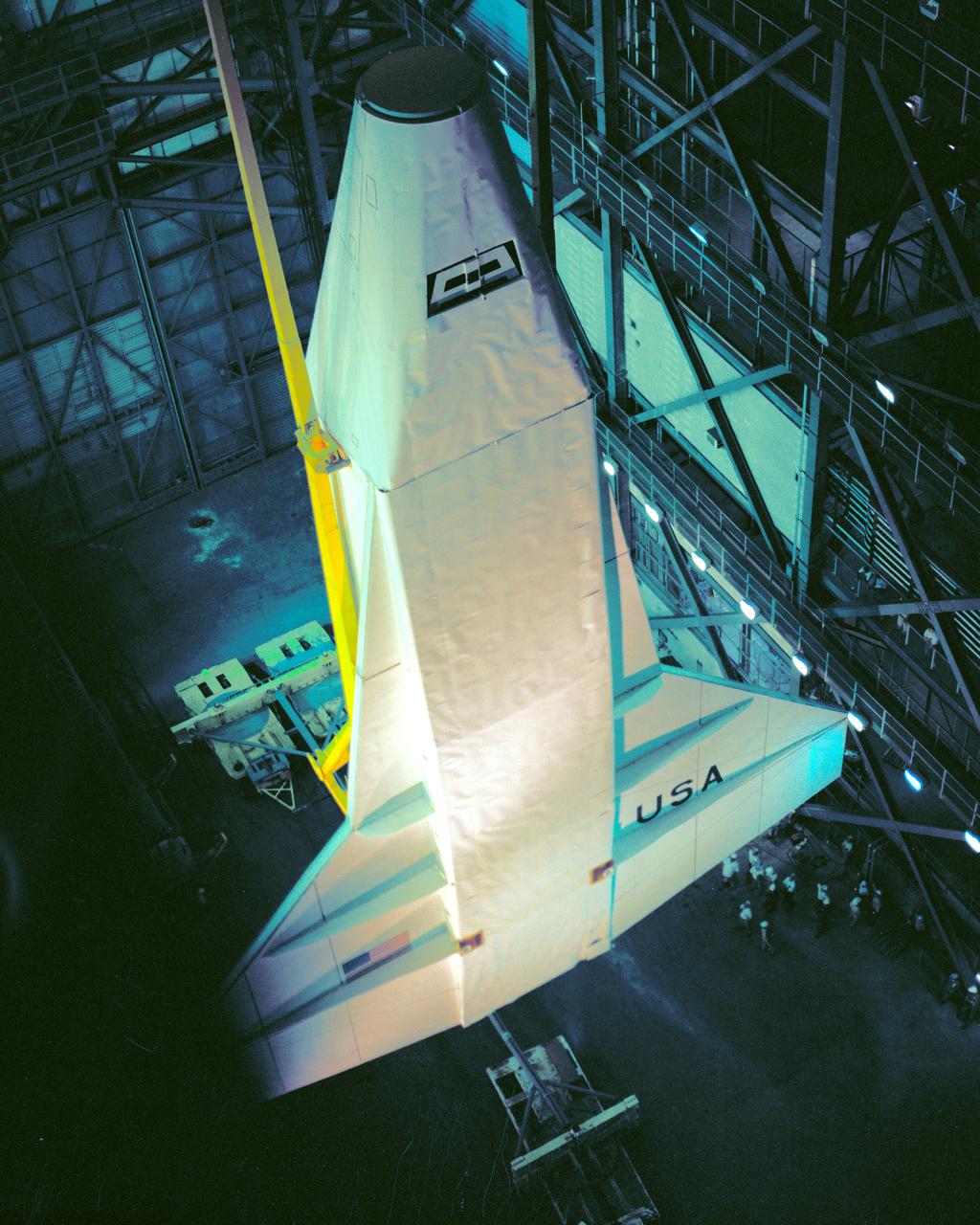
CAPE CANAVERAL, Fla. – At NASA's Kennedy Space Center in Florida, the space shuttle mock-up, dubbed Pathfinder, undergoes a lift test in the Vehicle Assembly Building on May 31, 1978. The mock-up, constructed at NASA's Marshall Space Flight Center in Huntsville, Ala., possessed the general dimensions, weight and balance of a real space shuttle. It was shipped to Kennedy by barge and then used to fit-check the work platforms of the Mate-Demate Device, orbiter processing facilities and Vehicle Assembly Building, as well as support ground crew training. It also was used to rehearse post-landing procedures at Kennedy's Shuttle Landing Facility. After being on display at the 'Great Space Shuttle Exposition' in Tokyo from June 1983 to August 1984, the mock-up returned to Marshall and now is on permanent display at the U.S. Space and Rocket Center near Huntsville. Photo credit: NASA
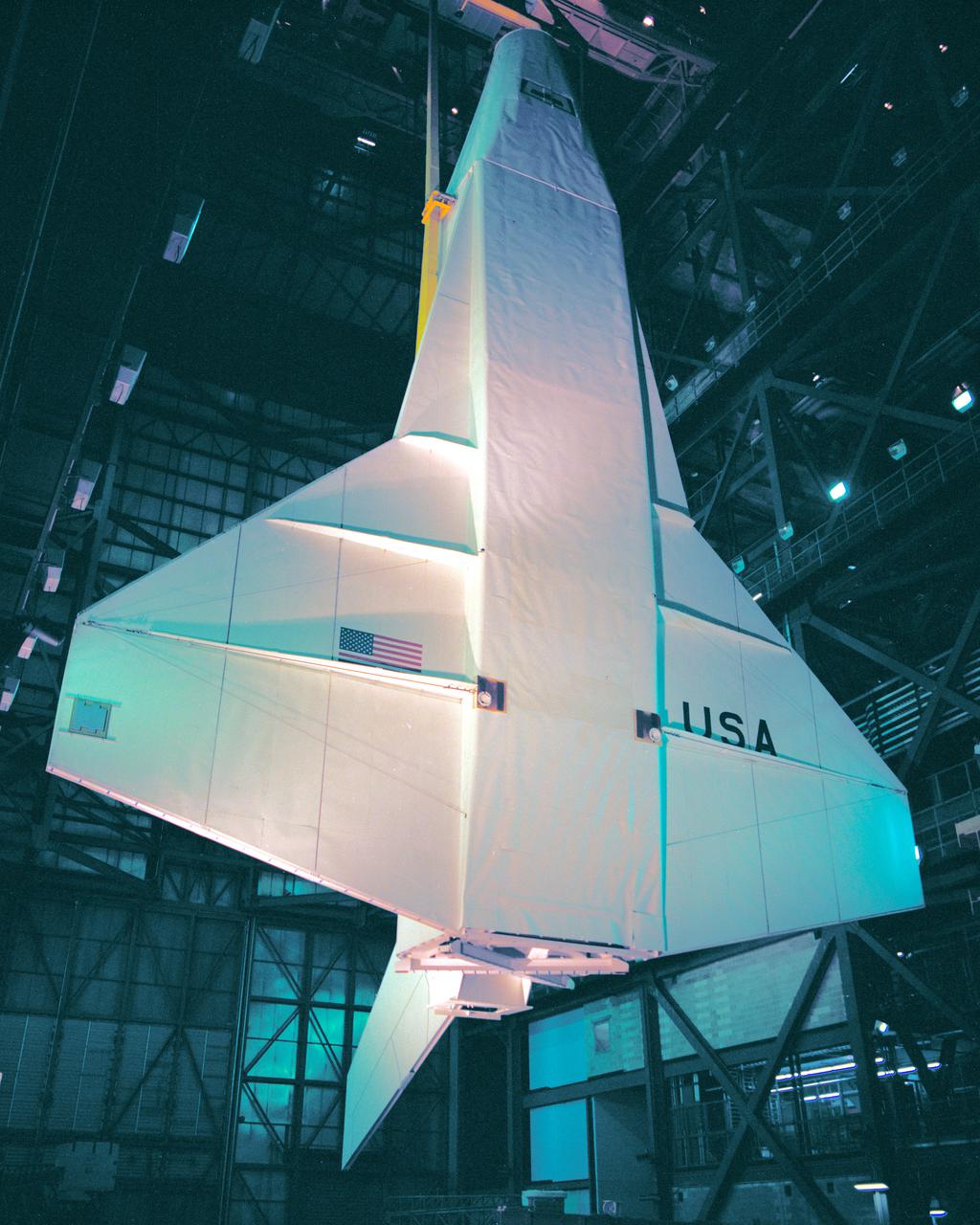
CAPE CANAVERAL, Fla. – At NASA's Kennedy Space Center in Florida, the space shuttle mock-up, dubbed Pathfinder, undergoes a lift test in the Vehicle Assembly Building on May 31, 1978. The mock-up, constructed at NASA's Marshall Space Flight Center in Huntsville, Ala., possessed the general dimensions, weight and balance of a real space shuttle. It was shipped to Kennedy by barge and then used to fit-check the work platforms of the Mate-Demate Device, orbiter processing facilities and Vehicle Assembly Building, as well as support ground crew training. It also was used to rehearse post-landing procedures at Kennedy's Shuttle Landing Facility. After being on display at the 'Great Space Shuttle Exposition' in Tokyo from June 1983 to August 1984, the mock-up returned to Marshall and now is on permanent display at the U.S. Space and Rocket Center near Huntsville. Photo credit: NASA
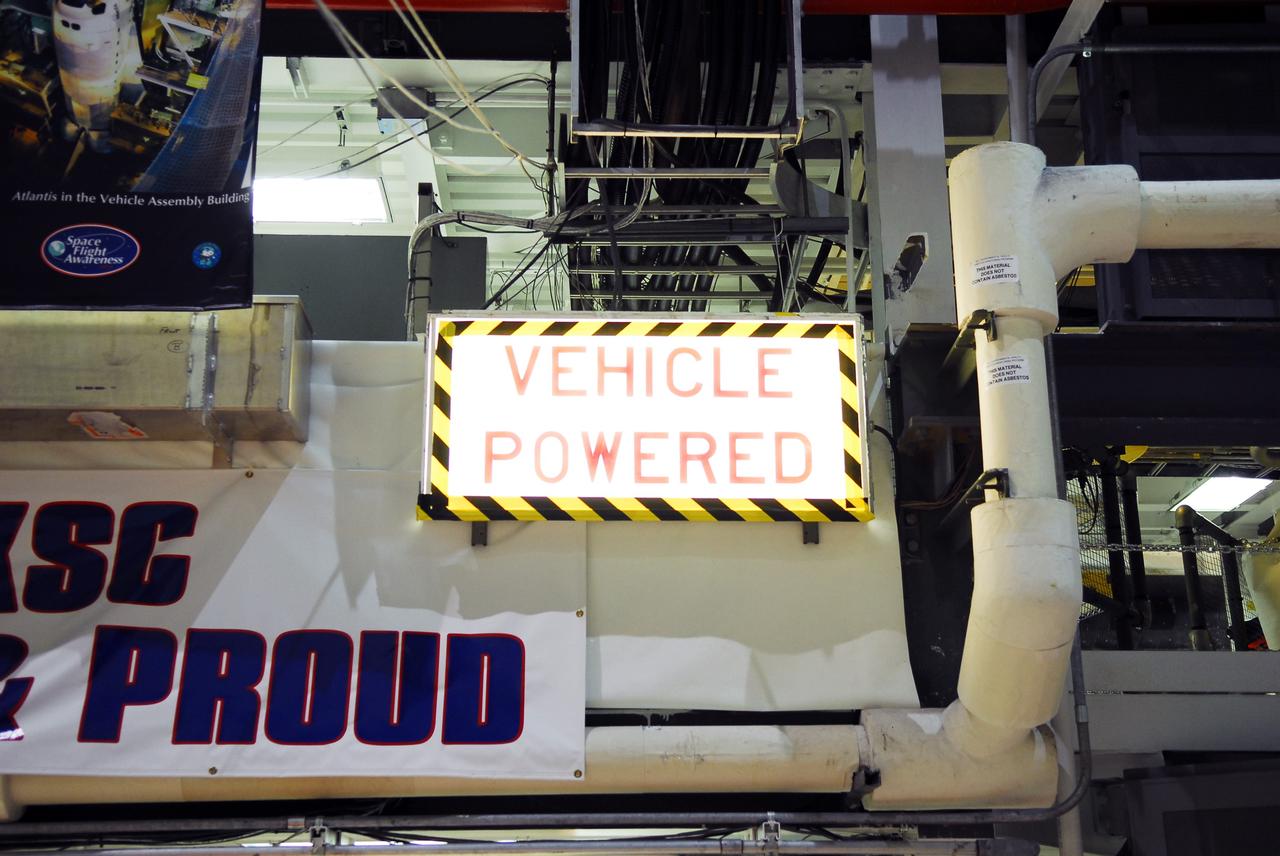
CAPE CANAVERAL, Fla. - In Orbiter Processing Facility-1 at NASA's Kennedy Space Center in Florida, shuttle Atlantis' systems are being "powered-up," or tested in preparation of its move to the Vehicle Assembly Building where it will be joined with the external fuel tank and solid rocket boosters on the mobile launcher platform. Atlantis is being prepared for the STS-135 mission, which will deliver the Raffaello multipurpose logistics module packed with supplies, logistics and spare parts to the International Space Station. STS-135 is targeted to launch June 28, and will be the last spaceflight for the Space Shuttle Program. Photo credit: NASA/Jim Grossmann
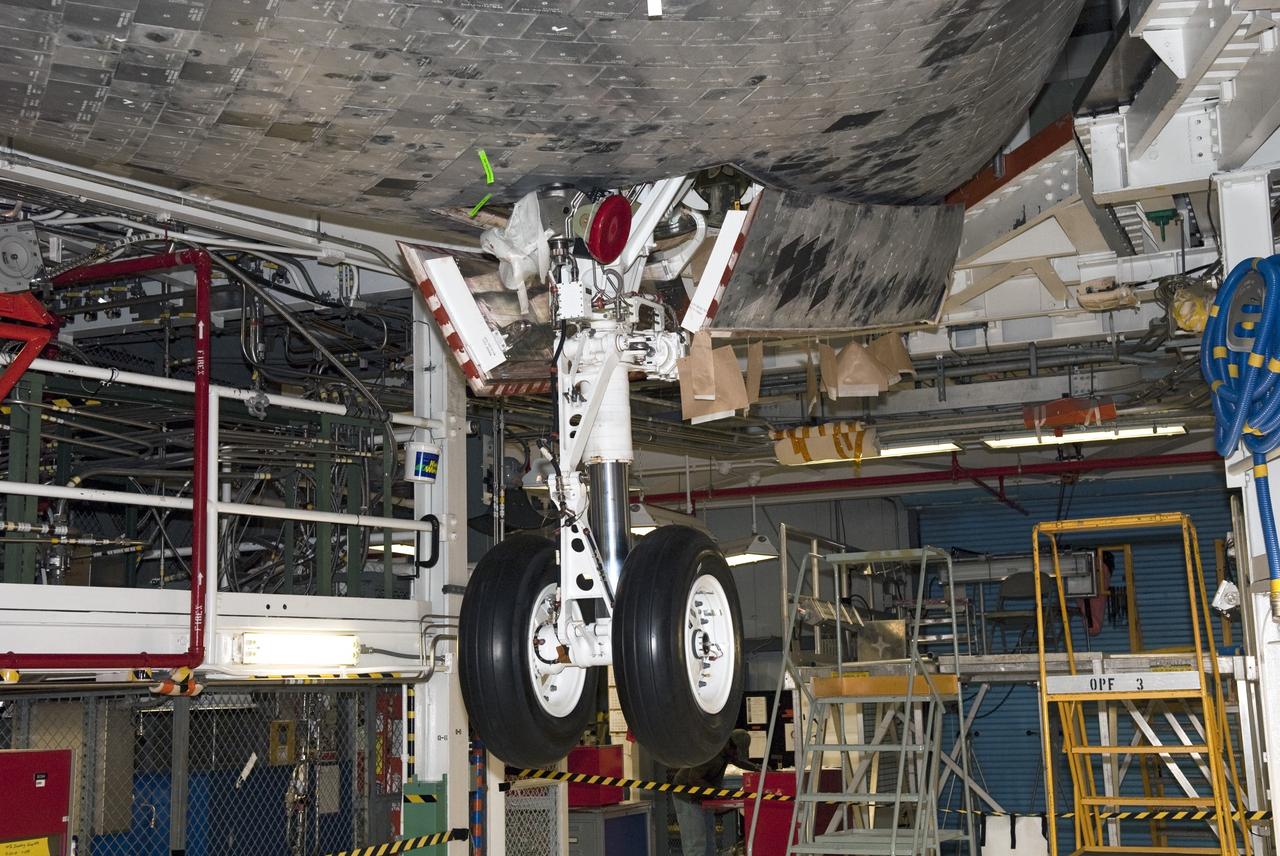
CAPE CANAVERAL, Fla. - In Orbiter Processing Facility-1 at NASA's Kennedy Space Center in Florida, shuttle Atlantis' landing gear is being pressure tested for weight-bearing loads in preparation of it move, or "rollover," to the Vehicle Assembly Building where it will be joined with the external fuel tank and solid rocket boosters on the mobile launcher platform. Atlantis is being prepared for the STS-135 mission, which will deliver the Raffaello multipurpose logistics module packed with supplies, logistics and spare parts to the International Space Station. STS-135 is targeted to launch June 28, and will be the last spaceflight for the Space Shuttle Program. Photo credit: NASA/Jim Grossmann
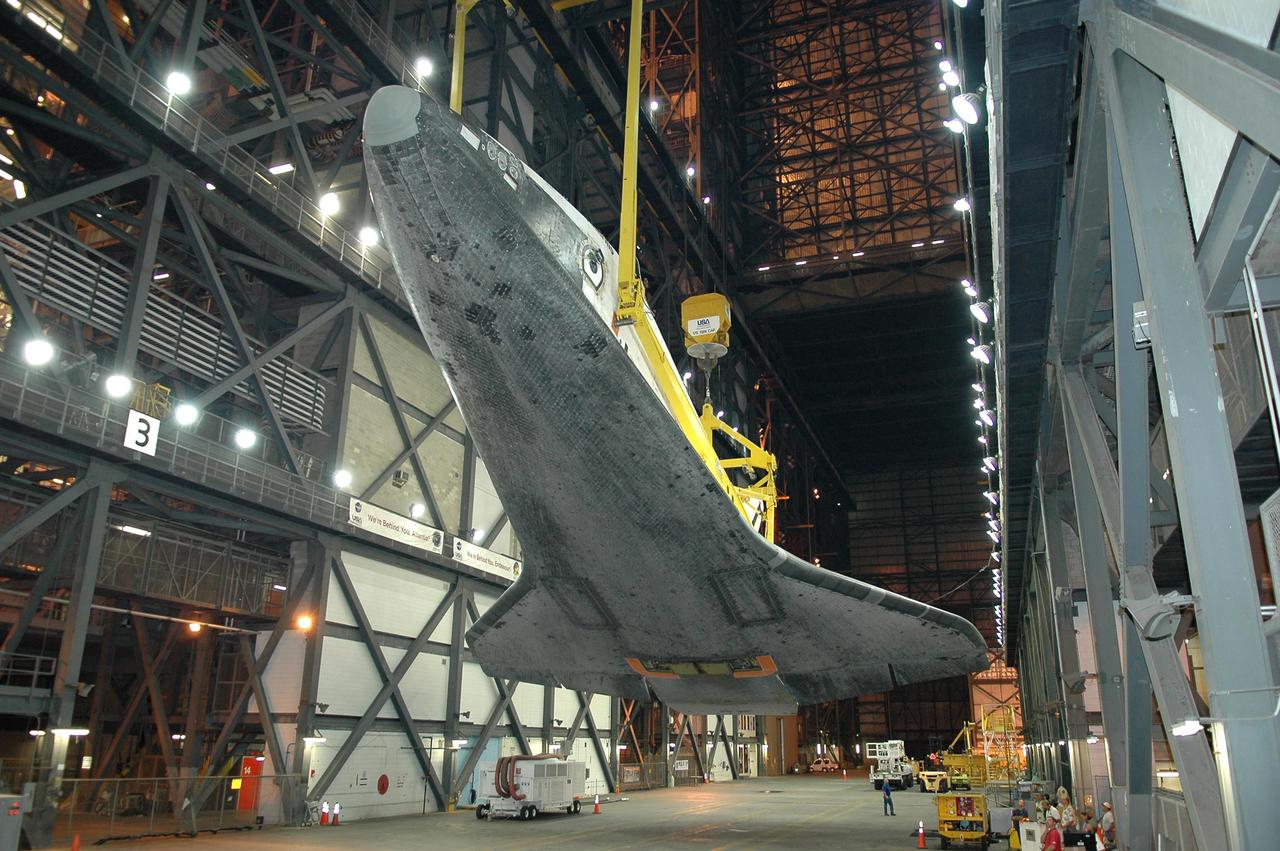
KENNEDY SPACE CENTER, FLA. - In the Vehicle Assembly Building (VAB), Space Shuttle Atlantis is positioned horizontally as it is lowered into the transfer aisle. The vehicle was just demated from its External Tank_Solid Rocket Booster stack in one of the VAB's high bays. The orbiter will be rolled back to Orbiter Processing Facility bay 1 where processing will begin for mission STS-115, the 19th flight to the International Space Station. The tank, ET-120, is the first redesigned ET to arrive at KSC and will undergo further testing before Return to Flight mission STS-121 next year.
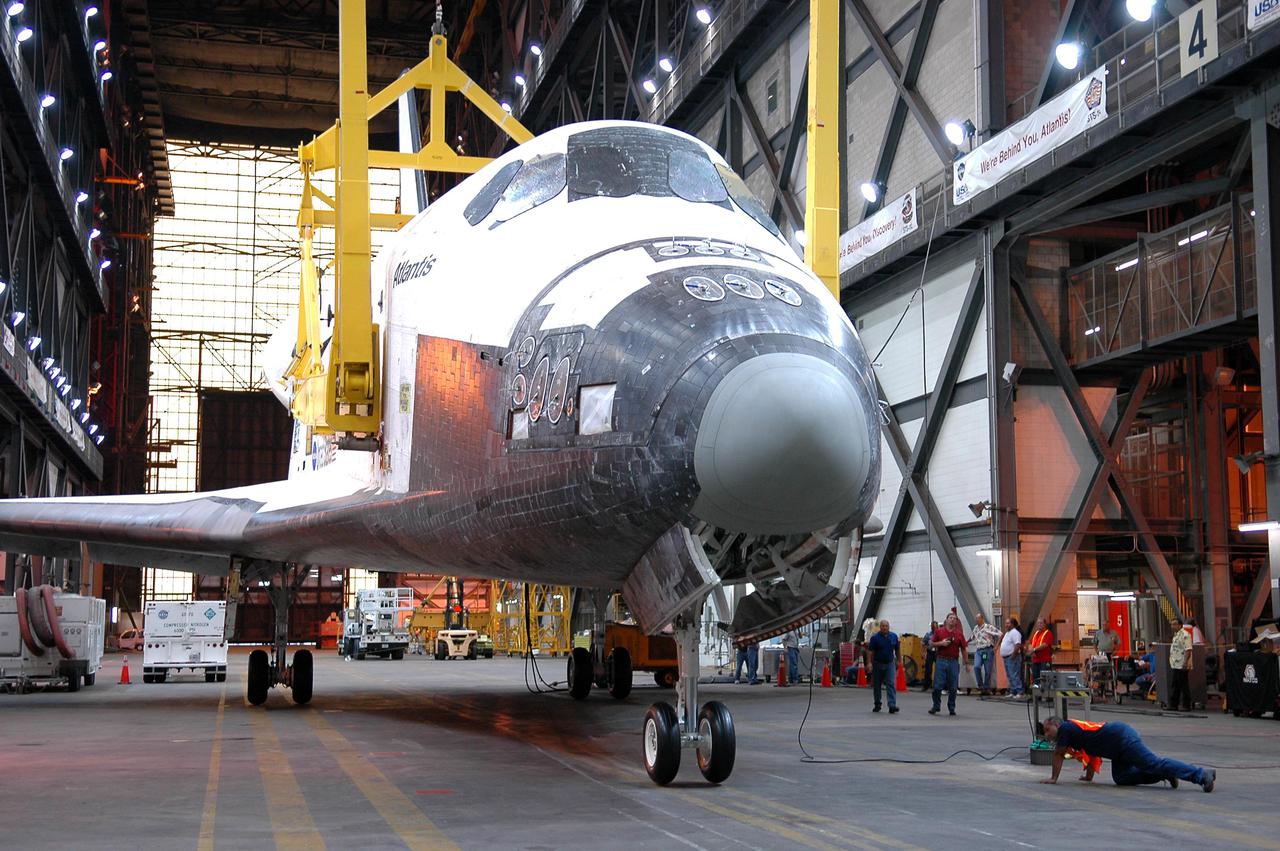
KENNEDY SPACE CENTER, FLA. - In the Vehicle Assembly Building (VAB), Space Shuttle Atlantis rests on its landing gear on the floor of the transfer aisle. The vehicle was just demated from its External Tank_Solid Rocket Booster stack in one of the VAB's high bays. The orbiter will be rolled back to Orbiter Processing Facility bay 1 where processing will begin for mission STS-115, the 19th flight to the International Space Station. The tank, ET-120, is the first redesigned ET to arrive at KSC and will undergo further testing before Return to Flight mission STS-121 next year.
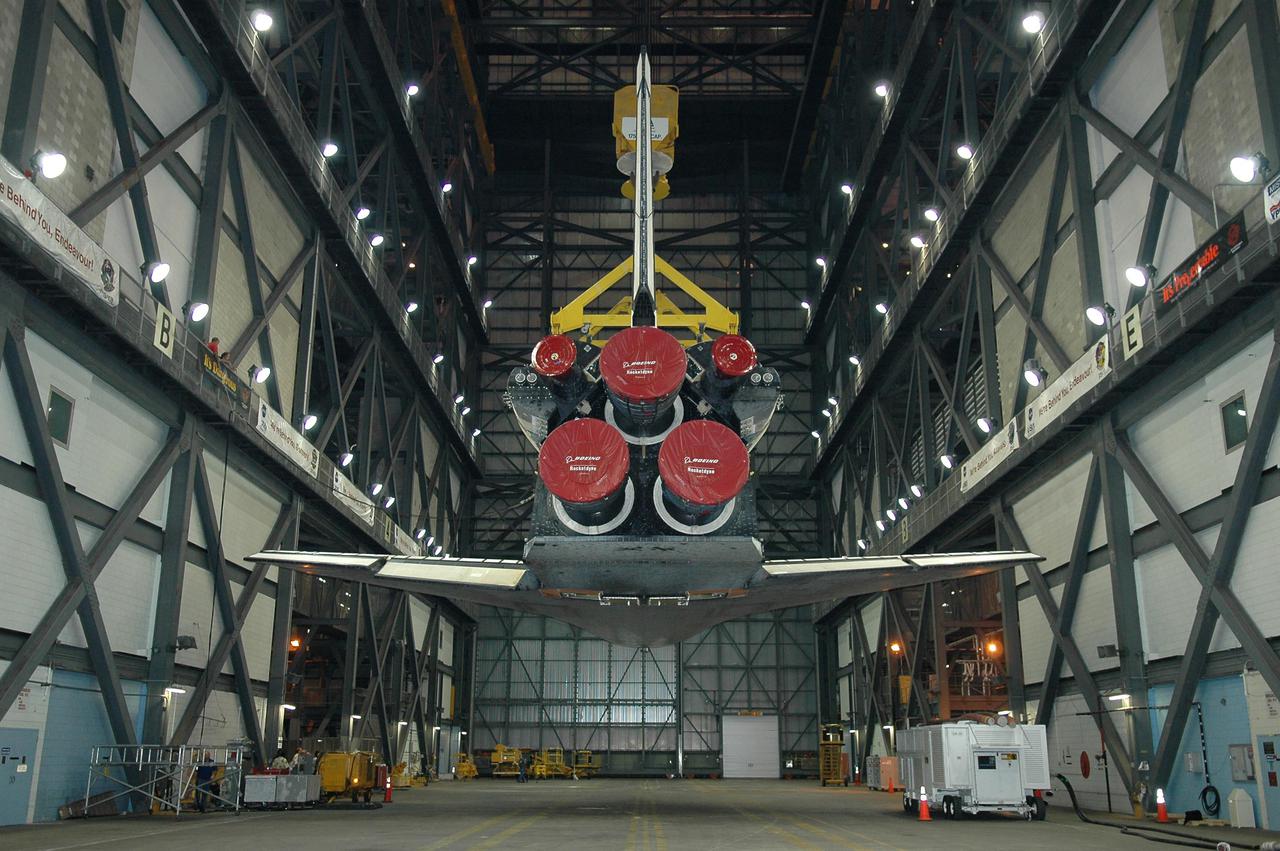
KENNEDY SPACE CENTER, FLA. - In the Vehicle Assembly Building (VAB), Space Shuttle Atlantis is positioned horizontally as it is lowered into the transfer aisle. The vehicle was just demated from its External Tank_Solid Rocket Booster stack in one of the VAB's high bays. The orbiter will be rolled back to Orbiter Processing Facility bay 1 where processing will begin for mission STS-115, the 19th flight to the International Space Station. The tank, ET-120, is the first redesigned ET to arrive at KSC and will undergo further testing before Return to Flight mission STS-121 next year.
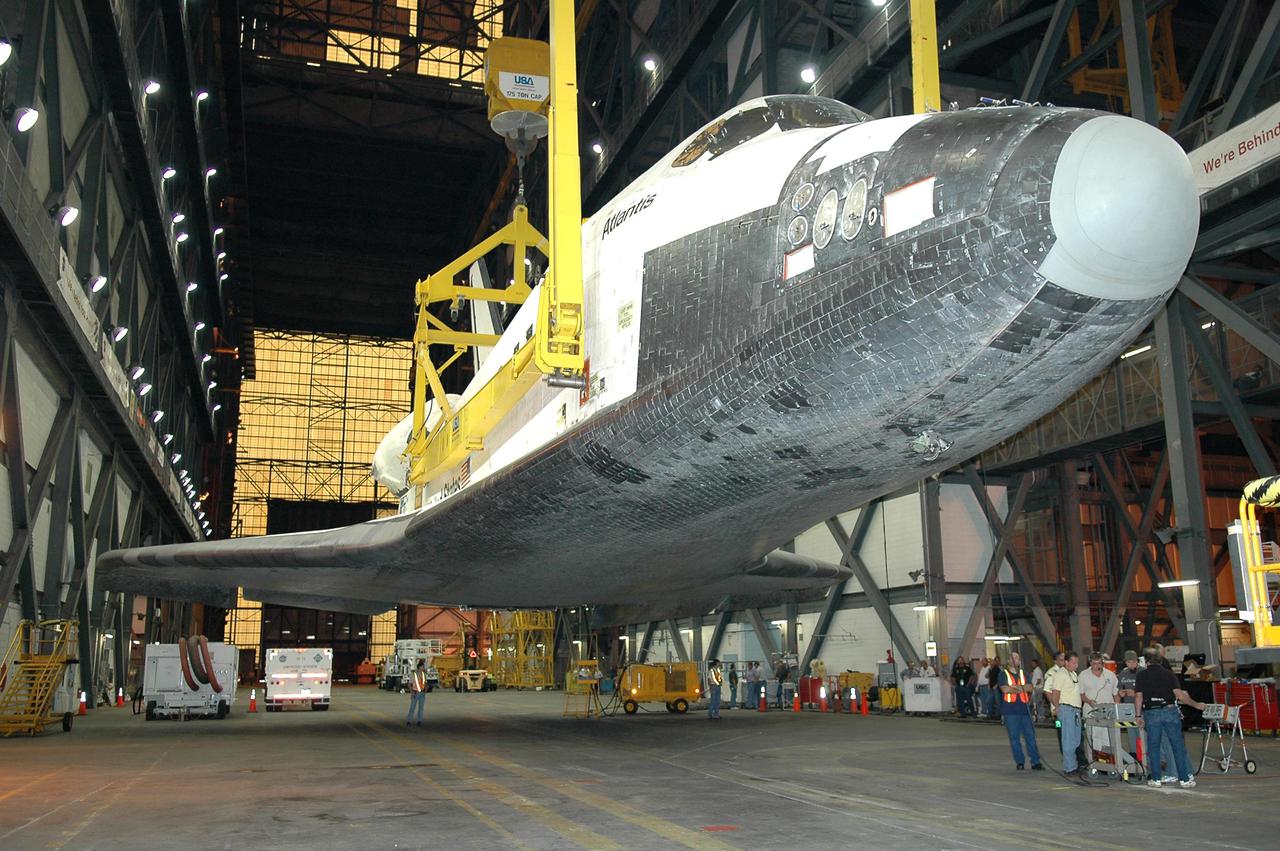
KENNEDY SPACE CENTER, FLA. - In the Vehicle Assembly Building (VAB), Space Shuttle Atlantis is positioned horizontally as it is lowered into the transfer aisle. The vehicle was just demated from its External Tank_Solid Rocket Booster stack in one of the VAB's high bays. The orbiter will be rolled back to Orbiter Processing Facility bay 1 where processing will begin for mission STS-115, the 19th flight to the International Space Station. The tank, ET-120, is the first redesigned ET to arrive at KSC and will undergo further testing before Return to Flight mission STS-121 next year.
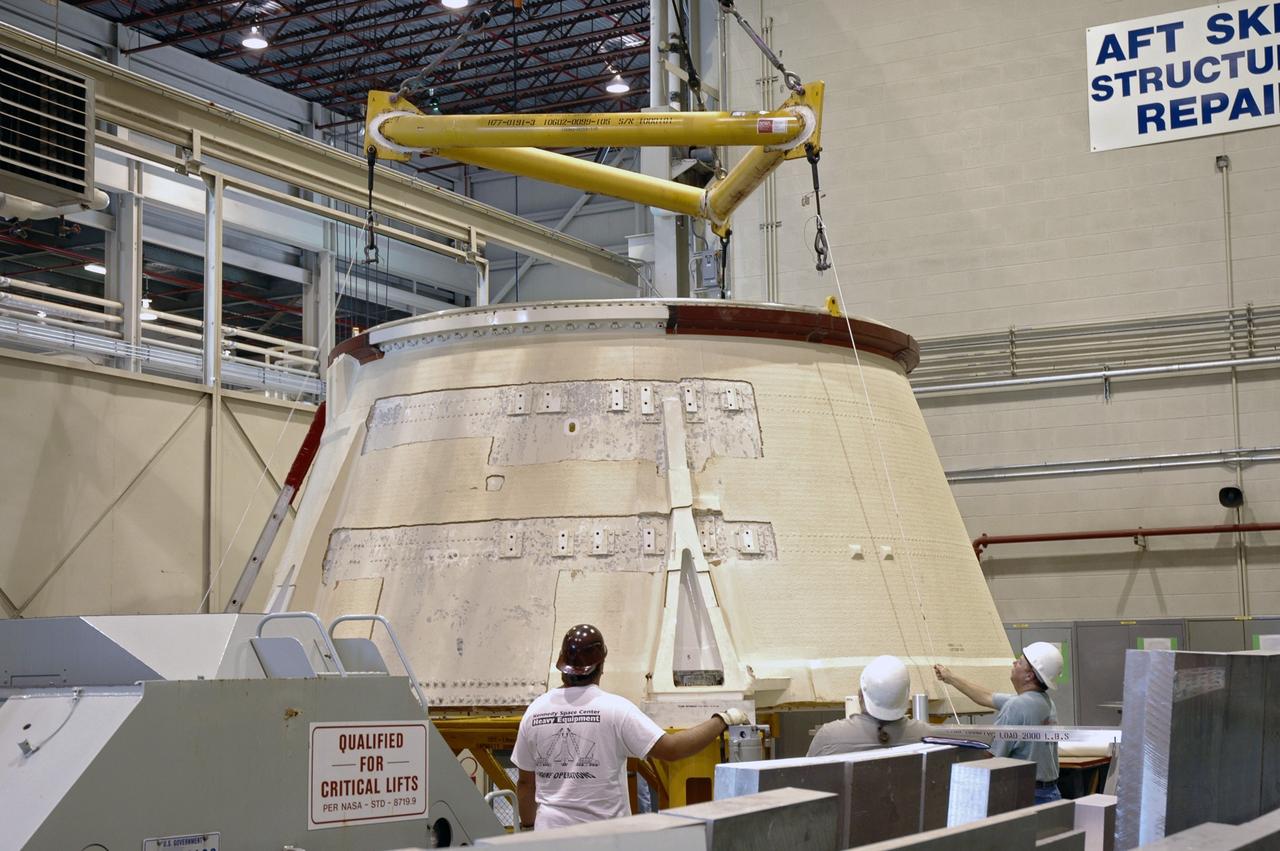
CAPE CANAVERAL, Fla. – In the Assembly and Refurbishment Facility at NASA's Kennedy Space Center, a crane is lowered over the aft skirt for the Ares 1-X rocket. The segment is being lifted into a machine shop work stand for drilling modifications. The modifications will prepare it for the installation of the auxiliary power unit controller, the reduced-rate gyro unit, the booster decelerator motors and the booster tumble motors. Ares I is an in-line, two-stage rocket that will transport the Orion crew exploration vehicle to low-Earth orbit. Ares I-X is a test rocket. The Ares I first stage will be a five-segment solid rocket booster based on the four-segment design used for the shuttle. Ares I’s fifth booster segment allows the launch vehicle to lift more weight and reach a higher altitude before the first stage separates from the upper stage, which ignites in midflight to propel the Orion spacecraft to Earth orbit. Photo credit: NASA/Jim Grossmann

KENNEDY SPACE CENTER, FLA. - Making history with the first-ever launch on Independence Day, Space Shuttle Discovery rockets off the mobile launcher platform on Launch Pad 39B on mission STS-121. Despite the billowing clouds of smoke and steam, the tail masts can still be seen. To the left is the White Room at the end of the orbiter access arm, which is moved away from the orbiter 7 minutes, 24 seconds before launch. During the 12-day mission, the STS-121 crew of seven will test new equipment and procedures to improve shuttle safety, as well as deliver supplies and make repairs to the International Space Station. Landing is scheduled for July 16 or 17 at Kennedy's Shuttle Landing Facility. Photo credit: NASA/Regina Mitchell-Ryall & Don Kight
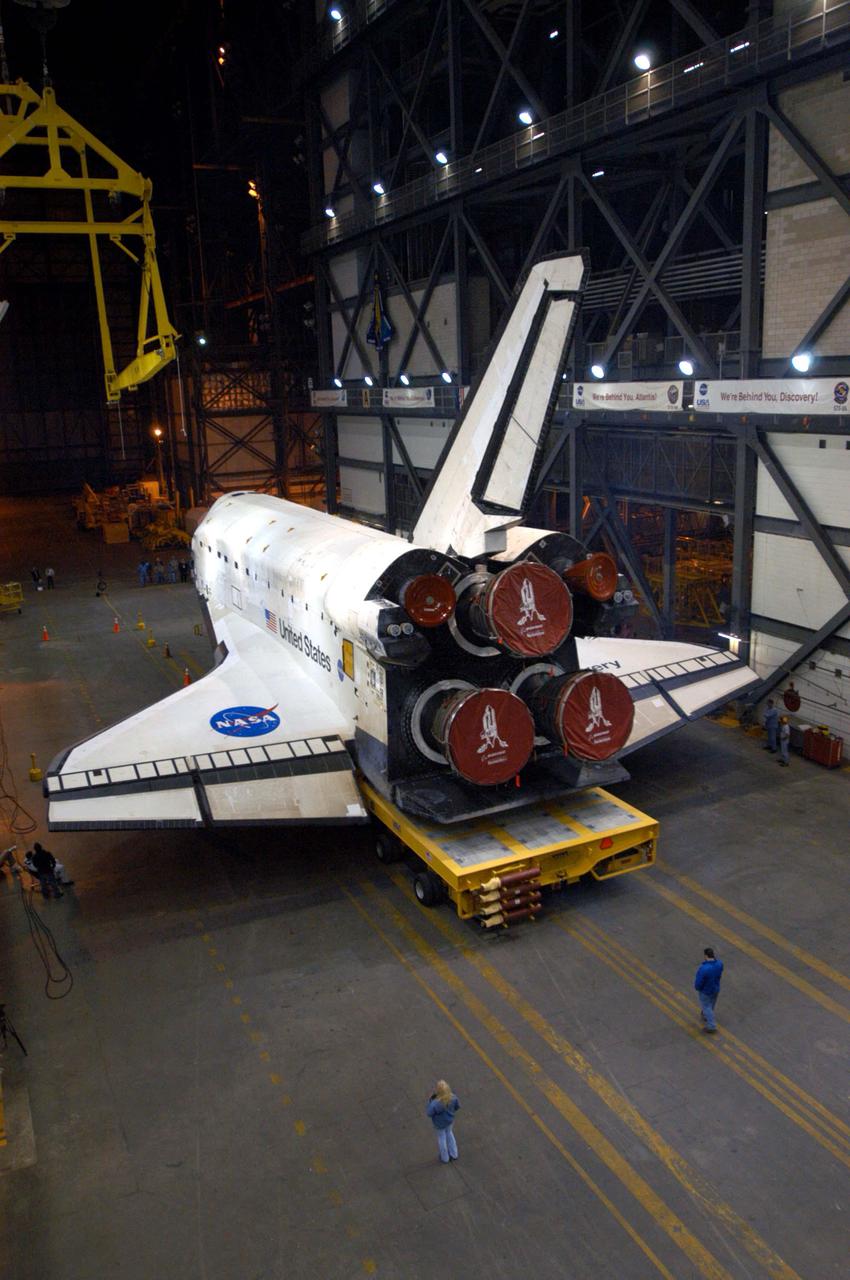
KENNEDY SPACE CENTER, FLA. - The orbiter Discovery rests in the transfer aisle of the Vehicle Assembly Building (VAB) after rollover from the Orbiter Processing Facility (OPF) bay 3. This marks a major milestone in the march to Return to Flight. First motion in the OPF was at 1:29 a.m. EST. Inside the VAB, Discovery will be mated to the External Tank_Solid Rocket Booster assembly for Return to Flight mission STS-114. After all umbilicals have been connected, workers will perform an electrical and mechanical verification of the mated interfaces to verify all critical vehicle connections. A Space Shuttle interface test is performed to verify vehicle interfaces and vehicle-to-ground interfaces. The launch processing system is used to control and monitor orbiter systems as required. Space Shuttle Discovery will roll out to Launch Pad 39B approximately one week after the rollover to the VAB. The launch window for mission STS-114 is May 15 to June 3.
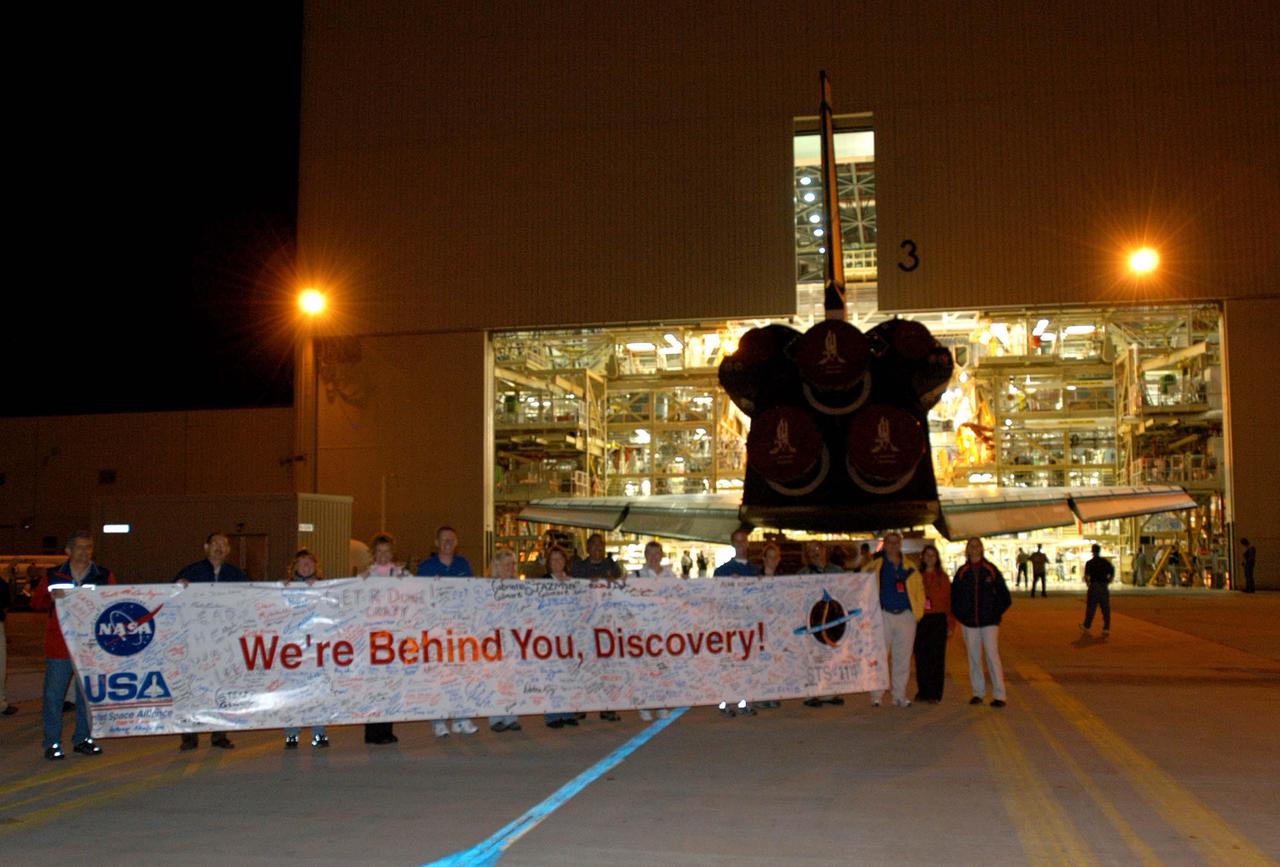
KENNEDY SPACE CENTER, FLA. - Workers show their support as the orbiter Discovery slowly rolls out of the Orbiter Processing Facility bay 3 to begin its transfer to the Vehicle Assembly Building (VAB). First motion was at 1:29 a.m. EST. Inside the VAB, Discovery will be mated to the External Tank_Solid Rocket Booster assembly for Return to Flight mission STS-114. After all umbilicals have been connected, workers will perform an electrical and mechanical verification of the mated interfaces to verify all critical vehicle connections. A Space Shuttle interface test is performed to verify vehicle interfaces and vehicle-to-ground interfaces. The launch processing system is used to control and monitor orbiter systems as required. Space Shuttle Discovery will roll out to Launch Pad 39B approximately one week after the rollover to the VAB. The launch window for mission STS-114 is May 15 to June 3.
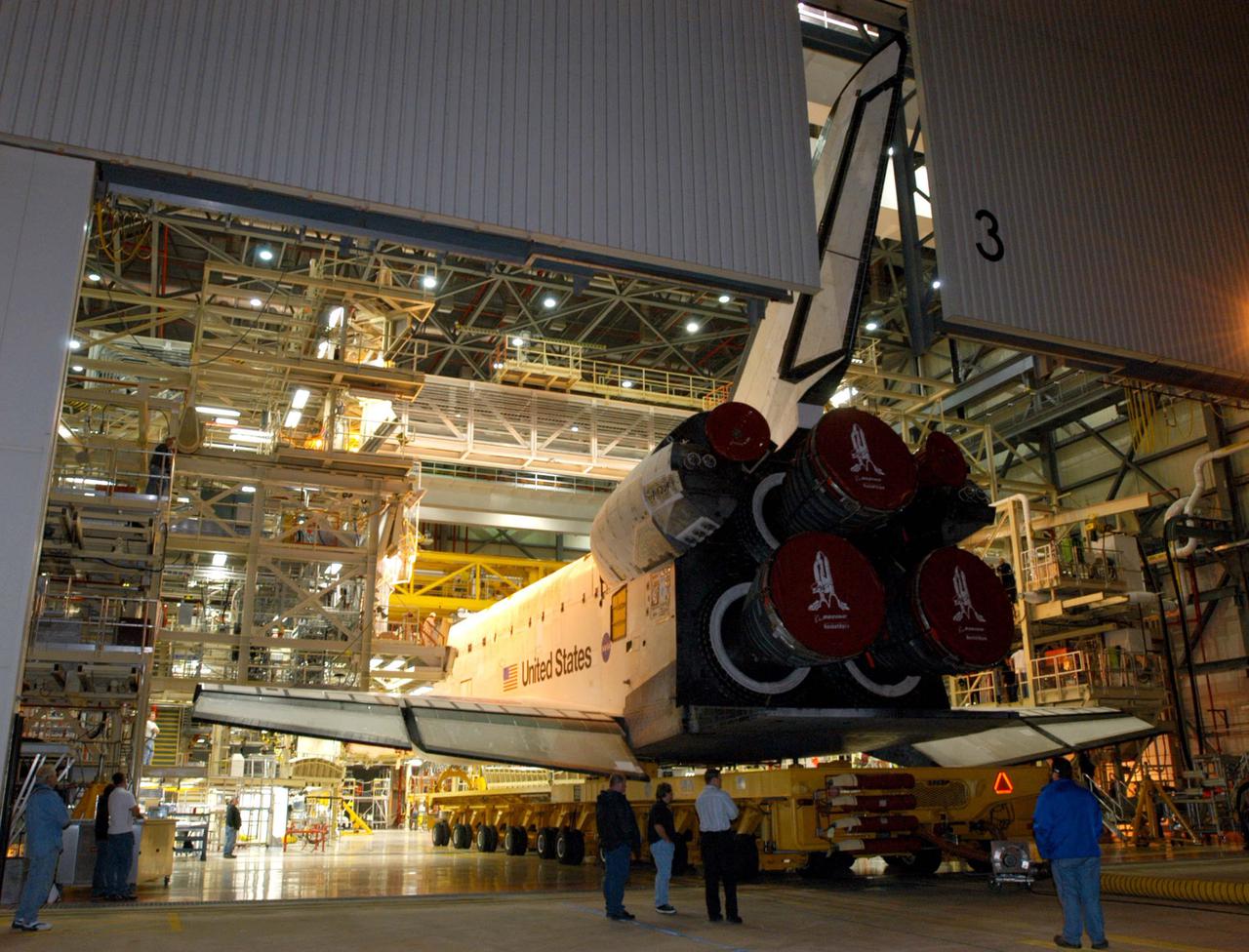
KENNEDY SPACE CENTER, FLA. - The orbiter Discovery slowly rolls out of the Orbiter Processing Facility bay 3 to begin its transfer to the Vehicle Assembly Building. First motion was at 1:29 a.m. EST. Inside the VAB, Discovery will be mated to the External Tank_Solid Rocket Booster assembly for Return to Flight mission STS-114. After all umbilicals have been connected, workers will perform an electrical and mechanical verification of the mated interfaces to verify all critical vehicle connections. A Space Shuttle interface test is performed to verify vehicle interfaces and vehicle-to-ground interfaces. The launch processing system is used to control and monitor orbiter systems as required. Space Shuttle Discovery will roll out to Launch Pad 39B approximately one week after the rollover to the VAB. The launch window for mission STS-114 is May 15 to June 3.
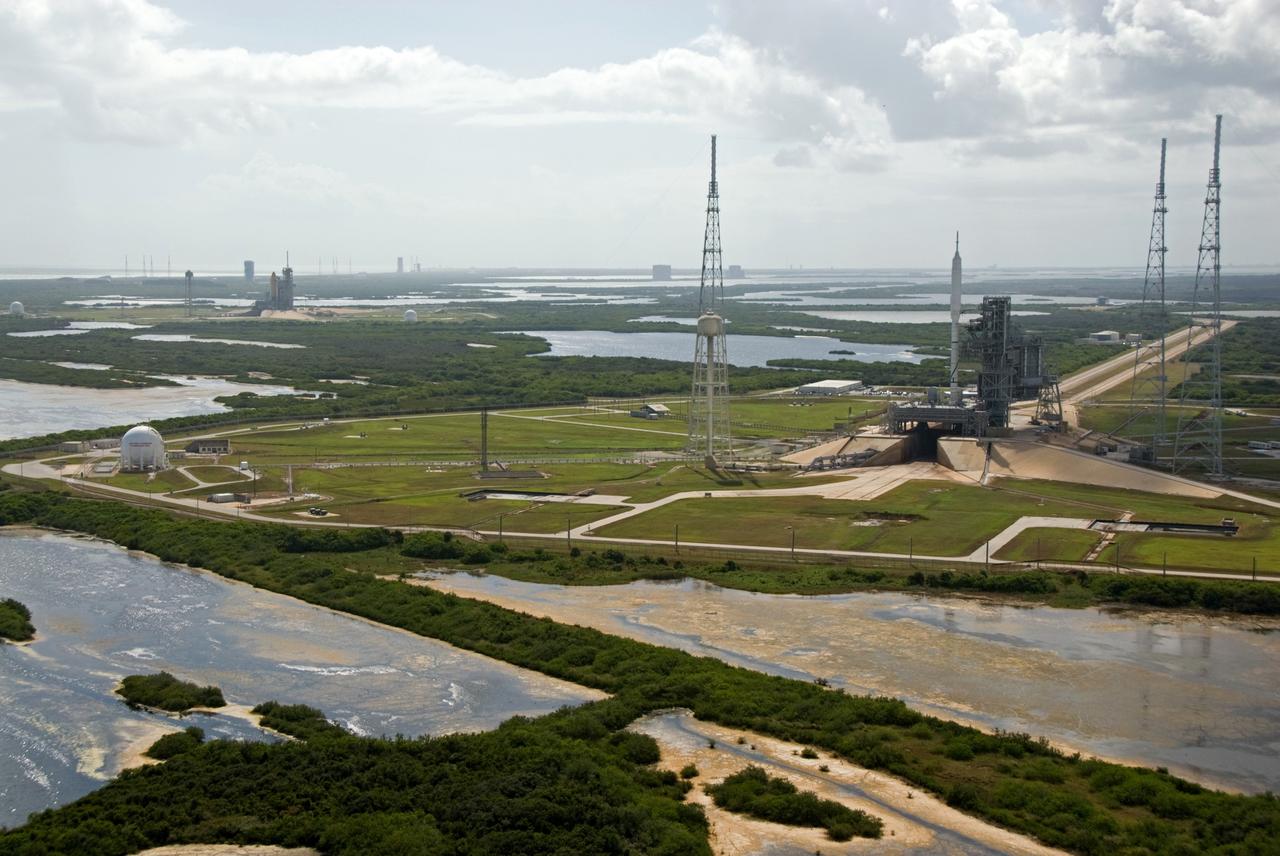
CAPE CANAVERAL, Fla. – At NASA's Kennedy Space Center in Florida, the 327-foot-tall Ares I-X rocket awaits liftoff on Launch Pad 39B on its upcoming flight test. In the distance are space shuttle Atlantis on Kennedy's Launch Pad 39A, and the pads and processing facilities on Cape Canaveral Air Force Station. This is the first time since the Apollo Program's Saturn rockets were retired that a vehicle other than the space shuttle has occupied the pad. Modifications to the pad to support the Ares I-X included the removal of shuttle unique subsystems, such as the orbiter access arm and a section of the gaseous oxygen vent arm, and the installation of three 600-foot lightning towers, access platforms, environmental control systems and a vehicle stabilization system. Part of the Constellation Program, the Ares I-X is the test vehicle for the Ares I. The Ares I-X flight test is set for Oct. 27. For information on the Ares I-X vehicle and flight test, visit http://www.nasa.gov/aresIX. Photo credit: NASA/Kim Shiflett

CAPE CANAVERAL, Fla. – At NASA's Kennedy Space Center in Florida, the 327-foot-tall Ares I-X rocket awaits liftoff on Launch Pad 39B on its upcoming flight test. In the distance are space shuttle Atlantis on Kennedy's Launch Pad 39A, and the pads and processing facilities on Cape Canaveral Air Force Station. This is the first time since the Apollo Program's Saturn rockets were retired that a vehicle other than the space shuttle has occupied the pad. Modifications to the pad to support the Ares I-X included the removal of shuttle unique subsystems, such as the orbiter access arm and a section of the gaseous oxygen vent arm, and the installation of three 600-foot lightning towers, access platforms, environmental control systems and a vehicle stabilization system. Part of the Constellation Program, the Ares I-X is the test vehicle for the Ares I. The Ares I-X flight test is set for Oct. 27. For information on the Ares I-X vehicle and flight test, visit http://www.nasa.gov/aresIX. Photo credit: NASA/Kim Shiflett
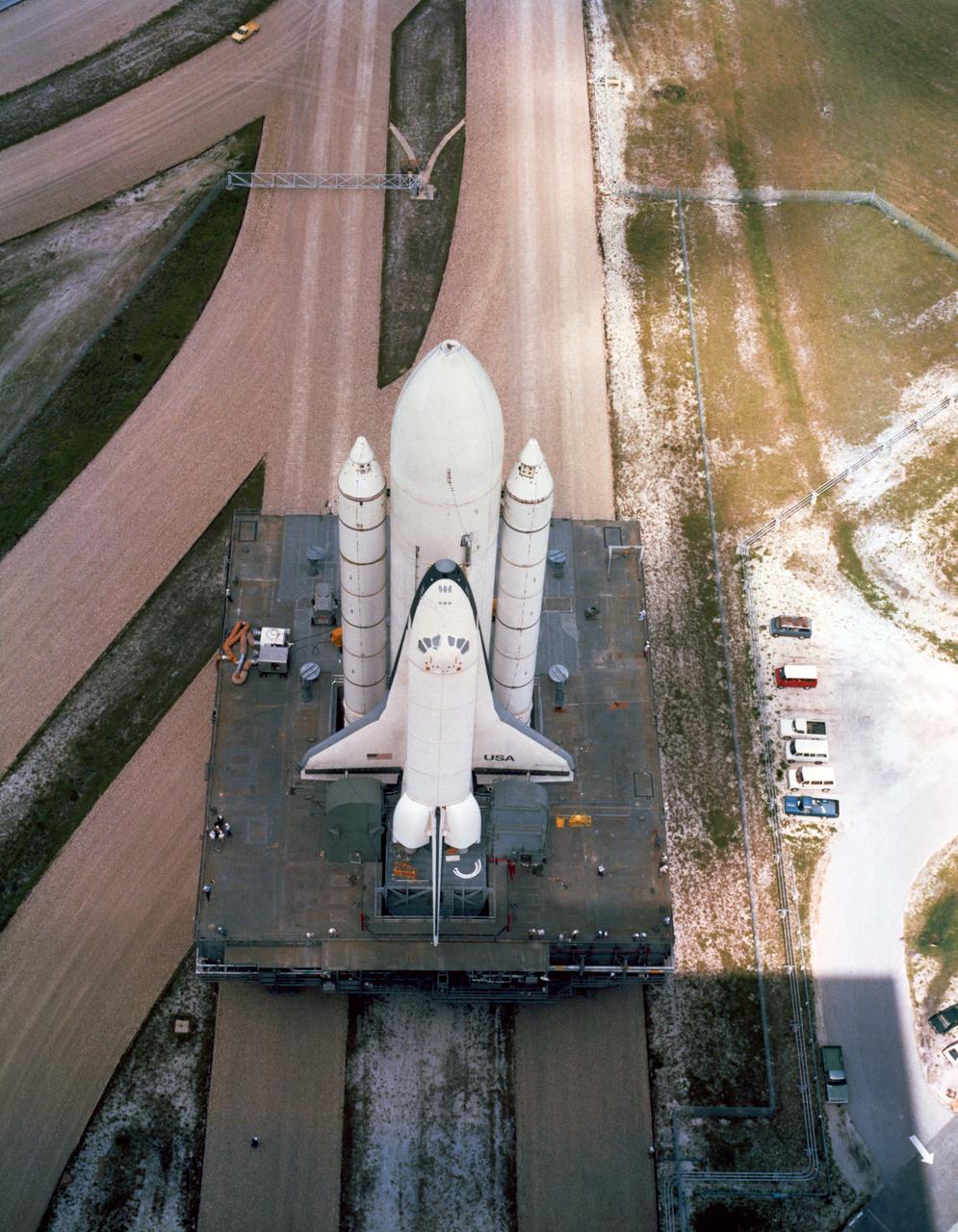
S79-35236 (23 July 1979) --- The space shuttle orbiter 101 Enterprise is seen in this high angle view as it is being moved from Pad A, Launch Complex 39 at the Kennedy Space Center (KSC) to the Vehicle Assembly Building (VAB). Though only 3.5 miles separate the launch pad and the VAB, the journey of the orbiter, its solid rocket boosters and external tank takes more than 11 hours. The move back to the VAB represents the end of several weeks of fit and function checks performed on the vehicle, prepatory to eventual launch readiness of the first actual flight vehicle in the orbiter flight test (OFT) series -- the Columbia. The SRB/ET/Enterprise cluster will soon be taken apart inside the VAB and the orbiter will be taxied back to the Palmdale, California manufacturing facility of Rockwell International. Photo credit: NASA
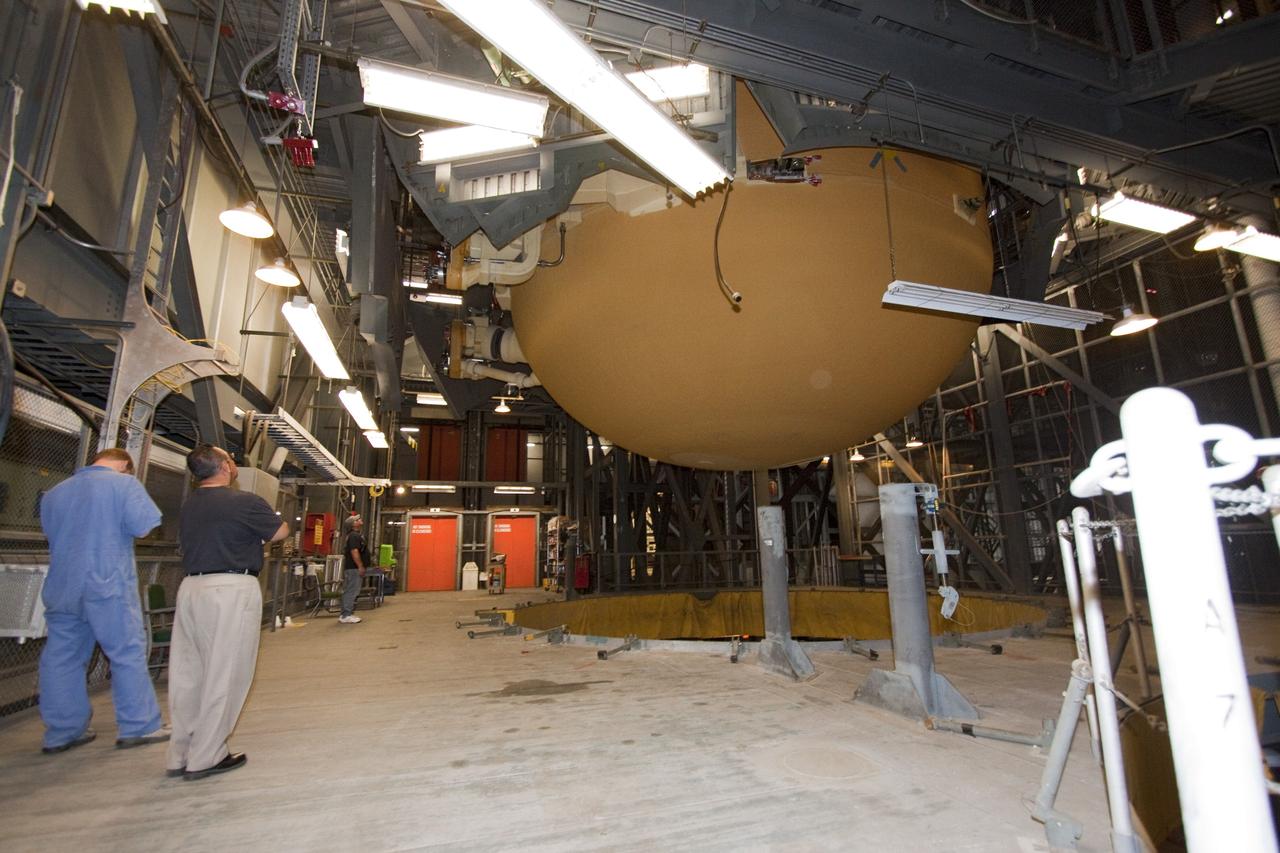
CAPE CANAVERAL, Fla. - In the Vehicle Assembly Building (VAB) at NASA's Kennedy Space Center in Florida, workers monitor the progress of external fuel tank, ET-138, for space shuttle Atlantis' STS-135 mission, as it is lifted from its test cell for transfer to high bay-1 for joining with the twin solid rocket boosters on the mobile launcher platform. Shuttle Atlantis' move, or "rollover," from Orbiter Processing Facility-1 to the VAB is targeted for May 10. Once there it will be mated with the external tank and boosters. Atlantis and its crew of four will deliver the Raffaello multipurpose logistics module packed with supplies and spare parts to the International Space Station. STS-135 is targeted to launch June 28, and will be the last spaceflight for the Space Shuttle Program. Photo credit: NASA/Jack Pfaller

CAPE CANAVERAL, Fla. - In the Vehicle Assembly Building (VAB) at NASA's Kennedy Space Center in Florida, external fuel tank for space shuttle Atlantis' STS-135 mission, ET-138, is prepared for transfer from its test cell to high bay-1 for joining with the twin solid rocket boosters on the mobile launcher platform. Shuttle Atlantis' move, or "rollover," from Orbiter Processing Facility-1 to the VAB is targeted for May 10. Once there it will be mated with the external tank and boosters. Atlantis and its crew of four will deliver the Raffaello multipurpose logistics module packed with supplies and spare parts to the International Space Station. STS-135 is targeted to launch June 28, and will be the last spaceflight for the Space Shuttle Program. Photo credit: NASA/Jack Pfaller
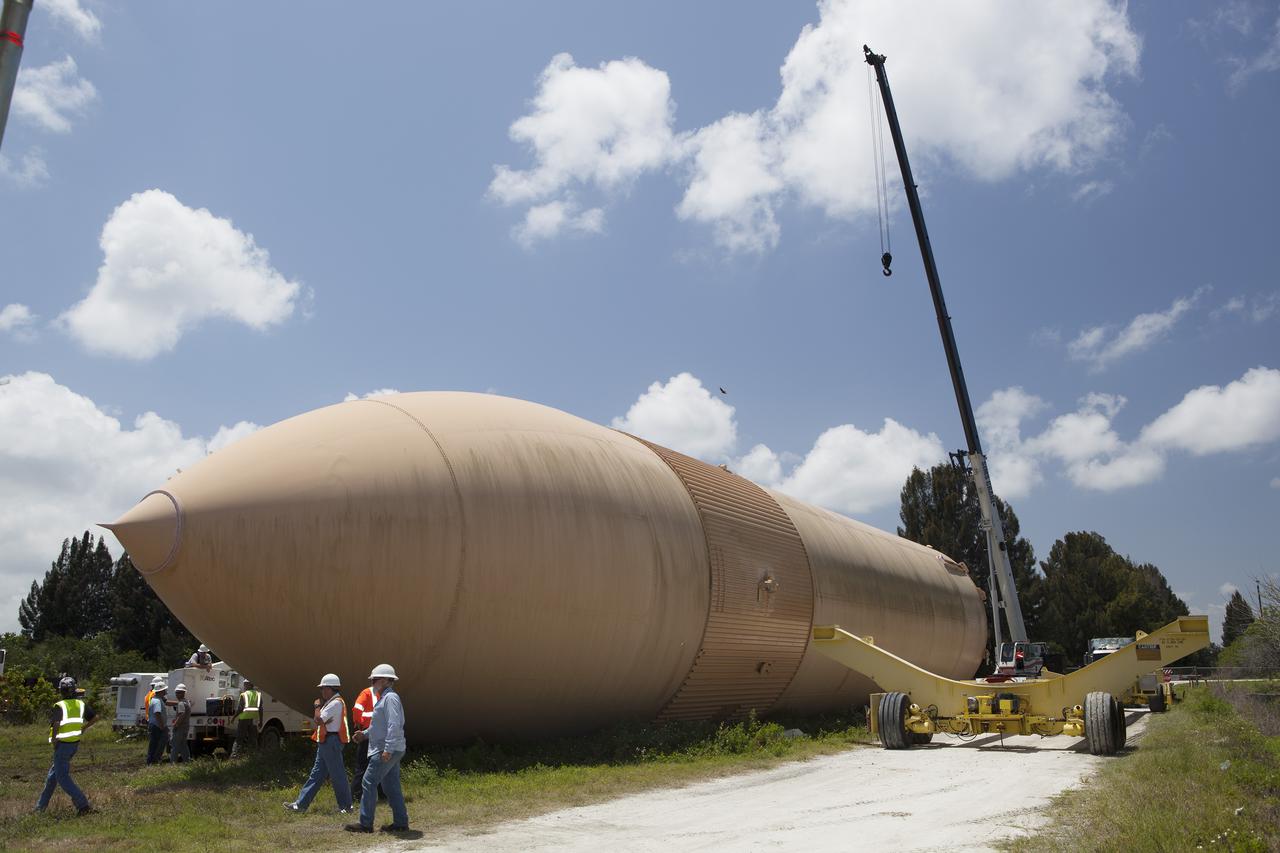
CAPE CANAVERAL, Fla. – Volunteers prepare an orange flight test article space shuttle external fuel tank, or ET, for transport from NASA's Kennedy Space Center in Florida to the Wings of Dreams Aviation Museum located at Keystone Heights Airport in North Central Florida. Weighing in at 58,000 pounds unfueled and standing more than 15-stories tall, the ET was referred to as the 'backbone' of the space shuttle. Its job was to hold about 535,000 gallons of super-cold liquid hydrogen and liquid oxygen. It also absorbed the thrust loads produced at launch by the orbiter and the solid rocket boosters, or SRBs. Also joining the ET at Wings of Dreams is an ET transporter, the crew transport vehicle, crew hatch access vehicle, SRB aft skirt and SRB frustum. Thousands of unique space shuttle era artifacts are being allocated to facilities across the country for their new missions to educate and inspire America's next generation of explorers. Photo credit: NASA_Dimitri Gerondidakis
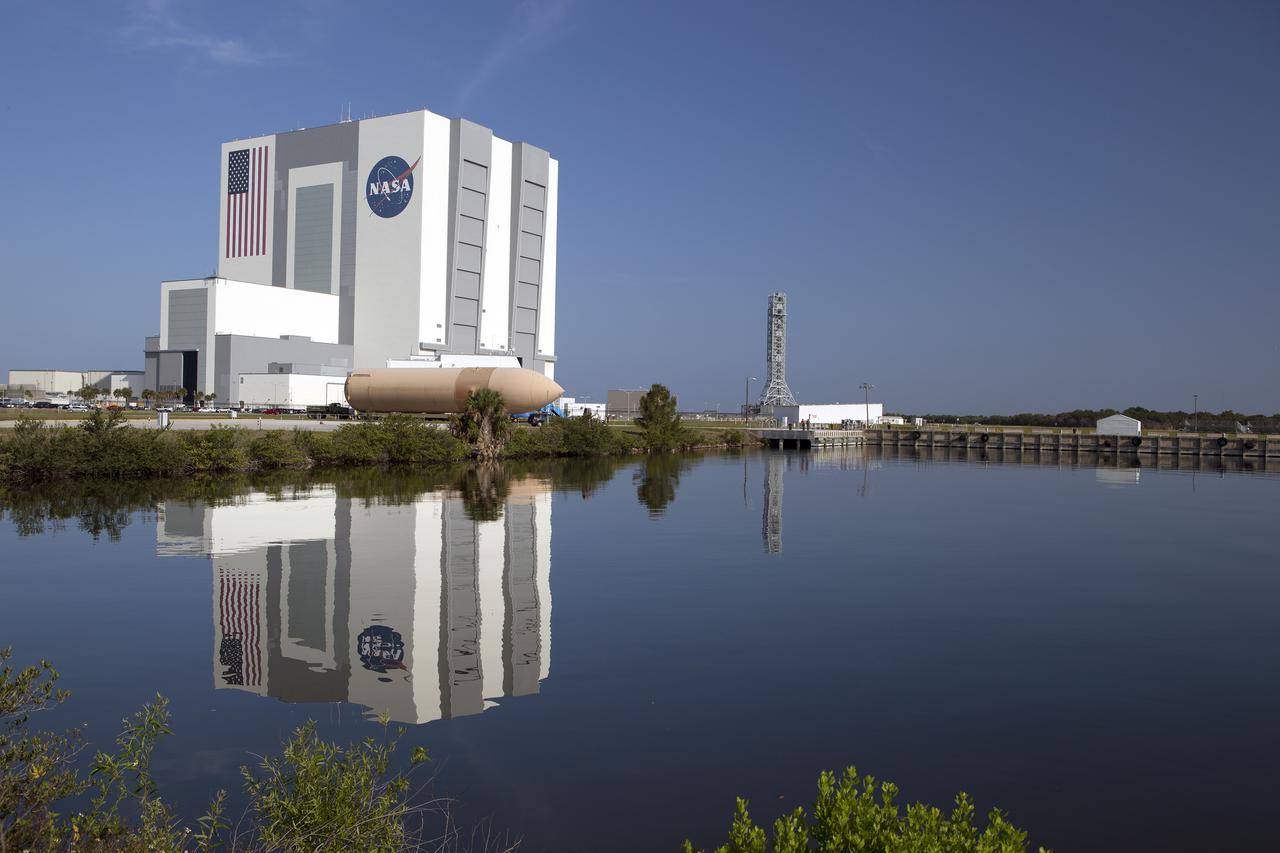
CAPE CANAVERAL, Fla. – An orange flight test article space shuttle external fuel tank, or ET, awaits transport from NASA's Kennedy Space Center in Florida to the Wings of Dreams Aviation Museum located at Keystone Heights Airport in North Central Florida. Weighing in at 58,000 pounds unfueled and standing more than 15-stories tall, the ET was referred to as the 'backbone' of the space shuttle. Its job was to hold about 535,000 gallons of super-cold liquid hydrogen and liquid oxygen. It also absorbed the thrust loads produced at launch by the orbiter and the solid rocket boosters, or SRBs. Also joining the ET at Wings of Dreams is an ET transporter, the crew transport vehicle, crew hatch access vehicle, SRB aft skirt and SRB frustum. Thousands of unique space shuttle era artifacts are being allocated to facilities across the country for their new missions to educate and inspire America's next generation of explorers. Photo credit: NASA_Dimitri Gerondidakis

CAPE CANAVERAL, Fla. - In the Vehicle Assembly Building (VAB) at NASA's Kennedy Space Center in Florida, external fuel tank, ET-138, for space shuttle Atlantis' STS-135 mission, is lifted from its test cell for transfer to high bay-1 for joining with the twin solid rocket boosters on the mobile launcher platform. Shuttle Atlantis' move, or "rollover," from Orbiter Processing Facility-1 to the VAB is targeted for May 10. Once there it will be mated with the external tank and boosters. Atlantis and its crew of four will deliver the Raffaello multipurpose logistics module packed with supplies and spare parts to the International Space Station. STS-135 is targeted to launch June 28, and will be the last spaceflight for the Space Shuttle Program. Photo credit: NASA/Jack Pfaller

CAPE CANAVERAL, Fla. - In the Vehicle Assembly Building (VAB) at NASA's Kennedy Space Center in Florida, external fuel tank, ET-138, for space shuttle Atlantis' STS-135 mission, is lifted from its test cell for transfer to high bay-1 for joining with the twin solid rocket boosters on the mobile launcher platform. Shuttle Atlantis' move, or "rollover," from Orbiter Processing Facility-1 to the VAB is targeted for May 10. Once there it will be mated with the external tank and boosters. Atlantis and its crew of four will deliver the Raffaello multipurpose logistics module packed with supplies and spare parts to the International Space Station. STS-135 is targeted to launch June 28, and will be the last spaceflight for the Space Shuttle Program. Photo credit: NASA/Jack Pfaller
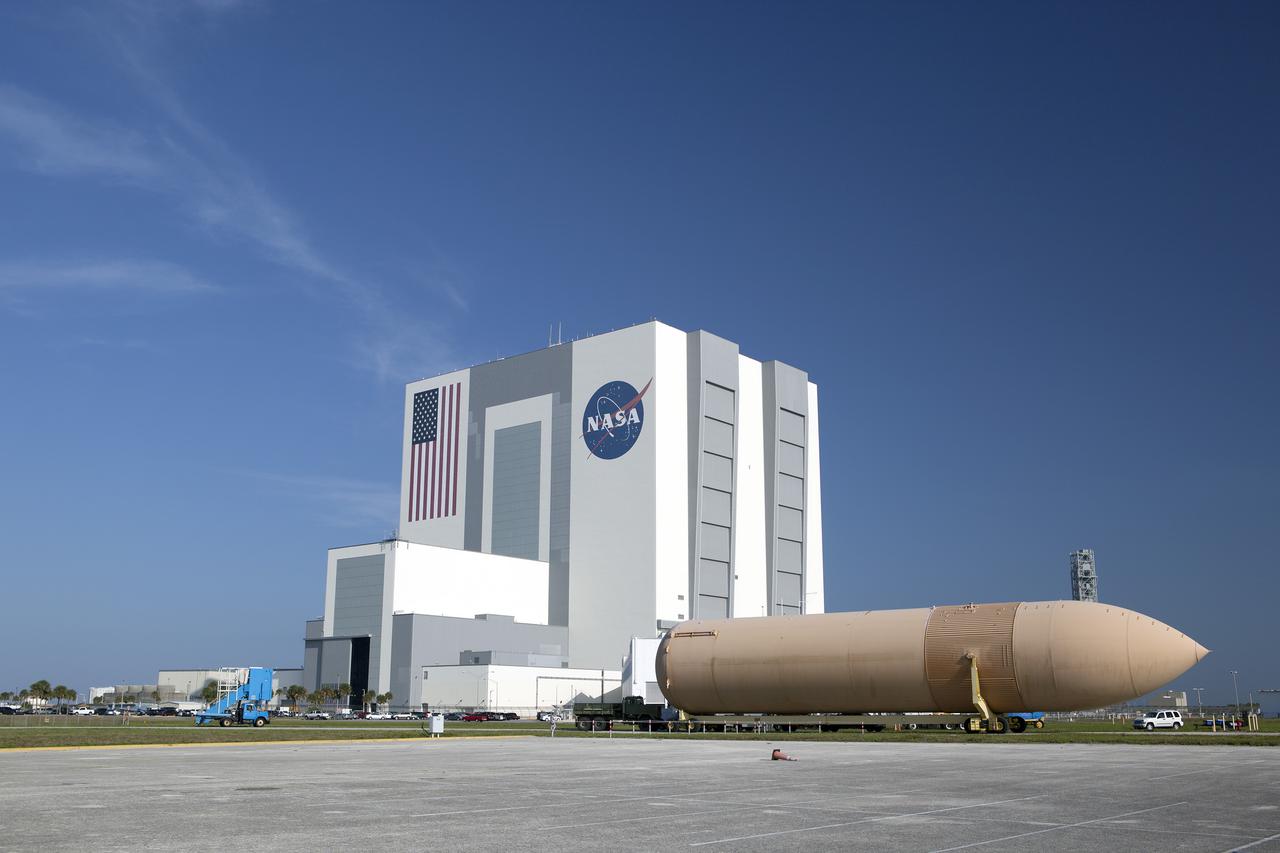
CAPE CANAVERAL, Fla. -- An orange flight test article space shuttle external fuel tank, or ET, awaits transport from NASA's Kennedy Space Center in Florida to the Wings of Dreams Aviation Museum located at Keystone Heights Airport in North Central Florida. Weighing in at 58,000 pounds unfueled and standing more than 15-stories tall, the ET was referred to as the 'backbone' of the space shuttle. Its job was to hold about 535,000 gallons of super-cold liquid hydrogen and liquid oxygen. It also absorbed the thrust loads produced at launch by the orbiter and the solid rocket boosters, or SRBs. Also joining the ET at Wings of Dreams is an ET transporter, the crew transport vehicle, crew hatch access vehicle, SRB aft skirt and SRB frustum. Thousands of unique space shuttle era artifacts are being allocated to facilities across the country for their new missions to educate and inspire America's next generation of explorers. Photo credit: NASA_Dimitri Gerondidakis

CAPE CANAVERAL, Fla. - In the Vehicle Assembly Building (VAB) at NASA's Kennedy Space Center in Florida, external fuel tank for space shuttle Atlantis' STS-135 mission, ET-138, is prepared for transfer from its test cell to high bay-1 for joining with the twin solid rocket boosters on the mobile launcher platform. Shuttle Atlantis' move, or "rollover," from Orbiter Processing Facility-1 to the VAB is targeted for May 10. Once there it will be mated with the external tank and boosters. Atlantis and its crew of four will deliver the Raffaello multipurpose logistics module packed with supplies and spare parts to the International Space Station. STS-135 is targeted to launch June 28, and will be the last spaceflight for the Space Shuttle Program. Photo credit: NASA/Jack Pfaller
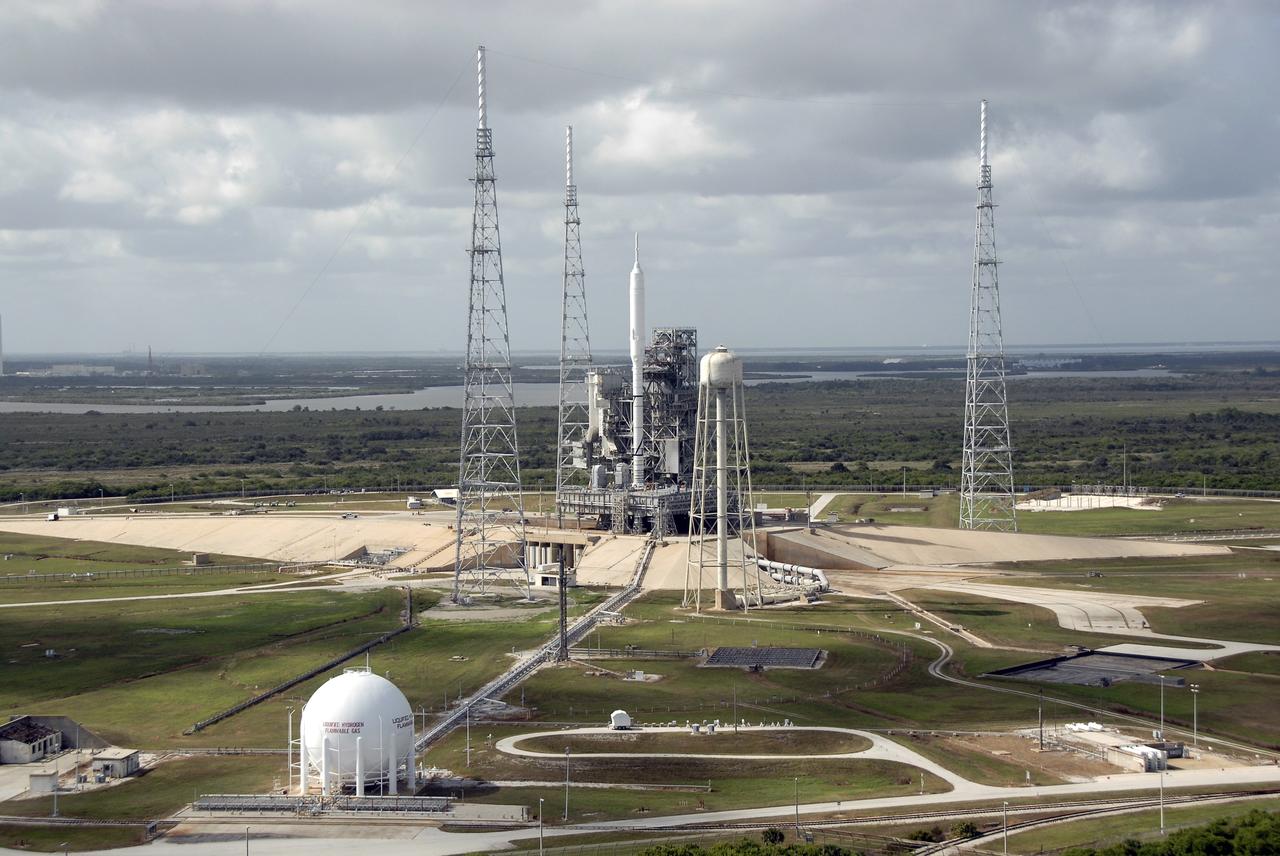
CAPE CANAVERAL, Fla. – At NASA's Kennedy Space Center in Florida, the 327-foot-tall Ares I-X rocket awaits liftoff on Launch Pad 39B on its upcoming flight test. In the distance are the pads and processing facilities on Cape Canaveral Air Force Station. This is the first time since the Apollo Program's Saturn rockets were retired that a vehicle other than the space shuttle has occupied the pad. Modifications to the pad to support the Ares I-X included the removal of shuttle unique subsystems, such as the orbiter access arm and a section of the gaseous oxygen vent arm, and the installation of three 600-foot lightning towers, access platforms, environmental control systems and a vehicle stabilization system. Part of the Constellation Program, the Ares I-X is the test vehicle for the Ares I. The Ares I-X flight test is set for Oct. 27. For information on the Ares I-X vehicle and flight test, visit http://www.nasa.gov/aresIX. Photo credit: NASA/Kim Shiflett
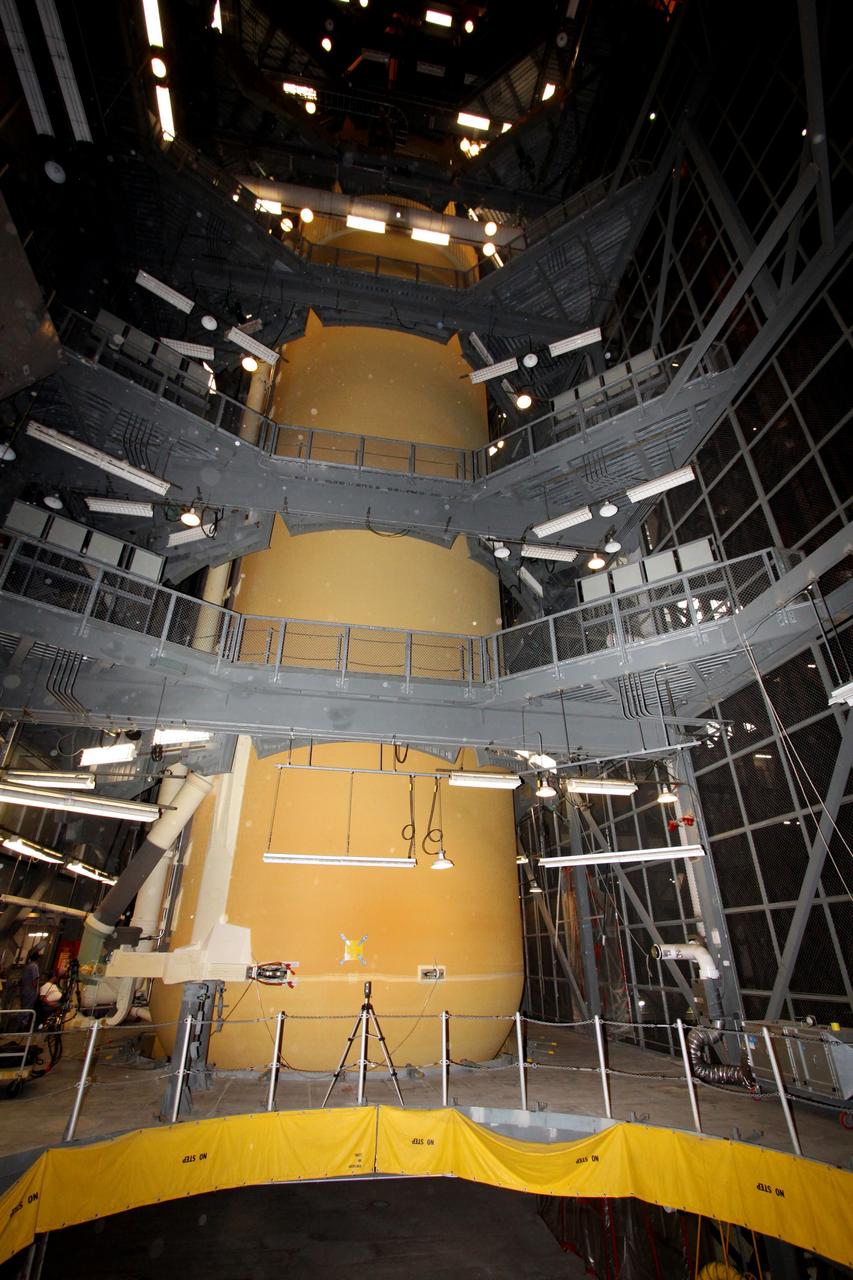
CAPE CANAVERAL, Fla. – In the Vehicle Assembly Building at NASA's Kennedy Space Center in Florida, the external tank for space shuttle Endeavour's STS-130 mission, ET-134, is prepared for transfer from its test cell to High Bay-1 for mating with the twin solid rocket boosters that will be used on the mission. Endeavour's move, or "rollover," from Orbiter Processing Facility-2 is targeted for Dec. 12. The Tranquility module, the payload for the STS-130 mission to the International Space Station, will be installed in the payload bay after the shuttle has reached the pad. Endeavour's launch is targeted for Feb. 4, 2010. For information on the STS-130 mission and crew, visit http://www.nasa.gov/mission_pages/shuttle/shuttlemissions/sts130/index.html. Photo credit: NASA/Jack Pfaller
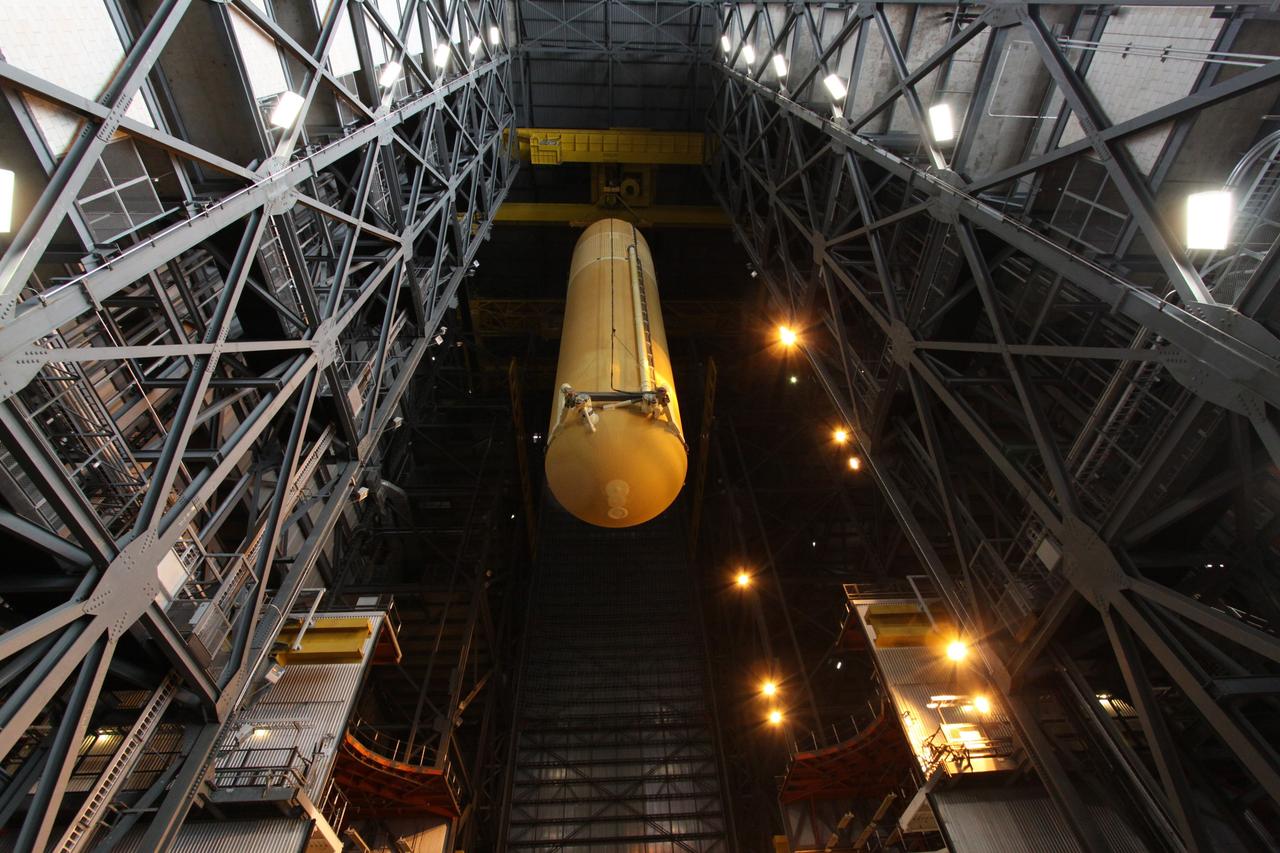
CAPE CANAVERAL, Fla. – In the Vehicle Assembly Building at NASA's Kennedy Space Center in Florida, the external tank for space shuttle Endeavour's STS-130 mission, ET-134, is moved from its test cell into High Bay-1 where it will be mated with the twin solid rocket boosters that will be used on the mission. Endeavour's move, or "rollover," from Orbiter Processing Facility-2 is targeted for Dec. 12. The Tranquility module, the payload for the STS-130 mission to the International Space Station, will be installed in the payload bay after the shuttle has reached the pad. Endeavour's launch is targeted for Feb. 4, 2010. For information on the STS-130 mission and crew, visit http://www.nasa.gov/mission_pages/shuttle/shuttlemissions/sts130/index.html. Photo credit: NASA/Jack Pfaller
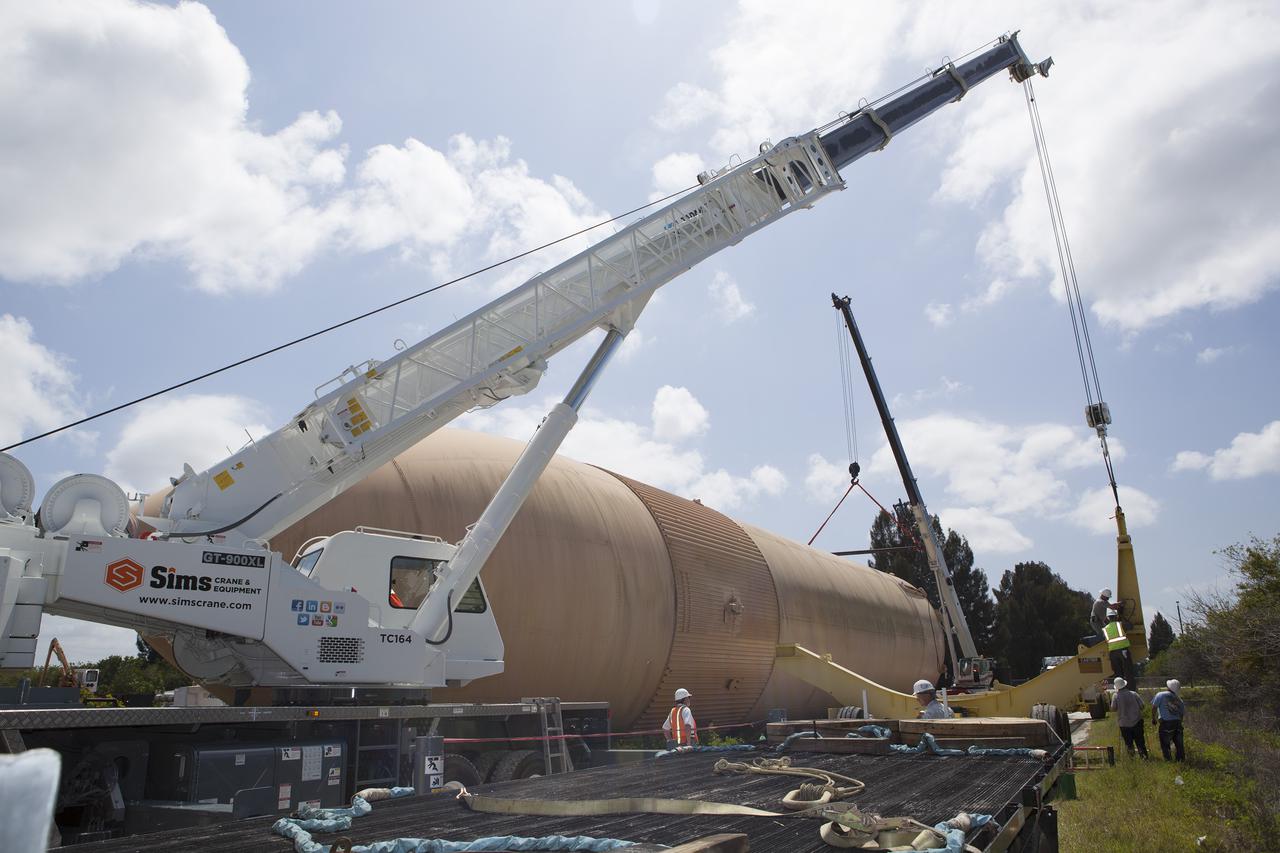
CAPE CANAVERAL, Fla. – Volunteers prepare an orange flight test article shuttle external fuel tank, or ET, for transport from NASA's Kennedy Space Center in Florida to the Wings of Dreams Aviation Museum located at Keystone Heights Airport in North Central Florida. Weighing in at 58,000 pounds unfueled and standing more than 15-stories tall, the ET was referred to as the 'backbone' of the space shuttle. Its job was to hold about 535,000 gallons of super-cold liquid hydrogen and liquid oxygen. It also absorbed the thrust loads produced at launch by the orbiter and the solid rocket boosters, or SRBs. Also joining the ET at Wings of Dreams is an ET transporter, the crew transport vehicle, crew hatch access vehicle, SRB aft skirt and SRB frustum. Thousands of unique space shuttle era artifacts are being allocated to facilities across the country for their new missions to educate and inspire America's next generation of explorers. Photo credit: NASA_Dimitri Gerondidakis
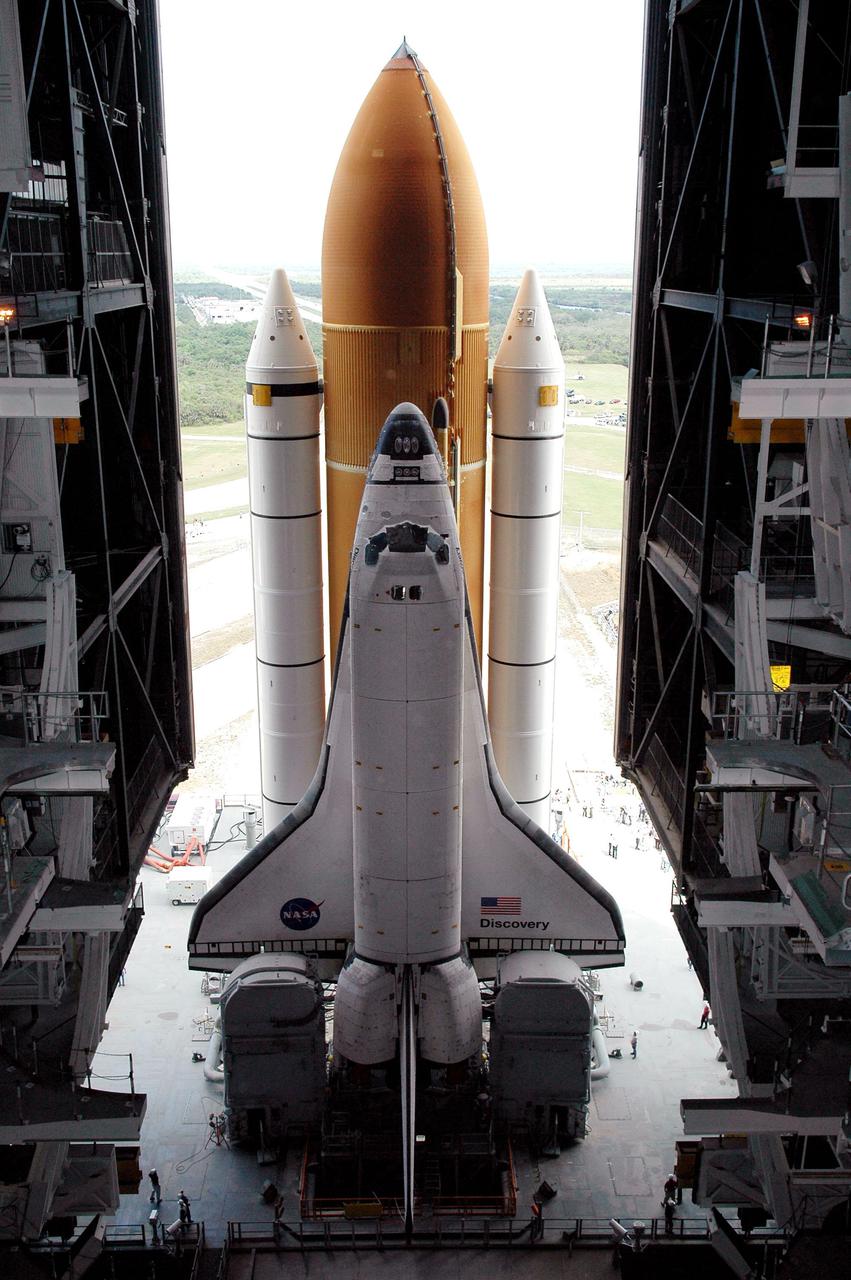
KENNEDY SPACE CENTER, FLA. - In the Vehicle Assembly Building (VAB) at NASA’s Kennedy Space Center, Space Shuttle Discovery passes through the open doors as it begins its long, slow journey to Launch Pad 39B. First motion was at 2:04 p.m. EDT. The Shuttle comprises the orbiter, External Tank (ET) and twin Solid Rocket Boosters (SRBs). The Space Shuttle rests on the Mobile Launcher Platform, which is moved by the Crawler-Transporter underneath. The Crawler is 20 feet high, 131 feet long and 114 feet wide. It moves on eight tracks, each containing 57 shoes, or cleats, weighing one ton each. Loaded with the Space Shuttle, the Crawler can move at a maximum speed of approximately 1 mile an hour. A leveling system in the Crawler keeps the Shuttle vertical while negotiating the 5 percent grade leading to the top of the launch pad. Launch of Discovery on its Return to Flight mission, STS-114, is targeted for May 15 with a launch window that extends to June 3. During its 12-day mission, Discovery’s seven-person crew will test new hardware and techniques to improve Shuttle safety, as well as deliver supplies to the International Space Station. Discovery was moved on March 29 from the Orbiter Processing Facility to the VAB and attached to its propulsion elements, a redesigned ET and twin SRBs.
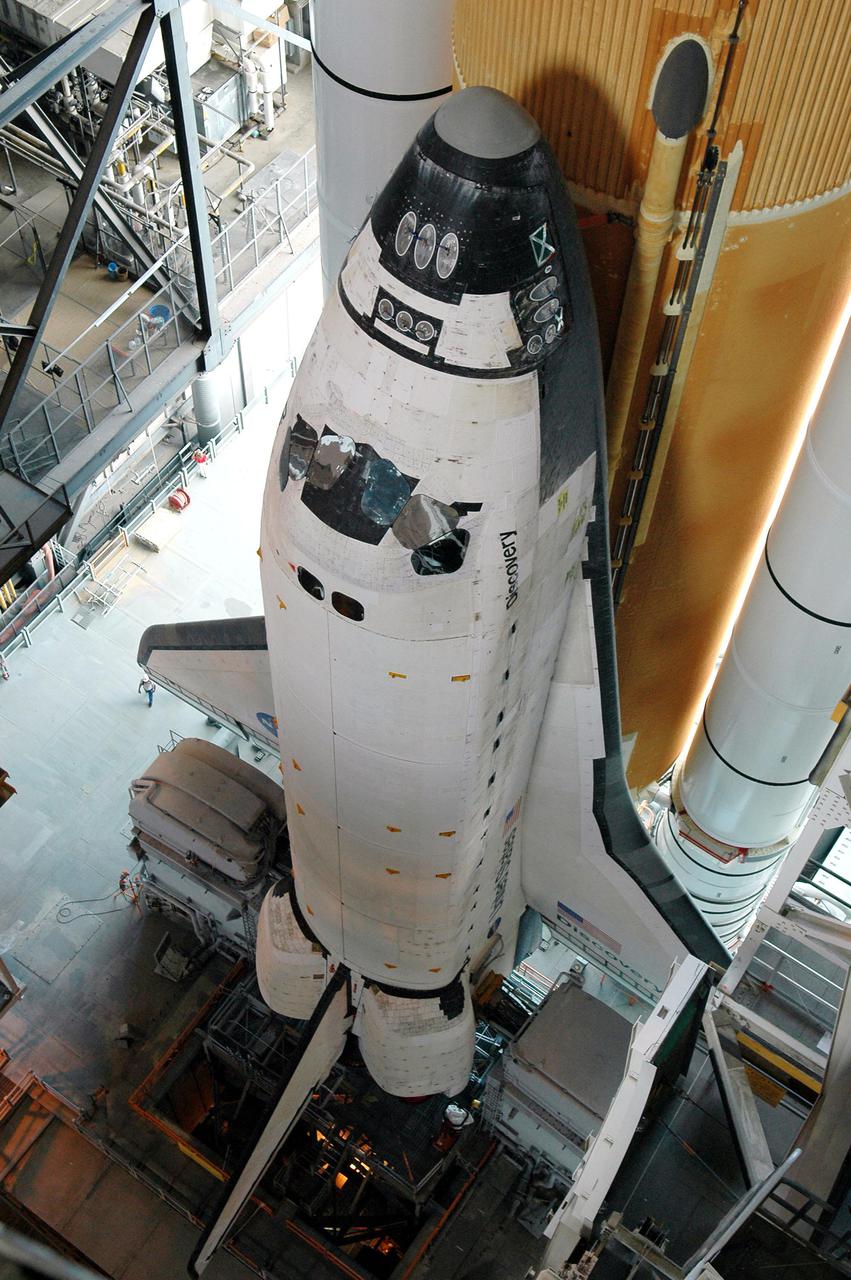
KENNEDY SPACE CENTER, FLA. - In the Vehicle Assembly Building (VAB) at NASA’s Kennedy Space Center, Space Shuttle Discovery is beginning its long, slow journey to Launch Pad 39B. First motion was at 2:04 p.m. EDT. The Shuttle comprises the orbiter, External Tank (ET) and twin Solid Rocket Boosters (SRBs). The Space Shuttle rests on the Mobile Launcher Platform, which is moved by the Crawler-Transporter underneath. The Crawler is 20 feet high, 131 feet long and 114 feet wide. It moves on eight tracks, each containing 57 shoes, or cleats, weighing one ton each. Loaded with the Space Shuttle, the Crawler can move at a maximum speed of approximately 1 mile an hour. A leveling system in the Crawler keeps the Shuttle vertical while negotiating the 5 percent grade leading to the top of the launch pad. Launch of Discovery on its Return to Flight mission, STS-114, is targeted for May 15 with a launch window that extends to June 3. During its 12-day mission, Discovery’s seven-person crew will test new hardware and techniques to improve Shuttle safety, as well as deliver supplies to the International Space Station. Discovery was moved on March 29 from the Orbiter Processing Facility to the VAB and attached to its propulsion elements, a redesigned ET and twin SRBs.
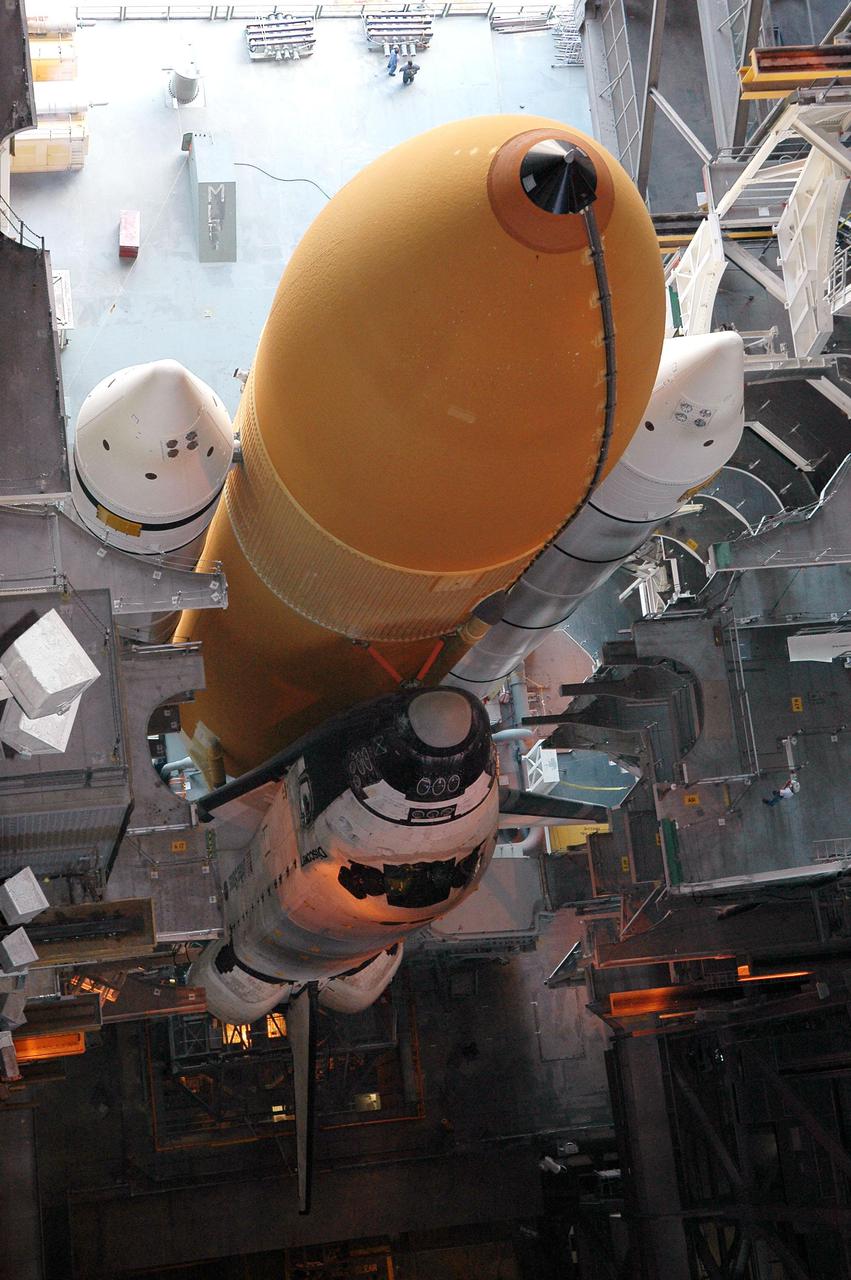
KENNEDY SPACE CENTER, FLA. - The open doors of the Vehicle Assembly Building (VAB) at NASA’s Kennedy Space Center cast light on Space Shuttle Discovery. The Shuttle, which comprises the orbiter, External Tank (ET) and twin Solid Rocket Boosters (SRBs), is beginning its long, slow journey to Launch Pad 39B. First motion was at 2:04 p.m. EDT. The Space Shuttle rests on the Mobile Launcher Platform, which is moved by the Crawler-Transporter underneath. The Crawler is 20 feet high, 131 feet long and 114 feet wide. It moves on eight tracks, each containing 57 shoes, or cleats, weighing one ton each. Loaded with the Space Shuttle, the Crawler can move at a maximum speed of approximately 1 mile an hour. A leveling system in the Crawler keeps the Shuttle vertical while negotiating the 5 percent grade leading to the top of the launch pad. Launch of Discovery on its Return to Flight mission, STS-114, is targeted for May 15 with a launch window that extends to June 3. During its 12-day mission, Discovery’s seven-person crew will test new hardware and techniques to improve Shuttle safety, as well as deliver supplies to the International Space Station. Discovery was moved on March 29 from the Orbiter Processing Facility to the VAB and attached to its propulsion elements, a redesigned ET and twin SRBs.
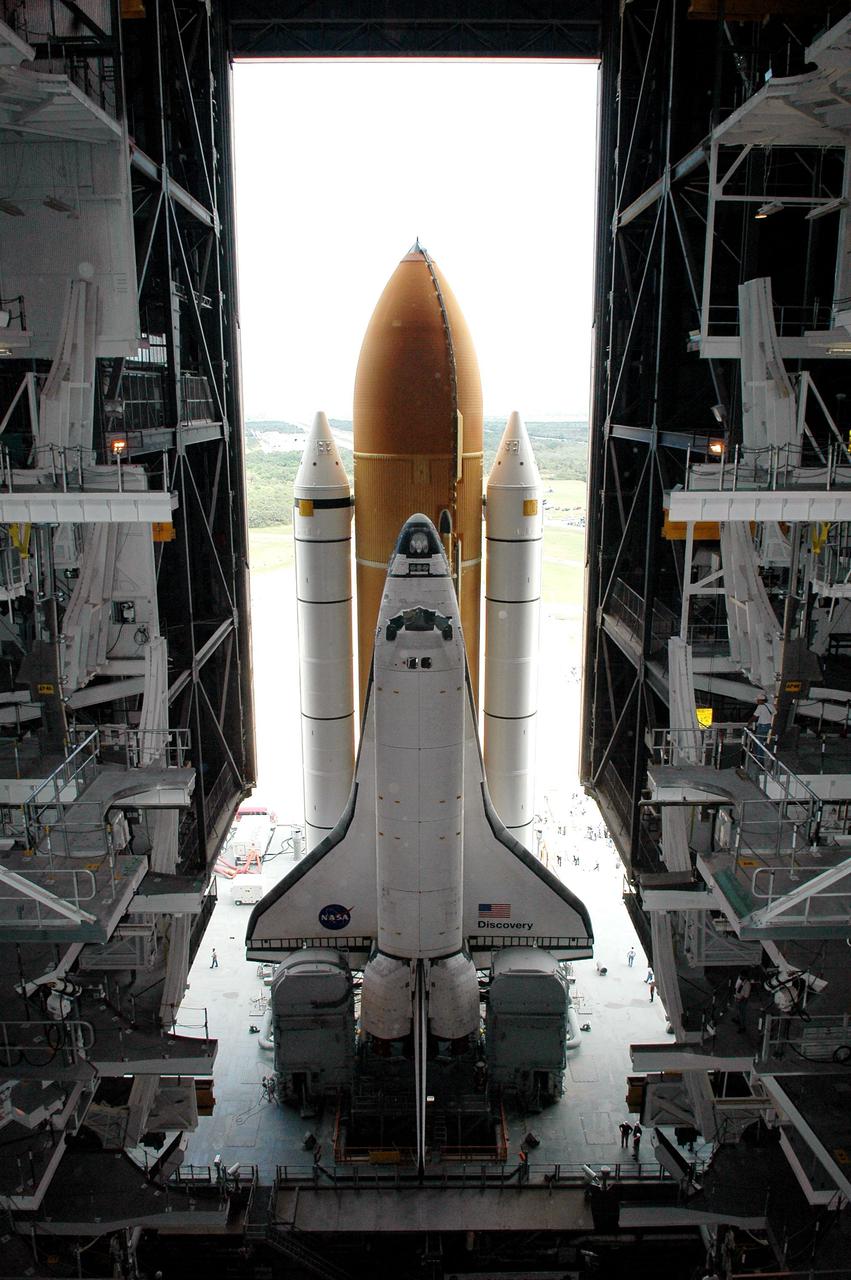
KENNEDY SPACE CENTER, FLA. - In the Vehicle Assembly Building (VAB) at NASA’s Kennedy Space Center, Space Shuttle Discovery is framed in the open doors as it begins its long, slow journey to Launch Pad 39B. First motion was at 2:04 p.m. EDT. The Shuttle comprises the orbiter, External Tank (ET) and twin Solid Rocket Boosters (SRBs). The Space Shuttle rests on the Mobile Launcher Platform, which is moved by the Crawler-Transporter underneath. The Crawler is 20 feet high, 131 feet long and 114 feet wide. It moves on eight tracks, each containing 57 shoes, or cleats, weighing one ton each. Loaded with the Space Shuttle, the Crawler can move at a maximum speed of approximately 1 mile an hour. A leveling system in the Crawler keeps the Shuttle vertical while negotiating the 5 percent grade leading to the top of the launch pad. Launch of Discovery on its Return to Flight mission, STS-114, is targeted for May 15 with a launch window that extends to June 3. During its 12-day mission, Discovery’s seven-person crew will test new hardware and techniques to improve Shuttle safety, as well as deliver supplies to the International Space Station. Discovery was moved on March 29 from the Orbiter Processing Facility to the VAB and attached to its propulsion elements, a redesigned ET and twin SRBs.
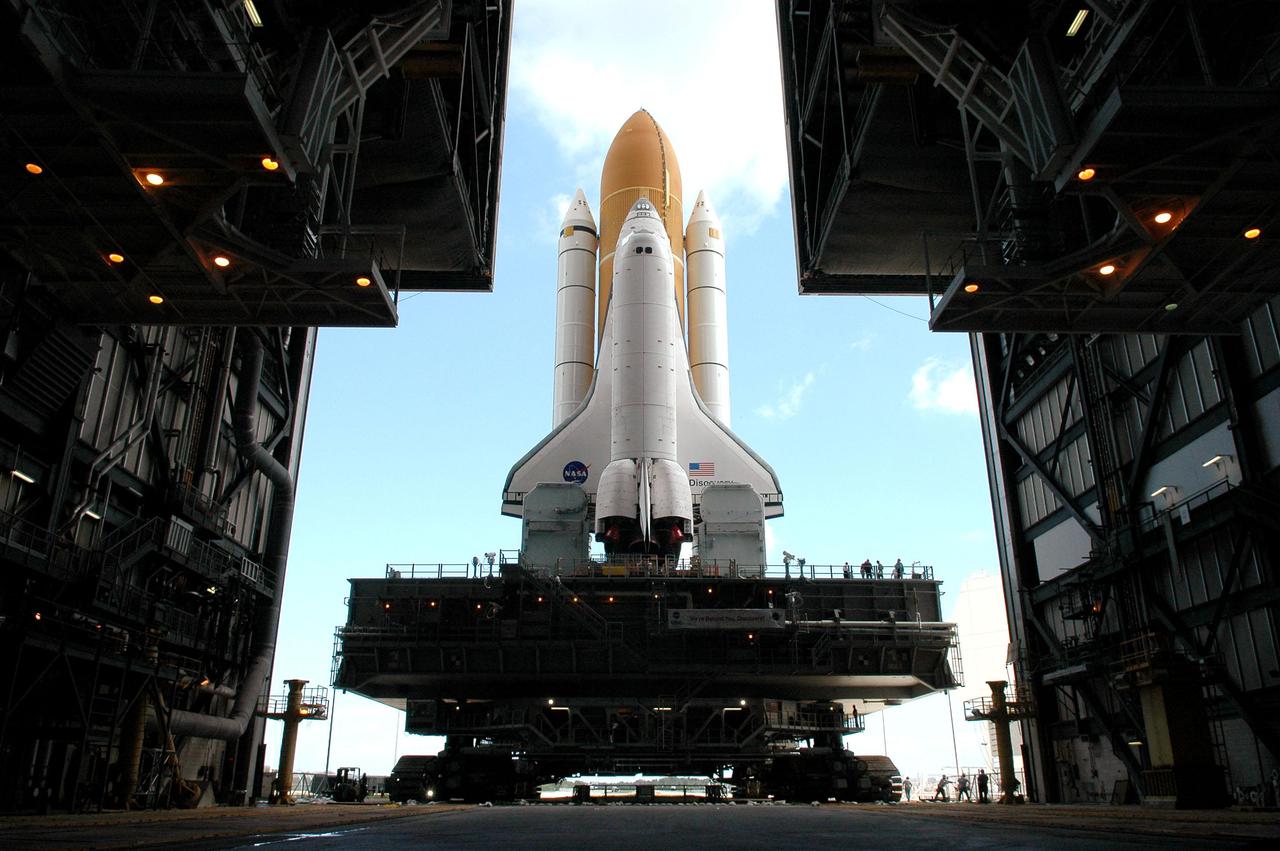
KENNEDY SPACE CENTER, FLA. - Framed in the open doors of the Vehicle Assembly Building (VAB) at NASA’s Kennedy Space Center, Space Shuttle Discovery meets the light of day as it begins its long, slow journey to Launch Pad 39B. First motion was at 2:04 p.m. EDT. The Shuttle comprises the orbiter, External Tank (ET) and twin Solid Rocket Boosters (SRBs). The Space Shuttle rests on the Mobile Launcher Platform, which is moved by the Crawler-Transporter underneath. The Crawler is 20 feet high, 131 feet long and 114 feet wide. It moves on eight tracks, each containing 57 shoes, or cleats, weighing one ton each. Loaded with the Space Shuttle, the Crawler can move at a maximum speed of approximately 1 mile an hour. A leveling system in the Crawler keeps the Shuttle vertical while negotiating the 5 percent grade leading to the top of the launch pad. Launch of Discovery on its Return to Flight mission, STS-114, is targeted for May 15 with a launch window that extends to June 3. During its 12-day mission, Discovery’s seven-person crew will test new hardware and techniques to improve Shuttle safety, as well as deliver supplies to the International Space Station. Discovery was moved on March 29 from the Orbiter Processing Facility to the VAB and attached to its propulsion elements, a redesigned ET and twin SRBs.
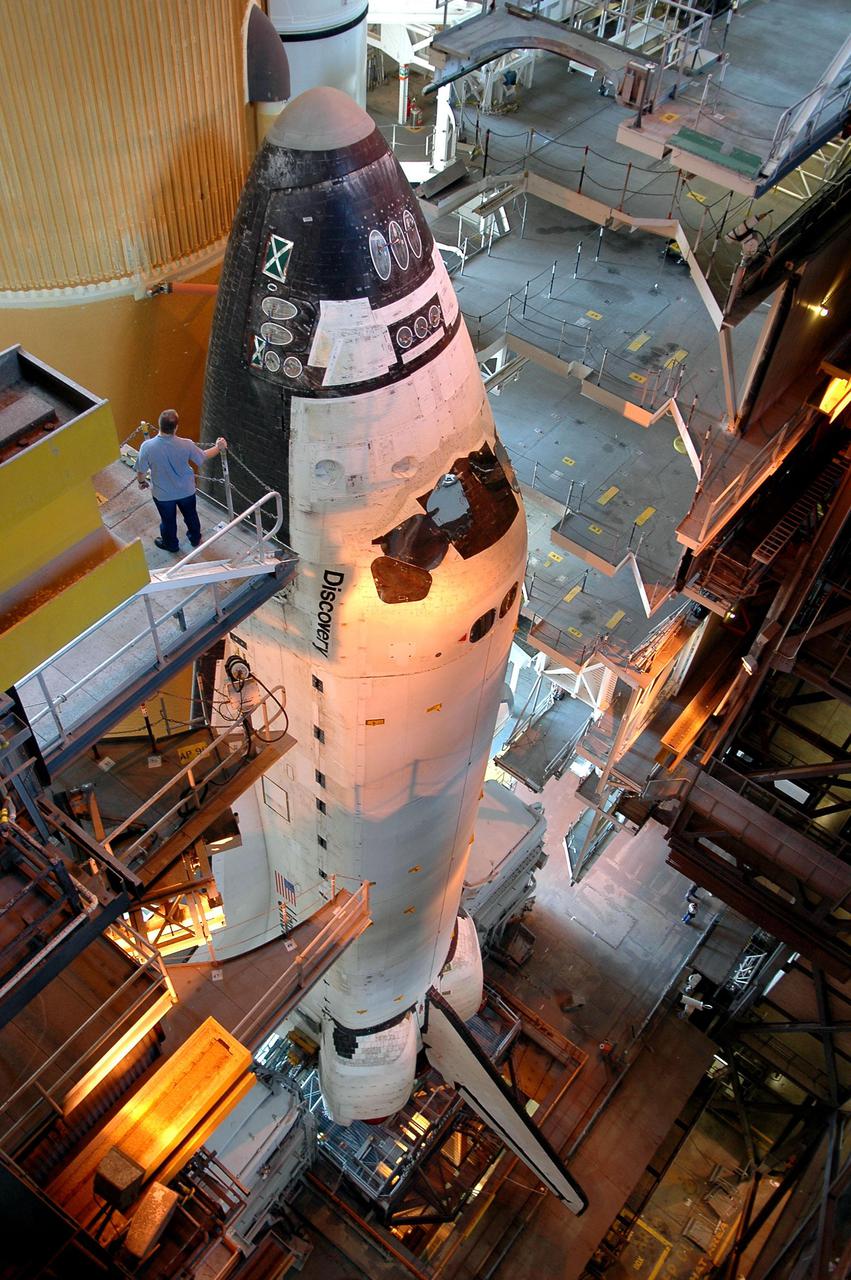
KENNEDY SPACE CENTER, FLA. - In the Vehicle Assembly Building (VAB) at NASA’s Kennedy Space Center, Space Shuttle Discovery begins its long, slow journey to Launch Pad 39B. First motion was at 2:04 p.m. EDT. The Shuttle comprises the orbiter, External Tank (ET) and twin Solid Rocket Boosters (SRBs). The Space Shuttle rests on the Mobile Launcher Platform, which is moved by the Crawler-Transporter underneath. The Crawler is 20 feet high, 131 feet long and 114 feet wide. It moves on eight tracks, each containing 57 shoes, or cleats, weighing one ton each. Loaded with the Space Shuttle, the Crawler can move at a maximum speed of approximately 1 mile an hour. A leveling system in the Crawler keeps the Shuttle vertical while negotiating the 5 percent grade leading to the top of the launch pad. Launch of Discovery on its Return to Flight mission, STS-114, is targeted for May 15 with a launch window that extends to June 3. During its 12-day mission, Discovery’s seven-person crew will test new hardware and techniques to improve Shuttle safety, as well as deliver supplies to the International Space Station. Discovery was moved on March 29 from the Orbiter Processing Facility to the VAB and attached to its propulsion elements, a redesigned ET and twin SRBs.
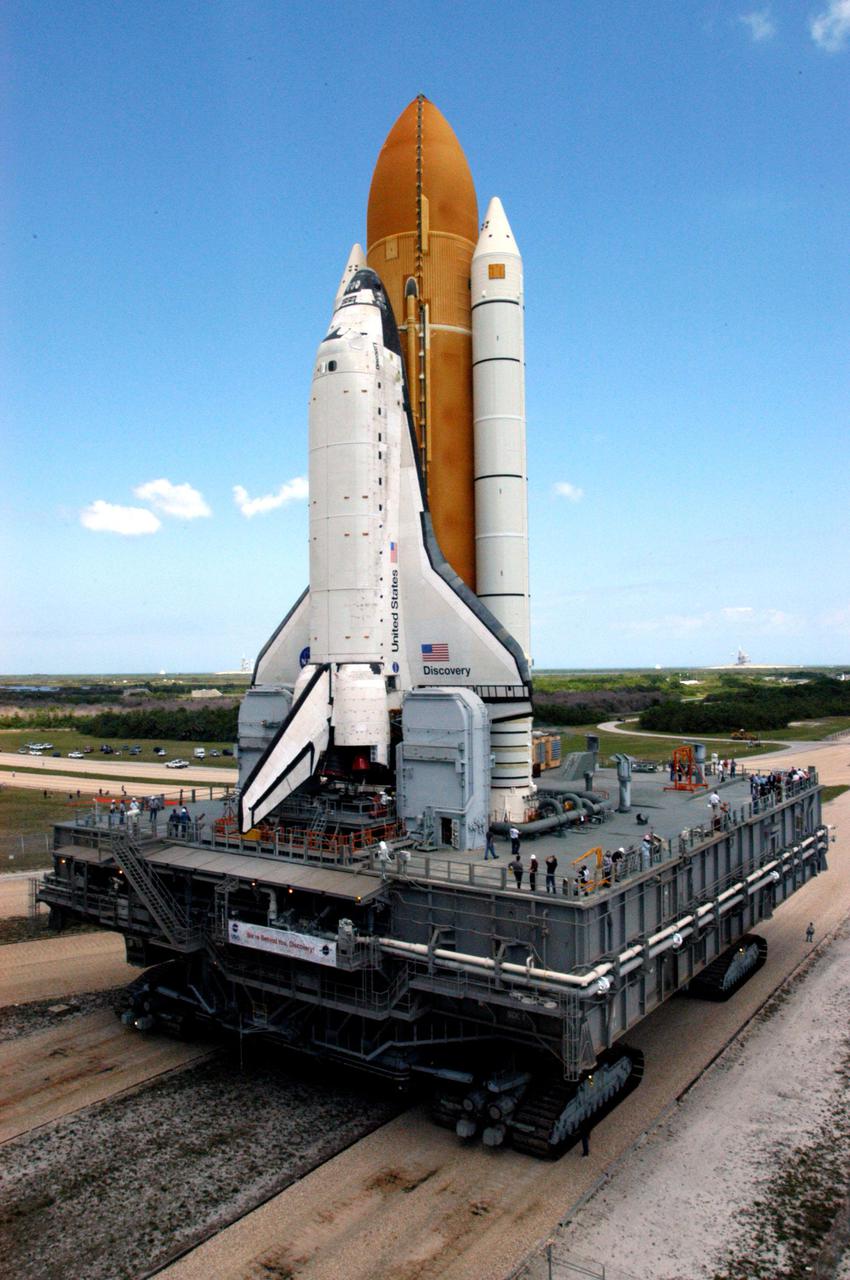
KENNEDY SPACE CENTER, FLA. - Under brilliant-blue Florida skies, Space Shuttle Discovery, atop the Mobile Launcher Platform, is on its way to Launch Pad 39B at NASA’s Kennedy Space Center. First motion out of the Vehicle Assembly Building (VAB) was at 2:04 p.m. EDT. The Shuttle comprises the orbiter, External Tank (ET) and twin Solid Rocket Boosters (SRBs). The Mobile Launcher Platform moved by the Crawler-Transporter underneath. The Crawler is 20 feet high, 131 feet long and 114 feet wide. It moves on eight tracks, each containing 57 shoes, or cleats, weighing one ton each. Loaded with the Space Shuttle, the Crawler can move at a maximum speed of approximately 1 mile an hour. A leveling system in the Crawler keeps the Shuttle vertical while negotiating the 5 percent grade leading to the top of the launch pad. Launch of Discovery on its Return to Flight mission, STS-114, is targeted for May 15 with a launch window that extends to June 3. During its 12-day mission, Discovery’s seven-person crew will test new hardware and techniques to improve Shuttle safety, as well as deliver supplies to the International Space Station. Discovery was moved on March 29 from the Orbiter Processing Facility to the VAB and attached to its propulsion elements, a redesigned ET and twin SRBs.
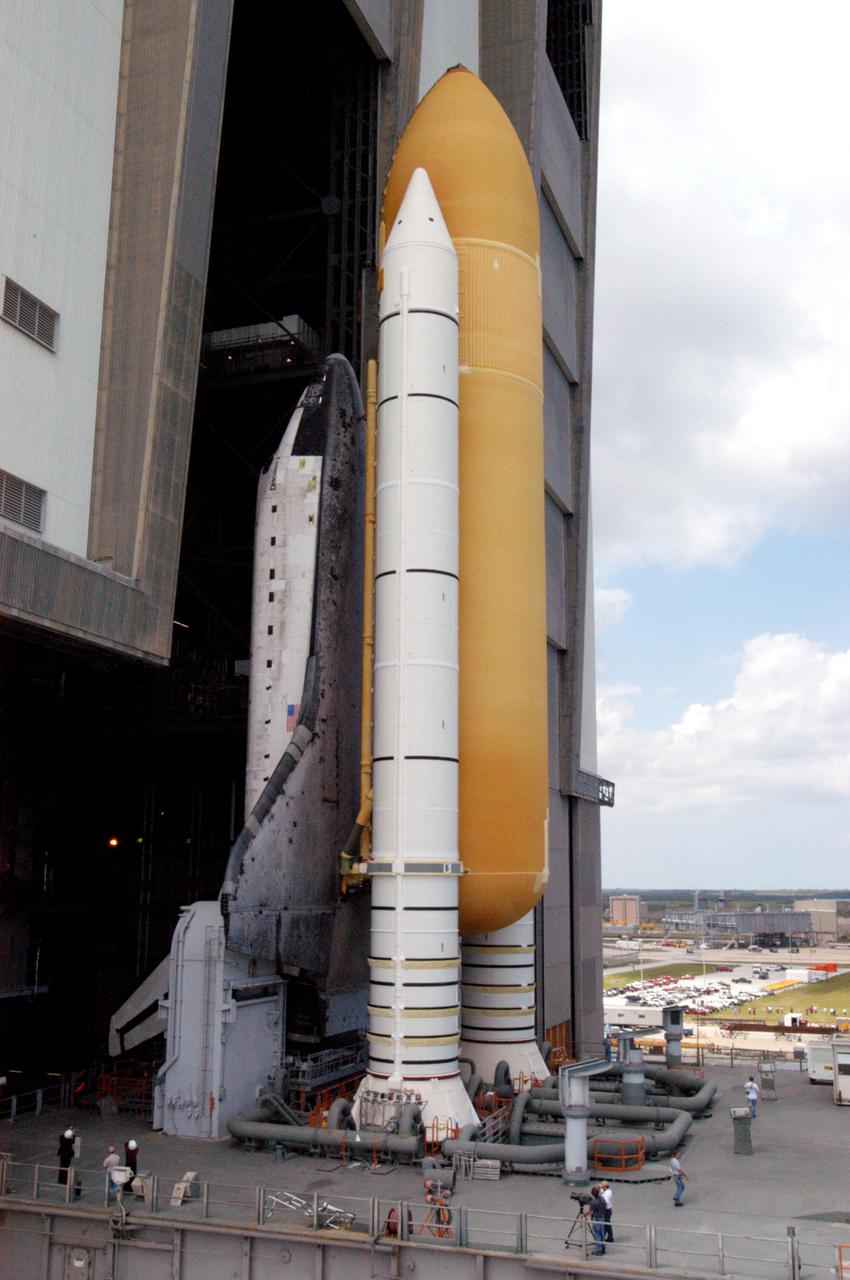
KENNEDY SPACE CENTER, FLA. - Space Shuttle Discovery, atop the Mobile Launcher Platform, slowly rolls out of the Vehicle Assembly Building (VAB) at NASA’s Kennedy Space Center. First motion was at 2:04 p.m. EDT. The Shuttle comprises the orbiter, External Tank (ET) and twin Solid Rocket Boosters (SRBs). The Mobile Launcher Platform moved by the Crawler-Transporter underneath. The Crawler is 20 feet high, 131 feet long and 114 feet wide. It moves on eight tracks, each containing 57 shoes, or cleats, weighing one ton each. Loaded with the Space Shuttle, the Crawler can move at a maximum speed of approximately 1 mile an hour. A leveling system in the Crawler keeps the Shuttle vertical while negotiating the 5 percent grade leading to the top of the launch pad. Launch of Discovery on its Return to Flight mission, STS-114, is targeted for May 15 with a launch window that extends to June 3. During its 12-day mission, Discovery’s seven-person crew will test new hardware and techniques to improve Shuttle safety, as well as deliver supplies to the International Space Station. Discovery was moved on March 29 from the Orbiter Processing Facility to the VAB and attached to its propulsion elements, a redesigned ET and twin SRBs.
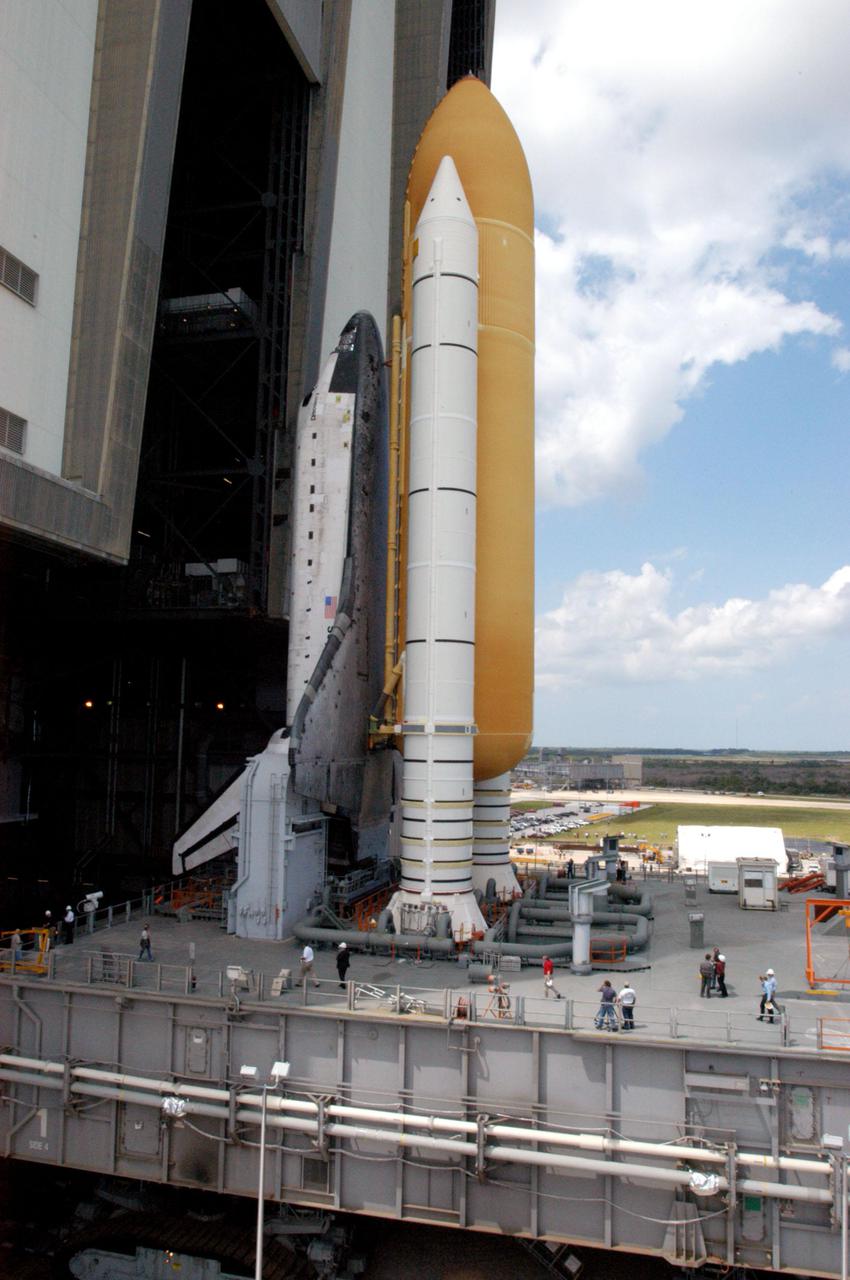
KENNEDY SPACE CENTER, FLA. - Space Shuttle Discovery, atop the Mobile Launcher Platform, slowly rolls out of the Vehicle Assembly Building (VAB) at NASA’s Kennedy Space Center. First motion was at 2:04 p.m. EDT. The Shuttle comprises the orbiter, External Tank (ET) and twin Solid Rocket Boosters (SRBs). The Mobile Launcher Platform moved by the Crawler-Transporter underneath. The Crawler is 20 feet high, 131 feet long and 114 feet wide. It moves on eight tracks, each containing 57 shoes, or cleats, weighing one ton each. Loaded with the Space Shuttle, the Crawler can move at a maximum speed of approximately 1 mile an hour. A leveling system in the Crawler keeps the Shuttle vertical while negotiating the 5 percent grade leading to the top of the launch pad. Launch of Discovery on its Return to Flight mission, STS-114, is targeted for May 15 with a launch window that extends to June 3. During its 12-day mission, Discovery’s seven-person crew will test new hardware and techniques to improve Shuttle safety, as well as deliver supplies to the International Space Station. Discovery was moved on March 29 from the Orbiter Processing Facility to the VAB and attached to its propulsion elements, a redesigned ET and twin SRBs.
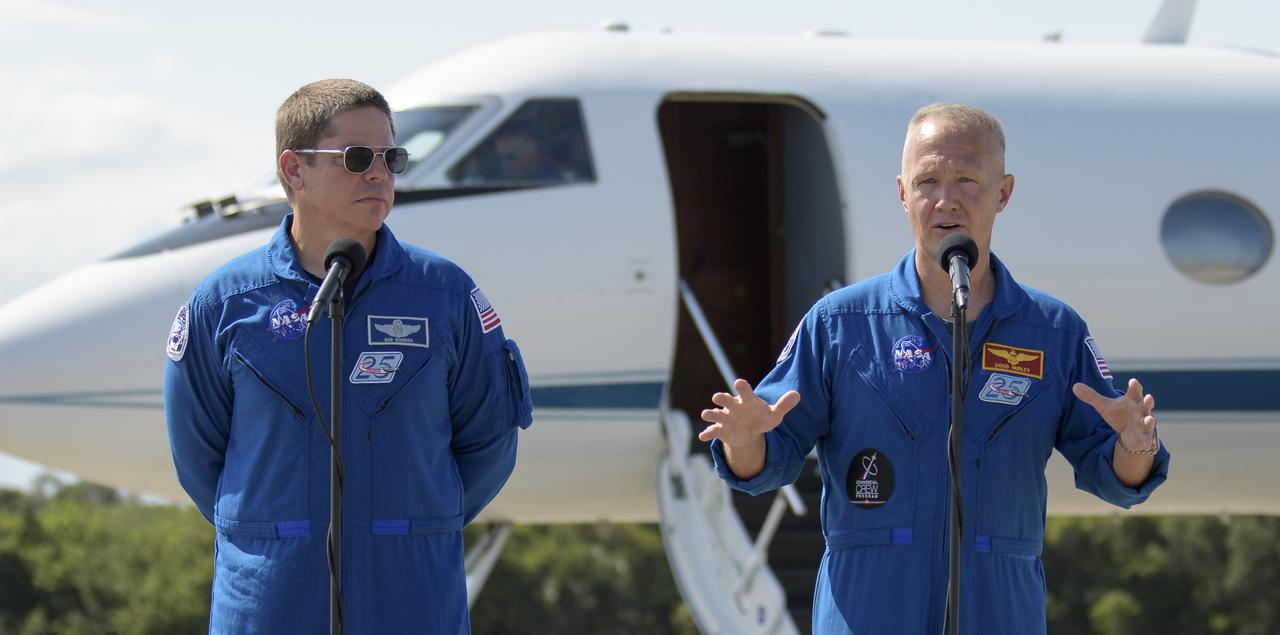
NASA astronauts Robert Behnken, left, and Douglas Hurley speak to members of the media after arriving at the Launch and Landing Facility at NASA’s Kennedy Space Center ahead of SpaceX’s Demo-2 mission, Wednesday, May 20, 2020, in Florida. NASA’s SpaceX Demo-2 mission is the first launch with astronauts of the SpaceX Crew Dragon spacecraft and Falcon 9 rocket to the International Space Station as part of the agency’s Commercial Crew Program. The flight test will serve as an end-to-end demonstration of SpaceX’s crew transportation system. Behnken and Hurley are scheduled to launch at 4:33 p.m. EDT on Wednesday, May 27, from Launch Complex 39A at the Kennedy Space Center. A new era of human spaceflight is set to begin as American astronauts once again launch on an American rocket from American soil to low-Earth orbit for the first time since the conclusion of the Space Shuttle Program in 2011. Photo Credit: (NASA/Bill Ingalls)
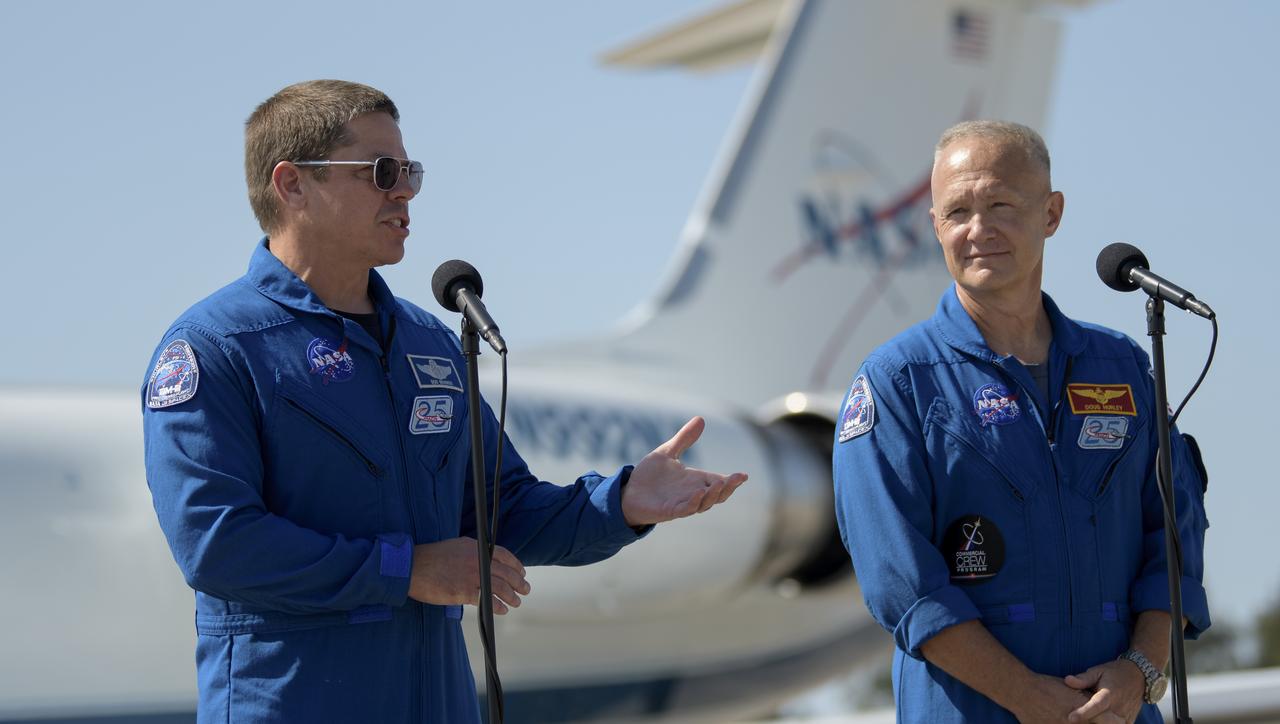
NASA astronauts Robert Behnken, left, and Douglas Hurley speak to members of the media after arriving at the Launch and Landing Facility at NASA’s Kennedy Space Center ahead of SpaceX’s Demo-2 mission, Wednesday, May 20, 2020, in Florida. NASA’s SpaceX Demo-2 mission is the first launch with astronauts of the SpaceX Crew Dragon spacecraft and Falcon 9 rocket to the International Space Station as part of the agency’s Commercial Crew Program. The flight test will serve as an end-to-end demonstration of SpaceX’s crew transportation system. Behnken and Hurley are scheduled to launch at 4:33 p.m. EDT on Wednesday, May 27, from Launch Complex 39A at the Kennedy Space Center. A new era of human spaceflight is set to begin as American astronauts once again launch on an American rocket from American soil to low-Earth orbit for the first time since the conclusion of the Space Shuttle Program in 2011. Photo Credit: (NASA/Bill Ingalls)
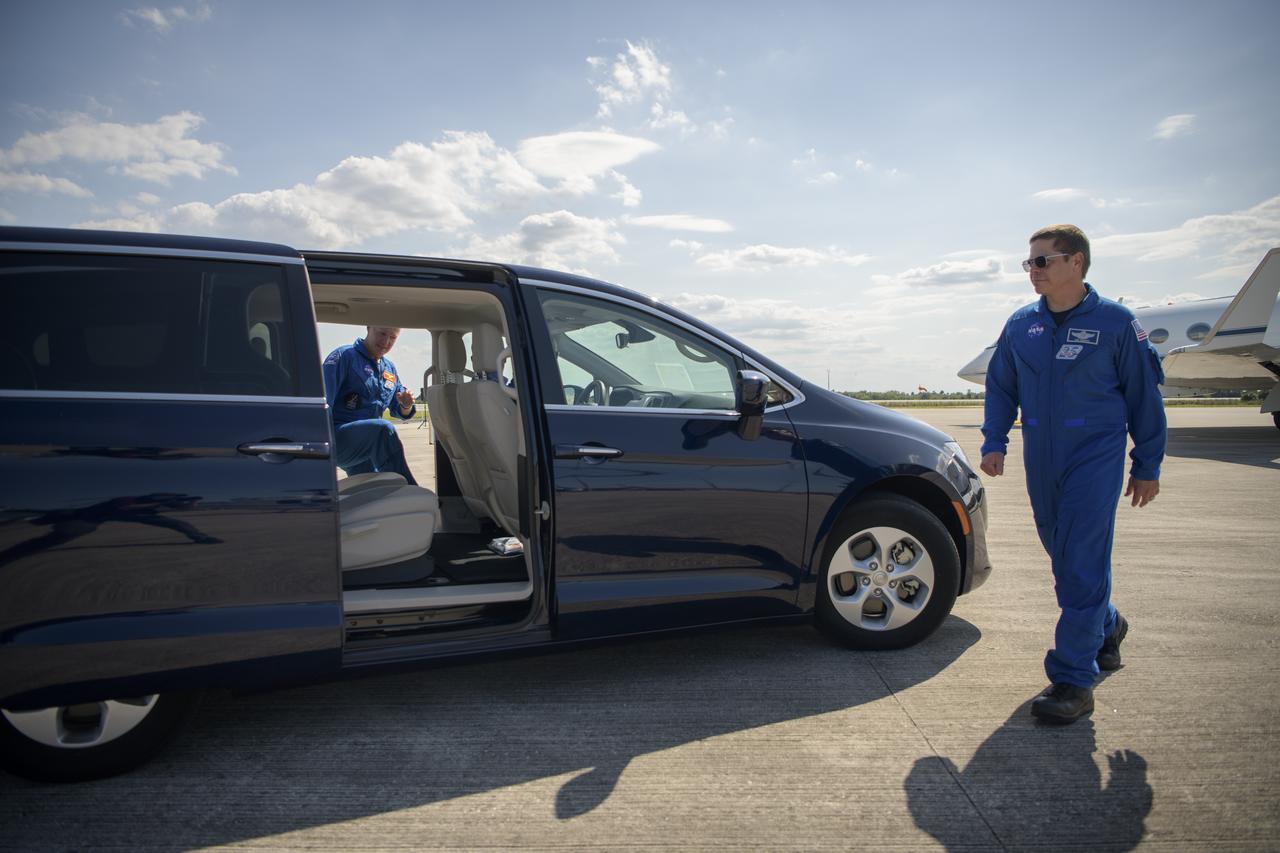
NASA astronauts Douglas Hurley, left, and Robert Behnken depart the Launch and Landing Facility and head to crew quarters at NASA’s Kennedy Space Center ahead of SpaceX’s Demo-2 mission, Wednesday, May 20, 2020, in Florida. NASA’s SpaceX Demo-2 mission is the first launch with astronauts of the SpaceX Crew Dragon spacecraft and Falcon 9 rocket to the International Space Station as part of the agency’s Commercial Crew Program. The flight test will serve as an end-to-end demonstration of SpaceX’s crew transportation system. Behnken and Hurley are scheduled to launch at 4:33 p.m. EDT on Wednesday, May 27, from Launch Complex 39A at the Kennedy Space Center. A new era of human spaceflight is set to begin as American astronauts once again launch on an American rocket from American soil to low-Earth orbit for the first time since the conclusion of the Space Shuttle Program in 2011. Photo Credit: (NASA/Bill Ingalls)
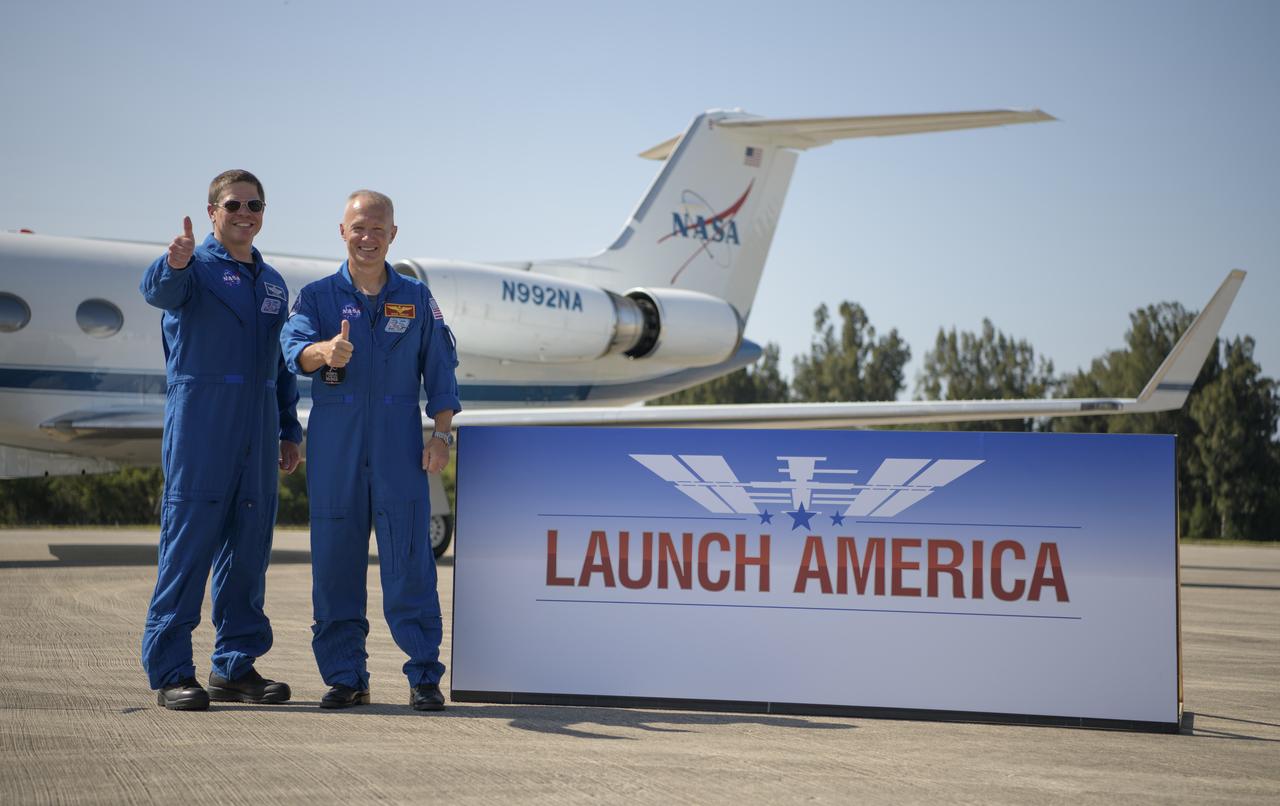
NASA astronauts Robert Behnken, left, and Douglas Hurley gives a thumbs up after arriving at the Launch and Landing Facility at NASA’s Kennedy Space Center ahead of SpaceX’s Demo-2 mission, Wednesday, May 20, 2020, in Florida. NASA’s SpaceX Demo-2 mission is the first launch with astronauts of the SpaceX Crew Dragon spacecraft and Falcon 9 rocket to the International Space Station as part of the agency’s Commercial Crew Program. The flight test will serve as an end-to-end demonstration of SpaceX’s crew transportation system. Behnken and Hurley are scheduled to launch at 4:33 p.m. EDT on Wednesday, May 27, from Launch Complex 39A at the Kennedy Space Center. A new era of human spaceflight is set to begin as American astronauts once again launch on an American rocket from American soil to low-Earth orbit for the first time since the conclusion of the Space Shuttle Program in 2011. Photo Credit: (NASA/Bill Ingalls)
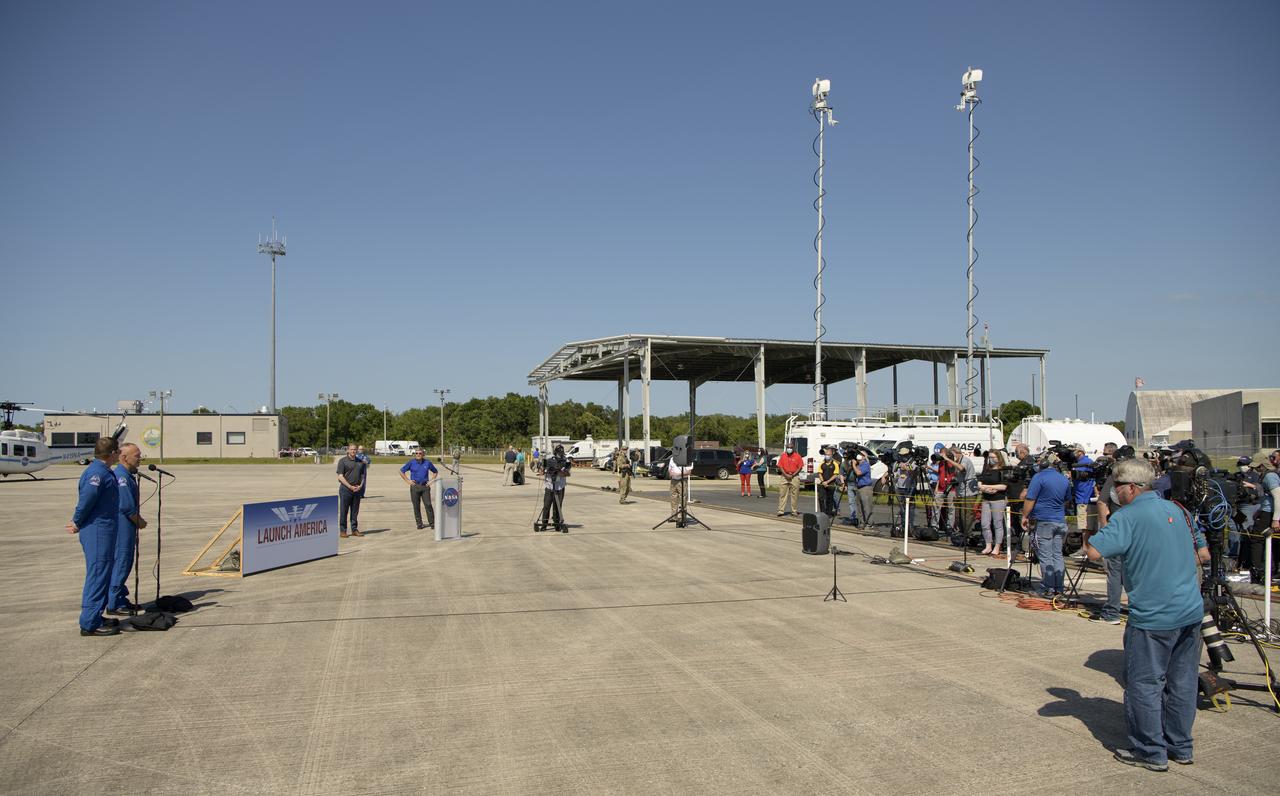
NASA astronauts Robert Behnken, left, and Douglas Hurley speak to members of the media after arriving at the Launch and Landing Facility at NASA’s Kennedy Space Center ahead of SpaceX’s Demo-2 mission, Wednesday, May 20, 2020, in Florida. NASA’s SpaceX Demo-2 mission is the first launch with astronauts of the SpaceX Crew Dragon spacecraft and Falcon 9 rocket to the International Space Station as part of the agency’s Commercial Crew Program. The flight test will serve as an end-to-end demonstration of SpaceX’s crew transportation system. Behnken and Hurley are scheduled to launch at 4:33 p.m. EDT on Wednesday, May 27, from Launch Complex 39A at the Kennedy Space Center. A new era of human spaceflight is set to begin as American astronauts once again launch on an American rocket from American soil to low-Earth orbit for the first time since the conclusion of the Space Shuttle Program in 2011. Photo Credit: (NASA/Bill Ingalls)
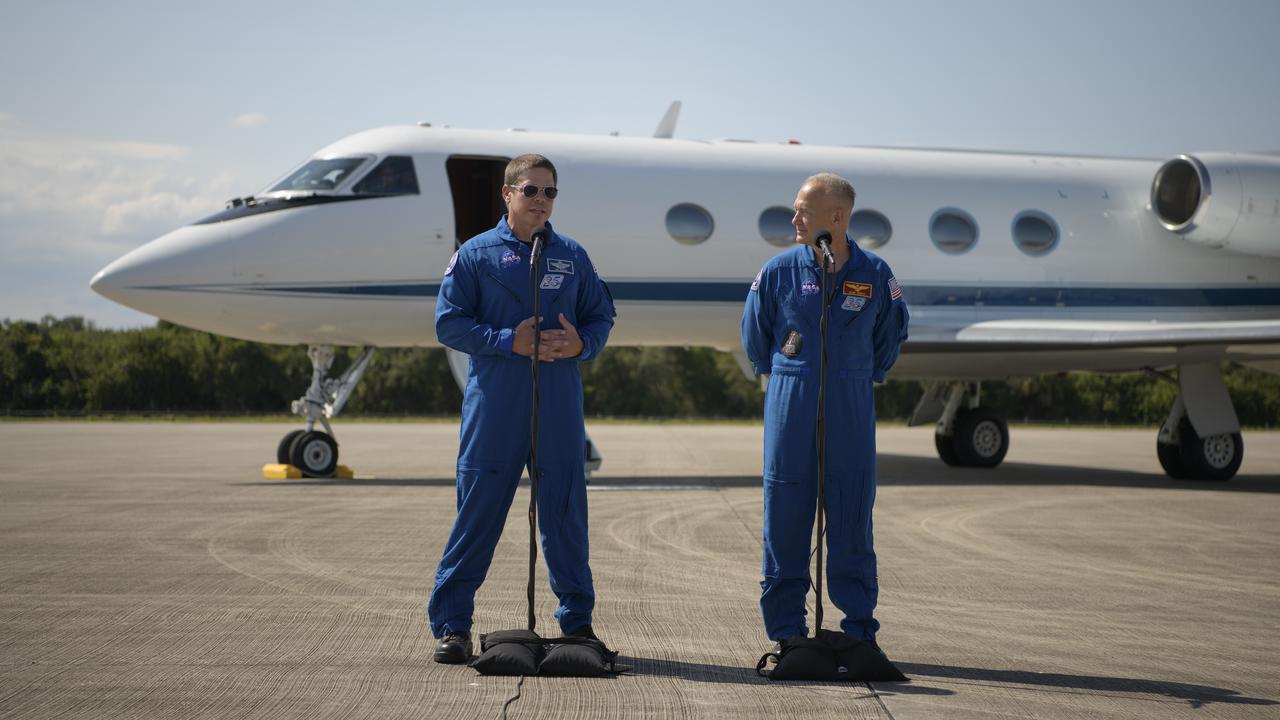
NASA astronauts Robert Behnken, left, and Douglas Hurley speak to members of the media after arriving at the Launch and Landing Facility at NASA’s Kennedy Space Center ahead of SpaceX’s Demo-2 mission, Wednesday, May 20, 2020, in Florida. NASA’s SpaceX Demo-2 mission is the first launch with astronauts of the SpaceX Crew Dragon spacecraft and Falcon 9 rocket to the International Space Station as part of the agency’s Commercial Crew Program. The flight test will serve as an end-to-end demonstration of SpaceX’s crew transportation system. Behnken and Hurley are scheduled to launch at 4:33 p.m. EDT on Wednesday, May 27, from Launch Complex 39A at the Kennedy Space Center. A new era of human spaceflight is set to begin as American astronauts once again launch on an American rocket from American soil to low-Earth orbit for the first time since the conclusion of the Space Shuttle Program in 2011. Photo Credit: (NASA/Bill Ingalls)
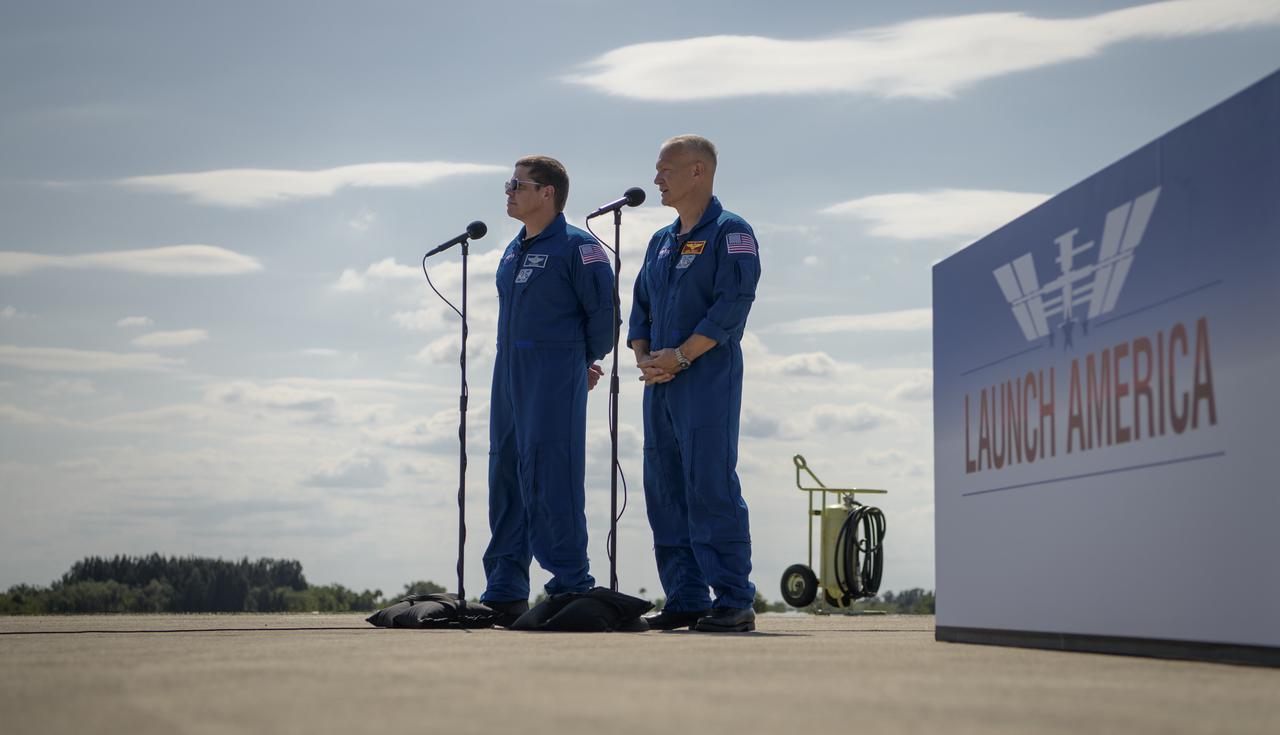
NASA astronauts Robert Behnken, left, and Douglas Hurley speak to members of the media after arriving at the Launch and Landing Facility at NASA’s Kennedy Space Center ahead of SpaceX’s Demo-2 mission, Wednesday, May 20, 2020, in Florida. NASA’s SpaceX Demo-2 mission is the first launch with astronauts of the SpaceX Crew Dragon spacecraft and Falcon 9 rocket to the International Space Station as part of the agency’s Commercial Crew Program. The flight test will serve as an end-to-end demonstration of SpaceX’s crew transportation system. Behnken and Hurley are scheduled to launch at 4:33 p.m. EDT on Wednesday, May 27, from Launch Complex 39A at the Kennedy Space Center. A new era of human spaceflight is set to begin as American astronauts once again launch on an American rocket from American soil to low-Earth orbit for the first time since the conclusion of the Space Shuttle Program in 2011. Photo Credit: (NASA/Bill Ingalls)
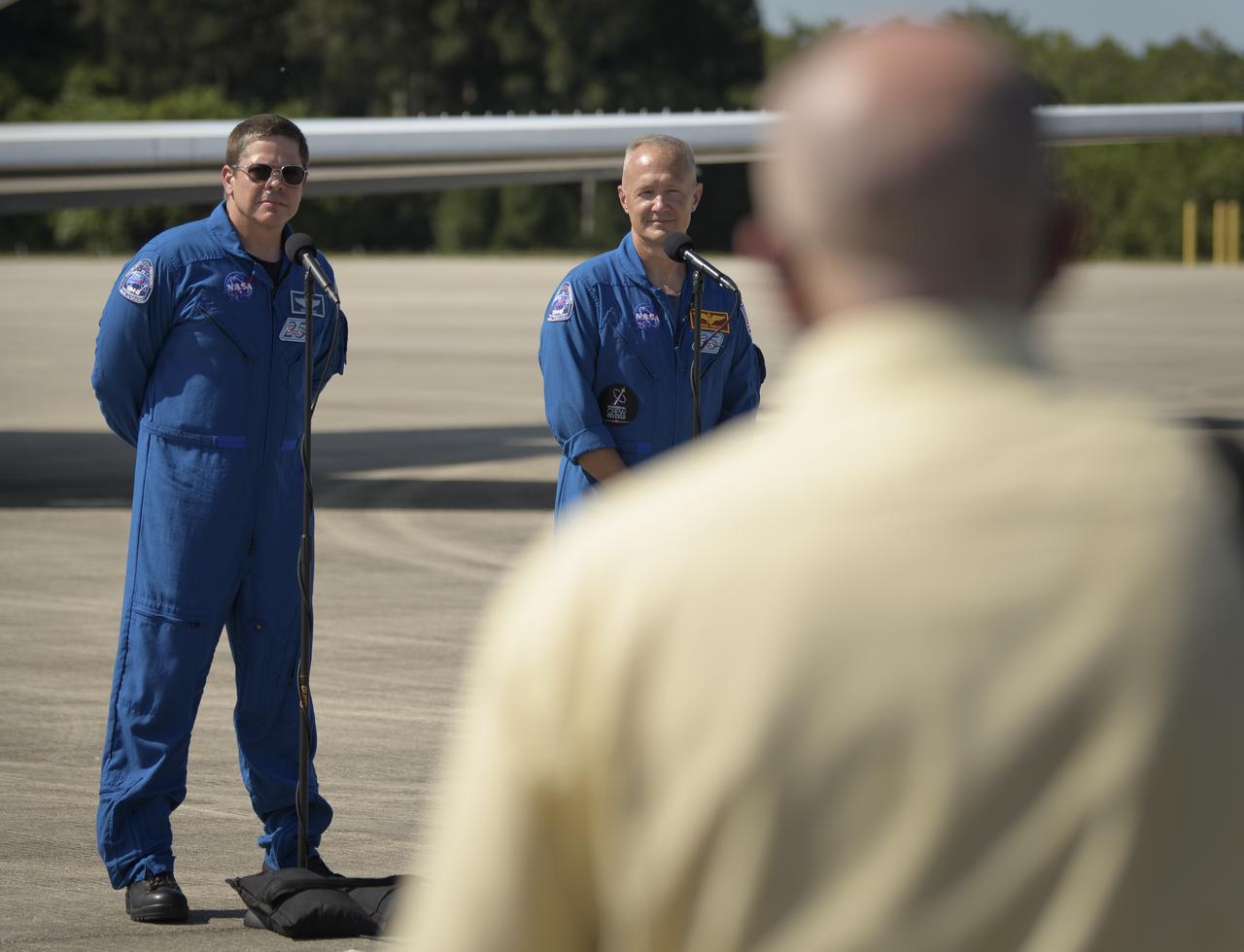
NASA astronauts Robert Behnken, left, and Douglas Hurley speak to members of the media after arriving at the Launch and Landing Facility at NASA’s Kennedy Space Center ahead of SpaceX’s Demo-2 mission, Wednesday, May 20, 2020, in Florida. NASA’s SpaceX Demo-2 mission is the first launch with astronauts of the SpaceX Crew Dragon spacecraft and Falcon 9 rocket to the International Space Station as part of the agency’s Commercial Crew Program. The flight test will serve as an end-to-end demonstration of SpaceX’s crew transportation system. Behnken and Hurley are scheduled to launch at 4:33 p.m. EDT on Wednesday, May 27, from Launch Complex 39A at the Kennedy Space Center. A new era of human spaceflight is set to begin as American astronauts once again launch on an American rocket from American soil to low-Earth orbit for the first time since the conclusion of the Space Shuttle Program in 2011. Photo Credit: (NASA/Bill Ingalls)
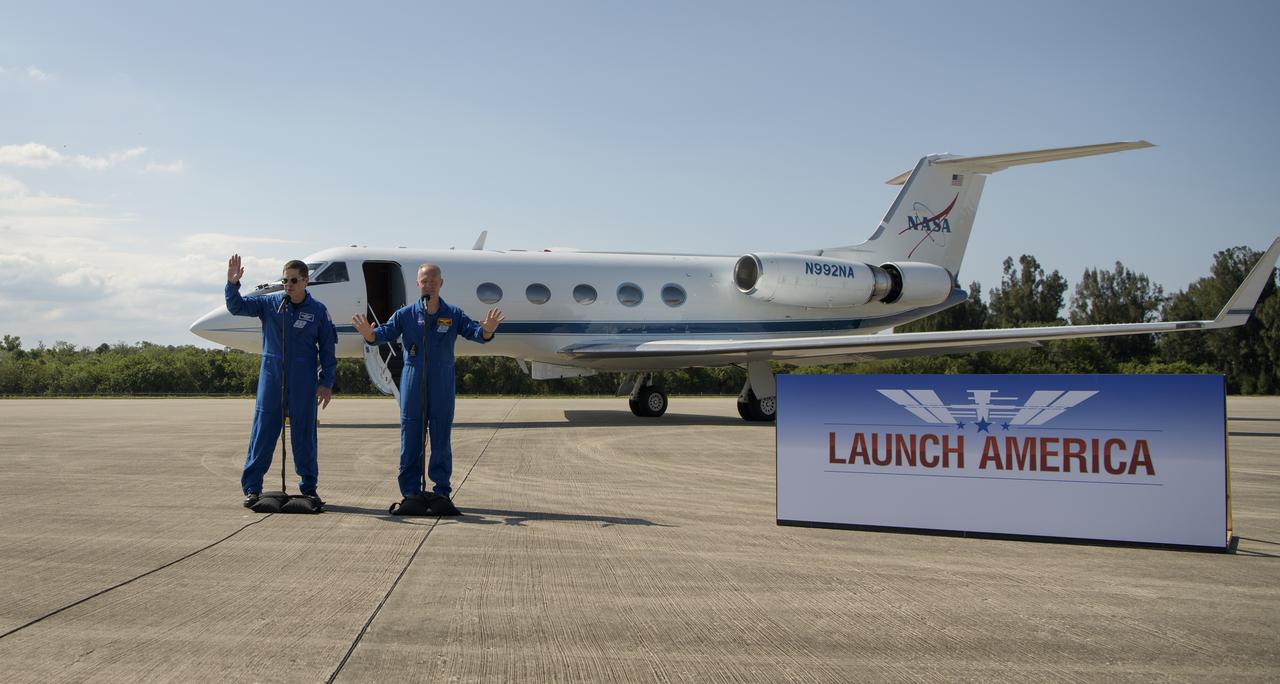
NASA astronauts Robert Behnken, left, and Douglas Hurley wave after speaking to members of the media and arriving at the Launch and Landing Facility at NASA’s Kennedy Space Center ahead of SpaceX’s Demo-2 mission, Wednesday, May 20, 2020, in Florida. NASA’s SpaceX Demo-2 mission is the first launch with astronauts of the SpaceX Crew Dragon spacecraft and Falcon 9 rocket to the International Space Station as part of the agency’s Commercial Crew Program. The flight test will serve as an end-to-end demonstration of SpaceX’s crew transportation system. Behnken and Hurley are scheduled to launch at 4:33 p.m. EDT on Wednesday, May 27, from Launch Complex 39A at the Kennedy Space Center. A new era of human spaceflight is set to begin as American astronauts once again launch on an American rocket from American soil to low-Earth orbit for the first time since the conclusion of the Space Shuttle Program in 2011. Photo Credit: (NASA/Bill Ingalls)
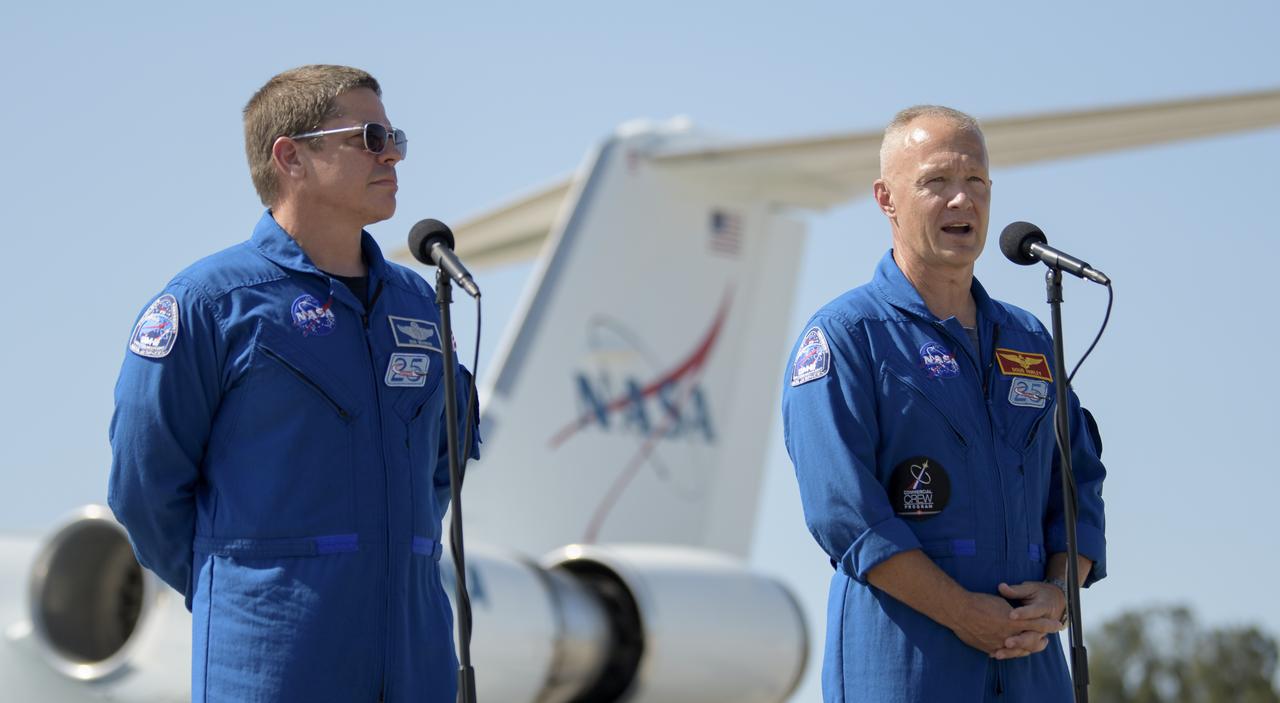
NASA astronauts Robert Behnken, left, and Douglas Hurley speak to members of the media after arriving at the Launch and Landing Facility at NASA’s Kennedy Space Center ahead of SpaceX’s Demo-2 mission, Wednesday, May 20, 2020, in Florida. NASA’s SpaceX Demo-2 mission is the first launch with astronauts of the SpaceX Crew Dragon spacecraft and Falcon 9 rocket to the International Space Station as part of the agency’s Commercial Crew Program. The flight test will serve as an end-to-end demonstration of SpaceX’s crew transportation system. Behnken and Hurley are scheduled to launch at 4:33 p.m. EDT on Wednesday, May 27, from Launch Complex 39A at the Kennedy Space Center. A new era of human spaceflight is set to begin as American astronauts once again launch on an American rocket from American soil to low-Earth orbit for the first time since the conclusion of the Space Shuttle Program in 2011. Photo Credit: (NASA/Bill Ingalls)
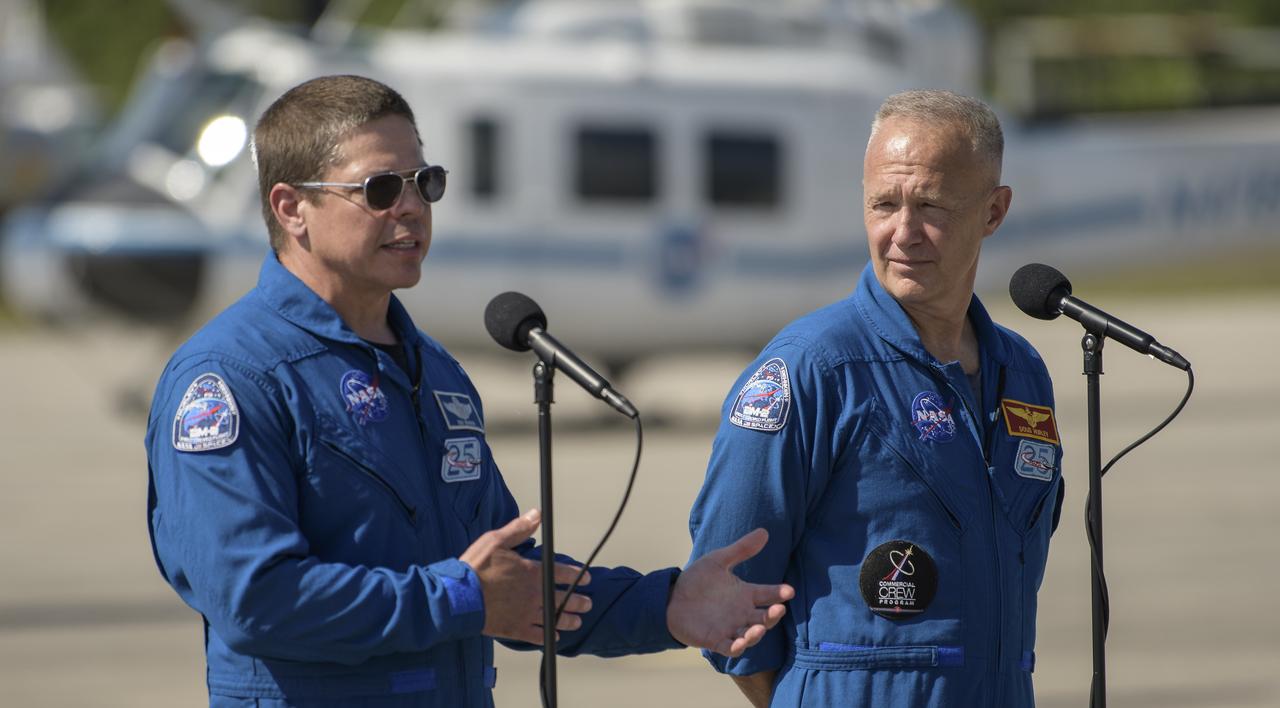
NASA astronauts Robert Behnken, left, and Douglas Hurley speak to members of the media after arriving at the Launch and Landing Facility at NASA’s Kennedy Space Center ahead of SpaceX’s Demo-2 mission, Wednesday, May 20, 2020, in Florida. NASA’s SpaceX Demo-2 mission is the first launch with astronauts of the SpaceX Crew Dragon spacecraft and Falcon 9 rocket to the International Space Station as part of the agency’s Commercial Crew Program. The flight test will serve as an end-to-end demonstration of SpaceX’s crew transportation system. Behnken and Hurley are scheduled to launch at 4:33 p.m. EDT on Wednesday, May 27, from Launch Complex 39A at the Kennedy Space Center. A new era of human spaceflight is set to begin as American astronauts once again launch on an American rocket from American soil to low-Earth orbit for the first time since the conclusion of the Space Shuttle Program in 2011. Photo Credit: (NASA/Bill Ingalls)

President Donald Trump departs Air Force One after arriving at NASA’s Kennedy Space Center Launch and Landing Facility ahead of SpaceX’s Demo-2 mission, Saturday, May 30, 2020, in Florida. NASA’s SpaceX Demo-2 mission is the first launch with astronauts of the SpaceX Crew Dragon spacecraft and Falcon 9 rocket to the International Space Station as part of the agency’s Commercial Crew Program. The test flight serves as an end-to-end demonstration of SpaceX’s crew transportation system. Behnken and Hurley are scheduled to launch at 3:22 p.m. EDT on Saturday, May 30, from Launch Complex 39A at the Kennedy Space Center. A new era of human spaceflight is set to begin as American astronauts once again launch on an American rocket from American soil to low-Earth orbit for the first time since the conclusion of the Space Shuttle Program in 2011. Photo Credit: (NASA/Bill Ingalls)

NASA astronauts Douglas Hurley and Robert Behnken arrive at the Launch and Landing Facility at NASA’s Kennedy Space Center ahead of SpaceX’s Demo-2 mission, Wednesday, May 20, 2020, in Florida. NASA’s SpaceX Demo-2 mission is the first launch with astronauts of the SpaceX Crew Dragon spacecraft and Falcon 9 rocket to the International Space Station as part of the agency’s Commercial Crew Program. The flight test will serve as an end-to-end demonstration of SpaceX’s crew transportation system. Behnken and Hurley are scheduled to launch at 4:33 p.m. EDT on Wednesday, May 27, from Launch Complex 39A at the Kennedy Space Center. A new era of human spaceflight is set to begin as American astronauts once again launch on an American rocket from American soil to low-Earth orbit for the first time since the conclusion of the Space Shuttle Program in 2011. Photo Credit: (NASA/Bill Ingalls)
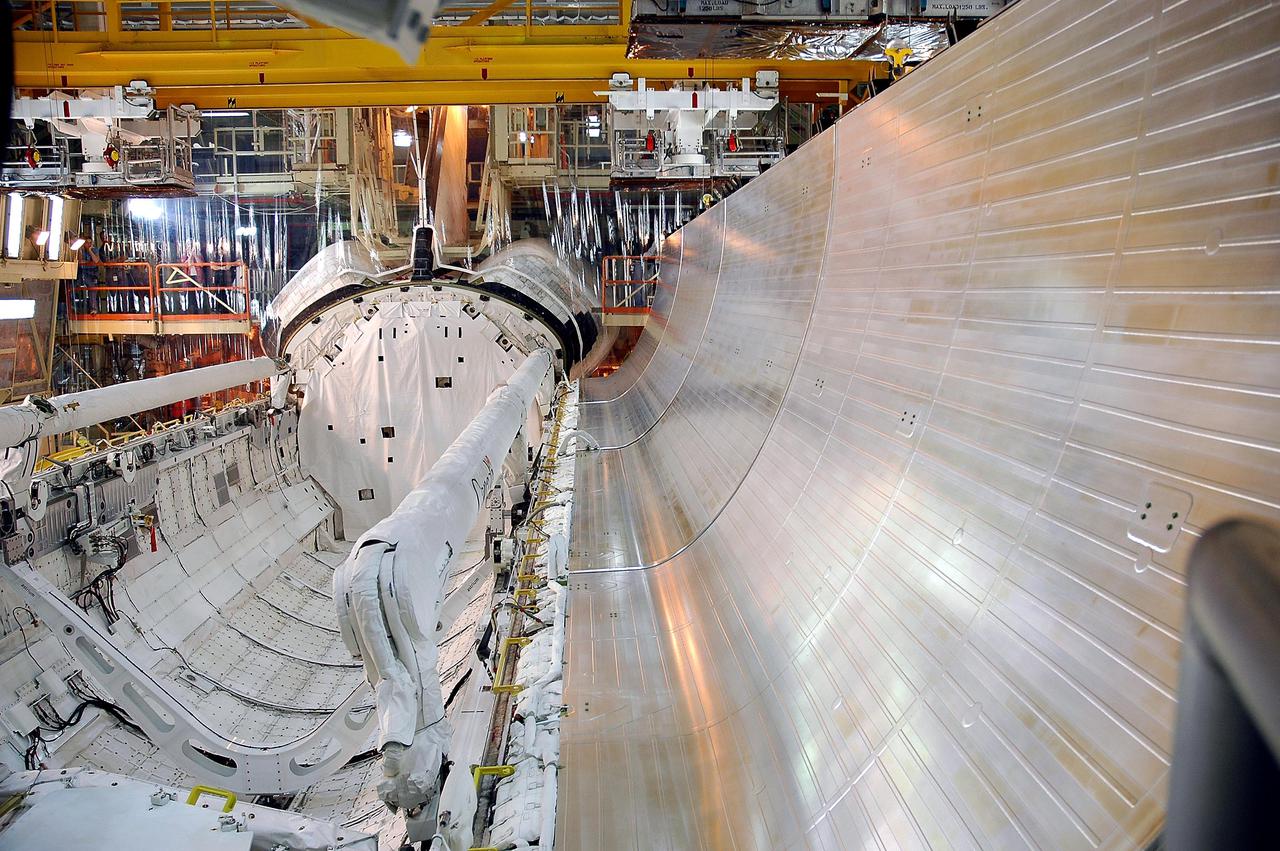
KENNEDY SPACE CENTER, FLA. - Inside Inside the Orbiter Processing Facility bay 3 at NASA’s Kennedy Space Center, one of the orbiter Discovery’s payload bay doors begins closing. Seen in the center and at left (starboard side) are the new Orbiter Boom Sensor System (OBSS) and the Remote Manipulator System (RMS), both Canadian-built. The OBSS is one of the new safety measures for Return to Flight, equipping the orbiter with cameras and laser systems to inspect the Shuttle's Thermal Protection System while in space. It attaches to the RMS. After door closure, Discovery will roll over to the Vehicle Assembly Building (VAB). Once arriving in the VAB, a sling will be attached to Discovery and the vehicle will be lifted up and lowered between its twin Solid Rocket Boosters and mated, or attached, to its redesigned External Tank. Once mated, the fully assembled Space Shuttle stack will undergo final closeouts including installation of the new digital camera in the orbiter, electrical and mechanical attachments, umbilical checks, and the interface verification test. Discovery is slated to fly mission STS-114. The launch planning window is May 15 to June 3, 2005.

KENNEDY SPACE CENTER, FLA. - Inside the Orbiter Processing Facility bay 3 at NASA’s Kennedy Space Center, the orbiter Discovery’s payload bay doors are ready to be closed. Seen in the center (starboard side) and at right are the new Orbiter Boom Sensor System (OBSS) and the Remote Manipulator System (RMS), both Canadian-built. The OBSS is one of the new safety measures for Return to Flight, equipping the orbiter with cameras and laser systems to inspect the Shuttle's Thermal Protection System while in space. It attaches to the RMS. After door closure, Discovery will roll over to the Vehicle Assembly Building (VAB). Once arriving in the VAB, a sling will be attached to Discovery and the vehicle will be lifted up and lowered between its twin Solid Rocket Boosters and mated, or attached, to its redesigned External Tank. Once mated, the fully assembled Space Shuttle stack will undergo final closeouts including installation of the new digital camera in the orbiter, electrical and mechanical attachments, umbilical checks, and the interface verification test. Discovery is slated to fly mission STS-114. The launch planning window is May 15 to June 3, 2005.

KENNEDY SPACE CENTER, FLA. - Inside the Orbiter Processing Facility bay 3 at NASA’s Kennedy Space Center, one of the orbiter Discovery’s payload bay doors is nearly upright as it closes. Seen in the center and at left (starboard side) are the new Orbiter Boom Sensor System (OBSS) and the Remote Manipulator System (RMS), both Canadian-built. The OBSS is one of the new safety measures for Return to Flight, equipping the orbiter with cameras and laser systems to inspect the Shuttle's Thermal Protection System while in space. It attaches to the RMS. After door closure, Discovery will roll over to the Vehicle Assembly Building (VAB). Once arriving in the VAB, a sling will be attached to Discovery and the vehicle will be lifted up and lowered between its twin Solid Rocket Boosters and mated, or attached, to its redesigned External Tank. Once mated, the fully assembled Space Shuttle stack will undergo final closeouts including installation of the new digital camera in the orbiter, electrical and mechanical attachments, umbilical checks, and the interface verification test. Discovery is slated to fly mission STS-114. The launch planning window is May 15 to June 3, 2005.
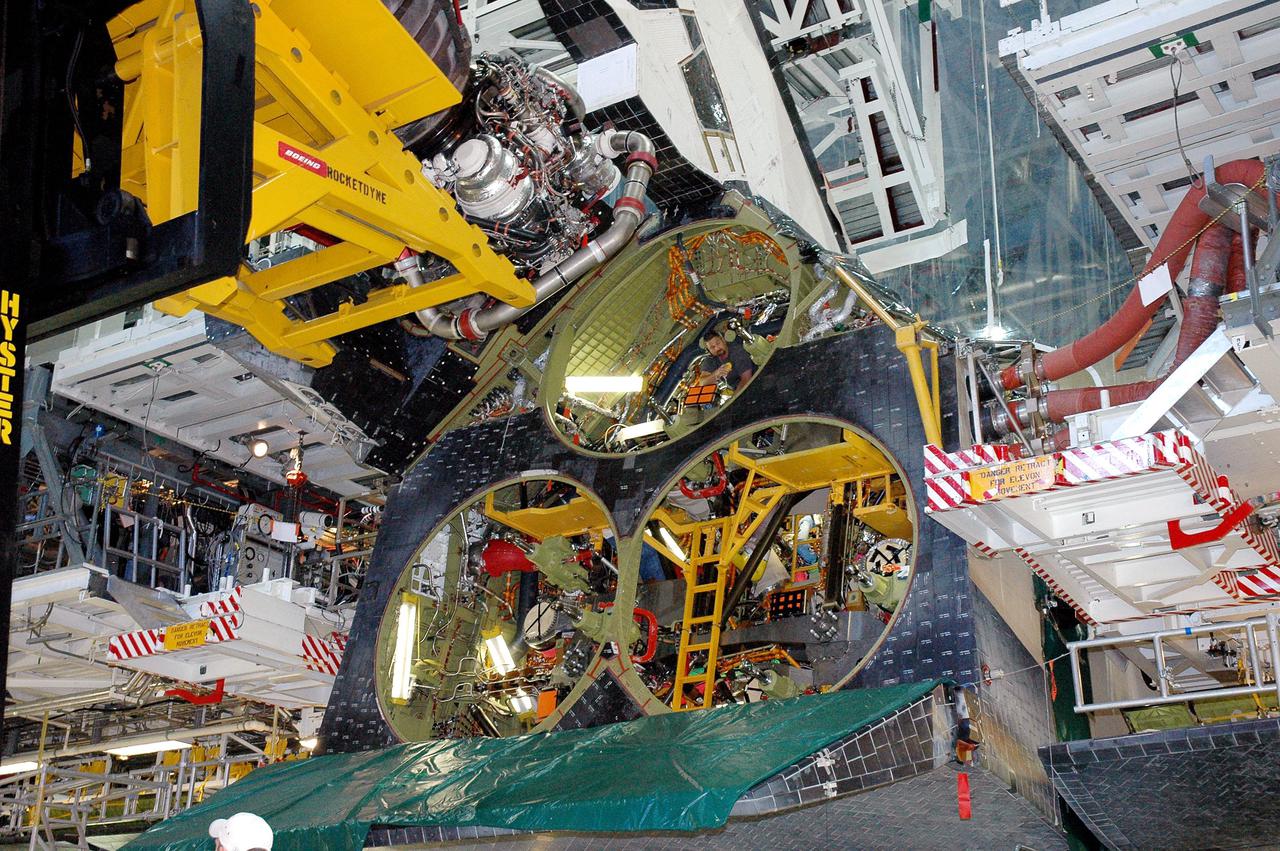
KENNEDY SPACE CENTER, FLA. - In the Orbiter Processing Facility bay 1 at NASA’s Kennedy Space Center, a worker looks out from the position number one engine opening in Atlantis as a Hyster fork lift (left) holding a Space Shuttle Main Engine (SSME) maneuvers into position for installation. Overall, an SSME weighs approximately 7,000 pounds. Three engines provide the thrust, along with the two Solid Rocket Boosters, for liftoff. After about 2 minutes, the two boosters are spent and are separated from the external tank. The SSMEs continue firing for about 8 minutes. They shut down just before the craft is inserted into orbit. The SSMEs are tested at Stennis Space Center in Mississippi. Atlantis is being processed for the second Return to Flight mission, STS-121, scheduled for launch in a window from July 12 through July 31.
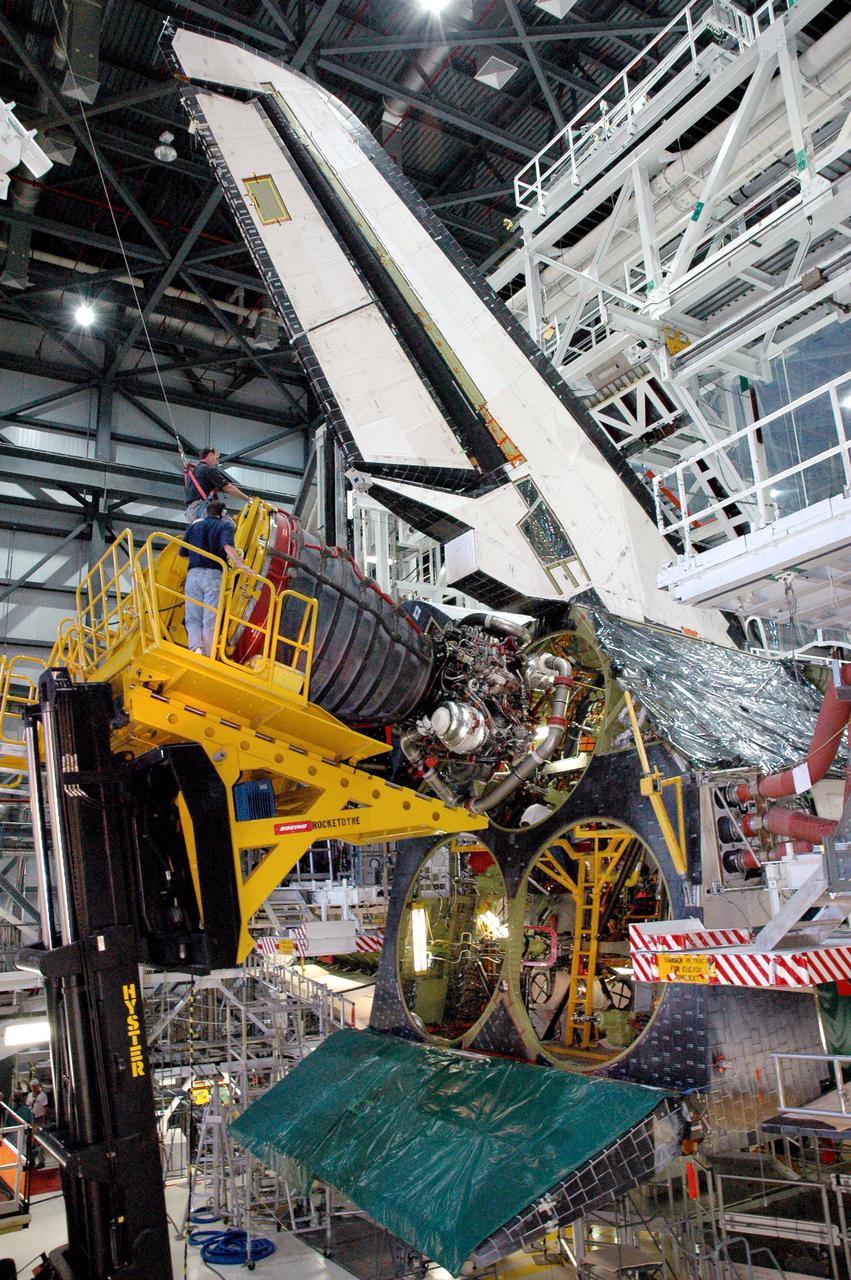
KENNEDY SPACE CENTER, FLA. - In the Orbiter Processing Facility bay 1 at NASA’s Kennedy Space Center, a Space Shuttle Main Engine (SSME), held by a Hyster fork lift, is maneuvered into place in position number one (upper chamber) in Atlantis. Overall, an SSME weighs approximately 7,000 pounds. Three engines provide the thrust, along with the two Solid Rocket Boosters, for liftoff. After about 2 minutes, the two boosters are spent and are separated from the external tank. The SSMEs continue firing for about 8 minutes. They shut down just before the craft is inserted into orbit. The SSMEs are tested at Stennis Space Center in Mississippi. Atlantis is being processed for the second Return to Flight mission, STS-121, scheduled for launch in a window from July 12 through July 31.
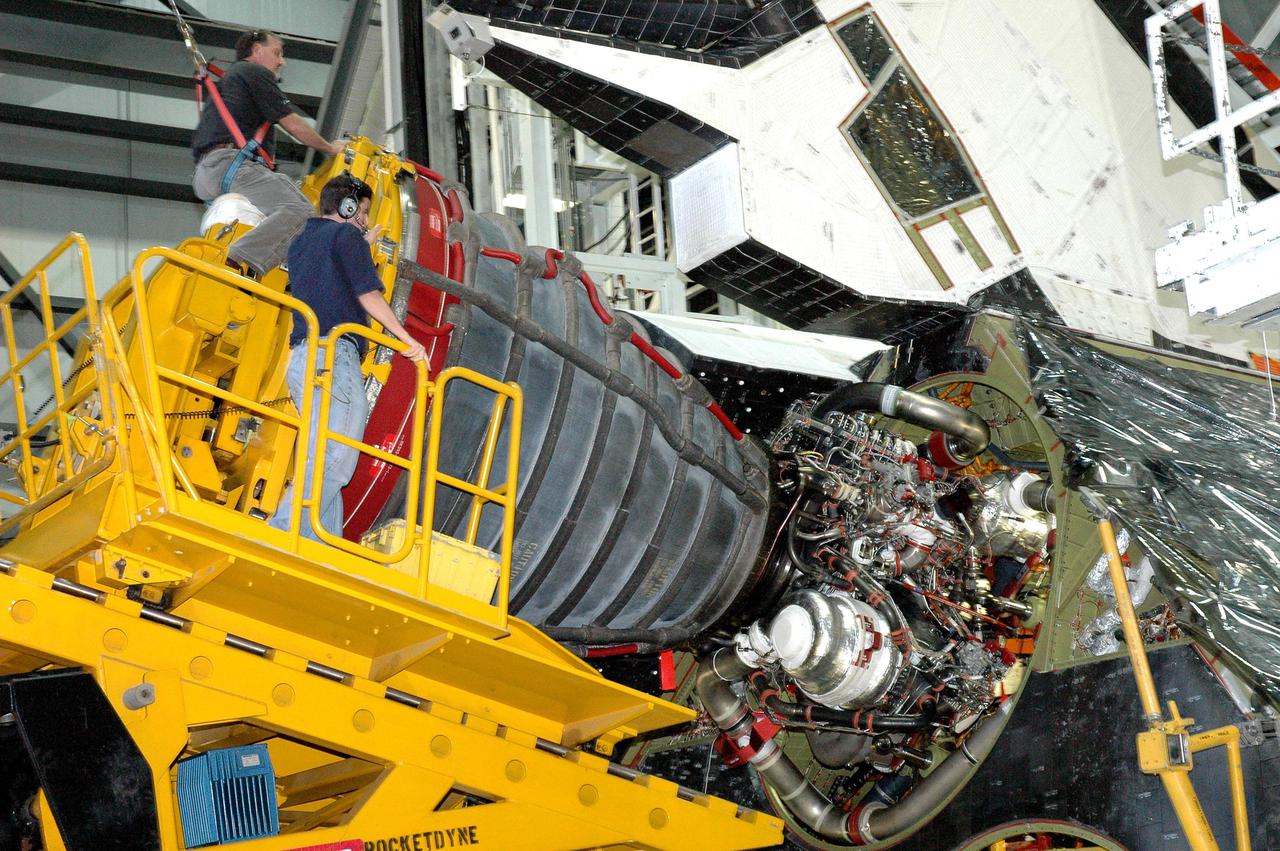
KENNEDY SPACE CENTER, FLA. - In the Orbiter Processing Facility bay 1 at NASA’s Kennedy Space Center, workers guide the Hyster fork lift close to Atlantis to install a Space Shuttle Main Engine (SSME) in position number 1 (upper chamber). Overall, an SSME weighs approximately 7,000 pounds. Three engines provide the thrust, along with the two Solid Rocket Boosters, for liftoff. After about 2 minutes, the two boosters are spent and are separated from the external tank. The SSMEs continue firing for about 8 minutes. They shut down just before the craft is inserted into orbit. The SSMEs are tested at Stennis Space Center in Mississippi. Atlantis is being processed for the second Return to Flight mission, STS-121, scheduled for launch in a window from July 12 through July 31.
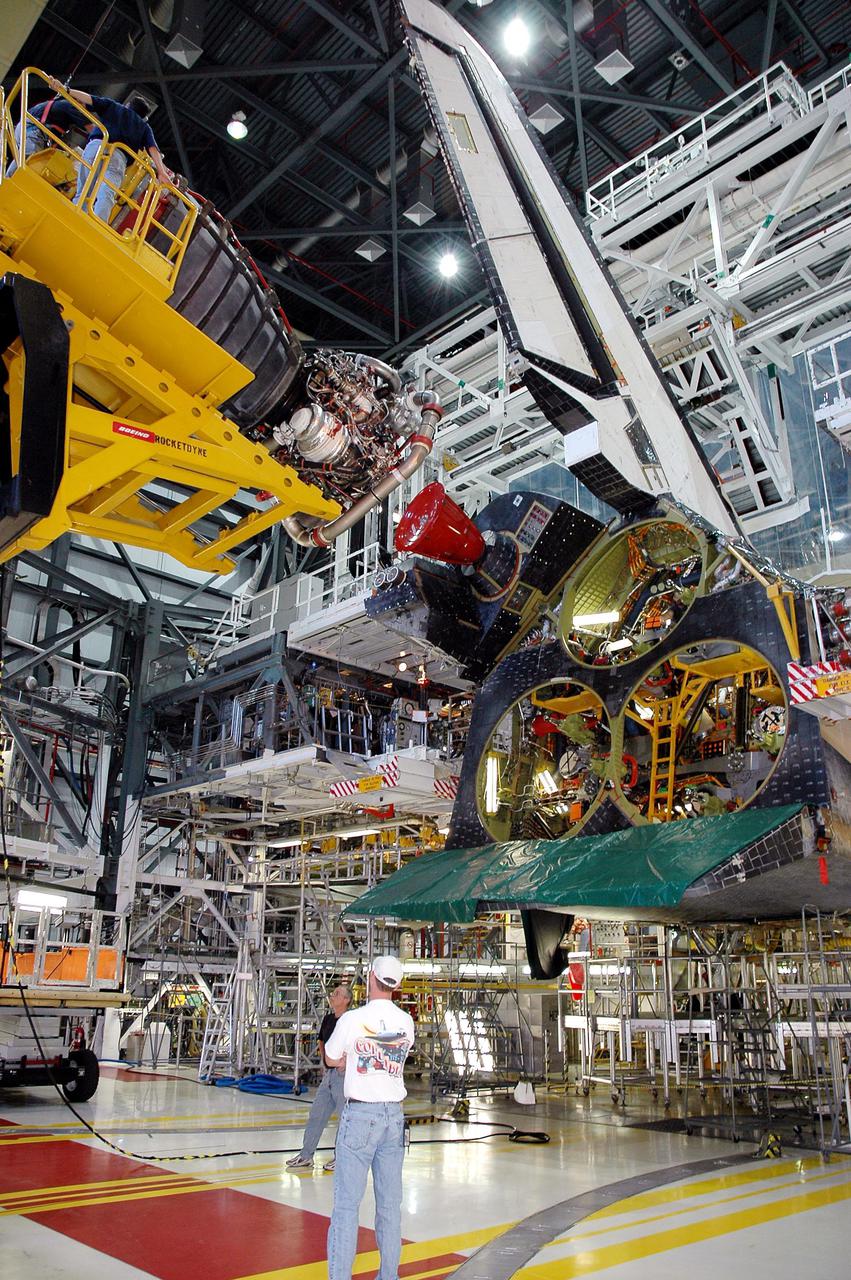
KENNEDY SPACE CENTER, FLA. - In the Orbiter Processing Facility bay 1 at NASA’s Kennedy Space Center, a Hyster fork lift (left) holding a Space Shuttle Main Engine (SSME) maneuvers into position number 1 (upper chamber) behind Atlantis for installation. Overall, an SSME weighs approximately 7,000 pounds. Three engines provide the thrust, along with the two Solid Rocket Boosters, for liftoff. After about 2 minutes, the two boosters are spent and are separated from the external tank. The SSMEs continue firing for about 8 minutes. They shut down just before the craft is inserted into orbit. The SSMEs are tested at Stennis Space Center in Mississippi. Atlantis is being processed for the second Return to Flight mission, STS-121, scheduled for launch in a window from July 12 through July 31.
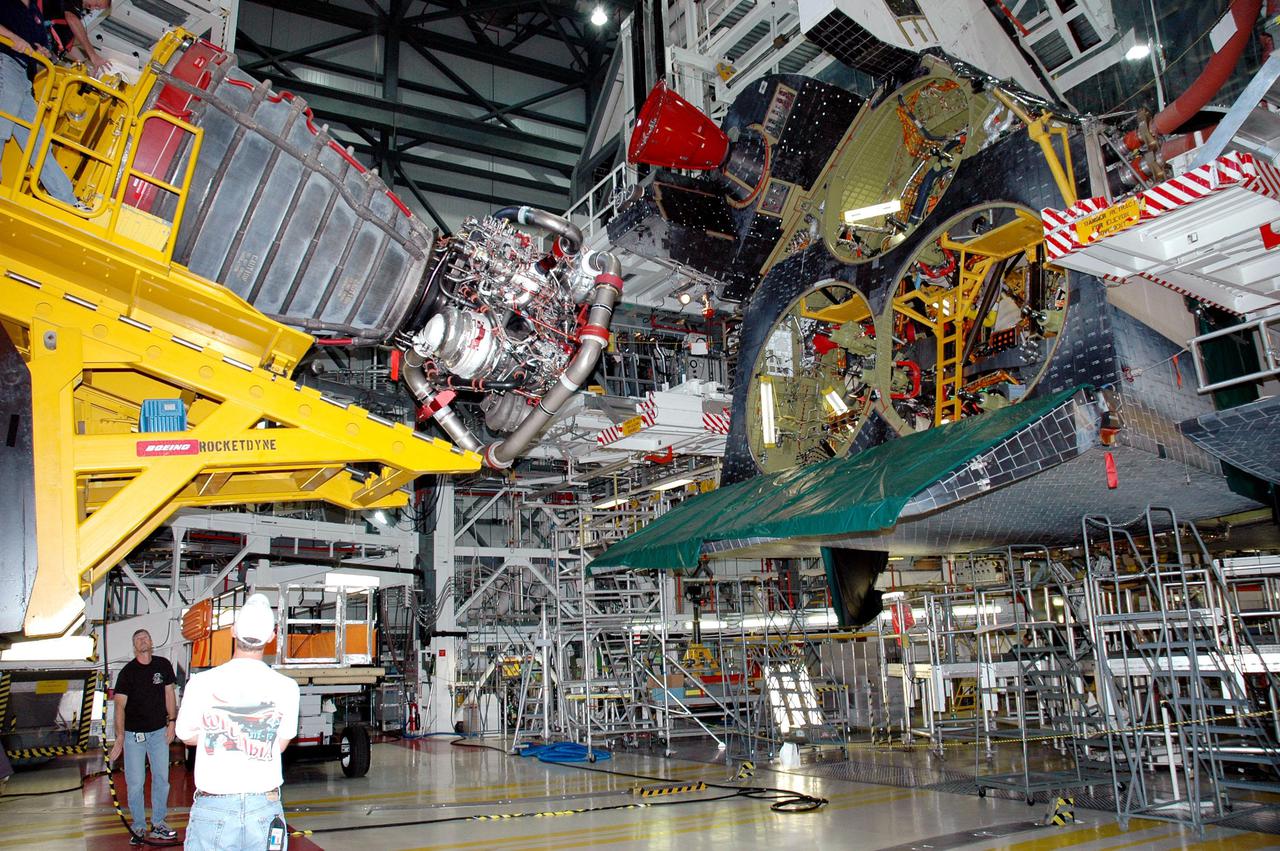
KENNEDY SPACE CENTER, FLA. - In the Orbiter Processing Facility bay 1 at NASA’s Kennedy Space Center, a Hyster fork lift (left) holding the first Space Shuttle Main Engine (SSME) maneuvers into position number 1 (upper chamber) behind Atlantis for installation. Overall, an SSME weighs approximately 7,000 pounds. Three engines provide the thrust, along with the two Solid Rocket Boosters, for liftoff. After about 2 minutes, the two boosters are spent and are separated from the external tank. The SSMEs continue firing for about 8 minutes. They shut down just before the craft is inserted into orbit. The SSMEs are tested at Stennis Space Center in Mississippi. Atlantis is being processed for the second Return to Flight mission, STS-121, scheduled for launch in a window from July 12 through July 31.
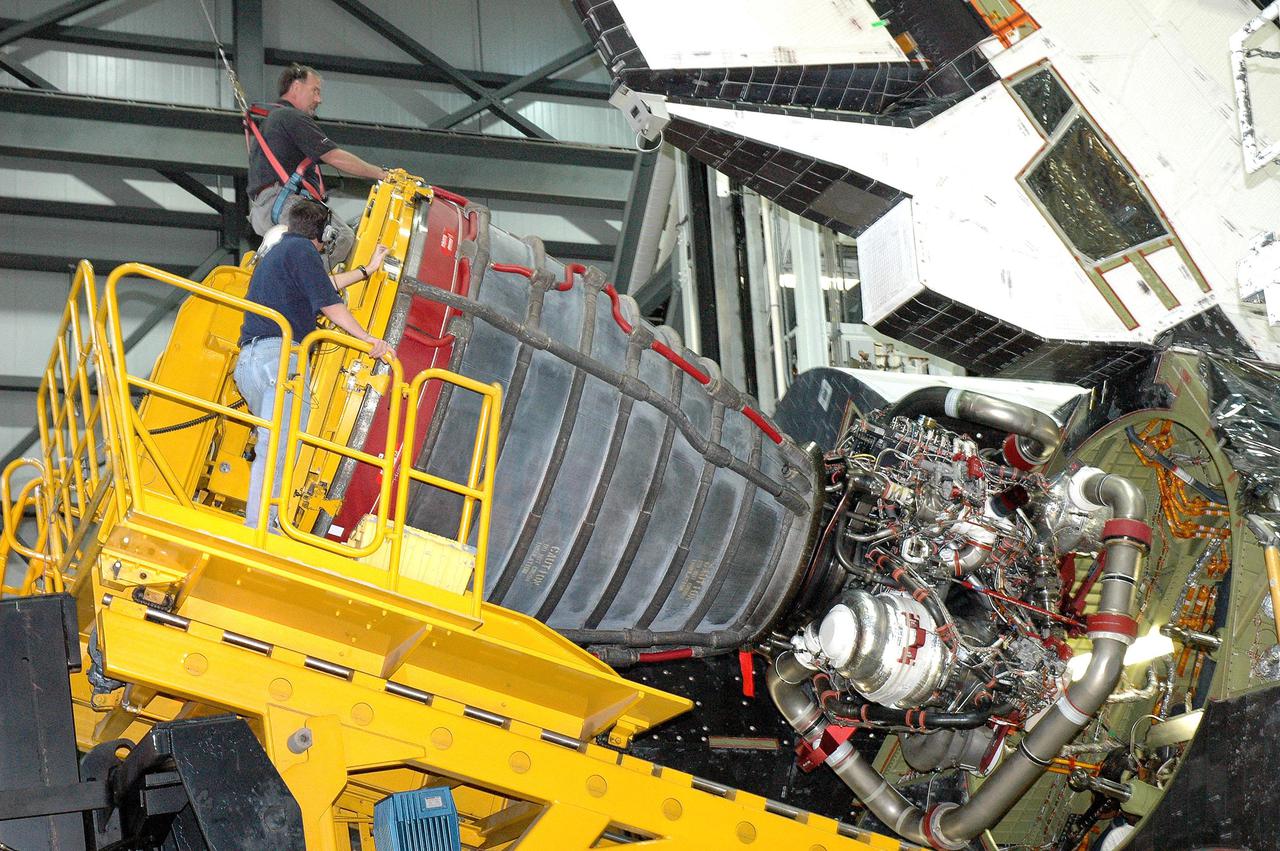
KENNEDY SPACE CENTER, FLA. - In the Orbiter Processing Facility bay 1 at NASA’s Kennedy Space Center, workers guide the Hyster fork lift close to Atlantis to install a Space Shuttle Main Engine (SSME) in position number one (upper chamber). Overall, an SSME weighs approximately 7,000 pounds. Three engines provide the thrust, along with the two Solid Rocket Boosters, for liftoff. After about 2 minutes, the two boosters are spent and are separated from the external tank. The SSMEs continue firing for about 8 minutes. They shut down just before the craft is inserted into orbit. The SSMEs are tested at Stennis Space Center in Mississippi. Atlantis is being processed for the second Return to Flight mission, STS-121, scheduled for launch in a window from July 12 through July 31.
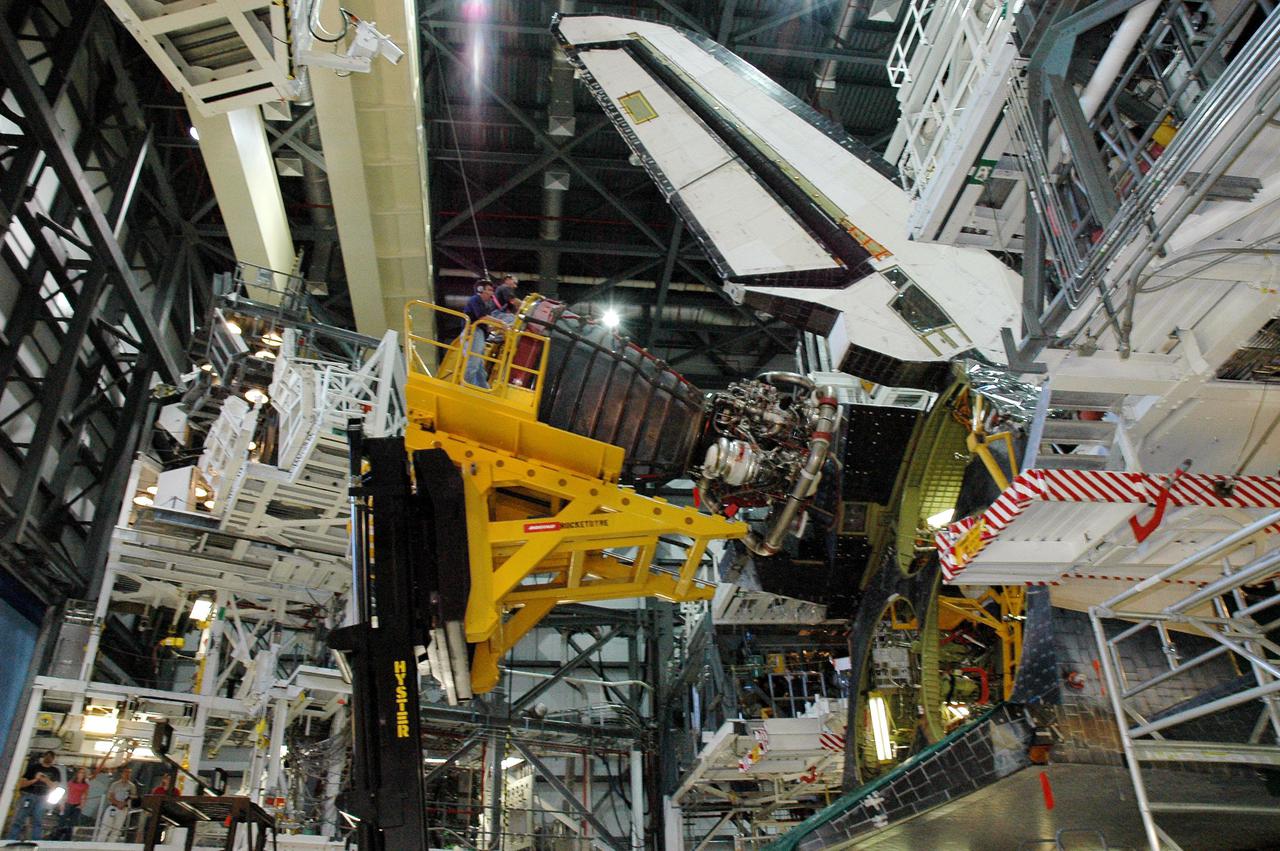
KENNEDY SPACE CENTER, FLA. - In the Orbiter Processing Facility bay 1 at NASA’s Kennedy Space Center, a Hyster fork lift (left) holding Space Shuttle Main Engine (SSME) closes in on position number 1 for installation in Atlantis. Overall, an SSME weighs approximately 7,000 pounds. Three engines provide the thrust, along with the two Solid Rocket Boosters, for liftoff. After about 2 minutes, the two boosters are spent and are separated from the external tank. The SSMEs continue firing for about 8 minutes. They shut down just before the craft is inserted into orbit. The SSMEs are tested at Stennis Space Center in Mississippi. Atlantis is being processed for the second Return to Flight mission, STS-121, scheduled for launch in a window from July 12 through July 31.
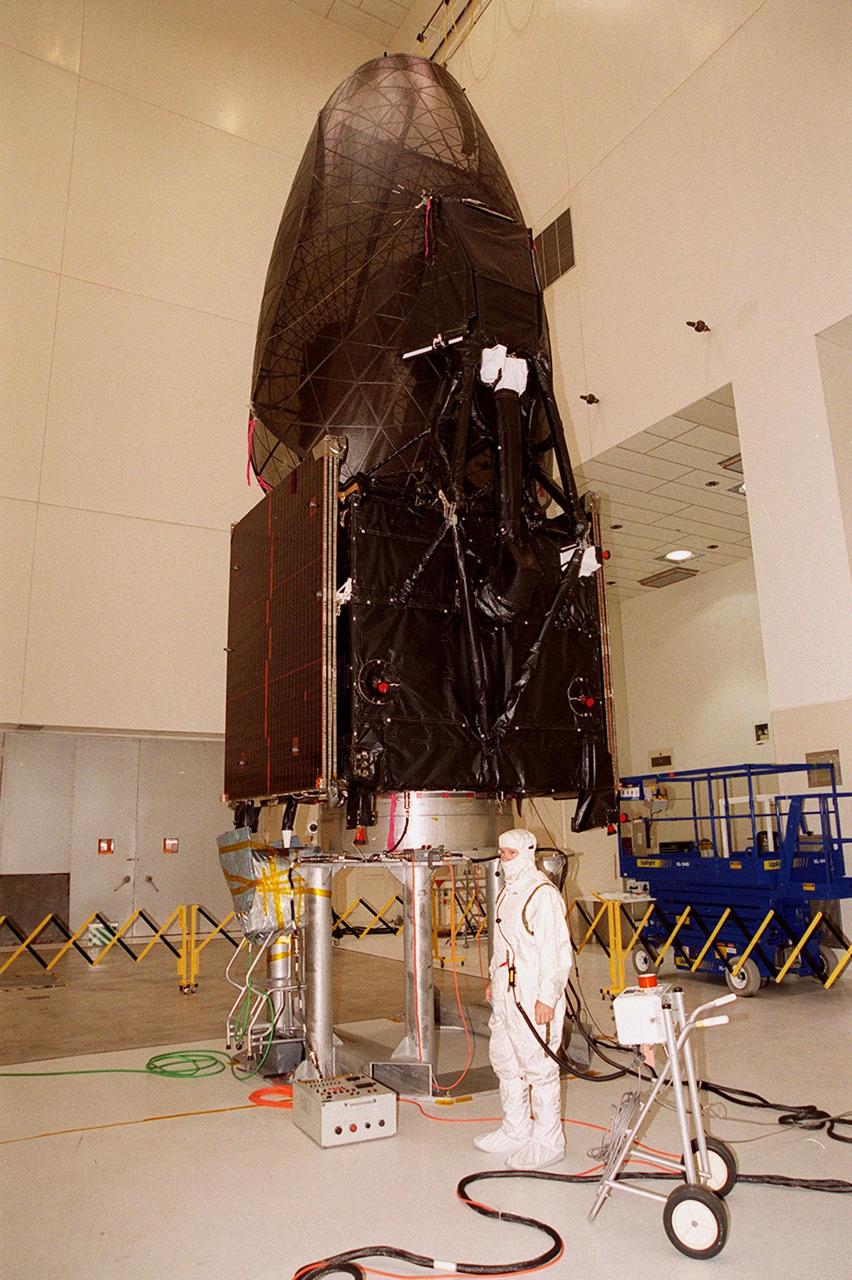
The Tracking and Data Relay Satellite (TDRS-H) sits on a workstand in KSC’s Spacecraft Assembly and Encapsulation Facility (SAEF-2) in order to undergo electrical testing. The TDRS is scheduled to be launched from CCAFS June 29 aboard an Atlas IIA/Centaur rocket. One of three satellites (labeled H, I and J) being built in the Hughes Space and Communications Company Integrated Satellite Factory in El Segundo, Calif., the latest TDRS uses an innovative springback antenna design. A pair of 15-foot-diameter, flexible mesh antenna reflectors fold up for launch, then spring back into their original cupped circular shape on orbit. The new satellites will augment the TDRS system’s existing Sand Ku-band frequencies by adding Ka-band capability. TDRS will serve as the sole means of continuous, high-data-rate communication with the space shuttle, with the International Space Station upon its completion, and with dozens of unmanned scientific satellites in low earth orbit

Workers in KSC’s Spacecraft Assembly and Encapsulation Facility (SAEF-2) prepare the Tracking and Data Relay Satellite (TDRS-H) above them for electrical testing. The TDRS is scheduled to be launched from CCAFS June 29 aboard an Atlas IIA/Centaur rocket. One of three satellites (labeled H, I and J) being built in the Hughes Space and Communications Company Integrated Satellite Factory in El Segundo, Calif., the latest TDRS uses an innovative springback antenna design. A pair of 15-foot-diameter, flexible mesh antenna reflectors fold up for launch, then spring back into their original cupped circular shape on orbit. The new satellites will augment the TDRS system’s existing Sand Ku-band frequencies by adding Ka-band capability. TDRS will serve as the sole means of continuous, high-data-rate communication with the space shuttle, with the International Space Station upon its completion, and with dozens of unmanned scientific satellites in low earth orbit
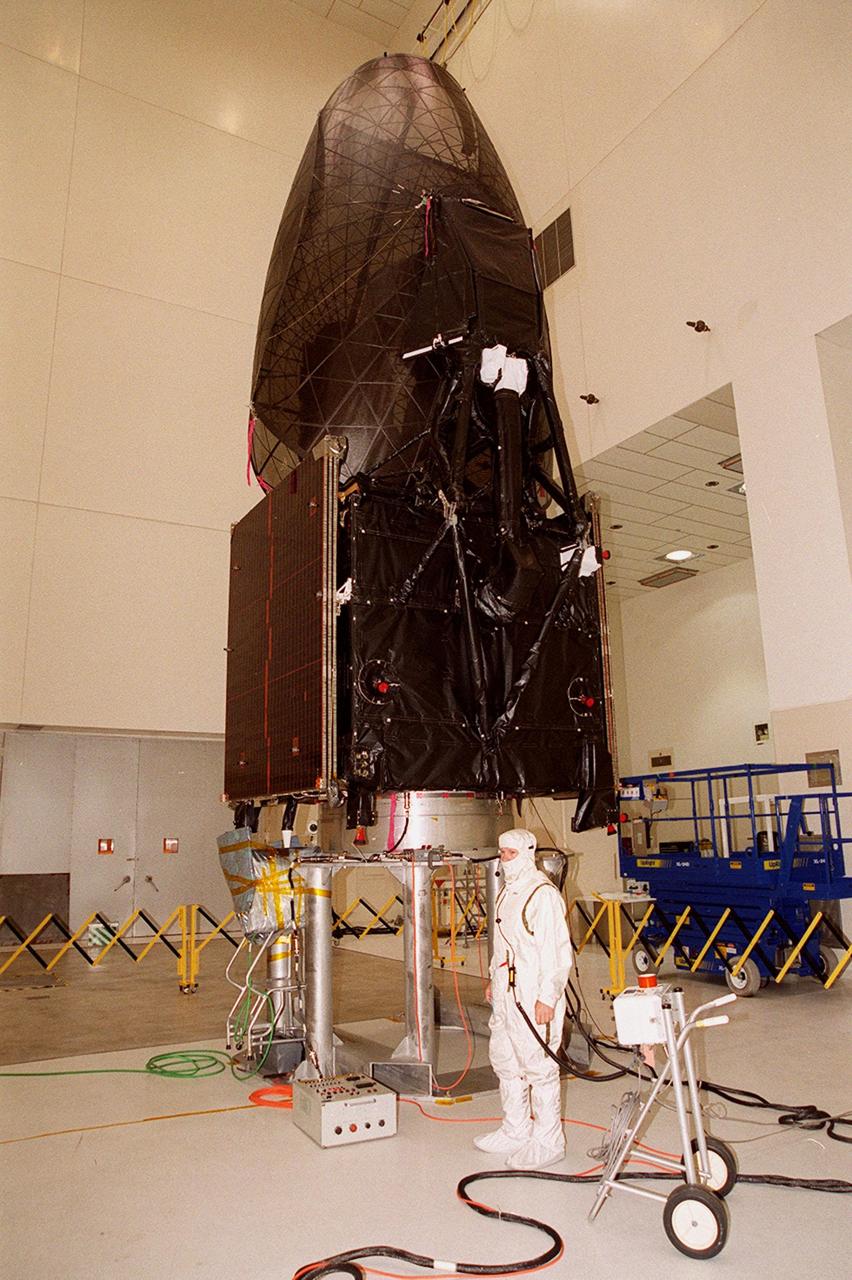
The Tracking and Data Relay Satellite (TDRS-H) sits on a workstand in KSC’s Spacecraft Assembly and Encapsulation Facility (SAEF-2) in order to undergo electrical testing. The TDRS is scheduled to be launched from CCAFS June 29 aboard an Atlas IIA/Centaur rocket. One of three satellites (labeled H, I and J) being built in the Hughes Space and Communications Company Integrated Satellite Factory in El Segundo, Calif., the latest TDRS uses an innovative springback antenna design. A pair of 15-foot-diameter, flexible mesh antenna reflectors fold up for launch, then spring back into their original cupped circular shape on orbit. The new satellites will augment the TDRS system’s existing Sand Ku-band frequencies by adding Ka-band capability. TDRS will serve as the sole means of continuous, high-data-rate communication with the space shuttle, with the International Space Station upon its completion, and with dozens of unmanned scientific satellites in low earth orbit