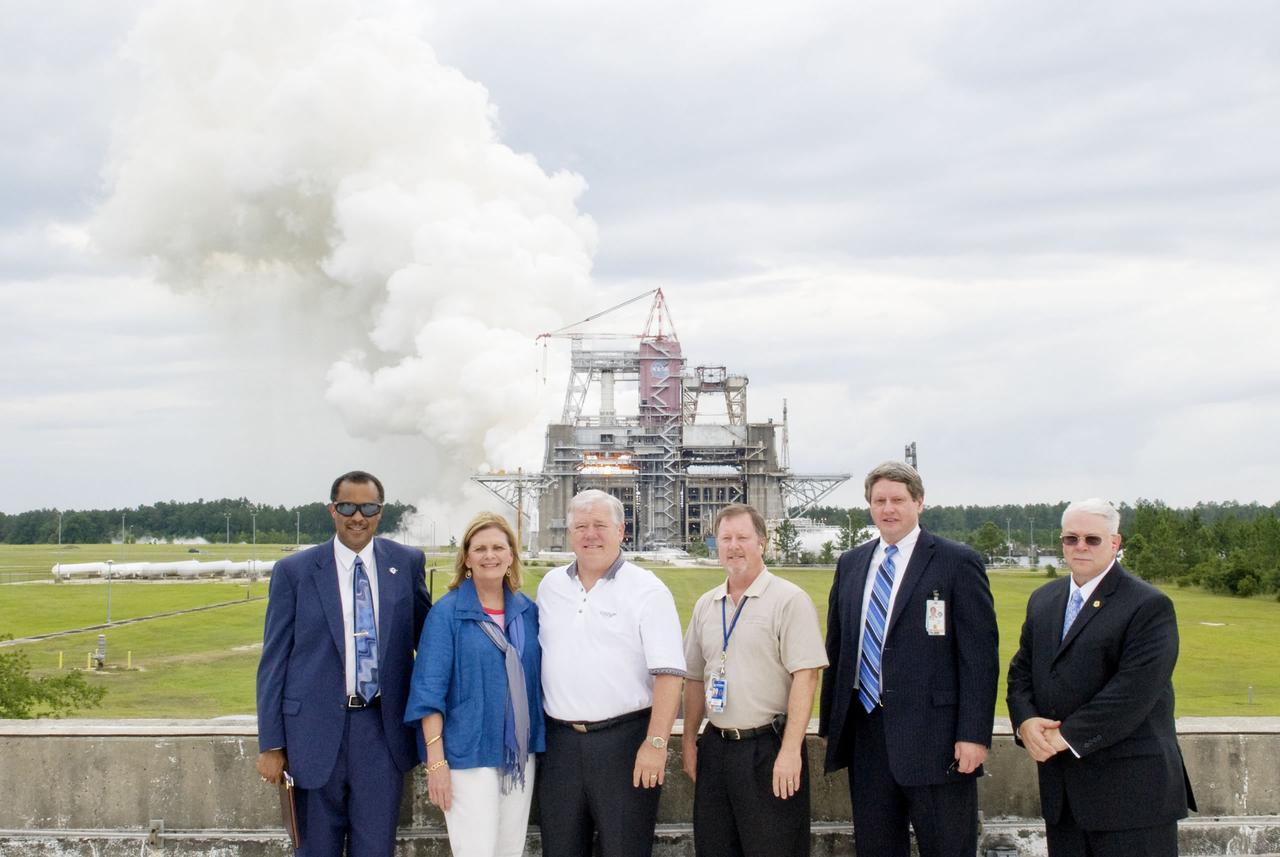
Steam billows from an RS-68 rocket engine test at the B Test Stand at Stennis Space Center on June 2. The test was viewed by Mississippi Gov. Haley Barbour (third from left) and his wife, Marsha, who spent the afternoon at the NASA rocket engine testing center. The governor was joined at the RS-68 test by (l to r) Charles Scales, NASA associate deputy administrator; Jeffrey Wright, Pratt & Whitney Rocketdyne site director at Stennis; Gene Goldman, Stennis director; and Jack Forsythe, NASA assistant administrator for the Office of Security and Program Protection.
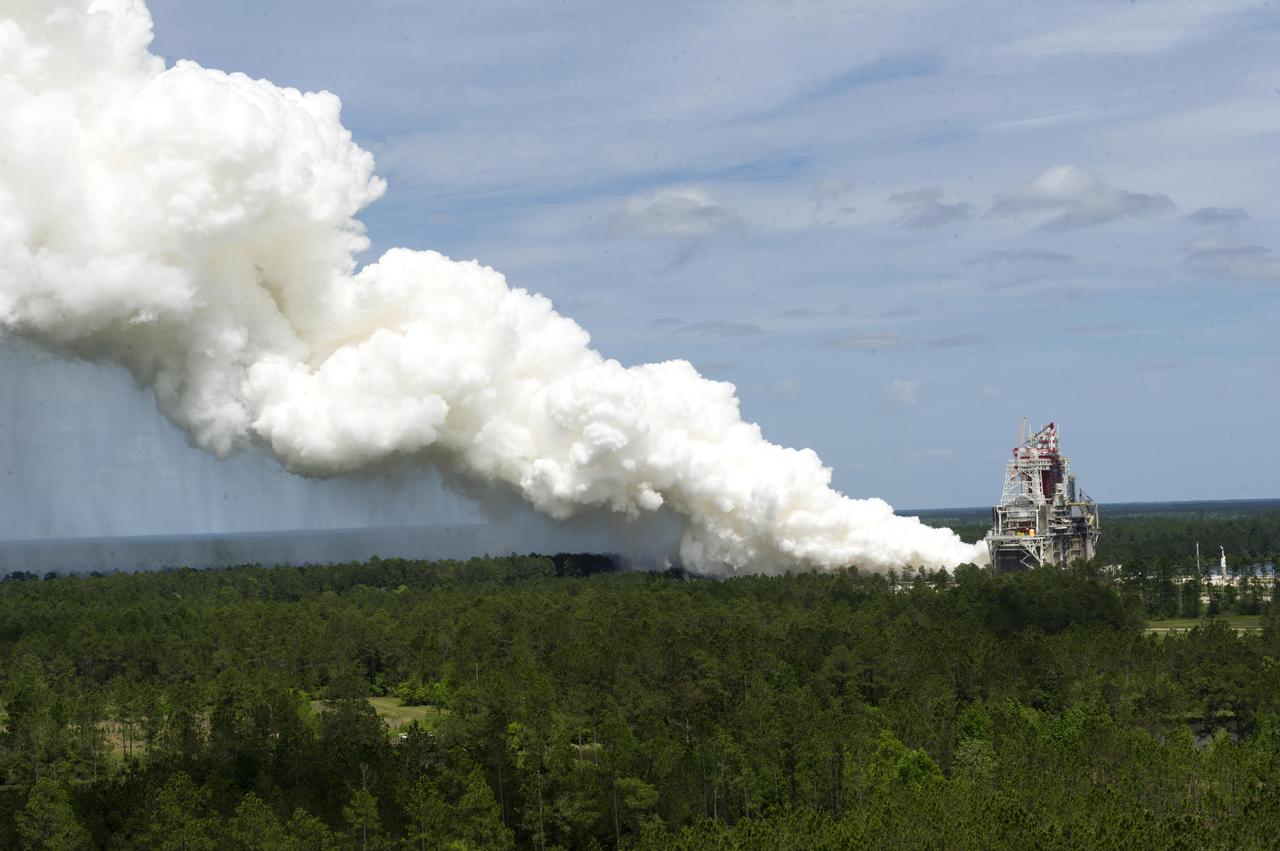
What better way to mark 50 years of rocket engine testing than with a rocket engine test? Stennis Space Center employees enjoyed a chance to view an RS-68 engine test at the B-1 Test Stand on April 19, almost 50 years to the day that the first test was conducted at the south Mississippi site in 1966. The test viewing was part of a weeklong celebration of the 50th year of rocket engine testing at Stennis. The first test at the site occurred April 23, 1966, with a 15-second firing of a Saturn V second stage prototype (S-II-C) on the A-2 Test Stand. The center subsequently tested Apollo rocket stages that carried humans to the moon and every main engine used to power 135 space shuttle missions. It currently tests engines for NASA’s new Space Launch System vehicle.
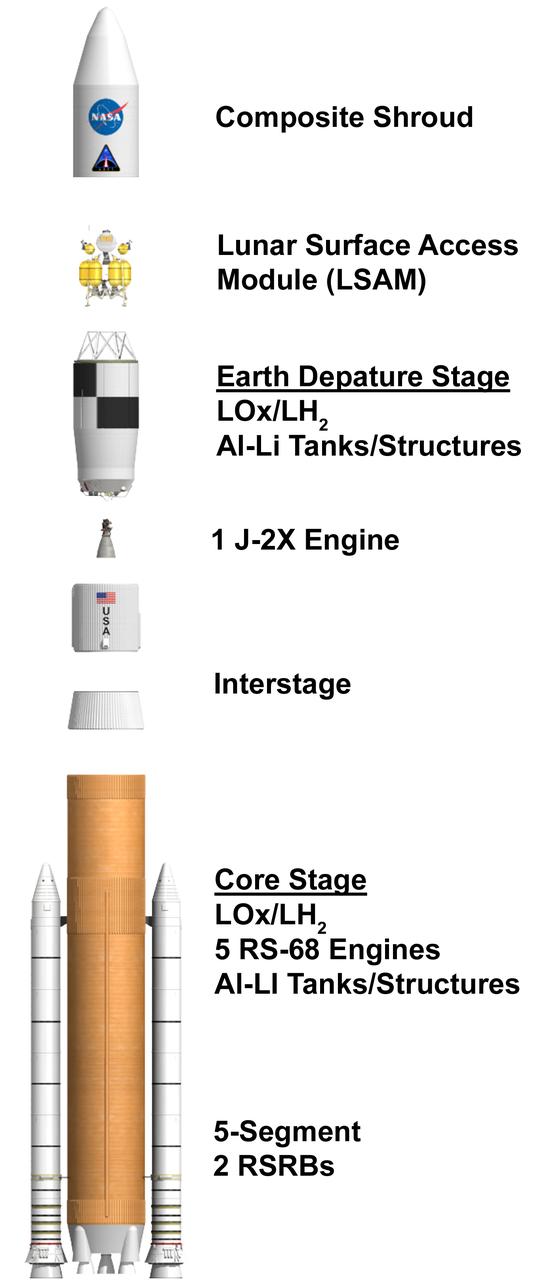
The NASA developed Ares rockets, named for the Greek god associated with Mars, will return humans to the moon and later take them to Mars and other destinations. This is an illustration of the Ares V with call outs. The Ares V is a heavy lift launch vehicle that will use five RS-68 liquid oxygen/liquid hydrogen engines mounted below a larger version of the space shuttle external tank, and two five-segment solid propellant rocket boosters for the first stage. The upper stage will use the same J-2X engine as the Ares I and past Apollo vehicles. The Ares V can lift more than 286,000 pounds to low Earth orbit and stands approximately 360 feet tall. This versatile system will be used to carry cargo and the components into orbit needed to go to the moon and later to Mars. Ares V is subject to configuration changes before it is actually launched. This illustration reflects the latest configuration as of January 2007.
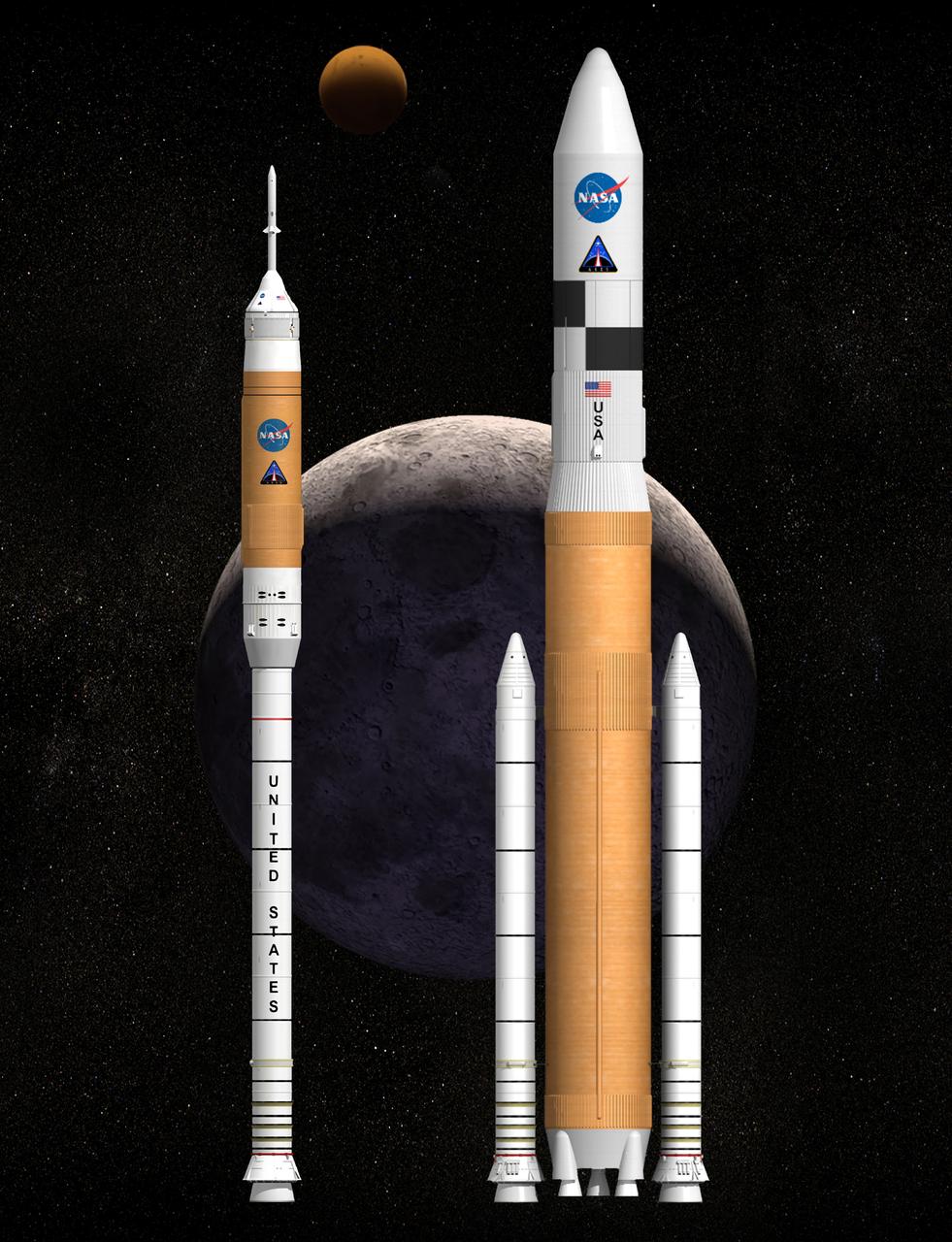
Named for the Greek god associated with Mars, the NASA developed Ares launch vehicles will return humans to the moon and later take them to Mars and other destinations. In this early illustration, the vehicle depicted on the left is the Ares I. Ares I is an inline, two-stage rocket configuration topped by the Orion crew vehicle and its launch abort system. In addition to its primary mission of carrying four to six member crews to Earth orbit, Ares I may also use its 25-ton payload capacity to deliver resources and supplies to the International Space Station (ISS), or to "park" payloads in orbit for retrieval by other spacecraft bound for the moon or other destinations. The Ares I employs a single five-segment solid rocket booster, a derivative of the space shuttle solid rocket booster, for the first stage. A liquid oxygen/liquid hydrogen J-2X engine derived from the J-2 engine used on the second stage of the Apollo vehicle will power the Ares V second stage. The Ares I can lift more than 55,000 pounds to low Earth orbit. The vehicle illustrated on the right is the Ares V, a heavy lift launch vehicle that will use five RS-68 liquid oxygen/liquid hydrogen engines mounted below a larger version of the space shuttle external tank, and two five-segment solid propellant rocket boosters for the first stage. The upper stage will use the same J-2X engine as the Ares I. The Ares V can lift more than 286,000 pounds to low Earth orbit and stands approximately 360 feet tall. This versatile system will be used to carry cargo and the components into orbit needed to go to the moon and later to Mars. Both vehicles are subject to configuration changes before they are actually launched. This illustration reflects the latest configuration as of September 2006.