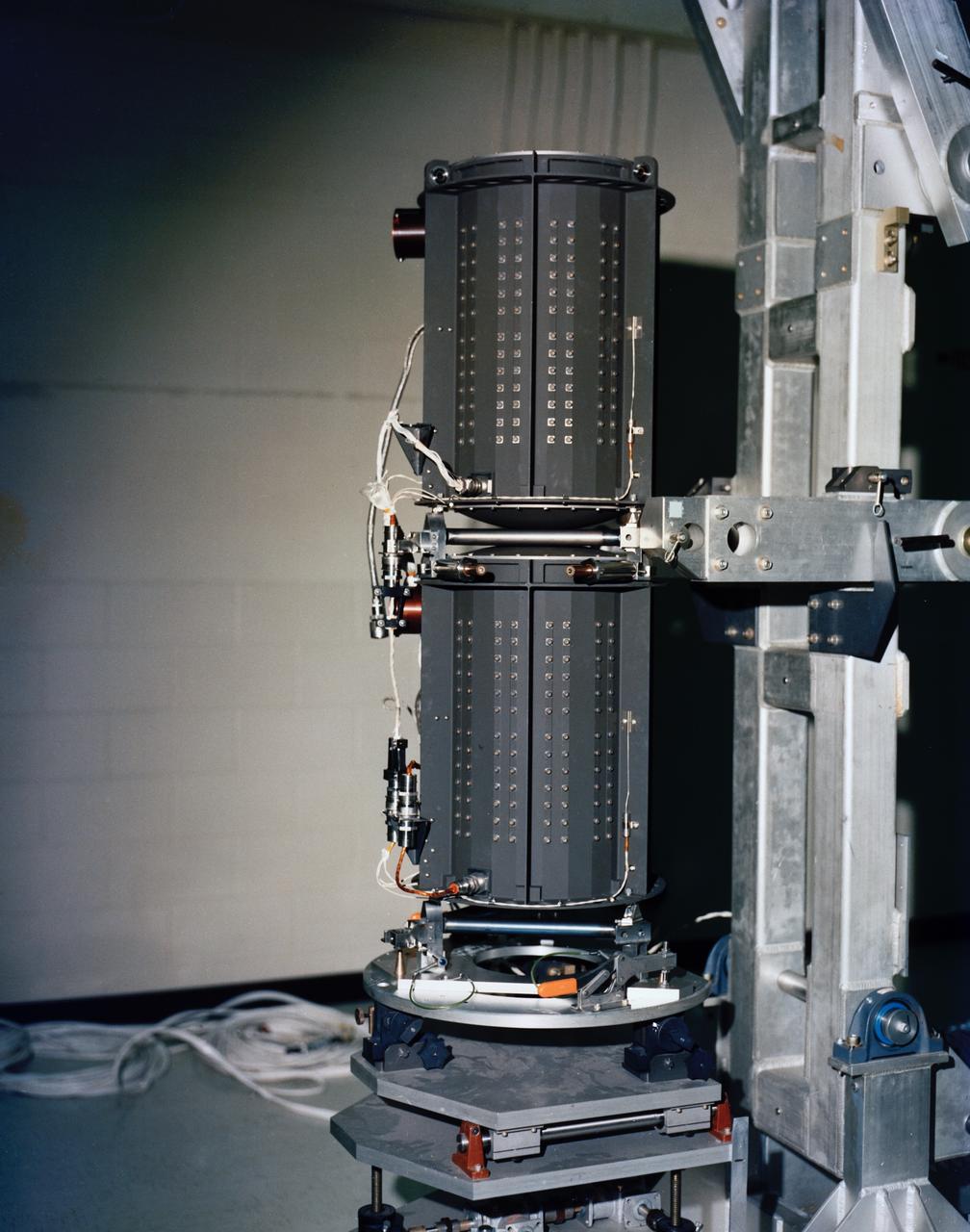
Each of NASA's Voyager probes are equipped with three radioisotope thermoelectric generators (RTGs), including the one shown here at NASA's Kennedy Space Center in Florida. The RTGs provide power for the spacecraft by converting the heat generated by the decay of plutonium-238 into electricity. Launched in 1977, the Voyager mission is managed for NASA by the agency's Jet Propulsion Laboratory, a division of Caltech in Pasadena, California. https://photojournal.jpl.nasa.gov/catalog/PIA25782
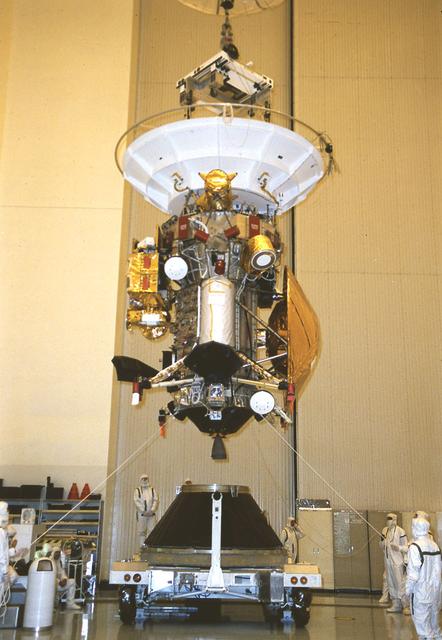
Jet Propulsion Research Lab (JPL) workers use a borescope to verify the pressure relief device bellow's integrity on a radioisotope thermoelectric generator (RTG) that has been installed on the Cassini spacecraft in the Payload Hazardous Servicing Facility. The activity is part of the mechanical and electrical verification testing of RTGs during prelaunch processing. RTGs use heat from the natural decay of plutonium to generate electrical power. The three RTGs on Cassini will enable the spacecraft to operate far from the Sun where solar power systems are not feasible. They will provide electrical power to Cassini on it seven year trip to the Saturnian system and during its four year mission at Saturn.

AS12-46-6790 (19 Nov. 1969) --- Astronaut Alan L. Bean, lunar module pilot, is photographed at quadrant II of the Lunar Module (LM) during the first Apollo 12 extravehicular activity (EVA) on the moon. This picture was taken by astronaut Charles Conrad Jr., commander. Here, Bean is using a fuel transfer tool to remove the fuel element from the fuel cask mounted on the LM's descent stage. The fuel element was then placed in the Radioisotope Thermoelectric Generator (RTG), the power source for the Apollo Lunar Surface Experiments Package (ALSEP) which was deployed on the moon by the two astronauts. The RTG is next to Bean's right leg. While astronauts Conrad and Bean descended in the LM "Intrepid" to explore the Ocean of Storms region of the moon, astronaut Richard F. Gordon Jr., command module pilot, remained with the Command and Service Modules (CSM) "Yankee Clipper" in lunar orbit.
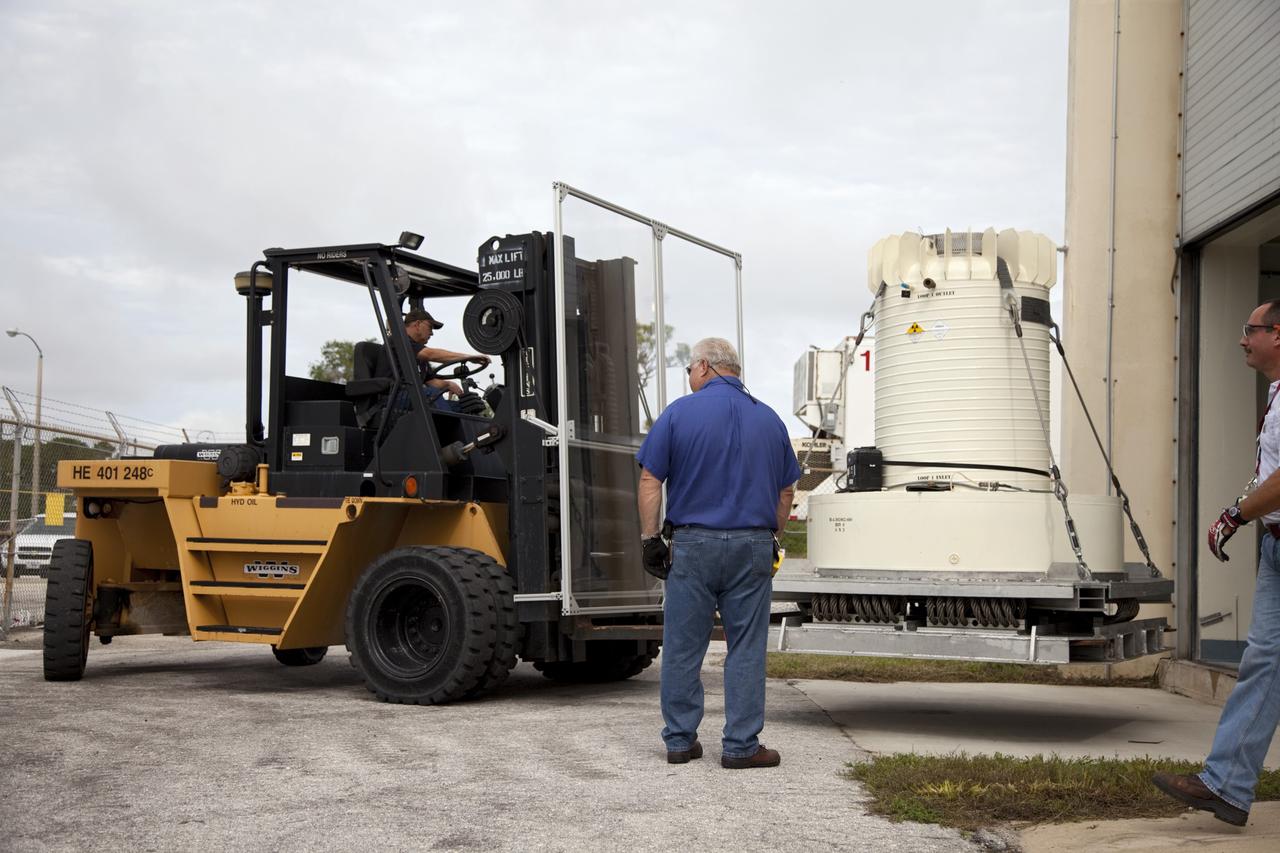
CAPE CANAVERAL, Fla. -- Workers use a forklift to transport the shipping cask enclosing the multi-mission radioisotope thermoelectric generator (MMRTG) for NASA's Mars Science Laboratory mission to the door of the high bay of the RTG storage facility at NASA's Kennedy Space Center in Florida. The MMRTG will generate the power needed for the mission from the natural decay of plutonium-238, a non-weapons-grade form of the radioisotope. Heat given off by this natural decay will provide constant power through the day and night during all seasons. Waste heat from the MMRTG will be circulated throughout the rover system to keep instruments, computers, mechanical devices and communications systems within their operating temperature ranges. MSL's components include a compact car-sized rover, Curiosity, which has 10 science instruments designed to search for evidence on whether Mars has had environments favorable to microbial life, including chemical ingredients for life. The unique rover will use a laser to look inside rocks and release its gasses so that the rover’s spectrometer can analyze and send the data back to Earth. Launch of MSL aboard a United Launch Alliance Atlas V rocket is scheduled for Nov. 25 from Space Launch Complex 41 on Cape Canaveral Air Force Station in Florida. For more information, visit http://www.nasa.gov/msl. Photo credit: NASA/Frankie Martin
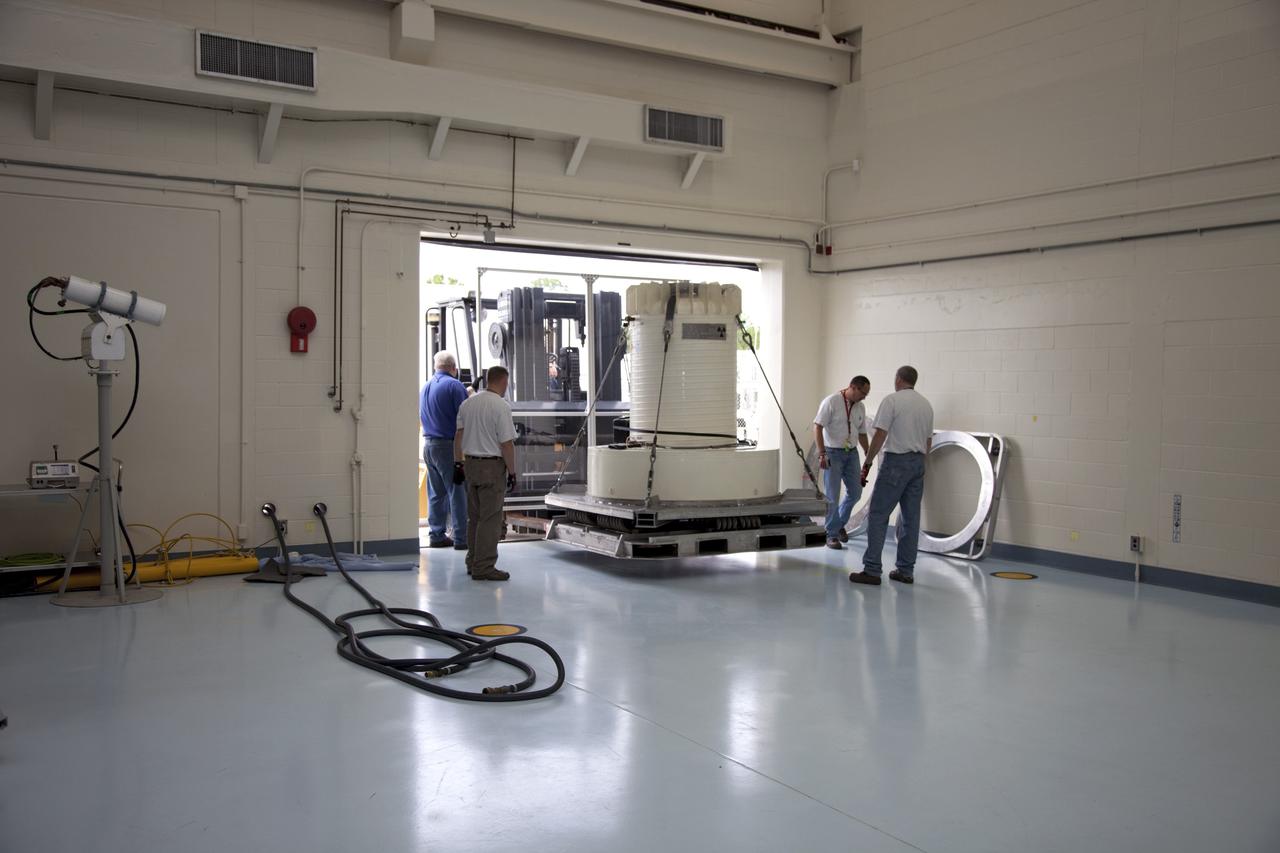
CAPE CANAVERAL, Fla. -- The multi-mission radioisotope thermoelectric generator (MMRTG) for NASA's Mars Science Laboratory mission, enclosed in a shipping cask, rolls into the high bay of the RTG storage facility at NASA's Kennedy Space Center in Florida. The MMRTG will generate the power needed for the mission from the natural decay of plutonium-238, a non-weapons-grade form of the radioisotope. Heat given off by this natural decay will provide constant power through the day and night during all seasons. Waste heat from the MMRTG will be circulated throughout the rover system to keep instruments, computers, mechanical devices and communications systems within their operating temperature ranges. MSL's components include a compact car-sized rover, Curiosity, which has 10 science instruments designed to search for evidence on whether Mars has had environments favorable to microbial life, including chemical ingredients for life. The unique rover will use a laser to look inside rocks and release its gasses so that the rover’s spectrometer can analyze and send the data back to Earth. Launch of MSL aboard a United Launch Alliance Atlas V rocket is scheduled for Nov. 25 from Space Launch Complex 41 on Cape Canaveral Air Force Station in Florida. For more information, visit http://www.nasa.gov/msl. Photo credit: NASA/Frankie Martin
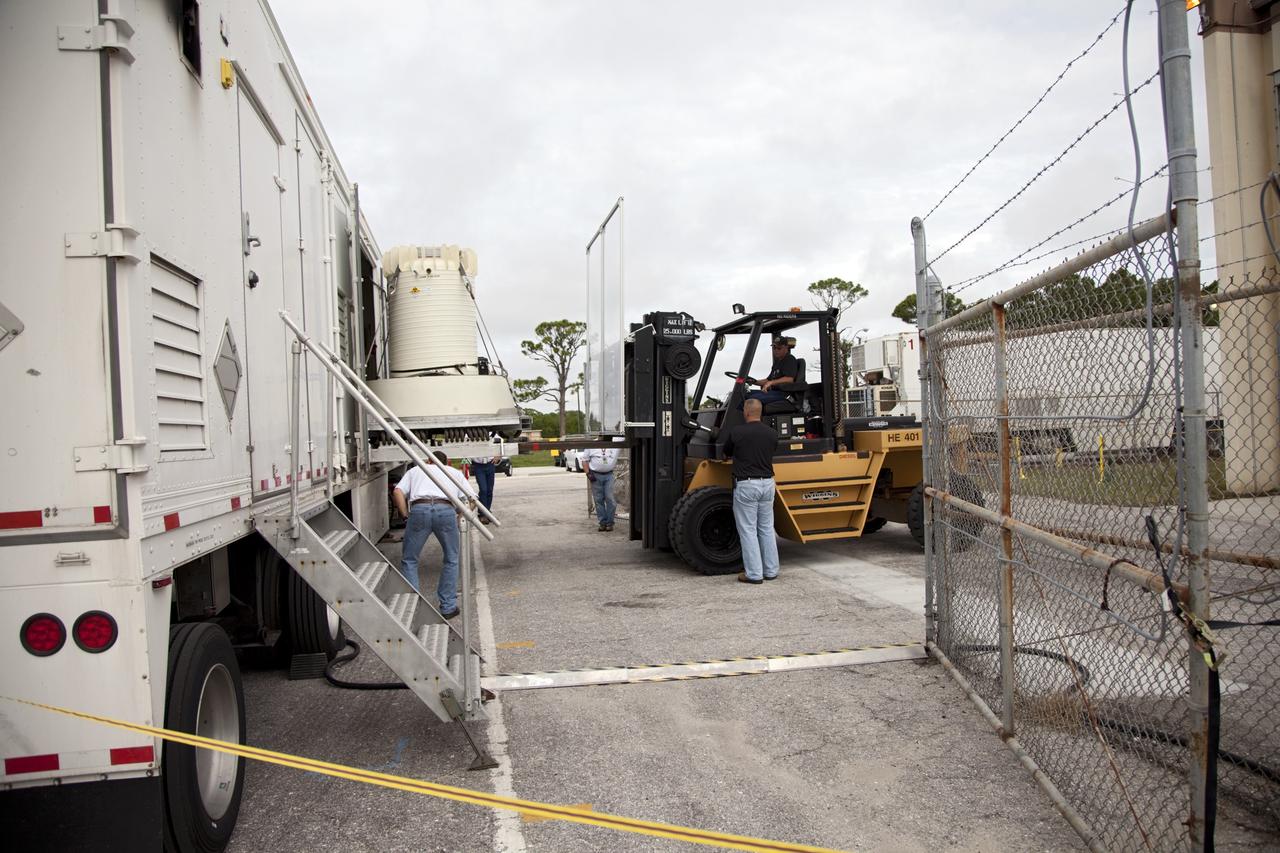
CAPE CANAVERAL, Fla. -- Workers use a forklift to offload the shipping cask enclosing the multi-mission radioisotope thermoelectric generator (MMRTG) for NASA's Mars Science Laboratory mission from the MMRTG trailer that delivered it to the RTG storage facility at NASA's Kennedy Space Center in Florida. The MMRTG will generate the power needed for the mission from the natural decay of plutonium-238, a non-weapons-grade form of the radioisotope. Heat given off by this natural decay will provide constant power through the day and night during all seasons. Waste heat from the MMRTG will be circulated throughout the rover system to keep instruments, computers, mechanical devices and communications systems within their operating temperature ranges. MSL's components include a compact car-sized rover, Curiosity, which has 10 science instruments designed to search for evidence on whether Mars has had environments favorable to microbial life, including chemical ingredients for life. The unique rover will use a laser to look inside rocks and release its gasses so that the rover’s spectrometer can analyze and send the data back to Earth. Launch of MSL aboard a United Launch Alliance Atlas V rocket is scheduled for Nov. 25 from Space Launch Complex 41 on Cape Canaveral Air Force Station in Florida. For more information, visit http://www.nasa.gov/msl. Photo credit: NASA/Frankie Martin
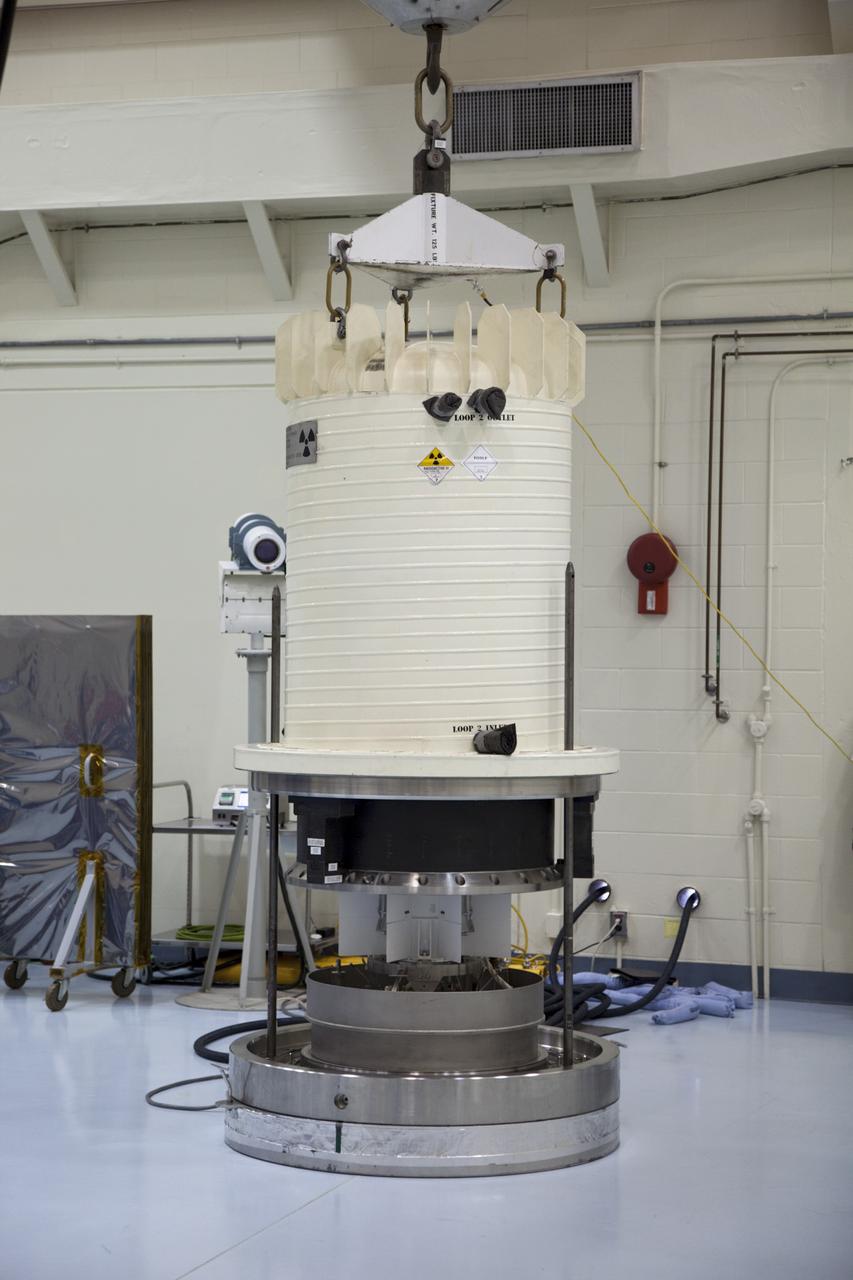
CAPE CANAVERAL, Fla. -- In the high bay of the RTG storage facility at NASA's Kennedy Space Center in Florida, the external and internal protective layers of the shipping cask are lifted from around the multi-mission radioisotope thermoelectric generator (MMRTG) for NASA's Mars Science Laboratory mission. The MMRTG will generate the power needed for the mission from the natural decay of plutonium-238, a non-weapons-grade form of the radioisotope. Heat given off by this natural decay will provide constant power through the day and night during all seasons. Waste heat from the MMRTG will be circulated throughout the rover system to keep instruments, computers, mechanical devices and communications systems within their operating temperature ranges. MSL's components include a compact car-sized rover, Curiosity, which has 10 science instruments designed to search for evidence on whether Mars has had environments favorable to microbial life, including chemical ingredients for life. The unique rover will use a laser to look inside rocks and release its gasses so that the rover’s spectrometer can analyze and send the data back to Earth. Launch of MSL aboard a United Launch Alliance Atlas V rocket is scheduled for Nov. 25 from Space Launch Complex 41 on Cape Canaveral Air Force Station in Florida. For more information, visit http://www.nasa.gov/msl. Photo credit: NASA/Frankie Martin
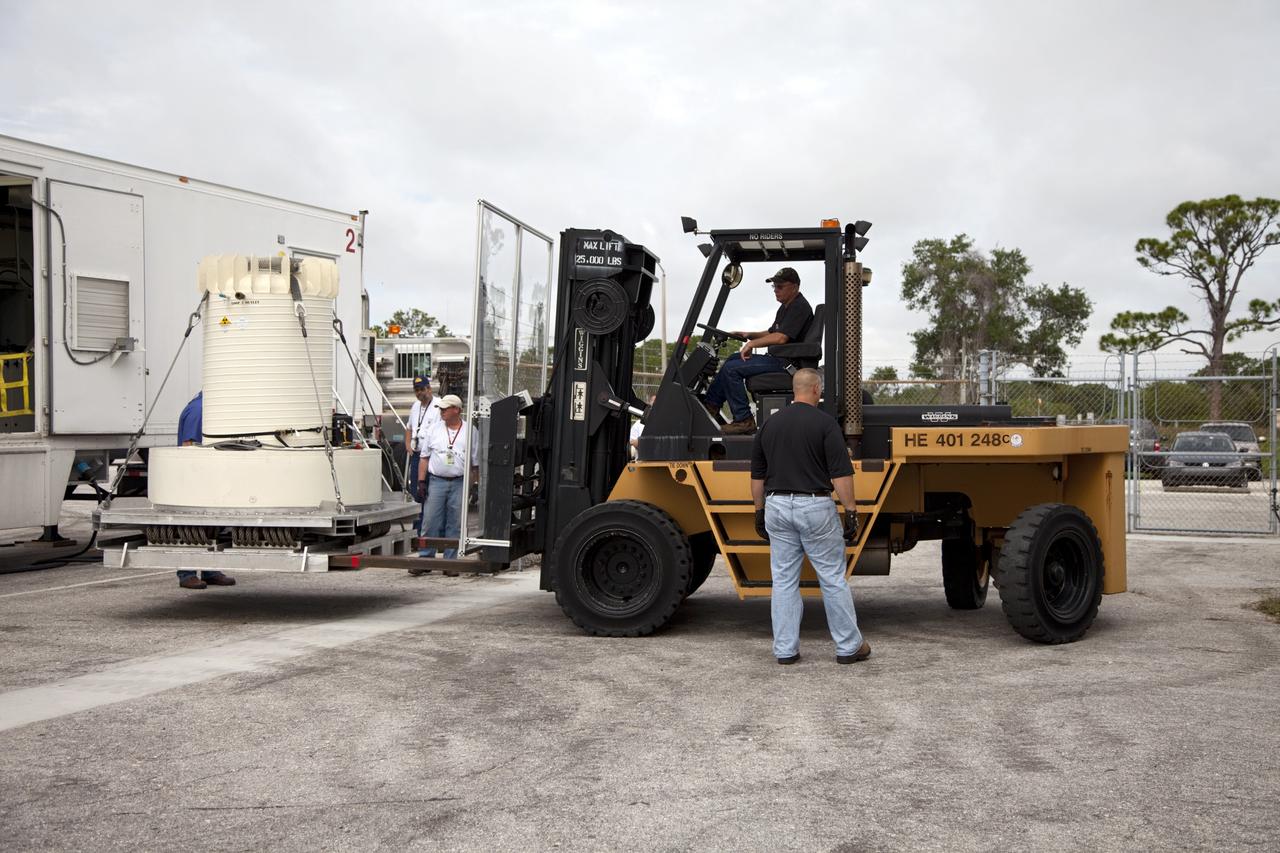
CAPE CANAVERAL, Fla. -- Workers use a forklift to offload the shipping cask enclosing the multi-mission radioisotope thermoelectric generator (MMRTG) for NASA's Mars Science Laboratory mission from the MMRTG trailer that delivered it to the RTG storage facility at NASA's Kennedy Space Center in Florida. The MMRTG will generate the power needed for the mission from the natural decay of plutonium-238, a non-weapons-grade form of the radioisotope. Heat given off by this natural decay will provide constant power through the day and night during all seasons. Waste heat from the MMRTG will be circulated throughout the rover system to keep instruments, computers, mechanical devices and communications systems within their operating temperature ranges. MSL's components include a compact car-sized rover, Curiosity, which has 10 science instruments designed to search for evidence on whether Mars has had environments favorable to microbial life, including chemical ingredients for life. The unique rover will use a laser to look inside rocks and release its gasses so that the rover’s spectrometer can analyze and send the data back to Earth. Launch of MSL aboard a United Launch Alliance Atlas V rocket is scheduled for Nov. 25 from Space Launch Complex 41 on Cape Canaveral Air Force Station in Florida. For more information, visit http://www.nasa.gov/msl. Photo credit: NASA/Frankie Martin
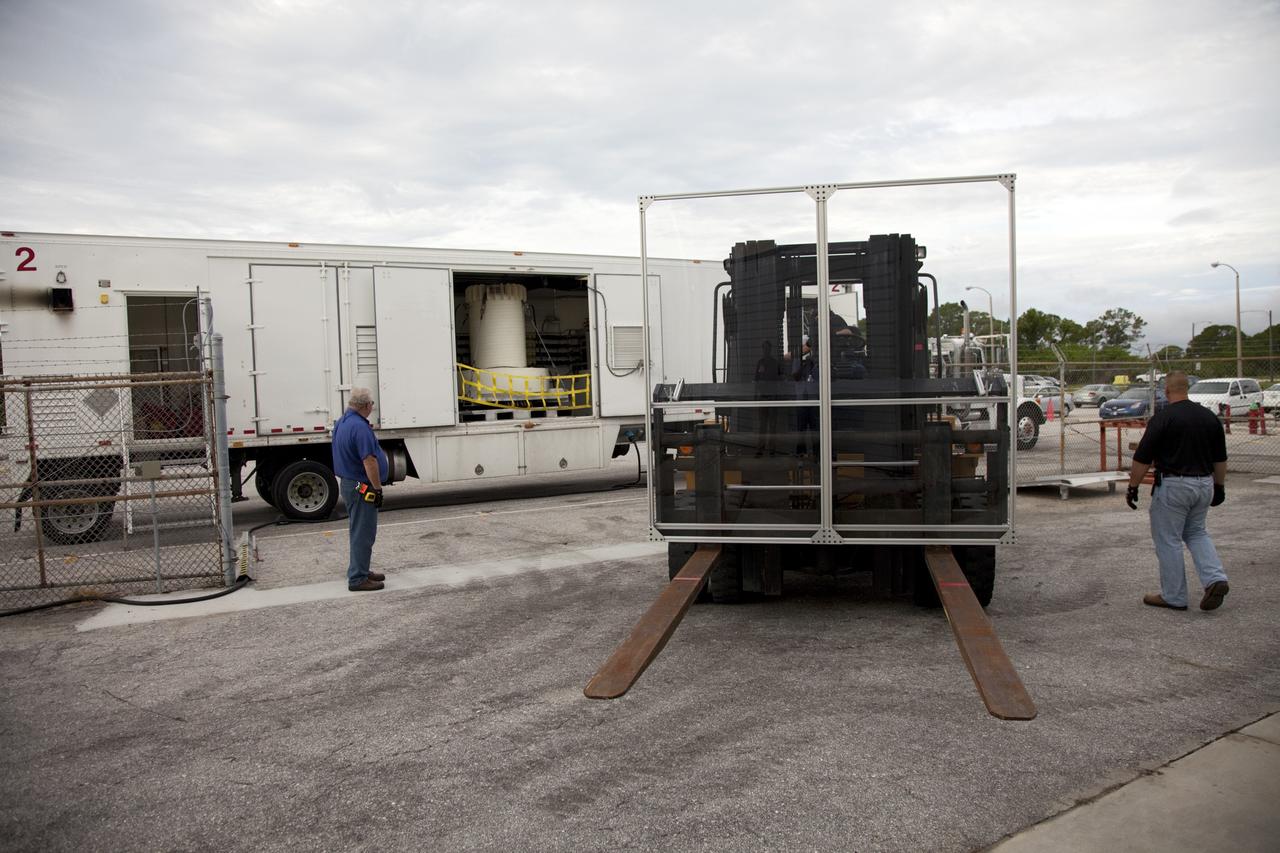
CAPE CANAVERAL, Fla. -- The multi-mission radioisotope thermoelectric generator (MMRTG) for NASA's Mars Science Laboratory mission, enclosed in a shipping cask, is seen through the open door of the MMRTG trailer that delivered it to the RTG storage facility at NASA's Kennedy Space Center in Florida. The MMRTG will generate the power needed for the mission from the natural decay of plutonium-238, a non-weapons-grade form of the radioisotope. Heat given off by this natural decay will provide constant power through the day and night during all seasons. Waste heat from the MMRTG will be circulated throughout the rover system to keep instruments, computers, mechanical devices and communications systems within their operating temperature ranges. MSL's components include a compact car-sized rover, Curiosity, which has 10 science instruments designed to search for evidence on whether Mars has had environments favorable to microbial life, including chemical ingredients for life. The unique rover will use a laser to look inside rocks and release its gasses so that the rover’s spectrometer can analyze and send the data back to Earth. Launch of MSL aboard a United Launch Alliance Atlas V rocket is scheduled for Nov. 25 from Space Launch Complex 41 on Cape Canaveral Air Force Station in Florida. For more information, visit http://www.nasa.gov/msl. Photo credit: NASA/Frankie Martin
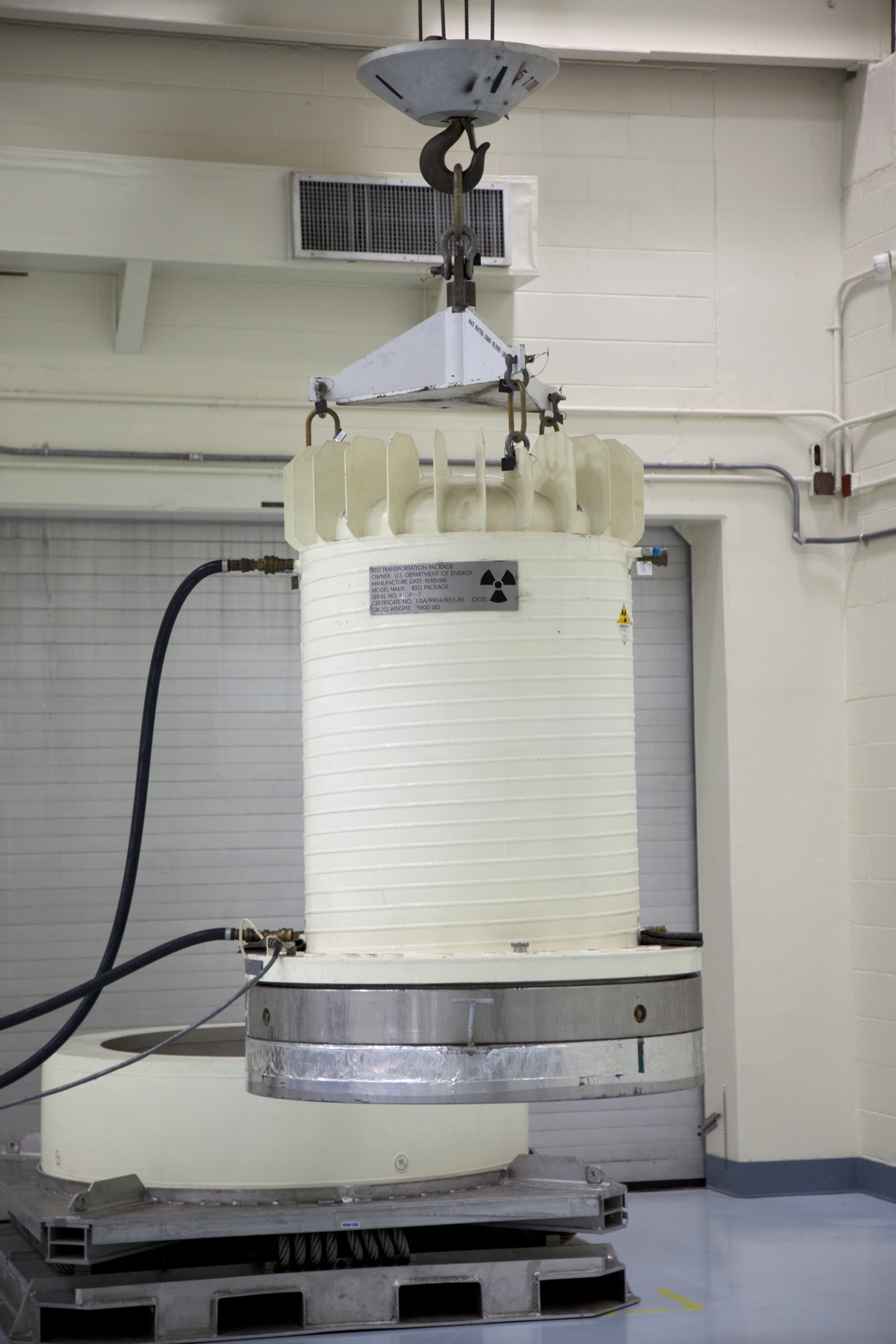
CAPE CANAVERAL, Fla. -- In the high bay of the RTG storage facility at NASA's Kennedy Space Center in Florida, a crane lifts the shipping cask enclosing the multi-mission radioisotope thermoelectric generator (MMRTG) for NASA's Mars Science Laboratory mission from its transportation pallet. The MMRTG will generate the power needed for the mission from the natural decay of plutonium-238, a non-weapons-grade form of the radioisotope. Heat given off by this natural decay will provide constant power through the day and night during all seasons. Waste heat from the MMRTG will be circulated throughout the rover system to keep instruments, computers, mechanical devices and communications systems within their operating temperature ranges. MSL's components include a compact car-sized rover, Curiosity, which has 10 science instruments designed to search for evidence on whether Mars has had environments favorable to microbial life, including chemical ingredients for life. The unique rover will use a laser to look inside rocks and release its gasses so that the rover’s spectrometer can analyze and send the data back to Earth. Launch of MSL aboard a United Launch Alliance Atlas V rocket is scheduled for Nov. 25 from Space Launch Complex 41 on Cape Canaveral Air Force Station in Florida. For more information, visit http://www.nasa.gov/msl. Photo credit: NASA/Frankie Martin
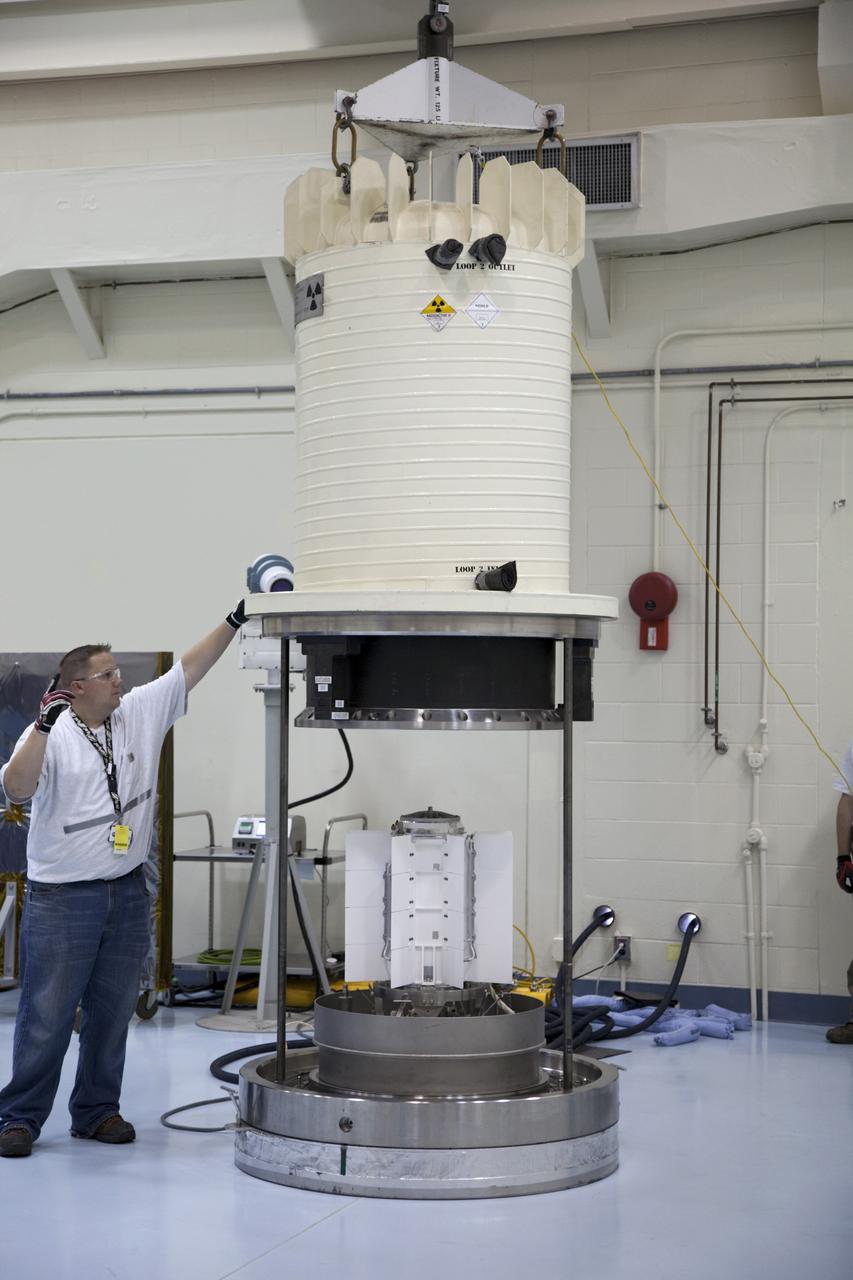
CAPE CANAVERAL, Fla. -- In the high bay of the RTG storage facility at NASA's Kennedy Space Center in Florida, a Department of Energy contractor employee guides the external and internal protective layers of the shipping cask as they are lifted from around the multi-mission radioisotope thermoelectric generator (MMRTG) for NASA's Mars Science Laboratory mission. The MMRTG no longer needs supplemental cooling since any excess heat generated can dissipate into the air in the high bay. The MMRTG will generate the power needed for the mission from the natural decay of plutonium-238, a non-weapons-grade form of the radioisotope. Heat given off by this natural decay will provide constant power through the day and night during all seasons. Waste heat from the MMRTG will be circulated throughout the rover system to keep instruments, computers, mechanical devices and communications systems within their operating temperature ranges. MSL's components include a compact car-sized rover, Curiosity, which has 10 science instruments designed to search for evidence on whether Mars has had environments favorable to microbial life, including chemical ingredients for life. The unique rover will use a laser to look inside rocks and release its gasses so that the rover’s spectrometer can analyze and send the data back to Earth. Launch of MSL aboard a United Launch Alliance Atlas V rocket is scheduled for Nov. 25 from Space Launch Complex 41 on Cape Canaveral Air Force Station in Florida. For more information, visit http://www.nasa.gov/msl. Photo credit: NASA/Frankie Martin
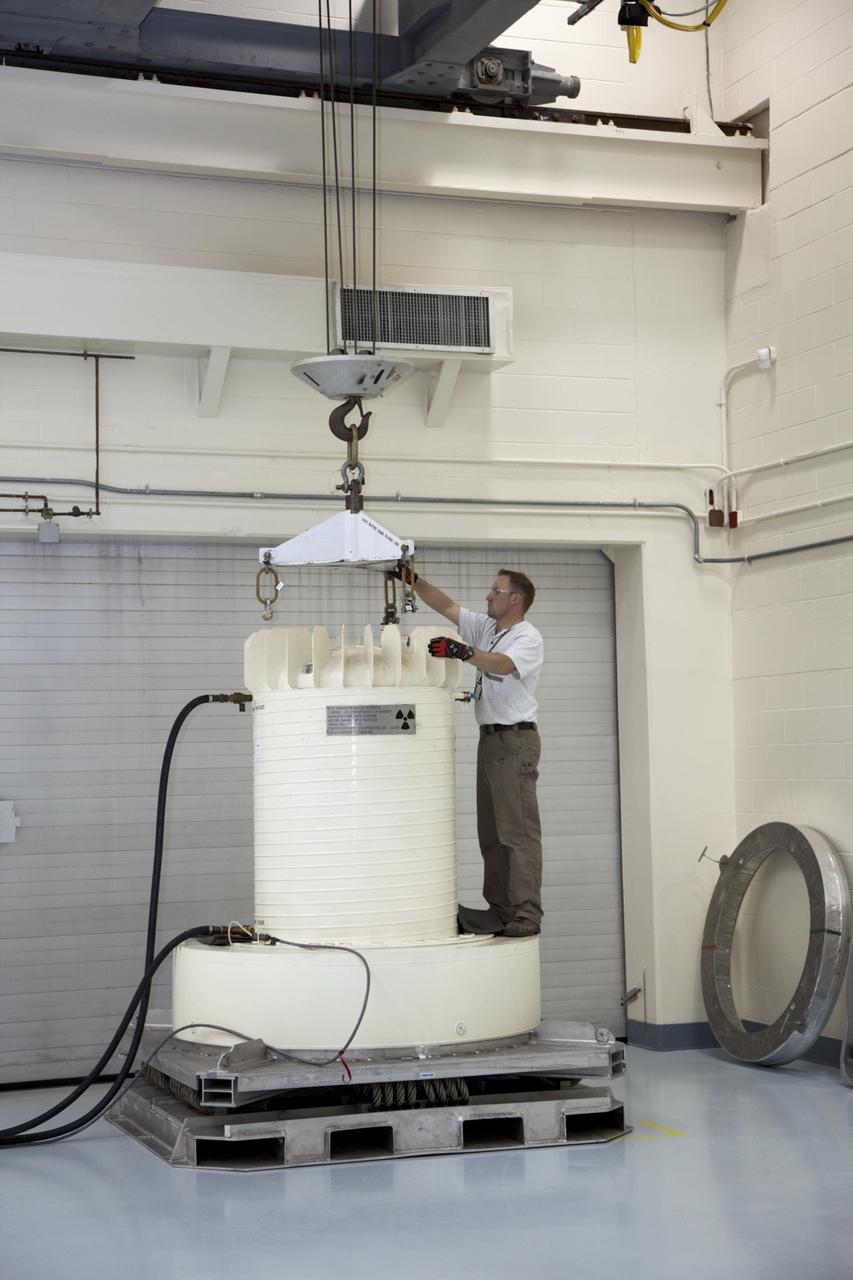
CAPE CANAVERAL, Fla. -- In the high bay of the RTG storage facility at NASA's Kennedy Space Center in Florida, a Department of Energy contractor employee attaches a crane to the shipping cask enclosing the multi-mission radioisotope thermoelectric generator (MMRTG) for NASA's Mars Science Laboratory mission during preparations to lift it from its transportation pallet. The MMRTG will generate the power needed for the mission from the natural decay of plutonium-238, a non-weapons-grade form of the radioisotope. Heat given off by this natural decay will provide constant power through the day and night during all seasons. Waste heat from the MMRTG will be circulated throughout the rover system to keep instruments, computers, mechanical devices and communications systems within their operating temperature ranges. MSL's components include a compact car-sized rover, Curiosity, which has 10 science instruments designed to search for evidence on whether Mars has had environments favorable to microbial life, including chemical ingredients for life. The unique rover will use a laser to look inside rocks and release its gasses so that the rover’s spectrometer can analyze and send the data back to Earth. Launch of MSL aboard a United Launch Alliance Atlas V rocket is scheduled for Nov. 25 from Space Launch Complex 41 on Cape Canaveral Air Force Station in Florida. For more information, visit http://www.nasa.gov/msl. Photo credit: NASA/Frankie Martin
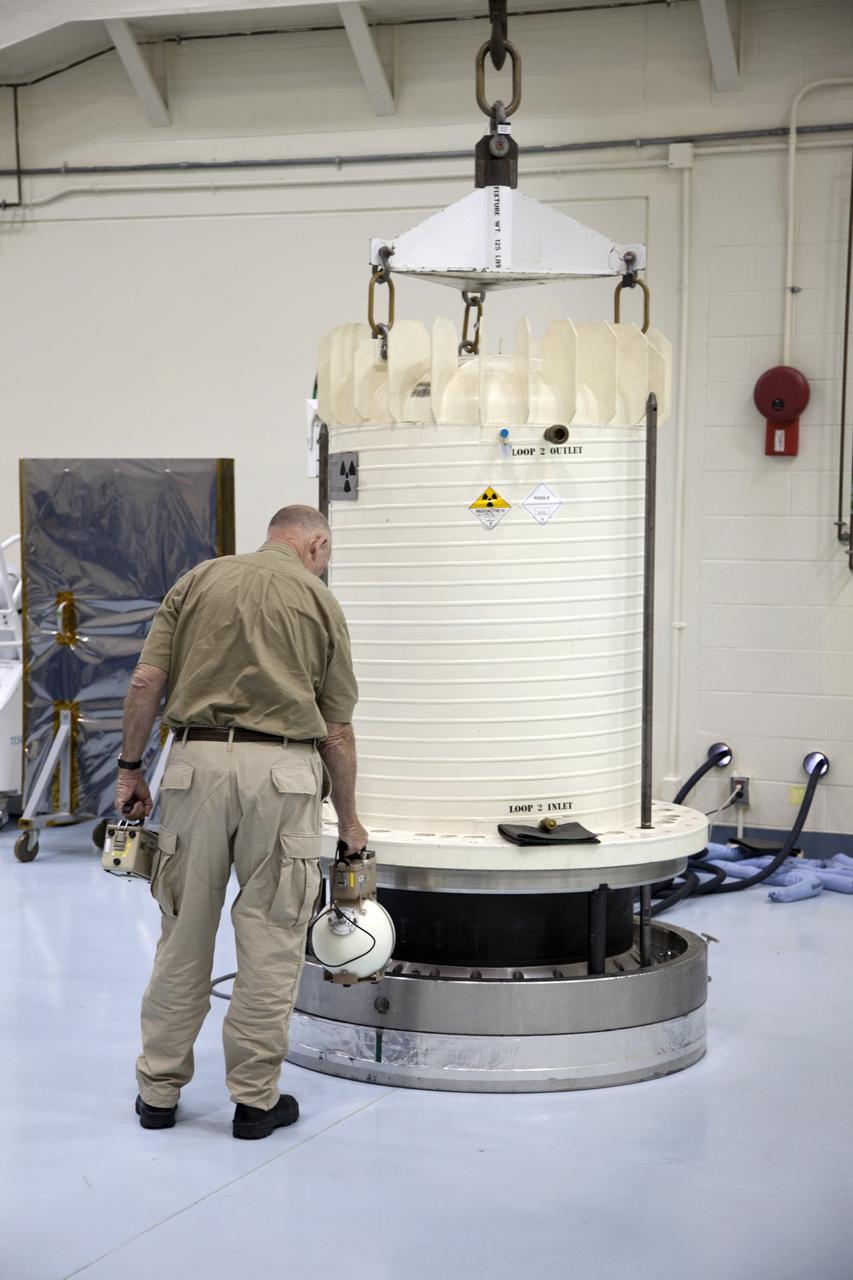
CAPE CANAVERAL, Fla. -- In the high bay of the RTG storage facility at NASA's Kennedy Space Center in Florida, Innovative Health Applications employee David Lake measures the level of radioactivity emitted from the multi-mission radioisotope thermoelectric generator (MMRTG) for NASA's Mars Science Laboratory mission as the external protective layer of the shipping cask is removed. The MMRTG will generate the power needed for the mission from the natural decay of plutonium-238, a non-weapons-grade form of the radioisotope. Heat given off by this natural decay will provide constant power through the day and night during all seasons. Waste heat from the MMRTG will be circulated throughout the rover system to keep instruments, computers, mechanical devices and communications systems within their operating temperature ranges. MSL's components include a compact car-sized rover, Curiosity, which has 10 science instruments designed to search for evidence on whether Mars has had environments favorable to microbial life, including chemical ingredients for life. The unique rover will use a laser to look inside rocks and release its gasses so that the rover’s spectrometer can analyze and send the data back to Earth. Launch of MSL aboard a United Launch Alliance Atlas V rocket is scheduled for Nov. 25 from Space Launch Complex 41 on Cape Canaveral Air Force Station in Florida. For more information, visit http://www.nasa.gov/msl. Photo credit: NASA/Frankie Martin
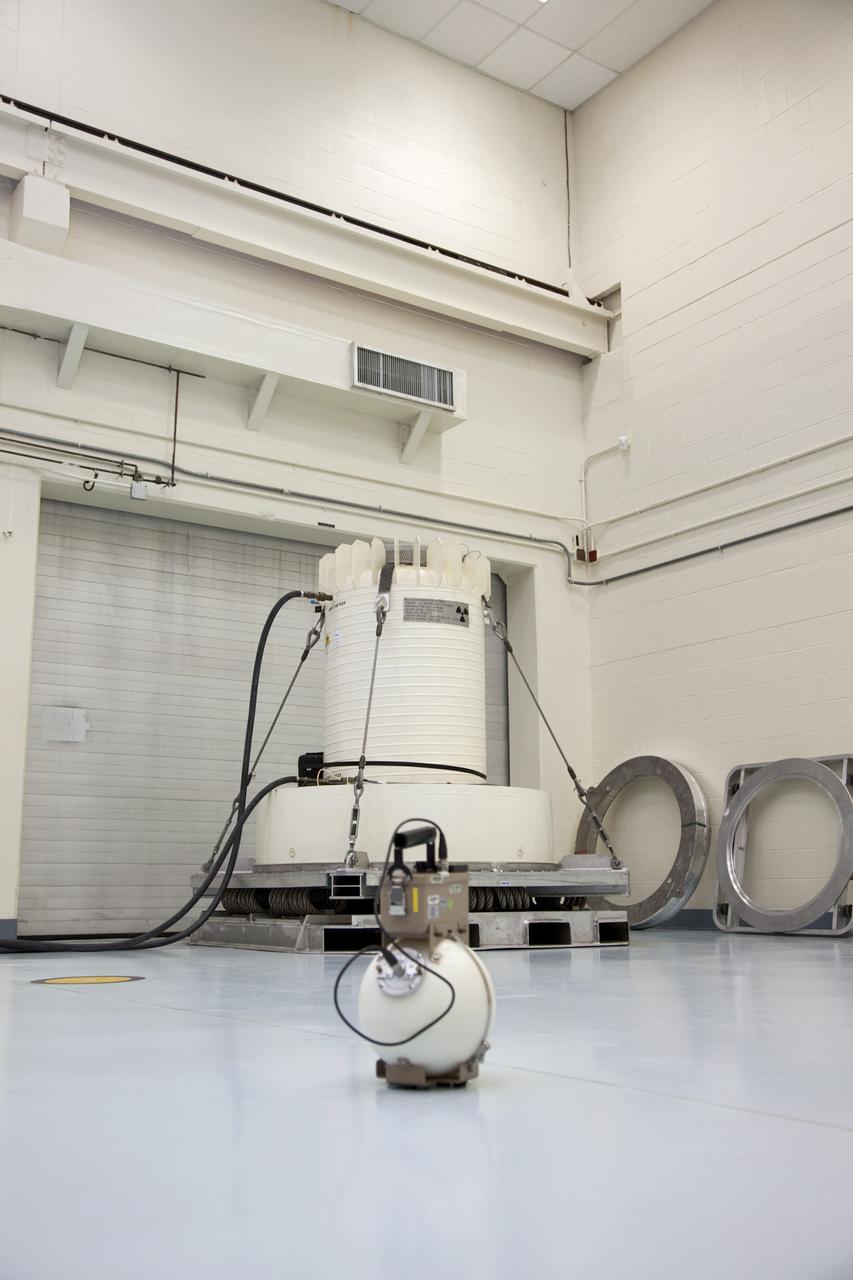
CAPE CANAVERAL, Fla. -- In the high bay of the RTG storage facility at NASA's Kennedy Space Center in Florida, measurements are taken to determine the level of radioactivity emitted from the multi-mission radioisotope thermoelectric generator (MMRTG) for NASA's Mars Science Laboratory mission, enclosed in a shipping cask in the background. The MMRTG will generate the power needed for the mission from the natural decay of plutonium-238, a non-weapons-grade form of the radioisotope. Heat given off by this natural decay will provide constant power through the day and night during all seasons. Waste heat from the MMRTG will be circulated throughout the rover system to keep instruments, computers, mechanical devices and communications systems within their operating temperature ranges. MSL's components include a compact car-sized rover, Curiosity, which has 10 science instruments designed to search for evidence on whether Mars has had environments favorable to microbial life, including chemical ingredients for life. The unique rover will use a laser to look inside rocks and release its gasses so that the rover’s spectrometer can analyze and send the data back to Earth. Launch of MSL aboard a United Launch Alliance Atlas V rocket is scheduled for Nov. 25 from Space Launch Complex 41 on Cape Canaveral Air Force Station in Florida. For more information, visit http://www.nasa.gov/msl. Photo credit: NASA/Frankie Martin
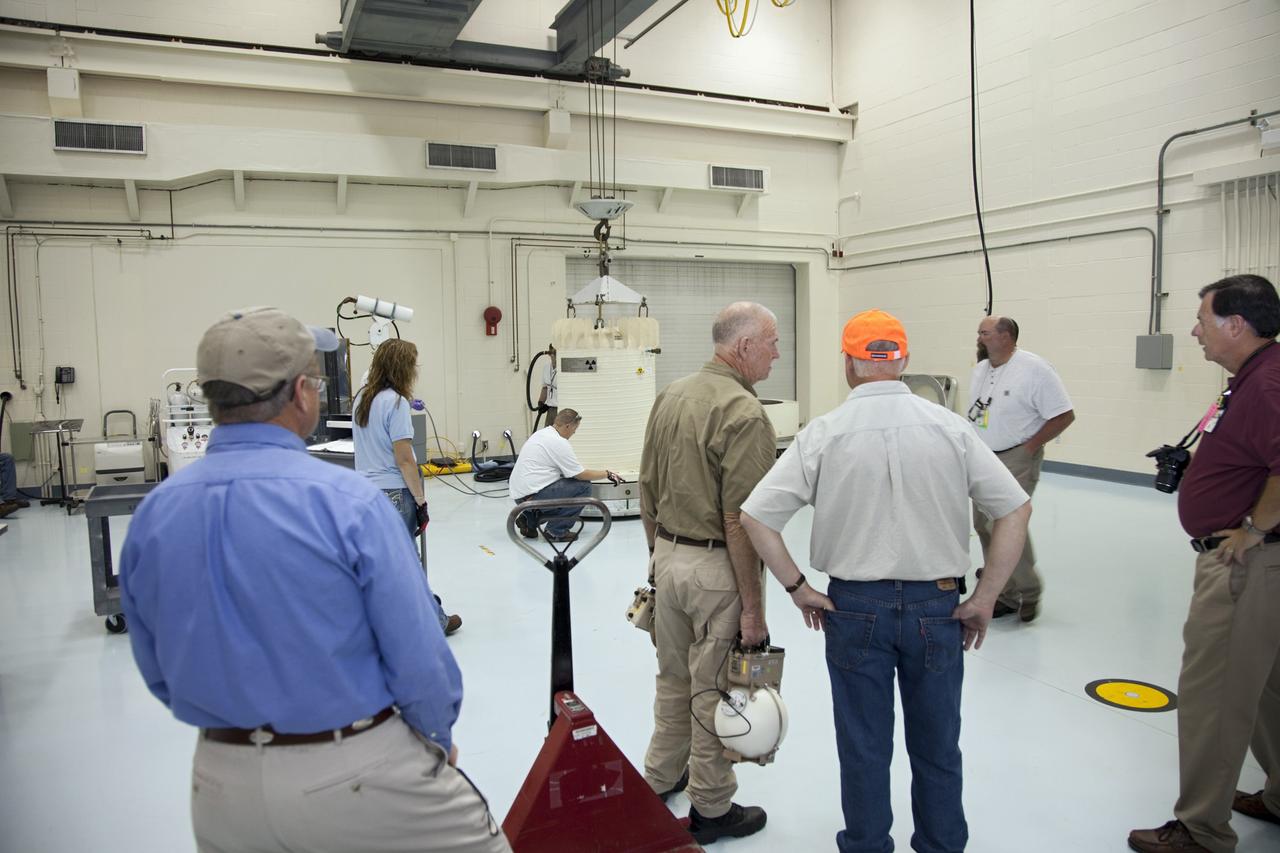
CAPE CANAVERAL, Fla. -- In the RTG storage facility at NASA's Kennedy Space Center in Florida, the shipping cask enclosing the multi-mission radioisotope thermoelectric generator (MMRTG) for NASA's Mars Science Laboratory mission is lowered to the floor of the high bay in preparation for lifting the cask from around the MMRTG. The MMRTG will generate the power needed for the mission from the natural decay of plutonium-238, a non-weapons-grade form of the radioisotope. Heat given off by this natural decay will provide constant power through the day and night during all seasons. Waste heat from the MMRTG will be circulated throughout the rover system to keep instruments, computers, mechanical devices and communications systems within their operating temperature ranges. MSL's components include a compact car-sized rover, Curiosity, which has 10 science instruments designed to search for evidence on whether Mars has had environments favorable to microbial life, including chemical ingredients for life. The unique rover will use a laser to look inside rocks and release its gasses so that the rover’s spectrometer can analyze and send the data back to Earth. Launch of MSL aboard a United Launch Alliance Atlas V rocket is scheduled for Nov. 25 from Space Launch Complex 41 on Cape Canaveral Air Force Station in Florida. For more information, visit http://www.nasa.gov/msl. Photo credit: NASA/Frankie Martin
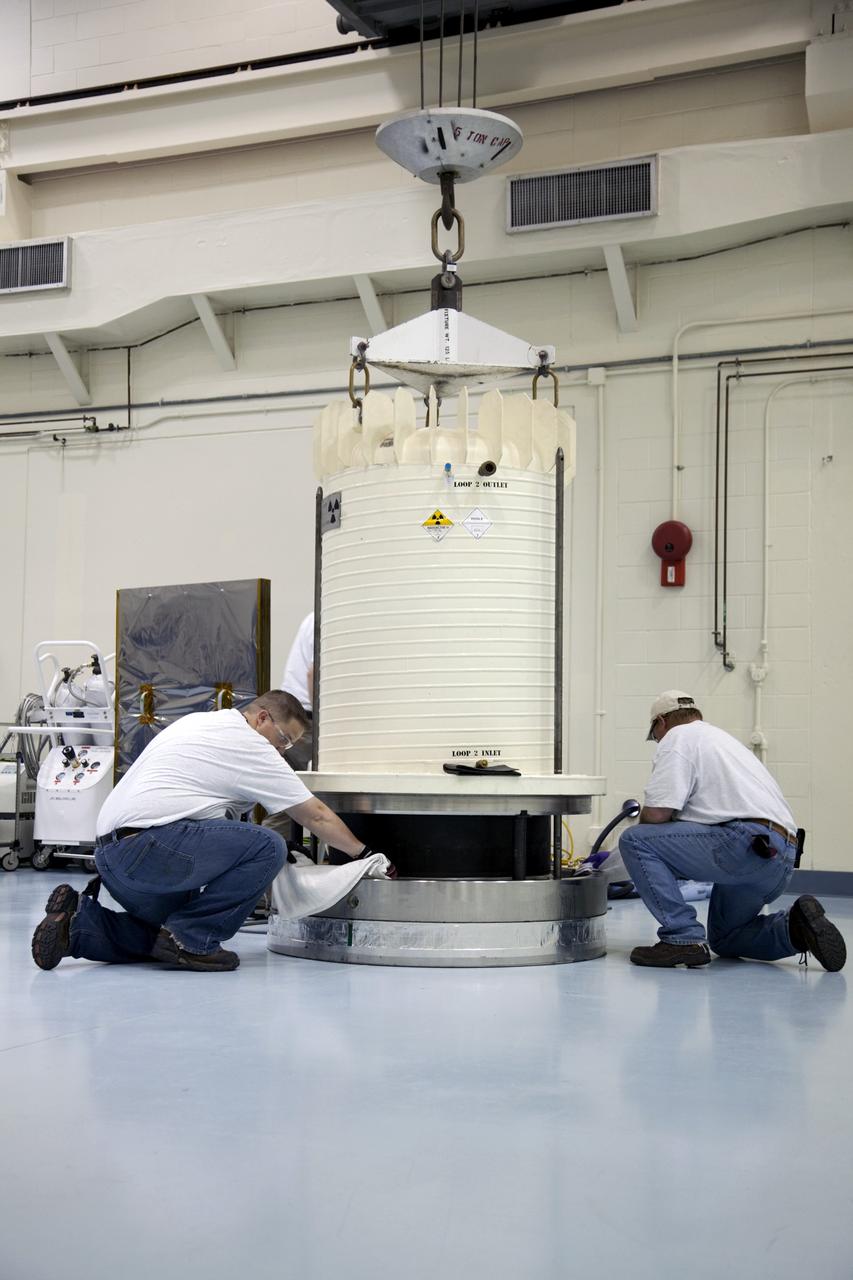
CAPE CANAVERAL, Fla. -- In the high bay of the RTG storage facility at NASA's Kennedy Space Center in Florida, Department of Energy contractor employees remove the external and internal protective layers of the shipping cask enclosing the multi-mission radioisotope thermoelectric generator (MMRTG) for NASA's Mars Science Laboratory mission. The MMRTG will generate the power needed for the mission from the natural decay of plutonium-238, a non-weapons-grade form of the radioisotope. Heat given off by this natural decay will provide constant power through the day and night during all seasons. Waste heat from the MMRTG will be circulated throughout the rover system to keep instruments, computers, mechanical devices and communications systems within their operating temperature ranges. MSL's components include a compact car-sized rover, Curiosity, which has 10 science instruments designed to search for evidence on whether Mars has had environments favorable to microbial life, including chemical ingredients for life. The unique rover will use a laser to look inside rocks and release its gasses so that the rover’s spectrometer can analyze and send the data back to Earth. Launch of MSL aboard a United Launch Alliance Atlas V rocket is scheduled for Nov. 25 from Space Launch Complex 41 on Cape Canaveral Air Force Station in Florida. For more information, visit http://www.nasa.gov/msl. Photo credit: NASA/Frankie Martin
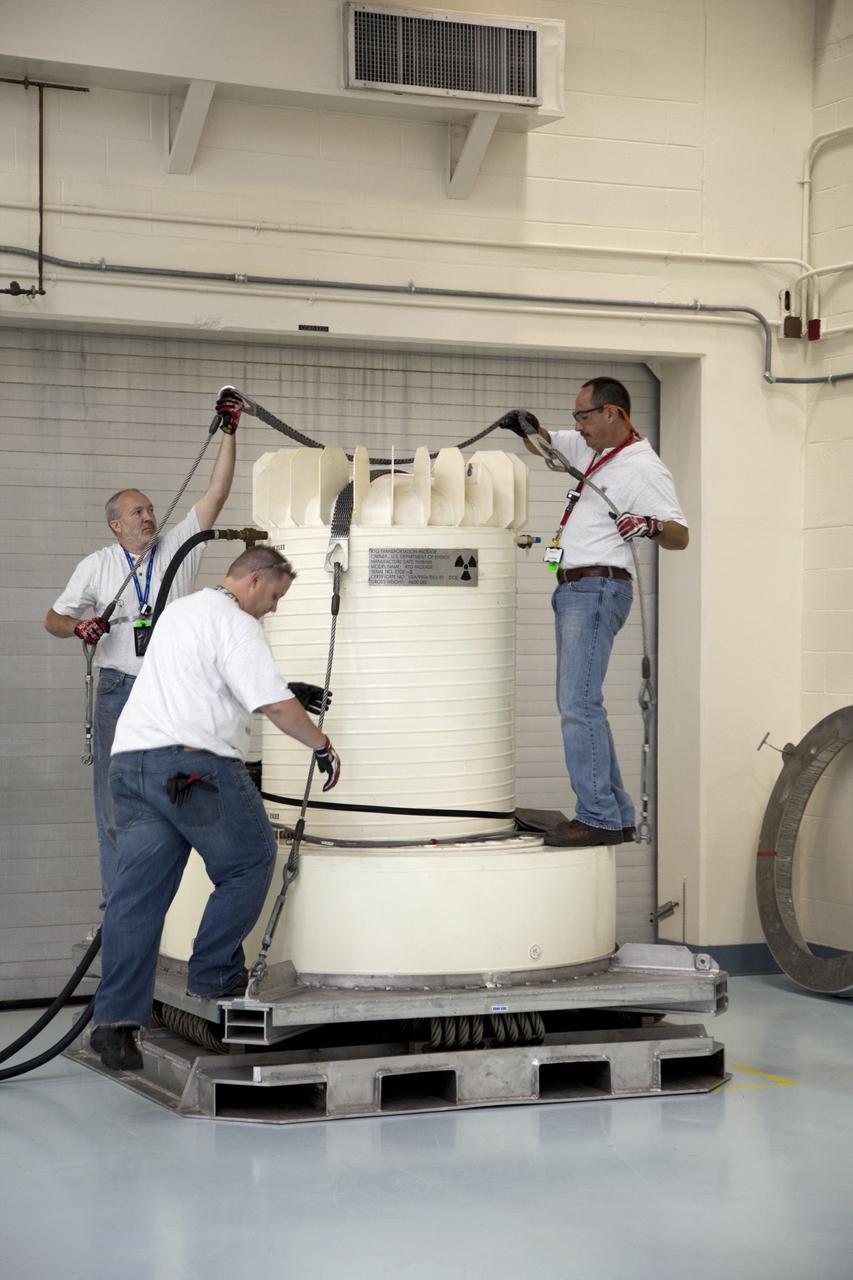
CAPE CANAVERAL, Fla. -- In the high bay of the RTG storage facility at NASA's Kennedy Space Center in Florida, Department of Energy contractor employees attach cables to the shipping cask enclosing the multi-mission radioisotope thermoelectric generator (MMRTG) for NASA's Mars Science Laboratory mission during preparations to lift it from its transportation pallet. The MMRTG will generate the power needed for the mission from the natural decay of plutonium-238, a non-weapons-grade form of the radioisotope. Heat given off by this natural decay will provide constant power through the day and night during all seasons. Waste heat from the MMRTG will be circulated throughout the rover system to keep instruments, computers, mechanical devices and communications systems within their operating temperature ranges. MSL's components include a compact car-sized rover, Curiosity, which has 10 science instruments designed to search for evidence on whether Mars has had environments favorable to microbial life, including chemical ingredients for life. The unique rover will use a laser to look inside rocks and release its gasses so that the rover’s spectrometer can analyze and send the data back to Earth. Launch of MSL aboard a United Launch Alliance Atlas V rocket is scheduled for Nov. 25 from Space Launch Complex 41 on Cape Canaveral Air Force Station in Florida. For more information, visit http://www.nasa.gov/msl. Photo credit: NASA/Frankie Martin
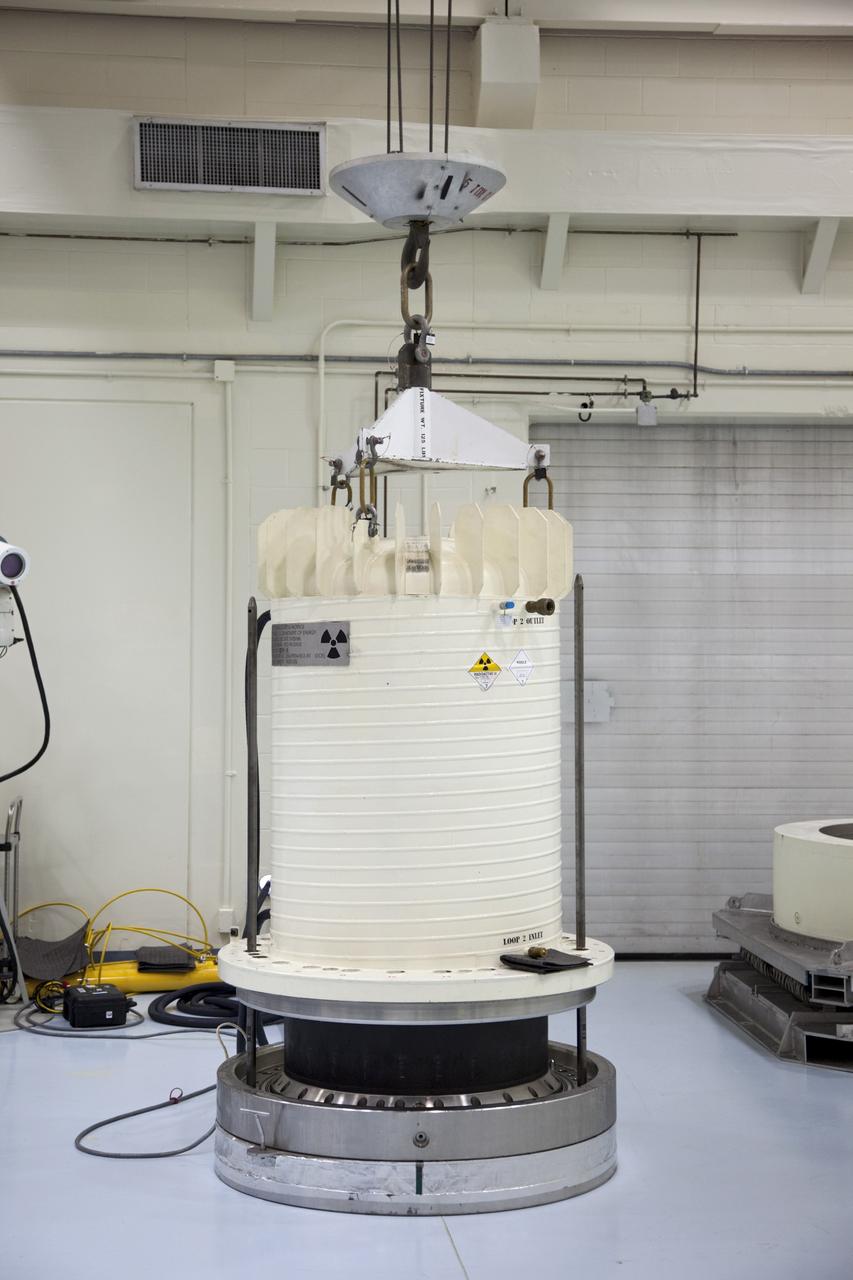
CAPE CANAVERAL, Fla. -- In the high bay of the RTG storage facility at NASA's Kennedy Space Center in Florida, the shipping cask enclosing the multi-mission radioisotope thermoelectric generator (MMRTG) for NASA's Mars Science Laboratory mission is lifted from around the MMRTG using guide rods installed on the support base. The MMRTG will generate the power needed for the mission from the natural decay of plutonium-238, a non-weapons-grade form of the radioisotope. Heat given off by this natural decay will provide constant power through the day and night during all seasons. Waste heat from the MMRTG will be circulated throughout the rover system to keep instruments, computers, mechanical devices and communications systems within their operating temperature ranges. MSL's components include a compact car-sized rover, Curiosity, which has 10 science instruments designed to search for evidence on whether Mars has had environments favorable to microbial life, including chemical ingredients for life. The unique rover will use a laser to look inside rocks and release its gasses so that the rover’s spectrometer can analyze and send the data back to Earth. Launch of MSL aboard a United Launch Alliance Atlas V rocket is scheduled for Nov. 25 from Space Launch Complex 41 on Cape Canaveral Air Force Station in Florida. For more information, visit http://www.nasa.gov/msl. Photo credit: NASA/Frankie Martin
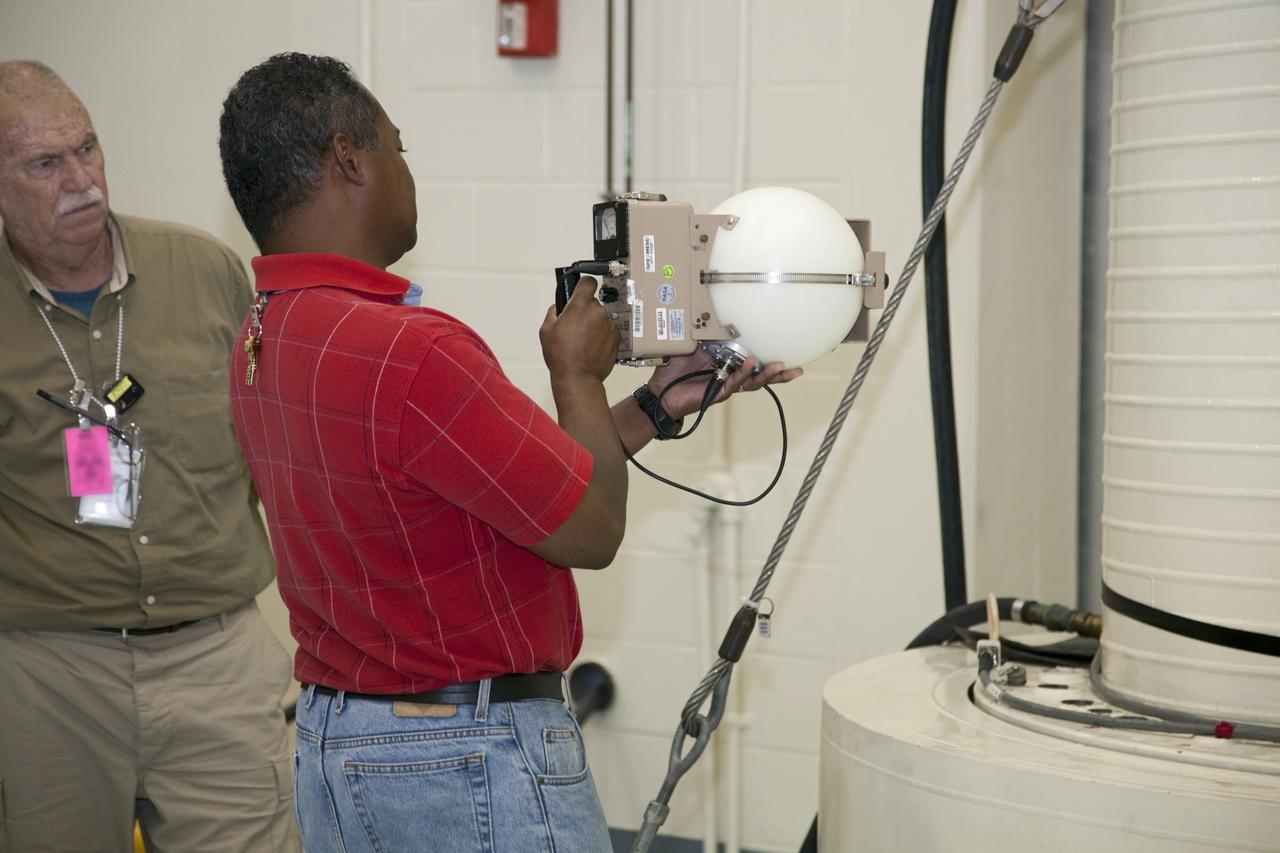
CAPE CANAVERAL, Fla. -- In the high bay of the RTG storage facility at NASA's Kennedy Space Center in Florida, Innovative Health Applications employee Mike McPherson measures the level of radioactivity emitted from the multi-mission radioisotope thermoelectric generator (MMRTG) for NASA's Mars Science Laboratory mission, enclosed in a shipping cask at right. The MMRTG will generate the power needed for the mission from the natural decay of plutonium-238, a non-weapons-grade form of the radioisotope. Heat given off by this natural decay will provide constant power through the day and night during all seasons. Waste heat from the MMRTG will be circulated throughout the rover system to keep instruments, computers, mechanical devices and communications systems within their operating temperature ranges. MSL's components include a compact car-sized rover, Curiosity, which has 10 science instruments designed to search for evidence on whether Mars has had environments favorable to microbial life, including chemical ingredients for life. The unique rover will use a laser to look inside rocks and release its gasses so that the rover’s spectrometer can analyze and send the data back to Earth. Launch of MSL aboard a United Launch Alliance Atlas V rocket is scheduled for Nov. 25 from Space Launch Complex 41 on Cape Canaveral Air Force Station in Florida. For more information, visit http://www.nasa.gov/msl. Photo credit: NASA/Frankie Martin
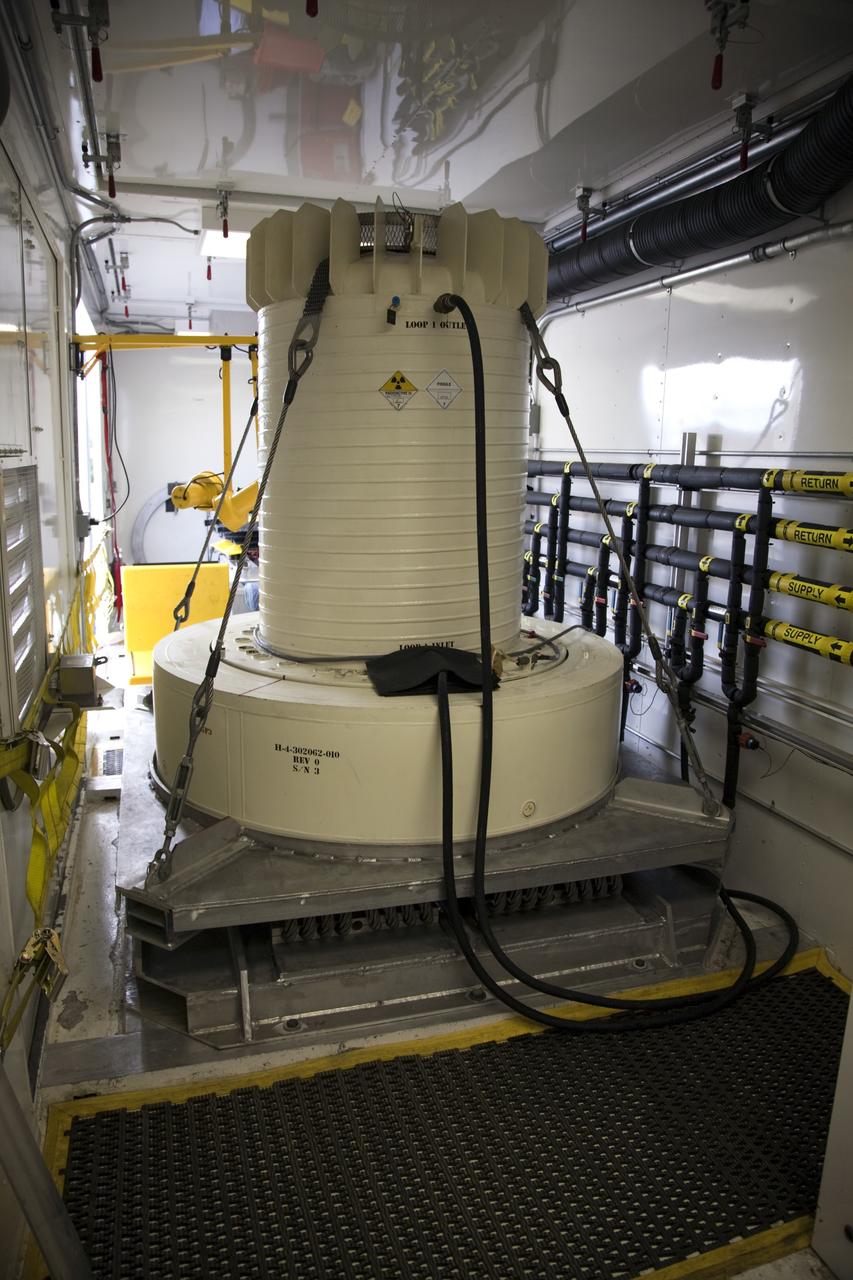
CAPE CANAVERAL, Fla. -- The multi-mission radioisotope thermoelectric generator (MMRTG) for NASA's Mars Science Laboratory (MSL) mission, enclosed in a shipping cask in the MMRTG trailer, arrives at the RTG storage facility at NASA's Kennedy Space Center in Florida. During transport, coolant flows through hoses connected to the cask to dissipate any excess heat generated by the MMRTG. The MMRTG will generate the power needed for the mission from the natural decay of plutonium-238, a non-weapons-grade form of the radioisotope. Heat given off by this natural decay will provide constant power through the day and night during all seasons. Waste heat from the MMRTG will be circulated throughout the rover system to keep instruments, computers, mechanical devices and communications systems within their operating temperature ranges. MSL's components include a compact car-sized rover, Curiosity, which has 10 science instruments designed to search for evidence on whether Mars has had environments favorable to microbial life, including chemical ingredients for life. The unique rover will use a laser to look inside rocks and release its gasses so that the rover’s spectrometer can analyze and send the data back to Earth. Launch of MSL aboard a United Launch Alliance Atlas V rocket is scheduled for Nov. 25 from Space Launch Complex 41 on Cape Canaveral Air Force Station in Florida. For more information, visit http://www.nasa.gov/msl. Photo credit: NASA/Frankie Martin

CAPE CANAVERAL, Fla. -- In the RTG storage facility at NASA's Kennedy Space Center in Florida, the multi-mission radioisotope thermoelectric generator (MMRTG) for NASA's Mars Science Laboratory mission, with guide rods still installed on its support base, has been uncovered on the high bay floor. The MMRTG no longer needs supplemental cooling since any excess heat generated can dissipate into the air in the high bay. The MMRTG will generate the power needed for the mission from the natural decay of plutonium-238, a non-weapons-grade form of the radioisotope. Heat given off by this natural decay will provide constant power through the day and night during all seasons. Waste heat from the MMRTG will be circulated throughout the rover system to keep instruments, computers, mechanical devices and communications systems within their operating temperature ranges. MSL's components include a compact car-sized rover, Curiosity, which has 10 science instruments designed to search for evidence on whether Mars has had environments favorable to microbial life, including chemical ingredients for life. The unique rover will use a laser to look inside rocks and release its gasses so that the rover’s spectrometer can analyze and send the data back to Earth. Launch of MSL aboard a United Launch Alliance Atlas V rocket is scheduled for Nov. 25 from Space Launch Complex 41 on Cape Canaveral Air Force Station in Florida. For more information, visit http://www.nasa.gov/msl. Photo credit: NASA/Frankie Martin
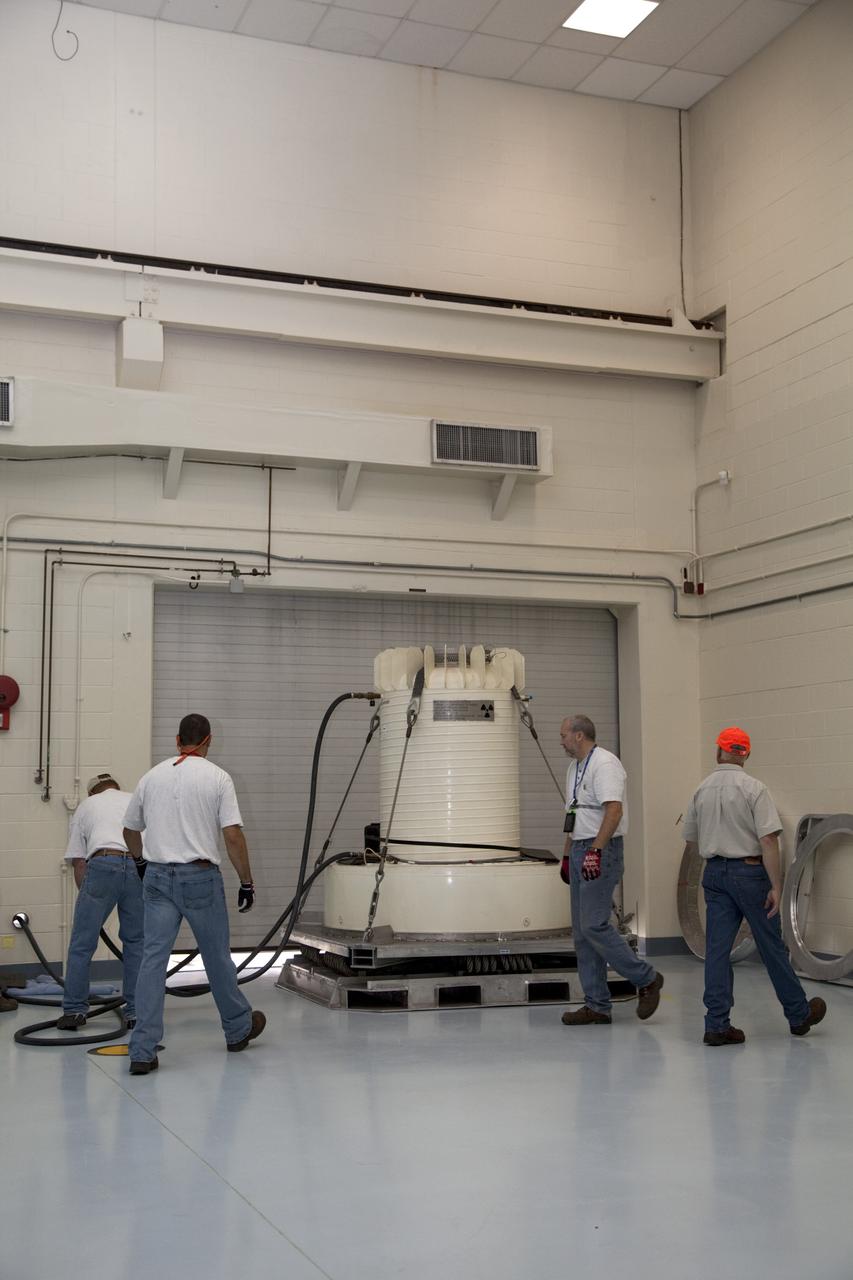
CAPE CANAVERAL, Fla. -- Workers reconnect the coolant hoses to the shipping cask enclosing the multi-mission radioisotope thermoelectric generator (MMRTG) for NASA's Mars Science Laboratory mission upon its arrival in the high bay of the RTG storage facility at NASA's Kennedy Space Center in Florida. Coolant flows through the hoses to dissipate any excess heat generated by the MMRTG. The MMRTG will generate the power needed for the mission from the natural decay of plutonium-238, a non-weapons-grade form of the radioisotope. Heat given off by this natural decay will provide constant power through the day and night during all seasons. Waste heat from the MMRTG will be circulated throughout the rover system to keep instruments, computers, mechanical devices and communications systems within their operating temperature ranges. MSL's components include a compact car-sized rover, Curiosity, which has 10 science instruments designed to search for evidence on whether Mars has had environments favorable to microbial life, including chemical ingredients for life. The unique rover will use a laser to look inside rocks and release its gasses so that the rover’s spectrometer can analyze and send the data back to Earth. Launch of MSL aboard a United Launch Alliance Atlas V rocket is scheduled for Nov. 25 from Space Launch Complex 41 on Cape Canaveral Air Force Station in Florida. For more information, visit http://www.nasa.gov/msl. Photo credit: NASA/Frankie Martin
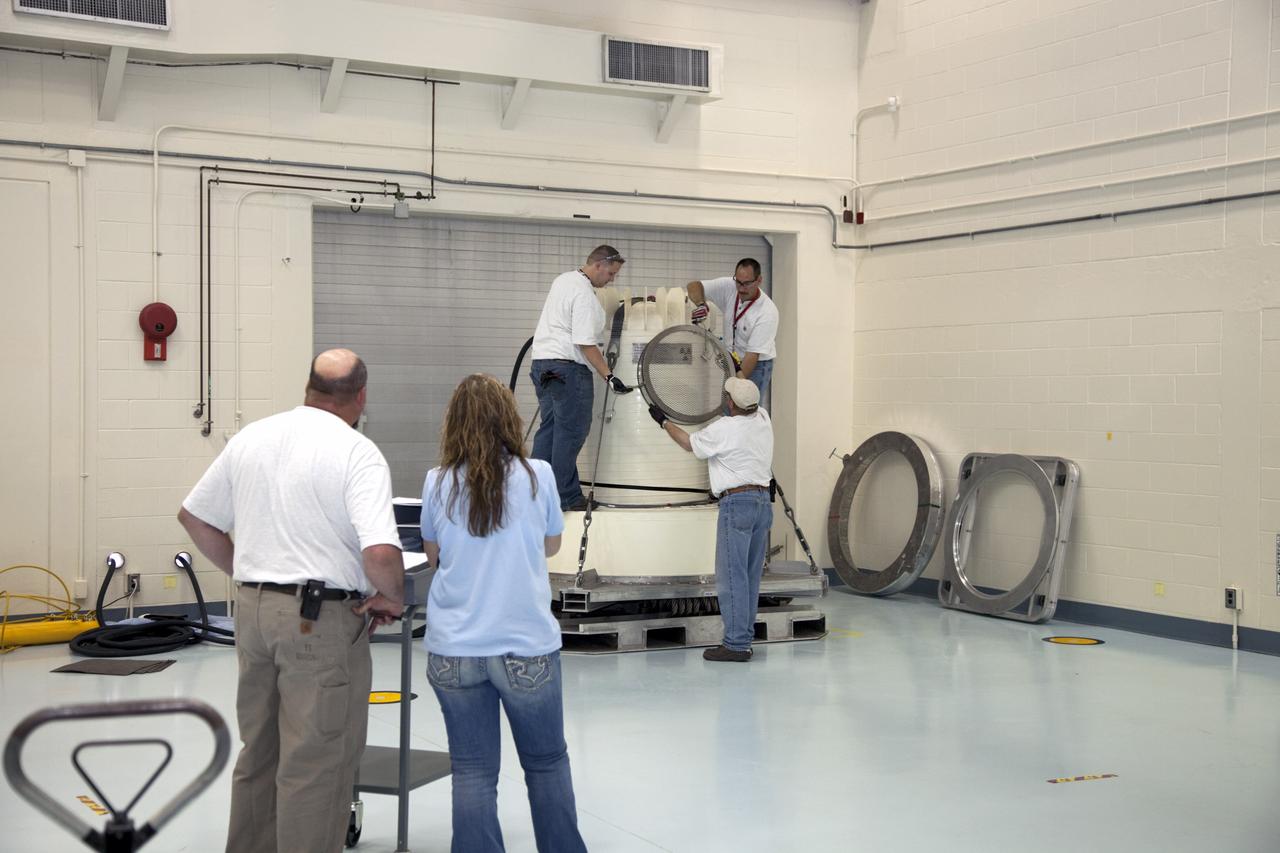
CAPE CANAVERAL, Fla. -- In the high bay of the RTG storage facility at NASA's Kennedy Space Center in Florida, preparations are under way to attach the shipping cask enclosing the multi-mission radioisotope thermoelectric generator (MMRTG) for NASA's Mars Science Laboratory mission to the cables that will lift it from its transportation pallet. The MMRTG will generate the power needed for the mission from the natural decay of plutonium-238, a non-weapons-grade form of the radioisotope. Heat given off by this natural decay will provide constant power through the day and night during all seasons. Waste heat from the MMRTG will be circulated throughout the rover system to keep instruments, computers, mechanical devices and communications systems within their operating temperature ranges. MSL's components include a compact car-sized rover, Curiosity, which has 10 science instruments designed to search for evidence on whether Mars has had environments favorable to microbial life, including chemical ingredients for life. The unique rover will use a laser to look inside rocks and release its gasses so that the rover’s spectrometer can analyze and send the data back to Earth. Launch of MSL aboard a United Launch Alliance Atlas V rocket is scheduled for Nov. 25 from Space Launch Complex 41 on Cape Canaveral Air Force Station in Florida. For more information, visit http://www.nasa.gov/msl. Photo credit: NASA/Frankie Martin
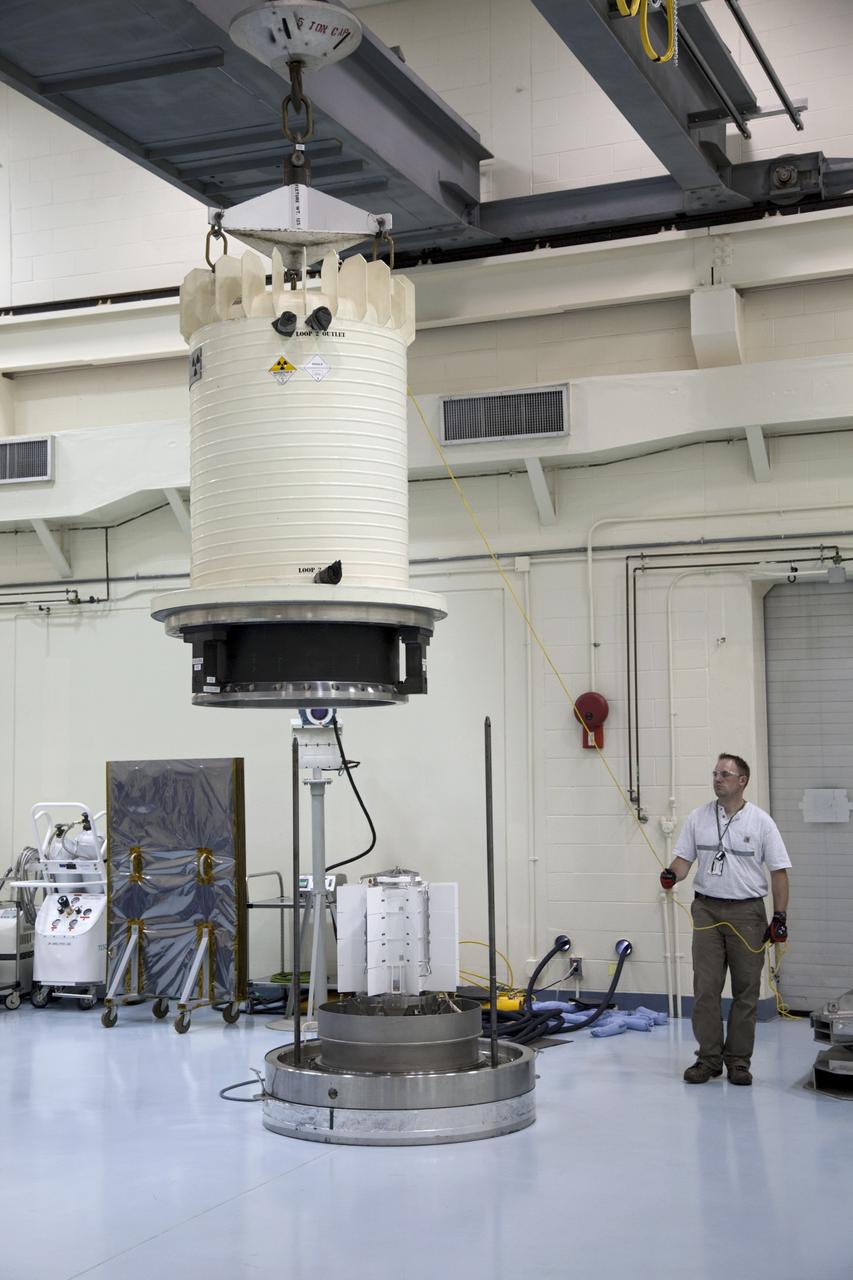
CAPE CANAVERAL, Fla. -- In the high bay of the RTG storage facility at NASA's Kennedy Space Center in Florida, the external and internal protective layers of the shipping cask are lifted away from the multi-mission radioisotope thermoelectric generator (MMRTG) for NASA's Mars Science Laboratory mission. The MMRTG no longer needs supplemental cooling since any excess heat generated can dissipate into the air in the high bay. The MMRTG will generate the power needed for the mission from the natural decay of plutonium-238, a non-weapons-grade form of the radioisotope. Heat given off by this natural decay will provide constant power through the day and night during all seasons. Waste heat from the MMRTG will be circulated throughout the rover system to keep instruments, computers, mechanical devices and communications systems within their operating temperature ranges. MSL's components include a compact car-sized rover, Curiosity, which has 10 science instruments designed to search for evidence on whether Mars has had environments favorable to microbial life, including chemical ingredients for life. The unique rover will use a laser to look inside rocks and release its gasses so that the rover’s spectrometer can analyze and send the data back to Earth. Launch of MSL aboard a United Launch Alliance Atlas V rocket is scheduled for Nov. 25 from Space Launch Complex 41 on Cape Canaveral Air Force Station in Florida. For more information, visit http://www.nasa.gov/msl. Photo credit: NASA/Frankie Martin
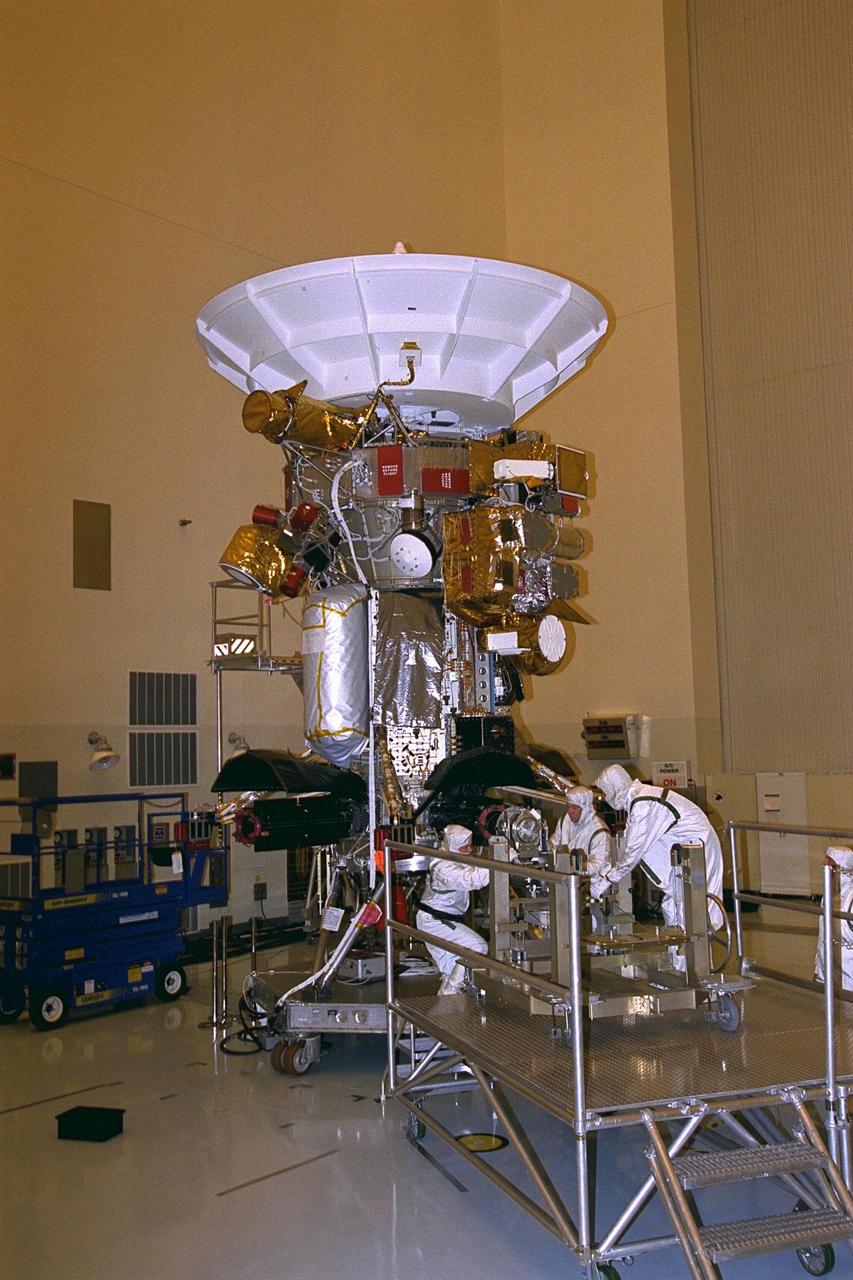
Jet Propulsion Laboratory (JPL) workers prepare the installation cart (atop the platform) for removal of a radioisotope thermoelectric generator (RTG) from the adjacent Cassini spacecraft. This is the second of three RTGs being removed from Cassini after undergoing mechanical and electrical verification tests in the Payload Hazardous Servicing Facility. The third RTG to be removed is in background at left. The three RTGs will then be temporarily stored before being re-installed for flight. The RTGs will provide electrical power to Cassini on its 6.7-year trip to the Saturnian system and during its four-year mission at Saturn. RTGs use heat from the natural decay of plutonium to generate electric power. The generators enable spacecraft to operate far from the Sun where solar power systems are not feasible. The Cassini mission is scheduled for an Oct. 6 launch aboard a Titan IVB/Centaur expendable launch vehicle. Cassini is built and managed for NASA by JPL
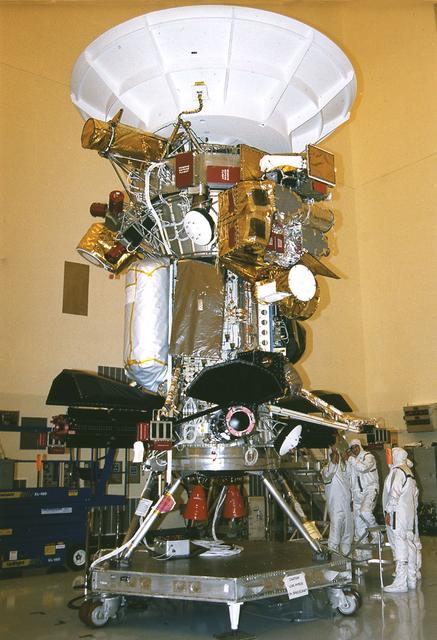
Jet Propulsion Research Lab (JPL) workers use a borescope to verify the pressure relief device bellow's integrity on a radioisotope thermoelectric generator (RTG) that has been installed on the Cassini spacecraft in the Payload Hazardous Servicing Facility. The activity is part of the mechanical and electrical verification testing of RTGs during prelaunch processing. RTGs use heat from the natural decay of plutonium to generate electrical power. The three RTGs on Cassini will enable the spacecraft to operate far from the Sun where solar power systems are not feasible. They will provide electrical power to Cassini on it seven year trip to the Saturnian system and during its four year mission at Saturn.

Jet Propulsion Laboratory (JPL) engineers examine the interface surface on the Cassini spacecraft prior to installation of the third radioisotope thermoelectric generator (RTG). The other two RTGs, at left, already are installed on Cassini. The three RTGs will be used to power Cassini on its mission to the Saturnian system. They are undergoing mechanical and electrical verification testing in the Payload Hazardous Servicing Facility. RTGs use heat from the natural decay of plutonium to generate electric power. The generators enable spacecraft to operate far from the Sun where solar power systems are not feasible. The Cassini mission is scheduled for an Oct. 6 launch aboard a Titan IVB/Centaur expendable launch vehicle. Cassini is built and managed for NASA by JPL
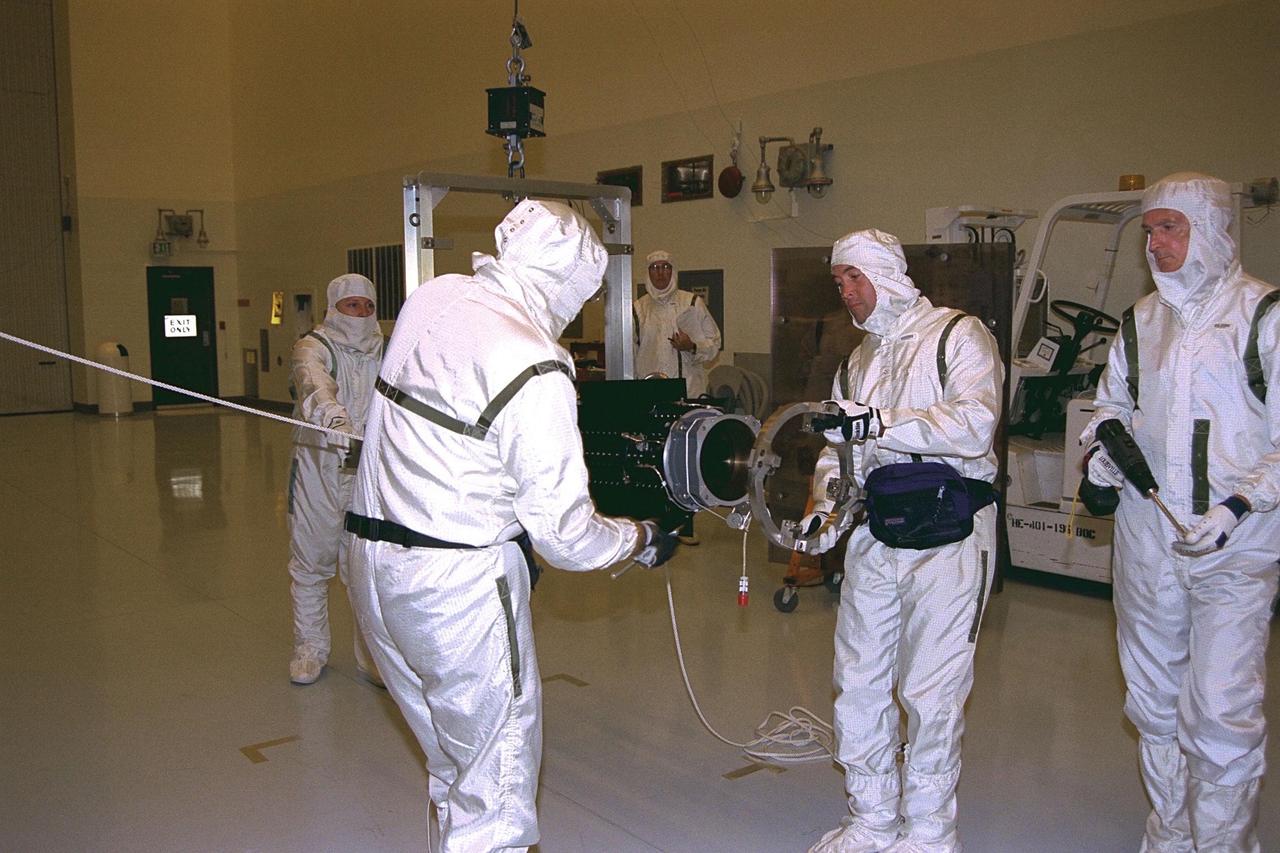
Workers in the Payload Hazardous Servicing Facility remove the storage collar from a radioisotope thermoelectric generator (RTG) in preparation for installation on the Cassini spacecraft. Cassini will be outfitted with three RTGs. The power units are undergoing mechanical and electrical verification tests in the PHSF. The RTGs will provide electrical power to Cassini on its 6.7-year trip to the Saturnian system and during its four-year mission at Saturn. RTGs use heat from the natural decay of plutonium to generate electric power. The generators enable spacecraft to operate at great distances from the Sun where solar power systems are not feasible. The Cassini mission is targeted for an Oct. 6 launch aboard a Titan IVB/Centaur expendable launch vehicle
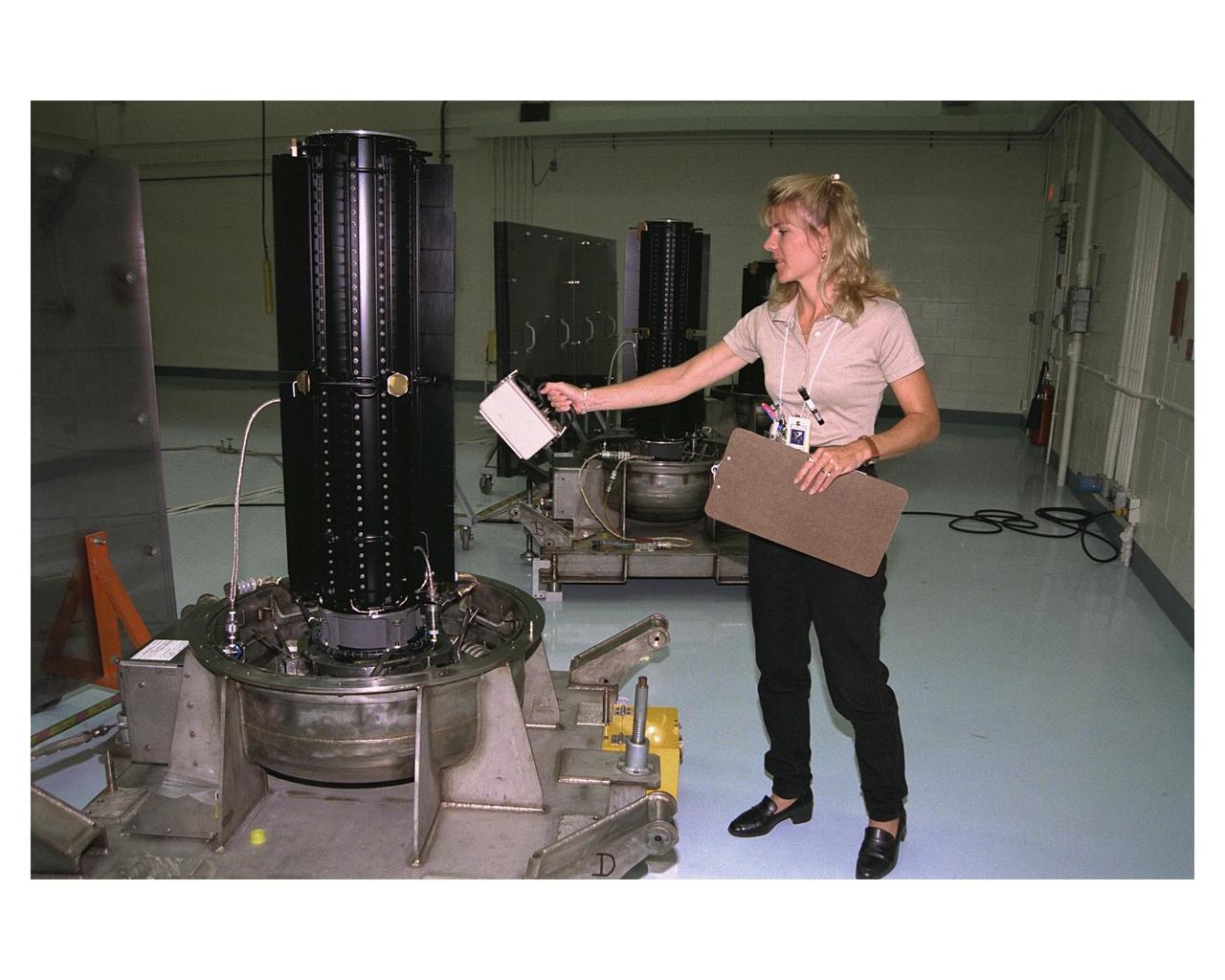
Environmental Health Specialist Jamie A. Keeley, of EG&G Florida Inc., uses an ion chamber dose rate meter to measure radiation levels in one of three radioisotope thermoelectric generators (RTGs) that will provide electrical power to the Cassini spacecraft on its mission to explore the Saturnian system. The three RTGs and one spare are being tested and mointored in the Radioisotope Thermoelectric Generator Storage Building in the KSC's Industrial Area. The RTGs use heat from the natural decay of plutonium to generate electric power. RTGs enable spacecraft to operate far from the Sun where solar power systems are not feasible. The RTGs on Cassini are of the same design as those flying on the already deployed Galileo and Ulysses spacecraft. The Cassini mission is targeted for an Oct. 6 launch aboard a Titan IVB/Centaur expendable launch vehicle.
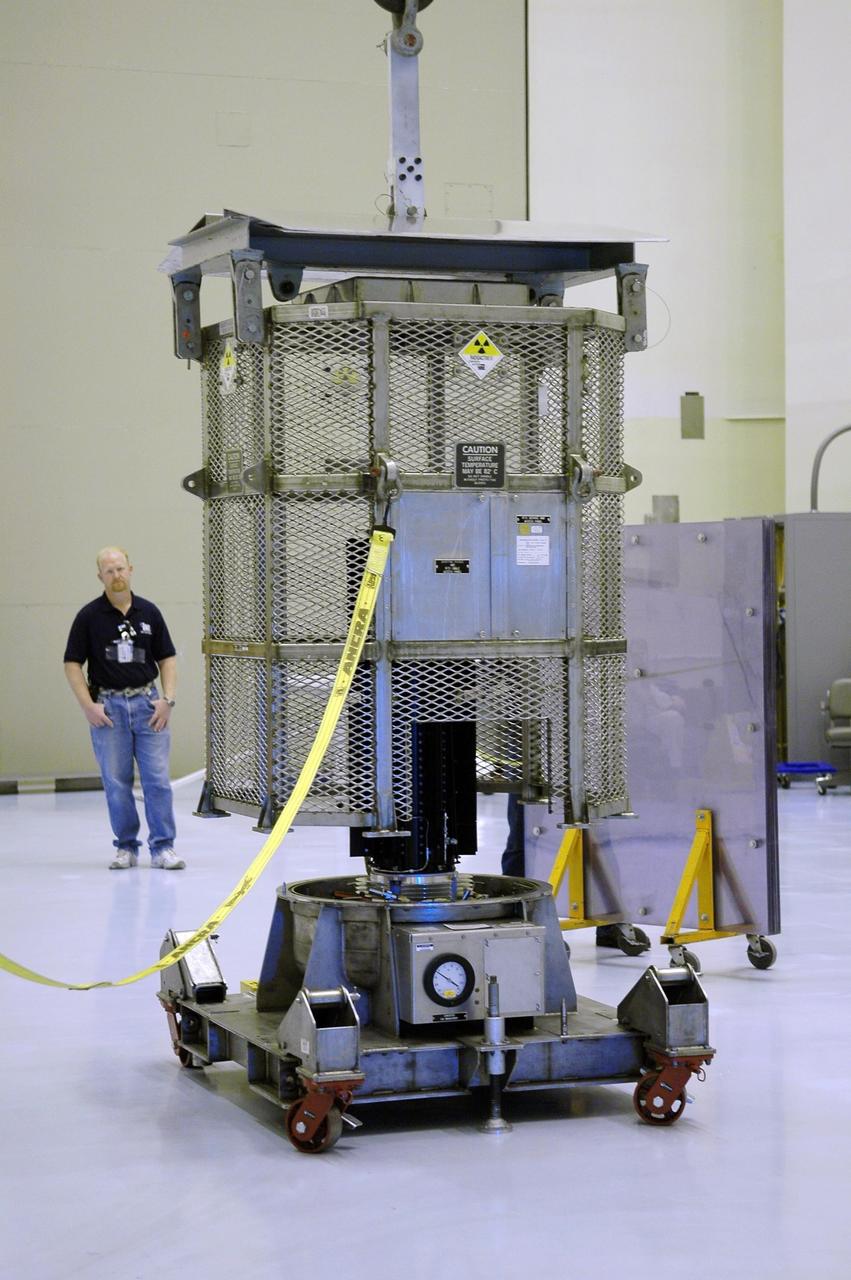
KENNEDY SPACE CENTER, FLA. - In the Payload Hazardous Servicing Facility, a metal canister is lowered over the radioisotope thermoelectric generator (RTG). The canister will protect the RTG while it is being moved to the RTG facility. The RTG underwent a fit check with the spacecraft. The RTG is the baseline power supply for the New Horizons, scheduled to launch in January 2006 on a journey to Pluto and its moon, Charon. As it approaches Pluto, the spacecraft will look for ultraviolet emission from Pluto's atmosphere and make the best global maps of Pluto and Charon in green, blue, red and a special wavelength that is sensitive to methane frost on the surface. It will also take spectral maps in the near infrared, telling the science team about Pluto's and Charon's surface compositions and locations and temperatures of these materials. When the spacecraft is closest to Pluto or its moon, it will take close-up pictures in both visible and near-infrared wavelengths. It is expected to reach Pluto in July 2015.
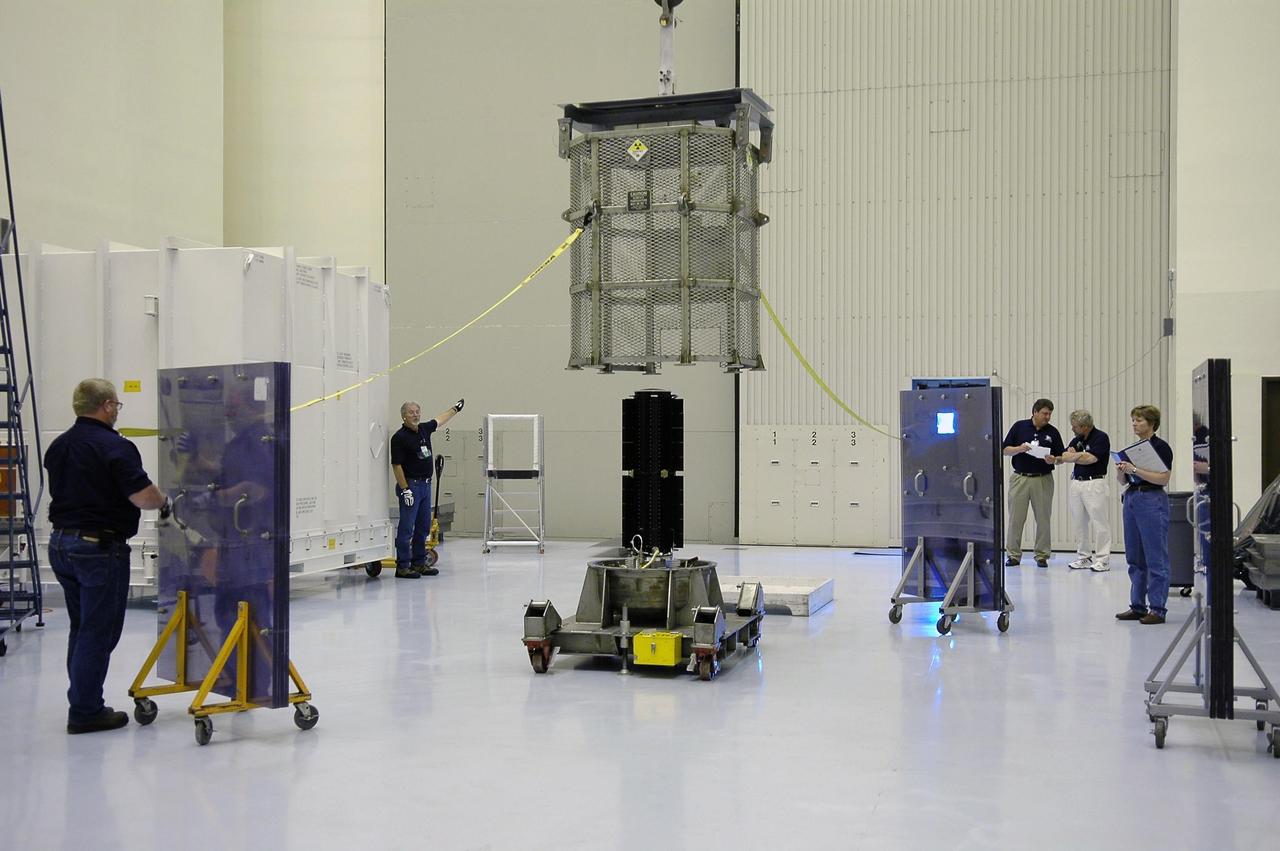
KENNEDY SPACE CENTER, FLA. - In NASA Kennedy Space Center’s Payload Hazardous Servicing Facility, the metal canister is lifted away from the radioisotope thermoelectric generator (RTG). Inside the facility, the RTG will be installed in the New Horizons spacecraft for a fit check. The RTG is the baseline power supply for New Horizons, scheduled to launch in January 2006 on a journey to Pluto and its moon, Charon. It is expected to reach Pluto in July 2015.
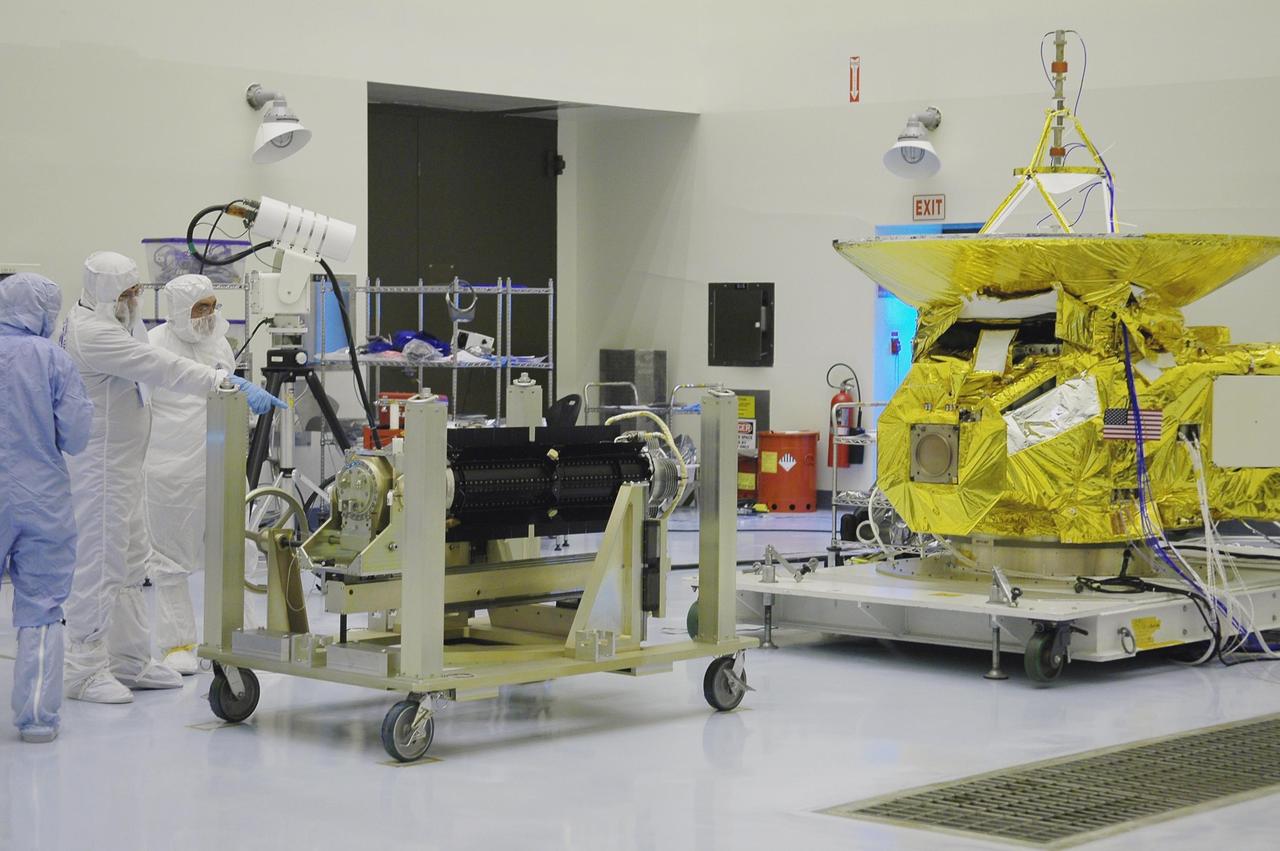
KENNEDY SPACE CENTER, FLA. - In NASA Kennedy Space Center’s Payload Hazardous Servicing Facility, the radioisotope thermoelectric generator (RTG) rests horizontally on a moveable stand. The RTG will be installed in the New Horizons spacecraft, at right, for a fit check. The RTG is the baseline power supply for New Horizons, scheduled to launch in January 2006 on a journey to Pluto and its moon, Charon. It is expected to reach Pluto in July 2015.
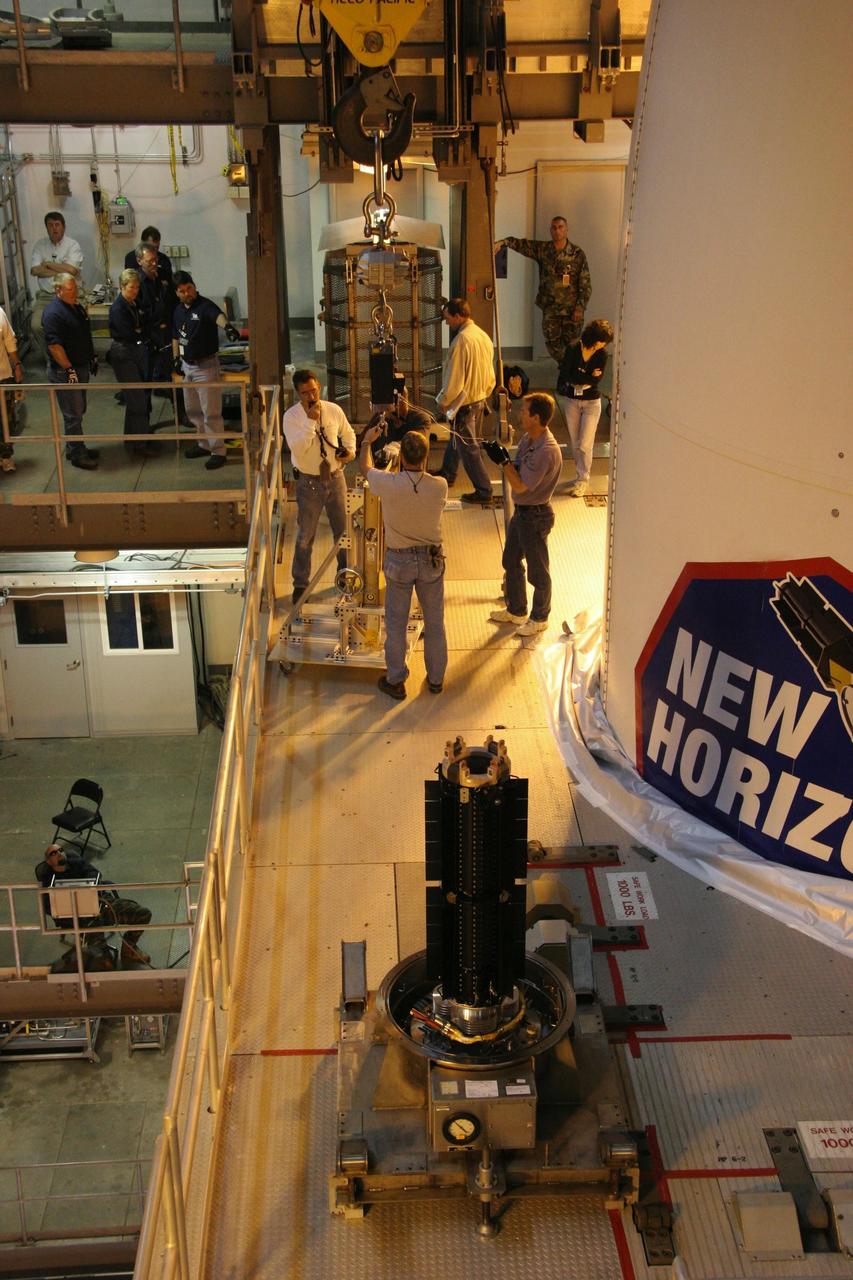
KENNEDY SPACE CENTER, FLA. — On Complex 41 at Cape Canaveral Air Force Station in Florida, the radioisotope thermoelectric generator (RTG) in the foreground has been removed from its caged enclosure. The RTG will be installed on the New Horizons spacecraft encapsulated inside the fairing, at right. Designed and integrated at the Johns Hopkins University Applied Physics Laboratory (APL) in Laurel, Md., New Horizons will launch on a nine-and-a-half-year voyage to Pluto. Typical of RTG-based systems, as on past outer-planet missions, New Horizons does not have a battery for storing power. At the start of the mission, the RTG, which provides power through the natural radioactive decay of plutonium dioxide fuel, will supply approximately 240 watts (at 30 volts of direct current) - the spacecraft’s shunt regulator unit maintains a steady input from the RTG and dissipates power the spacecraft cannot use at a given time. By July 2015 (the earliest Pluto encounter date) that supply decreases to 200 watts at the same voltage, so New Horizons will ease the strain on its limited power source by cycling science instruments during planetary encounters. On Complex 41 at Cape Canaveral Air Force Station in Florida, workers on the ground oversee the radioisotope thermoelectric generator (RTG) being lifted into the Vertical Integration Facility. The RTG will be installed on the New Horizons spacecraft within the fairing at the top of the Atlas V launch vehicle. Designed and integrated at the Johns Hopkins University Applied Physics Laboratory (APL) in Laurel, Md., New Horizons will launch on a nine-and-a-half-year voyage to Pluto. Typical of RTG-based systems, as on past outer-planet missions, New Horizons does not have a battery for storing power. At the start of the mission, the RTG, which provides power through the natural radioactive decay of plutonium dioxide fuel, will supply approximately 240 watts (at 30 volts of direct current) - the spacecraft’s shunt regulato
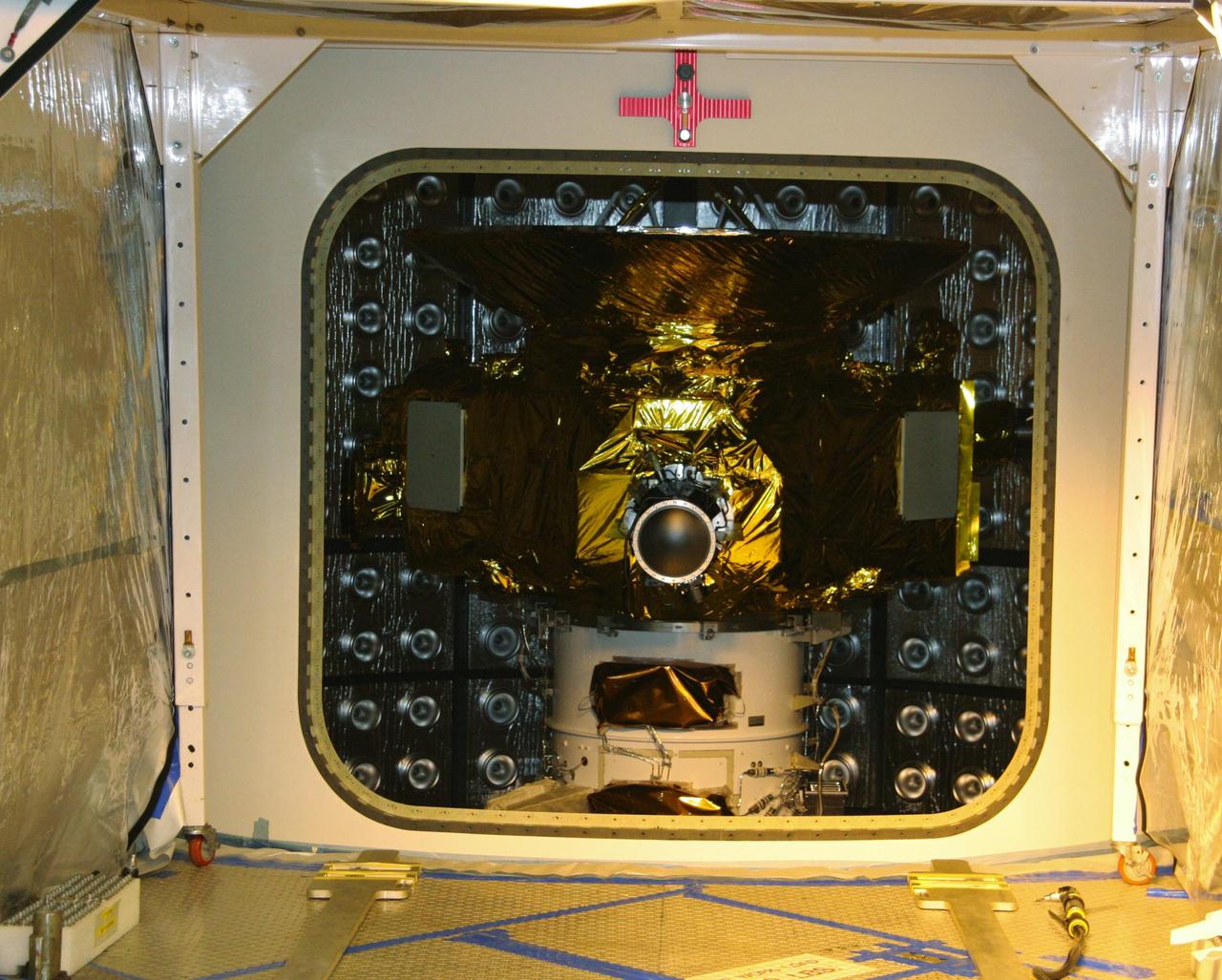
KENNEDY SPACE CENTER, FLA. — On Complex 41 at Cape Canaveral Air Force Station in Florida, the radioisotope thermoelectric generator (RTG) is attached to the New Horizons spacecraft inside the fairing. Designed and integrated at the Johns Hopkins University Applied Physics Laboratory (APL) in Laurel, Md., New Horizons will launch on a nine-and-a-half-year voyage to Pluto. Typical of RTG-based systems, as on past outer-planet missions, New Horizons does not have a battery for storing power. At the start of the mission, the RTG, which provides power through the natural radioactive decay of plutonium dioxide fuel, will supply approximately 240 watts (at 30 volts of direct current) - the spacecraft’s shunt regulator unit maintains a steady input from the RTG and dissipates power the spacecraft cannot use at a given time. By July 2015 (the earliest Pluto encounter date) that supply decreases to 200 watts at the same voltage, so New Horizons will ease the strain on its limited power source by cycling science instruments during planetary encounters. On Complex 41 at Cape Canaveral Air Force Station in Florida, workers on the ground oversee the radioisotope thermoelectric generator (RTG) being lifted into the Vertical Integration Facility. The RTG will be installed on the New Horizons spacecraft within the fairing at the top of the Atlas V launch vehicle. Designed and integrated at the Johns Hopkins University Applied Physics Laboratory (APL) in Laurel, Md., New Horizons will launch on a nine-and-a-half-year voyage to Pluto. Typical of RTG-based systems, as on past outer-planet missions, New Horizons does not have a battery for storing power. At the start of the mission, the RTG, which provides power through the natural radioactive decay of plutonium dioxide fuel, will supply approximately 240 watts (at 30 volts of direct current) - the spacecraft’s shunt regulator unit maintains a steady input from the RTG and dissipates power the spacecraft cannot use at a give
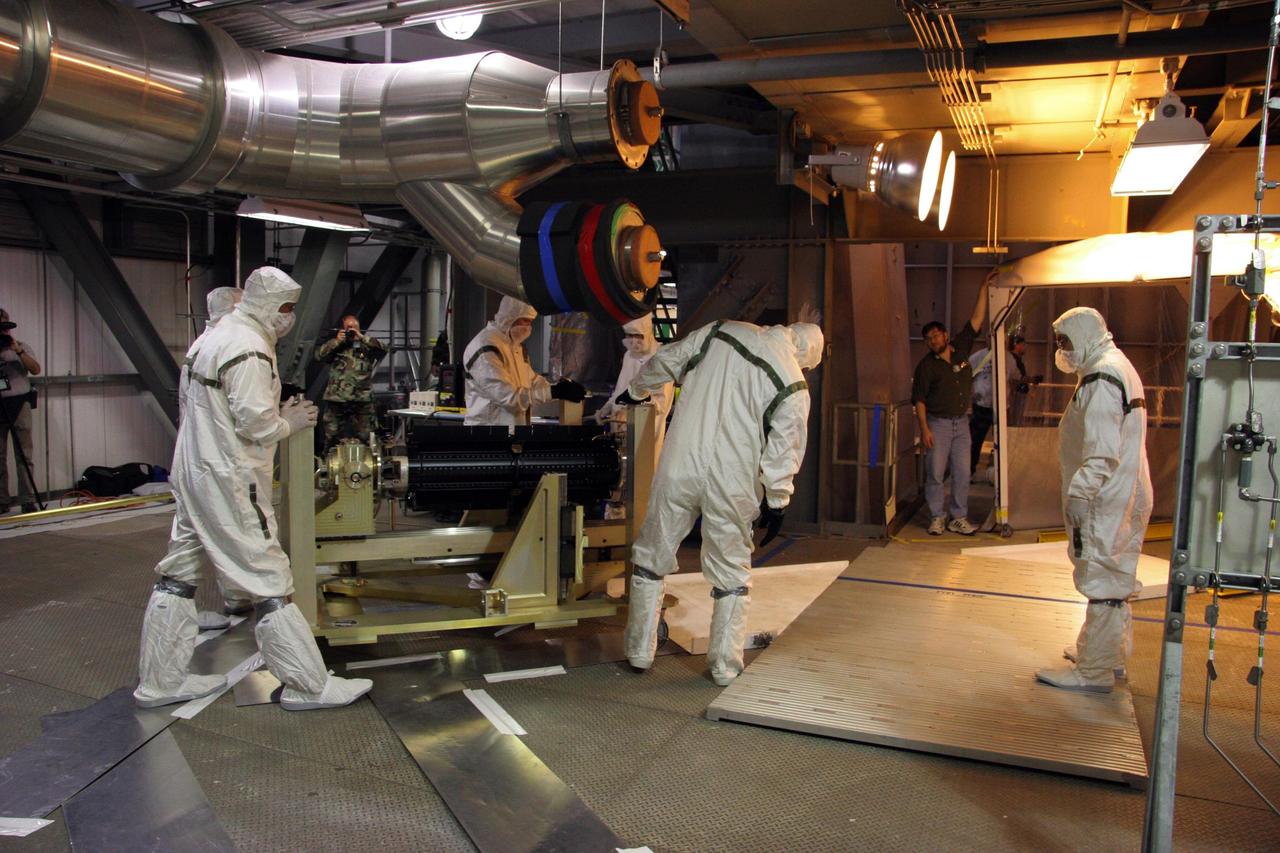
KENNEDY SPACE CENTER, FLA. — On Complex 41 at Cape Canaveral Air Force Station in Florida, workers move the radioisotope thermoelectric generator (RTG). The generator will be installed on the New Horizons spacecraft encapsulated inside the fairing. Designed and integrated at the Johns Hopkins University Applied Physics Laboratory (APL) in Laurel, Md., New Horizons will launch on a nine-and-a-half-year voyage to Pluto. Typical of RTG-based systems, as on past outer-planet missions, New Horizons does not have a battery for storing power. At the start of the mission, the RTG, which provides power through the natural radioactive decay of plutonium dioxide fuel, will supply approximately 240 watts (at 30 volts of direct current) - the spacecraft’s shunt regulator unit maintains a steady input from the RTG and dissipates power the spacecraft cannot use at a given time. By July 2015 (the earliest Pluto encounter date) that supply decreases to 200 watts at the same voltage, so New Horizons will ease the strain on its limited power source by cycling science instruments during planetary encounters. On Complex 41 at Cape Canaveral Air Force Station in Florida, workers on the ground oversee the radioisotope thermoelectric generator (RTG) being lifted into the Vertical Integration Facility. The RTG will be installed on the New Horizons spacecraft within the fairing at the top of the Atlas V launch vehicle. Designed and integrated at the Johns Hopkins University Applied Physics Laboratory (APL) in Laurel, Md., New Horizons will launch on a nine-and-a-half-year voyage to Pluto. Typical of RTG-based systems, as on past outer-planet missions, New Horizons does not have a battery for storing power. At the start of the mission, the RTG, which provides power through the natural radioactive decay of plutonium dioxide fuel, will supply approximately 240 watts (at 30 volts of direct current) - the spacecraft’s shunt regulator unit maintains a steady input from the RTG and diss
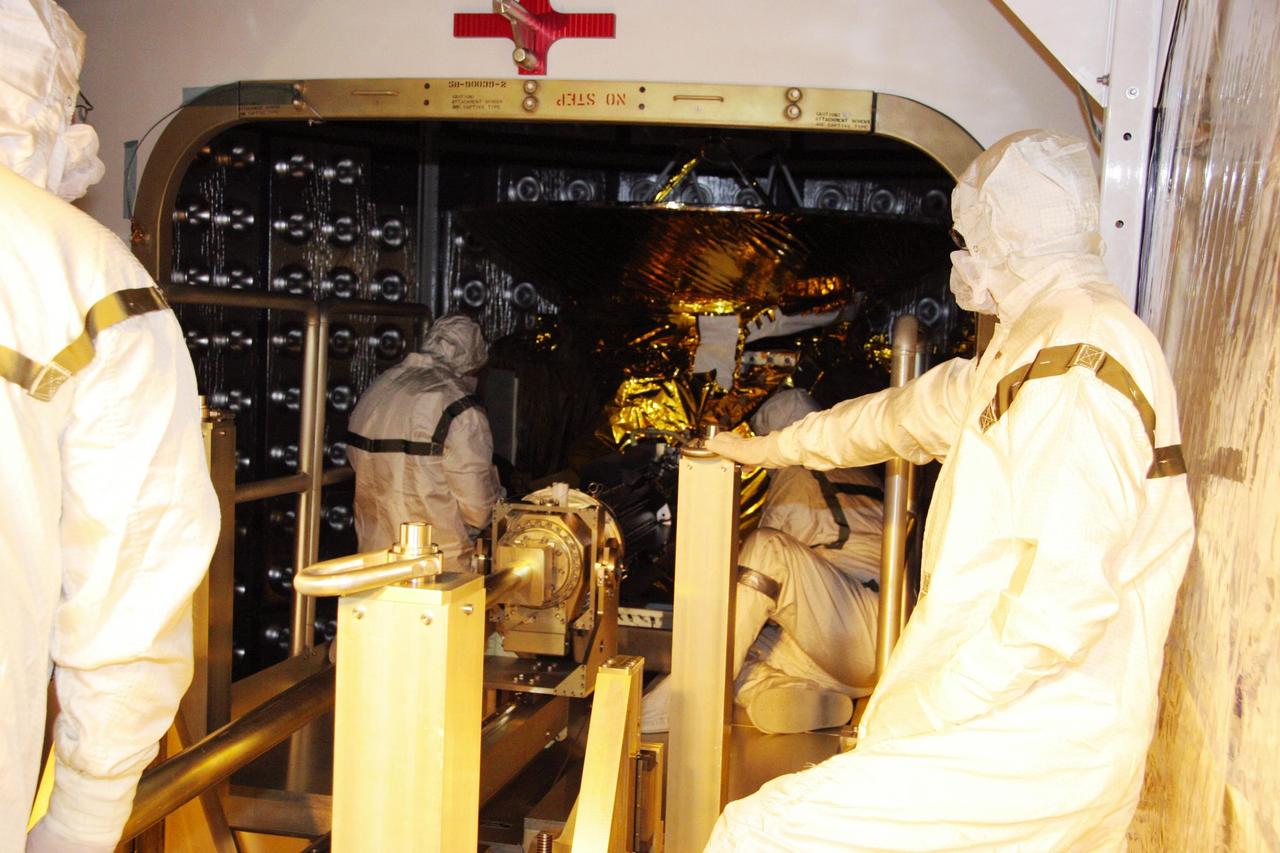
KENNEDY SPACE CENTER, FLA. — On Complex 41 at Cape Canaveral Air Force Station in Florida, workers move the radioisotope thermoelectric generator (RTG) into an area of the fairing containing the New Horizons spacecraft, to which it will be attached. Designed and integrated at the Johns Hopkins University Applied Physics Laboratory (APL) in Laurel, Md., New Horizons will launch on a nine-and-a-half-year voyage to Pluto. Typical of RTG-based systems, as on past outer-planet missions, New Horizons does not have a battery for storing power. At the start of the mission, the RTG, which provides power through the natural radioactive decay of plutonium dioxide fuel, will supply approximately 240 watts (at 30 volts of direct current) - the spacecraft’s shunt regulator unit maintains a steady input from the RTG and dissipates power the spacecraft cannot use at a given time. By July 2015 (the earliest Pluto encounter date) that supply decreases to 200 watts at the same voltage, so New Horizons will ease the strain on its limited power source by cycling science instruments during planetary encounters. On Complex 41 at Cape Canaveral Air Force Station in Florida, workers on the ground oversee the radioisotope thermoelectric generator (RTG) being lifted into the Vertical Integration Facility. The RTG will be installed on the New Horizons spacecraft within the fairing at the top of the Atlas V launch vehicle. Designed and integrated at the Johns Hopkins University Applied Physics Laboratory (APL) in Laurel, Md., New Horizons will launch on a nine-and-a-half-year voyage to Pluto. Typical of RTG-based systems, as on past outer-planet missions, New Horizons does not have a battery for storing power. At the start of the mission, the RTG, which provides power through the natural radioactive decay of plutonium dioxide fuel, will supply approximately 240 watts (at 30 volts of direct current) - the spacecraft’s shunt regulator unit maintains a steady input from the RTG and diss
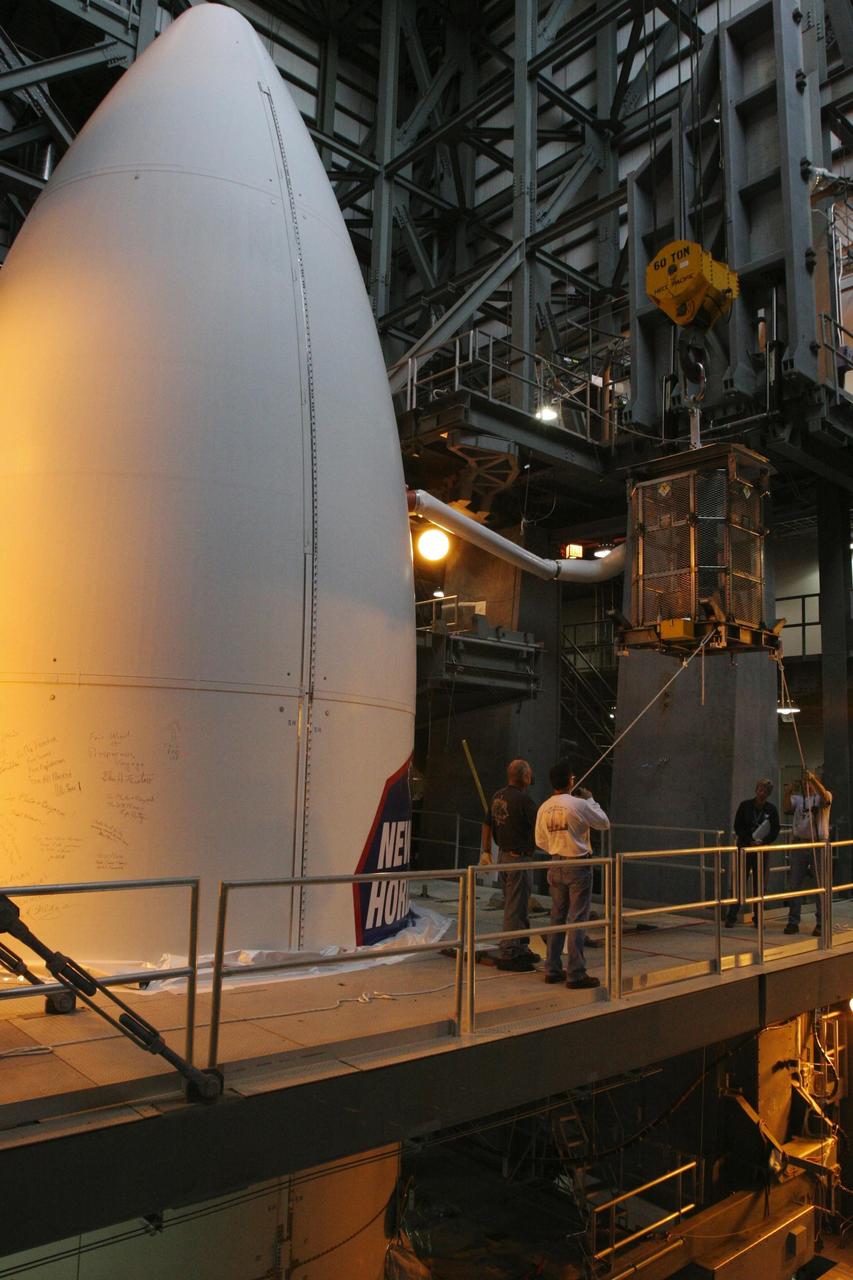
KENNEDY SPACE CENTER, FLA. — On Complex 41 at Cape Canaveral Air Force Station in Florida, the radioisotope thermoelectric generator (RTG) arrives at the upper level of the Vertical Integration Facility. The RTG will be installed on the New Horizons spacecraft encapsulated inside the fairing, at left. Designed and integrated at the Johns Hopkins University Applied Physics Laboratory (APL) in Laurel, Md., New Horizons will launch on a nine-and-a-half-year voyage to Pluto. Typical of RTG-based systems, as on past outer-planet missions, New Horizons does not have a battery for storing power. At the start of the mission, the RTG, which provides power through the natural radioactive decay of plutonium dioxide fuel, will supply approximately 240 watts (at 30 volts of direct current) - the spacecraft’s shunt regulator unit maintains a steady input from the RTG and dissipates power the spacecraft cannot use at a given time. By July 2015 (the earliest Pluto encounter date) that supply decreases to 200 watts at the same voltage, so New Horizons will ease the strain on its limited power source by cycling science instruments during planetary encounters. On Complex 41 at Cape Canaveral Air Force Station in Florida, workers on the ground oversee the radioisotope thermoelectric generator (RTG) being lifted into the Vertical Integration Facility. The RTG will be installed on the New Horizons spacecraft within the fairing at the top of the Atlas V launch vehicle. Designed and integrated at the Johns Hopkins University Applied Physics Laboratory (APL) in Laurel, Md., New Horizons will launch on a nine-and-a-half-year voyage to Pluto. Typical of RTG-based systems, as on past outer-planet missions, New Horizons does not have a battery for storing power. At the start of the mission, the RTG, which provides power through the natural radioactive decay of plutonium dioxide fuel, will supply approximately 240 watts (at 30 volts of direct current) - the spacecraft’s shunt reg
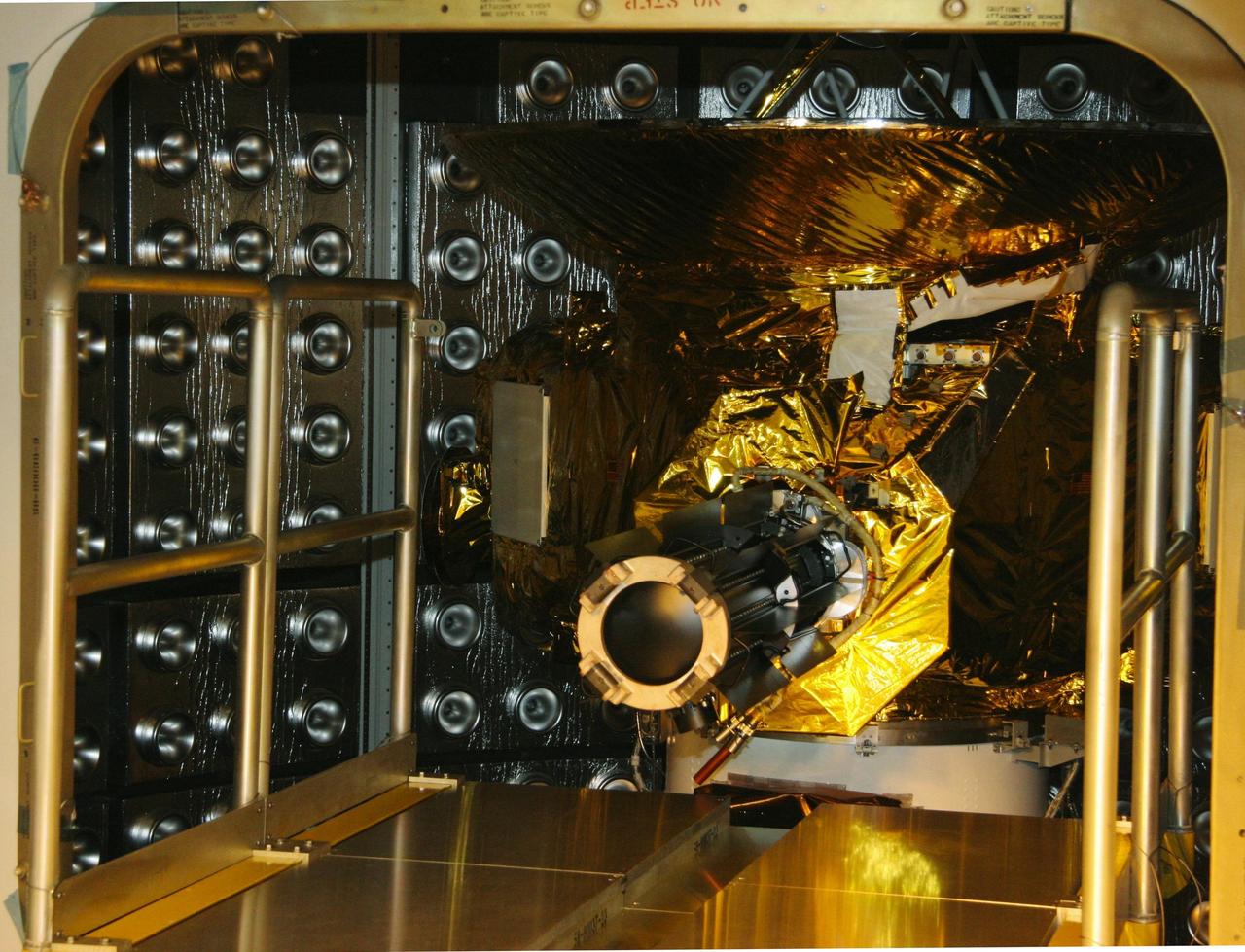
KENNEDY SPACE CENTER, FLA. — On Complex 41 at Cape Canaveral Air Force Station in Florida, the radioisotope thermoelectric generator (RTG) is attached to the New Horizons spacecraft inside the fairing. Designed and integrated at the Johns Hopkins University Applied Physics Laboratory (APL) in Laurel, Md., New Horizons will launch on a nine-and-a-half-year voyage to Pluto. Typical of RTG-based systems, as on past outer-planet missions, New Horizons does not have a battery for storing power. At the start of the mission, the RTG, which provides power through the natural radioactive decay of plutonium dioxide fuel, will supply approximately 240 watts (at 30 volts of direct current) - the spacecraft’s shunt regulator unit maintains a steady input from the RTG and dissipates power the spacecraft cannot use at a given time. By July 2015 (the earliest Pluto encounter date) that supply decreases to 200 watts at the same voltage, so New Horizons will ease the strain on its limited power source by cycling science instruments during planetary encounters. On Complex 41 at Cape Canaveral Air Force Station in Florida, workers on the ground oversee the radioisotope thermoelectric generator (RTG) being lifted into the Vertical Integration Facility. The RTG will be installed on the New Horizons spacecraft within the fairing at the top of the Atlas V launch vehicle. Designed and integrated at the Johns Hopkins University Applied Physics Laboratory (APL) in Laurel, Md., New Horizons will launch on a nine-and-a-half-year voyage to Pluto. Typical of RTG-based systems, as on past outer-planet missions, New Horizons does not have a battery for storing power. At the start of the mission, the RTG, which provides power through the natural radioactive decay of plutonium dioxide fuel, will supply approximately 240 watts (at 30 volts of direct current) - the spacecraft’s shunt regulator unit maintains a steady input from the RTG and dissipates power the spacecraft cannot use at a give
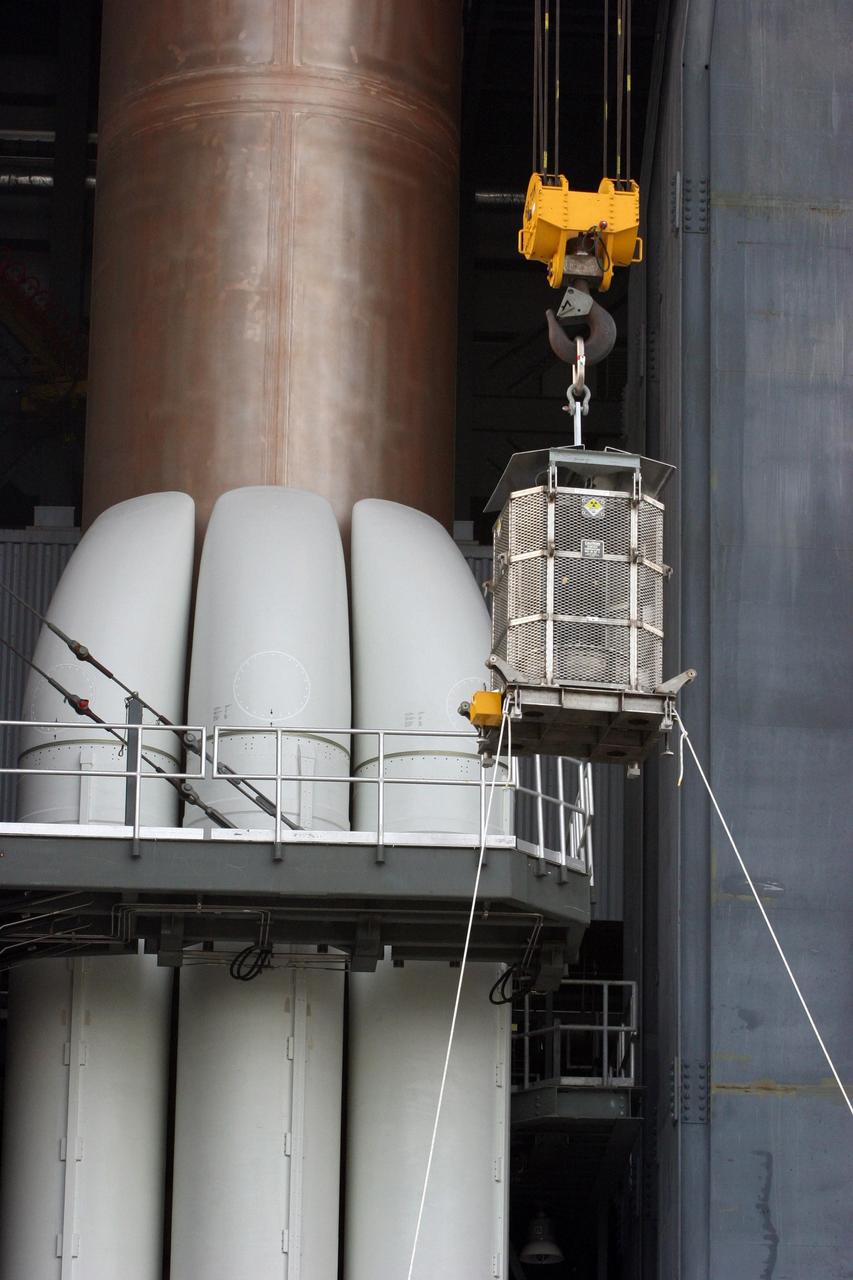
KENNEDY SPACE CENTER, FLA. — On Complex 41 at Cape Canaveral Air Force Station in Florida, the radioisotope thermoelectric generator (RTG) is being lifted into the Vertical Integration Facility. The RTG will be installed on the New Horizons spacecraft within the fairing at the top of the Atlas V launch vehicle. Designed and integrated at the Johns Hopkins University Applied Physics Laboratory (APL) in Laurel, Md., New Horizons will launch on a nine-and-a-half-year voyage to Pluto. Typical of RTG-based systems, as on past outer-planet missions, New Horizons does not have a battery for storing power. At the start of the mission, the RTG, which provides power through the natural radioactive decay of plutonium dioxide fuel, will supply approximately 240 watts (at 30 volts of direct current) - the spacecraft’s shunt regulator unit maintains a steady input from the RTG and dissipates power the spacecraft cannot use at a given time. By July 2015 (the earliest Pluto encounter date) that supply decreases to 200 watts at the same voltage, so New Horizons will ease the strain on its limited power source by cycling science instruments during planetary encounters. On Complex 41 at Cape Canaveral Air Force Station in Florida, workers on the ground oversee the radioisotope thermoelectric generator (RTG) being lifted into the Vertical Integration Facility. The RTG will be installed on the New Horizons spacecraft within the fairing at the top of the Atlas V launch vehicle. Designed and integrated at the Johns Hopkins University Applied Physics Laboratory (APL) in Laurel, Md., New Horizons will launch on a nine-and-a-half-year voyage to Pluto. Typical of RTG-based systems, as on past outer-planet missions, New Horizons does not have a battery for storing power. At the start of the mission, the RTG, which provides power through the natural radioactive decay of plutonium dioxide fuel, will supply approximately 240 watts (at 30 volts of direct current) - the spacecraft’s shu
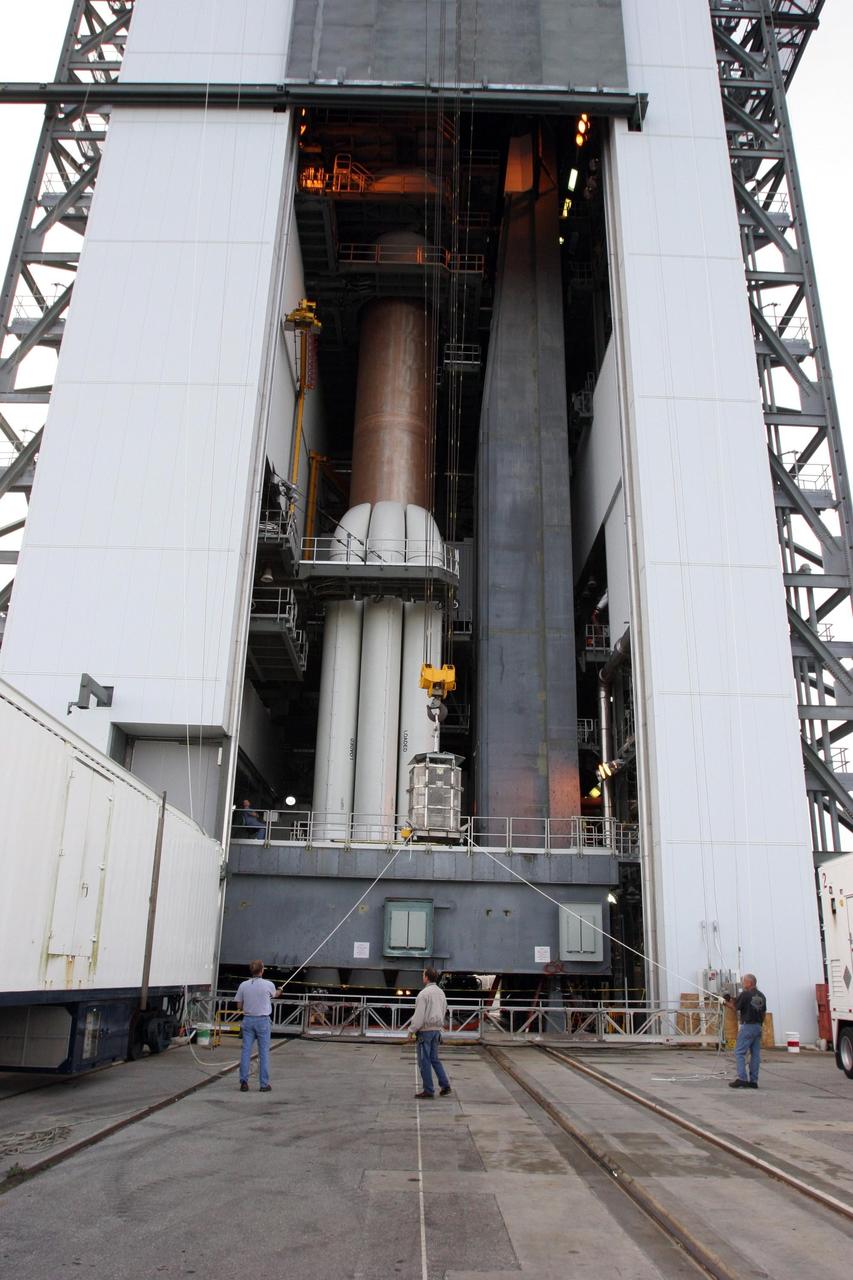
KENNEDY SPACE CENTER, FLA. — On Complex 41 at Cape Canaveral Air Force Station in Florida, workers on the ground oversee the radioisotope thermoelectric generator (RTG) being lifted into the Vertical Integration Facility. The RTG will be installed on the New Horizons spacecraft within the fairing at the top of the Atlas V launch vehicle. Designed and integrated at the Johns Hopkins University Applied Physics Laboratory (APL) in Laurel, Md., New Horizons will launch on a nine-and-a-half-year voyage to Pluto. Typical of RTG-based systems, as on past outer-planet missions, New Horizons does not have a battery for storing power. At the start of the mission, the RTG, which provides power through the natural radioactive decay of plutonium dioxide fuel, will supply approximately 240 watts (at 30 volts of direct current) - the spacecraft’s shunt regulator unit maintains a steady input from the RTG and dissipates power the spacecraft cannot use at a given time. By July 2015 (the earliest Pluto encounter date) that supply decreases to 200 watts at the same voltage, so New Horizons will ease the strain on its limited power source by cycling science instruments during planetary encounters. On Complex 41 at Cape Canaveral Air Force Station in Florida, workers on the ground oversee the radioisotope thermoelectric generator (RTG) being lifted into the Vertical Integration Facility. The RTG will be installed on the New Horizons spacecraft within the fairing at the top of the Atlas V launch vehicle. Designed and integrated at the Johns Hopkins University Applied Physics Laboratory (APL) in Laurel, Md., New Horizons will launch on a nine-and-a-half-year voyage to Pluto. Typical of RTG-based systems, as on past outer-planet missions, New Horizons does not have a battery for storing power. At the start of the mission, the RTG, which provides power through the natural radioactive decay of plutonium dioxide fuel, will supply approximately 240 watts (at 30 volts of direct curren

Jet Propulsion Laboratory (JPL) technicians finish mounting a thermal model of a radioisotope thermoelectric generator (RTG) on the installation cart which will be used to install the RTG in the Cassini spacecraft at Level 14 of Space Launch Complex 40, Cape Canaveral Air Station. The technicians use the thermal model to practice installation procedures. The three actual RTGs which will provide electrical power to Cassini on its 6.7-mile trip to the Saturnian system, and during its four-year mission at Saturn, are being tested and monitored in the Radioisotope Thermoelectric Generator Storage Building in KSC's Industrial Area. The RTGs use heat from the natural decay of plutonium to generate electric power. RTGs enable spacecraft to operate far from the Sun where solar power systems are not feasible. The RTGs on Cassini are of the same design as those flying on the already deployed Galileo and Ulysses spacecraft. The Cassini mission is targeted for an October 6 launch aboard a Titan IVB/Centaur expendable launch vehicle. Cassini is built and managed for NASA by JPL
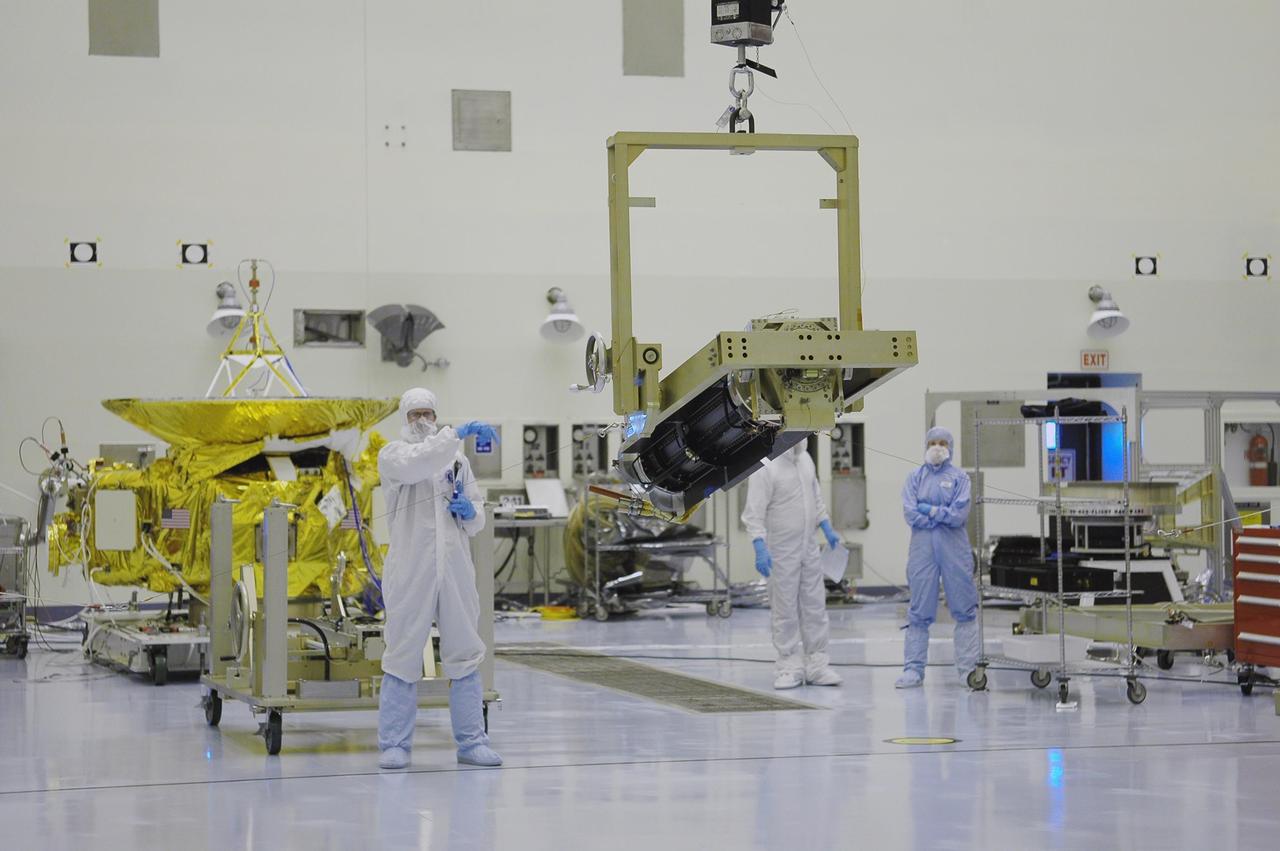
KENNEDY SPACE CENTER, FLA. - Supported by a crane in the Payload Hazardous Servicing Facility, the radioisotope thermoelectric generator (RTG) is rotated to vertical. The RTG is being returned to the RTG facility after completing a fit check with the spacecraft. The RTG is the baseline power supply for the New Horizons, scheduled to launch in January 2006 on a journey to Pluto and its moon, Charon. As it approaches Pluto, the spacecraft will look for ultraviolet emission from Pluto's atmosphere and make the best global maps of Pluto and Charon in green, blue, red and a special wavelength that is sensitive to methane frost on the surface. It will also take spectral maps in the near infrared, telling the science team about Pluto's and Charon's surface compositions and locations and temperatures of these materials. When the spacecraft is closest to Pluto or its moon, it will take close-up pictures in both visible and near-infrared wavelengths. It is expected to reach Pluto in July 2015.
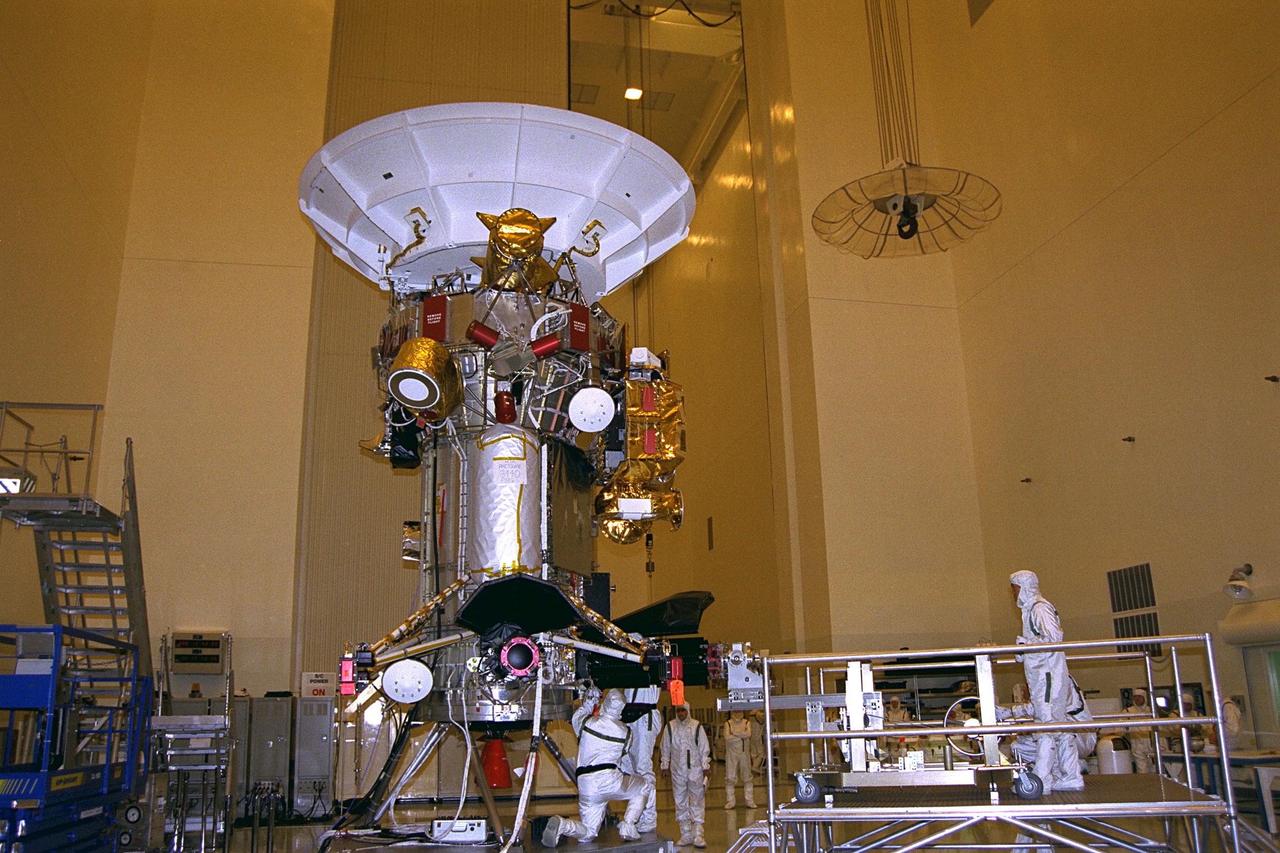
Jet Propulsion Laboratory (JPL) employees bolt a radioisotope thermoelectric generator (RTG) onto the Cassini spacecraft, at left, while other JPL workers, at right, operate the installation cart on a raised platform in the Payload Hazardous Servicing Facility (PHSF). Cassini will be outfitted with three RTGs. The power units are undergoing mechanical and electrical verification tests in the PHSF. The RTGs will provide electrical power to Cassini on its 6.7-year trip to the Saturnian system and during its four-year mission at Saturn. RTGs use heat from the natural decay of plutonium to generate electric power. The generators enable spacecraft to operate at great distances from the Sun where solar power systems are not feasible. The Cassini mission is targeted for an Oct. 6 launch aboard a Titan IVB/Centaur expendable launch vehicle. Cassini is built and managed by JPL

Jet Propulsion Laboratory (JPL) workers carefully roll into place a platform with a second radioisotope thermoelectric generator (RTG) for installation on the Cassini spacecraft. In background at left, the first of three RTGs already has been installed on Cassini. The RTGs will provide electrical power to Cassini on its 6.7-year trip to the Saturnian system and during its four-year mission at Saturn. The power units are undergoing mechanical and electrical verification testing in the Payload Hazardous Servicing Facility. RTGs use heat from the natural decay of plutonium to generate electric power. The generators enable spacecraft to operate far from the Sun where solar power systems are not feasible. The Cassini mission is scheduled for an Oct. 6 launch aboard a Titan IVB/Centaur expendable launch vehicle. Cassini is built and managed for NASA by JPL

Jet Propulsion Laboratory (JPL) worker Mary Reaves mates connectors on a radioisotope thermoelectric generator (RTG) to power up the Cassini spacecraft, while quality assurance engineer Peter Sorci looks on. The three RTGs which will be used on Cassini are undergoing mechanical and electrical verification testing in the Payload Hazardous Servicing Facility. The RTGs will provide electrical power to Cassini on its 6.7-year trip to the Saturnian system and during its four-year mission at Saturn. RTGs use heat from the natural decay of plutonium to generate electric power. The generators enable spacecraft to operate at great distances from the Sun where solar power systems are not feasible. The Cassini mission is targeted for an Oct. 6 launch aboard a Titan IVB/Centaur expendable launch vehicle. Cassini is built and managed by JPL
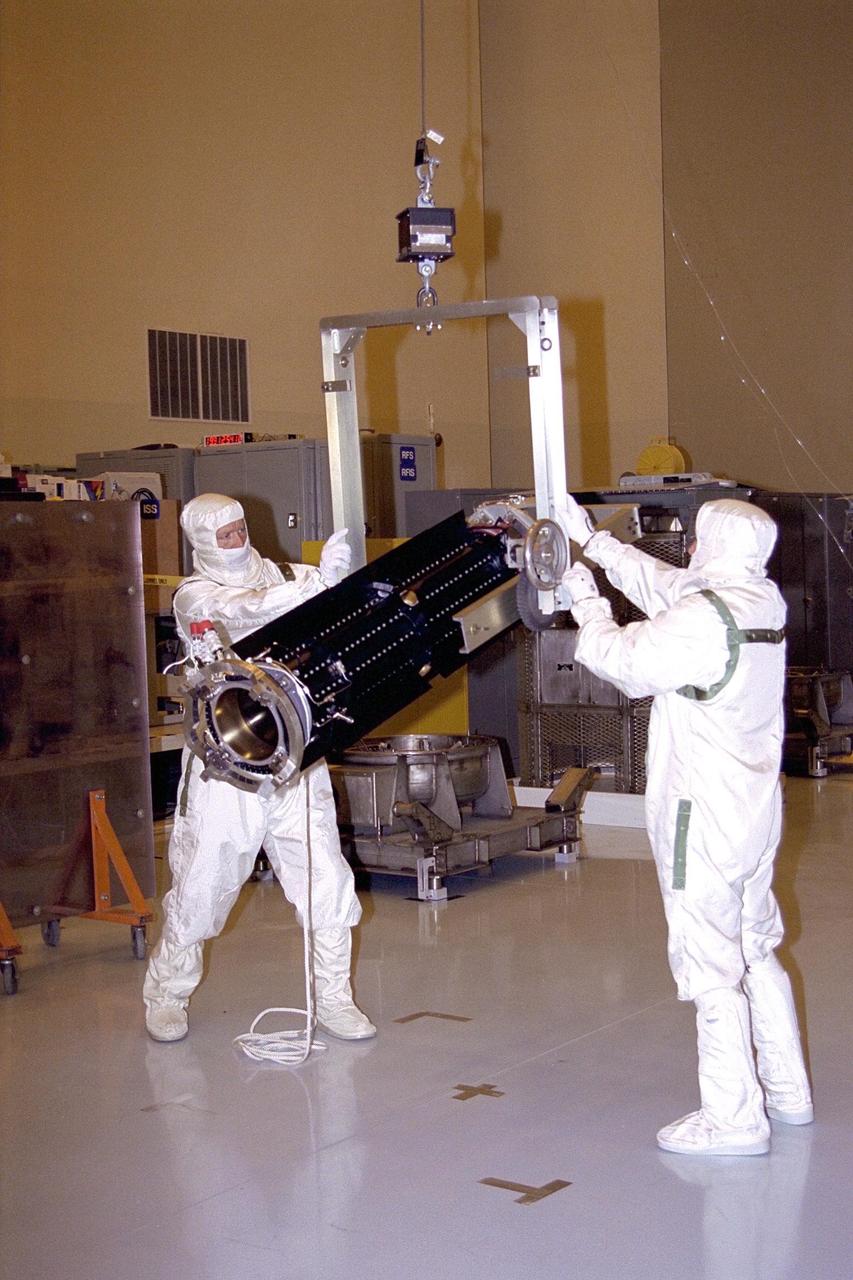
Jet Propulsion Laboratory (JPL) workers David Rice, at left, and Johnny Melendez rotate a radioisotope thermoelectric generator (RTG) to the horizontal position on a lift fixture in the Payload Hazardous Servicing Facility. The RTG is one of three generators which will provide electrical power for the Cassini spacecraft mission to the Saturnian system. The RTGs will be installed on the powered-up spacecraft for mechanical and electrical verification testing. RTGs use heat from the natural decay of plutonium to generate electric power. The generators enable spacecraft to operate far from the Sun where solar power systems are not feasible. The Cassini mission is scheduled for an Oct. 6 launch aboard a Titan IVB/Centaur expendable launch vehicle. Cassini is built and managed for NASA by JPL
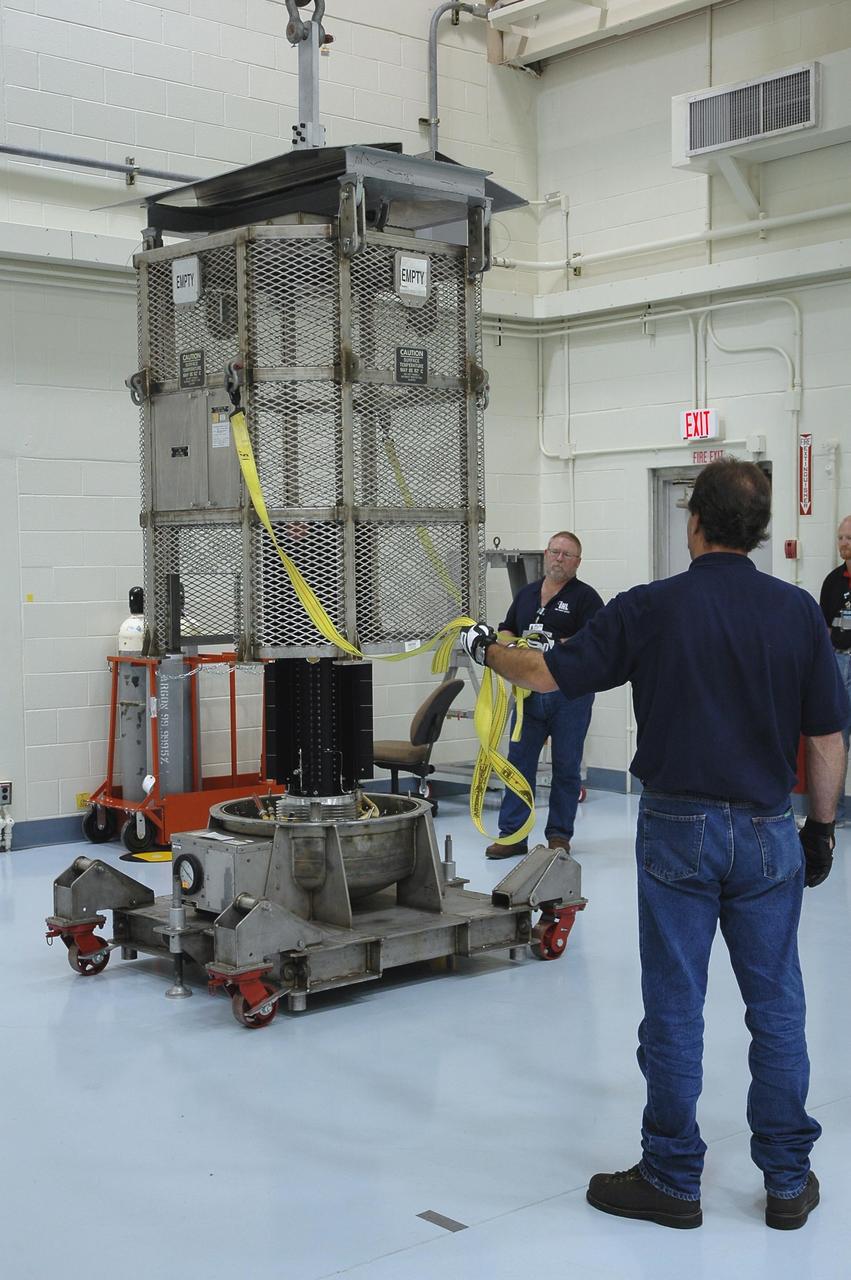
KENNEDY SPACE CENTER, FLA. -In the RTG Facility at Kennedy Space Center, Jim Wojciechowski and Dan Brunson lower a metal canister over the radioisotope thermoelectric generator (RTG). The canister will protect the RTG when it is moved. The RTG is the baseline power supply for the NASA’s New Horizons spacecraft, scheduled to launch in January 2006 on a journey to Pluto and its moon, Charon. As it approaches Pluto, the spacecraft will look for ultraviolet emission from Pluto's atmosphere and make the best global maps of Pluto and Charon in green, blue, red and a special wavelength that is sensitive to methane frost on the surface. It will also take spectral maps in the near infrared, telling the science team about Pluto's and Charon's surface compositions and locations and temperatures of these materials. When the spacecraft is closest to Pluto or its moon, it will take close-up pictures in both visible and near-infrared wavelengths. It is expected to reach Pluto in July 2015.
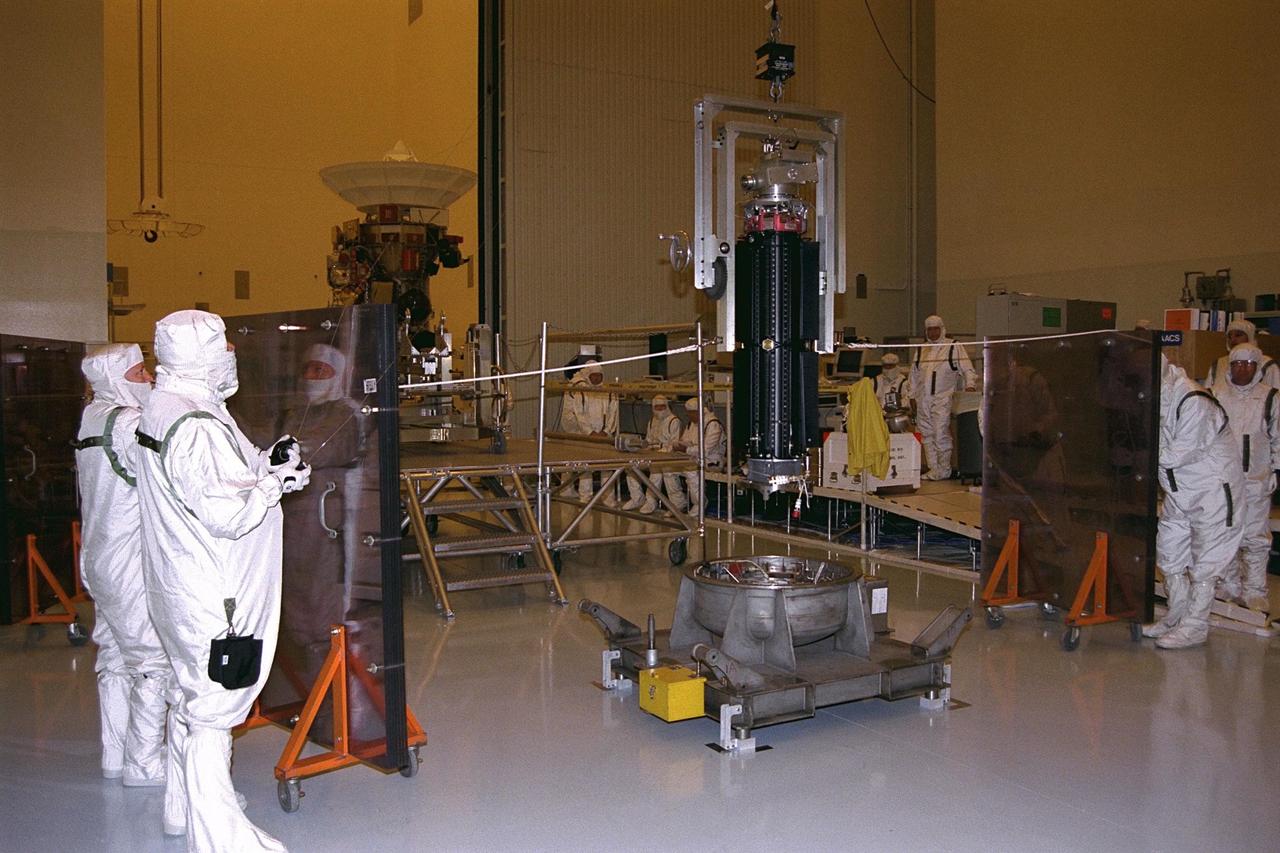
Supported on a lift fixture, this radioisotope thermoelectric generator (RTG), at center, is hoisted from its storage base using the airlock crane in the Payload Hazardous Servicing Facility (PHSF). Jet Propulsion Laboratory (JPL) workers are preparing to install the RTG onto the Cassini spacecraft, in background at left, for mechanical and electrical verification testing. The three RTGs on Cassini will provide electrical power to the spacecraft on its 6.7-year trip to the Saturnian system and during its four-year mission at Saturn. RTGs use heat from the natural decay of plutonium to generate electric power. The generators enable spacecraft to operate at great distances from the Sun where solar power systems are not feasible. The Cassini mission is targeted for an Oct. 6 launch aboard a Titan IVB/Centaur expendable launch vehicle. Cassini is built and managed by JPL
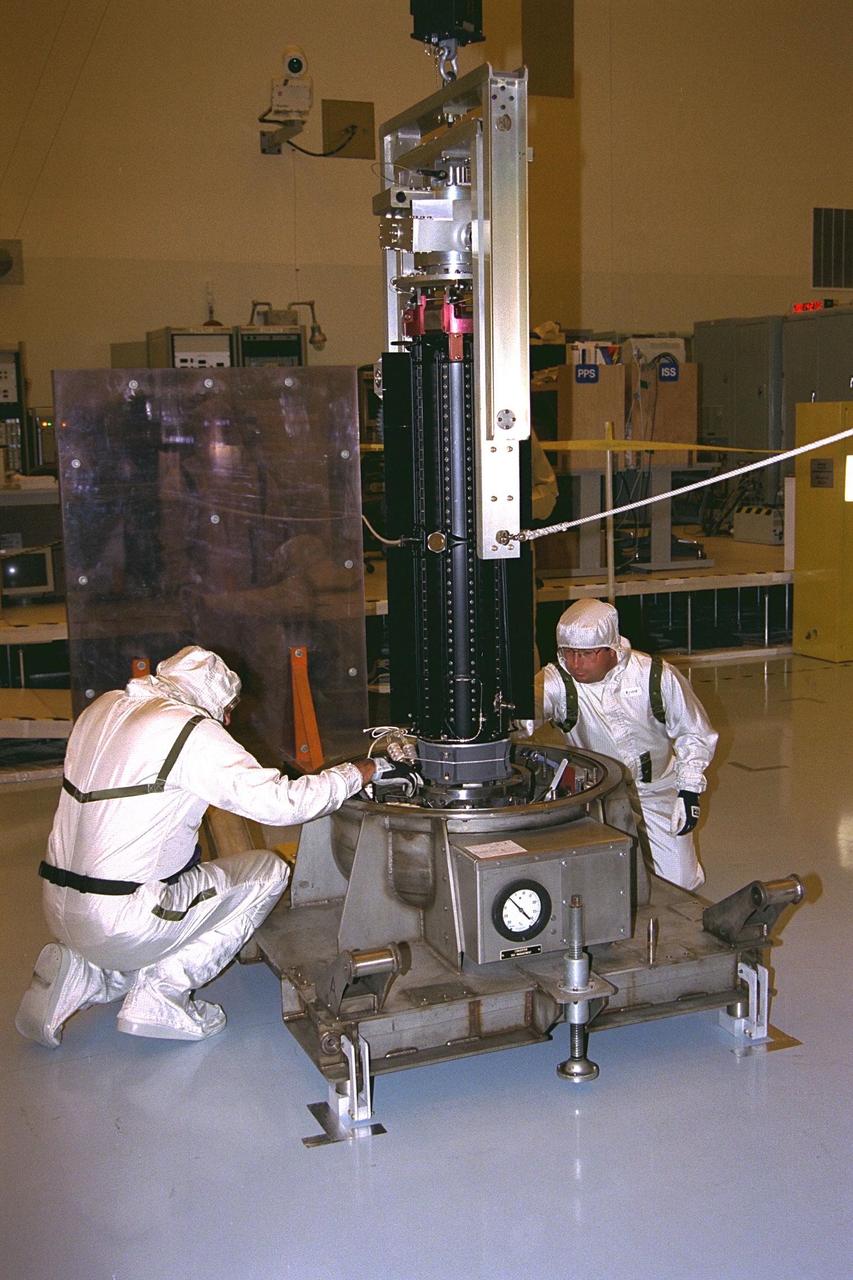
Lockheed Martin Missile and Space Co. employees Joe Collingwood, at right, and Ken Dickinson retract pins in the storage base to release a radioisotope thermoelectric generator (RTG) in preparation for hoisting operations. This RTG and two others will be installed on the Cassini spacecraft for mechanical and electrical verification testing in the Payload Hazardous Servicing Facility. The RTGs will provide electrical power to Cassini on its 6.7-year trip to the Saturnian system and during its four-year mission at Saturn. RTGs use heat from the natural decay of plutonium to generate electric power. The generators enable spacecraft to operate at great distances from the Sun where solar power systems are not feasible. The Cassini mission is targeted for an Oct. 6 launch aboard a Titan IVB/Centaur expendable launch vehicle. Cassini is built and managed by NASA’s Jet Propulsion Laboratory
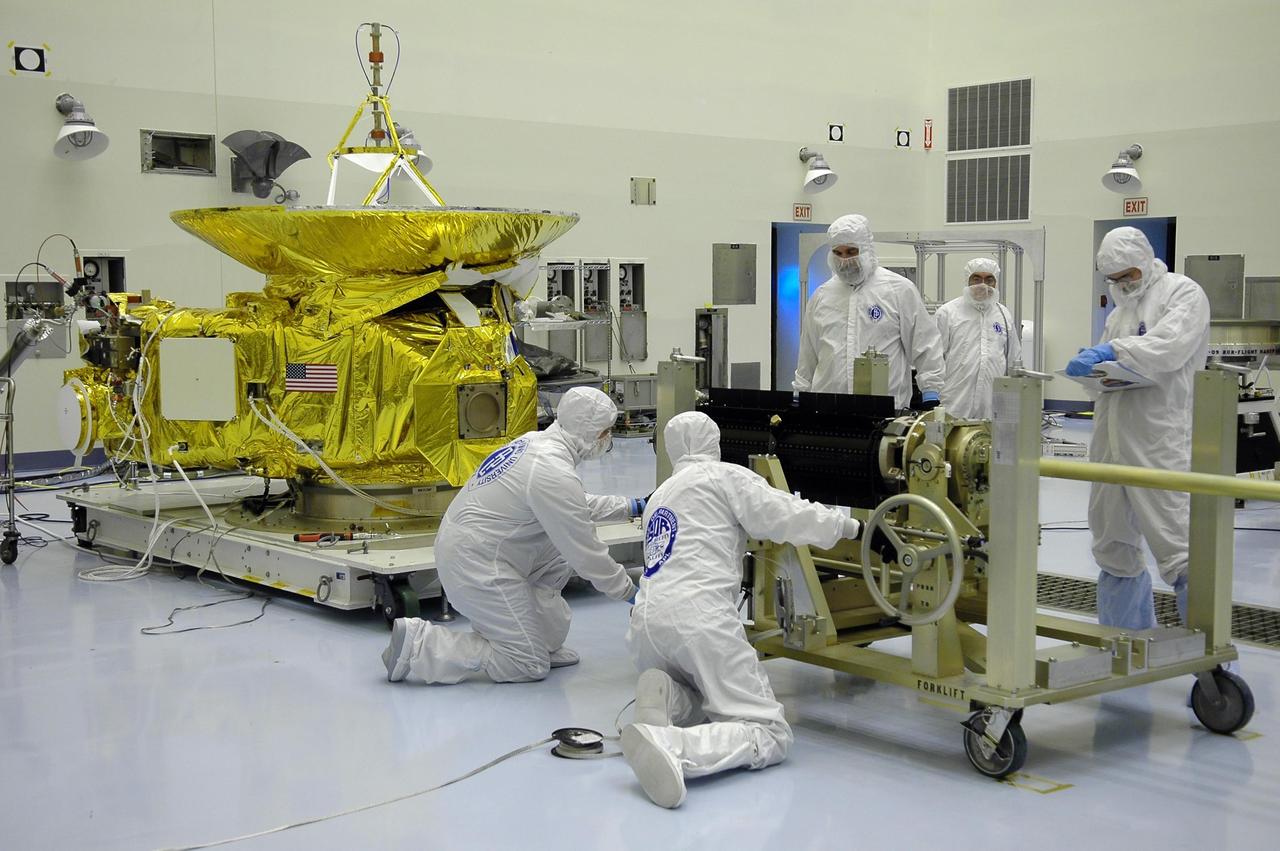
KENNEDY SPACE CENTER, FLA. - In the Payload Hazardous Servicing Facility, engineers move the radioisotope thermoelectric generator (RTG) away from NASA’s New Horizons spacecraft. The RTG is being returned to the RTG facility after completing a fit check with the spacecraft. The RTG is the baseline power supply for the New Horizons, scheduled to launch in January 2006 on a journey to Pluto and its moon, Charon. As it approaches Pluto, the spacecraft will look for ultraviolet emission from Pluto's atmosphere and make the best global maps of Pluto and Charon in green, blue, red and a special wavelength that is sensitive to methane frost on the surface. It will also take spectral maps in the near infrared, telling the science team about Pluto's and Charon's surface compositions and locations and temperatures of these materials. When the spacecraft is closest to Pluto or its moon, it will take close-up pictures in both visible and near-infrared wavelengths. It is expected to reach Pluto in July 2015.
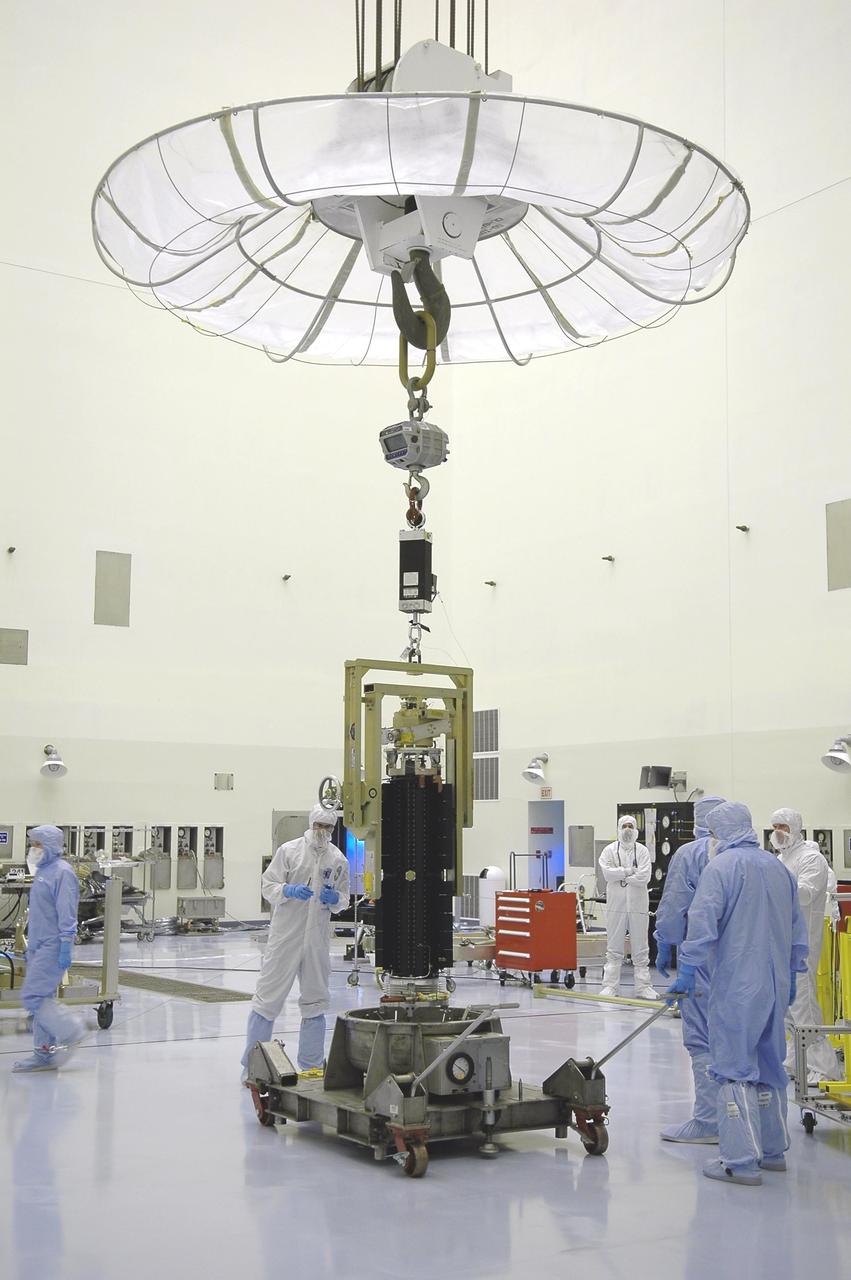
KENNEDY SPACE CENTER, FLA. - Supported by a crane in the Payload Hazardous Servicing Facility, the radioisotope thermoelectric generator (RTG) is lowered onto a transporter. The RTG is being returned to the RTG facility. The RTG is the baseline power supply for the New Horizons, scheduled to launch in January 2006 on a journey to Pluto and its moon, Charon. As it approaches Pluto, the spacecraft will look for ultraviolet emission from Pluto's atmosphere and make the best global maps of Pluto and Charon in green, blue, red and a special wavelength that is sensitive to methane frost on the surface. It will also take spectral maps in the near infrared, telling the science team about Pluto's and Charon's surface compositions and locations and temperatures of these materials. When the spacecraft is closest to Pluto or its moon, it will take close-up pictures in both visible and near-infrared wavelengths. It is expected to reach Pluto in July 2015.

KENNEDY SPACE CENTER, FLA. - Outside of the Payload Hazardous Servicing Facility, the enclosed radioisotope thermoelectric generator (RTG) is moved into a waiting truck. The RTG is being returned to the RTG facility after completing a fit check with the spacecraft. The RTG is the baseline power supply for the New Horizons, scheduled to launch in January 2006 on a journey to Pluto and its moon, Charon. As it approaches Pluto, the spacecraft will look for ultraviolet emission from Pluto's atmosphere and make the best global maps of Pluto and Charon in green, blue, red and a special wavelength that is sensitive to methane frost on the surface. It will also take spectral maps in the near infrared, telling the science team about Pluto's and Charon's surface compositions and locations and temperatures of these materials. When the spacecraft is closest to Pluto or its moon, it will take close-up pictures in both visible and near-infrared wavelengths. It is expected to reach Pluto in July 2015.
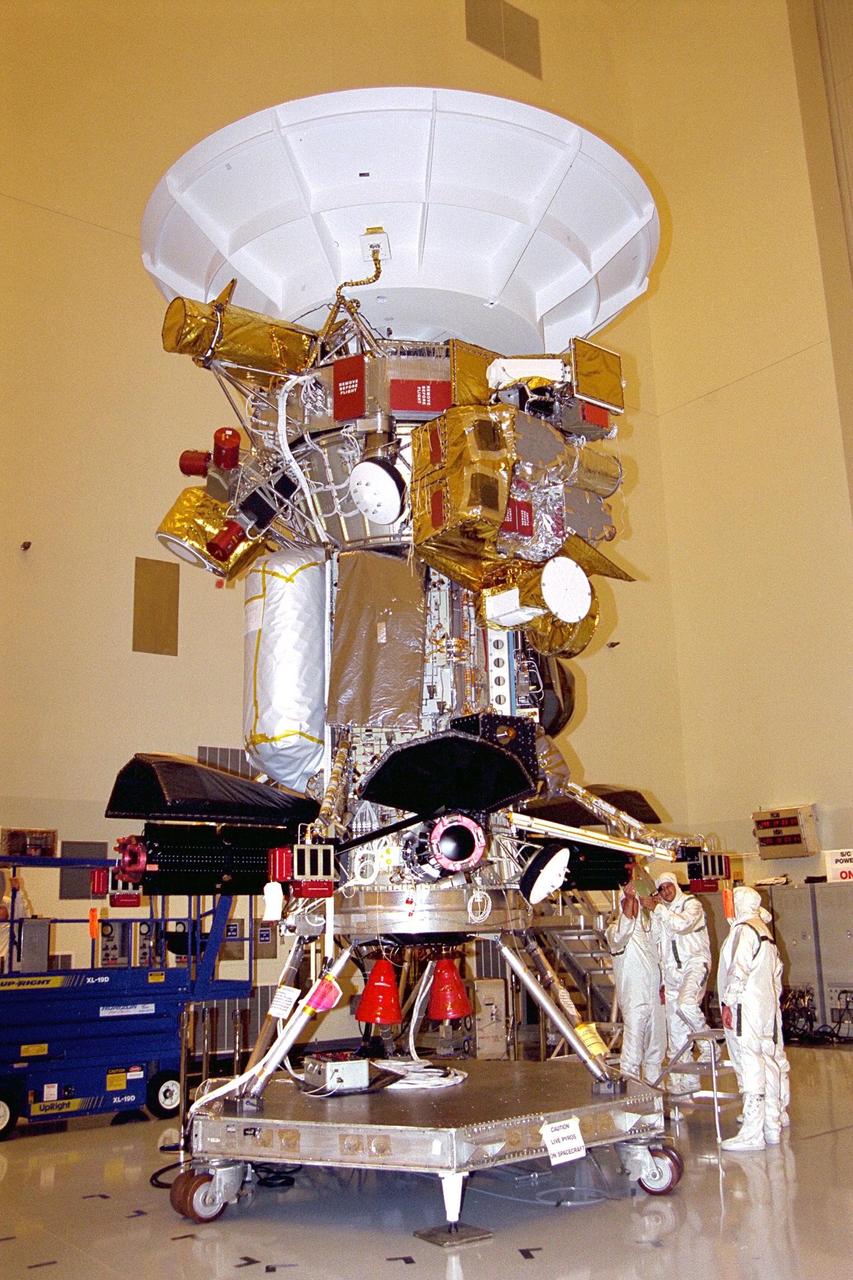
Jet Propulsion Laboratory (JPL) workers use a borescope to verify pressure relief device bellows integrity on a radioisotope thermoelectric generator (RTG) which has been installed on the Cassini spacecraft in the Payload Hazardous Servicing Facility. The activity is part of the mechanical and electrical verification testing of RTGs during prelaunch processing. RTGs use heat from the natural decay of plutonium to generate electric power. The three RTGs on Cassini will enable the spacecraft to operate far from the Sun where solar power systems are not feasible. They will provide electrical power to Cassini on its 6.7-year trip to the Saturnian system and during its four-year mission at Saturn. The Cassini mission is scheduled for an Oct. 6 launch aboard a Titan IVB/Centaur expendable launch vehicle. Cassini is built and managed for NASA by JPL
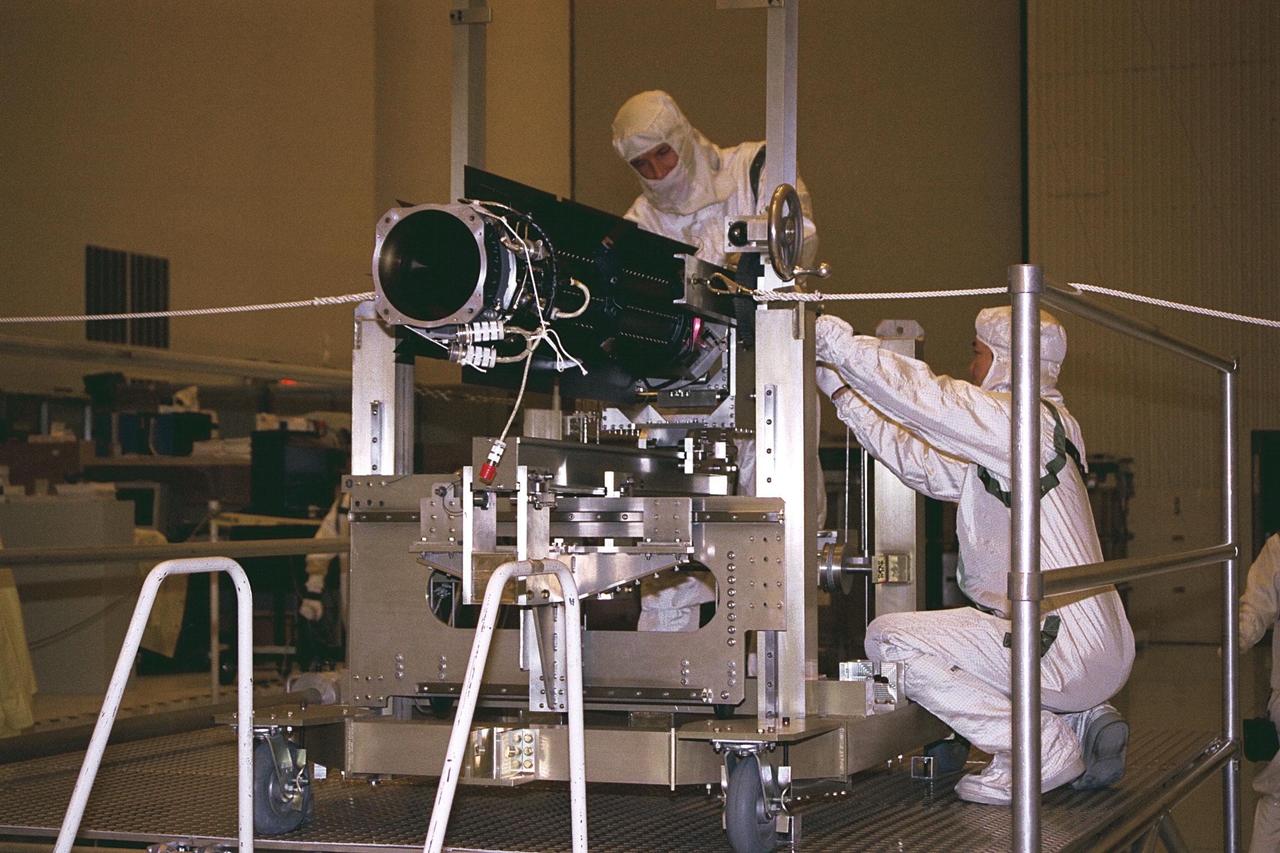
Jet Propulsion Laboratory (JPL) employees Norm Schwartz, at left, and George Nakatsukasa transfer one of three radioisotope thermoelectric generators (RTGs) to be used on the Cassini spacecraft from the installation cart to a lift fixture in preparation for returning the power unit to storage. The three RTGs underwent mechanical and electrical verification testing in the Payload Hazardous Servicing Facility. The RTGs will provide electrical power to Cassini on its 6.7-year trip to the Saturnian system and during its four-year mission at Saturn. RTGs use heat from the natural decay of plutonium to generate electric power. The generators enable spacecraft to operate at great distances from the Sun where solar power systems are not feasible. The Cassini mission is targeted for an Oct. 6 launch aboard a Titan IVB/Centaur expendable launch vehicle. Cassini is built and managed by JPL
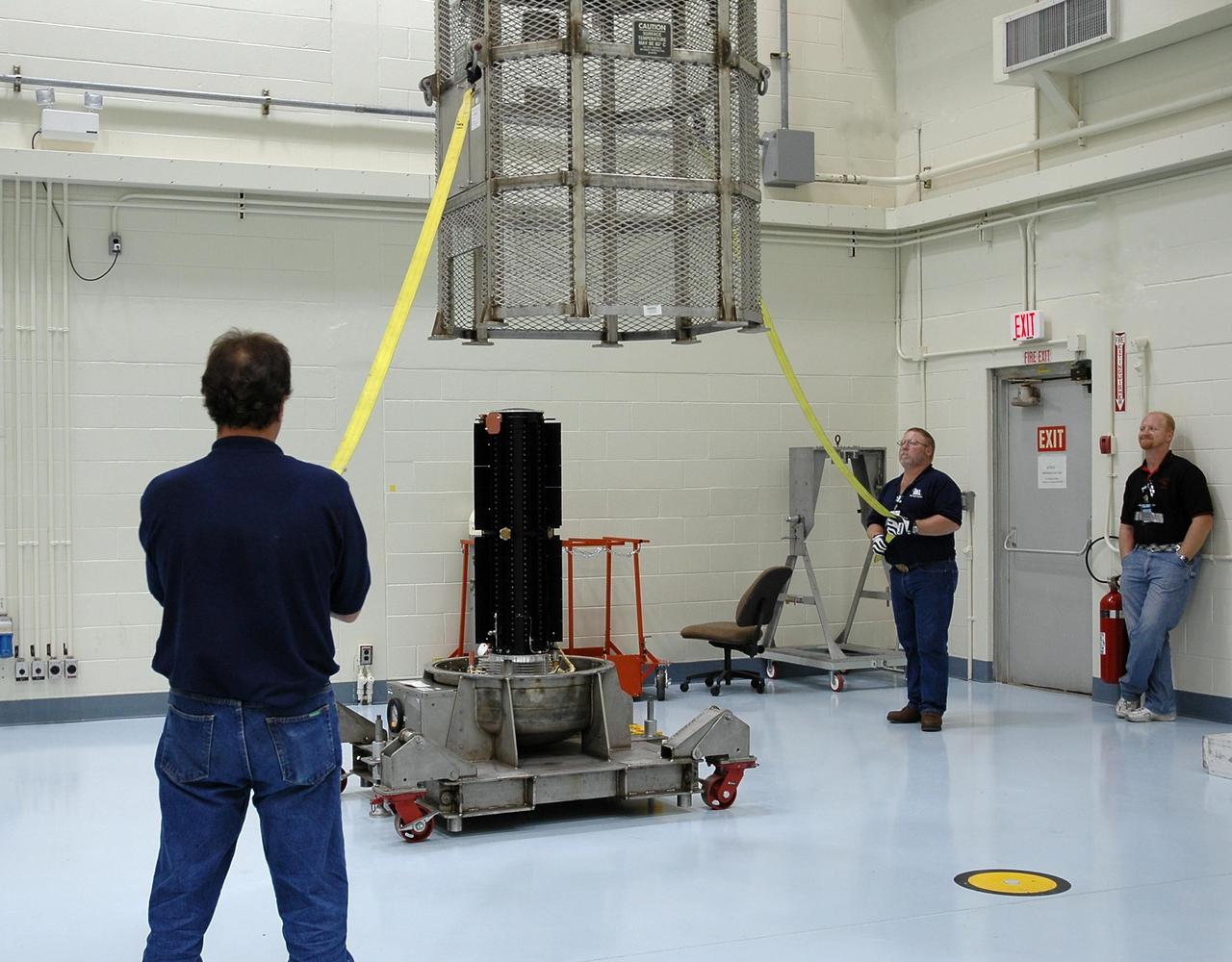
KENNEDY SPACE CENTER, FLA. - n the RTG Facility at Kennedy Space Center, Jim Wojciechowski and Dan Brunson move a metal canister toward the radioisotope thermoelectric generator (RTG). The canister will protect the RTG when it is moved. The RTG is the baseline power supply for the NASA’s New Horizons spacecraft, scheduled to launch in January 2006 on a journey to Pluto and its moon, Charon. As it approaches Pluto, the spacecraft will look for ultraviolet emission from Pluto's atmosphere and make the best global maps of Pluto and Charon in green, blue, red and a special wavelength that is sensitive to methane frost on the surface. It will also take spectral maps in the near infrared, telling the science team about Pluto's and Charon's surface compositions and locations and temperatures of these materials. When the spacecraft is closest to Pluto or its moon, it will take close-up pictures in both visible and near-infrared wavelengths. It is expected to reach Pluto in July 2015.
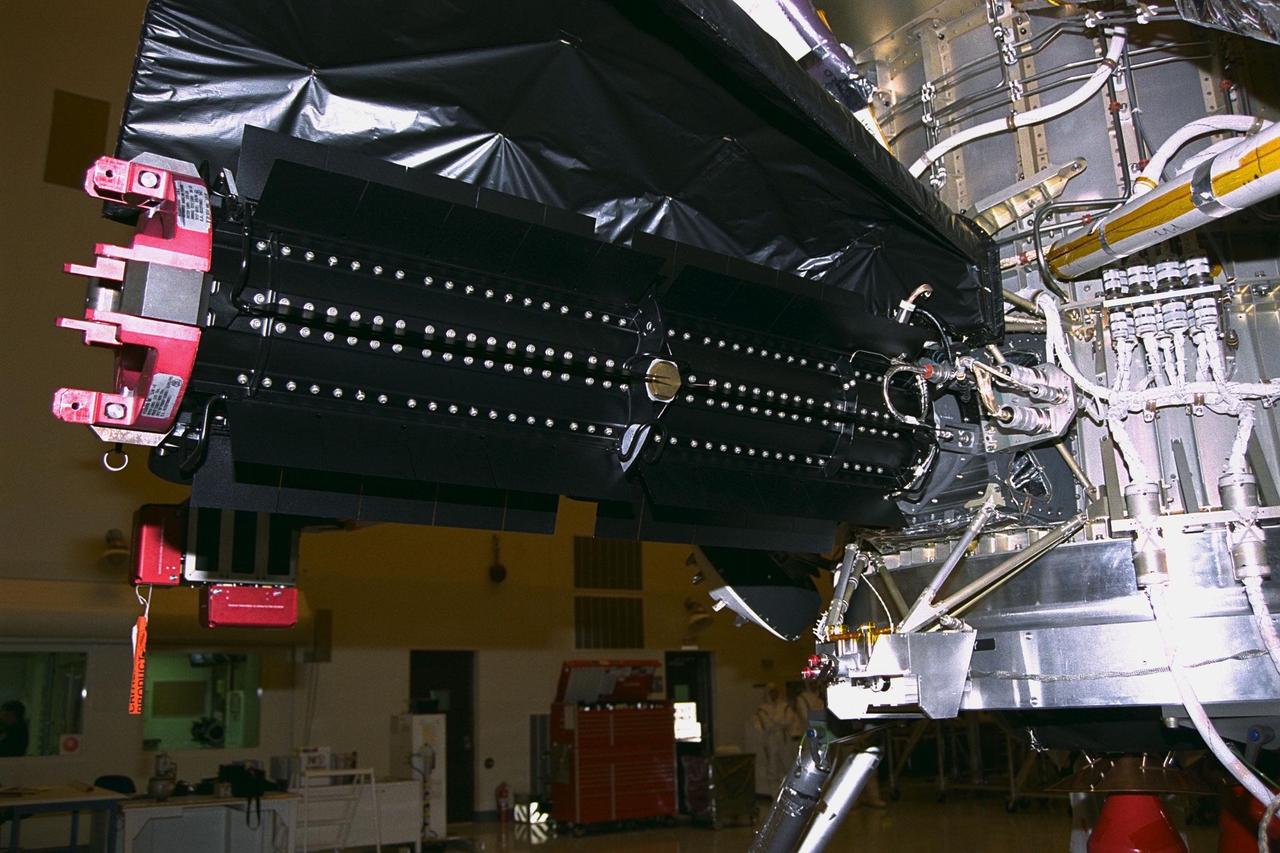
This radioisotope thermoelectric generator (RTG), at center, is ready for electrical verification testing now that it has been installed on the Cassini spacecraft in the Payload Hazardous Servicing Facility. A handling fixture, at far left, remains attached. This is the third and final RTG to be installed on Cassini for the prelaunch tests. The RTGs will provide electrical power to Cassini on its 6.7-year trip to the Saturnian system and during its four-year mission at Saturn. RTGs use heat from the natural decay of plutonium to generate electric power. The generators enable spacecraft to operate at great distances from the Sun where solar power systems are not feasible. The Cassini mission is targeted for an Oct. 6 launch aboard a Titan IVB/Centaur expendable launch vehicle

KENNEDY SPACE CENTER, FLA. - In the Payload Hazardous Servicing Facility, engineers lower a metal canister toward the radioisotope thermoelectric generator (RTG) below it. The RTG is being returned to the RTG facility after completing a fit check with the spacecraft. The RTG is the baseline power supply for the New Horizons, scheduled to launch in January 2006 on a journey to Pluto and its moon, Charon. As it approaches Pluto, the spacecraft will look for ultraviolet emission from Pluto's atmosphere and make the best global maps of Pluto and Charon in green, blue, red and a special wavelength that is sensitive to methane frost on the surface. It will also take spectral maps in the near infrared, telling the science team about Pluto's and Charon's surface compositions and locations and temperatures of these materials. When the spacecraft is closest to Pluto or its moon, it will take close-up pictures in both visible and near-infrared wavelengths. It is expected to reach Pluto in July 2015.

KENNEDY SPACE CENTER, FLA. - In the Payload Hazardous Servicing Facility, engineers move the radioisotope thermoelectric generator (RTG) away from NASA’s New Horizons spacecraft. The RTG is being returned to the RTG facility after completing a fit check with the spacecraft. The RTG is the baseline power supply for the New Horizons, scheduled to launch in January 2006 on a journey to Pluto and its moon, Charon. As it approaches Pluto, the spacecraft will look for ultraviolet emission from Pluto's atmosphere and make the best global maps of Pluto and Charon in green, blue, red and a special wavelength that is sensitive to methane frost on the surface. It will also take spectral maps in the near infrared, telling the science team about Pluto's and Charon's surface compositions and locations and temperatures of these materials. When the spacecraft is closest to Pluto or its moon, it will take close-up pictures in both visible and near-infrared wavelengths. It is expected to reach Pluto in July 2015.
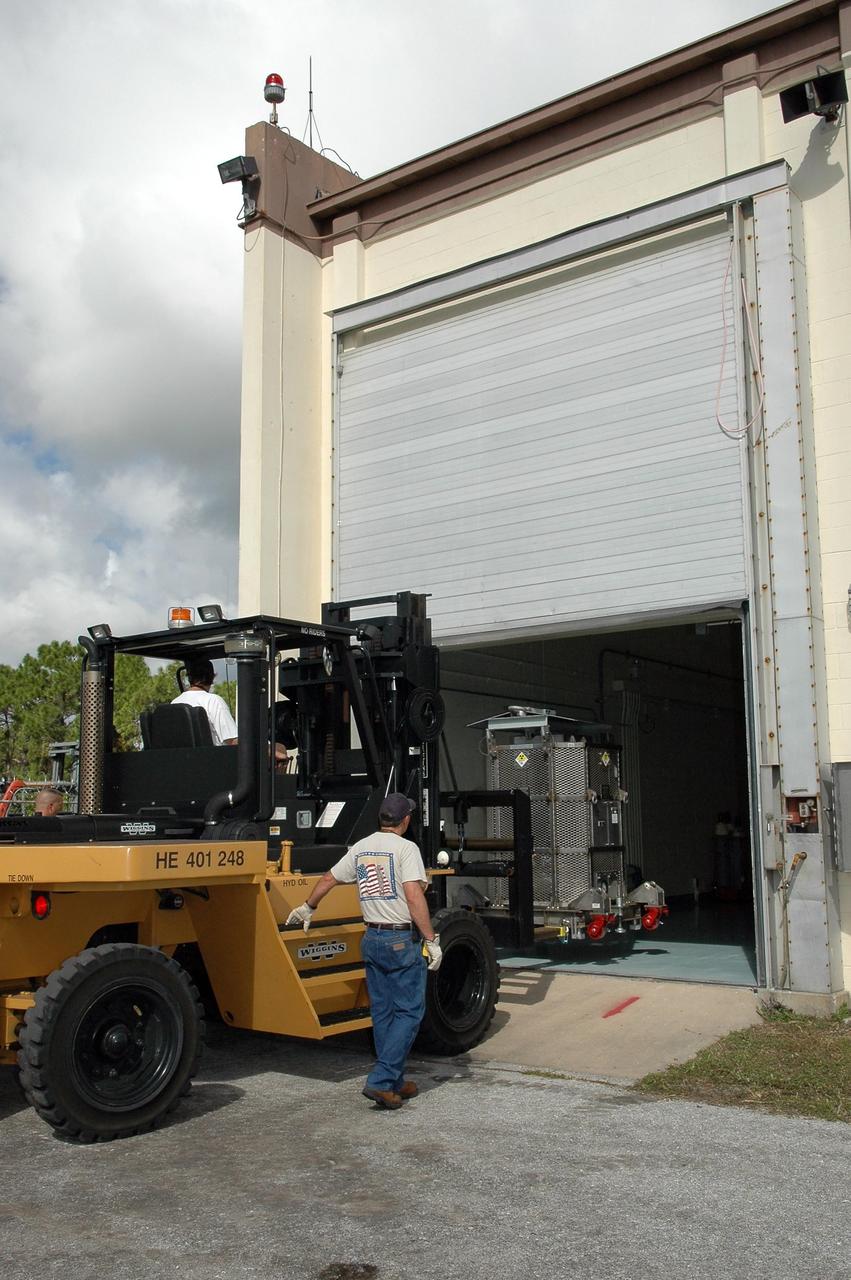
KENNEDY SPACE CENTER, FLA. - The radioisotope thermoelectric generator (RTG), enclosed in a metal canister, is moved into the RTG Facility. The RTG is being returned from the Payload Hazardous Servicing Facility where it underwent a fit check with the spacecraft. The RTG is the baseline power supply for the New Horizons, scheduled to launch in January 2006 on a journey to Pluto and its moon, Charon. As it approaches Pluto, the spacecraft will look for ultraviolet emission from Pluto's atmosphere and make the best global maps of Pluto and Charon in green, blue, red and a special wavelength that is sensitive to methane frost on the surface. It will also take spectral maps in the near infrared, telling the science team about Pluto's and Charon's surface compositions and locations and temperatures of these materials. When the spacecraft is closest to Pluto or its moon, it will take close-up pictures in both visible and near-infrared wavelengths. It is expected to reach Pluto in July 2015.
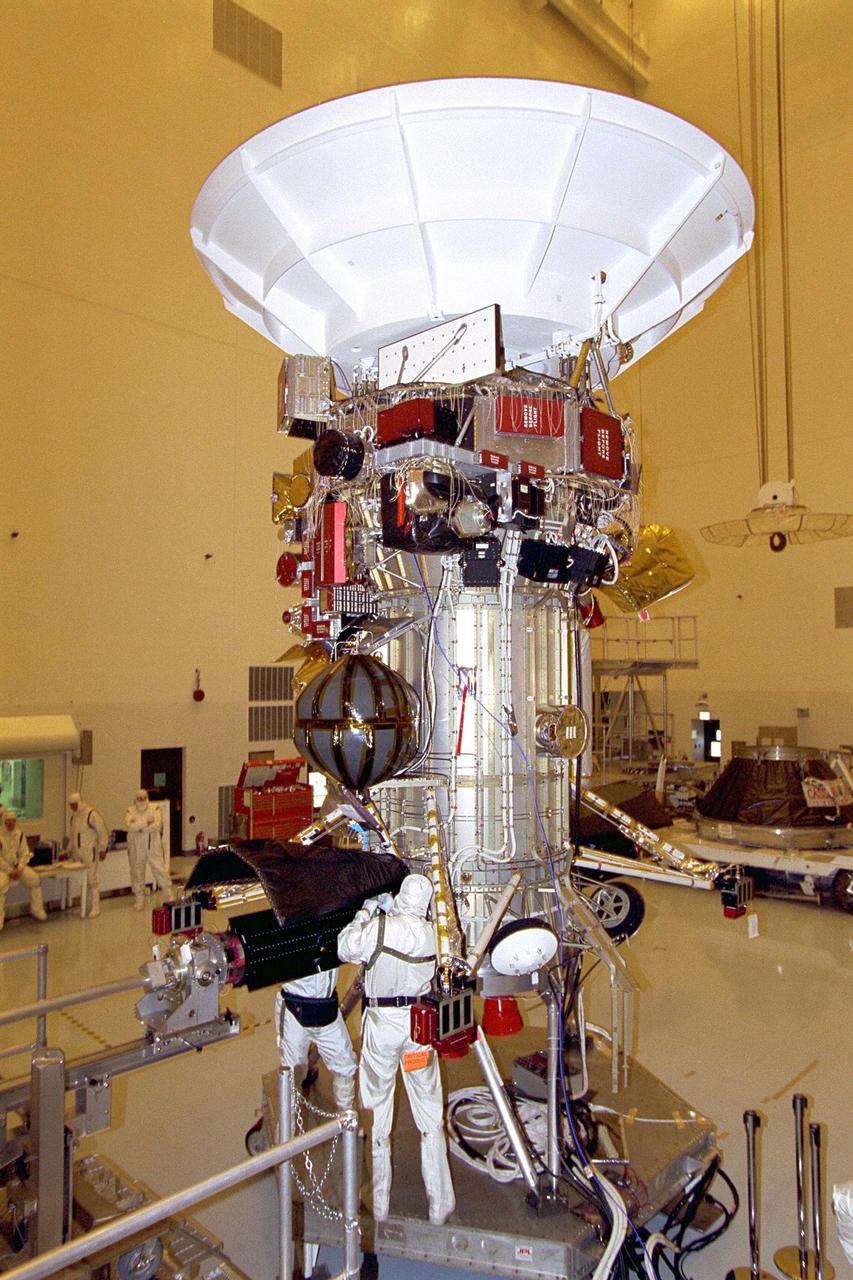
Jet Propulsion Laboratory (JPL) workers Dan Maynard and John Shuping prepare to install a radioisotope thermoelectric generator (RTG) on the Cassini spacecraft in the Payload Hazardous Servicing Facility (PHSF). The three RTGs which will provide electrical power to Cassini on its mission to the Saturnian system are undergoing mechanical and electrical verification testing in the PHSF. RTGs use heat from the natural decay of plutonium to generate electric power. The generators enable spacecraft to operate far from the Sun where solar power systems are not feasible. The Cassini mission is scheduled for an Oct. 6 launch aboard a Titan IVB/Centaur expendable launch vehicle. Cassini is built and managed for NASA by JPL

KENNEDY SPACE CENTER, FLA. - The container holding the radioisotope thermoelectric generator (RTG) is moved inside the RTG facility at Kennedy Space Center. The RTG is the baseline power supply for the NASA’s New Horizons spacecraft, scheduled to launch in January 2006 on a journey to Pluto and its moon, Charon. The RTG is the baseline power supply for the NASA’s New Horizons spacecraft, scheduled to launch in January 2006 on a journey to Pluto and its moon, Charon. The RTG is the baseline power supply for the NASA’s New Horizons spacecraft, scheduled to launch in January 2006 on a journey to Pluto and its moon, Charon. As it approaches Pluto, the spacecraft will look for ultraviolet emission from Pluto's atmosphere and make the best global maps of Pluto and Charon in green, blue, red and a special wavelength that is sensitive to methane frost on the surface. It will also take spectral maps in the near infrared, telling the science team about Pluto's and Charon's surface compositions and locations and temperatures of these materials. When the spacecraft is closest to Pluto or its moon, it will take close-up pictures in both visible and near-infrared wavelengths. It is expected to reach Pluto in July 2015.
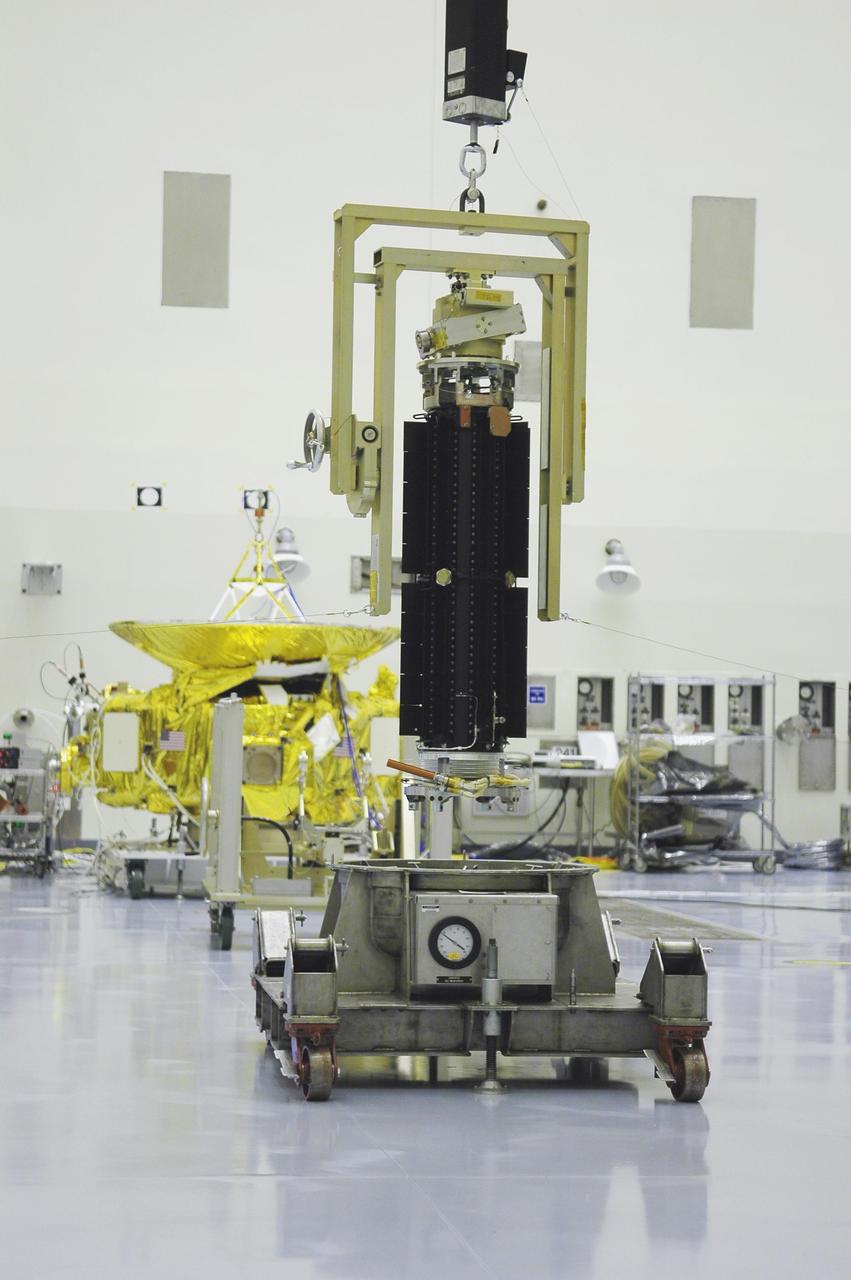
KENNEDY SPACE CENTER, FLA. - In NASA Kennedy Space Center’s Payload Hazardous Servicing Facility, a crane lifts the radioisotope thermoelectric generator (RTG) that will be installed in the New Horizons spacecraft, in the background, for a fit check. The RTG is the baseline power supply for New Horizons, scheduled to launch in January 2006 on a journey to Pluto and its moon, Charon. It is expected to reach Pluto in July 2015.
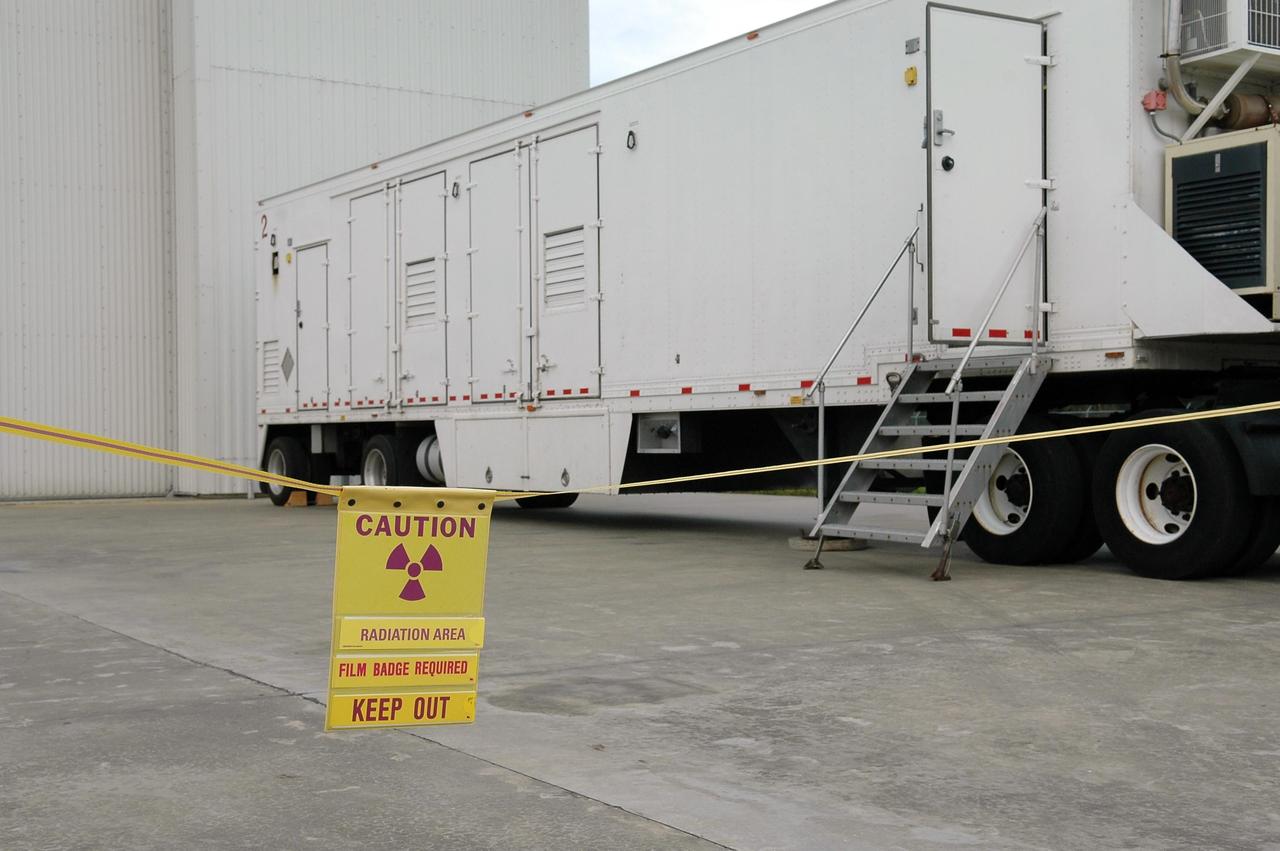
KENNEDY SPACE CENTER, FLA. - The transporter carrying the radioisotope thermoelectric generator (RTG) is closed and ready to move to NASA Kennedy Space Center’s Payload Hazardous Servicing Facility. It will be installed in the New Horizons spacecraft for a fit check. The RTG is the baseline power supply for New Horizons, scheduled to launch in January 2006 on a journey to Pluto and its moon, Charon. It is expected to reach Pluto in July 2015.

KENNEDY SPACE CENTER, FLA. - In NASA Kennedy Space Center’s Payload Hazardous Servicing Facility, In NASA Kennedy Space Center’s Payload Hazardous Servicing Facility, workers install the radioisotope thermoelectric generator (RTG) onto the New Horizons spacecraft for a fit check. The RTG is the baseline power supply for New Horizons, scheduled to launch in January 2006 on a journey to Pluto and its moon, Charon. It is expected to reach Pluto in July 2015.
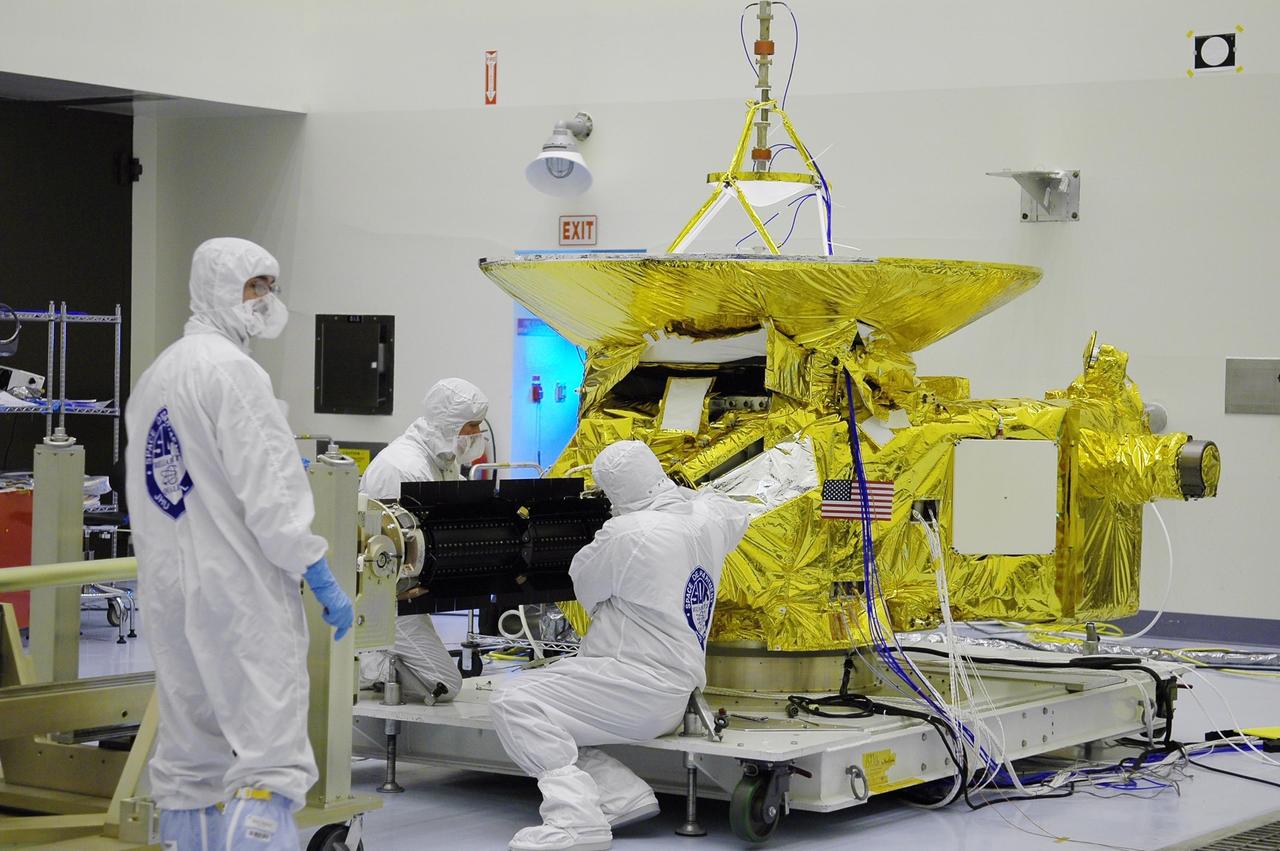
KENNEDY SPACE CENTER, FLA. - In NASA Kennedy Space Center’s Payload Hazardous Servicing Facility, workers begin installing the radioisotope thermoelectric generator (RTG) onto the New Horizons spacecraft for a fit check. The RTG is the baseline power supply for New Horizons, scheduled to launch in January 2006 on a journey to Pluto and its moon, Charon. It is expected to reach Pluto in July 2015.
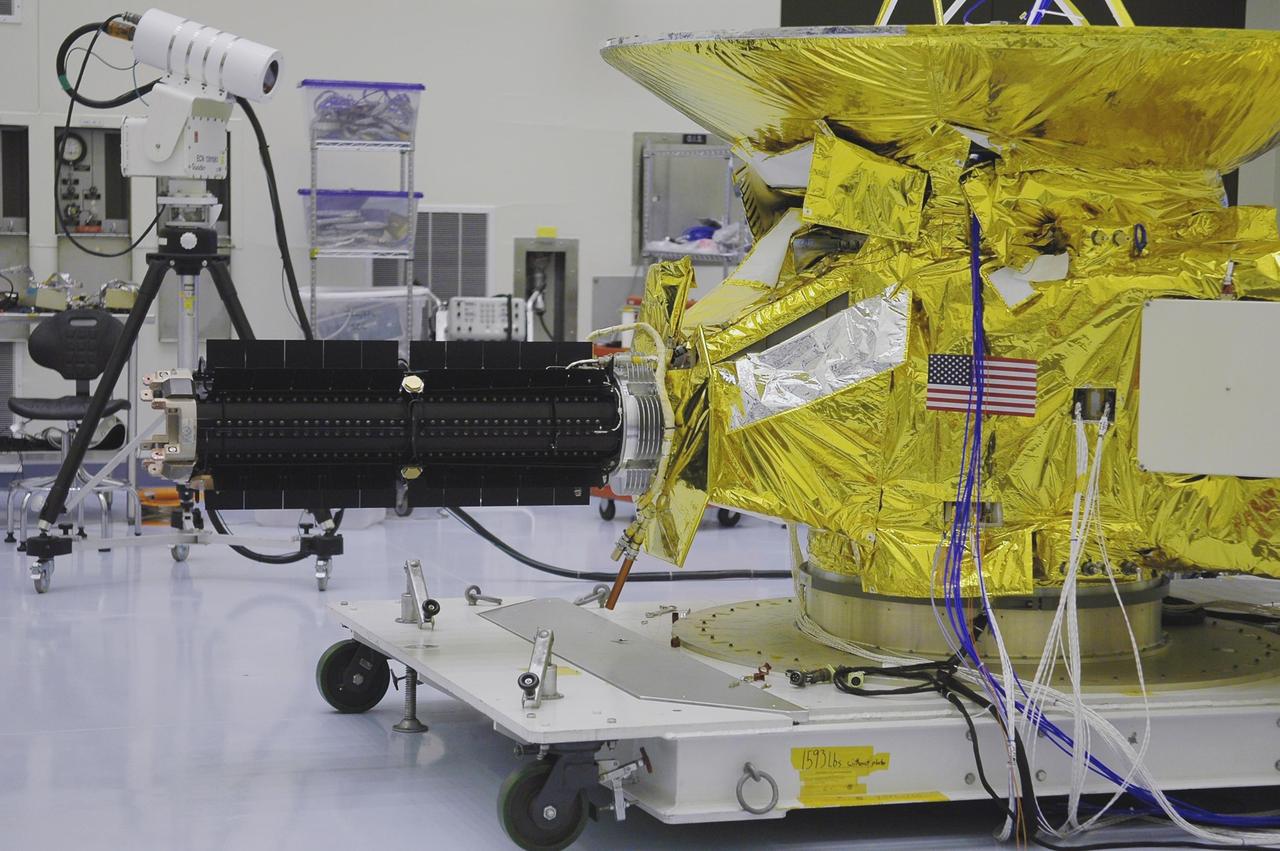
KENNEDY SPACE CENTER, FLA. - In NASA Kennedy Space Center’s Payload Hazardous Servicing Facility, In NASA Kennedy Space Center’s Payload Hazardous Servicing Facility, the radioisotope thermoelectric generator (RTG) has been installed onto the New Horizons spacecraft for a fit check. The RTG is the baseline power supply for New Horizons, scheduled to launch in January 2006 on a journey to Pluto and its moon, Charon. It is expected to reach Pluto in July 2015.
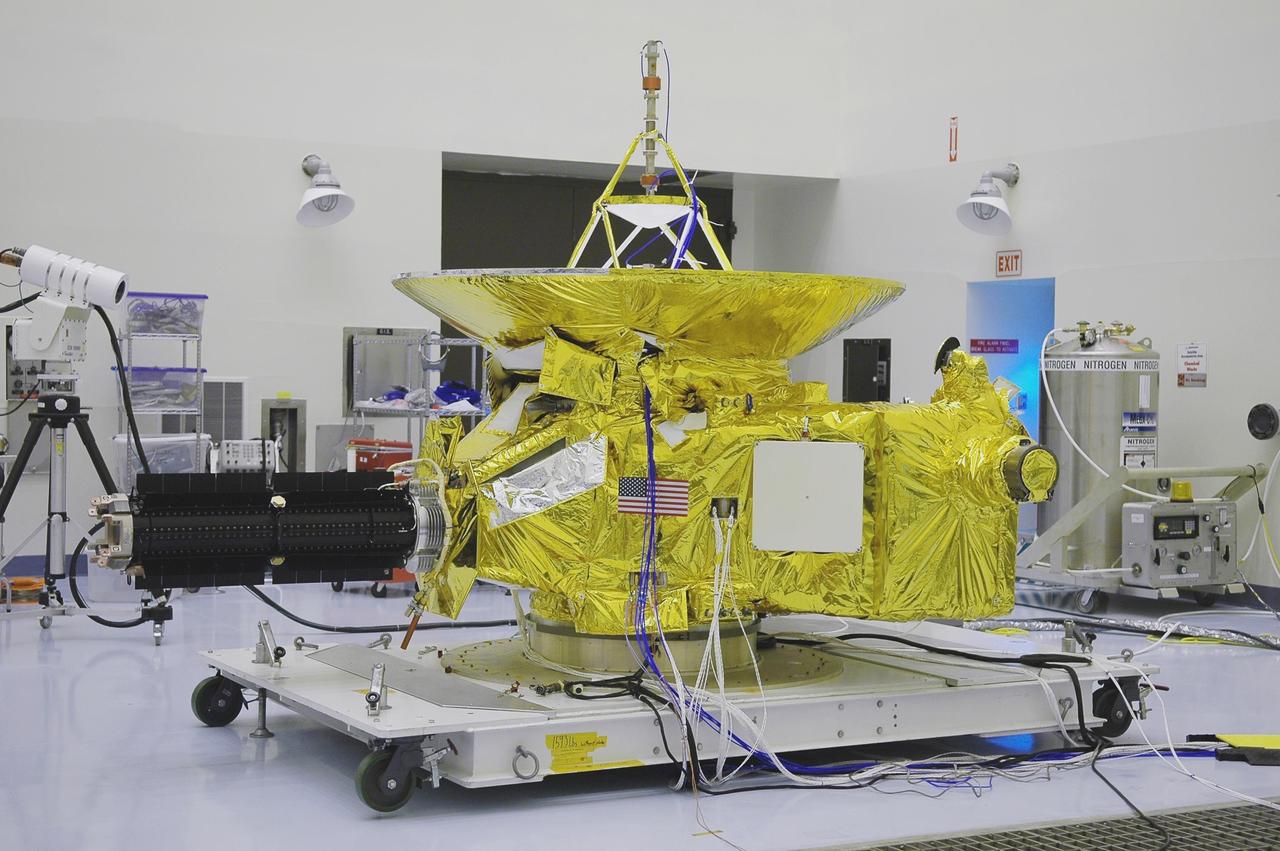
KENNEDY SPACE CENTER, FLA. - In NASA Kennedy Space Center’s Payload Hazardous Servicing Facility, the radioisotope thermoelectric generator (RTG) has been installed onto the New Horizons spacecraft for a fit check. The RTG is the baseline power supply for New Horizons, scheduled to launch in January 2006 on a journey to Pluto and its moon, Charon. It is expected to reach Pluto in July 2015.
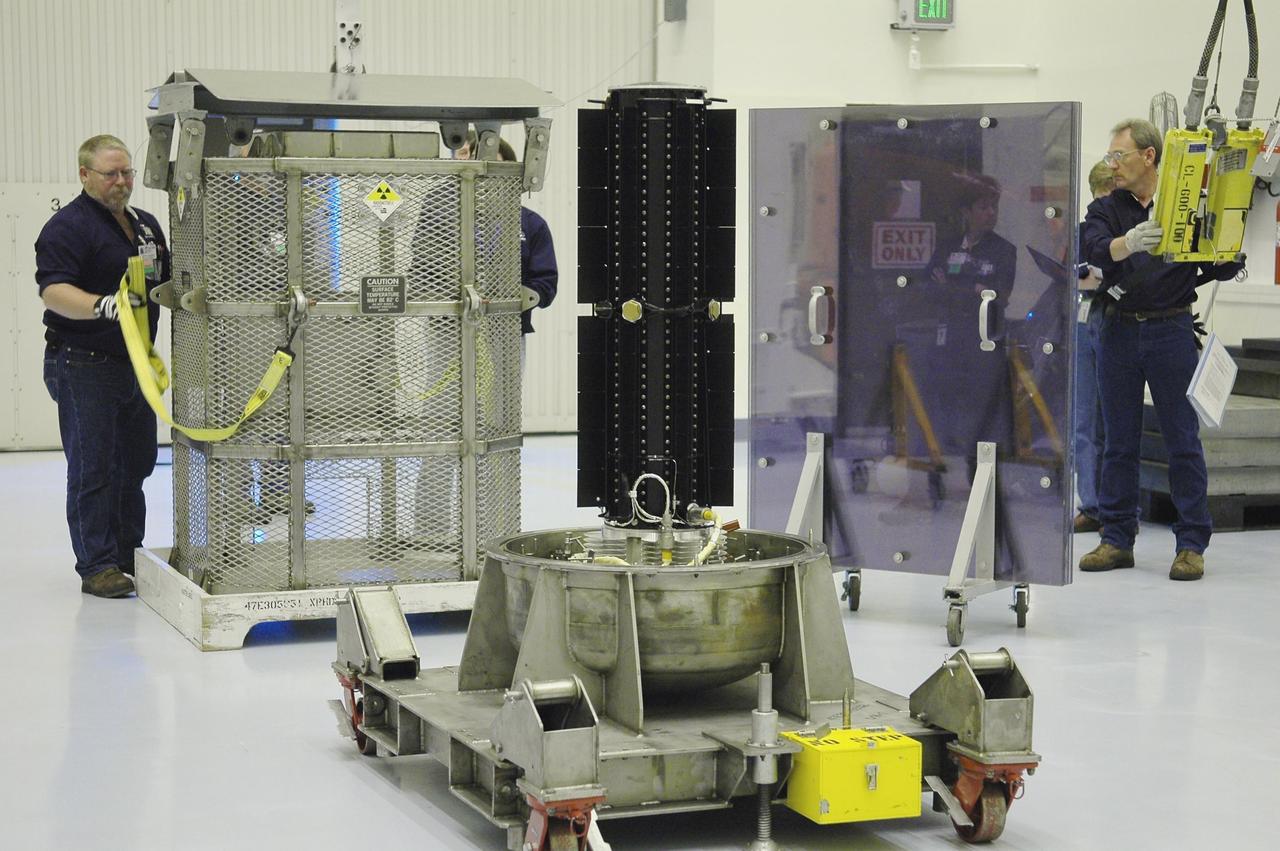
KENNEDY SPACE CENTER, FLA. - In NASA Kennedy Space Center’s Payload Hazardous Servicing Facility, the metal canister is secured at left. In the center is the radioisotope thermoelectric generator (RTG) that will be installed in the New Horizons spacecraft for a fit check. The RTG is the baseline power supply for New Horizons, scheduled to launch in January 2006 on a journey to Pluto and its moon, Charon. It is expected to reach Pluto in July 2015.
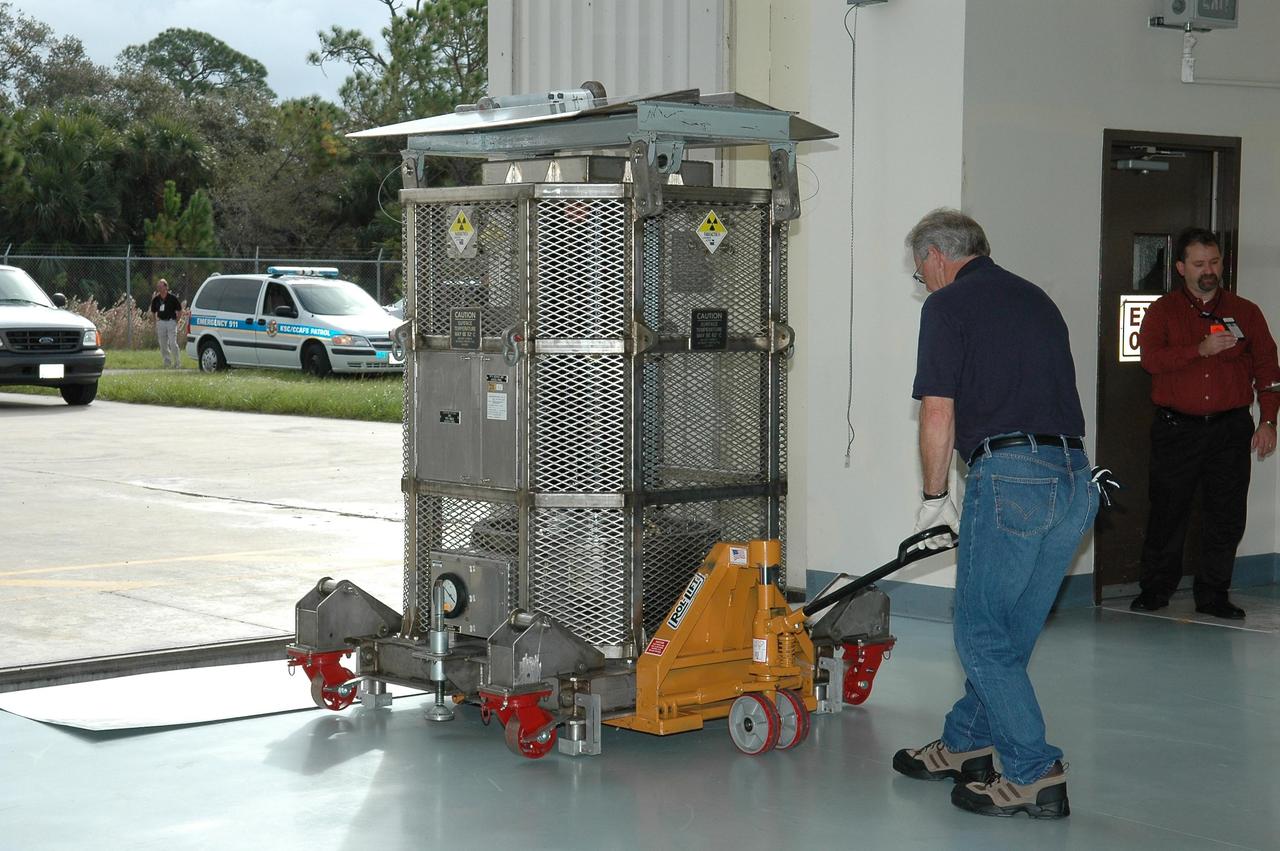
KENNEDY SPACE CENTER, FLA. - At NASA Kennedy Space Center’s Payload Hazardous Servicing Facility, the radioisotope thermoelectric generator (RTG) is rolled into the building. Inside the facility, it will be installed in the New Horizons spacecraft for a fit check. The RTG is the baseline power supply for New Horizons, scheduled to launch in January 2006 on a journey to Pluto and its moon, Charon. It is expected to reach Pluto in July 2015.
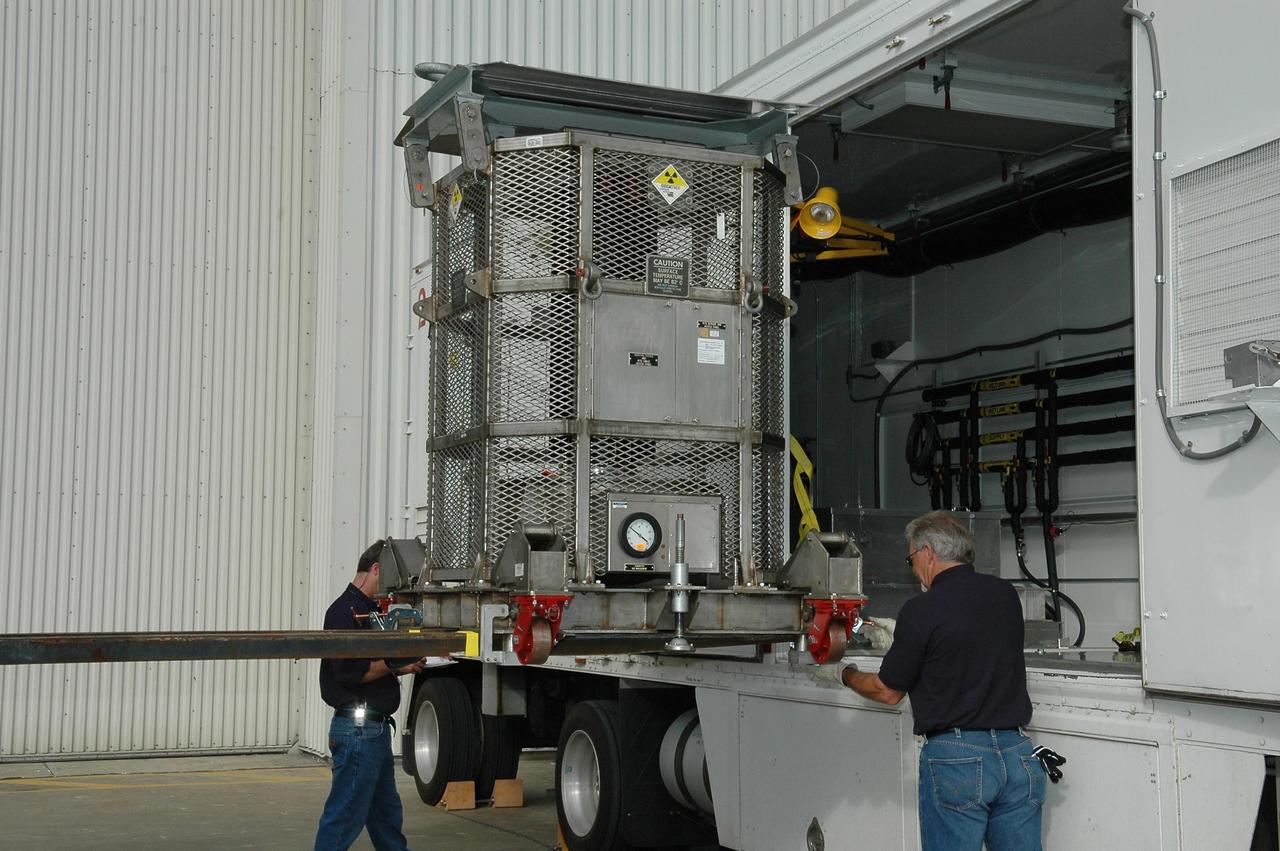
KENNEDY SPACE CENTER, FLA. - At NASA Kennedy Space Center’s Payload Hazardous Servicing Facility, the radioisotope thermoelectric generator (RTG) is removed from the transporter. Inside the facility, it will be installed in the New Horizons spacecraft for a fit check. The RTG is the baseline power supply for New Horizons, scheduled to launch in January 2006 on a journey to Pluto and its moon, Charon. It is expected to reach Pluto in July 2015.
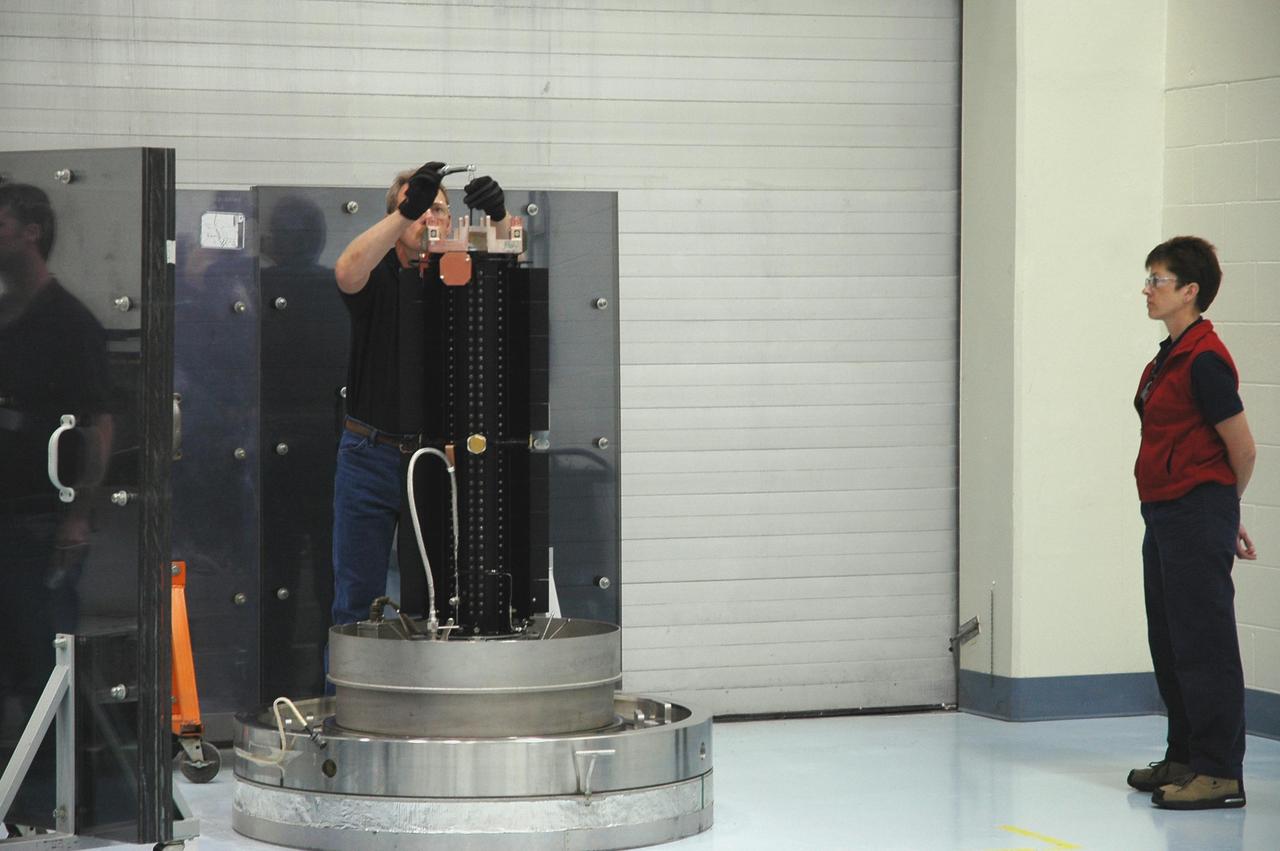
KENNEDY SPACE CENTER, FLA. - In the RTG Facility at Kennedy Space Center, Dan Brunson places a lift attachment onto the radioisotope thermoelectric generator (RTG) so it can be lifted off the stand. Watching at right is Amy Powell. The RTG is the baseline power supply for the NASA’s New Horizons spacecraft, scheduled to launch in January 2006 on a journey to Pluto and its moon, Charon. As it approaches Pluto, the spacecraft will look for ultraviolet emission from Pluto's atmosphere and make the best global maps of Pluto and Charon in green, blue, red and a special wavelength that is sensitive to methane frost on the surface. It will also take spectral maps in the near infrared, telling the science team about Pluto's and Charon's surface compositions and locations and temperatures of these materials. When the spacecraft is closest to Pluto or its moon, it will take close-up pictures in both visible and near-infrared wavelengths. It is expected to reach Pluto in July 2015.
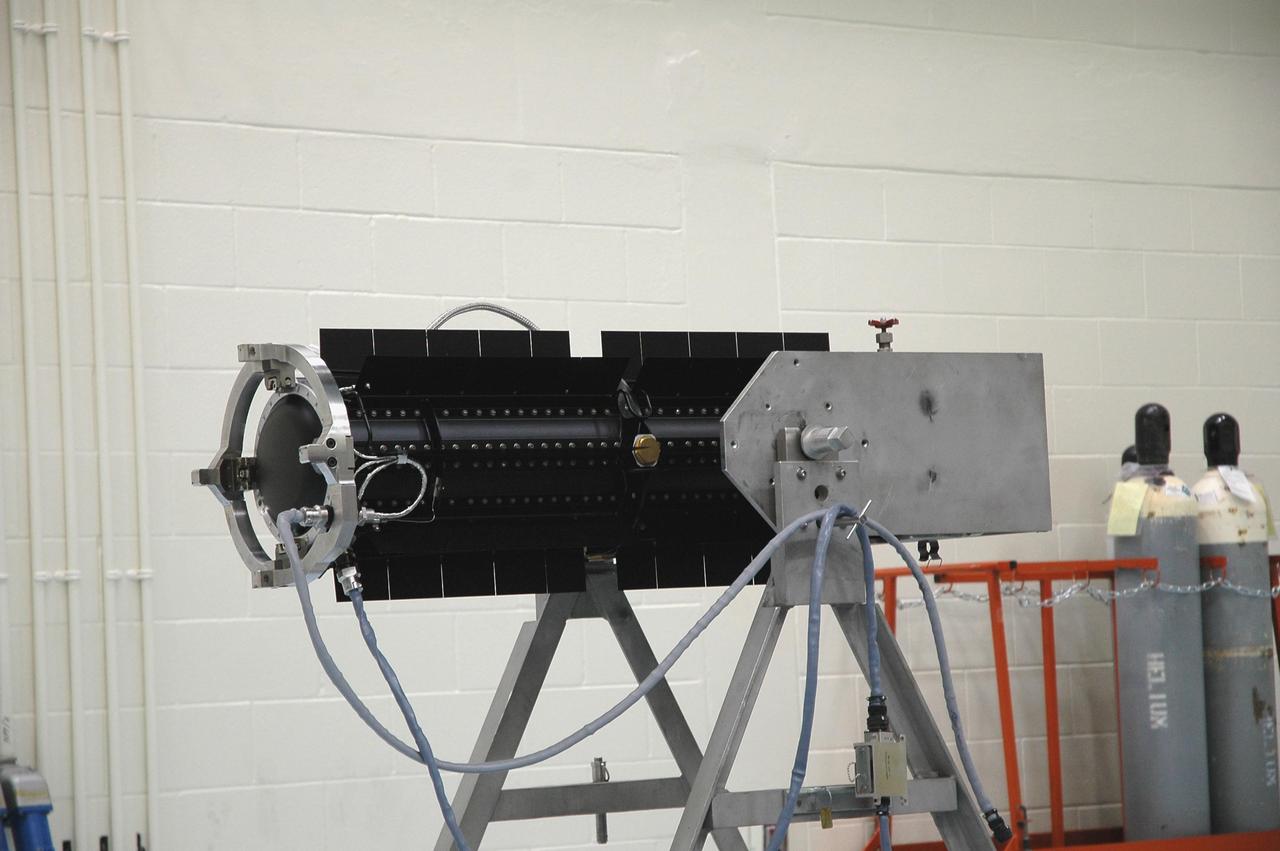
KENNEDY SPACE CENTER, FLA. - In the RTG Facility at Kennedy Space Center, the radioisotope thermoelectric generator (RTG) rests in a horizontal position. The RTG is the baseline power supply for the NASA’s New Horizons spacecraft, scheduled to launch in January 2006 on a journey to Pluto and its moon, Charon. As it approaches Pluto, the spacecraft will look for ultraviolet emission from Pluto's atmosphere and make the best global maps of Pluto and Charon in green, blue, red and a special wavelength that is sensitive to methane frost on the surface. It will also take spectral maps in the near infrared, telling the science team about Pluto's and Charon's surface compositions and locations and temperatures of these materials. When the spacecraft is closest to Pluto or its moon, it will take close-up pictures in both visible and near-infrared wavelengths. It is expected to reach Pluto in July 2015.
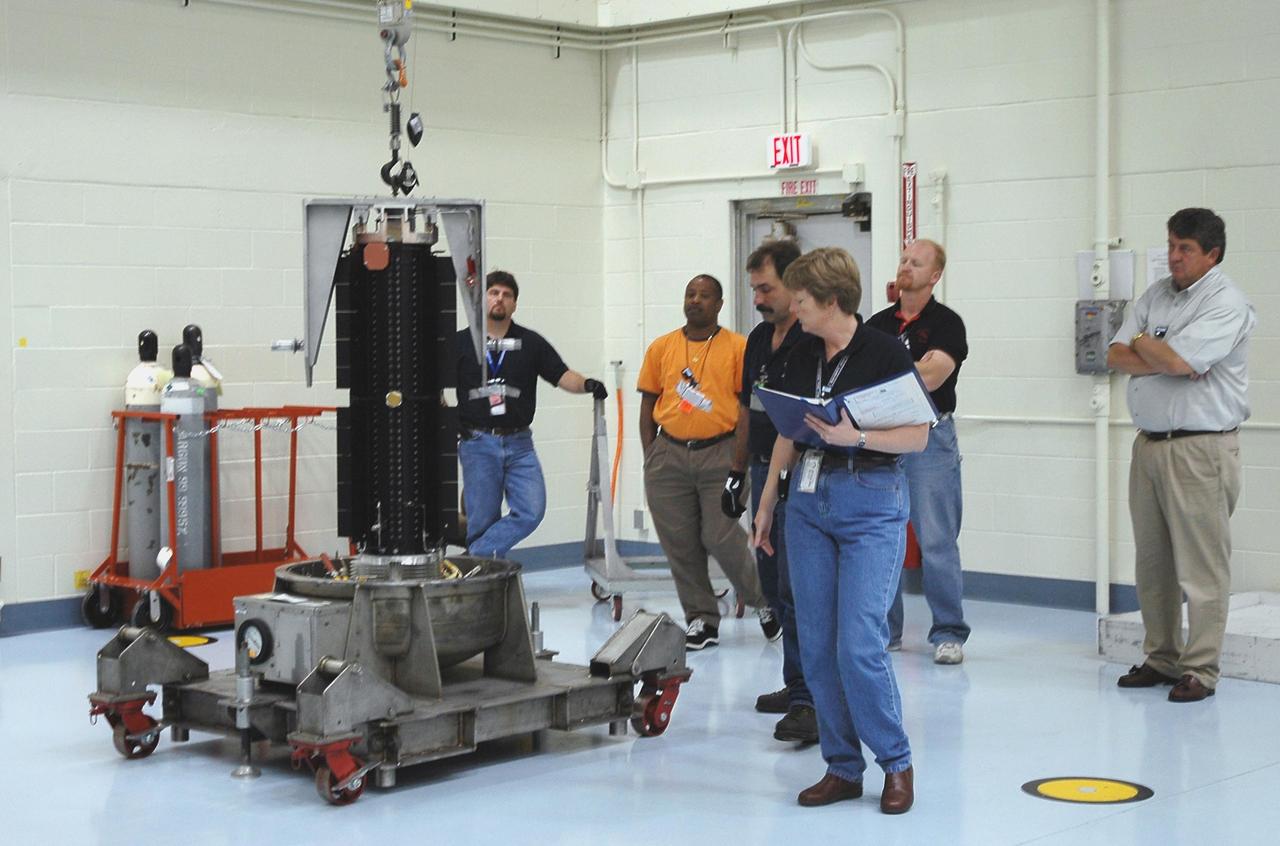
KENNEDY SPACE CENTER, FLA. - In the RTG Facility at Kennedy Space Center, officials check the radioisotope thermoelectric generator (RTG) after being lowered onto a transporter. The RTG is the baseline power supply for the NASA’s New Horizons spacecraft, scheduled to launch in January 2006 on a journey to Pluto and its moon, Charon. As it approaches Pluto, the spacecraft will look for ultraviolet emission from Pluto's atmosphere and make the best global maps of Pluto and Charon in green, blue, red and a special wavelength that is sensitive to methane frost on the surface. It will also take spectral maps in the near infrared, telling the science team about Pluto's and Charon's surface compositions and locations and temperatures of these materials. When the spacecraft is closest to Pluto or its moon, it will take close-up pictures in both visible and near-infrared wavelengths. It is expected to reach Pluto in July 2015.
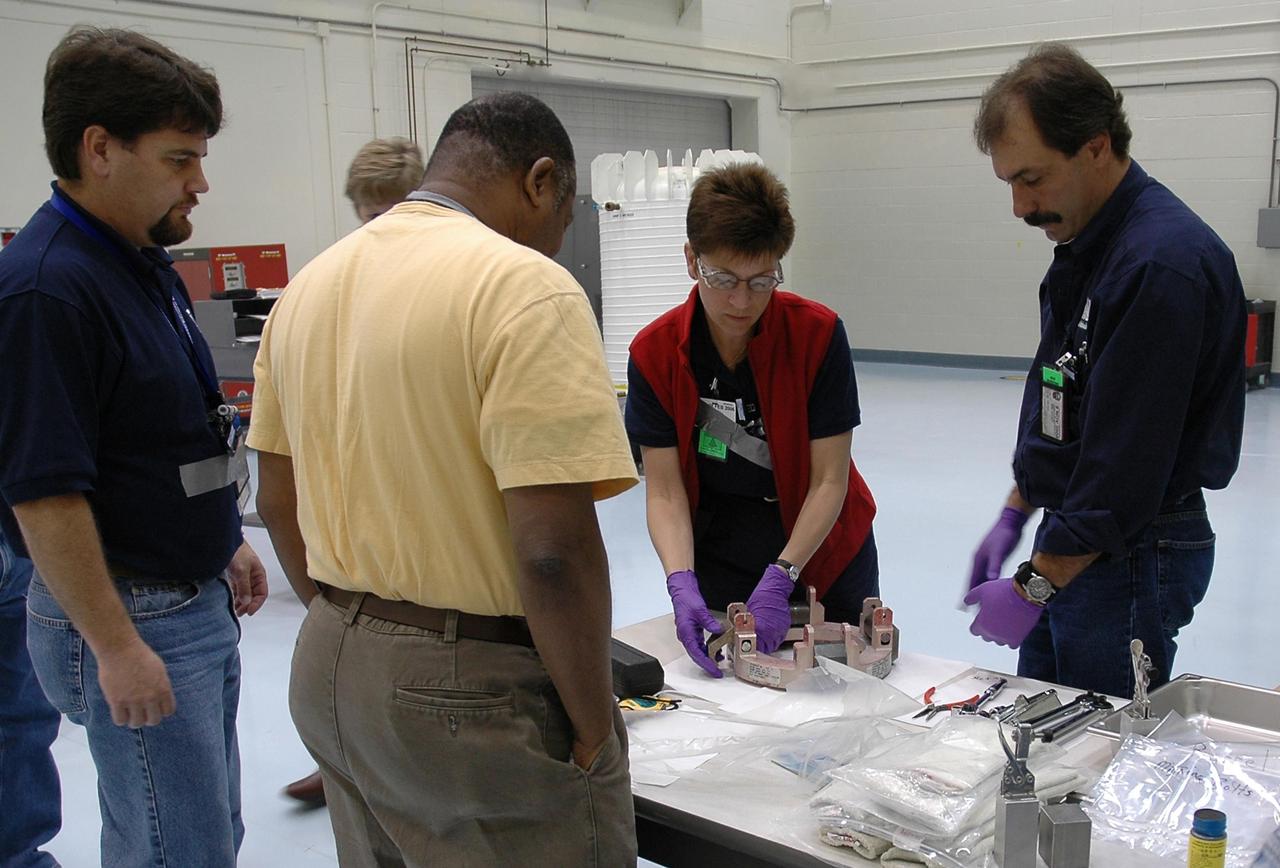
KENNEDY SPACE CENTER, FLA. - In the RTG Facility at Kennedy Space Center, Rhett Rovig, Mervin Smith, Amy Powell and June Wojciechowski inspect a clamping ring that will be installed on the radioisotope thermoelectric generator (RTG). The RTG is the baseline power supply for the NASA’s New Horizons spacecraft, scheduled to launch in January 2006 on a journey to Pluto and its moon, Charon. As it approaches Pluto, the spacecraft will look for ultraviolet emission from Pluto's atmosphere and make the best global maps of Pluto and Charon in green, blue, red and a special wavelength that is sensitive to methane frost on the surface. It will also take spectral maps in the near infrared, telling the science team about Pluto's and Charon's surface compositions and locations and temperatures of these materials. When the spacecraft is closest to Pluto or its moon, it will take close-up pictures in both visible and near-infrared wavelengths. It is expected to reach Pluto in July 2015.
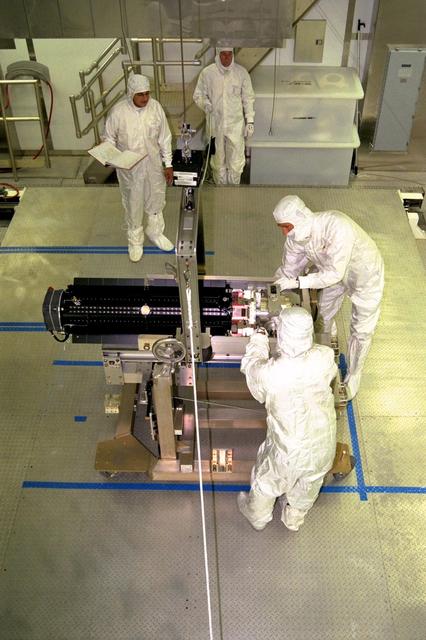
At Launch Complex 40 on Cape Canaveral Air Station, workers are installing three Radioisotope Thermoelectric Generators (RTGs) on the Cassini spacecraft. RTGs are lightweight, compact spacecraft electrical power systems that have flown successfully on 23 previous U.S. missions over the past 37 years. These generators produce power by converting heat into electrical energy; the heat is provided by the natural radioactive decay of plutonium-238 dioxide, a non-weapons-grade material. RTGs enable spacecraft to operate at significant distances from the Sun where solar power systems would not be feasible. Cassini will travel two billion miles to reach Saturn and another 1.1 billion miles while in orbit around Saturn. Cassini is undergoing final preparations for liftoff on a Titan IVB/Centaur launch vehicle, with the launch window opening at 4:55 a.m. EDT, Oct. 13
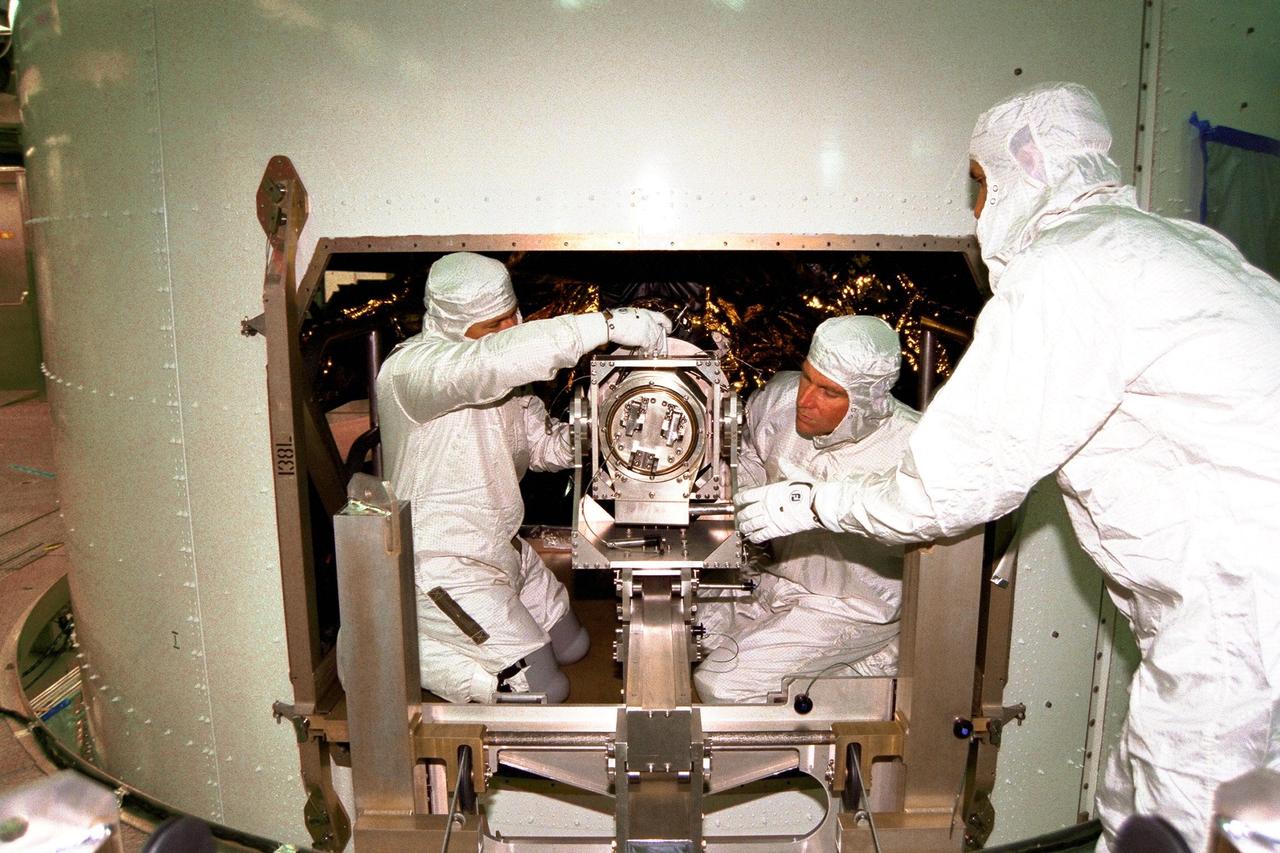
At Launch Complex 40 on Cape Canaveral Air Station, workers are installing three Radioisotope Thermoelectric Generators (RTGs) on the Cassini spacecraft. RTGs are lightweight, compact spacecraft electrical power systems that have flown successfully on 23 previous U.S. missions over the past 37 years. These generators produce power by converting heat into electrical energy; the heat is provided by the natural radioactive decay of plutonium-238 dioxide, a non-weapons-grade material. RTGs enable spacecraft to operate at significant distances from the Sun where solar power systems would not be feasible. Cassini will travel two billion miles to reach Saturn and another 1.1 billion miles while in orbit around Saturn. Cassini is undergoing final preparations for liftoff on a Titan IVB/Centaur launch vehicle, with the launch window opening at 4:55 a.m. EDT, Oct. 13
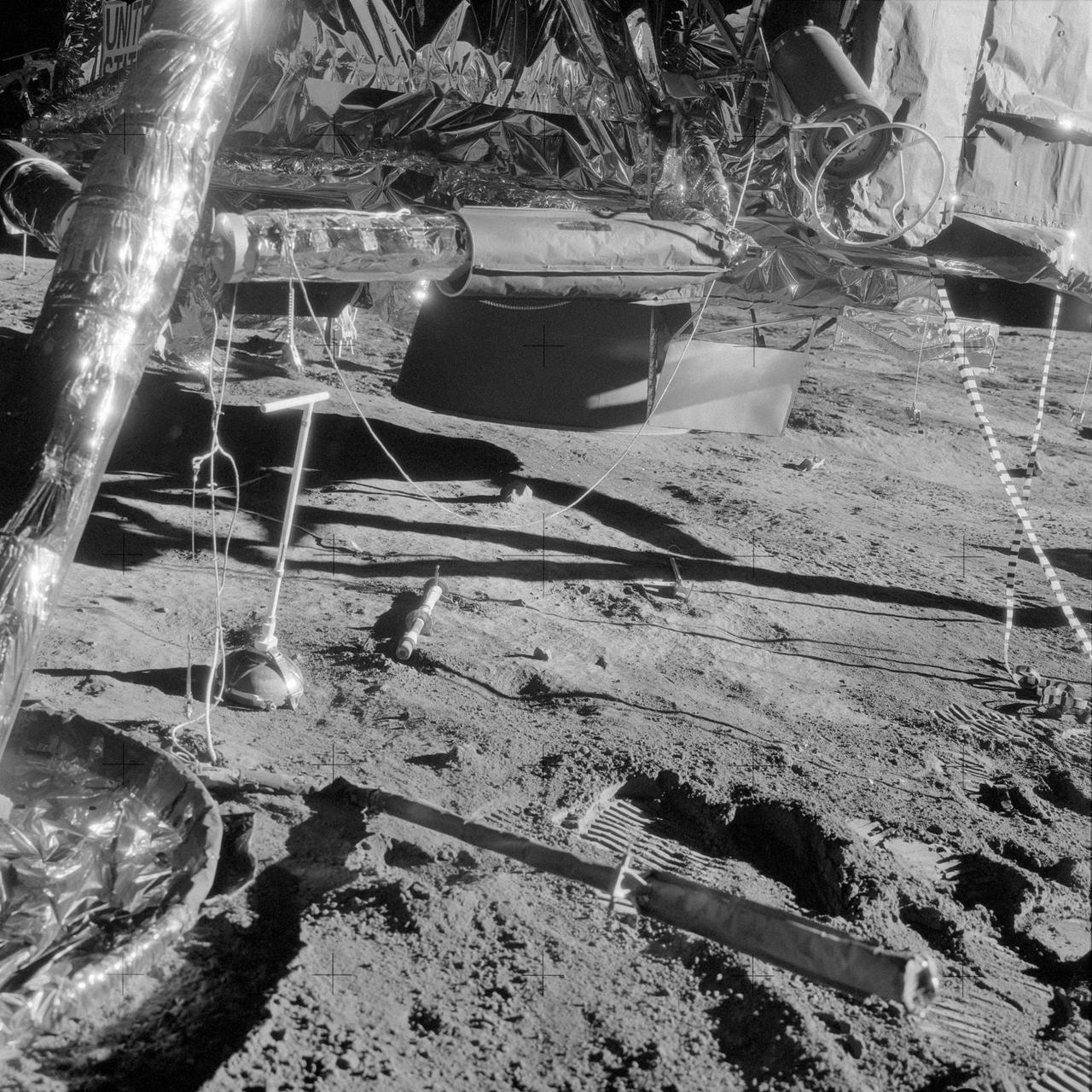
AS12-48-7034 (19 Nov. 1969) --- A close-up view of a portion of quadrant II of the descent stage of the Apollo 12 Lunar Module (LM), photographed during the Apollo 12 extravehicular activity (EVA). At lower left is the LM's Y footpad. The empty Radioisotope Thermoelectric Generator (RTG) fuel cask is at upper right. The fuel capsule has already been removed and placed in the RTG. The RTG furnishes power for the Apollo Lunar Surface Experiments Package (ALSEP) which the Apollo 12 astronauts deployed on the moon. The LM's descent engine skirt is in the center background. The rod-like object protruding out from under the footpad is a lunar surface sensing probe. Astronaut Richard F. Gordon Jr., command module pilot, remained with the Command and Service Modules (CSM) in lunar orbit while astronauts Charles Conrad Jr., commander; and Alan L. Bean, lunar module pilot, descended in the LM to explore the moon.
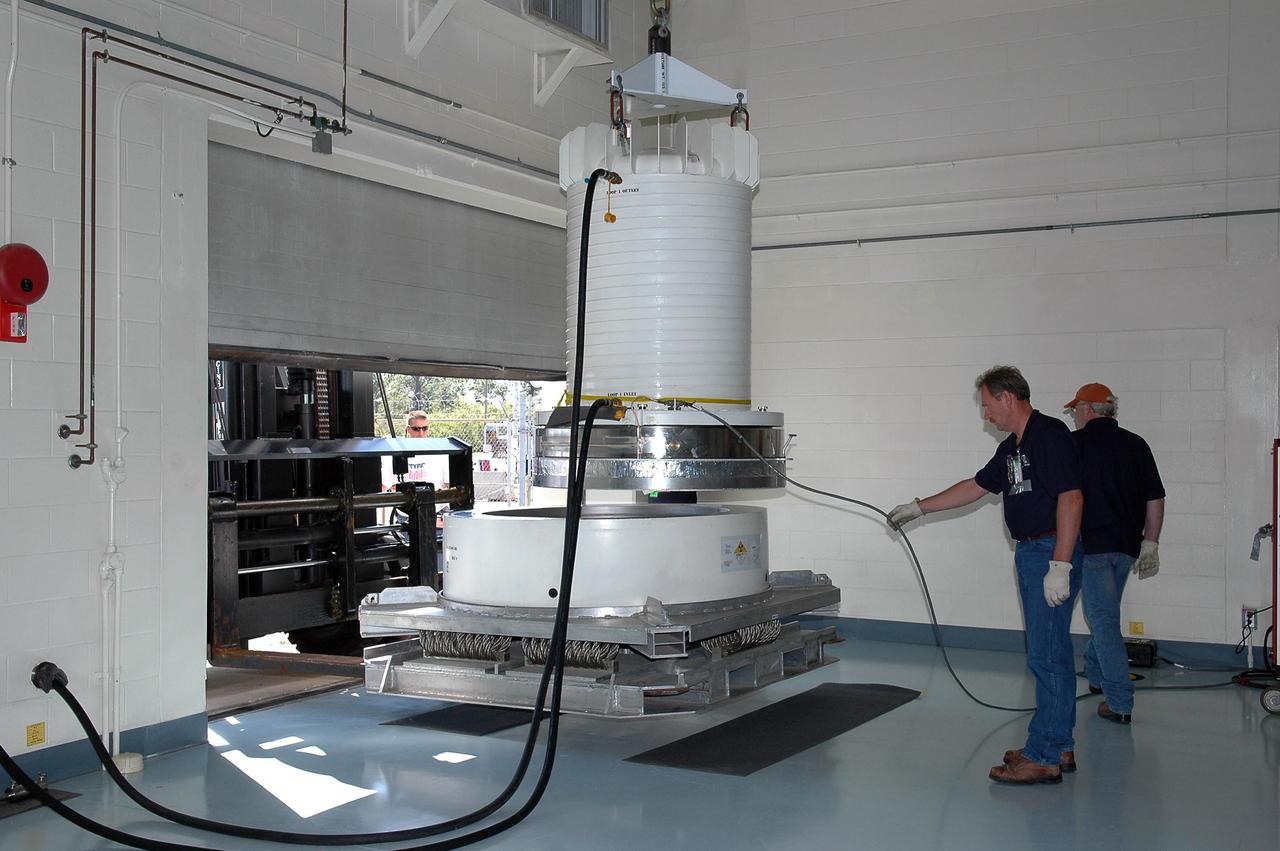
KENNEDY SPACE CENTER, FLA. - Bob Tessmer and Dave Nobles lift the radioisotope thermoelectric generator (RTG) container after its move inside the RTG facility at Kennedy Space Center. The RTG is the baseline power supply for the NASA’s New Horizons spacecraft, scheduled to launch in January 2006 on a journey to Pluto and its moon, Charon. As it approaches Pluto, the spacecraft will look for ultraviolet emission from Pluto's atmosphere and make the best global maps of Pluto and Charon in green, blue, red and a special wavelength that is sensitive to methane frost on the surface. It will also take spectral maps in the near infrared, telling the science team about Pluto's and Charon's surface compositions and locations and temperatures of these materials. When the spacecraft is closest to Pluto or its moon, it will take close-up pictures in both visible and near-infrared wavelengths. It is expected to reach Pluto in July 2015.
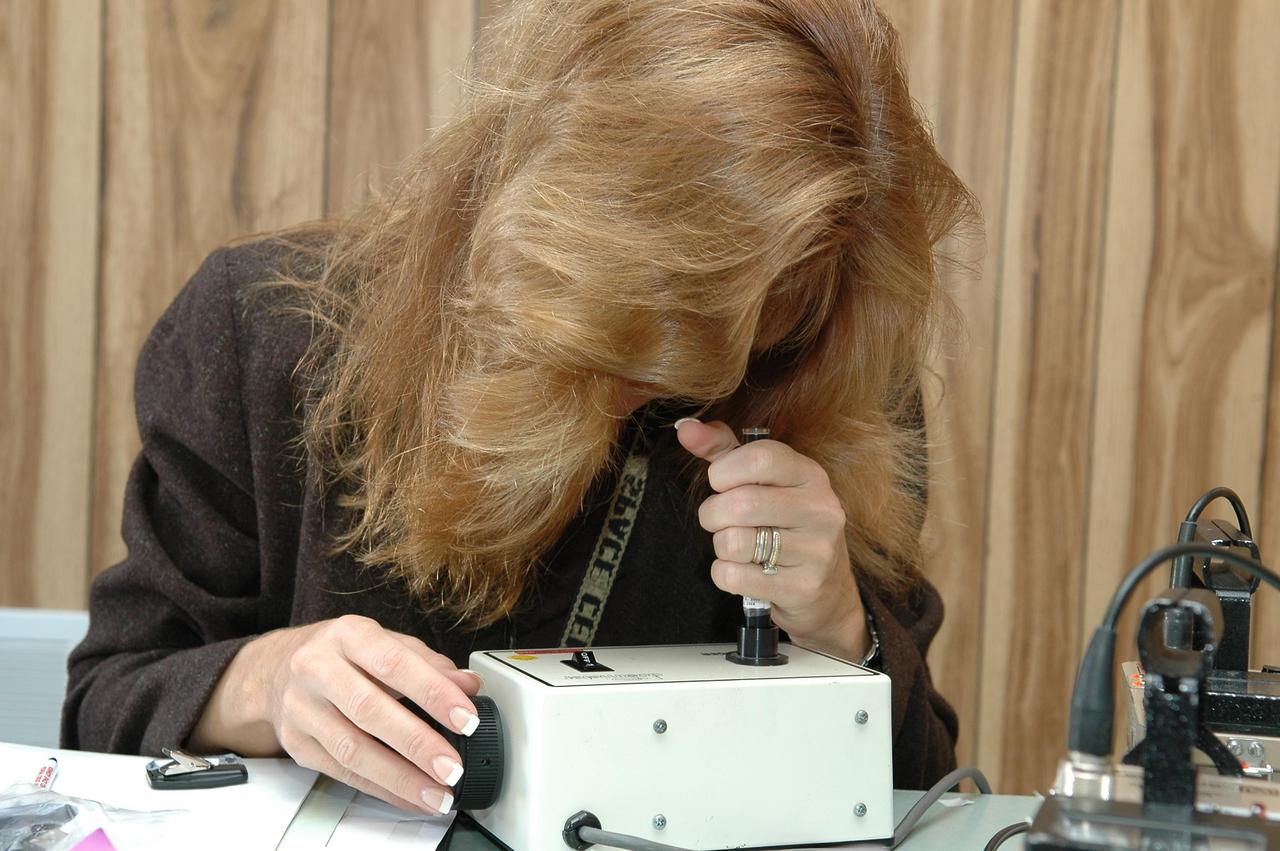
KENNEDY SPACE CENTER, FLA. - Jamie Gurney makes a zero adjustment of a personal dosimeter for officials handling the radioisotope thermoelectric generator (RTG) before its move to the RTG facility at Kennedy Space Center. The RTG is the baseline power supply for the NASA’s New Horizons spacecraft, scheduled to launch in January 2006 on a journey to Pluto and its moon, Charon. As it approaches Pluto, the spacecraft will look for ultraviolet emission from Pluto's atmosphere and make the best global maps of Pluto and Charon in green, blue, red and a special wavelength that is sensitive to methane frost on the surface. It will also take spectral maps in the near infrared, telling the science team about Pluto's and Charon's surface compositions and locations and temperatures of these materials. When the spacecraft is closest to Pluto or its moon, it will take close-up pictures in both visible and near-infrared wavelengths. It is expected to reach Pluto in July 2015.
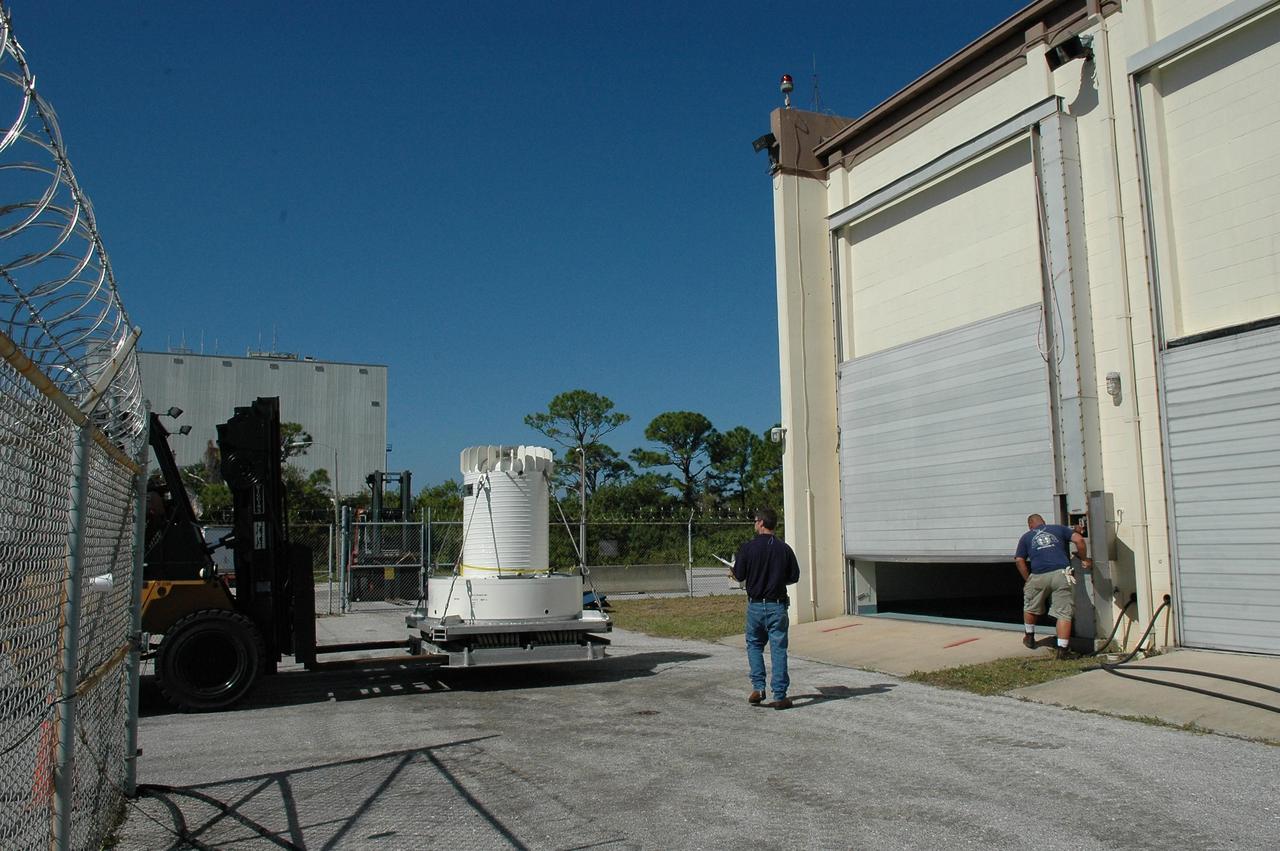
KENNEDY SPACE CENTER, FLA. - The container holding the radioisotope thermoelectric generator (RTG) is moved toward the door of the RTG facility at Kennedy Space Center. The RTG is the baseline power supply for the NASA’s New Horizons spacecraft, scheduled to launch in January 2006 on a journey to Pluto and its moon, Charon. As it approaches Pluto, the spacecraft will look for ultraviolet emission from Pluto's atmosphere and make the best global maps of Pluto and Charon in green, blue, red and a special wavelength that is sensitive to methane frost on the surface. It will also take spectral maps in the near infrared, telling the science team about Pluto's and Charon's surface compositions and locations and temperatures of these materials. When the spacecraft is closest to Pluto or its moon, it will take close-up pictures in both visible and near-infrared wavelengths. It is expected to reach Pluto in July 2015.

This radioisotope thermoelectric generator (RTG), at center, will undergo mechanical and electrical verification testing now that it has been installed on the Cassini spacecraft in the Payload Hazardous Servicing Facility. A handling fixture, at far left, is still attached. Three RTGs will provide electrical power to Cassini on its 6.7-year trip to the Saturnian system and during its four-year mission at Saturn. RTGs use heat from the natural decay of plutonium to generate electric power. The generators enable spacecraft to operate far from the Sun where solar power systems are not feasible. The Cassini mission is scheduled for an Oct. 6 launch aboard a Titan IVB/Centaur expendable launch vehicle. Cassini is built and managed for NASA by the Jet Propulsion Laboratory
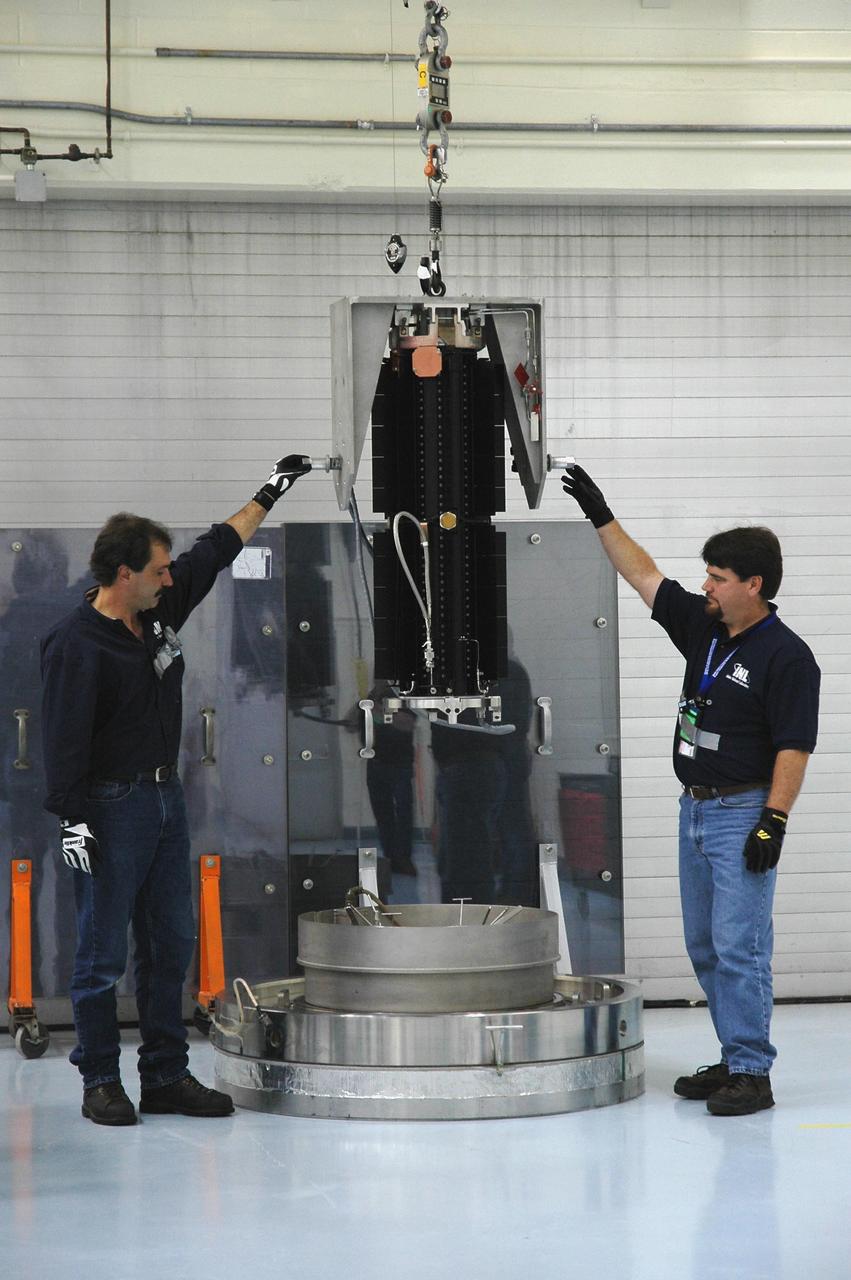
KENNEDY SPACE CENTER, FLA. - In the RTG Facility at Kennedy Space Center, Jim Wojciechowski (left) and Rhett Rovig lift the radioisotope thermoelectric generator (RTG) from its stand to place it on a cart. It will then be maneuvered to a horizontal position. The RTG is the baseline power supply for the NASA’s New Horizons spacecraft, scheduled to launch in January 2006 on a journey to Pluto and its moon, Charon. As it approaches Pluto, the spacecraft will look for ultraviolet emission from Pluto's atmosphere and make the best global maps of Pluto and Charon in green, blue, red and a special wavelength that is sensitive to methane frost on the surface. It will also take spectral maps in the near infrared, telling the science team about Pluto's and Charon's surface compositions and locations and temperatures of these materials. When the spacecraft is closest to Pluto or its moon, it will take close-up pictures in both visible and near-infrared wavelengths. It is expected to reach Pluto in July 2015.

KENNEDY SPACE CENTER, FLA. - Jamie Gurney reads a personal dosimeter that will be used by officials handling the radioisotope thermoelectric generator (RTG) before its move to the RTG facility at Kennedy Space Center. The RTG is the baseline power supply for the NASA’s New Horizons spacecraft, scheduled to launch in January 2006 on a journey to Pluto and its moon, Charon. As it approaches Pluto, the spacecraft will look for ultraviolet emission from Pluto's atmosphere and make the best global maps of Pluto and Charon in green, blue, red and a special wavelength that is sensitive to methane frost on the surface. It will also take spectral maps in the near infrared, telling the science team about Pluto's and Charon's surface compositions and locations and temperatures of these materials. When the spacecraft is closest to Pluto or its moon, it will take close-up pictures in both visible and near-infrared wavelengths. It is expected to reach Pluto in July 2015.
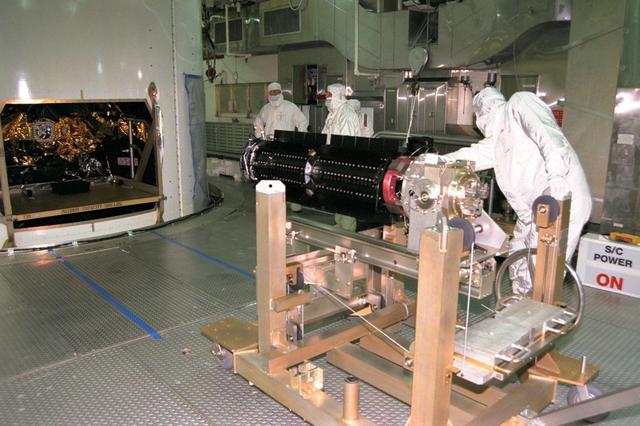
At Launch Complex 40 on Cape Canaveral Air Station, workers are installing three Radioisotope Thermoelectric Generators (RTGs) on the Cassini spacecraft. RTGs are lightweight, compact spacecraft electrical power systems that have flown successfully on 23 previous U.S. missions over the past 37 years. These generators produce power by converting heat into electrical energy; the heat is provided by the natural radioactive decay of plutonium-238 dioxide, a non-weapons-grade material. RTGs enable spacecraft to operate at significant distances from the Sun where solar power systems would not be feasible. Cassini will travel two billion miles to reach Saturn and another 1.1 billion miles while in orbit around Saturn. Cassini is undergoing final preparations for liftoff on a Titan IVB/Centaur launch vehicle, with the launch window opening at 4:55 a.m. EDT, Oct. 13
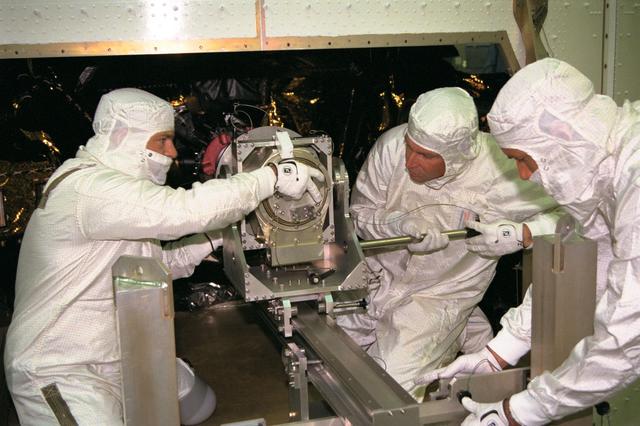
At Launch Complex 40 on Cape Canaveral Air Station, workers are installing three Radioisotope Thermoelectric Generators (RTGs) on the Cassini spacecraft. RTGs are lightweight, compact spacecraft electrical power systems that have flown successfully on 23 previous U.S. missions over the past 37 years. These generators produce power by converting heat into electrical energy; the heat is provided by the natural radioactive decay of plutonium-238 dioxide, a non-weapons-grade material. RTGs enable spacecraft to operate at significant distances from the Sun where solar power systems would not be feasible. Cassini will travel two billion miles to reach Saturn and another 1.1 billion miles while in orbit around Saturn. Cassini is undergoing final preparations for liftoff on a Titan IVB/Centaur launch vehicle, with the launch window opening at 4:55 a.m. EDT, Oct. 13

KENNEDY SPACE CENTER, FLA. - At Kennedy Space Center, the container holding the radioisotope thermoelectric generator (RTG) is removed from a truck. The RTG is the baseline power supply for the NASA’s New Horizons spacecraft, scheduled to launch in January 2006 on a journey to Pluto and its moon, Charon. The RTG is the baseline power supply for the NASA’s New Horizons spacecraft, scheduled to launch in January 2006 on a journey to Pluto and its moon, Charon. As it approaches Pluto, the spacecraft will look for ultraviolet emission from Pluto's atmosphere and make the best global maps of Pluto and Charon in green, blue, red and a special wavelength that is sensitive to methane frost on the surface. It will also take spectral maps in the near infrared, telling the science team about Pluto's and Charon's surface compositions and locations and temperatures of these materials. When the spacecraft is closest to Pluto or its moon, it will take close-up pictures in both visible and near-infrared wavelengths. It is expected to reach Pluto in July 2015.
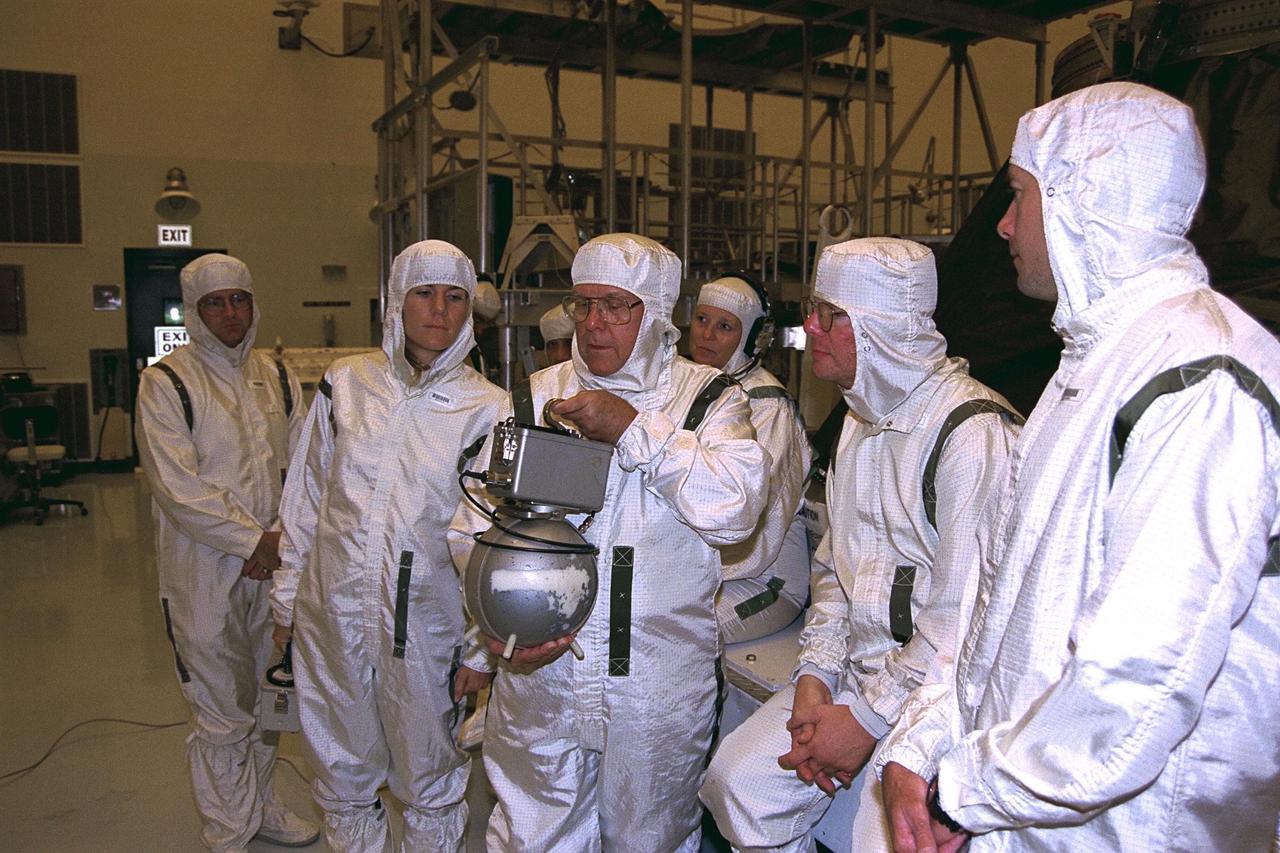
Carrying a neutron radiation detector, Fred Sanders (at center), a health physicist with the Jet Propulsion Laboratory (JPL), and other health physics personnel monitor radiation in the Payload Hazardous Servicing Facility after three radioisotope thermoelectric generators (RTGs) were installed on the Cassini spacecraft for mechanical and electrical verification tests. The RTGs will provide electrical power to Cassini on its 6.7-year trip to the Saturnian system and during its four-year mission at Saturn. RTGs use heat from the natural decay of plutonium to generate electric power. The generators enable spacecraft to operate at great distances from the Sun where solar power systems are not feasible. The Cassini mission is targeted for an Oct. 6 launch aboard a Titan IVB/Centaur expendable launch vehicle. Cassini is built and managed by JPL
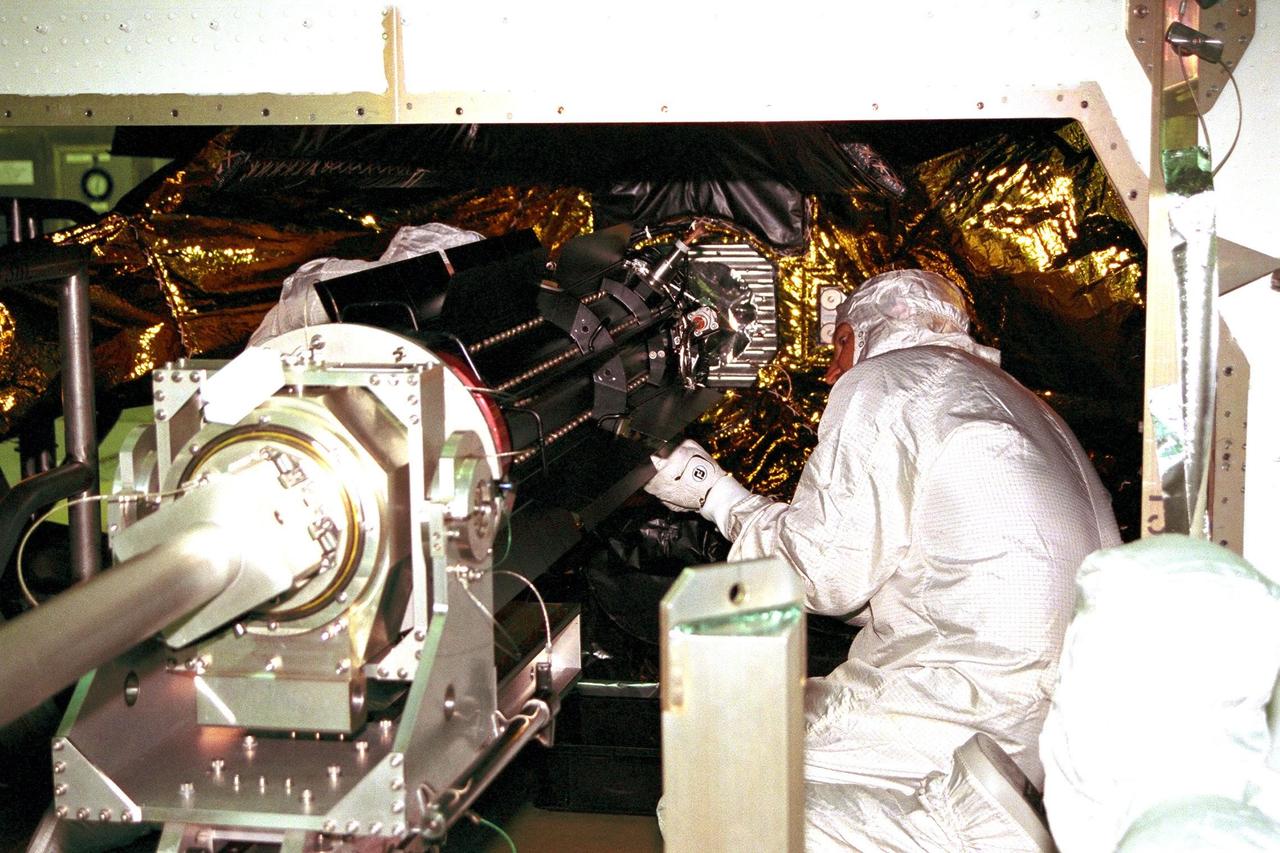
KENNEDY SPACE CENTER, FLA. -- At Launch Complex 40 on Cape Canaveral Air Station, workers are installing three Radioisotope Thermoelectric Generators (RTGs) on the Cassini spacecraft. RTGs are lightweight, compact spacecraft electrical power systems that have flown successfully on 23 previous U.S. missions over the past 37 years. These generators produce power by converting heat into electrical energy; the heat is provided by the natural radioactive decay of plutonium-238 dioxide, a non-weapons-grade material. RTGs enable spacecraft to operate at significant distances from the Sun where solar power systems would not be feasible. Cassini will travel two billion miles to reach Saturn and another 1.1 billion miles while in orbit around Saturn. Cassini is undergoing final preparations for liftoff on a Titan IVB/Centaur launch vehicle, with the launch window opening at 4:55 a.m. EDT, Oct. 13
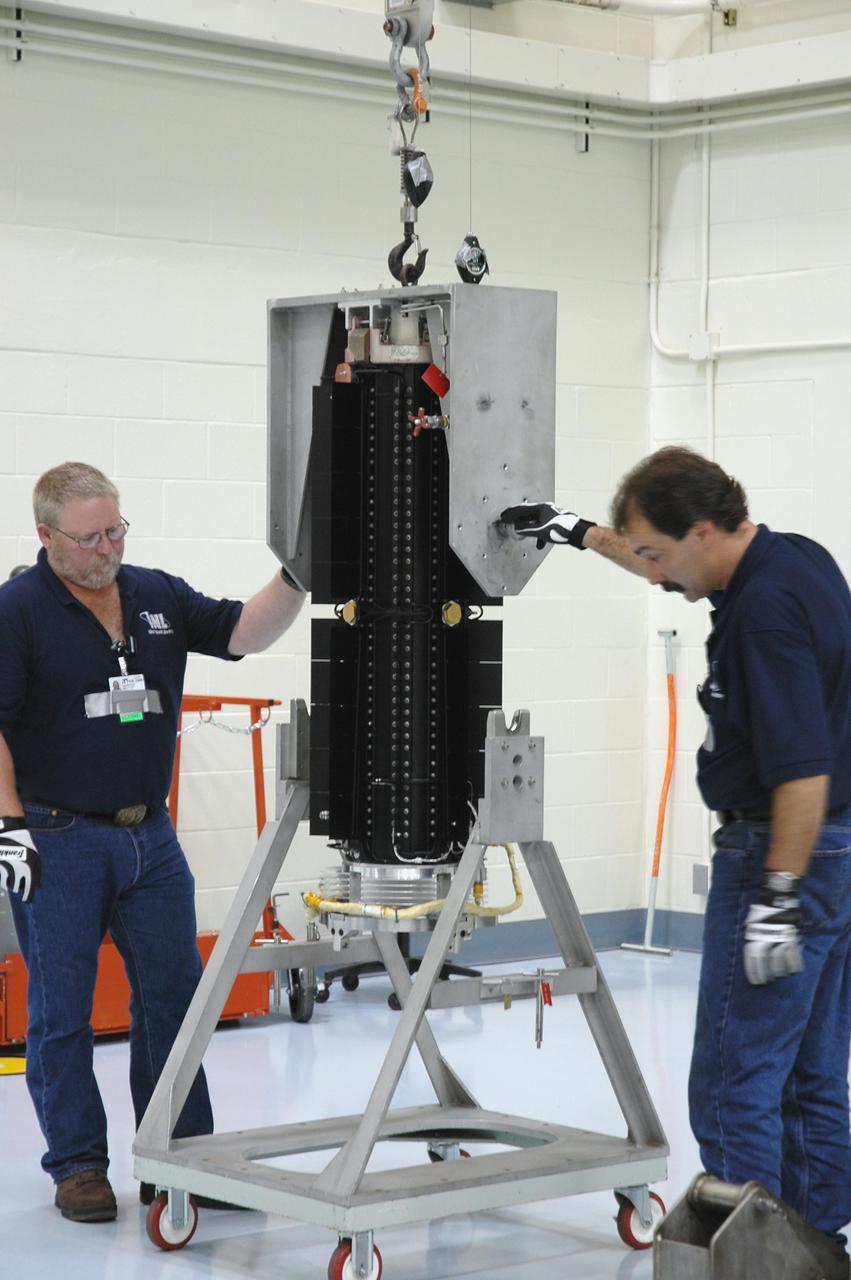
KENNEDY SPACE CENTER, FLA. - In the RTG Facility at Kennedy Space Center, Dan Brunson and Jim Wojciechowski carefully lower the radioisotope thermoelectric generator (RTG) into a t-cart. The RTG is the baseline power supply for the NASA’s New Horizons spacecraft, scheduled to launch in January 2006 on a journey to Pluto and its moon, Charon. As it approaches Pluto, the spacecraft will look for ultraviolet emission from Pluto's atmosphere and make the best global maps of Pluto and Charon in green, blue, red and a special wavelength that is sensitive to methane frost on the surface. It will also take spectral maps in the near infrared, telling the science team about Pluto's and Charon's surface compositions and locations and temperatures of these materials. When the spacecraft is closest to Pluto or its moon, it will take close-up pictures in both visible and near-infrared wavelengths. It is expected to reach Pluto in July 2015.
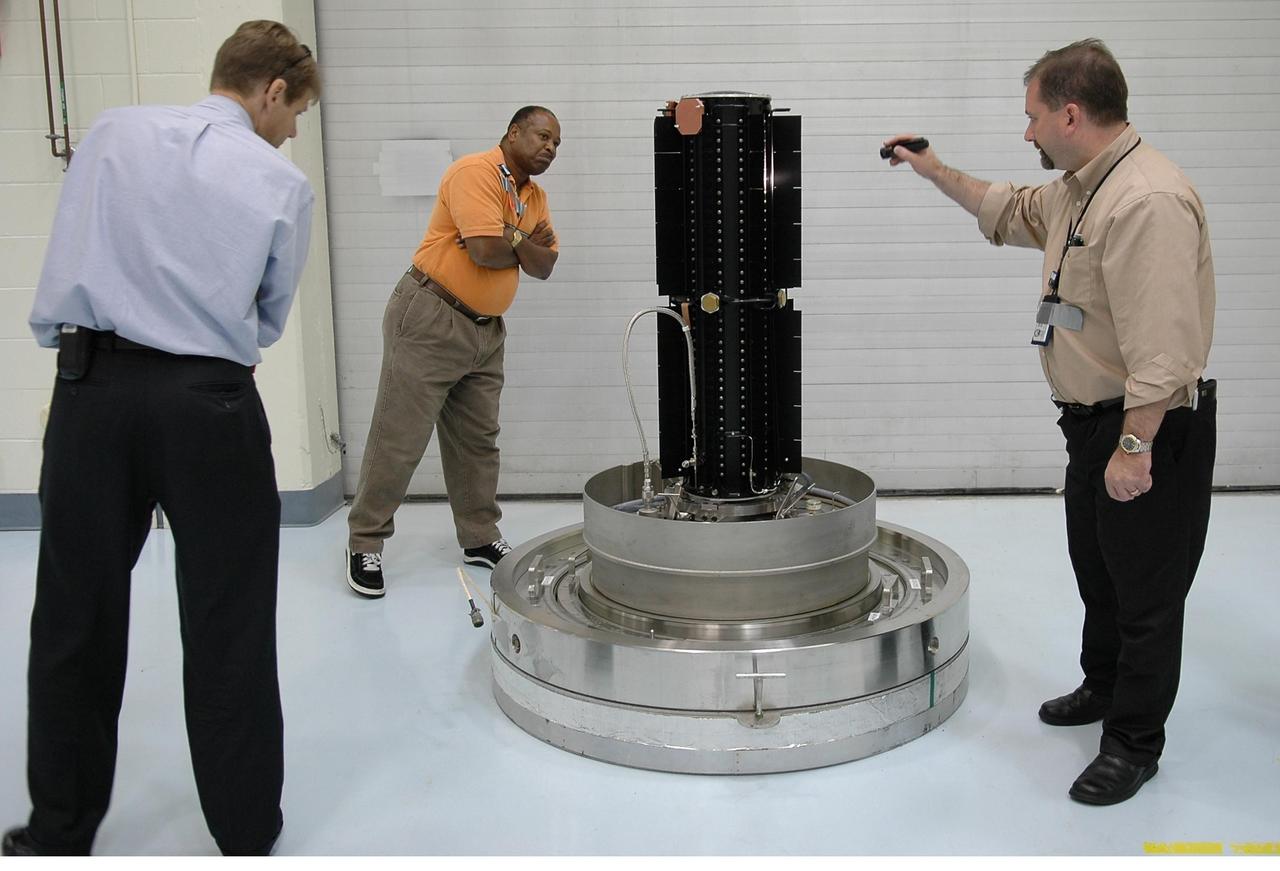
KENNEDY SPACE CENTER, FLA. - Inside the RTG facility at Kennedy Space Center, Tim Frazier, Mervin Smith and Tim Hoye inspect the radioisotope thermoelectric generator (RTG) after its arrival. Frazier is with the Department of Energy, which has provided the radioisotope, and Hoye is with Lockheed Martin. The RTG is the baseline power supply for the NASA’s New Horizons spacecraft, scheduled to launch in January 2006 on a journey to Pluto and its moon, Charon. As it approaches Pluto, the spacecraft will look for ultraviolet emission from Pluto's atmosphere and make the best global maps of Pluto and Charon in green, blue, red and a special wavelength that is sensitive to methane frost on the surface. It will also take spectral maps in the near infrared, telling the science team about Pluto's and Charon's surface compositions and locations and temperatures of these materials. When the spacecraft is closest to Pluto or its moon, it will take close-up pictures in both visible and near-infrared wavelengths. It is expected to reach Pluto in July 2015.
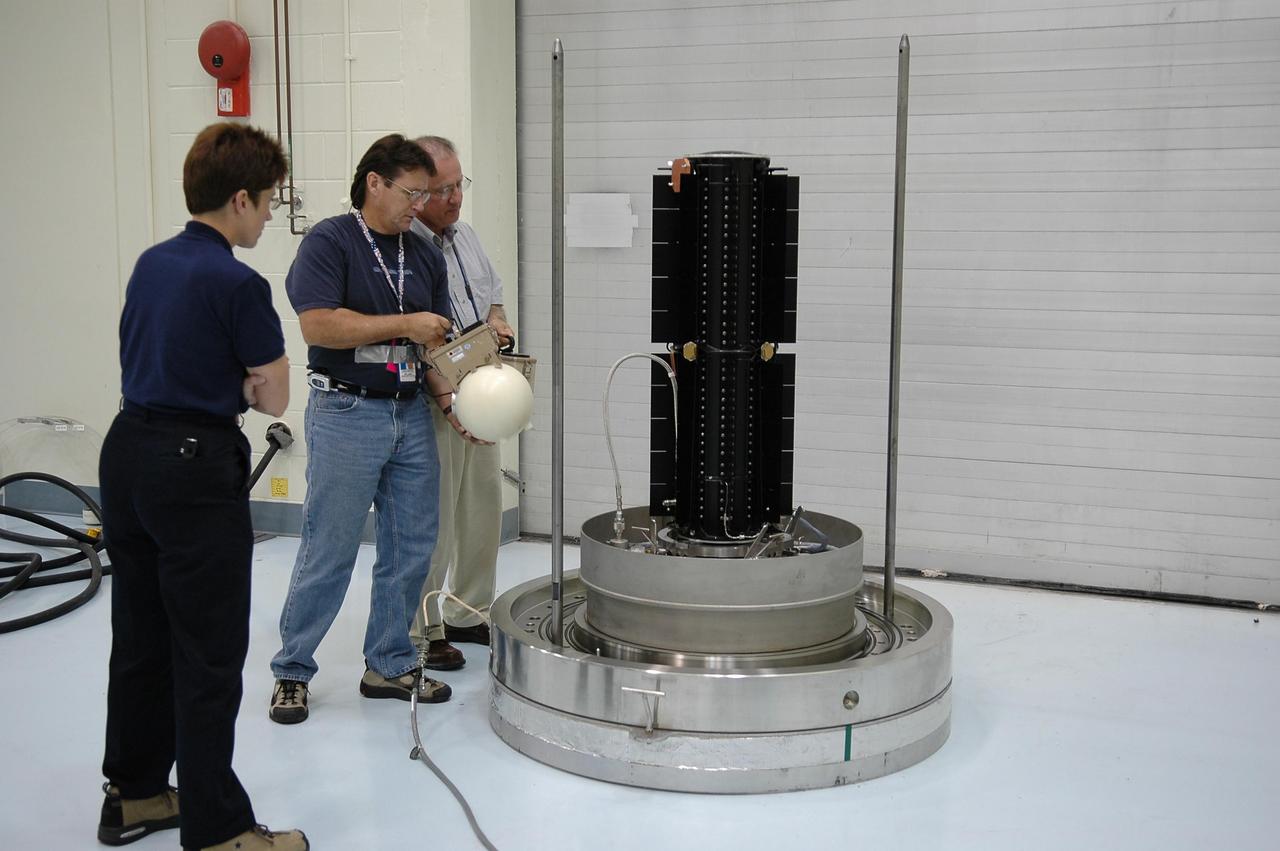
KENNEDY SPACE CENTER, FLA. - Inside the RTG facility at Kennedy Space Center, Amy Powell, Ennis Shelton and Ed Provost check the radioisotope thermoelectric generator (RTG) after removal of the outside container. The RTG is the baseline power supply for the NASA’s New Horizons spacecraft, scheduled to launch in January 2006 on a journey to Pluto and its moon, Charon. As it approaches Pluto, the spacecraft will look for ultraviolet emission from Pluto's atmosphere and make the best global maps of Pluto and Charon in green, blue, red and a special wavelength that is sensitive to methane frost on the surface. It will also take spectral maps in the near infrared, telling the science team about Pluto's and Charon's surface compositions and locations and temperatures of these materials. When the spacecraft is closest to Pluto or its moon, it will take close-up pictures in both visible and near-infrared wavelengths. It is expected to reach Pluto in July 2015.
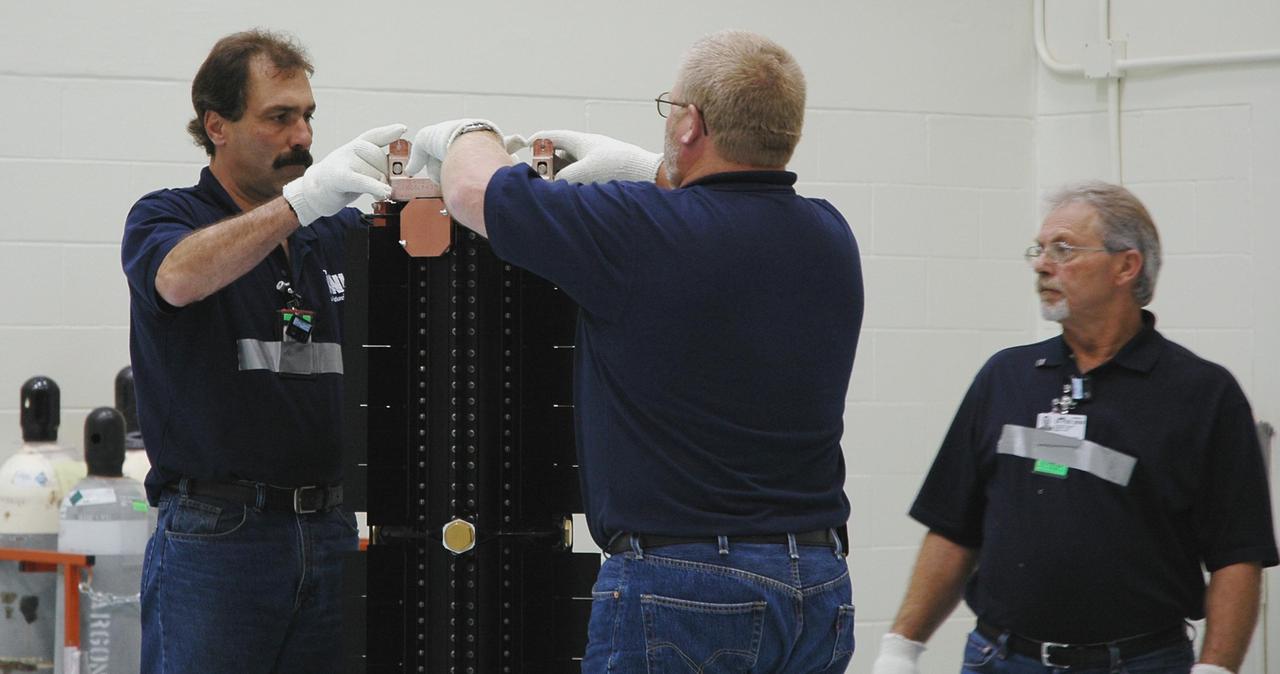
KENNEDY SPACE CENTER, FLA. - In the RTG Facility at Kennedy Space Center, Jim Wojciechowski and Dan Brunson install a clamping ring onto the radioisotope thermoelectric generator (RTG). Watching at right is Steve Killian. The RTG is the baseline power supply for the NASA’s New Horizons spacecraft, scheduled to launch in January 2006 on a journey to Pluto and its moon, Charon. As it approaches Pluto, the spacecraft will look for ultraviolet emission from Pluto's atmosphere and make the best global maps of Pluto and Charon in green, blue, red and a special wavelength that is sensitive to methane frost on the surface. It will also take spectral maps in the near infrared, telling the science team about Pluto's and Charon's surface compositions and locations and temperatures of these materials. When the spacecraft is closest to Pluto or its moon, it will take close-up pictures in both visible and near-infrared wavelengths. It is expected to reach Pluto in July 2015.
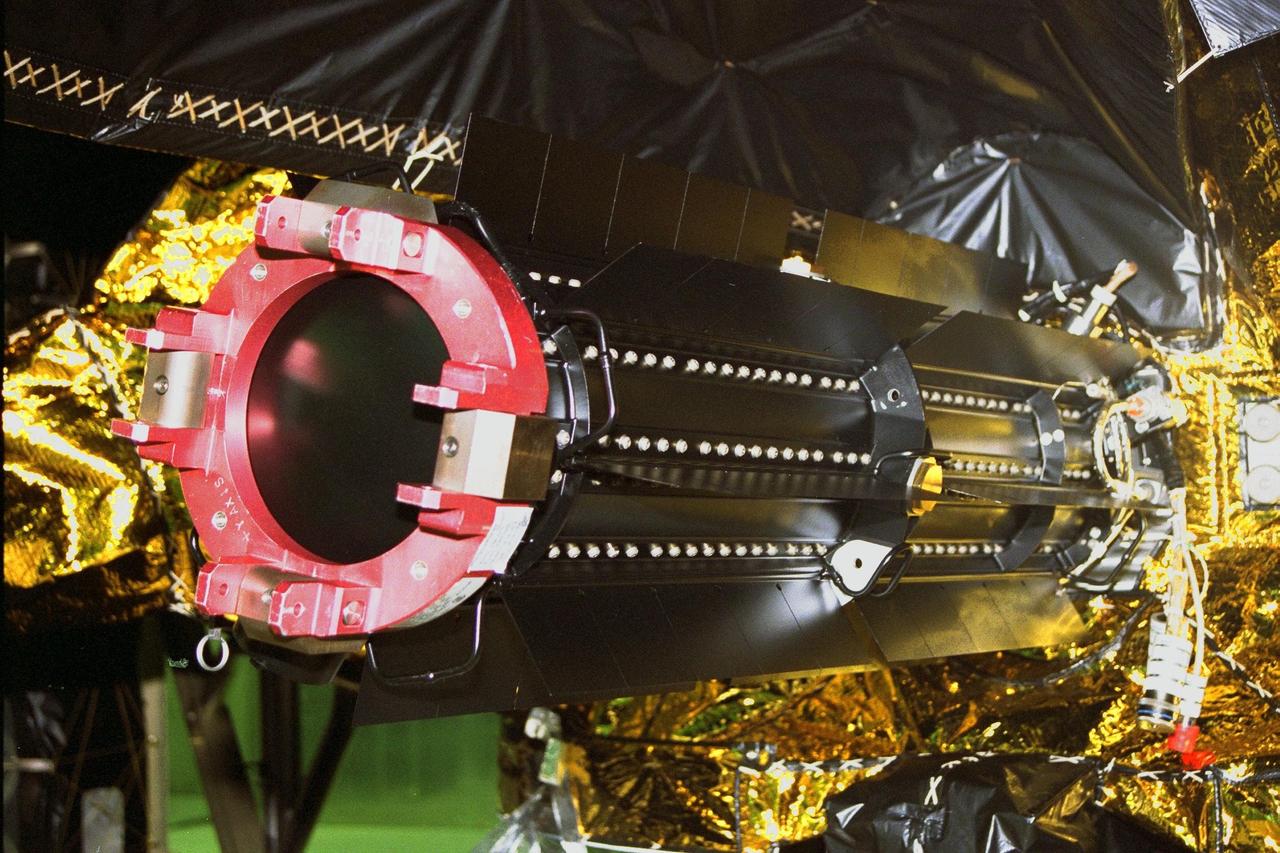
At Launch Complex 40 on Cape Canaveral Air Station, one of three Radioisotope Thermoelectric Generators (RTGs) is being installed on the Cassini spacecraft. RTGs are lightweight, compact spacecraft electrical power systems that have flown successfully on 23 previous U.S. missions over the past 37 years. These generators produce power by converting heat into electrical energy; the heat is provided by the natural radioactive decay of plutonium-238 dioxide, a non-weapons-grade material. RTGs enable spacecraft to operate at significant distances from the Sun where solar power systems would not be feasible. Cassini will travel two billion miles to reach Saturn and another 1.1 billion miles while in orbit around Saturn. Cassini is undergoing final preparations for liftoff on a Titan IVB/Centaur launch vehicle, with the launch window opening at 4:55 a.m. EDT, Oct. 13

KENNEDY SPACE CENTER, FLA. - Inside the RTG facility at Kennedy Space Center, Dave Nobles oversees the operation as the container is lifted away from the radioisotope thermoelectric generator (RTG). The RTG is the baseline power supply for the NASA’s New Horizons spacecraft, scheduled to launch in January 2006 on a journey to Pluto and its moon, Charon. As it approaches Pluto, the spacecraft will look for ultraviolet emission from Pluto's atmosphere and make the best global maps of Pluto and Charon in green, blue, red and a special wavelength that is sensitive to methane frost on the surface. It will also take spectral maps in the near infrared, telling the science team about Pluto's and Charon's surface compositions and locations and temperatures of these materials. When the spacecraft is closest to Pluto or its moon, it will take close-up pictures in both visible and near-infrared wavelengths. It is expected to reach Pluto in July 2015.
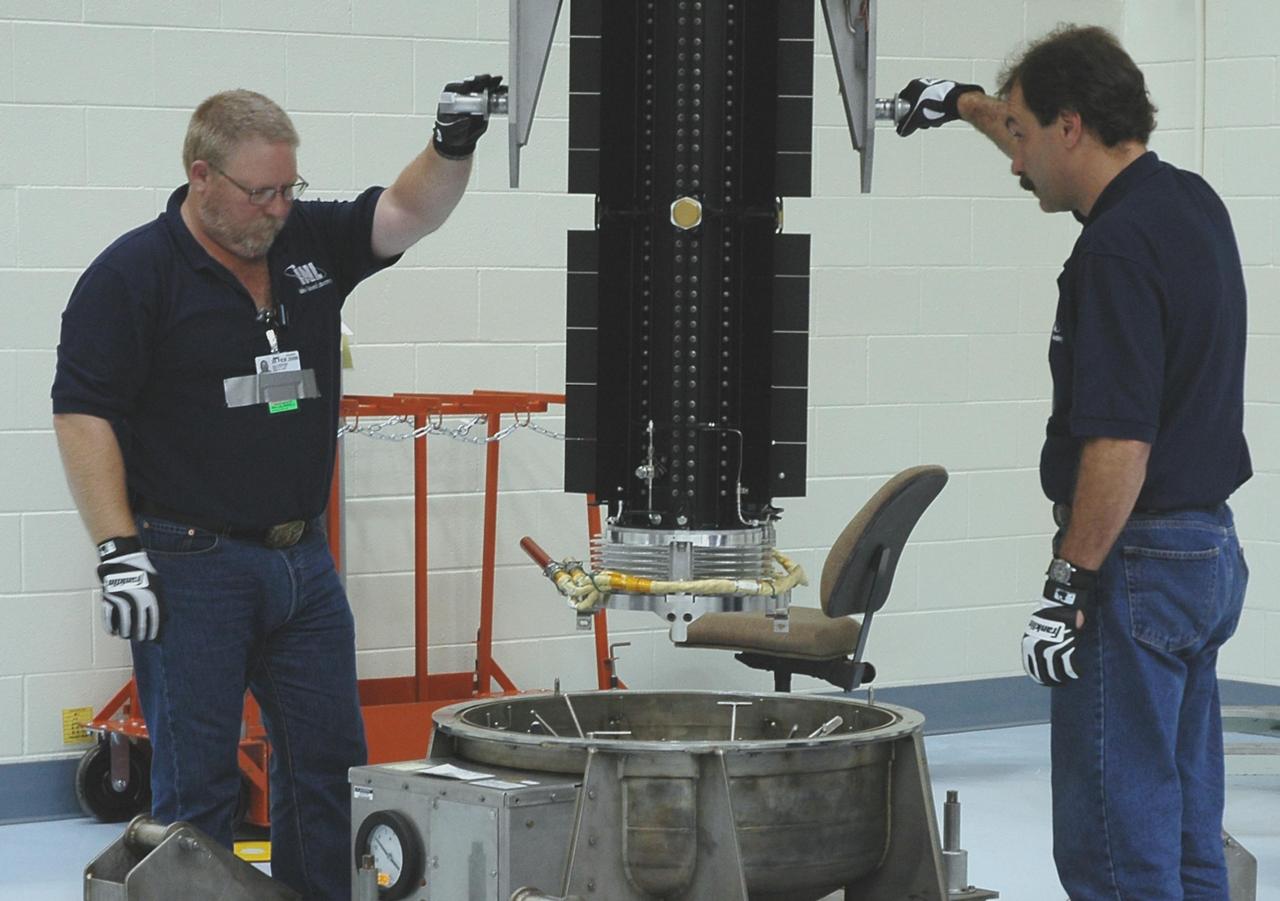
KENNEDY SPACE CENTER, FLA. - In the RTG Facility at Kennedy Space Center, Dan Brunson and Jim Wojciechowski lower the radioisotope thermoelectric generator (RTG) onto a transporter. The RTG is the baseline power supply for the NASA’s New Horizons spacecraft, scheduled to launch in January 2006 on a journey to Pluto and its moon, Charon. As it approaches Pluto, the spacecraft will look for ultraviolet emission from Pluto's atmosphere and make the best global maps of Pluto and Charon in green, blue, red and a special wavelength that is sensitive to methane frost on the surface. It will also take spectral maps in the near infrared, telling the science team about Pluto's and Charon's surface compositions and locations and temperatures of these materials. When the spacecraft is closest to Pluto or its moon, it will take close-up pictures in both visible and near-infrared wavelengths. It is expected to reach Pluto in July 2015.
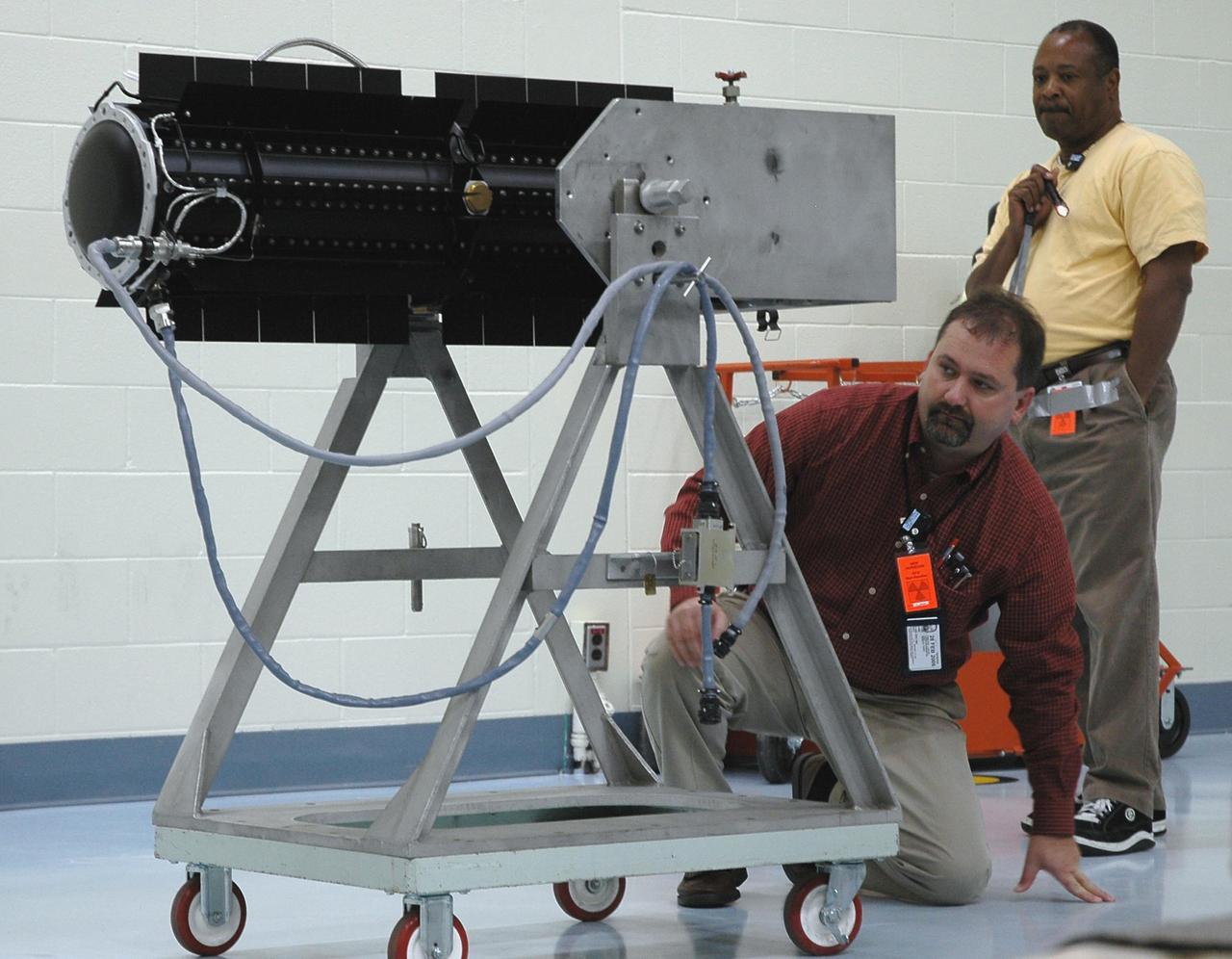
KENNEDY SPACE CENTER, FLA. - In the RTG Facility at Kennedy Space Center, Tim Hoyle and Mervin Smith check the cable on the radioisotope thermoelectric generator (RTG). The RTG is the baseline power supply for the NASA’s New Horizons spacecraft, scheduled to launch in January 2006 on a journey to Pluto and its moon, Charon. As it approaches Pluto, the spacecraft will look for ultraviolet emission from Pluto's atmosphere and make the best global maps of Pluto and Charon in green, blue, red and a special wavelength that is sensitive to methane frost on the surface. It will also take spectral maps in the near infrared, telling the science team about Pluto's and Charon's surface compositions and locations and temperatures of these materials. When the spacecraft is closest to Pluto or its moon, it will take close-up pictures in both visible and near-infrared wavelengths. It is expected to reach Pluto in July 2015.
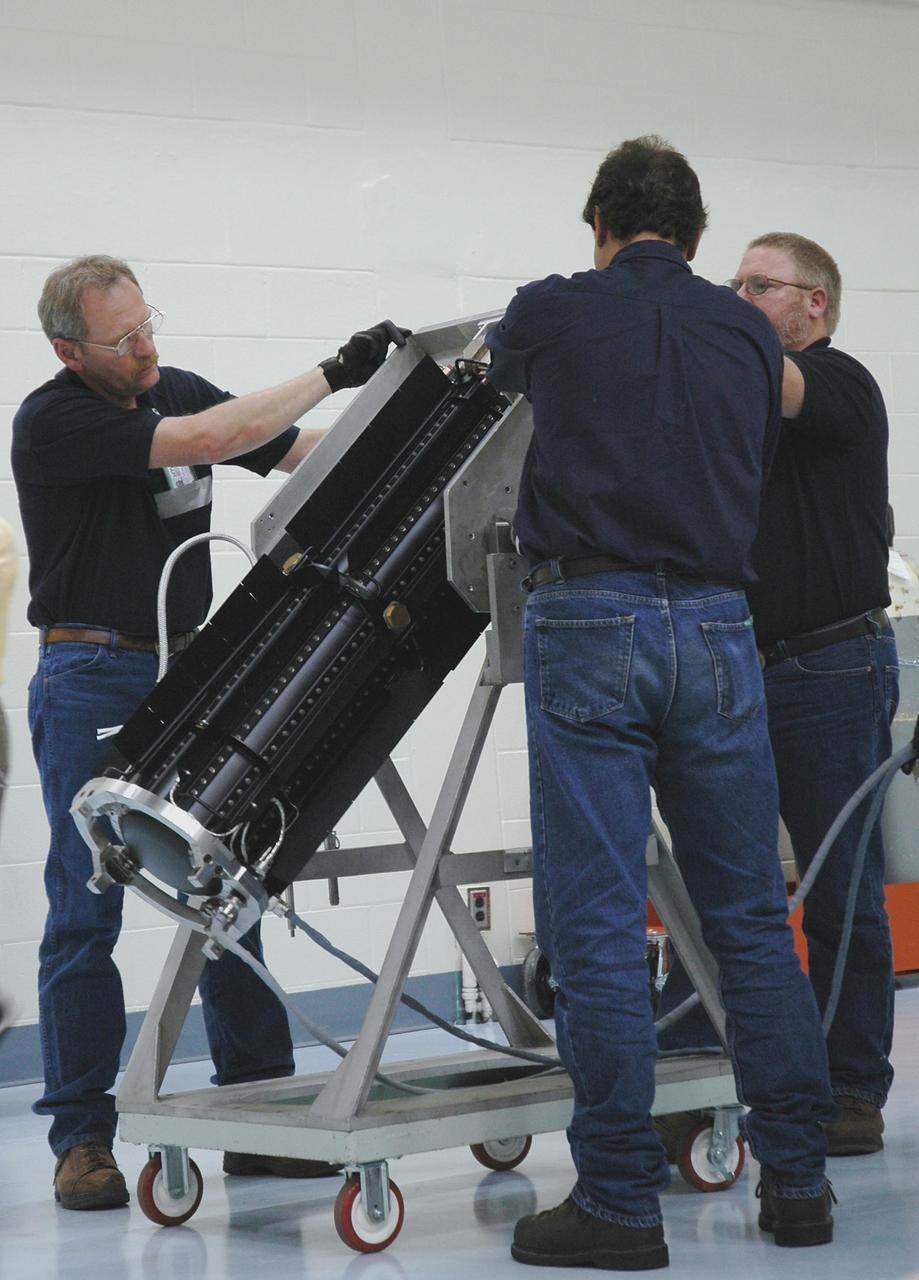
KENNEDY SPACE CENTER, FLA. - In the RTG Facility at Kennedy Space Center, Steve Killian, Jim Wojciechowski and Dan Brunson tilt the radioisotope thermoelectric generator (RTG) to a horizontal position. The RTG is the baseline power supply for the NASA’s New Horizons spacecraft, scheduled to launch in January 2006 on a journey to Pluto and its moon, Charon. As it approaches Pluto, the spacecraft will look for ultraviolet emission from Pluto's atmosphere and make the best global maps of Pluto and Charon in green, blue, red and a special wavelength that is sensitive to methane frost on the surface. It will also take spectral maps in the near infrared, telling the science team about Pluto's and Charon's surface compositions and locations and temperatures of these materials. When the spacecraft is closest to Pluto or its moon, it will take close-up pictures in both visible and near-infrared wavelengths. It is expected to reach Pluto in July 2015.
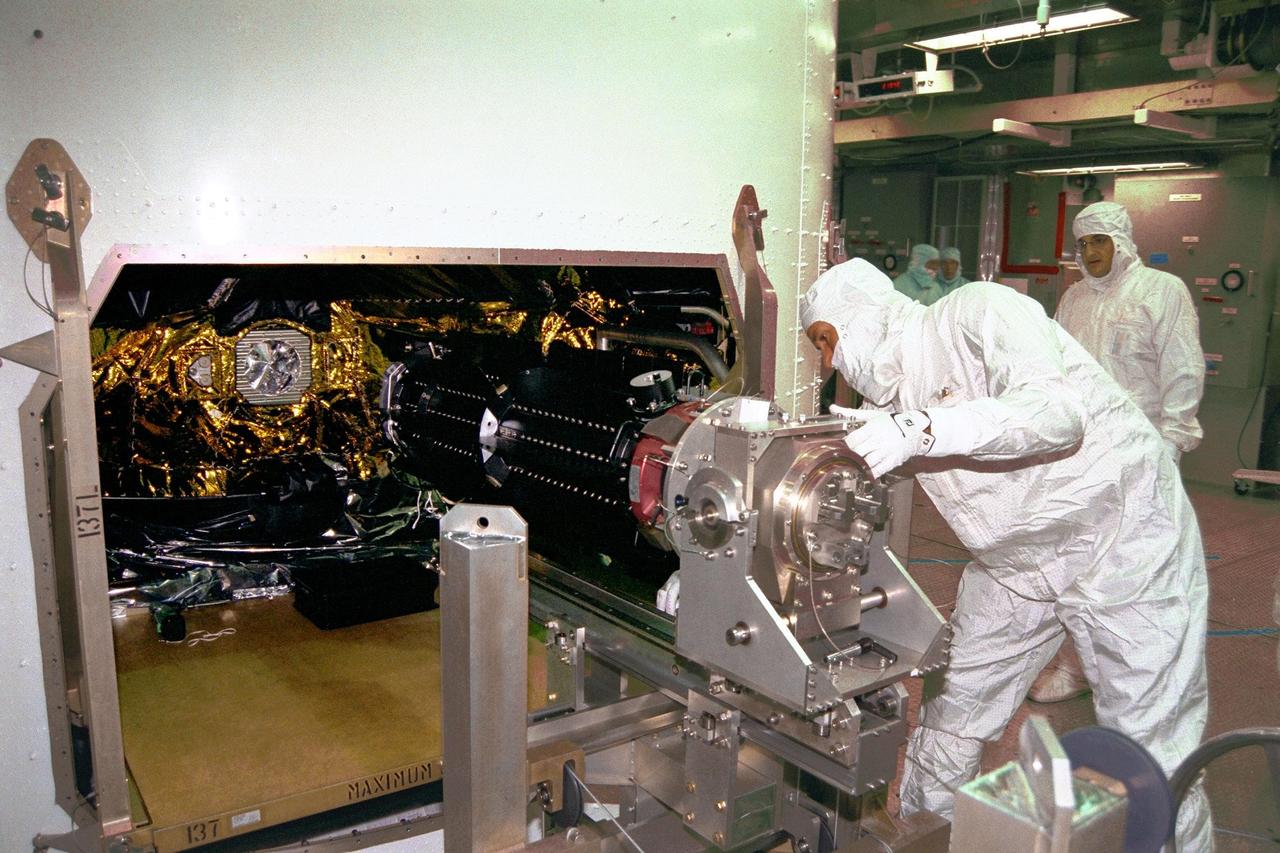
KENNEDY SPACE CENTER, FLA. -- At Launch Complex 40 on Cape Canaveral Air Station, workers are installing three Radioisotope Thermoelectric Generators (RTGs) on the Cassini spacecraft. RTGs are lightweight, compact spacecraft electrical power systems that have flown successfully on 23 previous U.S. missions over the past 37 years. These generators produce power by converting heat into electrical energy; the heat is provided by the natural radioactive decay of plutonium-238 dioxide, a non-weapons-grade material. RTGs enable spacecraft to operate at significant distances from the Sun where solar power systems would not be feasible. Cassini will travel two billion miles to reach Saturn and another 1.1 billion miles while in orbit around Saturn. Cassini is undergoing final preparations for liftoff on a Titan IVB/Centaur launch vehicle, with the launch window opening at 4:55 a.m. EDT, Oct. 13
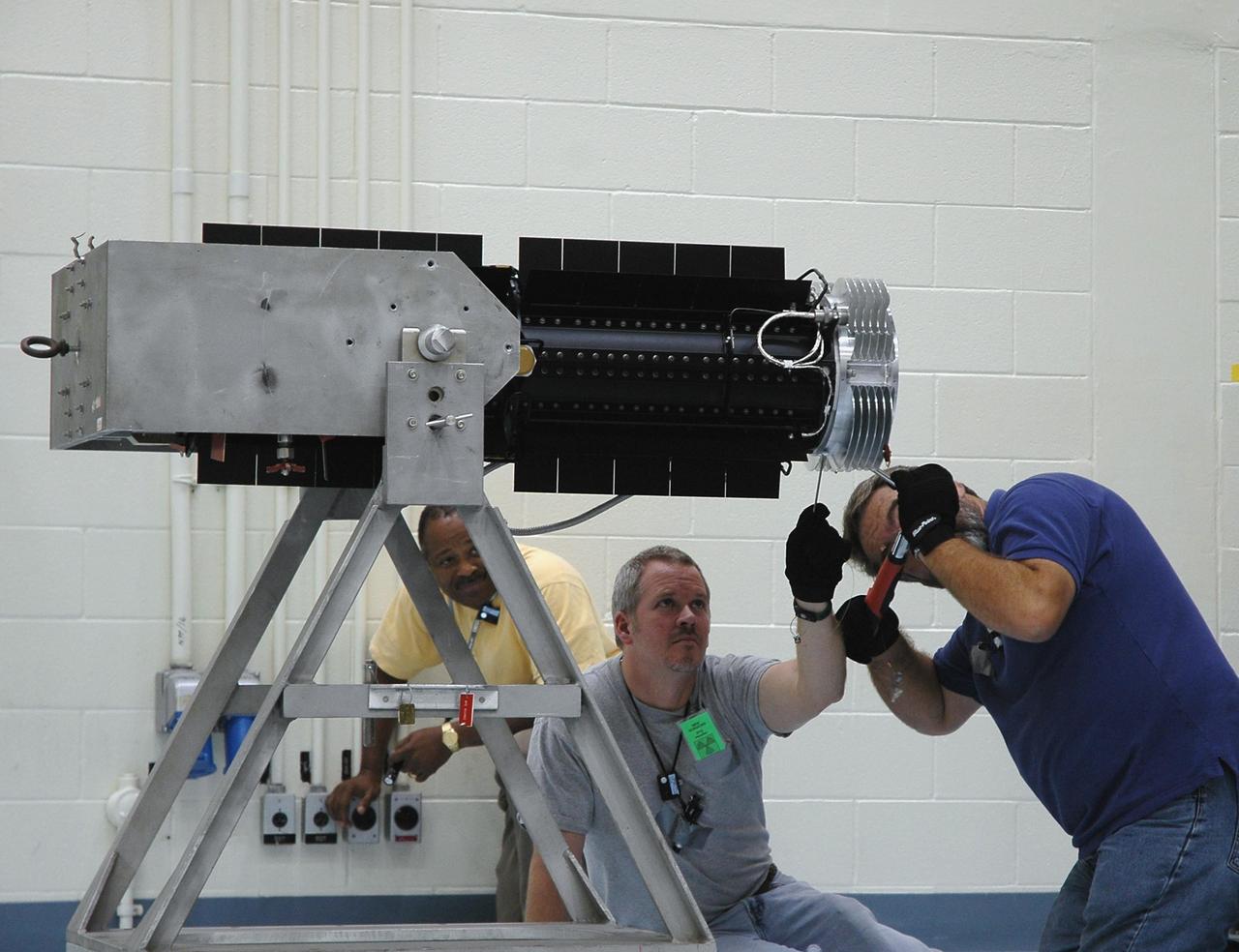
KENNEDY SPACE CENTER, FLA. - In the RTG Facility at Kennedy Space Center, Mervin Smith watches as technicians install a flight adapter on the radioisotope thermoelectric generator (RTG). The RTG is the baseline power supply for the NASA’s New Horizons spacecraft, scheduled to launch in January 2006 on a journey to Pluto and its moon, Charon. As it approaches Pluto, the spacecraft will look for ultraviolet emission from Pluto's atmosphere and make the best global maps of Pluto and Charon in green, blue, red and a special wavelength that is sensitive to methane frost on the surface. It will also take spectral maps in the near infrared, telling the science team about Pluto's and Charon's surface compositions and locations and temperatures of these materials. When the spacecraft is closest to Pluto or its moon, it will take close-up pictures in both visible and near-infrared wavelengths. It is expected to reach Pluto in July 2015.
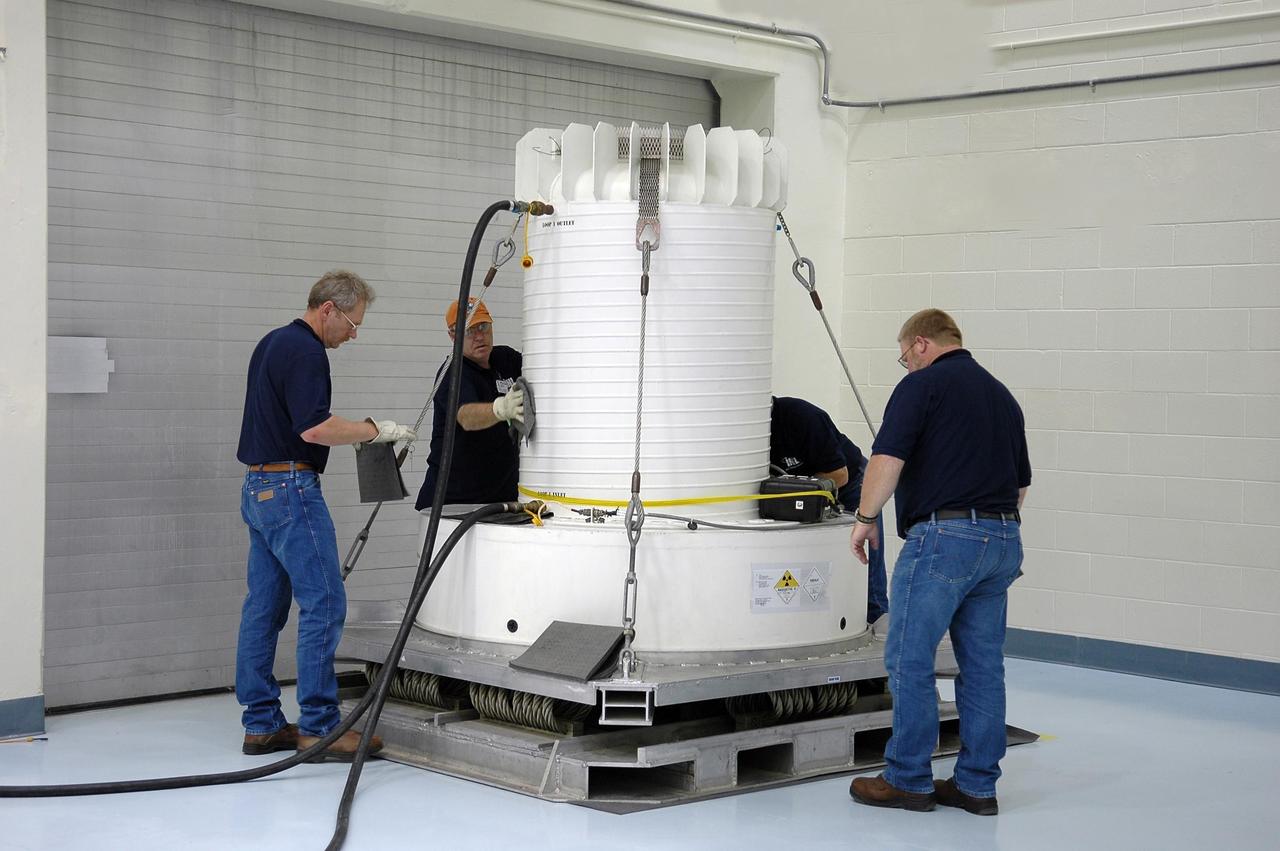
KENNEDY SPACE CENTER, FLA. - Bob Tessmer, Dave Nobles and Dan Brunson check the radioisotope thermoelectric generator (RTG) container after its move inside the RTG facility at Kennedy Space Center. The RTG is the baseline power supply for the NASA’s New Horizons spacecraft, scheduled to launch in January 2006 on a journey to Pluto and its moon, Charon. The RTG is the baseline power supply for the NASA’s New Horizons spacecraft, scheduled to launch in January 2006 on a journey to Pluto and its moon, Charon. As it approaches Pluto, the spacecraft will look for ultraviolet emission from Pluto's atmosphere and make the best global maps of Pluto and Charon in green, blue, red and a special wavelength that is sensitive to methane frost on the surface. It will also take spectral maps in the near infrared, telling the science team about Pluto's and Charon's surface compositions and locations and temperatures of these materials. When the spacecraft is closest to Pluto or its moon, it will take close-up pictures in both visible and near-infrared wavelengths. It is expected to reach Pluto in July 2015.