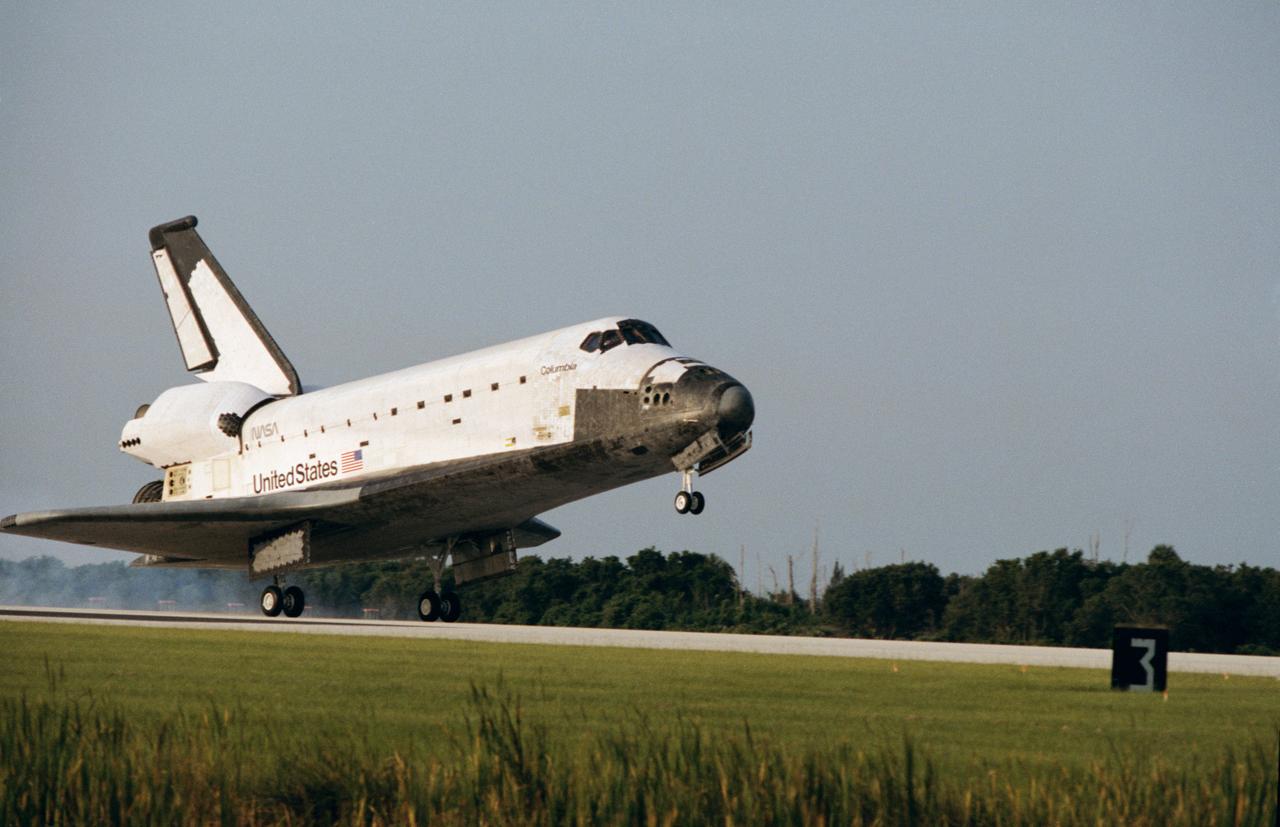
STS-50 Columbia's, Orbiter Vehicle (OV) 102's, main landing gear touches down on runway 33 at the Kennedy Space Center (KSC) Shuttle Landing Facility (SLF) producing a small cloud of dust. Landing occurred at 7:42 am (Eastern Daylight Time (EDT)). In this view of the OV-102's starboard side, the nose landing gear (NLG) continues to ride above the runway surface. Florida vegetation, a runway sign, and runway lights appear in the foreground.
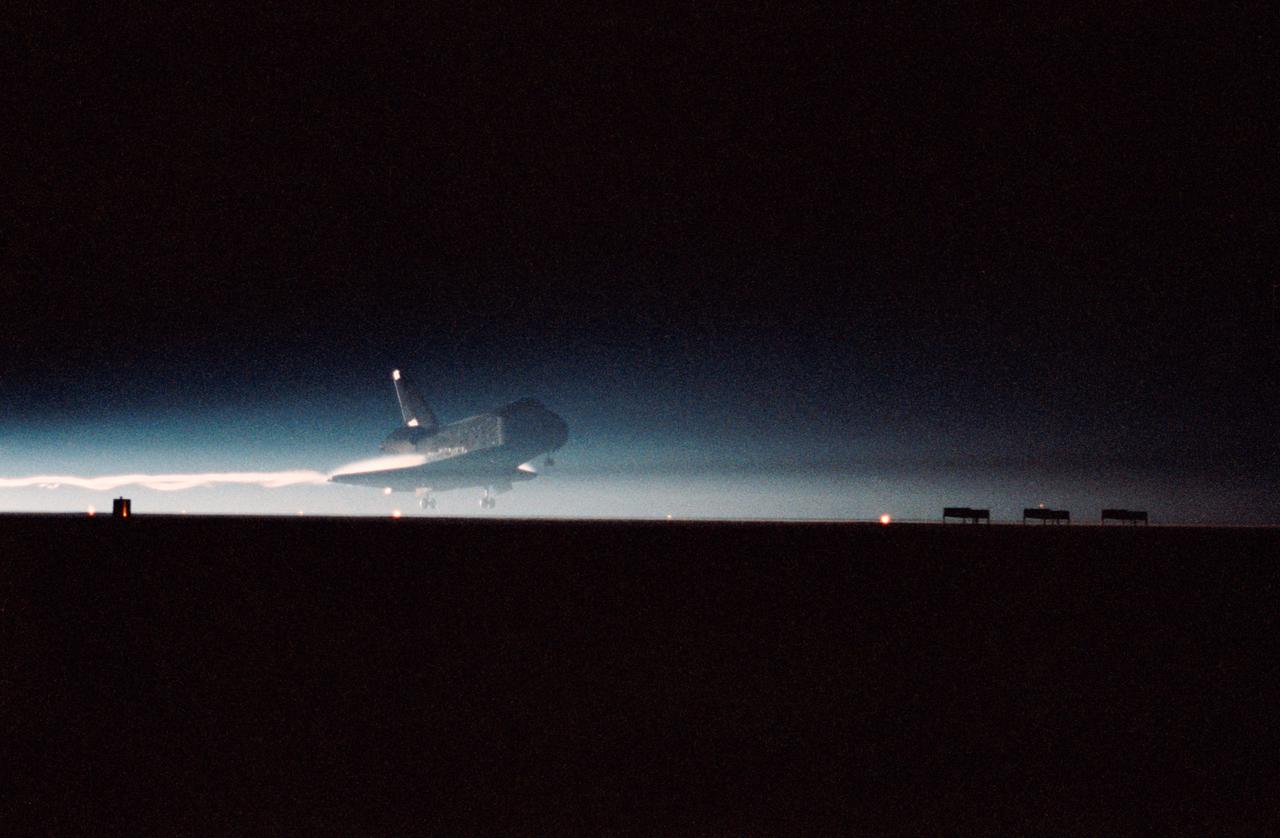
STS-32 Columbia, Orbiter Vehicle (OV) 102, is captured as its main landing gear (MLG) touches down on runway 22 at Edwards Air Force Base (EAFB), California, in the early morning darkness. The night landing ended a record 11-day mission in space. Moments later, at 1:36:38 am Pacific Standard Time (PST), OV-102 came to a complete stop, having logged 4,509,972 miles in flight.
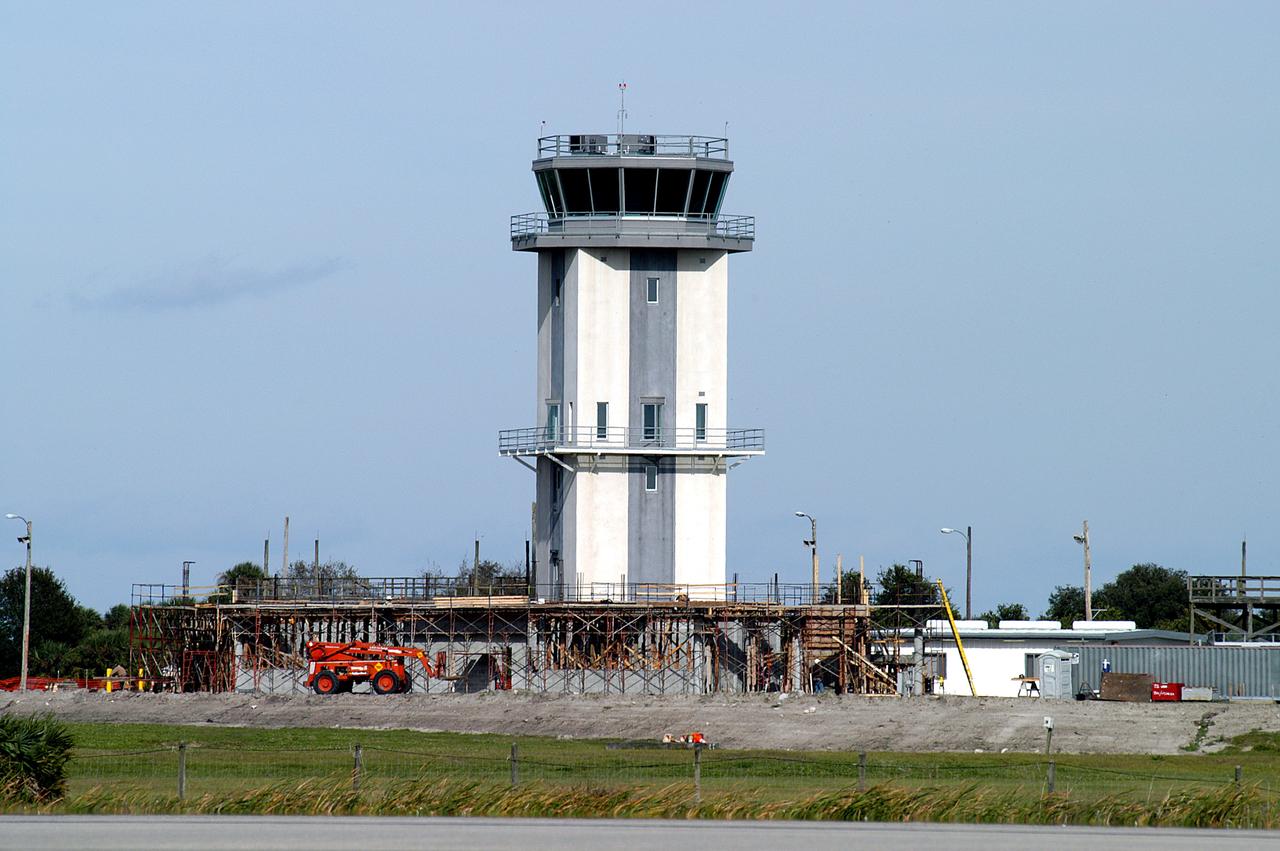
KENNEDY SPACE CENTER, FLA. -- A new control tower is nearing completion at the KSC Shuttle Landing Facility. It will replace the old tower in use since 1987. The old tower stands only 20 feet above the runway surface, too low to see the launch pads to the east. During nighttime landing operations, those inside the tower have been hindered by the eight-billion candlepower xenon lights that illuminate the runway. The new control tower is built atop an existing mound, rising nearly 100 feet over the midpoint of the runway. The height gives controllers a spectacular 360-degree view of NASA-KSC and northern Brevard County. The new facility will also replace the SLF Operations Building. The operations building is home to the Military Radar Unit that monitors NASA-KSC airspace 24 hours a day, as well as runway light controls, navigational aids, weather and wind speed instrumentation, and gate controls. In the new tower, the computer displays will be fully modernized to Federal Aviation Administration standards with touch-screen technology. Construction on the new facility began in February 2003 and is nearly ready for occupancy. Only some final inspections and approvals remain. A support building and Public Affairs viewing deck, to be used for observing future landing operations, will be added and are already in work.
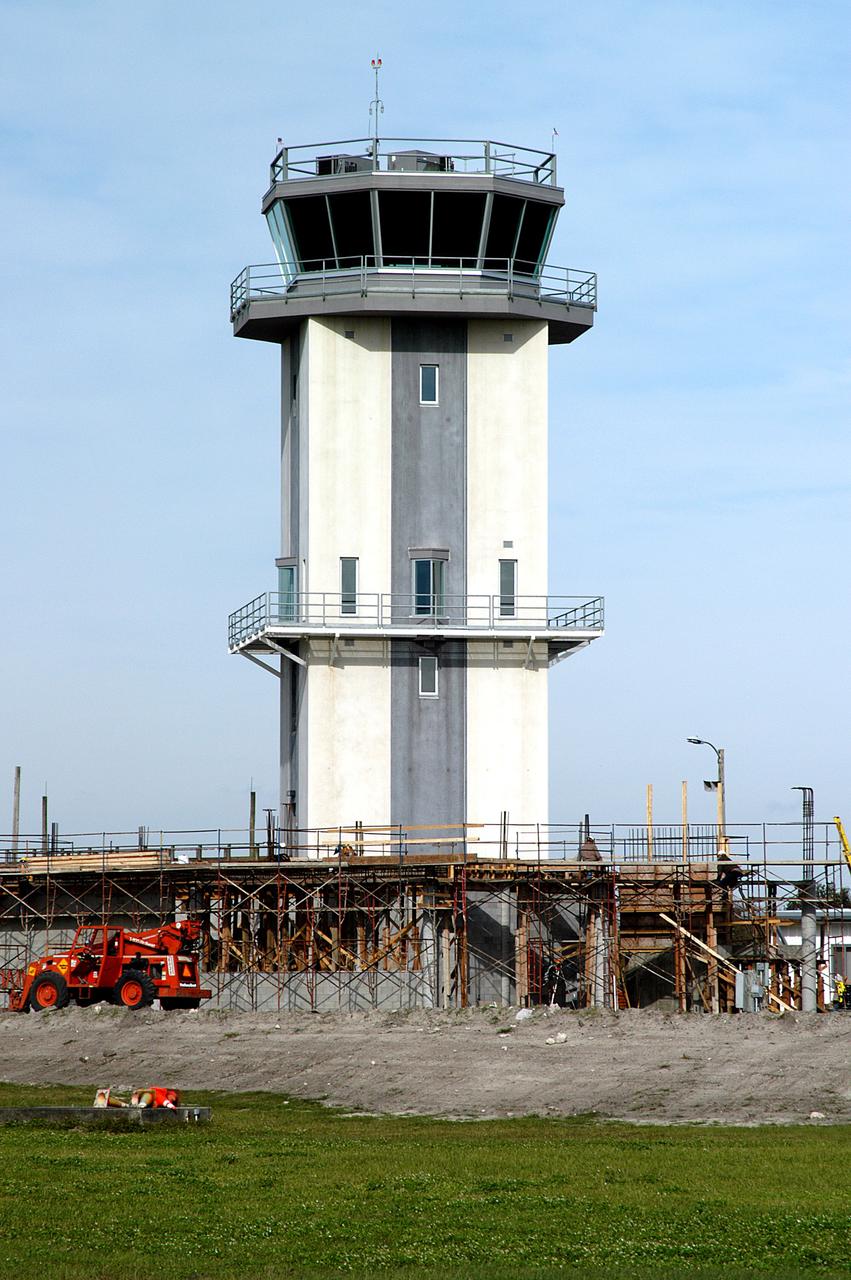
KENNEDY SPACE CENTER, FLA. -- A new control tower is nearing completion at the KSC Shuttle Landing Facility. It will replace the old tower in use since 1987. The old tower stands only 20 feet above the runway surface, too low to see the launch pads to the east. During nighttime landing operations, those inside the tower have been hindered by the eight-billion candlepower xenon lights that illuminate the runway. The new control tower is built atop an existing mound, rising nearly 100 feet over the midpoint of the runway. The height gives controllers a spectacular 360-degree view of NASA-KSC and northern Brevard County. The new facility will also replace the SLF Operations Building. The operations building is home to the Military Radar Unit that monitors NASA-KSC airspace 24 hours a day, as well as runway light controls, navigational aids, weather and wind speed instrumentation, and gate controls. In the new tower, the computer displays will be fully modernized to Federal Aviation Administration standards with touch-screen technology. Construction on the new facility began in February 2003 and is nearly ready for occupancy. Only some final inspections and approvals remain. A support building and Public Affairs viewing deck, to be used for observing future landing operations, will be added and are already in work.
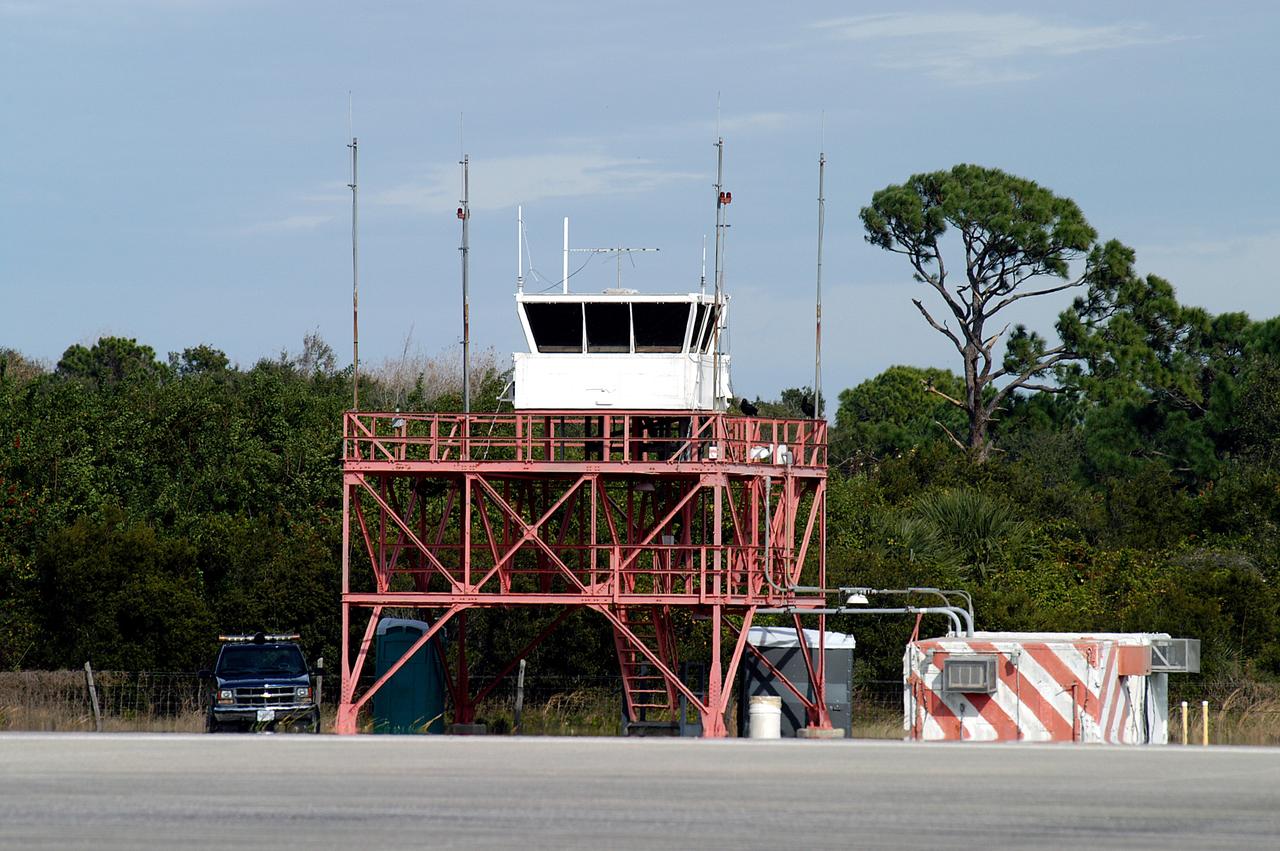
KENNEDY SPACE CENTER, FLA. -- The existing control tower seen here at the edge of the KSC Shuttle Landing Facility is being replaced. In use since 1987, the old tower stands only 20 feet above the runway surface, too low to see the launch pads to the east. During nighttime landing operations, those inside the tower have been hindered by the eight-billion candlepower xenon lights that illuminate the runway. The new control tower is built atop an existing mound, rising nearly 100 feet over the midpoint of the runway. The height gives controllers a spectacular 360-degree view of NASA-KSC and northern Brevard County. The new facility will also replace the SLF Operations Building. The operations building is home to the Military Radar Unit that monitors NASA-KSC airspace 24 hours a day, as well as runway light controls, navigational aids, weather and wind speed instrumentation, and gate controls. In the new tower, the computer displays will be fully modernized to Federal Aviation Administration standards with touch-screen technology. Construction on the new facility began in February 2003 and is nearly ready for occupancy. Only some final inspections and approvals remain. A support building and Public Affairs viewing deck, to be used for observing future landing operations, will be added and are already in work.
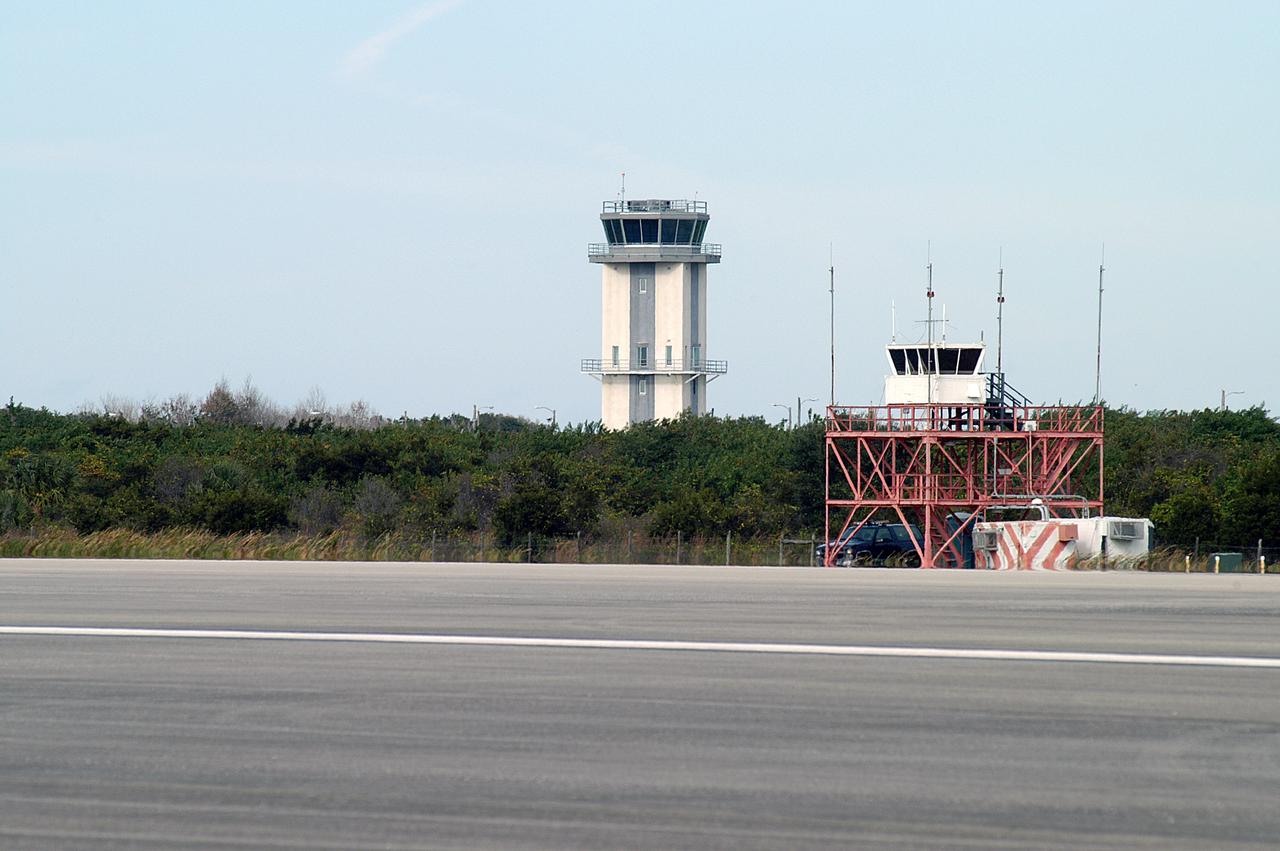
KENNEDY SPACE CENTER, FLA. -- Two control towers are seen at the edge of the KSC Shuttle Landing Facility, the old one in front and the nearly completed new tower in back. The old tower stands only 20 feet above the runway surface, too low to see the launch pads to the east. During nighttime landing operations, those inside the tower have been hindered by the eight-billion candlepower xenon lights that illuminate the runway. The new control tower is built atop an existing mound, rising nearly 100 feet over the midpoint of the runway. The height gives controllers a spectacular 360-degree view of NASA-KSC and northern Brevard County. The new facility will also replace the SLF Operations Building. The operations building is home to the Military Radar Unit that monitors NASA-KSC airspace 24 hours a day, as well as runway light controls, navigational aids, weather and wind speed instrumentation, and gate controls. In the new tower, the computer displays will be fully modernized to Federal Aviation Administration standards with touch-screen technology. Construction on the new facility began in February 2003 and is nearly ready for occupancy. Only some final inspections and approvals remain. A support building and Public Affairs viewing deck, to be used for observing future landing operations, will be added and are already in work.
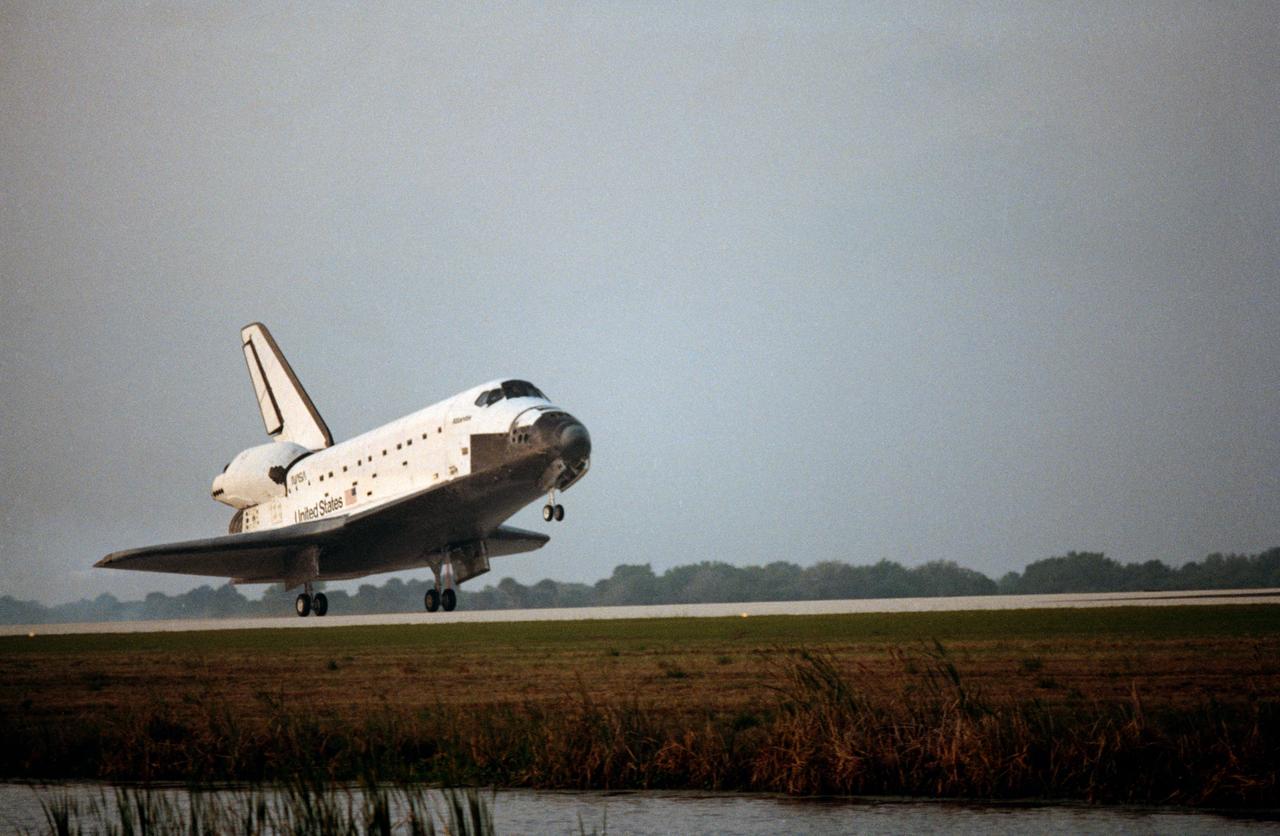
STS-45 Atlantis, Orbiter Vehicle (OV) 104, lands on concrete runway 33 at the Kennedy Space Center's (KSC's) Shuttle Landing Facility (SLF). The main landing gear (MLG) touched down at 6:23:06 am (Eastern Standard Time (EST)) in the early morning Florida fog as seen in these views. The deployed nose landing gear (NLG) rides above the runway before wheel stop.
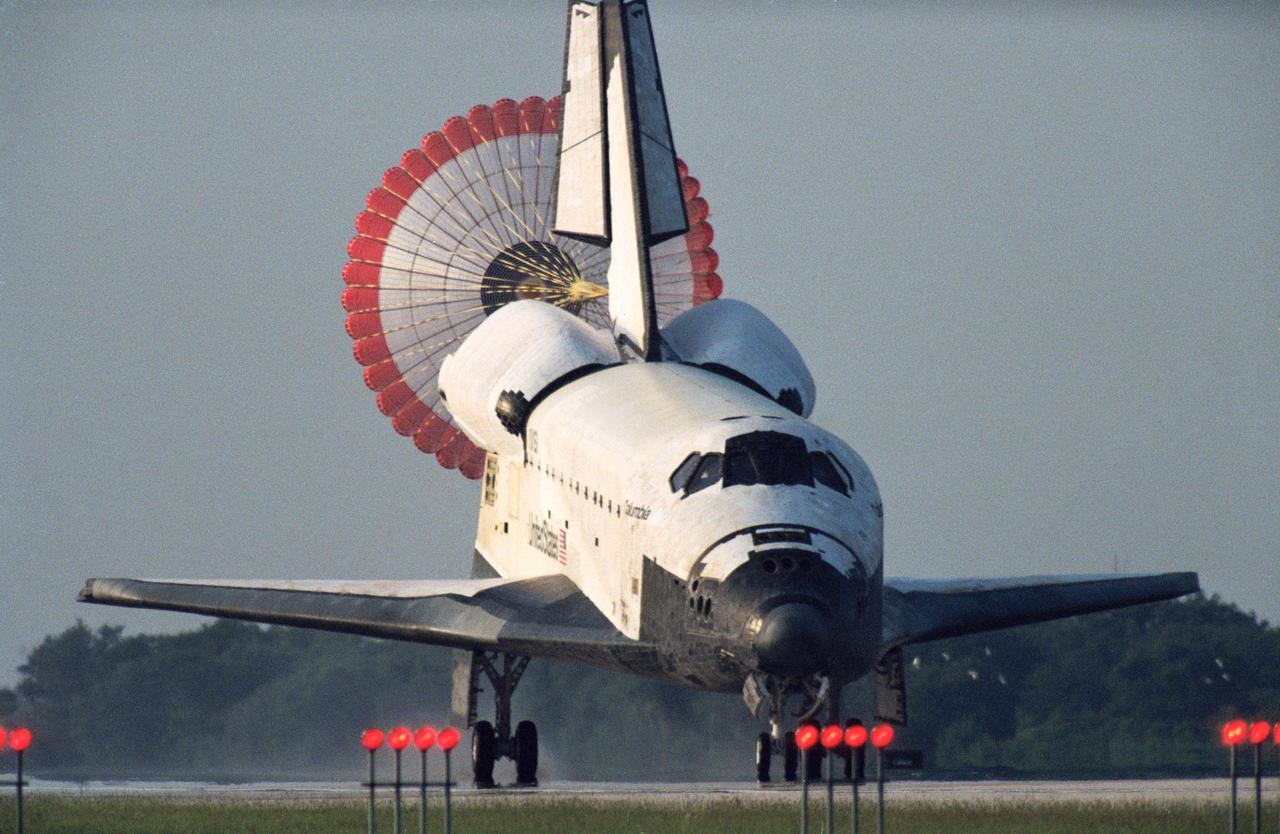
STS050-S-105 (9 July 1992) --- The main drag chute on the Space Shuttle Columbia is fully deployed soon after the Space Shuttle touches down at the Kennedy Space Center (KSC) landing facility. Landing occurred at 7:42 a.m. (EDT). Seven crew members, including five astronauts and two scientists from the private sector spent 14 days in space supporting the U.S. Microgravity Laboratory (USML-1). This marks the first time for usage of the parachute system for a KSC landing and the second occurrence in the program.

STS110-S-039 (19 April 2002) --- The Space Shuttle Atlantis heads for touchdown on the runway at the KSC landing facility to complete a nearly 11-day journey. Astronaut Michael J. Bloomfield, mission commander, eased Atlantis to a textbook landing on runway 3-3 at the Florida spaceport at 12:27 p.m. (EDT), April 19, 2002, under clear skies and light winds. The landing completed a 4.5-million-mile mission that saw successful delivery and installation of the centerpiece of the International Space Station’s main truss and the inaugural run of the first space railcar, the Mobile Transporter.
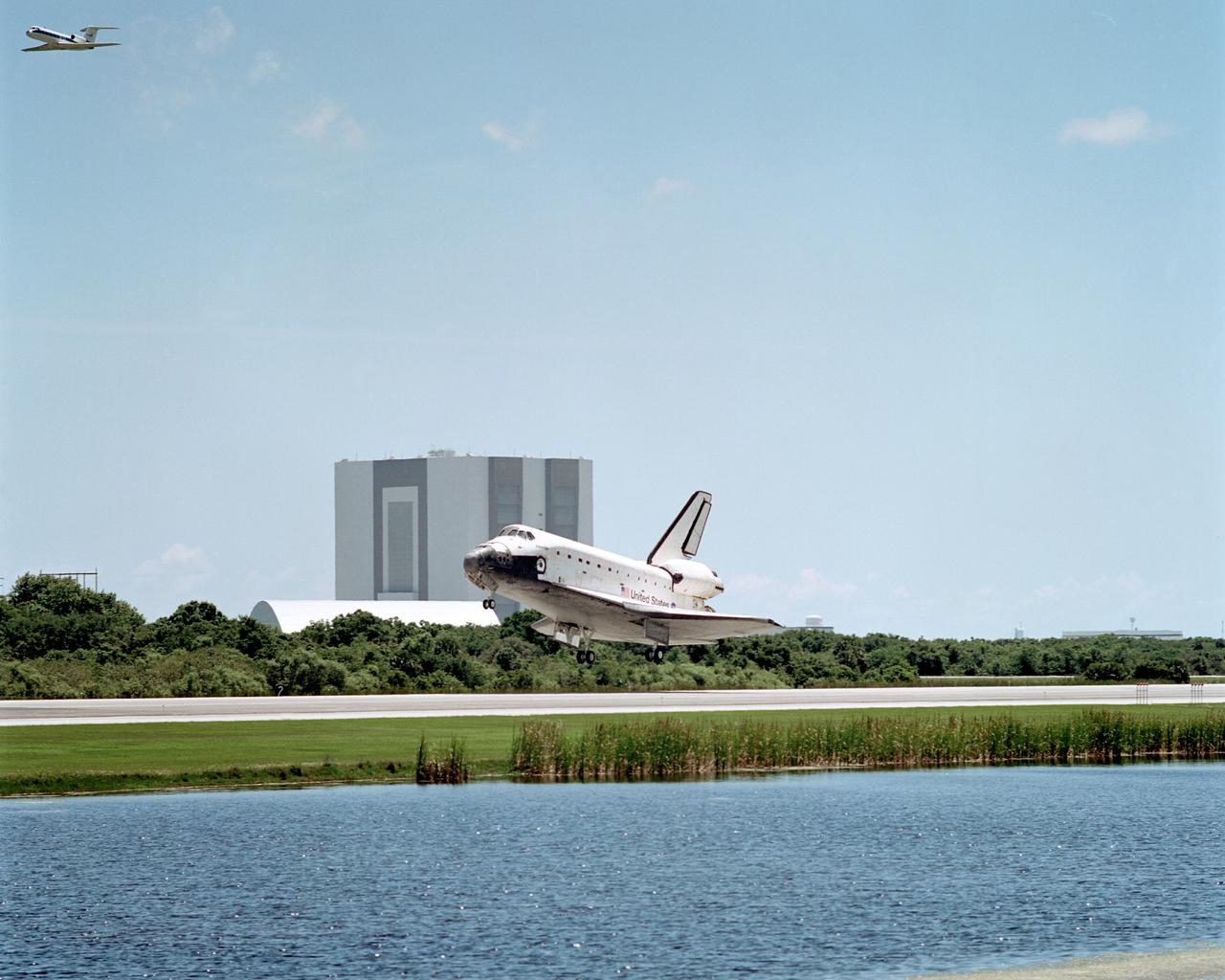
STS110-S-057 (19 April 2002) --- The Space Shuttle Atlantis heads for touchdown on the runway at the KSC landing facility to complete the nearly 11-day STS-110 journey. Astronaut Michael J. Bloomfield, mission commander, eased Atlantis to a textbook landing on runway 3-3 at the Florida spaceport at 12:27 p.m. (EDT), April 19, 2002, under clear skies and light winds. The landing completed a 4.5-million-mile mission that saw successful delivery and installation of the centerpiece of the International Space Station?s main truss and the inaugural run of the first space railcar, the Mobile Transporter.
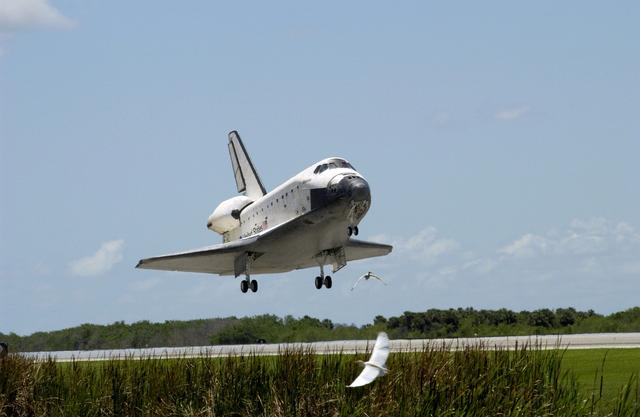
STS110-S-039 (19 April 2002) --- The Space Shuttle Atlantis heads for touchdown on the runway at the KSC landing facility to complete a nearly 11-day journey. Astronaut Michael J. Bloomfield, mission commander, eased Atlantis to a textbook landing on runway 3-3 at the Florida spaceport at 12:27 p.m. (EDT), April 19, 2002, under clear skies and light winds. The landing completed a 4.5-million-mile mission that saw successful delivery and installation of the centerpiece of the International Space Station’s main truss and the inaugural run of the first space railcar, the Mobile Transporter.
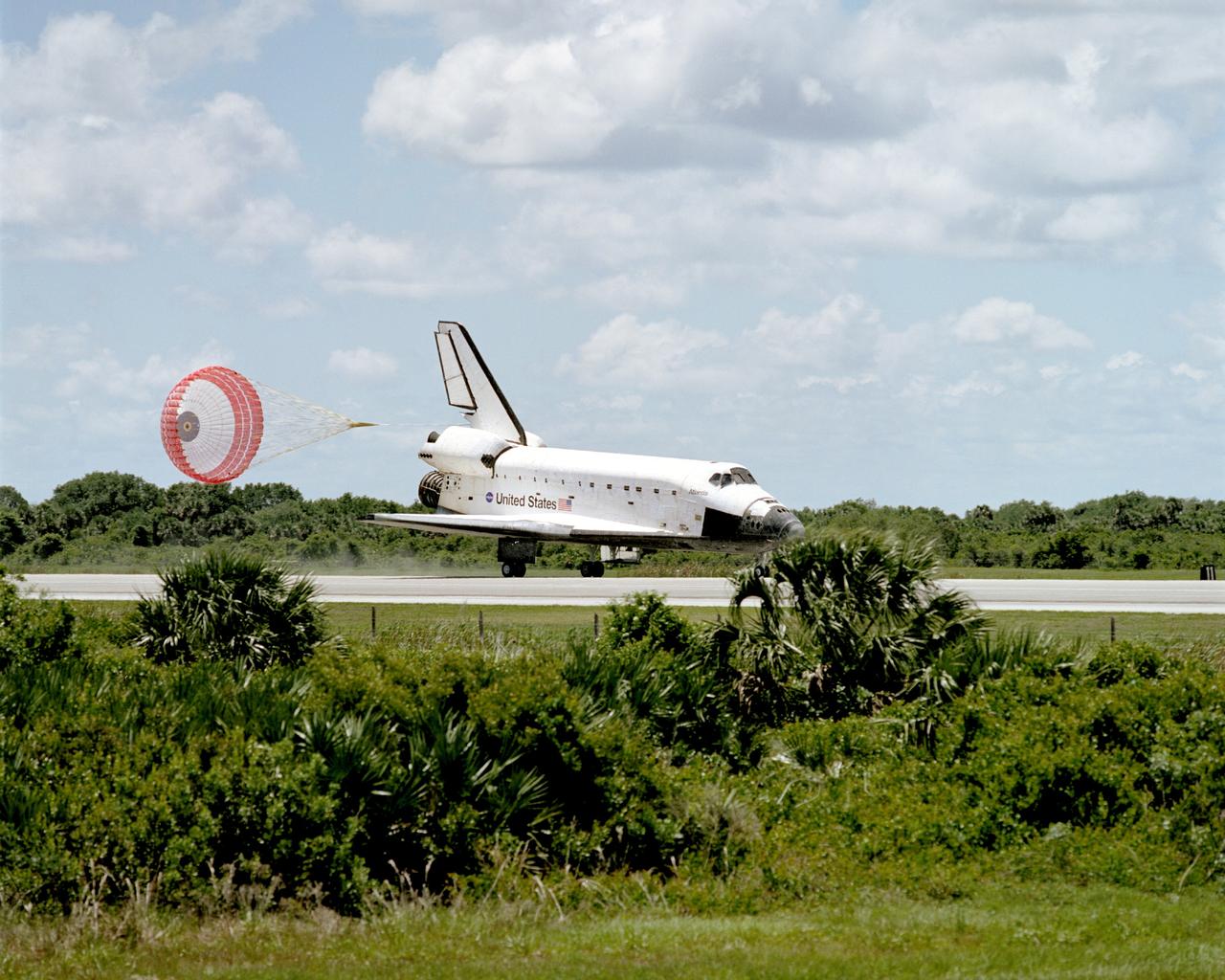
STS110-S-055 (19 April 2002) --- With its drag chute gear deployed, the Space Shuttle Atlantis eases to a stop on the runway at the KSC landing facility to complete the nearly 11-day STS-110 journey. Astronaut Michael J. Bloomfield, mission commander, eased Atlantis to a textbook landing on runway 3-3 at the Florida spaceport at 12:27 p.m. (EDT), April 19, 2002, under clear skies and light winds. The landing completed a 4.5-million-mile mission that saw successful delivery and installation of the centerpiece of the International Space Station?s main truss and the inaugural run of the first space railcar, the Mobile Transporter.
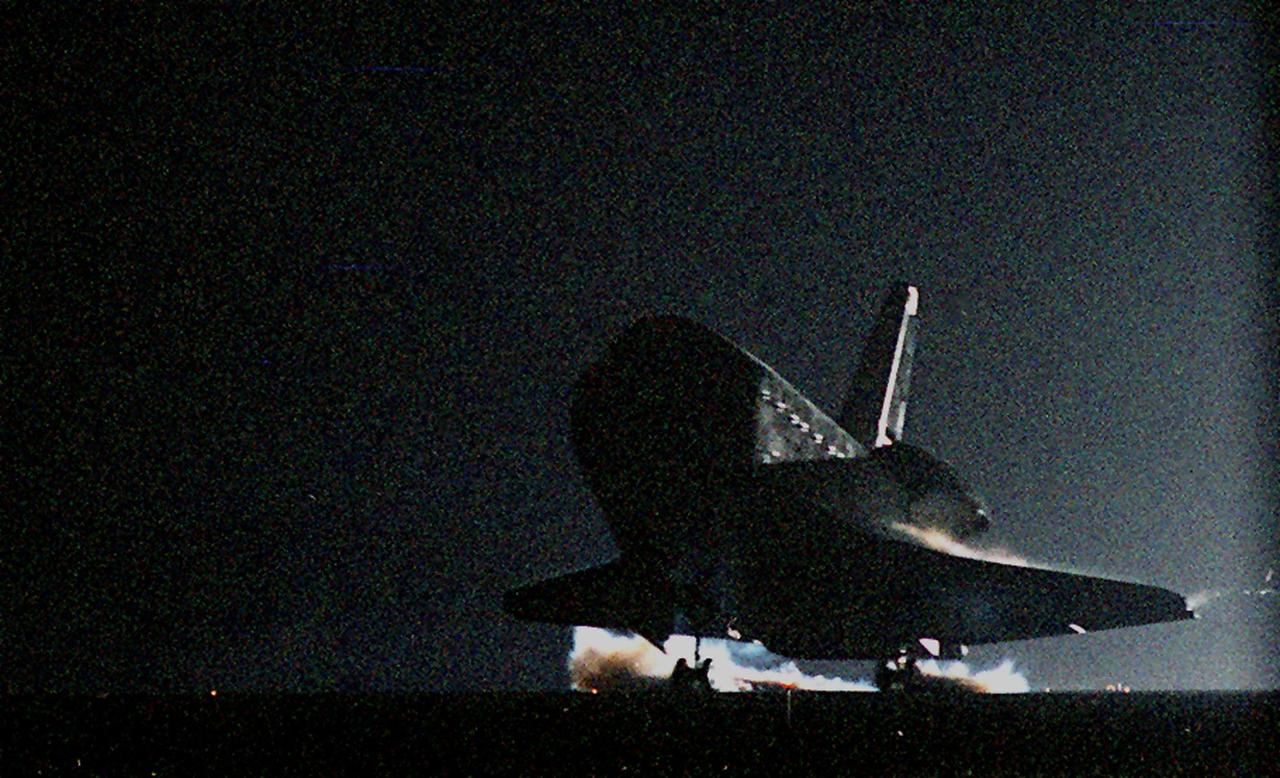
KENNEDY SPACE CENTER, Fla. -- Atlantis’ main gear touchdown on Runway 15 of the KSC Shuttle Landing Facility kicks up swirls of dust reflected in the runway lights. Atlantis and crew traveled 4.9 million miles on the 11-day, 19-hour, 11-minute mission STS-106. Main gear touchdown occurred on-time at 3:56:48 a.m. EDT. During the mission to the International Space Station, the crew transferred nearly 5,000 pounds of equipment and supplies for use by the first resident crew expected to arrive in November. STS-106 was the 99th flight in the Shuttle program and the 22nd for Atlantis. STS-106 also marked the 15th nighttime landing in Shuttle history and the 23rd consecutive landing at KSC
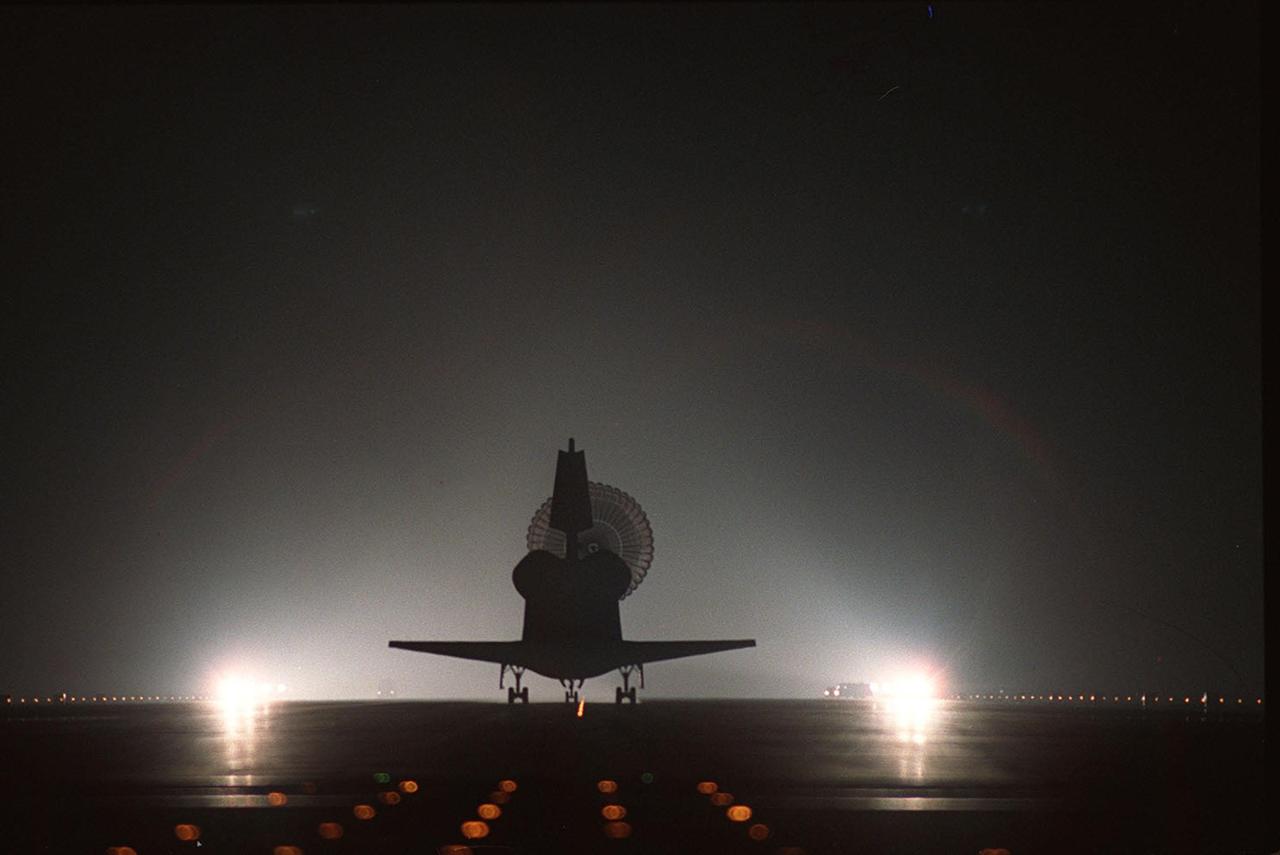
KENNEDY SPACE CENTER, FLA. -- Atlantis is silhouetted by the brilliant runway lights as it lands on Runway 15 of the KSC Shuttle Landing Facility. Main gear touchdown was at 3:56:48 a.m. EDT, landing on orbit 185 of the mission. Nose gear touchdown was at 3:56:57 a.m. EDT and wheel stop at 3:58:01 a.m. EDT.; Atlantis and crew traveled 4.9 million miles on the 11-day, 19-hour, 11-minute mission STS-106. During the mission to the International Space Station, the crew transferred nearly 5,000 pounds of equipment and supplies for use by the first resident crew expected to arrive in November. STS-106 was the 99th flight in the Shuttle program and the 22nd for Atlantis. STS-106 also marked the 15th nighttime landing in Shuttle history and the 23rd consecutive landing at KSC
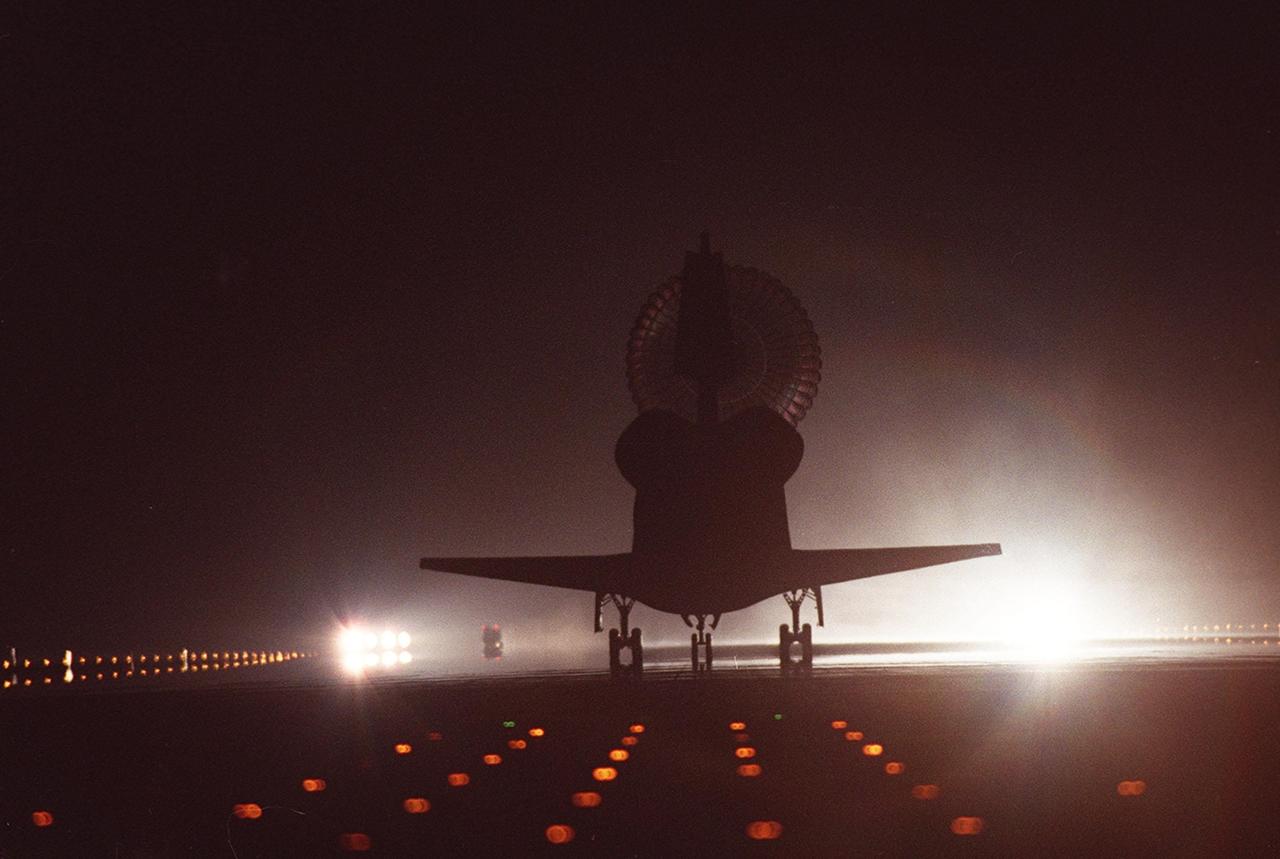
KENNEDY SPACE CENTER, Fla. -- Space Shuttle Discovery is silhouetted by the brilliant runway lights of runway 15 as it lands at the KSC Shuttle Landing Facility. Main gear touchdown occurred at 2:31:42 a.m. EST. Nose wheel touchdown occurred at 2:31:54 a.m., and wheel stop at 2:33:06 a.m. The landing on orbit 201 concluded mission STS-102, the eighth flight to the International Space Station, carrying the first Multi-Purpose Logistics Module, Leonardo, to the ISS and Expedition Two, a replacement crew for the Station. The 12-day, 19-hour, 51-minute mission returned both the Leonardo and the first resident crew of the ISS, Expedition One, to KSC. Discovery logged 5.3 million miles on this mission. The landing marked the 54th at KSC in the history of the program, and the 12th night landing at KSC
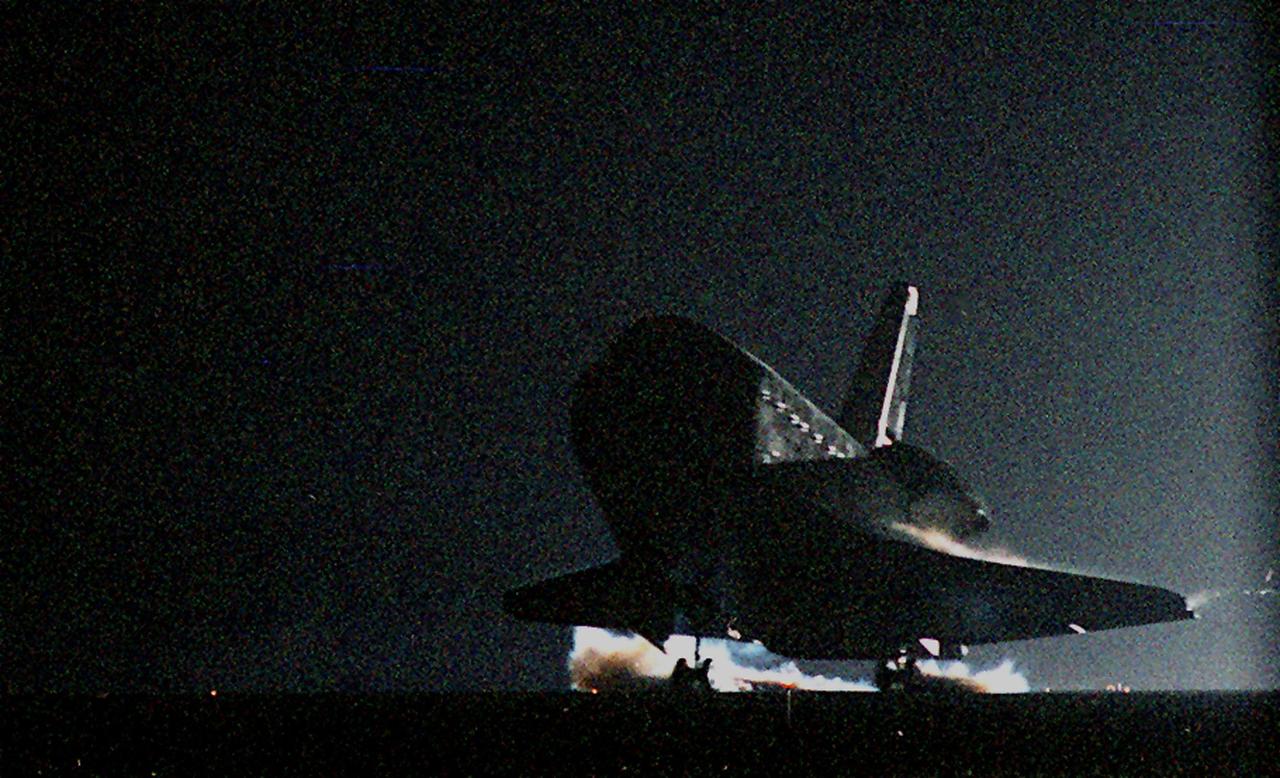
KENNEDY SPACE CENTER, Fla. -- Atlantis’ main gear touchdown on Runway 15 of the KSC Shuttle Landing Facility kicks up swirls of dust reflected in the runway lights. Atlantis and crew traveled 4.9 million miles on the 11-day, 19-hour, 11-minute mission STS-106. Main gear touchdown occurred on-time at 3:56:48 a.m. EDT. During the mission to the International Space Station, the crew transferred nearly 5,000 pounds of equipment and supplies for use by the first resident crew expected to arrive in November. STS-106 was the 99th flight in the Shuttle program and the 22nd for Atlantis. STS-106 also marked the 15th nighttime landing in Shuttle history and the 23rd consecutive landing at KSC
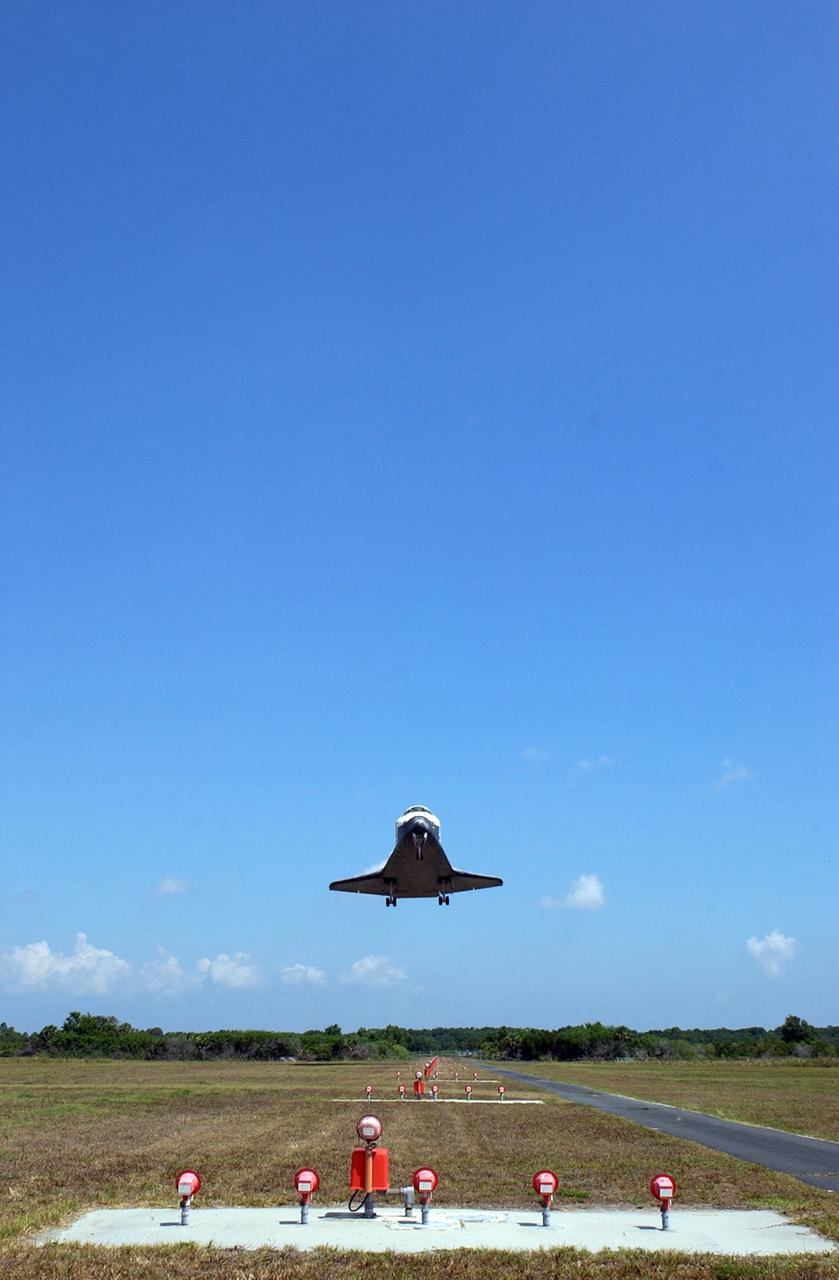
CAPE CANAVERAL, Fla. – Space shuttle Discovery drops from the blue sky preparing to land on Runway 15 at NASA's Kennedy Space Center. This 69th landing at Kennedy ended the STS-124 mission, a 14-day flight to the International Space Station. On the ground before the runway are the Ball-Bar Light System, which provide a visual reference to provide inner glide slope information. The main landing gear touched down at 11:15:19 a.m. EDT. The nose landing gear touched down at 11:15:30 a.m. and wheel stop was at 11:16:19 a.m. The mission completed 5.7 million miles. The STS-124 mission delivered the Japan Aerospace Exploration Agency's large Japanese Pressurized Module and its remote manipulator system to the space station. Photo credit: NASA/Kevin O'Connell,Scott Haun
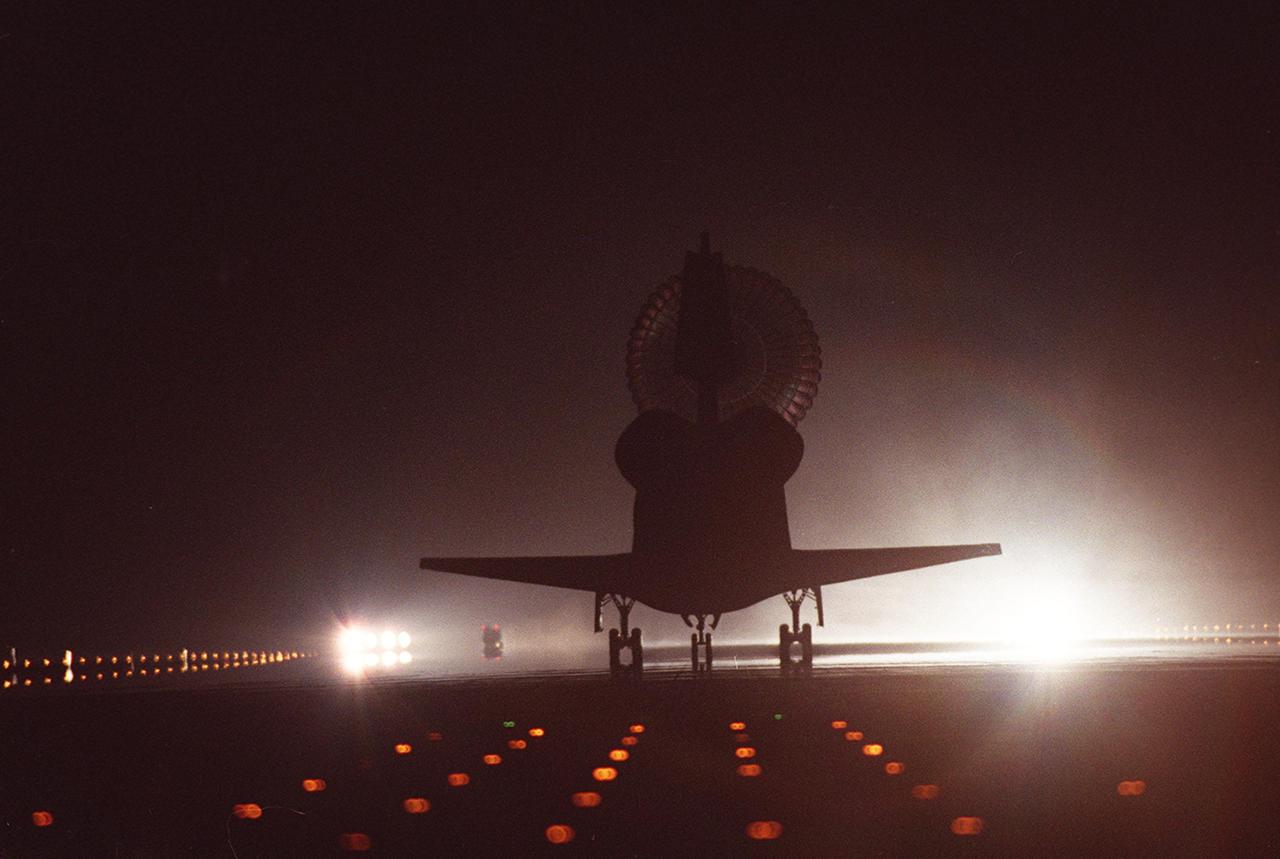
KENNEDY SPACE CENTER, Fla. -- Space Shuttle Discovery is silhouetted by the brilliant runway lights of runway 15 as it lands at the KSC Shuttle Landing Facility. Main gear touchdown occurred at 2:31:42 a.m. EST. Nose wheel touchdown occurred at 2:31:54 a.m., and wheel stop at 2:33:06 a.m. The landing on orbit 201 concluded mission STS-102, the eighth flight to the International Space Station, carrying the first Multi-Purpose Logistics Module, Leonardo, to the ISS and Expedition Two, a replacement crew for the Station. The 12-day, 19-hour, 51-minute mission returned both the Leonardo and the first resident crew of the ISS, Expedition One, to KSC. Discovery logged 5.3 million miles on this mission. The landing marked the 54th at KSC in the history of the program, and the 12th night landing at KSC
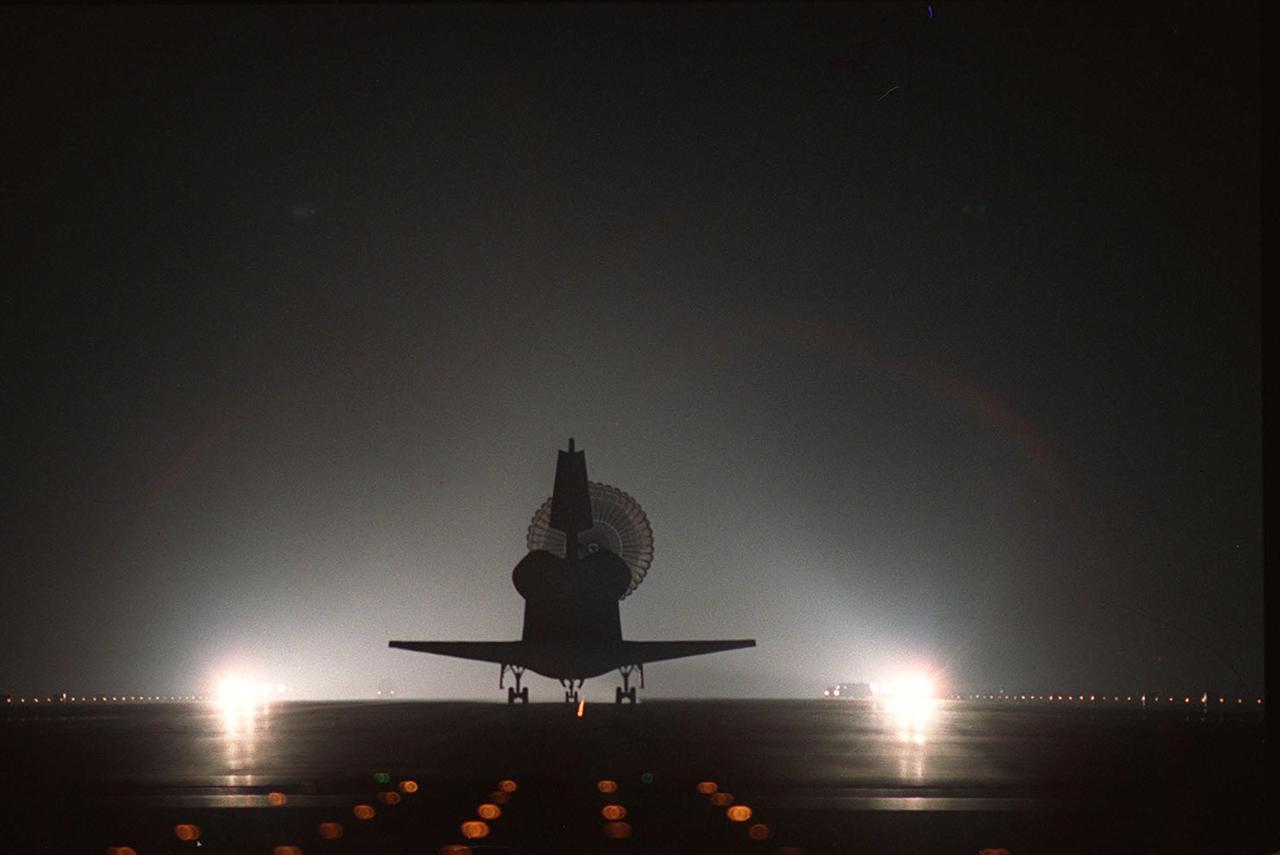
KENNEDY SPACE CENTER, FLA. -- Atlantis is silhouetted by the brilliant runway lights as it lands on Runway 15 of the KSC Shuttle Landing Facility. Main gear touchdown was at 3:56:48 a.m. EDT, landing on orbit 185 of the mission. Nose gear touchdown was at 3:56:57 a.m. EDT and wheel stop at 3:58:01 a.m. EDT.; Atlantis and crew traveled 4.9 million miles on the 11-day, 19-hour, 11-minute mission STS-106. During the mission to the International Space Station, the crew transferred nearly 5,000 pounds of equipment and supplies for use by the first resident crew expected to arrive in November. STS-106 was the 99th flight in the Shuttle program and the 22nd for Atlantis. STS-106 also marked the 15th nighttime landing in Shuttle history and the 23rd consecutive landing at KSC
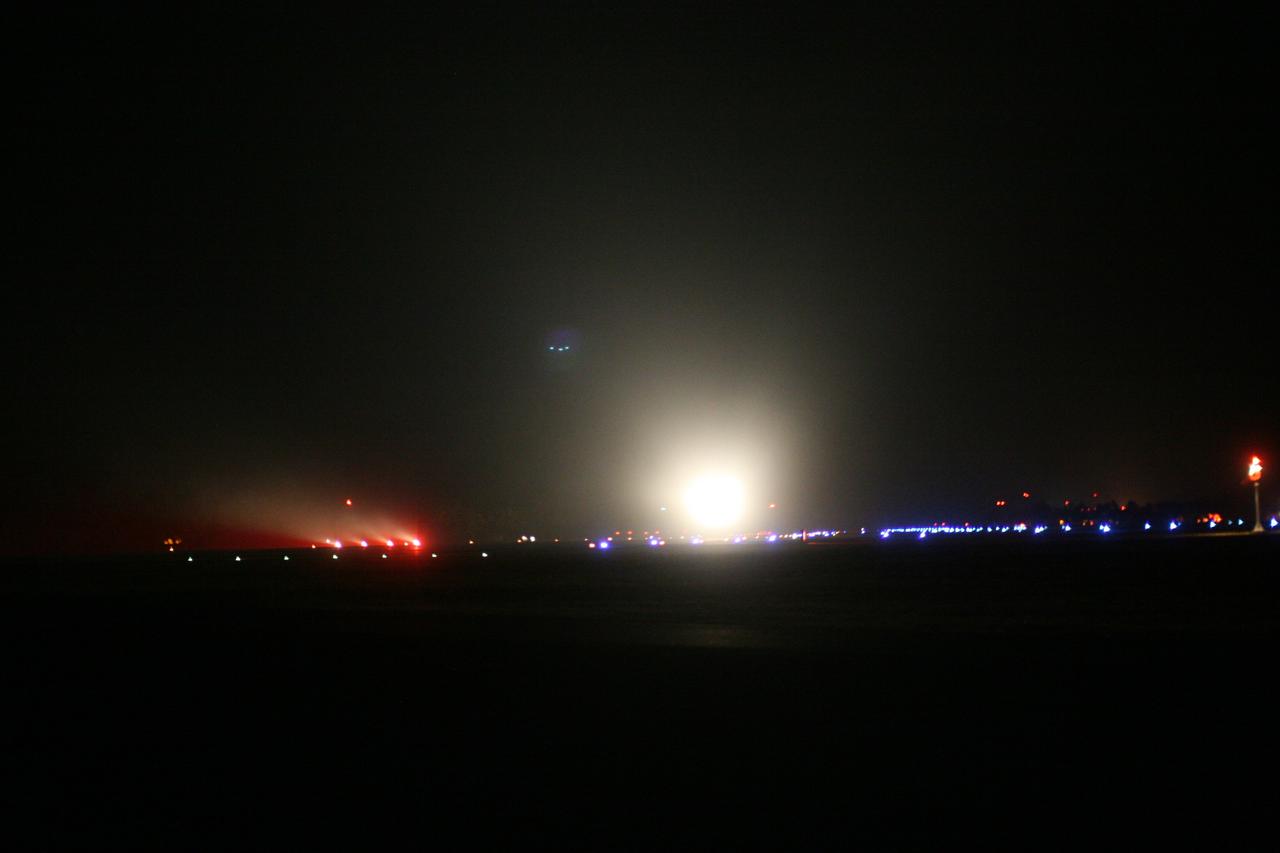
KWAJALEIN ATOLL, Marshall Islands - The lights of Orbital Sciences' L-1011 "Stargazer" aircraft illuminates the night sky as it takes off from the runway at Kwajalein Atoll with the company's Pegasus rocket to launch NASA's Nuclear Spectroscopic Telescope Array, or NuSTAR. The plane left Kwajalein one hour before launch. At 9:00:35 a.m. PDT 12:00:35 p.m. EDT), June 13, 2012, the rocket dropped with the NuSTAR payload 117 nautical miles south of Kwajalein. NuSTAR will use a unique set of “eyes” to see the highest energy X-ray light from the cosmos to reveal black holes lurking in our Milky Way galaxy, as well as those hidden in the hearts of faraway galaxies. Kwajalein is located in the Marshall Islands chain in the Pacific Ocean and is part of the Reagan Test Site and used for launches of NASA, commercial and military missions. For more information, visit http://www.nasa.gov/nustar. Photo credit: NASA
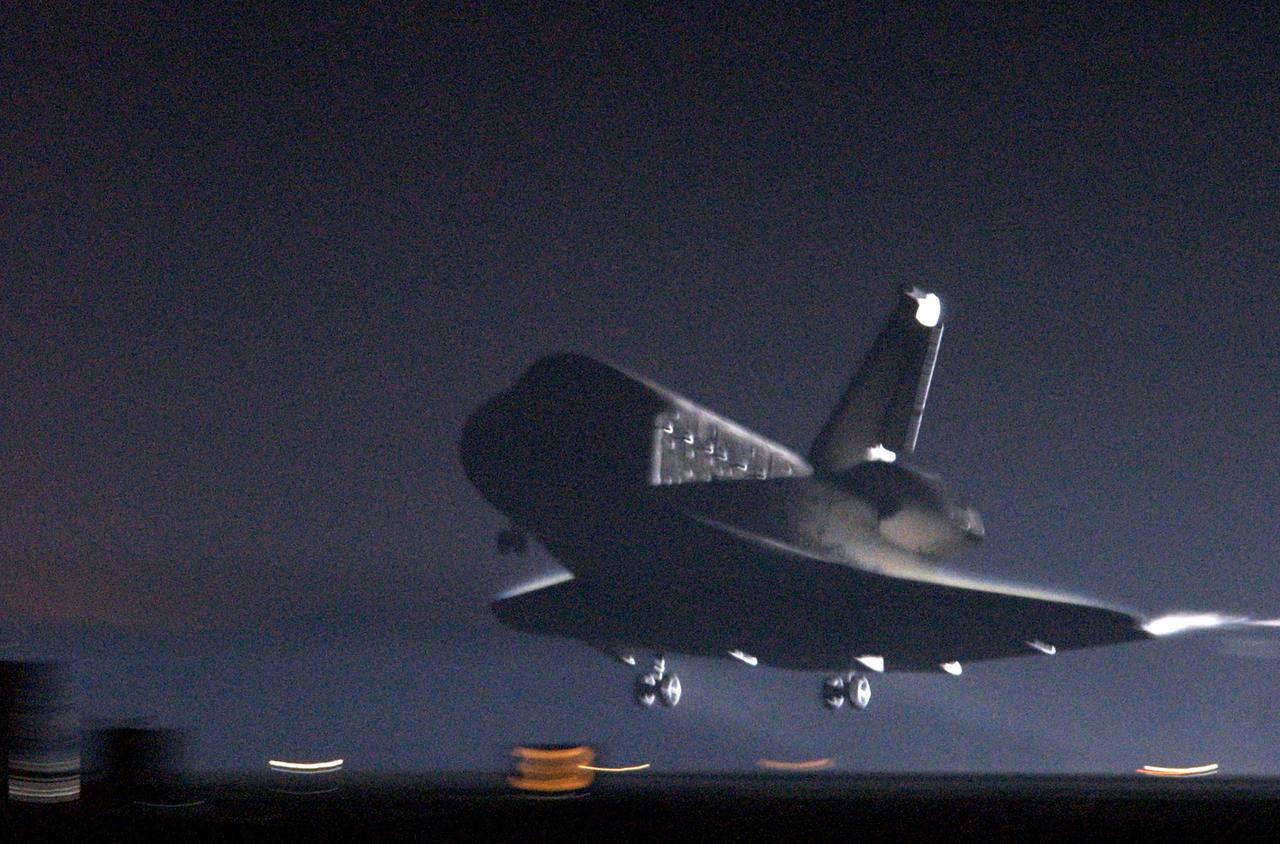
KENNEDY SPACE CENTER, FLA. -- Powerful xenon lights on the Shuttle Landing Facility outline the dark image of orbiter Columbia as it approaches touchdown on Runway 33. The landing completes mission STS-109 to service the Hubble Space Telescope, returning the crew of seven to Earth after a mission elapsed time of 10 days, 22 hours, 11 minutes. Wheel stop occurred on orbit 165 at 4:33:09 a.m. EST. Main gear touchdown occurred at 4:31:52 a.m. and nose wheel touchdown an 4:32:02. It was the 58th landing at KSC out of 108 missions in the history of the Shuttle program

STS083-747-026 (4-8 April 1997) --- Aswan Dam and Lake Nasser along the Nile River, Egypt. The Aswan Dam controls the flow of the Nile River forming Lake Nasser. Lake Nasser is reaching relatively high water levels due to the plentiful rains since December 1996 in Kenya, near the headwaters of the Nile river. The light colored areas in the Lake are where the sun is reflecting off the surface of the water. These areas are fairly calm and not disturbed by wind gusts enabling the sunglint to show water current patterns on the surface. The Aswan runway is seen as a dark set of lines west of the Aswan Dam.
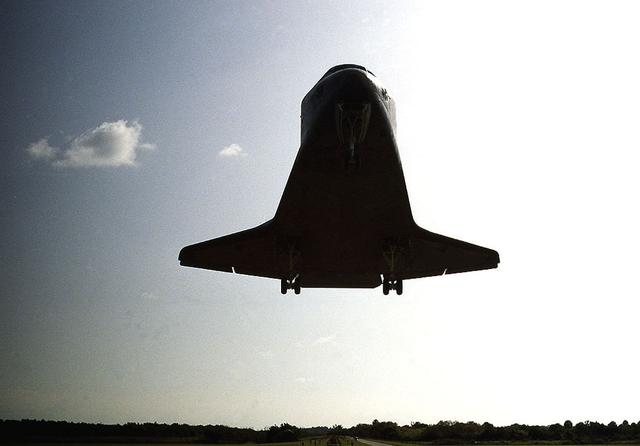
Aligned straight on with the red approach lights, the Orbiter Columbia (STS-52) glides toward Runway 33 of Kennedy Space Center's (KSC) Shuttle Landing Facility. The six member crew successfully completed deployment of the Laser Geodynamic Satellite II (LAGEOS), which is a spherical passive satellite covered with reflectors which are illuminated by ground-based lasers to determine precise measurements of the Earth's crustal movements. The crew also completed a series of materials processing experiments in the microgravity environment aboard the United States Microgravity Payload 1 (USMP-1) carried in the orbiter's cargo bay.
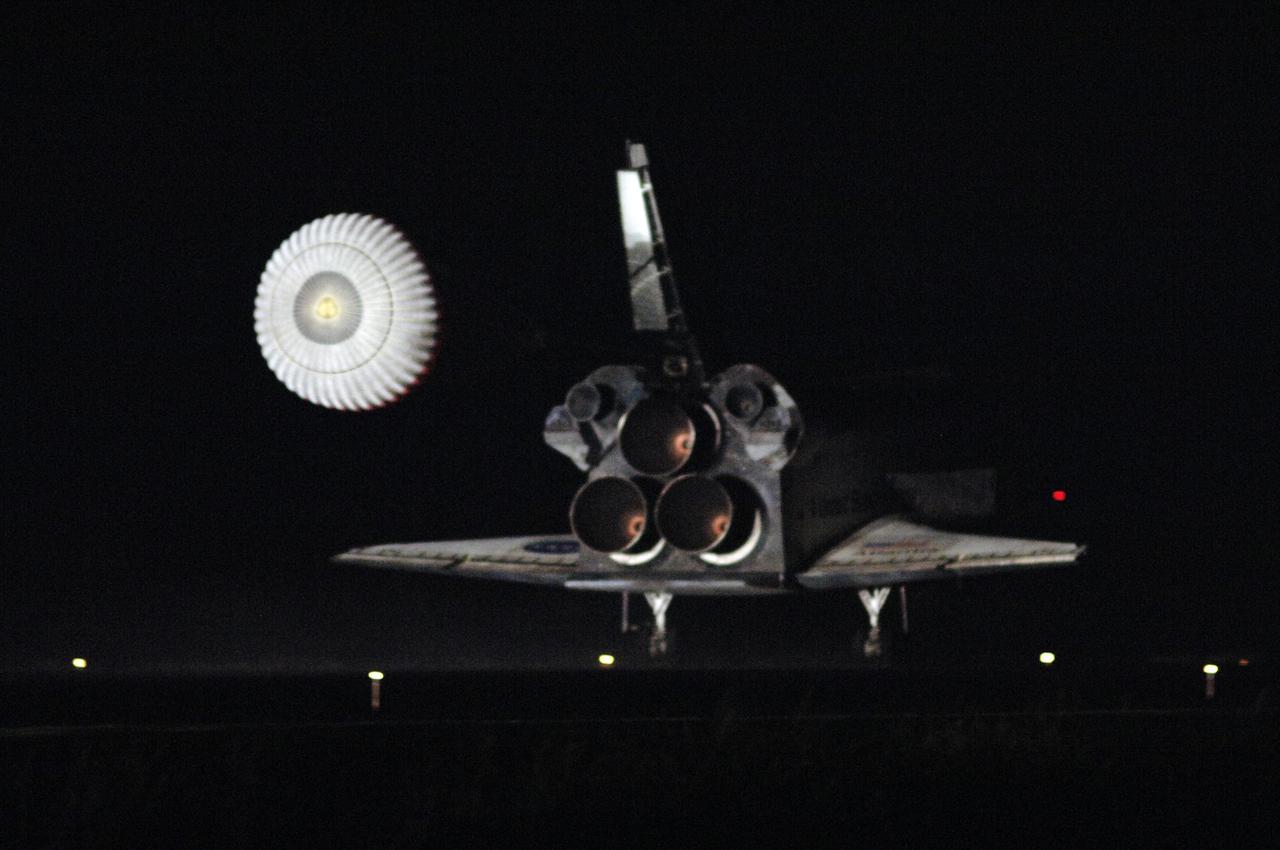
KENNEDY SPACE CENTER, FLA. - The drag chute glows in the lights illuminating Atlantis as it touches down on Runway 33 at NASA's Kennedy Space Center, concluding mission STS-115. Aboard are Commander Brent Jett, Pilot Christopher Ferguson, and Mission Specialists Joseph Tanner, David Burbank, Heidemarie Stefanyshyn-Piper and Steven MacLean, who represents the Canadian Space Agency. During the mission, Tanner, McLean, Burbank and Piper completed three spacewalks to attach the P3/P4 integrated truss structure to the International Space Station. Main gear touchdown was at 6:21:30 a.m. EDT. Nose gear touchdown was at 6:21:36 a.m. and wheel stop was at 6:22:16 a.m. At touchdown -- nominally about 2,500 ft. beyond the runway threshold -- the orbiter is traveling at a speed ranging from 213 to 226 mph. Atlantis traveled 4.9 million miles, landing on orbit 187. Mission elapsed time was 11 days, 19 hours, six minutes. This is the 15th night landing at KSC and the 23rd night landing overall. Photo credit: NASA/Mike Kerley
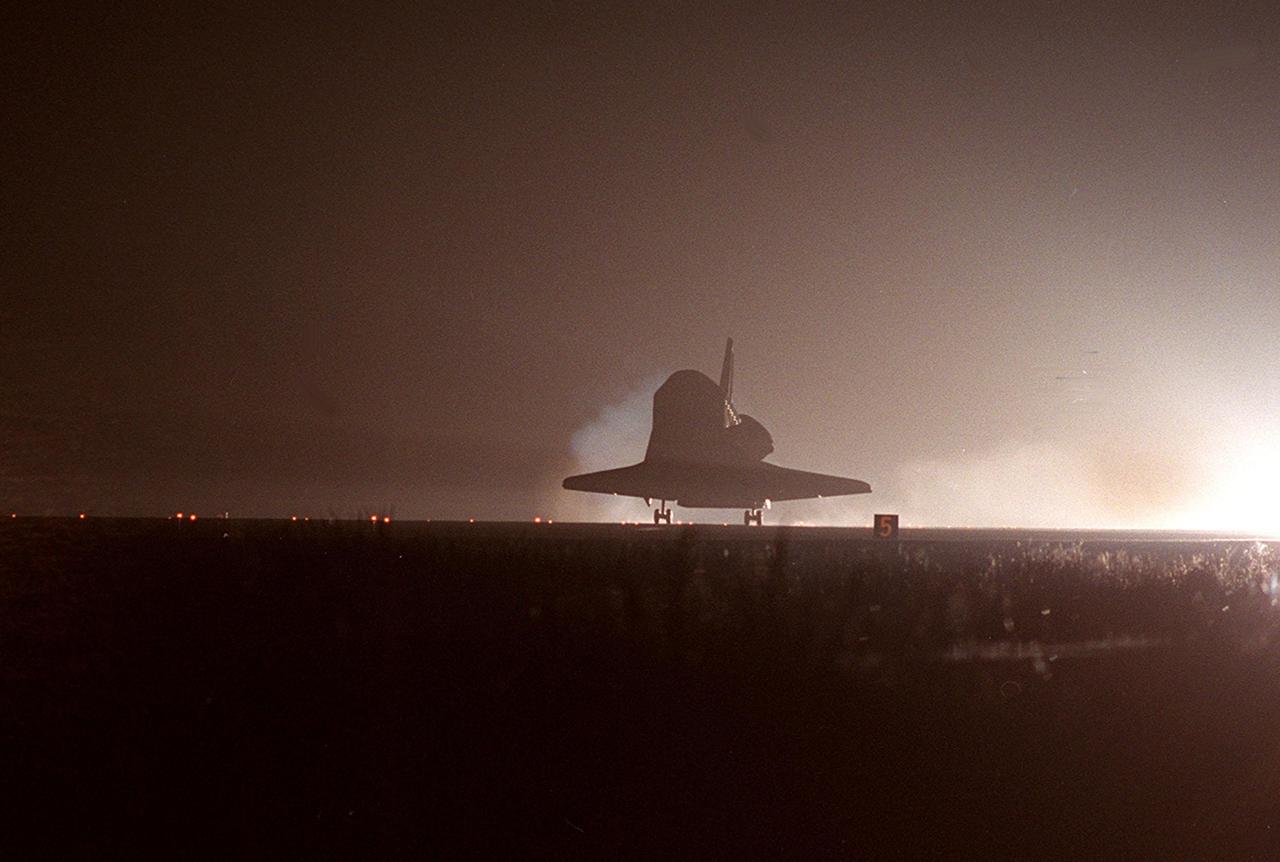
KENNEDY SPACE CENTER, Fla. -- Space Shuttle Atlantis appears ghostlike in the runway lights as it touches down on the KSC Shuttle Landing Facility Runway 15. At the controls are Commander Terrence W. Wilcutt and Pilot Scott D. Altman. Also on board the orbiter are Mission Specialists Edward T. Lu, Yuri I. Malenchenko, Boris V. Morukov, Richard A. Mastracchio and Daniel C. Burbank. Malenchenko and Morukov are with the Russian Aviation and Space Agency. Atlantis and crew traveled 4.9 million miles on the 11-day, 19-hour, 11-minute STS-106 mission. Main gear touchdown was at 3:56:48 a.m. EDT, landing on orbit 185 of the mission. Nose gear touchdown was at 3:56:57 a.m. EDT and wheel stop at 3:58:01 a.m. EDT. The crew has returned from the International Space Station where they transferred nearly 5,000 pounds of equipment and supplies for use by the first resident crew expected to arrive in November. This was the 99th flight in the Shuttle program and the 22nd for Atlantis. STS-106 also marked the 15th nighttime landing in Shuttle history and the 23rd consecutive landing at KSC
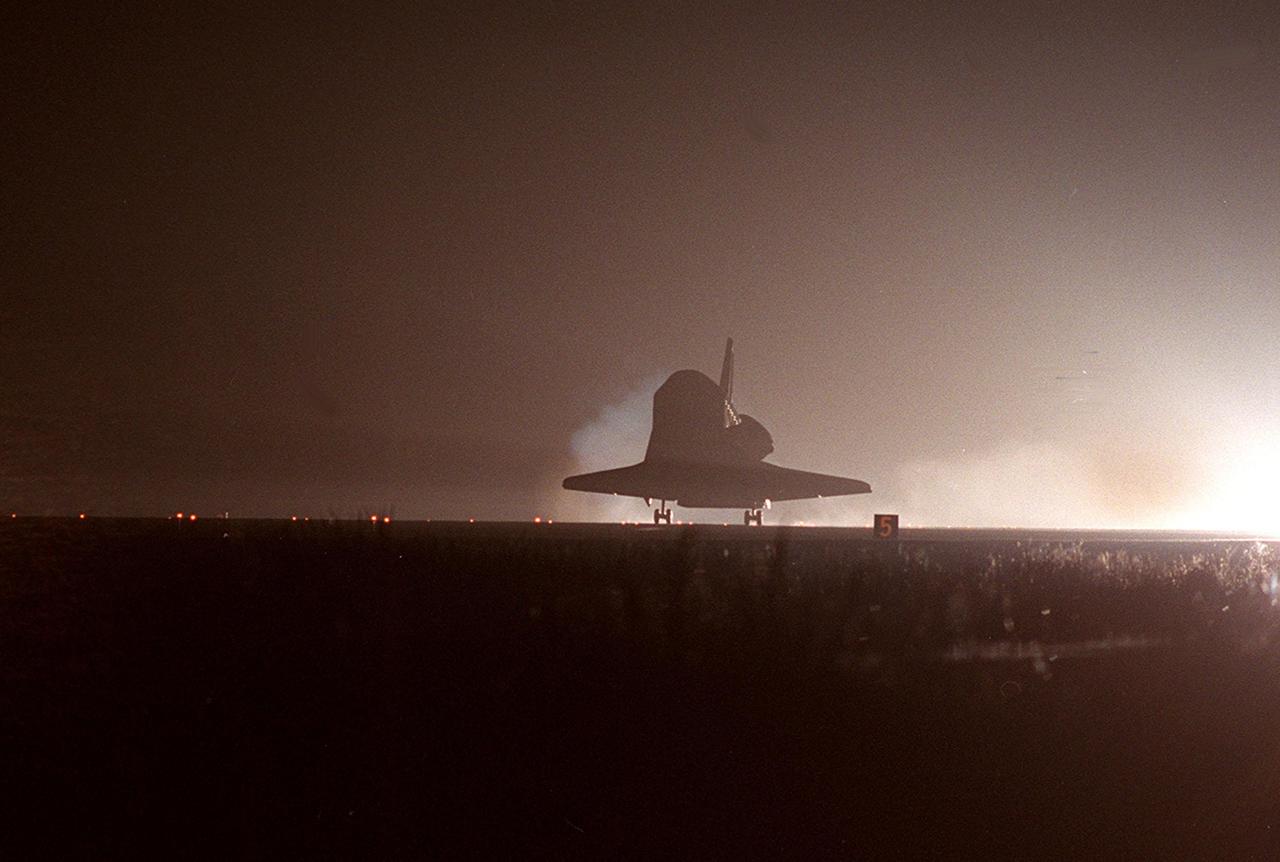
KENNEDY SPACE CENTER, Fla. -- Space Shuttle Atlantis appears ghostlike in the runway lights as it touches down on the KSC Shuttle Landing Facility Runway 15. At the controls are Commander Terrence W. Wilcutt and Pilot Scott D. Altman. Also on board the orbiter are Mission Specialists Edward T. Lu, Yuri I. Malenchenko, Boris V. Morukov, Richard A. Mastracchio and Daniel C. Burbank. Malenchenko and Morukov are with the Russian Aviation and Space Agency. Atlantis and crew traveled 4.9 million miles on the 11-day, 19-hour, 11-minute STS-106 mission. Main gear touchdown was at 3:56:48 a.m. EDT, landing on orbit 185 of the mission. Nose gear touchdown was at 3:56:57 a.m. EDT and wheel stop at 3:58:01 a.m. EDT. The crew has returned from the International Space Station where they transferred nearly 5,000 pounds of equipment and supplies for use by the first resident crew expected to arrive in November. This was the 99th flight in the Shuttle program and the 22nd for Atlantis. STS-106 also marked the 15th nighttime landing in Shuttle history and the 23rd consecutive landing at KSC
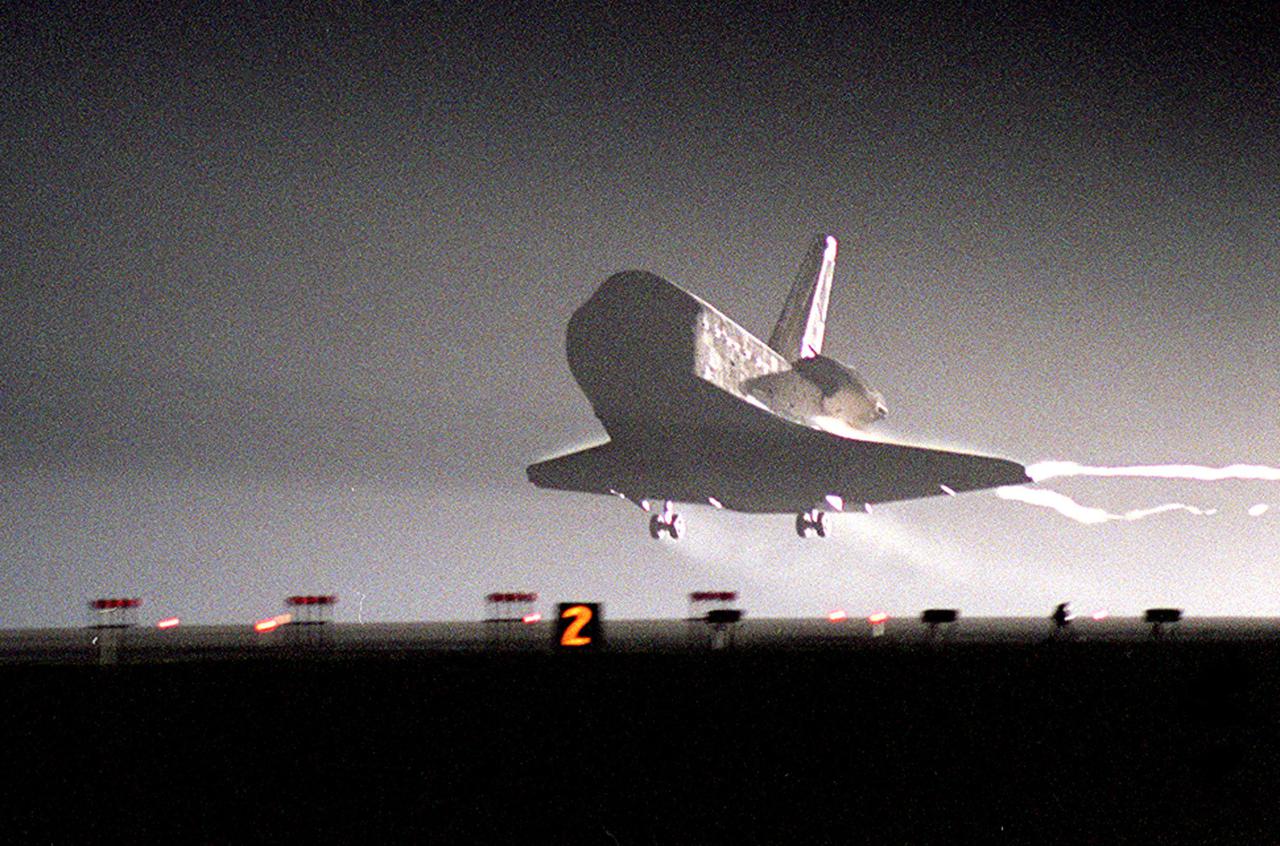
KENNEDY SPACE CENTER, Fla. -- Space Shuttle Atlantis presents a ghostlike image in the runway lights as it approaches touchdown on the KSC Shuttle Landing Facility Runway 15. At the controls are Commander Terrence W. Wilcutt and Pilot Scott D. Altman. Also on board the orbiter are Mission Specialists Edward T. Lu, Yuri I. Malenchenko, Boris V. Morukov, Richard A. Mastracchio and Daniel C. Burbank. Malenchenko and Morukov are with the Russian Aviation and Space Agency. Atlantis and crew traveled 4.9 million miles on the 11-day, 19-hour, 11-minute STS-106 mission. Main gear touchdown was at 3:56:48 a.m. EDT, landing on orbit 185 of the mission. Nose gear touchdown was at 3:56:57 a.m. EDT and wheel stop at 3:58:01 a.m. EDT. The crew has returned from the International Space Station where they transferred nearly 5,000 pounds of equipment and supplies for use by the first resident crew expected to arrive in November. This was the 99th flight in the Shuttle program and the 22nd for Atlantis. STS-106 also marked the 15th nighttime landing in Shuttle history and the 23rd consecutive landing at KSC

KENNEDY SPACE CENTER, Fla. -- Space Shuttle Atlantis presents a ghostlike image in the runway lights as it approaches touchdown on the KSC Shuttle Landing Facility Runway 15. At the controls are Commander Terrence W. Wilcutt and Pilot Scott D. Altman. Also on board the orbiter are Mission Specialists Edward T. Lu, Yuri I. Malenchenko, Boris V. Morukov, Richard A. Mastracchio and Daniel C. Burbank. Malenchenko and Morukov are with the Russian Aviation and Space Agency. Atlantis and crew traveled 4.9 million miles on the 11-day, 19-hour, 11-minute STS-106 mission. Main gear touchdown was at 3:56:48 a.m. EDT, landing on orbit 185 of the mission. Nose gear touchdown was at 3:56:57 a.m. EDT and wheel stop at 3:58:01 a.m. EDT. The crew has returned from the International Space Station where they transferred nearly 5,000 pounds of equipment and supplies for use by the first resident crew expected to arrive in November. This was the 99th flight in the Shuttle program and the 22nd for Atlantis. STS-106 also marked the 15th nighttime landing in Shuttle history and the 23rd consecutive landing at KSC
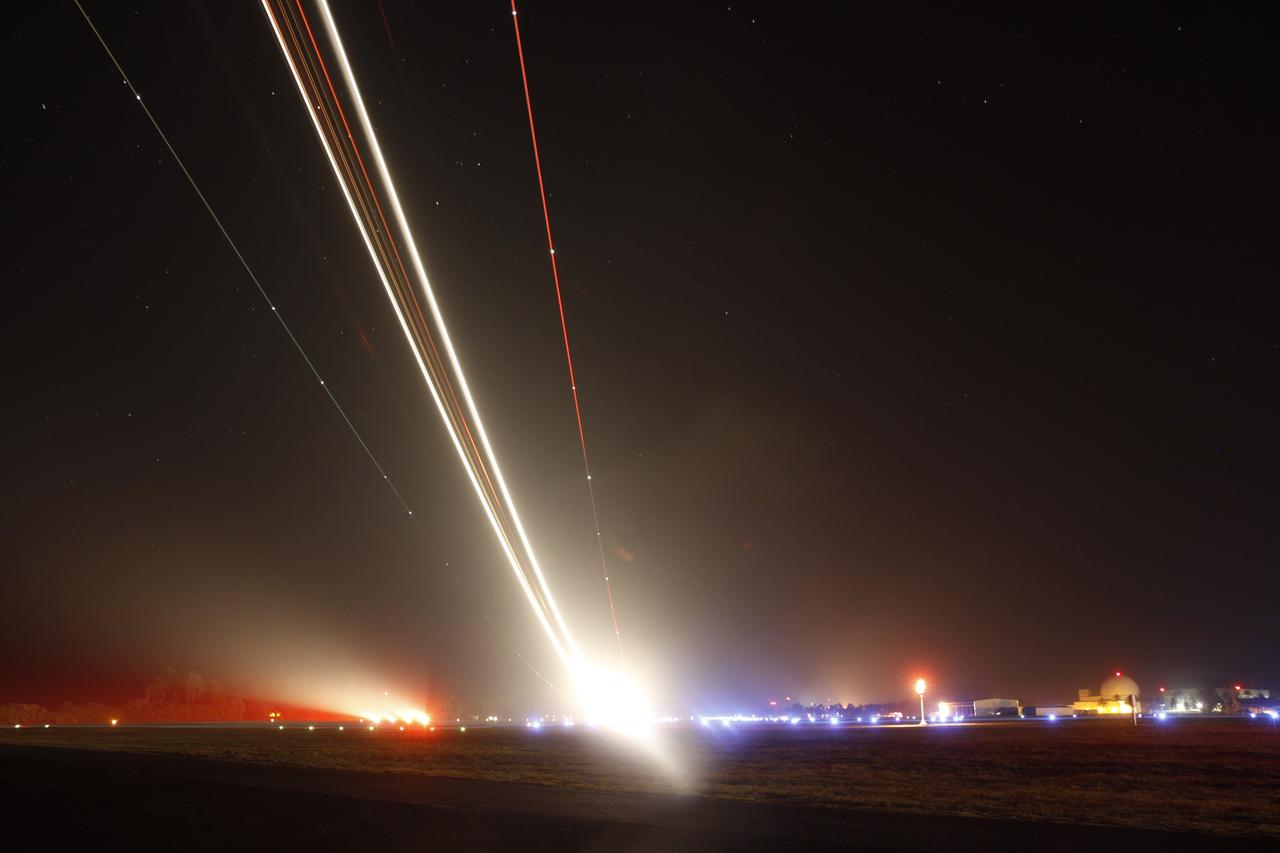
KWAJALEIN ATOLL, Marshall Islands - In this time-lapse image, the lights of Orbital Sciences' L-1011 "Stargazer" streak across the night sky as the aircraft takes off from the runway at Kwajalein Atoll with the company's Pegasus rocket to launch NASA's Nuclear Spectroscopic Telescope Array, or NuSTAR. The plane left Kwajalein one hour before launch. At 9:00:35 a.m. PDT 12:00:35 p.m. EDT), June 13, 2012, the rocket dropped with the NuSTAR payload 117 nautical miles south of Kwajalein. NuSTAR will use a unique set of “eyes” to see the highest energy X-ray light from the cosmos to reveal black holes lurking in our Milky Way galaxy, as well as those hidden in the hearts of faraway galaxies. Kwajalein is located in the Marshall Islands chain in the Pacific Ocean and is part of the Reagan Test Site and used for launches of NASA, commercial and military missions. For more information, visit http://www.nasa.gov/nustar. Photo credit: NASA
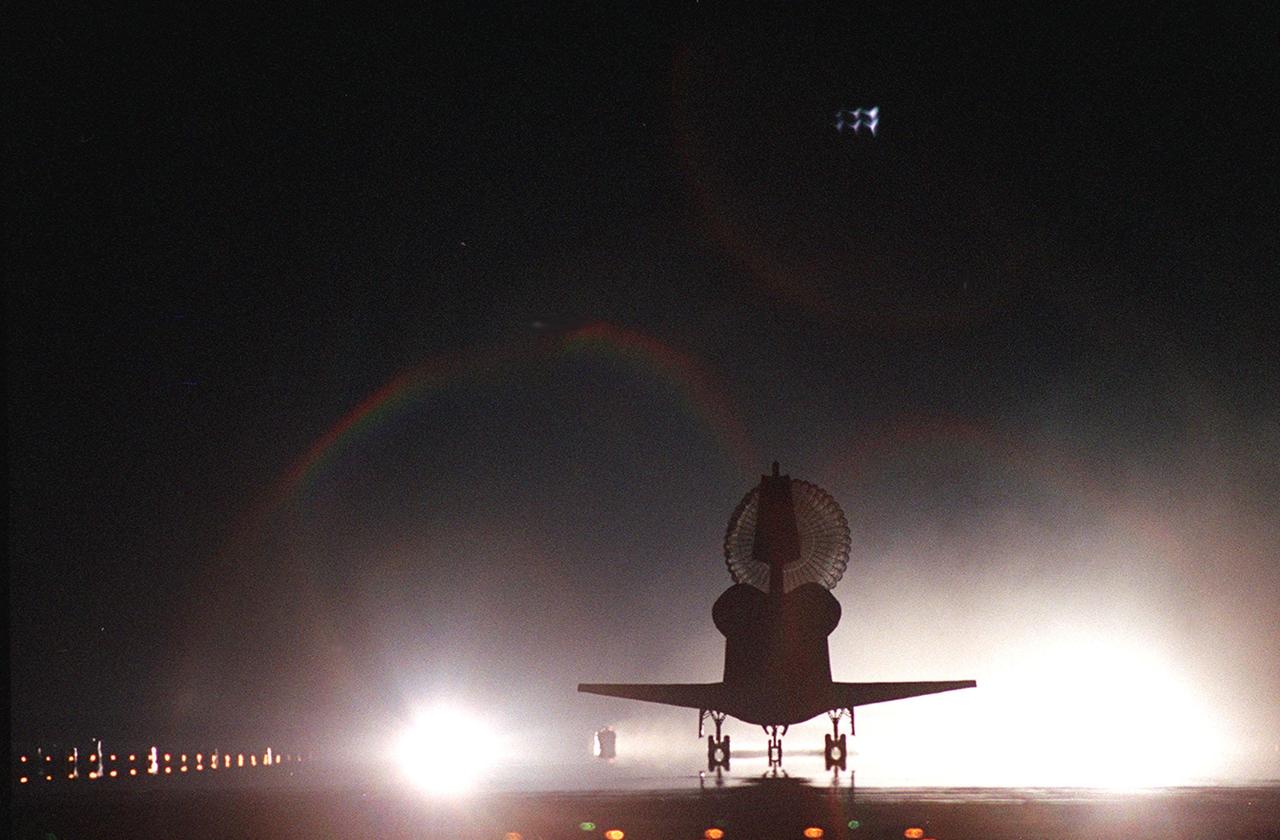
With its drag chute billowing behind, Space Shuttle Atlantis is silhouetted against the bright lights on Runway 15, Shuttle Landing Facility, as it rolls to a stop. Two rainbows appear above the lights. The landing of Atlantis completed the 9-day, 20-hour, 9-minute-long STS-101 mission. At the controls are Commander James D. Halsell Jr. and Pilot Scott 'Doc' Horowitz. Also onboard the orbiter are Mission Specialists Mary Ellen Weber, James S. Voss, Jeffrey N. Williams, Susan J. Helms and Yury Usachev of Russia. Main gear touchdown was at 2:20:17 a.m. EDT, landing on orbit 155 of the mission. Nose gear touchdown was at 2:20:30 a.m. EDT, and wheel stop at 2:21:19 a.m. EDT. The crew is returning from the third flight to the International Space Station. This was the 98th flight in the Space Shuttle program and the 21st for Atlantis, also marking the 51st landing at KSC, the 22nd consecutive landing at KSC, the 14th nighttime landing in Shuttle history and the 29th in the last 30 Shuttle flights.
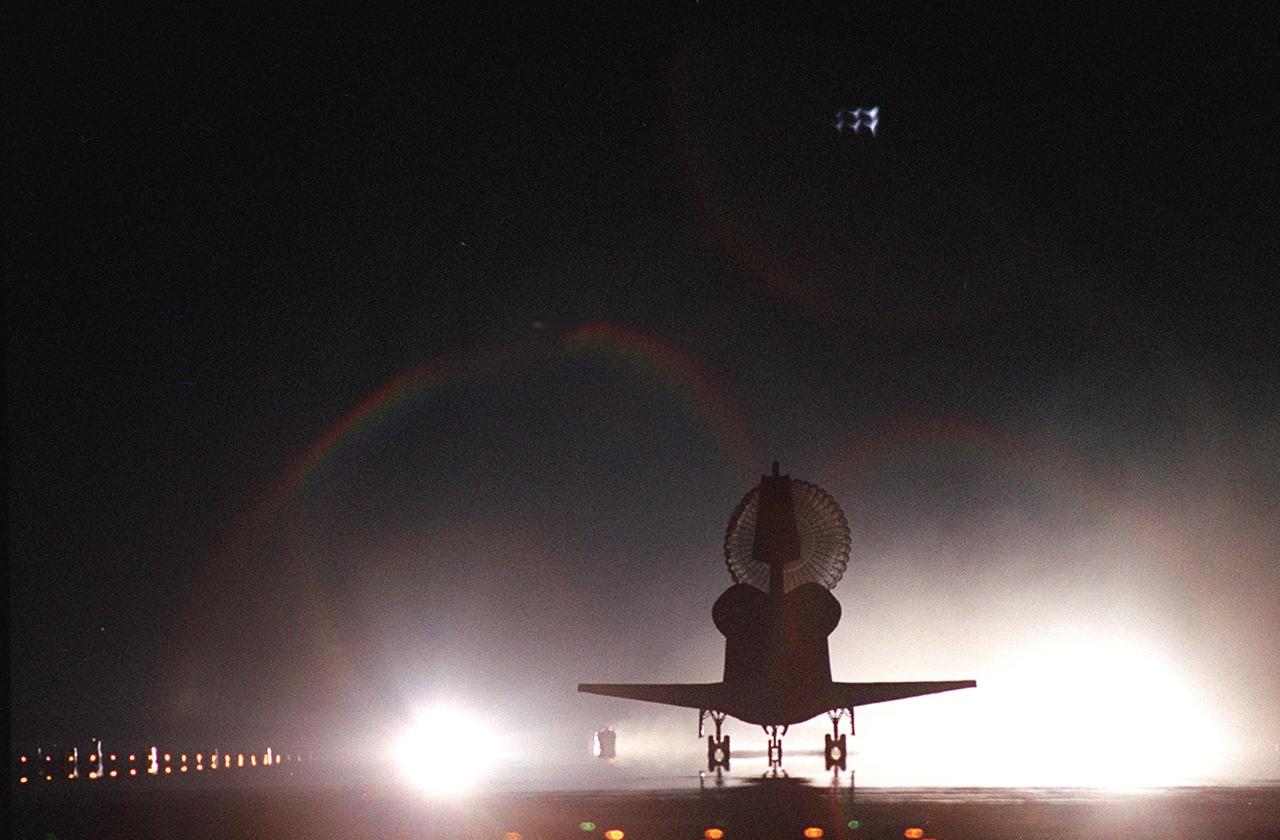
KENNEDY SPACE CENTER, Fla. -- With its drag chute billowing behind, Space Shuttle Atlantis is silhouetted against the bright lights on Runway 15, Shuttle Landing Facility, as it rolls to a stop. Two rainbows appear above the lights. The landing of Atlantis completed the 9-day, 20-hour, 9-minute-long STS-101 mission. At the controls are Commander James D. Halsell Jr. and Pilot Scott “Doc” Horowitz. Also onboard the orbiter are Mission Specialists Mary Ellen Weber, James S. Voss, Jeffrey N. Williams, Susan J. Helms and Yury Usachev of Russia. Main gear touchdown was at 2:20:17 a.m. EDT, landing on orbit 155 of the mission. Nose gear touchdown was at 2:20:30 a.m. EDT, and wheel stop at 2:21:19 a.m. EDT. The crew is returning from the third flight to the International Space Station. This was the 98th flight in the Space Shuttle program and the 21st for Atlantis, also marking the 51st landing at KSC, the 22nd consecutive landing at KSC, the 14th nighttime landing in Shuttle history and the 29th in the last 30 Shuttle flights
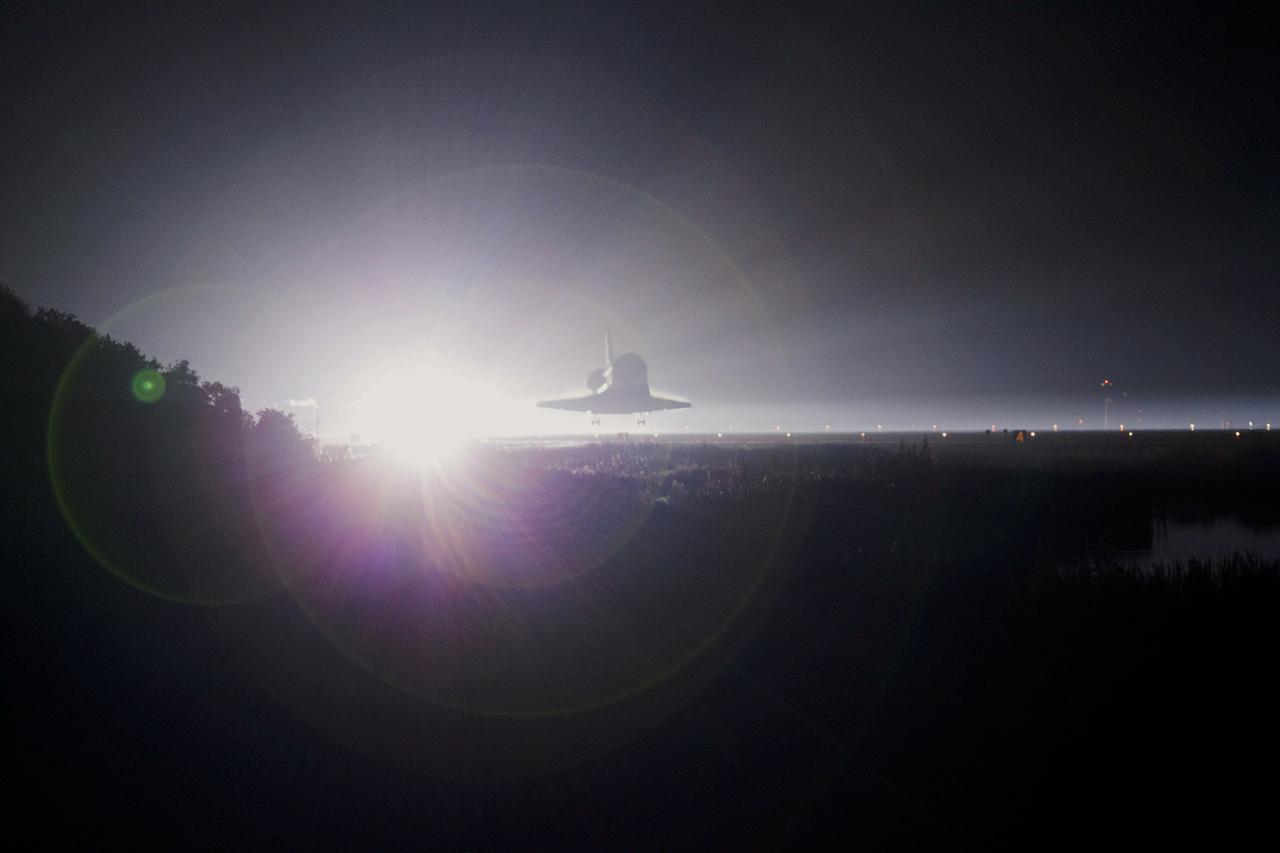
STS135-S-241 (21 July 2011) --- Xenon lights cast a halo of light on space shuttle Atlantis as the spacecraft nears touchdown for the last time on Runway 15 at NASA's Kennedy Space Center in Florida. Securing the space shuttle fleet's place in history, Atlantis marked the 26th nighttime landing of NASA's Space Shuttle Program and the 78th landing at Kennedy. Main gear touchdown was at 5:57:00 a.m. (EDT) on July 21, 2011, followed by nose gear touchdown at 5:57:20 a.m., and wheelstop at 5:57:54 a.m. Onboard are NASA astronauts Chris Ferguson, STS-135 commander; Doug Hurley, pilot; Sandy Magnus and Rex Walheim, both mission specialists. On the 37th shuttle mission to the International Space Station, STS-135 delivered more than 9,400 pounds of spare parts, equipment and supplies in the Raffaello multi-purpose logistics module that will sustain station operations for the next year. STS-135 was the 33rd and final flight for Atlantis, which has spent 307 days in space, orbited Earth 4,848 times and traveled 125,935,769 miles. Photo credit: NASA
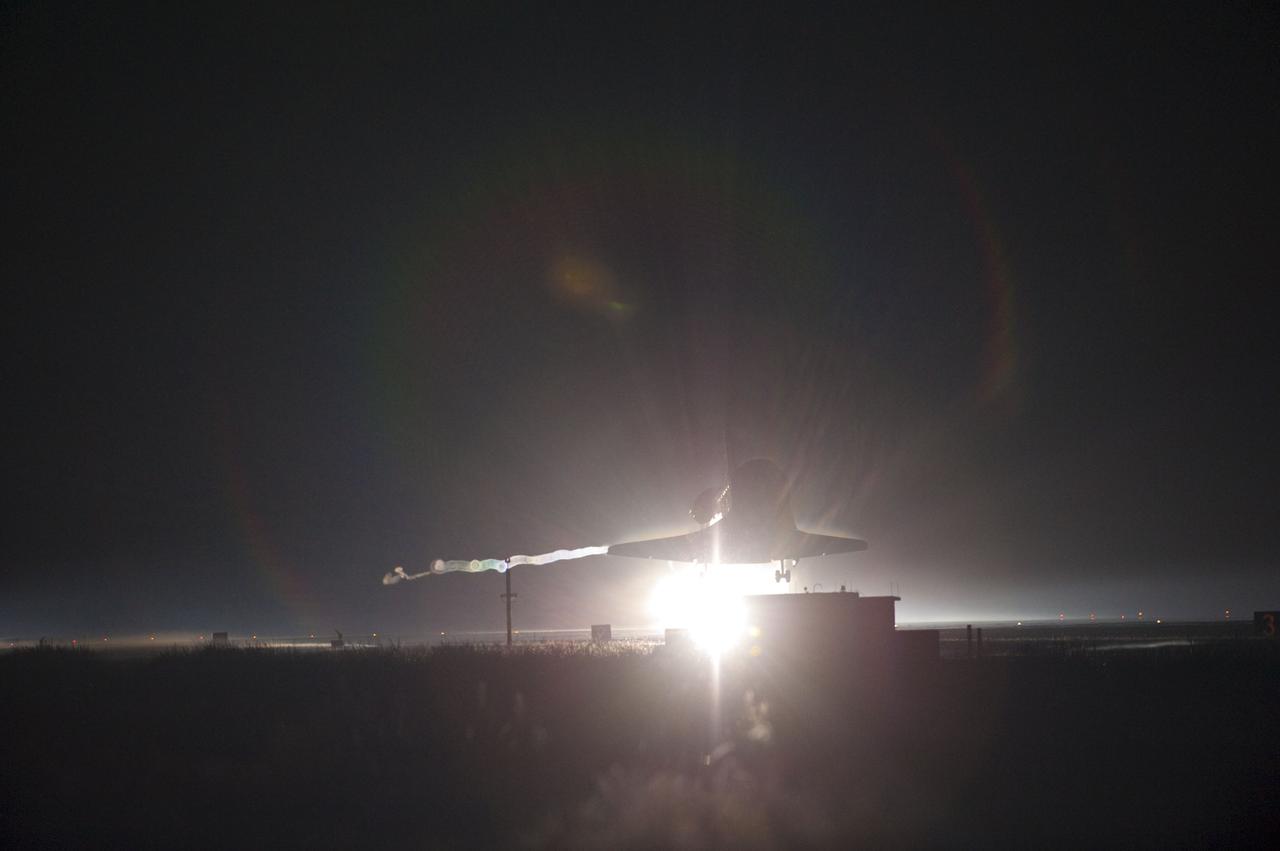
STS135-S-185 (21 July 2011) --- Xenon lights cast a halo of light on space shuttle Atlantis as the spacecraft approaches Runway 15 at NASA's Kennedy Space Center in Florida for the final time. Securing the space shuttle fleet's place in history, Atlantis marked the 26th nighttime landing of NASA's Space Shuttle Program and the 78th landing at Kennedy. Main gear touchdown was at 5:57:00 a.m. (EDT) on July 21, 2011, followed by nose gear touchdown at 5:57:20 a.m., and wheelstop at 5:57:54 a.m. Onboard are NASA astronauts Chris Ferguson, STS-135 commander; Doug Hurley, pilot; Sandy Magnus and Rex Walheim, both mission specialists. On the 37th shuttle mission to the International Space Station, STS-135 delivered more than 9,400 pounds of spare parts, equipment and supplies in the Raffaello multi-purpose logistics module that will sustain station operations for the next year. STS-135 was the 33rd and final flight for Atlantis, which has spent 307 days in space, orbited Earth 4,848 times and traveled 125,935,769 miles. Photo credit: NASA

STS135-S-186 (21 July 2011) --- Xenon lights cast a halo of light on space shuttle Atlantis as the spacecraft approaches Runway 15 at NASA's Kennedy Space Center in Florida for the final time. Securing the space shuttle fleet's place in history, Atlantis marked the 26th nighttime landing of NASA's Space Shuttle Program and the 78th landing at Kennedy. Main gear touchdown was at 5:57:00 a.m. (EDT) on July 21, 2011, followed by nose gear touchdown at 5:57:20 a.m., and wheelstop at 5:57:54 a.m. Onboard are NASA astronauts Chris Ferguson, STS-135 commander; Doug Hurley, pilot; Sandy Magnus and Rex Walheim, both mission specialists. On the 37th shuttle mission to the International Space Station, STS-135 delivered more than 9,400 pounds of spare parts, equipment and supplies in the Raffaello multi-purpose logistics module that will sustain station operations for the next year. STS-135 was the 33rd and final flight for Atlantis, which has spent 307 days in space, orbited Earth 4,848 times and traveled 125,935,769 miles. Photo credit: NASA
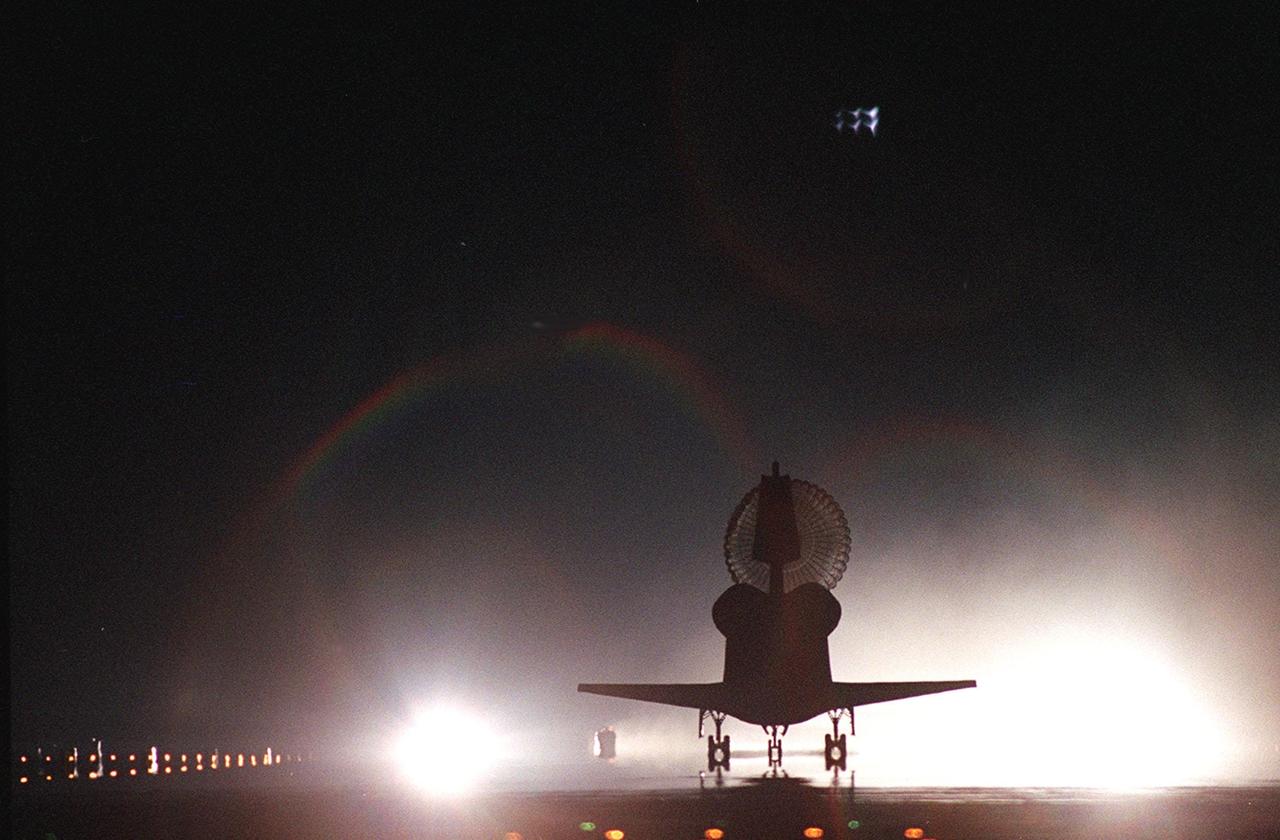
KENNEDY SPACE CENTER, Fla. -- With its drag chute billowing behind, Space Shuttle Atlantis is silhouetted against the bright lights on Runway 15, Shuttle Landing Facility, as it rolls to a stop. Two rainbows appear above the lights. The landing of Atlantis completed the 9-day, 20-hour, 9-minute-long STS-101 mission. At the controls are Commander James D. Halsell Jr. and Pilot Scott “Doc” Horowitz. Also onboard the orbiter are Mission Specialists Mary Ellen Weber, James S. Voss, Jeffrey N. Williams, Susan J. Helms and Yury Usachev of Russia. Main gear touchdown was at 2:20:17 a.m. EDT, landing on orbit 155 of the mission. Nose gear touchdown was at 2:20:30 a.m. EDT, and wheel stop at 2:21:19 a.m. EDT. The crew is returning from the third flight to the International Space Station. This was the 98th flight in the Space Shuttle program and the 21st for Atlantis, also marking the 51st landing at KSC, the 22nd consecutive landing at KSC, the 14th nighttime landing in Shuttle history and the 29th in the last 30 Shuttle flights
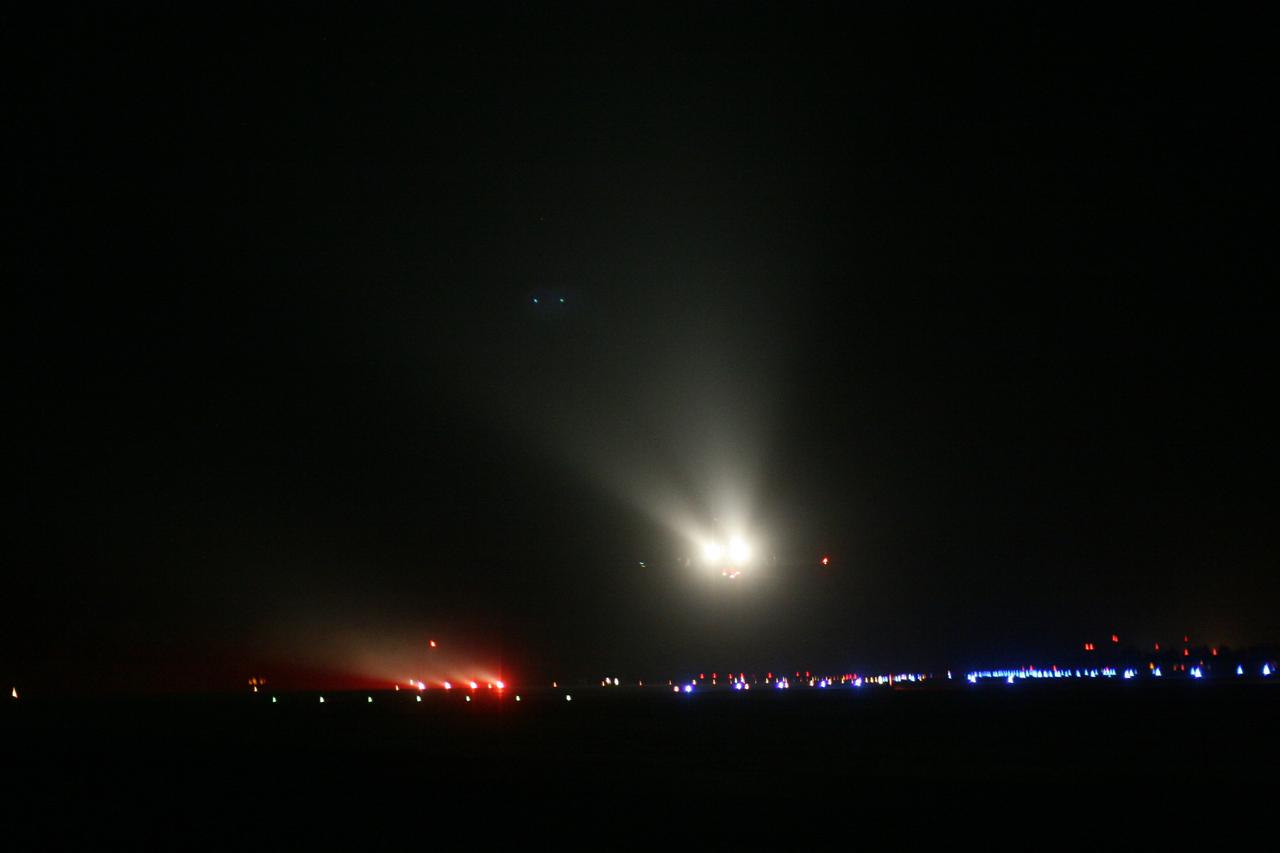
KWAJALEIN ATOLL, Marshall Islands - Orbital Sciences' L-1011 "Stargazer" aircraft takes off from the runway at Kwajalein Atoll with the company's Pegasus rocket to launch NASA's Nuclear Spectroscopic Telescope Array, or NuSTAR. The plane left Kwajalein one hour before launch. At 9:00:35 a.m. PDT 12:00:35 p.m. EDT), June 13, 2012, the rocket dropped with the NuSTAR payload 117 nautical miles south of Kwajalein. NuSTAR will use a unique set of “eyes” to see the highest energy X-ray light from the cosmos to reveal black holes lurking in our Milky Way galaxy, as well as those hidden in the hearts of faraway galaxies. Kwajalein is located in the Marshall Islands chain in the Pacific Ocean and is part of the Reagan Test Site and used for launches of NASA, commercial and military missions. For more information, visit http://www.nasa.gov/nustar. Photo credit: NASA
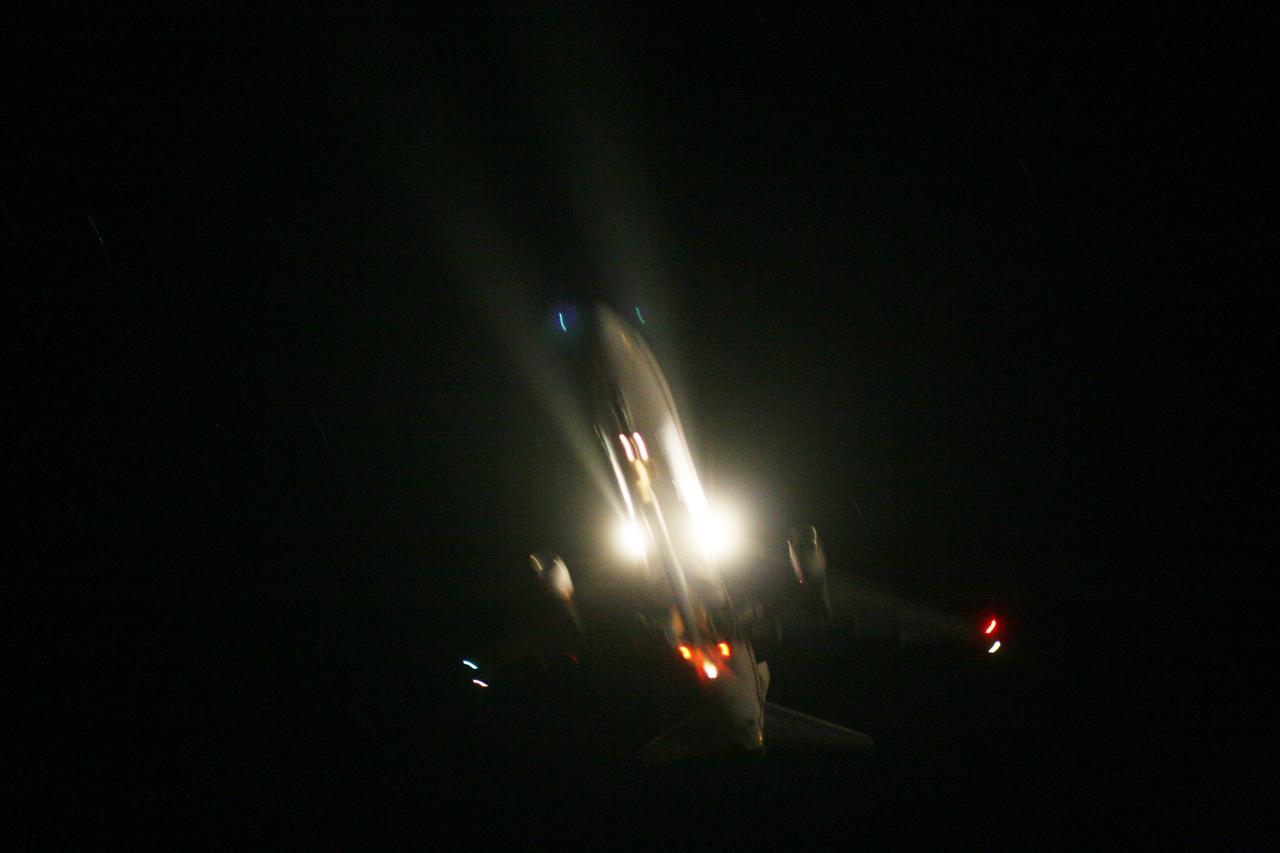
KWAJALEIN ATOLL, Marshall Islands - Orbital Sciences' L-1011 "Stargazer" aircraft takes off from the runway at Kwajalein Atoll with the company's Pegasus rocket to launch NASA's Nuclear Spectroscopic Telescope Array, or NuSTAR, payload strapped to the belly of the plane. The plane left Kwajalein one hour before launch. At 9:00:35 a.m. PDT 12:00:35 p.m. EDT), June 13, 2012, the rocket dropped with the NuSTAR payload 117 nautical miles south of Kwajalein. NuSTAR will use a unique set of “eyes” to see the highest energy X-ray light from the cosmos to reveal black holes lurking in our Milky Way galaxy, as well as those hidden in the hearts of faraway galaxies. Kwajalein is located in the Marshall Islands chain in the Pacific Ocean and is part of the Reagan Test Site and used for launches of NASA, commercial and military missions. For more information, visit http://www.nasa.gov/nustar. Photo credit: NASA
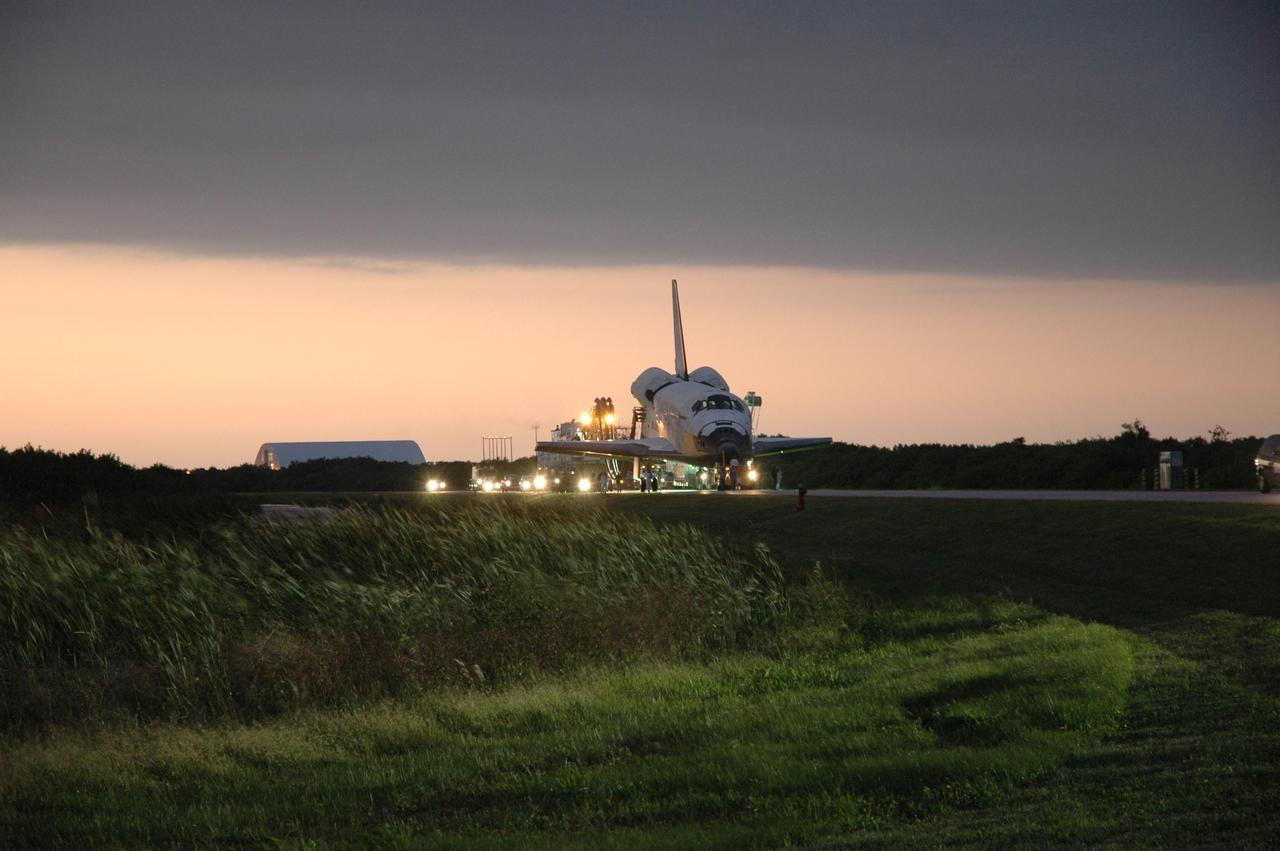
KENNEDY SPACE CENTER, FLA. -- In the waning light, space shuttle Discovery is towed along a two-mile tow-way to the Orbital Processing Facility, or OPF, where processing Discovery for another flight begins. Towing normally begins within four hours after landing and is completed within six hours unless removal of time-sensitive experiments is required on the runway. In the OPF, turnaround processing procedures on Discovery will include various post-flight deservicing and maintenance functions, which are carried out in parallel with payload removal and the installation of equipment needed for the next mission. Before post-flight deservicing can continue beyond initial safing operations, certain vehicle systems must be mechanically secured and access platforms installed. Discovery completed mission STS-120 with an on-time landing at 1:01 p.m. EST. Photo credit: NASA/Jim Grossmann
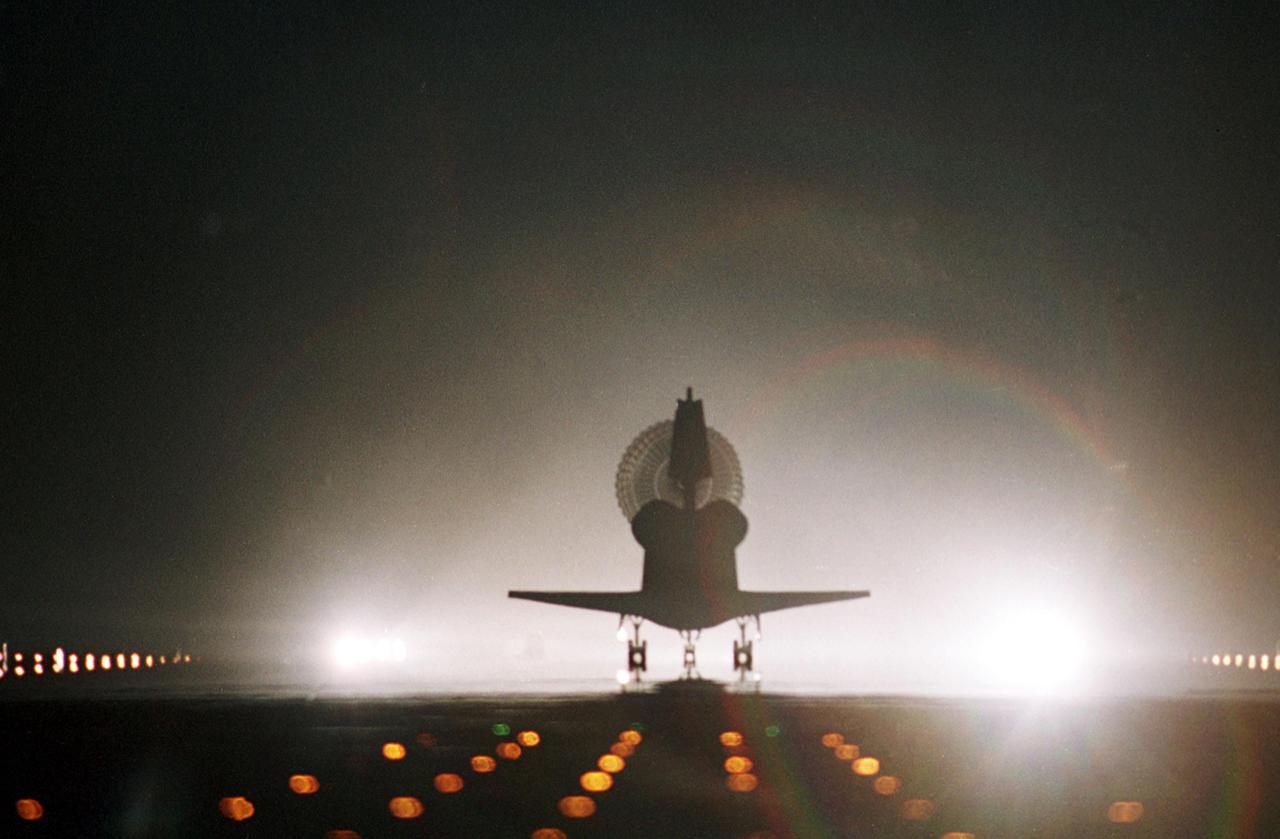
KENNEDY SPACE CENTER, Fla. -- Runway lights cast a rainbow from the colors in the drag chute behind Atlantis as it lands at the Shuttle Landing Facility. Main gear touchdown occurred at 11:38:55 p.m. EDT, completing complete a 12-day, 18-hour, 34-minute-long STS-104 mission. At the controls is Commander Steven W. Lindsey. Other crew members on board are Pilot Charles Hobaugh and Mission Specialists Michael Gernhardt, Janet Lynn Kavandi and James F. Reilly. This is the 18th nighttime landing for a Space Shuttle, the 13th at Kennedy Space Center. The mission delivered the Joint Airlock Module to the International Space Station, completing the second phase of the assembly of the Space Station
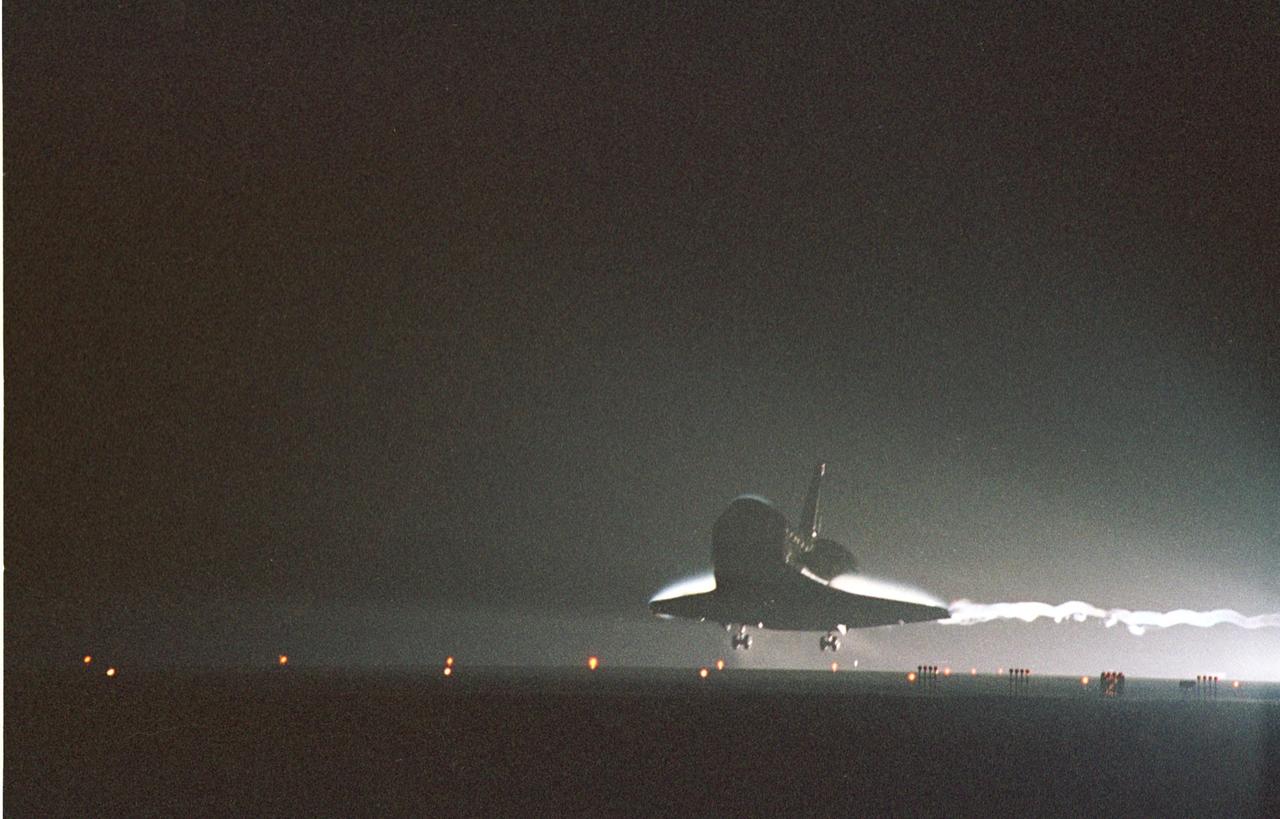
KENNEDY SPACE CENTER, Fla. -- Silhouetted against the bright lights at the Shuttle Landing Facility, Atlantis prepares to land on Runway 15 at the Shuttle Landing Facility to complete a 12-day, 18-hour, 34-minute-long STS-104 mission. Main gear touchdown occurred at 11:38:55 p.m. EDT. At the controls is Commander Steven W. Lindsey. Other crew members on board are Pilot Charles Hobaugh and Mission Specialists Michael Gernhardt, Janet Lynn Kavandi and James F. Reilly. This is the 18th nighttime landing for a Space Shuttle, the 13th at Kennedy Space Center. The mission delivered the Joint Airlock Module to the International Space Station, completing the second phase of the assembly of the Space Station

KENNEDY SPACE CENTER, Fla. -- Lights on Runway 15 silhouette Endeavour with its drag chute open as it lands at 6:04 p.m. EST following a 4.4-million-mile mission to the International Space Station. At the controls is Commander Brent Jett, completing the successful 10-day, 19-hour and 58-minute-long STS-97 mission. Other crew members on board are Pilot Michael Bloomfield and Mission Specialists Joseph Tanner, Carlos Noriega and Marc Garneau, with the Canadian Space Agency. Endeavour carried the P6 Integrated Truss Structure with solar arrays to power the International Space Station. The arrays and other equipment were installed during three EVAs that totaled 19 hours, 20 minutes. Endeavour was docked with the Space Station for 6 days, 23 hours, 13 minutes. This was the 16th nighttime landing for a Space Shuttle and the 53rd at Kennedy Space Center
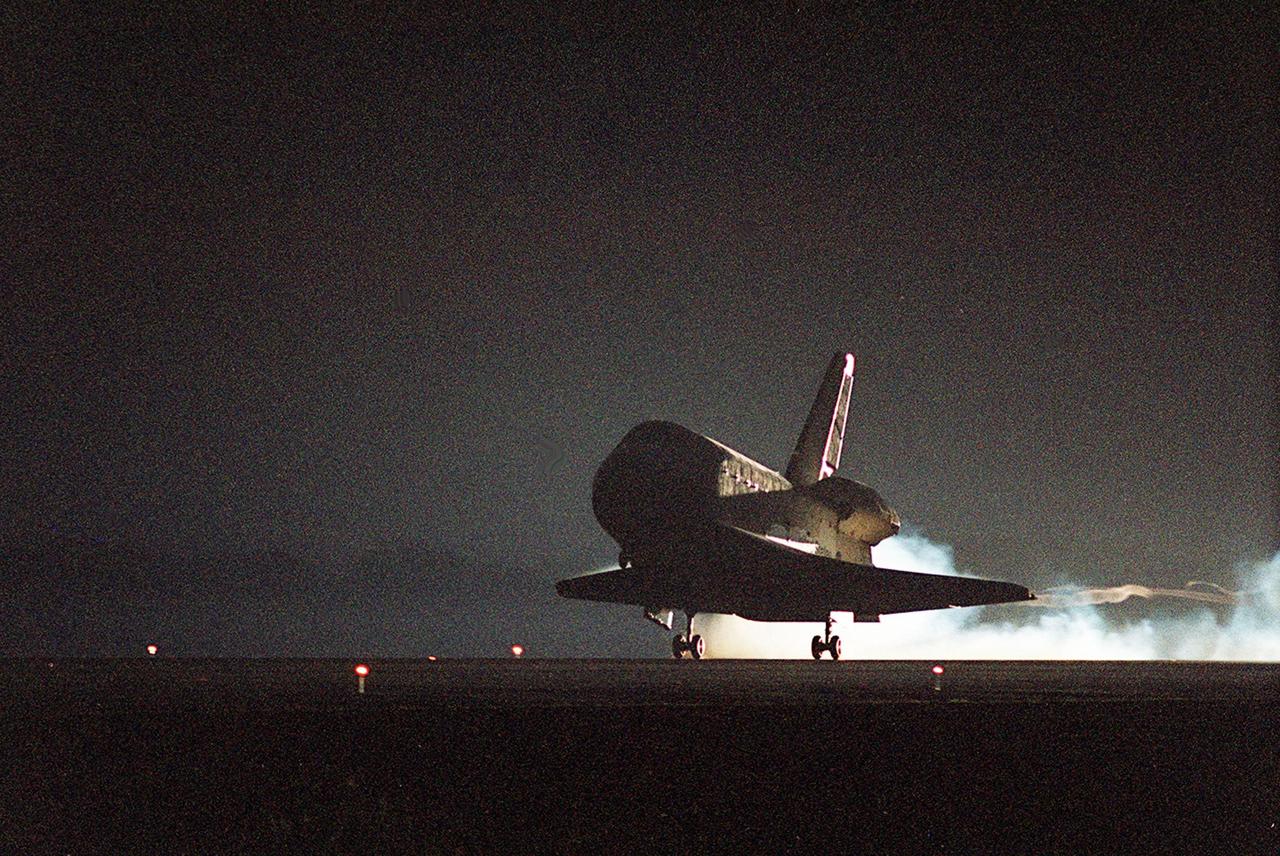
KENNEDY SPACE CENTER, Fla. -- In the waning light after sunset, Endeavour’s main gear touches down on Runway 15 at the Shuttle Landing Facility at 6:03 p.m. EST. At the controls is Commander Brent Jett, completing the successful 10-day, 19-hour and 58-minute-long STS-97 mission. Other crew members on board are Pilot Michael Bloomfield and Mission Specialists Joseph Tanner, Carlos Noriega and Marc Garneau of Canada. On the 4.4-million-mile mission, Endeavour carried the P6 Integrated Truss Structure with solar arrays to power the International Space Station. The arrays and other equipment were installed during three EVAs that totaled 19 hours, 20 minutes. Endeavour was docked with the Space Station for 6 days, 23 hours, 13 minutes. This is the 16th nighttime landing for a Space Shuttle and the 53rd at Kennedy Space Center
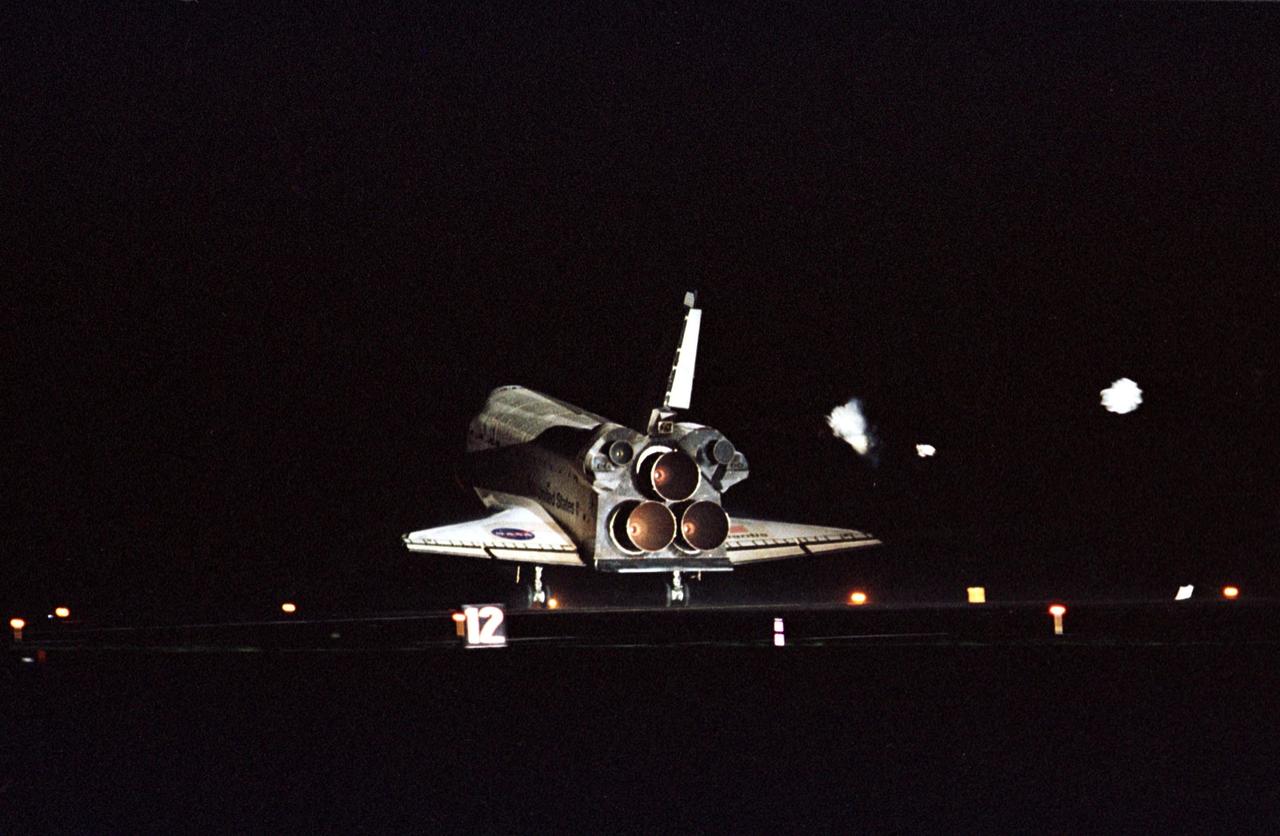
KENNEDY SPACE CENTER, Fla. -- The lights on Runway 15 at KSC’s Shuttle Landing Facility spotlight Atlantis as it touches down, completing a 12-day, 18-hour, 34-minute-long STS-104 mission. Main gear touchdown occurred at 11:38:55 p.m. EDT. At the controls is Commander Steven W. Lindsey. Other crew members on board are Pilot Charles Hobaugh and Mission Specialists Michael Gernhardt, Janet Lynn Kavandi and James F. Reilly. This is the 18th nighttime landing for a Space Shuttle, the 13th at Kennedy Space Center. The mission delivered the Joint Airlock Module to the International Space Station, which was subsequently attached to the Unity Node, completing the second phase of the assembly of the Space Station
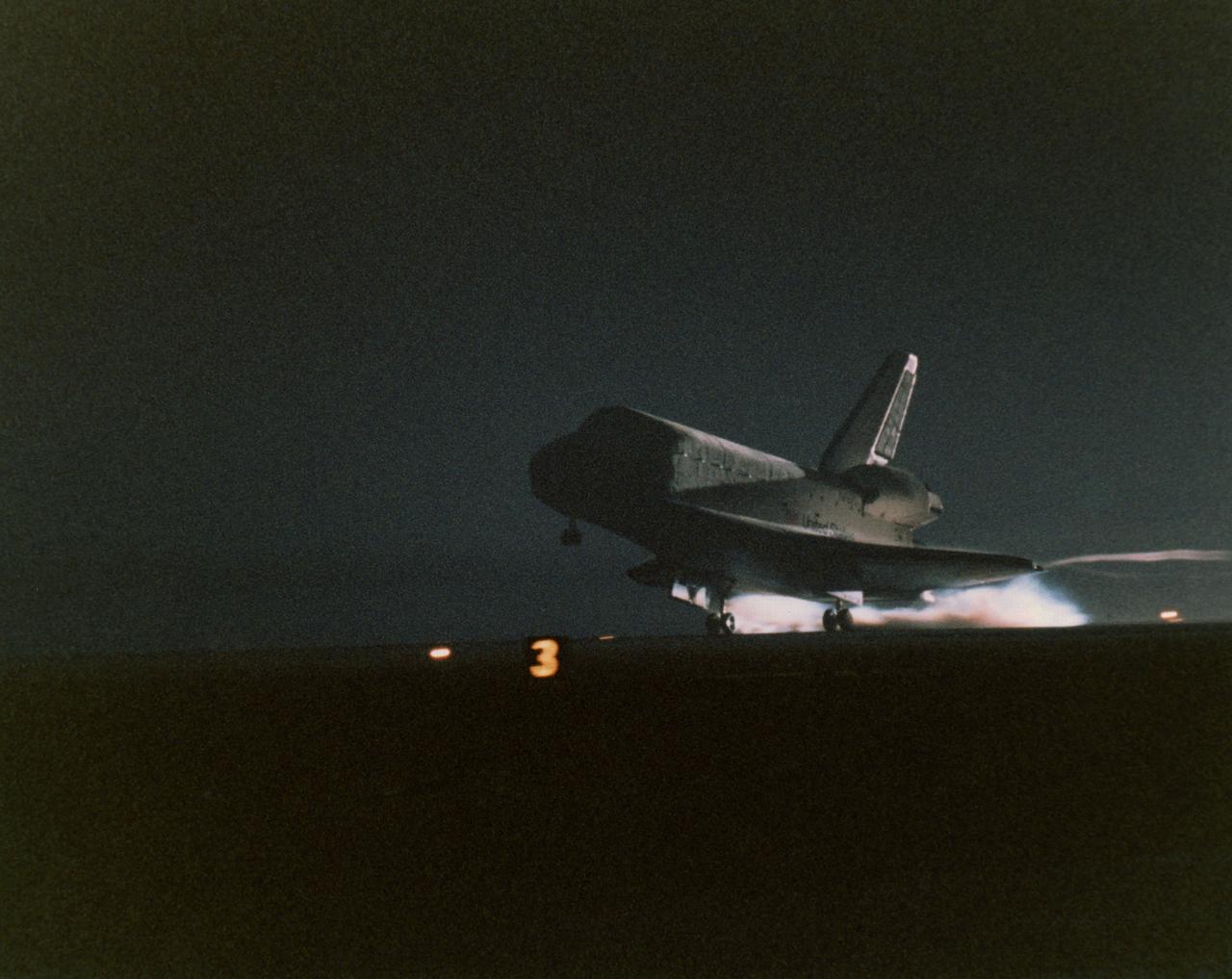
STS082-S-008 (21 Feb 1997) --- The Space Shuttle Discovery partially lights up the early morning sky as it as it lands on Runway 15 at the Kennedy Space Center (KSC), following a 10-day mission in Earth-orbit. Landing occurred at 3:32:26 a.m. (EST), February 21, 1997. The crew members are astronauts Kenneth D. Bowersox, commander; Scott J. Horowitz, pilot; Mark C. Lee, payload commander; and mission specialists Steven A. Hawley, Gregory J. Harbaugh, Steven L. Smith and Joseph R. Tanner. The primary mission of the flight was to service the Hubble Space Telescope (HST) - a task which required five Extravehicular Activities (EVA) (including an unscheduled EVA) of two alternating two-member teams. STS-82 represents the 22nd flight of Discovery and the 82nd Space Transportation System (STS) flight, as well as the ninth nocturnal landing in STS history.
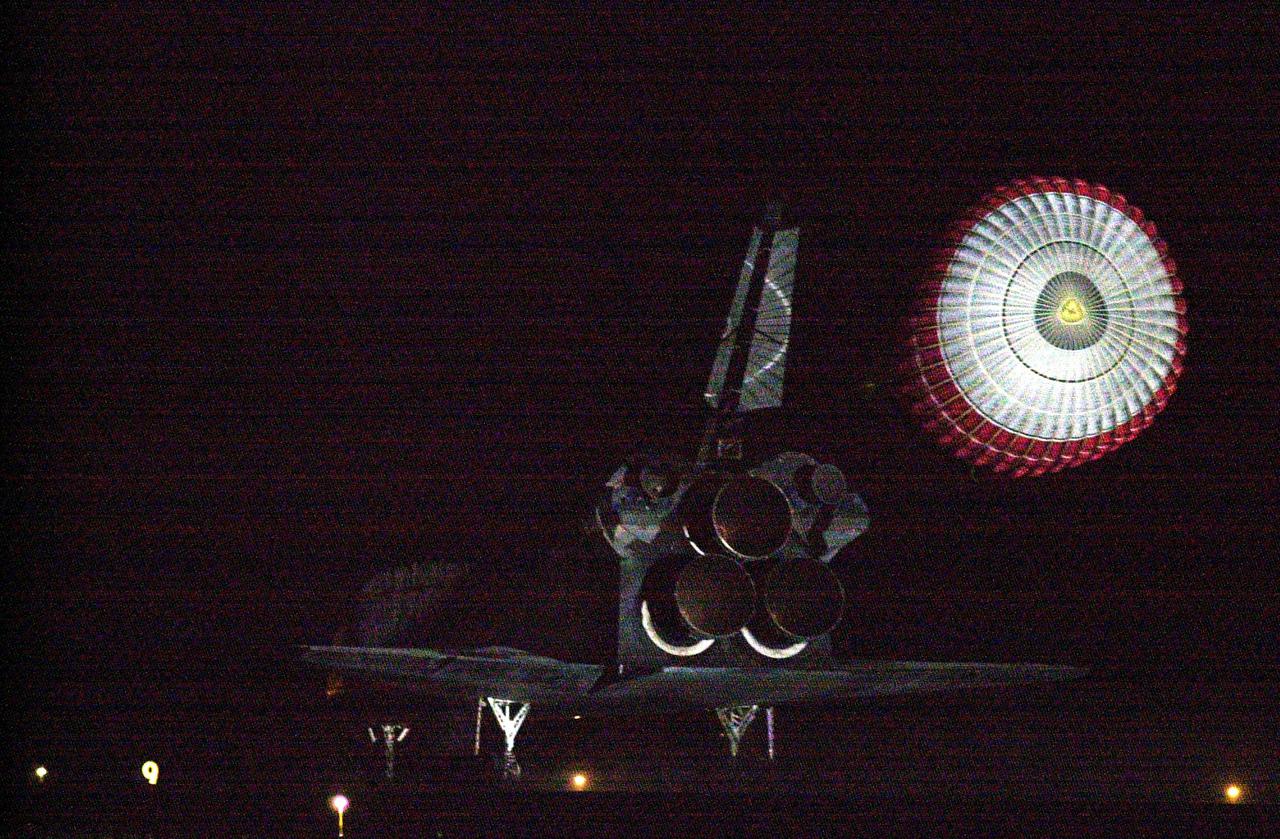
KENNEDY SPACE CENTER, Fla. -- With the drag chute reflected in the bright lights at the Shuttle Landing Facility, Atlantis prepares to land on Runway 15 at the Shuttle Landing Facility to complete a 12-day, 18-hour, 34-minute-long STS-104 mission. Main gear touchdown occurred at 11:38:55 p.m. EDT. At the controls is Commander Steven W. Lindsey. Other crew members on board are Pilot Charles Hobaugh and Mission Specialists Michael Gernhardt, Janet Lynn Kavandi and James F. Reilly. This is the 18th nighttime landing for a Space Shuttle, the 13th at Kennedy Space Center. The mission delivered the Joint Airlock Module to the International Space Station, completing the second phase of the assembly of the Space Station
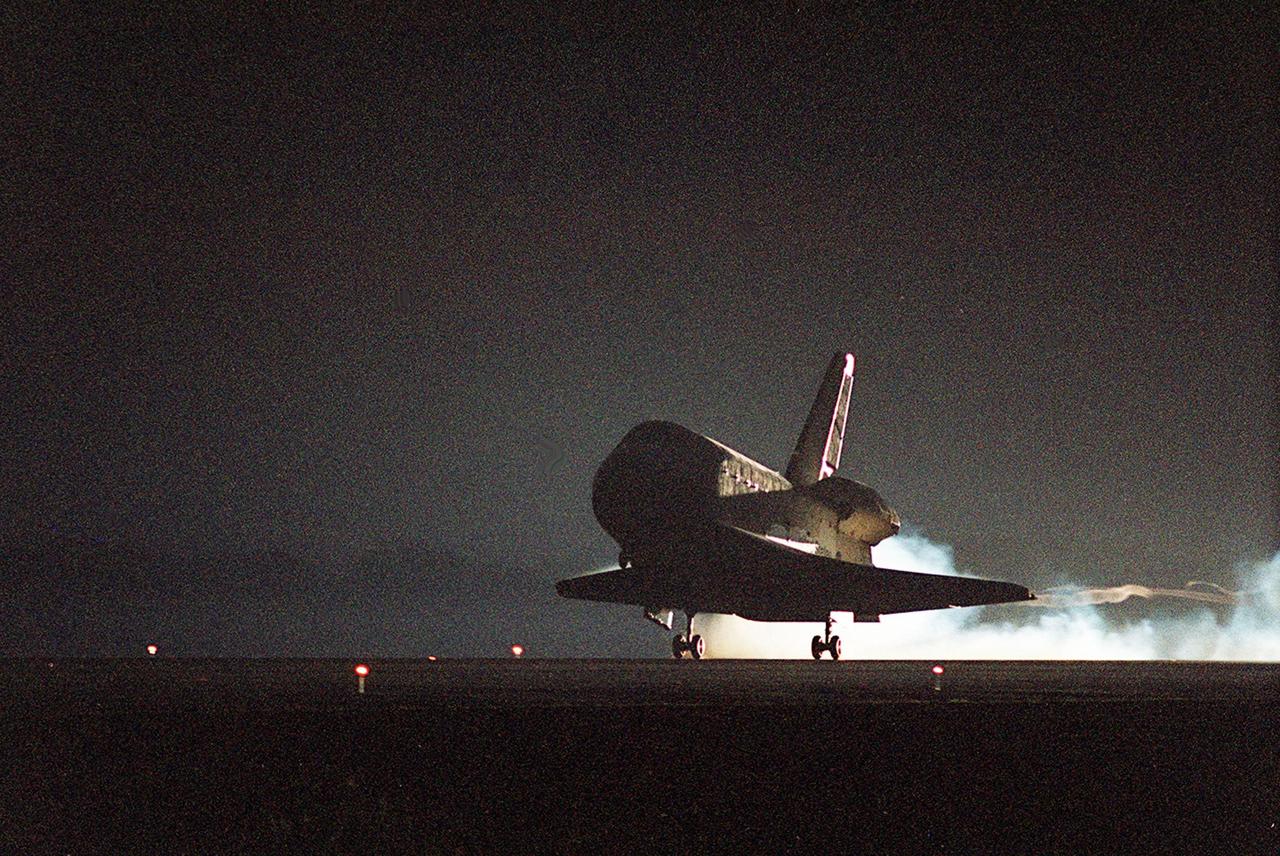
KENNEDY SPACE CENTER, Fla. -- In the waning light after sunset, Endeavour’s main gear touches down on Runway 15 at the Shuttle Landing Facility at 6:03 p.m. EST. At the controls is Commander Brent Jett, completing the successful 10-day, 19-hour and 58-minute-long STS-97 mission. Other crew members on board are Pilot Michael Bloomfield and Mission Specialists Joseph Tanner, Carlos Noriega and Marc Garneau of Canada. On the 4.4-million-mile mission, Endeavour carried the P6 Integrated Truss Structure with solar arrays to power the International Space Station. The arrays and other equipment were installed during three EVAs that totaled 19 hours, 20 minutes. Endeavour was docked with the Space Station for 6 days, 23 hours, 13 minutes. This is the 16th nighttime landing for a Space Shuttle and the 53rd at Kennedy Space Center
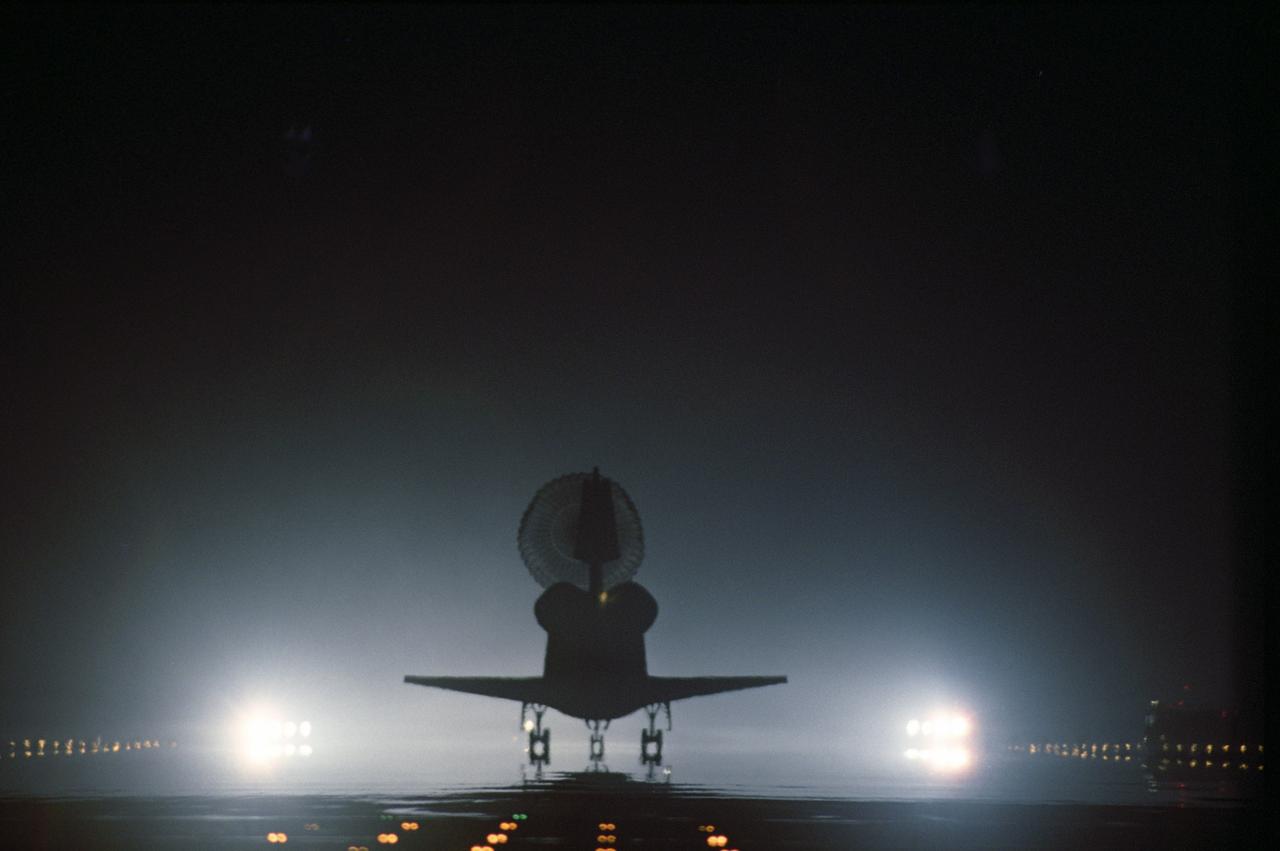
CAPE CANAVERAL, Fla. --- With xenon lights flooding Runway 15, a drag chute slows space shuttle Endeavour as it returns to NASA's Kennedy Space Center, ending the STS-123 mission, a 16-day flight to the International Space Station. The main landing gear touched down at 8:39:08 p.m. EDT. The nose landing gear touched down at 8:39:17 p.m. and wheel stop was at 8:40:41 p.m. The mission completed nearly 6.6 million miles. The landing was the second opportunity after the first was waved off due to unstable weather in the Kennedy Space Center area. The STS-123 mission delivered the first segment of the Japan Aerospace Exploration Agency's Kibo laboratory and the Canadian Space Agency's two-armed robotic system, known as Dextre. Photo credit: NASA/Tony Gray, Kevin O'Connell, Scott Haun
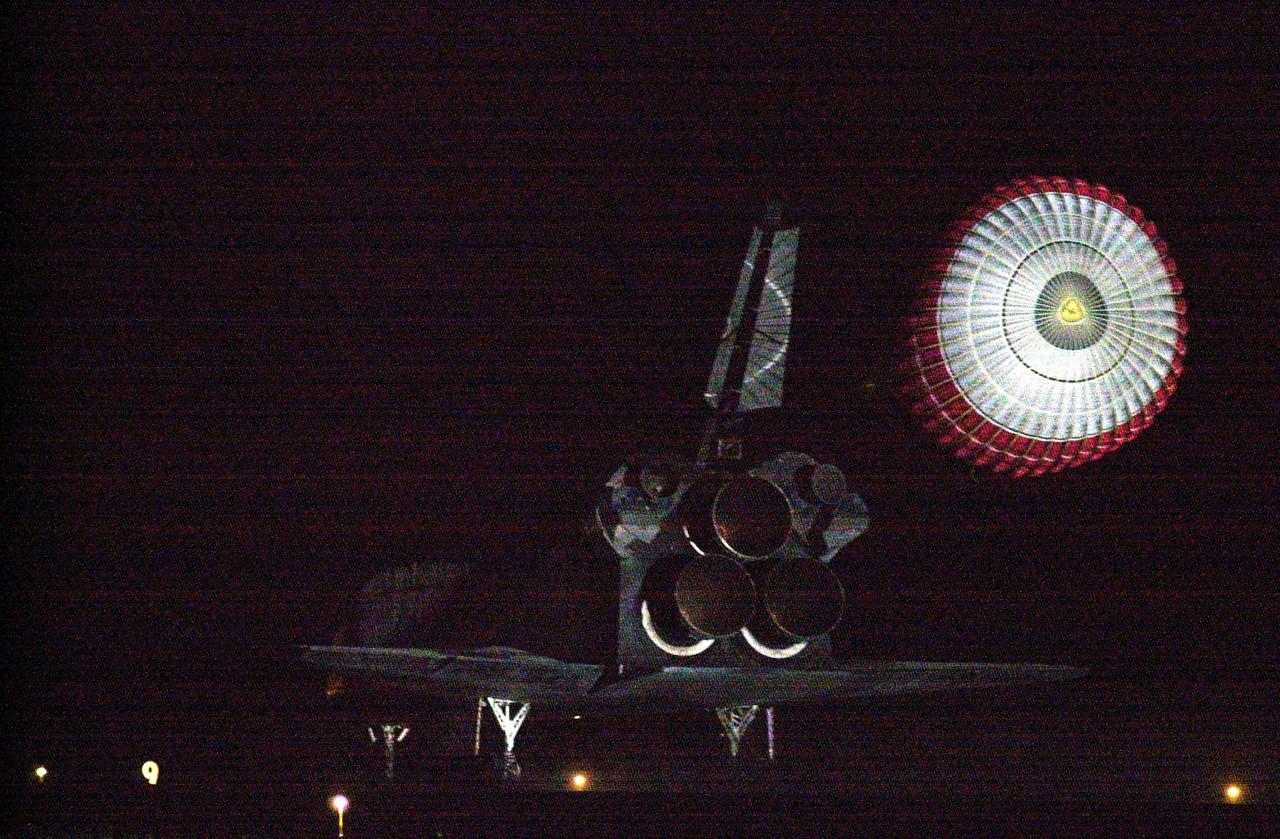
KENNEDY SPACE CENTER, Fla. -- With the drag chute reflected in the bright lights at the Shuttle Landing Facility, Atlantis prepares to land on Runway 15 at the Shuttle Landing Facility to complete a 12-day, 18-hour, 34-minute-long STS-104 mission. Main gear touchdown occurred at 11:38:55 p.m. EDT. At the controls is Commander Steven W. Lindsey. Other crew members on board are Pilot Charles Hobaugh and Mission Specialists Michael Gernhardt, Janet Lynn Kavandi and James F. Reilly. This is the 18th nighttime landing for a Space Shuttle, the 13th at Kennedy Space Center. The mission delivered the Joint Airlock Module to the International Space Station, completing the second phase of the assembly of the Space Station
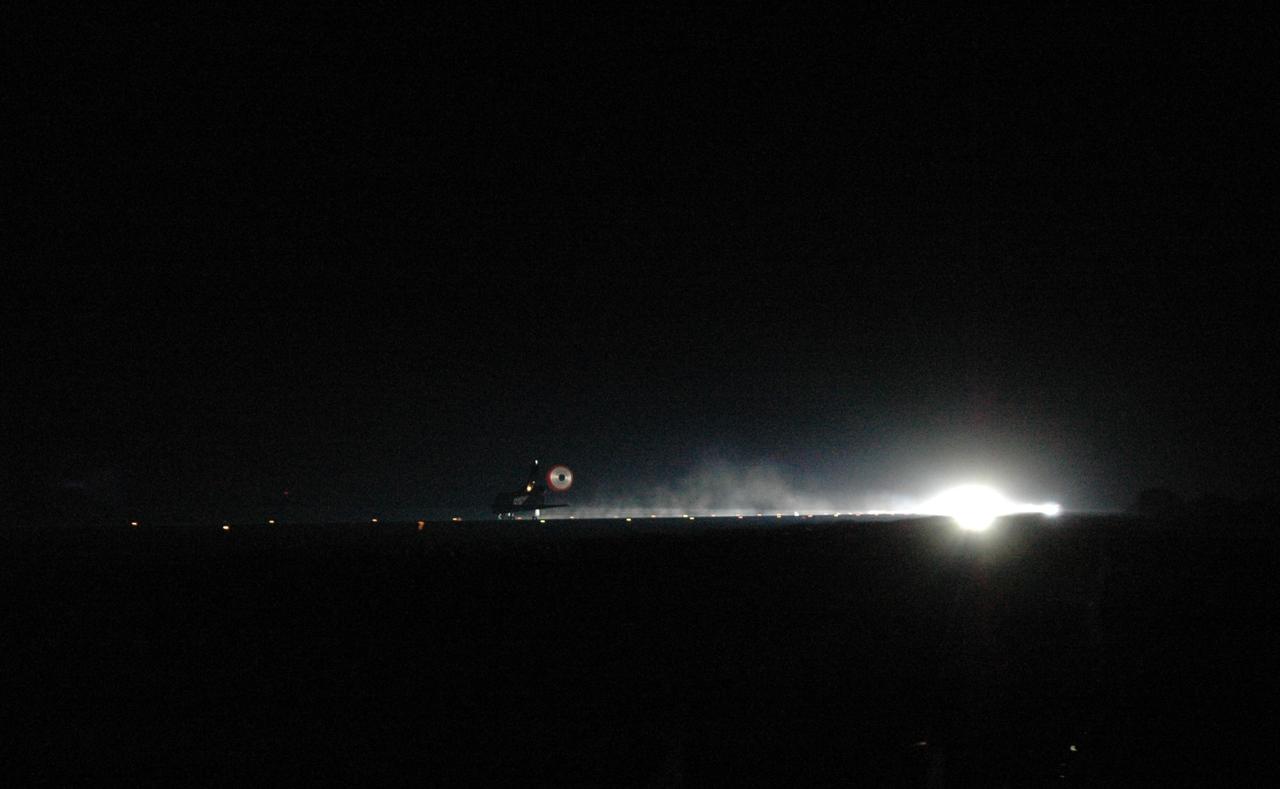
CAPE CANAVERAL, Fla. --- With xenon lights flooding Runway 15, a drag chute slows space shuttle Endeavour as it returns to NASA's Kennedy Space Center, ending the STS-123 mission, a 16-day flight to the International Space Station. The main landing gear touched down at 8:39:08 p.m. EDT. The nose landing gear touched down at 8:39:17 p.m. and wheel stop was at 8:40:41 p.m. The mission completed nearly 6.6 million miles. The landing was the second opportunity after the first was waved off due to unstable weather in the Kennedy Space Center area. The STS-123 mission delivered the first segment of the Japan Aerospace Exploration Agency's Kibo laboratory and the Canadian Space Agency's two-armed robotic system, known as Dextre. Photo credit: NASA/Jim Grossmann
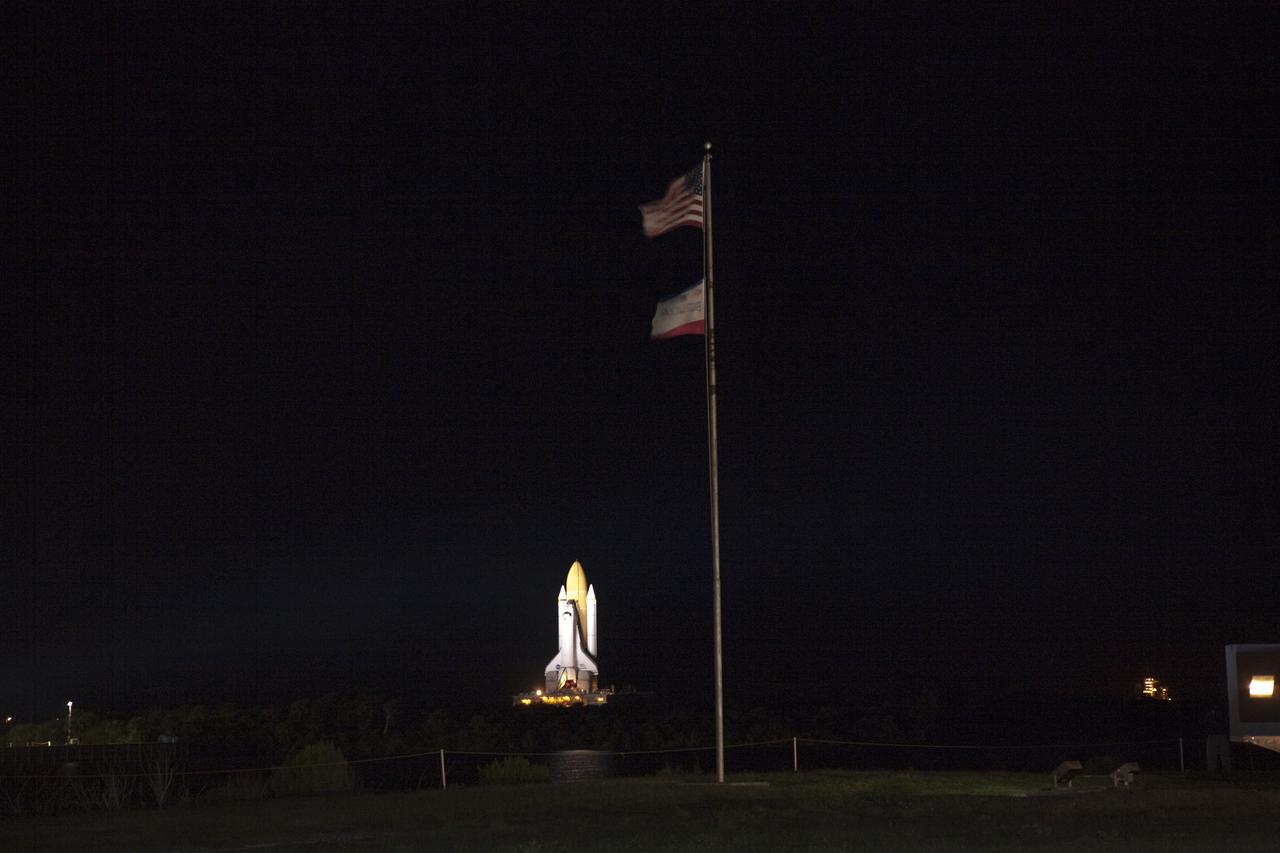
CAPE CANAVERAL, Fla. -- Space shuttle Atlantis makes its historic final journey from the Vehicle Assembly Building to Launch Pad 39A at NASA's Kennedy Space Center in Florida while the flags of America and shuttle Endeavour wave proudly in a light breeze. First motion was at 8:42 p.m. EDT. The milestone move, known as "rollout," paves the way for the launch of the STS-135 mission to the International Space Station, targeted for July 8. Atlantis is slated to arrive at its seaside launch pad about an hour after Endeavour lands on Kennedy's Shuttle Landing Facility runway for the last time, bringing an end to the STS-134 mission. STS-135 will be the 33rd flight of Atlantis, the 37th shuttle mission to the space station, and the 135th and final mission of NASA's Space Shuttle Program. For more information visit, www.nasa.gov/mission_pages/shuttle/shuttlemissions/sts135/index.html. Photo credit: NASA/Gianni Woods
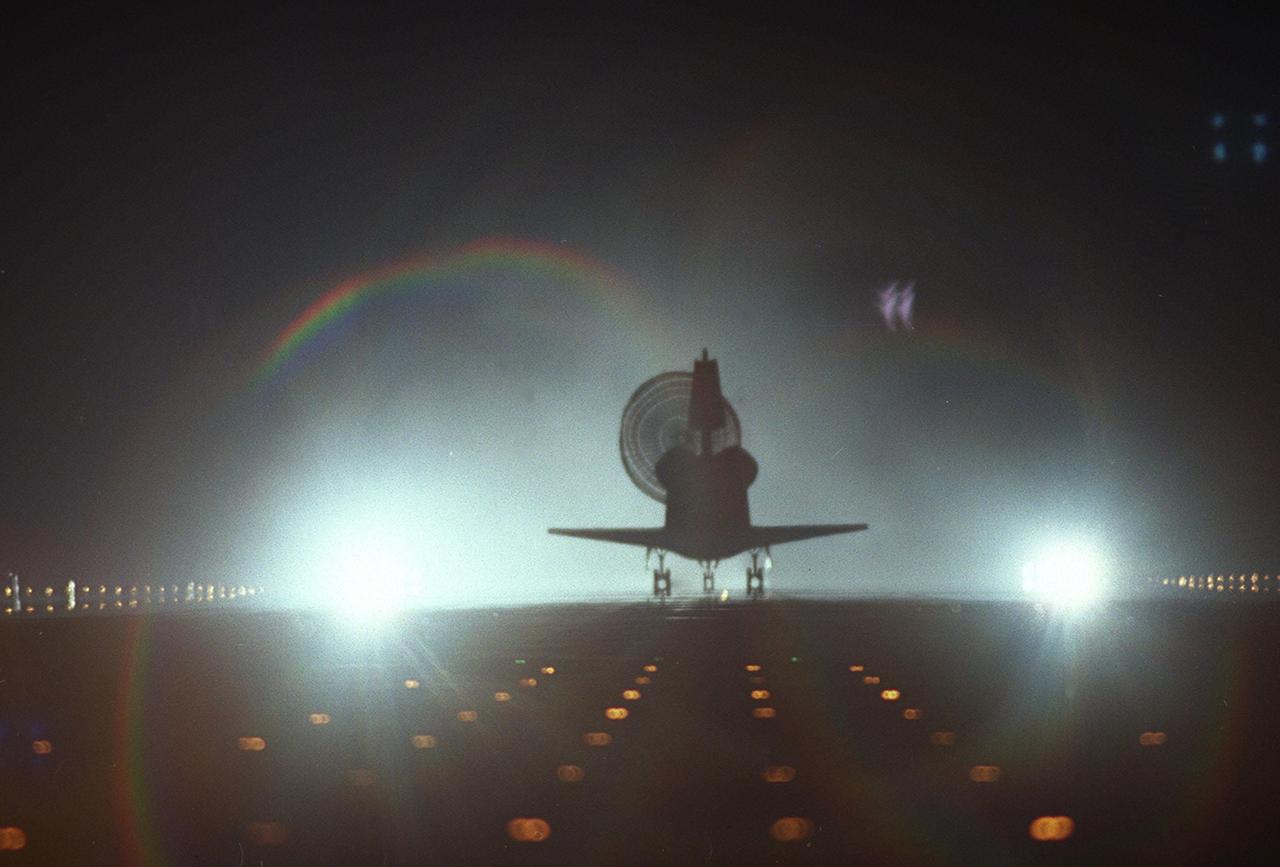
KENNEDY SPACE CENTER, Fla. -- Lights on Runway 15 silhouette Endeavour with its drag chute open as it lands at 6:04 p.m. EST following a 4.4-million-mile mission to the International Space Station. At the controls is Commander Brent Jett, completing the successful 10-day, 19-hour and 58-minute-long STS-97 mission. Other crew members on board are Pilot Michael Bloomfield and Mission Specialists Joseph Tanner, Carlos Noriega and Marc Garneau, with the Canadian Space Agency. Endeavour carried the P6 Integrated Truss Structure with solar arrays to power the International Space Station. The arrays and other equipment were installed during three EVAs that totaled 19 hours, 20 minutes. Endeavour was docked with the Space Station for 6 days, 23 hours, 13 minutes. This was the 16th nighttime landing for a Space Shuttle and the 53rd at Kennedy Space Center

ISS033-E-021663 (15 Nov. 2012) --- A nighttime view of the Dallas, Texas metropolitan area is featured in this image photographed by an Expedition 33 crew member on the International Space Station. Most metropolitan areas of the western United States are configured over large areas with a regular street grid pattern that is highly recognizable from space, particularly at night. The northern Dallas metropolitan area exhibits this pattern. The north-south and east-west grid pattern of major surface streets is highlighted by orange street lighting, lending a fishnet-like appearance to the urban area. Within this framework, smaller residential and commercial buildings and streets give green-gray stipple patterns to some blocks. The airplane terminals of Dallas-Fort Worth International Airport are lit with golden-yellow lights, and surrounded by relatively dark runways and fields at left. Likewise, the runways of Dallas Love Field at lower center are recognizable by their darkness. Other dark areas within the metro region are open space, parks, and water bodies. Dallas is part of the larger Dallas-Fort Worth-Arlington Metropolitan Statistical Area (population 6,526,548 in 2011) as recognized by the U.S. Census Bureau; to most Texans, it is simply ?DFW? or ?the Metroplex.? Several of the larger urban areas within DFW are visible in this image; Dallas, Garland and Richardson all have populations above 100,000 according to the North Central Texas Council of Governments. While historically the economy of Dallas was based in the oil and cotton industries, today commerce, technology, healthcare, and transportation are the major economic drivers.
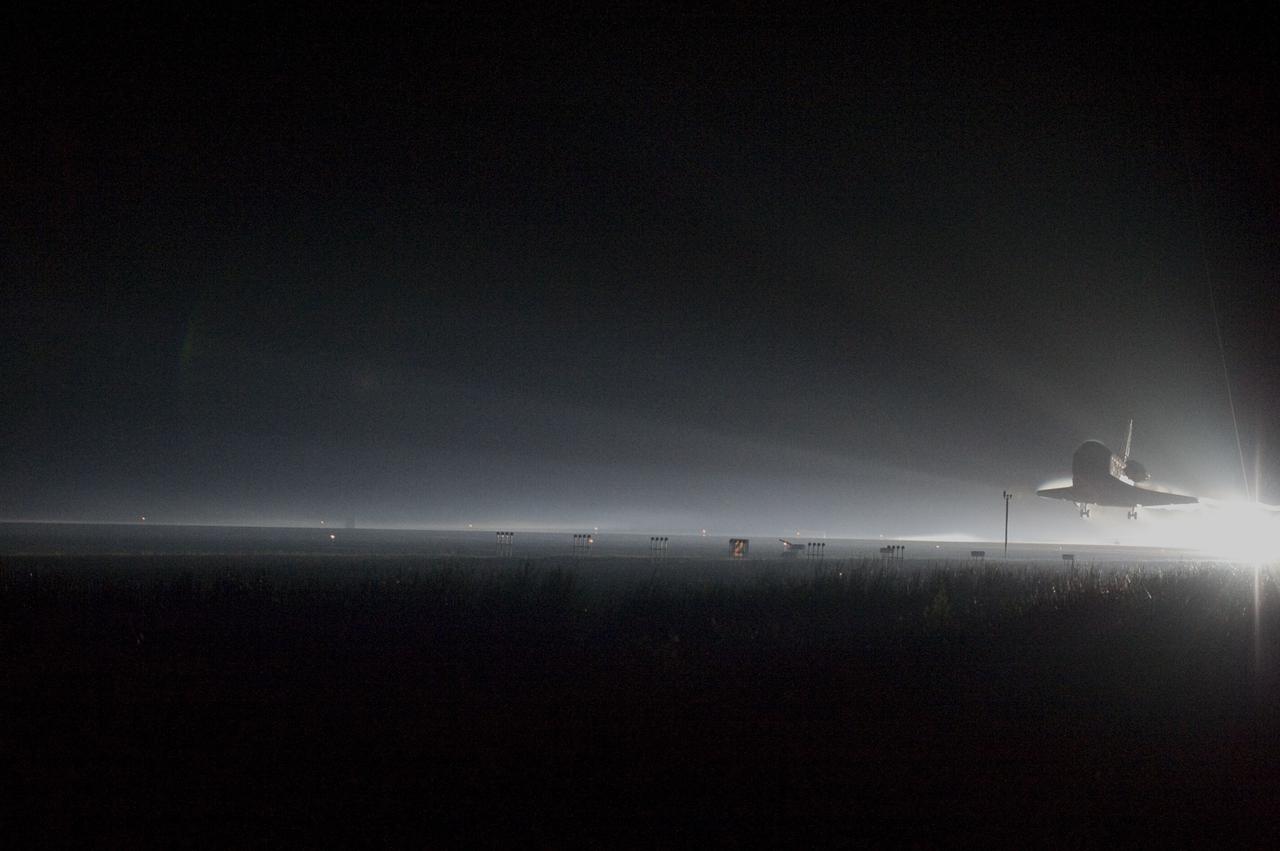
CAPE CANAVERAL, Fla. -- Space shuttle Atlantis returns to Earth for the last time on Runway 15 at NASA's Kennedy Space Center in Florida just before sunrise. Atlantis touched down on Runway 15 at 5:57 a.m., bringing an end to the STS-135 mission and NASA's Space Shuttle Program. CAPE CANAVERAL, Fla. -- Xenons cast a halo of light on space shuttle Atlantis as the spacecraft approaches Runway 15 at NASA's Kennedy Space Center in Florida for the last time. Securing the space shuttle fleet's place in history, Atlantis marked the 26th nighttime landing of NASA's Space Shuttle Program and the 78th landing at Kennedy. Main gear touchdown was at 5:57:00 a.m. EDT, followed by nose gear touchdown at 5:57:20 a.m., and wheelstop at 5:57:54 a.m. On board are STS-135 Commander Chris Ferguson, Pilot Doug Hurley, and Mission Specialists Sandra Magnus and Rex Walheim. On the 37th shuttle mission to the International Space Station, STS-135 delivered more than 9,400 pounds of spare parts, equipment and supplies in the Raffaello multi-purpose logistics module that will sustain station operations for the next year. STS-135 was the 33rd and final flight for Atlantis, which has spent 307 days in space, orbited Earth 4,848 times and traveled 125,935,769 miles. For more information visit, www.nasa.gov/mission_pages/shuttle/shuttlemissions/sts135/index.html. Photo credit: NASA/Carl Winebarger

This radar image shows the Star City cosmonaut training center, east of Moscow, Russia. Four American astronauts are training here for future long-duration flights aboard the Russian Mir space station. These joint flights are giving NASA and the Russian Space Agency experience necessary for the construction of the international Alpha space station, beginning in late 1997. This image was acquired by the Spaceborne Imaging Radar-C/X-band Synthetic Aperture Radar (SIR-C/X-SAR), on its 62nd orbit on October 3, 1994. This Star City image is centered at 55.55 degrees north latitude and 38.0 degrees east longitude. The area shown is approximately 32 kilometers by 49 kilometers (20 miles by 30 miles). North is to the top in this image. The radar illumination is from the top of the image. The image was produced using three channels of SIR-C radar data: red indicates L-band (23 cm wavelength, horizontally transmitted and received); green indicates L-band (horizontally transmitted and vertically received); blue indicates C-band (6 cm wavelength, horizontally transmitted and vertically received). In general, dark pink areas are agricultural; pink and light blue areas are urban communities; black areas represent lakes and rivers; dark blue areas are cleared forest; and light green areas are forested. The prominent black runways just right of center are Shchelkovo Airfield, about 4 km long. The textured pale blue-green area east and southeast of Shchelkovo Airfield is forest. Just east of the runways is a thin railroad line running southeast; the Star City compound lies just east of the small bend in the rail line. Star City contains the living quarters and training facilities for Russian cosmonauts and their families. Moscow's inner loop road is visible at the lower left edge of the image. The Kremlin is just off the left edge, on the banks of the meandering Moskva River. The Klyazma River snakes to the southeast from the reservoir in the upper left (shown in bright red), passing just east of Star City and flowing off the lower right edge of the image. The dark blue band of the Vorya River runs north-south in the upper right quadrant, east of Star City. http://photojournal.jpl.nasa.gov/catalog/PIA01775
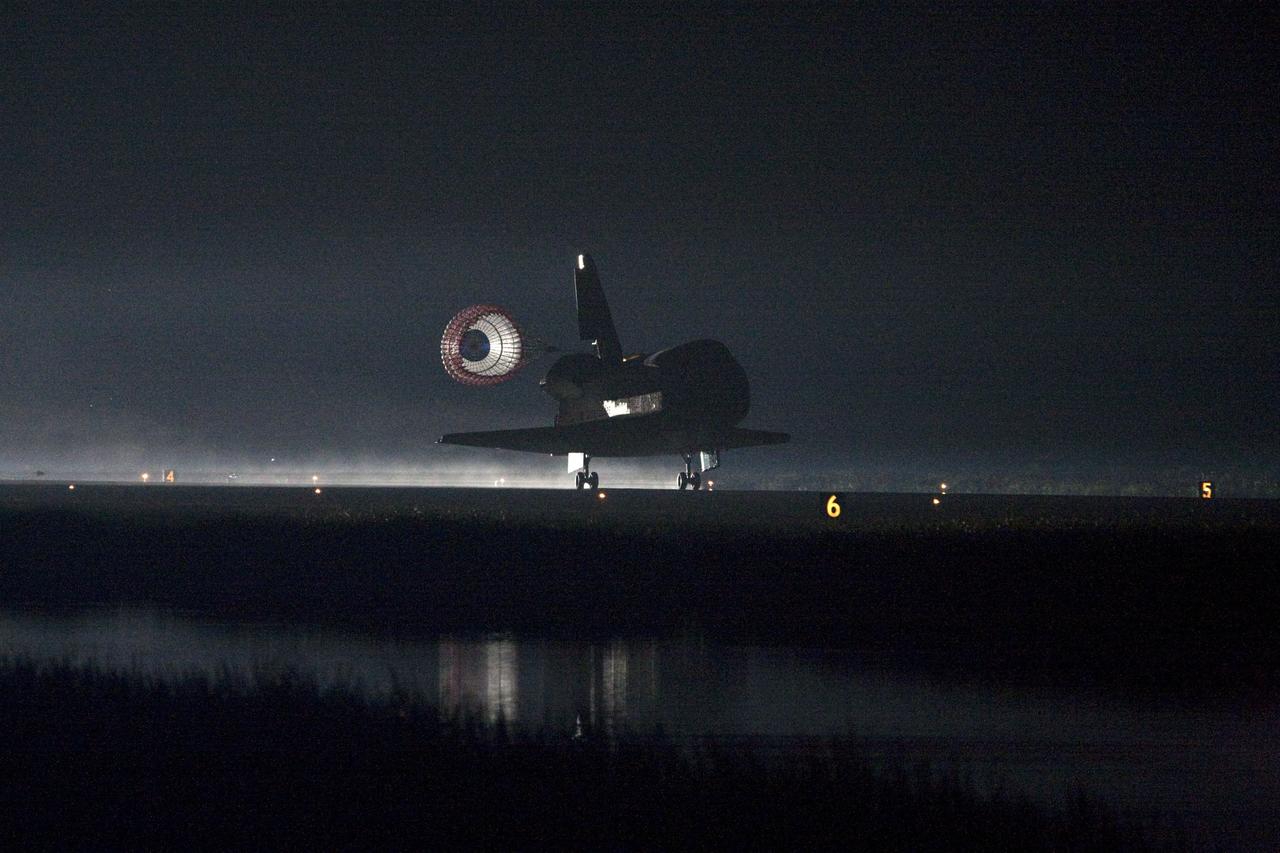
CAPE CANAVERAL, Fla. -- Xenon lights illuminate space shuttle Endeavour's unfurled drag chute as the vehicle rolls to a stop on the Shuttle Landing Facility's Runway 15 at NASA's Kennedy Space Center in Florida for the final time. Main gear touchdown was at 2:34:51 a.m. EDT, followed by nose gear touchdown at 2:35:04 a.m., and wheelstop at 2:35:36 a.m. On board are STS-134 Commander Mark Kelly, Pilot Greg H. Johnson, and Mission Specialists Mike Fincke, Drew Feustel, Greg Chamitoff and the European Space Agency's Roberto Vittori. STS-134 delivered the Alpha Magnetic Spectrometer-2 (AMS) and the Express Logistics Carrier-3 (ELC-3) to the International Space Station. AMS will help researchers understand the origin of the universe and search for evidence of dark matter, strange matter and antimatter from the station. ELC-3 carried spare parts that will sustain station operations once the shuttles are retired from service. STS-134 was the 25th and final flight for Endeavour, which has spent 299 days in space, orbited Earth 4,671 times and traveled 122,883,151 miles. Photo credit: NASA/George Roberto
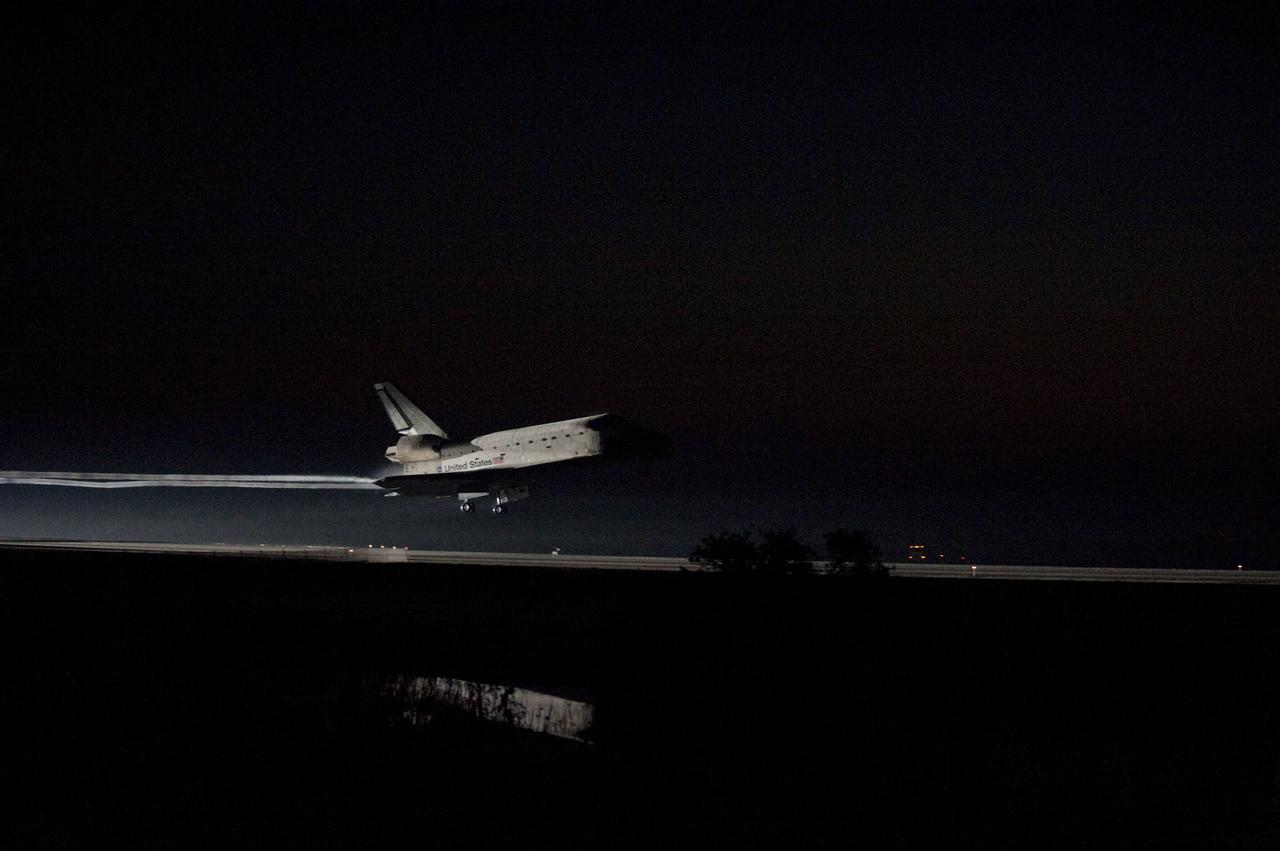
CAPE CANAVERAL, Fla. -- Xenons light the way home as space shuttle Atlantis' iconic white frame appears over the Shuttle Landing Facility's Runway 15 at NASA's Kennedy Space Center in Florida for the last time. Securing the space shuttle fleet's place in history, Atlantis marked the 26th nighttime landing of NASA's Space Shuttle Program and the 78th landing at Kennedy. Main gear touchdown was at 5:57:00 a.m. EDT, followed by nose gear touchdown at 5:57:20 a.m., and wheelstop at 5:57:54 a.m. On board are STS-135 Commander Chris Ferguson, Pilot Doug Hurley, and Mission Specialists Sandra Magnus and Rex Walheim. On the 37th shuttle mission to the International Space Station, STS-135 delivered more than 9,400 pounds of spare parts, equipment and supplies in the Raffaello multi-purpose logistics module that will sustain station operations for the next year. STS-135 was the 33rd and final flight for Atlantis, which has spent 307 days in space, orbited Earth 4,848 times and traveled 125,935,769 miles. For more information visit, www.nasa.gov/mission_pages/shuttle/shuttlemissions/sts135/index.html. Photo credit: NASA/Sandra Joseph
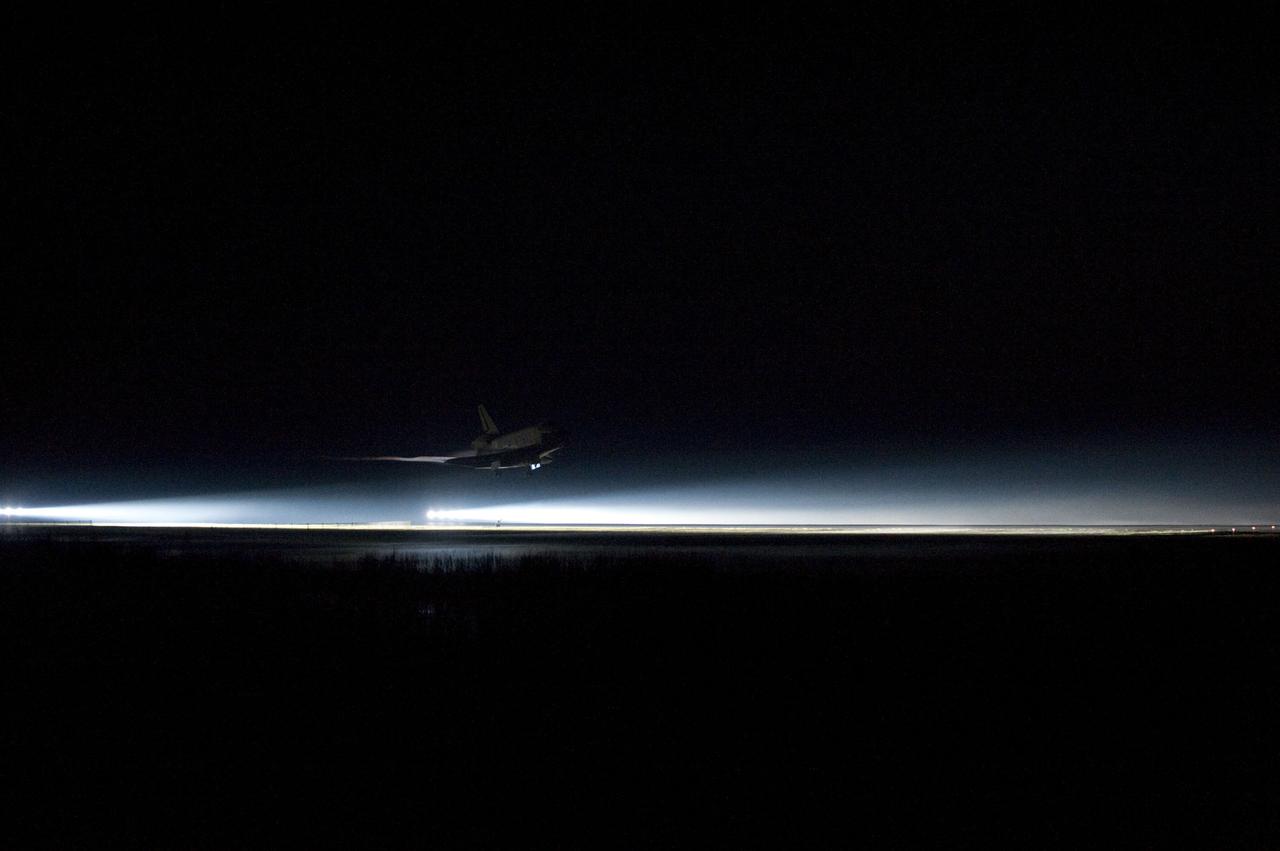
STS135-S-171 (21 July 2011) --- Xenon lights guide space shuttle Atlantis down on the Shuttle Landing Facility's Runway 15 at NASA's Kennedy Space Center in Florida for the final time. Securing the space shuttle fleet's place in history, Atlantis marked the 26th nighttime landing of NASA's Space Shuttle Program and the 78th landing at Kennedy. Main gear touchdown was at 5:57:00 a.m. (EDT) on July 21, 2011, followed by nose gear touchdown at 5:57:20 a.m., and wheelstop at 5:57:54 a.m. Onboard are NASA astronauts Chris Ferguson, STS-135 commander; Doug Hurley, pilot; Sandy Magnus and Rex Walheim, both mission specialists. On the 37th shuttle mission to the International Space Station, STS-135 delivered more than 9,400 pounds of spare parts, equipment and supplies in the Raffaello multi-purpose logistics module that will sustain station operations for the next year. STS-135 was the 33rd and final flight for Atlantis, which has spent 307 days in space, orbited Earth 4,848 times and traveled 125,935,769 miles. Photo credit: NASA
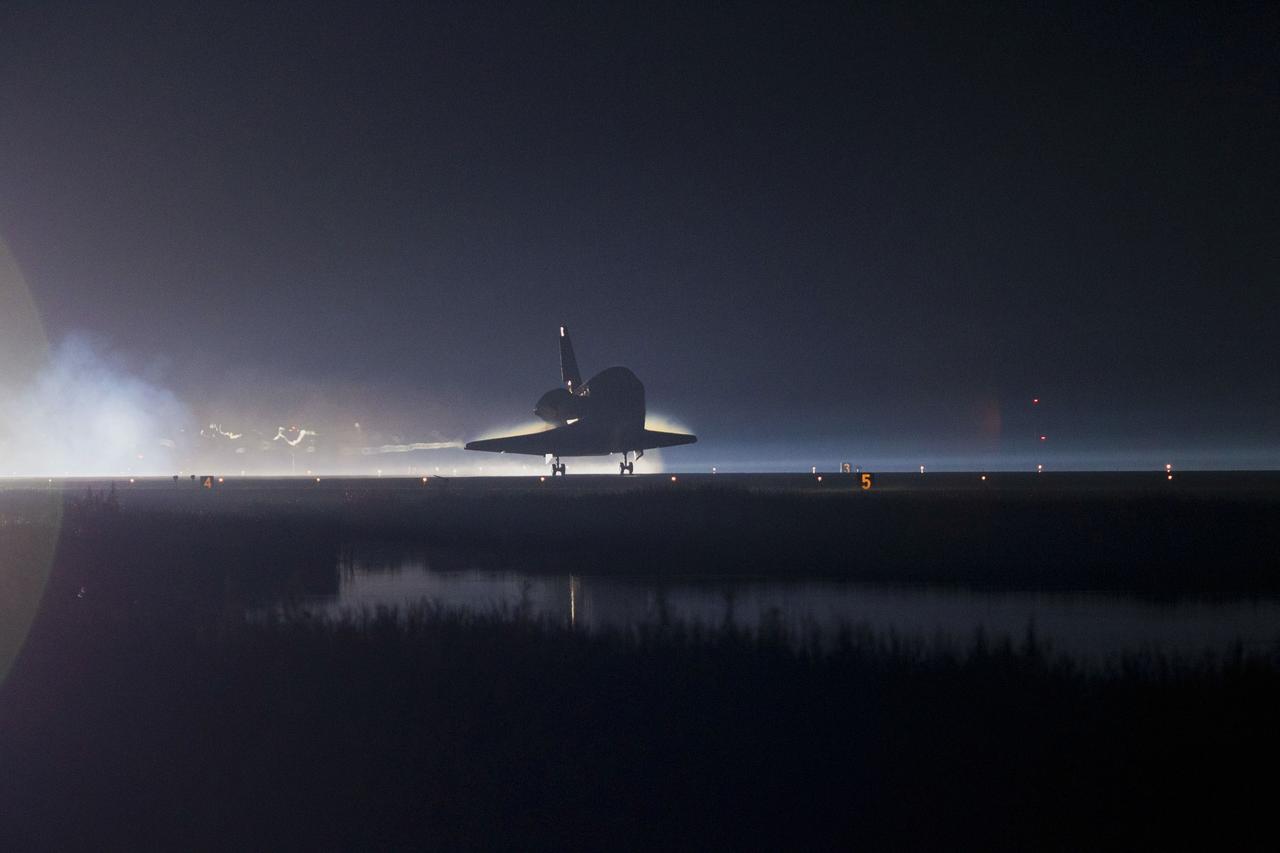
CAPE CANAVERAL, Fla. -- Backlit by the xenon lights on Runway 15 at the Shuttle Landing Facility, space shuttle Atlantis nears touchdown for the final time at NASA's Kennedy Space Center in Florida. Securing the space shuttle fleet's place in history, Atlantis marked the 26th nighttime landing of NASA's Space Shuttle Program and the 78th landing at Kennedy. Main gear touchdown was at 5:57:00 a.m. EDT, followed by nose gear touchdown at 5:57:20 a.m., and wheelstop at 5:57:54 a.m. On board are STS-135 Commander Chris Ferguson, Pilot Doug Hurley, and Mission Specialists Sandra Magnus and Rex Walheim. On the 37th shuttle mission to the International Space Station, STS-135 delivered the Raffaello multi-purpose logistics module filled with more than 9,400 pounds of spare parts, equipment and supplies that will sustain station operations for the next year. STS-135 was the 33rd and final flight for Atlantis, which has spent 307 days in space, orbited Earth 4,848 times and traveled 125,935,769 miles. STS-135 also was the final mission of the Space Shuttle Program. For more information, visit www.nasa.gov/mission_pages/shuttle/shuttlemissions/sts135/index.html. Photo credit: NASA/Kenny Allen
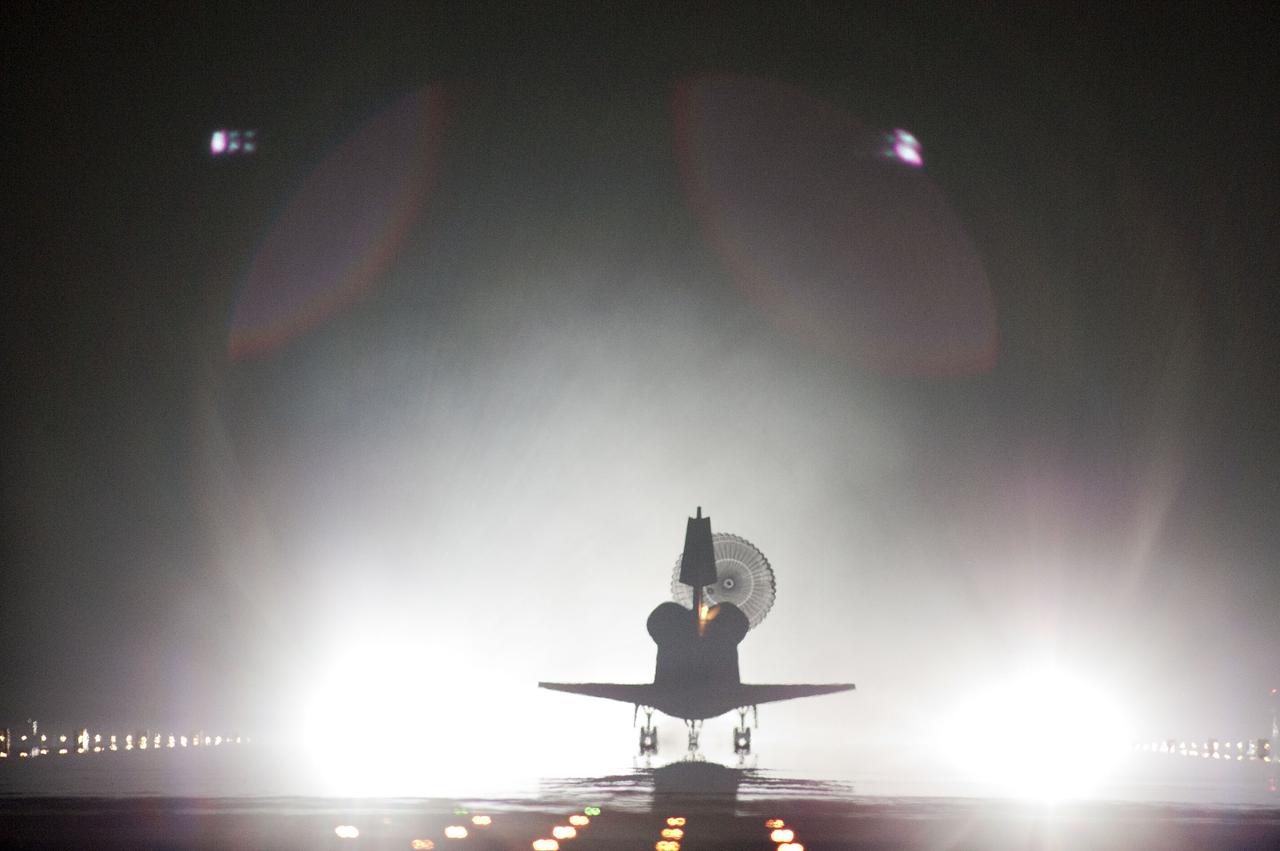
CAPE CANAVERAL, Fla. -- Xenon lights help lead space shuttle Endeavour home to NASA's Kennedy Space Center in Florida. Endeavour landed for the final time on the Shuttle Landing Facility's Runway 15, marking the 25th night landing of NASA's Space Shuttle Program. Main gear touchdown was at 2:34:51 a.m. EDT, followed by nose gear touchdown at 2:35:04 a.m., and wheelstop at 2:35:36 a.m. On board are STS-134 Commander Mark Kelly, Pilot Greg H. Johnson, and Mission Specialists Mike Fincke, Drew Feustel, Greg Chamitoff and the European Space Agency's Roberto Vittori. STS-134 delivered the Alpha Magnetic Spectrometer-2 (AMS) and the Express Logistics Carrier-3 (ELC-3) to the International Space Station. AMS will help researchers understand the origin of the universe and search for evidence of dark matter, strange matter and antimatter from the station. ELC-3 carried spare parts that will sustain station operations once the shuttles are retired from service. STS-134 was the 25th and final flight for Endeavour, which has spent 299 days in space, orbited Earth 4,671 times and traveled 122,883,151 miles. Photo credit: NASA/Tom Farrar and Tony Gray
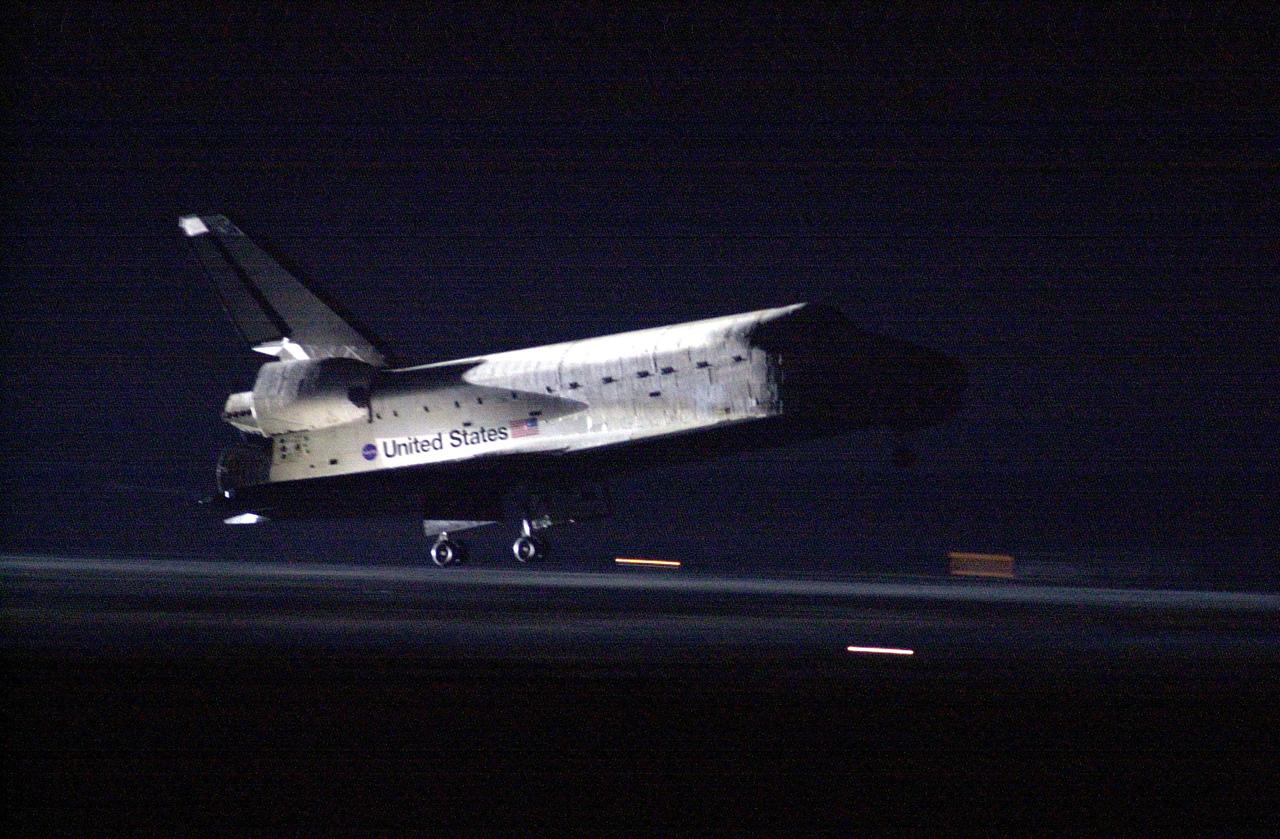
KENNEDY SPACE CENTER, Fla. -- Landing lights spotlight Space Shuttle Atlantis as it nears touchdown on Runway 15 at KSC’s Shuttle Landing Facility after completing the 9-day, 20-hour, 9-minute-long STS-101 mission. At the controls are Commander James D. Halsell Jr. and Pilot Scott “Doc” Horowitz. Also onboard the orbiter are Mission Specialists Mary Ellen Weber, James S. Voss, Jeffrey N. Williams, Susan J. Helms and Yury Usachev of Russia. The crew is returning from the third flight to the International Space Station. This was the 98th flight in the Space Shuttle program and the 21st for Atlantis, also marking the 51st landing at KSC, the 22nd consecutive landing at KSC, and the 29th in the last 30 Shuttle flights. Main gear touchdown was at 2:20:17 a.m. EDT, landing on orbit 155 of the mission. Nose gear touchdown was at 2:20:30 a.m. EDT, and wheel stop at 2:21:19 a.m. EDT
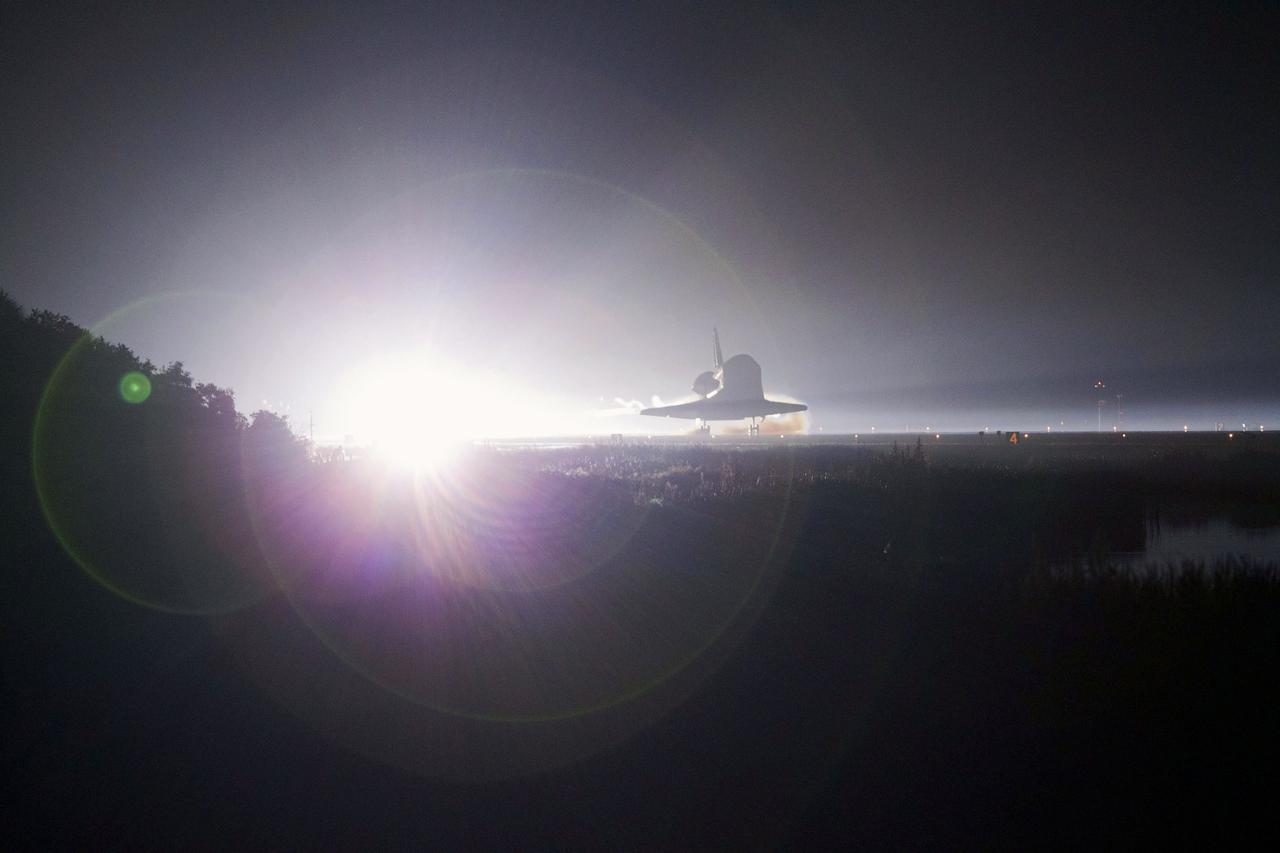
STS135-S-243 (21 July 2011) --- A halo of light engulfs space shuttle Atlantis as the spacecraft touches down for the last time on Runway 15 at NASA's Kennedy Space Center in Florida. Securing the space shuttle fleet's place in history, Atlantis marked the 26th nighttime landing of NASA's Space Shuttle Program and the 78th landing at Kennedy. Main gear touchdown was at 5:57:00 a.m. (EDT) on July 21, 2011, followed by nose gear touchdown at 5:57:20 a.m., and wheelstop at 5:57:54 a.m. Onboard are NASA astronauts Chris Ferguson, STS-135 commander; Doug Hurley, pilot; Sandy Magnus and Rex Walheim, both mission specialists. On the 37th shuttle mission to the International Space Station, STS-135 delivered more than 9,400 pounds of spare parts, equipment and supplies in the Raffaello multi-purpose logistics module that will sustain station operations for the next year. STS-135 was the 33rd and final flight for Atlantis, which has spent 307 days in space, orbited Earth 4,848 times and traveled 125,935,769 miles. Photo credit: NASA
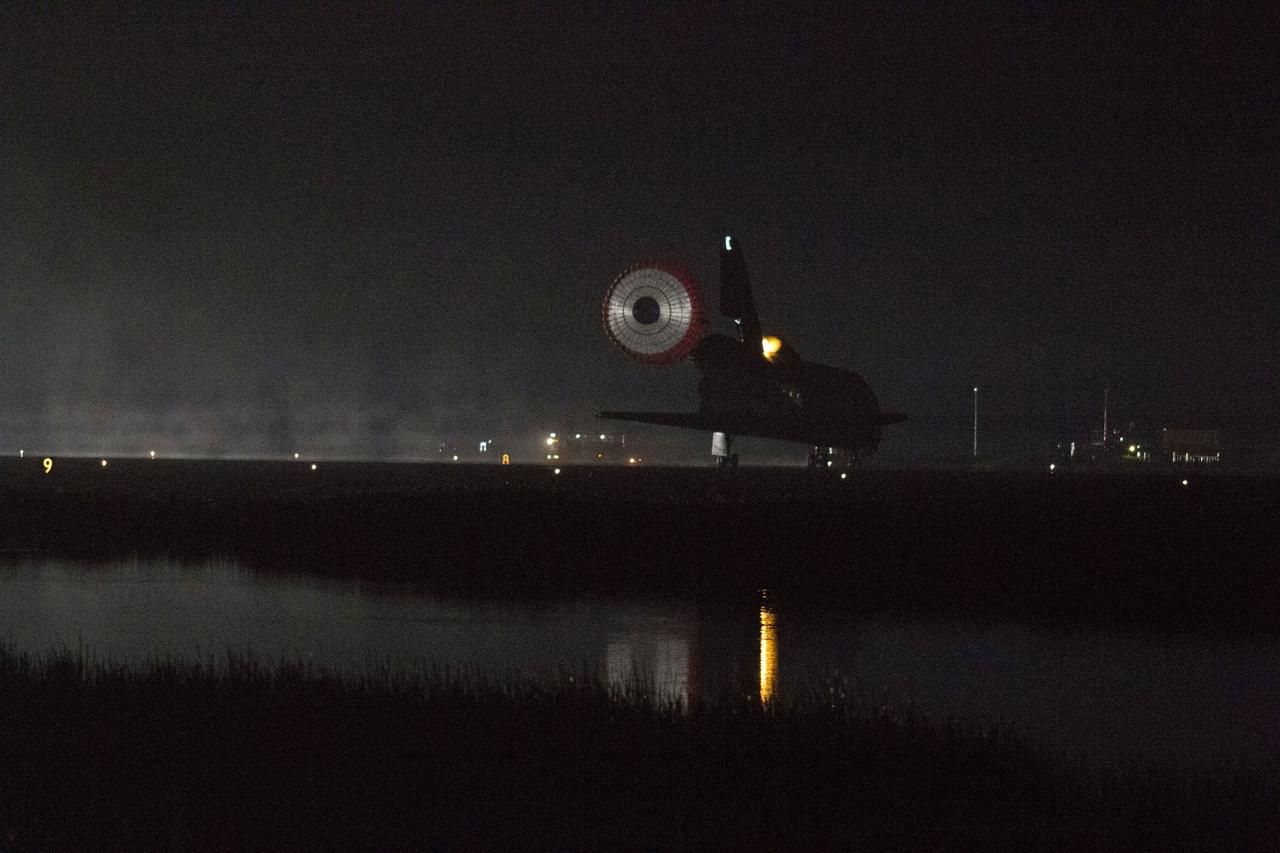
STS134-S-073 (1 June 2011) --- Xenon lights illuminate space shuttle Endeavour's unfurled drag chute as the vehicle rolls to a stop on the Shuttle Landing Facility's Runway 15 at NASA's Kennedy Space Center in Florida for the final time. Main gear touchdown was at 2:34:51 a.m. (EDT) on June 1, 2011, followed by nose gear touchdown at 2:35:04 a.m., and wheelstop at 2:35:36 a.m. Onboard are NASA astronauts Mark Kelly, STS-134 commander; Greg H. Johnson, pilot; Michael Fincke, Andrew Feustel, Greg Chamitoff and European Space Agency astronaut Roberto Vittori, all mission specialists. STS-134 delivered the Alpha Magnetic Spectrometer-2 (AMS) and the Express Logistics Carrier-3 (ELC-3) to the International Space Station. AMS will help researchers understand the origin of the universe and search for evidence of dark matter, strange matter and antimatter from the station. ELC-3 carried spare parts that will sustain station operations once the shuttles are retired from service. STS-134 was the 25th and final flight for Endeavour, which has spent 299 days in space, orbited Earth 4,671 times and traveled 122,883,151 miles. Photo credit: NASA
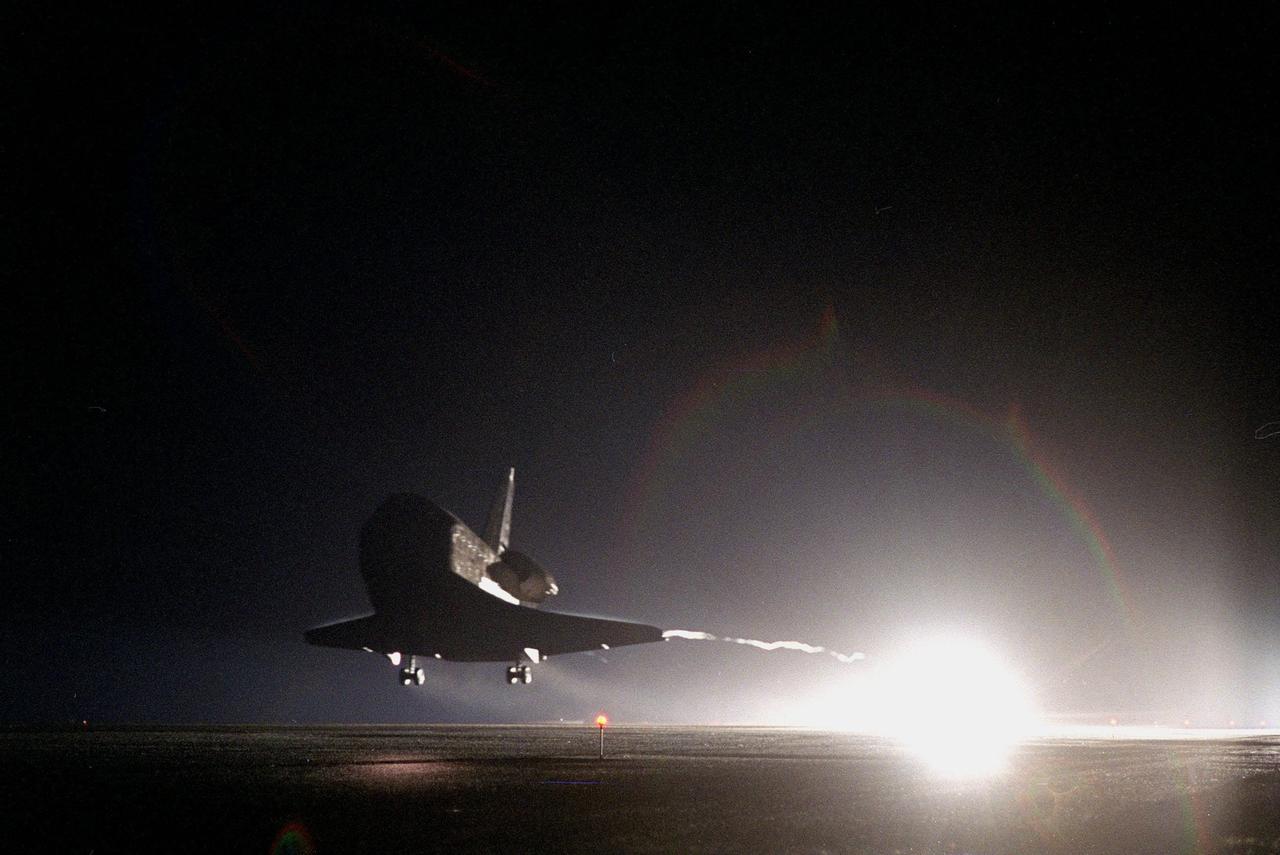
KENNEDY SPACE CENTER, Fla. -- Bright lights at KSC's Shuttle Landing Facility runway 15 illuminate the landing of Space Shuttle Discovery, which completes the 9-day, 19-hour, 13-minute and 1-second long STS-96 mission. A contrail streams from the wing. Main gear touchdown was at 2:02:43 a.m. EDT June 6 , landing on orbit 154 of the mission. Nose gear touchdown was at 2:02:59 a.m., and the wheels stopped at 2:03:39 a.m. At the controls were Commander Kent V. Rominger and Pilot Rick D. Husband. Also onboard the orbiter were Mission Specialists Ellen Ochoa (Ph.D.), Tamara E. Jernigan (Ph.D.), Daniel T. Barry (M.D., Ph.D.), Julie Payette and Valery Ivanovich Tokarev. Payette represents the Canadian Space Agency and Tokarev the Russian Space Agency. The crew returned from the second flight to the International Space Station on a logistics and resupply mission. This was the 94th flight in the Space Shuttle program and the 26th for Discovery, also marking the 47th at KSC, the 24th in the last 25 missions, 11th at night, and the 18th consecutive landing in Florida
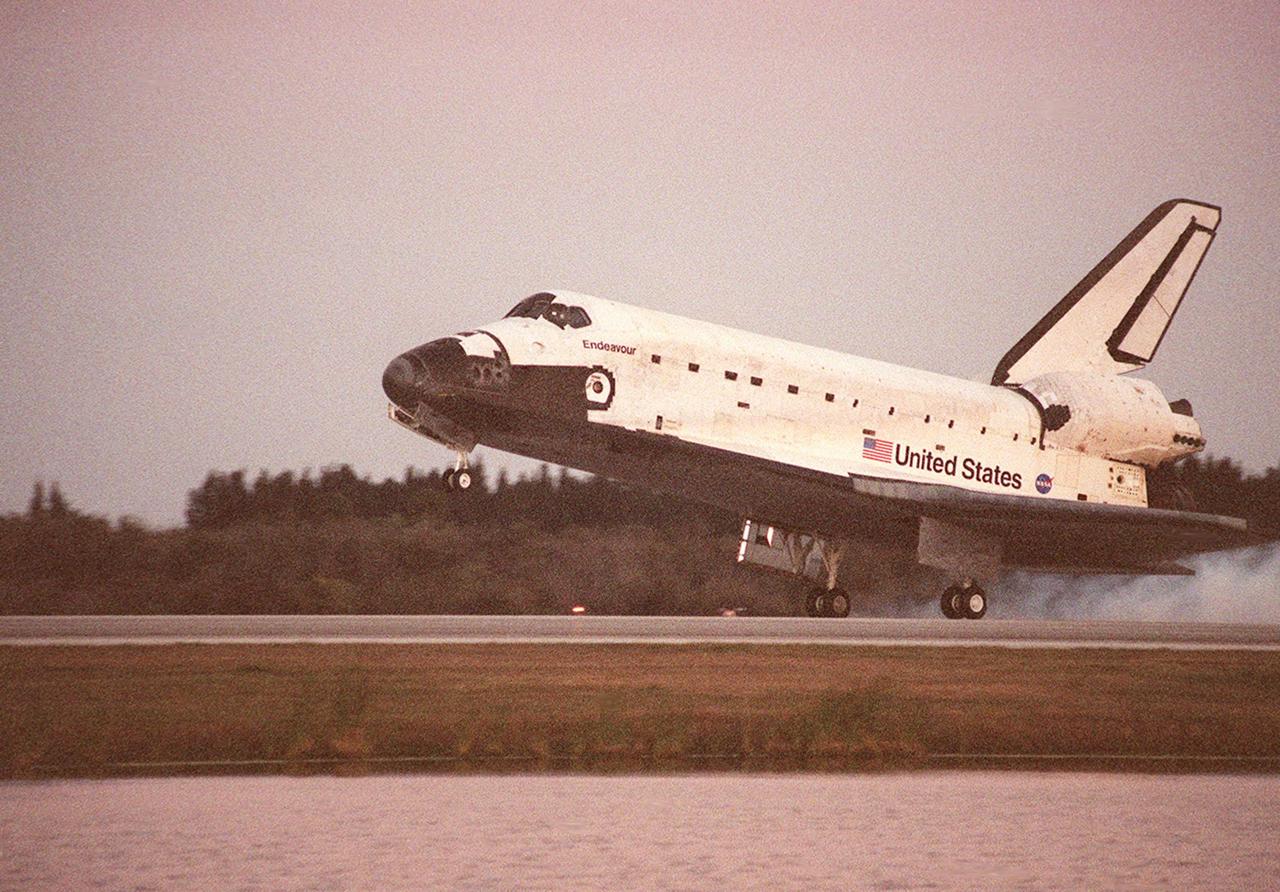
KENNEDY SPACE CENTER, FLA. -- In the waning light after sundown, Space Shuttle Endeavour touches down on KSC's Shuttle Landing Facility Runway 33 to complete the 11-day, 5-hour, 38-minute-long STS-99 mission. At the controls are Commander Kevin Kregel and Pilot Dominic Gorie. Also onboard the orbiter are Mission Specialists Janet Kavandi, Janice Voss, Mamoru Mohri of Japan and Gerhard Thiele of Germany. Mohri is with the National Space Development Agency (NASDA) and Thiele is with the European Space Agency. The crew is returning from the Shuttle Radar Topography Mission after mapping more than 47 million square miles of the Earth's surface. Main gear touchdown was at 6:22:23 p.m. EST Feb. 22 , landing on orbit 181 of the mission. Nose gear touchdown was at 6:22:35 p.m.. EST, and wheel stop at 6:23:25 p.m. EST. This was the 97th flight in the Space Shuttle program and the 14th for Endeavour, also marking the 50th landing at KSC, the 21st consecutive landing at KSC, and the 28th in the last 29 Shuttle flights
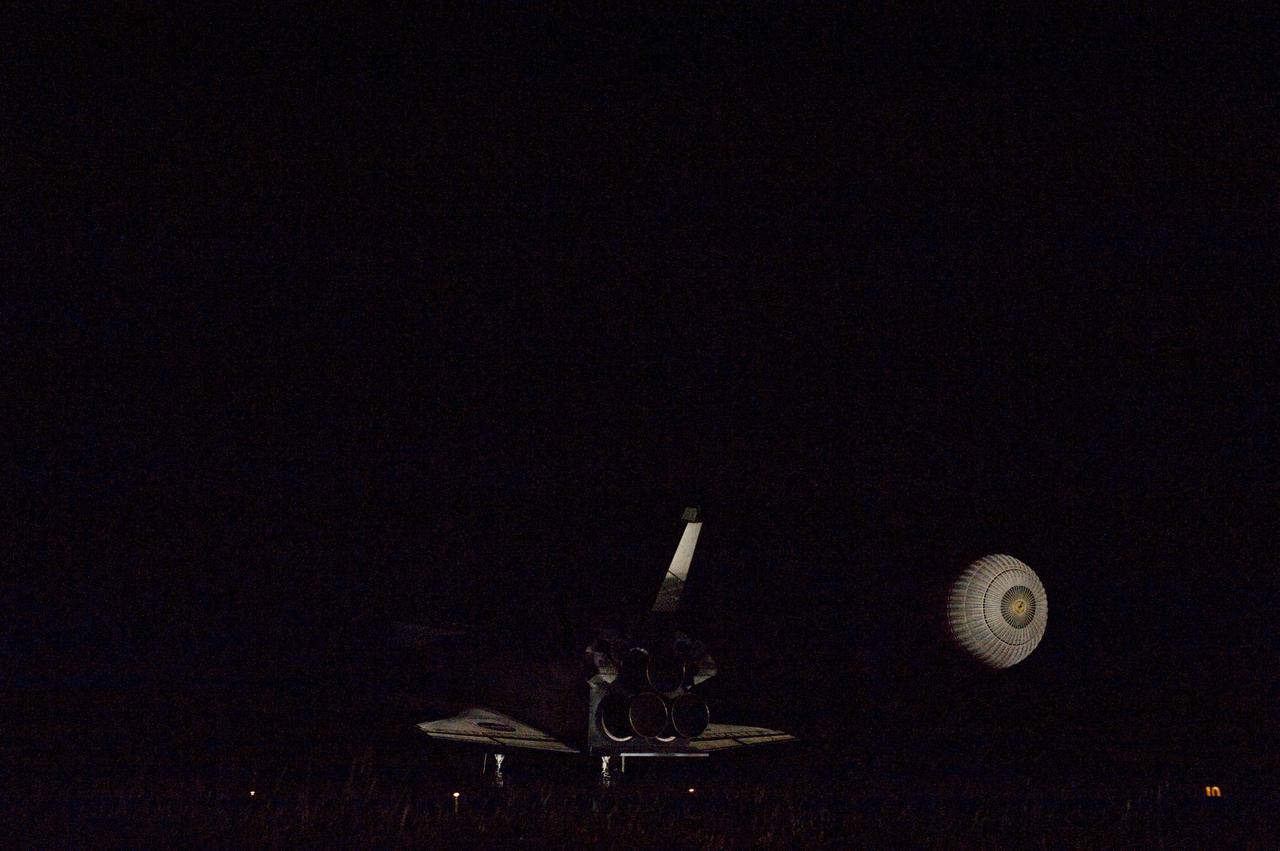
STS134-S-082 (1 June 2011) --- Xenon lights illuminate space shuttle Endeavour's unfurled drag chute as the vehicle rolls to a stop on the Shuttle Landing Facility's Runway 15 at NASA's Kennedy Space Center in Florida for the final time. Main gear touchdown was at 2:34:51 a.m. (EDT) on June 1, 2011, followed by nose gear touchdown at 2:35:04 a.m., and wheelstop at 2:35:36 a.m. Onboard are NASA astronauts Mark Kelly, STS-134 commander; Greg H. Johnson, pilot; Michael Fincke, Andrew Feustel, Greg Chamitoff and European Space Agency astronaut Roberto Vittori, all mission specialists. STS-134 delivered the Alpha Magnetic Spectrometer-2 (AMS) and the Express Logistics Carrier-3 (ELC-3) to the International Space Station. AMS will help researchers understand the origin of the universe and search for evidence of dark matter, strange matter and antimatter from the station. ELC-3 carried spare parts that will sustain station operations once the shuttles are retired from service. STS-134 was the 25th and final flight for Endeavour, which has spent 299 days in space, orbited Earth 4,671 times and traveled 122,883,151 miles. Photo credit: NASA
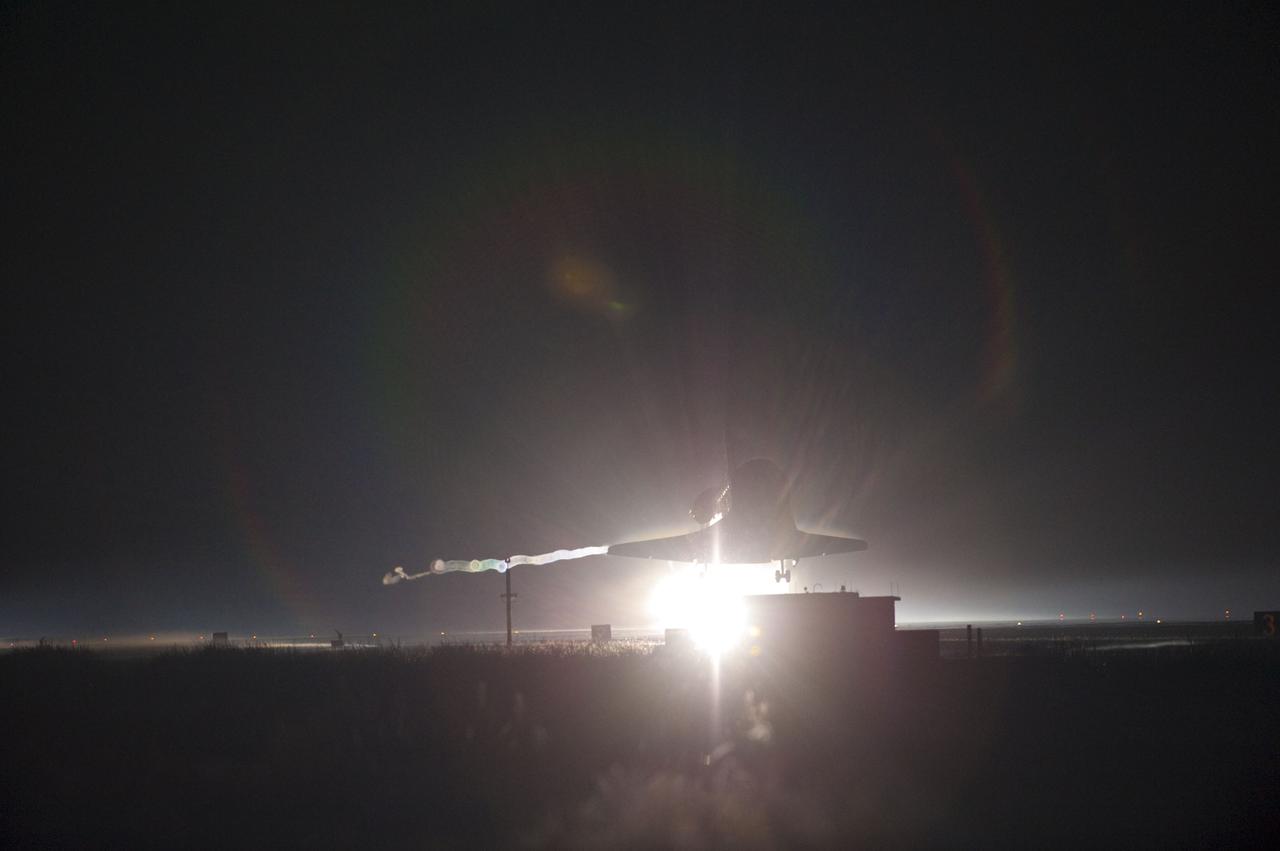
CAPE CANAVERAL, Fla. -- Xenons cast a halo of light on space shuttle Atlantis as the spacecraft approaches Runway 15 at NASA's Kennedy Space Center in Florida for the last time. Securing the space shuttle fleet's place in history, Atlantis marked the 26th nighttime landing of NASA's Space Shuttle Program and the 78th landing at Kennedy. Main gear touchdown was at 5:57:00 a.m. EDT, followed by nose gear touchdown at 5:57:20 a.m., and wheelstop at 5:57:54 a.m. On board are STS-135 Commander Chris Ferguson, Pilot Doug Hurley, and Mission Specialists Sandra Magnus and Rex Walheim. On the 37th shuttle mission to the International Space Station, STS-135 delivered more than 9,400 pounds of spare parts, equipment and supplies in the Raffaello multi-purpose logistics module that will sustain station operations for the next year. STS-135 was the 33rd and final flight for Atlantis, which has spent 307 days in space, orbited Earth 4,848 times and traveled 125,935,769 miles. For more information visit, www.nasa.gov/mission_pages/shuttle/shuttlemissions/sts135/index.html. Photo credit: NASA/Kevin O'Connell
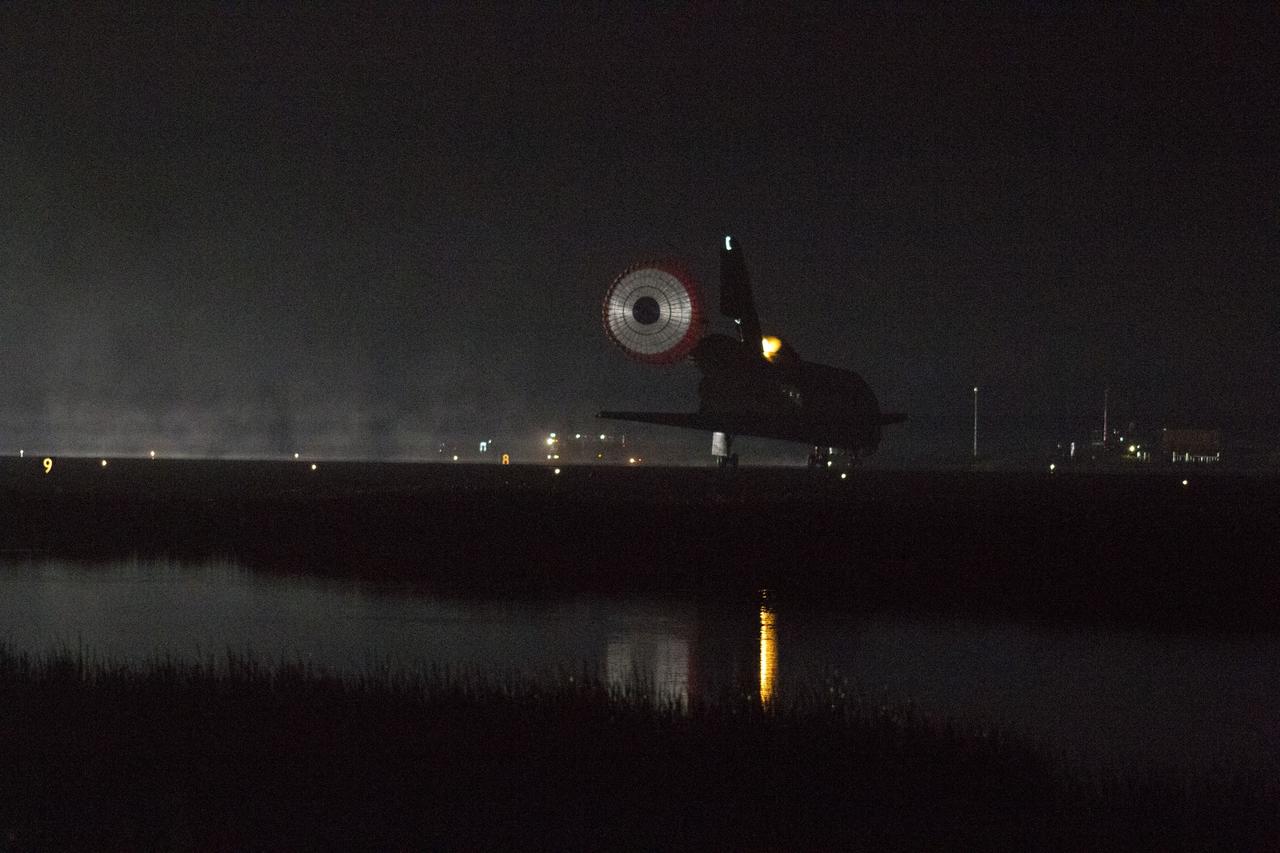
CAPE CANAVERAL, Fla. -- Xenon lights illuminate space shuttle Endeavour's unfurled drag chute as the vehicle rolls to a stop on the Shuttle Landing Facility's Runway 15 at NASA's Kennedy Space Center in Florida for the final time. Heat from the shuttle's auxiliary power units (APUs), which provide hydraulic control, can be seen at the back of Endeavour, near the vertical tail. Main gear touchdown was at 2:34:51 a.m. EDT, followed by nose gear touchdown at 2:35:04 a.m., and wheelstop at 2:35:36 a.m. On board are STS-134 Commander Mark Kelly, Pilot Greg H. Johnson, and Mission Specialists Mike Fincke, Drew Feustel, Greg Chamitoff and the European Space Agency's Roberto Vittori. STS-134 delivered the Alpha Magnetic Spectrometer-2 (AMS) and the Express Logistics Carrier-3 (ELC-3) to the International Space Station. AMS will help researchers understand the origin of the universe and search for evidence of dark matter, strange matter and antimatter from the station. ELC-3 carried spare parts that will sustain station operations once the shuttles are retired from service. STS-134 was the 25th and final flight for Endeavour, which has spent 299 days in space, orbited Earth 4,671 times and traveled 122,883,151 miles. Photo credit: NASA/Kenny Allen
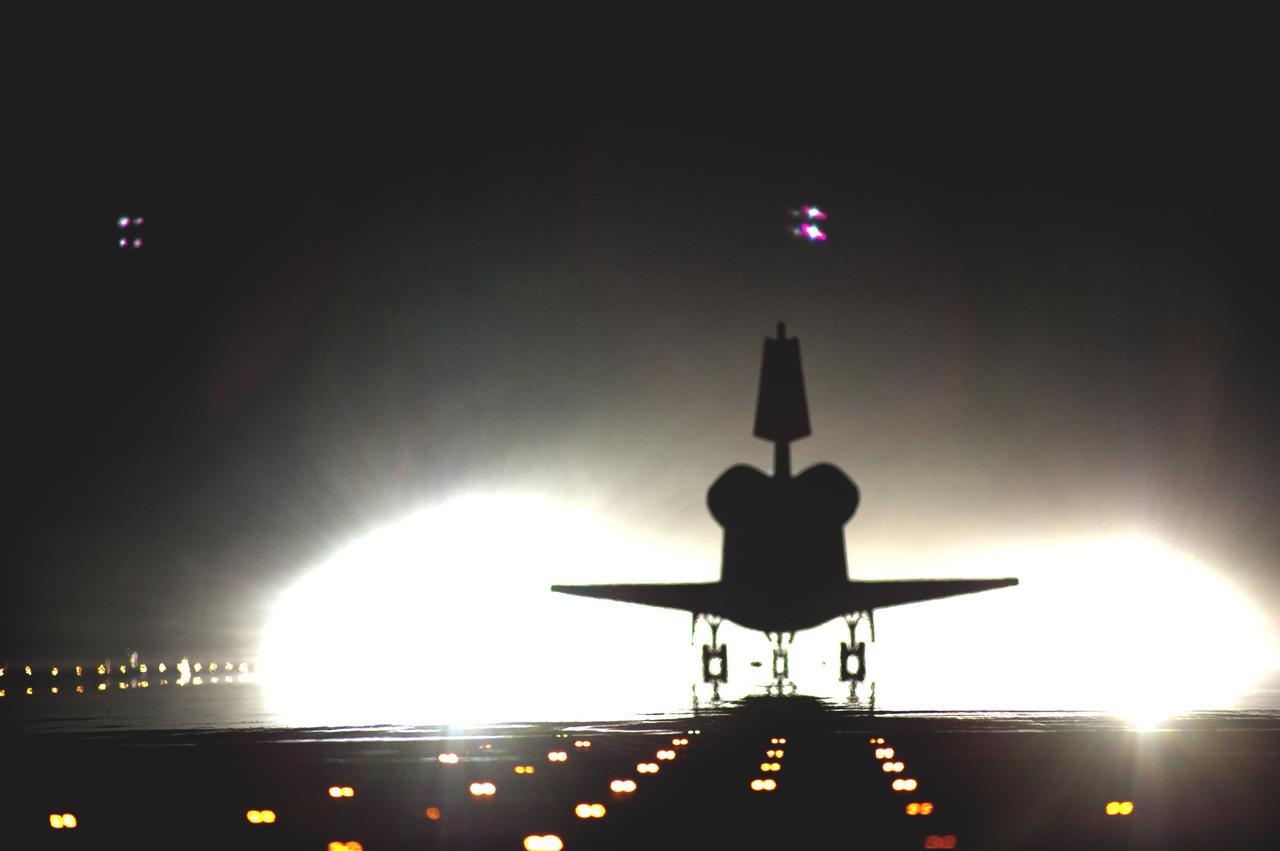
CAPE CANAVERAL, Fla. -- At NASA's Kennedy Space Center in Florida, xenon lights positioned at the end of Runway 15 illuminate the Shuttle Landing Facility for space shuttle Atlantis' final return from space. Securing the space shuttle fleet's place in history, Atlantis marked the 26th nighttime landing of NASA's Space Shuttle Program and the 78th landing at Kennedy. Main gear touchdown was at 5:57:00 a.m. EDT, followed by nose gear touchdown at 5:57:20 a.m., and wheelstop at 5:57:54 a.m. On board are STS-135 Commander Chris Ferguson, Pilot Doug Hurley, and Mission Specialists Sandy Magnus and Rex Walheim. On the 37th shuttle mission to the International Space Station, STS-135 delivered the Raffaello multi-purpose logistics module filled with more than 9,400 pounds of spare parts, equipment and supplies that will sustain station operations for the next year. STS-135 was the 33rd and final flight for Atlantis, which has spent 307 days in space, orbited Earth 4,848 times and traveled 125,935,769 miles. STS-135 also was the final mission of the Space Shuttle Program. For more information, visit www.nasa.gov/mission_pages/shuttle/shuttlemissions/sts135/index.html. Photo credit: NASA/Tom Farrar and Tony Gray
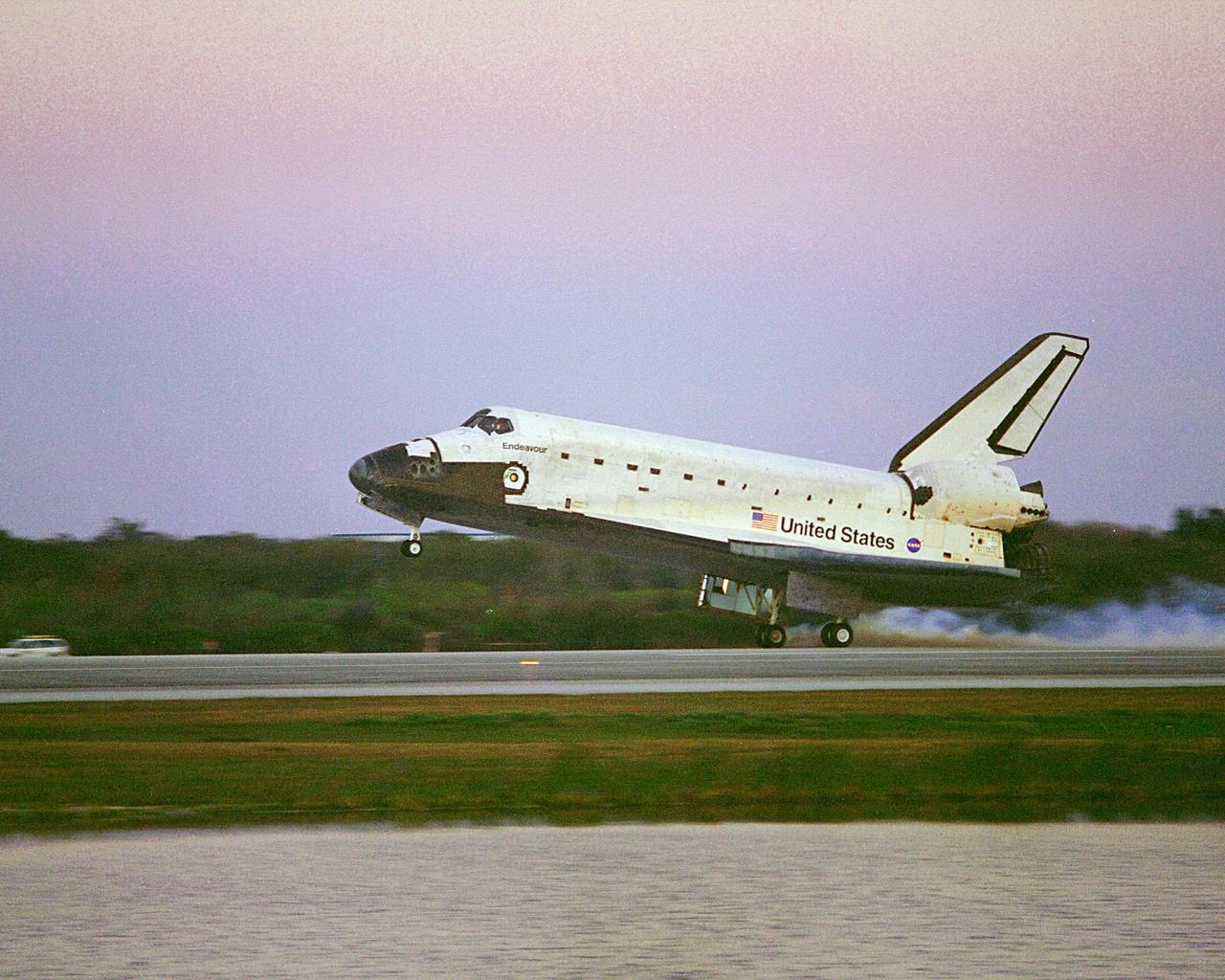
KENNEDY SPACE CENTER, FLA. -- In the waning light after sundown, Space Shuttle Endeavour touches down on KSC's Shuttle Landing Facility Runway 33 to complete the 11-day, 5-hour, 38-minute-long STS-99 mission. At the controls are Commander Kevin Kregel and Pilot Dominic Gorie. Also onboard the orbiter are Mission Specialists Janet Kavandi, Janice Voss, Mamoru Mohri of Japan and Gerhard Thiele of Germany. Mohri is with the National Space Development Agency (NASDA) and Thiele is with the European Space Agency. The crew are returning from the Shuttle Radar Topography Mission after mapping more than 47 million square miles of the Earth's surface. Main gear touchdown was at 6:22:23 p.m. EST Feb. 22 , landing on orbit 181 of the mission. Nose gear touchdown was at 6:22:35 p.m.. EST, and wheel stop at 6:23:25 p.m. EST. This was the 97th flight in the Space Shuttle program and the 14th for Endeavour, also marking the 50th landing at KSC, the 21st consecutive landing at KSC, and the 28th in the last 29 Shuttle flight
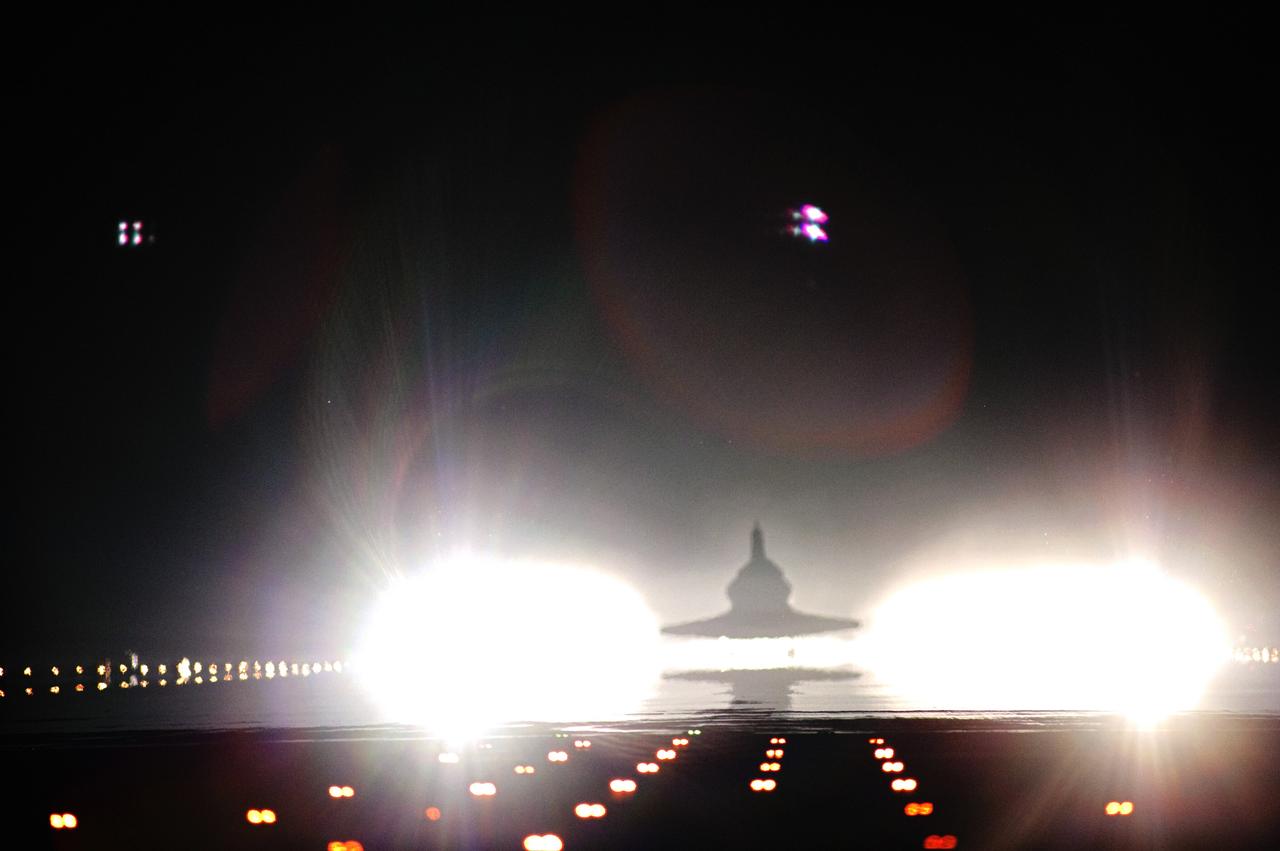
CAPE CANAVERAL, Fla. -- Xenon lights positioned at the end of Runway 15 spotlight space shuttle Atlantis as it nears touchdown for the last time at NASA's Kennedy Space Center in Florida. Securing the space shuttle fleet's place in history, Atlantis marked the 26th nighttime landing of NASA's Space Shuttle Program and the 78th landing at Kennedy. Main gear touchdown was at 5:57:00 a.m. EDT, followed by nose gear touchdown at 5:57:20 a.m., and wheelstop at 5:57:54 a.m. On board are STS-135 Commander Chris Ferguson, Pilot Doug Hurley, and Mission Specialists Sandy Magnus and Rex Walheim. On the 37th shuttle mission to the International Space Station, STS-135 delivered the Raffaello multi-purpose logistics module filled with more than 9,400 pounds of spare parts, equipment and supplies that will sustain station operations for the next year. STS-135 was the 33rd and final flight for Atlantis, which has spent 307 days in space, orbited Earth 4,848 times and traveled 125,935,769 miles. STS-135 also was the final mission of the Space Shuttle Program. For more information, visit www.nasa.gov/mission_pages/shuttle/shuttlemissions/sts135/index.html. Photo credit: NASA/Tom Farrar and Tony Gray
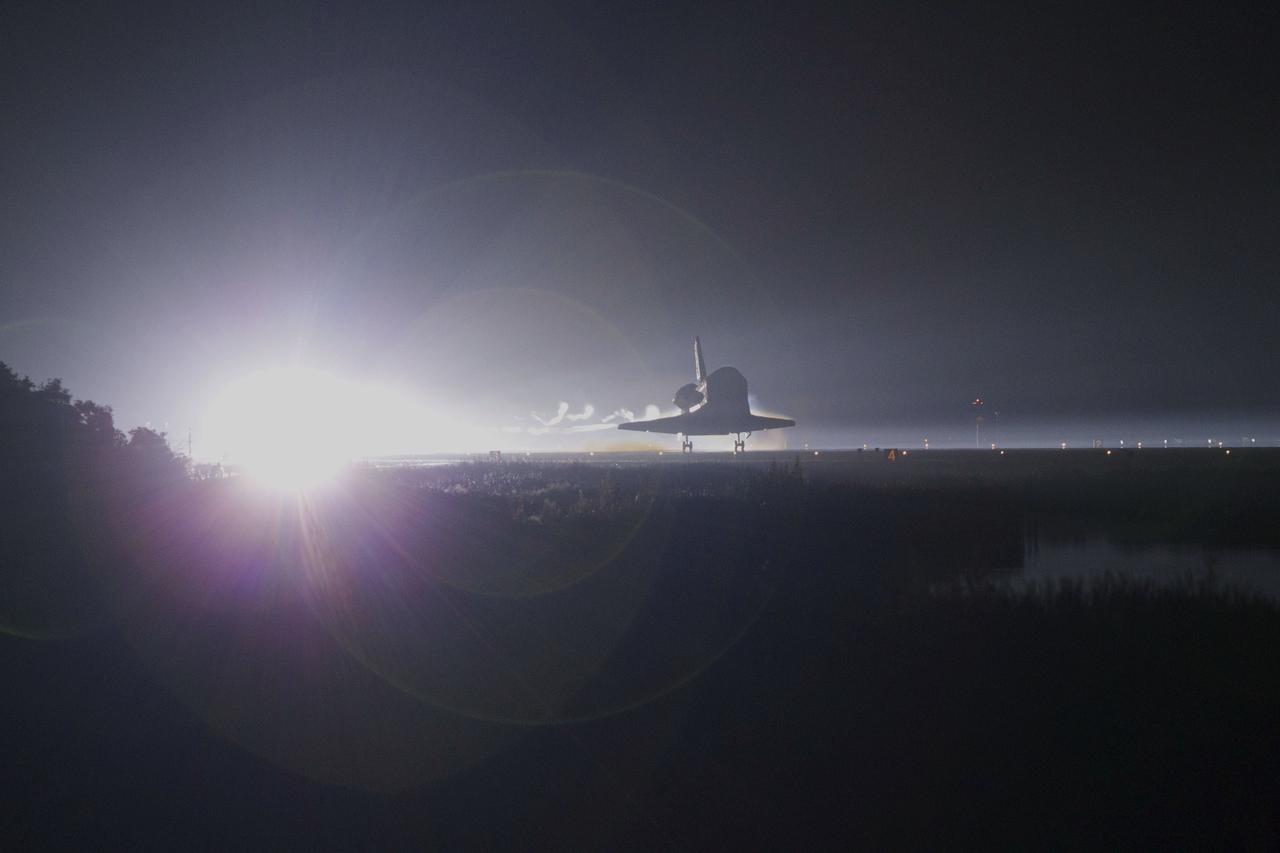
CAPE CANAVERAL, Fla. -- Xenon lights spotlight space shuttle Atlantis as the spacecraft nears touchdown for the last time on Runway 15 at NASA's Kennedy Space Center in Florida. Securing the space shuttle fleet's place in history, Atlantis marked the 26th nighttime landing of NASA's Space Shuttle Program and the 78th landing at Kennedy. Main gear touchdown was at 5:57:00 a.m. EDT, followed by nose gear touchdown at 5:57:20 a.m., and wheelstop at 5:57:54 a.m. On board are STS-135 Commander Chris Ferguson, Pilot Doug Hurley, and Mission Specialists Sandra Magnus and Rex Walheim. On the 37th shuttle mission to the International Space Station, STS-135 delivered the Raffaello multi-purpose logistics module filled with more than 9,400 pounds of spare parts, equipment and supplies that will sustain station operations for the next year. STS-135 was the 33rd and final flight for Atlantis, which has spent 307 days in space, orbited Earth 4,848 times and traveled 125,935,769 miles. STS-135 also was the final mission of the Space Shuttle Program. For more information, visit www.nasa.gov/mission_pages/shuttle/shuttlemissions/sts135/index.html. Photo credit: NASA/Kenny Allen
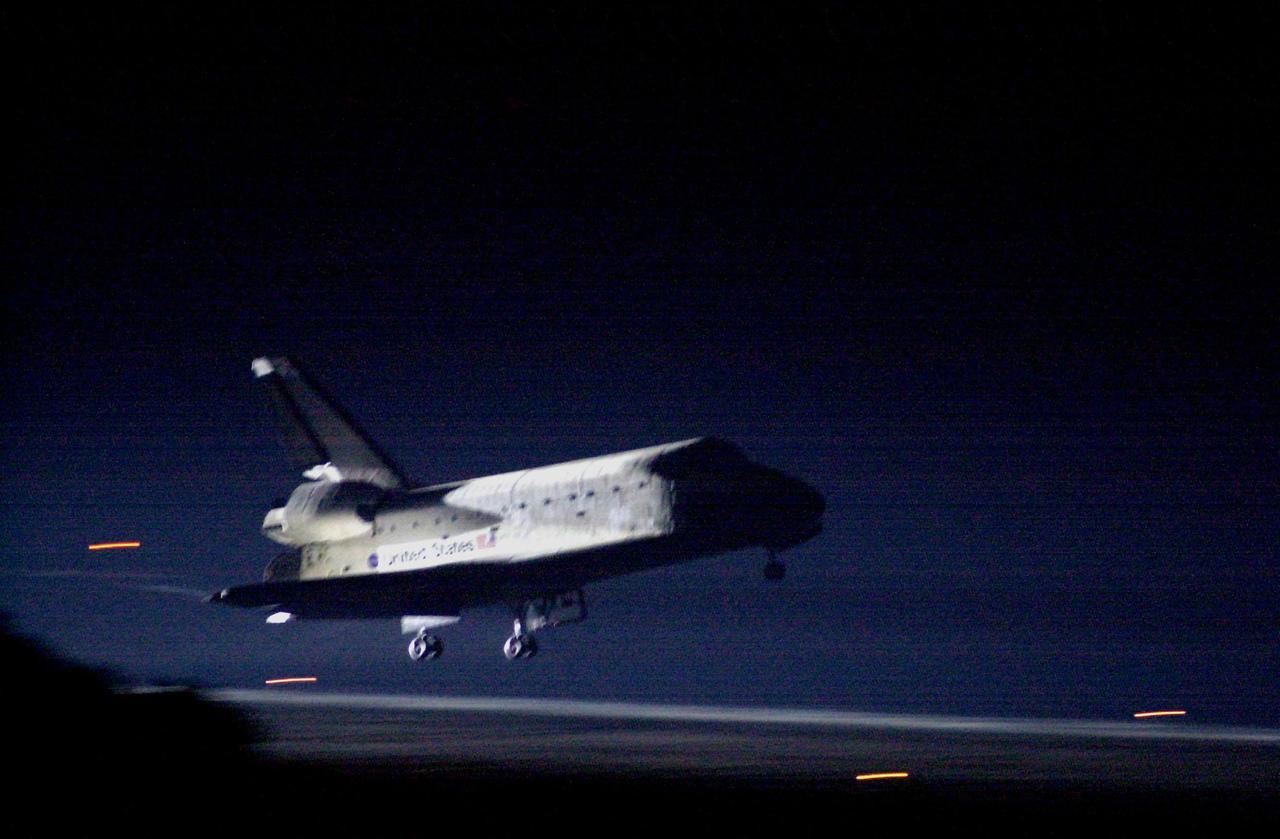
KENNEDY SPACE CENTER, Fla. -- Space Shuttle Atlantis glows from the landing lights as it nears touchdown on KSC’s Shuttle Landing Facility Runway 15 to complete the 9-day, 20-hour, 9-minute-long STS-101 mission. At the controls are Commander James D. Halsell Jr. and Pilot Scott "Doc" Horowitz. Also onboard the orbiter are Mission Specialists Mary Ellen Weber, James S. Voss, Jeffrey N. Williams, Susan J. Helms and Yury Usachev of Russia. The crew is returning from the third flight to the International Space Station. This was the 98th flight in the Space Shuttle program and the 21<sup>st</sup> for Atlantis, also marking the 51st landing at KSC, the 22nd consecutive landing at KSC, and the 29th in the last 30 Shuttle flights. Main gear touchdown was at 2:20:17 a.m. EDT, landing on orbit 155 of the mission. Nose gear touchdown was at 2:20:30 a.m. EDT, and wheel stop at 2:21:19 a.m. EDT
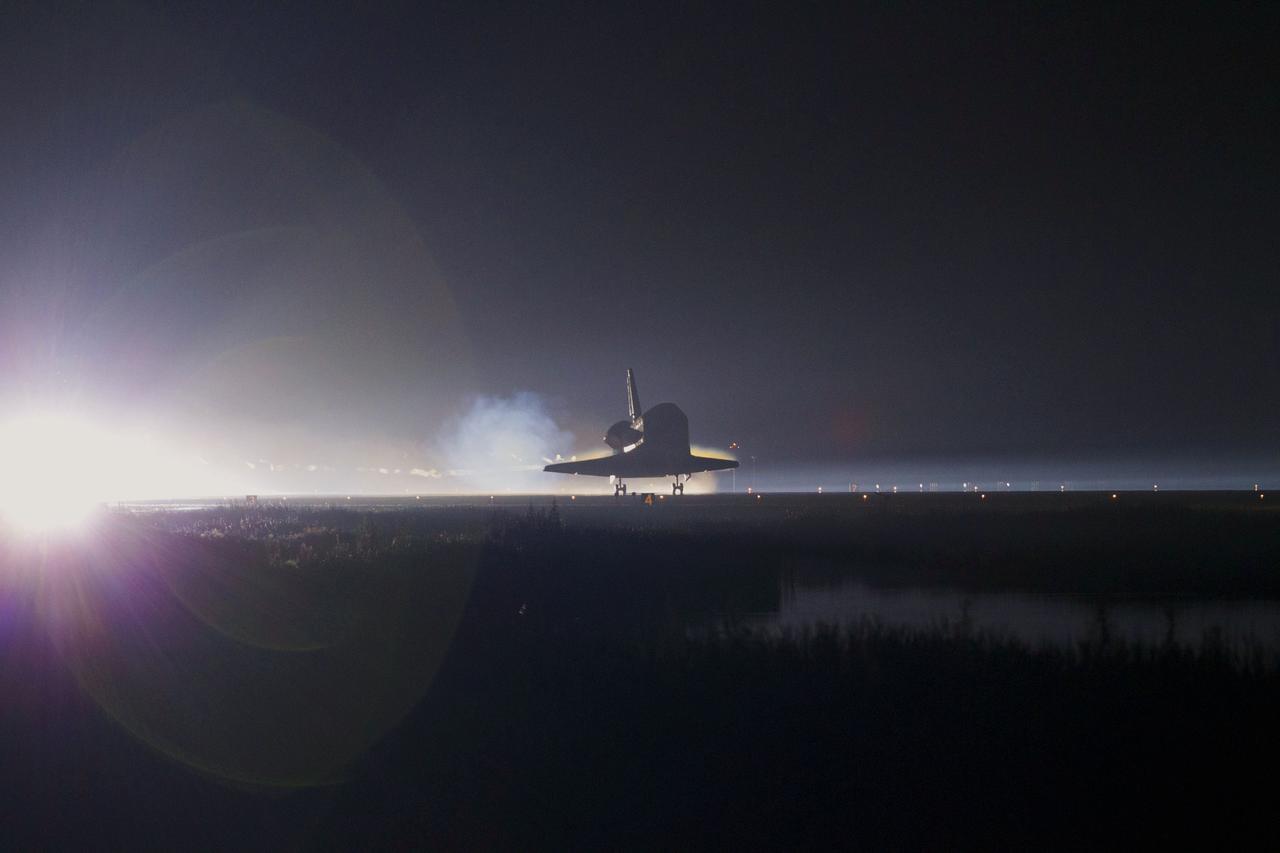
STS135-S-245 (21 July 2011) --- Xenon lights guide space shuttle Atlantis as it lands on the Shuttle Landing Facility's Runway 15 at NASA's Kennedy Space Center in Florida for the final time. Securing the space shuttle fleet's place in history, Atlantis marked the 26th nighttime landing of NASA's Space Shuttle Program and the 78th landing at Kennedy. Main gear touchdown was at 5:57:00 a.m. (EDT) on July 21, 2011, followed by nose gear touchdown at 5:57:20 a.m., and wheelstop at 5:57:54 a.m. Onboard are NASA astronauts Chris Ferguson, STS-135 commander; Doug Hurley, pilot; Sandy Magnus and Rex Walheim, both mission specialists. On the 37th shuttle mission to the International Space Station, STS-135 delivered more than 9,400 pounds of spare parts, equipment and supplies in the Raffaello multi-purpose logistics module that will sustain station operations for the next year. STS-135 was the 33rd and final flight for Atlantis, which has spent 307 days in space, orbited Earth 4,848 times and traveled 125,935,769 miles. Photo credit: NASA
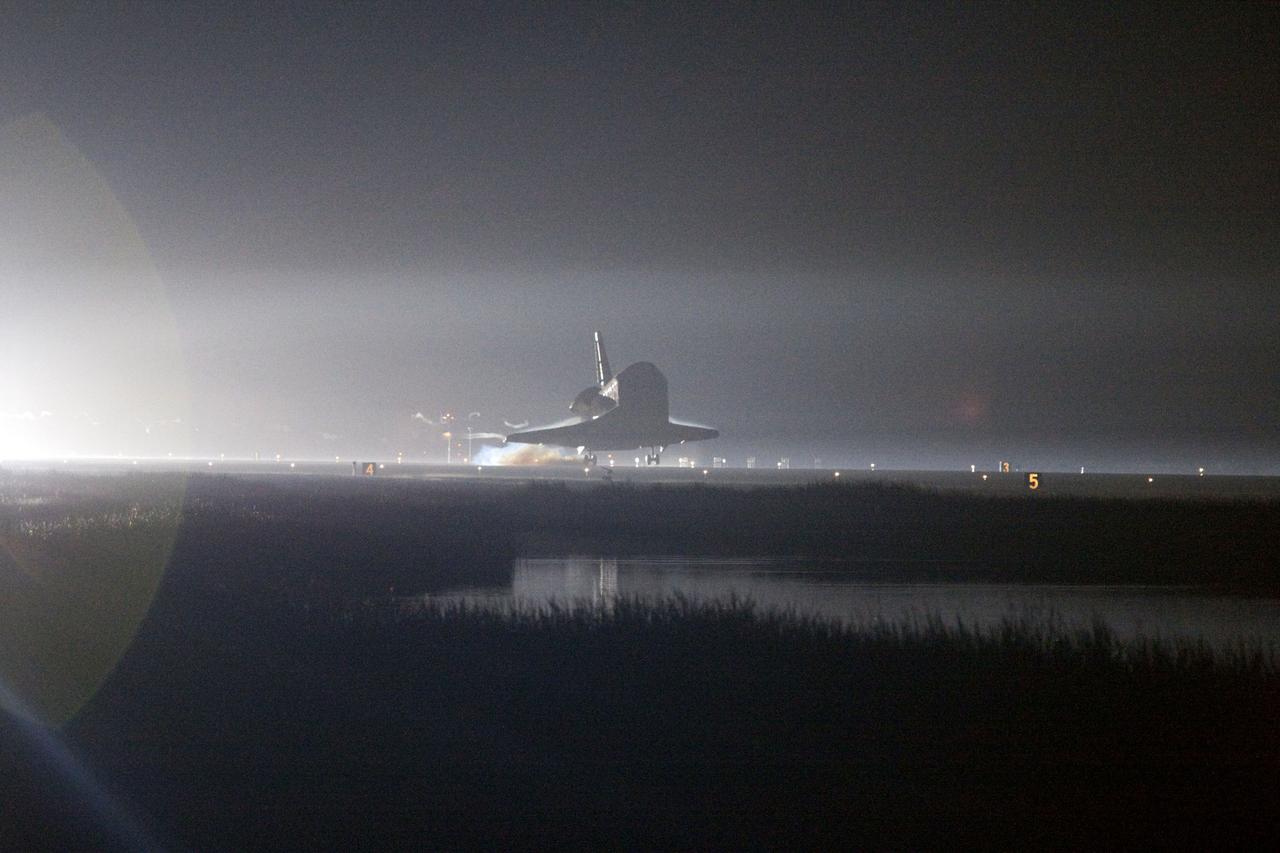
STS134-S-077 (1 June 2011) --- Xenon lights help lead space shuttle Endeavour home to NASA's Kennedy Space Center in Florida. Endeavour landed for the final time on the Shuttle Landing Facility's Runway 15, marking the 24th night landing of NASA's Space Shuttle Program. Main gear touchdown was at 2:34:51 a.m. (EDT) on June 1, 2011, followed by nose gear touchdown at 2:35:04 a.m., and wheelstop at 2:35:36 a.m. Onboard are NASA astronauts Mark Kelly, STS-134 commander; Greg H. Johnson, pilot; Michael Fincke, Andrew Feustel, Greg Chamitoff and European Space Agency astronaut Roberto Vittori, all mission specialists. STS-134 delivered the Alpha Magnetic Spectrometer-2 (AMS) and the Express Logistics Carrier-3 (ELC-3) to the International Space Station. AMS will help researchers understand the origin of the universe and search for evidence of dark matter, strange matter and antimatter from the station. ELC-3 carried spare parts that will sustain station operations once the shuttles are retired from service. STS-134 was the 25th and final flight for Endeavour, which has spent 299 days in space, orbited Earth 4,671 times and traveled 122,883,151 miles. Photo credit: NASA
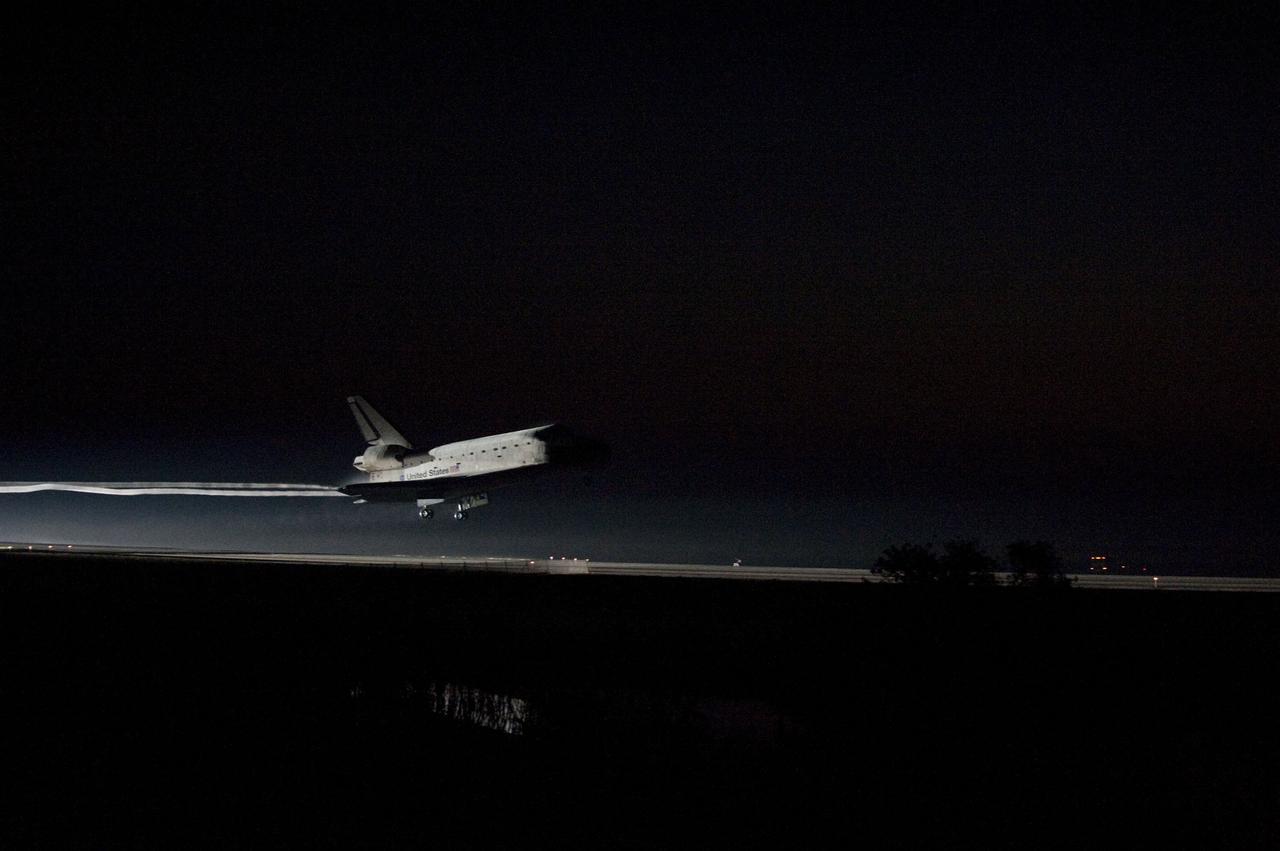
STS135-S-173 (21 July 2011) --- Xenon lights guide space shuttle Atlantis down on the Shuttle Landing Facility's Runway 15 at NASA's Kennedy Space Center in Florida for the final time. Securing the space shuttle fleet's place in history, Atlantis marked the 26th nighttime landing of NASA's Space Shuttle Program and the 78th landing at Kennedy. Main gear touchdown was at 5:57:00 a.m. (EDT) on July 21, 2011, followed by nose gear touchdown at 5:57:20 a.m., and wheelstop at 5:57:54 a.m. Onboard are NASA astronauts Chris Ferguson, STS-135 commander; Doug Hurley, pilot; Sandy Magnus and Rex Walheim, both mission specialists. On the 37th shuttle mission to the International Space Station, STS-135 delivered more than 9,400 pounds of spare parts, equipment and supplies in the Raffaello multi-purpose logistics module that will sustain station operations for the next year. STS-135 was the 33rd and final flight for Atlantis, which has spent 307 days in space, orbited Earth 4,848 times and traveled 125,935,769 miles. Photo credit: NASA
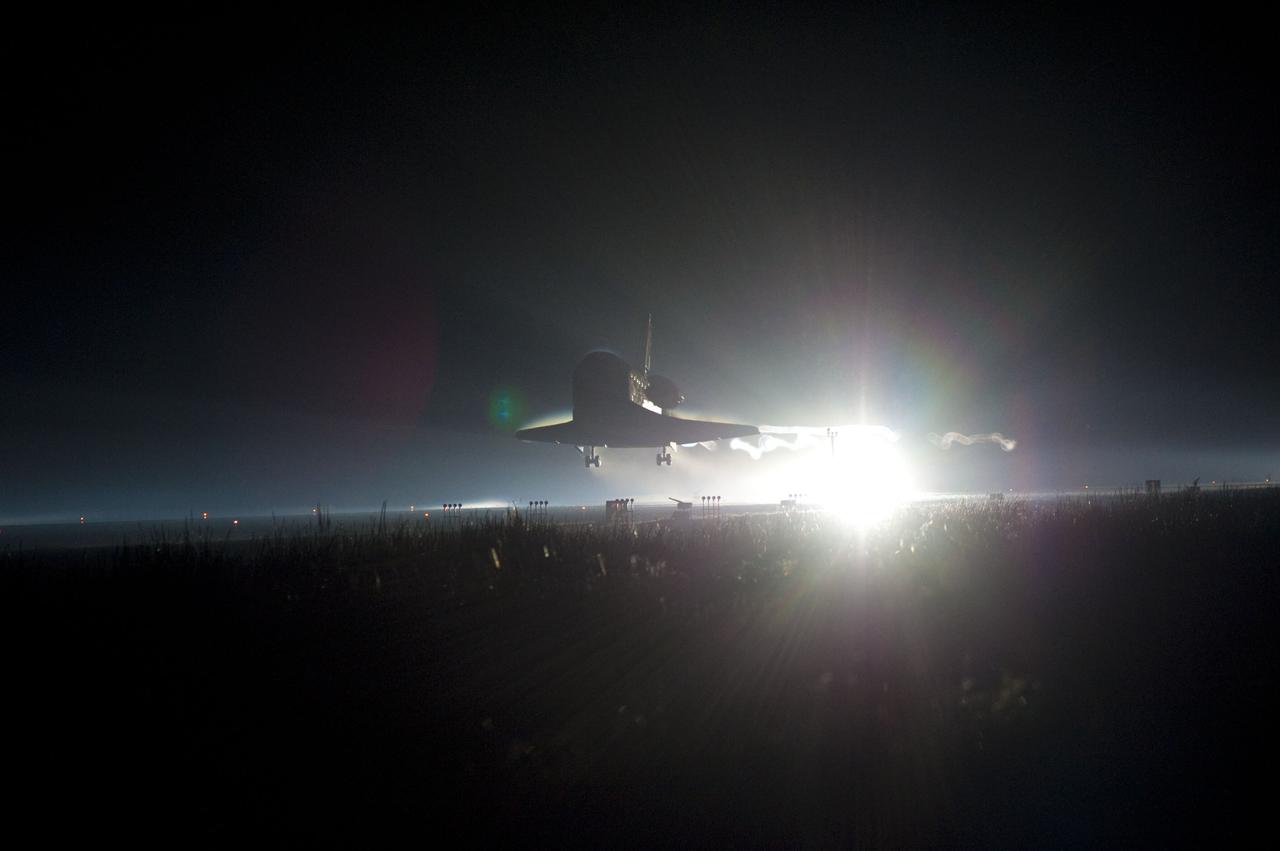
CAPE CANAVERAL, Fla. -- Backlit by the xenon lights on Runway 15 at the Shuttle Landing Facility, space shuttle Atlantis nears touchdown for the final time at NASA's Kennedy Space Center in Florida. Securing the space shuttle fleet's place in history, Atlantis marked the 26th nighttime landing of NASA's Space Shuttle Program and the 78th landing at Kennedy. Main gear touchdown was at 5:57:00 a.m. EDT, followed by nose gear touchdown at 5:57:20 a.m., and wheelstop at 5:57:54 a.m. On board are STS-135 Commander Chris Ferguson, Pilot Doug Hurley, and Mission Specialists Sandra Magnus and Rex Walheim. On the 37th shuttle mission to the International Space Station, STS-135 delivered the Raffaello multi-purpose logistics module filled with more than 9,400 pounds of spare parts, equipment and supplies that will sustain station operations for the next year. STS-135 was the 33rd and final flight for Atlantis, which has spent 307 days in space, orbited Earth 4,848 times and traveled 125,935,769 miles. STS-135 also was the final mission of the Space Shuttle Program. For more information, visit www.nasa.gov/mission_pages/shuttle/shuttlemissions/sts135/index.html. Photo credit: NASA/Chad Baumer
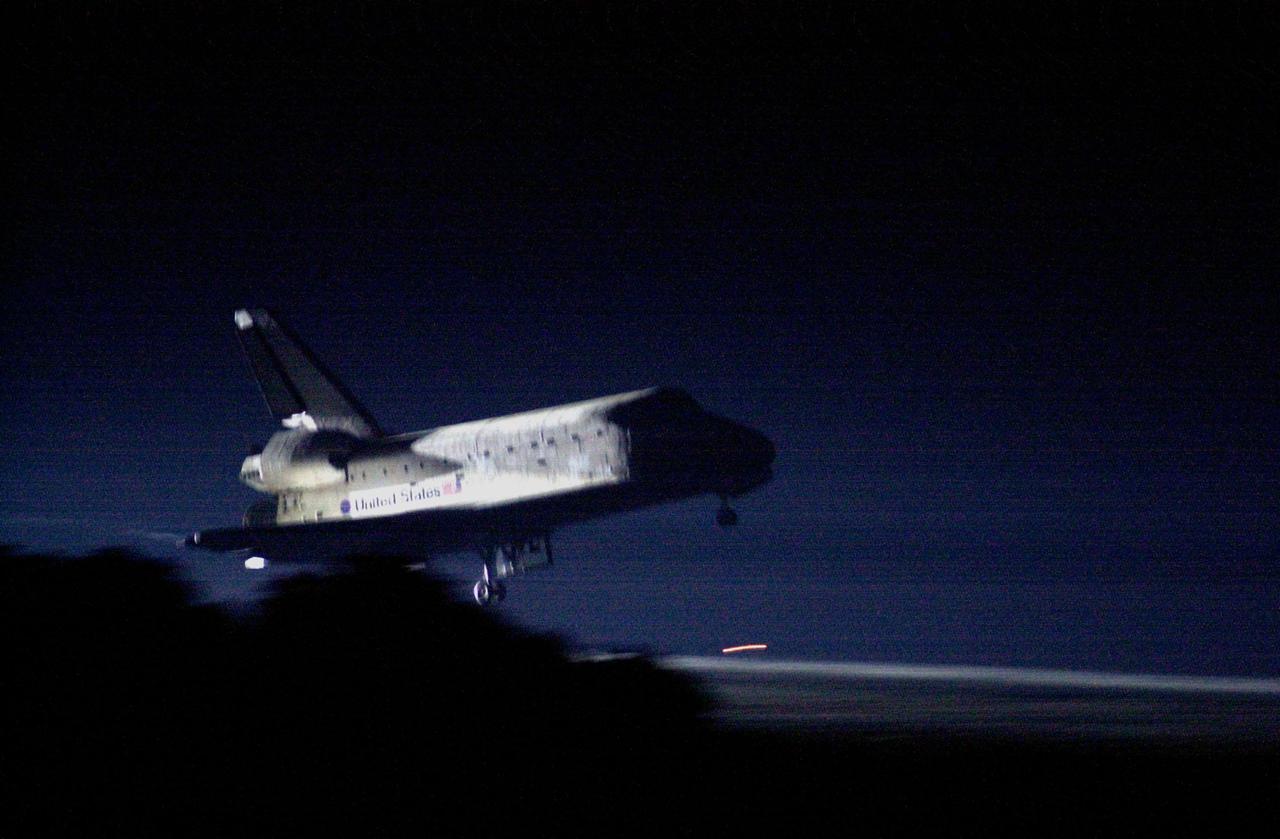
KENNEDY SPACE CENTER, Fla. -- Landing lights illuminate Space Shuttle Atlantis as it approaches touchdown on KSC’s Shuttle Landing Facility Runway 15 to complete the 9-day, 20-hour, 9-minute-long STS-101 mission. At the controls are Commander James D. Halsell Jr. and Pilot Scott “Doc” Horowitz. Also onboard the orbiter are Mission Specialists Mary Ellen Weber, James S. Voss, Jeffrey N. Williams, Susan J. Helms and Yury Usachev of Russia. The crew is returning from the third flight to the International Space Station. This was the 98th flight in the Space Shuttle program and the 21st for Atlantis, also marking the 51st landing at KSC, the 22nd consecutive landing at KSC, and the 29th in the last 30 Shuttle flights. Main gear touchdown was at 2:20:17 a.m. EDT, landing on orbit 155 of the mission. Nose gear touchdown was at 2:20:30 a.m. EDT, and wheel stop at 2:21:19 a.m. EDT

STS135-S-244 (21 July 2011) --- A halo of light engulfs space shuttle Atlantis as the spacecraft touches down for the last time on Runway 15 at NASA's Kennedy Space Center in Florida. Securing the space shuttle fleet's place in history, Atlantis marked the 26th nighttime landing of NASA's Space Shuttle Program and the 78th landing at Kennedy. Main gear touchdown was at 5:57:00 a.m. (EDT) on July 21, 2011, followed by nose gear touchdown at 5:57:20 a.m., and wheelstop at 5:57:54 a.m. Onboard are NASA astronauts Chris Ferguson, STS-135 commander; Doug Hurley, pilot; Sandy Magnus and Rex Walheim, both mission specialists. On the 37th shuttle mission to the International Space Station, STS-135 delivered more than 9,400 pounds of spare parts, equipment and supplies in the Raffaello multi-purpose logistics module that will sustain station operations for the next year. STS-135 was the 33rd and final flight for Atlantis, which has spent 307 days in space, orbited Earth 4,848 times and traveled 125,935,769 miles. Photo credit: NASA
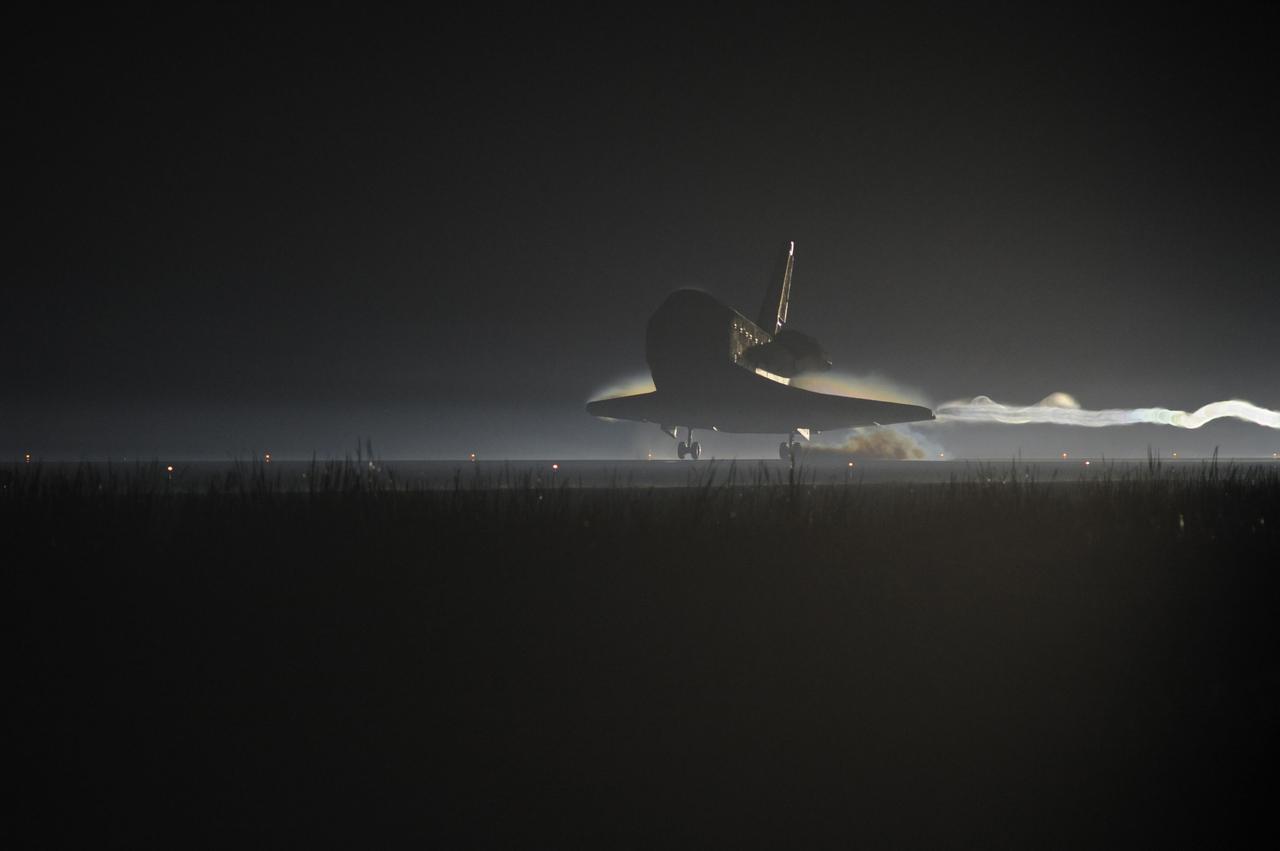
CAPE CANAVERAL, Fla. -- Space shuttle Atlantis creates its own xenon light show as in lands on Runway 15 at the Shuttle Landing Facility at NASA's Kennedy Space Center in Florida. Securing the space shuttle fleet's place in history, Atlantis marked the 26th nighttime landing of NASA's Space Shuttle Program and the 78th landing at Kennedy. Main gear touchdown was at 5:57:00 a.m. EDT, followed by nose gear touchdown at 5:57:20 a.m., and wheelstop at 5:57:54 a.m. On board are STS-135 Commander Chris Ferguson, Pilot Doug Hurley, and Mission Specialists Sandra Magnus and Rex Walheim. On the 37th shuttle mission to the International Space Station, STS-135 delivered in the Raffaello multi-purpose logistics module more than 9,400 pounds of spare parts, equipment and supplies that will sustain station operations for the next year. STS-135 was the 33rd and final flight for Atlantis, which has spent 307 days in space, orbited Earth 4,848 times and traveled 125,935,769 miles. STS-135 is the final mission in the Space Shuttle Program. For more information, visit www.nasa.gov/mission_pages/shuttle/shuttlemissions/sts135/index.html. Photo credit: NASA/Chuck Tintera
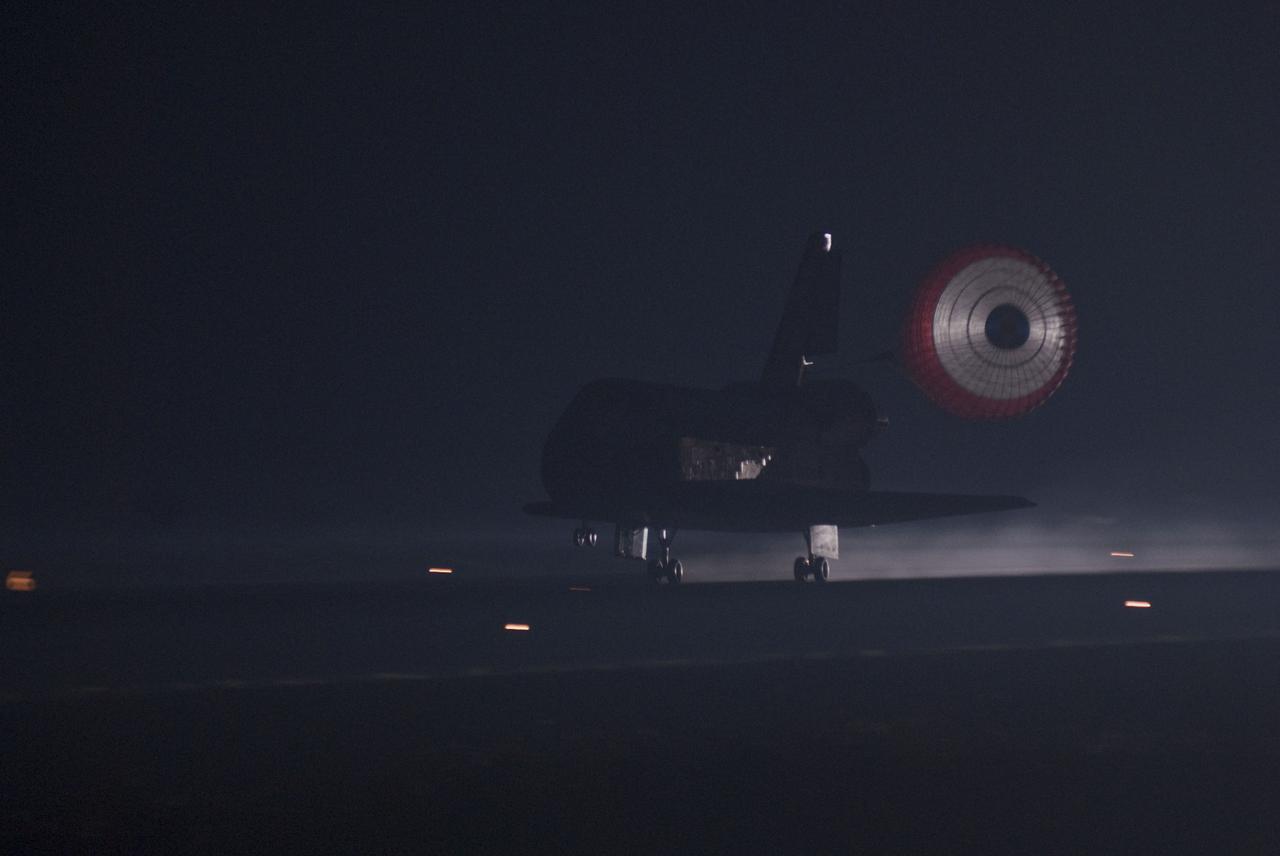
STS135-S-166 (21 July 2011) --- Xenon lights illuminate space shuttle Atlantis' unfurled drag chute as the vehicle rolls to a stop on the Shuttle Landing Facility's Runway 15 at NASA's Kennedy Space Center in Florida for the final time. Securing the space shuttle fleet's place in history, Atlantis marked the 26th nighttime landing of NASA's Space Shuttle Program and the 78th landing at Kennedy. Main gear touchdown was at 5:57:00 a.m. (EDT) on July 21, 2011, followed by nose gear touchdown at 5:57:20 a.m., and wheelstop at 5:57:54 a.m. Onboard are NASA astronauts Chris Ferguson, STS-135 commander; Doug Hurley, pilot; Sandy Magnus and Rex Walheim, both mission specialists. On the 37th shuttle mission to the International Space Station, STS-135 delivered more than 9,400 pounds of spare parts, equipment and supplies in the Raffaello multi-purpose logistics module that will sustain station operations for the next year. STS-135 was the 33rd and final flight for Atlantis, which has spent 307 days in space, orbited Earth 4,848 times and traveled 125,935,769 miles. Photo credit: NASA
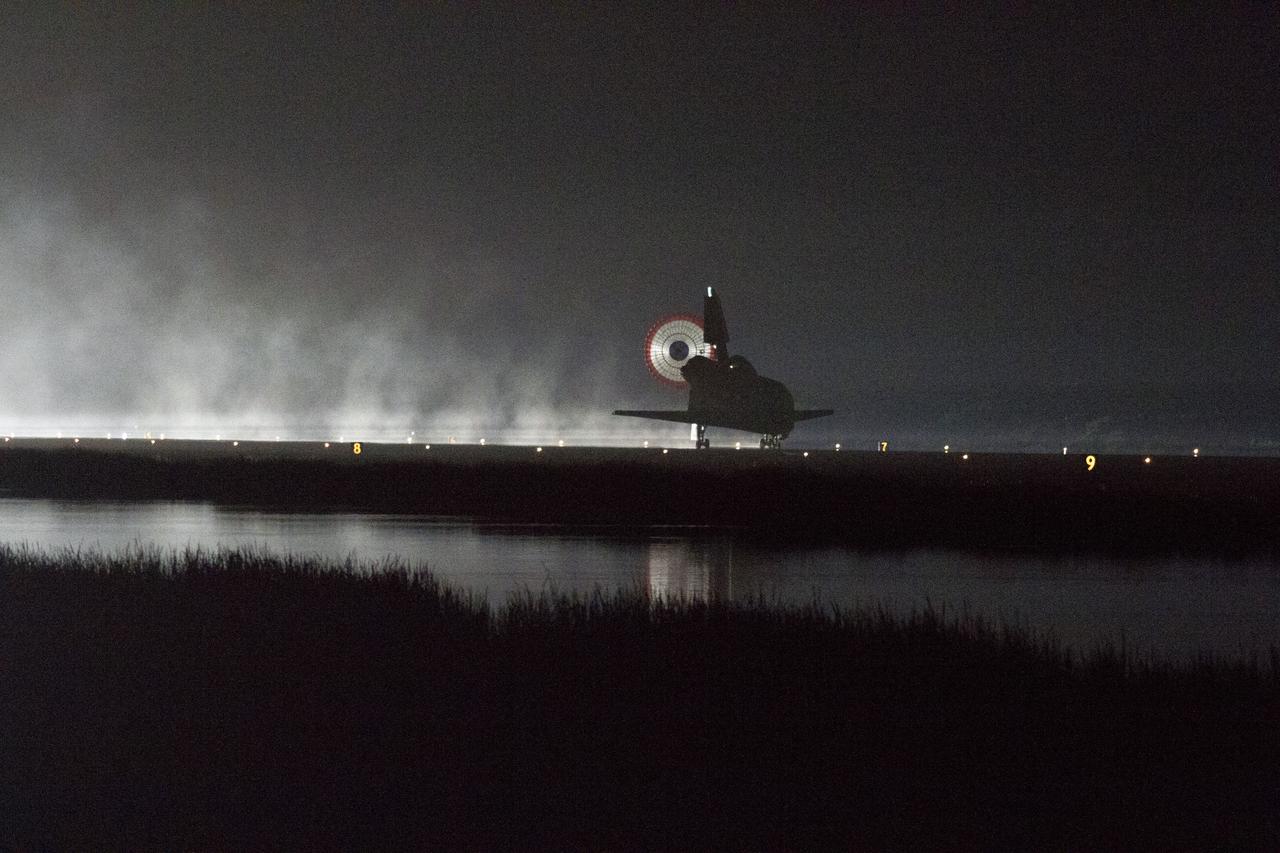
CAPE CANAVERAL, Fla. -- Xenon lights illuminate space shuttle Endeavour's unfurled drag chute as the vehicle rolls to a stop on the Shuttle Landing Facility's Runway 15 at NASA's Kennedy Space Center in Florida for the final time. Main gear touchdown was at 2:34:51 a.m. EDT, followed by nose gear touchdown at 2:35:04 a.m., and wheelstop at 2:35:36 a.m. On board are STS-134 Commander Mark Kelly, Pilot Greg H. Johnson, and Mission Specialists Mike Fincke, Drew Feustel, Greg Chamitoff and the European Space Agency's Roberto Vittori. STS-134 delivered the Alpha Magnetic Spectrometer-2 (AMS) and the Express Logistics Carrier-3 (ELC-3) to the International Space Station. AMS will help researchers understand the origin of the universe and search for evidence of dark matter, strange matter and antimatter from the station. ELC-3 carried spare parts that will sustain station operations once the shuttles are retired from service. STS-134 was the 25th and final flight for Endeavour, which has spent 299 days in space, orbited Earth 4,671 times and traveled 122,883,151 miles. Photo credit: NASA/Kenny Allen
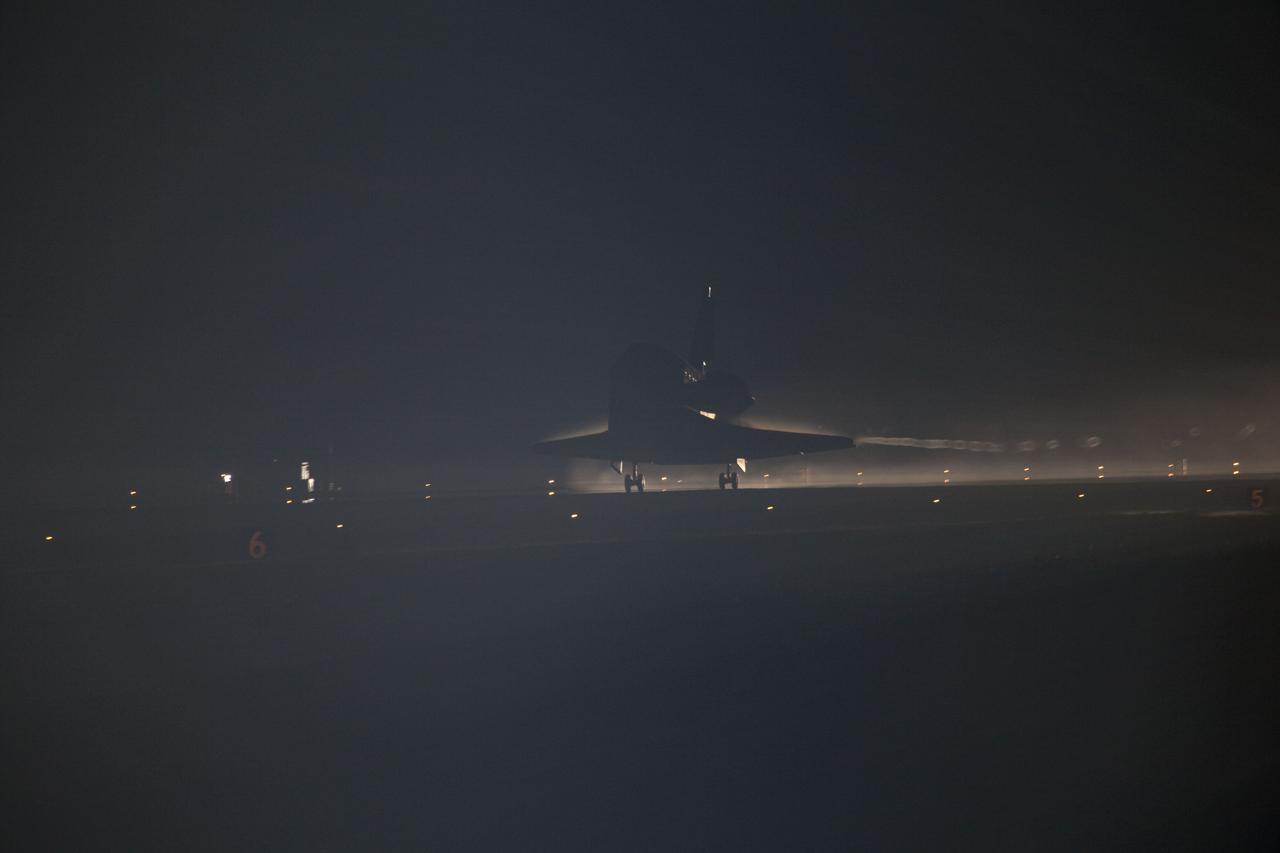
STS135-S-169 (21 July 2011) --- Xenon lights guide space shuttle Atlantis down on the Shuttle Landing Facility's Runway 15 at NASA's Kennedy Space Center in Florida for the final time. Securing the space shuttle fleet's place in history, Atlantis marked the 26th nighttime landing of NASA's Space Shuttle Program and the 78th landing at Kennedy. Main gear touchdown was at 5:57:00 a.m. (EDT) on July 21, 2011, followed by nose gear touchdown at 5:57:20 a.m., and wheelstop at 5:57:54 a.m. Onboard are NASA astronauts Chris Ferguson, STS-135 commander; Doug Hurley, pilot; Sandy Magnus and Rex Walheim, both mission specialists. On the 37th shuttle mission to the International Space Station, STS-135 delivered more than 9,400 pounds of spare parts, equipment and supplies in the Raffaello multi-purpose logistics module that will sustain station operations for the next year. STS-135 was the 33rd and final flight for Atlantis, which has spent 307 days in space, orbited Earth 4,848 times and traveled 125,935,769 miles. Photo credit: NASA
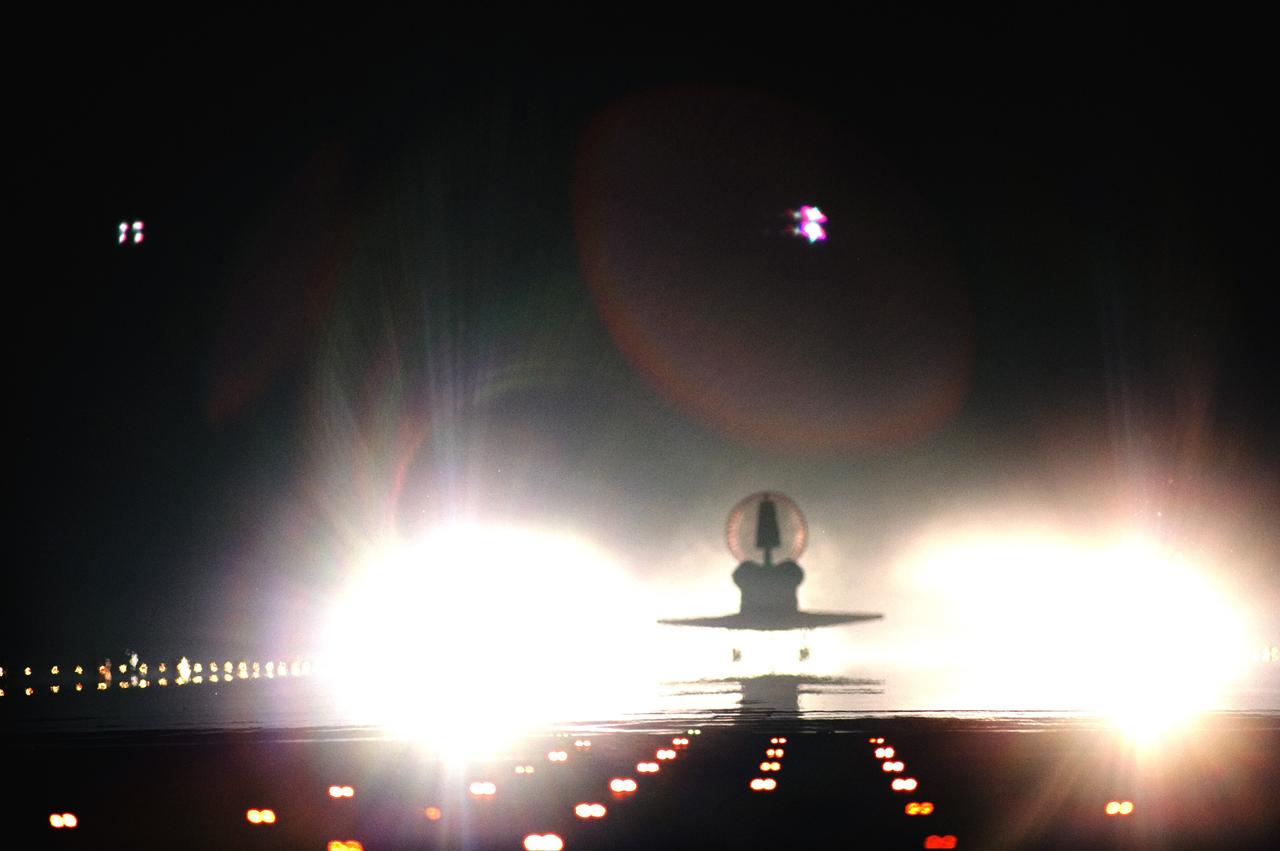
CAPE CANAVERAL, Fla. -- Xenon lights positioned at the end of Runway 15 spotlight space shuttle Atlantis as it nears touchdown for the last time at NASA's Kennedy Space Center in Florida. Securing the space shuttle fleet's place in history, Atlantis marked the 26th nighttime landing of NASA's Space Shuttle Program and the 78th landing at Kennedy. Main gear touchdown was at 5:57:00 a.m. EDT, followed by nose gear touchdown at 5:57:20 a.m., and wheelstop at 5:57:54 a.m. On board are STS-135 Commander Chris Ferguson, Pilot Doug Hurley, and Mission Specialists Sandy Magnus and Rex Walheim. On the 37th shuttle mission to the International Space Station, STS-135 delivered the Raffaello multi-purpose logistics module filled with more than 9,400 pounds of spare parts, equipment and supplies that will sustain station operations for the next year. STS-135 was the 33rd and final flight for Atlantis, which has spent 307 days in space, orbited Earth 4,848 times and traveled 125,935,769 miles. STS-135 also was the final mission of the Space Shuttle Program. For more information, visit www.nasa.gov/mission_pages/shuttle/shuttlemissions/sts135/index.html. Photo credit: NASA/Tom Farrar and Tony Gray
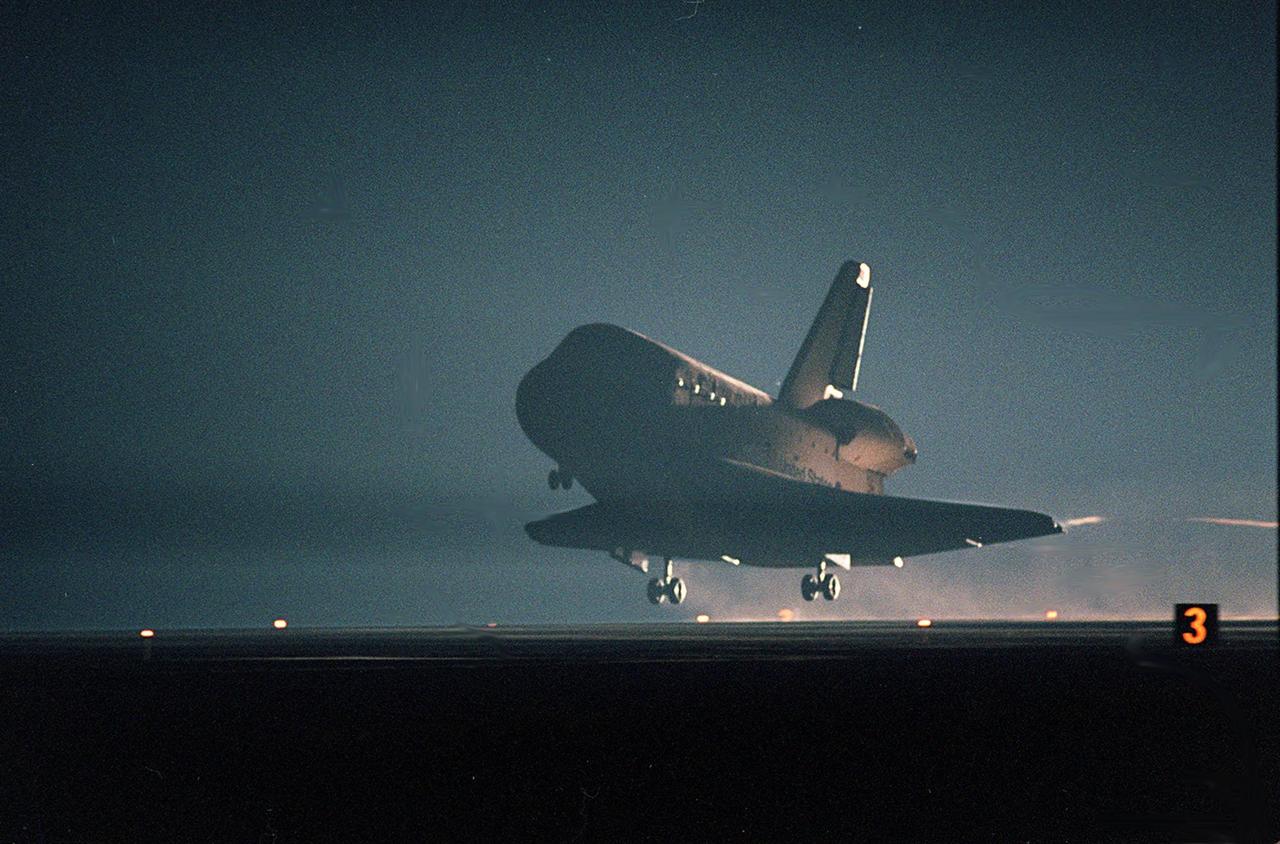
KENNEDY SPACE CENTER, Fla. -- Seen in the landing lights, an illuminated Space Shuttle Atlantis approaches touchdown on KSC’s Shuttle Landing Facility Runway 15 to complete the 9-day, 20-hour, 9-minute-long STS-101 mission. At the controls are Commander James D. Halsell Jr. and Pilot Scott “Doc” Horowitz. Also onboard the orbiter are Mission Specialists Mary Ellen Weber, James S. Voss, Jeffrey N. Williams, Susan J. Helms and Yury Usachev of Russia. The crew is returning from the third flight to the International Space Station. This was the 98th flight in the Space Shuttle program and the 21st for Atlantis, also marking the 51st landing at KSC, the 22nd consecutive landing at KSC, the 14th nighttime landing in Shuttle history and the 29th in the last 30 Shuttle flights. Main gear touchdown was at 2:20:17 a.m. EDT May 29 , landing on orbit 155 of the mission. Nose gear touchdown was at 2:20:30 a.m. EDT, and wheel stop at 2:21:19 a.m. EDT
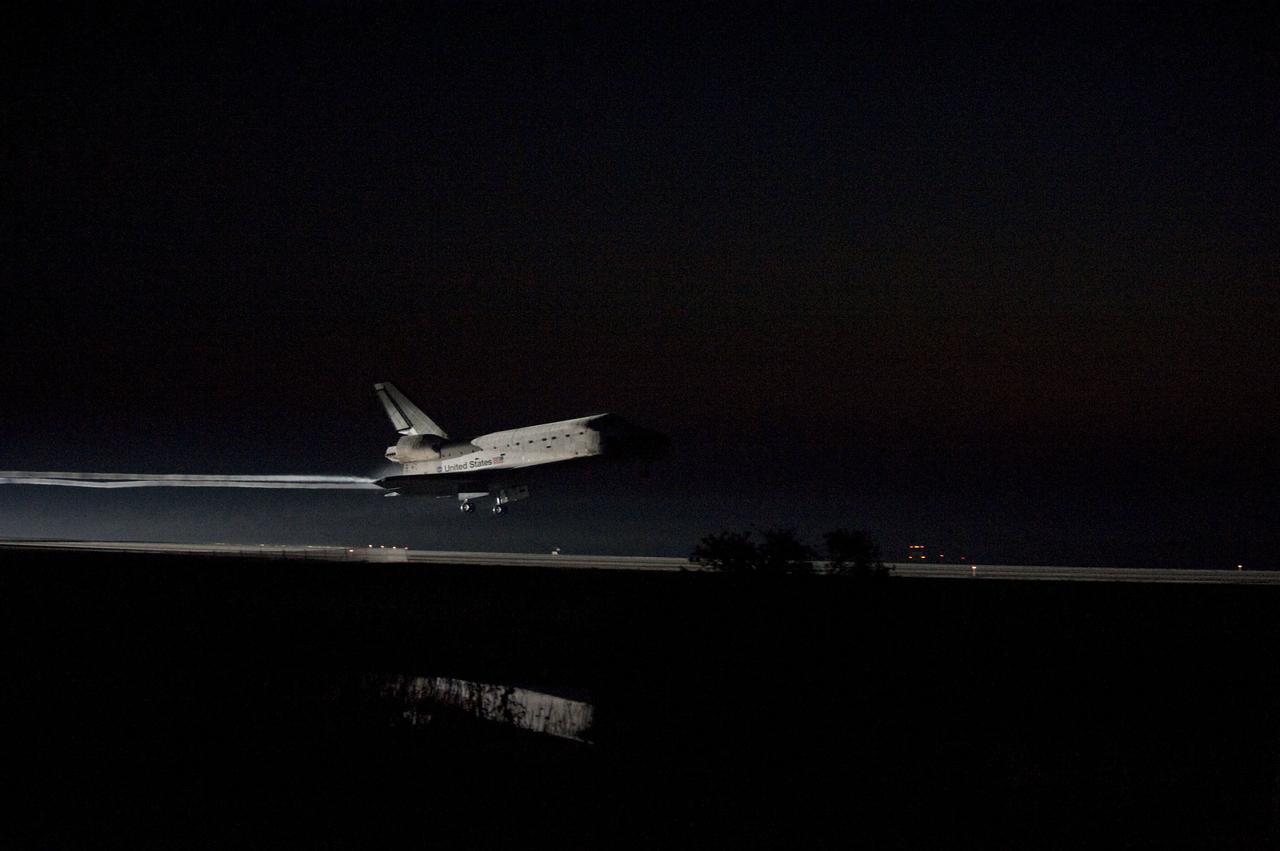
STS135-S-174 (21 July 2011) --- Xenon lights guide space shuttle Atlantis down on the Shuttle Landing Facility's Runway 15 at NASA's Kennedy Space Center in Florida for the final time. Securing the space shuttle fleet's place in history, Atlantis marked the 26th nighttime landing of NASA's Space Shuttle Program and the 78th landing at Kennedy. Main gear touchdown was at 5:57:00 a.m. (EDT) on July 21, 2011, followed by nose gear touchdown at 5:57:20 a.m., and wheelstop at 5:57:54 a.m. Onboard are NASA astronauts Chris Ferguson, STS-135 commander; Doug Hurley, pilot; Sandy Magnus and Rex Walheim, both mission specialists. On the 37th shuttle mission to the International Space Station, STS-135 delivered more than 9,400 pounds of spare parts, equipment and supplies in the Raffaello multi-purpose logistics module that will sustain station operations for the next year. STS-135 was the 33rd and final flight for Atlantis, which has spent 307 days in space, orbited Earth 4,848 times and traveled 125,935,769 miles. Photo credit: NASA
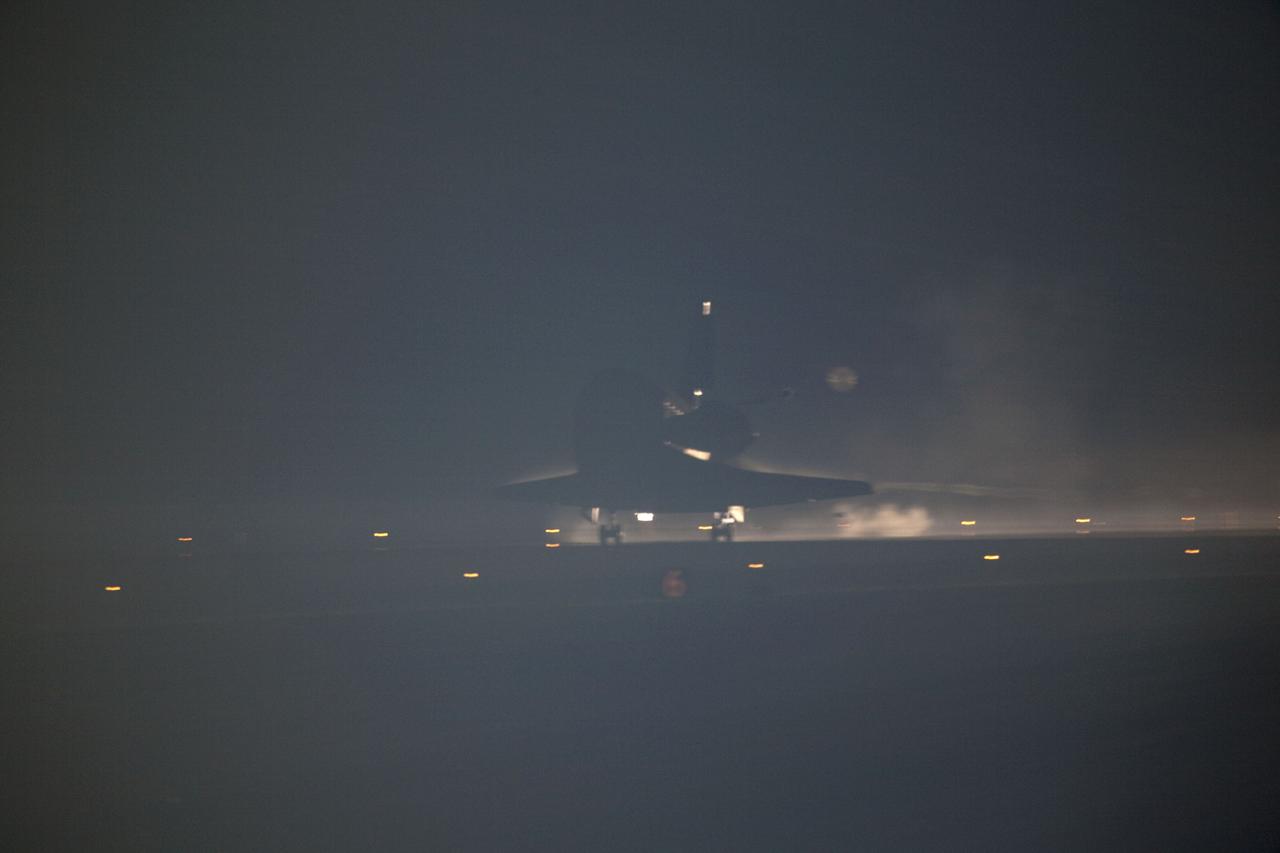
CAPE CANAVERAL, Fla. -- Xenon lights guide space shuttle Atlantis down on the Shuttle Landing Facility's Runway 15 at NASA's Kennedy Space Center in Florida for the final time. Securing the space shuttle fleet's place in history, Atlantis marked the 26th nighttime landing of NASA's Space Shuttle Program and the 78th landing at Kennedy. Main gear touchdown was at 5:57:00 a.m. EDT, followed by nose gear touchdown at 5:57:20 a.m., and wheelstop at 5:57:54 a.m. On board are STS-135 Commander Chris Ferguson, Pilot Doug Hurley, and Mission Specialists Sandra Magnus and Rex Walheim. On the 37th shuttle mission to the International Space Station, STS-135 delivered more than 9,400 pounds of spare parts, equipment and supplies in the Raffaello multi-purpose logistics module that will sustain station operations for the next year. STS-135 was the 33rd and final flight for Atlantis, which has spent 307 days in space, orbited Earth 4,848 times and traveled 125,935,769 miles. For more information visit, www.nasa.gov/mission_pages/shuttle/shuttlemissions/sts135/index.html. Photo credit: NASA/Frank Michaux
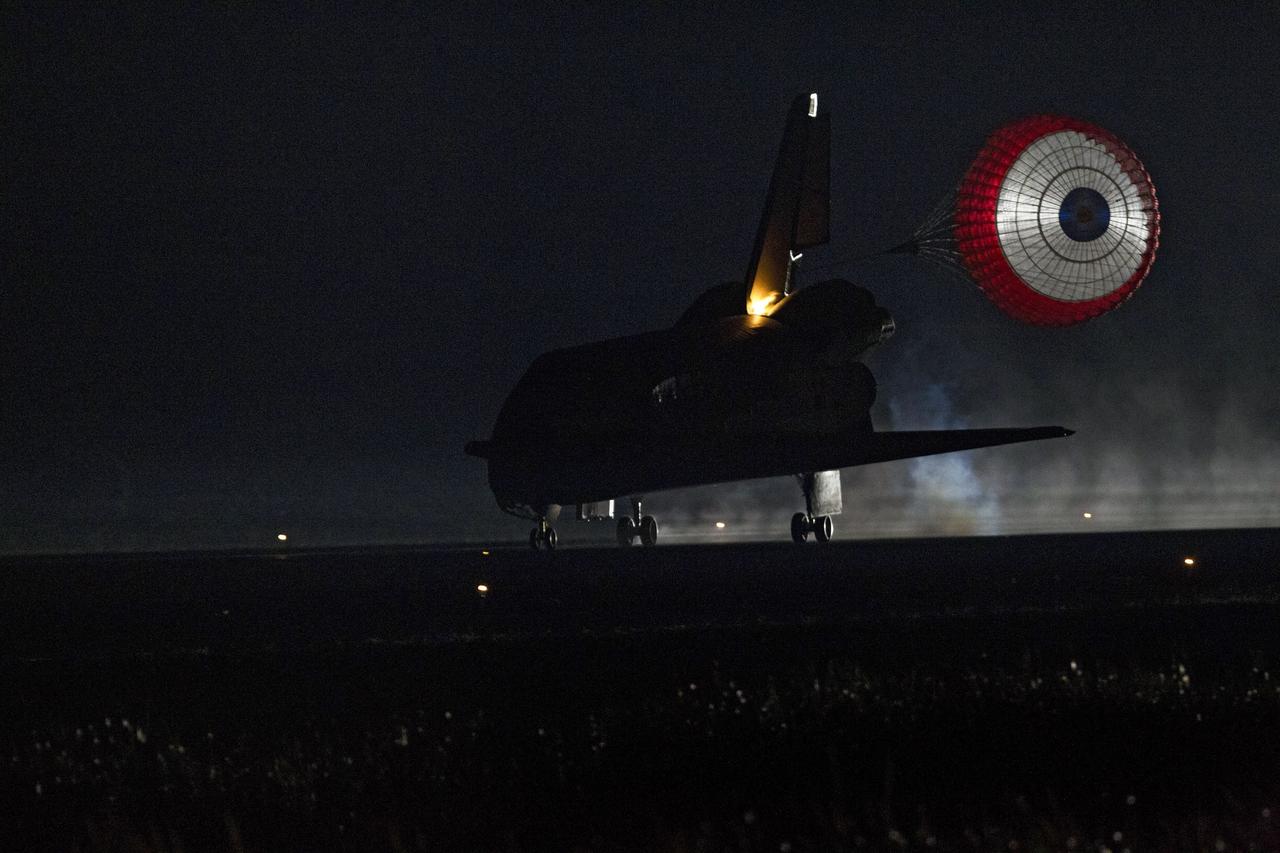
CAPE CANAVERAL, Fla. -- Xenon lights illuminate space shuttle Endeavour's unfurled drag chute as the vehicle rolls to a stop on the Shuttle Landing Facility's Runway 15 at NASA's Kennedy Space Center in Florida for the final time. Main gear touchdown was at 2:34:51 a.m. EDT, followed by nose gear touchdown at 2:35:04 a.m., and wheelstop at 2:35:36 a.m. On board are STS-134 Commander Mark Kelly, Pilot Greg H. Johnson, and Mission Specialists Mike Fincke, Drew Feustel, Greg Chamitoff and the European Space Agency's Roberto Vittori. STS-134 delivered the Alpha Magnetic Spectrometer-2 (AMS) and the Express Logistics Carrier-3 (ELC-3) to the International Space Station. AMS will help researchers understand the origin of the universe and search for evidence of dark matter, strange matter and antimatter from the station. ELC-3 carried spare parts that will sustain station operations once the shuttles are retired from service. STS-134 was the 25th and final flight for Endeavour, which has spent 299 days in space, orbited Earth 4,671 times and traveled 122,883,151 miles. Photo credit: NASA/Tony Gray
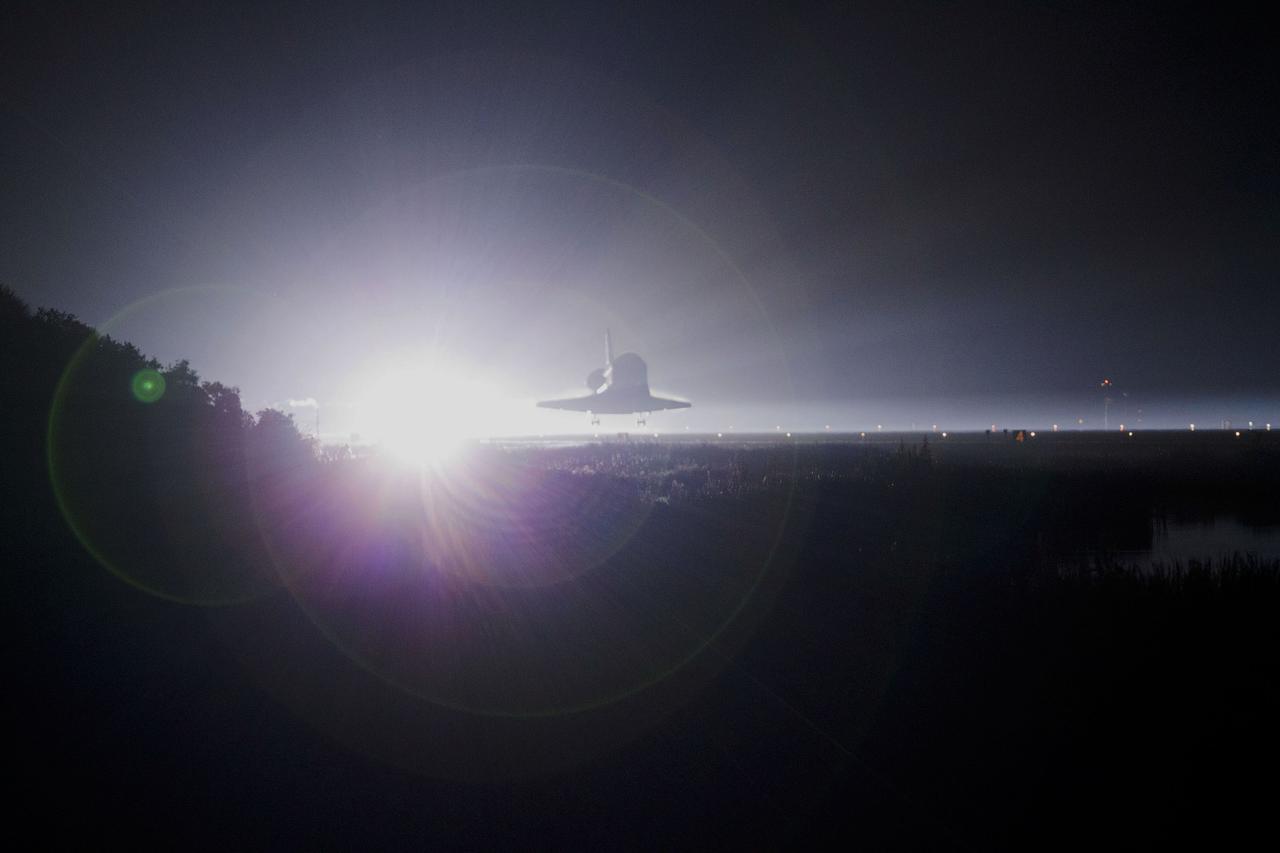
CAPE CANAVERAL, Fla. -- Xenons cast a halo of light on space shuttle Atlantis as the spacecraft nears touchdown for the last time on Runway 15 at NASA's Kennedy Space Center in Florida. Securing the space shuttle fleet's place in history, Atlantis marked the 26th nighttime landing of NASA's Space Shuttle Program and the 78th landing at Kennedy. Main gear touchdown was at 5:57:00 a.m. EDT, followed by nose gear touchdown at 5:57:20 a.m., and wheelstop at 5:57:54 a.m. On board are STS-135 Commander Chris Ferguson, Pilot Doug Hurley, and Mission Specialists Sandra Magnus and Rex Walheim. On the 37th shuttle mission to the International Space Station, STS-135 delivered the Raffaello multi-purpose logistics module filled with more than 9,400 pounds of spare parts, equipment and supplies that will sustain station operations for the next year. STS-135 was the 33rd and final flight for Atlantis, which has spent 307 days in space, orbited Earth 4,848 times and traveled 125,935,769 miles. STS-135 also was the final mission of the Space Shuttle Program. For more information, visit www.nasa.gov/mission_pages/shuttle/shuttlemissions/sts135/index.html. Photo credit: NASA/Kenny Allen
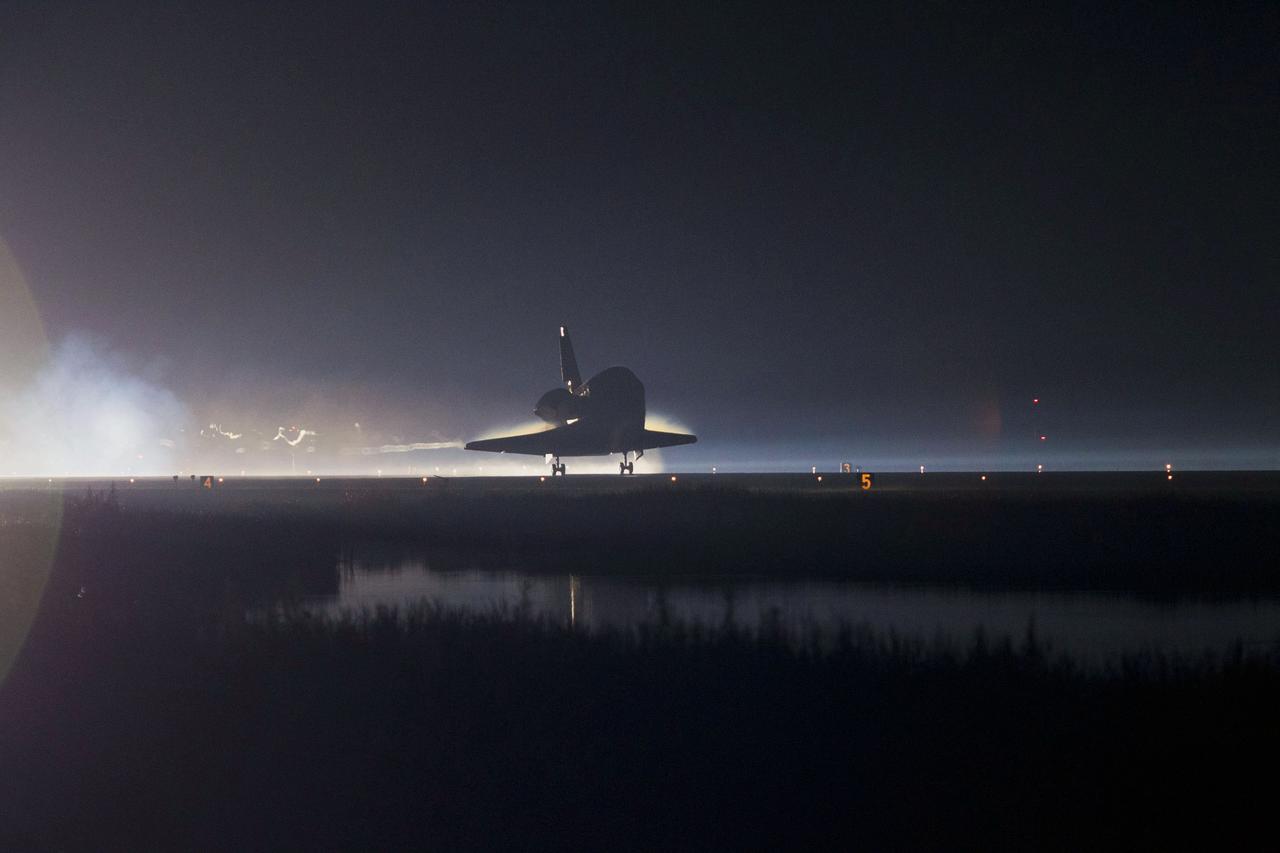
STS135-S-246 (21 July 2011) --- Xenon lights guide space shuttle Atlantis as it lands on the Shuttle Landing Facility's Runway 15 at NASA's Kennedy Space Center in Florida for the final time. Securing the space shuttle fleet's place in history, Atlantis marked the 26th nighttime landing of NASA's Space Shuttle Program and the 78th landing at Kennedy. Main gear touchdown was at 5:57:00 a.m. (EDT) on July 21, 2011, followed by nose gear touchdown at 5:57:20 a.m., and wheelstop at 5:57:54 a.m. Onboard are NASA astronauts Chris Ferguson, STS-135 commander; Doug Hurley, pilot; Sandy Magnus and Rex Walheim, both mission specialists. On the 37th shuttle mission to the International Space Station, STS-135 delivered more than 9,400 pounds of spare parts, equipment and supplies in the Raffaello multi-purpose logistics module that will sustain station operations for the next year. STS-135 was the 33rd and final flight for Atlantis, which has spent 307 days in space, orbited Earth 4,848 times and traveled 125,935,769 miles. Photo credit: NASA
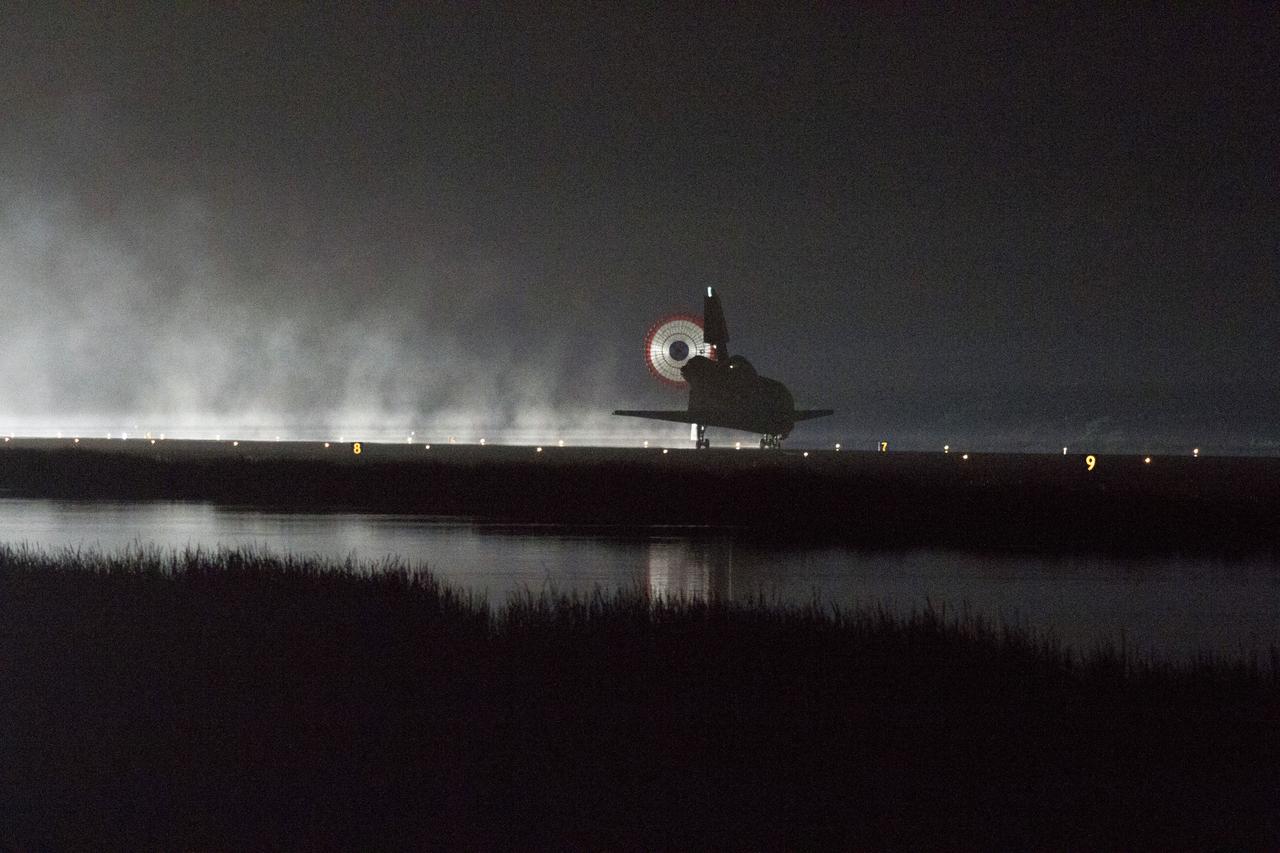
STS134-S-072 (1 June 2011) --- Xenon lights illuminate space shuttle Endeavour's unfurled drag chute as the vehicle rolls to a stop on the Shuttle Landing Facility's Runway 15 at NASA's Kennedy Space Center in Florida for the final time. Main gear touchdown was at 2:34:51 a.m. (EDT) on June 1, 2011, followed by nose gear touchdown at 2:35:04 a.m., and wheelstop at 2:35:36 a.m. Onboard are NASA astronauts Mark Kelly, STS-134 commander; Greg H. Johnson, pilot; Michael Fincke, Andrew Feustel, Greg Chamitoff and European Space Agency astronaut Roberto Vittori, all mission specialists. STS-134 delivered the Alpha Magnetic Spectrometer-2 (AMS) and the Express Logistics Carrier-3 (ELC-3) to the International Space Station. AMS will help researchers understand the origin of the universe and search for evidence of dark matter, strange matter and antimatter from the station. ELC-3 carried spare parts that will sustain station operations once the shuttles are retired from service. STS-134 was the 25th and final flight for Endeavour, which has spent 299 days in space, orbited Earth 4,671 times and traveled 122,883,151 miles. Photo credit: NASA
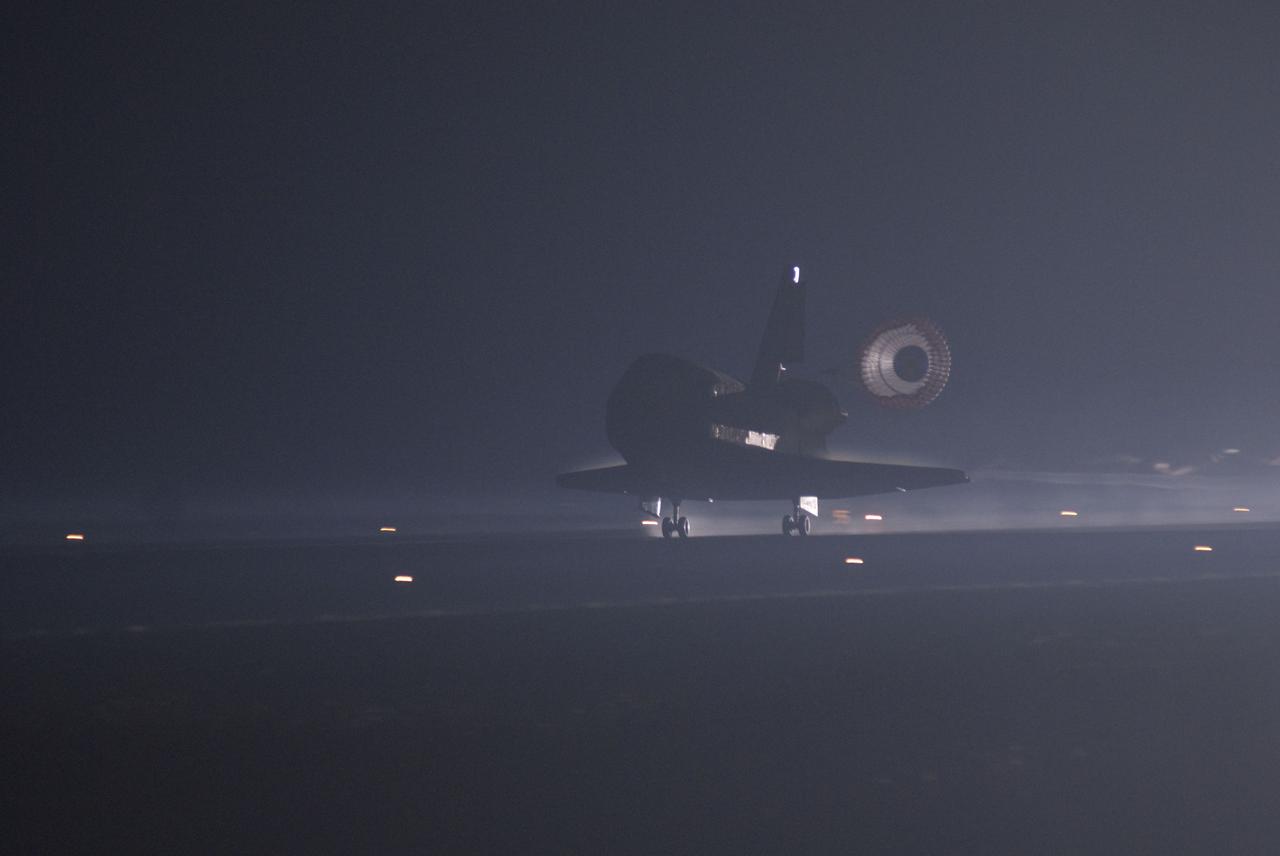
STS135-S-165 (21 July 2011) --- Xenon lights illuminate space shuttle Atlantis' unfurled drag chute as the vehicle rolls to a stop on the Shuttle Landing Facility's Runway 15 at NASA's Kennedy Space Center in Florida for the final time. Securing the space shuttle fleet's place in history, Atlantis marked the 26th nighttime landing of NASA's Space Shuttle Program and the 78th landing at Kennedy. Main gear touchdown was at 5:57:00 a.m. (EDT) on July 21, 2011, followed by nose gear touchdown at 5:57:20 a.m., and wheelstop at 5:57:54 a.m. Onboard are NASA astronauts Chris Ferguson, STS-135 commander; Doug Hurley, pilot; Sandy Magnus and Rex Walheim, both mission specialists. On the 37th shuttle mission to the International Space Station, STS-135 delivered more than 9,400 pounds of spare parts, equipment and supplies in the Raffaello multi-purpose logistics module that will sustain station operations for the next year. STS-135 was the 33rd and final flight for Atlantis, which has spent 307 days in space, orbited Earth 4,848 times and traveled 125,935,769 miles. Photo credit: NASA
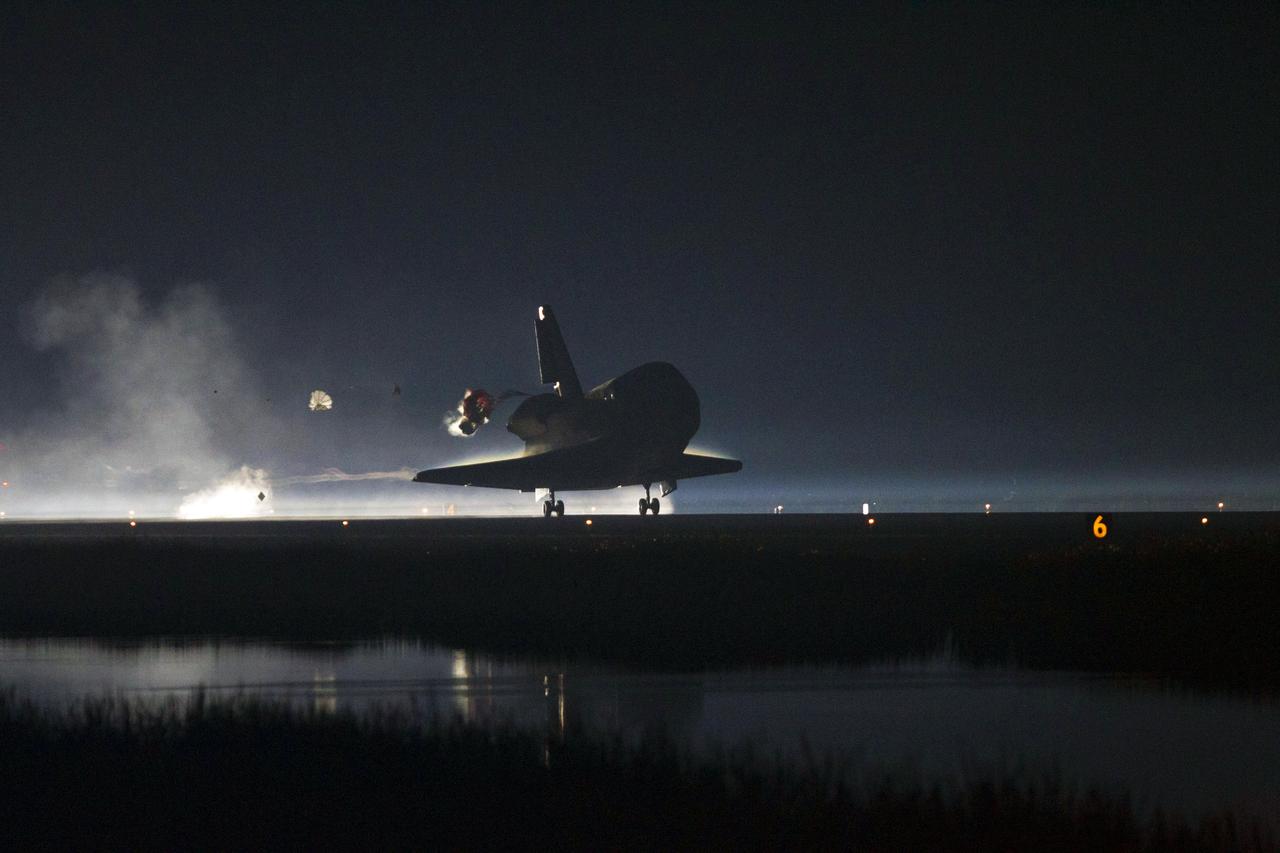
STS135-S-250 (21 July 2011) --- Xenon lights guide space shuttle Atlantis as it lands on the Shuttle Landing Facility's Runway 15 at NASA's Kennedy Space Center in Florida for the final time. Securing the space shuttle fleet's place in history, Atlantis marked the 26th nighttime landing of NASA's Space Shuttle Program and the 78th landing at Kennedy. Main gear touchdown was at 5:57:00 a.m. (EDT) on July 21, 2011, followed by nose gear touchdown at 5:57:20 a.m., and wheelstop at 5:57:54 a.m. Onboard are NASA astronauts Chris Ferguson, STS-135 commander; Doug Hurley, pilot; Sandy Magnus and Rex Walheim, both mission specialists. On the 37th shuttle mission to the International Space Station, STS-135 delivered more than 9,400 pounds of spare parts, equipment and supplies in the Raffaello multi-purpose logistics module that will sustain station operations for the next year. STS-135 was the 33rd and final flight for Atlantis, which has spent 307 days in space, orbited Earth 4,848 times and traveled 125,935,769 miles. Photo credit: NASA

KENNEDY SPACE CENTER, Fla. -- Landing lights illuminate the night sky as Space Shuttle Atlantis approaches touchdown on KSC's Shuttle Landing Facility Runway 15 to complete the 9-day, 20-hour, 9-minute-long STS-101 mission. At the controls are Commander James D. Halsell Jr. and Pilot Scott "Doc" Horowitz. Also onboard the orbiter are Mission Specialists Mary Ellen Weber, James S. Voss, Jeffrey N. Williams, Susan J. Helms and Yury Usachev of Russia. The crew is returning from the third flight to the International Space Station. This was the 98th flight in the Space Shuttle program and the 21st for Atlantis, also marking the 51st landing at KSC, the 22nd consecutive landing at KSC, and the 29th in the last 30 Shuttle flights. Main gear touchdown was at 2:20:17 a.m. EDT, landing on orbit 155 of the mission. Nose gear touchdown was at 2:20:30 a.m. EDT, and wheel stop at 2:21:19 a.m. EDT
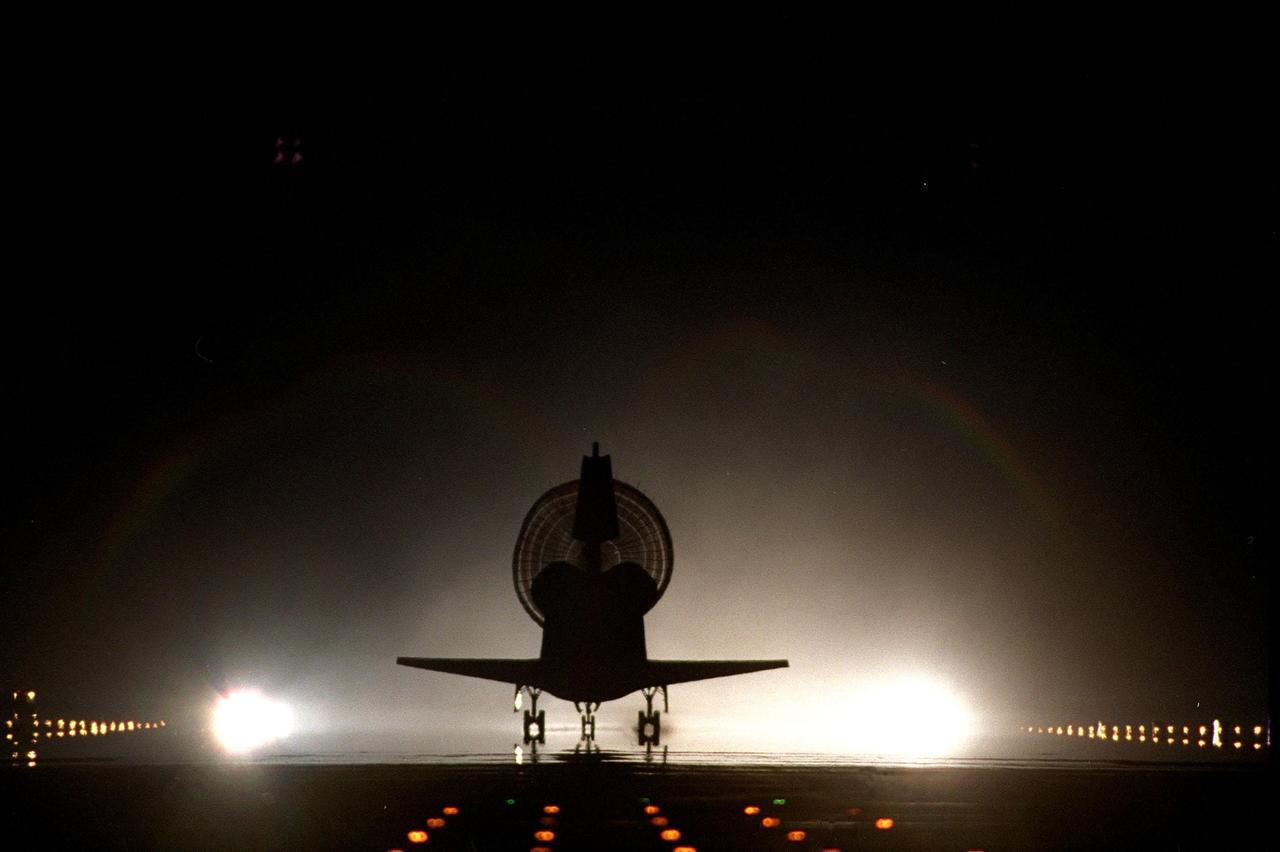
KENNEDY SPACE CENTER, Fla. -- With its drag chute fully deployed, Space Shuttle Discovery lands on KSC's brightly lighted Shuttle Landing Facility runway 15, completing the 9-day, 19-hour, 13-minute and 1-second long STS-96 mission. Main gear touchdown was at 2:02:43 a.m. EDT June 6 , landing on orbit 154 of the mission. Nose gear touchdown was at 2:02:59 a.m., and the wheels stopped at 2:03:39 a.m. At the controls were Commander Kent V. Rominger and Pilot Rick D. Husband. Also onboard the orbiter were Mission Specialists Ellen Ochoa (Ph.D.), Tamara E. Jernigan (Ph.D.), Daniel T. Barry (M.D., Ph.D.), Julie Payette and Valery Ivanovich Tokarev. Payette represents the Canadian Space Agency and Tokarev the Russian Space Agency. The crew returned from the second flight to the International Space Station on a logistics and resupply mission. This was the 94th flight in the Space Shuttle program and the 26th for Discovery, also marking the 47th landing at KSC, the 24th in the last 25 missions, 11th at night, and the 18th consecutive landing in Florida
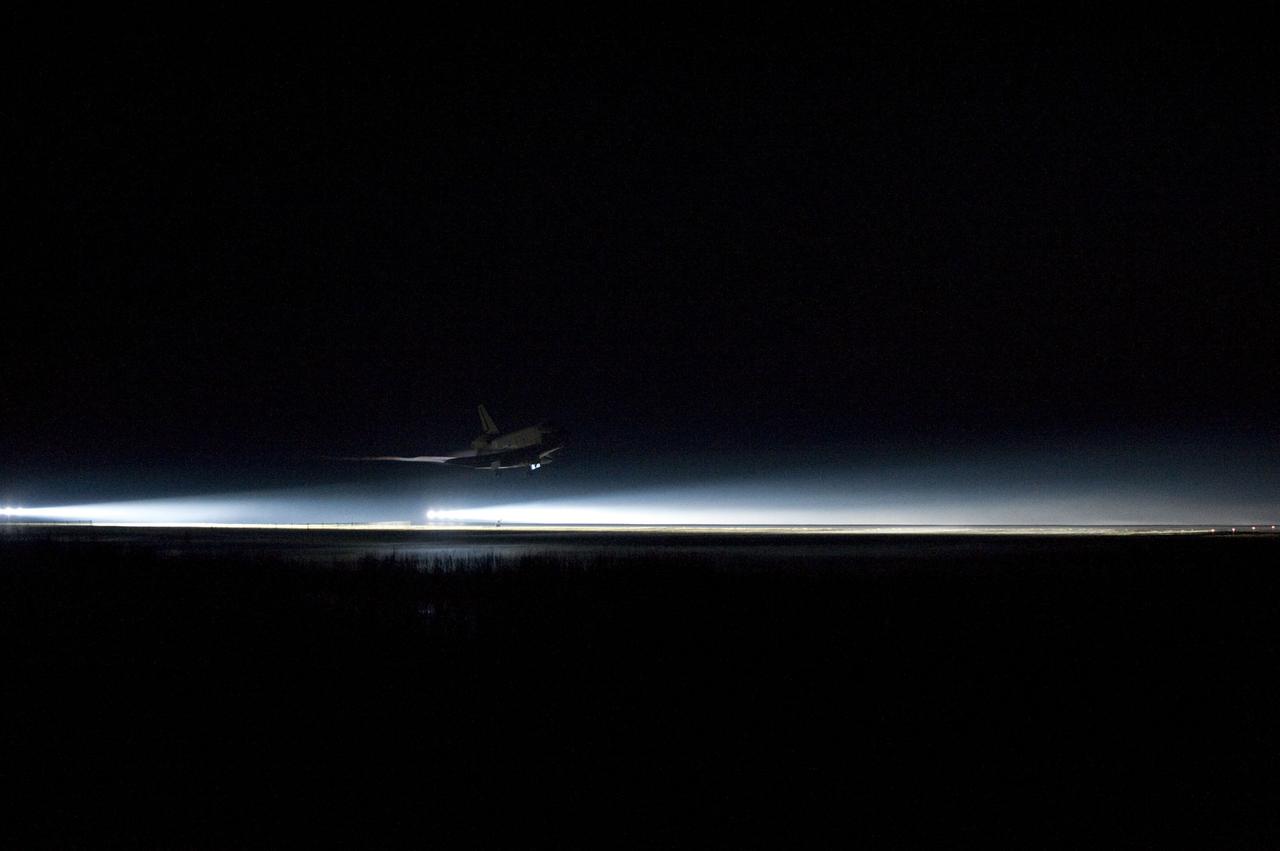
CAPE CANAVERAL, Fla. -- Xenons light the way home for space shuttle Atlantis at NASA's Kennedy Space Center in Florida for the final time. Securing the space shuttle fleet's place in history, Atlantis marked the 26th nighttime landing of NASA's Space Shuttle Program and the 78th landing at Kennedy. Main gear touchdown on the Shuttle Landing Facility's Runway 15 was at 5:57:00 a.m. EDT, followed by nose gear touchdown at 5:57:20 a.m., and wheelstop at 5:57:54 a.m. On board are STS-135 Commander Chris Ferguson, Pilot Doug Hurley, and Mission Specialists Sandra Magnus and Rex Walheim. On the 37th shuttle mission to the International Space Station, STS-135 delivered more than 9,400 pounds of spare parts, equipment and supplies in the Raffaello multi-purpose logistics module that will sustain station operations for the next year. STS-135 was the 33rd and final flight for Atlantis, which has spent 307 days in space, orbited Earth 4,848 times and traveled 125,935,769 miles. For more information visit, www.nasa.gov/mission_pages/shuttle/shuttlemissions/sts135/index.html. Photo credit: NASA/Sandra Joseph
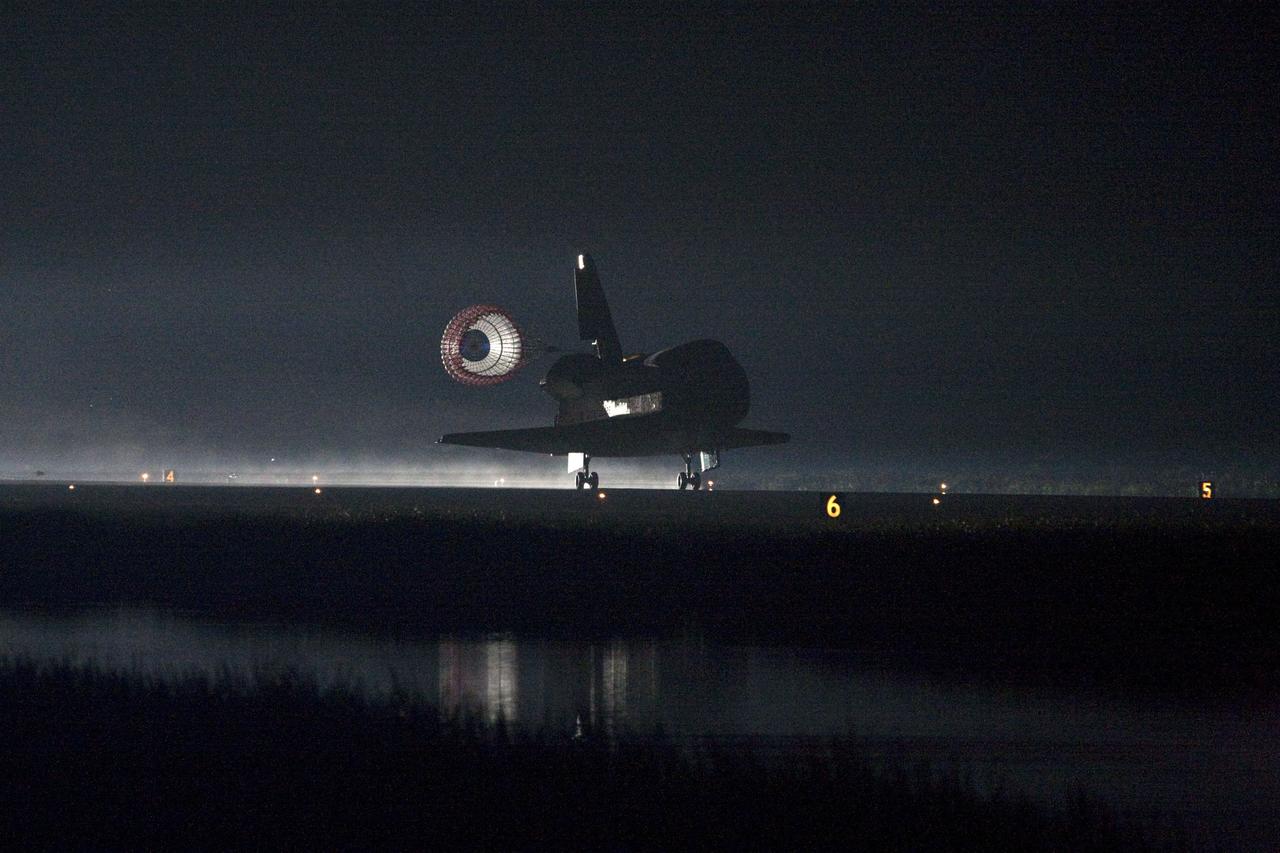
STS134-S-079 (1 June 2011) --- Xenon lights help lead space shuttle Endeavour home to NASA's Kennedy Space Center in Florida. Endeavour landed for the final time on the Shuttle Landing Facility's Runway 15, marking the 24th night landing of NASA's Space Shuttle Program. Main gear touchdown was at 2:34:51 a.m. (EDT) on June 1, 2011, followed by nose gear touchdown at 2:35:04 a.m., and wheelstop at 2:35:36 a.m. Onboard are NASA astronauts Mark Kelly, STS-134 commander; Greg H. Johnson, pilot; Michael Fincke, Andrew Feustel, Greg Chamitoff and European Space Agency astronaut Roberto Vittori, all mission specialists. STS-134 delivered the Alpha Magnetic Spectrometer-2 (AMS) and the Express Logistics Carrier-3 (ELC-3) to the International Space Station. AMS will help researchers understand the origin of the universe and search for evidence of dark matter, strange matter and antimatter from the station. ELC-3 carried spare parts that will sustain station operations once the shuttles are retired from service. STS-134 was the 25th and final flight for Endeavour, which has spent 299 days in space, orbited Earth 4,671 times and traveled 122,883,151 miles. Photo credit: NASA
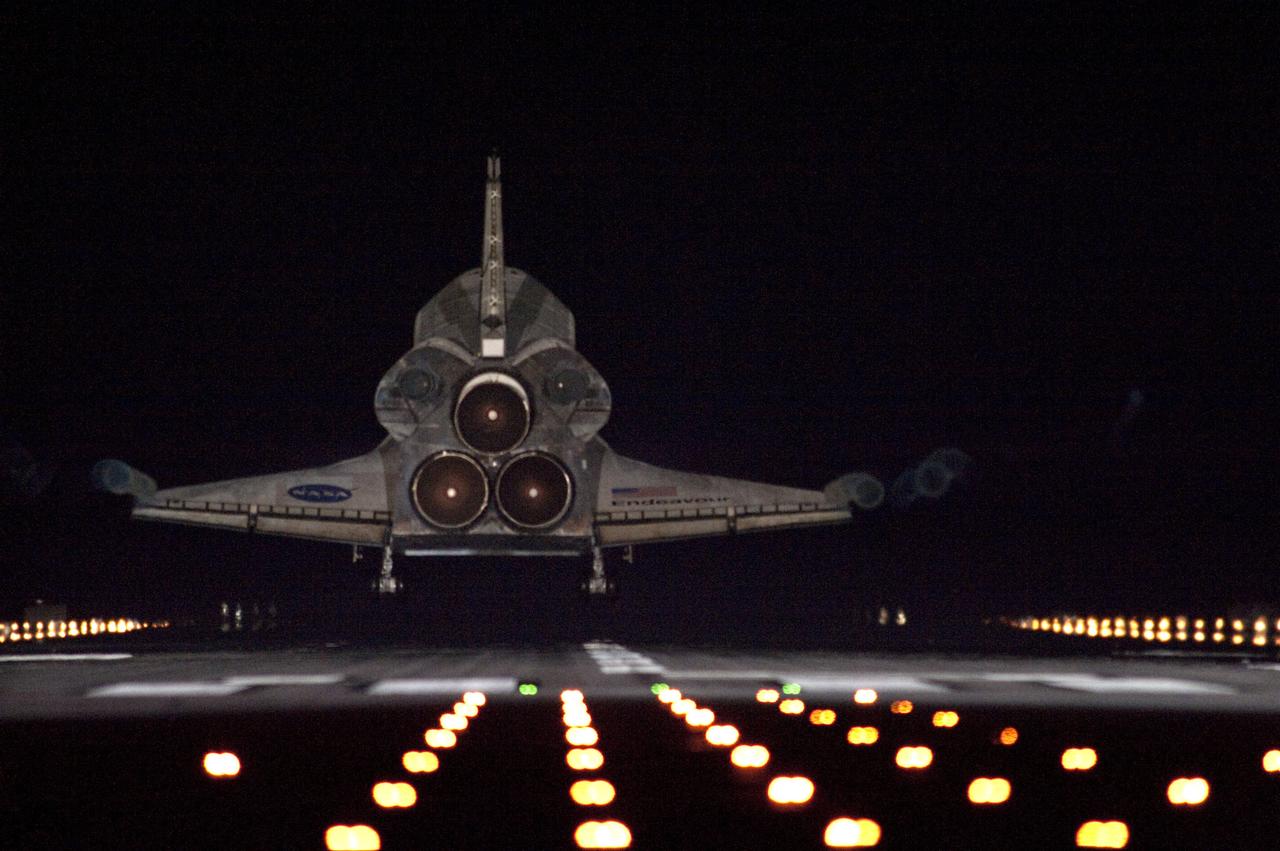
CAPE CANAVERAL, Fla. -- Xenon lights help lead space shuttle Endeavour home to NASA's Kennedy Space Center in Florida. Endeavour landed for the final time on the Shuttle Landing Facility's Runway 15, marking the 25th night landing of NASA's Space Shuttle Program. Main gear touchdown was at 2:34:51 a.m. EDT, followed by nose gear touchdown at 2:35:04 a.m., and wheelstop at 2:35:36 a.m. On board are STS-134 Commander Mark Kelly, Pilot Greg H. Johnson, and Mission Specialists Mike Fincke, Drew Feustel, Greg Chamitoff and the European Space Agency's Roberto Vittori. STS-134 delivered the Alpha Magnetic Spectrometer-2 (AMS) and the Express Logistics Carrier-3 (ELC-3) to the International Space Station. AMS will help researchers understand the origin of the universe and search for evidence of dark matter, strange matter and antimatter from the station. ELC-3 carried spare parts that will sustain station operations once the shuttles are retired from service. STS-134 was the 25th and final flight for Endeavour, which has spent 299 days in space, orbited Earth 4,671 times and traveled 122,883,151 miles. Photo credit: NASA/Sandra Joseph and Kevin O'Connell
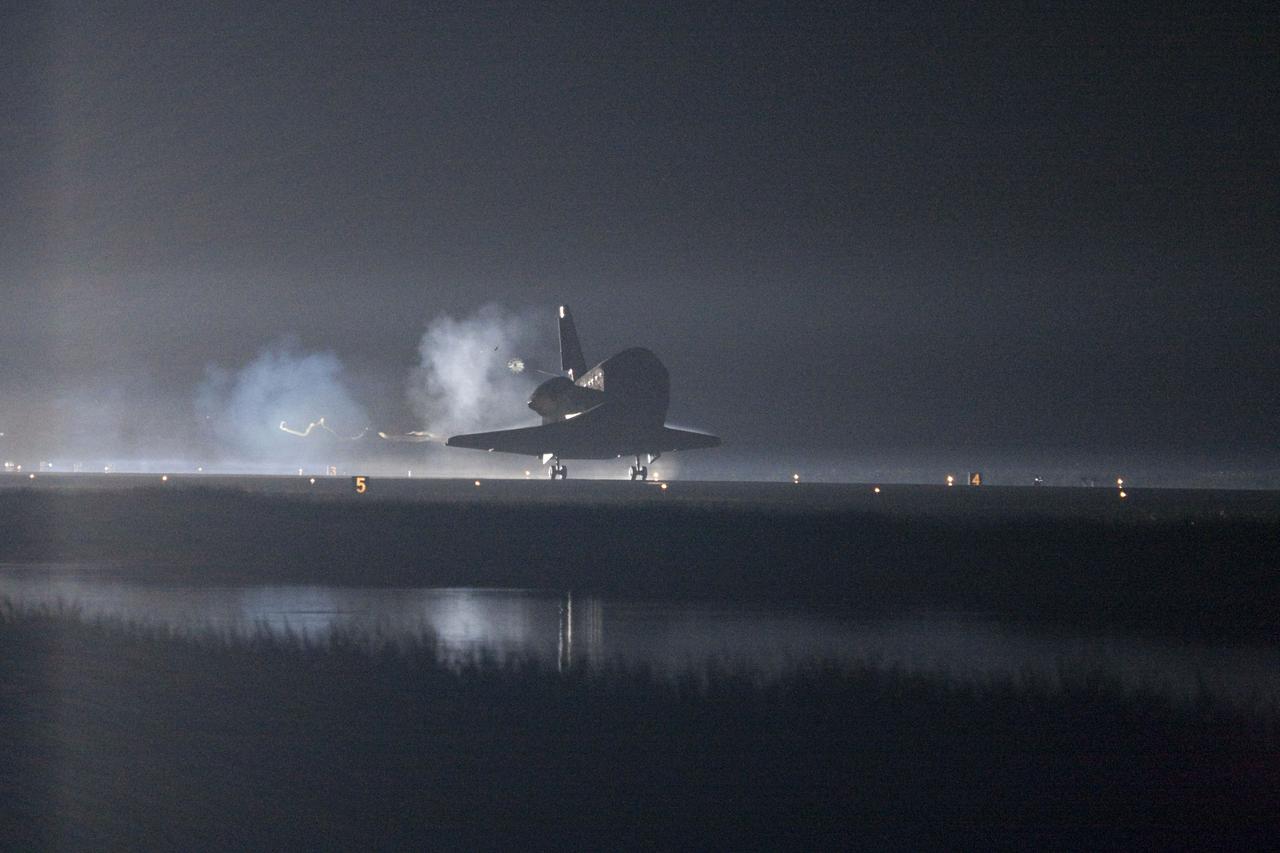
STS134-S-078 (1 June 2011) --- Xenon lights help lead space shuttle Endeavour home to NASA's Kennedy Space Center in Florida. Endeavour landed for the final time on the Shuttle Landing Facility's Runway 15, marking the 24th night landing of NASA's Space Shuttle Program. Main gear touchdown was at 2:34:51 a.m. (EDT) on June 1, 2011, followed by nose gear touchdown at 2:35:04 a.m., and wheelstop at 2:35:36 a.m. Onboard are NASA astronauts Mark Kelly, STS-134 commander; Greg H. Johnson, pilot; Michael Fincke, Andrew Feustel, Greg Chamitoff and European Space Agency astronaut Roberto Vittori, all mission specialists. STS-134 delivered the Alpha Magnetic Spectrometer-2 (AMS) and the Express Logistics Carrier-3 (ELC-3) to the International Space Station. AMS will help researchers understand the origin of the universe and search for evidence of dark matter, strange matter and antimatter from the station. ELC-3 carried spare parts that will sustain station operations once the shuttles are retired from service. STS-134 was the 25th and final flight for Endeavour, which has spent 299 days in space, orbited Earth 4,671 times and traveled 122,883,151 miles. Photo credit: NASA
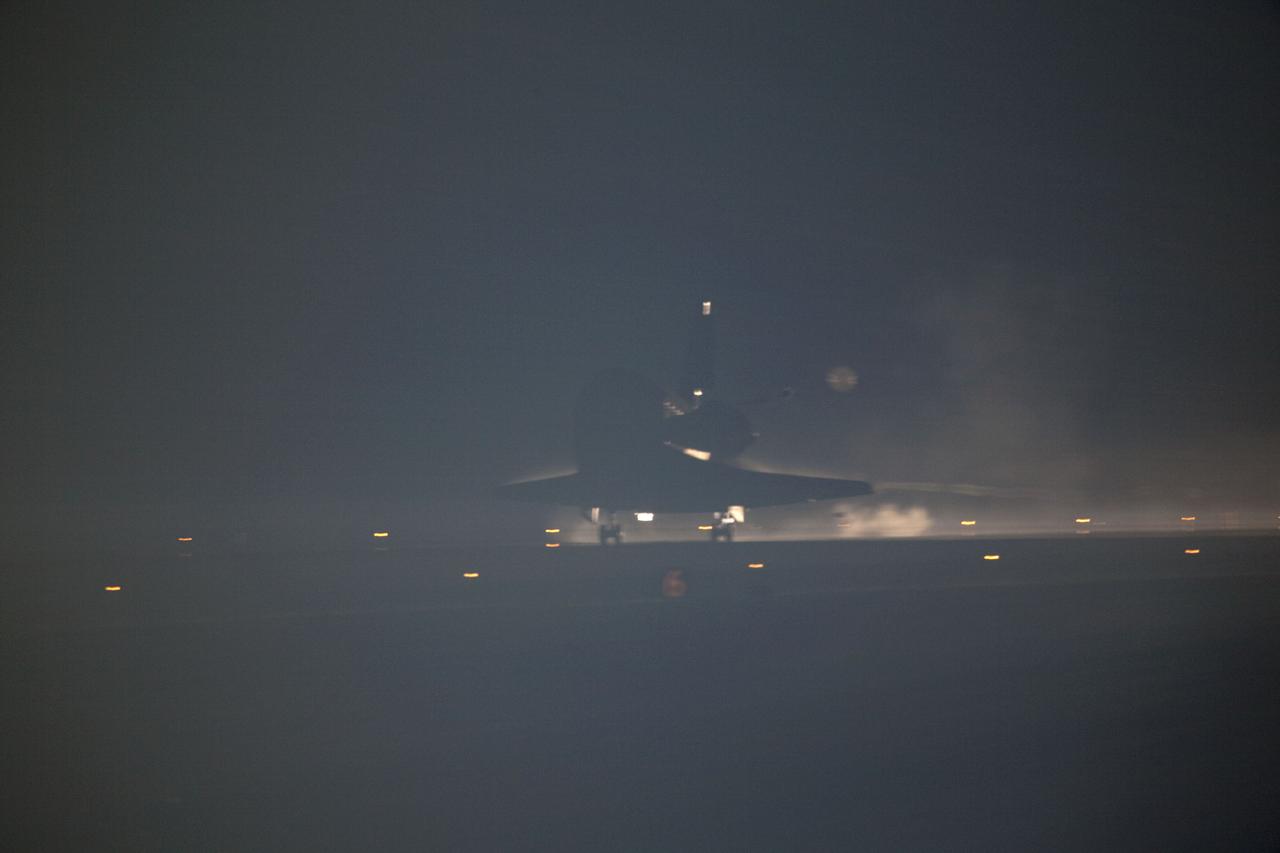
STS135-S-170 (21 July 2011) --- Xenon lights guide space shuttle Atlantis down on the Shuttle Landing Facility's Runway 15 at NASA's Kennedy Space Center in Florida for the final time. Securing the space shuttle fleet's place in history, Atlantis marked the 26th nighttime landing of NASA's Space Shuttle Program and the 78th landing at Kennedy. Main gear touchdown was at 5:57:00 a.m. (EDT) on July 21, 2011, followed by nose gear touchdown at 5:57:20 a.m., and wheelstop at 5:57:54 a.m. Onboard are NASA astronauts Chris Ferguson, STS-135 commander; Doug Hurley, pilot; Sandy Magnus and Rex Walheim, both mission specialists. On the 37th shuttle mission to the International Space Station, STS-135 delivered more than 9,400 pounds of spare parts, equipment and supplies in the Raffaello multi-purpose logistics module that will sustain station operations for the next year. STS-135 was the 33rd and final flight for Atlantis, which has spent 307 days in space, orbited Earth 4,848 times and traveled 125,935,769 miles. Photo credit: NASA
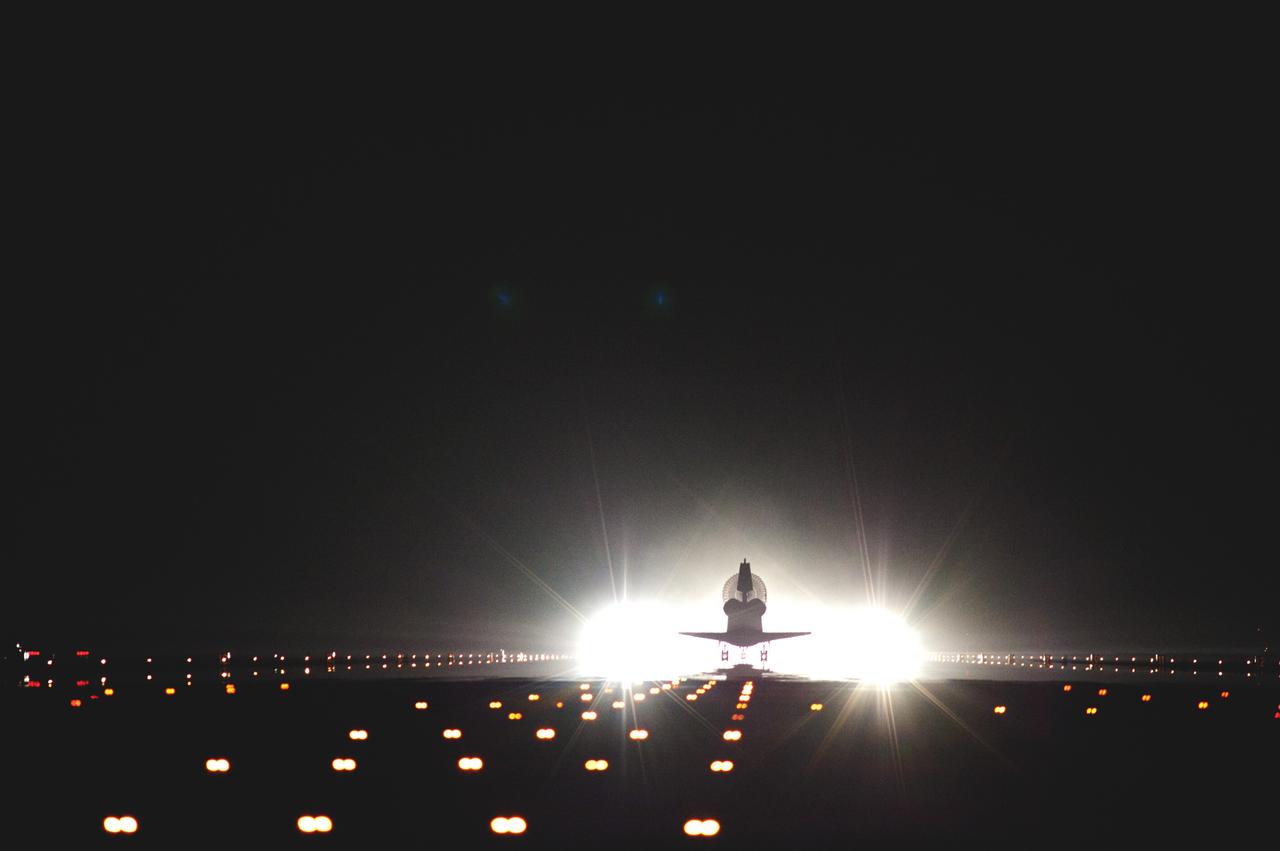
CAPE CANAVERAL, Fla. -- Xenon lights positioned at the end of Runway 15 reveal that the drag chute has deployed behind space shuttle Atlantis to slow the shuttle as it lands for the last time at the Shuttle Landing Facility at NASA's Kennedy Space Center in Florida. Securing the space shuttle fleet's place in history, Atlantis marked the 26th nighttime landing of NASA's Space Shuttle Program and the 78th landing at Kennedy. Main gear touchdown was at 5:57:00 a.m. EDT, followed by nose gear touchdown at 5:57:20 a.m., and wheelstop at 5:57:54 a.m. On board are STS-135 Commander Chris Ferguson, Pilot Doug Hurley, and Mission Specialists Sandy Magnus and Rex Walheim. On the 37th shuttle mission to the International Space Station, STS-135 delivered the Raffaello multi-purpose logistics module filled with more than 9,400 pounds of spare parts, equipment and supplies that will sustain station operations for the next year. STS-135 was the 33rd and final flight for Atlantis, which has spent 307 days in space, orbited Earth 4,848 times and traveled 125,935,769 miles. STS-135 also was the final mission of the Space Shuttle Program. For more information, visit www.nasa.gov/mission_pages/shuttle/shuttlemissions/sts135/index.html. Photo credit: NASA/Tom Farrar and Tony Gray