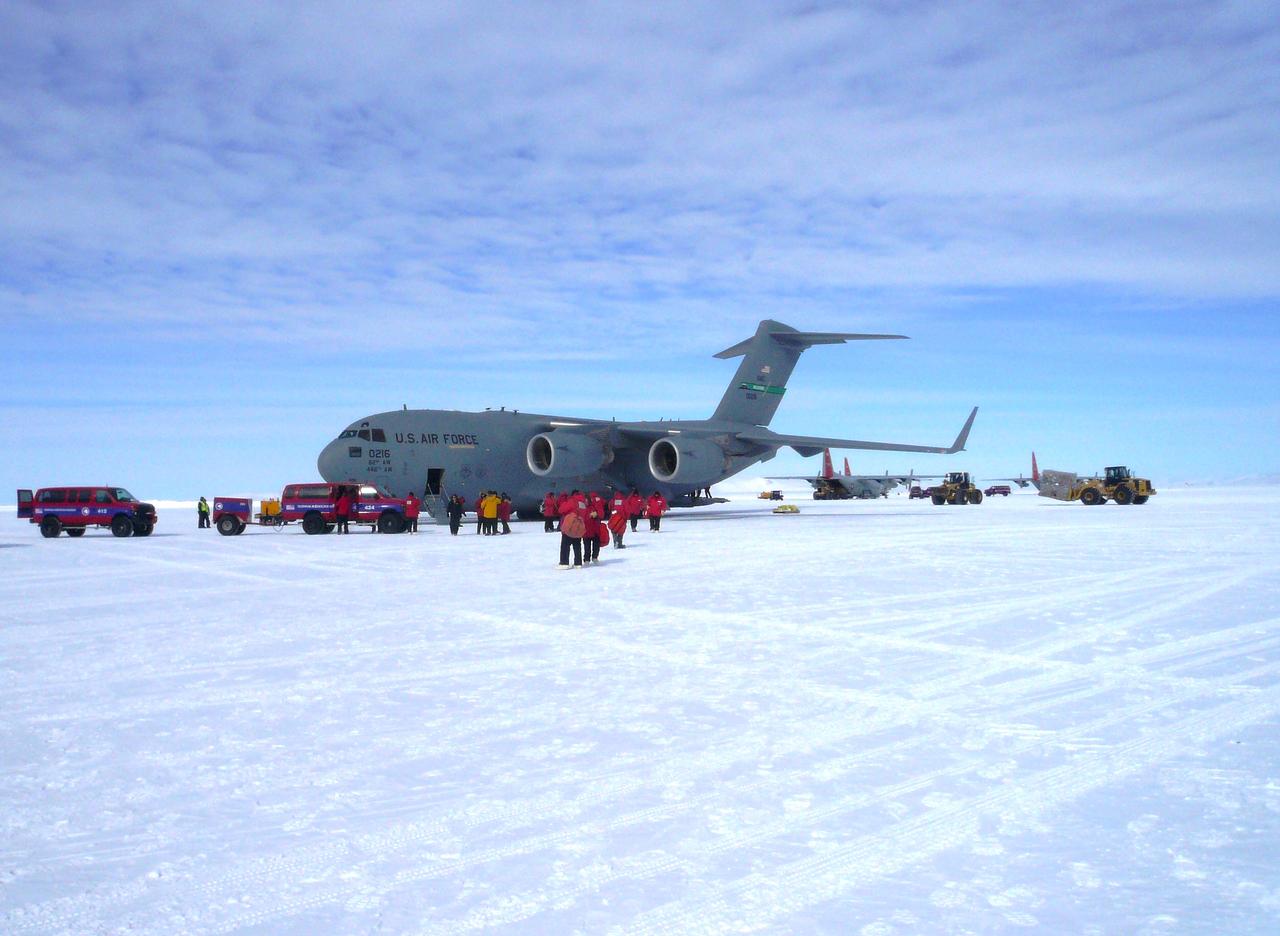
A U.S. Air Force C-17 transport aircraft sits on the sea ice runway at the National Science Foundation's McMurdo Station in Antarctica following a transit flight from Christchurch, New Zealand that transported IceBridge personnel and gear on Nov. 12, 2013. The C-17 aircraft that fly to Antarctica are operated by the U.S. Air Force's 62nd and 446th Airlift Wings based at Joint Base Lewis-McChord near Seattle, Wash. Credit: NASA/Goddard/George Hale NASA's Operation IceBridge is an airborne science mission to study Earth's polar ice. For more information about IceBridge, visit: <a href="http://www.nasa.gov/icebridge" rel="nofollow">www.nasa.gov/icebridge</a> <b><a href="http://www.nasa.gov/audience/formedia/features/MP_Photo_Guidelines.html" rel="nofollow">NASA image use policy.</a></b> <b><a href="http://www.nasa.gov/centers/goddard/home/index.html" rel="nofollow">NASA Goddard Space Flight Center</a></b> enables NASA’s mission through four scientific endeavors: Earth Science, Heliophysics, Solar System Exploration, and Astrophysics. Goddard plays a leading role in NASA’s accomplishments by contributing compelling scientific knowledge to advance the Agency’s mission. <b>Follow us on <a href="http://twitter.com/NASA_GoddardPix" rel="nofollow">Twitter</a></b> <b>Like us on <a href="http://www.facebook.com/pages/Greenbelt-MD/NASA-Goddard/395013845897?ref=tsd" rel="nofollow">Facebook</a></b> <b>Find us on <a href="http://instagram.com/nasagoddard?vm=grid" rel="nofollow">Instagram</a></b>
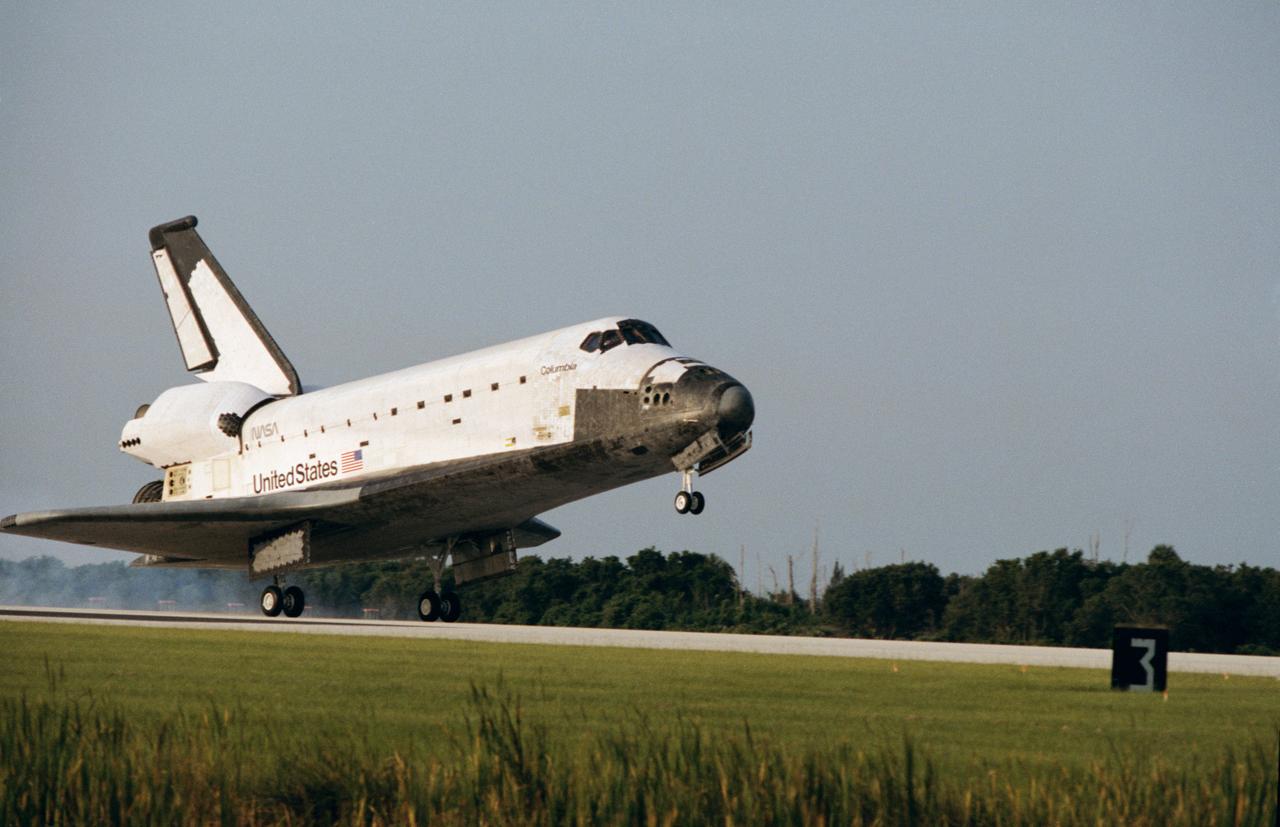
STS-50 Columbia's, Orbiter Vehicle (OV) 102's, main landing gear touches down on runway 33 at the Kennedy Space Center (KSC) Shuttle Landing Facility (SLF) producing a small cloud of dust. Landing occurred at 7:42 am (Eastern Daylight Time (EDT)). In this view of the OV-102's starboard side, the nose landing gear (NLG) continues to ride above the runway surface. Florida vegetation, a runway sign, and runway lights appear in the foreground.
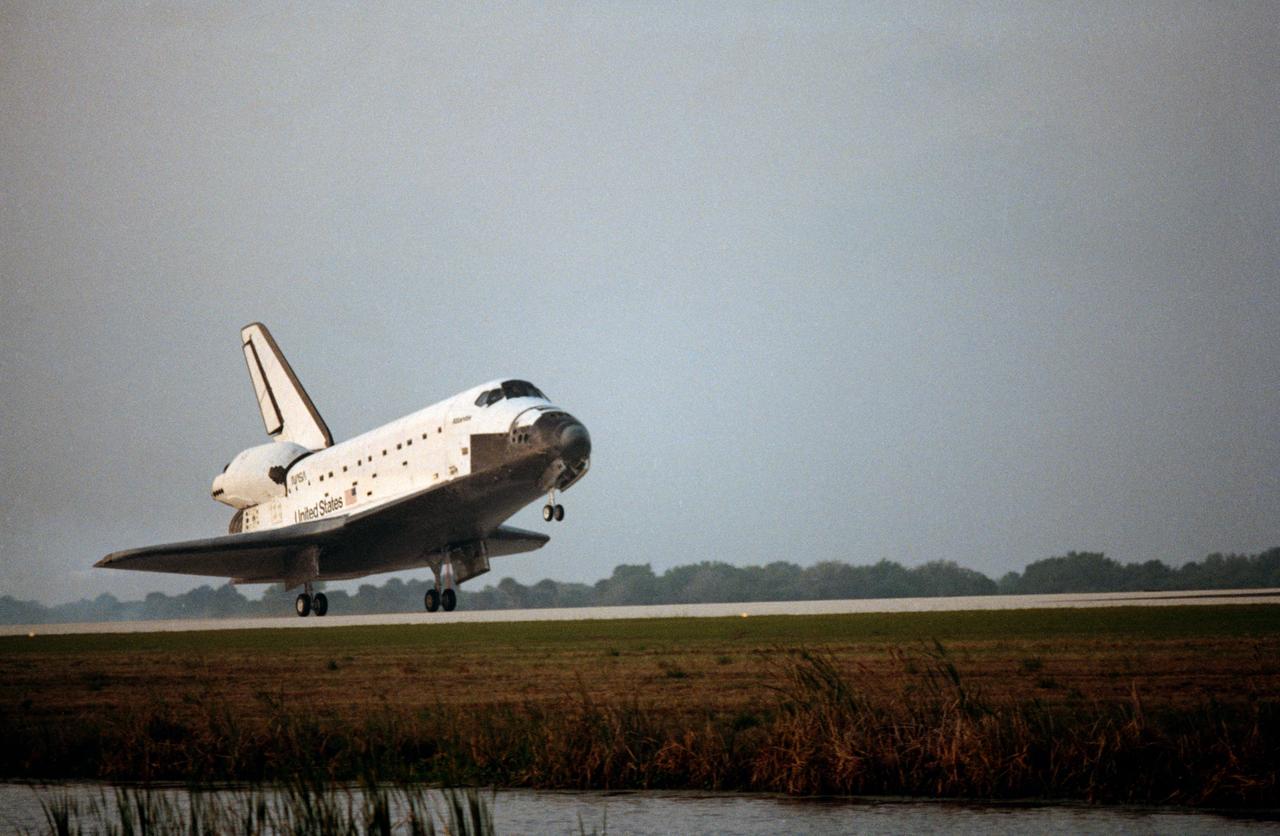
STS-45 Atlantis, Orbiter Vehicle (OV) 104, lands on concrete runway 33 at the Kennedy Space Center's (KSC's) Shuttle Landing Facility (SLF). The main landing gear (MLG) touched down at 6:23:06 am (Eastern Standard Time (EST)) in the early morning Florida fog as seen in these views. The deployed nose landing gear (NLG) rides above the runway before wheel stop.

STS038-S-041 (20 Nov 1990) --- STS-38 Atlantis, Orbiter Vehicle (OV) 104, lands on runway 33 at Kennedy Space Center (KSC) Shuttle Landing Facility (SLF). The main landing gear (MLG) has just touched down on the runway surface as the nose landing gear (NLG) glides above it. The Department of Defense (DOD)-devoted mission came to an end (with complete wheel stop) at 4:43:37 pm (Eastern Standard Time (EST)).
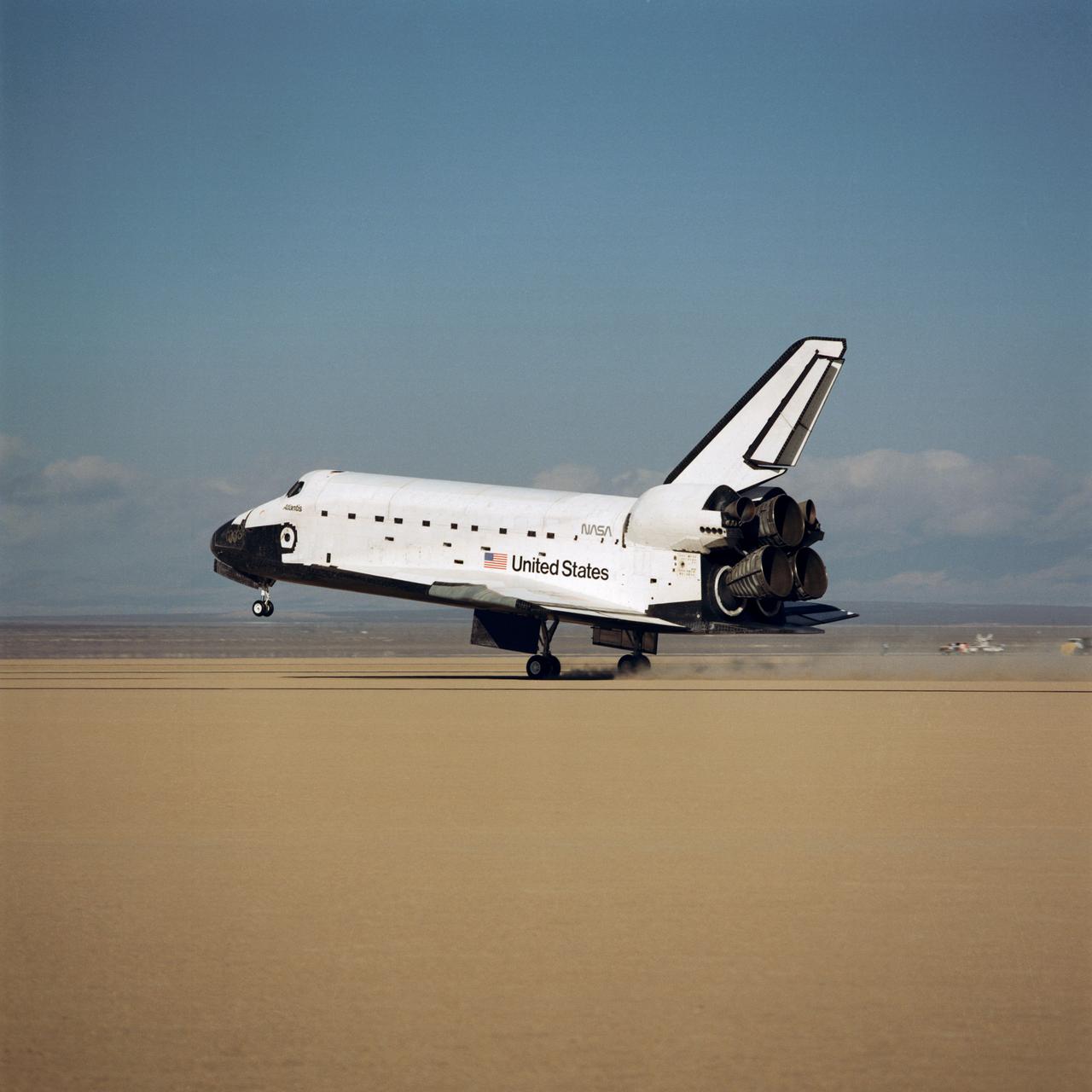
STS-34 Atlantis, Orbiter Vehicle (OV) 104, main landing gear (MLG) touches down on Runway 23 dry lake bed at Edwards Air Force Base (EAFB), California. The nose landing gear rides above runway before touchdown as the MLG wheels produce a cloud of dust. OV-104's port side profile is captured as it glides by at a speed of approximately 195 knots (224 miles per hour). The tail section with deployed speedbrake/rudder and space shuttle main engines (SSMEs) are visible.
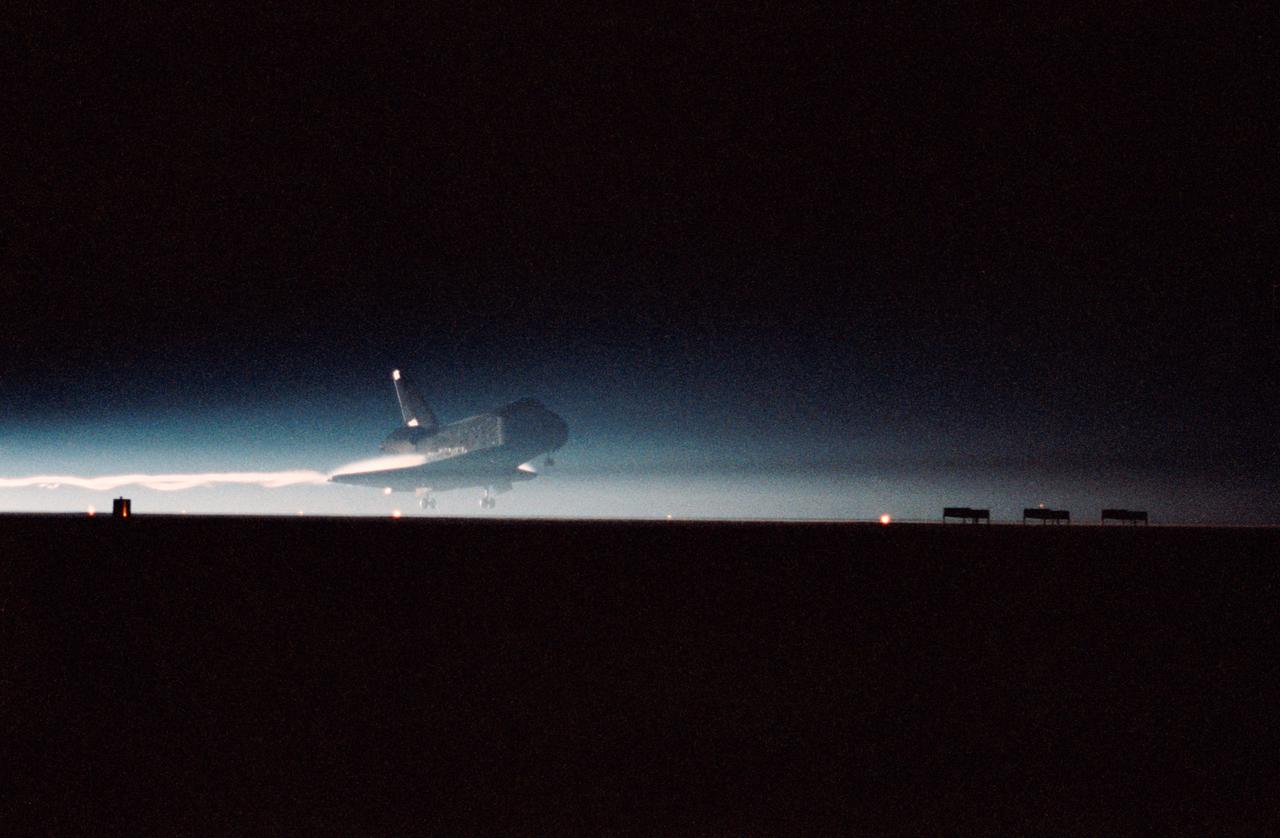
STS-32 Columbia, Orbiter Vehicle (OV) 102, is captured as its main landing gear (MLG) touches down on runway 22 at Edwards Air Force Base (EAFB), California, in the early morning darkness. The night landing ended a record 11-day mission in space. Moments later, at 1:36:38 am Pacific Standard Time (PST), OV-102 came to a complete stop, having logged 4,509,972 miles in flight.
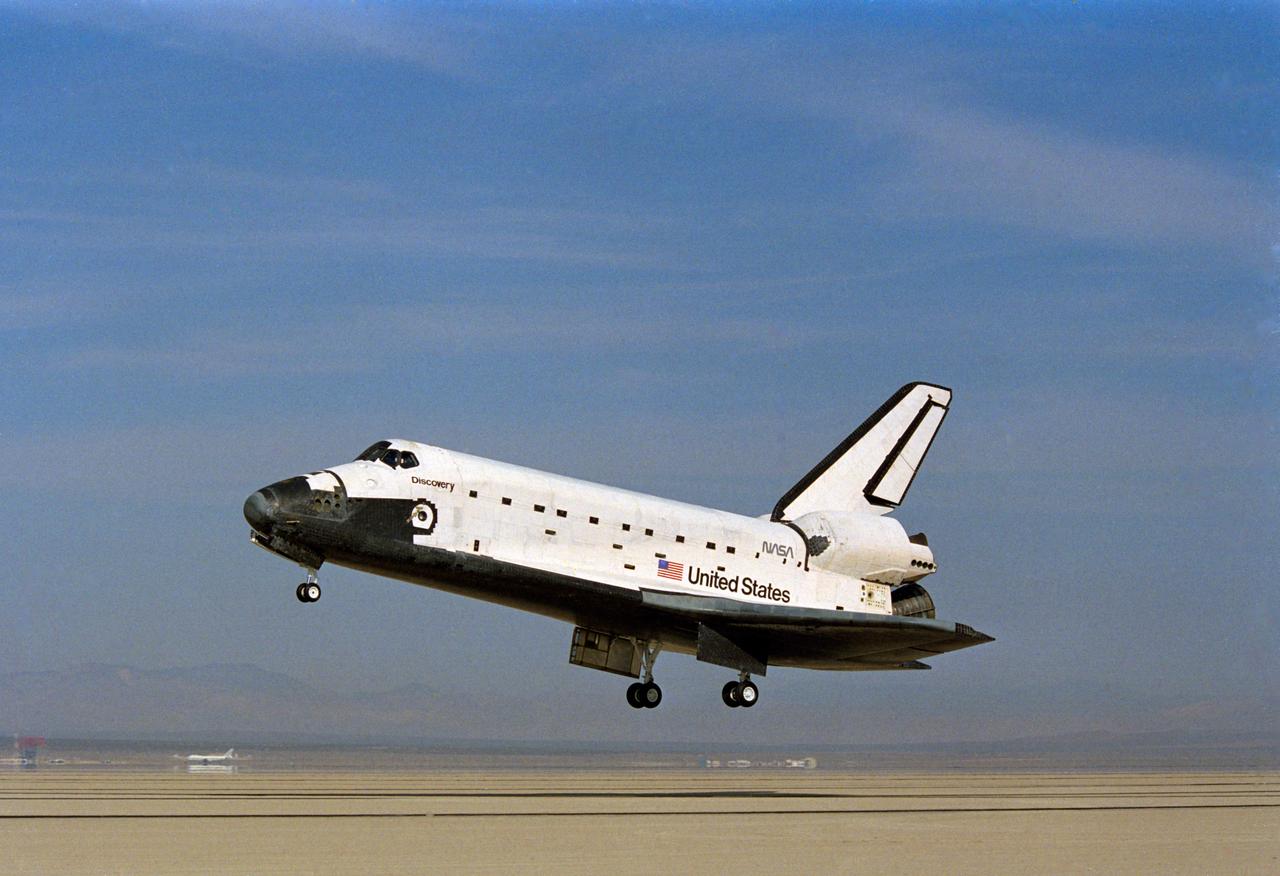
STS-26 Discovery, Orbiter Vehicle (OV) 103, with nose landing gear (NLG) and main landing gear (MLG) deployed glides above dry lakebed runway 17 at Edwards Air Force Base (EAFB), California. This profile view shows OV-103's port side just before MLG touchdown.
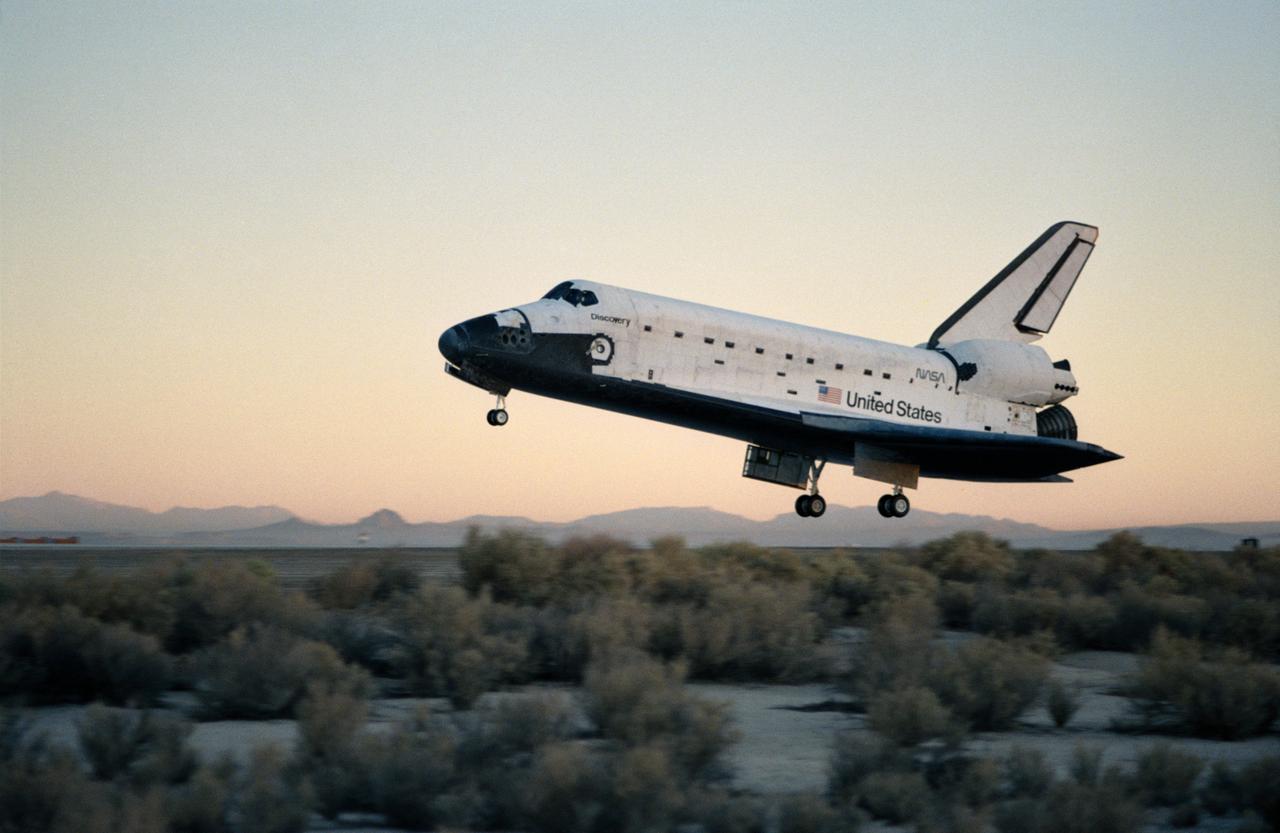
STS-41 Discovery, Orbiter Vehicle (OV) 103, with nose landing gear (NLG) and main landing gear (MLG) deployed, glides over concrete runway 22 at Edwards Air Force Base (EAFB), California, prior to touchdown.
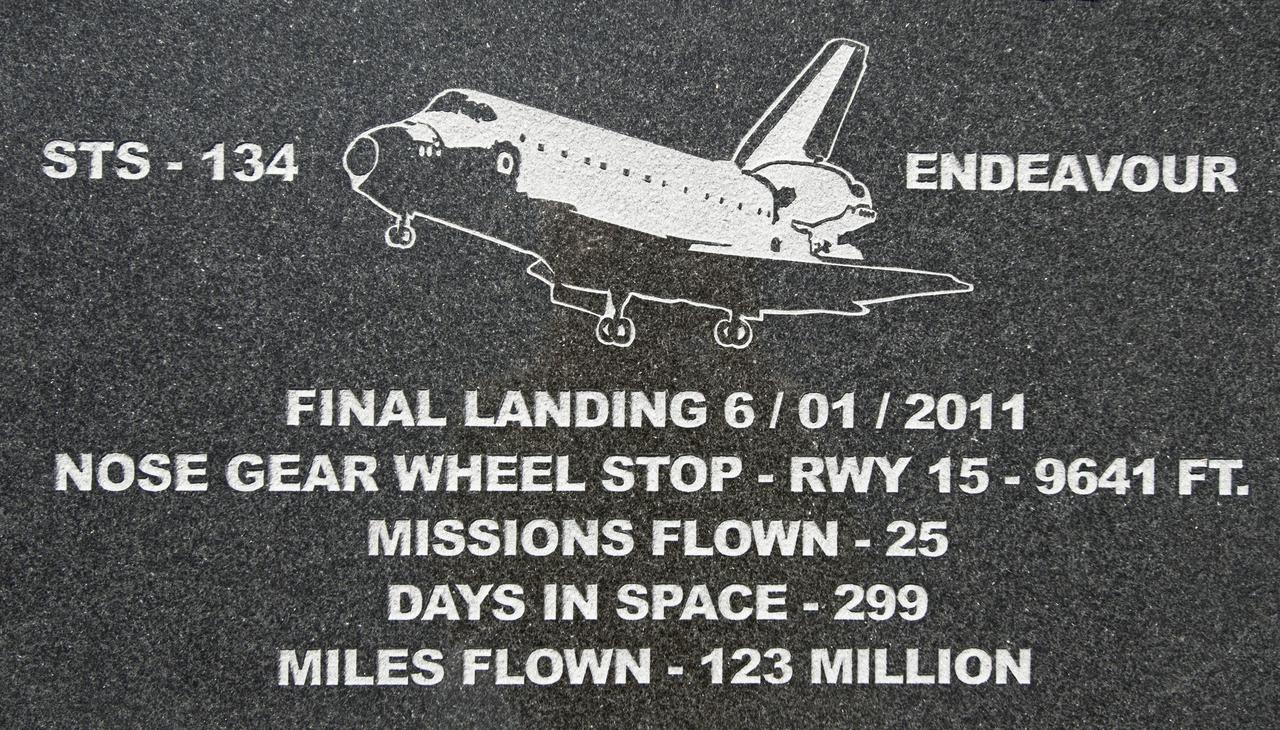
CAPE CANAVERAL, Fla. – At Kennedy Space Center's Shuttle Landing Facility, a granite plaque marks the spot where space shuttle Endeavour's nose gear came to a stop at the conclusion of STS-134, the final flight of the Space Shuttle Program. Permanent reminders indicate where on the runway the orbiters Discovery, Endeavour and Atlantis stopped rolling as each finished its last mission in 2011. In addition to the granite markers, which are installed alongside the runway, there are etchings in the grooved concrete along the runway's centerline to mark each wheelstop. The etchings and markers were created and installed by local artist Chad Stout of C Spray Glass Blasting in Cocoa, Fla. Photo credit: NASA/Tim Jacobs
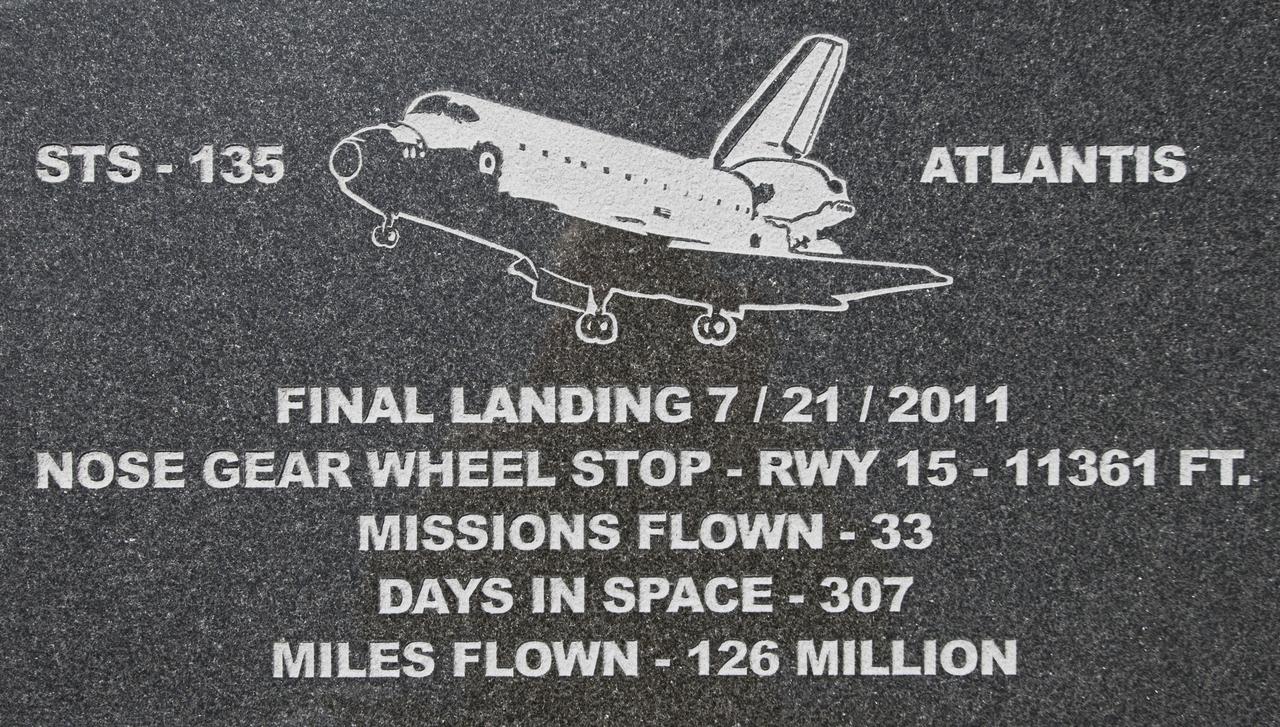
CAPE CANAVERAL, Fla. – At Kennedy Space Center's Shuttle Landing Facility, a granite plaque marks the spot where space shuttle Atlantis' nose gear came to a stop at the conclusion of STS-135, the final flight of the Space Shuttle Program. Permanent reminders indicate where on the runway the orbiters Discovery, Endeavour and Atlantis stopped rolling as each finished its last mission in 2011. In addition to the granite markers, which are installed alongside the runway, there are etchings in the grooved concrete along the runway's centerline to mark each wheelstop. The etchings and markers were created and installed by local artist Chad Stout of C Spray Glass Blasting in Cocoa, Fla. Photo credit: NASA/Tim Jacobs
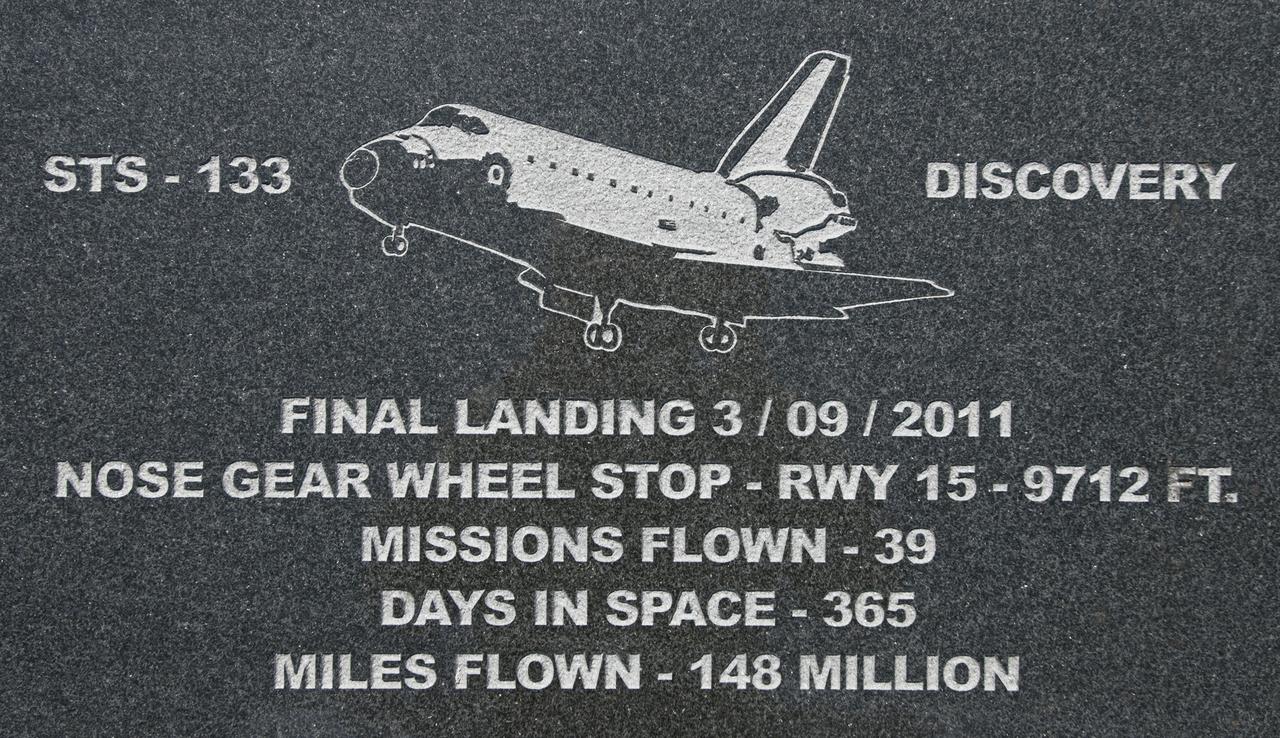
CAPE CANAVERAL, Fla. – At Kennedy Space Center's Shuttle Landing Facility, a granite plaque marks the spot where space shuttle Discovery's nose gear came to a stop at the conclusion of STS-133, the final flight of the Space Shuttle Program. Permanent reminders indicate where on the runway the orbiters Discovery, Endeavour and Atlantis stopped rolling as each finished its last mission in 2011. In addition to the granite markers, which are installed alongside the runway, there are etchings in the grooved concrete along the runway's centerline to mark each wheelstop. The etchings and markers were created and installed by local artist Chad Stout of C Spray Glass Blasting in Cocoa, Fla. Photo credit: NASA/Tim Jacobs
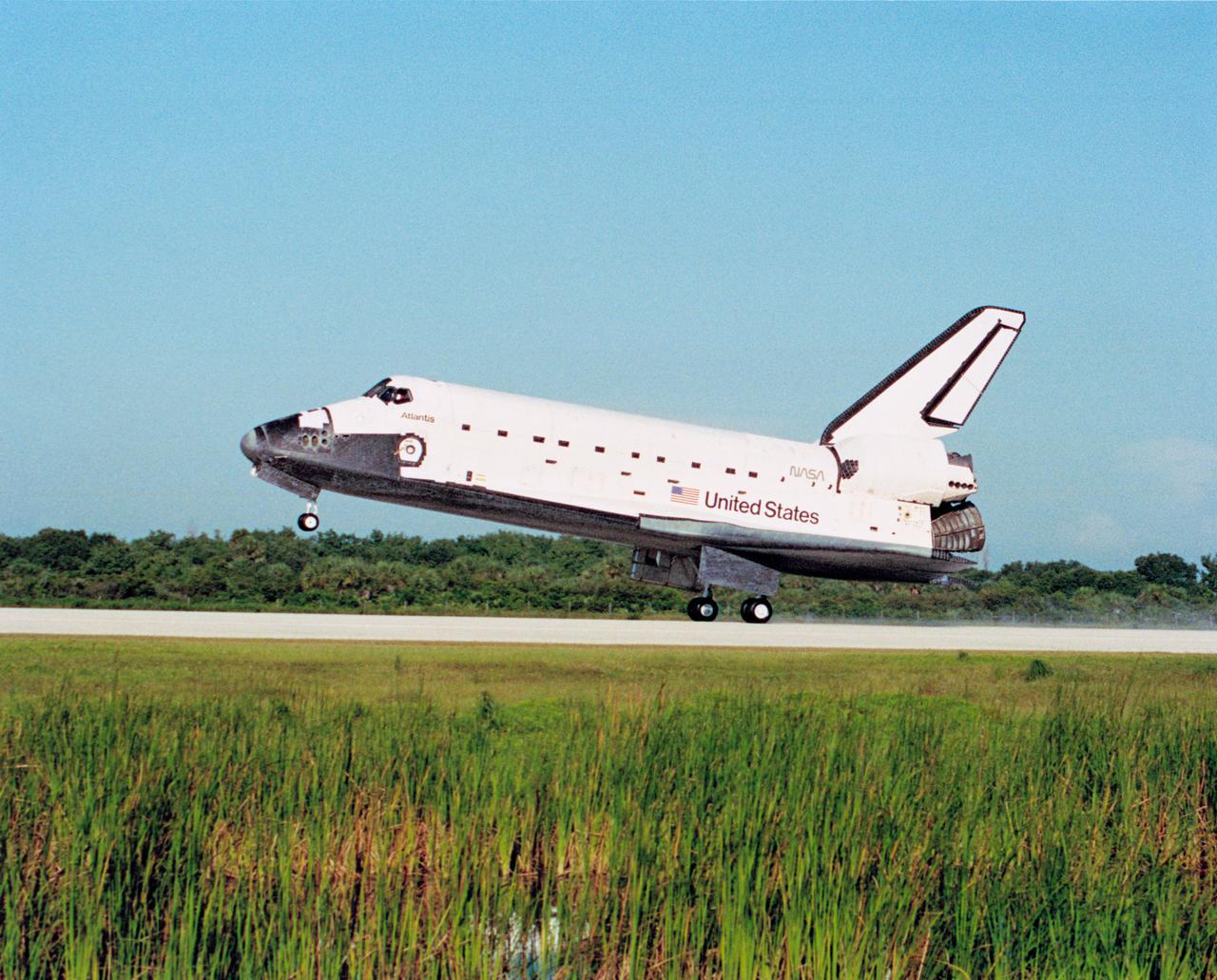
STS-43 Atlantis, Orbiter Vehicle (OV) 104, lands on runway 15 at the Kennedy Space Center's (KSC's) Shuttle Landing Facility (SLF). The main landing gear (MLG) touched down at 8:23:25 am (Eastern Daylight Time (EDT)). OV-104 glides toward wheel stop as the nose landing gear (NLG) rides above the runway.

STS029-S-063 (18 March 1989) --- Discovery's main landing gear touches down on Runway 22 at Edwards Air Force Base in California following a successful five-day mission in Earth orbit. Onboard the spacecraft were Astronauts Michael L. Coats, John E. Blaha, James F. Buchli, Robert C. Springer and James P. Bagian. Wheels came to a stop at 6:36:40 a.m. (PST), March 18, 1989.
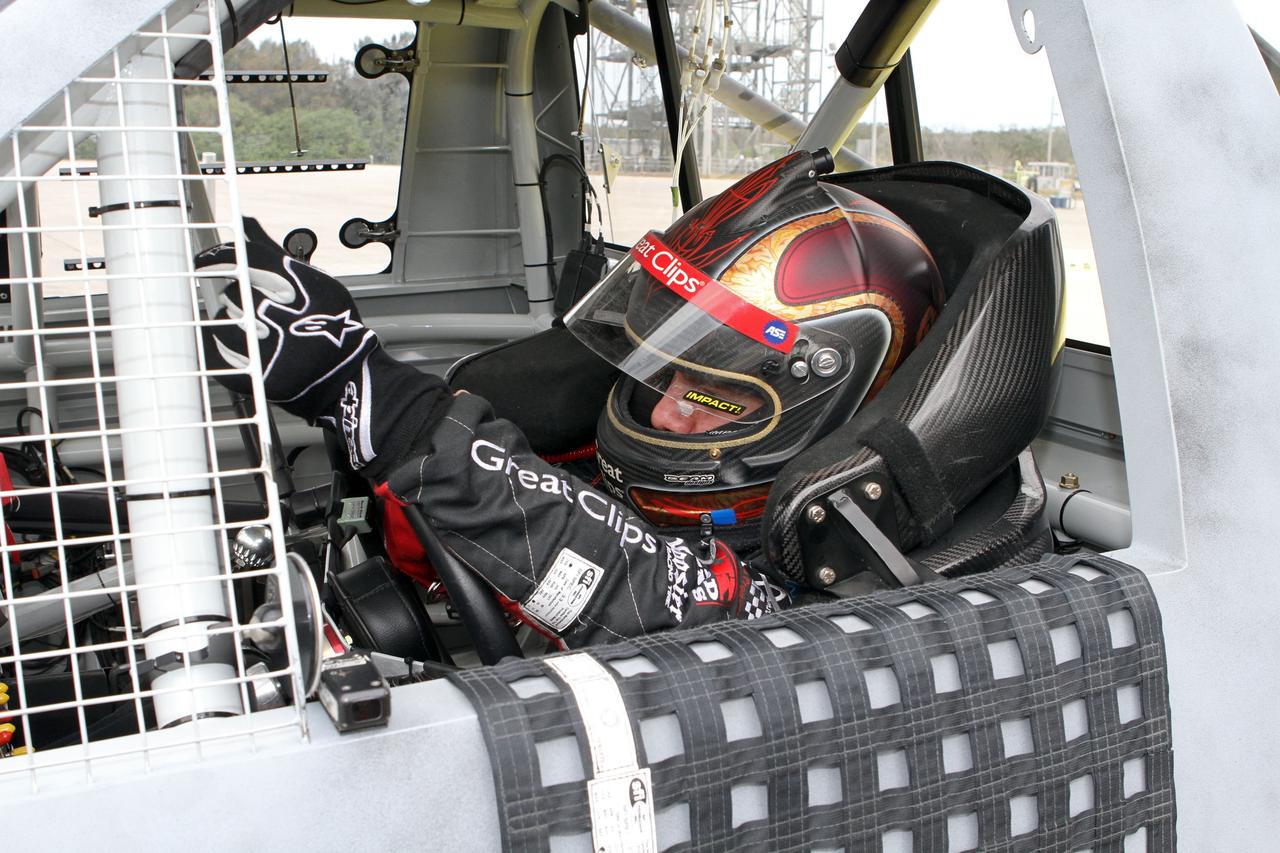
CAPE CANAVERAL, Fla. - At NASA’s Kennedy Space Center in Florida, NASCAR racer Jason Leffler with Kyle Busch Motorsports (KBM) prepares to drive his instrument-laden vehicle down the three-mile-long Shuttle Landing Facility runway. The operation is part of KBMs’ program to test aerodynamic and real-world capabilities on one of the flattest surfaces in the world. Racing teams have been using the runway for testing since 2008. KBM signed a Space Act Agreement with NASA to use the facility’s runway. Photo Credit: NASA/Kim Shiflett
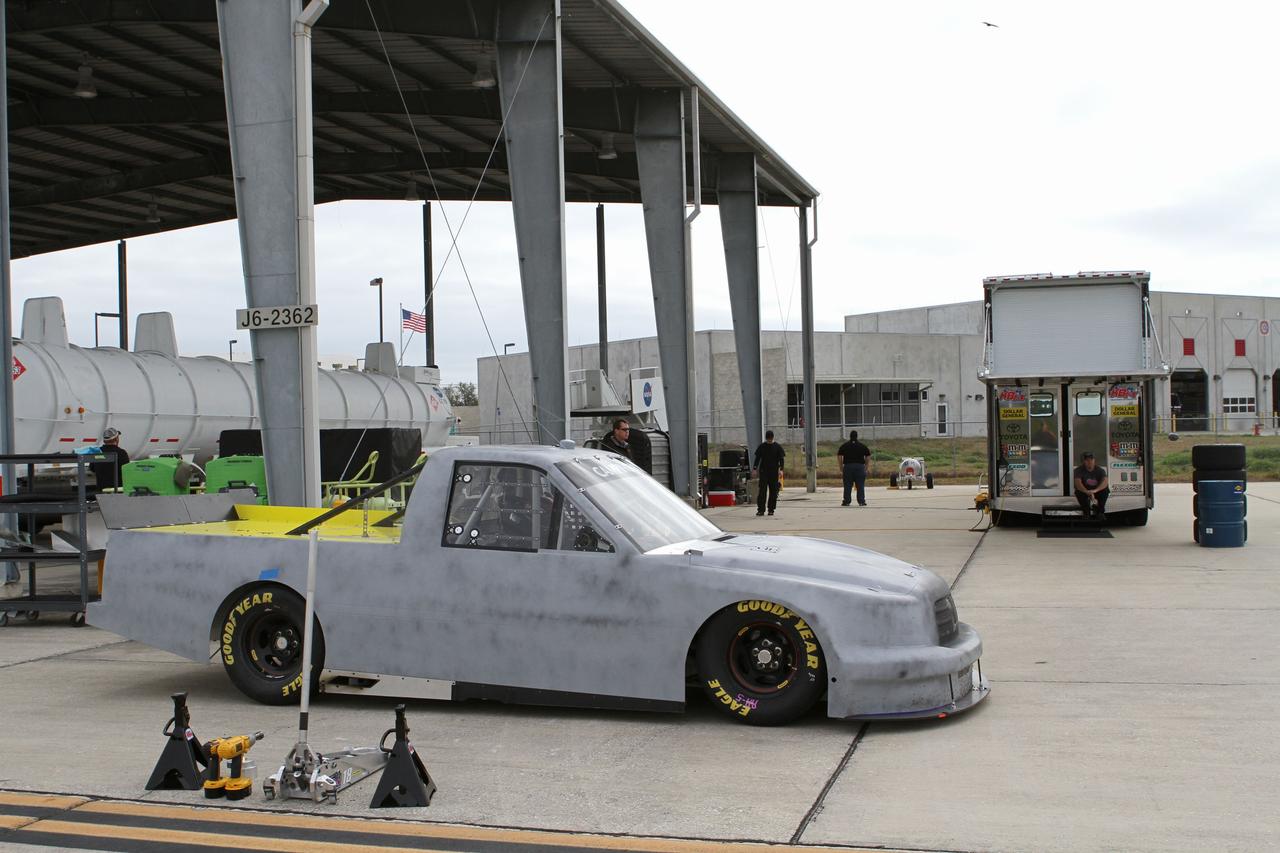
CAPE CANAVERAL, Fla. - At NASA’s Kennedy Space Center in Florida, NASCAR racer Jason Leffler’s instrument-laden vehicle is being prepared for its three-mile-long drive down the Shuttle Landing Facility runway. The operation is part of Kyle Busch Motorsports’ (KBM) program to test aerodynamic and real-world capabilities on one of the flattest surfaces in the world. Racing teams have been using the runway for testing since 2008. KBM signed a Space Act Agreement with NASA to use the facility’s runway. Photo Credit: NASA/Kim Shiflett
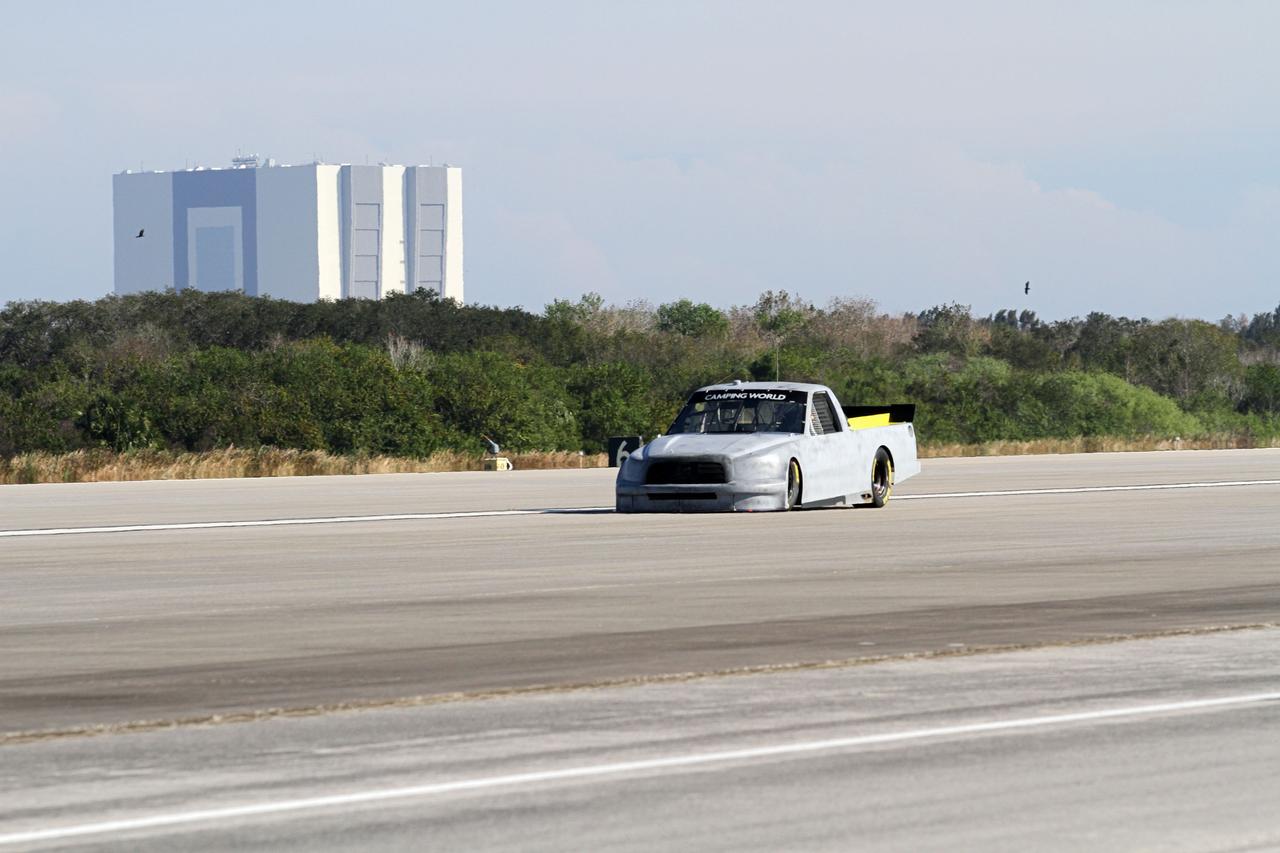
CAPE CANAVERAL, Fla. - At NASA’s Kennedy Space Center in Florida, NASCAR racer Jason Leffler with Kyle Busch Motorsports (KBM) drives his instrument-laden vehicle down the three-mile-long Shuttle Landing Facility runway. The operation is part of KBMs’ program to test aerodynamic and real-world capabilities on one of the flattest surfaces in the world. Racing teams have been using the runway for testing since 2008. KBM signed a Space Act Agreement with NASA to use the facility’s runway. Photo Credit: NASA/Kim Shiflett
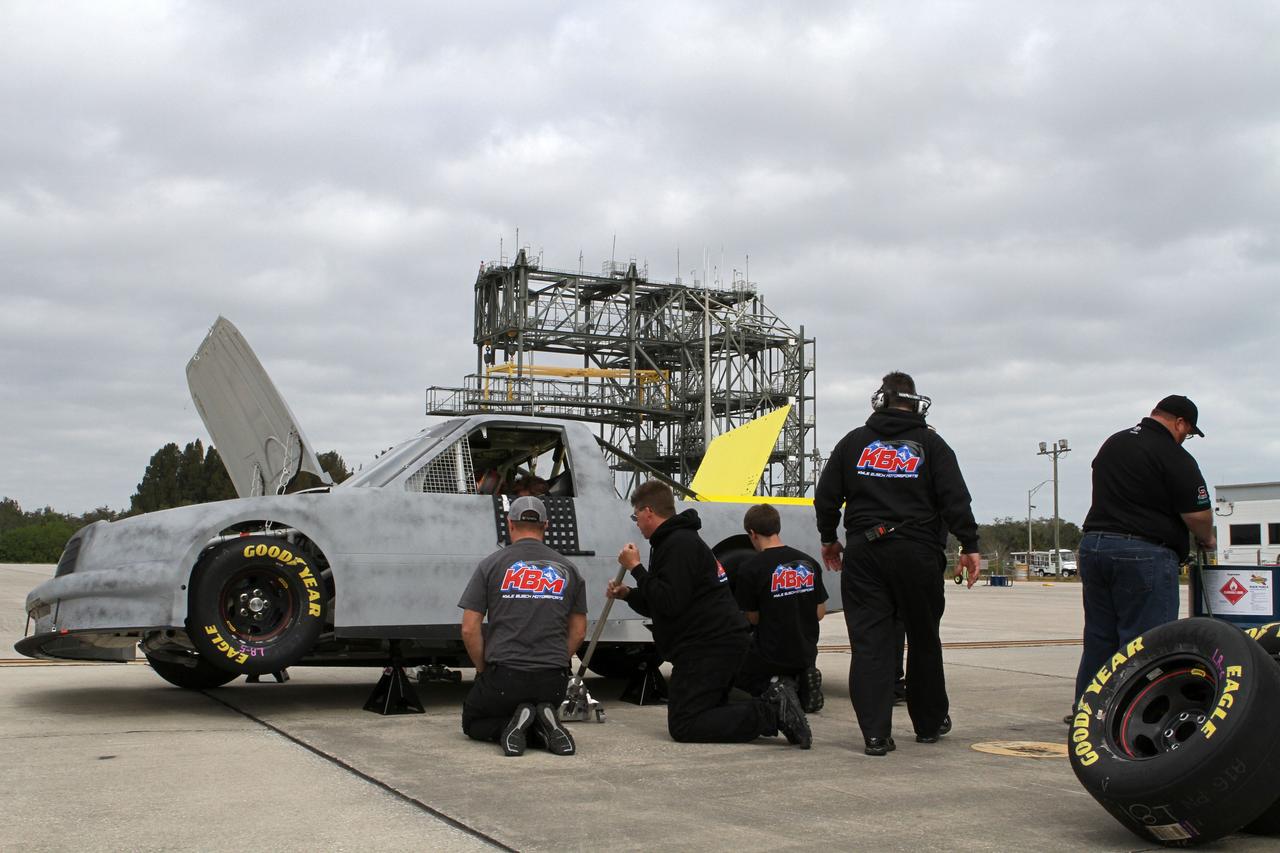
CAPE CANAVERAL, Fla. - At NASA’s Kennedy Space Center in Florida, NASCAR racer Jason Leffler’s instrument-laden vehicle is being prepared for its three-mile-long drive down the Shuttle Landing Facility runway. The operation is part of Kyle Busch Motorsports’ program to test aerodynamic and real-world capabilities on one of the flattest surfaces in the world. Racing teams have been using the runway for testing since 2008. KBM signed a Space Act Agreement with NASA to use the facility’s runway. Photo Credit: NASA/Kim Shiflett
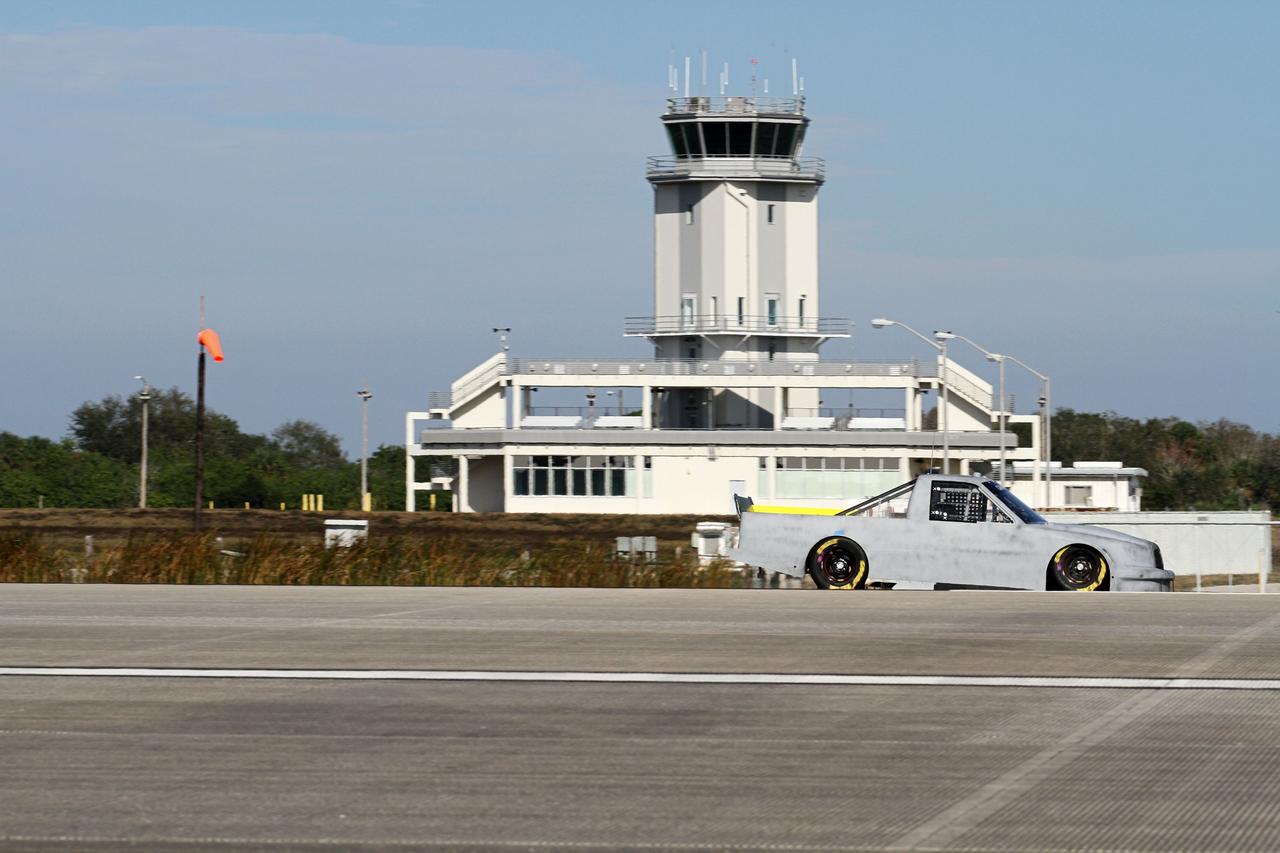
CAPE CANAVERAL, Fla. - At NASA’s Kennedy Space Center in Florida, NASCAR racer Jason Leffler with Kyle Busch Motorsports (KBM) drives his instrument-laden vehicle down the three-mile-long Shuttle Landing Facility runway. In the background, at midfield is the Control Tower. The operation is part of KBMs’ program to test aerodynamic and real-world capabilities on one of the flattest surfaces in the world. Racing teams have been using the runway for testing since 2008. KBM signed a Space Act Agreement with NASA to use the facility’s runway. Photo Credit: NASA/Kim Shiflett
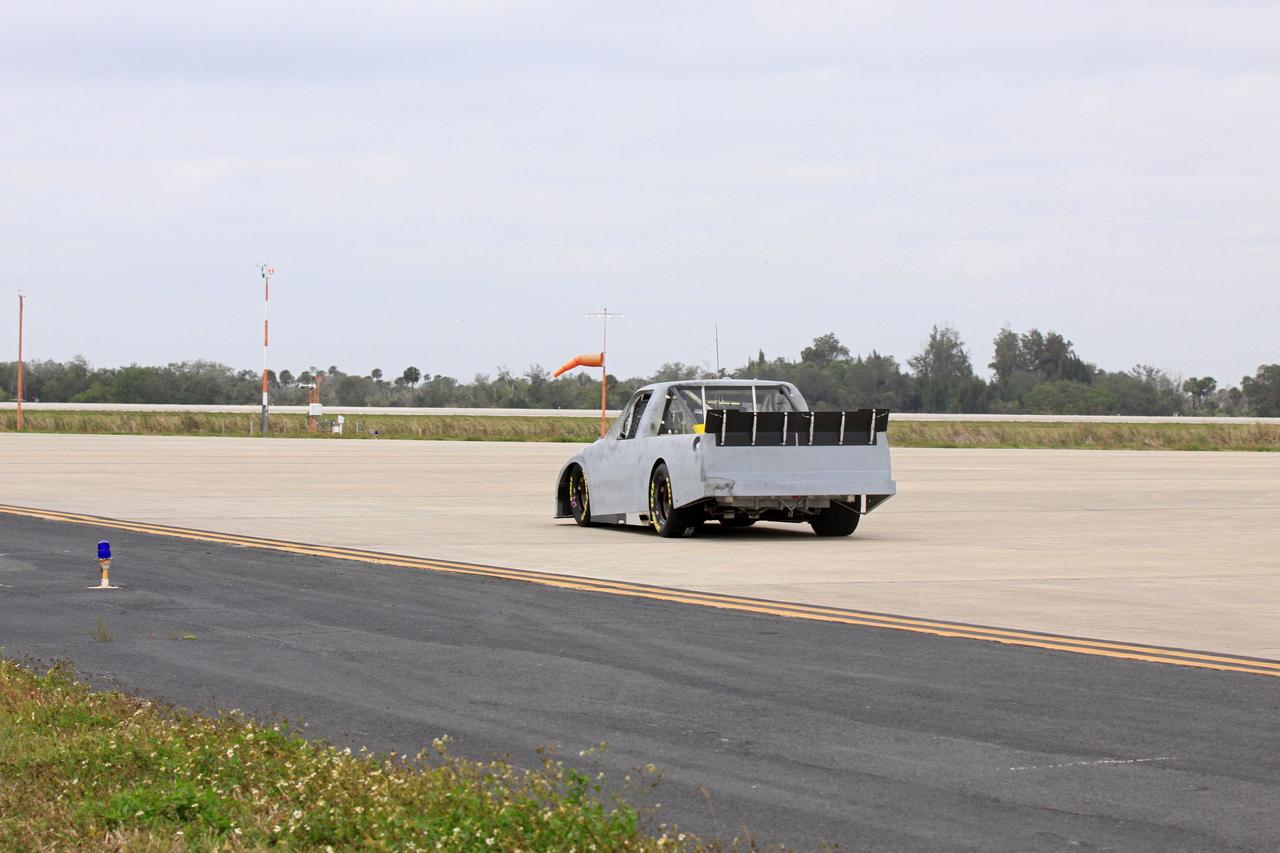
CAPE CANAVERAL, Fla. - At NASA’s Kennedy Space Center in Florida, NASCAR racer Jason Leffler with Kyle Busch Motorsports (KBM) drives his instrument-laden vehicle down the three-mile-long Shuttle Landing Facility runway. The operation is part of KBMs’ program to test aerodynamic and real-world capabilities on one of the flattest surfaces in the world. Racing teams have been using the runway for testing since 2008. KBM signed a Space Act Agreement with NASA to use the facility’s runway. Photo Credit: NASA/Kim Shiflett
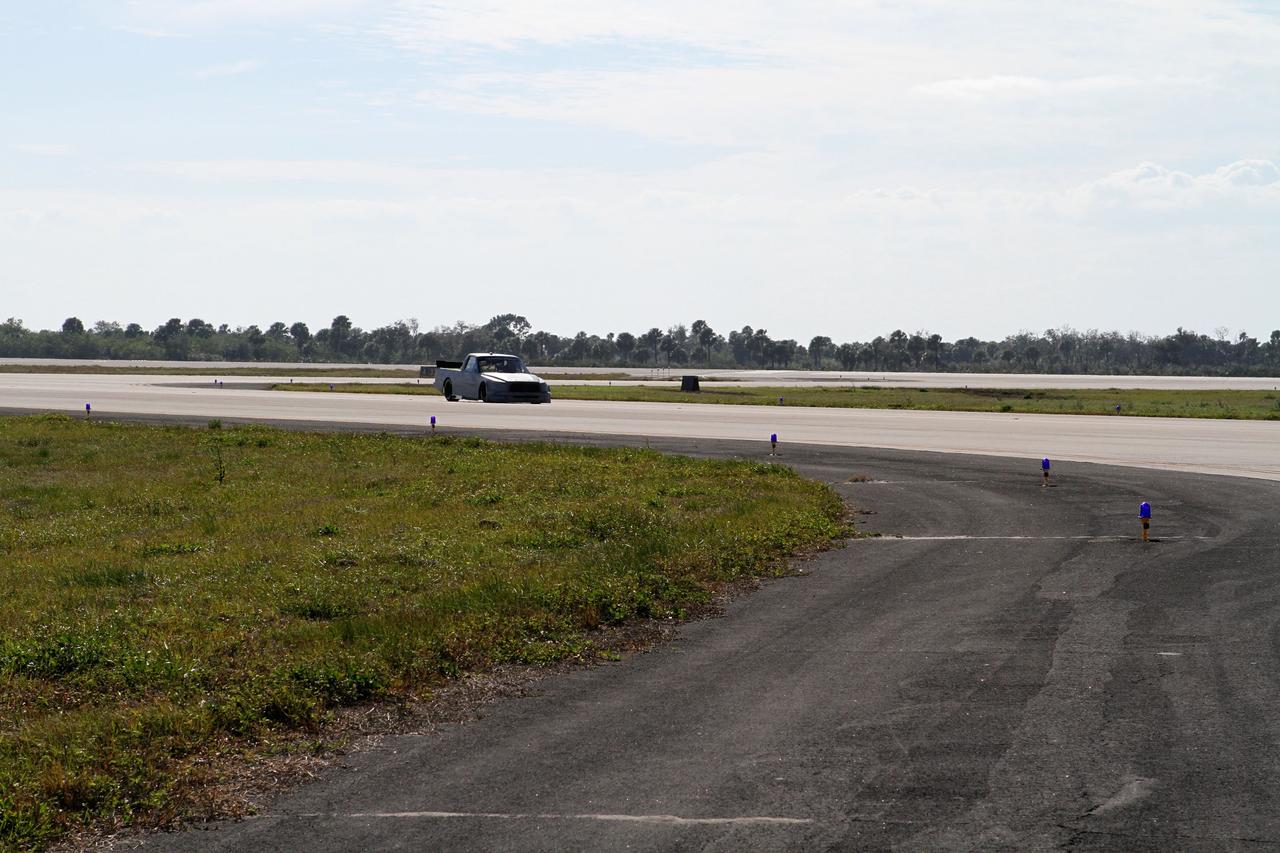
CAPE CANAVERAL, Fla. - At NASA’s Kennedy Space Center in Florida, NASCAR racer Jason Leffler with Kyle Busch Motorsports (KBM) drives his instrument-laden vehicle back from the three-mile-long drive down the Shuttle Landing Facility runway. The operation is part of KBMs’ program to test aerodynamic and real-world capabilities on one of the flattest surfaces in the world. Racing teams have been using the runway for testing since 2008. KBM signed a Space Act Agreement with NASA to use the facility’s runway. Photo Credit: NASA/Kim Shiflett
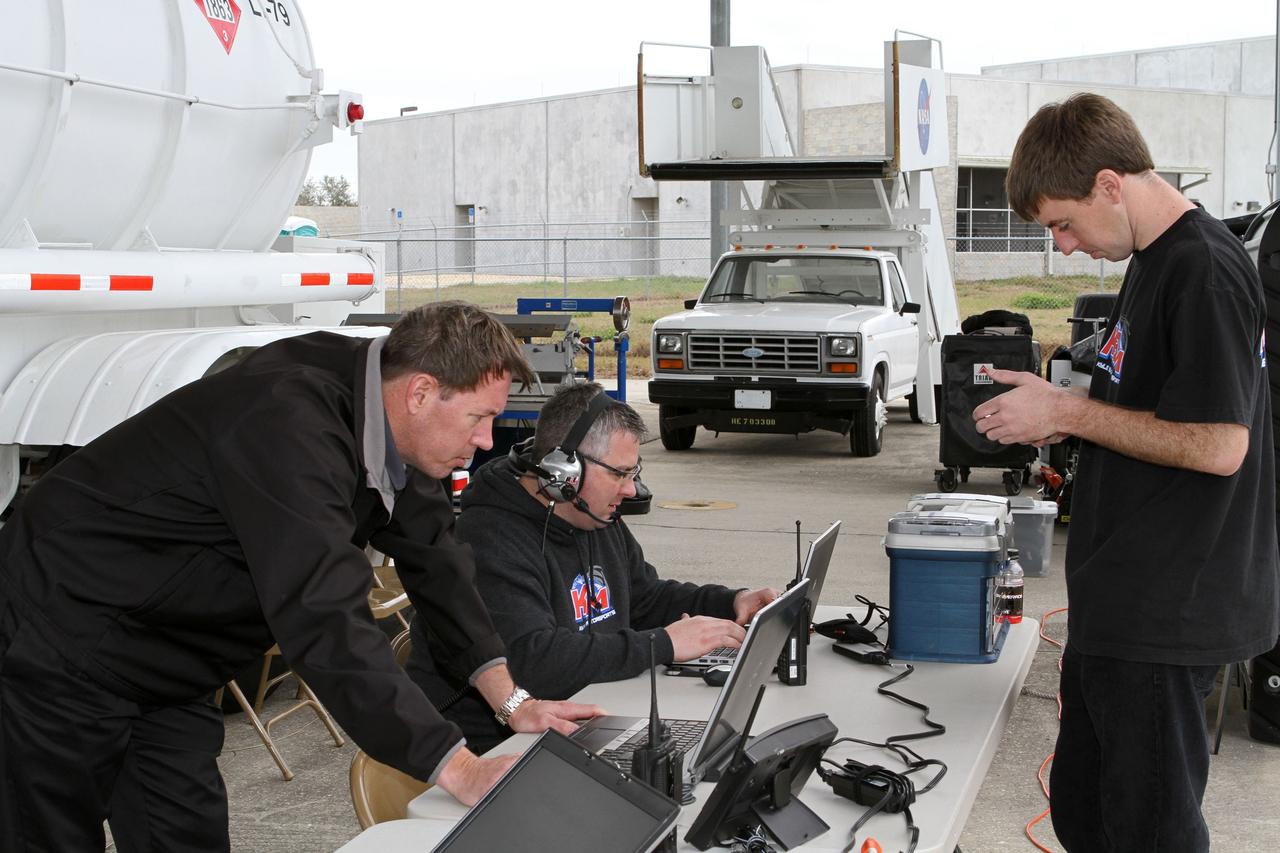
CAPE CANAVERAL, Fla. - At NASA’s Kennedy Space Center in Florida, members of Kyle Busch Motorsports (KBM) team monitor screens as NASCAR racer Jason Leffler with KBM prepares to drive his instrument-laden vehicle down the three-mile-long Shuttle Landing Facility runway. The operation is part of KBMs’ program to test aerodynamic and real-world capabilities on one of the flattest surfaces in the world. Racing teams have been using the runway for testing since 2008. KBM signed a Space Act Agreement with NASA to use the facility’s runway. Photo Credit: NASA/Kim Shiflett
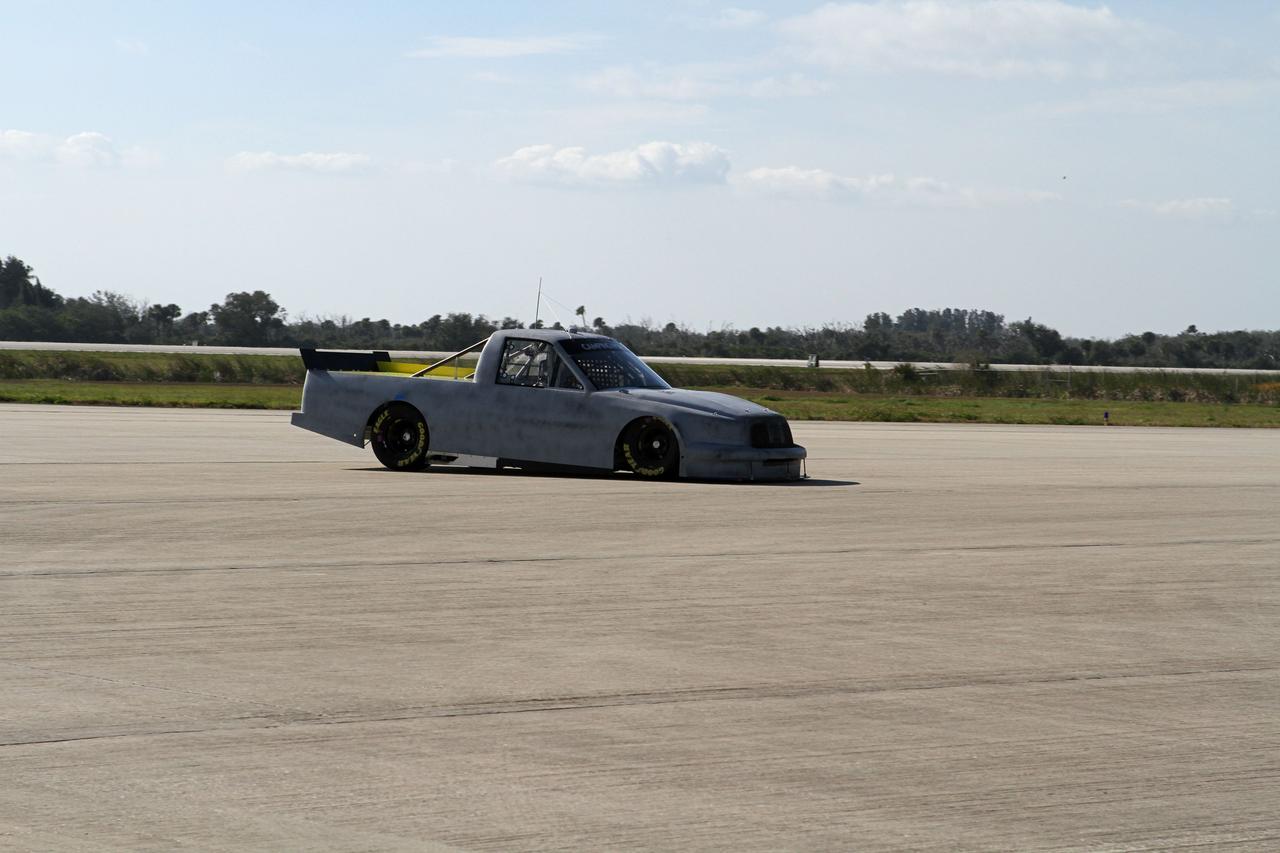
CAPE CANAVERAL, Fla. - At NASA’s Kennedy Space Center in Florida, NASCAR racer Jason Leffler with Kyle Busch Motorsports (KBM) drives his instrument-laden vehicle back from the three-mile-long drive down the Shuttle Landing Facility runway. The operation is part of KBMs’ program to test aerodynamic and real-world capabilities on one of the flattest surfaces in the world. Racing teams have been using the runway for testing since 2008. KBM signed a Space Act Agreement with NASA to use the facility’s runway. Photo Credit: NASA/Kim Shiflett

STS-41 Discovery, Orbiter Vehicle (OV) 103, with nose landing gear (NLG) and main landing gear (MLG) deployed, glides over concrete runway 22 at Edwards Air Force Base (EAFB), California, prior to touchdown.
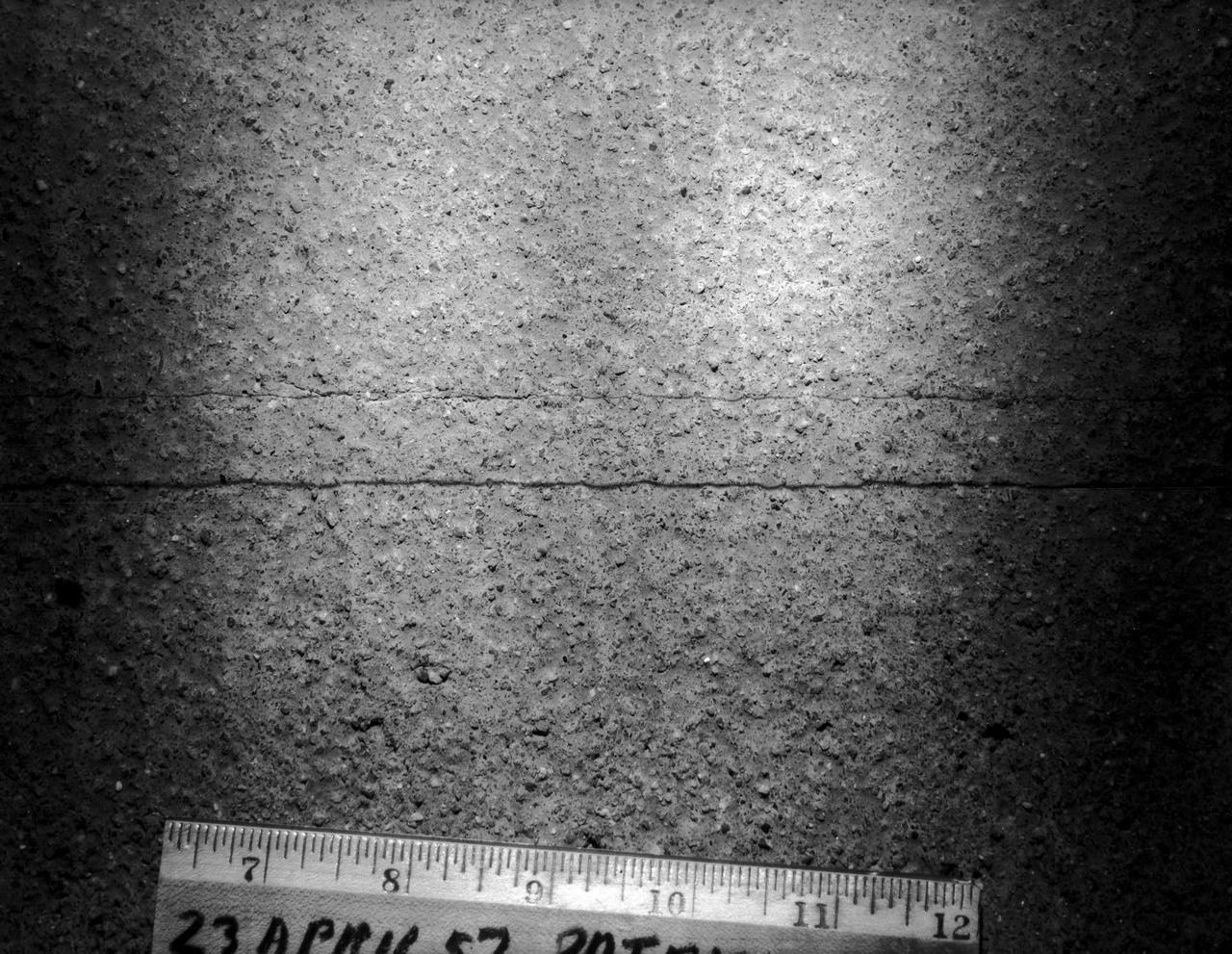
Runway surface Patrick Henry Airport April 23, 1957
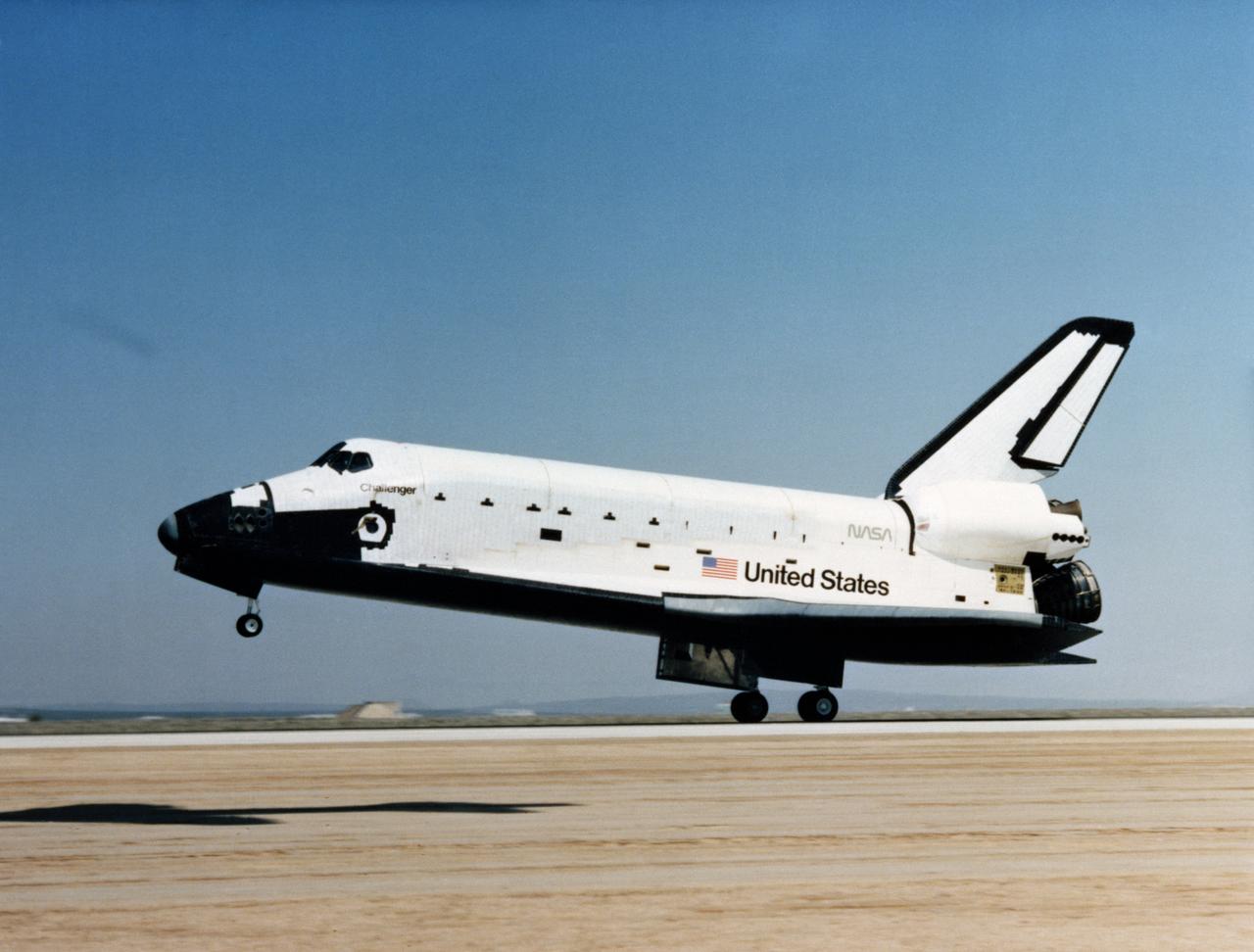
S83-30220 (9 April 1983) --- The space shuttle Challenger makes its first landing shortly before 11 a.m. (PST) on April 9, 1983, on Runway 22 at the Edwards Air Force Base in Southern California. Onboard the reusable spacecraft, having just completed a successful five-day mission, are astronauts Paul J. Weitz, Karol J. Bobko, F. Story Musgrave and Donald H. Peterson. Photo credit: NASA
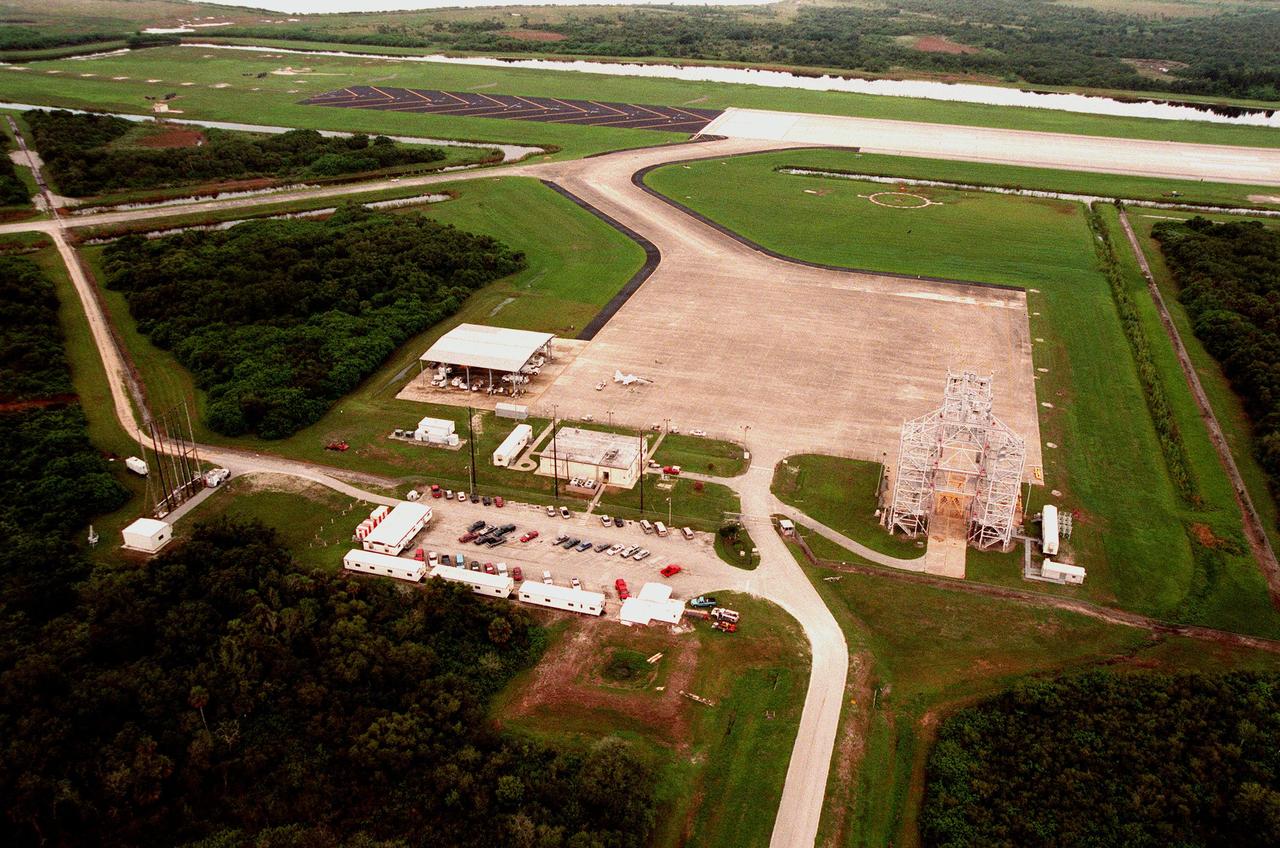
From the air over KSC can be seen the Shuttle Landing Facility. Orbiter landings at the Kennedy Space Center are made on one of the largest runways in the world. The runway is located 3.2 km (2 miles) northwest of the Vehicle Assembly Building and is 4,572 meters (15,000ft) long and 91.4 meters (300ft) wide -- about as wide as the length of a football field. It has 305 meters (1000ft) of paved overruns at each end and the paving thickness is 40.6cm (15 inches) at the center. At left in the photo is the Aircraft Ground Equipment Shed; in the center is the Landing Aids Control Building (LACB) which supports landing operations and houses operations personnel. Located at the northeast corner of the parking apron is the Mate/Demate device (MDD) used to raise and lower the orbiter from its 747 carrier aircraft during ferry operations. The open-truss steel structure is equipped with hoists, adapters and movable platforms for access to certain orbiter components and equipment. It also is equipped with lightning protection devices. The MDD is 45.7 meters (150ft) long, 28.3 meters (93ft) wide and 32 meters (105ft) high. On the landing area in front of the SLF is a T-38 jet airplane.
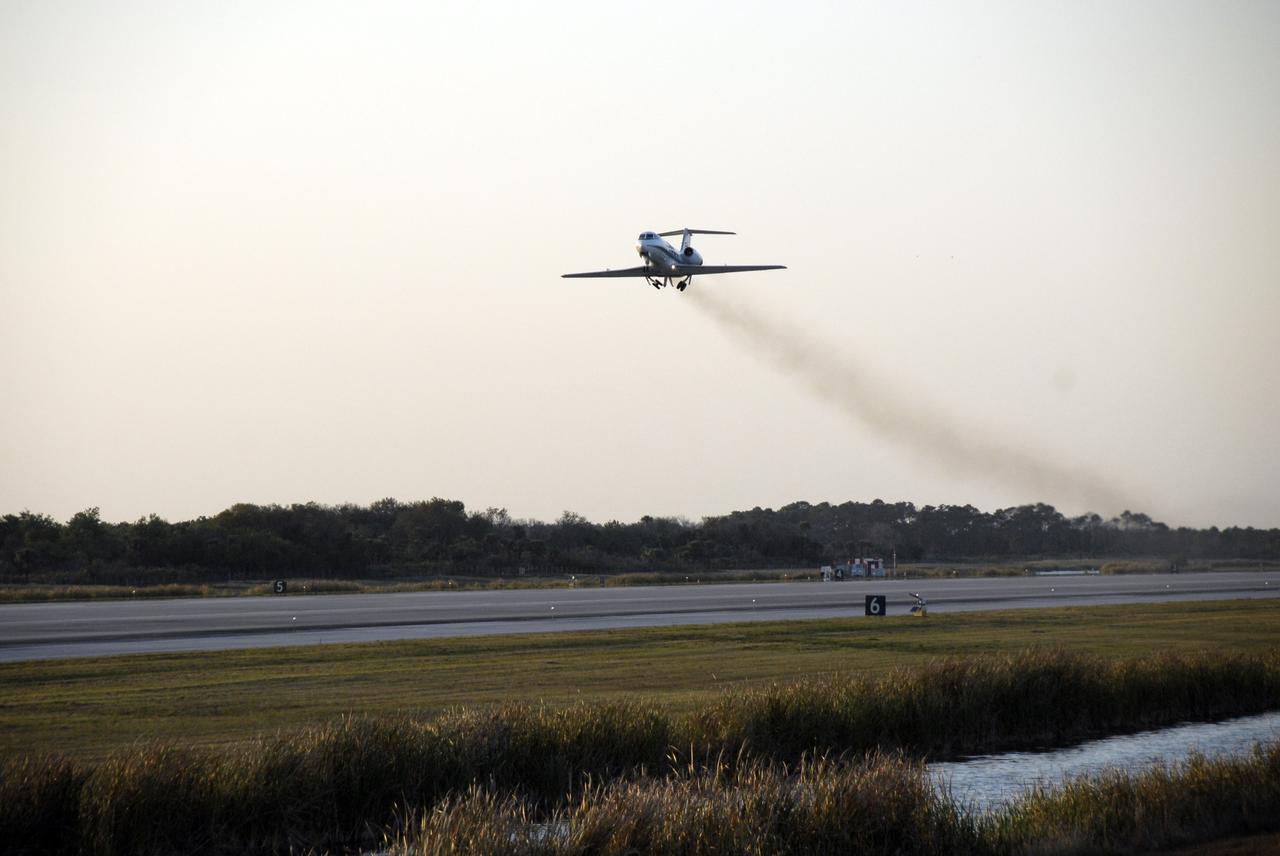
CAPE CANAVERAL, Fla. – One of the two Shuttle Training Aircraft takes off from Shuttle Landing Facility runway at NASA's Kennedy Space Center in Florida. STS-119 Commander Lee Archambault and Pilot Tony Antonelli are practicing shuttle landings on the runway. The mission crew members arrived in the afternoon at Kennedy to prepare for launch. The mission is the 28th to the International Space Station and the 125th space shuttle flight. Space shuttle Discovery will deliver the final pair of power-generating solar array wings and truss element, S6. Photo credit: NASA/Kim Shiflett
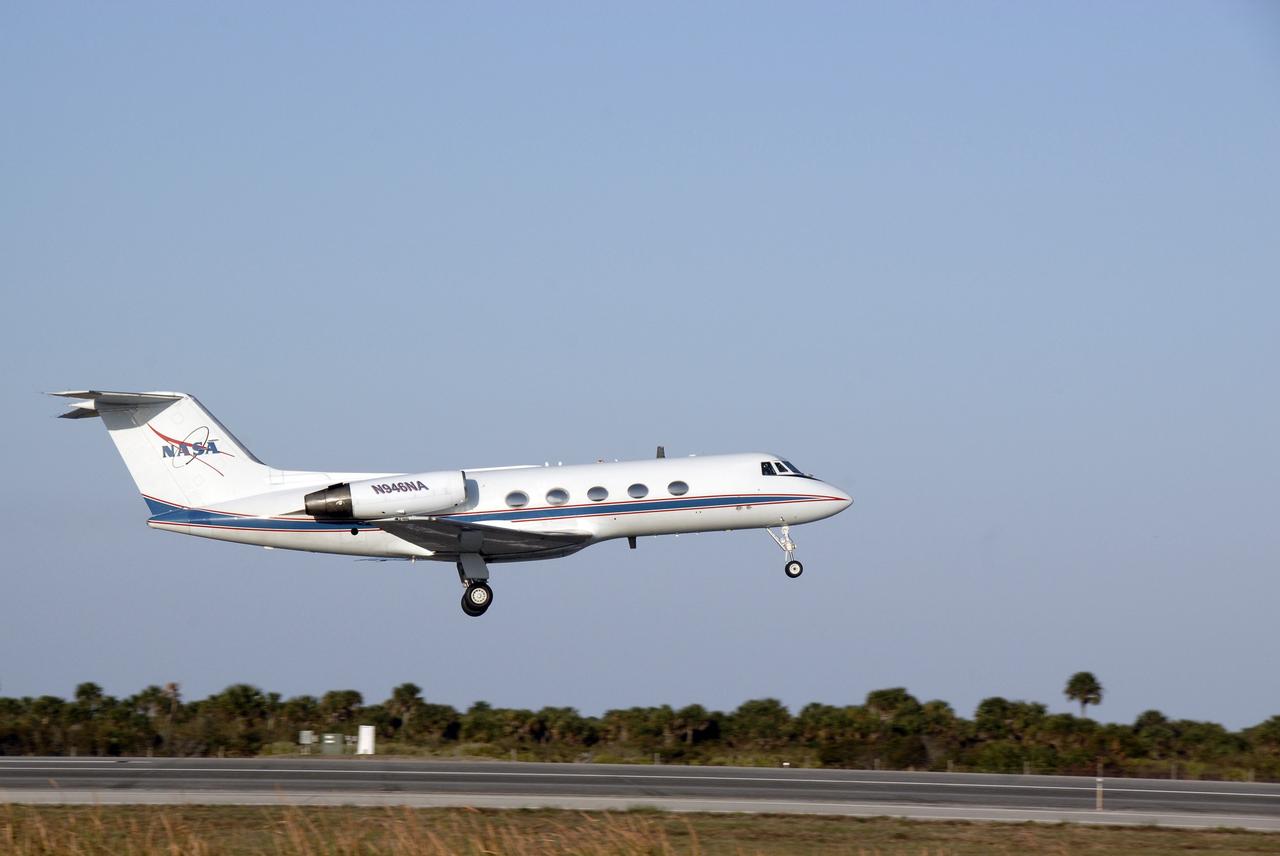
CAPE CANAVERAL, Fla. – One of the two Shuttle Training Aircraft approaches touchdown on the Shuttle Landing Facility runway at NASA's Kennedy Space Center in Florida. STS-119 Commander Lee Archambault and Pilot Tony Antonelli are practicing shuttle landings on the runway. The mission crew members arrived in the afternoon at Kennedy to prepare for launch. The mission is the 28th to the International Space Station and the 125th space shuttle flight. Space shuttle Discovery will deliver the final pair of power-generating solar array wings and truss element, S6. Photo credit: NASA/Kim Shiflett
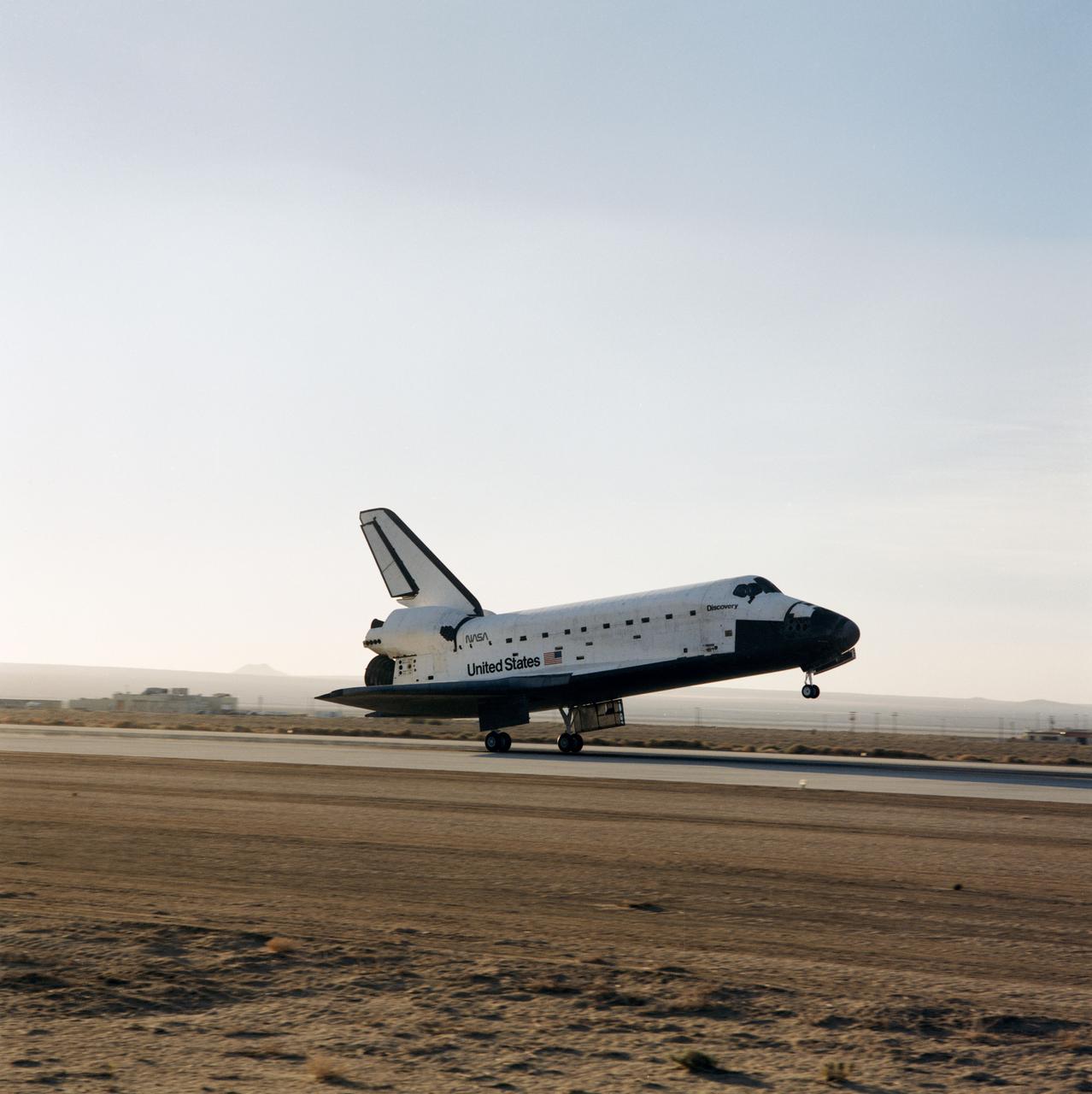
STS031-S-135 (29 April 1990) --- The Space Shuttle Discovery makes a smooth landing on the runway at Edwards Air Force Base to complete a highly successful five-day mission. It was an Earth orbital flight during which the Hubble Space Telescope (HST) was sent toward its 15-year mission. Landing was completed at 6:51 a.m. (PDT), April 29, 1990. Inside the spacecraft for STS-31 were Astronauts Loren J. Shriver, Charles F. Bolden, Bruce McCandless II, Kathryn D. Sullivan and Steven A. Hawley.
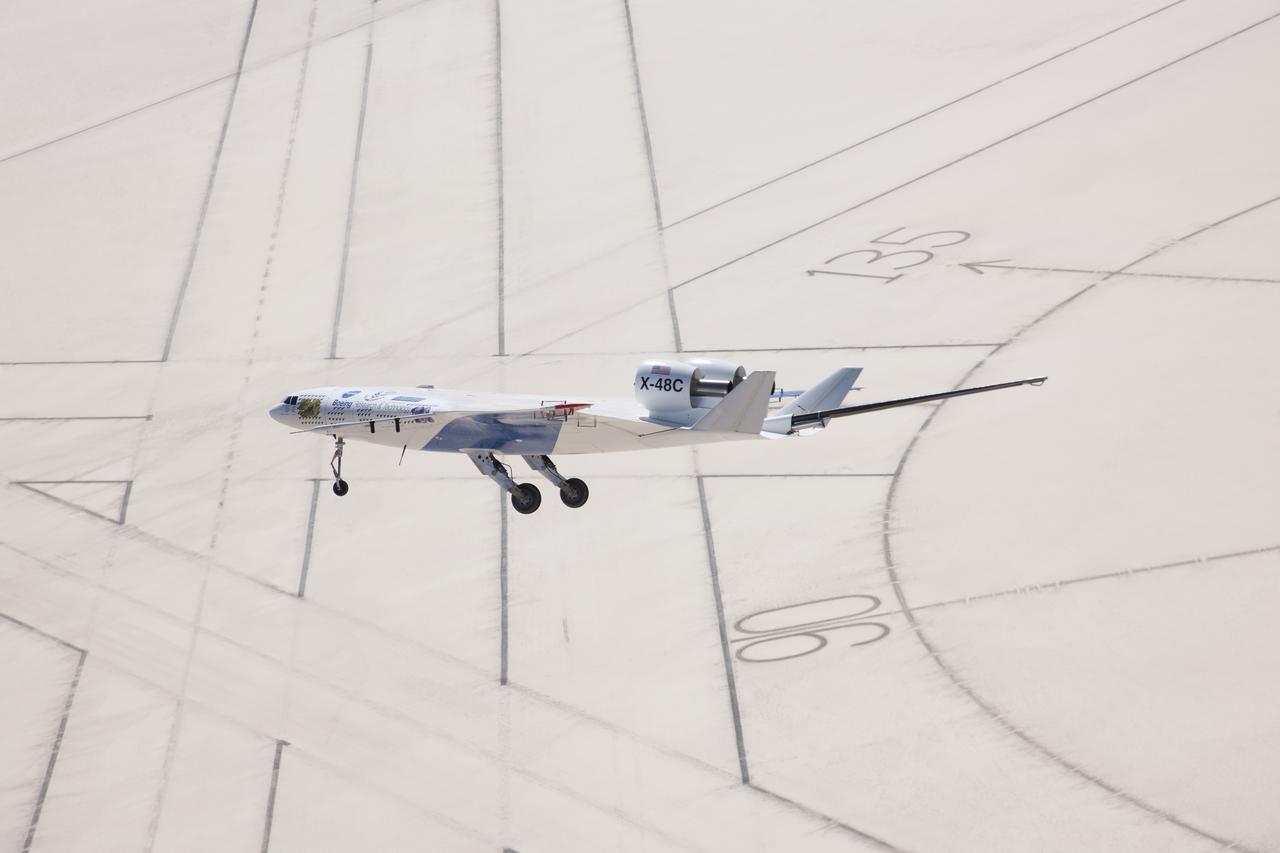
The X-48C Hybrid Wing Body research aircraft flew over the intersection of several runways adjacent to the compass rose on Rogers Dry Lake at Edwards Air Force Base during one of the sub-scale aircraft's final test flights on Feb. 28, 2013.
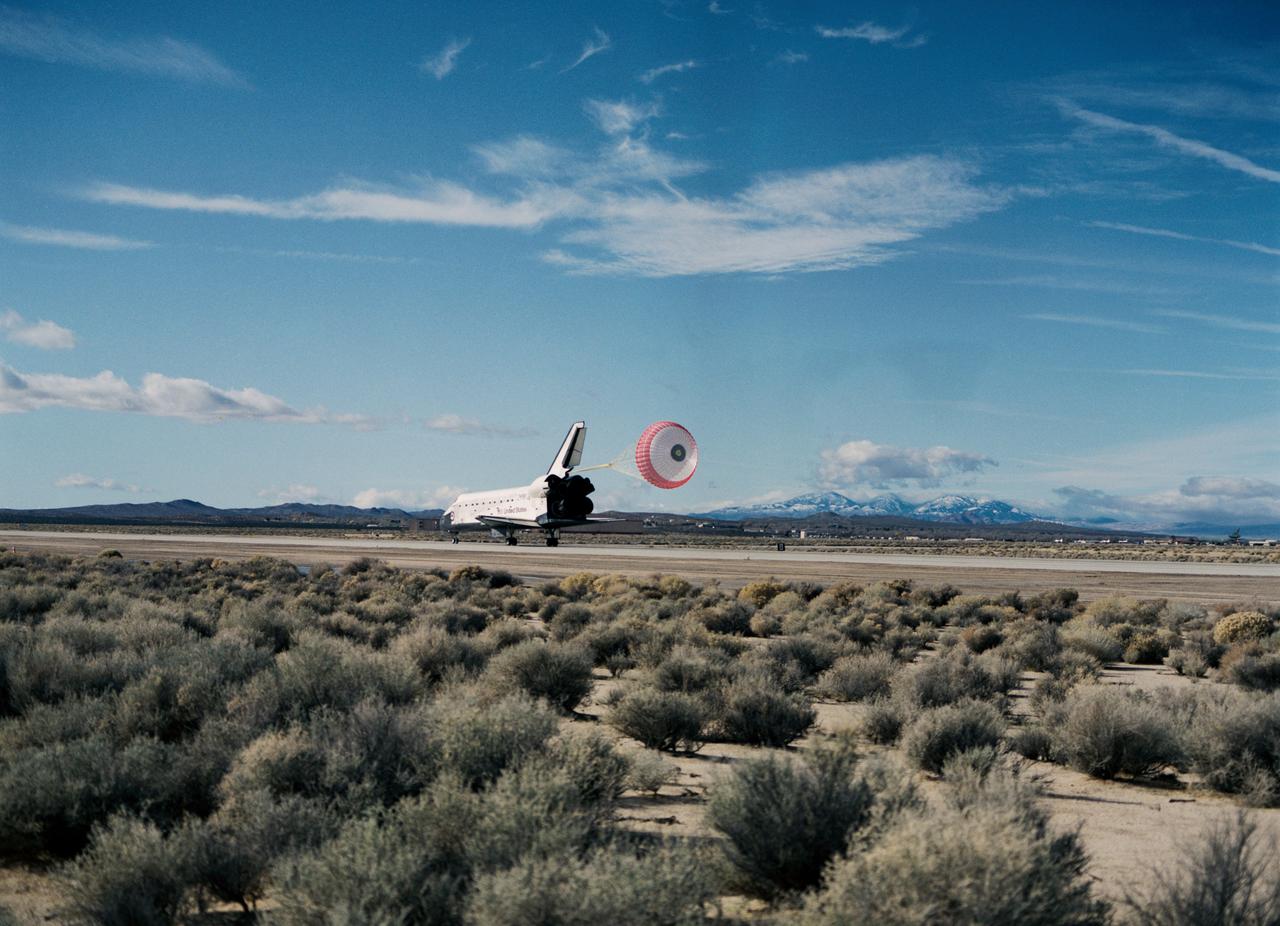
STS-53 Discovery, Orbiter Vehicle (OV) 103, is slowed by a red, white, and blue drag chute during its landing on concrete runway 22 at Edwards Air Force Base (EAFB), California. Main landing gear (MLG) touchdown occurred at 12:43:17 pm (Pacific Standard Time (PST)). This aft view of OV-103 shows the drag chute deployed from its compartment at the base of the vertical tail, the speedbrake/rudder flaps open, and the space shuttle main engines (SSMEs). Both MLG and nose landing gear (NLG) ride along the runway surface. Desert scrub brush appears in the foreground and mountains are seen in the background.
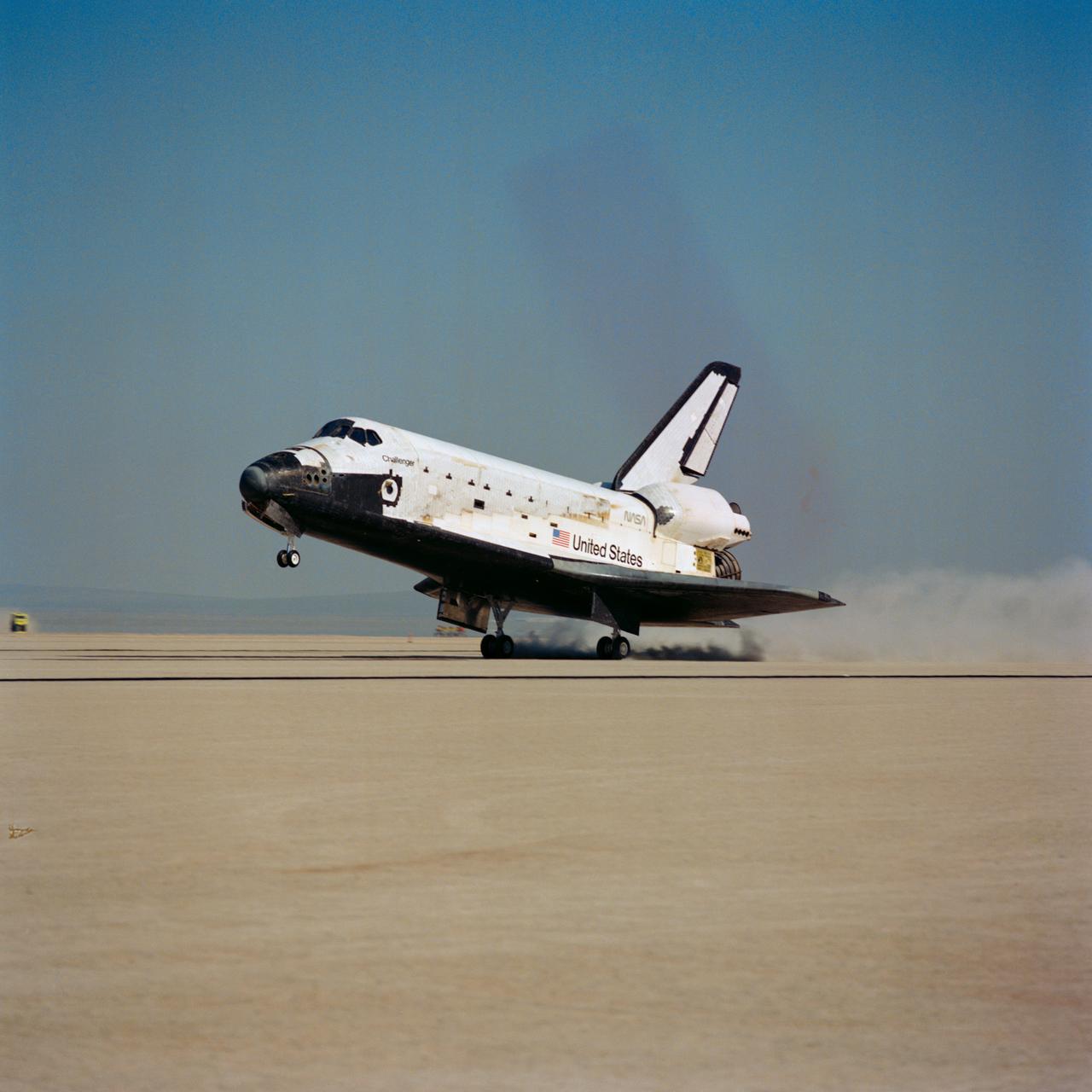
Shuttle Challenger lands on Runway 17 at Edwards at end of 51-B mission. The photo is a rear view of the shuttle landing gear touching the runway, with clouds of dirt trailing behind it. The nose gear is still in the air (071); Side view of the Challenger landing gear touching the runway (072).
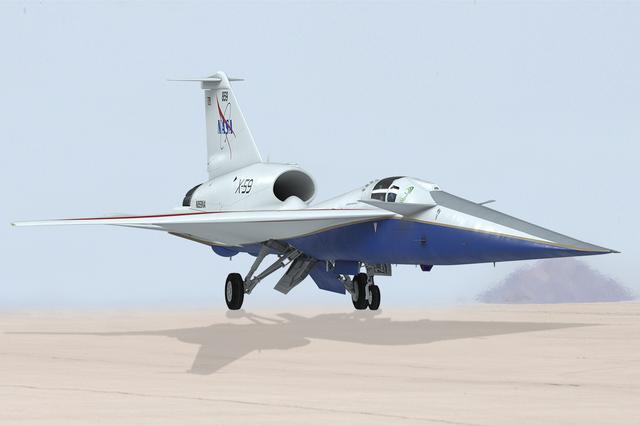
Artist illustration of the X-59 taxiing on the runway.
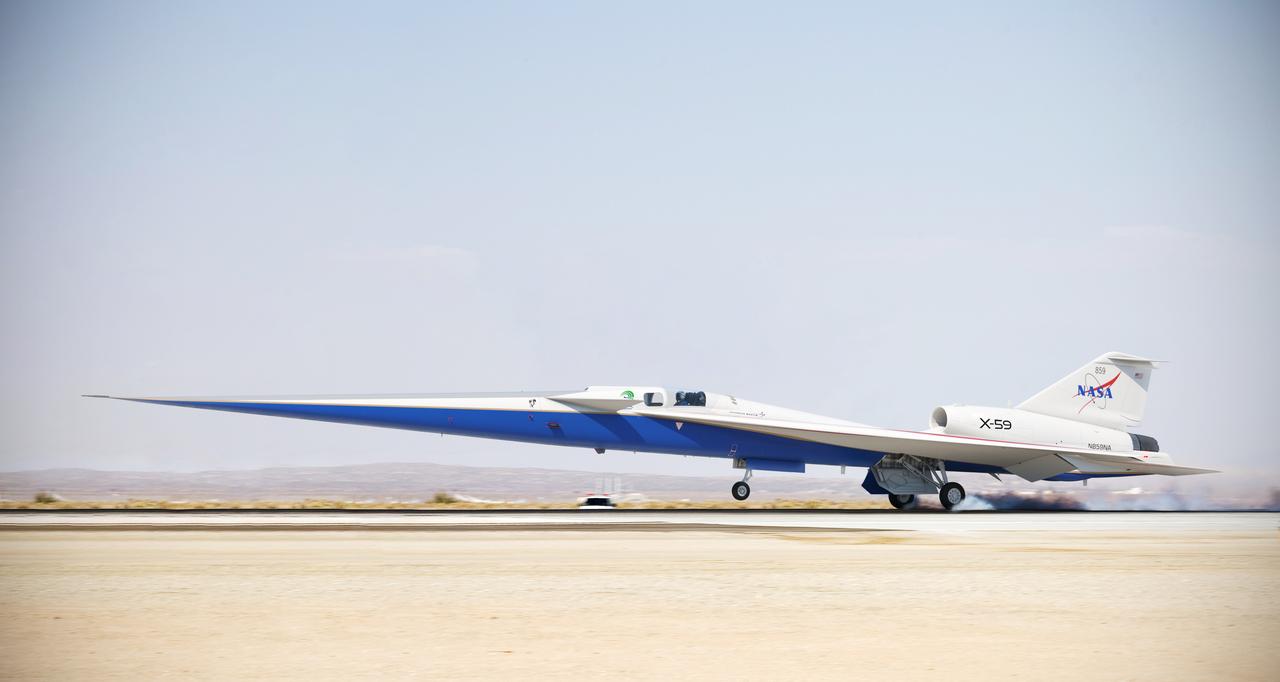
Artist illustration of the X-59 landing on the runway.

Photography from Shuttle ALT FF-5. S77-30393: ALT Fr. 3258, a higher-up shot of the Enterprise approaching runway for landing. EAFB, CA
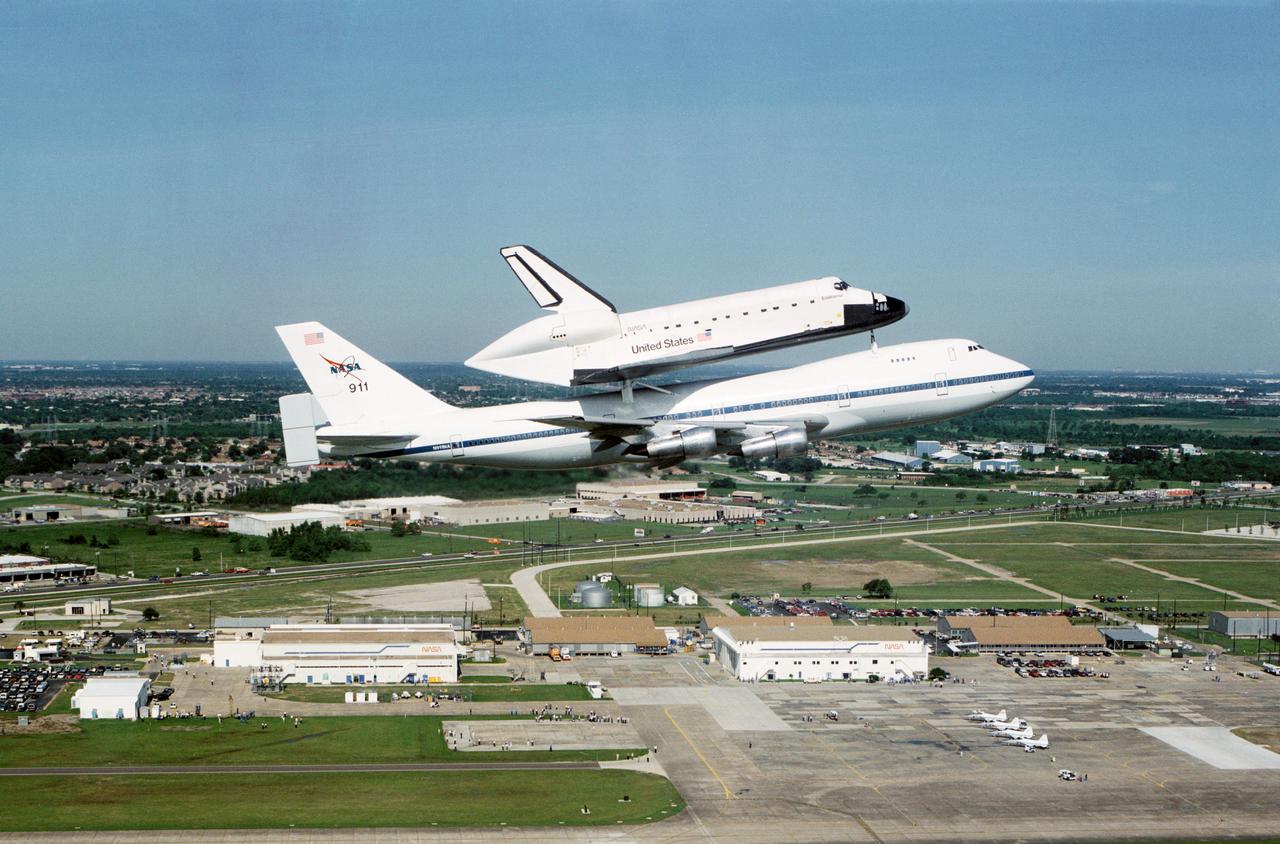
S91-36097 (6 May 1991) --- Air to air view of Endeavour, Orbiter Vehicle (OV) 105, atop a Shuttle Carrier Aircraft (SCA) NASA 911, a modified Boeing 747, approaches touchdown for a brief stopover at Ellington Field, near JSC. Visible below the spacecraft/aircraft combination are the NASA T-38 flight line, NASA aircraft hangars and facilities, and a runway. OV-105 rolled out at Rockwell's Palmdale facility on 04-25-91 to once more bring to four the total of NASA Shuttles available for flight assignment. The spacecraft and aircraft-tandem left Houston later on this day headed for another stop in Mississippi before landing in Florida on 05-07-91. This photograph was taken from a T-38 aircraft by Sheri J. Dunnette of JSC's Image Science Division (ISD).
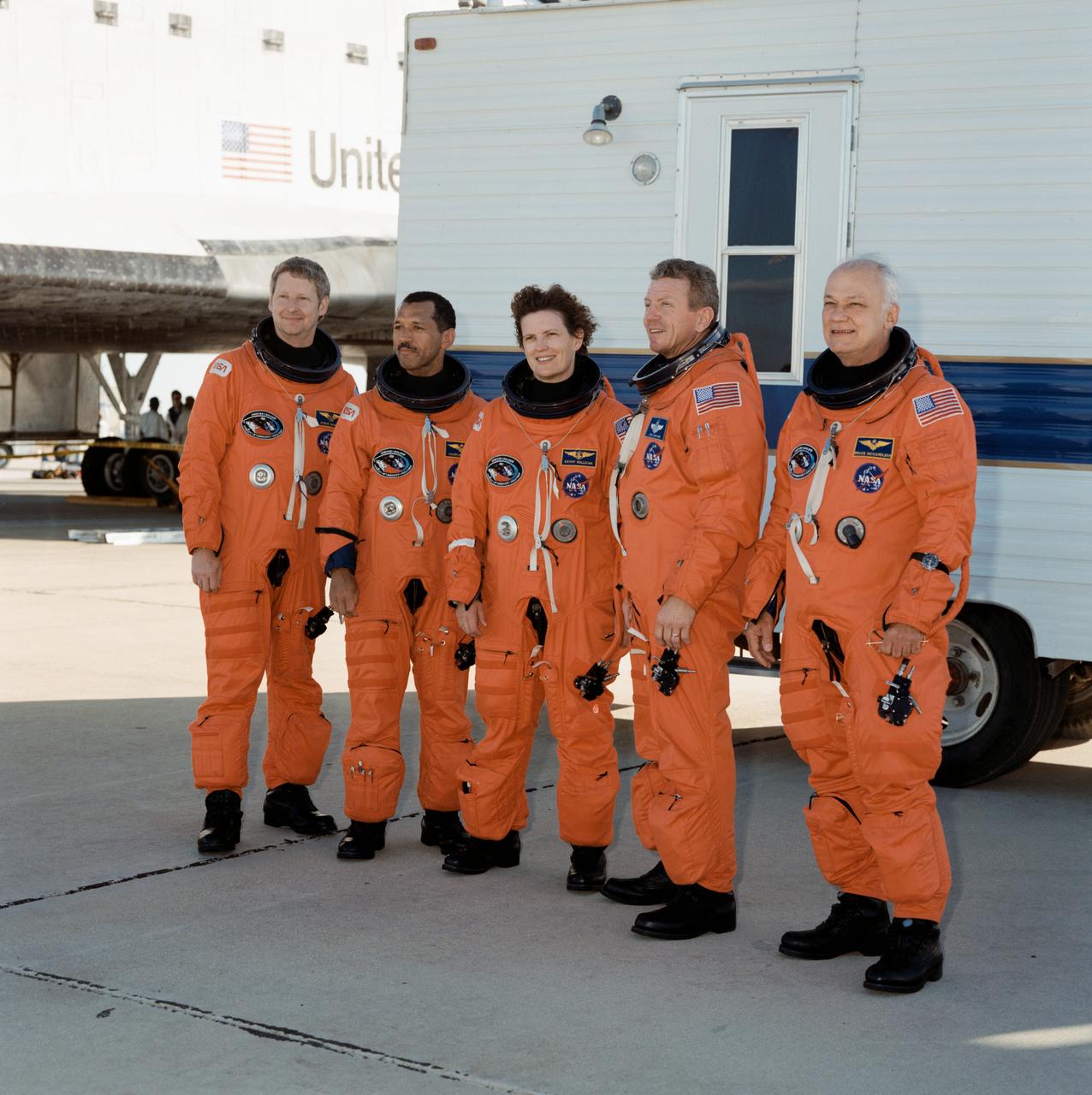
STS031-S-130 (29 April 1990) --- The astronauts of STS-31 pose for a quick photo near the Space Shuttle Discovery following a smooth landing on the runway at Edwards Air Force Base to complete a highly successful five-day mission. Pictured, left to right, are Astronauts Steven A. Hawley, Charles F. Bolden Jr., Kathryn D. Sullivan, Loren J. Shriver, and Bruce McCandless II. Theirs was an Earth orbital flight during which the Hubble Space Telescope (HST) was sent toward its 15-year mission.
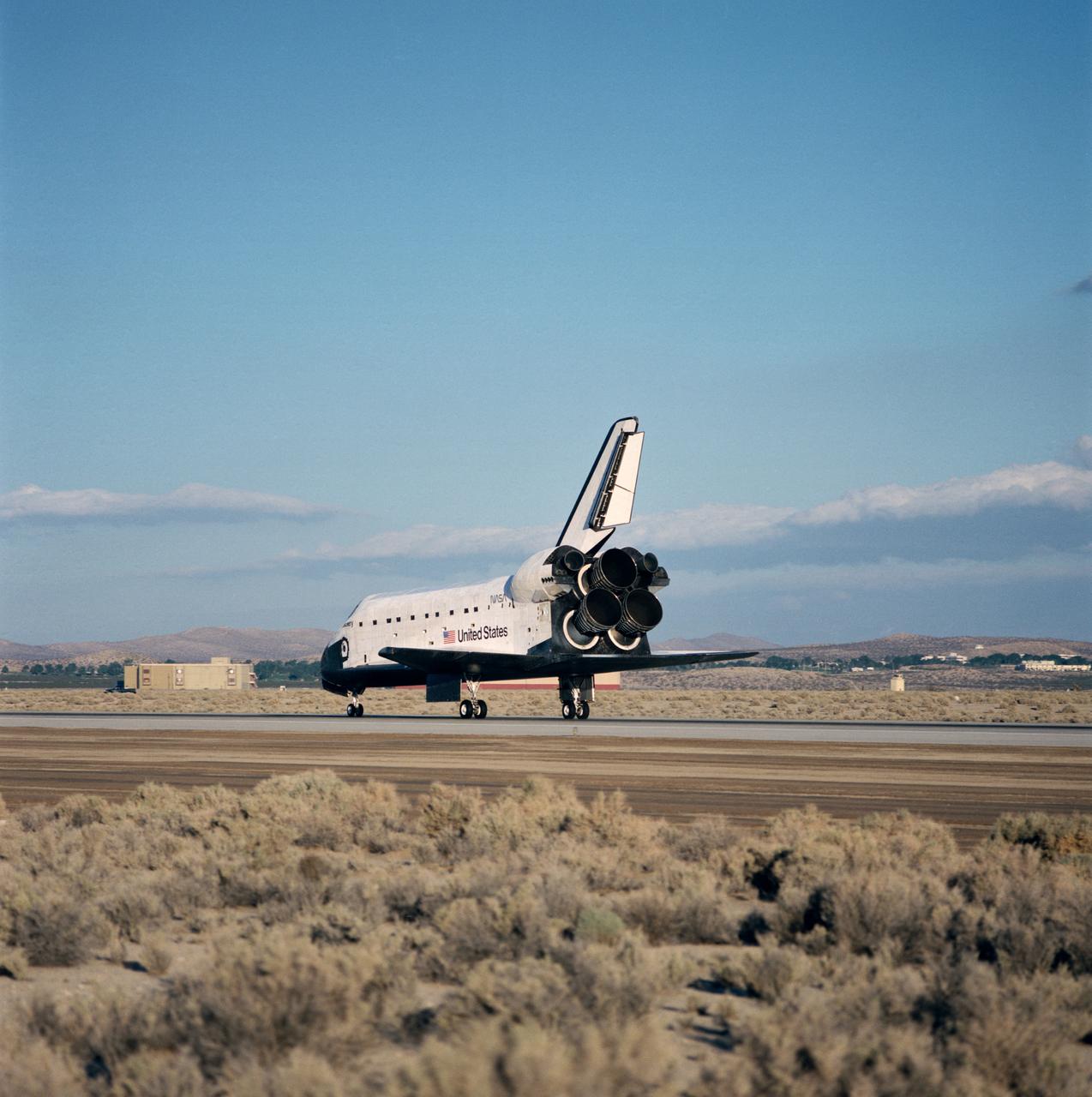
STS-31 Discovery, Orbiter Vehicle (OV) 103, rolls along concrete runway 22 at Edwards Air Force Base (EAFB), California, after nose landing gear (NLG) and main landing gear (MLG) touchdown. This view looks down OV-103's port side from the space shuttle main engines (SSMEs) to the nose section. The SSMEs are gimbaled to their descent position and the rudder/speedbrake is deployed on the vertical stabilizer. Wheel stop occurred at 6:51 am (Pacific Daylight Time (PDT)). In the distance EAFB facilities are visible.

LLTV on runway. EAFB, HOUSTON, TX
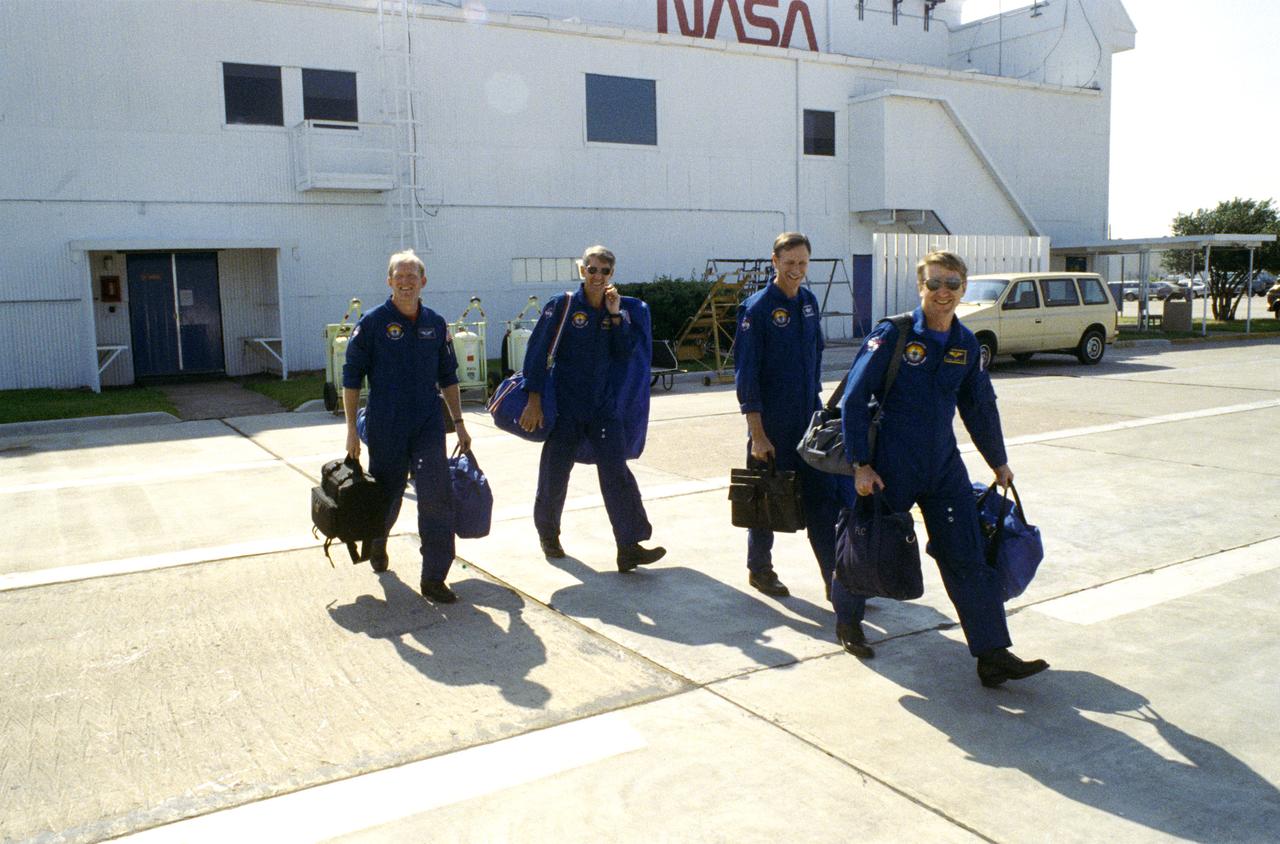
STS-38 crewmembers, carrying their luggage, walk across the Ellington Field runway to board their T-38As. The crewmembers are lead by Pilot Frank L. Culbertson. Commander Richard O. Covey, Mission Specialist (MS) Robert C. Springer (wearing sunglasses), and MS Charles D. Gemar follow. The crewmembers are preparing for their departure to the Kennedy Space Center (KSC). Ellington Field hangar is visible in the background.
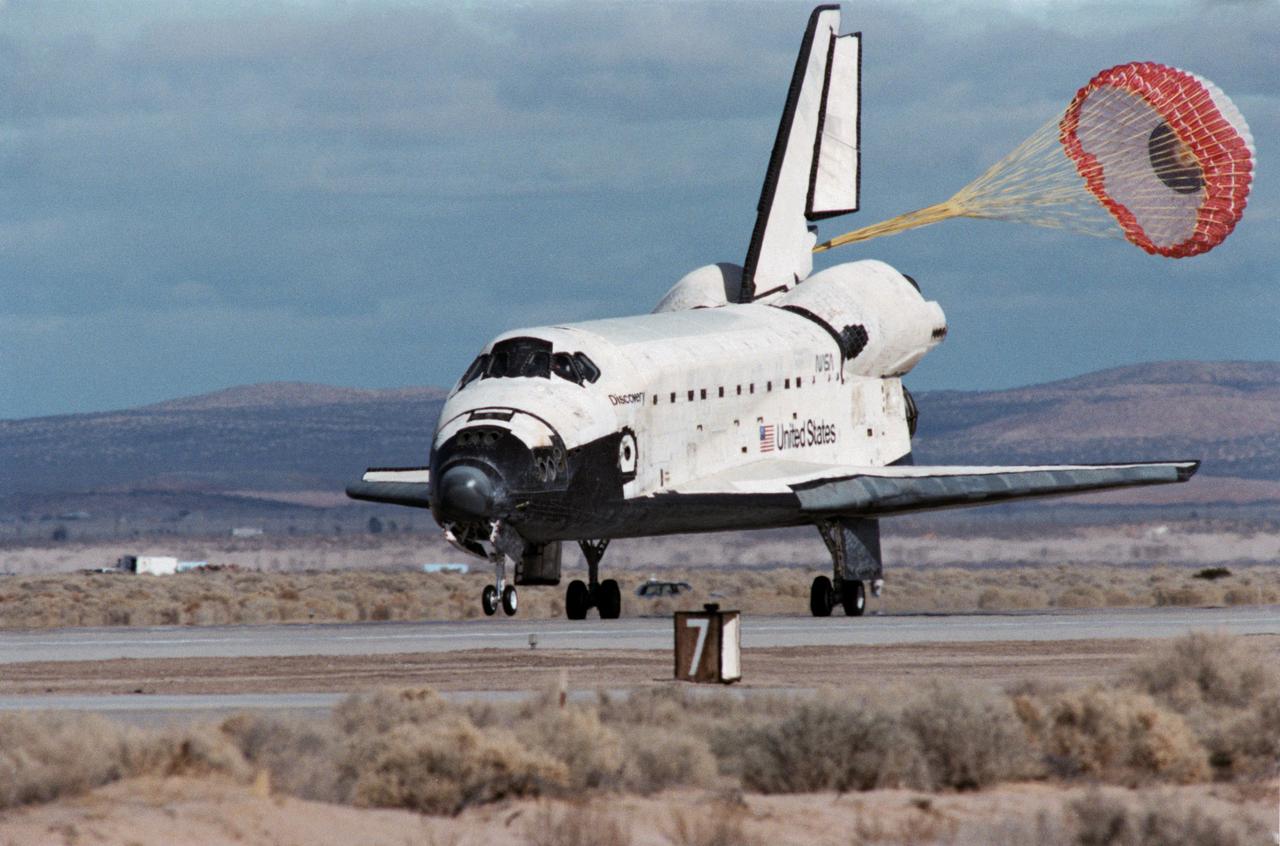
STS053-S-085 (9 Dec. 1992) --- The drag chute on the space shuttle Discovery is partially deployed during landing on Runway 22 at Edwards Air Force Base. The landing ended an eight-day space mission for the STS-53 crew. Main gear touchdown occurred at 12:43:17 p.m. (PST) on Dec. 9, 1992. Onboard were astronauts David M. Walker, Robert D. Cabana, Guion S. Bluford Jr., James S. Voss and Michael R.U. (Rich) Clifford.

NASA’s X-59 quiet supersonic research aircraft begins its taxi Tuesday, Oct. 28, 2025, from Lockheed Martin’s Skunk Works facility to U.S. Air Force Plant 42’s runway in Palmdale, California. The aircraft taxied into position and waited for clearance before taking off for the first time.
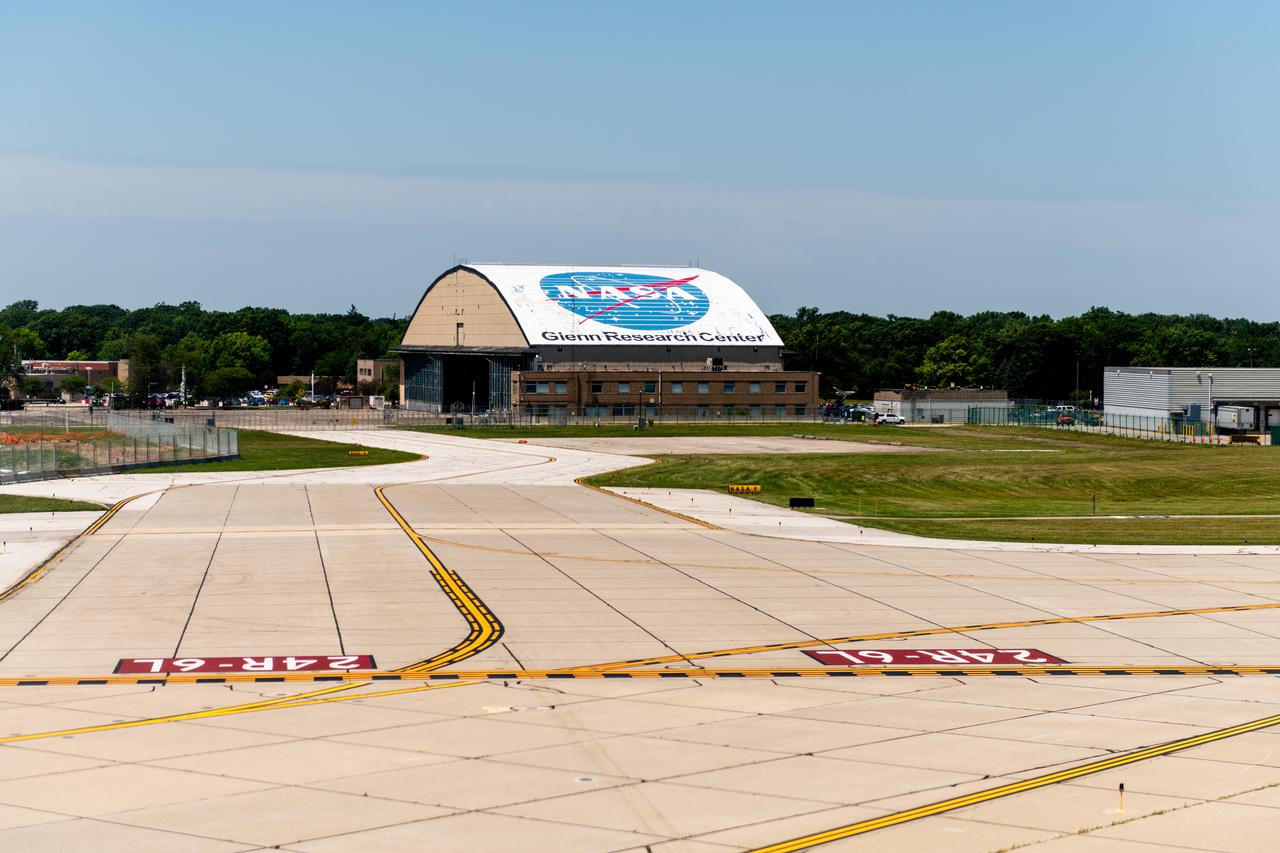
View of the Glenn Research Center Hangar from the Cleveland Hopkins Airport Runway during a testing flight on June 13, 2024. A team at NASA’s Glenn Research Center in Cleveland streamed 4K video footage from an aircraft to the International Space Station and back for the first time using optical, or laser, communications. The feat was part of a series of tests on new technology that could provide live video coverage of astronauts on the Moon during the Artemis missions. Working with the Air Force Research Laboratory and NASA’s Small Business Innovation Research program, Glenn engineers temporarily installed a portable laser terminal on the belly of a Pilatus PC-12 aircraft. They then flew over Lake Erie sending data from the aircraft to an optical ground station in Cleveland. From there, it was sent over an Earth-based network to NASA’s White Sands Test Facility in Las Cruces, New Mexico, where scientists used infrared light signals to send the data. Photo Credit: (NASA/Sara Lowthian-Hanna)
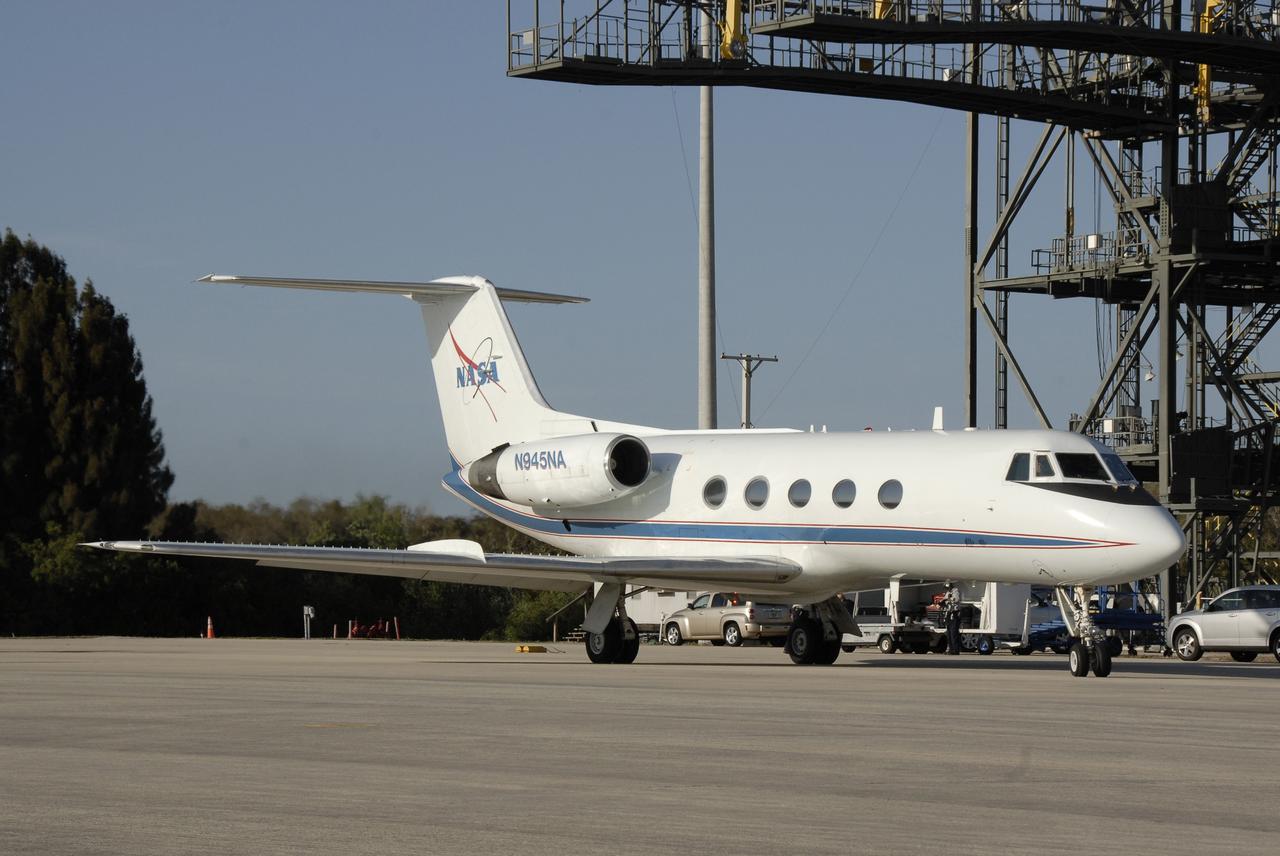
CAPE CANAVERAL, Fla. – On the Shuttle Landing Facility at NASA's Kennedy Space Center in Florida, one of the Shuttle Training Aircraft is ready for STS-119 Commander Lee Archambault or Pilot Tony Antonelli to practice shuttle landings on the Shuttle Landing Facility's runway. The mission crew members arrived in the afternoon at Kennedy to prepare for launch. The mission is the 28th to the International Space Station and the 125th space shuttle flight. Space shuttle Discovery will deliver the final pair of power-generating solar array wings and truss element, S6. Photo credit: NASA/Kim Shiflett
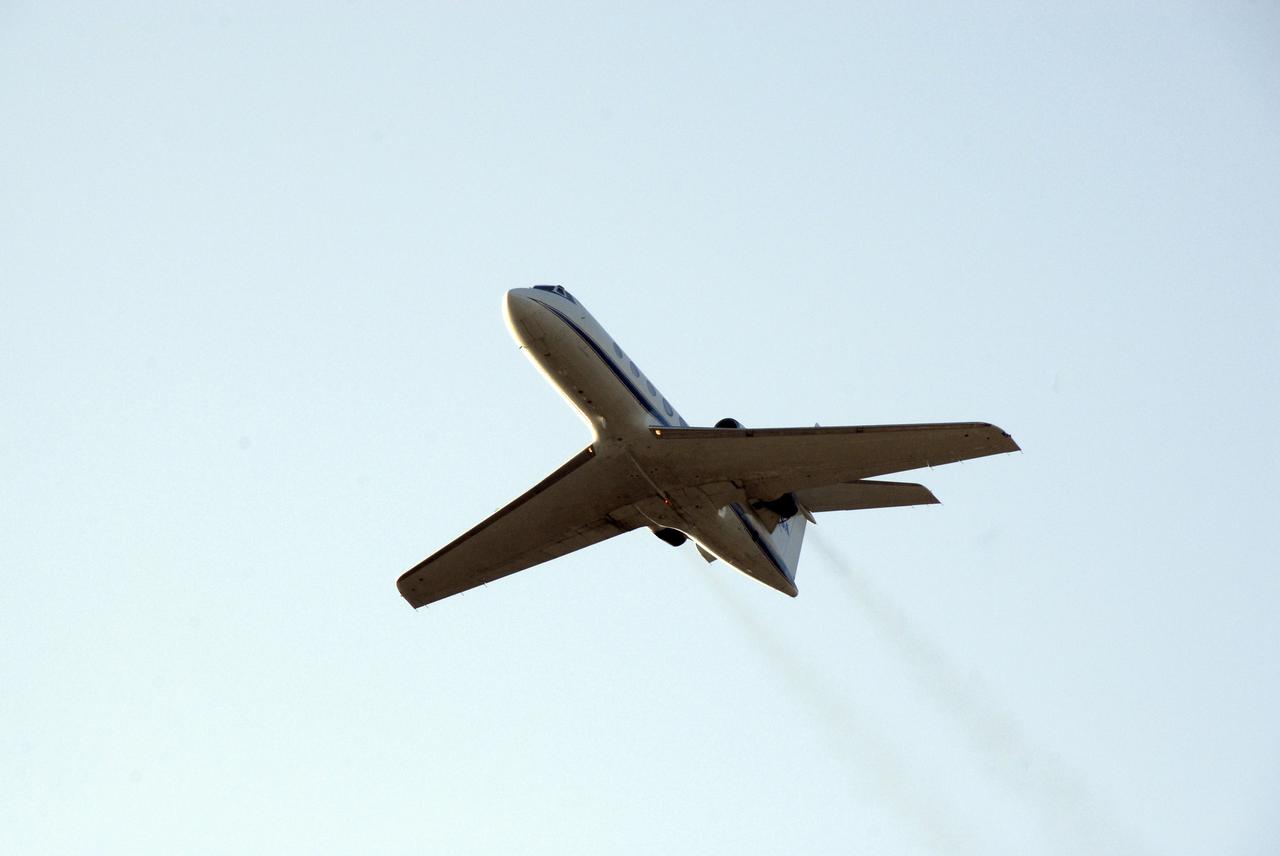
CAPE CANAVERAL, Fla. – One of the two Shuttle Training Aircraft flies over the Shuttle Landing Facility at NASA's Kennedy Space Center in Florida. STS-119 Commander Lee Archambault and Pilot Tony Antonelli are practicing shuttle landings on the SLF runway. The mission crew members arrived in the afternoon at Kennedy to prepare for launch. The mission is the 28th to the International Space Station and the 125th space shuttle flight. Space shuttle Discovery will deliver the final pair of power-generating solar array wings and truss element, S6. Photo credit: NASA/Kim Shiflett
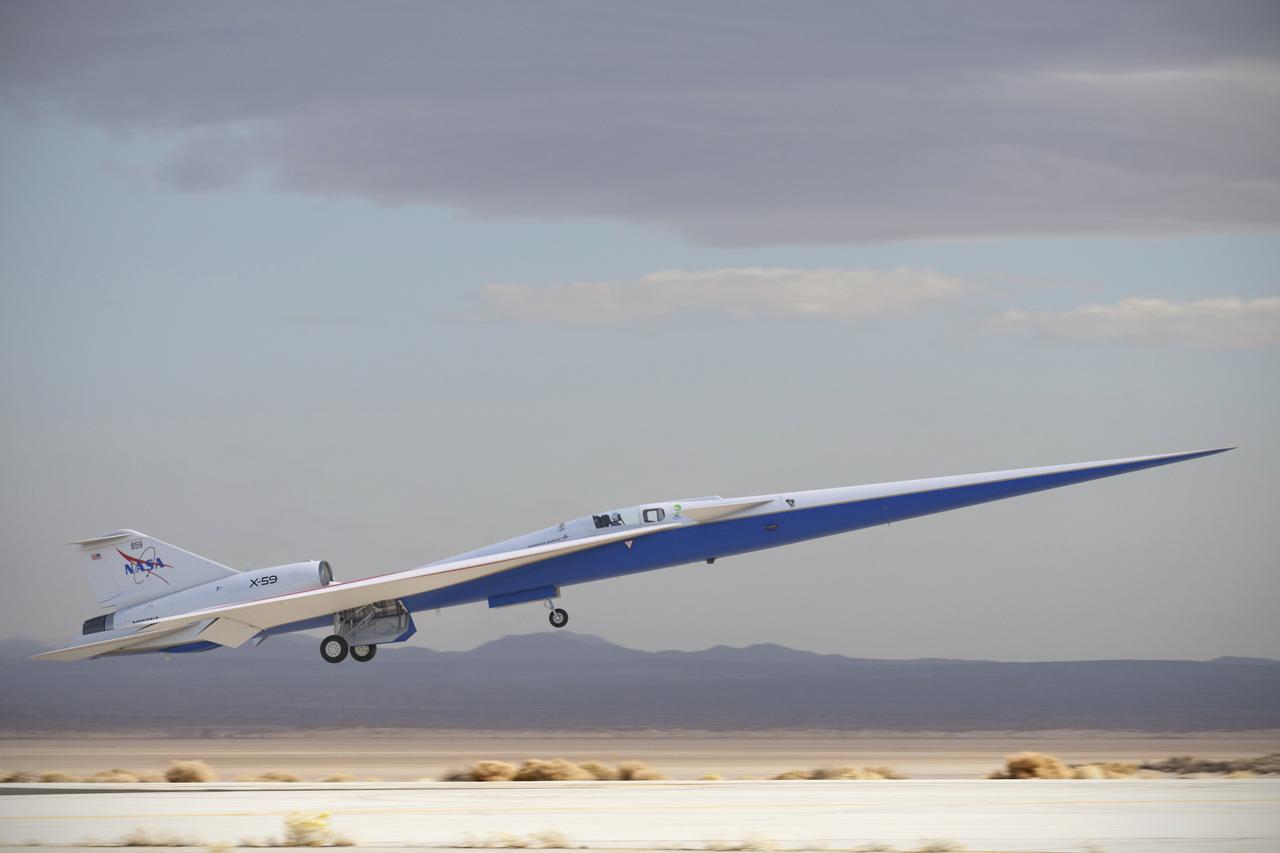
Artist illustration of the X-59 taking off from the runway.
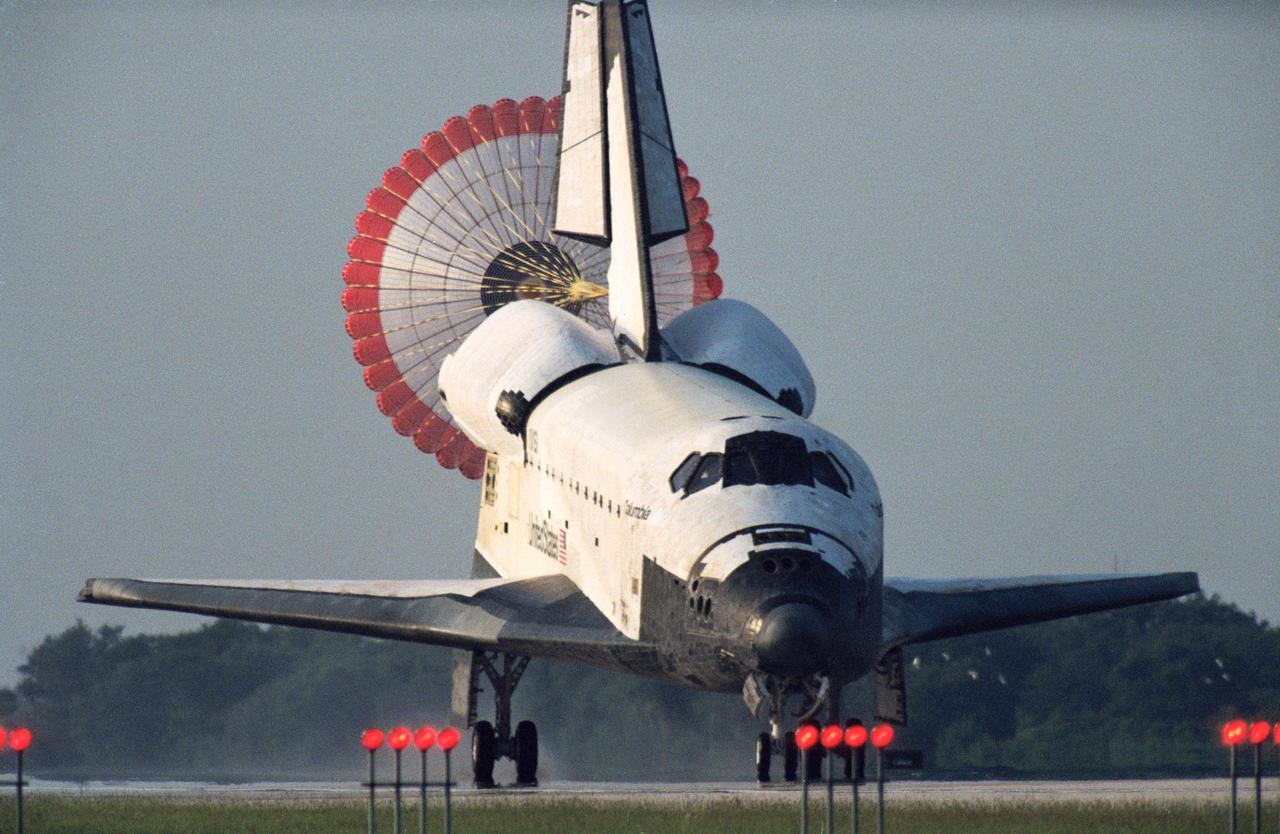
STS050-S-105 (9 July 1992) --- The main drag chute on the Space Shuttle Columbia is fully deployed soon after the Space Shuttle touches down at the Kennedy Space Center (KSC) landing facility. Landing occurred at 7:42 a.m. (EDT). Seven crew members, including five astronauts and two scientists from the private sector spent 14 days in space supporting the U.S. Microgravity Laboratory (USML-1). This marks the first time for usage of the parachute system for a KSC landing and the second occurrence in the program.
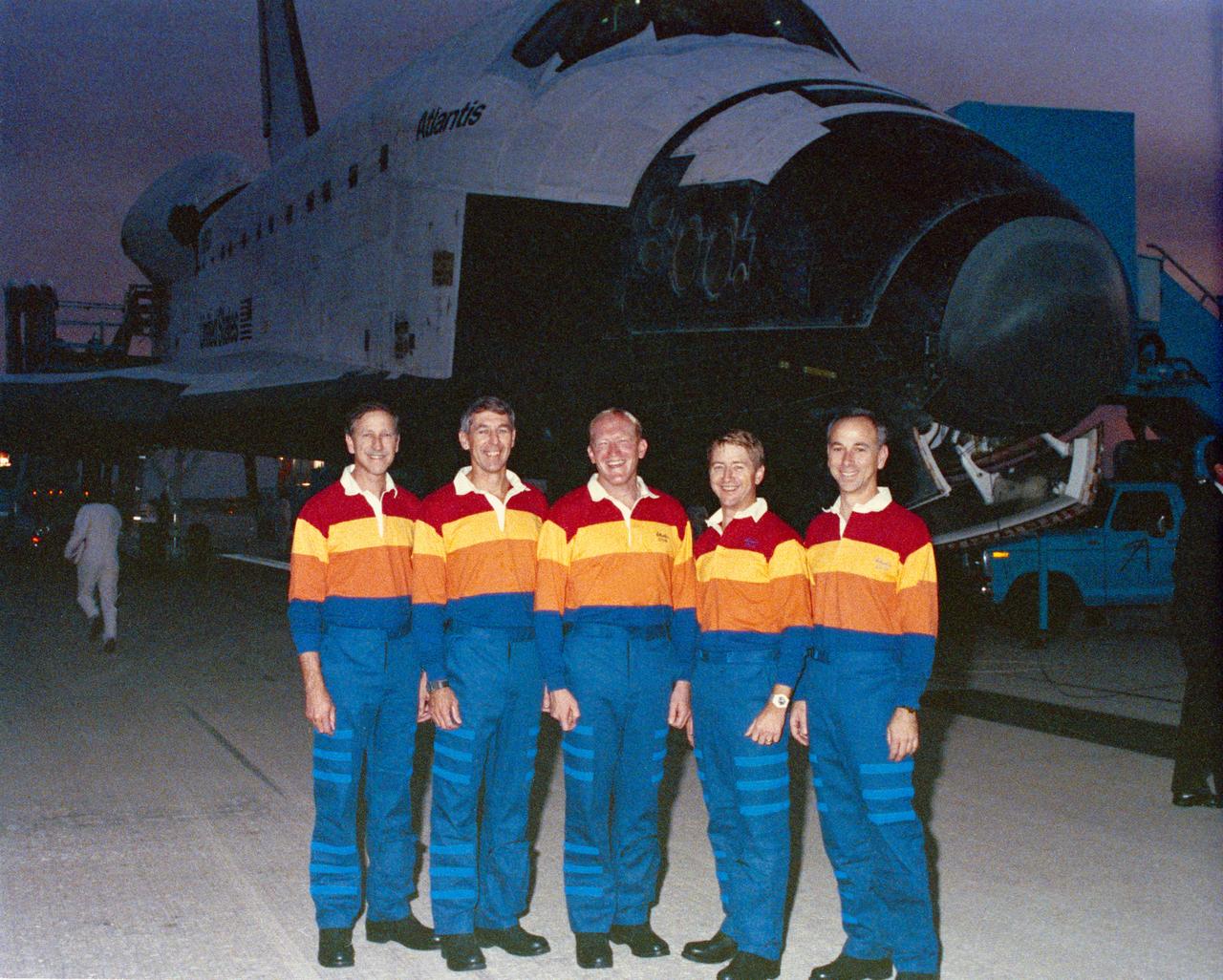
STS038-S-040 (20 Nov 1990) --- STS-38 crewmembers, wearing red, yellow, and orange polo shirts, pose in front of Atlantis, Orbiter Vehicle (OV) 104, parked on runway 33 at Kennedy Space Center's (KSC) Shuttle Landing Facility (SLF) during post flight activities. Left to right are Commander Richard O. Covey, Mission Specialist (MS) Robert C. Springer, MS Charles D. Gemar, Pilot Frank L. Culbertson, and MS Carl J. Meade.
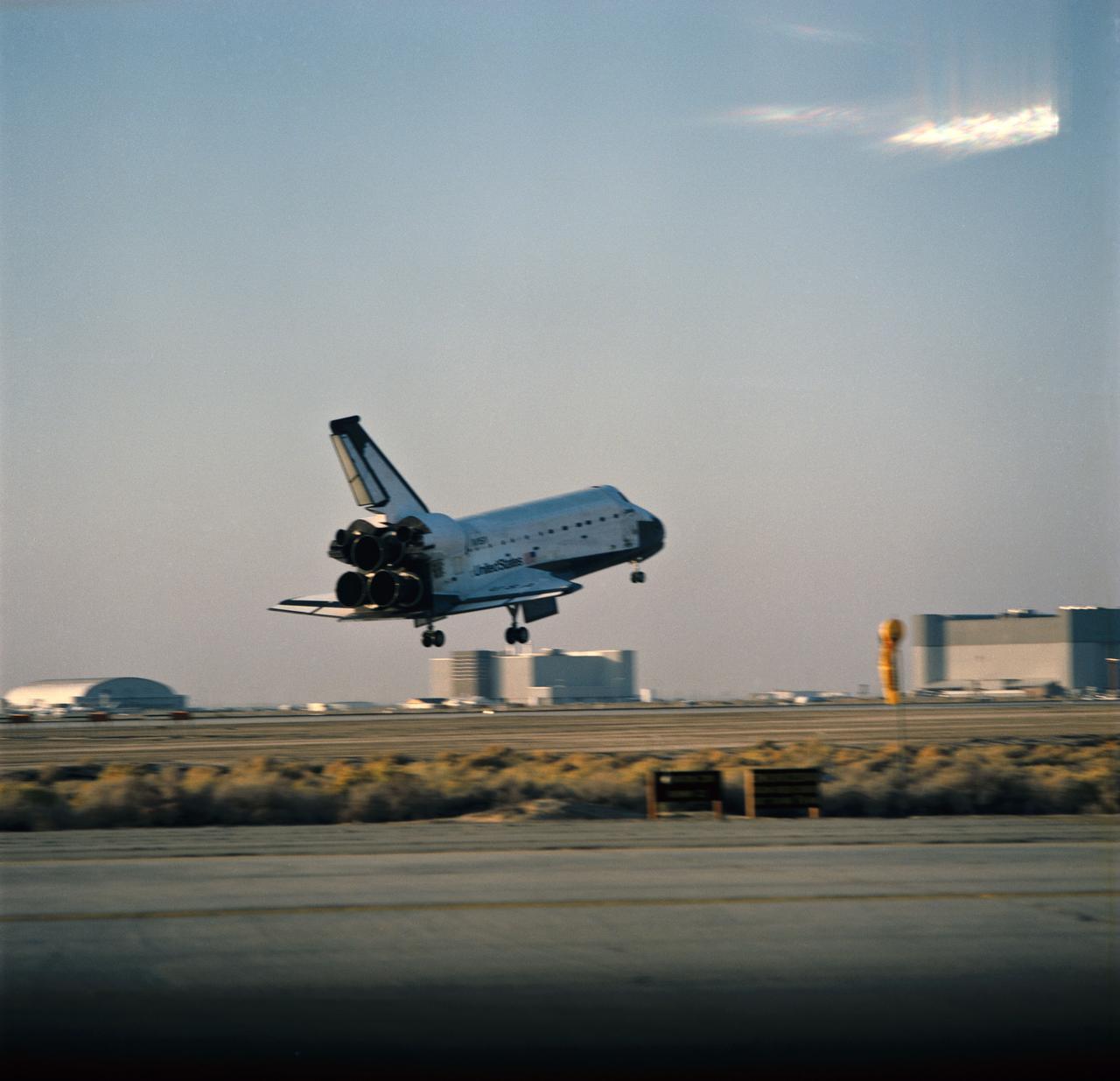
STS58-S-126 (1 Nov 1993) --- The Space Shuttle Columbia is about to touch down on the runway at Edwards Air Force Base (EAFB) in California. The landing, which occurred at 7:06 a.m. (PST), November 1, 1993, completed a two week mission in space devoted to medical research. Onboard the spacecraft were astronauts John E. Blaha, Richard A. Searfoss, Rhea Seddon, Shannon W. Lucid, David A. Wolf and William S. McArthur along with payload specialist Martin J. Fettman, DVM.
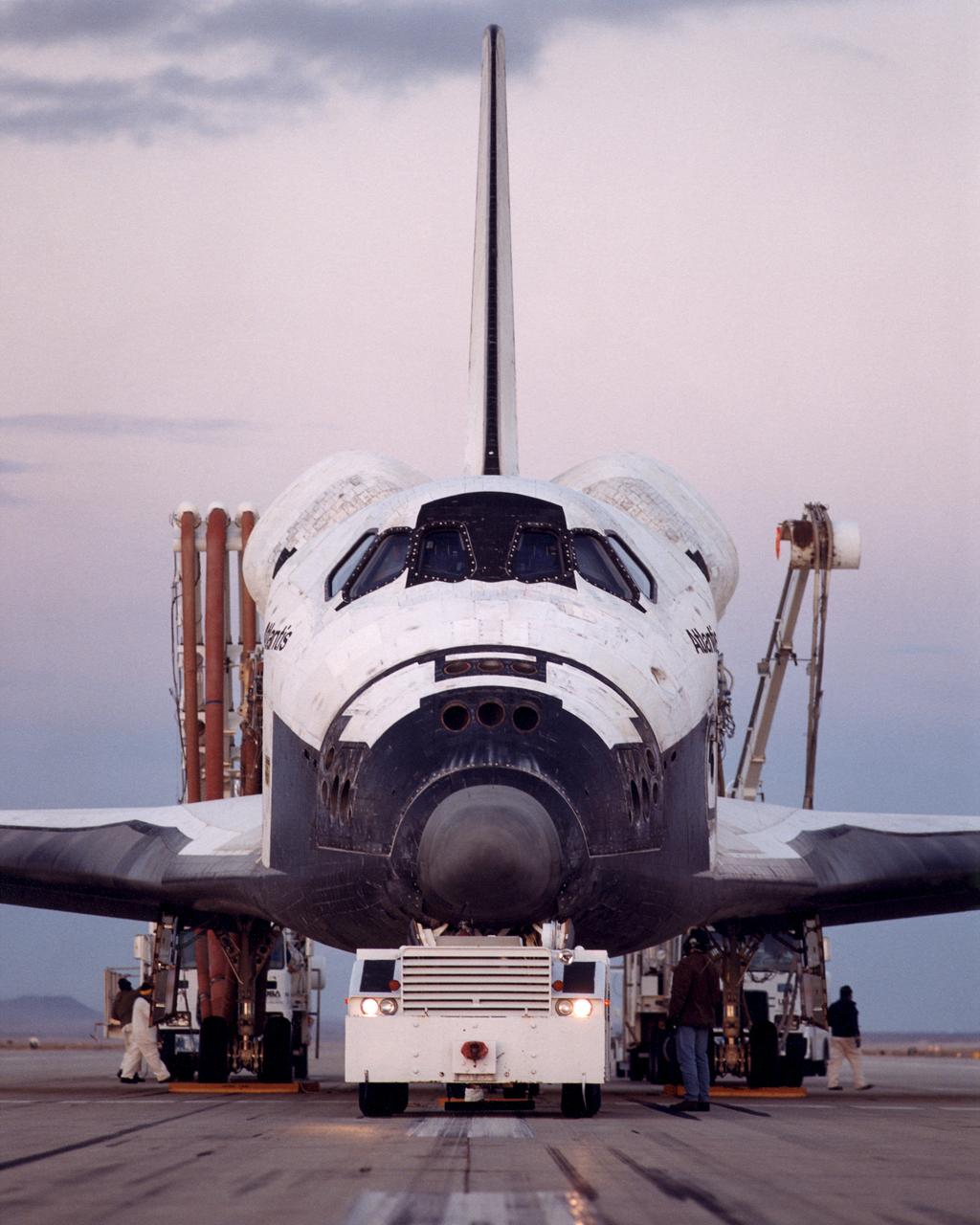
Space Shuttle Atlantis landed at 12:33 p.m. February 20, 2001, on the runway at Edwards Air Force Base, California, where NASA's Dryden Flight Research Center is located. The mission, which began February 7, logged 5.3 million miles as the shuttle orbited earth while delivering the Destiny science laboratory to the International Space Station. Inclement weather conditions in Florida prompted the decision to land Atlantis at Edwards. The last time a space shuttle landed at Edwards was Oct. 24, 2000.
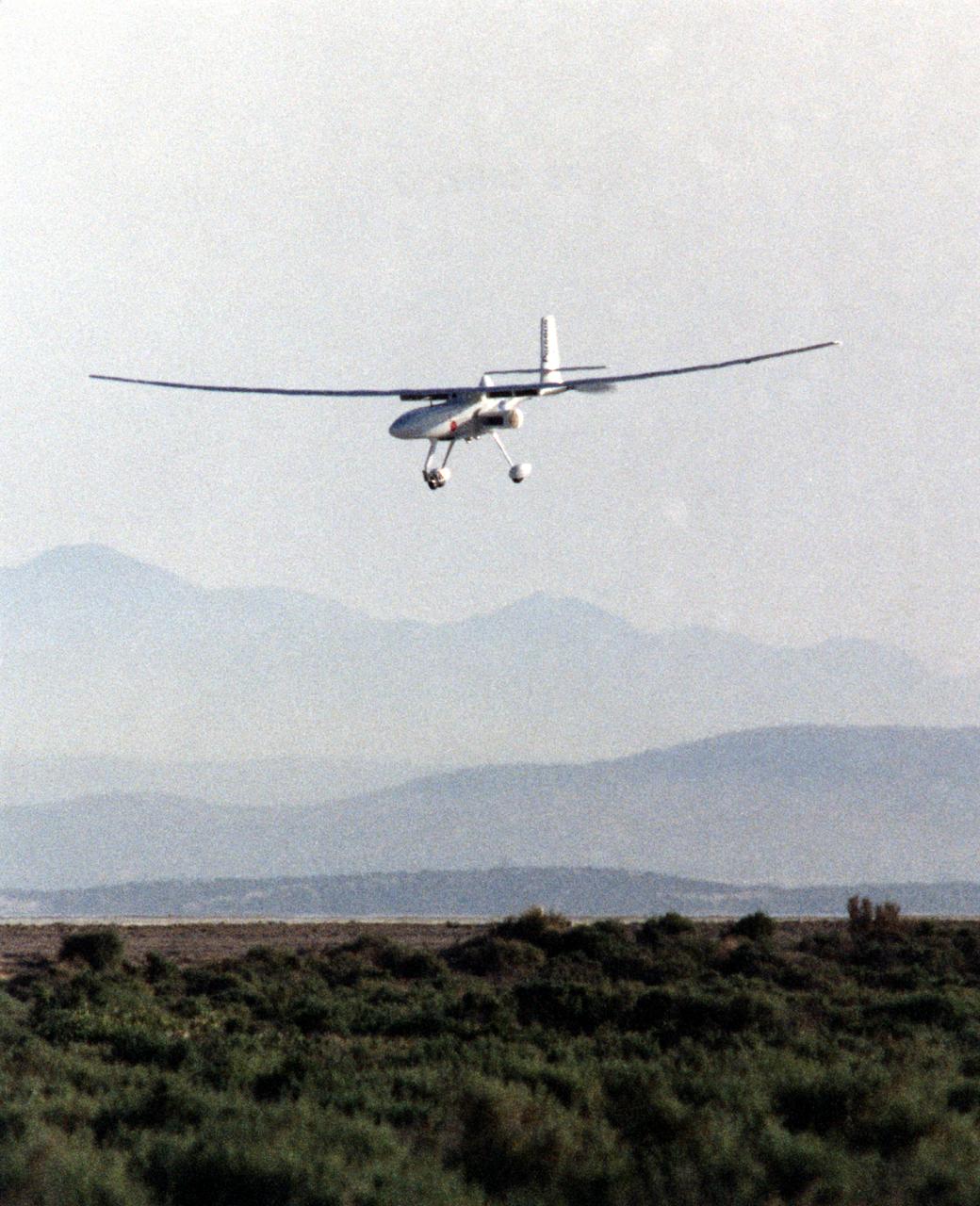
The Perseus B remotely piloted aircraft approaches the runway at Edwards Air Force Base, Calif. at the conclusion of a development flight at NASA's Dryden flight Research Center in April 1998. The Perseus B is the latest of three versions of the Perseus design developed by Aurora Flight Sciences under NASA's Environmental Research Aircraft and Sensor Technology (ERAST) program.
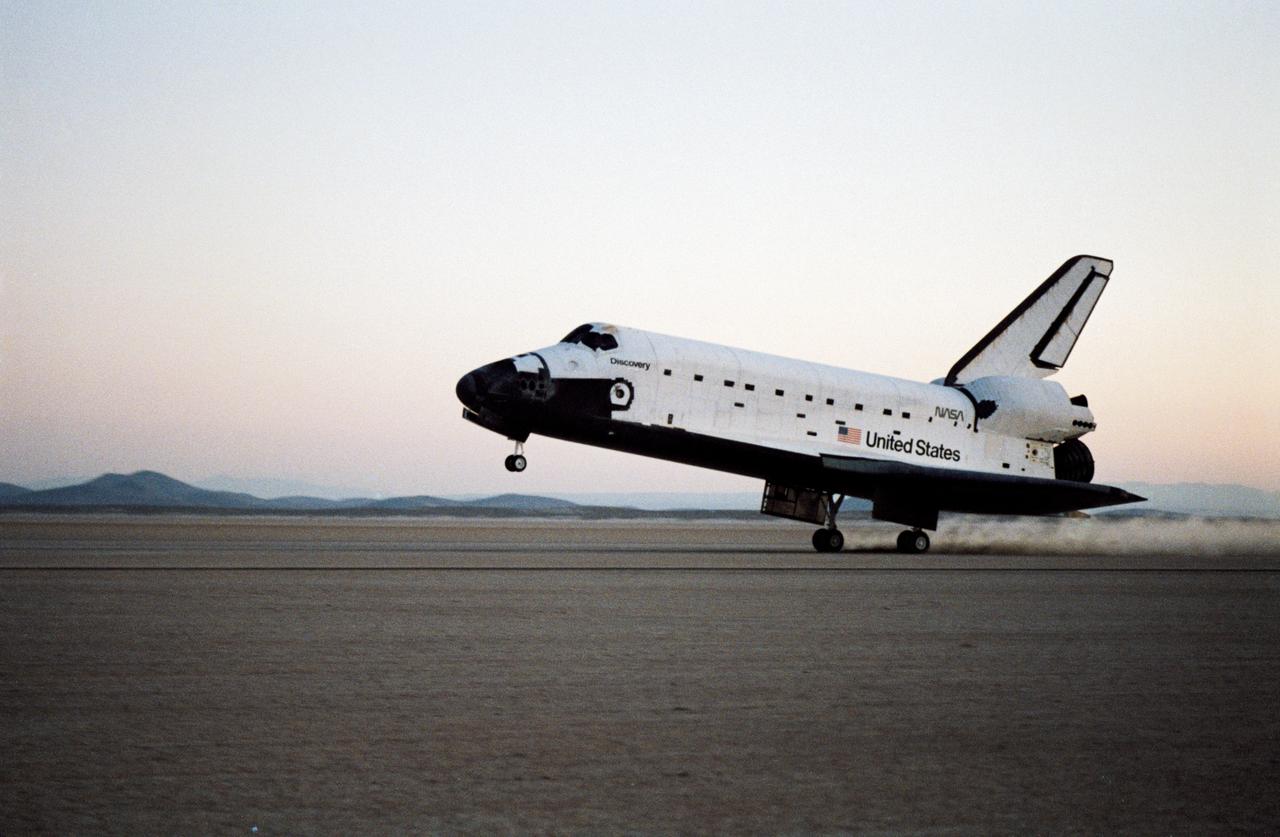
51I-S-225 (3 September 1985) --- The Space Shuttle Discovery lands on September 3, 1985 on Runway 23, Edwards Air Force Base, CA, to successfully complete the 51-I mission.
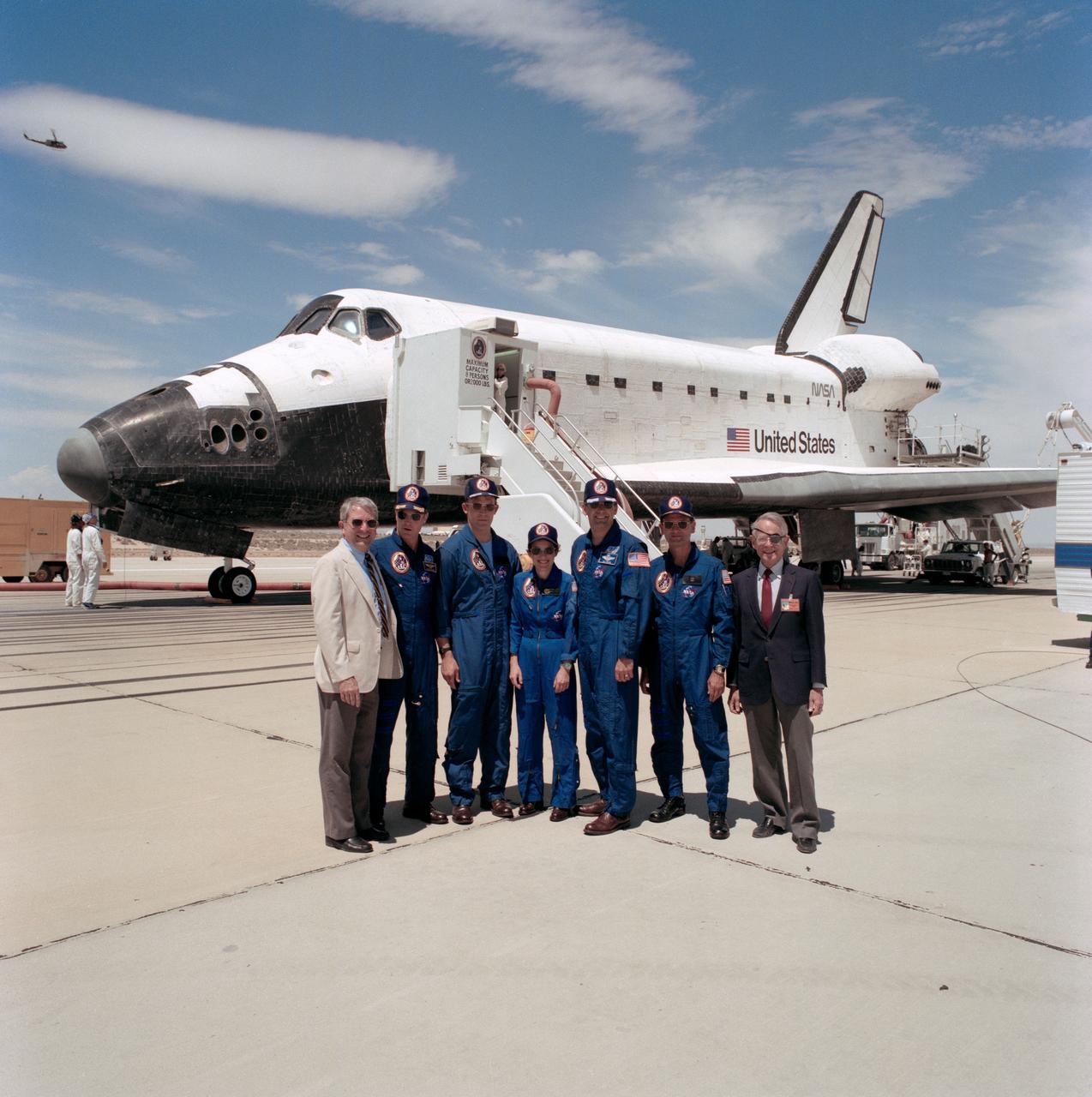
STS030-S-130 (8 May 1989) --- Astronaut crew members who manned the Space Shuttle Atlantis for just over four days pose with NASA officials following the safe landing of their spacecraft (which forms the backdrop for the picture). Left to right are Rear Admiral Richard H. Truly, acting NASA Administrator; astronauts David M. Walker, Mark C. Lee, Mary L. Cleave, Ronald J. Grabe and Norman E. Thagard; and Dale D. Myers, NASA Deputy Administrator.
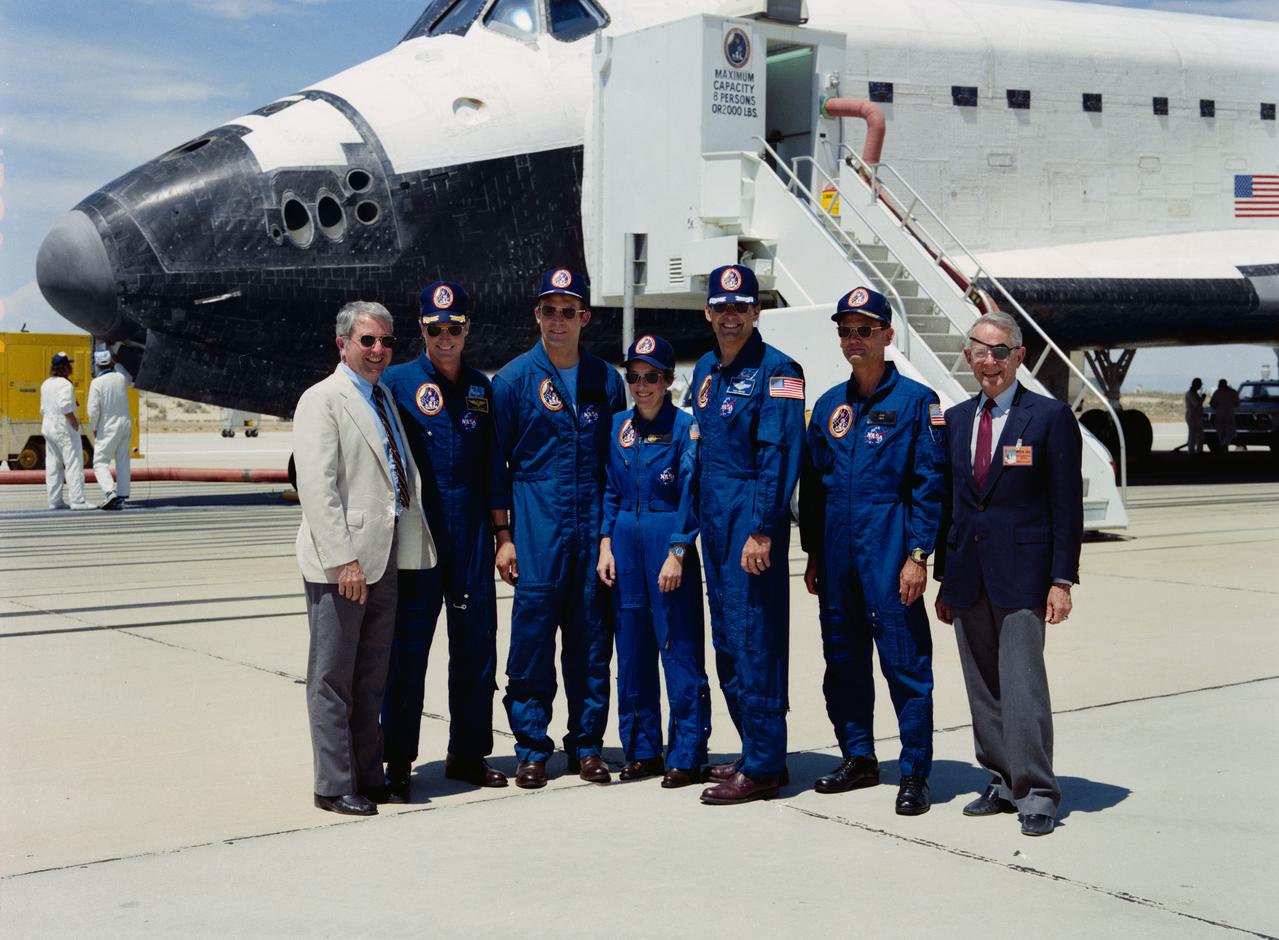
STS030-S-129 (8 May 1989) --- Astronaut crew members who manned the Space Shuttle Atlantis for just over four days pose with NASA officials following the safe landing of their spacecraft (which forms the backdrop for the picture). Left to right are Rear Admiral Richard H. Truly, acting NASA Administrator; astronauts David M. Walker, Mark C. Lee, Mary L. Cleave, Ronald J. Grabe and Norman E. Thagard; and Dale D. Myers, NASA Deputy Administrator.
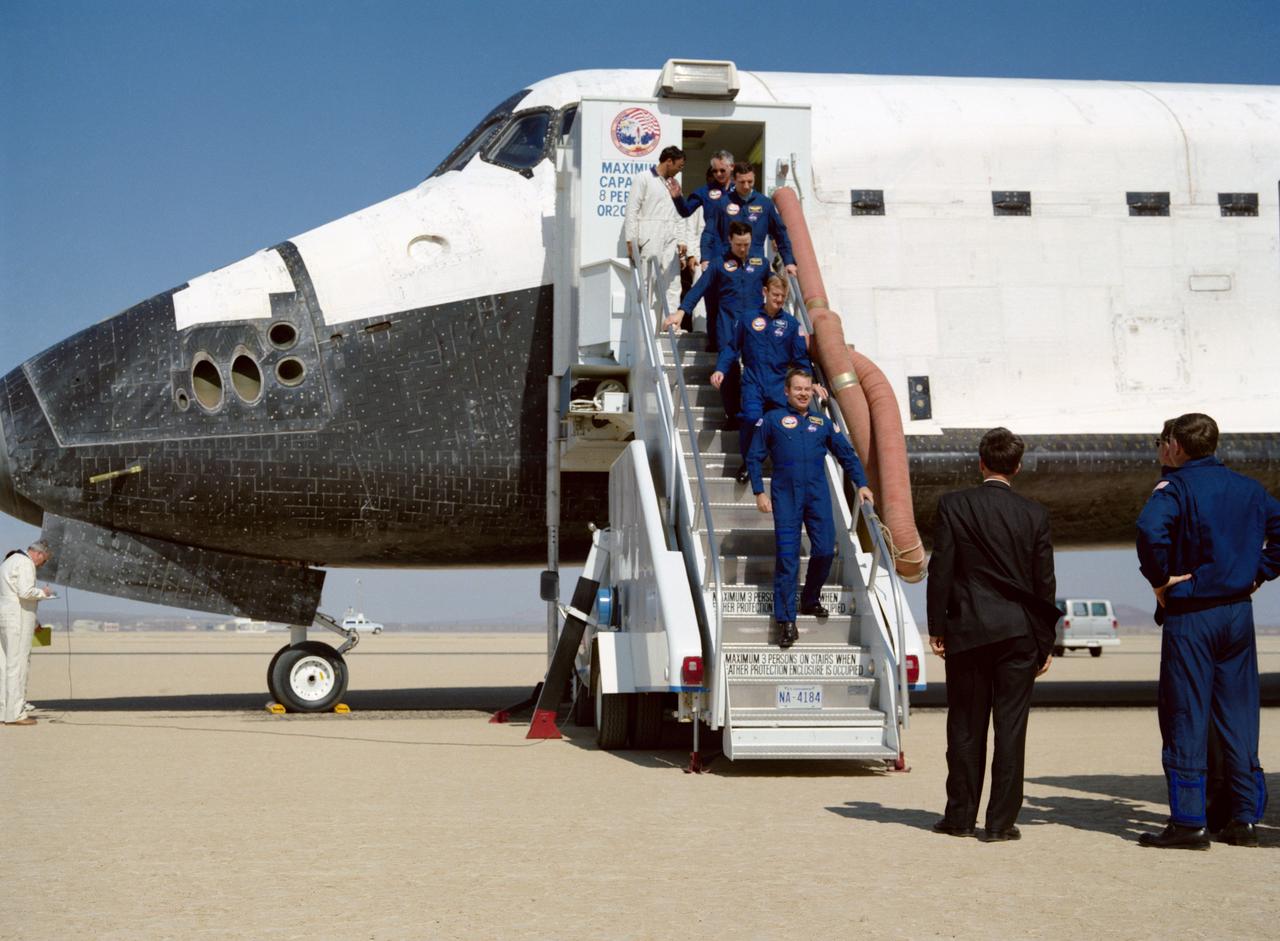
STS-36 crewmembers egress Atlantis, Orbiter Vehicle (OV) 104, via mobile stairway following touchdown on Runway 23 drylake bed at Edwards Air Force Base (EAFB), California. Commander John O. Creighton, leading crewmembers down the stairway, is followed by Pilot John H. Casper, Mission Specialist (MS) Pierre J. Thuot, MS David C. Hilmers, and MS Richard M. Mullane. On the runway, Acting NASA Associate Administrator for Space Flight Dr. William B. Lenoir, JSC Flight Crew Operations Directorate Director Donald R. Puddy, and JSC Astronaut Office Acting Chief Michael L. Coats wait to greet crewmembers.
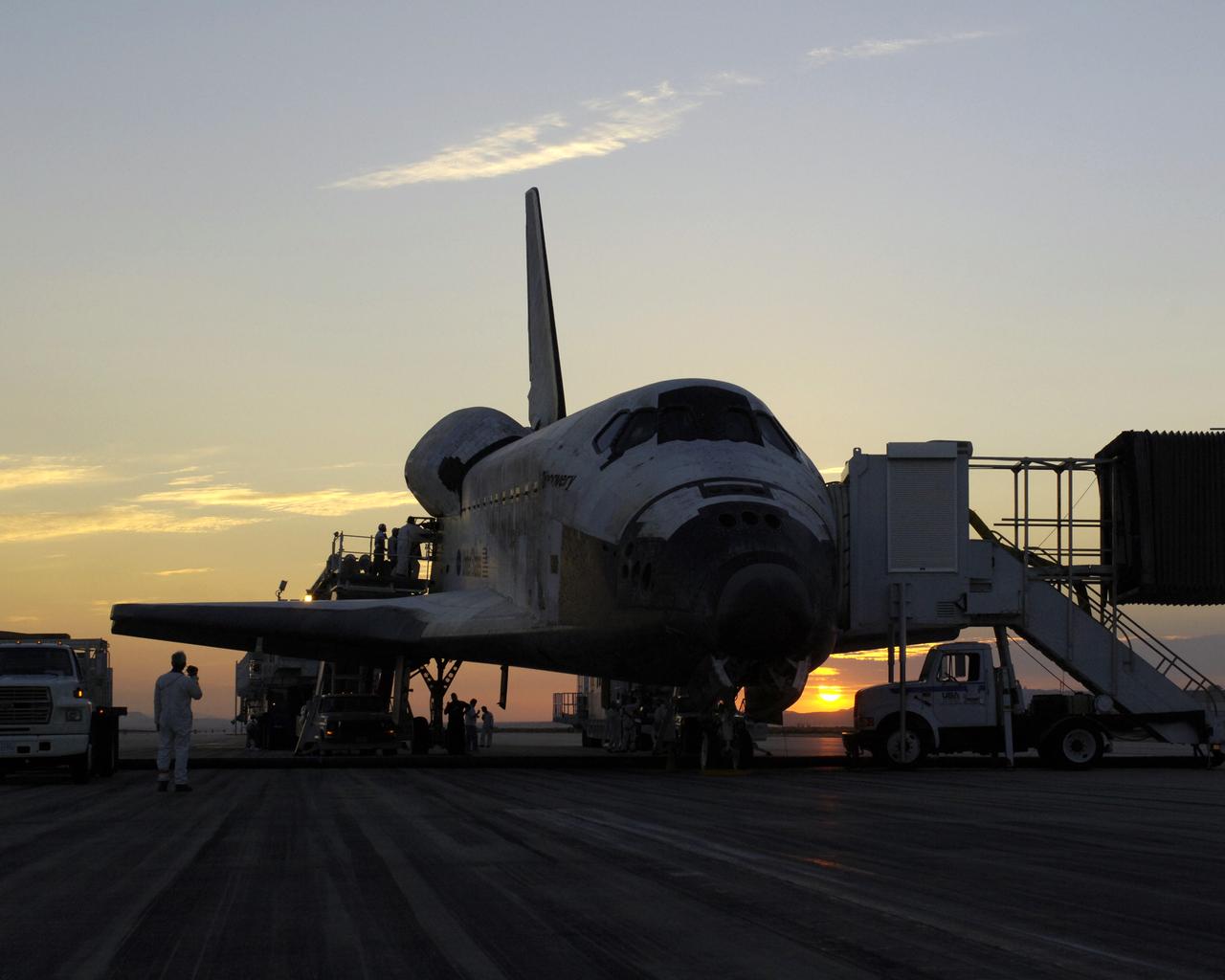
The sun rises on the Space Shuttle Discovery as it rests on the runway at Edwards Air Force Base, California, after a safe landing August 9, 2005 to complete the STS-114 mission. Space Shuttle Discovery landed safely at NASA's Dryden Flight Research Center at Edwards Air Force Base in California at 5:11:22 a.m. PDT this morning, following the very successful 14-day STS-114 return to flight mission. During their two weeks in space, Commander Eileen Collins and her six crewmates tested out new safety procedures and delivered supplies and equipment the International Space Station. Discovery spent two weeks in space, where the crew demonstrated new methods to inspect and repair the Shuttle in orbit. The crew also delivered supplies, outfitted and performed maintenance on the International Space Station. A number of these tasks were conducted during three spacewalks. In an unprecedented event, spacewalkers were called upon to remove protruding gap fillers from the heat shield on Discovery's underbelly. In other spacewalk activities, astronauts installed an external platform onto the Station's Quest Airlock and replaced one of the orbital outpost's Control Moment Gyroscopes. Inside the Station, the STS-114 crew conducted joint operations with the Expedition 11 crew. They unloaded fresh supplies from the Shuttle and the Raffaello Multi-Purpose Logistics Module. Before Discovery undocked, the crews filled Raffeallo with unneeded items and returned to Shuttle payload bay. Discovery launched on July 26 and spent almost 14 days on orbit.
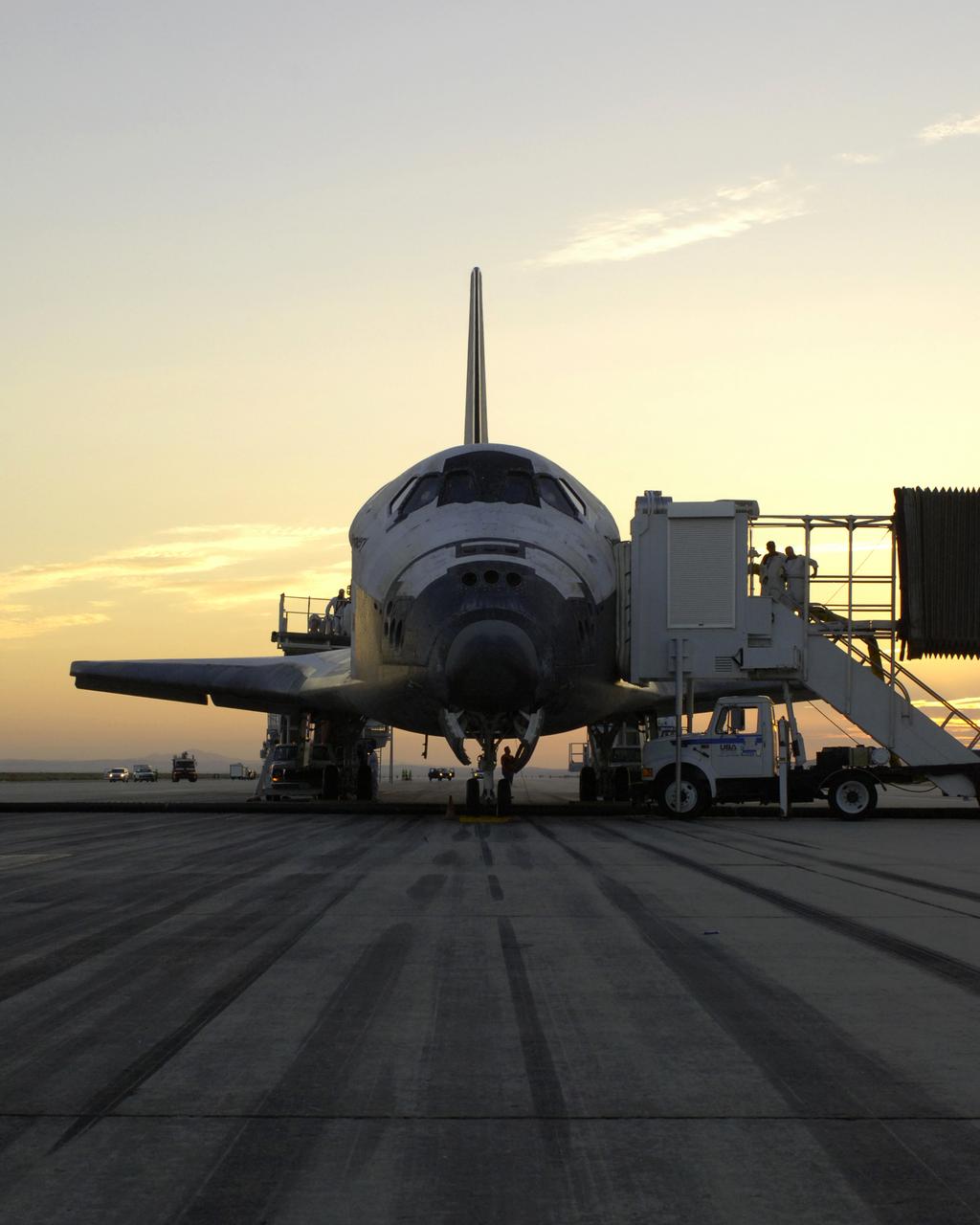
The sun rises on the Space Shuttle Discovery as it rests on the runway at Edwards Air Force Base, California, after a safe landing August 9, 2005 to complete the STS-114 mission. Space Shuttle Discovery landed safely at NASA's Dryden Flight Research Center at Edwards Air Force Base in California at 5:11:22 a.m. PDT this morning, following the very successful 14-day STS-114 return to flight mission. During their two weeks in space, Commander Eileen Collins and her six crewmates tested out new safety procedures and delivered supplies and equipment the International Space Station. Discovery spent two weeks in space, where the crew demonstrated new methods to inspect and repair the Shuttle in orbit. The crew also delivered supplies, outfitted and performed maintenance on the International Space Station. A number of these tasks were conducted during three spacewalks. In an unprecedented event, spacewalkers were called upon to remove protruding gap fillers from the heat shield on Discovery's underbelly. In other spacewalk activities, astronauts installed an external platform onto the Station's Quest Airlock and replaced one of the orbital outpost's Control Moment Gyroscopes. Inside the Station, the STS-114 crew conducted joint operations with the Expedition 11 crew. They unloaded fresh supplies from the Shuttle and the Raffaello Multi-Purpose Logistics Module. Before Discovery undocked, the crews filled Raffeallo with unneeded items and returned to Shuttle payload bay. Discovery launched on July 26 and spent almost 14 days on orbit.
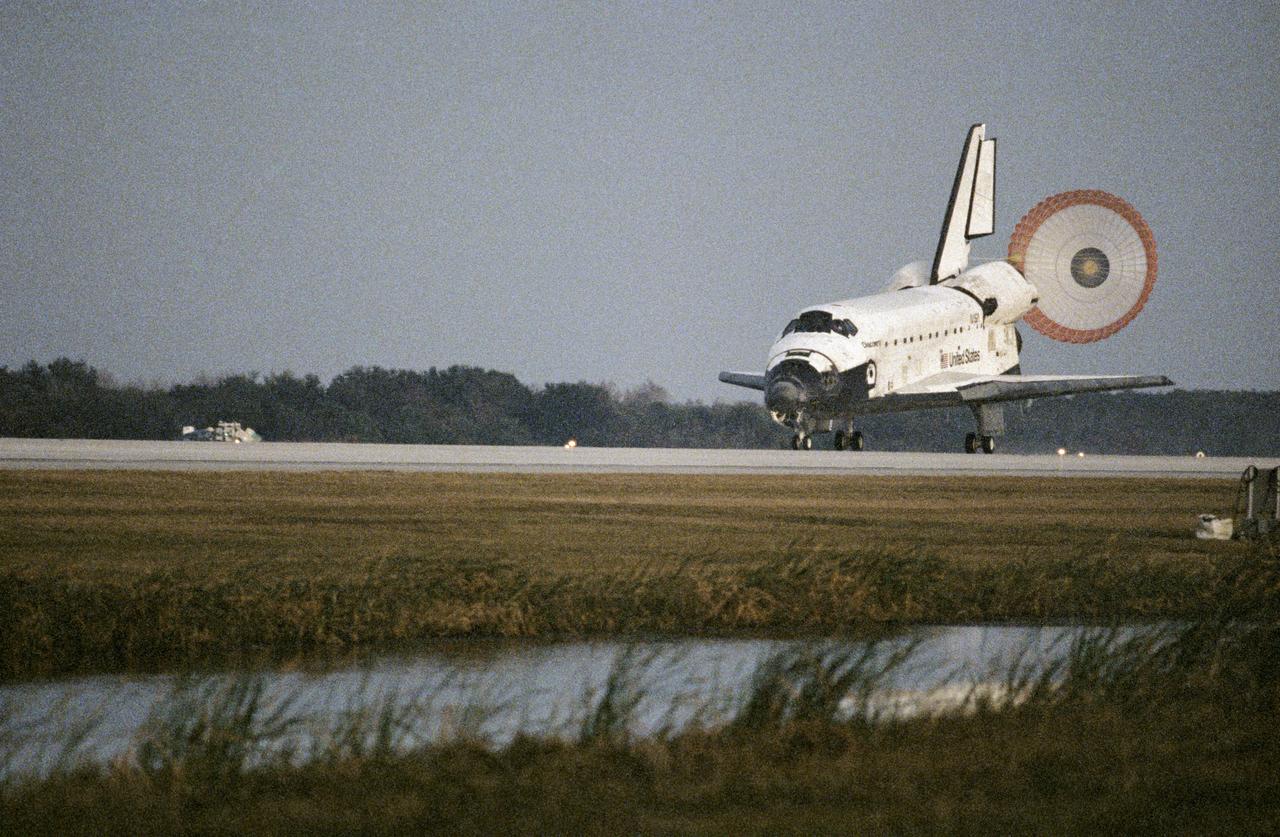
STS063-S-015 (11 Feb. 1995) --- The Space Shuttle Discovery deploys its drag chute on Runway 15 at the Kennedy Space Center's (KSC) Shuttle Landing Facility as it wraps up an eight-day mission. Touchdown occurred at 6:50:19 a.m. (EST), February 11, 1995. Onboard the Space Shuttle Discovery were astronauts James D. Wetherbee, mission commander; Eileen M. Collins, pilot; Bernard A. Harris Jr., payload commander; mission specialists C. Michael Foale, Janice E. Voss, and cosmonaut Vladimir G. Titov.
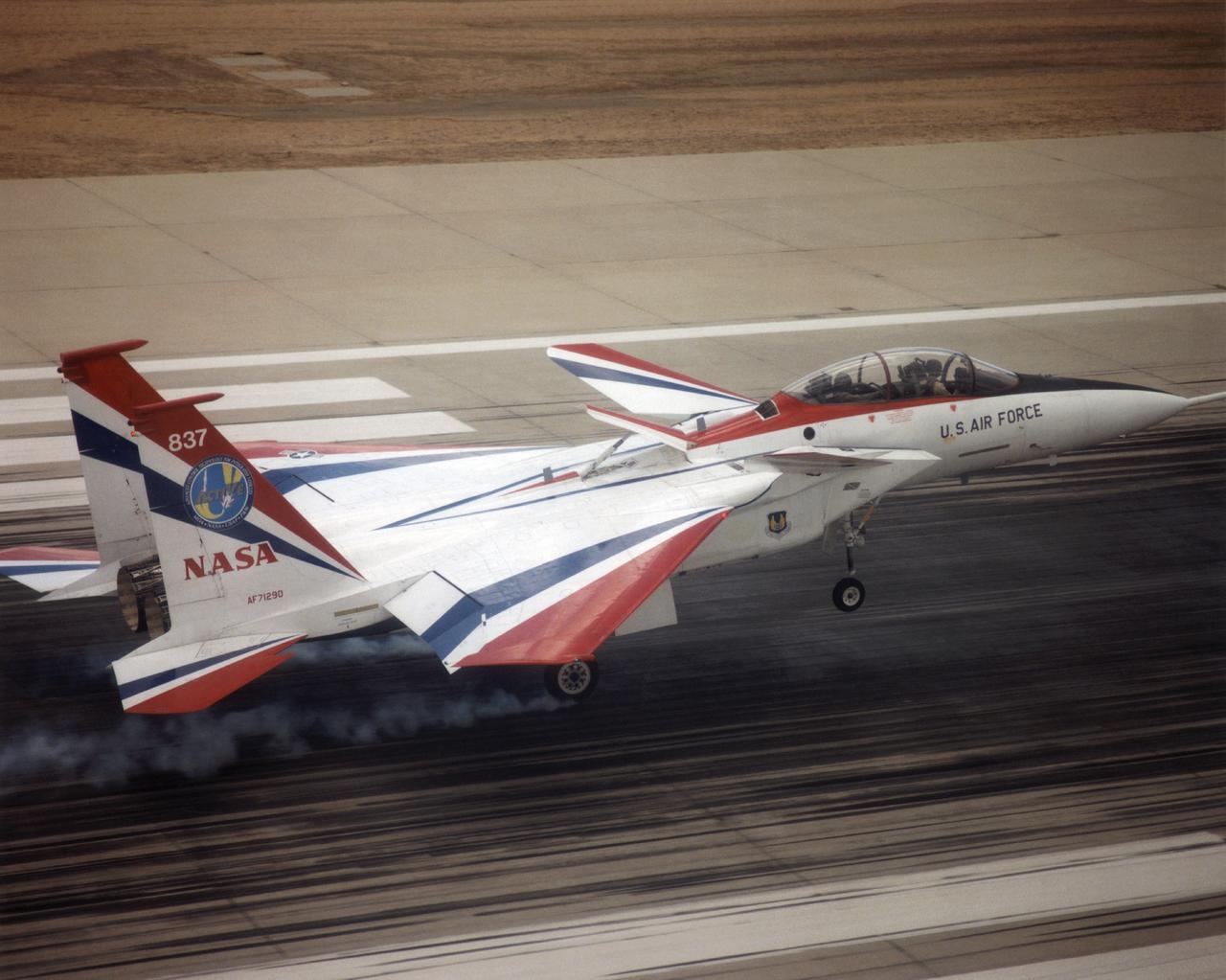
The F-15 ACTIVE touches down on the Edwards runway following its April 14, 1998 flight. The nose is high while the canards have their rear edge raised. the aircraft's speed brake, located on the top of the aircraft behind the canopy, is also raised.
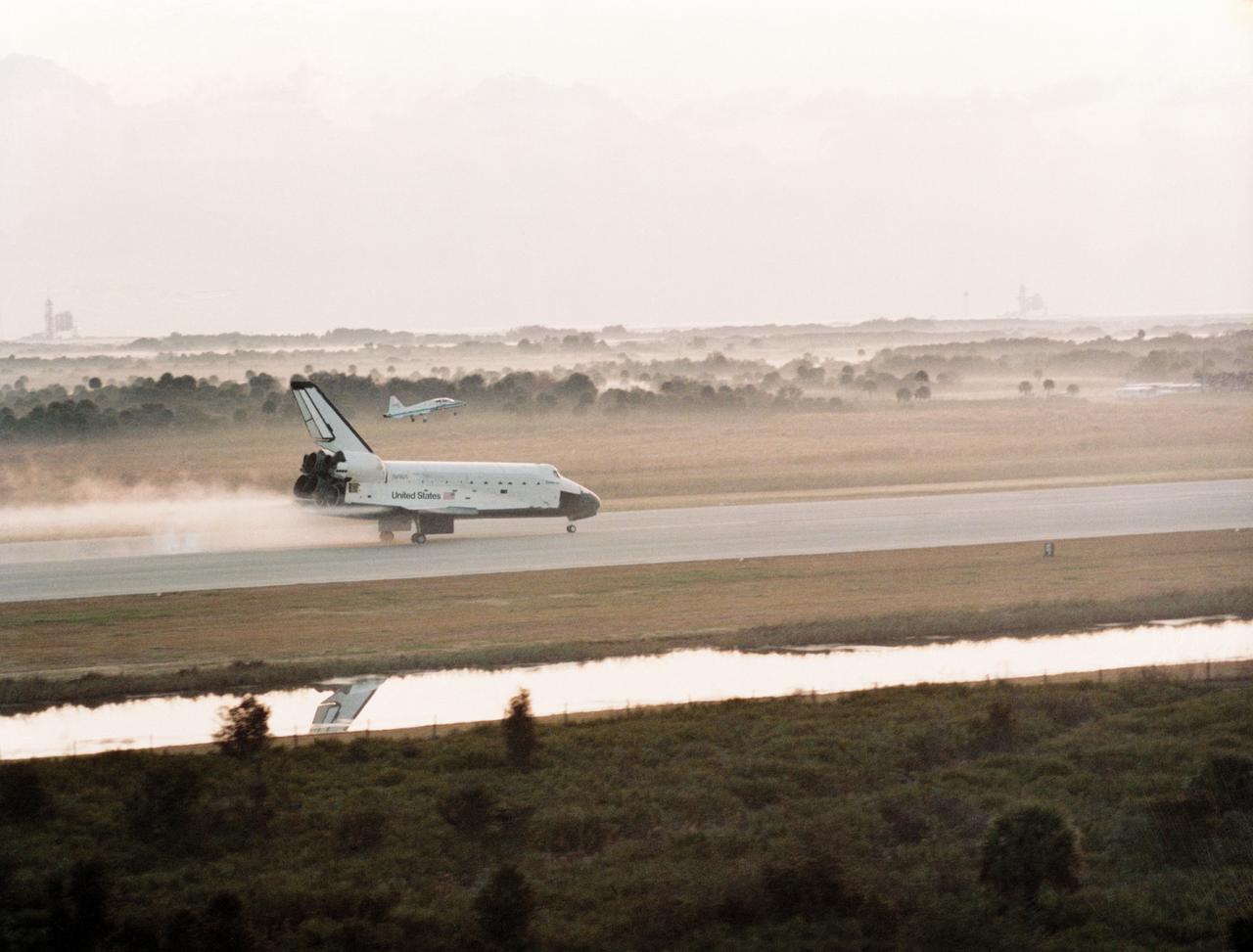
S84-27717 (11 Feb 1984) --- A chase plane gets a "front row" position to view the touchdown of the total landing gear of the Space Shuttle Challenger as the reusable spacecraft makes NASA's first landing on the runway at the Kennedy Space Center's (KSC) landing facility. This photograph was taken from another T-38 chase plane.
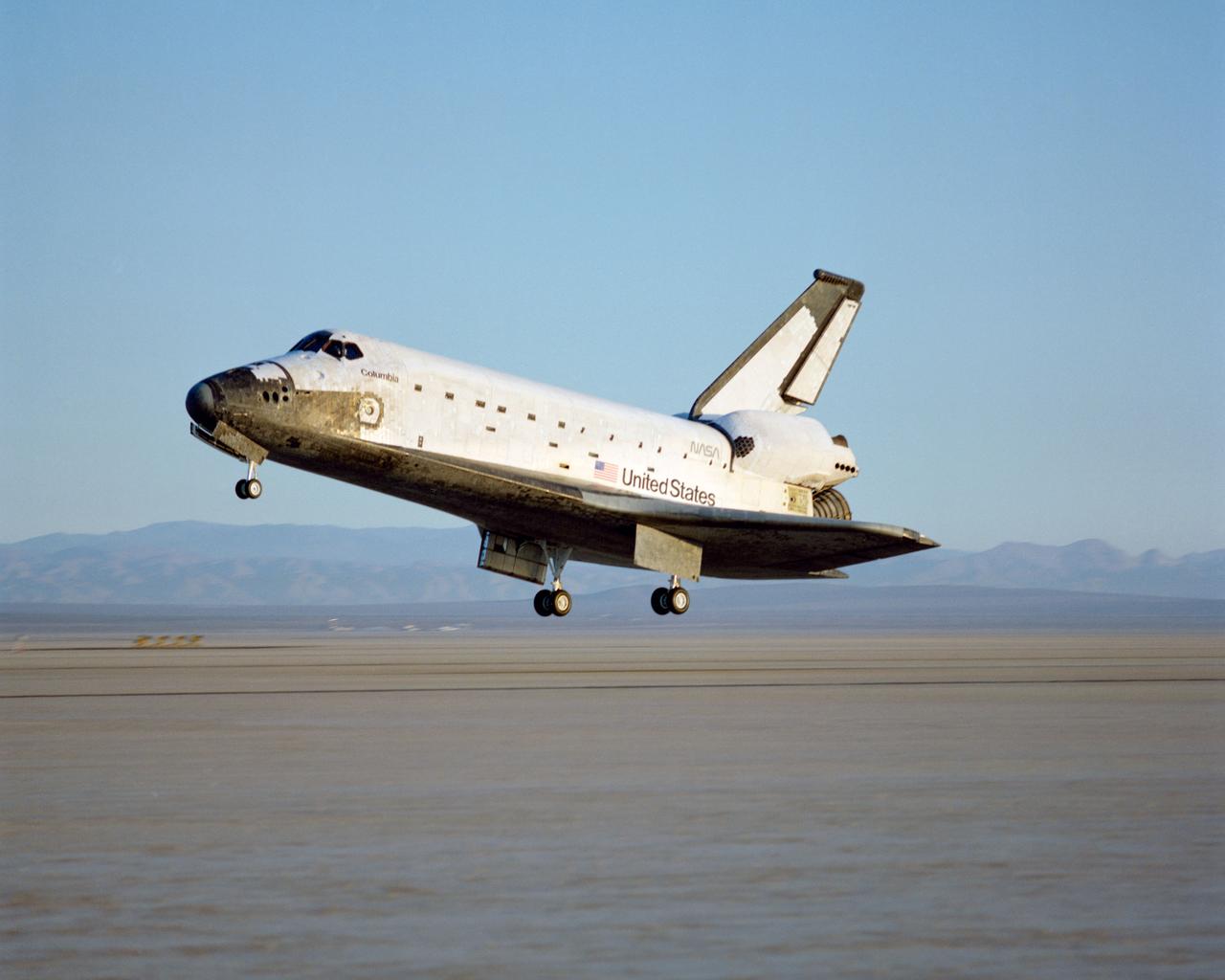
STS-28 Columbia, Orbiter Vehicle (OV) 102, approaches Runway 17 dry lake bed at Edwards Air Force Base (EAFB) California and is photographed just moments before main landing gear (MLG) touchdown. In the distance, are peaks of Southern California mountain range.
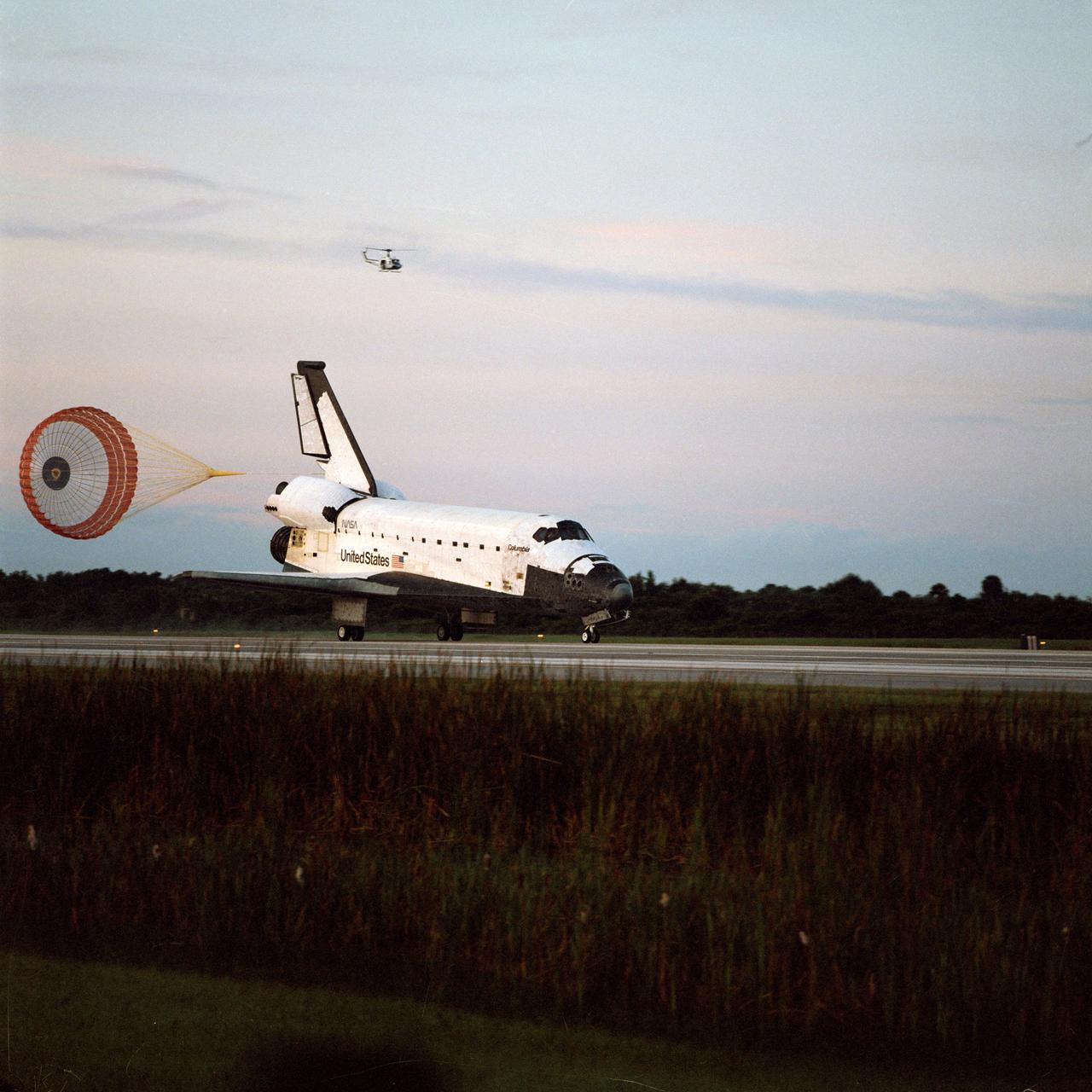
The Space Shuttle Columbia, Orbiter Vehicle (OV) 102, its drag chute fully deployed, completes a record duration mission as it lands on Runway 33 at the Kennedy Space Center (KSC) Shuttle Landing Facility (SLF). A helicopter flying overhead observes as OV-102's nose landing gear (NLG) and main landing gear (MLG) roll along the runway. Landing occurred at 6:38 am (Eastern Daylight Time (EDT)). STS-65 mission duration was 14 days 17 hours and 56 minutes. Onboard were six NASA astronauts and a Japanese payload specialist who conducted experiments in support of the International Microgravity Laboratory 2 (IML-2) during the mission.
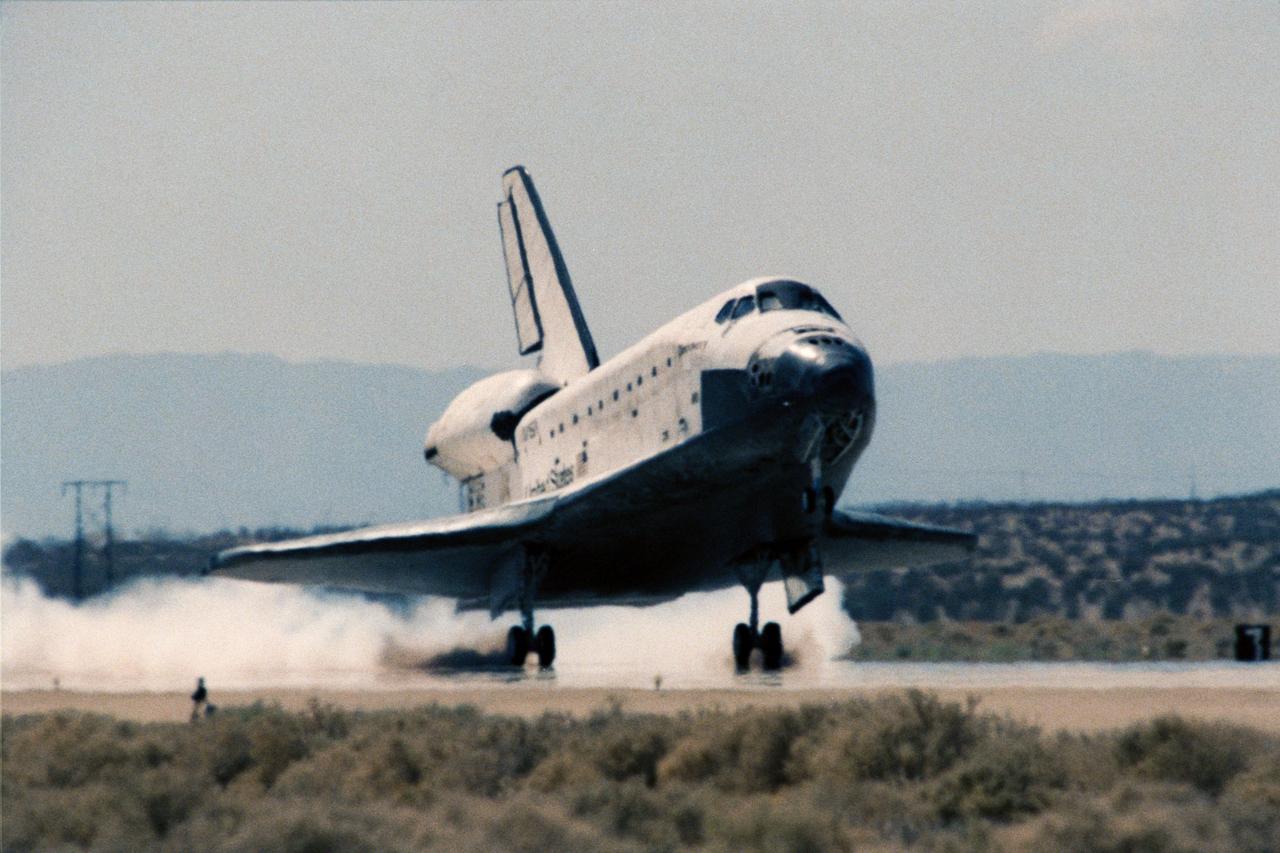
STS64-S-094 (20 Sept. 1994) --- The space shuttle Discovery, with a crew of six NASA astronauts aboard, touches down on Runway 04 at Edwards Air Force Base (EAFB), completing a 10-day, 22-hour and 50-minute mission. Following a de-orbit engine firing at 1:14 p.m. (PDT), Sept. 20, 1994. Touchdown was at 2:12:59 p.m., and the nose wheel touched down at 2:13:03 p.m., with wheel stop at 2:13:52 p.m. Bad weather in Florida called for an "eleventh hour" shift to the California landing site. Onboard for the flight, whose mission was to study Earth's atmosphere and to test tools and procedures for the International Space Station, were astronauts Richard N. Richards, L. Blaine Hammond Jr., Mark C. Lee, Carl J. Meade, Susan J. Helms and Jerry M. Linenger. Photo credit: NASA or National Aeronautics and Space Administration
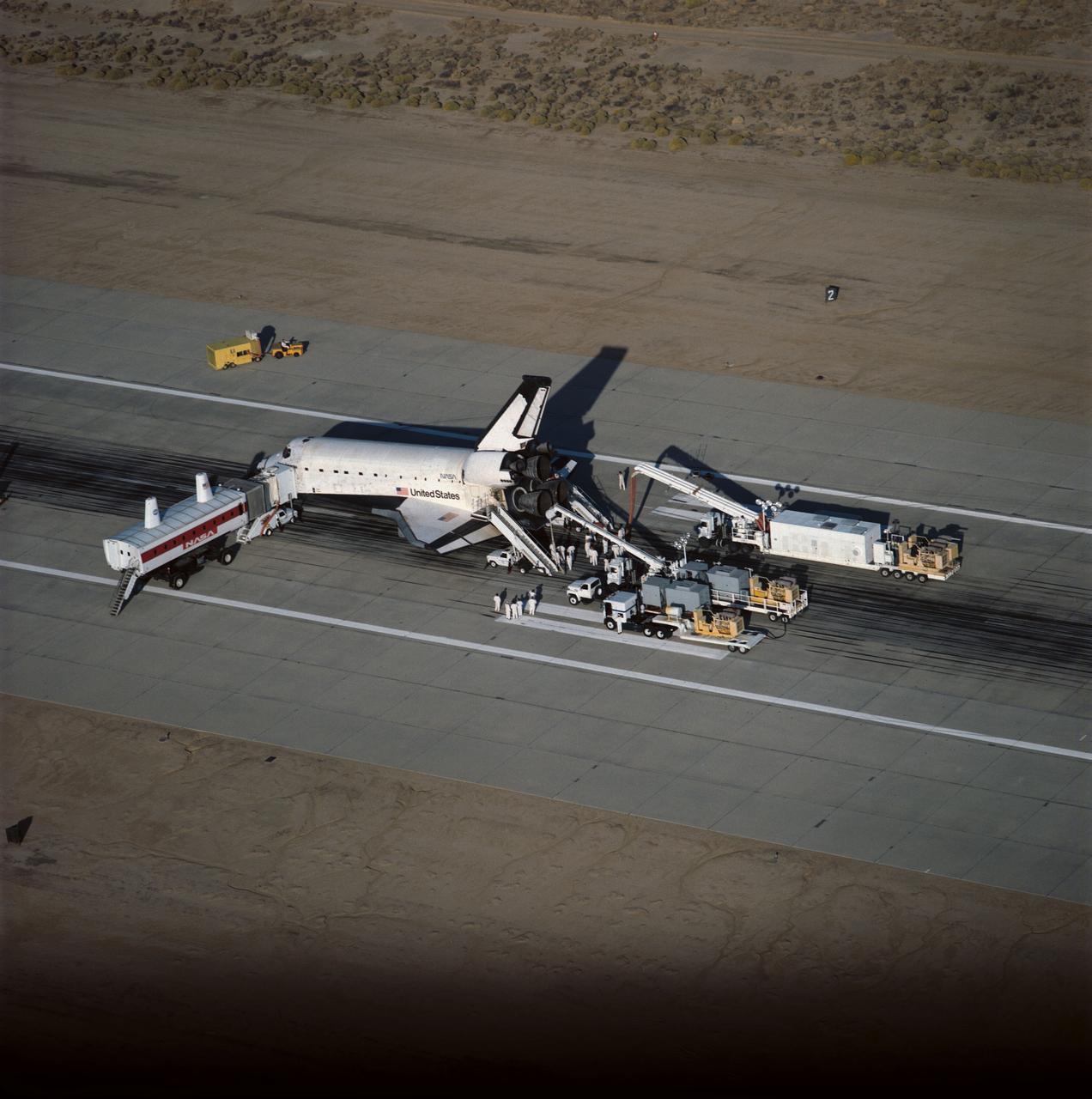
STS058-S-129 (1 Nov 1993) --- This busy scene on the runway at Edwards Air Force Base (EAFB) was taken less than an hour following the landing of the Space Shuttle Columbia. The touchdown, which had occurred at 7:06 a.m. (PST), November 1, 1993, completed a two week mission in space devoted to medical research. The array of hardware and workers includes personnel and equipment designed to make the area safe. At far left is the Crew Transport Vehicle (CTV). Still onboard the spacecraft were astronauts John E. Blaha, Richard A. Searfoss, Rhea Seddon, Shannon W. Lucid, David A. Wolf and William S. McArthur, along with payload specialist Martin J. Fettman, DVM.
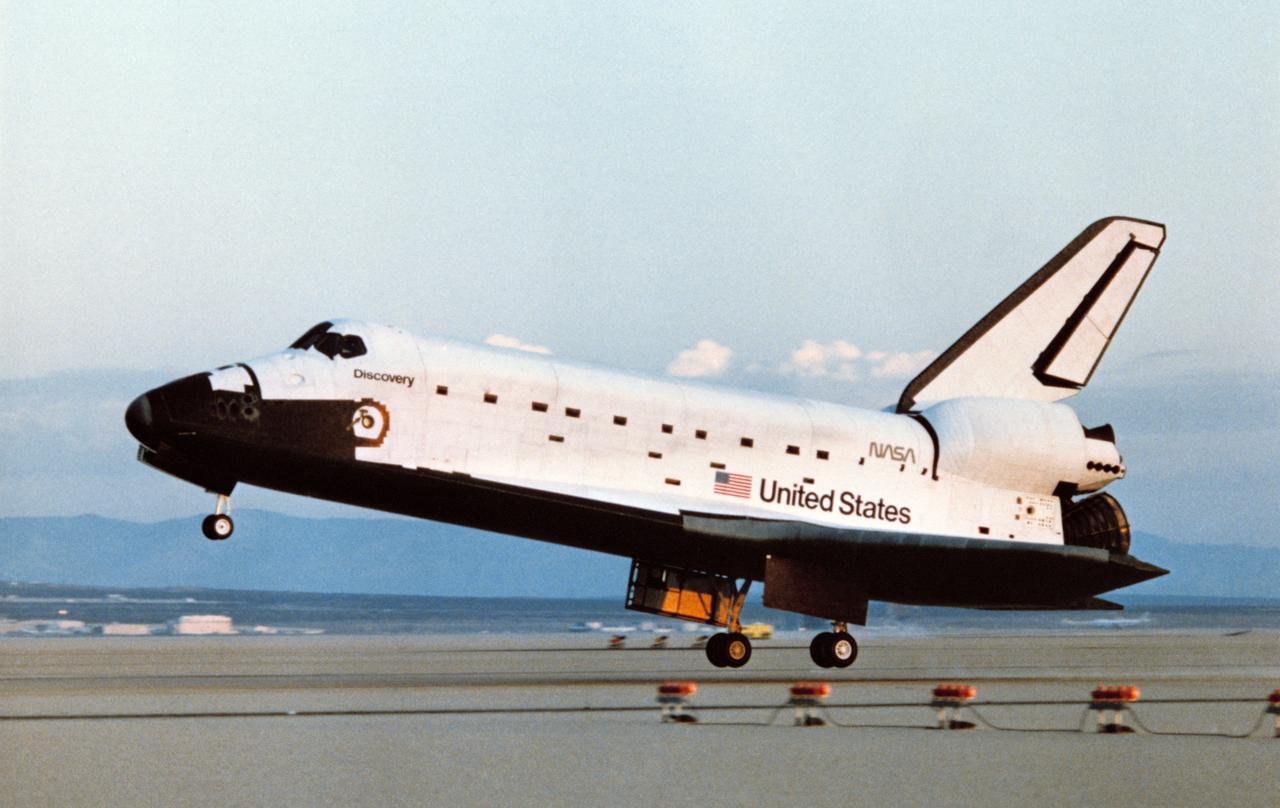
41D-3299 (5 Sept 1984) --- The Space Shuttle Discovery was captured on film just prior to touchdown on Runway 17 at Edwards Air Force Base to successfully complete a six-day mission in space. Inside were Henry W. Hartsfield, Jr., Michael L., Coats, Richard M. (Mike) Mullane, Steven A. Hawley, Judith A. Resnik and Charles D. Walker. Mission duration time was six days, 56 minutes and four seconds.
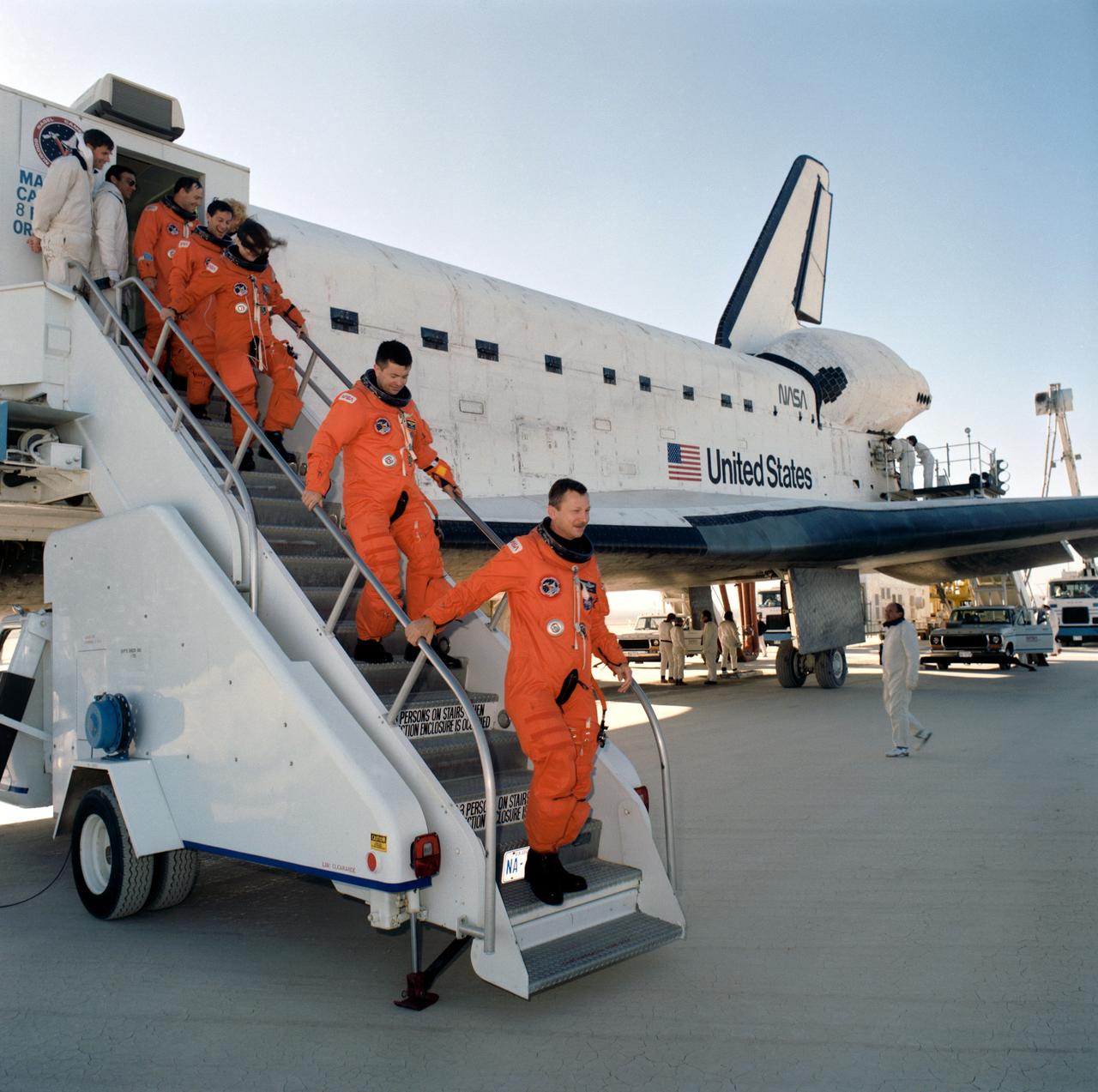
STS037-S-087 (11 April 1991) --- STS-37 crewmembers egress Atlantis via mobile stairway after landing on runway 33 dry lake bed at Edwards Air Force Base. Leading the crewmembers down the stairway is mission commander Steven R. Nagel. He is followed by pilot Kenneth D. Cameron, Mission Specialists Linda M. Godwin, Jerome Apt and Jerry L. Ross.
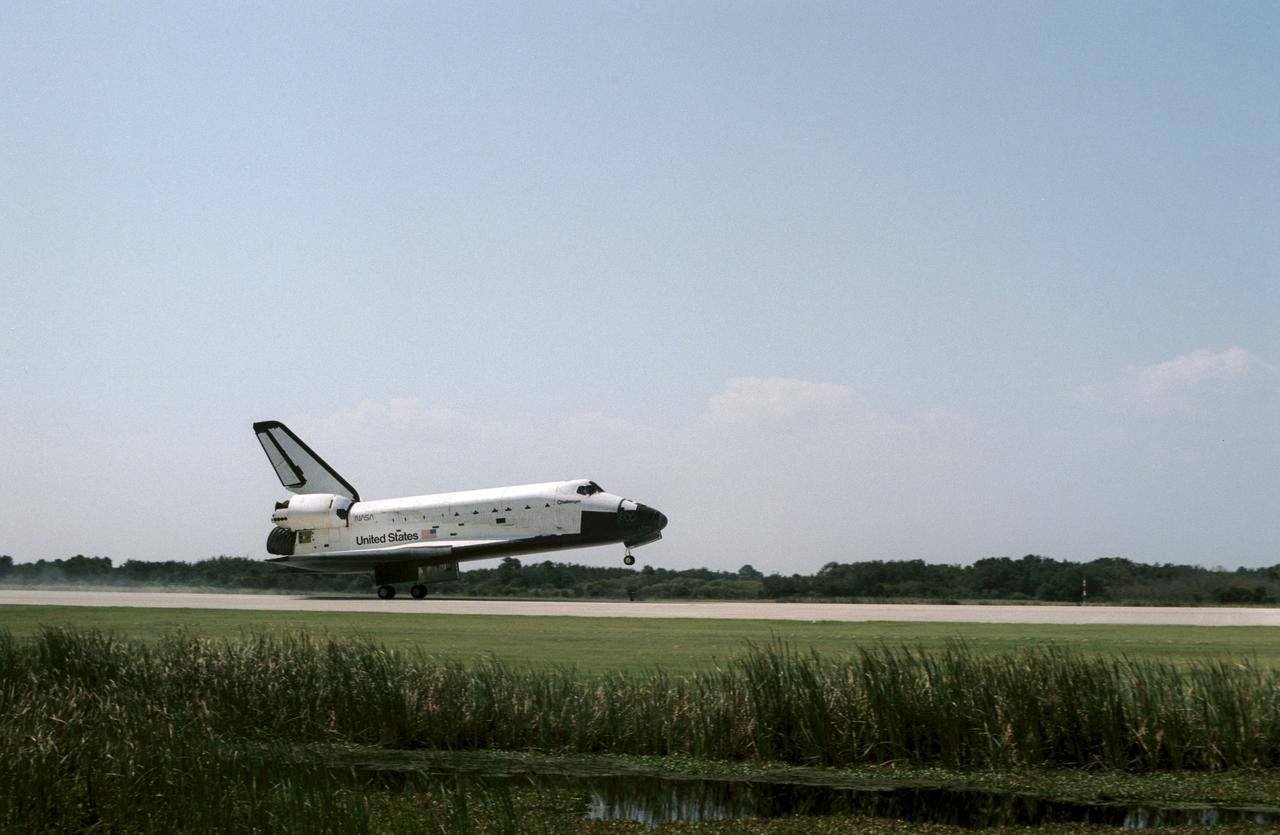
The Space Shuttle Challenger lands at Kennedy Space Center (KSC) at the end of the STS 41-G mission. The main landing gear has already touched down in this view, but the nose gear is still in the air (90232); Front view through tall grass of the Challenger making its landing at KSC (90233); Close-up side view of the Challenger making its landing at KSC (90234); Aerial view of the Challenger making its final approach to the runway to land at KSC (90235).
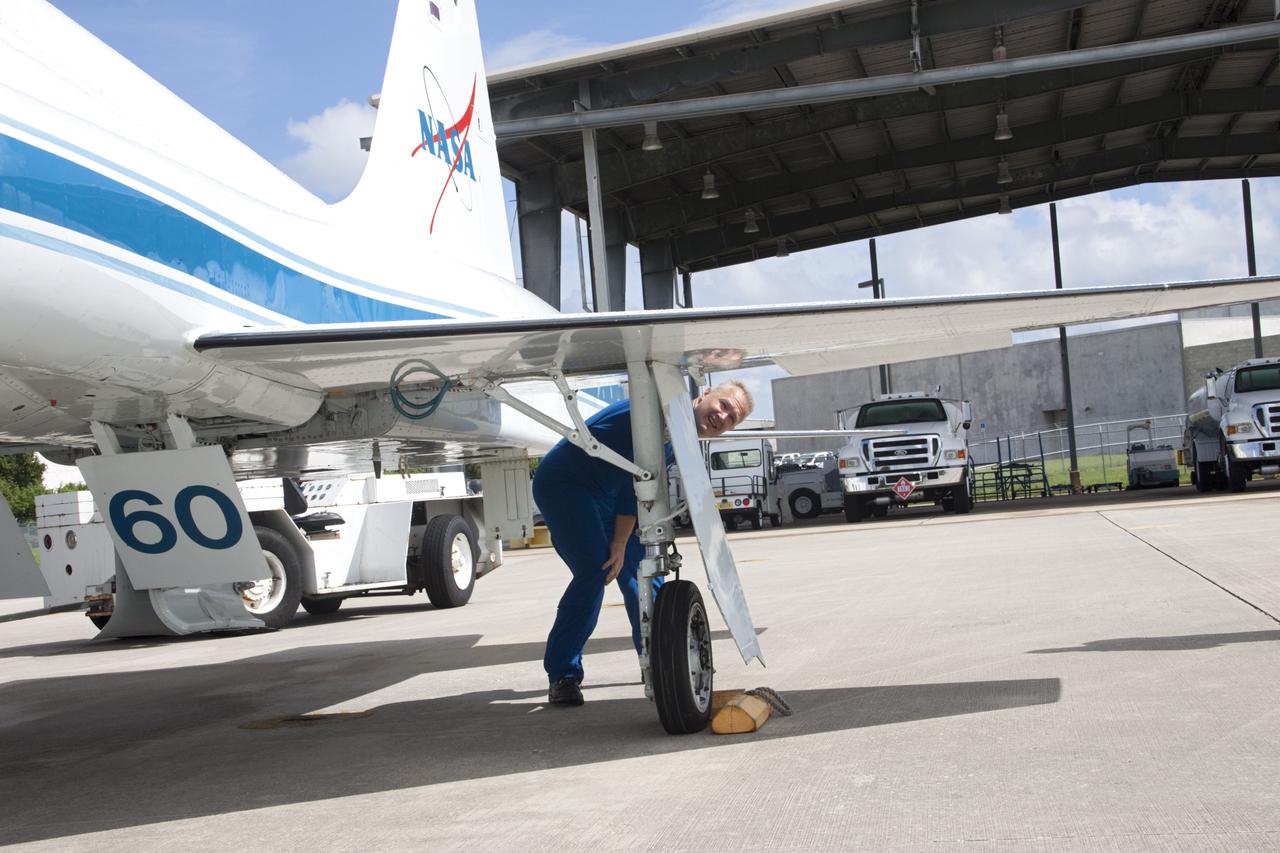
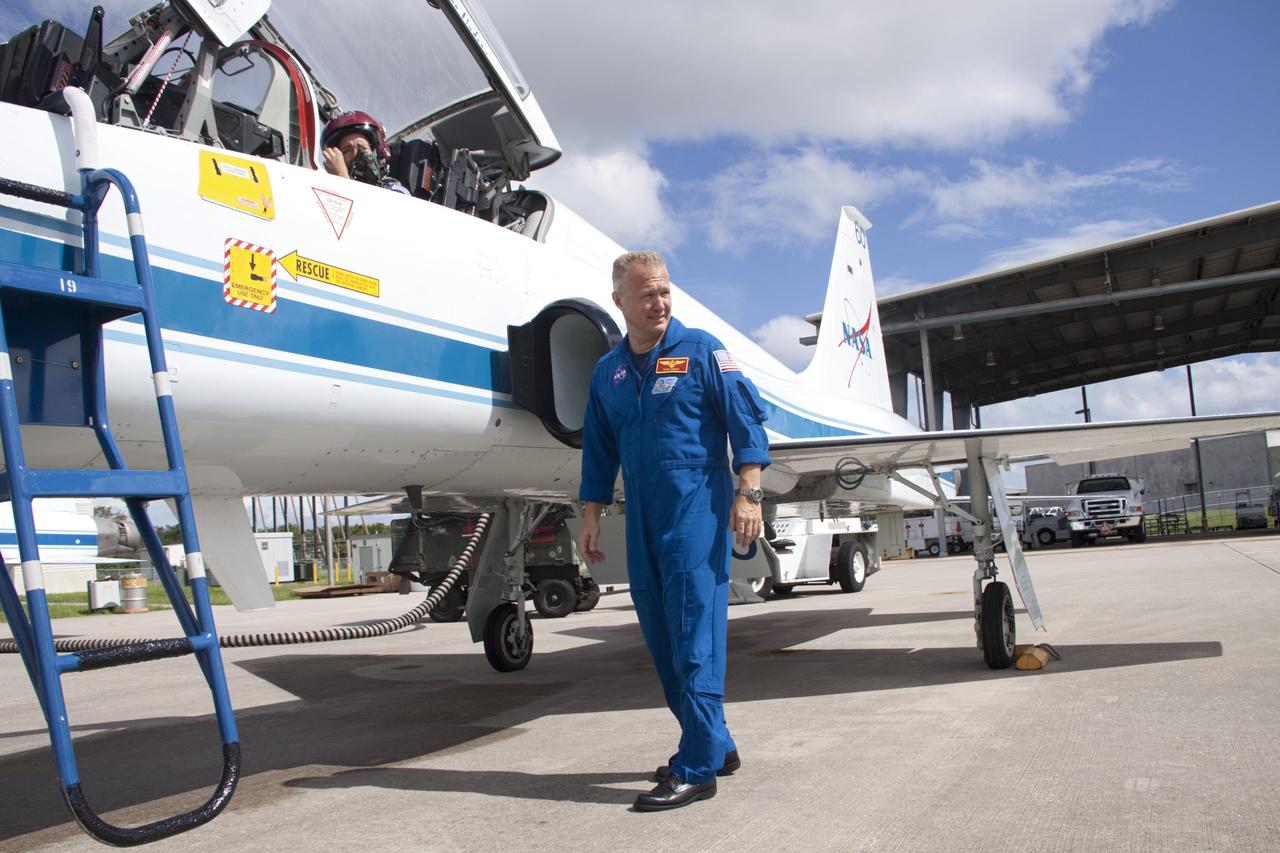
CAPE CANAVERAL, Fla. – At the Shuttle Landing Facility at NASA's Kennedy Space Center in Florida, STS-135 Pilot Doug Hurley inspects the wings on a T-38 training jet. Hurley, along with Commander Chris Ferguson and Mission Specialist Sandra Magnus, was at the center for the traditional post-flight crew return presentation. STS-135 Mission Specialist Rex Walheim was unable to attend the Kennedy event. In July 2011, Atlantis and its crew delivered to the International Space Station the Raffaello multi-purpose logistics module packed with more than 9,400 pounds of spare parts, equipment and supplies that will sustain station operations for the next year. STS-135 was the 33rd and final flight for Atlantis and the final mission of the Space Shuttle Program. For more information, visit www.nasa.gov/mission_pages/shuttle/shuttlemissions/sts135/index.html. Photo credit: NASA/Jim Grossmann
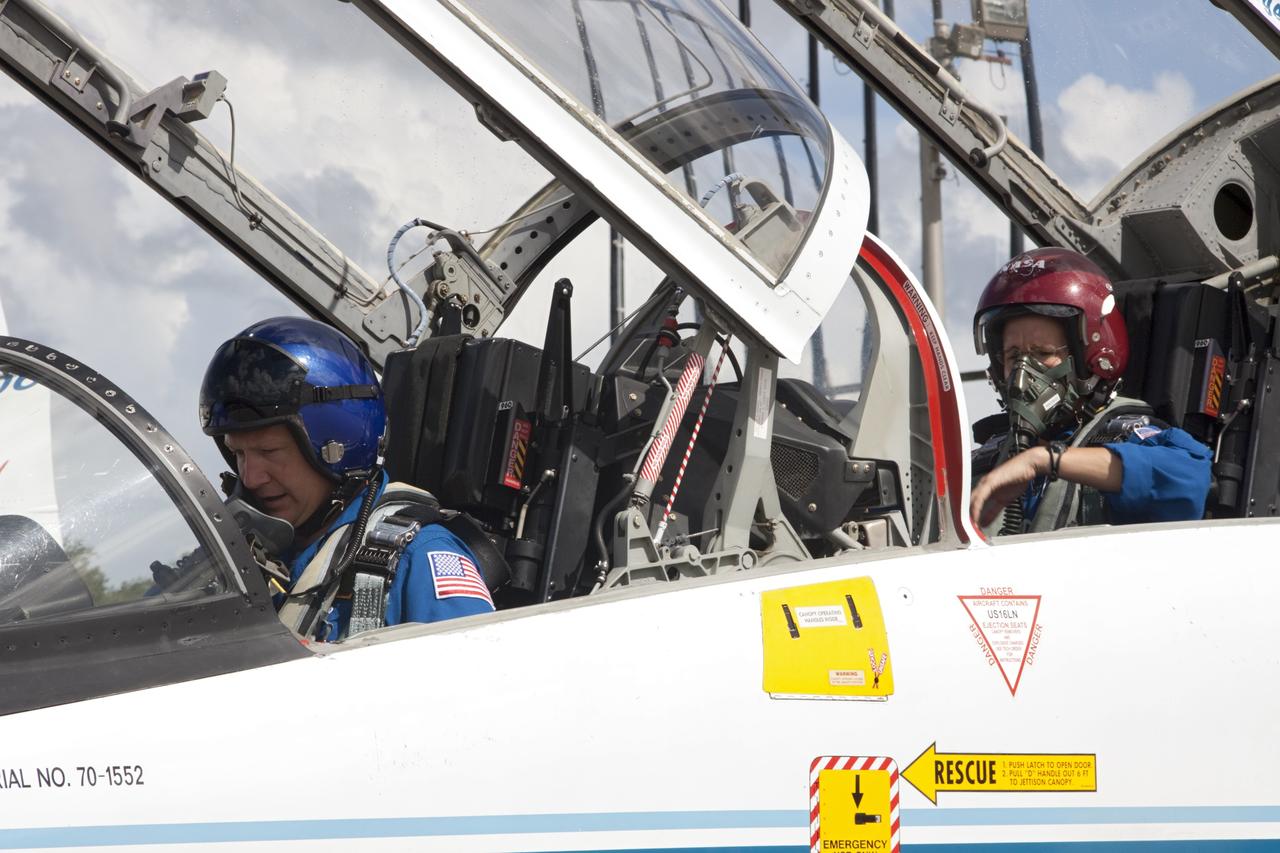
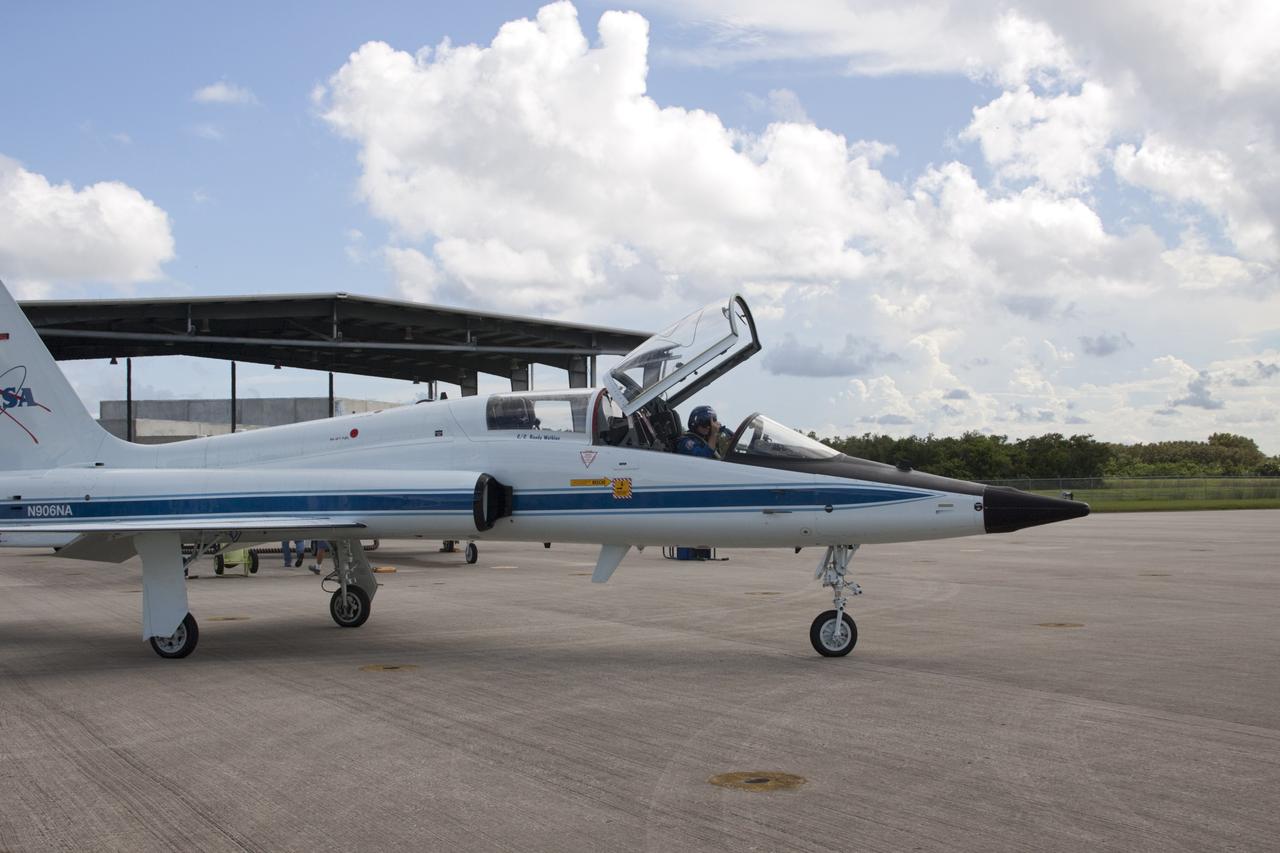
CAPE CANAVERAL, Fla. – At the Shuttle Landing Facility at NASA's Kennedy Space Center in Florida, STS-135 Pilot Doug Hurley and Mission Specialist Sandra Magnus (in the red helmet) prepare for departure in a T-38 training jet. The astronauts, along with Commander Chris Ferguson, were at the center for the traditional post-flight crew return presentation. STS-135 Mission Specialist Rex Walheim was unable to attend the Kennedy event. In July 2011, Atlantis and its crew delivered to the International Space Station the Raffaello multi-purpose logistics module packed with more than 9,400 pounds of spare parts, equipment and supplies that will sustain station operations for the next year. STS-135 was the 33rd and final flight for Atlantis and the final mission of the Space Shuttle Program. For more information, visit www.nasa.gov/mission_pages/shuttle/shuttlemissions/sts135/index.html. Photo credit: NASA/Jim Grossmann
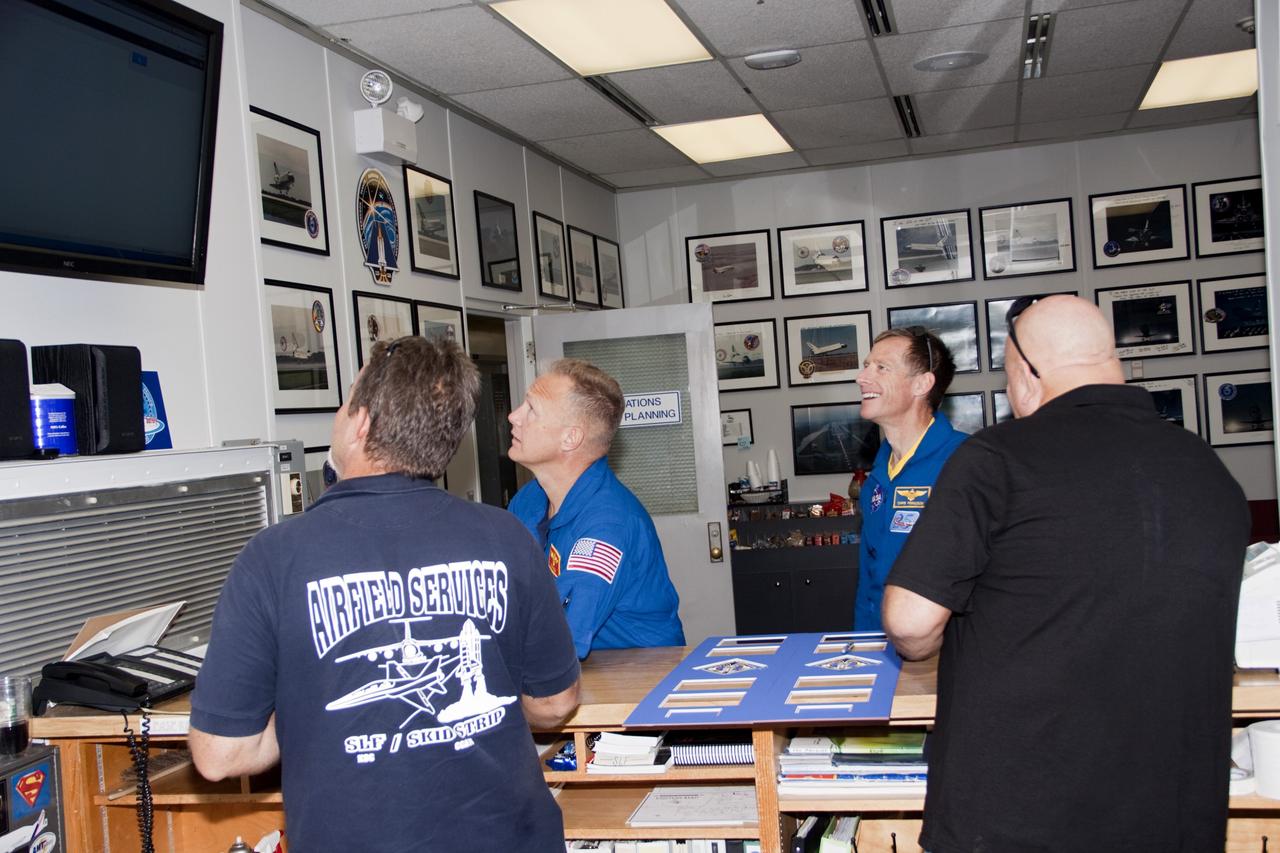
CAPE CANAVERAL, Fla. – At NASA's Kennedy Space Center in Florida, STS-135 Commander Chris Ferguson and Pilot Doug Hurley (on left) visit with employees at the Shuttle Landing Facility. The astronauts, along with Mission Specialist Sandra Magnus, were at the center for the traditional post-flight crew return presentation. STS-135 Mission Specialist Rex Walheim was unable to attend the Kennedy event. In July 2011, Atlantis and its crew delivered to the International Space Station the Raffaello multi-purpose logistics module packed with more than 9,400 pounds of spare parts, equipment and supplies that will sustain station operations for the next year. STS-135 was the 33rd and final flight for Atlantis and the final mission of the Space Shuttle Program. For more information, visit www.nasa.gov/mission_pages/shuttle/shuttlemissions/sts135/index.html. Photo credit: NASA/Jim Grossmann
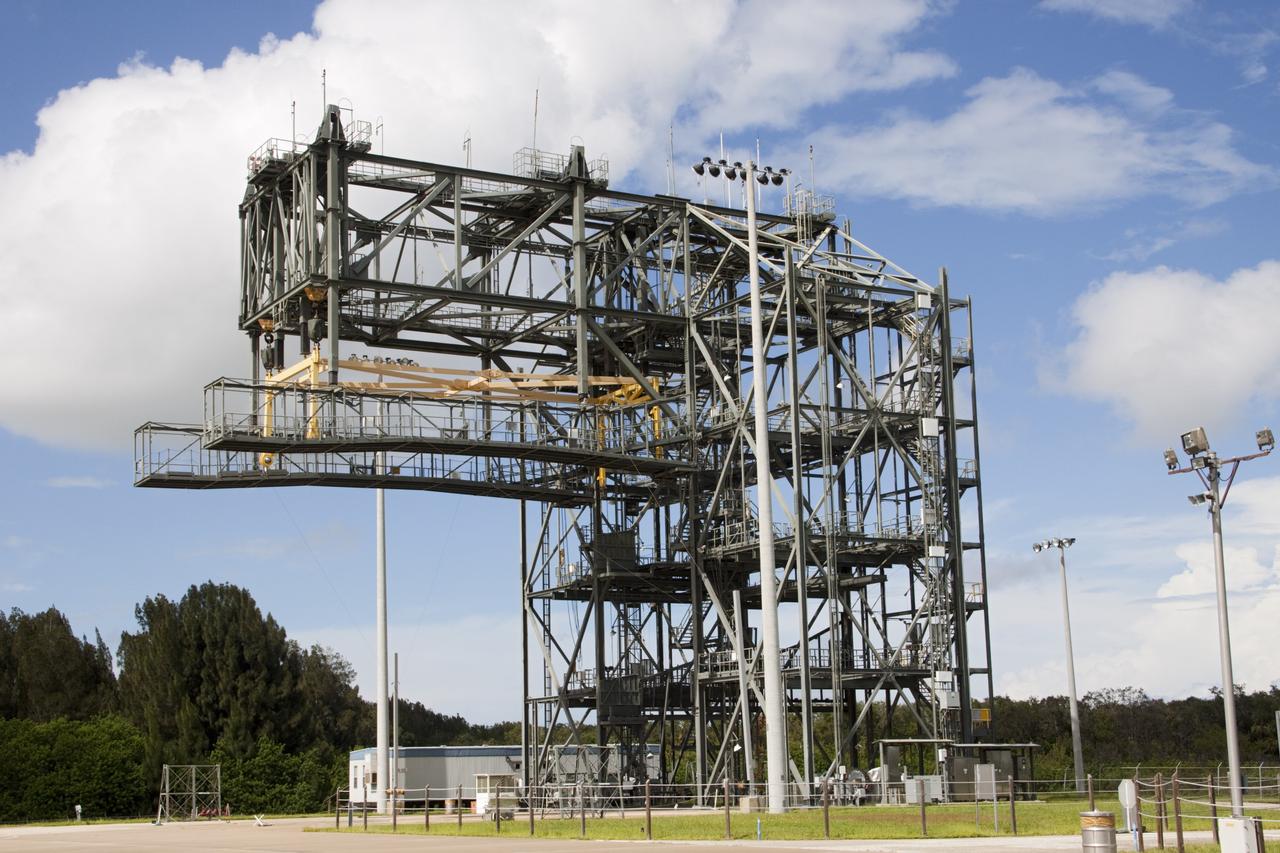
CAPE CANAVERAL, Fla. – – Located at the Shuttle Landing Facility on NASA's Kennedy Space Center in Florida, the space shuttle's mate/demate device is used to raise and lower the space shuttle orbiter from its shuttle carrier aircraft during ferry operations. Photo credit: NASA/Jim Grossmann
CAPE CANAVERAL, Fla. – At the Shuttle Landing Facility at NASA's Kennedy Space Center in Florida, STS-135 Pilot Doug Hurley and Mission Specialist Sandra Magnus (in the red helmet) prepare for departure in a T-38 training jet. The astronauts, along with Commander Chris Ferguson, were at the center for the traditional post-flight crew return presentation. STS-135 Mission Specialist Rex Walheim was unable to attend the Kennedy event. In July 2011, Atlantis and its crew delivered to the International Space Station the Raffaello multi-purpose logistics module packed with more than 9,400 pounds of spare parts, equipment and supplies that will sustain station operations for the next year. STS-135 was the 33rd and final flight for Atlantis and the final mission of the Space Shuttle Program. For more information, visit www.nasa.gov/mission_pages/shuttle/shuttlemissions/sts135/index.html. Photo credit: NASA/Jim Grossmann
CAPE CANAVERAL, Fla. – At the Shuttle Landing Facility at NASA's Kennedy Space Center in Florida, STS-135 Pilot Doug Hurley and Mission Specialist Sandra Magnus (in the red helmet) prepare for departure in a T-38 training jet. The astronauts, along with Commander Chris Ferguson, were at the center for the traditional post-flight crew return presentation. STS-135 Mission Specialist Rex Walheim was unable to attend the Kennedy event. In July 2011, Atlantis and its crew delivered to the International Space Station the Raffaello multi-purpose logistics module packed with more than 9,400 pounds of spare parts, equipment and supplies that will sustain station operations for the next year. STS-135 was the 33rd and final flight for Atlantis and the final mission of the Space Shuttle Program. For more information, visit www.nasa.gov/mission_pages/shuttle/shuttlemissions/sts135/index.html. Photo credit: NASA/Jim Grossmann
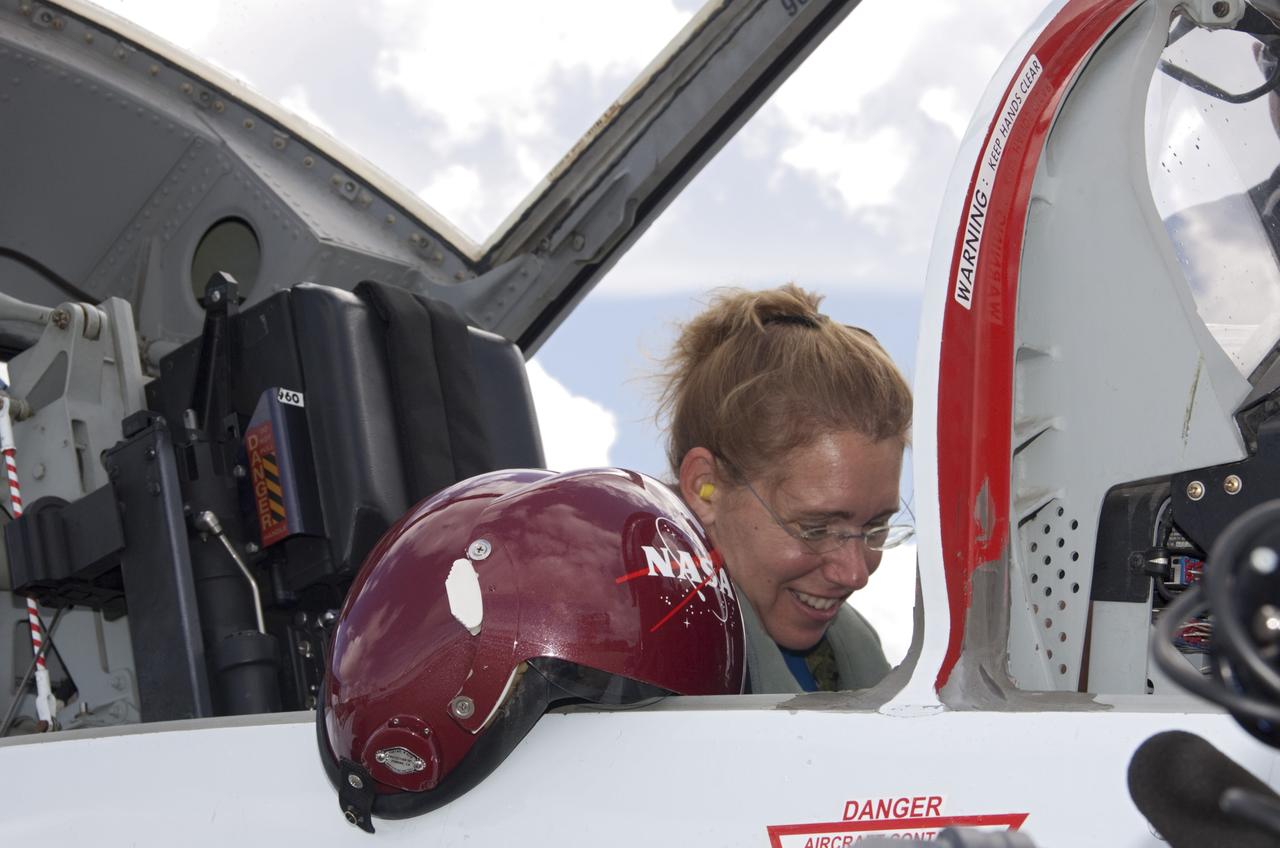
CAPE CANAVERAL, Fla. – At the Shuttle Landing Facility at NASA's Kennedy Space Center in Florida, STS-135 Mission Specialist Sandra Magnus prepares for departure in a T-38 training jet. Magnus, along with Commander Chris Ferguson and Pilot Doug Hurley, was at the center for the traditional post-flight crew return presentation. STS-135 Mission Specialist Rex Walheim was unable to attend the Kennedy event. In July 2011, Atlantis and its crew delivered to the International Space Station the Raffaello multi-purpose logistics module packed with more than 9,400 pounds of spare parts, equipment and supplies that will sustain station operations for the next year. STS-135 was the 33rd and final flight for Atlantis and the final mission of the Space Shuttle Program. For more information, visit www.nasa.gov/mission_pages/shuttle/shuttlemissions/sts135/index.html. Photo credit: NASA/Jim Grossmann
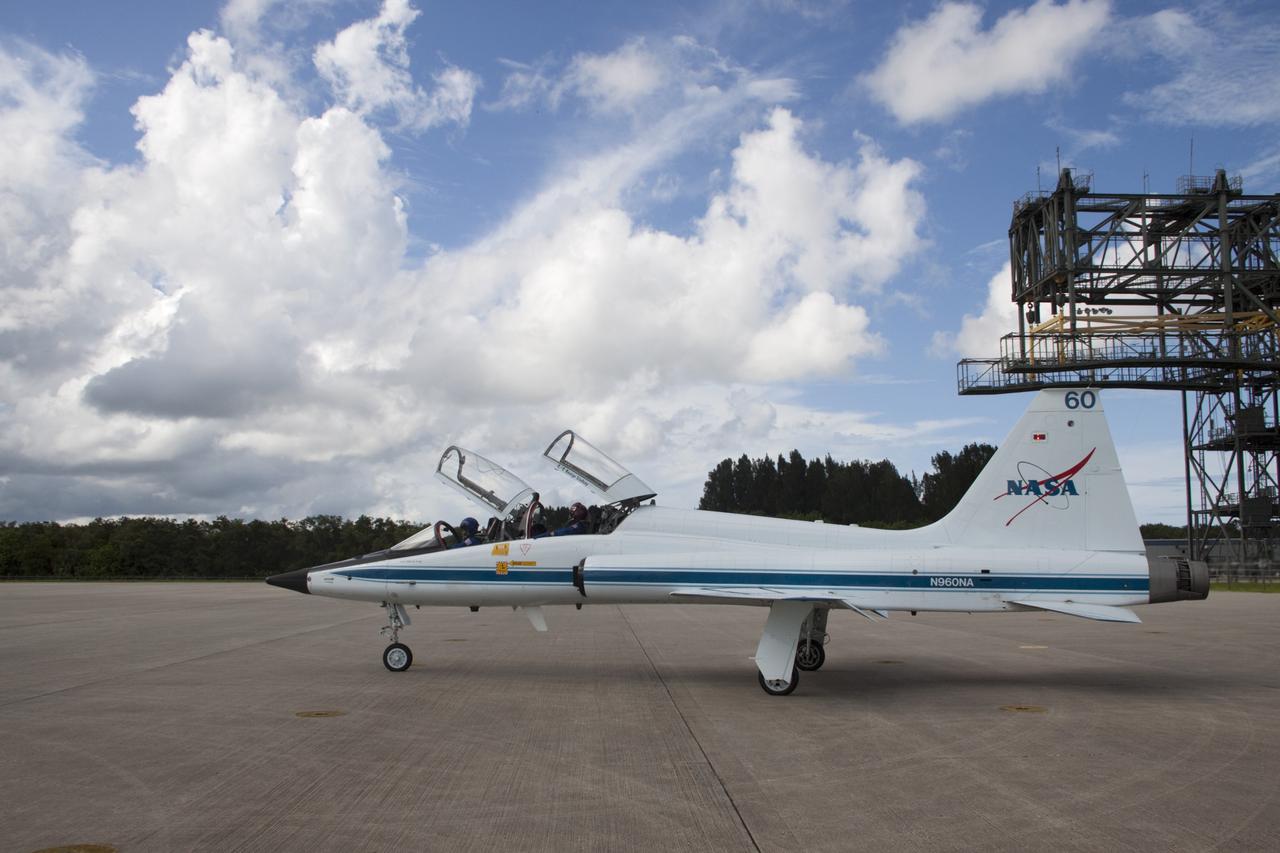
CAPE CANAVERAL, Fla. – At the Shuttle Landing Facility at NASA's Kennedy Space Center in Florida, STS-135 Pilot Doug Hurley and Mission Specialist Sandra Magnus (in the red helmet) prepare for departure in a T-38 training jet. The astronauts, along with Commander Chris Ferguson, were at the center for the traditional post-flight crew return presentation. To the left of the jet is the space shuttle's mate-demate device. STS-135 Mission Specialist Rex Walheim was unable to attend the Kennedy event. In July 2011, Atlantis and its crew delivered to the International Space Station the Raffaello multi-purpose logistics module packed with more than 9,400 pounds of spare parts, equipment and supplies that will sustain station operations for the next year. STS-135 was the 33rd and final flight for Atlantis and the final mission of the Space Shuttle Program. For more information, visit www.nasa.gov/mission_pages/shuttle/shuttlemissions/sts135/index.html. Photo credit: NASA/Jim Grossmann
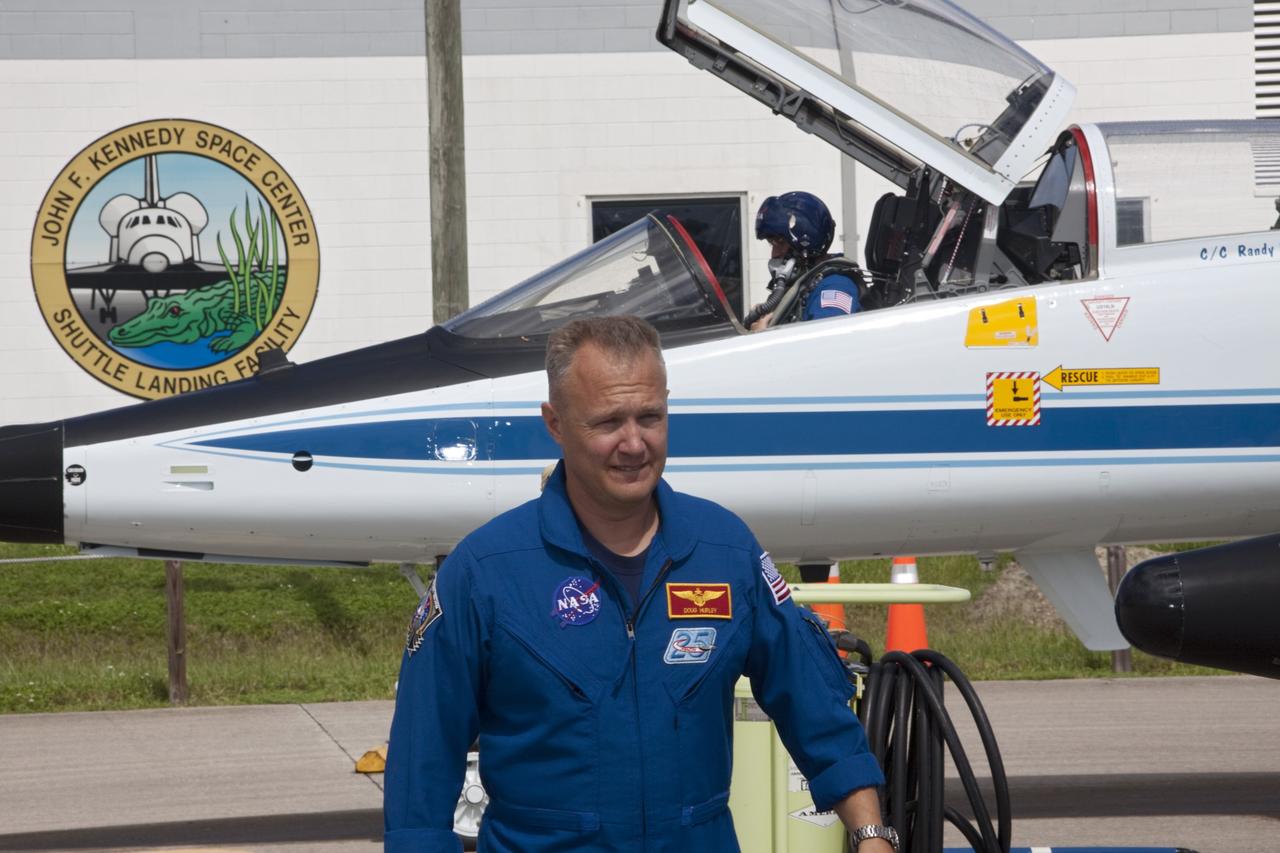
CAPE CANAVERAL, Fla. – At the Shuttle Landing Facility at NASA's Kennedy Space Center in Florida, STS-135 Pilot Doug Hurley stands in front of a T-38 training jet. Hurley, along with Commander Chris Ferguson and Mission Specialist Sandra Magnus, was at the center for the traditional post-flight crew return presentation. STS-135 Mission Specialist Rex Walheim was unable to attend the Kennedy event. In July 2011, Atlantis and its crew delivered to the International Space Station the Raffaello multi-purpose logistics module packed with more than 9,400 pounds of spare parts, equipment and supplies that will sustain station operations for the next year. STS-135 was the 33rd and final flight for Atlantis and the final mission of the Space Shuttle Program. For more information, visit www.nasa.gov/mission_pages/shuttle/shuttlemissions/sts135/index.html. Photo credit: NASA/Jim Grossmann
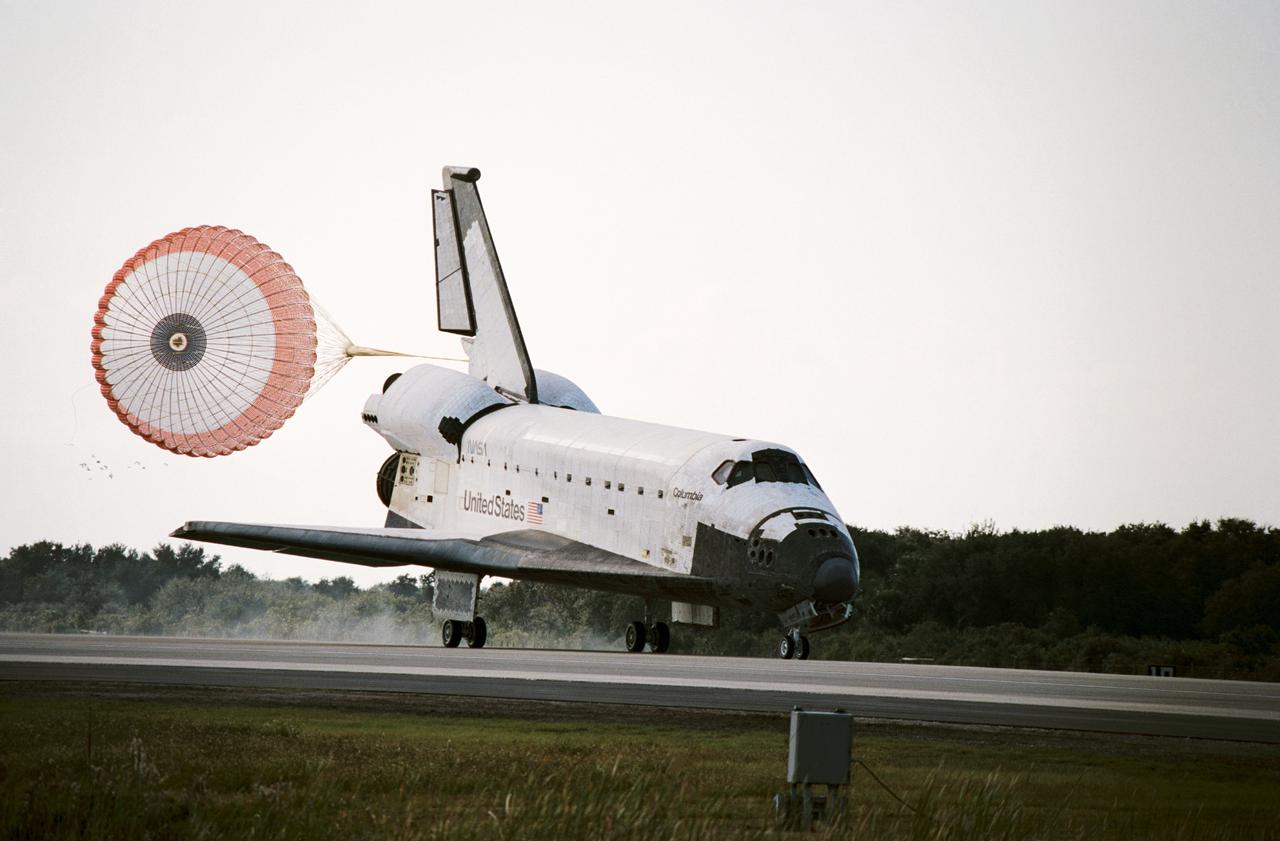
STS052-S-099 (1 Nov. 1992) --- This three-quarter front view shows the Space Shuttle Columbia just after deployment of the drag chute during landing at KSC's Shuttle Landing Facility. Onboard were a crew of five NASA astronauts and a Canadian payload specialist. Landing occurred at 9:05:53 a.m. (EST), November 1, 1992. Crewmembers are astronauts James D. Wetherbee, Michael A. Baker, Tamara E. Jernigan, Charles L. (Lacy) Veach and William M. Shepherd along with payload specialist Steven G. MacLean. The photo was taken with a 35mm camera.
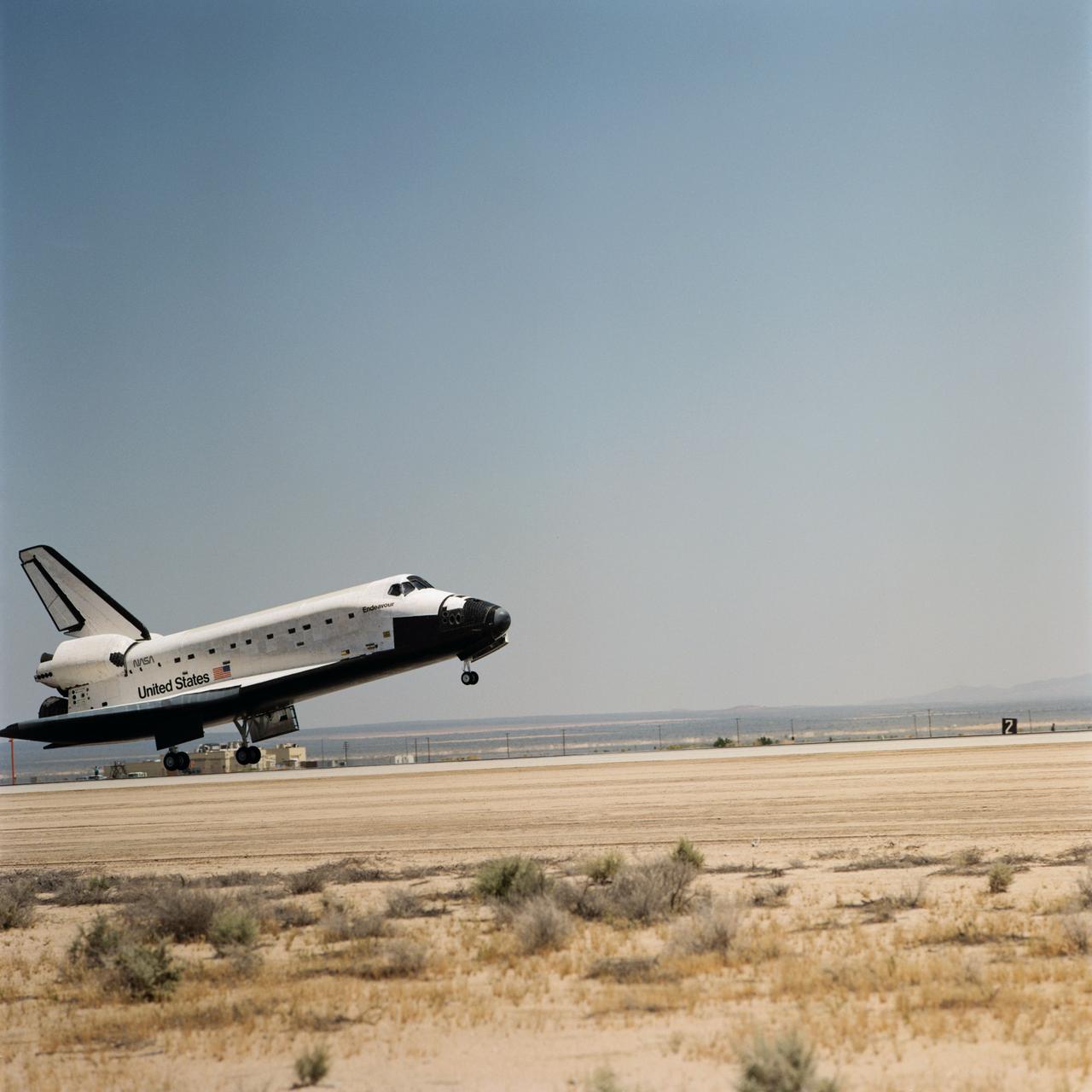
STS049-S-325 (16 May 1992) --- The main landing gear of Endeavour is just about to touch down at Edwards Air Force Base to draw to an end NASA's nine-day STS-49 mission. Crewmembers onboard were astronauts Daniel C. Brandenstein, mission commander; Kevin P. Chilton, pilot; and Thomas D. Akers, Richard J. Hieb, Bruce E. Melnick, Kathryn C. Thornton and Pierre J. Thout, all mission specialists. Landing occurred at 1:36:38 p.m. (PDT), May 16, 1992.
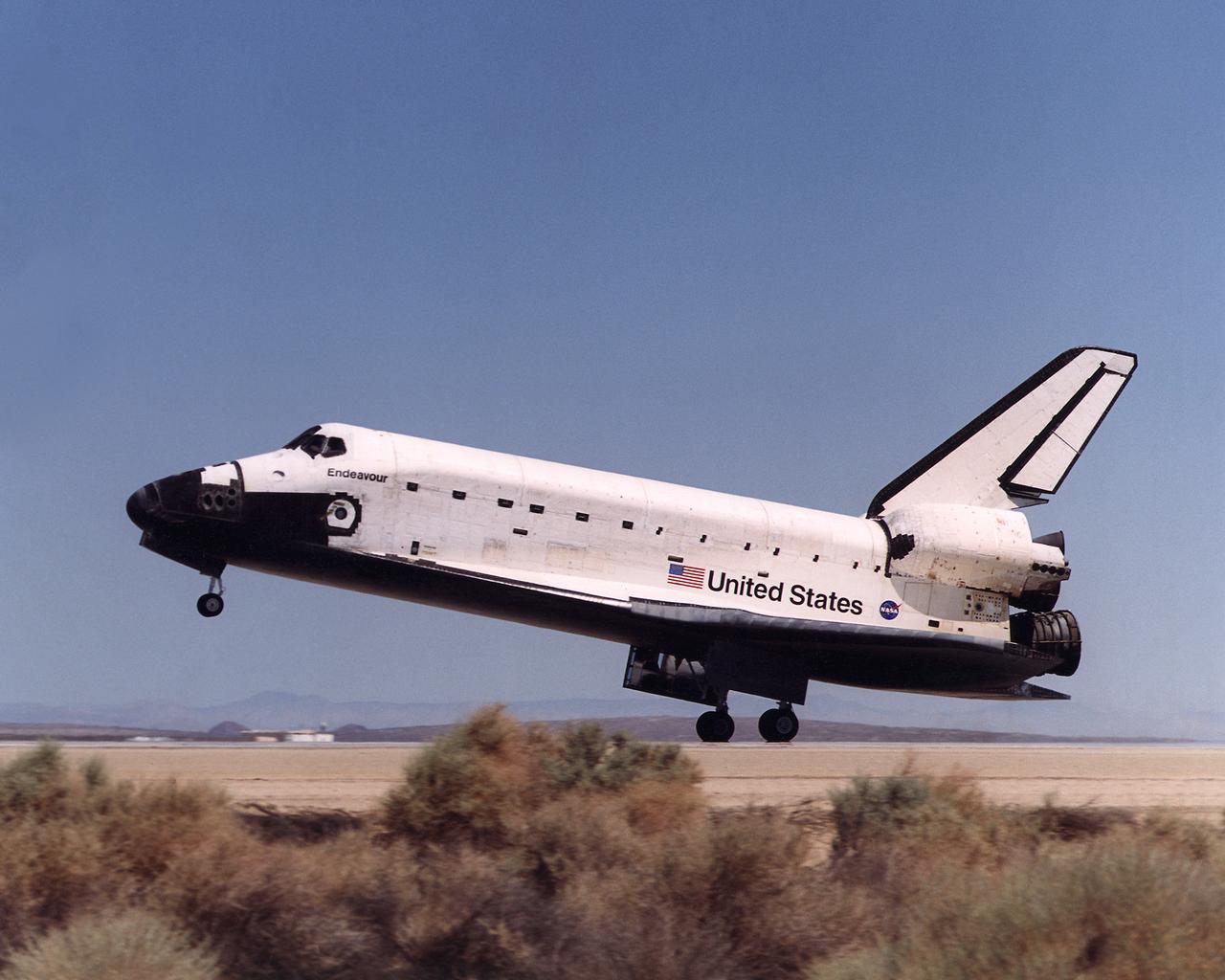
Space Shuttle Endeavour touches down on the runway at Edwards Air Force Base, California to conclude International Space Station construction and supply mission STS-111.
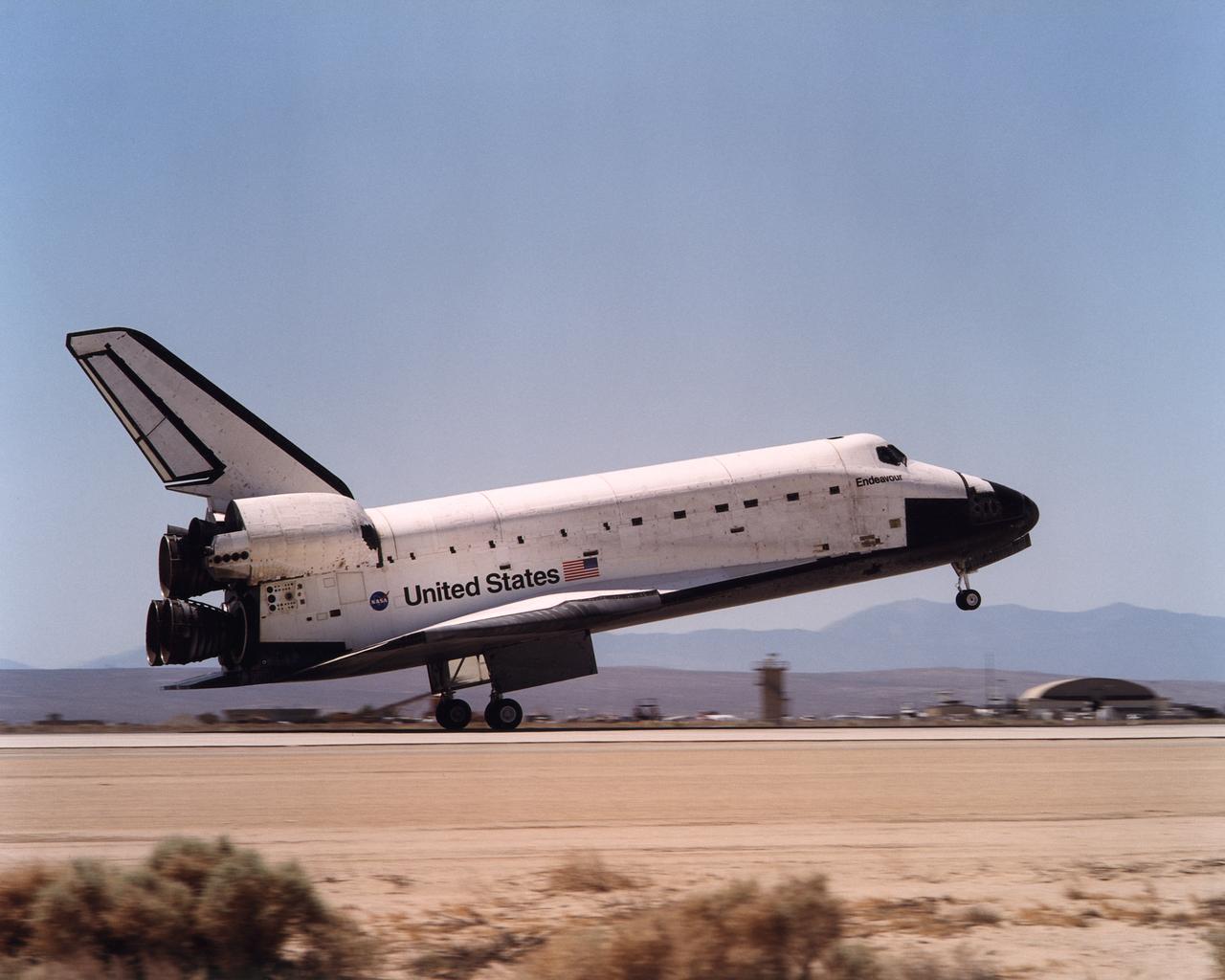
Space Shuttle Endeavour touches down on the runway at Edwards Air Force Base, California to conclude International Space Station construction and supply mission STS-111.
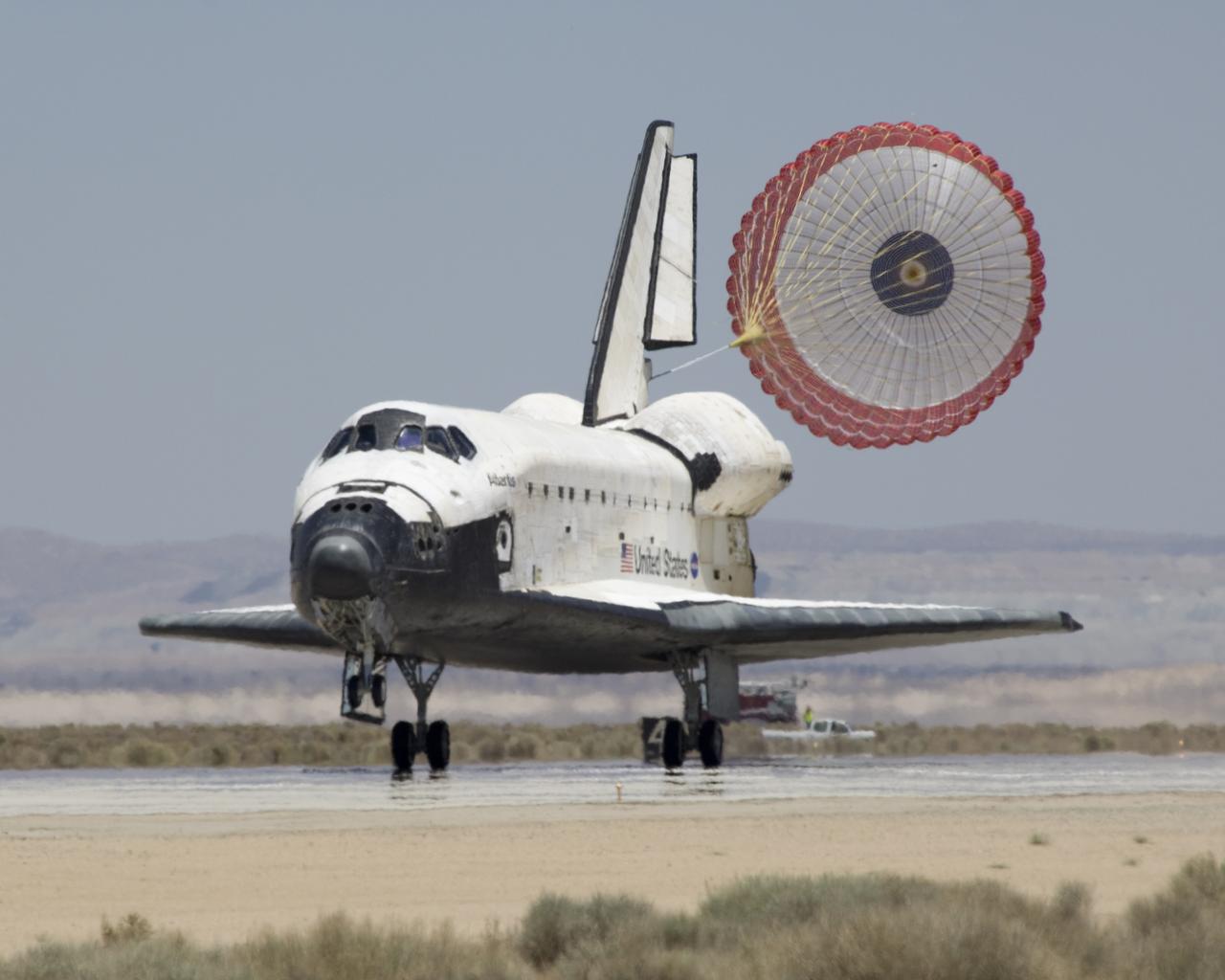
The Space Shuttle Atlantis' drag chute deploys as it rolls out on Runway 22 at Edwards AFB at the conclusion of its 13-day STS-117 mission to the ISS.
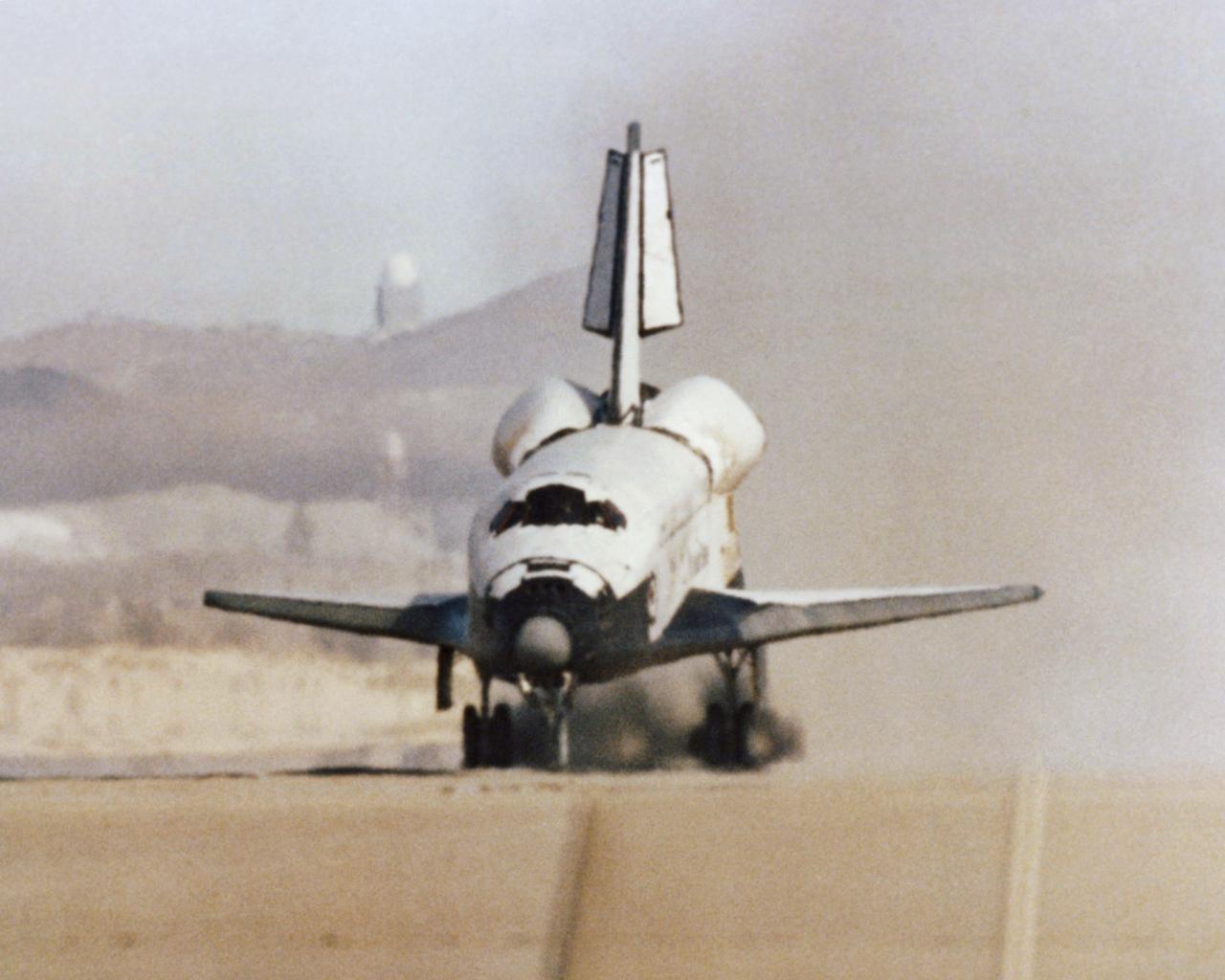
The Space Shuttle Columbia touches down on lakebed runway 23 at Edwards Air Force Base, Calif., to conclude the first orbital shuttle mission.
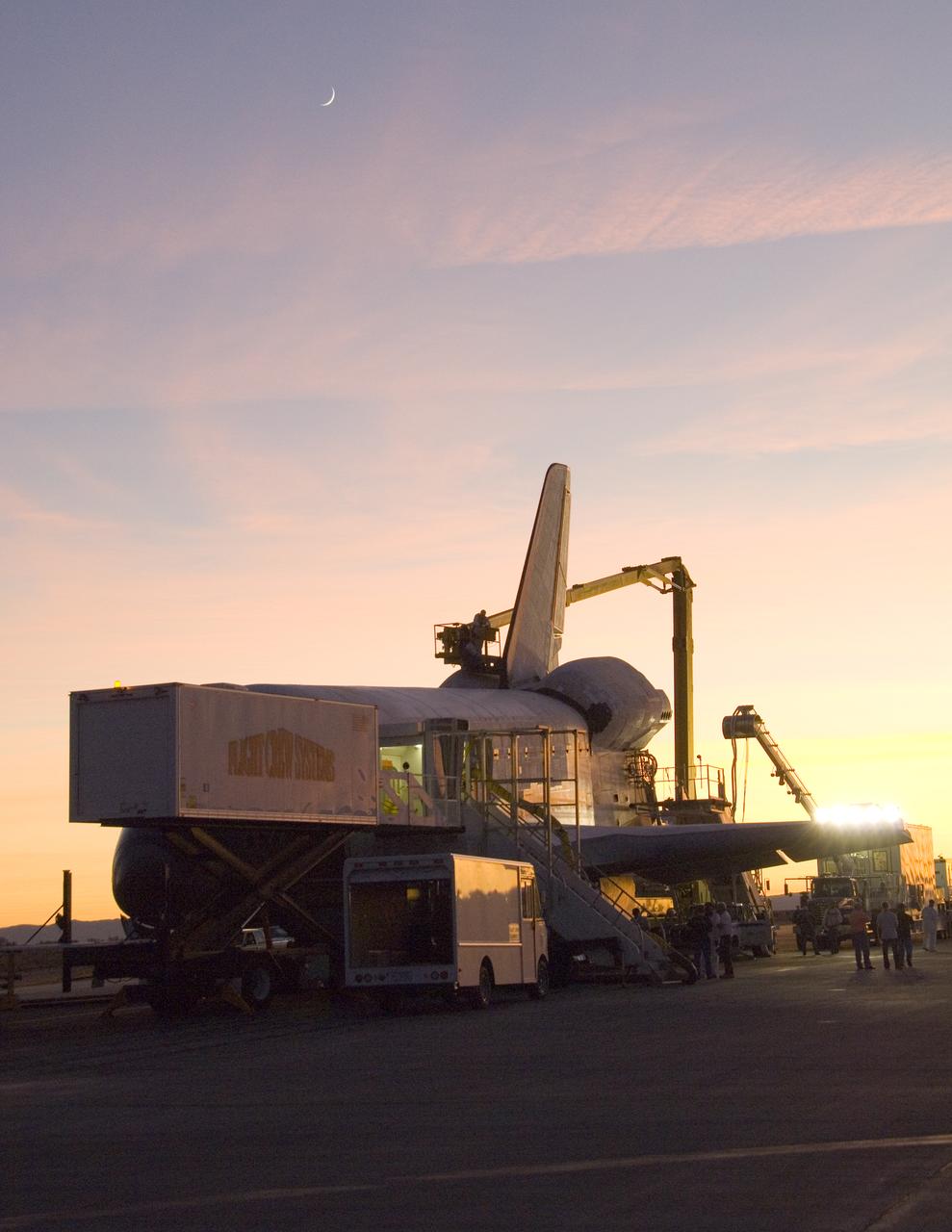
Its STS-126 mission over, Space Shuttle Endeavour is surrounded by recovery equipment before being towed off the Edwards Air Force Base runway.
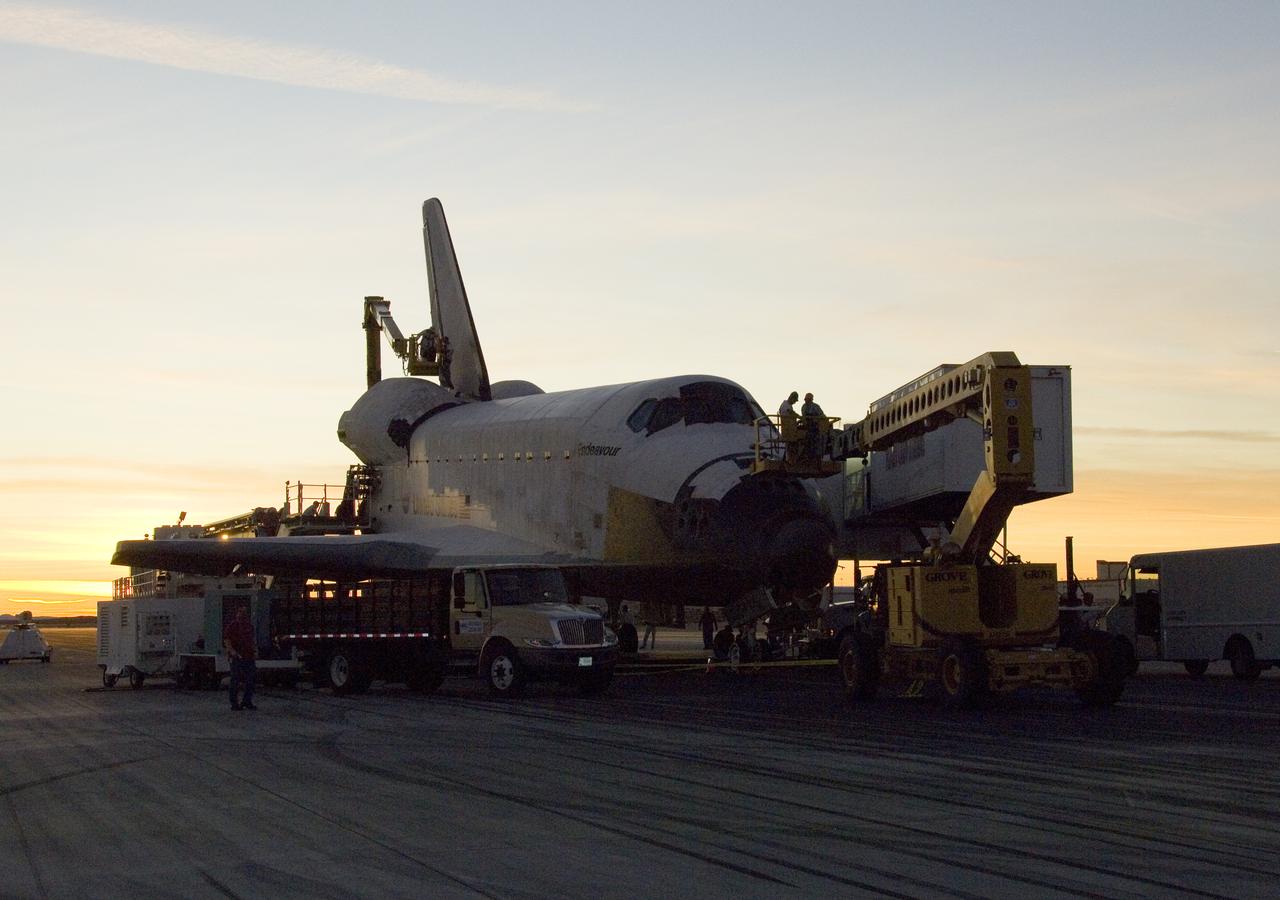
As the sun sets over the high desert, NASA technicians on mobile high-lifts prepare the shuttle Endeavour for towing off the Edwards Air Force Base runway.
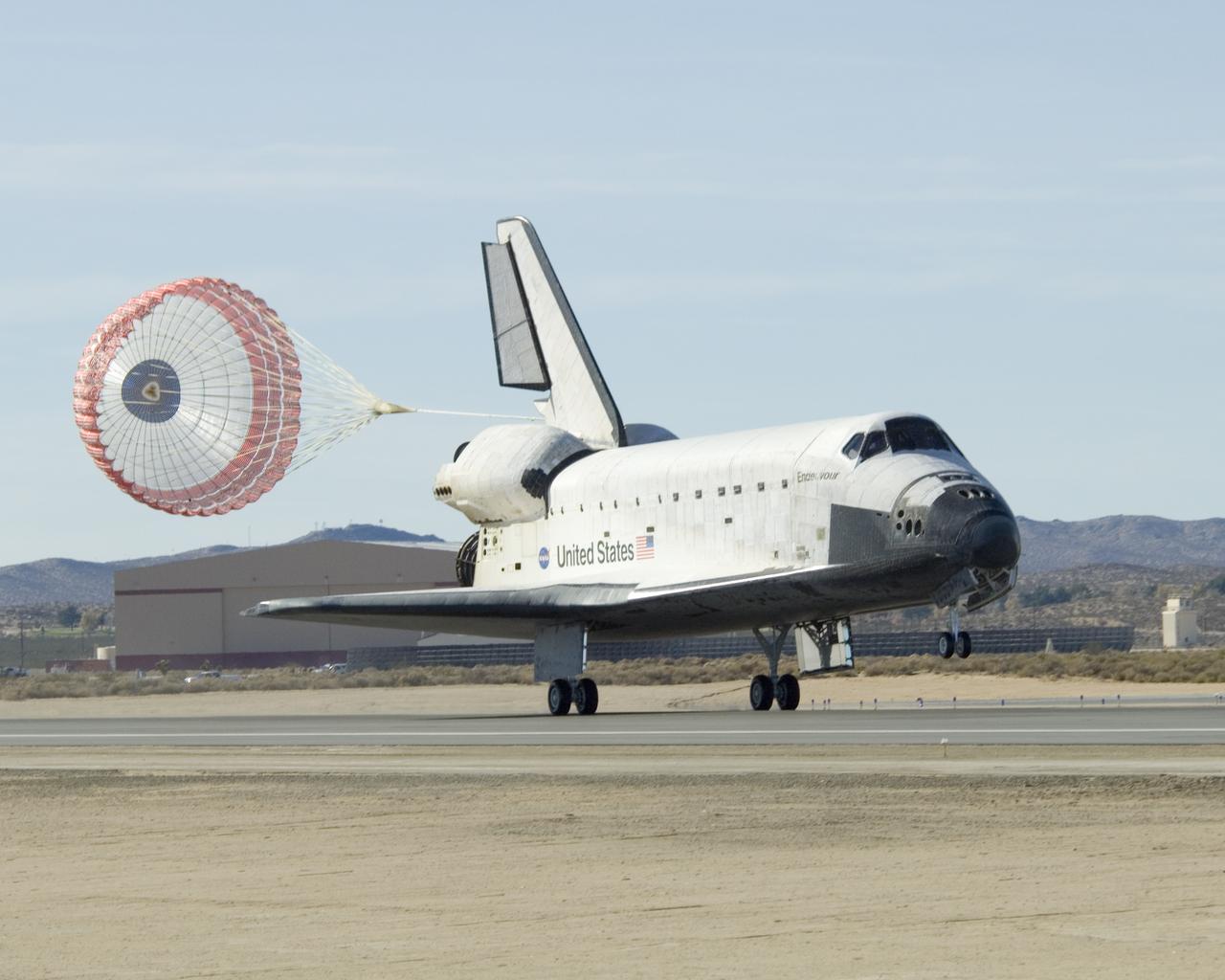
Space Shuttle Endeavour's drag chute deploys as it rolls down Runway 04-L at Edwards AFB moments after landing on Nov. 30, 2008.
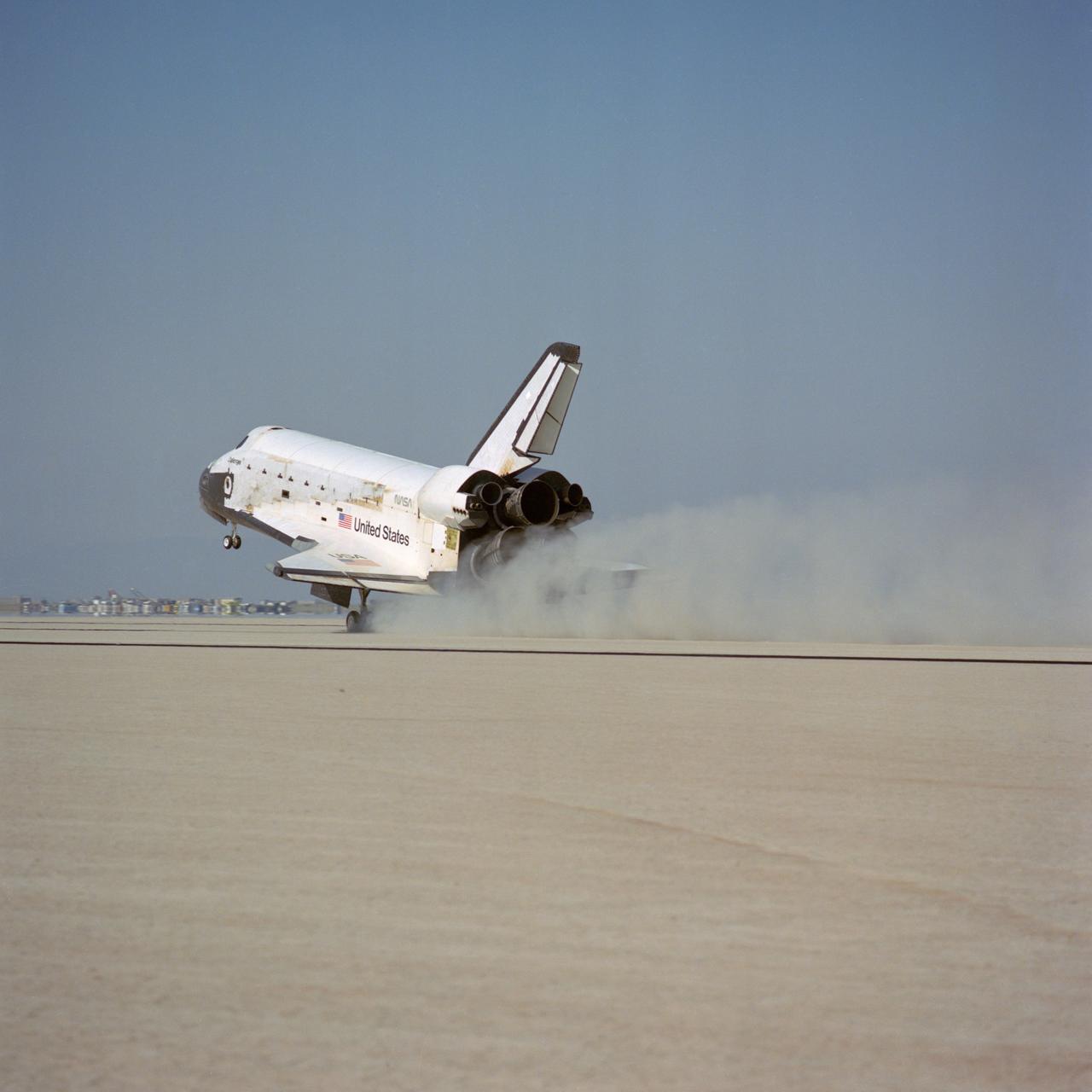
51B-S-071 (6 May 1985) --- The Space Shuttle Challenger lands on Runway 17 at Edwards Air Force Base to complete a week in space for its seven-member crew and a variety of payload. The vehicle stopped at 9:12:05 a.m. (PDT), May 6, 1985. Onboard were astronauts Robert F. Overmyer, Frederick D. Gregory, Don L. Lind, Norman E. Thagard and William E. Thornton of National Aeronautics and Space Administration (NASA); and payload specialists Lodewijk van den Berg and Taylor G. Wang.
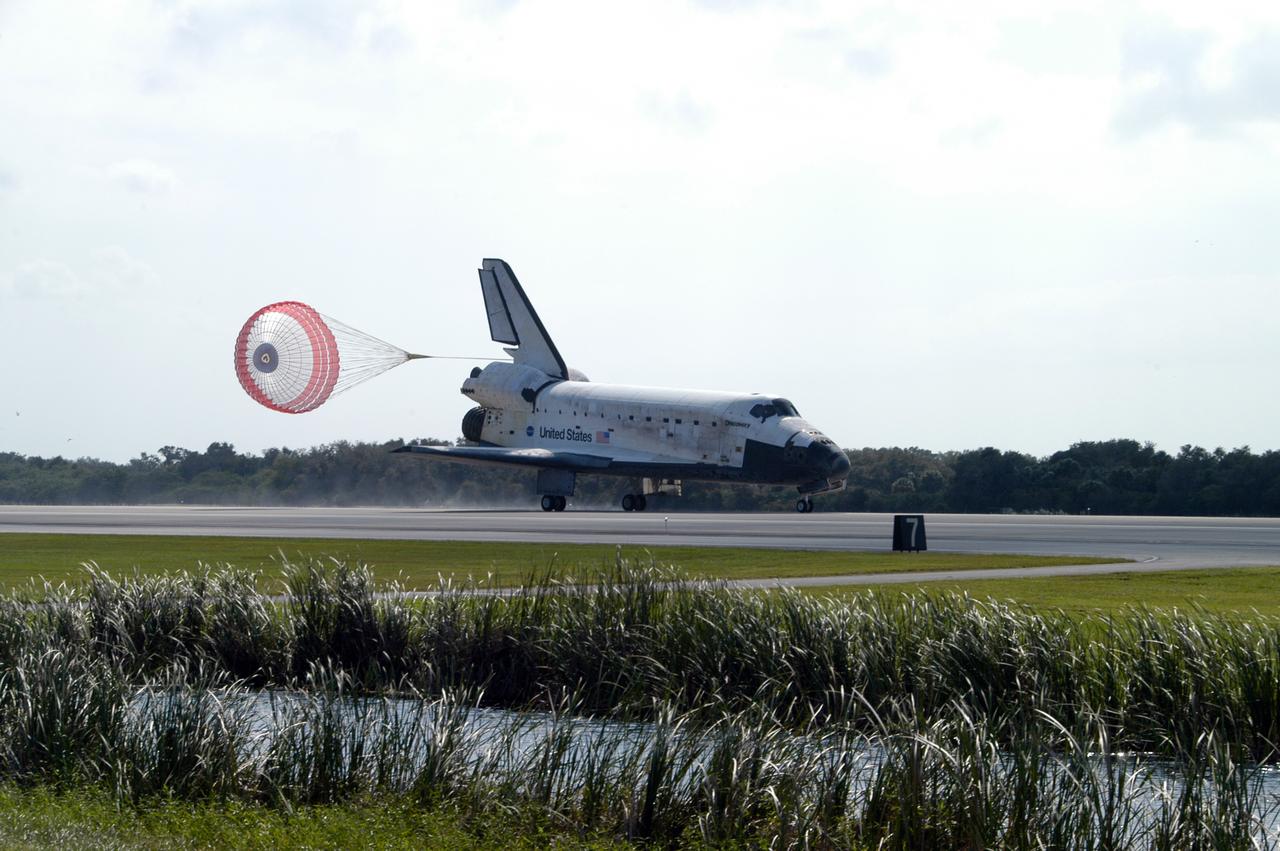
The drag chute deployed behind space shuttle Discovery helps slow its smooth landing on Runway 33 of the Shuttle Landing Facility at NASA's Kennedy Space Center, completing the 15-day mission STS-120. Main gear touchdown was 1:01:16 p.m. Wheel stop was at 1:02:07 p.m. Mission elapsed time was 15 days, 2 hours, 24 minutes and 2 seconds. The STS-120 crew continued the construction of the station with the installation of the Harmony Node 2 module and the relocation of the P6 truss.
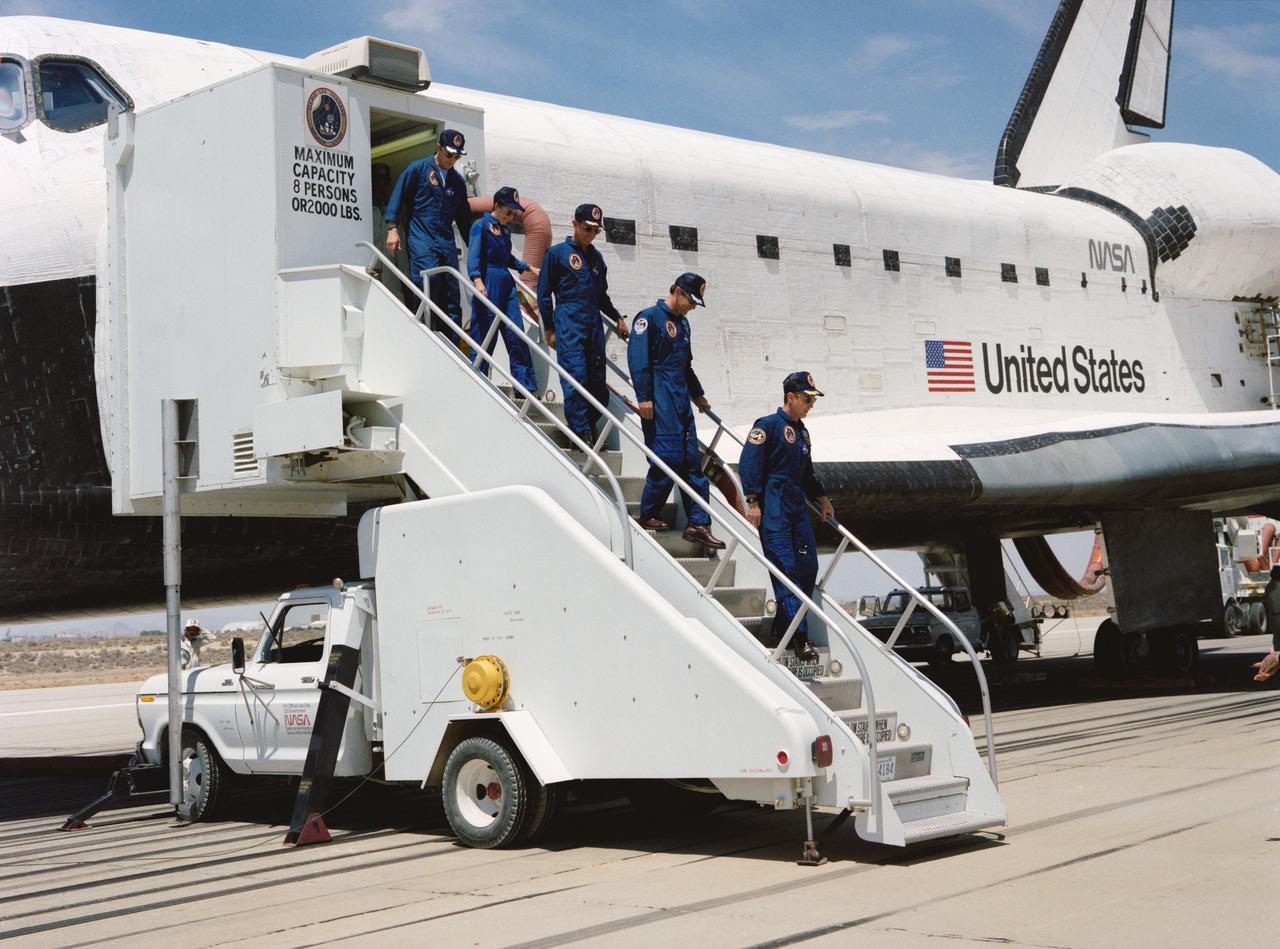
STS030-S-132 (8 May 1989) --- Crewmembers who spent just over four full days in space aboard Space Shuttle Atlantis egress their temporary home for a welcome meeting with terra firma. Pictured, from bottom of steps to top, are astronauts David M. Walker, Ronald J. Grabe, Norman E. Thagard, Mary L. Cleave and Mark C. Lee. Minutes earlier, the spacecraft?s landing gear came to a stop at 12:44:33 P.M. (PDT), 8 May 1989. It landed on runway 22, a concrete facility, like a number of other NASA flights. Still others have landed on unpaved dry lakebed stripes.
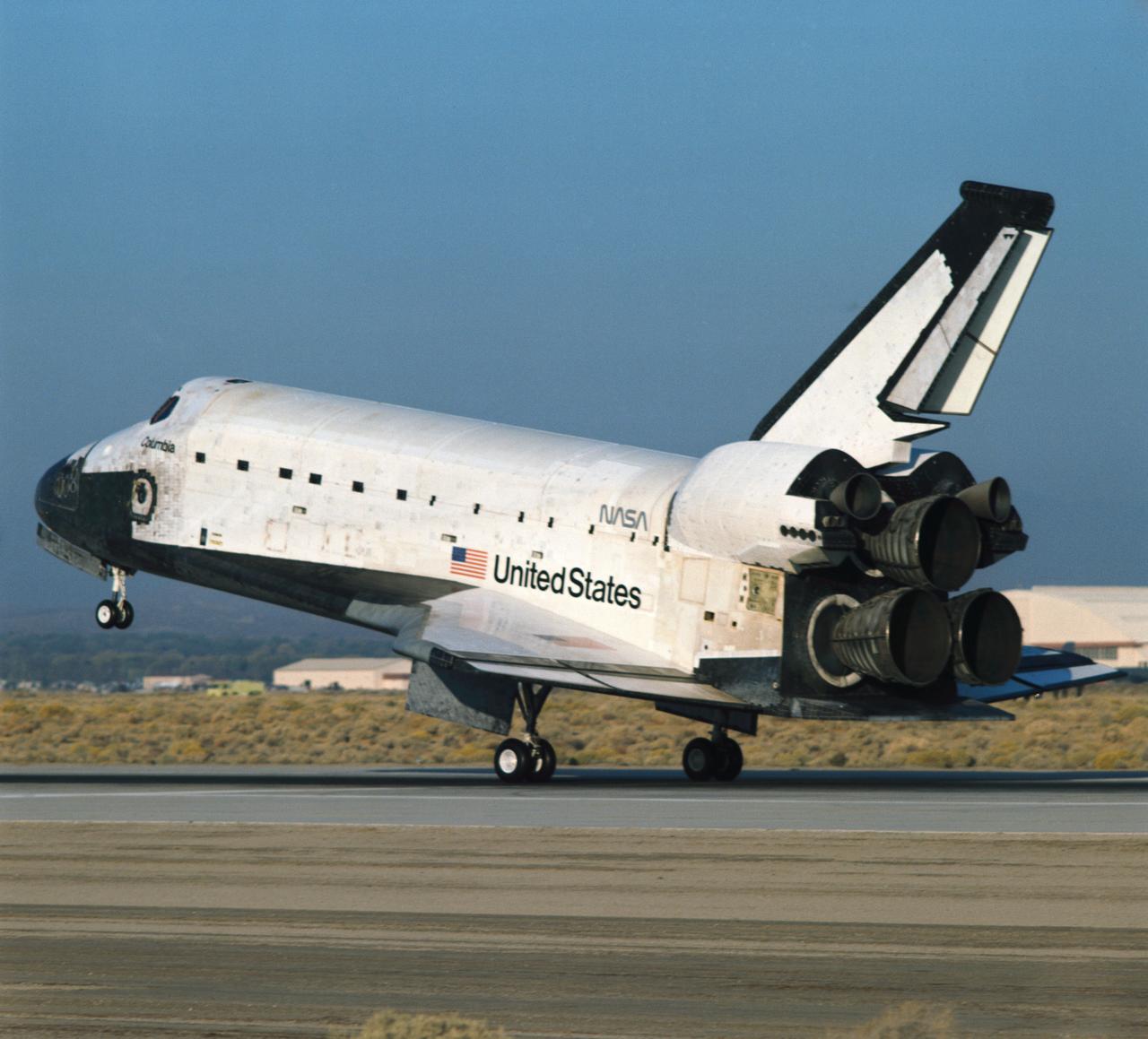
STS058-S-128 (1 Nov 1993) --- The nose gear of the Space Shuttle Columbia is about to touch down on the runway at Edwards Air Force Base (EAFB) in California. The landing, which occurred at 7:06 a.m. (PST), November 1, 1993, completed a two week mission in space devoted to medical research. Onboard the spacecraft were astronauts John E. Blaha, Richard A. Searfoss, Rhea Seddon, Shannon W. Lucid, David A. Wolf and William S. McArthur along with payload specialist Martin J. Fettman, DVM.
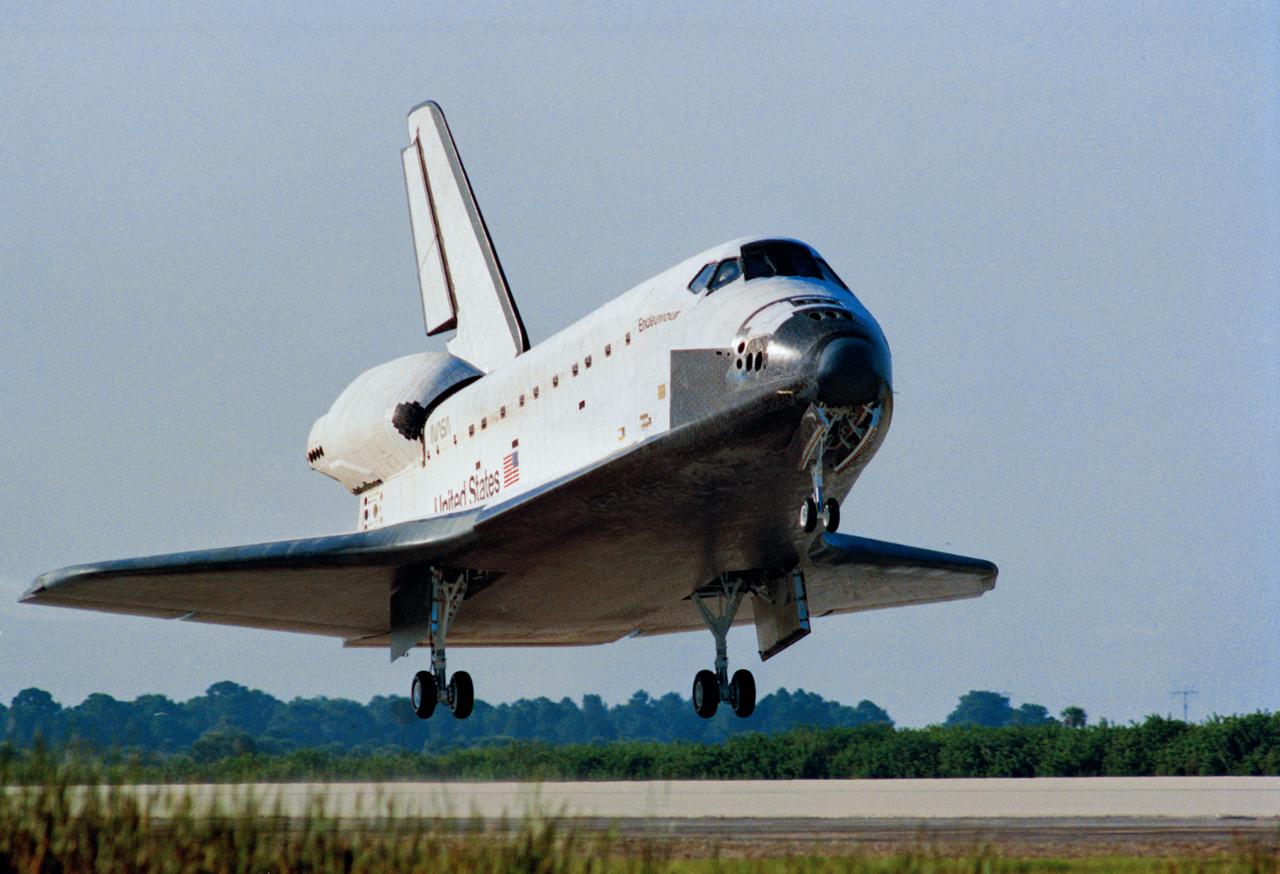
STS047-S-116 (20 Sept 1992) --- The Space Shuttle Endeavour prepares to land on the Kennedy Space Center's Shuttle landing facility runway. The successful landing marked the completion of an eight-day Earth-orbital mission for the orbiter, its seven-member crew and the Spacelab-J payload. Landing occurred at 8:53 a.m. (EDT), September 20, 1992. Onboard the spacecraft were astronauts Robert L. Gibson, Curtis L. Brown Jr., Mark C. Lee, Jerome (Jay) Apt, N. Jan Davis and Mae C. Jemison, along with Japanese payload specialist Dr. Mamoru Mohri.
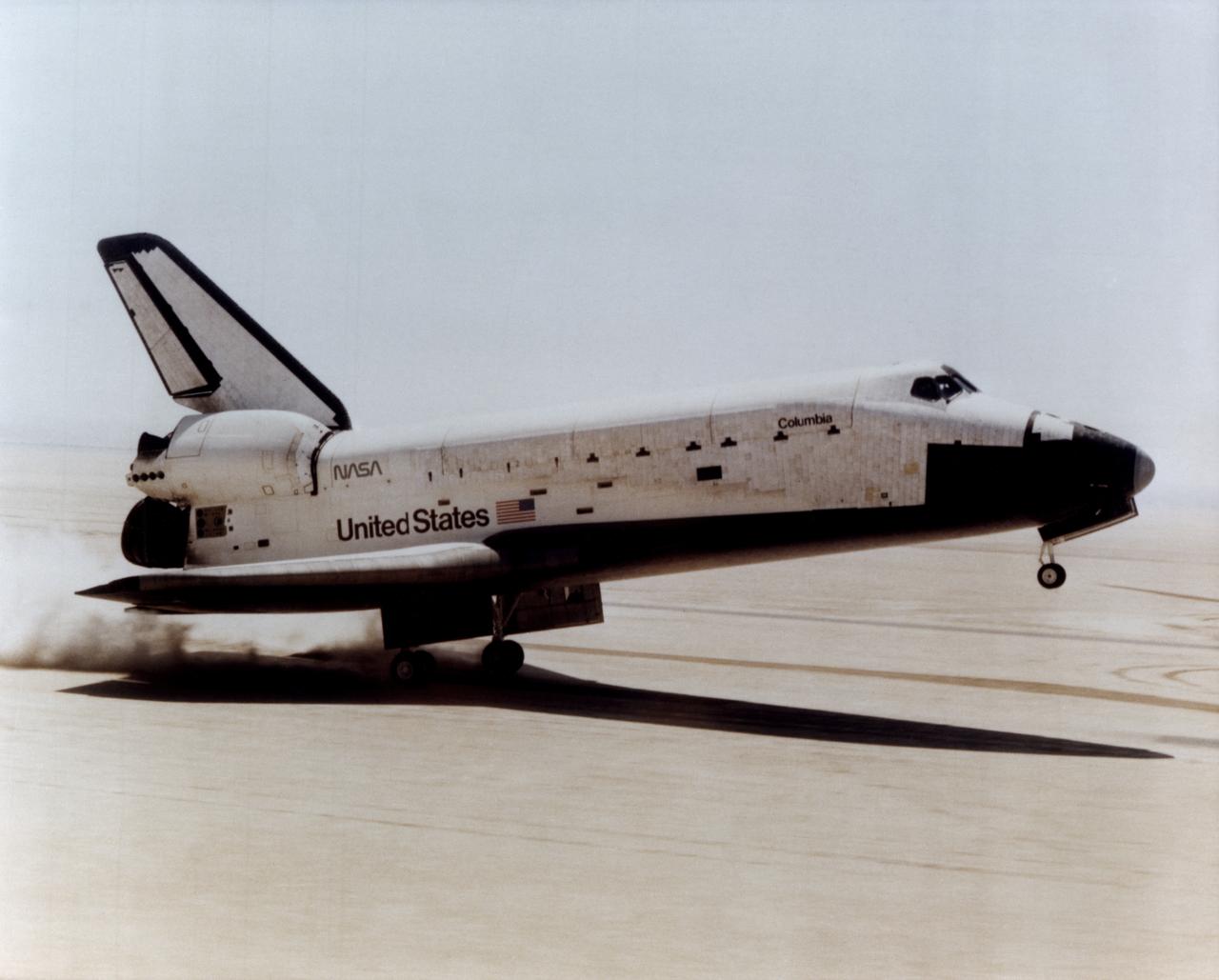
TOUCHDOWN! -- The Space Shuttle Columbia touches down on lakebed runway 23 at Edwards Air Force Base, Calif., to conclude the first orbital shuttle mission, April 14, 1981.
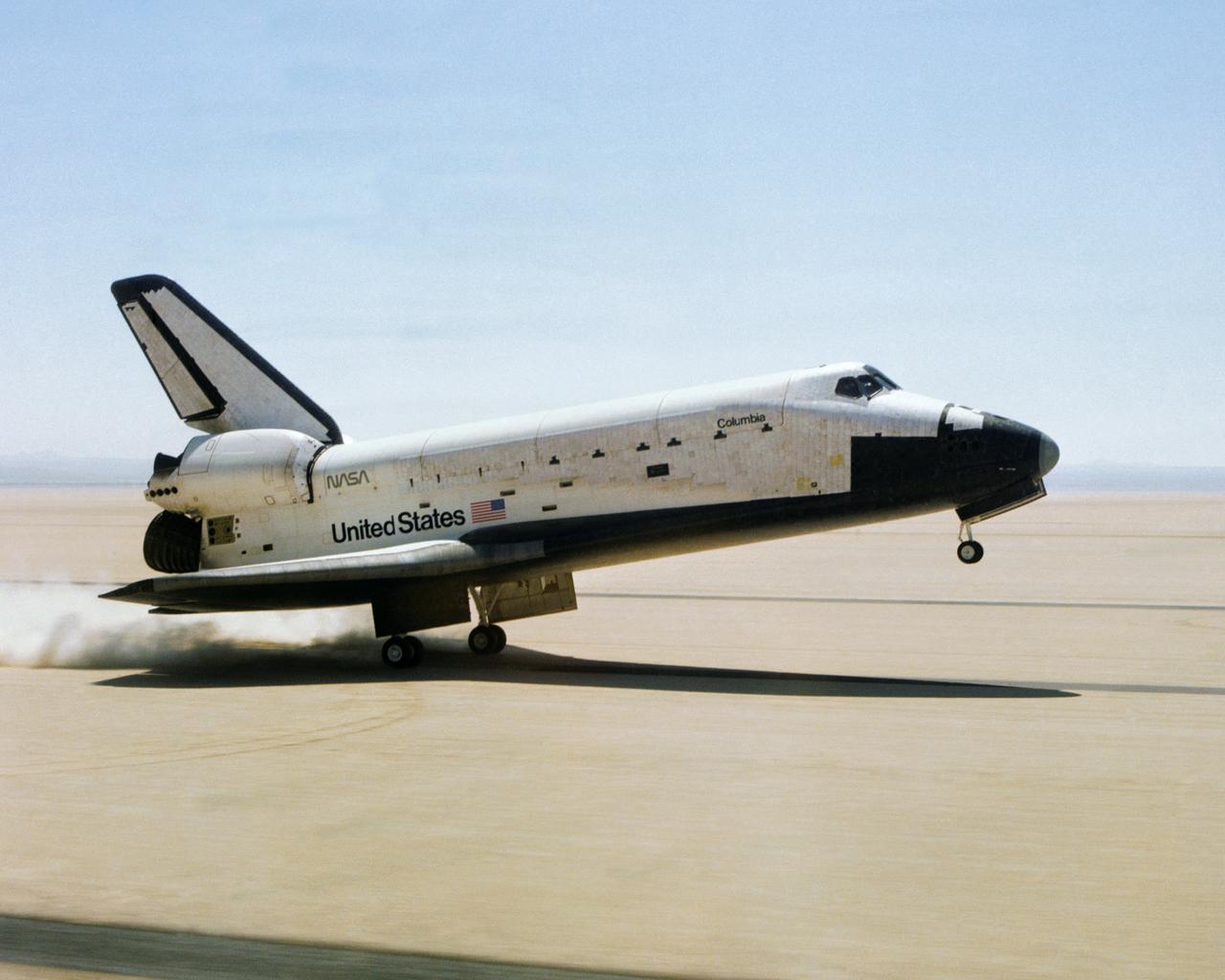
The Space Shuttle Columbia touches down on lakebed runway 23 at Edwards Air Force Base, Calif., to conclude the first orbital shuttle mission. (JSC photo # S81-30734)
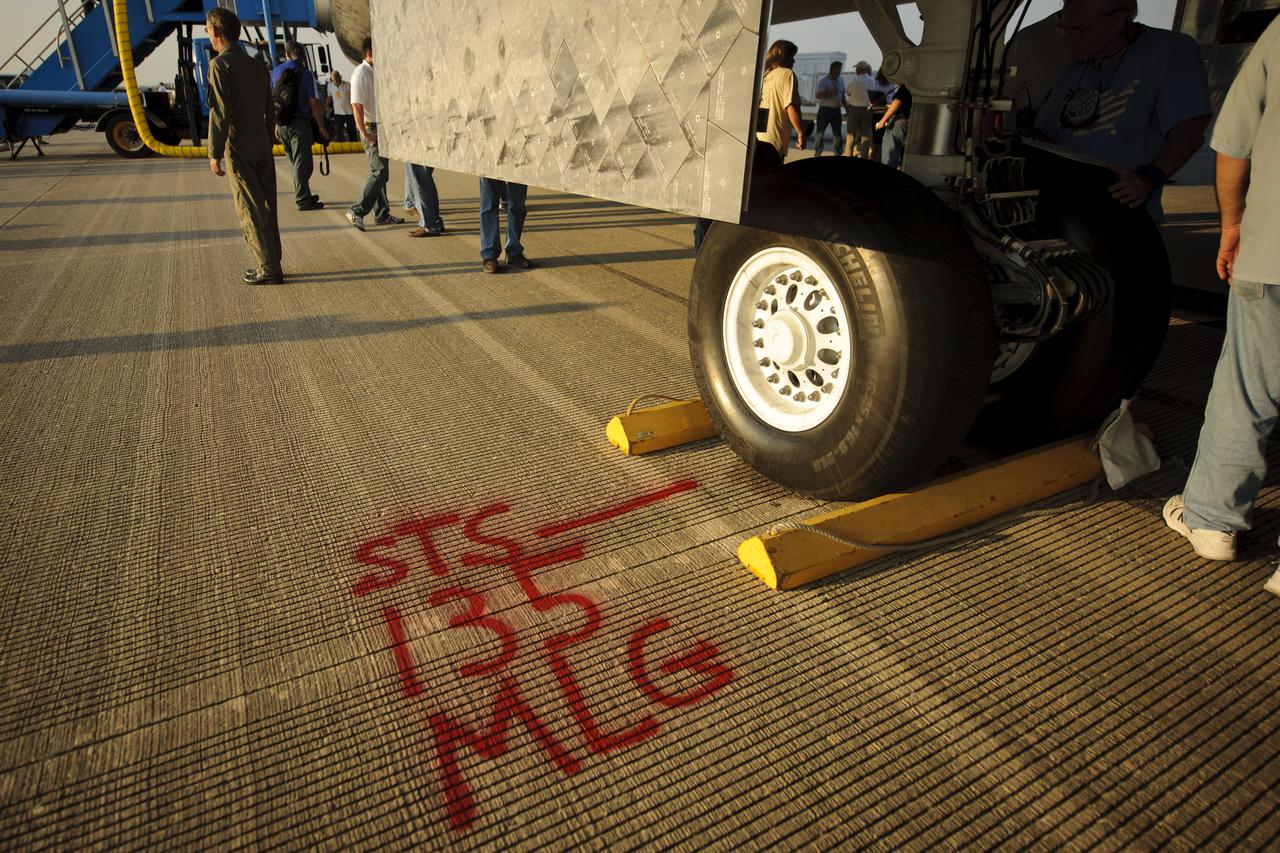
The runway of the Shuttle Landing Facility (SLF) is marked to show where the main landing gear wheels stopped for the space shuttle Atlantis (STS-135) shortly after it landed early Thursday morning, July 21, 2011, in Cape Canaveral, Fla. Overall, Atlantis spent 307 days in space and traveled nearly 126 million miles during its 33 flights. Atlantis, the fourth orbiter built, launched on its first mission on Oct. 3, 1985. Photo Credit: (NASA/Bill Ingalls)
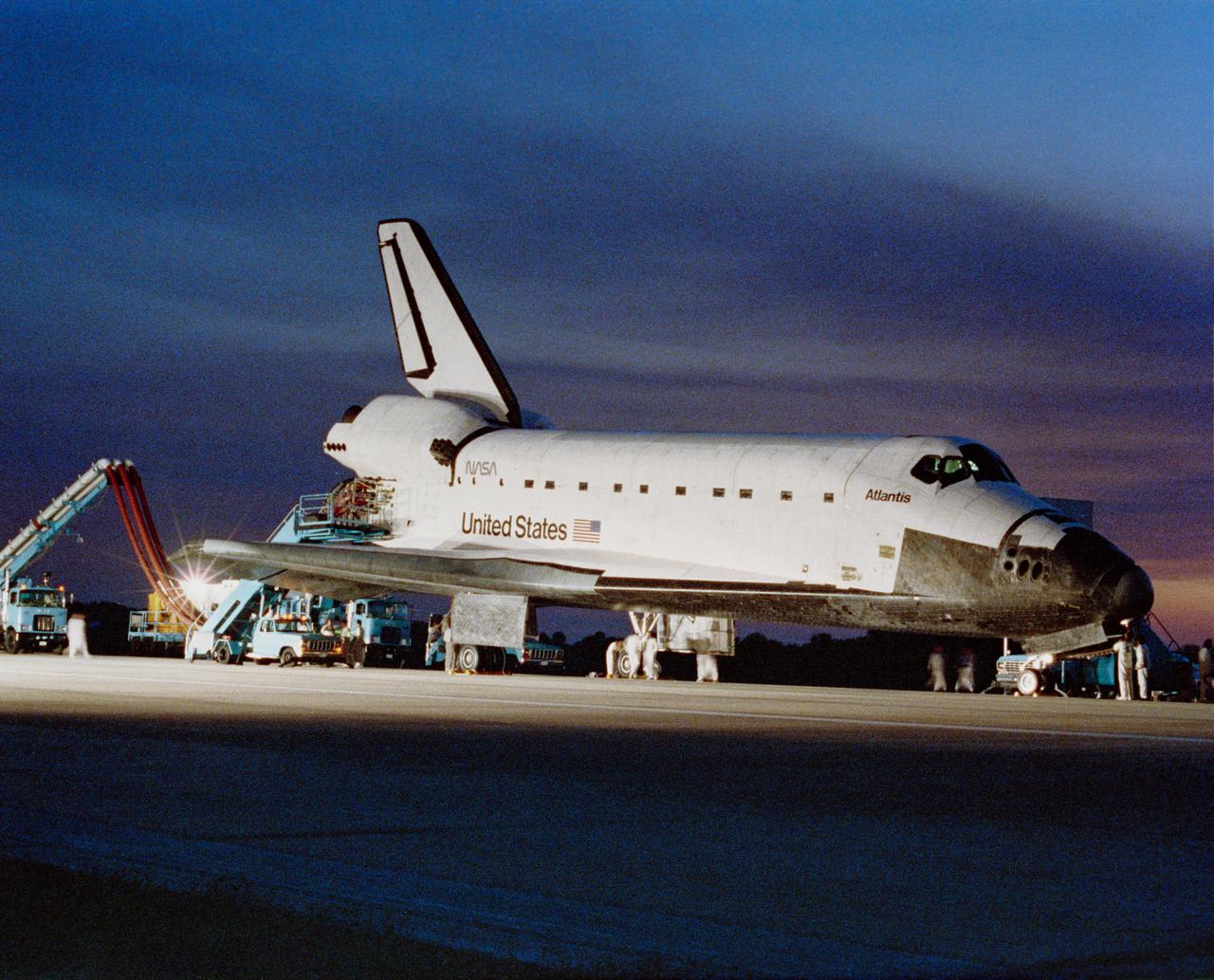
Spotlights illuminate Atlantis, Orbiter Vehicle (OV) 104, during safing operations at the Kennedy Space Center's (KSC's) Shuttle Landing Facility (SLF). OV-104 parked on runway 33 is serviced by KSC ground crews. STS-38, a Department of Defense (DOD)-devoted mission, came to an end (with complete wheel stop) at 4:43:37 pm (Eastern Standard Time (EST)).
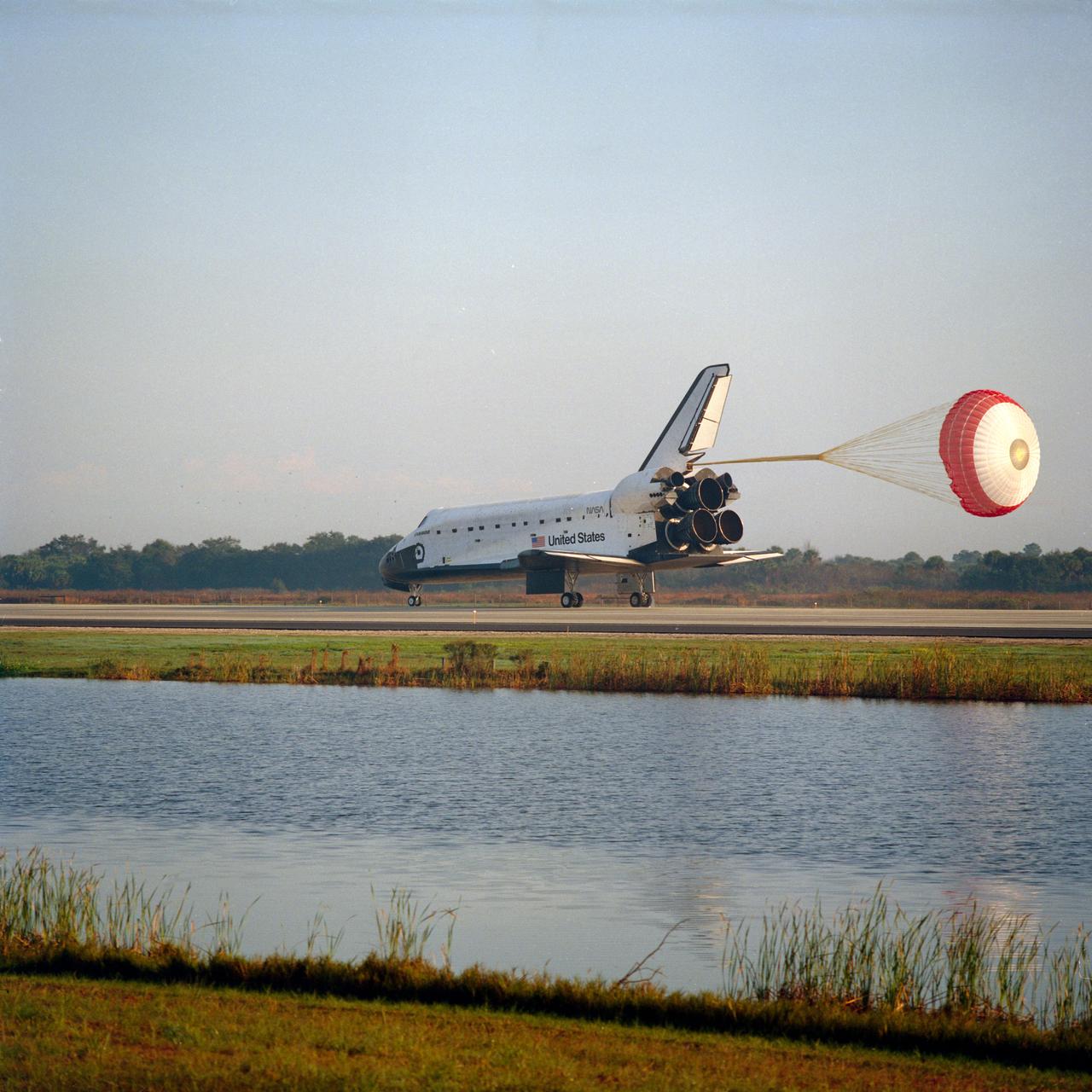
STS054-S-100 (19 Jan 1993) --- The drag chute is fully deployed as the Space Shuttle Endeavour rolls toward wheelstop at KSC's Shuttle landing facility. Landing occurred at 8:38 a.m. (EST), Jan. 19, 1993. Onboard for the six-day mission were astronauts John H. Casper, mission commander, Donald R. McMonagle, pilot, Gregory J. Harbaugh, Mario Runco Jr. and Susan J. Helms, mission specialists.

STS049-S-269 (16 May 1992) --- The seven crewmembers of STS-49 pose near Endeavour for a post-flight shot soon after getting their feet on terra firma following nine days in Earth orbit. Left to right are astronauts Richard J. Hieb, Kevin P. Chilton, Daniel C. Brandenstein, Thomas D. Akers, Pierre J. Thuot, Kathryn C. Thornton and Bruce E. Melnick. Brandenstein was mission commander; Chilton, pilot; and the others, mission specialists.
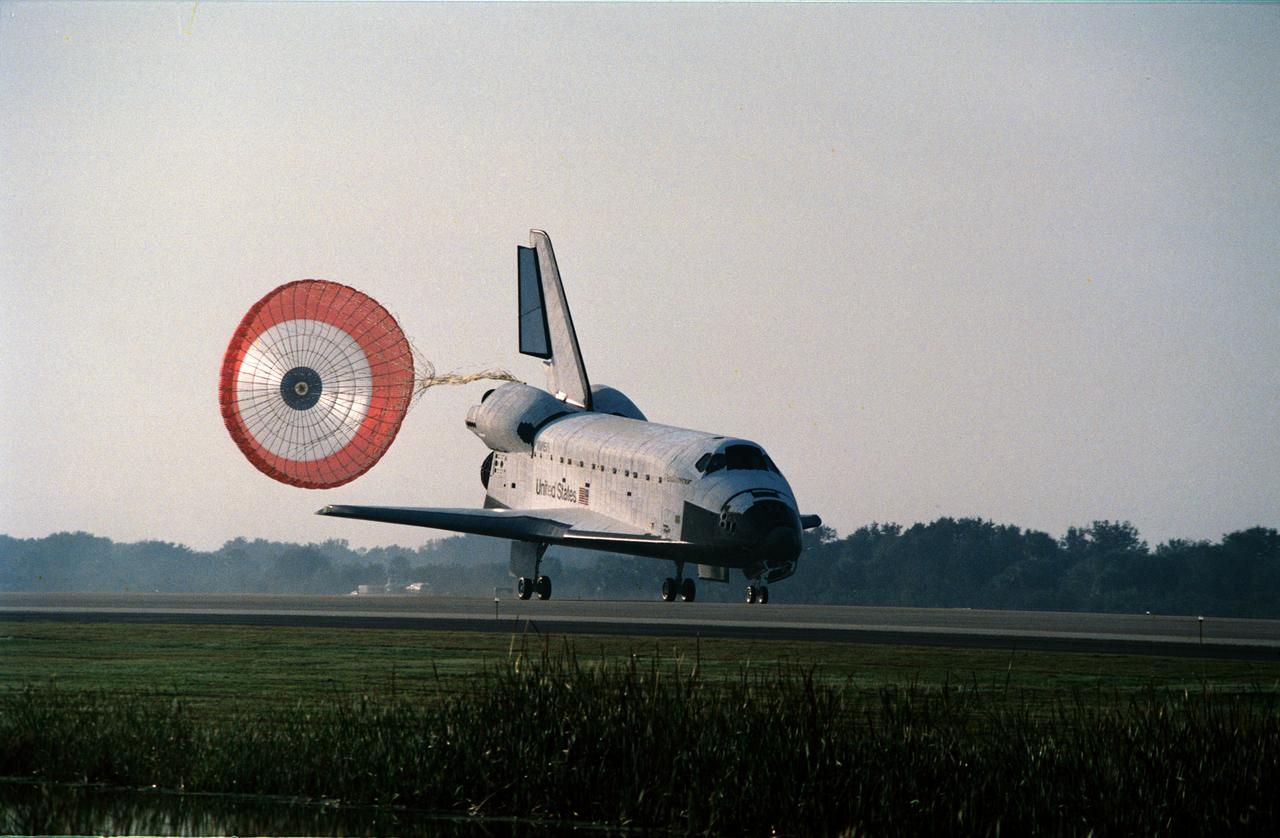
STS054-S-101 (19 Jan 1993) --- The drag chute is just about to be released as the Space Shuttle Endeavour rolls toward wheelstop at KSC's Shuttle landing facility. Landing occurred at 8:38 a.m. (EST), Jan. 19, 1993. Onboard for the six-day mission were astronauts John H. Casper, mission commander, Donald R. McMonagle, pilot, Gregory J. Harbaugh, Mario Runco Jr. and Susan J. Helms, mission specialists.
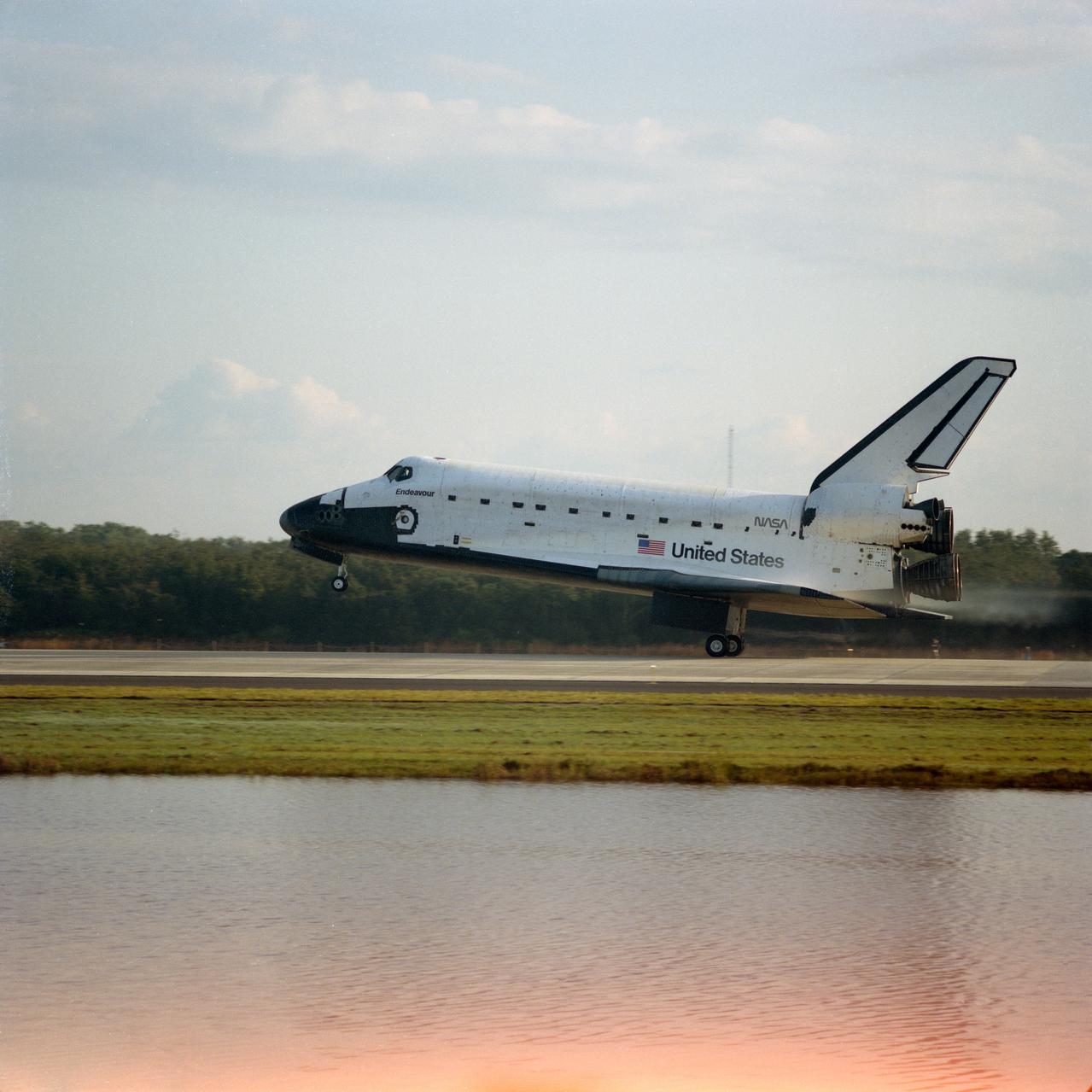
STS054-S-098 (19 Jan 1993) --- This ground-level side view shows the Space Shuttle Endeavour during main landing gear touchdown at KSC's Shuttle Landing Facility to successfully complete a six day Earth-orbital mission. Landing occurred at 8:38 a.m. (EST), Jan. 19, 1993. Onboard were astronauts John H. Casper, mission commander; Donald R. McMonagle, pilot; Gregory J. Harbaugh, Mario Runco Jr. and Susan J. Helms, mission specialists.
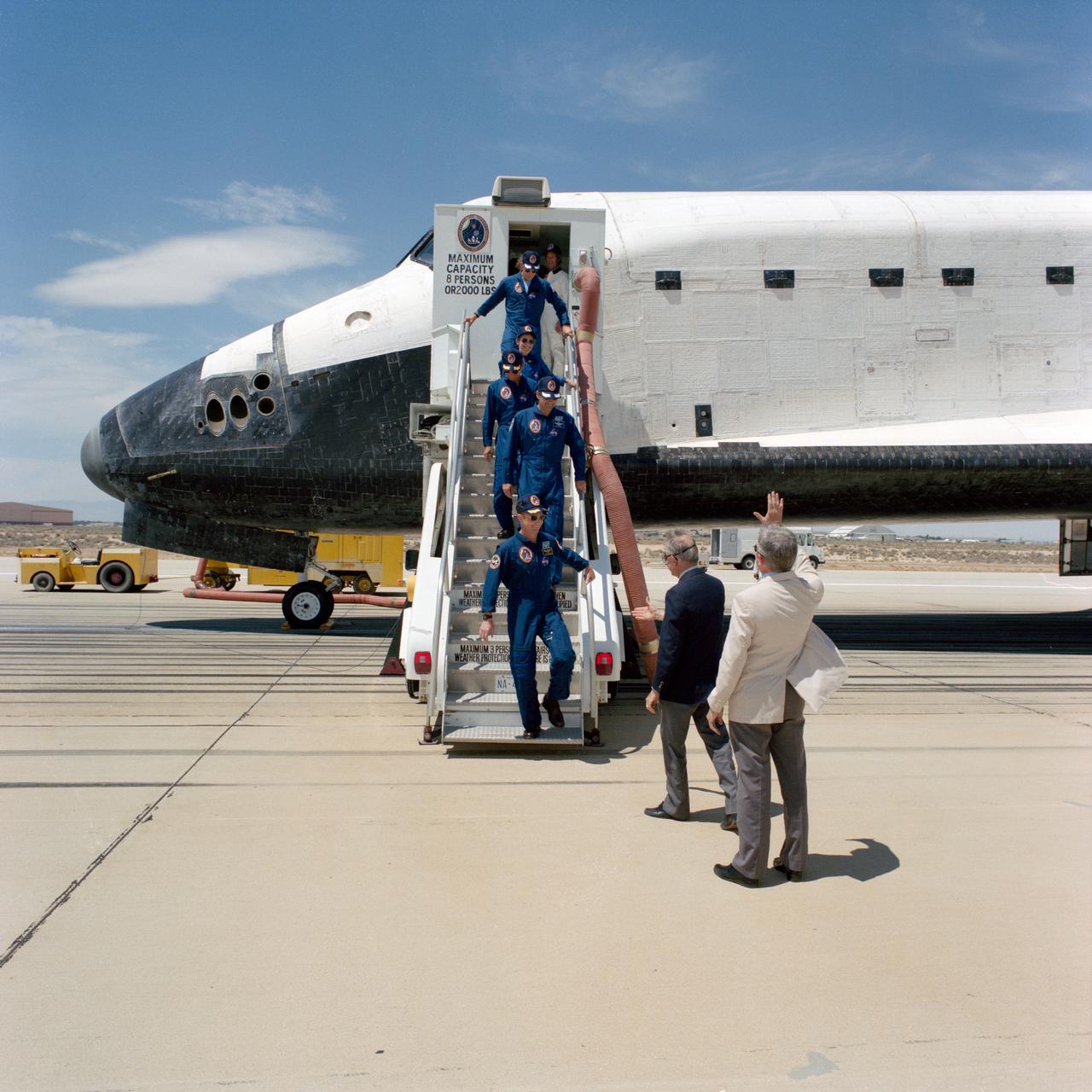
STS030-S-137 (8 May 1989) --- Crewmembers who spent four full days in space aboard Space Shuttle Atlantis egress their temporary home for a welcome meeting with terra firma. Pictured, from bottom of steps to top, are Astronauts David M.Walker, Ronald J. Grabe, Norman E. Thagard, Mary L. Cleave and Mark C. Lee. Rear Admiral Richard H. Truly (foreground), acting NASA Administrator, and Dale D. Myers, Deputy Administrator of NASA, await to greet the crewmembers. Minutes earlier, the spacecraft's landing gear came to a stop at 12:44:33 p.m. (PDT), 8 May 1989. It landed on Runway 22, a concrete facility, like a number of other NASA flights. Still others have landed on unpaved dry lake bed strips.
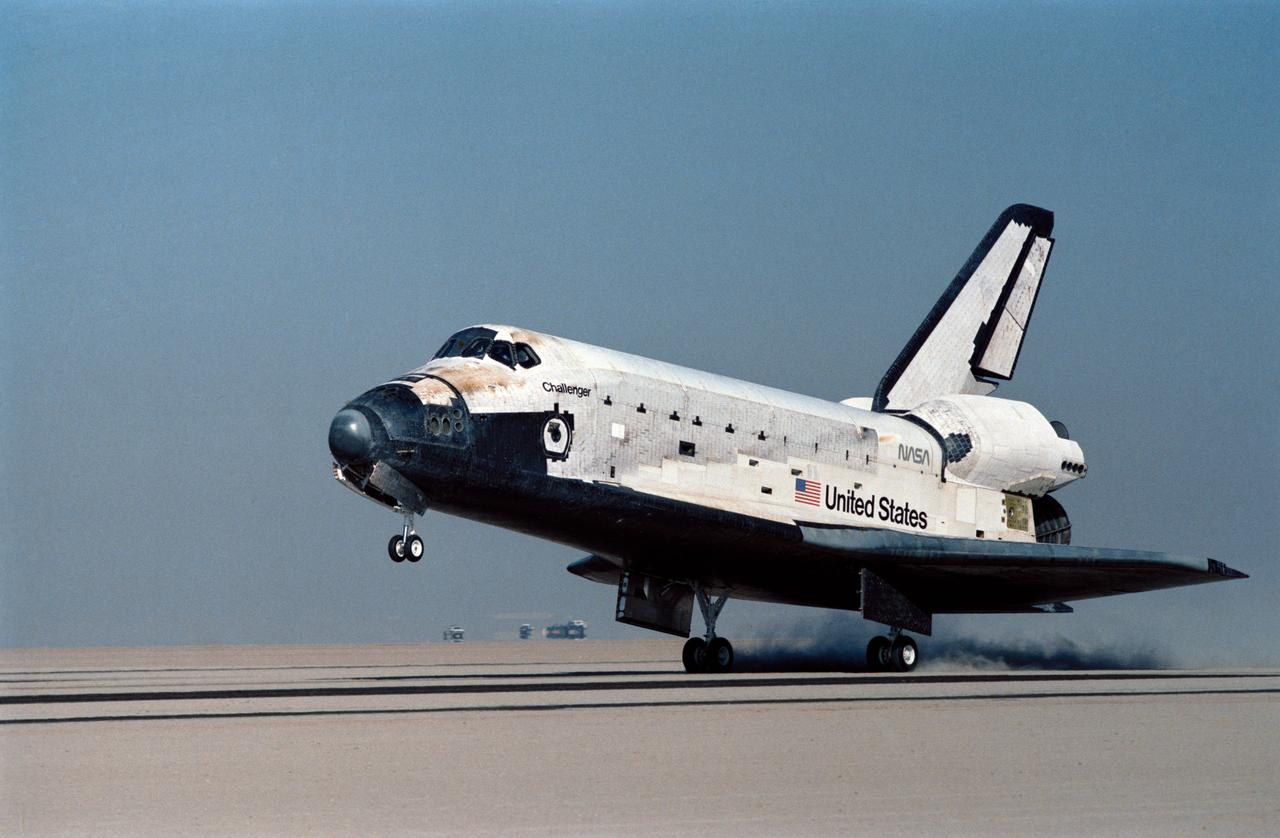
61A-S-139 (6 Nov 1985) --- Eight persons returning from space at one time is a record which was set at 9:45:39 a.m. (PST) today when the Space Shuttle Challenger's wheels came to a stop on the runway at Edwards Air Force Base. The main gear is seen touching down at 9:44:51 a.m. Inside the spacecraft are astronauts Henry W. Hartsfield Jr., Steven R. Nagel, Bonnie J. Dunbar, James F. Buchli, Guion S. Bluford Jr., Reinard Furrer, Ernst Messerschmid and Wubbo J. Ockels. A number of West German and other European experiments were performed during the week-long Spacelab D-1 mission.