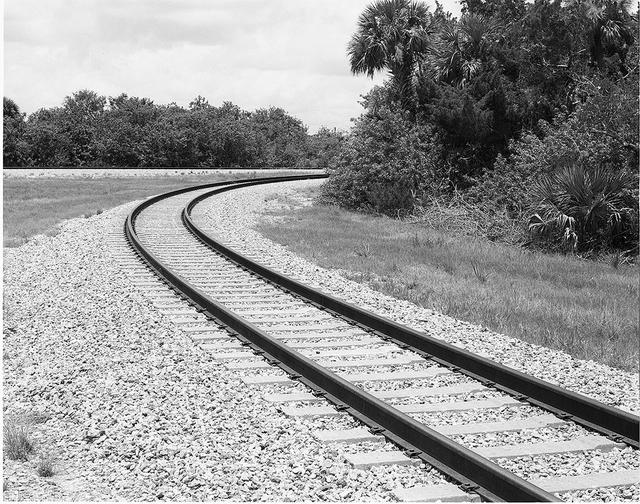
View of the Railway System
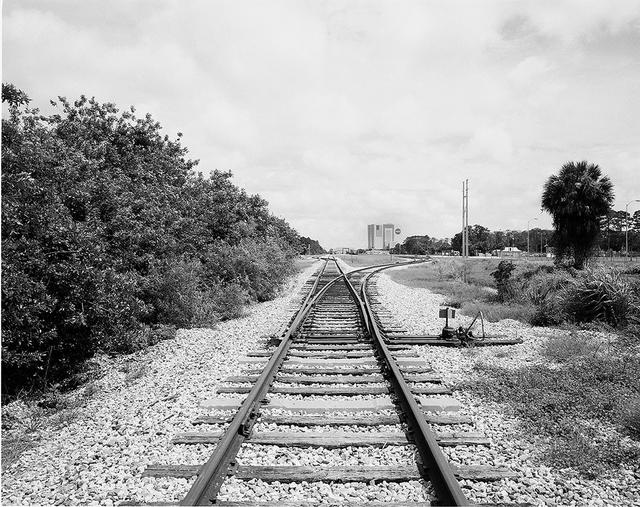
View of the Railway System
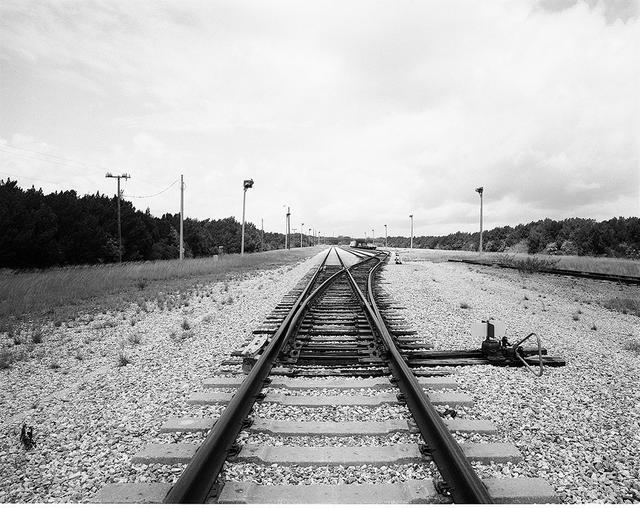
View of the Railway System
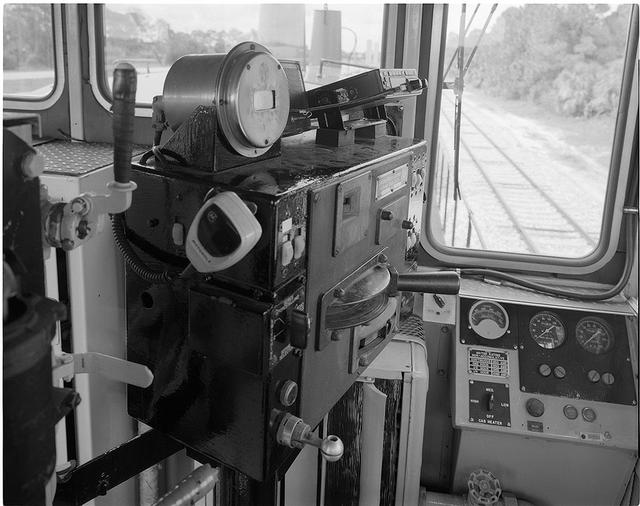
View of the Railway System
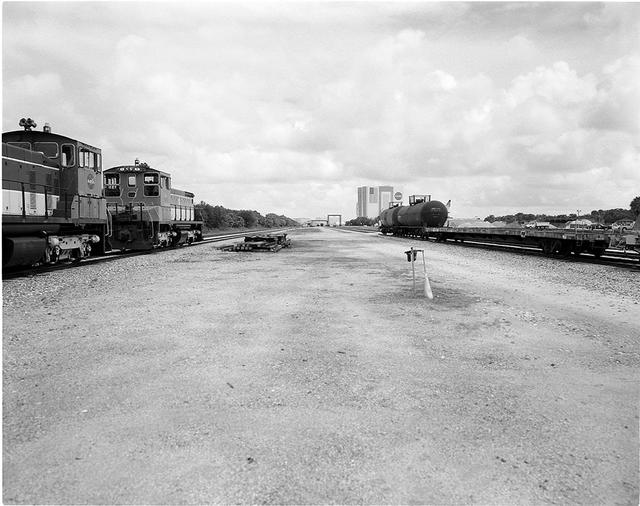
View of the Railway System
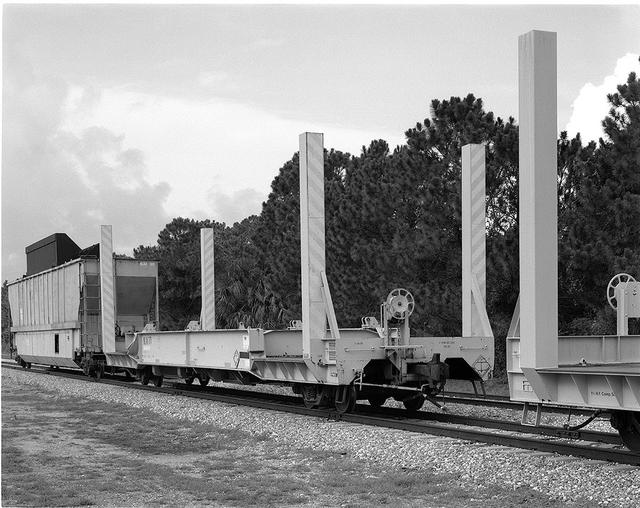
View of the Railway System
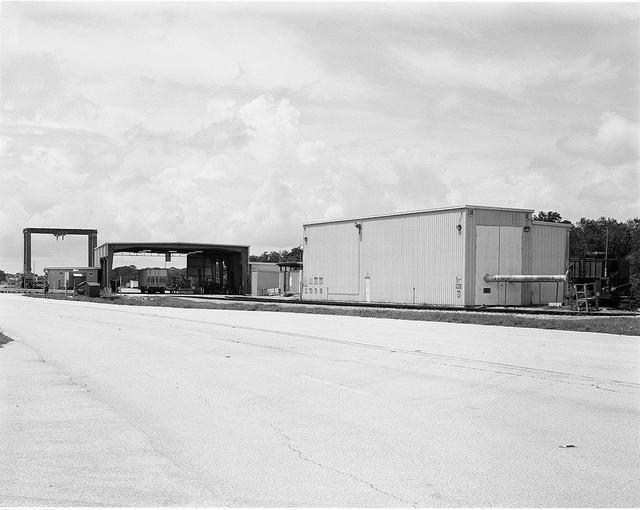
View of the Railway System
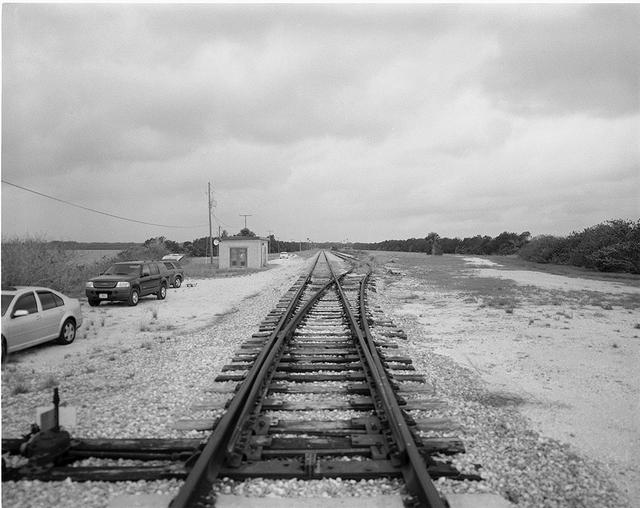
View of the Railway System

View of the Railway System
View of the Railway System
View of the Railway System
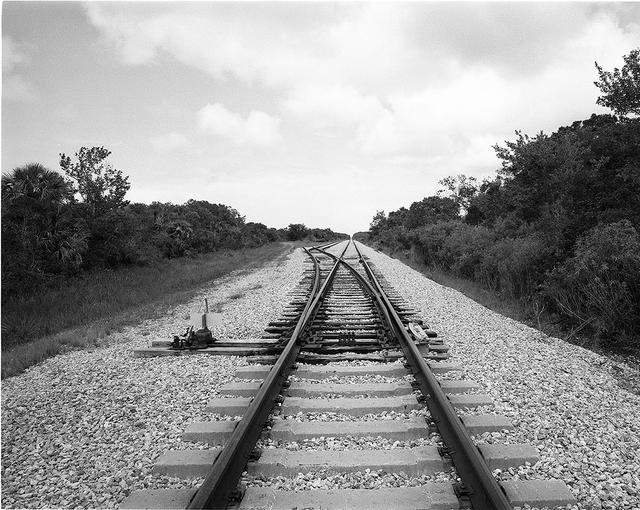
View of the Railway System
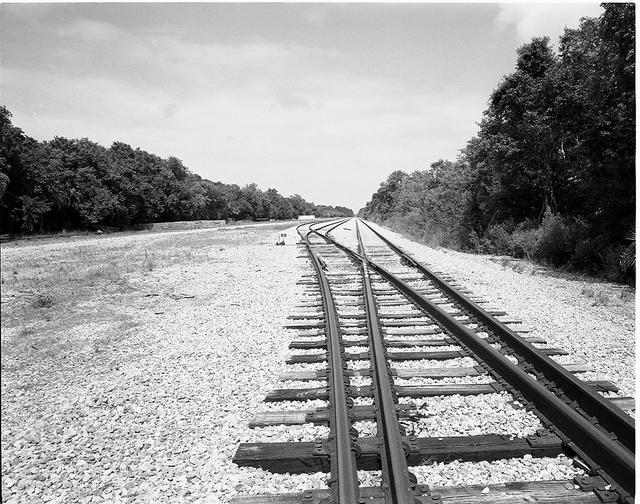
View of the Railway System
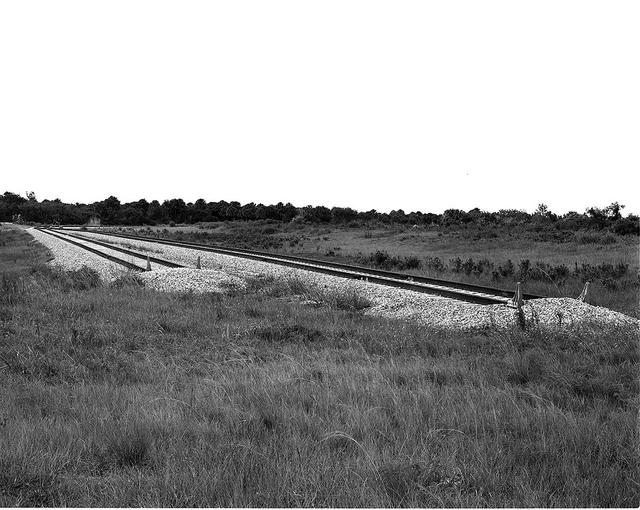
View of the Railway System
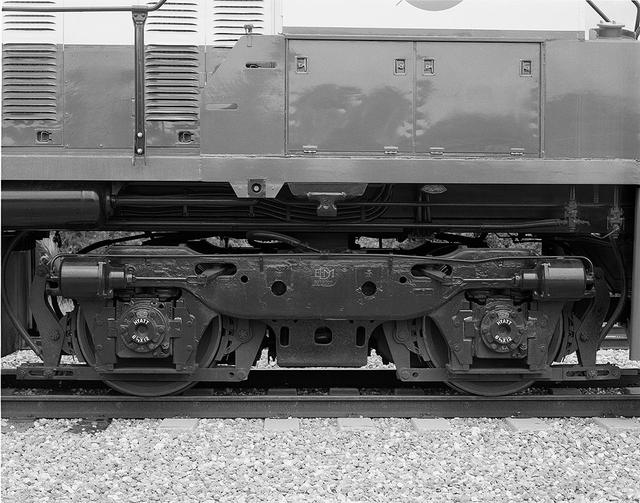
View of the Railway System
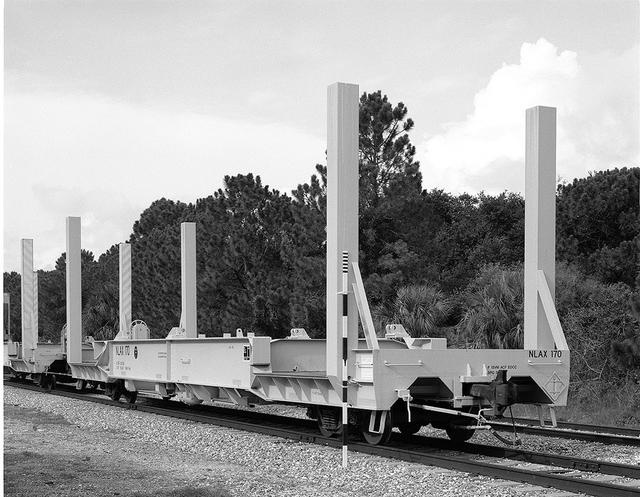
View of the Railway System
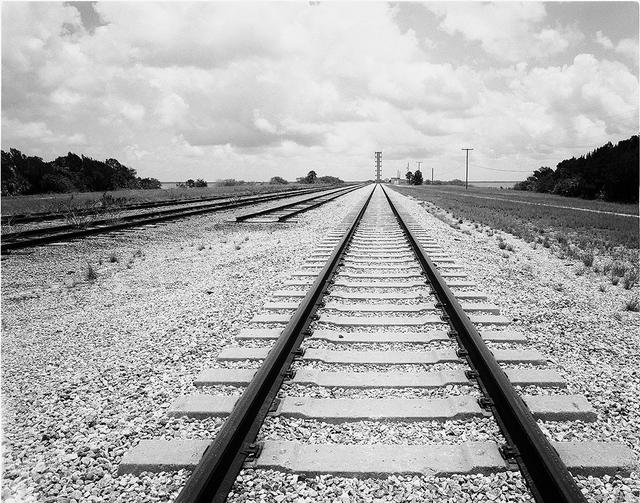
View of the Railway System
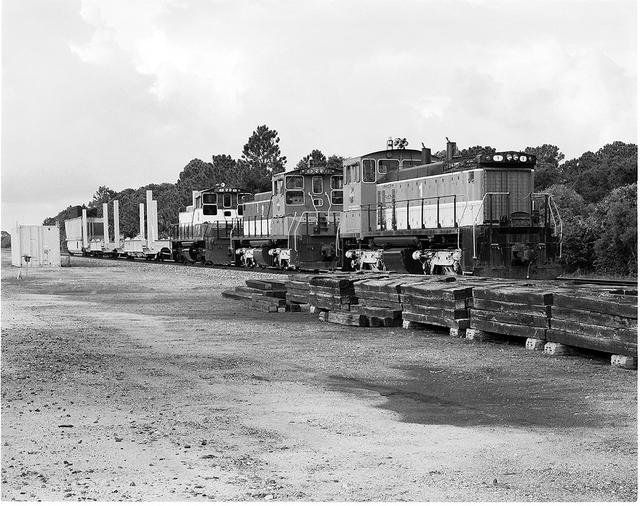
View of the Railway System
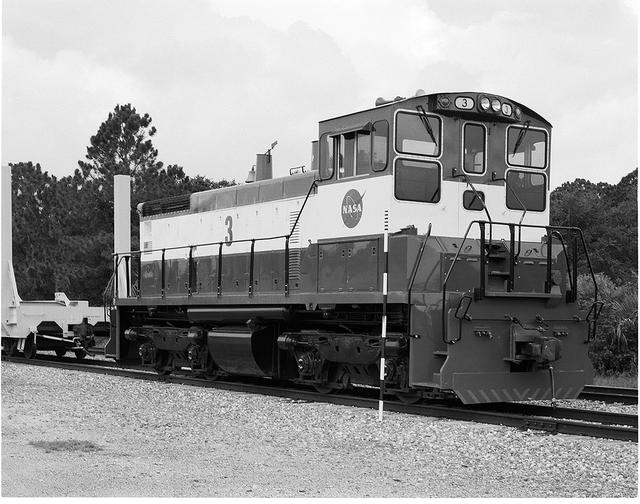
View of the Railway System
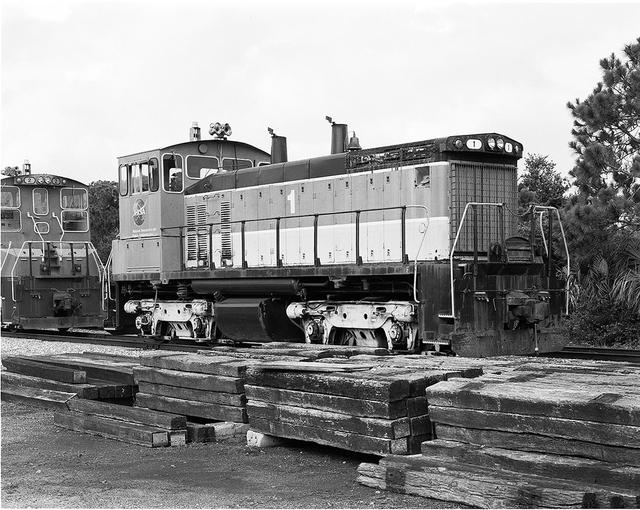
View of the Railway System
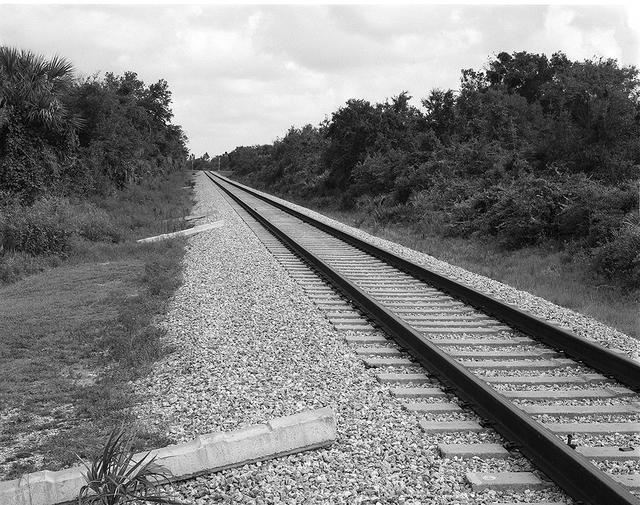
View of the Railway System
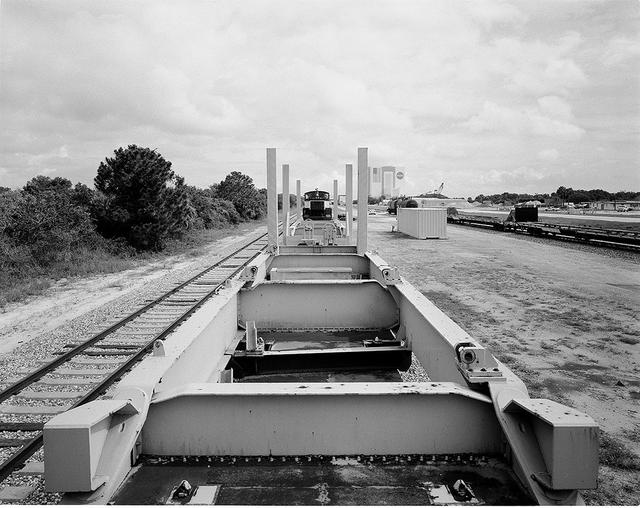
View of the Railway System
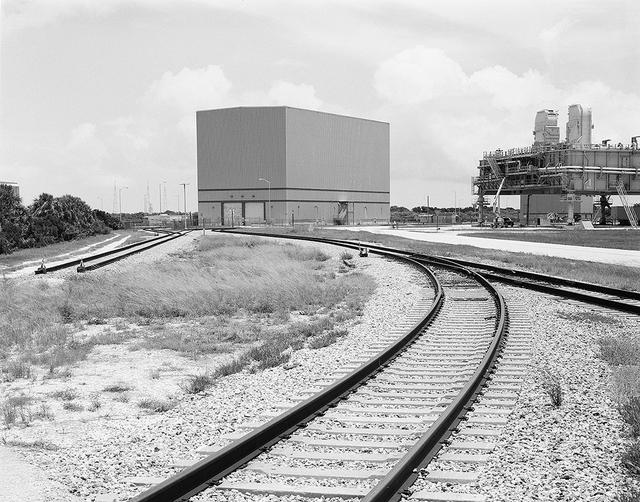
View of the Railway System
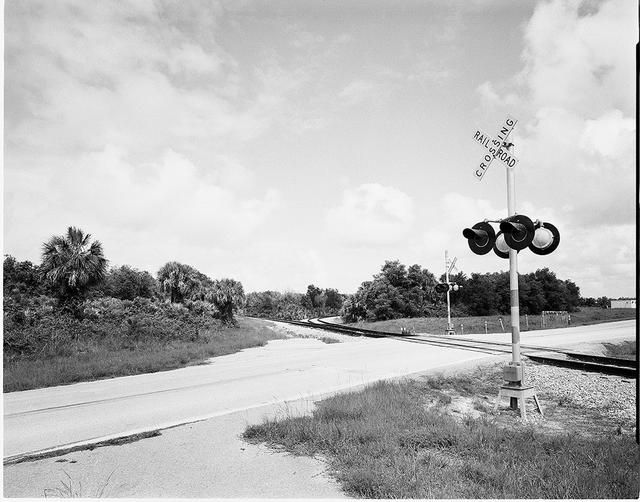
View of the Railway System
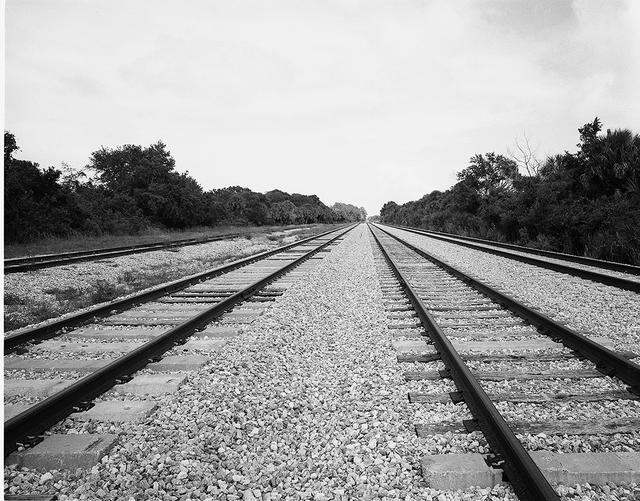
View of the Railway System
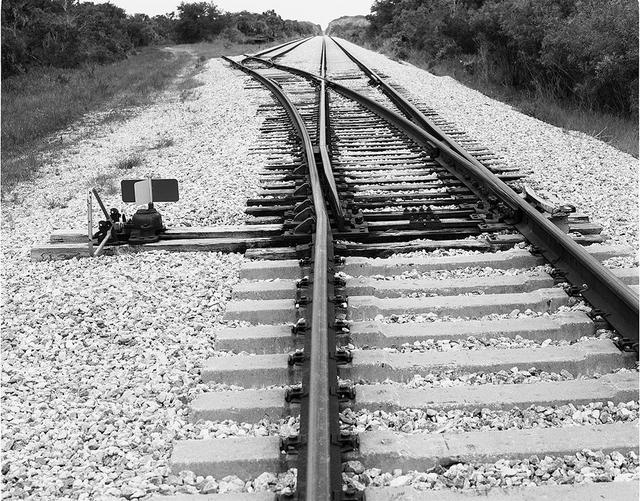
View of the Railway System
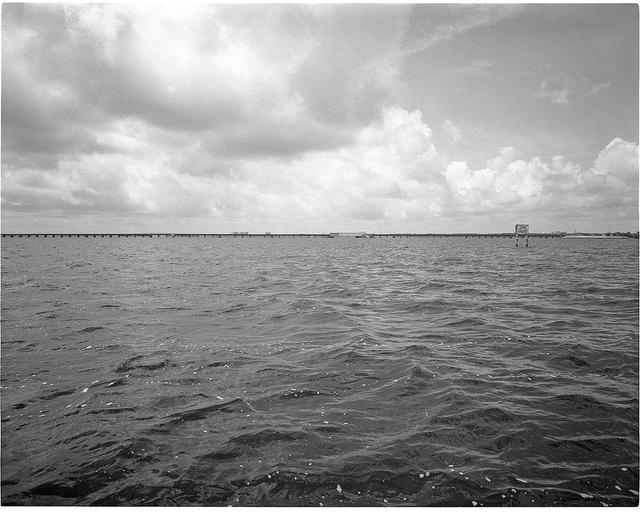
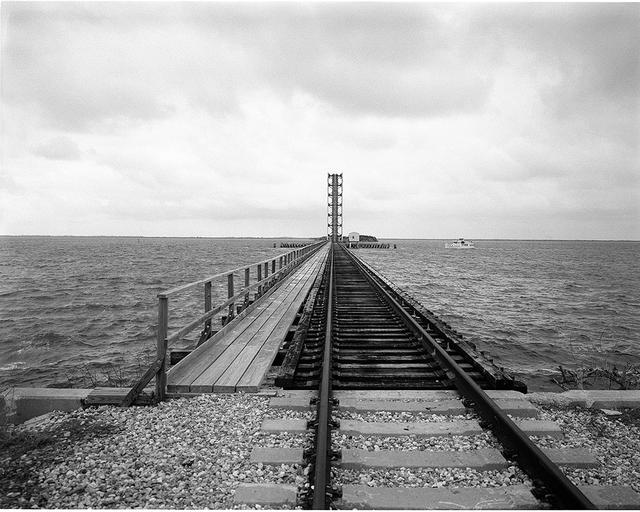
View of the Jay Jay Bridge
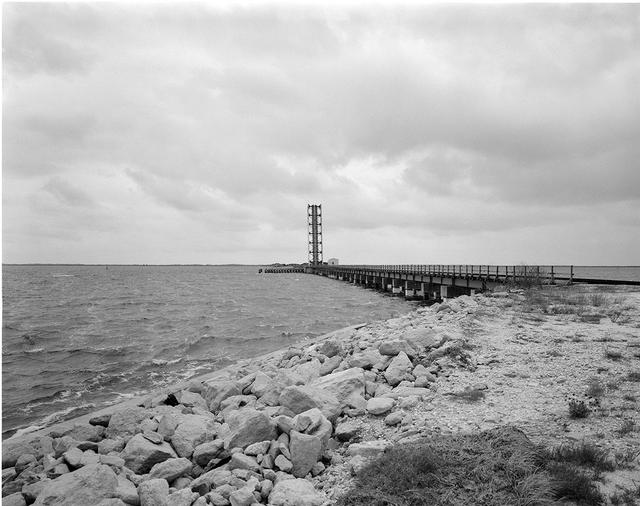
View of the Jay Jay Bridge
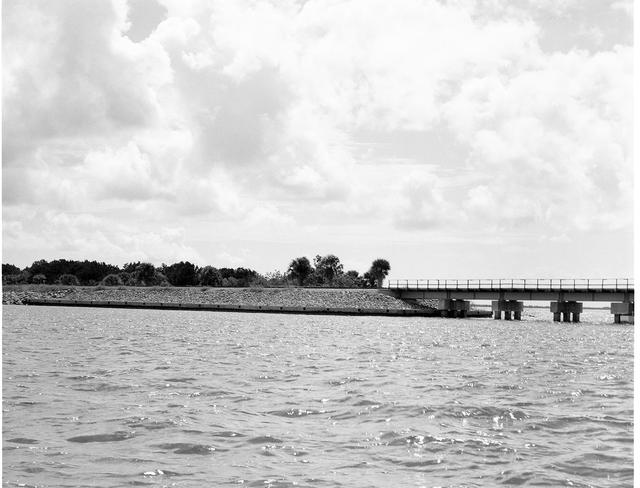
View of the Jay Jay Bridge
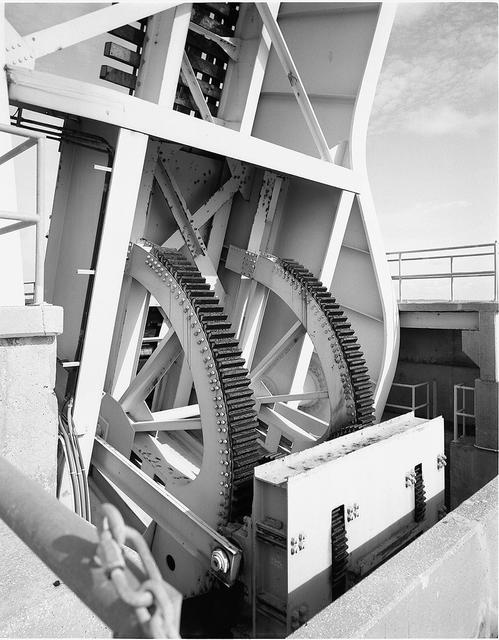
View of the Jay Jay Bridge
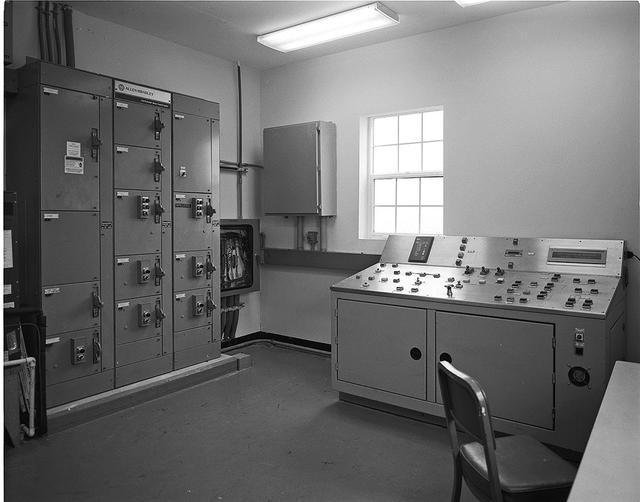
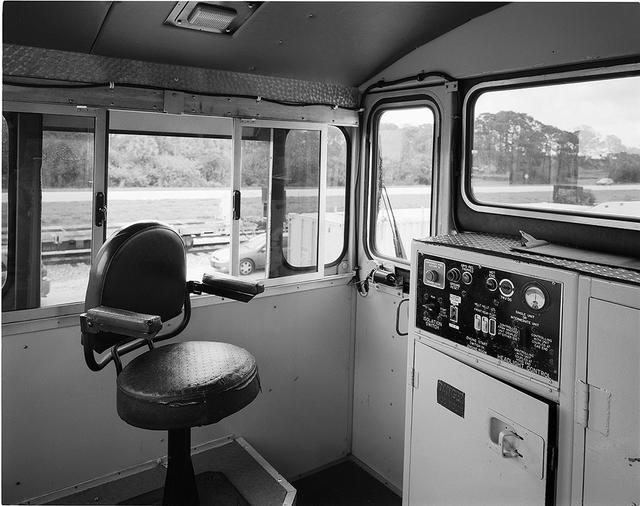
Interior view of the Jay Jay Bridge Control House
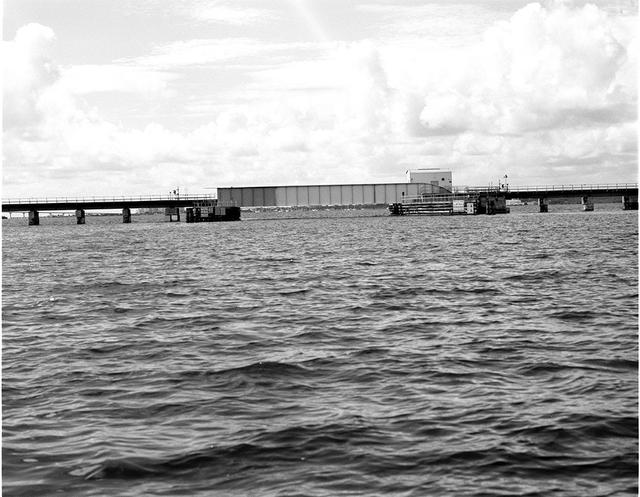
View of the Jay Jay Bridge
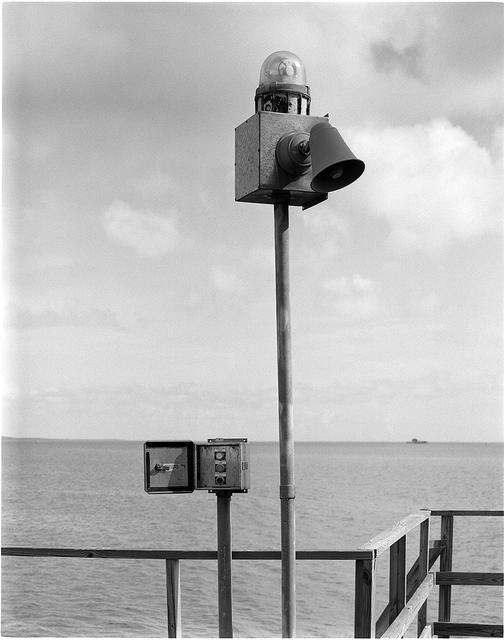
View of the Jay Jay Bridge
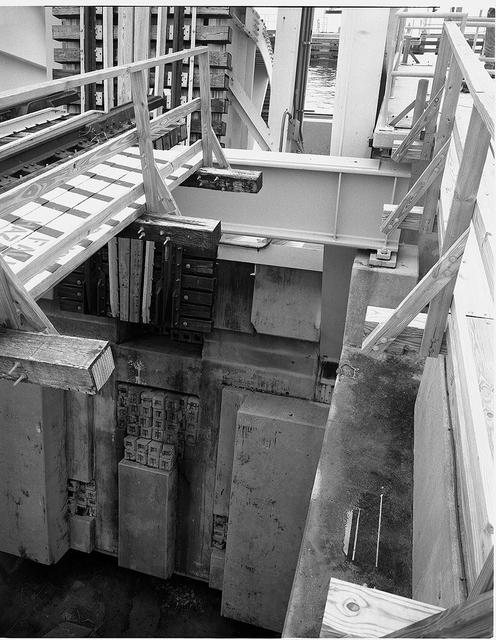
View of the Jay Jay Bridge
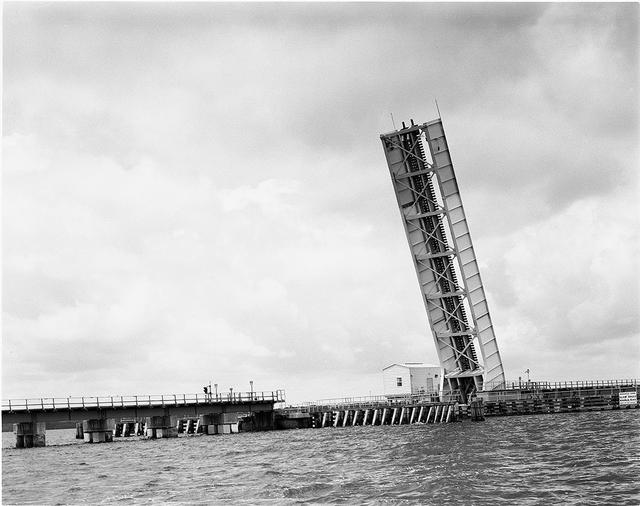
View of the Jay Jay Bridge
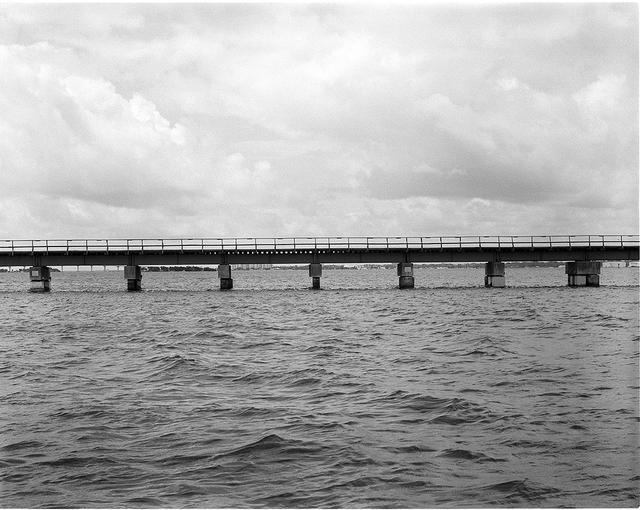
View of the Jay Jay Bridge
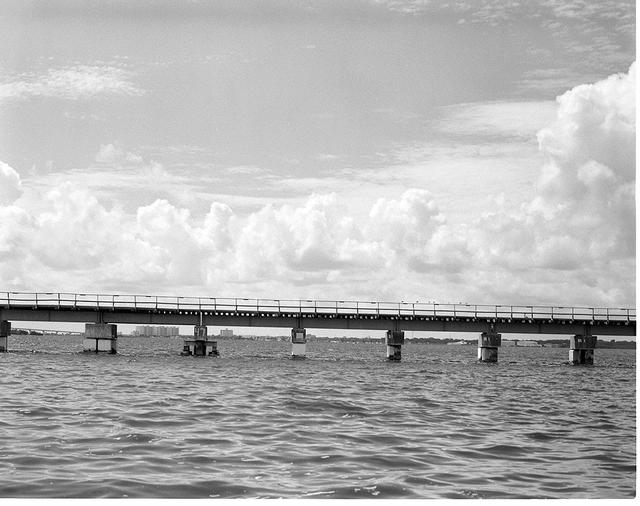
View of the Jay Jay Bridge
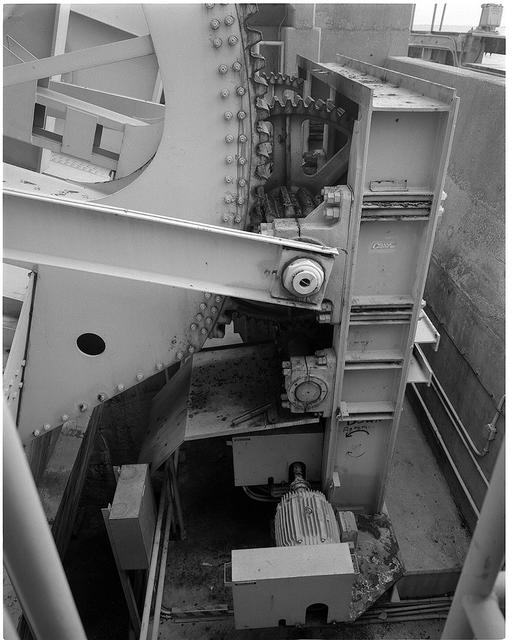
View of the Jay Jay Bridge
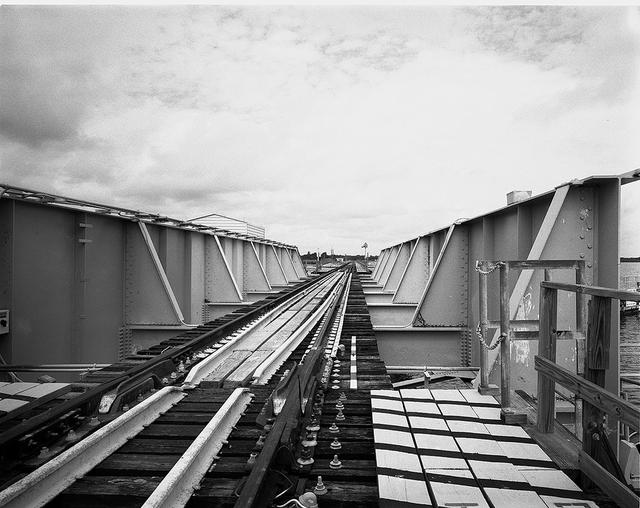
View of the Jay Jay Bridge
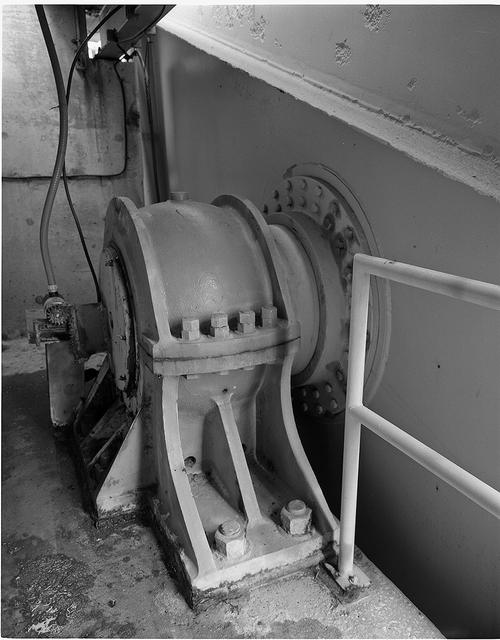
View of the Jay Jay Bridge
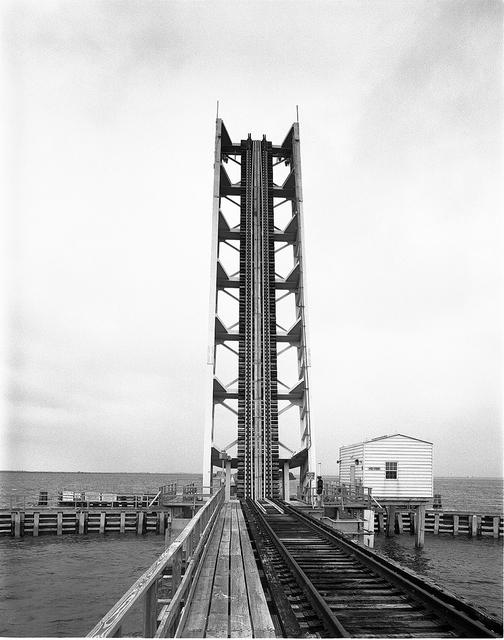
View of the Jay Jay Bridge
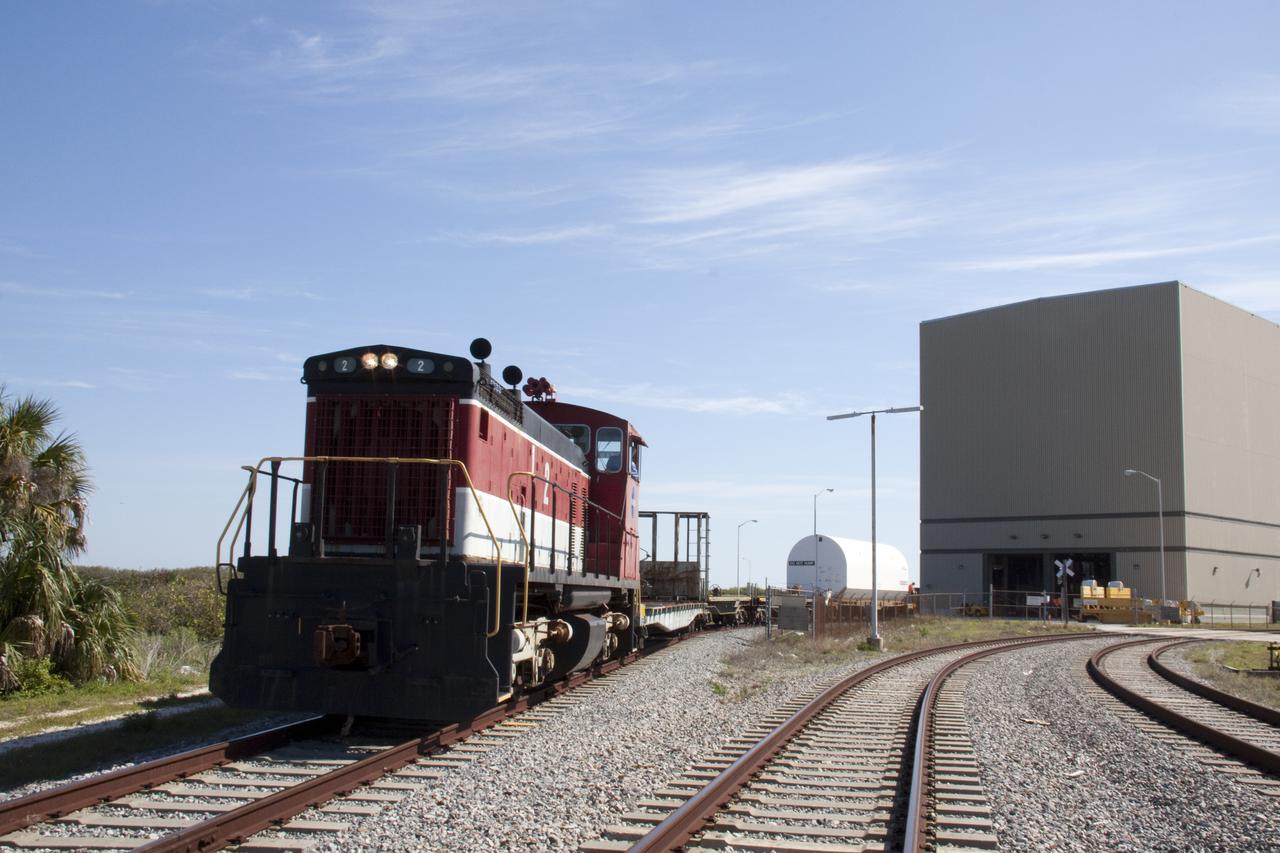
CAPE CANAVERAL, Fla. – Secured inside a railway car, a nozzle exit cone for a solid rocket booster that will be used on space shuttle Discovery's STS-133 mission is moved by locomotive no. 2 to the Rotation, Processing and Surge Facility at NASA's Kennedy Space Center in Florida. The boosters are manufactured by Alliant Techsystems Inc., or ATK. EGandG_URS runs Kennedy's railway system for NASA. The locomotive, one of three at Kennedy, will push the railway car into the facility, necessitating the use of spacer cars behind the locomotive as a safety measure. Photo credit: NASA_Troy Cryder
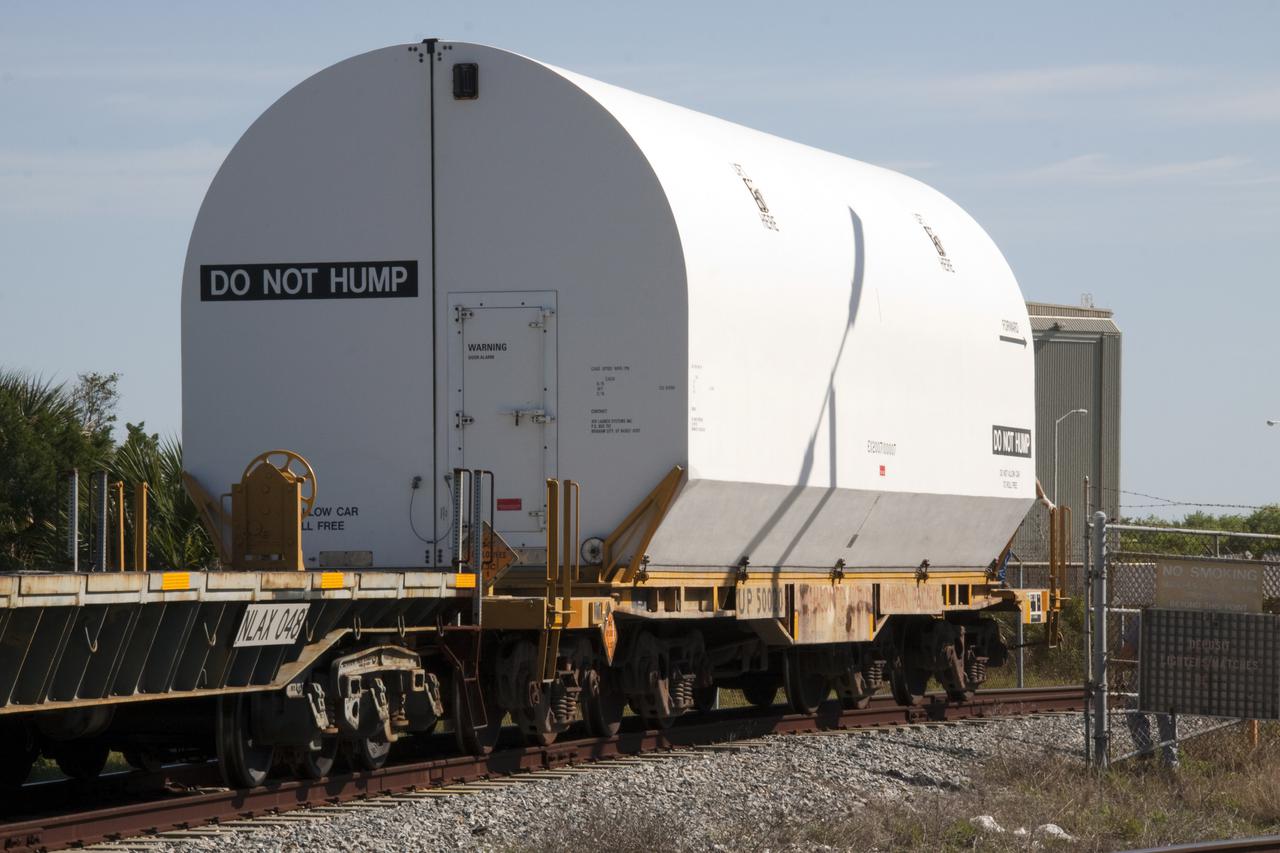
CAPE CANAVERAL, Fla. – Secured inside a railway car, a nozzle exit cone for a solid rocket booster that will be used on space shuttle Discovery's STS-133 mission is moved from Suspect Siding, a parking area, to the Rotation, Processing and Surge Facility at NASA's Kennedy Space Center in Florida. The boosters are manufactured by Alliant Techsystems Inc., or ATK. EGandG_URS runs Kennedy's railway system for NASA. Photo credit: NASA_Troy Cryder
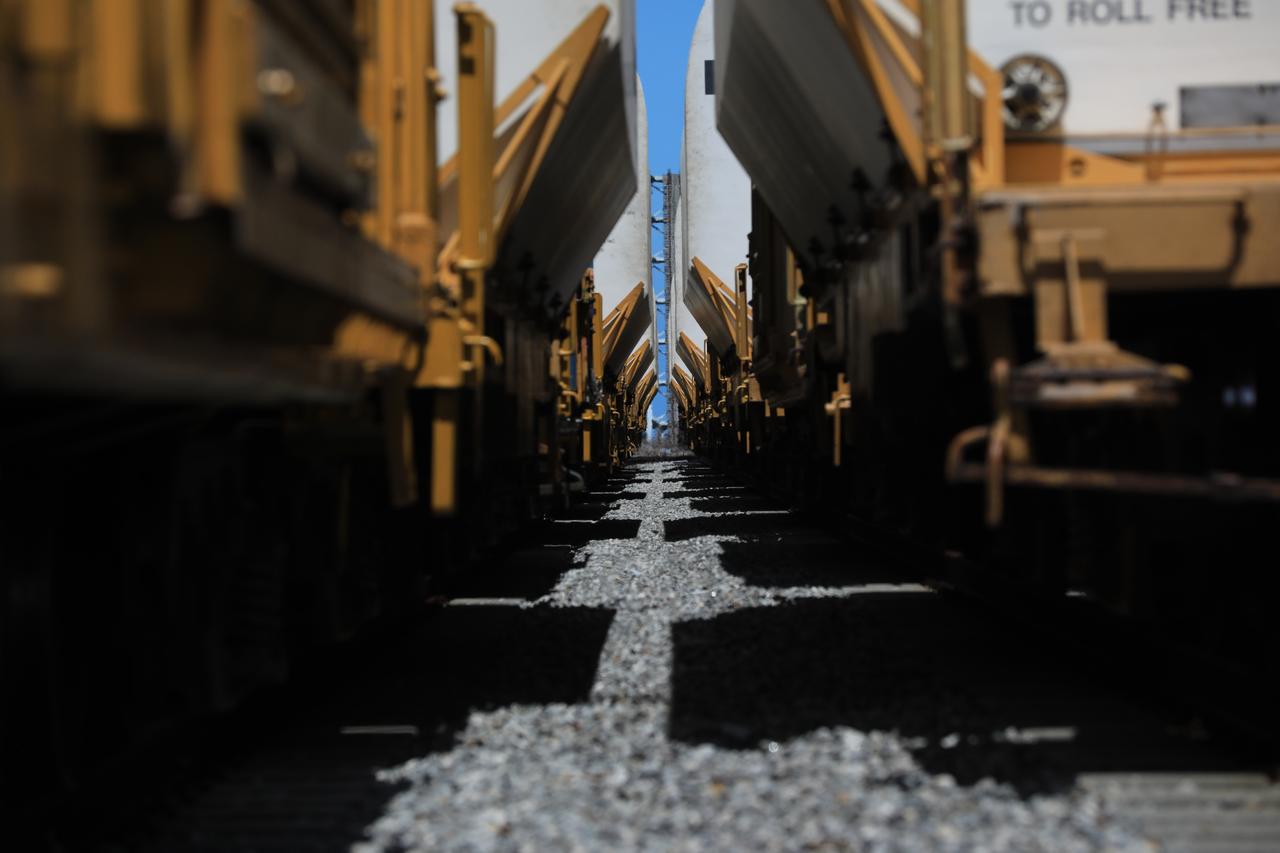
The train carrying the two solid rocket boosters that will power NASA’s Space Launch System (SLS) for Artemis missions to the Moon arrives at the Jay Jay rail yard – the connecting link between Kennedy Space Center and the Florida East Coast railway – in Titusville, Florida, on June 12, 2020. The boosters, each comprised of five motor segments, traveled from a Northrop Grumman manufacturing facility in Promontory, Utah, to Kennedy’s Rotation, Processing and Surge Facility, where teams with NASA’s Exploration Ground Systems will process the segments before moving them to the Vehicle Assembly Building for stacking on the mobile launcher. Under the Artemis program, NASA will land the first woman and the next man on the Moon by 2024. The first in a series of increasingly complex missions, Artemis I will test the Orion spacecraft and SLS as an integrated system ahead of crewed flights to the Moon.
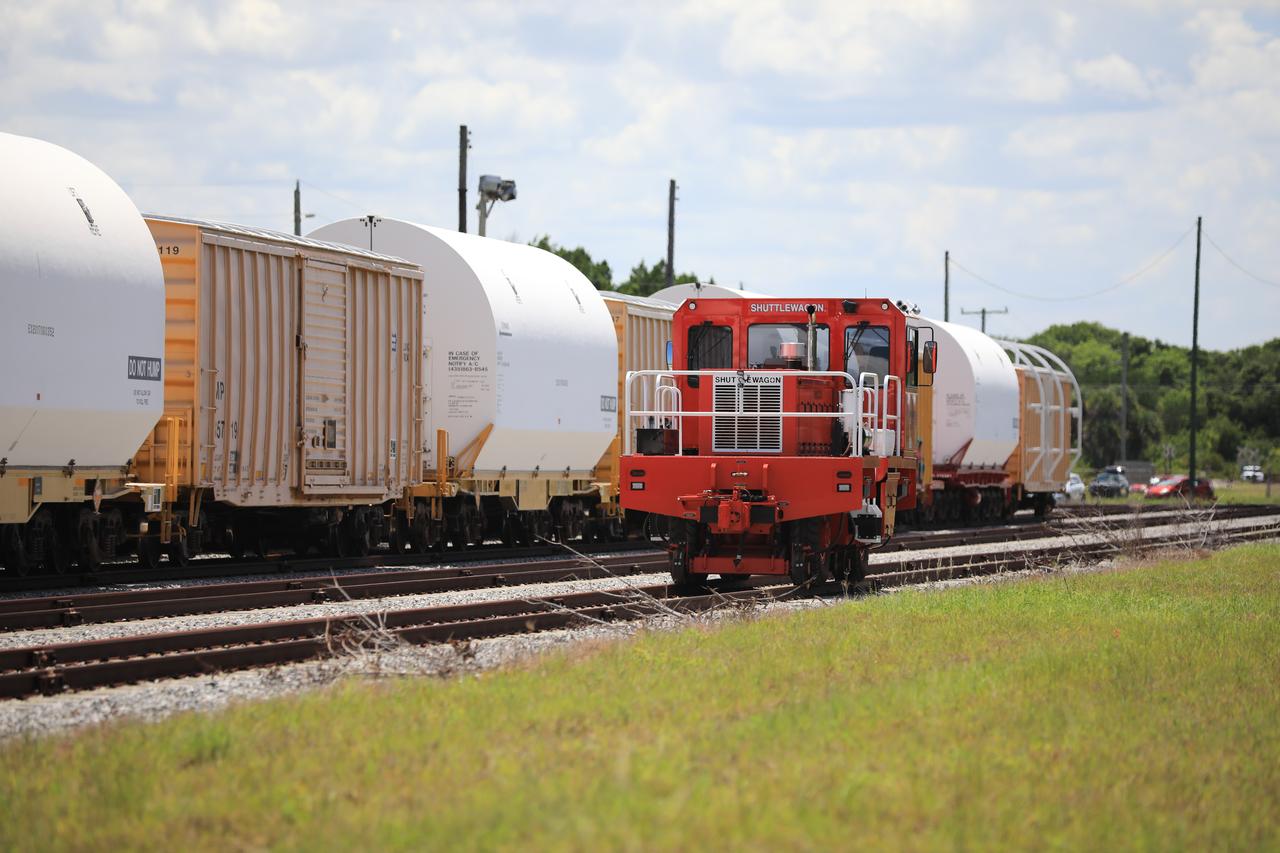
The train carrying the two solid rocket boosters that will power NASA’s Space Launch System (SLS) for Artemis missions to the Moon arrives at the Jay Jay rail yard – the connecting link between Kennedy Space Center and the Florida East Coast railway – in Titusville, Florida, on June 12, 2020. The boosters, each comprised of five motor segments, traveled from a Northrop Grumman manufacturing facility in Promontory, Utah, to Kennedy’s Rotation, Processing and Surge Facility, where teams with NASA’s Exploration Ground Systems will process the segments before moving them to the Vehicle Assembly Building for stacking on the mobile launcher. Under the Artemis program, NASA will land the first woman and the next man on the Moon by 2024. The first in a series of increasingly complex missions, Artemis I will test the Orion spacecraft and SLS as an integrated system ahead of crewed flights to the Moon.
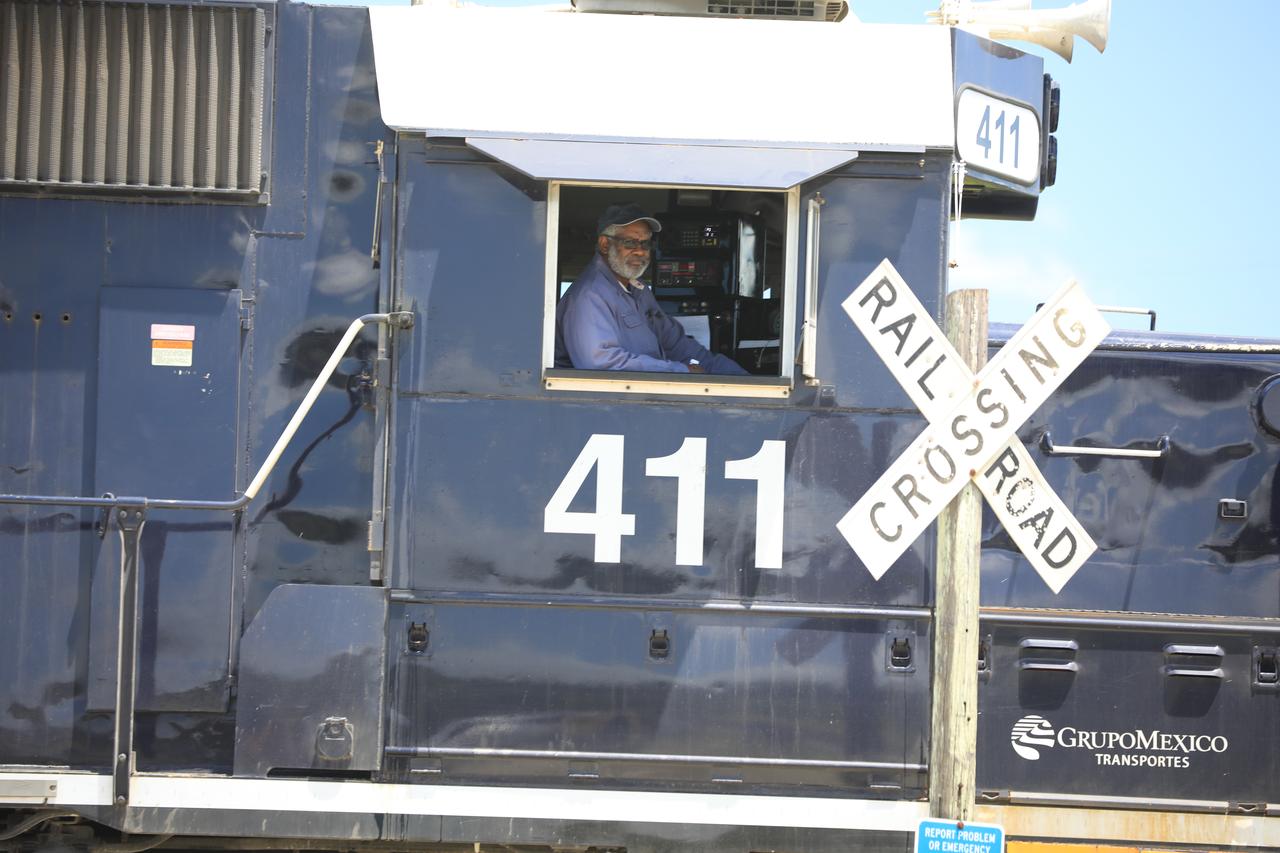
The train carrying the two solid rocket boosters that will power NASA’s Space Launch System (SLS) for Artemis missions to the Moon arrives at the Jay Jay rail yard – the connecting link between Kennedy Space Center and the Florida East Coast railway – in Titusville, Florida, on June 12, 2020. The boosters, each comprised of five motor segments, traveled from a Northrop Grumman manufacturing facility in Promontory, Utah, to Kennedy’s Rotation, Processing and Surge Facility, where teams with NASA’s Exploration Ground Systems will process the segments before moving them to the Vehicle Assembly Building for stacking on the mobile launcher. Under the Artemis program, NASA will land the first woman and the next man on the Moon by 2024. The first in a series of increasingly complex missions, Artemis I will test the Orion spacecraft and SLS as an integrated system ahead of crewed flights to the Moon.
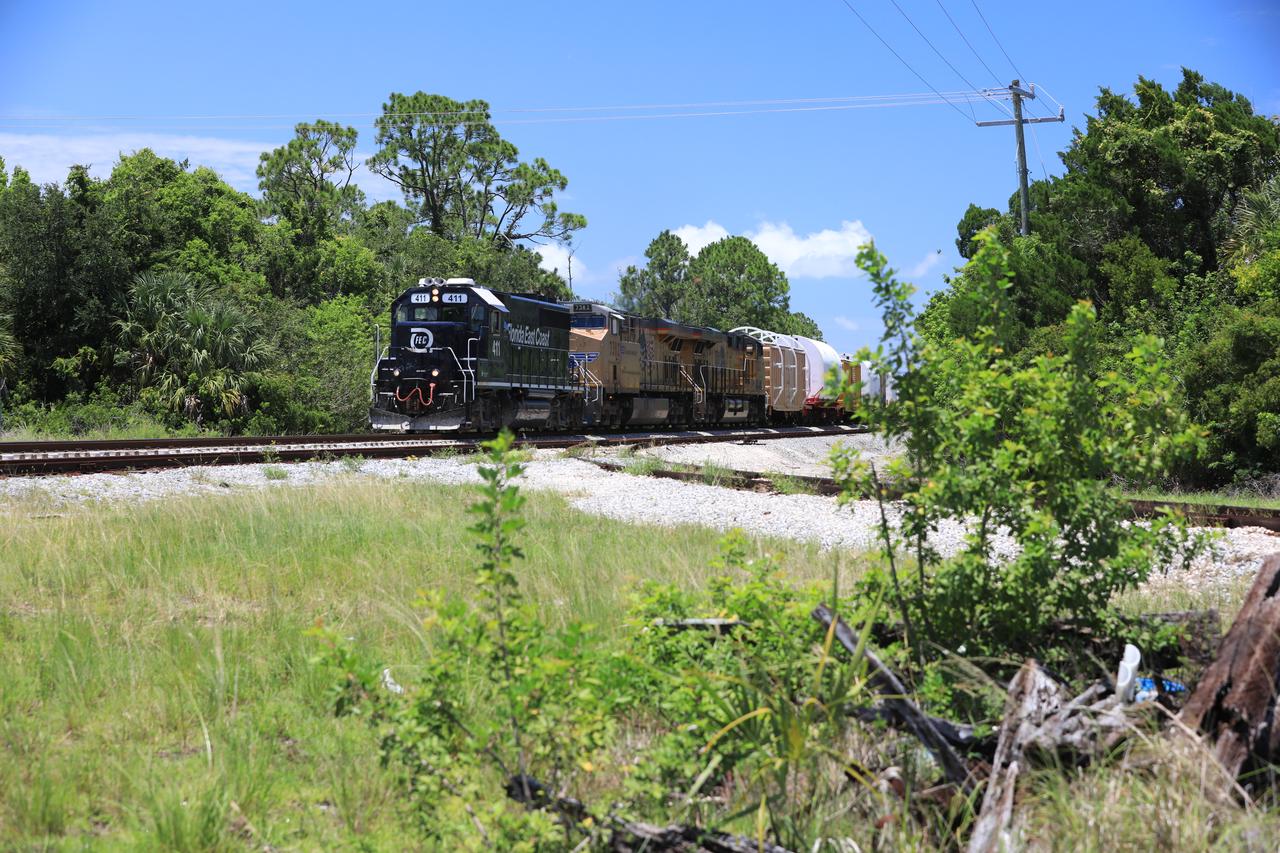
The train carrying the two solid rocket boosters that will power NASA’s Space Launch System (SLS) for Artemis missions to the Moon arrives at the Jay Jay rail yard – the connecting link between Kennedy Space Center and the Florida East Coast railway – in Titusville, Florida, on June 12, 2020. The boosters, each comprised of five motor segments, traveled from a Northrop Grumman manufacturing facility in Promontory, Utah, to Kennedy’s Rotation, Processing and Surge Facility, where teams with NASA’s Exploration Ground Systems will process the segments before moving them to the Vehicle Assembly Building for stacking on the mobile launcher. Under the Artemis program, NASA will land the first woman and the next man on the Moon by 2024. The first in a series of increasingly complex missions, Artemis I will test the Orion spacecraft and SLS as an integrated system ahead of crewed flights to the Moon.
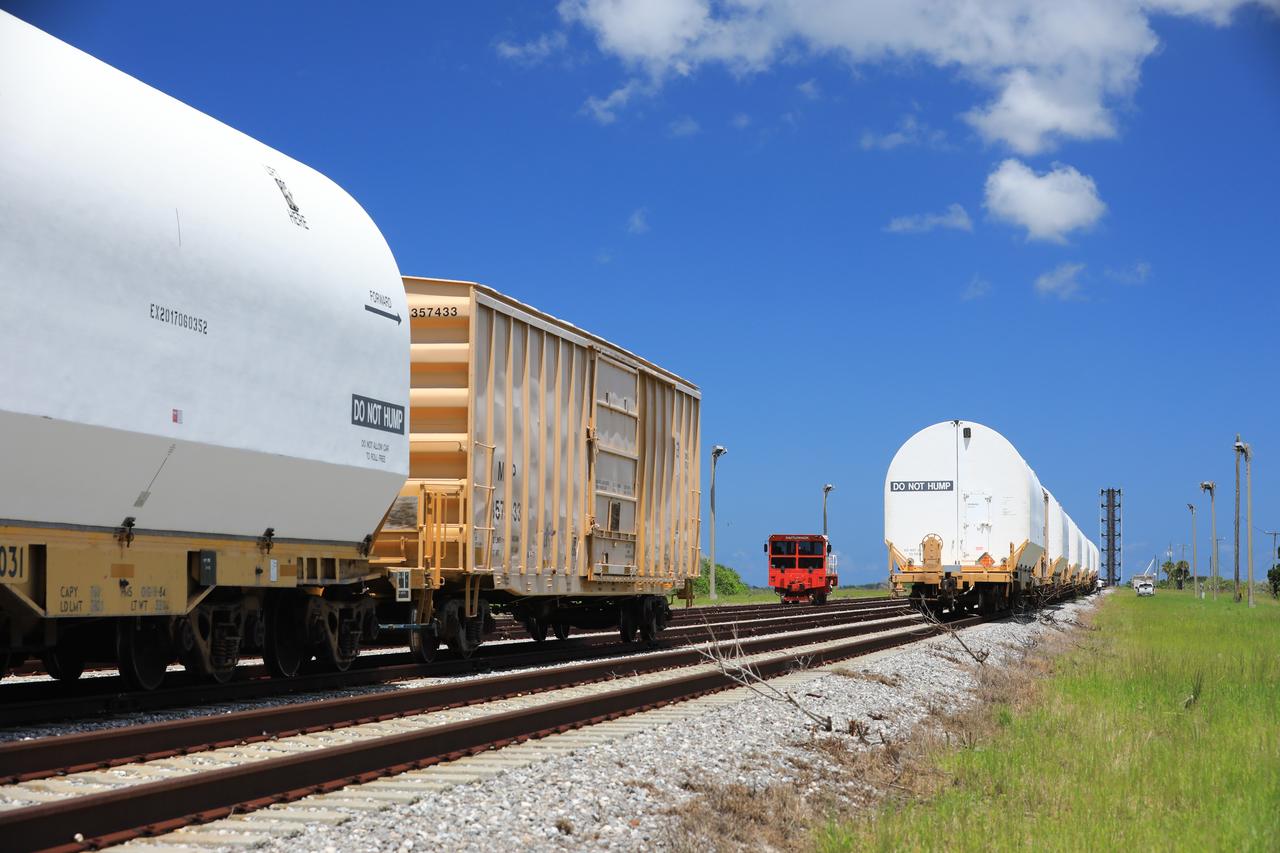
The train carrying the two solid rocket boosters that will power NASA’s Space Launch System (SLS) for Artemis missions to the Moon arrives at the Jay Jay rail yard – the connecting link between Kennedy Space Center and the Florida East Coast railway – in Titusville, Florida, on June 12, 2020. The boosters, each comprised of five motor segments, traveled from a Northrop Grumman manufacturing facility in Promontory, Utah, to Kennedy’s Rotation, Processing and Surge Facility, where teams with NASA’s Exploration Ground Systems will process the segments before moving them to the Vehicle Assembly Building for stacking on the mobile launcher. Under the Artemis program, NASA will land the first woman and the next man on the Moon by 2024. The first in a series of increasingly complex missions, Artemis I will test the Orion spacecraft and SLS as an integrated system ahead of crewed flights to the Moon.
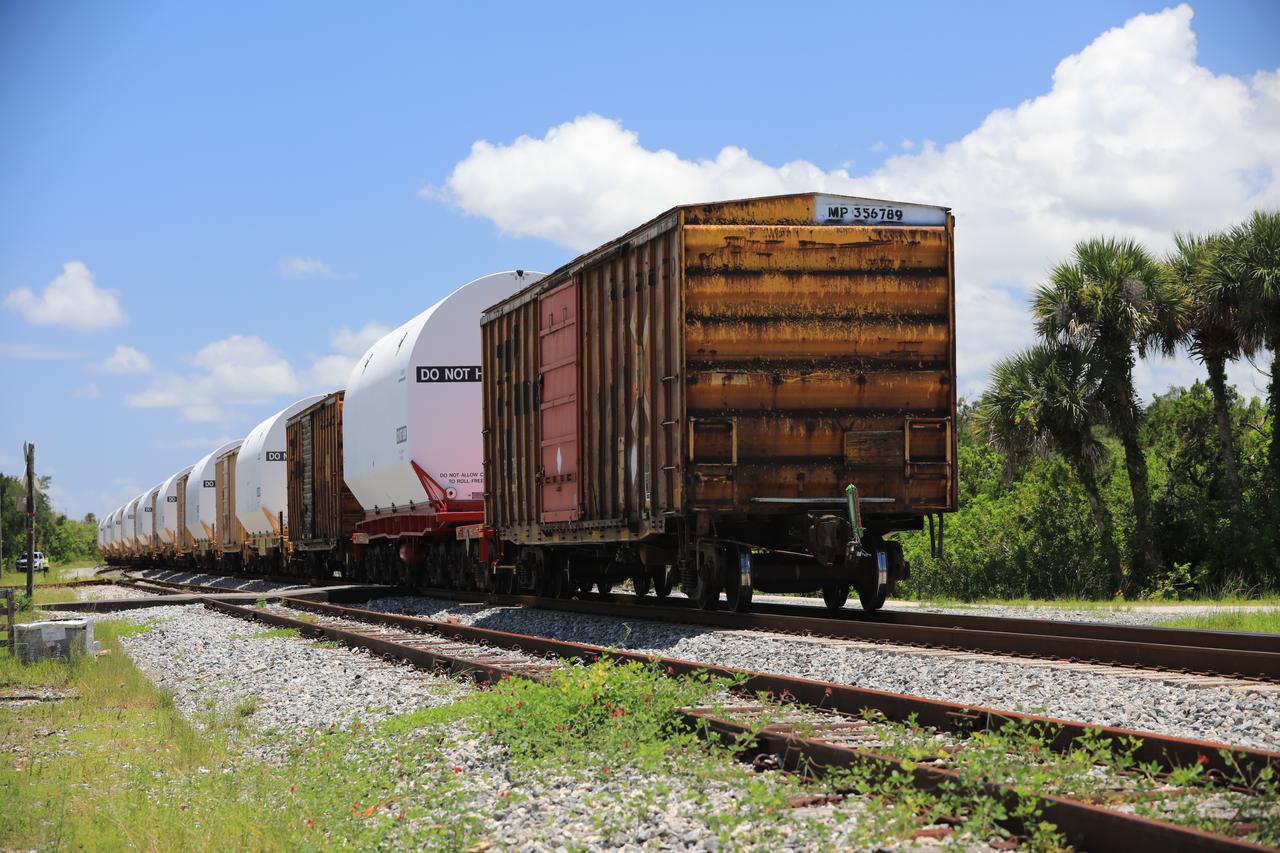
The train carrying the two solid rocket boosters that will power NASA’s Space Launch System (SLS) for Artemis missions to the Moon arrives at the Jay Jay rail yard – the connecting link between Kennedy Space Center and the Florida East Coast railway – in Titusville, Florida, on June 12, 2020. The boosters, each comprised of five motor segments, traveled from a Northrop Grumman manufacturing facility in Promontory, Utah, to Kennedy’s Rotation, Processing and Surge Facility, where teams with NASA’s Exploration Ground Systems will process the segments before moving them to the Vehicle Assembly Building for stacking on the mobile launcher. Under the Artemis program, NASA will land the first woman and the next man on the Moon by 2024. The first in a series of increasingly complex missions, Artemis I will test the Orion spacecraft and SLS as an integrated system ahead of crewed flights to the Moon.
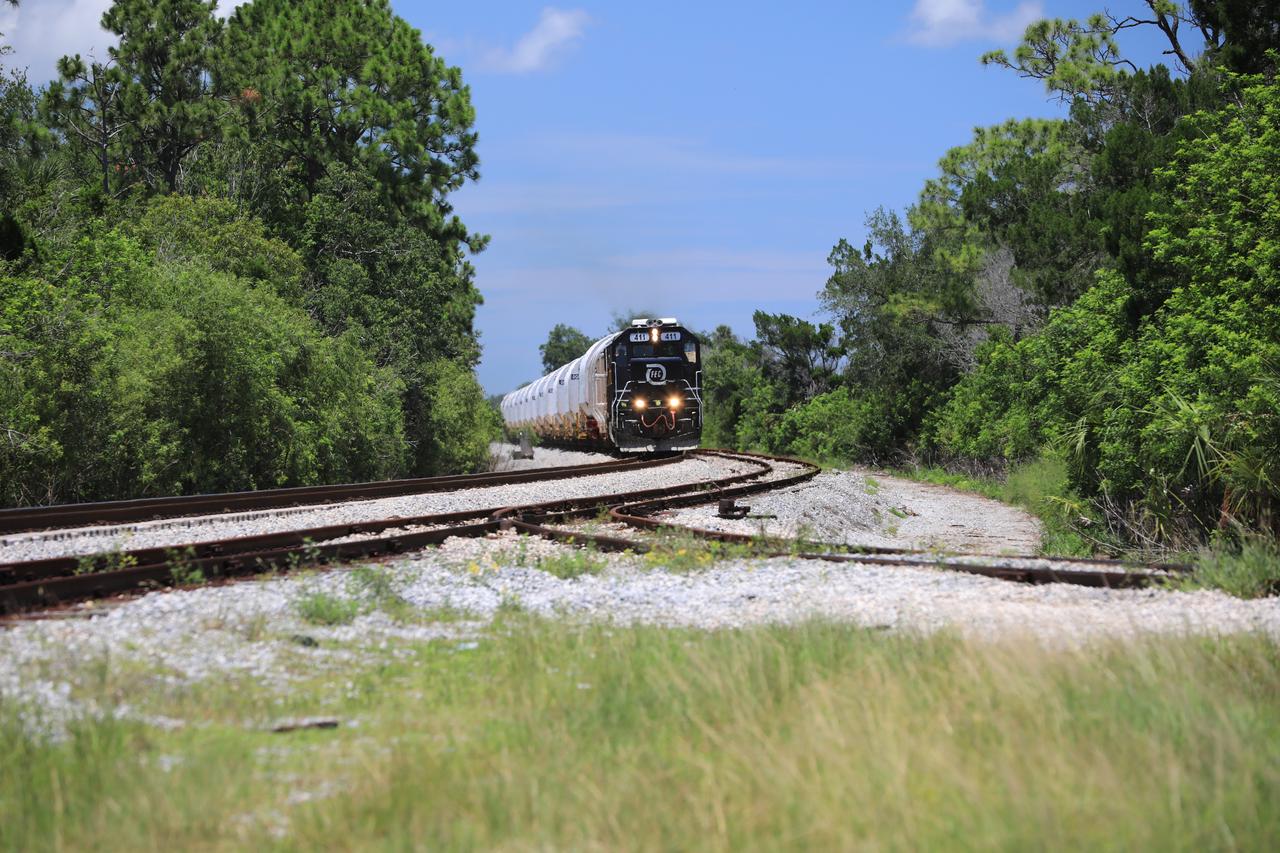
The train carrying the two solid rocket boosters that will power NASA’s Space Launch System (SLS) for Artemis missions to the Moon arrives at the Jay Jay rail yard – the connecting link between Kennedy Space Center and the Florida East Coast railway – in Titusville, Florida, on June 12, 2020. The boosters, each comprised of five motor segments, traveled from a Northrop Grumman manufacturing facility in Promontory, Utah, to Kennedy’s Rotation, Processing and Surge Facility, where teams with NASA’s Exploration Ground Systems will process the segments before moving them to the Vehicle Assembly Building for stacking on the mobile launcher. Under the Artemis program, NASA will land the first woman and the next man on the Moon by 2024. The first in a series of increasingly complex missions, Artemis I will test the Orion spacecraft and SLS as an integrated system ahead of crewed flights to the Moon.
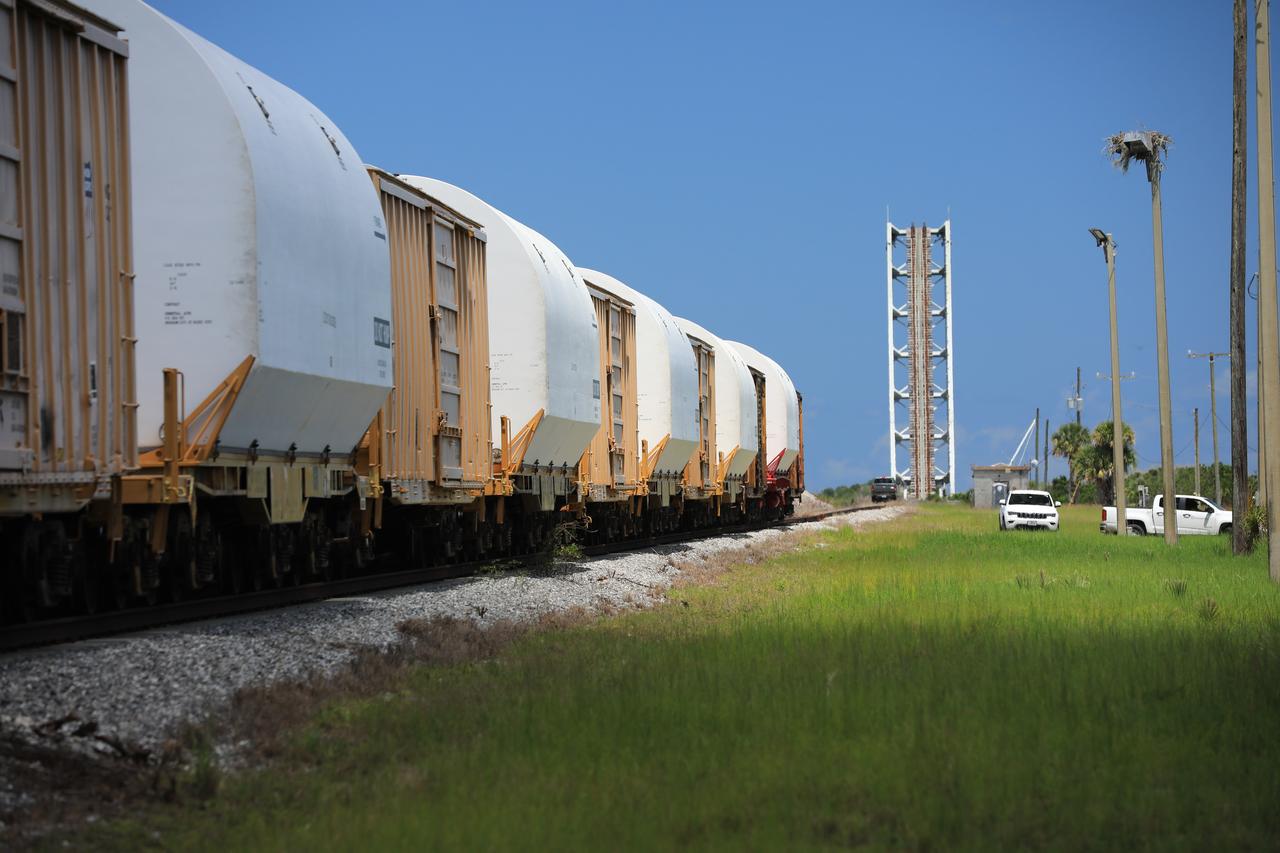
The train carrying the two solid rocket boosters that will power NASA’s Space Launch System (SLS) for Artemis missions to the Moon arrives at the Jay Jay rail yard – the connecting link between Kennedy Space Center and the Florida East Coast railway – in Titusville, Florida, on June 12, 2020. The boosters, each comprised of five motor segments, traveled from a Northrop Grumman manufacturing facility in Promontory, Utah, to Kennedy’s Rotation, Processing and Surge Facility, where teams with NASA’s Exploration Ground Systems will process the segments before moving them to the Vehicle Assembly Building for stacking on the mobile launcher. Under the Artemis program, NASA will land the first woman and the next man on the Moon by 2024. The first in a series of increasingly complex missions, Artemis I will test the Orion spacecraft and SLS as an integrated system ahead of crewed flights to the Moon.
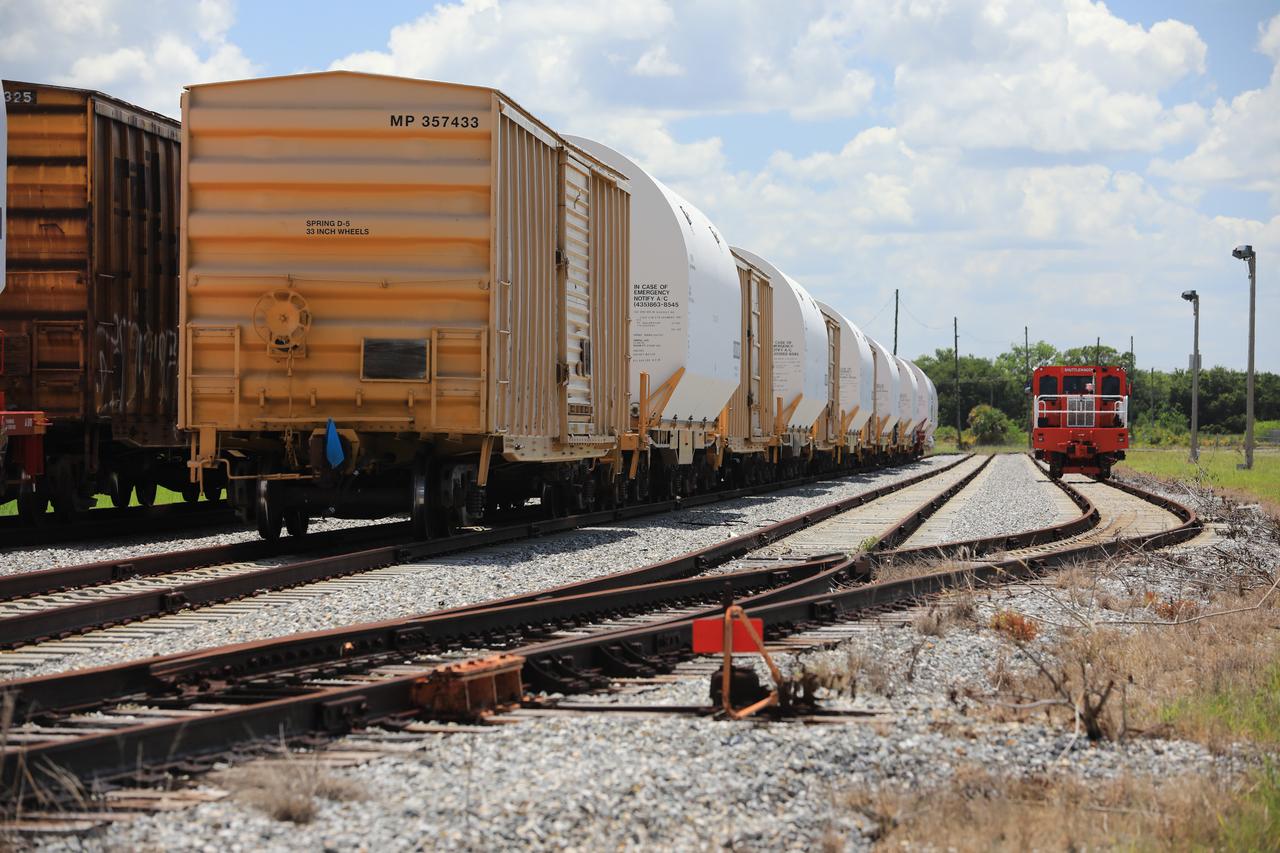
The train carrying the two solid rocket boosters that will power NASA’s Space Launch System (SLS) for Artemis missions to the Moon arrives at the Jay Jay rail yard – the connecting link between Kennedy Space Center and the Florida East Coast railway – in Titusville, Florida, on June 12, 2020. The boosters, each comprised of five motor segments, traveled from a Northrop Grumman manufacturing facility in Promontory, Utah, to Kennedy’s Rotation, Processing and Surge Facility, where teams with NASA’s Exploration Ground Systems will process the segments before moving them to the Vehicle Assembly Building for stacking on the mobile launcher. Under the Artemis program, NASA will land the first woman and the next man on the Moon by 2024. The first in a series of increasingly complex missions, Artemis I will test the Orion spacecraft and SLS as an integrated system ahead of crewed flights to the Moon.
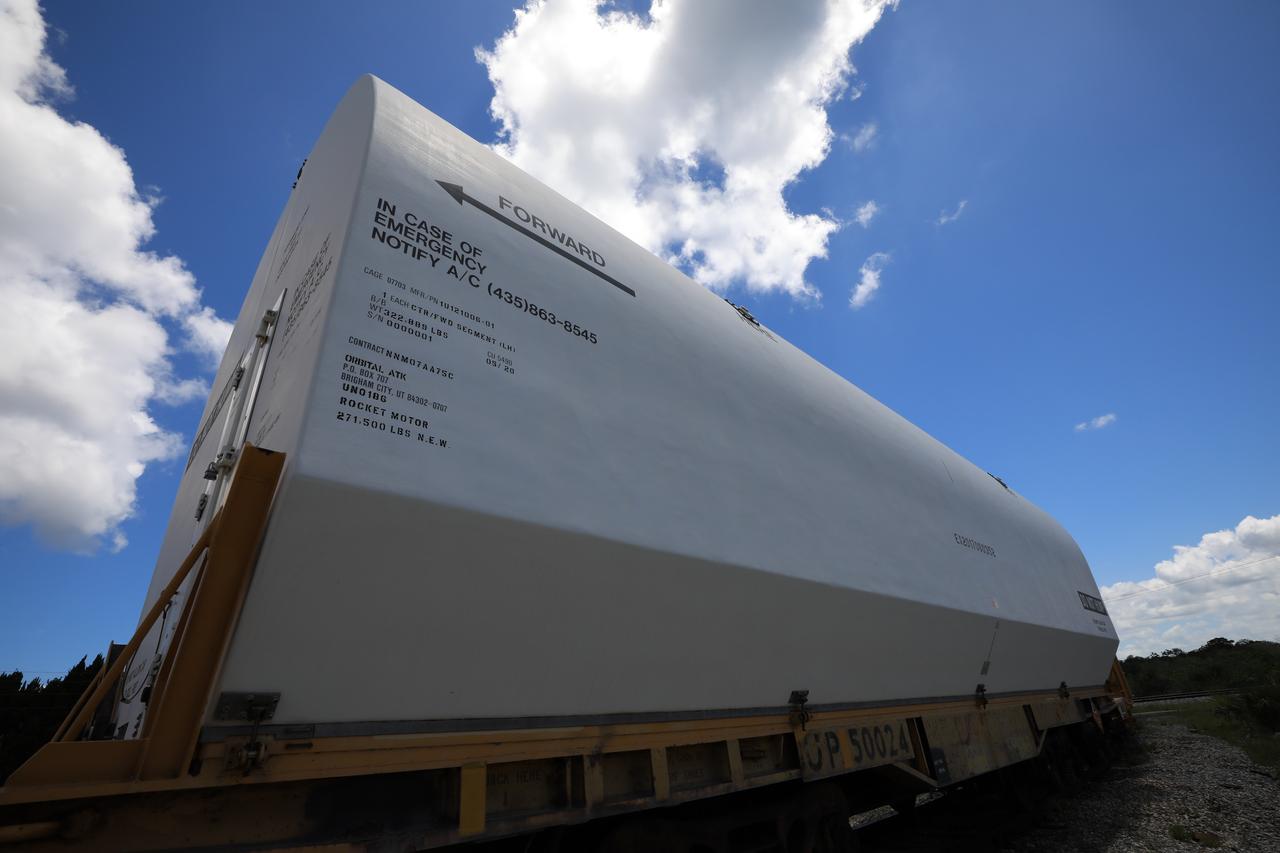
The train carrying the two solid rocket boosters that will power NASA’s Space Launch System (SLS) for Artemis missions to the Moon arrives at the Jay Jay rail yard – the connecting link between Kennedy Space Center and the Florida East Coast railway – in Titusville, Florida, on June 12, 2020. The boosters, each comprised of five motor segments, traveled from a Northrop Grumman manufacturing facility in Promontory, Utah, to Kennedy’s Rotation, Processing and Surge Facility, where teams with NASA’s Exploration Ground Systems will process the segments before moving them to the Vehicle Assembly Building for stacking on the mobile launcher. Under the Artemis program, NASA will land the first woman and the next man on the Moon by 2024. The first in a series of increasingly complex missions, Artemis I will test the Orion spacecraft and SLS as an integrated system ahead of crewed flights to the Moon.
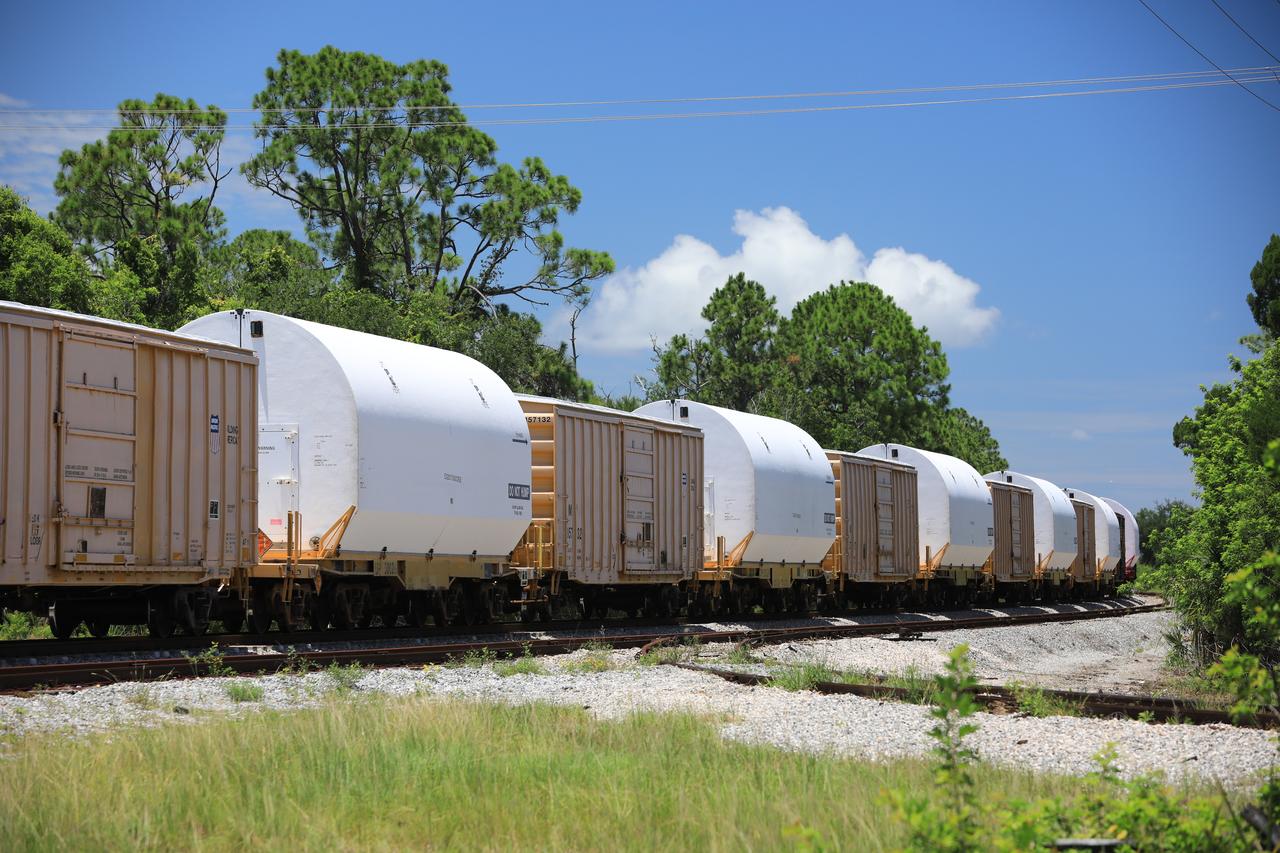
The train carrying the two solid rocket boosters that will power NASA’s Space Launch System (SLS) for Artemis missions to the Moon arrives at the Jay Jay rail yard – the connecting link between Kennedy Space Center and the Florida East Coast railway – in Titusville, Florida, on June 12, 2020. The boosters, each comprised of five motor segments, traveled from a Northrop Grumman manufacturing facility in Promontory, Utah, to Kennedy’s Rotation, Processing and Surge Facility, where teams with NASA’s Exploration Ground Systems will process the segments before moving them to the Vehicle Assembly Building for stacking on the mobile launcher. Under the Artemis program, NASA will land the first woman and the next man on the Moon by 2024. The first in a series of increasingly complex missions, Artemis I will test the Orion spacecraft and SLS as an integrated system ahead of crewed flights to the Moon.
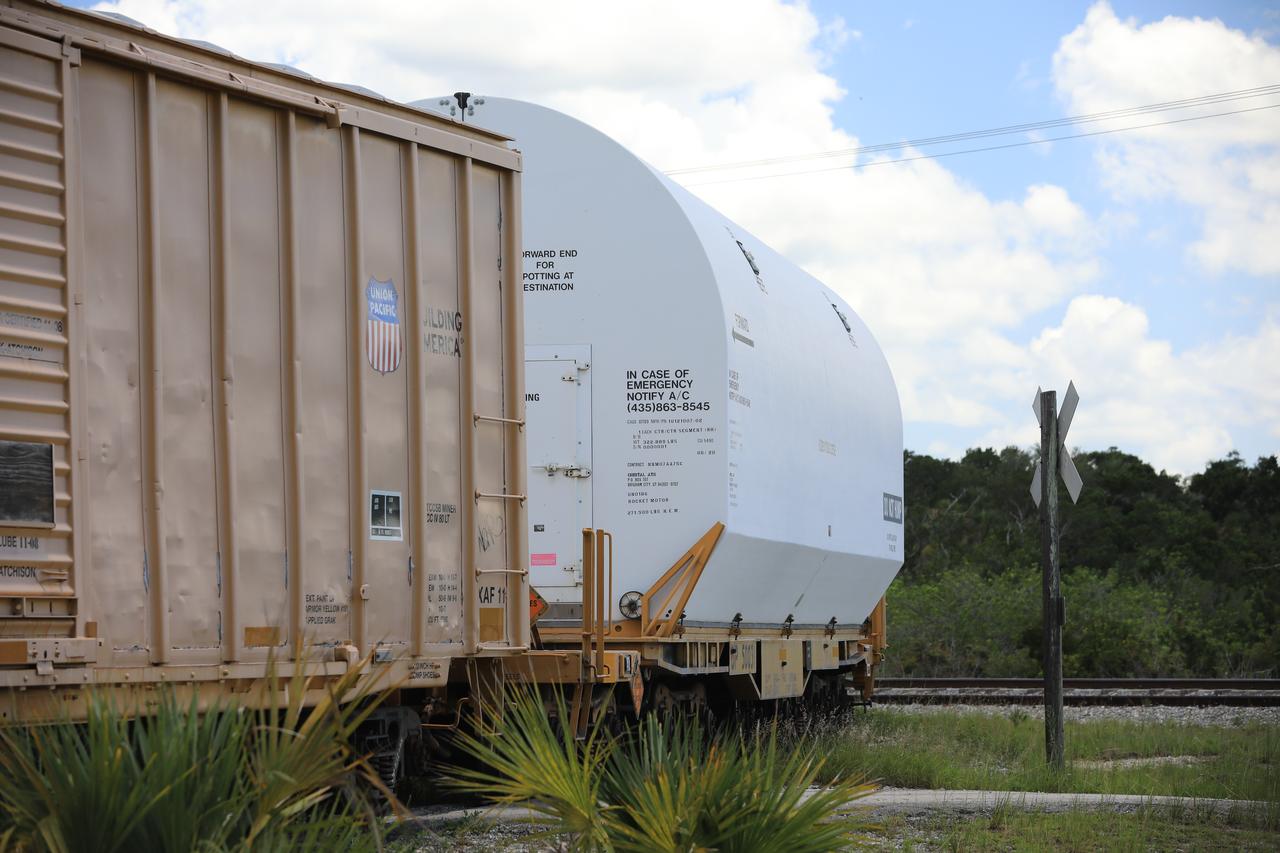
The train carrying the two solid rocket boosters that will power NASA’s Space Launch System (SLS) for Artemis missions to the Moon arrives at the Jay Jay rail yard – the connecting link between Kennedy Space Center and the Florida East Coast railway – in Titusville, Florida, on June 12, 2020. The boosters, each comprised of five motor segments, traveled from a Northrop Grumman manufacturing facility in Promontory, Utah, to Kennedy’s Rotation, Processing and Surge Facility, where teams with NASA’s Exploration Ground Systems will process the segments before moving them to the Vehicle Assembly Building for stacking on the mobile launcher. Under the Artemis program, NASA will land the first woman and the next man on the Moon by 2024. The first in a series of increasingly complex missions, Artemis I will test the Orion spacecraft and SLS as an integrated system ahead of crewed flights to the Moon.
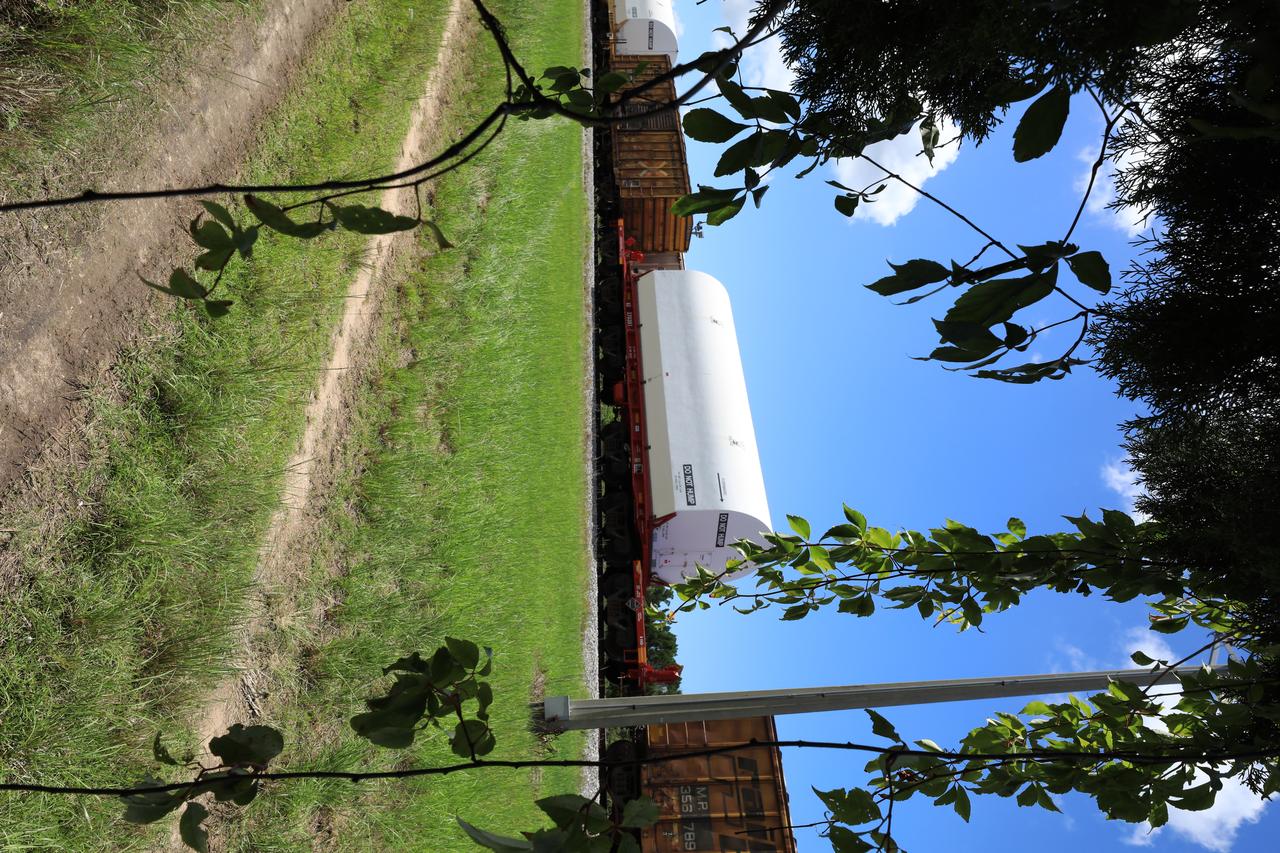
The train carrying the two solid rocket boosters that will power NASA’s Space Launch System (SLS) for Artemis missions to the Moon arrives at the Jay Jay rail yard – the connecting link between Kennedy Space Center and the Florida East Coast railway – in Titusville, Florida, on June 12, 2020. The boosters, each comprised of five motor segments, traveled from a Northrop Grumman manufacturing facility in Promontory, Utah, to Kennedy’s Rotation, Processing and Surge Facility, where teams with NASA’s Exploration Ground Systems will process the segments before moving them to the Vehicle Assembly Building for stacking on the mobile launcher. Under the Artemis program, NASA will land the first woman and the next man on the Moon by 2024. The first in a series of increasingly complex missions, Artemis I will test the Orion spacecraft and SLS as an integrated system ahead of crewed flights to the Moon.
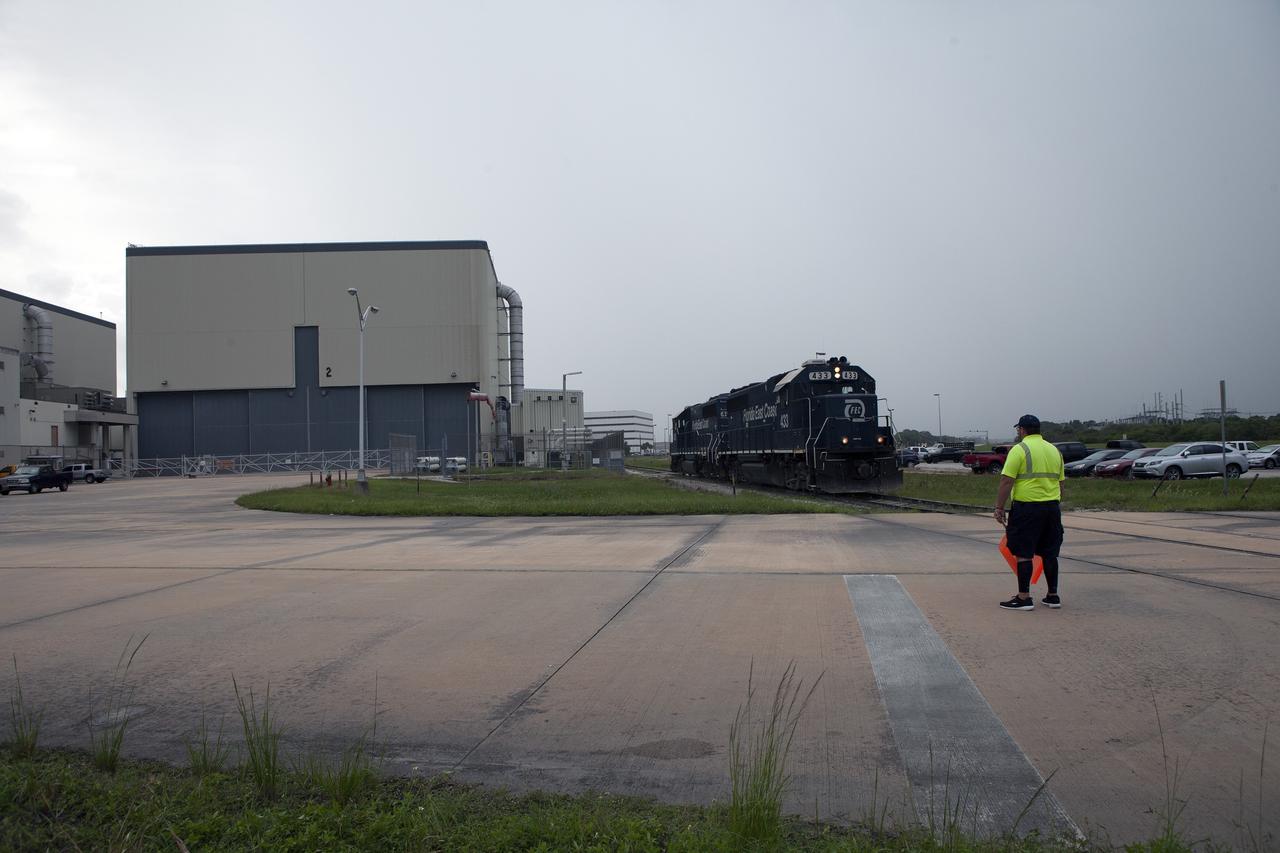
CAPE CANAVERAL, Fla. – Coupled Florida East Coast Railway, or FEC, locomotives No. 433 and No. 428 make the first run past the Orbiter Processing Facility and Thermal Protection System Facility in Launch Complex 39 at NASA’s Kennedy Space Center in Florida during the Rail Vibration Test for the Canaveral Port Authority. Seismic monitors are collecting data as the train passes by. The purpose of the test is to collect amplitude, frequency and vibration test data utilizing two Florida East Coast locomotives operating on KSC tracks to ensure that future railroad operations will not affect launch vehicle processing at the center. Buildings instrumented for the test include the Rotation Processing Surge Facility, Thermal Protection Systems Facility, Vehicle Assembly Building, Orbiter Processing Facility and Booster Fabrication Facility. Photo credit: NASA/Daniel Casper
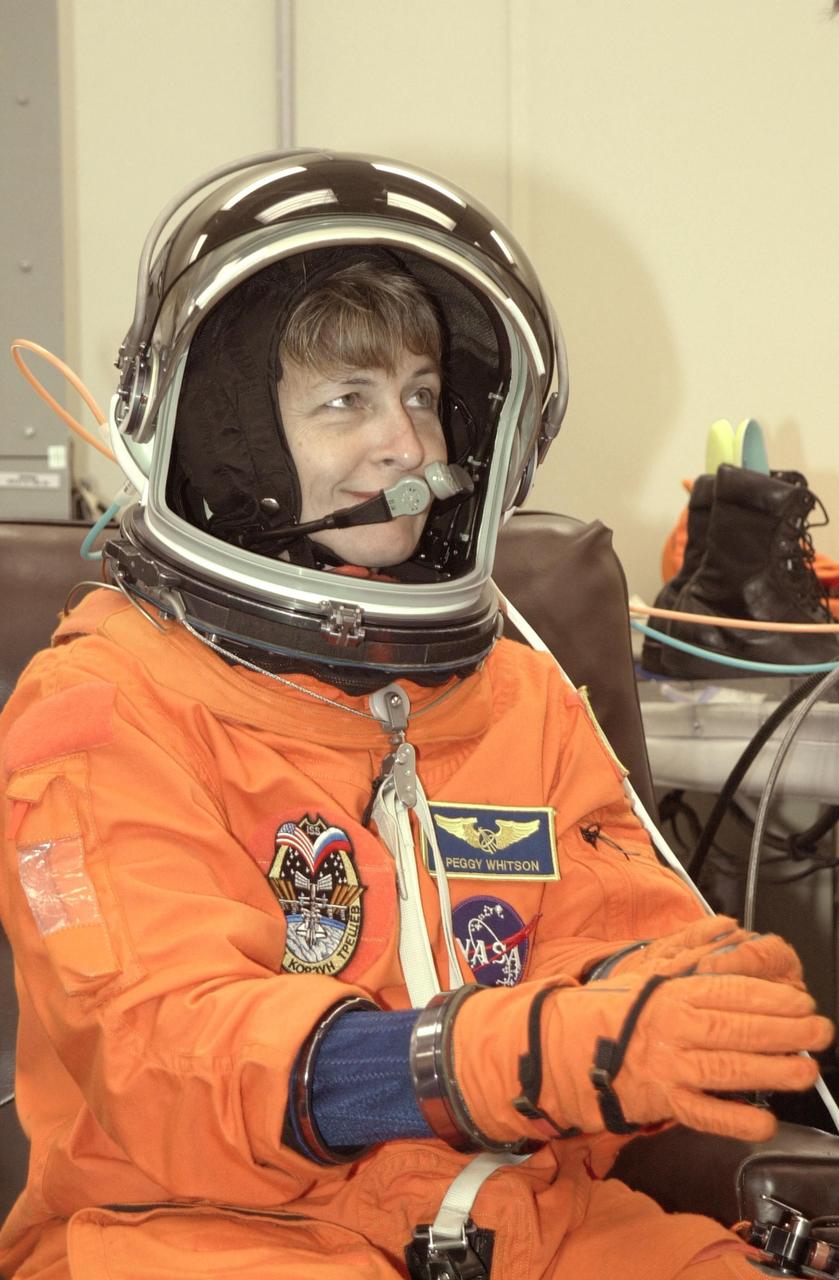
KENNEDY SPACE CENTER, FLA. - Expedition 5 crew member Peggy Whitson undergoes a suit check as part of Terminal Countdown Demonstration Test activities at KSC. The TCDT includes emergency egress training at the pad and a simulated launch countdown. Expedition 5 will travel to the International Space Station on mission STS-111 as the replacement crew for Expedition 4, who will return to Earth aboard Endeavour. Known as Utilization Flight -2, the mission includes attaching a Canadian-built mobile base system to the International Space Station that will enable the Canadarm2 robotic arm to move along a railway on the Station's truss to build and maintain the outpost. The crew will also replace a faulty wrist/roll joint on the Canadarm2 as well as unload almost three tons of experiments and supplies from the Italian-built Multi-Purpose Logistics Module Leonardo. Launch of Space Shuttle Endeavour on mission STS-111 is scheduled for May 30, 2002
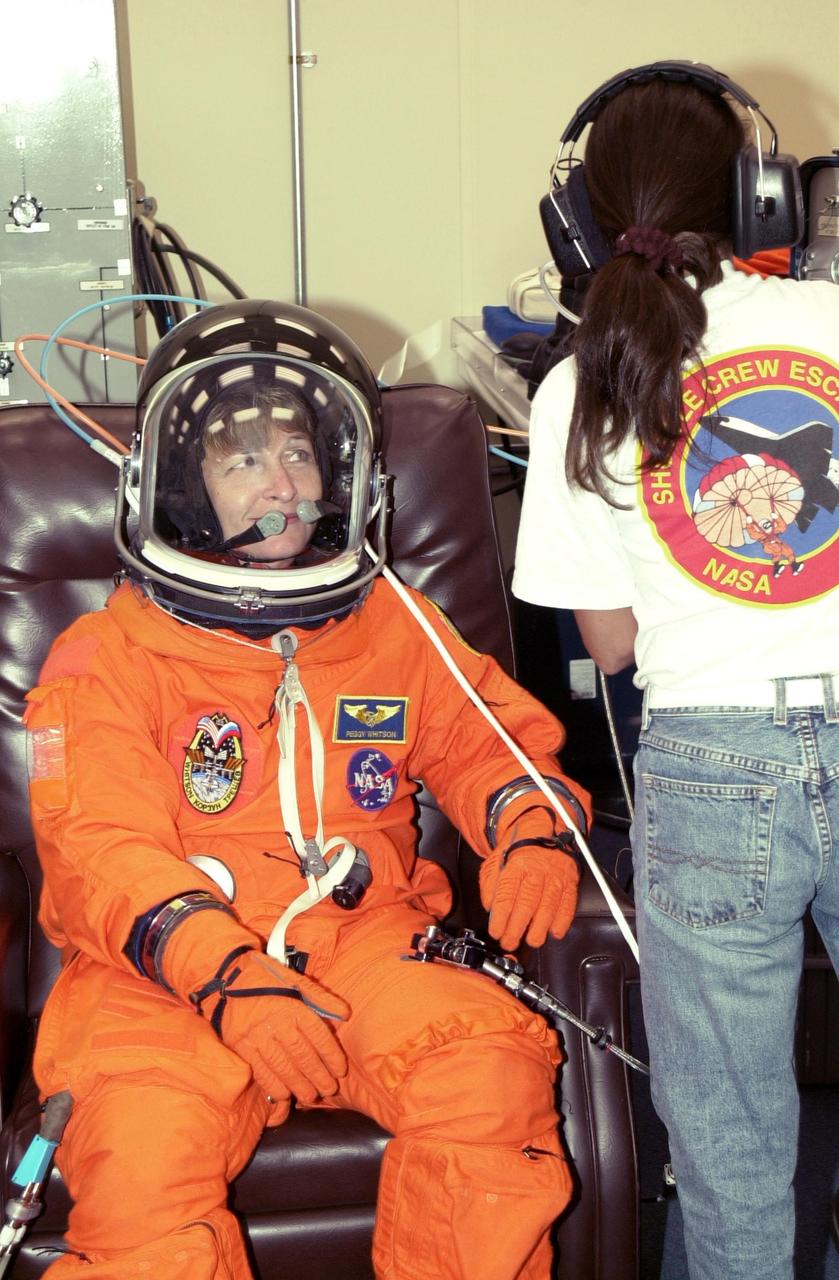
KENNEDY SPACE CENTER, FLA. -- During suit check, Expedition 5 crew member Peggy Whitson undergoes suit check as part of Terminal Countdown Demonstration Test activities at KSC. The TCDT includes emergency egress training at the pad and a simulated launch countdown. Expedition 5 will travel to the International Space Station on mission STS-111 as the replacement crew for Expedition 4, who will return to Earth aboard Endeavour. Known as Utilization Flight -2, the mission includes attaching a Canadian-built mobile base system to the International Space Station that will enable the Canadarm2 robotic arm to move along a railway on the Station's truss to build and maintain the outpost. The crew will also replace a faulty wrist/roll joint on the Canadarm2 as well as unload almost three tons of experiments and supplies from the Italian-built Multi-Purpose Logistics Module Leonardo. Launch of Space Shuttle Endeavour on mission STS-111 is scheduled for May 30, 2002
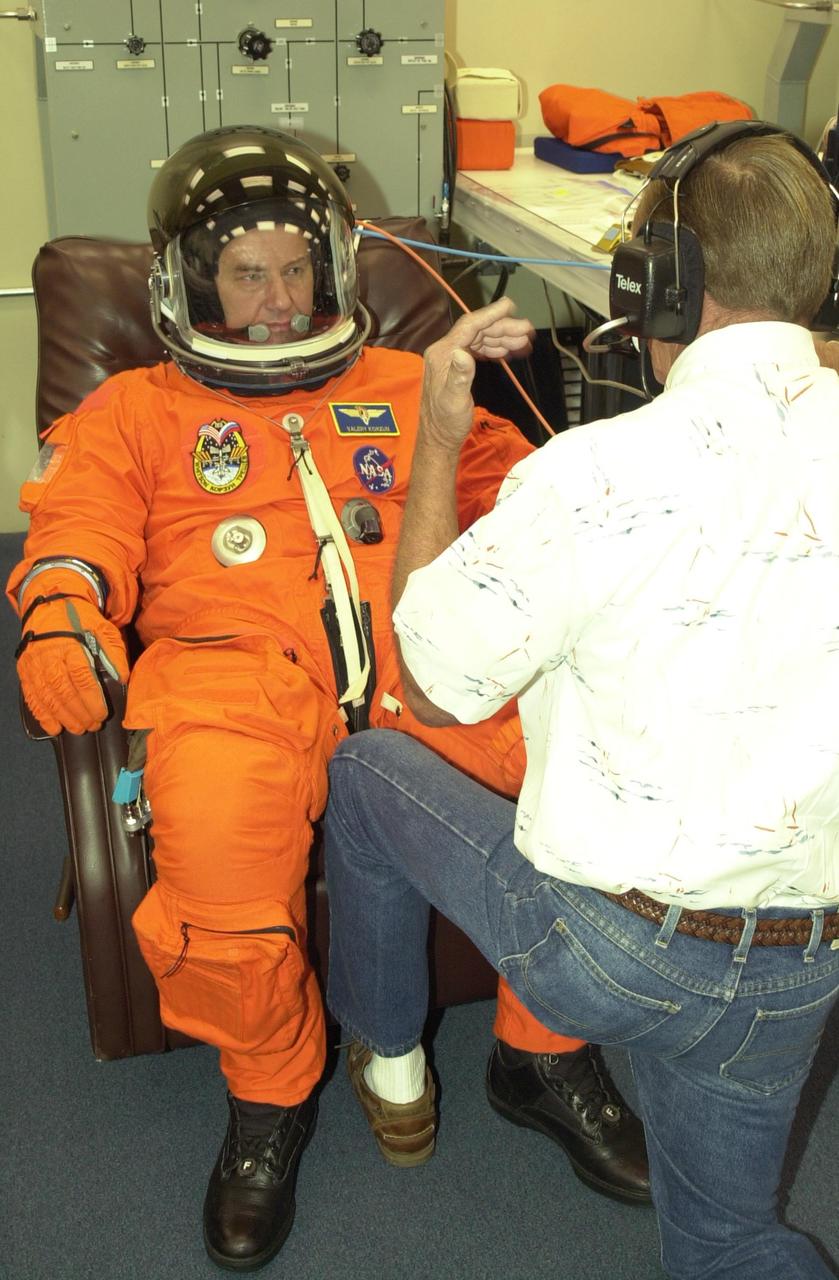
KENNEDY SPACE CENTER, FLA. -- During suit check, Expedition 5 Commander Valeri Korzun talks to a technician. The suit check is part of Terminal Countdown Demonstration Test activities at KSC. The TCDT includes emergency egress training at the pad and a simulated launch countdown. Expedition 5 will travel to the International Space Station on mission STS-111 as the replacement crew for Expedition 4, who will return to Earth aboard Endeavour. Known as Utilization Flight -2, the mission includes attaching a Canadian-built mobile base system to the International Space Station that will enable the Canadarm2 robotic arm to move along a railway on the Station's truss to build and maintain the outpost. The crew will also replace a faulty wrist/roll joint on the Canadarm2 as well as unload almost three tons of experiments and supplies from the Italian-built Multi-Purpose Logistics Module Leonardo. Launch of Space Shuttle Endeavour on mission STS-111 is scheduled for May 30, 2002
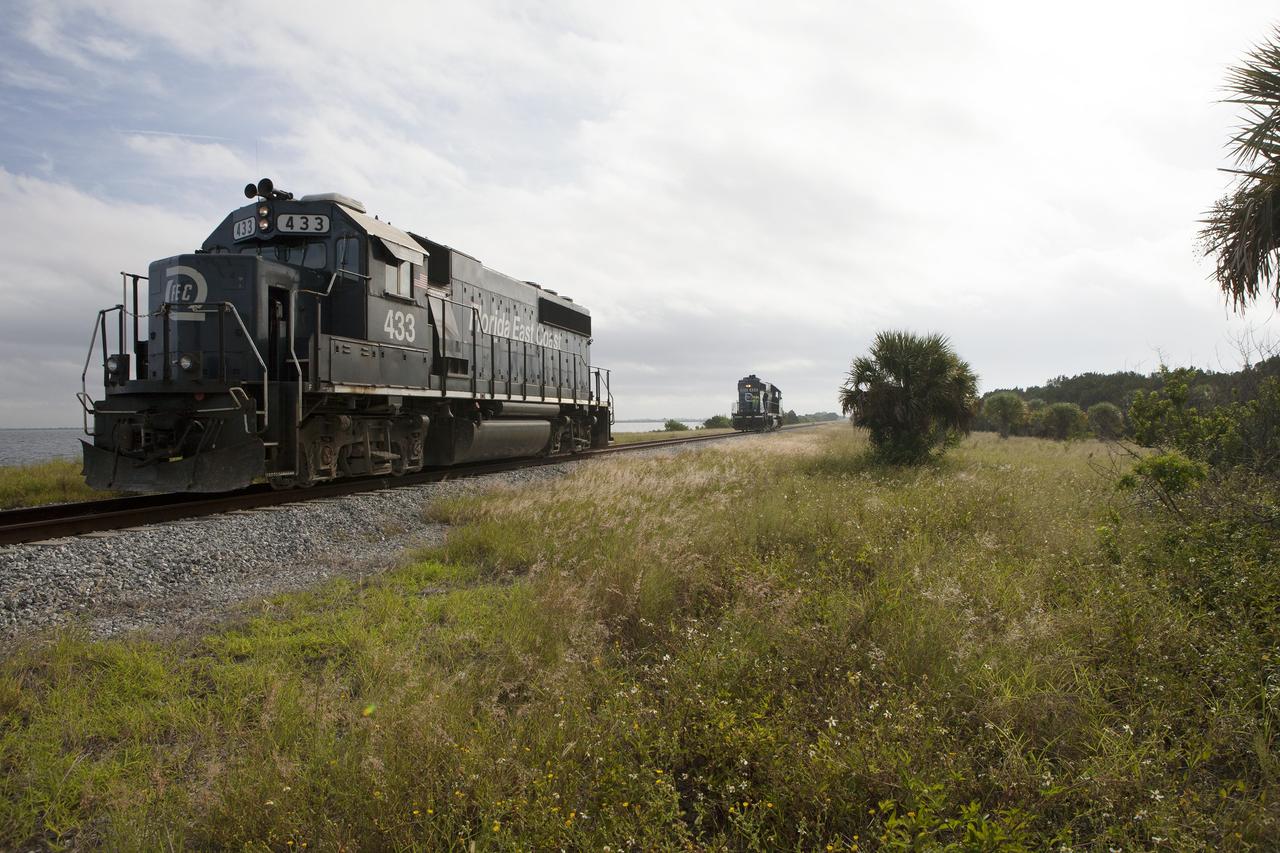
CAPE CANAVERAL, Fla. – Operations are underway to couple Florida East Coast Railway, or FEC, locomotives No. 433 and No. 428 on the track alongside the Indian River, north of Launch Complex 39 at NASA’s Kennedy Space Center in Florida. Kennedy's Center Planning and Development Directorate has enlisted the locomotives to support a Rail Vibration Test for the Canaveral Port Authority. The purpose of the test is to collect amplitude, frequency and vibration test data utilizing two Florida East Coast locomotives operating on KSC tracks to ensure that future railroad operations will not affect launch vehicle processing at the center. Buildings instrumented for the test include the Rotation Processing Surge Facility, Thermal Protection Systems Facility, Vehicle Assembly Building, Orbiter Processing Facility and Booster Fabrication Facility. Photo credit: NASA/Daniel Casper
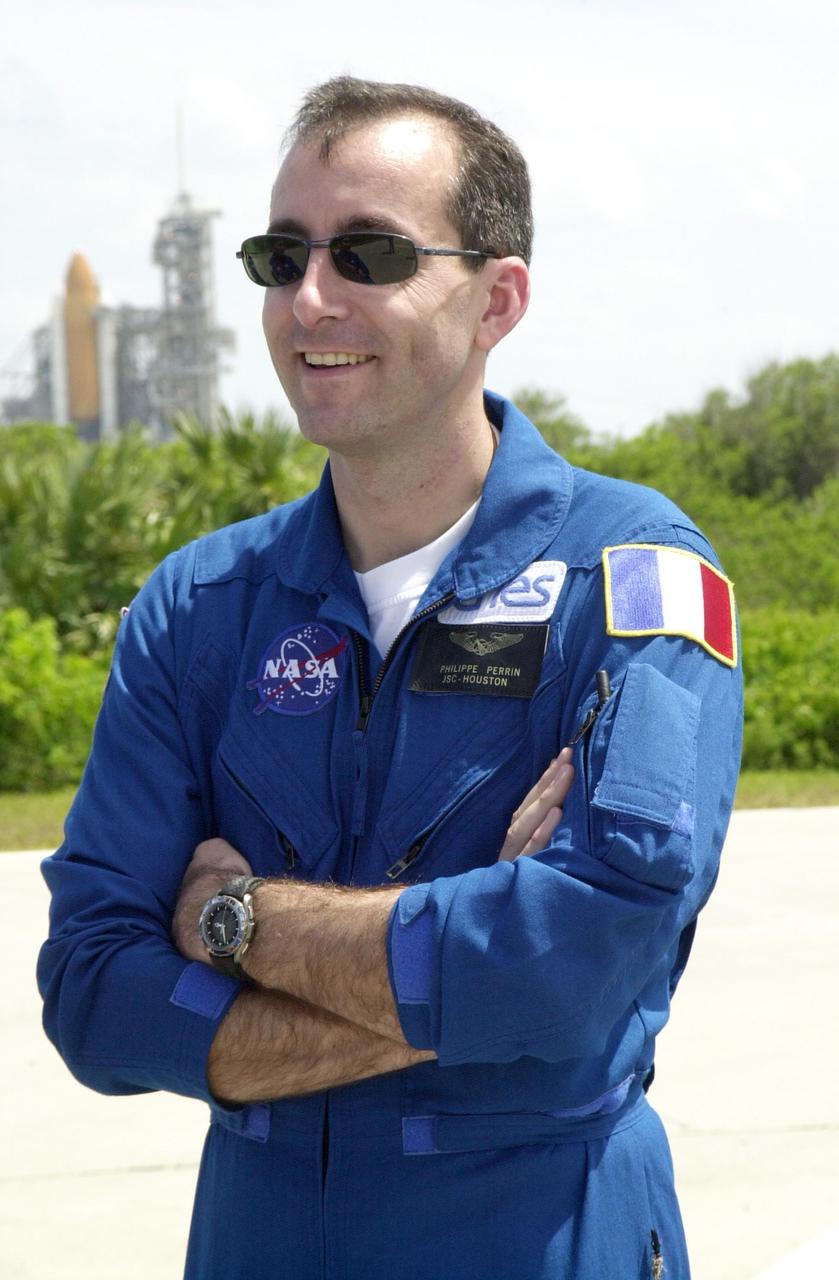
KENNEDY SPACE CENTER, FLA. - STS-111 Mission Specialist Philippe Perrin, with the French Space Agency, takes a break at the pad during Terminal Countdown Demonstration Test activities at KSC. In the background is Space Shuttle Endeavour. . The TCDT includes emergency egress training at the pad and a simulated launch countdown Known as Utilization Flight -2, the mission includes attaching a Canadian-built mobile base system to the International Space Station that will enable the Canadarm2 robotic arm to move along a railway on the Station's truss to build and maintain the outpost. The crew will also replace a faulty wrist/roll joint on the Canadarm2 as well as unload almost three tons of experiments and supplies from the Italian-built Multi-Purpose Logistics Module Leonardo. . Expedition 5 will travel to the International Space Station on mission STS-111 as the replacement crew for Expedition 4, who will return to Earth aboard Endeavour. Launch of Endeavour on mission STS-111 is scheduled for May 30, 2002
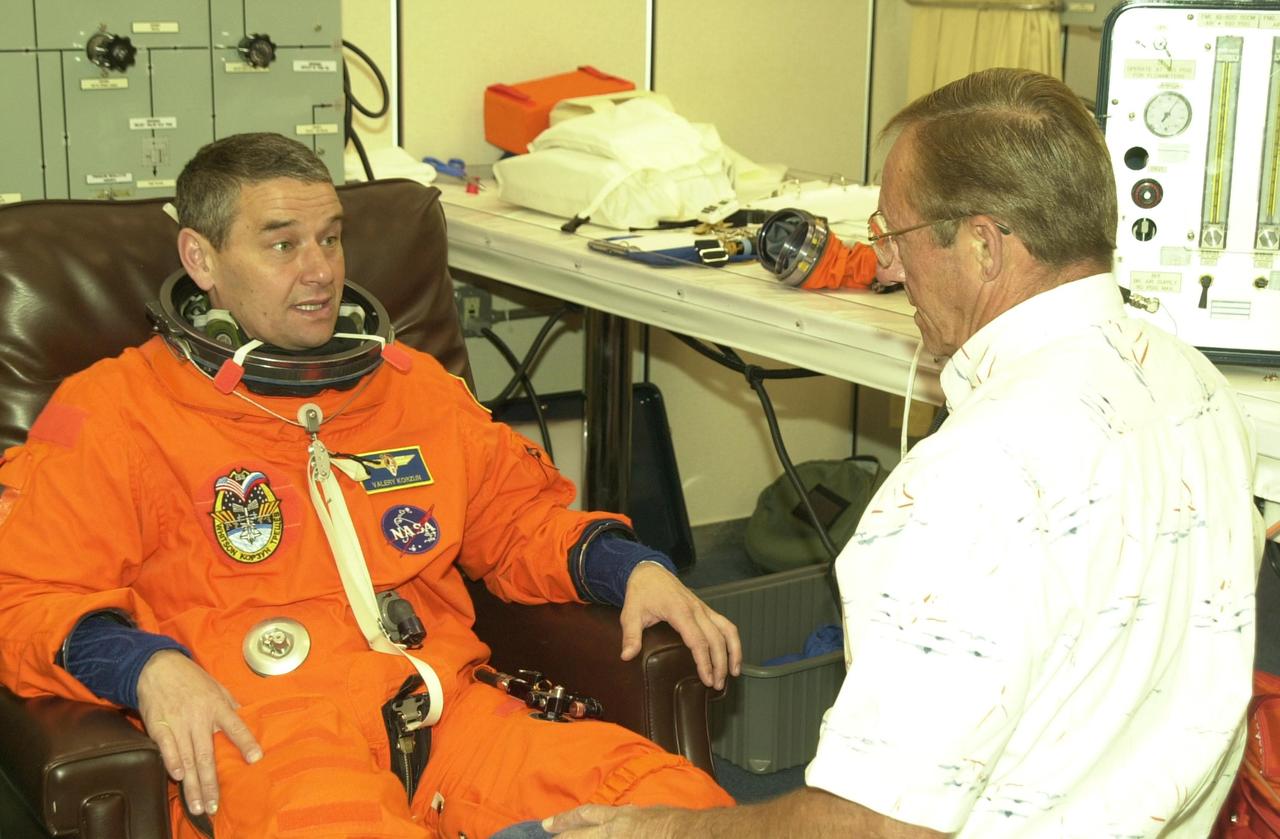
KENNEDY SPACE CENTER, FLA. -- During suit check, Expedition 5 Commander Valeri Korzun talks to a technician. The suit check is part of Terminal Countdown Demonstration Test activities at KSC. The TCDT includes emergency egress training at the pad and a simulated launch countdown. Expedition 5 will travel to the International Space Stationon mission STS-111 as the replacement crew for Expedition 4, who will return to Earth aboard Endeavour. Known as Utilization Flight -2, the mission includes attaching a Canadian-built mobile base system to the International Space Station that will enable the Canadarm2 robotic arm to move along a railway on the Station's truss to build and maintain the outpost. The crew will also replace a faulty wrist/roll joint on the Canadarm2 as well as unload almost three tons of experiments and supplies from the Italian-built Multi-Purpose Logistics Module Leonardo. Launch of Space Shuttle Endeavour on mission STS-111 is scheduled for May 30, 2002
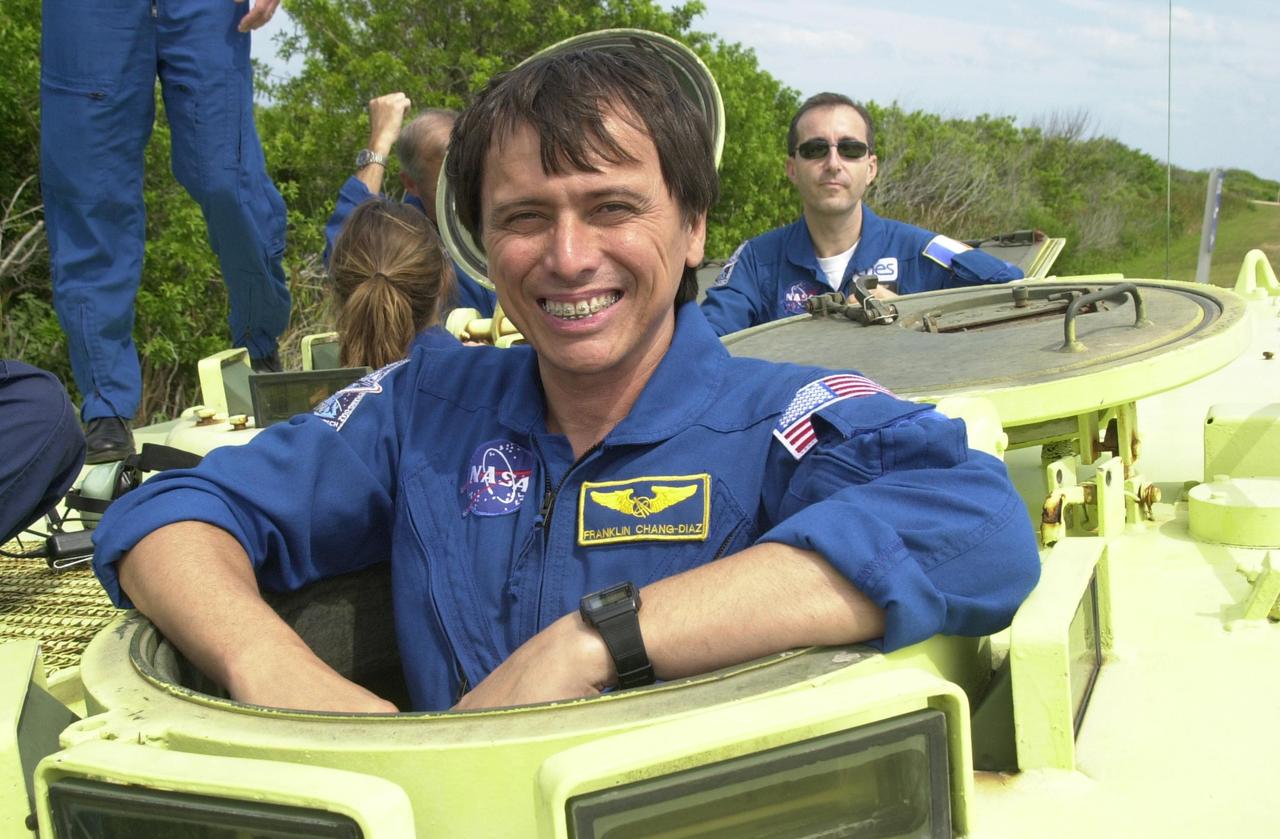
KENNEDY SPACE CENTER, FLA. -- STS-111 Mission Specialist Franklin Chang-Diaz poses for the camera before taking his turn at driving the M-113 armored personnel carrier during emergency egress training at the pad. Behind him (right) is Mission Specialist Philippe Perrin, with the French Space Agency. The training is part of Terminal Countdown Demonstration Test activities at KSC. The TCDT also includes a simulated launch countdown. Known as Utilization Flight -2, the mission includes attaching a Canadian-built mobile base system to the International Space Station that will enable the Canadarm2 robotic arm to move along a railway on the Station's truss to build and maintain the outpost. The crew will also replace a faulty wrist/roll joint on the Canadarm2 as well as unload almost three tons of experiments and supplies from the Italian-built Multi-Purpose Logistics Module Leonardo. Launch of Space Shuttle Endeavour on mission STS-111 is scheduled for May 30, 2002
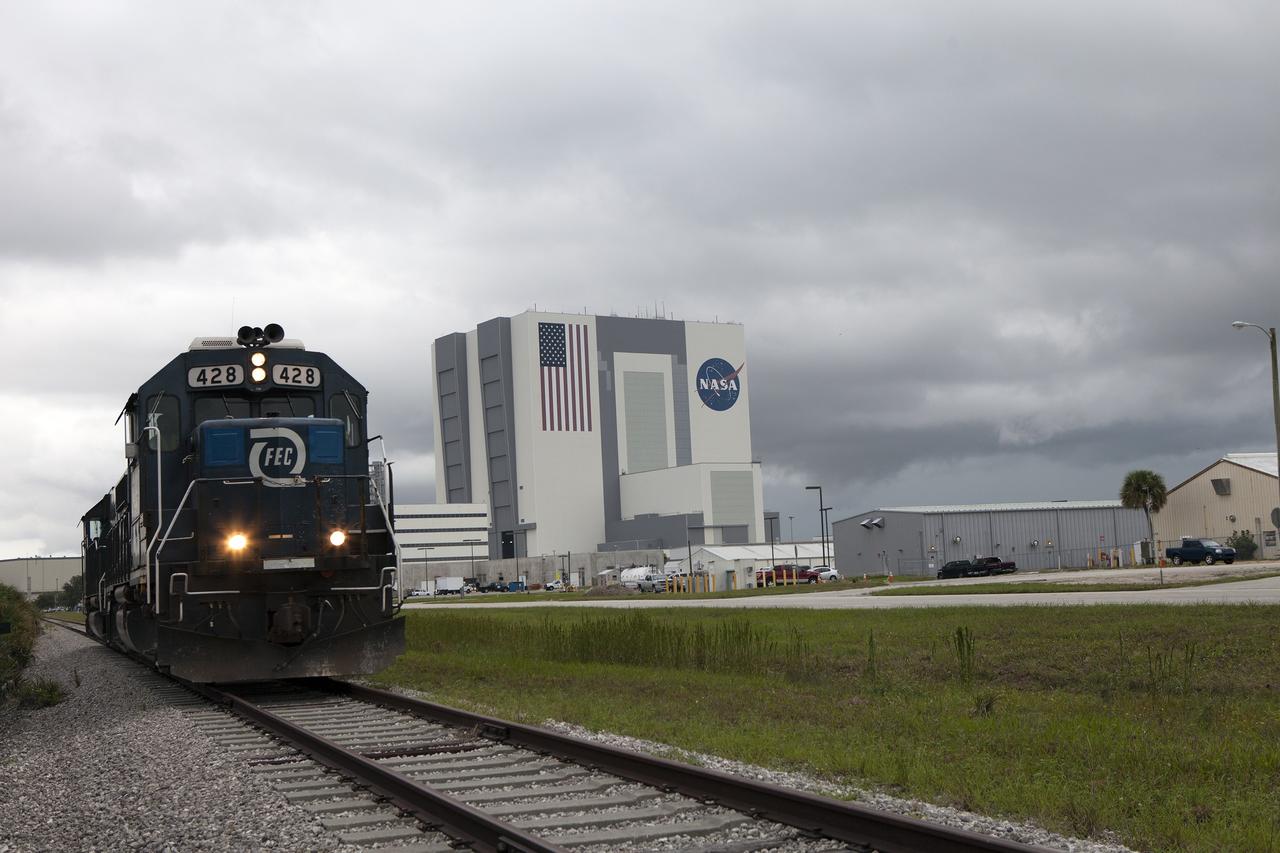
CAPE CANAVERAL, Fla. – Coupled Florida East Coast Railway, or FEC, locomotives No. 433 and No. 428 pass the Vehicle Assembly Building in Launch Complex 39 at NASA’s Kennedy Space Center in Florida on their way to NASA's Locomotive Maintenance Facility. Kennedy's Center Planning and Development Directorate has enlisted the locomotives to support a Rail Vibration Test for the Canaveral Port Authority. The purpose of the test is to collect amplitude, frequency and vibration test data utilizing two Florida East Coast locomotives operating on KSC tracks to ensure that future railroad operations will not affect launch vehicle processing at the center. Buildings instrumented for the test include the Rotation Processing Surge Facility, Thermal Protection Systems Facility, Vehicle Assembly Building, Orbiter Processing Facility and Booster Fabrication Facility. Photo credit: NASA/Daniel Casper
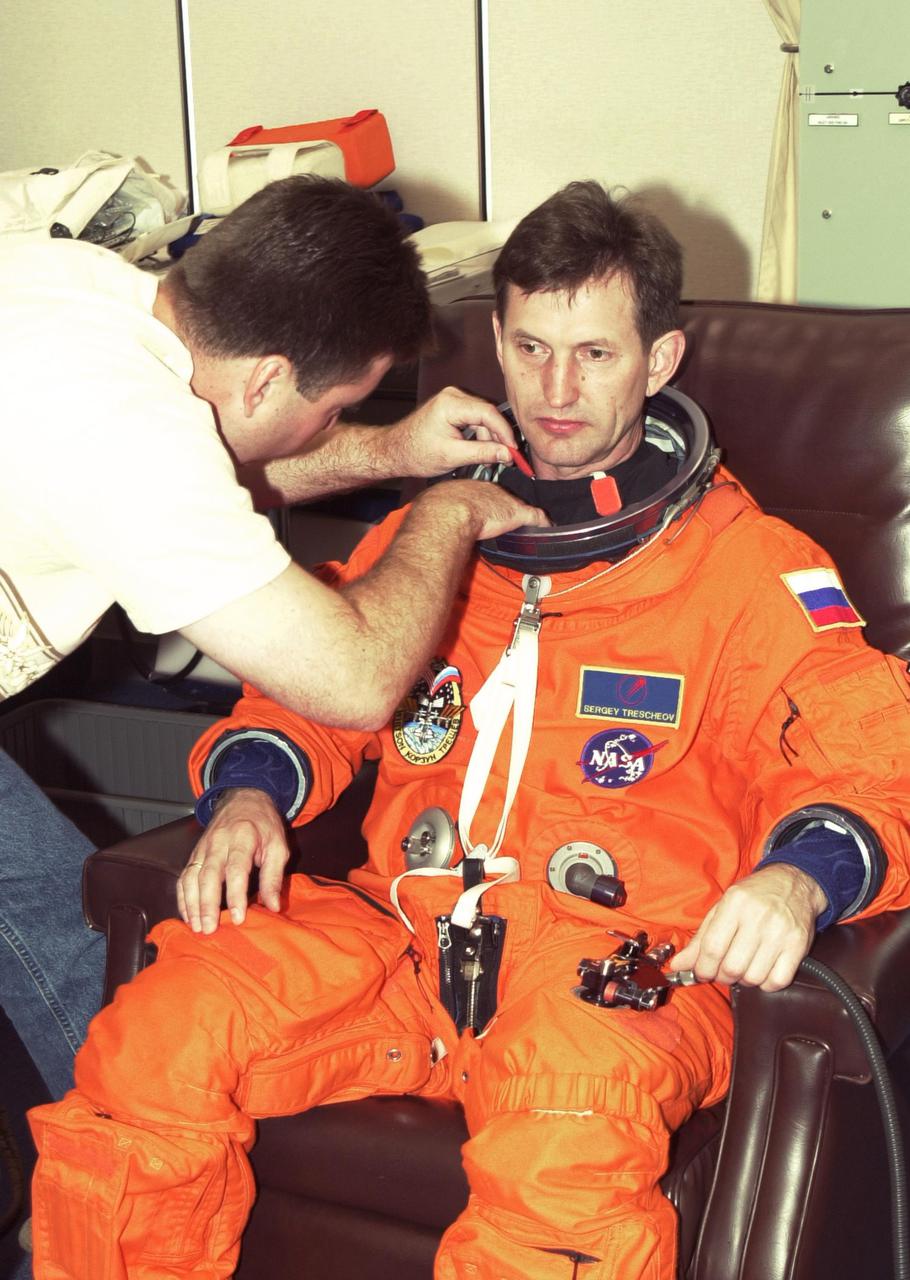
KENNEDY SPACE CENTER, FLA. -- Expedition 5 crew member Sergei Treschev, with the Russian Space Agency, undergoes a suit check as part of Terminal Countdown Demonstration Test activities at KSC. The TCDT includes emergency egress training at the pad and a simulated launch countdown. Expedition 5 will travel to the International Space Station on mission STS-111 as the replacement crew for Expedition 4, who will return to Earth aboard Endeavour. Known as Utilization Flight -2, the mission includes attaching a Canadian-built mobile base system to the International Space Station that will enable the Canadarm2 robotic arm to move along a railway on the Station's truss to build and maintain the outpost. The crew will also replace a faulty wrist_roll joint on the Canadarm2 as well as unload almost three tons of experiments and supplies from the Italian-built Multi-Purpose Logistics Module Leonardo. Launch of Space Shuttle Endeavour on mission STS-111 is scheduled for May 30, 2002
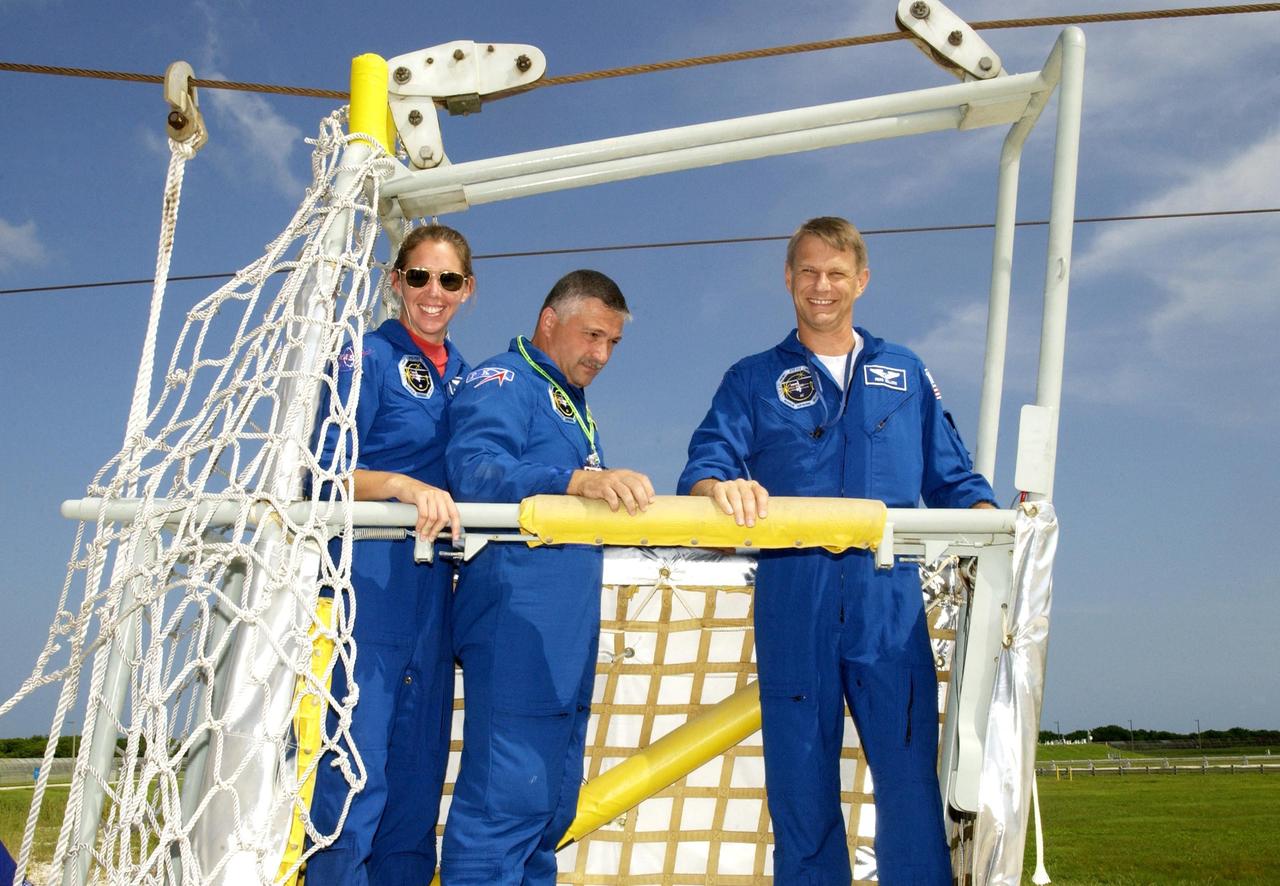
KENNEDY SPACE CENTER, FLA. -- Members of the STS-112 crew stand inside a slidewire basket, a component of the emergency egress system at the pad. From left are Mission Specialists Sandra Magnus, Fyodor Yurchikhin (with the Russian Space Agency), and Piers Sellers. The training is part of Terminal Countdown Demonstration Test activities, which include a simulated launch countdown. Mission STS-112 aboard Space Shuttle Atlantis is scheduled to launch no earlier than Oct. 2, between 2 and 6 p.m. EDT. STS-112 is the 15th assembly mission to the International Space Station. Atlantis will be carrying the S1 Integrated Truss Structure, the first starboard truss segment, to be attached to the central truss segment, S0, and the Crew and Equipment Translation Aid (CETA) Cart A. The CETA is the first of two human-powered carts that will ride along the ISS railway, providing mobile work platforms for future spacewalking astronauts.
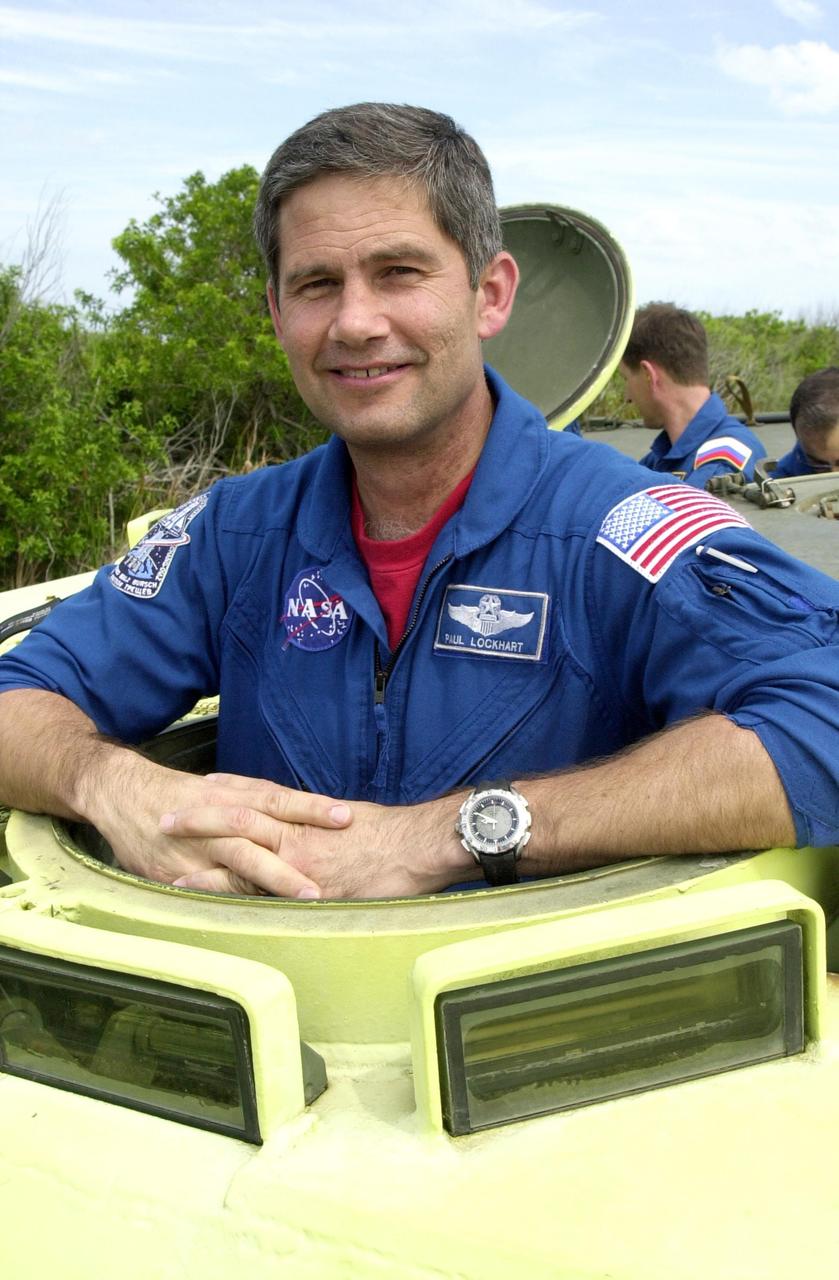
KENNEDY SPACE CENTER, FLA. -- STS-111 Pilot Paul Lockhart poses for the camera before taking his turn at driving the M-113 armored personnel carrier during emergency egress training at the pad. The training is part of Terminal Countdown Demonstration Test activities at KSC. The TCDT also includes a simulated launch countdown. Known as Utilization Flight -2, the mission includes attaching a Canadian-built mobile base system to the International Space Station that will enable the Canadarm2 robotic arm to move along a railway on the Station's truss to build and maintain the outpost. The crew will also replace a faulty wrist/roll joint on the Canadarm2 as well as unload almost three tons of experiments and supplies from the Italian-built Multi-Purpose Logistics Module Leonardo. Launch of Space Shuttle Endeavour on mission STS-111 is scheduled for May 30, 2002
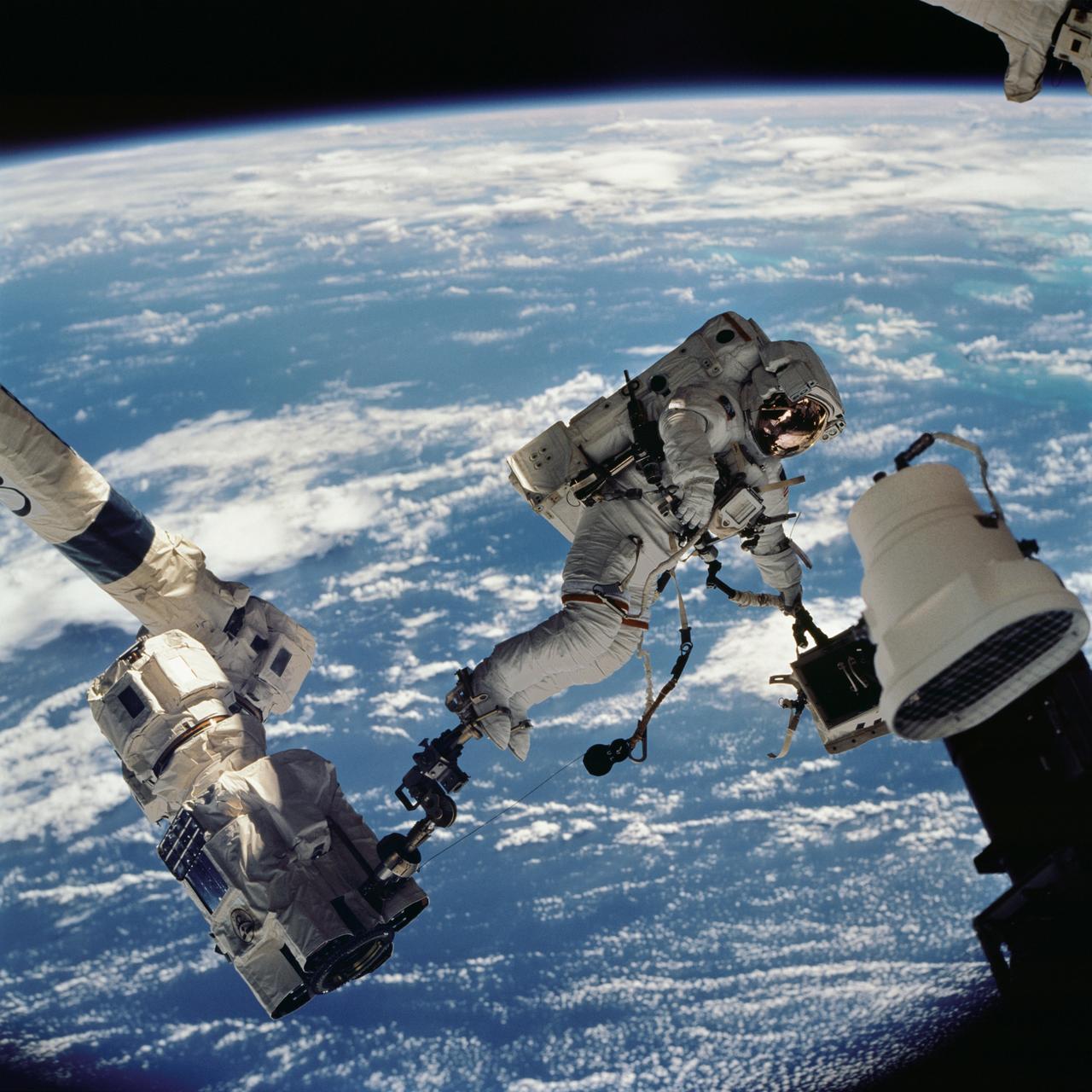
Anchored to a foot restraint on the Space Station Remote Manipulator System (SSRMS) or Canadarm2, astronaut David A. Wolf, STS-112 mission specialist, participates in the mission's first session of extravehicular activity (EVA). Wolf is carrying the Starboard One (S1) outboard nadir external camera which was installed on the end of the S1 Truss on the International Space Station (ISS). Launched October 7, 2002 aboard the Space Shuttle Orbiter Atlantis, the STS-112 mission lasted 11 days and performed three EVAs. Its primary mission was to install the S1 Integrated Truss Structure and Equipment Translation Aid (CETA) Cart to the ISS. The S1 truss provides structural support for the orbiting research facility's radiator panels, which use ammonia to cool the Station's complex power system. The S1 truss, attached to the S0 (S Zero) truss installed by the previous STS-110 mission, flows 637 pounds of anhydrous ammonia through three heat rejection radiators. The truss is 45-feet long, 15-feet wide, 10-feet tall, and weighs approximately 32,000 pounds. The CETA is the first of two human-powered carts that will ride along the International Space Station's railway providing a mobile work platform for future extravehicular activities by astronauts.
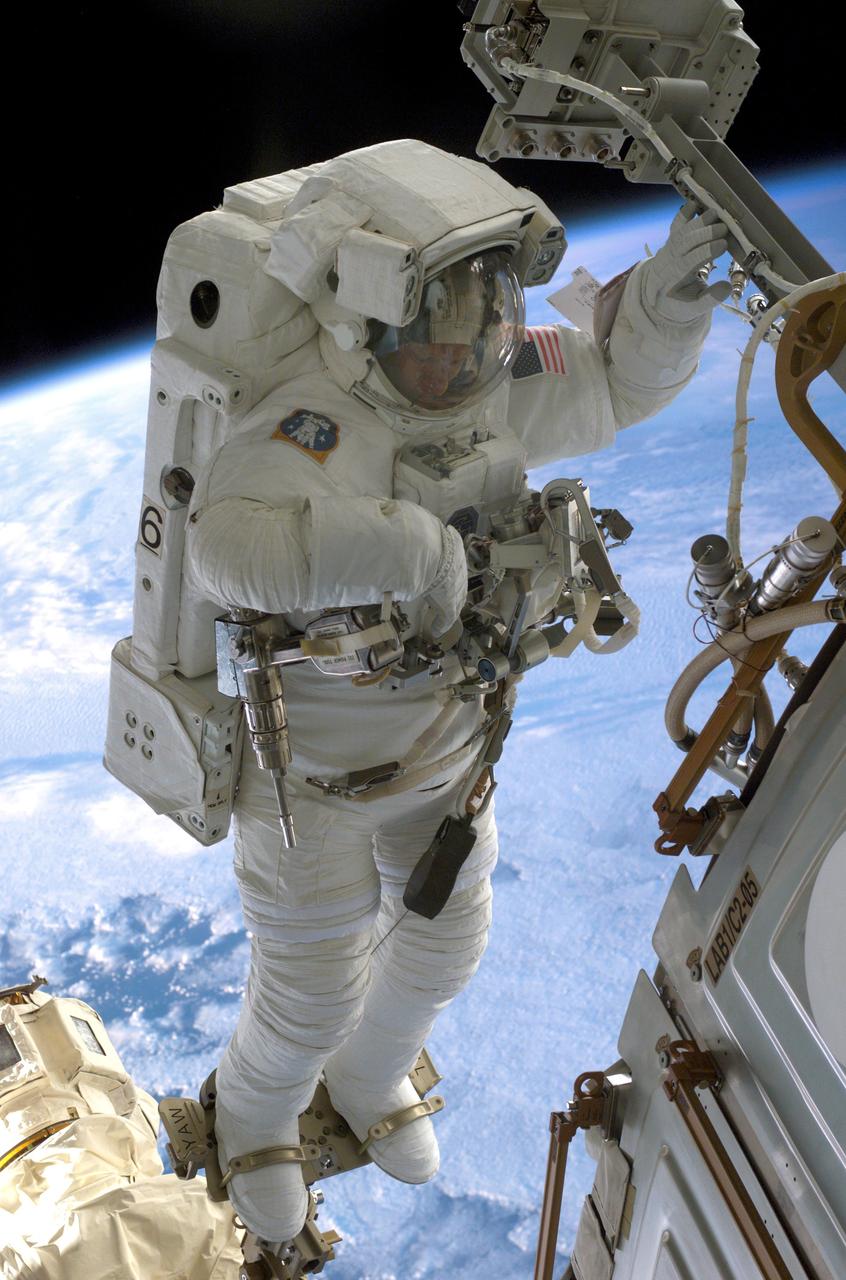
Launched October 7, 2002 aboard the Space Shuttle Orbiter Atlantis, the STS-112 mission lasted 11 days and performed three sessions of Extra Vehicular Activity (EVA). Its primary mission was to install the Starboard Side Integrated Truss Structure (S1) and Equipment Translation Aid (CETA) Cart to the International Space Station (ISS). The S1 truss provides structural support for the orbiting research facility's radiator panels, which use ammonia to cool the Station's complex power system. The S1 truss, attached to the S0 (S Zero) truss installed by the previous STS-110 mission, flows 637 pounds of anhydrous ammonia through three heat rejection radiators. The truss is 45-feet long, 15-feet wide, 10-feet tall, and weighs approximately 32,000 pounds. The CETA is the first of two human-powered carts that will ride along the International Space Station's railway providing a mobile work platform for future extravehicular activities by astronauts. In this photograph, Astronaut Piers J. Sellers uses both a handrail on the Destiny Laboratory and a foot restraint on the Space Station Remote Manipulator System or Canadarm2 to remain stationary while performing work at the end of the STS-112 mission's second space walk. A cloud-covered Earth provides the backdrop for the scene.
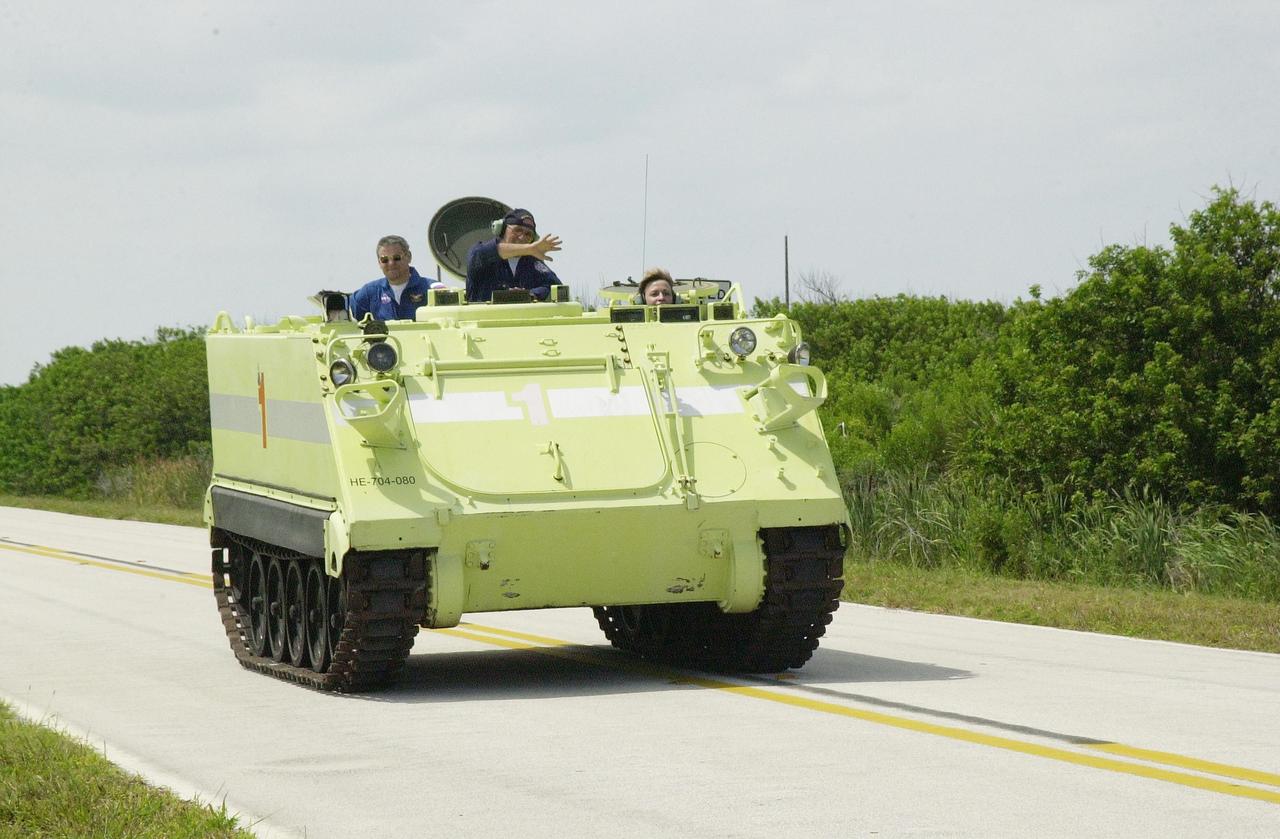
KENNEDY SPACE CENTER, FLA. -- During Terminal Countdown Demonstration Test activities at KSC, Expedition 5 member Peggy Whitson drives the M-113 armored personnel carrier, used for emergency egress training at the pad. Passengers in the vehicle are Expedition 5 Commander Valeri Korzun and George Hoggard (center), with the KSC/CCAS Fire Department, who supervises the driving. Expedition 5 will travel to the International Space Station on mission STS-111 as the replacement crew for Expedition 4, who will return to Earth aboard Endeavour. The TCDT also includes a simulated launch countdown Known as Utilization Flight -2, the mission includes attaching a Canadian-built mobile base system to the International Space Station that will enable the Canadarm2 robotic arm to move along a railway on the Station's truss to build and maintain the outpost. The crew will also replace a faulty wrist/roll joint on the Canadarm2 as well as unload almost three tons of experiments and supplies from the Italian-built Multi-Purpose Logistics Module Leonardo. Launch of Space Shuttle Endeavour on mission STS-111 is scheduled for May 30, 2002
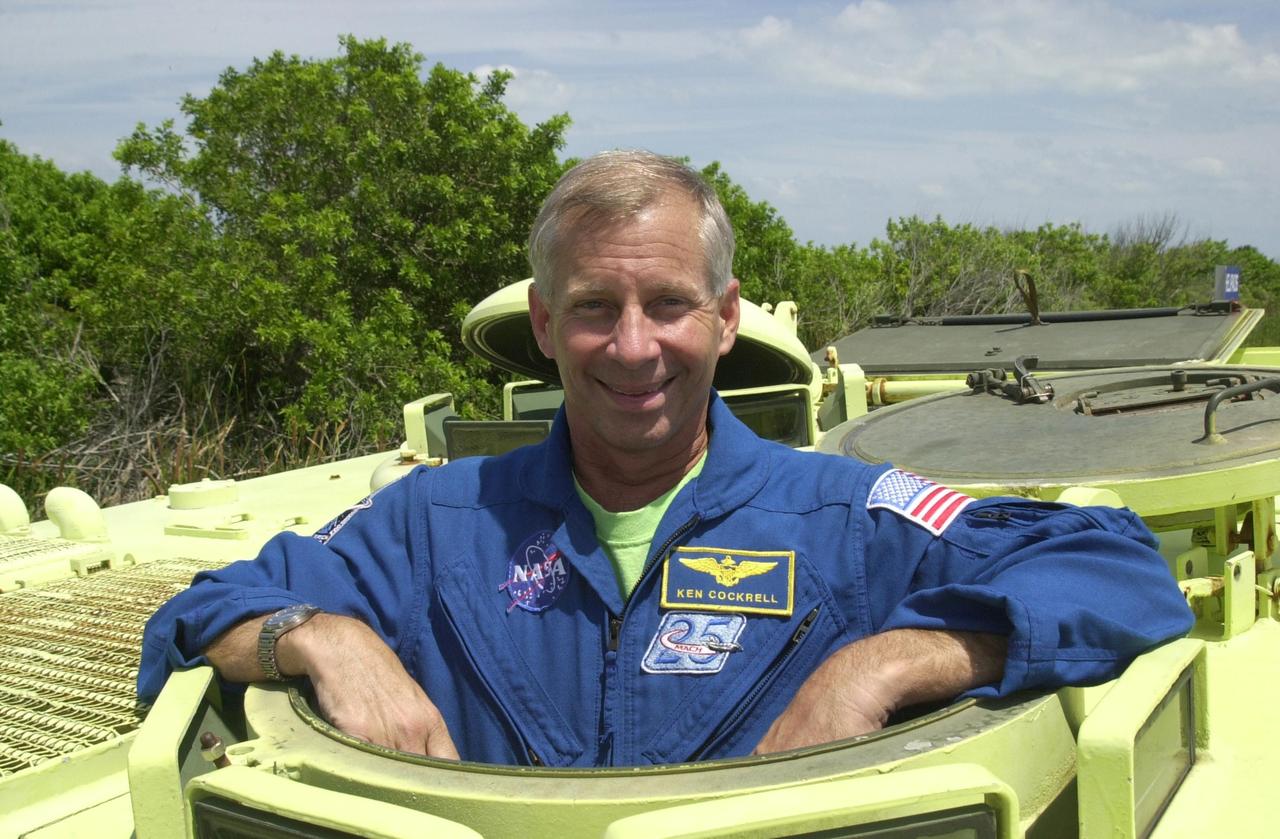
KENNEDY SPACE CENTER, FLA. - During Terminal Countdown Demonstration Test activities at KSC, STS-111 Commander Kenneth Cockrell poses for the camera before taking his turn driving the M-113 armored personnel carrier, part of emergency egress training at the pad. The TCDT includes emergency egress training at the pad and a simulated launch countdown Known as Utilization Flight -2, the mission includes attaching a Canadian-built mobile base system to the International Space Station that will enable the Canadarm2 robotic arm to move along a railway on the Station's truss to build and maintain the outpost. The crew will also replace a faulty wrist/roll joint on the Canadarm2 as well as unload almost three tons of experiments and supplies from the Italian-built Multi-Purpose Logistics Module Leonardo. . Expedition 5 will travel to the International Space Station on mission STS-111 as the replacement crew for Expedition 4, who will return to Earth aboard Endeavour. Launch of Space Shuttle Endeavour on mission STS-111 is scheduled for May 30, 2002
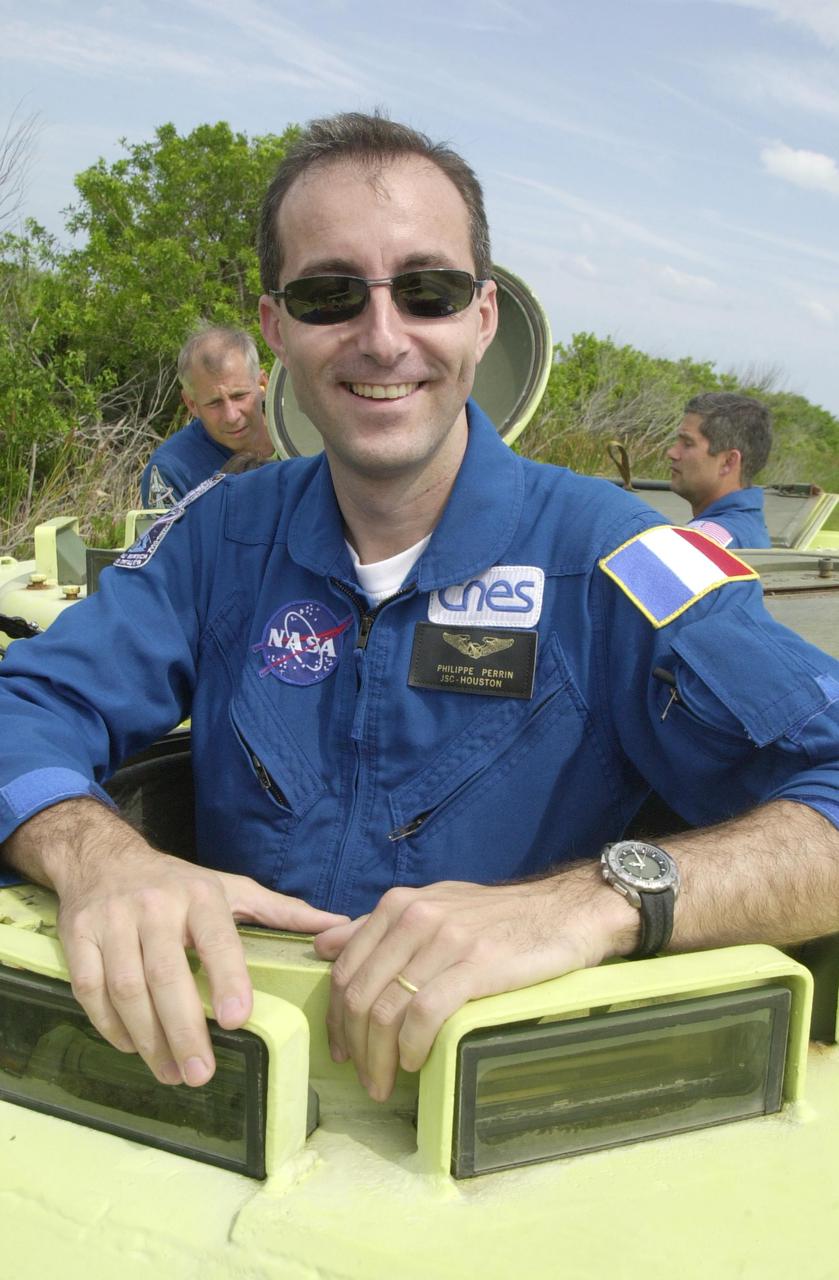
KENNEDY SPACE CENTER, FLA. -- STS-111 Mission Specialist Philippe Perrin, with the French Space Agency, poses for the camera before taking his turn at driving the M-113 armored personnel carrier during emergency egress training at the pad. Behind him are Commander Kenneth Cockrell (left) and Pilot Paul Lockhart (right). The training is part of Terminal Countdown Demonstration Test activities at KSC. The TCDT also includes a simulated launch countdown. Known as Utilization Flight -2, the mission includes attaching a Canadian-built mobile base system to the International Space Station that will enable the Canadarm2 robotic arm to move along a railway on the Station's truss to build and maintain the outpost. The crew will also replace a faulty wrist_roll joint on the Canadarm2 as well as unload almost three tons of experiments and supplies from the Italian-built Multi-Purpose Logistics Module Leonardo. Launch of Space Shuttle Endeavour on mission STS-111 is scheduled for May 30, 2002
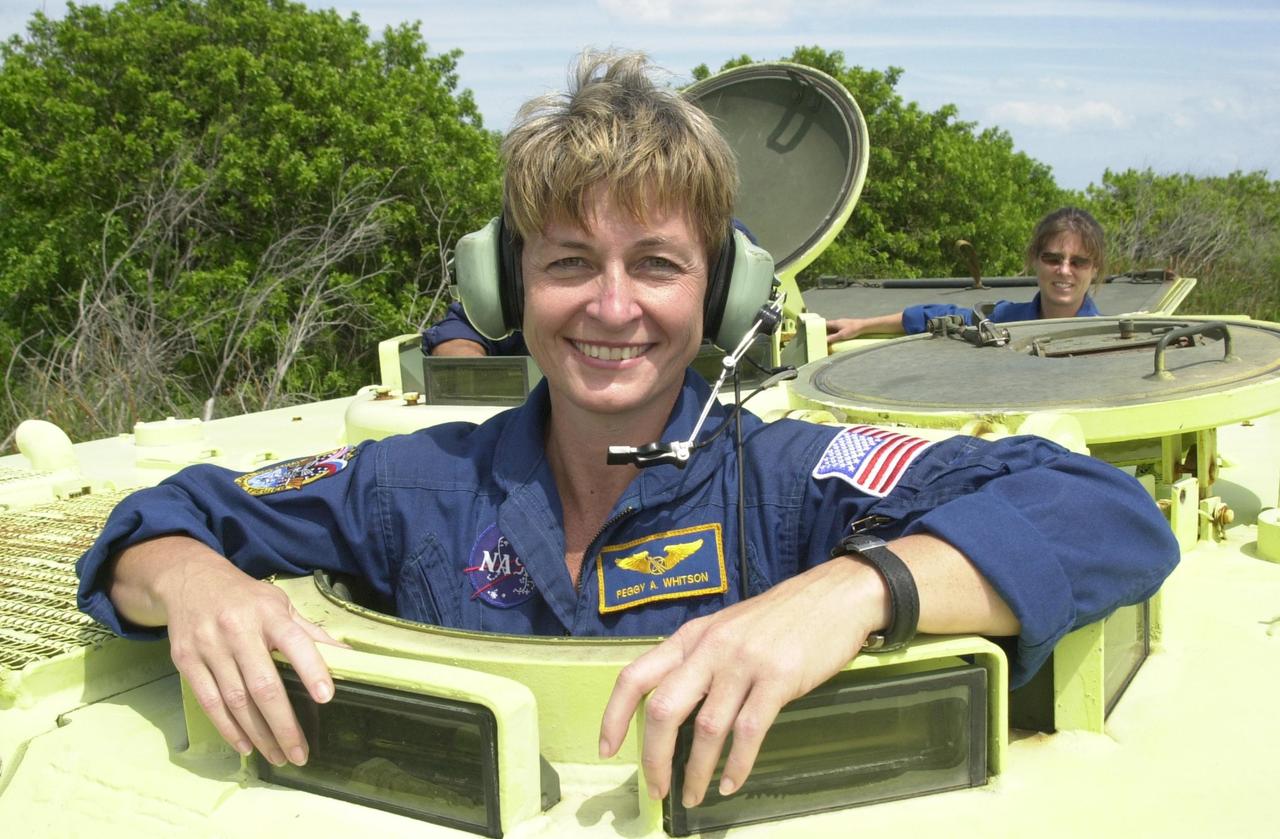
KENNEDY SPACE CENTER, FLA. -- During Terminal Countdown Demonstration Test activities at KSC, Expedition 5 member Peggy Whitson poses for the camera before climbing inside the M-113 armored personnel carrier, used for emergency egress training at the pad. Behind her (right) is astronaut Tracy Caldwell, a mission specialist candidate currently assigned to the Astronaut Office Space Station Operations Branch. Expedition 5 will travel to the International Space Station on mission STS-111 as the replacement crew for Expedition 4, who will return to Earth aboard Endeavour. The TCDT also includes a simulated launch countdown Known as Utilization Flight -2, the mission includes attaching a Canadian-built mobile base system to the International Space Station that will enable the Canadarm2 robotic arm to move along a railway on the Station's truss to build and maintain the outpost. The crew will also replace a faulty wrist/roll joint on the Canadarm2 as well as unload almost three tons of experiments and supplies from the Italian-built Multi-Purpose Logistics Module Leonardo. Launch of Space Shuttle Endeavour on mission STS-111 is scheduled for May 30, 2002
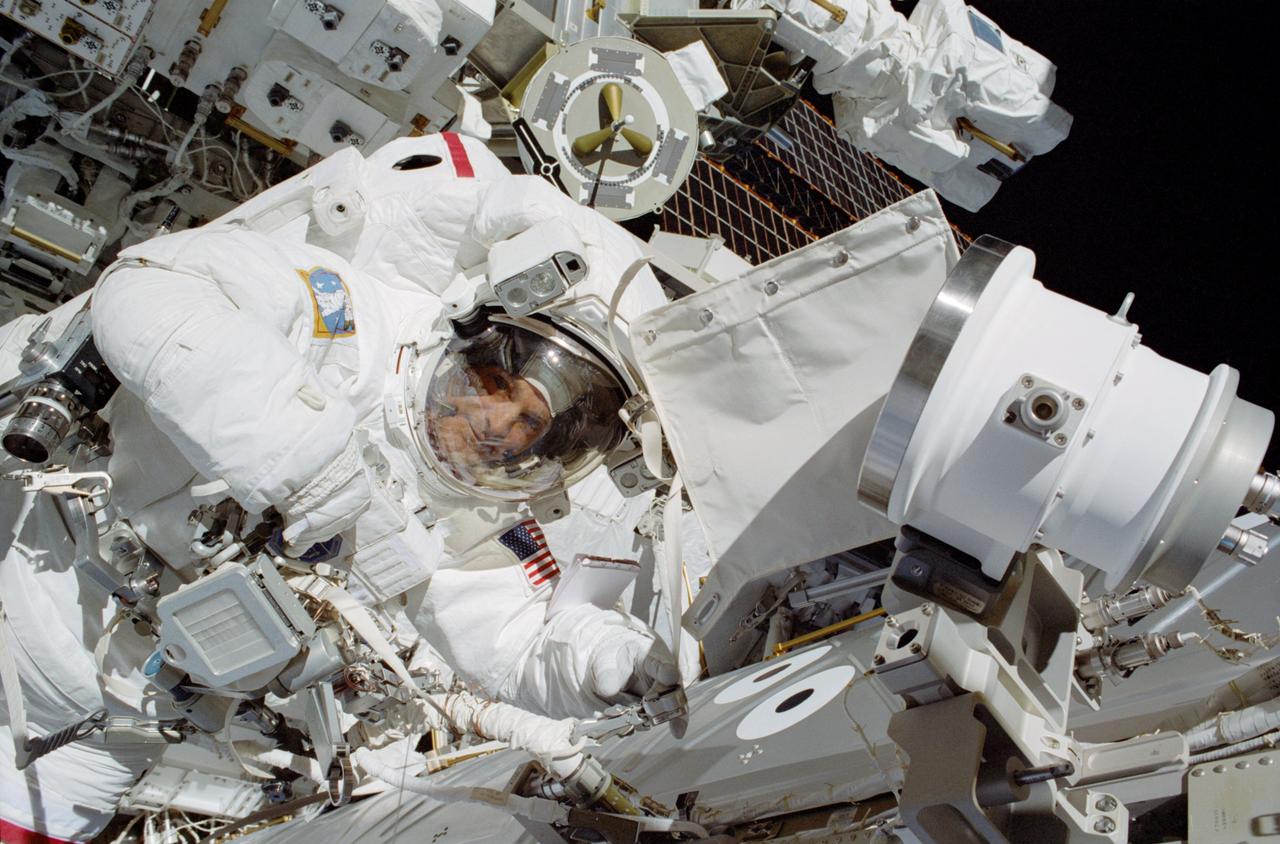
Astronaut David A. Wolf, STS-112 mission specialist, participates in the mission's second session of extravehicular activity (EVA), a six hour, four minute space walk, in which an exterior station television camera was installed outside of the Destiny Laboratory. Launched October 7, 2002 aboard the Space Shuttle Orbiter Atlantis, the STS-112 mission lasted 11 days and performed three EVA sessions. Its primary mission was to install the Starboard (S1) Integrated Truss Structure and Equipment Translation Aid (CETA) Cart to the International Space Station (ISS). The S1 truss provides structural support for the orbiting research facility's radiator panels, which use ammonia to cool the Station's complex power system. The S1 truss, attached to the S0 (S Zero) truss installed by the previous STS-110 mission, flows 637 pounds of anhydrous ammonia through three heat rejection radiators. The truss is 45-feet long, 15-feet wide, 10-feet tall, and weighs approximately 32,000 pounds. The CETA is the first of two human-powered carts that will ride along the International Space Station's railway providing a mobile work platform for future extravehicular activities by astronauts.
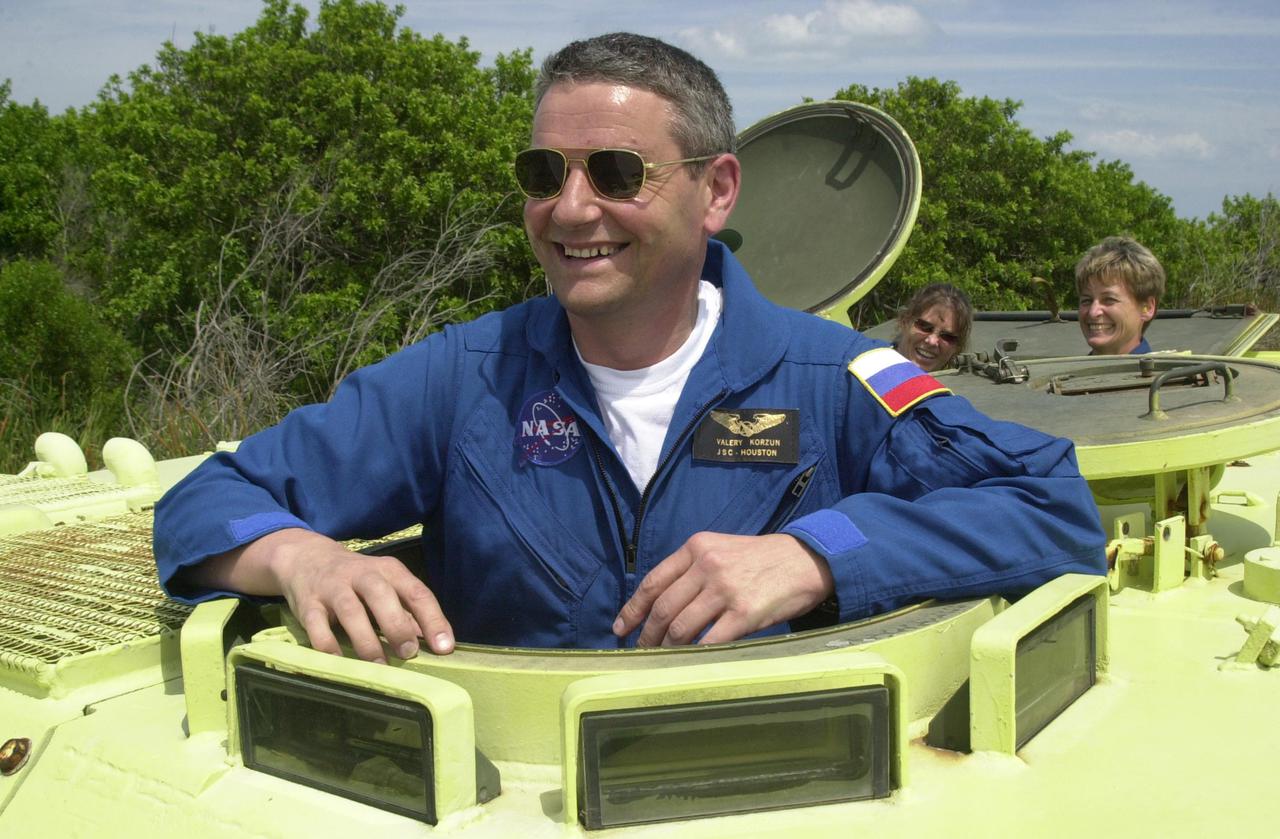
KENNEDY SPACE CENTER, FLA. - During Terminal Countdown Demonstration Test activities at KSC, Expedition 5 Commander Valeri Korzun smiles for a photo before climbing inside the M-113 armored personnel carrier, used for emergency egress training at the pad. Passengers in the vehicle are (left) astronaut Tracy Caldwell, a mission specialist candidate currently assigned to the Astronaut Office Space Station Operations Branch, and Expedition 5 member Peggy Whitson. Expedition 5 will travel to the International Space Station on mission STS-111 as the replacement crew for Expedition 4, who will return to Earth aboard Endeavour. The TCDT also includes a simulated launch countdown Known as Utilization Flight -2, the mission includes attaching a Canadian-built mobile base system to the International Space Station that will enable the Canadarm2 robotic arm to move along a railway on the Station's truss to build and maintain the outpost. The crew will also replace a faulty wrist_roll joint on the Canadarm2 as well as unload almost three tons of experiments and supplies from the Italian-built Multi-Purpose Logistics Module Leonardo. Launch of Space Shuttle Endeavour on mission STS-111 is scheduled for May 30, 2002
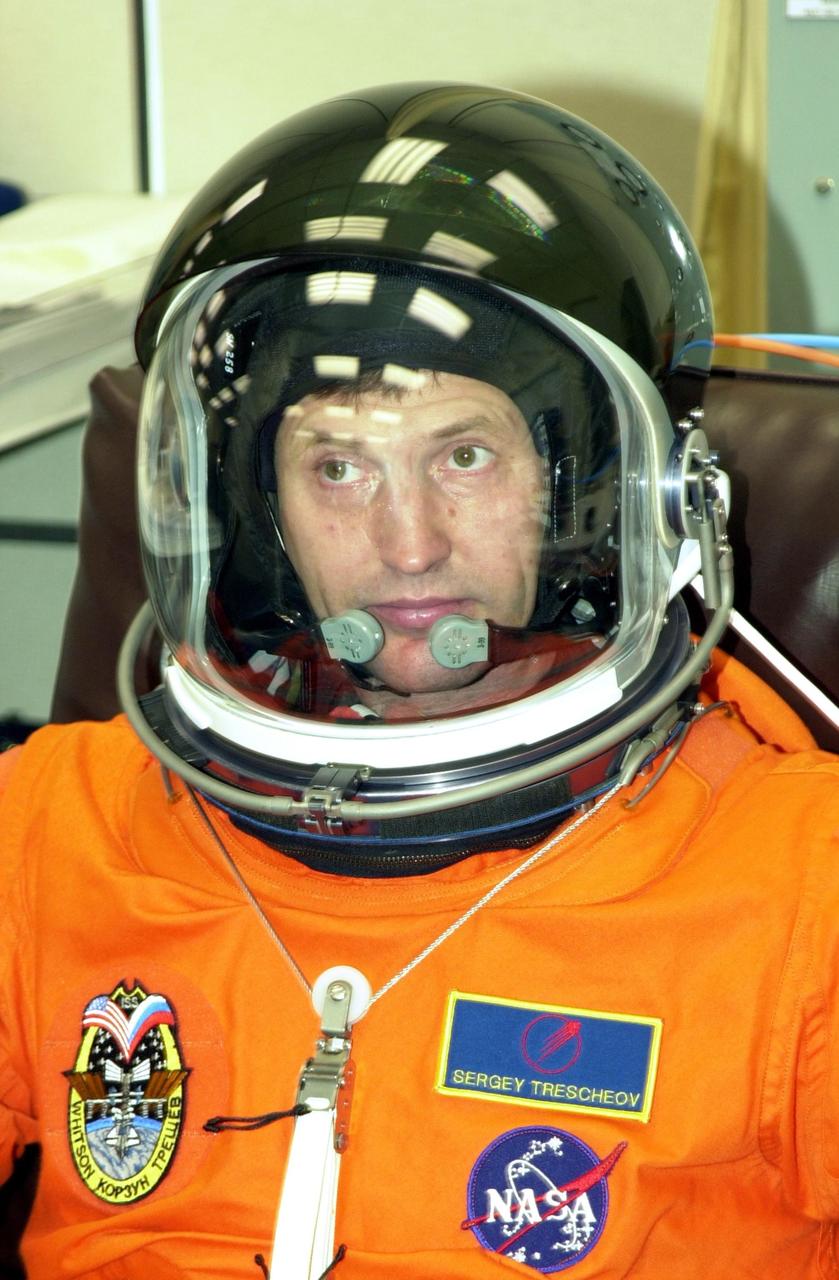
KENNEDY SPACE CENTER, FLA. -- Expedition 5 crew member Sergei Treschev, with the Russian Space Agency, wears the helmet with his launch and entry suit during suit check, part of Terminal Countdown Demonstration Test activities at KSC. The TCDT includes emergency egress training at the pad and a simulated launch countdown. Expedition 5 will travel to the International Space Station as the replacement crew for Expedition 4, who will return to Earth aboard Endeavour. Known as Utilization Flight -2, the mission includes attaching a Canadian-built mobile base system to the International Space Station that will enable the Canadarm2 robotic arm to move along a railway on the Station's truss to build and maintain the outpost. The crew will also replace a faulty wrist/roll joint on the Canadarm2 as well as unload almost three tons of experiments and supplies from the Italian-built Multi-Purpose Logistics Module Leonardo. Launch of Space Shuttle Endeavour on mission STS-111 is scheduled for May 30, 2002
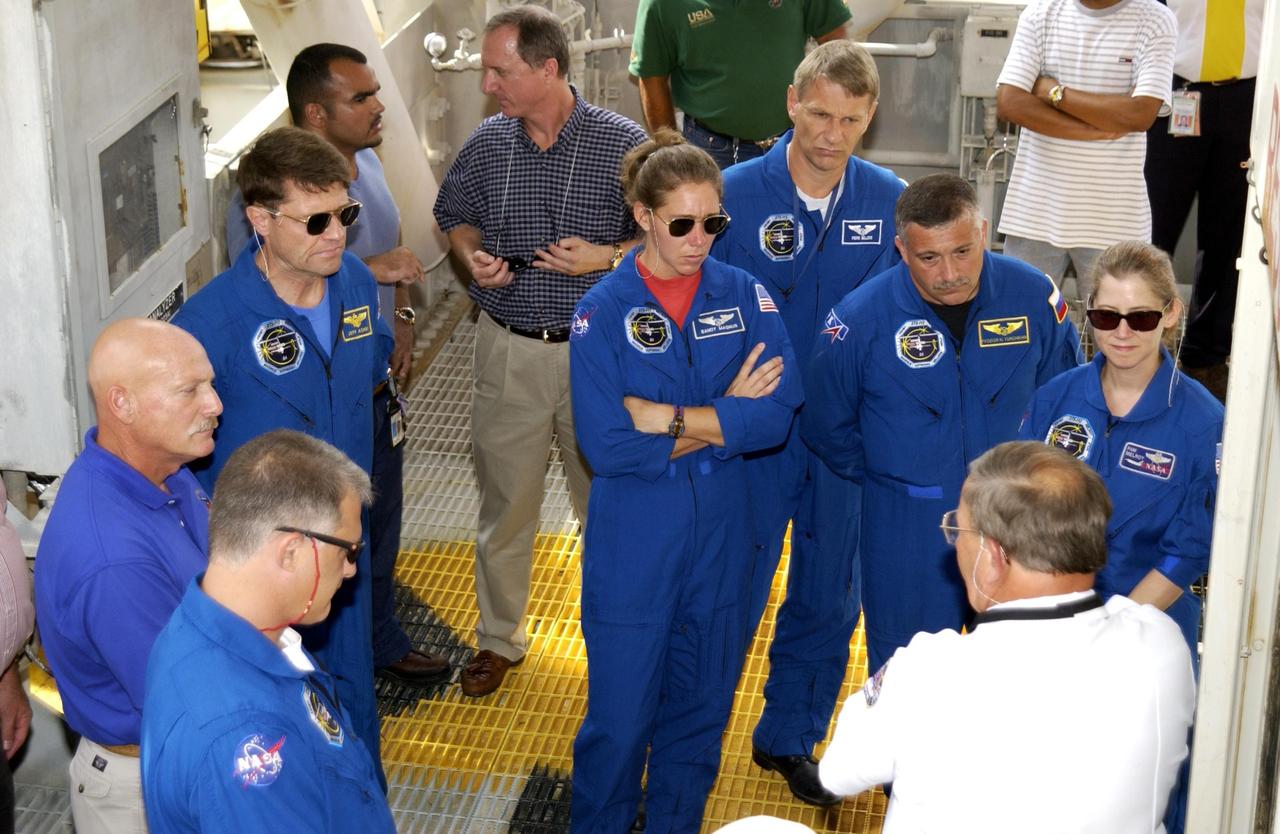
KENNEDY SPACE CENTER, FLA. -- During emergency egress training from the launch pad, the STS-112 crew listens to a trainer about use of the system. The crew members are, from left in the center, Commander Jeffrey Ashby, Mission Specialists Sandra Magnus, Piers Sellers and Fyodor Yurchikhin; and Pilot Pamela Melroy. In the foreground, left, is Mission Specialist David Wolf. Yurchikhin is with the Russian Space Agency. The training is part of Terminal Countdown Demonstration Test activities, which include a simulated launch countdown. Mission STS-112 aboard Space Shuttle Atlantis is scheduled to launch no earlier than Oct. 2, between 2 and 6 p.m. EDT. STS-112 is the 15th assembly mission to the International Space Station. Atlantis will be carrying the S1 Integrated Truss Structure, the first starboard truss segment, to be attached to the central truss segment, S0, and the Crew and Equipment Translation Aid (CETA) Cart A. The CETA is the first of two human-powered carts that will ride along the ISS railway, providing mobile work platforms for future spacewalking astronauts.
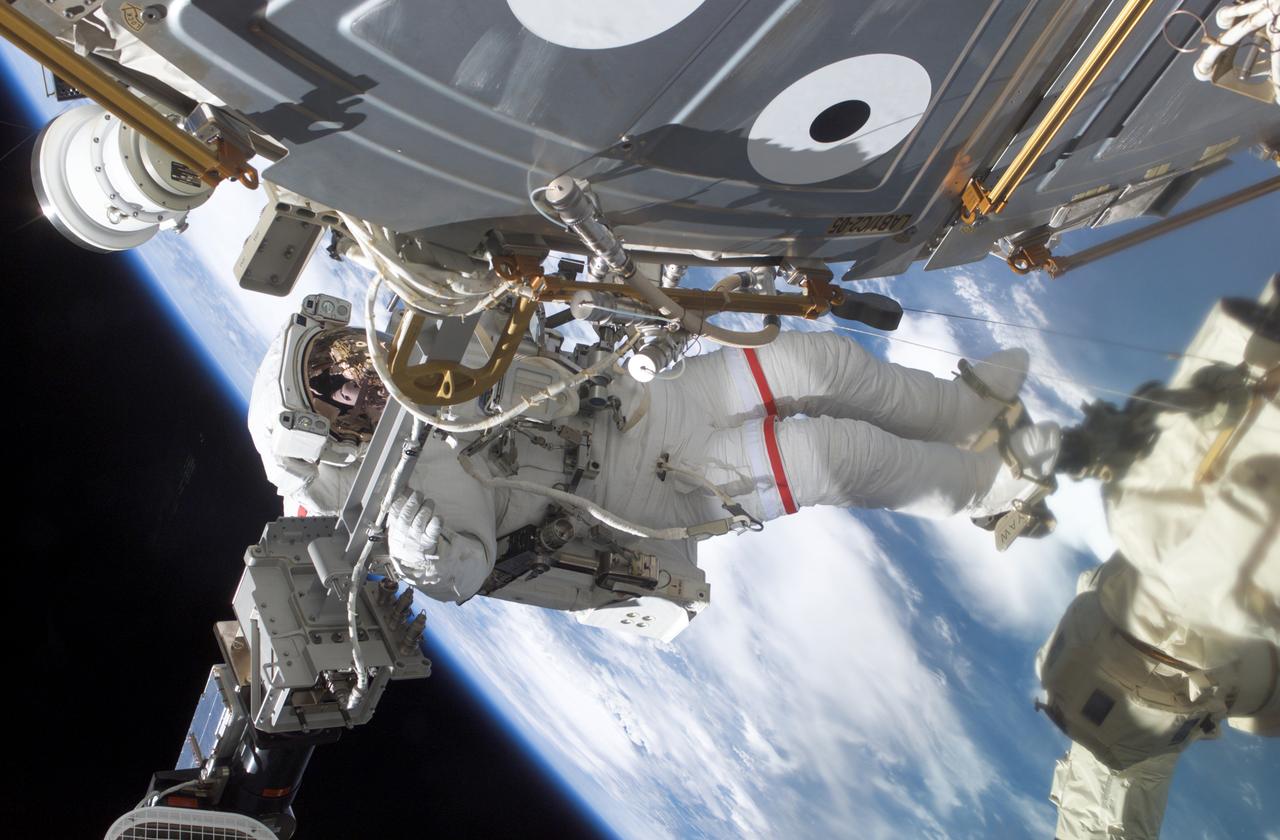
Astronaut David A. Wolf, STS-112 mission specialist, participates in the mission's second session of extravehicular activity (EVA), a six hour, four minute space walk, in which an exterior station television camera was installed outside of the Destiny Laboratory. Launched October 7, 2002 aboard the Space Shuttle Orbiter Atlantis, the STS-112 mission lasted 11 days and performed three EVA sessions. Its primary mission was to install the Starboard (S1) Integrated Truss Structure and Equipment Translation Aid (CETA) Cart to the International Space Station (ISS). The S1 truss provides structural support for the orbiting research facility's radiator panels, which use ammonia to cool the Station's complex power system. The S1 truss, attached to the S0 (S Zero) truss installed by the previous STS-110 mission, flows 637 pounds of anhydrous ammonia through three heat rejection radiators. The truss is 45-feet long, 15-feet wide, 10-feet tall, and weighs approximately 32,000 pounds. The CETA is the first of two human-powered carts that will ride along the International Space Station's railway providing a mobile work platform for future extravehicular activities by astronauts.
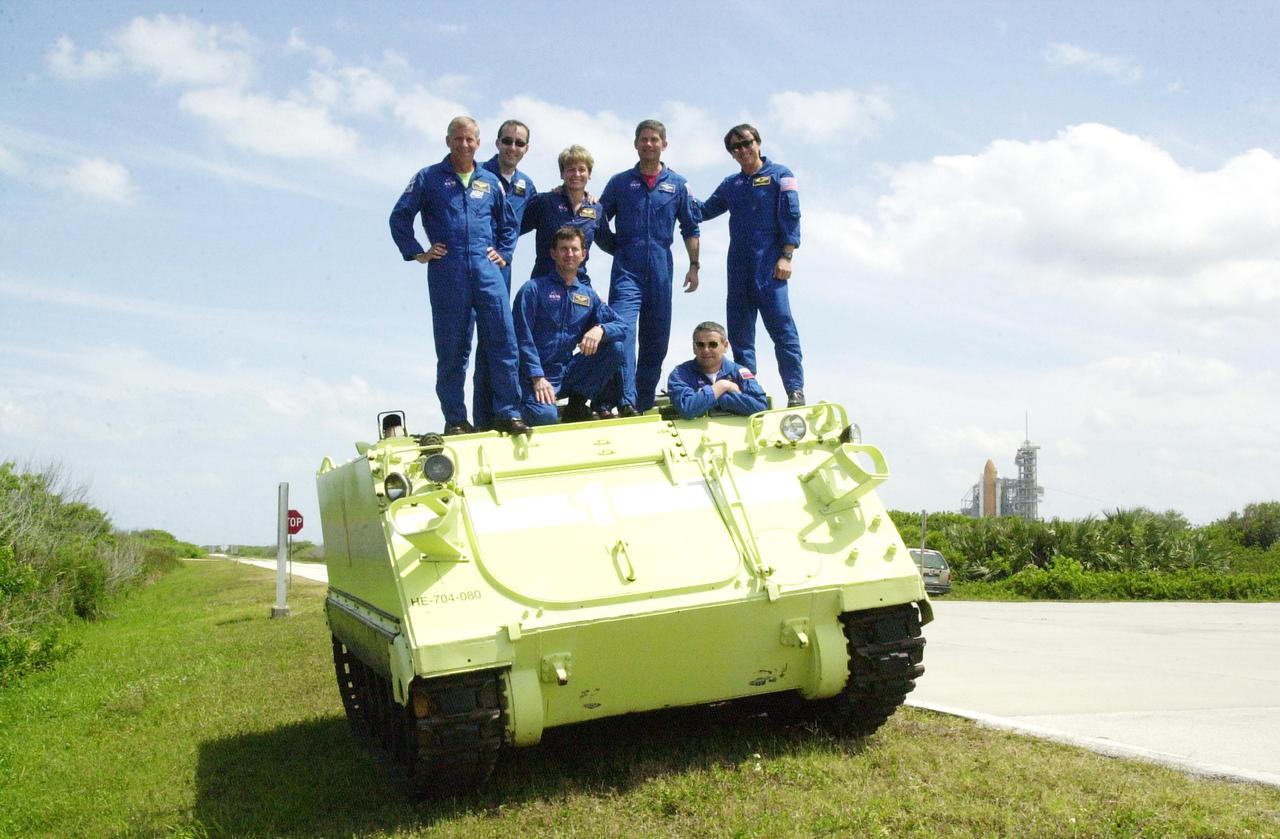
KENNEDY SPACE CENTER, FLA. - The STS-111 and Expedition 5 crews pose on top of the M-113 armored personnel carrier they practiced driving during emergency egress training at the pad. Standing, left to right, are Mission Commander Kenneth Cockrell, Mission Specialist Philippe Perrin, Expedition 5 member Peggy Whitson, Pilot Paul Lockhart and Mission Specialist Franklin Chang-Diaz; in front are Expedition 5 members Sergei Treschev (left) and Commander Valeri Korzun (right). The crews are taking part in Terminal Countdown Demonstration Test activities at KSC, which include a simulated launch countdown. Expedition 5 will travel to the International Space Station on mission STS-111 as the replacement crew for Expedition 4, who will return to Earth aboard Endeavour. Known as Utilization Flight -2, the mission includes attaching a Canadian-built mobile base system to the International Space Station that will enable the Canadarm2 robotic arm to move along a railway on the Station's truss to build and maintain the outpost. The crew will also replace a faulty wrist/roll joint on the Canadarm2 as well as unload almost three tons of experiments and supplies from the Italian-built Multi-Purpose Logistics Module Leonardo. Launch of Space Shuttle Endeavour on mission STS-111 is scheduled for May 30, 2002
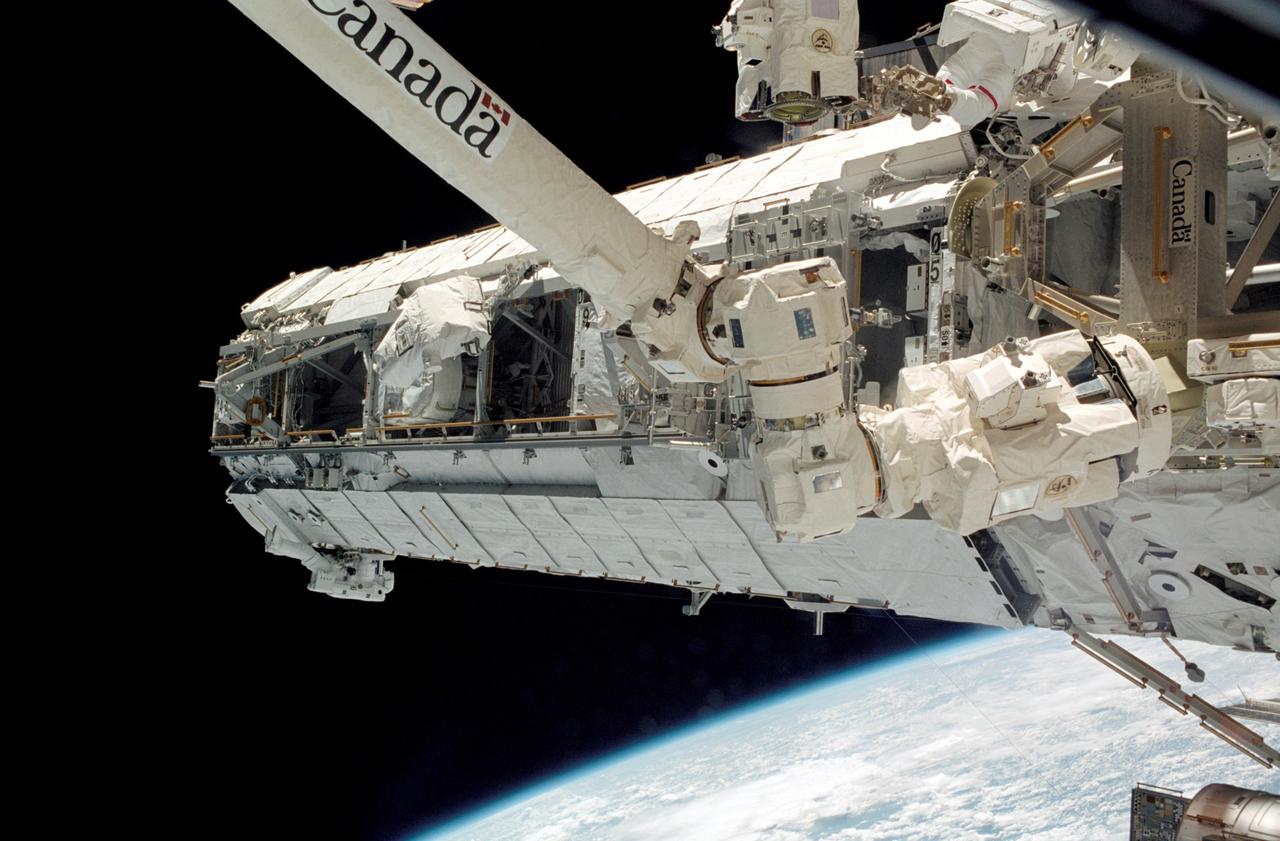
Launched October 7, 2002 aboard the Space Shuttle Orbiter Atlantis, the STS-112 mission lasted 11 days and performed three sessions of Extra Vehicular Activity (EVA). Its primary mission was to install the Starboard (S1) Integrated Truss Structure and Equipment Translation Aid (CETA) Cart to the International Space Station (ISS). The S1 truss provides structural support for the orbiting research facility's radiator panels, which use ammonia to cool the Station's complex power system. The S1 truss, attached to the S0 (S Zero) truss installed by the previous STS-110 mission, flows 637 pounds of anhydrous ammonia through three heat rejection radiators. The truss is 45-feet long, 15-feet wide, 10-feet tall, and weighs approximately 32,000 pounds. The CETA is the first of two human-powered carts that will ride along the International Space Station's railway providing a mobile work platform for future extravehicular activities by astronauts. This is a view of the newly installed S1 Truss as photographed during the mission's first scheduled EVA. The Station's Canadarm2 is in the foreground. Visible are astronauts Piers J. Sellers (lower left) and David A. Wolf (upper right), both STS-112 mission specialists.
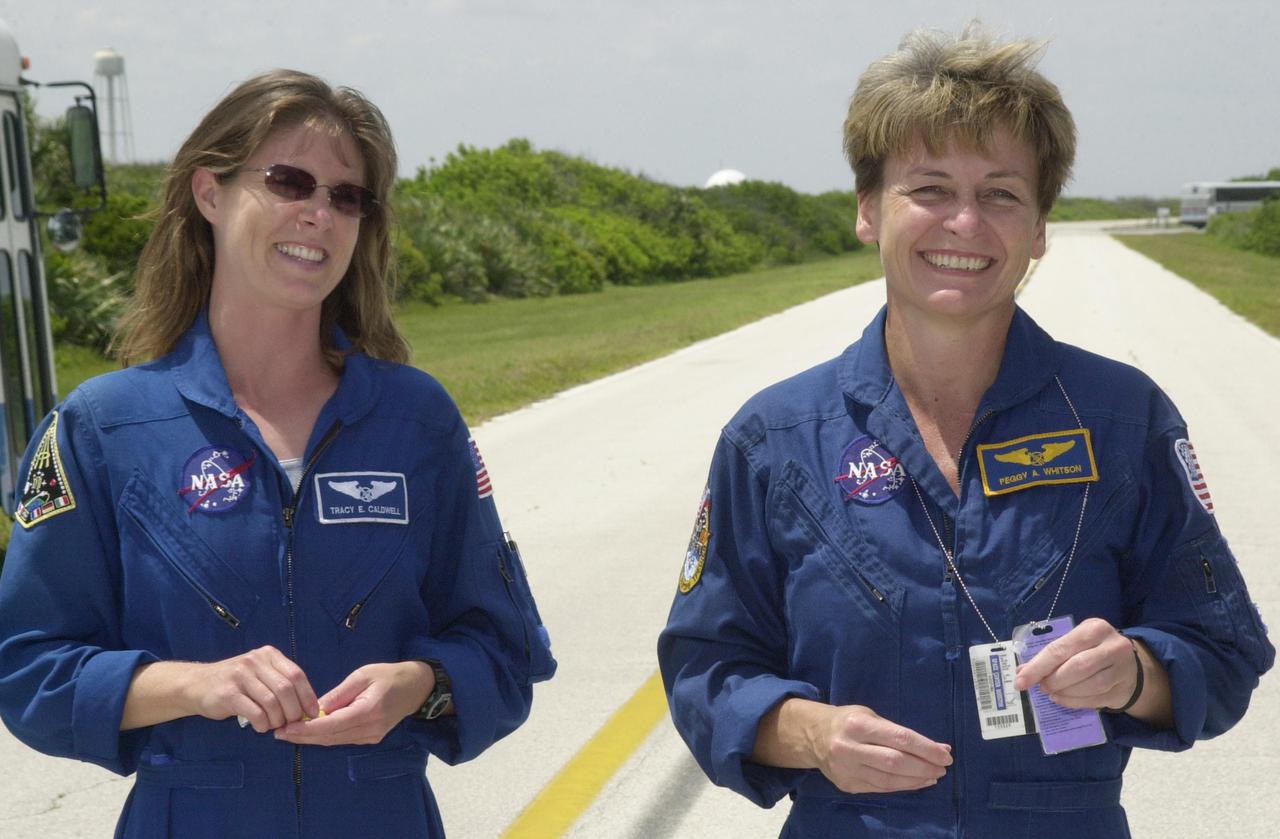
KENNEDY SPACE CENTER, FLA. -- Astronaut Tracy Caldwell (left), a mission specialist candidate currently assigned to the Astronaut Office Space Station Operations Branch, joins Expedition 5 crew member Peggy Whitson (right) during a break in Terminal Countdown Demonstration Test activities at KSC. The TCDT includes emergency egress training at the pad and a simulated launch countdown. Expedition 5 will travel to the International Space Station on mission STS-111 as the replacement crew for Expedition 4, who will return to Earth aboard Endeavour. Known as Utilization Flight -2, the mission includes attaching a Canadian-built mobile base system to the International Space Station that will enable the Canadarm2 robotic arm to move along a railway on the Station's truss to build and maintain the outpost. The crew will also replace a faulty wrist_roll joint on the Canadarm2 as well as unload almost three tons of experiments and supplies from the Italian-built Multi-Purpose Logistics Module Leonardo. Launch of Space Shuttle Endeavour on mission STS-111 is scheduled for May 30, 2002
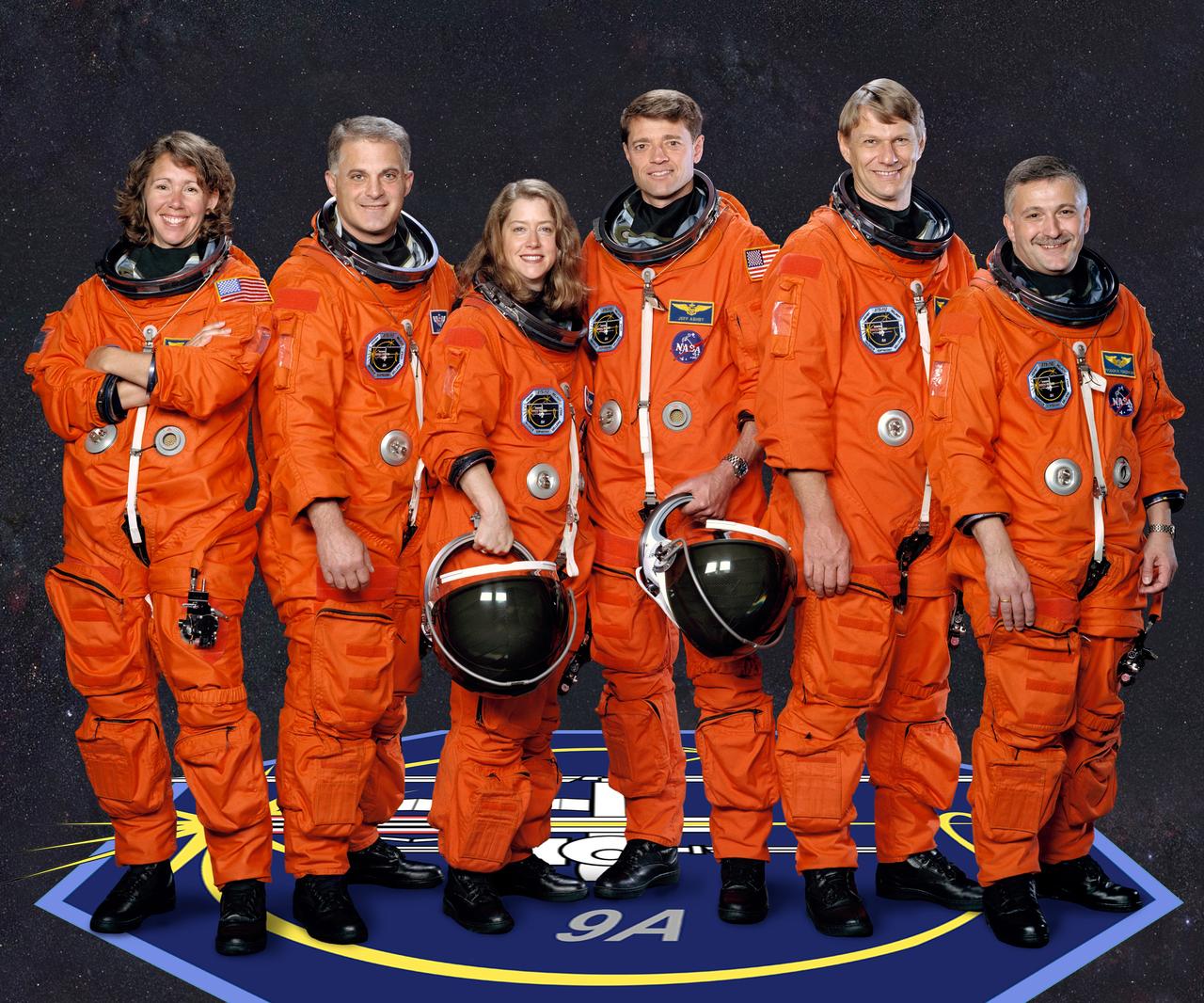
These 5 astronauts and cosmonaut, all members of the STS-112 mission, pose for a crew portrait. Pictured from left to right are: Astronauts Sandra H. Magnus, mission specialist; David A. Wolf, mission specialist; Pamela A. Melroy, pilot; Jeffrey S. Ashby, commander; Piers J. Sellers, mission specialist; and cosmonaut Fyodor Yurchikhin, mission specialist representing Rosaviakosmos. STS-112 launched aboard the Space Shuttle Atlantis October 7, 2002 for an 11-day mission completing three sessions of Extra Vehicular Activity(EVA). Its primary mission was to install the Starboard (S1) Integrated Truss Structure and Equipment Translation Aid (CETA) Cart to the ISS. The S1 truss provides structural support for the orbiting research facility's radiator panels, which use ammonia to cool the Station's complex power system. The S1 truss, attached to the S0 (S Zero) truss installed by the previous STS-110 mission, flows 637 pounds of anhydrous ammonia through three heat rejection radiators. The truss is 45-feet long, 15-feet wide, 10-feet tall, and weighs approximately 32,000 pounds. The CETA is the first of two human-powered carts that will ride along the railway on the ISS providing a mobile work platform for future extravehicular activities by astronauts.
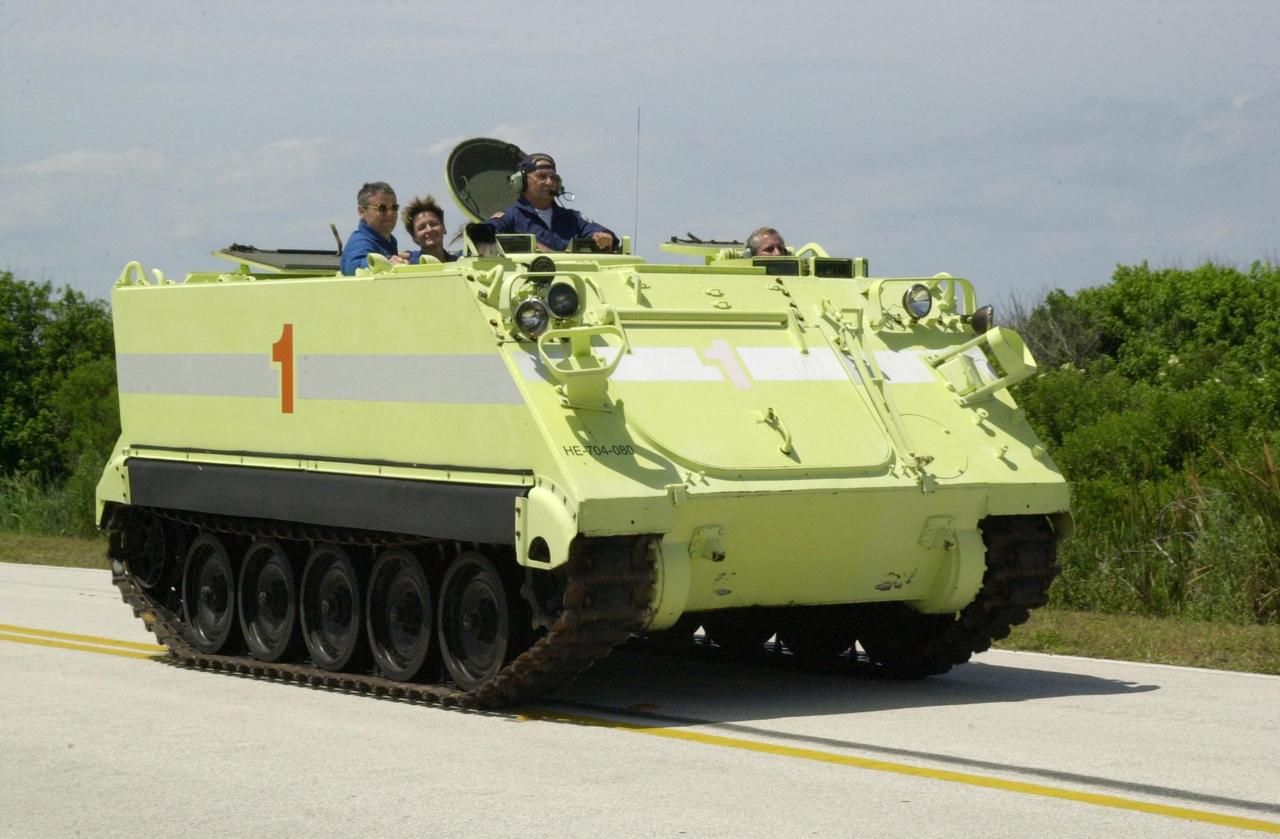
KENNEDY SPACE CENTER, FLA. - During Terminal Countdown Demonstration Test activities at KSC, STS-11 Commander Kenneth Cockrell practices driving the M-113 armored personnel carrier, part of emergency egress training at the pad. Supervising in front (left) is George Hoggard, with the KSC/CCAS Fire Department, who supervises the driving. Passengers in the M-113 (behind Hoggard) are Expedition 5 crew members Valeri Korzun and Peggy Whitson. The TCDT also includes a simulated launch countdown Known as Utilization Flight -2, the mission includes attaching a Canadian-built mobile base system to the International Space Station that will enable the Canadarm2 robotic arm to move along a railway on the Station's truss to build and maintain the outpost. The crew will also replace a faulty wrist/roll joint on the Canadarm2 as well as unload almost three tons of experiments and supplies from the Italian-built Multi-Purpose Logistics Module Leonardo. . Expedition 5 will travel to the International Space Station on mission STS-111 as the replacement crew for Expedition 4, who will return to Earth aboard Endeavour. Launch of Space Shuttle Endeavour on mission STS-111 is scheduled for May 30, 2002
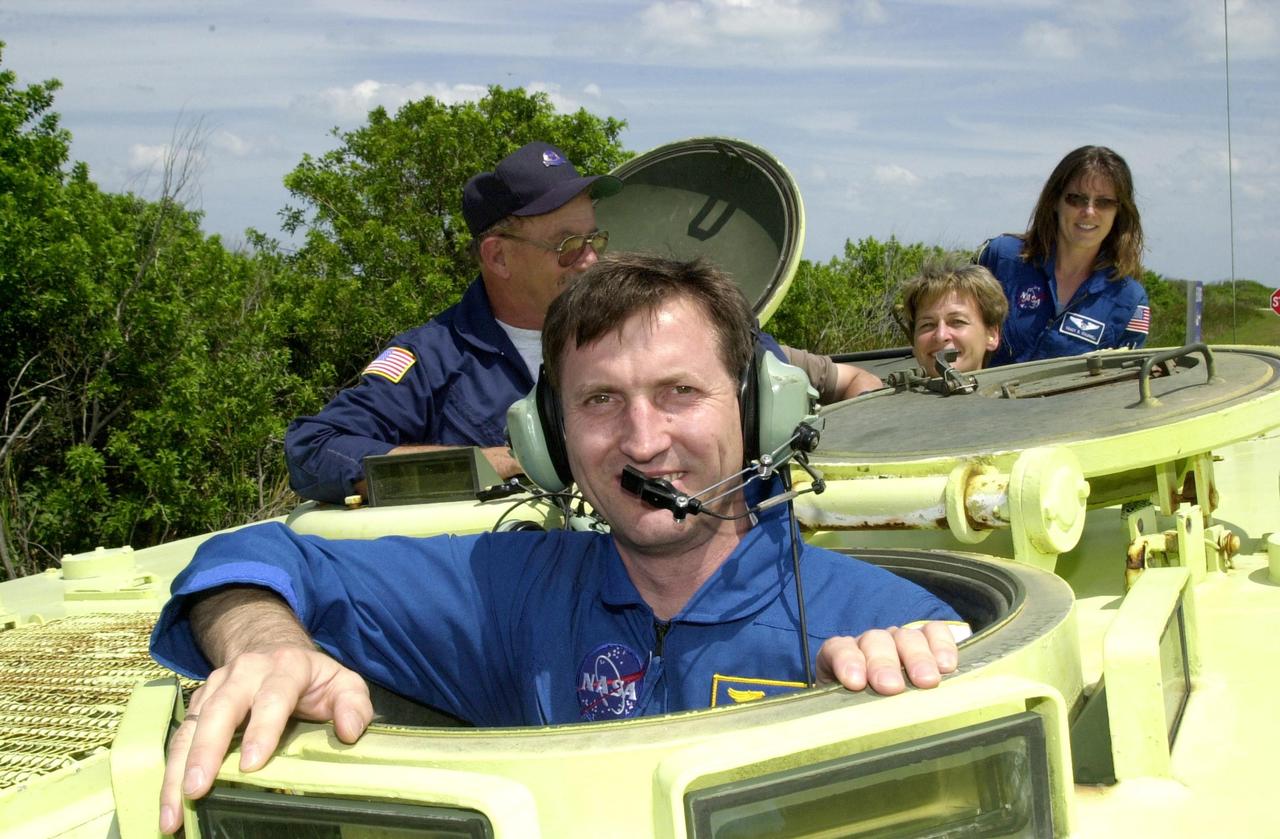
KENNEDY SPACE CENTER, FLA. -- During Terminal Countdown Demonstration Test activities at KSC, Expedition 5 crew member Sergei Treschev pauses before climbing inside the M-113 armored personnel carrier, used for emergency egress training at the pad. At left (behind Treschev) is George Hoggard, with the KSC/CCAS Fire Department, who supervises the driving. At right are Expedition 5 member Peggy Whitson and astronaut Tracy Caldwell (far right), a mission specialist candidate currently assigned to the Astronaut Office Space Station Operations Branch. The TCDT also includes a simulated launch countdown Known as Utilization Flight -2, the mission includes attaching a Canadian-built mobile base system to the International Space Station that will enable the Canadarm2 robotic arm to move along a railway on the Station's truss to build and maintain the outpost. The crew will also replace a faulty wrist/roll joint on the Canadarm2 as well as unload almost three tons of experiments and supplies from the Italian-built Multi-Purpose Logistics Module Leonardo. . Expedition 5 will travel to the International Space Station on mission STS-111 as the replacement crew for Expedition 4, who will return to Earth aboard Endeavour. Launch of Space Shuttle Endeavour on mission STS-111 is scheduled for May 30, 2002
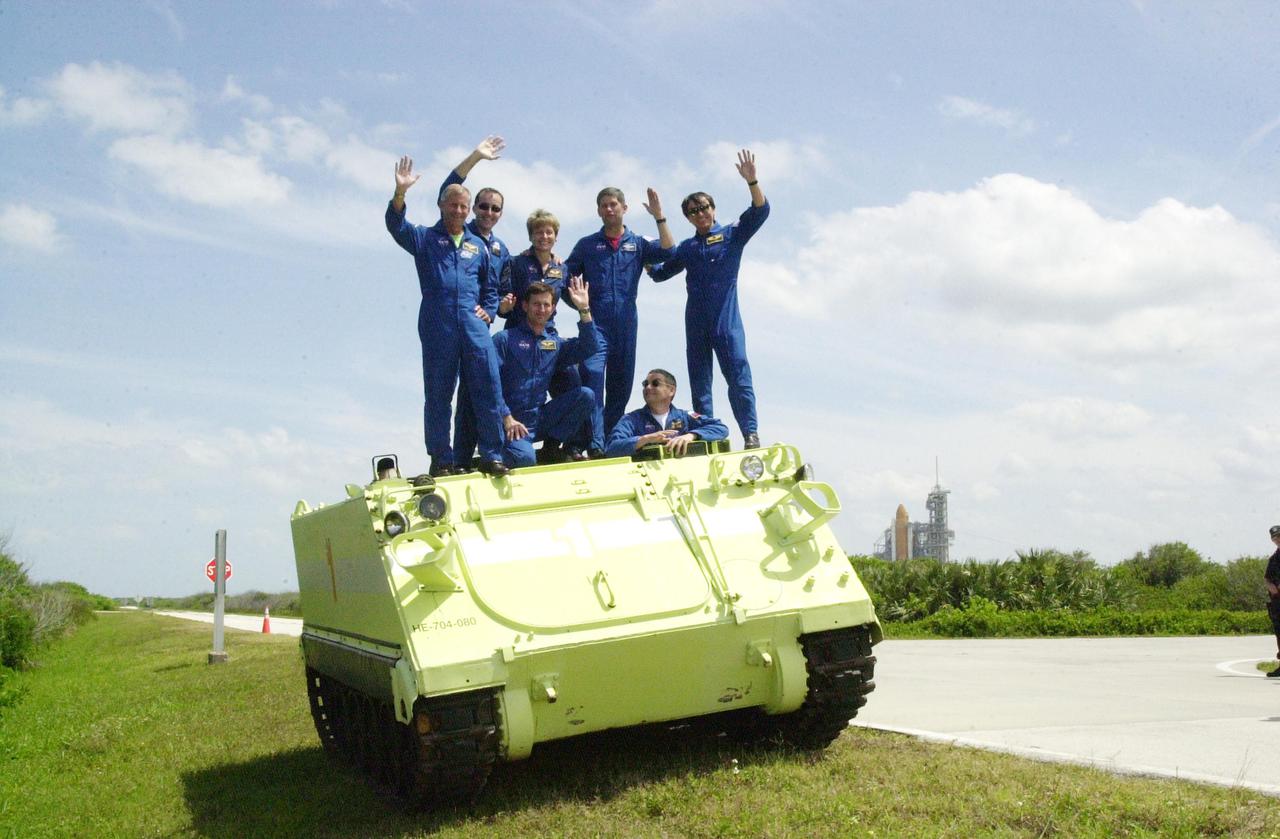
KENNEDY SPACE CENTER, FLA. -- Gathered on top of the M-113 armored personnel carrier they practiced driving during emergency egress training at the pad , the STS-11 and Expedition 5 crews wave at the camera. Standing, left to right, are Mission Commander Kenneth Cockrell, Mission Specialist Philippe Perrin, Expedition 5 member Peggy Whitson, Pilot Paul Lockhart and Mission Specialist Franklin Chang-Diaz; in front are Expedition 5 members Sergei Treschev (left) and Commander Valeri Korzun (right). The crews are taking part in Terminal Countdown Demonstration Test activities at KSC, which include a simulated launch countdown. Expedition 5 will travel to the International Space Station on mission STS-111 as the replacement crew for Expedition 4, who will return to Earth aboard Endeavour. Known as Utilization Flight -2, the mission includes attaching a Canadian-built mobile base system to the International Space Station that will enable the Canadarm2 robotic arm to move along a railway on the Station's truss to build and maintain the outpost. The crew will also replace a faulty wrist_roll joint on the Canadarm2 as well as unload almost three tons of experiments and supplies from the Italian-built Multi-Purpose Logistics Module Leonardo. Launch of Space Shuttle Endeavour on mission STS-111 is scheduled for May 30, 2002
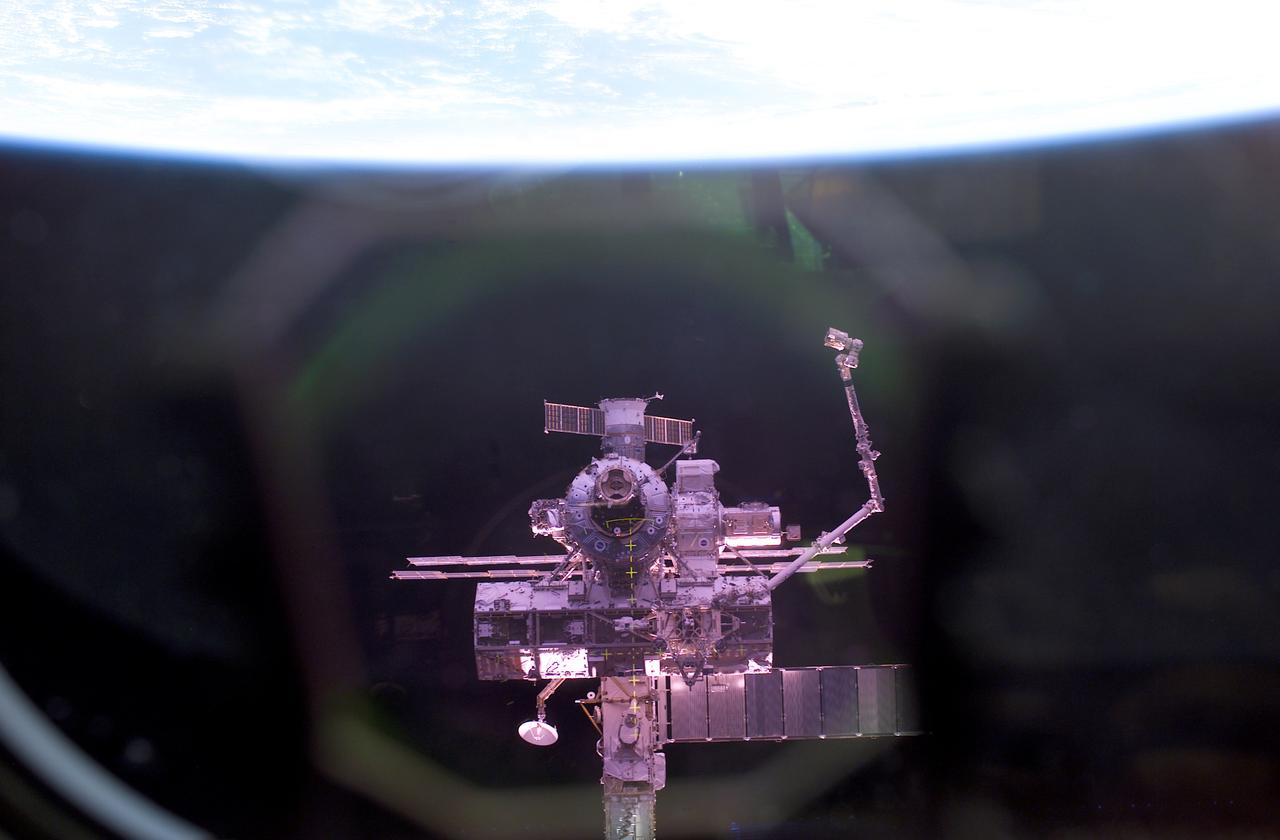
This view of the International Space Station (ISS) was photographed by an STS-112 crew member aboard the Space Shuttle Atlantis during rendezvous and docking operations. Launched October 7, 2002 aboard the Space Shuttle Orbiter Atlantis, the STS-112 mission lasted 11 days and performed three sessions of Extra Vehicular Activity (EVA). Its primary mission was to install the Starboard (S1) Integrated Truss Structure and Equipment Translation Aid (CETA) Cart to the ISS. The S1 truss provides structural support for the orbiting research facility's radiator panels, which use ammonia to cool the Station's complex power system. The S1 truss, attached to the S0 (S Zero) truss, installed by the previous STS-110 mission, flows 637 pounds of anhydrous ammonia through three heat rejection radiators. The truss is 45-feet long, 15-feet wide, 10-feet tall, and weighs approximately 32,000 pounds. The CETA is the first of two human-powered carts that will ride along the railway on the ISS providing a mobile work platform for future extravehicular activities by astronauts.