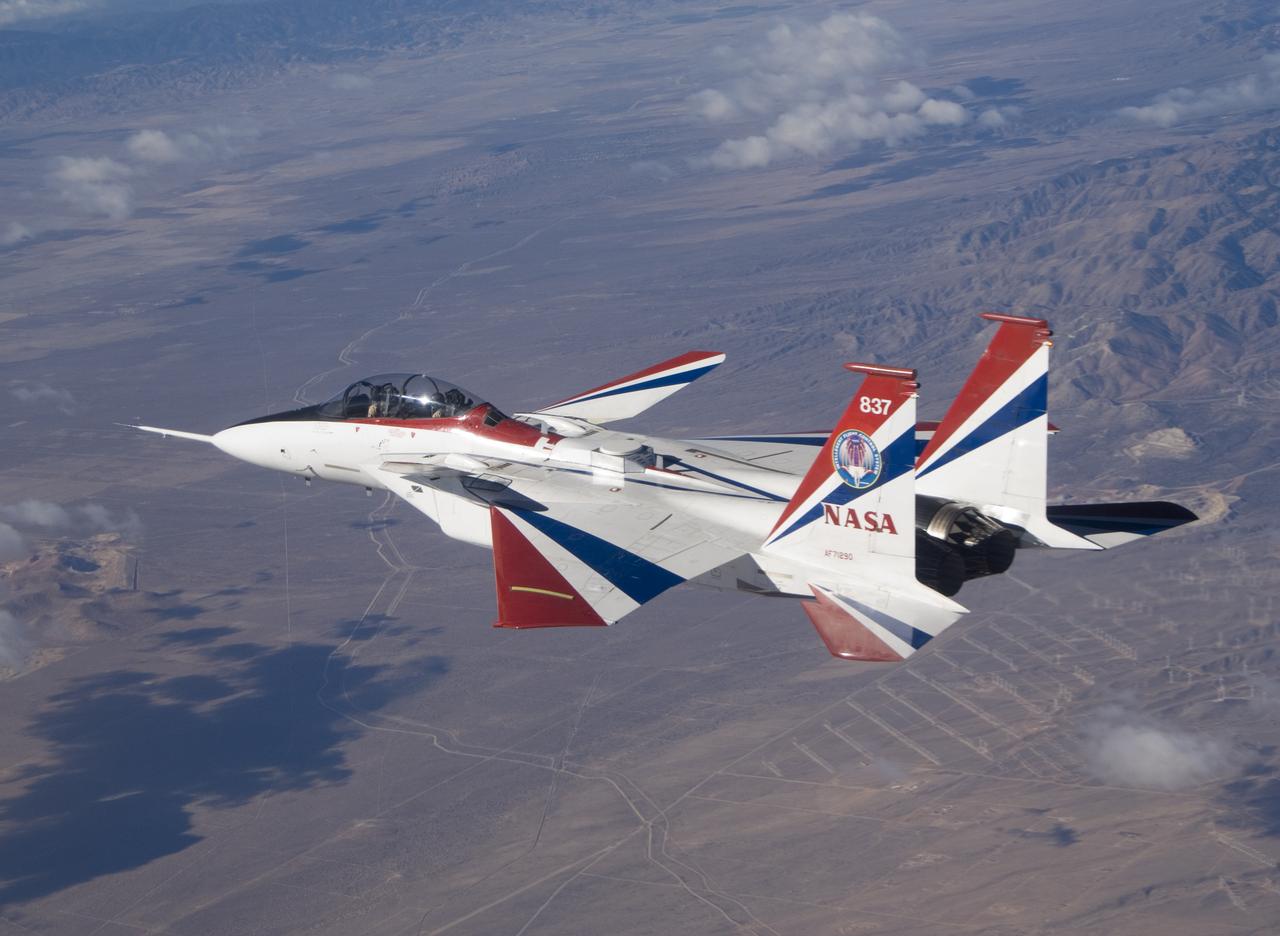
New range safety and range user system antennas for the ECANS project can be seen just behind and to the left of the cockpit on NASA's NF-15B research aircraft.
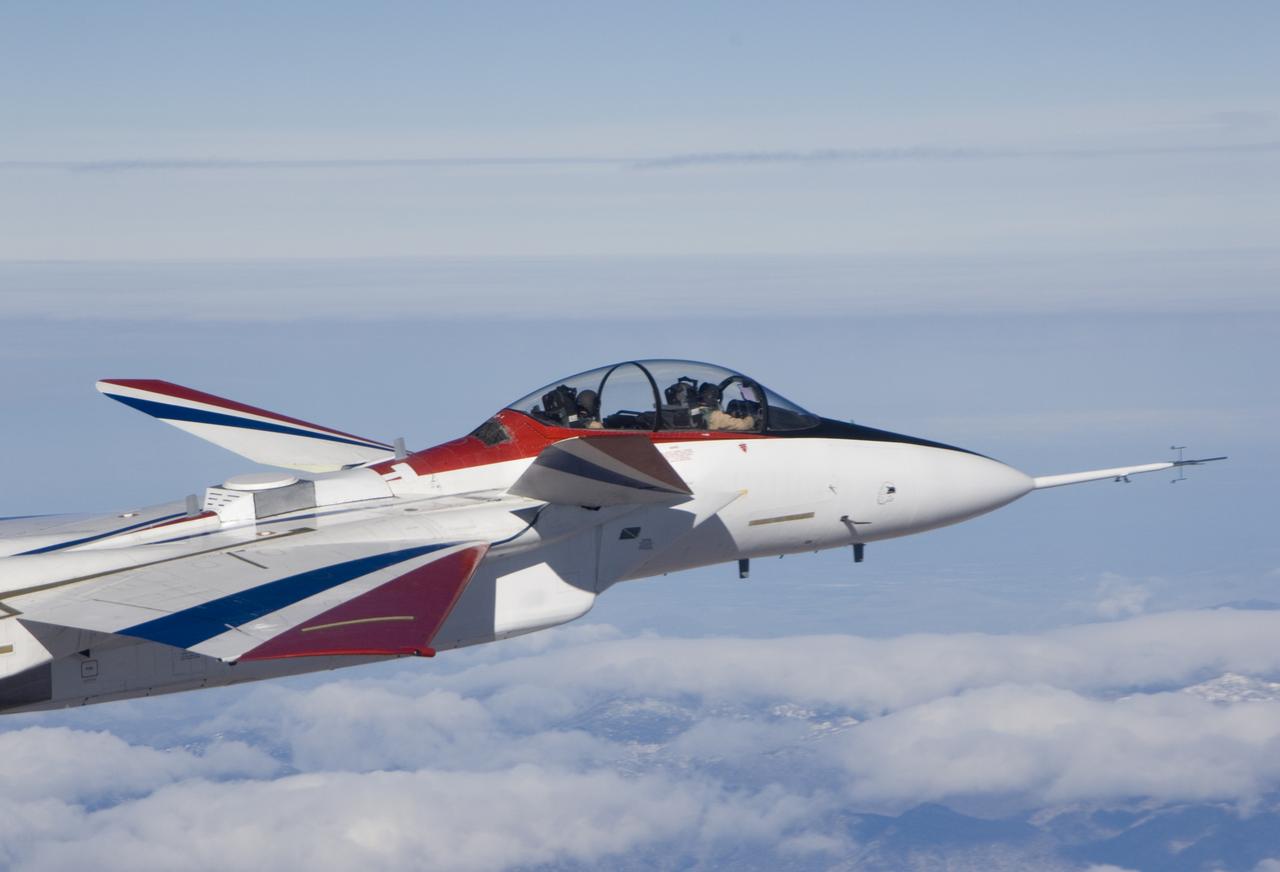
Range safety and phased-array range user system antennas validated in the ECANS project can be seen just behind the cockpit on NASA's NF-15B research aircraft.
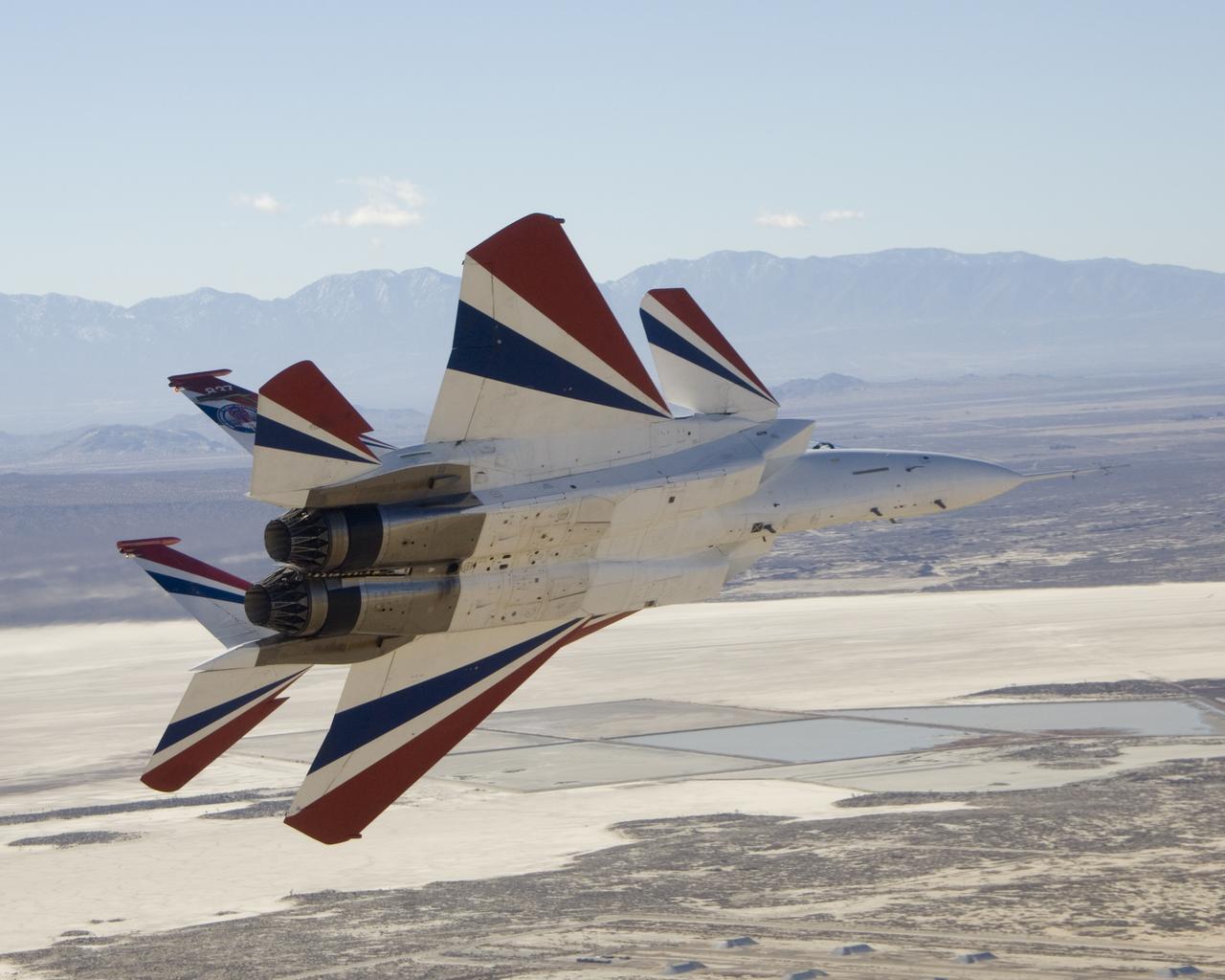
Two small Range Safety System antennas are located just behind the engine inlets of NASA's NF-15B research aircraft as it banks away from the chase plane.
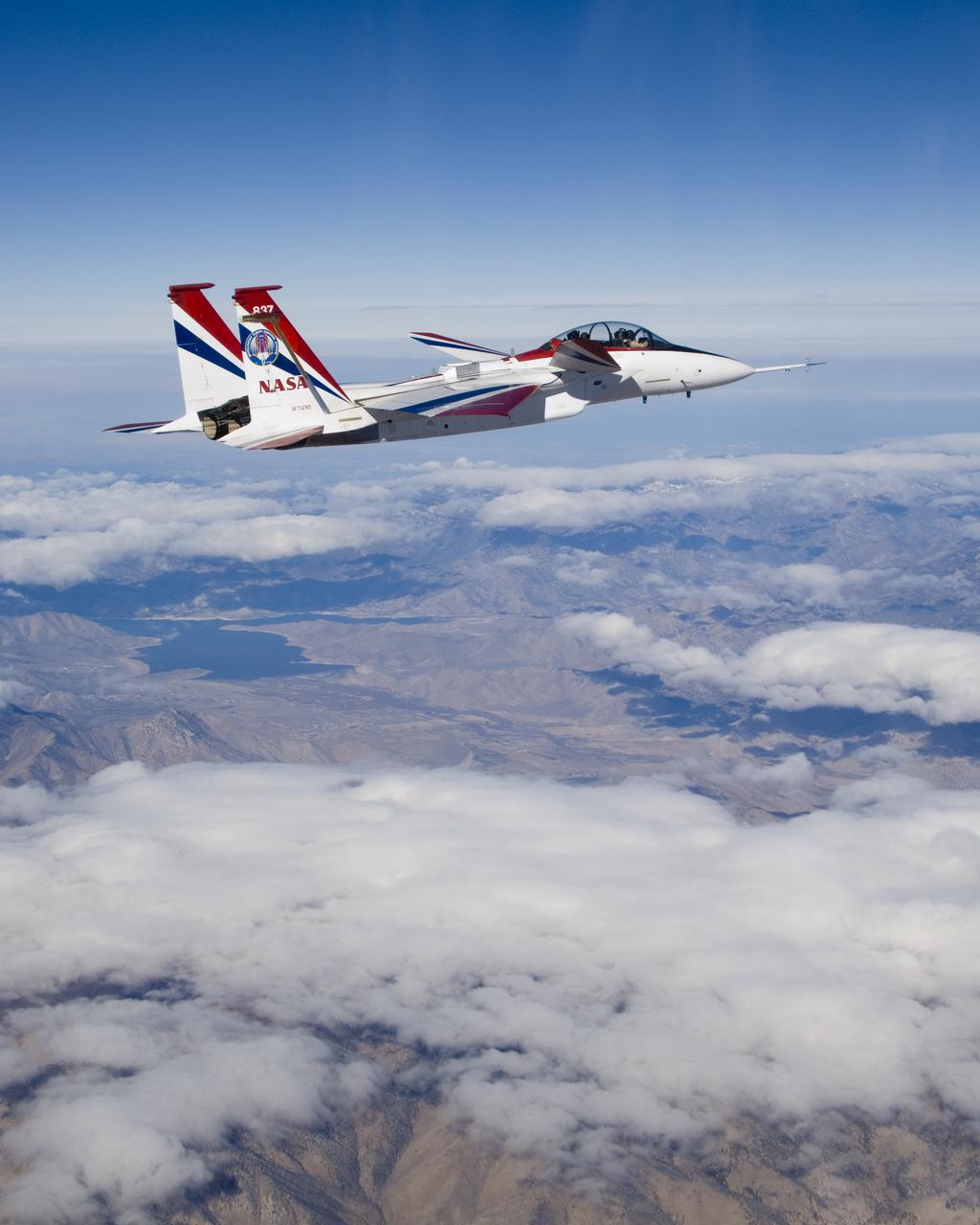
NASA's highly modified NF-15B research aircraft cruises over Southern California's Tehachapi Mountains near Lake Isabella during a research mission.
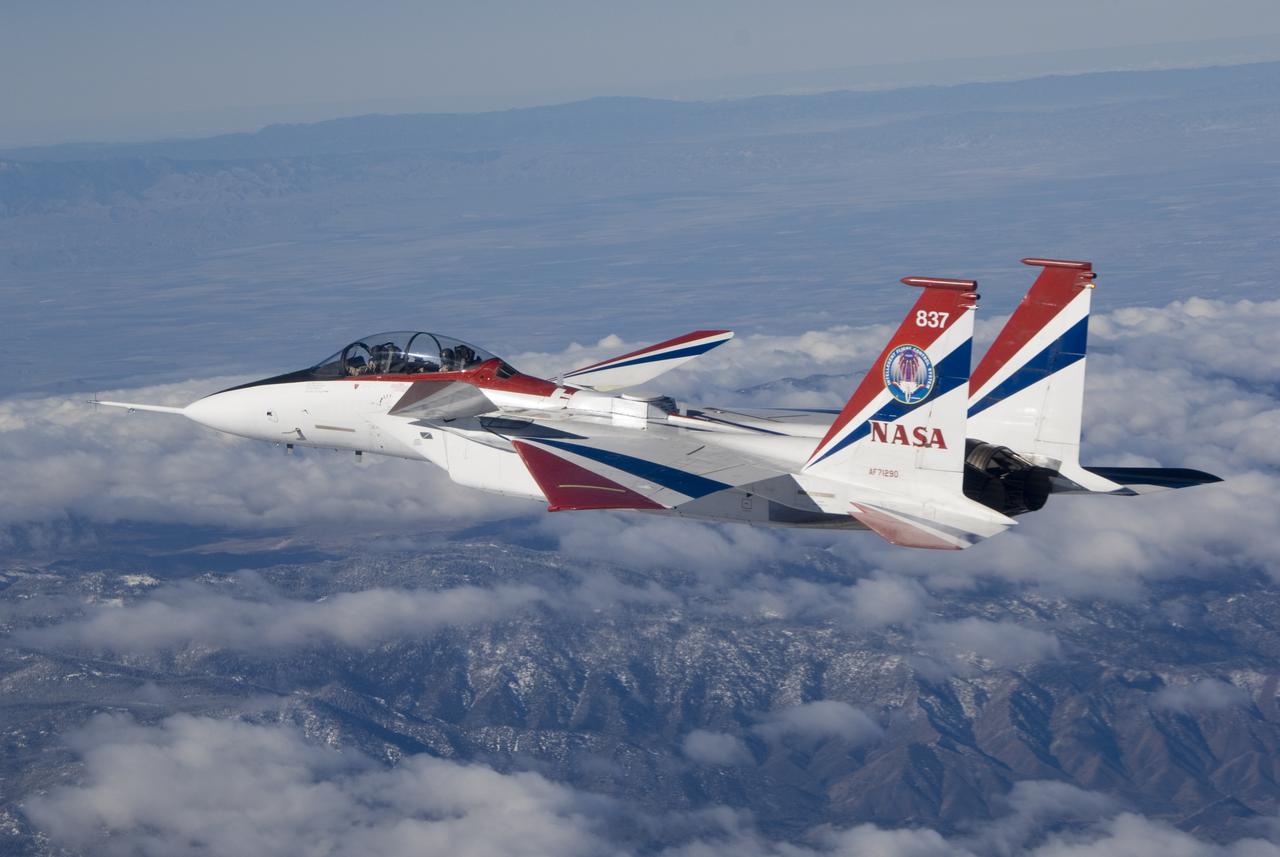
Antennas used for the Space-Based Range Demonstration and Certification project protrude from the top of NASA's NF-15B testbed during a research flight.
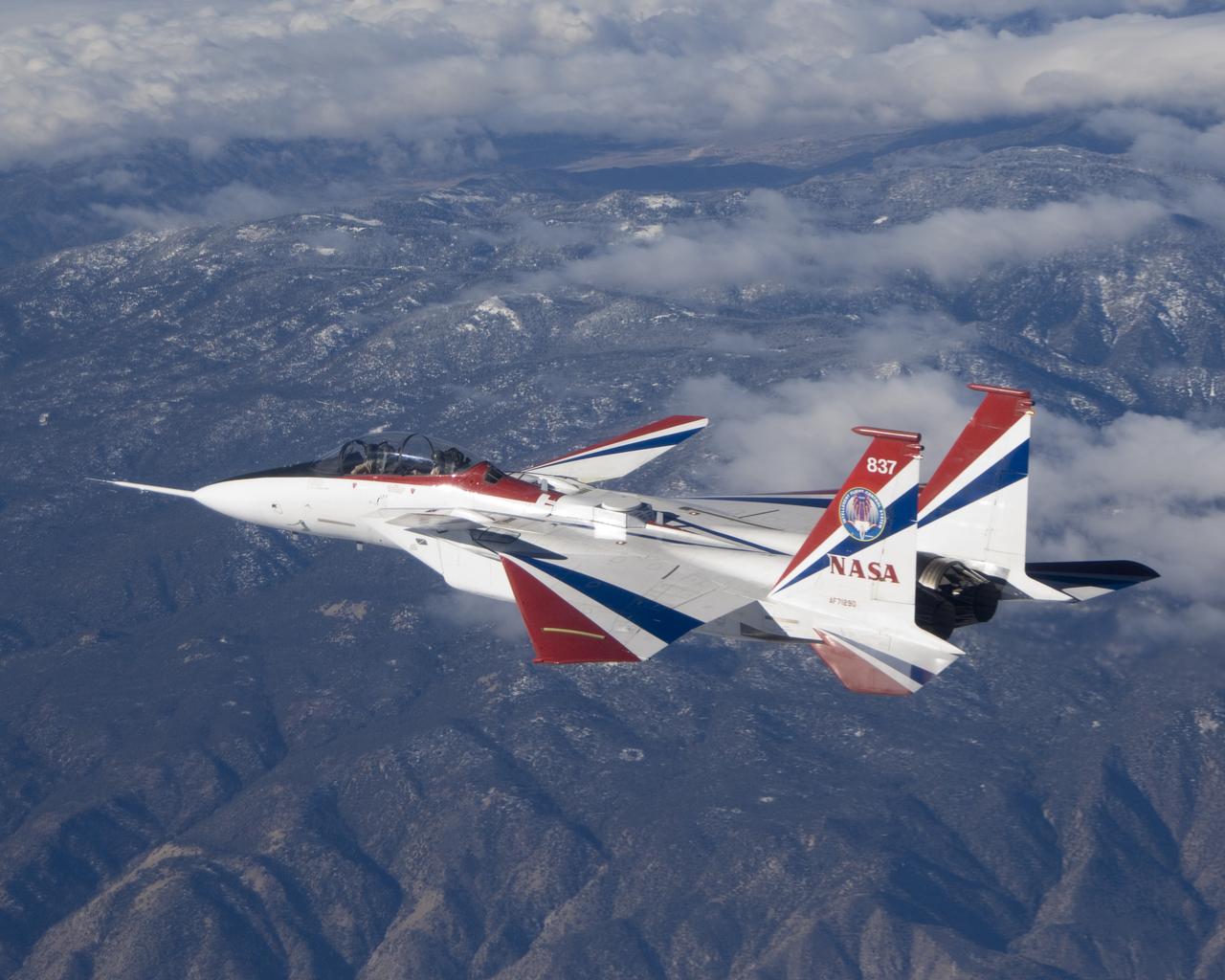
The jagged ridges of Southern California's Tehachapi Mountains form the backdrop to NASA's brightly-colored NF-15B testbed aircraft during a research mission.
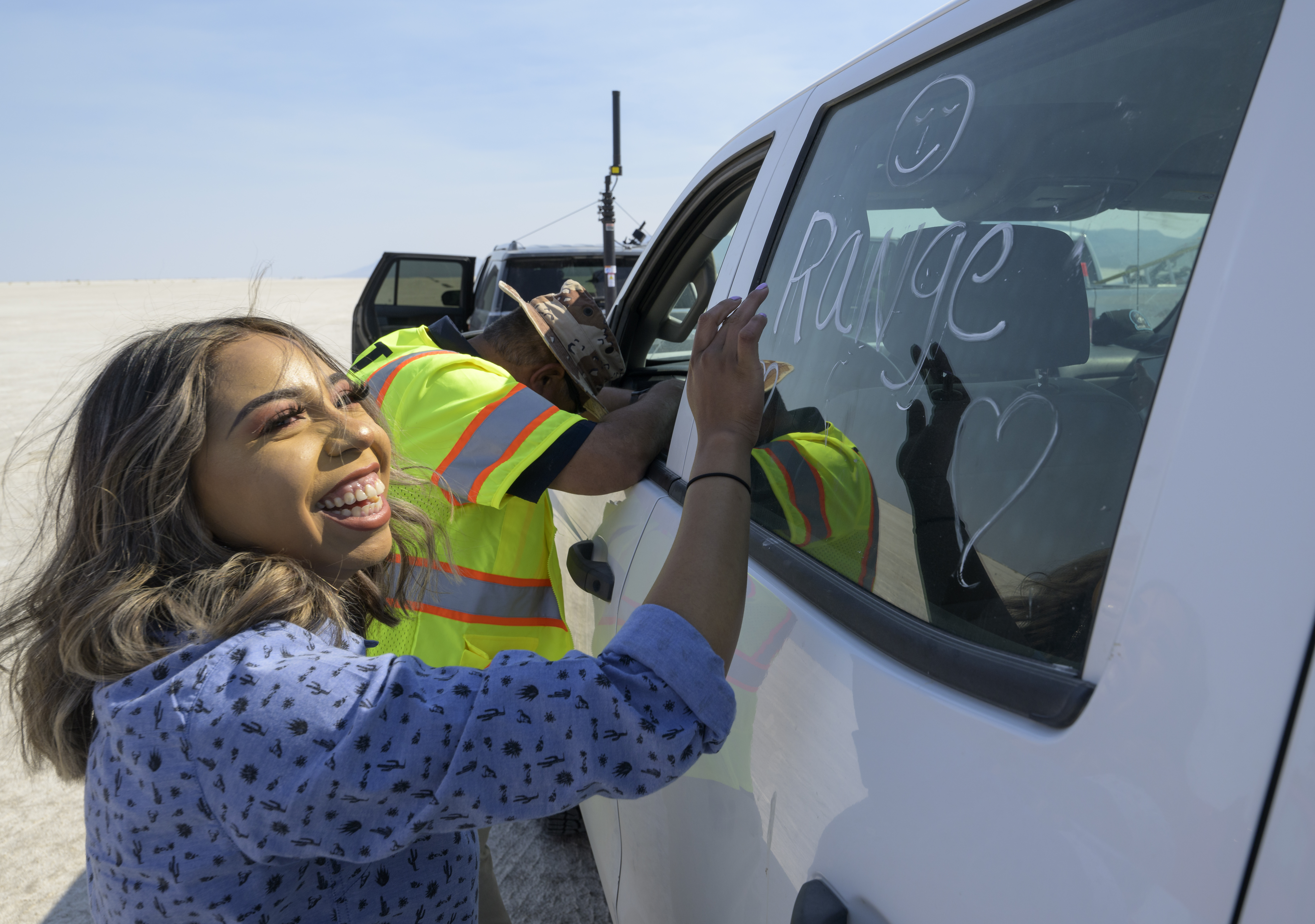
A member of the range safety team labels her convoy vehicle as they prepare for the landing of Boeing’s CST-100 Starliner spacecraft at White Sands Missile Range’s Space Harbor, Wednesday, May 25, 2022, in New Mexico. Boeing’s Orbital Flight Test-2 (OFT-2) is Starliner’s second uncrewed flight test to the International Space Station as part of NASA's Commercial Crew Program. OFT-2 serves as an end-to-end test of the system's capabilities. Photo Credit: (NASA/Bill Ingalls)
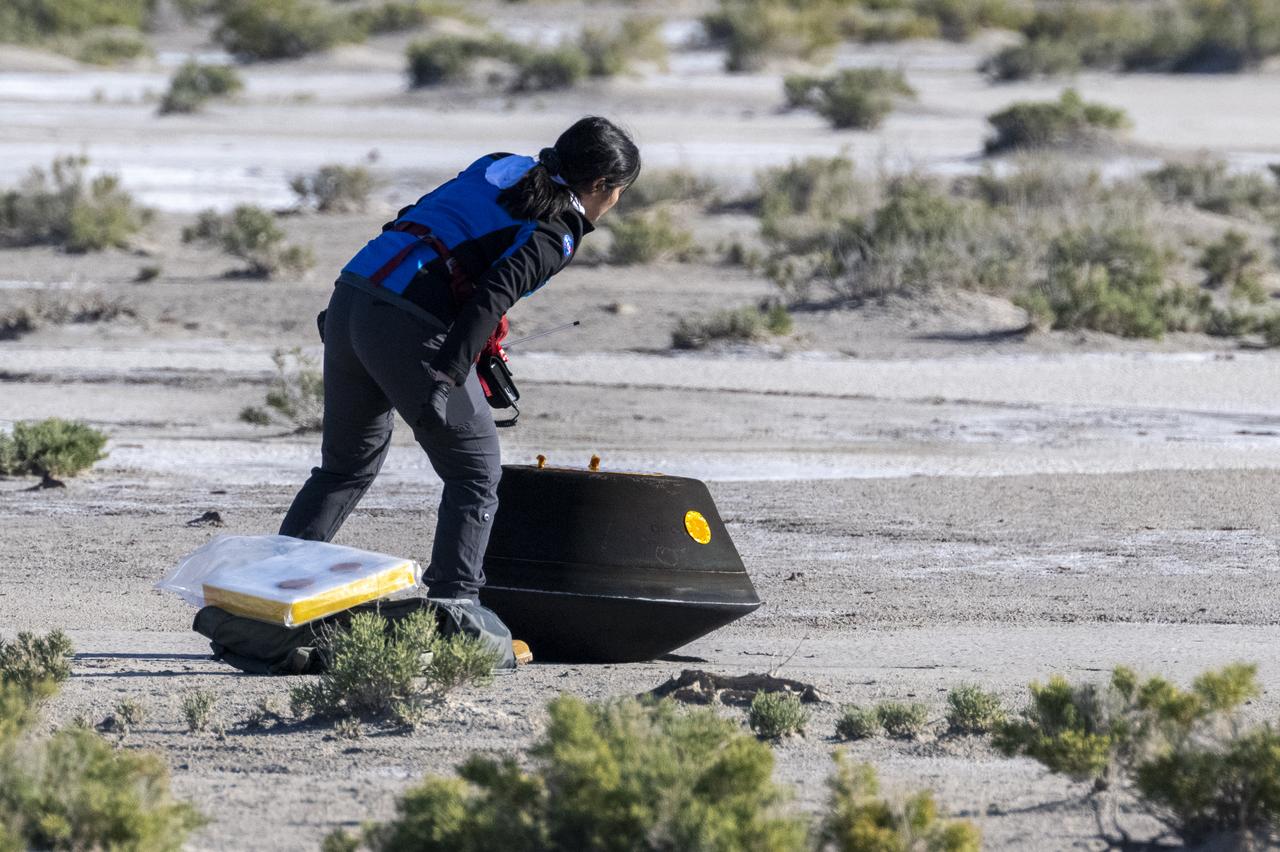
Lockheed Martin System Safety Engineer Victoria Thiem performs preliminary checks on the sample return capsule from NASA’s OSIRIS-REx mission, Sunday, Sept. 24, 2023, shortly after the capsule landed at the Department of Defense's Utah Test and Training Range. The sample was collected from the asteroid Bennu in October 2020 by NASA’s OSIRIS-REx spacecraft. Photo Credit: (NASA/Keegan Barber)
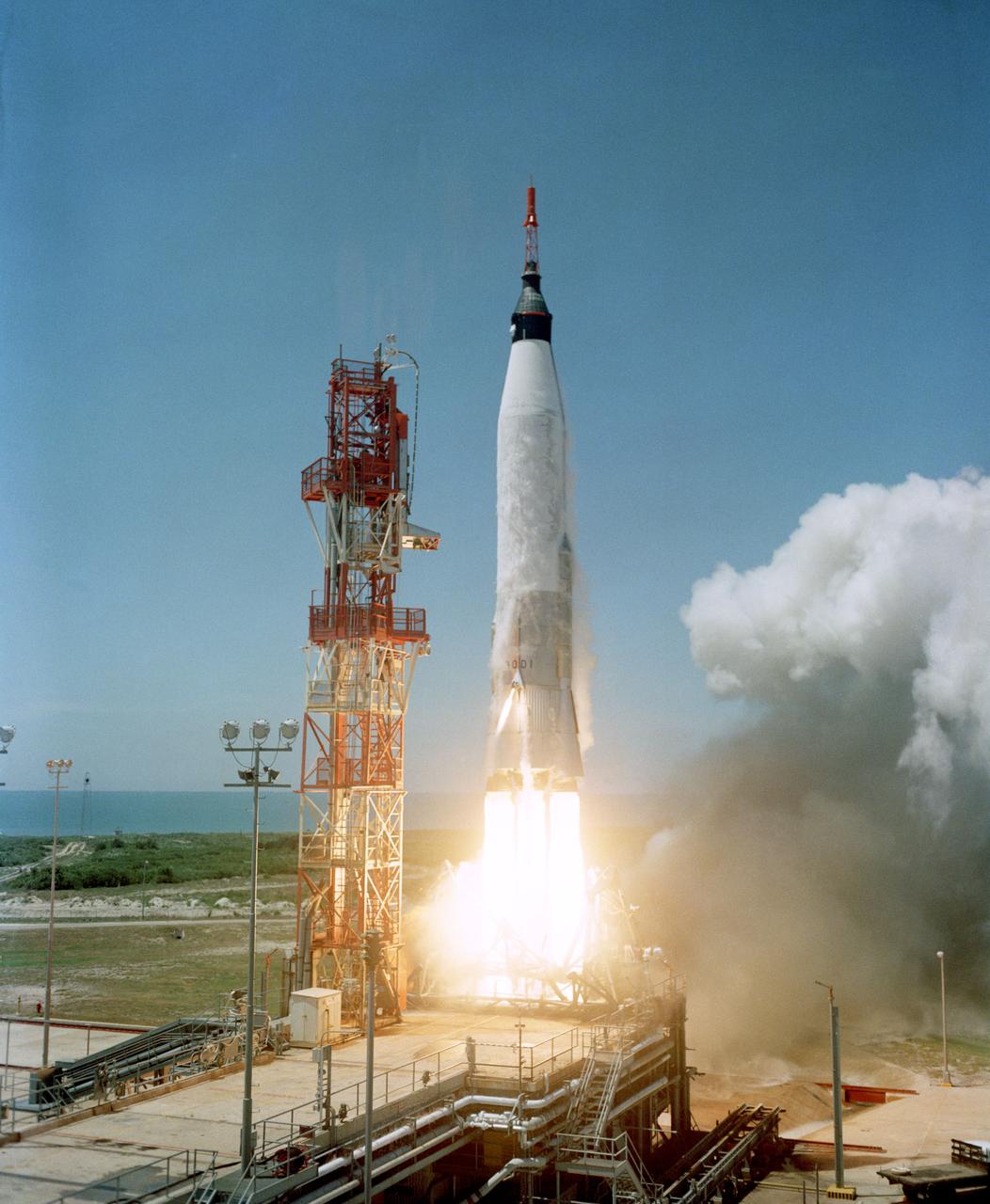
S61-01925 (25 April 1961) --- View of the Mercury-Atlas 3 (MA-3) liftoff from Cape Canaveral, Florida on April 25, 1961. The orbital test flight of the Mercury capsule did not achieve orbit and was destroyed after 40 seconds by Range Safety Officer when the inertial guidance system failed to pitch the vehicle over toward the horizon. Photo credit: NASA
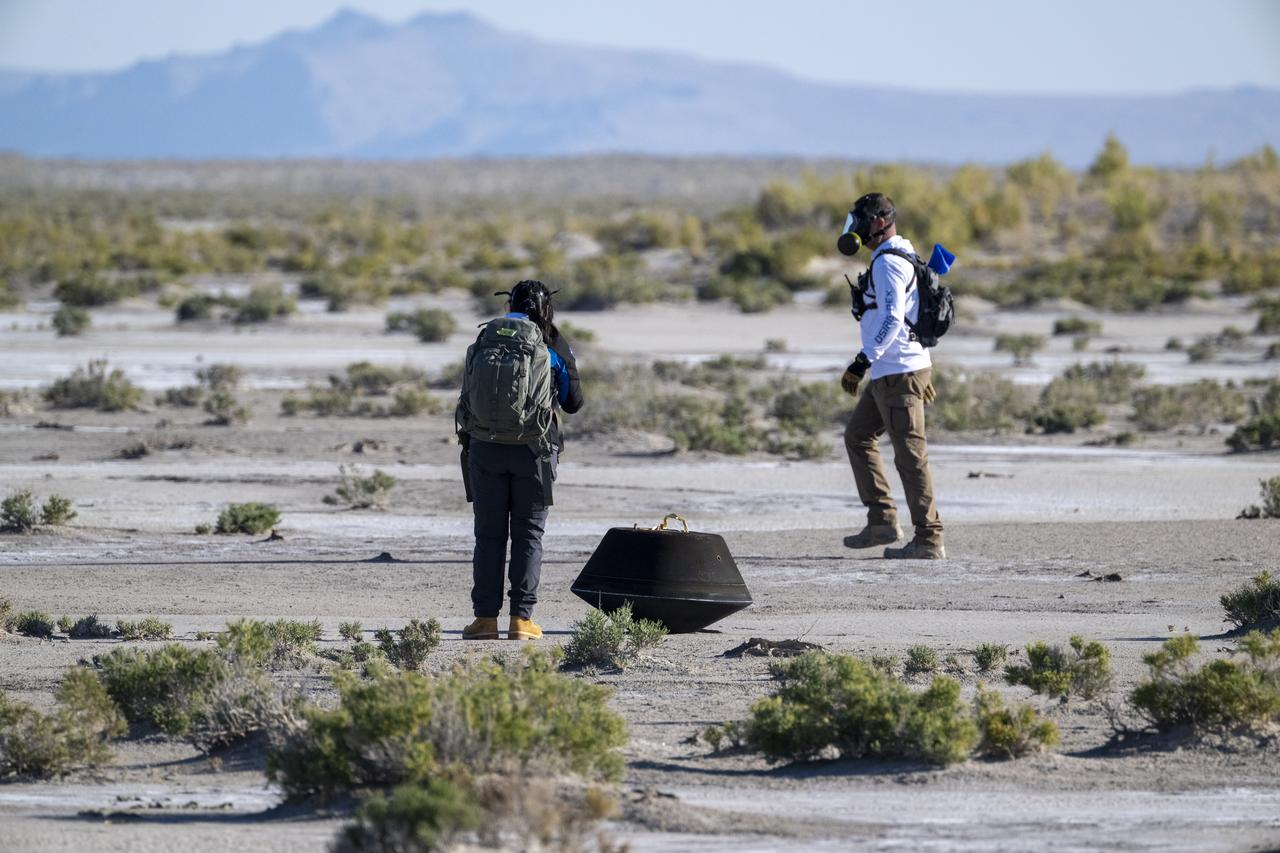
Lockheed Martin System Safety Engineer Victoria Thiem, left, and On Scene Commander of Recovery Stuart Wylie, right, perform preliminary checks on the sample return capsule from NASA’s OSIRIS-REx mission, Sunday, Sept. 24, 2023, shortly after the capsule landed at the Department of Defense's Utah Test and Training Range. The sample was collected from the asteroid Bennu in October 2020 by NASA’s OSIRIS-REx spacecraft. Photo Credit: (NASA/Keegan Barber)
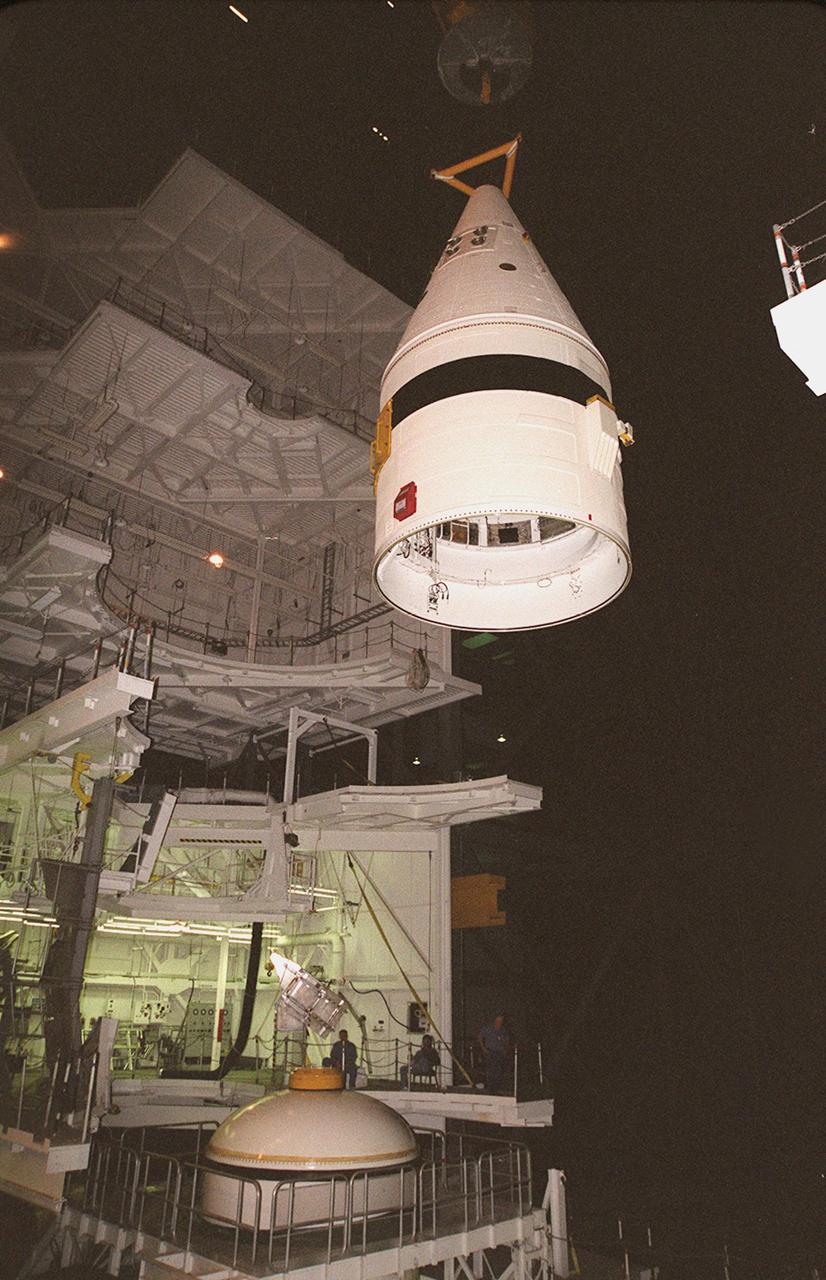
Inside the Vehicle Assembly Building, an overhead crane lifts the forward section of a solid rocket booster (SRB) to mate it with the components seen at lower left in the photo. The forward section of each booster, from nose cap to forward skirt contains avionics, a sequencer, forward separation motors, a nose cone separation system, drogue and main parachutes, a recovery beacon, a recovery light, a parachute camera on selected flights and a range safety system. Each SRB weighs approximately 1.3 million pounds at launch. The SRB is part of the stack for Space Shuttle Discovery and the STS-92 mission, scheduled for launch Oct. 5, from Launch Pad 39A, on the fifth flight to the International Space Station
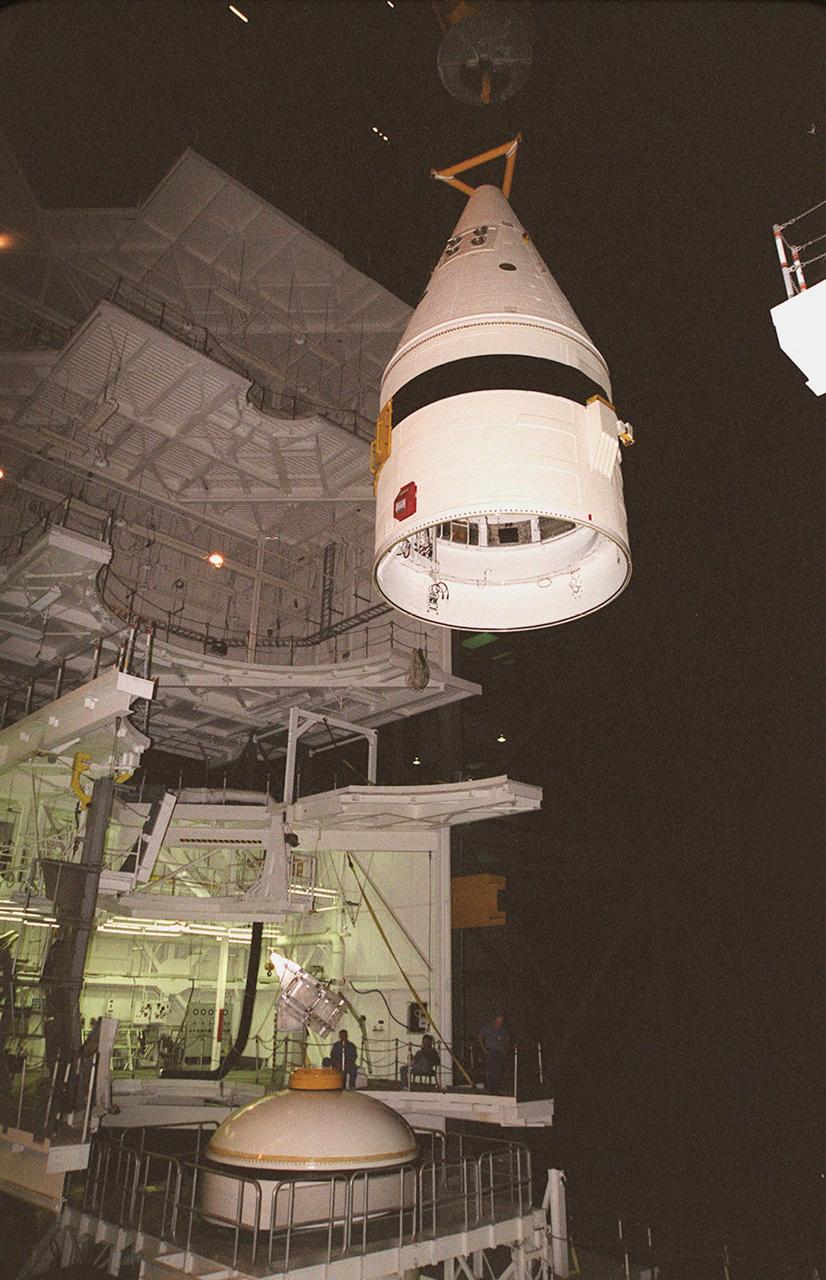
Inside the Vehicle Assembly Building, an overhead crane lifts the forward section of a solid rocket booster (SRB) to mate it with the components seen at lower left in the photo. The forward section of each booster, from nose cap to forward skirt contains avionics, a sequencer, forward separation motors, a nose cone separation system, drogue and main parachutes, a recovery beacon, a recovery light, a parachute camera on selected flights and a range safety system. Each SRB weighs approximately 1.3 million pounds at launch. The SRB is part of the stack for Space Shuttle Discovery and the STS-92 mission, scheduled for launch Oct. 5, from Launch Pad 39A, on the fifth flight to the International Space Station
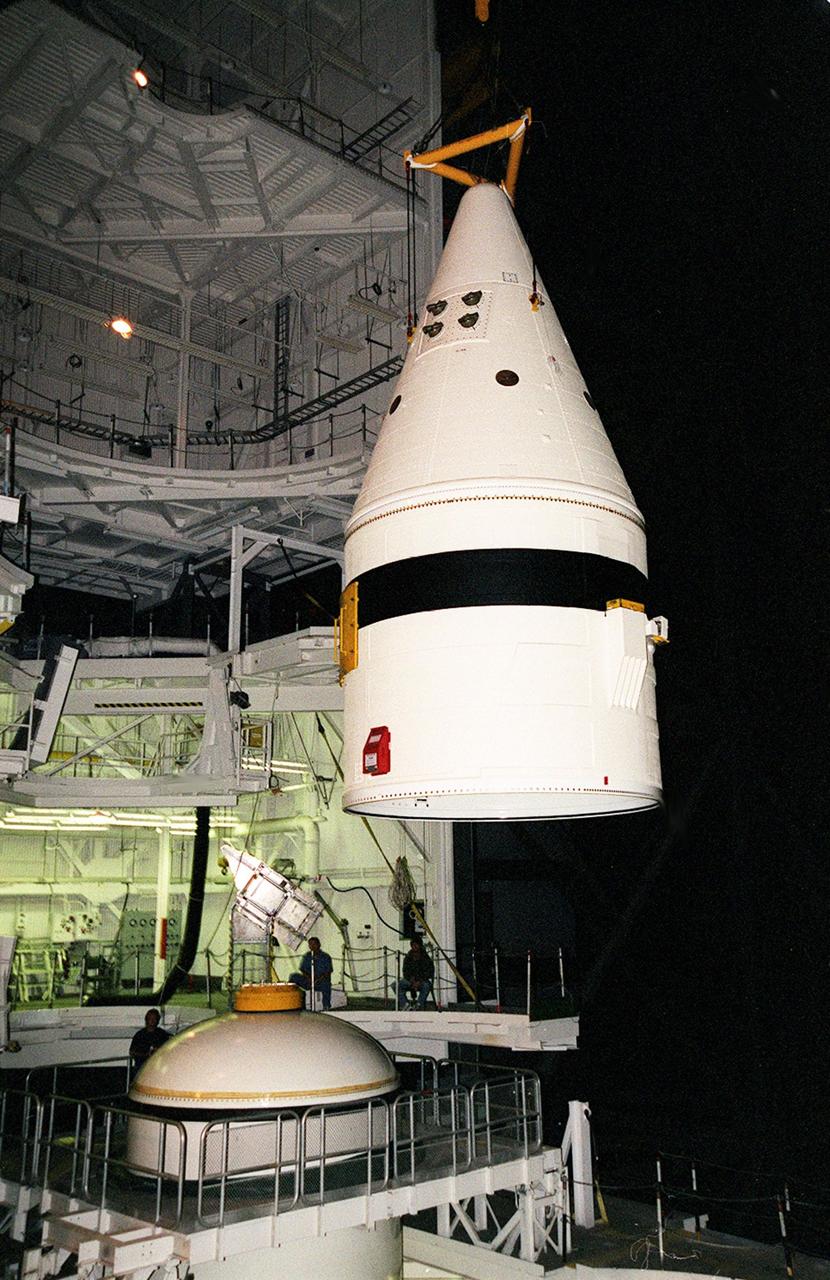
Inside the Vehicle Assembly Building, an overhead crane moves the forward section of a solid rocket booster (SRB) toward the previously stacked elements at lower left in the photo. The forward section of each booster, from nose cap to forward skirt contains avionics, a sequencer, forward separation motors, a nose cone separation system, drogue and main parachutes, a recovery beacon, a recovery light, a parachute camera on selected flights and a range safety system. Each SRB weighs approximately 1.3 million pounds at launch. The SRB is part of the stack for Space Shuttle Discovery and the STS-92 mission, scheduled for launch Oct. 5, from Launch Pad 39A, on the fifth flight to the International Space Station

Inside the Vehicle Assembly Building, an overhead crane moves the forward section of a solid rocket booster (SRB) toward the previously stacked elements at lower left in the photo. The forward section of each booster, from nose cap to forward skirt contains avionics, a sequencer, forward separation motors, a nose cone separation system, drogue and main parachutes, a recovery beacon, a recovery light, a parachute camera on selected flights and a range safety system. Each SRB weighs approximately 1.3 million pounds at launch. The SRB is part of the stack for Space Shuttle Discovery and the STS-92 mission, scheduled for launch Oct. 5, from Launch Pad 39A, on the fifth flight to the International Space Station
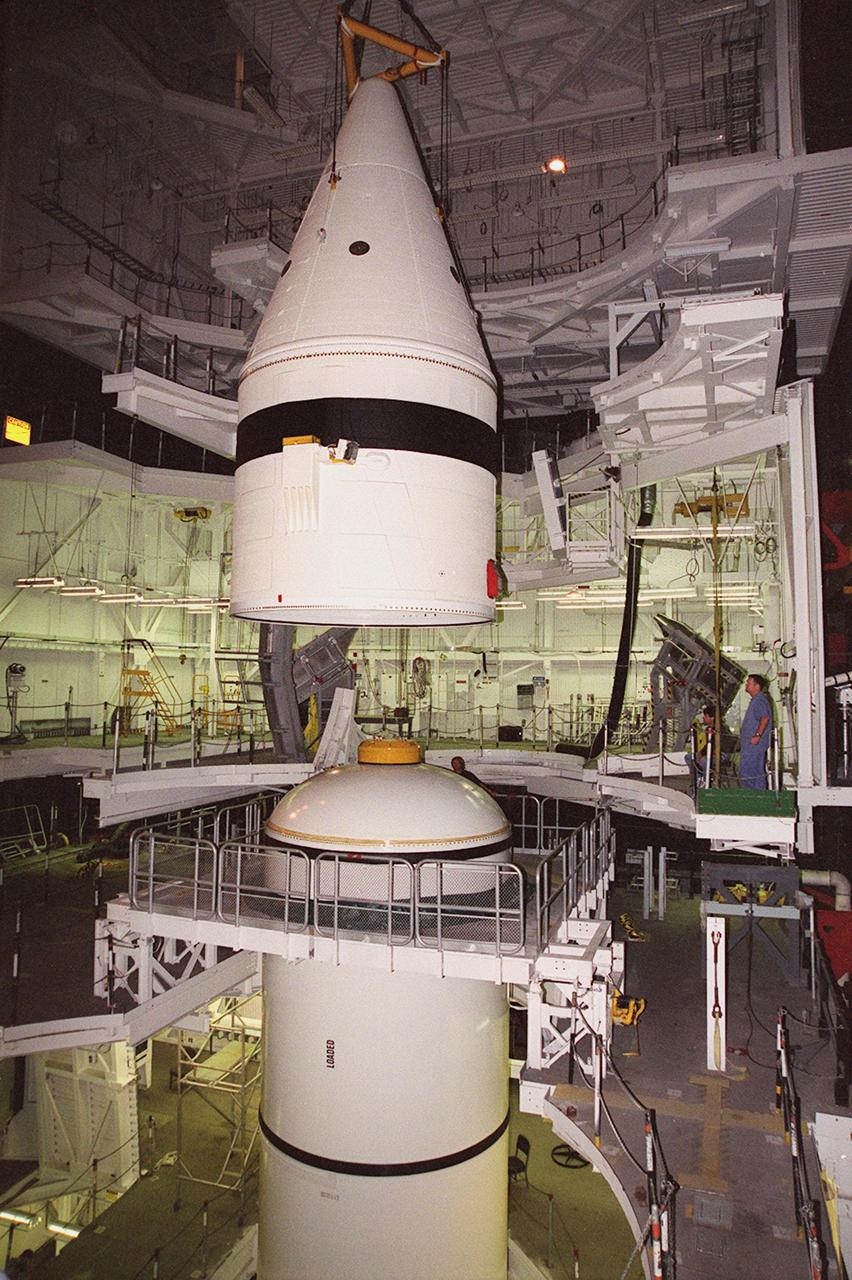
Inside the Vehicle Assembly Building, an overhead crane centers the forward section of a solid rocket booster (SRB) above the rest of the stack it will be mated to. The forward section of each booster, from nose cap to forward skirt contains avionics, a sequencer, forward separation motors, a nose cone separation system, drogue and main parachutes, a recovery beacon, a recovery light, a parachute camera on selected flights and a range safety system. Each SRB weighs approximately 1.3 million pounds at launch. The SRB is part of the stack for Space Shuttle Discovery and the STS-92 mission, scheduled for launch Oct. 5, from Launch Pad 39A, on the fifth flight to the International Space Station
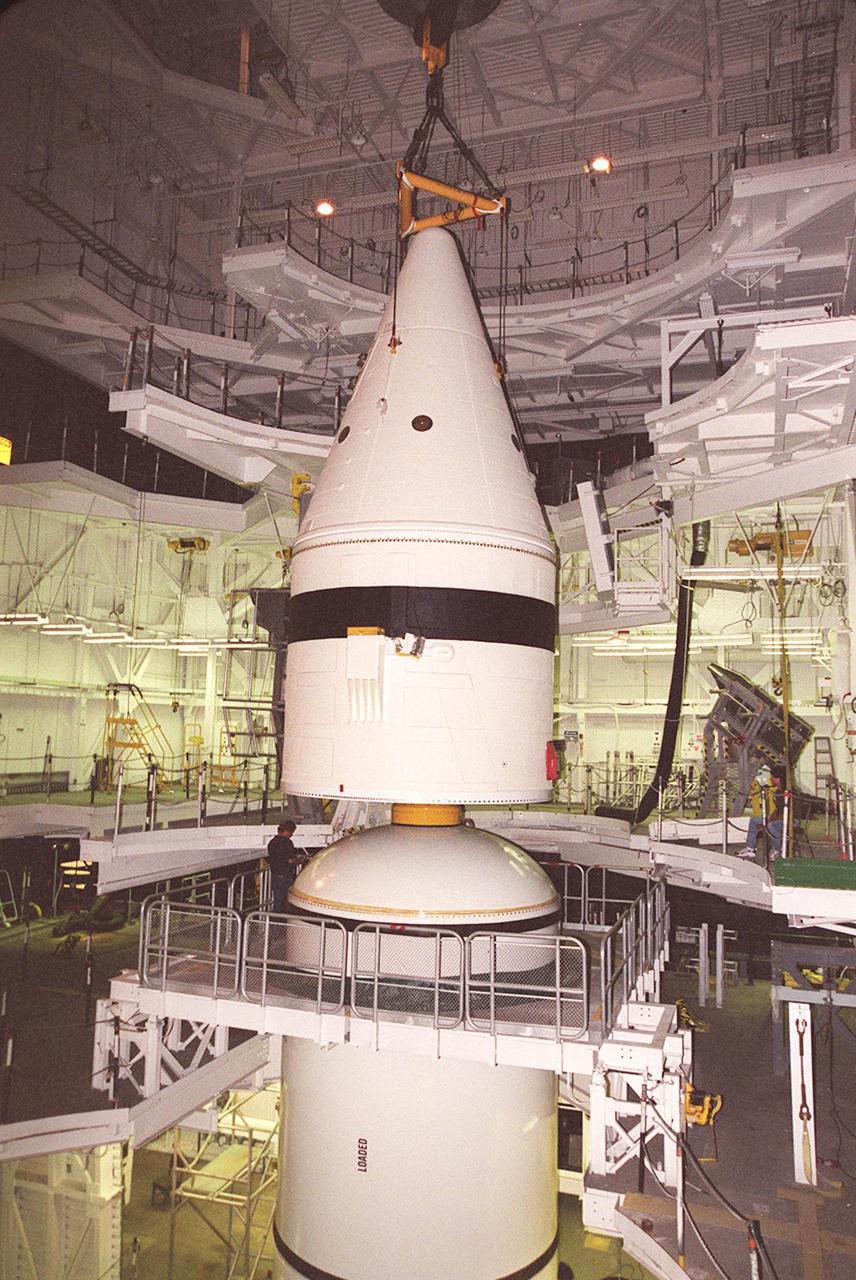
Inside the Vehicle Assembly Building, an overhead crane lowers the forward section of a solid rocket booster (SRB) toward the rest of the stack for mating. The forward section of each booster, from nose cap to forward skirt contains avionics, a sequencer, forward separation motors, a nose cone separation system, drogue and main parachutes, a recovery beacon, a recovery light, a parachute camera on selected flights and a range safety system. Each SRB weighs approximately 1.3 million pounds at launch. The SRB is part of the stack for Space Shuttle Discovery and the STS-92 mission, scheduled for launch Oct. 5, from Launch Pad 39A, on the fifth flight to the International Space Station
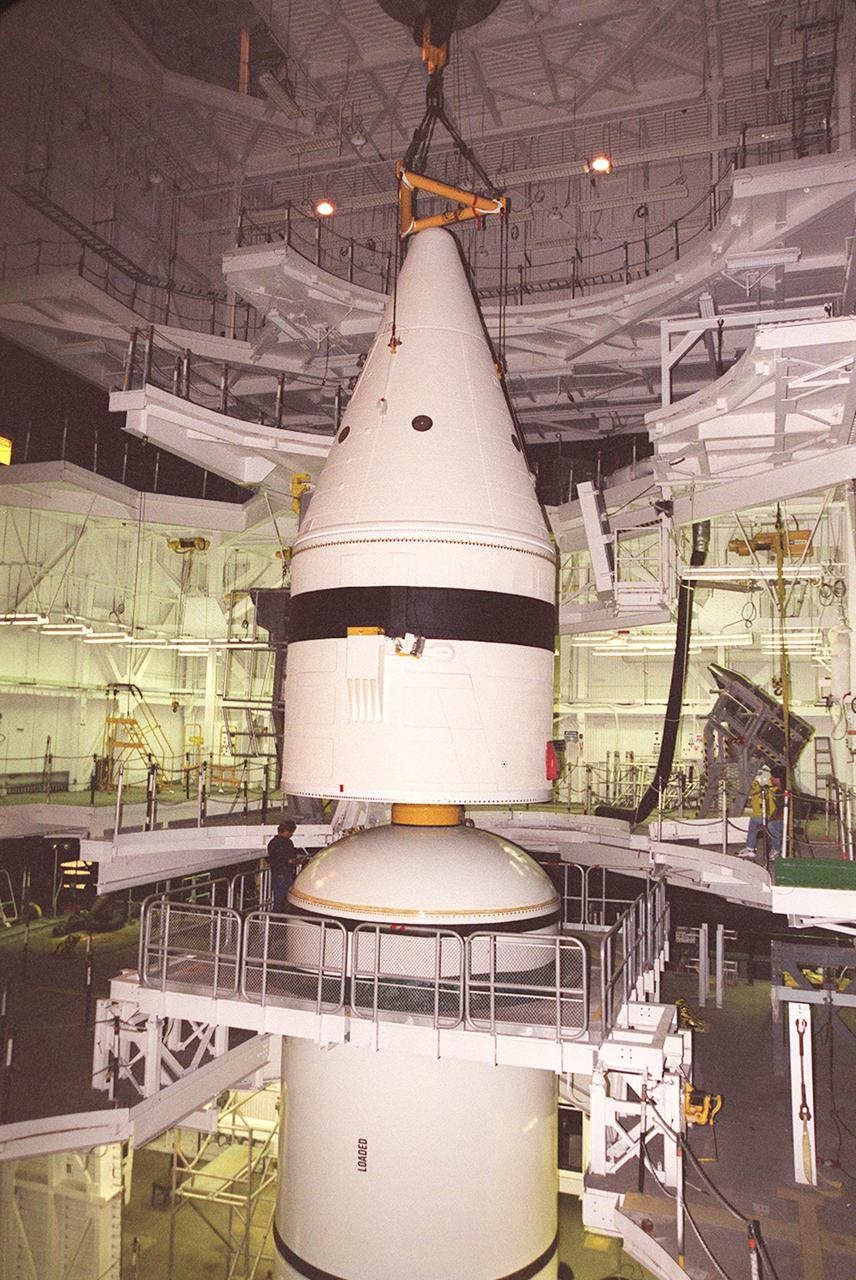
Inside the Vehicle Assembly Building, an overhead crane lowers the forward section of a solid rocket booster (SRB) toward the rest of the stack for mating. The forward section of each booster, from nose cap to forward skirt contains avionics, a sequencer, forward separation motors, a nose cone separation system, drogue and main parachutes, a recovery beacon, a recovery light, a parachute camera on selected flights and a range safety system. Each SRB weighs approximately 1.3 million pounds at launch. The SRB is part of the stack for Space Shuttle Discovery and the STS-92 mission, scheduled for launch Oct. 5, from Launch Pad 39A, on the fifth flight to the International Space Station
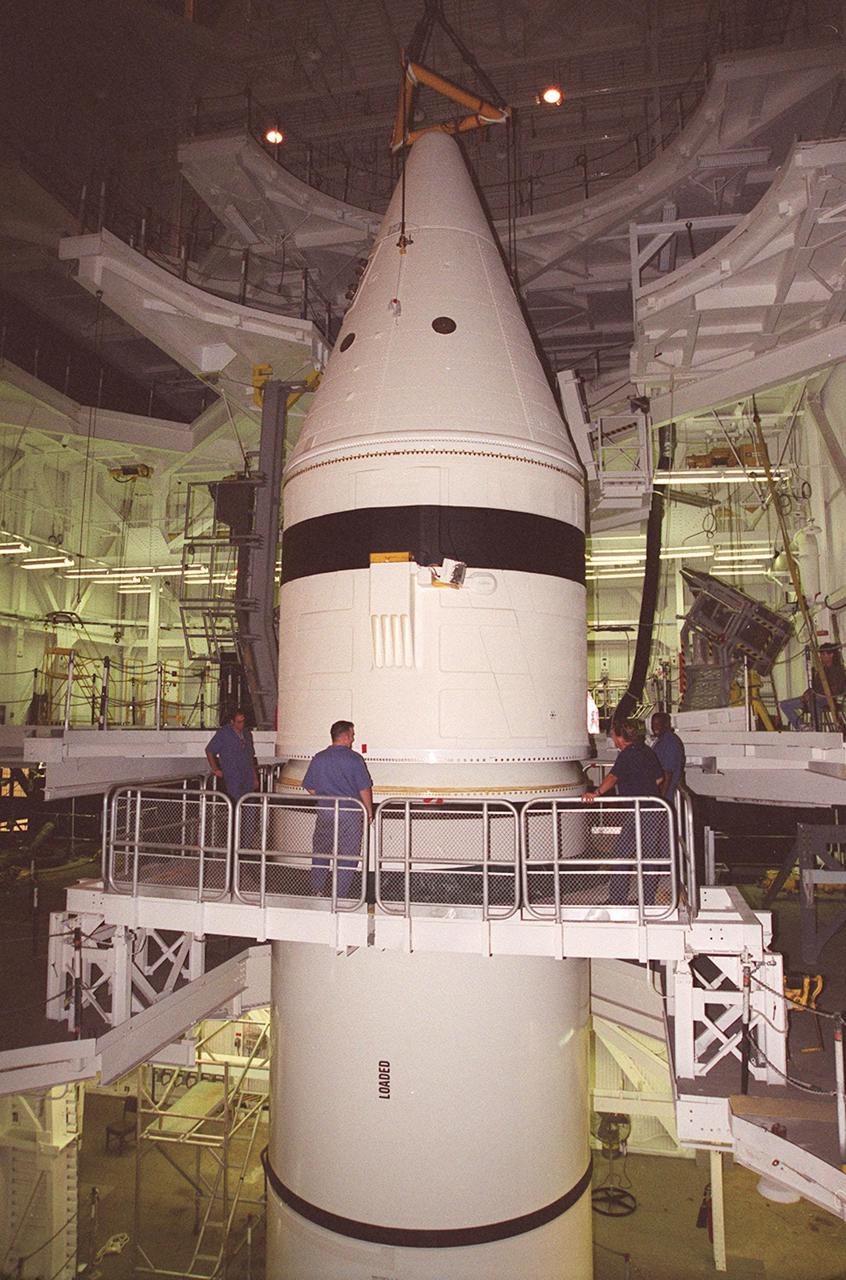
Inside the Vehicle Assembly Building, the forward section of a solid rocket booster (SRB) sits on top of the rest of the stack for mating. The forward section of each booster, from nose cap to forward skirt contains avionics, a sequencer, forward separation motors, a nose cone separation system, drogue and main parachutes, a recovery beacon, a recovery light, a parachute camera on selected flights and a range safety system. Each SRB weighs approximately 1.3 million pounds at launch. The SRB is part of the stack for Space Shuttle Discovery and the STS-92 mission, scheduled for launch Oct. 5, from Launch Pad 39A, on the fifth flight to the International Space Station
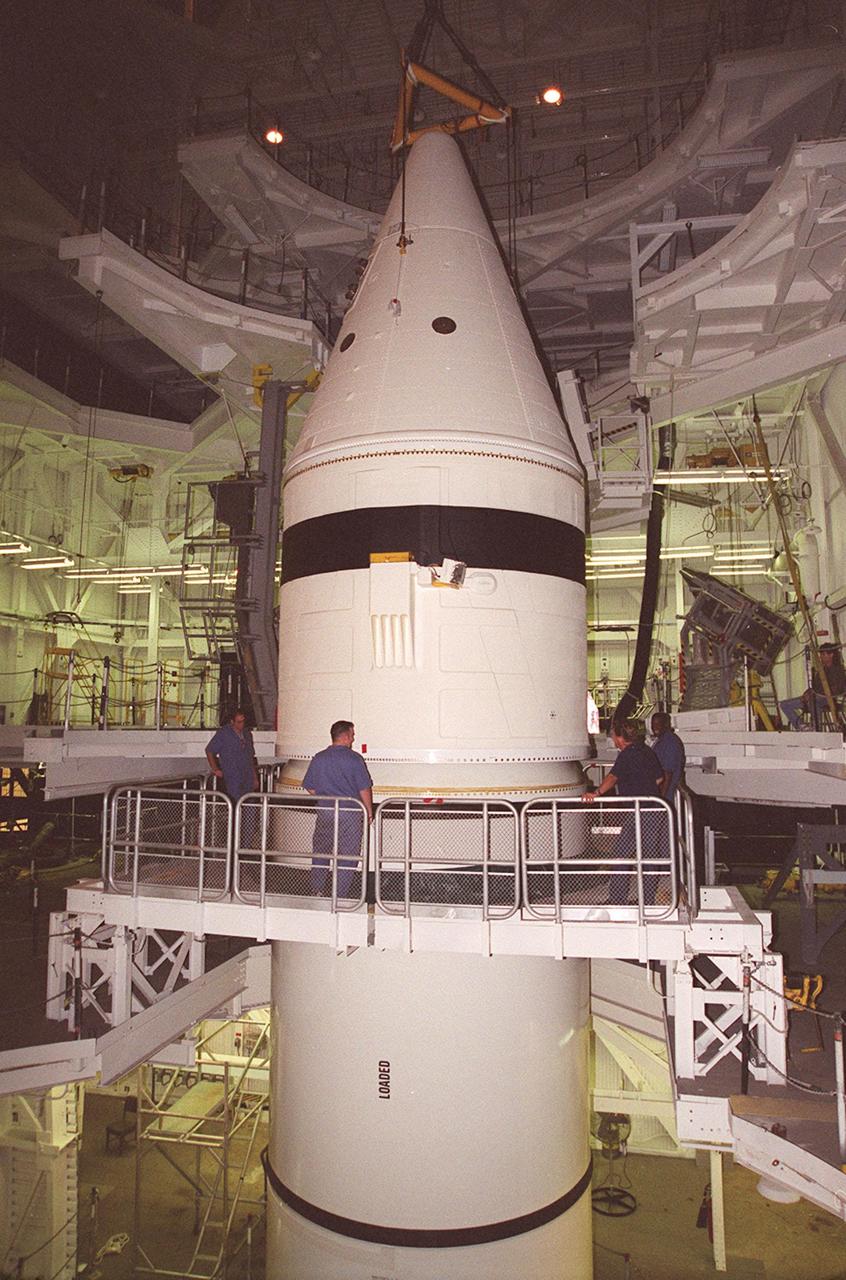
Inside the Vehicle Assembly Building, the forward section of a solid rocket booster (SRB) sits on top of the rest of the stack for mating. The forward section of each booster, from nose cap to forward skirt contains avionics, a sequencer, forward separation motors, a nose cone separation system, drogue and main parachutes, a recovery beacon, a recovery light, a parachute camera on selected flights and a range safety system. Each SRB weighs approximately 1.3 million pounds at launch. The SRB is part of the stack for Space Shuttle Discovery and the STS-92 mission, scheduled for launch Oct. 5, from Launch Pad 39A, on the fifth flight to the International Space Station
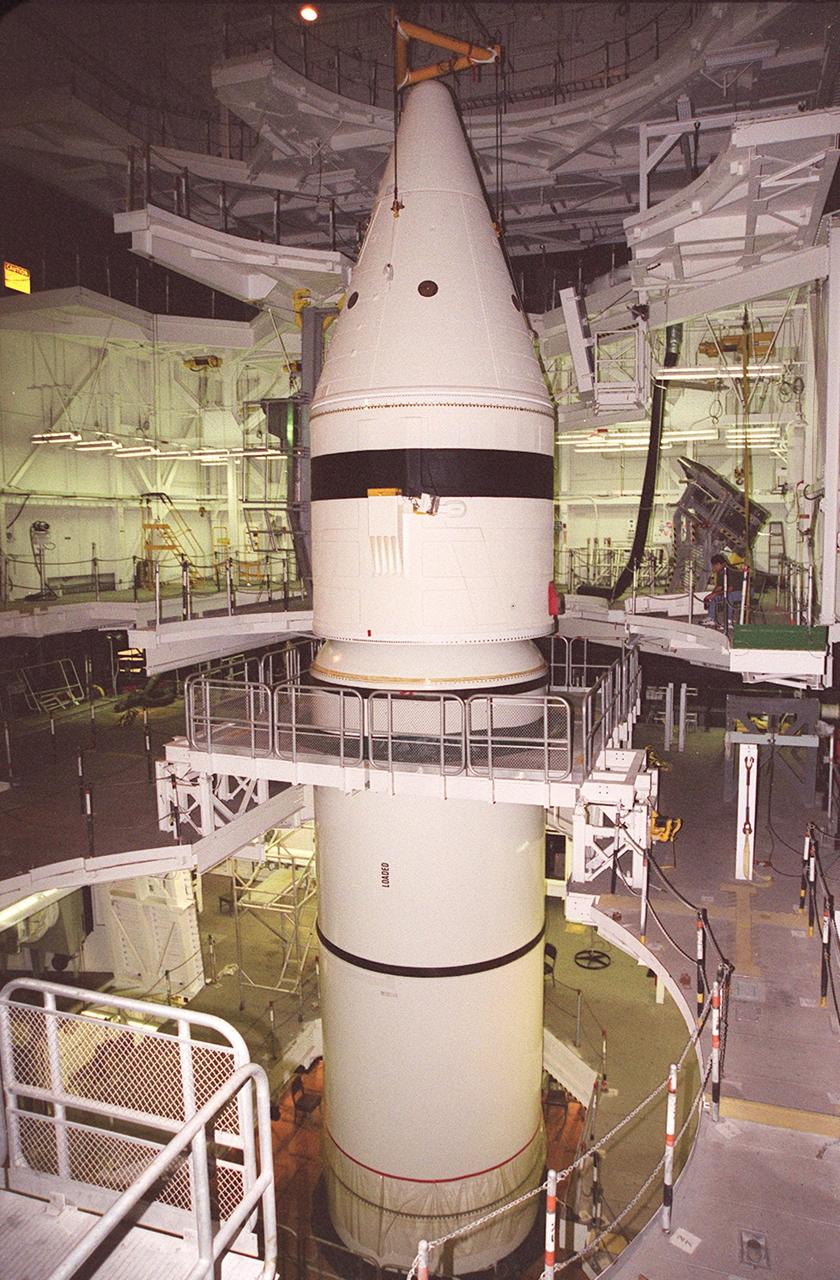
Inside the Vehicle Assembly Building, the forward section of a solid rocket booster (SRB) is lowered onto the rest of the stack for mating. The forward section of each booster, from nose cap to forward skirt contains avionics, a sequencer, forward separation motors, a nose cone separation system, drogue and main parachutes, a recovery beacon, a recovery light, a parachute camera on selected flights and a range safety system. Each SRB weighs approximately 1.3 million pounds at launch. The SRB is part of the stack for Space Shuttle Discovery and the STS-92 mission, scheduled for launch Oct. 5, from Launch Pad 39A, on the fifth flight to the International Space Station
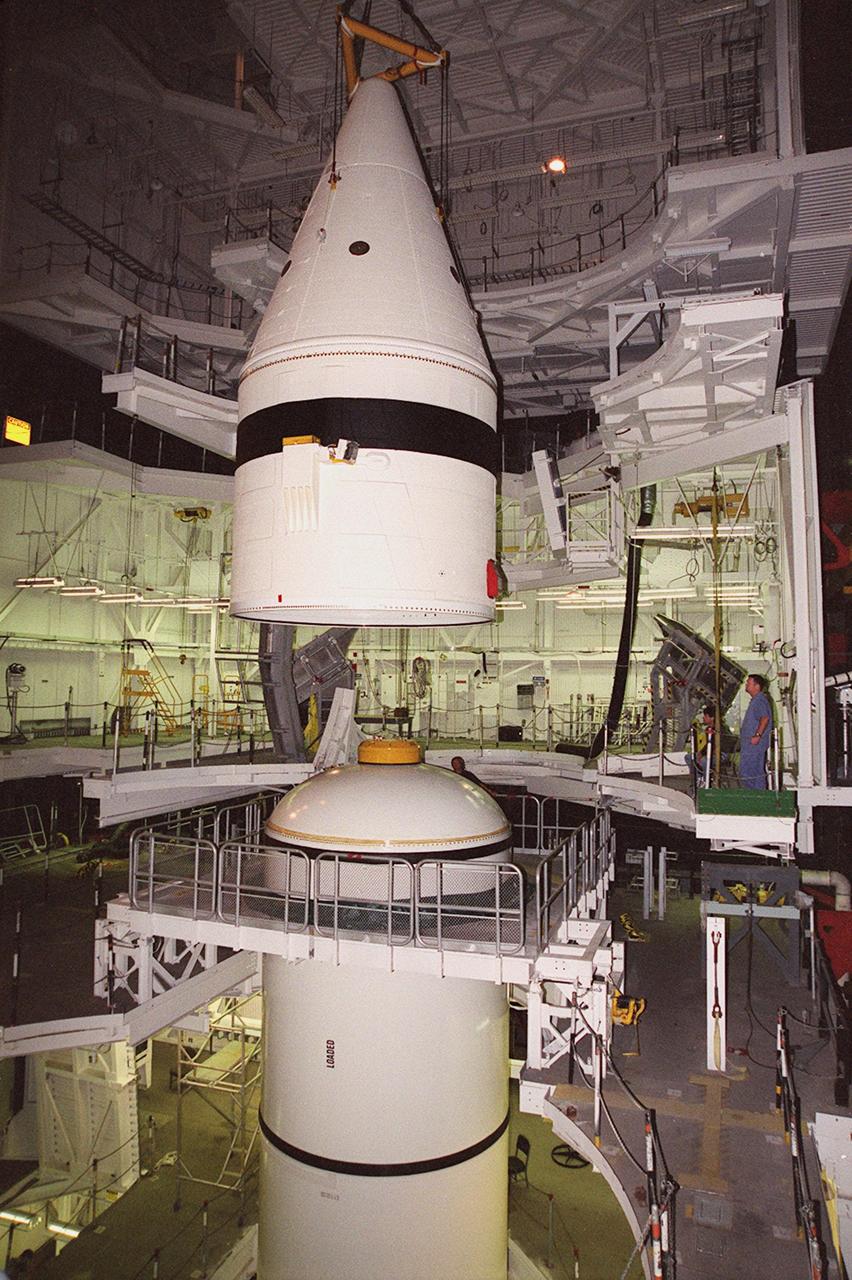
Inside the Vehicle Assembly Building, an overhead crane centers the forward section of a solid rocket booster (SRB) above the rest of the stack it will be mated to. The forward section of each booster, from nose cap to forward skirt contains avionics, a sequencer, forward separation motors, a nose cone separation system, drogue and main parachutes, a recovery beacon, a recovery light, a parachute camera on selected flights and a range safety system. Each SRB weighs approximately 1.3 million pounds at launch. The SRB is part of the stack for Space Shuttle Discovery and the STS-92 mission, scheduled for launch Oct. 5, from Launch Pad 39A, on the fifth flight to the International Space Station
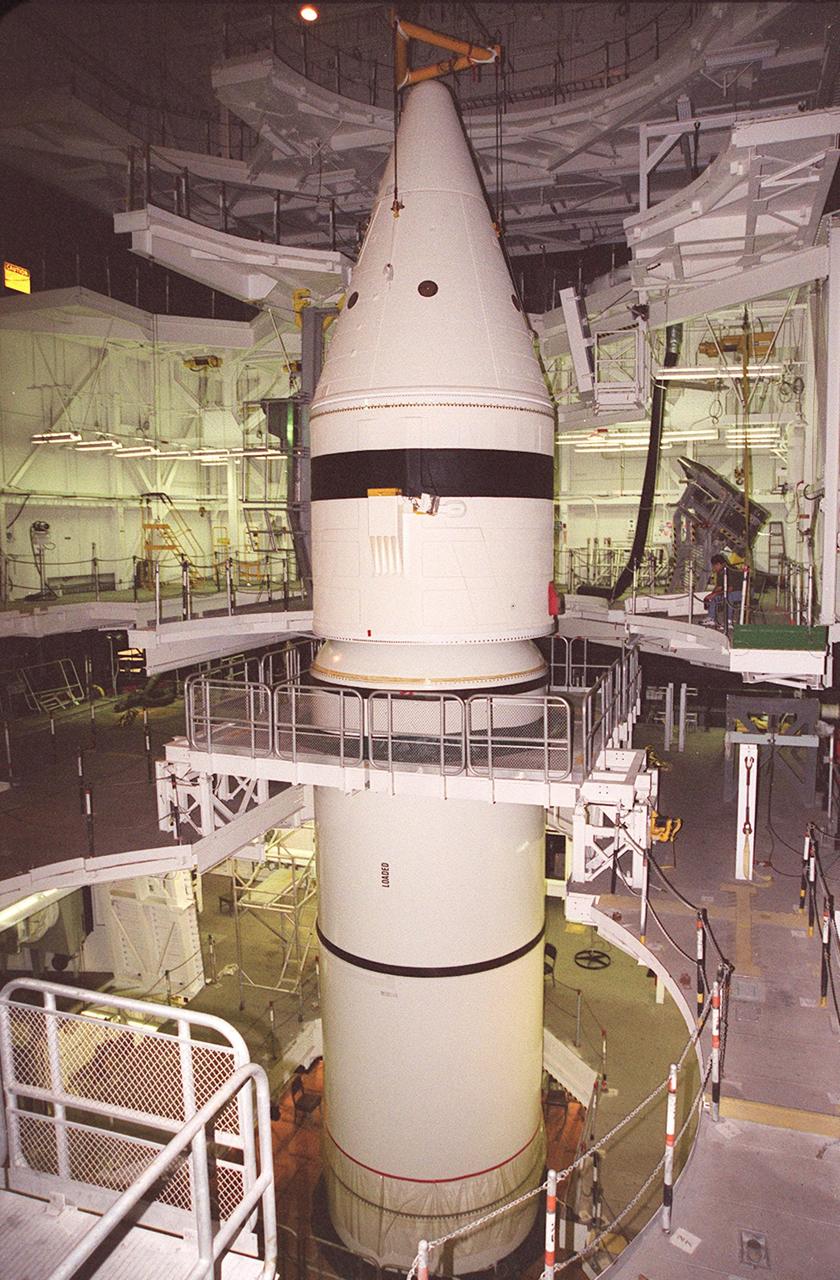
Inside the Vehicle Assembly Building, the forward section of a solid rocket booster (SRB) is lowered onto the rest of the stack for mating. The forward section of each booster, from nose cap to forward skirt contains avionics, a sequencer, forward separation motors, a nose cone separation system, drogue and main parachutes, a recovery beacon, a recovery light, a parachute camera on selected flights and a range safety system. Each SRB weighs approximately 1.3 million pounds at launch. The SRB is part of the stack for Space Shuttle Discovery and the STS-92 mission, scheduled for launch Oct. 5, from Launch Pad 39A, on the fifth flight to the International Space Station
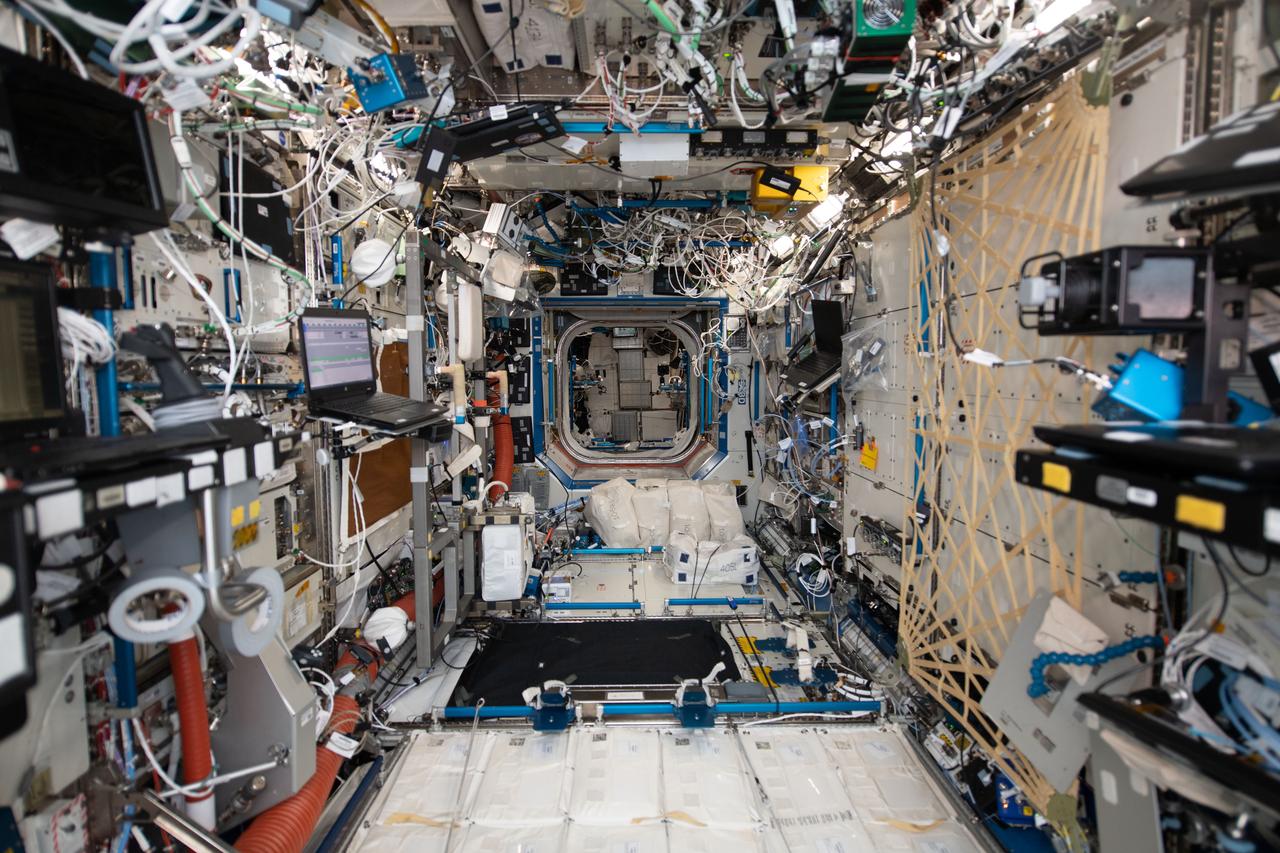
iss058e004610 (1/20/2019) --- A View of the Destiny US Laboratory aboard the International Space Station (ISS). The U.S. Laboratory Module, called Destiny, is the primary research laboratory for U.S. payloads, supporting a wide range of experiments and studies contributing to health, safety, and quality of life for people all over the world. Science conducted on the ISS offers researchers an unparalleled opportunity to test physical processes in the absence of gravity. The results of these experiments will allow scientists to better understand our world and ourselves and prepare us for future missions. Destiny provides internal interfaces to accommodate 24 equipment racks for accommodation and control of ISS systems and scientific research.

Workers in the Vehicle Assembly Building check the connections on the forward section of a solid rocket booster (SRB) being mated to the rest of the stack below it. The forward section of each booster, from nose cap to forward skirt contains avionics, a sequencer, forward separation motors, a nose cone separation system, drogue and main parachutes, a recovery beacon, a recovery light, a parachute camera on selected flights and a range safety system. Each SRB weighs approximately 1.3 million pounds at launch. The SRB is part of the stack for Space Shuttle Discovery and the STS-92 mission, scheduled for launch Oct. 5, from Launch Pad 39A, on the fifth flight to the International Space Station. Payloads on the mission include the Z-1 truss and Pressurized Mating Adapter-3, components of the Space Station
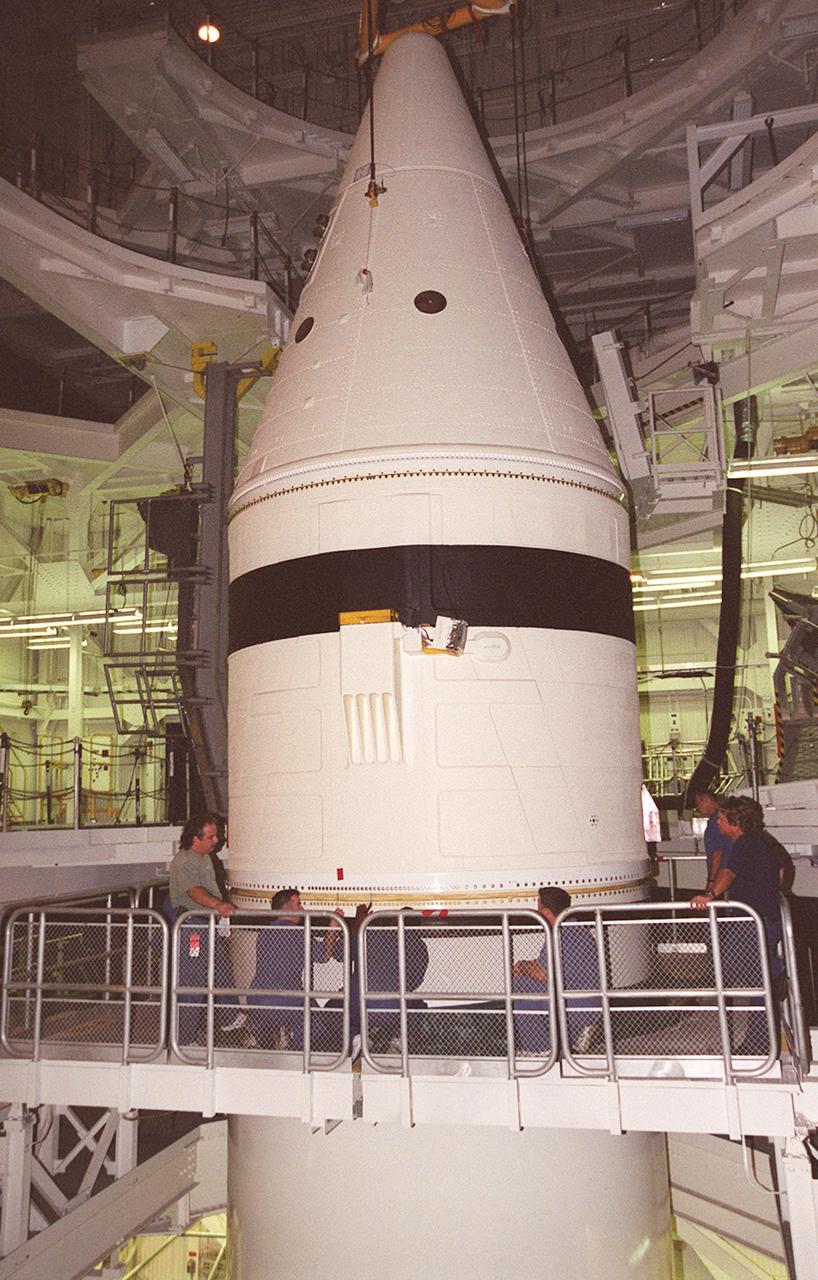
Workers in the Vehicle Assembly Building check the connections on the forward section of a solid rocket booster (SRB) being mated to the rest of the stack below it. The forward section of each booster, from nose cap to forward skirt contains avionics, a sequencer, forward separation motors, a nose cone separation system, drogue and main parachutes, a recovery beacon, a recovery light, a parachute camera on selected flights and a range safety system. Each SRB weighs approximately 1.3 million pounds at launch. The SRB is part of the stack for Space Shuttle Discovery and the STS-92 mission, scheduled for launch Oct. 5, from Launch Pad 39A, on the fifth flight to the International Space Station. Payloads on the mission include the Z-1 truss and Pressurized Mating Adapter-3, components of the Space Station
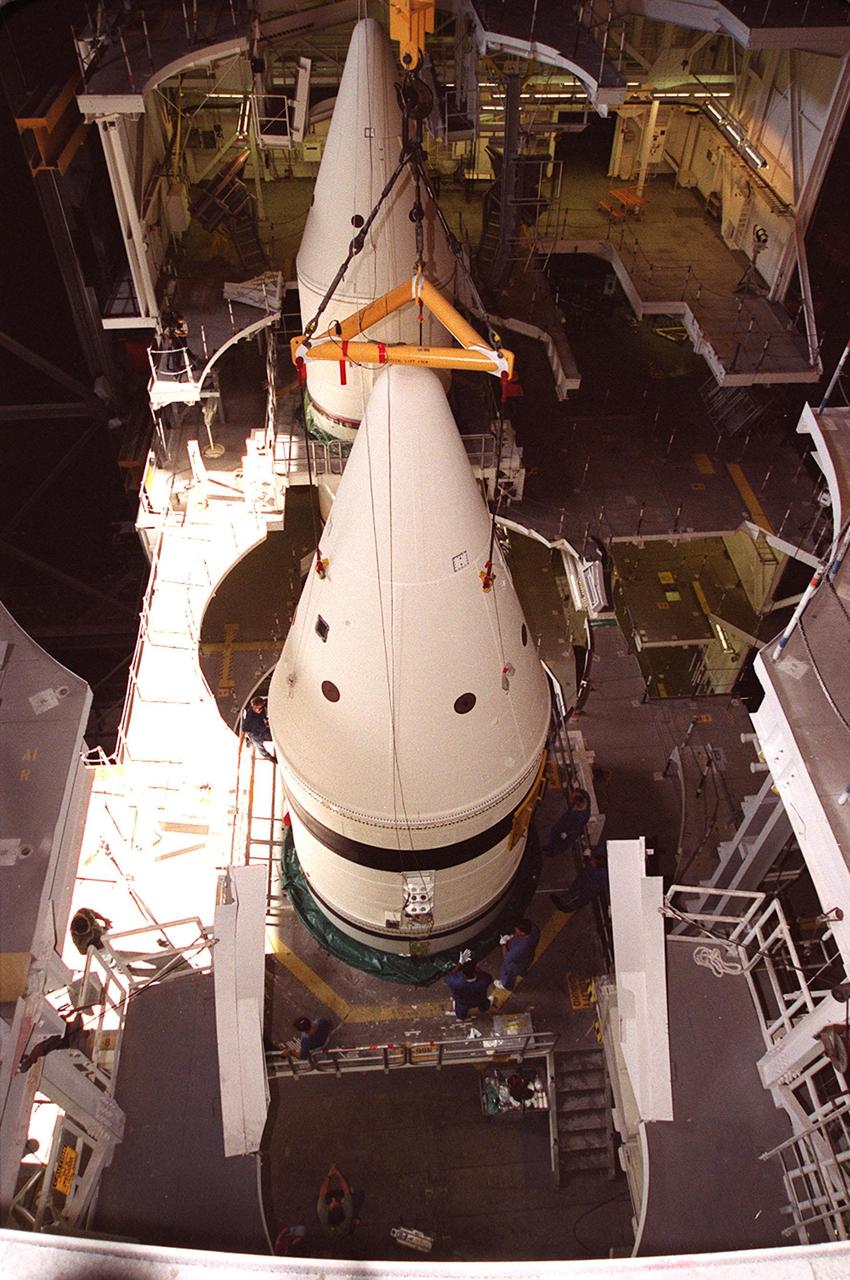
Workers in the Vehicle Assembly Building check the connections on the forward section of a solid rocket booster (SRB) being mated to the rest of the stack below it. The forward section of each booster, from nose cap to forward skirt contains avionics, a sequencer, forward separation motors, a nose cone separation system, drogue and main parachutes, a recovery beacon, a recovery light, a parachute camera on selected flights and a range safety system. Each SRB weighs approximately 1.3 million pounds at launch. The SRB is part of the stack for Space Shuttle Discovery and the STS-92 mission, scheduled for launch Oct. 5, from Launch Pad 39A, on the fifth flight to the International Space Station. Payloads on the mission include the Z-1 truss and Pressurized Mating Adapter-3, components of the Space Station
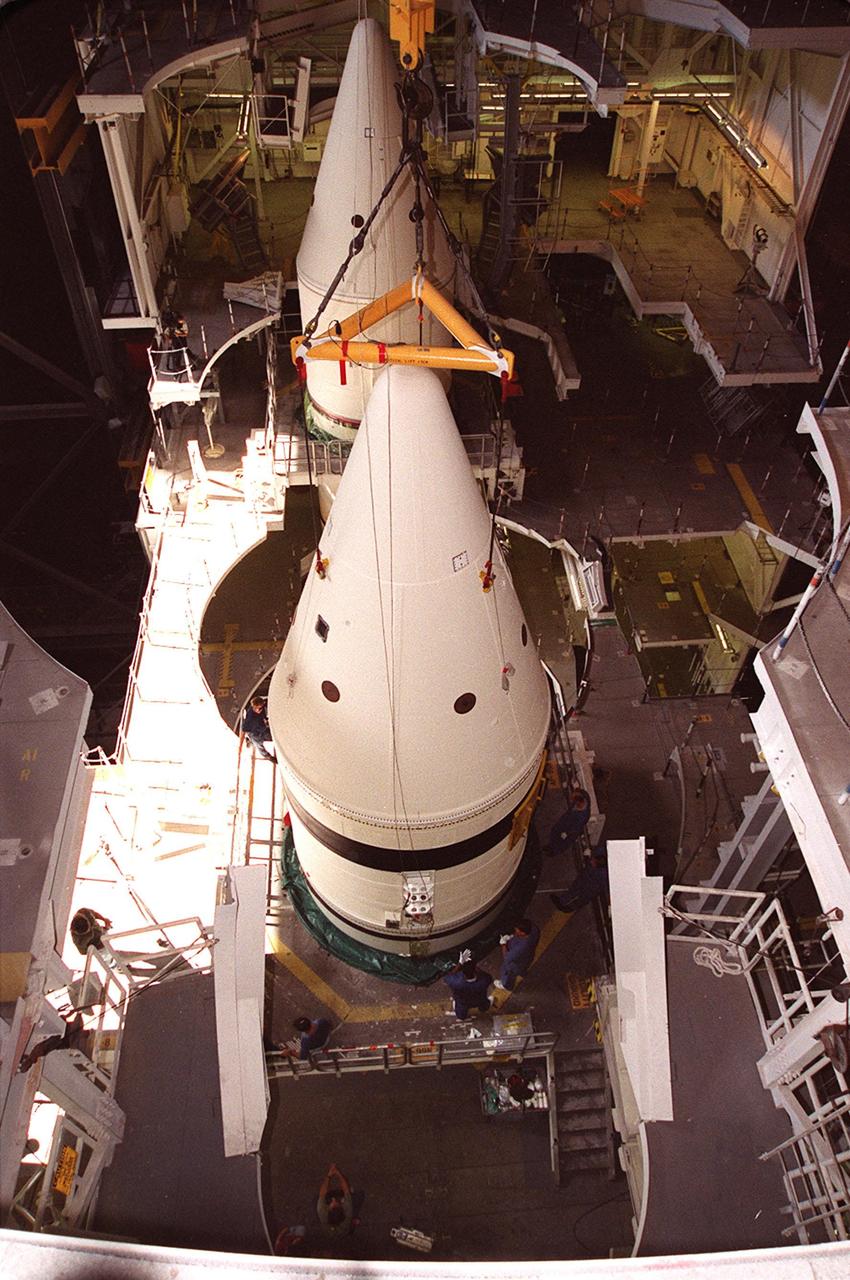
Workers in the Vehicle Assembly Building check the connections on the forward section of a solid rocket booster (SRB) being mated to the rest of the stack below it. The forward section of each booster, from nose cap to forward skirt contains avionics, a sequencer, forward separation motors, a nose cone separation system, drogue and main parachutes, a recovery beacon, a recovery light, a parachute camera on selected flights and a range safety system. Each SRB weighs approximately 1.3 million pounds at launch. The SRB is part of the stack for Space Shuttle Discovery and the STS-92 mission, scheduled for launch Oct. 5, from Launch Pad 39A, on the fifth flight to the International Space Station. Payloads on the mission include the Z-1 truss and Pressurized Mating Adapter-3, components of the Space Station
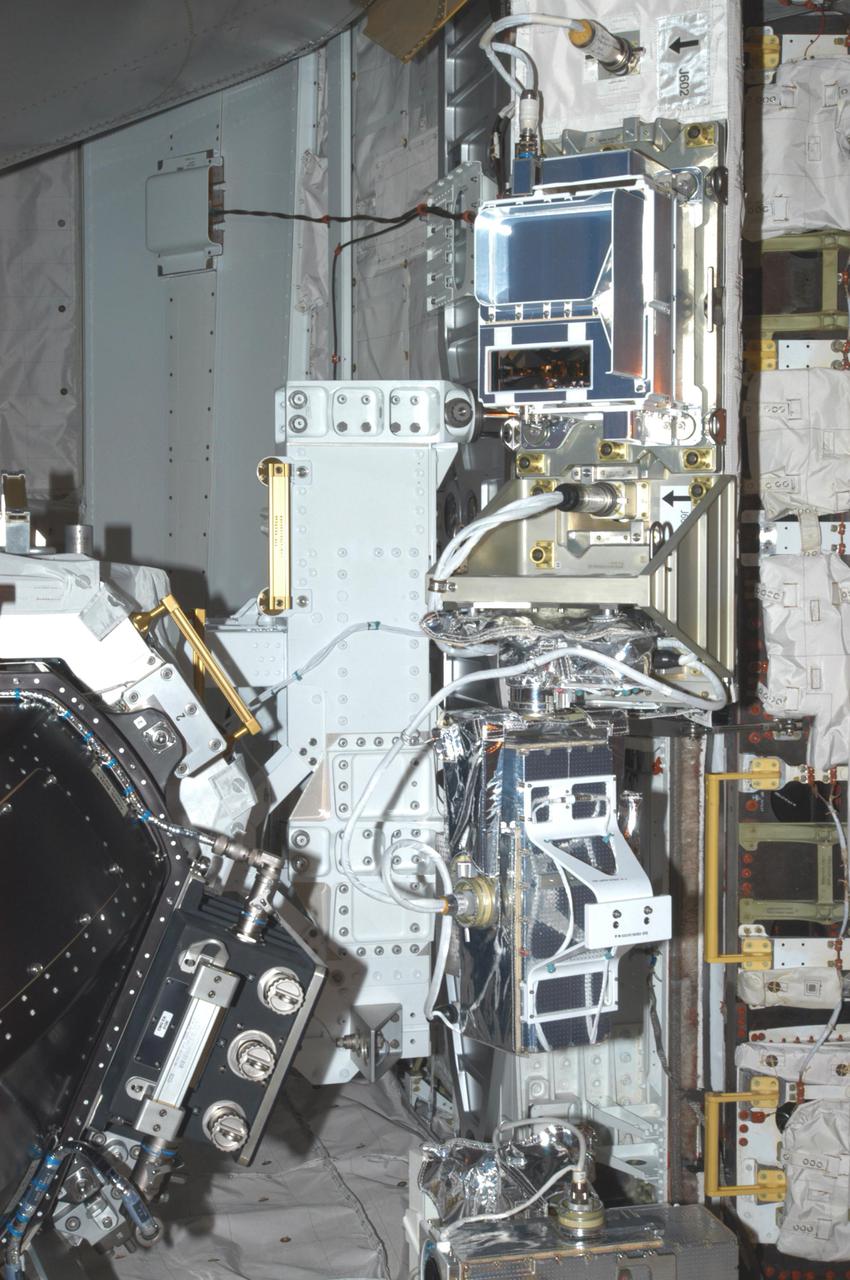
KENNEDY SPACE CENTER, FLA. - At Launch Pad 39B, the Orbiter Boom Sensor System (OBSS) sensor package is viewed before the orbiter's payload bay doors are closed for launch. Payload bay door closure is a significant milestone in the preparations of Discovery for the first Return to Flight mission, STS-114. This sensor package will provide surface area and depth defect inspection for all the surfaces of the orbiter. It includes an intensified television camera (ITVC) and a laser dynamic range imager, which are mounted on a pan and tilt unit, and a laser camera system (LCS) mounted on a stationary bracket. The package is part of the new safety measures added for all future Space Shuttle missions. During its 12-day mission, Discovery’s seven-person crew will test new hardware and techniques to improve Shuttle safety, as well as deliver supplies to the International Space Station. Discovery’s payloads include the Multi-Purpose Logistics Module Raffaello, the Lightweight Multi-Purpose Experiment Support Structure Carrier (LMC), and the External Stowage Platform-2 (ESP-2). Raffaello will deliver supplies to the International Space Station including food, clothing and research equipment. The LMC supports a replacement Control Moment Gyroscope and a tile repair sample box. The ESP-2 is outfitted with replacement parts. Launch of mission STS-114 was set for July 13 at the conclusion of the Flight Readiness Review yesterday.

Photographers and other onlookers watch as a Boeing Delta II expendable launch vehicle lifts off with NASA’s Advanced Composition Explorer (ACE) observatory at 10:39 a.m. EDT, on Aug. 25, 1997, from Launch Complex 17A, Cape Canaveral Air Station. This is the second Delta launch under the Boeing name and the first from Cape Canaveral. Liftoff had been scheduled for Aug. 24, but was scrubbed one day by Air Force range safety personnel because two commercial fishing vessels were within the Delta’s launch danger area. The ACE spacecraft will study low-energy particles of solar origin and high-energy galactic particles on its one-million-mile journey. The collecting power of instruments aboard ACE is 10 to 1,000 times greater than anything previously flown to collect similar data by NASA. Study of these energetic particles may contribute to our understanding of the formation and evolution of the solar system. ACE has a two-year minimum mission lifetime and a goal of five years of service. ACE was built for NASA by the Johns Hopkins Applied Physics Laboratory and is managed by the Explorer Project Office at NASA's Goddard Space Flight Center. The lead scientific institution is the California Institute of Technology (Caltech) in Pasadena, Calif
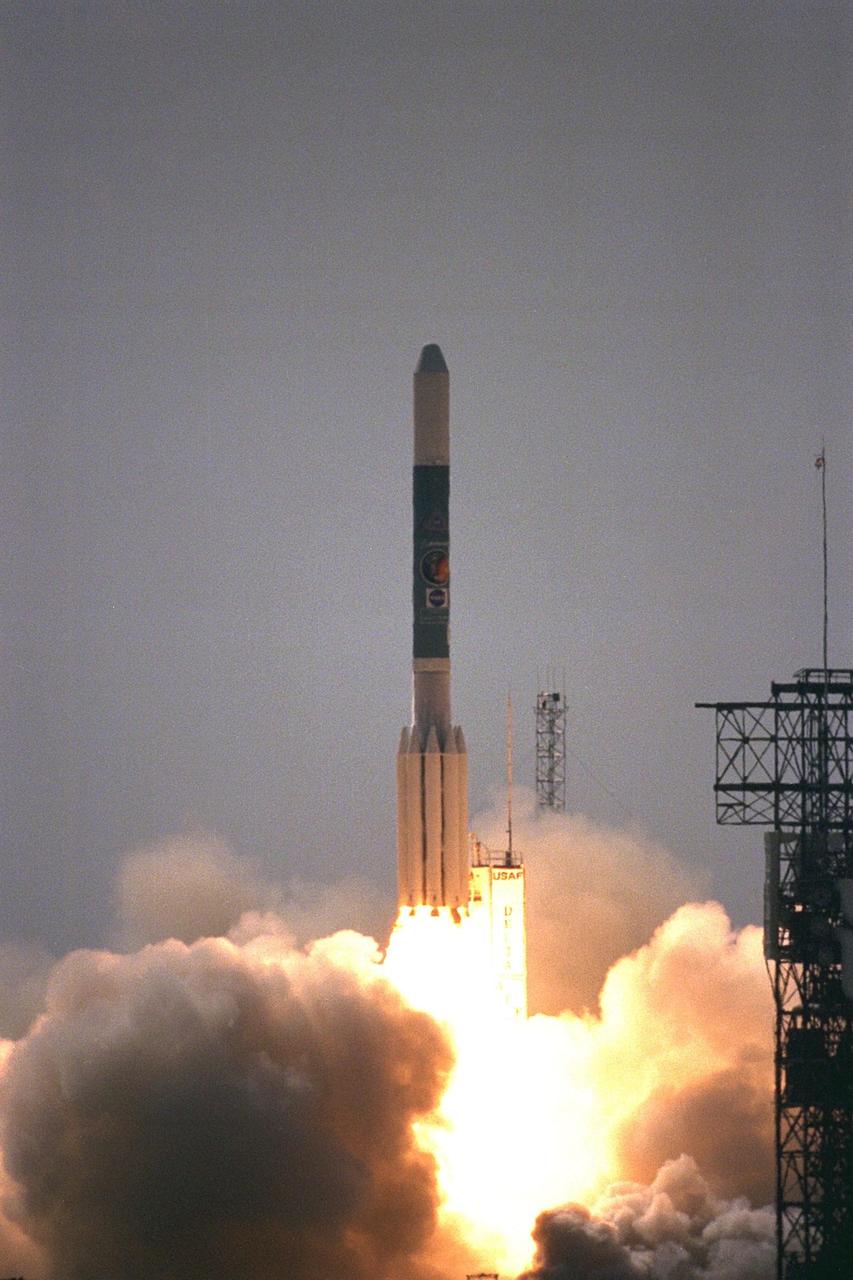
A Boeing Delta II expendable launch vehicle lifts off with NASA’s Advanced Composition Explorer (ACE) observatory at 10:39 a.m. EDT, on Aug. 25, 1997, from Launch Complex 17A, Cape Canaveral Air Station. This is the second Delta launch under the Boeing name and the first from Cape Canaveral. Launch was scrubbed one day by Air Force range safety personnel because two commercial fishing vessels were within the Delta’s launch danger area. The ACE spacecraft will study low-energy particles of solar origin and high-energy galactic particles on its one-million-mile journey. The collecting power of instruments aboard ACE is 10 to 1,000 times greater than anything previously flown to collect similar data by NASA. Study of these energetic particles may contribute to our understanding of the formation and evolution of the solar system. ACE has a two-year minimum mission lifetime and a goal of five years of service. ACE was built for NASA by the Johns Hopkins Applied Physics Laboratory and is managed by the Explorer Project Office at NASA's Goddard Space Flight Center. The lead scientific institution is the California Institute of Technology (Caltech) in Pasadena, Calif
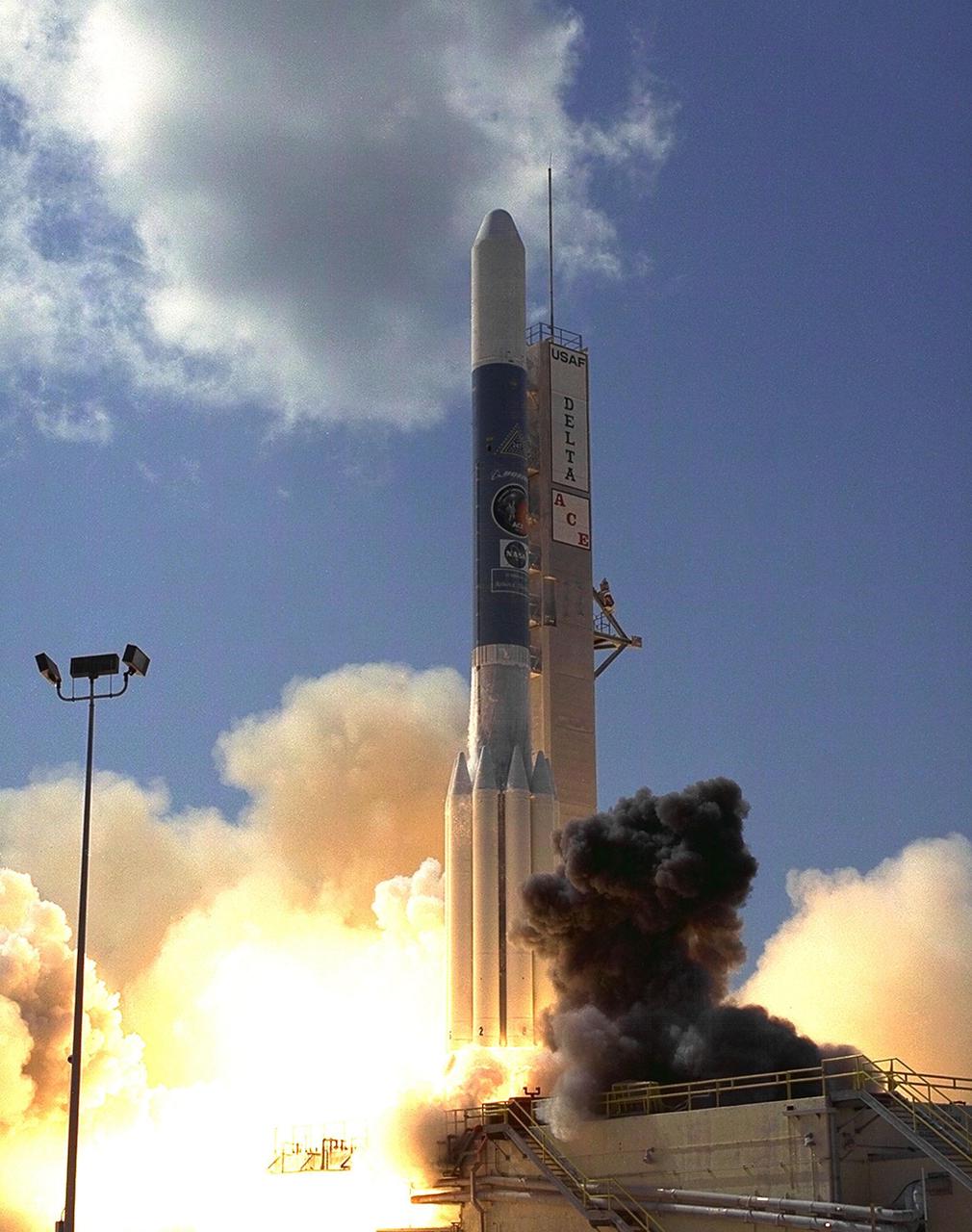
A Boeing Delta II expendable launch vehicle lifts off with NASA’s Advanced Composition Explorer (ACE) observatory at 10:39 a.m. EDT, on Aug. 25, 1997, from Launch Complex 17A, Cape Canaveral Air Station. This is the second Delta launch under the Boeing name and the first from Cape Canaveral. Launch was scrubbed one day by Air Force range safety personnel because two commercial fishing vessels were within the Delta’s launch danger area. The ACE spacecraft will study low-energy particles of solar origin and high-energy galactic particles on its one-million-mile journey. The collecting power of instruments aboard ACE is 10 to 1,000 times greater than anything previously flown to collect similar data by NASA. Study of these energetic particles may contribute to our understanding of the formation and evolution of the solar system. ACE has a two-year minimum mission lifetime and a goal of five years of service. ACE was built for NASA by the Johns Hopkins Applied Physics Laboratory and is managed by the Explorer Project Office at NASA's Goddard Space Flight Center. The lead scientific institution is the California Institute of Technology (Caltech) in Pasadena, Calif
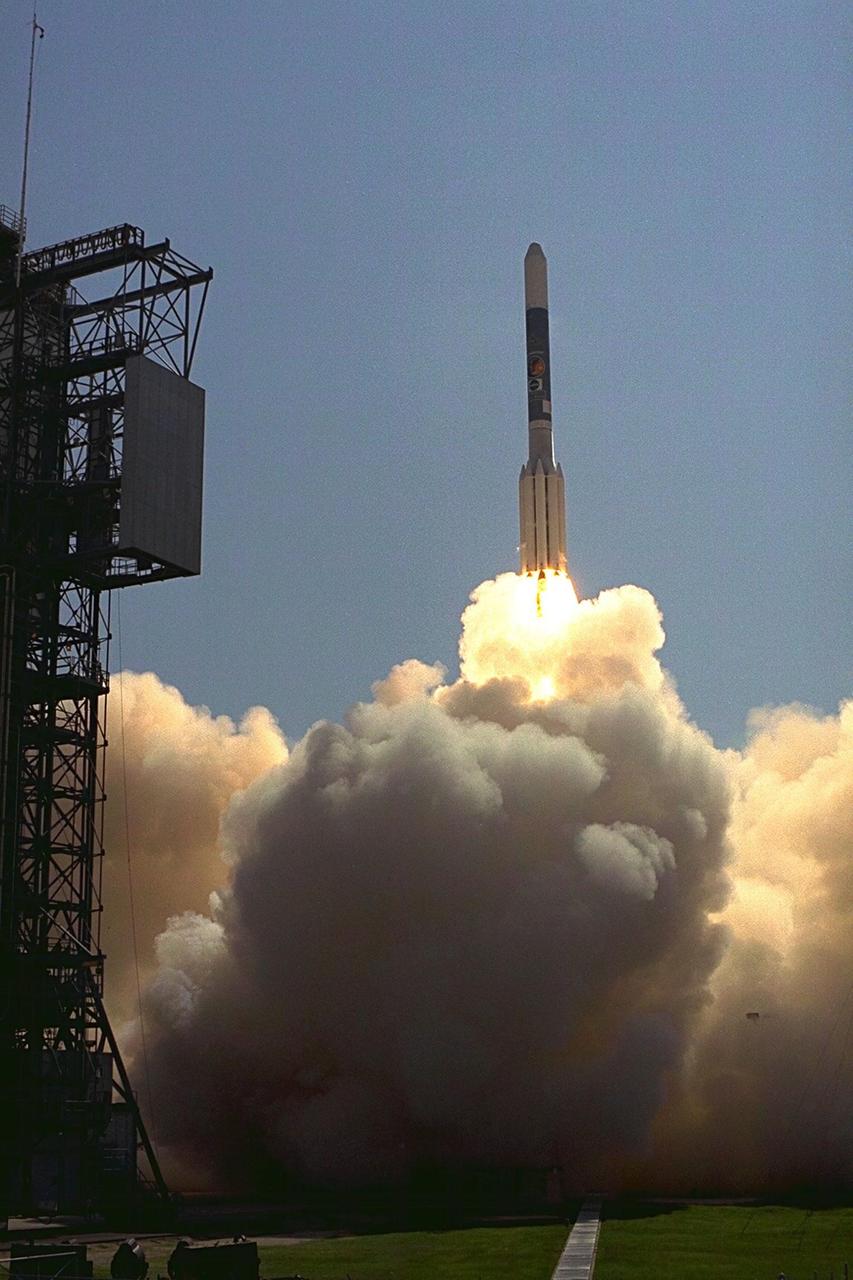
A Boeing Delta II expendable launch vehicle lifts off with NASA’s Advanced Composition Explorer (ACE) observatory at 10:39 a.m. EDT, on Aug. 25, 1997, from Launch Complex 17A, Cape Canaveral Air Station. This is the second Delta launch under the Boeing name and the first from Cape Canaveral. Launch was scrubbed one day by Air Force range safety personnel because two commercial fishing vessels were within the Delta’s launch danger area. The ACE spacecraft will study low-energy particles of solar origin and high-energy galactic particles on its one-million-mile journey. The collecting power of instruments aboard ACE is 10 to 1,000 times greater than anything previously flown to collect similar data by NASA. Study of these energetic particles may contribute to our understanding of the formation and evolution of the solar system. ACE has a two-year minimum mission lifetime and a goal of five years of service. ACE was built for NASA by the Johns Hopkins Applied Physics Laboratory and is managed by the Explorer Project Office at NASA's Goddard Space Flight Center. The lead scientific institution is the California Institute of Technology (Caltech) in Pasadena, Calif
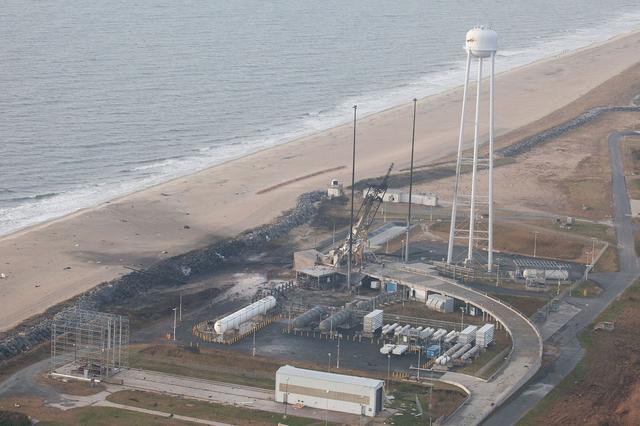
An aerial view of the Wallops Island launch facilities taken by the Wallops Incident Response Team Oct. 29 following the failed launch attempt of Orbital Science Corp.'s Antares rocket Oct. 28. Credit: NASA/Terry Zaperach --- The Wallops Incident Response Team completed today an initial assessment of Wallops Island, Virginia, following the catastrophic failure of Orbital Science Corp.’s Antares rocket shortly after liftoff at 6:22 p.m. EDT Tuesday, Oct. 28, from Pad 0A of the Mid-Atlantic Regional Spaceport at NASA’s Wallops Flight Facility in Virginia. “I want to praise the launch team, range safety, all of our emergency responders and those who provided mutual aid and support on a highly-professional response that ensured the safety of our most important resource -- our people,” said Bill Wrobel, Wallops director. “In the coming days and weeks ahead, we'll continue to assess the damage on the island and begin the process of moving forward to restore our space launch capabilities. There's no doubt in my mind that we will rebound stronger than ever.” The initial assessment is a cursory look; it will take many more weeks to further understand and analyze the full extent of the effects of the event. A number of support buildings in the immediate area have broken windows and imploded doors. A sounding rocket launcher adjacent to the pad, and buildings nearest the pad, suffered the most severe damage. At Pad 0A the initial assessment showed damage to the transporter erector launcher and lightning suppression rods, as well as debris around the pad. The Wallops team also met with a group of state and local officials, including the Virginia Department of Environmental Quality, the Virginia Department of Emergency Management, the Virginia Marine Police, and the U.S. Coast Guard. The Wallops environmental team also is conducting assessments at the site. Preliminary observations are that the environmental effects of the launch failure were largely contained within the southern third of Wallops Island, in the area immediately adjacent to the pad. Immediately after the incident, the Wallops’ industrial hygienist collected air samples at the Wallops mainland area, the Highway 175 causeway, and on Chincoteague Island. No hazardous substances were detected at the sampled locations. Additional air, soil and water samples will be collected from the incident area as well as at control sites for comparative analysis. The Coast Guard and Virginia Marine Resources Commission reported today they have not observed any obvious signs of water pollution, such as oil sheens. Furthermore, initial assessments have not revealed any obvious impacts to fish or wildlife resources. The Incident Response Team continues to monitor and assess. Following the initial assessment, the response team will open the area of Wallops Island, north of the island flagpole opposite of the launch pad location, to allow the U.S. Navy to return back to work. Anyone who finds debris or damage to their property in the vicinity of the launch mishap is cautioned to stay away from it and call the Incident Response Team at 757-824-1295. Further updates on the situation and the progress of the ongoing investigation will be available at: <a href="http://www.orbital.com" rel="nofollow">www.orbital.com</a> and <a href="http://www.nasa.gov/orbital" rel="nofollow">www.nasa.gov/orbital</a> <b><a href="http://www.nasa.gov/audience/formedia/features/MP_Photo_Guidelines.html" rel="nofollow">NASA image use policy.</a></b> <b><a href="http://www.nasa.gov/centers/goddard/home/index.html" rel="nofollow">NASA Goddard Space Flight Center</a></b> enables NASA’s mission through four scientific endeavors: Earth Science, Heliophysics, Solar System Exploration, and Astrophysics. Goddard plays a leading role in NASA’s accomplishments by contributing compelling scientific knowledge to advance the Agency’s mission. <b>Follow us on <a href="http://twitter.com/NASAGoddardPix" rel="nofollow">Twitter</a></b> <b>Like us on <a href="http://www.facebook.com/pages/Greenbelt-MD/NASA-Goddard/395013845897?ref=tsd" rel="nofollow">Facebook</a></b> <b>Find us on <a href="http://instagram.com/nasagoddard?vm=grid" rel="nofollow">Instagram</a></b>