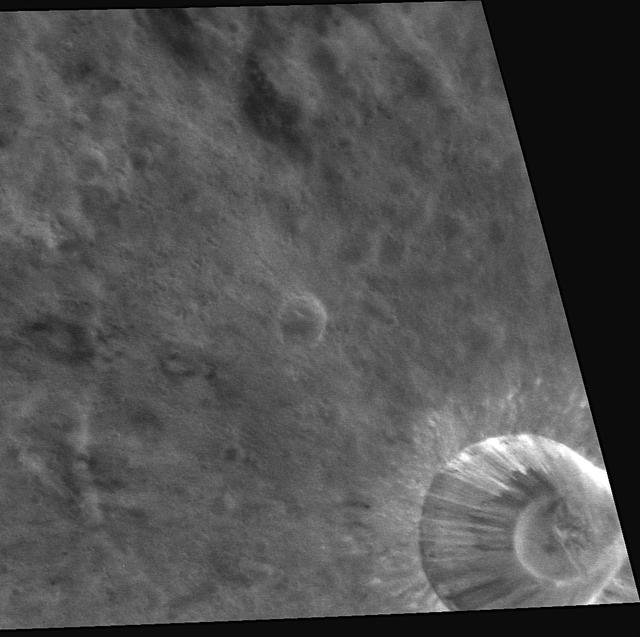
To Be Young and Rayed on Mercury
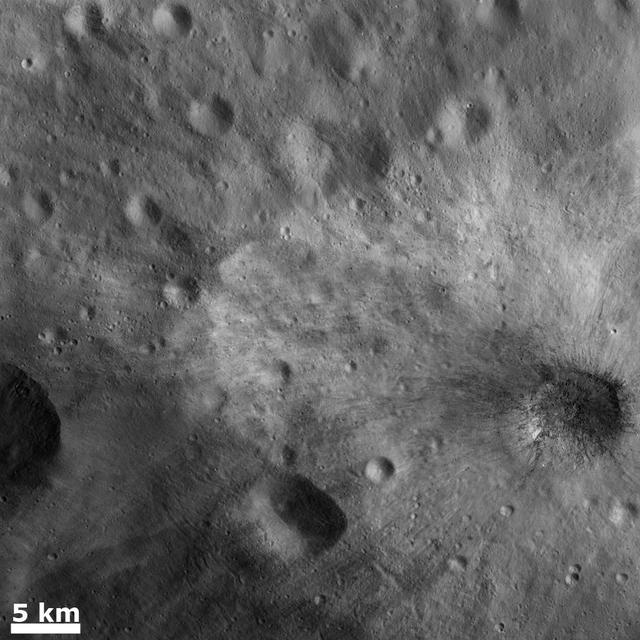
This image from NASA Dawn spacecraft shows a young, fresh crater, which is about 7 km in diameter, on asteroid Vesta. This crater has both dark and bright rays fanning out from it.
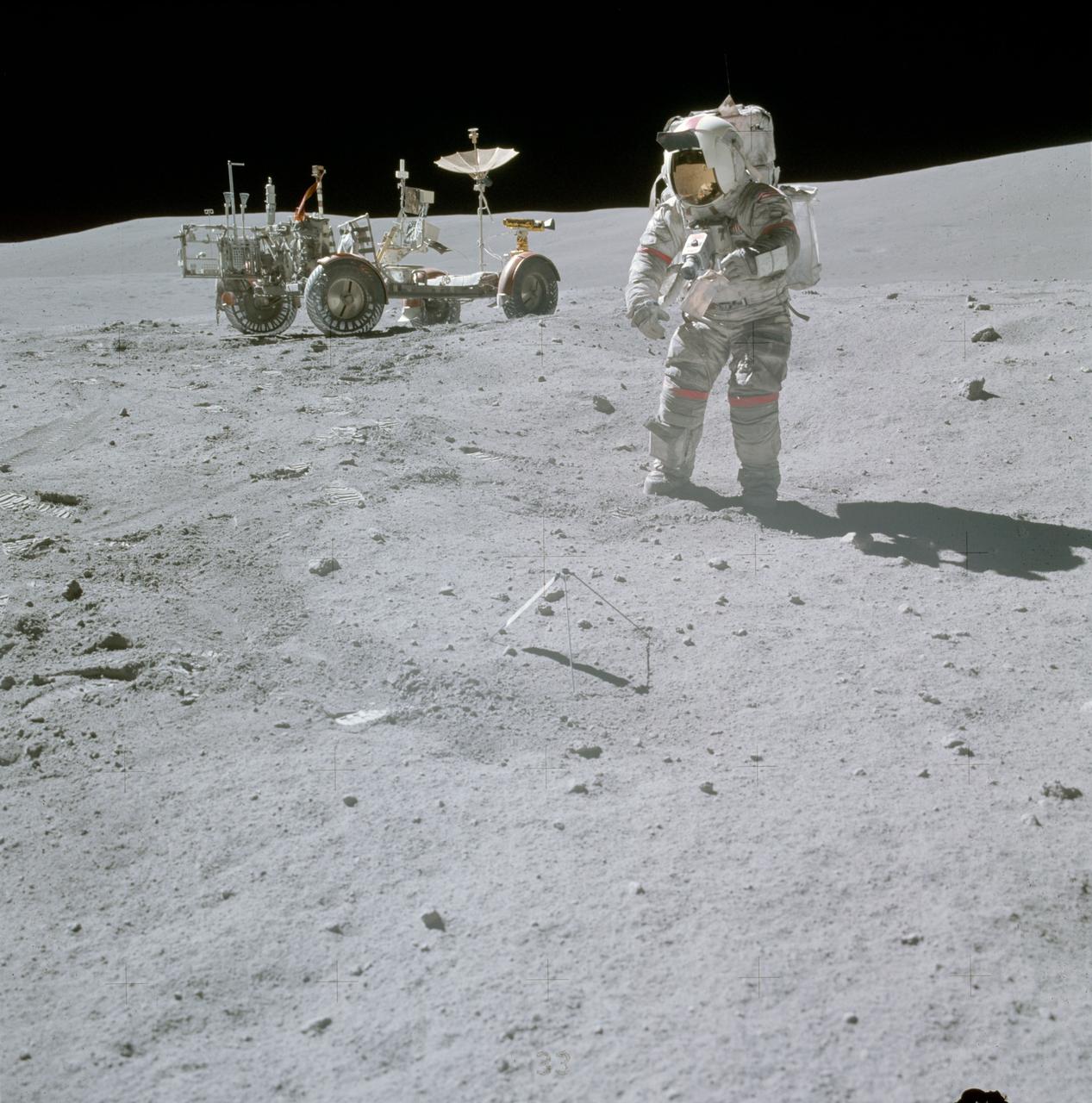
AS16-117-18825 (23 April 1972) --- Astronaut John W. Young, Apollo 16 commander, with a sample bag in his left hand, moves toward the bottom part of the gnomon (center) while collecting samples at the North Ray Crater geological site. Note how soiled Young's Extravehicular Mobility Unit (EMU) is during this the third and final Apollo 16 extravehicular activity (EVA). The Lunar Roving Vehicle (LRV) is parked at upper left.
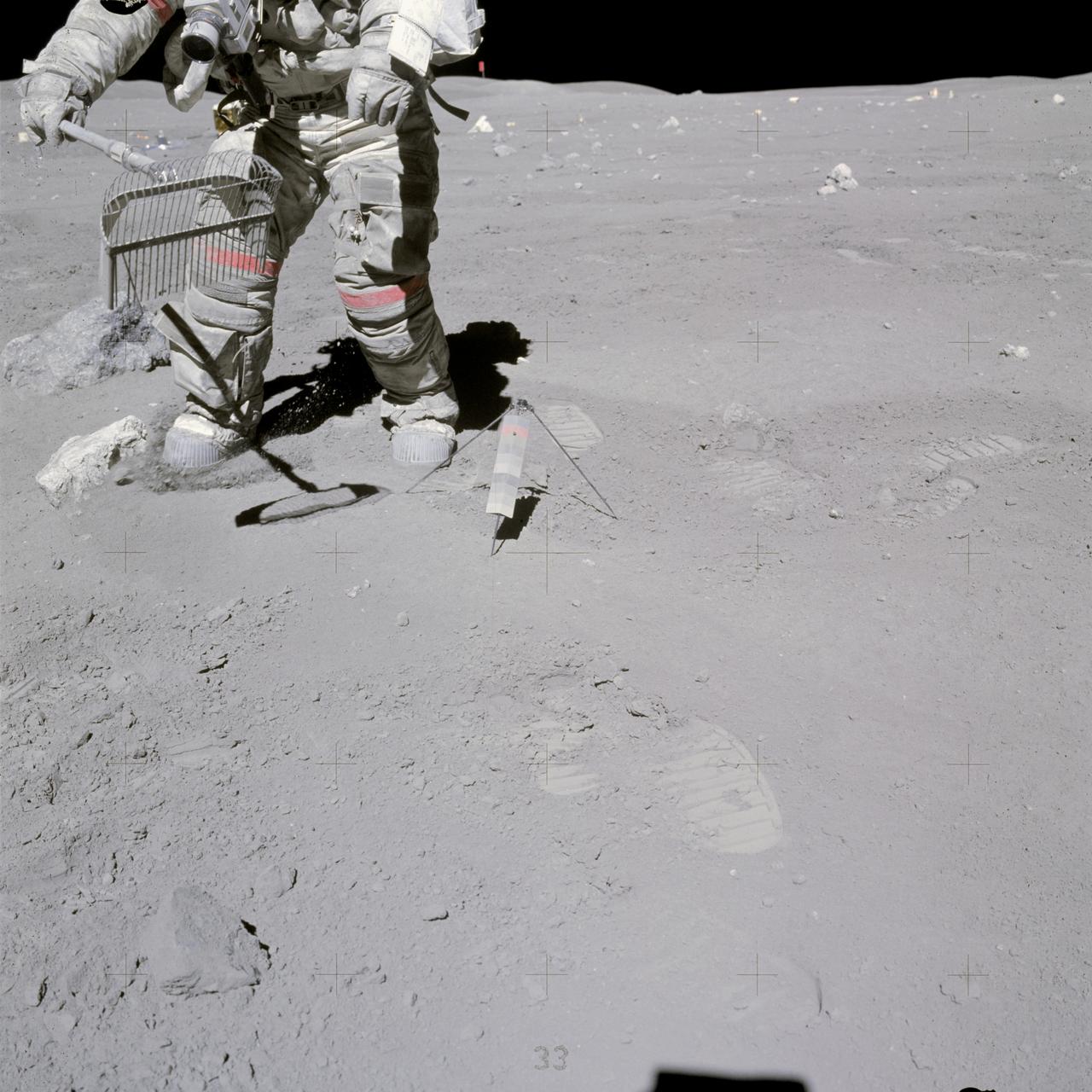
AS16-117-18826 (23 April 1972) --- Astronaut John W. Young collects samples at the North Ray Crater geological site during the mission's third and final Apollo 16 extravehicular activity (EVA). He has a rake in his hand, and the gnomon is near his foot. Note how soiled Young's Extravehicular Mobility Unit (EMU) is. While astronauts Young, commander; and Charles M. Duke Jr., lunar module pilot; descended in the Apollo 16 Lunar Module (LM) "Orion" to explore the Descartes highlands landing site on the moon, astronaut Thomas K. Mattingly II, command module pilot, remained with the Command and Service Modules (CSM) "Casper" in lunar orbit.
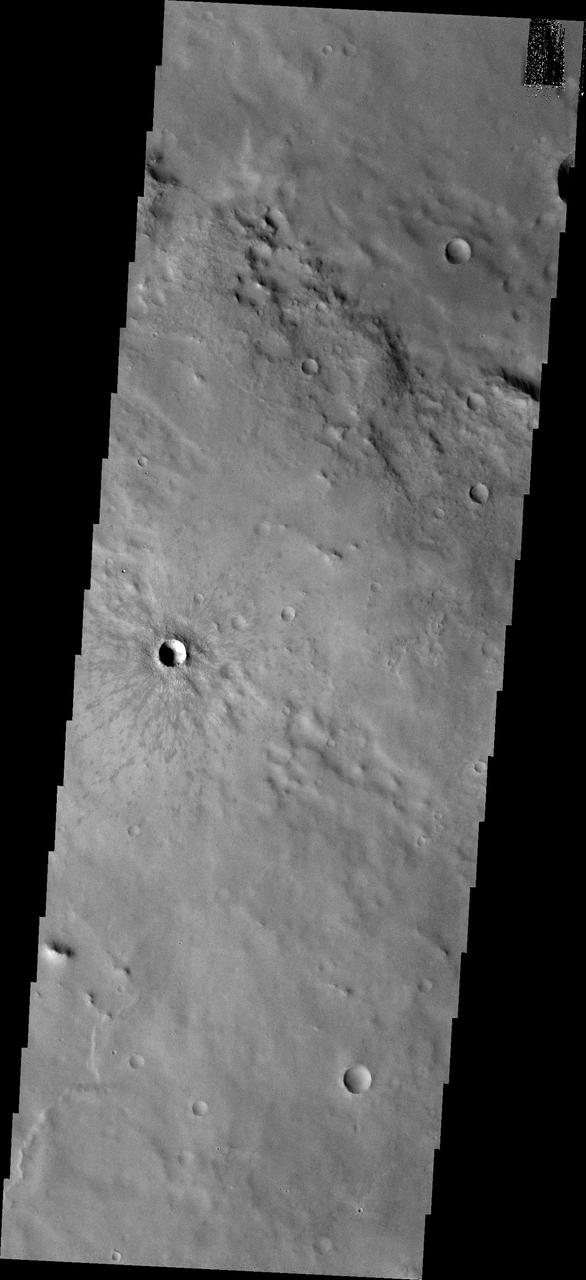
This image captured by NASA 2001 Mars Odyssey spacecraft shows Winslow Crater, a fairly young crater. The darker rayed ejecta is still visible surrounding the crater.
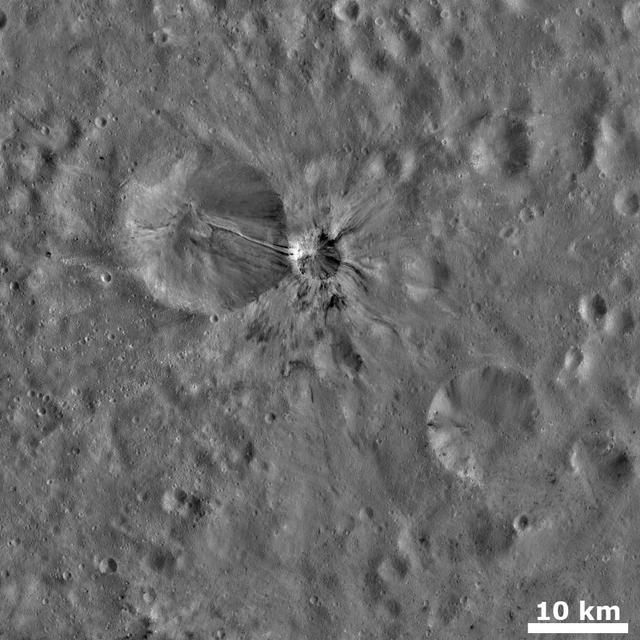
This image from NASA Dawn spacecraft shows a small, young, fresh crater on asteroid Vesta with bright and dark rays extending from it.
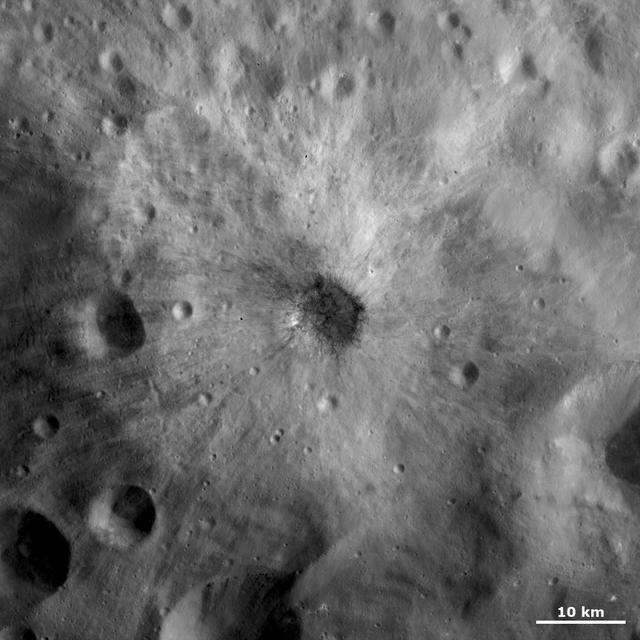
This image from NASA Dawn spacecraft is centered on a small, young, fresh crater with bright and dark ejecta rays extending from it. The crater is located in Vesta Tuccia quadrangle on asteroid Vesta.
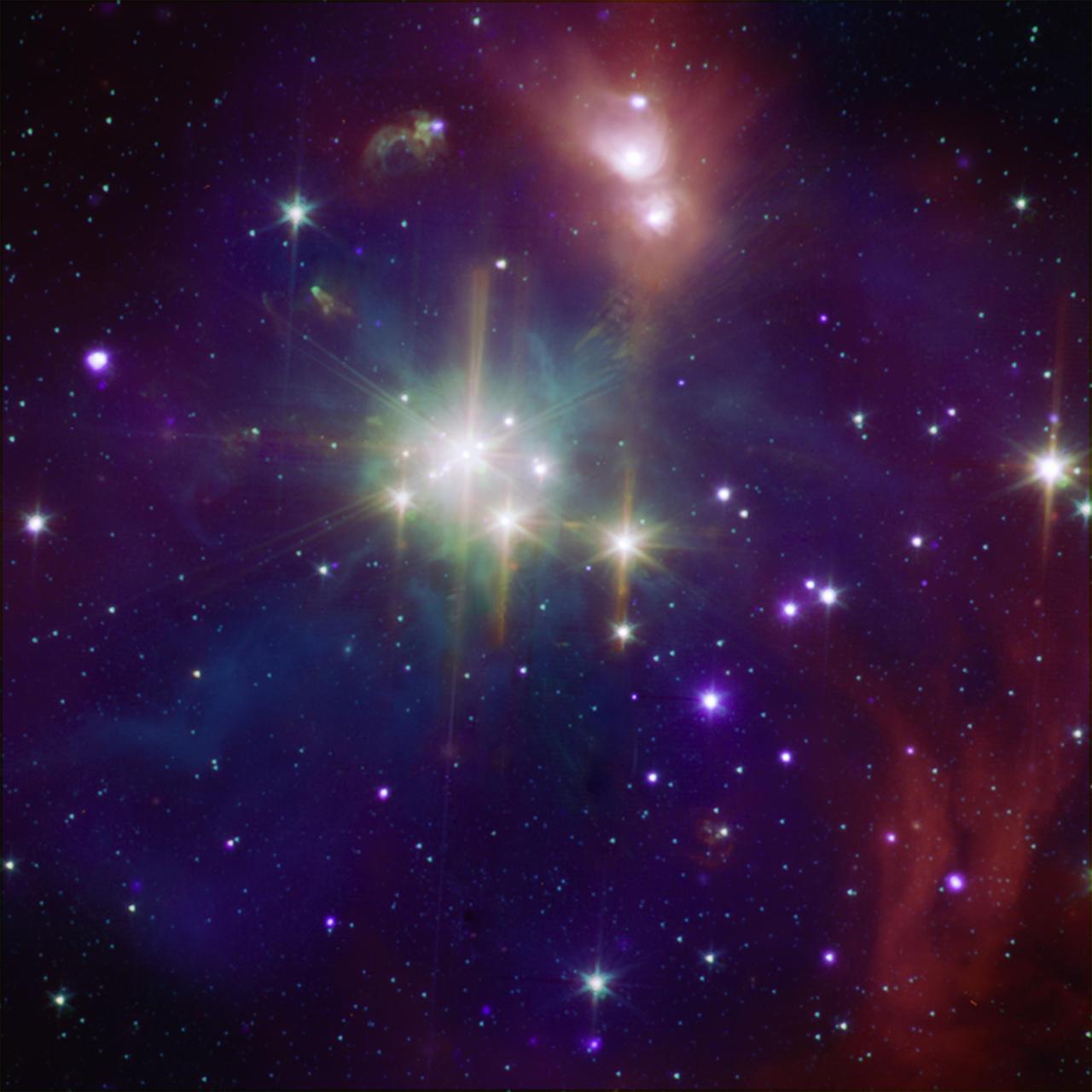
This composite image shows the Coronet in X-rays from Chandra and infrared from NASA Spitzer Space Telescope orange, green, and cyan. The Spitzer data show young stars plus diffuse emission from dust.
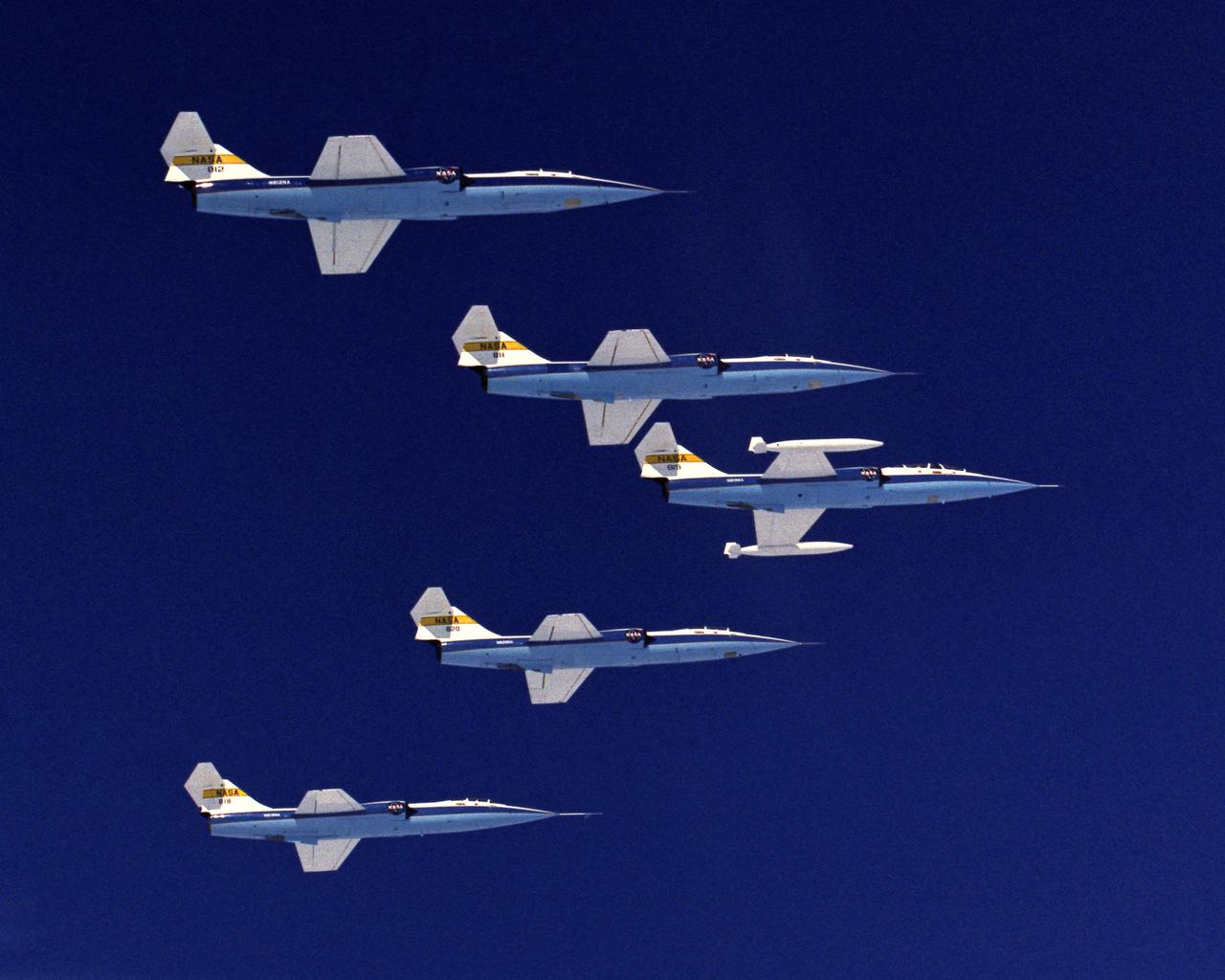
The only time the five ship fleet of F-104 Starfighters was ever airborne at the same time. Pilots were: F-104N #811-Bill Dana; F-104N #812-Tom McMurtry; F-104A #818-Einar Enevoldson; F-104A #820-Gary Krier; F-104B #819-Fitz Fulton and Ray Young. Photo taken from T-38 #821 flown by Don Mallick and photographer was Bob Rhine. 4/11/75 NASA DFRC EC76-5145
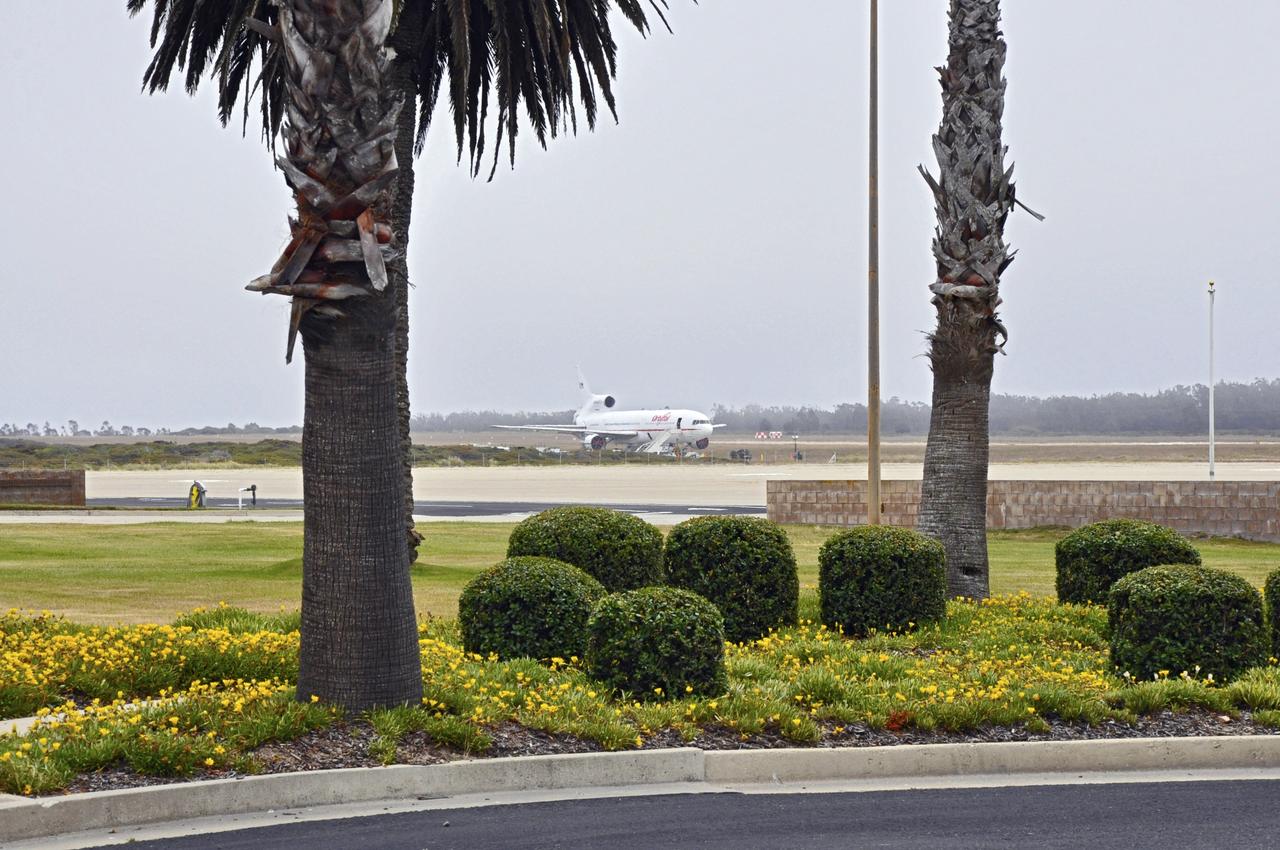
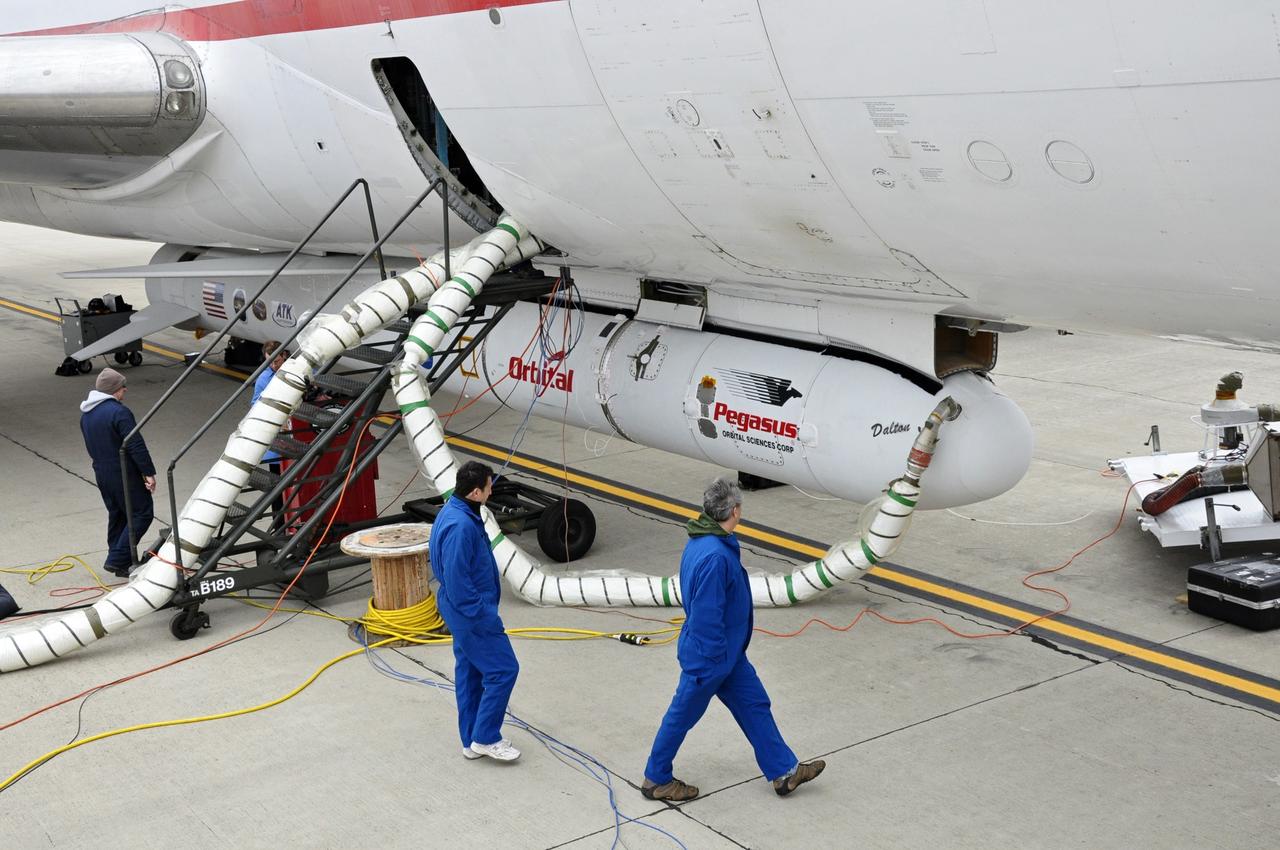
VANDENBERG AFB, Calif. – Technicians connect the Orbital Sciences Pegasus XL rocket with its NuSTAR spacecraft to the L-1011 carrier aircraft known as "Stargazer." The Pegasus will launch NuSTAR into space where the high-energy x-ray telescope will conduct a census for black holes, map radioactive material in young supernovae remnants, and study the origins of cosmic rays and the extreme physics around collapsed stars. Photo credit: NASA/Randy Beaudoin, VAFB
VANDENBERG AFB, Calif. – The Orbital Sciences Pegasus XL rocket with its NuSTAR spacecraft after attachment to the L-1011 carrier aircraft known as "Stargazer." The Pegasus will launch NuSTAR into space where the high-energy x-ray telescope will conduct a census for black holes, map radioactive material in young supernovae remnants, and study the origins of cosmic rays and the extreme physics around collapsed stars. Photo credit: NASA/Randy Beaudoin, VAFB
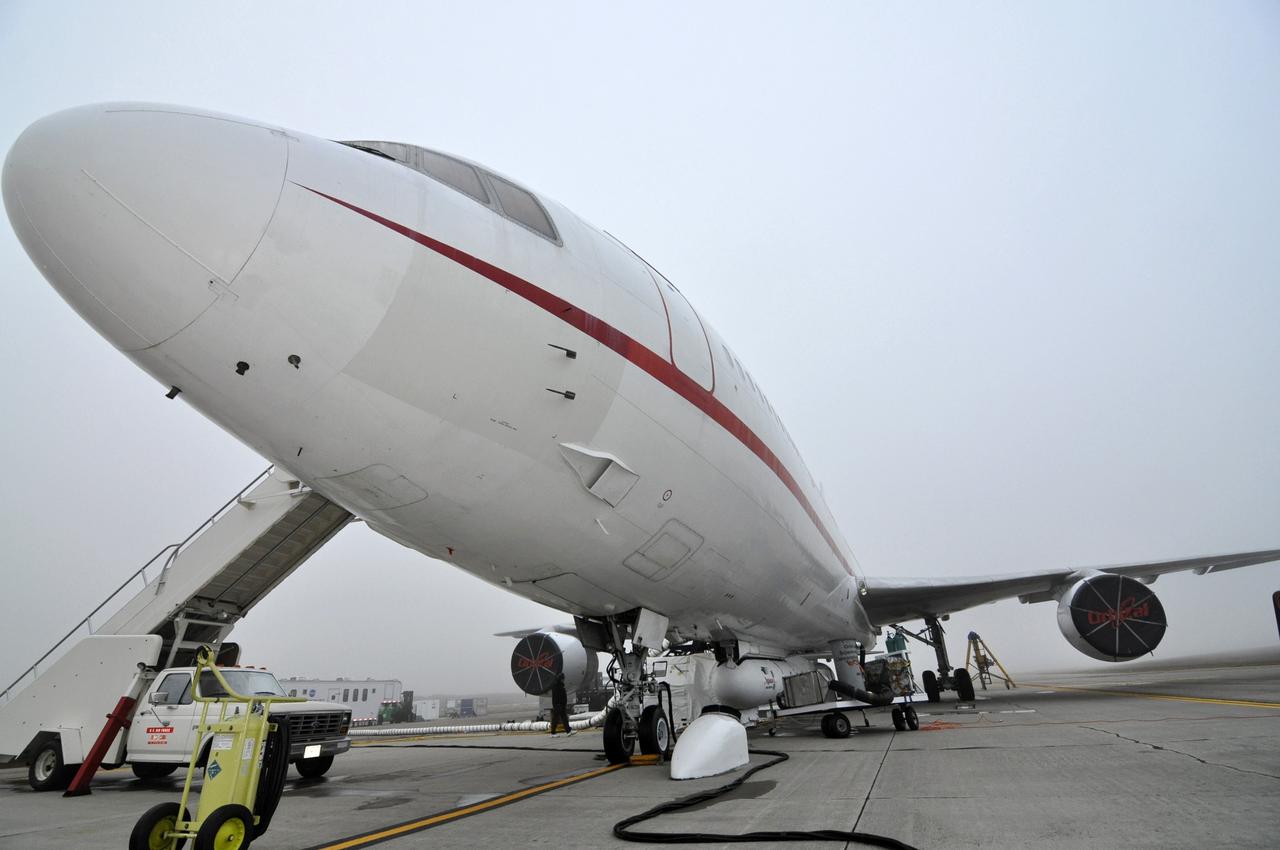
VANDENBERG AFB, Calif. – The Orbital Sciences Pegasus XL rocket with its NuSTAR spacecraft after attachment to the L-1011 carrier aircraft known as "Stargazer." The Pegasus will launch NuSTAR into space where the high-energy x-ray telescope will conduct a census for black holes, map radioactive material in young supernovae remnants, and study the origins of cosmic rays and the extreme physics around collapsed stars. Photo credit: NASA/Randy Beaudoin, VAFB
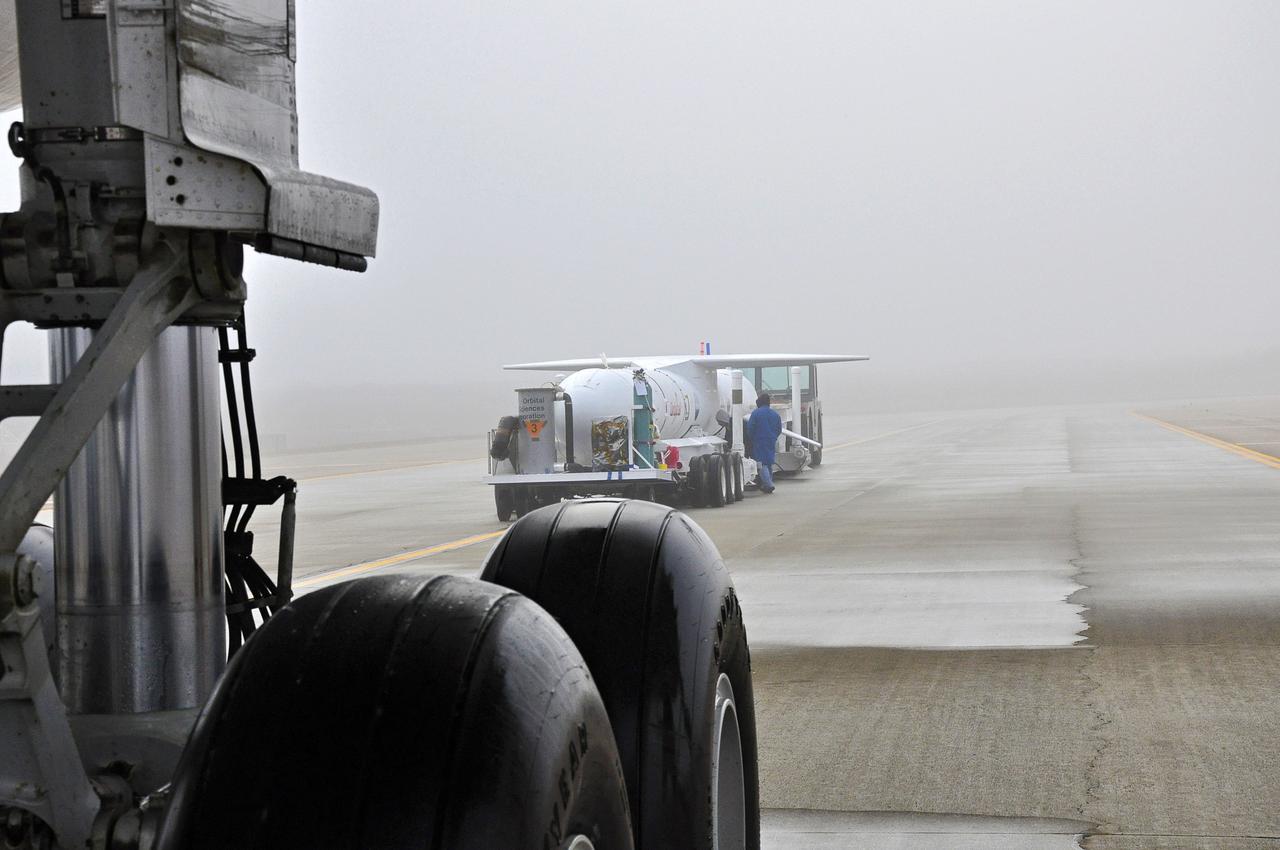
VANDENBERG AFB, Calif. – Technicians roll the Orbital Sciences Pegasus XL rocket with its NuSTAR spacecraft to the waiting L-1011 carrier aircraft known as "Stargazer." The Pegasus will launch NuSTAR into space where the high-energy x-ray telescope will conduct a census for black holes, map radioactive material in young supernovae remnants, and study the origins of cosmic rays and the extreme physics around collapsed stars. Photo credit: NASA/Randy Beaudoin, VAFB
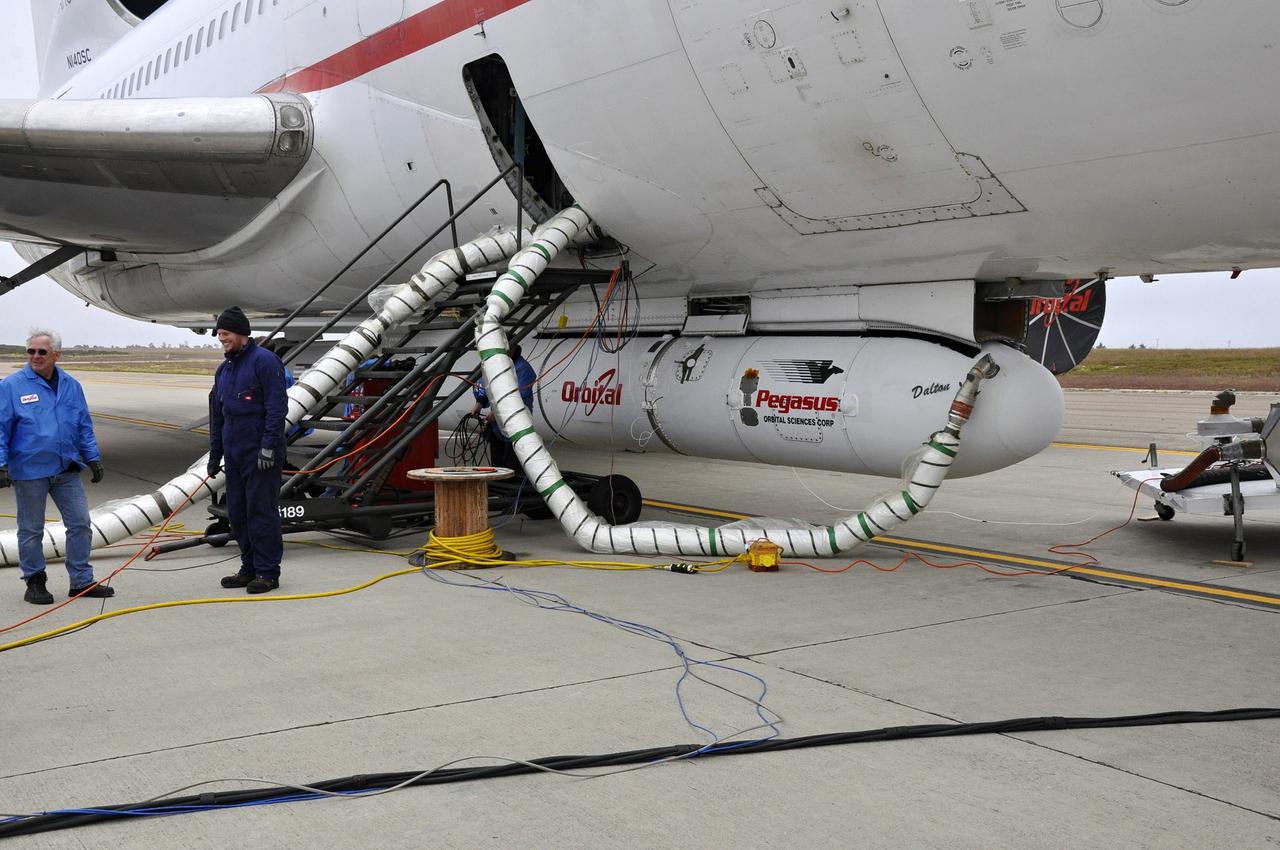
VANDENBERG AFB, Calif. – Technicians connect the Orbital Sciences Pegasus XL rocket with its NuSTAR spacecraft to the L-1011 carrier aircraft known as "Stargazer." The Pegasus will launch NuSTAR into space where the high-energy x-ray telescope will conduct a census for black holes, map radioactive material in young supernovae remnants, and study the origins of cosmic rays and the extreme physics around collapsed stars. Photo credit: NASA/Randy Beaudoin, VAFB
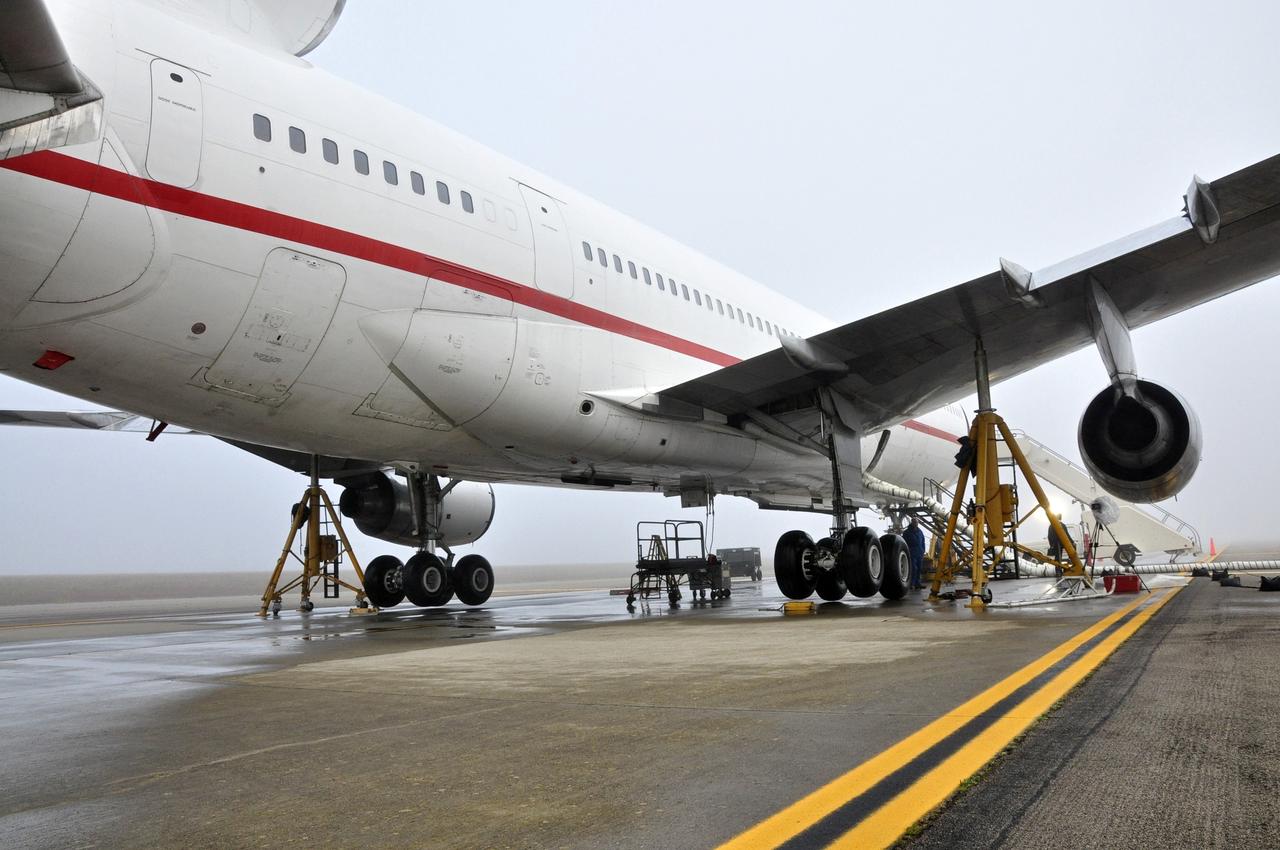
VANDENBERG AFB, Calif. – The Orbital Sciences L-1011 known as "Stargazer" awaits the Orbital Sciences Pegasus XL rocket with its NuSTAR spacecraft. The Pegasus will launch NuSTAR into space where the high-energy x-ray telescope will conduct a census for black holes, map radioactive material in young supernovae remnants, and study the origins of cosmic rays and the extreme physics around collapsed stars. Photo credit: NASA/Randy Beaudoin, VAFB
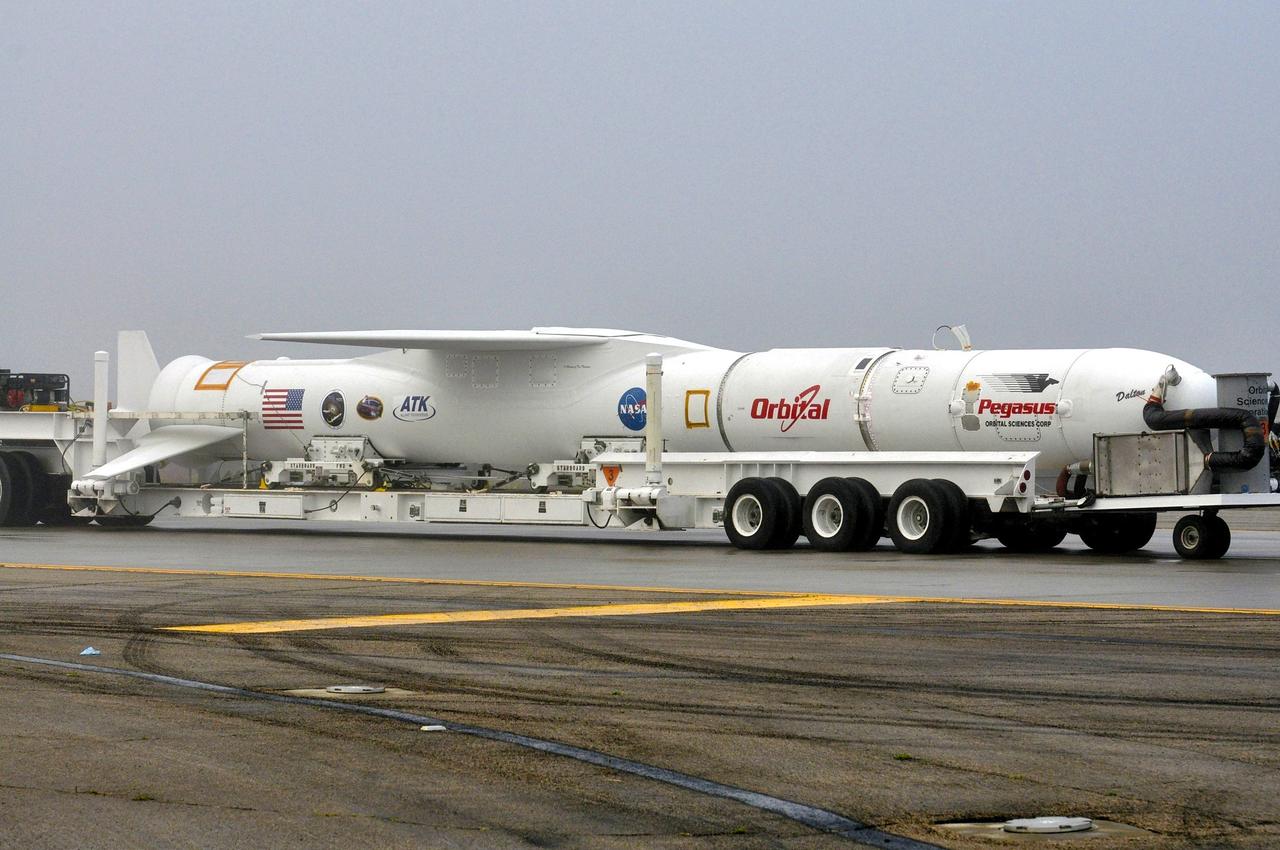
VANDENBERG AFB, Calif. – Technicians roll the Orbital Sciences Pegasus XL rocket with its NuSTAR spacecraft to the waiting L-1011 carrier aircraft known as "Stargazer." The Pegasus will launch NuSTAR into space where the high-energy x-ray telescope will conduct a census for black holes, map radioactive material in young supernovae remnants, and study the origins of cosmic rays and the extreme physics around collapsed stars. Photo credit: NASA/Randy Beaudoin, VAFB
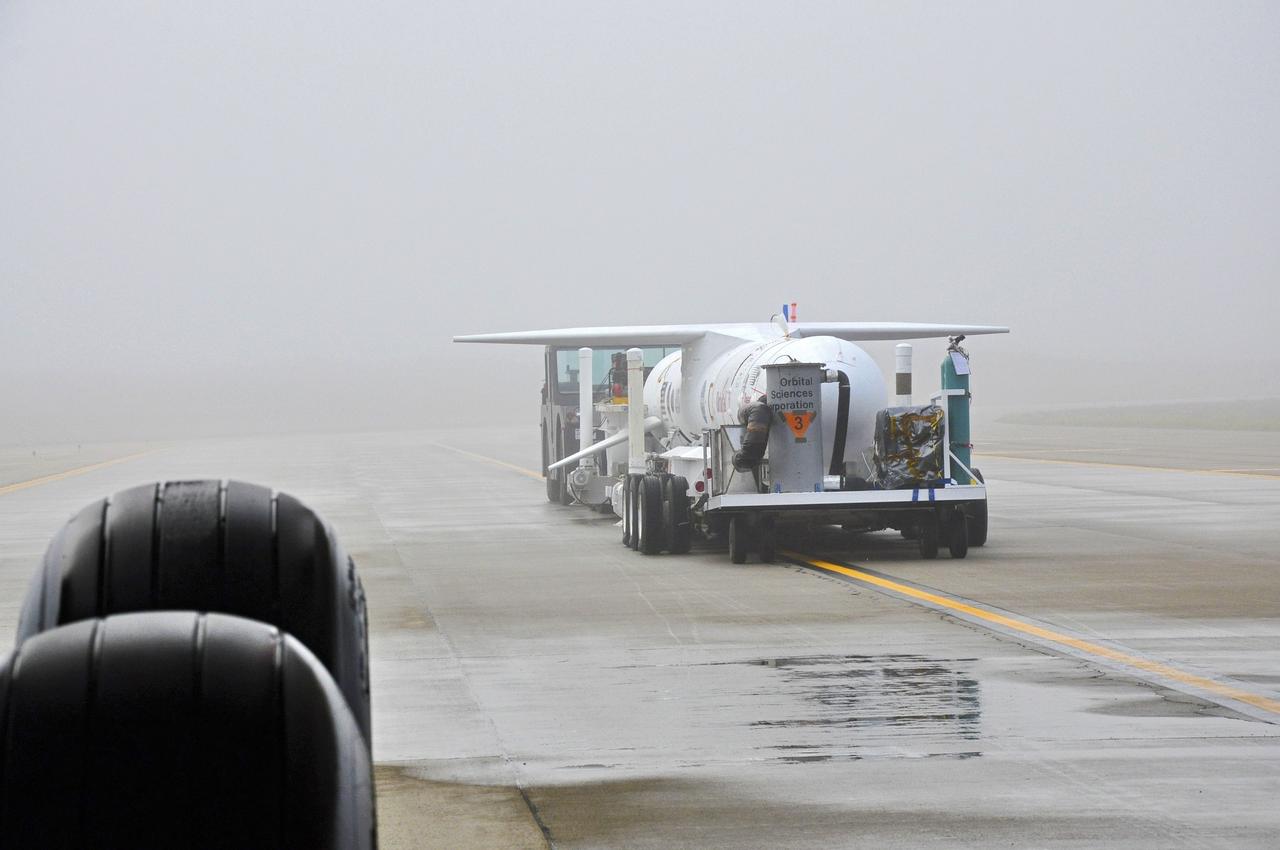
VANDENBERG AFB, Calif. – Technicians roll the Orbital Sciences Pegasus XL rocket with its NuSTAR spacecraft to the waiting L-1011 carrier aircraft known as "Stargazer." The Pegasus will launch NuSTAR into space where the high-energy x-ray telescope will conduct a census for black holes, map radioactive material in young supernovae remnants, and study the origins of cosmic rays and the extreme physics around collapsed stars. Photo credit: NASA/Randy Beaudoin, VAFB
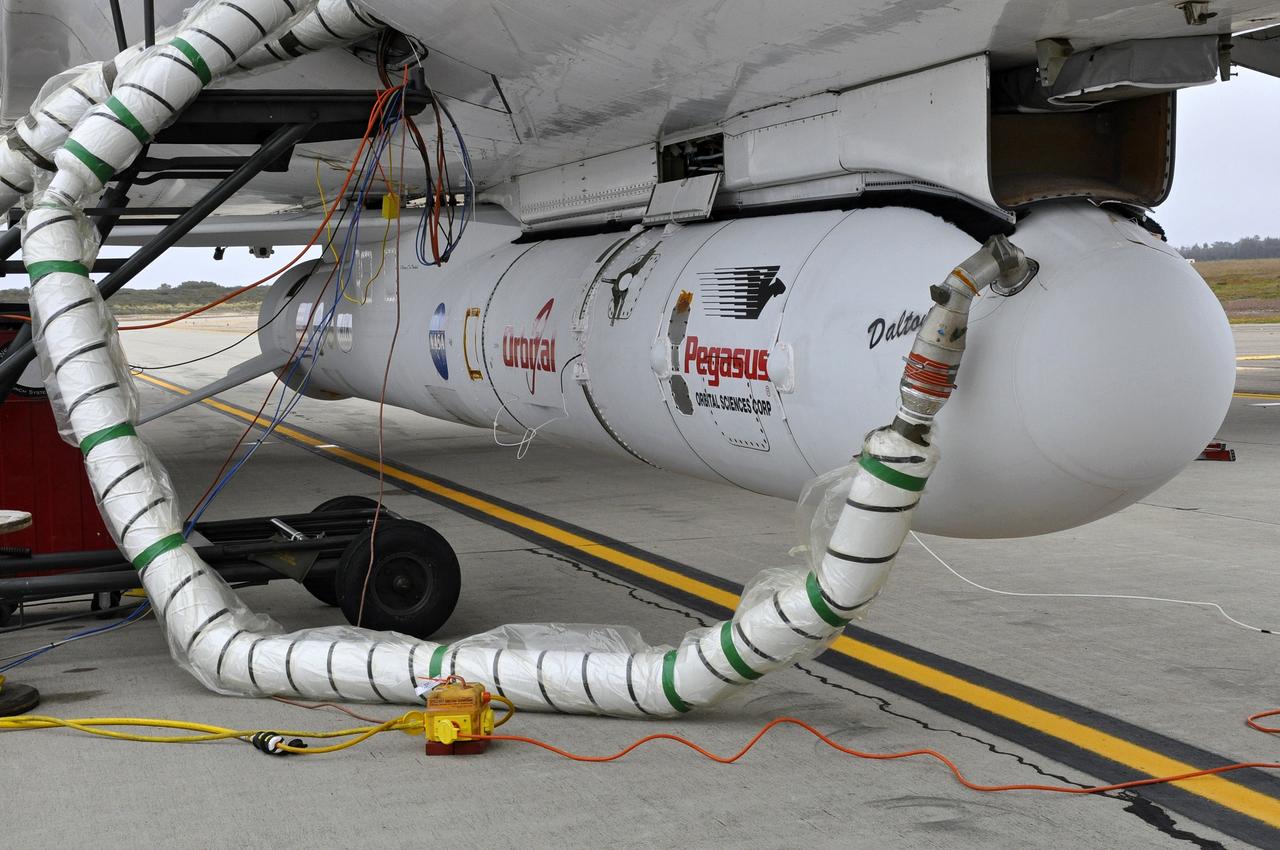
VANDENBERG AFB, Calif. – The Orbital Sciences Pegasus XL rocket with its NuSTAR spacecraft after attachment to the L-1011 carrier aircraft known as "Stargazer." The Pegasus will launch NuSTAR into space where the high-energy x-ray telescope will conduct a census for black holes, map radioactive material in young supernovae remnants, and study the origins of cosmic rays and the extreme physics around collapsed stars. Photo credit: NASA/Randy Beaudoin, VAFB
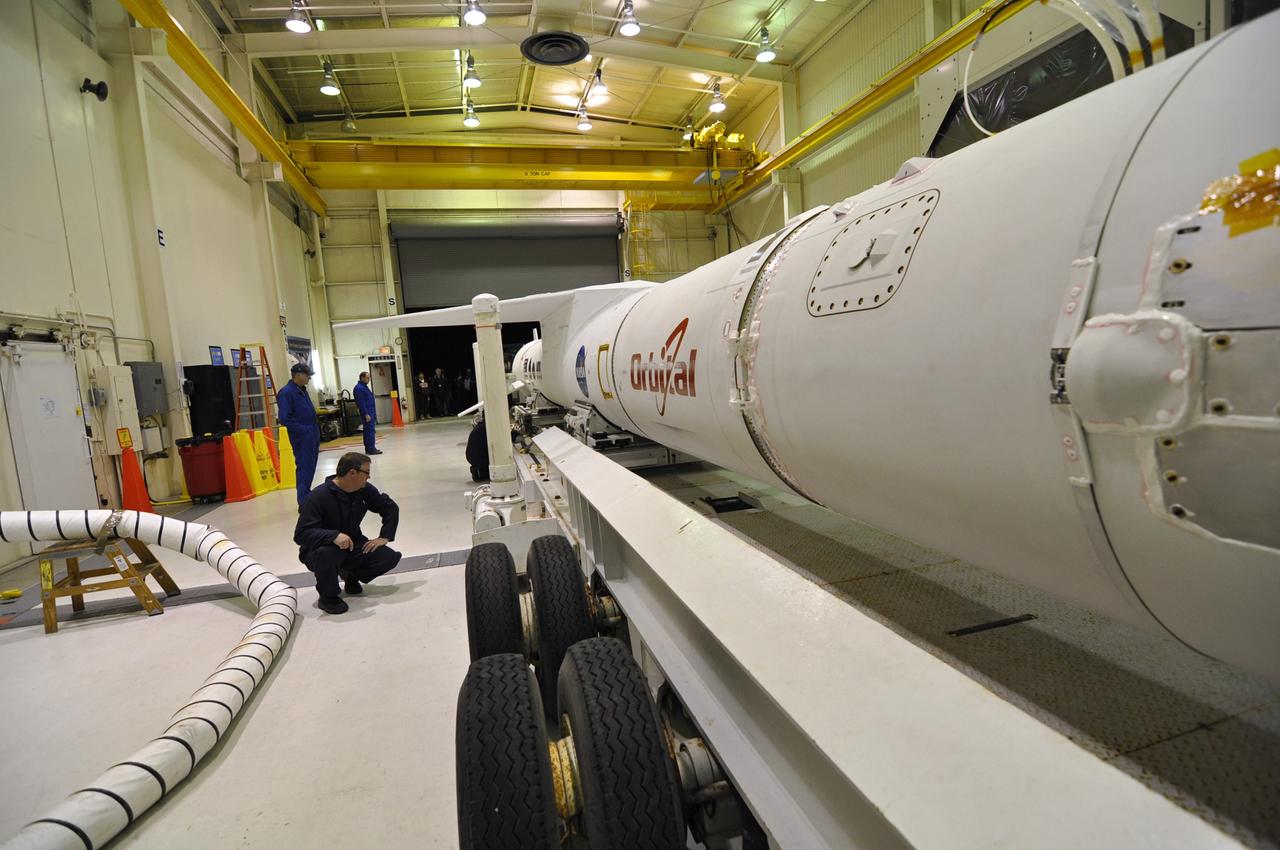
VANDENBERG AFB, Calif. – Technicians prepare to roll the Orbital Sciences Pegasus XL rocket with its NuSTAR spacecraft to the waiting L-1011 carrier aircraft known as "Stargazer." The Pegasus will launch NuSTAR into space where the high-energy x-ray telescope will conduct a census for black holes, map radioactive material in young supernovae remnants, and study the origins of cosmic rays and the extreme physics around collapsed stars. Photo credit: NASA/Randy Beaudoin, VAFB
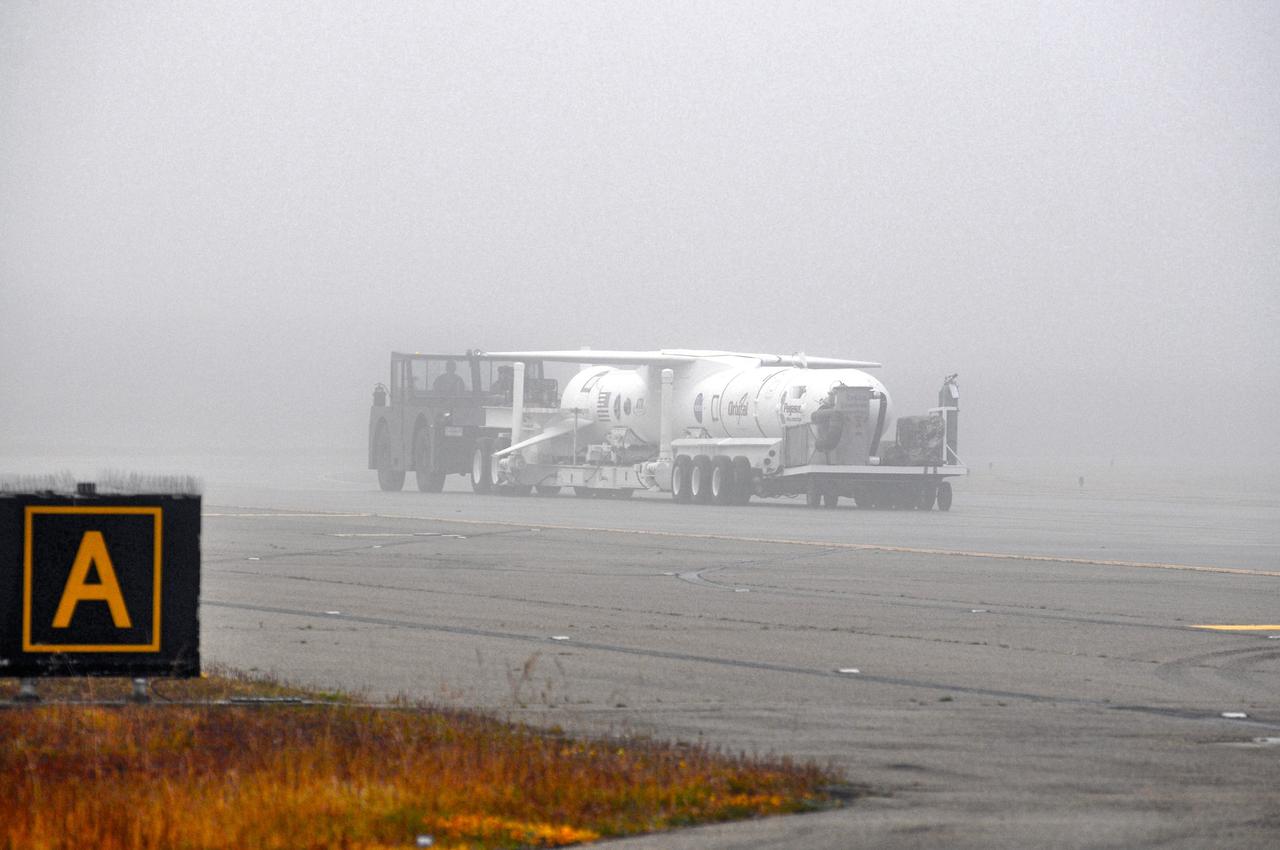
VANDENBERG AFB, Calif. – Technicians roll the Orbital Sciences Pegasus XL rocket with its NuSTAR spacecraft to the waiting L-1011 carrier aircraft known as "Stargazer." The Pegasus will launch NuSTAR into space where the high-energy x-ray telescope will conduct a census for black holes, map radioactive material in young supernovae remnants, and study the origins of cosmic rays and the extreme physics around collapsed stars. Photo credit: NASA/Randy Beaudoin, VAFB
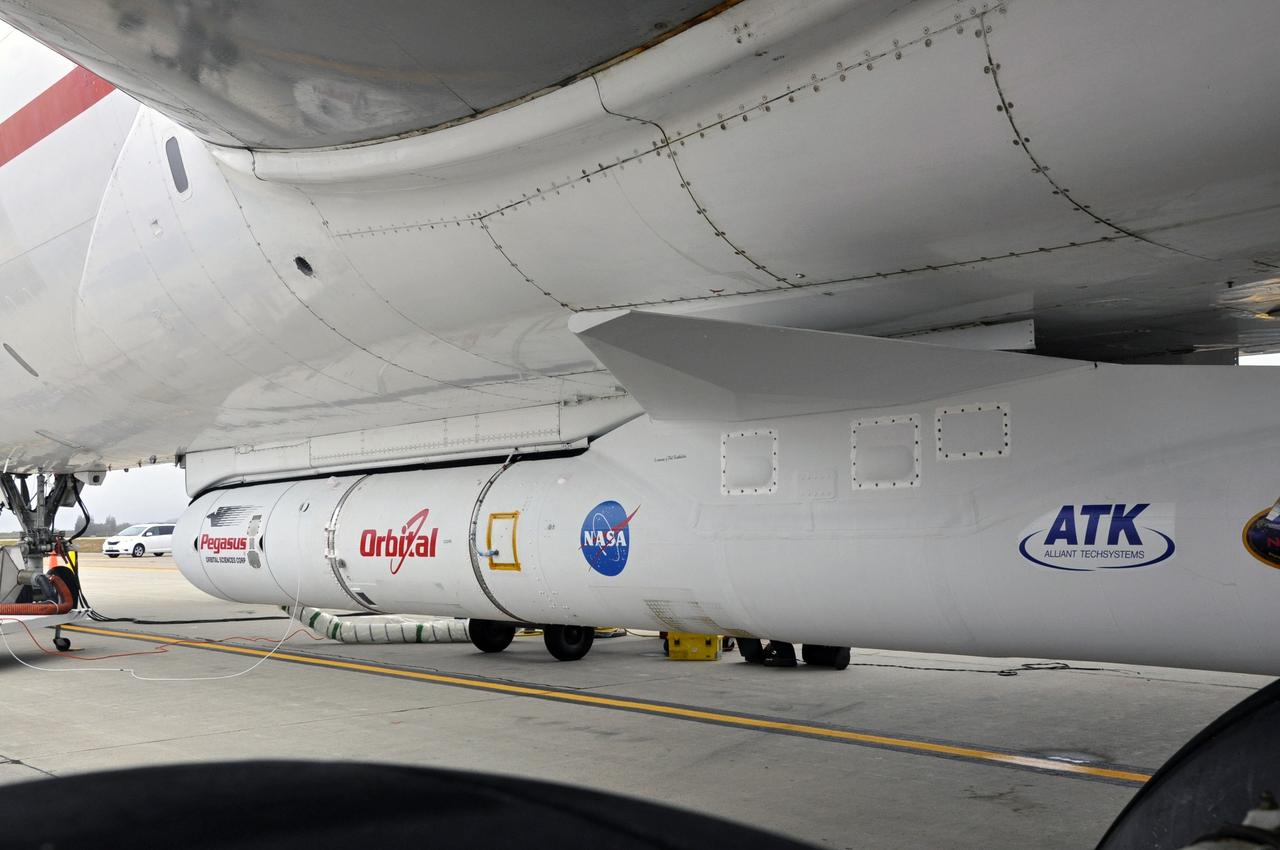
VANDENBERG AFB, Calif. – The Orbital Sciences Pegasus XL rocket with its NuSTAR spacecraft after attachment to the L-1011 carrier aircraft known as "Stargazer." The Pegasus will launch NuSTAR into space where the high-energy x-ray telescope will conduct a census for black holes, map radioactive material in young supernovae remnants, and study the origins of cosmic rays and the extreme physics around collapsed stars. Photo credit: NASA/Randy Beaudoin, VAFB
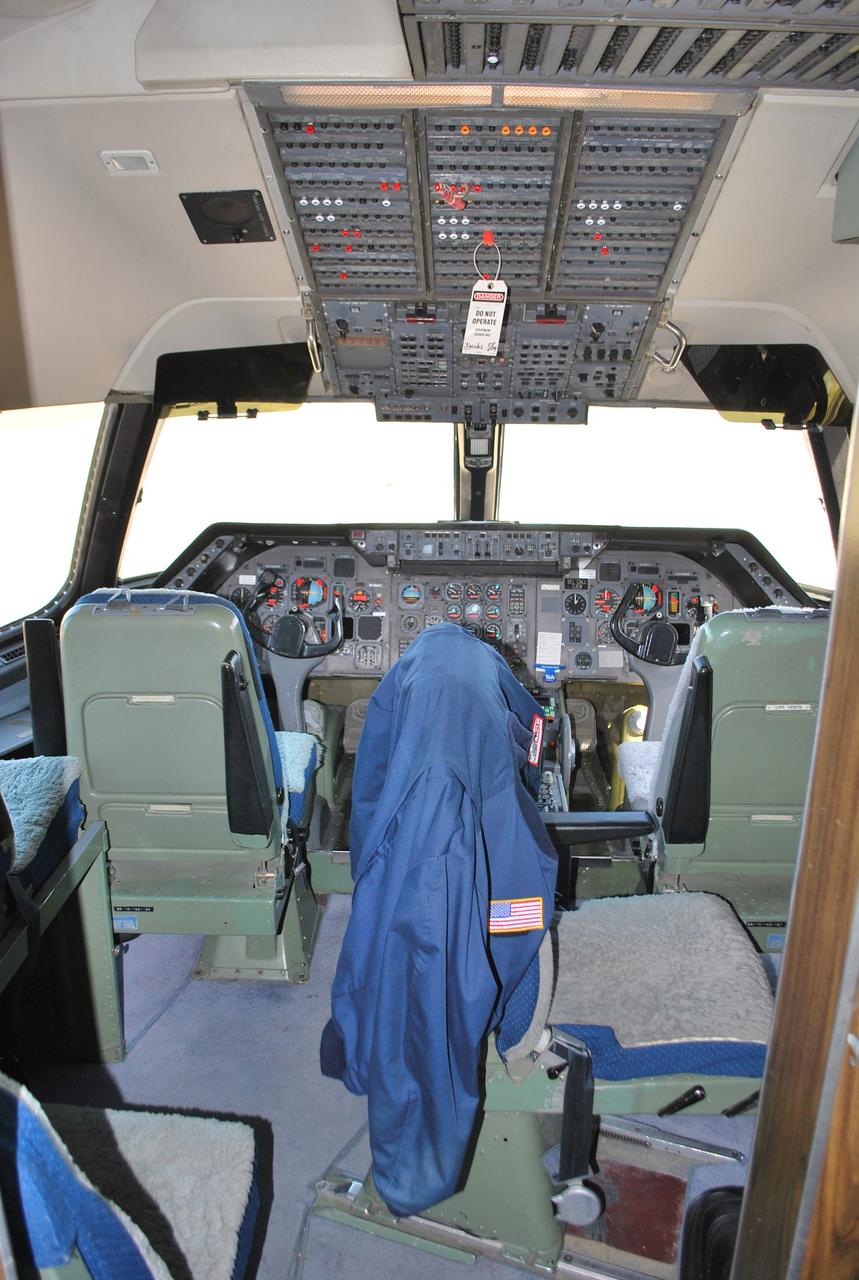
VANDENBERG AIR FORCE BASE, Calif. -- The cockpit and flight instrumentation of the Orbital Sciences' L-1011 carrier aircraft is readied for the launch of the Pegasus XL rocket. The Pegasus will launch NuSTAR into space where the high-energy x-ray telescope will conduct a census for black holes, map radioactive material in young supernovae remnants, and study the origins of cosmic rays and the extreme physics around collapsed stars. For more information, visit science.nasa.gov/missions/nustar/. Photo credit: NASA/Randy Beaudoin, VAFB
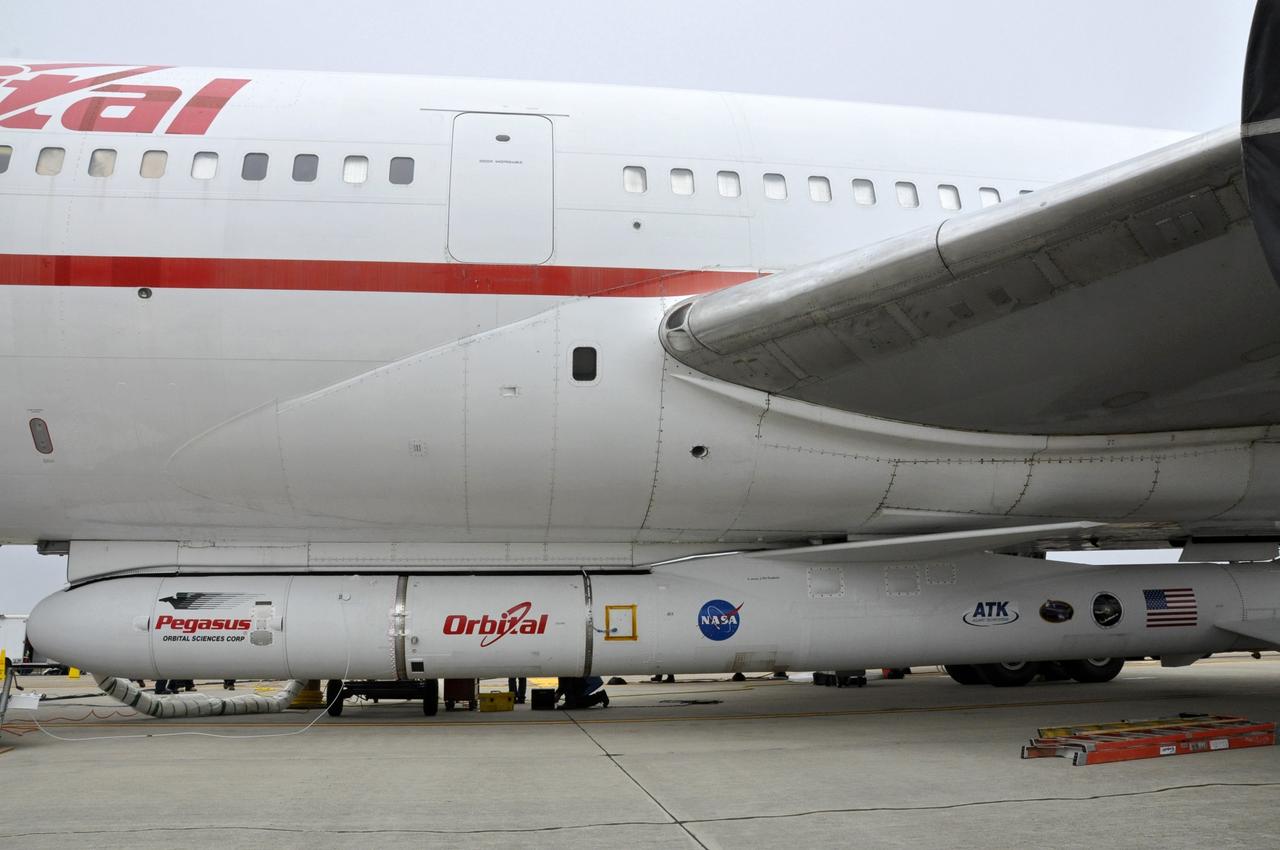
VANDENBERG AFB, Calif. – The Orbital Sciences Pegasus XL rocket with its NuSTAR spacecraft after attachment to the L-1011 carrier aircraft known as "Stargazer." The Pegasus will launch NuSTAR into space where the high-energy x-ray telescope will conduct a census for black holes, map radioactive material in young supernovae remnants, and study the origins of cosmic rays and the extreme physics around collapsed stars. Photo credit: NASA/Randy Beaudoin, VAFB
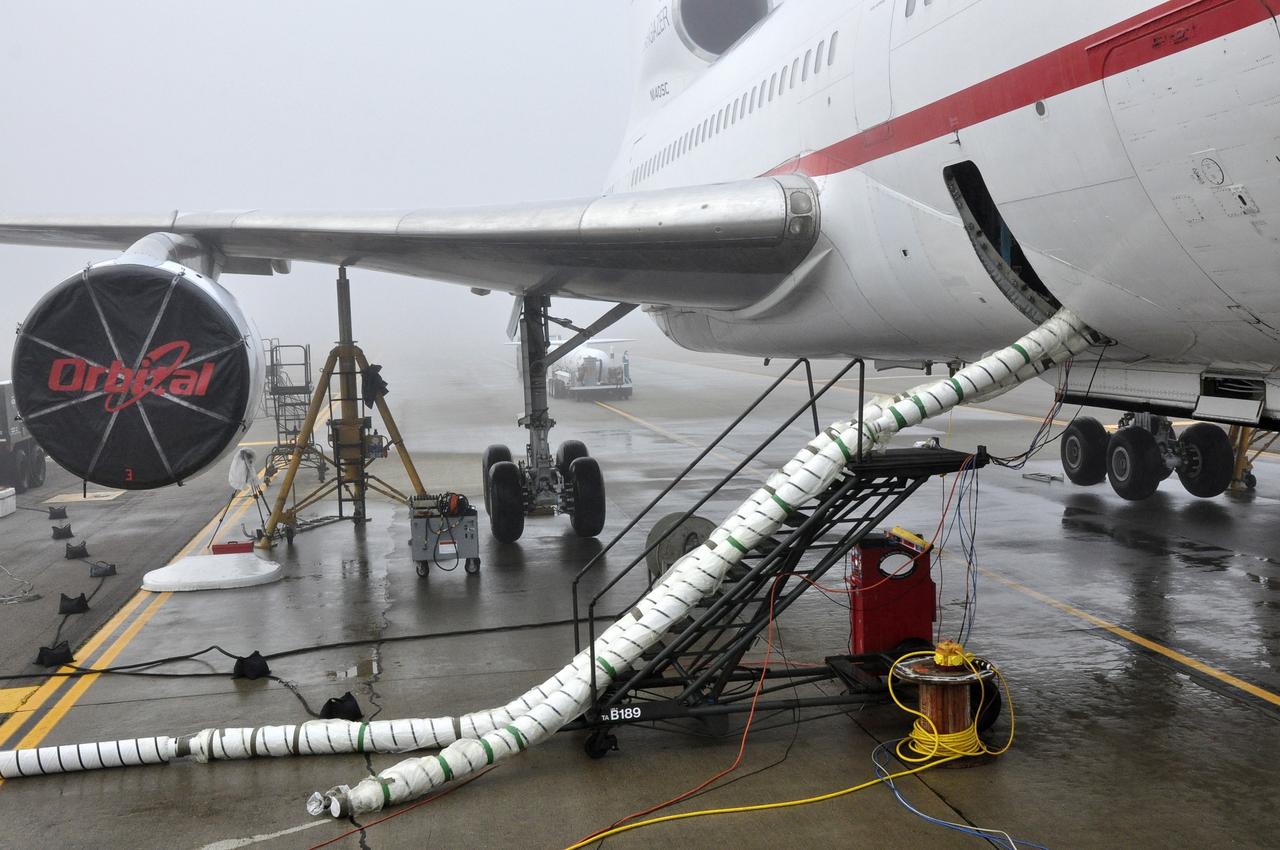
VANDENBERG AFB, Calif. – The Orbital Sciences L-1011 known as "Stargazer" awaits the Orbital Sciences Pegasus XL rocket with its NuSTAR spacecraft. The Pegasus will launch NuSTAR into space where the high-energy x-ray telescope will conduct a census for black holes, map radioactive material in young supernovae remnants, and study the origins of cosmic rays and the extreme physics around collapsed stars. Photo credit: NASA/Randy Beaudoin, VAFB
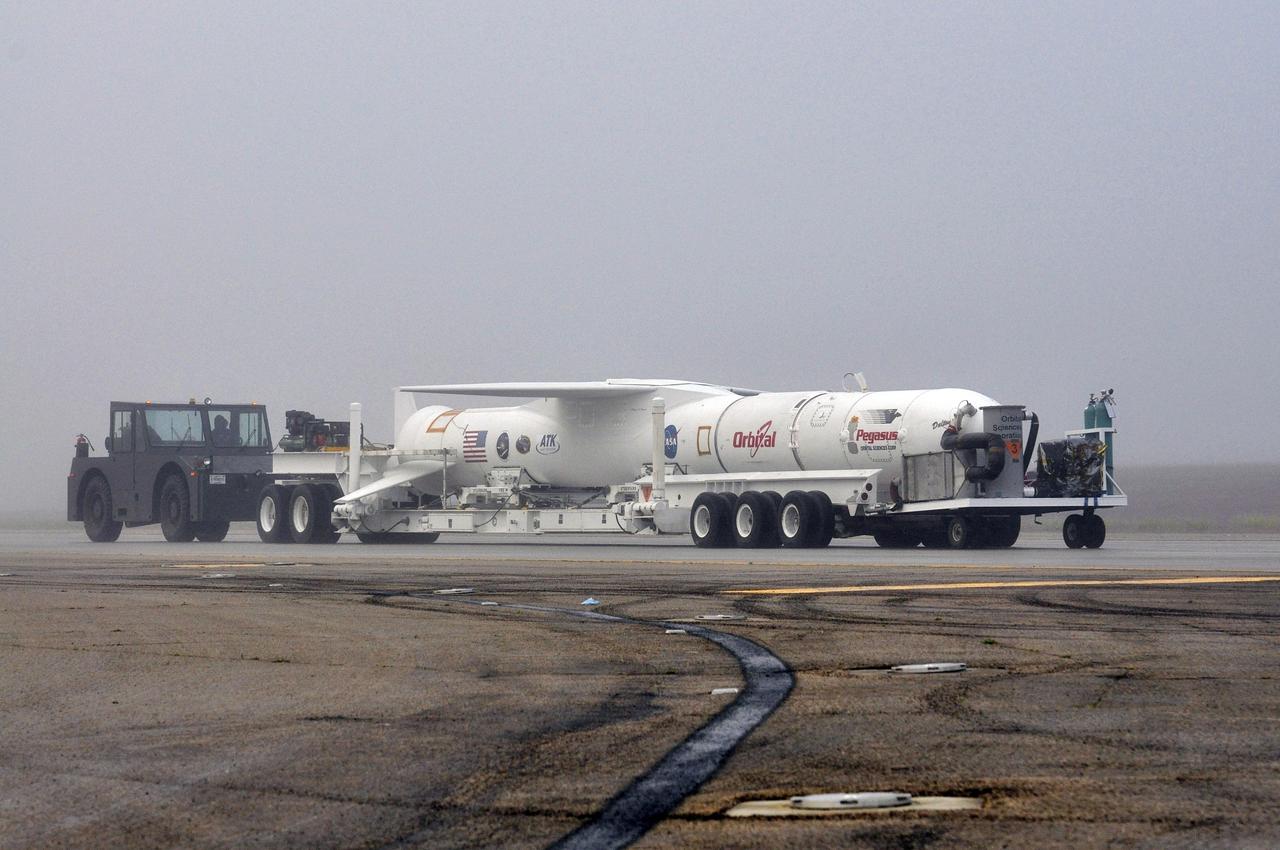
VANDENBERG AFB, Calif. – Technicians roll the Orbital Sciences Pegasus XL rocket with its NuSTAR spacecraft to the waiting L-1011 carrier aircraft known as "Stargazer." The Pegasus will launch NuSTAR into space where the high-energy x-ray telescope will conduct a census for black holes, map radioactive material in young supernovae remnants, and study the origins of cosmic rays and the extreme physics around collapsed stars. Photo credit: NASA/Randy Beaudoin, VAFB
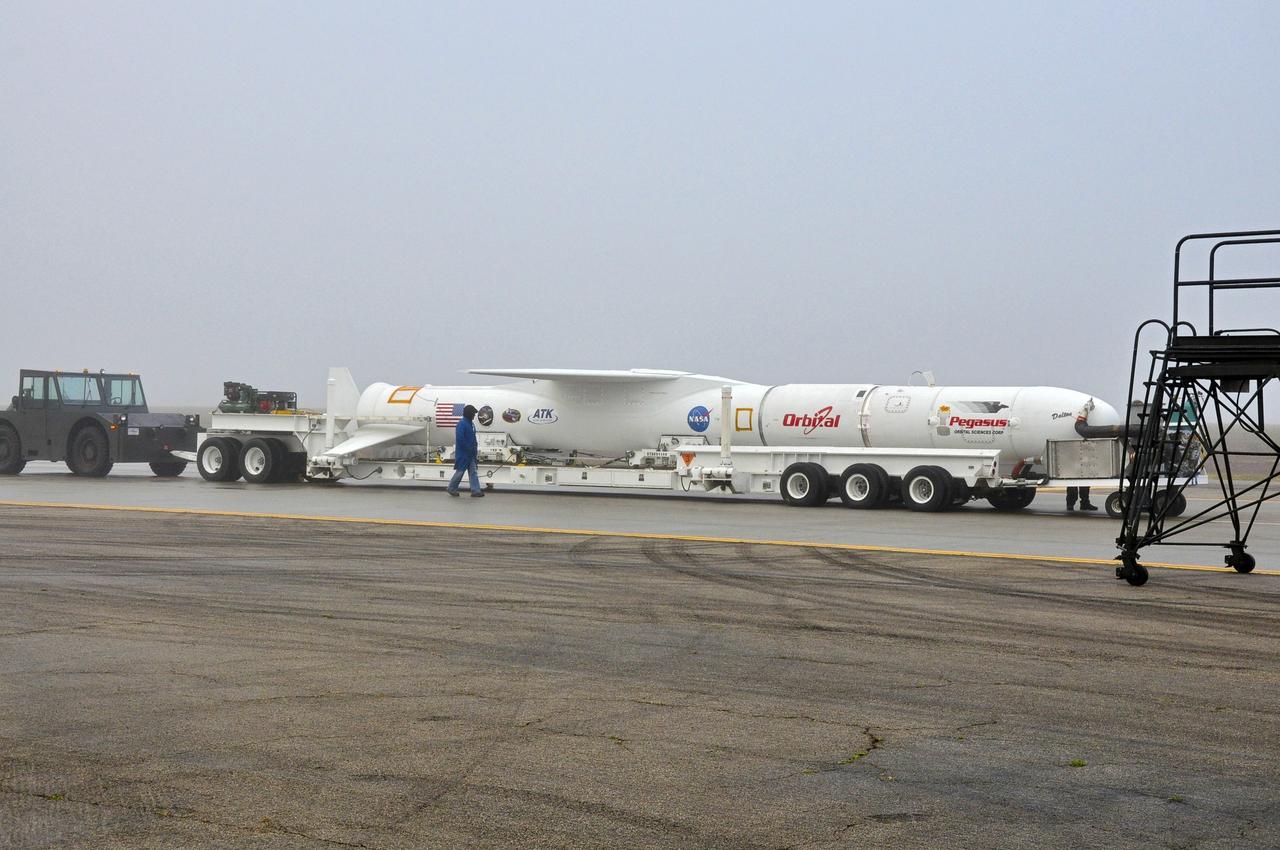
VANDENBERG AFB, Calif. – Technicians roll the Orbital Sciences Pegasus XL rocket with its NuSTAR spacecraft to the waiting L-1011 carrier aircraft known as "Stargazer." The Pegasus will launch NuSTAR into space where the high-energy x-ray telescope will conduct a census for black holes, map radioactive material in young supernovae remnants, and study the origins of cosmic rays and the extreme physics around collapsed stars. Photo credit: NASA/Randy Beaudoin, VAFB
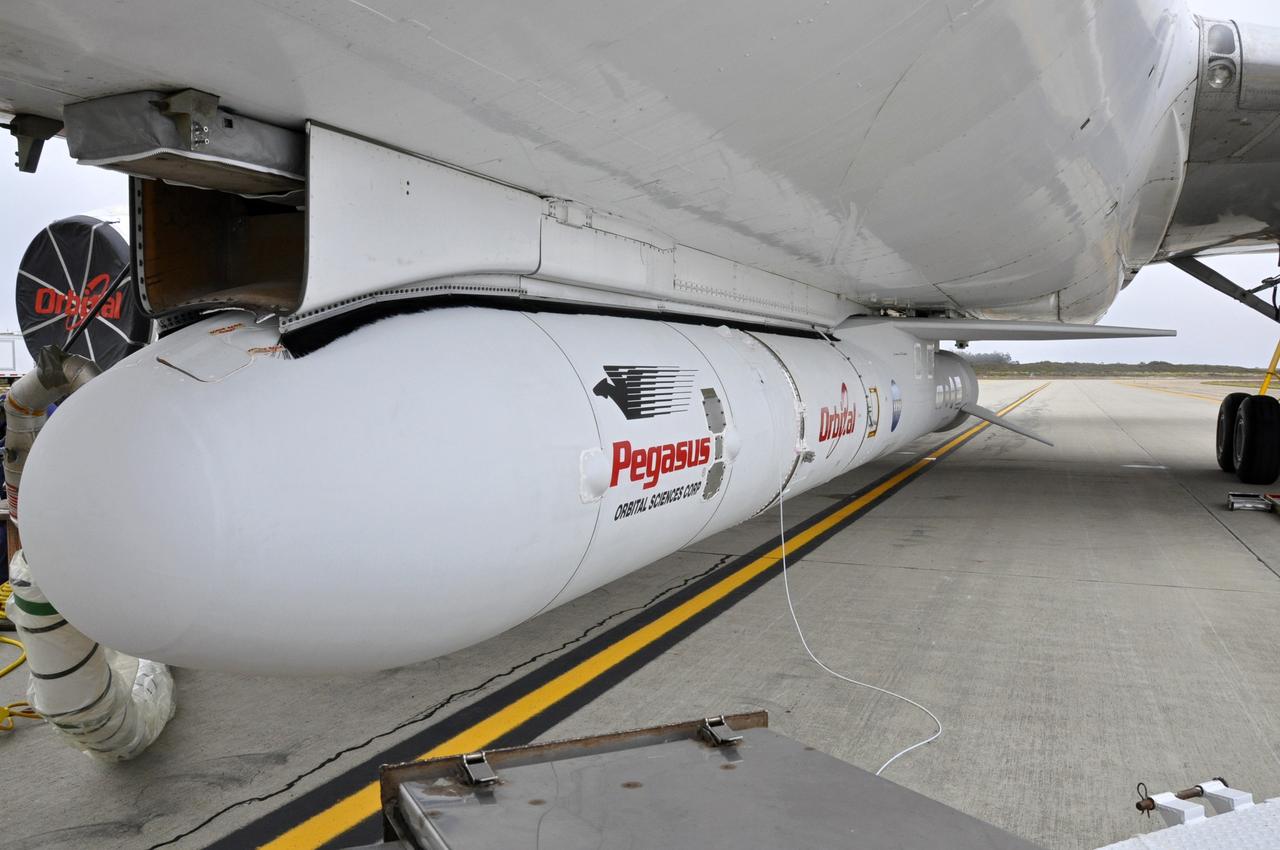
VANDENBERG AFB, Calif. – The Orbital Sciences Pegasus XL rocket with its NuSTAR spacecraft after attachment to the L-1011 carrier aircraft known as "Stargazer." The Pegasus will launch NuSTAR into space where the high-energy x-ray telescope will conduct a census for black holes, map radioactive material in young supernovae remnants, and study the origins of cosmic rays and the extreme physics around collapsed stars. Photo credit: NASA/Randy Beaudoin, VAFB

This new composite image of stellar cluster NGC 1333 combines X-rays from NASA's Chandra X-ray Observatory (pink); infrared data from NASA's Spitzer Space Telescope (red); and optical data from the Digitized Sky Survey and the National Optical Astronomical Observatories' Mayall 4-meter telescope on Kitt Peak near Tucson, Arizona. The Chandra data reveal 95 young stars glowing in X-ray light, 41 of which had not been seen previously using Spitzer because they lacked infrared emission from a surrounding disk. http://photojournal.jpl.nasa.gov/catalog/PIA19347
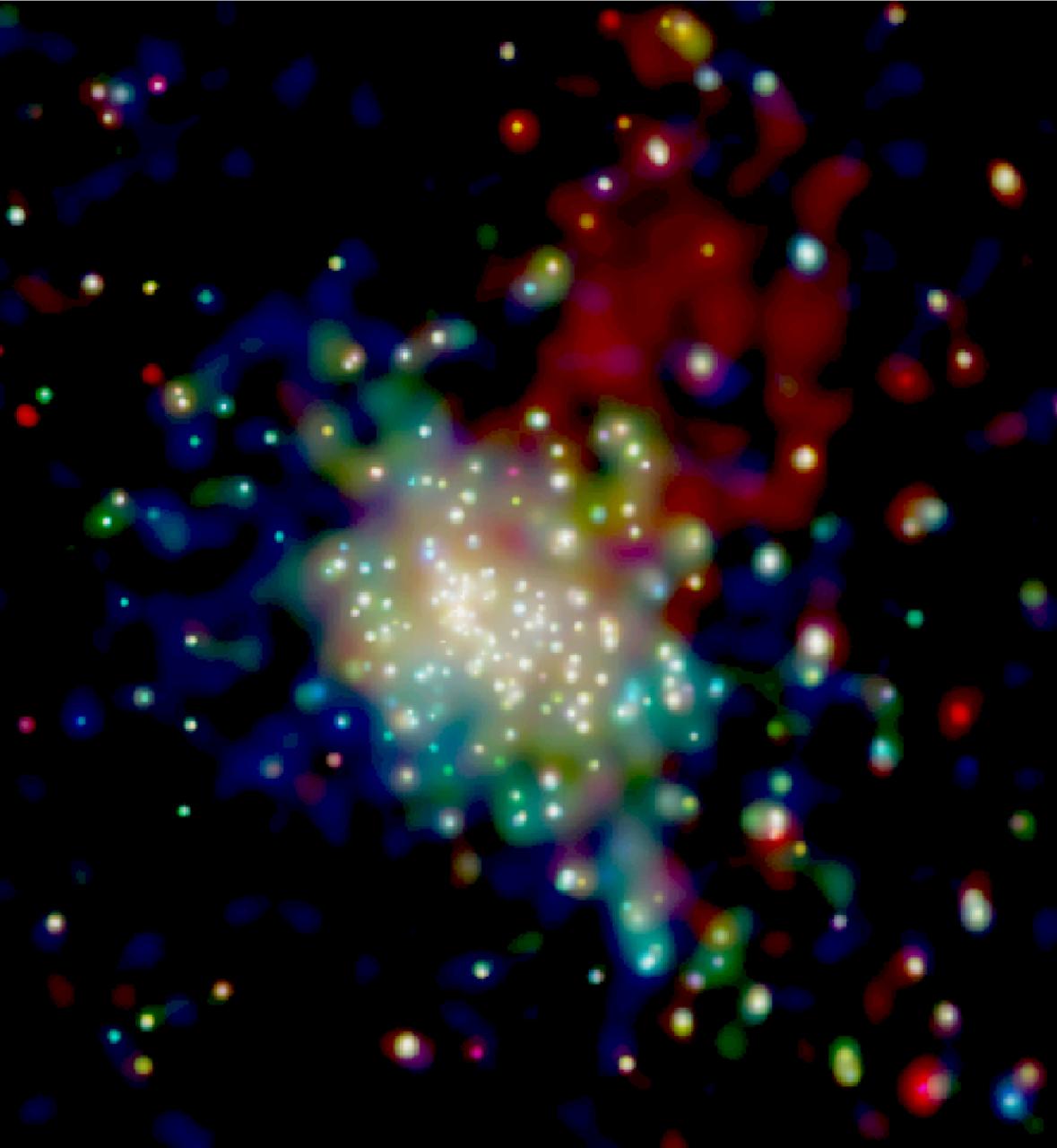
At a distance of 6,000 light years from Earth, the star cluster RCW 38 is a relatively close star-forming region. This area is about 5 light years across, and contains thousands of hot, very young stars formed less than a million years ago, 190 of which exposed x-rays to Chandra. Enveloping the star cluster, the diffused cloud of x-rays shows an excess of high energy x-rays, which indicates that the x-rays come from trillion-volt electrons moving in a magnetic field. Such particles are typically produced by exploding stars, or in the strong magnetic fields around neutron stars or black holes, none of which are evident in RCW 38. One possible origin for the particles, could be an undetected supernova that occurred in the cluster, possibly thousands of years ago, producing a shock wave that is interacting with the young stars. Regardless of the origin of these energetic electrons, their presence could change the chemistry of the disks that will eventually form planets around the stars in the cluster.
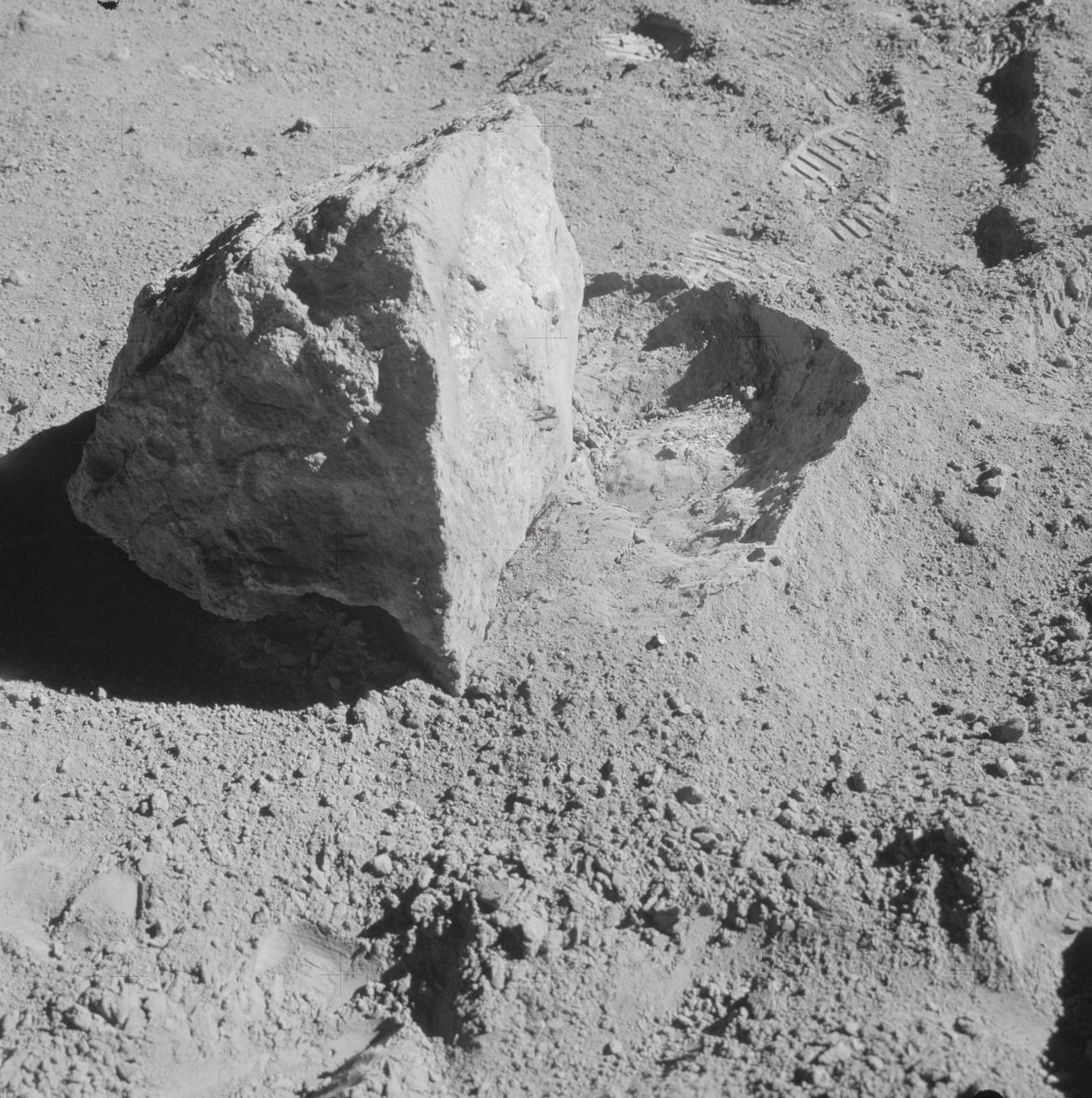
AS16-107-17573 (22 April 1972) --- A close-up view of a block (about 1/2 meter long) found by the two moon-exploring crewmembers of the Apollo 16 lunar landing mission. The block had been rolled over only moments earlier during this Apollo 16 second extravehicular activity (EVA) near South Ray Crater. Astronaut John W. Young, commander, said at the post-mission press conference, "The block has been sitting there evidently since South Ray Crater was formed." While astronauts Young and Charles M. Duke Jr., lunar module pilot; descended in the Apollo 16 Lunar Module (LM) "Orion" to explore the Descartes highlands landing site on the moon, astronaut Thomas K. Mattingly II, command module pilot, remained with the Command and Service Modules (CSM) "Casper" in lunar orbit.
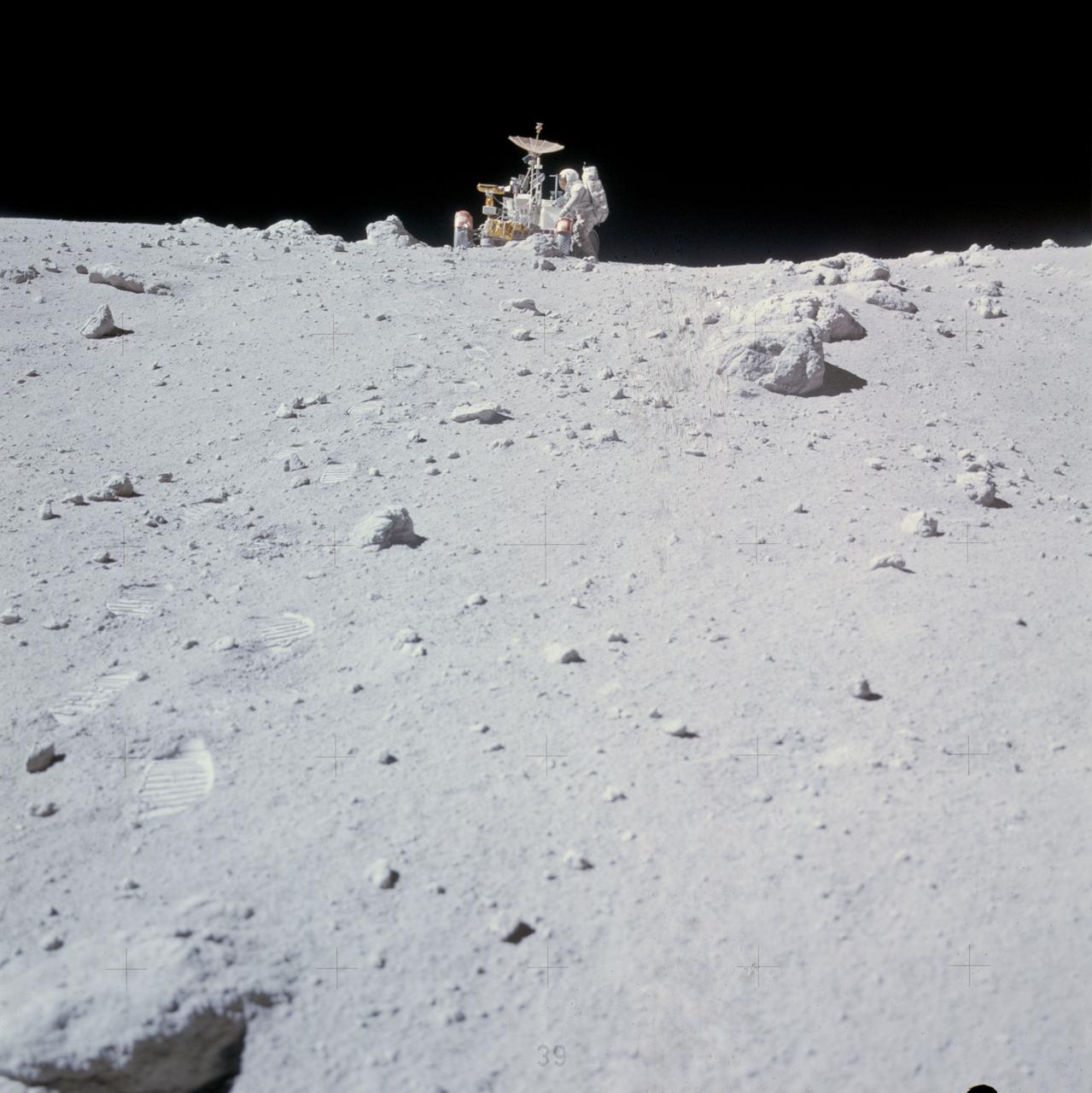
AS16-116-18607 (23 April 1972) --- Astronaut Charles M. Duke Jr. works at the front of the Lunar Roving Vehicle (LRV) parked in this rock field at a North Ray Crater geological site during the mission's third extravehicular activity (EVA) on April 23, 1972. Astronaut John W. Young took this picture with a 70mm Hasselblad camera. While astronauts Young, commander; and Duke, lunar module pilot; descended in the Apollo 16 Lunar Module (LM) "Orion" to explore the Descartes highlands landing site on the moon, astronaut Thomas K. Mattingly II, command module pilot, remained with the Command and Service Modules (CSM) "Casper" in lunar orbit.
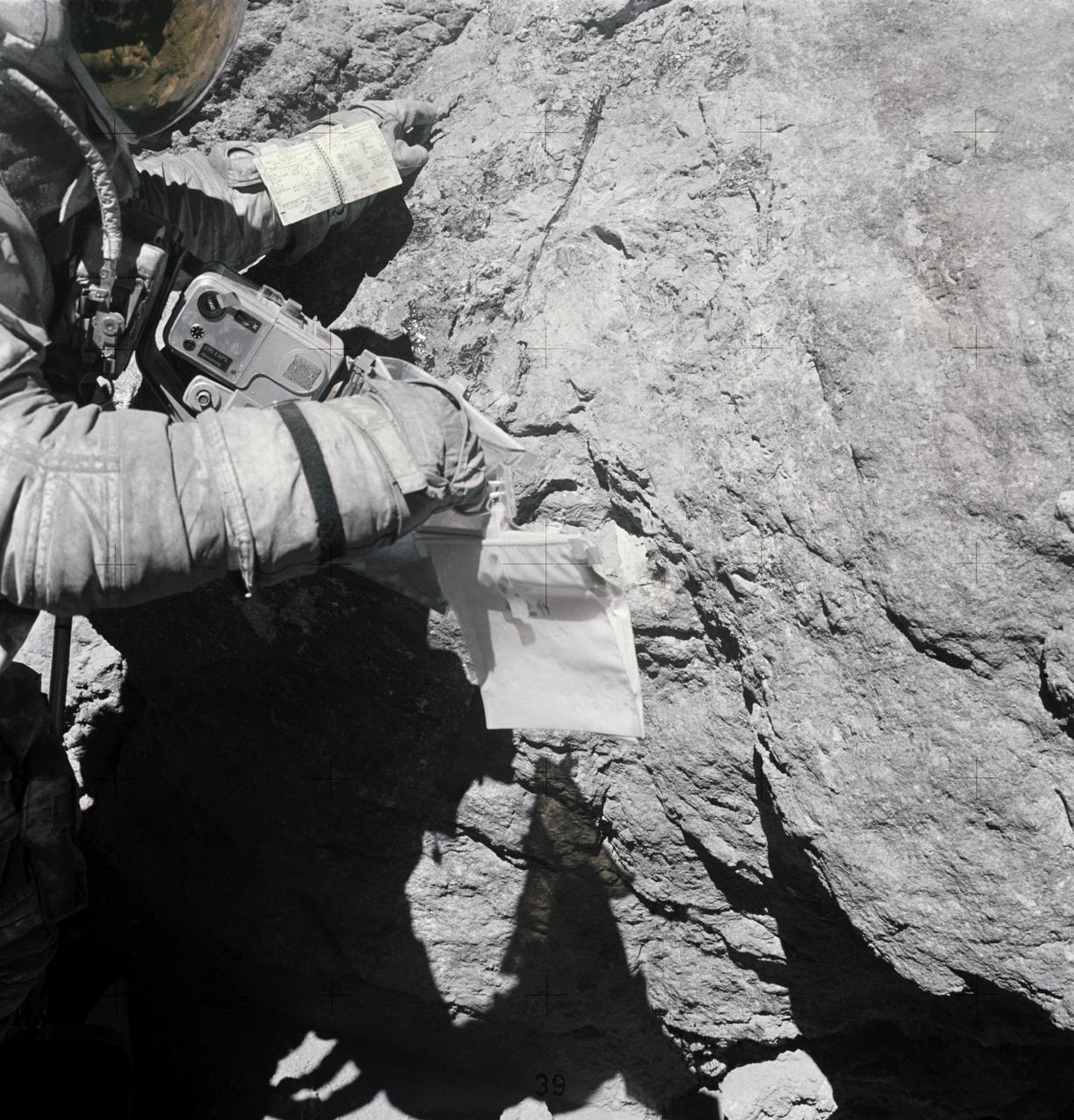
AS16-116-18649 (23 April 1972) --- Astronaut Charles M. Duke Jr., lunar module pilot of the Apollo 16 lunar landing mission, examines closely the surface of a large boulder at North Ray Crater during the third Apollo 16 extravehicular activity (EVA) at the Descartes landing site. This picture was taken by astronaut John W. Young, commander. Note the chest-mounted 70mm Hasselblad camera. While astronauts Young and Duke descended in the Apollo 16 Lunar Module (LM) "Orion" to explore the Descartes highlands landing site on the moon, astronaut Thomas K. Mattingly II, command module pilot, remained with the Command and Service Modules (CSM) "Casper" in lunar orbit.
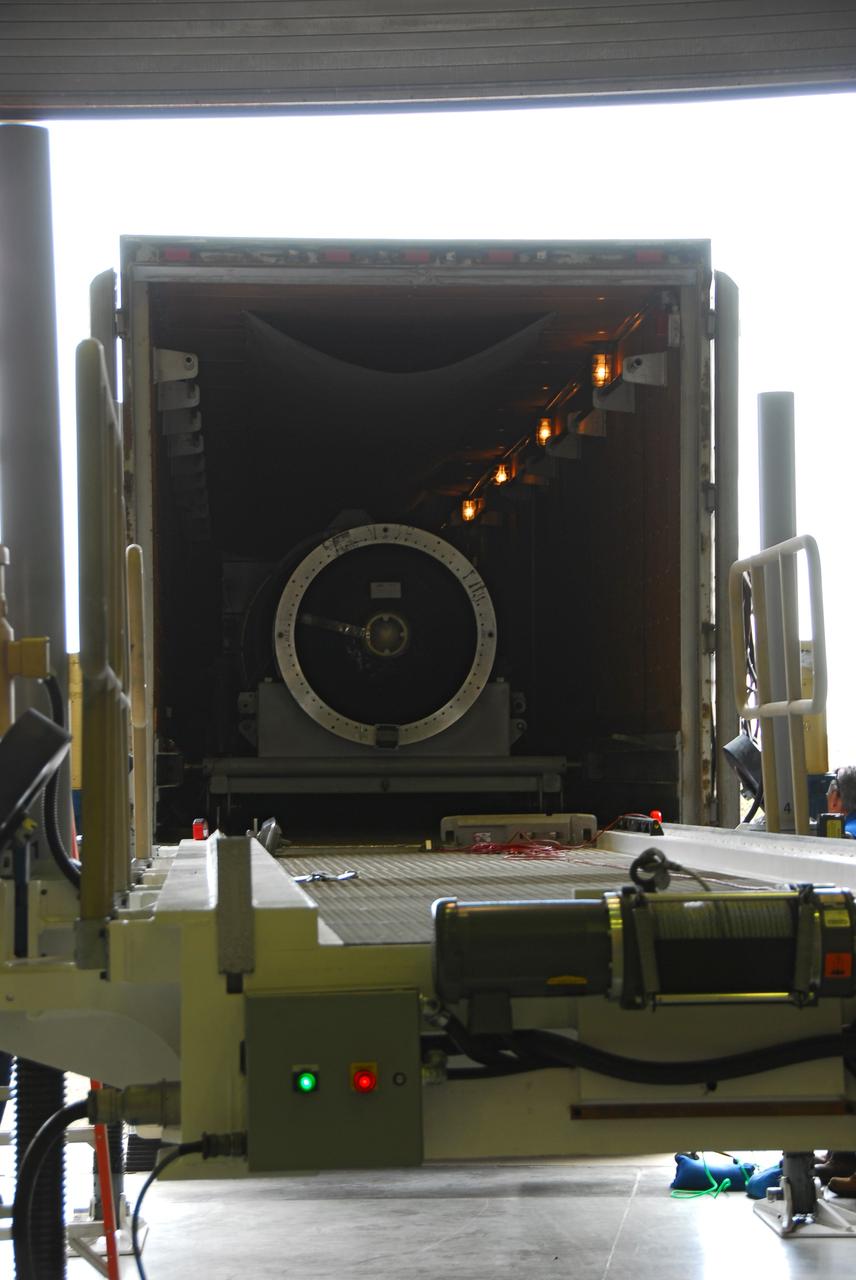
VANDENBERG AIR FORCE BASE, Calif. -- At Vandenberg Air Force Base in California, the third stage of the Pegasus XL rocket that will launch the Nuclear Spectroscopic Telescope Array (NuSTAR) to orbit arrives at Building 1555 for processing. After the rocket and spacecraft are processed at Vandenberg, they will be shipped to the Ronald Reagan Ballistic Missile Defense Test Site located at the Pacific Ocean’s Kwajalein Atoll for launch. The high-energy X-ray telescope will conduct a census for black holes, map radioactive material in young supernovae remnants, and study the origins of cosmic rays and the extreme physics around collapsed stars. Photo credit: NASA/Dan Liberotti, VAFB
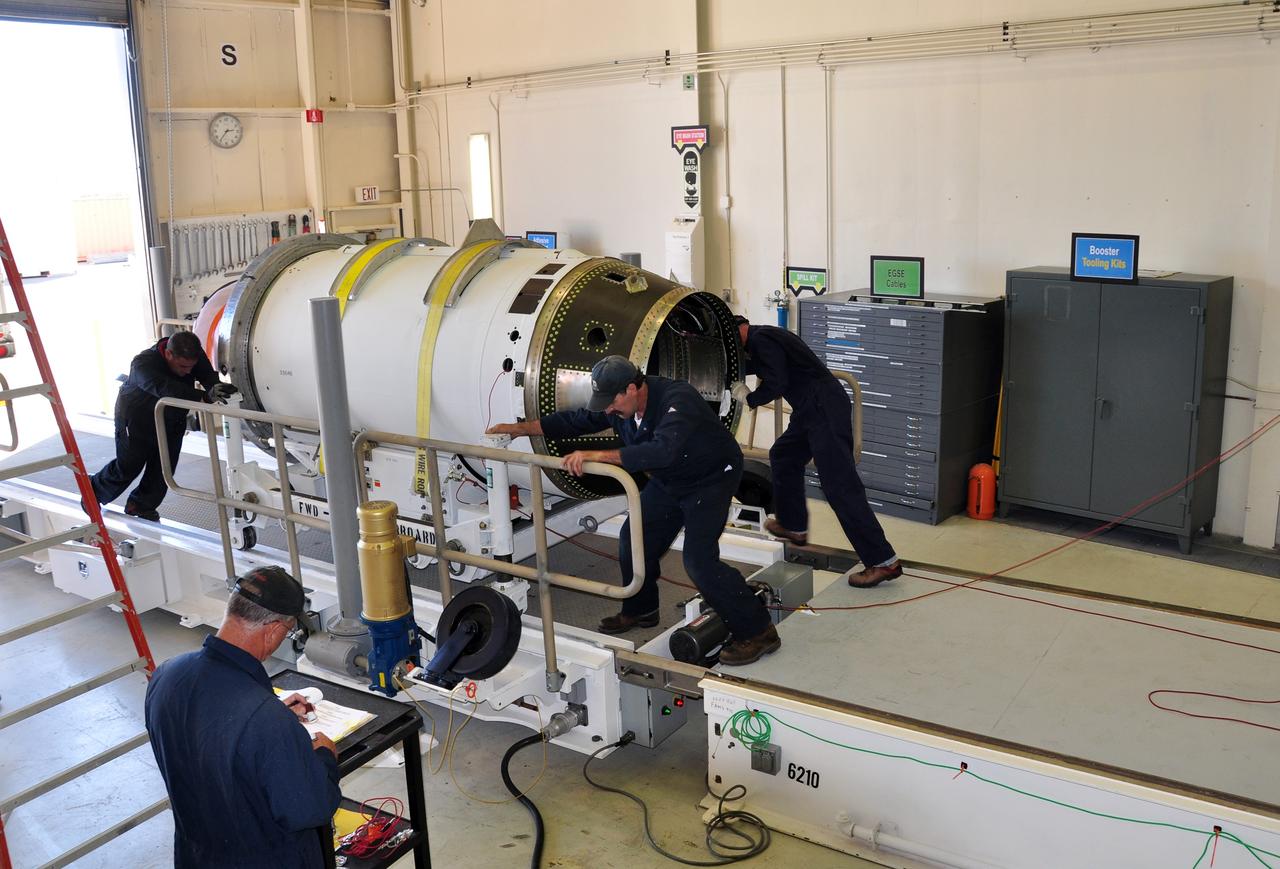
VANDENBERG AIR FORCE BASE, Calif. -- At Vandenberg Air Force Base in California, the second stage of the Pegasus XL rocket that will launch the Nuclear Spectroscopic Telescope Array (NuSTAR) to orbit is moved to a stationary rail in Building 1555 for processing. After the rocket and spacecraft are processed at Vandenberg, they will be shipped to the Ronald Reagan Ballistic Missile Defense Test Site located at the Pacific Ocean’s Kwajalein Atoll for launch. The high-energy X-ray telescope will conduct a census for black holes, map radioactive material in young supernovae remnants, and study the origins of cosmic rays and the extreme physics around collapsed stars. Photo credit: NASA/Randy Beaudoin, VAFB
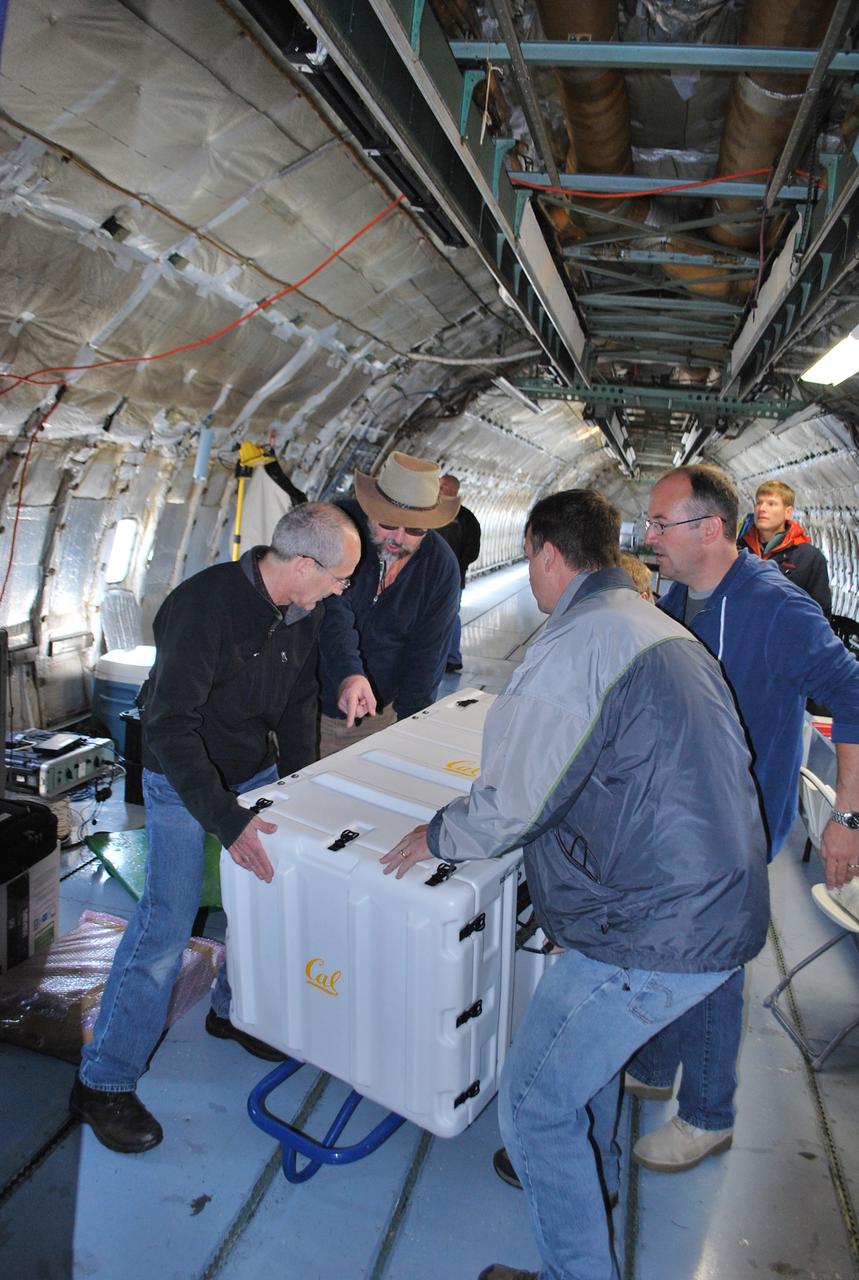
VANDENBERG AIR FORCE BASE, Calif. -- Technicians load the spacecraft airborne support equipment to the Orbital Sciences' L-1011 carrier aircraft. This equipment will maintain the in-flight monitoring and control of the NuSTAR spacecraft before the release of the Pegasus XL rocket The Pegasus will launch NuSTAR into space where the high-energy x-ray telescope will conduct a census for black holes, map radioactive material in young supernovae remnants, and study the origins of cosmic rays and the extreme physics around collapsed stars. For more information, visit science.nasa.gov/missions/nustar/. Photo credit: NASA/Randy Beaudoin, VAFB
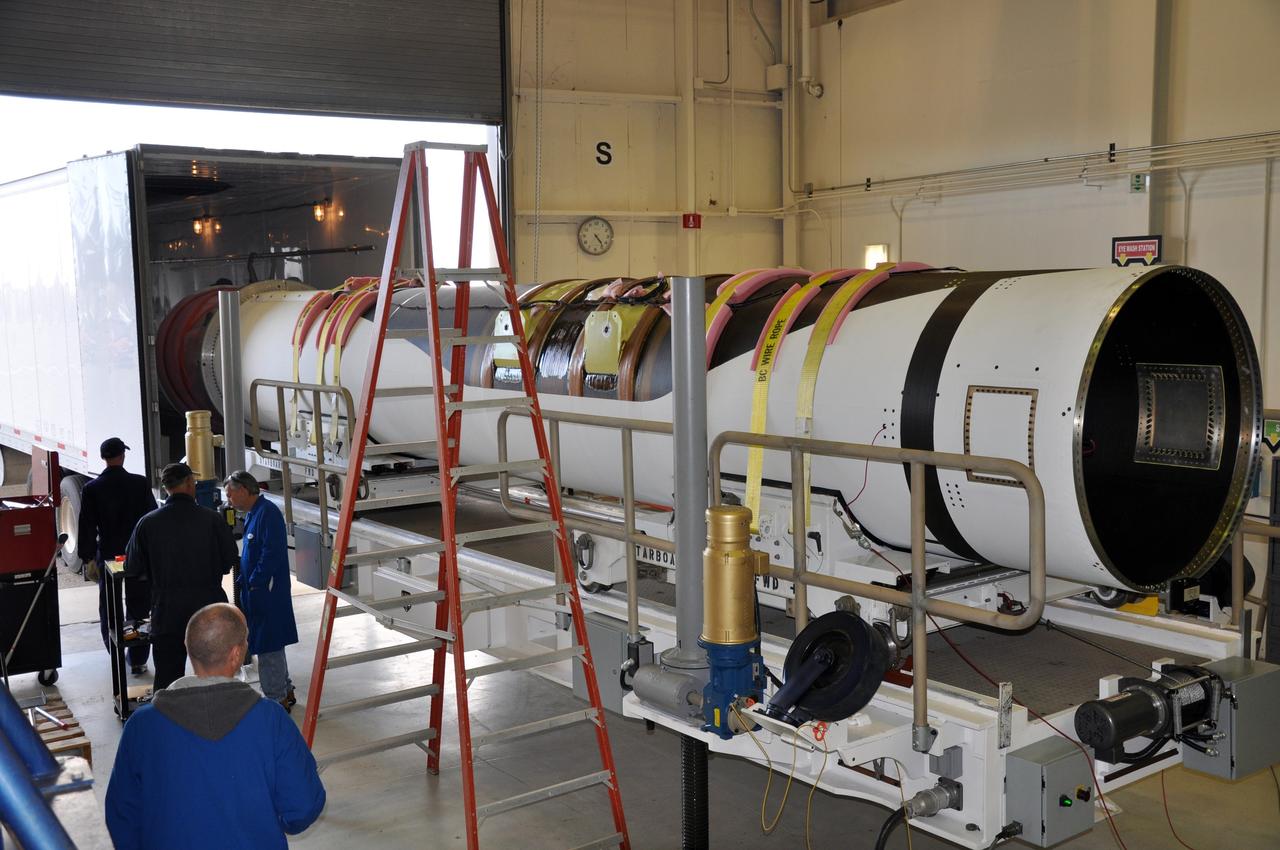
VANDENBERG AIR FORCE BASE, Calif. -- At Vandenberg Air Force Base in California, the first stage of the Pegasus XL rocket that will launch the Nuclear Spectroscopic Telescope Array (NuSTAR) to orbit is offloaded for processing in Building 1555. After the rocket and spacecraft are processed at Vandenberg, they will be shipped to the Ronald Reagan Ballistic Missile Defense Test Site located at the Pacific Ocean’s Kwajalein Atoll for launch. The high-energy X-ray telescope will conduct a census for black holes, map radioactive material in young supernovae remnants, and study the origins of cosmic rays and the extreme physics around collapsed stars. Photo credit: NASA/Randy Beaudoin, VAFB
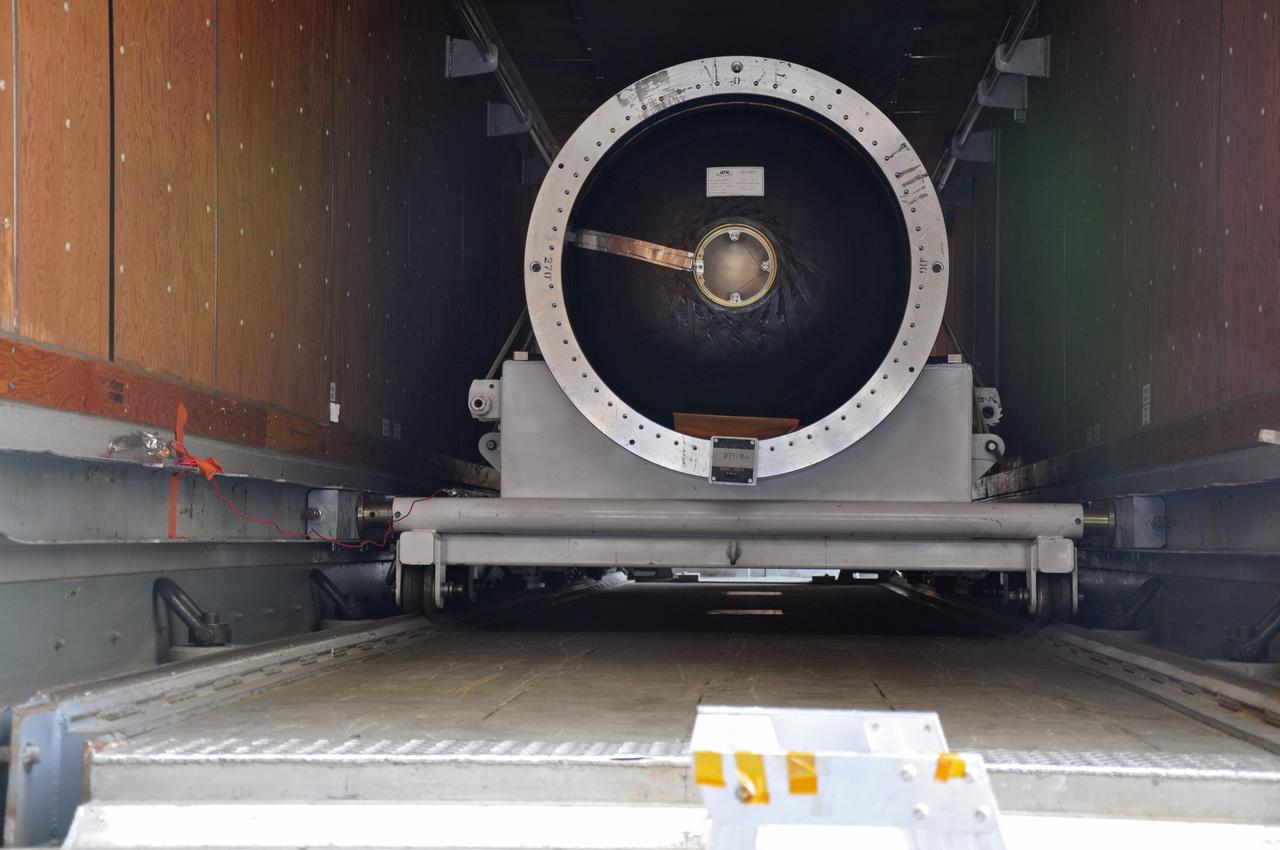
VANDENBERG AIR FORCE BASE, Calif. -- At Vandenberg Air Force Base in California, the third stage of the Pegasus XL rocket that will launch the Nuclear Spectroscopic Telescope Array (NuSTAR) to orbit is offloaded for processing in Building 1555. After the rocket and spacecraft are processed at Vandenberg, they will be shipped to the Ronald Reagan Ballistic Missile Defense Test Site located at the Pacific Ocean’s Kwajalein Atoll for launch. The high-energy X-ray telescope will conduct a census for black holes, map radioactive material in young supernovae remnants, and study the origins of cosmic rays and the extreme physics around collapsed stars. Photo credit: NASA/Randy Beaudoin, VAFB
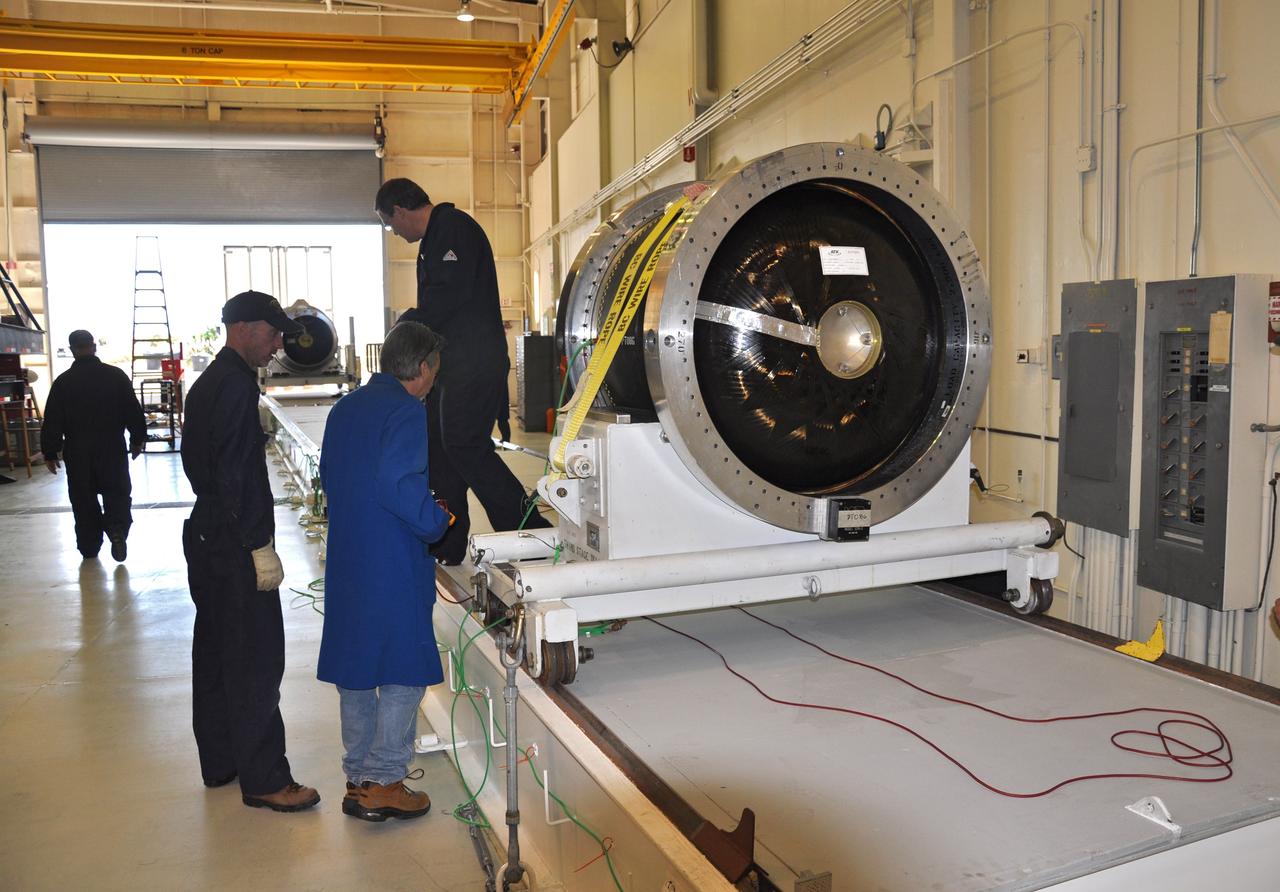
VANDENBERG AIR FORCE BASE, Calif. -- At Vandenberg Air Force Base in California, the second stage of the Pegasus XL rocket that will launch the Nuclear Spectroscopic Telescope Array (NuSTAR) to orbit is moved to a stationary rail in Building 1555 for processing. After the rocket and spacecraft are processed at Vandenberg, they will be shipped to the Ronald Reagan Ballistic Missile Defense Test Site located at the Pacific Ocean’s Kwajalein Atoll for launch. The high-energy X-ray telescope will conduct a census for black holes, map radioactive material in young supernovae remnants, and study the origins of cosmic rays and the extreme physics around collapsed stars. Photo credit: NASA/Randy Beaudoin, VAFB
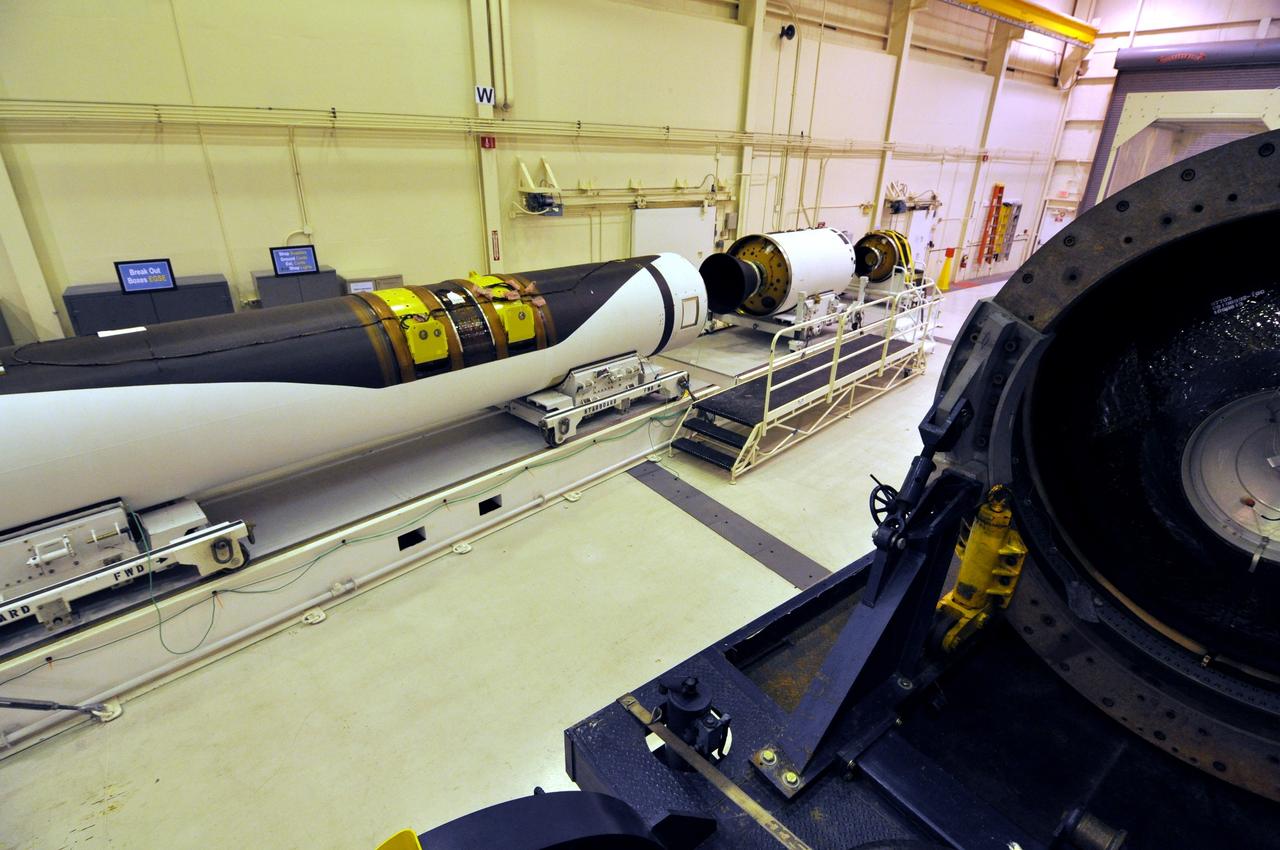
VANDENBERG AIR FORCE BASE, Calif. -- At Vandenberg Air Force Base in California, the first, second and third stages of the Pegasus XL rocket that will launch the Nuclear Spectroscopic Telescope Array (NuSTAR) to orbit are being processed in the west high bay of Building 1555. After the rocket and spacecraft are processed at Vandenberg, they will be shipped to the Ronald Reagan Ballistic Missile Defense Test Site located at the Pacific Ocean’s Kwajalein Atoll for launch. The high-energy X-ray telescope will conduct a census for black holes, map radioactive material in young supernovae remnants, and study the origins of cosmic rays and the extreme physics around collapsed stars. Photo credit: NASA/Randy Beaudoin, VAFB
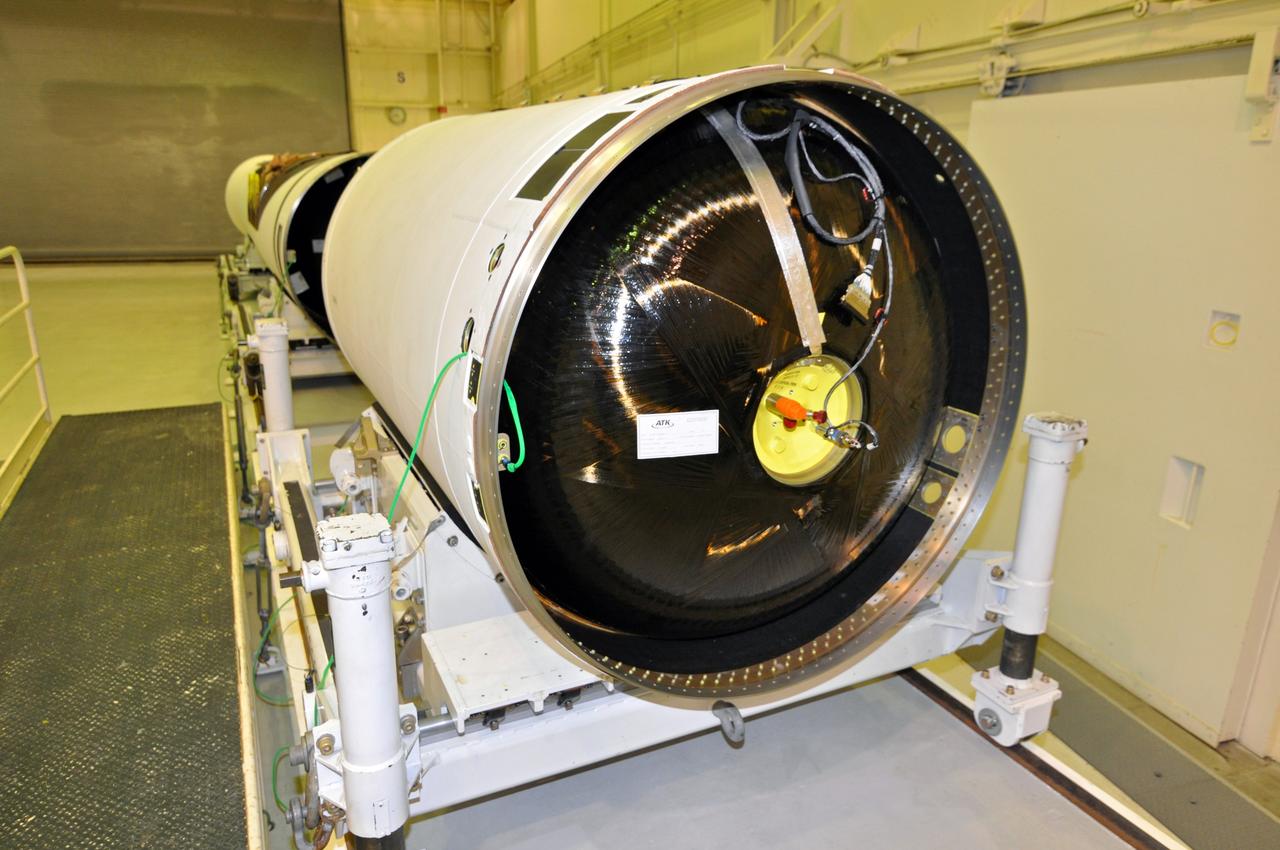
VANDENBERG AIR FORCE BASE, Calif. -- At Vandenberg Air Force Base in California, the Pegasus XL rocket that will launch the Nuclear Spectroscopic Telescope Array (NuSTAR) to orbit is coming together in the west high bay of Building 1555. After the rocket and spacecraft are processed at Vandenberg, they will be shipped to the Ronald Reagan Ballistic Missile Defense Test Site located at the Pacific Ocean’s Kwajalein Atoll for launch. The high-energy X-ray telescope will conduct a census for black holes, map radioactive material in young supernovae remnants, and study the origins of cosmic rays and the extreme physics around collapsed stars. Photo credit: NASA/Randy Beaudoin, VAFB
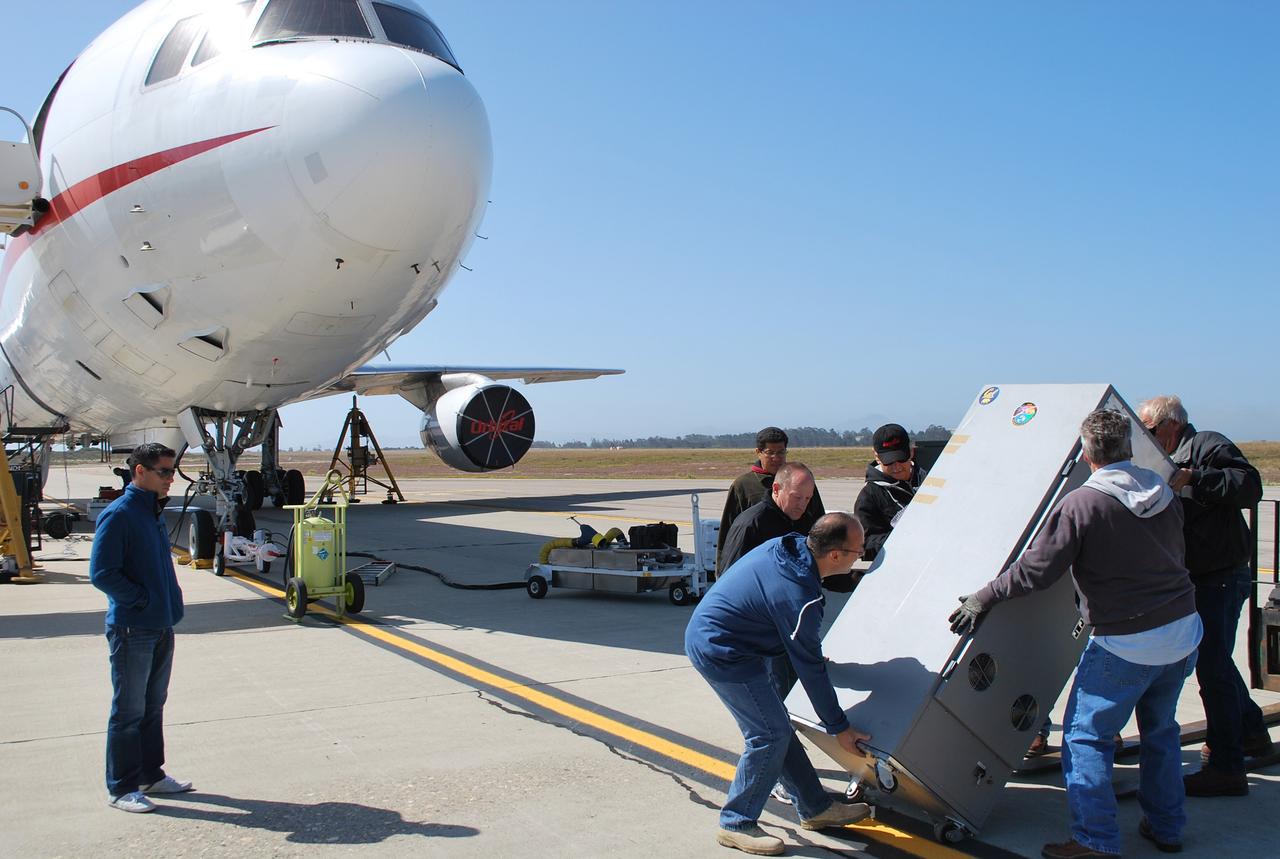
VANDENBERG AIR FORCE BASE, Calif. -- Technicians transfer the spacecraft airborne support equipment to the Orbital Sciences' L-1011 carrier aircraft. This equipment will maintain the in-flight monitoring and control of the NuSTAR spacecraft before the release of the Pegasus XL rocket. The Pegasus will launch NuSTAR into space where the high-energy x-ray telescope will conduct a census for black holes, map radioactive material in young supernovae remnants, and study the origins of cosmic rays and the extreme physics around collapsed stars. For more information, visit science.nasa.gov/missions/nustar/. Photo credit: NASA/Randy Beaudoin, VAFB
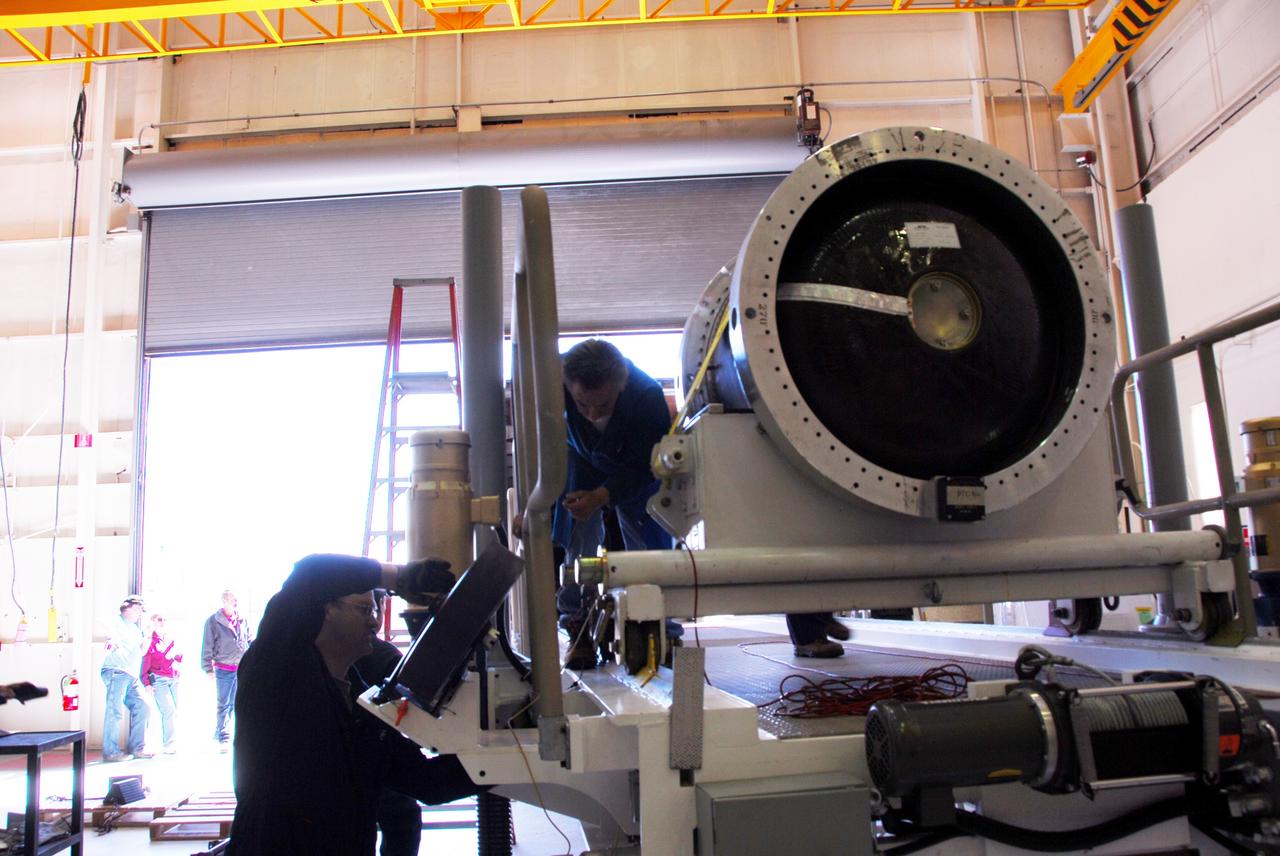
VANDENBERG AIR FORCE BASE, Calif. -- At Vandenberg Air Force Base in California, the third stage of the Pegasus XL rocket that will launch the Nuclear Spectroscopic Telescope Array (NuSTAR) to orbit is moved onto a jackable rail for processing in Building 1555. After the rocket and spacecraft are processed at Vandenberg, they will be shipped to the Ronald Reagan Ballistic Missile Defense Test Site located at the Pacific Ocean’s Kwajalein Atoll for launch. The high-energy X-ray telescope will conduct a census for black holes, map radioactive material in young supernovae remnants, and study the origins of cosmic rays and the extreme physics around collapsed stars. Photo credit: NASA/Dan Liberotti, VAFB
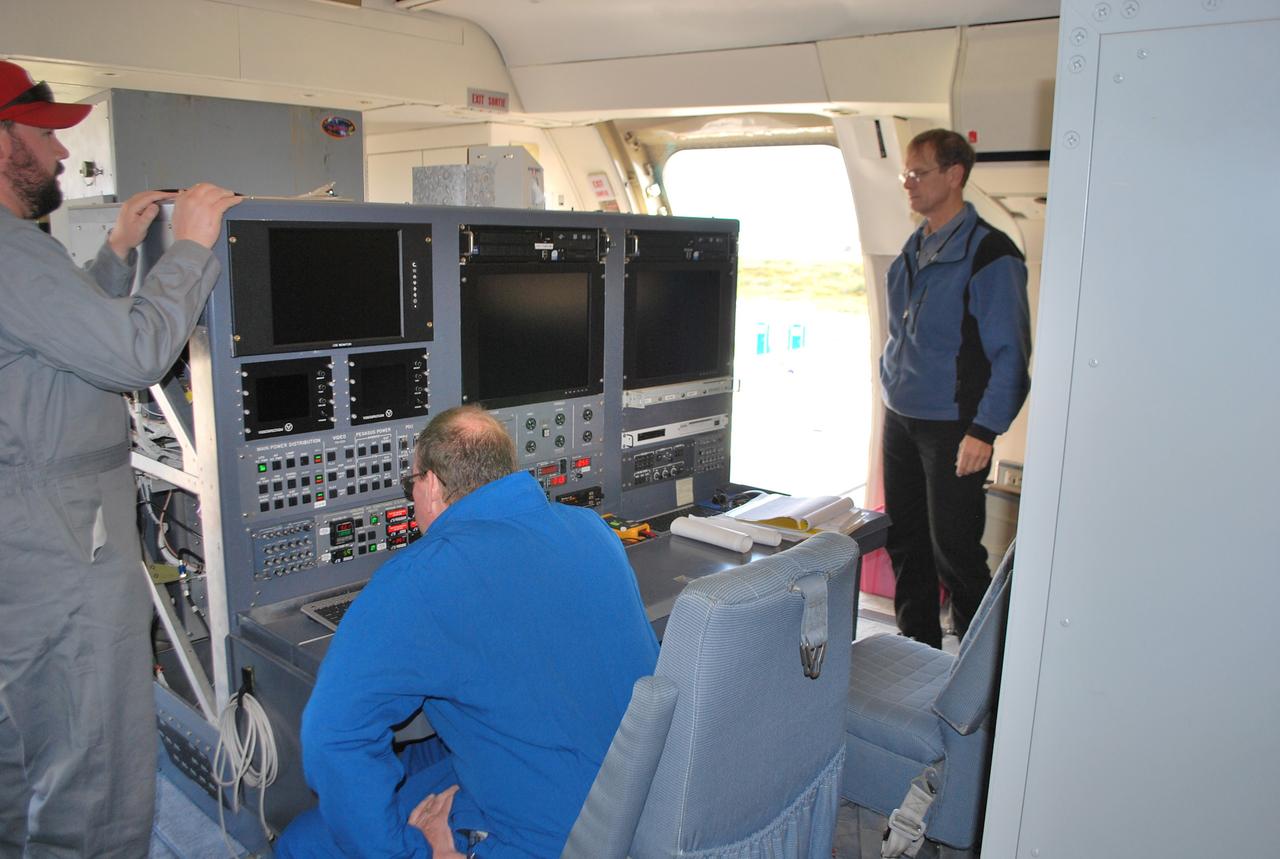
VANDENBERG AIR FORCE BASE, Calif. -- Technicians install the spacecraft airborne support equipment to the Orbital Sciences' L-1011 carrier aircraft. This equipment will maintain the in-flight monitoring and control of the NuSTAR spacecraft before the release of the Pegasus XL rocket. The Pegasus will launch NuSTAR into space where the high-energy x-ray telescope will conduct a census for black holes, map radioactive material in young supernovae remnants, and study the origins of cosmic rays and the extreme physics around collapsed stars. For more information, visit science.nasa.gov/missions/nustar/. Photo credit: NASA/Randy Beaudoin, VAFB
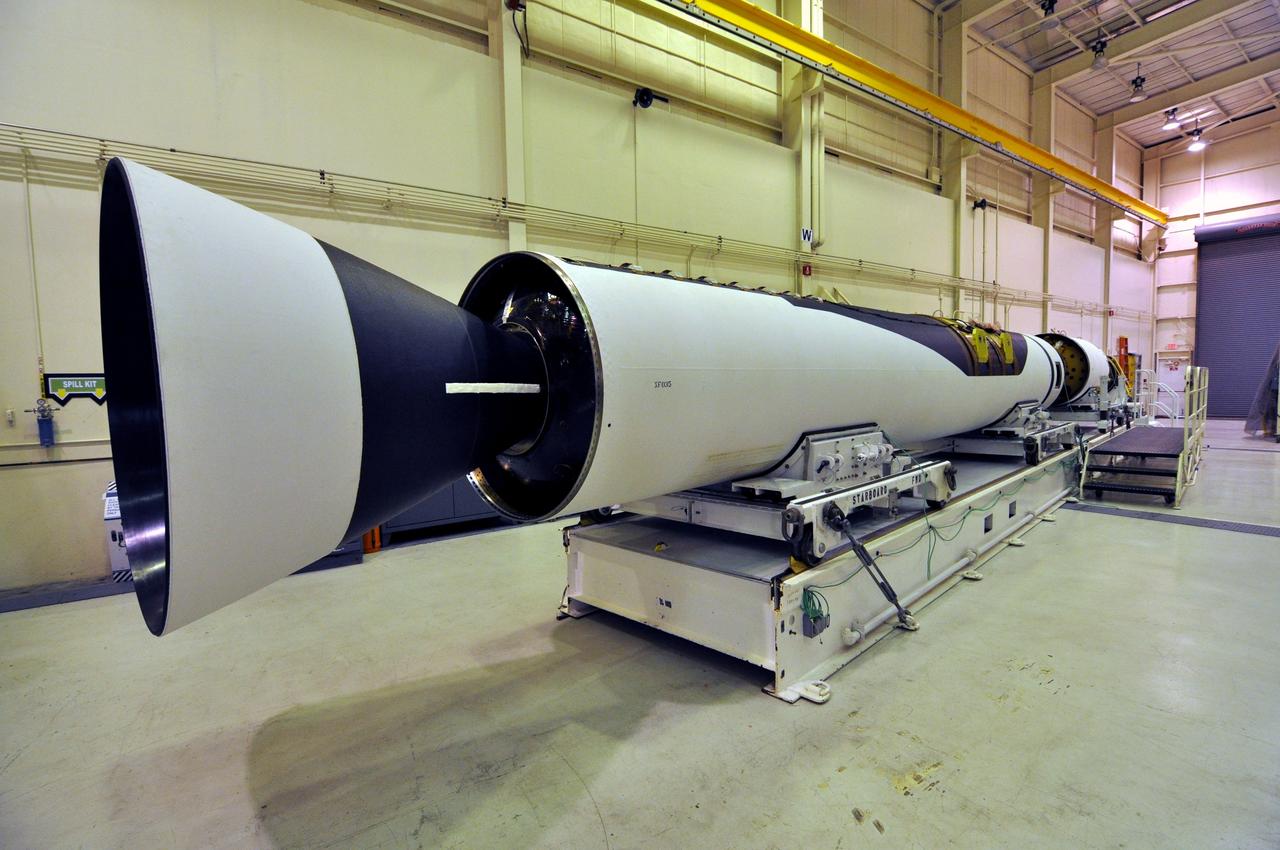
VANDENBERG AIR FORCE BASE, Calif. -- At Vandenberg Air Force Base in California, the first, second and third stages of the Pegasus XL rocket that will launch the Nuclear Spectroscopic Telescope Array (NuSTAR) to orbit are being processed in the west high bay of Building 1555. After the rocket and spacecraft are processed at Vandenberg, they will be shipped to the Ronald Reagan Ballistic Missile Defense Test Site located at the Pacific Ocean’s Kwajalein Atoll for launch. The high-energy X-ray telescope will conduct a census for black holes, map radioactive material in young supernovae remnants, and study the origins of cosmic rays and the extreme physics around collapsed stars. Photo credit: NASA/Randy Beaudoin, VAFB
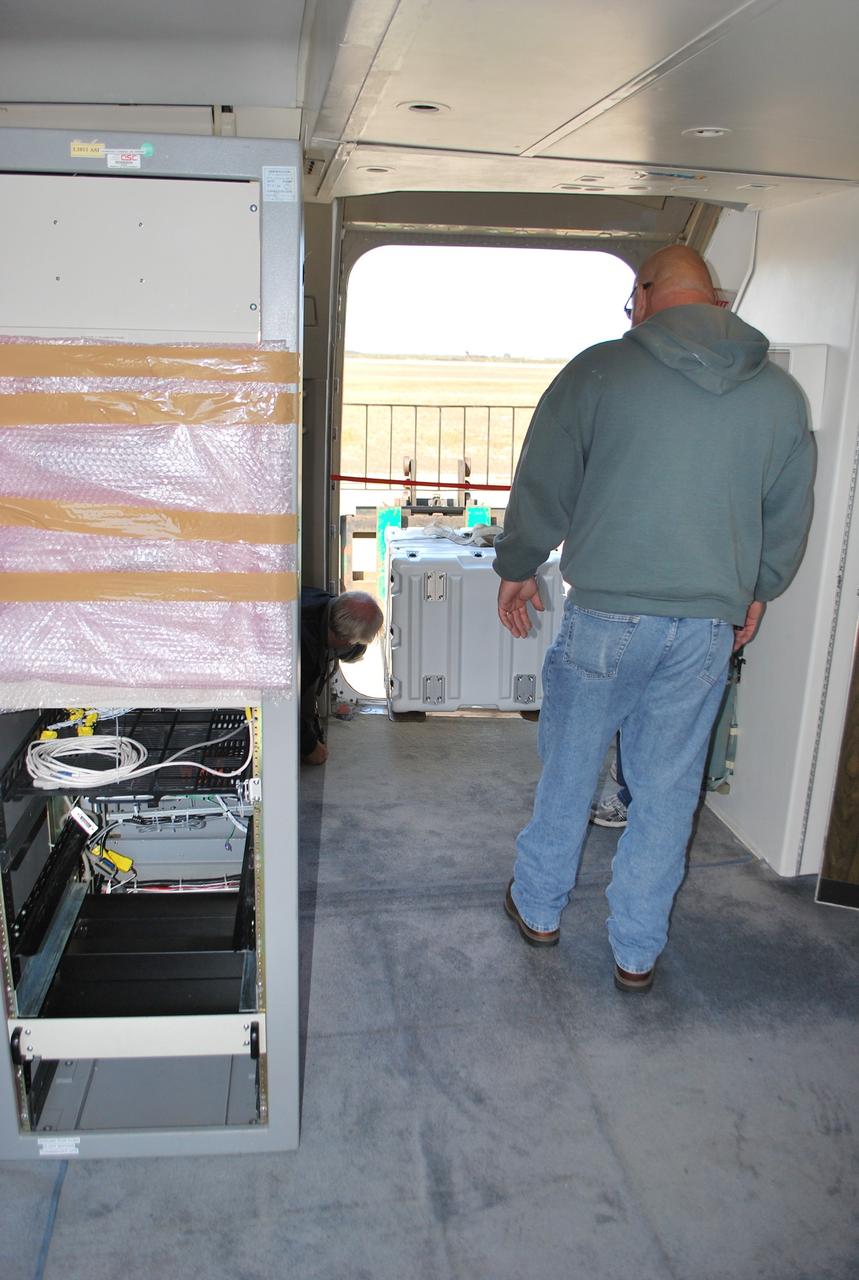
VANDENBERG AIR FORCE BASE, Calif. -- Technicians load the spacecraft airborne support equipment to the Orbital Sciences' L-1011 carrier aircraft. This equipment will maintain the in-flight monitoring and control of the NuSTAR spacecraft before the release of the Pegasus XL rocket. The Pegasus will launch NuSTAR into space where the high-energy x-ray telescope will conduct a census for black holes, map radioactive material in young supernovae remnants, and study the origins of cosmic rays and the extreme physics around collapsed stars. For more information, visit science.nasa.gov/missions/nustar/. Photo credit: NASA/Randy Beaudoin, VAFB
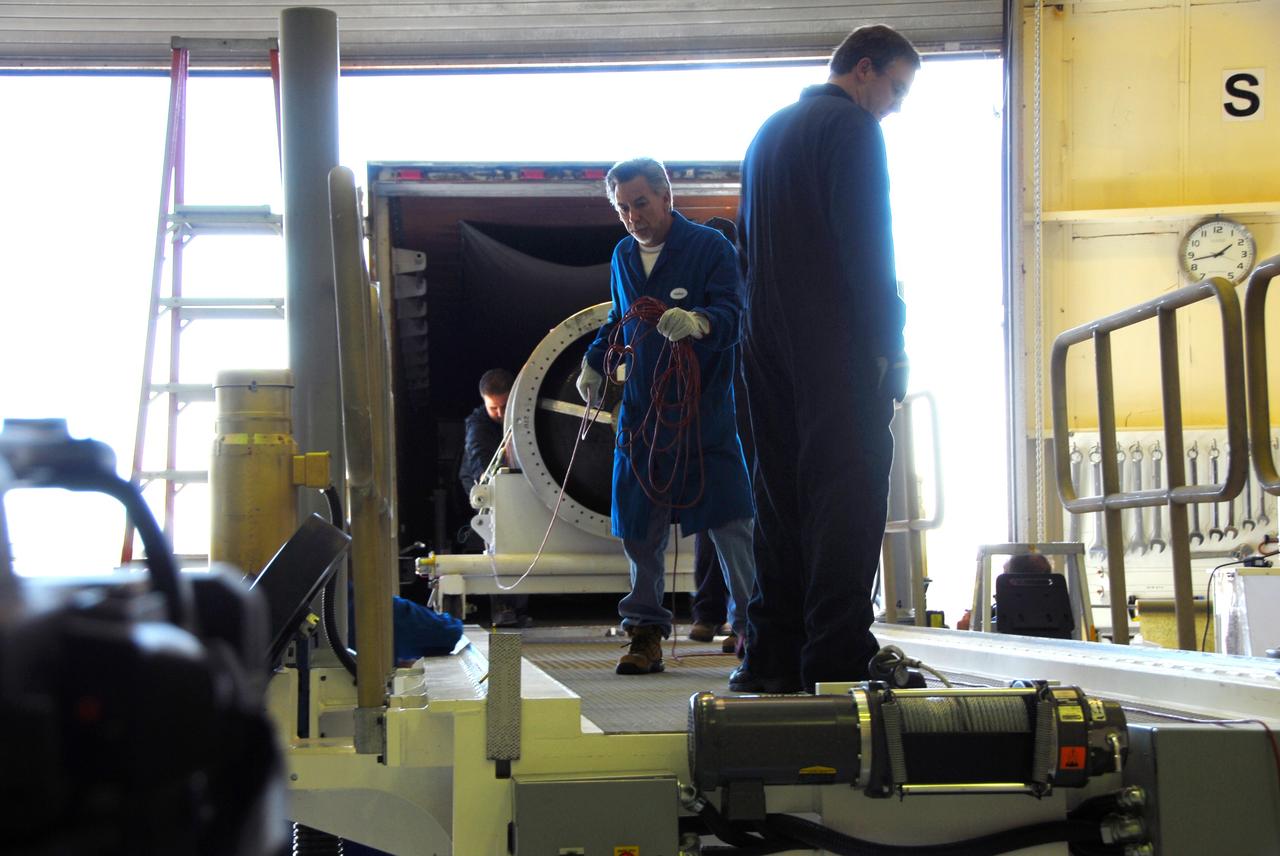
VANDENBERG AIR FORCE BASE, Calif. -- At Vandenberg Air Force Base in California, the third stage of the Pegasus XL rocket that will launch the Nuclear Spectroscopic Telescope Array (NuSTAR) to orbit is offloaded for processing in Building 1555. After the rocket and spacecraft are processed at Vandenberg, they will be shipped to the Ronald Reagan Ballistic Missile Defense Test Site located at the Pacific Ocean’s Kwajalein Atoll for launch. The high-energy X-ray telescope will conduct a census for black holes, map radioactive material in young supernovae remnants, and study the origins of cosmic rays and the extreme physics around collapsed stars. Photo credit: NASA/Dan Liberotti, VAFB
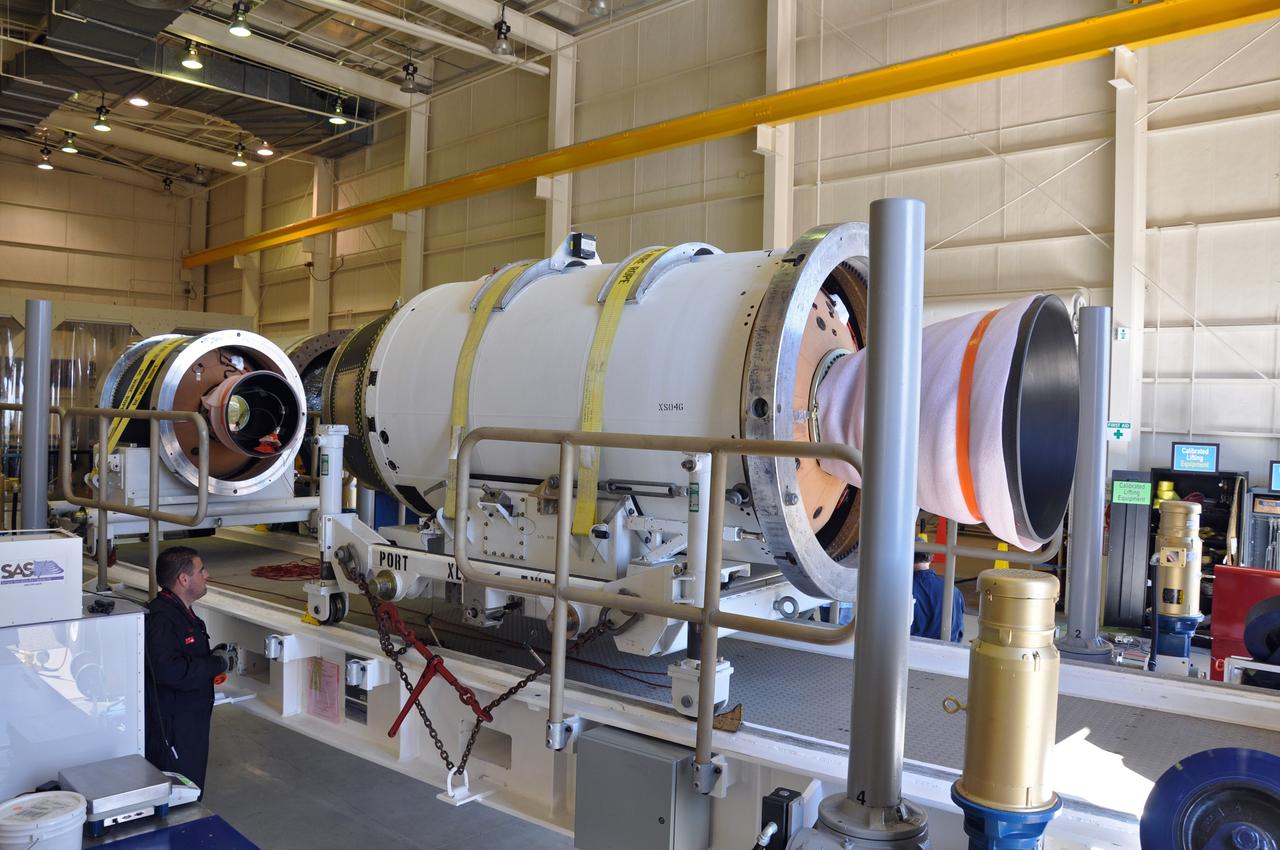
VANDENBERG AIR FORCE BASE, Calif. -- At Vandenberg Air Force Base in California, the second stage of the Pegasus XL rocket that will launch the Nuclear Spectroscopic Telescope Array (NuSTAR) to orbit is ready to move from a jackable rail to a stationary one for processing in Building 1555. After the rocket and spacecraft are processed at Vandenberg, they will be shipped to the Ronald Reagan Ballistic Missile Defense Test Site located at the Pacific Ocean’s Kwajalein Atoll for launch. The high-energy X-ray telescope will conduct a census for black holes, map radioactive material in young supernovae remnants, and study the origins of cosmic rays and the extreme physics around collapsed stars. Photo credit: NASA/Randy Beaudoin, VAFB
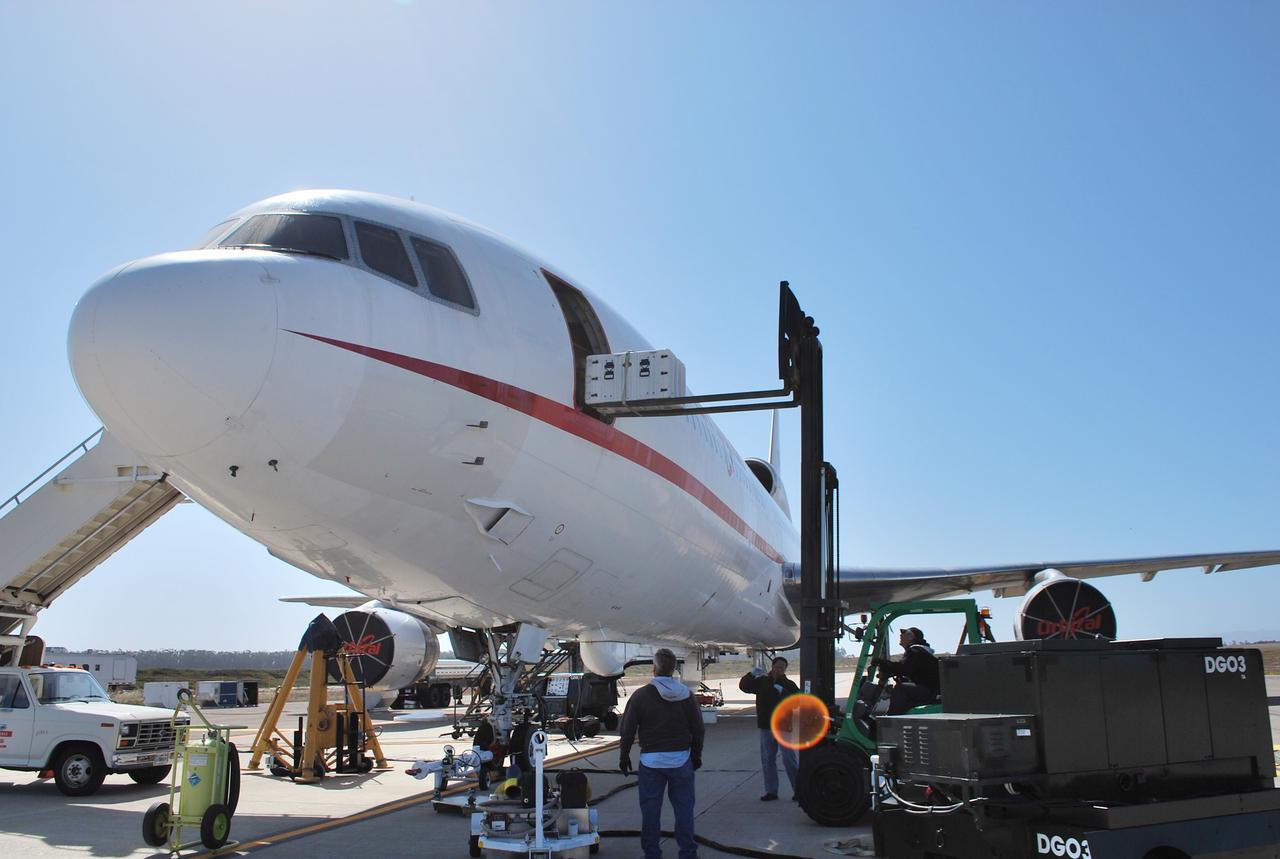
VANDENBERG AIR FORCE BASE, Calif. -- Technicians load the spacecraft airborne support equipment to the Orbital Sciences' L-1011 carrier aircraft. This equipment will maintain the in-flight monitoring and control of the NuSTAR spacecraft before the release of the Pegasus XL rocket. The Pegasus will launch NuSTAR into space where the high-energy x-ray telescope will conduct a census for black holes, map radioactive material in young supernovae remnants, and study the origins of cosmic rays and the extreme physics around collapsed stars. For more information, visit science.nasa.gov/missions/nustar/. Photo credit: NASA/Randy Beaudoin, VAFB
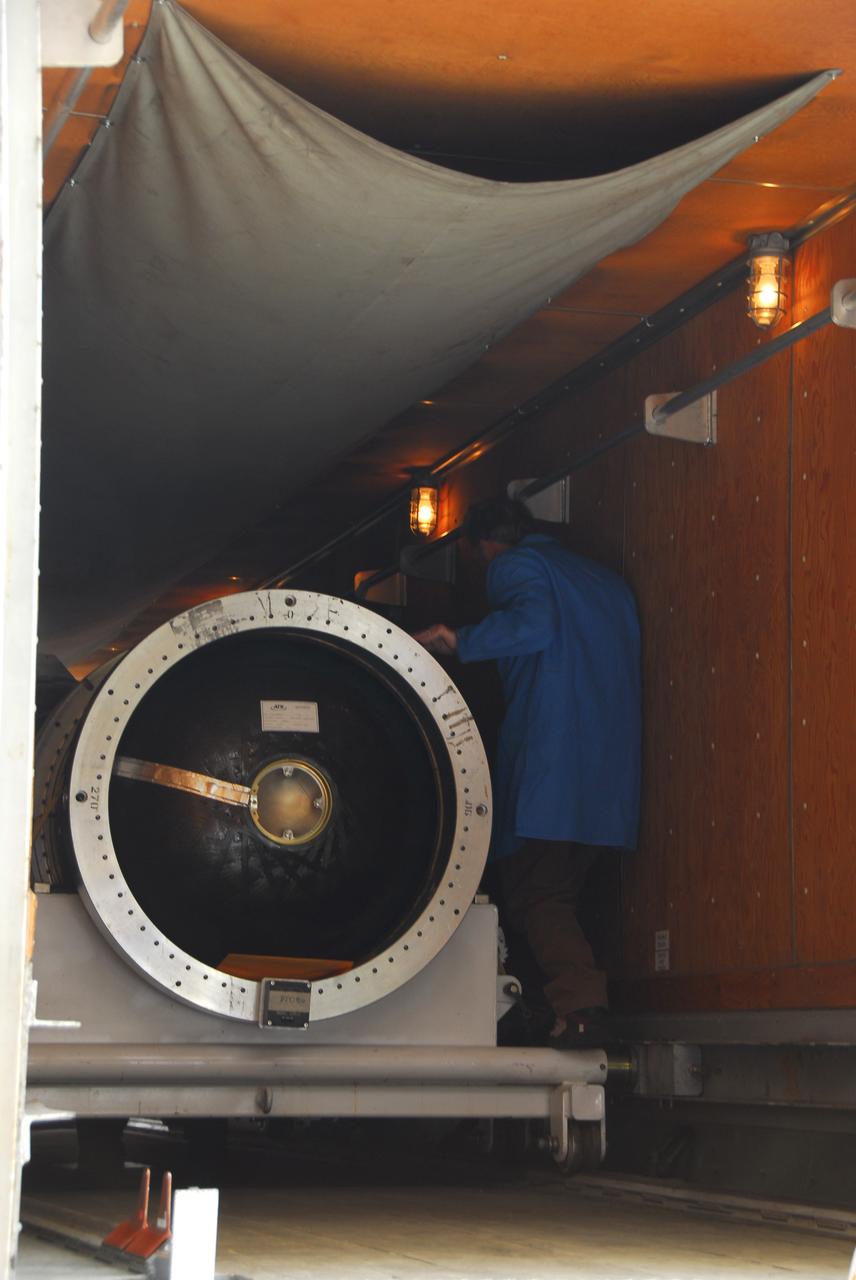
VANDENBERG AIR FORCE BASE, Calif. -- At Vandenberg Air Force Base in California, the third stage of the Pegasus XL rocket that will launch the Nuclear Spectroscopic Telescope Array (NuSTAR) to orbit arrives at Building 1555 for processing. After the rocket and spacecraft are processed at Vandenberg, they will be shipped to the Ronald Reagan Ballistic Missile Defense Test Site located at the Pacific Ocean's Kwajalein Atoll for launch. The high-energy X-ray telescope will conduct a census for black holes, map radioactive material in young supernovae remnants, and study the origins of cosmic rays and the extreme physics around collapsed stars. Photo credit: NASA/Dan Liberotti, VAFB
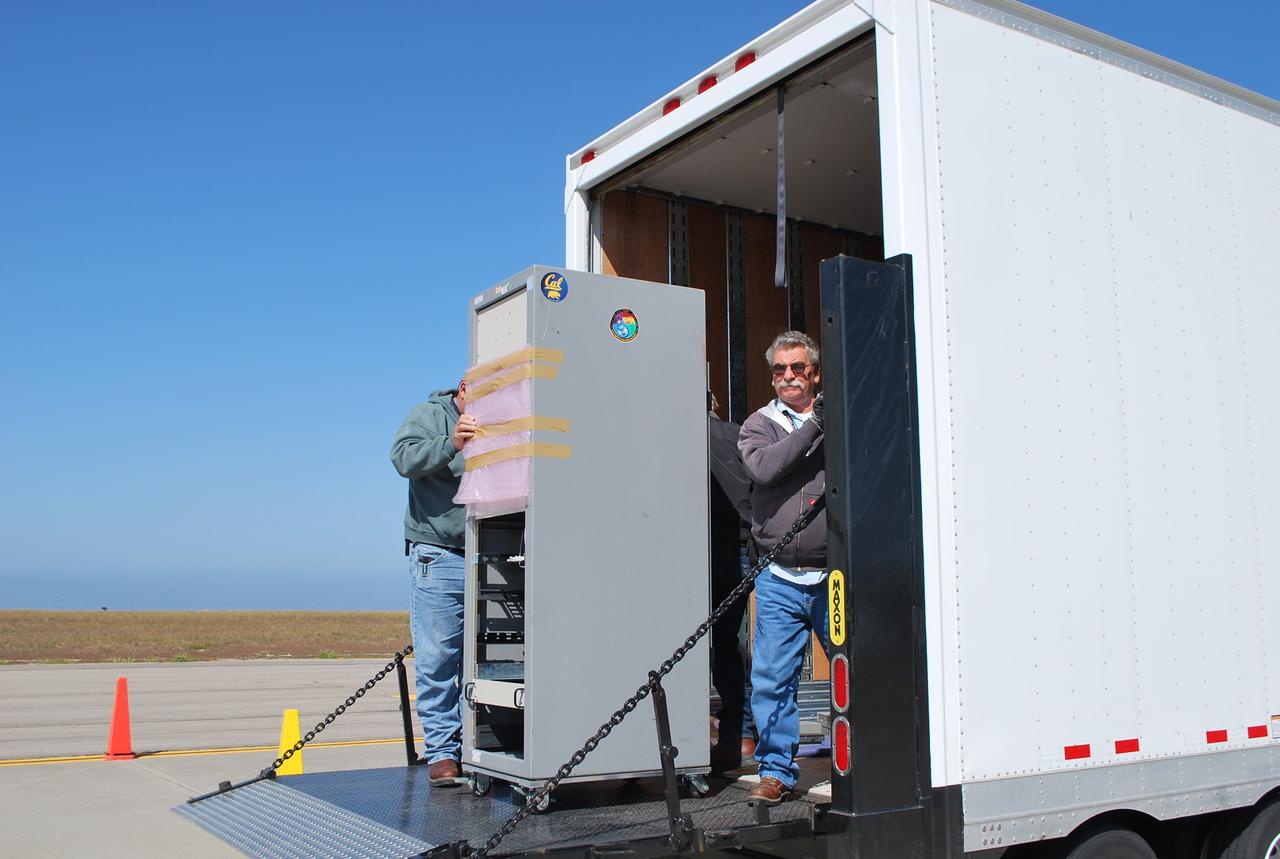
VANDENBERG AIR FORCE BASE, Calif. -- Technicians prepare to offload the spacecraft airborne support equipment for the Orbital Sciences' L-1011 carrier aircraft. This equipment will maintain the in-flight monitoring and control of the NuSTAR spacecraft before the release of the Pegasus XL rocket. The Pegasus will launch NuSTAR into space where the high-energy x-ray telescope will conduct a census for black holes, map radioactive material in young supernovae remnants, and study the origins of cosmic rays and the extreme physics around collapsed stars. For more information, visit science.nasa.gov/missions/nustar/. Photo credit: NASA/Randy Beaudoin, VAFB
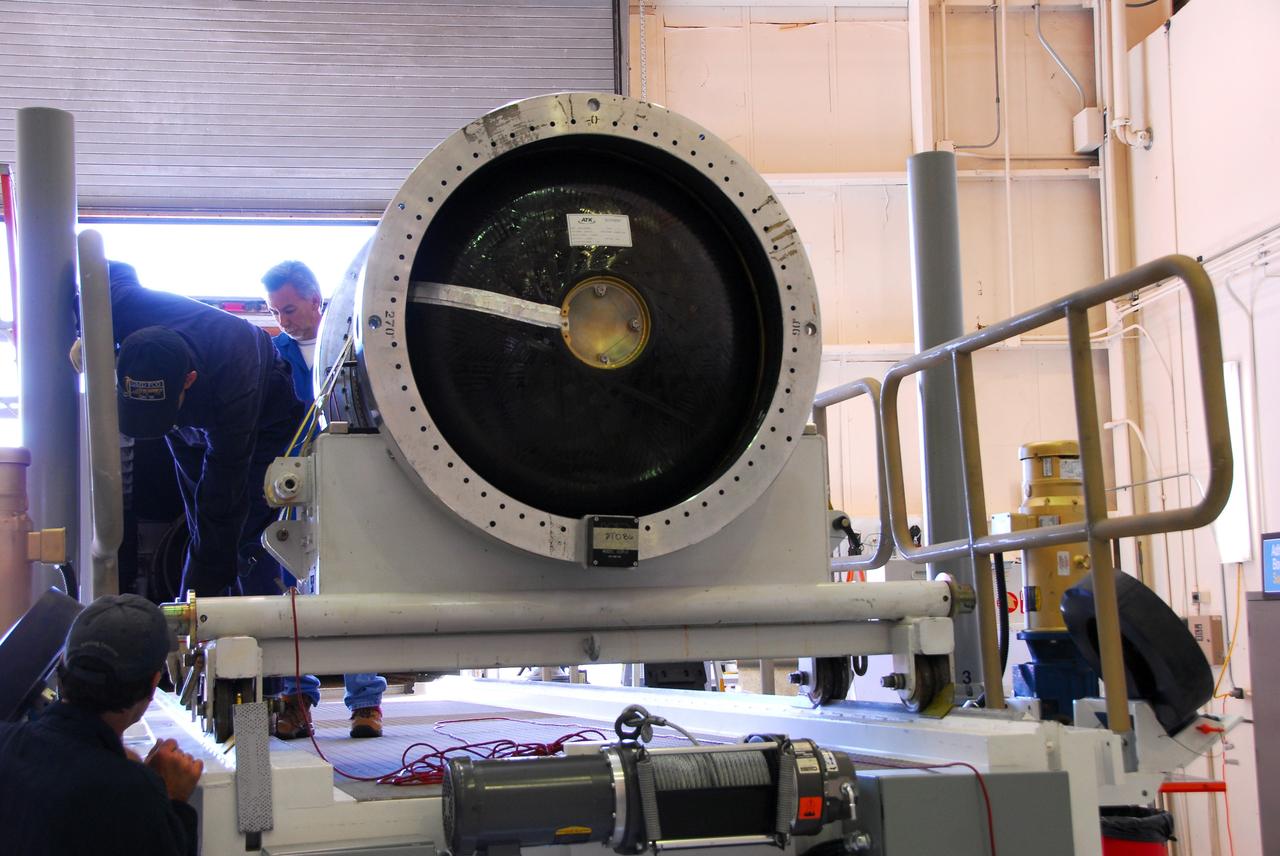
VANDENBERG AIR FORCE BASE, Calif. -- At Vandenberg Air Force Base in California, the third stage of the Pegasus XL rocket that will launch the Nuclear Spectroscopic Telescope Array (NuSTAR) to orbit is moved onto a jackable rail for processing in Building 1555. After the rocket and spacecraft are processed at Vandenberg, they will be shipped to the Ronald Reagan Ballistic Missile Defense Test Site located at the Pacific Ocean’s Kwajalein Atoll for launch. The high-energy X-ray telescope will conduct a census for black holes, map radioactive material in young supernovae remnants, and study the origins of cosmic rays and the extreme physics around collapsed stars. Photo credit: NASA/Dan Liberotti, VAFB
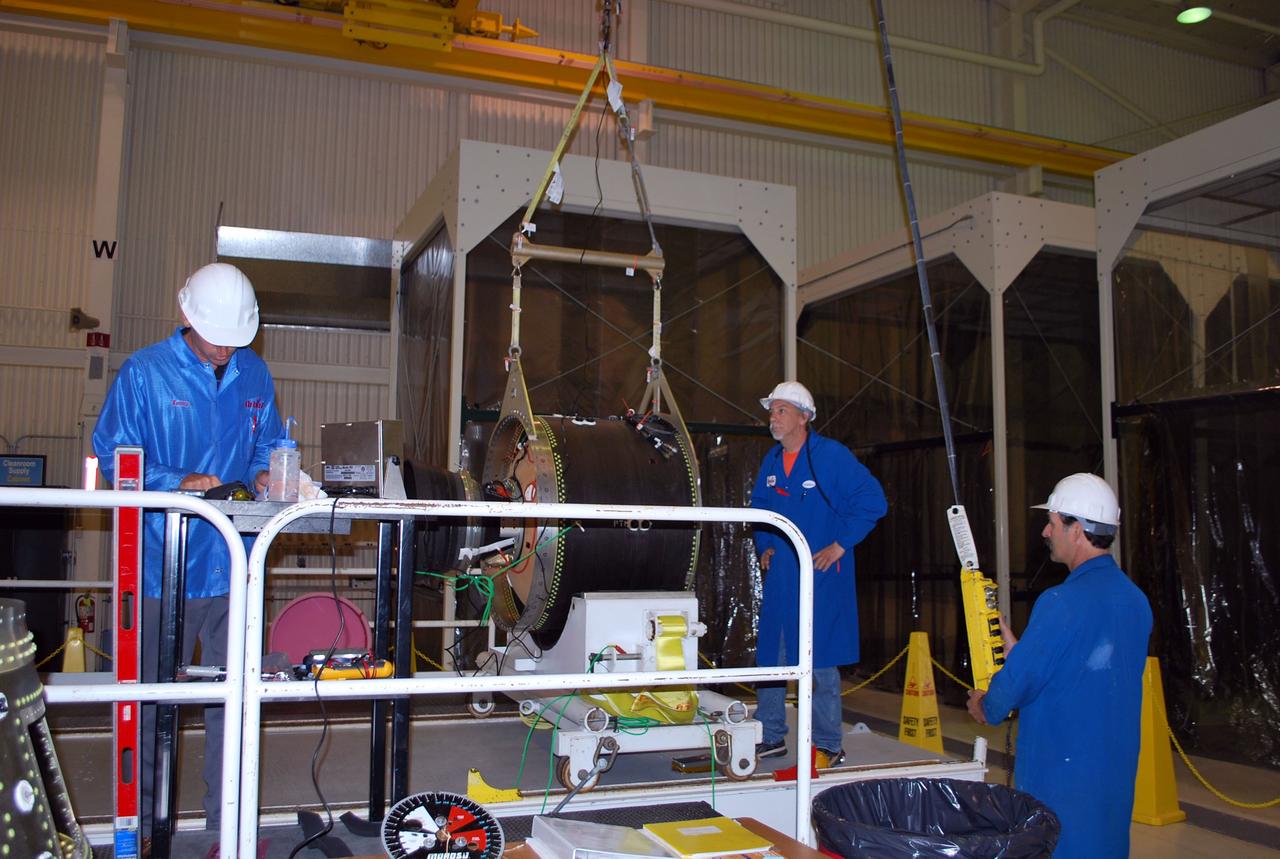
VANDENBERG AIR FORCE BASE, Calif. -- At Vandenberg Air Force Base in California, Orbital Sciences Corp. technicians weigh stage 3 of the Pegasus XL rocket motor that will launch the Nuclear Spectroscopic Telescope Array (NuSTAR) into space. After the rocket and spacecraft are processed at Vandenberg, they will be flown on the Orbital Sciences' L-1011 carrier aircraft to the Ronald Reagan Ballistic Missile Defense Test Site located at the Pacific Ocean’s Kwajalein Atoll for launch. The high-energy X-ray telescope will conduct a census for black holes, map radioactive material in young supernovae remnants, and study the origins of cosmic rays and the extreme physics around collapsed stars. Photo credit: NASA/Randy Beaudoin, VAFB
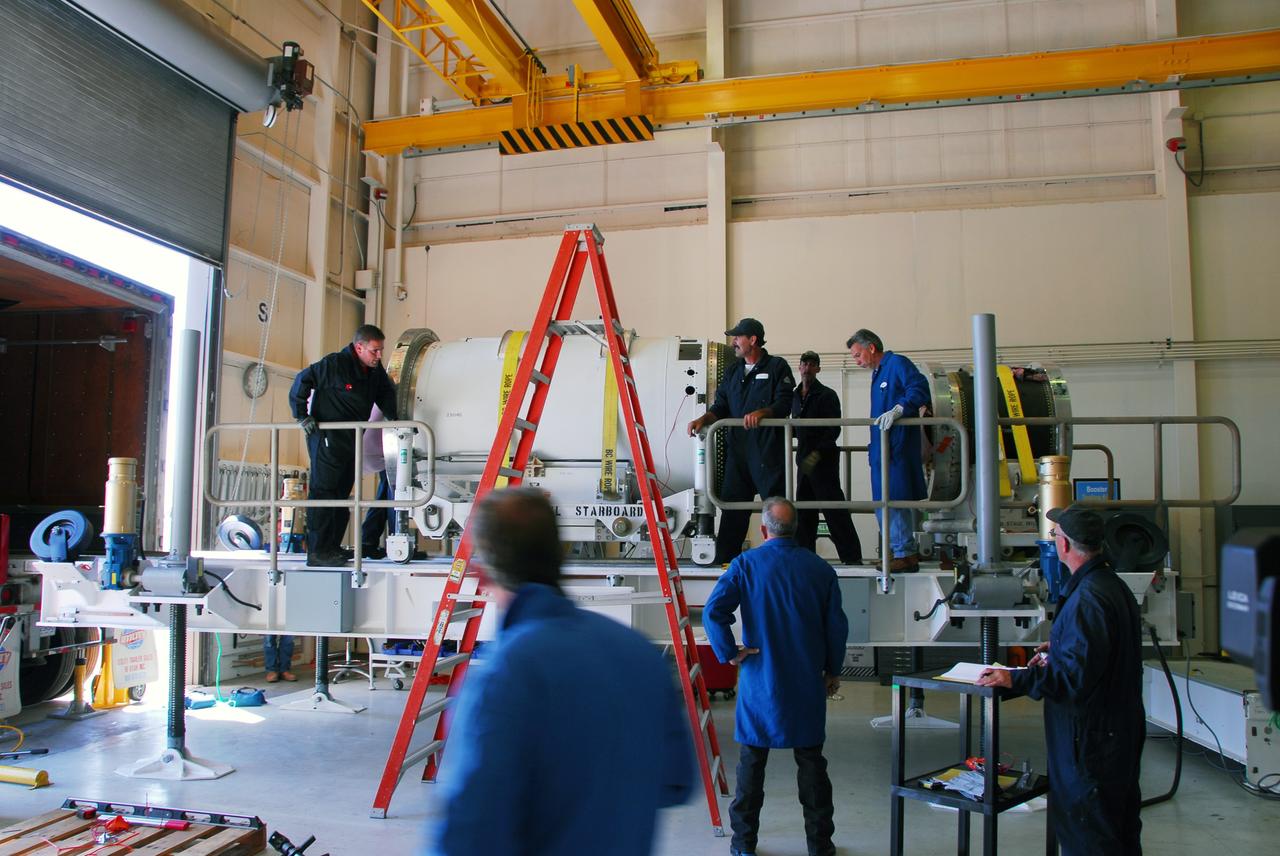
VANDENBERG AIR FORCE BASE, Calif. -- At Vandenberg Air Force Base in California, the second stage of the Pegasus XL rocket, left, that will launch the Nuclear Spectroscopic Telescope Array (NuSTAR) to orbit is moved onto a jackable rail for processing in Building 1555. On the right is the rocket's third stage. After the rocket and spacecraft are processed at Vandenberg, they will be shipped to the Ronald Reagan Ballistic Missile Defense Test Site located at the Pacific Ocean’s Kwajalein Atoll for launch. The high-energy X-ray telescope will conduct a census for black holes, map radioactive material in young supernovae remnants, and study the origins of cosmic rays and the extreme physics around collapsed stars. Photo credit: NASA/Dan Liberotti, VAFB
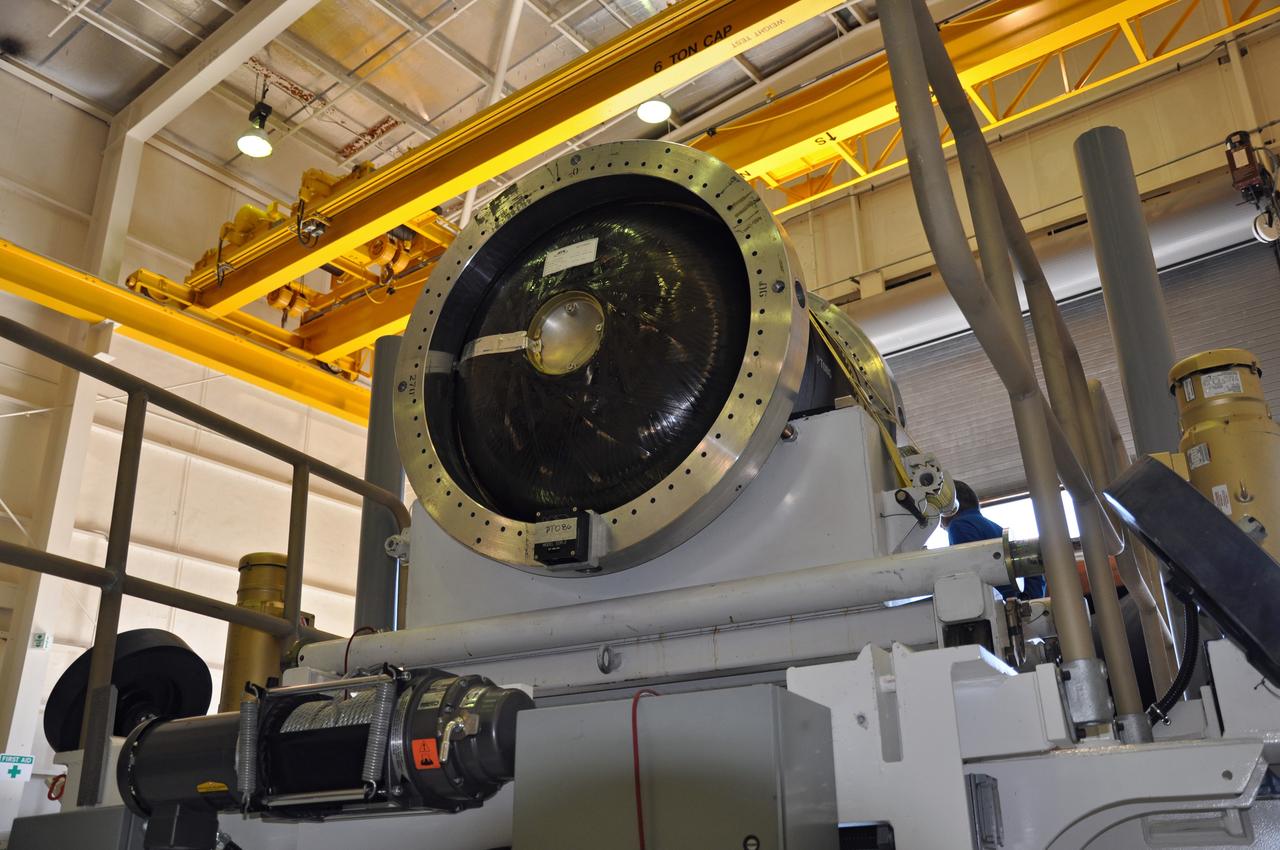
VANDENBERG AIR FORCE BASE, Calif. -- At Vandenberg Air Force Base in California, the third stage of the Pegasus XL rocket that will launch the Nuclear Spectroscopic Telescope Array (NuSTAR) to orbit is offloaded for processing in Building 1555. After the rocket and spacecraft are processed at Vandenberg, they will be shipped to the Ronald Reagan Ballistic Missile Defense Test Site located at the Pacific Ocean’s Kwajalein Atoll for launch. The high-energy X-ray telescope will conduct a census for black holes, map radioactive material in young supernovae remnants, and study the origins of cosmic rays and the extreme physics around collapsed stars. Photo credit: NASA/Randy Beaudoin, VAFB
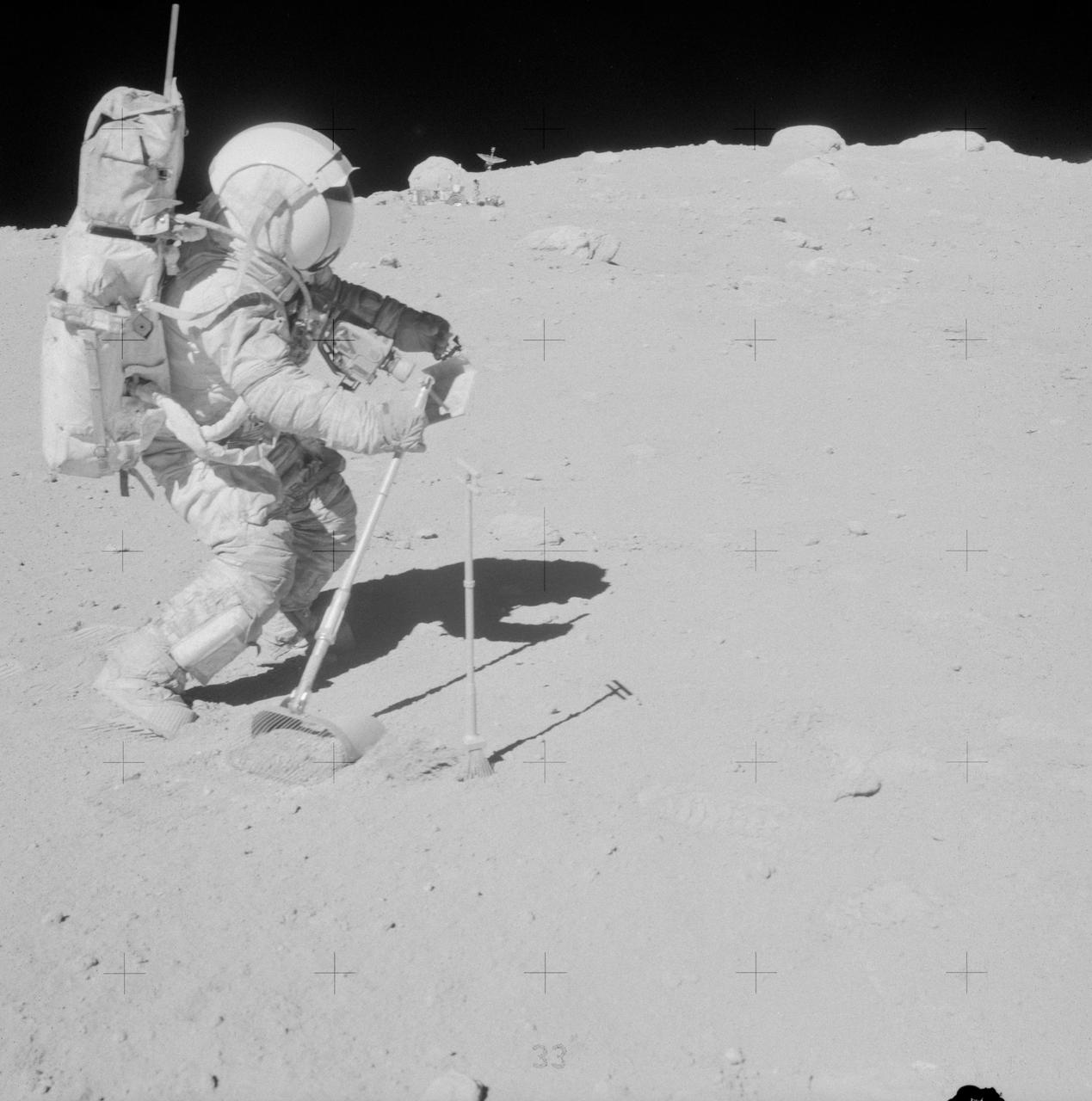
AS16-106-17340 (23 April 1972) --- Astronaut John W. Young, commander of the Apollo 16 lunar landing mission, is photographed collecting lunar samples near North Ray Crater during the third Apollo 16 extravehicular activity (EVA) at the Descartes landing site. This picture was taken by astronaut Charles M. Duke Jr., lunar module pilot. Young is using the lunar surface rake and a set of tongs. The Lunar Roving Vehicle (LRV) is parked in the field of large boulders in the background. While astronauts Young and Duke descended in the Lunar Module (LM) "Orion" to explore the moon, astronaut Thomas K. Mattingly II, command module pilot, remained with the Command and Service Modules (CSM) in lunar orbit.
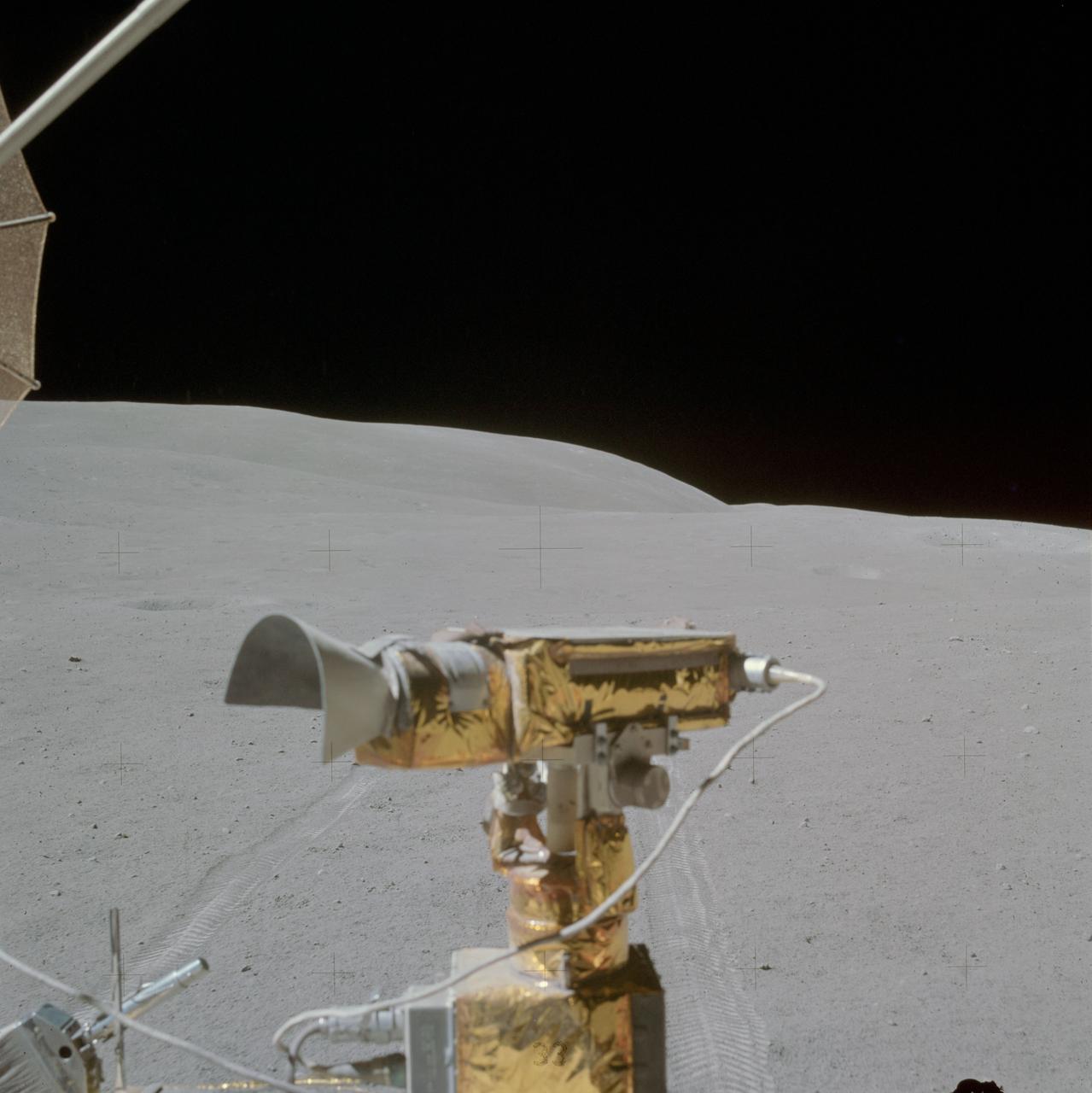
AS16-117-18754 (23 April 1972) --- A view of the smooth terrain in the general area of the North Ray Crater geological site, photographed by the Apollo 16 crew from the Lunar Roving Vehicle (LRV) shortly after leaving the immediate area of the geology site. The RCA color television camera is mounted on the front of the LRV and can be seen in the foreground, along with a small part of the high gain antenna, upper left. The tracks were made on the earlier trip to the North Ray Crater site. Astronaut Charles M. Duke Jr., lunar module pilot, exposed this view with his 70mm Hasselblad camera. Astronaut John W. Young, commander, said that this area was much smoother than the region around South Ray Crater. While astronauts Young and Duke descended in the Apollo 16 Lunar Module (LM) "Orion" to explore the Descartes highlands landing site on the moon, astronaut Thomas K. Mattingly II, command module pilot, remained with the Command and Service Modules (CSM) "Casper" in lunar orbit.
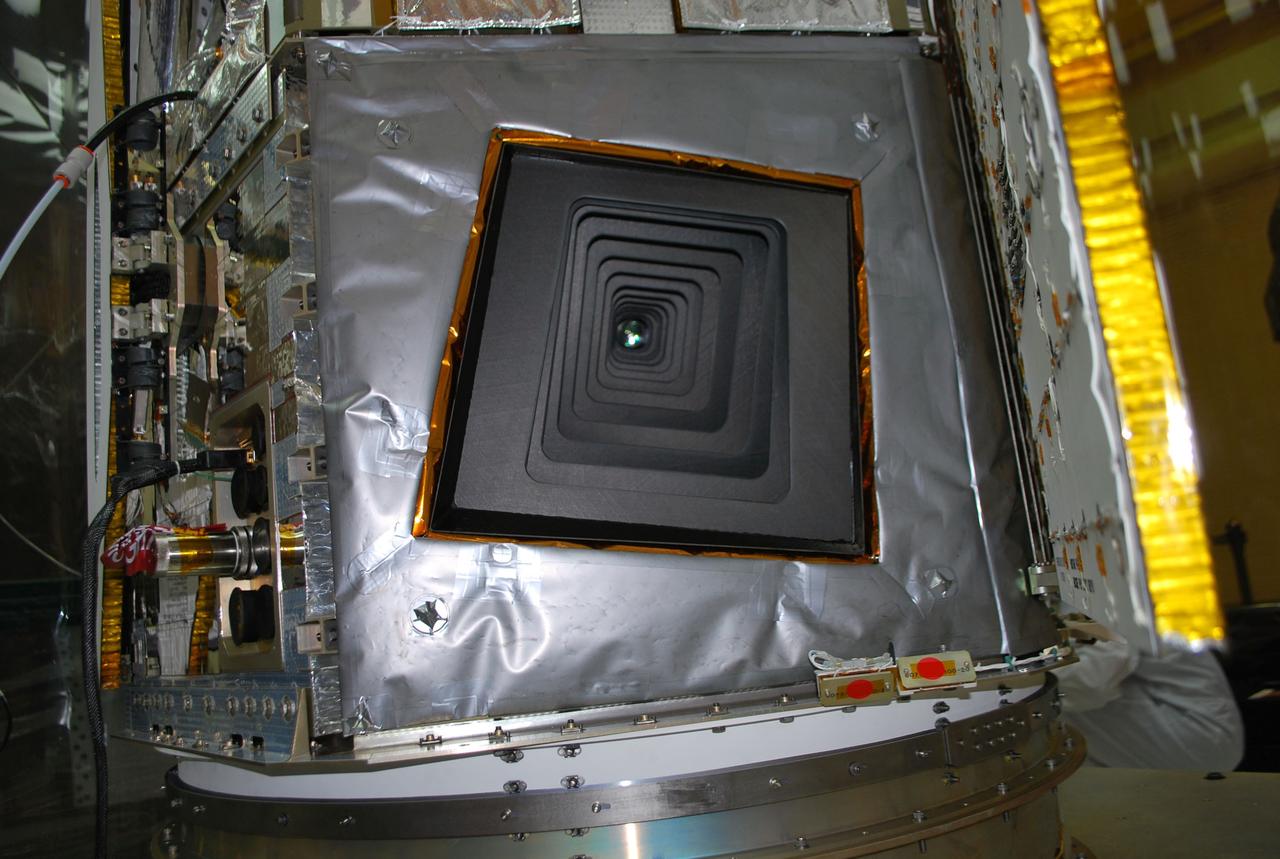
VANDENBERG AIR FORCE BASE, Calif. -- NuSTAR’s X-ray telescope is visible during the solar array deployment test at Vandenberg Air Force Base's processing facility in California. The Pegasus will launch NASA's Nuclear Spectroscopic Telescope Array NuSTAR into space. After the rocket and spacecraft are processed at Vandenberg, they will be flown on the Orbital Sciences’ L-1011 carrier aircraft to the Ronald Reagan Ballistic Missile Defense Test Site at the Pacific Ocean’s Kwajalein Atoll for launch. The high-energy x-ray telescope will conduct a census for black holes, map radioactive material in young supernovae remnants, and study the origins of cosmic rays and the extreme physics around collapsed stars. For more information, visit science.nasa.gov/missions/nustar/. Photo credit: NASA/Randy Beaudoin, VAFB
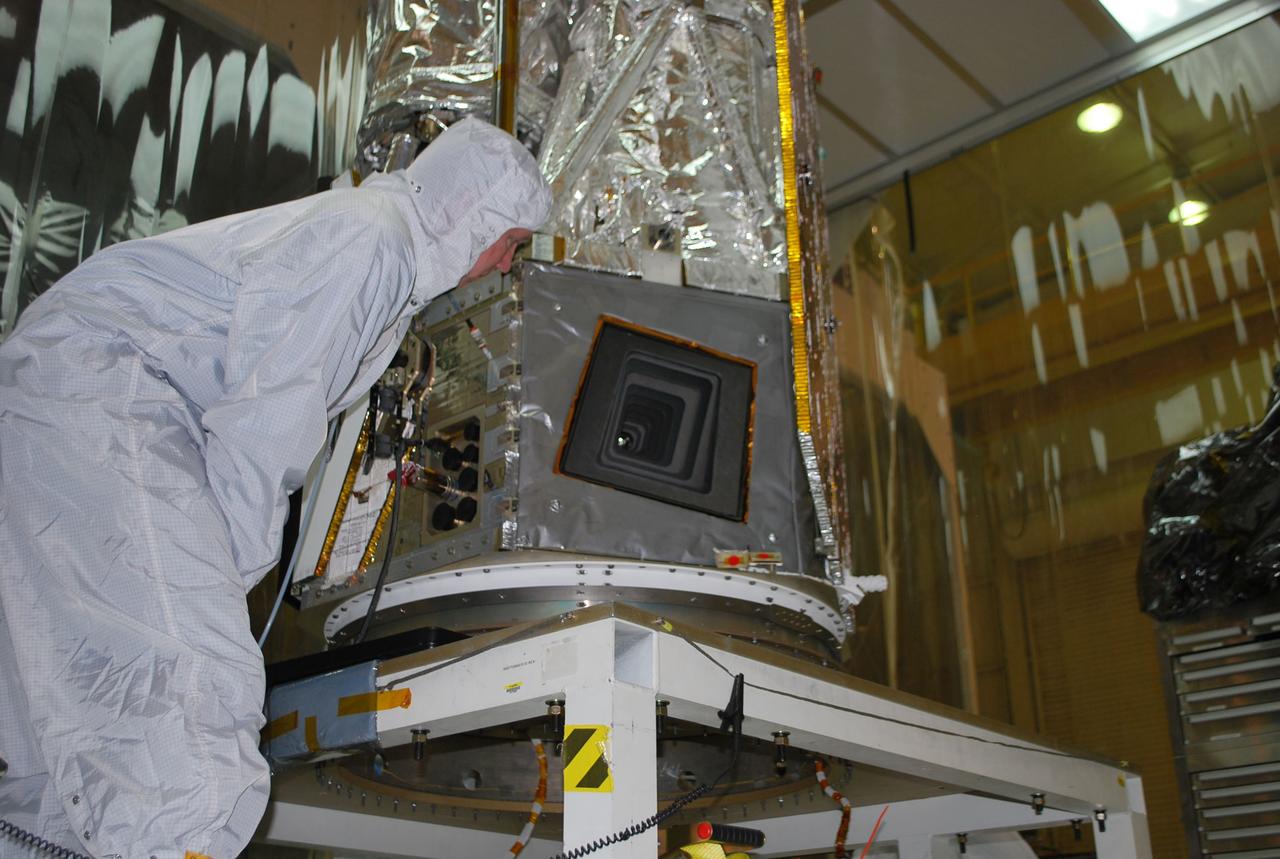
VANDENBERG AIR FORCE BASE, Calif. -- As a technician monitors the solar array deployment test at Vandenberg Air Force Base's processing facility in California, NuSTAR’s X-ray telescope is visible. The Pegasus will launch NASA's Nuclear Spectroscopic Telescope Array NuSTAR into space. After the rocket and spacecraft are processed at Vandenberg, they will be flown on the Orbital Sciences’ L-1011 carrier aircraft to the Ronald Reagan Ballistic Missile Defense Test Site at the Pacific Ocean’s Kwajalein Atoll for launch. The high-energy x-ray telescope will conduct a census for black holes, map radioactive material in young supernovae remnants, and study the origins of cosmic rays and the extreme physics around collapsed stars. For more information, visit science.nasa.gov/missions/nustar/. Photo credit: NASA/Randy Beaudoin, VAFB

VANDENBERG AIR FORCE BASE, Calif. -- As a technician monitors the solar array deployment test at Vandenberg Air Force Base's processing facility in California, NuSTAR’s X-ray telescope is visible. The Pegasus will launch NASA's Nuclear Spectroscopic Telescope Array NuSTAR into space. After the rocket and spacecraft are processed at Vandenberg, they will be flown on the Orbital Sciences’ L-1011 carrier aircraft to the Ronald Reagan Ballistic Missile Defense Test Site at the Pacific Ocean’s Kwajalein Atoll for launch. The high-energy x-ray telescope will conduct a census for black holes, map radioactive material in young supernovae remnants, and study the origins of cosmic rays and the extreme physics around collapsed stars. For more information, visit science.nasa.gov/missions/nustar/. Photo credit: NASA/Randy Beaudoin, VAFB
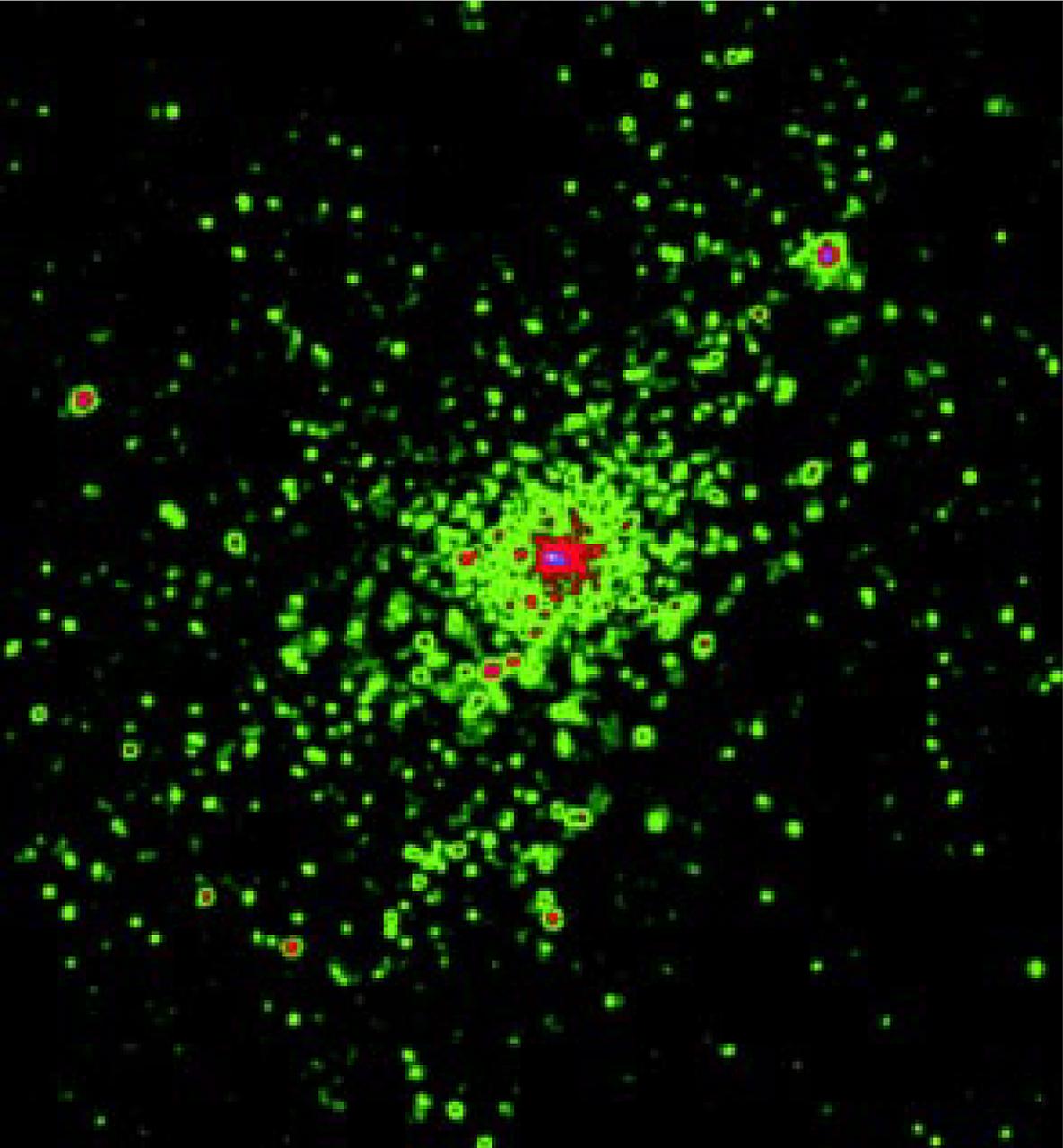
NGC 3603 is a bustling region of star birth in the Carina spiral arm of the Milky Way galaxy, about 20,000 light-years from Earth. For the first time, this Chandra image resolves the multitude of individual x-ray sources in this star-forming region. (The intensity of the x-rays observed by Chandra are depicted by the various colors in this image. Green represents lower intensity sources, while purple and red indicate increasing x-ray intensity.) Specifically, the Chandra image reveals dozens of extremely massive stars born in a burst of star formation about 2 million years ago. This region's activities may be indicative of what is happening in other distant "starburst" galaxies (bright galaxies flush with new stars). In the case of NGC 3603, scientists now believe that these x-rays are emitted from massive stars and stellar winds, since the stars are too young to have produced supernovae or have evolved into neutron stars. The Chandra observations of NGC 3603 may provide new clues about x-ray emission in starburst galaxies as well as star formation itself. (Photo credit: NASA/GSFC/M. Corcoran et al)
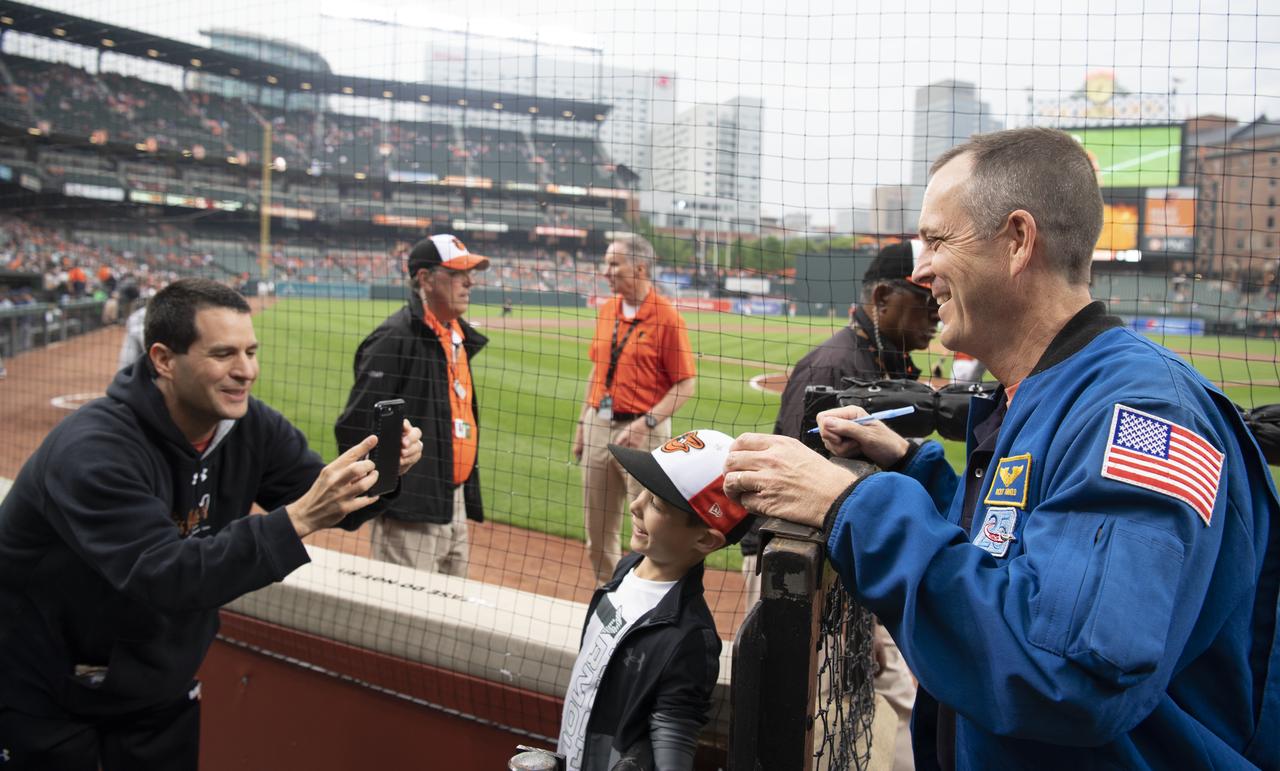
NASA astronaut and Maryland native Ricky Arnold takes a picture with a young fan before the Tampa Bay Rays take on the Baltimore Orioles, Saturday, May 4, 2019 at Camden Yards in Baltimore, Md. During Arnold’s 197 days onboard the International Space Station, as part of Expeditions 55 and 56, he ventured outside the space station on three spacewalks in addition to conducting numerous experiments and educational downlink events. Photo Credit: (NASA/Joel Kowsky)

NASA astronaut and Maryland native Ricky Arnold signs a baseball for a young fan before the Tampa Bay Rays take on the Baltimore Orioles, Saturday, May 4, 2019 at Camden Yards in Baltimore, Md. During Arnold’s 197 days onboard the International Space Station, as part of Expeditions 55 and 56, he ventured outside the space station on three spacewalks in addition to conducting numerous experiments and educational downlink events. Photo Credit: (NASA/Joel Kowsky)

STS009-128-858 (28 Nov-8 Dec 1983) --- Astronaut John W. Young takes notes in the commander?s station on the flight deck of the Columbia. The cathode ray tube (CRT) among the forward panels displays the orbiter?s position in relation to the Earth on its monitor. Astronaut Brewster H. Shaw Jr., pilot, took this photograph.
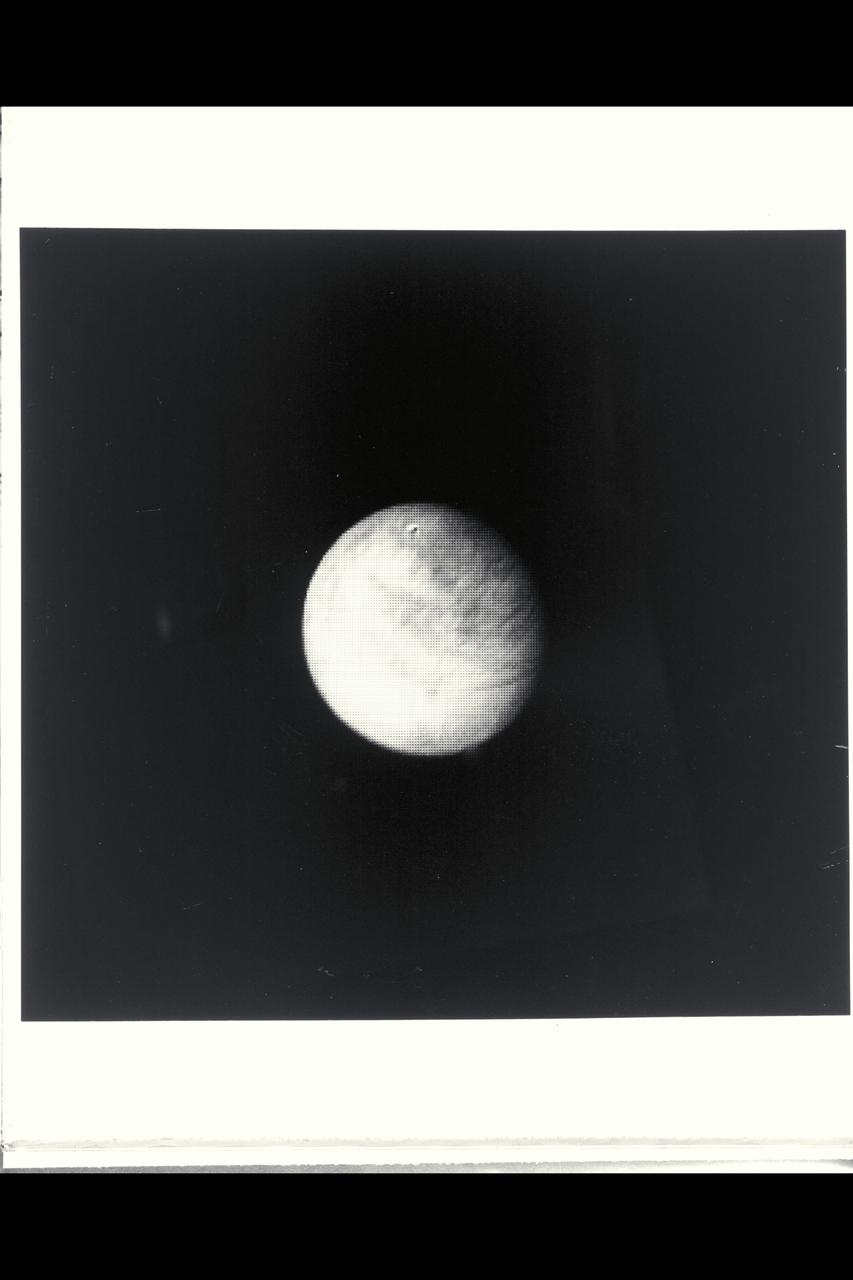
Range : 4.2 million km. ( 2.6 million miles ) Jupiter's moon Europa, the size of earth's moon, is apparently covered by water ice, as indicated by ground spectrometers and its brightness. In this view, global scale dark sreaks discovered by Voyager 1 that criss-cross the the satelite are becoming visible. Bright rayed impact craters, which are abundant on Ganymede and Callisto, would be easily visible at this range, suggesting that Europa's surface is young and that the streaks are reflections of currently active internal dynamic processes.

This image is an x-ray view of Eta Carinae Nebula showing bright stars taken with the High Energy Astronomy Observatory (HEAO)-2/Einstein Observatory. The Eta Carinae Nebula is a large and complex cloud of gas, crisscrossed with dark lanes of dust, some 6,500 light years from Earth. Buried deep in this cloud are many bright young stars and a very peculiar variable star. The HEAO-2, the first imaging and largest x-ray telescope built to date, was capable of producing actual photographs of x-ray objects. Shortly after launch, the HEAO-2 was nicknamed the Einstein Observatory by its scientific experimenters in honor of the centernial of the birth of Albert Einstein, whose concepts of relativity and gravitation have influenced much of modern astrophysics, particularly x-ray astronomy. The HEAO-2, designed and developed by TRW, Inc. under the project management of the Marshall Space Flight Center, was launched aboard an Atlas/Centaur launch vehicle on November 13, 1978.
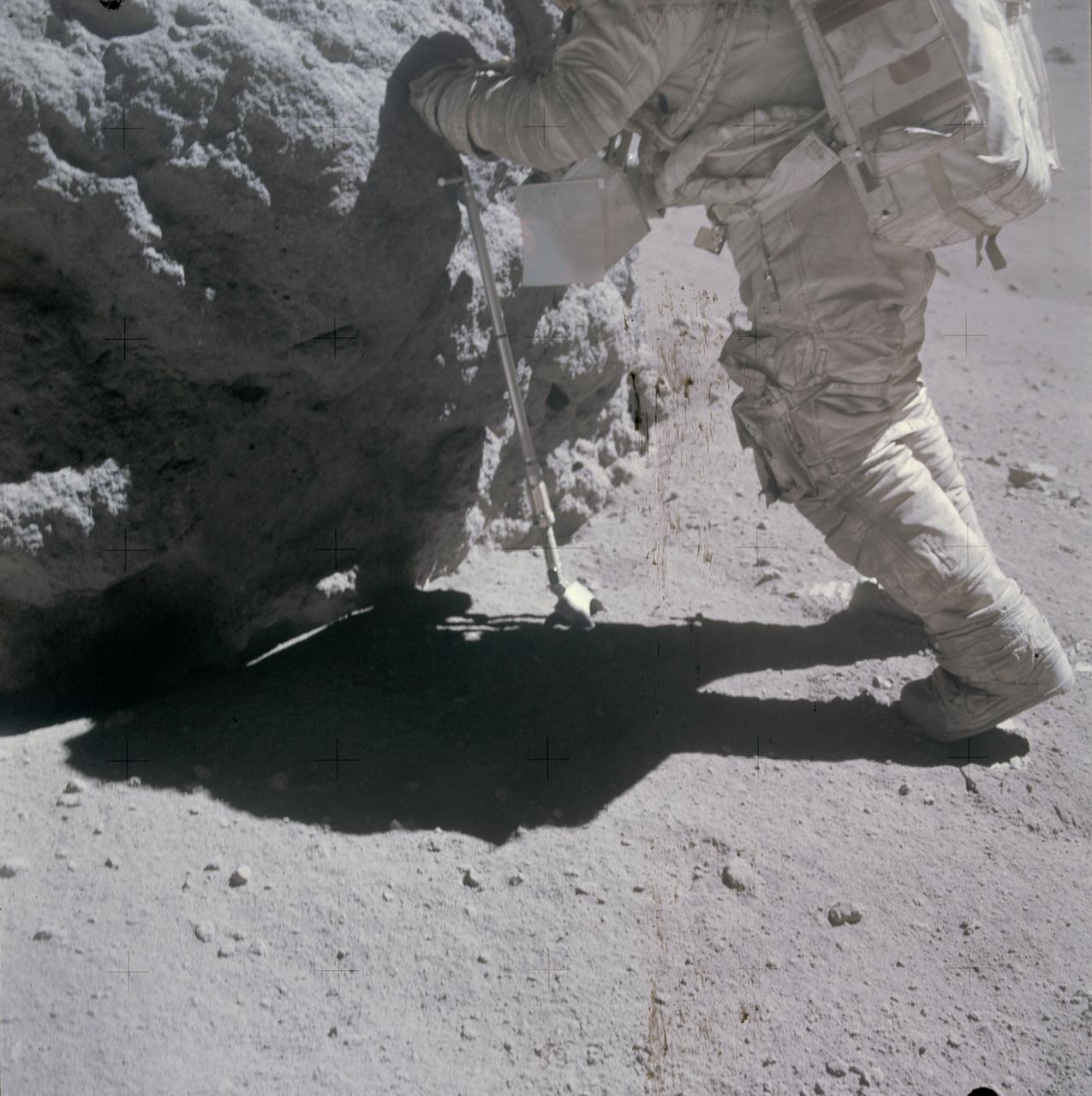
AS16-116-18671 (23 April 1972) --- Astronaut Charles M. Duke Jr., lunar module pilot, works at the "Shadow Rock", discovered during the missions third extravehicular activity (EVA) in the area of North Ray Crater (Station 13), April 23, 1972. The scoop, a geological hand tool, leans against the rock. This view was exposed by astronaut John W. Young, commander. The two moon-exploring crew men sampled this rock, which got its name because of a permanently shadowed area it protected. While astronauts Young and Duke descended in the Apollo 16 Lunar Module (LM) "Orion" to explore the Descartes highlands landing site on the moon, astronaut Thomas K. Mattingly II, command module pilot, remained with the Command and Service Modules (CSM) "Casper" in lunar orbit.
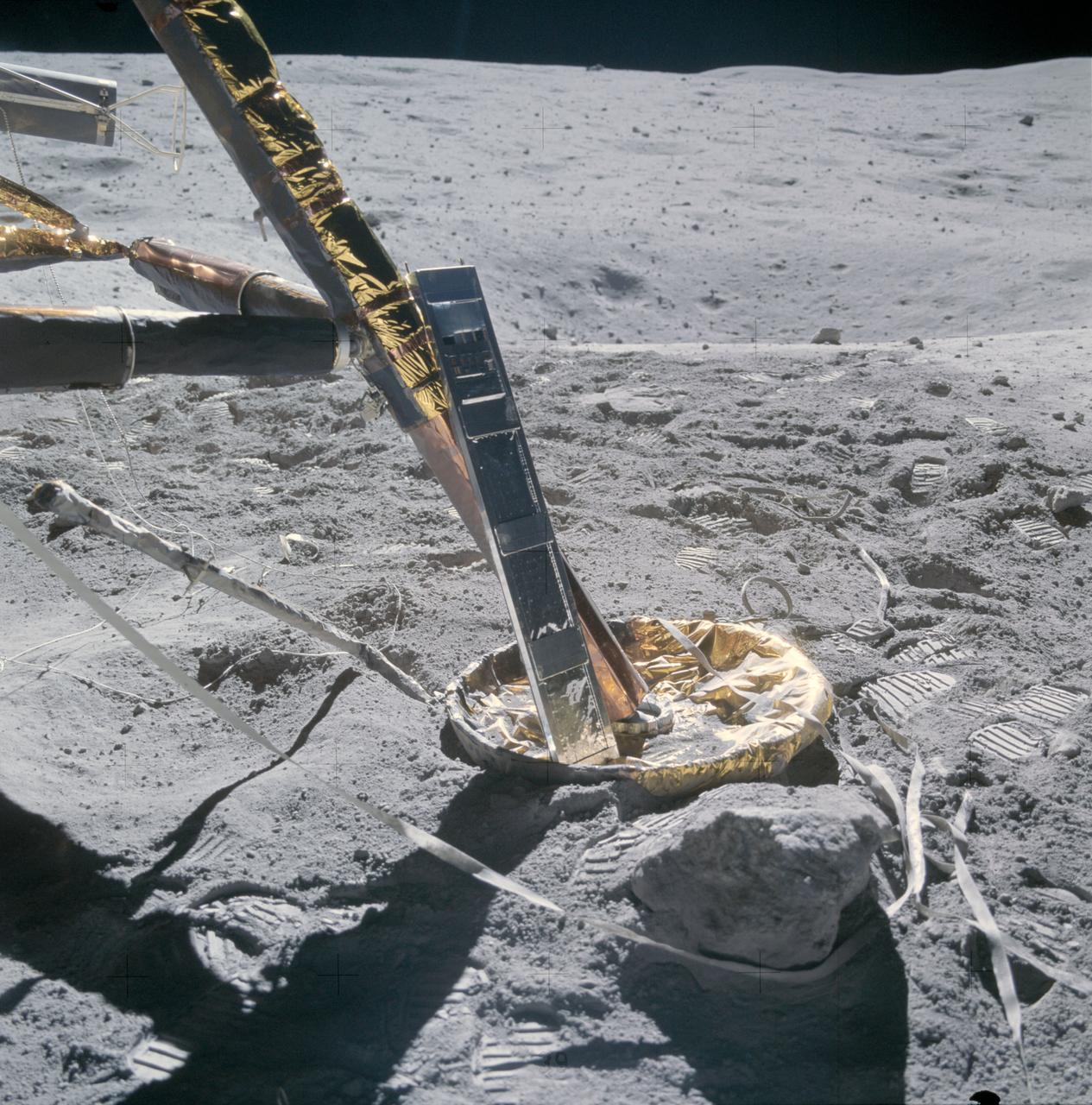
AS16-107-17442 (22 April 1972) --- A close-up view of the Apollo 16 Cosmic Ray Detector (CRD) experiment deployed at the +Y strut of the Lunar Module (LM). The crewmembers moved it to this position from near the deployment site of the Apollo Lunar Surface Experiments Package (ALSEP) because, in the words of astronaut John W. Young, commander, "The panels were getting a little warm." Note that the LM did not skid upon landing, as evidenced by the landing contact probe's folded back (neatly) position and the lack of skid marks. While astronauts Young, and Charles M. Duke Jr., lunar module pilot; descended in the Apollo 16 Lunar Module (LM) "Orion" to explore the Descartes highlands landing site on the moon, astronaut Thomas K. Mattingly II, command module pilot, remained with the Command and Service Modules (CSM) "Casper" in lunar orbit.

VANDENBERG AIR FORCE BASE, Calif. – Inside an environmental enclosure at Vandenberg Air Force Base's processing facility in California, technicians monitor NASA's Nuclear Spectroscopic Telescope Array, or NuSTAR, secured inside a turnover rotation fixture, as it is mated to its Orbital Sciences Pegasus XL rocket. The technicians are dressed in clean room attire, known as bunny suits. The conjoining of the spacecraft with the rocket is a major milestone in prelaunch preparations. After processing of the rocket and spacecraft are complete, they will be flown on Orbital's L-1011 carrier aircraft from Vandenberg to the Ronald Reagan Ballistic Missile Defense Test Site on the Pacific Ocean’s Kwajalein Atoll for launch. The high-energy x-ray telescope will conduct a census of black holes, map radioactive material in young supernovae remnants, and study the origins of cosmic rays and the extreme physics around collapsed stars. For more information, visit http://www.nasa.gov/nustar. Photo credit: NASA/Randy Beaudoin, VAFB
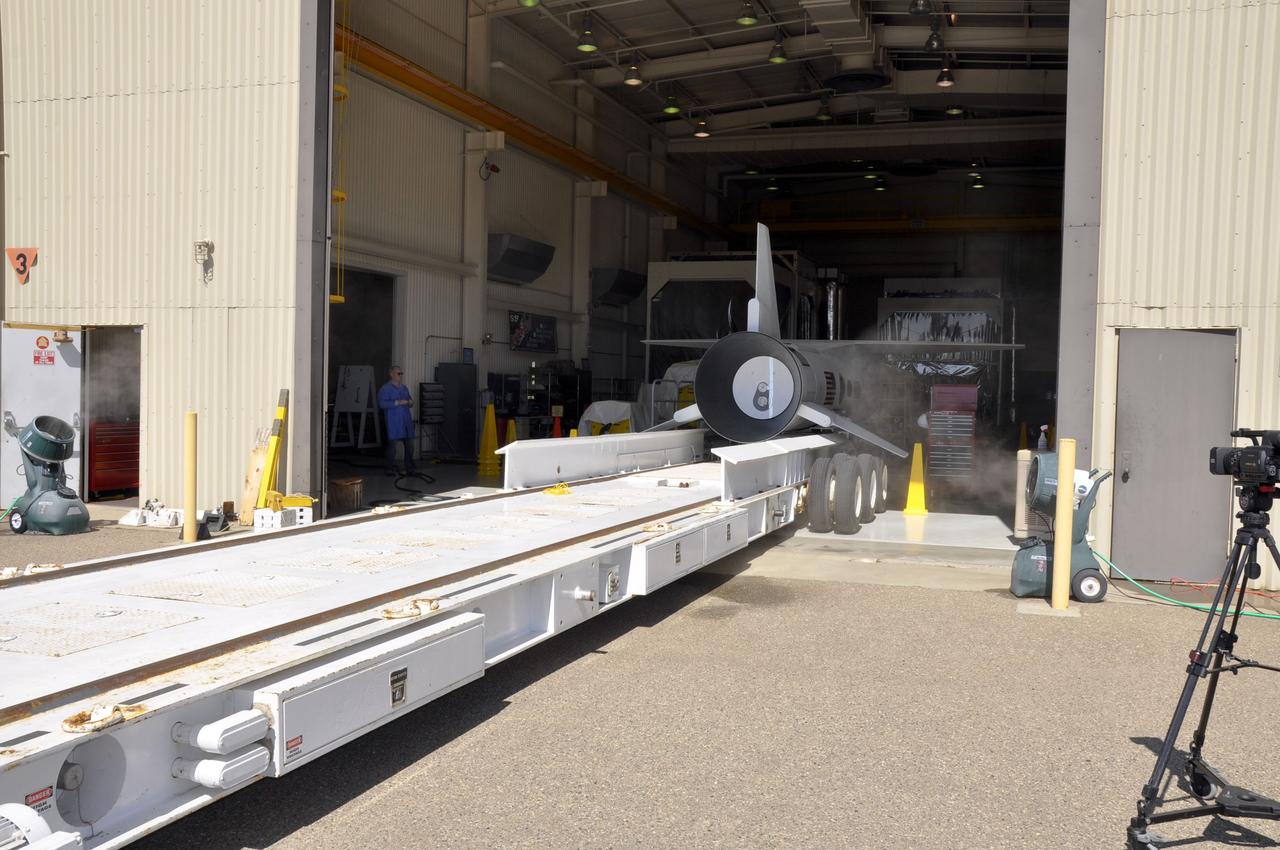
VANDENBERG AIR FORCE BASE, Calif. – Preparations are under way to transfer an Orbital Sciences Pegasus XL rocket onto the transporter in Orbital’s hangar at Vandenberg Air Force Base in California. The rocket has been mated to NASA's Nuclear Spectroscopic Telescope Array, or NuSTAR, encapsulated in the Pegasus payload fairing. The transporter will move them to the runway ramp where they will be attached to the underside of Orbital’s L-1011 carrier aircraft. The aircraft will fly the pair from Vandenberg to the Ronald Reagan Ballistic Missile Defense Test Site on the Pacific Ocean’s Kwajalein Atoll for launch. A revised launch date will be set at the Flight Readiness Review, planned for later this week. The high-energy X-ray telescope will conduct a census of black holes, map radioactive material in young supernovae remnants, and study the origins of cosmic rays and the extreme physics around collapsed stars. For more information, visit http://www.nasa.gov/nustar. Photo credit: NASA/Randy Beaudoin, VAFB
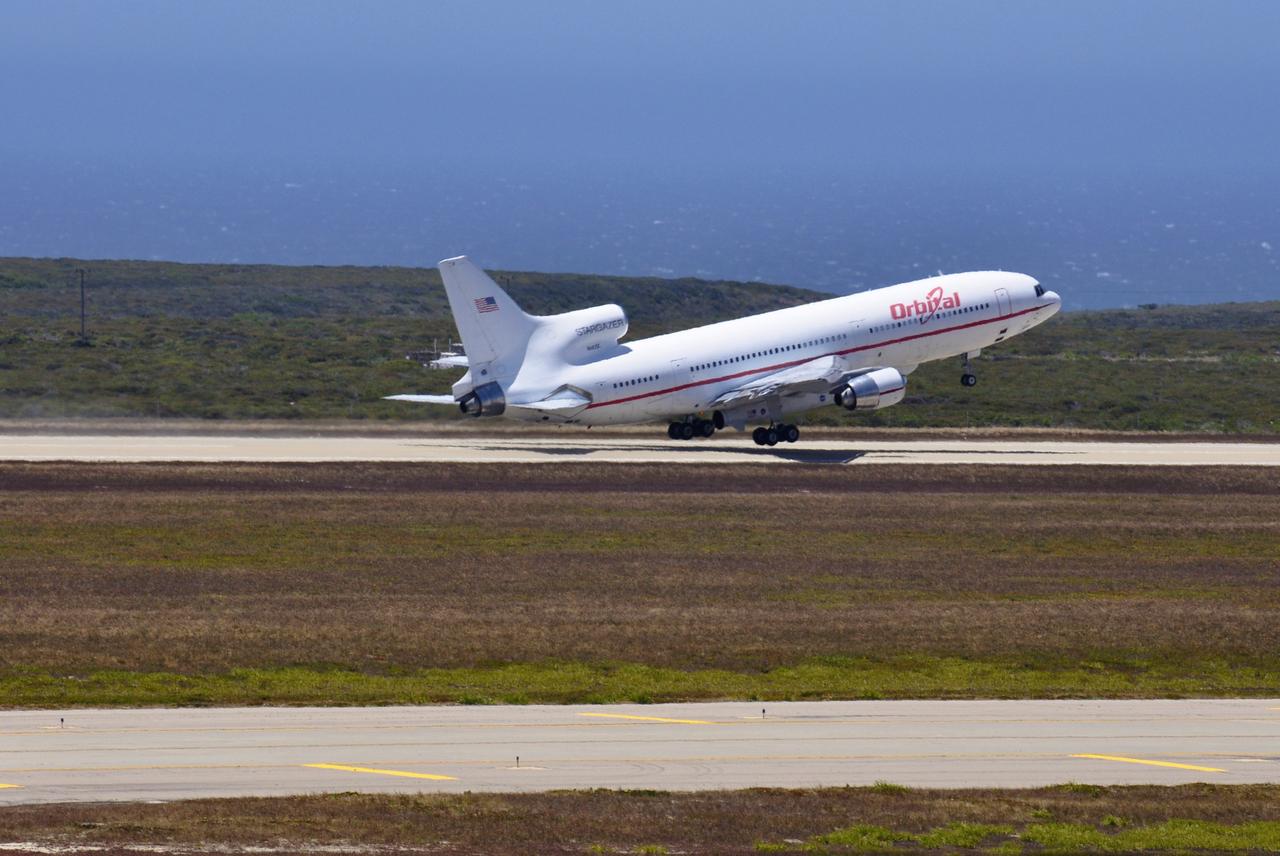
VANDENBERG AIR FORCE BASE, Calif. – Orbital Sciences’ L-1011 carrier aircraft appears to hover above the runway as it departs from Vandenberg Air Force Base in California. The aircraft is transporting Orbital’s Pegasus rocket and NASA’s Nuclear Spectroscopic Telescope Array, or NuSTAR, to the U.S. Army's Ronald Reagan Ballistic Missile Defense Test Site on Kwajalein Atoll, part of the Marshall Islands in the Pacific Ocean. The Pegasus, mated to its NuSTAR payload, will be launched from the carrier aircraft 117 nautical miles south of Kwajalein at latitude 6.75 degrees north of the equator. The high-energy X-ray telescope will conduct a census of black holes, map radioactive material in young supernovae remnants, and study the origins of cosmic rays and the extreme physics around collapsed stars. Launch is scheduled for June 13. For more information, visit http://www.nasa.gov/nustar. Photo credit: NASA/Randy Beaudoin, VAFB
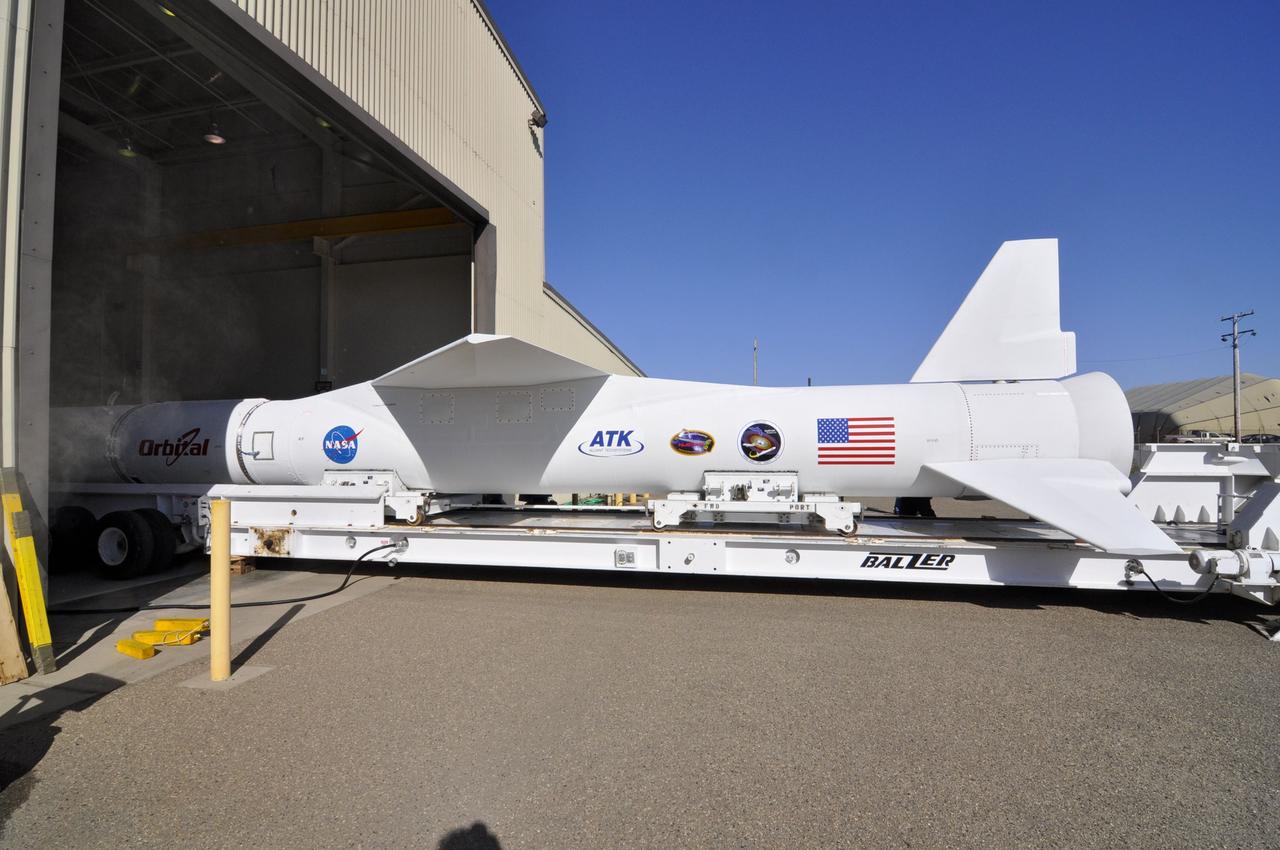
VANDENBERG AIR FORCE BASE, Calif. – An Orbital Sciences’ Pegasus XL rocket rests atop the transporter outside Orbital’s hangar at Vandenberg Air Force Base in California. The rocket is mated to NASA's encapsulated Nuclear Spectroscopic Telescope Array, or NuSTAR, out of sight inside the hangar. The transporter will move them to the runway ramp where they will be attached to the underside of Orbital’s L-1011 carrier aircraft. The aircraft will fly the pair from Vandenberg to the Ronald Reagan Ballistic Missile Defense Test Site on the Pacific Ocean’s Kwajalein Atoll for launch. A revised launch date will be set at the Flight Readiness Review, planned for later this week. The high-energy X-ray telescope will conduct a census of black holes, map radioactive material in young supernovae remnants, and study the origins of cosmic rays and the extreme physics around collapsed stars. For more information, visit http://www.nasa.gov/nustar. Photo credit: NASA/Randy Beaudoin, VAFB
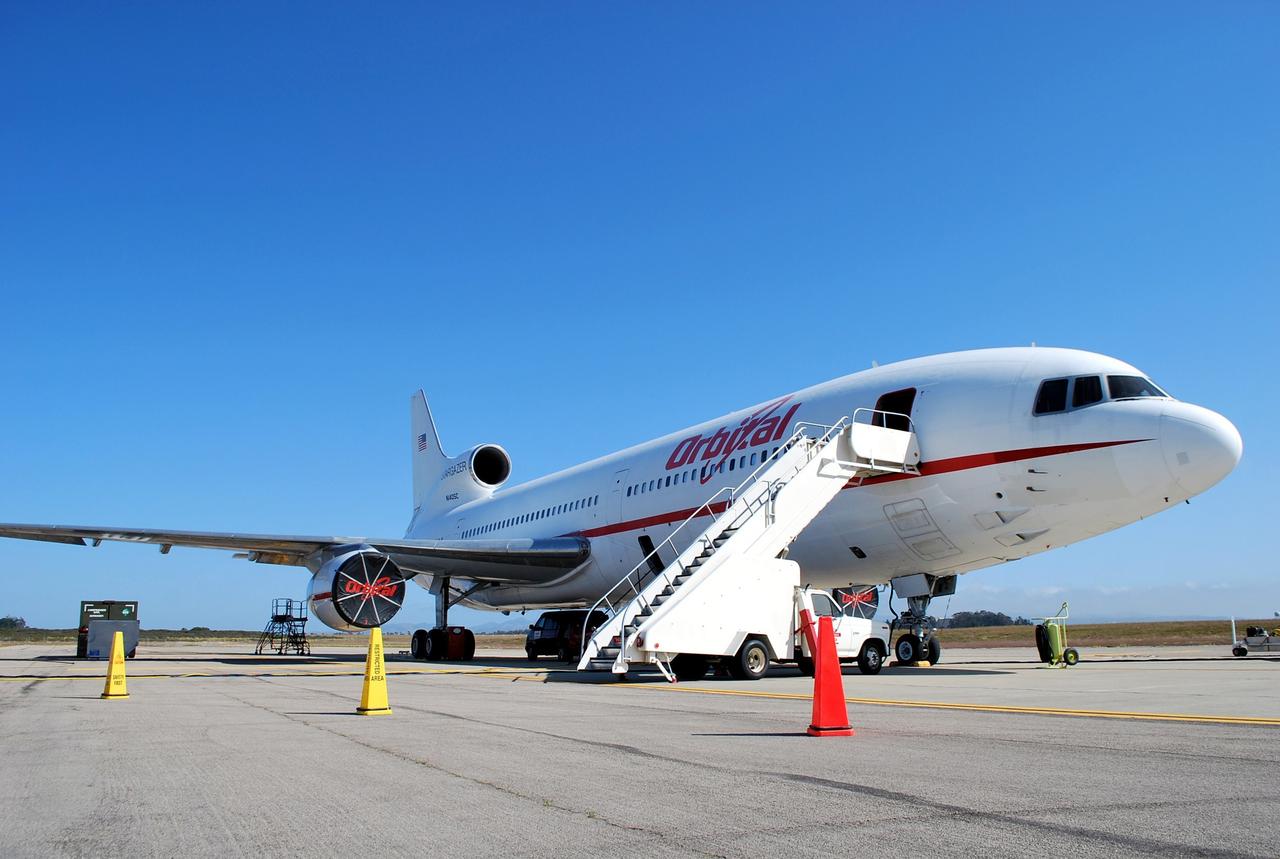
VANDENBERG AIR FORCE BASE, Calif. -- On the runway at Vandenberg Air Force Base in California, the Orbital Sciences L-1011 carrier aircraft is readied for flight. Once the Pegasus XL rocket with NASA's Nuclear Spectroscopic Telescope Array NuSTAR spacecraft is attached, the L-1011 will fly to the Ronald Reagan Ballistic Missile Defense Test Site at the Pacific Ocean’s Kwajalein Atoll. The Pegasus will launch NuSTAR into space where the high-energy x-ray telescope will conduct a census for black holes, map radioactive material in young supernovae remnants, and study the origins of cosmic rays and the extreme physics around collapsed stars. For more information, visit science.nasa.gov/missions/nustar/. Photo credit: NASA/Randy Beaudoin, VAFB
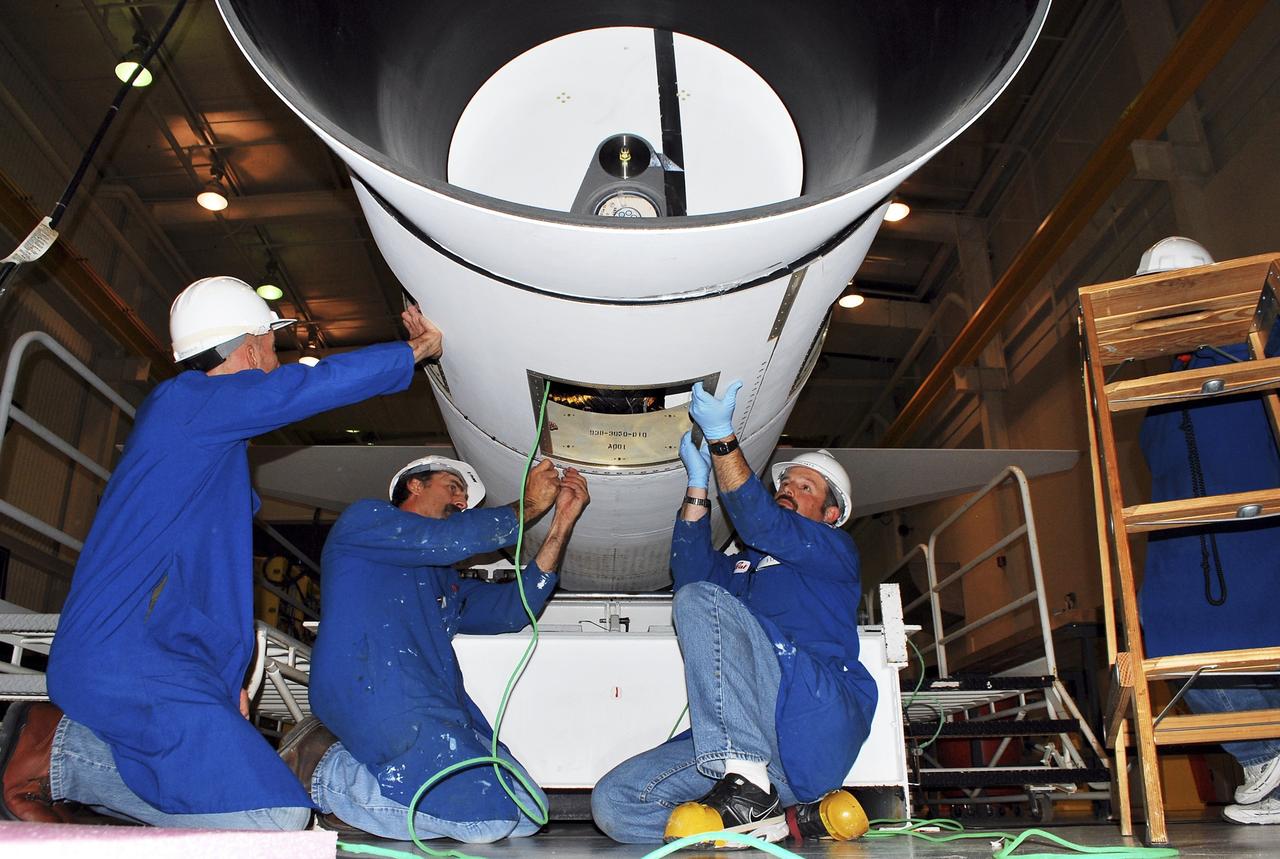
VANDENBERG AIR FORCE BASE, Calif. -- At a Pegasus booster processing facility at Vandenberg Air Force Base in California, technicians complete the final installation of the aft skirt on the first stage of the Pegasus XL rocket. The Orbital Sciences Corp. Pegasus rocket will launch the Nuclear Spectroscopic Telescope Array (NuSTAR) into space. After the rocket and spacecraft are processed at Vandenberg, they will be flown on the Orbital Sciences’ L-1011 carrier aircraft to the Ronald Reagan Ballistic Missile Defense Test Site at the Pacific Ocean’s Kwajalein Atoll for launch. The high-energy x-ray telescope will conduct a census for black holes, map radioactive material in young supernovae remnants, and study the origins of cosmic rays and the extreme physics around collapsed stars. For more information, visit science.nasa.gov/missions/nustar/. Photo credit: NASA/Randy Beaudoin, VAFB
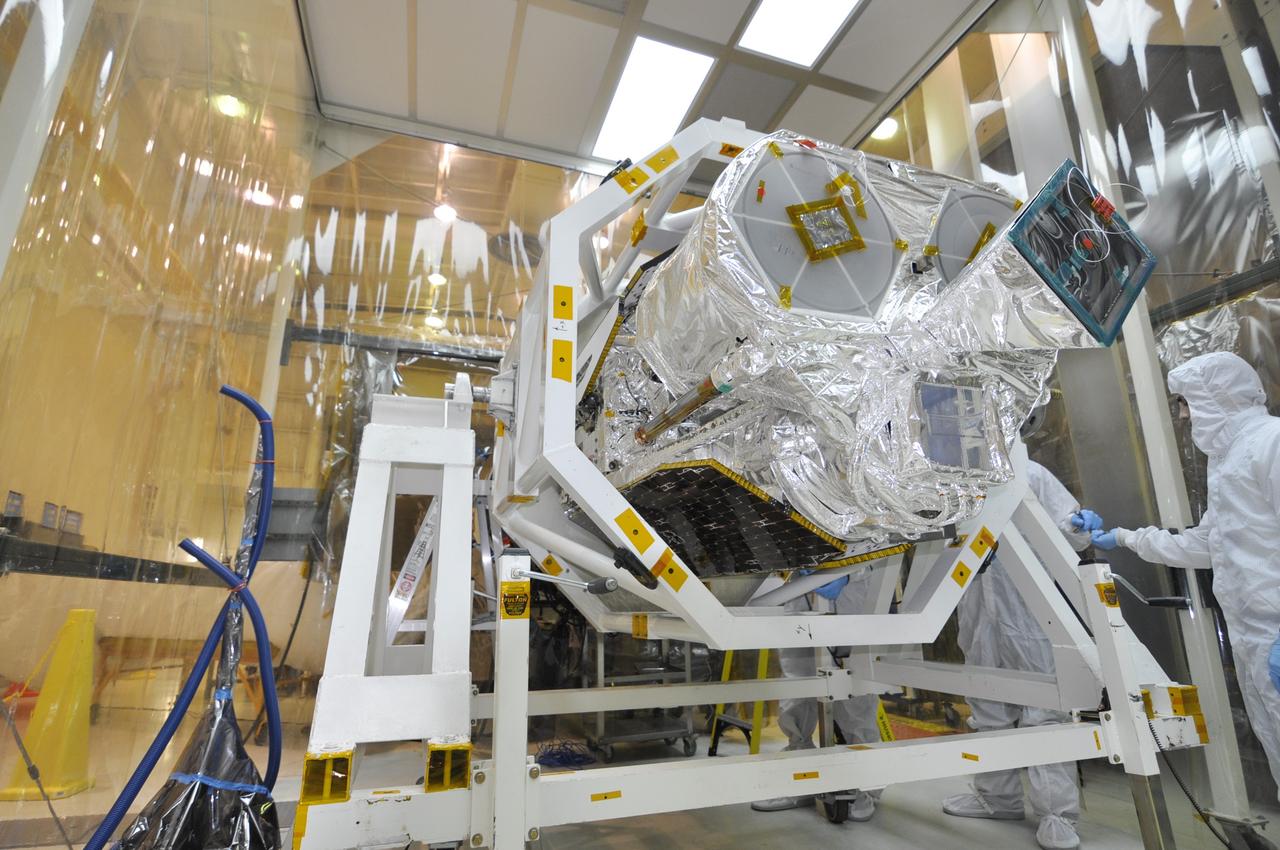
VANDENBERG AIR FORCE BASE, Calif. – Inside an environmental enclosure at Vandenberg Air Force Base's processing facility in California, NASA's Nuclear Spectroscopic Telescope Array, or NuSTAR, secured inside a turnover rotation fixture, moves toward interface with its Orbital Sciences Pegasus XL rocket. The uniting of the spacecraft with the rocket is a major milestone in prelaunch preparations. After processing of the rocket and spacecraft are complete, they will be flown on Orbital's L-1011 carrier aircraft from Vandenberg to the Ronald Reagan Ballistic Missile Defense Test Site on the Pacific Ocean’s Kwajalein Atoll for launch. The high-energy x-ray telescope will conduct a census of black holes, map radioactive material in young supernovae remnants, and study the origins of cosmic rays and the extreme physics around collapsed stars. For more information, visit http://www.nasa.gov/nustar. Photo credit: NASA/Randy Beaudoin, VAFB
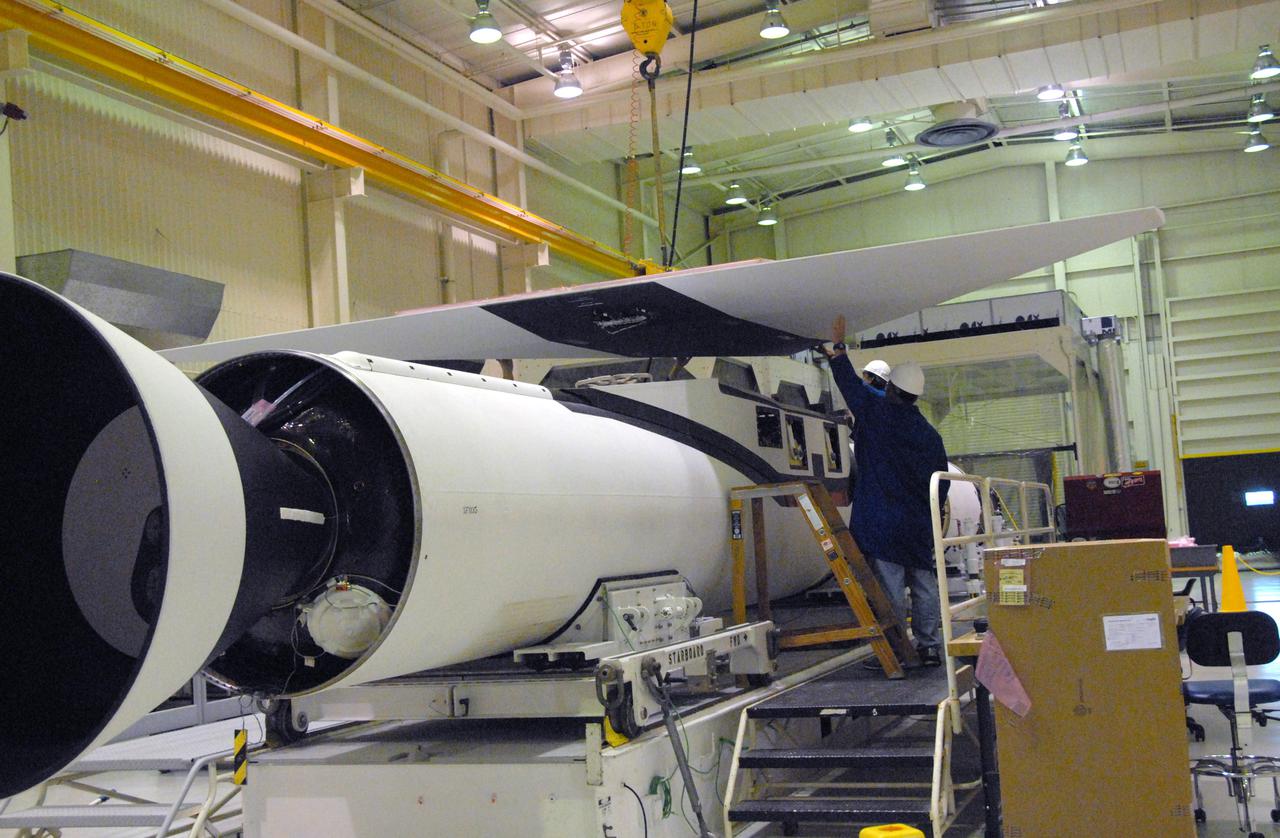
VANDENBERG AIR FORCE BASE, Calif. -- In a processing facility at Vandenberg Air Force Base in California, technicians monitor the progress as the wing is lowered for final installation on the Pegasus XL launch vehicle. The Orbital Sciences Corp. Pegasus rocket will launch the Nuclear Spectroscopic Telescope Array (NuSTAR) into space. After the rocket and spacecraft are processed at Vandenberg, they will be flown on the Orbital Sciences’ L-1011 carrier aircraft to the Ronald Reagan Ballistic Missile Defense Test Site at the Pacific Ocean’s Kwajalein Atoll for launch. The high-energy x-ray telescope will conduct a census for black holes, map radioactive material in young supernovae remnants, and study the origins of cosmic rays and the extreme physics around collapsed stars. For more information, visit science.nasa.gov_missions_nustar_. Photo credit: NASA_Randy Beaudoin, VAFB

VANDENBERG AIR FORCE BASE, Calif. – In a clean room at Vandenberg Air Force Base in California, technicians complete a second fillet and wing fit check on the Pegasus XL launch vehicle. The Orbital Sciences Corp. Pegasus rocket will launch the Nuclear Spectroscopic Telescope Array (NuSTAR) into space. After the rocket and spacecraft are processed at Vandenberg, they will be flown on the Orbital Sciences’ L-1011 carrier aircraft to the Ronald Reagan Ballistic Missile Defense Test Site at the Pacific Ocean’s Kwajalein Atoll for launch. The high-energy X-ray telescope will conduct a census for black holes, map radioactive material in young supernovae remnants, and study the origins of cosmic rays and the extreme physics around collapsed stars. For more information, visit science.nasa.gov/missions/nustar/. Photo credit: NASA/Randy Beaudoin, VAFB
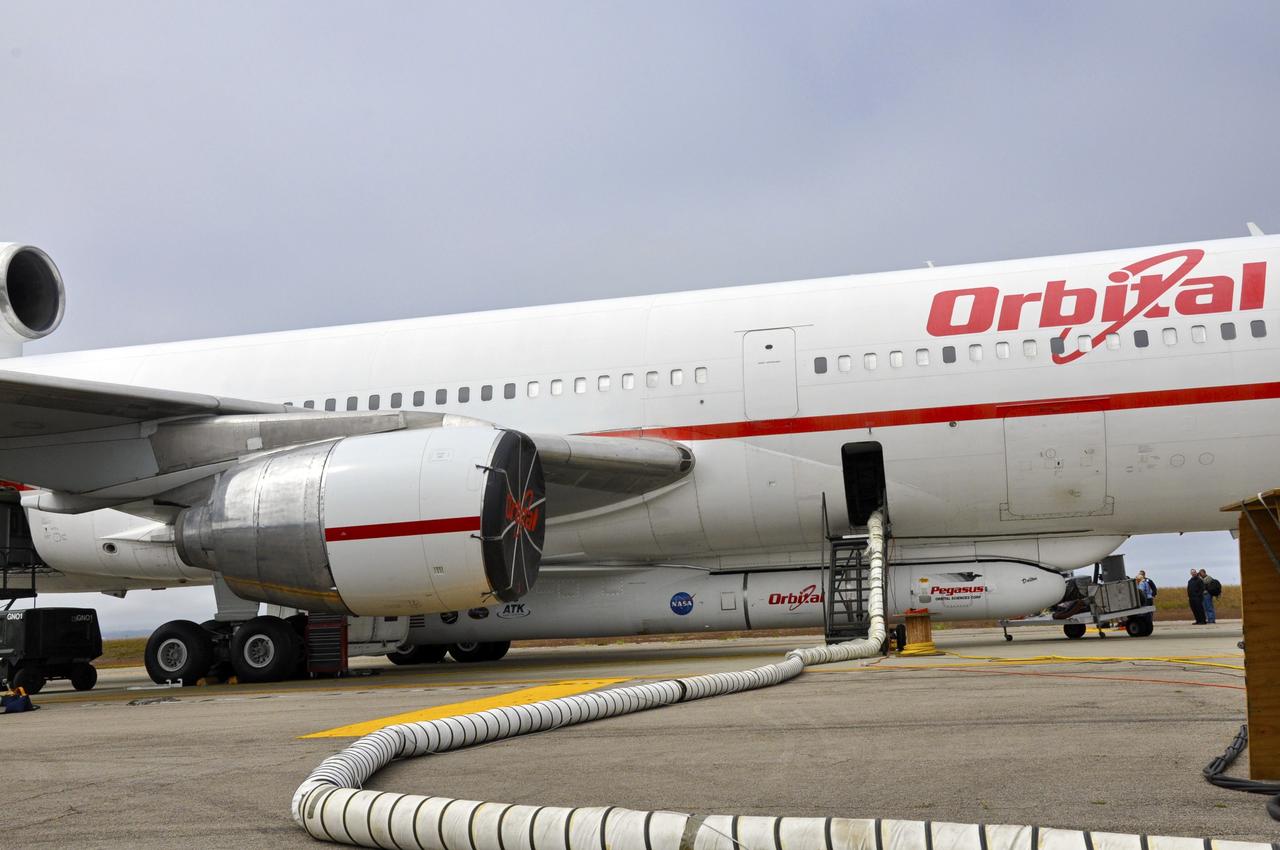
VANDENBERG AIR FORCE BASE, Calif. – An Orbital Sciences’ Pegasus rocket and NASA’s Nuclear Spectroscopic Telescope Array, or NuSTAR, are installed under Orbital’s L-1011 carrier aircraft and await departure from Vandenberg Air Force Base in California for the U.S. Army's Ronald Reagan Ballistic Missile Defense Test Site on Kwajalein Atoll, part of the Marshall Islands in the Pacific Ocean. The Pegasus, mated to its NuSTAR payload, will be launched from the carrier aircraft 117 nautical miles south of Kwajalein at latitude 6.75 degrees north of the equator. The high-energy X-ray telescope will conduct a census of black holes, map radioactive material in young supernovae remnants, and study the origins of cosmic rays and the extreme physics around collapsed stars. Launch is scheduled for June 13. For more information, visit http://www.nasa.gov/nustar. Photo credit: NASA/Randy Beaudoin, VAFB
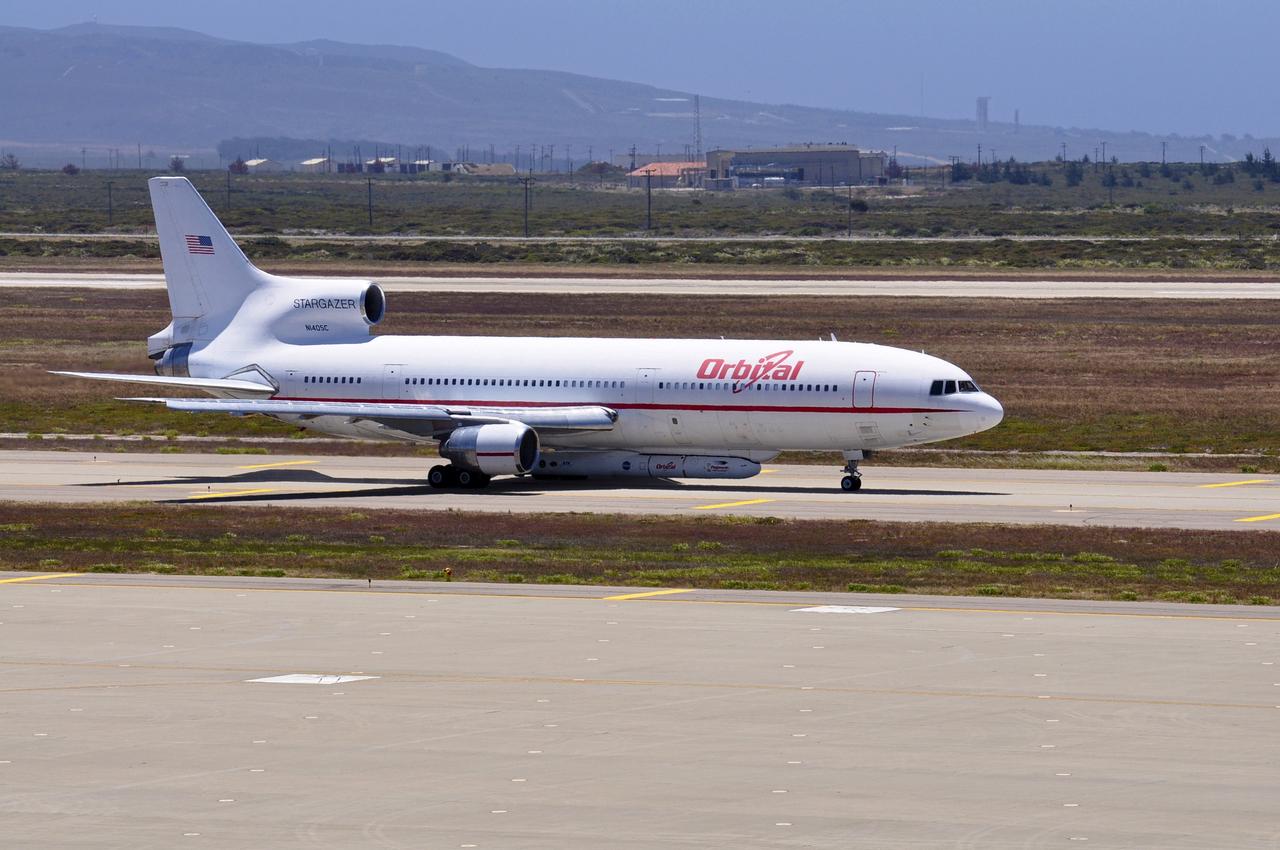
VANDENBERG AIR FORCE BASE, Calif. – Orbital Sciences’ L-1011 carrier aircraft taxies to the runway at Vandenberg Air Force Base in California. The aircraft is transporting Orbital’s Pegasus rocket and NASA’s Nuclear Spectroscopic Telescope Array, or NuSTAR, to the U.S. Army's Ronald Reagan Ballistic Missile Defense Test Site on Kwajalein Atoll, part of the Marshall Islands in the Pacific Ocean. The Pegasus, mated to its NuSTAR payload, will be launched from the carrier aircraft 117 nautical miles south of Kwajalein at latitude 6.75 degrees north of the equator. The high-energy X-ray telescope will conduct a census of black holes, map radioactive material in young supernovae remnants, and study the origins of cosmic rays and the extreme physics around collapsed stars. Launch is scheduled for June 13. For more information, visit http://www.nasa.gov/nustar. Photo credit: NASA/Randy Beaudoin, VAFB
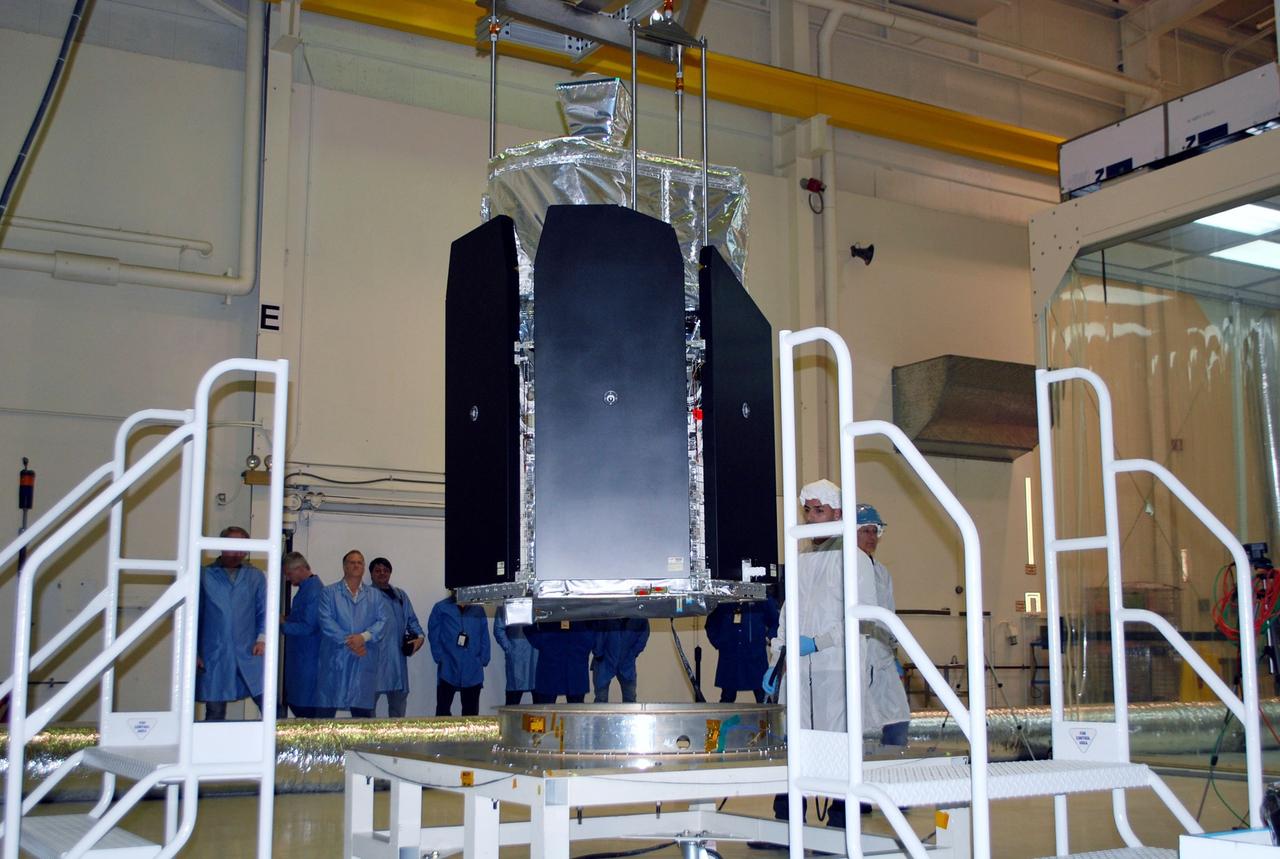
VANDENBERG AIR FORCE BASE, Calif. – In processing facility 1555 at Vandenberg Air Force Base in California, NASA's Nuclear Spectroscopic Telescope Array (NuSTAR) is lifted from its workstand during preparations to install it on a Pegasus fairing separation ring. A Pegasus XL rocket is being prepared to launch NuSTAR into space in March. Once processing of the rocket and spacecraft are completed at Vandenberg, they will be flown on the Orbital Sciences’ L-1011 carrier aircraft to the Ronald Reagan Ballistic Missile Defense Test Site at the Pacific Ocean’s Kwajalein Atoll for launch. NuSTAR, a high-energy x-ray telescope, will conduct a census for black holes, map radioactive material in young supernovae remnants, and study the origins of cosmic rays and the extreme physics around collapsed stars. For more information, visit http://www.nasa.gov/nustar. Photo credit: NASA/Randy Beaudoin, VAFB
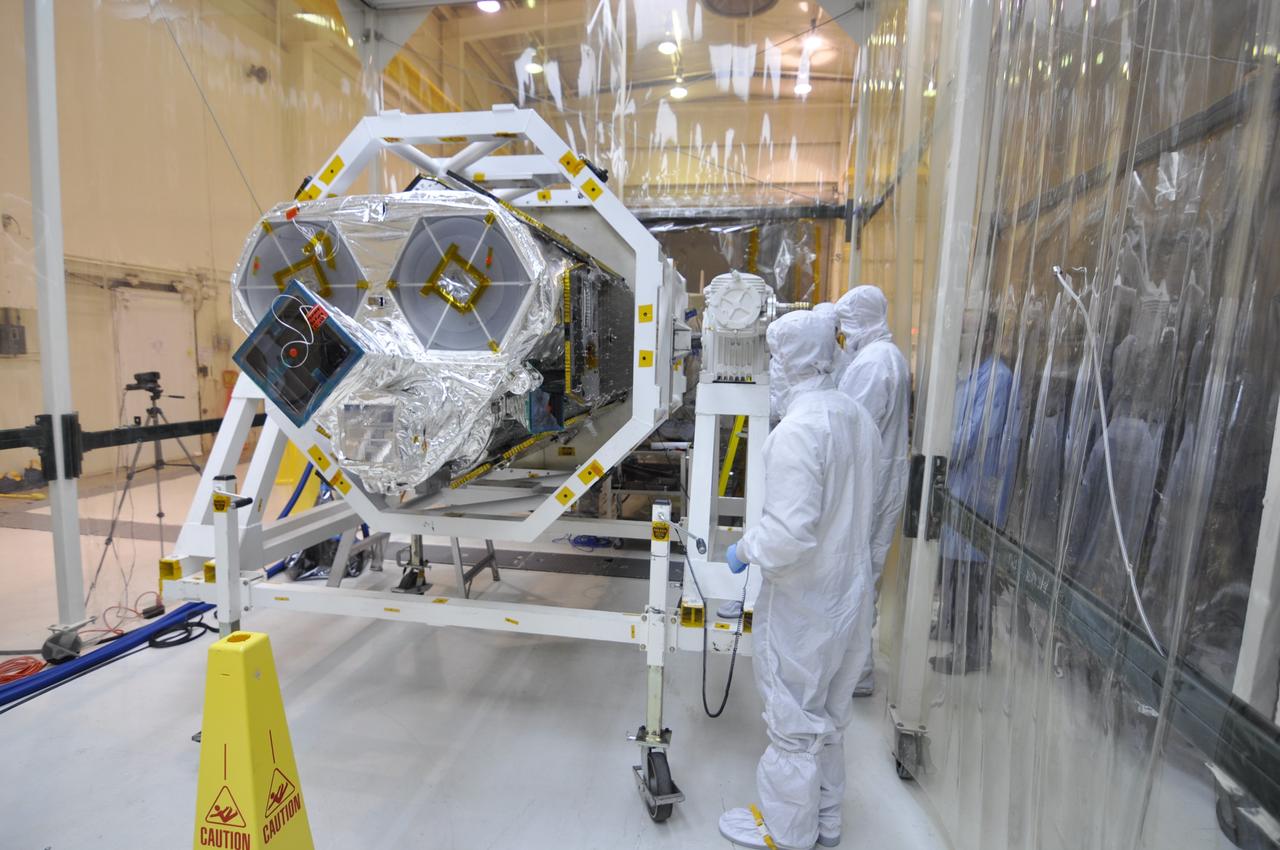
VANDENBERG AIR FORCE BASE, Calif. – Inside an environmental enclosure at Vandenberg Air Force Base's processing facility in California, technicians monitor NASA's Nuclear Spectroscopic Telescope Array, or NuSTAR, secured inside a turnover rotation fixture, as it moves toward interface with its Orbital Sciences Pegasus XL rocket. The technicians are dressed in clean room attire, known as bunny suits. The conjoining of the spacecraft with the rocket is a major milestone in prelaunch preparations. After processing of the rocket and spacecraft are complete, they will be flown on Orbital's L-1011 carrier aircraft from Vandenberg to the Ronald Reagan Ballistic Missile Defense Test Site on the Pacific Ocean’s Kwajalein Atoll for launch. The high-energy x-ray telescope will conduct a census of black holes, map radioactive material in young supernovae remnants, and study the origins of cosmic rays and the extreme physics around collapsed stars. For more information, visit http://www.nasa.gov/nustar. Photo credit: NASA/Randy Beaudoin, VAFB
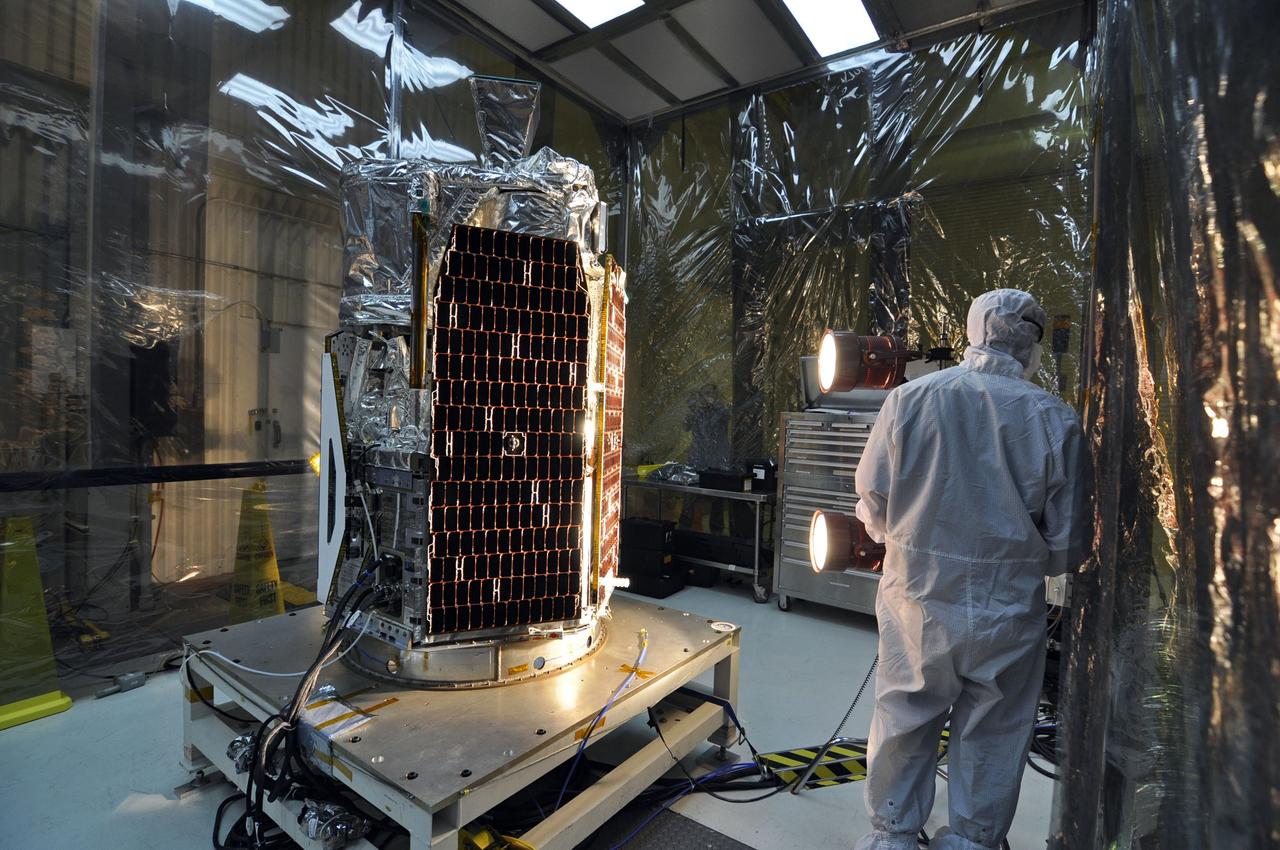
VANDENBERG AIR FORCE BASE, Calif. -- In a clean room at Vandenberg Air Force Base's processing facility in California, a technician conducts a solar array illumination test on NASA's NuSTAR spacecraft. A Pegasus XL rocket is set to launch NuSTAR into space. Once the rocket and spacecraft are processed at Vandenberg, they will be flown on the Orbital Sciences’ L-1011 carrier aircraft to the Ronald Reagan Ballistic Missile Defense Test Site at the Pacific Ocean’s Kwajalein Atoll for launch. The high-energy x-ray telescope will conduct a census for black holes, map radioactive material in young supernovae remnants, and study the origins of cosmic rays and the extreme physics around collapsed stars. For more information, visit science.nasa.gov/missions/nustar/. Photo credit: NASA/Randy Beaudoin, VAFB
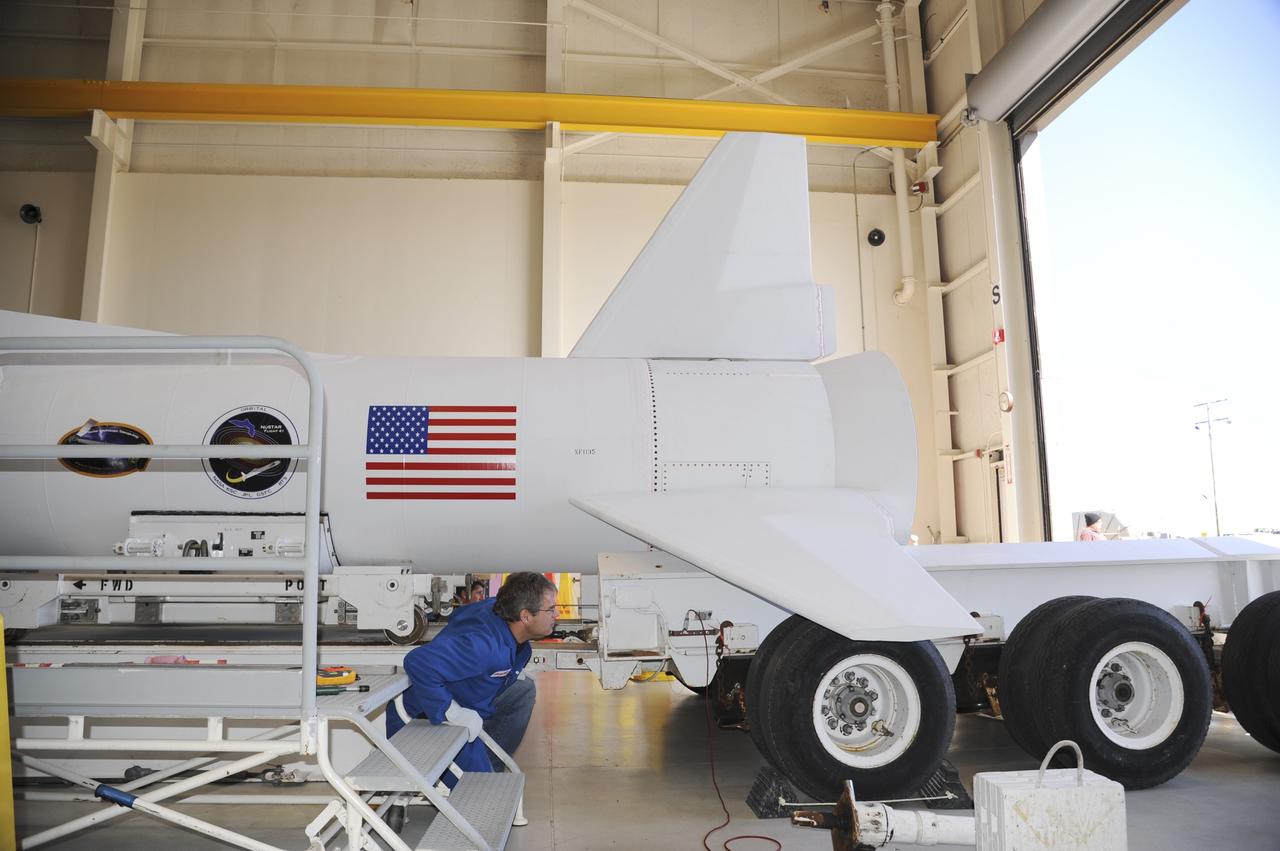
VANDENBERG AIR FORCE BASE, Calif. – At Vandenberg Air Force Base in California, a technician monitors the progress as a transporter is moved underneath the Orbital Science’s Pegasus XL inside Orbital’s hangar. The rocket is mated to NASA’s encapsulated Nuclear Spectroscopic Telescope Array, or NuSTAR, out of sight inside the hangar. The transporter will move them to the runway ramp where they will be attached to the underside of Orbital’s L-1011 carrier aircraft. The aircraft will fly the pair from Vandenberg to the Ronald Reagan Ballistic Missile Defense Test Site on the Pacific Ocean’s Kwajalein Atoll for launch. A revised launch date is expected to be set at the Flight Readiness Review. The high-energy X-ray telescope will conduct a census of black holes, map radioactive material in young supernovae remnants, and study the origins of cosmic rays and the extreme physics around collapsed stars. For more information, visit http://www.nasa.gov/nustar. Photo credit: NASA/Mark Mackiey

VANDENBERG AIR FORCE BASE, Calif. – The transporter for the Orbital Sciences Pegasus XL rocket juts through the open door of Orbital’s hangar at Vandenberg Air Force Base in California. The rocket is mated to NASA's Nuclear Spectroscopic Telescope Array, or NuSTAR, encapsulated in the Pegasus payload fairing. The transporter will move them to the runway ramp where they will be attached to the underside of Orbital’s L-1011 carrier aircraft. The aircraft will fly the pair from Vandenberg to the Ronald Reagan Ballistic Missile Defense Test Site on the Pacific Ocean’s Kwajalein Atoll for launch. A revised launch date will be set at the Flight Readiness Review, planned for later this week. The high-energy X-ray telescope will conduct a census of black holes, map radioactive material in young supernovae remnants, and study the origins of cosmic rays and the extreme physics around collapsed stars. For more information, visit http://www.nasa.gov/nustar. Photo credit: NASA/Randy Beaudoin, VAFB
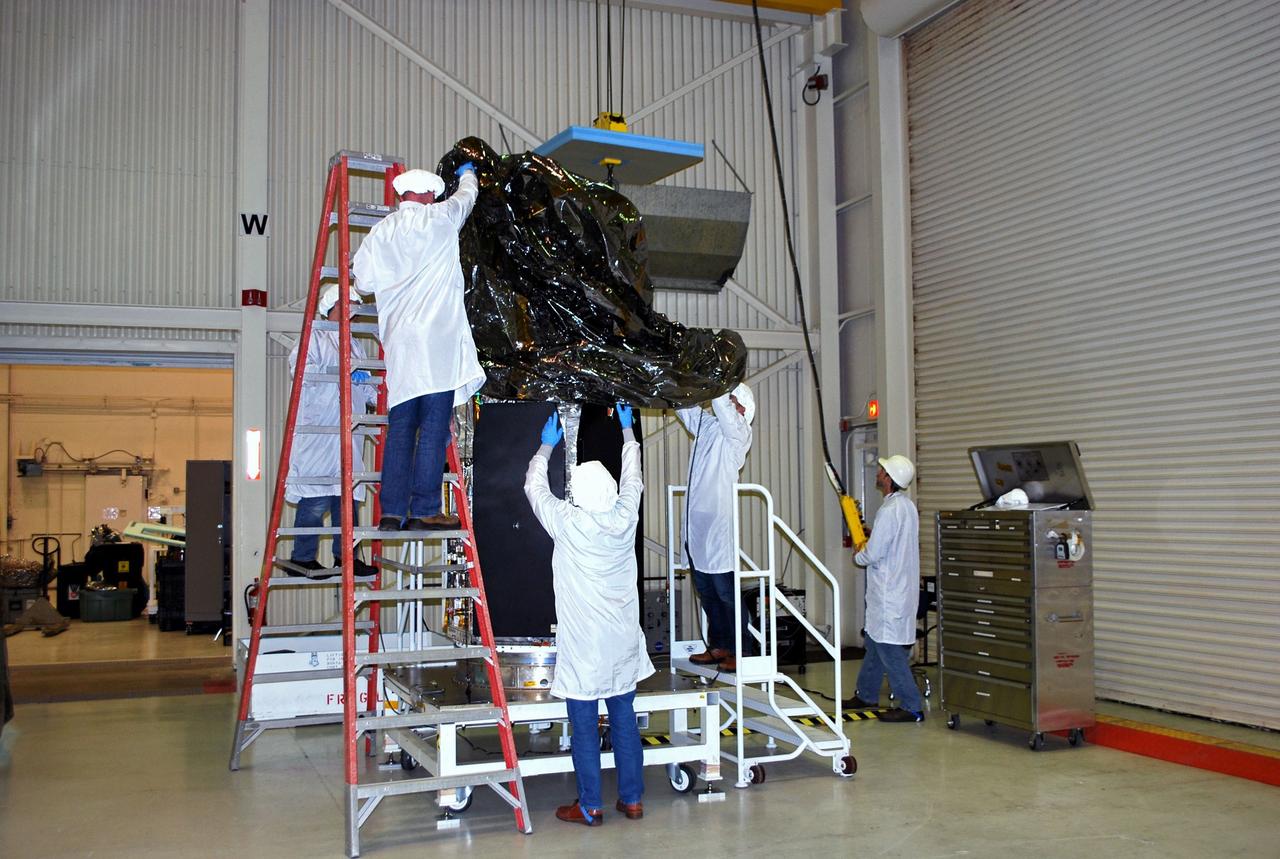
VANDENBERG AIR FORCE BASE, Calif. – In processing facility 1555 at Vandenberg Air Force Base in California, spacecraft technicians cover NASA's Nuclear Spectroscopic Telescope Array (NuSTAR) with a protective shroud following its installation on a Pegasus fairing separation ring. A Pegasus XL rocket is being prepared to launch NuSTAR into space in March. Once processing of the rocket and spacecraft are completed at Vandenberg, they will be flown on the Orbital Sciences’ L-1011 carrier aircraft to the Ronald Reagan Ballistic Missile Defense Test Site at the Pacific Ocean’s Kwajalein Atoll for launch. NuSTAR, a high-energy x-ray telescope, will conduct a census for black holes, map radioactive material in young supernovae remnants, and study the origins of cosmic rays and the extreme physics around collapsed stars. For more information, visit http://www.nasa.gov/nustar. Photo credit: NASA/Randy Beaudoin, VAFB
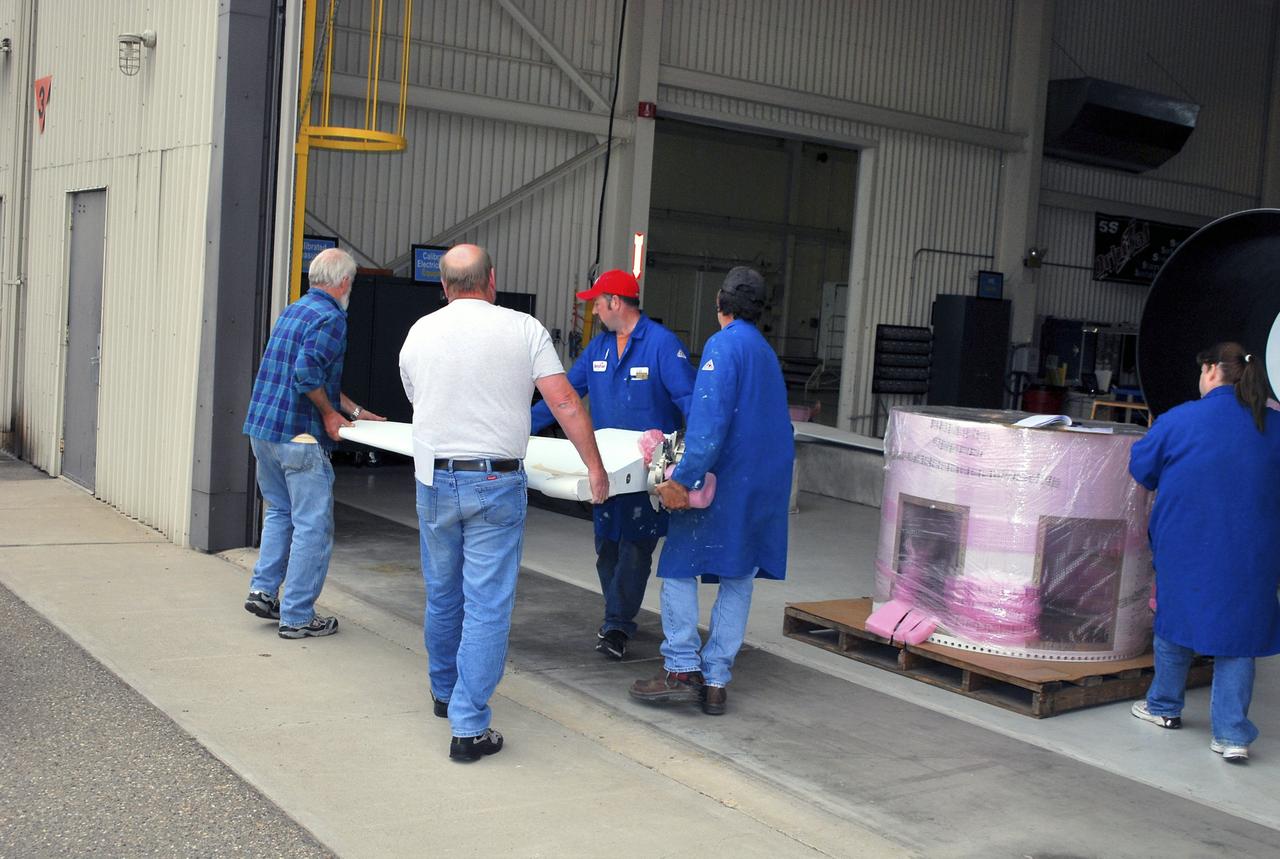
VANDENBERG AIR FORCE BASE, Calif. -- At a Pegasus booster processing facility at Vandenberg Air Force Base in California, technicians unload one of the fins for the Pegasus XL rocket after its arrival. To the right is the aft skirt. The Orbital Sciences Corp. Pegasus rocket will launch the Nuclear Spectroscopic Telescope Array (NuSTAR) into space. After the rocket and spacecraft are processed at Vandenberg, they will be flown on the Orbital Sciences’ L-1011 carrier aircraft to the Ronald Reagan Ballistic Missile Defense Test Site at the Pacific Ocean’s Kwajalein Atoll for launch. The high-energy x-ray telescope will conduct a census for black holes, map radioactive material in young supernovae remnants, and study the origins of cosmic rays and the extreme physics around collapsed stars. For more information, visit science.nasa.gov/missions/nustar/. Photo credit: NASA/Randy Beaudoin, VAFB
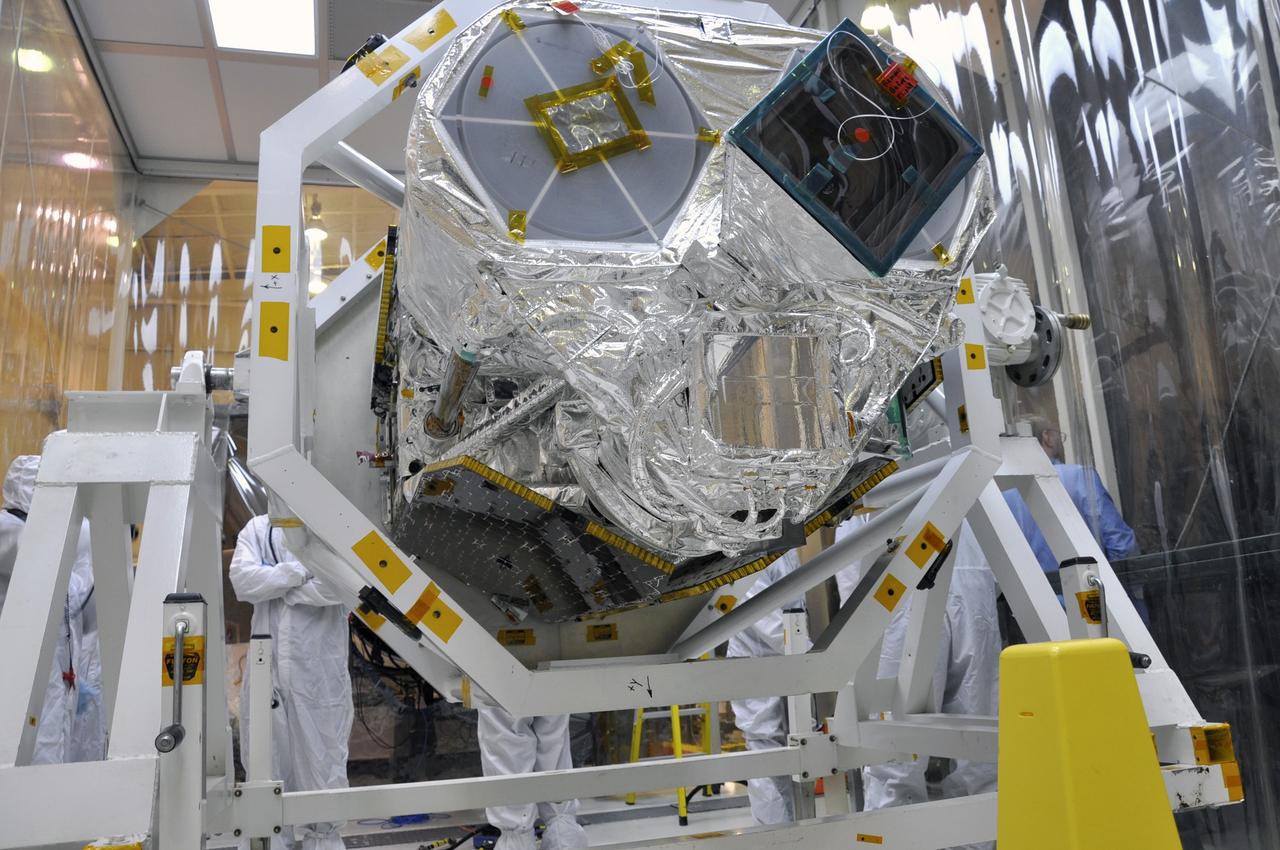
VANDENBERG AIR FORCE BASE, Calif. -- At Vandenberg Air Force Base's processing facility in California, the forward end of NASA's Nuclear Spectroscopic Telescope Array, or NuSTAR, spacecraft protrudes from the turnover rotation fixture used to rotate it into a horizontal position. Preparations are under way to join NuSTAR with the Orbital Sciences Pegasus XL rocket that will launch it into space, a major milestone in launch preparations. After processing of the rocket and spacecraft are complete, they will be flown on Orbital's L-1011 carrier aircraft from Vandenberg to the Ronald Reagan Ballistic Missile Defense Test Site on the Pacific Ocean’s Kwajalein Atoll for launch. The high-energy x-ray telescope will conduct a census of black holes, map radioactive material in young supernovae remnants, and study the origins of cosmic rays and the extreme physics around collapsed stars. For more information, visit http://www.nasa.gov/nustar. Photo credit: NASA/Randy Beaudoin, VAFB
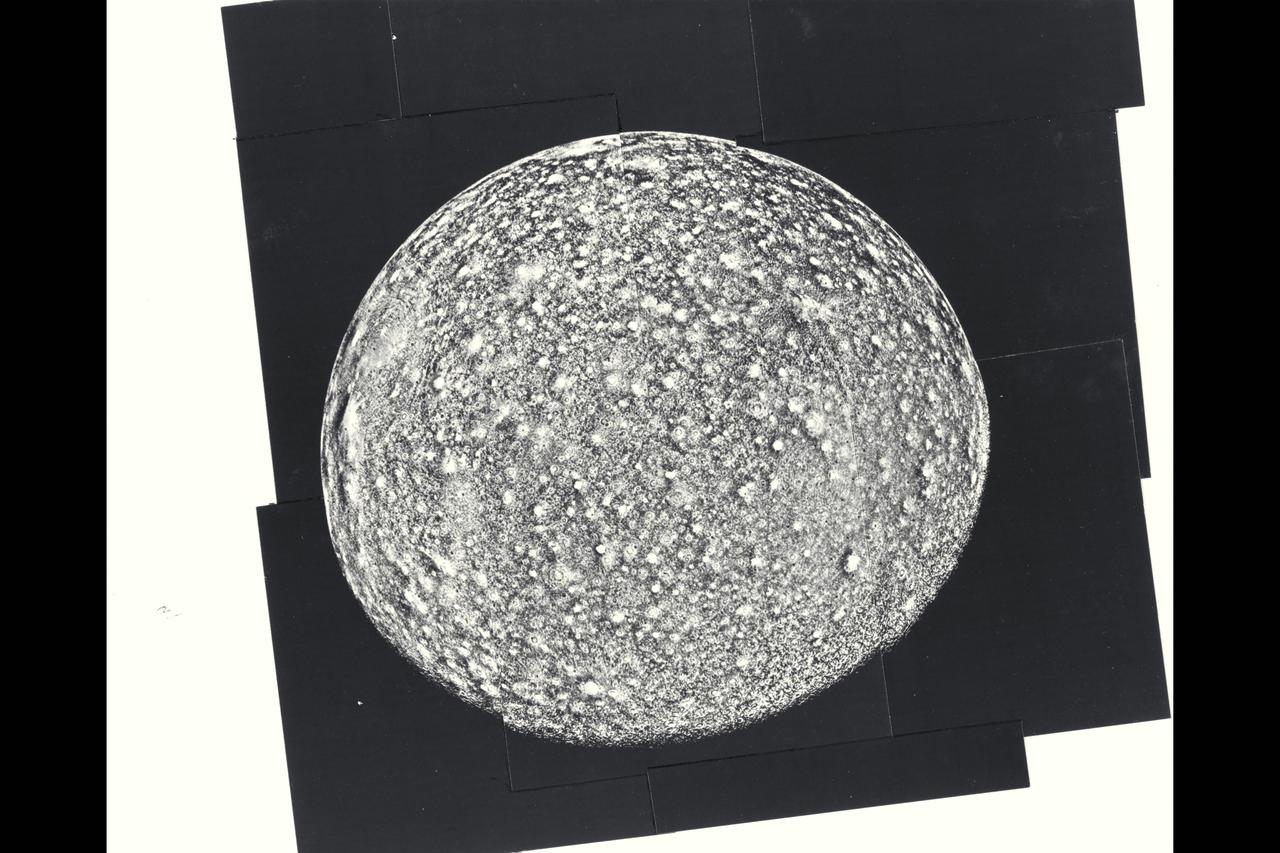
P-21746 BW Range: 390,000 kilometers (245,000 miles) This photomosaic of Callisto is composed of nine frames. The impact crater distribution is very uniform across the disk. Notable are the very bright rayed craters that probably are very young. Near the limb is a giant probable impact structure. Several large structures were discovered by Voyager 1. This one is smaller than the largest one found by Voyager 1 but is more clearly shown. About 15 concentric rings surround the bright central spot. Many hundreds of moderate sized impacts are also seen, a few with bright radial ray patterns. The limb is very smooth confirming that no high topography has been seen on the satellite, and observation consistent with its icy composition.
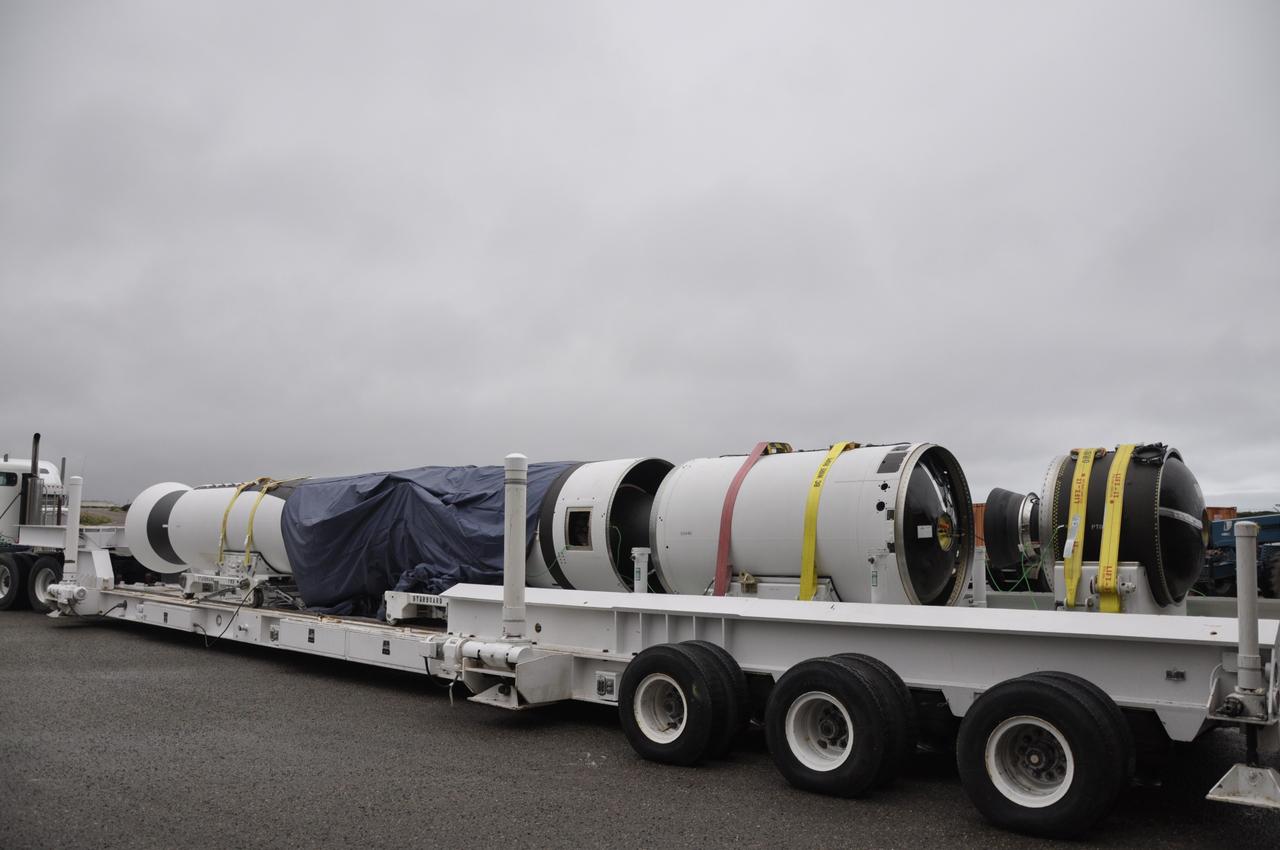
VANDENBERG AIR FORCE BASE, Calif. -- The first, second and third stages of the Orbital Sciences Corp. Pegasus XL rocket that will launch the Nuclear Spectroscopic Telescope Array (NuSTAR) to orbit are moved from the west high bay to the east high bay of Building 1555 at Vandenberg Air Force Base in California. The move will allow technicians to process the spacecraft and fairing in the clean rooms of the east high bay before attaching it to the rocket. After the rocket and spacecraft are processed at Vandenberg, they will be flown on the Orbital Sciences' L-1011 carrier aircraft to the Ronald Reagan Ballistic Missile Defense Test Site located at the Pacific Ocean’s Kwajalein Atoll for launch. The high-energy X-ray telescope will conduct a census for black holes, map radioactive material in young supernovae remnants, and study the origins of cosmic rays and the extreme physics around collapsed stars. Photo credit: NASA/Randy Beaudoin, VAFB
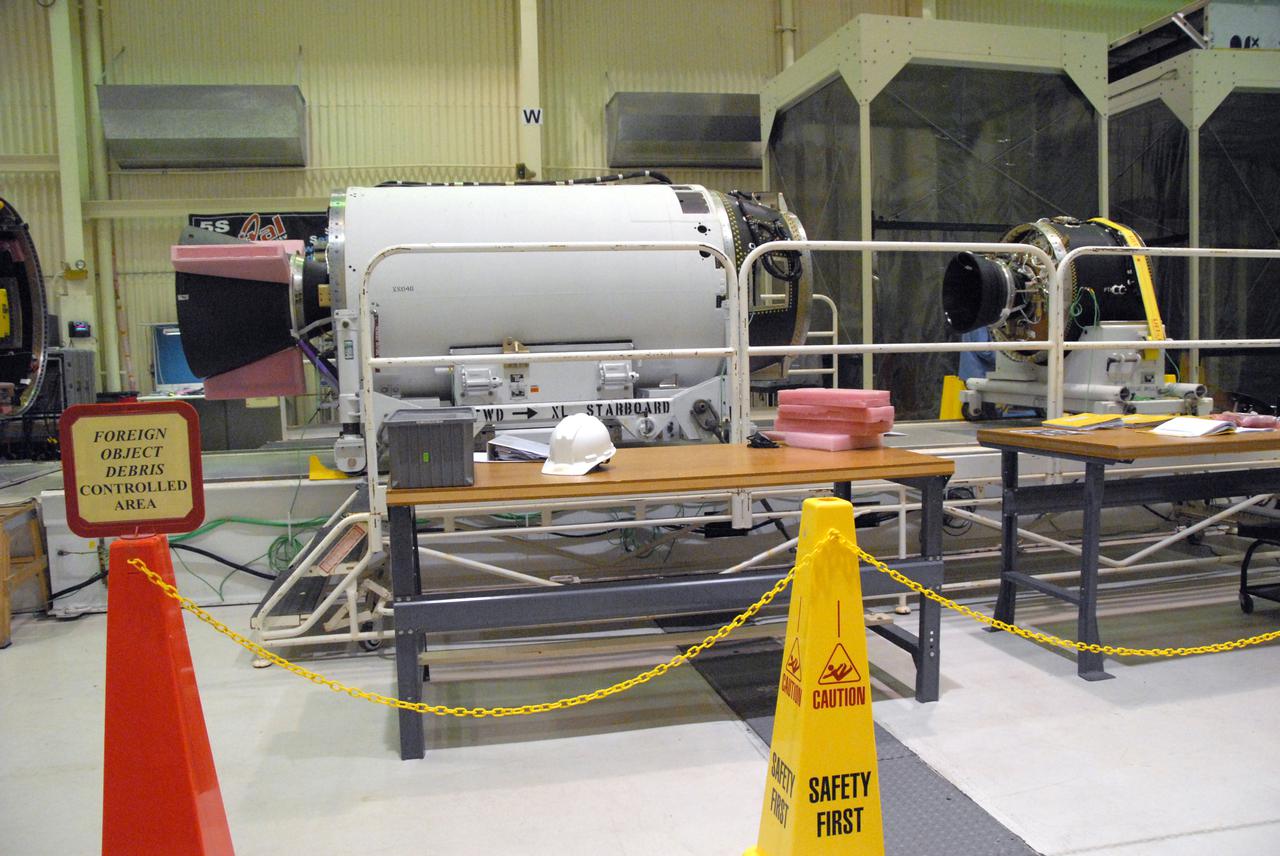
VANDENBERG AIR FORCE BASE, Calif. -- In a processing facility at Vandenberg Air Force Base in California, the three stages of the Pegasus XL launch vehicle are seen immediately prior to installation of the vehicle’s wing. The Orbital Sciences Corp. Pegasus rocket will launch the Nuclear Spectroscopic Telescope Array (NuSTAR) into space. After the rocket and spacecraft are processed at Vandenberg, they will be flown on the Orbital Sciences’ L-1011 carrier aircraft to the Ronald Reagan Ballistic Missile Defense Test Site at the Pacific Ocean’s Kwajalein Atoll for launch. The high-energy x-ray telescope will conduct a census for black holes, map radioactive material in young supernovae remnants, and study the origins of cosmic rays and the extreme physics around collapsed stars. For more information, visit science.nasa.gov_missions_nustar_. Photo credit: NASA_Randy Beaudoin, VAFB
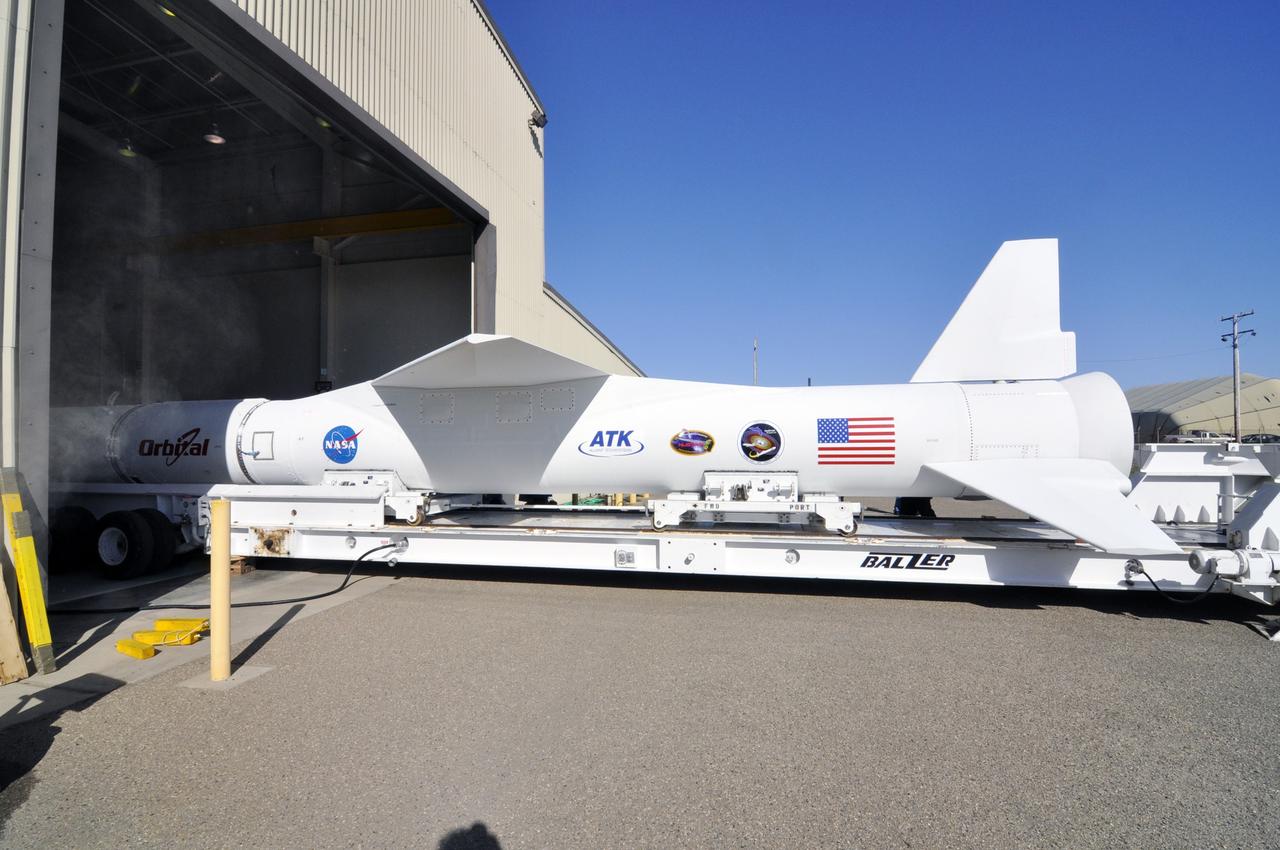
VANDENBERG AIR FORCE BASE, Calif. – At Vandenberg Air Force Base in California, a transporter has been positioned underneath the Orbital Science’s Pegasus XL at Orbital’s hangar. The rocket is mated to NASA’s encapsulated Nuclear Spectroscopic Telescope Array, or NuSTAR, partially out of sight inside the hangar. The transporter will move them to the runway ramp where they will be attached to the underside of Orbital’s L-1011 carrier aircraft. The aircraft will fly the pair from Vandenberg to the Ronald Reagan Ballistic Missile Defense Test Site on the Pacific Ocean’s Kwajalein Atoll for launch. A revised launch date is expected to be set at the Flight Readiness Review. The high-energy X-ray telescope will conduct a census of black holes, map radioactive material in young supernovae remnants, and study the origins of cosmic rays and the extreme physics around collapsed stars. For more information, visit http://www.nasa.gov/nustar. Photo credit: NASA/Randy Beaudoin
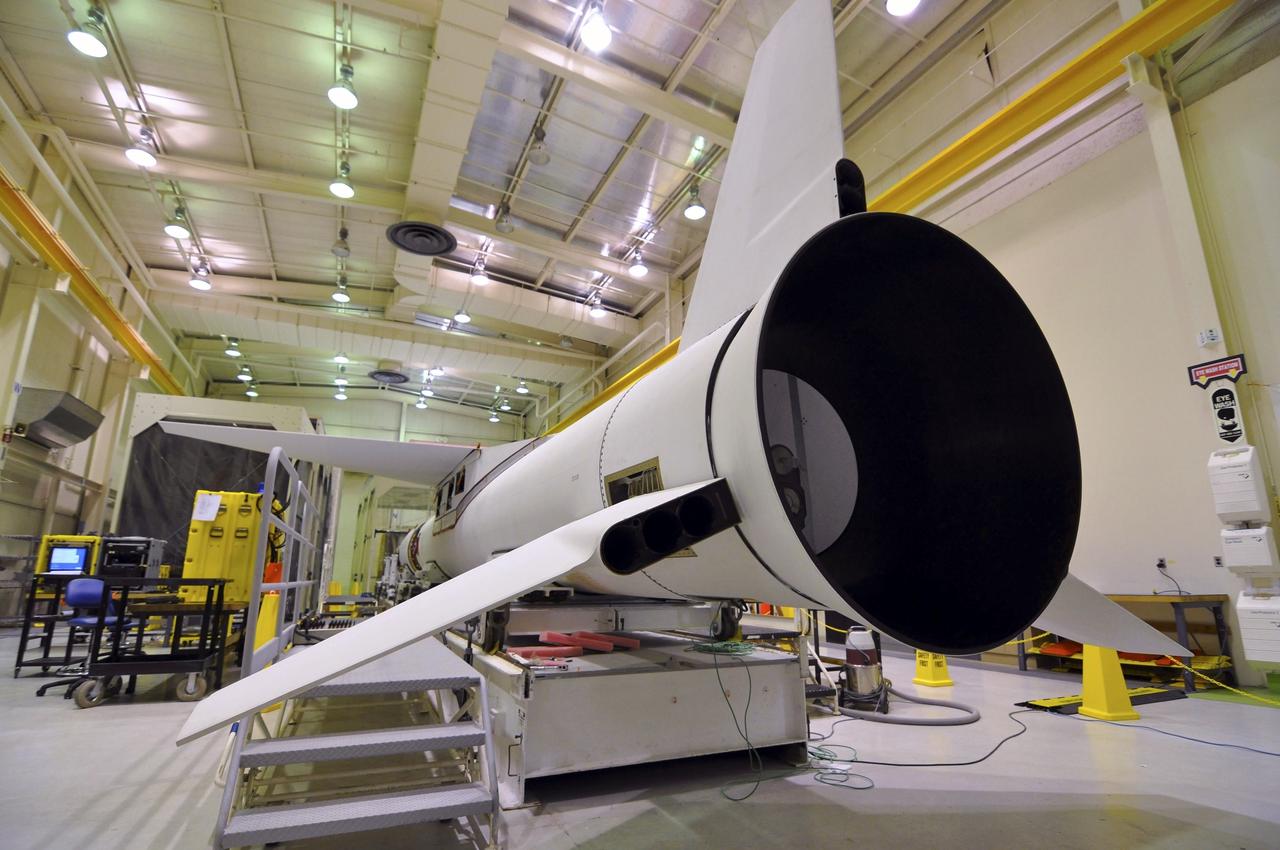
VANDENBERG AIR FORCE BASE, Calif. -- Inside a Pegasus booster processing facility at Vandenberg Air Force Base in California, all three fins on the aft end of the Pegasus XL rocket's first stage have been installed. The Orbital Sciences Corp. Pegasus rocket will launch the Nuclear Spectroscopic Telescope Array (NuSTAR) into space. After the rocket and spacecraft are processed at Vandenberg, they will be flown on the Orbital Sciences’ L-1011 carrier aircraft to the Ronald Reagan Ballistic Missile Defense Test Site at the Pacific Ocean’s Kwajalein Atoll for launch. The high-energy x-ray telescope will conduct a census for black holes, map radioactive material in young supernovae remnants, and study the origins of cosmic rays and the extreme physics around collapsed stars. For more information, visit science.nasa.gov/missions/nustar/. Photo credit: NASA/Randy Beaudoin, VAFB
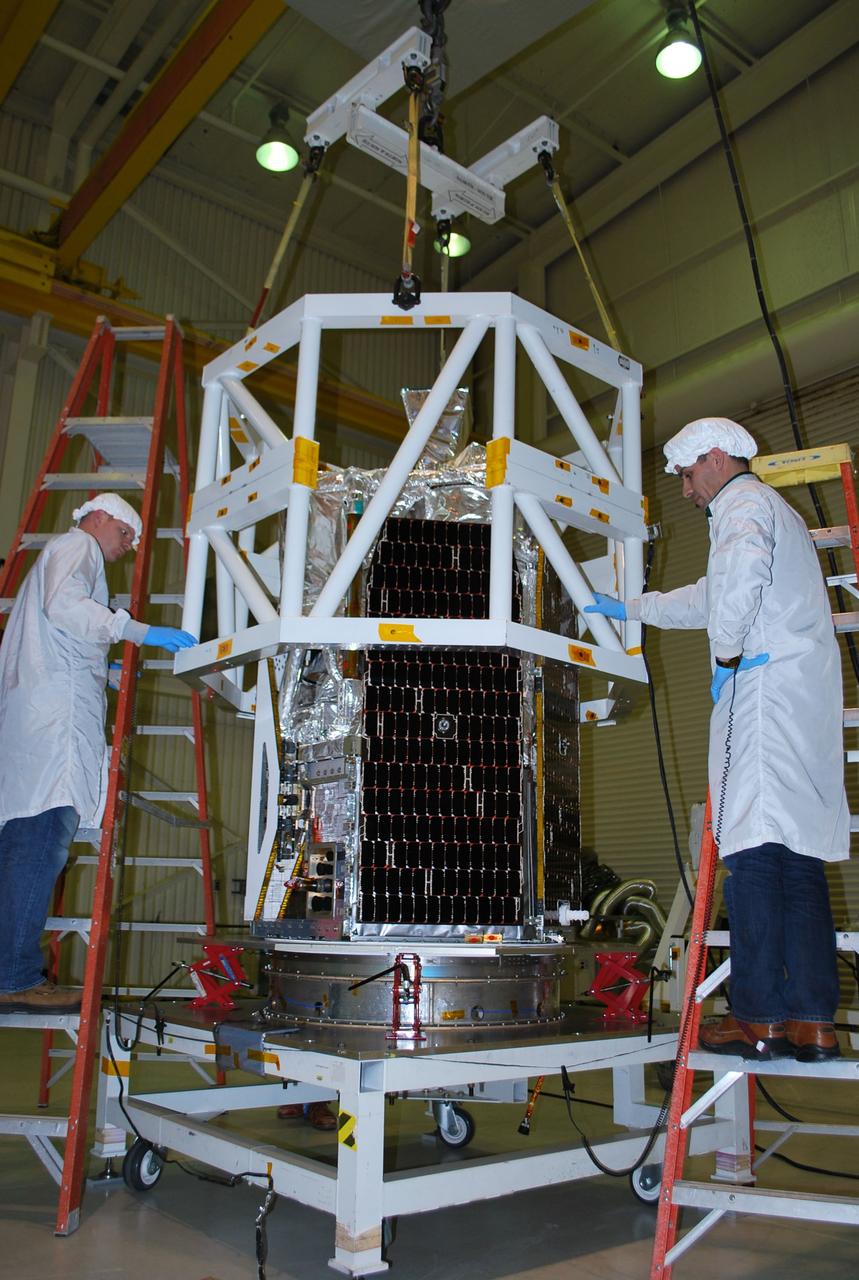
VANDENBERG AIR FORCE BASE, Calif. -- Inside Orbital Sciences' processing facility at Vandenberg Air Force Base in California, technicians guide a lifting device into place around NASA's NuSTAR spacecraft. The spacecraft will be rotated to horizontal for joining with the Pegasus XL rocket. The Orbital Sciences Pegasus will launch NASA's Nuclear Spectroscopic Telescope Array NuSTAR into space. After the rocket and spacecraft are processed at Vandenberg, they will be flown on Orbital's L-1011 carrier aircraft to the Ronald Reagan Ballistic Missile Defense Test Site at the Pacific Ocean’s Kwajalein Atoll for launch. The high-energy x-ray telescope will conduct a census for black holes, map radioactive material in young supernovae remnants, and study the origins of cosmic rays and the extreme physics around collapsed stars. For more information, visit science.nasa.gov/missions/nustar/. Photo credit: NASA/Randy Beaudoin, VAFB
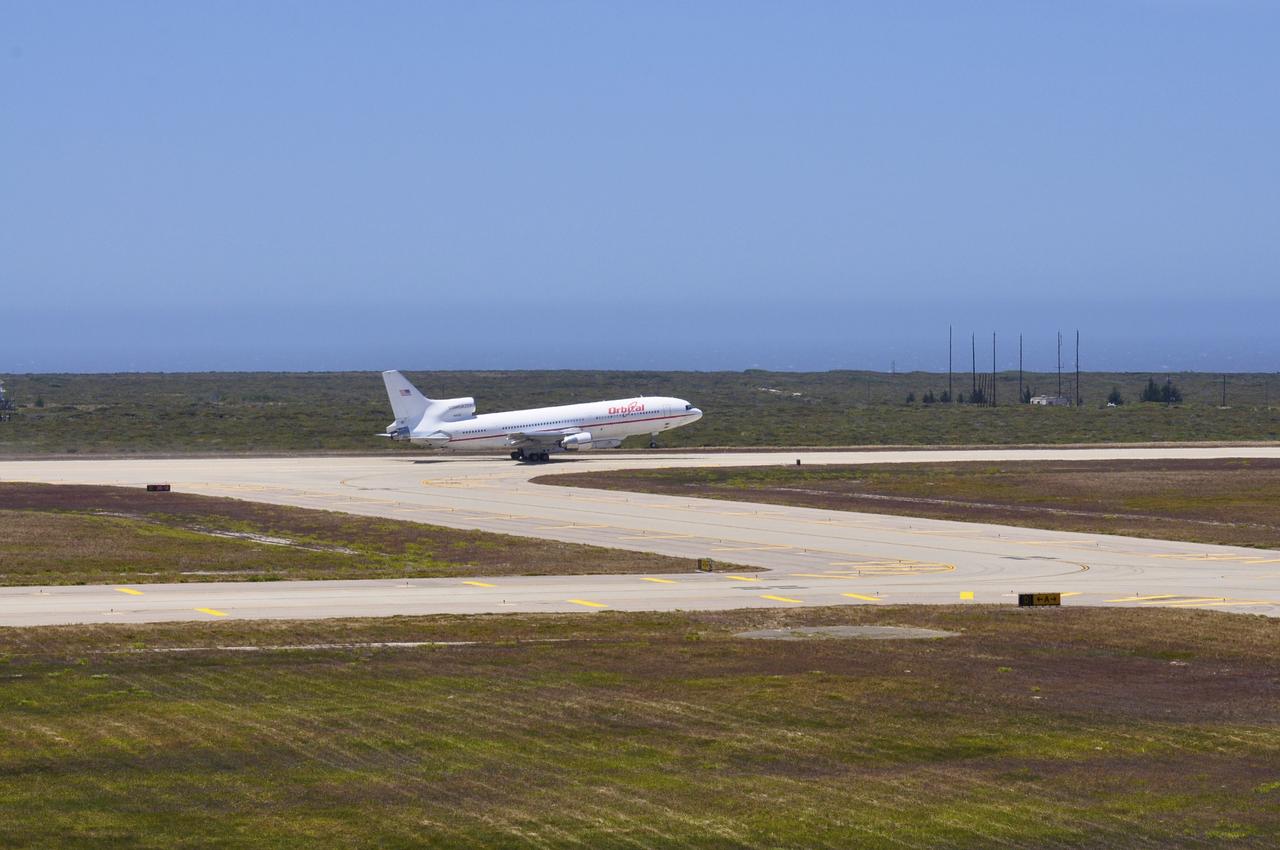
VANDENBERG AIR FORCE BASE, Calif. – Orbital Sciences’ L-1011 carrier aircraft lifts off the runway as it departs from Vandenberg Air Force Base in California. The aircraft is transporting Orbital’s Pegasus rocket and NASA’s Nuclear Spectroscopic Telescope Array, or NuSTAR, to the U.S. Army's Ronald Reagan Ballistic Missile Defense Test Site on Kwajalein Atoll, part of the Marshall Islands in the Pacific Ocean. The Pegasus, mated to its NuSTAR payload, will be launched from the carrier aircraft 117 nautical miles south of Kwajalein at latitude 6.75 degrees north of the equator. The high-energy X-ray telescope will conduct a census of black holes, map radioactive material in young supernovae remnants, and study the origins of cosmic rays and the extreme physics around collapsed stars. Launch is scheduled for June 13. For more information, visit http://www.nasa.gov/nustar. Photo credit: NASA/Randy Beaudoin, VAFB
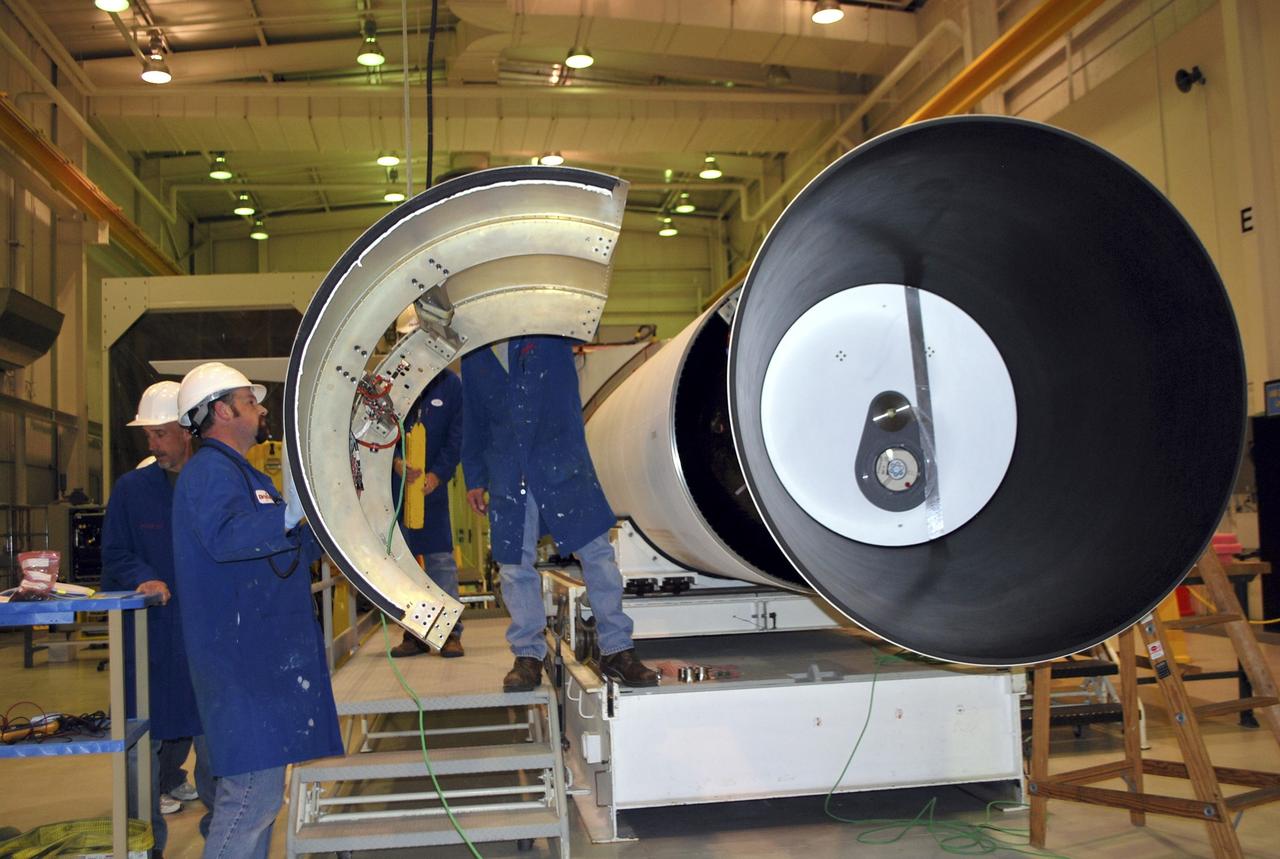
VANDENBERG AIR FORCE BASE, Calif. -- At a Pegasus booster processing facility at Vandenberg Air Force Base in California, technicians install the second section of the aft skirt on the Pegasus XL rocket’s first stage. The Orbital Sciences Corp. Pegasus rocket will launch the Nuclear Spectroscopic Telescope Array (NuSTAR) into space. After the rocket and spacecraft are processed at Vandenberg, they will be flown on the Orbital Sciences’ L-1011 carrier aircraft to the Ronald Reagan Ballistic Missile Defense Test Site at the Pacific Ocean’s Kwajalein Atoll for launch. The high-energy x-ray telescope will conduct a census for black holes, map radioactive material in young supernovae remnants, and study the origins of cosmic rays and the extreme physics around collapsed stars. For more information, visit science.nasa.gov/missions/nustar/. Photo credit: NASA/Randy Beaudoin, VAFB
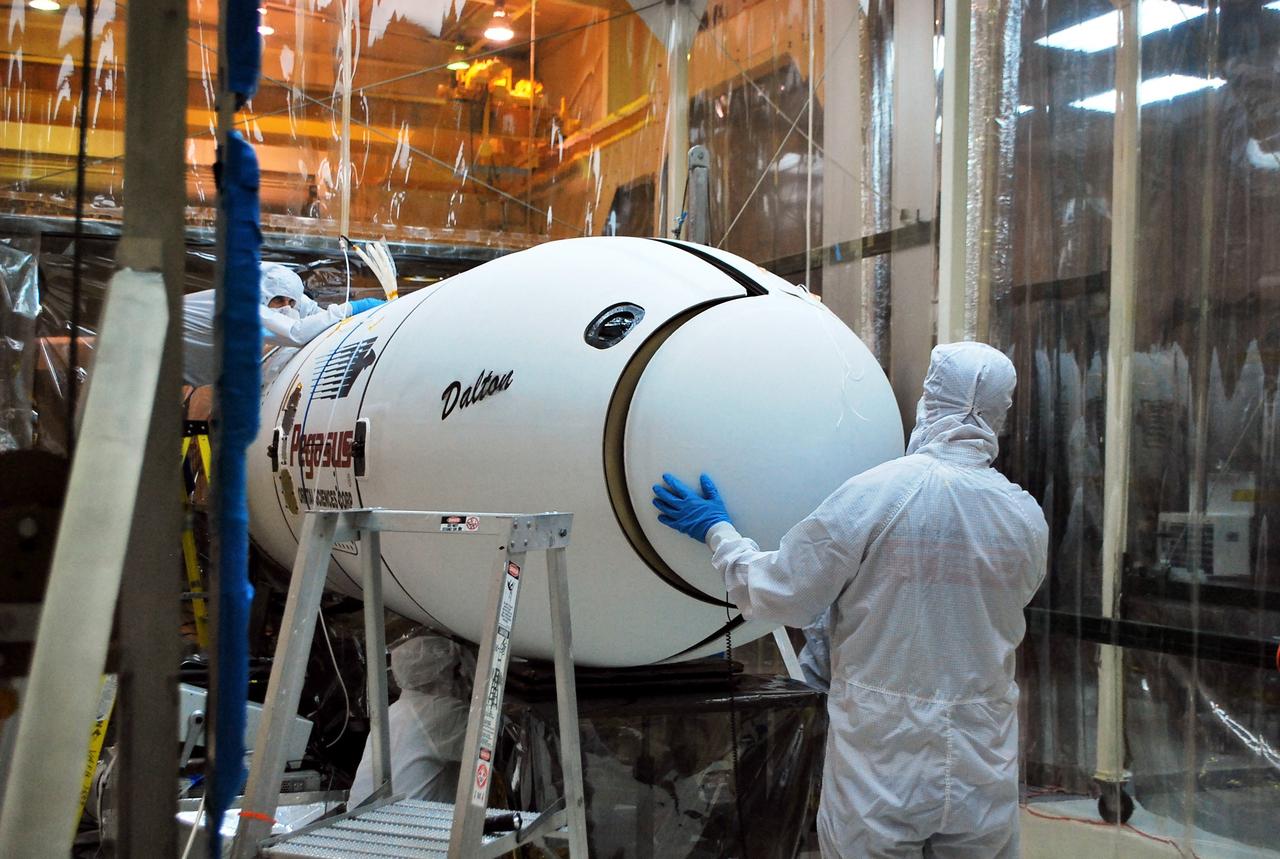
VANDENBERG AIR FORCE BASE, Calif. – Preparations are under way to remove the Pegasus payload fairing from around NASA’s Nuclear Spectroscopic Telescope Array, or NuSTAR, in Orbital Sciences’ hangar on Vandenberg Air Force Base in California. Access to the spacecraft is needed for compatibility testing to verify communication with a tracking station in Hawaii. With the change in the launch timeframe to June, this station will be needed to support launch. After processing of Orbital’s Pegasus XL rocket and the spacecraft are complete, they will be flown on Orbital's L-1011 carrier aircraft from Vandenberg to the Ronald Reagan Ballistic Missile Defense Test Site on the Pacific Ocean’s Kwajalein Atoll for launch. The high-energy X-ray telescope will conduct a census of black holes, map radioactive material in young supernovae remnants, and study the origins of cosmic rays and the extreme physics around collapsed stars. For more information, visit http://www.nasa.gov/nustar. Photo credit: NASA/Randy Beaudoin, VAFB

VANDENBERG AIR FORCE BASE, Calif. – In a clean room at Vandenberg Air Force Base in California, the Pegasus XL launch vehicle awaits a fillet and wing fit check. The Orbital Sciences Corp. Pegasus rocket will launch the Nuclear Spectroscopic Telescope Array (NuSTAR) into space. After the rocket and spacecraft are processed at Vandenberg, they will be flown on the Orbital Sciences’ L-1011 carrier aircraft to the Ronald Reagan Ballistic Missile Defense Test Site at the Pacific Ocean’s Kwajalein Atoll for launch. The high-energy X-ray telescope will conduct a census for black holes, map radioactive material in young supernovae remnants, and study the origins of cosmic rays and the extreme physics around collapsed stars. For more information, visit science.nasa.gov/missions/nustar/. Photo credit: NASA/Randy Beaudoin, VAFB

VANDENBERG AIR FORCE BASE, Calif. – In a clean room at Vandenberg Air Force Base in California, technicians prepare to complete a second fillet and wing fit check on the Pegasus XL launch vehicle. The Orbital Sciences Corp. Pegasus rocket will launch the Nuclear Spectroscopic Telescope Array (NuSTAR) into space. After the rocket and spacecraft are processed at Vandenberg, they will be flown on the Orbital Sciences’ L-1011 carrier aircraft to the Ronald Reagan Ballistic Missile Defense Test Site at the Pacific Ocean’s Kwajalein Atoll for launch. The high-energy X-ray telescope will conduct a census for black holes, map radioactive material in young supernovae remnants, and study the origins of cosmic rays and the extreme physics around collapsed stars. For more information, visit science.nasa.gov/missions/nustar/. Photo credit: NASA/Randy Beaudoin, VAFB
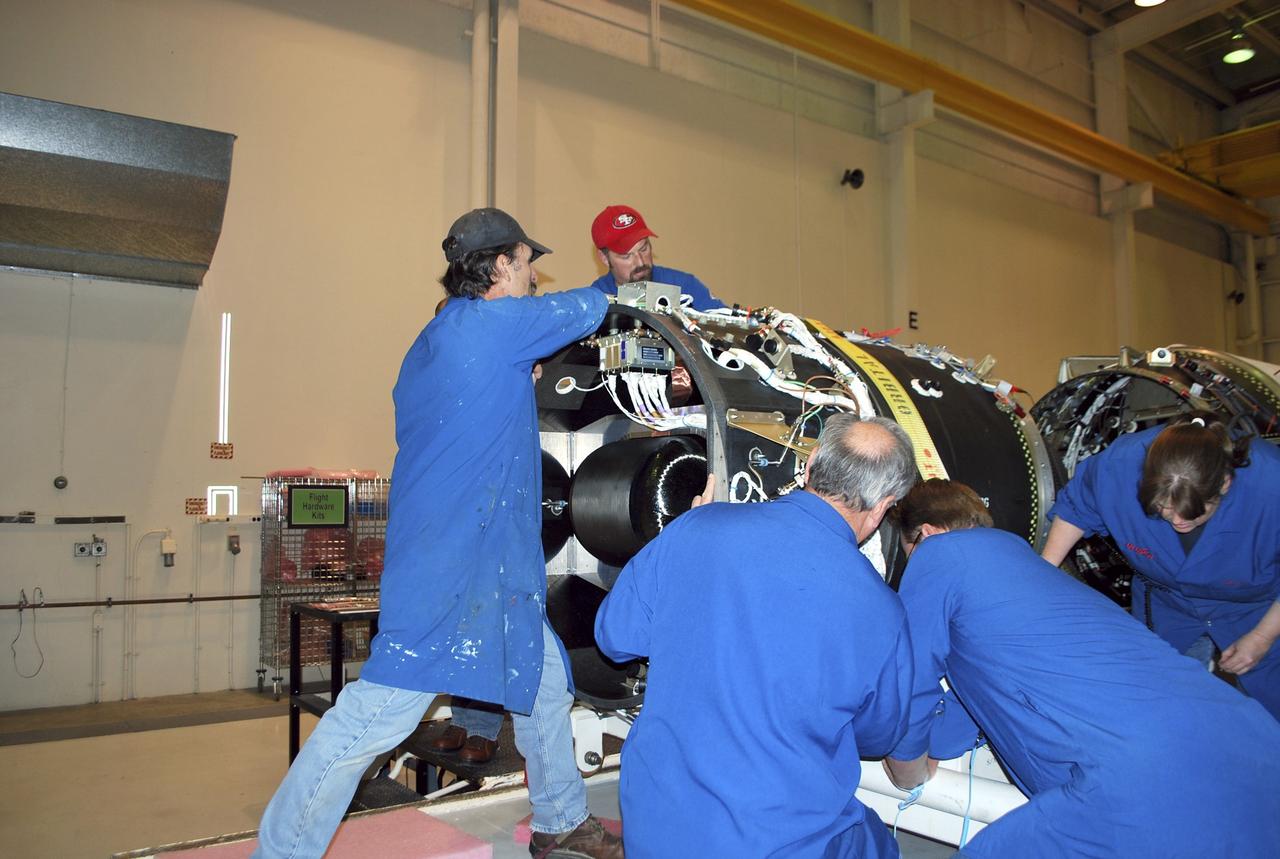
VANDENBERG AIR FORCE BASE, Calif. -- At a Pegasus booster processing facility at Vandenberg Air Force Base in California, technicians install the avionic shelf on the Pegasus XL rocket. The avionics contained in this module will issue the guidance and flight control commands for the rocket. The Orbital Sciences Corp. Pegasus rocket will launch the Nuclear Spectroscopic Telescope Array (NuSTAR) into space. After the rocket and spacecraft are processed at Vandenberg, they will be flown on the Orbital Sciences’ L-1011 carrier aircraft to the Ronald Reagan Ballistic Missile Defense Test Site at the Pacific Ocean’s Kwajalein Atoll for launch. The high-energy x-ray telescope will conduct a census for black holes, map radioactive material in young supernovae remnants, and study the origins of cosmic rays and the extreme physics around collapsed stars. For more information, visit science.nasa.gov/missions/nustar/. Photo credit: NASA/Randy Beaudoin, VAFB
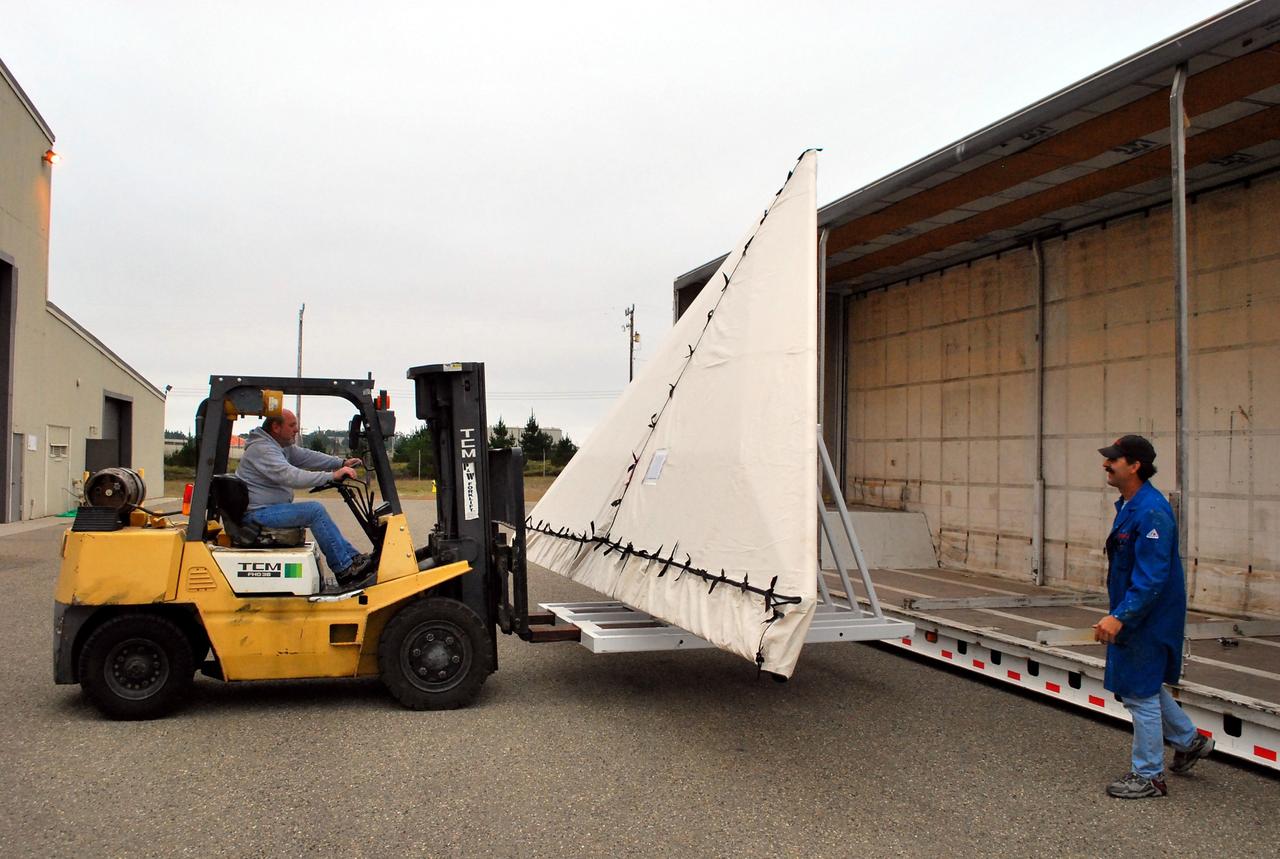
VANDENBERG AIR FORCE BASE, Calif. -- Orbital Sciences Corp. workers uncrate the wing of the Pegasus XL launch vehicle at Vandenberg Air Force Base in California. Orbital's Pegasus rocket is being processed to launch the Nuclear Spectroscopic Telescope Array (NuSTAR) into space. After the rocket and spacecraft are processed at Vandenberg, they will be flown on the Orbital Sciences' L-1011 carrier aircraft to the Ronald Reagan Ballistic Missile Defense Test Site at the Pacific Ocean’s Kwajalein Atoll for launch. The high-energy X-ray telescope will conduct a census for black holes, map radioactive material in young supernovae remnants, and study the origins of cosmic rays and the extreme physics around collapsed stars. For more information, visit science.nasa.gov/missions/nustar/. Photo credit: NASA/Randy Beaudoin, VAFB
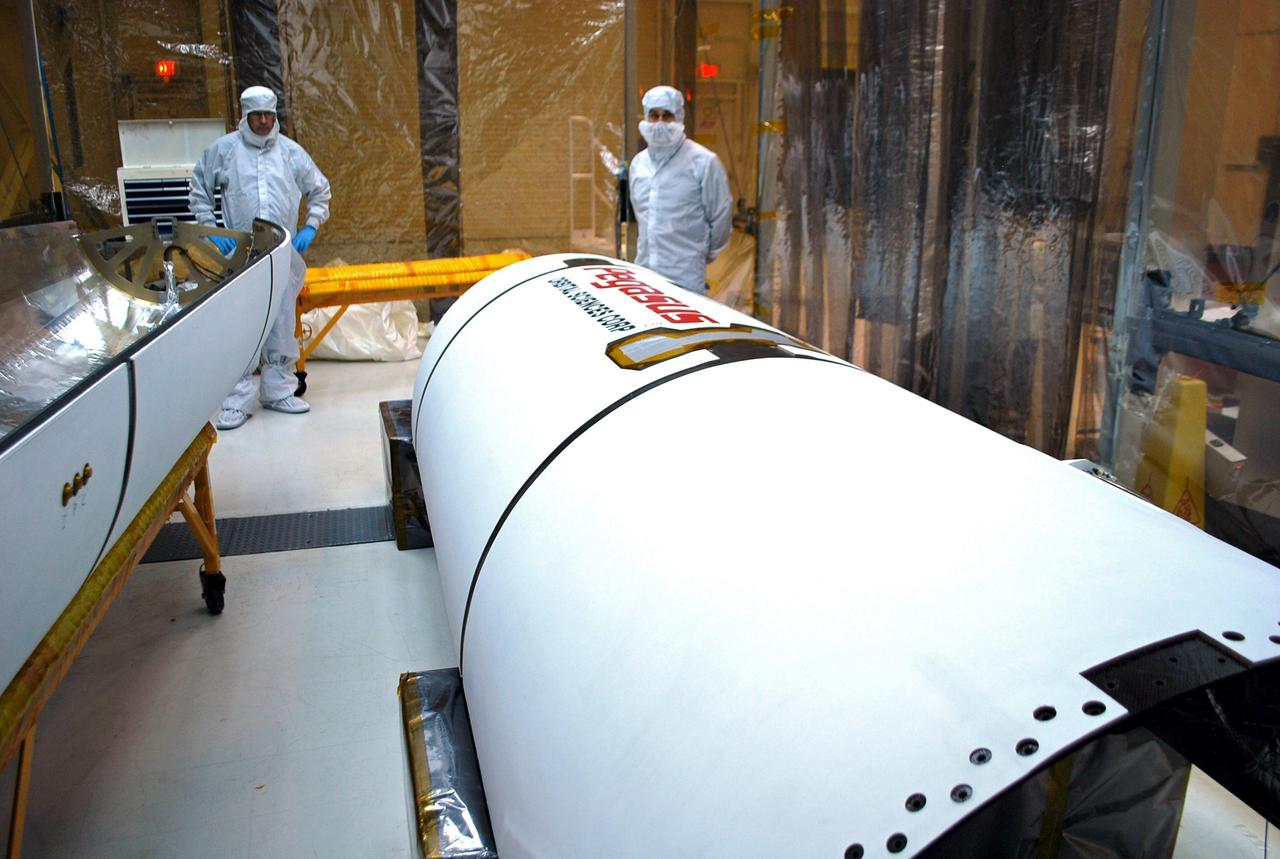
VANDENBERG AIR FORCE BASE, Calif. – In an environmental enclosure in processing facility 1555 at Vandenberg Air Force Base in California, twin segments of a Pegasus payload fairing for NASA's Nuclear Spectroscopic Telescope Array (NuSTAR) mission are cleaned and inspected before the spacecraft is encapsulated. The fairing will protect the spacecraft from the heat and aerodynamic pressure generated during ascent to orbit aboard an Orbital Sciences Pegasus XL rocket in March. Once processing of the rocket and spacecraft are completed at Vandenberg, they will be flown aboard an L-1011 carrier aircraft to the Ronald Reagan Ballistic Missile Defense Test Site on the Pacific Ocean’s Kwajalein Atoll for launch. NuSTAR, a high-energy x-ray telescope, will conduct a census for black holes, map radioactive material in young supernovae remnants, and study the origins of cosmic rays and the extreme physics around collapsed stars. For more information, visit http://www.nasa.gov/nustar. Photo credit: NASA/Randy Beaudoin, VAFB