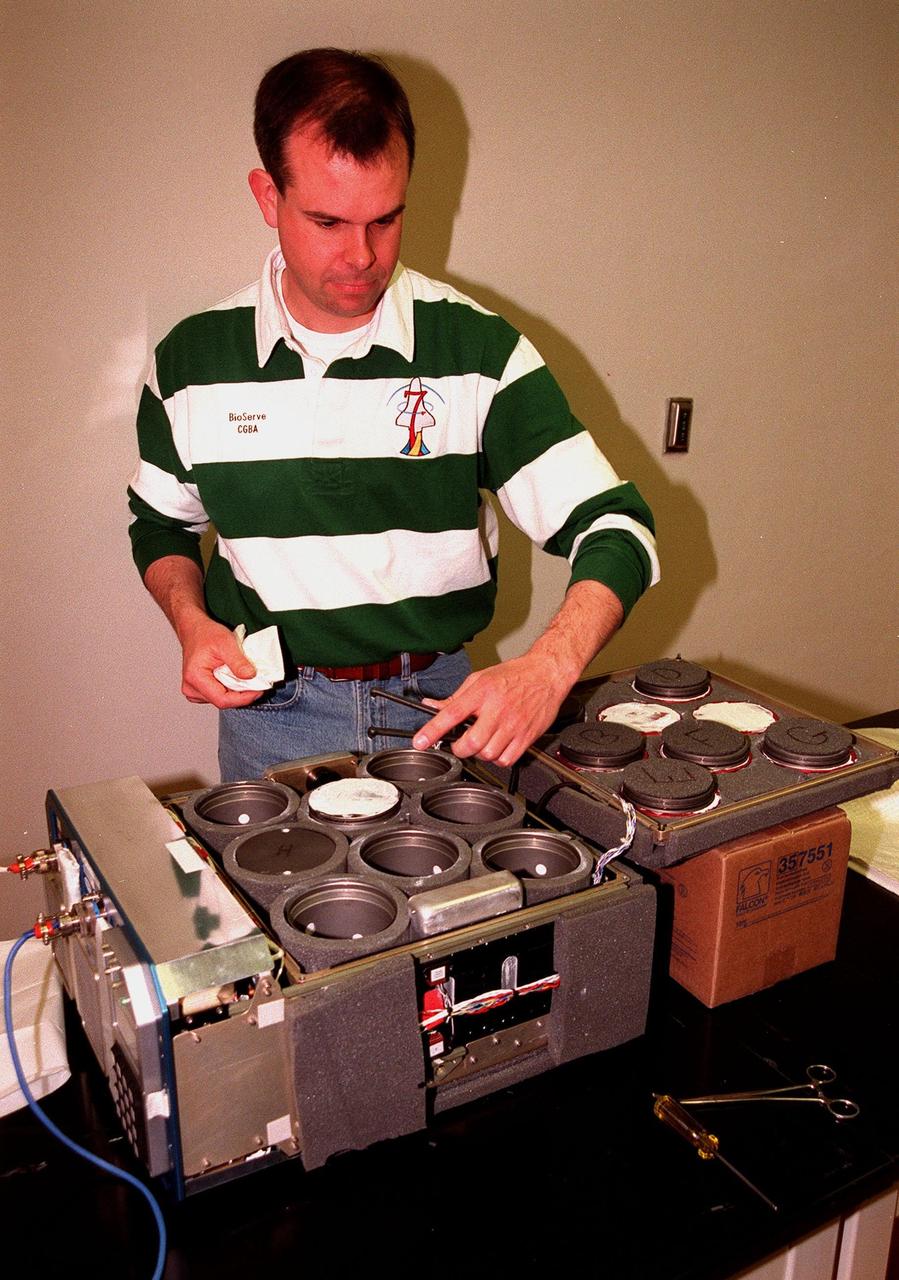
In the KSC Life Sciences Building, Hangar L, Cape Canaveral Air Station, Mark Rupert, with BioServe Space Technologies, checks the canisters, or incubators, that will hold an experiment to fly on mission STS-93. The incubators will hold a mix of fruit fly embryos and larvae to examine the effects of microgravity and space flight on the development of neural connections between specific motor neurons and their targets in muscle fibers. The incubators are part of a Commercial Generic Bioprocessing Apparatus (CGBA), which can start bioprocessing reactions by mixing or heating a sample and can also initiate multiple-step, sequential reactions in a technique called phased processing. The primary payload of mission STS-93 is the Chandra X-ray Observatory, which will allow scientists from around the world to see previously invisible black holes and high-temperature gas clouds, giving the observatory the potential to rewrite the books on the structure and evolution of our universe. The target launch date for STS-93 is July 9, aboard Space Shuttle Columbia, from Launch Pad 39B
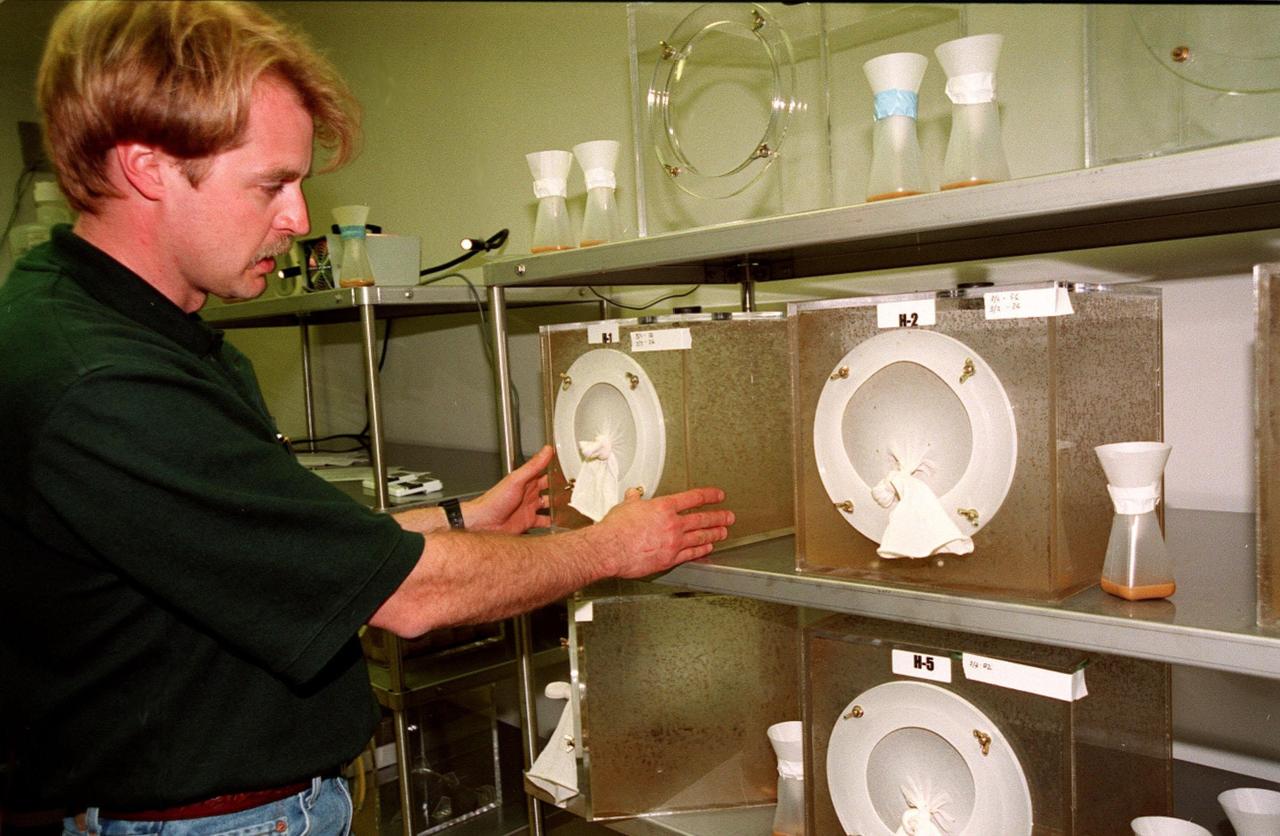
In the KSC Life Sciences Building, Hangar L, Cape Canaveral Air Station, Shawn Bengtson, with Lockheed Martin, checks population cages containing fruit flies. The larvae of the flies are part of an experiment that is a secondary payload on mission STS-93. The experiment will examine the effects of microgravity and space flight on the development of neural connections between specific motor neurons and their targets in muscle fibers. That information could lead to understanding the effect of microgravity on human nervous system connectivity. The larvae will be contained in incubators that are part of a Commercial Generic Bioprocessing Apparatus (CGBA), which can start bioprocessing reactions by mixing or heating a sample and can also initiate multiple-step, sequential reactions in a technique called phased processing. The primary payload of mission STS-93 is the Chandra X-ray Observatory, which will allow scientists from around the world to see previously invisible black holes and high-temperature gas clouds, giving the observatory the potential to rewrite the books on the structure and evolution of our universe. The target launch date for STS-93 is July 9, aboard Space Shuttle Columbia, from Launch Pad 39B
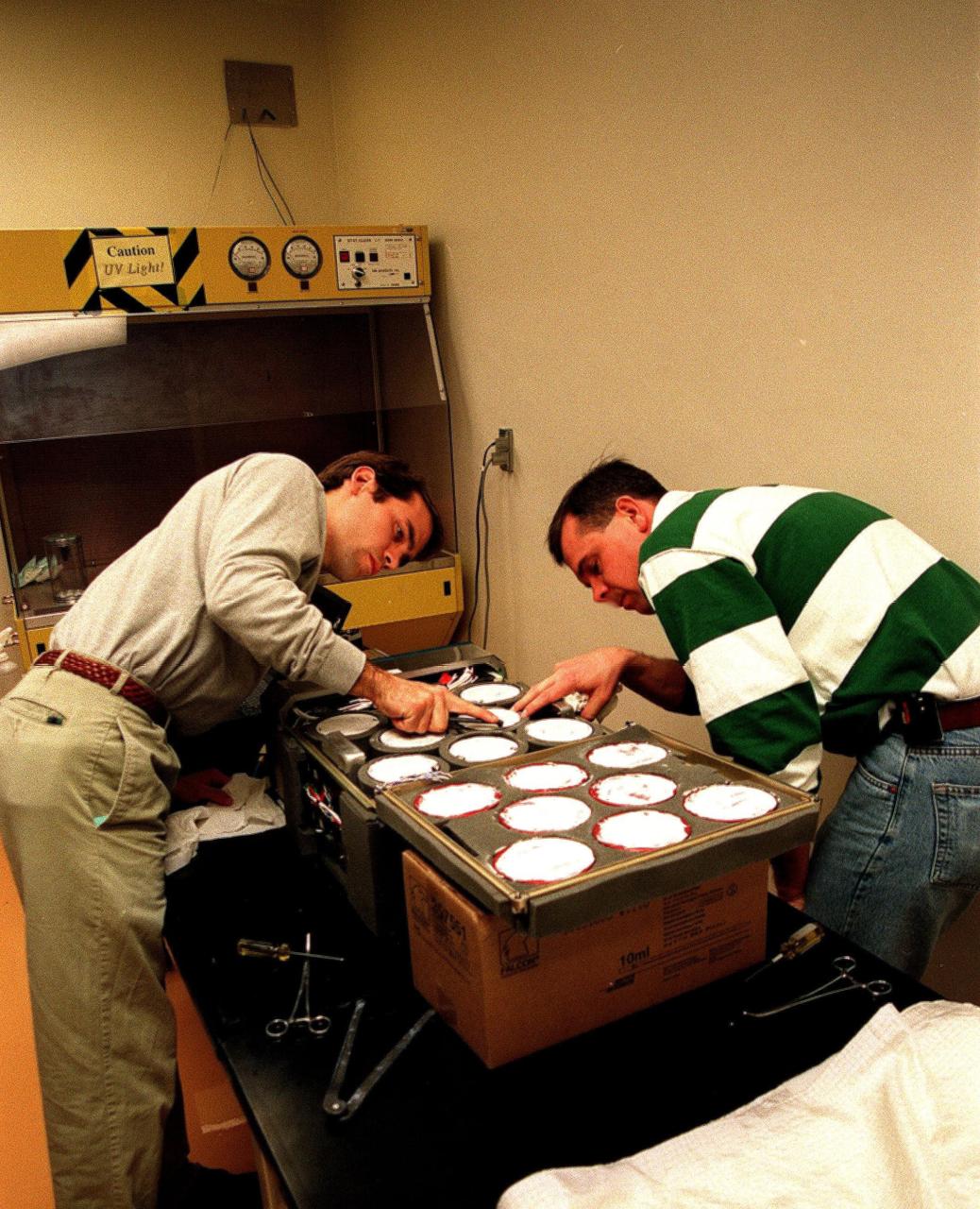
In the KSC Life Sciences Building, Hangar L, Cape Canaveral Air Station, Jake Freeman and Mark Rupert, with BioServe Space Technologies, check canisters, or incubators, that will hold fruit fly embryos and larvae for an experiment to fly on mission STS-93. The experiment will examine the effects of microgravity and space flight on the development of neural connections between specific motor neurons and their targets in muscle fibers. The incubators are part of the Commercial Generic Bioprocessing Apparatus (CGBA), which can start bioprocessing reactions by mixing or heating a sample and can also initiate multiple-step, sequential reactions in a technique called phased processing. The primary payload of mission STS-93 is the Chandra X-ray Observatory, which will allow scientists from around the world to see previously invisible black holes and high-temperature gas clouds, giving the observatory the potential to rewrite the books on the structure and evolution of our universe. The target launch date for STS-93 is July 9, aboard Space Shuttle Columbia, from Launch Pad 39B
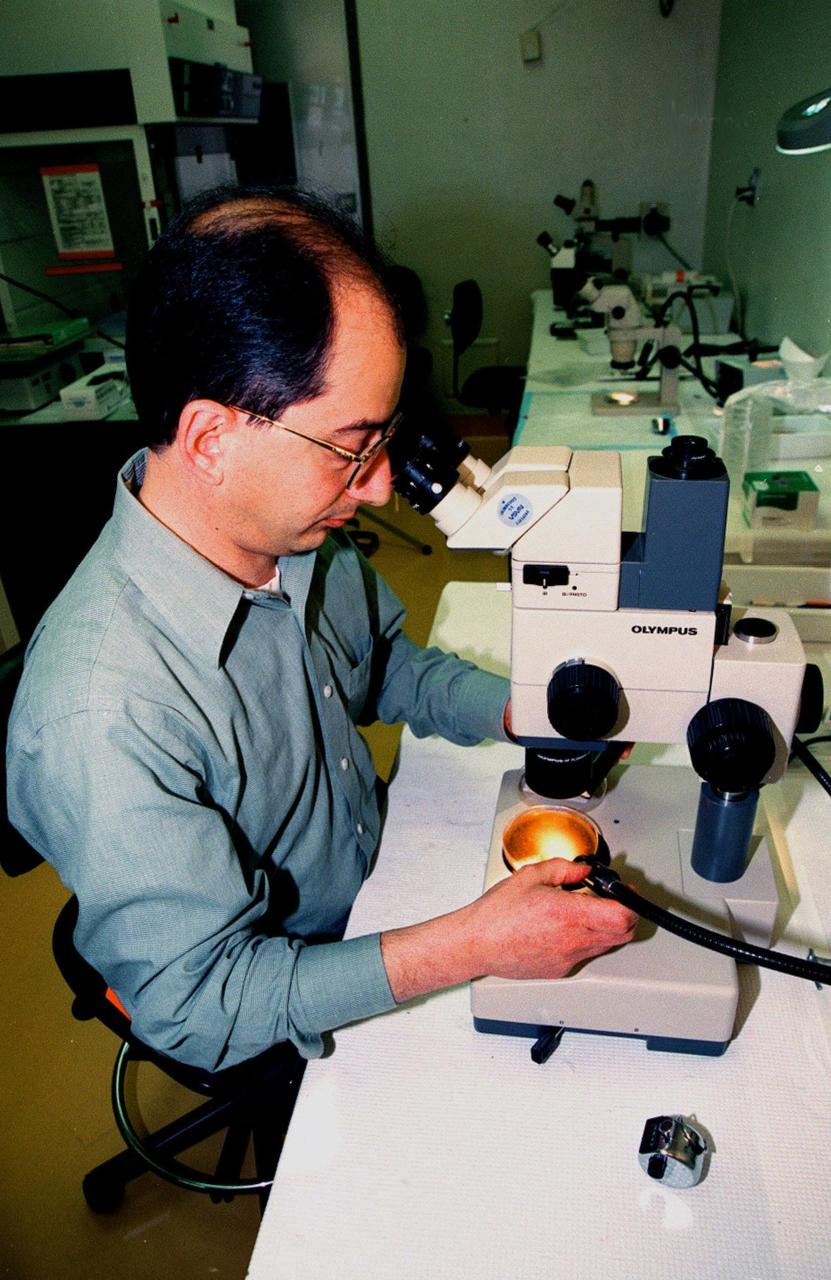
In the KSC Life Sciences Building, Hangar L, Cape Canaveral Air Station, Dr. Haig Keshishian checks fruit fly larvae in a petri dish. The larvae are part of an experiment that is a secondary payload on mission STS-93. The experiment will examine the effects of microgravity and space flight on the development of neural connections between specific motor neurons and their targets in muscle fibers. Dr. Keshishian, from Yale University, is the principle investigator for the experiment. The larvae will be contained in incubators that are part of a Commercial Generic Bioprocessing Apparatus (CGBA), which can start bioprocessing reactions by mixing or heating a sample and can also initiate multiple-step, sequential reactions in a technique called phased processing. The primary payload of mission STS-93 is the Chandra X-ray Observatory, which will allow scientists from around the world to see previously invisible black holes and high-temperature gas clouds, giving the observatory the potential to rewrite the books on the structure and evolution of our universe. The target launch date for STS-93 is July 9, aboard Space Shuttle Columbia, from Launch Pad 39B
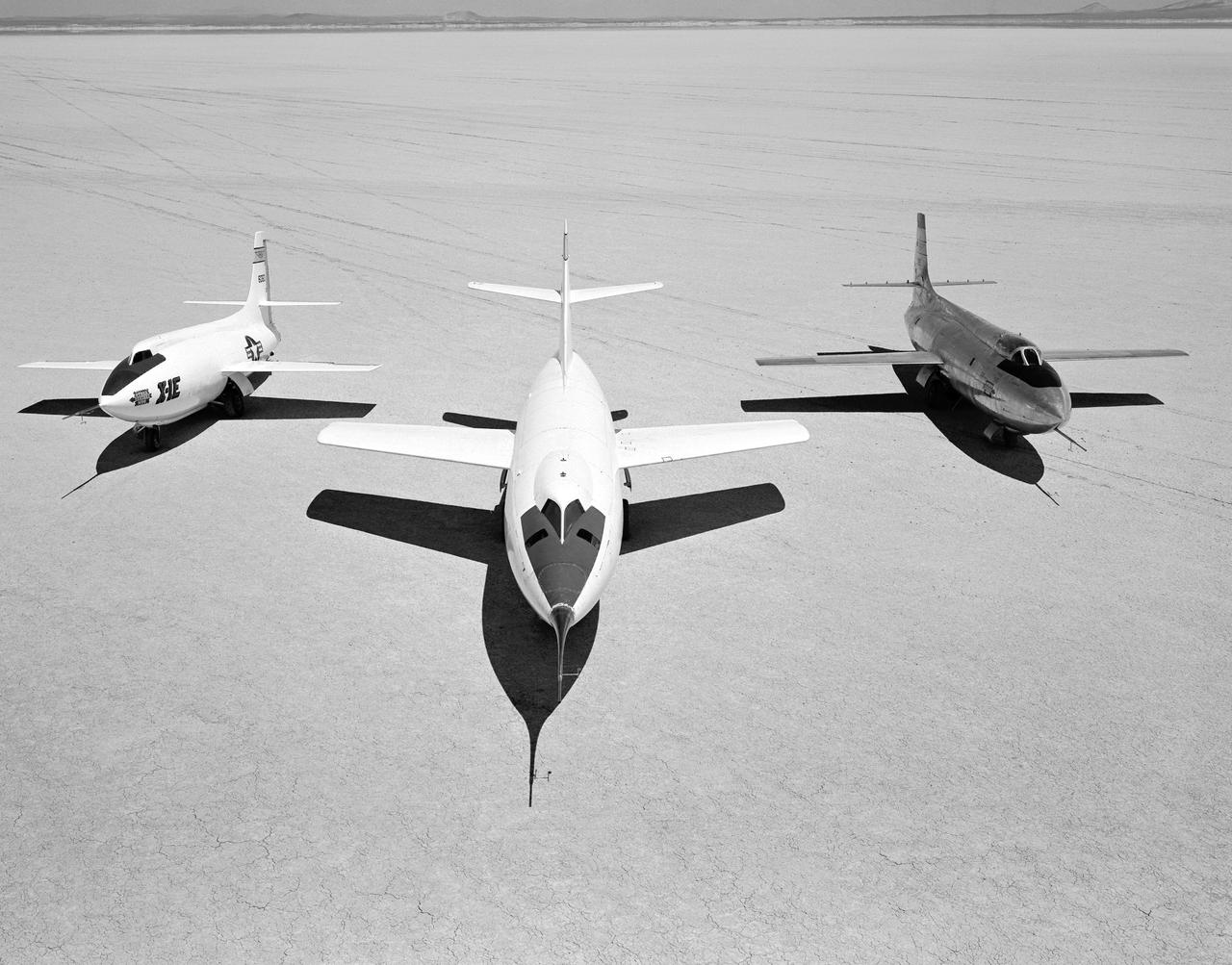
Early NACA research aircraft on the lakebed at the High Speed Research Station in 1955: Left to right: X-1E, D-558-II, X-1B
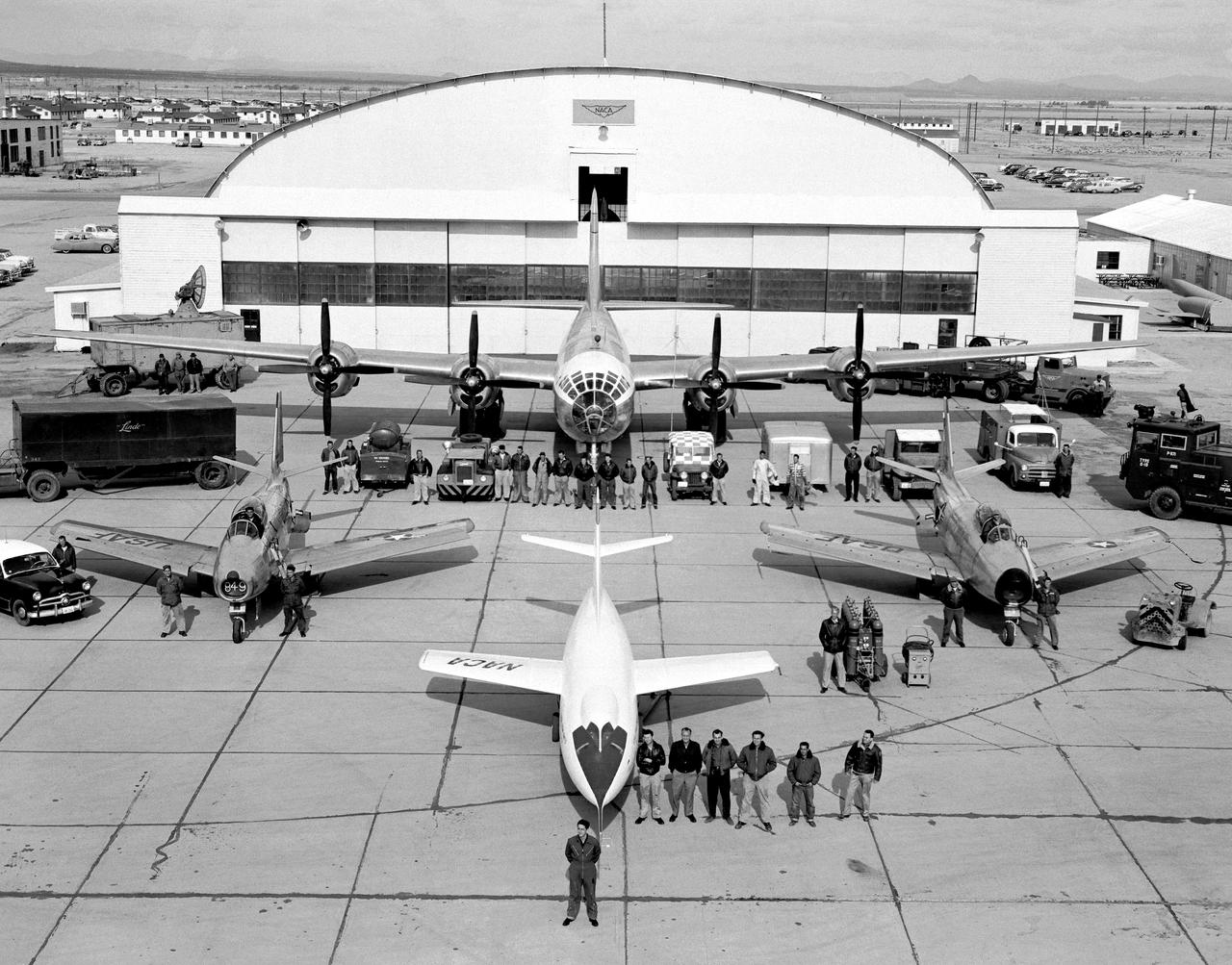
These people and this equipment supported the flight of the NACA D-558-2 Skyrocket at the High-Speed Flight Station at South Base, Edwards AFB. Note the two Sabre chase planes, the P2B-1S launch aircraft, and the profusion of ground support equipment, including communications, tracking, maintenance, and rescue vehicles. Research pilot A. Scott Crossfield stands in front of the Skyrocket.
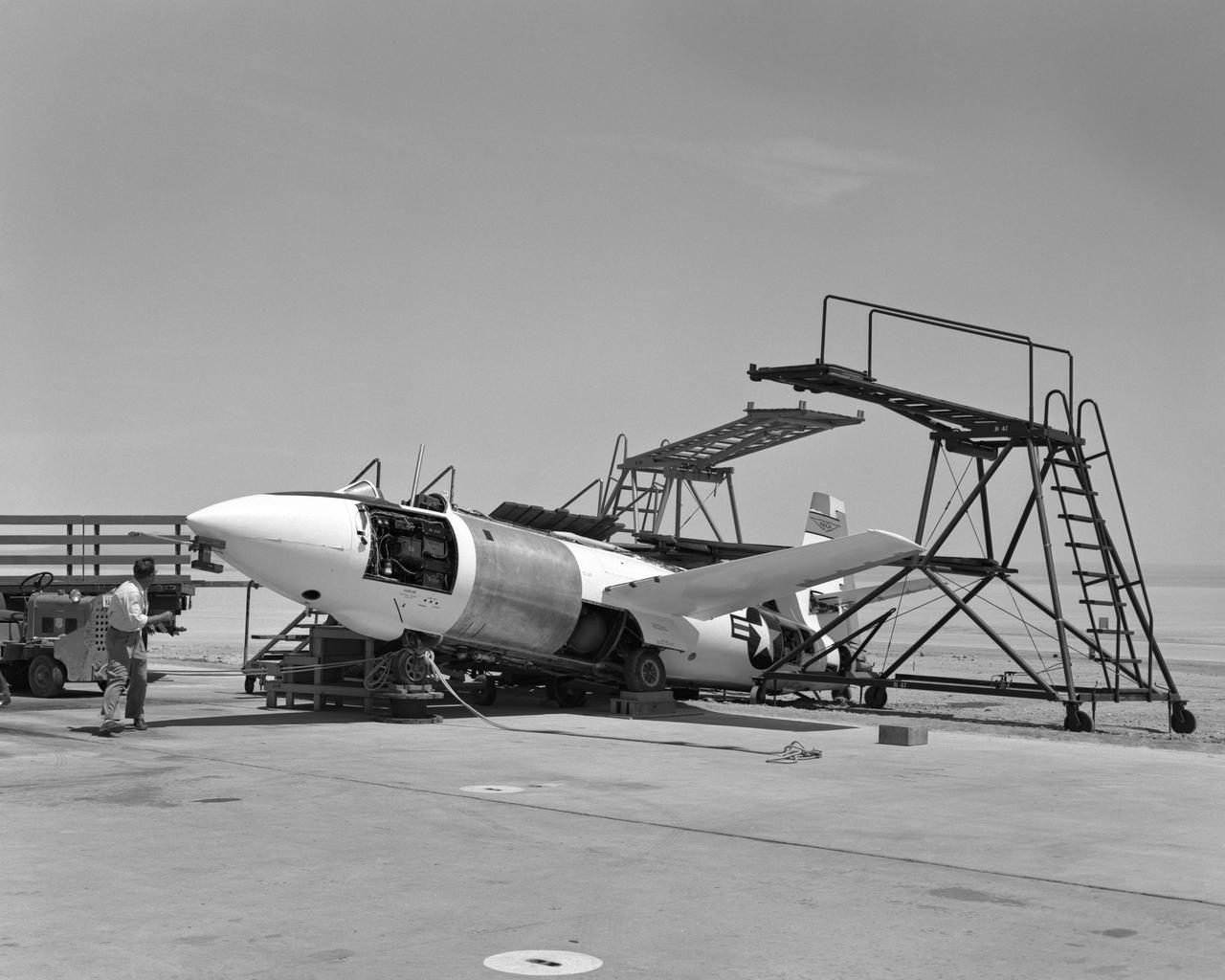
Bell X-1A ejection seat test setup
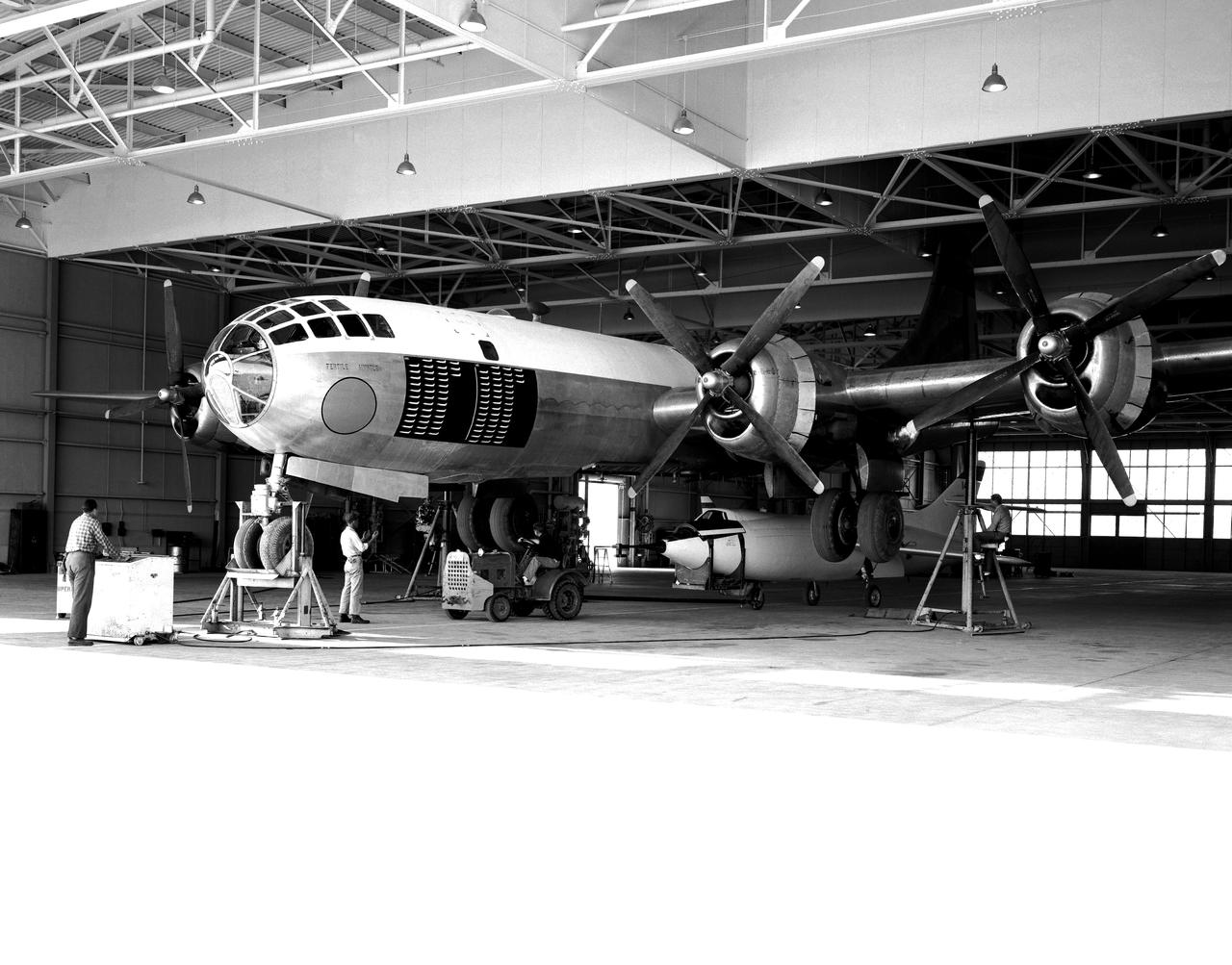
D-558-2 being mounted to P2B-1S launch aircraft in hangar.
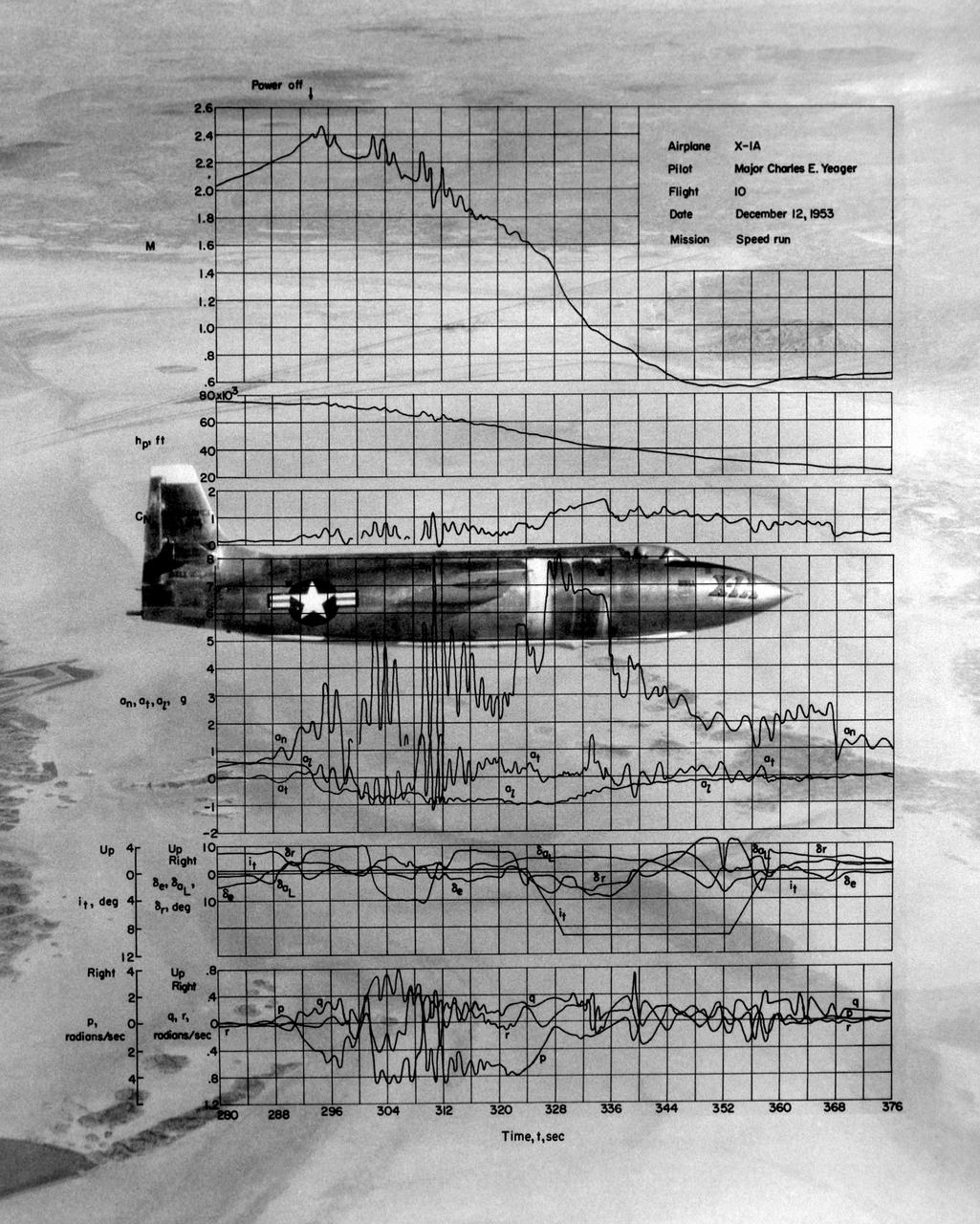
This photo of the X-1A includes graphs of the flight data from Maj. Charles E. Yeager's Mach 2.44 flight on December 12, 1953. (This was only a few days short of the 50th anniversary of the Wright brothers' first powered flight.) After reaching Mach 2.44, then the highest speed ever reached by a piloted aircraft, the X-1A tumbled completely out of control. The motions were so violent that Yeager cracked the plastic canopy with his helmet. He finally recovered from a inverted spin and landed on Rogers Dry Lakebed. Among the data shown are Mach number and altitude (the two top graphs). The speed and altitude changes due to the tumble are visible as jagged lines. The third graph from the bottom shows the G-forces on the airplane. During the tumble, these twice reached 8 Gs or 8 times the normal pull of gravity at sea level. (At these G forces, a 200-pound human would, in effect, weigh 1,600 pounds if a scale were placed under him in the direction of the force vector.) Producing these graphs was a slow, difficult process. The raw data from on-board instrumentation recorded on oscillograph film. Human computers then reduced the data and recorded it on data sheets, correcting for such factors as temperature and instrument errors. They used adding machines or slide rules for their calculations, pocket calculators being 20 years in the future.

The Bell Aircraft Corporation X-1-2 aircraft on the ramp at NACA High Speed Flight Research Station located on the South Base of Muroc Army Air Field in 1947. The X-1-2 flew until October 23, 1951, completing 74 glide and powered flights with nine different pilots. The aircraft has white paint and the NACA tail band. The black Xs are reference markings for tracking purposes. They were widely used on NACA aircraft in the early 1950s.
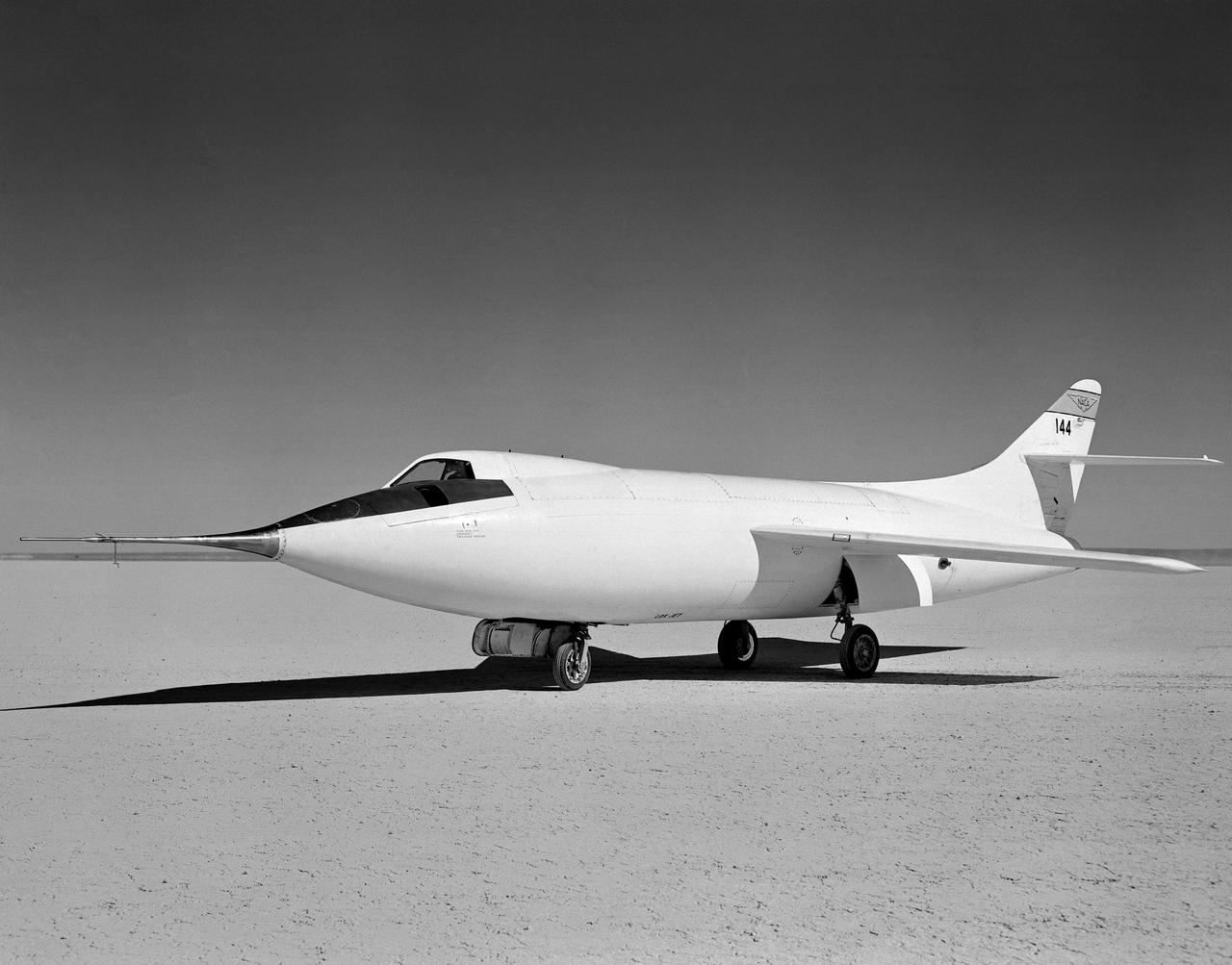
D-558-2 Aircraft on lakebed
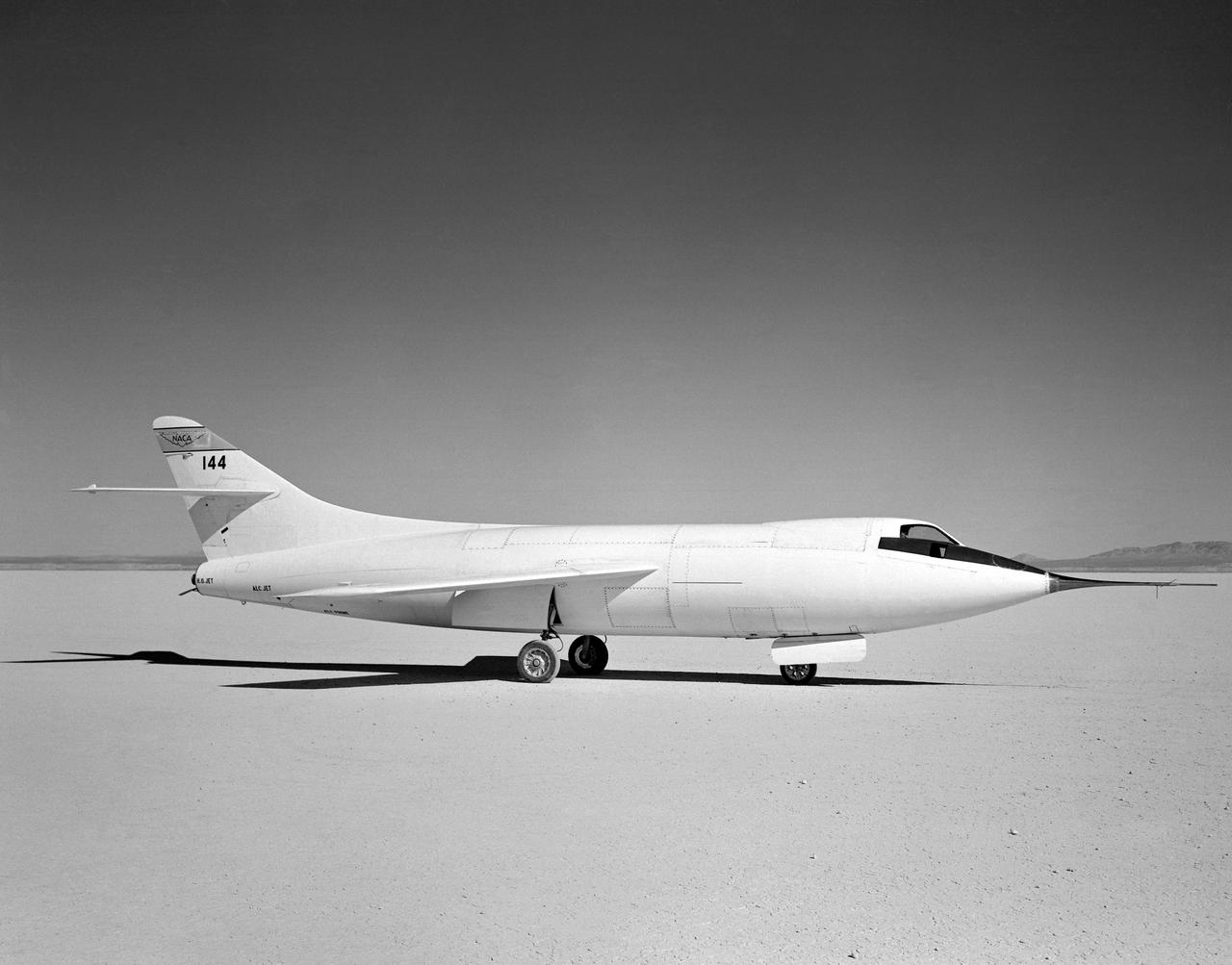
D-558-2 Aircraft on lakebed
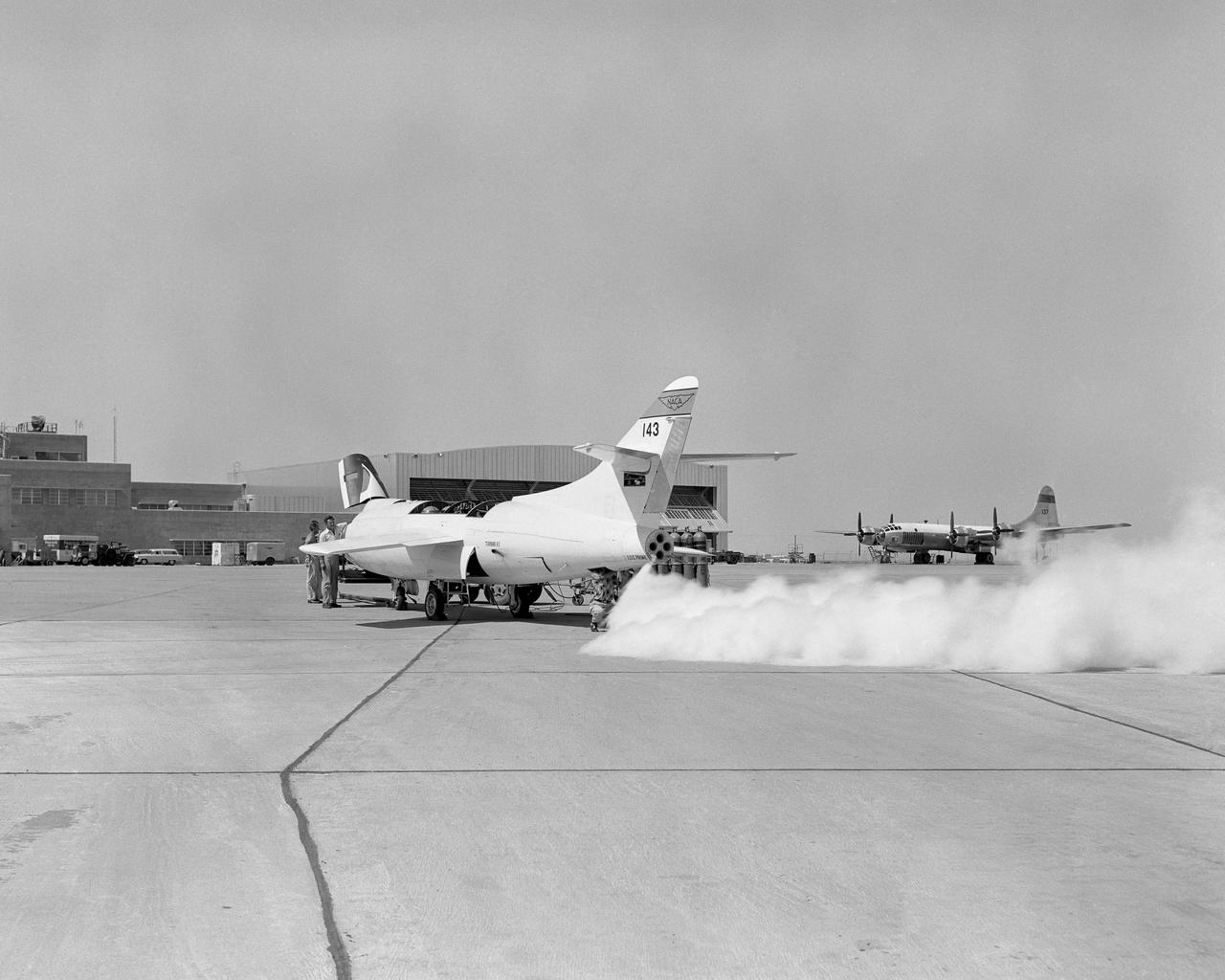
D558-2 #143 LOX jettison with P2BS in background
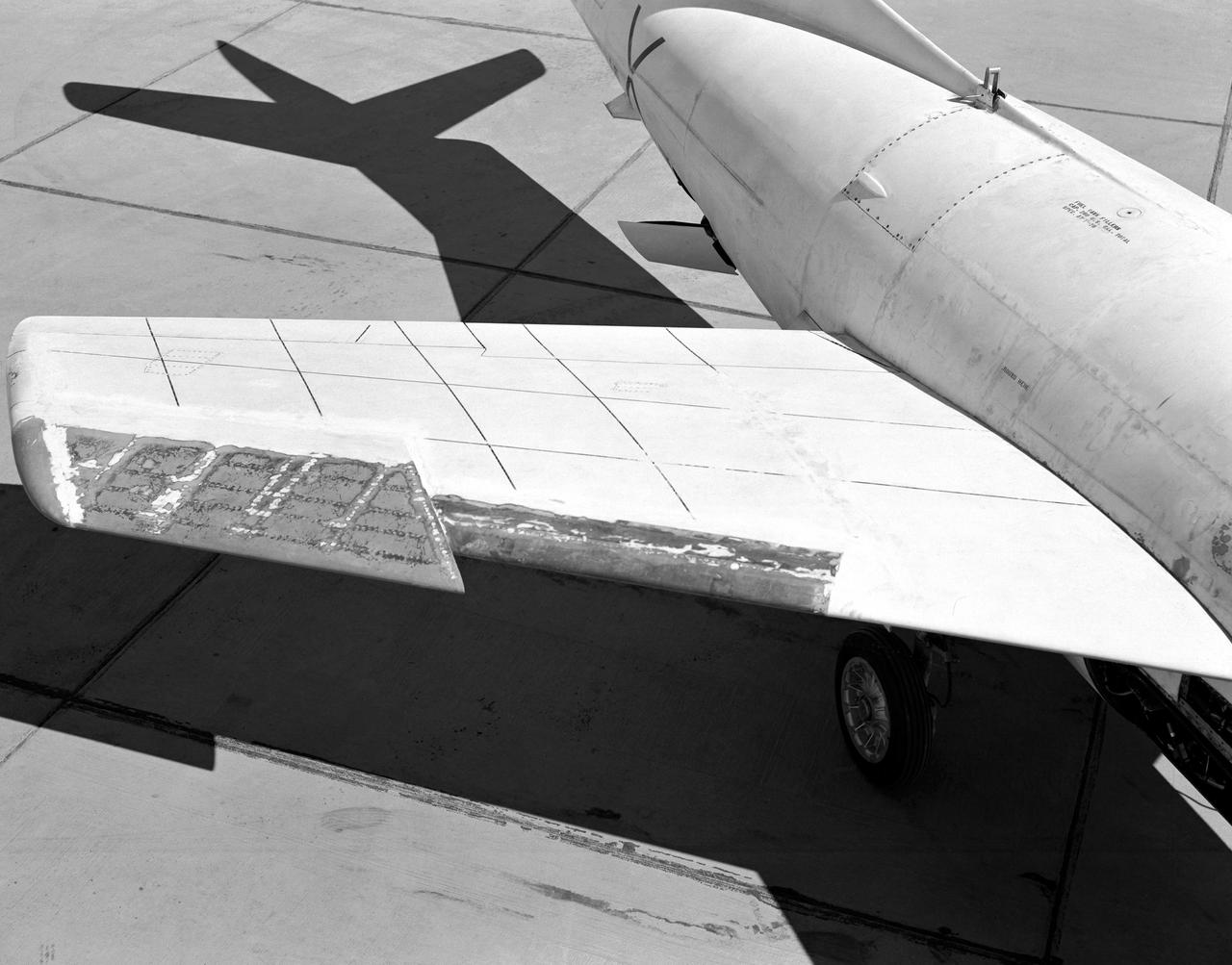
Wing chord extension on D-558-2