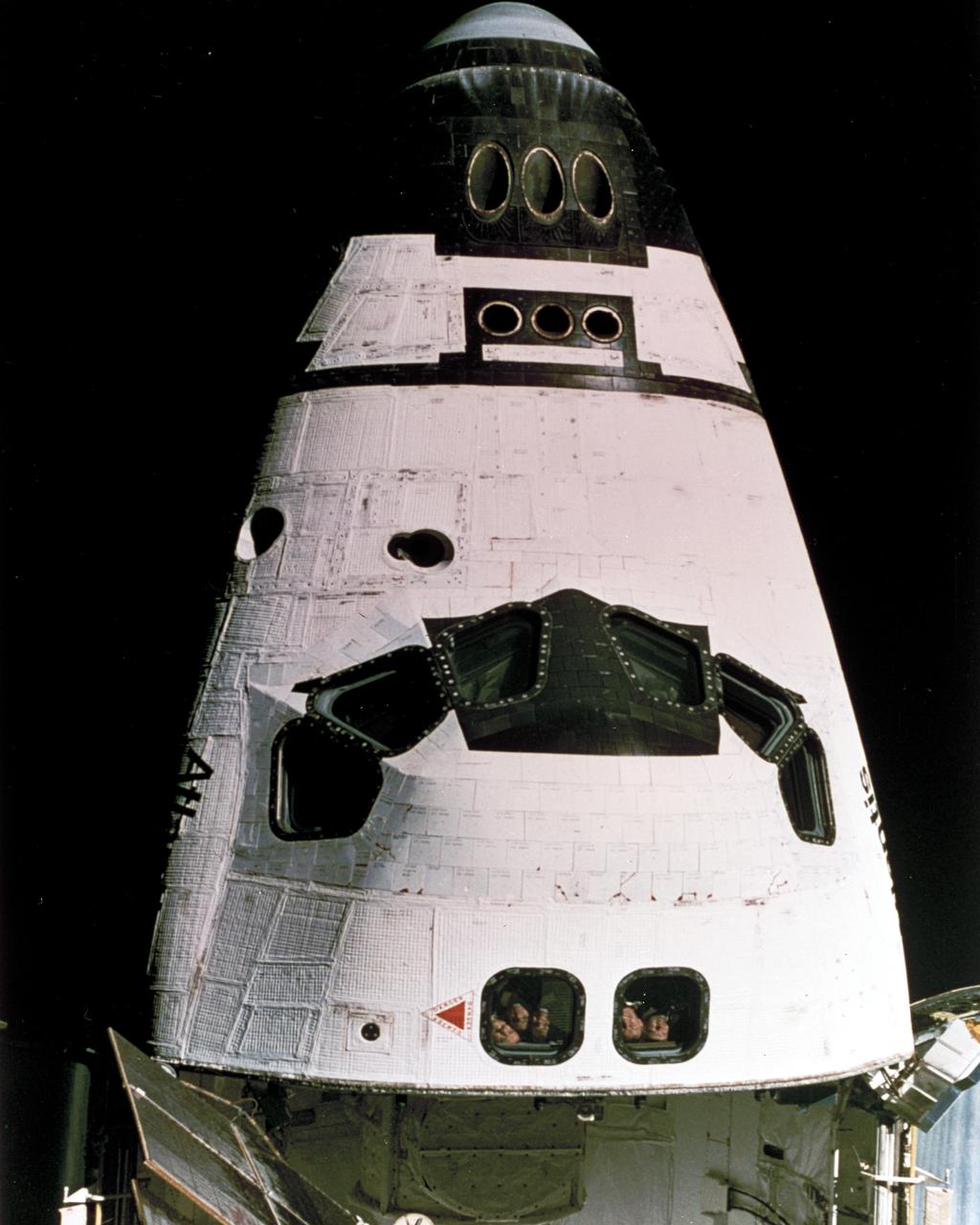
In this close-up of Space Shuttle Atlantis, the STS-74 crew is looking out the rear window. STS-74, launched on November 12, 1995, was the second Space Shuttle/Mir docking mission. Objectives accomplished included the delivery and installation of the Docking Module, making it possible for the Space Shuttle to dock easily with the Russian space station, Mir. The Orbiter Atlantis also delivered water, supplies, and equipment, including two new solar arrays to upgrade Mir, and returned to Earth on November 25, 1995 with experiment samples, equipment for repair and analysis, and products manufactured on the Station.
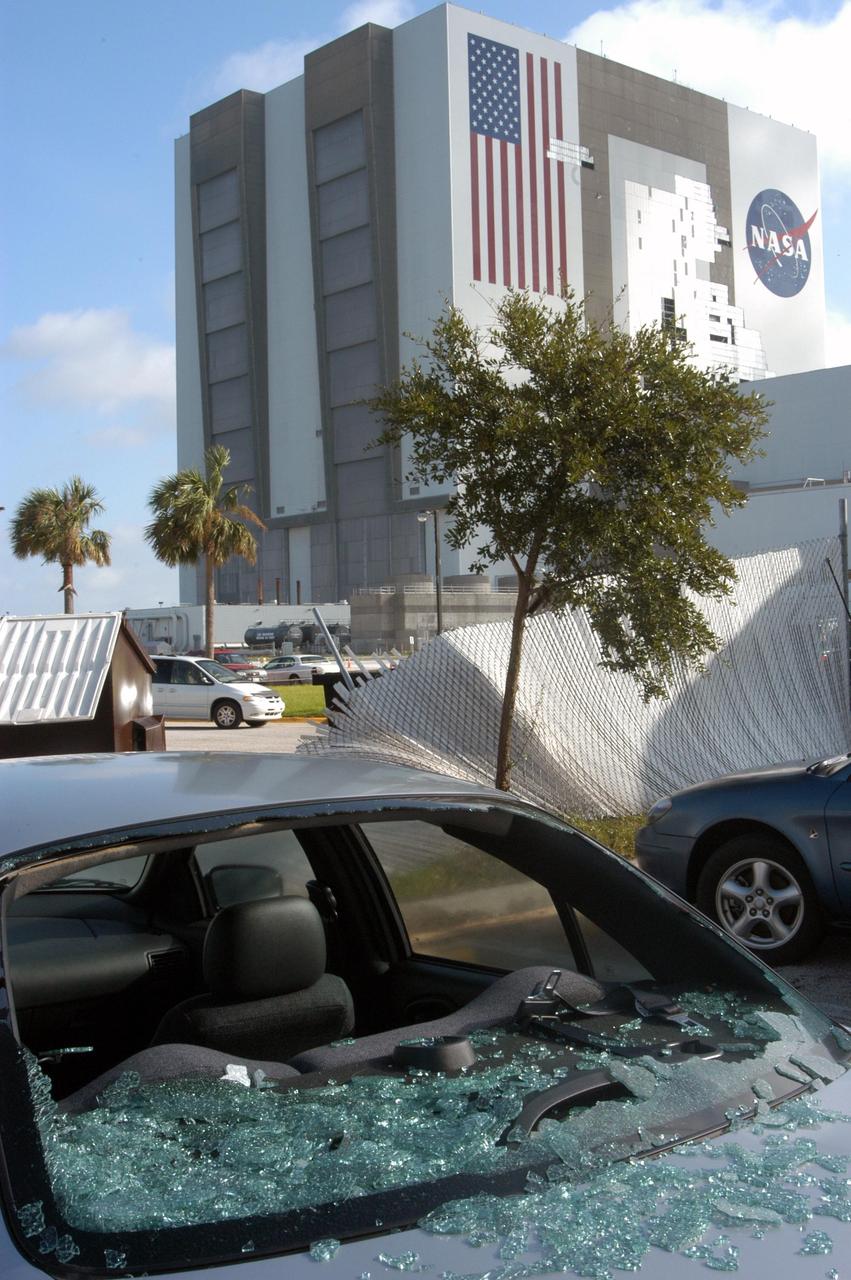
KENNEDY SPACE CENTER, FLA. - In a parking lot near the Vehicle Assembly Building (background), this car lost its rear window to the category 3 Hurricane Jeanne that barreled through Central Florida Sept. 25-26. Behind it is a fence mangled by the storm. Hurricane Jeanne was the fourth hurricane in 6 weeks to batter the state.
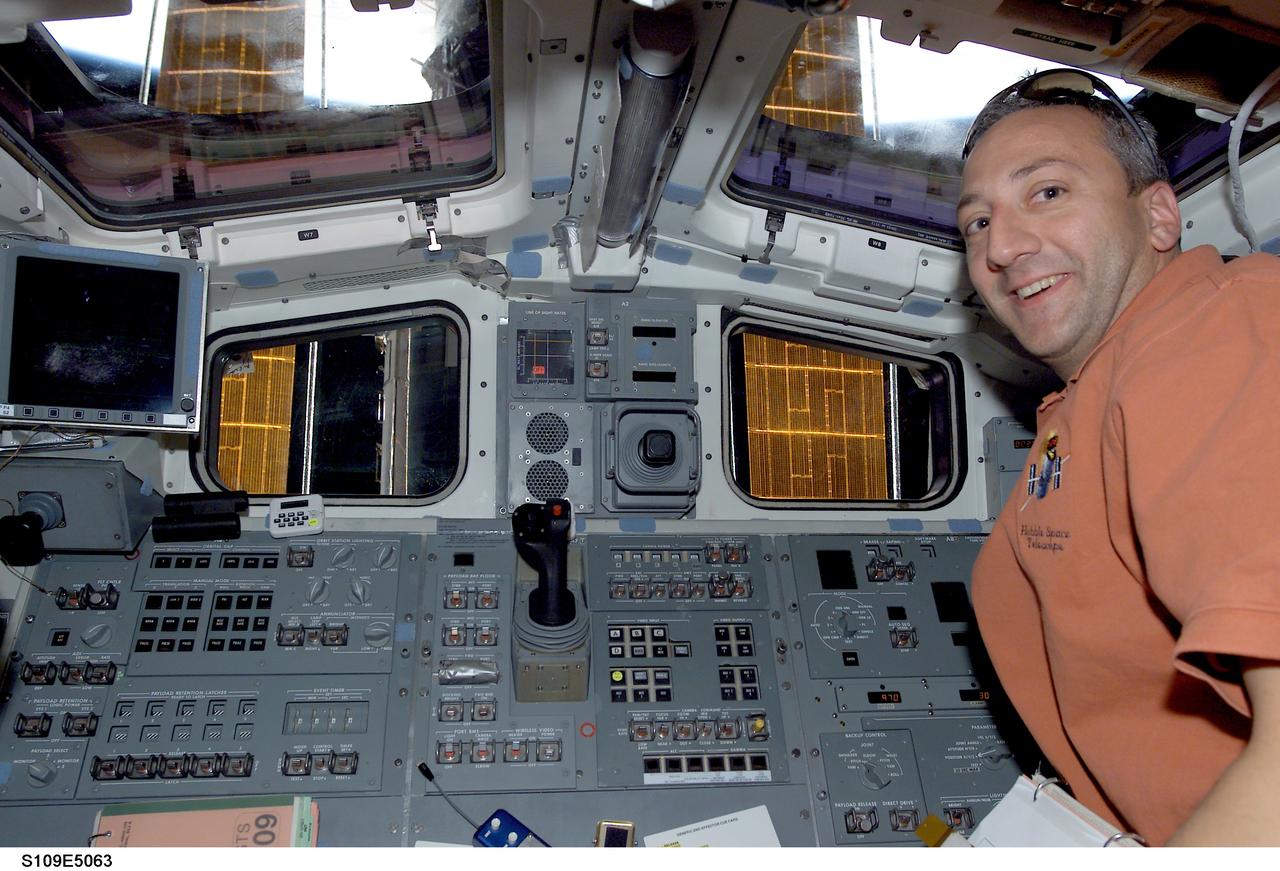
STS109-E-5063 (3 March 2002) --- Astronaut Michael J. Massimino, STS-109 mission specialist, is pictured near the aft flight deck controls for the Space Shuttle Columbia shortly after the crew latched the Hubble Space Telescope (HST) into the shuttle's cargo bay. The telescope is partially visible through the cabin's rear windows. The image was taken with a digital still camera.

STS030-10-008 (4-8 May 1989) --- Since the beginning manned space travel, astronauts have taken with them items of personal sentiment. In case of Mark C. Lee, STS-30 mission specialist, a picture of a cow testifies to his background as one reared on a Wisconsin farm. The scene, through a flight deck aft window, also shows Earth some 160 nautical miles away.
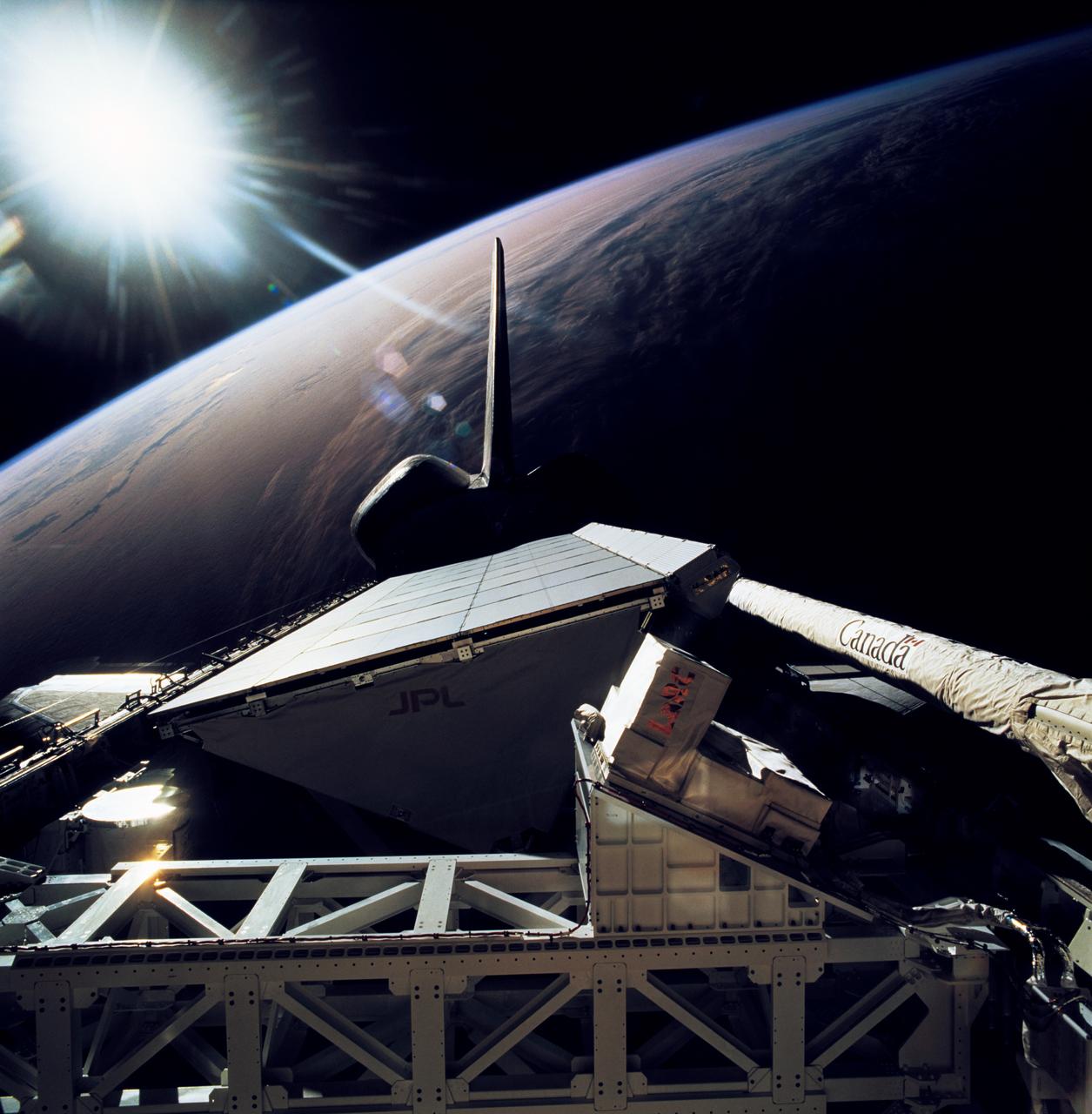
STS068-267-079 (30 September-11 October 1994) --- The rear windows of the Space Shuttle Endeavour reflect sunlight in this view of part of the cargo bay, 115 nautical miles above the Earth. The Space Radar Laboratory (SRL-2) Multipurpose Experiment Support Structure (MPESS) is seen at bottom frame. Also partially seen are other experiments including other components of the primary payload. They are the antenna for the Spaceborne Imaging Radar (SIR-C), the X-band Synthetic Aperture Radar (X-SAR), the device for Measurement of Air Pollution from Satellites (MAPS) and some Getaway Special (GAS) canisters.
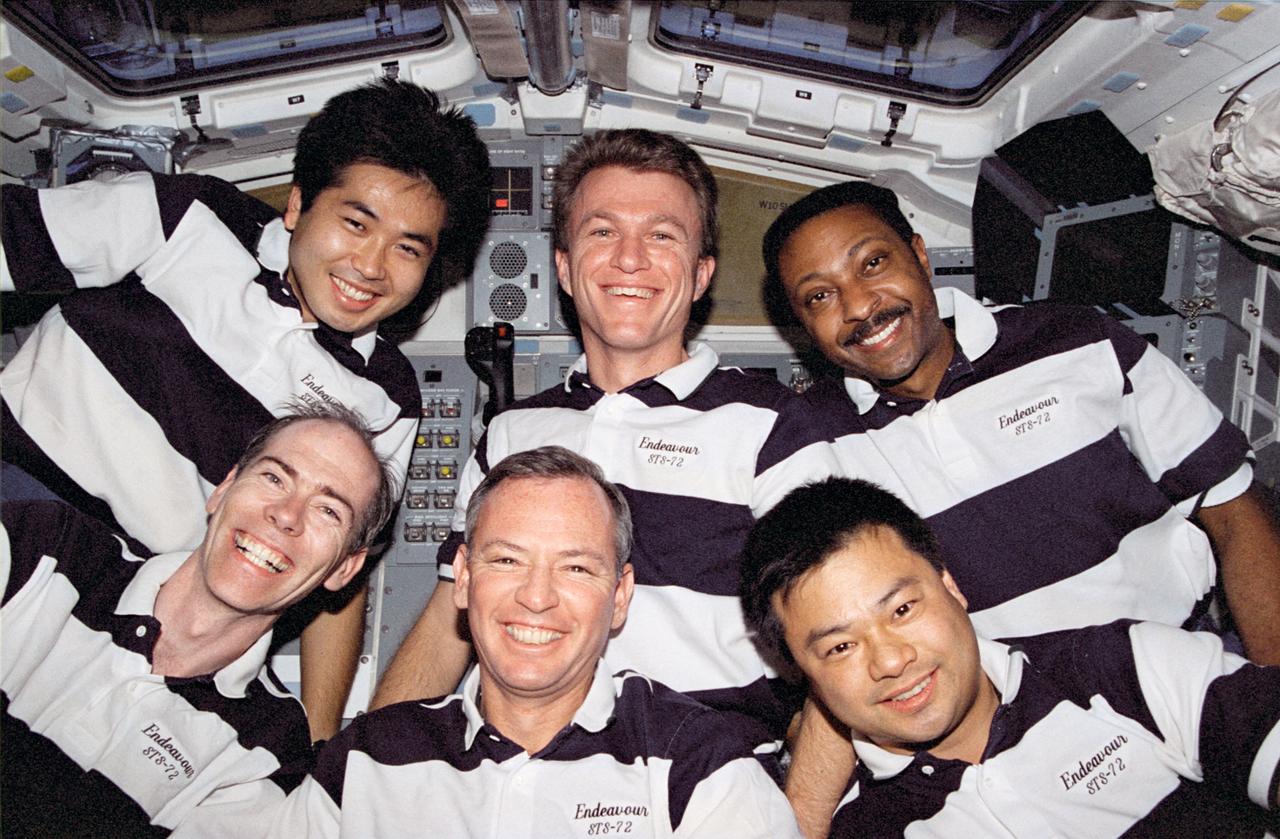
STS072-344-019 (11-20 Jan. 1996) --- The crew members selected the aft flight deck for the site of their inflight crew portrait aboard the Earth-orbiting Space Shuttle Endeavour. In front, left to right, are astronauts Daniel T. Barry, mission specialist; Brian Duffy, mission commander; and Leroy Chiao, mission specialist. In the rear are, left to right, Koichi Wakata, mission specialist representing Japan’s National Space Development Agency (NASDA); Brett W. Jett Jr., pilot; and Winston E. Scott, mission specialist. Flying in the bright sunlight, the crew had put shades in the aft flight deck windows to prevent heavy shadowing.
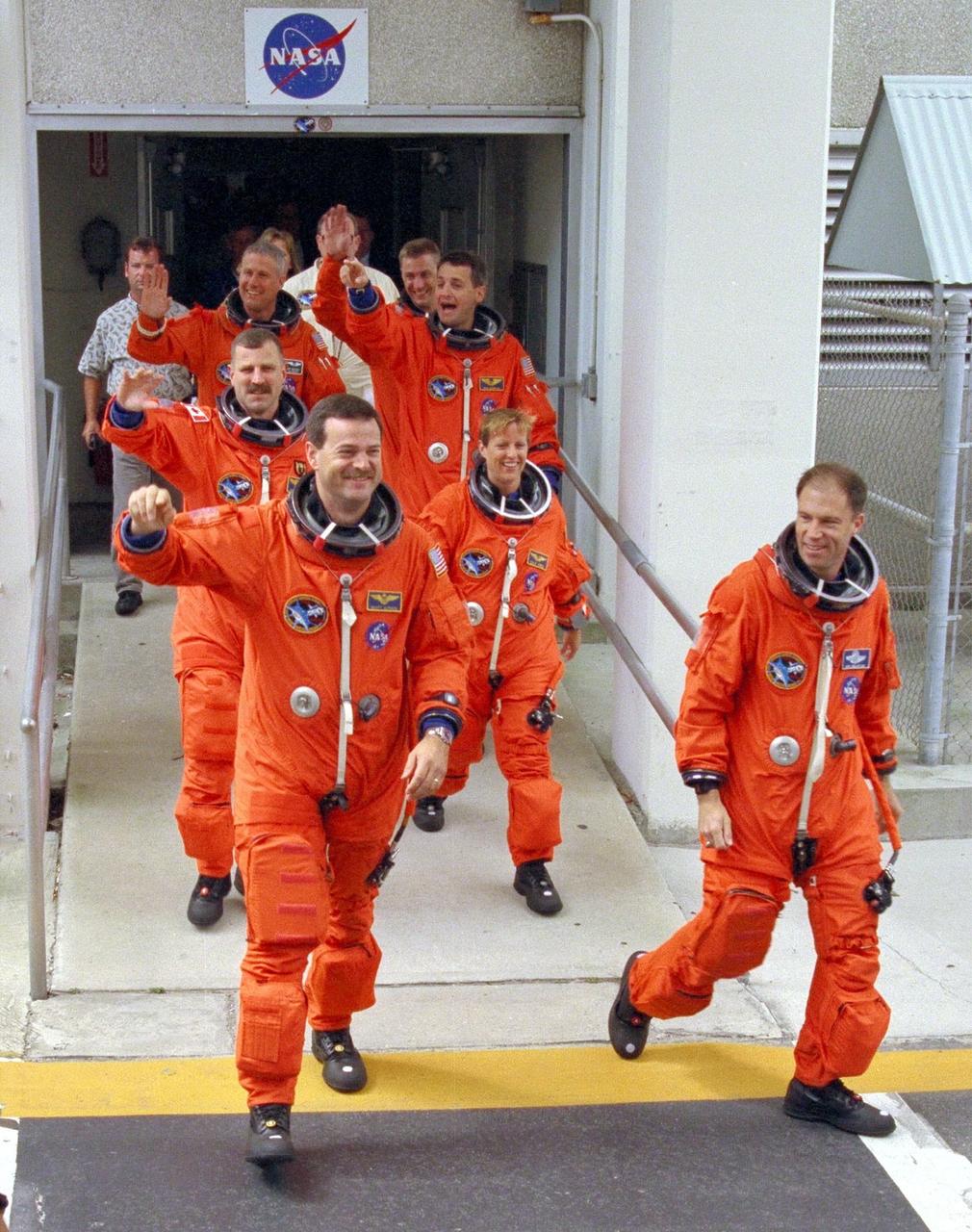
KENNEDY SPACE CENTER, FLA. -- Greeted by cheers from wellwishers at KSC and eager for their venture into space on the Neurolab mission, the STS-90 astronauts depart the Operations and Checkout Building on their way to Launch Pad 39B. Leading the seven-member crew is Mission Commander Richard Searfoss (far right), with Pilot Scott Altman by his side. Behind Altman are Mission Specialist Dafydd (Dave) Williams, M.D., (waving) with the Canadian Space Agency, and Mission Specialist Kathryn (Kay) Hire. Behind Hire is Mission Specialist Richard Linnehan, D.V.M., and next to Linnehan is Payload Specialist Jay Buckey, M.D. At the rear behind Linnehan is Payload Specialist James Pawelczyk, Ph.D. Their trip to the pad will take about 25 minutes aboard the Astrovan. Once there, they will take their positions in the crew cabin of the Space Shuttle Columbia to await a liftoff during a two-and-a-half hour window that will open at 2:19 p.m. EDT
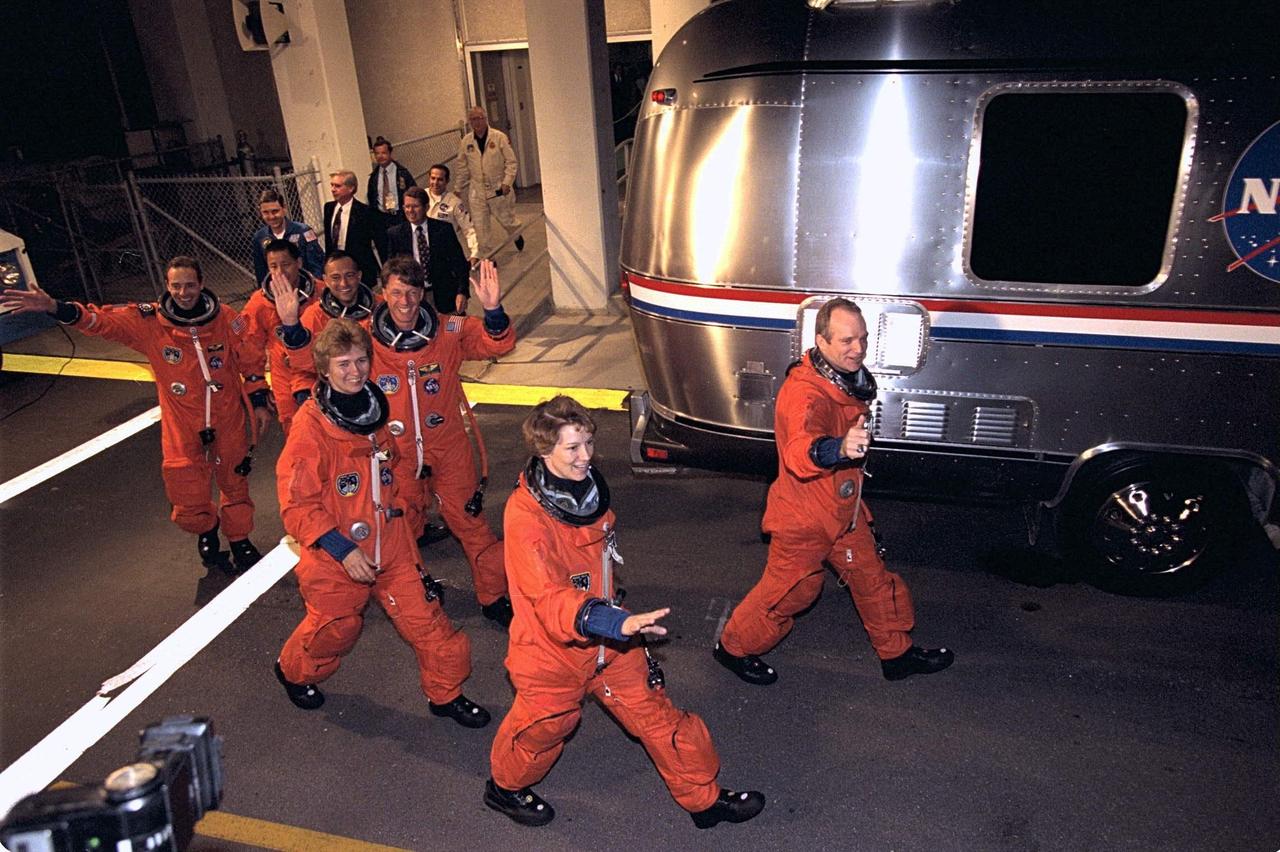
The crew of Mission STS-84 departs from the Operations and Checkout Building en route to Launch Pad 39A, where the Space Shuttle Atlantis awaits liftoff on the sixth docking of the Space Shuttle with the Russian Space Station Mir. Leading the way, from left, are Pilot Eileen Marie Collins and Commander Charles J. Precourt. Mission Specialist Elena V. Kondakova, a cosmonaut with the Russian Space Agency, walks behind Collins, and is followed by Mission Specialist C. Michael Foale, with hands upraised. At rear, from left, are Mission Specialist Jean-Francois Clervoy of the European Space Agency, Mission Specialist Edward Tsang Lu and Mission Specialist Carlos I. Noriega. The Space Shuttle Atlantis and its crew of seven are scheduled to lift off during an approximate 7-minute launch window which opens about 4:08 a.m. The exact liftoff time will be determined about 90 minutes prior to launch, based on Mir’s current location. The planned nine-day mission also will include the exchange of Foale for U.S. astronaut and Mir 23 crew member Jerry M. Linenger, who has been on Mir since Jan. 15. Linenger will return to Earth on Atlantis, and Foale will remain on Mir for about four months
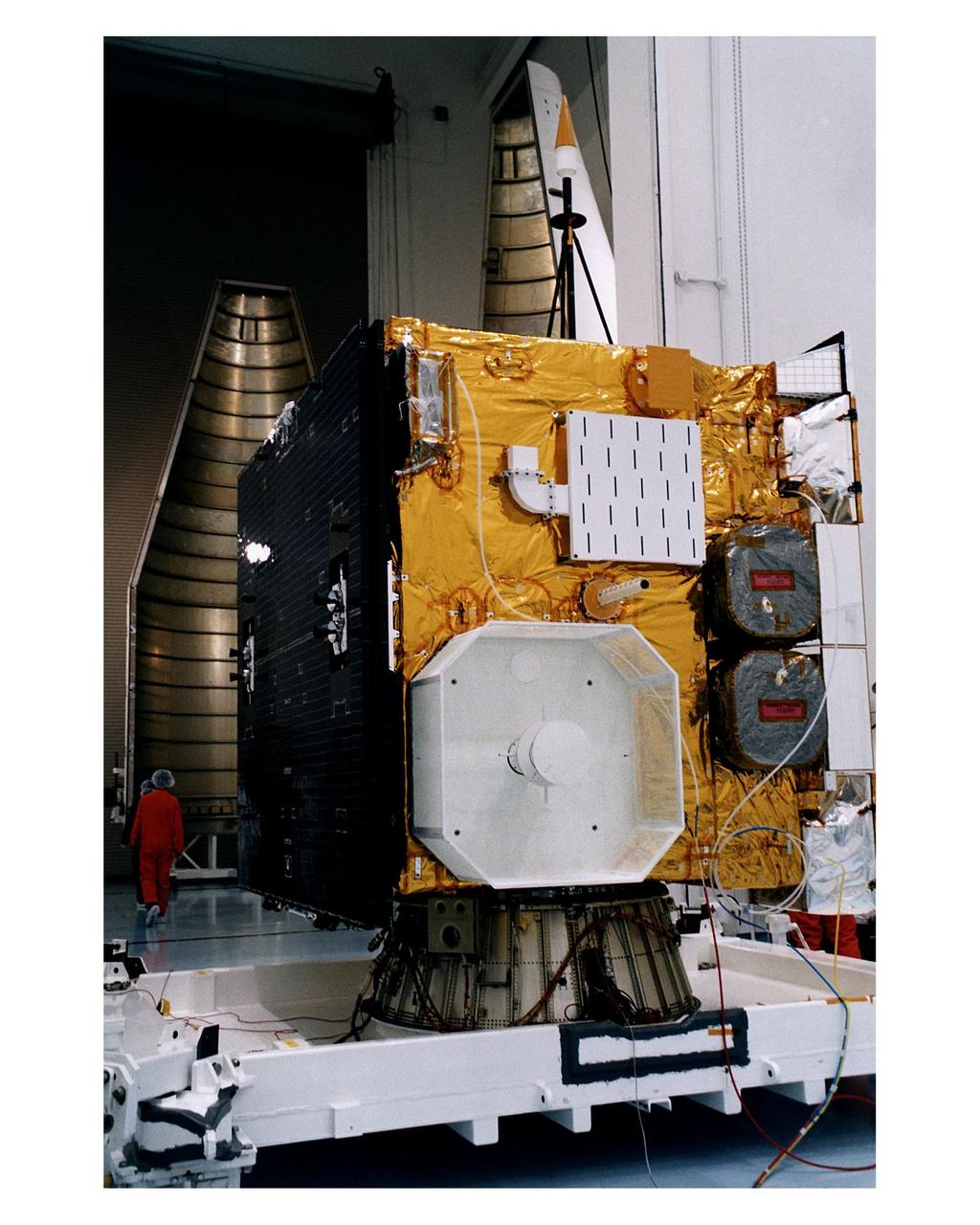
With its prelaunch processing completed, the GOES-K advanced weather satellite awaits encapsulation in the Atlas 1 payload fairing, seen at left rear. GOES-K was prepared for launch at the Astrotech Space Operations LP facility in Titusville. GOES-K will be the third spacecraft to be launched in the advanced series of Geostationary Operational Environmental Satellites (GOES). The GOES satellites are owned and operated by the National Oceanic and Atmospheric Administration (NOAA); NASA manages the design, development and launch of the spacecraft. GOES-K is targeted for an <a href="http://www-pao.ksc.nasa.gov/kscpao/release/1997/63-97.htm">April 24 launch</a> aboard a Lockheed Martin Atlas 1 expendable launch vehicle (AC-79) from Launch Complex 36, Pad B, Cape Canaveral Air Station. The launch window opens at 1:50 a.m. and extends to 3:09 a.m. EDT. Once in orbit, GOES-K will become GOES-10, joining GOES-8 and GOES-9 in space

Project LOLA. Test subject sitting at the controls: Project LOLA or Lunar Orbit and Landing Approach was a simulator built at Langley to study problems related to landing on the lunar surface. It was a complex project that cost nearly 2 million dollars. James Hansen wrote: This simulator was designed to provide a pilot with a detailed visual encounter with the lunar surface the machine consisted primarily of a cockpit, a closed-circuit TV system, and four large murals or scale models representing portions of the lunar surface as seen from various altitudes. The pilot in the cockpit moved along a track past these murals which would accustom him to the visual cues for controlling a spacecraft in the vicinity of the moon. Unfortunately, such a simulation--although great fun and quite aesthetic--was not helpful because flight in lunar orbit posed no special problems other than the rendezvous with the LEM, which the device did not simulate. Not long after the end of Apollo, the expensive machine was dismantled. (p. 379) Ellis J. White wrote in his paper, Discussion of Three Typical Langley Research Center Simulation Programs : A typical mission would start with the first cart positioned on model 1 for the translunar approach and orbit establishment. After starting the descent, the second cart is readied on model 2 and, at the proper time, when superposition occurs, the pilot s scene is switched from model 1 to model 2. then cart 1 is moved to and readied on model 3. The procedure continues until an altitude of 150 feet is obtained. The cabin of the LM vehicle has four windows which represent a 45 degree field of view. The projection screens in front of each window represent 65 degrees which allows limited head motion before the edges of the display can be seen. The lunar scene is presented to the pilot by rear projection on the screens with four Schmidt television projectors. The attitude orientation of the vehicle is represented by changing the lunar scene through the portholes determined by the scan pattern of four orthicons. The stars are front projected onto the upper three screens with a four-axis starfield generation (starball) mounted over the cabin and there is a separate starball for the low window. -- Published in James R. Hansen, Spaceflight Revolution: NASA Langley Research Center From Sputnik to Apollo, (Washington: NASA, 1995), p. 379 Ellis J. White, Discussion of Three Typical Langley Research Center Simulation Programs, Paper presented at the Eastern Simulation Council (EAI s Princeton Computation Center), Princeton, NJ, October 20, 1966.
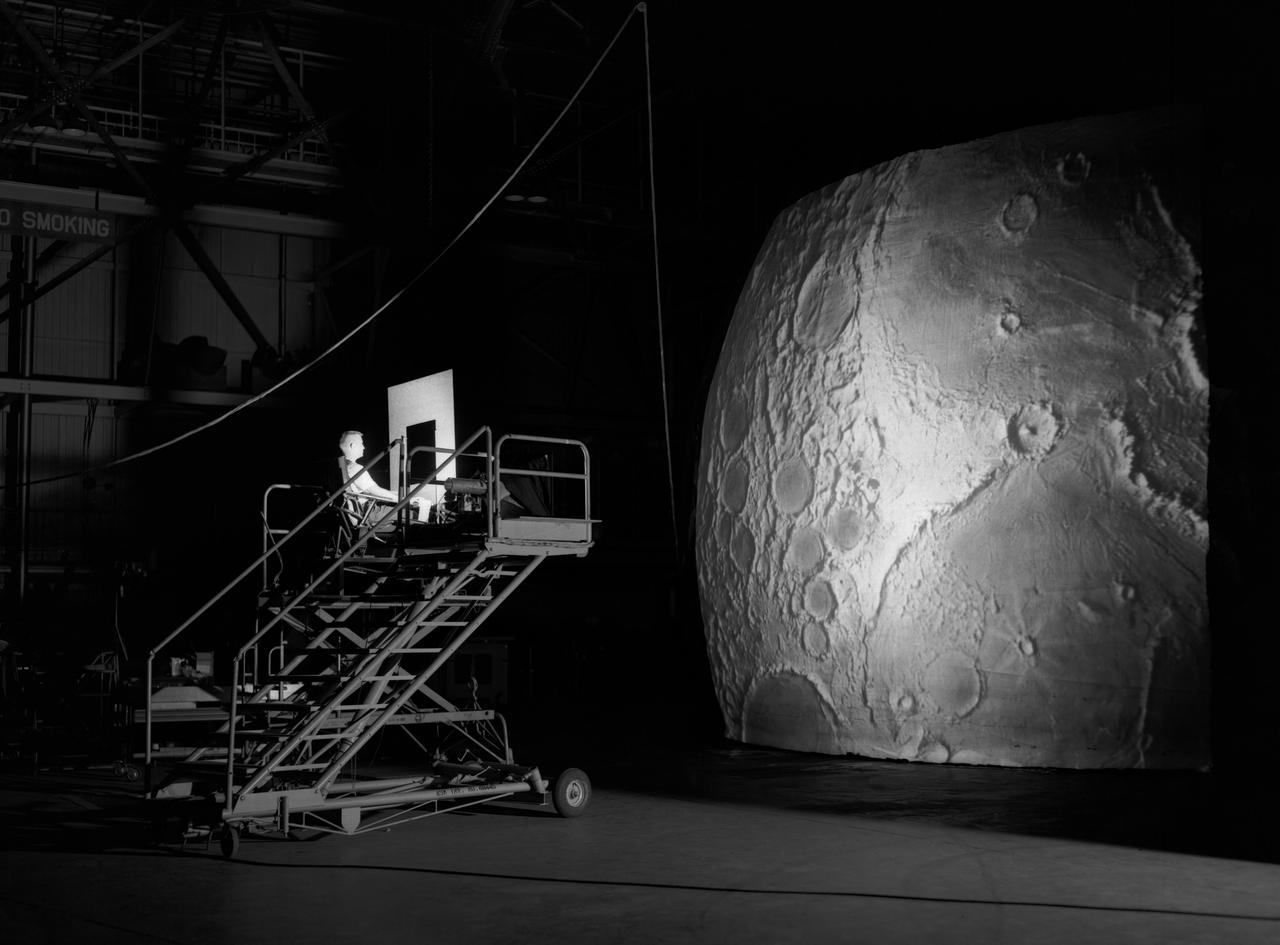
Test subject sitting at the controls: Project LOLA or Lunar Orbit and Landing Approach was a simulator built at Langley to study problems related to landing on the lunar surface. It was a complex project that cost nearly $2 million dollars. James Hansen wrote: "This simulator was designed to provide a pilot with a detailed visual encounter with the lunar surface; the machine consisted primarily of a cockpit, a closed-circuit TV system, and four large murals or scale models representing portions of the lunar surface as seen from various altitudes. The pilot in the cockpit moved along a track past these murals which would accustom him to the visual cues for controlling a spacecraft in the vicinity of the moon. Unfortunately, such a simulation--although great fun and quite aesthetic--was not helpful because flight in lunar orbit posed no special problems other than the rendezvous with the LEM, which the device did not simulate. Not long after the end of Apollo, the expensive machine was dismantled." (p. 379) Ellis J. White further described this simulator in his paper , "Discussion of Three Typical Langley Research Center Simulation Programs," (Paper presented at the Eastern Simulation Council (EAI's Princeton Computation Center), Princeton, NJ, October 20, 1966.) "A typical mission would start with the first cart positioned on model 1 for the translunar approach and orbit establishment. After starting the descent, the second cart is readied on model 2 and, at the proper time, when superposition occurs, the pilot's scene is switched from model 1 to model 2. then cart 1 is moved to and readied on model 3. The procedure continues until an altitude of 150 feet is obtained. The cabin of the LM vehicle has four windows which represent a 45 degree field of view. The projection screens in front of each window represent 65 degrees which allows limited head motion before the edges of the display can be seen. The lunar scene is presented to the pilot by rear projection on the screens with four Schmidt television projectors. The attitude orientation of the vehicle is represented by changing the lunar scene through the portholes determined by the scan pattern of four orthicons. The stars are front projected onto the upper three screens with a four-axis starfield generation (starball) mounted over the cabin and there is a separate starball for the low window." -- Published in James R. Hansen, Spaceflight Revolution: NASA Langley Research Center From Sputnik to Apollo, (Washington: NASA, 1995), p. 379.
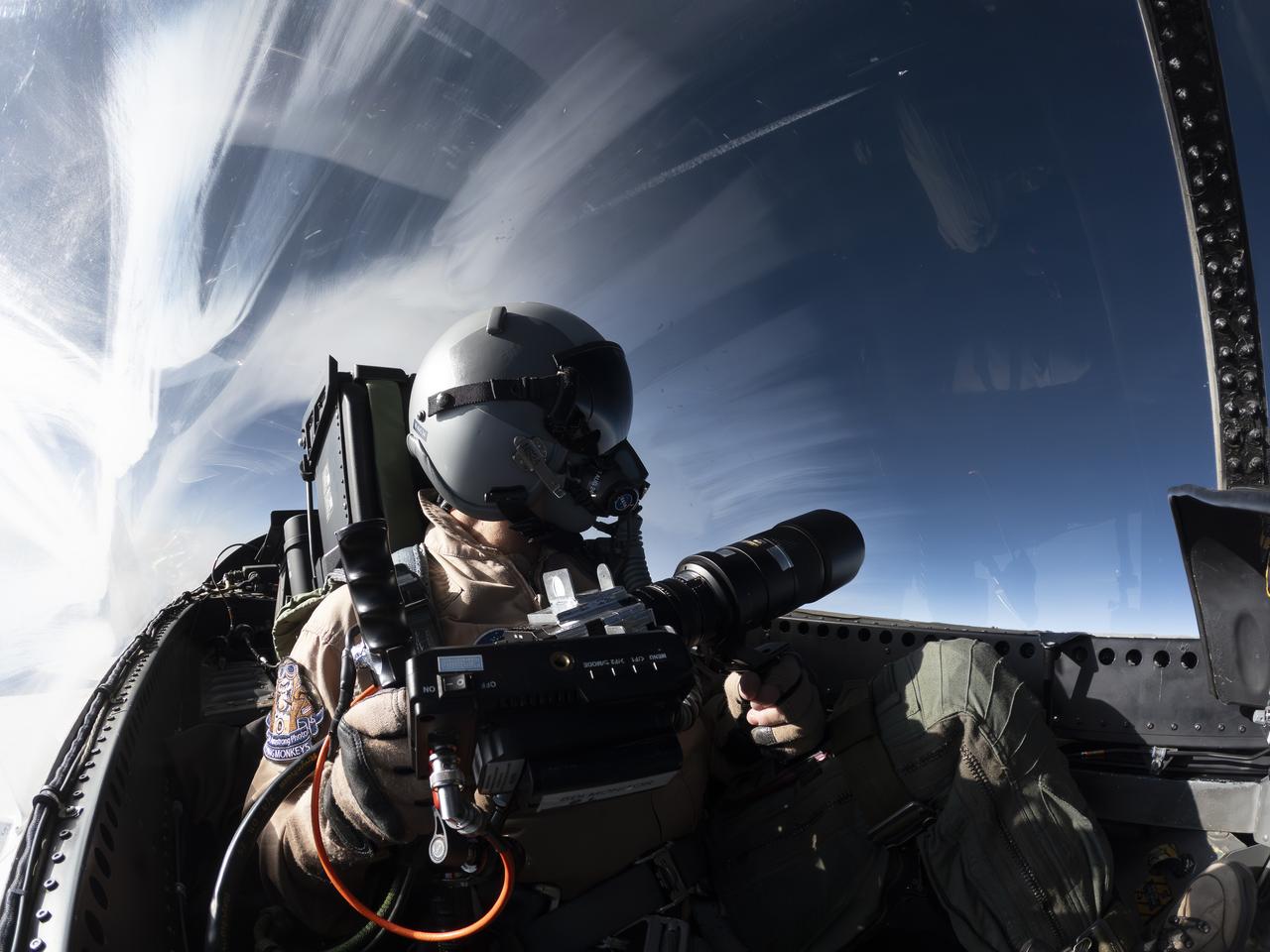
NASA Photographer Carla Thomas holds the Airborne Schlieren Photography System (ASPS), aiming it out the window in flight. The ASPS uses a photographic method called schlieren imaging, capable of visualizing changes in air density and revealing shock waves and air flow patterns around moving objects. The system is one of several tools validated during recent dual F-15 flights at NASA’s Armstrong Flight Research Center in Edwards, California, in support of NASA’s Quesst mission, ahead of the X-59’s first flight.