
Kennedy Space Center Launch Director Charlie Blackwell-Thompson speaks during a ceremony renaming the Florida spaceport’s launch control center to the Rocco A. Petrone Launch Control Center on Feb. 22, 2022. Petrone was instrumental in America’s first voyages to the Moon and headed the Apollo program. He died in 2006 at the age of 80.

Kennedy Space Center Director Janet Petro speaks during a ceremony renaming the Florida spaceport’s launch control center to the Rocco A. Petrone Launch Control Center on Feb. 22, 2022. Petrone was instrumental in America’s first voyages to the Moon and headed the Apollo program. He died in 2006 at the age of 80.

John Tribe, retired Apollo engineer, North American Rockwell, speaks during a ceremony renaming Kennedy Space Center’s launch control center to the Rocco A. Petrone Launch Control Center on Feb. 22, 2022. Petrone was instrumental in America’s first voyages to the Moon and headed the Apollo program. He died in 2006 at the age of 80.

Kennedy Space Center Deputy Director Kelvin Manning speaks during a ceremony renaming the Florida spaceport’s launch control center to the Rocco A. Petrone Launch Control Center on Feb. 22, 2022. Petrone was instrumental in America’s first voyages to the Moon and headed the Apollo program. He died in 2006 at the age of 80.
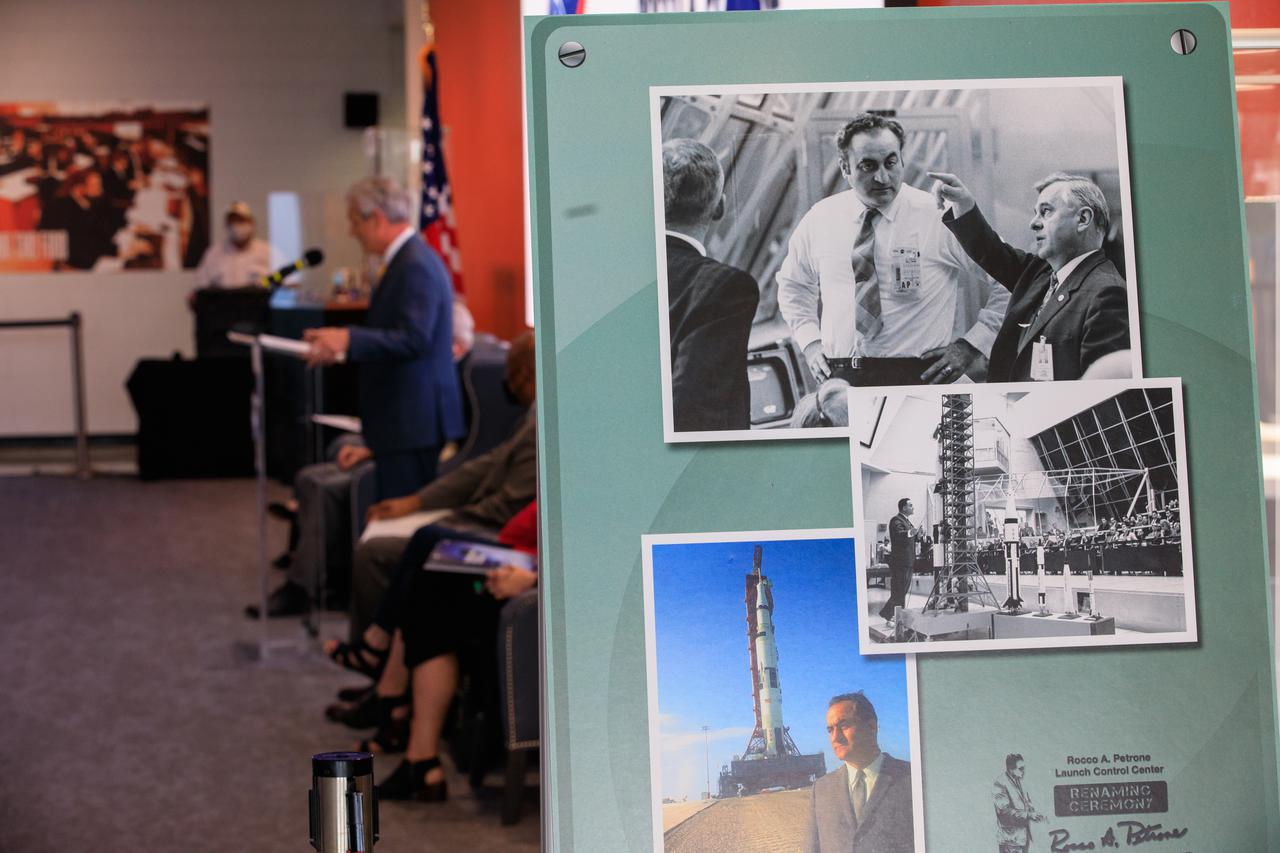
Scott Rigell, speaking on behalf of Ike Rigell, retired Apollo chief engineer and deputy director of launch vehicle operations at NASA, addresses attendees during a ceremony renaming Kennedy Space Center’s launch control center to the Rocco A. Petrone Launch Control Center on Feb. 22, 2022. Petrone was instrumental in America’s first voyages to the Moon and headed the Apollo program. He died in 2006 at the age of 80.
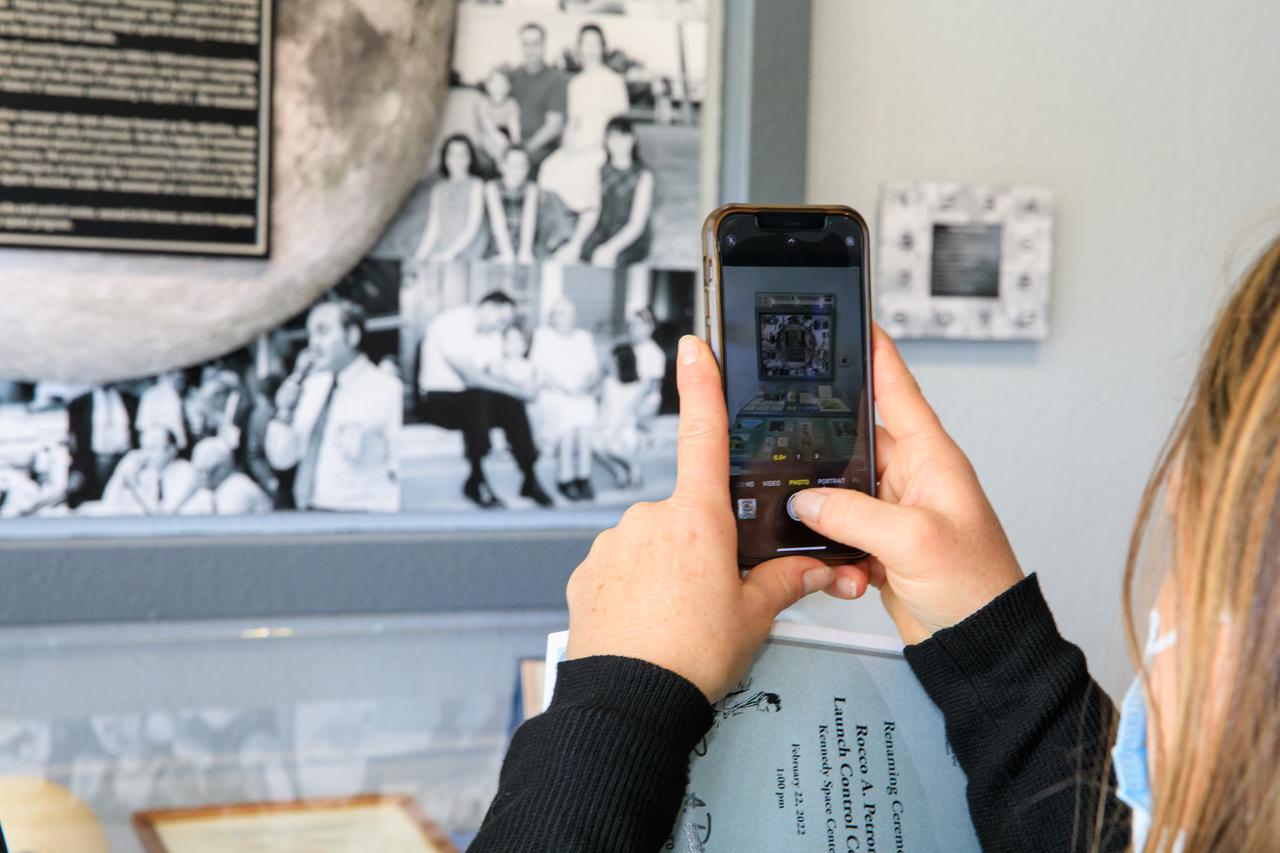
A spectator takes a photo of a display dedicated to former Kennedy Space Center director Rocco Petrone on Feb. 22, 2022. During a ceremony held at the Florida spaceport, Kennedy’s launch control center was officially renamed to the Rocco A. Petrone Launch Control Center. Petrone was instrumental in America’s first voyages to the Moon and headed the Apollo program. He died in 2006 at the age of 80.
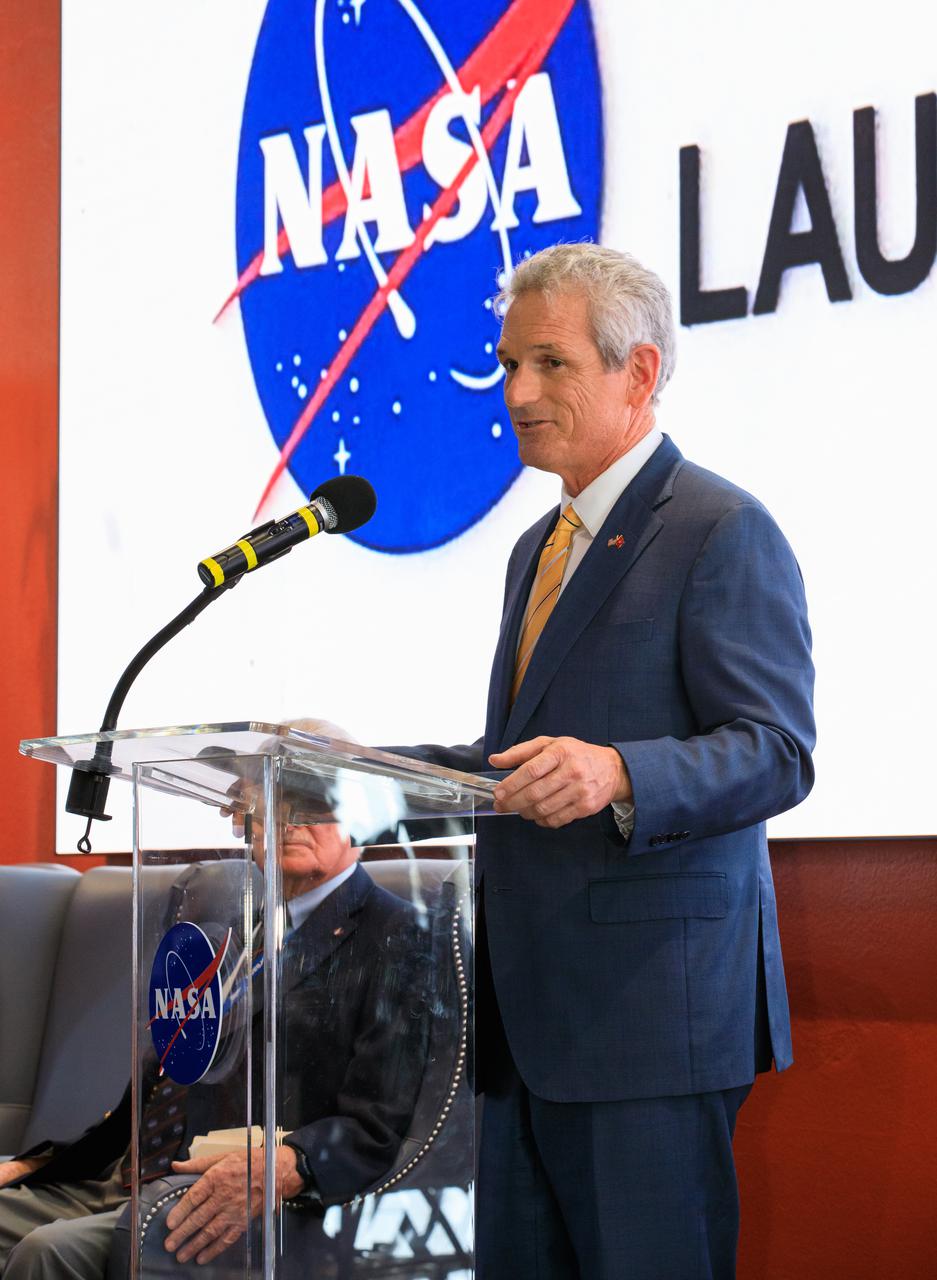
Scott Rigell, speaking on behalf of Ike Rigell, retired Apollo chief engineer and deputy director of launch vehicle operations at NASA, addresses attendees during a ceremony renaming Kennedy Space Center’s launch control center to the Rocco A. Petrone Launch Control Center on Feb. 22, 2022. Petrone was instrumental in America’s first voyages to the Moon and headed the Apollo program. He died in 2006 at the age of 80.
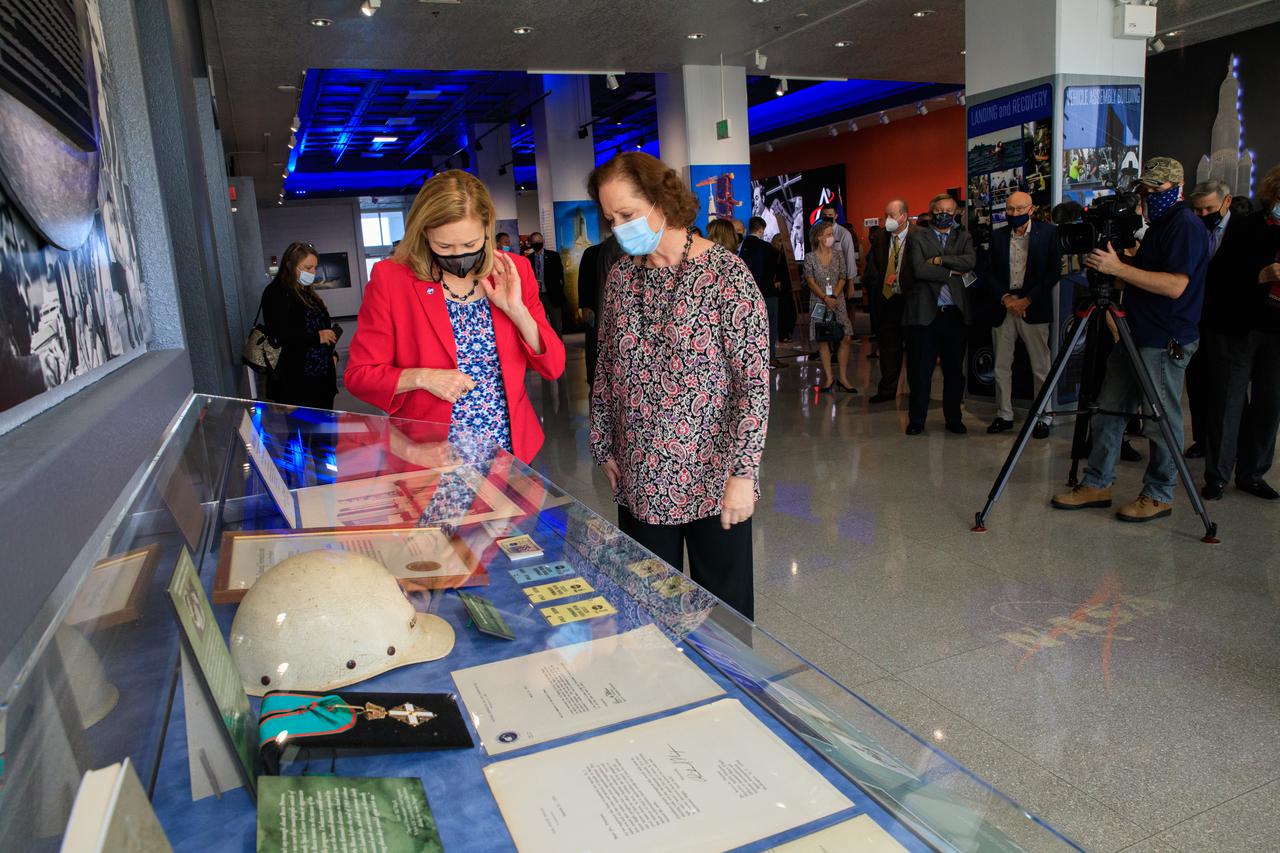
A display dedicated to former Kennedy Space Center launch director Rocco Petrone is viewed at Kennedy Space Center on Feb. 22, 2022. During a ceremony held at the Florida spaceport, Kennedy’s launch control center was officially renamed to the Rocco A. Petrone Launch Control Center. Petrone was instrumental in America’s first voyages to the Moon and headed the Apollo program. He died in 2006 at the age of 80.

A display dedicated to former Kennedy Space Center director Rocco Petrone is viewed at Kennedy Space Center on Feb. 22, 2022. During a ceremony held at the Florida spaceport, Kennedy’s launch control center was officially renamed to the Rocco A. Petrone Launch Control Center. Petrone was instrumental in America’s first voyages to the Moon and headed the Apollo program. He died in 2006 at the age of 80.
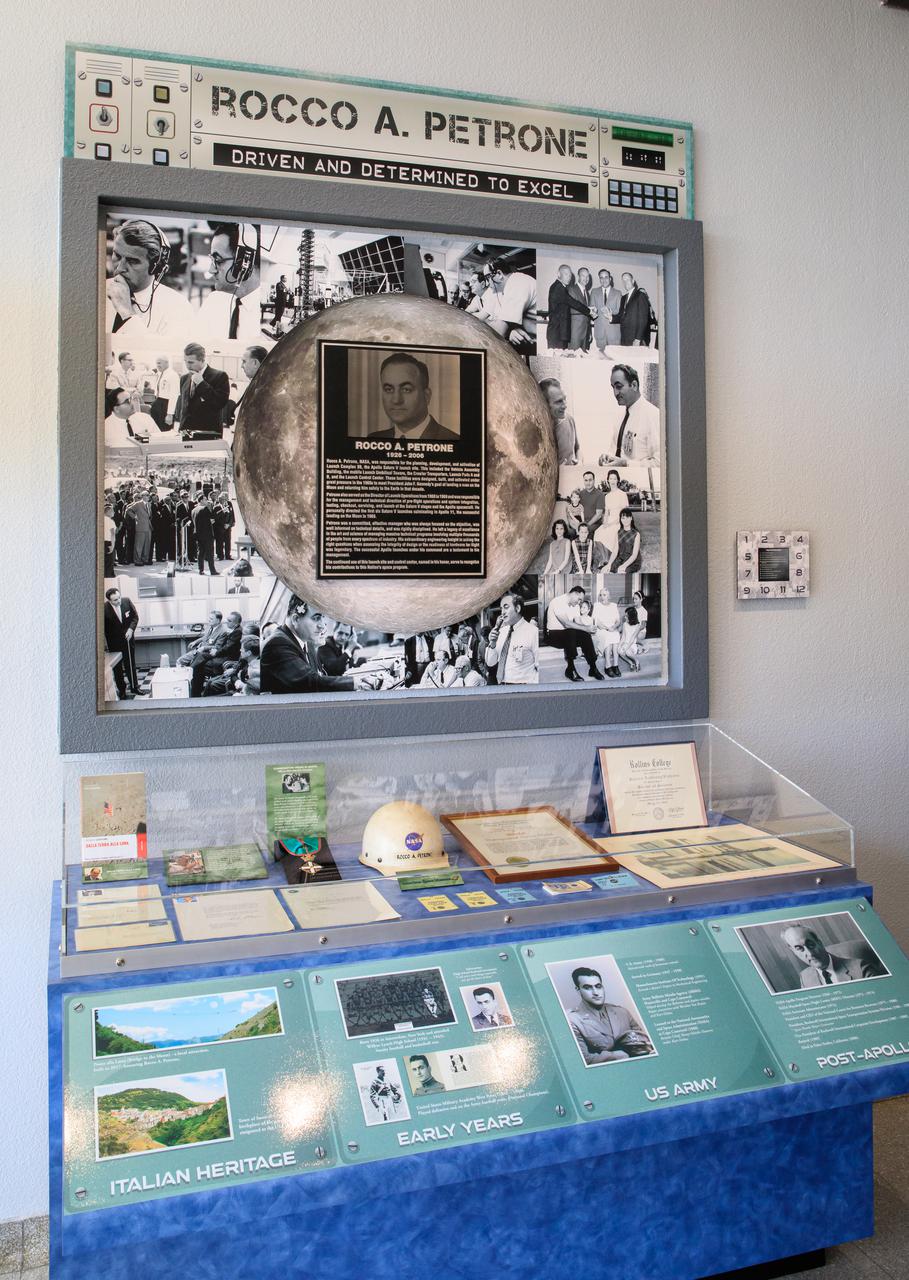
Shown is a display honoring former Kennedy Space Center launch director Rocco Petrone at the Florida spaceport on Feb. 22, 2022. During a ceremony held at Kennedy, the launch control center was officially renamed to the Rocco A. Petrone Launch Control Center. Petrone was instrumental in America’s first voyages to the Moon and headed the Apollo program. He died in 2006 at the age of 80.
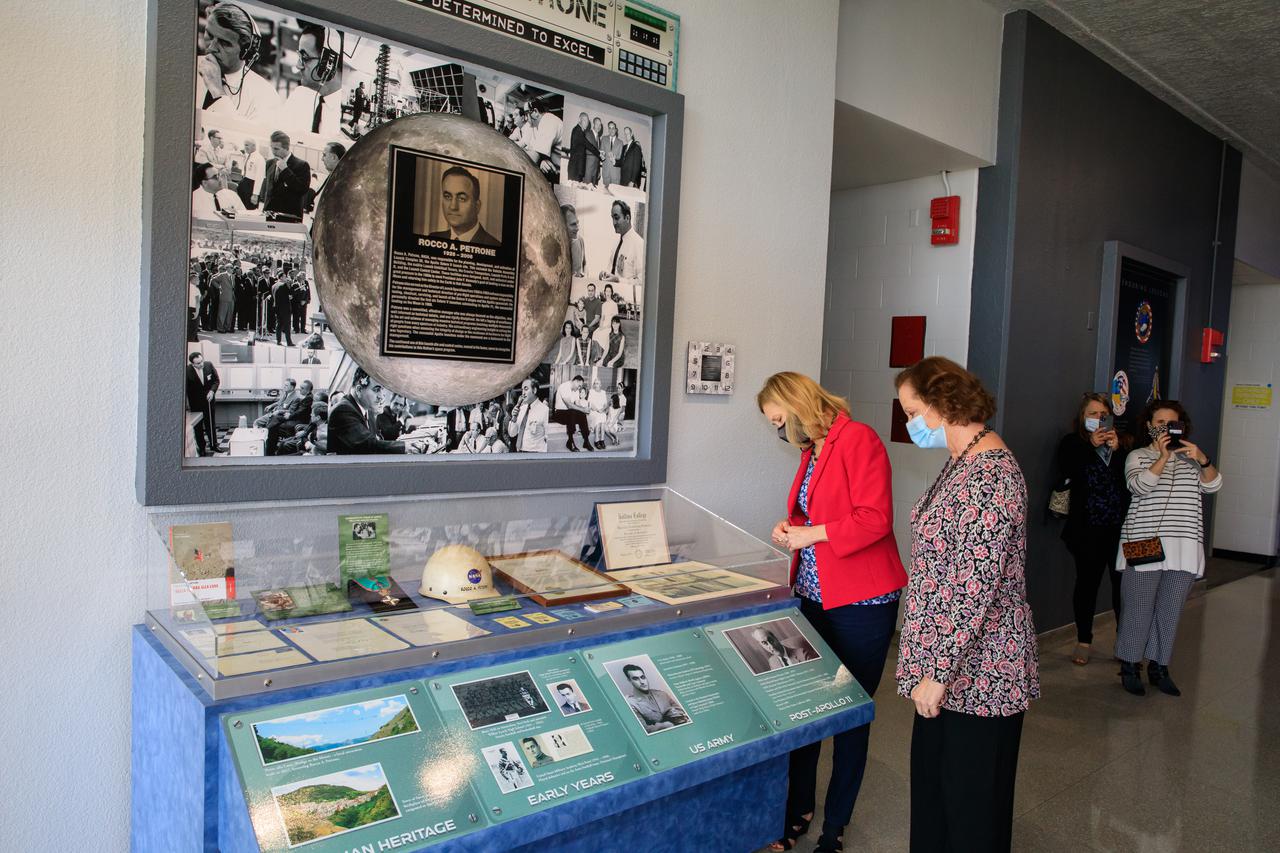
A display dedicated to former Kennedy Space Center launch director Rocco Petrone is viewed at Kennedy Space Center on Feb. 22, 2022. During a ceremony held at the Florida spaceport, Kennedy’s launch control center was officially renamed to the Rocco A. Petrone Launch Control Center. Petrone was instrumental in America’s first voyages to the Moon and headed the Apollo program. He died in 2006 at the age of 80.
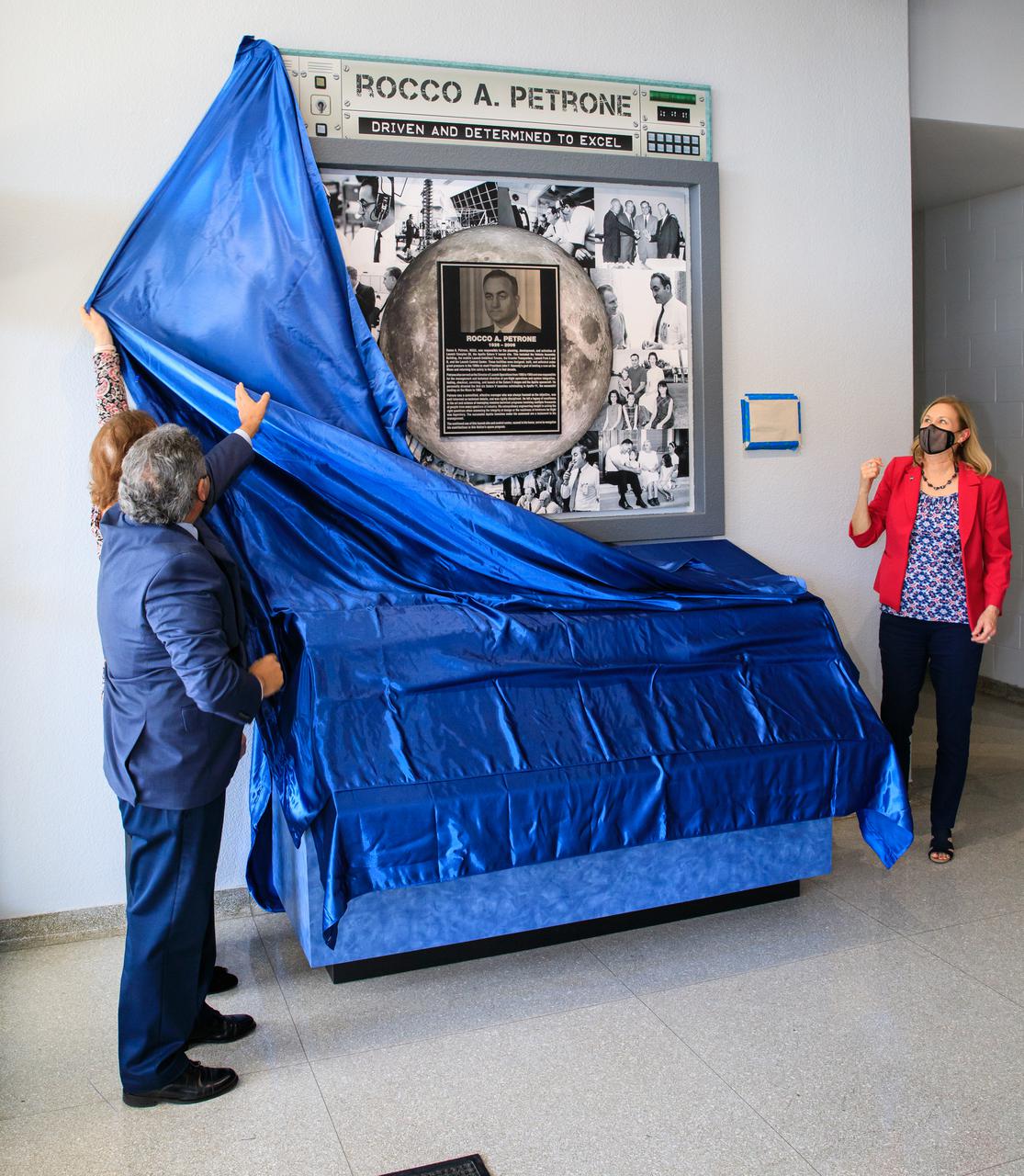
A display dedicated to former Kennedy Space Center launch director Rocco Petrone is unveiled at Kennedy Space Center on Feb. 22, 2022. During a ceremony held at the Florida spaceport, Kennedy’s launch control center was officially renamed to the Rocco A. Petrone Launch Control Center. Petrone was instrumental in America’s first voyages to the Moon and headed the Apollo program. He died in 2006 at the age of 80.
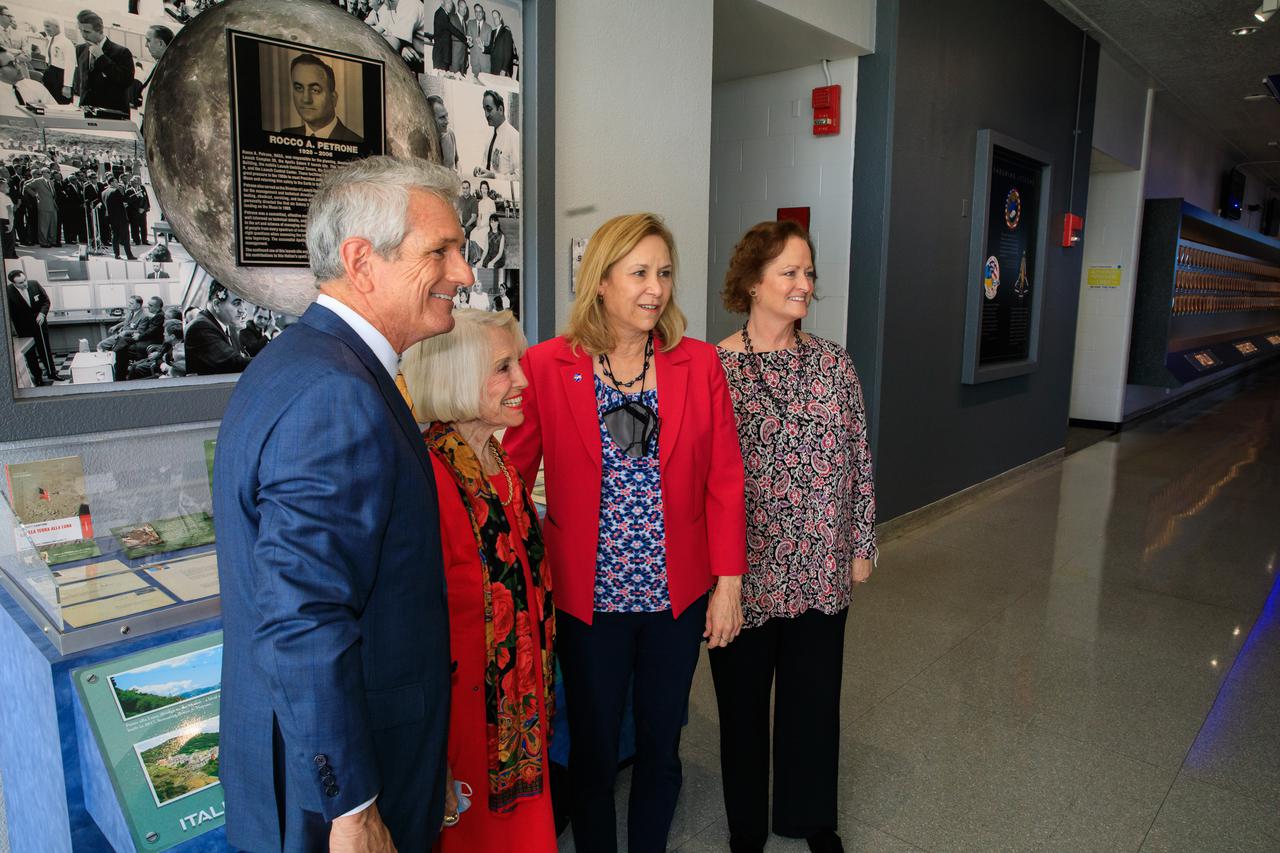
Kennedy Space Center Director Janet Petro, second from right, poses in front of a display dedicated to former Kennedy Space Center launch director Rocco Petrone at the Florida spaceport on Feb. 22, 2022. Also pictured is Scott Rigell, far left, and Kathy Posey, daughter of Petrone, far right. During a ceremony held at Kennedy, the launch control center was officially renamed to the Rocco A. Petrone Launch Control Center. Petrone was instrumental in America’s first voyages to the Moon and headed the Apollo program. He died in 2006 at the age of 80.

Former director of NASA’s Earth Science Division, Mike Freilich, speaks at a renaming ceremony for the international ocean science satellite previously known as Sentinel-6A/Jason-CS, Tuesday, January 28, 2020, at NASA Headquarters in Washington. NASA and its European partners renamed the satellite Sentinel-6 Michael Freilich after Dr. Freilich. Sentinel-6A Michael Freilich will observe and record global sea level changes and will be joined by an identical satellite slated to launch in 2025 for a total of ten years of targeted observations. Photo Credit: (NASA/Aubrey Gemignani)

NASA Administrator Jim Bridenstine applauds NASA’s former director of the Earth Science division, Dr. Michael Freilich, right, during a renaming ceremony for the international ocean science satellite previously known as Sentinel-6A/Jason-CS, Tuesday, January 28, 2020, at NASA Headquarters in Washington. NASA and its European partners renamed the satellite Sentinel-6 Michael Freilich after him. Sentinel-6A Michael Freilich will observe and record global sea level changes and will be joined by an identical satellite slated to launch in 2025 for a total of ten years of targeted observations.” Photo Credit: (NASA/Aubrey Gemignani)

Former director of NASA’s Earth Science Division, Mike Freilich, gestures at the conclusion of a renaming ceremony for the international ocean science satellite previously known as Sentinel-6A/Jason-CS, Tuesday, January 28, 2020, at NASA Headquarters in Washington. NASA and its European partners renamed the satellite Sentinel-6 Michael Freilich after him. Sentinel-6A Michael Freilich will observe and record global sea level changes and will be joined by an identical satellite slated to launch in 2025 for a total of ten years of targeted observations. Photo Credit: (NASA/Aubrey Gemignani)

Head of Global Issues and Innovation of the European Union delegation to the United States, Mercedes Garcia Pérez speaks at a renaming ceremony for the international ocean science satellite previously known as Sentinel-6A/Jason-CS, Tuesday, January 28, 2020, at NASA Headquarters in Washington. NASA and its European partners renamed the satellite Sentinel-6 Michael Freilich after NASA’s former director of the Earth Science division, Dr. Michael Freilich. Sentinel-6A Michael Freilich will observe and record global sea level changes and will be joined by an identical satellite slated to launch in 2025 for a total of ten years of targeted observations.” Photo Credit: (NASA/Aubrey Gemignani)

National Oceanic and Atmospheric Administration (NOAA) assistant administrator for Satellite and Information Services, Stephen Volz, speaks at a renaming ceremony for the international ocean science satellite previously known as Sentinel-6A/Jason-CS, Tuesday, January 28, 2020, at NASA Headquarters in Washington. NASA and its European partners renamed the satellite Sentinel-6 Michael Freilich after NASA’s former director of the Earth Science division, Dr. Michael Freilich. Sentinel-6A Michael Freilich will observe and record global sea level changes and will be joined by an identical satellite slated to launch in 2025 for a total of ten years of targeted observations.” Photo Credit: (NASA/Aubrey Gemignani)
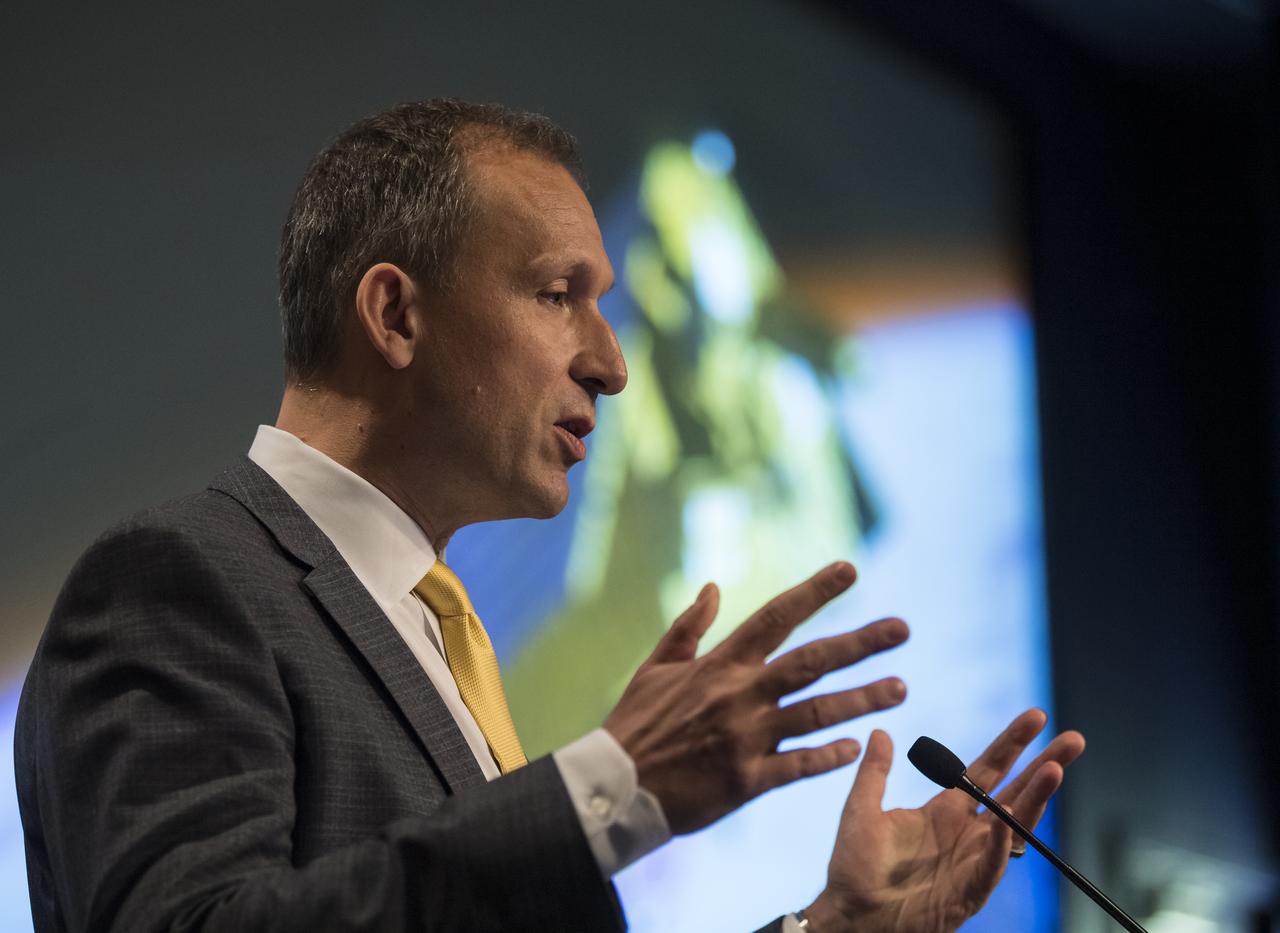
NASA associate administrator for Science, Thomas Zurbuchen, speaks at a renaming ceremony for the international ocean science satellite previously known as Sentinel-6A/Jason-CS, Tuesday, January 28, 2020, at NASA Headquarters in Washington. NASA and its European partners renamed the satellite Sentinel-6 Michael Freilich after NASA’s former director of the Earth Science division, Dr. Michael Freilich. Sentinel-6A Michael Freilich will observe and record global sea level changes and will be joined by an identical satellite slated to launch in 2025 for a total of ten years of targeted observations.” Photo Credit: (NASA/Aubrey Gemignani)

NASA associate administrator for Science, Thomas Zurbuchen, left, makes closing remarks with Dr. Michael Freilich, right, at the conclusion of a renaming ceremony for the international ocean science satellite previously known as Sentinel-6A/Jason-CS, Tuesday, January 28, 2020, at NASA Headquarters in Washington. NASA and its European partners renamed the satellite Sentinel-6 Michael Freilich after NASA’s former director of the Earth Science division, Dr. Michael Freilich. Sentinel-6A Michael Freilich will observe and record global sea level changes and will be joined by an identical satellite slated to launch in 2025 for a total of ten years of targeted observations. Photo Credit: (NASA/Aubrey Gemignani)

Former director of NASA’s Earth Science Division, Mike Freilich is seen onstage at the conclusion of a renaming ceremony for the international ocean science satellite previously known as Sentinel-6A/Jason-CS, Tuesday, January 28, 2020, at NASA Headquarters in Washington. NASA and its European partners renamed the satellite Sentinel-6 Michael Freilich after Dr. Freilich. Sentinel-6A Michael Freilich will observe and record global sea level changes and will be joined by an identical satellite slated to launch in 2025 for a total of ten years of targeted observations. Photo Credit: (NASA/Aubrey Gemignani)

EUMETSAT director-general, Alain Ratier, speaks at a renaming ceremony for the international ocean science satellite previously known as Sentinel-6A/Jason-CS, Tuesday, January 28, 2020, at NASA Headquarters in Washington. NASA and its European partners renamed the satellite Sentinel-6 Michael Freilich after NASA’s former director of the Earth Science division, Dr. Michael Freilich. Sentinel-6A Michael Freilich will observe and record global sea level changes and will be joined by an identical satellite slated to launch in 2025 for a total of ten years of targeted observations.” Photo Credit: (NASA/Aubrey Gemignani)

The audience applauds NASA’s former director of the Earth Science division, Dr. Michael Freilich, right, at the conclusion of a renaming ceremony for the international ocean science satellite previously known as Sentinel-6A/Jason-CS, Tuesday, January 28, 2020, at NASA Headquarters in Washington. NASA and its European partners renamed the satellite Sentinel-6 Michael Freilich after him. Sentinel-6A Michael Freilich will observe and record global sea level changes and will be joined by an identical satellite slated to launch in 2025 for a total of ten years of targeted observations. Photo Credit: (NASA/Aubrey Gemignani)

NASA associate administrator for Science, Thomas Zurbuchen, speaks at a renaming ceremony for the international ocean science satellite previously known as Sentinel-6A/Jason-CS, Tuesday, January 28, 2020, at NASA Headquarters in Washington. NASA and its European partners renamed the satellite Sentinel-6 Michael Freilich after NASA’s former director of the Earth Science division, Dr. Michael Freilich. Sentinel-6A Michael Freilich will observe and record global sea level changes and will be joined by an identical satellite slated to launch in 2025 for a total of ten years of targeted observations.” Photo Credit: (NASA/Aubrey Gemignani)

ESA (European Space Agency) director of Earth Observation Programmes, Josef Aschbacher, left, presents NASA’s former director of the Earth Science division, Dr. Michael Freilich with an award after announcing that the international ocean science satellite previously known as Sentinel-6A/Jason-CS has been renamed Sentinel-6 Michael Freilich after him, Tuesday, January 28, 2020, at NASA Headquarters in Washington. Sentinel-6A Michael Freilich will observe and record global sea level changes and will be joined by an identical satellite slated to launch in 2025 for a total of ten years of targeted observations. Photo Credit: (NASA/Aubrey Gemignani)
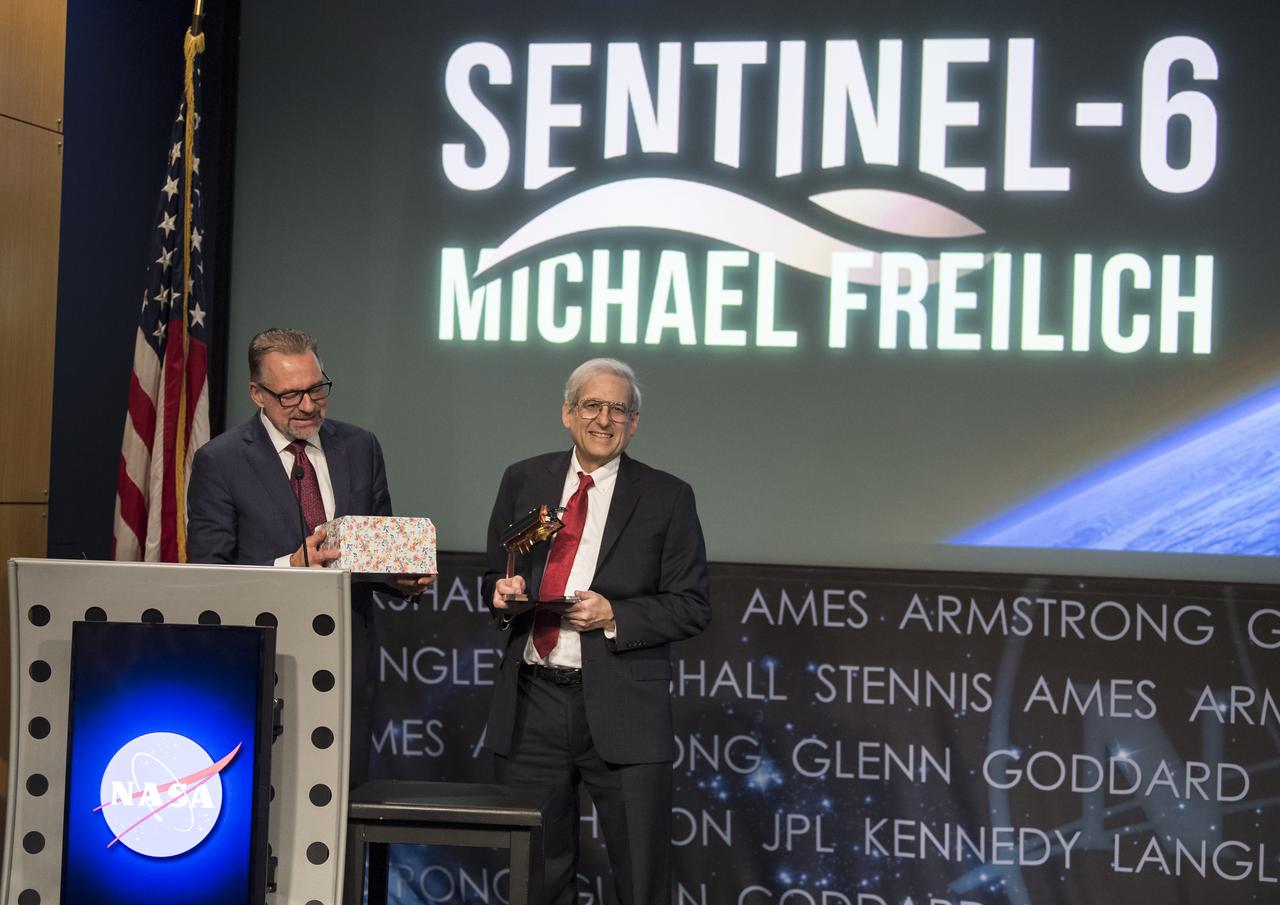
ESA (European Space Agency) director of Earth Observation Programmes, Josef Aschbacher, left, presents NASA’s former director of the Earth Science division, Dr. Michael Freilich with an award after announcing that the international ocean science satellite previously known as Sentinel-6A/Jason-CS has been renamed Sentinel-6 Michael Freilich after him, Tuesday, January 28, 2020, at NASA Headquarters in Washington. Sentinel-6A Michael Freilich will observe and record global sea level changes and will be joined by an identical satellite slated to launch in 2025 for a total of ten years of targeted observations. Photo Credit: (NASA/Aubrey Gemignani)

ESA (European Space Agency) director of Earth Observation Programmes, Josef Aschbacher, announces that the international ocean science satellite previously known as Sentinel-6A/Jason-CS has been renamed Sentinel-6 Michael Freilich after NASA’s former director of the Earth Science division, Dr. Michael Freilich, Tuesday, January 28, 2020, at NASA Headquarters in Washington. Sentinel-6A Michael Freilich will observe and record global sea level changes and will be joined by an identical satellite slated to launch in 2025 for a total of ten years of targeted observations. Photo Credit: (NASA/Aubrey Gemignani)
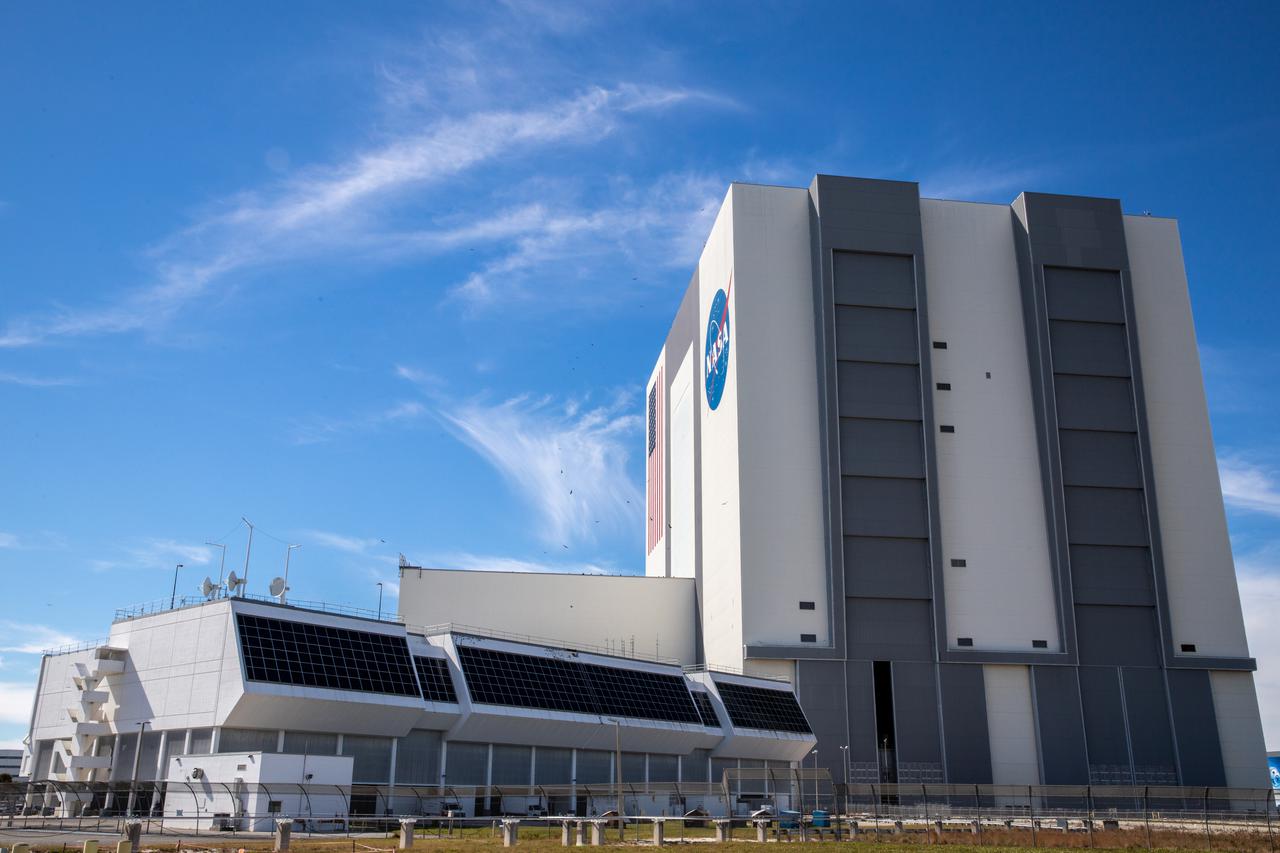
Following a ceremony at NASA’s Kennedy Space Center, the Florida spaceport’s launch control center was officially renamed the Rocco A. Petrone Launch Control Center. The facility serves as a nerve center where engineers and the launch director will monitor their flight consoles and give the “go” for the upcoming launch of Artemis I and later missions that will establish a sustainable presence on the Moon to prepare for missions to Mars. Petrone, who was instrumental in America’s first voyages to the Moon and headed the Apollo program, died in 2006 at the age of 80.
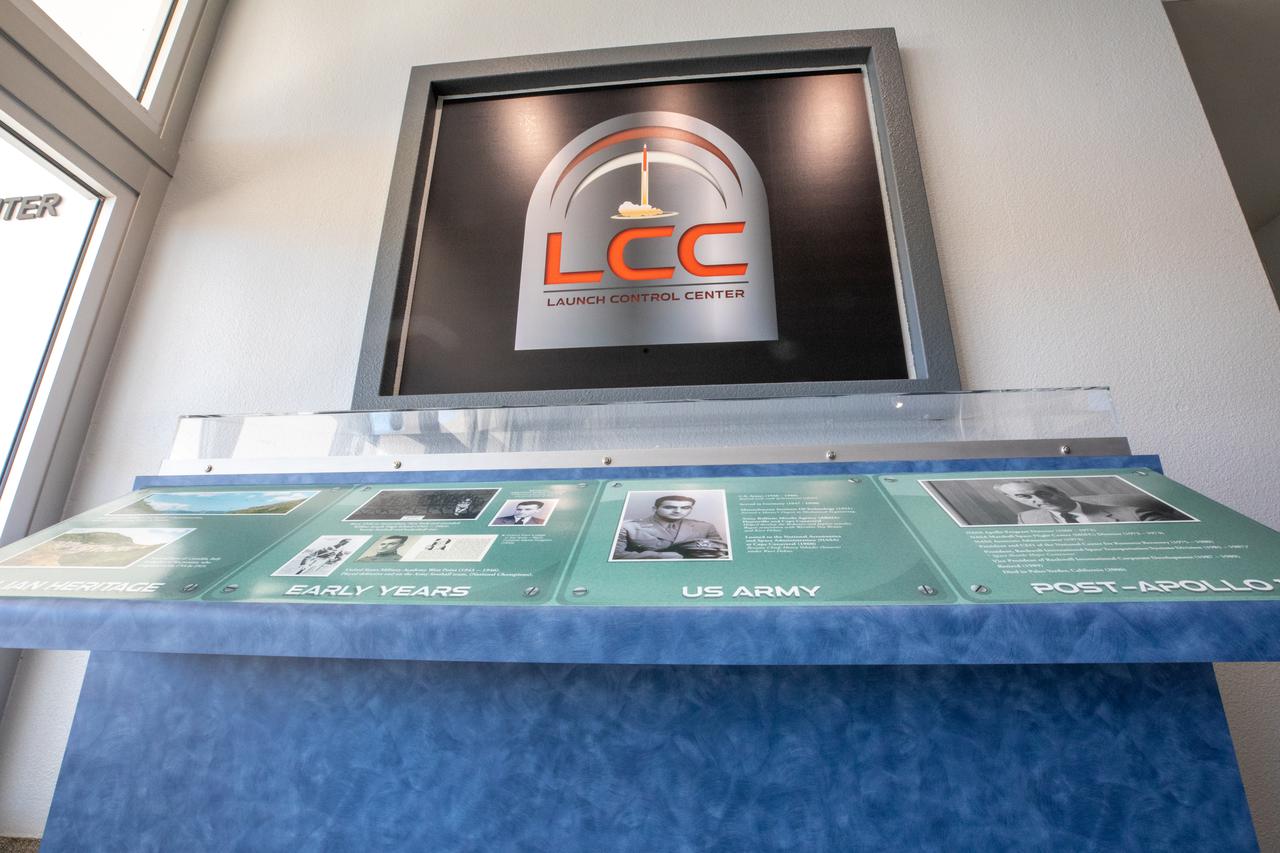
Following a ceremony at NASA’s Kennedy Space Center, the Florida spaceport’s launch control center was officially renamed the Rocco A. Petrone Launch Control Center. The facility serves as a nerve center where engineers and the launch director will monitor their flight consoles and give the “go” for the upcoming launch of Artemis I and later missions that will establish a sustainable presence on the Moon to prepare for missions to Mars. Petrone, who was instrumental in America’s first voyages to the Moon and headed the Apollo program, died in 2006 at the age of 80.
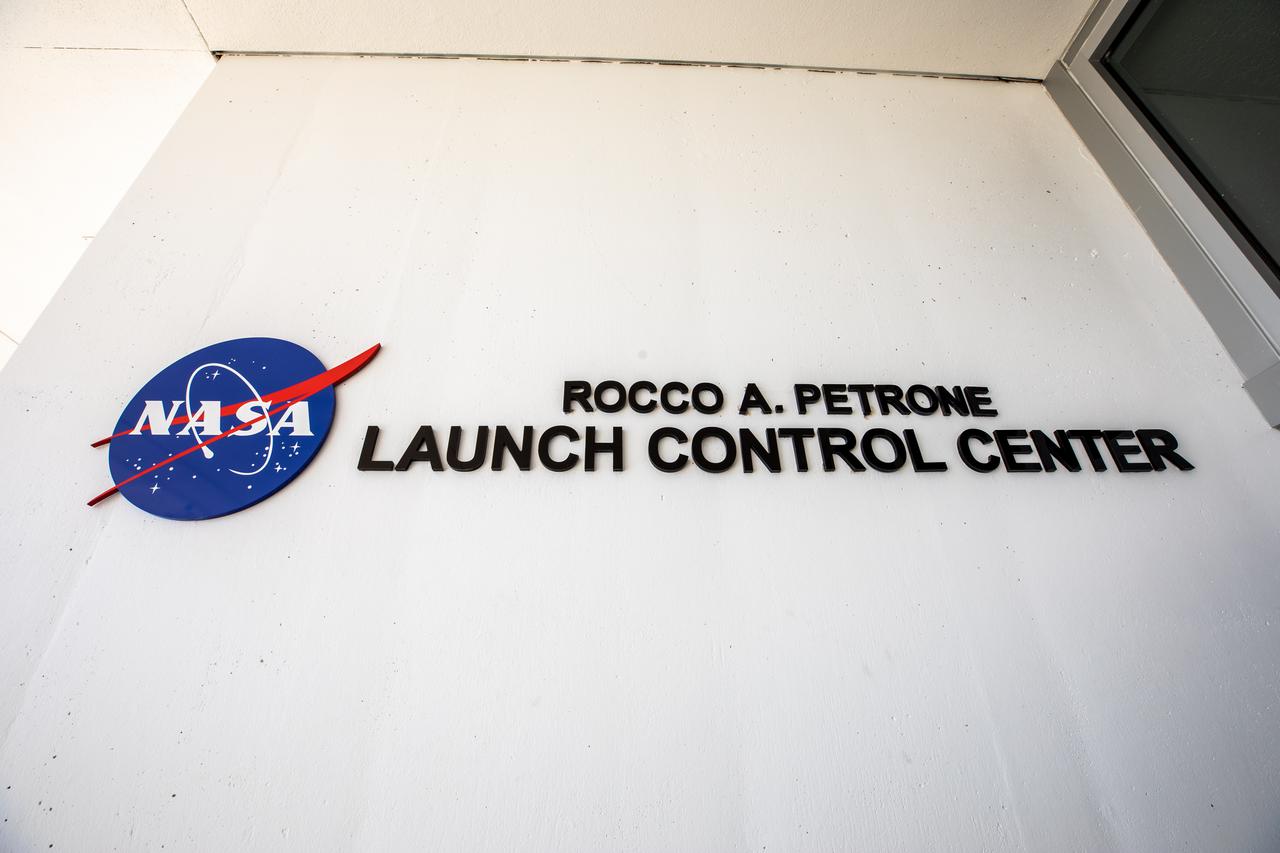
Following a ceremony at NASA’s Kennedy Space Center, the Florida spaceport’s launch control center was officially renamed the Rocco A. Petrone Launch Control Center. The facility serves as a nerve center where engineers and the launch director will monitor their flight consoles and give the “go” for the upcoming launch of Artemis I and later missions that will establish a sustainable presence on the Moon to prepare for missions to Mars. Petrone, who was instrumental in America’s first voyages to the Moon and headed the Apollo program, died in 2006 at the age of 80.
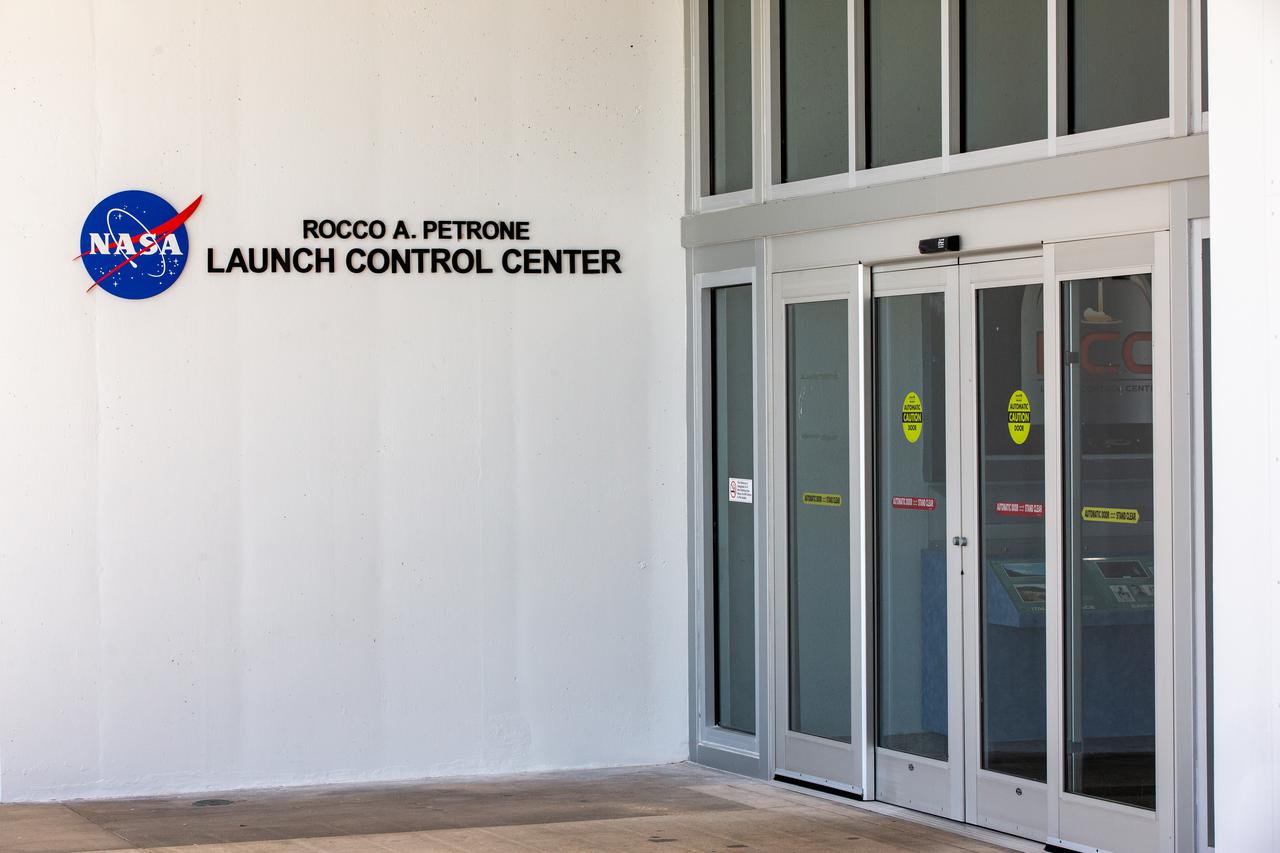
Following a ceremony at NASA’s Kennedy Space Center, the Florida spaceport’s launch control center was officially renamed the Rocco A. Petrone Launch Control Center. The facility serves as a nerve center where engineers and the launch director will monitor their flight consoles and give the “go” for the upcoming launch of Artemis I and later missions that will establish a sustainable presence on the Moon to prepare for missions to Mars. Petrone, who was instrumental in America’s first voyages to the Moon and headed the Apollo program, died in 2006 at the age of 80.
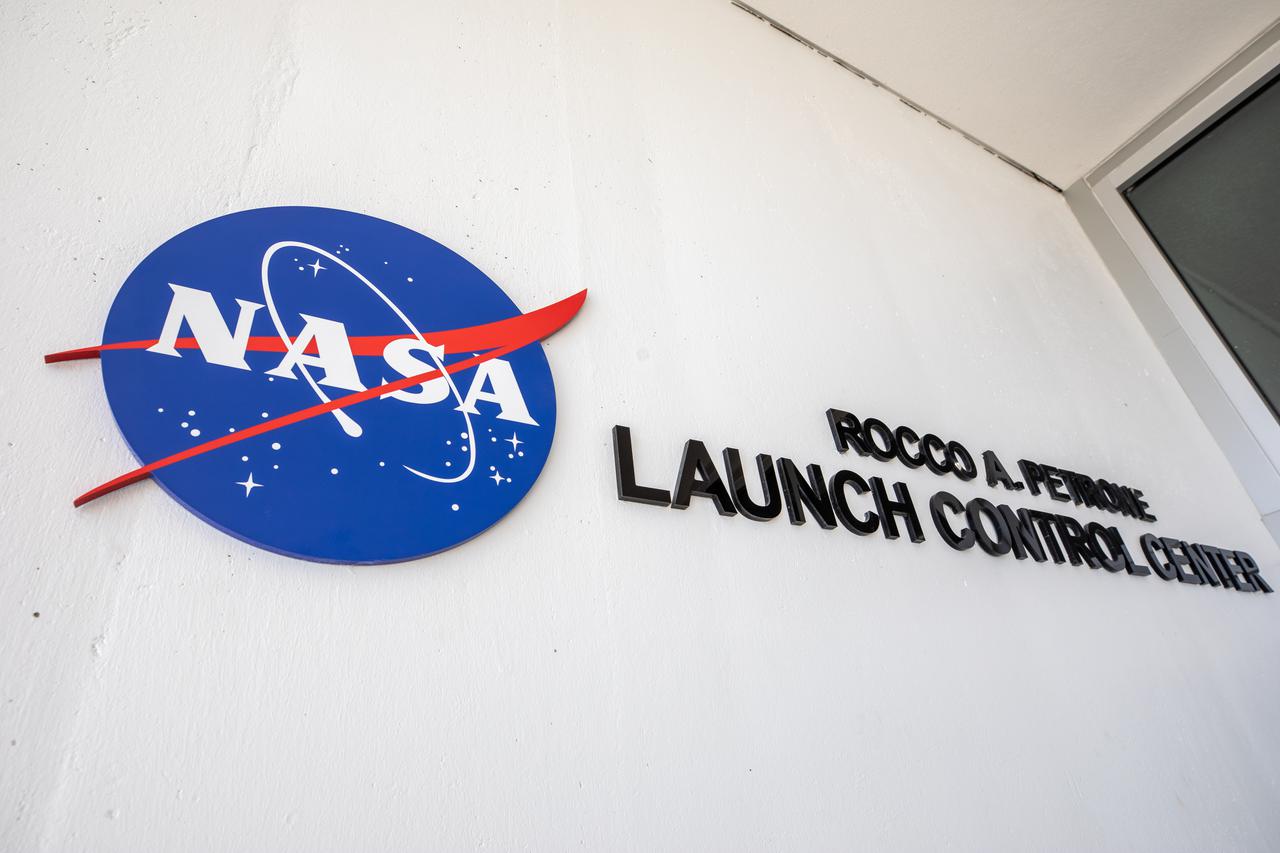
Following a ceremony at NASA’s Kennedy Space Center, the Florida spaceport’s launch control center was officially renamed the Rocco A. Petrone Launch Control Center. The facility serves as a nerve center where engineers and the launch director will monitor their flight consoles and give the “go” for the upcoming launch of Artemis I and later missions that will establish a sustainable presence on the Moon to prepare for missions to Mars. Petrone, who was instrumental in America’s first voyages to the Moon and headed the Apollo program, died in 2006 at the age of 80.
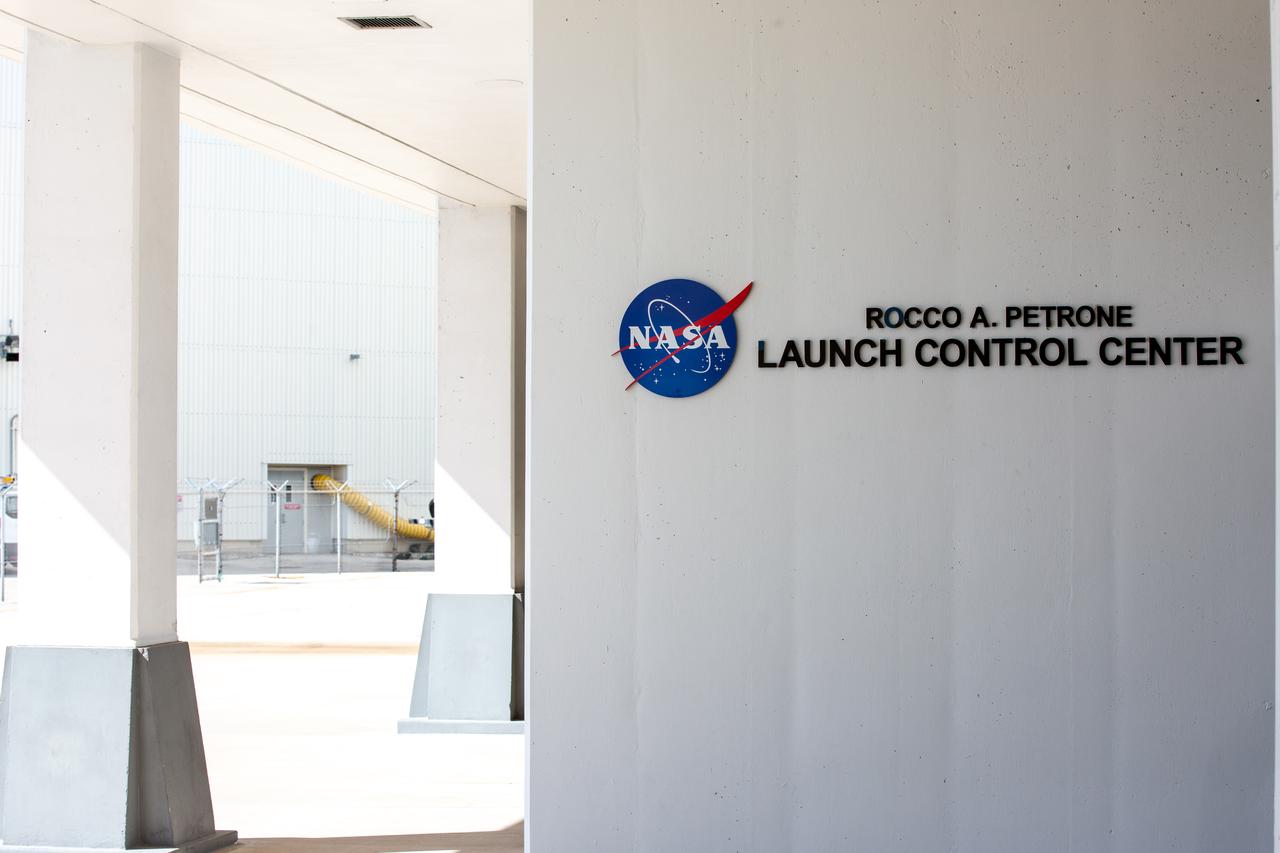
Following a ceremony at NASA’s Kennedy Space Center, the Florida spaceport’s launch control center was officially renamed the Rocco A. Petrone Launch Control Center. The facility serves as a nerve center where engineers and the launch director will monitor their flight consoles and give the “go” for the upcoming launch of Artemis I and later missions that will establish a sustainable presence on the Moon to prepare for missions to Mars. Petrone, who was instrumental in America’s first voyages to the Moon and headed the Apollo program, died in 2006 at the age of 80.
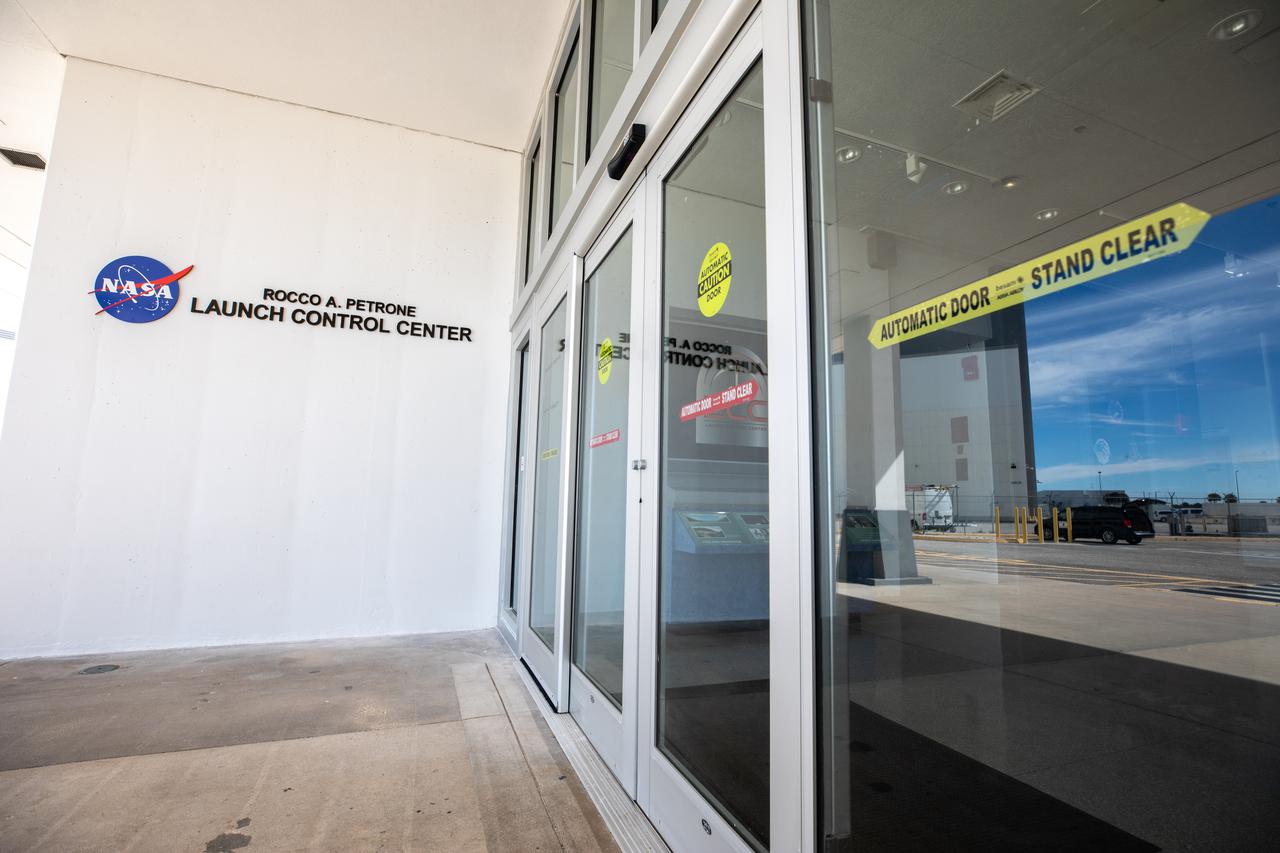
Following a ceremony at NASA’s Kennedy Space Center, the Florida spaceport’s launch control center was officially renamed the Rocco A. Petrone Launch Control Center. The facility serves as a nerve center where engineers and the launch director will monitor their flight consoles and give the “go” for the upcoming launch of Artemis I and later missions that will establish a sustainable presence on the Moon to prepare for missions to Mars. Petrone, who was instrumental in America’s first voyages to the Moon and headed the Apollo program, died in 2006 at the age of 80.
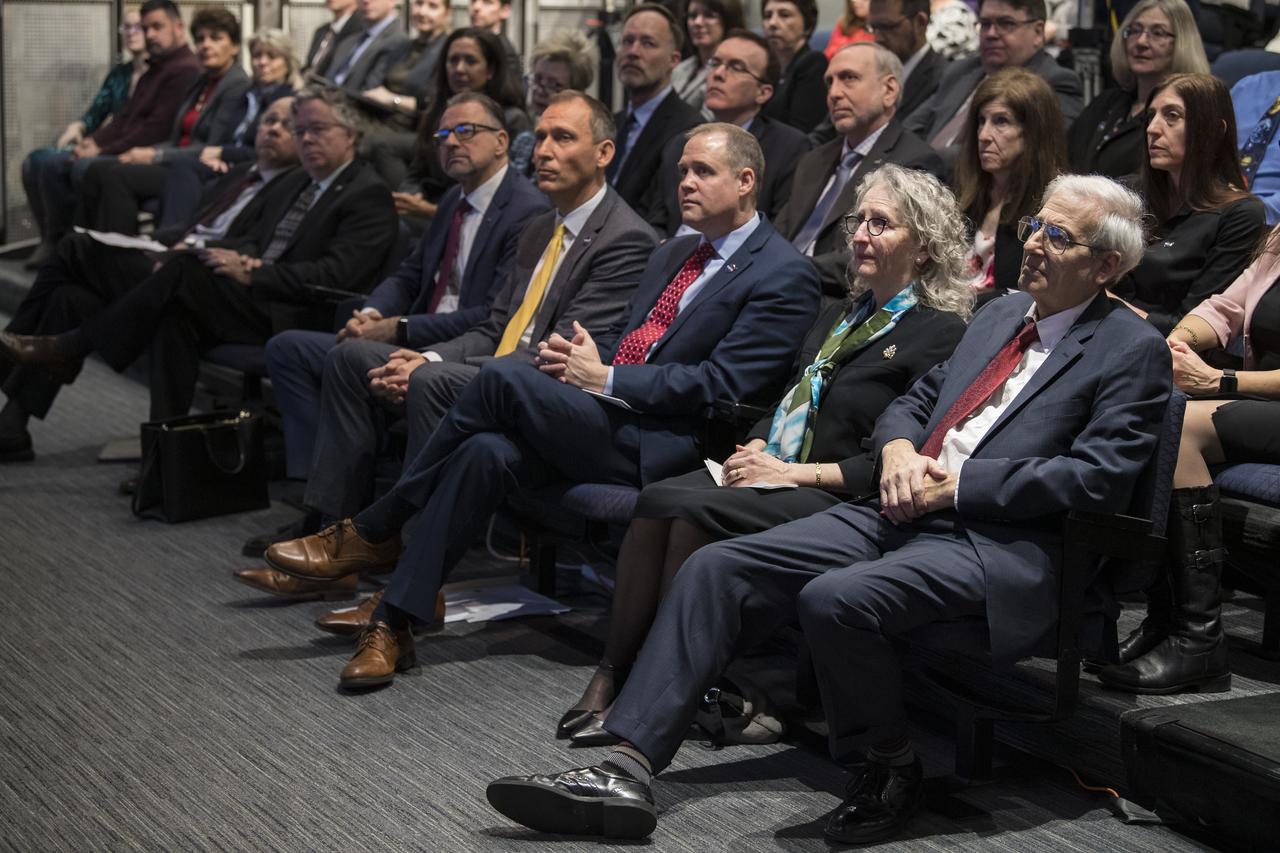
Front row, from left to right, EUMETSAT director-general, Alain Ratier; National Oceanic and Atmospheric Administration (NOAA) assistant administrator for Satellite and Information Services, Stephen Volz; ESA (European Space Agency) director of Earth Observation Programmes, Josef Aschbacher; NASA associate administrator for Science, Thomas Zurbuchen; NASA Administrator Jim Bridenstine; and Former director of NASA’s Earth Science Division, Mike Freilich and his wife are seen in the audience at a renaming ceremony for the international ocean science satellite previously known as Sentinel-6A/Jason-CS, Tuesday, January 28, 2020, at NASA Headquarters in Washington. NASA and its European partners renamed the satellite Sentinel-6 Michael Freilich after NASA’s former director of the Earth Science division, Dr. Michael Freilich. Sentinel-6A Michael Freilich will observe and record global sea level changes and will be joined by an identical satellite slated to launch in 2025 for a total of ten years of targeted observations. Photo Credit: (NASA/Aubrey Gemignani)
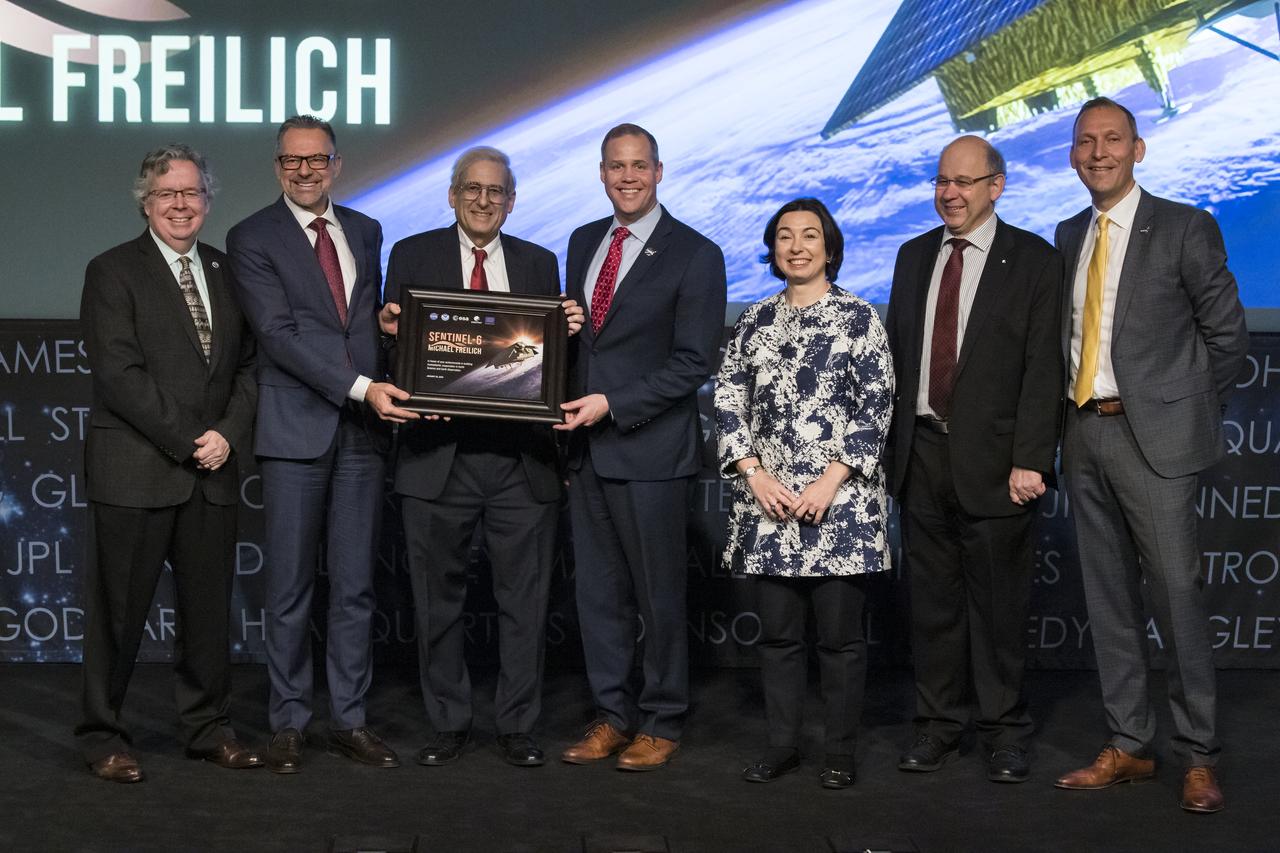
From left to right, National Oceanic and Atmospheric Administration (NOAA) assistant administrator for Satellite and Information Services, Stephen Volz; ESA (European Space Agency) director of Earth Observation Programmes, Josef Aschbacher; Former director of NASA’s Earth Science Division, Mike Freilich; NASA Administrator Jim Bridenstine; Head of Global Issues and Innovation of the European Union delegation to the United States, Mercedes Garcia Pérez; EUMETSAT director-general, Alain Ratier; and NASA associate administrator for Science, Thomas Zurbuchen pose for a group photo at the conclusion of a renaming ceremony for the international ocean science satellite previously known as Sentinel-6A/Jason-CS, Tuesday, January 28, 2020, at NASA Headquarters in Washington. NASA and its European partners renamed the satellite Sentinel-6 Michael Freilich after Dr. Freilich. Sentinel-6A Michael Freilich will observe and record global sea level changes and will be joined by an identical satellite slated to launch in 2025 for a total of ten years of targeted observations. Photo Credit: (NASA/Aubrey Gemignani)
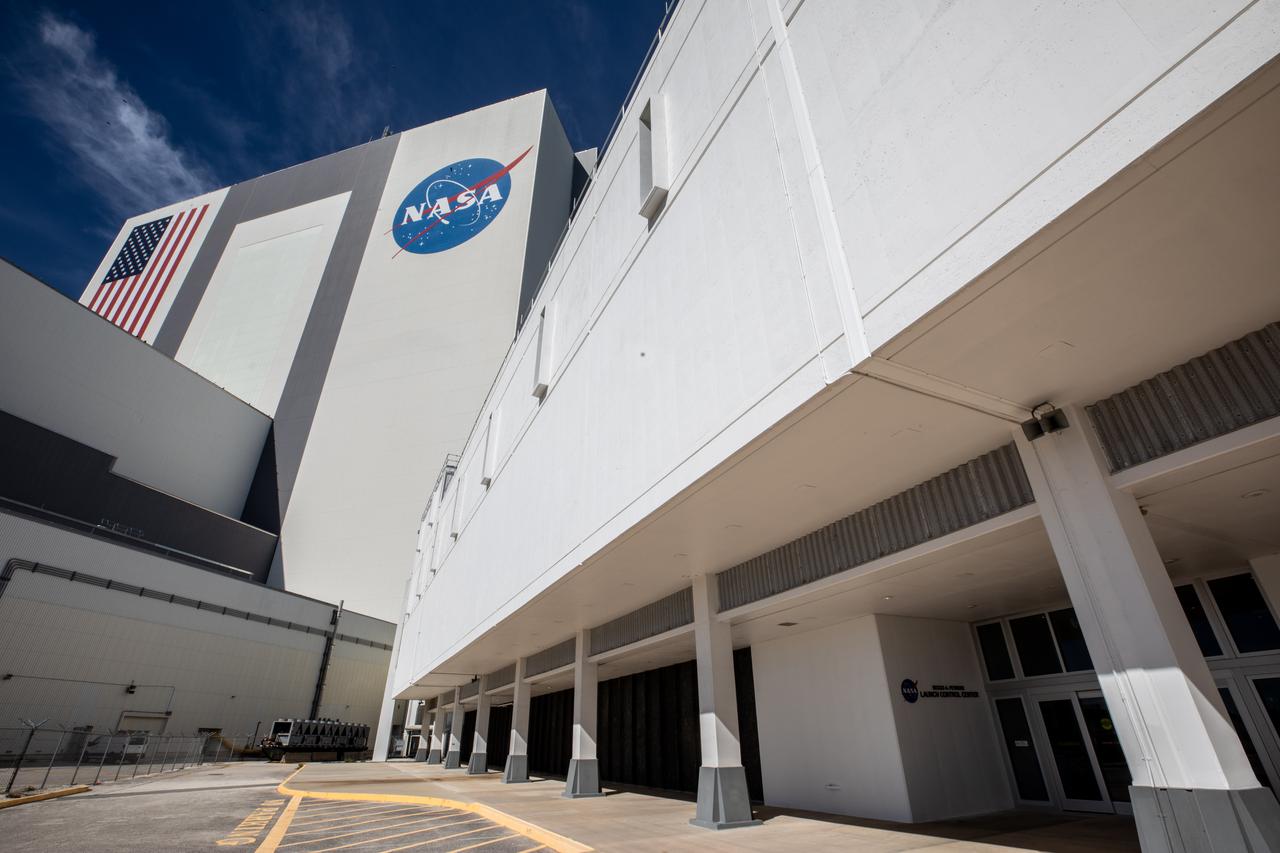
Following a ceremony at NASA’s Kennedy Space Center, the Florida spaceport’s launch control center (foreground) was officially renamed the Rocco A. Petrone Launch Control Center. In the background is Kennedy’s historic Vehicle Assembly Building. The newly named facility serves as a nerve center where engineers and the launch director will monitor their flight consoles and give the “go” for the upcoming launch of Artemis I and later missions that will establish a sustainable presence on the Moon to prepare for missions to Mars. Petrone, who was instrumental in America’s first voyages to the Moon and headed the Apollo program, died in 2006 at the age of 80.
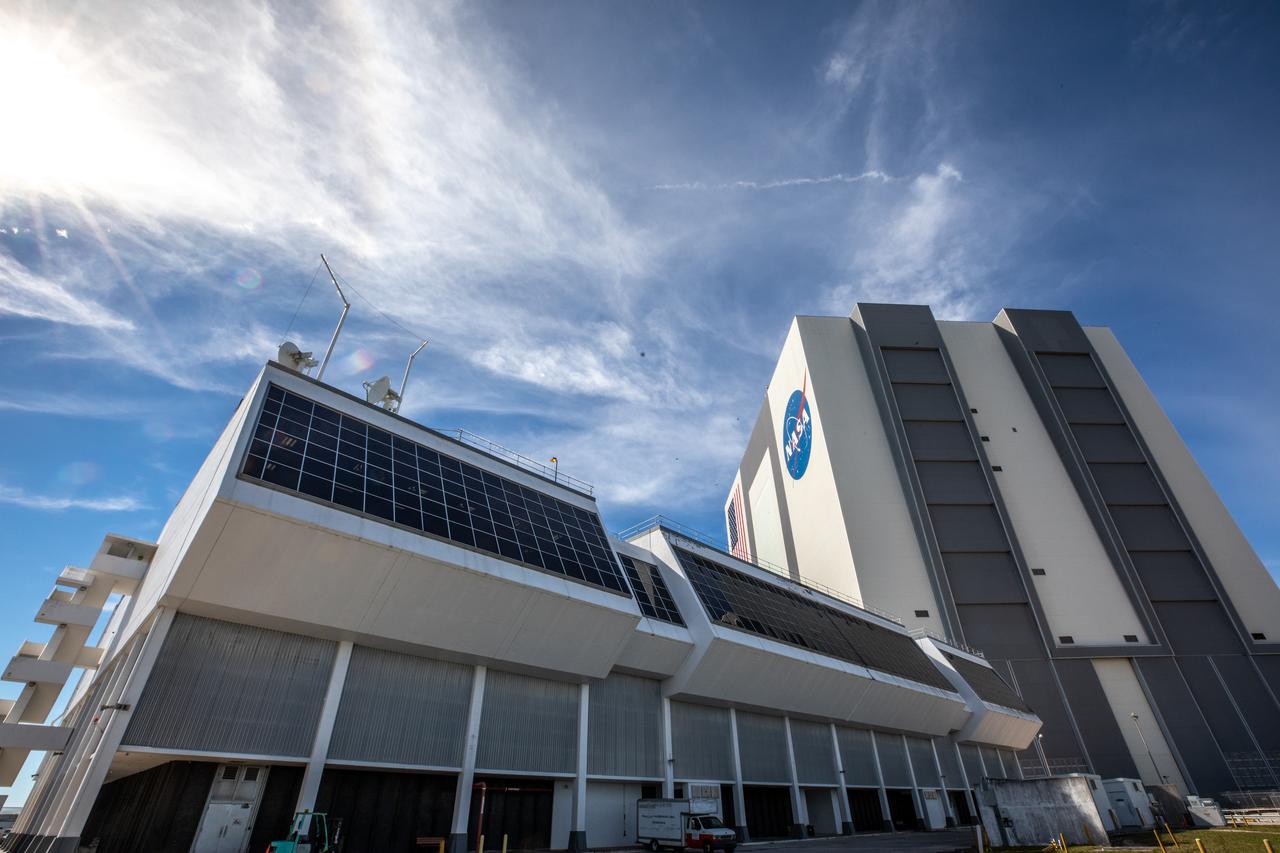
Following a ceremony at NASA’s Kennedy Space Center, the Florida spaceport’s launch control center (foreground) was officially renamed the Rocco A. Petrone Launch Control Center. In the background is Kennedy’s historic Vehicle Assembly Building. The newly named facility serves as a nerve center where engineers and the launch director will monitor their flight consoles and give the “go” for the upcoming launch of Artemis I and later missions that will establish a sustainable presence on the Moon to prepare for missions to Mars. Petrone, who was instrumental in America’s first voyages to the Moon and headed the Apollo program, died in 2006 at the age of 80.
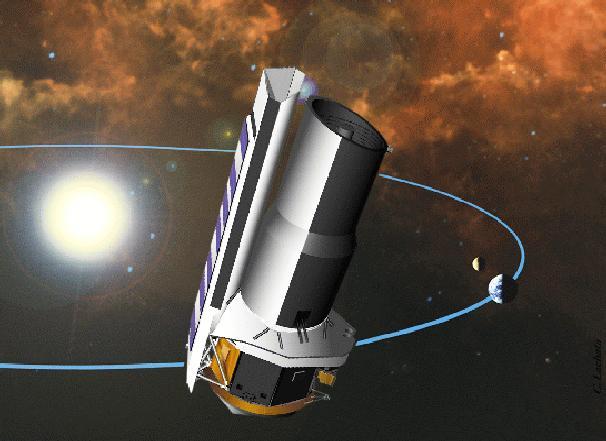
This image was used in a contest to rename the Space InfraRed Telescope Facility SIRTF, now known as the Spitzer Space Telescope.
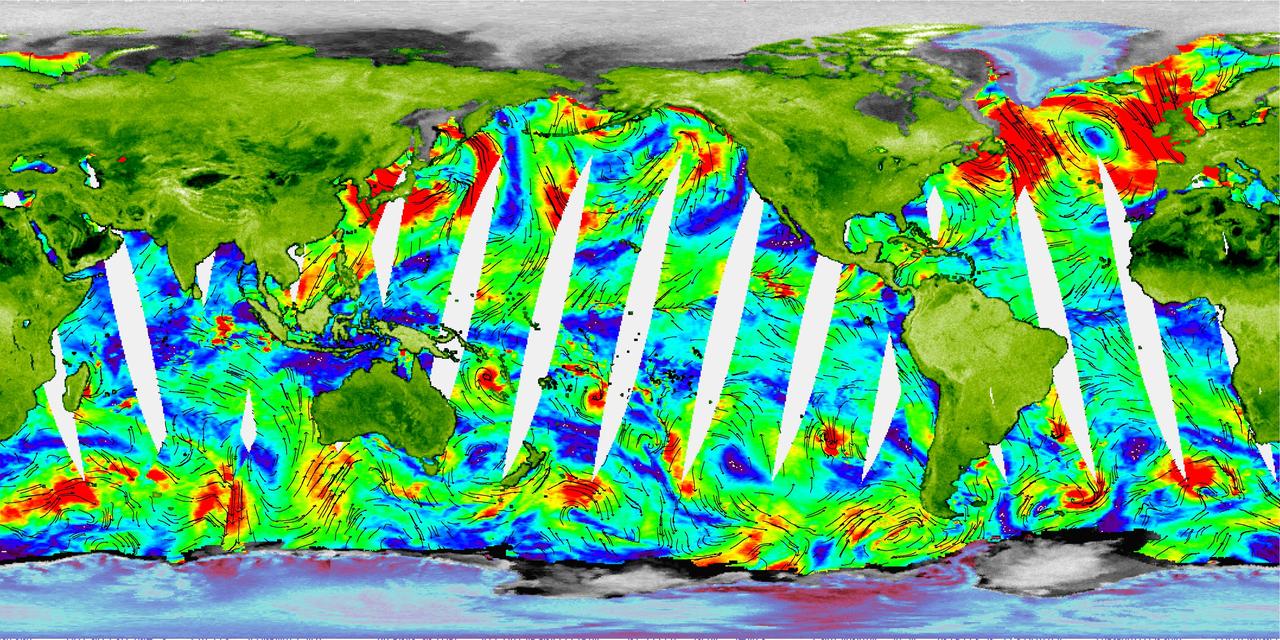
One of NASA newest Earth-observing instruments, the SeaWinds scatterometer aboard Japan Advanced Earth Observing Satellite Adeos 2--now renamed Midori 2--has successfully transmitted its first radar data to our home planet.
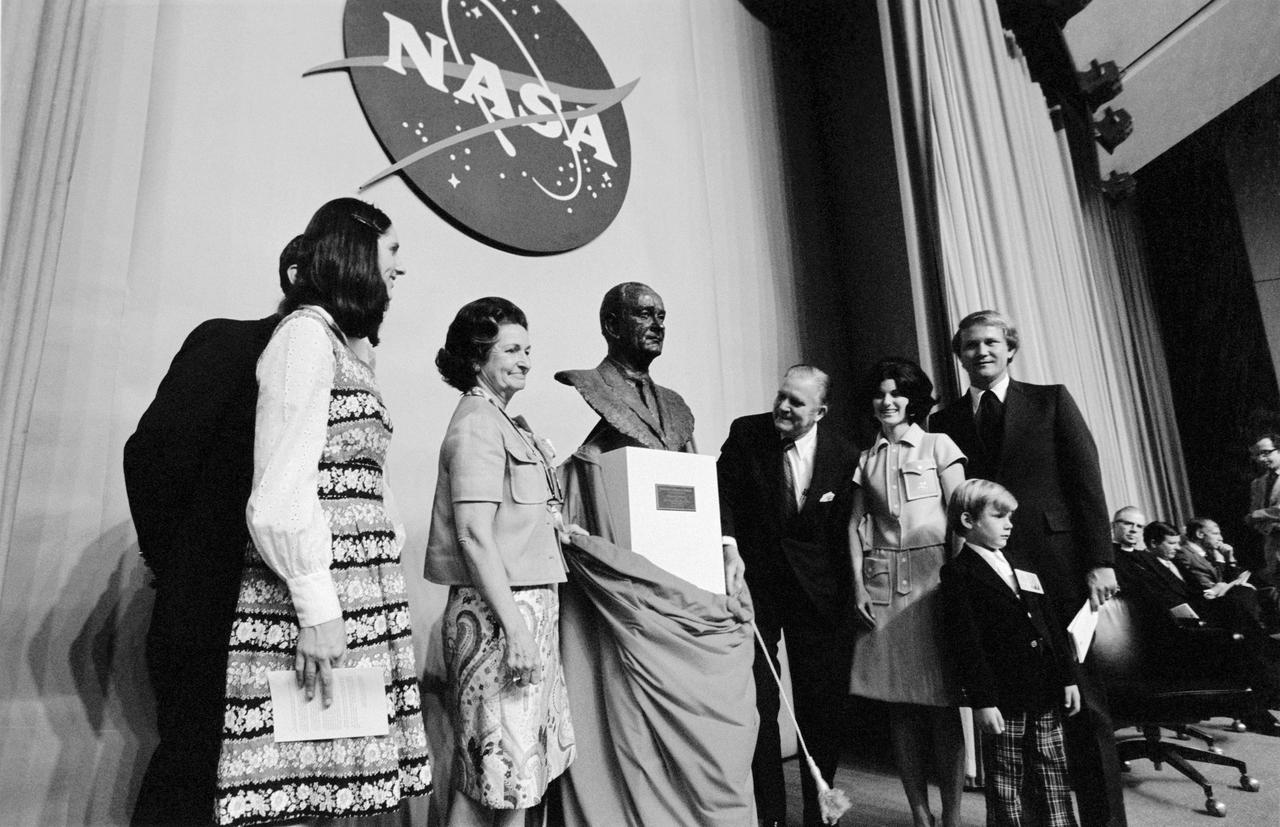
Dedication ceremonies renaming Johnson Space Center, with Lady Bird Johnson and family beside bust of President Johnson.
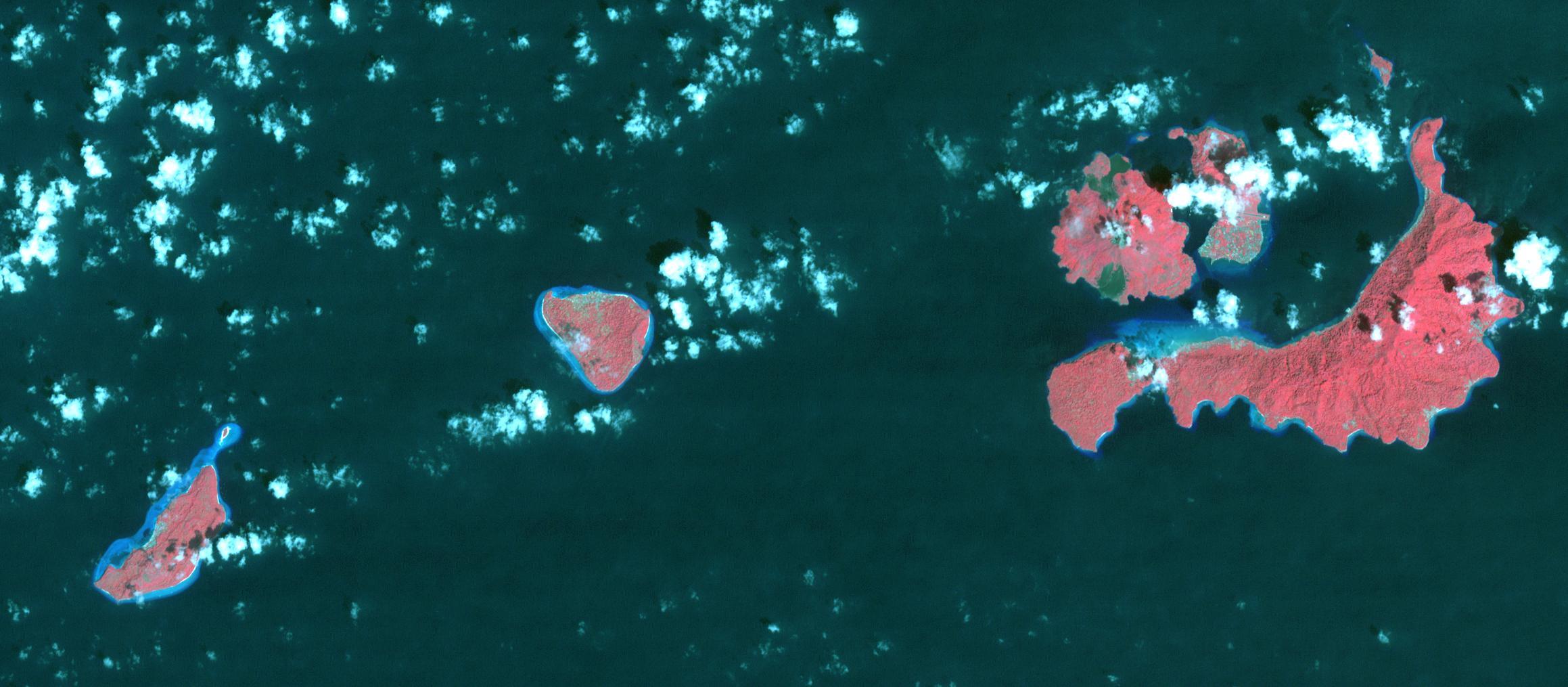
In 1667, the Dutch exchanged Run Island (left-most in the image) with the British for Manhattan (renamed from New Amsterdam to New York). Run Island is one of the smallest, and western-most, of the Banda Islands, part of the Malukus, Indonesia. At the time it was the only source of the incredibly valuable spices nutmeg and mace. The image was acquired January 5, 2016, covers an area of 15.7 by 34.8 kilometers, and is located at 4.5 degrees south, 129.7 degrees east. https://photojournal.jpl.nasa.gov/catalog/PIA22133
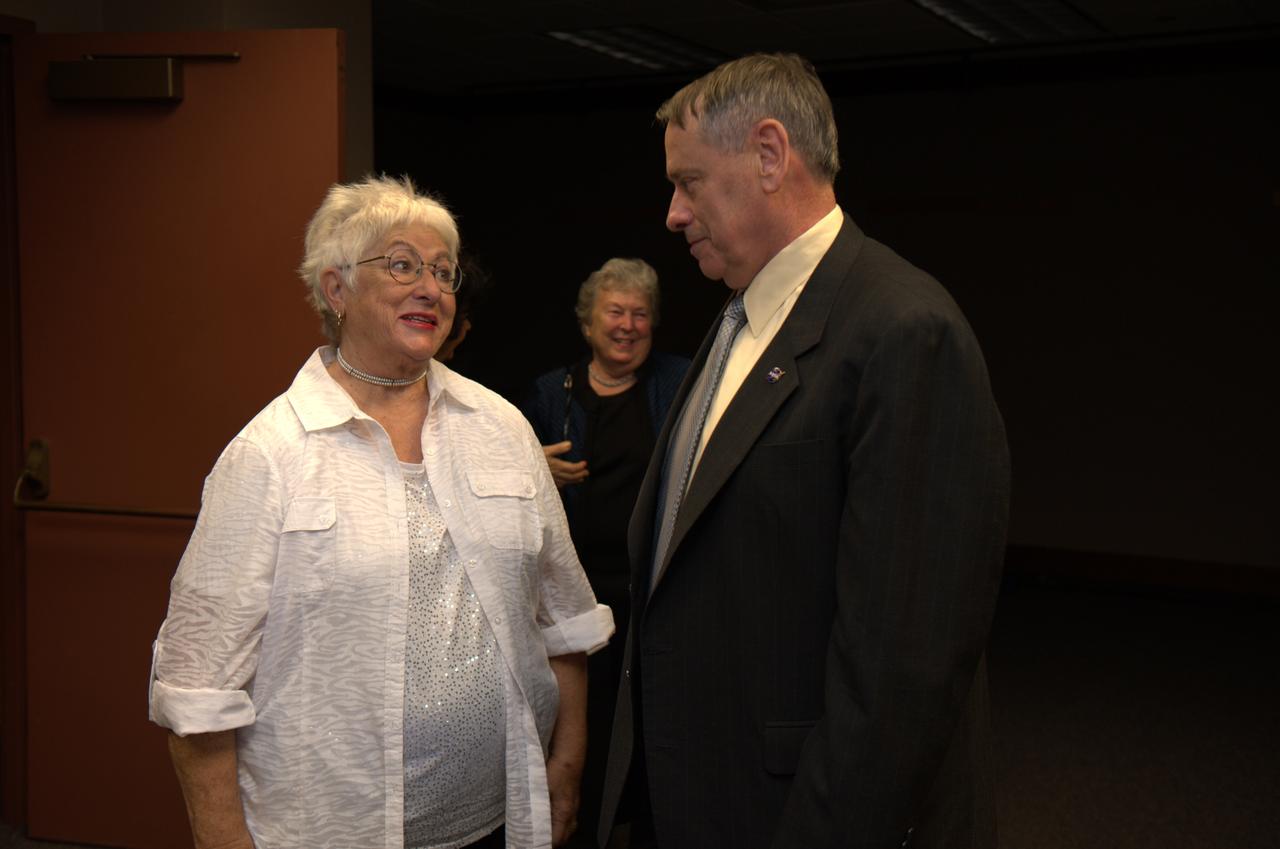
Ames officially renames its Main Auditorium (N201) in memory of former Ames Center Director Clarence 'Sy' Syvertson 1977 to 1984. Shown here on right is Mrs. JoAnn Syvertson and Ames Center Director S. Pete Worden 2006 -
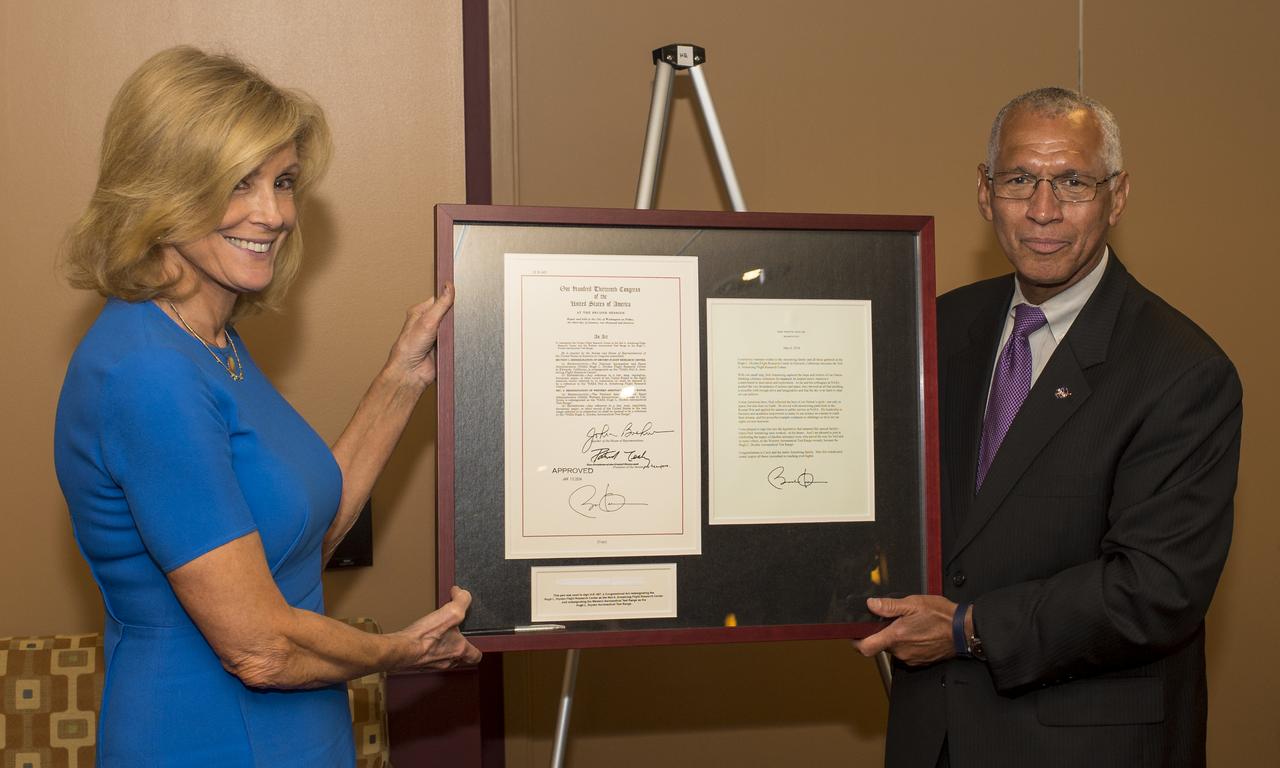
NASA Administrator Charles Bolden, right, presents Carol Armstrong, widow of Apollo 11 commander, Neil Armstrong, with the signed bill that renamed the Hugh L. Dryden Flight Research Center as the Neil A. Armstrong Flight Research Center, Tuesday, July 22, 2014 at NASA Headquarters in Washington. Photo Credit: (NASA/Joel Kowsky)
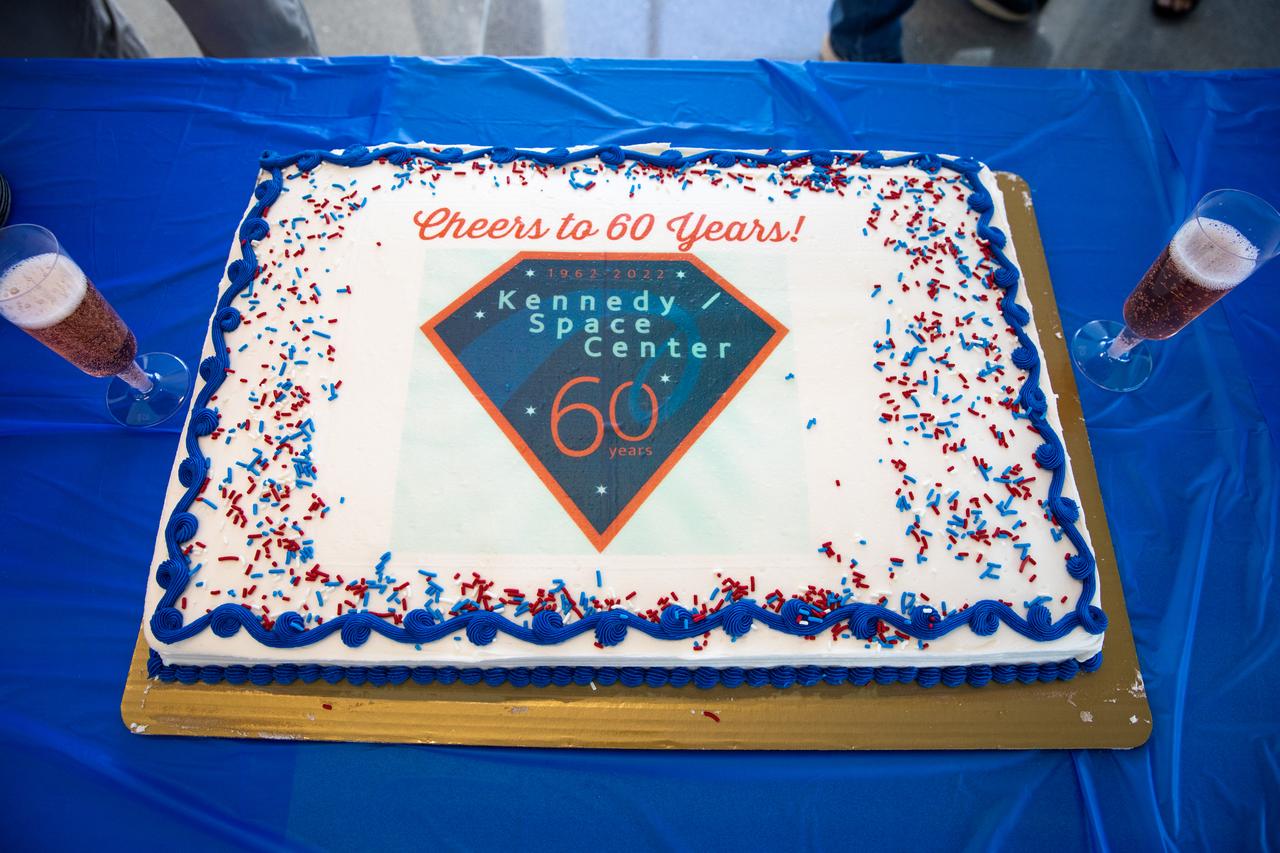
The NASA Kennedy Space Center senior leaders and employees celebrated the center’s 60th anniversary with a “Cheers to 60 Years” cake and non-alcoholic toast in the Central Campus Headquarters on June 28, 2022. In July 1962, the Launch Operations Center in Florida was established. By December 1963, it was renamed the John F. Kennedy Space Center.
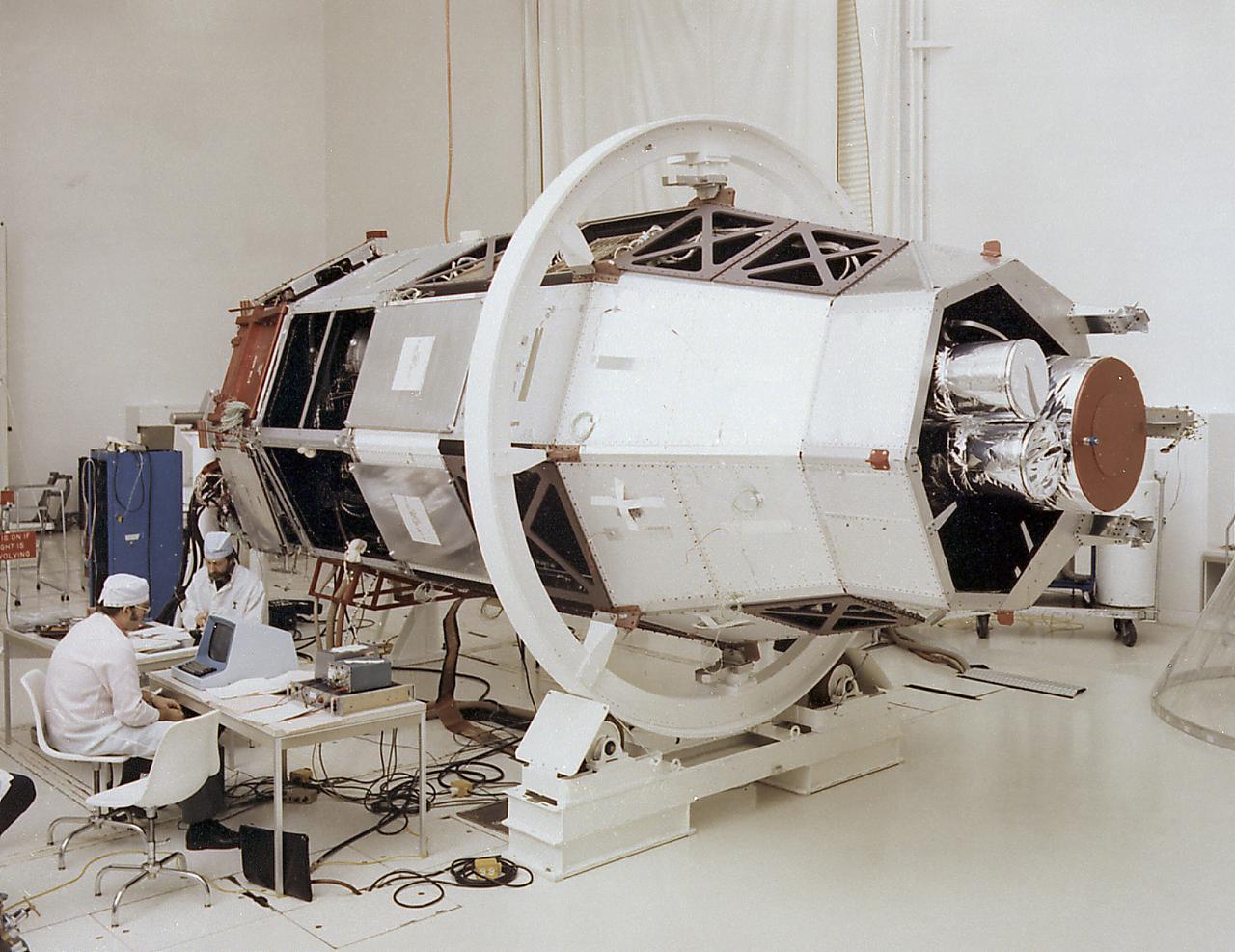
Managed by the Marshall Space Flight Center and built by TRW, the second High Energy Astronomy Observatory was launched November 13, 1978. The observatory carried the largest X-ray telescope ever built and was renamed the Einstein Observatory after achieving orbit.
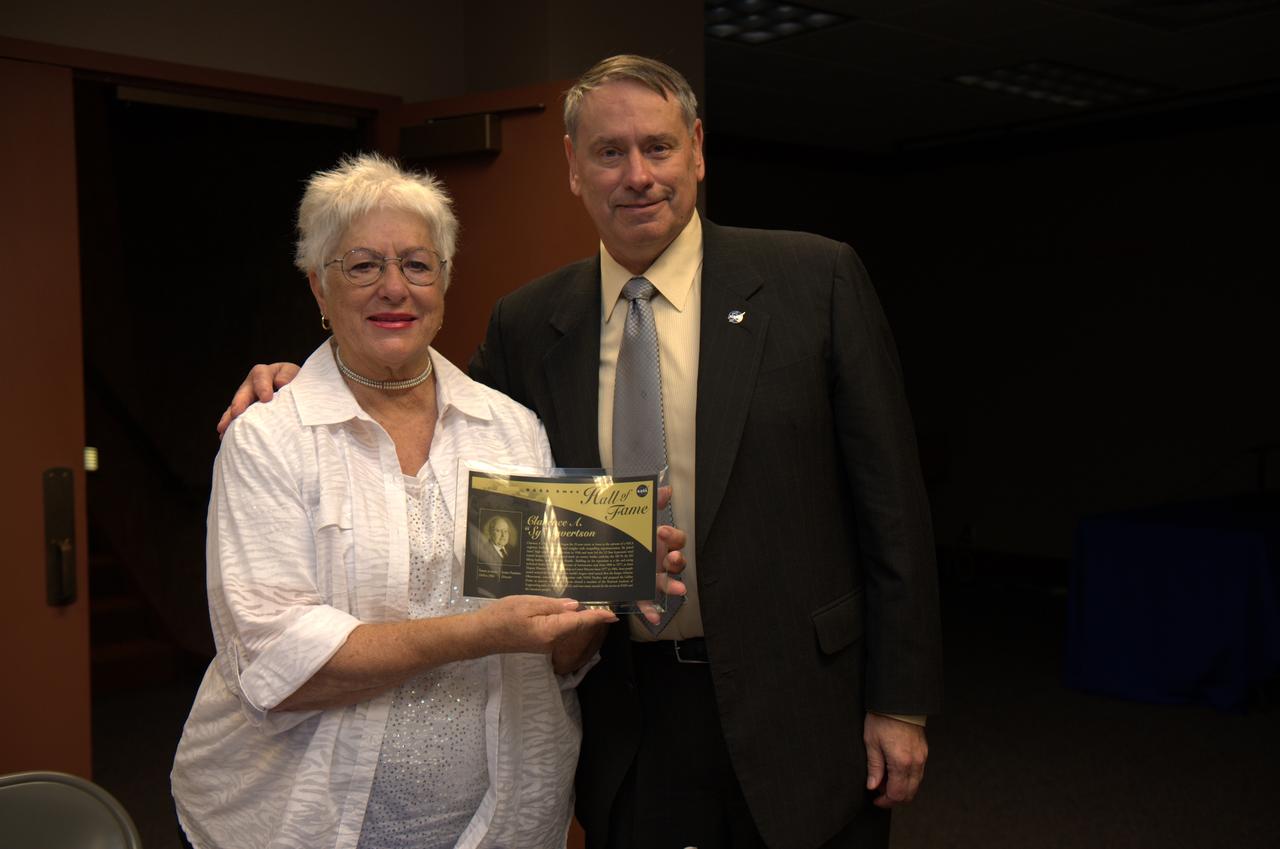
Ames officially renames its Main Auditorium (N201) in memory of former Ames Center Director Clarence 'Sy' Syvertson 1977 to 1984. Shown here on right is Mrs. JoAnn Syvertson holding the plaque from Syvertson induction into the Ames Hall of Fame in 2000 and Ames Center Director S. Pete Worden 2006 -
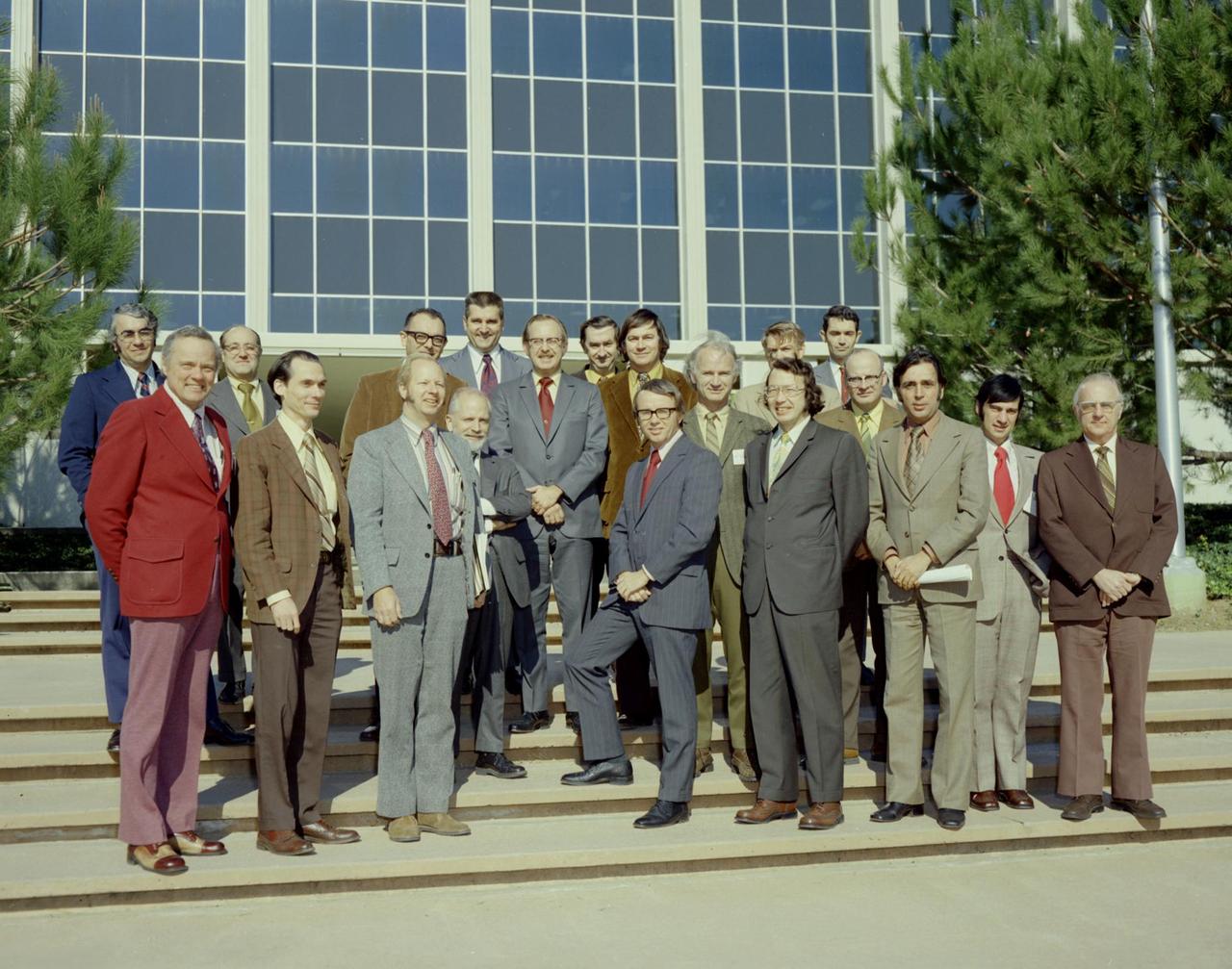
This archival image was released as part of a gallery comparing JPL's past and present, commemorating the 80th anniversary of NASA's Jet Propulsion Laboratory on Oct. 31, 2016. In December 1972, the science steering group for a mission then-known as Mariner Jupiter Saturn 1977 -- later renamed Voyager -- met for the first time at NASA's Jet Propulsion Laboratory in Pasadena, Calif. They are gathered on the steps in front of the administration building (180). The mission was so named because it was planning to send Mariner-class spacecraft to Jupiter and Saturn. It was renamed Voyager a few months before the launch of the twin spacecraft in August and September 1977. This photo shows principal investigators and team leaders for the science experiments and several others from the project and NASA who attended the first meeting. In the first row: Radio Science Subsystem Team Leader Von Eshleman, Project Scientist Edward Stone, Project Manager Harris (Bud) Schurmeier, Mission Analysis and Engineering Manager Ralph Miles, Magnetometer Principal Investigator Norman Ness, NASA Planetary Program Office Deputy Director Ichtiaque Rasool, Robert Soberman (who was proposed to be the principal investigator of the Particulate Matter Investigation, which was not confirmed) and an unidentified member of the NASA Office of Space Science. In the second row: Infrared Interferometer Spectrometer Principal Investigator Rudolf Hanel, Planetary Radio Astronomy Principal Investigator James Warwick, Ultraviolet and Spectrometer Principal Investigator A. Lyle Broadfoot. In the third row: Low-Energy Charged Particles Principal Investigator Stamatios (Tom) Krimigis, Cosmic Ray Subsystem Principal Investigator Rochus (Robbie) Vogt, NASA Outer Planets Missions Program Manager Warren Keller, Imaging Science Subsystem Team Leader Bradford Smith and Photopolarimeter Principal Investigator Charles Lillie. In the fourth row: Plasma Investigation Principal Investigator Herbert Bridge, Spacecraft Systems Manager Raymond Heacock, NASA Outer Planets Missions Program Scientist Milton (Mike) Mitz and Science Manager James Long. http://photojournal.jpl.nasa.gov/catalog/PIA21122

Consoles in the Radiological Control Center at NASA's Kennedy Space Center are seen during ceremonies to name the facility in honor of Randy Scott. A professional health physicist of more than 40 years, Scott served as the Florida spaceport's Radiation Protection Officer for 14 years until his death June 17, 2016. Located in the Neil Armstrong Operations and Checkout building, the Randall E. Scott Radiological Control Center is staffed by technical and radiological experts from NASA, the U.S. Department of Energy, the U.S. Air Force 45th Space Wing and the state of Florida. The group performs data collection and assessment functions supporting launch site and field data collection activities.

Family members of Randy Scott gather in the Radiological Control Center at NASA's Kennedy Space Center following ceremonies to name the facility in his honor. A professional health physicist of more than 40 years, Scott served as the Florida spaceport's Radiation Protection Officer for 14 years until his death June 17, 2016.

Nancy Bray, director of Spaceport Integration and Services at NASA's Kennedy Space Center, left, is joined by Myrna Scott, center, and Dr. David Tipton, chief of Aerospace Medicine and Occupational Health, in cutting a ceremonial ribbon dedicating the Randal E. Scott Radiological Control Center at the Florida spaceport. Myrna Scott is the widow of Randy Scott, who was a professional health physicist of more than 40 years. He served as the Florida spaceport's Radiation Protection Officer for 14 years until his death June 17, 2016.

A portion of the Radiological Control Center at NASA's Kennedy Space Center is seen during ceremonies to name the facility in honor of Randy Scott. A professional health physicist of more than 40 years, Scott served as the Florida spaceport's Radiation Protection Officer for 14 years until his death June 17, 2016. Located in the Neil Armstrong Operations and Checkout building, the Randall E. Scott Radiological Control Center is staffed by technical and radiological experts from NASA, the U.S. Department of Energy, the U.S. Air Force 45th Space Wing and the state of Florida. The group performs data collection and assessment functions supporting launch site and field data collection activities.

Nancy Bray, director of Spaceport Integration and Services at NASA's Kennedy Space Center, left, is joined by Myrna Scott, center, and Dr. David Tipton, chief of Aerospace Medicine and Occupational Health, in cutting a ceremonial ribbon dedicating the Randal E. Scott Radiological Control Center at the Florida spaceport. Myrna Scott is the widow of Randy Scott, who was a professional health physicist of more than 40 years. He served as the Florida spaceport's Radiation Protection Officer for 14 years until his death June 17, 2016.

Nancy Bray, director of Spaceport Integration and Services at NASA's Kennedy Space Center, left, is joined by Myrna Scott, center, and Dr. David Tipton, chief of Aerospace Medicine and Occupational Health, in cutting a ceremonial ribbon dedicating the Randal E. Scott Radiological Control Center at the Florida spaceport. Myrna Scott is the widow of Randy Scott, who was a professional health physicist of more than 40 years. He served as the Florida spaceport's Radiation Protection Officer for 14 years until his death June 17, 2016.

Myrna Scott holds a replica of the emblem noting that the Radiological Control Center at NASA's Kennedy Space Center has been named in honor of her husband, Randy Scott who died last year. A ceremony honored the extensive contributions of Randy Scott. A professional health physicist of more than 40 years, Scott served as the Florida spaceport's Radiation Protection Officer for 14 years until his death June 17, 2016.

Space Center, presents Myrna Scott, widow of Randy Scott, with a replica of the emblem noting that the spaceport's Radiological Control Center has been named in honor of her husband who died last year. The ceremony in the center's Radiological Control Center honored the extensive contributions of Randy Scott. A professional health physicist of more than 40 years, Scott served as the Florida spaceport's Radiation Protection Officer for 14 years until his death June 17, 2016.

A Mars Science Laboratory cap is displayed in the Randall E. Scott Radiological Control Center at NASA's Kennedy Space Center. The facility was recently named in honor of Randy Scott, a professional health physicist of more than 40 years. He served as the Florida spaceport's Radiation Protection Officer for 14 years until his death June 17, 2016. Launched Nov. 26, 2011, the Mars Science Laboratory with the Curiosity lander was powered by a radioisotope thermalelectric generator. Located in the Neil Armstrong Operations and Checkout building, the Randall E. Scott Radiological Control Center is staffed by technical and radiological experts from NASA, the U.S. Department of Energy, the U.S. Air Force 45th Space Wing and the state of Florida. The group performs data collection and assessment functions supporting launch site and field data collection activities during launces involving plutonium-powered spacecraft such as the Mars Science Laboratory.

Nancy Bray, director of Spaceport Integration and Services at NASA's Kennedy Space Center, speaks during ceremonies to name the Radiological Control Center in honor for Randy Scott. A professional health physicist of more than 40 years, Scott served as the Florida spaceport's Radiation Protection Officer for 14 years until his death June 17, 2016.
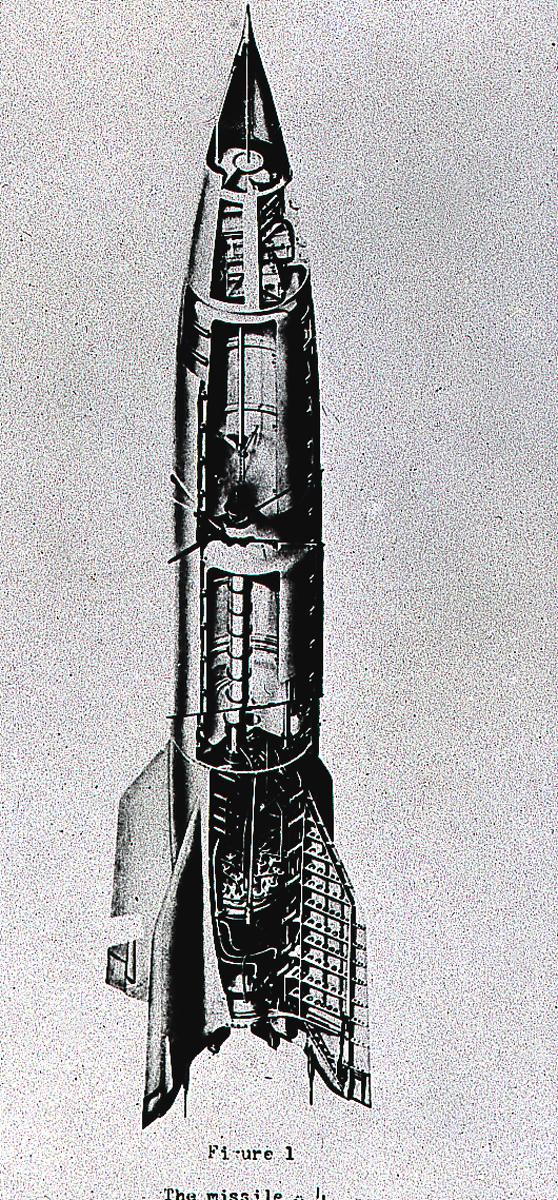
The cutaway drawing of the A-4 (Aggregate-4) rocket. Later renamed the V-2 (Vengeance Weapon-2), The rocket was developed by Dr. Wernher von Braun and the German rocket team at Peenemuende, Germany on the Baltic Sea. At the end of World War II, the team of German engineers and scientists came to the United States and continued rocket research for the Army at Fort Bliss, Texas, and Redstone Arsenal in Huntsville, Alabama.
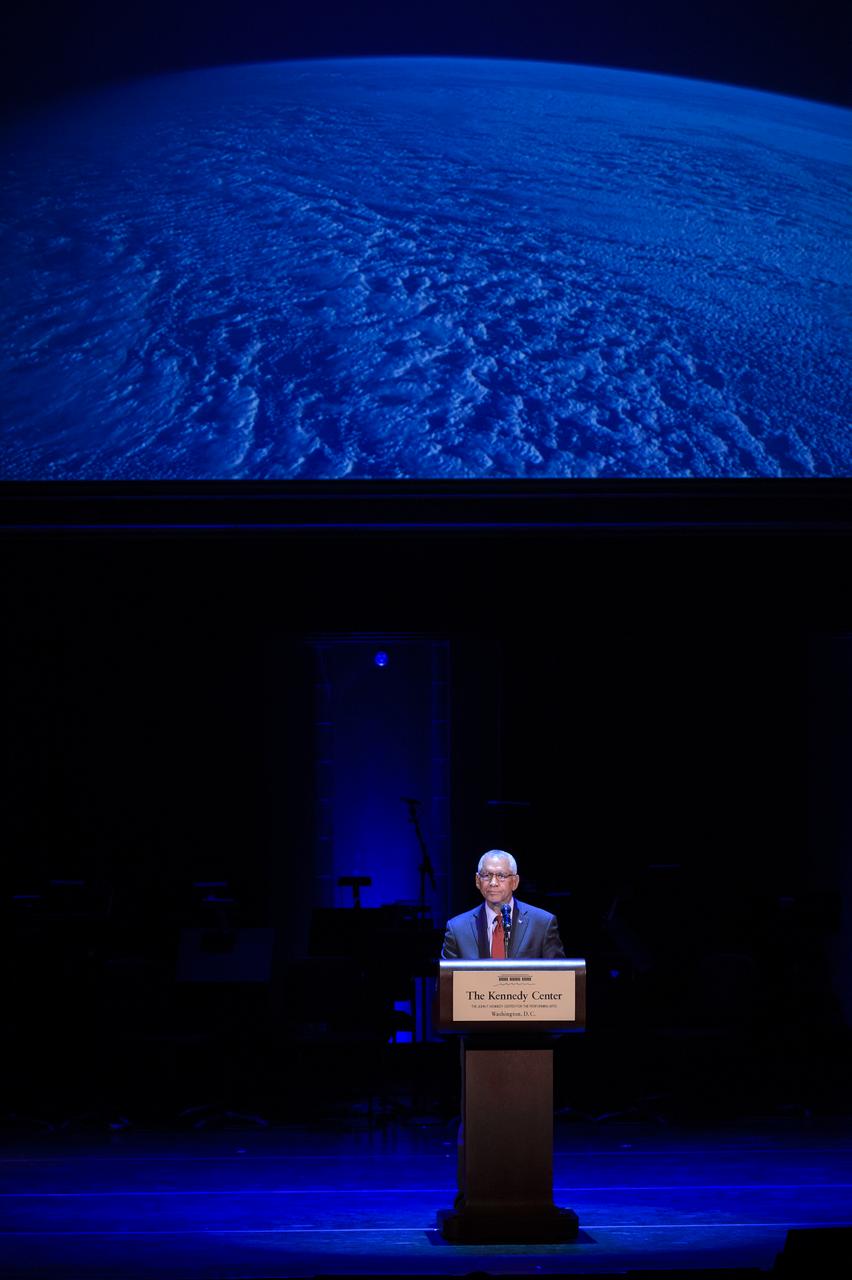
NASA Administrator Charles Bolden announces during a National Tribute to Sally Ride that NASA is recognizing Ride, first American woman in space, by renaming a camera aboard the International Space Station the Sally Ride EarthKAM and that President Obama will award a posthumous Presidential Medal of Freedom to Dr. Sally Ride at the John F. Kennedy Center for the Performing Arts, Monday, May 20, 2013 in Washington. Photo Credit: (NASA/Bill Ingalls)
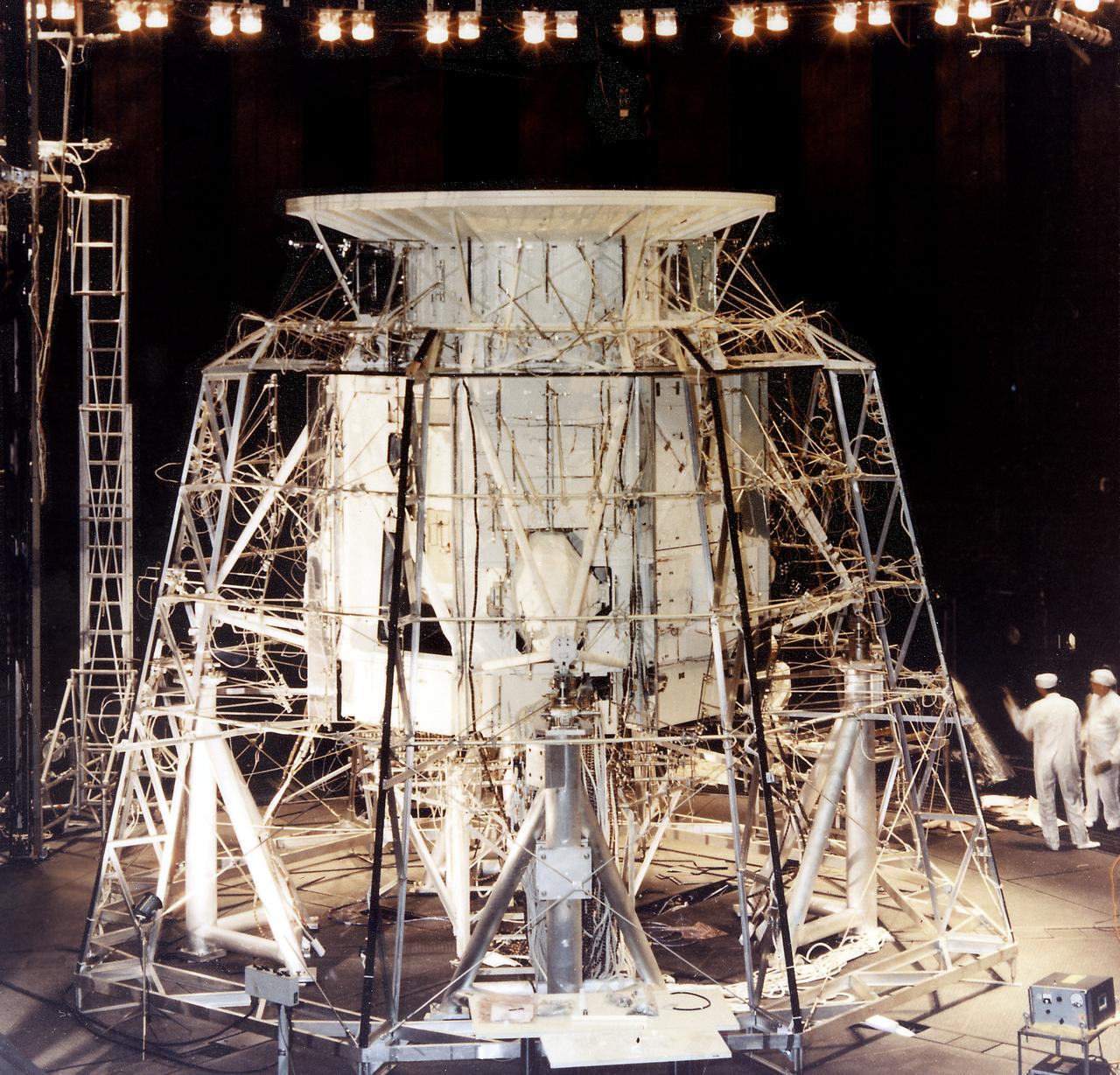
The Apollo Telescope Mount (ATM), designed and developed by the Marshall Space Flight Center, was one of four major components comprising the Skylab (1973-1979). The ATM housed the first manned scientific telescope in space. This photograph is of the ATM thermal systems unit undergoing testing in the Space Environment Simulation Laboratory of the Manned Spacecraft Center (MSC). The ATM thermal systems unit was used to control the temperatures of space instrument's subsystems during a mission. The MSC was renamed the Johnson Space Center (JSC) in early 1973.

In a ceremony honoring Dr. Wernher von Braun, who served as Marshall Space Flight Center Director from 1960 to 1970, Marshall officials renamed the 4200 Building Complex as the Wernher von Braun Office Complex and unveiled a bust of the former director. This photograph is a close-up of the bust in the courtyard. The sculptor of the bust is a MSFC employee, Jack Hood.
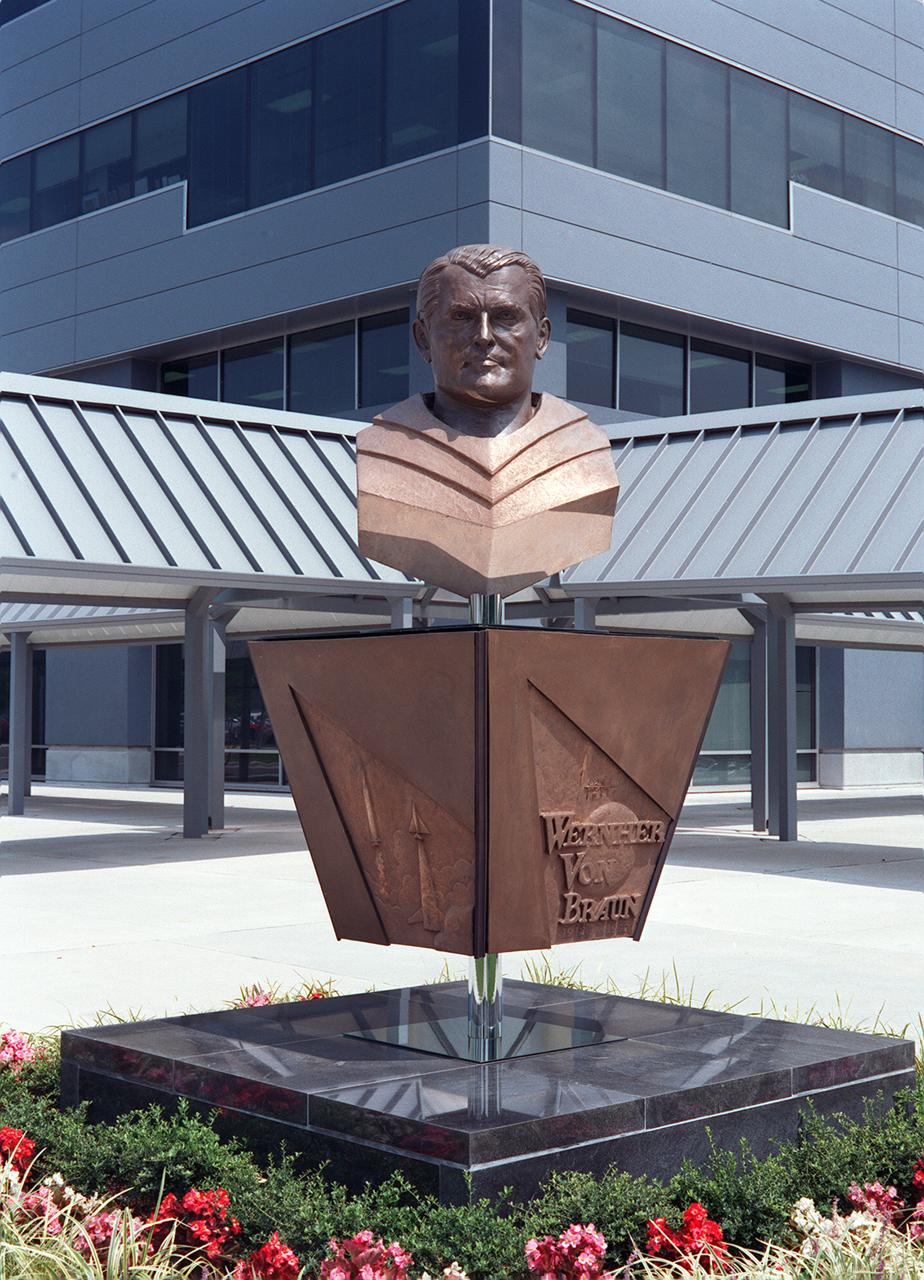
In a ceremony honoring Dr. Wernher von Braun, who served as Marshall Space Flight Center Director from 1960 to 1970, Marshall officials renamed the 4200 Building Complex as the Wernher von Braun Office Complex and unveiled a bust of the former director. This photograph is a close-up of the bust in the courtyard. The sculptor of the bust is a MSFC employee, Jack Hood.
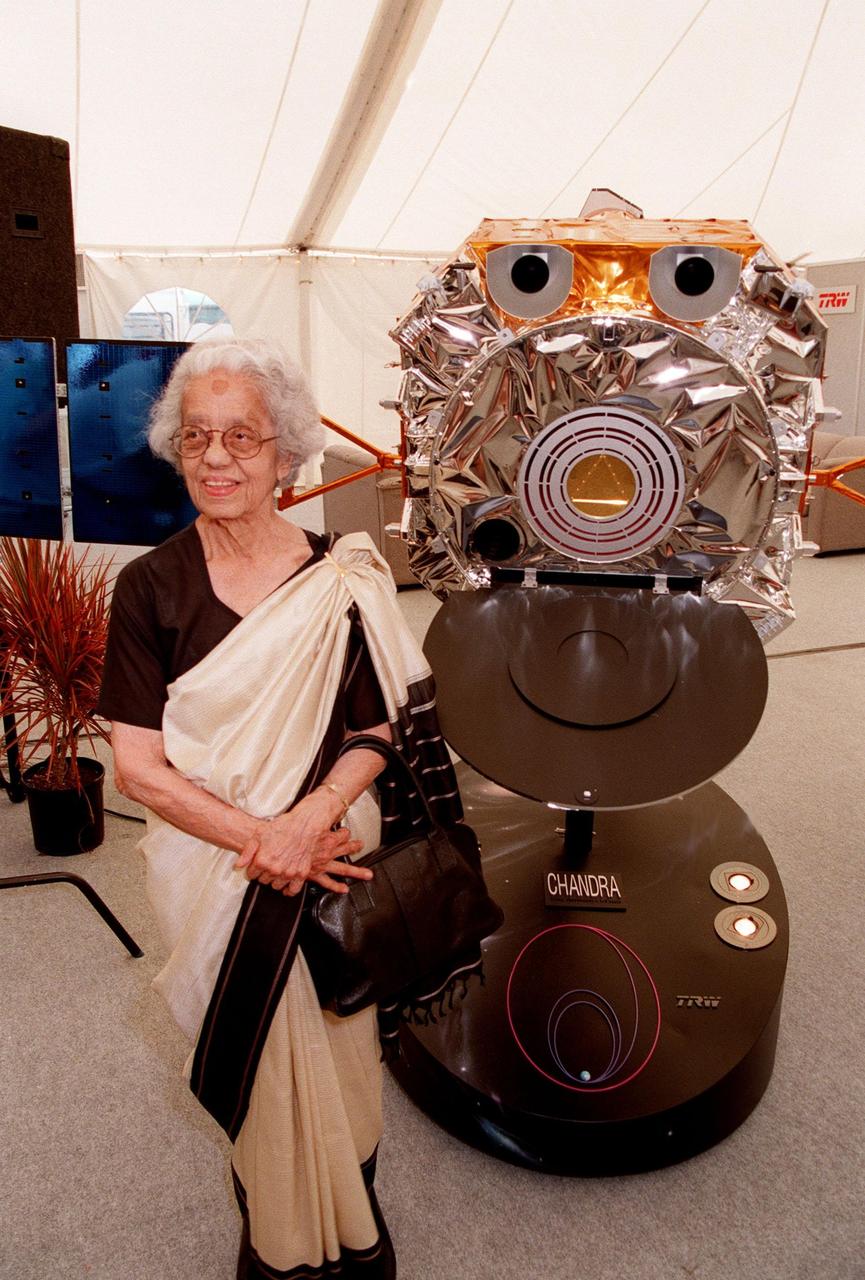
KENNEDY SPACE CENTER, FLA. -- Mrs. Lalitha Chandrasekhar, wife of the late Indian-American Nobel Laureate Subrahmanyan Chandrasekhar, poses with a model of the Chandra X-ray Observatory in the TRW Media Hospitality Tent at the NASA Press Site at KSC. The name "Chandra," a shortened version of Chandrasekhar's name which he preferred among friends and colleagues, was chosen in a contest to rename the telescope. "Chandra" also means "Moon" or "luminous" in Sanskrit. The observatory is scheduled to be launched aboard Columbia on Space Shuttle mission STS-93
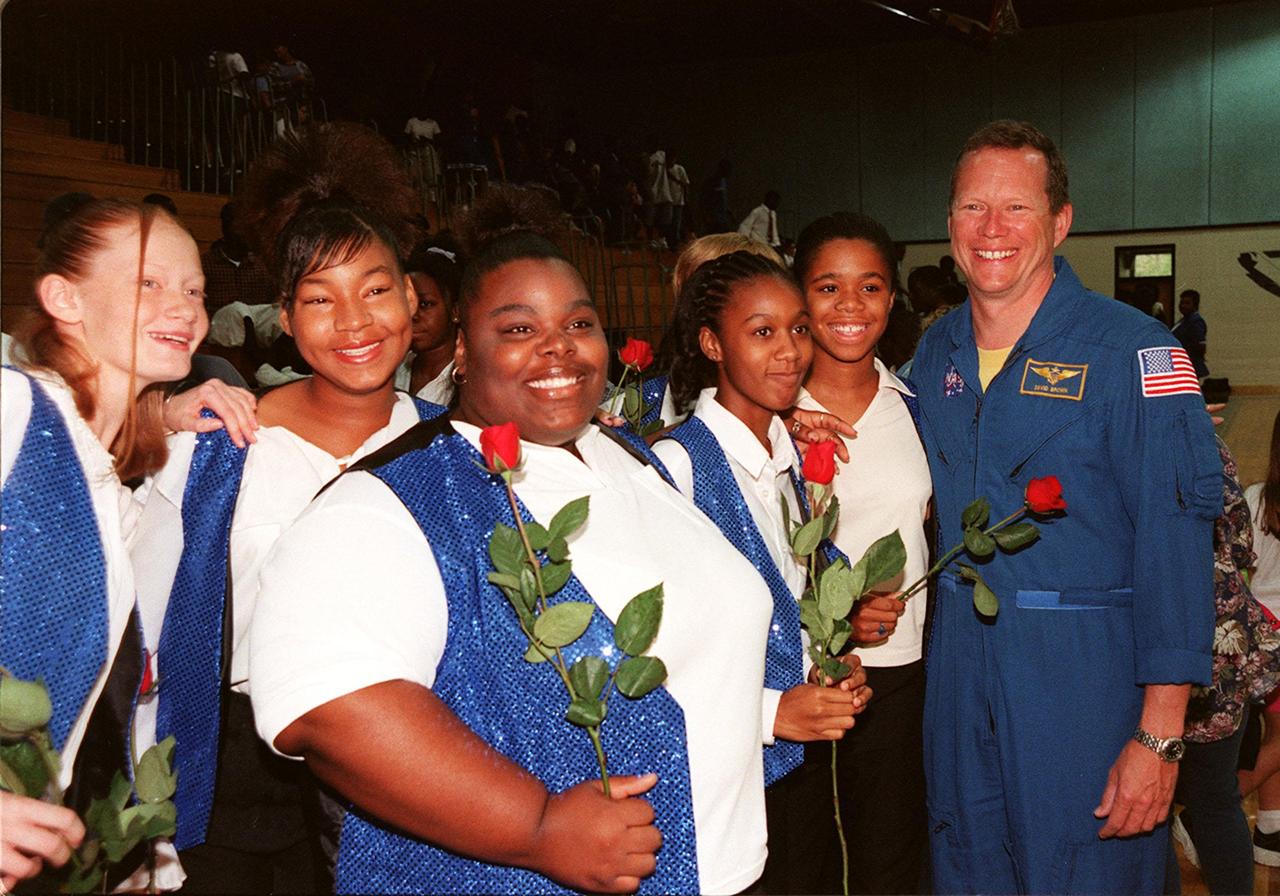
Dr. David Brown (right), a NASA astronaut, poses with students in the gymnasium of Ronald McNair Magnet School in Cocoa, Fla. From left, the students are Kristin Rexford, Danitra Anderson, Dominique Smith, Fallon Davis, and Qiana Taylor. Brown was at the school to attend a tribute to NASA astronaut Ronald McNair. The school had previously been renamed for the fallen astronaut who was one of a crew of seven, who lost their lives during an accident following launch of the Space Shuttle Challenger in January 1986
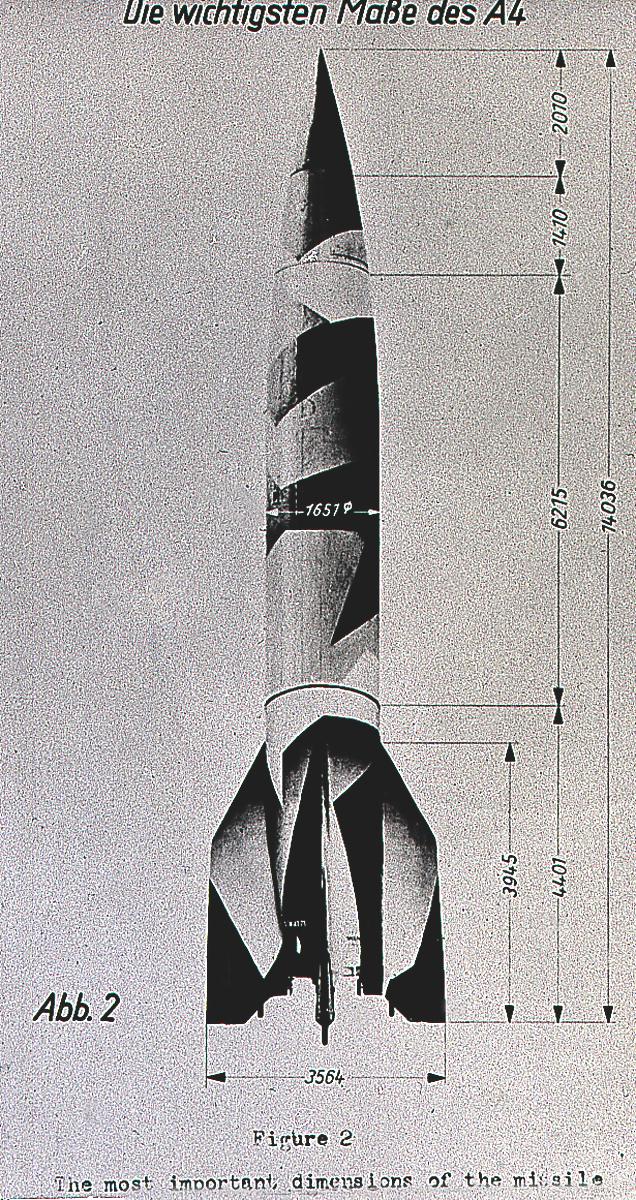
This drawing illustrates the vital dimensions of the A-4 (Aggregate-4). Later renamed the V-2 (Vengeance Weapon-2), the rocket was developed by Dr. Wernher von Braun and the German rocket team at Peenemuende, Germany on the Baltic Sea. At the end of World War II, the team of German engineers and scientists came to the United States and continued rocket research for the Army at Fort Bliss, Texas, and Redstone Arsenal in Huntsville, Alabama.
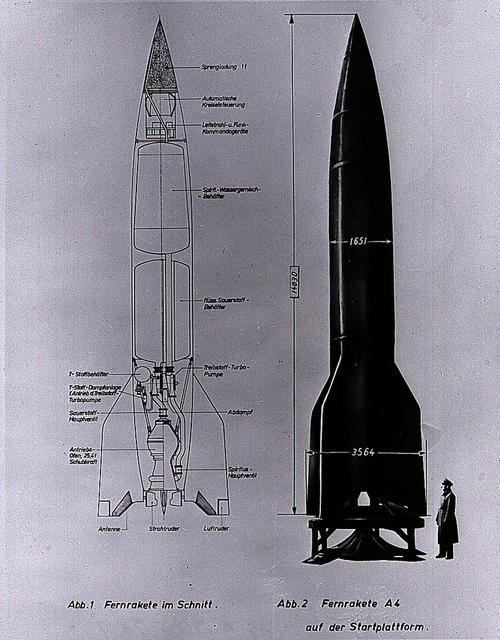
This German cutaway drawing of the Aggregate-4 (A-4) illustrates the dimensions and internal workings of the rocket. Later renamed the V-2, the rocket was developed by Dr. Wernher von Braun and the German Rocket Team at Peenemuende on the Baltic Sea. At the end of World War II, the team of German engineers and scientists came to the United States to work for the Army at Fort Bliss, Texas, and Redstone Arsenal in Huntsville, Alabama.
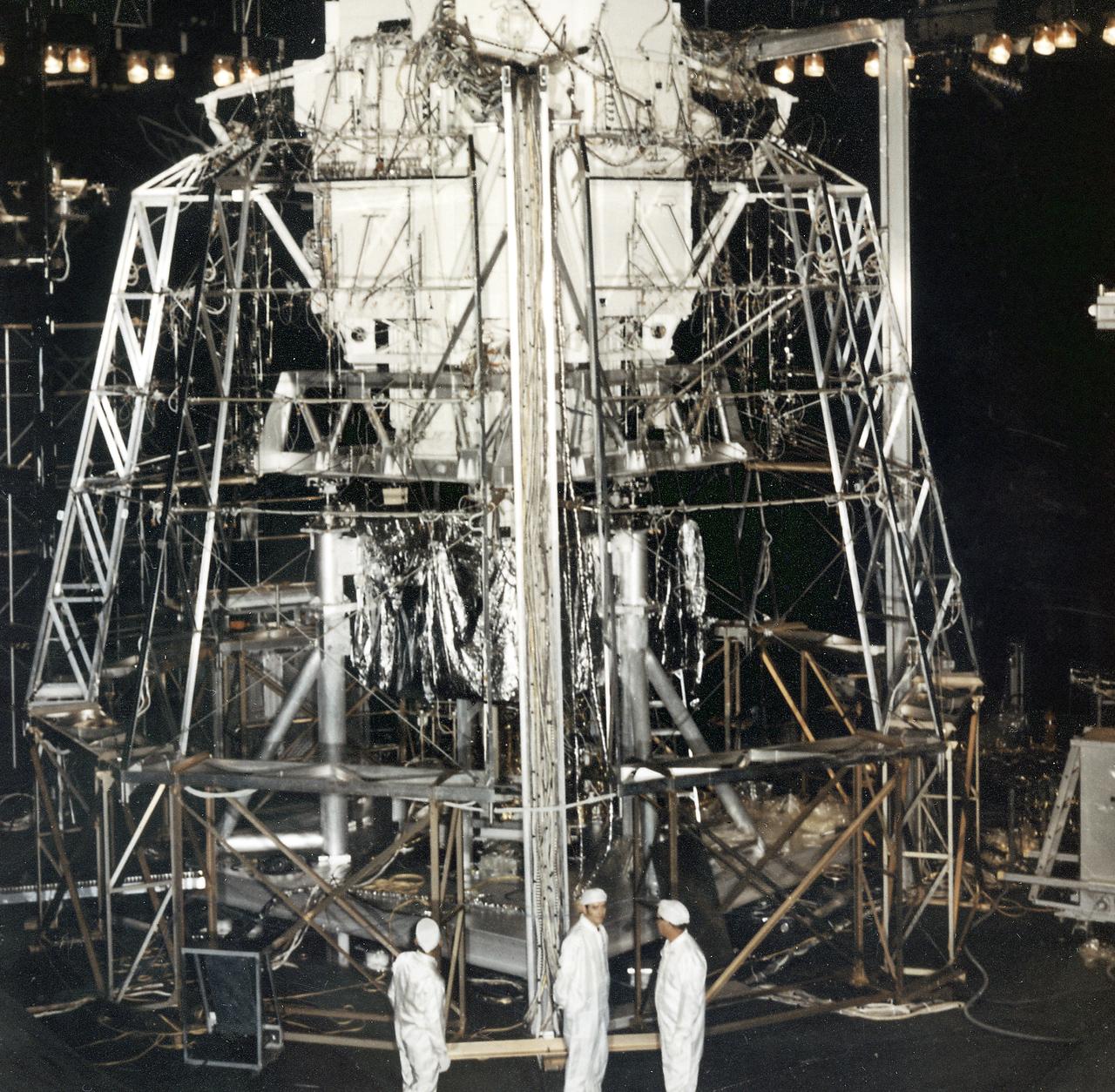
The Apollo Telescope Mount (ATM), designed and developed by the Marshall Space Flight Center, was one of four major components comprising the Skylab (1973-1979). The ATM housed the first manned scientific telescope in space. This photograph shows the ATM rigged for altitude and space simulation tests at the Space Environment Simulation Laboratory of the Manned Spacecraft Center (MSC). The MSC was renamed the Johnson Space Center (JSC) in early 1973.
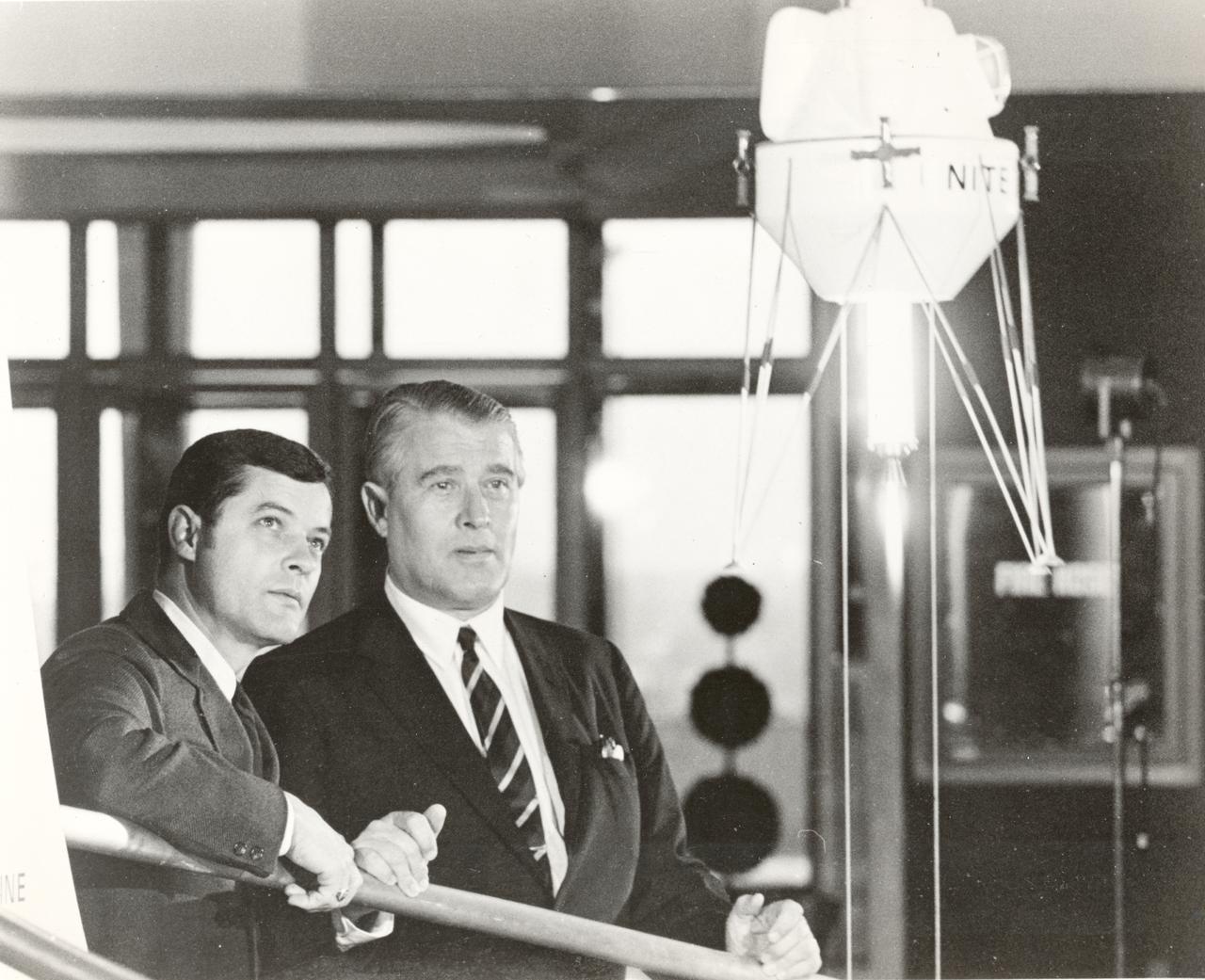
Edward O. Buckbee, the first Director of the Alabama Space Science Center (left), and Dr. Wernher von Braun (right) view a demonstration of a simulated spacecraft which uses an actual hybrid rocket engine for liftoff, hover, and landing. The display was presented to the Alabama Space Science Center, later renamed the U.S. Space and Rocket Center, by United Technology Center, a division of United Aircraft.
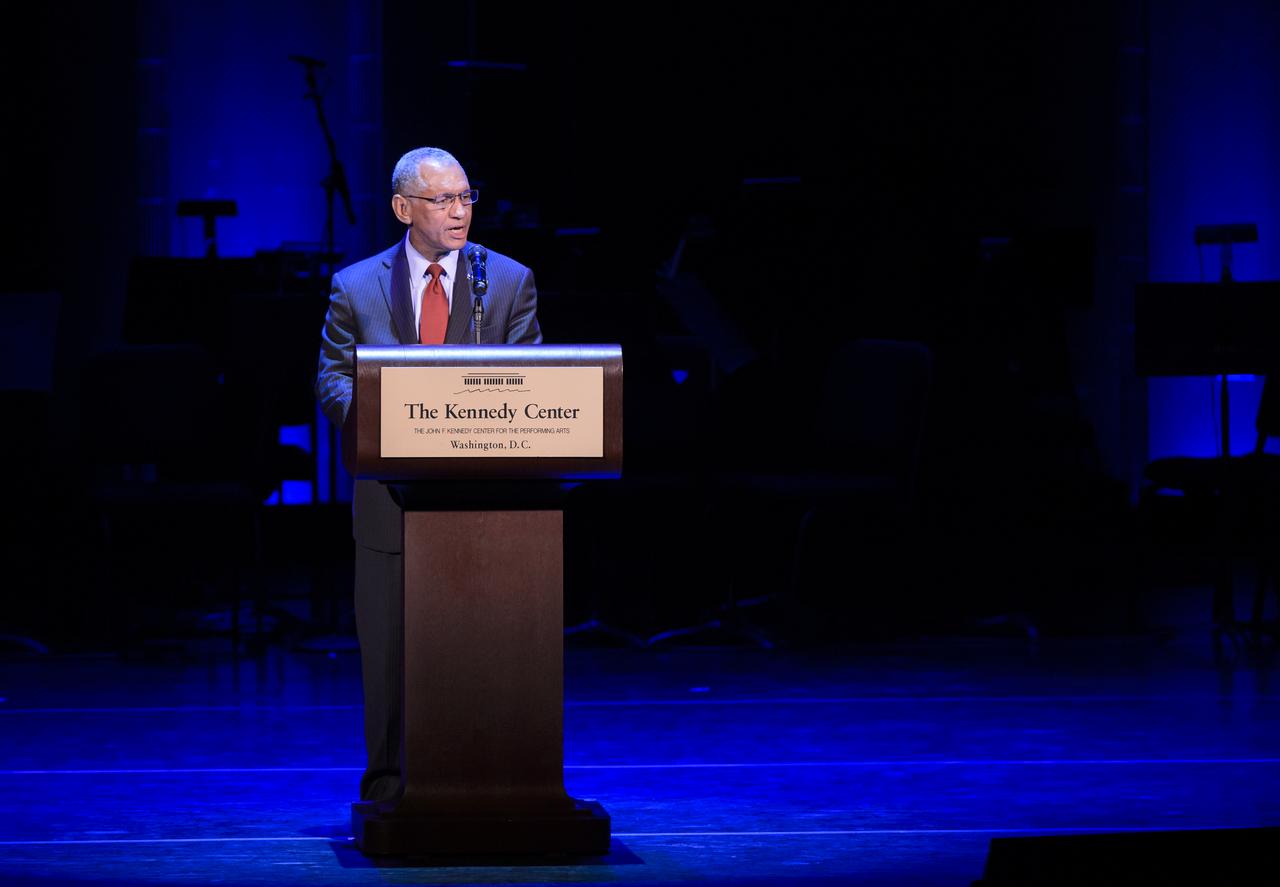
NASA Administrator Charles Bolden announces during a National Tribute to Sally Ride that NASA is recognizing Ride, first American woman in space, by renaming a camera aboard the International Space Station the Sally Ride EarthKAM and that President Obama will award a posthumous Presidential Medal of Freedom to Dr. Sally Ride at the John F. Kennedy Center for the Performing Arts, Monday, May 20, 2013 in Washington. Photo Credit: (NASA/Bill Ingalls)
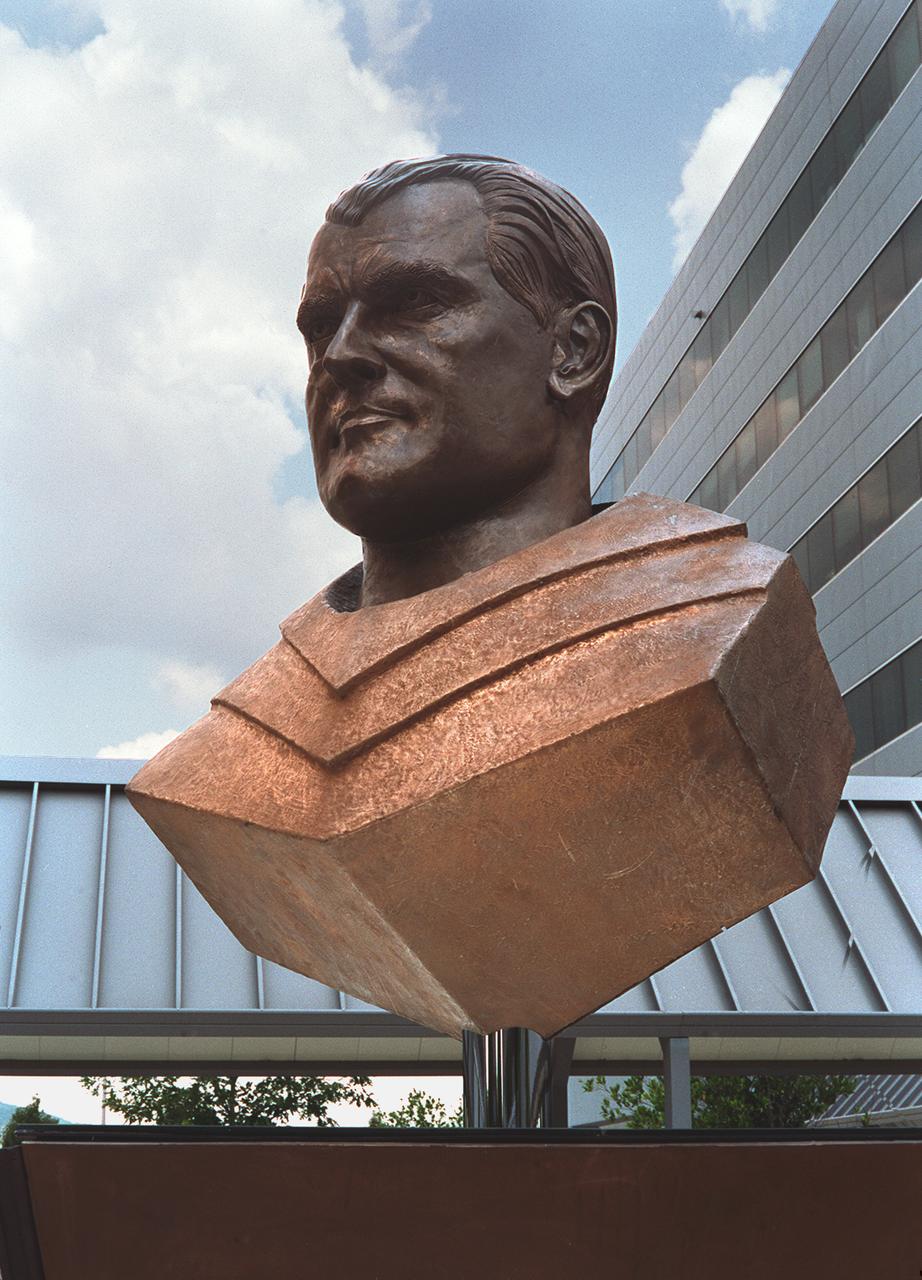
In a ceremony honoring Dr. Wernher von Braun, who served as Marshall Space Flight Center Director from 1960 to 1970, Marshall officials renamed the 4200 Building Complex as the Wernher von Braun Office Complex and unveiled a bust of the former director. This photograph is a close-up of the bust in the courtyard. The sculptor of the bust is a MSFC employee, Jack Hood.
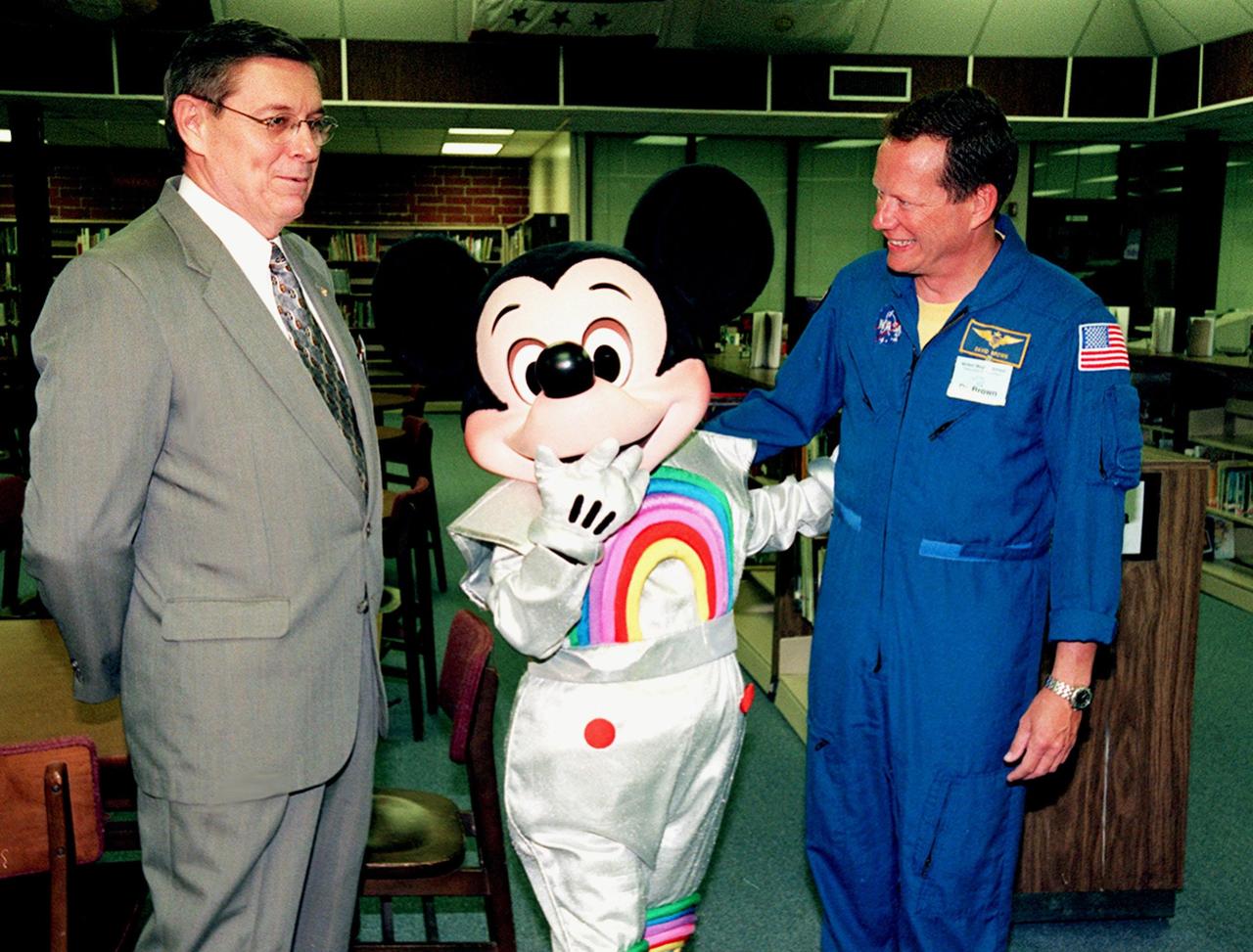
Dr. David Sawyer (left), Superintendent of the Brevard County School District, Mickey Mouse, and Dr. David Brown, a NASA astronaut, attend a tribute to NASA astronaut Ronald McNair held in the gymnasium of Ronald McNair Magnet School in Cocoa, Fla. During the tribute, Walt Disney World presented a portrait of McNair to the school, which had previously been renamed for the fallen astronaut. McNair was one of a crew of seven who lost their lives during an accident following launch of the Space Shuttle Challenger in January 1986
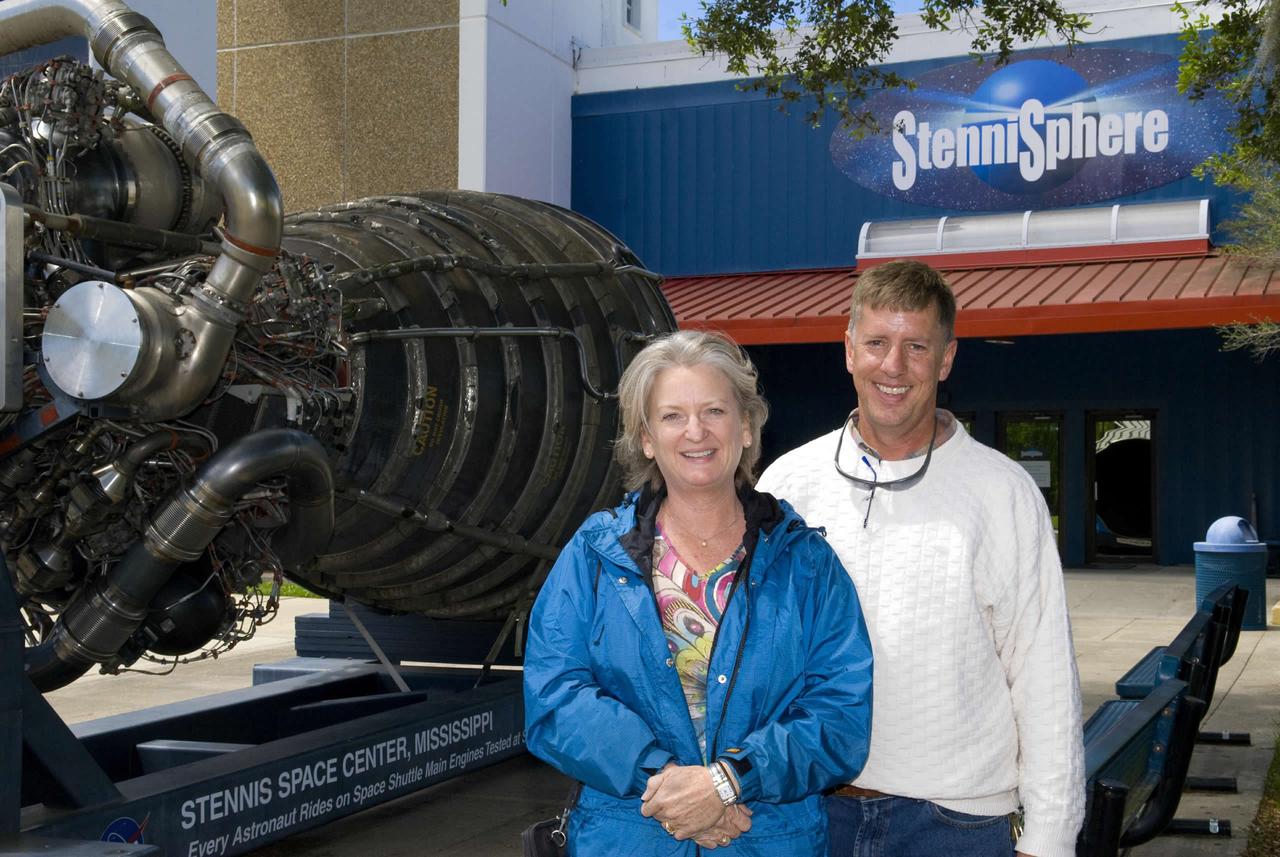
Jane Kenna of Atlanta, granddaughter of the late Sen. John C. Stennis, visits StenniSphere, the visitor center at NASA's John C. Stennis Space Center. Kenna and her husband, John, visited Stennis on April 6, her first trip to the rocket engine testing facility since the 1988 ceremony to rename the site in honor of her grandfather.
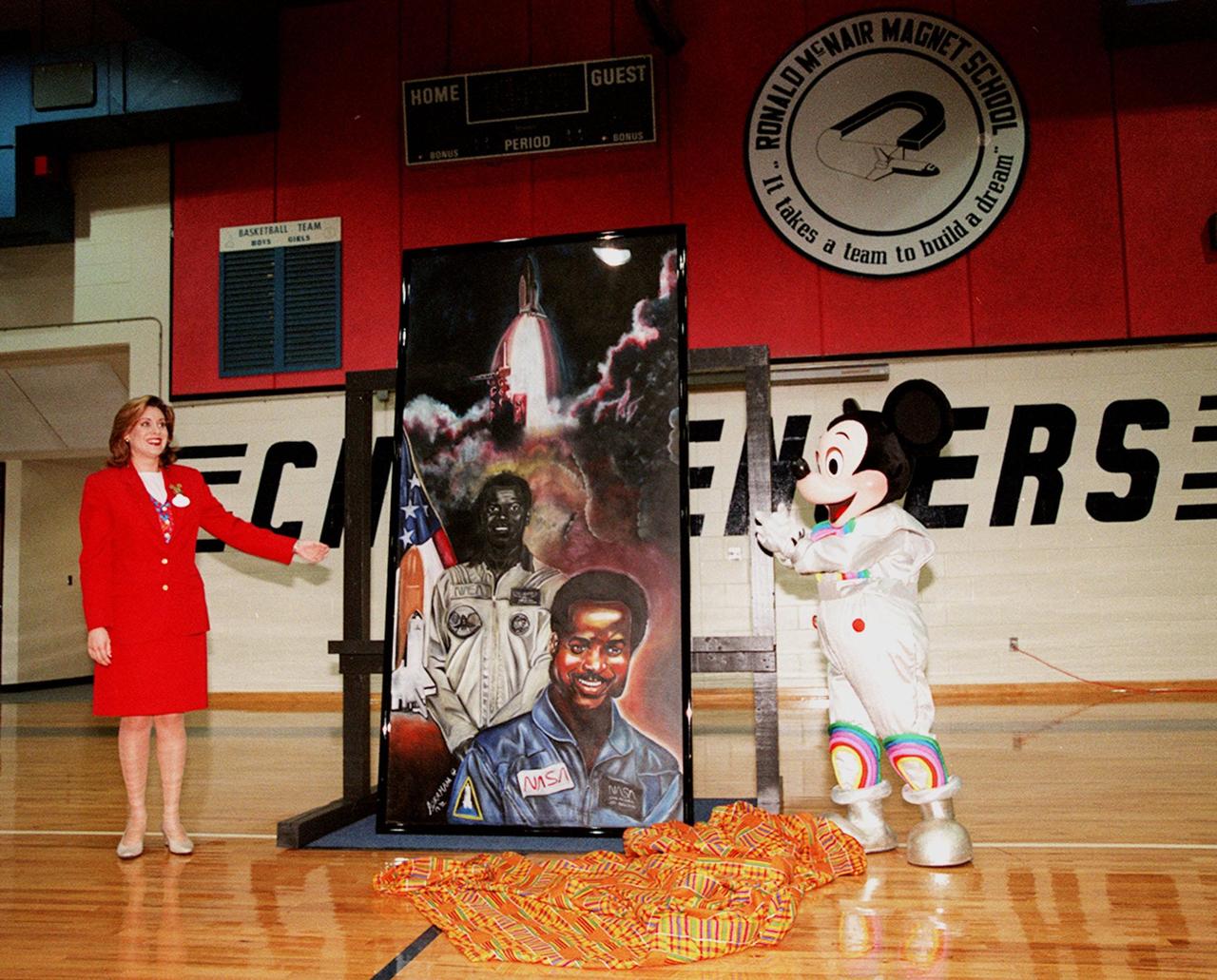
In the gymnasium of Ronald McNair Magnet School in Cocoa, Fla., Ms. Maria Rodriguez, an Walt Disney World Ambassador, and Mickey Mouse pose with a portrait of NASA astronaut Ronald McNair. The portrait was presented to the school by Walt Disney World during a tribute to McNair. The school had previously been renamed for the fallen astronaut, who was one of a crew of seven who lost their lives during an accident following launch of the Space Shuttle Challenger in January 1986
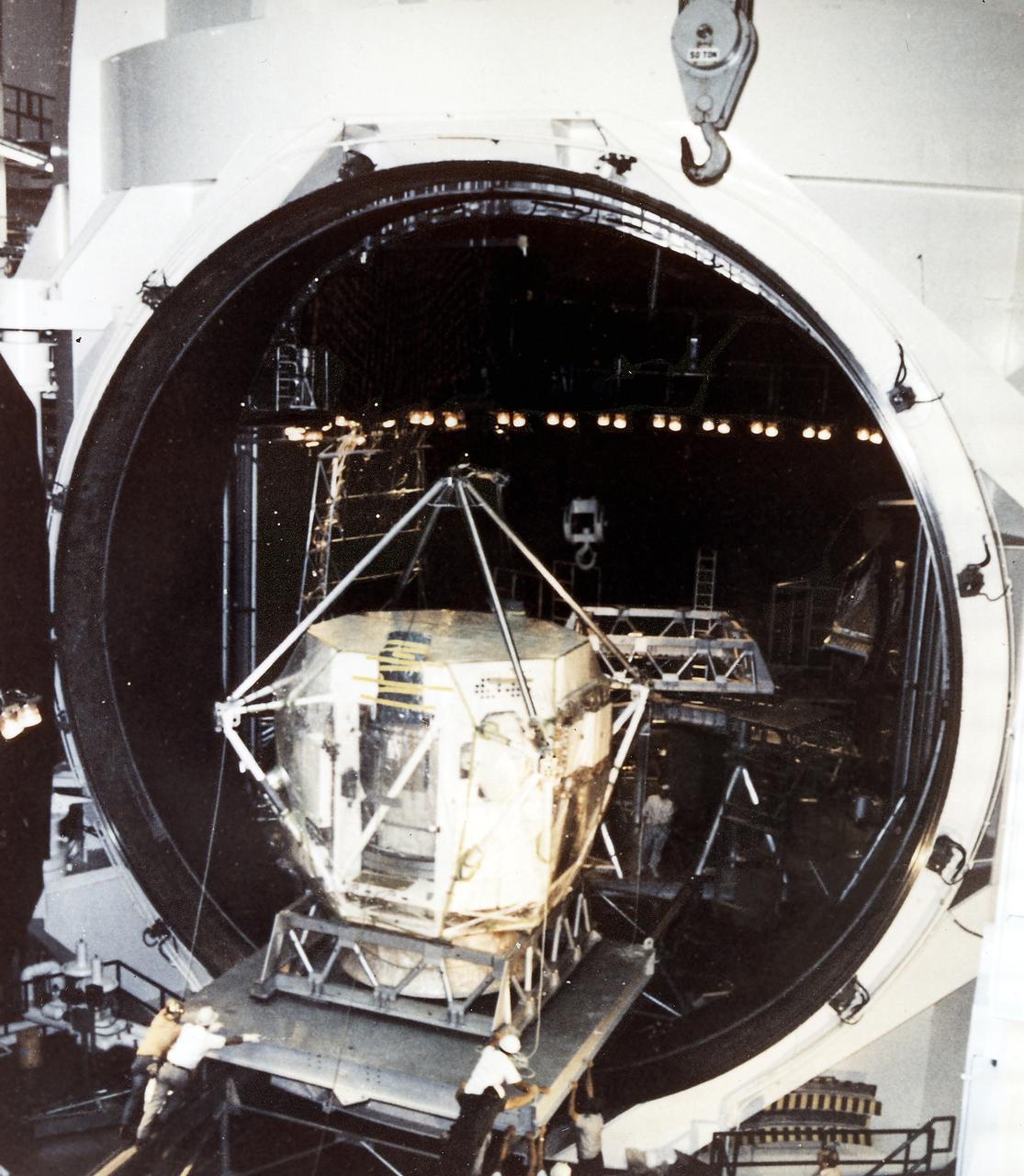
The Apollo Telescope Mount (ATM), designed and developed by the Marshall Space Flight Center, was one of four major components comprising the Skylab. The ATM housed the first marned scientific telescopes in space. In this photograph, taken at the Manned Spacecraft Center (later renamed the Johnson Space Center), an ATM prototype can be seen in a thermal vacuum chamber that tested the unit's ability to withstand the environment of space.
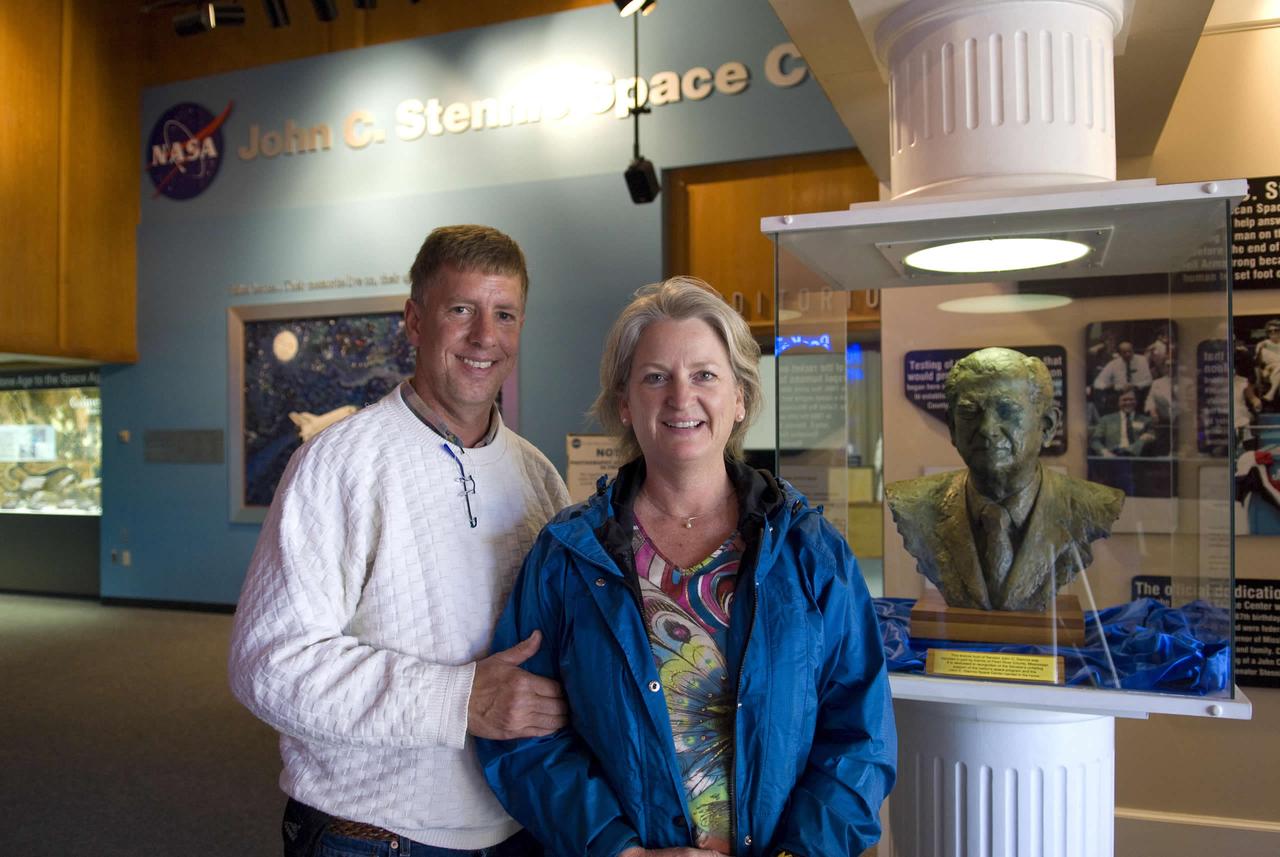
Jane Kenna of Atlanta, granddaughter of the late Sen. John C. Stennis, stands with her husband, John, near a bust of her grandfather displayed in StenniSphere, the visitor center at NASA's John C. Stennis Space Center. Kenna visited Stennis on April 6, her first trip to the rocket engine testing facility since the 1988 ceremony to rename the site in honor of Stennis.
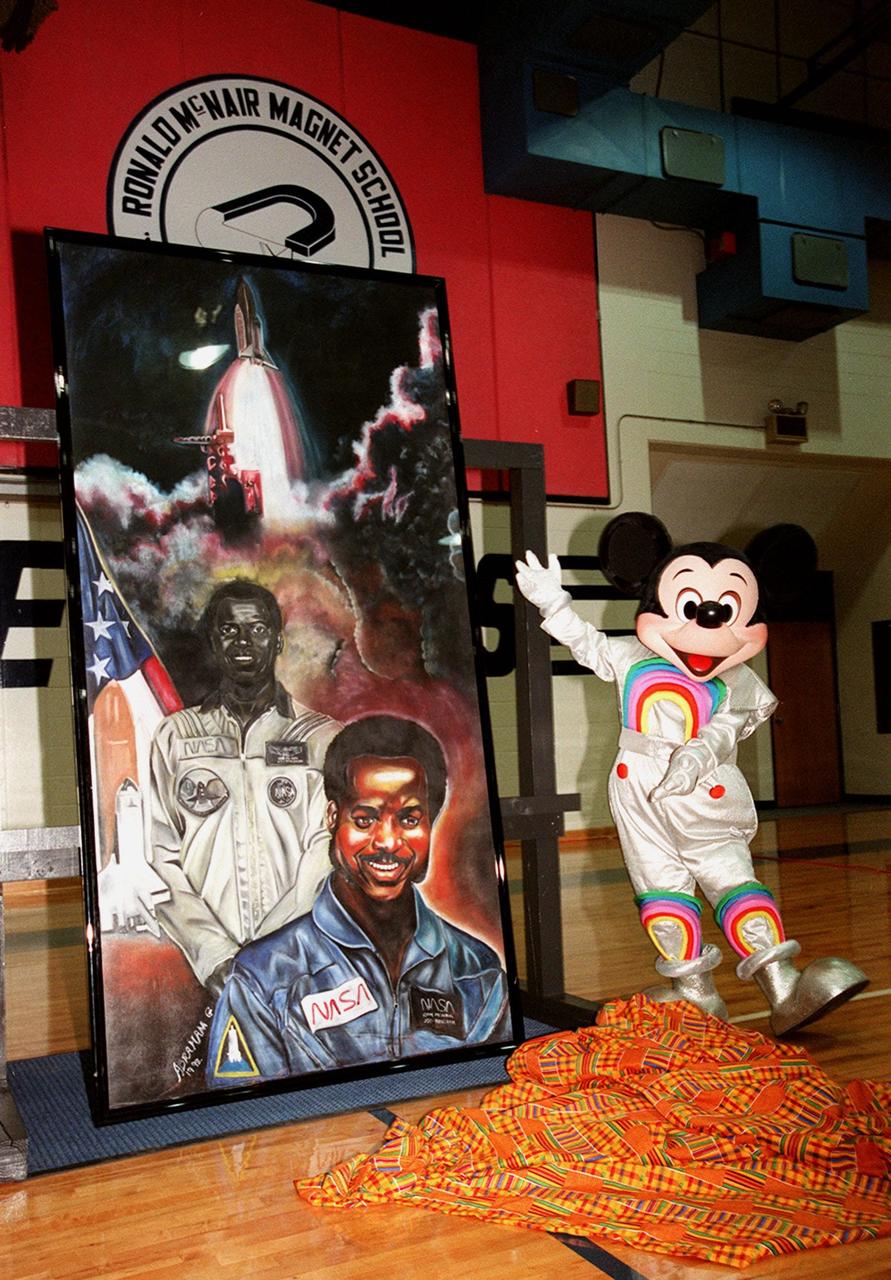
In the gymnasium of Ronald McNair Magnet School in Cocoa, Fla., Mickey Mouse poses with a portrait of NASA astronaut Ronald McNair. The portrait was presented to the school by Walt Disney World during a tribute to McNair. The school had previously been renamed for the fallen astronaut who was one of a crew of seven who lost their lives during an accident following launch of the Space Shuttle Challenger in January 1986
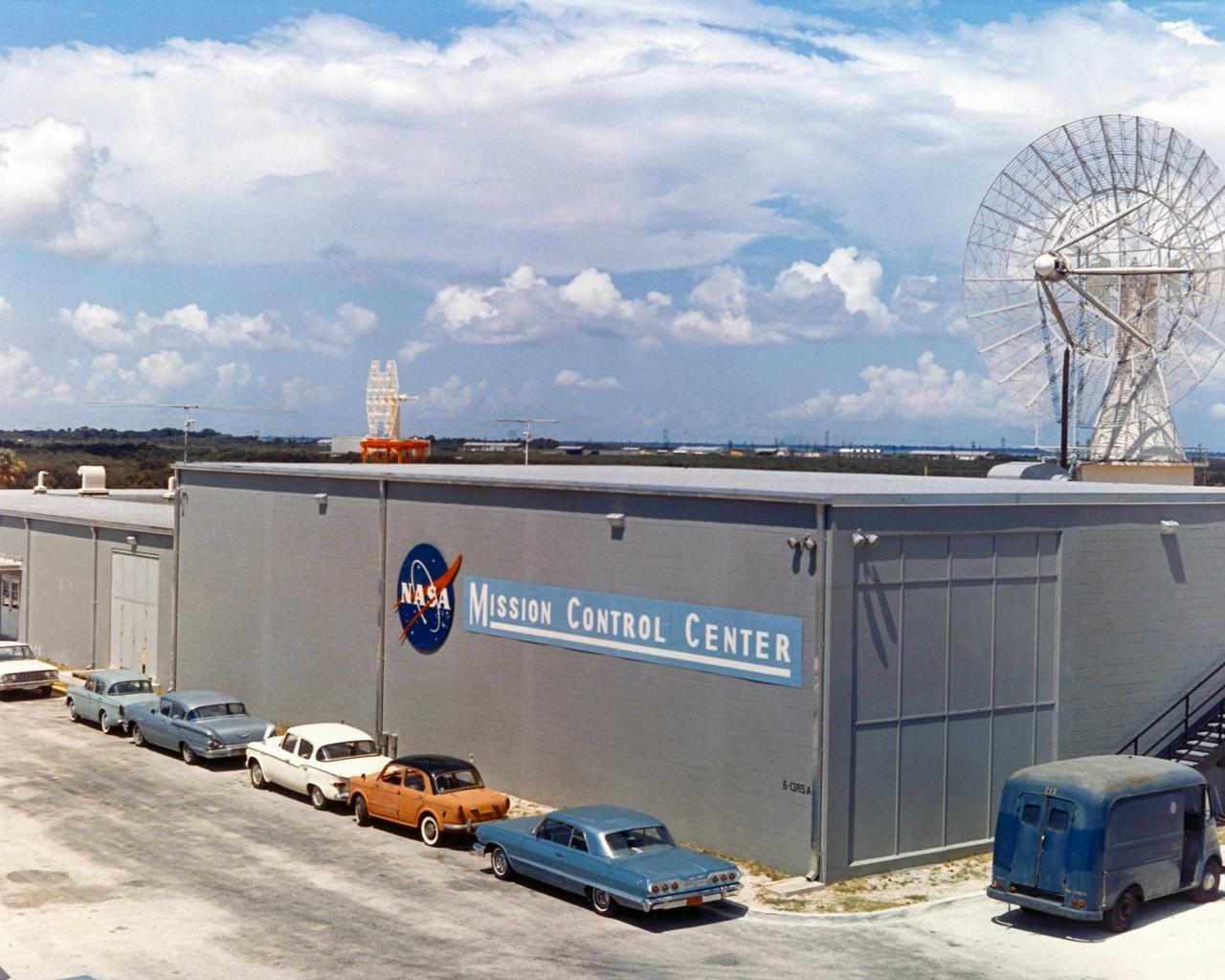
CAPE CANAVERAL, Fla. - Renamed the Mission Control Center, the facility continued to be the flight control through the first three missions of Project Gemini. The Mercury Mission Control Center in Florida played a key role in the United States' early spaceflight program. Located at Cape Canaveral Air Force Station, the original part of the building was constructed between 1956 and 1958, with additions in 1959 and 1963. The facility officially was transferred to NASA on Dec. 26, 1963, and served as mission control during all the Project Mercury missions, as well as the first three flights of the Gemini Program, when it was renamed Mission Control Center. With its operational days behind, on June 1, 1967, the Mission Control Center became a stop on the public tour of NASA facilities until the mid-90s. In 1999, much of the equipment and furnishings from the Flight Control Area were moved to the Kennedy Space Center Visitor Complex where they became part of the exhibit there. The building was demolished in spring 2010. Photo credit: NASA

The sign near the entrance of the National Advisory Committee for Aeronautics (NACA) Flight Propulsion Research Laboratory. The name was changed several weeks later to the Lewis Flight Propulsion Laboratory in honor of the NACA’s former Director of Aeronautical Research, George W. Lewis. The research laboratory has had five different names since its inception in 1941. The Cleveland laboratory was originally known as the NACA Aircraft Engine Research Laboratory. In 1947 it was renamed the NACA Flight Propulsion Research Laboratory to reflect the expansion of the research activities beyond just engines. Following the death of George Lewis, the name was changed to the NACA Lewis Flight Propulsion Laboratory in September 1948. On October 1, 1958, the lab was incorporated into the new NASA space agency, and it was renamed the NASA Lewis Research Center. Following John Glenn’s flight on the space shuttle, the name was changed again to the NASA Glenn Research Center on March 1, 1999. From his office in Washington DC, George Lewis managed the aeronautical research conducted at the NACA for over 20 years. His most important accomplishment, however, may have been an investigative tour of German research facilities in the fall of 1936. The visit resulted in the broadening of the scope of the NACA’s research and the physical expansion that included the new engine laboratory in Cleveland.

CAPE CANAVERAL, Fla. - Renamed the Mission Control Center, the facility continued to be the flight control through the first three missions of Project Gemini. The Mercury Mission Control Center in Florida played a key role in the United States' early spaceflight program. Located at Cape Canaveral Air Force Station, the original part of the building was constructed between 1956 and 1958, with additions in 1959 and 1963. The facility officially was transferred to NASA on Dec. 26, 1963, and served as mission control during all the Project Mercury missions, as well as the first three flights of the Gemini Program, when it was renamed Mission Control Center. With its operational days behind, on June 1, 1967, the Mission Control Center became a stop on the public tour of NASA facilities until the mid-90s. In 1999, much of the equipment and furnishings from the Flight Control Area were moved to the Kennedy Space Center Visitor Complex where they became part of the exhibit there. The building was demolished in spring 2010. Photo credit: NASA
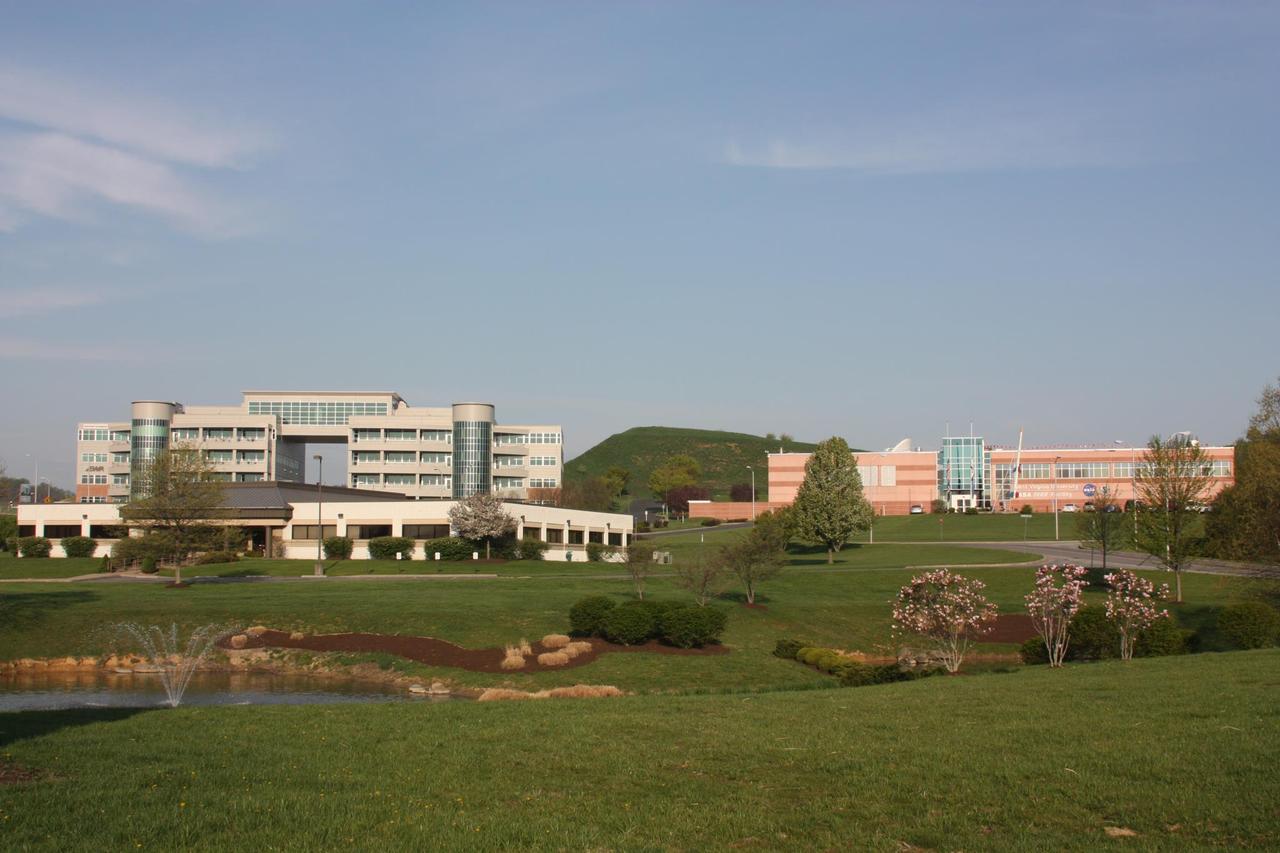
NASA's Katherine Johnson Independent Verification and Validation Facility in Fairmont, West Virginia. Credit: NASA
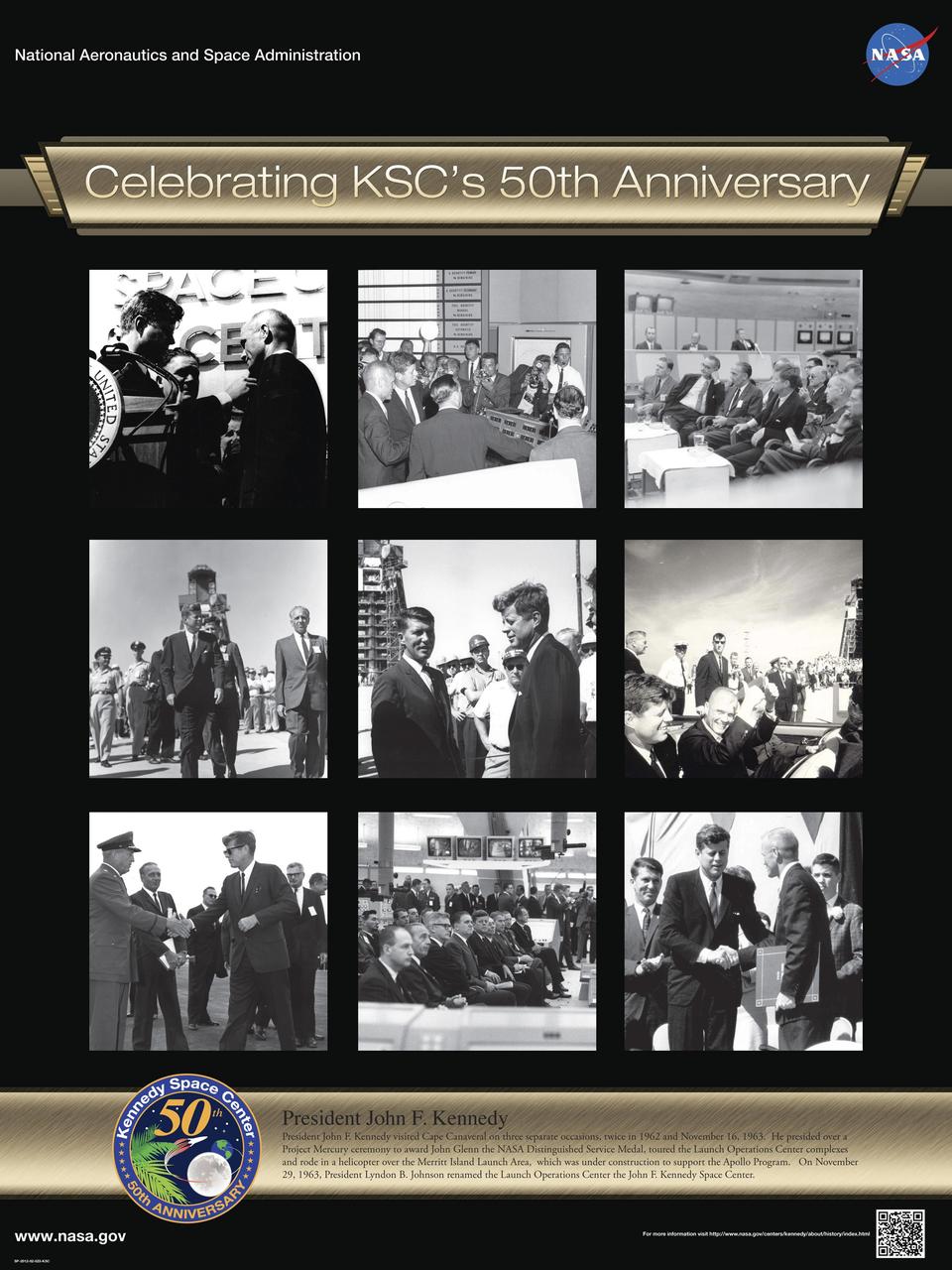
President John F. Kennedy: President John F. Kennedy visited Cape Canaveral on three separate occasions, twice in 1962 and November 16, 1963. He presided over a Project Mercury ceremony to award John Glenn the NASA Distinguished Service Medal, toured the Launch Operations Center complexes and rode in a helicopter over the Merritt Island Launch Area, which was under construction to support the Apollo Program. On November 29, 1963, President Lyndon B. Johnson renamed the Launch Operations Center the John F. Kennedy Space Center. Poster designed by Kennedy Space Center Graphics Department/Greg Lee. Credit: NASA
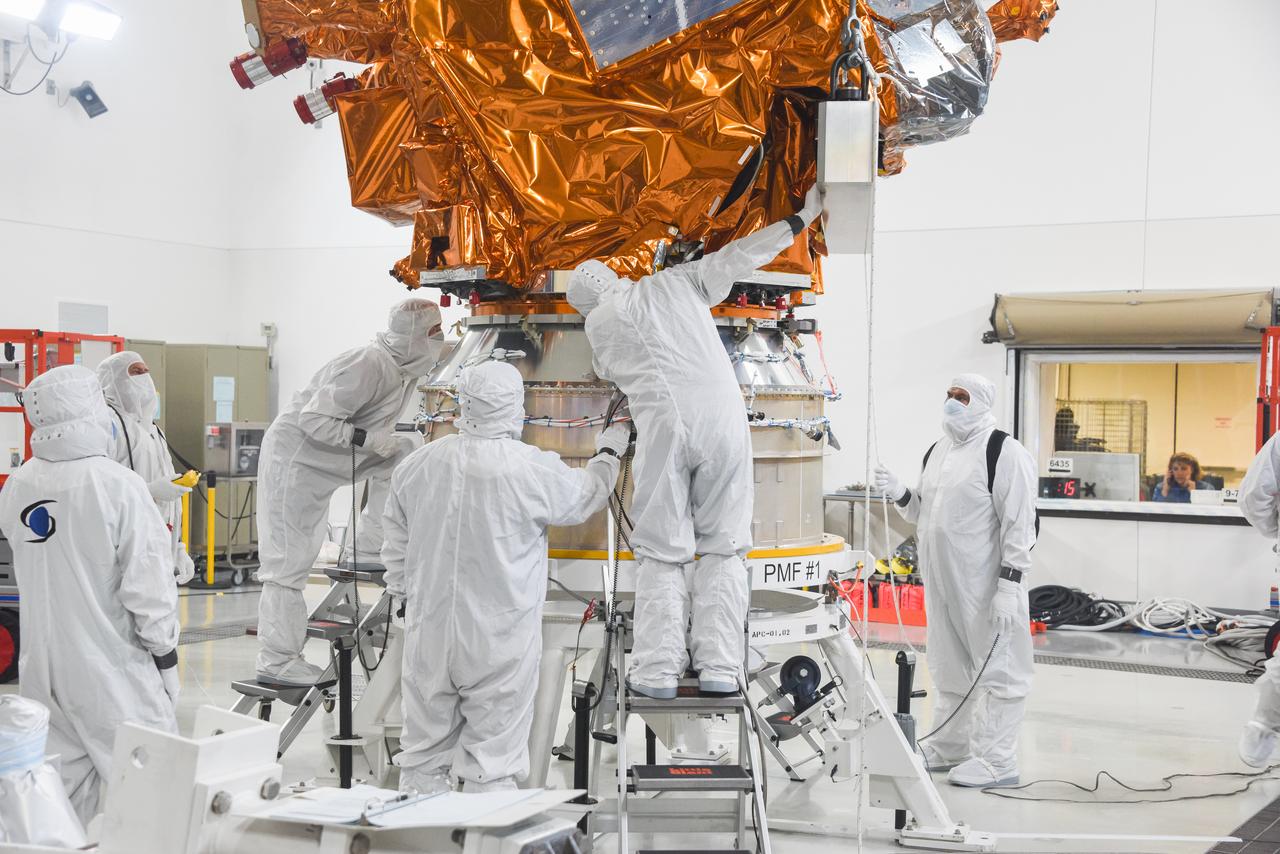
Technicians assist as a crane is used to lower the National Oceanic and Atmospheric Administration’s Joint Polar Satellite System (JPSS-2) onto the spacecraft adapter inside the Astrotech Space Operations facility at Vandenberg Space Force Base (VSFB) in California on Oct. 4, 2022. JPSS-2 is the third satellite in the Joint Polar Satellite System series. It is scheduled to lift off from VSFB on Nov. 1 from Space Launch Complex-3. JPSS-2, which will be renamed NOAA-21 after reaching orbit, will join a constellation of JPSS satellites that orbit from the North to the South pole, circling Earth 14 times a day and providing a full view of the entire globe twice daily.
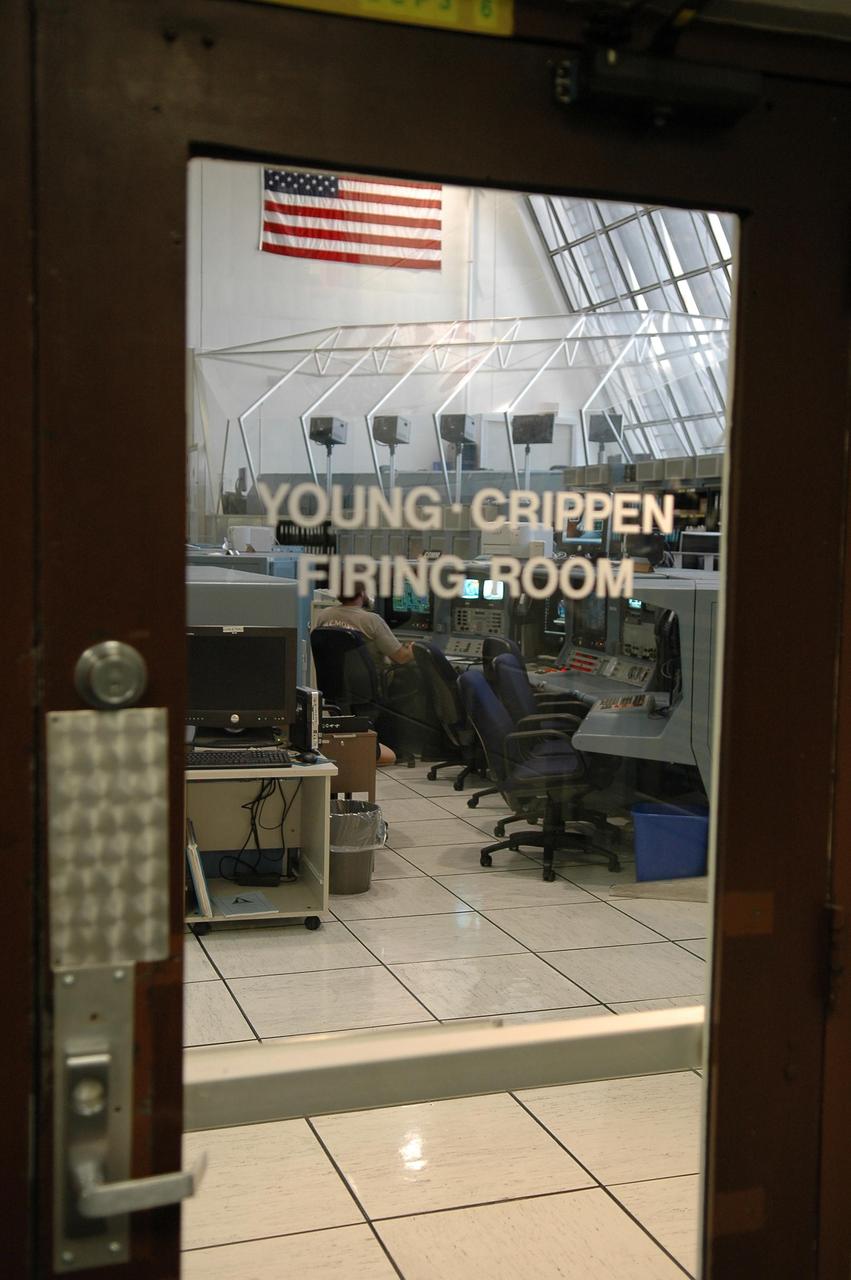
KENNEDY SPACE CENTER, FLA. - The door of firing room 1 in the Launch Control Center at NASA's Kennedy Space Center shows its new designation as the Young · Crippen Firing Room. The renaming was made in tribute to the 25th anniversary of the first space shuttle flight on April 12, 1981, dedicating the firing room that launched the historic flight and the crew of STS-1, Commander John Young and Pilot Robert Crippen. Making the dedication were Center Director Jim Kennedy; the NASA test director for STS-1, Norm Carlson; and the project flight engineer for Space Shuttle Columbia, Bob Sieck. Photo credit: NASA/Kim Shiflett
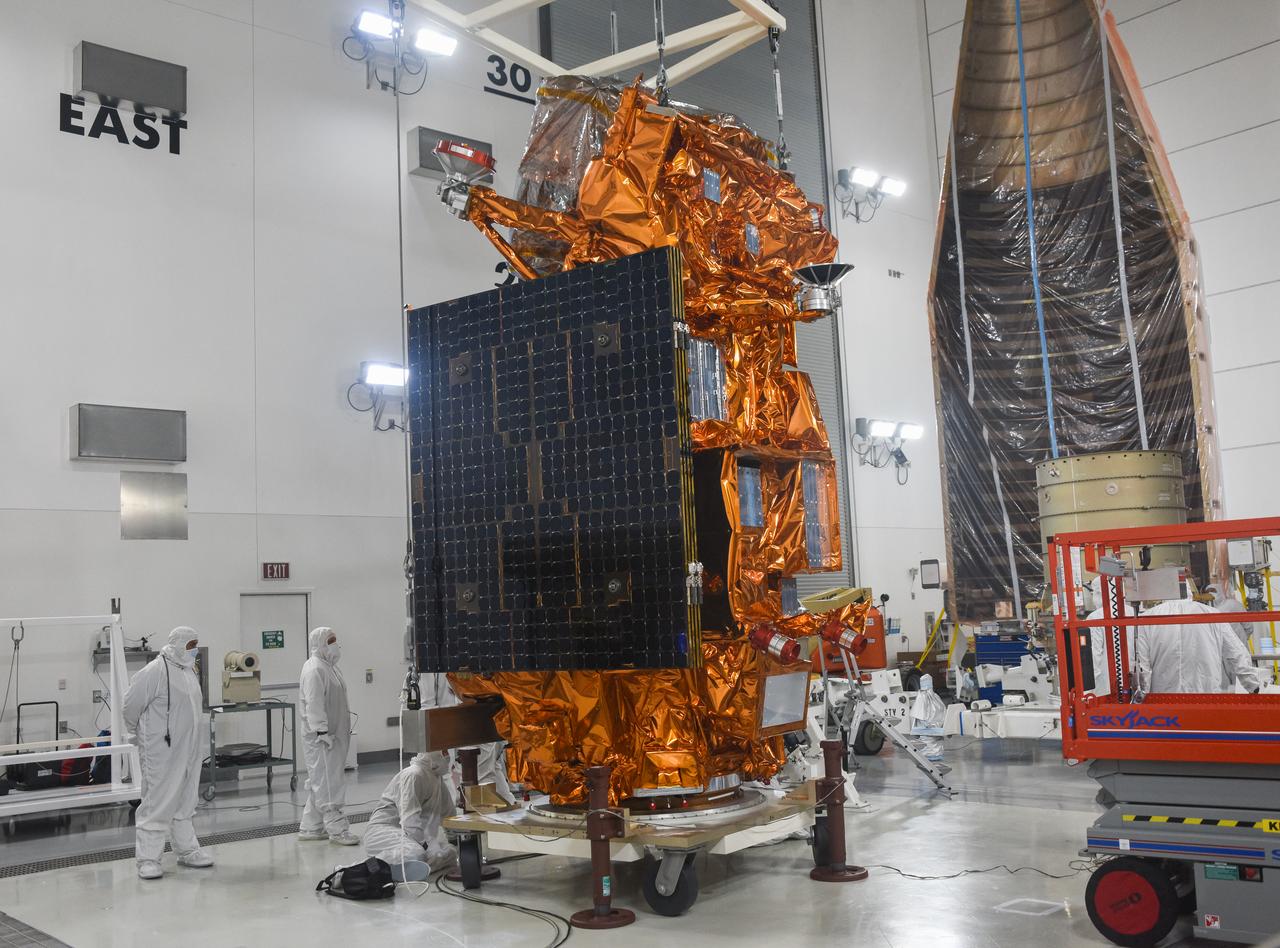
Technicians prepare the National Oceanic and Atmospheric Administration’s Joint Polar Satellite System (JPSS-2) to be attached to its spacecraft adapter inside the Astrotech Space Operations facility at Vandenberg Space Force Base (VSFB) in California on Oct. 4, 2022. JPSS-2 is the third satellite in the Joint Polar Satellite System series. It is scheduled to lift off from VSFB on Nov. 1 from Space Launch Complex-3. JPSS-2, which will be renamed NOAA-21 after reaching orbit, will join a constellation of JPSS satellites that orbit from the North to the South pole, circling Earth 14 times a day and providing a full view of the entire globe twice daily.
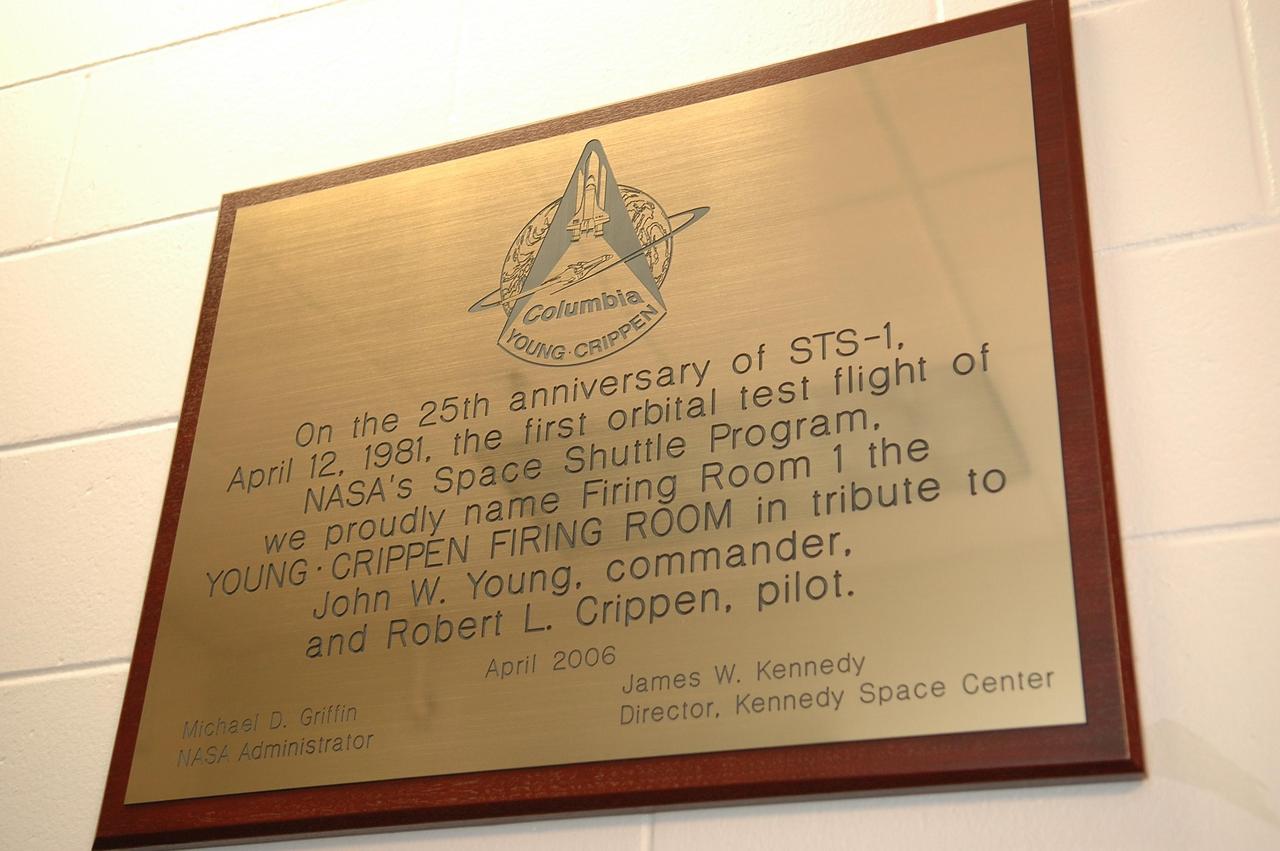
KENNEDY SPACE CENTER, FLA. - Near the door of firing room 1 in the Launch Control Center at NASA's Kennedy Space Center is this plaque revealing the dedication of the room as the Young · Crippen Firing Room. The renaming was made in tribute to the 25th anniversary of the first space shuttle flight on April 12, 1981, dedicating the firing room that launched the historic flight and the crew of STS-1, Commander John Young and Pilot Robert Crippen. Making the dedication were Center Director Jim Kennedy; the NASA test director for STS-1, Norm Carlson; and the project flight engineer for Space Shuttle Columbia, Bob Sieck. Photo credit: NASA/Kim Shiflett
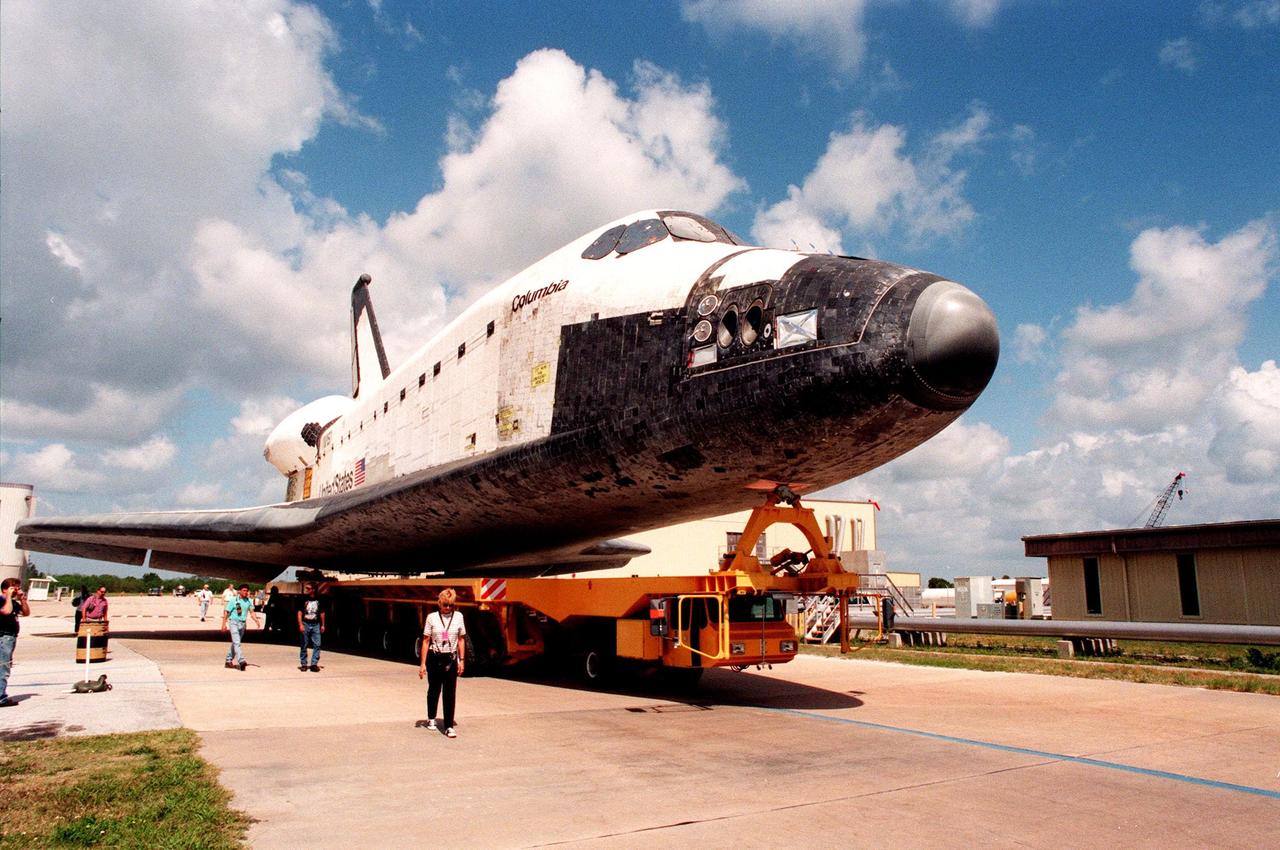
KENNEDY SPACE CENTER, FLA. -- The orbiter Columbia, aboard its orbiter transporter system, heads for the Vehicle Assembly Building to undergo external tank mating operations. Columbia is scheduled for rollout to Launch Pad 39B on Monday, June 7, for mission STS-93. The primary mission objective will be the deployment of the Advanced X-ray Astrophysics Facility, recently renamed the Chandra X-Ray Observatory. Mission STS-93 will be the first Space Shuttle commanded by a woman, Commander Eileen M. Collins. It is scheduled to launch July 22 at 12:27 a.m. EDT although that date is currently under review
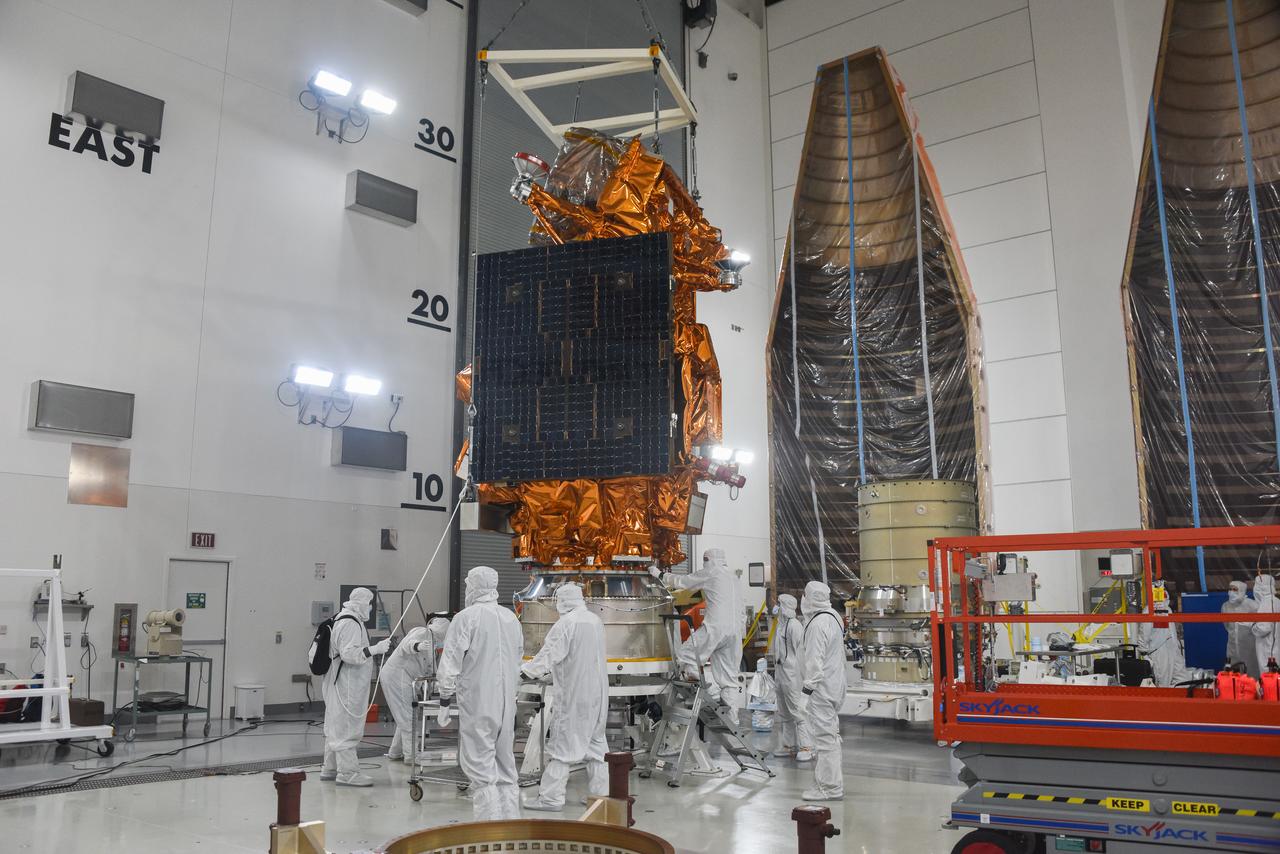
The National Oceanic and Atmospheric Administration’s Joint Polar Satellite System (JPSS-2) is now secured on the spacecraft adapter inside the Astrotech Space Operations facility at Vandenberg Space Force Base (VSFB) in California on Oct. 4, 2022. JPSS-2 is the third satellite in the Joint Polar Satellite System series. It is scheduled to lift off from VSFB on Nov. 1 from Space Launch Complex-3. JPSS-2, which will be renamed NOAA-21 after reaching orbit, will join a constellation of JPSS satellites that orbit from the North to the South pole, circling Earth 14 times a day and providing a full view of the entire globe twice daily.
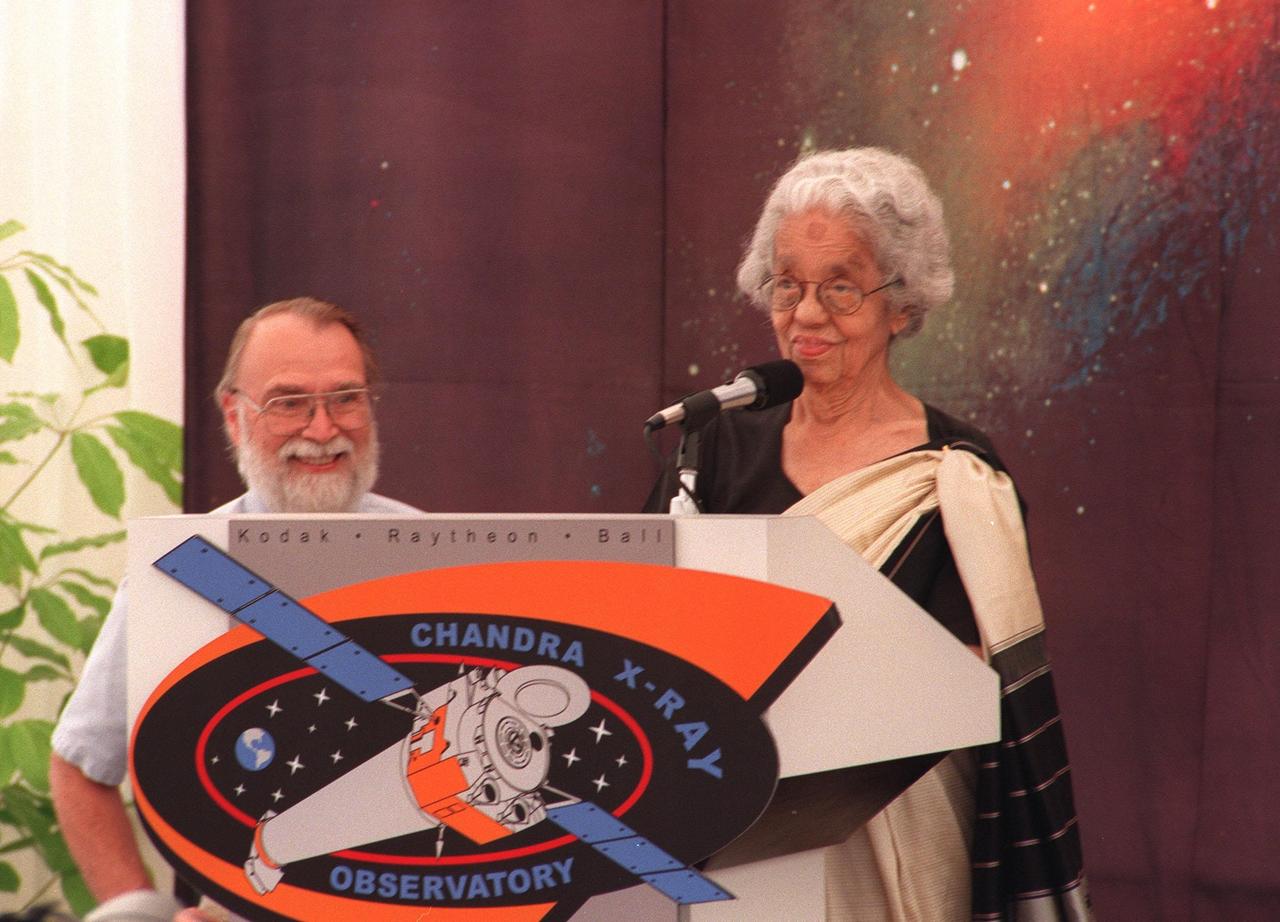
KENNEDY SPACE CENTER, FLA. -- Mrs. Lalitha Chandrasekhar (right), wife of the late Indian-American Nobel Laureate Subrahmanyan Chandrasekhar, addresses the media and other invited guests in the TRW Media Hospitality Tent at the NASA Press Site at KSC as Dr. Alan Bunner, Science Program Director, Structure and Evolution of the Universe, Office of Space Science, NASA Headquarters, Washington, D.C., looks on. The name "Chandra," a shortened version of her husband's name which he preferred among friends and colleagues, was chosen in a contest to rename the Advanced X-ray Astrophysics Facility. "Chandra" also means "Moon" or "luminous" in Sanskrit. The observatory is scheduled to be launched aboard Columbia on Space Shuttle mission STS-93
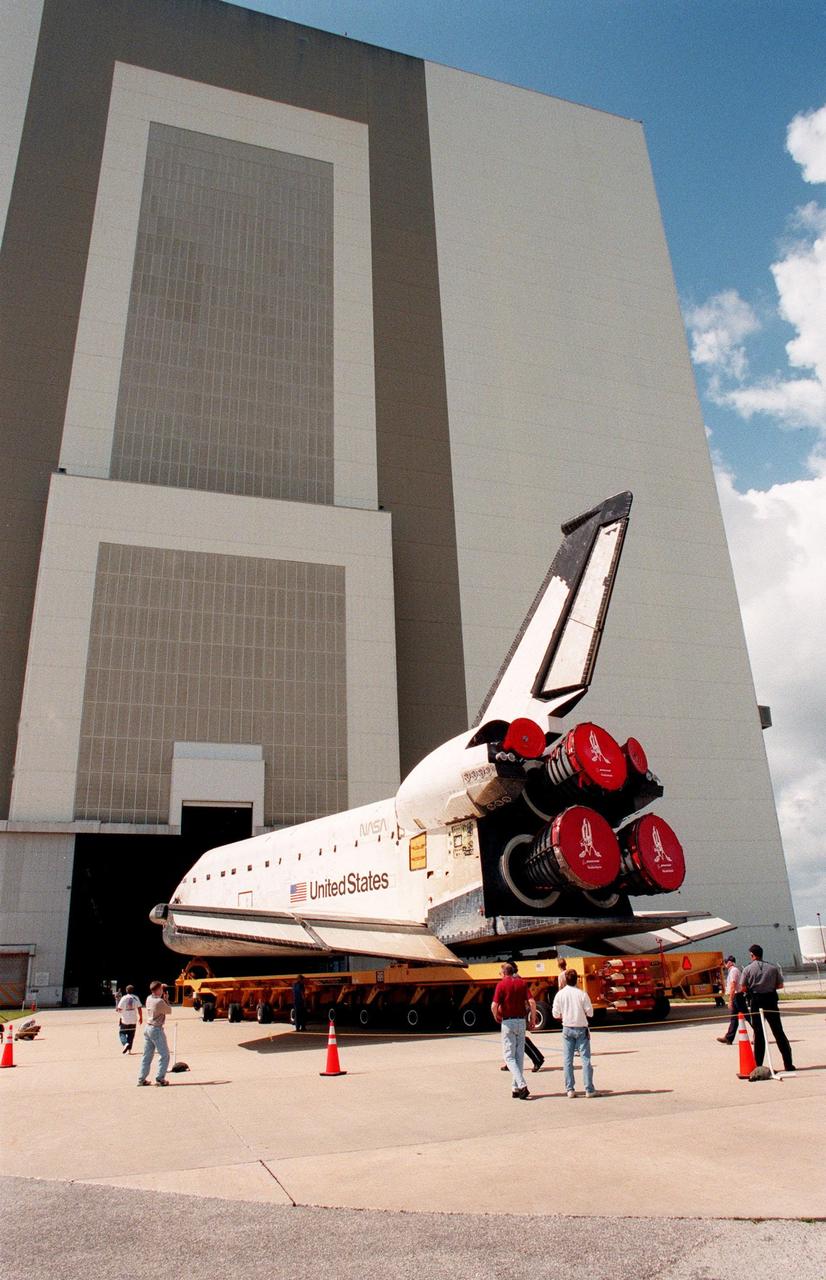
KENNEDY SPACE CENTER, FLA. -- The orbiter Columbia, aboard its orbiter transporter system, rolls toward the opening in the Vehicle Assembly Building where it will undergo external tank mating operations. Columbia is scheduled for rollout to Launch Pad 39B on Monday, June 7, for mission STS-93. The primary mission objective will be the deployment of the Advanced X-ray Astrophysics Facility, recently renamed the Chandra X-Ray Observatory. Mission STS-93 will be the first Space Shuttle commanded by a woman, Commander Eileen M. Collins. It is scheduled to launch July 22 at 12:27 a.m. EDT although that date is currently under review
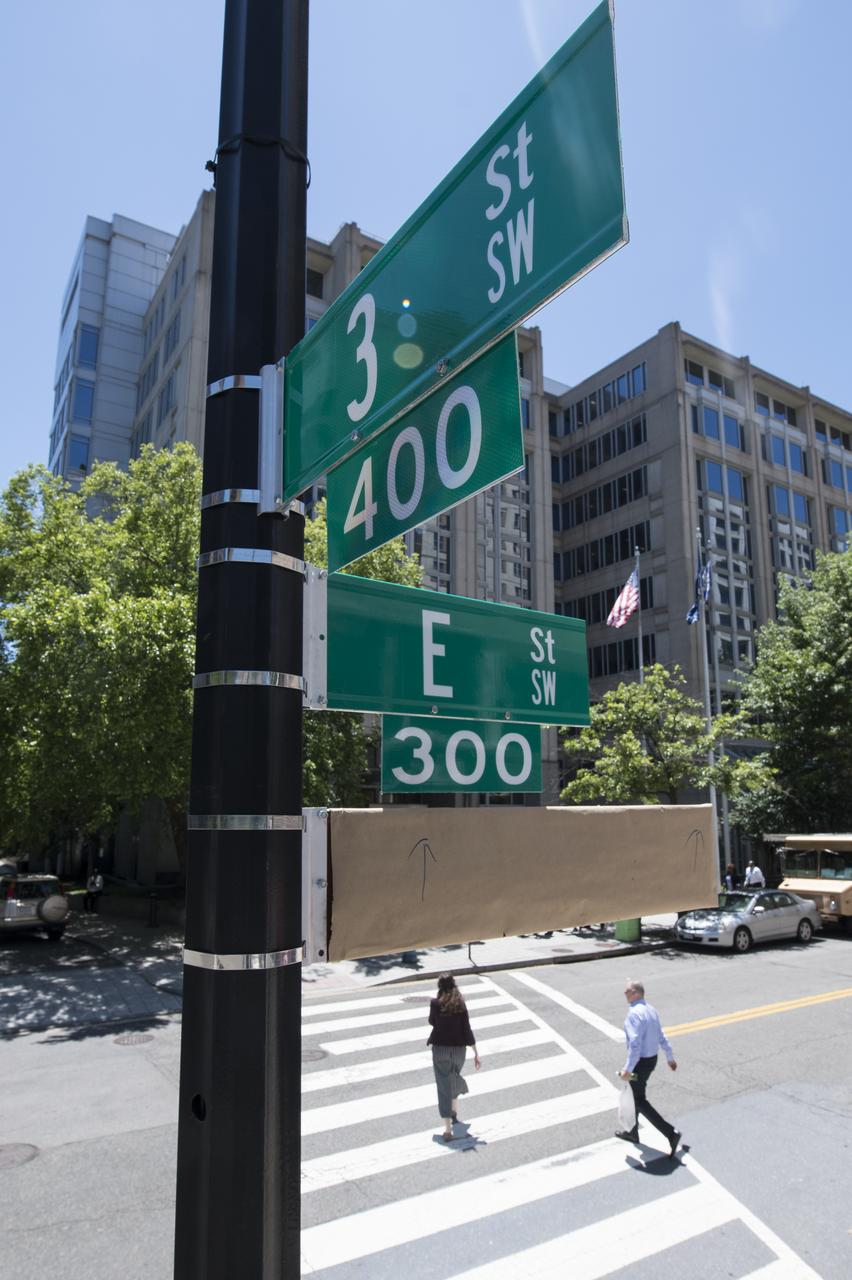
A covered street sign is seen outside of the NASA Headquarters building the day before a street renaming ceremony, Tuesday, June 11, 2019 in Washington, DC. On Wednesday, June 12, a ceremony was held to dedicate the 300 block of E Street SW in front of the NASA Headquarters building as "Hidden Figures Way" to honor Katherine Johnson, Dorothy Vaughan, Mary Jackson and all women who have dedicated their lives to honorably serving their country, advancing equality, and contributing to the space program of the United States. Photo Credit: (NASA/Joel Kowsky)
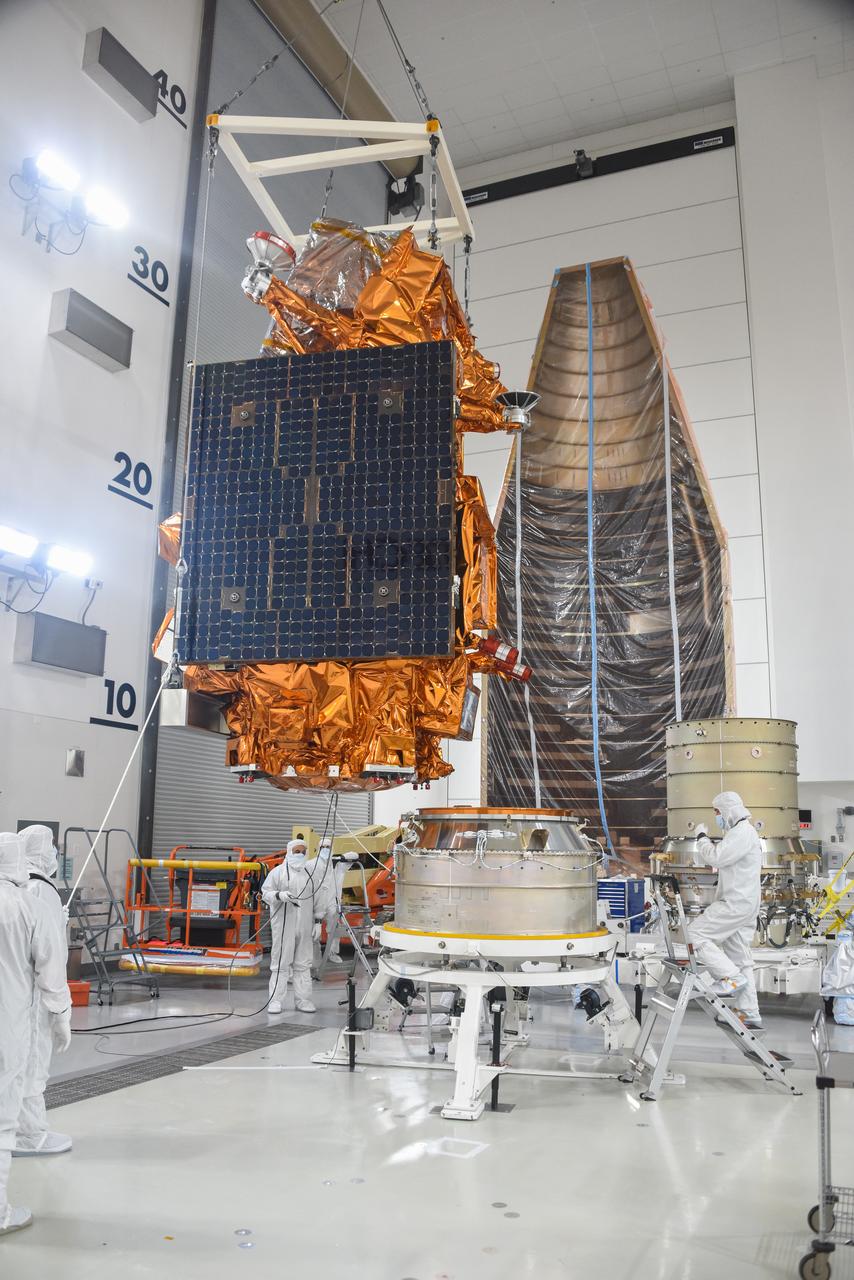
Technicians assist as a crane is used to move the National Oceanic and Atmospheric Administration’s Joint Polar Satellite System (JPSS-2) for mating to the spacecraft adapter inside the Astrotech Space Operations facility at Vandenberg Space Force Base (VSFB) in California on Oct. 4, 2022. JPSS-2 is the third satellite in the Joint Polar Satellite System series. It is scheduled to lift off from VSFB on Nov. 1 from Space Launch Complex-3. JPSS-2, which will be renamed NOAA-21 after reaching orbit, will join a constellation of JPSS satellites that orbit from the North to the South pole, circling Earth 14 times a day and providing a full view of the entire globe twice daily.
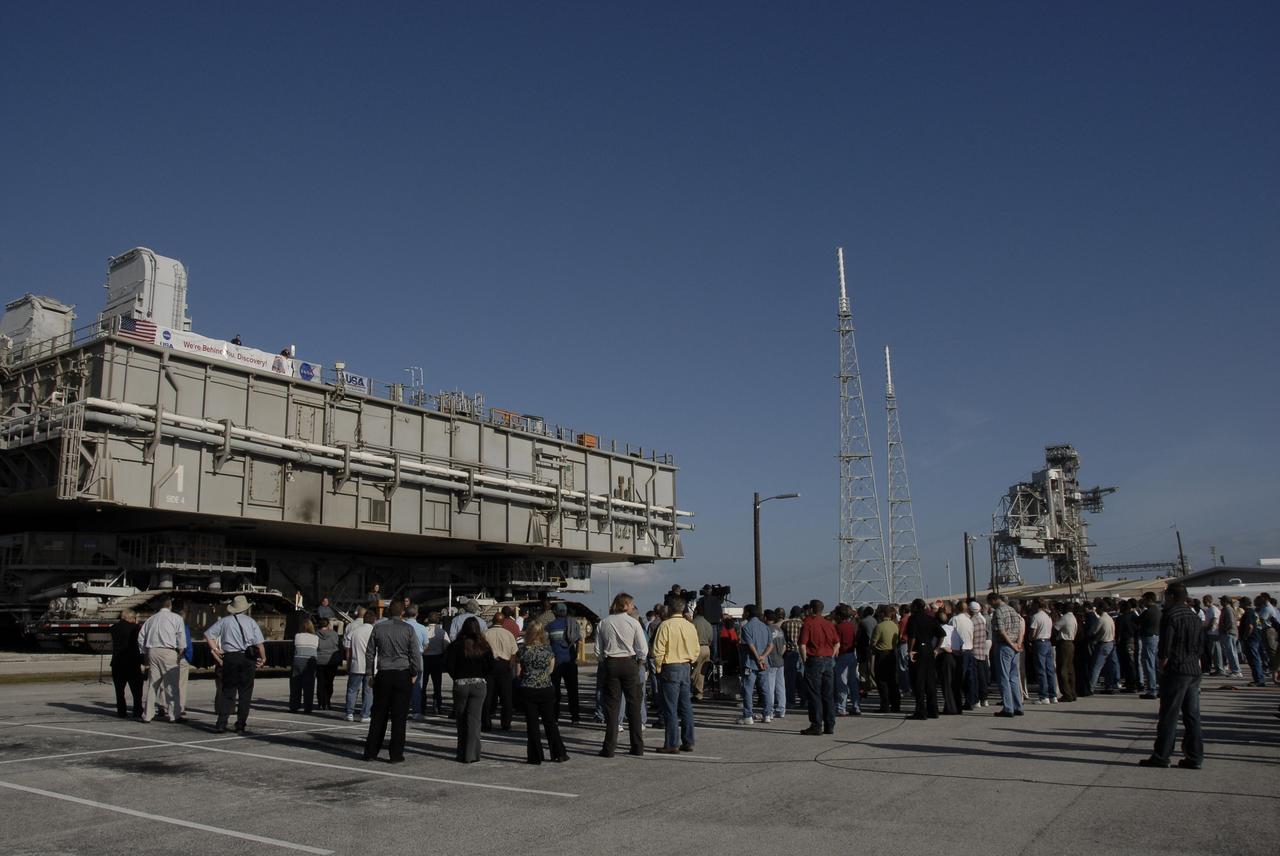
CAPE CANAVERAL, Fla. – – Employees and media gather near Launch Pad 39B at NASA's Kennedy Space Center in Florida for the handover ceremony for Mobile Launcher Platform-1, seen here. The platform is being transferred from NASA's Space Shuttle Program to the Constellation Program for the Ares I-X flight test targeted for this summer. Constructed in 1964, the mobile launchers used in Apollo/Saturn operations were modified for use in shuttle operations. With cranes, umbilical towers and swing arms removed, the mobile launchers were renamed Mobile Launcher Platforms, or MLPs. Photo credit: NASA/Kim Shiflett
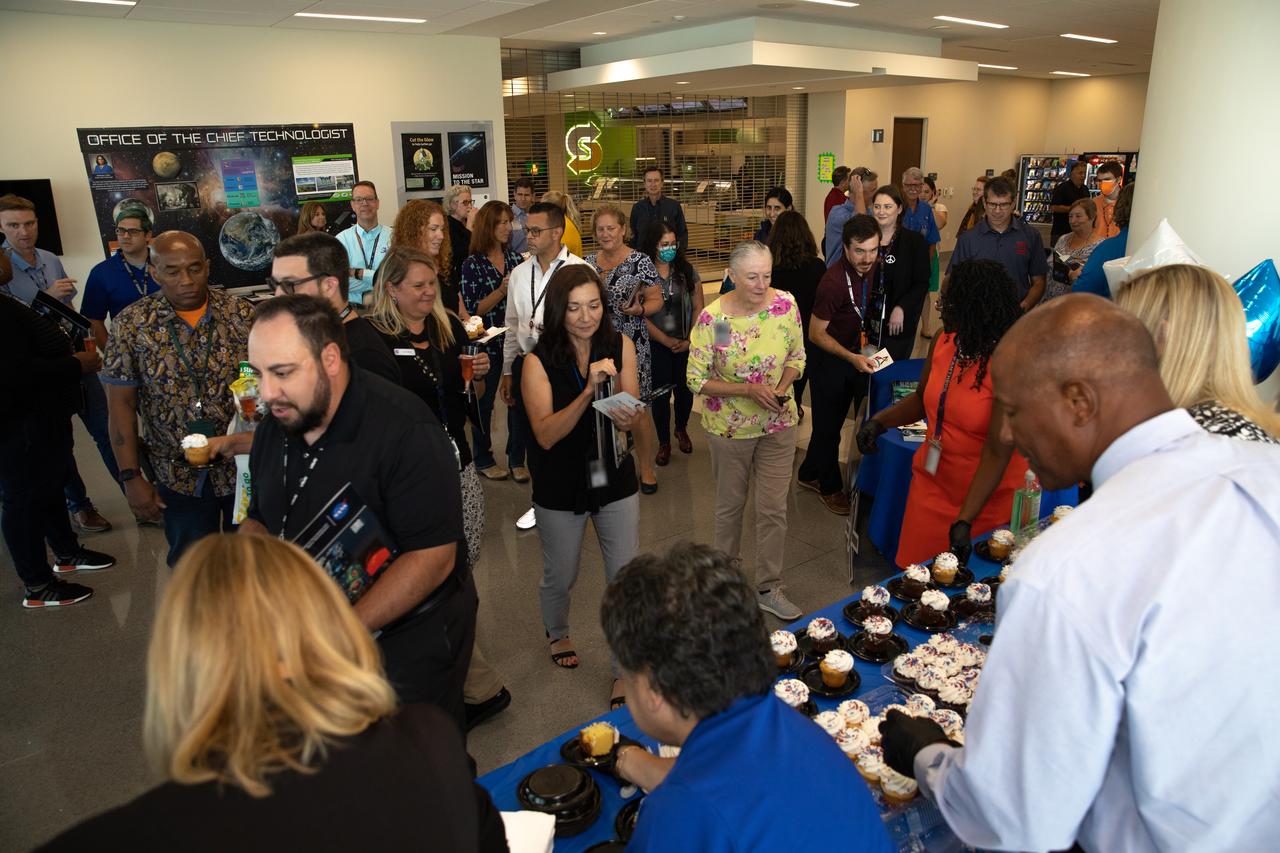
The NASA Kennedy Space Center senior leaders and employees celebrated the center’s 60th anniversary with a “Cheers to 60 Years” cake and non-alcoholic toast in the Central Campus Headquarters on June 28, 2022. From left, serving cake at the table, are Center Director Janet Petro; Janet Sellars, director of Human Resources; Kelvin Manning, deputy center director; and Nancy Bray, partially hidden, director of Spaceport Integration and Services. In July 1962, the Launch Operations Center in Florida was established. By December 1963, it was renamed the John F. Kennedy Space Center.
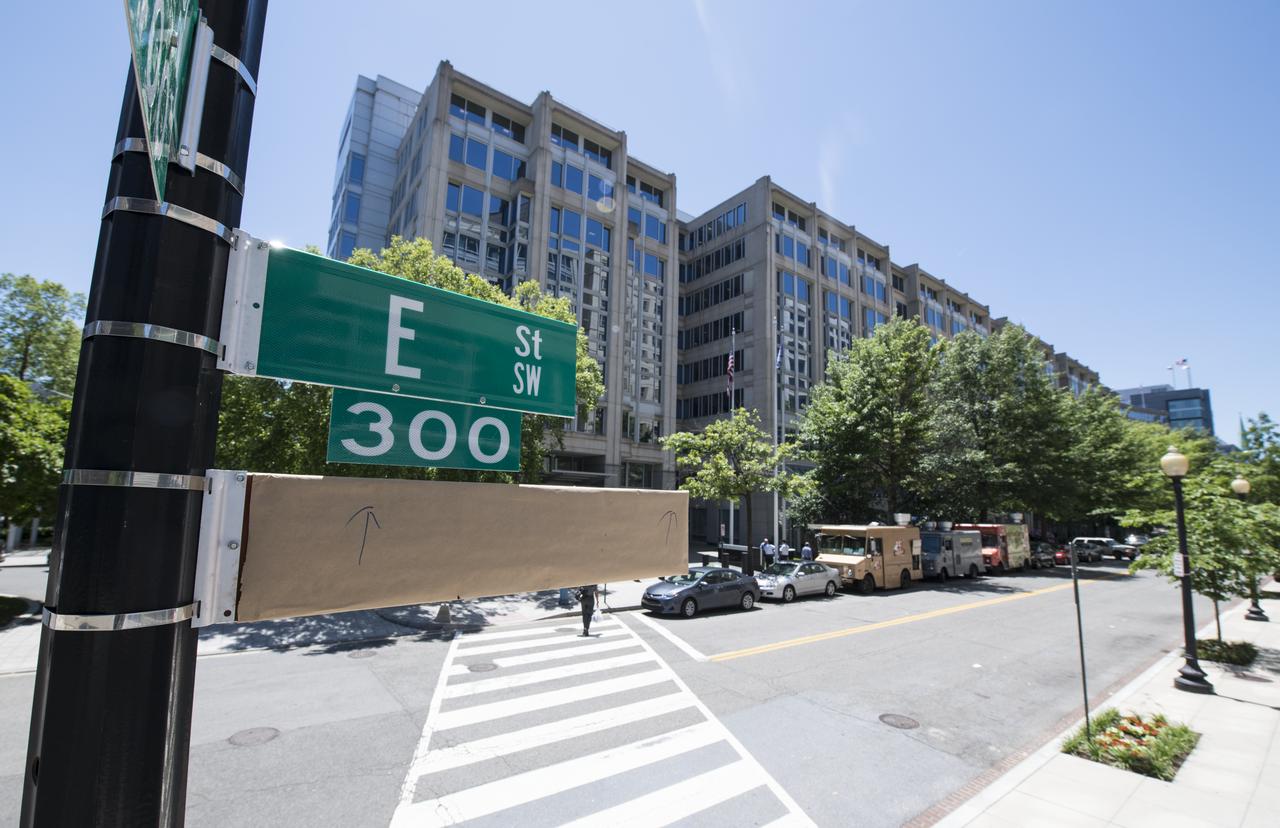
A covered street sign is seen outside of the NASA Headquarters building the day before a street renaming ceremony, Tuesday, June 11, 2019 in Washington, DC. On Wednesday, June 12, a ceremony was held to dedicate the 300 block of E Street SW in front of the NASA Headquarters building as "Hidden Figures Way" to honor Katherine Johnson, Dorothy Vaughan, Mary Jackson and all women who have dedicated their lives to honorably serving their country, advancing equality, and contributing to the space program of the United States. Photo Credit: (NASA/Joel Kowsky)
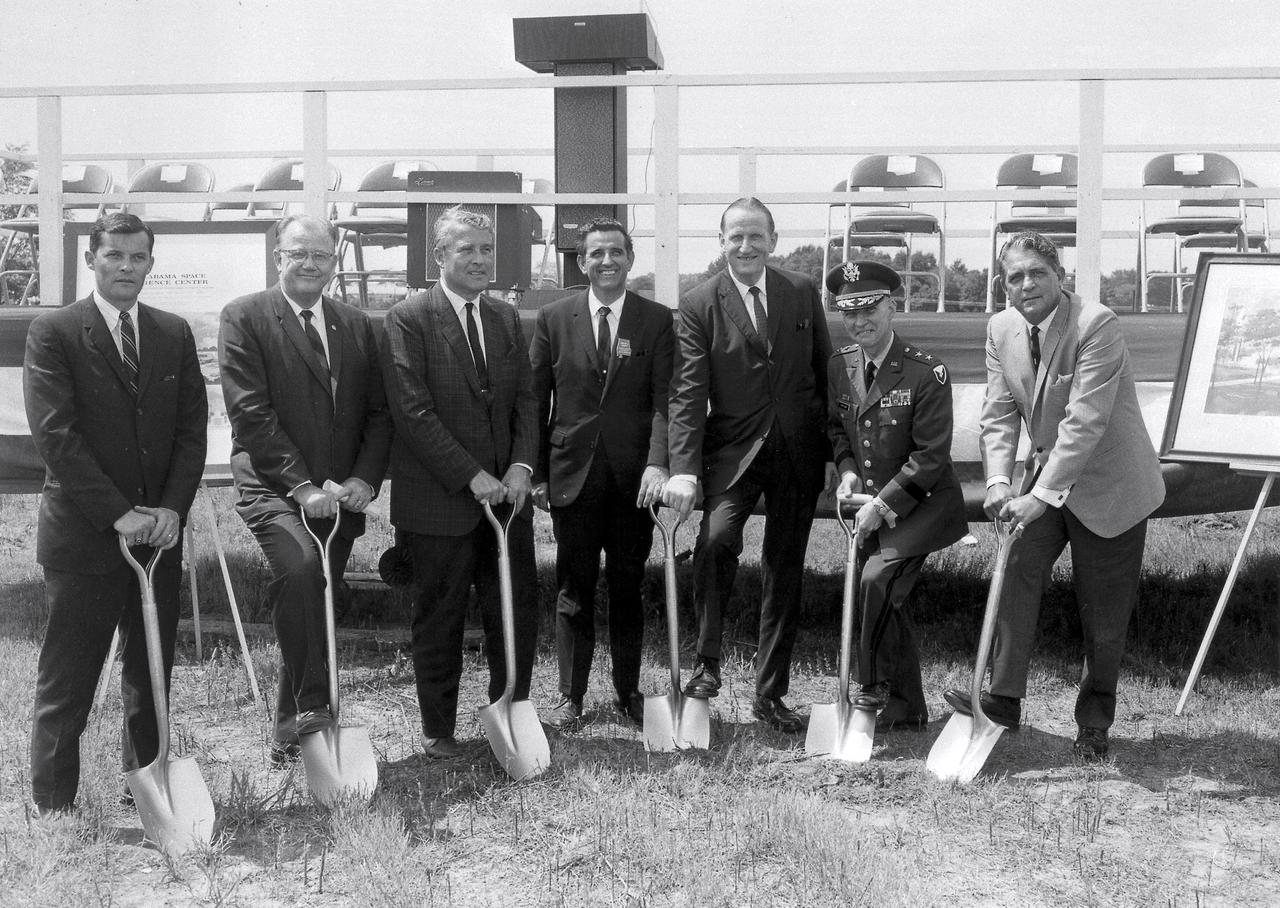
Ground breaking ceremony for the Alabama Space Science Center, later renamed the U.S. Space and Rocket Center. Shown in this picture, left to right, are Edward O. Buckbee, Space Center Director; Jack Giles, Alabama State Senator of Huntsville; Dr. Wernher on Braun, Marshall Space Flight Center (MSFC) Director; Martin Darity, head of the Alabama Publicity Bureau (representing Governor Albert Brewer); James Allen, former Lieutenant governor, chairman of the Alabama Space Science Exhibit Commission; Major General Charles Eifler, commanding general of the Army Ordnance Missile Command; and Huntsville Mayor Glenrn Hearn. (Courtesy of Huntsville/Madison County Public Library)
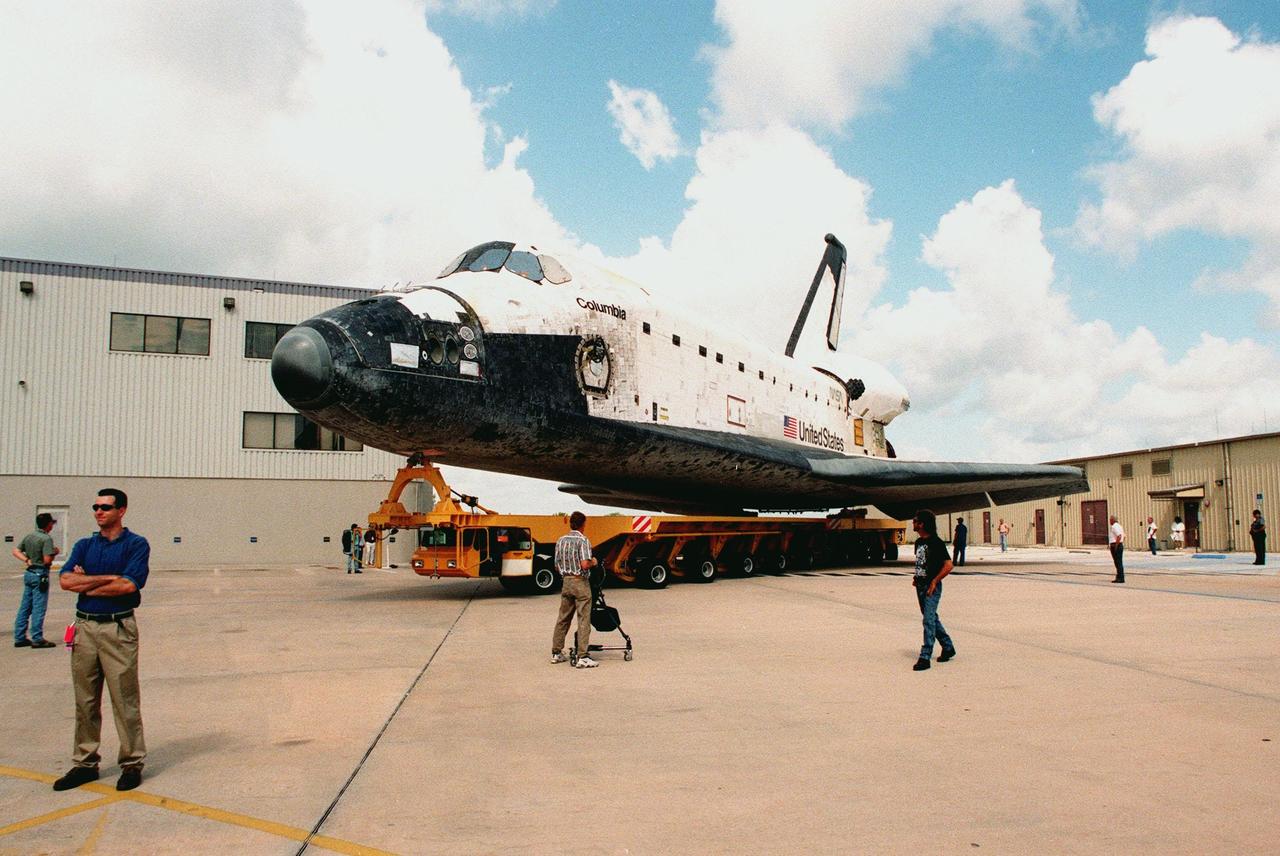
KENNEDY SPACE CENTER, FLA. -- The orbiter Columbia, aboard its orbiter transporter system, makes the turn from the Orbiter Processing Facility (behind it, left) to the nearby Vehicle Assembly Building (VAB) for external tank mating operations. Columbia is scheduled for rollout to Launch Pad 39B on Monday, June 7, for mission STS-93. The primary mission objective will be the deployment of the Advanced X-ray Astrophysics Facility, recently renamed the Chandra X-Ray Observatory. Mission STS-93 will be the first Space Shuttle commanded by a woman, Commander Eileen M. Collins. It is scheduled to launch July 22 at 12:27 a.m. EDT although that date is currently under review

Technicians prepare the spacecraft adapter to be attached to the National Oceanic and Atmospheric Administration’s Joint Polar Satellite System (JPSS-2) inside the Astrotech Space Operations facility at Vandenberg Space Force Base (VSFB) in California on Oct. 4, 2022. JPSS-2 is the third satellite in the Joint Polar Satellite System series. It is scheduled to lift off from VSFB on Nov. 1 from Space Launch Complex-3. JPSS-2, which will be renamed NOAA-21 after reaching orbit, will join a constellation of JPSS satellites that orbit from the North to the South pole, circling Earth 14 times a day and providing a full view of the entire globe twice daily.
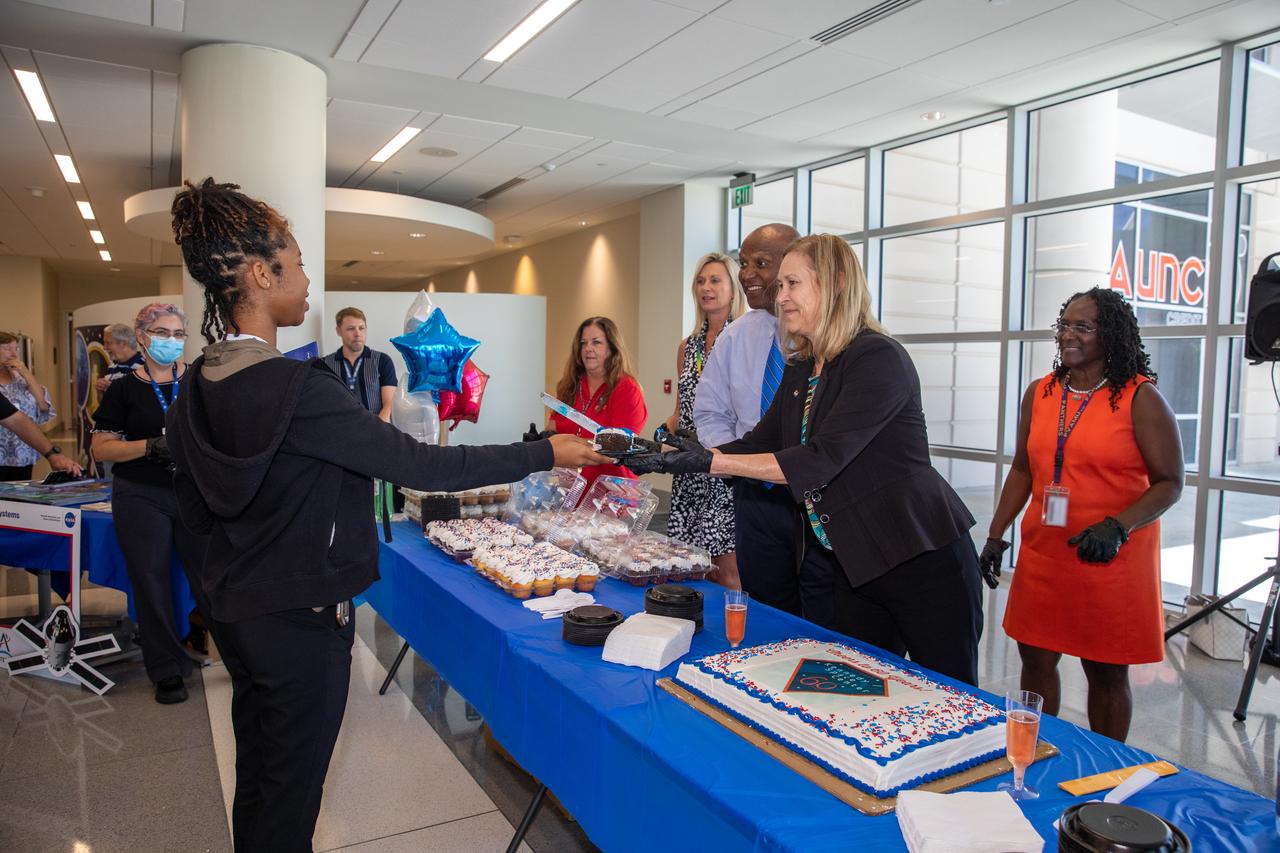
NASA Kennedy Space Center senior leaders helped celebrate the center’s 60th anniversary with a “Cheers to 60 Years” cake and non-alcoholic toast in the Central Campus Headquarters on June 28, 2022. Center Director Janet Petro hands a slice of cake to an employee. Also, from left are Nancy Bray, director of Spaceport Integration and Services; Kelvin Manning, deputy center director; and Hortense Blackwell, director of Communication and Public Engagement. In July 1962, the Launch Operations Center in Florida was established. By December 1963, it was renamed the John F. Kennedy Space Center.
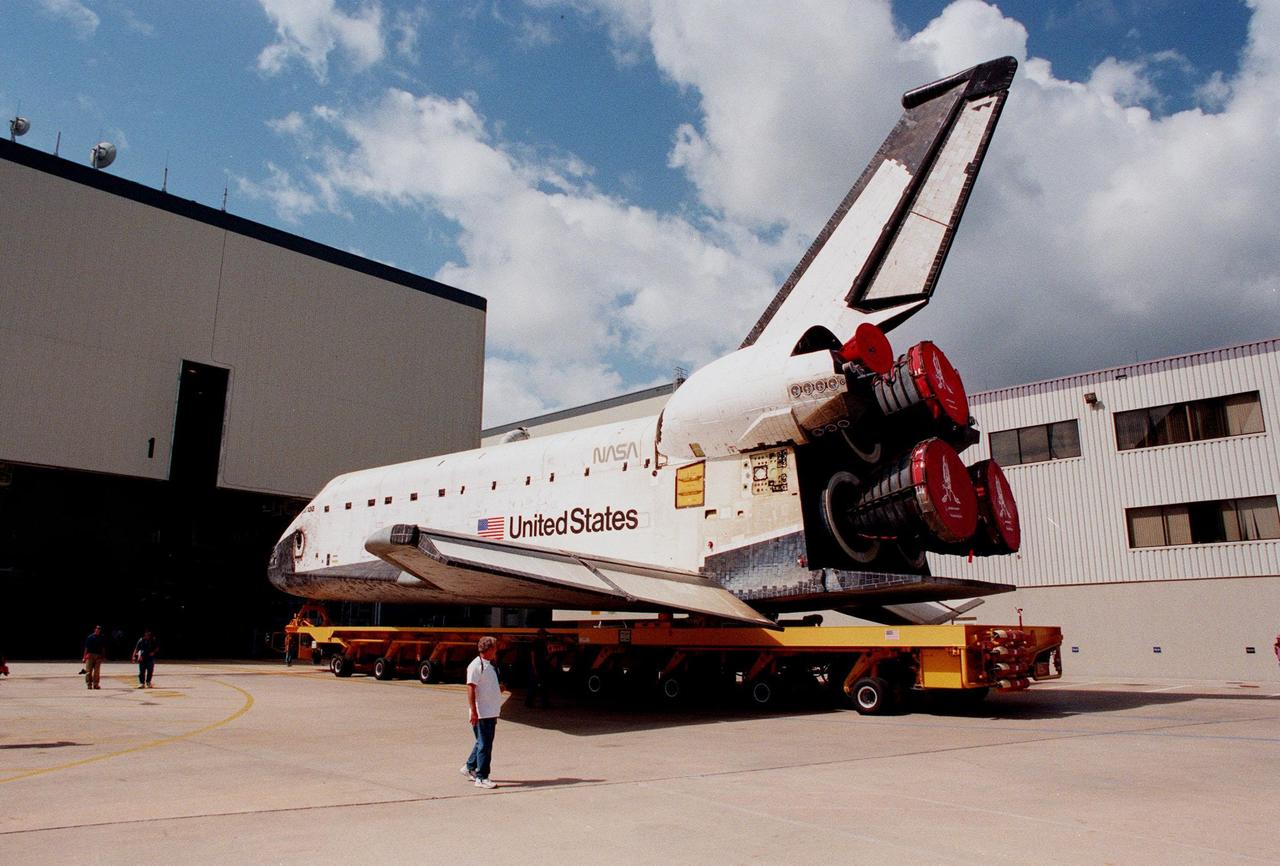
KENNEDY SPACE CENTER, FLA. -- The orbiter Columbia is rolled out from the Orbiter Processing Facility (background) on its transporter. It is being moved to the nearby Vehicle Assembly Building (VAB) for external tank mating operations. Columbia is scheduled for rollout to Launch Pad 39B on Monday, June 7, for mission STS-93. The primary mission objective will be the deployment of the Advanced X-ray Astrophysics Facility, recently renamed the Chandra X-Ray Observatory. Mission STS-93 will be the first Space Shuttle commanded by a woman, Commander Eileen M. Collins. It is scheduled to launch July 22 at 12:27 a.m. EDT although that date is currently under review