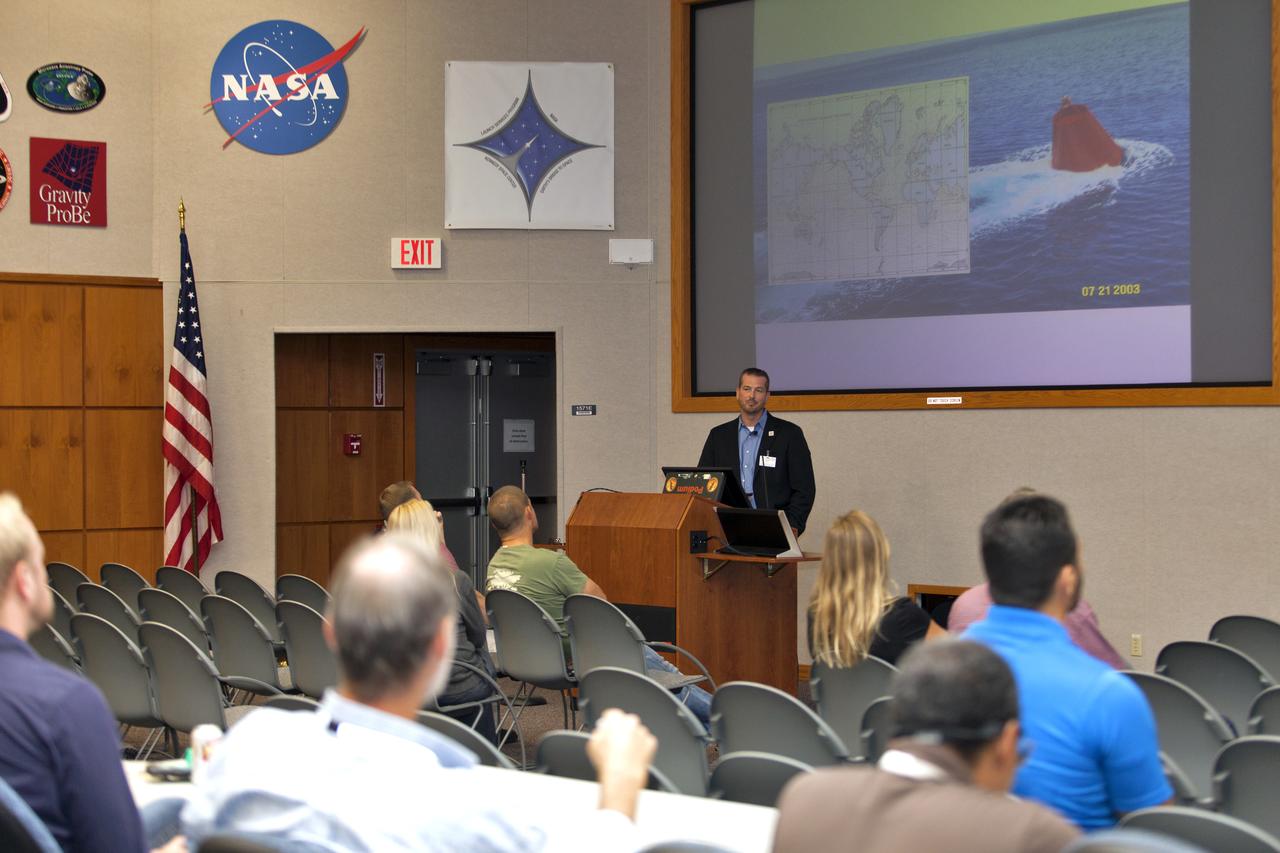
Guest speaker Gabriel Alsenas discusses ocean renewable energy sources with NASA Kennedy Space Center employees in the spaceport’s Mission Briefing Room on Thursday, Oct. 11, 2018. Alsenas is director of the Southeast National Marine Renewable Energy Center at Florida Atlantic University in Boca Raton. The “lunch and learn” event is one of two scheduled during October in conjunction with Energy Awareness Month, which aims to recognize the importance of energy management for our national prosperity, security and environmental sustainability.
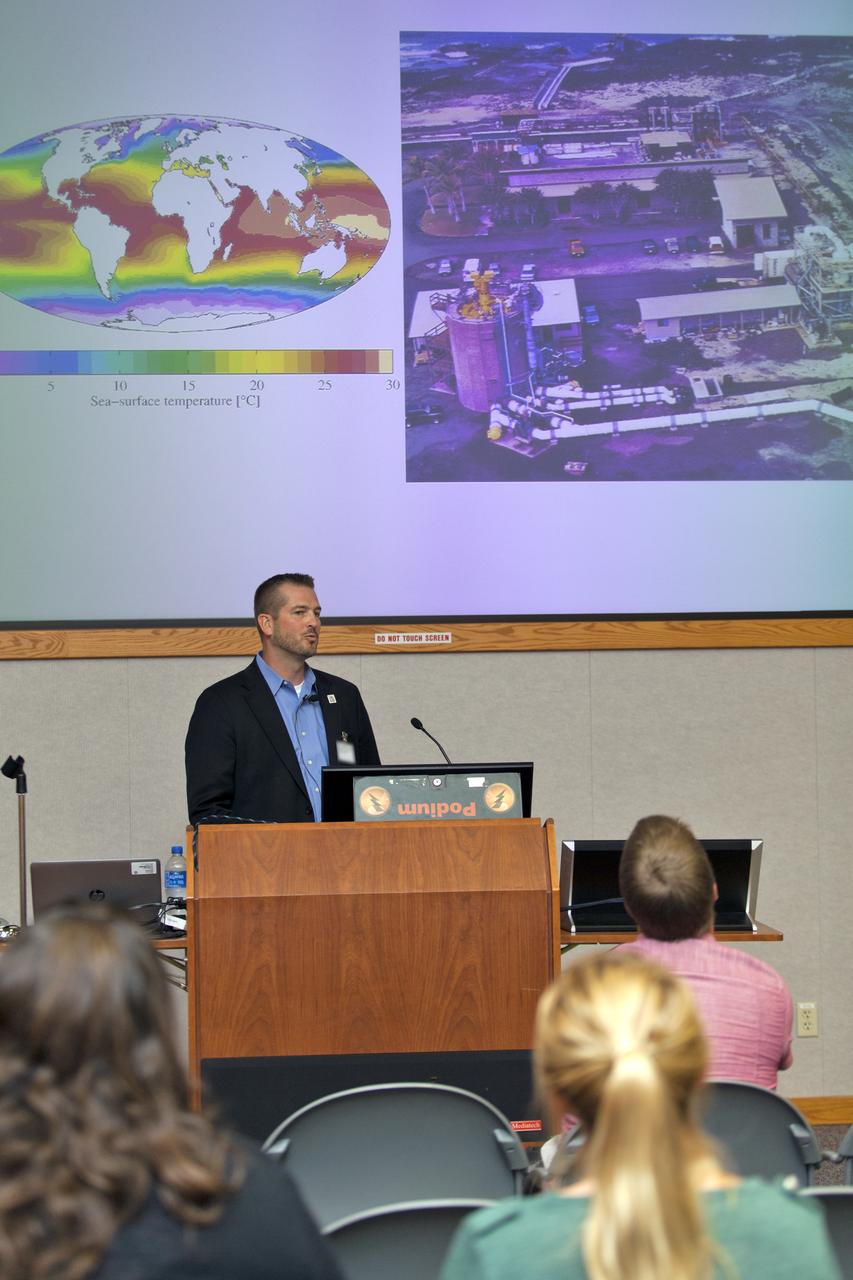
Guest speaker Gabriel Alsenas discusses ocean renewable energy sources with NASA Kennedy Space Center employees in the spaceport’s Mission Briefing Room on Thursday, Oct. 11, 2018. Alsenas is director of the Southeast National Marine Renewable Energy Center at Florida Atlantic University in Boca Raton. The “lunch and learn” event is one of two scheduled during October in conjunction with Energy Awareness Month, which aims to recognize the importance of energy management for our national prosperity, security and environmental sustainability.

Guest speaker Gabriel Alsenas discusses ocean renewable energy sources with NASA Kennedy Space Center employees in the spaceport’s Mission Briefing Room on Thursday, Oct. 11, 2018. Alsenas is director of the Southeast National Marine Renewable Energy Center at Florida Atlantic University in Boca Raton. The “lunch and learn” event is one of two scheduled during October in conjunction with Energy Awareness Month, which aims to recognize the importance of energy management for our national prosperity, security and environmental sustainability.
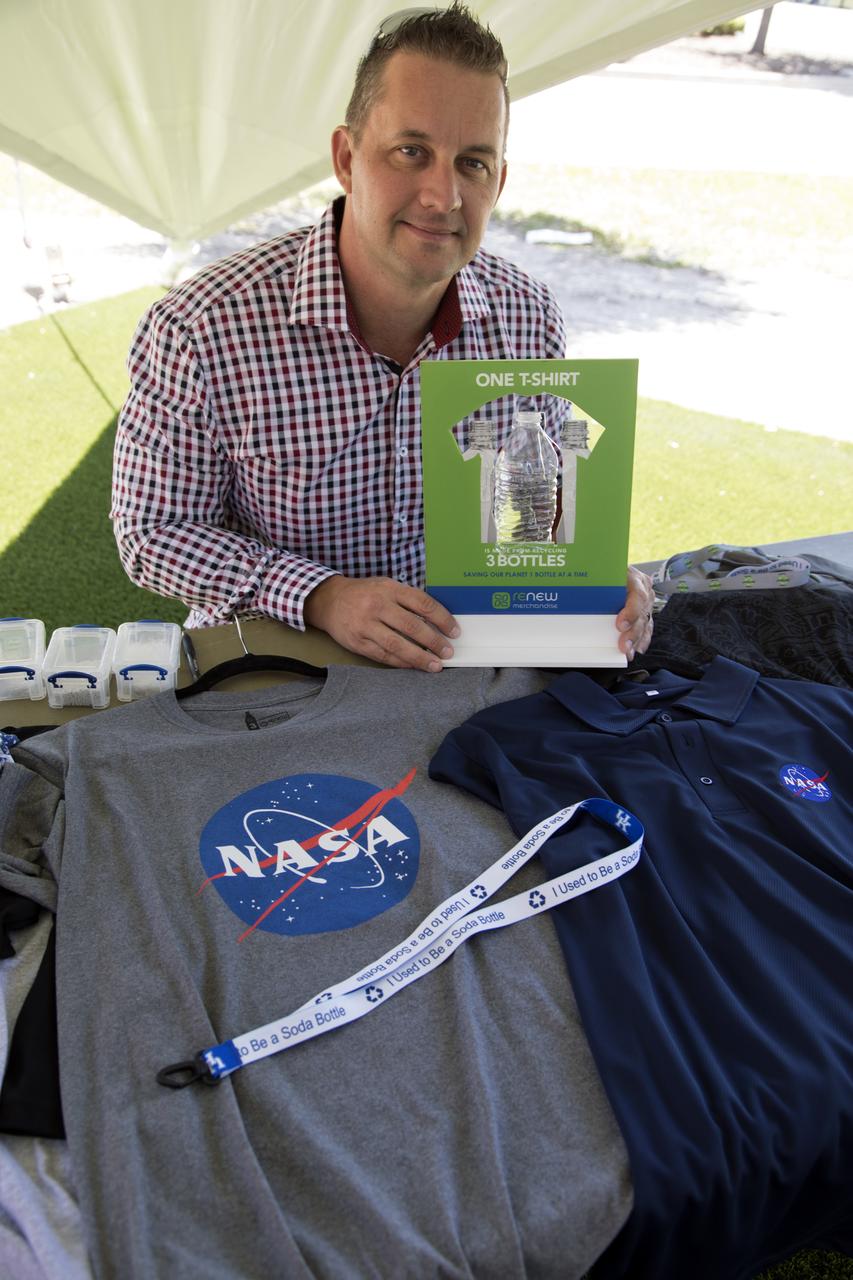
David Bell of Renew Merchandise was one of 50 exhibitors offering information on a variety of topics, including electric vehicles, sustainable lighting, renewable energy, Florida-friendly landscaping tips, Florida’s biking trails and more. The event took place during the annual Earth Day celebration at the Kennedy Space Center Visitor Complex, guests have an opportunity to learn more about energy awareness, the environment and sustainability.
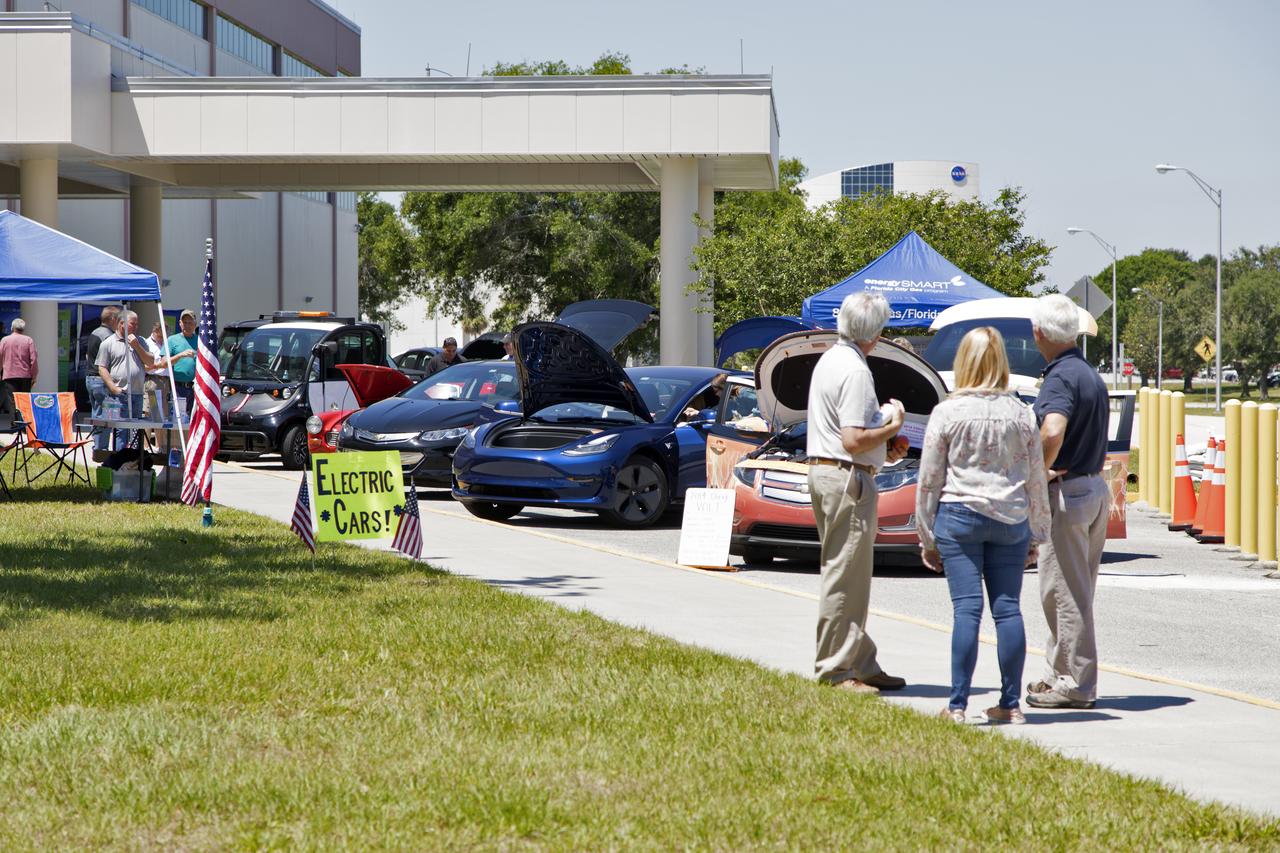
An array of electric vehicles are on display for Kennedy Space Center employees during the center’s annual Earth Day celebration. The two-day event featured approximately 50 exhibitors offering information on a variety of topics, including electric vehicles, sustainable lighting, renewable energy, Florida-friendly landscaping tips, Florida’s biking trails and more.
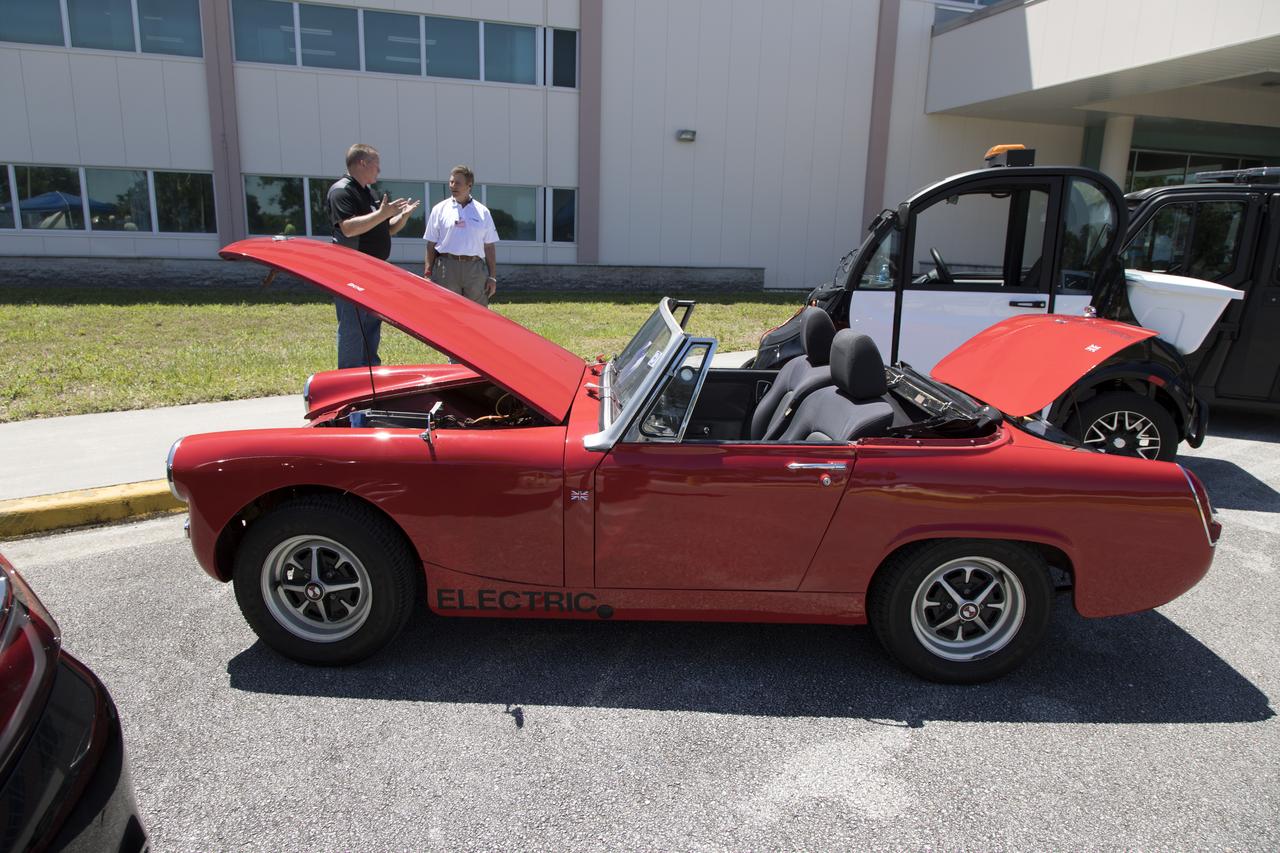
Employees discuss one of the electric vehicles on display during Kennedy Space Center’s annual Earth Day celebration. The two-day event featured approximately 50 exhibitors offering information on a variety of topics, including electric vehicles, sustainable lighting, renewable energy, Florida-friendly landscaping tips, Florida’s biking trails and more.
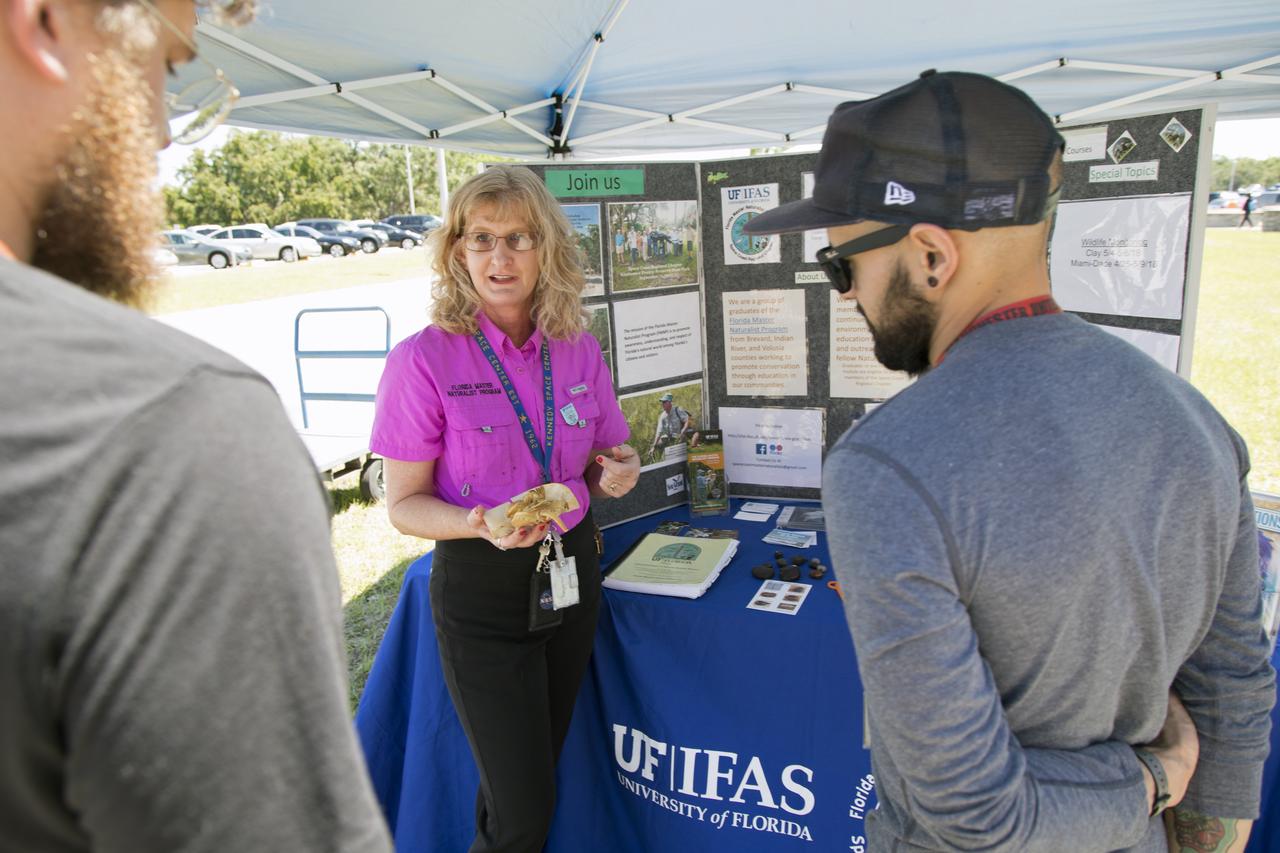
Employees get an up-close look at some Florida marine life during a visit to the University of Florida's Institute of Food and Agricultural Sciences booth at Kennedy Space Center’s annual Earth Day celebration. The two-day event featured approximately 50 exhibitors offering information on a variety of topics, including electric vehicles, sustainable lighting, renewable energy, Florida-friendly landscaping tips, Florida’s biking trails and more.

Students from Rockledge High School in Rockledge, Fla., make “plarn” – plastic yarn -- out of used plastic bags during Kennedy Space Center’s annual Earth Day celebration. The plarn was donated to be woven into mats for homeless veterans. The two-day Earth Day event featured approximately 50 exhibitors offering information on a variety of topics, including electric vehicles, sustainable lighting, renewable energy, Florida-friendly landscaping tips, Florida’s biking trails and more.
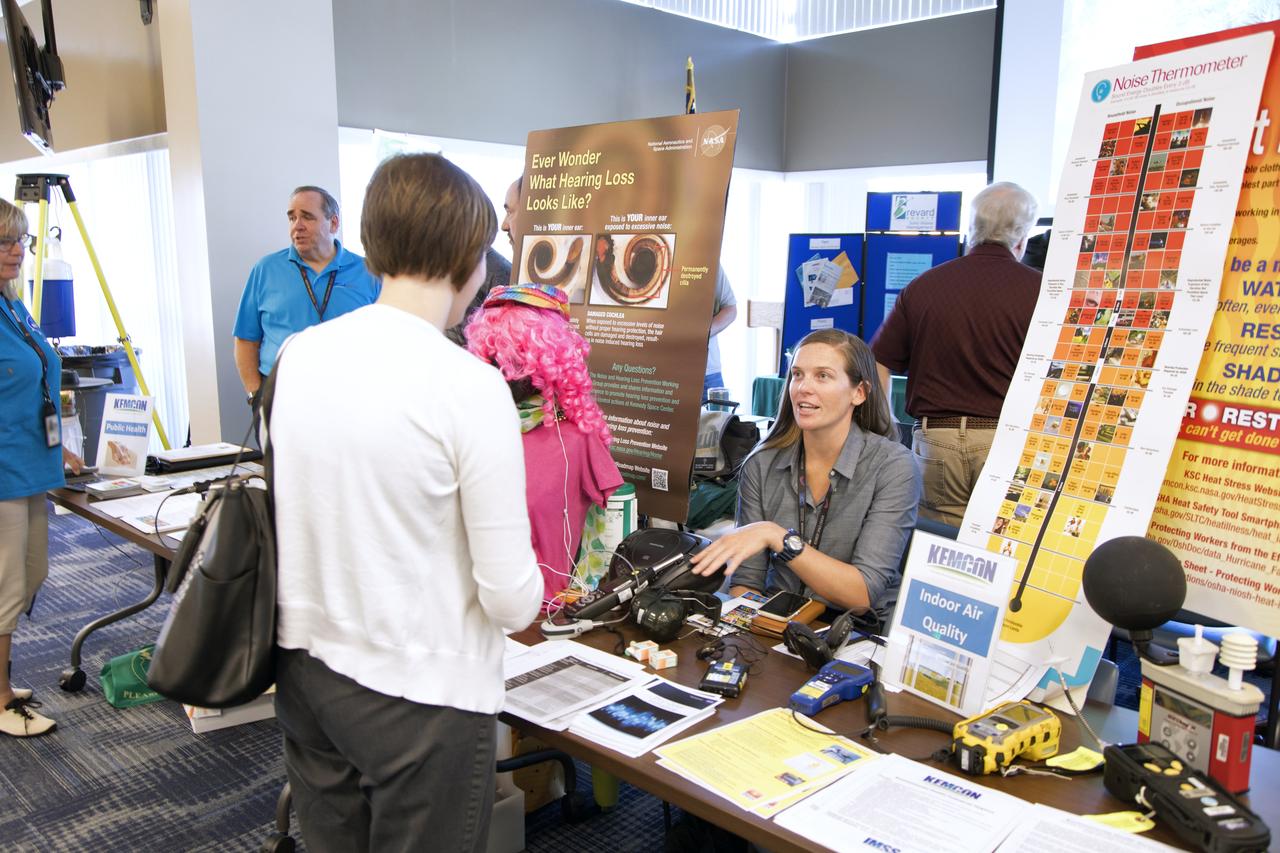
An employee learns about indoor air quality at the Kennedy Space Center (KSC) Environmental and Medical Contract (KEMCON) booth at the center’s annual Earth Day celebration. The two-day event featured approximately 50 exhibitors offering information on a variety of topics, including electric vehicles, sustainable lighting, renewable energy, Florida-friendly landscaping tips, Florida’s biking trails and more.
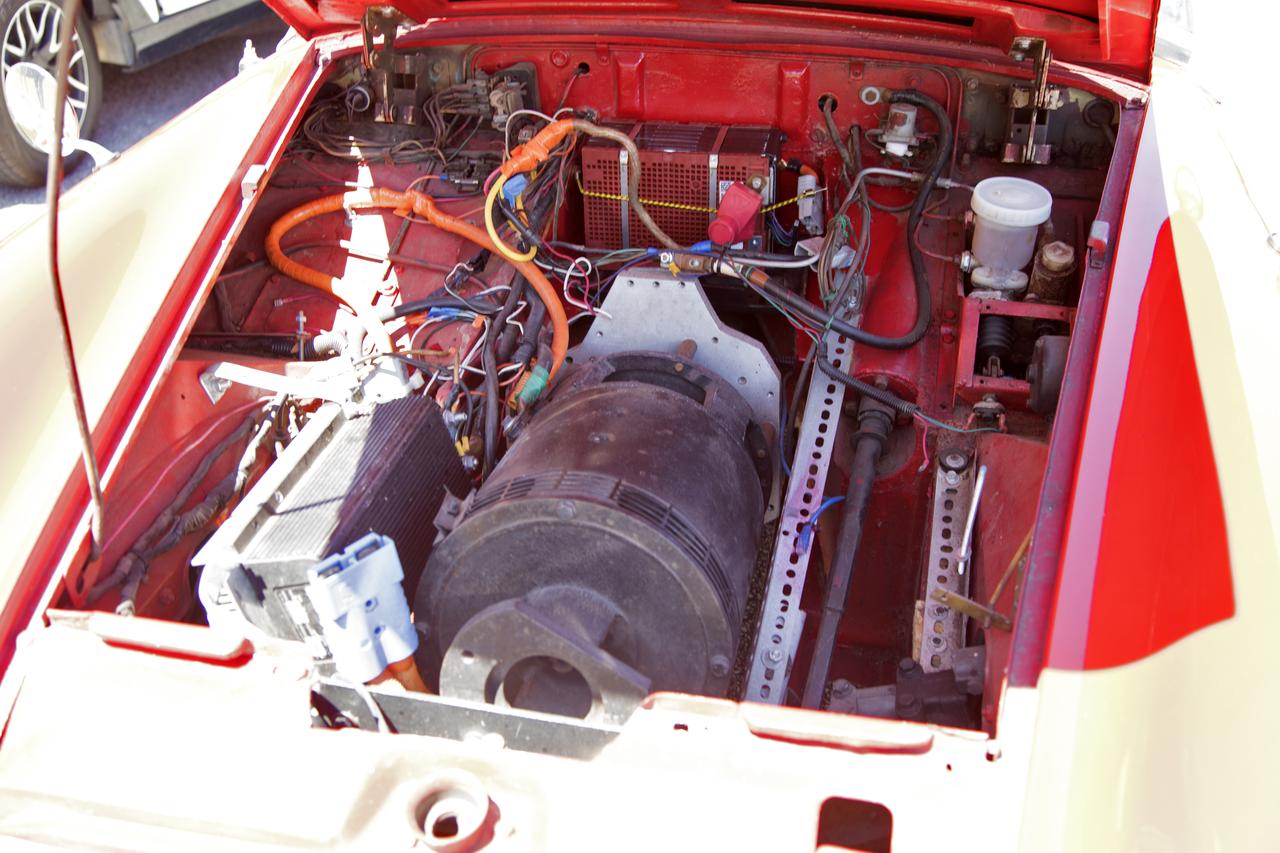
Employees had the opportunity to take a look under the hood of an electric vehicle on display during Kennedy Space Center’s annual Earth Day celebration. The two-day event featured approximately 50 exhibitors offering information on a variety of topics, including electric vehicles, sustainable lighting, renewable energy, Florida-friendly landscaping tips, Florida’s biking trails and more.
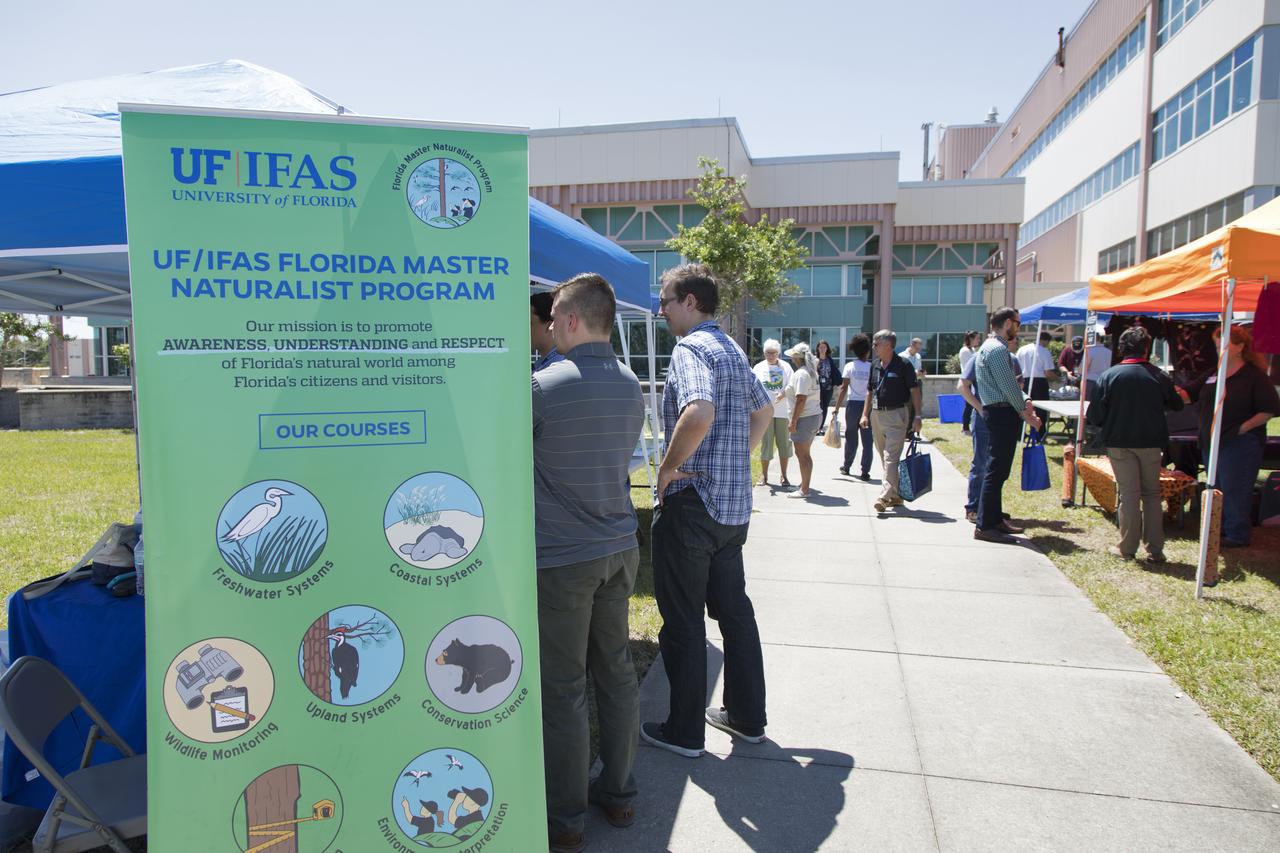
Employees stop by the University of Florida's Institute of Food and Agricultural Sciences booth at Kennedy Space Center’s annual Earth Day celebration. The two-day event featured approximately 50 exhibitors offering information on a variety of topics, including electric vehicles, sustainable lighting, renewable energy, Florida-friendly landscaping tips, Florida’s biking trails and more.
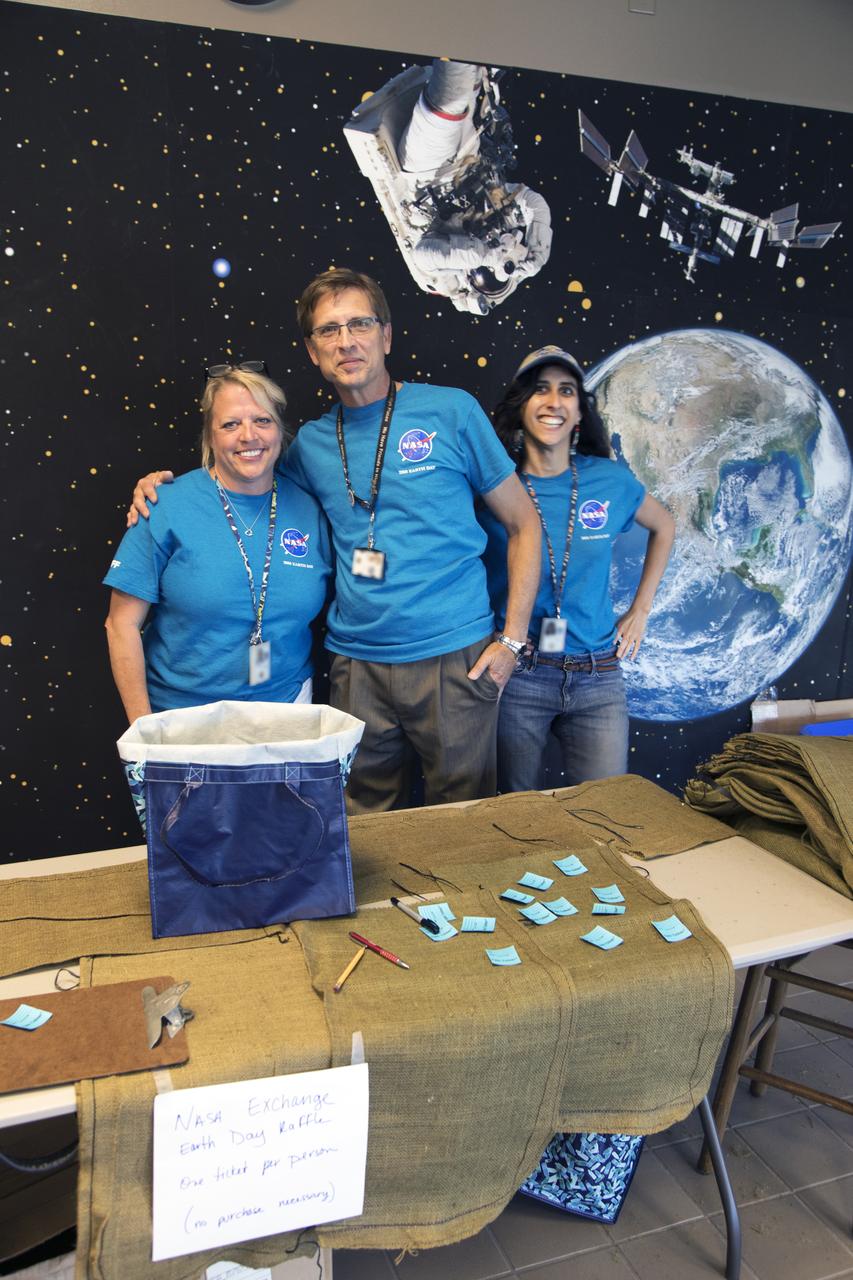
Organizers and volunteers for Kennedy Space Center’s Earth Day celebration gather for a photo at the NASA Exchange raffle booth. From left to right are Jeanne Ryba, Environmental Sustainability program specialist; Robert Smith, Earth Day volunteer; and Natasha Darre, Cultural Resources Specialist. The two-day event featured approximately 50 exhibitors offering information on a variety of topics, including electric vehicles, sustainable lighting, renewable energy, Florida-friendly landscaping tips, Florida’s biking trails and more.
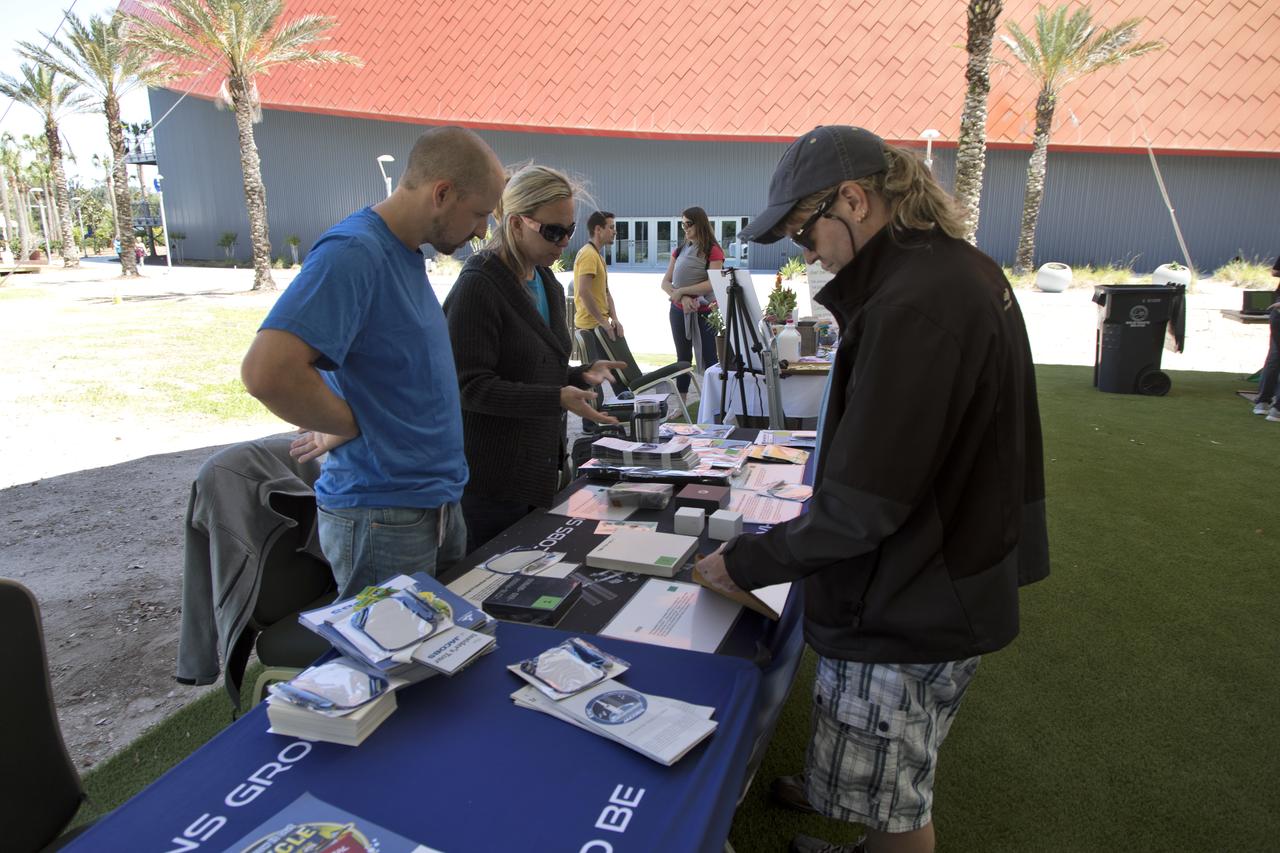
During the annual Earth Day celebration at the Kennedy Space Center Visitor Complex, guests have an opportunity to learn more about energy awareness, the environment and sustainability. The two-day event featured approximately 50 exhibitors offering information on a variety of topics, including electric vehicles, sustainable lighting, renewable energy, Florida-friendly landscaping tips, Florida’s biking trails and more.
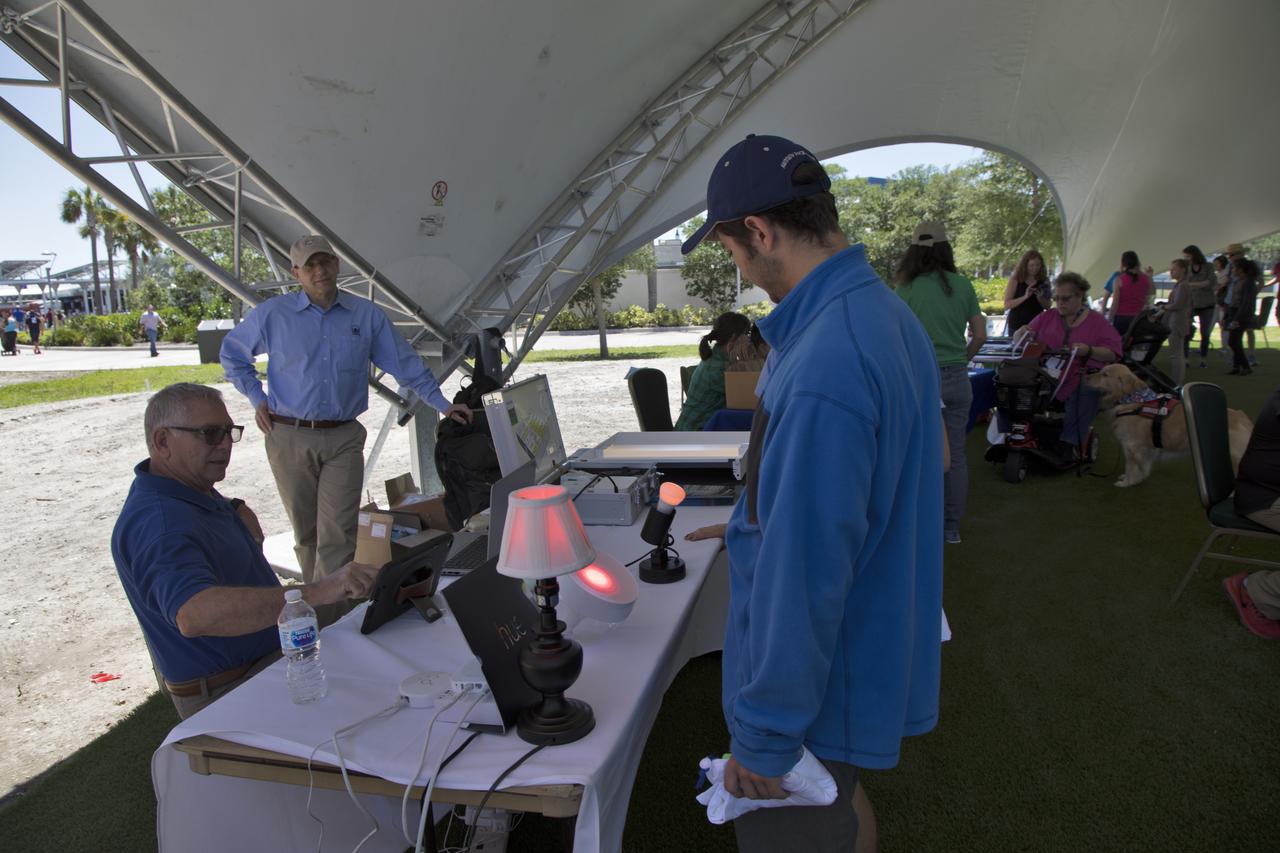
During the annual Earth Day celebration at the Kennedy Space Center Visitor Complex, guests have an opportunity to learn more about energy awareness, the environment and sustainability. The two-day event featured approximately 50 exhibitors offering information on a variety of topics, including electric vehicles, sustainable lighting, renewable energy, Florida-friendly landscaping tips, Florida’s biking trails and more.
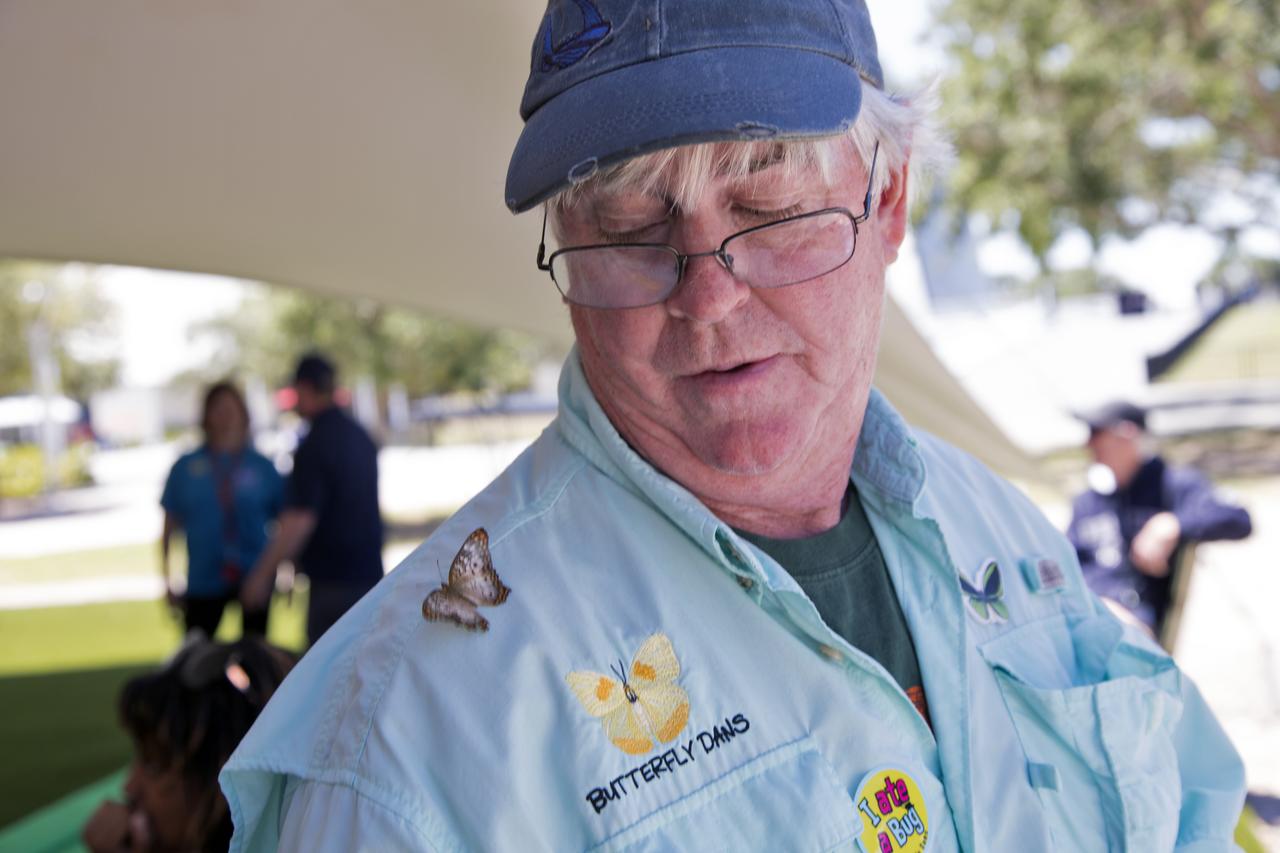
During the annual Earth Day celebration at the Kennedy Space Center Visitor Complex, guests have an opportunity to learn about the environment and meet Butterfly Dan” Dunwoody. The two-day event featured approximately 50 exhibitors offering information on a variety of topics, including electric vehicles, sustainable lighting, renewable energy, Florida-friendly landscaping tips, Florida’s biking trails and more.
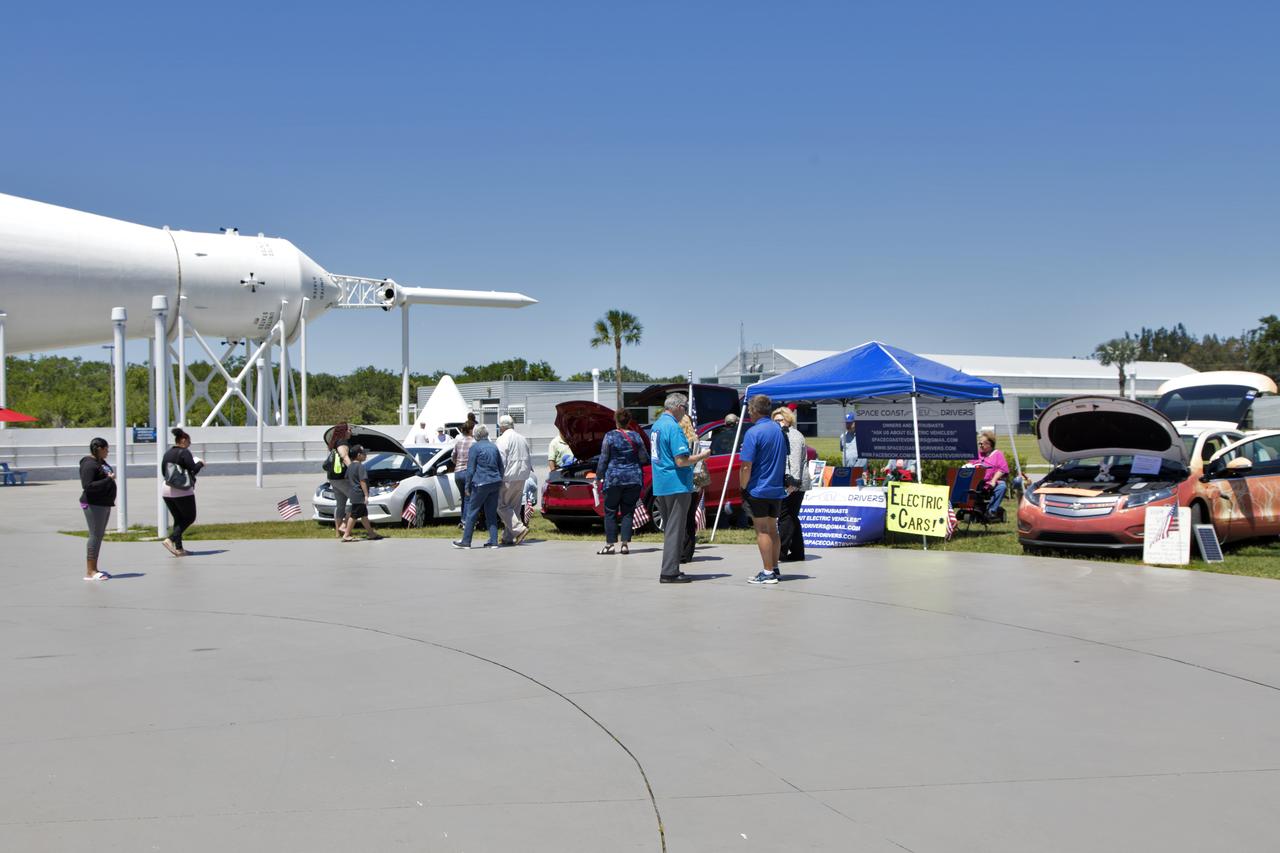
During the annual Earth Day celebration at the Kennedy Space Center Visitor Complex, guests have an opportunity to get an up-close look at experimental electric vehicles. The two-day event featured approximately 50 exhibitors offering information on a variety of topics, including electric vehicles, sustainable lighting, renewable energy, Florida-friendly landscaping tips, Florida’s biking trails and more.
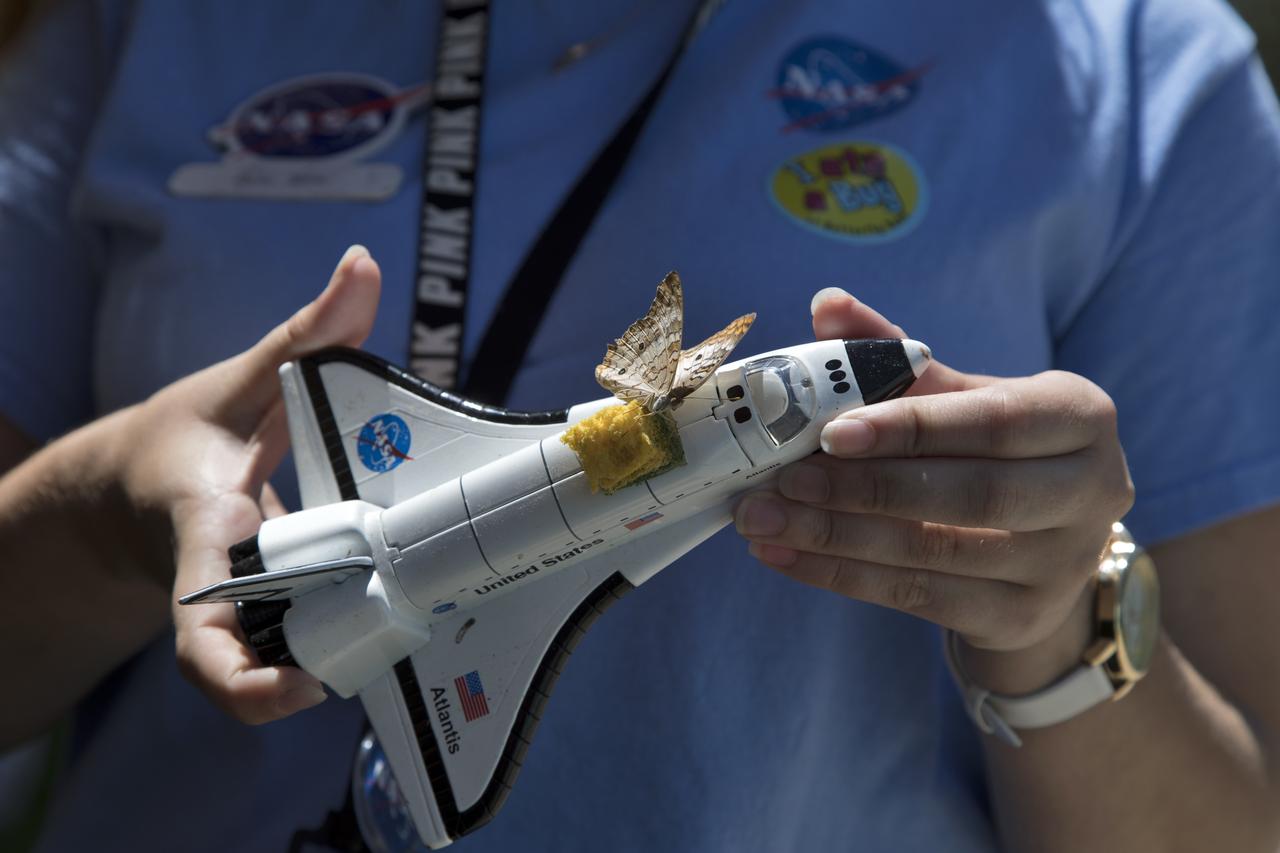
During the annual Earth Day celebration at the Kennedy Space Center Visitor Complex, guests have an opportunity to learn about the environment. The two-day event featured approximately 50 exhibitors offering information on a variety of topics, including electric vehicles, sustainable lighting, renewable energy, Florida-friendly landscaping tips, Florida’s biking trails and more.
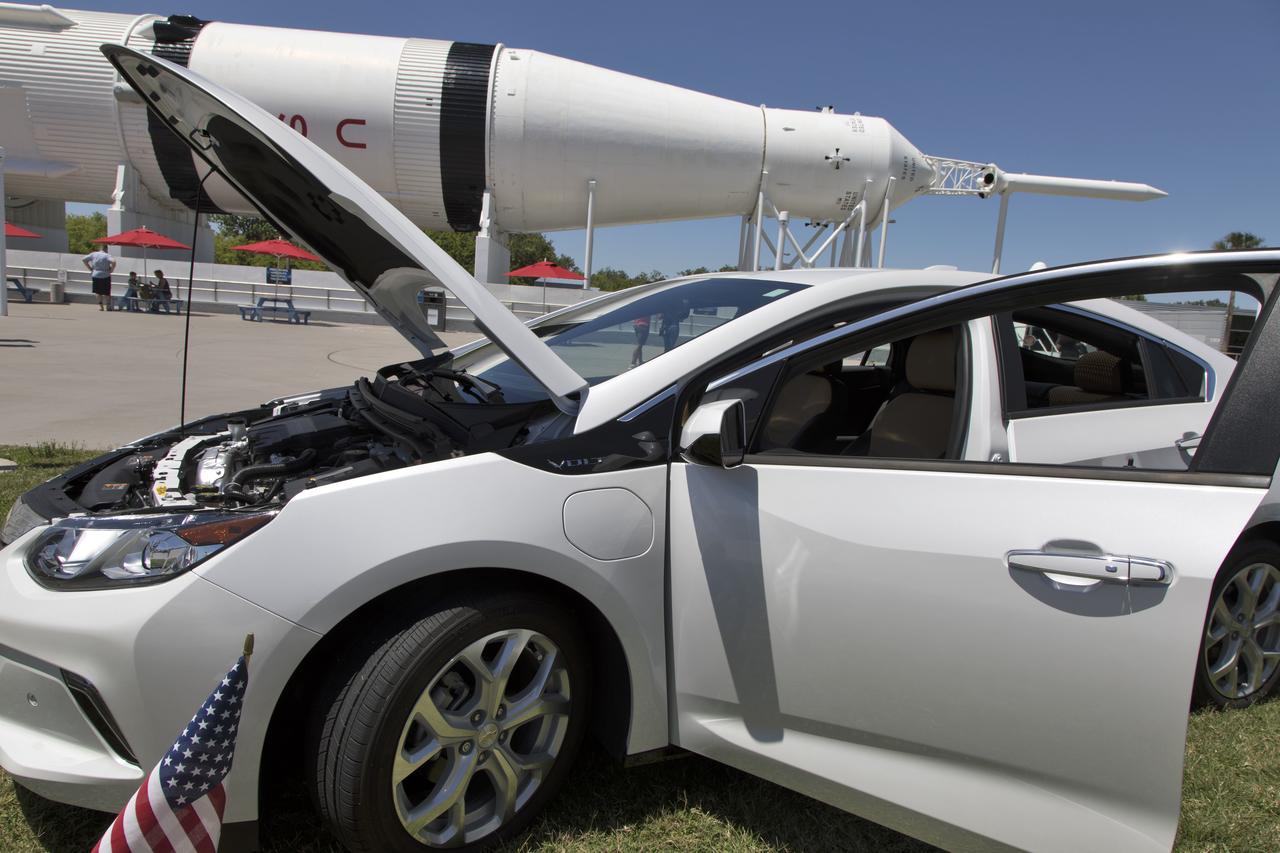
During the annual Earth Day celebration at the Kennedy Space Center Visitor Complex, guests have an opportunity to get an up-close look at experimental electric vehicles. The two-day event featured approximately 50 exhibitors offering information on a variety of topics, including electric vehicles, sustainable lighting, renewable energy, Florida-friendly landscaping tips, Florida’s biking trails and more.
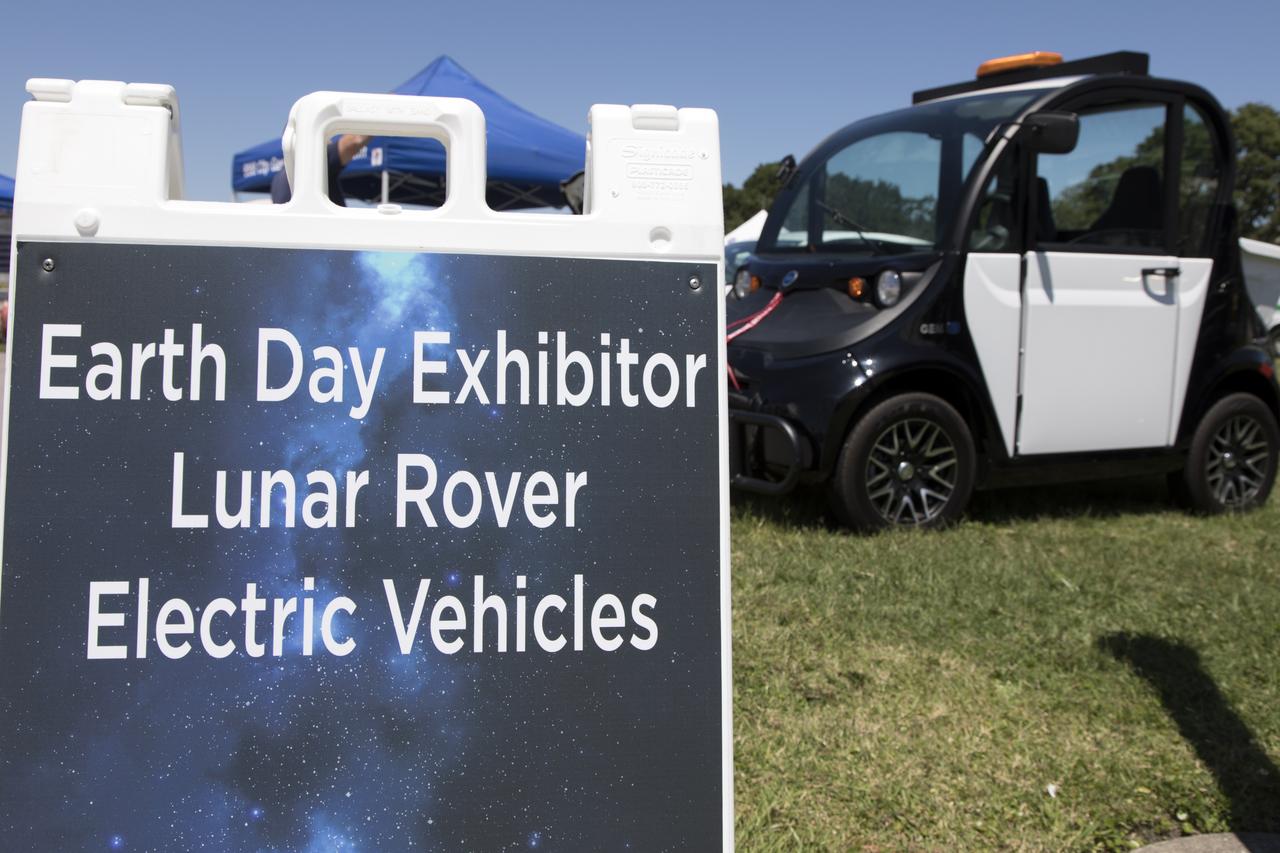
During the annual Earth Day celebration at the Kennedy Space Center Visitor Complex, guests have an opportunity to get an up-close look at experimental electric vehicles. The two-day event featured approximately 50 exhibitors offering information on a variety of topics, including electric vehicles, sustainable lighting, renewable energy, Florida-friendly landscaping tips, Florida’s biking trails and more.
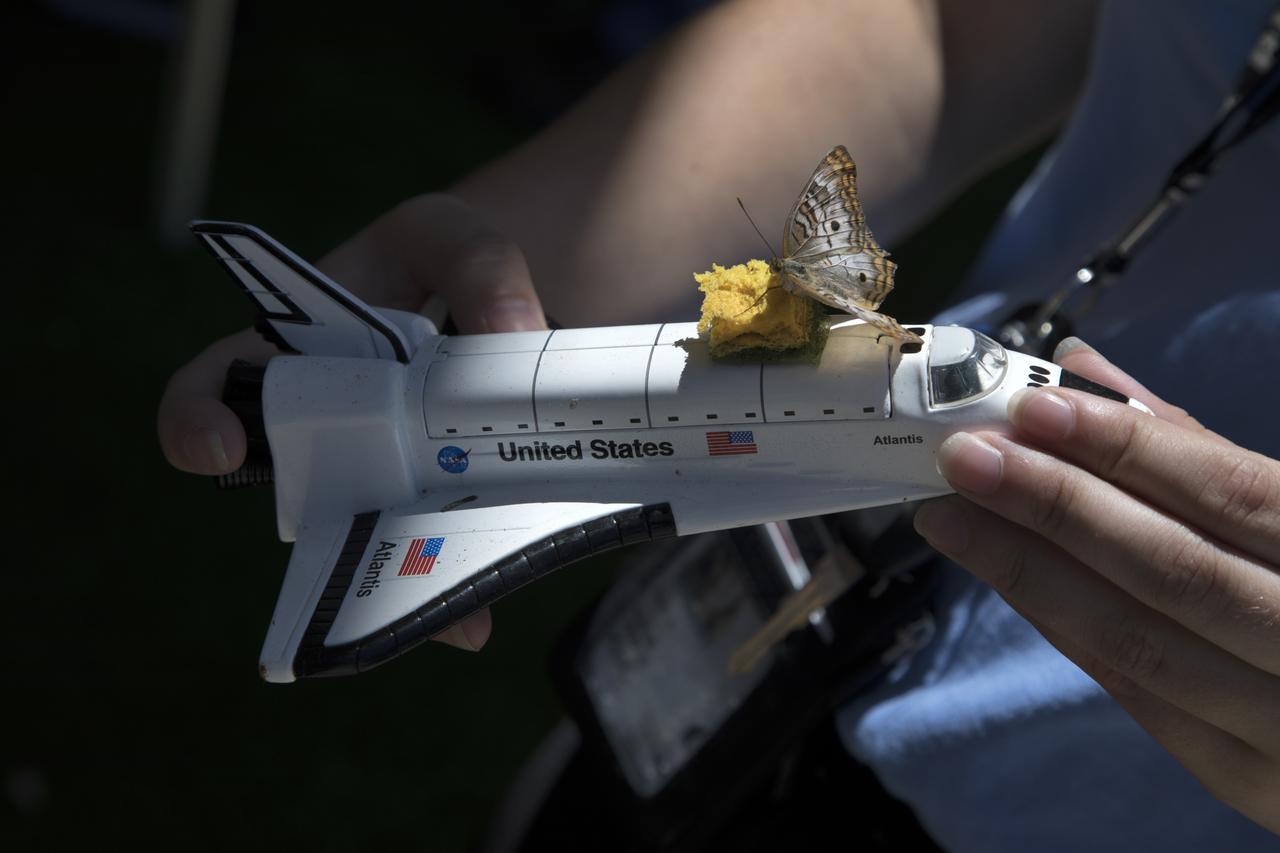
During the annual Earth Day celebration at the Kennedy Space Center Visitor Complex, guests have an opportunity to learn about the environment. The two-day event featured approximately 50 exhibitors offering information on a variety of topics, including electric vehicles, sustainable lighting, renewable energy, Florida-friendly landscaping tips, Florida’s biking trails and more.
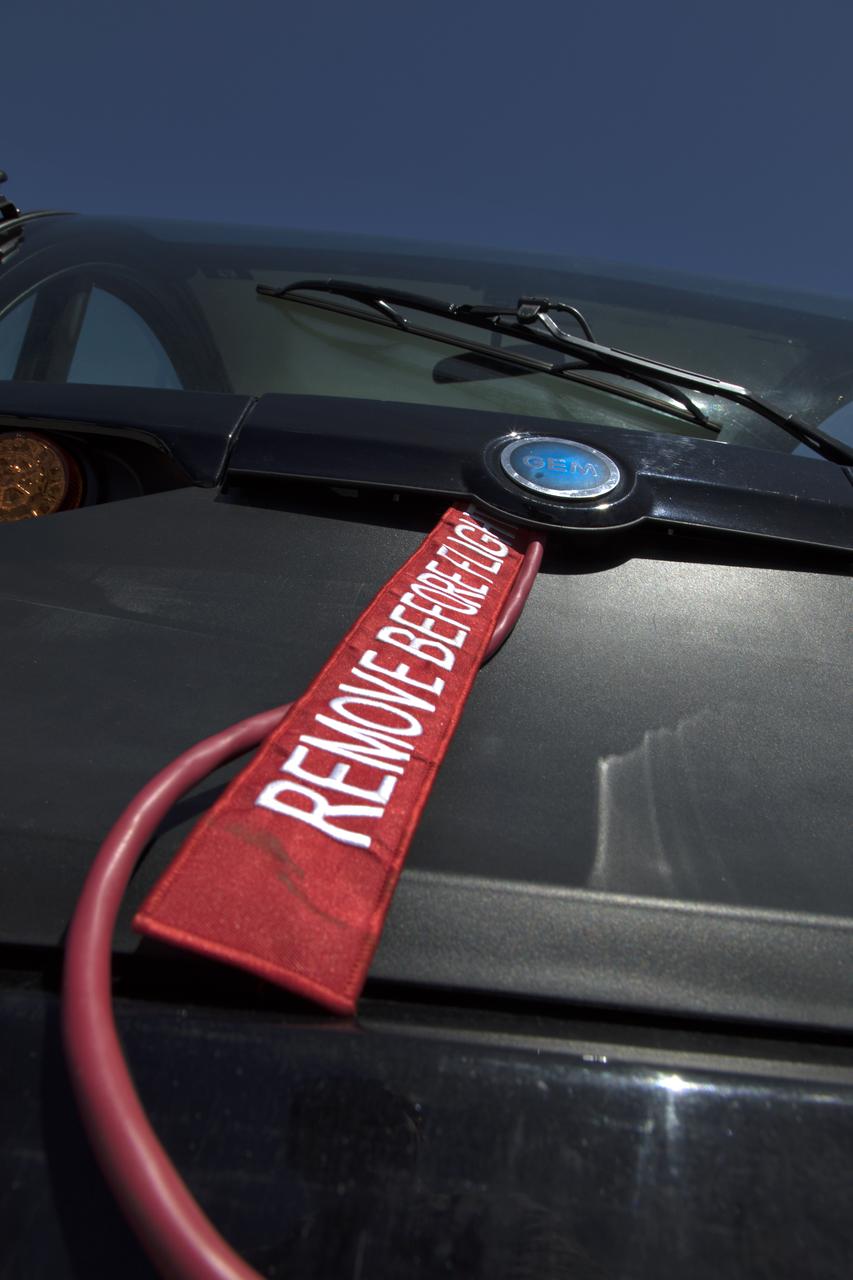
During the annual Earth Day celebration at the Kennedy Space Center Visitor Complex, guests have an opportunity to get an up-close look at experimental electric vehicles. The "Remove Before Flight" tag is on a Polaris GEM electric car. The two-day event featured approximately 50 exhibitors offering information on a variety of topics, including electric vehicles, sustainable lighting, renewable energy, Florida-friendly landscaping tips, Florida’s biking trails and more.
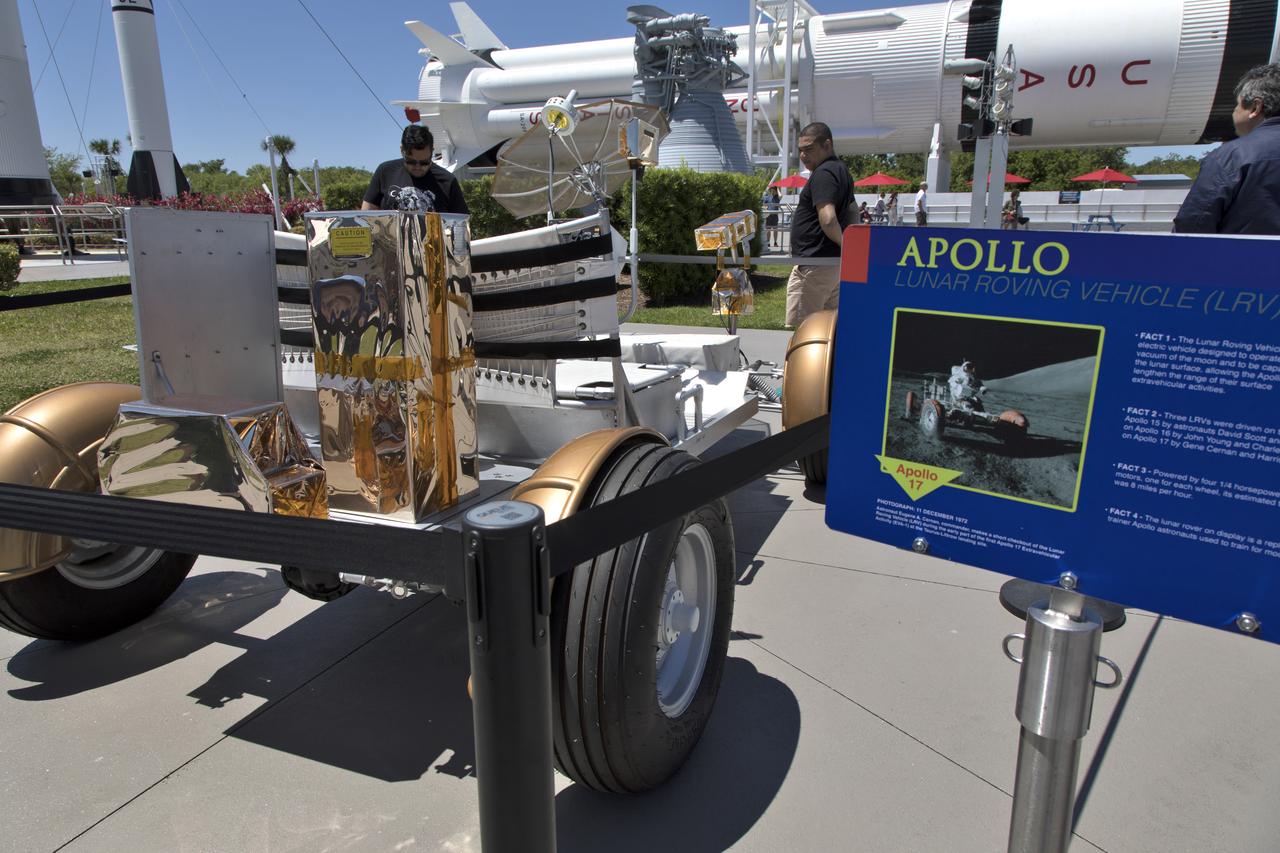
During the annual Earth Day celebration at the Kennedy Space Center Visitor Complex, guests have an opportunity to get an up-close look at experimental electric vehicles and see and Apollo era Lunar Roving Vehicle used in astronaut training. The battery-operated car was used on Apollos 15, 16 and 17 in 1971 and 1972. The two-day event featured approximately 50 exhibitors offering information on a variety of topics, including electric vehicles, sustainable lighting, renewable energy, Florida-friendly landscaping tips, Florida’s biking trails and more.
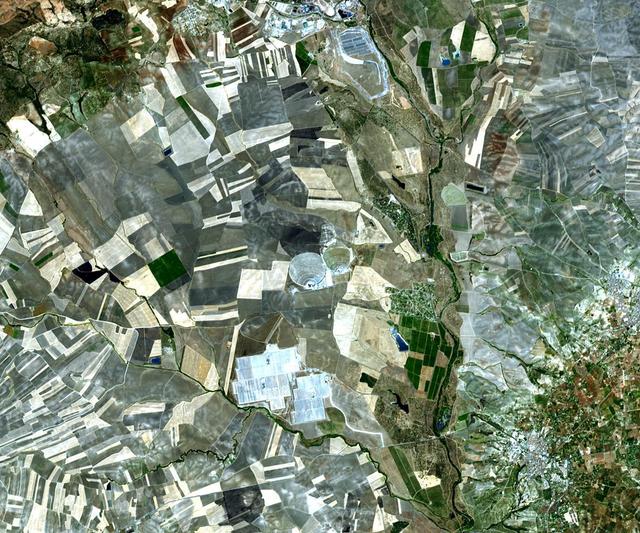
The world largest solar power tower recently began operating outside Seville, Spain -- and it marks a historic moment in the saga of renewable energy. This image was acquired by NASA Terra spacecraft.
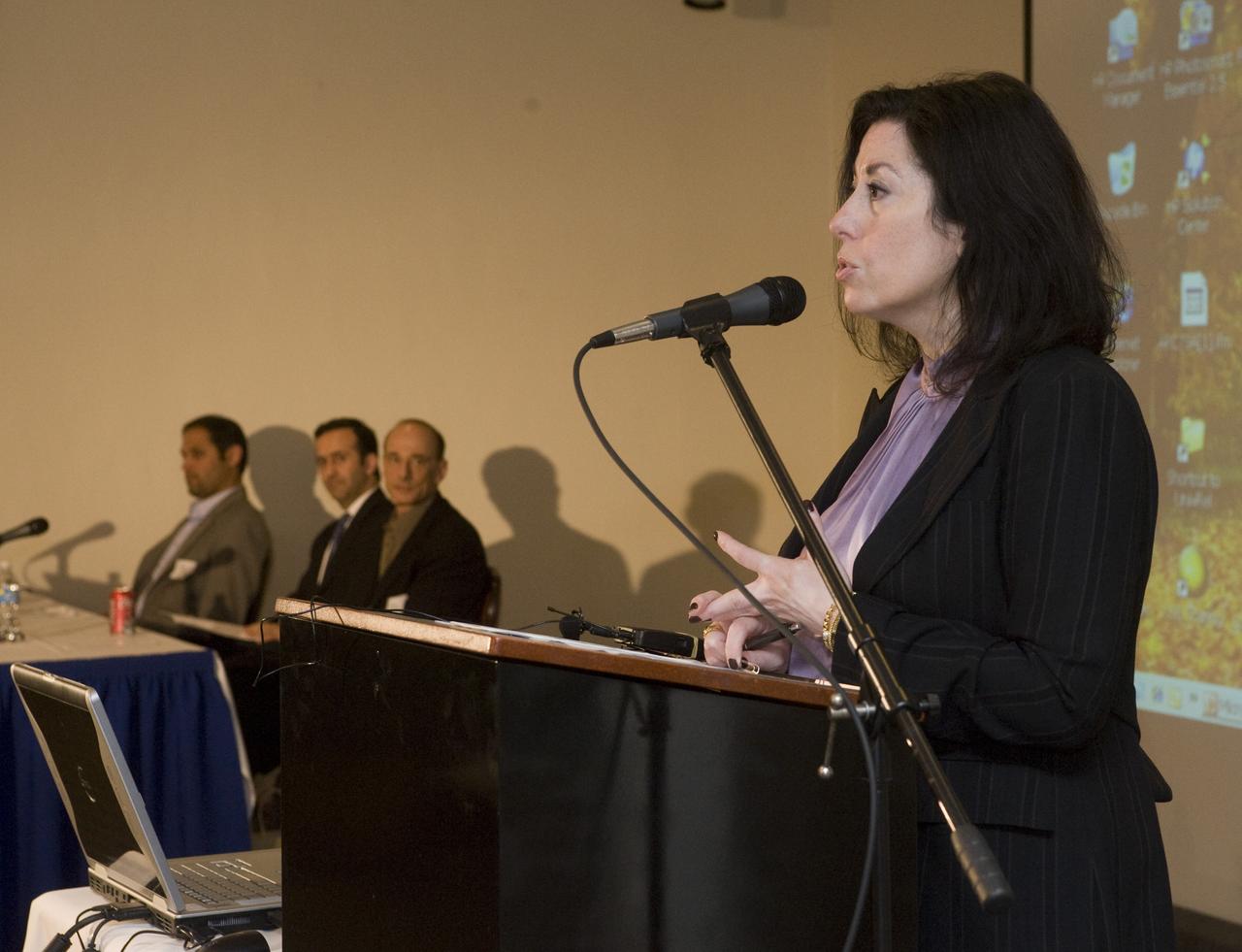
UCSC Silicon Valley Center presents a Panel Discussion 'Can Renewable Energy Save the World' Mary Trigiani, Consultant, The Jack Baskin School of Engineering, UCSC - Moderator
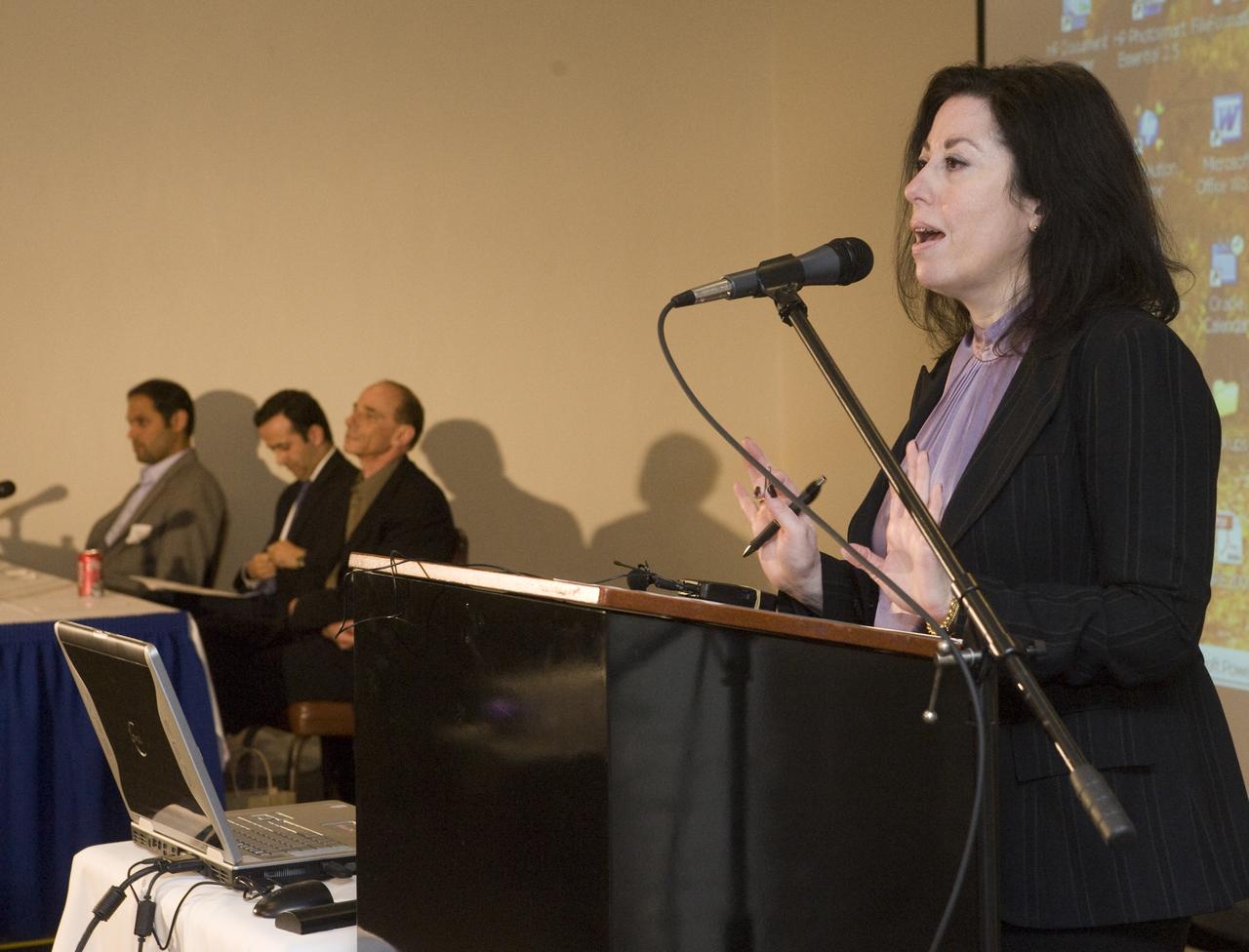
UCSC Silicon Valley Center presents a Panel Discussion 'Can Renewable Energy Save the World' Mary Trigiani, Consultant, The Jack Baskin School of Engineering, UCSC - Moderator

Howard University Professor and Chair of the Department of Physics and Astronomy, Dr. Quinton Williams gives NASA astronaut Jessica Watkins a tour of the Renewable Energy/Battery Research Laboratory at Howard University, Friday, March 31, 2023, in Washington. Photo Credit: (NASA/Aubrey Gemignani)

Howard University Professor and Chair of the Department of Physics and Astronomy, Dr. Quinton Williams gives NASA astronaut Jessica Watkins a tour of the Renewable Energy/Battery Research Laboratory at Howard University, Friday, March 31, 2023, in Washington. Photo Credit: (NASA/Aubrey Gemignani)
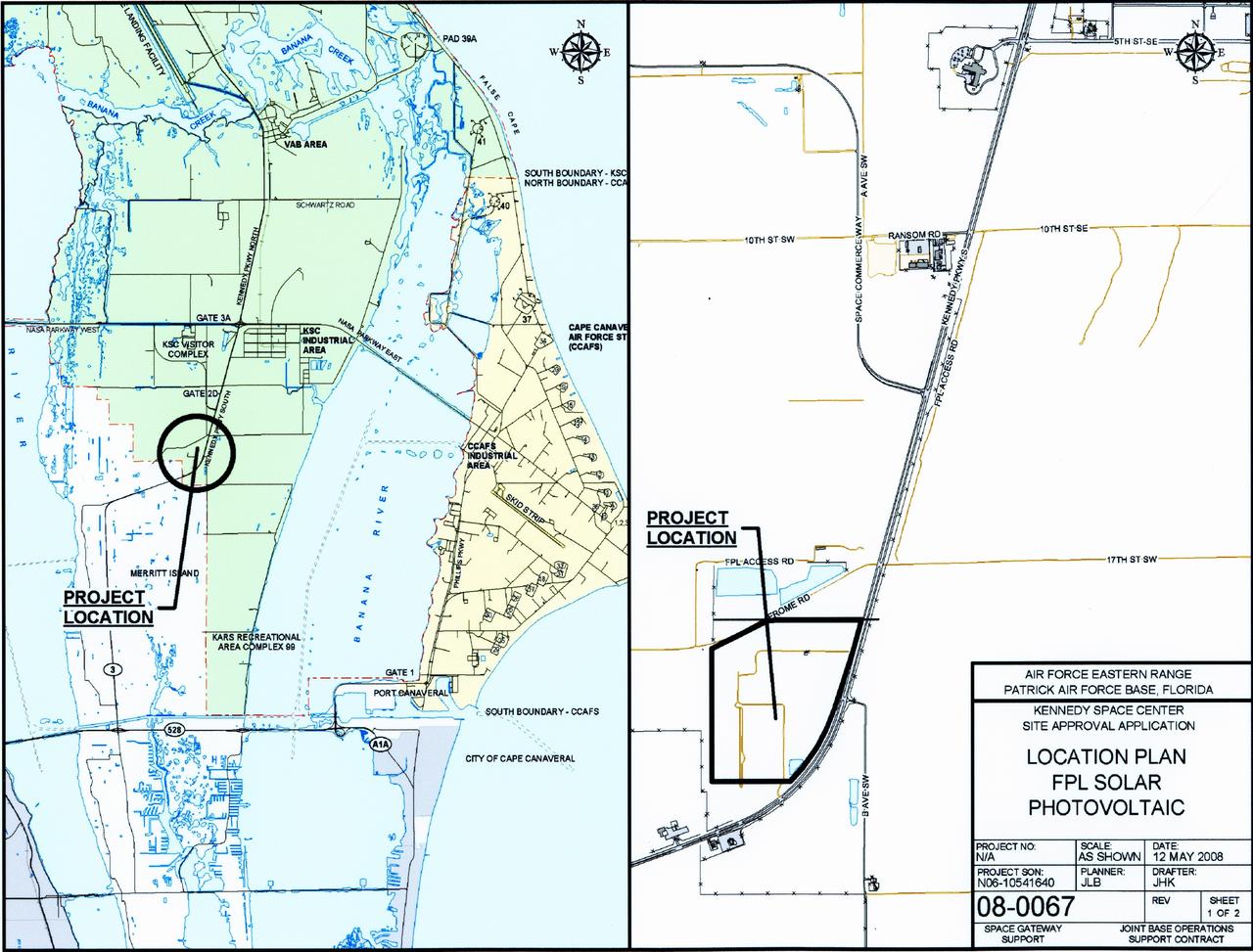
CAPE CANAVERAL, Fla. – These maps show one of the locations of the proposed solar power systems that NASA and Florida Power & Light Company are beginning to construct on NASA's Kennedy Space Center as part of a public-private partnership that promotes a clean-energy future. A groundbreaking ceremony took place on May 27 at the Kennedy Space Center Visitor Complex. FPL, Florida's largest electric utility, will build and maintain two solar photovoltaic power generation systems at Kennedy. One will produce an estimated 10 megawatts of emissions-free power for FPL customers, which is enough energy to serve roughly 1,100 homes. The second is a one-megawatt solar power facility that will provide renewable energy directly to Kennedy. The FPL facilities at NASA will help provide Florida residents and America's space program with new sources of clean energy that will cut reliance on fossil fuels and improve the environment by reducing greenhouse gas emissions. The one megawatt facility also will help NASA meet its goal for use of power generated from renewable energy. Photo courtesy of FPL

CAPE CANAVERAL, Fla. – An aerial view of the site in the Industrial Area of NASA's Kennedy Space Center in Florida where a solar power system will be built. The solar power systems are being constructed by NASA and Florida Power & Light Company as part of a public-private partnership that promotes a clean-energy future. A groundbreaking ceremony took place on May 27 at the Kennedy Space Center Visitor Complex. FPL, Florida's largest electric utility, will build and maintain two solar photovoltaic power generation systems at Kennedy. One will produce an estimated 10 megawatts of emissions-free power for FPL customers, which is enough energy to serve roughly 1,100 homes. The second, which will be built on the pictured location, is a one-megawatt solar power facility that will provide renewable energy directly to Kennedy. The FPL facilities at NASA will help provide Florida residents and America's space program with new sources of clean energy that will cut reliance on fossil fuels and improve the environment by reducing greenhouse gas emissions. The one megawatt facility also will help NASA meet its goal for use of power generated from renewable energy. Photo credit: NASA/Kim Shiflett
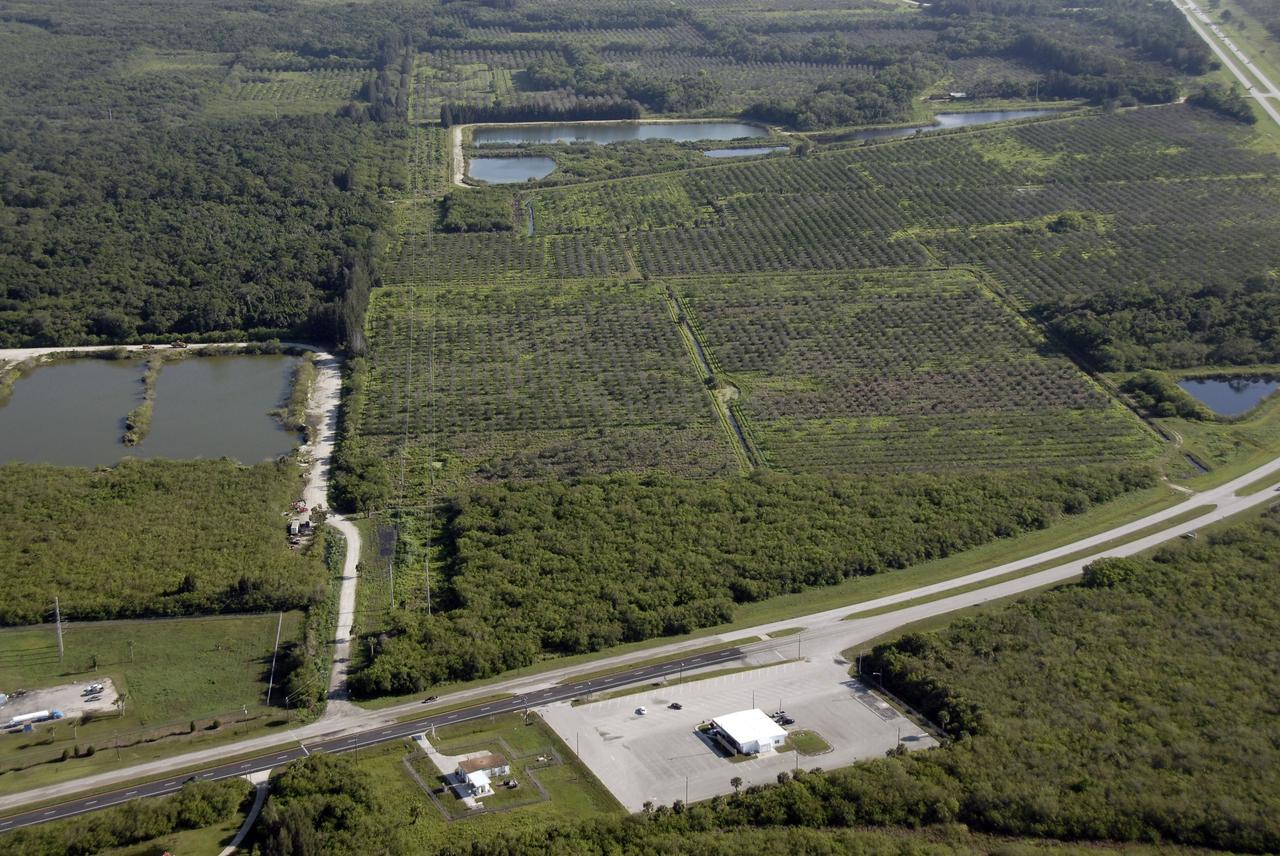
CAPE CANAVERAL, Fla. – An aerial view of the site on S.R. 3 on NASA's Kennedy Space Center in Florida where a solar power system will be built. The solar power systems are being constructed by NASA and Florida Power & Light Company as part of a public-private partnership that promotes a clean-energy future. A groundbreaking ceremony took place on May 27 at the Kennedy Space Center Visitor Complex. FPL, Florida's largest electric utility, will build and maintain two solar photovoltaic power generation systems at Kennedy. One, which will be built on the pictured location, will produce an estimated 10 megawatts of emissions-free power for FPL customers, which is enough energy to serve roughly 1,100 homes. The second is a one-megawatt solar power facility that will provide renewable energy directly to Kennedy. The FPL facilities at NASA will help provide Florida residents and America's space program with new sources of clean energy that will cut reliance on fossil fuels and improve the environment by reducing greenhouse gas emissions. The one megawatt facility also will help NASA meet its goal for use of power generated from renewable energy. Photo credit: NASA/Kim Shiflett
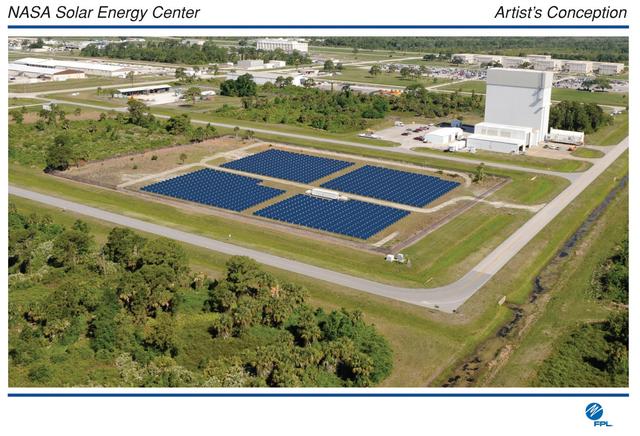
CAPE CANAVERAL, Fla. – This is a rendering of one of two proposed solar power systems that NASA and Florida Power & Light Company are beginning to construct on NASA's Kennedy Space Center as part of a public-private partnership that promotes a clean-energy future. A groundbreaking ceremony took place on May 27 at the Kennedy Space Center Visitor Complex. FPL, Florida's largest electric utility, will build and maintain two solar photovoltaic power generation systems at Kennedy. One will produce an estimated 10 megawatts of emissions-free power for FPL customers, which is enough energy to serve roughly 1,100 homes. The second is a one-megawatt solar power facility that will provide renewable energy directly to Kennedy. The FPL facilities at NASA will help provide Florida residents and America's space program with new sources of clean energy that will cut reliance on fossil fuels and improve the environment by reducing greenhouse gas emissions. The one megawatt facility also will help NASA meet its goal for use of power generated from renewable energy. Photo courtesy of FPL
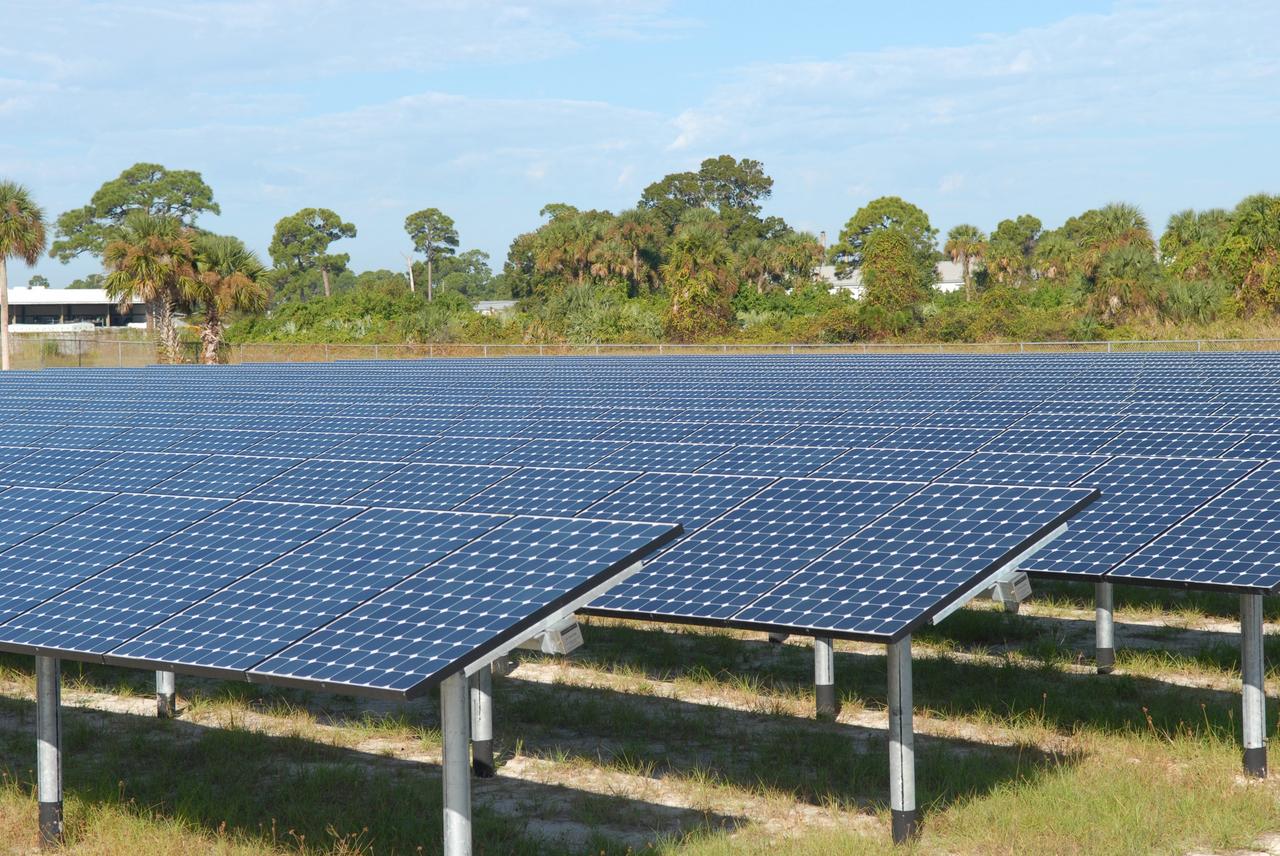
CAPE CANAVERAL, Fla. – NASA's first large-scale solar power generation facility opens at NASA's Kennedy Space Center in Florida. Representatives from NASA, Florida Power & Light Company, or FPL, and SunPower Corporation formally commissioned the one-megawatt facility and announced plans to pursue a new research, development and demonstration project at Kennedy to advance America's use of renewable energy. The facility is the first element of a major renewable energy project currently under construction at Kennedy. The completed system features a fixed-tilt, ground-mounted solar power system designed and built by SunPower, along with SunPower solar panels. A 10-megawatt solar farm, which SunPower is building on nearby Kennedy property, will supply power to FPL's customers when it is completed in April 2010. Photo credit: NASA/Jim Grossmann
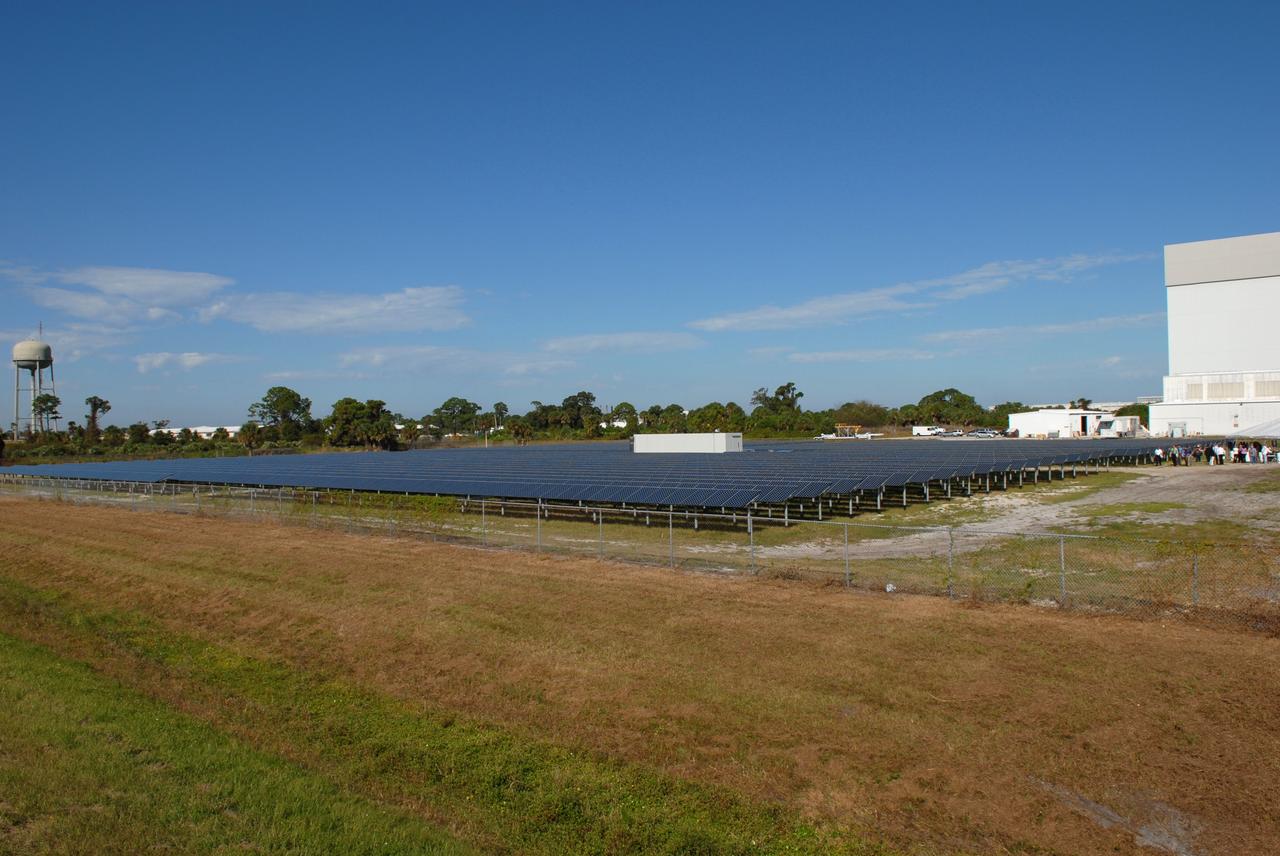
CAPE CANAVERAL, Fla. – NASA's first large-scale solar power generation facility is ready for operation at NASA's Kennedy Space Center in Florida. Representatives from NASA, Florida Power & Light Company, or FPL, and SunPower Corporation formally commissioned the one-megawatt facility and announced plans to pursue a new research, development and demonstration project at Kennedy to advance America's use of renewable energy. The facility is the first element of a major renewable energy project currently under construction at Kennedy. The completed system features a fixed-tilt, ground-mounted solar power system designed and built by SunPower, along with SunPower solar panels. A 10-megawatt solar farm, which SunPower is building on nearby Kennedy property, will supply power to FPL's customers when it is completed in April 2010. Photo credit: NASA/Jim Grossmann
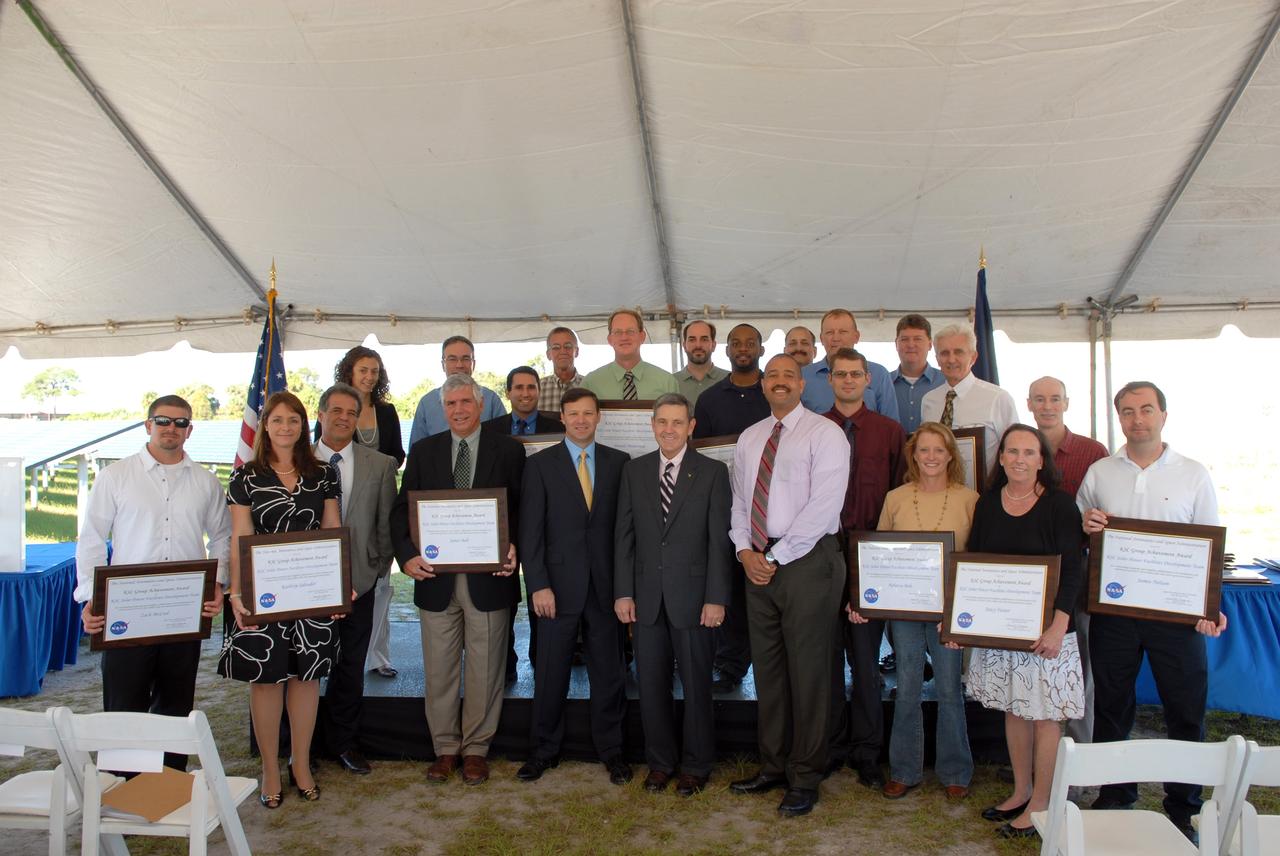
CAPE CANAVERAL, Fla. – At NASA's Kennedy Space Center in Florida, recipients of a NASA Team Award for their parts in the successful construction of NASA's first large-scale solar power generation facility pose for a group portrait. Representatives from NASA, Florida Power & Light Company, or FPL, and SunPower Corporation formally commissioned the one-megawatt facility and announced plans to pursue a new research, development and demonstration project at Kennedy to advance America's use of renewable energy. The facility is the first element of a major renewable energy project currently under construction at Kennedy. The completed system features a fixed-tilt, ground-mounted solar power system designed and built by SunPower, along with SunPower solar panels. A 10-megawatt solar farm, which SunPower is building on nearby Kennedy property, will supply power to FPL's customers when it is completed in April 2010. Photo credit: NASA/Jim Grossmann
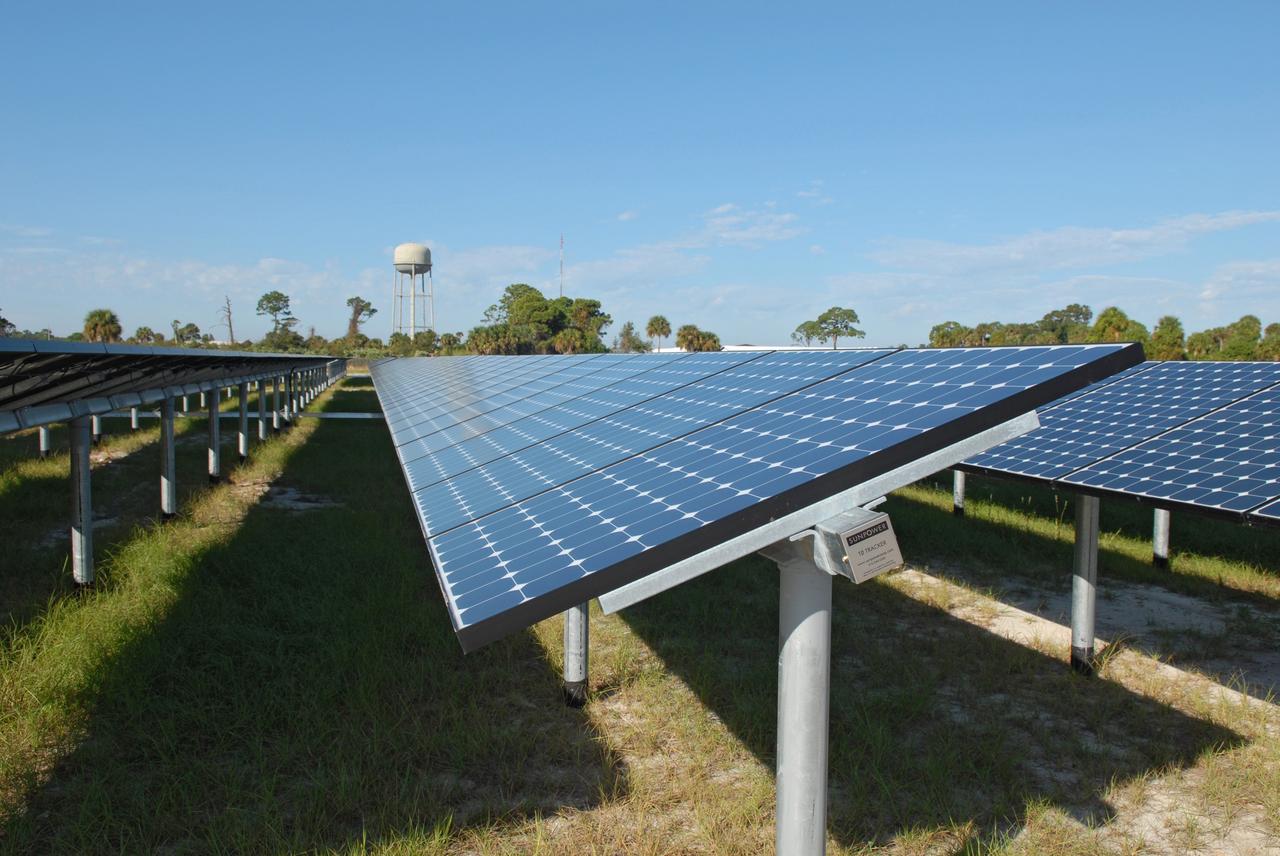
CAPE CANAVERAL, Fla. – NASA's first large-scale solar power generation facility is unveiled at NASA's Kennedy Space Center in Florida. Representatives from NASA, Florida Power & Light Company, or FPL, and SunPower Corporation formally commissioned the one-megawatt facility and announced plans to pursue a new research, development and demonstration project at Kennedy to advance America's use of renewable energy. The facility is the first element of a major renewable energy project currently under construction at Kennedy. The completed system features a fixed-tilt, ground-mounted solar power system designed and built by SunPower, along with SunPower solar panels. A 10-megawatt solar farm, which SunPower is building on nearby Kennedy property, will supply power to FPL's customers when it is completed in April 2010. Photo credit: NASA/Jim Grossmann
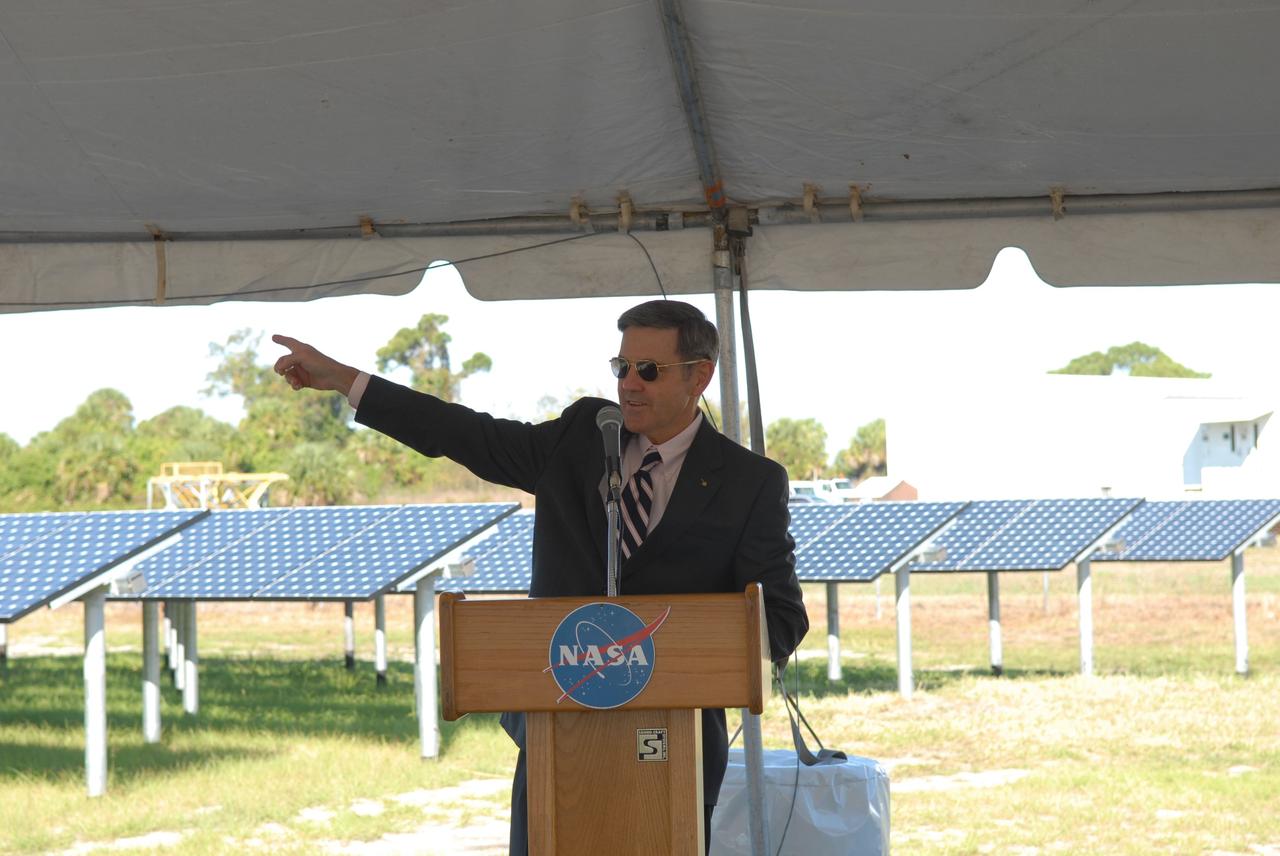
CAPE CANAVERAL, Fla. – NASA Kennedy Space Center Director Bob Cabana addresses the audience on hand for the unveiling of NASA's first large-scale solar power generation facility at Kennedy in Florida. Representatives from NASA, Florida Power & Light Company, or FPL, and SunPower Corporation formally commissioned the one-megawatt facility and announced plans to pursue a new research, development and demonstration project at Kennedy to advance America's use of renewable energy. The facility is the first element of a major renewable energy project currently under construction at Kennedy. The completed system features a fixed-tilt, ground-mounted solar power system designed and built by SunPower, along with SunPower solar panels. A 10-megawatt solar farm, which SunPower is building on nearby Kennedy property, will supply power to FPL's customers when it is completed in April 2010. Photo credit: NASA/Jim Grossmann
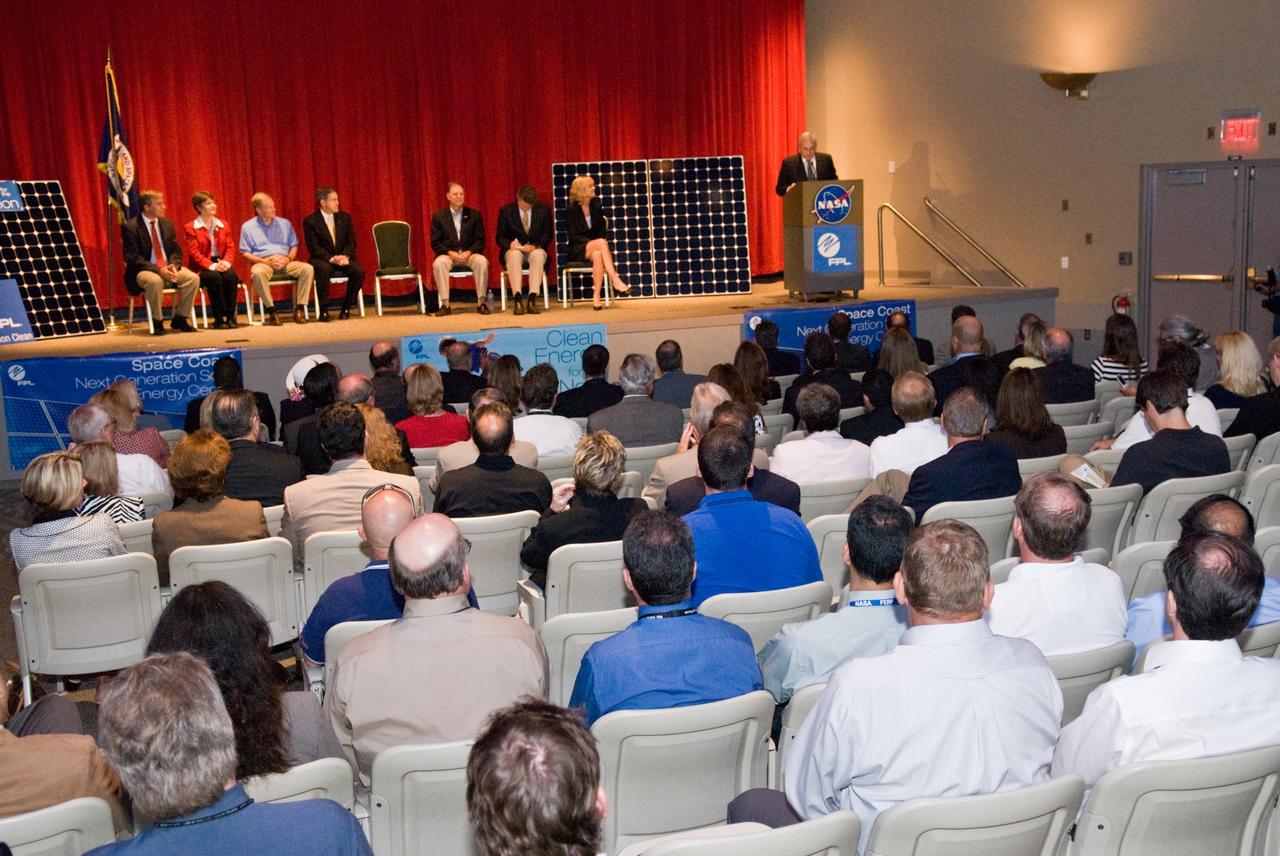
CAPE CANAVERAL, Fla. – Armando Olivera, president and CEO of Florida Power & Light, or FPL, speaks to guests at the groundbreaking ceremony for the joint NASA and FPL solar power project at NASA's Kennedy Space Center. Others on the stage are, from left, Ed Smeloff with SunPower Corporation, Florida Rep. Suzanne Kosmas, Sen. Bill Nelson, Center Director Bob Cabana, Florida Rep. Bill Posey, Eric Draper, deputy director of Audubon of Florida, and Pam Rauch, vice president of External Affairs for FPL. FPL, Florida's largest electric utility, will build and maintain two solar photovoltaic power generation systems at Kennedy. One will produce an estimated 10 megawatts of emissions-free power for FPL customers, which is enough energy to serve roughly 1,100 homes. The second is a one-megawatt solar power facility that will provide renewable energy directly to Kennedy. The FPL facilities at NASA will help provide Florida residents and America's space program with new sources of clean energy that will cut reliance on fossil fuels and improve the environment by reducing greenhouse gas emissions. The one megawatt facility also will help NASA meet its goal for use of power generated from renewable energy. Photo credit: NASA/Kim Shiflett
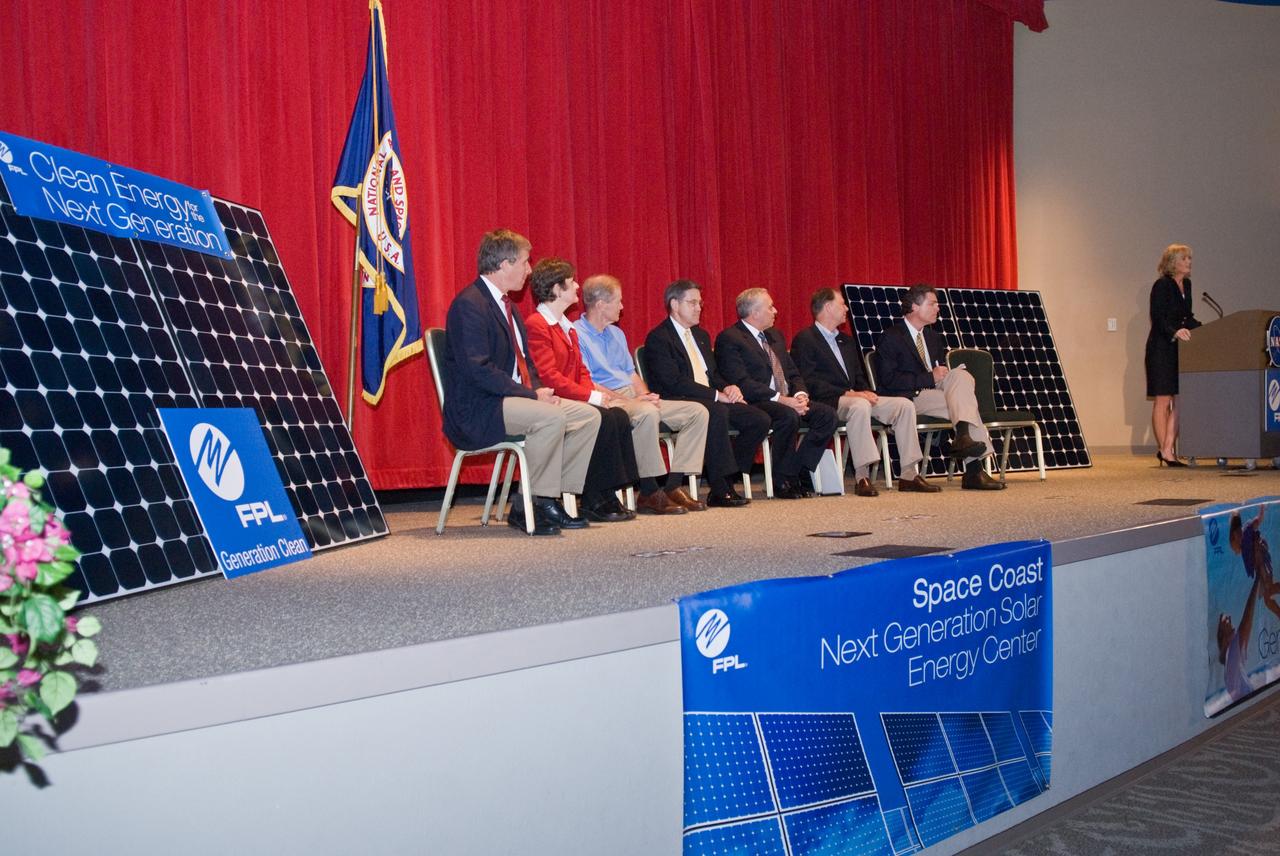
CAPE CANAVERAL, Fla. – Pam Rauch, vice president of External Affairs for Florida Power & Light, or FPL, speaks to guests at the groundbreaking ceremony for the joint NASA and FPL solar power project at NASA's Kennedy Space Center. Others on the stage are Ed Smeloff with SunPower Corporation, Florida Rep. Suzanne Kosmas, Sen. Bill Nelson, Center Director Bob Cabana, Armando Olivera, president and CEO of FPL, Florida Rep. Bill Posey and Eric Draper, deputy director of Audubon of Florida. FPL, Florida's largest electric utility, will build and maintain two solar photovoltaic power generation systems at Kennedy. One will produce an estimated 10 megawatts of emissions-free power for FPL customers, which is enough energy to serve roughly 1,100 homes. The second is a one-megawatt solar power facility that will provide renewable energy directly to Kennedy. The FPL facilities at NASA will help provide Florida residents and America's space program with new sources of clean energy that will cut reliance on fossil fuels and improve the environment by reducing greenhouse gas emissions. The one megawatt facility also will help NASA meet its goal for use of power generated from renewable energy. Photo credit: NASA/Kim Shiflett
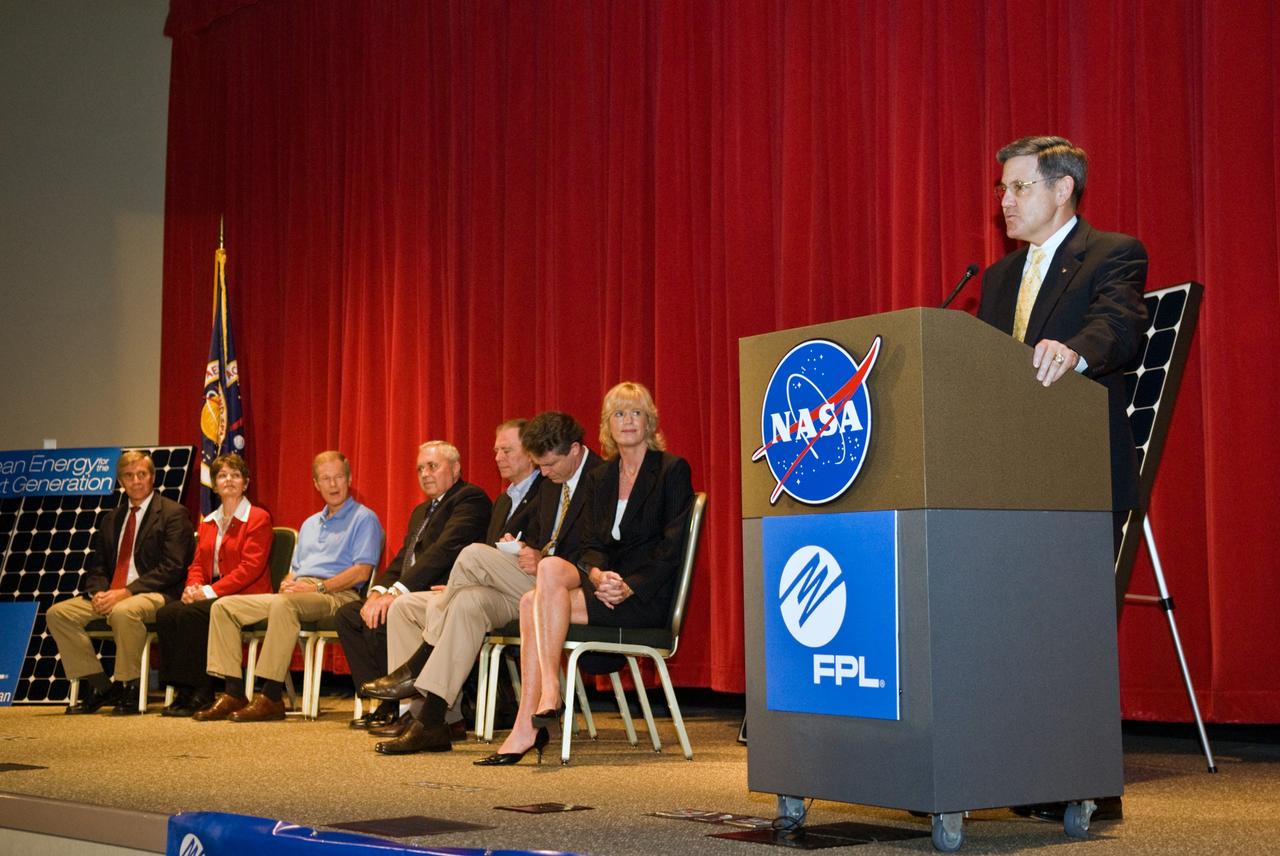
CAPE CANAVERAL, Fla. – Center Director of NASA's Kennedy Space Center in Florida, Bob Cabana addresses guests at the groundbreaking ceremony for the joint NASA and Florida Power & Light, or FPL, solar power project at Kennedy. Others on the stage are (from left) Ed Smeloff with SunPower Corporation, Florida Rep. Suzanne Kosmas, Sen. Bill Nelson, Armando Olivera, president and CEO of FPL, Florida Rep. Bill Posey, Eric Draper, deputy director of Audubon of Florida, and Pam Rauch, vice president of External Affairs for FPL. FPL, Florida's largest electric utility, will build and maintain two solar photovoltaic power generation systems at Kennedy. One will produce an estimated 10 megawatts of emissions-free power for FPL customers, which is enough energy to serve roughly 1,100 homes. The second is a one-megawatt solar power facility that will provide renewable energy directly to Kennedy. The FPL facilities at NASA will help provide Florida residents and America's space program with new sources of clean energy that will cut reliance on fossil fuels and improve the environment by reducing greenhouse gas emissions. The one megawatt facility also will help NASA meet its goal for use of power generated from renewable energy. Photo credit: NASA/Kim Shiflett
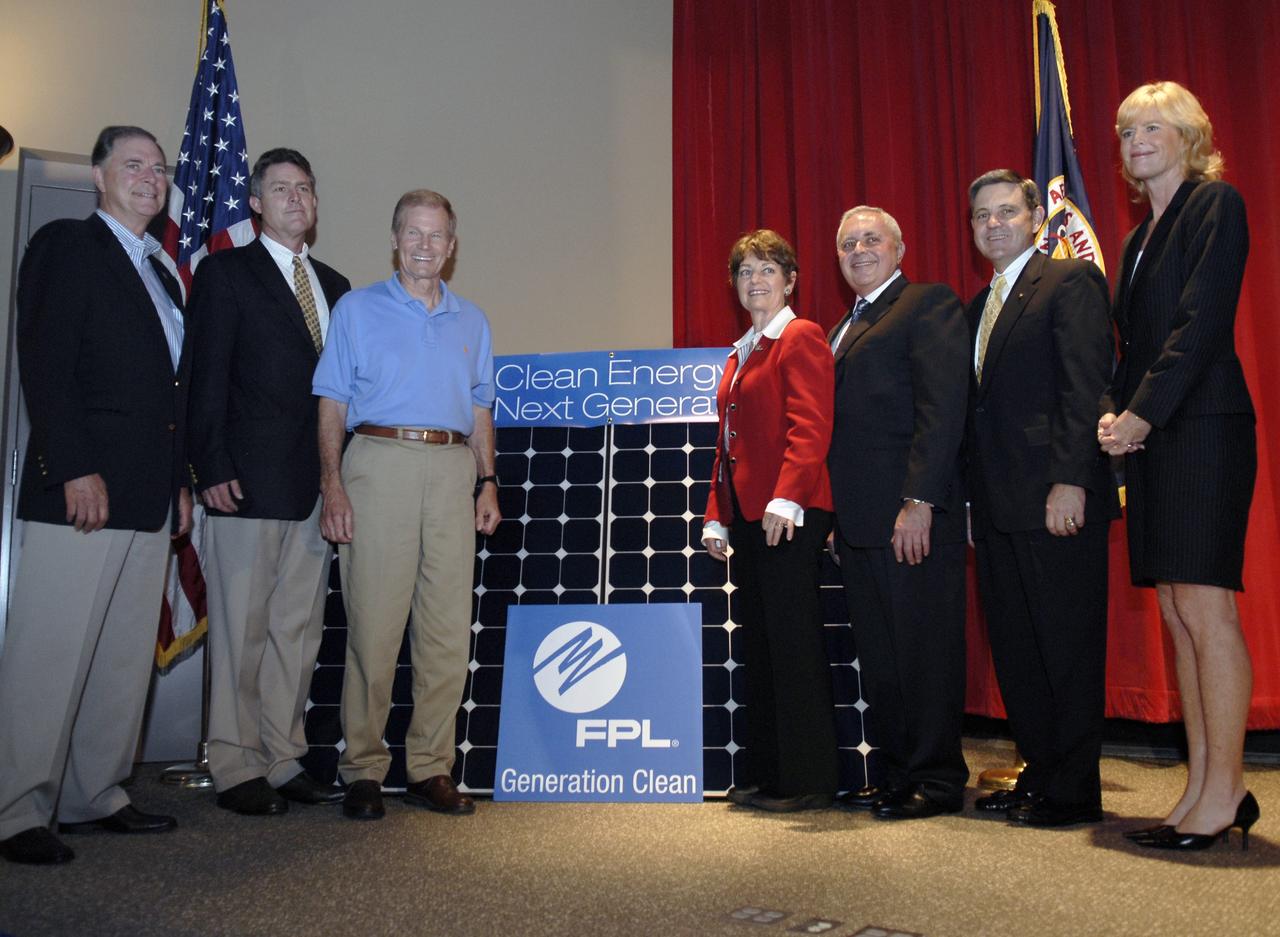
CAPE CANAVERAL, Fla. – Gathering on stage for the groundbreaking ceremony for the joint NASA and Florida Power & Light, or FPL, solar power project at NASA's Kennedy Space Center are Florida Rep. Bill Posey, Eric Draper, deputy director of Audubon of Florida, Sen. Bill Nelson, Florida Rep. Suzanne Kosmas, Armando Olivera, president and CEO of FPL, Center Director Bob Cabana and Pam Rauch, vice president of External Affairs for FPL. FPL, Florida's largest electric utility, will build and maintain two solar photovoltaic power generation systems at Kennedy. One will produce an estimated 10 megawatts of emissions-free power for FPL customers, which is enough energy to serve roughly 1,100 homes. The second is a one-megawatt solar power facility that will provide renewable energy directly to Kennedy. The FPL facilities at NASA will help provide Florida residents and America's space program with new sources of clean energy that will cut reliance on fossil fuels and improve the environment by reducing greenhouse gas emissions. The one megawatt facility also will help NASA meet its goal for use of power generated from renewable energy. Photo credit: NASA/Kim Shiflett
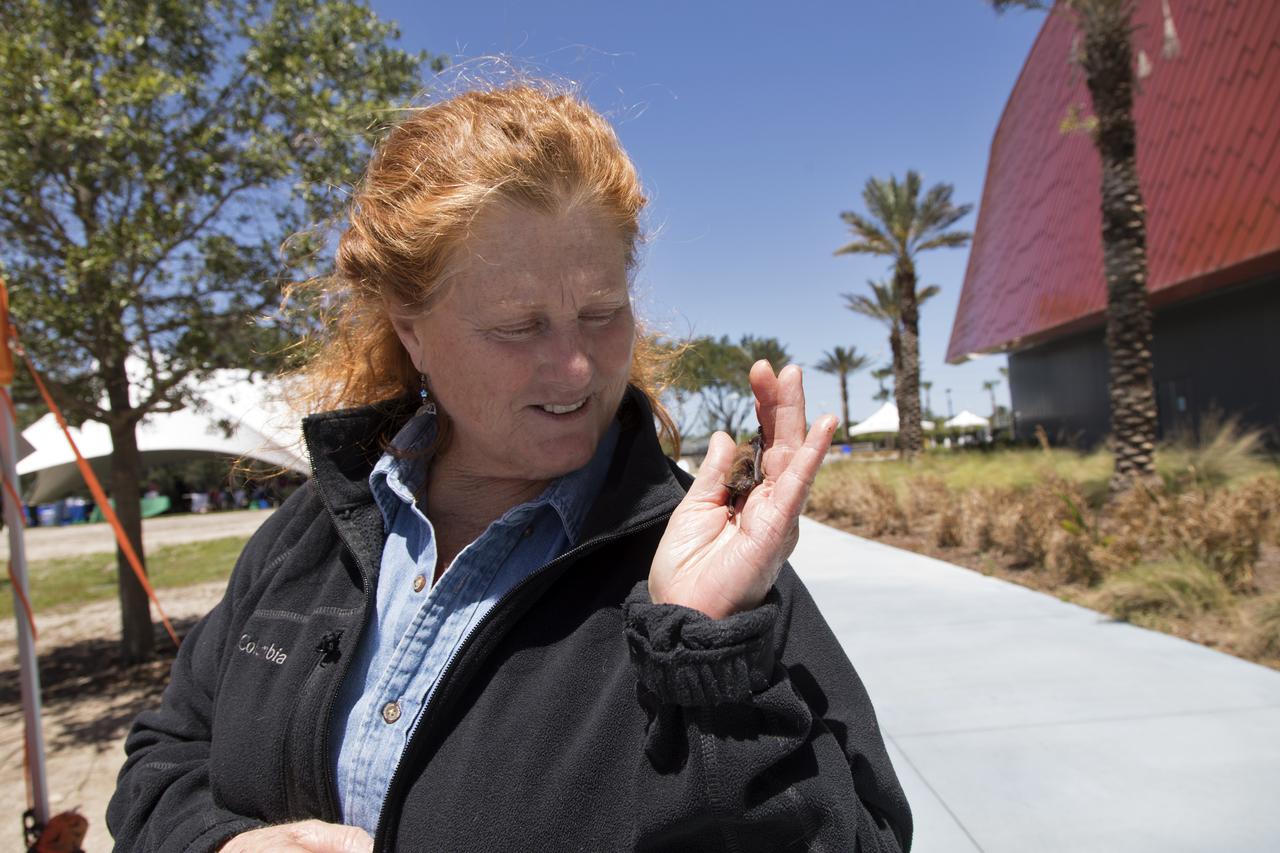
During the annual Earth Day celebration at the Kennedy Space Center Visitor Complex, Shari Blissett-Clark of the Florida Bat Conservancy displays one of the mammals. The event took place during the annual Earth Day celebration at the Kennedy Space Center Visitor Complex, guests have an opportunity to learn more about energy awareness, the environment and sustainability.

During the annual Earth Day celebration at the Kennedy Space Center Visitor Complex, Shari Blissett-Clark of the Florida Bat Conservancy displays one of the mammals. The event took place during the annual Earth Day celebration at the Kennedy Space Center Visitor Complex, guests have an opportunity to learn more about energy awareness, the environment and sustainability.
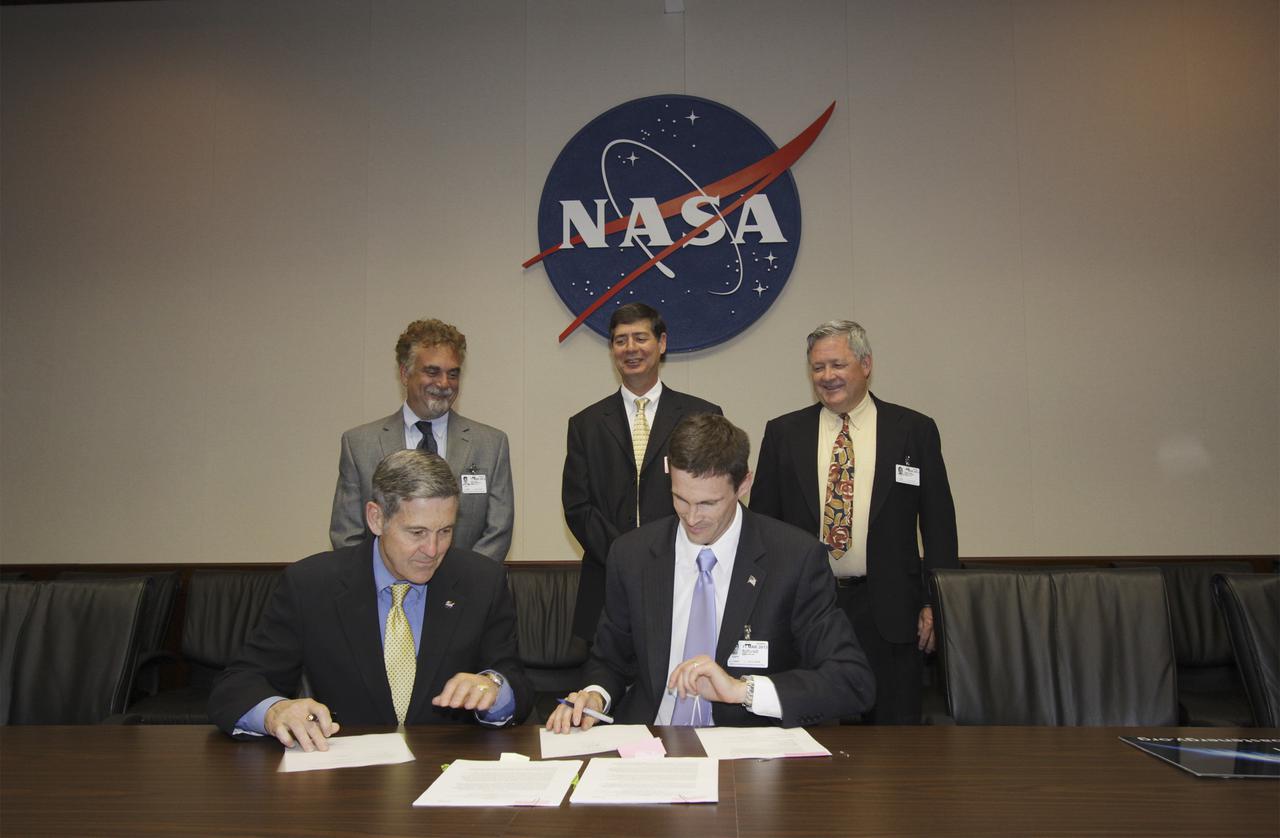
CAPE CANAVERAL, Fla. -- Kennedy Space Center Director Bob Cabana, left, joins Mike Aller, executive director of the Space Coast Energy Consortium, in signing a Space Act Agreement to help transition the Kennedy Space Center from a historically government-only launch facility to a multiuser spaceport. The partnership defines how the space agency will serve both government and commercial renewable energy initiatives. Looking on, from the left, are Scott Lewit, chairman of the SCEC’s board of directors, Bennett Boucher, SCEC board member, and Rodger Rees, SCEC chief financial officer. The Cape Canaveral-based energy consortium is an industry-led nonprofit association created to identify and create innovative energy opportunities for the Space Coast and Florida. The organization was formed by community and industry leaders to assist with the post-space shuttle transition by building networks among local businesses with resources across the country. Photo credit: NASA_Jim Grossmann
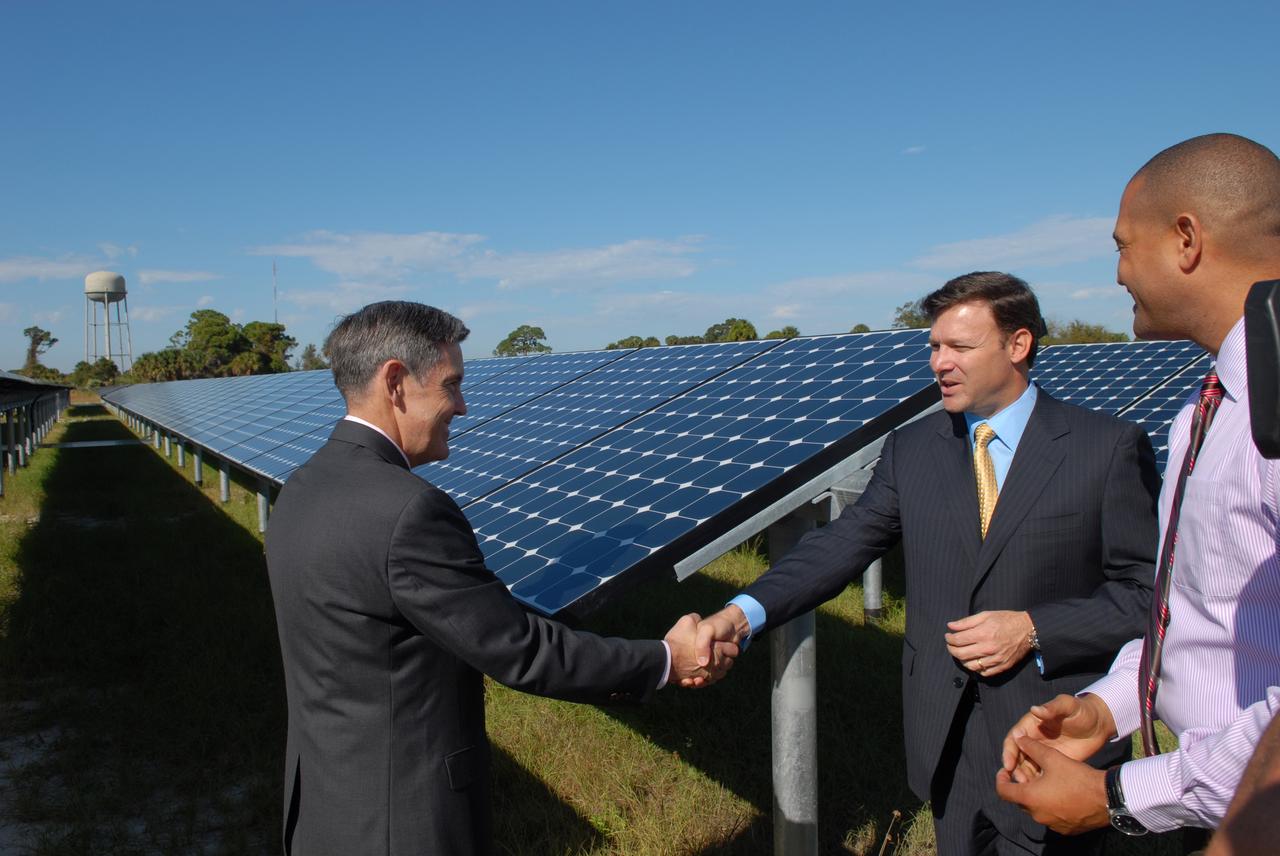
CAPE CANAVERAL, Fla. – At NASA's Kennedy Space Center in Florida, Kennedy Director Bob Cabana, left, congratulates, Eric Silagy, Florida Power & Light Company vice president and chief development officer, for his part in the construction of NASA's first large-scale solar power generation facility as Roderick Roche, senior manager, Project Management Office of North America, SunPower Corporation, looks on. Representatives from NASA, Florida Power & Light Company, or FPL, and SunPower Corporation formally commissioned the one-megawatt facility and announced plans to pursue a new research, development and demonstration project at Kennedy to advance America's use of renewable energy. The facility is the first element of a major renewable energy project currently under construction at Kennedy. The completed system features a fixed-tilt, ground-mounted solar power system designed and built by SunPower, along with SunPower solar panels. A 10-megawatt solar farm, which SunPower is building on nearby Kennedy property, will supply power to FPL's customers when it is completed in April 2010. Photo credit: NASA/Jim Grossmann
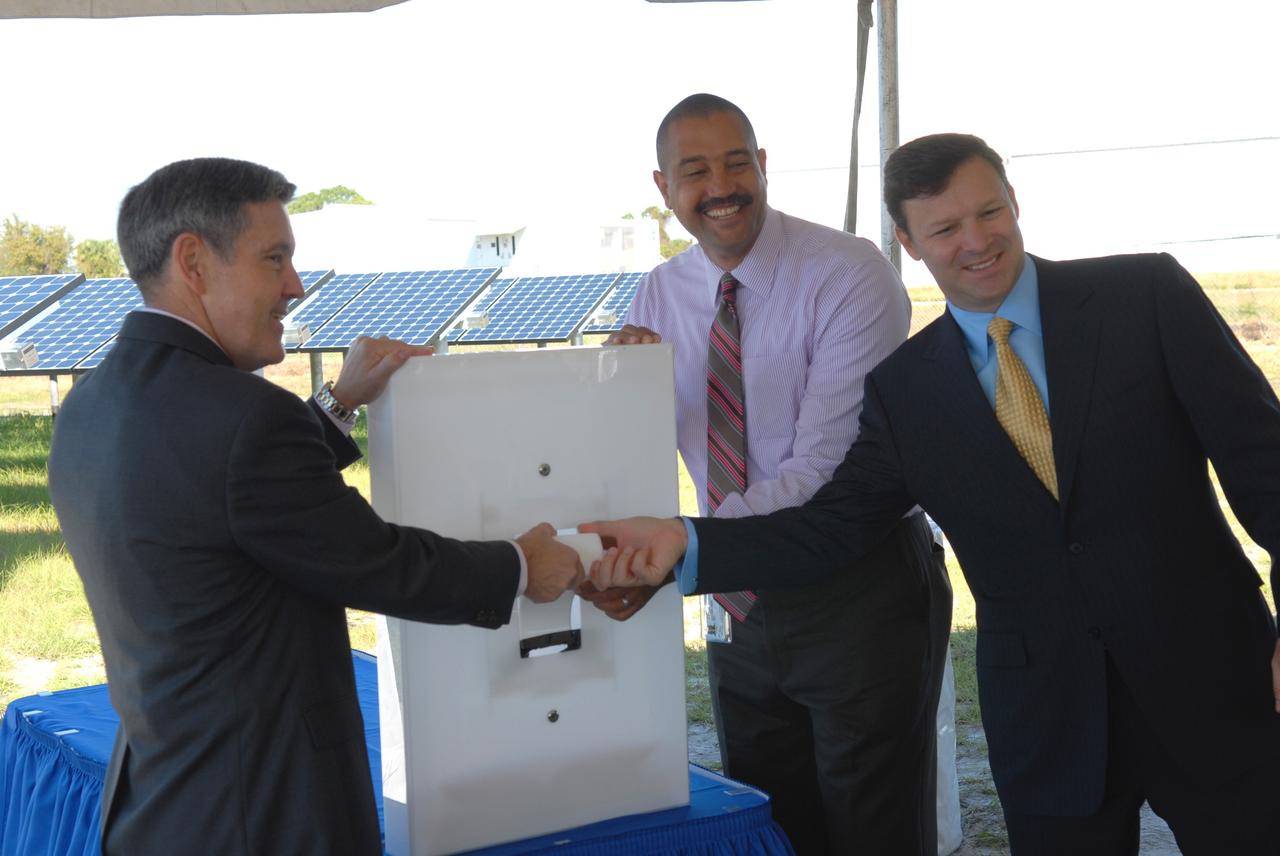
CAPE CANAVERAL, Fla. – A ceremonial "flipping of the switch" officially begins operation of NASA's first large-scale solar power generation facility at NASA's Kennedy Space Center in Florida. Flipping the four-foot-tall light switch in unison are, from left, Bob Cabana, Kennedy center director; Roderick Roche, senior manager, Project Management Office of North America, SunPower Corporation; and Eric Silagy, Florida Power & Light Company vice president and chief development officer. Representatives from NASA, Florida Power & Light Company, or FPL, and SunPower Corporation formally commissioned the one-megawatt facility and announced plans to pursue a new research, development and demonstration project at Kennedy to advance America's use of renewable energy. The facility is the first element of a major renewable energy project currently under construction at Kennedy. The completed system features a fixed-tilt, ground-mounted solar power system designed and built by SunPower, along with SunPower solar panels. A 10-megawatt solar farm, which SunPower is building on nearby Kennedy property, will supply power to FPL's customers when it is completed in April 2010. Photo credit: NASA/Jim Grossmann
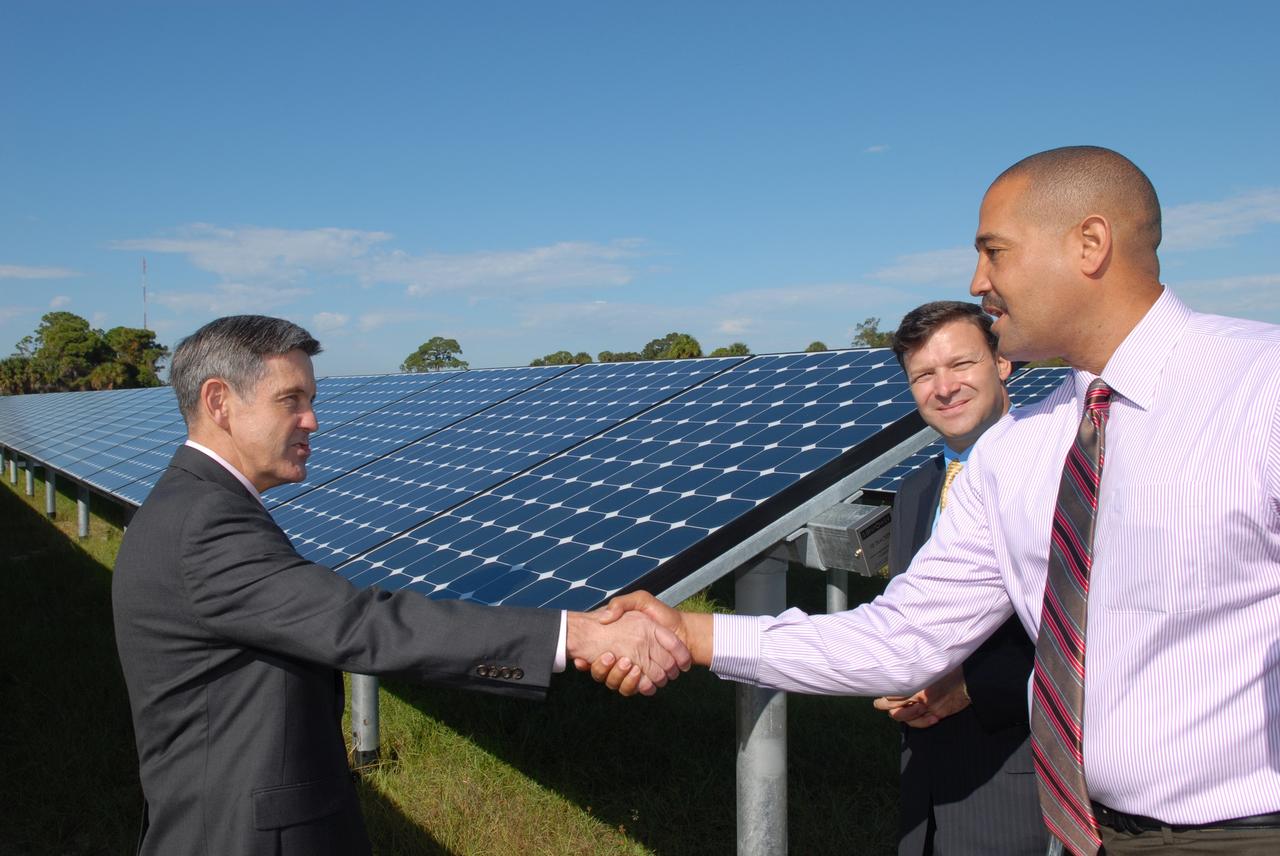
CAPE CANAVERAL, Fla. – At NASA's Kennedy Space Center in Florida, Kennedy Director Bob Cabana, left, congratulates Roderick Roche, senior manager, Project Management Office of North America, SunPower Corporation, for his part in the construction of NASA's first large-scale solar power generation facility as Eric Silagy, Florida Power & Light Company vice president and chief development officer, looks on. Representatives from NASA, Florida Power & Light Company, or FPL, and SunPower Corporation formally commissioned the one-megawatt facility and announced plans to pursue a new research, development and demonstration project at Kennedy to advance America's use of renewable energy. The facility is the first element of a major renewable energy project currently under construction at Kennedy. The completed system features a fixed-tilt, ground-mounted solar power system designed and built by SunPower, along with SunPower solar panels. A 10-megawatt solar farm, which SunPower is building on nearby Kennedy property, will supply power to FPL's customers when it is completed in April 2010. Photo credit: NASA/Jim Grossmann
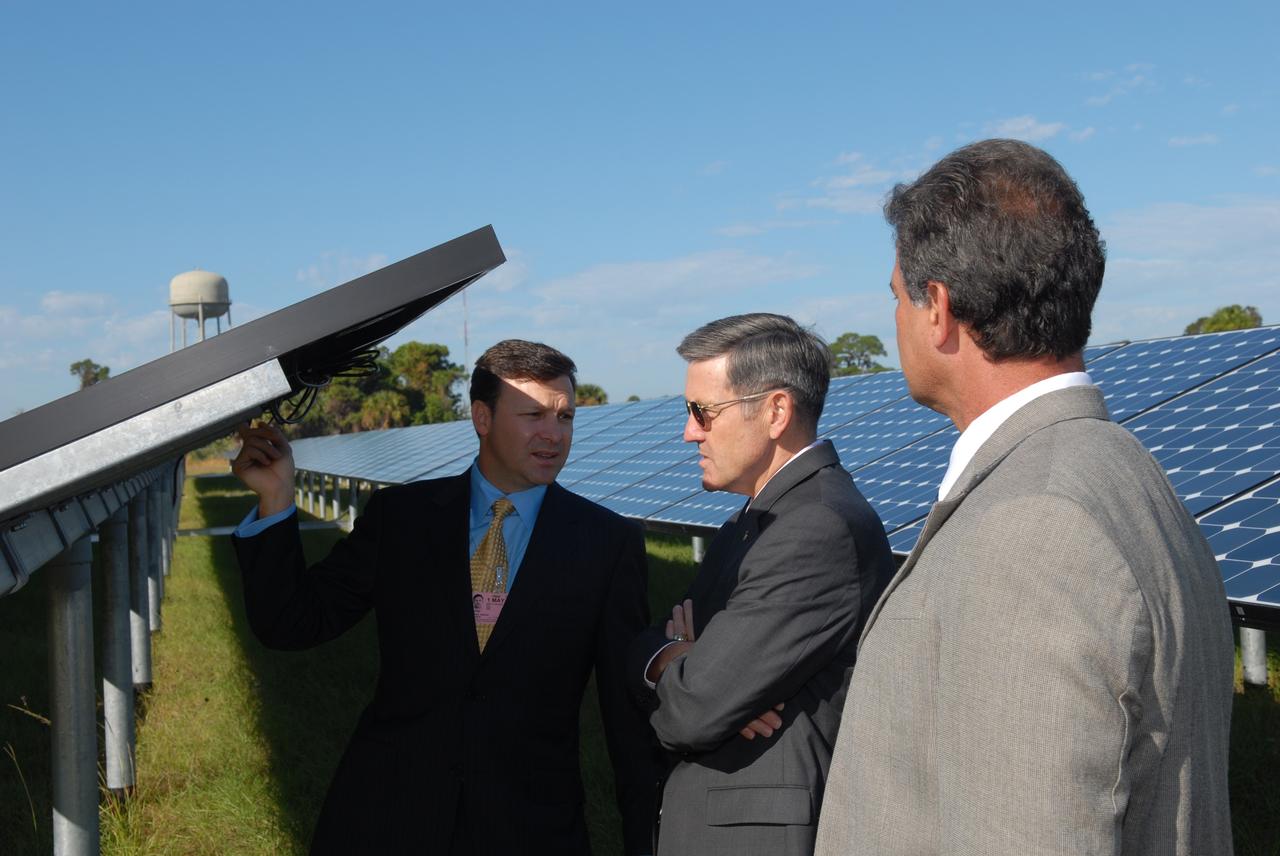
CAPE CANAVERAL, Fla. – Florida Power & Light Company Vice President and Chief Development Officer Eric Silagy, left, and NASA Kennedy Space Center Director Bob Cabana, center, examine one of the solar panels at the unveiling of NASA's first large-scale solar power generation facility at Kennedy in Florida. Representatives from NASA, Florida Power & Light Company, or FPL, and SunPower Corporation formally commissioned the one-megawatt facility and announced plans to pursue a new research, development and demonstration project at Kennedy to advance America's use of renewable energy. The facility is the first element of a major renewable energy project currently under construction at Kennedy. The completed system features a fixed-tilt, ground-mounted solar power system designed and built by SunPower, along with SunPower solar panels. A 10-megawatt solar farm, which SunPower is building on nearby Kennedy property, will supply power to FPL's customers when it is completed in April 2010. Photo credit: NASA/Jim Grossmann
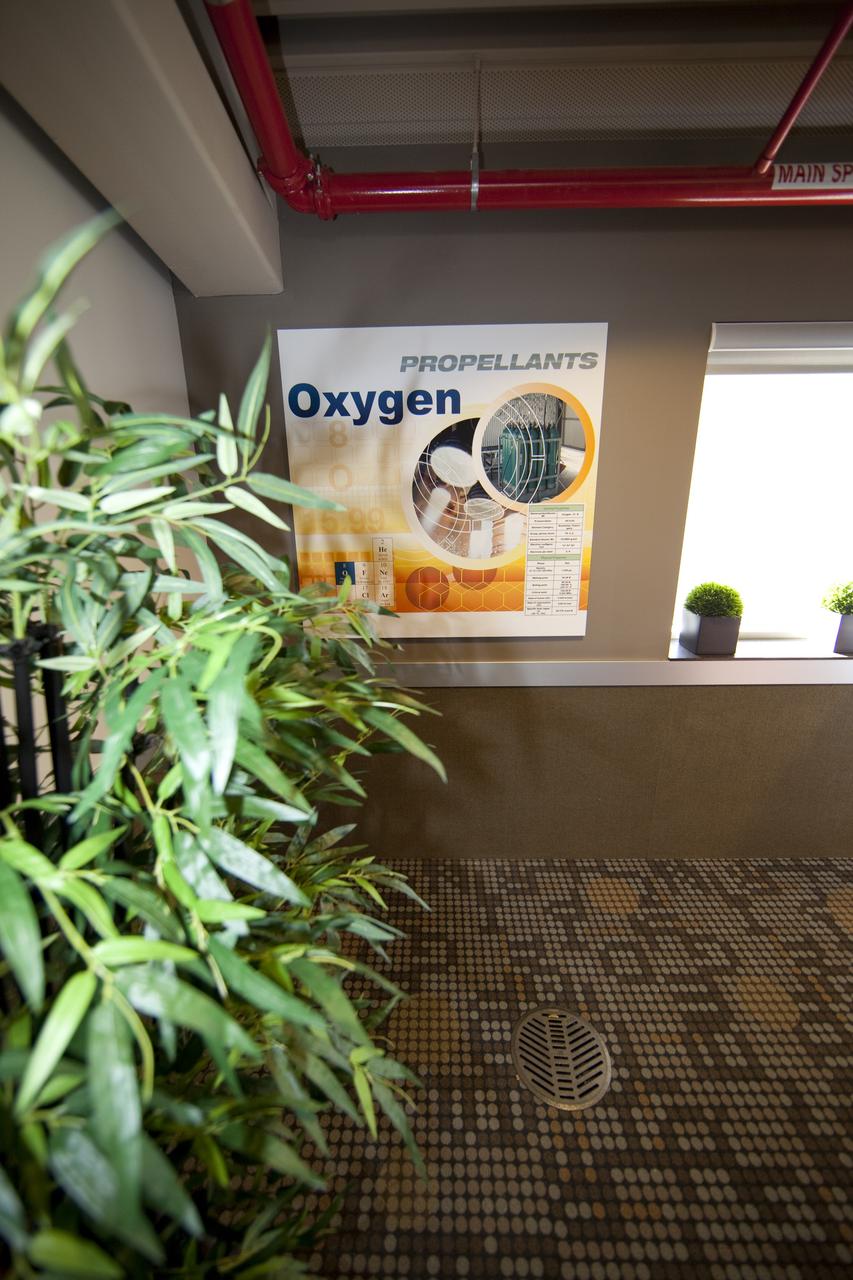
CAPE CANAVERAL, Fla. -- Finishing touches adorn the second-floor conference room of the Propellants North Administrative and Maintenance Facility at NASA's Kennedy Space Center in Florida. Artwork for the conference room was produced by Greg Lee, a graphics specialist with Abacus Technology Corp., with input from the facility's future occupants. The environmentally friendly facility is slated to be NASA's second Platinum-rated by the U.S. Green Building Council's (USGBC) Leadership in Environmental and Energy Design (LEED) certification system. It will be the space agency's first net-zero facility, which means it will produce enough energy onsite from renewable sources to offset what it requires to operate. The facility consists of a two-story administrative building to house managers, mechanics and technicians who fuel spacecraft at Kennedy, and a single-story shop to store cryogenic fuel transfer equipment. Photo credit: NASA/Frankie Martin
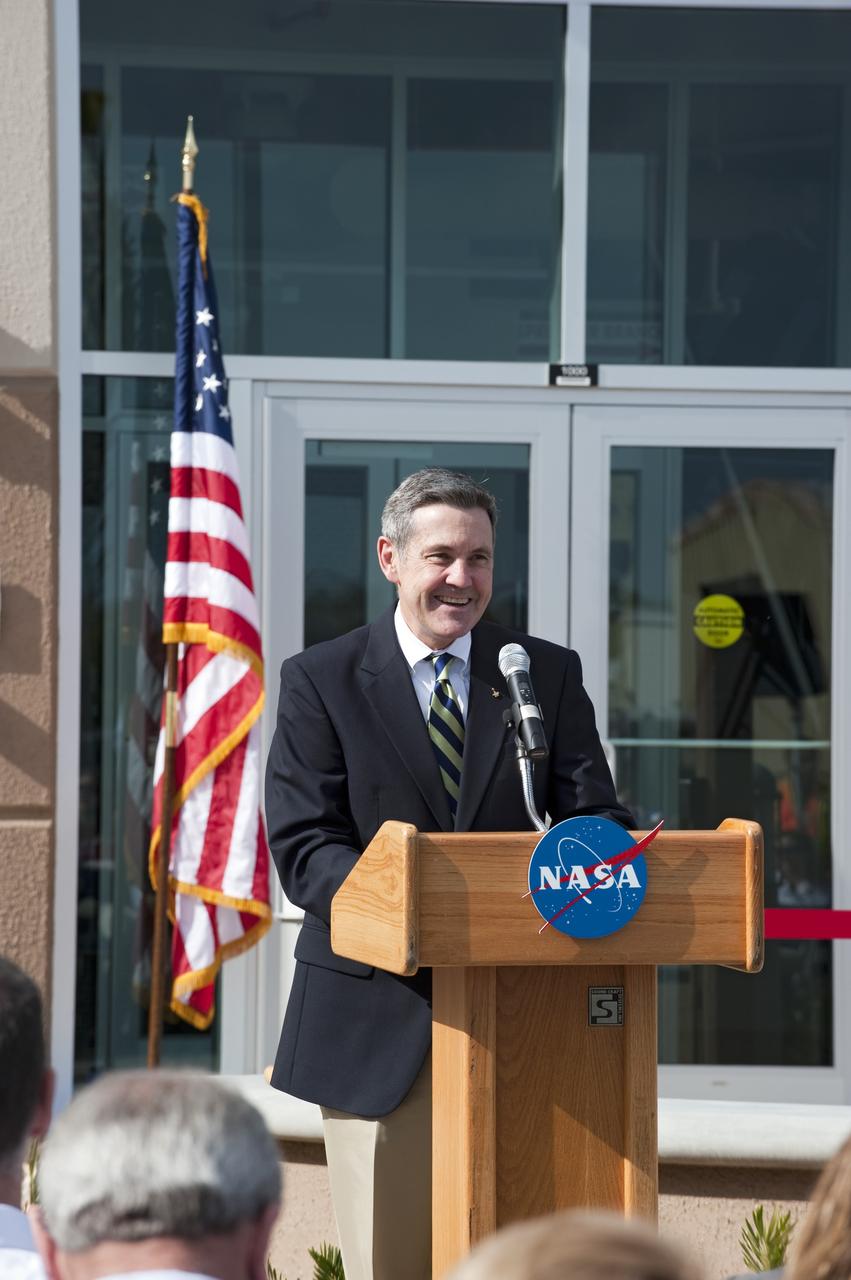
CAPE CANAVERAL, Fla. -- The director of NASA's Kennedy Space Center in Florida, Bob Cabana, addresses an audience at the ribbon-cutting ceremony for the new environmentally friendly Propellants North Administration and Maintenance Facility. Propellants North consists of two buildings, one to store cryogenic fuel transfer equipment and one to house personnel who support fueling spacecraft. The recently rebuilt buildings will be NASA's first carbon neutral facility, which means it will produce enough energy on site from renewable sources to offset what it requires to operate. The facility also will reach for the U.S. Green Building Council's Leadership in Environmental and Energy Design (LEED) Platinum status, which is the highest LEED rating. Photo credit: NASA/Kim Shiflett
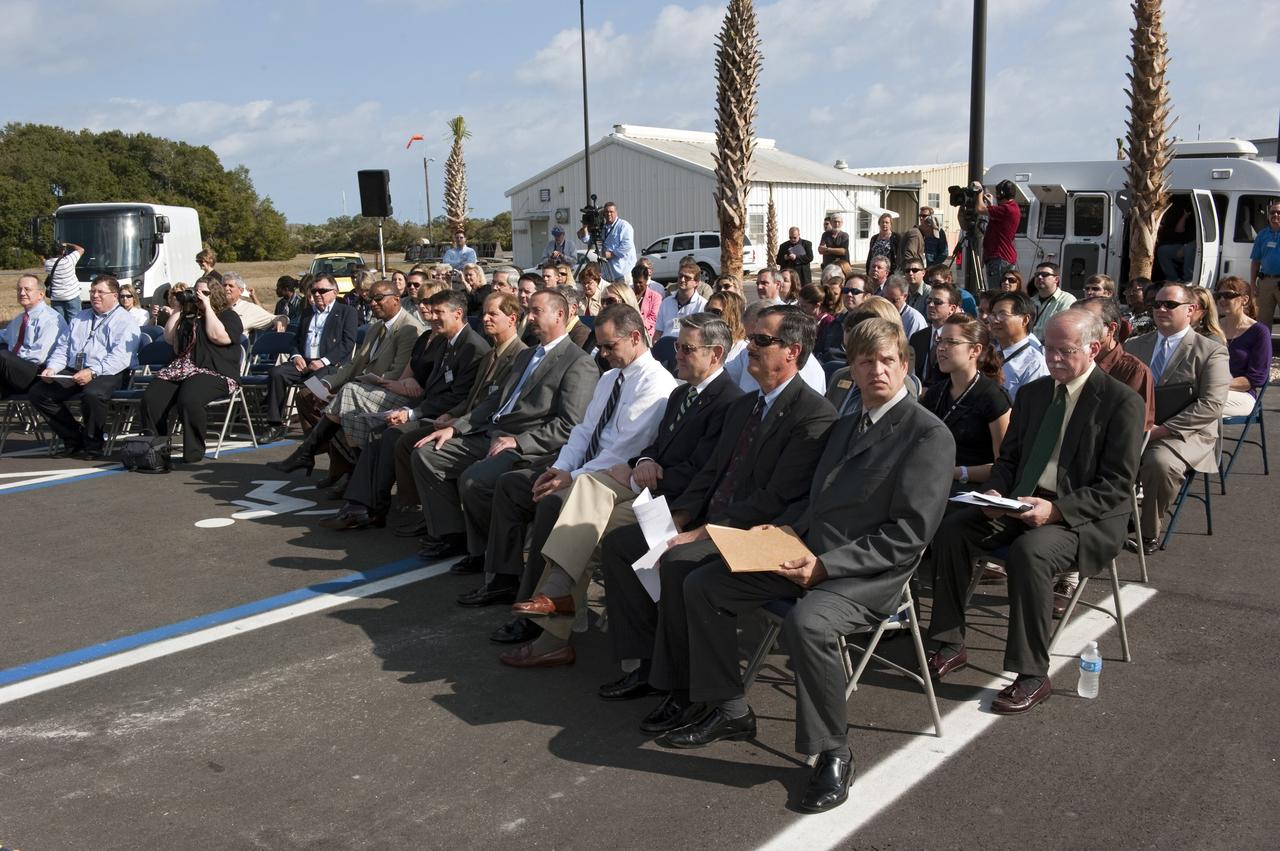
CAPE CANAVERAL, Fla. -- At NASA's Kennedy Space Center in Florida, an audience at the ribbon-cutting ceremony for the new environmentally friendly Propellants North Administration and Maintenance Facility listens to opening remarks made by Frank Kline, a NASA Construction of Facilities project manager. Propellants North consists of two buildings, one to store cryogenic fuel transfer equipment and one to house personnel who support fueling spacecraft. The recently rebuilt buildings will be NASA's first carbon neutral facility, which means it will produce enough energy on site from renewable sources to offset what it requires to operate. The facility also will reach for the U.S. Green Building Council's Leadership in Environmental and Energy Design (LEED) Platinum status, which is the highest LEED rating. Photo credit: NASA/Kim Shiflett
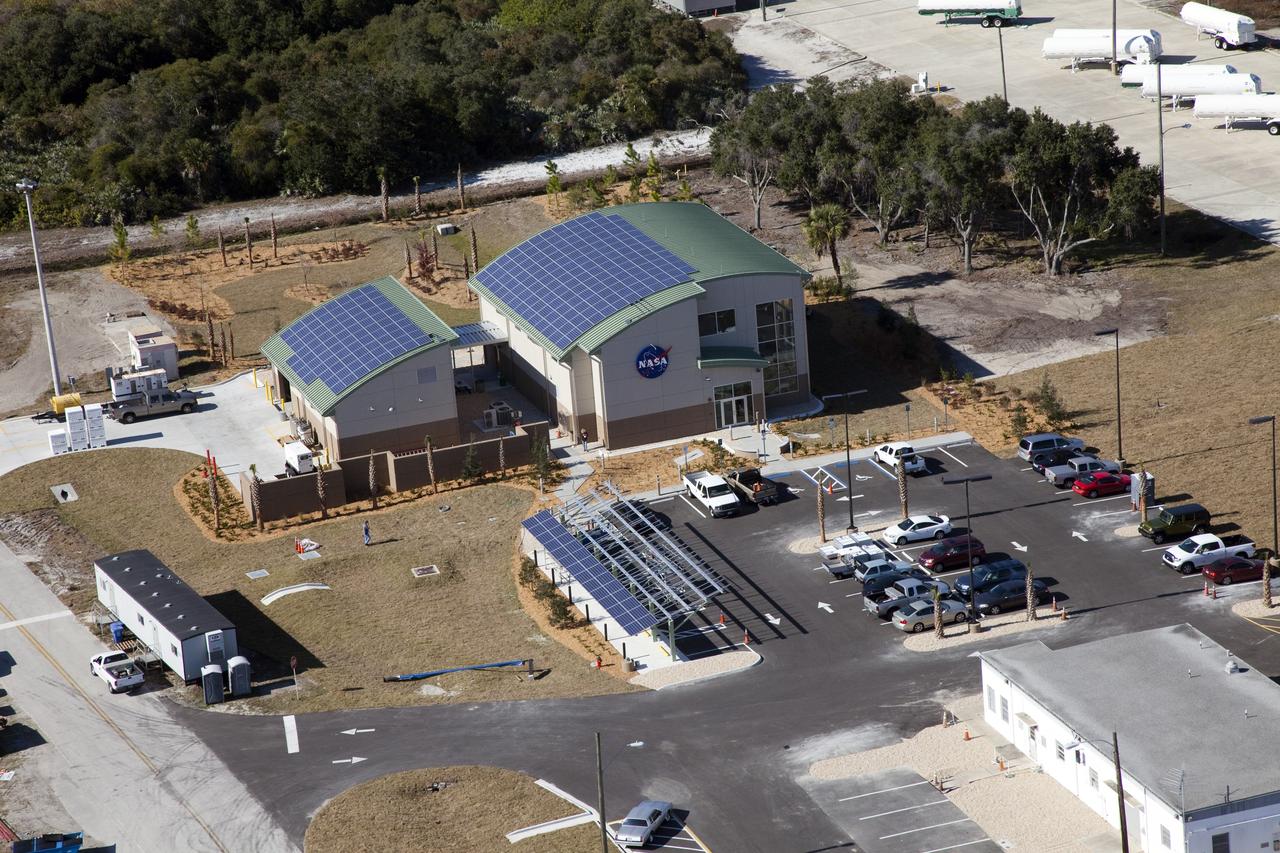
CAPE CANAVERAL, Fla. -- The Propellants North Administrative and Maintenance Facility in the Launch Complex 39 area of NASA's Kennedy Space Center in Florida is ready for business. The environmentally friendly facility is slated to be NASA's second Platinum-rated by the U.S. Green Building Council's (USGBC) Leadership in Environmental and Energy Design (LEED) certification system. It will be the space agency's first carbon-neutral facility, which means it will produce enough energy onsite from renewable sources to offset what it requires to operate. On the right is the facility's two-story administrative building, which will house managers, mechanics and technicians who fuel spacecraft at Kennedy. On the left is a single-story shop that will be used to store cryogenic fuel transfer equipment. In the parking lot is a solar-powered parking station for alternative fuel vehicles. Photo credit: NASA/Frank Michaux
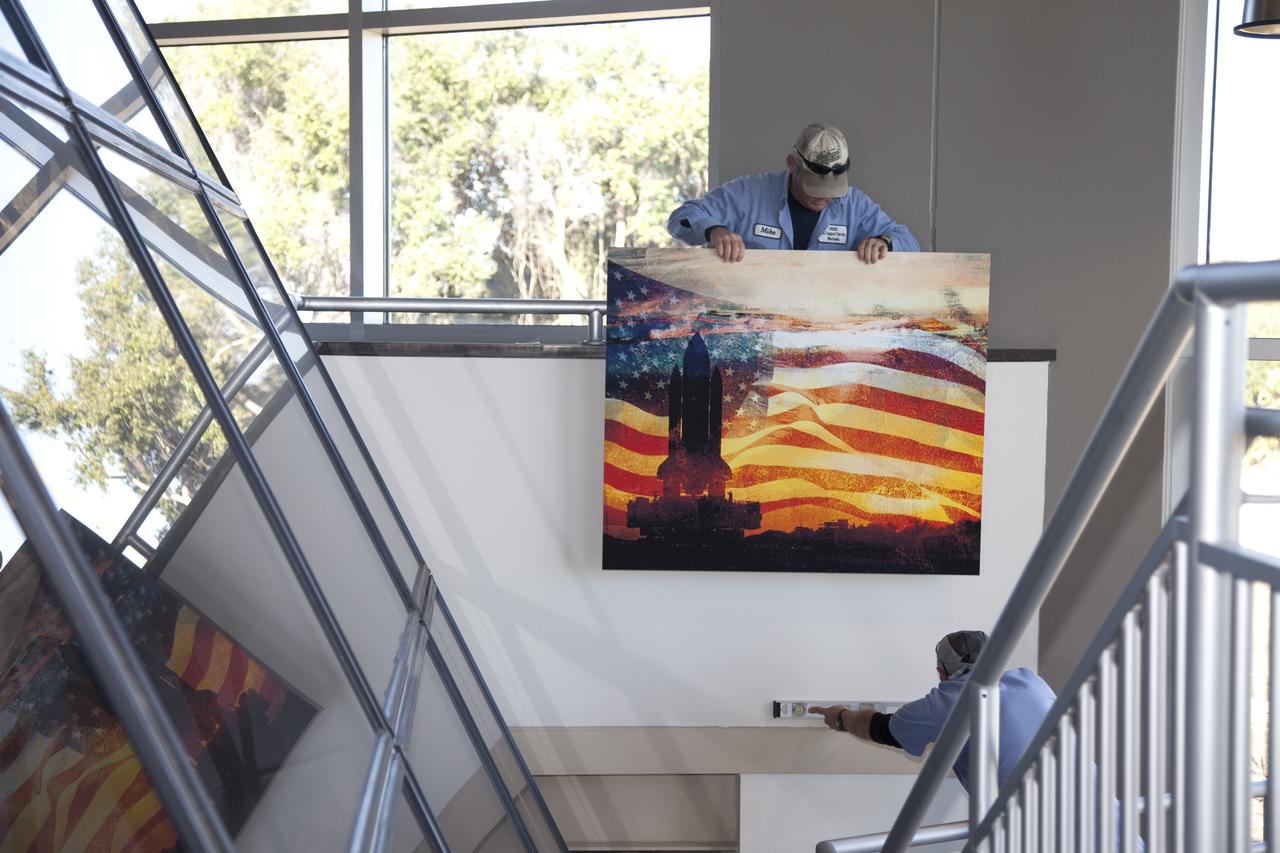
CAPE CANAVERAL, Fla. -- Workers hang artwork in the second-floor lobby of the Propellants North Administrative and Maintenance Facility at NASA's Kennedy Space Center in Florida. The artwork was produced by Greg Lee, a graphics specialist with Abacus Technology Corp., and features a silhouette of a shuttle, one of the most recognizable American icons, rolling out to Launch Complex 39. The environmentally friendly facility is slated to be NASA's second Platinum-rated by the U.S. Green Building Council's (USGBC) Leadership in Environmental and Energy Design (LEED) certification system. It will be the space agency's first net-zero facility, which means it will produce enough energy onsite from renewable sources to offset what it requires to operate. The facility consists of a two-story administrative building to house managers, mechanics and technicians who fuel spacecraft at Kennedy, and a single-story shop to store cryogenic fuel transfer equipment. Photo credit: NASA/Frankie Martin
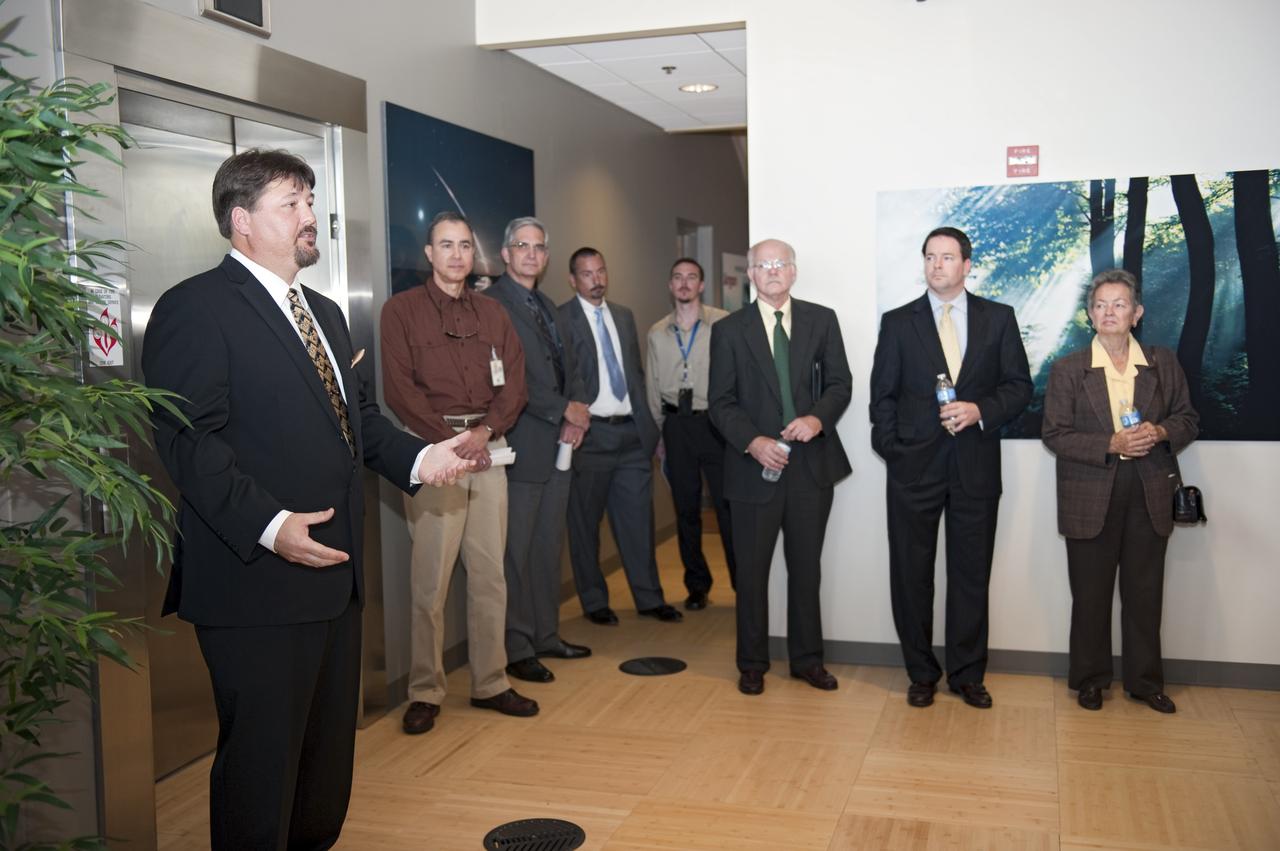
CAPE CANAVERAL, Fla. -- Frank Kline, Construction of Facilities project manager at NASA's Kennedy Space Center in Florida, far left, shows off the environmentally friendly features of the new Propellants North Administration and Maintenance Facility. Propellants North consists of two buildings, one to store cryogenic fuel transfer equipment and one to house personnel who support fueling spacecraft. The recently rebuilt buildings will be NASA's first carbon neutral facility, which means it will produce enough energy on site from renewable sources to offset what it requires to operate. The facility also will reach for the U.S. Green Building Council's Leadership in Environmental and Energy Design (LEED) Platinum status, which is the highest LEED rating. Photo credit: NASA/Kim Shiflett

CAPE CANAVERAL, Fla. -- The Vehicle Assembly Building towers over the new Propellants North Administrative and Maintenance Facility in the Launch Complex 39 area of NASA's Kennedy Space Center in Florida. The environmentally friendly facility is slated to be NASA's second Platinum-rated by the U.S. Green Building Council's (USGBC) Leadership in Environmental and Energy Design (LEED) certification system. It will be the space agency's first carbon-neutral facility, which means it will produce enough energy onsite from renewable sources to offset what it requires to operate. On the right is the facility's two-story administrative building, which will house managers, mechanics and technicians who fuel spacecraft at Kennedy. On the left is a single-story shop that will be used to store cryogenic fuel transfer equipment. In the parking lot is a solar-powered parking station for alternative fuel vehicles. Photo credit: NASA/Frank Michaux
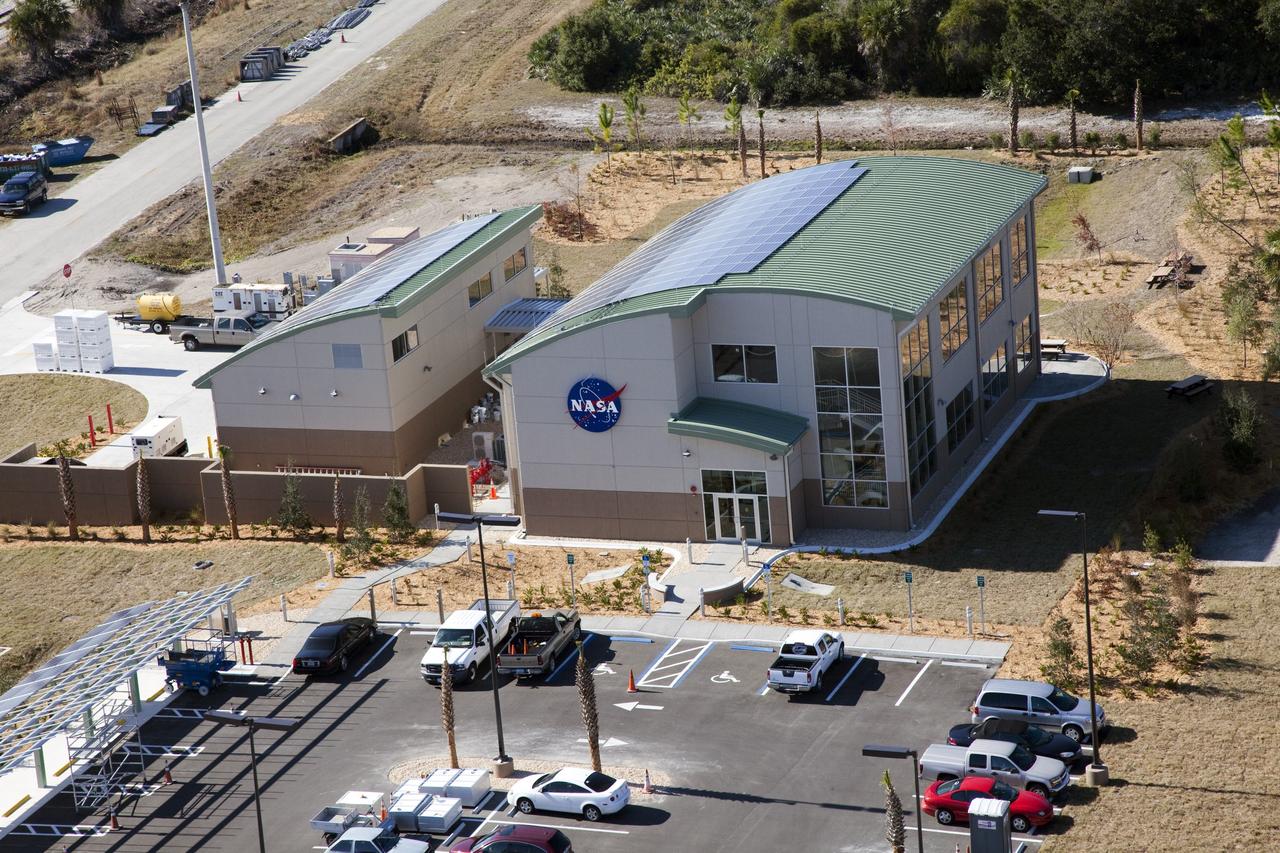
CAPE CANAVERAL, Fla. -- The Propellants North Administrative and Maintenance Facility in the Launch Complex 39 area of NASA's Kennedy Space Center in Florida is ready for business. The environmentally friendly facility is slated to be NASA's second Platinum-rated by the U.S. Green Building Council's (USGBC) Leadership in Environmental and Energy Design (LEED) certification system. It will be the space agency's first carbon-neutral facility, which means it will produce enough energy onsite from renewable sources to offset what it requires to operate. On the right is the facility's two-story administrative building, which will house managers, mechanics and technicians who fuel spacecraft at Kennedy. On the left is a single-story shop that will be used to store cryogenic fuel transfer equipment. In the parking lot is a solar-powered parking station for alternative fuel vehicles. Photo credit: NASA/Frank Michaux
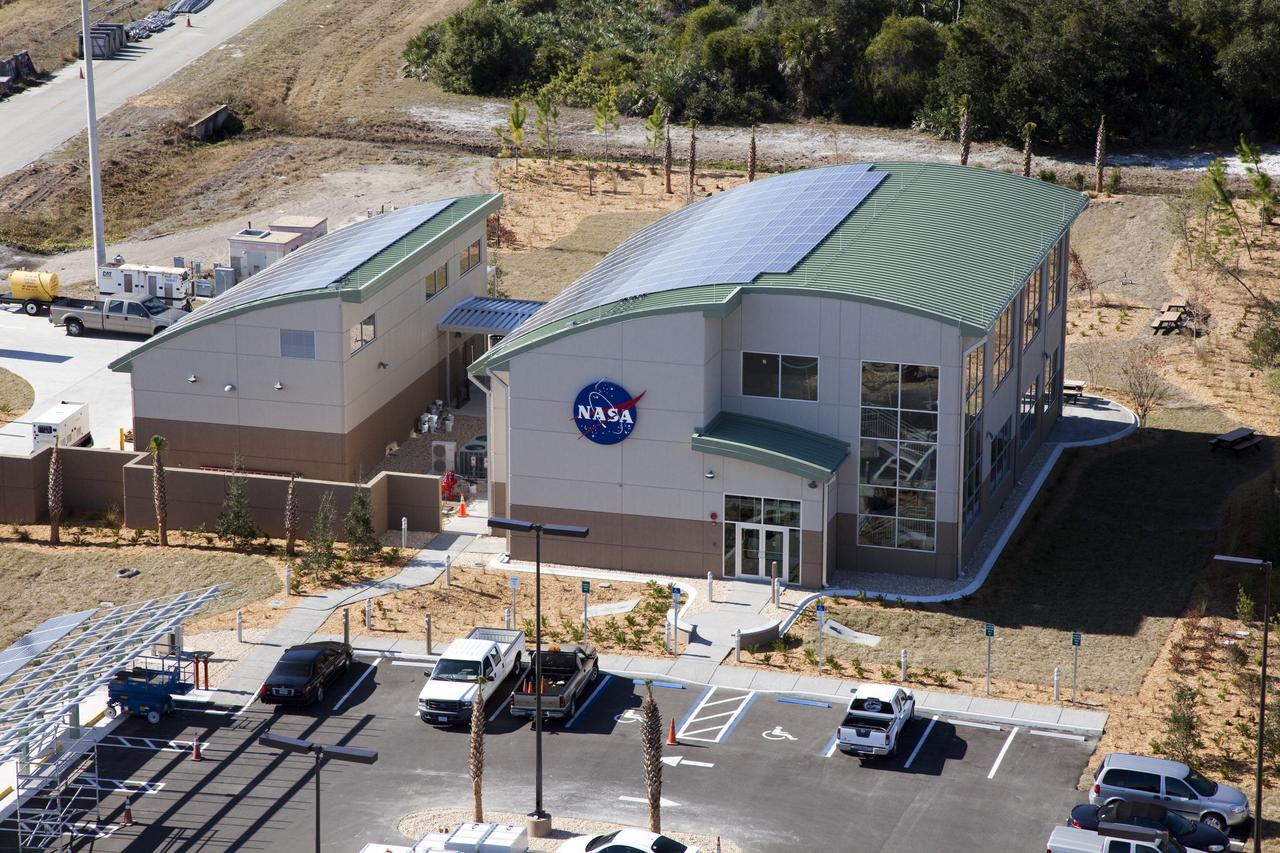
CAPE CANAVERAL, Fla. -- The Propellants North Administrative and Maintenance Facility in the Launch Complex 39 area of NASA's Kennedy Space Center in Florida is ready for business. The environmentally friendly facility is slated to be NASA's second Platinum-rated by the U.S. Green Building Council's (USGBC) Leadership in Environmental and Energy Design (LEED) certification system. It will be the space agency's first carbon-neutral facility, which means it will produce enough energy onsite from renewable sources to offset what it requires to operate. On the right is the facility's two-story administrative building, which will house managers, mechanics and technicians who fuel spacecraft at Kennedy. On the left is a single-story shop that will be used to store cryogenic fuel transfer equipment. In the parking lot is a solar-powered parking station for alternative fuel vehicles. Photo credit: NASA/Frank Michaux
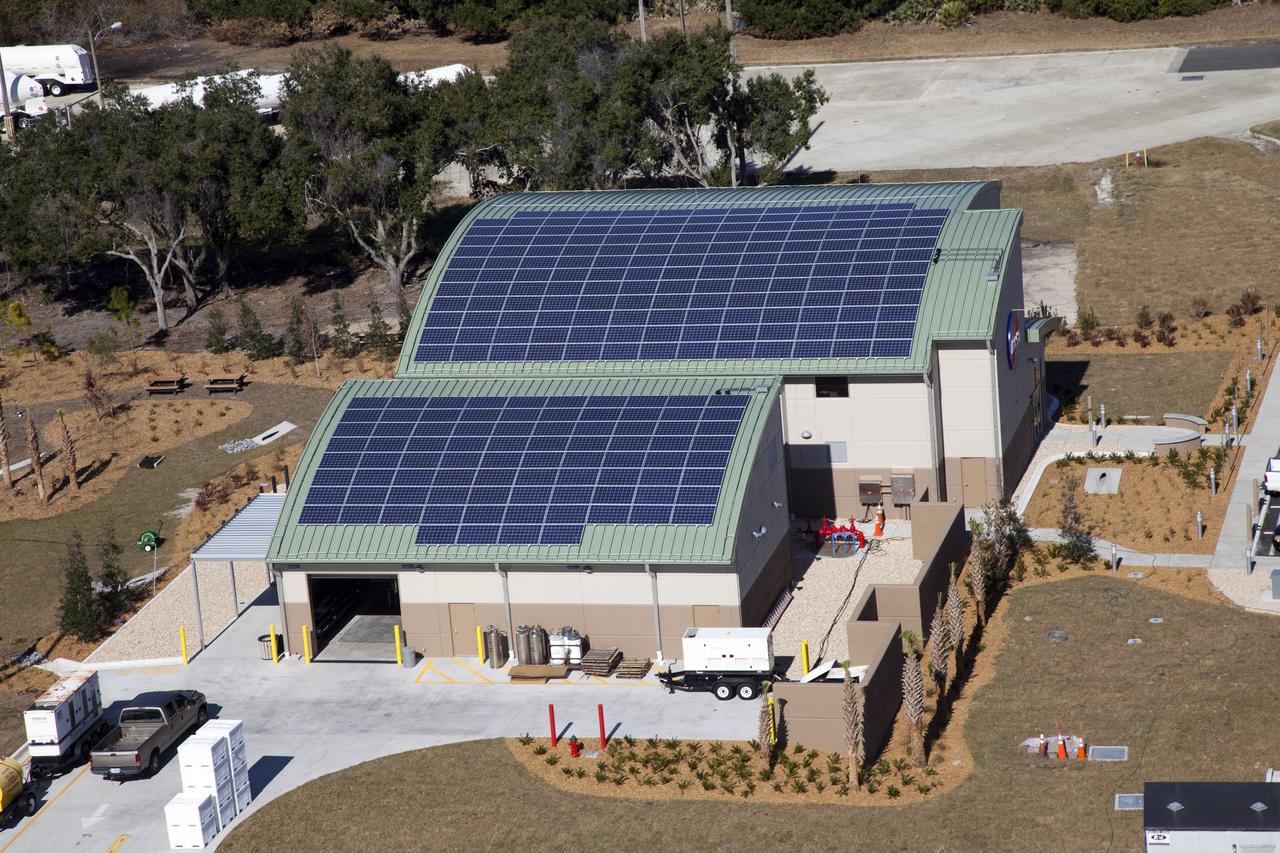
CAPE CANAVERAL, Fla. -- The Propellants North Administrative and Maintenance Facility in the Launch Complex 39 area of NASA's Kennedy Space Center in Florida is ready for business. The environmentally friendly facility is slated to be NASA's second Platinum-rated by the U.S. Green Building Council's (USGBC) Leadership in Environmental and Energy Design (LEED) certification system. It will be the space agency's first carbon-neutral facility, which means it will produce enough energy onsite from renewable sources to offset what it requires to operate. The facility consists of a two-story administrative building, which will house managers, mechanics and technicians who fuel spacecraft at Kennedy, and a single-story shop that will be used to store cryogenic fuel transfer equipment. Photo credit: NASA/Frank Michaux
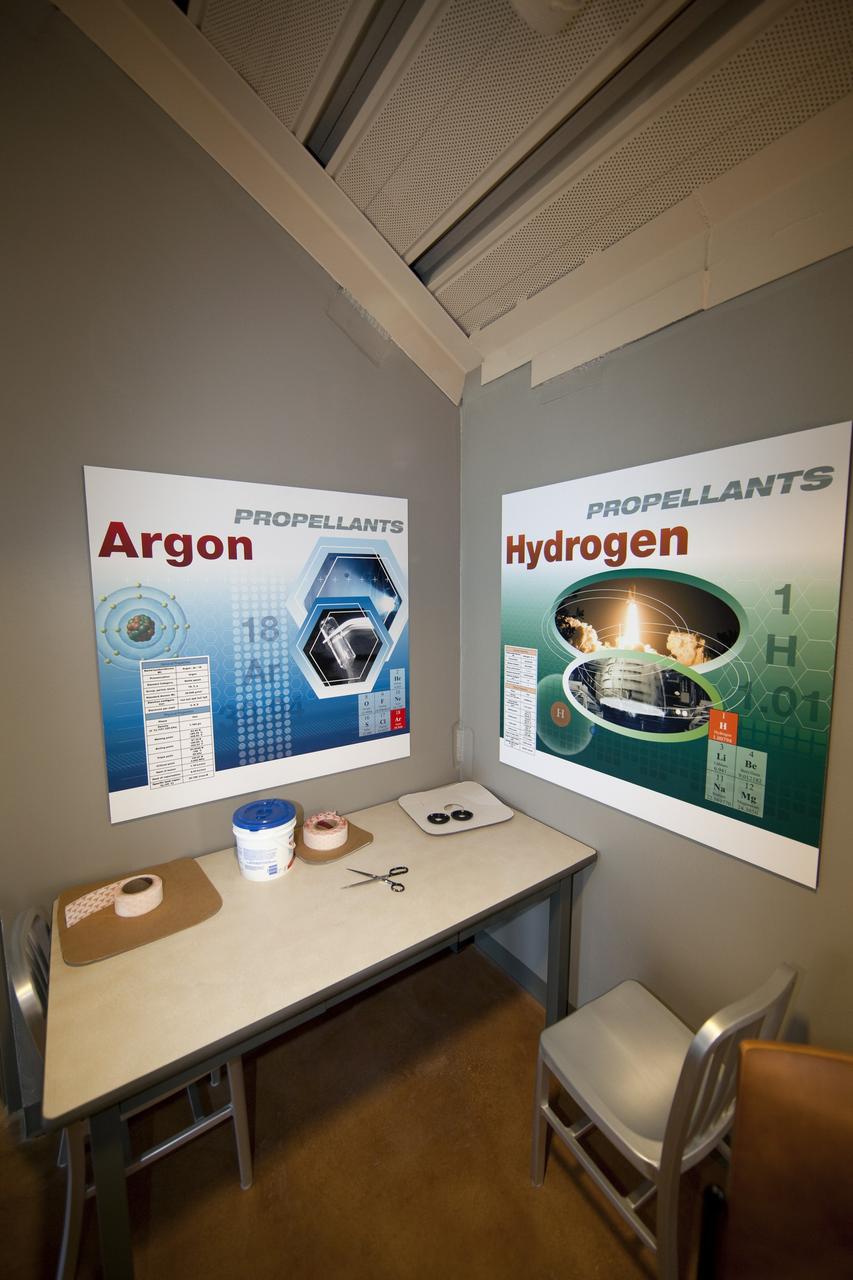
CAPE CANAVERAL, Fla. -- Finishing touches adorn the Propellants North Administrative and Maintenance Facility at NASA's Kennedy Space Center in Florida. Artwork for the facility was produced by Greg Lee, a graphics specialist with Abacus Technology Corp., with input from the facility's future occupants. The environmentally friendly facility is slated to be NASA's second Platinum-rated by the U.S. Green Building Council's (USGBC) Leadership in Environmental and Energy Design (LEED) certification system. It will be the space agency's first net-zero facility, which means it will produce enough energy onsite from renewable sources to offset what it requires to operate. The facility consists of a two-story administrative building to house managers, mechanics and technicians who fuel spacecraft at Kennedy, and a single-story shop to store cryogenic fuel transfer equipment. Photo credit: NASA/Frankie Martin
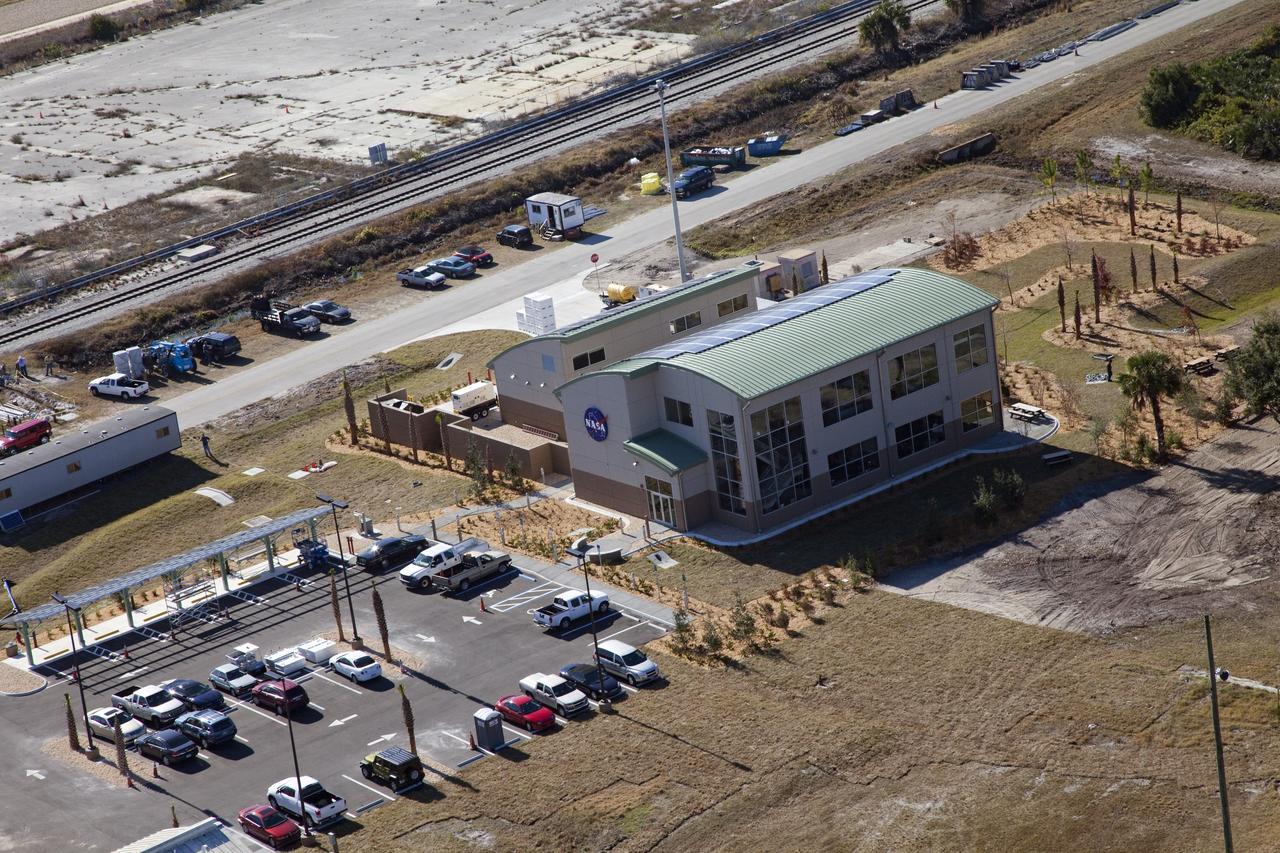
CAPE CANAVERAL, Fla. -- The Propellants North Administrative and Maintenance Facility in the Launch Complex 39 area of NASA's Kennedy Space Center in Florida is ready for business. The environmentally friendly facility is slated to be NASA's second Platinum-rated by the U.S. Green Building Council's (USGBC) Leadership in Environmental and Energy Design (LEED) certification system. It will be the space agency's first carbon-neutral facility, which means it will produce enough energy onsite from renewable sources to offset what it requires to operate. On the right is the facility's two-story administrative building, which will house managers, mechanics and technicians who fuel spacecraft at Kennedy. On the left is a single-story shop that will be used to store cryogenic fuel transfer equipment. In the parking lot is a solar-powered parking station for alternative fuel vehicles. Photo credit: NASA/Frank Michaux
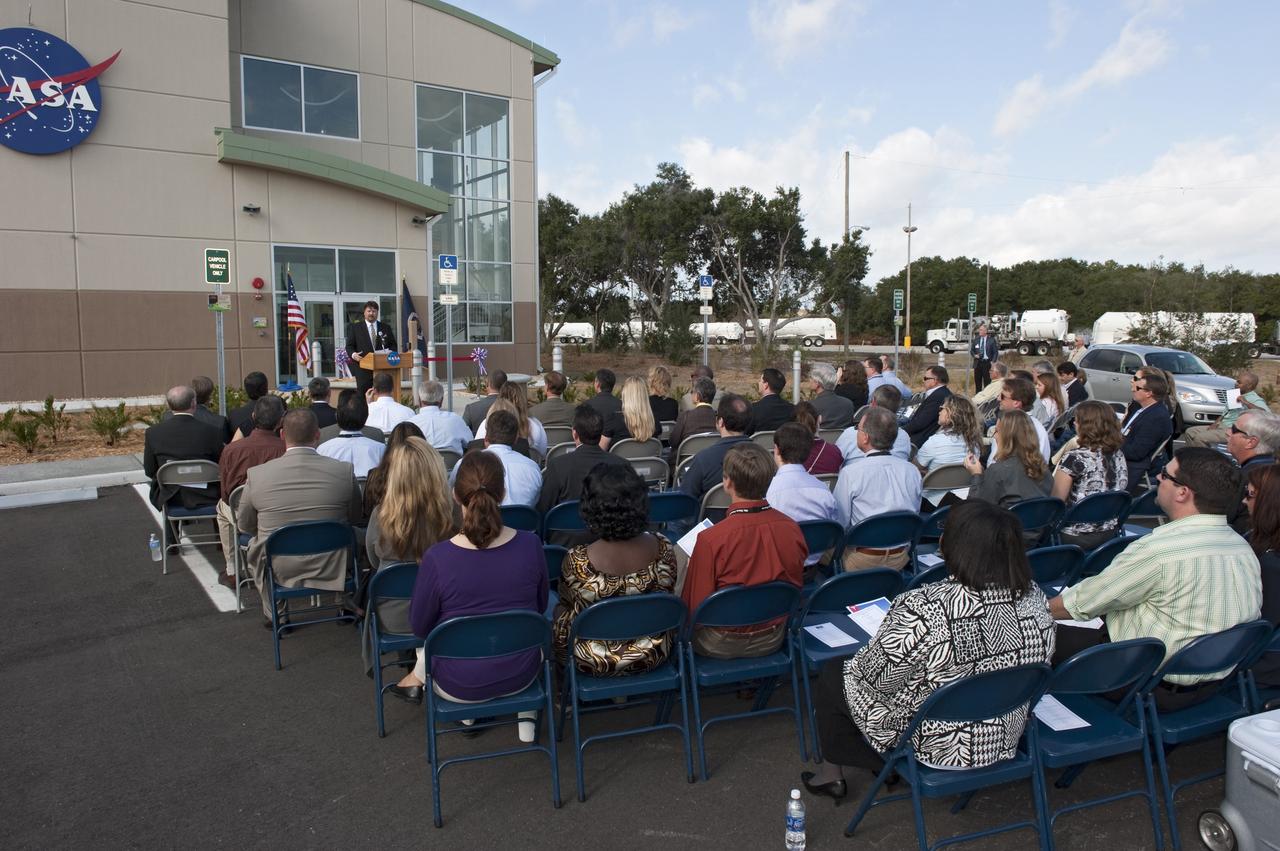
CAPE CANAVERAL, Fla. -- Frank Kline, Construction of Facilities project manager at NASA's Kennedy Space Center in Florida, addresses an audience at the ribbon-cutting ceremony for the new environmentally friendly Propellants North Administration and Maintenance Facility. Propellants North consists of two buildings, one to store cryogenic fuel transfer equipment and one to house personnel who support fueling spacecraft. The recently rebuilt buildings will be NASA's first carbon neutral facility, which means it will produce enough energy on site from renewable sources to offset what it requires to operate. The facility also will reach for the U.S. Green Building Council's Leadership in Environmental and Energy Design (LEED) Platinum status, which is the highest LEED rating. Photo credit: NASA/Kim Shiflett
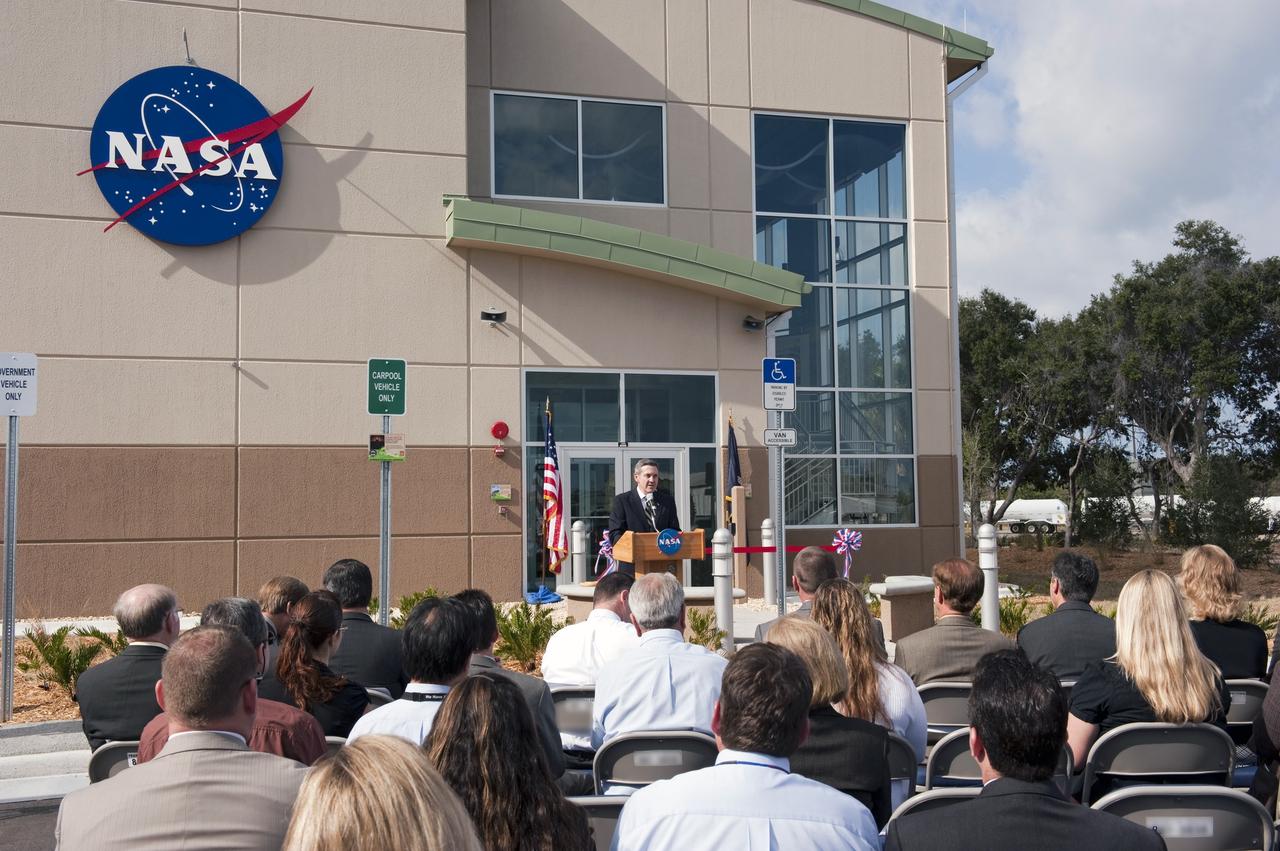
CAPE CANAVERAL, Fla. -- The director of NASA's Kennedy Space Center in Florida, Bob Cabana, addresses an audience at the ribbon-cutting ceremony for the new environmentally friendly Propellants North Administration and Maintenance Facility. Propellants North consists of two buildings, one to store cryogenic fuel transfer equipment and one to house personnel who support fueling spacecraft. The recently rebuilt buildings will be NASA's first carbon neutral facility, which means it will produce enough energy on site from renewable sources to offset what it requires to operate. The facility also will reach for the U.S. Green Building Council's Leadership in Environmental and Energy Design (LEED) Platinum status, which is the highest LEED rating. Photo credit: NASA/Kim Shiflett
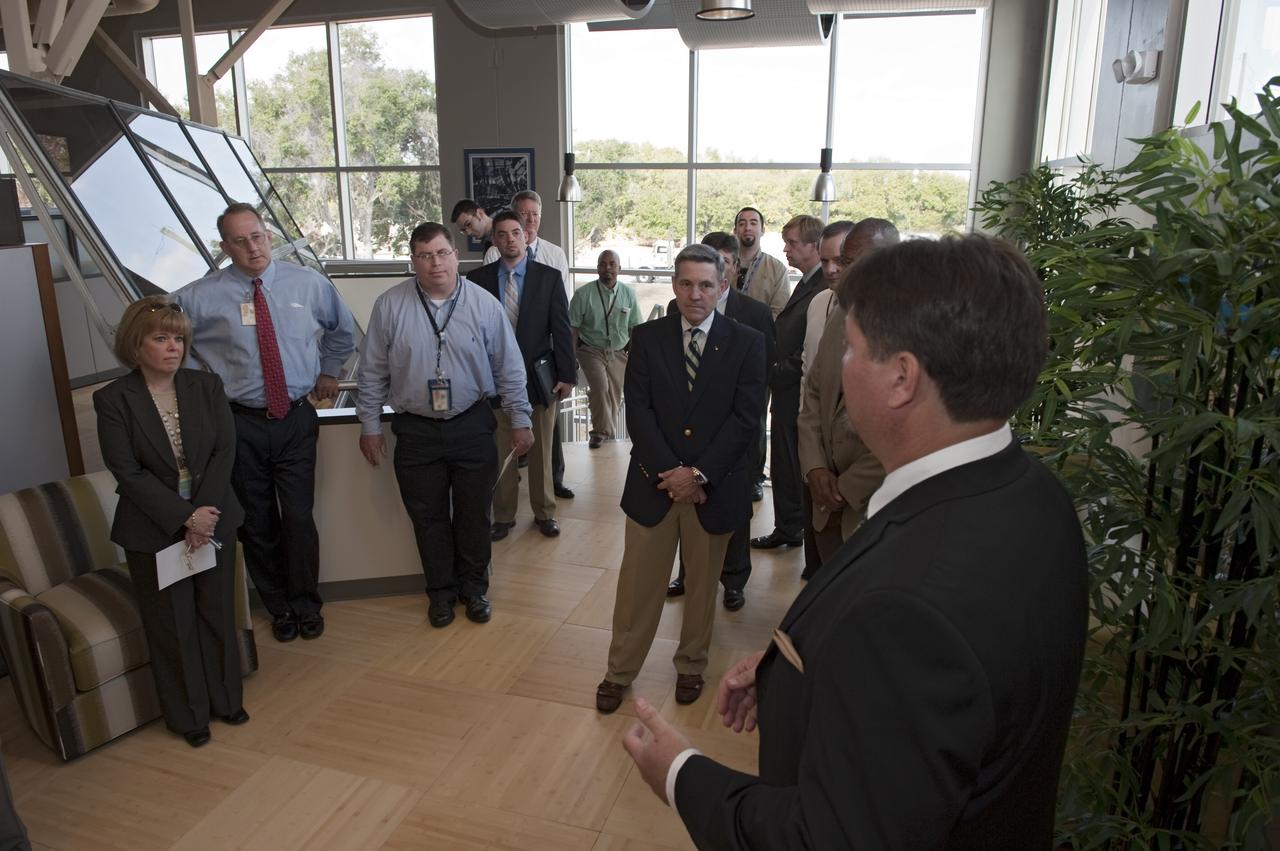
CAPE CANAVERAL, Fla. -- Frank Kline, Construction of Facilities project manager at NASA's Kennedy Space Center in Florida, far right, shows off the environmentally friendly features of the new Propellants North Administration and Maintenance Facility. Propellants North consists of two buildings, one to store cryogenic fuel transfer equipment and one to house personnel who support fueling spacecraft. The recently rebuilt buildings will be NASA's first carbon neutral facility, which means it will produce enough energy on site from renewable sources to offset what it requires to operate. The facility also will reach for the U.S. Green Building Council's Leadership in Environmental and Energy Design (LEED) Platinum status, which is the highest LEED rating. Photo credit: NASA/Kim Shiflett

CAPE CANAVERAL, Fla. -- This is the back view of the new Propellants North Administrative and Maintenance Facility in the Launch Complex 39 area of NASA's Kennedy Space Center in Florida. The environmentally friendly facility is slated to be NASA's second Platinum-rated by the U.S. Green Building Council's (USGBC) Leadership in Environmental and Energy Design (LEED) certification system. It will be the space agency's first carbon-neutral facility, which means it will produce enough energy onsite from renewable sources to offset what it requires to operate. On the right is the facility's single-story shop that will be used to store cryogenic fuel transfer equipment. On the left is a two-story administrative building, which will house managers, mechanics and technicians who fuel spacecraft at Kennedy. In the parking lot is a solar-powered parking station for alternative fuel vehicles. Photo credit: NASA/Frank Michaux
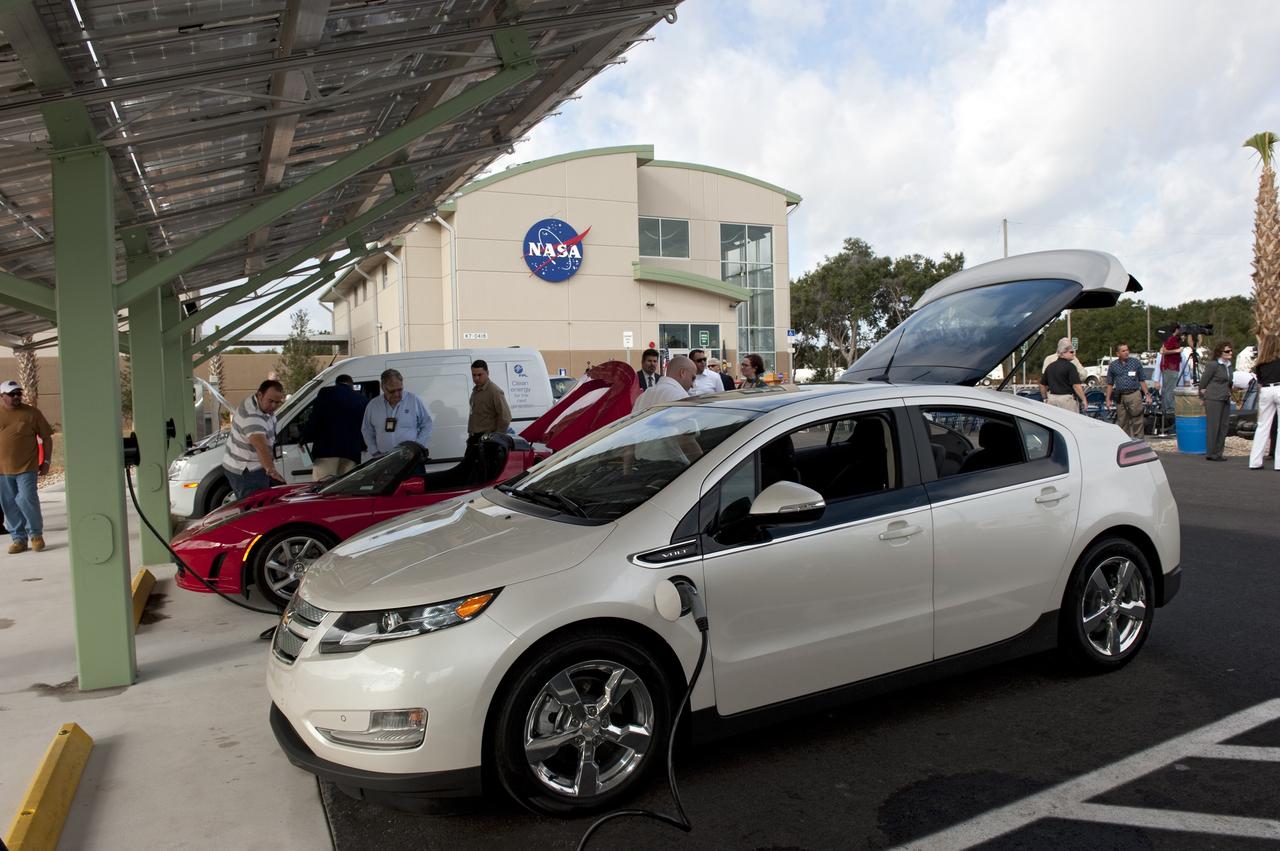
CAPE CANAVERAL, Fla. -- NASA's Kennedy Space Center in Florida hosts a ribbon-cutting ceremony for its new environmentally friendly Propellants North Administrative and Maintenance Facility. This is a view of the parking lot where a solar-powered charging canopy is available for powering government or privately owned electric vehicles. Propellants North consists of two buildings, one to store cryogenic fuel transfer equipment and one to house personnel who support fueling spacecraft. The recently rebuilt buildings will be NASA's first carbon neutral facility, which means it will produce enough energy on site from renewable sources to offset what it requires to operate. The facility also will reach for the U.S. Green Building Council's Leadership in Environmental and Energy Design (LEED) Platinum status, which is the highest LEED rating. Photo credit: NASA/Kim Shiflett
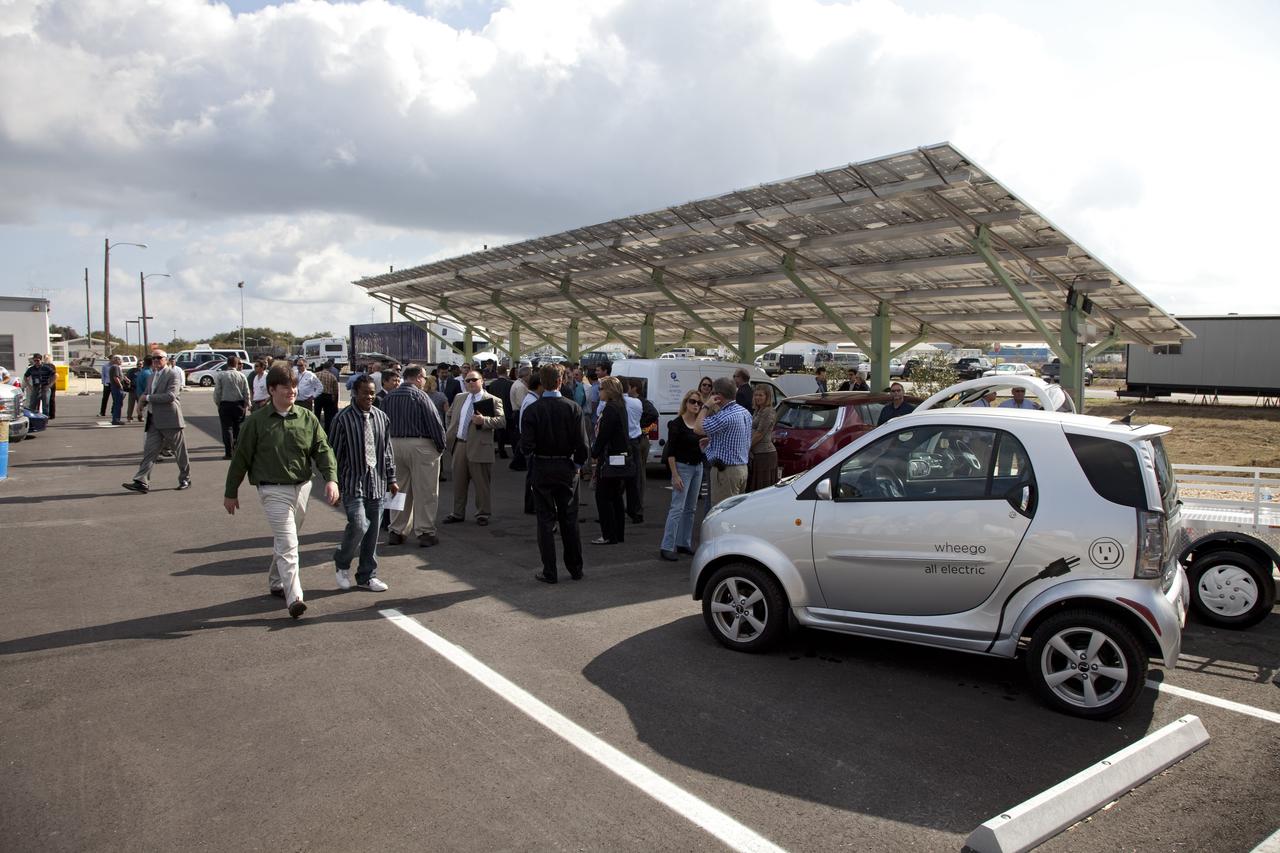
CAPE CANAVERAL, Fla. -- NASA's Kennedy Space Center in Florida hosts a ribbon-cutting ceremony for its new environmentally friendly Propellants North Administrative and Maintenance Facility. This is a view of the parking lot where a solar-powered charging canopy is available for powering government or privately owned electric vehicles. Propellants North consists of two buildings, one to store cryogenic fuel transfer equipment and one to house personnel who support fueling spacecraft. The recently rebuilt buildings will be NASA's first carbon neutral facility, which means it will produce enough energy on site from renewable sources to offset what it requires to operate. The facility also will reach for the U.S. Green Building Council's Leadership in Environmental and Energy Design (LEED) Platinum status, which is the highest LEED rating. Photo credit: NASA/Frankie Martin
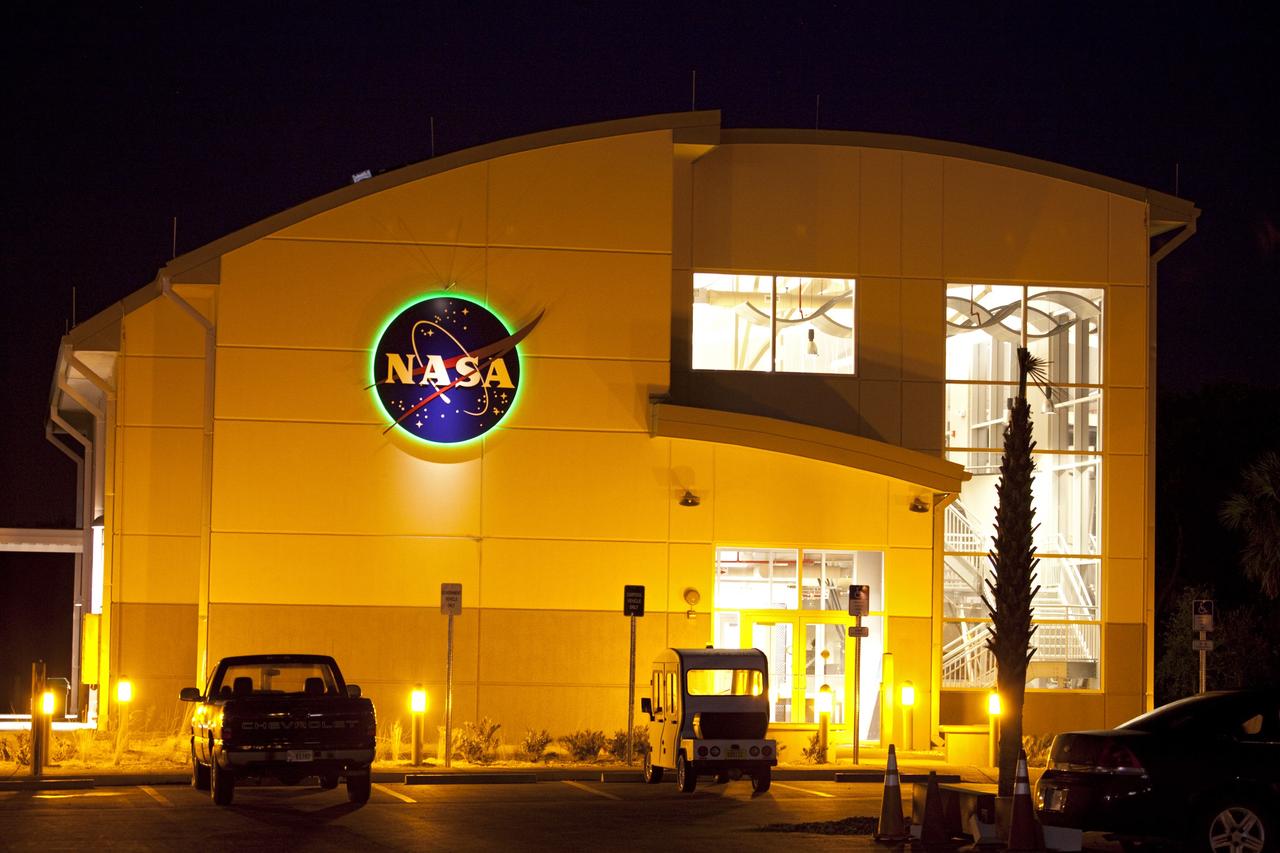
CAPE CANAVERAL, Fla. -- Kennedy Space Center's Propellants North Administrative and Maintenance Facility with the NASA insignia glistens a shade of green in the Launch Complex 39 area. The environmentally friendly facility is slated to be NASA's second Platinum-rated by the U.S. Green Building Council's (USGBC) Leadership in Environmental and Energy Design (LEED) certification system. It will be the space agency's first carbon-neutral facility, which means it will produce enough energy onsite from renewable sources to offset what it requires to operate. Shown here is the facility's two-story administrative building, which will house managers, mechanics and technicians who fuel spacecraft at Kennedy. Next door is a single-story shop that will be used to store cryogenic fuel transfer equipment. Photo credit: NASA/Frank Michaux
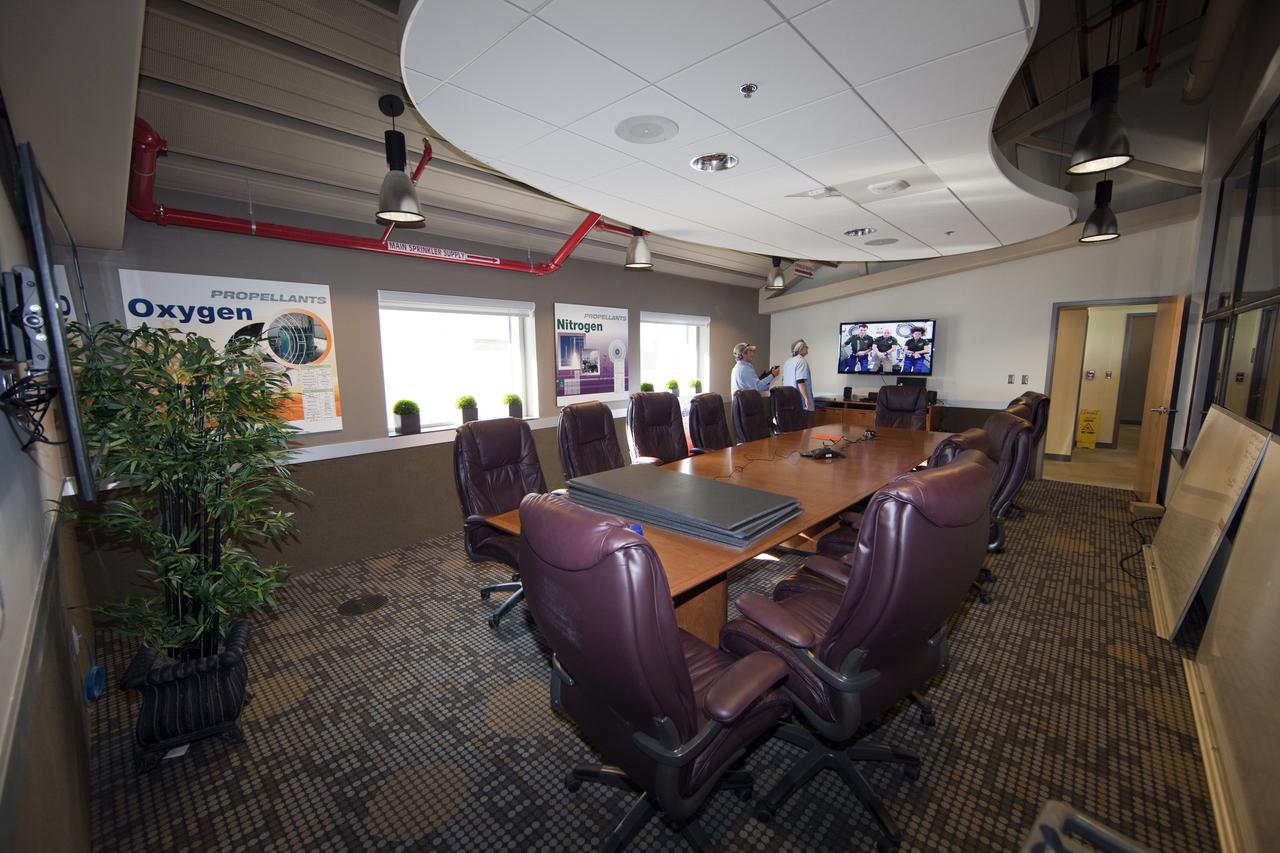
CAPE CANAVERAL, Fla. -- Finishing touches adorn the second-floor conference room of the Propellants North Administrative and Maintenance Facility at NASA's Kennedy Space Center in Florida. The environmentally friendly facility is slated to be NASA's second Platinum-rated by the U.S. Green Building Council's (USGBC) Leadership in Environmental and Energy Design (LEED) certification system. It will be the space agency's first net-zero facility, which means it will produce enough energy onsite from renewable sources to offset what it requires to operate. The facility consists of a two-story administrative building to house managers, mechanics and technicians who fuel spacecraft at Kennedy, and a single-story shop to store cryogenic fuel transfer equipment. Photo credit: NASA/Frankie Martin
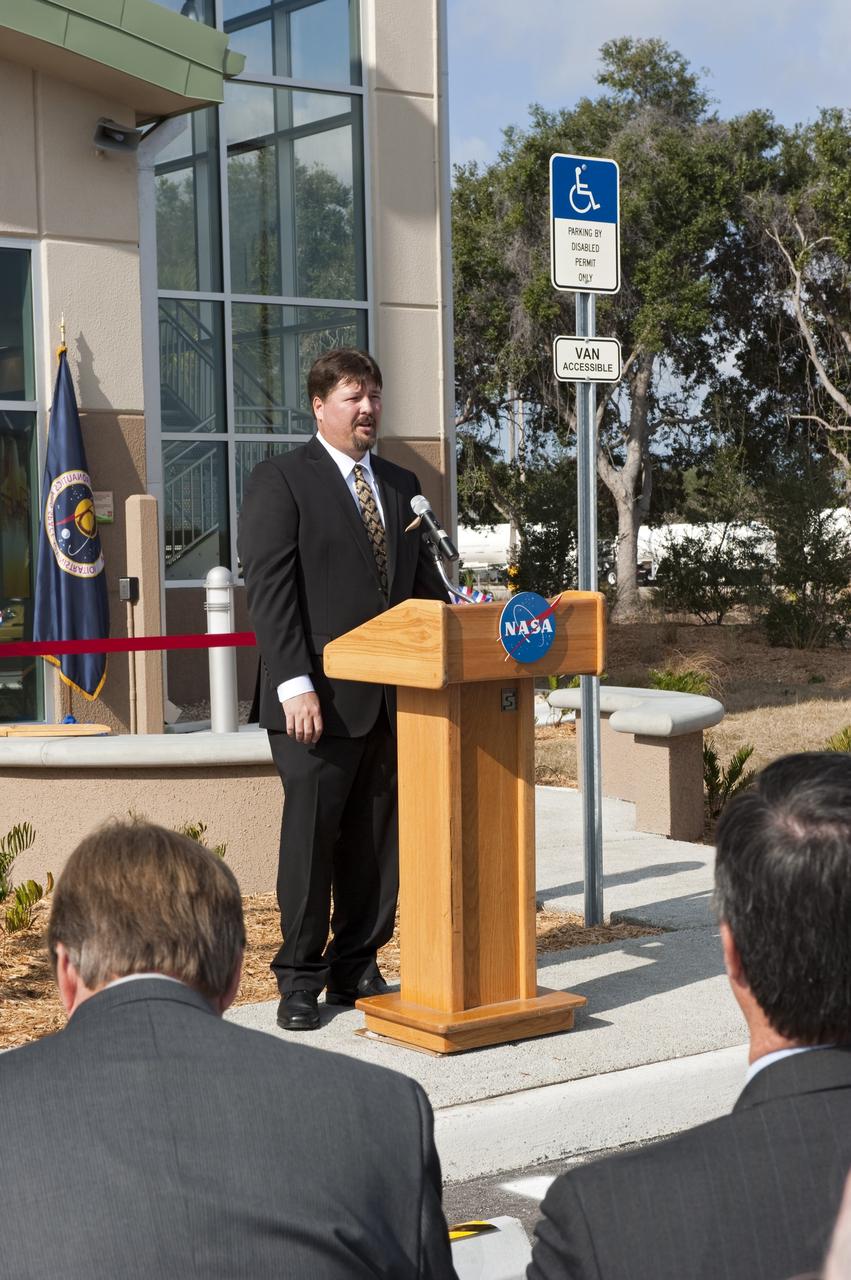
CAPE CANAVERAL, Fla. -- Frank Kline, Construction of Facilities project manager at NASA's Kennedy Space Center in Florida, addresses an audience at the ribbon-cutting ceremony for the new environmentally friendly Propellants North Administration and Maintenance Facility. Propellants North consists of two buildings, one to store cryogenic fuel transfer equipment and one to house personnel who support fueling spacecraft. The recently rebuilt buildings will be NASA's first carbon neutral facility, which means it will produce enough energy on site from renewable sources to offset what it requires to operate. The facility also will reach for the U.S. Green Building Council's Leadership in Environmental and Energy Design (LEED) Platinum status, which is the highest LEED rating. Photo credit: NASA/Kim Shiflett
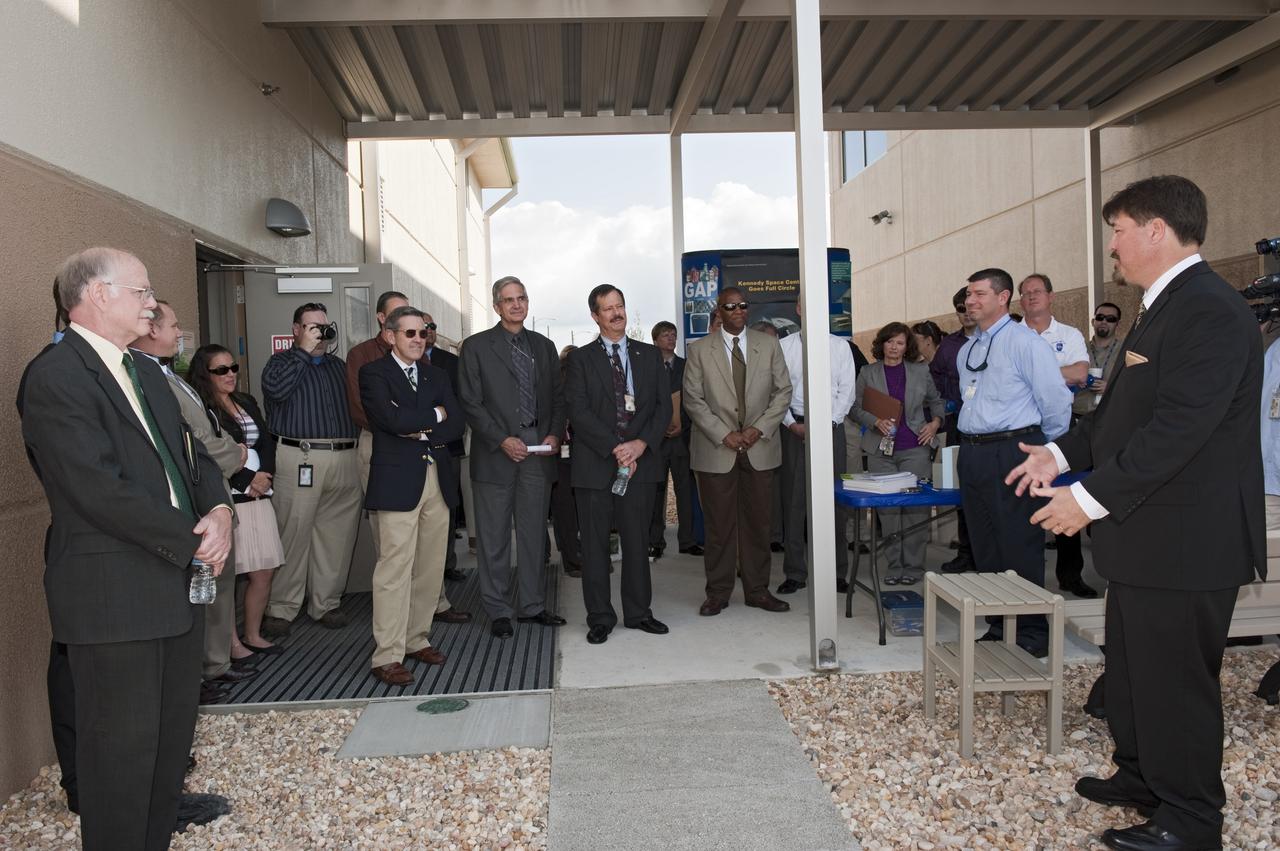
CAPE CANAVERAL, Fla. -- Frank Kline, Construction of Facilities project manager at NASA's Kennedy Space Center in Florida, far right, shows off the environmentally friendly features of the new Propellants North Administration and Maintenance Facility. Propellants North consists of two buildings, one to store cryogenic fuel transfer equipment and one to house personnel who support fueling spacecraft. The recently rebuilt buildings will be NASA's first carbon neutral facility, which means it will produce enough energy on site from renewable sources to offset what it requires to operate. The facility also will reach for the U.S. Green Building Council's Leadership in Environmental and Energy Design (LEED) Platinum status, which is the highest LEED rating. Photo credit: NASA/Kim Shiflett
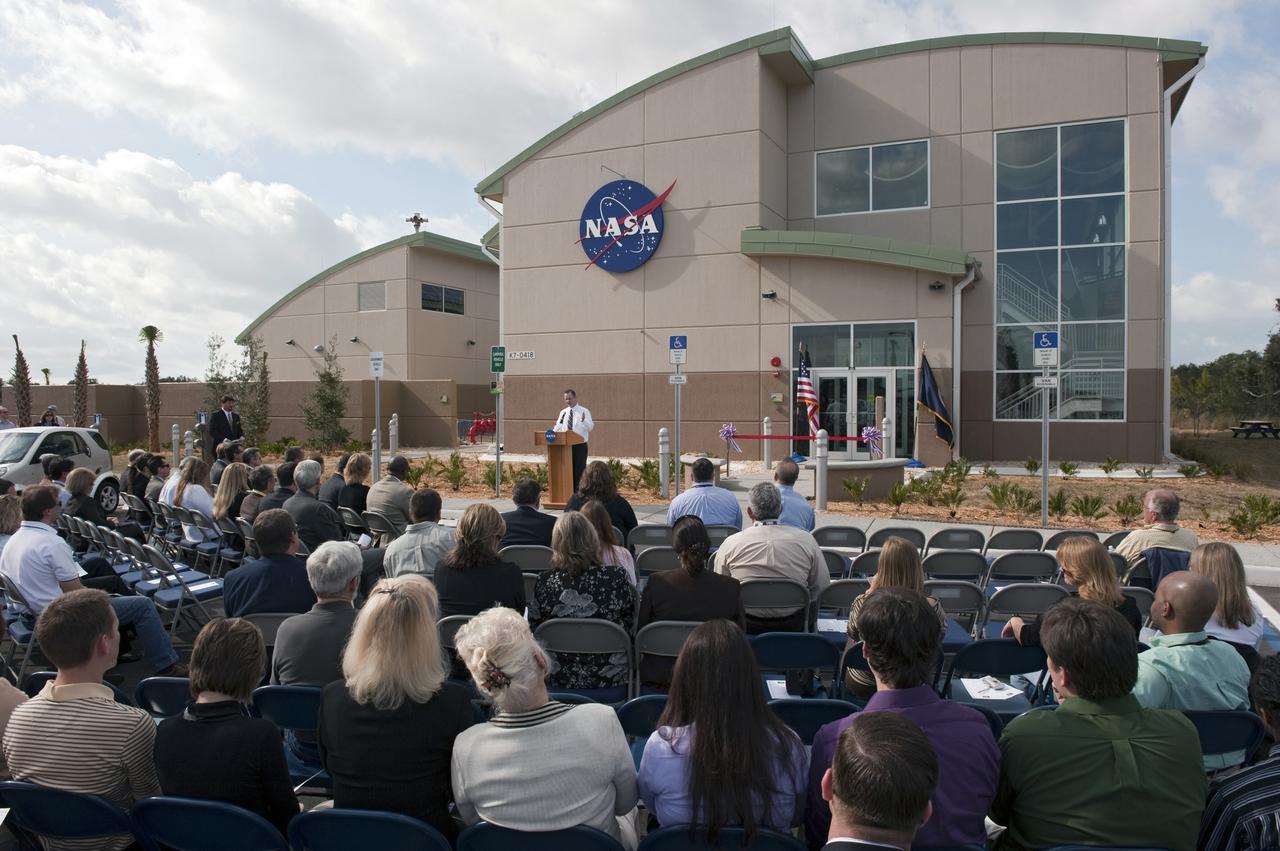
CAPE CANAVERAL, Fla. -- At NASA's Kennedy Space Center in Florida, James Wright, the deputy assistant administrator for the Office of Strategic Infrastructure at NASA Headquarters, addresses an audience at the ribbon-cutting ceremony for the new environmentally friendly Propellants North Administration and Maintenance Facility. Propellants North consists of two buildings, one to store cryogenic fuel transfer equipment and one to house personnel who support fueling spacecraft. The recently rebuilt buildings will be NASA's first carbon neutral facility, which means it will produce enough energy on site from renewable sources to offset what it requires to operate. The facility also will reach for the U.S. Green Building Council's Leadership in Environmental and Energy Design (LEED) Platinum status, which is the highest LEED rating. Photo credit: NASA/Kim Shiflett
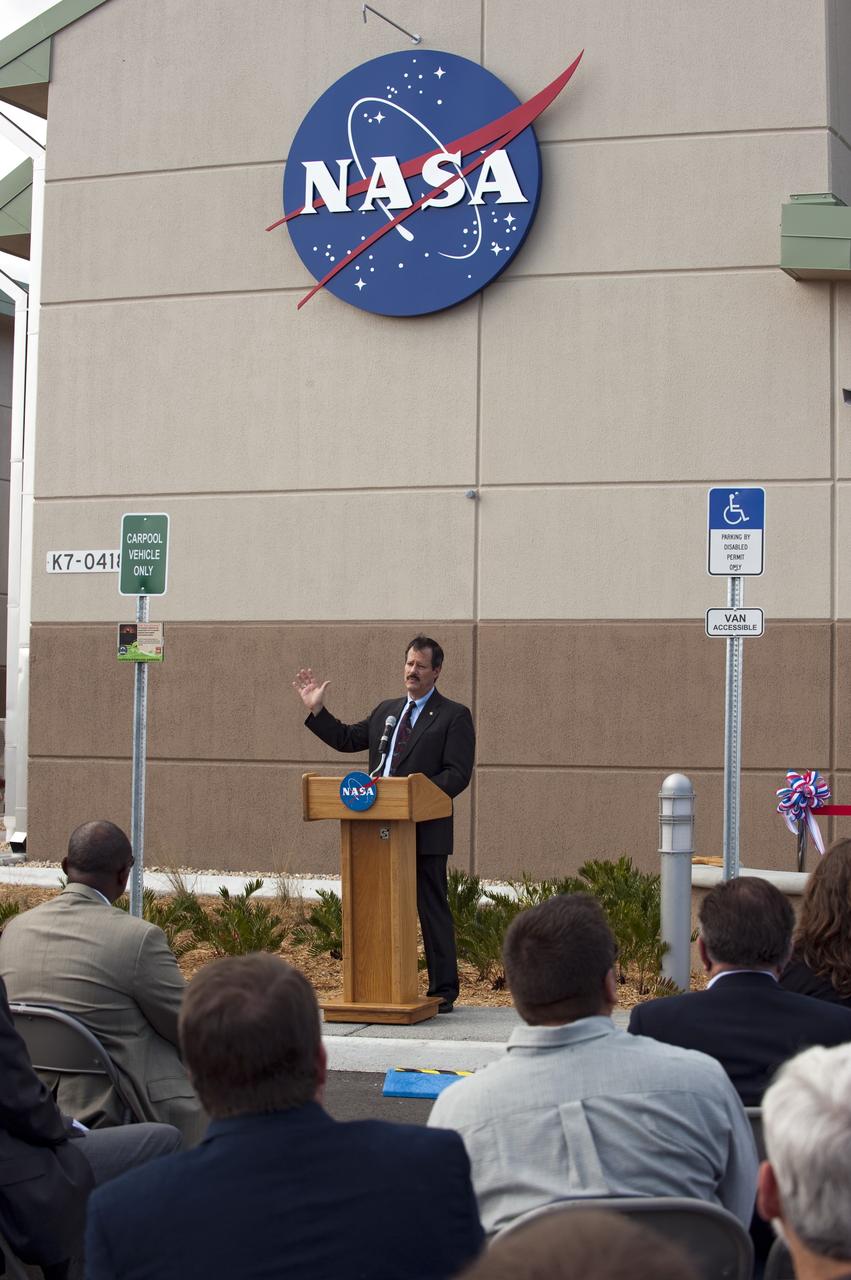
CAPE CANAVERAL, Fla. -- Mike Benik, the director of Center Operations at NASA's Kennedy Space Center in Florida, addresses an audience at the ribbon-cutting ceremony for the new environmentally friendly Propellants North Administration and Maintenance Facility. Propellants North consists of two buildings, one to store cryogenic fuel transfer equipment and one to house personnel who support fueling spacecraft. The recently rebuilt buildings will be NASA's first carbon neutral facility, which means it will produce enough energy on site from renewable sources to offset what it requires to operate. The facility also will reach for the U.S. Green Building Council's Leadership in Environmental and Energy Design (LEED) Platinum status, which is the highest LEED rating. Photo credit: NASA/Kim Shiflett
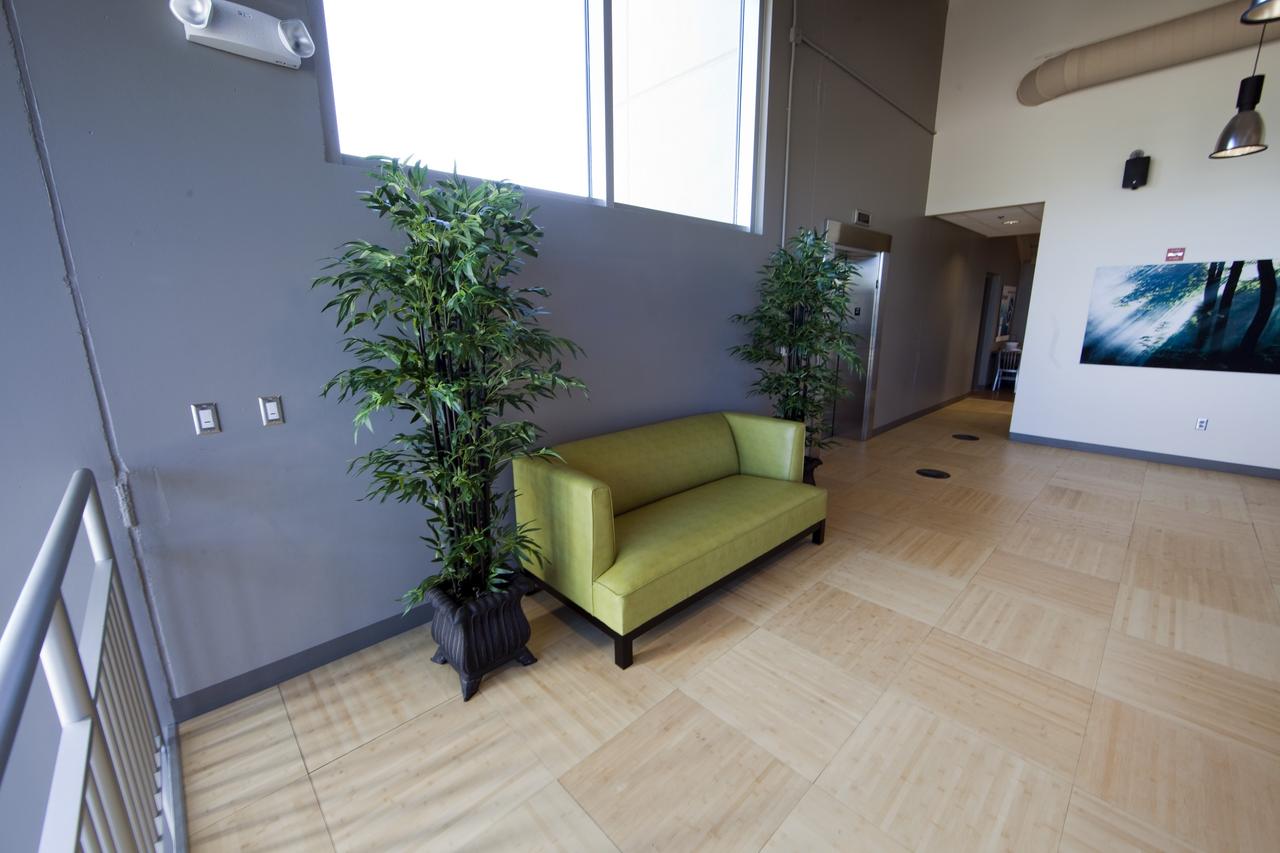
CAPE CANAVERAL, Fla. -- Finishing touches adorn the second-floor lobby of the new Propellants North Administrative and Maintenance Facility at NASA's Kennedy Space Center in Florida. The artwork on the wall was produced by Greg Lee, a graphics specialist with Abacus Technology Corp., and depicts the mystery of nature with a photo of the Merritt Island National Wildlife Refuge. The environmentally friendly facility is slated to be NASA's second Platinum-rated by the U.S. Green Building Council's (USGBC) Leadership in Environmental and Energy Design (LEED) certification system. It will be the space agency's first net-zero facility, which means it will produce enough energy onsite from renewable sources to offset what it requires to operate. The facility consists of a two-story administrative building to house managers, mechanics and technicians who fuel spacecraft at Kennedy, and a single-story shop to store cryogenic fuel transfer equipment. Photo credit: NASA/Frankie Martin
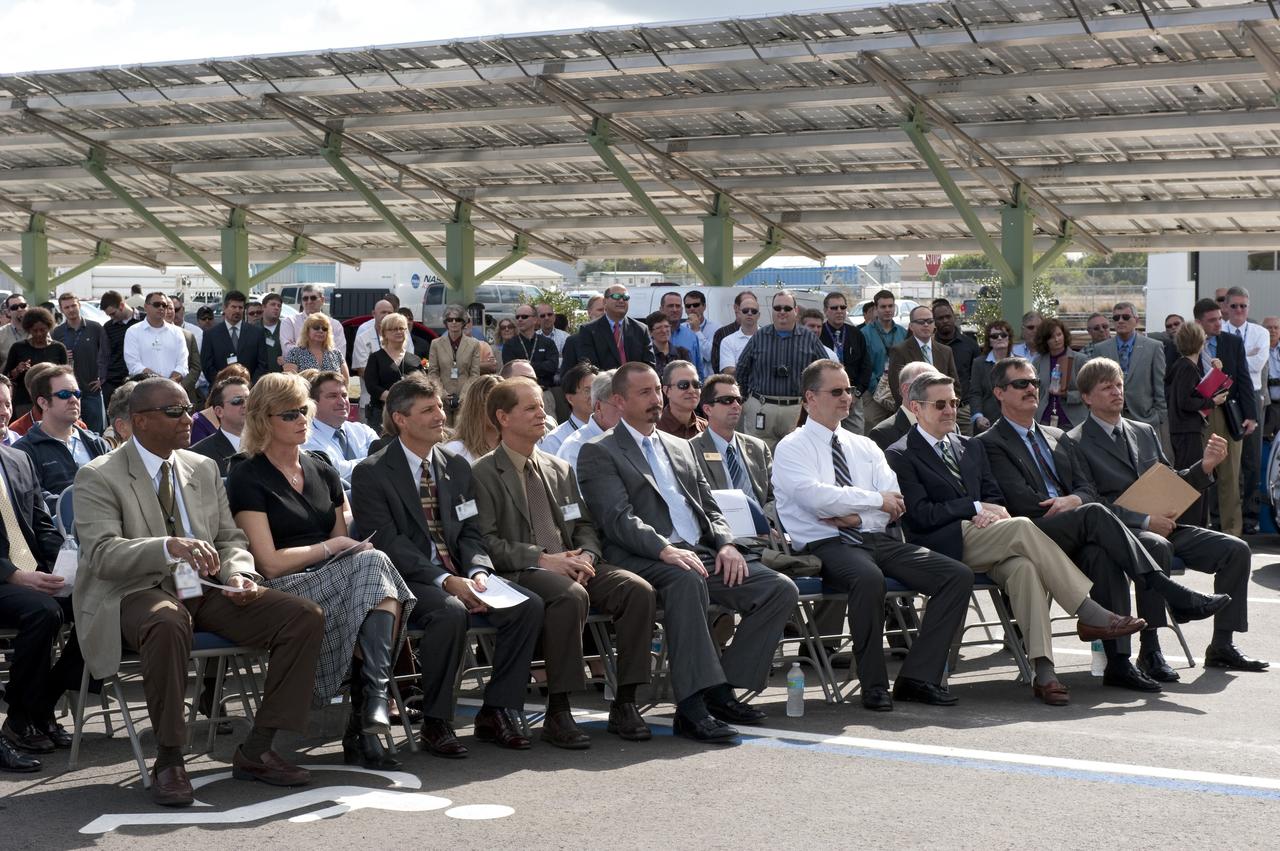
CAPE CANAVERAL, Fla. -- NASA's Kennedy Space Center in Florida hosts a ribbon-cutting ceremony for the space agency's most environmentally friendly facility, the Propellants North Administrative and Maintenance Facility in Kennedy's Launch Complex 39 area. Propellants North consists of two buildings, one to store cryogenic fuel transfer equipment and one to house personnel who support fueling spacecraft. The recently rebuilt buildings will be NASA's first carbon neutral facility, which means it will produce enough energy on site from renewable sources to offset what it requires to operate. The facility also will reach for the U.S. Green Building Council's Leadership in Environmental and Energy Design (LEED) Platinum status, which is the highest LEED rating. Photo credit: NASA/Kim Shiflett
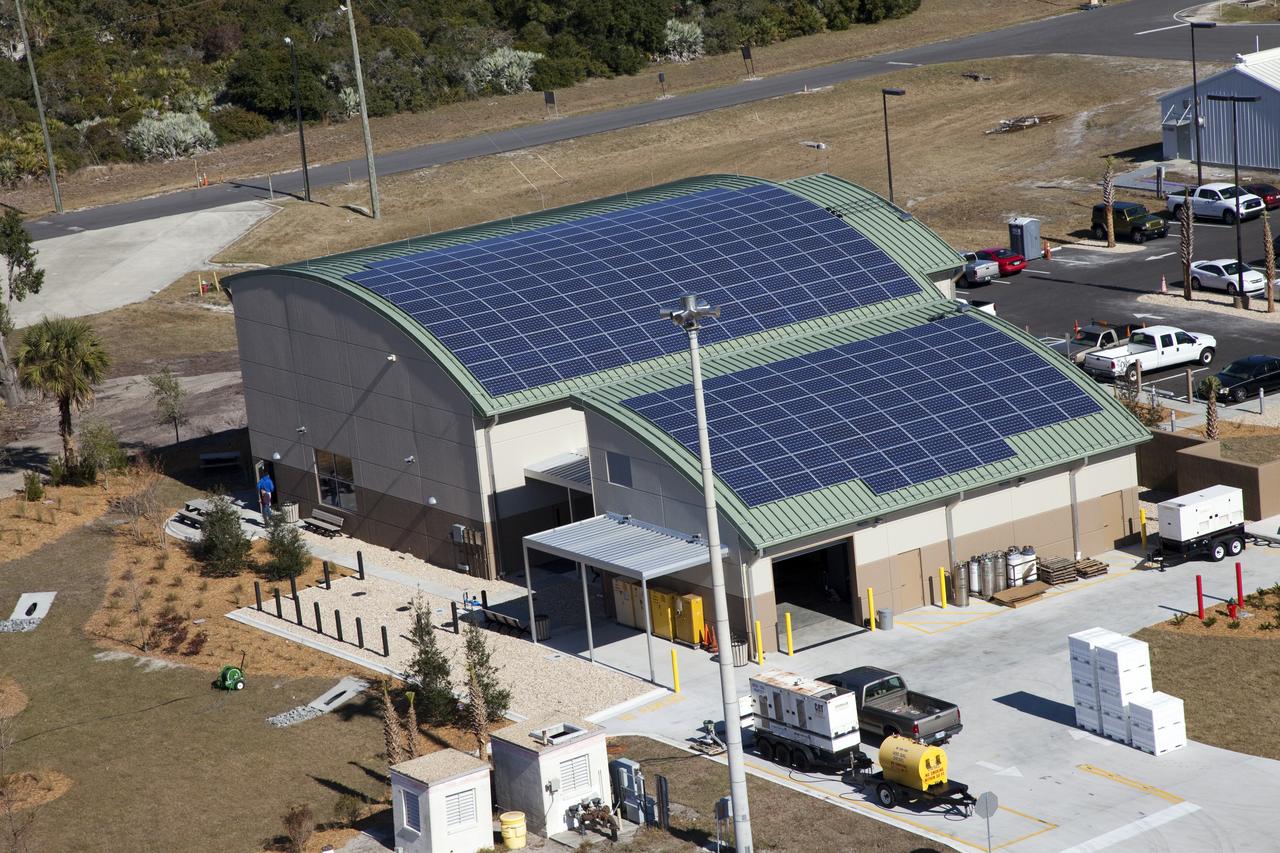
CAPE CANAVERAL, Fla. -- The Propellants North Administrative and Maintenance Facility in the Launch Complex 39 area of NASA's Kennedy Space Center in Florida is ready for business. The environmentally friendly facility is slated to be NASA's second Platinum-rated by the U.S. Green Building Council's (USGBC) Leadership in Environmental and Energy Design (LEED) certification system. It will be the space agency's first carbon-neutral facility, which means it will produce enough energy onsite from renewable sources to offset what it requires to operate. The facility consists of a two-story administrative building, which will house managers, mechanics and technicians who fuel spacecraft at Kennedy, and a single-story shop that will be used to store cryogenic fuel transfer equipment. Photo credit: NASA/Frank Michaux
CAPE CANAVERAL, Fla. -- The NASA insignia glistens a shade of green on Kennedy Space Center's Propellants North Administrative and Maintenance Facility in the Launch Complex 39 area. The environmentally friendly facility is slated to be NASA's second Platinum-rated by the U.S. Green Building Council's (USGBC) Leadership in Environmental and Energy Design (LEED) certification system. It will be the space agency's first carbon-neutral facility, which means it will produce enough energy onsite from renewable sources to offset what it requires to operate. The facility consists of a two-story administrative building, which will house managers, mechanics and technicians who fuel spacecraft at Kennedy, and a single-story shop that will be used to store cryogenic fuel transfer equipment. Photo credit: NASA/Frank Michaux
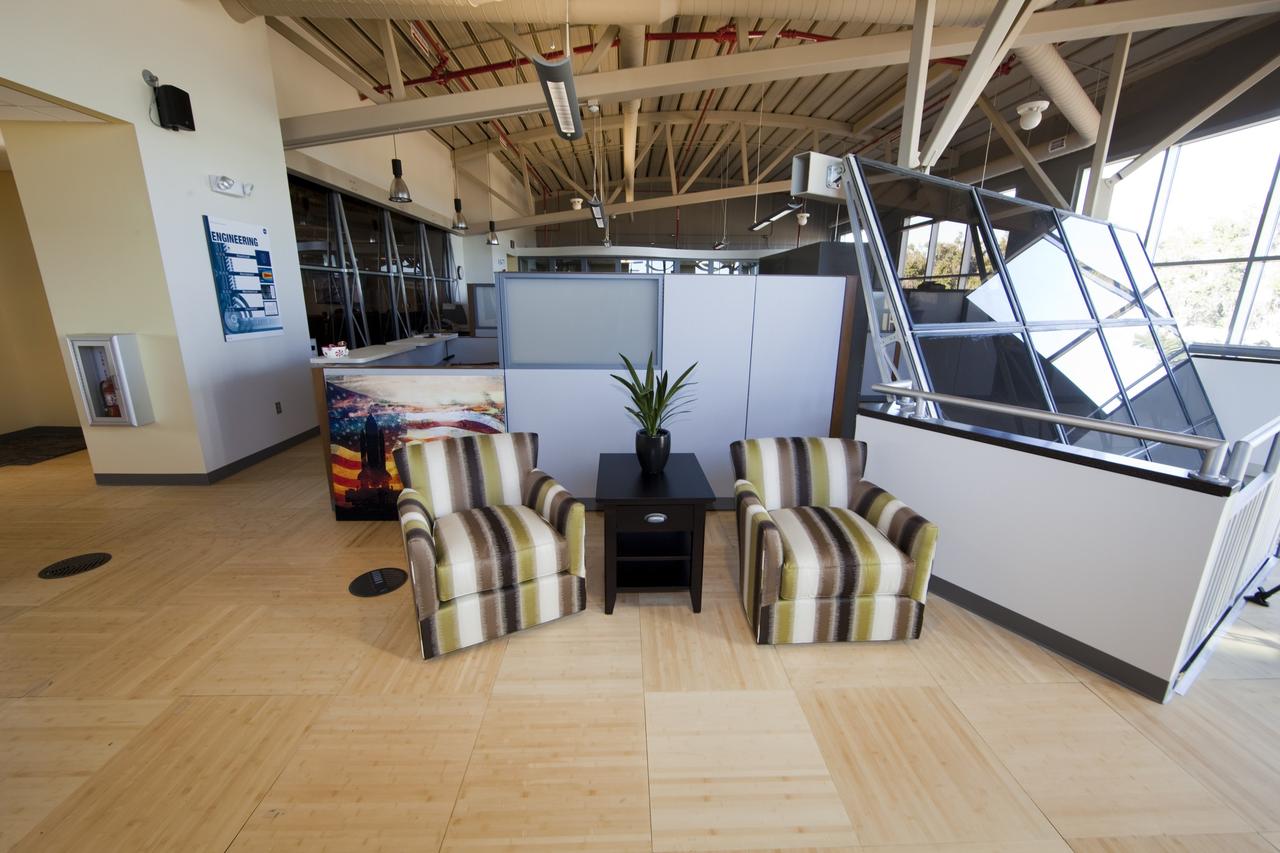
CAPE CANAVERAL, Fla. -- Finishing touches adorn the second-floor lobby of the Propellants North Administrative and Maintenance Facility at NASA's Kennedy Space Center in Florida. At right, are recycled firing room windows that are set at the same angle and orientation as they were in Kennedy's Launch Control Center, looking out toward Launch Pads 39A and B. The environmentally friendly facility is slated to be NASA's second Platinum-rated by the U.S. Green Building Council's (USGBC) Leadership in Environmental and Energy Design (LEED) certification system. It will be the space agency's first net-zero facility, which means it will produce enough energy onsite from renewable sources to offset what it requires to operate. The facility consists of a two-story administrative building to house managers, mechanics and technicians who fuel spacecraft at Kennedy, and a single-story shop to store cryogenic fuel transfer equipment. Photo credit: NASA/Frankie Martin
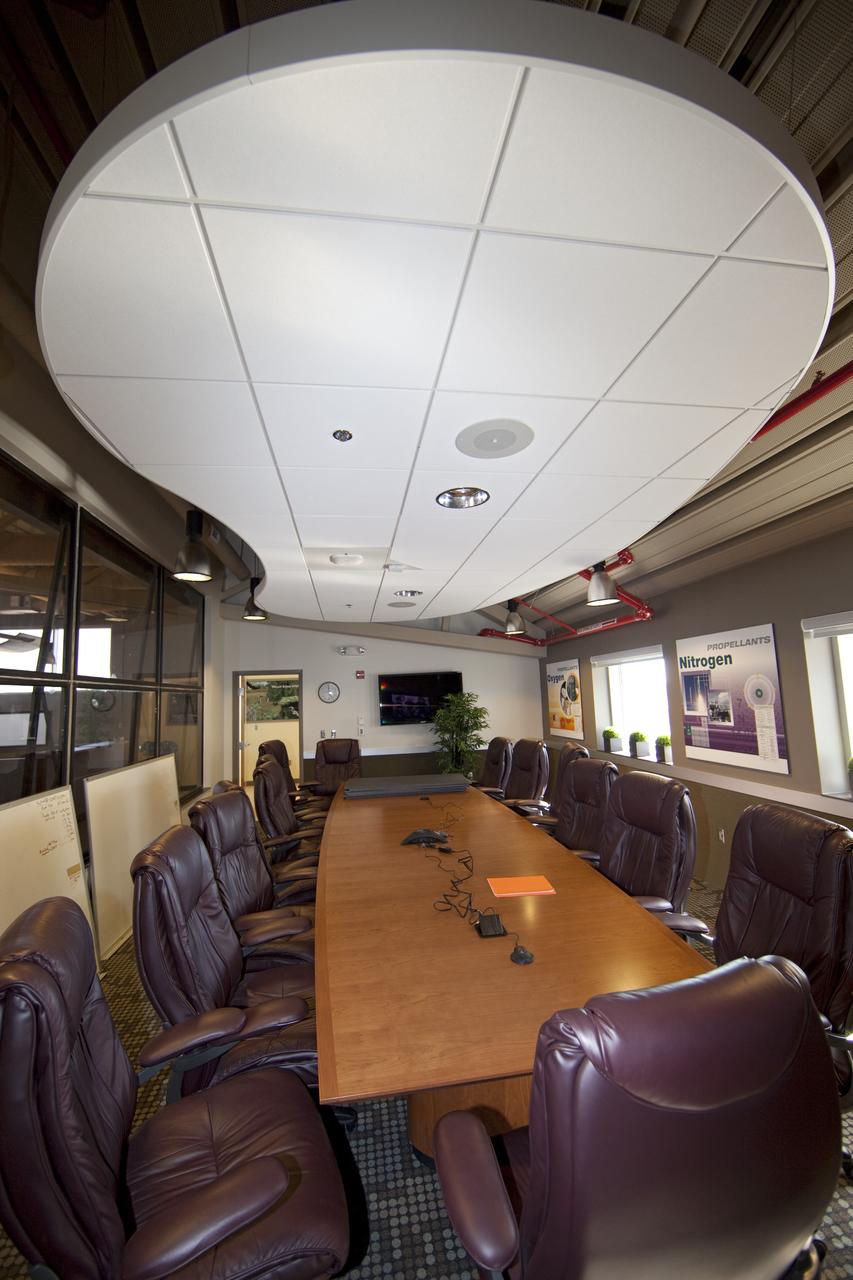
CAPE CANAVERAL, Fla. -- Finishing touches adorn the second-floor conference room of the Propellants North Administrative and Maintenance Facility at NASA's Kennedy Space Center in Florida. Artwork for the conference room was produced by Greg Lee, a graphics specialist with Abacus Technology Corp., with input from the facility's future occupants. The environmentally friendly facility is slated to be NASA's second Platinum-rated by the U.S. Green Building Council's (USGBC) Leadership in Environmental and Energy Design (LEED) certification system. It will be the space agency's first net-zero facility, which means it will produce enough energy onsite from renewable sources to offset what it requires to operate. The facility consists of a two-story administrative building to house managers, mechanics and technicians who fuel spacecraft at Kennedy, and a single-story shop to store cryogenic fuel transfer equipment. Photo credit: NASA/Frankie Martin
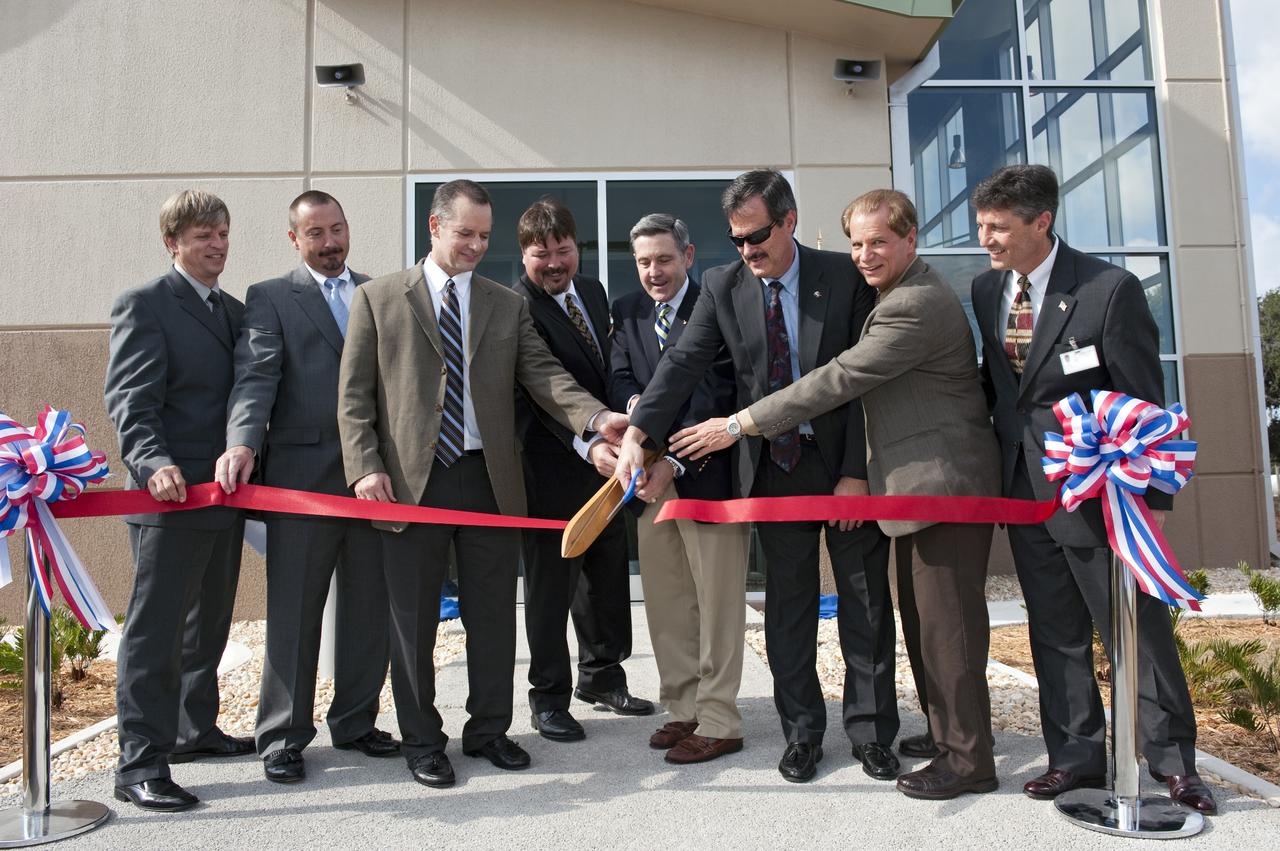
CAPE CANAVERAL, Fla. -- A traditional ribbon-cutting ceremony takes place outside the Propellants North Administration and Maintenance Facility at NASA's Kennedy Space Center in Florida. From left, are Thomas Wilczek, contracting officer technical representative/project manager for NASA Construction of Facilities; Bradley O’Toole, NASA contracting officer; James Wright, deputy assistant administrator for the Office of Strategic Infrastructure at NASA Headquarters; Frank Kline, NASA Construction of Facility project manager; Bob Cabana, Kennedy's center director; Mike Benik, director of Kennedy's Center Operations; Ward Davis, president of HW Davis Construction Inc.; and Rick Ferreira, chief operating officer of Jones Edmunds and Associates Inc. Propellants North consists of two buildings, one to store cryogenic fuel transfer equipment and one to house personnel who support fueling spacecraft. The recently rebuilt buildings will be NASA's first carbon neutral facility, which means it will produce enough energy on site from renewable sources to offset what it requires to operate. The facility also will reach for the U.S. Green Building Council's Leadership in Environmental and Energy Design (LEED) Platinum status, which is the highest LEED rating. Photo credit: NASA/Kim Shiflett
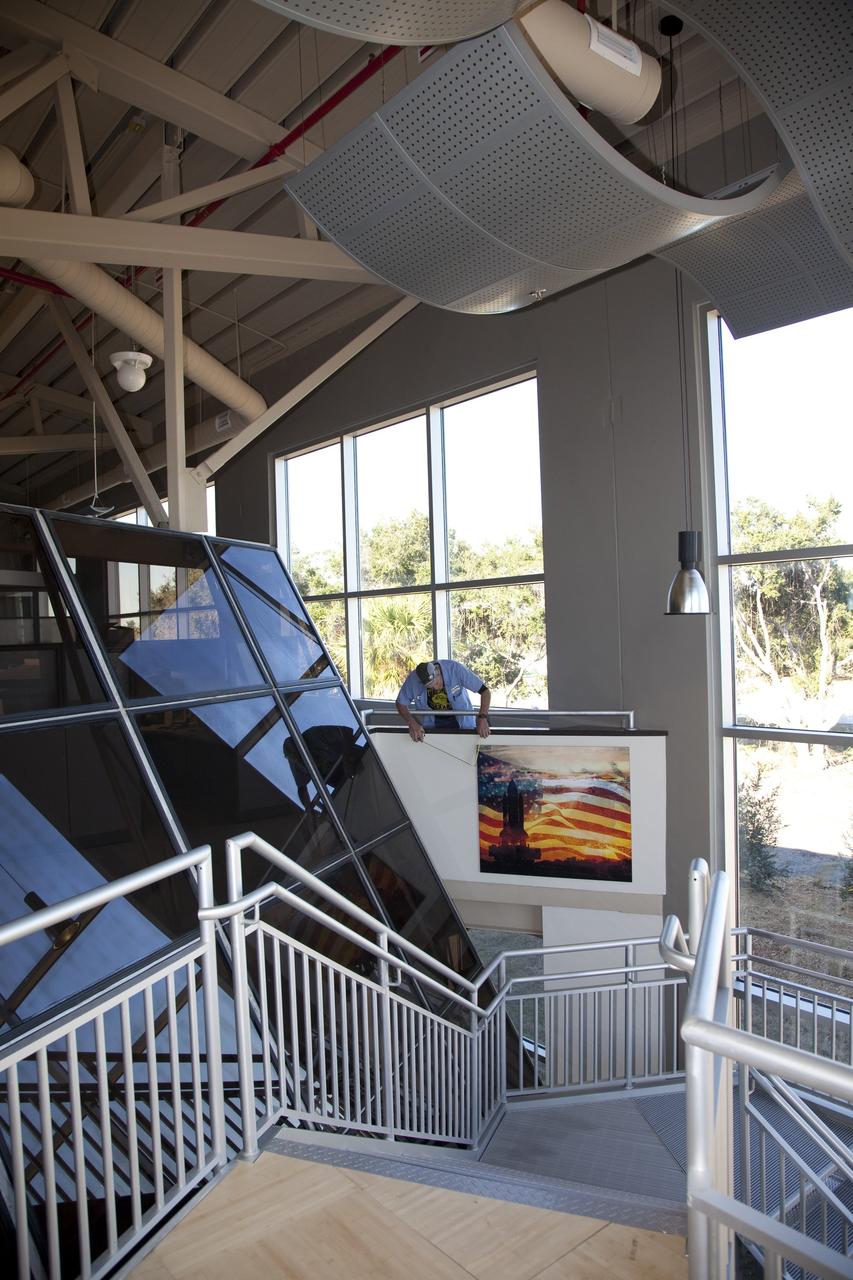
CAPE CANAVERAL, Fla. -- Workers hang artwork in the second-floor lobby of the Propellants North Administrative and Maintenance Facility at NASA's Kennedy Space Center in Florida. The artwork was produced by Greg Lee, a graphics specialist with Abacus Technology Corp., and features a silhouette of a shuttle, one of the most recognizable American icons, rolling out to Launch Complex 39. Next to the artwork are recycled firing room windows from Kennedy's Launch Control Center. Launch controllers viewed every shuttle rollout and launch through those windows before they were repurposed. The environmentally friendly facility is slated to be NASA's second Platinum-rated by the U.S. Green Building Council's (USGBC) Leadership in Environmental and Energy Design (LEED) certification system. It will be the space agency's first net-zero facility, which means it will produce enough energy onsite from renewable sources to offset what it requires to operate. The facility consists of a two-story administrative building to house managers, mechanics and technicians who fuel spacecraft at Kennedy, and a single-story shop to store cryogenic fuel transfer equipment. Photo credit: NASA/Frankie Martin
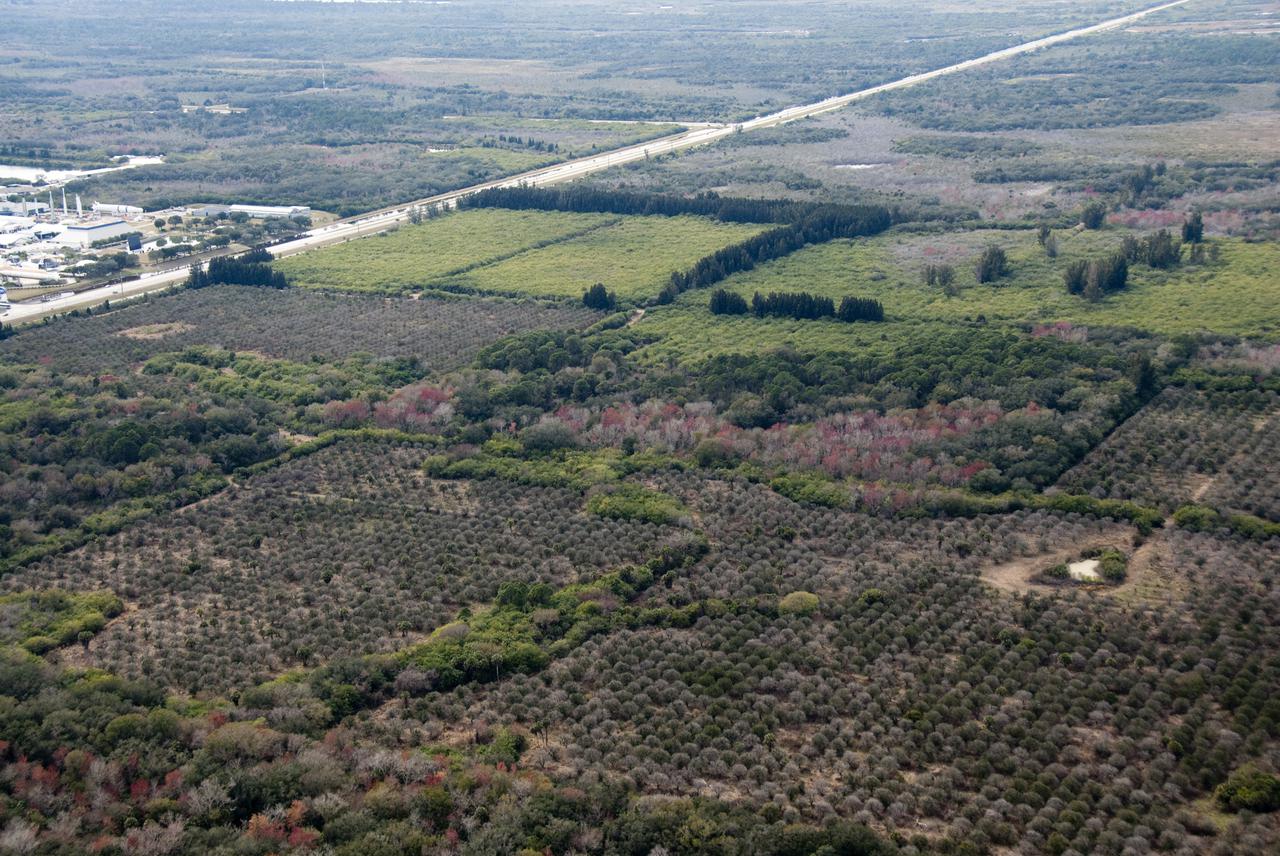
CAPE CANAVERAL, Fla. - This aerial view combines NASA's Kennedy Space Center Visitor Complex (left) and the proposed 500-acre site for one of the largest solar power plants of its kind. The planned 100-megawatt photovoltaic solar plant would use similar panels to those already built at Kennedy by the SunPower Corp. The energy produced by the proposed facility would be used to provide power to Florida Power and Light customers. Kennedy Center Director Bob Cabana, FPL Vice President and Chief Development Officer Eric Silagy and a SunPower Corp. representative made a joint announcement regarding the new construction during a ceremony held in November 2009 to commission a 1-megawatt solar plant. Included in the announcement were plans to establish a permanent renewable energy research and development center at Exploration Park, Kennedy's new business complex. The dedicated RandD facility proposed for Exploration Park could result in at least 50 high-salary science and engineering positions permanently established at Kennedy by SunPower and FPL's other partners, a potential for solar panel manufacturing located nearby and as many as 1,000 new construction jobs. FPL and Kennedy have initiated environmental studies and a plan to support the next project, which could be initiated before the end of 2010. Photo credit: NASA_Kim Shiflett
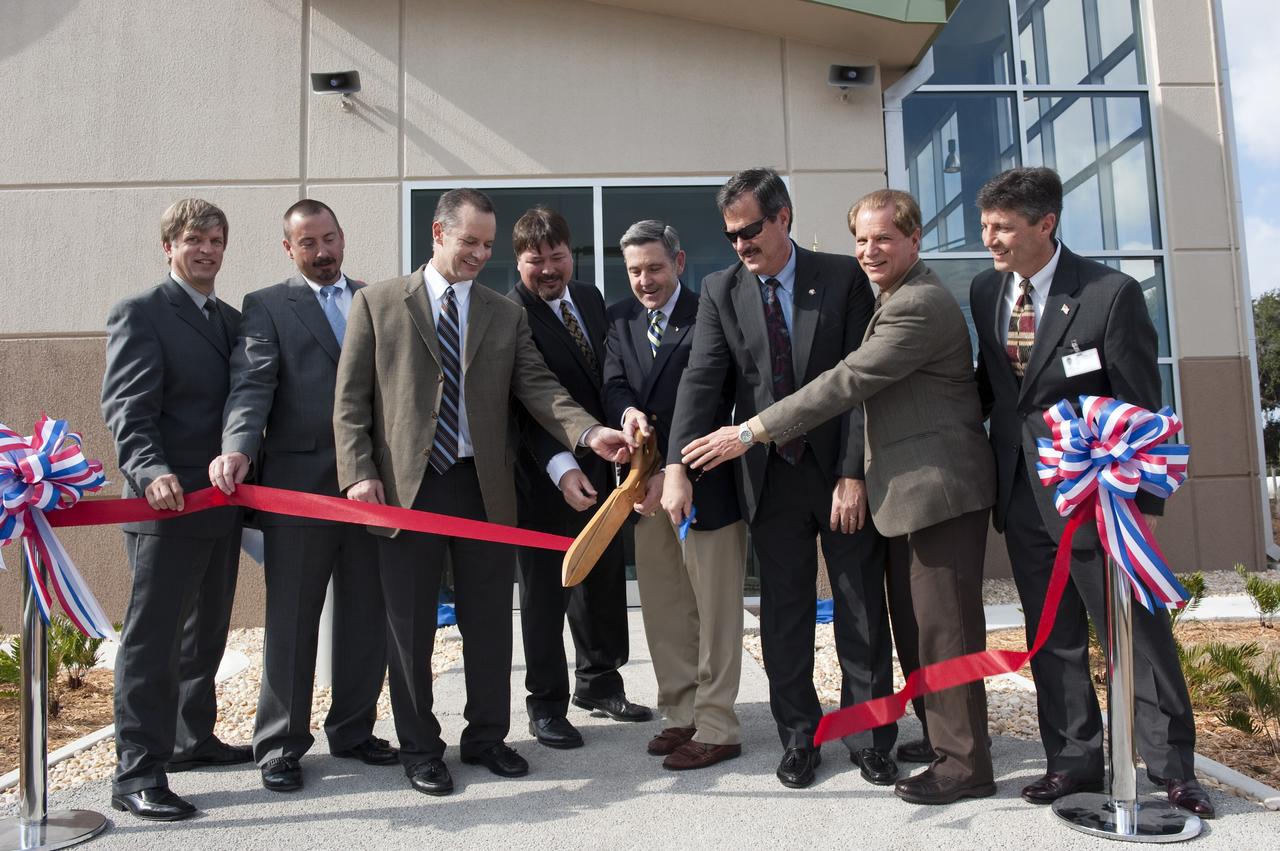
CAPE CANAVERAL, Fla. -- A traditional ribbon-cutting ceremony takes place outside the Propellants North Administration and Maintenance Facility at NASA's Kennedy Space Center in Florida. From left, are Thomas Wilczek, contracting officer technical representative/project manager for NASA Construction of Facilities; Bradley O’Toole, NASA contracting officer; James Wright, deputy assistant administrator for the Office of Strategic Infrastructure at NASA Headquarters; Frank Kline, NASA Construction of Facility project manager; Bob Cabana, Kennedy's center director; Mike Benik, director of Kennedy's Center Operations; Ward Davis, president of HW Davis Construction Inc.; and Rick Ferreira, chief operating officer of Jones Edmunds and Associates Inc. Propellants North consists of two buildings, one to store cryogenic fuel transfer equipment and one to house personnel who support fueling spacecraft. The recently rebuilt buildings will be NASA's first carbon neutral facility, which means it will produce enough energy on site from renewable sources to offset what it requires to operate. The facility also will reach for the U.S. Green Building Council's Leadership in Environmental and Energy Design (LEED) Platinum status, which is the highest LEED rating. Photo credit: NASA/Kim Shiflett
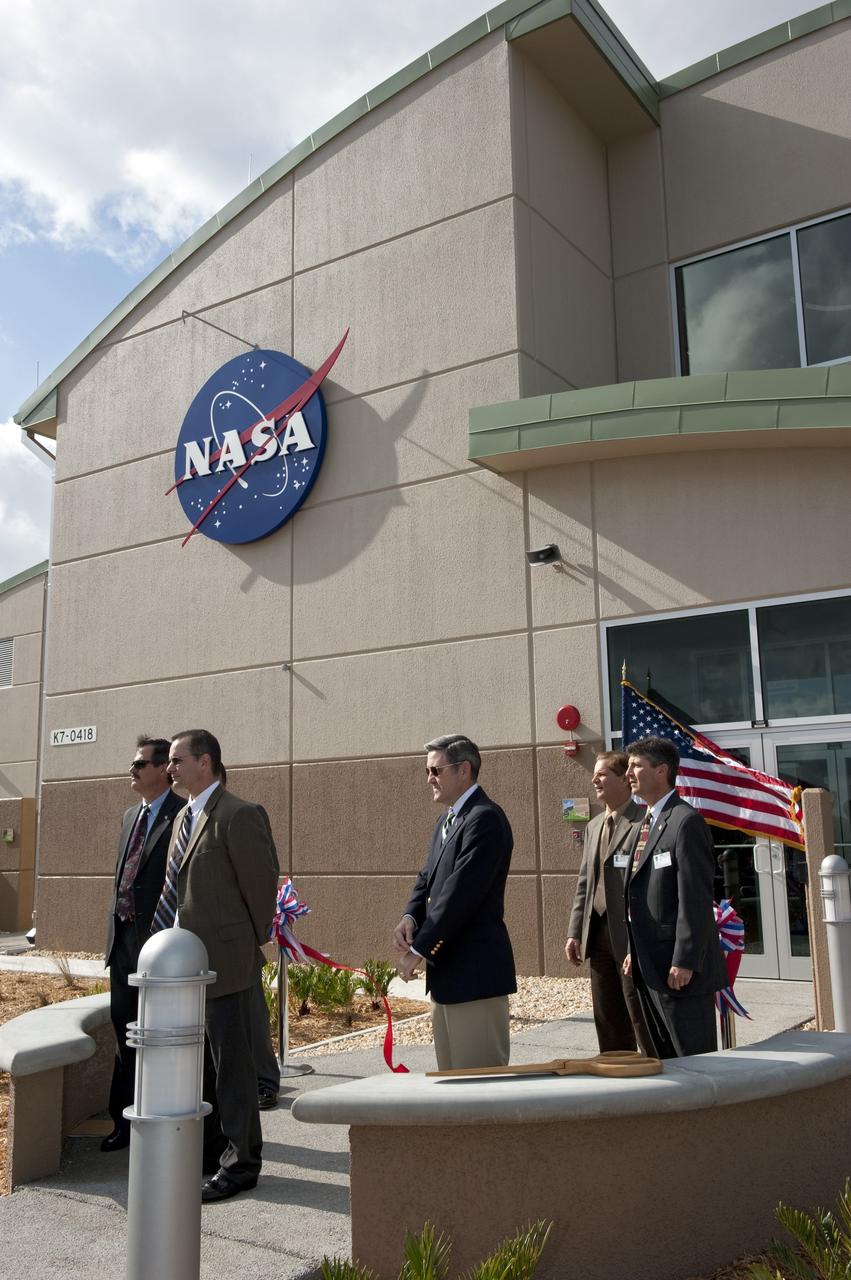
CAPE CANAVERAL, Fla. -- NASA's Kennedy Space Center in Florida hosts a ribbon-cutting ceremony for the space agency's most environmentally friendly facility, the Propellants North Administrative and Maintenance Facility in Kennedy's Launch Complex 39 area. From left, are Mike Benik, director of Kennedy's Center Operations; James Wright, deputy assistant administrator for the Office of Strategic Infrastructure at NASA Headquarters; Bob Cabana, Kennedy's center director; Ward Davis, president of HW Davis Construction Inc.; and Rick Ferreira, chief operating officer of Jones Edmunds and Associates Inc. Propellants North consists of two buildings, one to store cryogenic fuel transfer equipment and one to house personnel who support fueling spacecraft. The recently rebuilt buildings will be NASA's first carbon neutral facility, which means it will produce enough energy on site from renewable sources to offset what it requires to operate. The facility also will reach for the U.S. Green Building Council's Leadership in Environmental and Energy Design (LEED) Platinum status, which is the highest LEED rating. Photo credit: NASA/Kim Shiflett
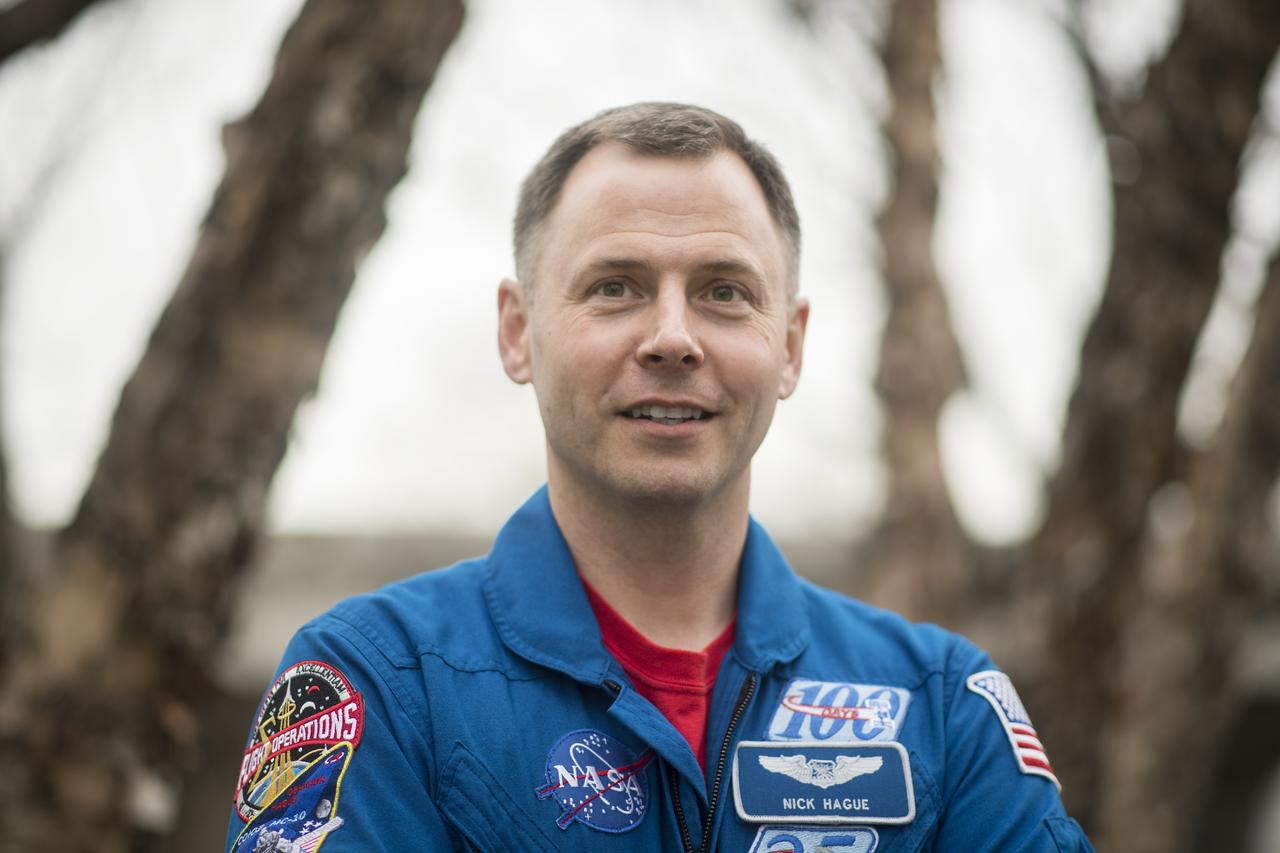
"When we do passes over parts of the world where you can see the human impact to the world, you get to really see the magnitude of the impact. When we’re flying over North America, we come up over Vancouver, and a short five minutes later we’re flying over Houston. We’d just cross over all of the Western United States. And during the daylight, you may not really see a whole lot of human influence, with all the great plains are stretched out and the cities blending into everything. "But when we’d do that same view over South America, at what at one point was rainforest, as far as we can see, has all been deforested. You can understand the reasons why people are doing it. They’re trying to survive. But you also know at your core that we’re having a significant impact on how life is balancing on the world. And so, I walked away with a deep sense of stewardship of the planet. My wife chuckles at this being my mid-life crisis. I came home and signed up for 100% renewable energy and looked at EV cars and everything. "When you look out into space, and you see all those stars and all those galaxies — there’s just so much stuff out there. But the only thing you see with any life on it is what’s right below you. You know that we’re on this island out in the middle of this vast darkness, and we need to just take care of it as best we can." NASA astronaut Nick Hague, Monday, Jan. 13, 2020 in Washington, DC. Hague most recently spent 203 days living and working onboard the International Space Station as part of Expeditions 59 and 60. Hague ventured outside the space station on three spacewalks totaling 19 hours and 56 minutes. Photo Credit: (NASA/Aubrey Gemignani)