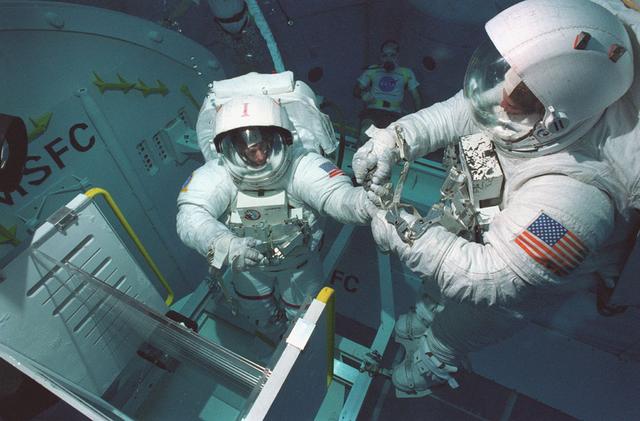
Marshall's Neutral Buoyancy Simulator (NBS) is used to simulate the gravitational fields and buoyancy effects outer space has on astronauts and their ability to perform tasks in this environment. In this example, a diver performs a temporary fluid line repair task using a repair kit developed by Marshall engineers. The analysis will determine the value of this repair kit and its feasibility.
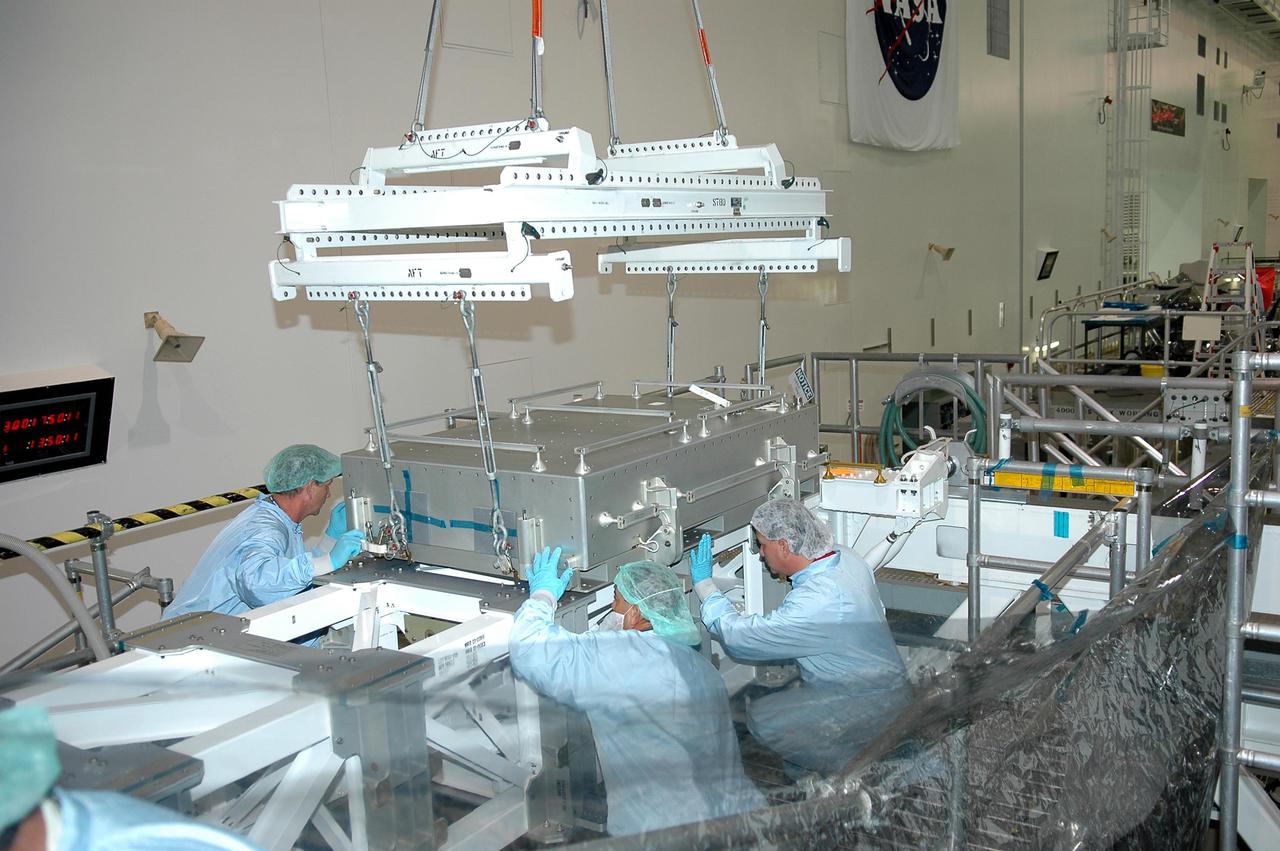
KENNEDY SPACE CENTER, FLA. - Technicians at the Space Station Processing Facility perform a fit check of the Thermal Protection System Sample Box on the Lightweight Multi-Purpose Experiment Support Structure Carrier (LMC). The box is the actual flight hardware scheduled to fly on the Space Shuttle Return to Flight mission STS-114. The fit check is performed to ensure the hardware mates properly with the newly modified LMC and will be returned to NASA’s Johnson Space Center for installation of tile samples in support of the STS-114 mission. The Thermal Protection Detailed Test Objective will enable astronauts to test new on-orbit Thermal Protection System repair techniques. Mission STS-114 is scheduled to launch in May 2005.
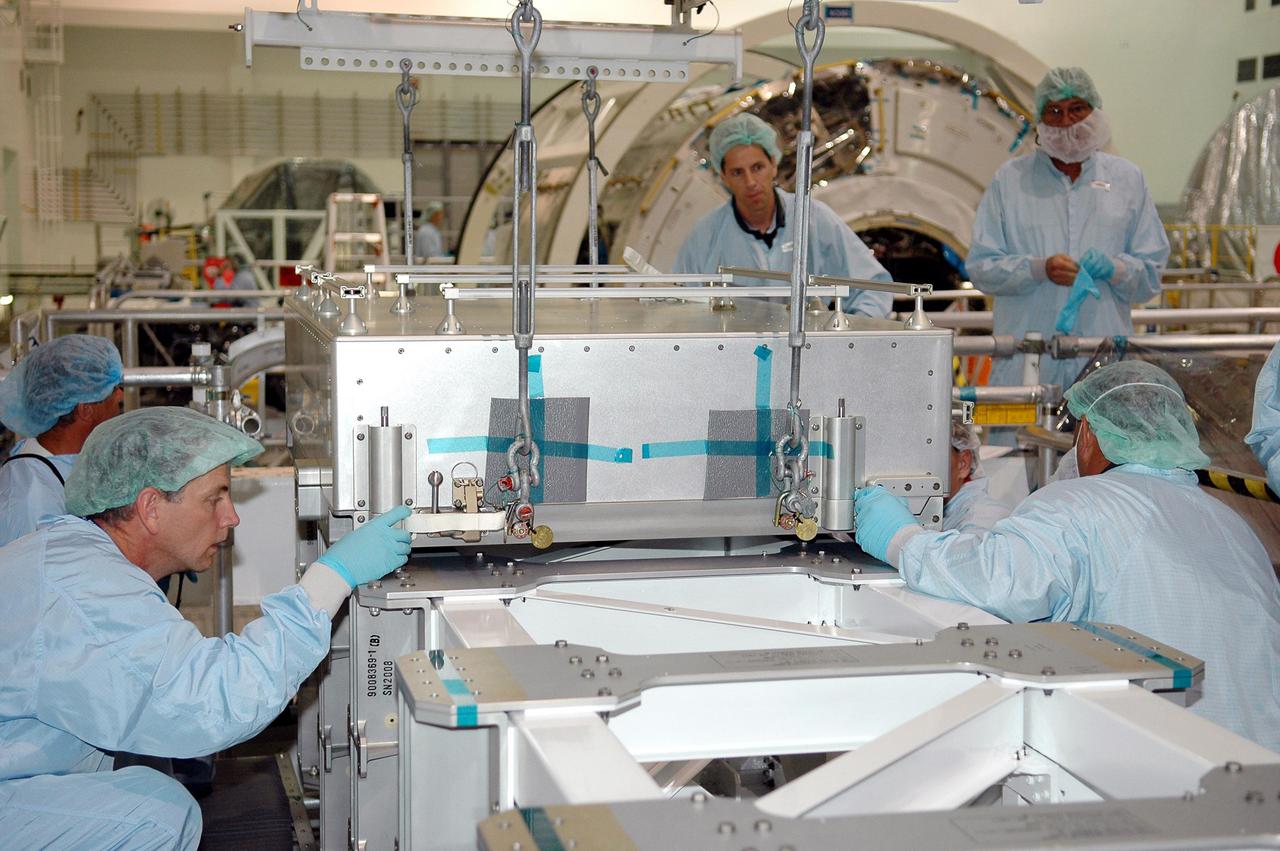
KENNEDY SPACE CENTER, FLA. - Technicians at the Space Station Processing Facility perform a fit check of the Thermal Protection System Sample Box on the Lightweight Multi-Purpose Experiment Support Structure Carrier (LMC). The box is the actual flight hardware scheduled to fly on the Space Shuttle Return to Flight mission STS-114. The fit check is performed to ensure the hardware mates properly with the newly modified LMC and will be returned to NASA’s Johnson Space Center for installation of tile samples in support of the STS-114 mission. The Thermal Protection Detailed Test Objective will enable astronauts to test new on-orbit Thermal Protection System repair techniques. Mission STS-114 is scheduled to launch in May 2005.
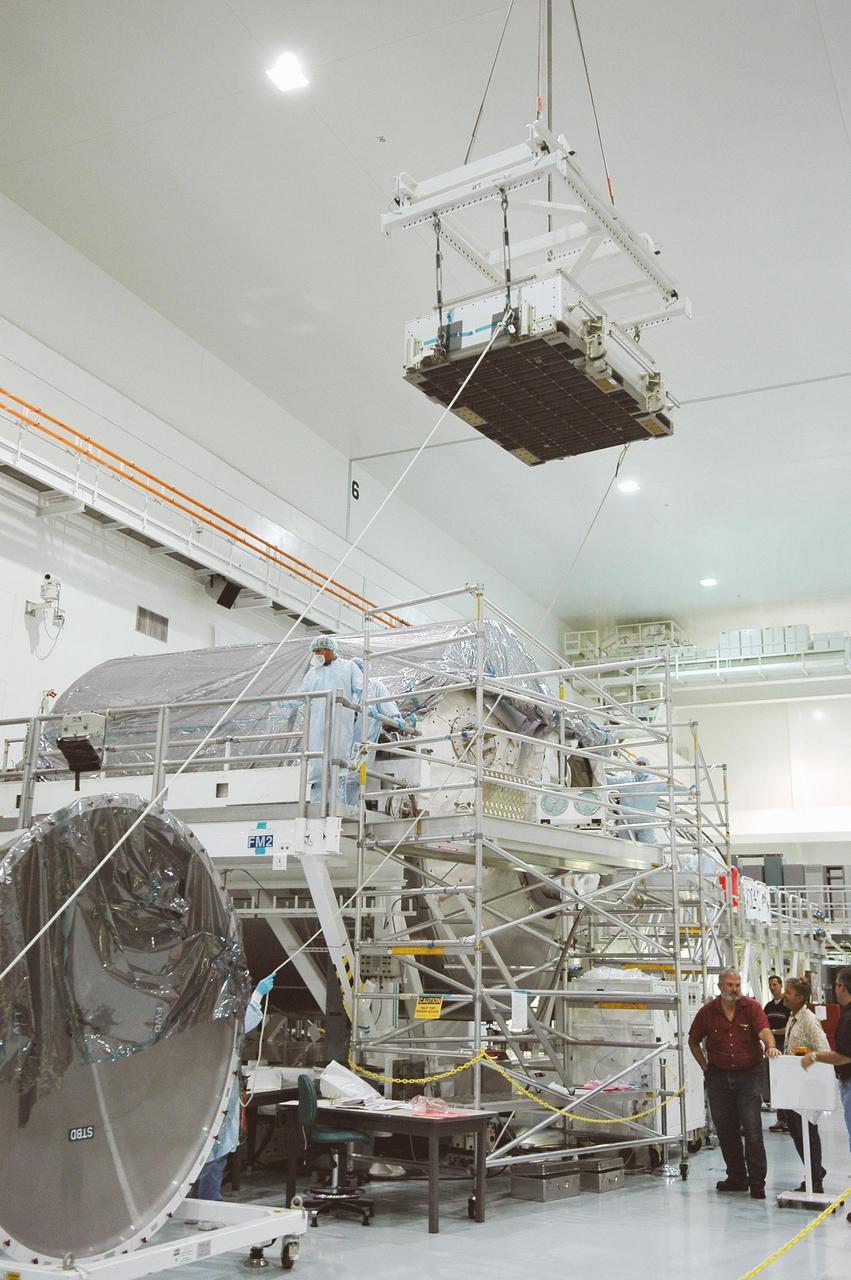
KENNEDY SPACE CENTER, FLA. - In the Space Station Processing Facility, an overhead crane moves a Thermal Protection System Sample Box to the Lightweight Multi-Purpose Experiment Support Structure Carrier (LMC) for a fit check. The box is the actual flight hardware scheduled to fly on the Space Shuttle Return to Flight mission STS-114. The fit check is performed to ensure the hardware mates properly with the newly modified LMC and will be returned to NASA’s Johnson Space Center for installation of tile samples in support of the STS-114 mission. The Thermal Protection Detailed Test Objective will enable astronauts to test new on-orbit Thermal Protection System repair techniques. Mission STS-114 is scheduled to launch in May 2005.
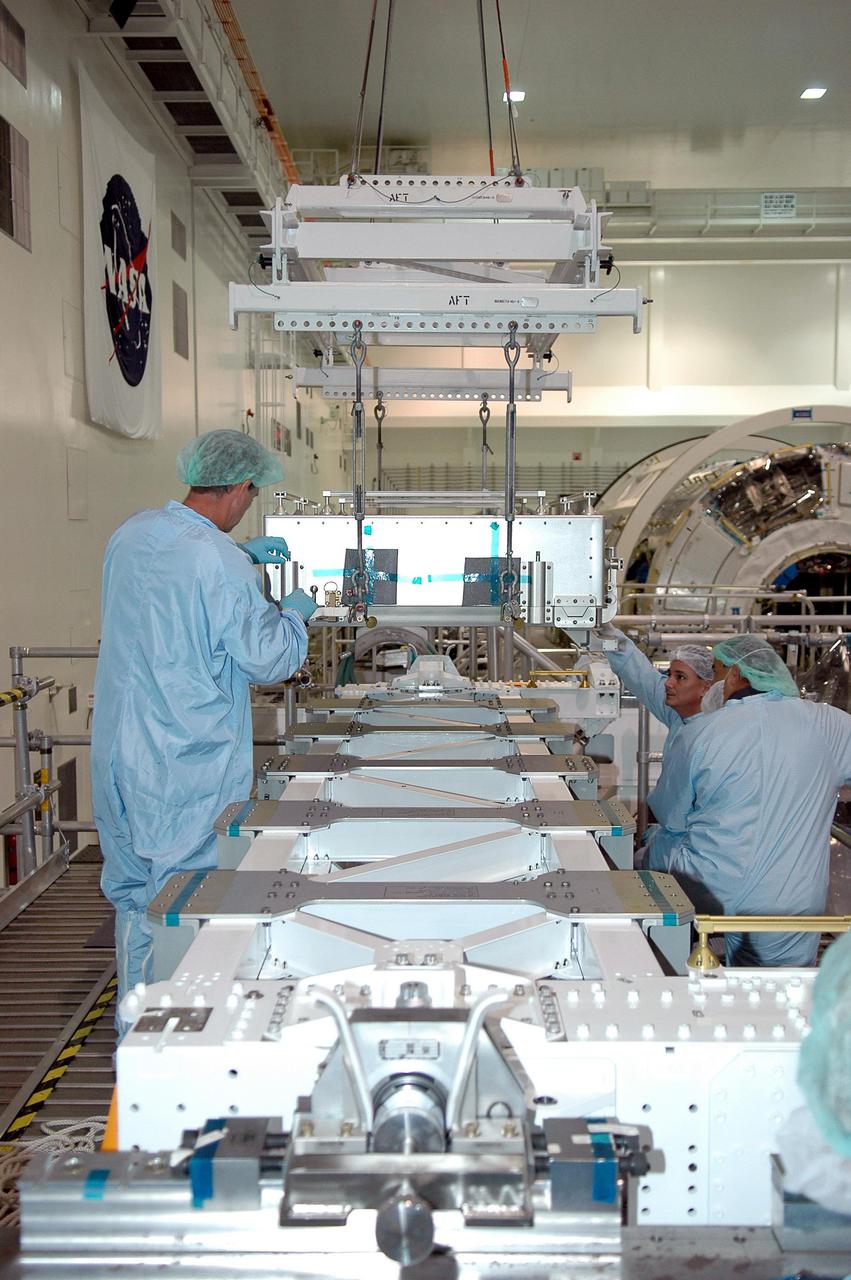
KENNEDY SPACE CENTER, FLA. - Technicians at the Space Station Processing Facility perform a fit check of the Thermal Protection System Sample Box on the Lightweight Multi-Purpose Experiment Support Structure Carrier (LMC). The box is the actual flight hardware scheduled to fly on the Space Shuttle Return to Flight mission STS-114. The fit check is performed to ensure the hardware mates properly with the newly modified LMC and will be returned to NASA’s Johnson Space Center for installation of tile samples in support of the STS-114 mission. The Thermal Protection Detailed Test Objective will enable astronauts to test new on-orbit Thermal Protection System repair techniques. Mission STS-114 is scheduled to launch in May 2005.
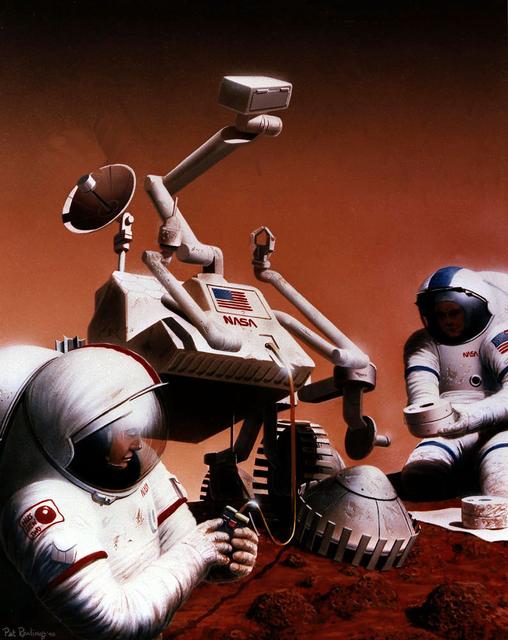
Artist Pat Rawlings' concept of the type of work and hazards future astronauts will encounter on outer worlds: Mars Rover Repair
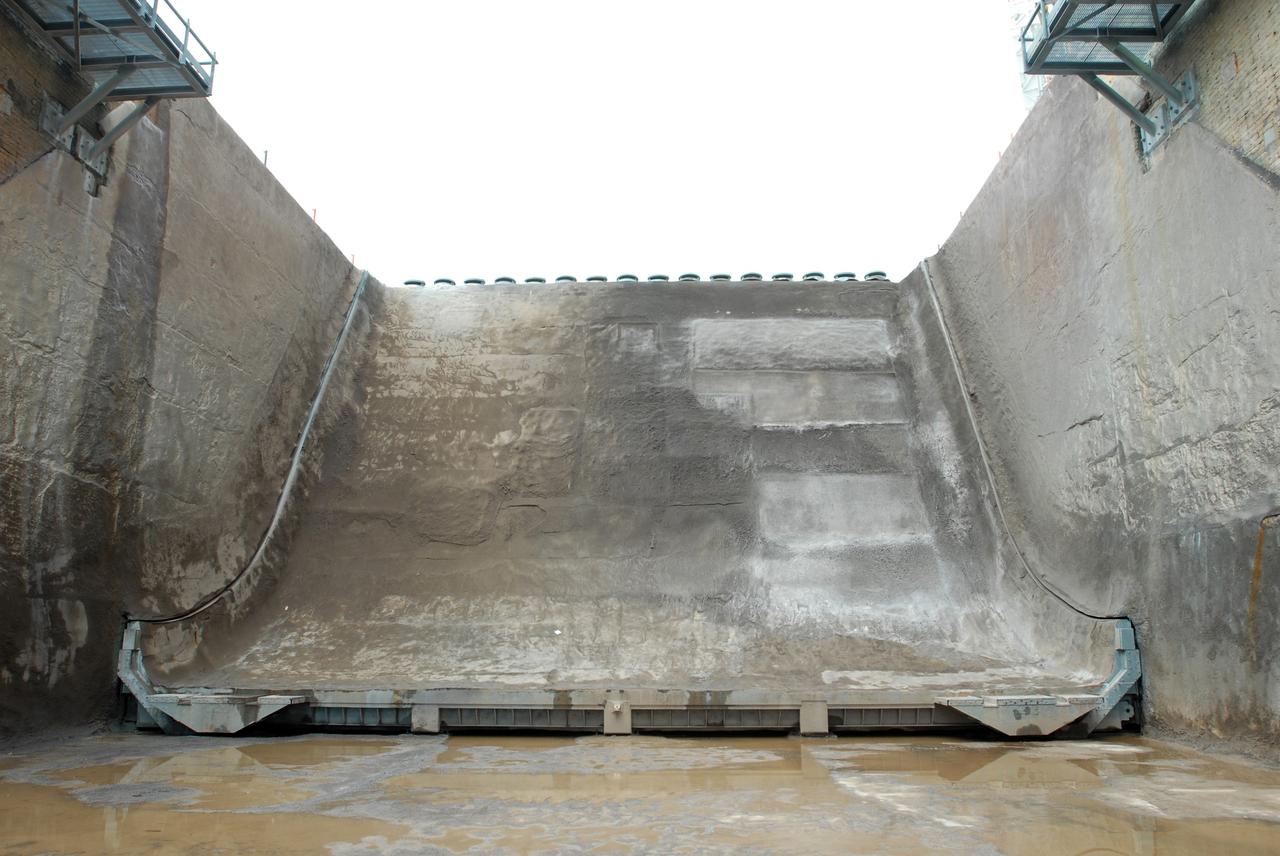
CAPE CANAVERAL, Fla. – A view of the flame trench on Launch Pad 39A at NASA's Kennedy Space Center in Florida where repairs of the Fondue Fyre have been made. After launch of space shuttle Atlantis on the STS-125 mission on May 11, a 25-square-foot area of Fondue Fyre from the north side of the solid rocket booster flame deflector was damaged. Some pneumatic lines (gaseous nitrogen, pressurized air) in the area also were damaged and needed to be repaired. The flame trench channels the flames and smoke exhaust of the shuttle's solid rocket boosters away from the space shuttle during liftoff. Fondue Fyre is a fire-resistant concrete-like material that replaced the original flame trench bricks. It can be sprayed on the surface. Pad 39A will be used for the launch of space shuttle Endeavour on the STS-127 mission targeted for June 13. Photo credit: NASA/Jim Grossmann
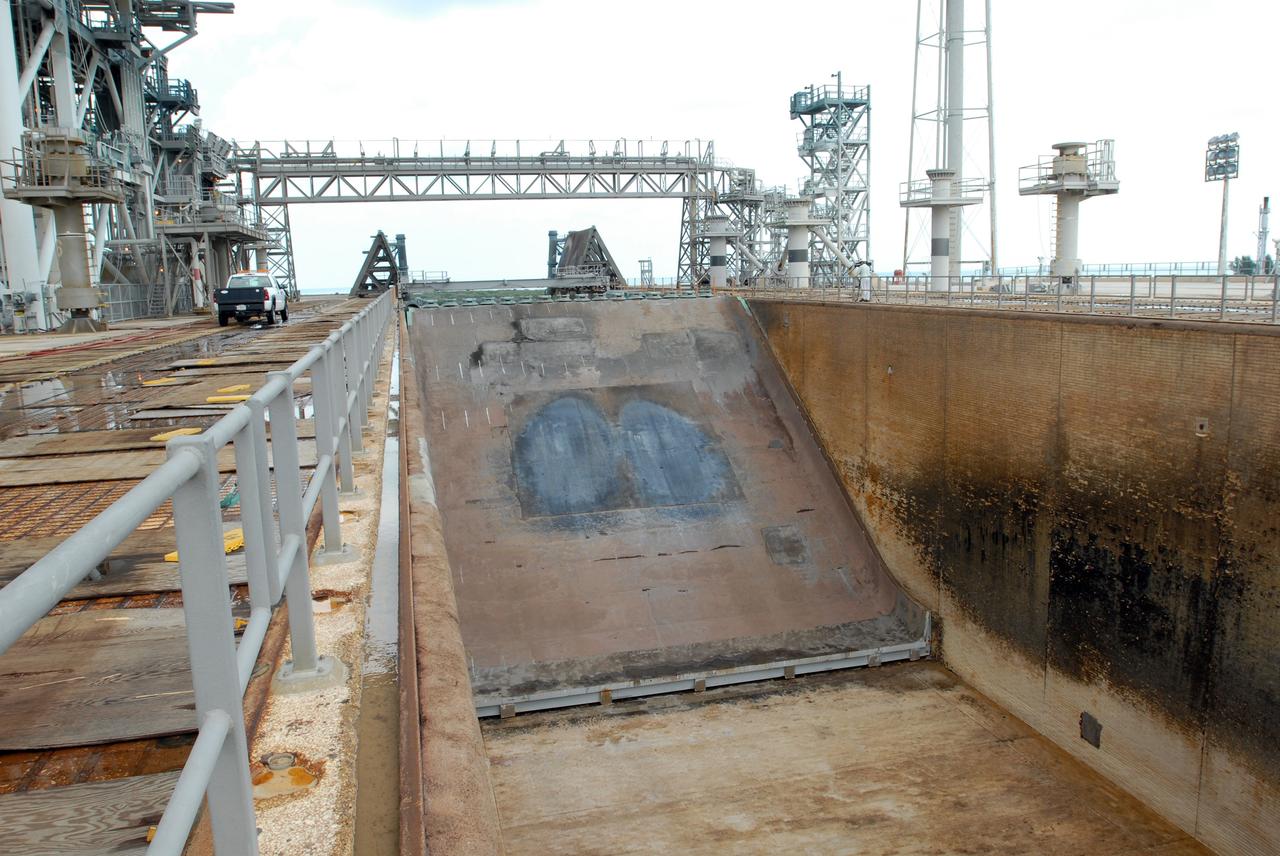
CAPE CANAVERAL, Fla. – A view of the flame trench on Launch Pad 39A at NASA's Kennedy Space Center in Florida where repairs of the Fondue Fyre have been made. After launch of space shuttle Atlantis on the STS-125 mission on May 11, a 25-square-foot area of Fondue Fyre from the north side of the solid rocket booster flame deflector was damaged. Some pneumatic lines (gaseous nitrogen, pressurized air) in the area also were damaged and needed to be repaired. The flame trench channels the flames and smoke exhaust of the shuttle's solid rocket boosters away from the space shuttle during liftoff. Fondue Fyre is a fire-resistant concrete-like material that replaced the original flame trench bricks. It can be sprayed on the surface. Pad 39A will be used for the launch of space shuttle Endeavour on the STS-127 mission targeted for June 13. Photo credit: NASA/Jim Grossmann
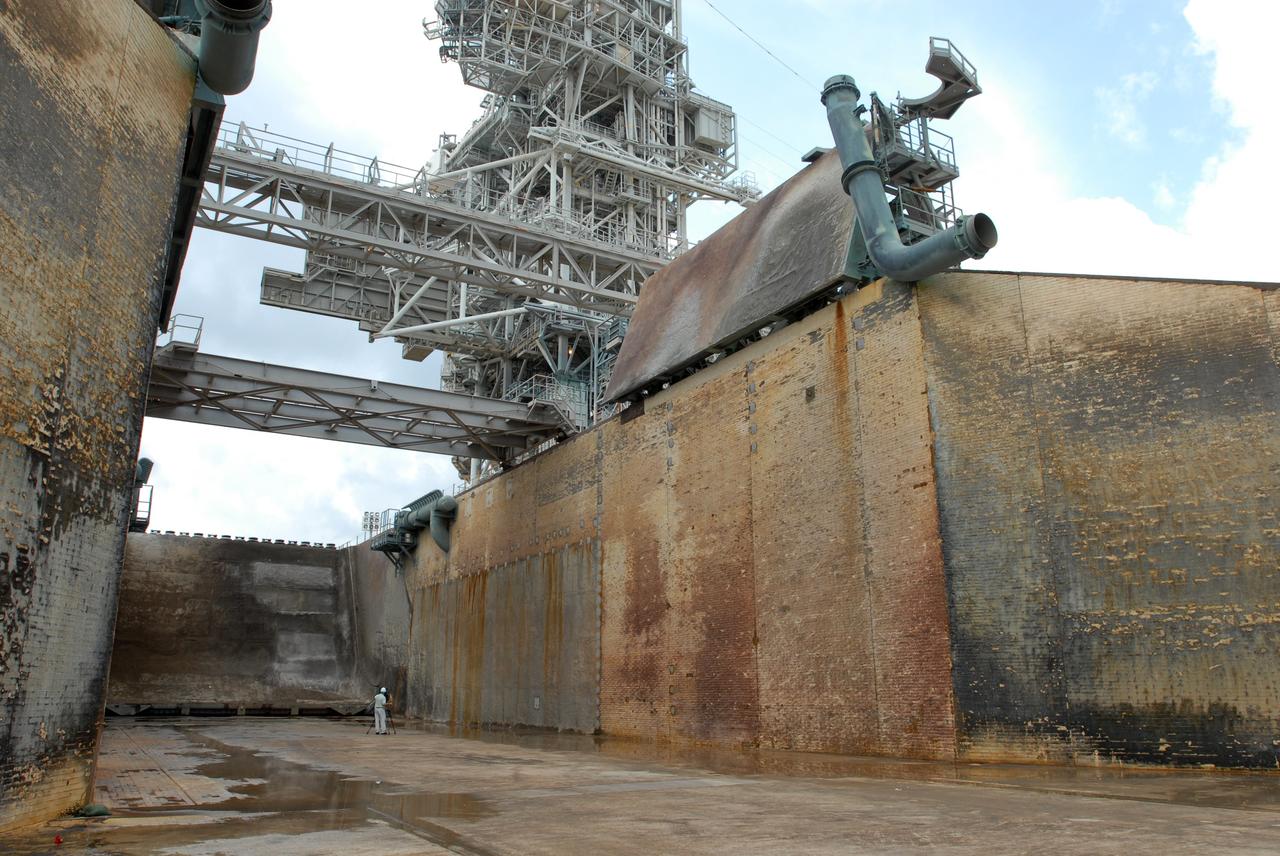
CAPE CANAVERAL, Fla. – A view of the flame trench on Launch Pad 39A at NASA's Kennedy Space Center in Florida where repairs of the Fondue Fyre have been made. After launch of space shuttle Atlantis on the STS-125 mission on May 11, a 25-square-foot area of Fondue Fyre from the north side of the solid rocket booster flame deflector was damaged. Some pneumatic lines (gaseous nitrogen, pressurized air) in the area also were damaged and needed to be repaired. The flame trench channels the flames and smoke exhaust of the shuttle's solid rocket boosters away from the space shuttle during liftoff. Fondue Fyre is a fire-resistant concrete-like material that replaced the original flame trench bricks. It can be sprayed on the surface. Pad 39A will be used for the launch of space shuttle Endeavour on the STS-127 mission targeted for June 13. Photo credit: NASA/Jim Grossmann
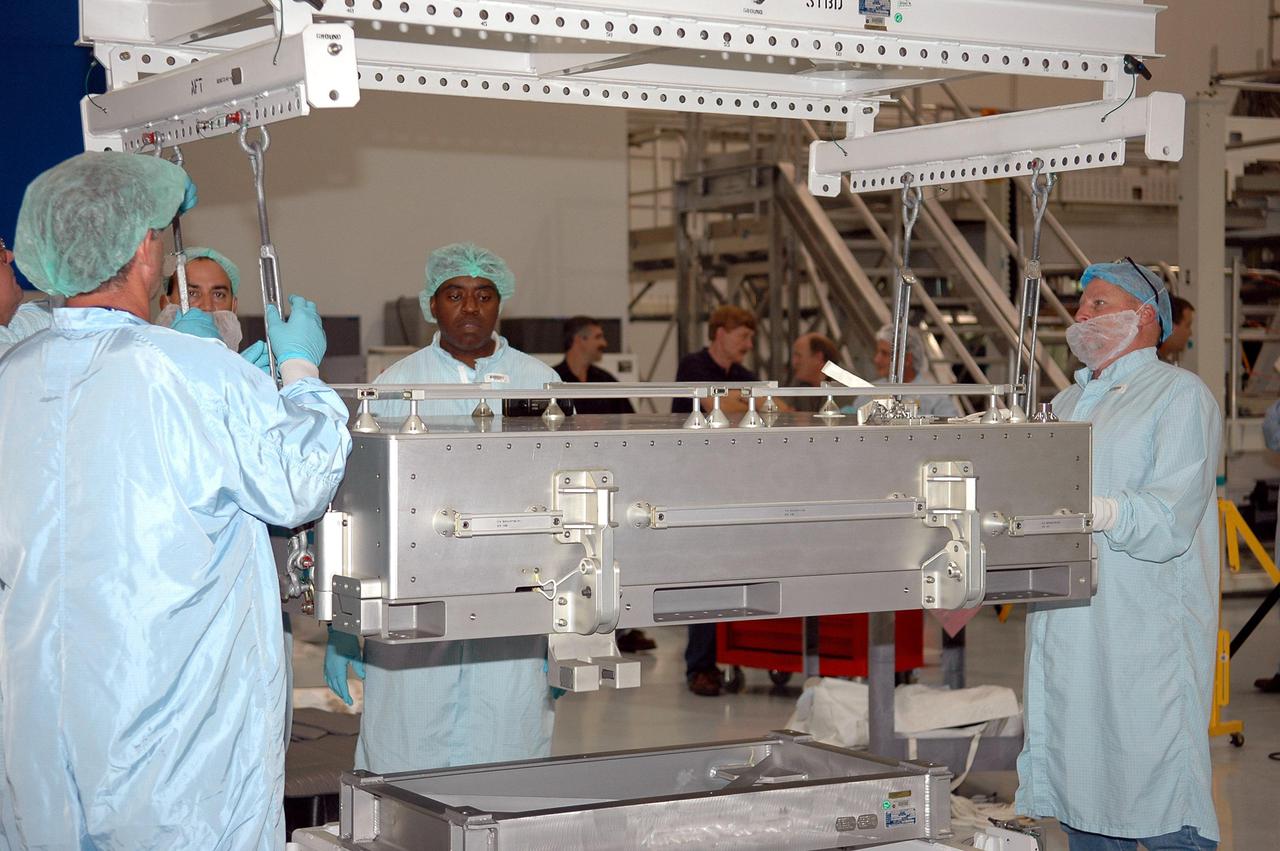
KENNEDY SPACE CENTER, FLA. - Technicians at the Space Station Processing Facility prepare to lift and move a Thermal Protection System Sample Box onto the Lightweight Multi-Purpose Experiment Support Structure Carrier (LMC) for a fit check. The box is the actual flight hardware scheduled to fly on the Space Shuttle Return to Flight mission STS-114. The fit check is performed to ensure the hardware mates properly with the newly modified LMC and will be returned to NASA’s Johnson Space Center for installation of tile samples in support of the STS-114 mission. The Thermal Protection Detailed Test Objective will enable astronauts to test new on-orbit Thermal Protection System repair techniques. Mission STS-114 is scheduled to launch in May 2005.
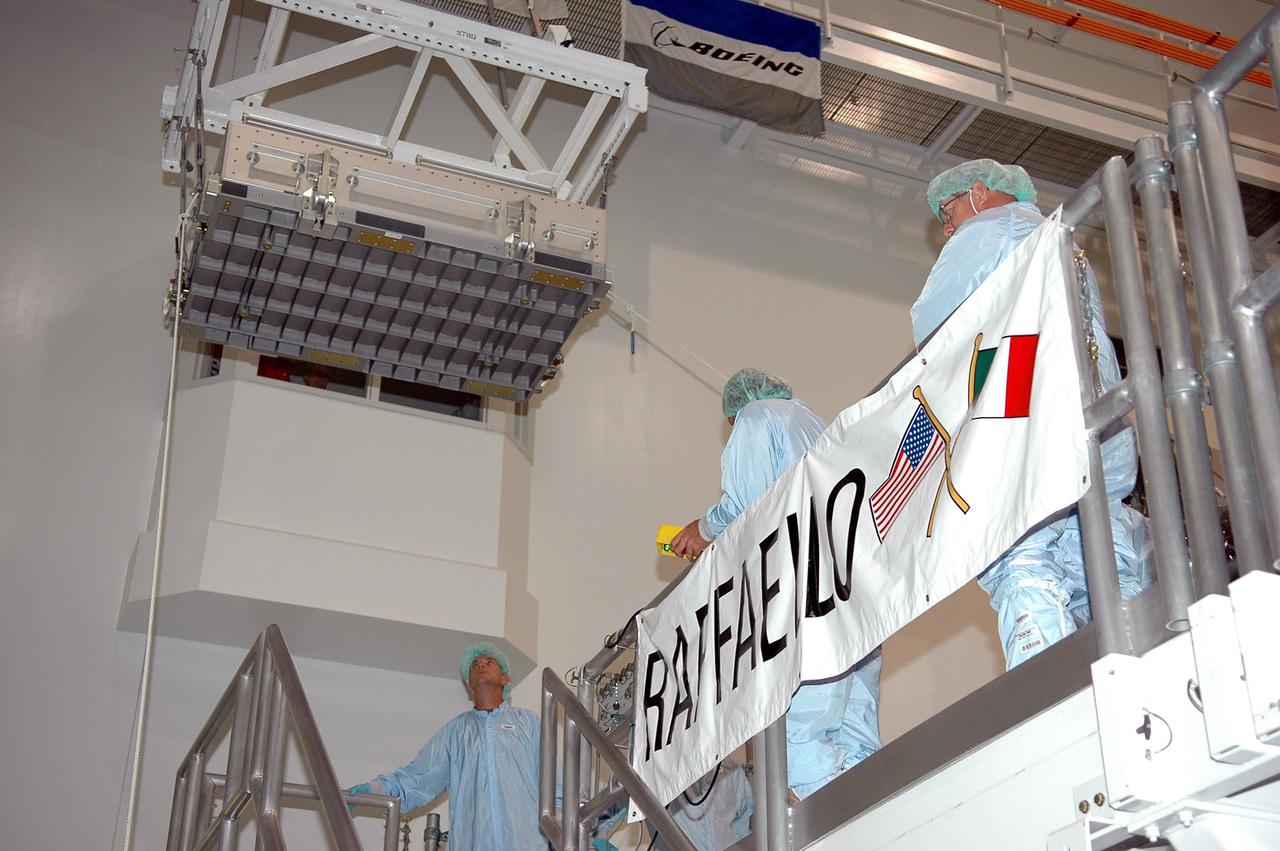
KENNEDY SPACE CENTER, FLA. - Technicians at the Space Station Processing Facility lower a Thermal Protection System Sample Box (upper left) toward the Lightweight Multi-Purpose Experiment Support Structure Carrier (LMC) for a fit check. The box is the actual flight hardware scheduled to fly on the Space Shuttle Return to Flight mission STS-114. The fit check is performed to ensure the hardware mates properly with the newly modified LMC and will be returned to NASA’s Johnson Space Center for installation of tile samples in support of the STS-114 mission. The Thermal Protection Detailed Test Objective will enable astronauts to test new on-orbit Thermal Protection System repair techniques. Mission STS-114 is scheduled to launch in May 2005.
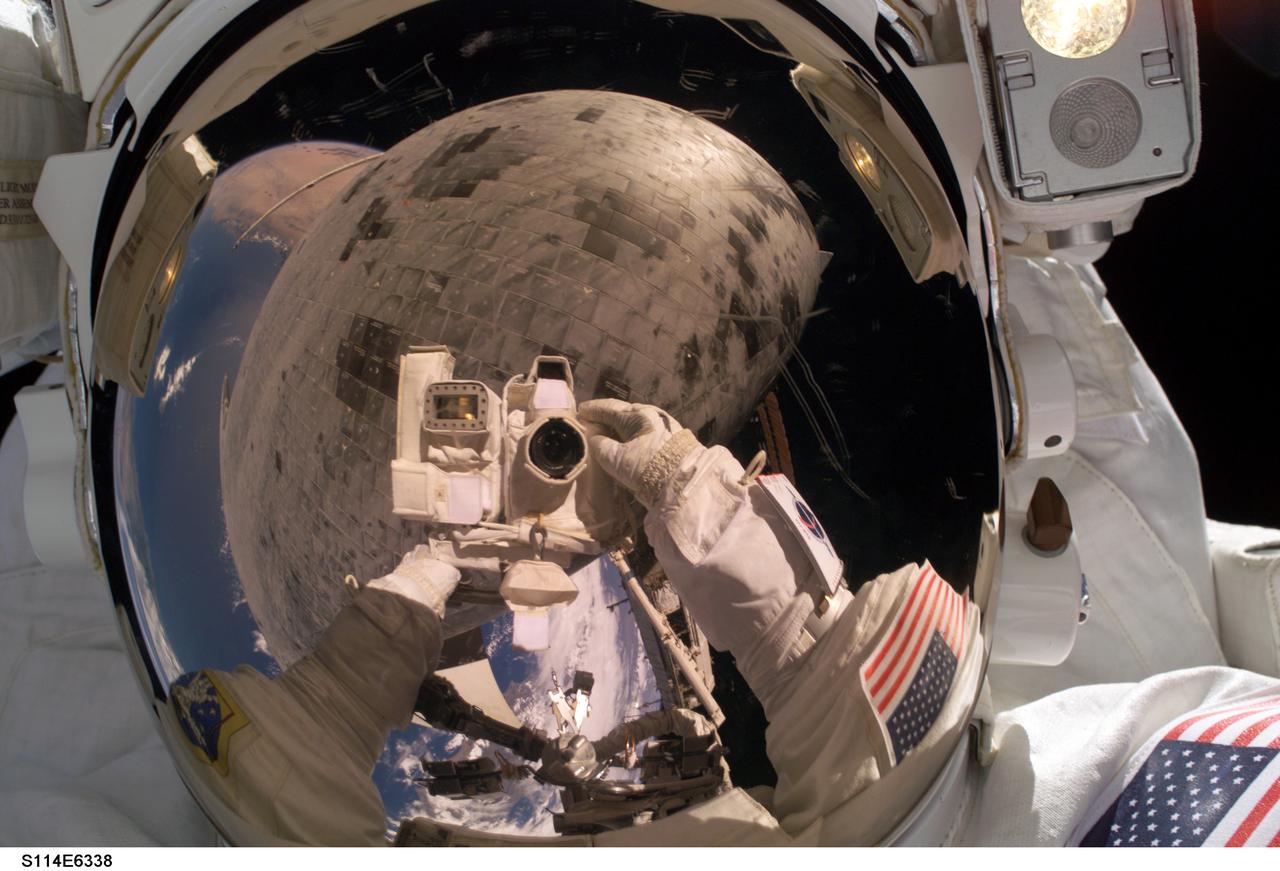
Launched on July 26, 2005 from the Kennedy Space Center in Florida, STS-114 was classified as Logistics Flight 1. Among the Station-related activities of the mission were the delivery of new supplies and the replacement of one of the orbital outpost's Control Moment Gyroscopes (CMGs). STS-114 also carried the Raffaello Multi-Purpose Logistics Module and the External Stowage Platform-2. A major focus of the mission was the testing and evaluation of new Space Shuttle flight safety, which included new inspection and repair techniques. Upon its approach to the International Space Station (ISS), the Space Shuttle Discovery underwent a photography session in order to assess any damages that may have occurred during its launch and/or journey through Space. The mission’s third and final Extra Vehicular Activity (EVA) included taking a close-up look and the repair of the damaged heat shield. Gap fillers were removed from between the orbiter’s heat-shielding tiles located on the craft’s underbelly. Never before had any repairs been done to an orbiter while still in space. Astronaut Stephen K. Robinson, STS-114 mission specialist, used the pictured still digital camera to expose a photo of his helmet visor during the EVA. Also visible in the reflection are thermal protection tiles on Discovery’s underside.
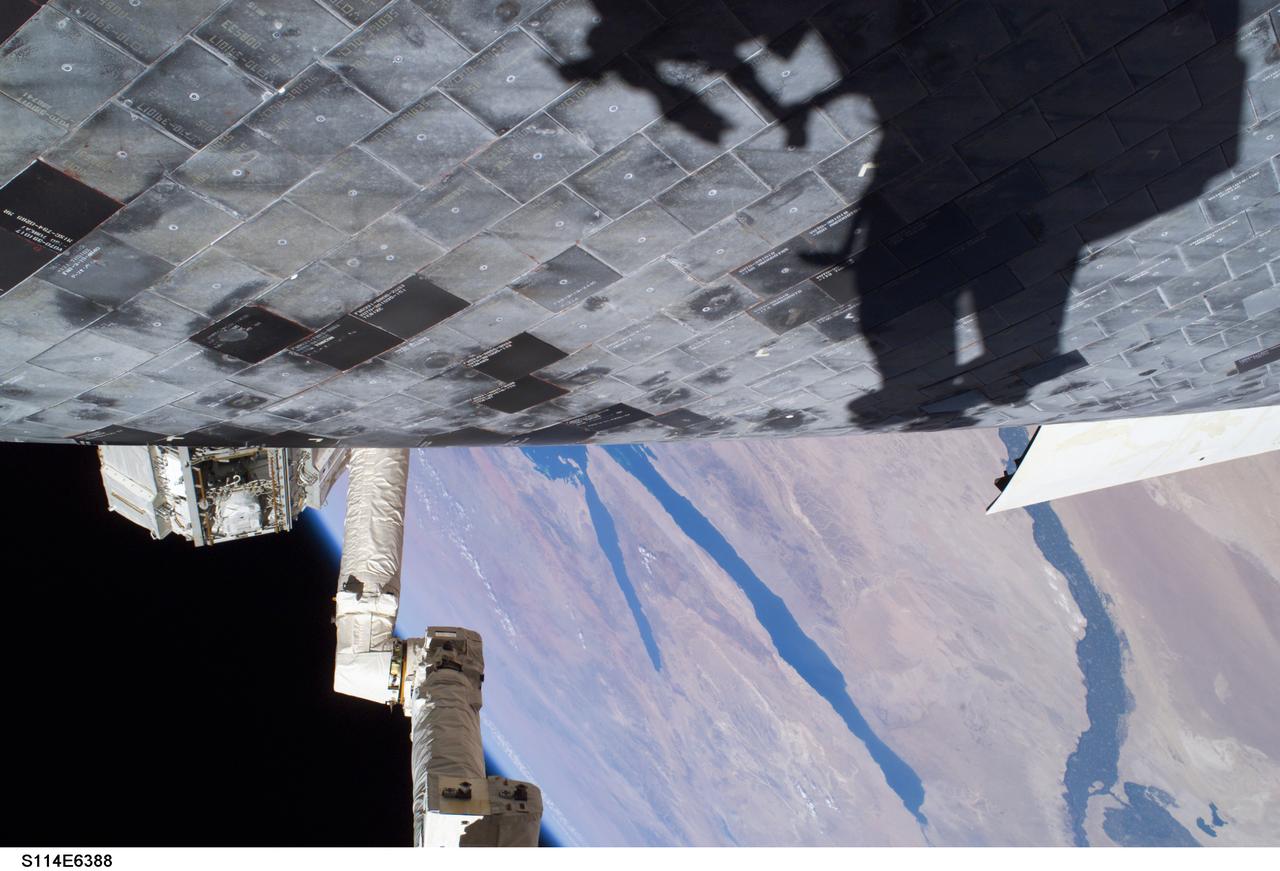
Launched on July 26, 2005 from the Kennedy Space Center in Florida, STS-114 was classified as Logistics Flight 1. Among the Station-related activities of the mission were the delivery of new supplies and the replacement of one of the orbital outpost's Control Moment Gyroscopes (CMGs). STS-114 also carried the Raffaello Multi-Purpose Logistics Module and the External Stowage Platform-2. A major focus of the mission was the testing and evaluation of new Space Shuttle flight safety, which included new inspection and repair techniques. Upon its approach to the International Space Station (ISS), the Space Shuttle Discovery underwent a photography session in order to assess any damages that may have occurred during its launch and/or journey through Space. The mission’s third and final Extra Vehicular Activity (EVA) included taking a close-up look and the repair of the damaged heat shield. Gap fillers were removed from between the orbiter’s heat-shielding tiles located on the craft’s underbelly. Never before had any repairs been done to an orbiter while still in space. This particular photo was taken by astronaut Stephen K. Robinson, STS-114 mission specialist, whose shadow is visible on the thermal protection tiles, and a portion of the Canadian built Remote Manipulator System (RMS) robotic arm and the Nile River is visible at the bottom.
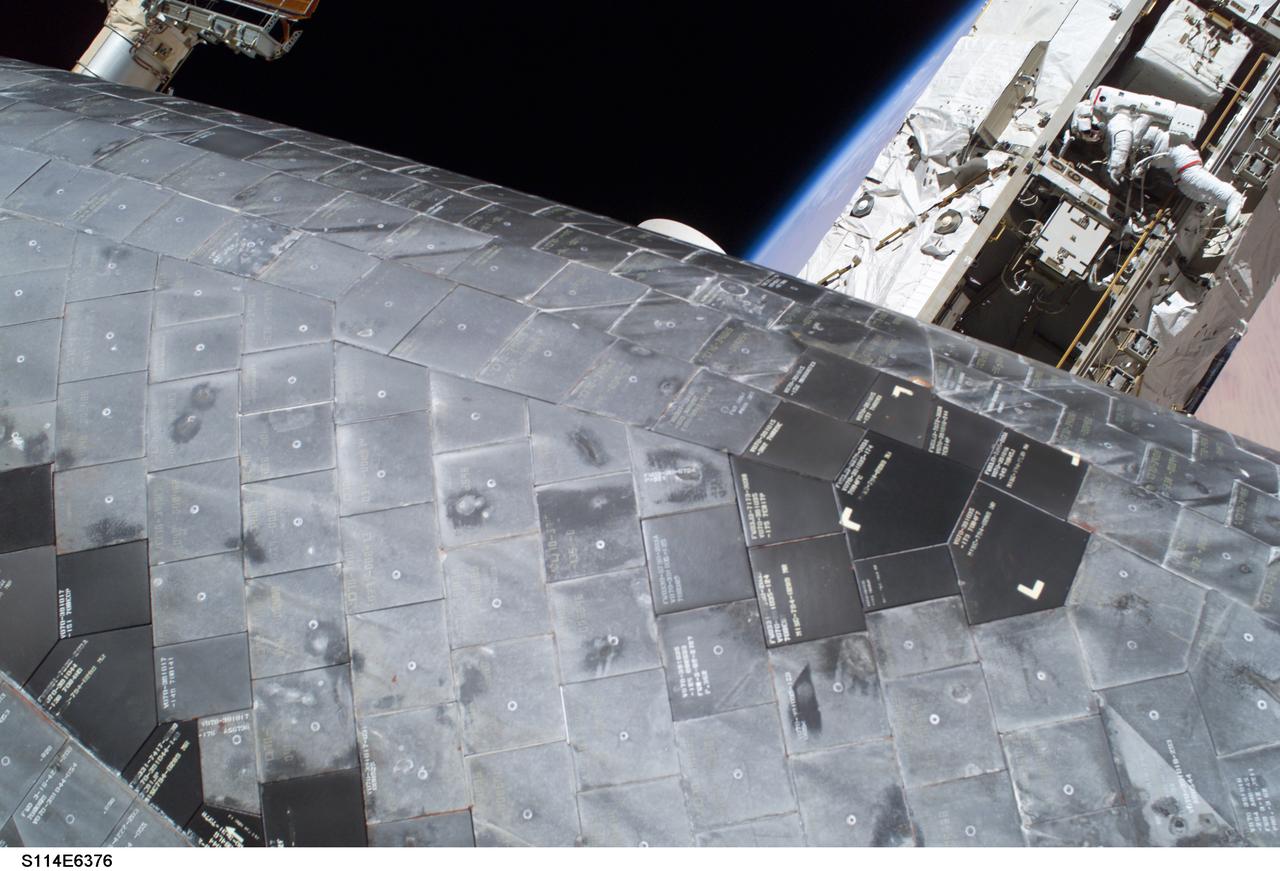
Launched on July 26 2005, from the Kennedy Space Center in Florida, STS-114 was classified as Logistics Flight 1. Among the Station-related activities of the mission were the delivery of new supplies and the replacement of one of the orbital outpost's Control Moment Gyroscopes (CMGs). STS-114 also carried the Raffaello Multi-Purpose Logistics Module and the External Stowage Platform-2. A major focus of the mission was the testing and evaluation of new Space Shuttle flight safety, which included new inspection and repair techniques. Upon its approach to the International Space Station (ISS), the Space Shuttle Discovery underwent a photography session in order to assess any damages that may have occurred during its launch and/or journey through Space. The mission’s third and final Extra Vehicular Activity (EVA) included taking a close-up look and the repair of the damaged heat shield. Gap fillers were removed from between the orbiter’s heat-shielding tiles located on the craft’s underbelly. Never before had any repairs been done to an orbiter while still in space. This close up of the thermal tiles was taken by astronaut Stephen K. Robinson, STS-114 mission specialist (out of frame). Astronaut Soichi Noguchi, STS-114 mission specialist representing the Japan Aerospace Exploration (JAXA), can be seen in the background perched on a Space Station truss.
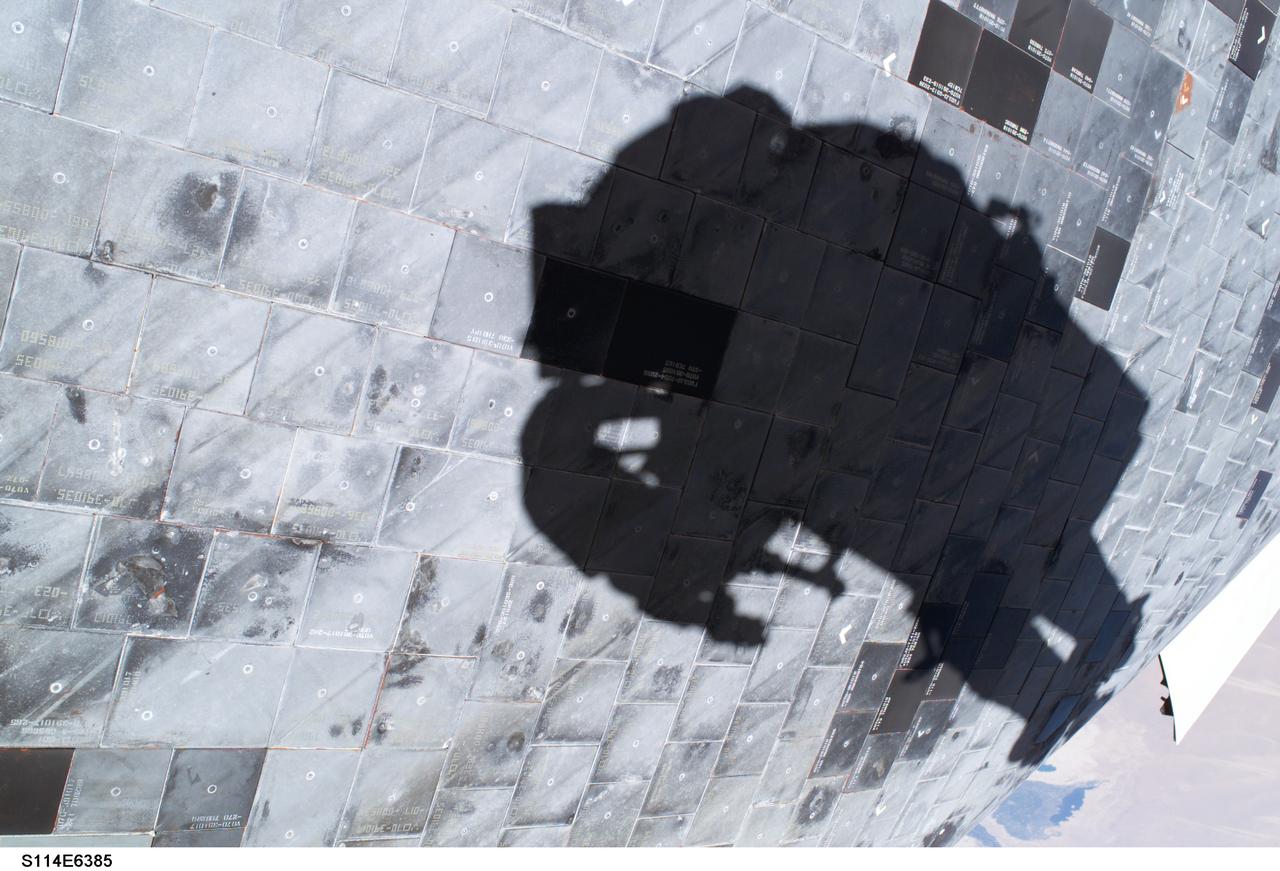
Launched on July 26, 2005 from the Kennedy Space Center in Florida, STS-114 was classified as Logistics Flight 1. Among the Station-related activities of the mission were the delivery of new supplies and the replacement of one of the orbital outpost's Control Moment Gyroscopes (CMGs). STS-114 also carried the Raffaello Multi-Purpose Logistics Module and the External Stowage Platform-2. A major focus of the mission was the testing and evaluation of new Space Shuttle flight safety, which included new inspection and repair techniques. Upon its approach to the International Space Station (ISS), the Space Shuttle Discovery underwent a photography session in order to assess any damages that may have occurred during its launch and/or journey through Space. The mission’s third and final Extra Vehicular Activity (EVA) included taking a close-up look and the repair of the damaged heat shield. Gap fillers were removed from between the orbiter’s heat-shielding tiles located on the craft’s underbelly. Never before had any repairs been done to an orbiter while still in space. This particular photo was taken by astronaut Stephen K. Robinson, STS-114 mission specialist, whose shadow is visible on the thermal protection tiles.
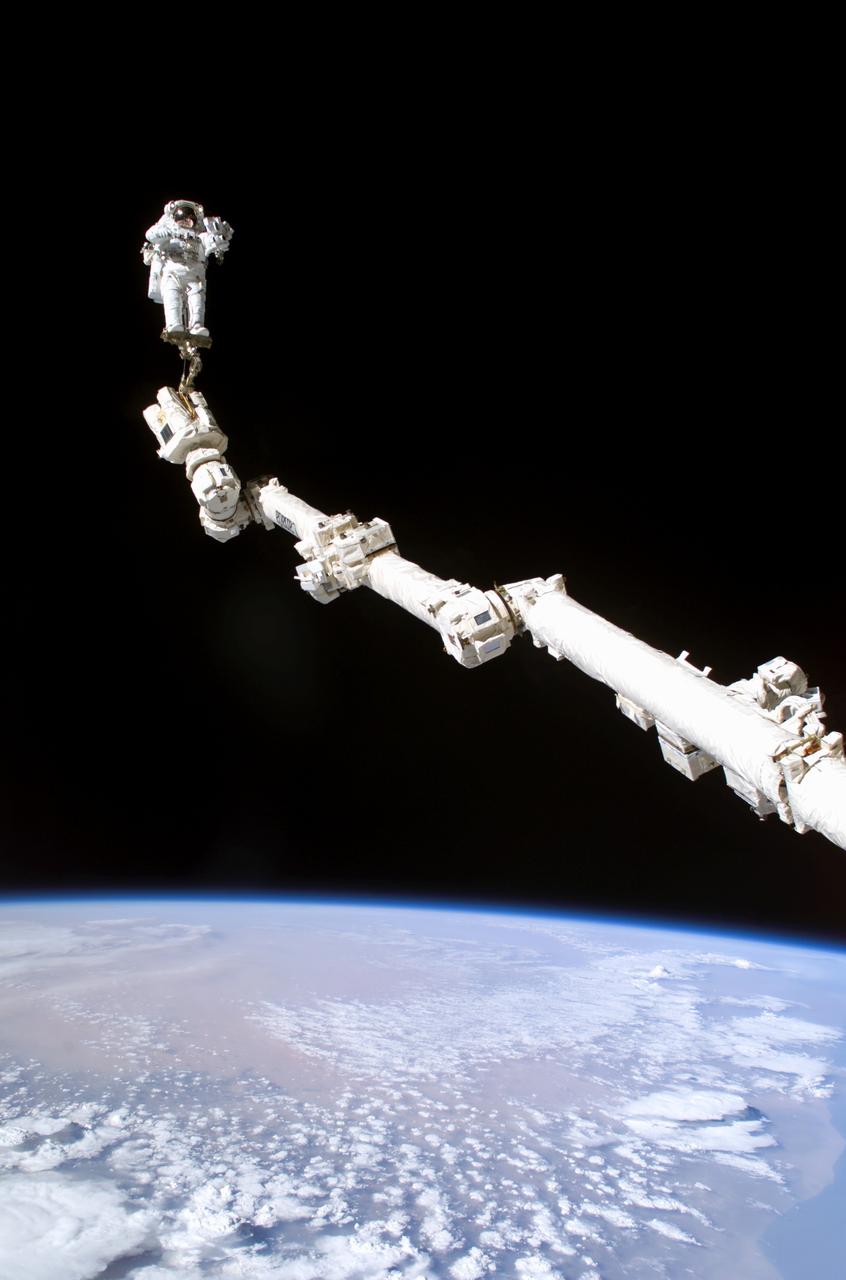
Launched on July 26, 2005 from the Kennedy Space Center in Florida, STS-114 was classified as Logistics Flight 1. Among the Station-related activities of the mission were the delivery of new supplies and the replacement of one of the orbital outpost's Control Moment Gyroscopes (CMGs). STS-114 also carried the Raffaello Multi-Purpose Logistics Module and the External Stowage Platform-2. A major focus of the mission was the testing and evaluation of new Space Shuttle flight safety, which included new inspection and repair techniques. Upon its approach to the International Space Station (ISS), the Space Shuttle Discovery underwent a photography session in order to assess any damages that may have occurred during its launch and/or journey through Space. The mission’s third and final Extra Vehicular Activity (EVA) included taking a close-up look and the repair of the damaged heat shield. Gap fillers were removed from between the orbiter’s heat-shielding tiles located on the craft’s underbelly. Never before had any repairs been done to an orbiter while still in space. Back dropped by the blackness of space and Earth’s horizon, astronaut Stephen K. Robinson, STS-114 mission specialist, is anchored to a foot restraint on the extended ISS’s Canadarm-2.
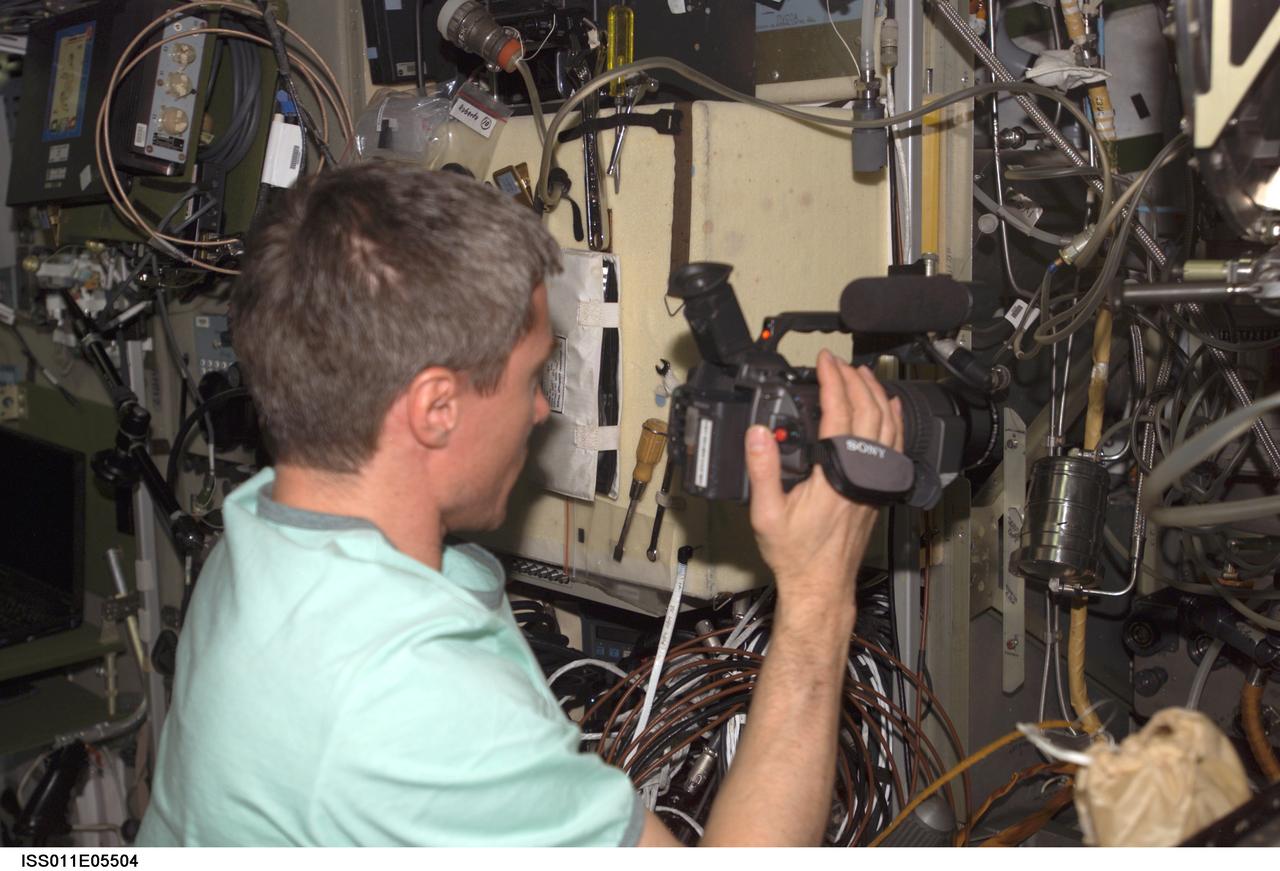
ISS011-E-05504 (5 May 2005) --- Cosmonaut Sergei K. Krikalev, Expedition 11 commander representing Russia's Federal Space Agency, uses a video camera to document repairs to the Elektron oxygen generator in the Zvezda Service Module of the International Space Station (ISS).
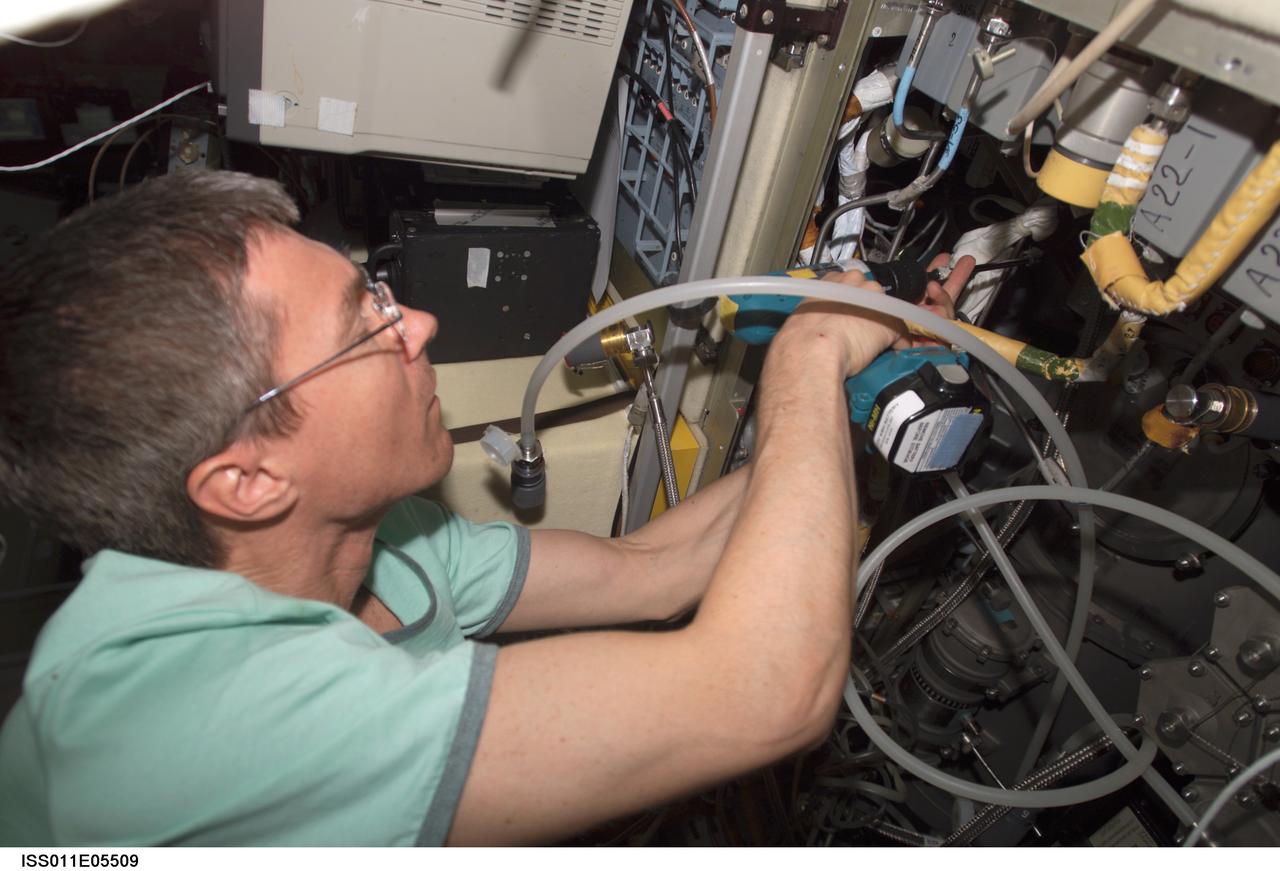
ISS011-E-05509 (5 May 2005) --- Cosmonaut Sergei K. Krikalev, Expedition 11 commander representing Russia's Federal Space Agency, uses a power tool as he makes repairs to the Elektron oxygen generator in the Zvezda Service Module of the International Space Station (ISS).
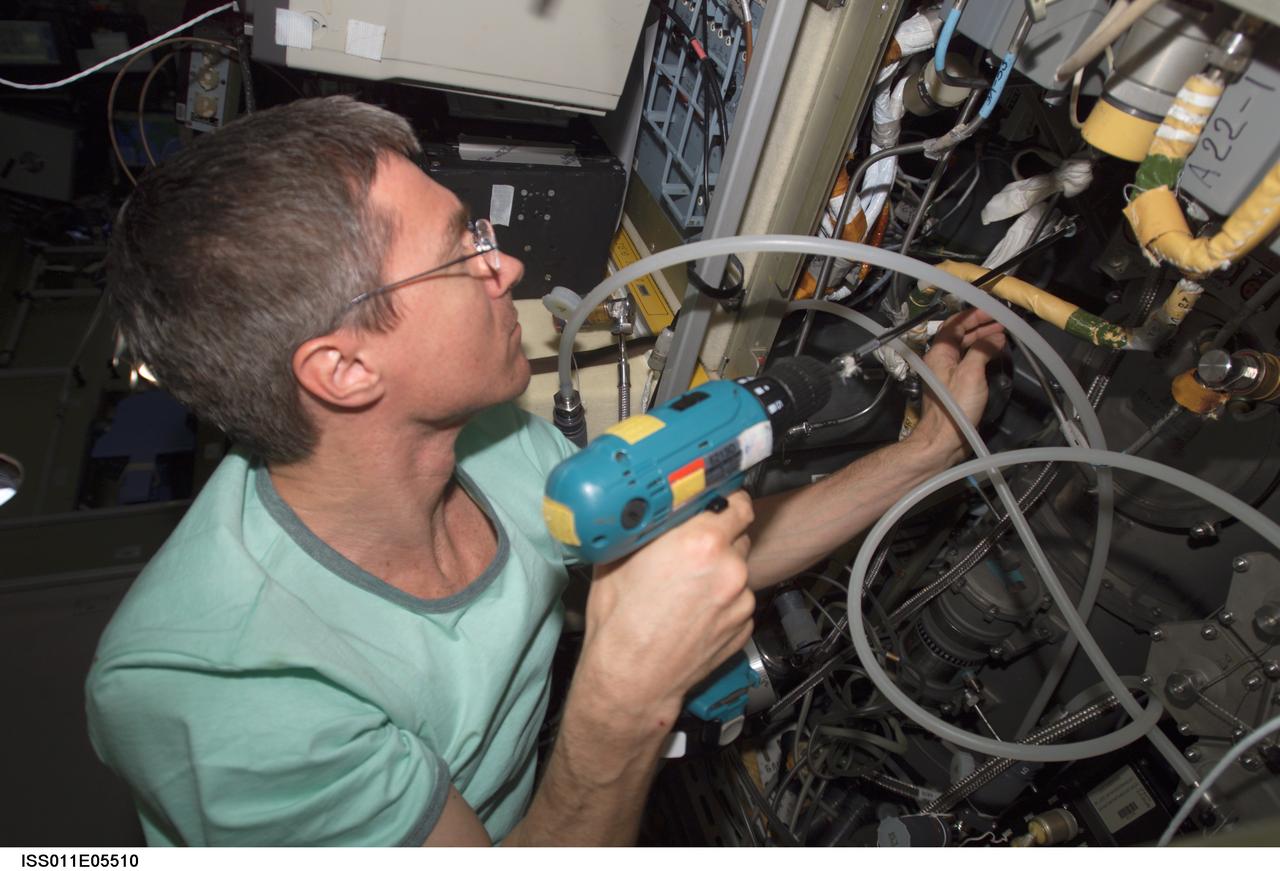
ISS011-E-05510 (5 May 2005) --- Cosmonaut Sergei K. Krikalev, Expedition 11 commander representing Russia's Federal Space Agency, uses a power tool as he makes repairs to the Elektron oxygen generator in the Zvezda Service Module of the International Space Station (ISS).
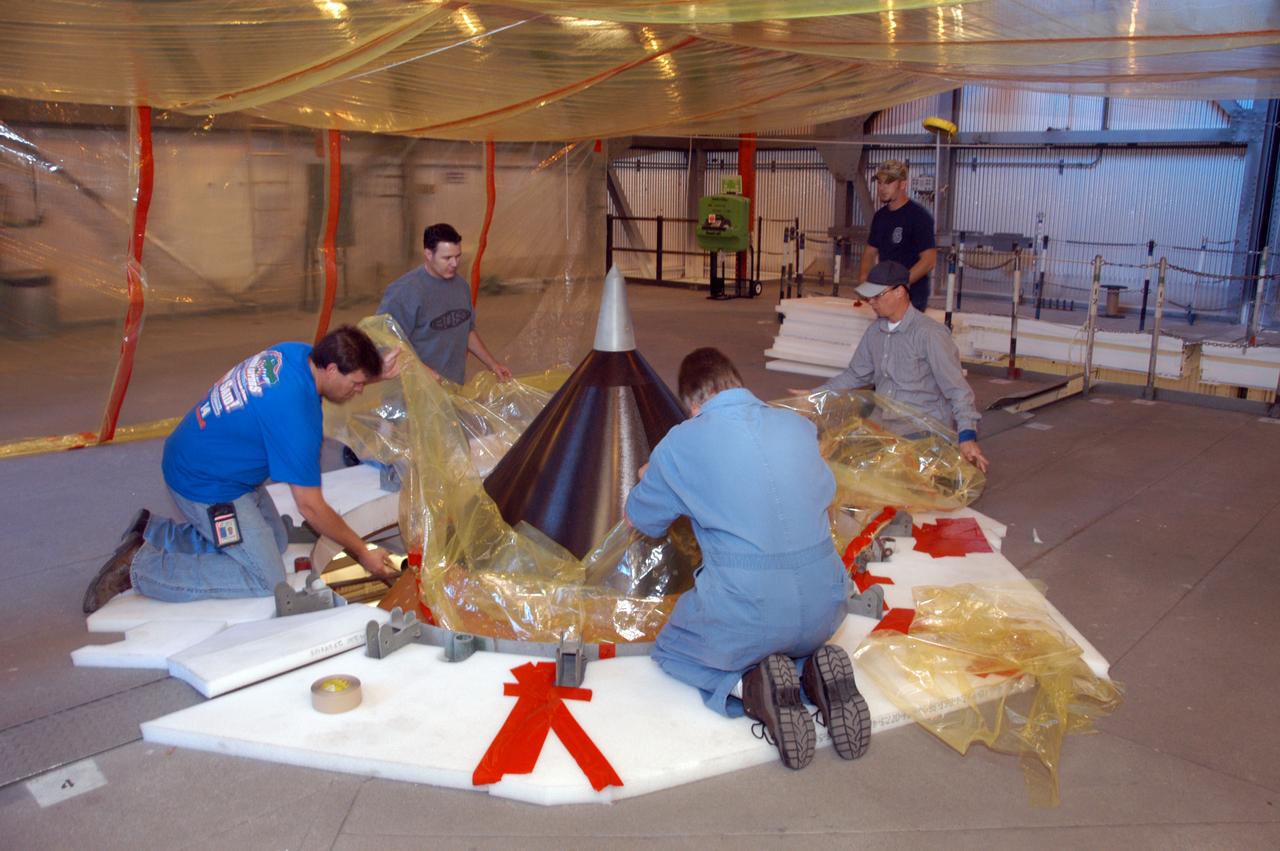
On an upper level of high bay 1 of the Vehicle Assembly Building, technicians place protective material around the nose cone of Atlantis' external tank. The nose cone will undergo repair for hail damage. A severe thunderstorm with golf ball-sized hail caused visible divots in the giant tank's foam insulation and minor surface damage to about 26 heat shield tiles on the shuttle's left wing. Further evaluation of the tank is necessary to get an accurate accounting of foam damage and determine the type of repair required and the time needed for that work. A new target launch date has not been determined, but teams will focus on preparing Atlantis for liftoff in late April on mission STS-117.
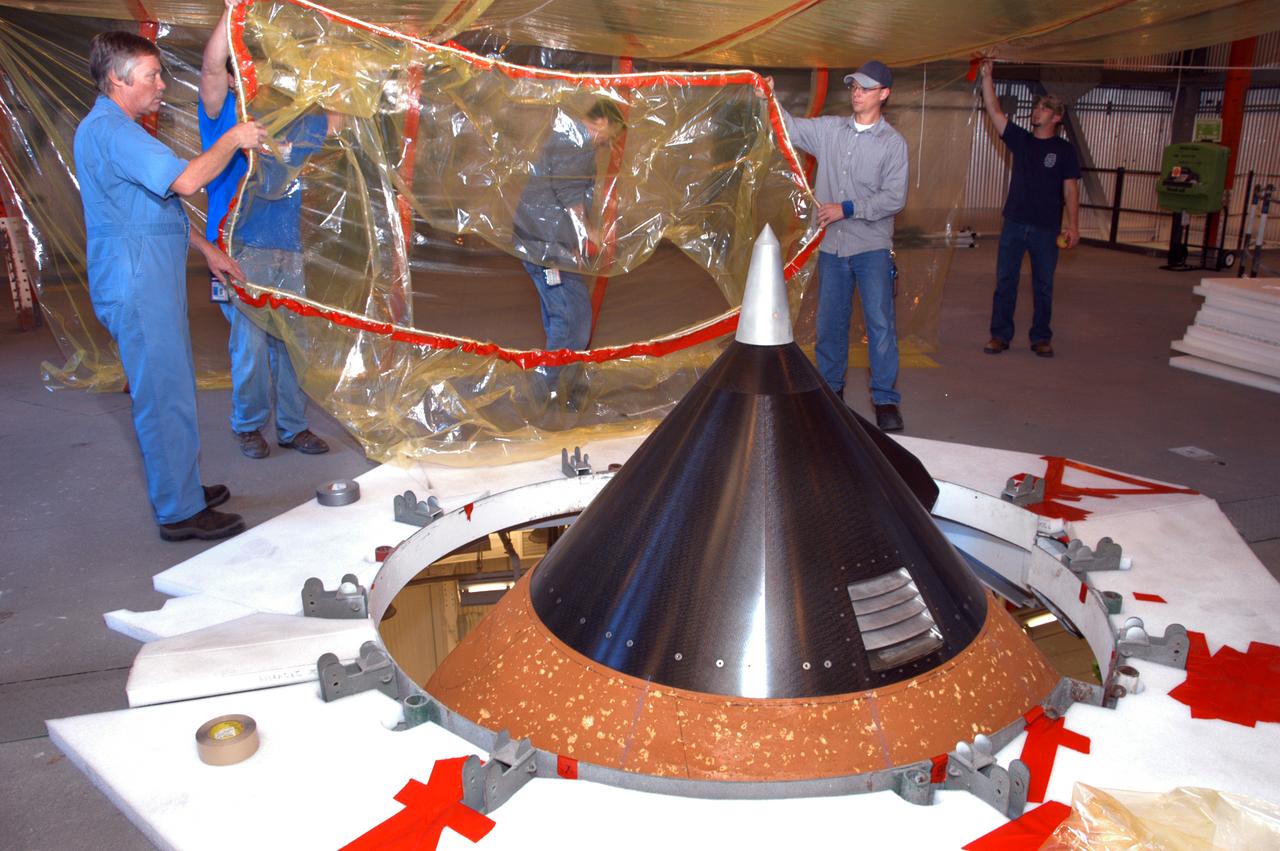
On an upper level of high bay 1 of the Vehicle Assembly Building, technicians move protective material toward the nose cone (foreground) of Atlantis' external tank. The nose cone will undergo repair for hail damage. A severe thunderstorm with golf ball-sized hail caused visible divots in the giant tank's foam insulation and minor surface damage to about 26 heat shield tiles on the shuttle's left wing. Further evaluation of the tank is necessary to get an accurate accounting of foam damage and determine the type of repair required and the time needed for that work. A new target launch date has not been determined, but teams will focus on preparing Atlantis for liftoff in late April on mission STS-117.
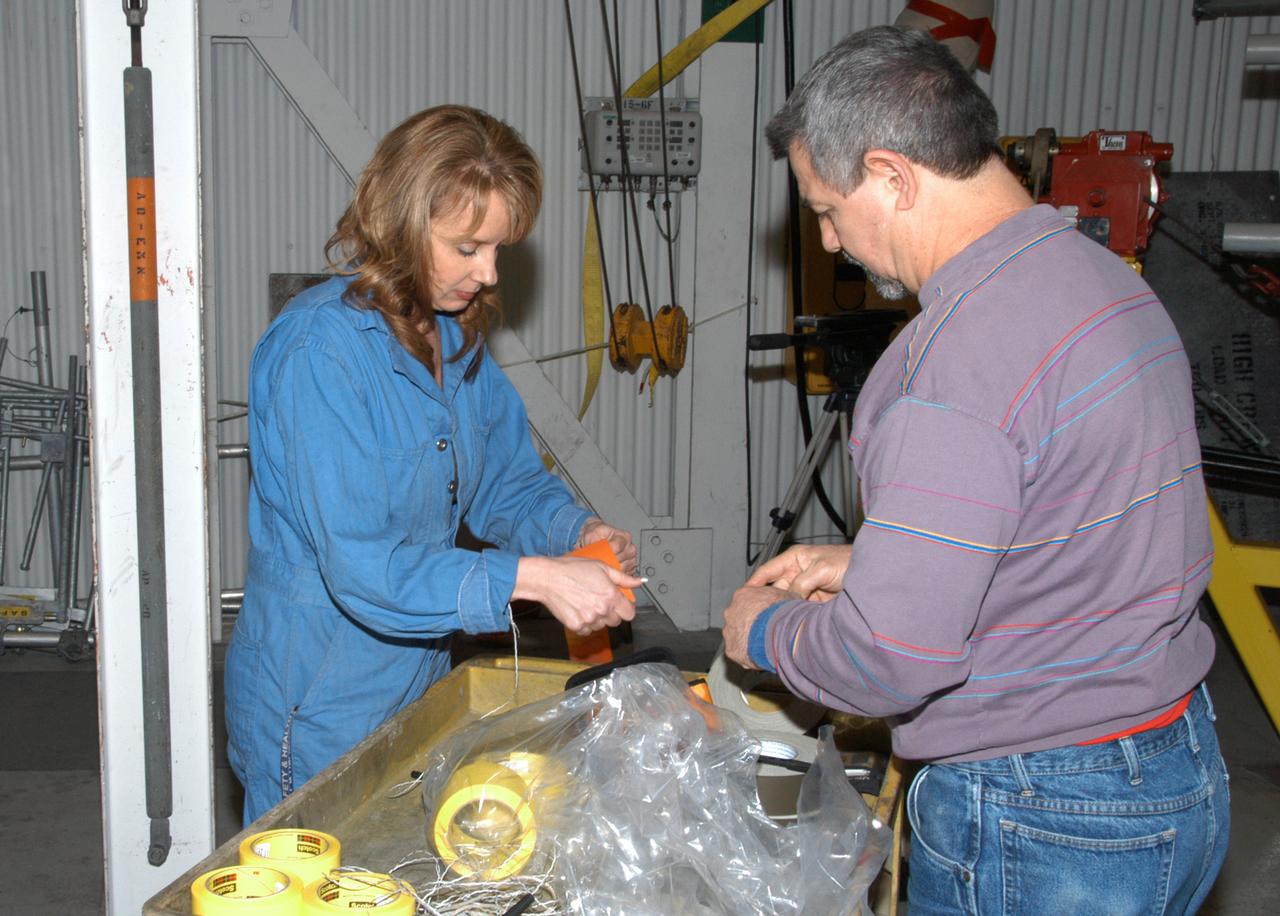
Technicians in the Vehicle Assembly Building prepare materials that will be used during repair of the nose cone on Atlantis' external tank. A severe thunderstorm with golf ball-sized hail caused visible divots in the giant tank's foam insulation and minor surface damage to about 26 heat shield tiles on the shuttle's left wing. Further evaluation of the tank is necessary to get an accurate accounting of foam damage and determine the type of repair required and the time needed for that work. A new target launch date has not been determined, but teams will focus on preparing Atlantis for liftoff in late April on mission STS-117.
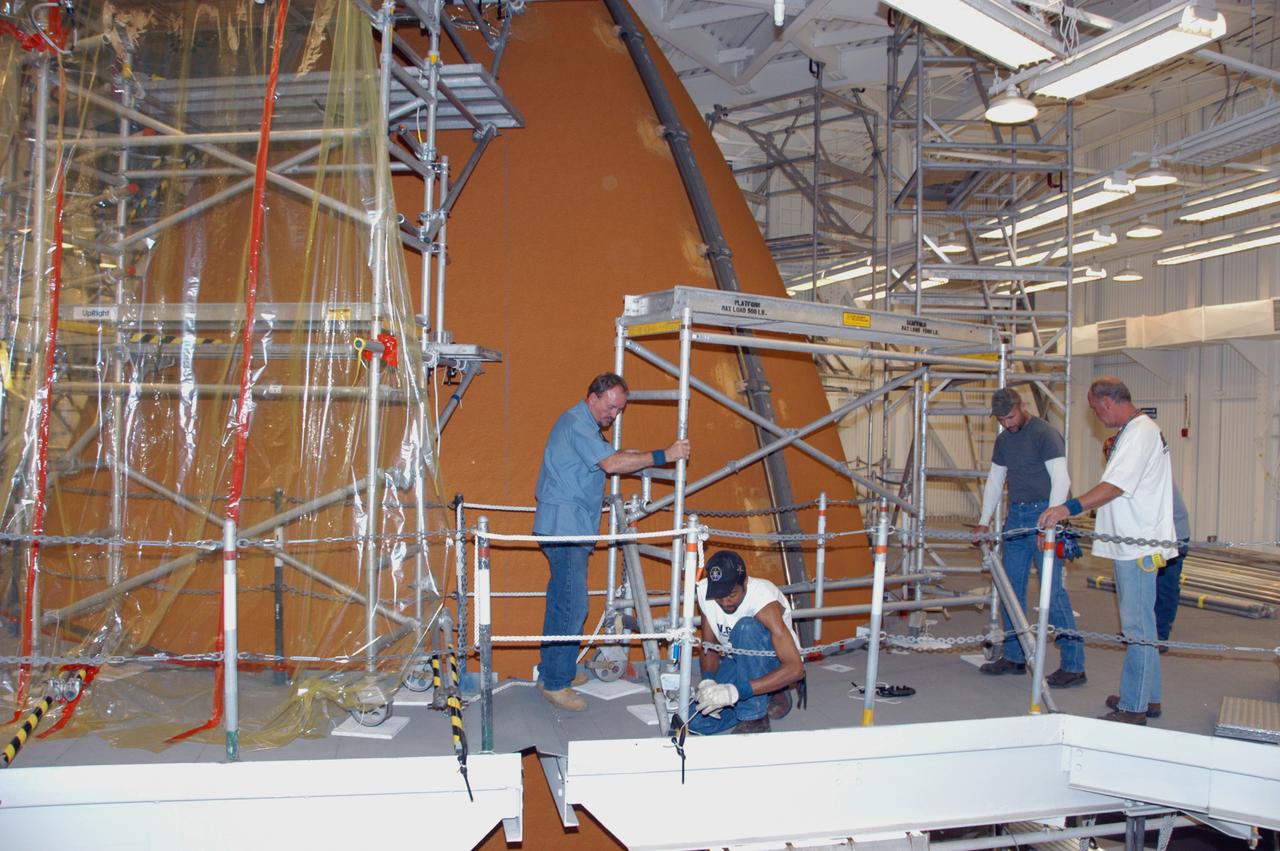
On an upper level of high bay 1 of the Vehicle Assembly Building, technicians secure protective material around Atlantis' external tank. The preparations are for future repair work of the hail damage that happened Feb. 27. A severe thunderstorm with golf ball-sized hail caused visible divots in the giant tank's foam insulation and minor surface damage to about 26 heat shield tiles on the shuttle's left wing. Further evaluation of the tank is necessary to get an accurate accounting of foam damage and determine the type of repair required and the time needed for that work. A new target launch date has not been determined, but teams will focus on preparing Atlantis for liftoff in late April on mission STS-117.

On an upper level of high bay 1 of the Vehicle Assembly Building, technicians secure protective material around the base of the nose cone of Atlantis' external tank. The nose cone will undergo repair for hail damage. A severe thunderstorm with golf ball-sized hail caused visible divots in the giant tank's foam insulation and minor surface damage to about 26 heat shield tiles on the shuttle's left wing. Further evaluation of the tank is necessary to get an accurate accounting of foam damage and determine the type of repair required and the time needed for that work. A new target launch date has not been determined, but teams will focus on preparing Atlantis for liftoff in late April on mission STS-117.
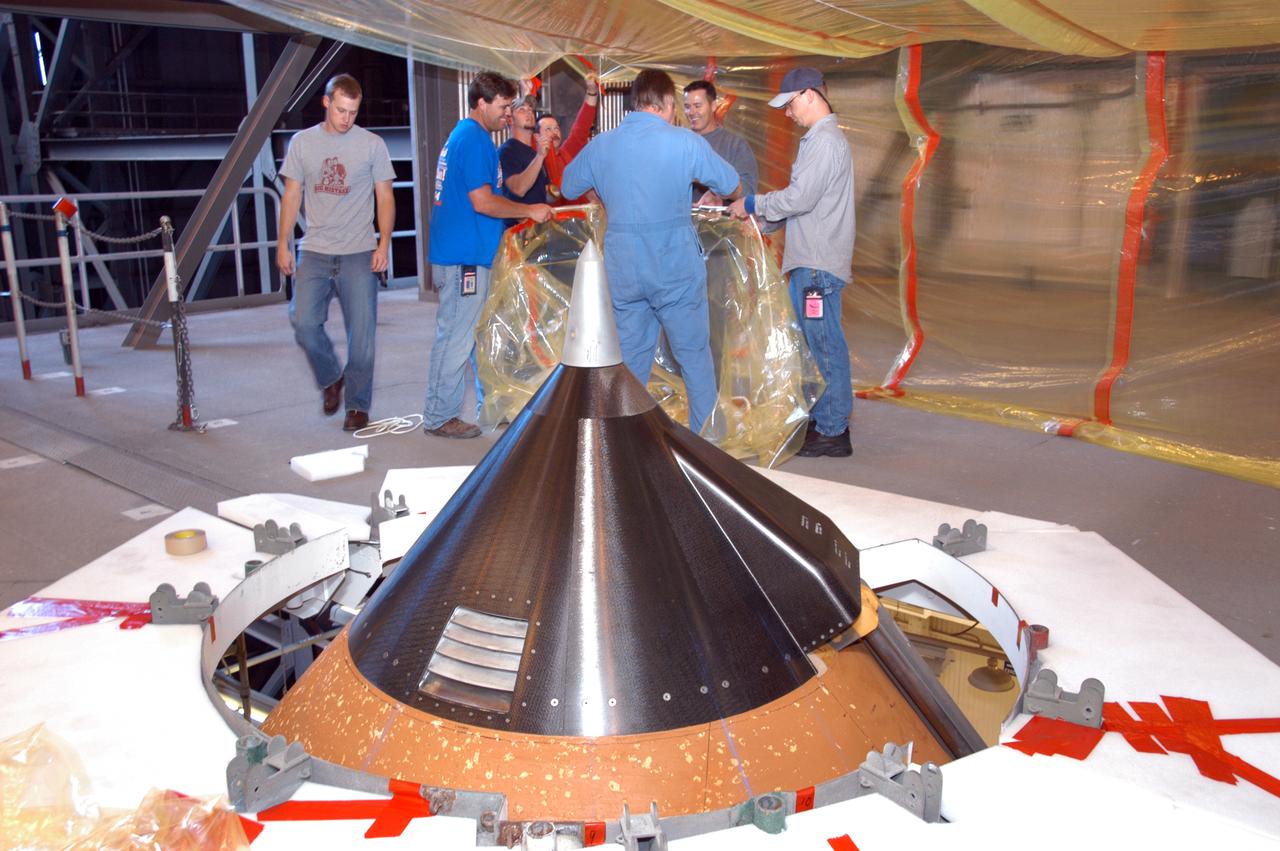
On an upper level of high bay 1 of the Vehicle Assembly Building, technicians prepare the area around the nose cone (foreground) of Atlantis' external tank that will undergo repair for hail damage. A severe thunderstorm with golf ball-sized hail caused visible divots in the giant tank's foam insulation and minor surface damage to about 26 heat shield tiles on the shuttle's left wing. Further evaluation of the tank is necessary to get an accurate accounting of foam damage and determine the type of repair required and the time needed for that work. A new target launch date has not been determined, but teams will focus on preparing Atlantis for liftoff in late April on mission STS-117.
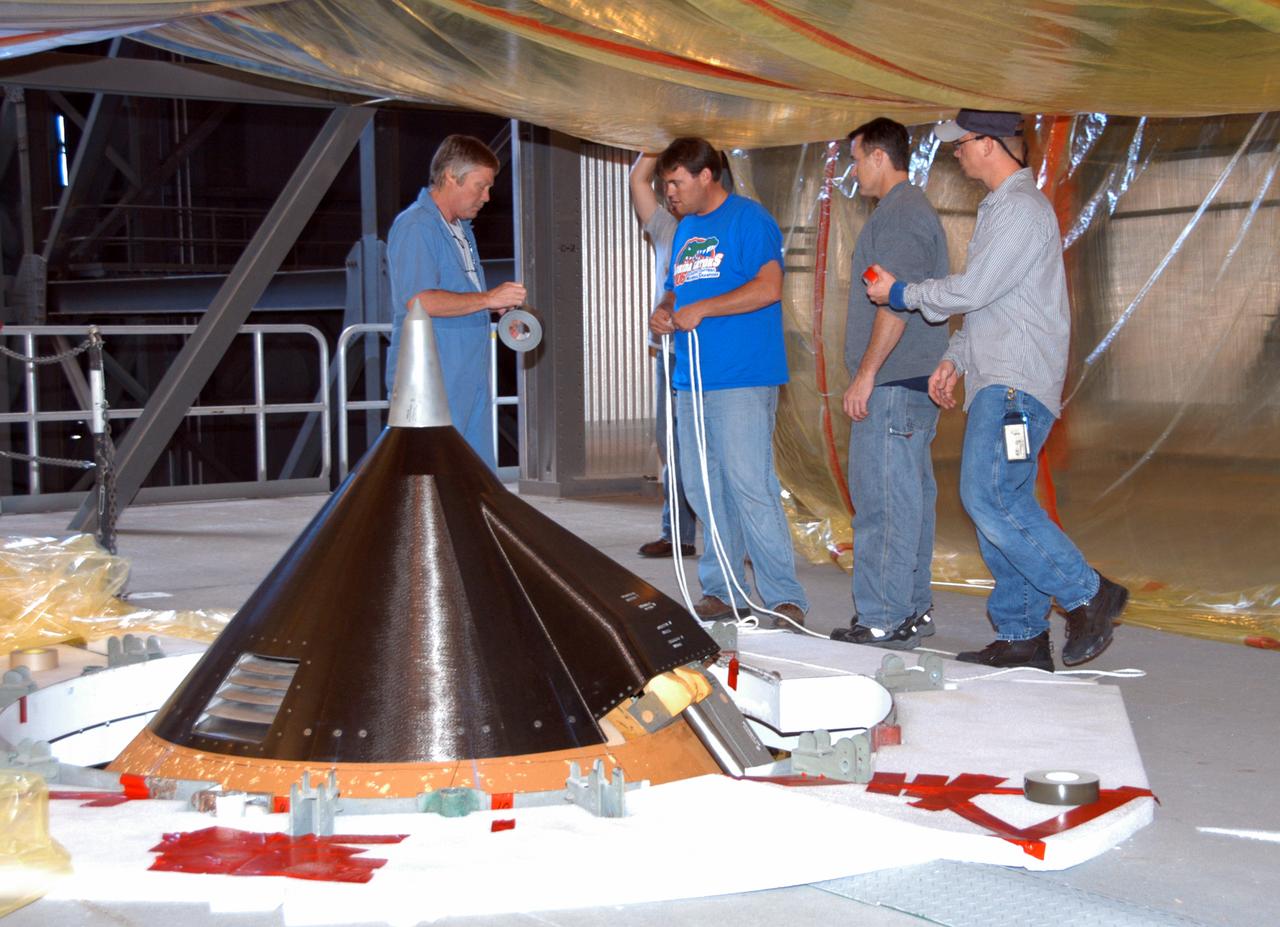
On an upper level of high bay 1 of the Vehicle Assembly Building, technicians prepare the area around the nose cone (left) of Atlantis' external tank that will undergo repair for hail damage. A severe thunderstorm with golf ball-sized hail caused visible divots in the giant tank's foam insulation and minor surface damage to about 26 heat shield tiles on the shuttle's left wing. Further evaluation of the tank is necessary to get an accurate accounting of foam damage and determine the type of repair required and the time needed for that work. A new target launch date has not been determined, but teams will focus on preparing Atlantis for liftoff in late April on mission STS-117.
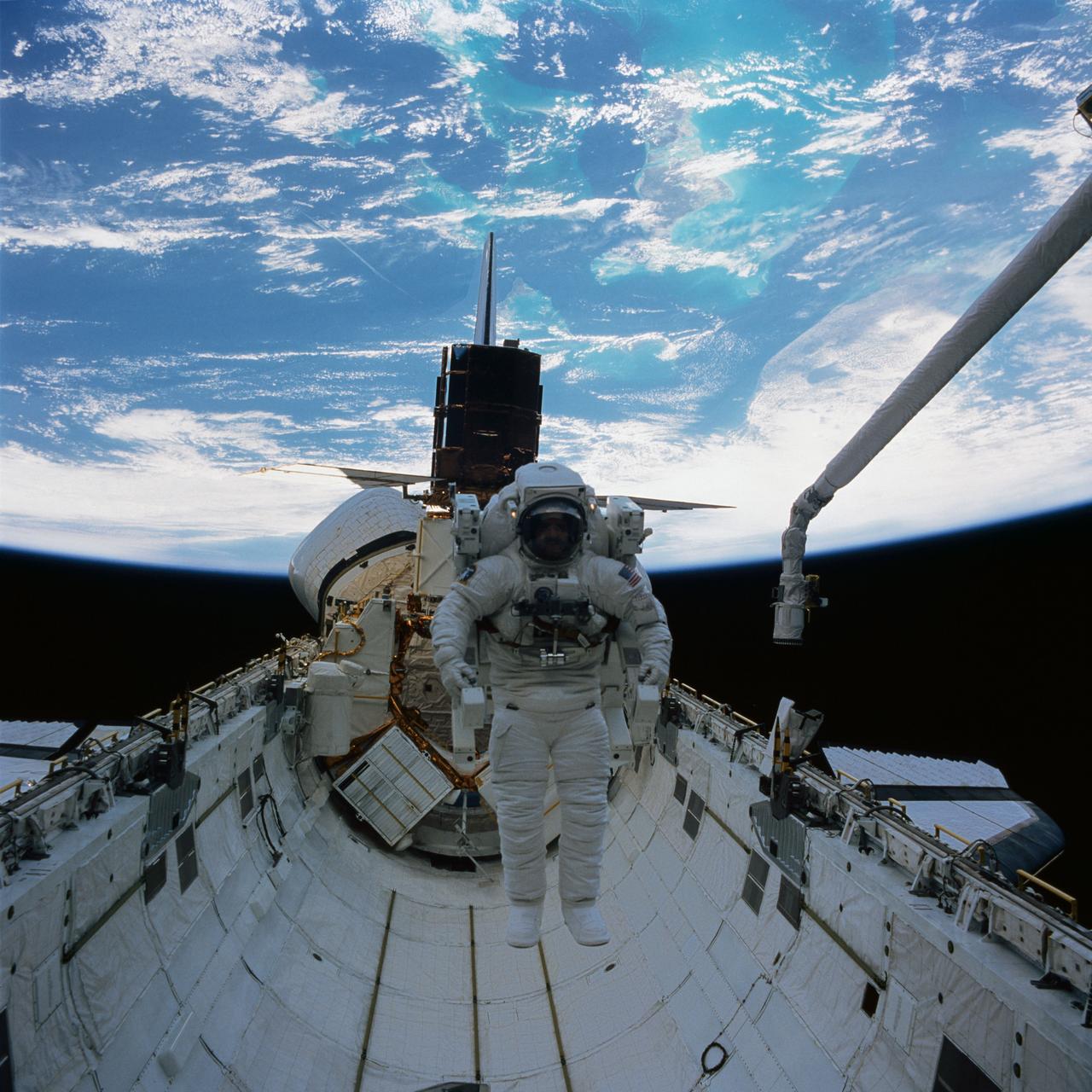
41C-37-1718 (11 April 1984) --- Astronaut James D. van Hoften and a repaired satellite are captured by a Hasselblad camera aimed through Challenger's aft cabin windows toward the cargo bay of the Earth orbiting Challenger. Dr. van Hoften is getting in his first "field" test of the manned maneuvering unit (MMU) after months of training in an underwater facility and in a simulator on Earth. The Solar Maximum Mission Satellite (SMMS), revived and almost ready for release into space once more, is docked at the flight support system (FSS).
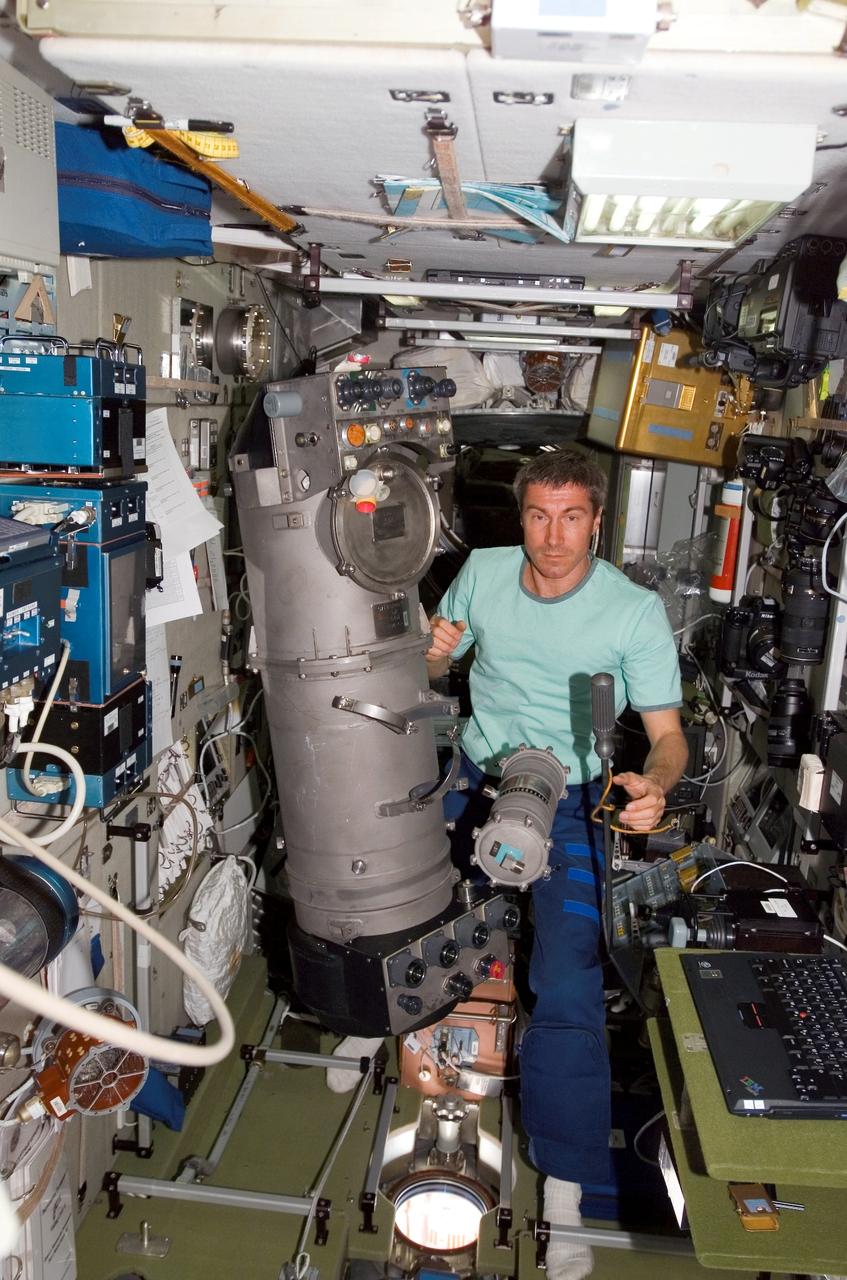
ISS011-E-05513 (5 May 2005) --- Cosmonaut Sergei K. Krikalev, Expedition 11 commander representing Russia's Federal Space Agency, poses beside the disconnected Liquid Unit #5 (BZh-5) and the O2 end-filter (BD, secondary purification unit) from the BZh5 he removed while making repairs to the Elektron oxygen generator in the Zvezda Service Module of the international space station.
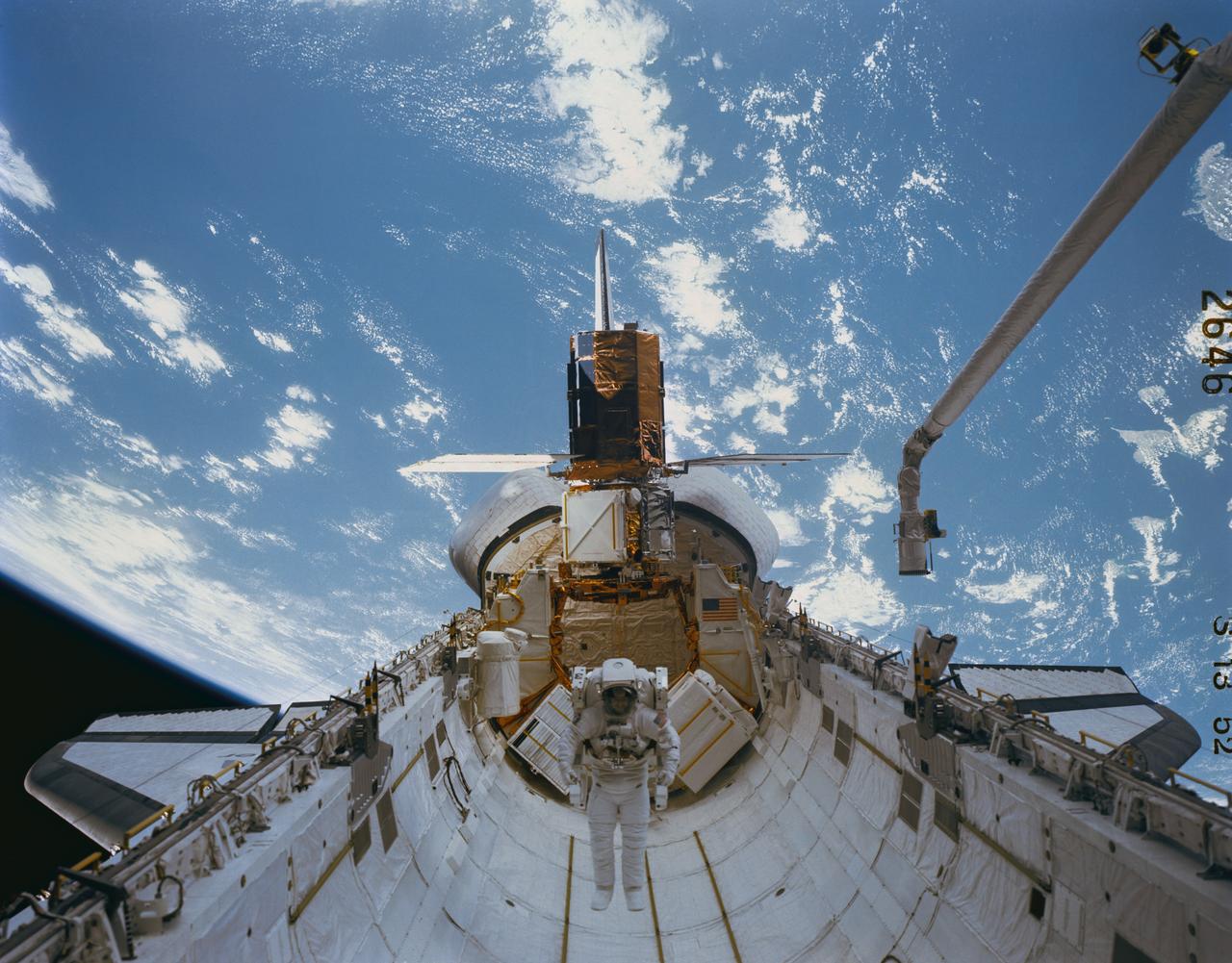
41C-52-2646 (11 April 1984) --- Astronaut James D. van Hoften and a repaired satellite are in a wide panorama recorded on film with a Linhof camera, making its initial flight aboard the Space Shuttle Challenger. Dr. van Hoften is getting in his first "field" test of the Manned Maneuvering Unit (MMU) after months of training in an underwater facility and in a simulator on Earth. The Solar Maximum Mission Satellite (SMMS), revived and almost ready for release into space once more, is docked at the Flight Support System (FSS). The Remote Manipulator System (RMS) is backdropped against the blue and white Earth at frame's edge. Outside of pictures made of the Earth from astronauts on the way to the Moon, this frame showing the planet from 285 nautical miles represents the highest orbital photography in the manned space program.
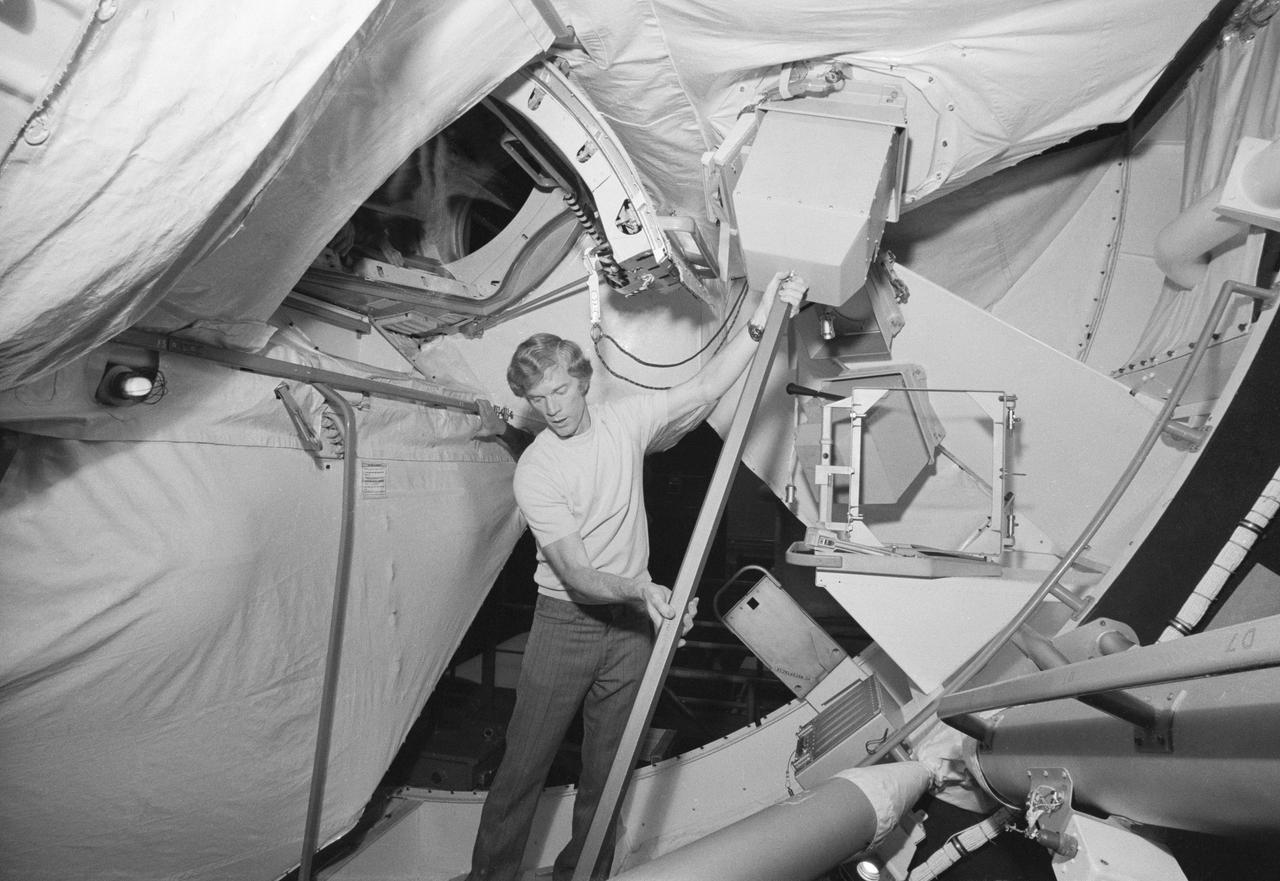
S73-25884 (1973) --- Astronaut Russell Schweickart in Orbital Workshop Simulator (OWS) working out procedure to be used for repair of damaged thermal protection cover on Skylab 2 spacecraft. Photo credit: NASA
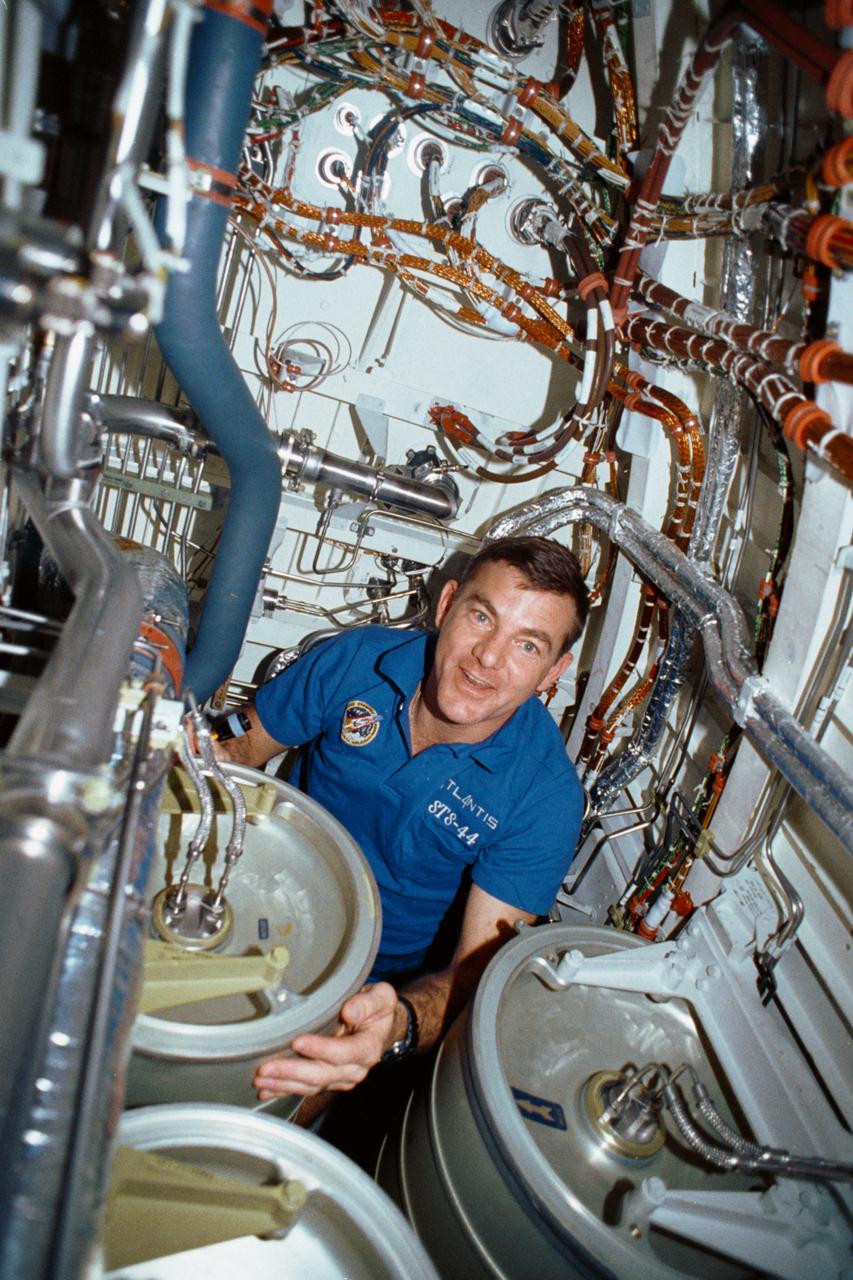
STS-44 Mission Specialist (MS) James S. Voss works under the middeck subfloor of Atlantis, Orbiter Vehicle (OV) 104, to repair humidity separator leakage problems. Voss is surrounded by several water tanks and a maze of shuttle wiring and plumbing. Voss earned the nickname of "Bilge Man" because of his time spent on the lower deck tending to the leakage problem. This is the first photo released of a crewmember in this area of the shuttle.
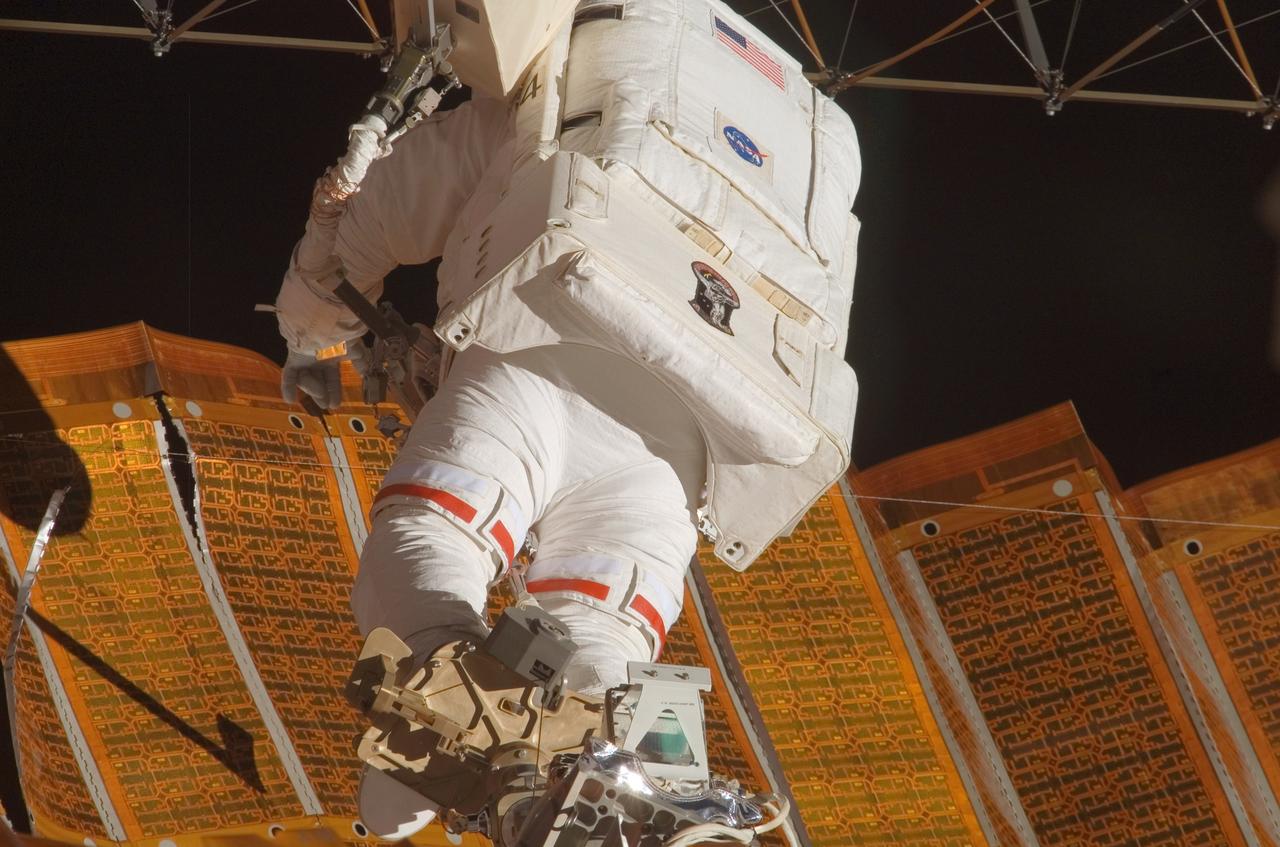
While anchored to a foot restraint on the end of the Orbiter Boom Sensor System (OBSS), astronaut Scott Parazynski, STS-120 mission specialist, participated in the mission's fourth session of extravehicular activity (EVA) while Space Shuttle Discovery was docked with the International Space Station (ISS). During the 7-hour and 19-minute space walk, Parazynski cut a snagged wire and installed homemade stabilizers designed to strengthen the structure and stability of the damaged P6 4B solar array wing. Astronaut Doug Wheelock (out of frame), mission specialist, assisted from the truss by keeping an eye on the distance between Parazynski and the array. Once the repair was complete, flight controllers on the ground successfully completed the deployment of the array.
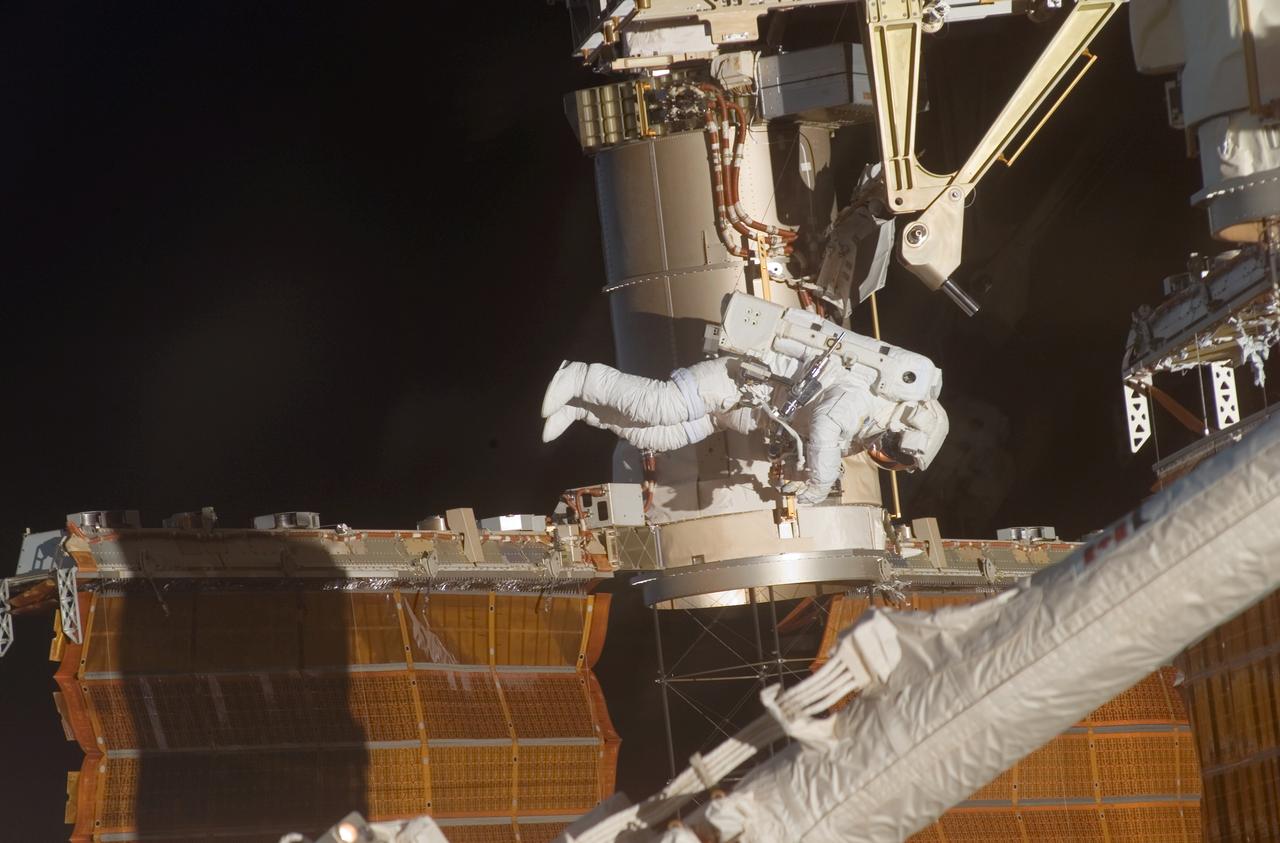
Astronaut Doug Wheelock, STS-120 mission specialist, participated in the mission's fourth session of extravehicular activity (EVA) while Space Shuttle Discovery was docked with the International Space Station (ISS). During the 7-hour and 19-minute space walk, astronaut Scott Parazynski (out of frame), mission specialist, cut a snagged wire and installed homemade stabilizers designed to strengthen the structure and stability of the damaged P6 4B solar array wing. Wheelock assisted from the truss by keeping an eye on the distance between Parazynski and the array. Once the repair was complete, flight controllers on the ground successfully completed the deployment of the array.
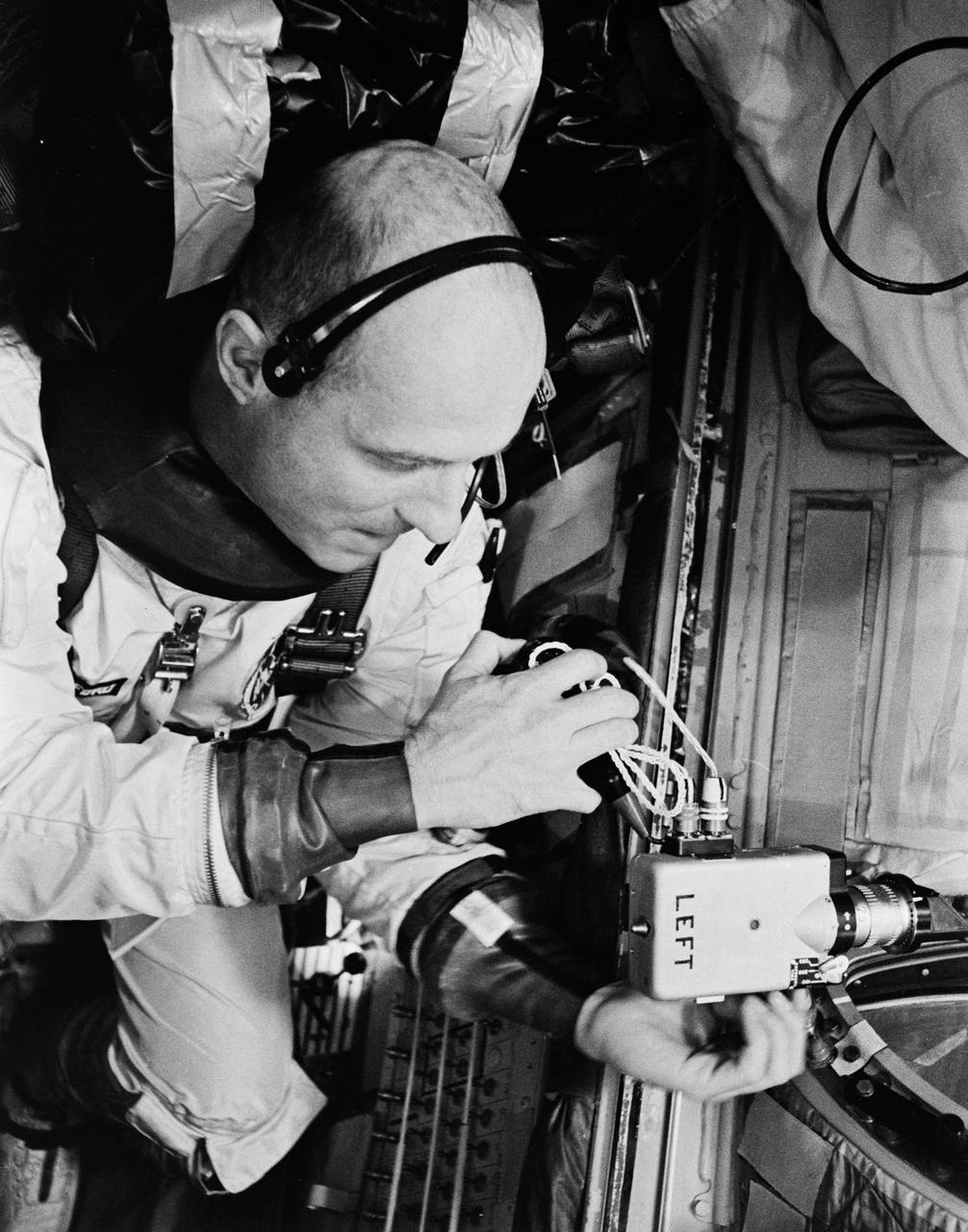
S66-33728 (10 May 1966) --- Astronaut Thomas P. Stafford, command pilot of the Gemini-9 spaceflight, checks the 16mm Mauer camera which will be used in space. The camera will record and document the exterior of the spacecraft and the Agena target vehicle in the docked configuration during the Gemini-9/Agena rendezvous and docking mission. Photo credit: NASA
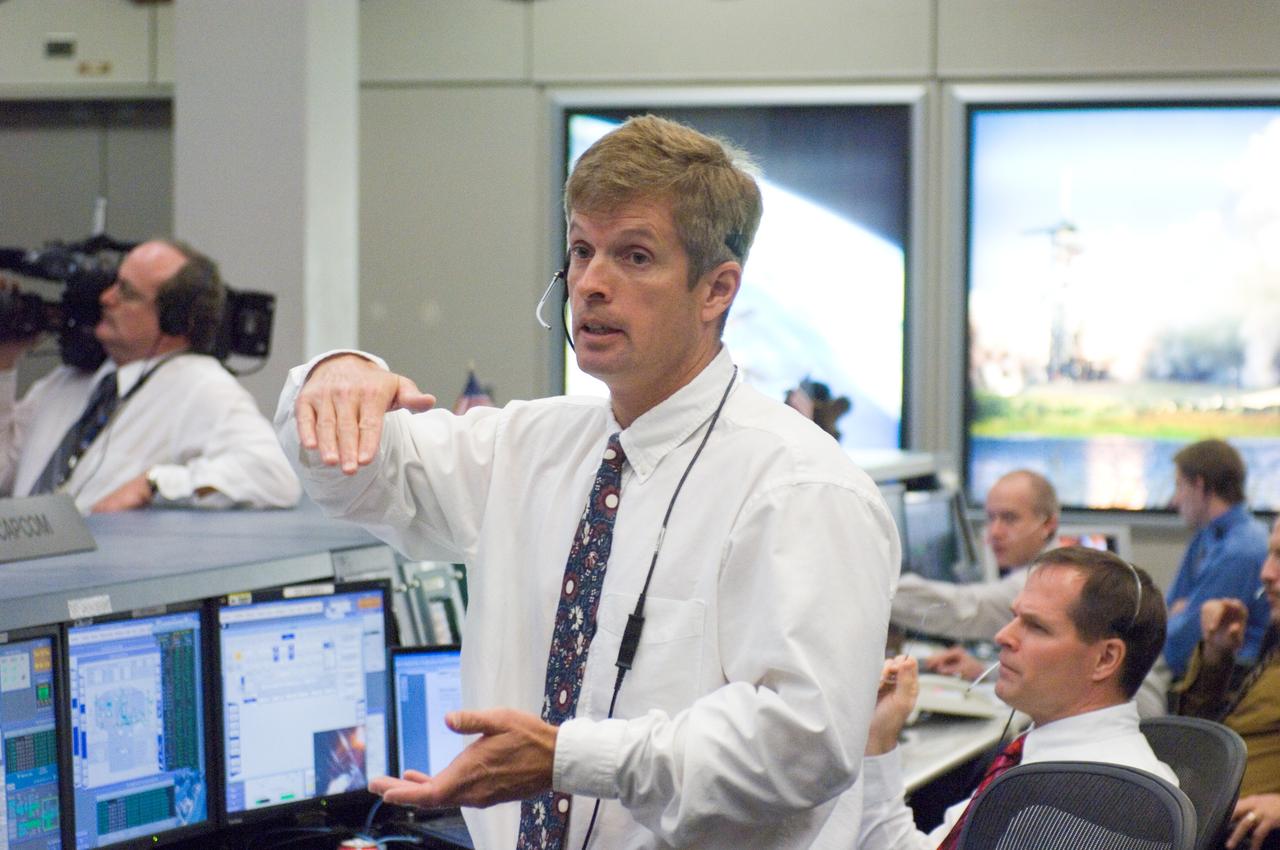
JSC2007-E-095996 (3 Nov. 2007) ---Astronaut Steve Swanson, standing near the spacecraft communicator (CAPCOM) console in the space station control room of JSC's Mission Control Center, communicates with astronauts in space during the Nov. 3 spacewalk planned to repair a tear in a solar panel on the International Space Station.
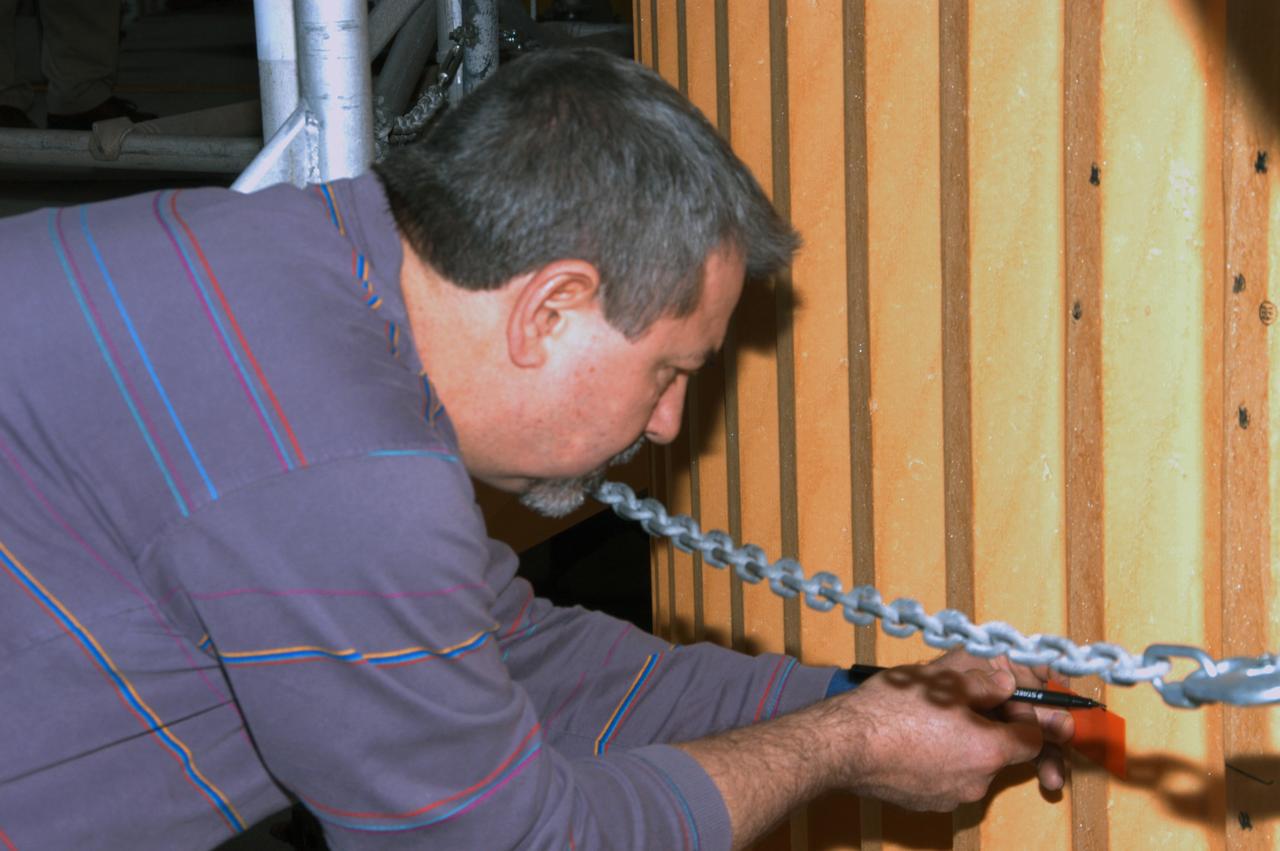
In high bay 1 of the Vehicle Assembly Building, a technician marks off an area for inspection on Atlantis' external tank. A severe thunderstorm with golf ball-sized hail caused visible divots in the giant tank's foam insulation and minor surface damage to about 26 heat shield tiles on the shuttle's left wing. Further evaluation of the tank is necessary to get an accurate accounting of foam damage and determine the type of repair required and the time needed for that work. A new target launch date has not been determined, but teams will focus on preparing Atlantis for liftoff in late April on mission STS-117.
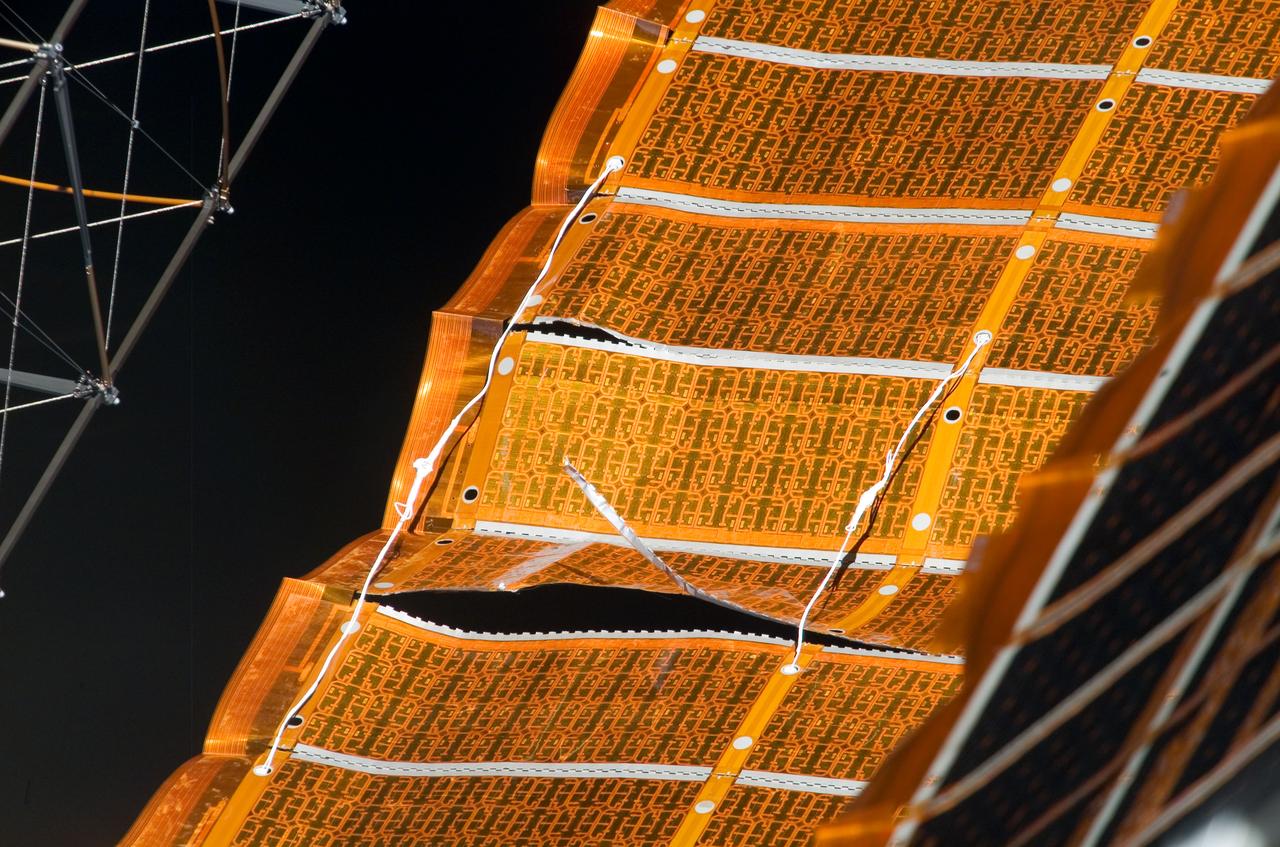
ISS016-E-008875 (3 Nov. 2007) --- View of the repaired solar array photographed during the STS-120 mission's fourth session of extravehicular activity (EVA) while Space Shuttle Discovery is docked with the International Space Station.
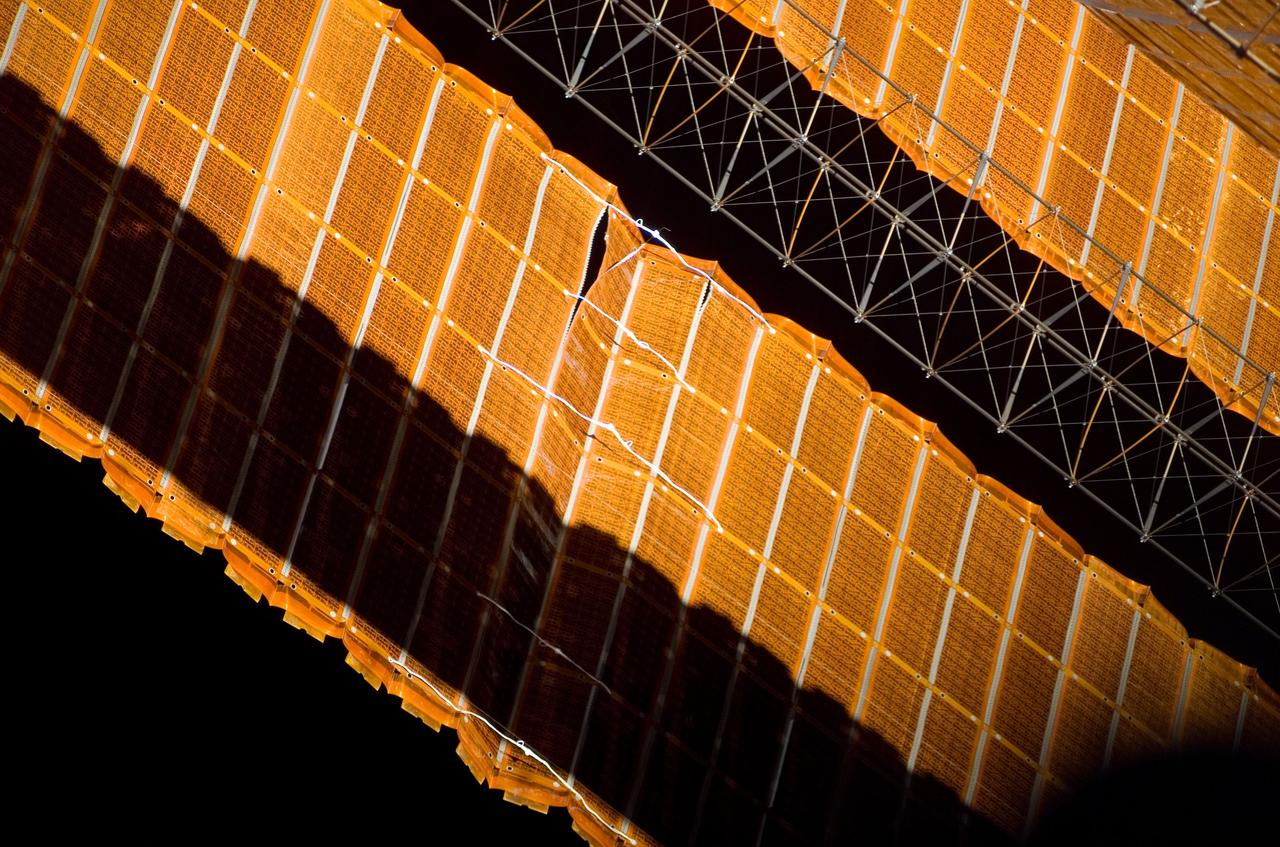
ISS016-E-009201 (3 Nov. 2007) --- View of the repaired solar array photographed during the STS-120 mission's fourth session of extravehicular activity (EVA) while Space Shuttle Discovery is docked with the International Space Station.
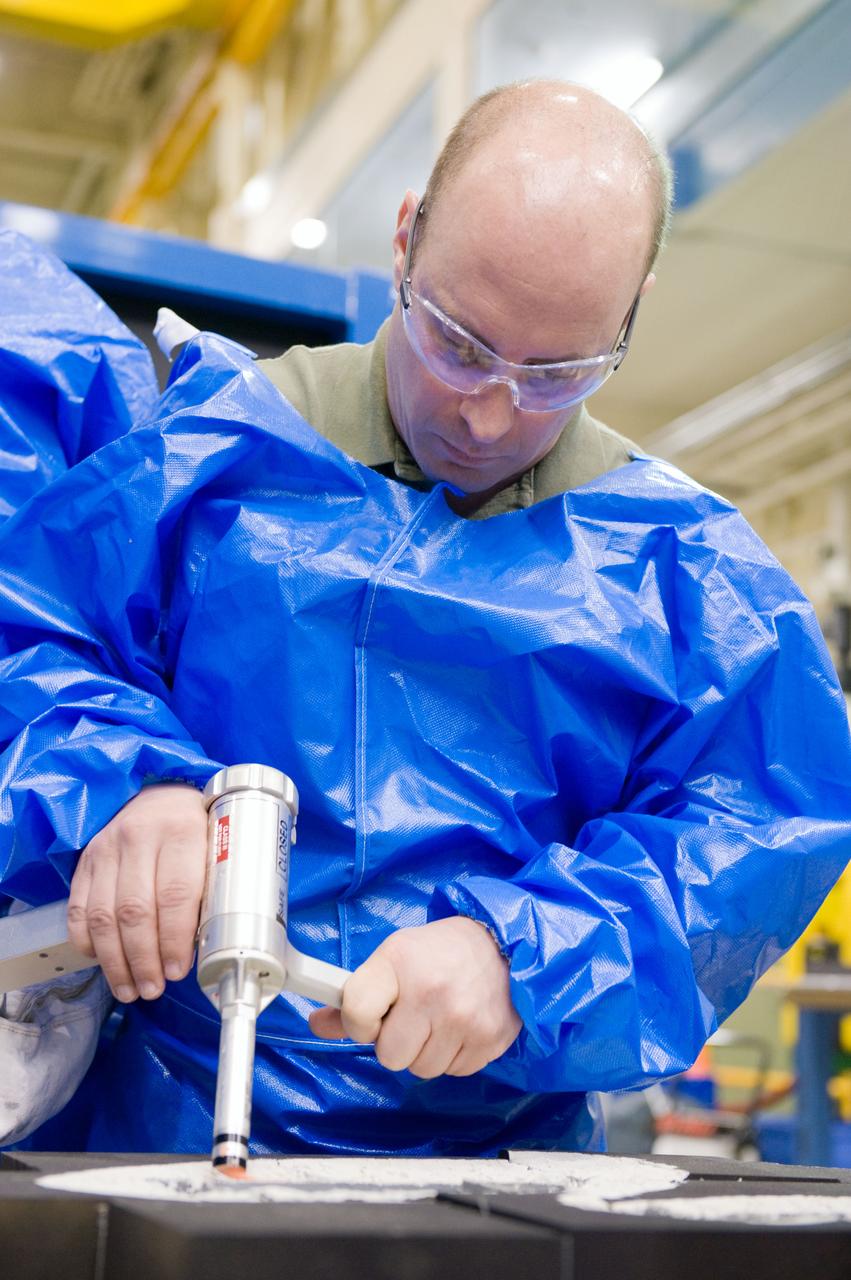
JSC2010-E-046474 (2 April 2010) --- NASA astronaut Garrett Reisman, STS-132 mission specialist, participates in an EVA tile repair training session in the Space Vehicle Mockup Facility at NASA's Johnson Space Center.
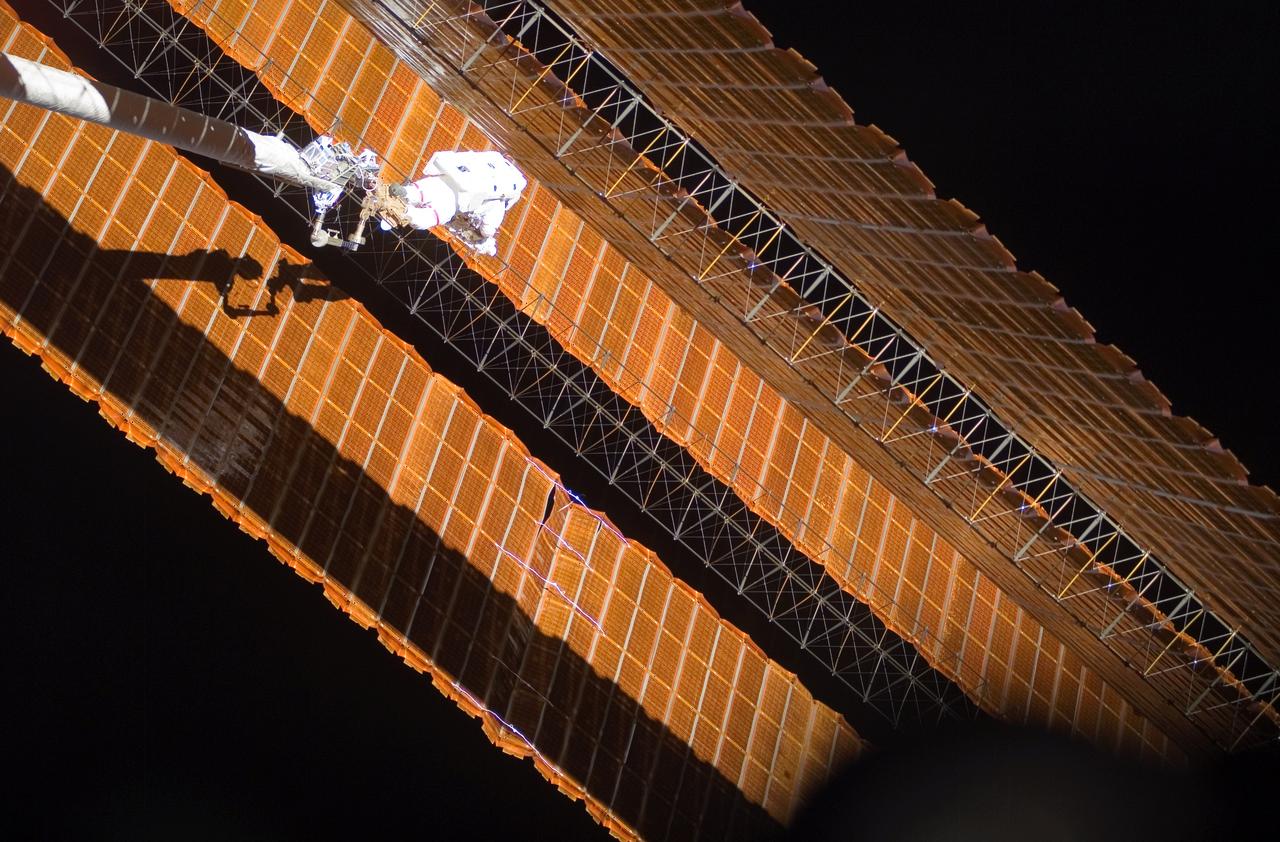
While anchored to a foot restraint on the end of the Orbiter Boom Sensor System (OBSS), astronaut Scott Parazynski, STS-120 mission specialist, participated in the mission's fourth session of extravehicular activity (EVA) while Space Shuttle Discovery was docked with the International Space Station (ISS). During the 7-hour and 19-minute space walk, Parazynski cut a snagged wire and installed homemade stabilizers designed to strengthen the structure and stability of the damaged P6 4B solar array wing. Astronaut Doug Wheelock (out of frame), mission specialist, assisted from the truss by keeping an eye on the distance between Parazynski and the array. Once the repair was complete, flight controllers on the ground successfully completed the deployment of the array.
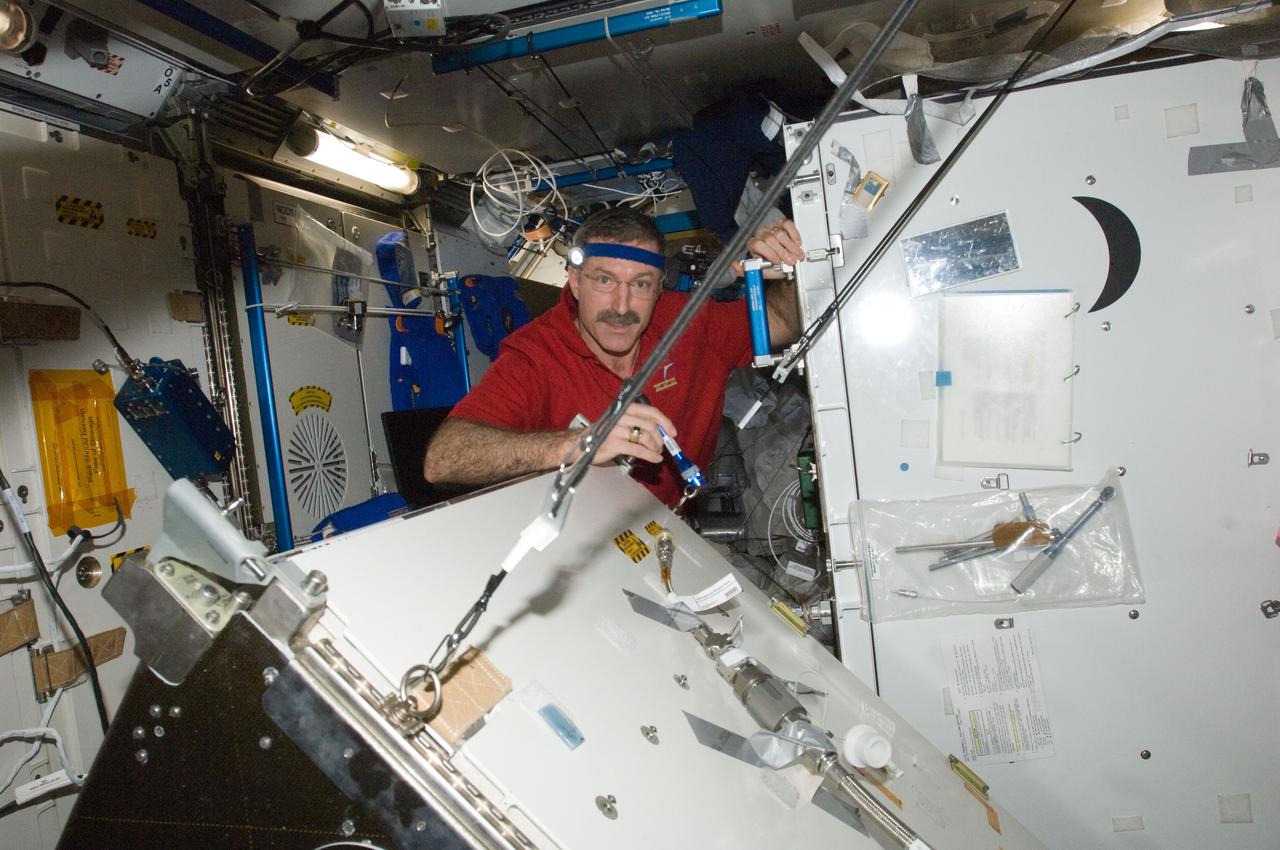
ISS030-E-128752 (8 March 2012) --- NASA astronaut Dan Burbank, Expedition 30 commander, performs part one of the Water Recovery System-1 (WRS-1) repair in the Tranquility node of the International Space Station. Burbank removed and replaced the failed Catalytic Reactor (CR), and installed a temporary filter kit between the new CR and the Microbial Check Valve (MCV) to support a system flush of the new Orbital Replacement Unit (ORU).
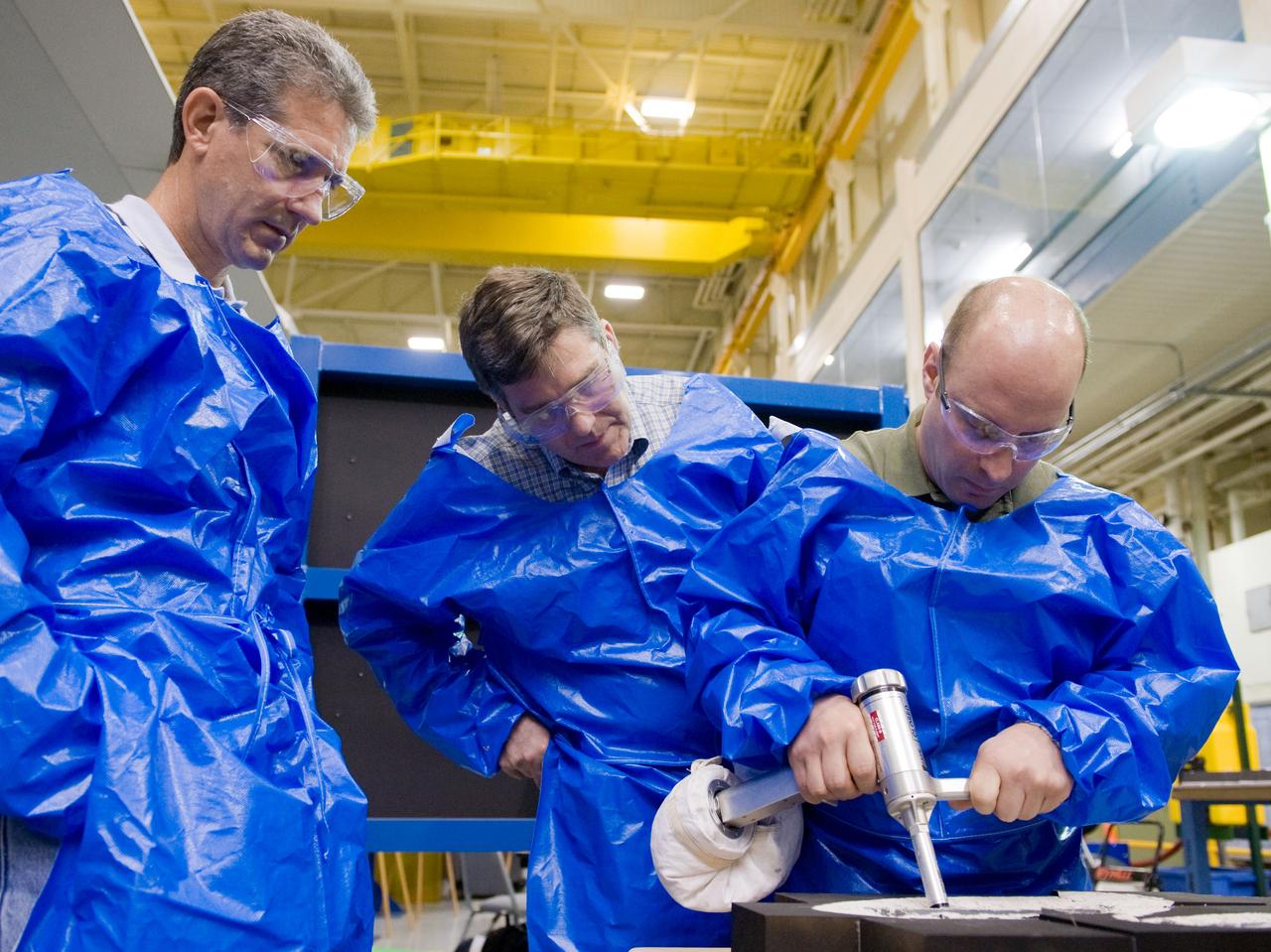
JSC2010-E-046472 (2 April 2010) --- NASA astronauts Garrett Reisman (right), Steve Bowen (center) and Michael Good, all STS-132 mission specialists, participate in an EVA tile repair training session in the Space Vehicle Mockup Facility at NASA's Johnson Space Center.
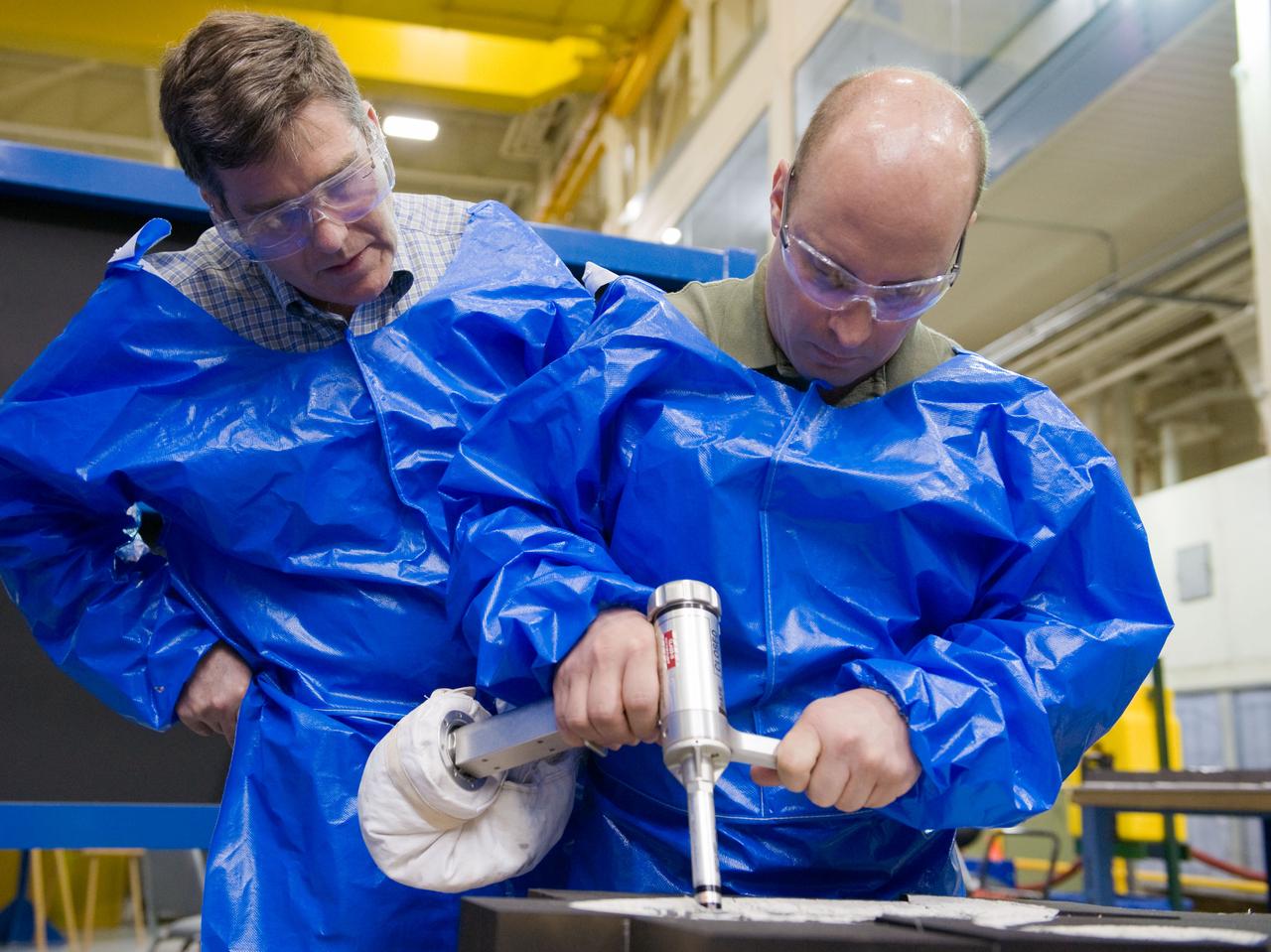
JSC2010-E-046473 (2 April 2010) --- NASA astronauts Garrett Reisman (right) and Steve Bowen, both STS-132 mission specialists, participate in an EVA tile repair training session in the Space Vehicle Mockup Facility at NASA's Johnson Space Center.
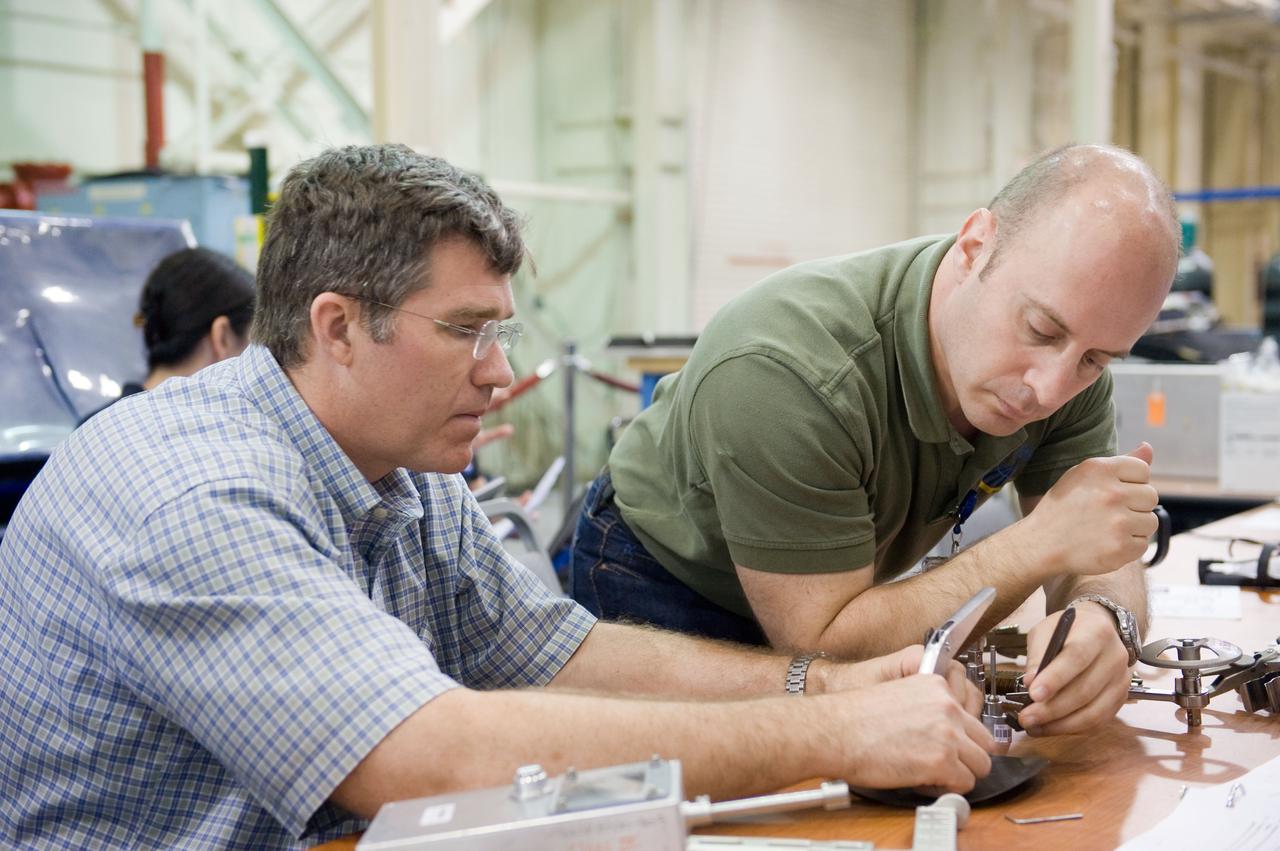
JSC2010-E-046476 (2 April 2010) --- NASA astronauts Garrett Reisman (left) and Michael Good, both STS-132 mission specialists, participate in an EVA tile repair training session in the Space Vehicle Mockup Facility at NASA's Johnson Space Center.
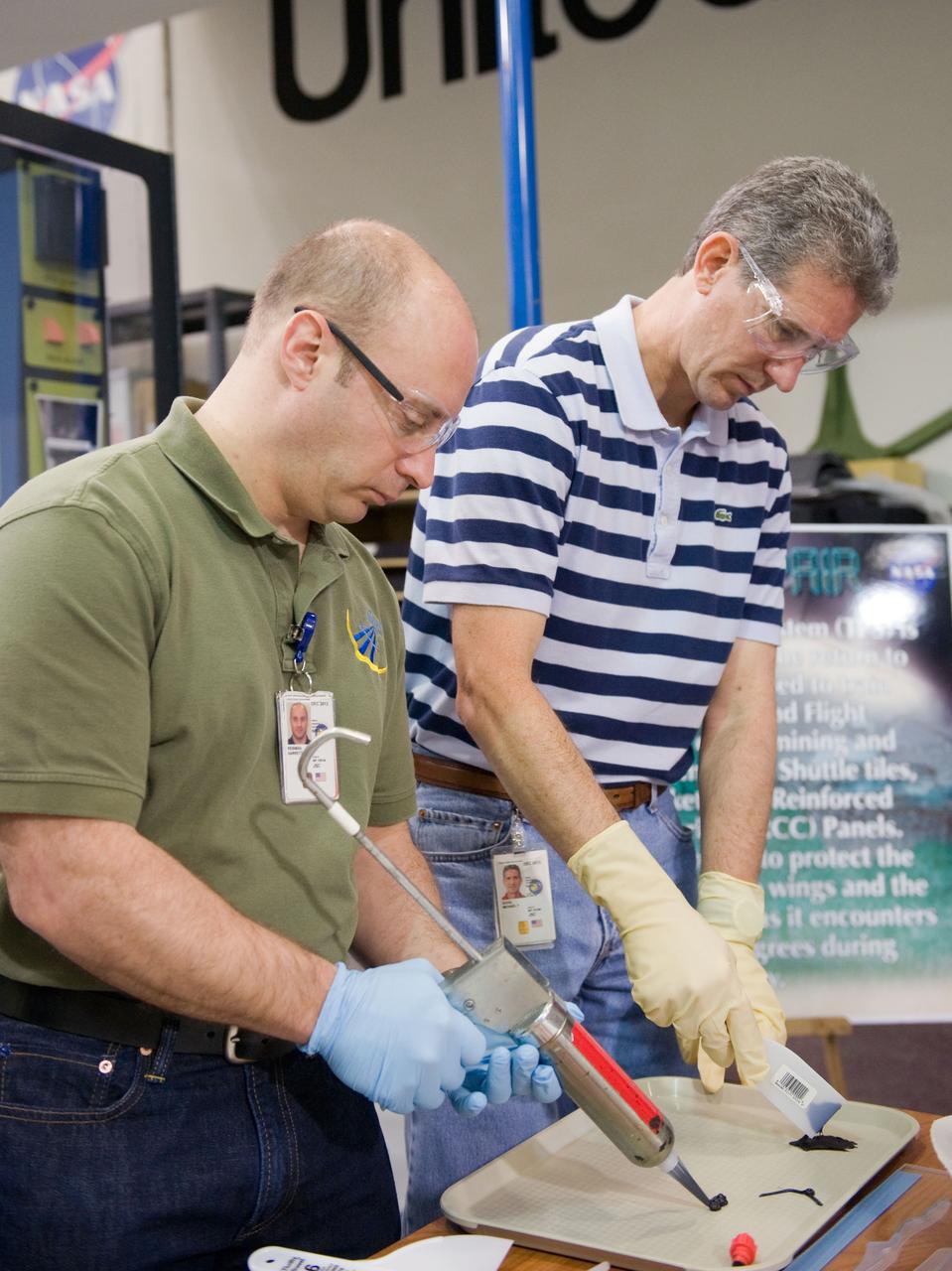
JSC2010-E-046479 (2 April 2010) --- NASA astronauts Steve Bowen (left) and Garrett Reisman, both STS-132 mission specialists, participate in an EVA tile repair training session in the Space Vehicle Mockup Facility at NASA's Johnson Space Center.
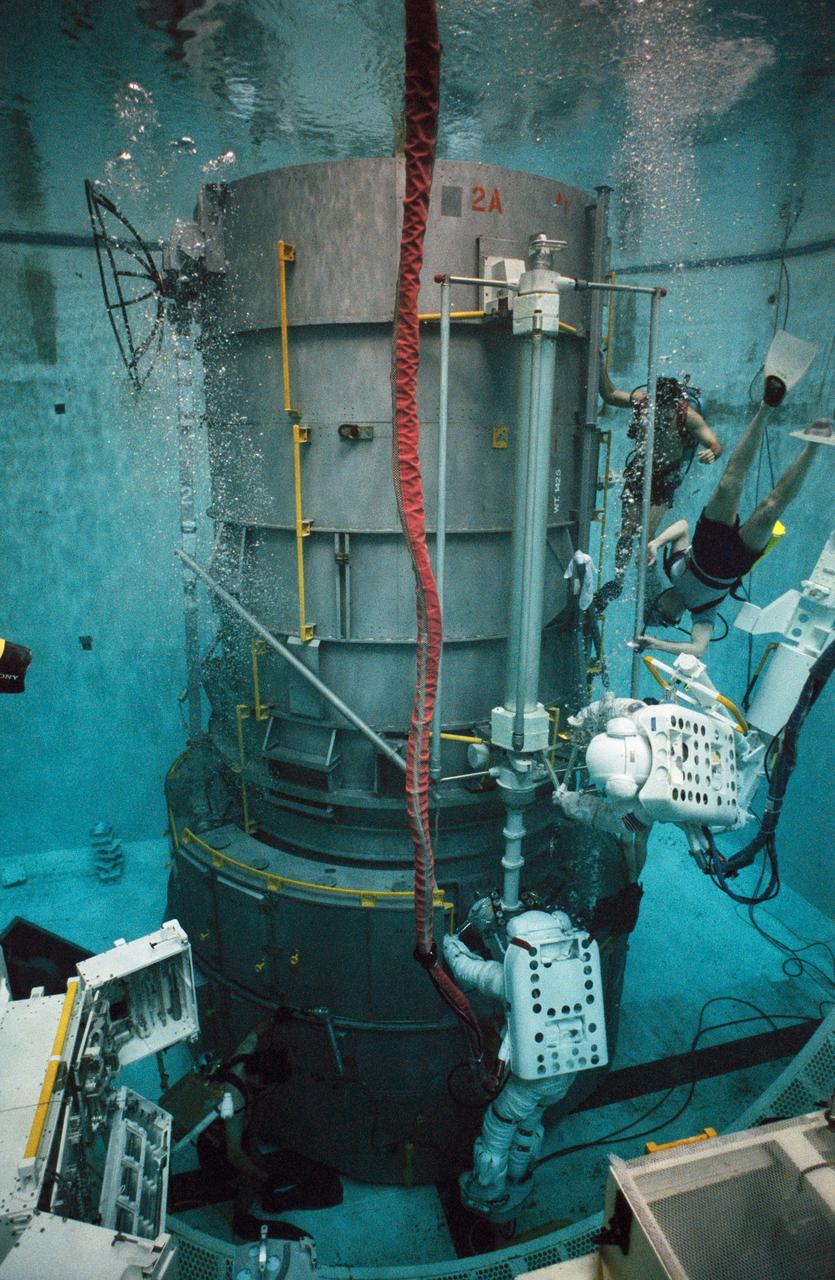
S93-30237 (5 Mar 1993) --- Wearing training versions of Space Shuttle Extravehicular Mobility Units (EMU), astronauts Thomas D. Akers (red stripe) and Kathryn C. Thornton use the spacious pool of the Johnson Space Center's (JSC) Weightless Environment Training Facility (WET-F) to rehearse for the Hubble Space Telescope (HST) servicing mission. They are working with part of a full-scale mockup of HST.

In the Vehicle Assembly Building, markers show the hail damage being repaired on the external tank of Space Shuttle Atlantis. The white hole with a red circle around it is a hole prepared for molding and material application. The red material is sealant tape so the mold doesn't leak when the foam rises against the mold. The white/ translucent square mold is an area where the foam has been applied and the foam has risen and cured against the mold surface. The area will be de-molded and sanded flush the with adjacent area. In late February, Atlantis' external tank received hail damage during a severe thunderstorm that passed through the Kennedy Space Center Launch Complex 39 area. The hail caused visible divots in the giant tank's foam insulation as well as minor surface damage to about 26 heat shield tiles on the shuttle's left wing. The March launch was postponed and has not yet been rescheduled due to the repair process.
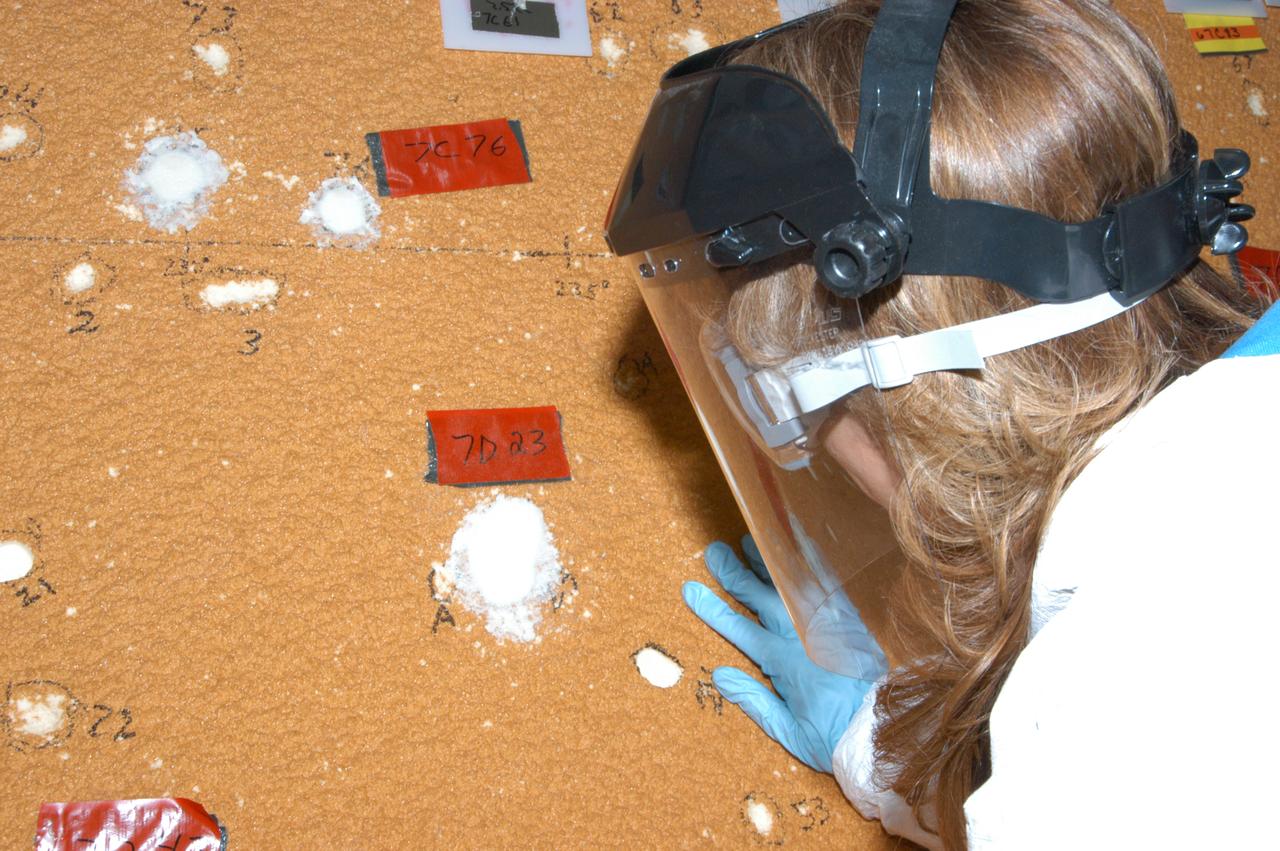
In the Vehicle Assembly Building, United Space Alliance technician Brenda Morris examines the surface on Space Shuttle Atlantis' external tank where hail damage has been repaired. At the top of the photo is a white/translucent square mold where the foam has been applied and the foam has risen and cured against the mold surface. In late February, Atlantis' external tank received hail damage during a severe thunderstorm that passed through the Kennedy Space Center Launch Complex 39 area. The hail caused visible divots in the giant tank's foam insulation as well as minor surface damage to about 26 heat shield tiles on the shuttle's left wing. The March launch was postponed and has not yet been rescheduled due to the repair process.
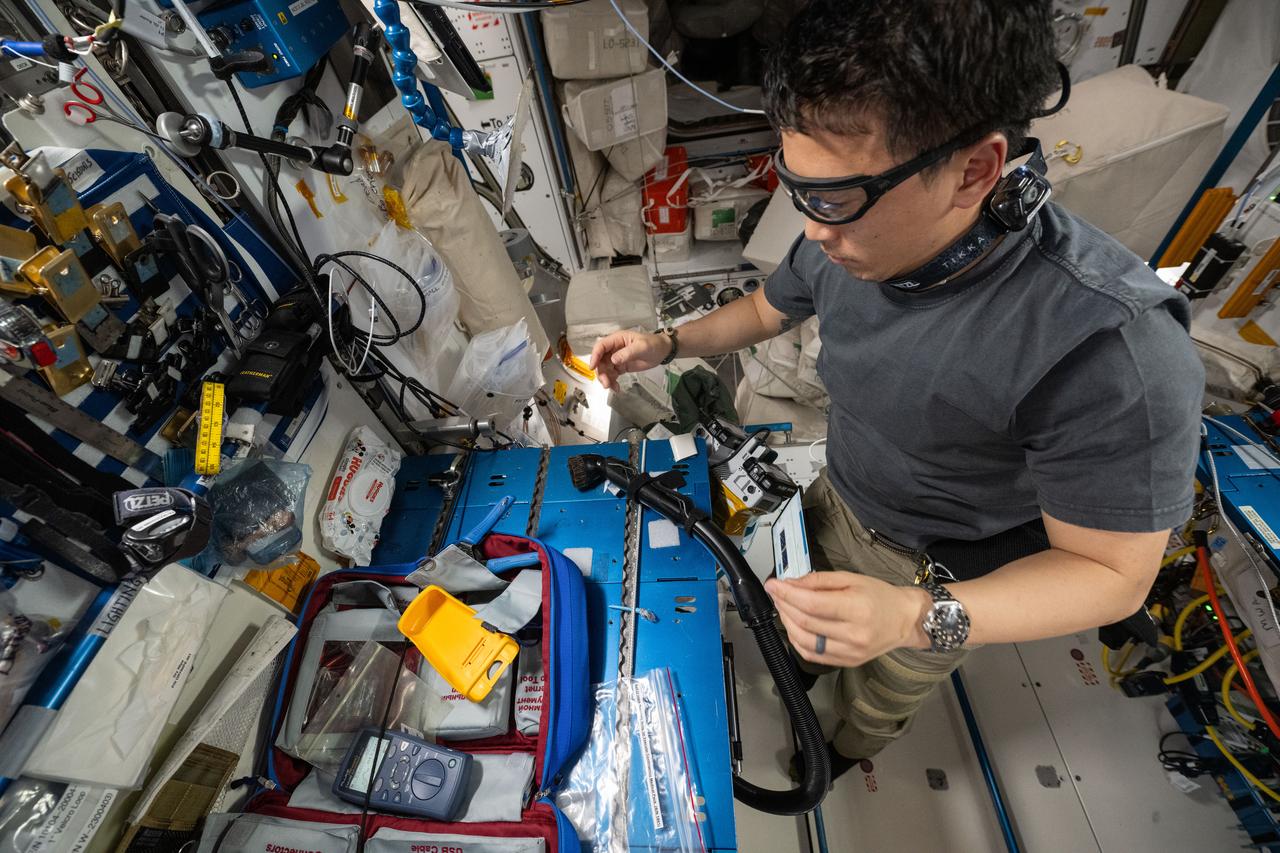
iss073e0077576 (May 20, 2025) --- NASA astronaut and Expedition 73 Flight Engineer Jonny Kim repairs ethernet cables aboard the International Space Station's Harmony module.
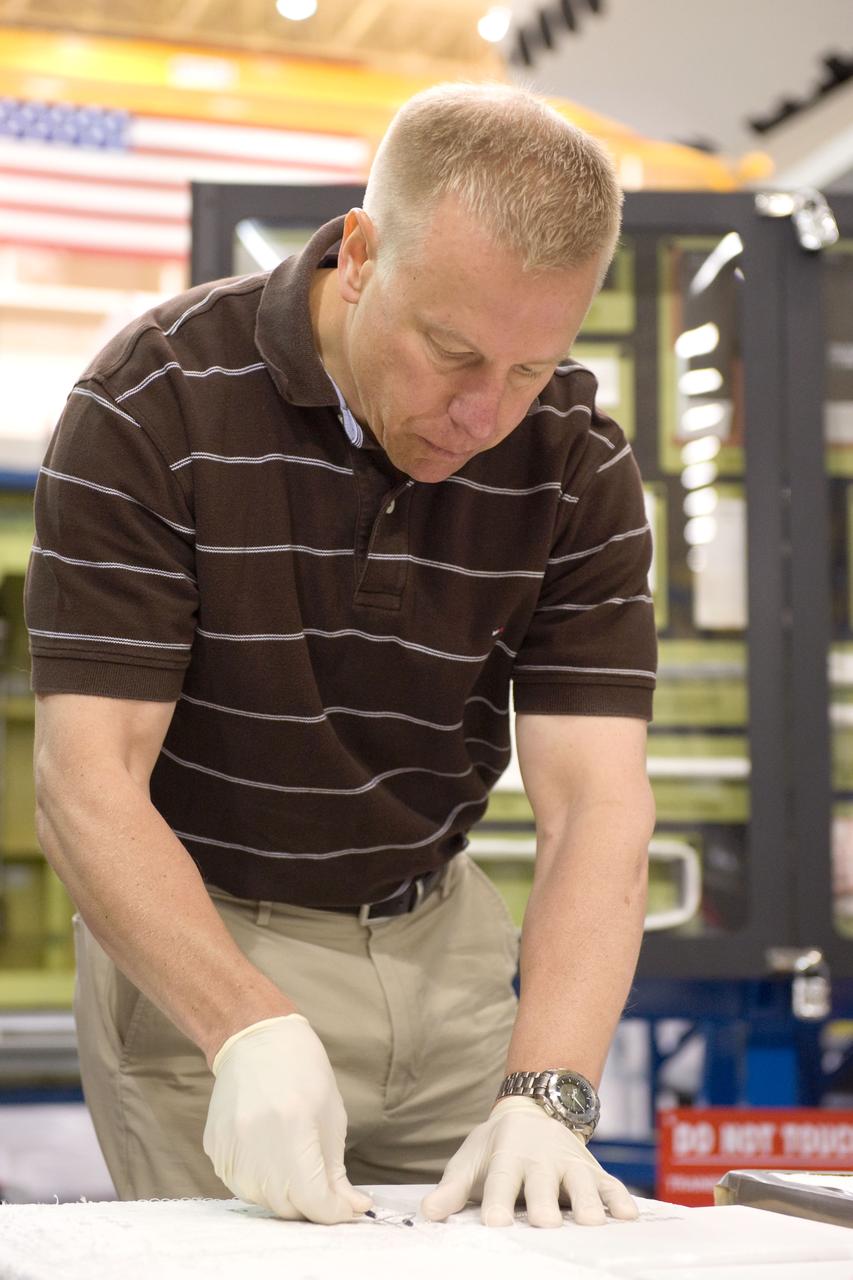
JSC2010-E-044337 (30 March 2010) --- NASA astronaut Tim Kopra, STS-133 mission specialist, participates in an EVA tile repair training session in the Space Vehicle Mockup Facility at NASA's Johnson Space Center.
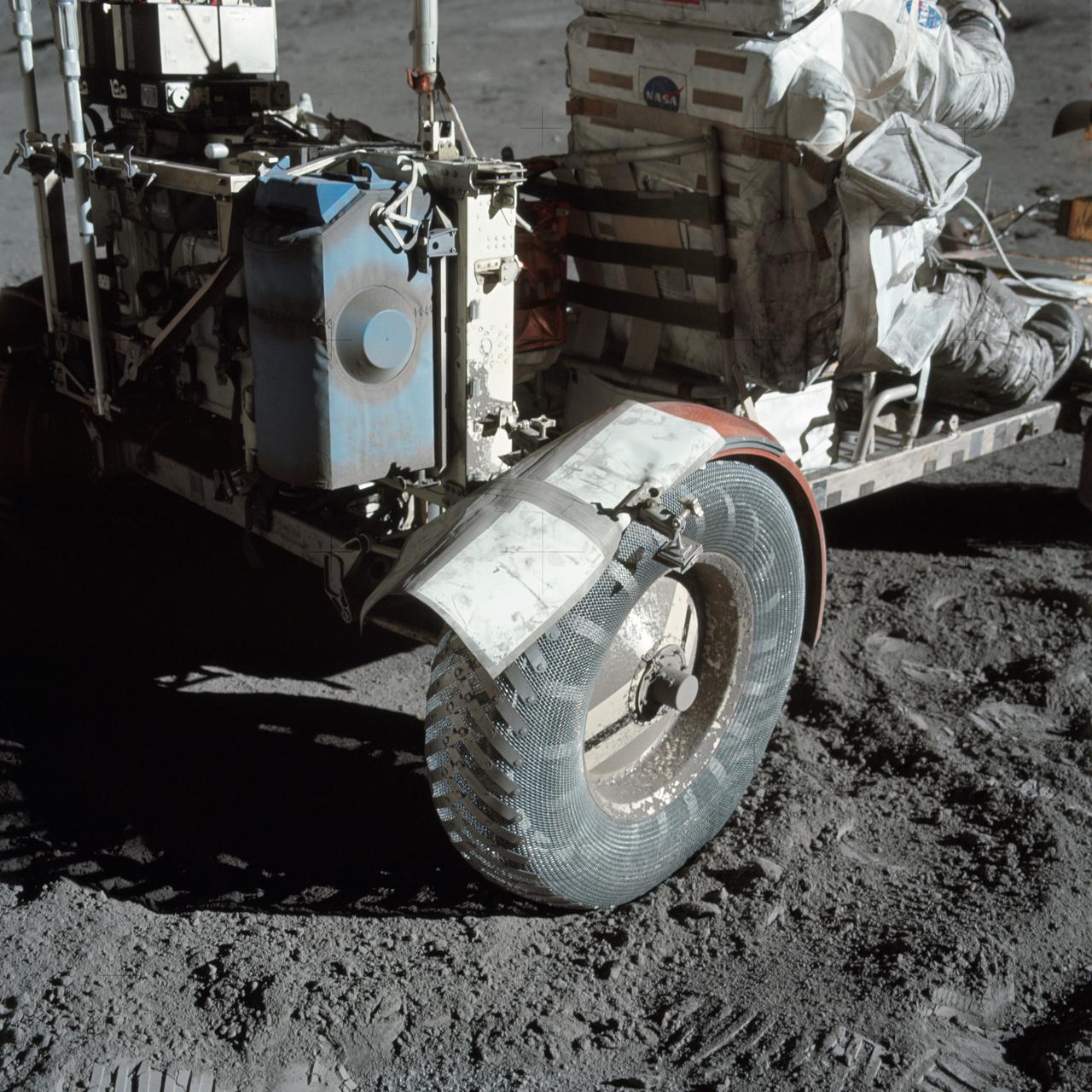
AS17-137-20979 (12 Dec. 1972) --- A close-up view of the lunar roving vehicle (LRV) at the Taurus-Littrow landing site photographed during Apollo 17 lunar surface extravehicular activity. Note the makeshift repair arrangement on the right rear fender of the LRV. During EVA-1 a hammer got underneath the fender and a part of it was knocked off. Astronauts Eugene A. Cernan and Harrison H. Schmitt were reporting a problem with lunar dust because of the damage fender. Following a suggestion from astronaut John W. Young in the Mission Control Center at Houston the crewmen repaired the fender early in EVA-2 using lunar maps and clamps from the optical alignment telescope lamp. Schmitt is seated in the rover. Cernan took this picture.
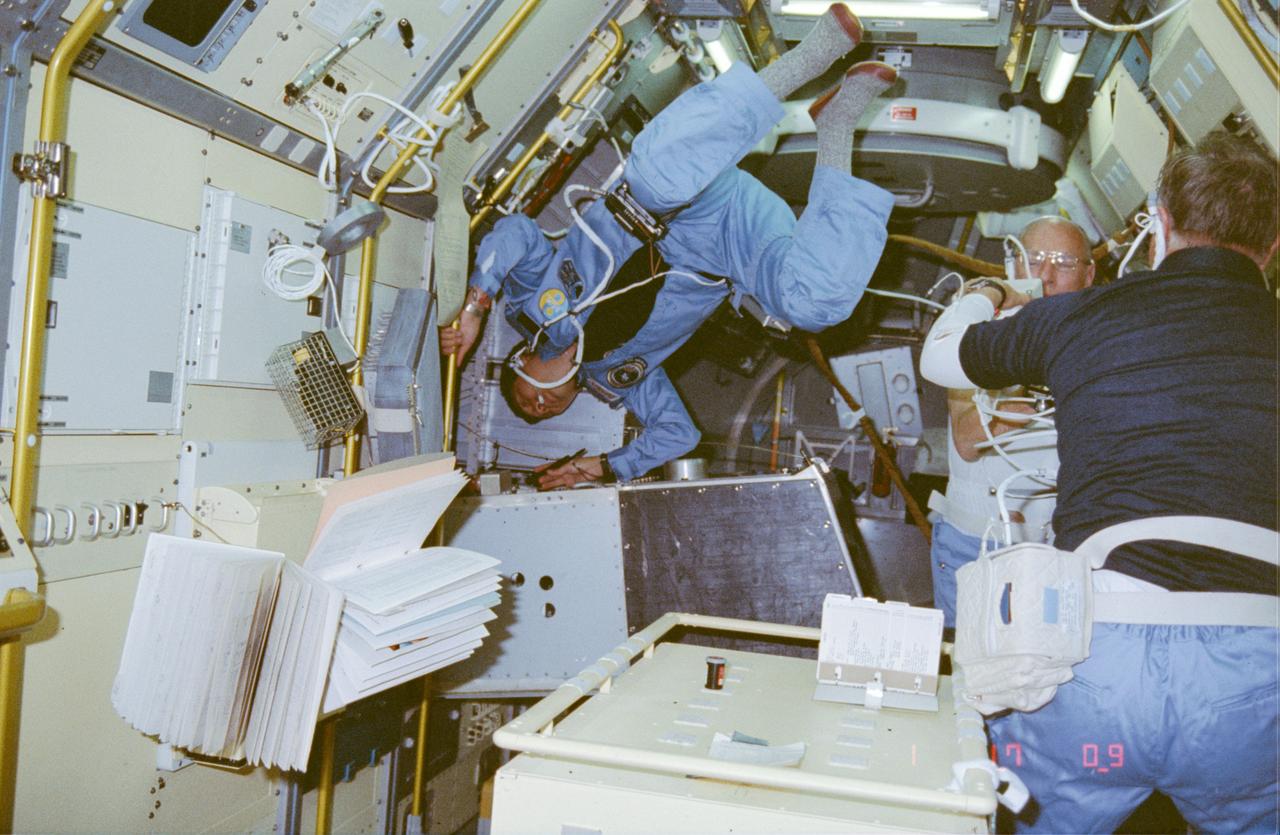
51B-03-035 (29 April-6 May 1985) --- Payload specialist Taylor G. Wang performs a repair task on the Drop Dynamics Module (DDM) in the Science Module aboard the Earth-orbiting Space Shuttle Challenger. The photo was taken with a 35mm camera. Dr. Wang is principal investigator for the first time-to-fly experiment, developed by his team at NASA?s Jet Propulsion Laboratory (JPL), Pasadena, California. This photo was among the first to be released by NASA upon return to Earth by the Spacelab 3 crew.
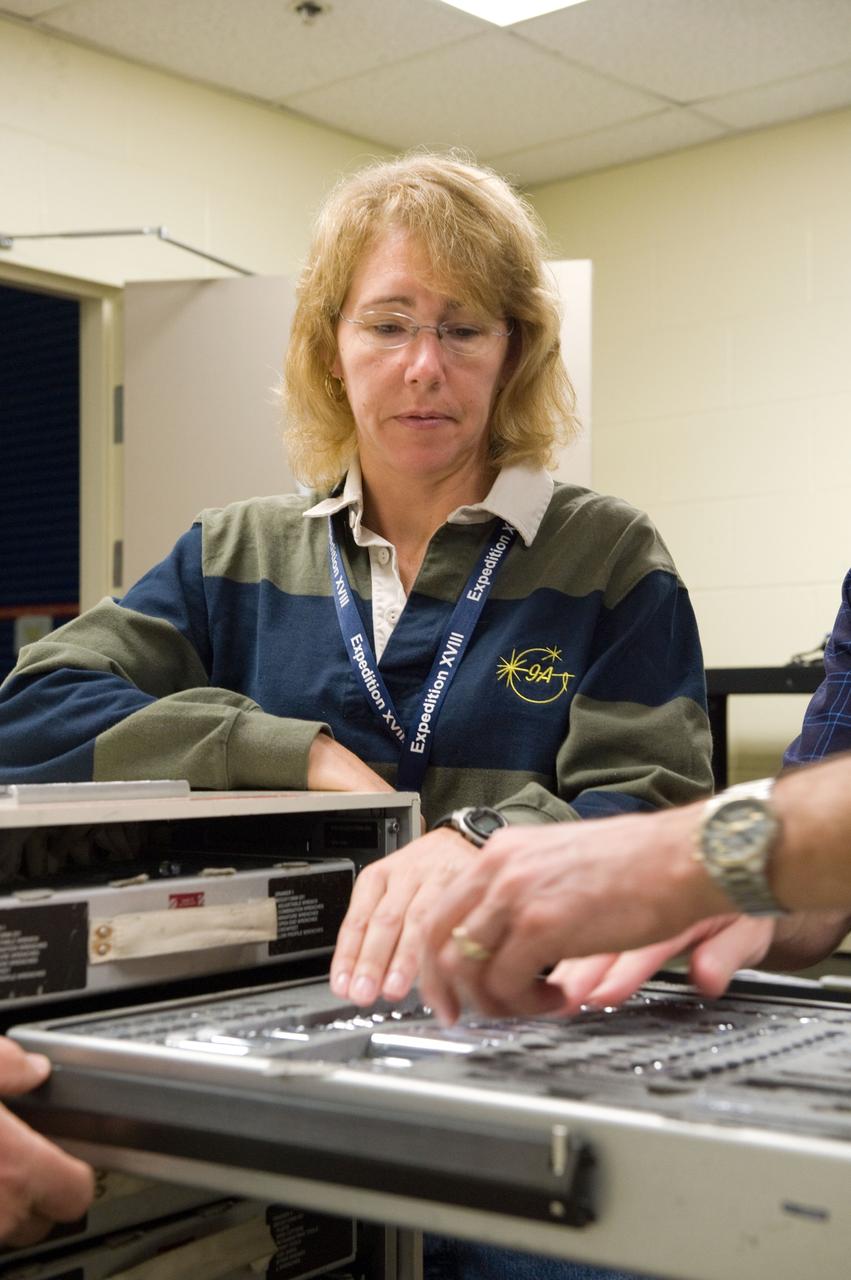
JSC2010-E-183214 (3 Nov. 2010) --- NASA astronaut Sandy Magnus, STS-135 mission specialist, participates in a tools and repair kits training session in the Space Vehicle Mock-up Facility at NASA's Johnson Space Center. STS-135 is planned to be the final mission of the space shuttle program. Photo credit: NASA or National Aeronautics and Space Administration
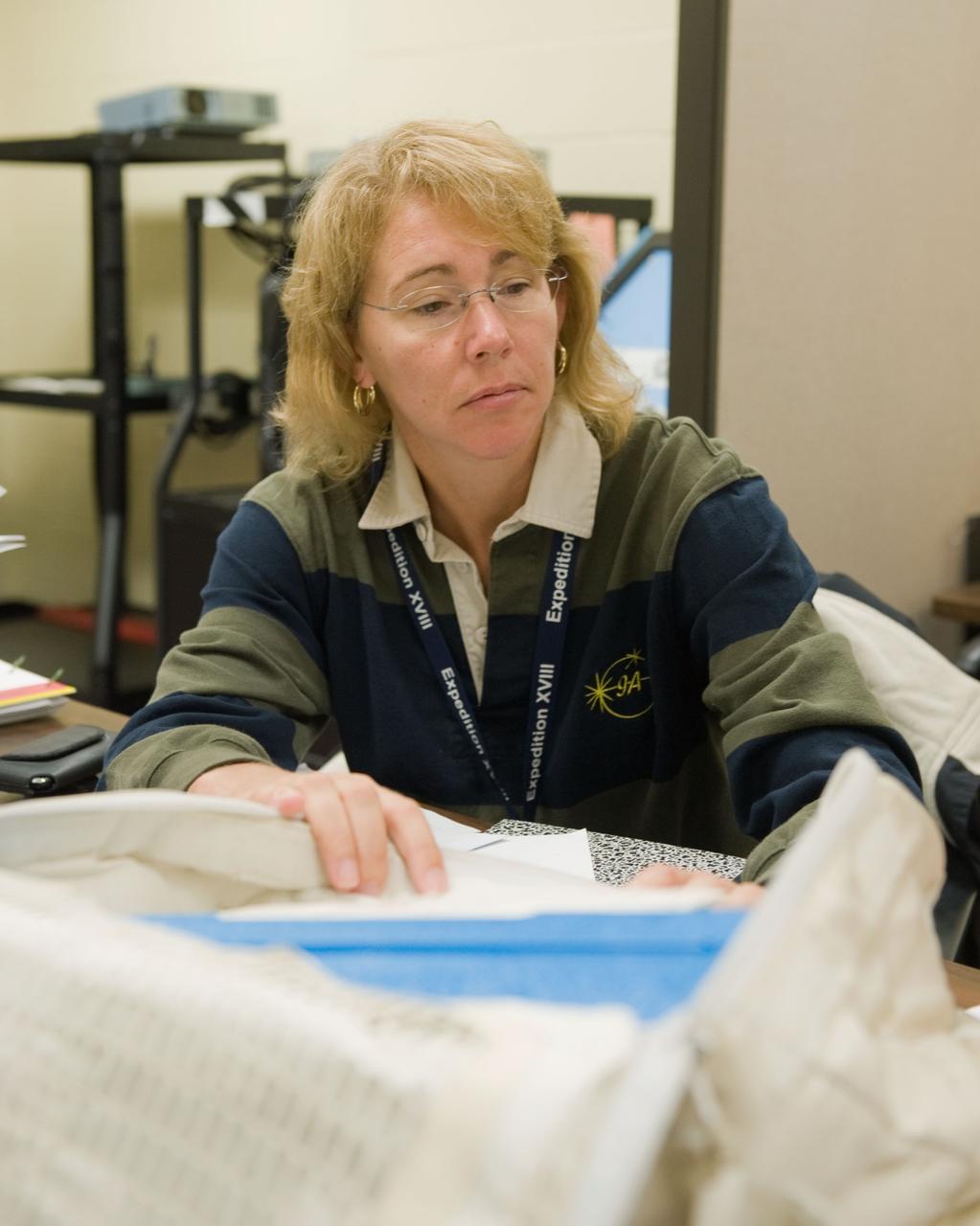
JSC2010-E-183228 (3 Nov. 2010) --- NASA astronaut Sandy Magnus, STS-135 mission specialist, participates in a tools and repair kits training session in the Space Vehicle Mock-up Facility at NASA's Johnson Space Center. STS-135 is planned to be the final mission of the space shuttle program. Photo credit: NASA or National Aeronautics and Space Administration
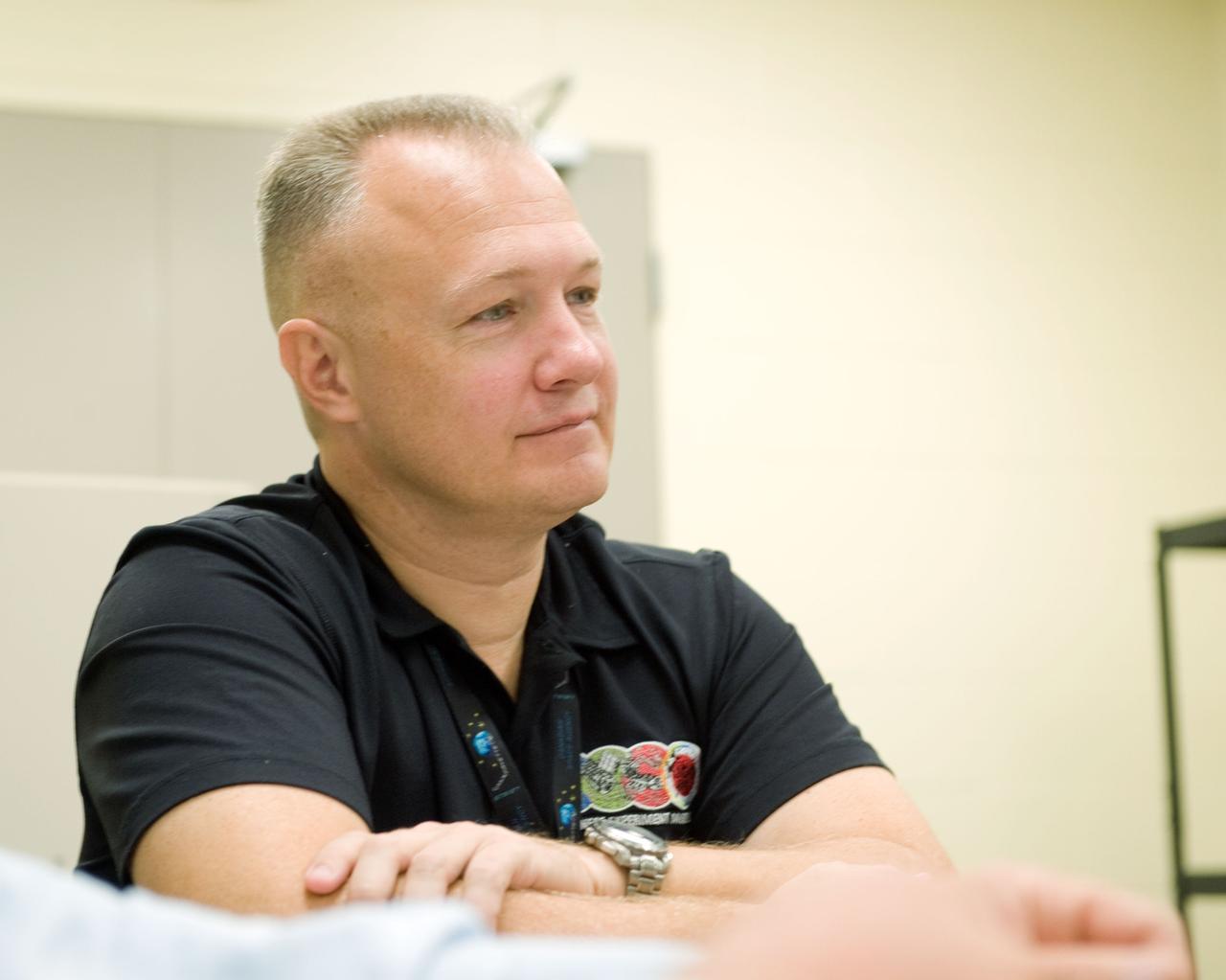
JSC2010-E-183232 (3 Nov. 2010) --- NASA astronaut Doug Hurley, STS-135 pilot, participates in a tools and repair kits training session in the Space Vehicle Mock-up Facility at NASA's Johnson Space Center. STS-135 is planned to be the final mission of the space shuttle program. Photo credit: NASA or National Aeronautics and Space Administration
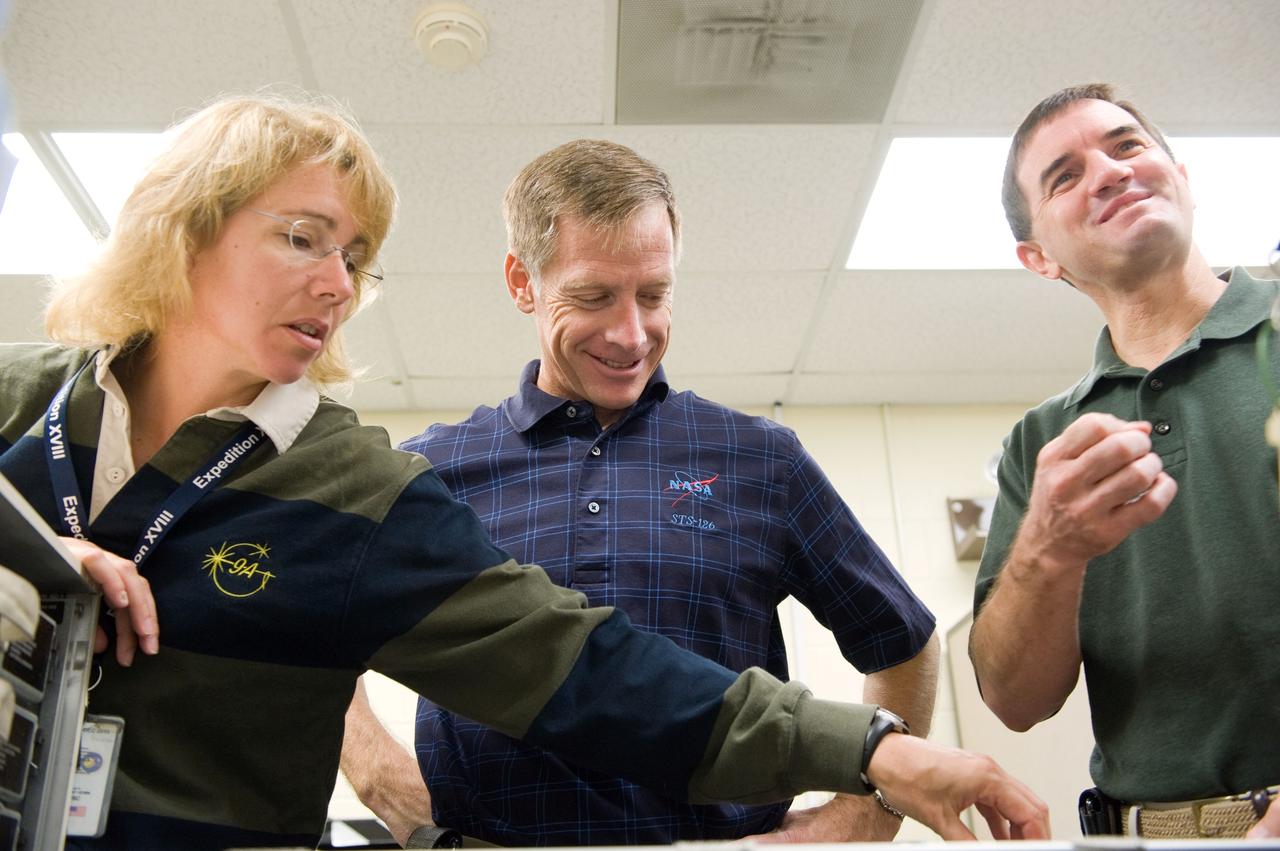
JSC2010-E-183219 (3 Nov. 2010) --- NASA astronauts Chris Ferguson (center), STS-135 commander; Sandra Magnus and Rex Walheim, both mission specialists, participate in a tools and repair kits training session in the Space Vehicle Mock-up Facility at NASA's Johnson Space Center. STS-135 is planned to be the final mission of the space shuttle program. Photo credit: NASA or National Aeronautics and Space Administration
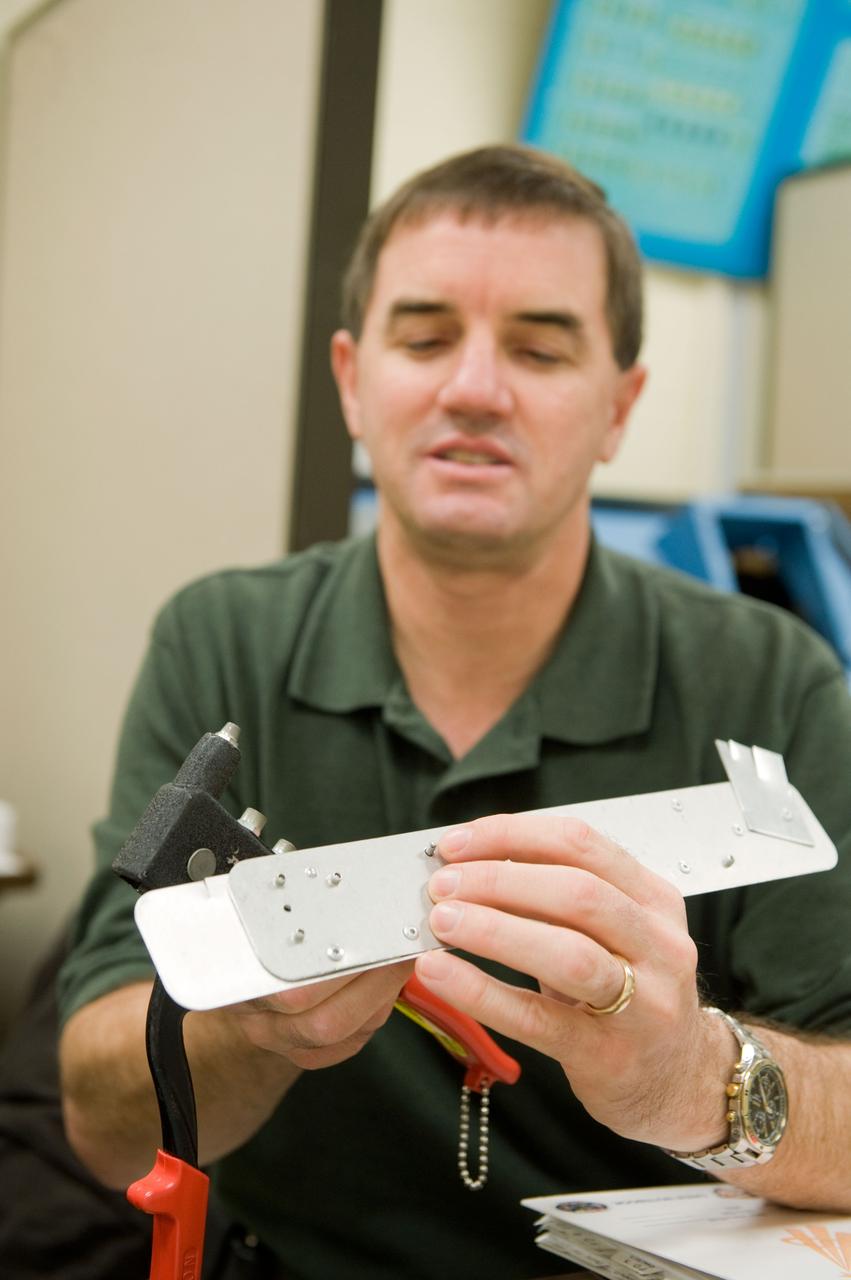
JSC2010-E-183239 (3 Nov. 2010) --- NASA astronaut Rex Walheim, STS-135 mission specialist, participates in a tools and repair kits training session in the Space Vehicle Mock-up Facility at NASA's Johnson Space Center. STS-135 is planned to be the final mission of the space shuttle program. Photo credit: NASA or National Aeronautics and Space Administration
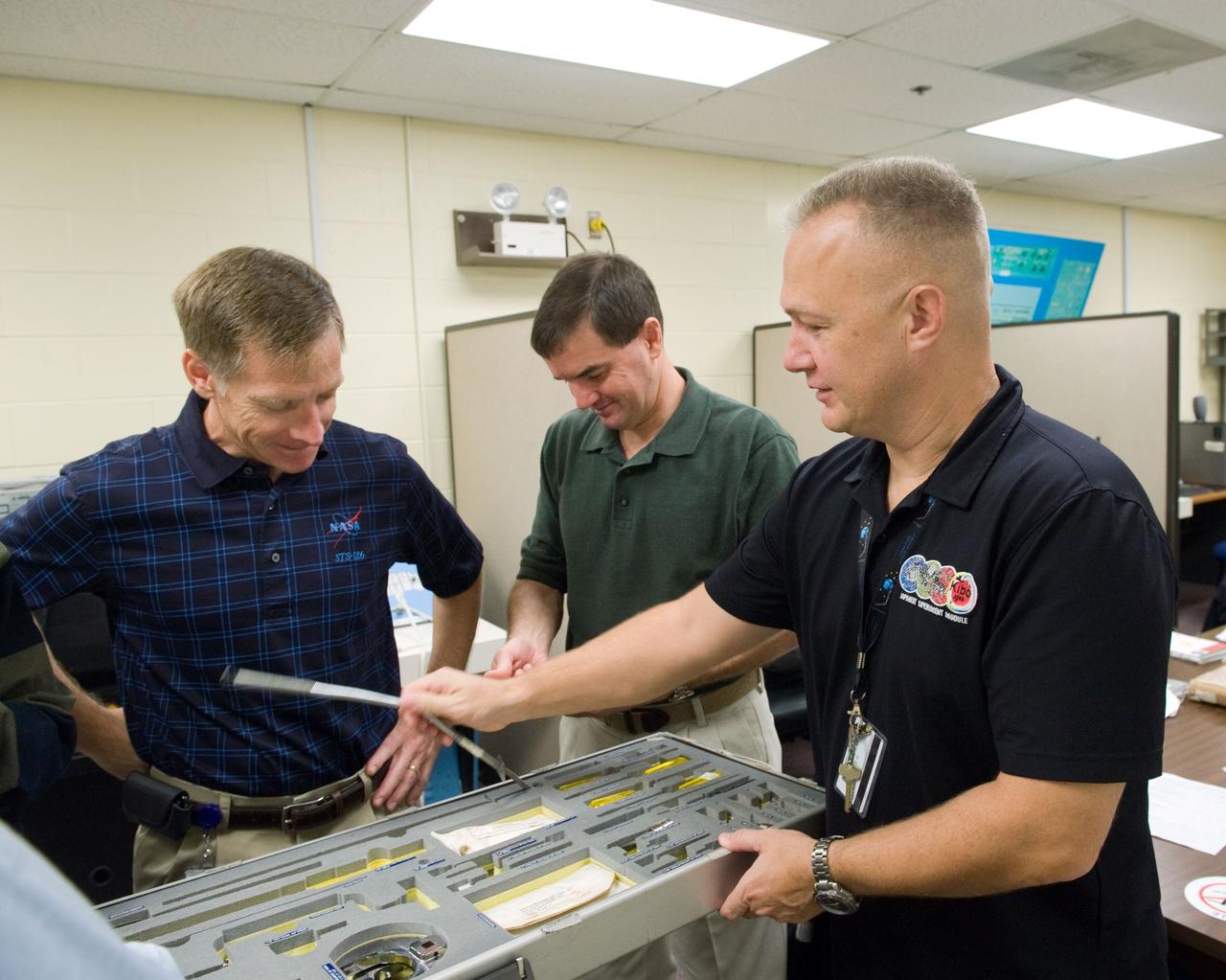
JSC2010-E-183216 (3 Nov. 2010) --- NASA astronauts Chris Ferguson (left), STS-135 commander; Doug Hurley (right), pilot; and Rex Walheim, mission specialist, participate in a tools and repair kits training session in the Space Vehicle Mock-up Facility at NASA's Johnson Space Center. STS-135 is planned to be the final mission of the space shuttle program. Photo credit: NASA or National Aeronautics and Space Administration
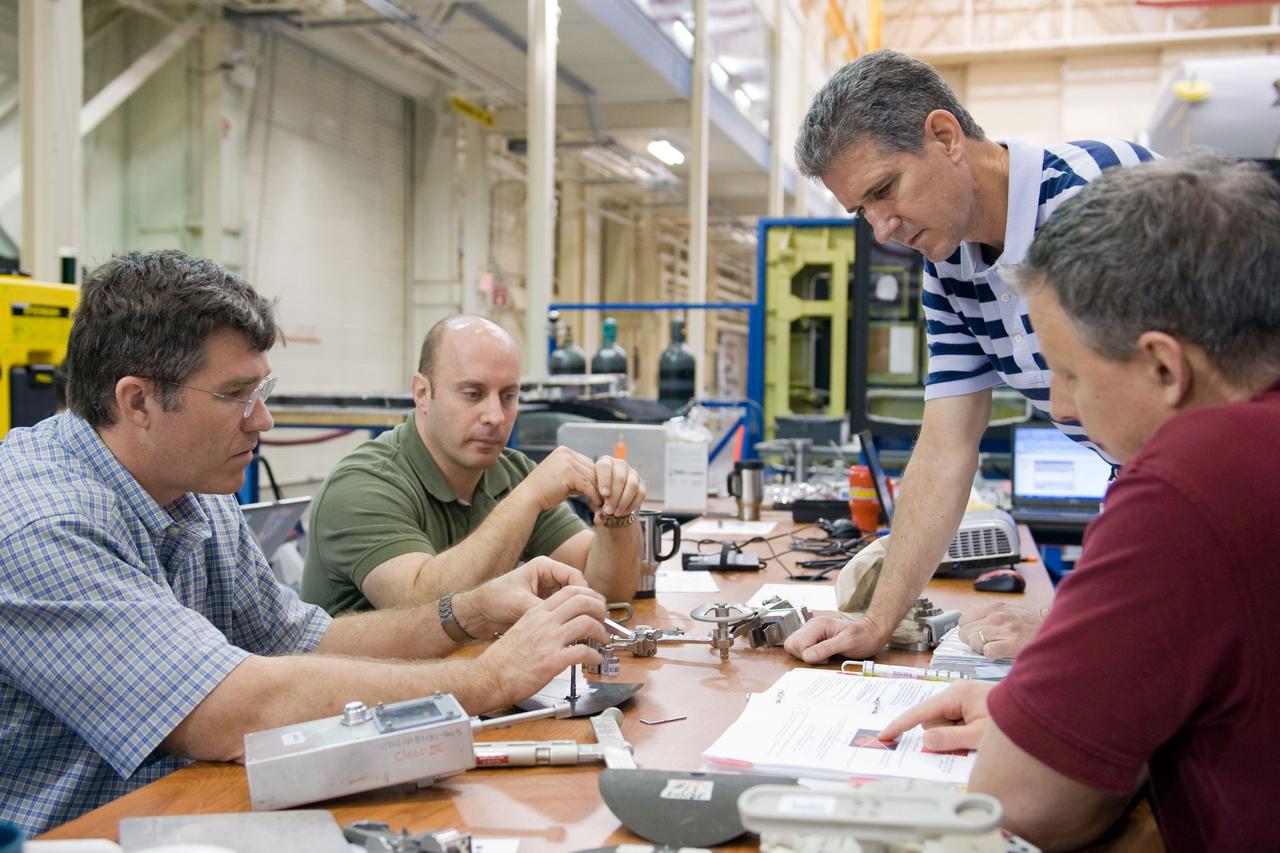
JSC2010-E-046478 (2 April 2010) --- NASA astronauts Steve Bowen (left), Garrett Reisman (second left) and Michael Good, all STS-132 mission specialists, participate in an EVA tile repair training session in the Space Vehicle Mockup Facility at NASA's Johnson Space Center. Instructor John Ray (right foreground) assisted the crew members.
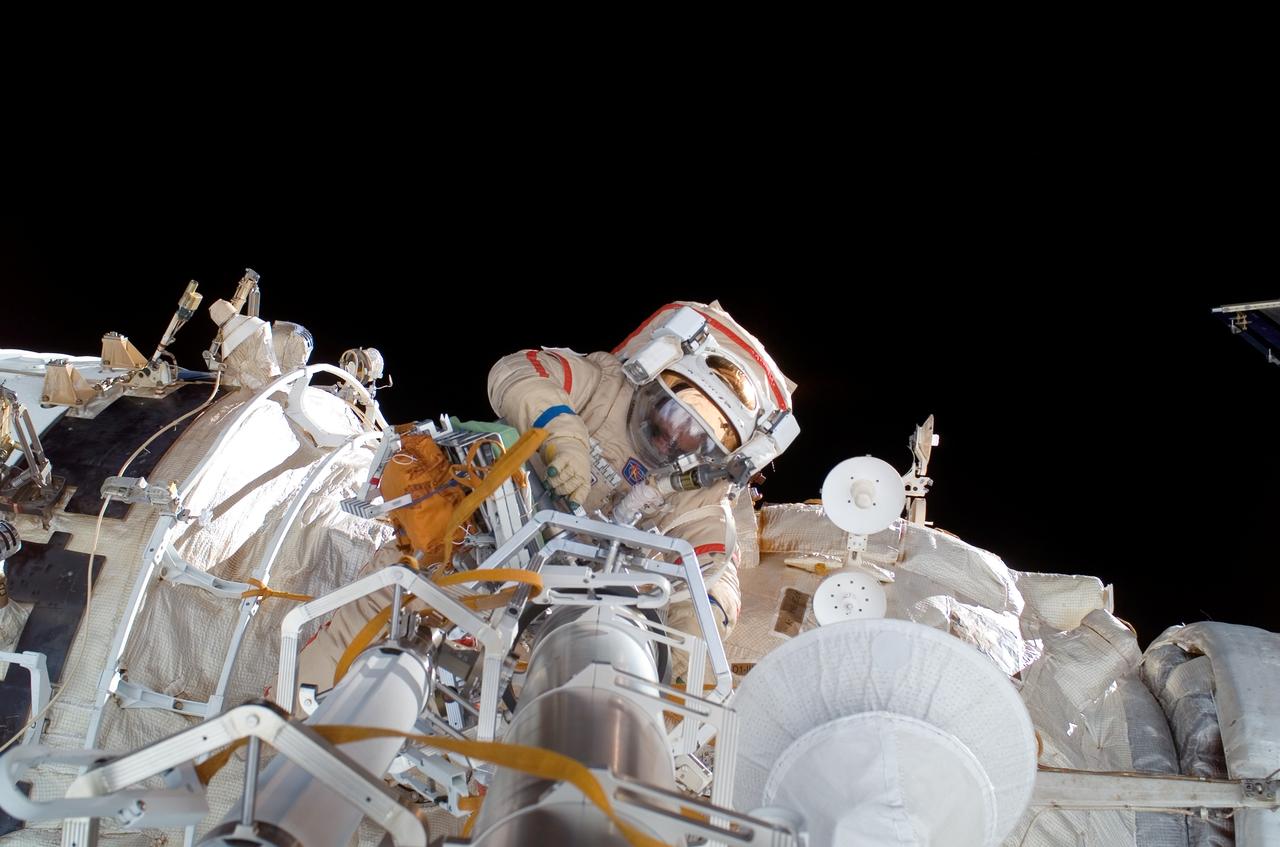
ISS013-E-28984 (1 June 2006) --- Cosmonaut Pavel V. Vinogradov, Expedition 13 commander representing Russia's Federal Space Agency, attired in a Russian Orlan spacesuit, participates in the first session of extravehicular activity (EVA) performed by the Expedition 13 crew during their six-month mission. During the 6-hour, 31-minute spacewalk, Vinogradov and astronaut Jeffrey N. Williams (out of frame), NASA space station science officer, repaired, retrieved and replaced hardware on the U.S. and Russian segments of the International Space Station.
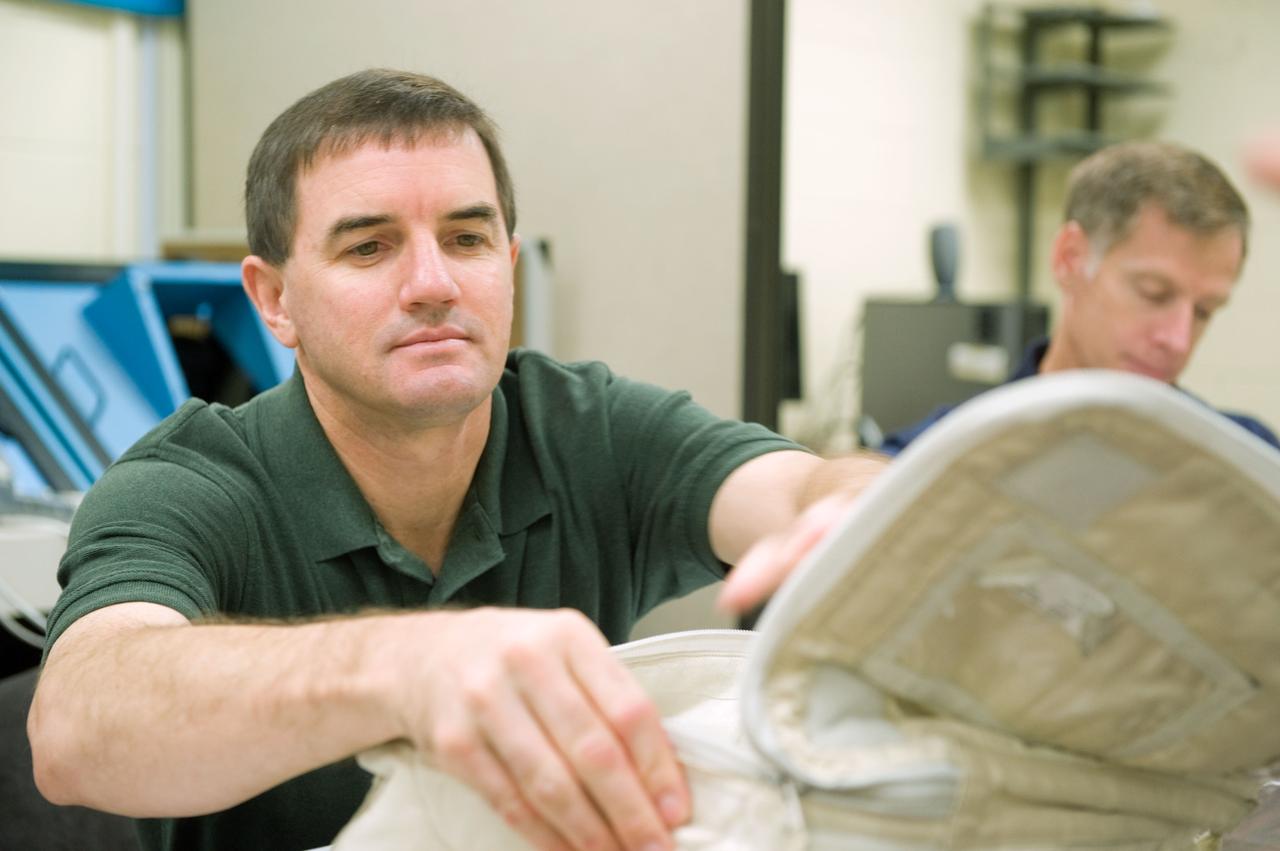
JSC2010-E-183226 (3 Nov. 2010) --- NASA astronaut Rex Walheim, STS-135 mission specialist, participates in a tools and repair kits training session in the Space Vehicle Mock-up Facility at NASA's Johnson Space Center. STS-135 is planned to be the final mission of the space shuttle program. Photo credit: NASA or National Aeronautics and Space Administration
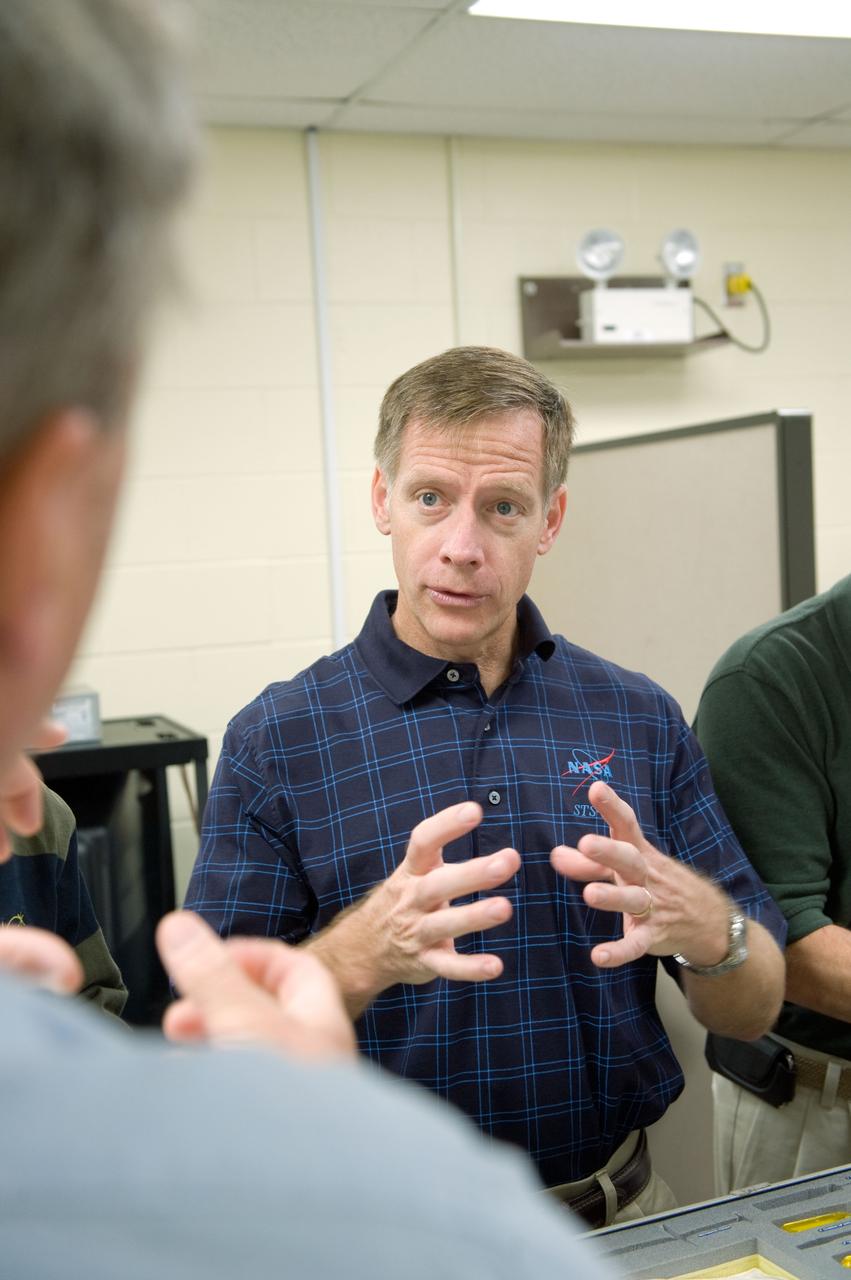
JSC2010-E-183218 (3 Nov. 2010) --- NASA astronaut Chris Ferguson, STS-135 commander, is pictured during a tools and repair kits training session in the Space Vehicle Mock-up Facility at NASA's Johnson Space Center. STS-135 is planned to be the final mission of the space shuttle program. Photo credit: NASA or National Aeronautics and Space Administration
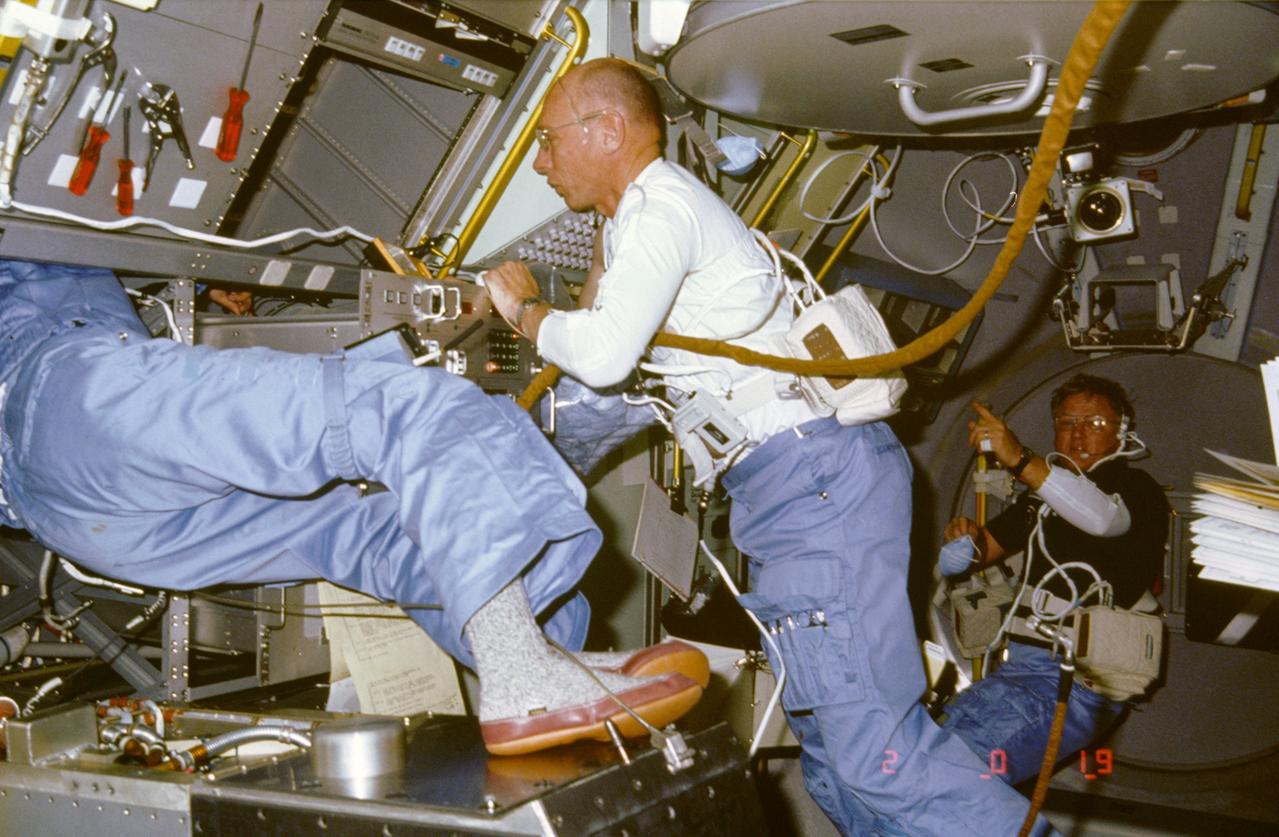
51B-03-037 (29 April-6 May 1985) --- Astronaut William E. Thornton (center frame), mission specialist, lends a helping hand to payload specialist Taylor G. Wang (partially visible at left) involved in serious repair work on the Drop Dynamics Module (DDM), an experiment of which he is principal investigator. The troubleshooting paid off and Dr. Wang later resumed studies with drop dynamics. Astronaut Don L. Lind, mission specialist, is in the background.
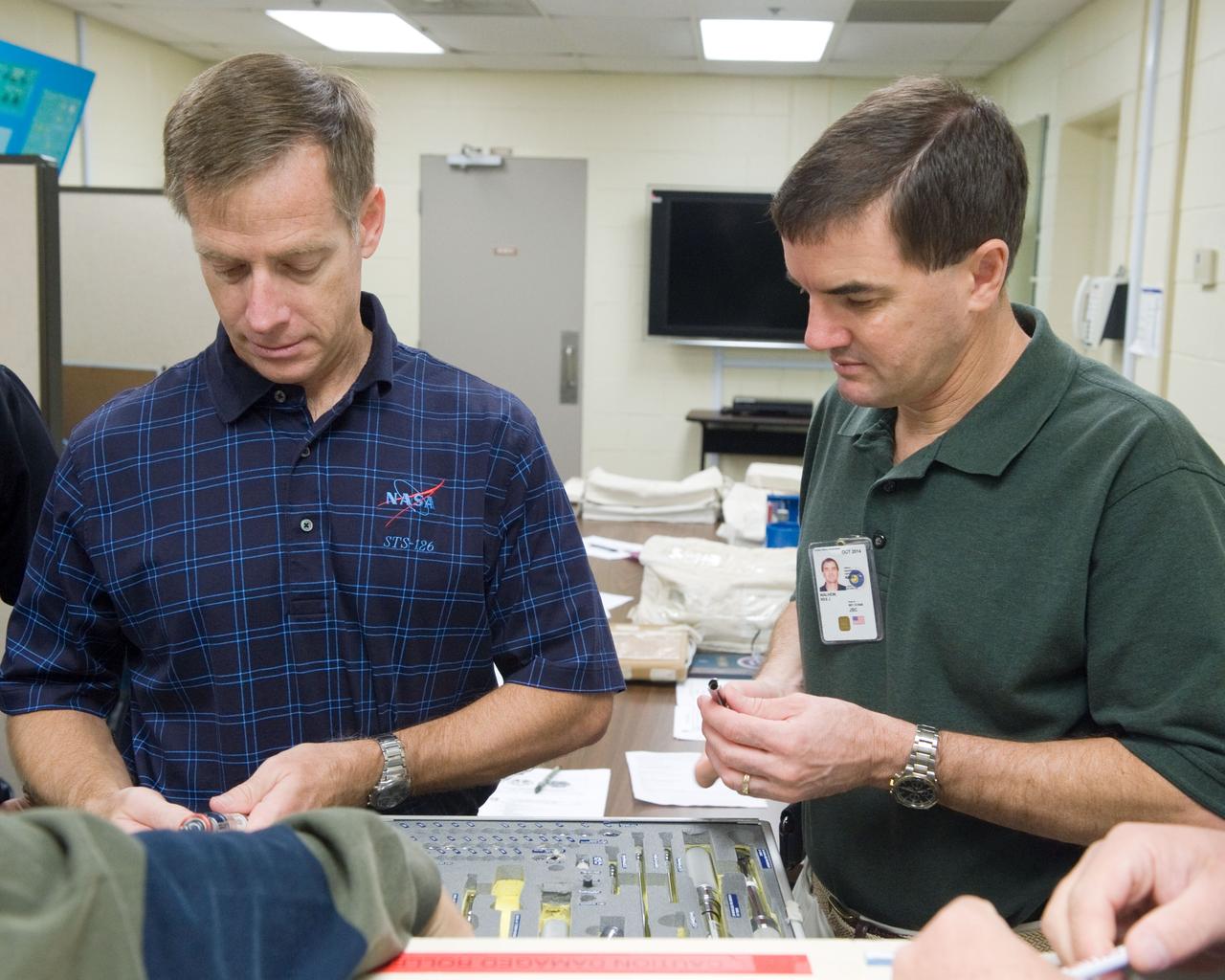
JSC2010-E-183213 (3 Nov. 2010) --- NASA astronauts Chris Ferguson (left), STS-135 commander; and Rex Walheim, mission specialist, participate in a tools and repair kits training session in the Space Vehicle Mock-up Facility at NASA's Johnson Space Center. STS-135 is planned to be the final mission of the space shuttle program. Photo credit: NASA or National Aeronautics and Space Administration
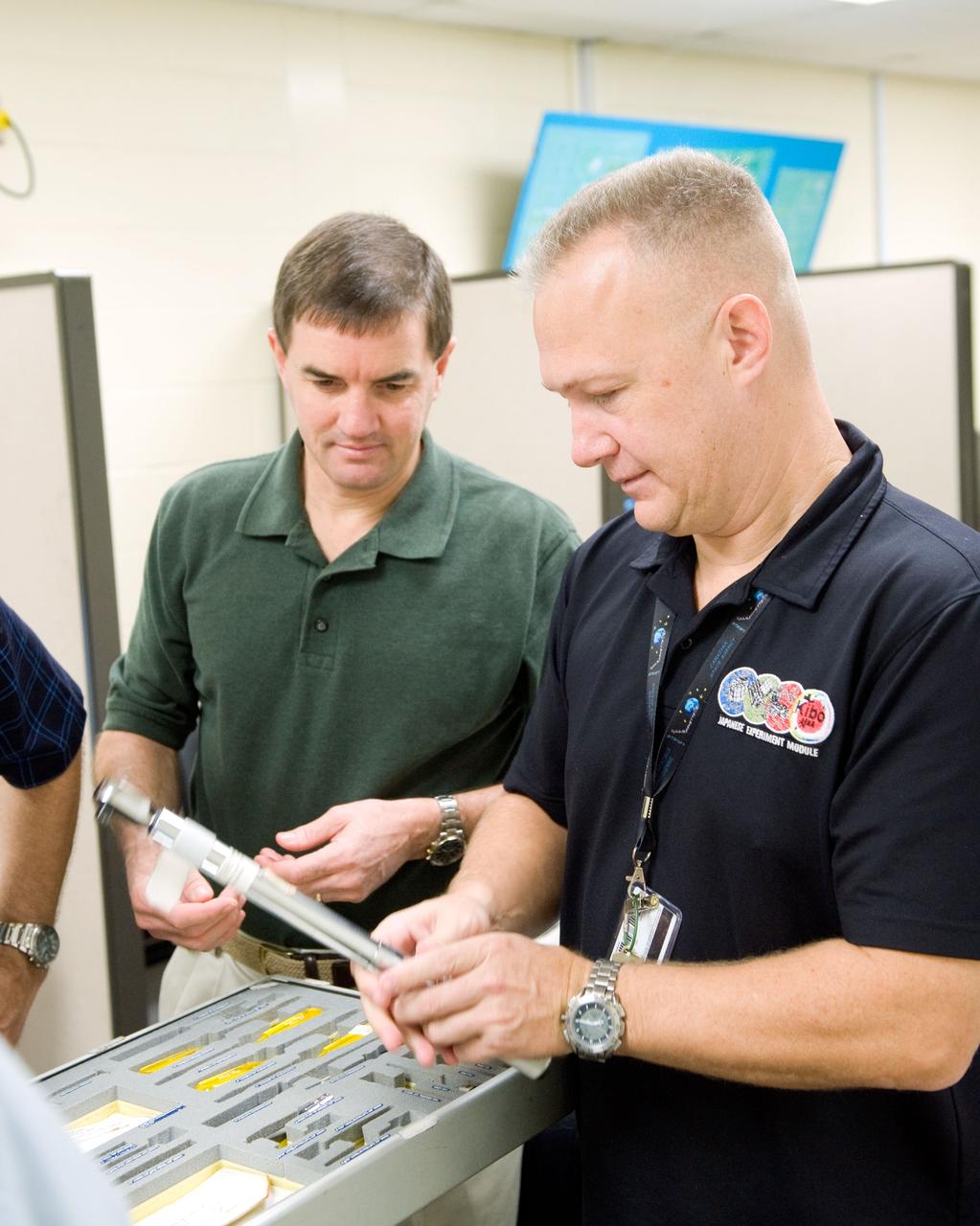
JSC2010-E-183217 (3 Nov. 2010) --- NASA astronauts Doug Hurley (right), STS-135 pilot; and Rex Walheim, mission specialist, participate in a tools and repair kits training session in the Space Vehicle Mock-up Facility at NASA's Johnson Space Center. STS-135 is planned to be the final mission of the space shuttle program. Photo credit: NASA or National Aeronautics and Space Administration
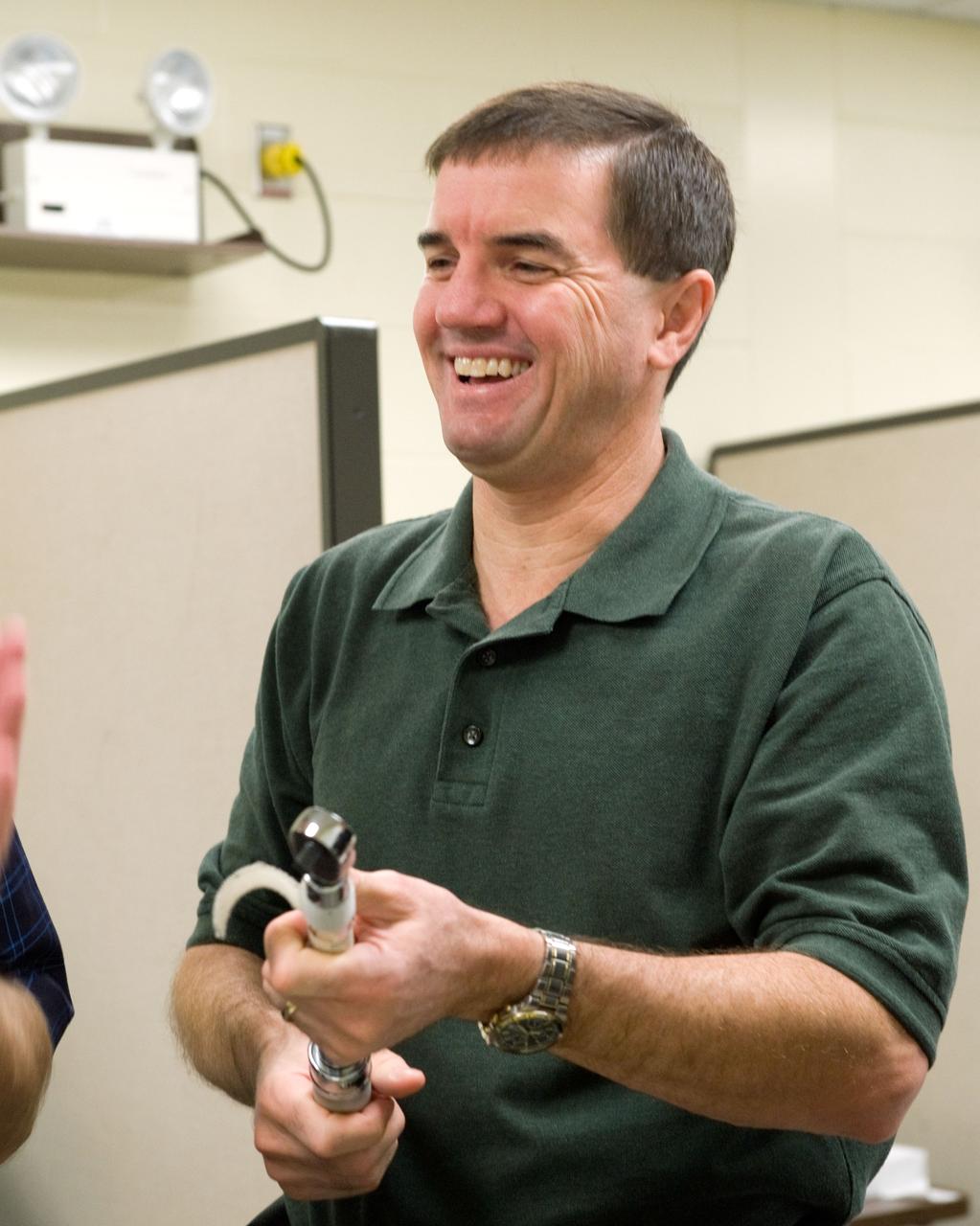
JSC2010-E-183215 (3 Nov. 2010) --- NASA astronaut Rex Walheim, STS-135 mission specialist, participates in a tools and repair kits training session in the Space Vehicle Mock-up Facility at NASA's Johnson Space Center. STS-135 is planned to be the final mission of the space shuttle program. Photo credit: NASA or National Aeronautics and Space Administration
JSC2010-E-183223 (3 Nov. 2010) --- NASA astronaut Doug Hurley, STS-135 pilot, is pictured during a tools and repair kits training session in the Space Vehicle Mock-up Facility at NASA's Johnson Space Center. STS-135 is planned to be the final mission of the space shuttle program. Photo credit: NASA or National Aeronautics and Space Administration

STS078-397-010 (20 June - 7 July 1996) --- Payload specialist Jean-Jacques Favier, representing the French Space Agency (CNES), and astronaut Kevin R. Kregel, pilot, perform a successful Inflight Maintenance (IFM) on the Bubble Drop Particle Unit (BDPU). The IFM technique was performed initially on the ground at the Marshall Space Flight Center (MSFC) by alternate payload specialist Pedro Duque of the European Space Agency (ESA), with the procedure being recorded on video and uplinked to the crew of the Space Shuttle Columbia to aid in the repair.
JSC2010-E-183222 (3 Nov. 2010) --- NASA astronaut Chris Ferguson, STS-135 commander, is pictured during a tools and repair kits training session in the Space Vehicle Mock-up Facility at NASA's Johnson Space Center. STS-135 is planned to be the final mission of the space shuttle program. Photo credit: NASA or National Aeronautics and Space Administration
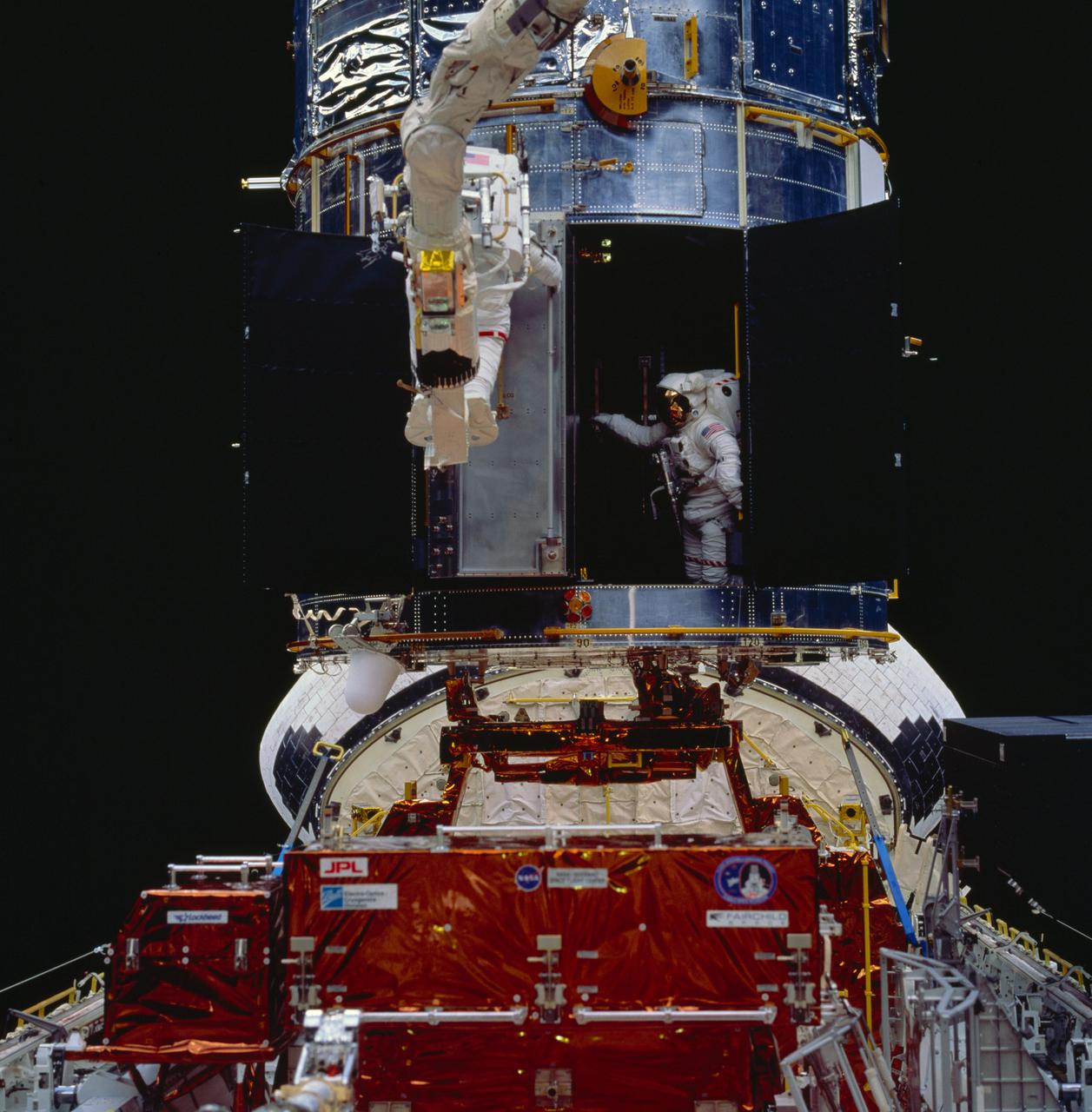
STS061-94-050 (8 Dec 1993) --- Astronaut Thomas D. Akers maneuvers inside the bay which will house the Corrective Optics Space Telescope Axial Replacement (COSTAR) while assisting astronaut Kathryn C. Thornton with the installation of the 640-pound instrument. Thornton, anchored on the end of the Remote Manipulator System (RMS) arm, is partially visible as she prepares to install the COSTAR, during their extravehicular activity (EVA).
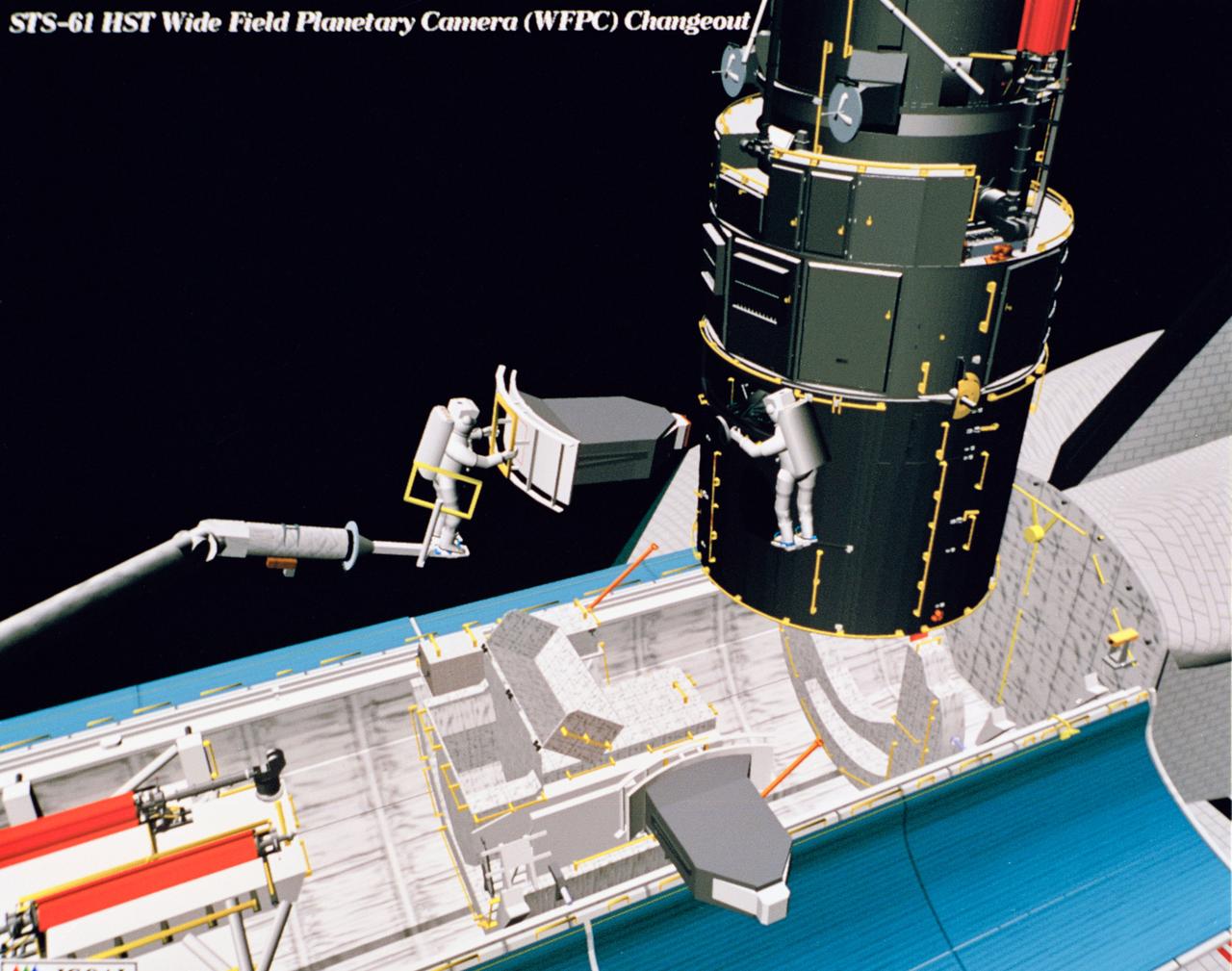
Computer generated scenes depicting the Hubble Space Telescope capture and a sequence of planned events on the planned extravehicular activity (EVA). Scenes include the Remote Manipulator System (RMS) arm assisting two astronauts changing out the Wide Field/Planetary Camera (WF/PC) (48699); RMS arm assisting in the temporary mating of the orbiting telescope to the flight support system in Endeavour's cargo bay (48700); Endeavour's RMS arm assisting in the "capture" of the orbiting telescope (48701); Two astronauts changing out the telescope's coprocessor (48702); RMS arm assistign two astronauts replacing one of the telescope's electronic control units (48703); RMS assisting two astronauts replacing the fuse plugs on the telescope's Power Distribution Unit (PDU) (48704); The telescope's High Resolution Spectrograph (HRS) kit is depicted in this scene (48705); Two astronauts during the removal of the high speed photometer and the installation of the COSTAR instrument (48706); Two astronauts, standing on the RMS, during installation of one of the Magnetic Sensing System (MSS) (48707); High angle view of the orbiting Space Shuttle Endeavour with its cargo bay doors open, revealing the bay's pre-capture configuration. Seen are, from the left, the Solar Array Carrier, the ORU Carrier and the flight support system (48708); Two astronauts performing the replacement of HST's Rate Sensor Units (RSU) (48709); The RMS arm assisting two astronauts with the replacement of the telescope's solar array panels (48710); Two astronauts replacing the telescope's Solar Array Drive Electronics (SADE) (48711).
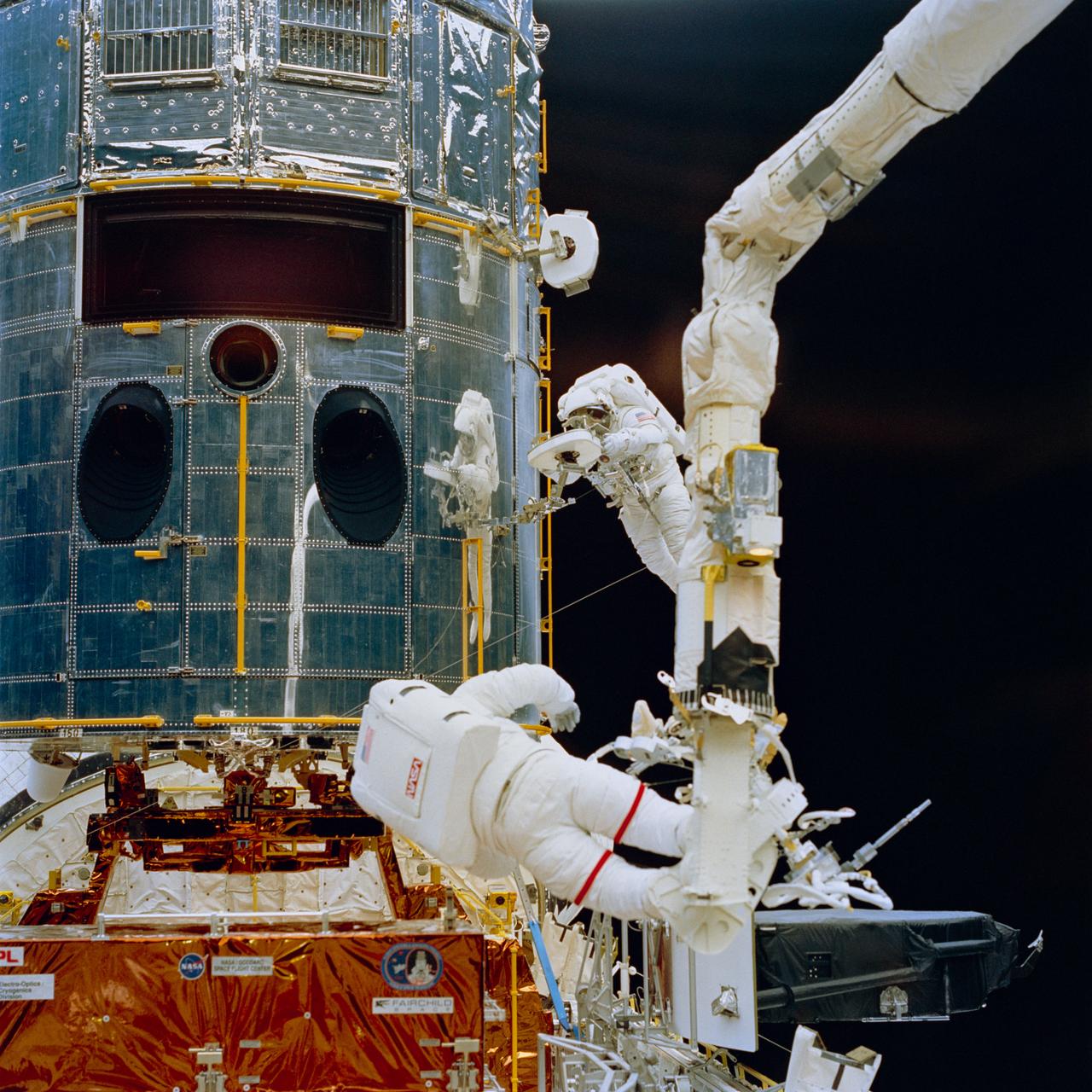
STS061-74-046 (7 Dec 1993) --- Anchored on the end of the Space Shuttle Endeavour's Remote Manipulator System (RMS) arm, astronaut Jeffrey A. Hoffman (foreground) prepares to install the new Wide Field\Planetary Camera (WFPC II) into the empty cavity (top left) on the Hubble Space Telescope (HST). WFPC I is seen temporarily stowed at bottom right. Astronaut F. Story Musgrave works with a Portable Foot Restraint (PFR) at frame center, as his image is reflected in the shiny surface of the telescope. Hoffman and Musgrave shared chores on three of the five extravehicular activity?s (EVA) during the mission.
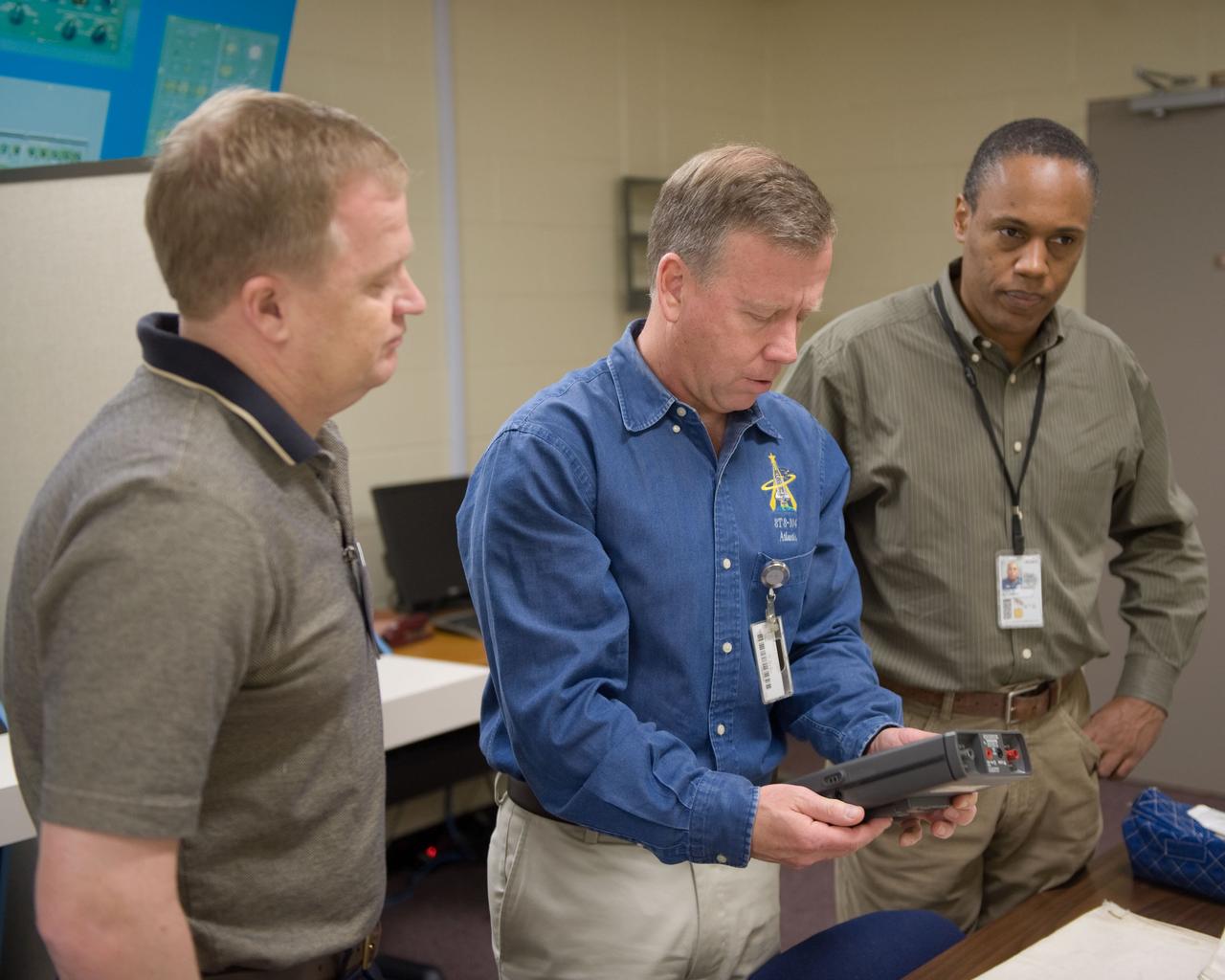
JSC2010-E-014267 (26 Jan. 2010) --- NASA astronauts Steve Lindsey (center), STS-133 commander; Eric Boe (left), pilot; and Alvin Drew, mission specialist, participate in an ISS tools and repair kits training session in the Space Vehicle Mock-up Facility at NASA's Johnson Space Center.
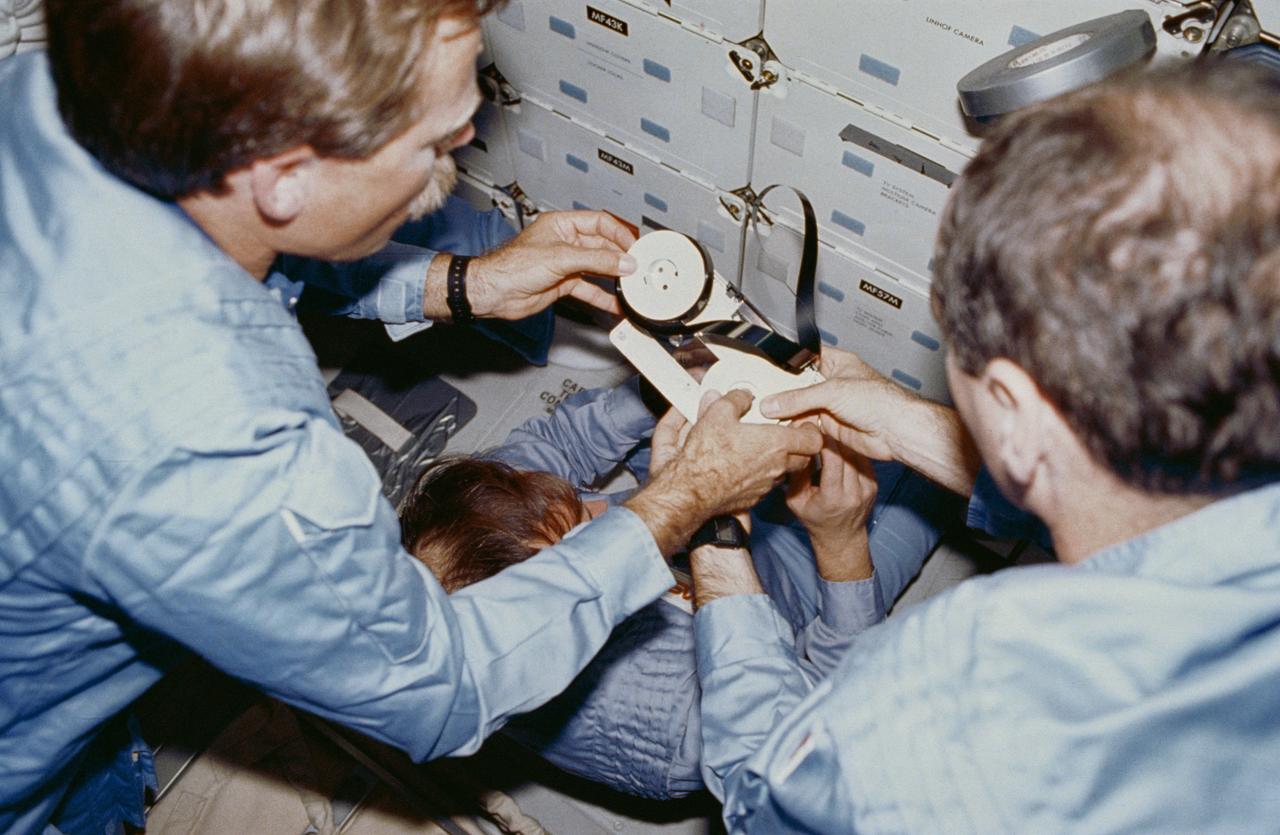
STS027-05-020 (2-6 Dec. 1988) --- In the foreground, astronauts Robert L. Gibson (left) and Guy S. Gardner, commander and pilot, respectively, for the STS-27 mission, repair a 3/4-inch video reel on the middeck of the Earth-orbiting space shuttle Atlantis. Photo credit: NASA

JSC2010-E-014762 (28 Jan. 2010) --- NASA astronauts Greg Chamitoff (left), Andrew Feustel and Michael Fincke, all STS-134 mission specialists, participate in an EVA tile repair training session in the Space Vehicle Mock-up Facility at NASA's Johnson Space Center.
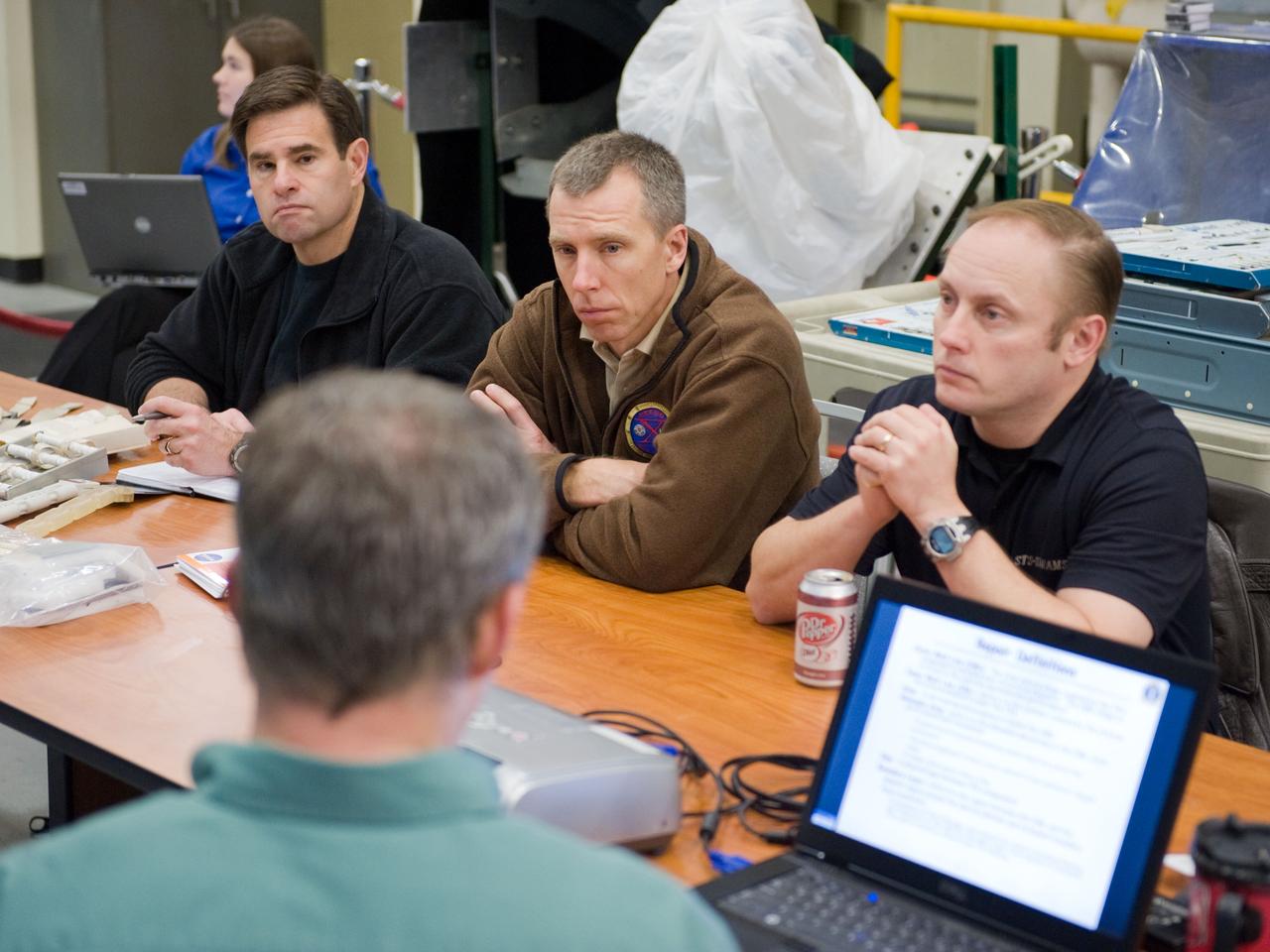
JSC2010-E-014761 (28 Jan. 2010) --- NASA astronauts Greg Chamitoff (left), Andrew Feustel and Michael Fincke, all STS-134 mission specialists, participate in an EVA tile repair training session in the Space Vehicle Mock-up Facility at NASA's Johnson Space Center.
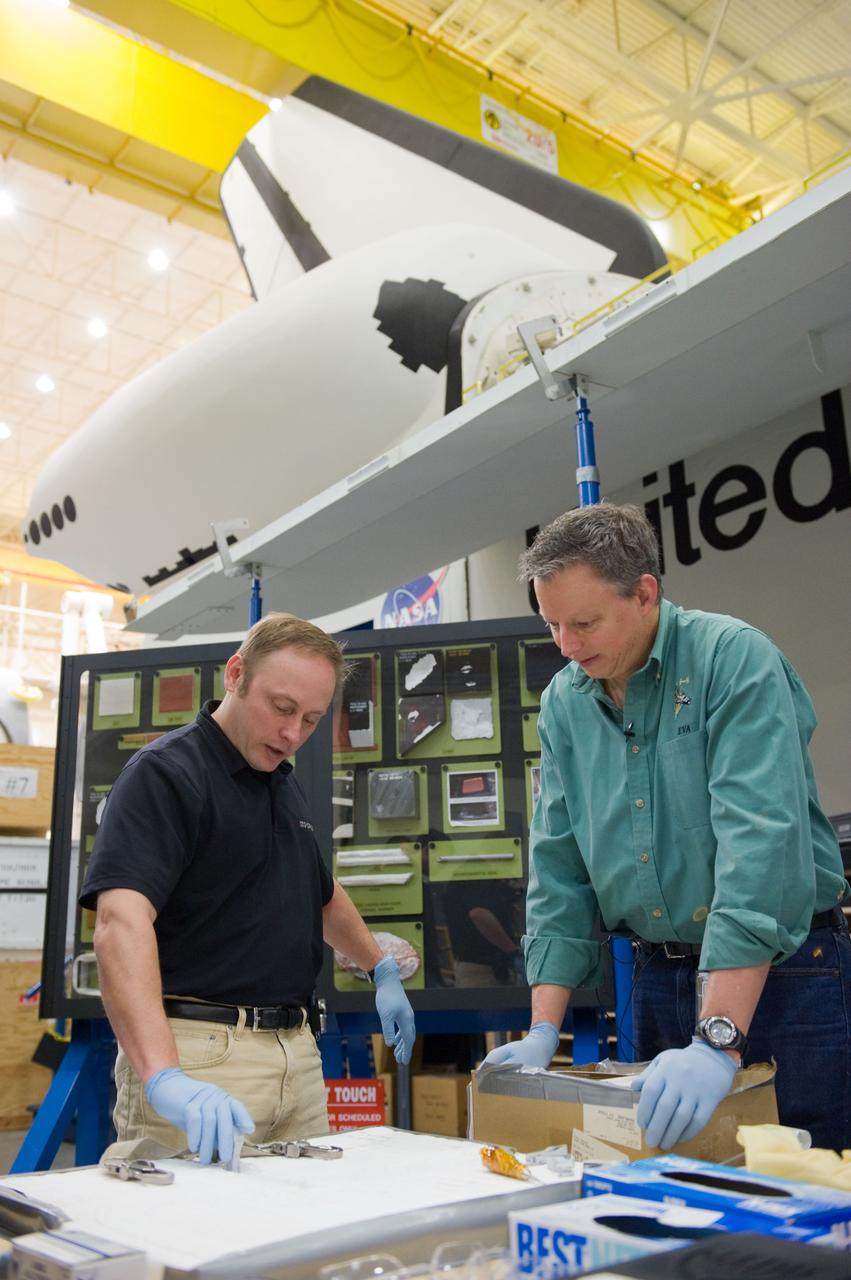
JSC2010-E-014766 (28 Jan. 2010) --- NASA astronaut Michael Fincke (left), STS-134 mission specialist, participates in an EVA tile repair training session in the Space Vehicle Mock-up Facility at NASA's Johnson Space Center. Instructor John Ray assisted Fincke.
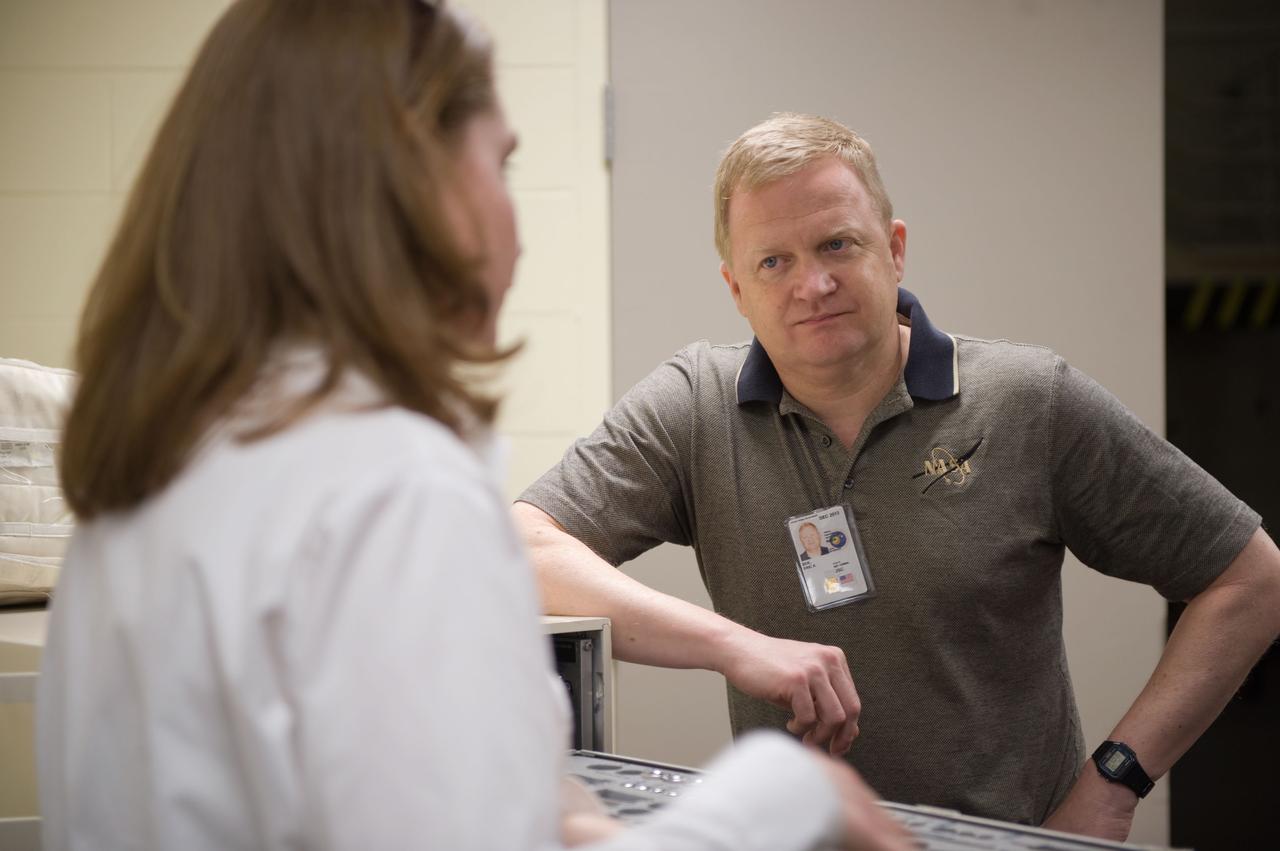
JSC2010-E-014264 (26 Jan. 2010) --- NASA astronaut Eric Boe, STS-133 pilot, participates in an ISS tools and repair kits training session in the Space Vehicle Mock-up Facility at NASA's Johnson Space Center. Instructor Ivy Apostolakopoulos assisted Boe.
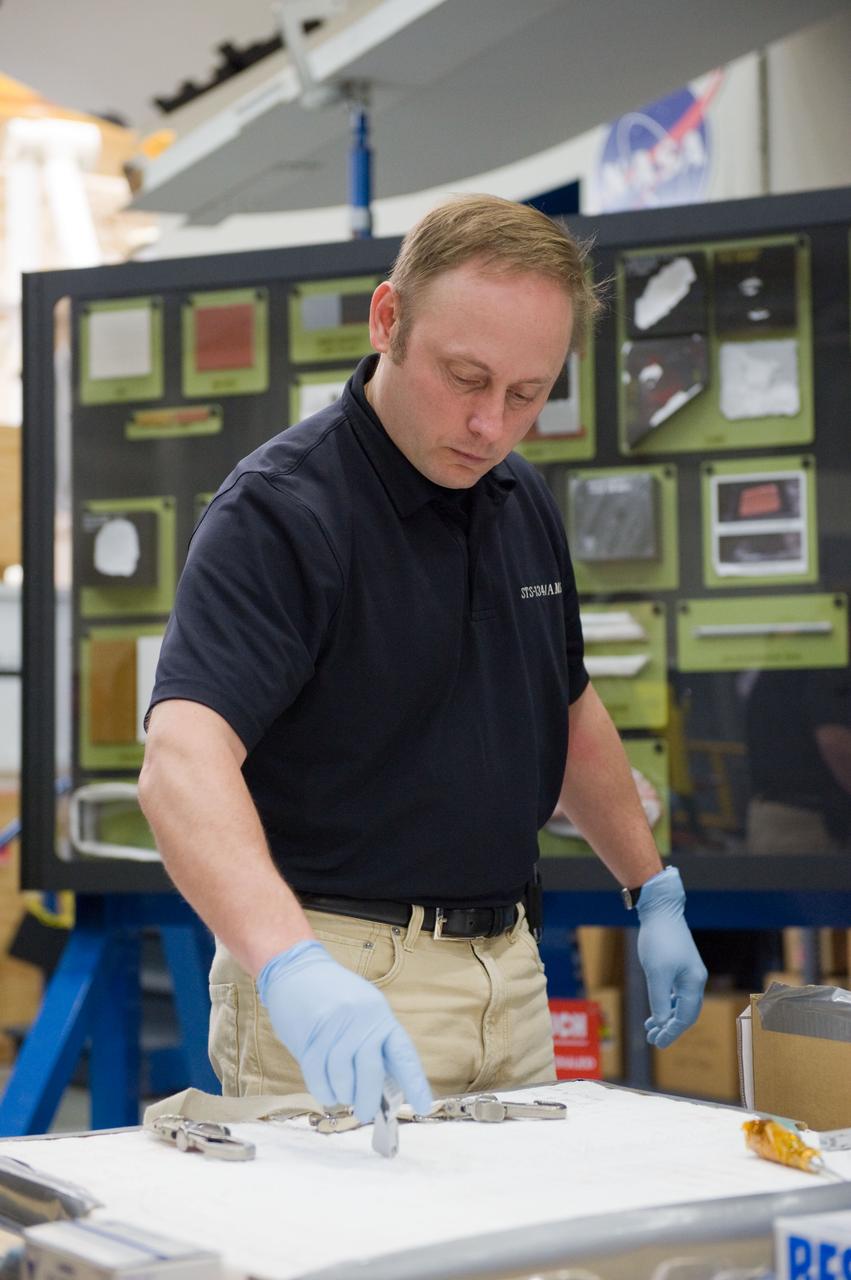
JSC2010-E-014767 (28 Jan. 2010) --- NASA astronaut Michael Fincke, STS-134 mission specialist, participates in an EVA tile repair training session in the Space Vehicle Mock-up Facility at NASA's Johnson Space Center.
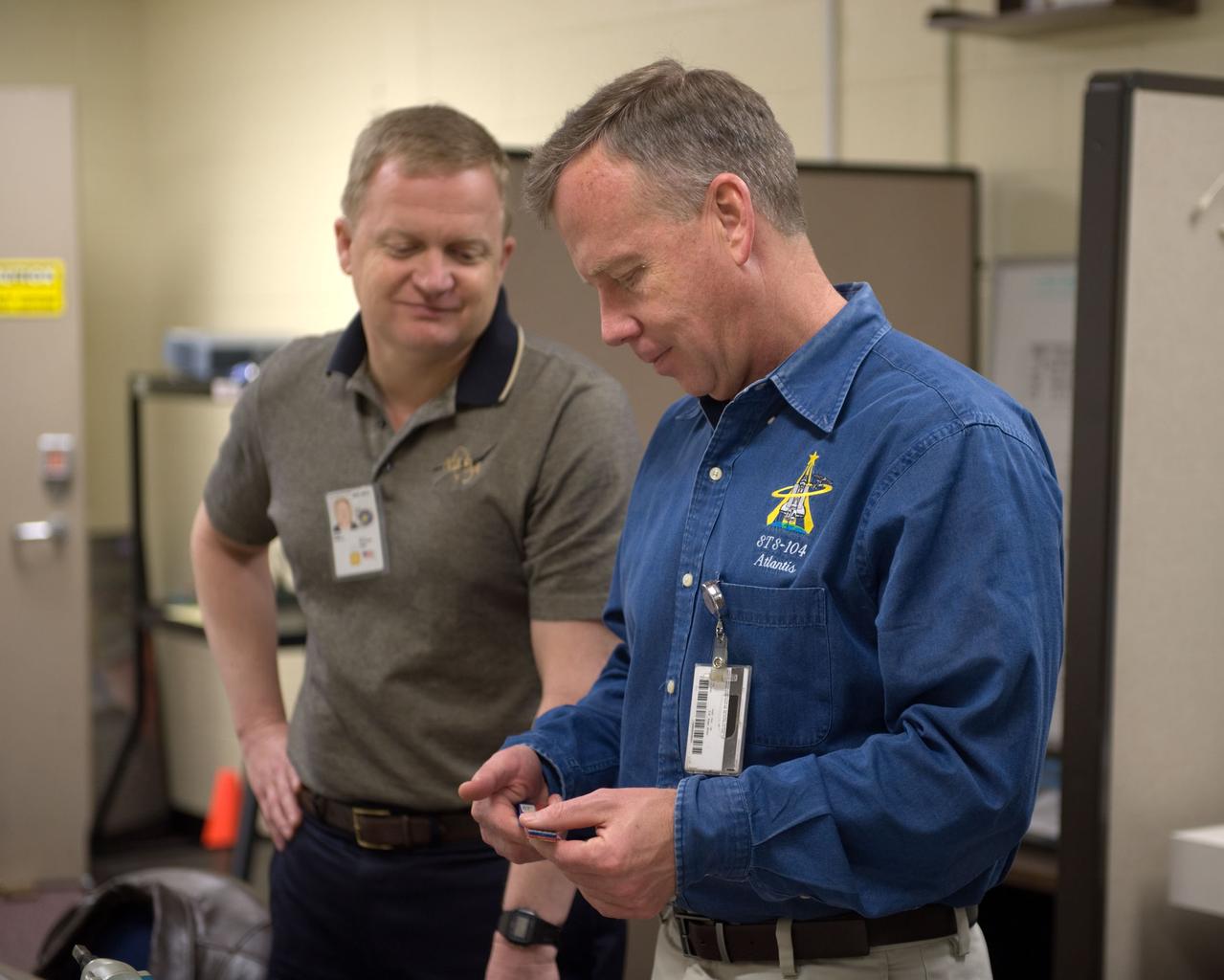
JSC2010-E-014266 (26 Jan. 2010) --- NASA astronauts Steve Lindsey (right), STS-133 commander; and Eric Boe, pilot, participate in an ISS tools and repair kits training session in the Space Vehicle Mock-up Facility at NASA's Johnson Space Center.
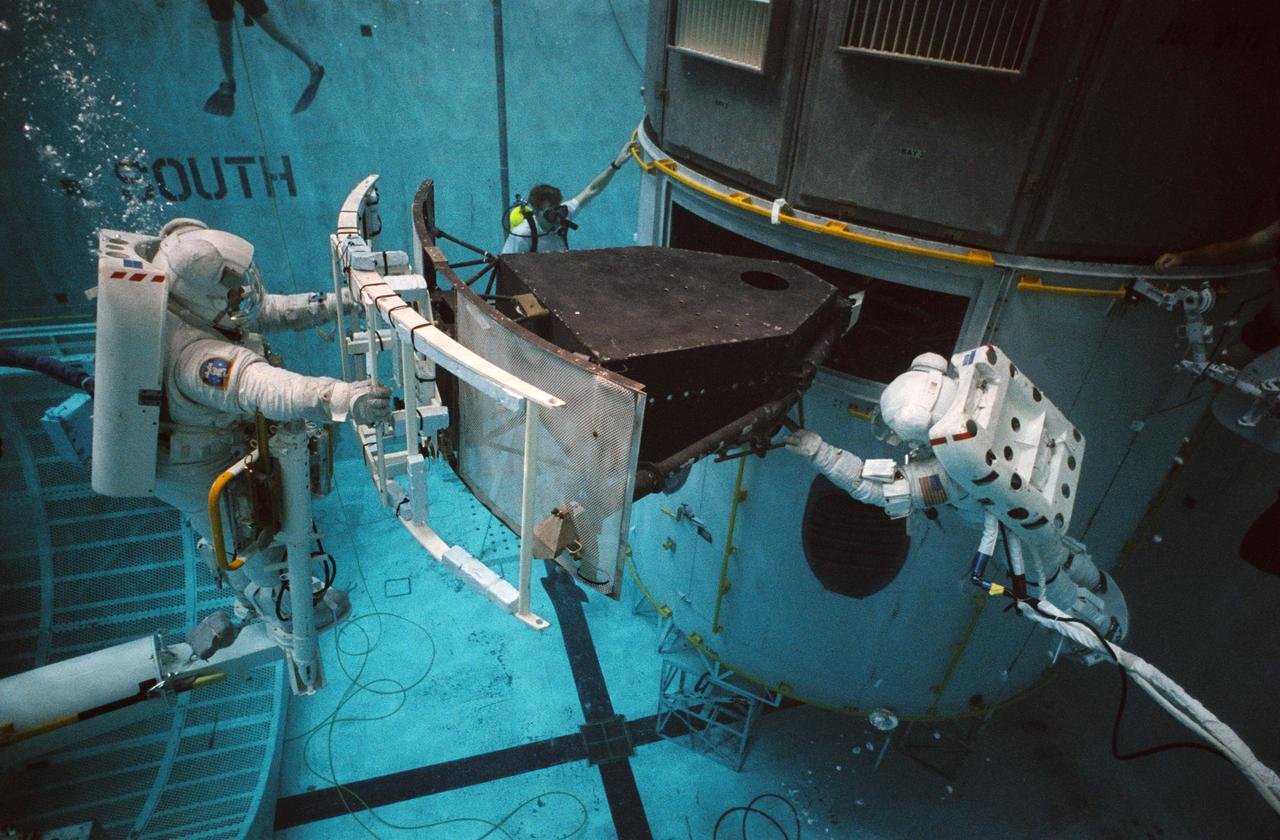
S93-33103 (2 Apr 1993) --- Wearing training versions of Space Shuttle Extravehicular Mobility Units (EMU), astronauts F. Story Musgrave and Jeffrey A. Hoffman use the giant pool of the Johnson Space Center's (JSC) Weightless Environment Training Facility (WET-F) to rehearse for the Hubble Space Telescope (HST) repair mission. The two are working with a full-scale training version of the Wide Field/Planetary Camera (WF/PC). The current WF/PC will be replaced with WF/PC-2. A total of five extravehicular activity (EVA) sessions will be conducted during the scheduled December mission of the Endeavour.
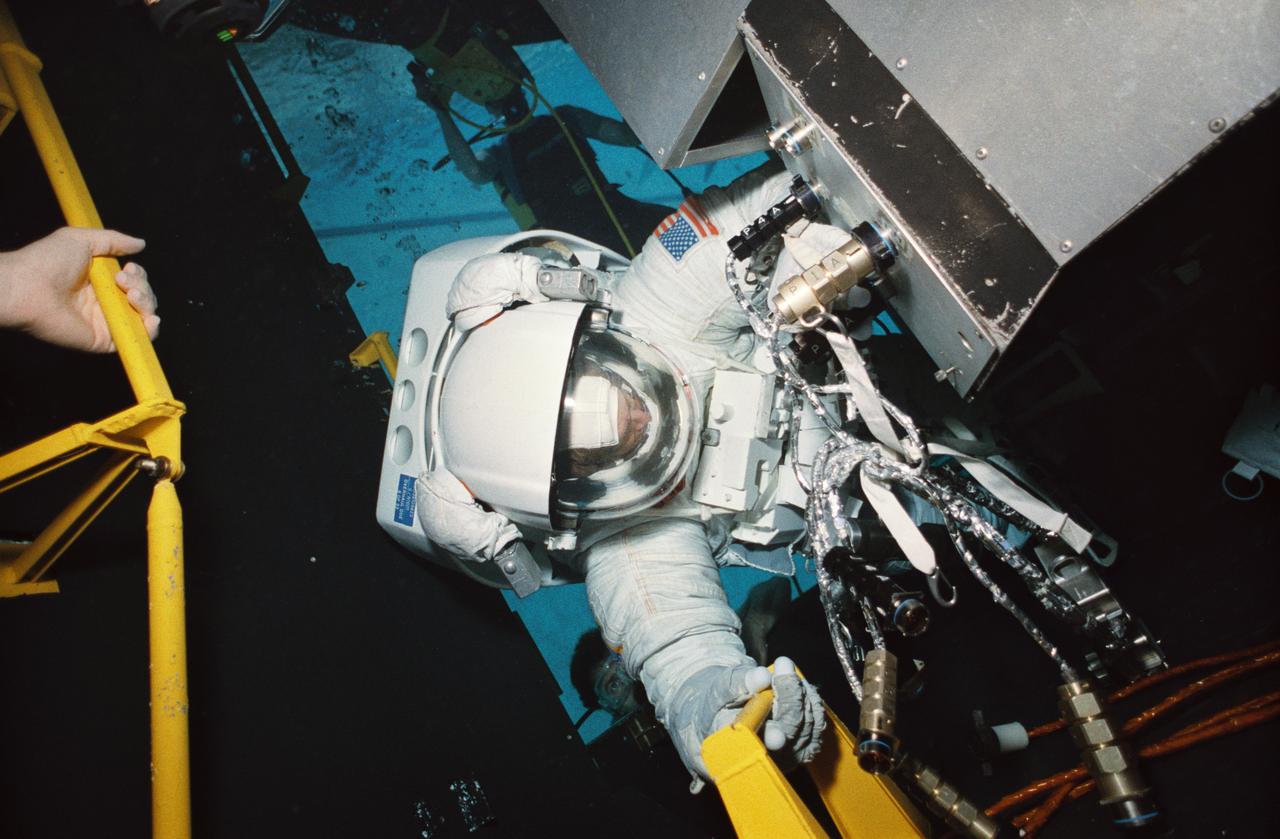
S93-33104 (7 Apr 1993) --- Wearing a training version of Space Shuttle Extravehicular Mobility Unit (EMU), astronaut Jeffrey A. Hoffman uses the giant pool of the Johnson Space Center's (JSC) Weightless Environment Training Facility (WET-F) to rehearse for the Hubble Space Telescope (HST) repair mission. Out of frame is astronaut F. Story Musgrave, who will join Hoffman in STS-61 EVA. The hand at top frame belongs to a SCUBA-equipped diver. A number of divers are on hand for all training sessions in the WET-F. A total of five extravehicular activity (EVA) sessions will be conducted during the scheduled December mission of the Endeavour.
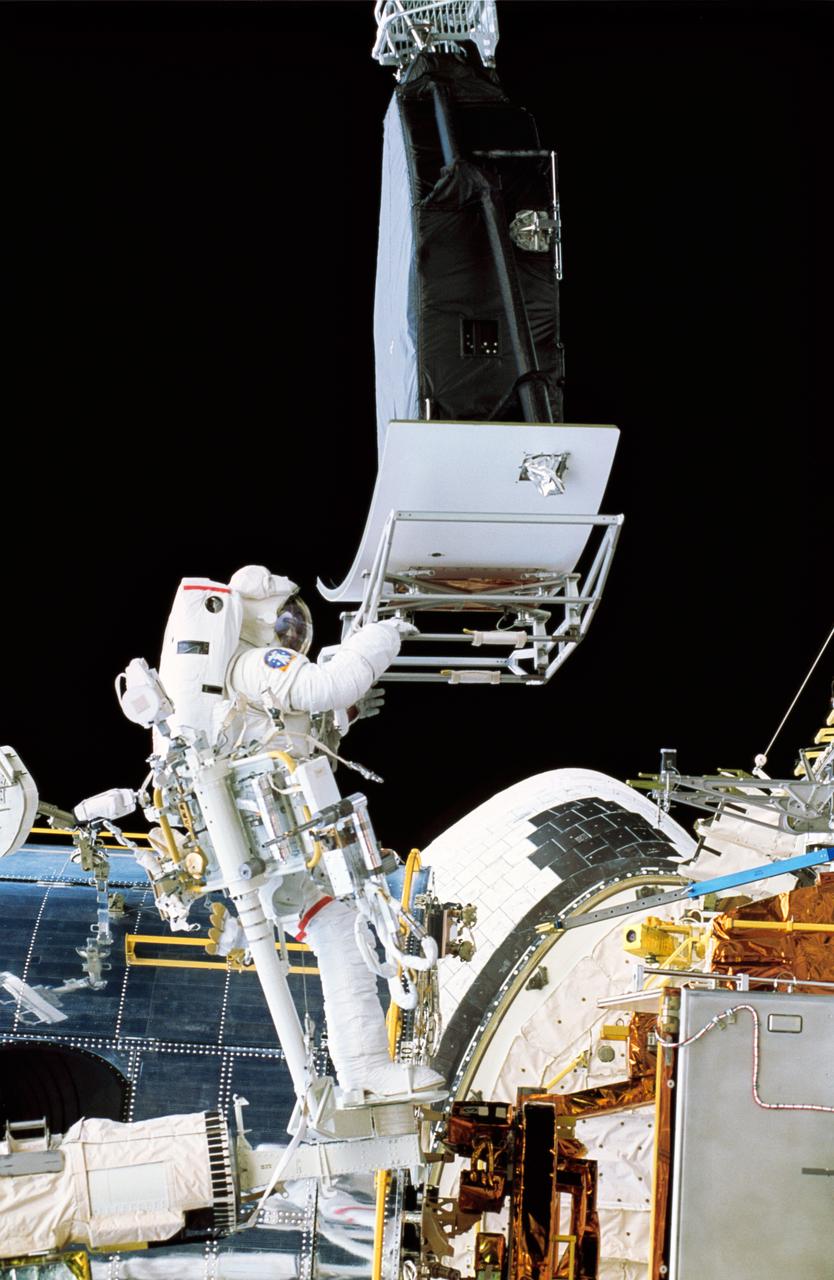
STS061-37-011 (7 Dec 1993) --- Astronaut Jeffrey A. Hoffman with Wide Field/Planetary Camera (WF/PC 1) during changeout operations. WF/PC-2 has already been installed in cavity (out of frame). Astronauts Hoffman and Story Musgrave are performing Extravehicular Activities (EVA) to repair the Hubble Space Telescope (HST).
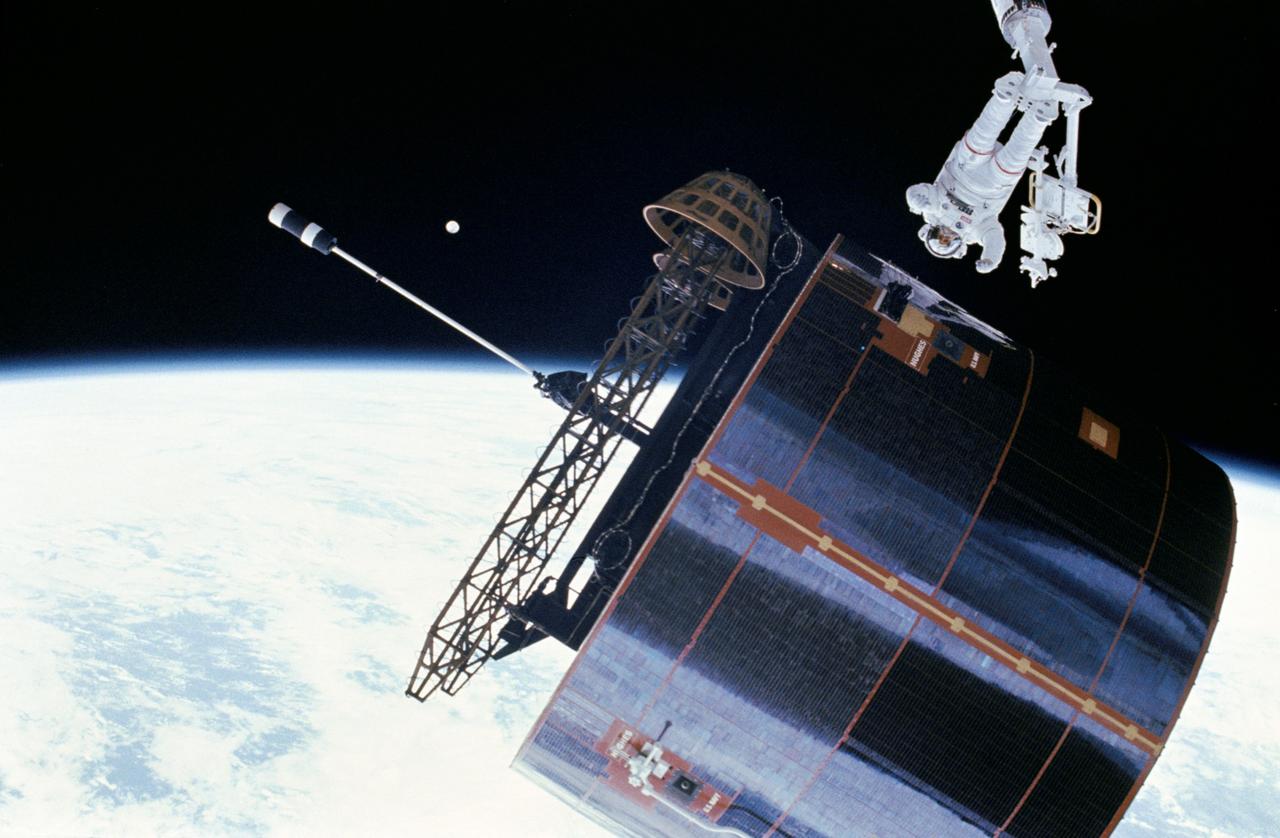
51I-102-029 (31 August - 1 September 1985) --- This is one of a series of six photographs released by NASA covering the extravehicular activity (EVA) of astronauts James D. van Hoften and William F. Fisher, who helped to capture, repair and release the previously errant Syncom IV-3 communications satellite. Here, Dr. van Hoften has just given a shove to the the Syncom. (For orientation, moon should be in lower right quadrant).
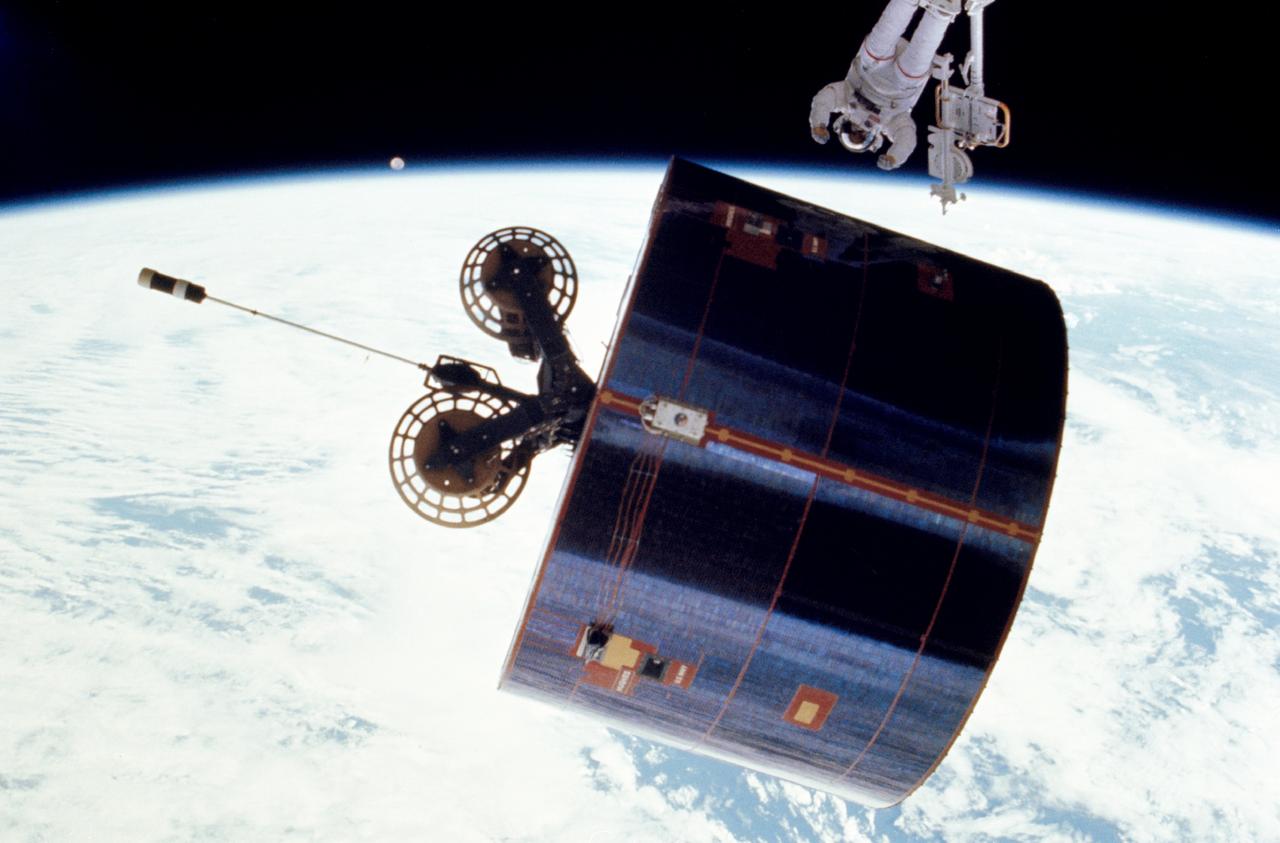
51I-102-033 (31 August - 1 September 1985) --- This is one of a series of six photographs released by NASA covering the extravehicular activity (EVA) of astronauts James D. van Hoften and William F. Fisher, who helped to capture, repair and release the previously errant Syncom IV-3 communications satellite. Here, Dr. van Hoften has just given a shove to the the Syncom. (For orientation, moon should be in lower right quadrant).
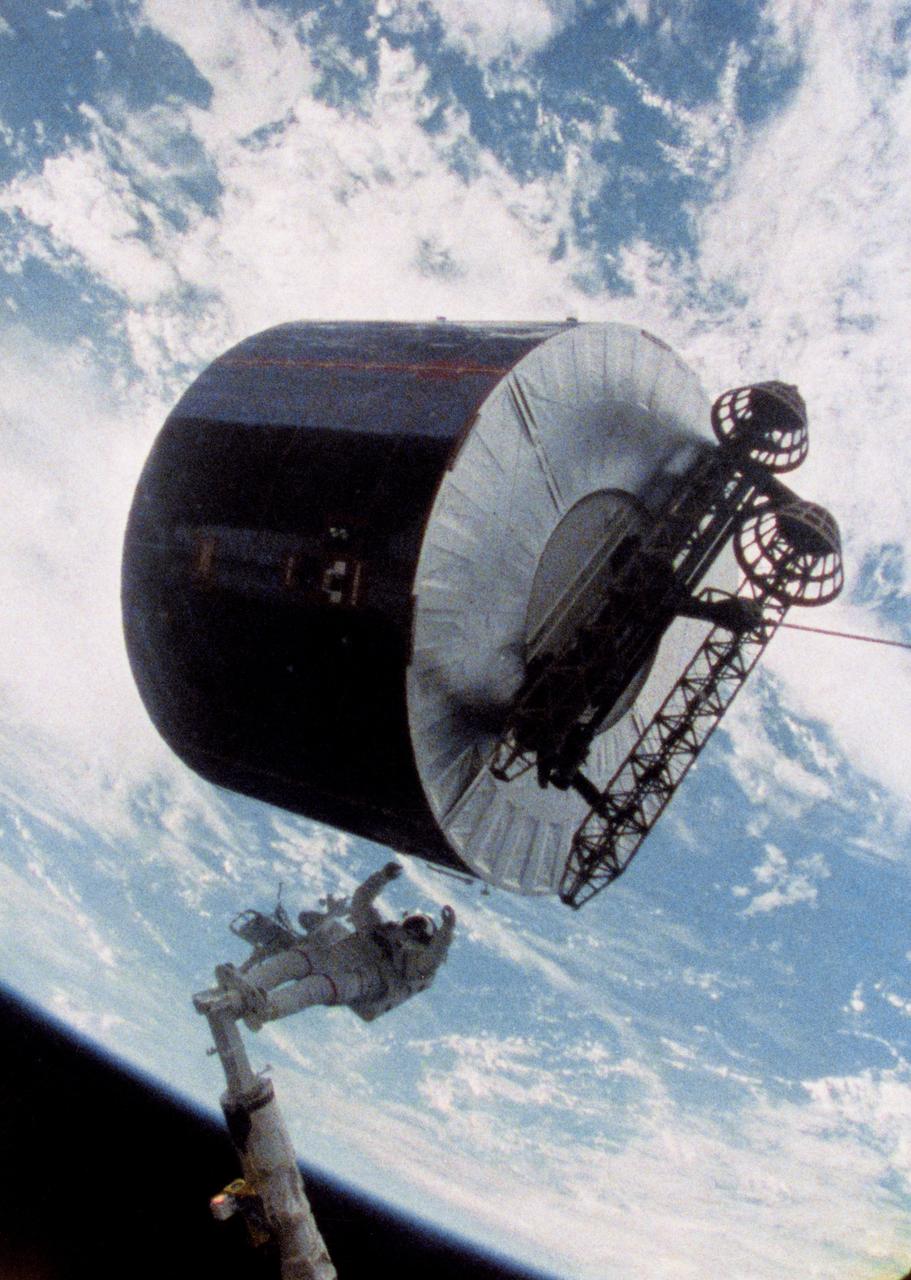
51I-S-237 (1 Sept. 1985) --- A still photo made from a video downlink shows astronaut James D. van Hoften, just after giving a shove to the Syncom IV-3 communications satellite. NASA's 51-I astronaut crew aboard the space shuttle Discovery had earlier captured and repaired the previously errant satellite. Photo credit: NASA
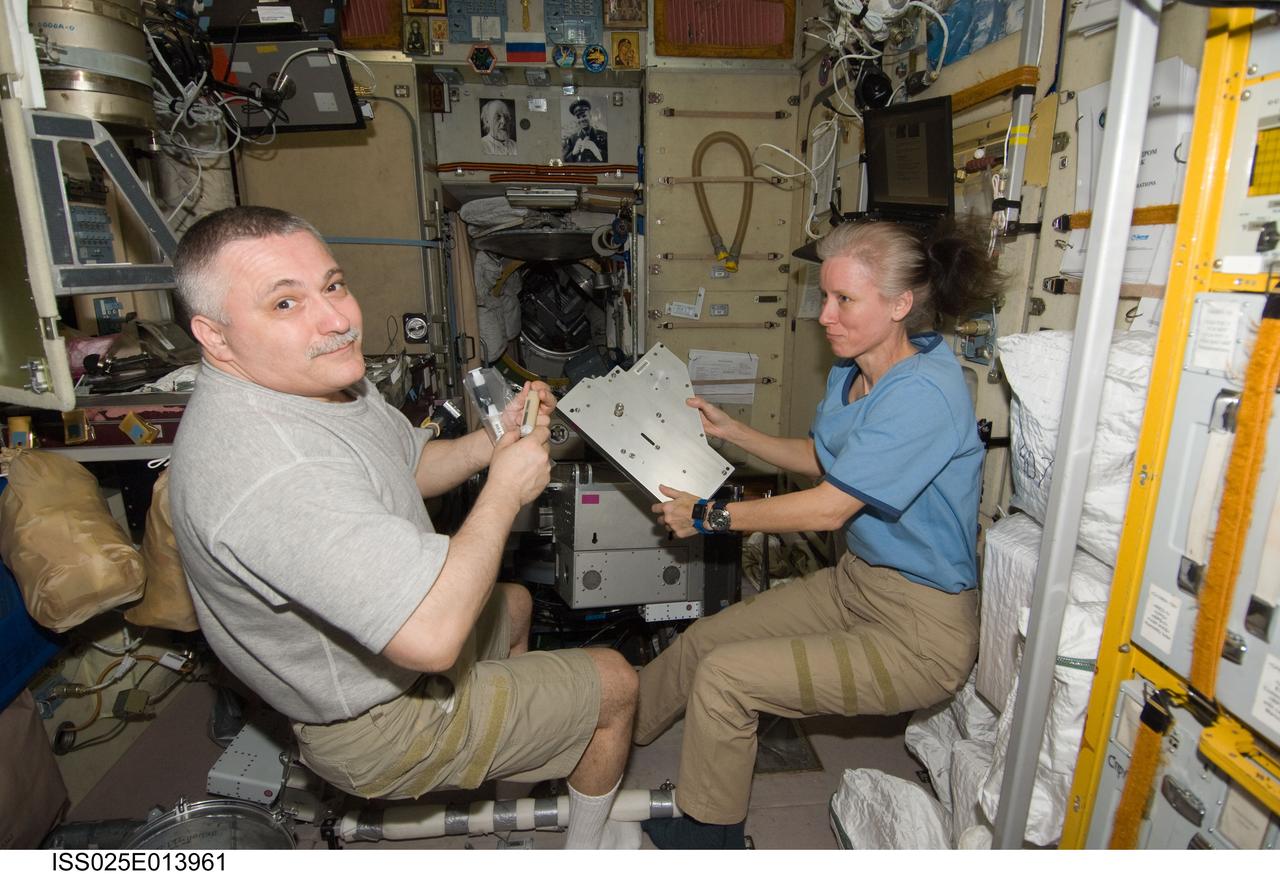
ISS025-E-013961 (10 Nov. 2010) --- Russian cosmonaut Fyodor Yurchikhin and NASA astronaut Shannon Walker, both Expedition 25 flight engineers, work in the Zvezda Service Module of the International Space Station.
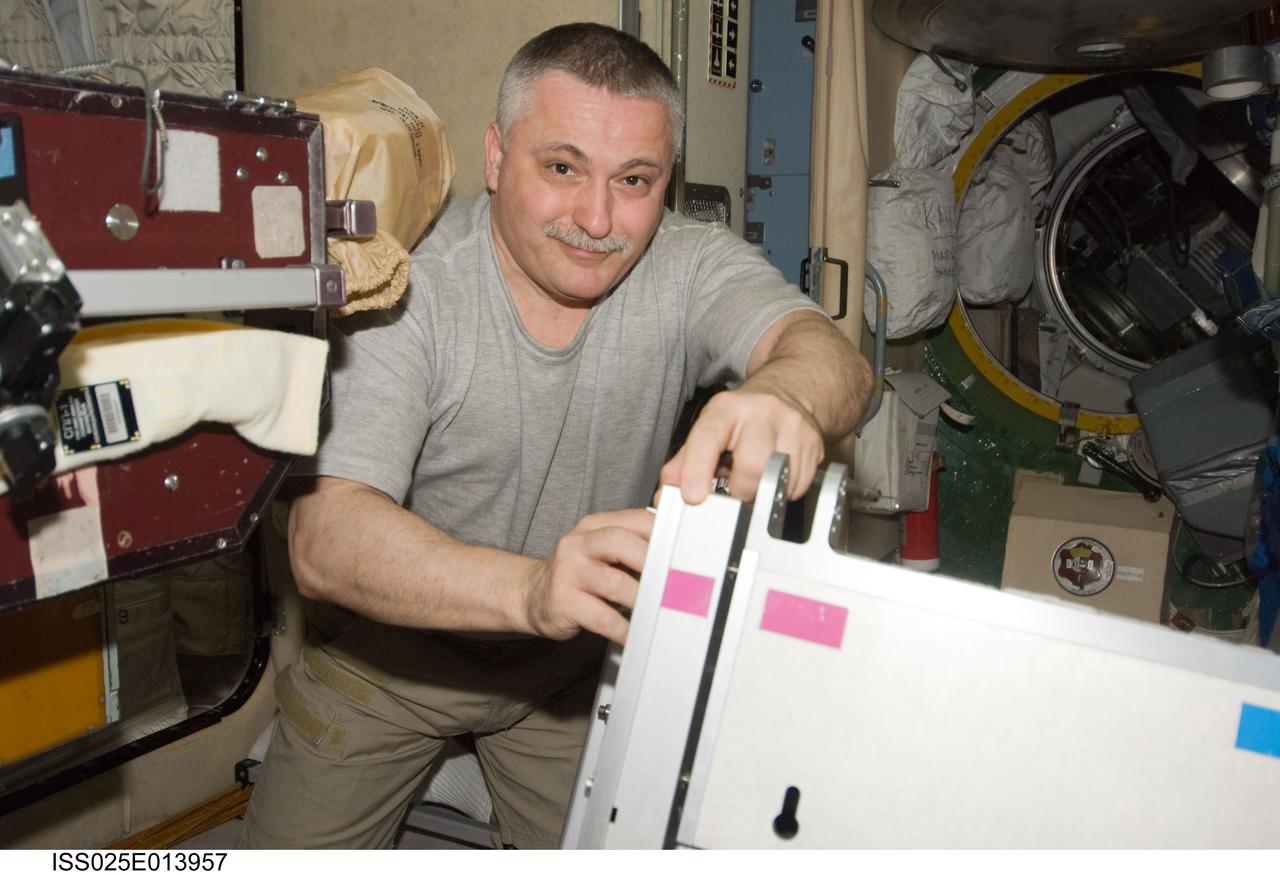
ISS025-E-013957 (10 Nov. 2010) --- Russian cosmonaut Fyodor Yurchikhin, Expedition 25 flight engineer, works in the Zvezda Service Module of the International Space Station.
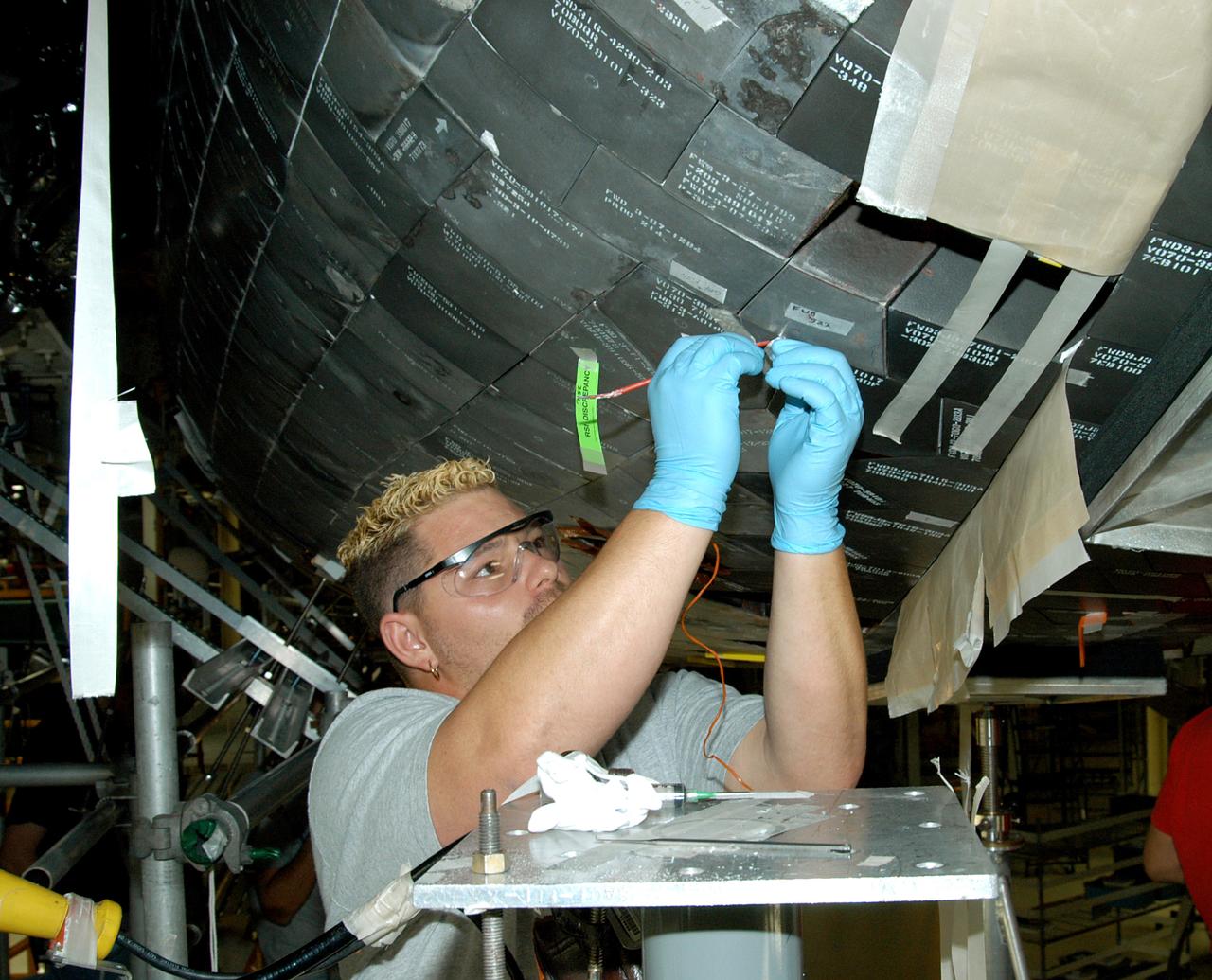
KENNEDY SPACE CENTER, FLA. - In the Orbiter Processing Facility, KSC employee Chris Moore repairs tile on the forward area of the orbiter Discovery. The vehicle has undergone Orbiter Major Modifications in the past year, which includes tile check and repair. The tiles are part of the Orbiter Thermal Protection System, thermal shields to protect against temperatures as high as 3,000° Fahrenheit, which are produced during descent for landing. Discovery is scheduled to fly on mission STS-121 to the International Space Station.
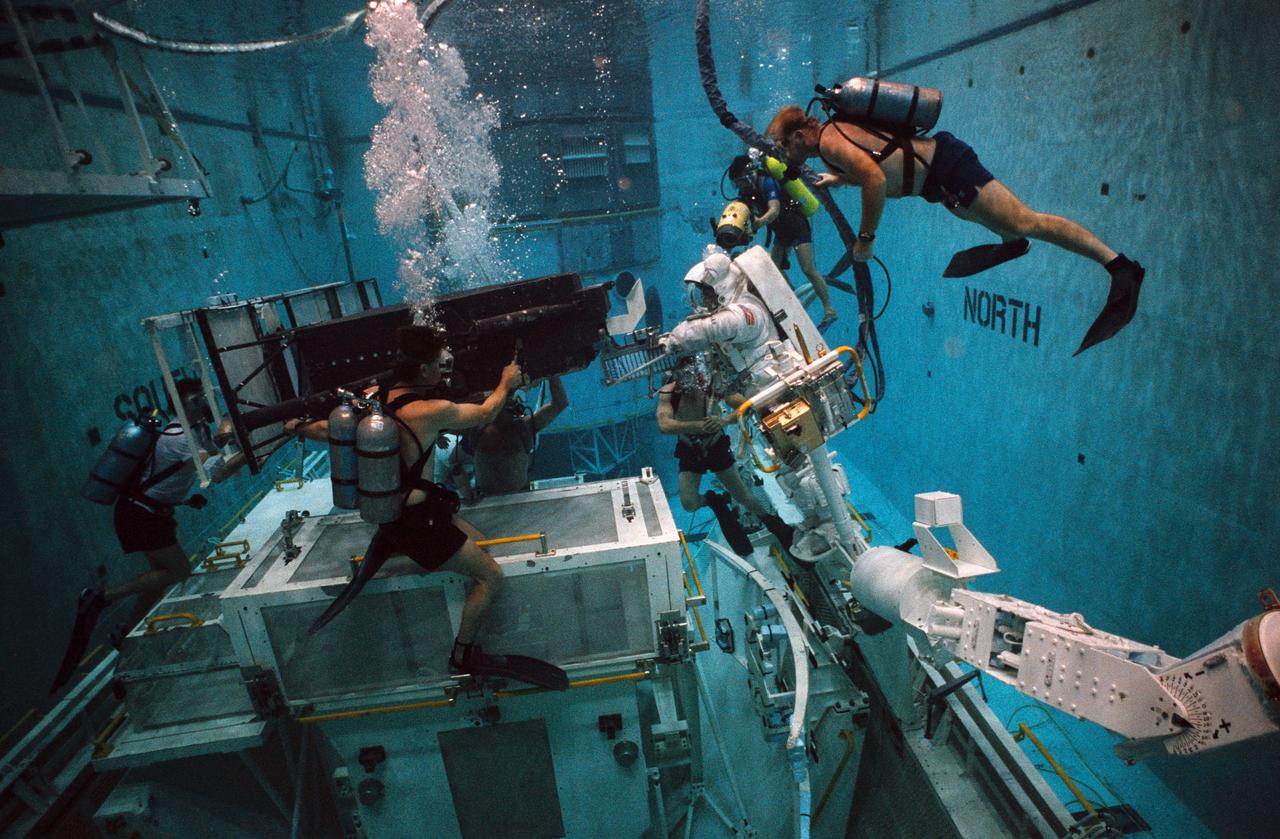
S93-33102 (5 Apr 1993) --- Wearing a training version of Space Shuttle Extravehicular Mobility Unit (EMU), astronaut Thomas D. Akers uses the giant pool of the Johnson Space Center's (JSC) Weightless Environment Training Facility (WET-F) to rehearse for the Hubble Space Telescope (HST) repair mission. Standing on a mobile foot restraint connected to the Shuttle's robot arm, Akers works with a full-scale training version of the Wide Field/Planetary Camera (WF/PC). The current WF/PC on the HST will be replaced with WF/PC-2. The giant box is a stowage area for both WF/PC facilities. Out of frame is astronaut Kathryn C. Thornton, who will join Akers in STS-61 EVA. Several SCUBA-equipped divers assist in the rehearsal. A total of five extravehicular activity (EVA) sessions will be conducted during the scheduled December mission of the Endeavour.
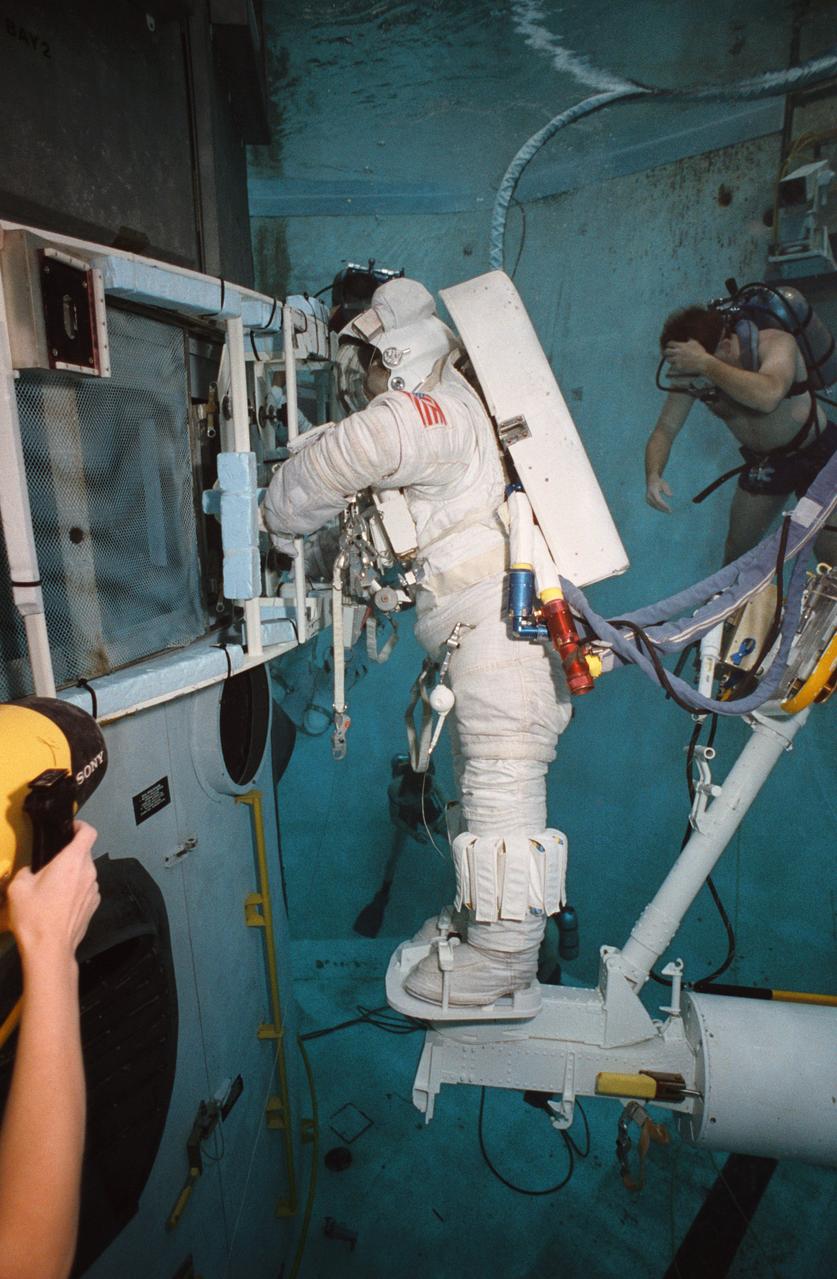
S93-33101 (5 Apr 1993) --- Wearing a training version of Space Shuttle Extravehicular Mobility Unit (EMU), astronaut Kathryn C. Thornton uses the giant pool of the Johnson Space Center's (JSC) Weightless Environment Training Facility (WET-F) to rehearse for the Hubble Space Telescope (HST) repair mission. Standing on a mobile foot restraint connected to the Shuttle's robot arm, Thornton grasps a large structure which attaches to the Wide Field/Planetary Camera (WF/PC). The current WF/PC on the HST will be replaced with WF/PC-2. Out of frame is astronaut Thomas D. Akers, who will join Thornton in STS-61 EVA. A SCUBA-equipped diver can be seen in the background. A number of divers are on hand for all training sessions in the WET-F. A total of five extravehicular activity (EVA) sessions will be conducted during the scheduled December mission of the Endeavour.
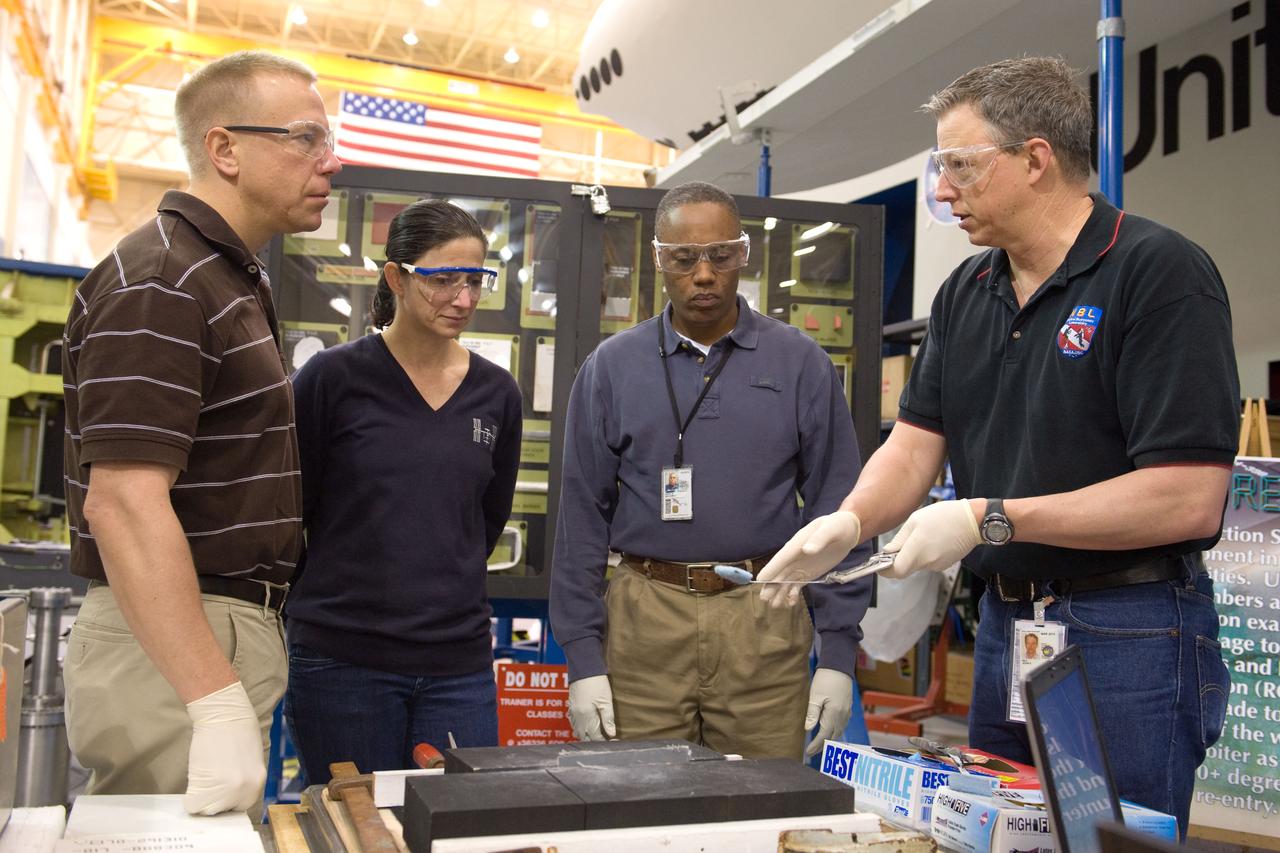
JSC2010-E-044333 (30 March 2010) --- NASA astronauts Tim Kopra (left), Nicole Stott and Alvin Drew, all STS-133 mission specialists, participate in an EVA tile repair training session in the Space Vehicle Mockup Facility at NASA's Johnson Space Center. Instructor John Ray (right) assisted the crew members.

JSC2010-E-014763 (28 Jan. 2010) --- NASA astronauts Greg Chamitoff (left), Andrew Feustel and Michael Fincke, all STS-134 mission specialists, participate in an EVA tile repair training session in the Space Vehicle Mock-up Facility at NASA's Johnson Space Center. Instructor John Ray (right) assisted the crew members.
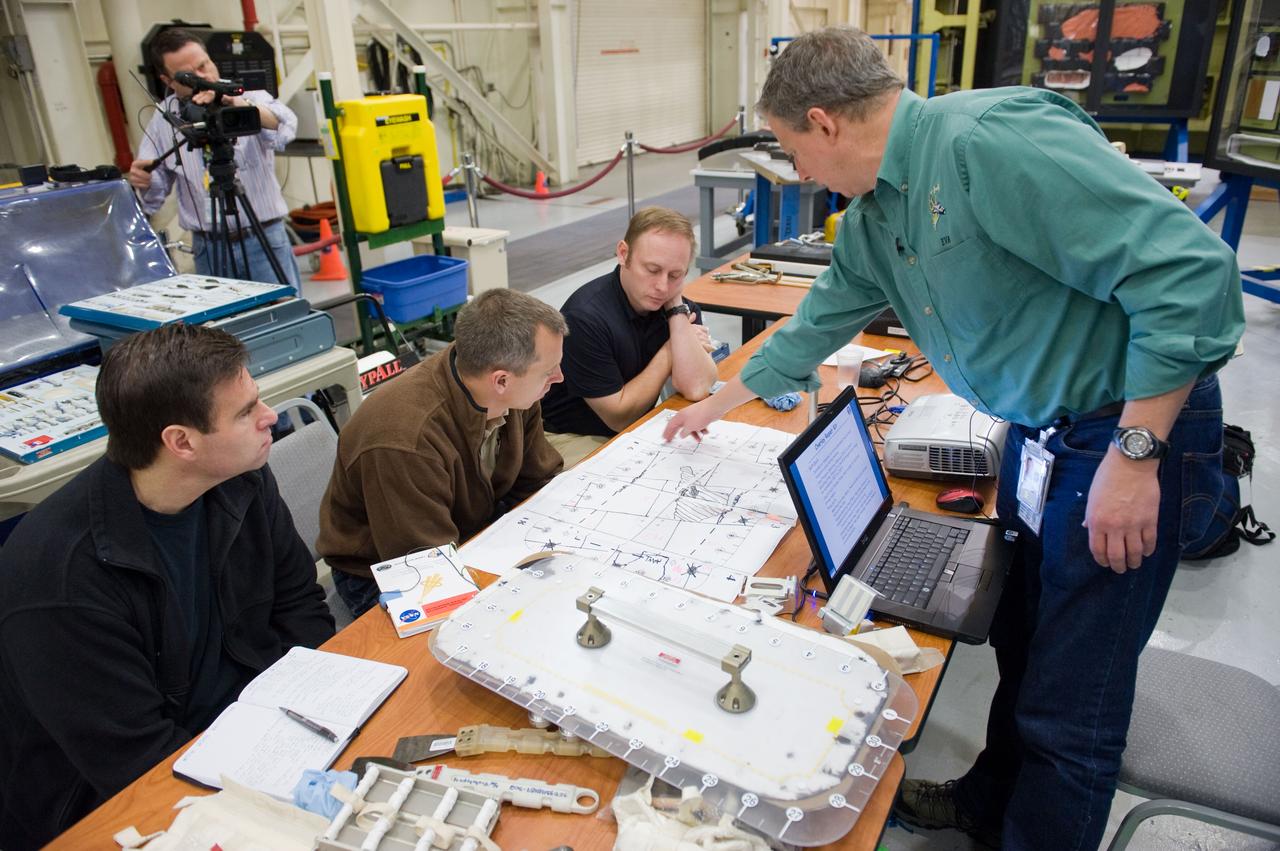
JSC2010-E-014772 (28 Jan. 2010) --- NASA astronauts Greg Chamitoff (left), Andrew Feustel and Michael Fincke, all STS-134 mission specialists, participate in an EVA tile repair training session in the Space Vehicle Mock-up Facility at NASA's Johnson Space Center. Instructor John Ray (right) assisted the crew members.
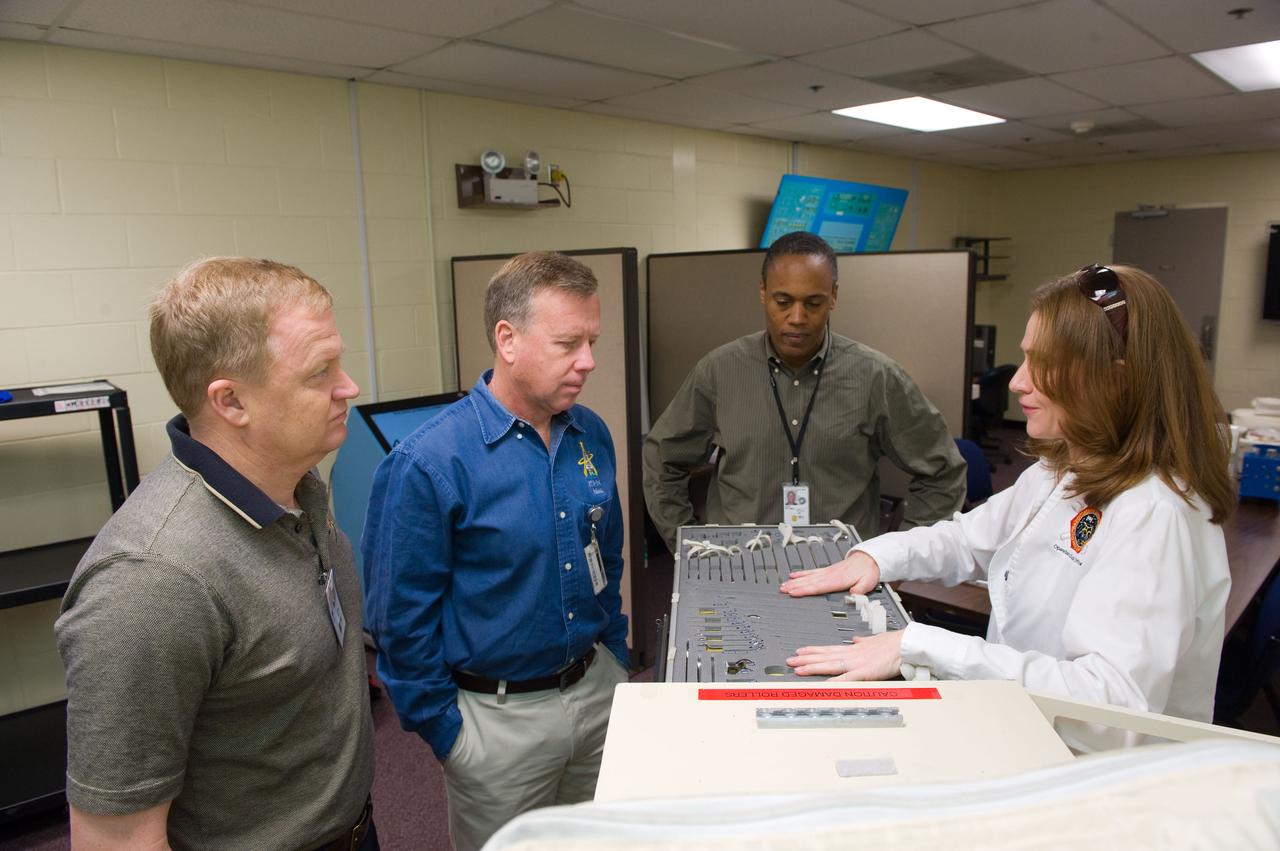
JSC2010-E-014262 (26 Jan. 2010) --- NASA astronauts Eric Boe (left), STS-133 pilot; Steve Lindsey, commander; and Alvin Drew, mission specialist, participate in an ISS tools and repair kits training session in the Space Vehicle Mock-up Facility at NASA's Johnson Space Center. Instructor Ivy Apostolakopoulos assisted the crew members.
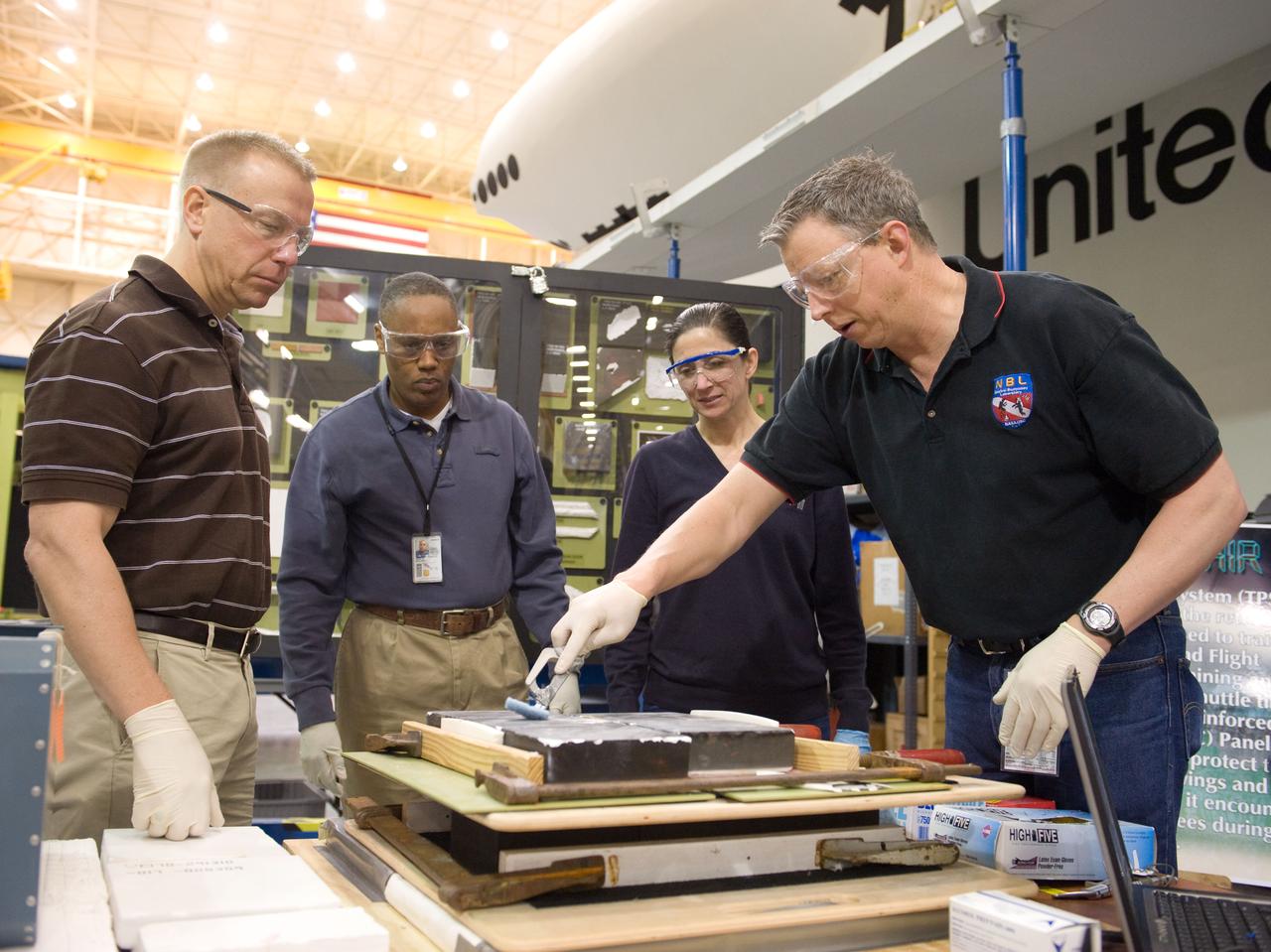
JSC2010-E-044335 (30 March 2010) --- NASA astronauts Tim Kopra (left), Nicole Stott and Alvin Drew, all STS-133 mission specialists, participate in an EVA tile repair training session in the Space Vehicle Mockup Facility at NASA's Johnson Space Center. Instructor John Ray (right) assisted the crew members.
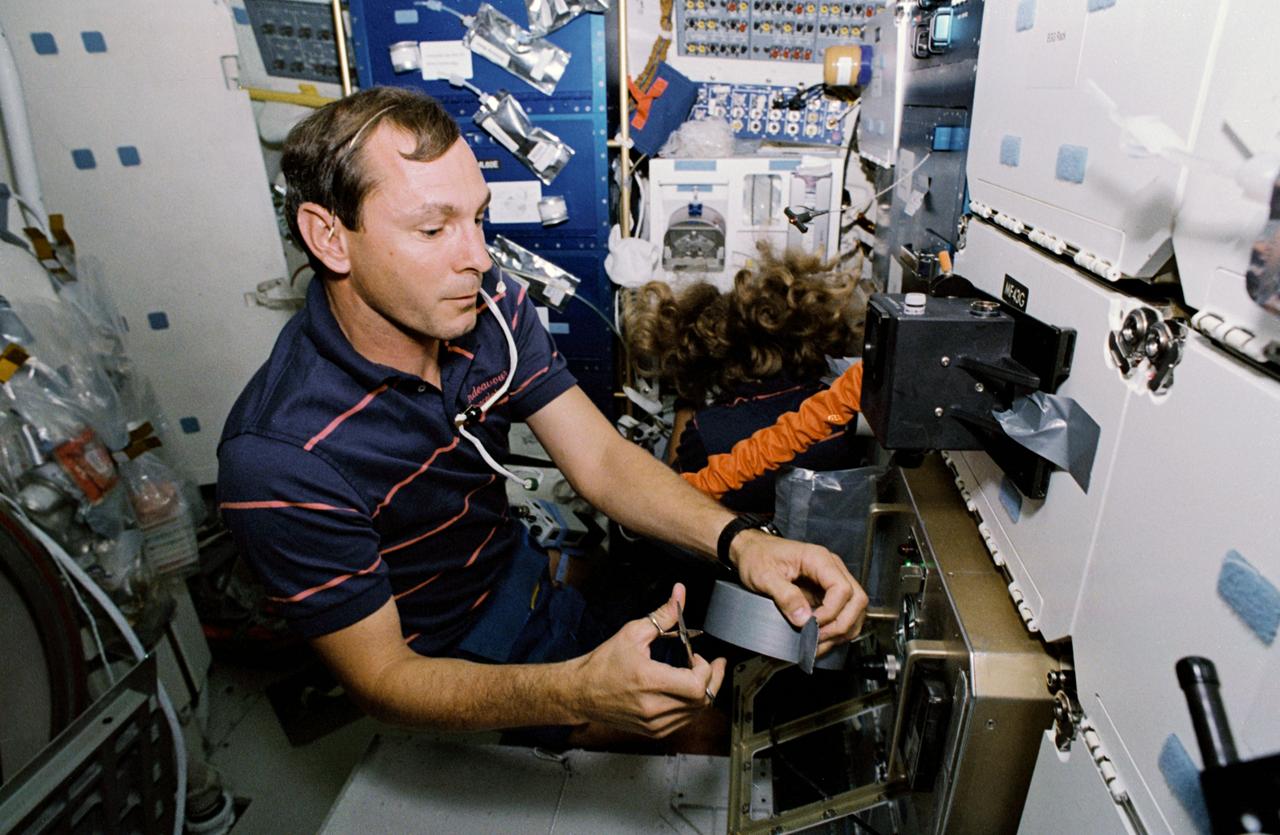
STS047-35-022 (12 - 20 Sept 1992) --- Astronauts Curtis L. Brown, Jr., pilot, and N. Jan Davis, mission specialist, team up to cure a high humidity problem in the hornet experiment in the Spacelab-J Science Module of the Earth-orbiting Space Shuttle Endeavour. Via a jury-rigged hose hook-up, the two were able to blow air from a spacesuit fan into the experiment, thus eliminating condensation that obscured the viewing of the Israeli hornet experiment. The experiment examined the effects of microgravity on the orientation, reproductive capability and social activity of 180 female Oriental Hornets.
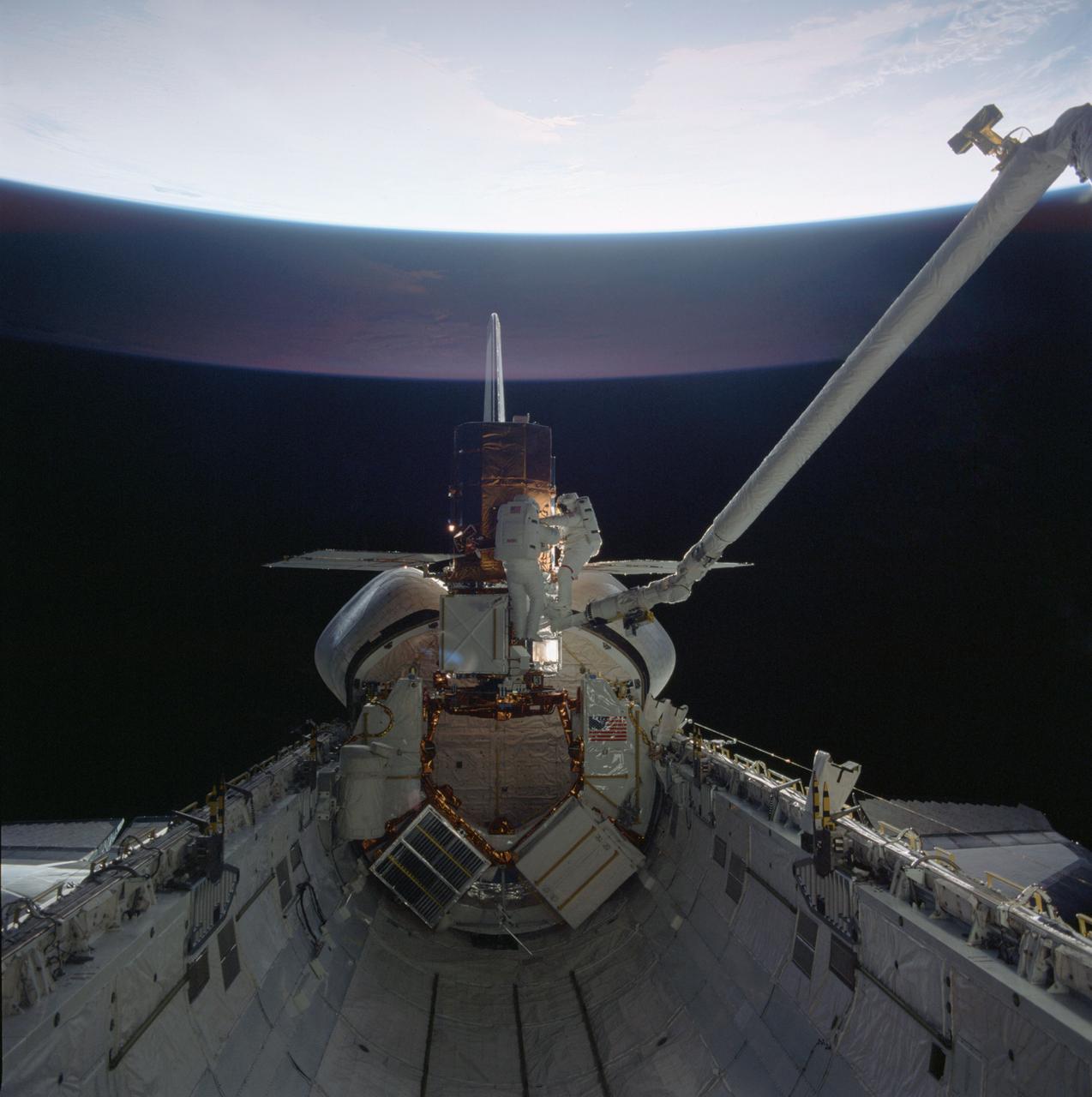
41C-37-1711 (11 April 1984) --- The two mission specialist-EVA participants of Flight 41-C share a repair task at the "captured" Solar Maximum Mission Satellite (SMMS) in the aft end of the Challenger's cargo bay. Astronauts George D. Nelson, right, and James D. van Hoften uses the mobile foot restraint and the Remote Manipulator System (RMS) as a "cherry picker" device for moving about. Later, the RMS lifted the SMMS into space once more.
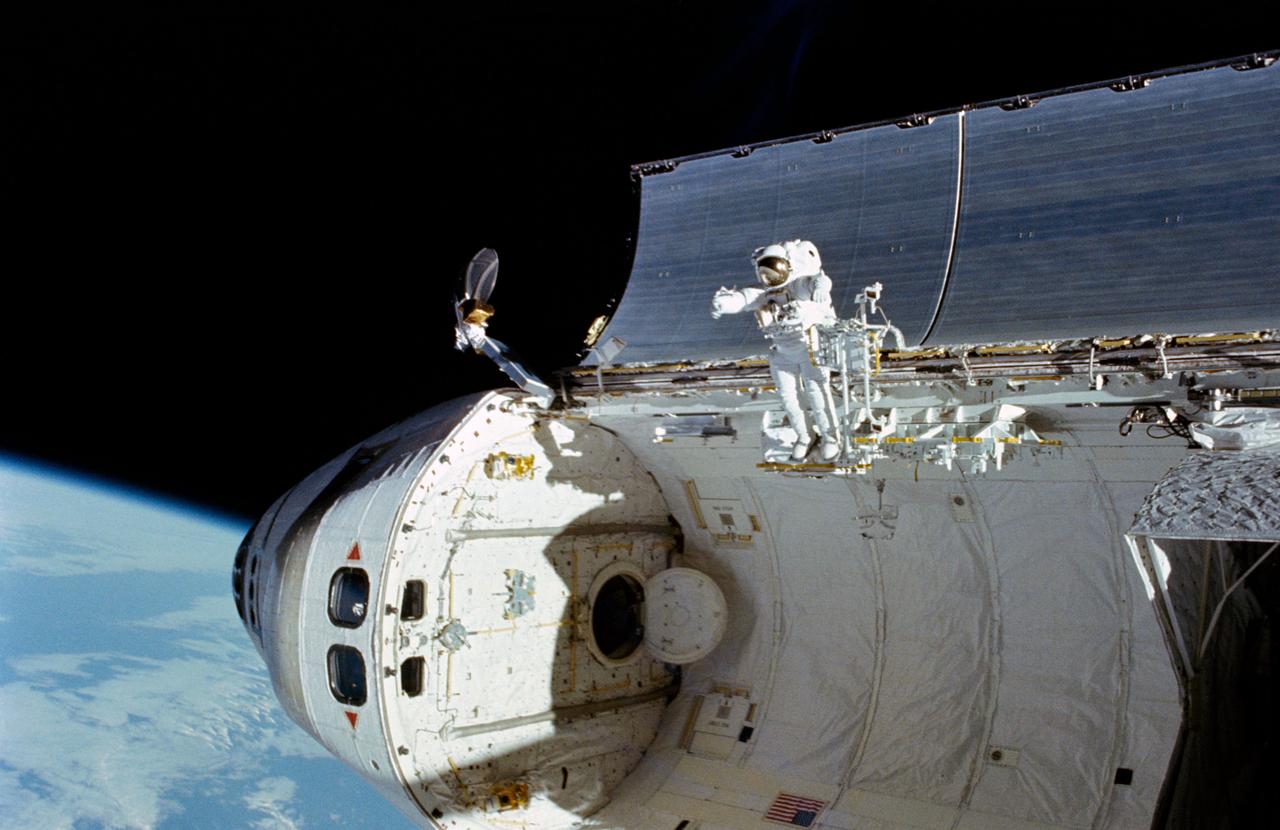
51I-102-048 (4-5 Sept 1985) --- A 35mm frame showing astronaut William F. Fisher standing on the edge of Discovery's cargo bay (in foot restraint) during the second day of a two-day effort to capture, repair and re-release the Syncom IV-3 communications satellite. Astronaut James D. van Hoften, standing on the Discovery's RMS arm, exposed the frame.
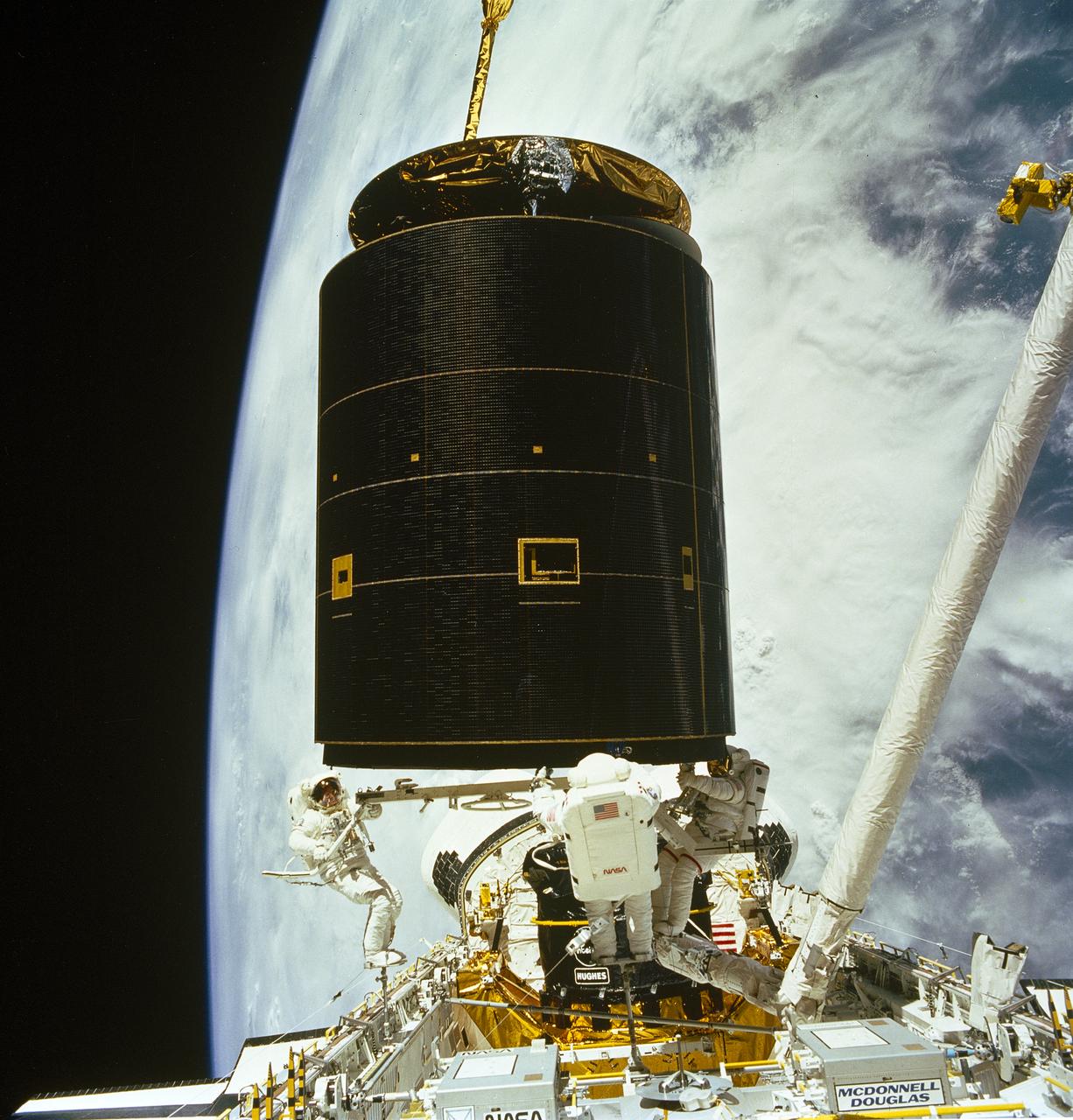
STS-49, the first flight of the Space Shuttle Orbiter Endeavour, lifted off from launch pad 39B on May 7, 1992 at 6:40 pm CDT. The STS-49 mission was the first U.S. orbital flight to feature 4 extravehicular activities (EVAs), and the first flight to involve 3 crew members working simultaneously outside of the spacecraft. The primary objective was the capture and redeployment of the INTELSAT VI (F-3), a communication satellite for the International Telecommunication Satellite organization, which was stranded in an unusable orbit since its launch aboard the Titan rocket in March 1990. The 4.5 ton INTELSAT VI was successfully snared by three astronauts on a third EVA. The three hand-grabbed the errant satellite, pulled it into the cargo bay, and attached a boost-given perigee stage before its release.