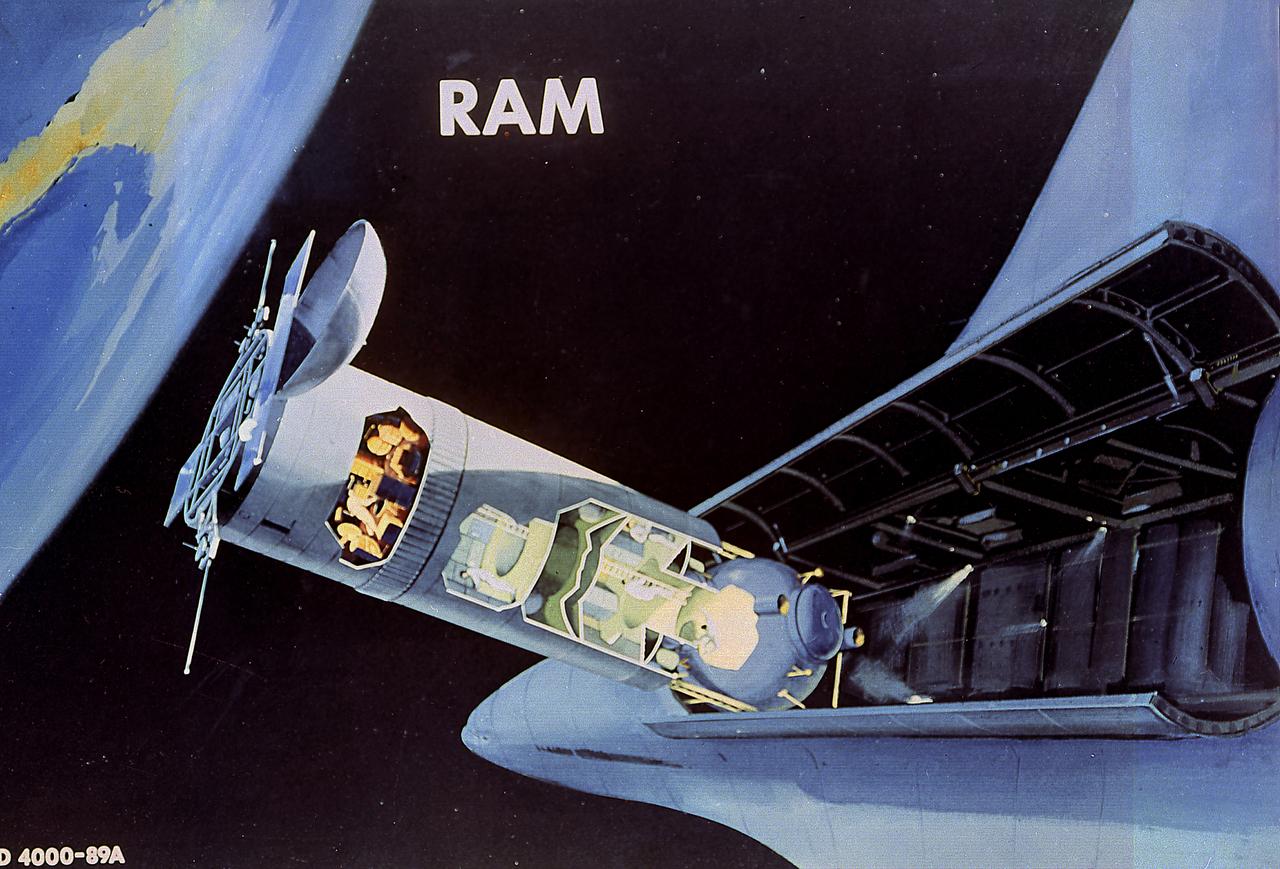
This is an artist's concept of the Research and Applications Modules (RAM). Evolutionary growth was an important consideration in space station plarning, and another project was undertaken in 1971 to facilitate such growth. The RAM study, conducted through a Marshall Space Flight Center contract with General Dynamics Convair Aerospace, resulted in the conceptualization of a series of RAM payload carrier-sortie laboratories, pallets, free-flyers, and payload and support modules. The study considered two basic manned systems. The first would use RAM hardware for sortie mission, where laboratories were carried into space and remained attached to the Shuttle for operational periods up to 7 days. The second envisioned a modular space station capability that could be evolved by mating RAM modules to the space station core configuration. The RAM hardware was to be built by Europeans, thus fostering international participation in the space program.

iss071e195867 (June 17, 2024) --- NASA astronaut and Expedition 71 Flight Engineer Jeanette Epps works on the Materials Science Laboratory (MSL), a component of the Destiny laboratory module's Materials Science Research Rack. The MSL is a research facility used to discover new applications for existing materials and new or improved materials.
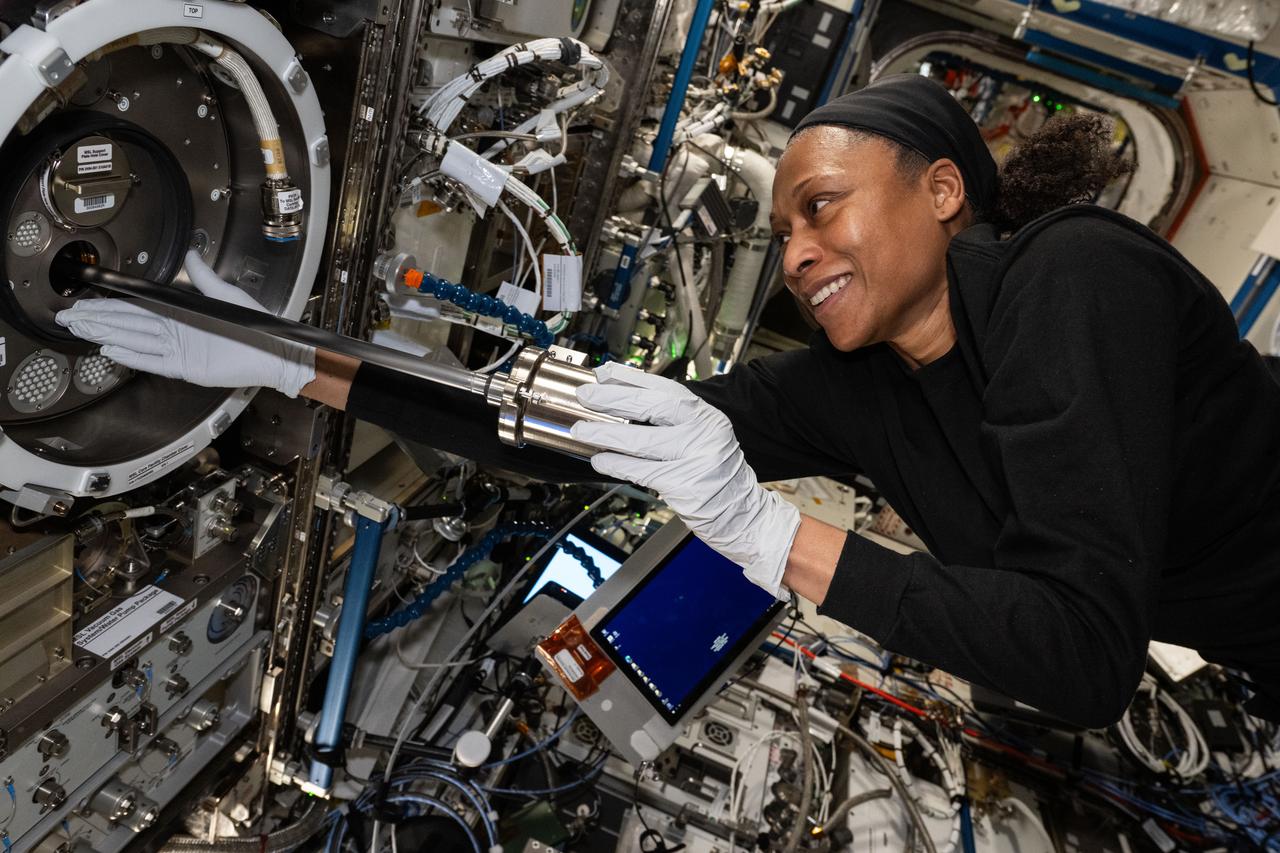
iss071e195867 (June 17, 2024) --- NASA astronaut and Expedition 71 Flight Engineer Jeanette Epps works on the Materials Science Laboratory (MSL), a component of the Destiny laboratory module's Materials Science Research Rack. The MSL is a research facility used to discover new applications for existing materials and new or improved materials.
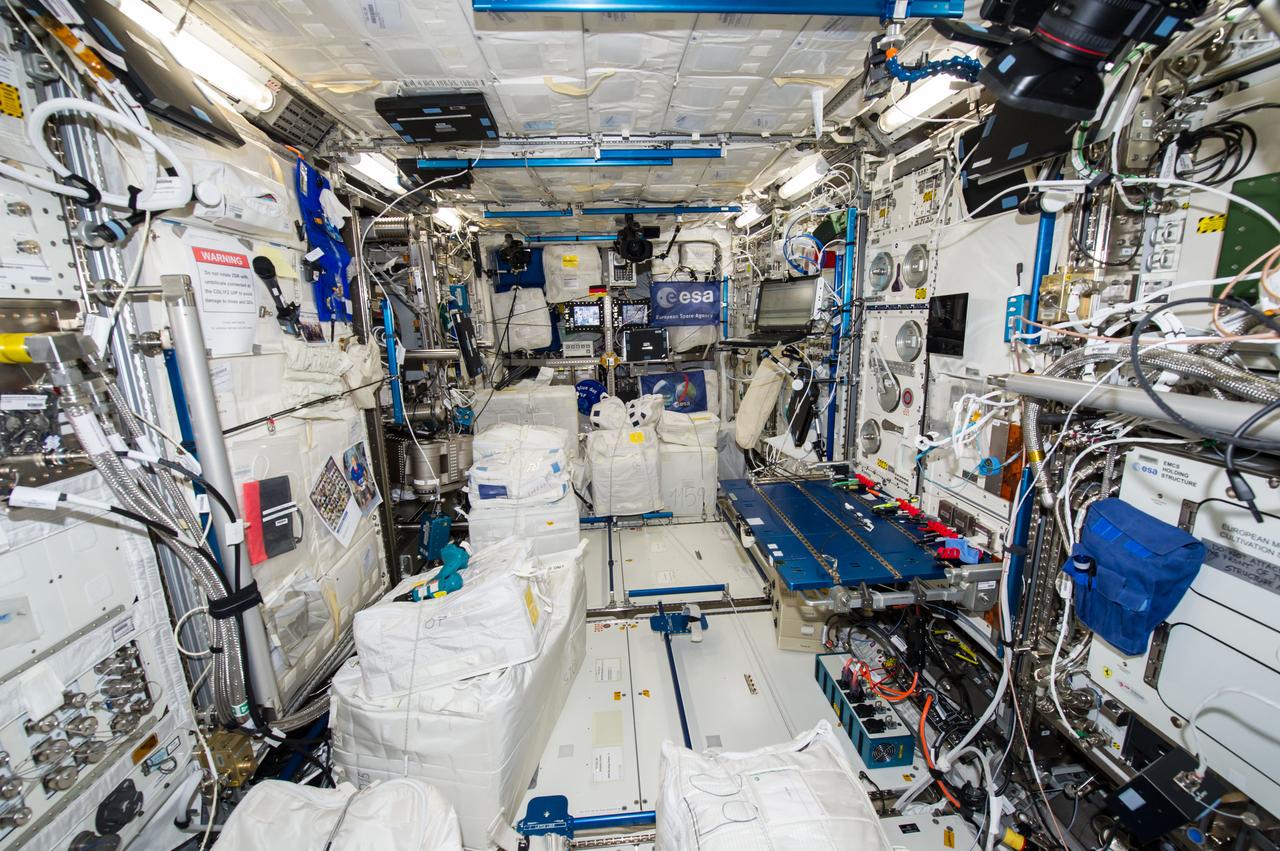
iss041e000170 (9/11/2020) --- A view of the Columbus Module aboard the International Space Stations (ISS). The Columbus laboratory is Europe’s largest contribution to the International Space Station. Columbus is a multifunctional pressurized laboratory permanently attached to the Harmony Module. The lab allows researchers on the ground, aided by the station’s crew, to conduct a wide variety of research in a weightless environment. In addition, experiments and applications can be conducted outside the module in the vacuum of space, thanks to four exterior mounting platforms that can accommodate external payloads in space science, Earth observation and technology.
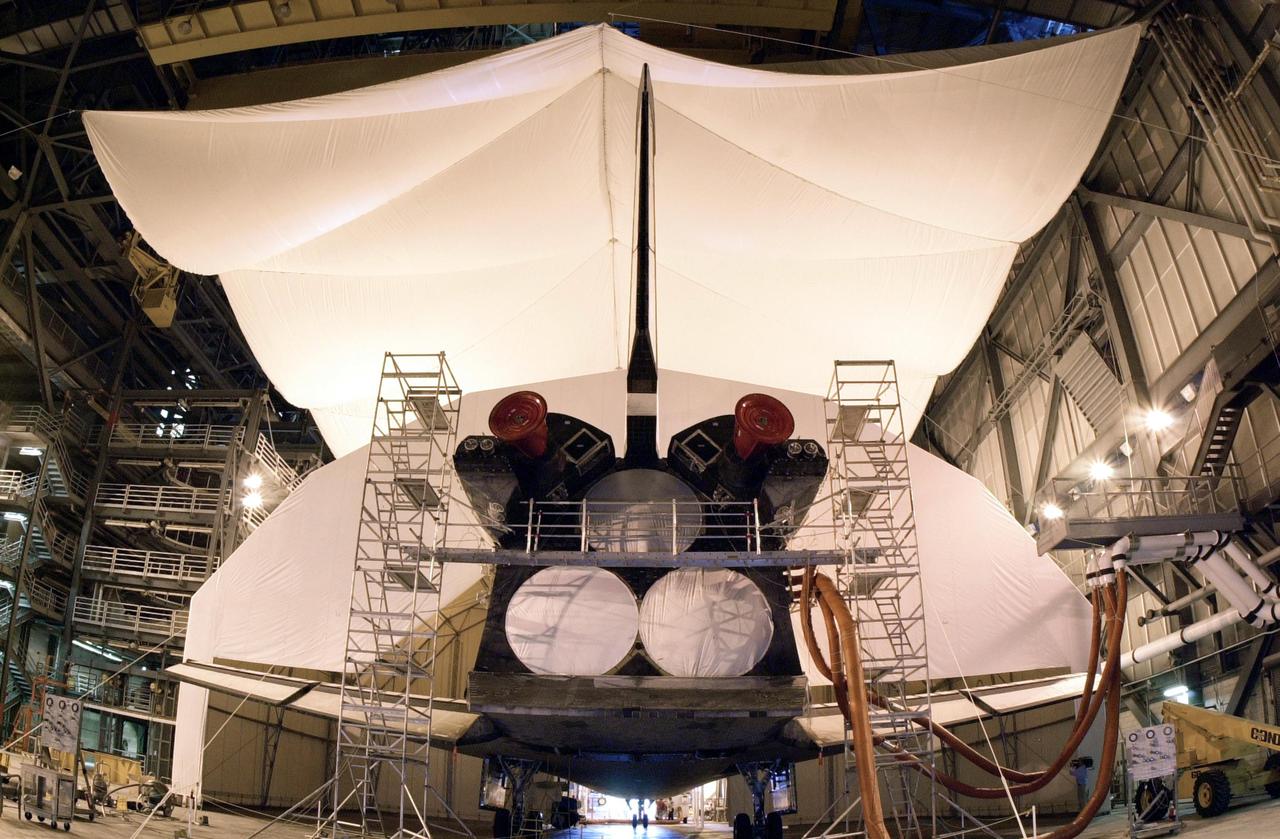
KENNEDY SPACE CENTER, FLA. -- Columbia sits inside an protective tent used to keep out moisture. The orbiter is next scheduled to fly on mission STS-107 no earlier than Nov. 29. STS-107 is a research mission. The payload includes the Hitchhiker Bridge, a carrier for the Fast Reaction Experiments Enabling Science, Technology, Applications and Research (FREESTAR) that incorporates eight high priority secondary attached shuttle experiments, plus the SHI Research Double Module (SHI/RDM), also known as SPACEHAB.
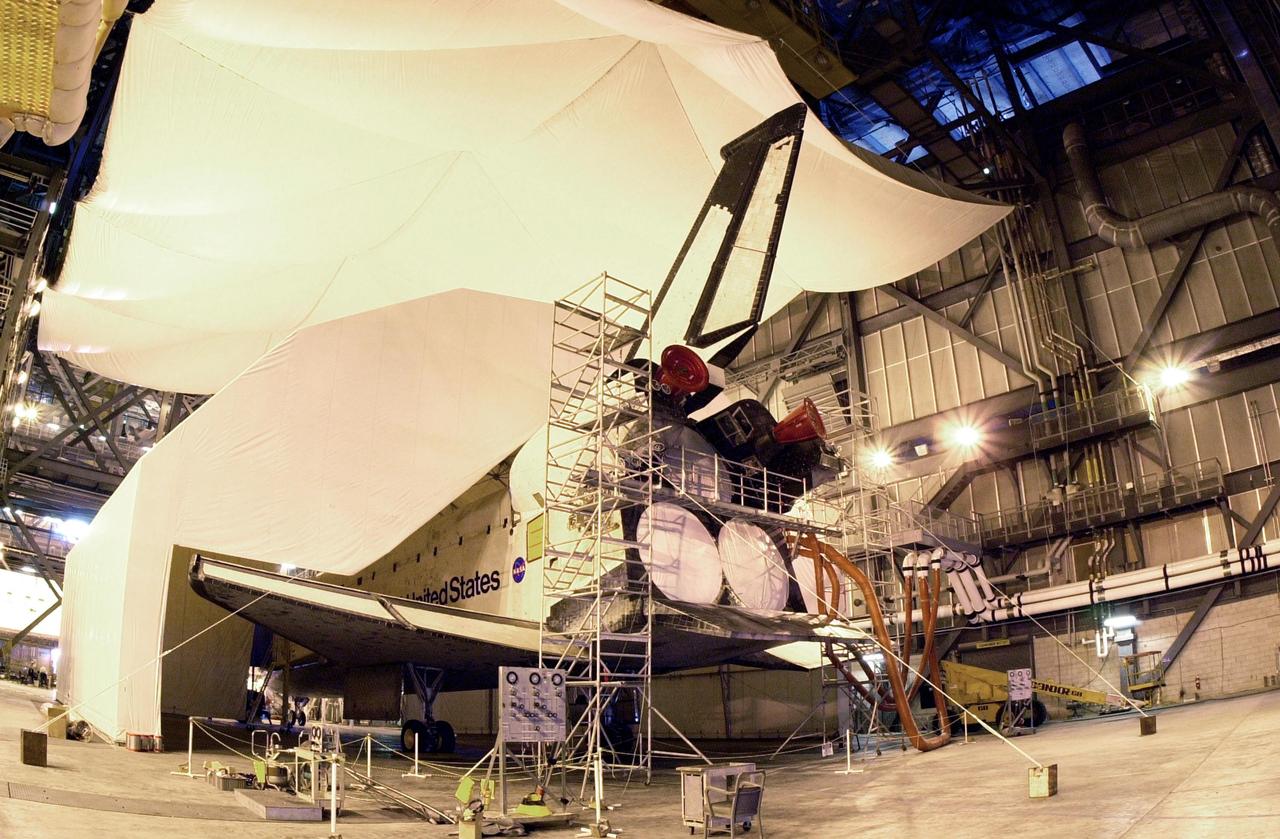
KENNEDY SPACE CENTER, FLA. -- Columbia sits inside an protective tent used to keep out moisture. The orbiter is next scheduled to fly on mission STS-107 no earlier than Nov. 29. STS-107 is a research mission. The payload includes the Hitchhiker Bridge, a carrier for the Fast Reaction Experiments Enabling Science, Technology, Applications and Research (FREESTAR) that incorporates eight high priority secondary attached shuttle experiments, plus the SHI Research Double Module (SHI/RDM), also known as SPACEHAB.
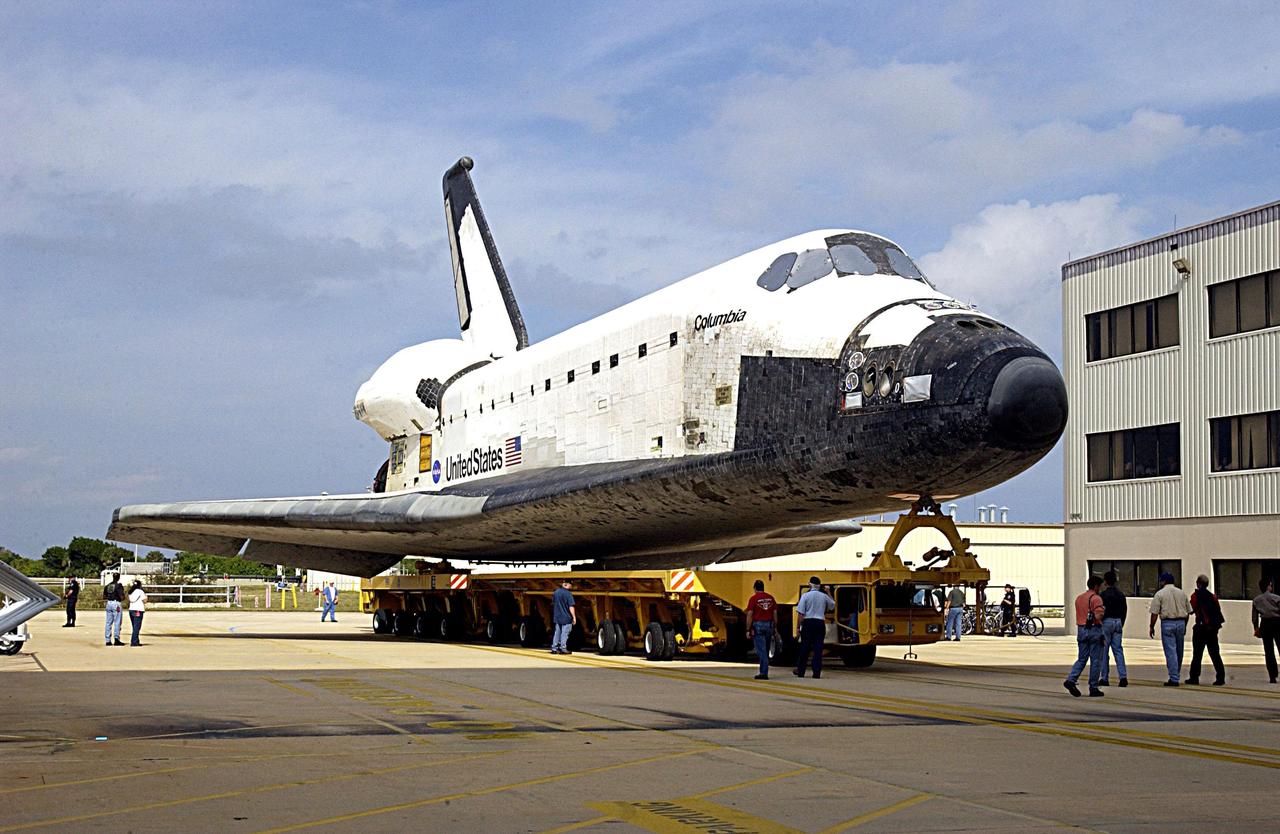
KENNEDY SPACE CENTER, FLA. -- Space Shuttle Columbia is being moved to the Vehicle Assembly Building where processing will continue for the flight of mission STS-107. Launch is now targeted for no earlier than Jan. 16, 2003. The STS-107 mission will be dedicated to microgravity research. The payloads include the Hitchhiker Bridge, a carrier for the Fast Reaction Experiments Enabling Science, Technology, Applications and Research (FREESTAR) incorporating eight high priority secondary attached Shuttle experiments, and the SHI Research Double Module (SHI/RDM), also known as SPACEHAB.
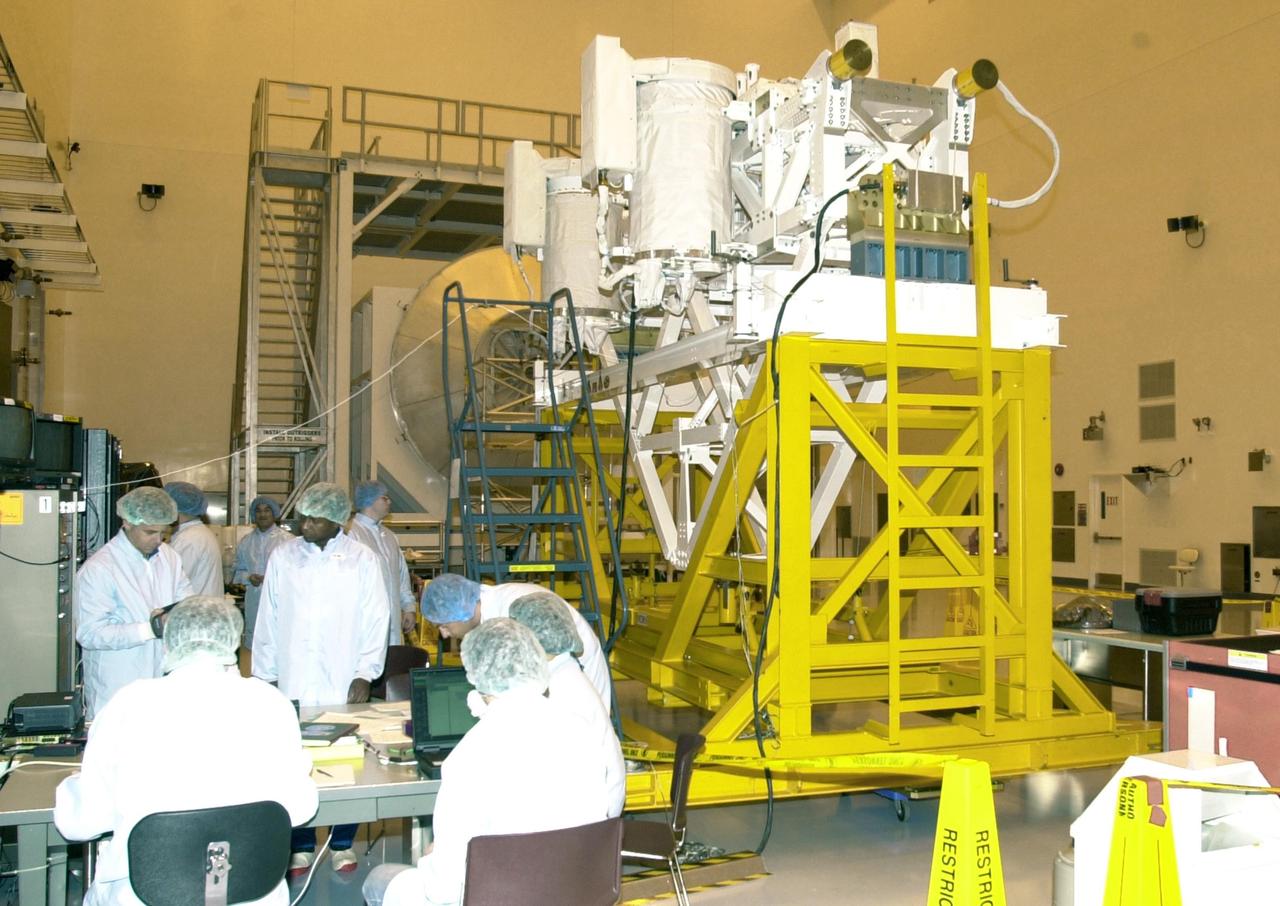
KENNEDY SPACE CENTER, FLA. - In the Multi-Payload Processing Facility, members of the STS-107 crew run tests on the Fast Reaction Experiments Enabling Science, Technology, Applications and Research (FREESTAR) experiments, part of the payload on their mission. A research mission, the primary payload is the first flight of the SHI Research Double Module (SHI/RDM), also known as SPACEHAB. The experiments range from material sciences to life sciences (many rats). STS-107 is scheduled to launch July 11, 2002
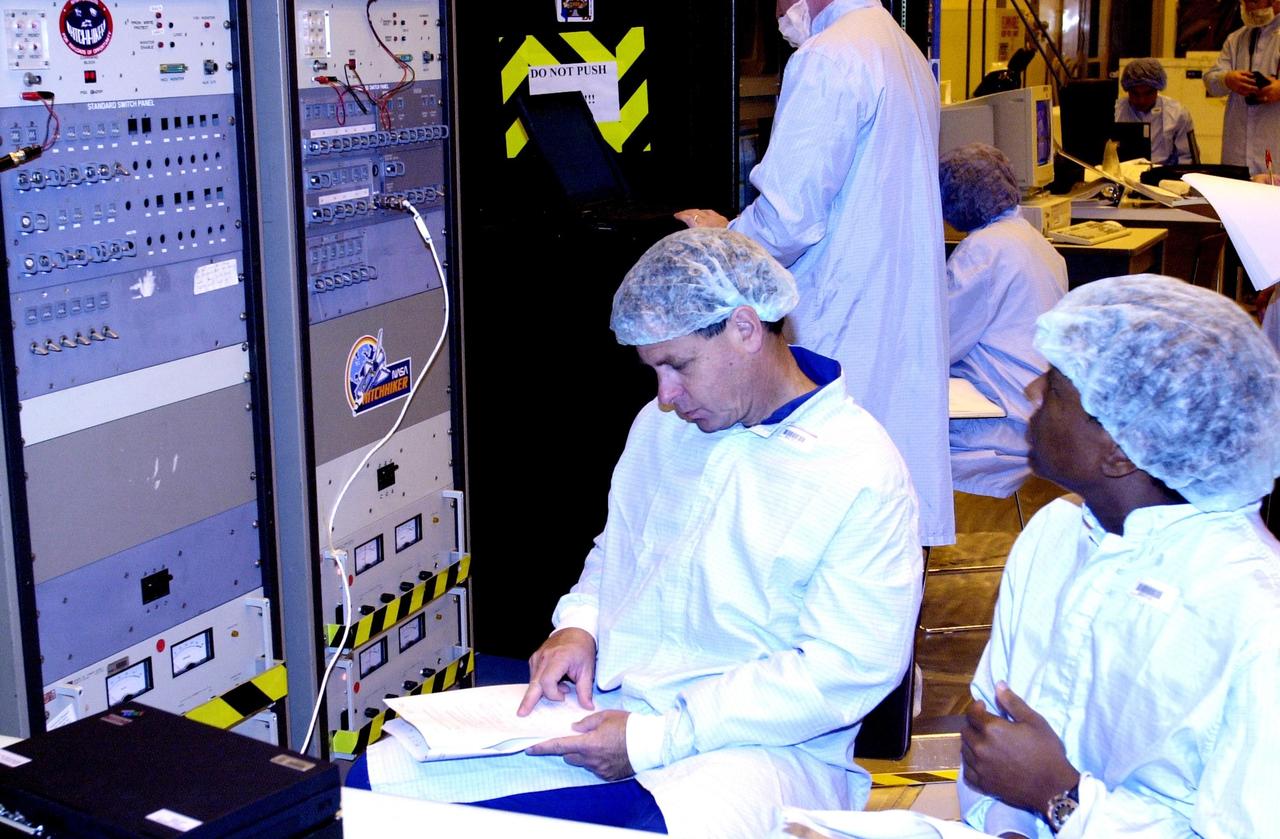
KENNEDY SPACE CENTER, FLA. -- In the Multi-Payload Processing Facility, members of the STS-107 crew look at test results on the Fast Reaction Experiments Enabling Science, Technology, Applications and Research (FREESTAR) experiments, part of the payload on their mission. A research mission, the primary payload is the first flight of the SHI Research Double Module (SHI/RDM), also known as SPACEHAB. The experiments range from material sciences to life sciences (many rats). STS-107 is scheduled to launch July 11, 2002
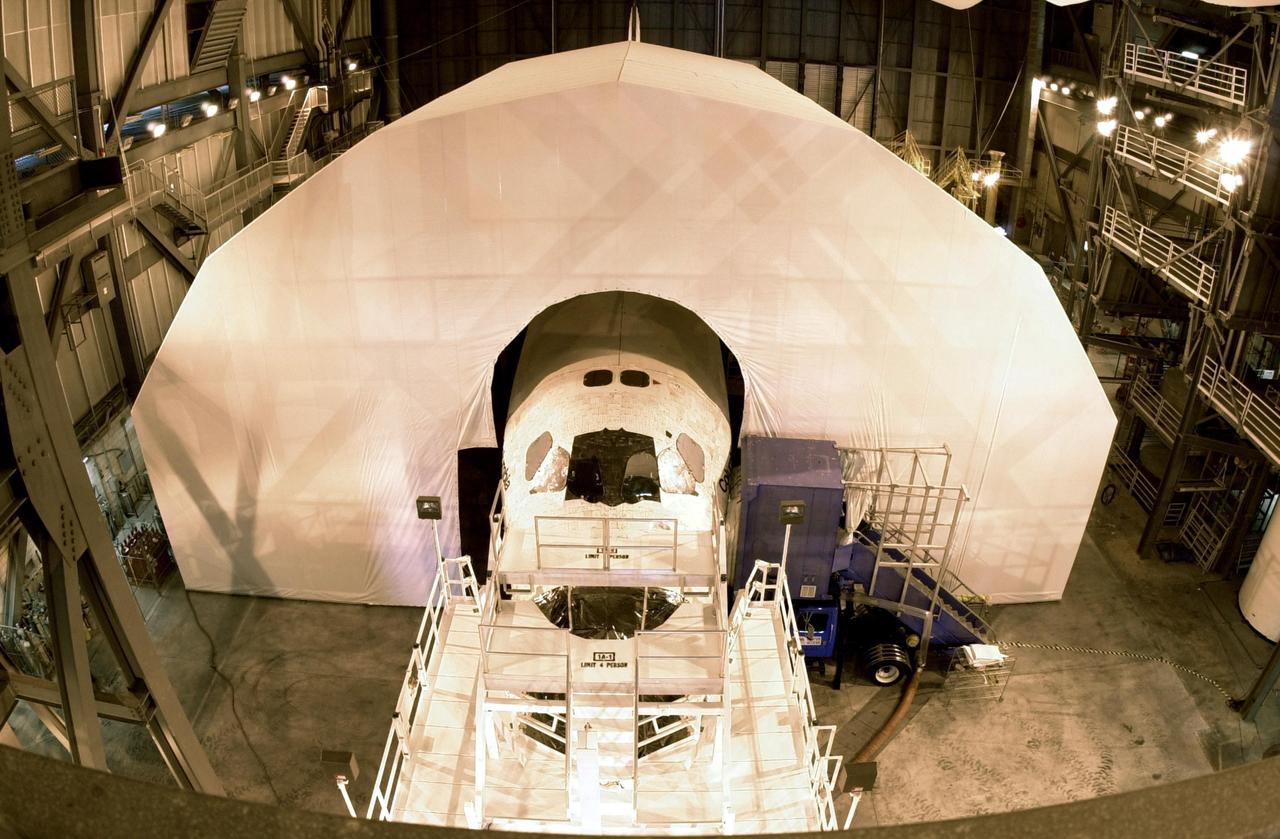
KENNEDY SPACE CENTER, FLA. -- Only the nose and tail of Columbia are visible as it sits inside an protective tent used to keep out moisture. The orbiter is next scheduled to fly on mission STS-107 no earlier than Nov. 29. STS-107 is a research mission. The payload includes the Hitchhiker Bridge, a carrier for the Fast Reaction Experiments Enabling Science, Technology, Applications and Research (FREESTAR) that incorporates eight high priority secondary attached shuttle experiments, plus the SHI Research Double Module (SHI/RDM), also known as SPACEHAB.
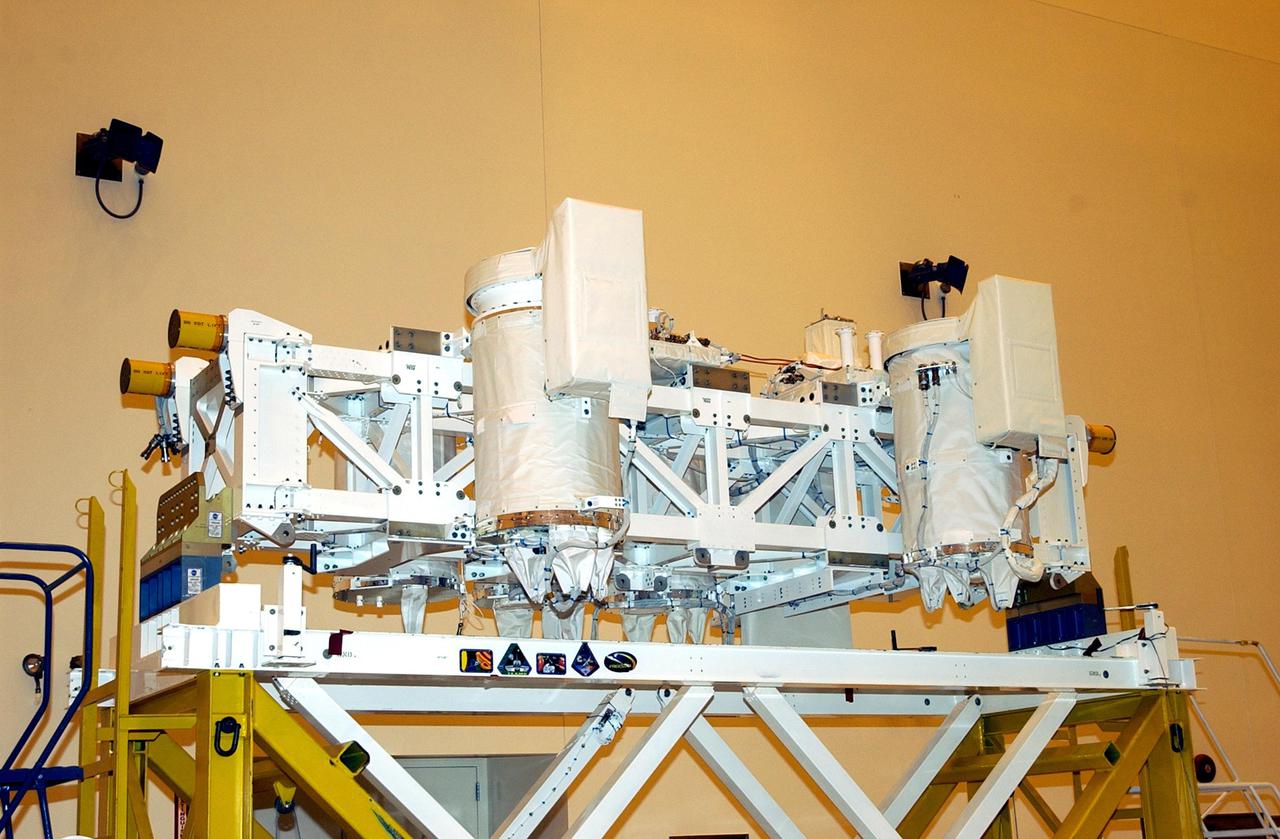
KENNEDY SPACE CENTER, FLA. -- The Hitchhiker Bridge rests on a workstand in the Multi-Payload Processing Facility (MPPF). The bridge is a carrier for the Fast Reaction Experiments Enabling Science, Technology, Applications and Research (FREESTAR) that incorporates eight high priority secondary attached shuttle experiments on mission STS-107. A research mission, the primary payload is the first flight of the SHI Research Double Module (SHI_RDM), also known as SPACEHAB. The experiments range from material sciences to life sciences. STS-107 is scheduled to launch July 11, 2002

KENNEDY SPACE CENTER, FLA. - STS-107 Commander Rick Husband checks the window in Columbia during Crew Equipment Interface Test activities at KSC. The CEIT includes equipment and payload familiarization. STS-107 is a research mission, with the SHI Research Double Module (SHI/RDM), also known as SPACEHAB, as the primary payload, plus the Fast Reaction Experiments Enabling Science, Technology, Applications and Research (FREESTAR) that incorporates eight high priority secondary attached shuttle experiments. STS-107 is scheduled to launch July 19, 2002
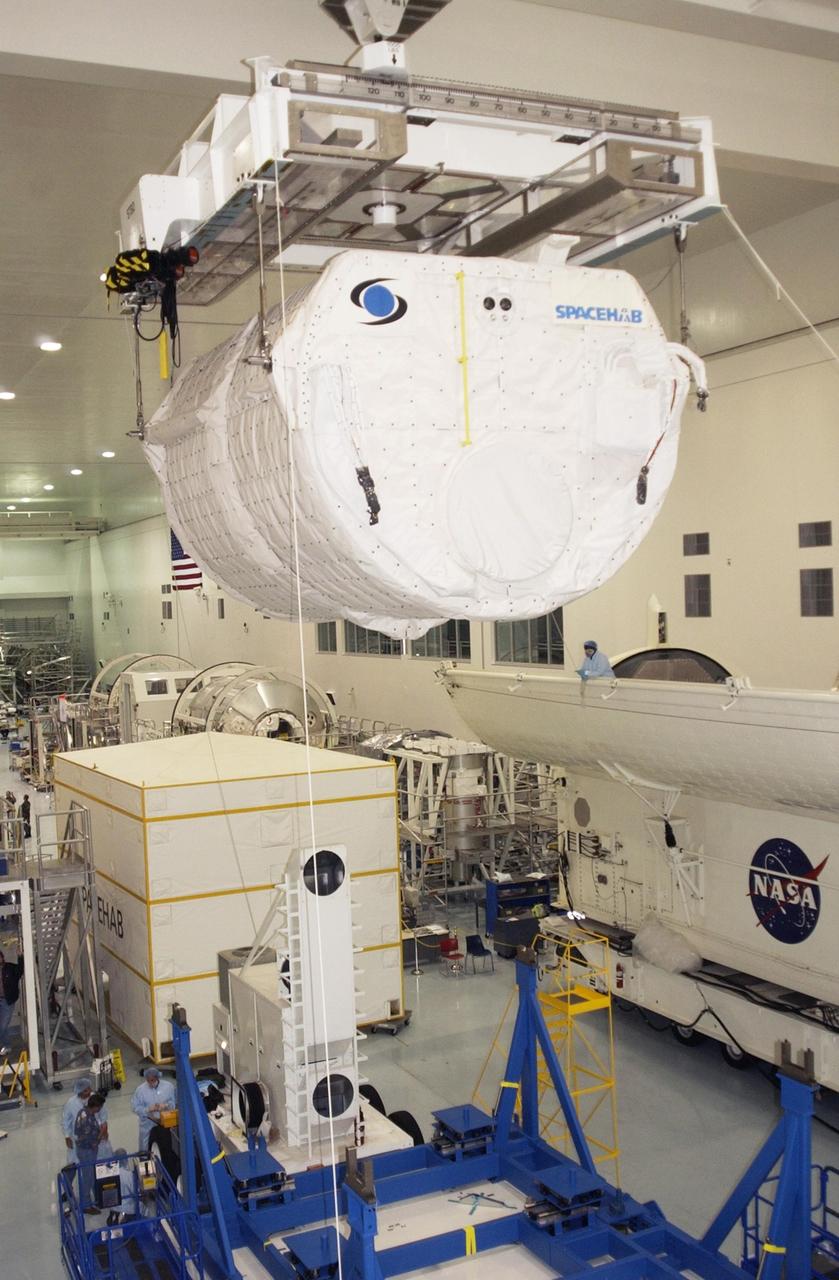
KENNEDY SPACE CENTER, FLA. - Suspended from the overhead crane, the SHI Research Double Module (SHI/RDM) travels across the Space Station Processing Facility to the payload canister waiting at right. The module will be placed in the canister for transport to the Orbiter Processing Facility where it will be installed in Columbia's payload bay for mission STS-107. SHI/RDM is the primary payload of the research mission, with experiments ranging from material sciences to life sciences (many rats). Also part of the payload is the Fast Reaction Experiments Enabling Science, Technology, Applications and Research (FREESTAR) that incorporates eight high priority secondary attached shuttle experiments. STS-107 is scheduled to launch July 19, 2002
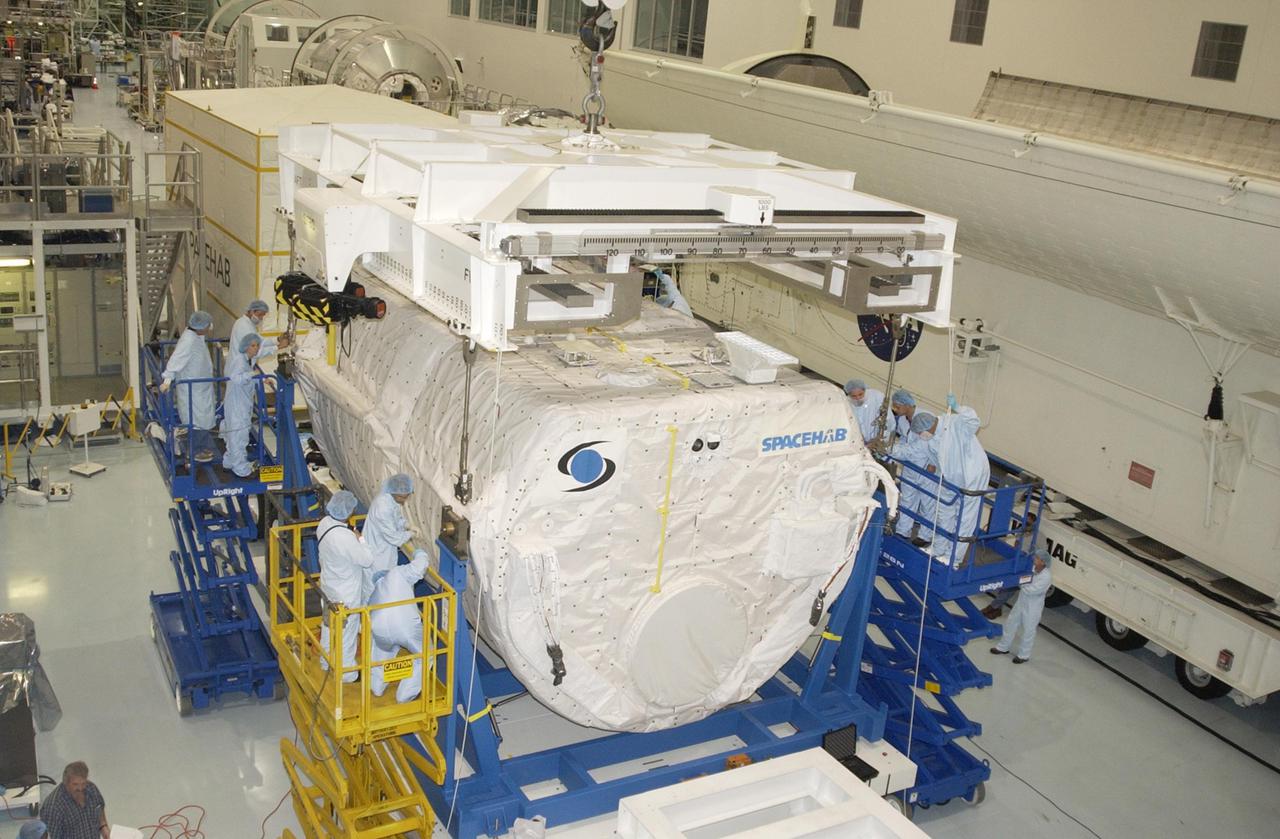
KENNEDY SPACE CENTER, FLA. - In the Space Station Processing Facility, the overhead crane lifts the SHI Research Double Module (SHI_RDM) from its workstand. The module is being transferred to the payload canister for transport to the Orbiter Processing Facility where it will be installed in Columbia's payload bay for mission STS-107. SHI_RDM is the primary payload of the research mission, with experiments ranging from material sciences to life sciences (many rats). Also part of the payload is the Fast Reaction Experiments Enabling Science, Technology, Applications and Research (FREESTAR) that incorporates eight high priority secondary attached shuttle experiments. STS-107 is scheduled to launch July 19, 2002
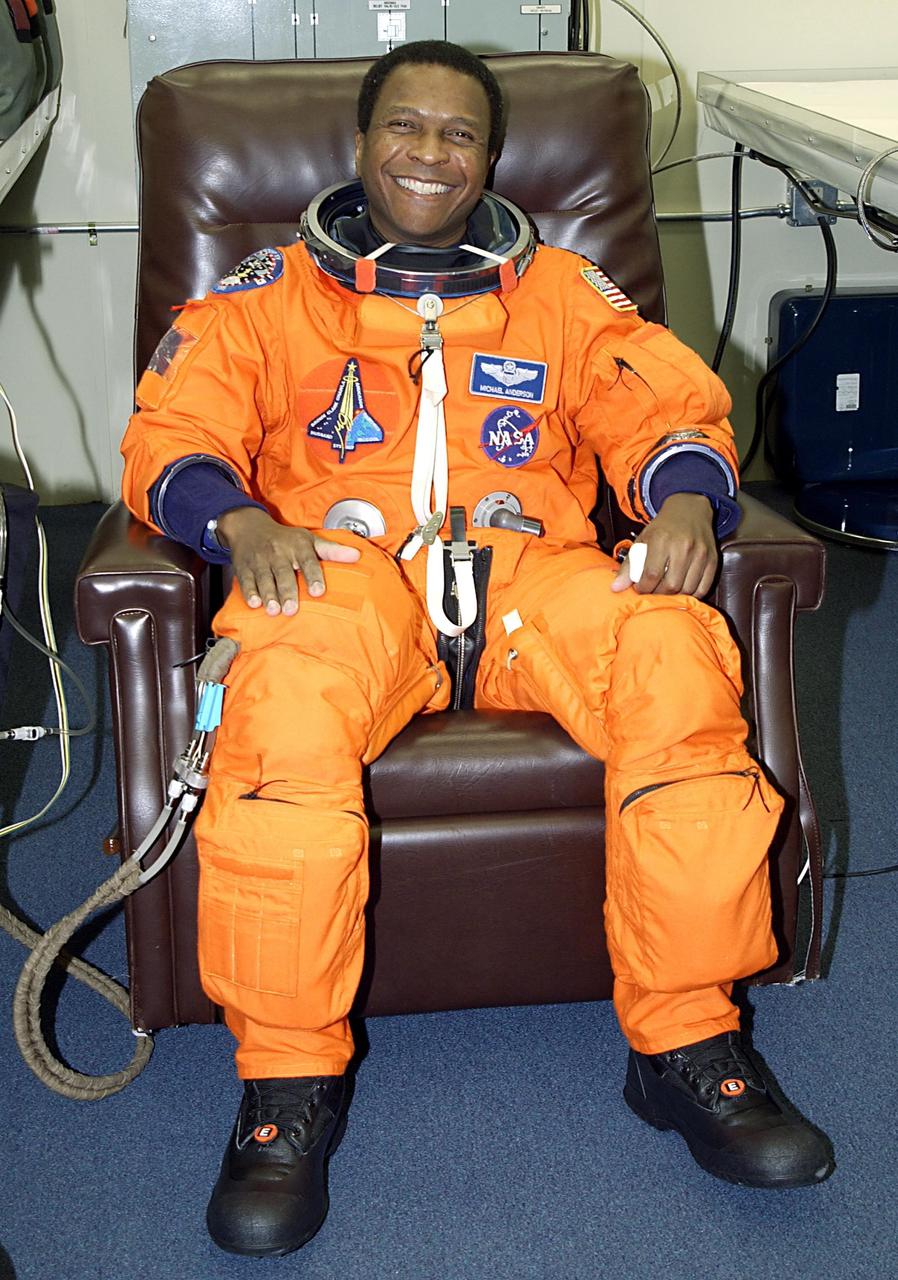
KENNEDY SPACE CENTER, FLA. - STS-107 Payload Commander Michael Anderson is happy to being suiting up for launch on mission STS-107. The mission is devoted to research and will include more than 80 experiments that will study Earth and space science, advanced technology development, and astronaut health and safety. The payload on Space Shuttle Columbia includes FREESTAR (Fast Reaction Experiments Enabling Science, Technology, Applications and Research) and the SHI Research Double Module (SHI/RDM), known as SPACEHAB. Experiments on the module range from material sciences to life sciences. Liftoff is scheduled for 10:39 a.m. EST.
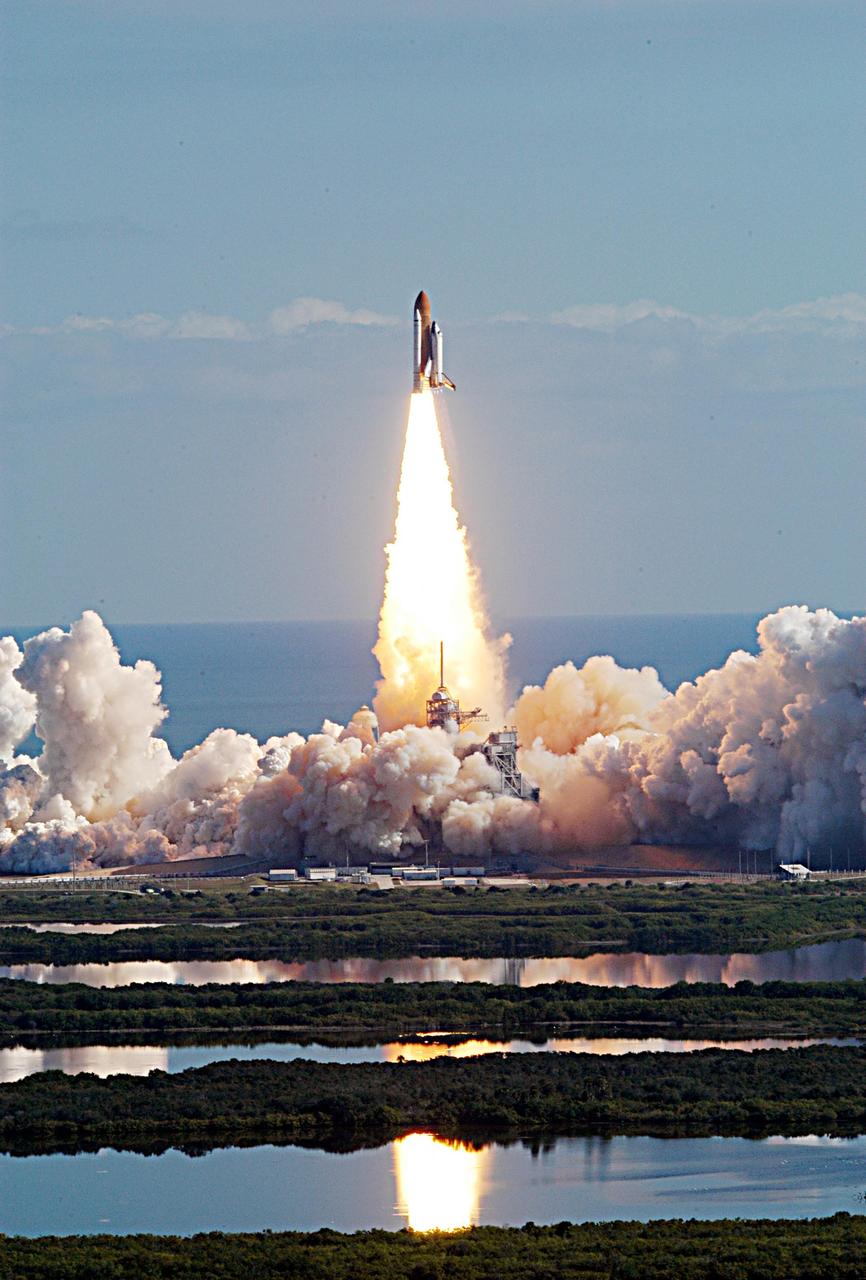
KENNEDY SPACE CENTER, FLA. -- Against a backdrop of blue sky and the blue Atlantic Ocean, launch of Space Shuttle Columbia is reflected in the nearby water. Following a flawless and uneventful countdown, liftoff occurred on-time at 10:39 a.m. EST. The 16-day STS-107 research mission will include FREESTAR (Fast Reaction Experiments Enabling Science, Technology, Applications and Research) and the SHI Research Double Module (SHI/RDM), known as SPACEHAB. Experiments on the module range from material sciences to life sciences. This mission is the first Shuttle mission of 2003. Mission STS-107 is the 28th flight of the orbiter Columbia and the 113th flight overall in NASA's Space Shuttle program.
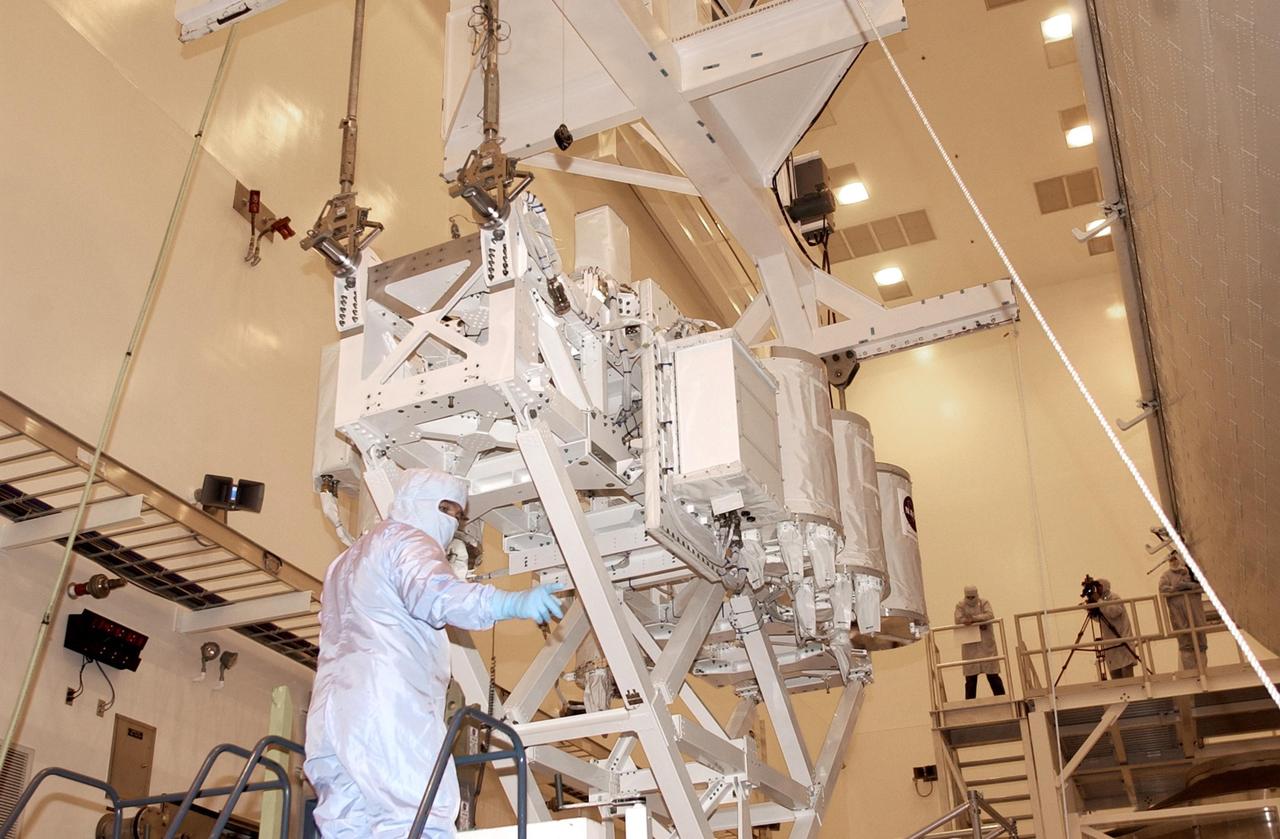
KENNEDY SPACE CENTER, FLA. -- In the Multi-Payload Processing Facility, an overhead crane is attached to the Hitchhiker Bridge with GetAway Special canisters (GAS cans). The bridge, a carrier for the Fast Reaction Experiments Enabling Science, Technology, Applications and Research (FREESTAR) that incorporates eight high priority secondary attached shuttle experiments, is being transferred to the payload canister. The bridge will be installed in Columbia's payload bay as part of mission STS-107. A research mission, STS-107 will also carry the SHI Research Double Module (SHI/RDM), known as SPACEHAB. Experiments on the module range from material sciences to life sciences (many rats). STS-107 is scheduled to launch July 19, 2002

KENNEDY SPACE CENTER, FLA. - An overhead crane lowers the Hitchhiker Bridge with GetAway Special canisters (GAS cans) into the payload canister below. The bridge, a carrier for the Fast Reaction Experiments Enabling Science, Technology, Applications and Research (FREESTAR) that incorporates eight high priority secondary attached shuttle experiments, is being transferred to the payload canister below it. The bridge will be installed in Columbia's payload bay as part of mission STS-107. A research mission, STS-107 will also carry the SHI Research Double Module (SHI_RDM), known as SPACEHAB. Experiments on the module range from material sciences to life sciences (many rats). STS-107 is scheduled to launch July 19, 2002
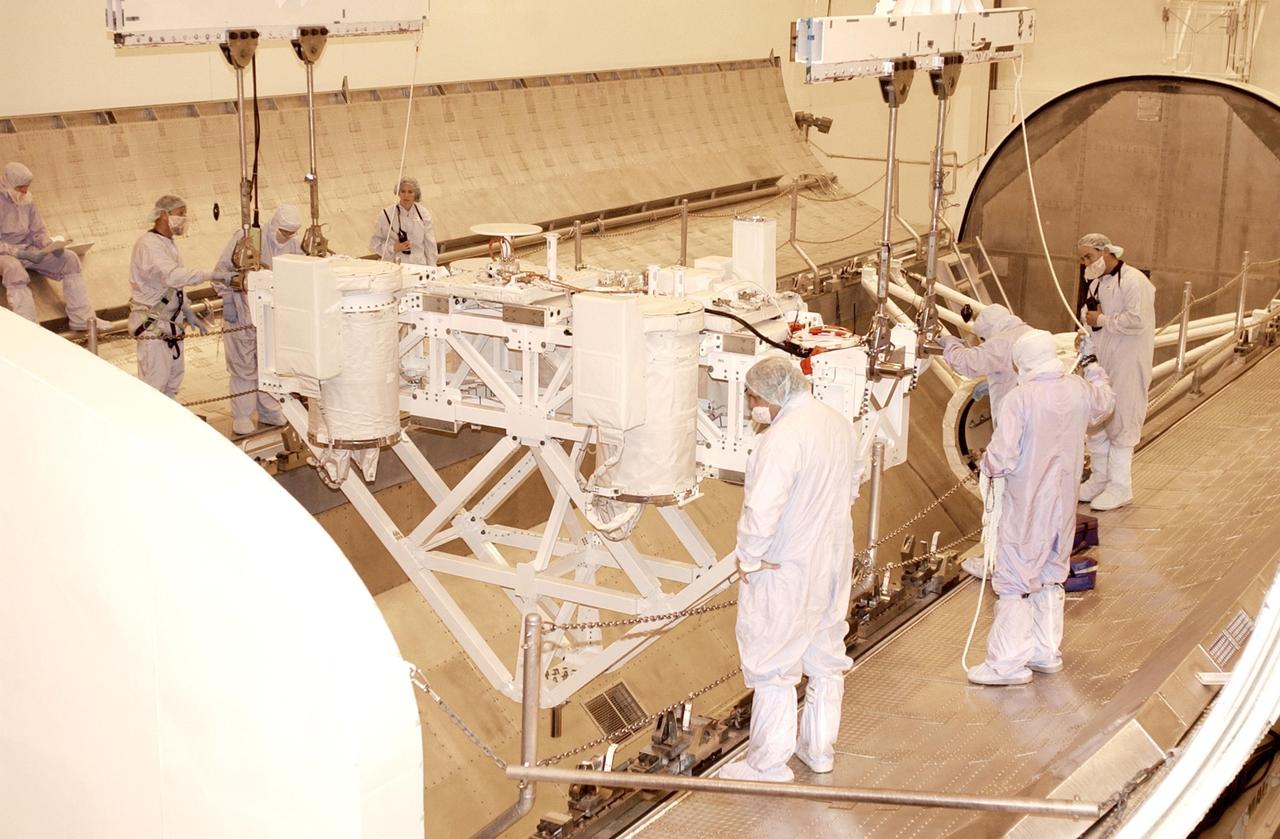
KENNEDY SPACE CENTER, FLA. -- The Hitchhiker Bridge with GetAway Special canisters (GAS cans) is placed into the payload canister. The bridge, a carrier for the Fast Reaction Experiments Enabling Science, Technology, Applications and Research (FREESTAR) that incorporates eight high priority secondary attached shuttle experiments, is being transferred to the payload canister below it. The bridge will be installed in Columbia's payload bay as part of mission STS-107. A research mission, STS-107 will also carry the SHI Research Double Module (SHI/RDM), known as SPACEHAB. Experiments on the module range from material sciences to life sciences (many rats). STS-107 is scheduled to launch July 19, 2002
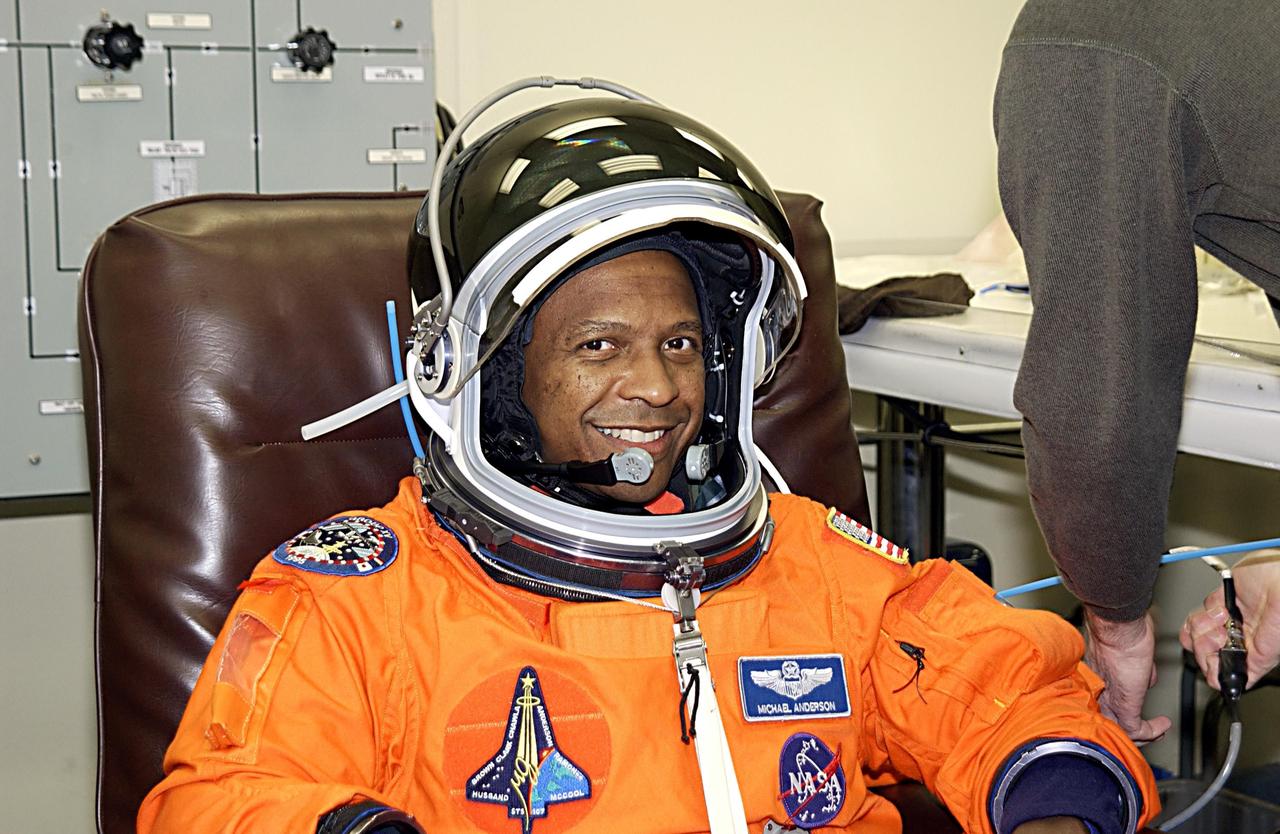
KENNEDY SPACE CENTER, FLA. - STS-107 Payload Commander Michael Anderson is helped with suit check, part of launch preparations. STS-107 is a mission devoted to research and will include more than 80 experiments that will study Earth and space science, advanced technology development, and astronaut health and safety. The payload on Space Shuttle Columbia includes FREESTAR (Fast Reaction Experiments Enabling Science, Technology, Applications and Research) and the SHI Research Double Module (SHI/RDM), known as SPACEHAB. Experiments on the module range from material sciences to life sciences. Launch is scheduled for Jan. 16, between 10 a.m. and 2 p.m.
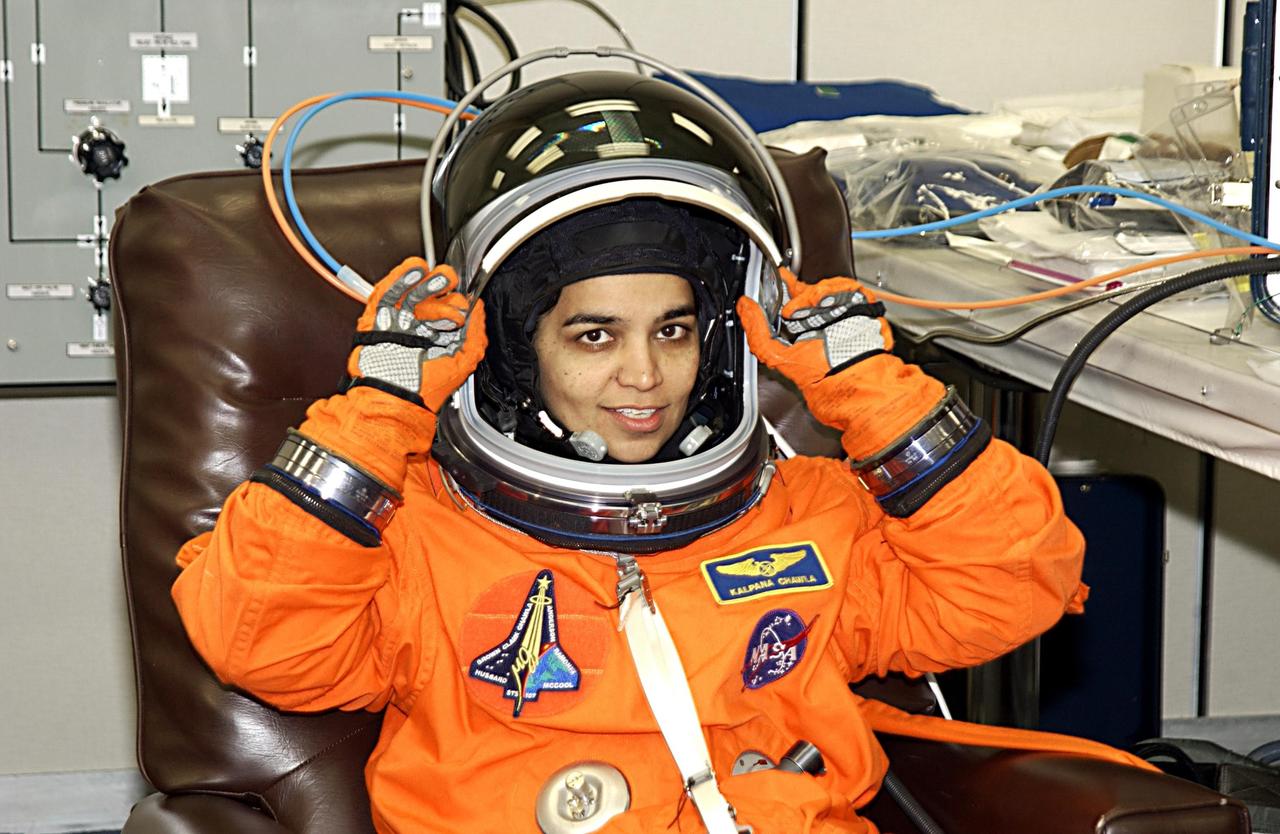
KENNEDY SPACE CENTER, FLA. -- STS-107 Mission Specialist Kalpana Chawla puts on her helmet during suit check, part of launch preparations. STS-107 is a mission devoted to research and will include more than 80 experiments that will study Earth and space science, advanced technology development, and astronaut health and safety. The payload on Space Shuttle Columbia includes FREESTAR (Fast Reaction Experiments Enabling Science, Technology, Applications and Research) and the SHI Research Double Module (SHI/RDM), known as SPACEHAB. Experiments on the module range from material sciences to life sciences. Launch is scheduled for Jan. 16, between 10 a.m. and 2 p.m.
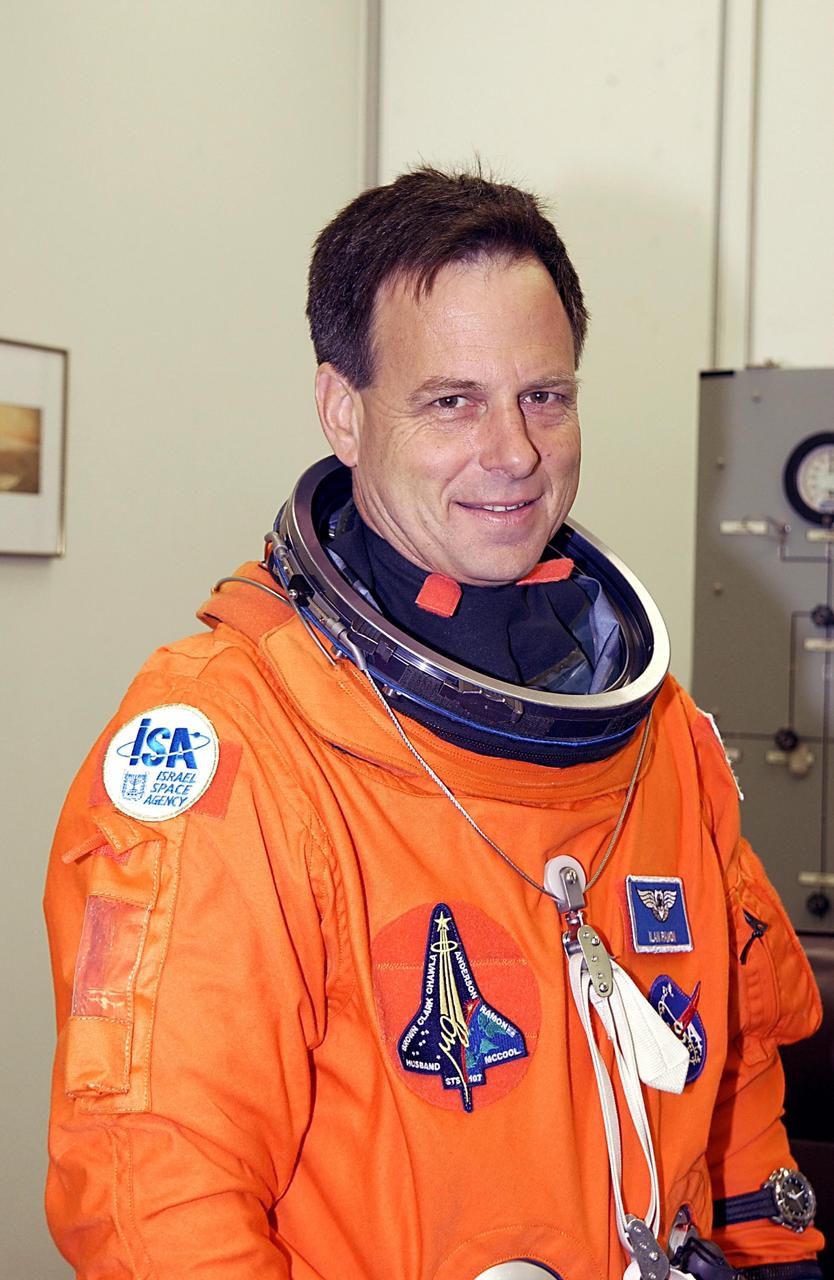
KENNEDY SPACE CENTER, FLA. -- STS-107 Payload Specialist Ilan Ramon, who represents the Israeli Space Agency, suits up for launch. STS-107 is a mission devoted to research and will include more than 80 experiments that will study Earth and space science, advanced technology development, and astronaut health and safety. The payload on Space Shuttle Columbia includes FREESTAR (Fast Reaction Experiments Enabling Science, Technology, Applications and Research) and the SHI Research Double Module (SHI/RDM), known as SPACEHAB. Experiments on the module range from material sciences to life sciences. Liftoff is scheduled for 10:39 a.m. EST.
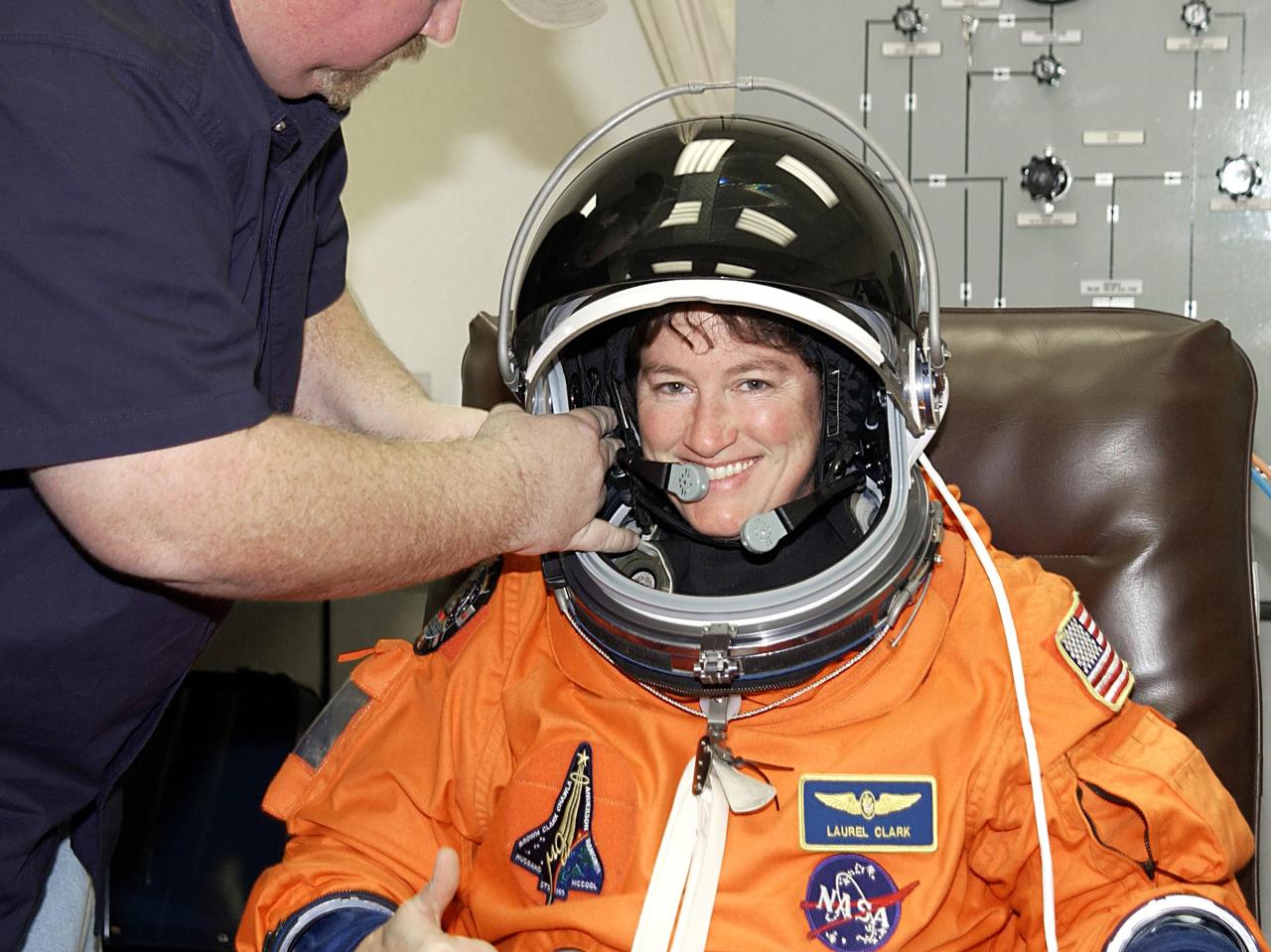
KENNEDY SPACE CENTER, FLA. - STS-107 Mission Specialist Laurel Clark is helped with her helmet during suitup for launch. STS-107 is a mission devoted to research and will include more than 80 experiments that will study Earth and space science, advanced technology development, and astronaut health and safety. The payload on Space Shuttle Columbia includes FREESTAR (Fast Reaction Experiments Enabling Science, Technology, Applications and Research) and the SHI Research Double Module (SHI/RDM), known as SPACEHAB. Experiments on the module range from material sciences to life sciences. Liftoff is scheduled for 10:39 a.m. EST.
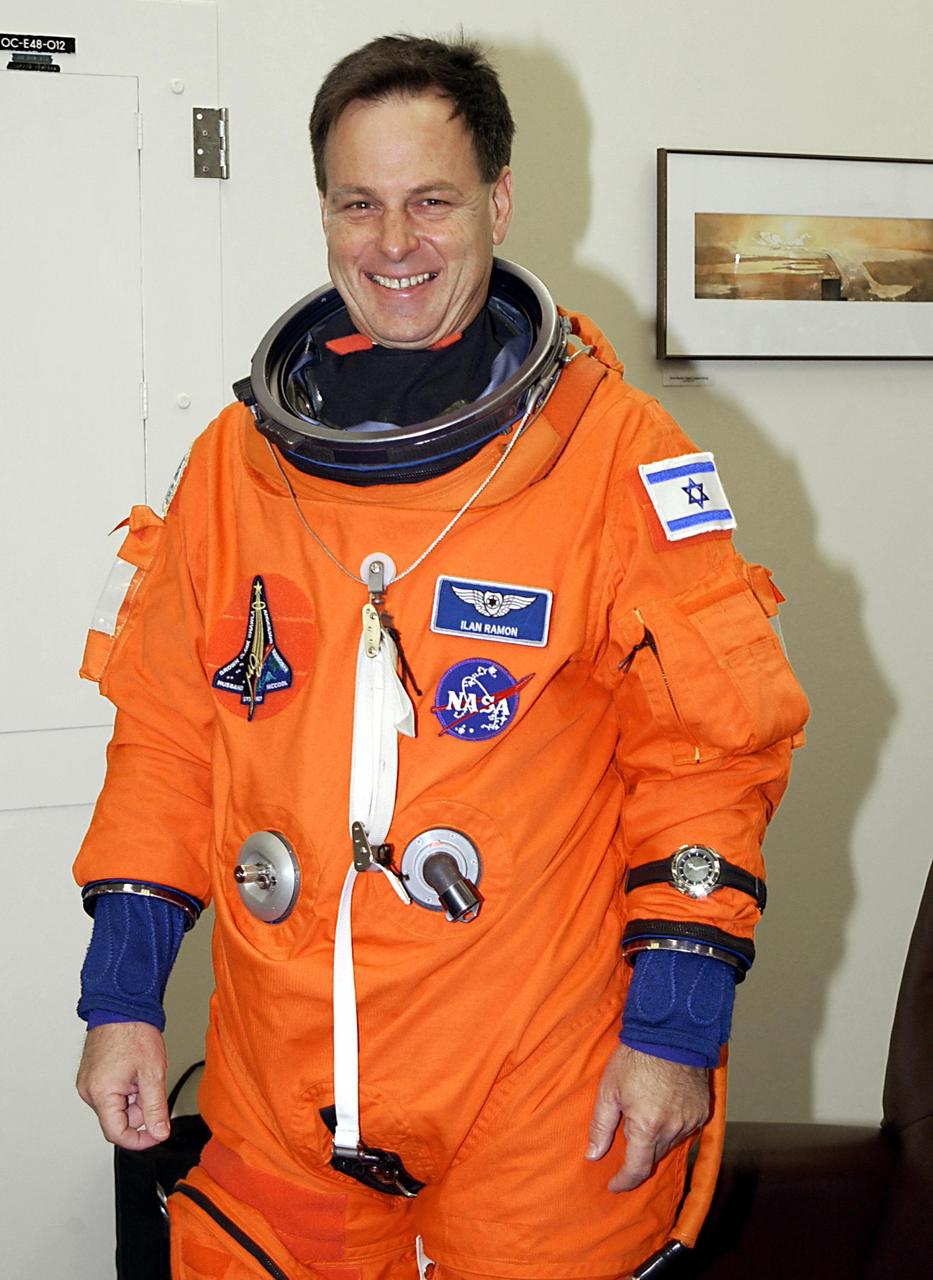
KENNEDY SPACE CENTER, FLA. -- STS-107 Payload Specialist Ilan Ramon, who represents the Israeli Space Agency, suits up for launch. STS-107 is a mission devoted to research and will include more than 80 experiments that will study Earth and space science, advanced technology development, and astronaut health and safety. The payload on Space Shuttle Columbia includes FREESTAR (Fast Reaction Experiments Enabling Science, Technology, Applications and Research) and the SHI Research Double Module (SHI/RDM), known as SPACEHAB. Experiments on the module range from material sciences to life sciences. Liftoff is scheduled for 10:39 a.m. EST.
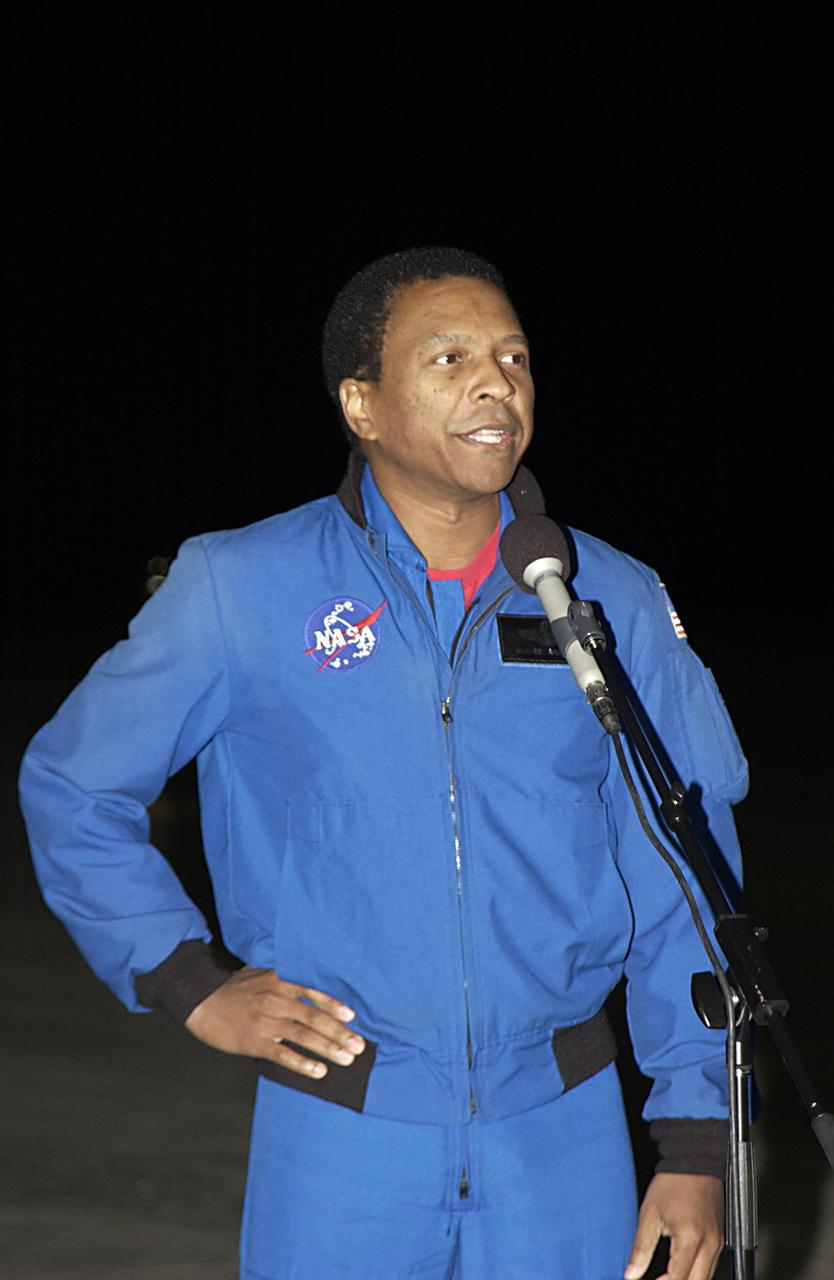
KENNEDY SPACE CENTER, FLA. - STS-107 Payload Commander Michael Anderson comments about the mission after the crew's arrival at KSC for pre-launch preparations. STS-107 is a mission devoted to research and will include more than 80 experiments that will study Earth and space science, advanced technology development, and astronaut health and safety. The payload on Space Shuttle Columbia includes FREESTAR (Fast Reaction Experiments Enabling Science, Technology, Applications and Research) and the SHI Research Double Module (SHI/RDM), known as SPACEHAB. Experiments on the module range from material sciences to life sciences. Launch of Columbia is targeted for Jan. 16 between 10 a.m. and 2 p.m.
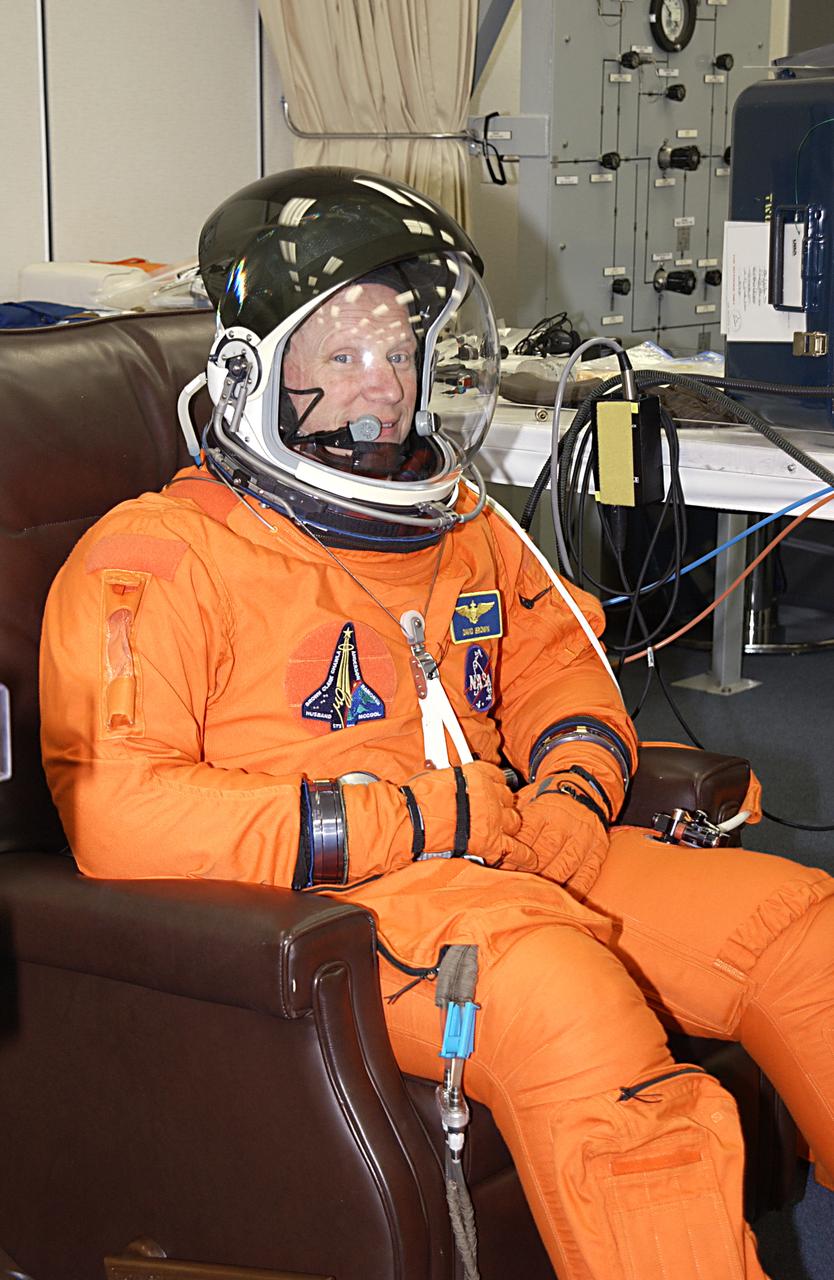
STS-107 Mission Specialist David Brown gets a final suit fit as part of launch preparations. STS-107 is a mission devoted to research and will include more than 80 experiments that will study Earth and space science, advanced technology development, and astronaut health and safety. The payload on Space Shuttle Columbia includes FREESTAR (Fast Reaction Experiments Enabling Science, Technology, Applications and Research) and the SHI Research Double Module (SHI/RDM), known as SPACEHAB. Experiments on the module range from material sciences to life sciences. Launch is scheduled for Jan. 16, between 10 a.m. and 2 p.m.
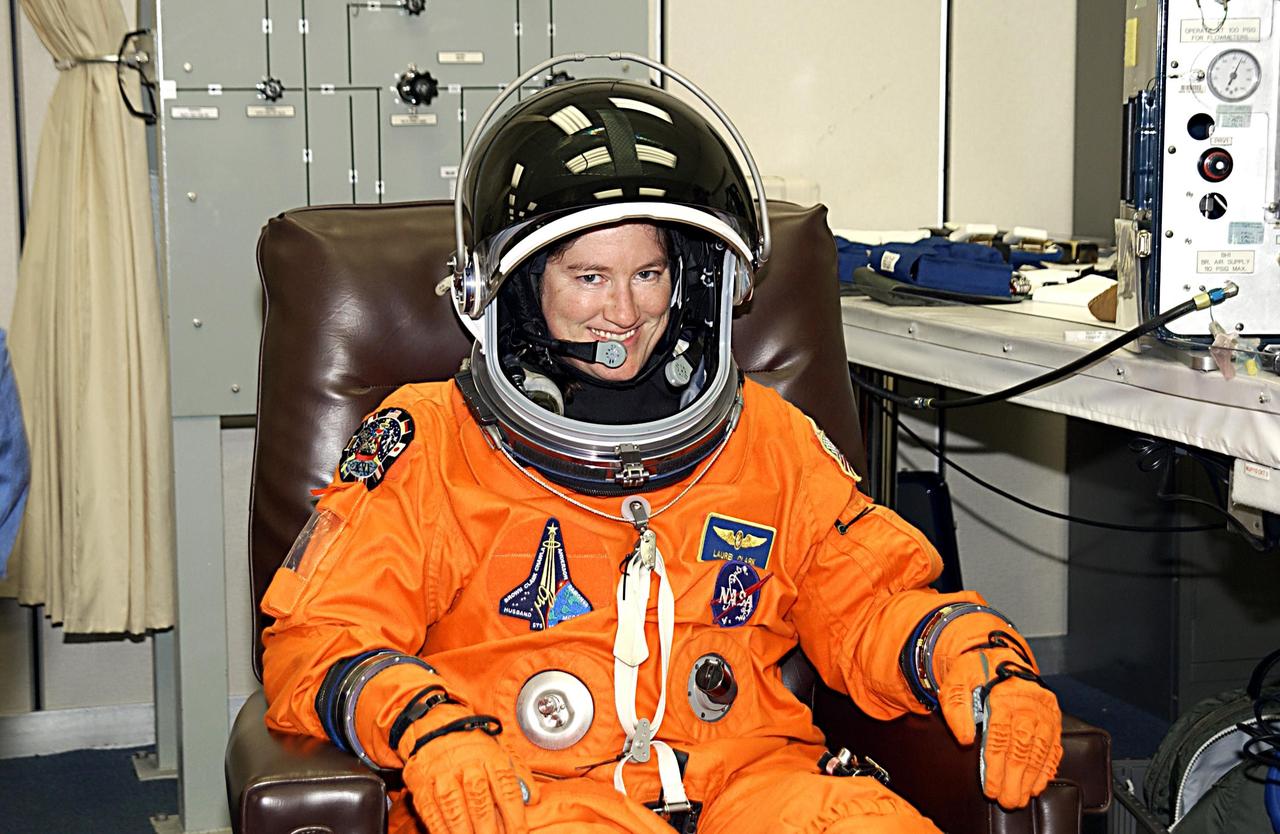
KENNEDY SPACE CENTER, FLA. - STS-107 Mission Specialist Laurel Clark gets a final fitting on her launch and entry suit as part of launch preparations. STS-107 is a mission devoted to research and will include more than 80 experiments that will study Earth and space science, advanced technology development, and astronaut health and safety. The payload on Space Shuttle Columbia includes FREESTAR (Fast Reaction Experiments Enabling Science, Technology, Applications and Research) and the SHI Research Double Module (SHI/RDM), known as SPACEHAB. Experiments on the module range from material sciences to life sciences. Launch is scheduled for Jan. 16, between 10 a.m. and 2 p.m.
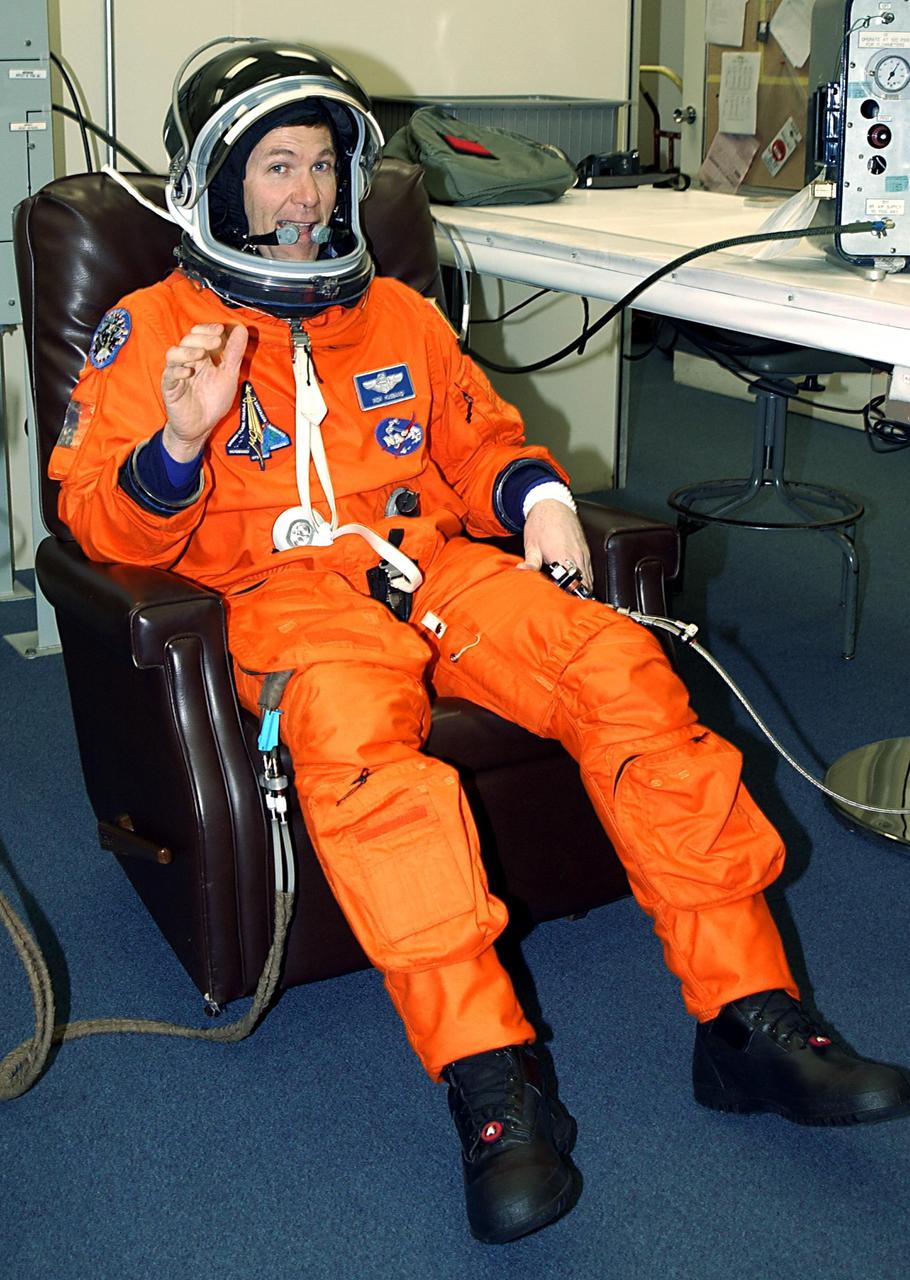
KENNEDY SPACE CENTER, FLA. - STS-107 Mission Commander Rick Husband waves during suitup for launch on mission STS-107. The mission is devoted to research and will include more than 80 experiments that will study Earth and space science, advanced technology development, and astronaut health and safety. The payload on Space Shuttle Columbia includes FREESTAR (Fast Reaction Experiments Enabling Science, Technology, Applications and Research) and the SHI Research Double Module (SHI/RDM), known as SPACEHAB. Experiments on the module range from material sciences to life sciences. Liftoff is scheduled for 10:39 a.m. EST.
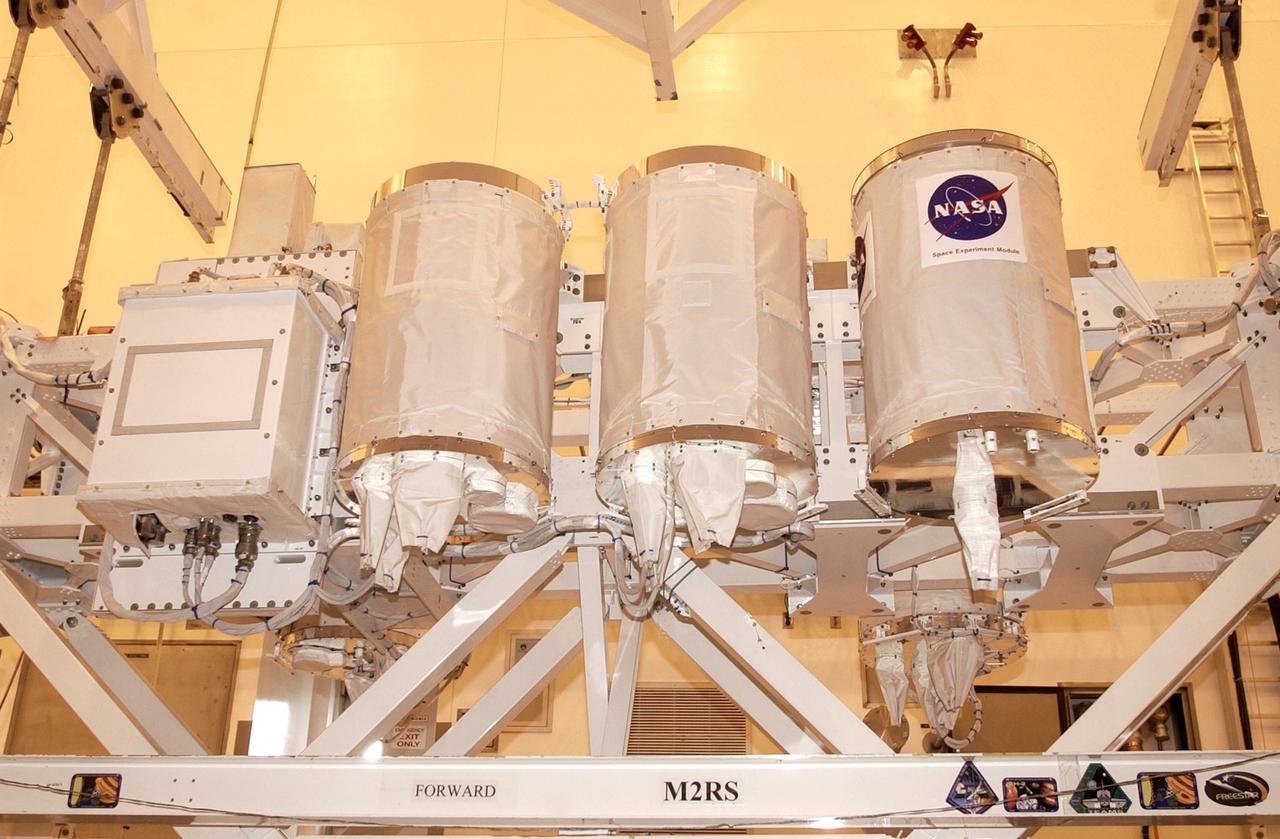
KENNEDY SPACE CENTER, FLA. - In the Multi-Payload Processing Facility, the Hitchhiker Bridge with GetAway Special canisters (GAS cans) are ready for transfer to the payload canister. The bridge is a carrier for the Fast Reaction Experiments Enabling Science, Technology, Applications and Research (FREESTAR) that incorporates eight high priority secondary attached shuttle experiments on mission STS-107. The bridge will be installed in Columbia's payload bay. A research mission, STS-107 will also carry the SHI Research Double Module (SHI/RDM), known as SPACEHAB. Experiments on the module range from material sciences to life sciences (many rats). STS-107 is scheduled to launch July 19, 2002
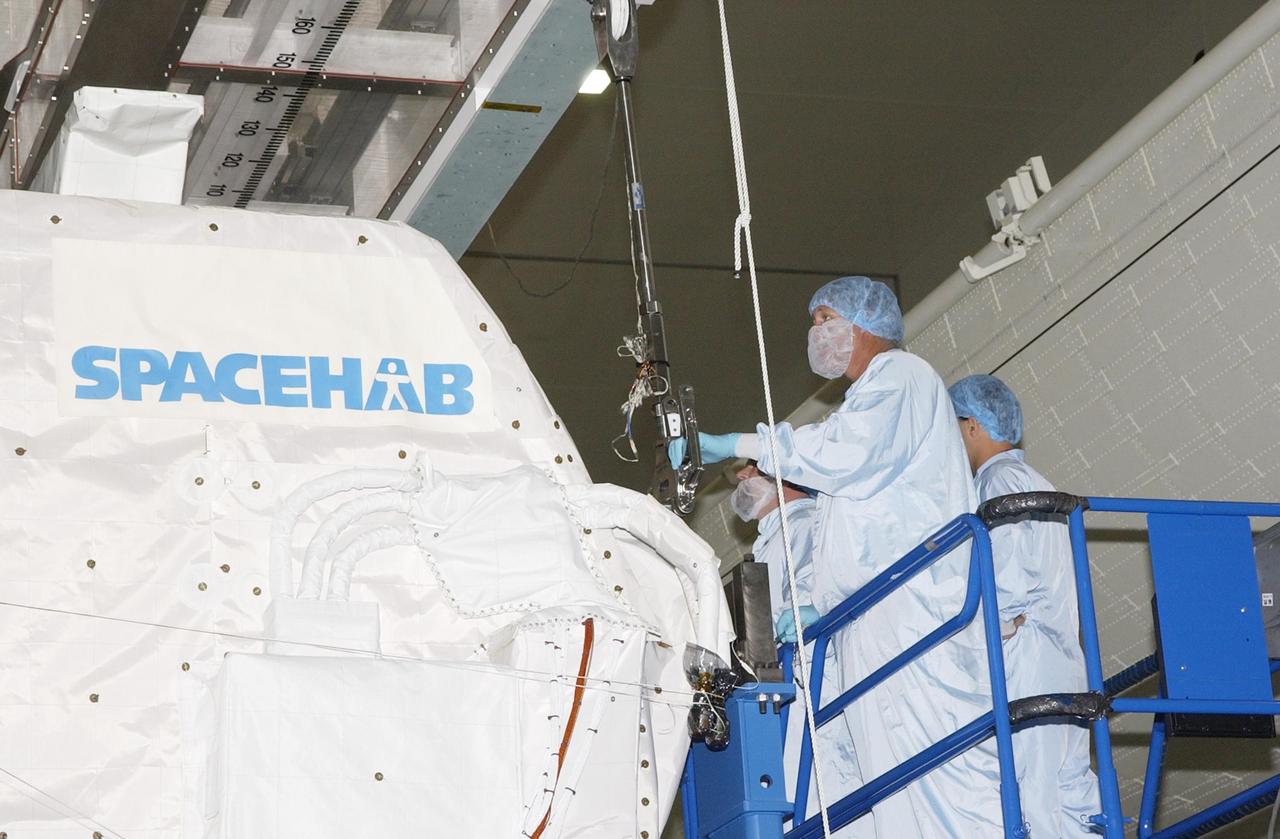
KENNEDY SPACE CENTER, FLA. - Workers in the Space Station Processing Facility attach the overhead crane to the SHI Research Double Module (SHI/RDM) to lift it off the workstand. The module is being transferred to the payload canister for transport to the Orbiter Processing Facility where it will be installed in Columbia's payload bay for mission STS-107. SHI/RDM is the primary payload of the research mission, with experiments ranging from material sciences to life sciences (many rats). Also part of the payload is the Fast Reaction Experiments Enabling Science, Technology, Applications and Research (FREESTAR) that incorporates eight high priority secondary attached shuttle experiments. STS-107 is scheduled to launch July 19, 2002
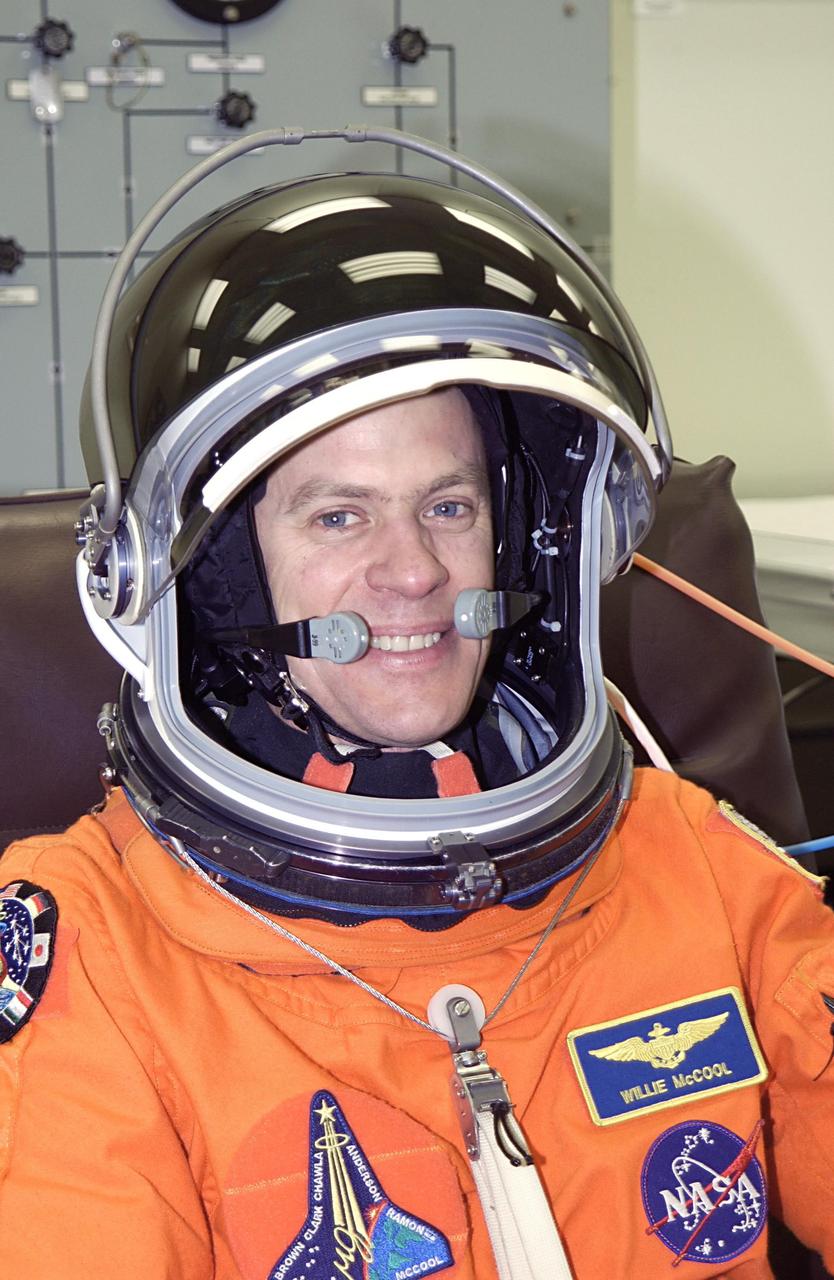
KENNEDY SPACE CENTER, FLA. - STS-107 Pilot William "Willie" McCool shows his pleasure at suiting up for launch. STS-107 is a mission devoted to research and will include more than 80 experiments that will study Earth and space science, advanced technology development, and astronaut health and safety. The payload on Space Shuttle Columbia includes FREESTAR (Fast Reaction Experiments Enabling Science, Technology, Applications and Research) and the SHI Research Double Module (SHI/RDM), known as SPACEHAB. Experiments on the module range from material sciences to life sciences. Liftoff is scheduled for 10:39 a.m. EST.

KENNEDY SPACE CENTER, FLA. -- STS-107 Mission Specialist David Brown gets help during suitup for launch. STS-107 is a mission devoted to research and will include more than 80 experiments that will study Earth and space science, advanced technology development, and astronaut health and safety. The payload on Space Shuttle Columbia includes FREESTAR (Fast Reaction Experiments Enabling Science, Technology, Applications and Research) and the SHI Research Double Module (SHI/RDM), known as SPACEHAB. Experiments on the module range from material sciences to life sciences. Liftoff is scheduled for 10:39 a.m. EST.
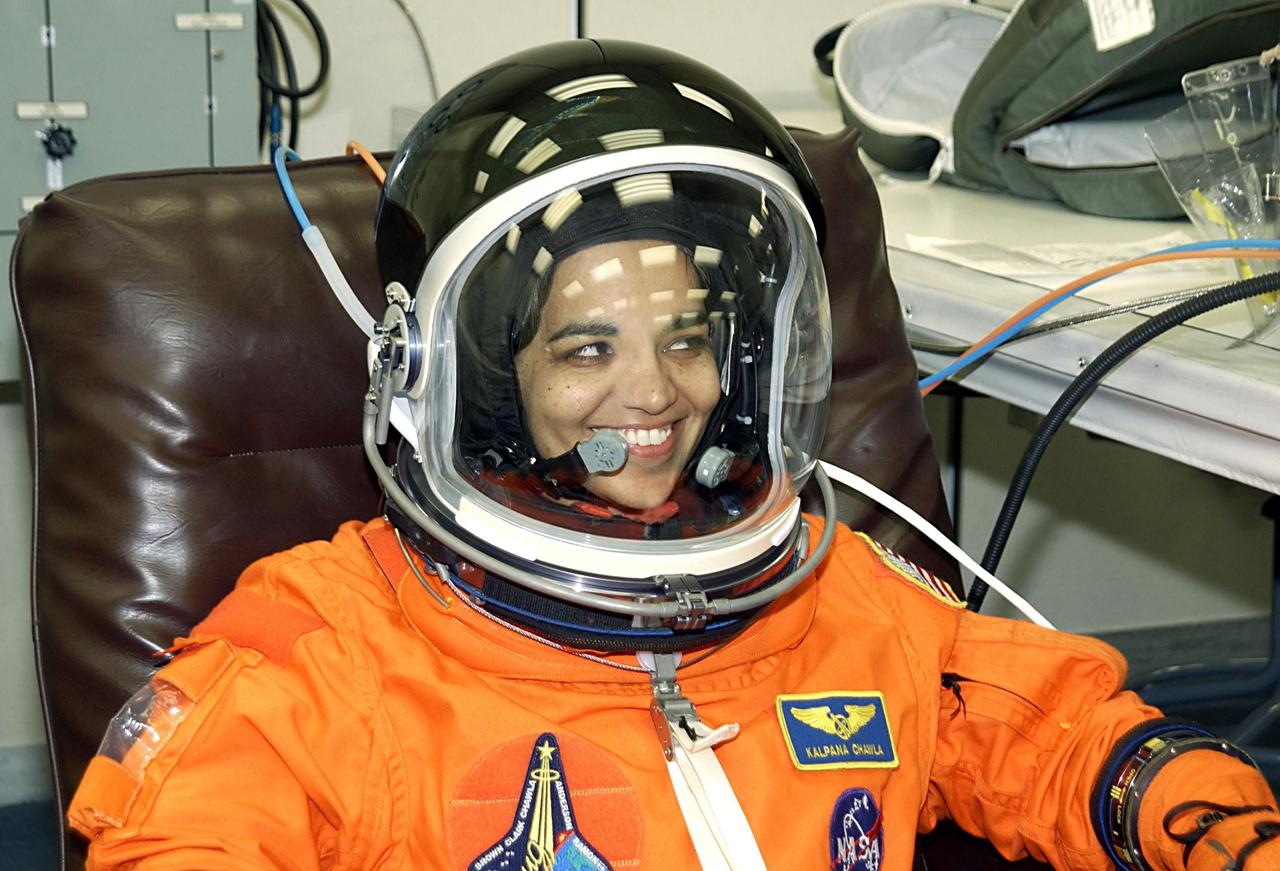
KENNEDY SPACE CENTER, FLA. -- STS-107 Mission Specialist Kalpana Chawla finishes suitup for launch. STS-107 is a mission devoted to research and will include more than 80 experiments that will study Earth and space science, advanced technology development, and astronaut health and safety. The payload on Space Shuttle Columbia includes FREESTAR (Fast Reaction Experiments Enabling Science, Technology, Applications and Research) and the SHI Research Double Module (SHI/RDM), known as SPACEHAB. Experiments on the module range from material sciences to life sciences. Liftoff is scheduled for 10:39 a.m. EST.
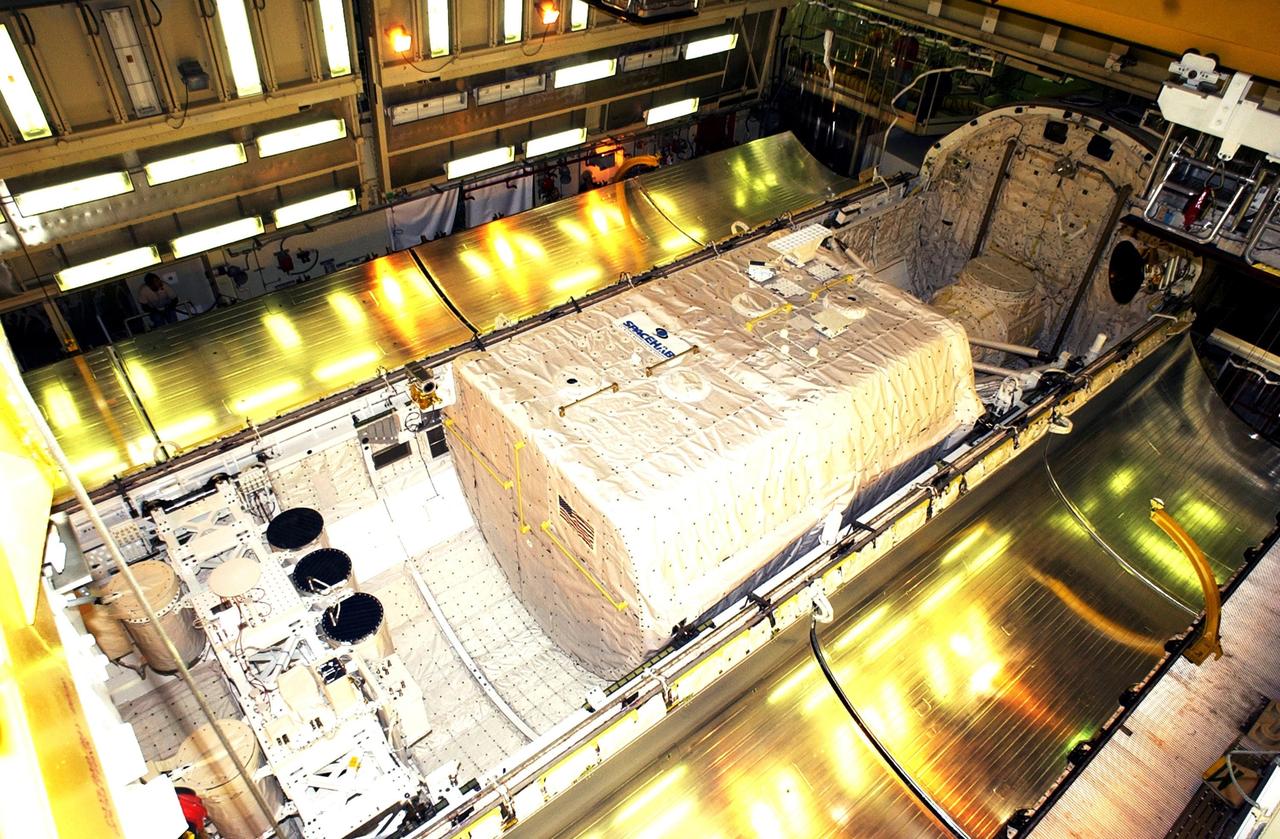
KENNEDY SPACE CENTER, FLA. - -- Columbia's payload bay doors are ready to be closed for mission STS-107. Installed inside are the Hitchhiker Bridge, a carrier for the Fast Reaction Experiments Enabling Science, Technology, Applications and Research (FREESTAR) that incorporates eight high priority secondary attached shuttle experiments, plus the SHI Research Double Module (SHI/RDM), also known as SPACEHAB. STS-107 is scheduled for launch July 19, 2001
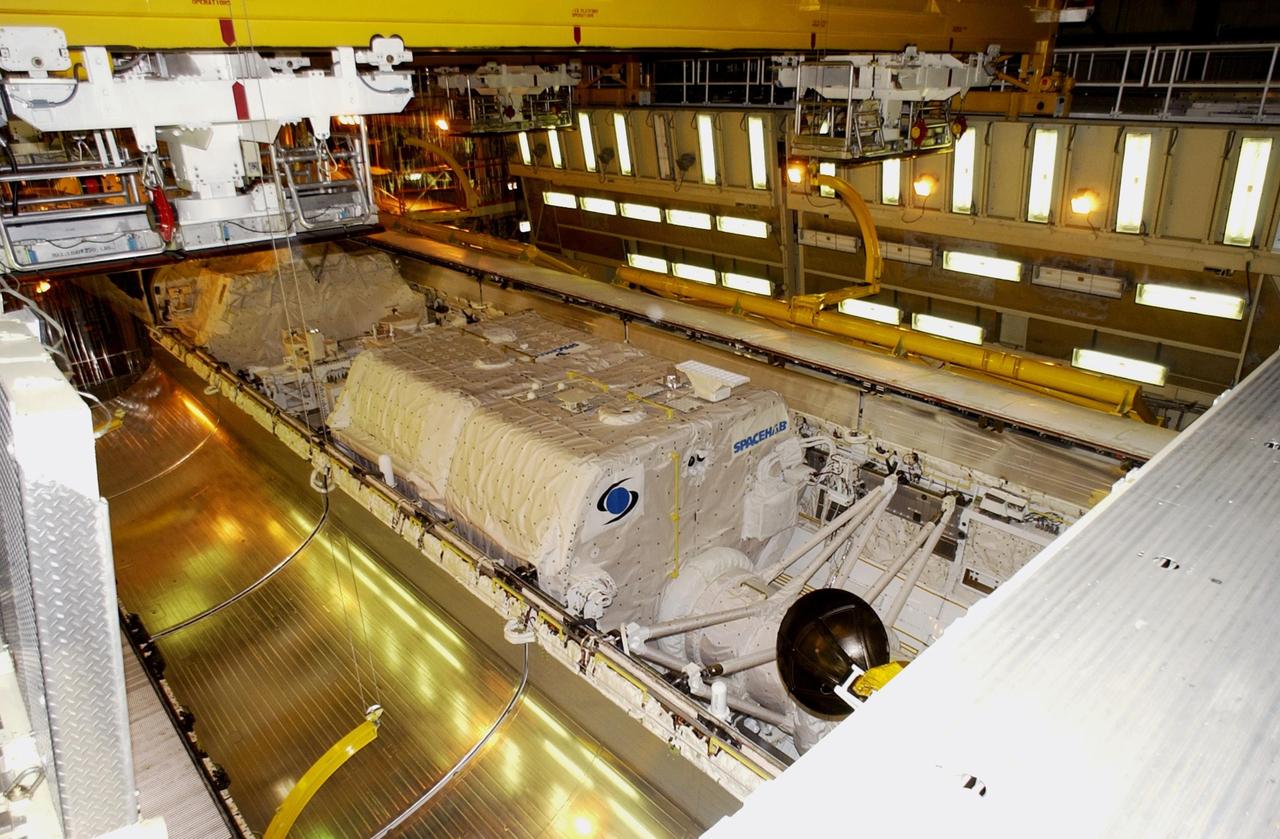
KENNEDY SPACE CENTER, FLA. -- Columbia's payload bay doors are ready to be closed for mission STS-107. Installed inside are the Hitchhiker Bridge, a carrier for the Fast Reaction Experiments Enabling Science, Technology, Applications and Research (FREESTAR) that incorporates eight high priority secondary attached shuttle experiments, plus the SHI Research Double Module (SHI/RDM), also known as SPACEHAB. STS-107 is scheduled for launch July 19, 2001
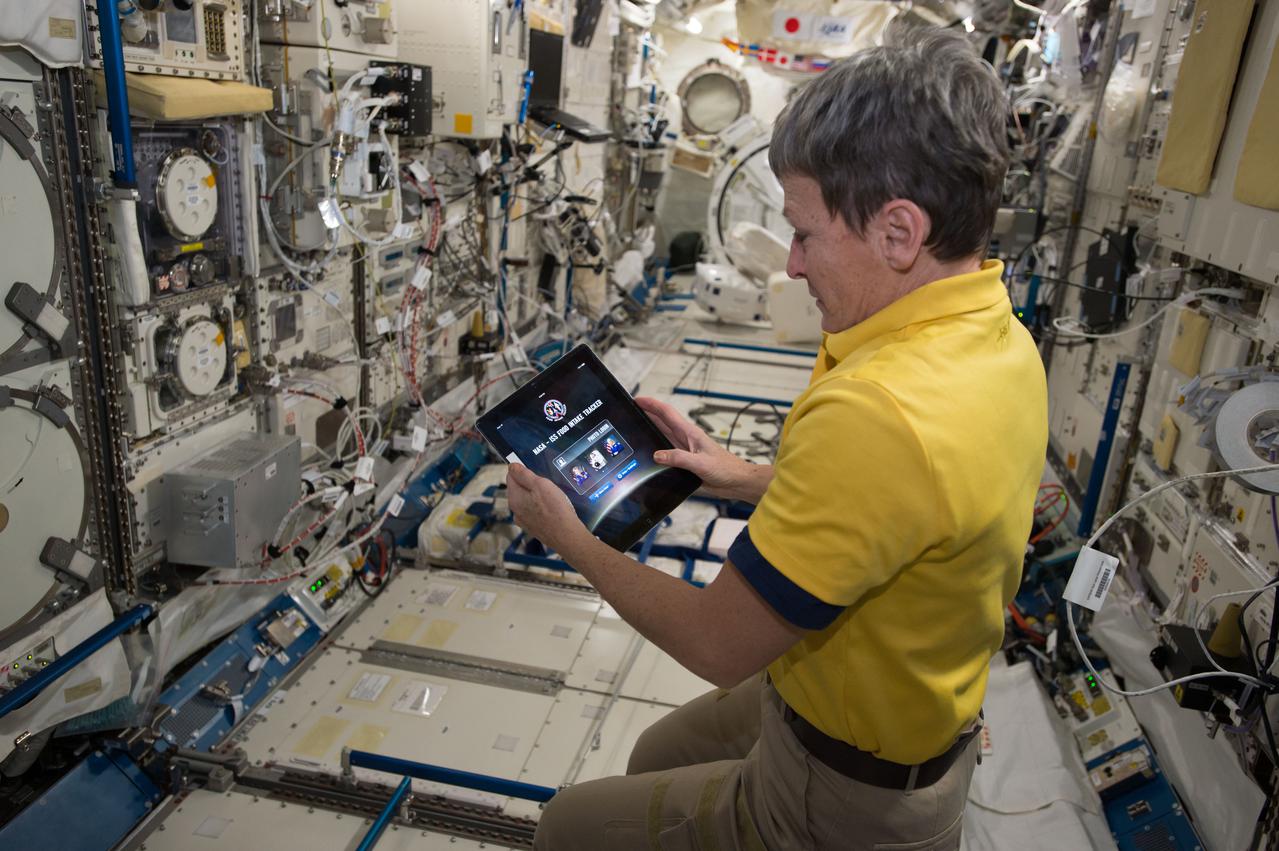
iss050e011454 (11/23/2016) --- A view of NASA astronaut Peggy Whitson using an iPAD containing the Dose Tracker application, in the Japanese Experiment Module (JEM) aboard the International Space Station (ISS). This study documents the medication usage of crew members before and during their missions by capturing previously unrecorded data regarding medication use during spaceflight, including side effect qualities, frequencies and severity. This research-oriented data is collected for research purposes, separate from medical records.
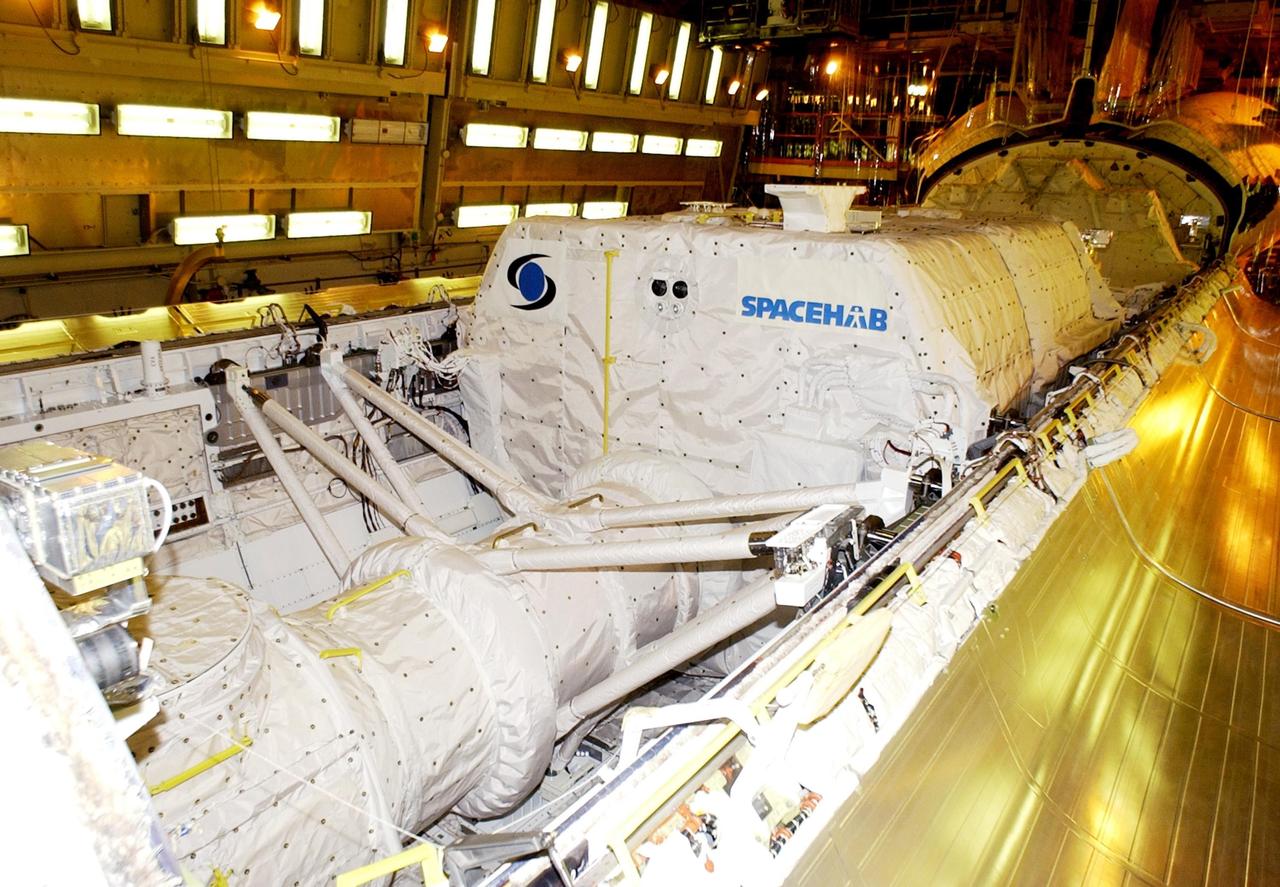
KENNEDY SPACE CENTER, FLA. -- Columbia's payload bay doors are ready to be closed for mission STS-107. Installed inside are the Hitchhiker Bridge, a carrier for the Fast Reaction Experiments Enabling Science, Technology, Applications and Research (FREESTAR) that incorporates eight high priority secondary attached shuttle experiments, plus the SHI Research Double Module (SHI/RDM), also known as SPACEHAB. STS-107 is scheduled for launch July 19, 2001
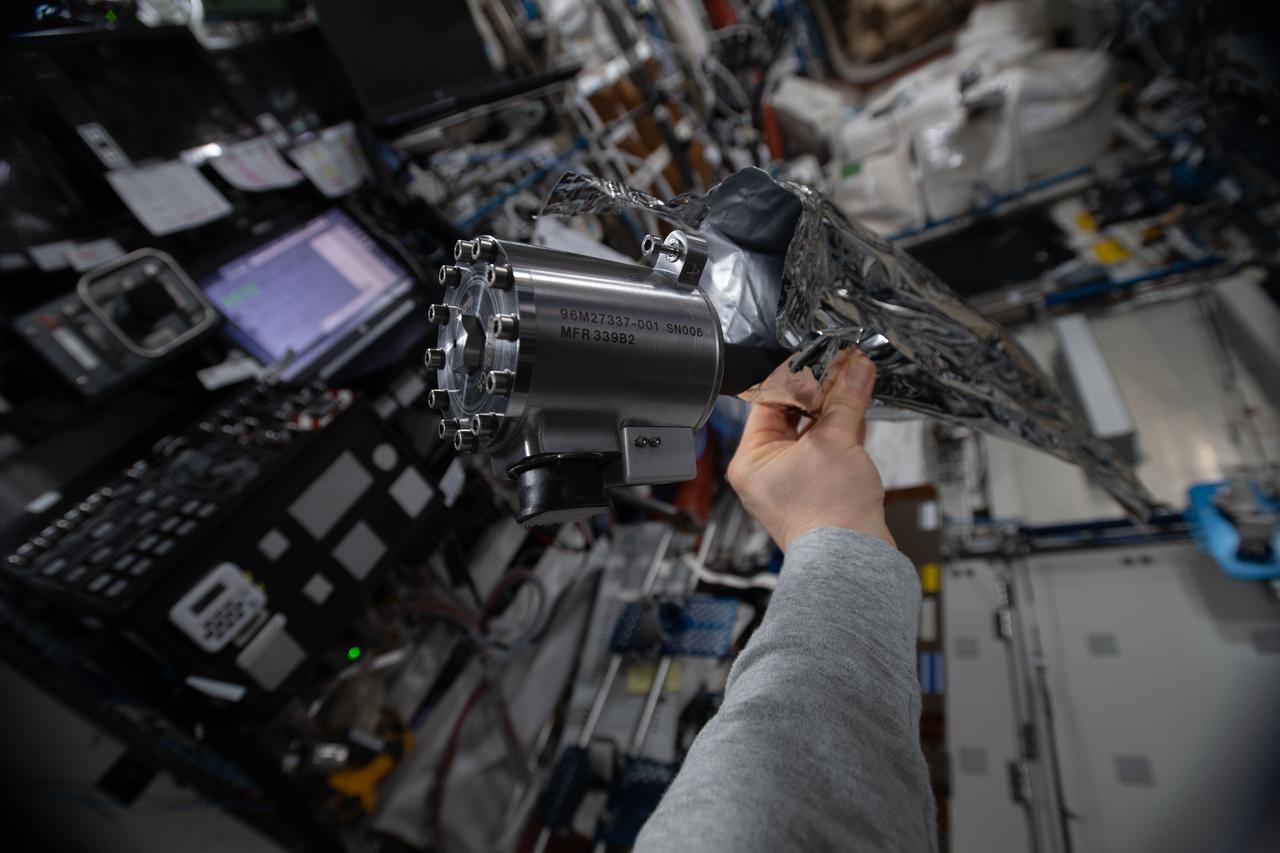
iss061e092274 (12/18/2019) --- A view of the Materials Science Laboratory (MSL) Sample Cartridge Assembly (SCA) in the Destiny module aboard the International Space Station (ISS). The Materials Science Laboratory (MSL) is used for basic materials research in the microgravity environment of the International Space Station (ISS). The MSL can accommodate and support diverse Experiment Modules. In this way many material types, such as metals, alloys, polymers, semiconductors, ceramics, crystals, and glasses, can be studied to discover new applications for existing materials and new or improved materials.
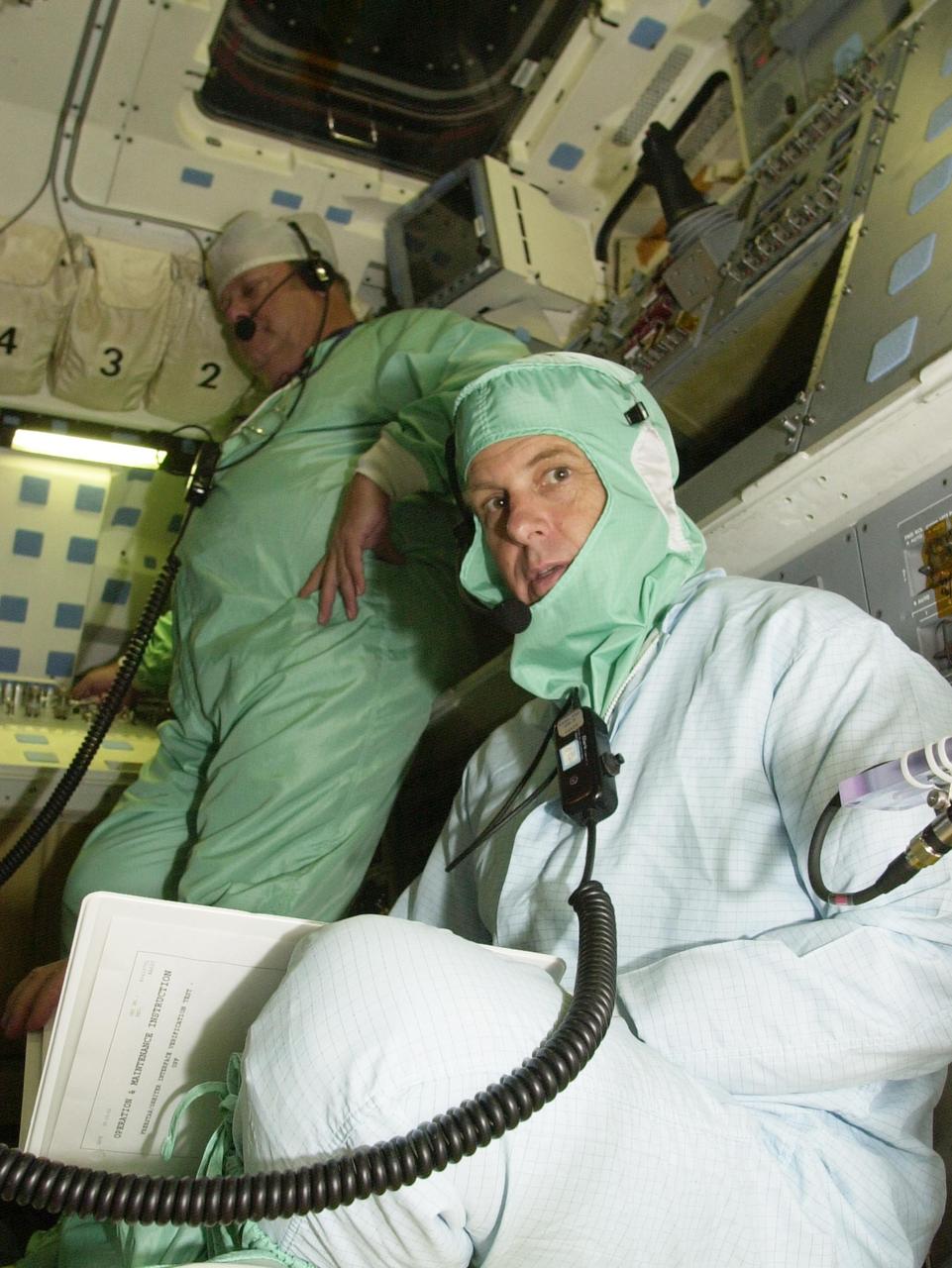
KENNEDY SPACE CENTER, FLA. -- Dressed in a bunny suit, STS-107 Payload Specialist Ilan Ramon, who is with the Israeli Space Agency, reviews data in Columbia's payload bay for Fast Reaction Experiments Enabling Science, Technology, Applications and Research (FREESTAR) experiments for the mission. FREESTAR comprises Mediterranean Israeli Dust, Solar Constant, Shuttle Ozone Limb Sounding, Critical Viscosity of Xenon, Low Power, and Space Experimental Module experiments. Another payload is the SHI Research Double Module (SHI/RDM), also known as SPACEHAB. The experiments range from material sciences to life sciences. STS-107 is scheduled to launch July 11, 2002
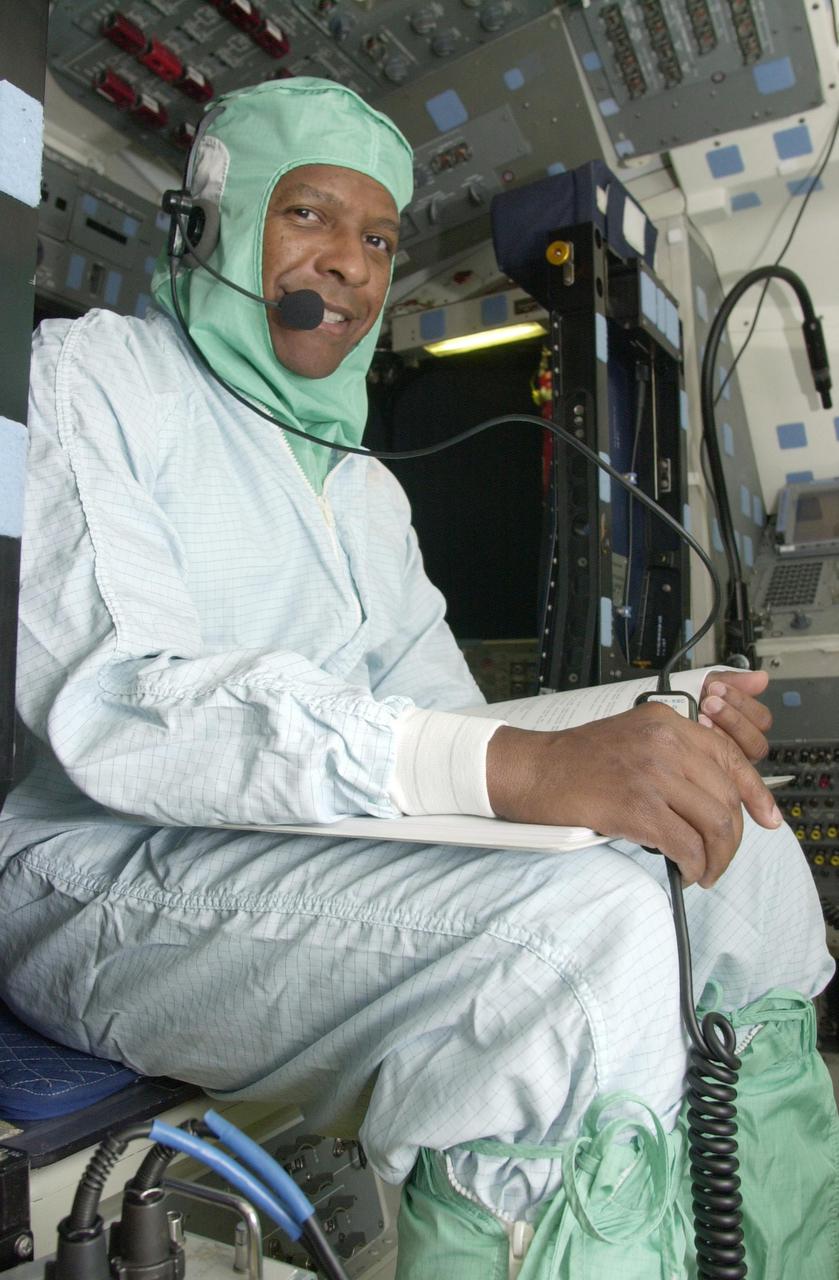
KENNEDY SPACE CENTER, FLA. - Dressed in a bunny suit, STS-107 Payload Commander Michael Anderson reviews data in Columbia's payload bay for Fast Reaction Experiments Enabling Science, Technology, Applications and Research (FREESTAR) experiments for the mission. FREESTAR comprises Mediterranean Israeli Dust, Solar Constant, Shuttle Ozone Limb Sounding, Critical Viscosity of Xenon, Low Power, and Space Experimental Module experiments. Another payload is the SHI Research Double Module (SHI_RDM), also known as SPACEHAB. The experiments range from material sciences to life sciences. STS-107 is scheduled to launch July 11, 2002
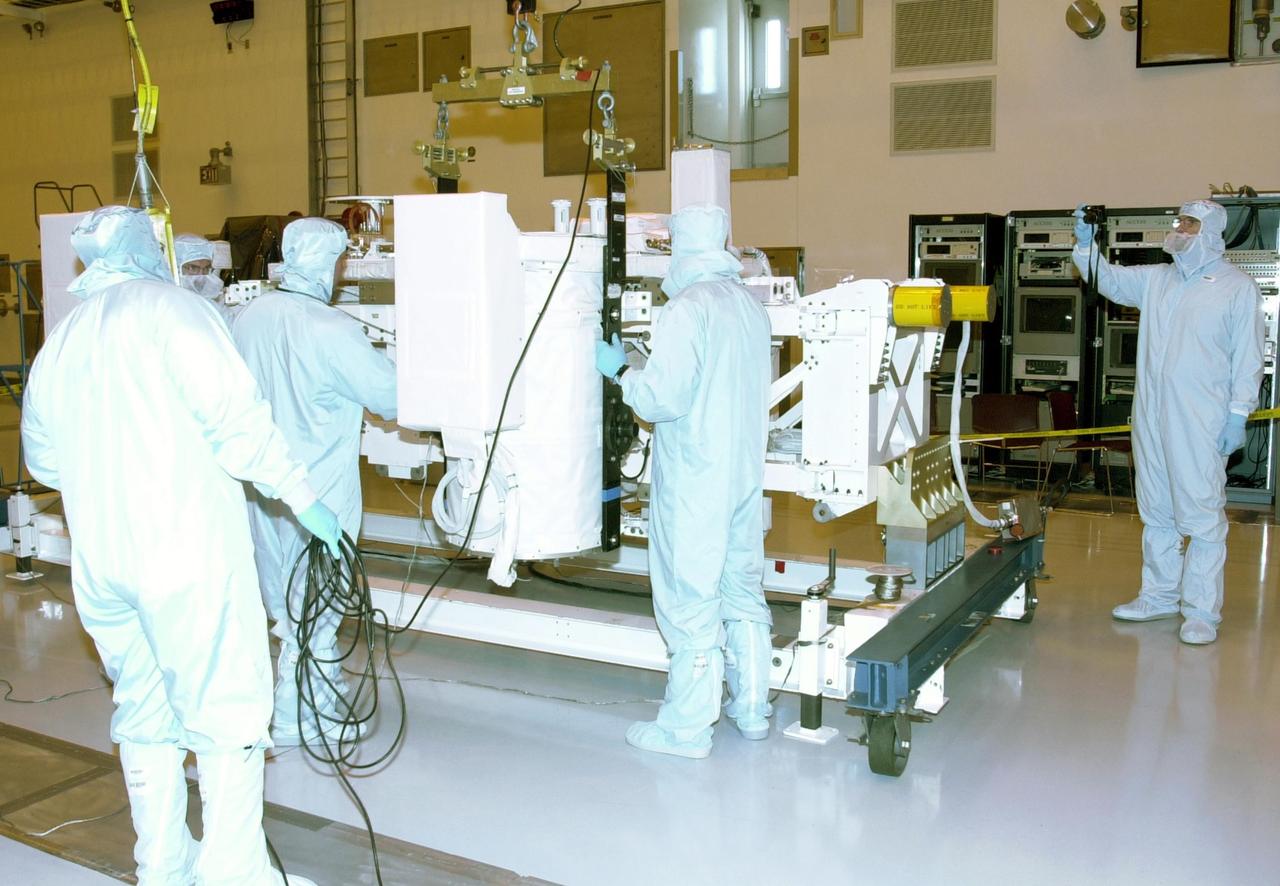
KENNEDY SPACE CENTER, FLA. -- In the Multi-Payload Processing Facility, workers check a GetAway Special canister (GAS can) being moved onto the Hitchhiker Bridge. The bridge is a carrier for the Fast Reaction Experiments Enabling Science, Technology, Applications and Research (FREESTAR) that incorporates eight high priority secondary attached shuttle experiments on mission STS-107. A research mission, the primary payload is the first flight of the SHI Research Double Module (SHI/RDM), also known as SPACEHAB. The experiments range from material sciences to life sciences (many rats). STS-107 is scheduled to launch July 11, 2002
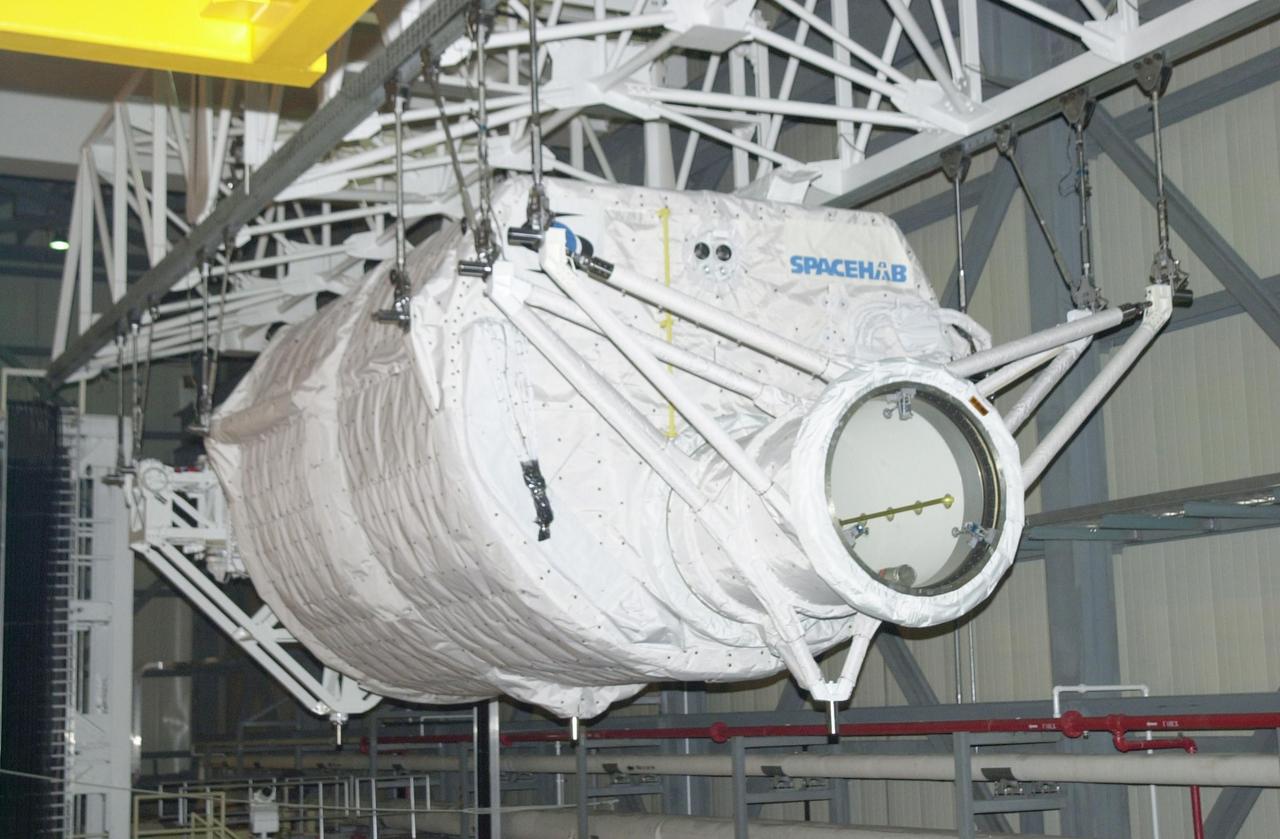
KENNEDY SPACE CENTER, FLA. -- In the Orbiter Processing Facility, the Hitchhiker Carrier (front) and the SHI Research Double Module (SHI/RDM) behind it are suspended over Columbia's payload bay. The two payloads will be installed in the payload bay for mission STS-107, a research mission. SHI/RDM is the primary payload, with experiments ranging from material sciences to life sciences (many rats). Also, the Fast Reaction Experiments Enabling Science, Technology, Applications and Research (FREESTAR) that is on the Hitchhiker Carrier incorporates eight high priority secondary attached shuttle experiments. STS-107 is scheduled to launch July 19, 2002
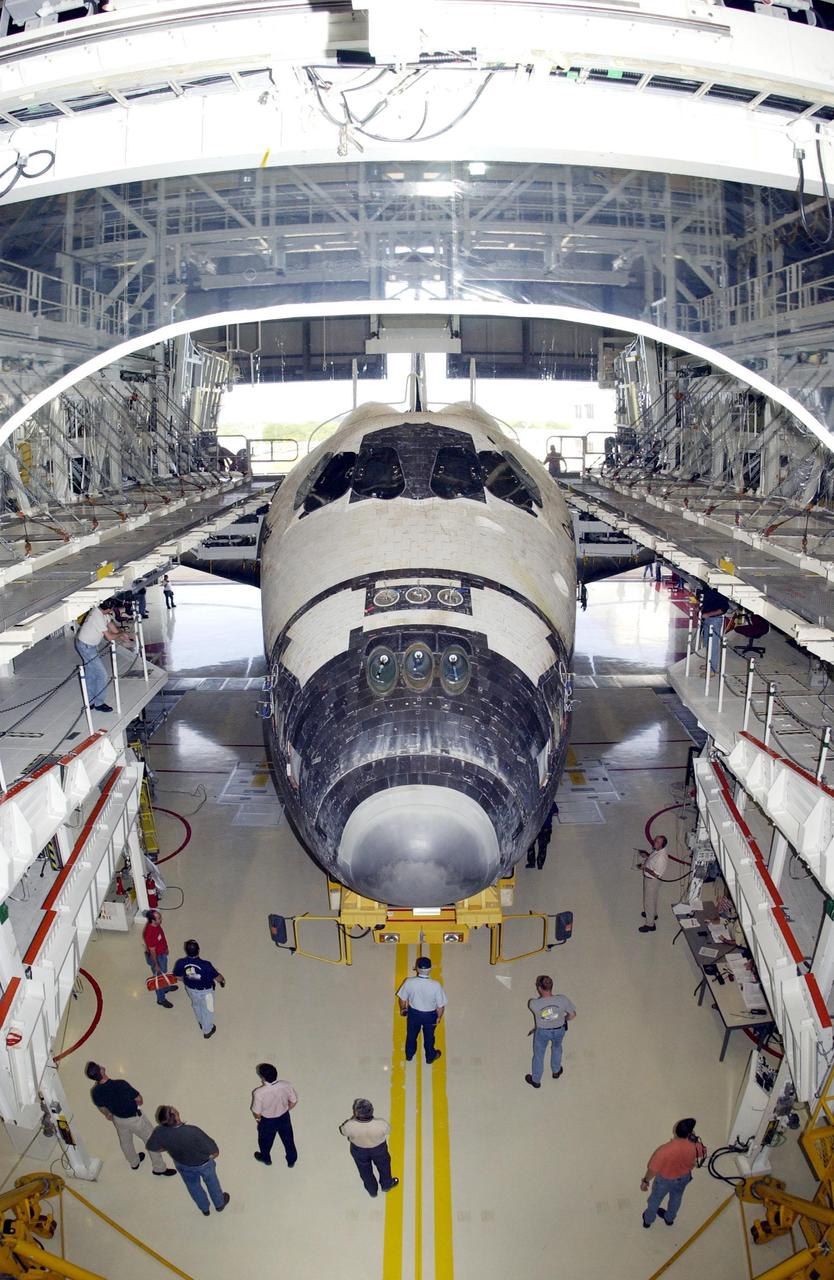
KENNEDY SPACE CENTER, FLA. -- Inside an Orbiter Processing Facility bay, Space Shuttle Columbia is readied for its move to the Vehicle Assembly Building. The orbiter is being prepared to fly on mission STS-107 now targeted for no earlier than Jan. 16, 2003. The STS-107 mission will be dedicated to microgravity research. The payloads include the Hitchhiker Bridge, a carrier for the Fast Reaction Experiments Enabling Science, Technology, Applications and Research (FREESTAR) incorporating eight high priority secondary attached Shuttle experiments, and the SHI Research Double Module (SHI/RDM), also known as SPACEHAB.
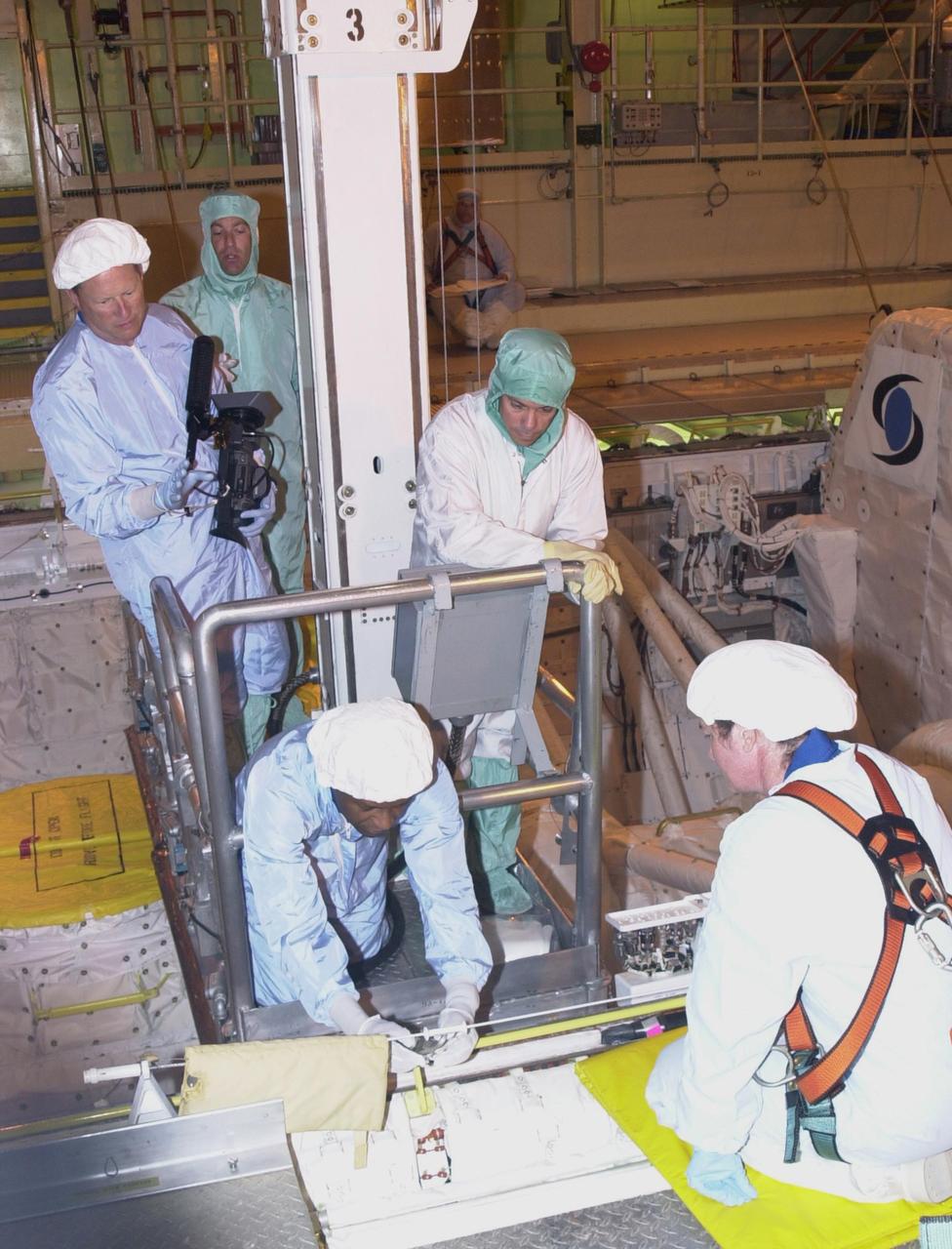
KENNEDY SPACE CENTER, FLA. -- During Crew Equipment Interface Test activities, STS-107 Payload Commander Michael Anderson looks over equipment from a lift in the payload bay of Columbia while technicians (right and rear) look on. Behind Anderson is Mission Specialist David Brown. STS-107 is a research mission, with the SHI Research Double Module (SHI/RDM), also known as SPACEHAB, as the primary payload, plus the Fast Reaction Experiments Enabling Science, Technology, Applications and Research (FREESTAR) that incorporates eight high priority secondary attached shuttle experiments. STS-107 is scheduled to launch July 19, 2002
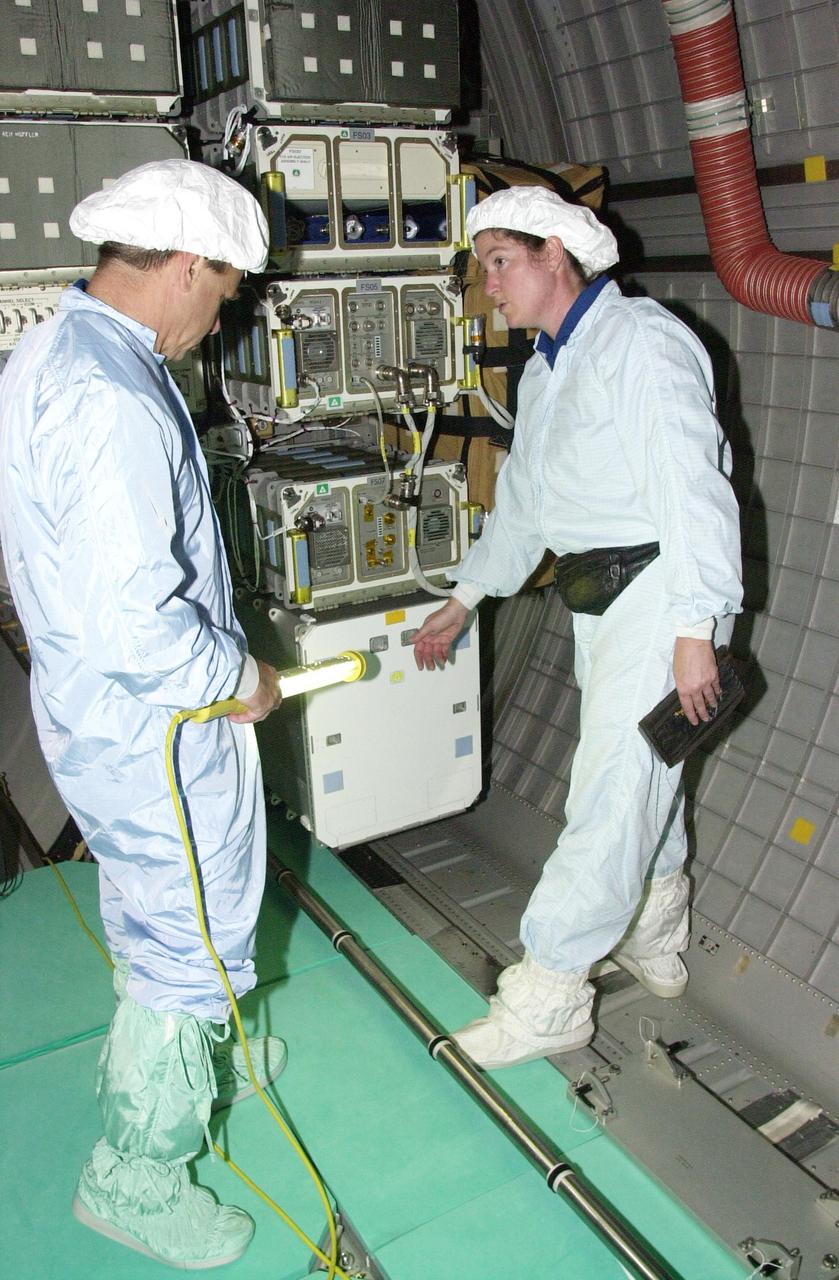
KENNEDY SPACE CENTER, FLA. -- STS-107 Mission Specialists Ilan Ramon, with the Israeli Space Agency, and Laurel Clark check out equipment in the SHI Research Double Module (SHI/RDM), part of the payload on the mission. They are taking part in Crew Equipment Interface Test activities, which include equipment and payload familiarization. A research mission, STS-107 also will carry the Fast Reaction Experiments Enabling Science, Technology, Applications and Research (FREESTAR) that incorporates eight high priority secondary attached shuttle experiments. STS-107 is scheduled to launch July 19, 2002
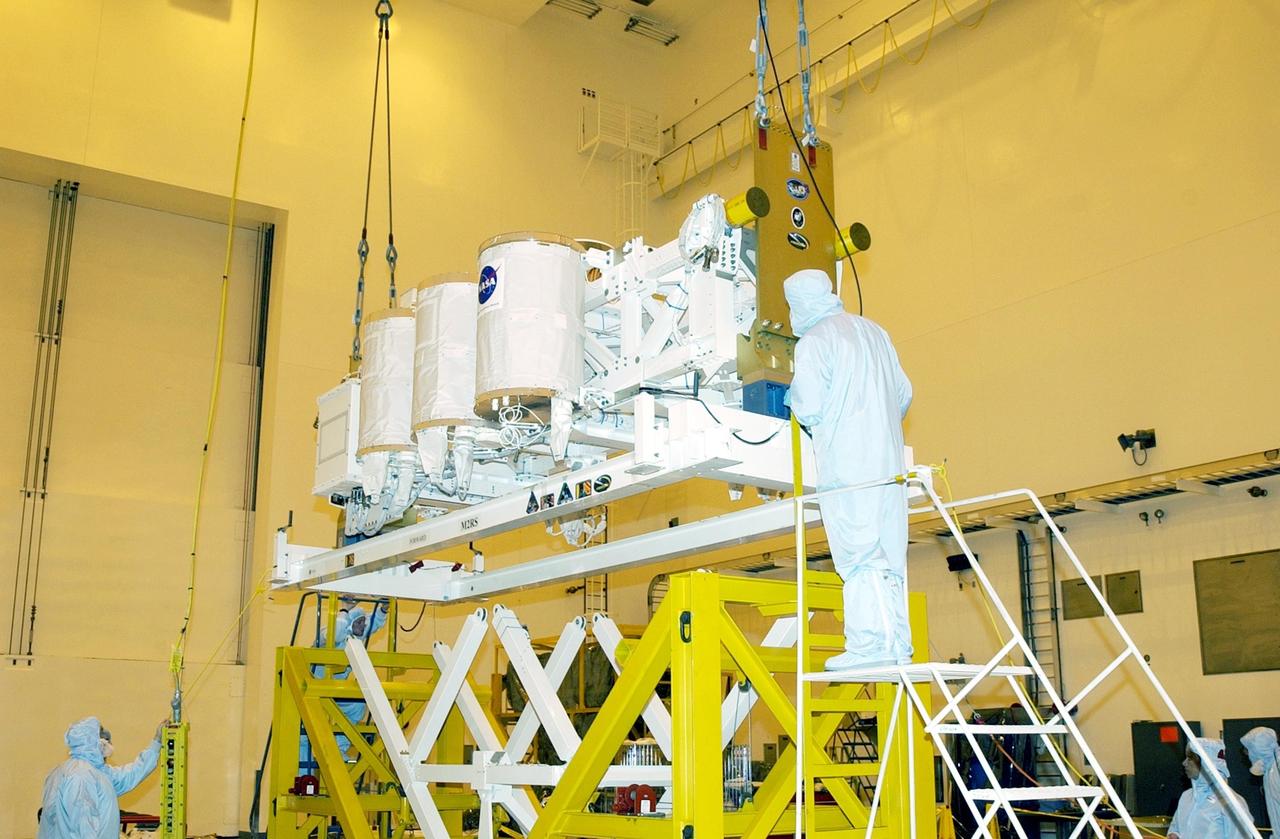
KENNEDY SPACE CENTER, FLA. -- -- In the Multi-Payload Processing Facility (MPPF), the Hitchhiker Bridge is lowered onto a workstand. The bridge is a carrier for the Fast Reaction Experiments Enabling Science, Technology, Applications and Research (FREESTAR) that incorporates eight high priority secondary attached shuttle experiments on mission STS-107. A research mission, the primary payload is the first flight of the SHI Research Double Module (SHI/RDM), also known as SPACEHAB. The experiments range from material sciences to life sciences. STS-107 is scheduled to launch July 11, 2002
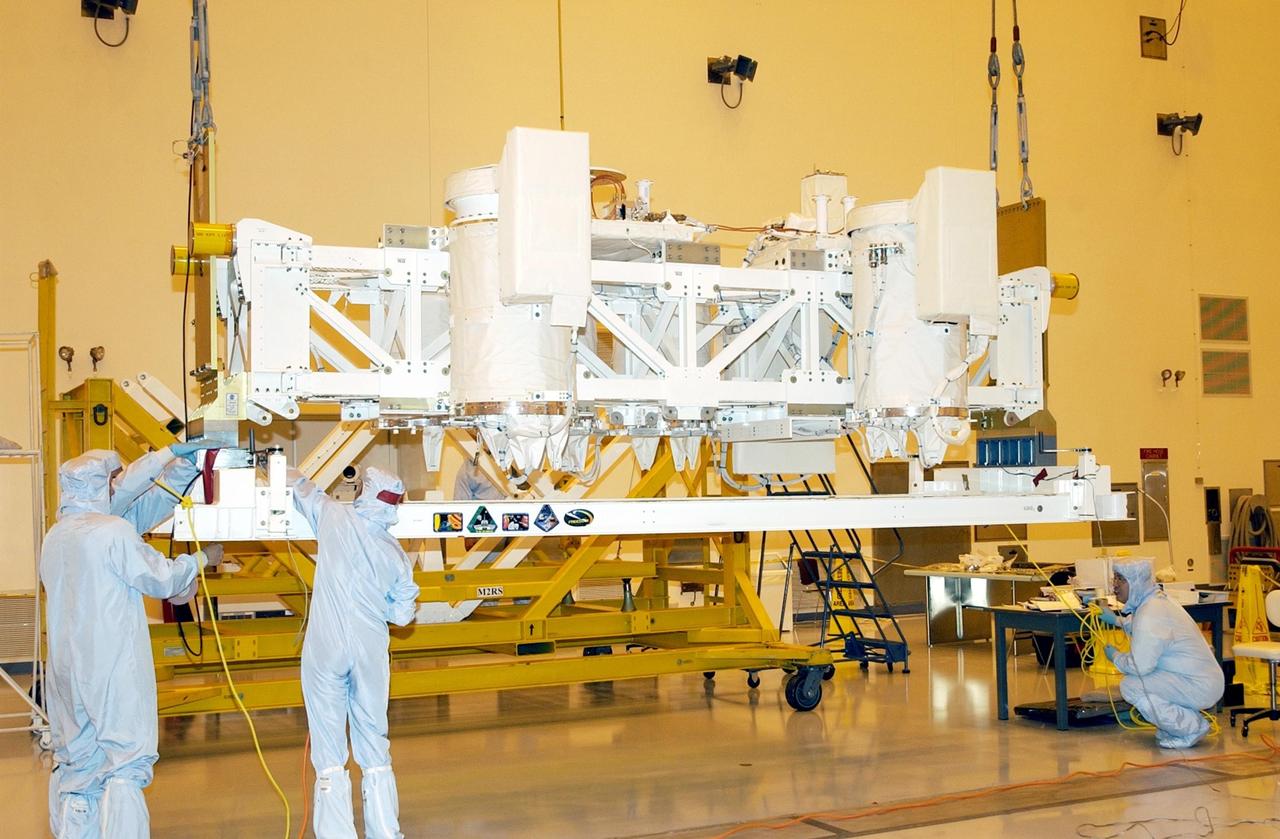
KENNEDY SPACE CENTER, FLA. -- In the Multi-Payload Processing Facility (MPPF), workers check the Hitchhiker Bridge that is being lifted by a crane for transfer to a workstand. The bridge is a carrier for the Fast Reaction Experiments Enabling Science, Technology, Applications and Research (FREESTAR) that incorporates eight high priority secondary attached shuttle experiments on mission STS-107. A research mission, the primary payload is the first flight of the SHI Research Double Module (SHI/RDM), also known as SPACEHAB. The experiments range from material sciences to life sciences. STS-107 is scheduled to launch July 11, 2002
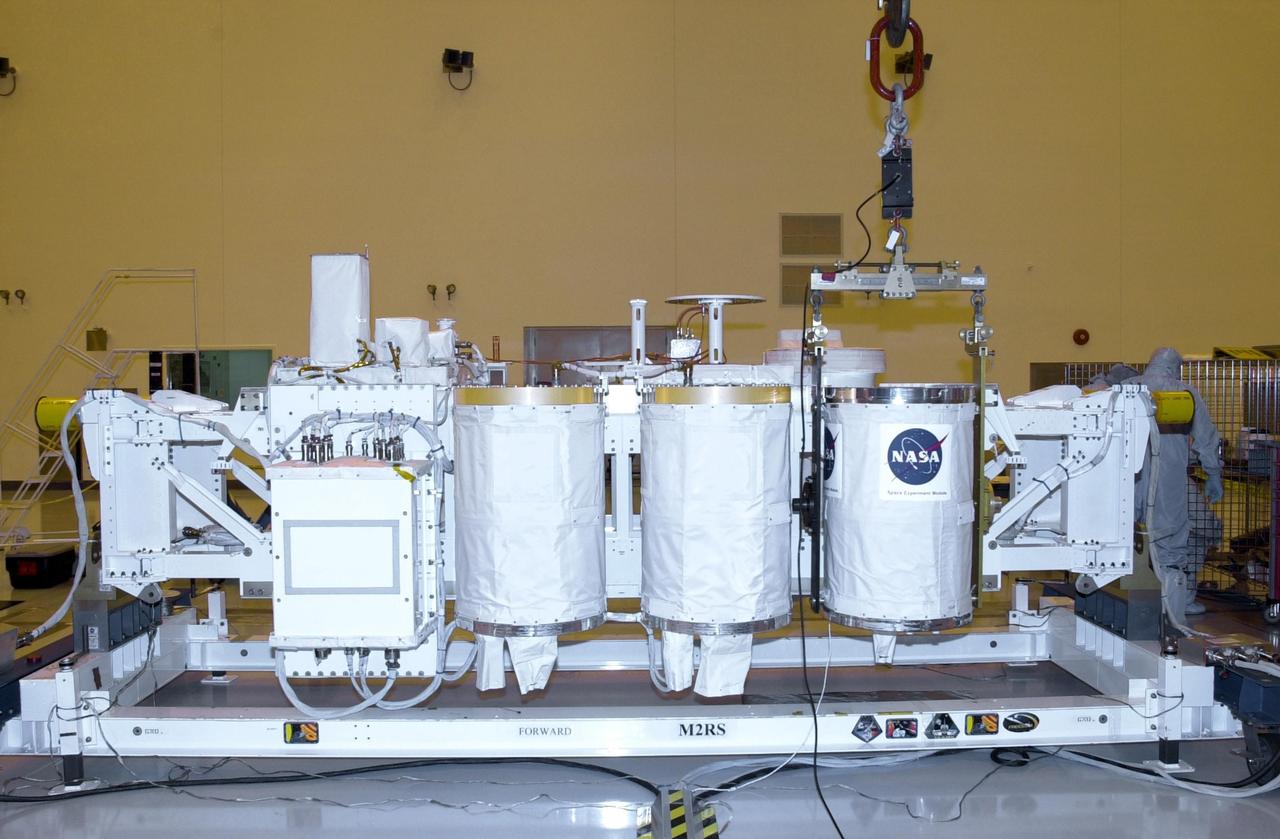
KENNEDY SPACE CENTER, FLA. -- In the Multi-Payload Processing Facility, an overhead crane lowers a GetAway Special canister (GAS can) onto the Hitchhiker Bridge. The bridge is a carrier for the Fast Reaction Experiments Enabling Science, Technology, Applications and Research (FREESTAR) that incorporates eight high priority secondary attached shuttle experiments on mission STS-107. A research mission, the primary payload is the first flight of the SHI Research Double Module (SHI/RDM), also known as SPACEHAB. The experiments range from material sciences to life sciences (many rats). STS-107 is scheduled to launch July 11, 2002
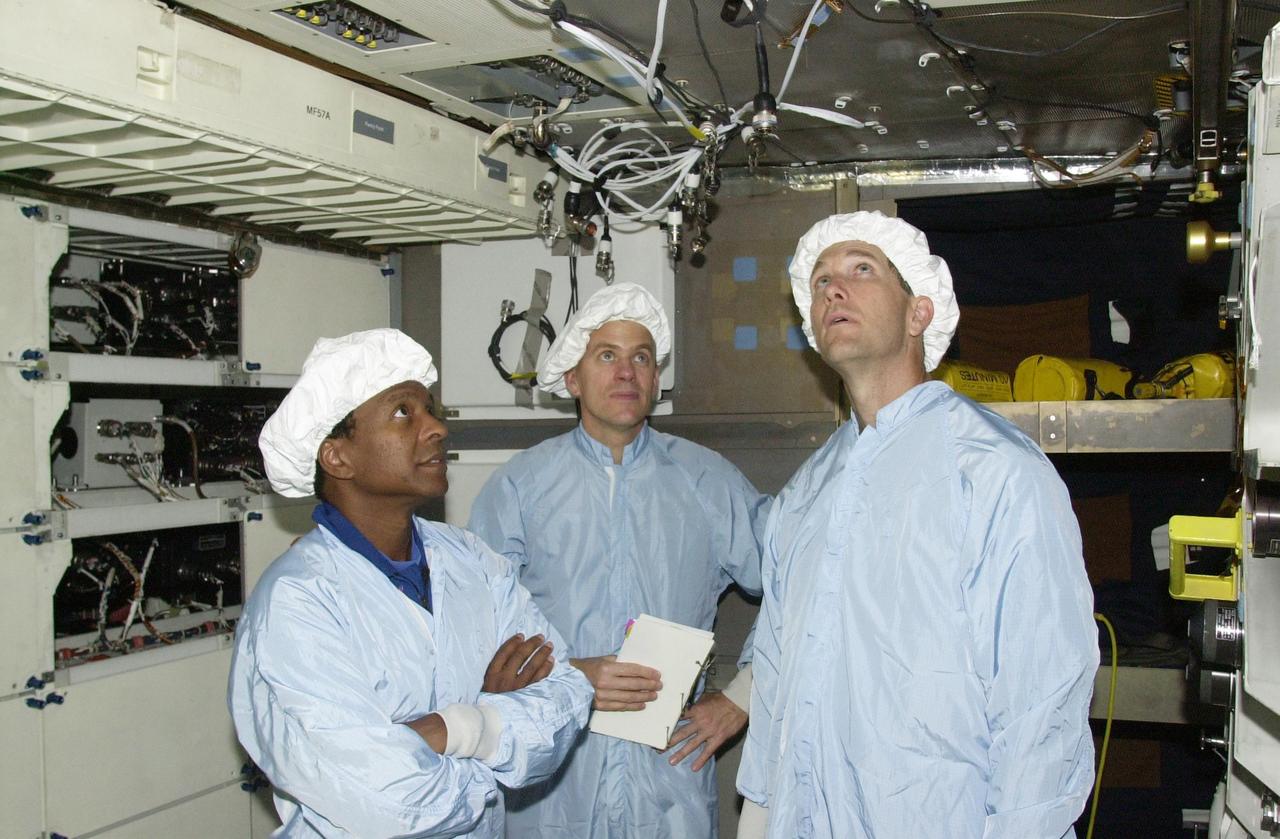
KENNEDY SPACE CENTER, FLA. -- STS-107 Payload Commander Michael Anderson (left), Pilot William "Willie" McCool (center) and Commander Rick Husband (right) look over equipment in the SHI Research Double Module (SHI/RDM), part of the payload on the mission. . They are taking part in Crew Equipment Interface Test activities, which include equipment and payload familiarization. A research mission, STS-107 also will carry the Fast Reaction Experiments Enabling Science, Technology, Applications and Research (FREESTAR) that incorporates eight high priority secondary attached shuttle experiments. STS-107 is scheduled to launch July 19, 2002
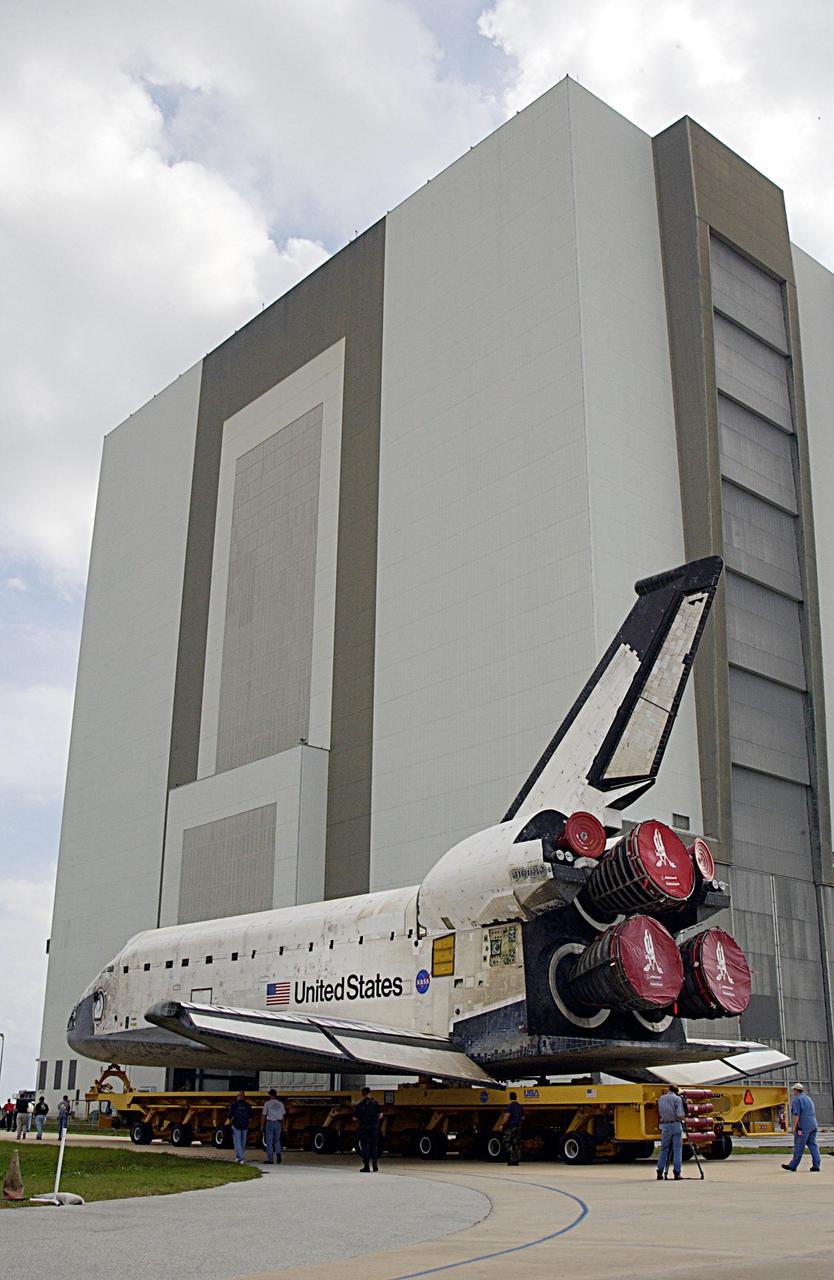
KENNEDY SPACE CENTER, FLA. -- KSC workers accompany Space Shuttle Columbia as it is moved towards the Vehicle Assembly Building where processing will continue for the flight of mission STS-107. Launch is now targeted for no earlier than Jan. 16, 2003. The STS-107 mission will be dedicated to microgravity research. The payloads include the Hitchhiker Bridge, a carrier for the Fast Reaction Experiments Enabling Science, Technology, Applications and Research (FREESTAR) incorporating eight high priority secondary attached Shuttle experiments, and the SHI Research Double Module (SHI/RDM), also known as SPACEHAB.
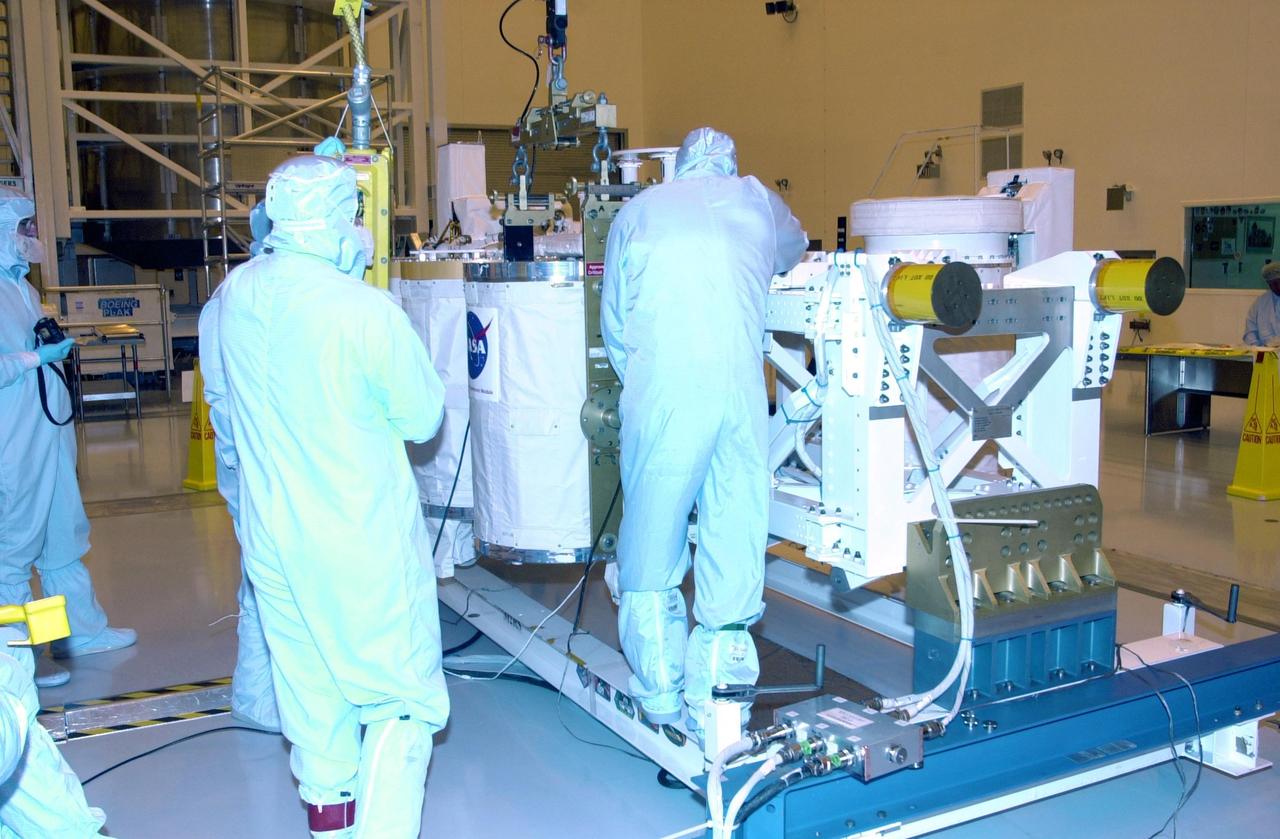
KENNEDY SPACE CENTER, FLA. -- In the Multi-Payload Processing Facility, workers check the movement of a GetAway Special canister (GAS can) being lowered onto the Hitchhiker Bridge. The bridge is a carrier for the Fast Reaction Experiments Enabling Science, Technology, Applications and Research (FREESTAR) that incorporates eight high priority secondary attached shuttle experiments on mission STS-107. A research mission, the primary payload is the first flight of the SHI Research Double Module (SHI/RDM), also known as SPACEHAB. The experiments range from material sciences to life sciences (many rats). STS-107 is scheduled to launch July 11, 2002
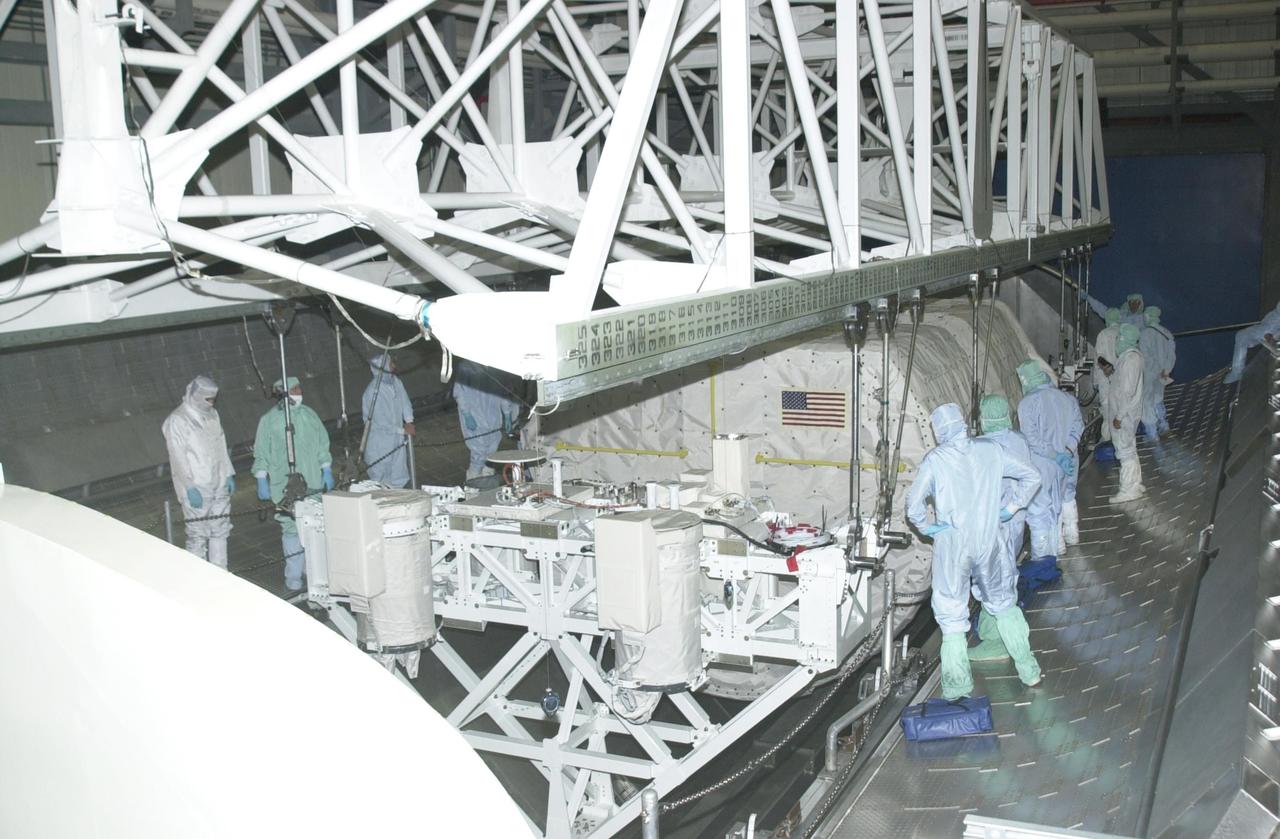
KENNEDY SPACE CENTER, FLA. - In the Orbiter Processing Facility, an overhead crane is attached to the SHI Research Double Module (SHI/RDM) (right) and Hitchhiker Carrier (left) to lift them out of the payload canister. They will be installed in Columbia's payload bay. SHI/RDM is the primary payload of the STS-107 research mission, with experiments ranging from material sciences to life sciences (many rats). Also, the Fast Reaction Experiments Enabling Science, Technology, Applications and Research (FREESTAR) that is on the Hitchhiker Carrier incorporates eight high priority secondary attached shuttle experiments. STS-107 is scheduled to launch July 19, 2002
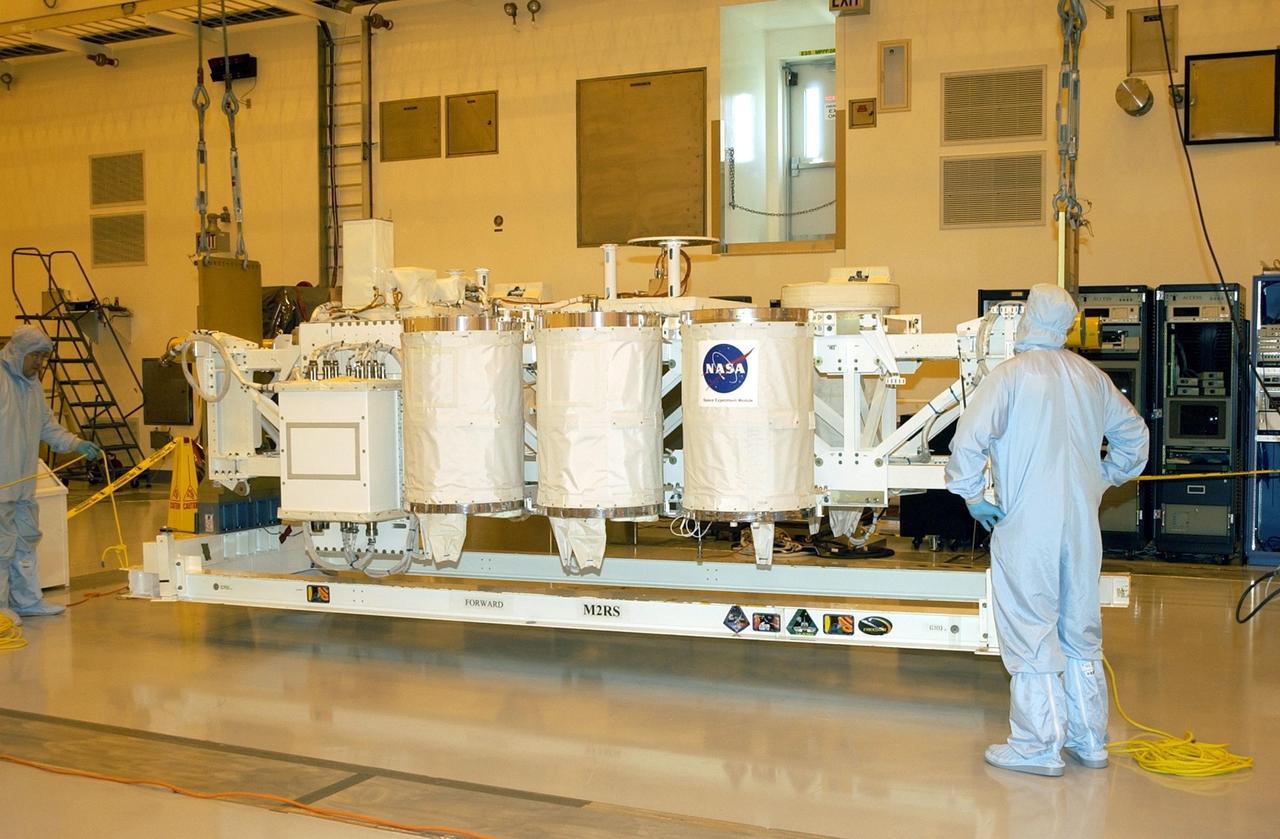
KENNEDY SPACE CENTER, FLA. -- In the Multi-Payload Processing Facility (MPPF), workers watch as the Hitchhiker Bridge, with several Get-Away Special canisters (GAS cans) for mission ST-107, is lifted off the ground. The bridge is being moved to a workstand in the MPPF. The bridge is a carrier for the Fast Reaction Experiments Enabling Science, Technology, Applications and Research (FREESTAR) that incorporates eight high priority secondary attached shuttle experiments on mission STS-107. A research mission, the primary payload is the first flight of the SHI Research Double Module (SHI/RDM), also known as SPACEHAB. The experiments range from material sciences to life sciences. STS-107 is scheduled to launch July 11, 2002
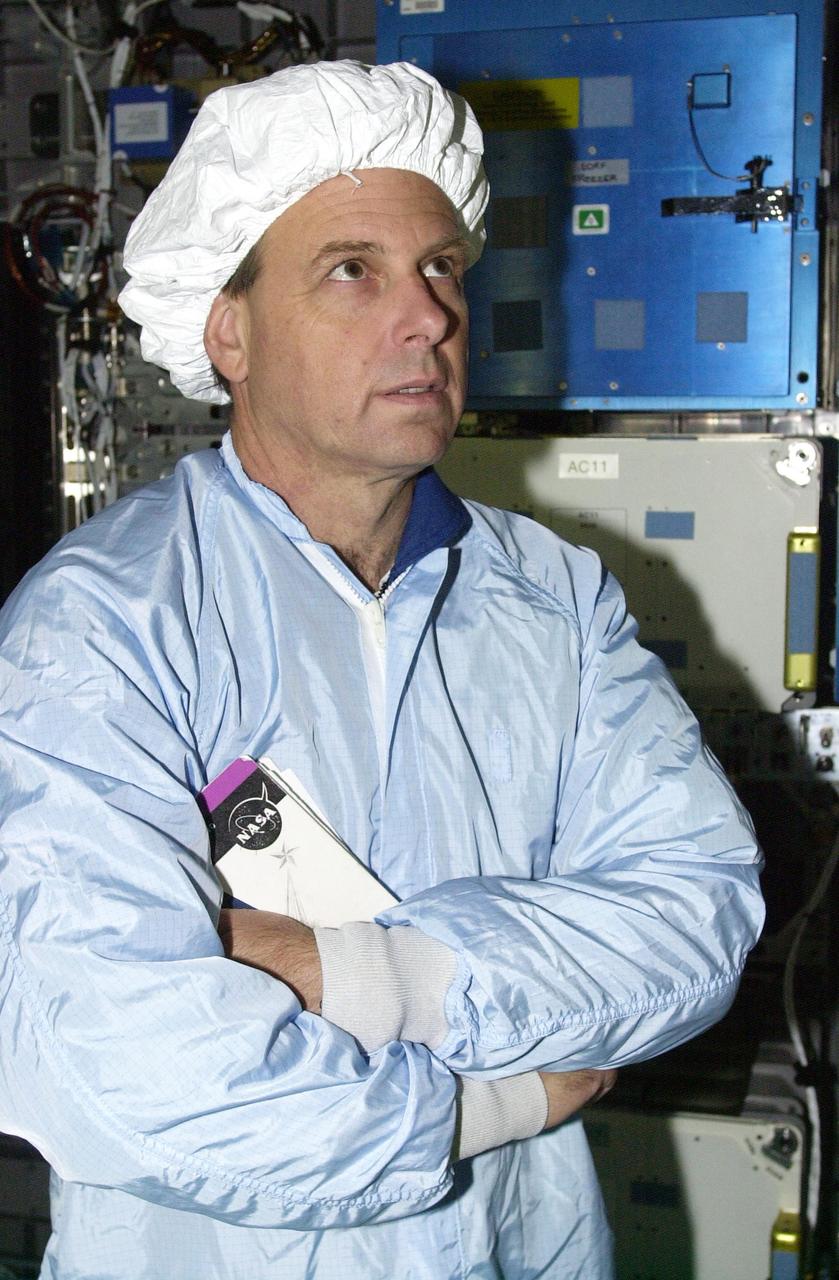
KENNEDY SPACE CENTER, FLA. - STS-107 Mission Specialist Ilan Ramon, with the Israeli Space Agency, looks at an experiment in the SHI Research Double Module (SHI/RDM), part of the payload on the mission. The crew is taking part in Crew Equipment Interface Test activities, which include equipment and payload familiarization. A research mission, STS-107 also will carry the Fast Reaction Experiments Enabling Science, Technology, Applications and Research (FREESTAR) that incorporates eight high priority secondary attached shuttle experiments. STS-107 is scheduled to launch July 19, 2002
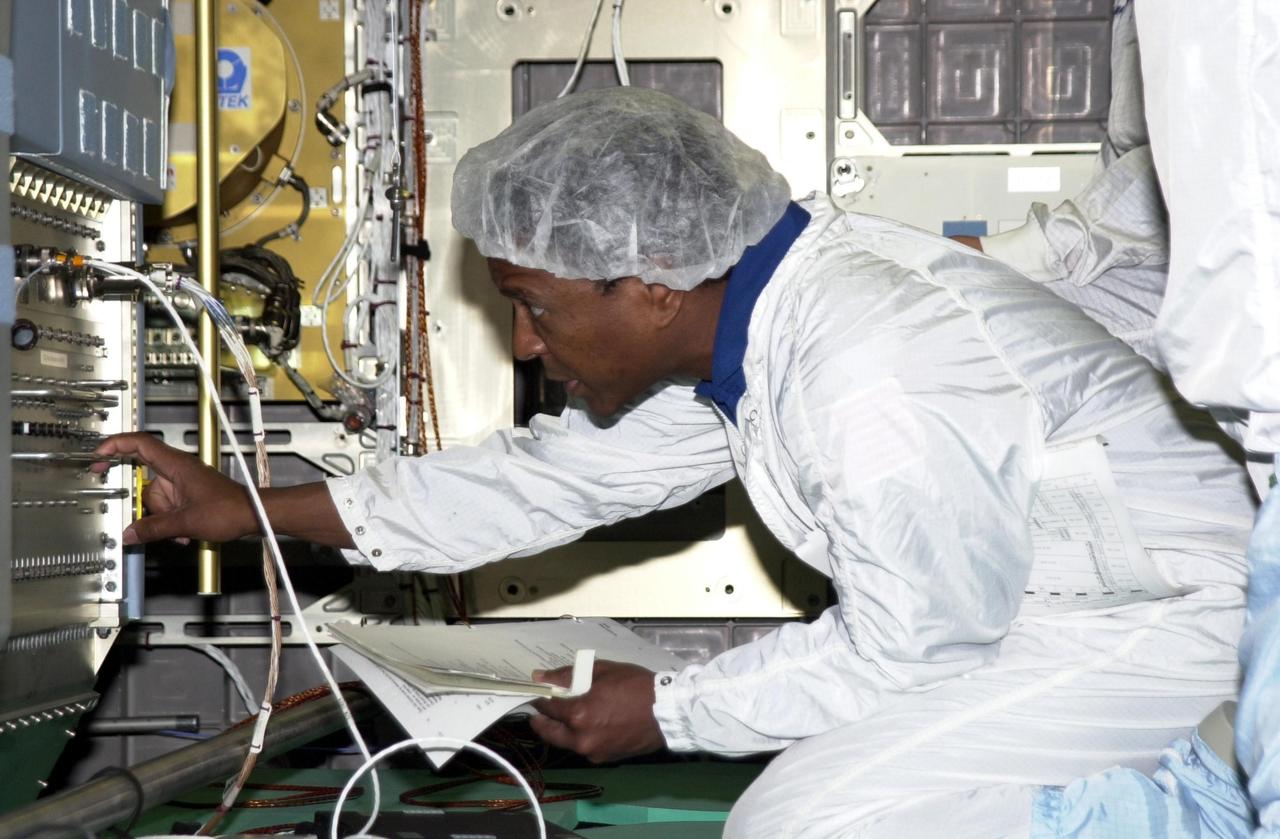
KENNEDY SPACE CENTER, FLA. -- STS-107 Payload Commander Michael Anderson checks equipment during training at SPACEHAB. STS-107 is a research mission. The primary payload is the first flight of the SHI Research Double Module (SHI/RDM). The experiments range from material sciences to life sciences (many rats). Also part of the payload is the Fast Reaction Experiments Enabling Science, Technology, Applications and Research (FREESTAR) that incorporates eight high priority secondary attached shuttle experiments. STS-107 is scheduled to launch July 11, 2002
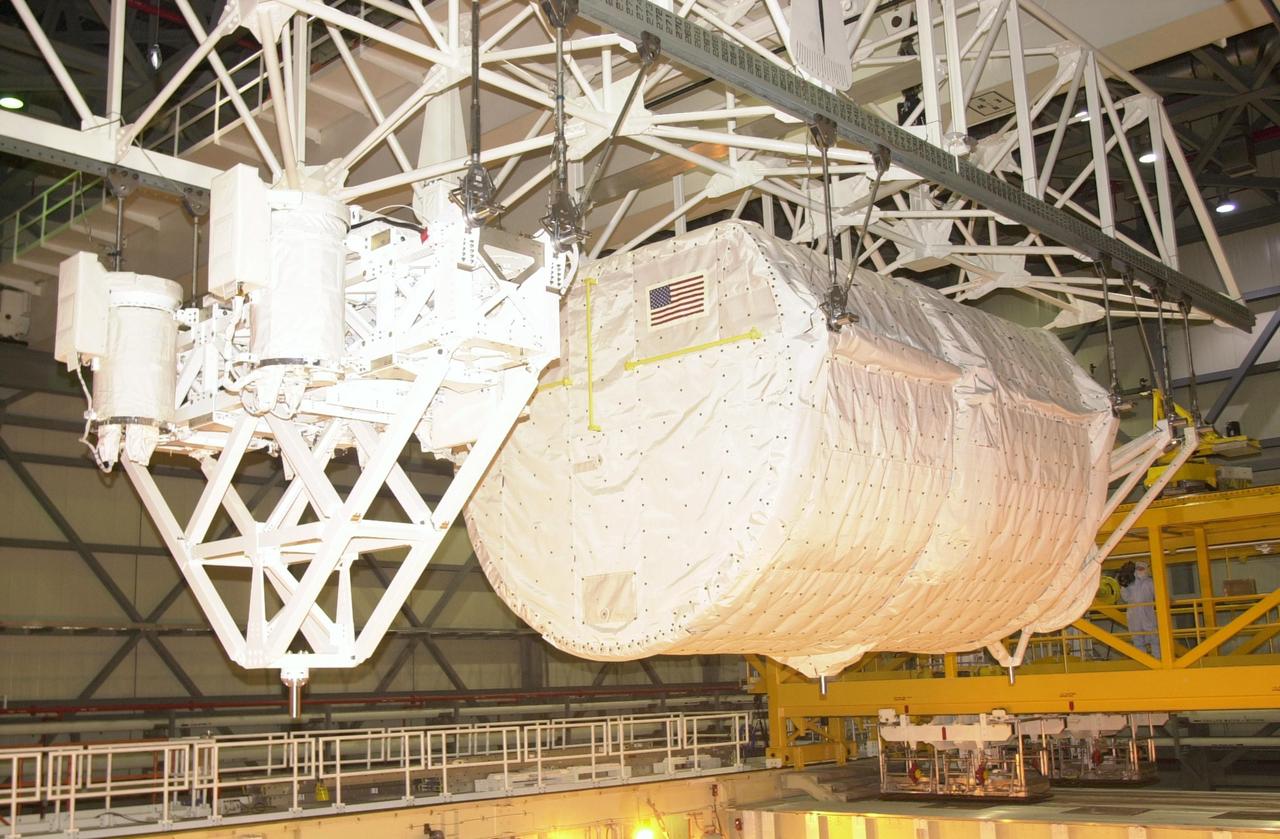
KENNEDY SPACE CENTER, FLA. -- The SHI Research Double Module (SHI/RDM) (right) and Hitchhiker Carrier (left) are lowered toward Columbia's payload bay. The two payloads will be installed in the payload bay for mission STS-107, a research mission. SHI/RDM is the primary payload, with experiments ranging from material sciences to life sciences (many rats). Also, the Fast Reaction Experiments Enabling Science, Technology, Applications and Research (FREESTAR) that is on the Hitchhiker Carrier incorporates eight high priority secondary attached shuttle experiments. STS-107 is scheduled to launch July 19, 2002
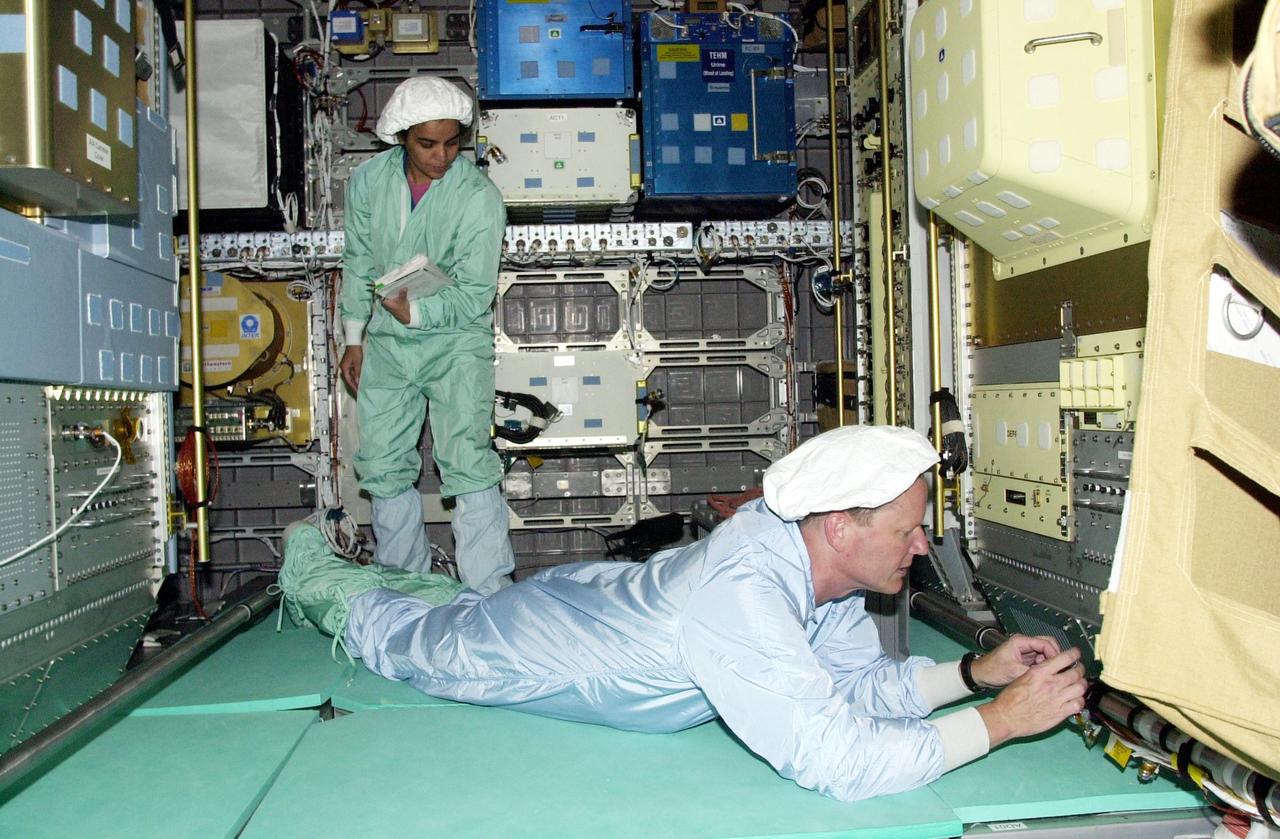
KENNEDY SPACE CENTER, FLA. -- STS-107 crew members check out equipment in the SHI Research Double Module (SHI/RDM), part of the payload on the mission. Mission Specialist Kalpana Chawla (left) holds a data manual while Mission Specialist David Brown stretches out on the floor to get a closer look. The crew is taking part in Crew Equipment Interface Test activities, which include equipment and payload familiarization. A research mission, STS-107 also will carry the Fast Reaction Experiments Enabling Science, Technology, Applications and Research (FREESTAR) that incorporates eight high priority secondary attached shuttle experiments. STS-107 is scheduled to launch July 19, 2002
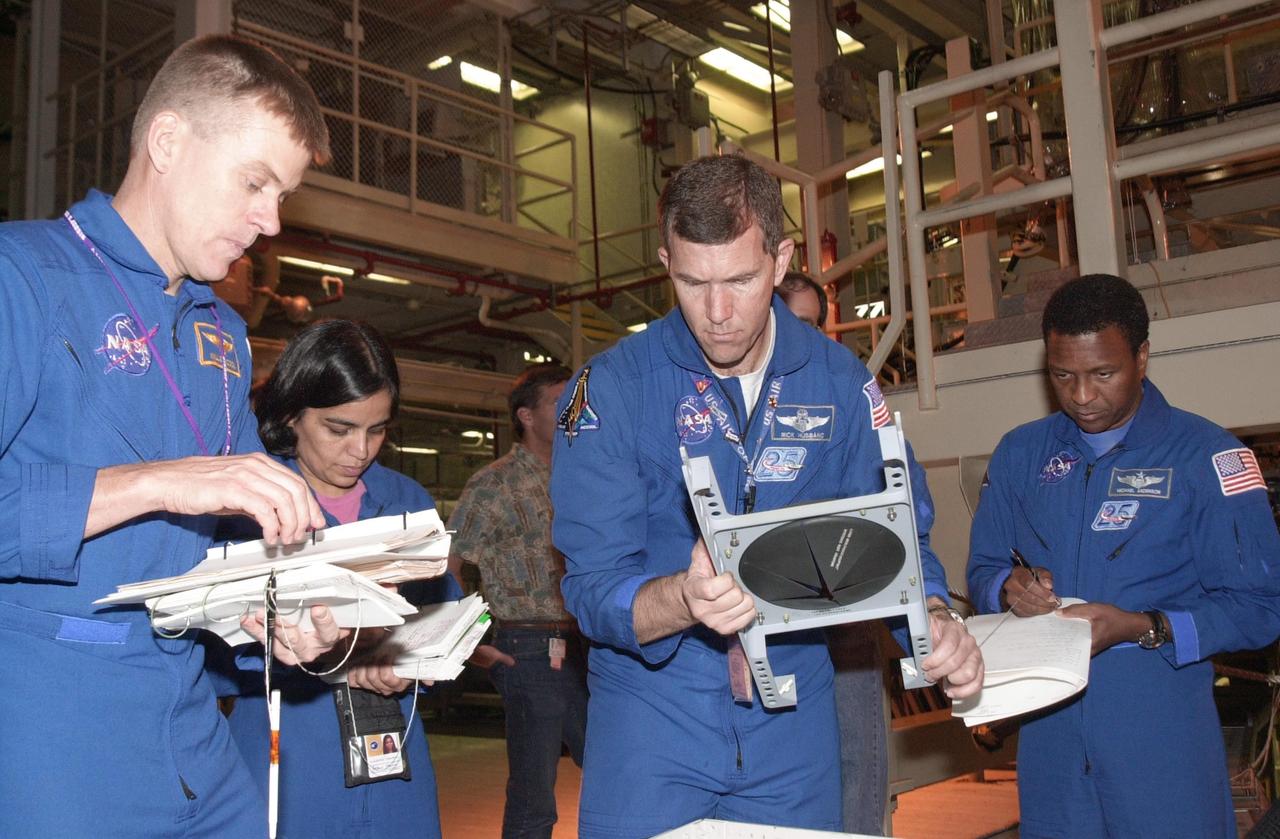
KENNEDY SPACE CENTER, FLA. -- -- During Crew Equipment Interface Test activities, the STS-107 crew looks at flight equipment in the Orbiter Processing Facility. From left are Pilot William "Willie" McCool, Mission Specialist Kalpana Chawla, Commander Rick Husband and Payload Commander Michael Anderson. STS-107 is a research mission, with the SHI Research Double Module (SHI/RDM), also known as SPACEHAB, as the primary payload, plus the Fast Reaction Experiments Enabling Science, Technology, Applications and Research (FREESTAR) that incorporates eight high priority secondary attached shuttle experiments. STS-107 is scheduled to launch July 19, 2002
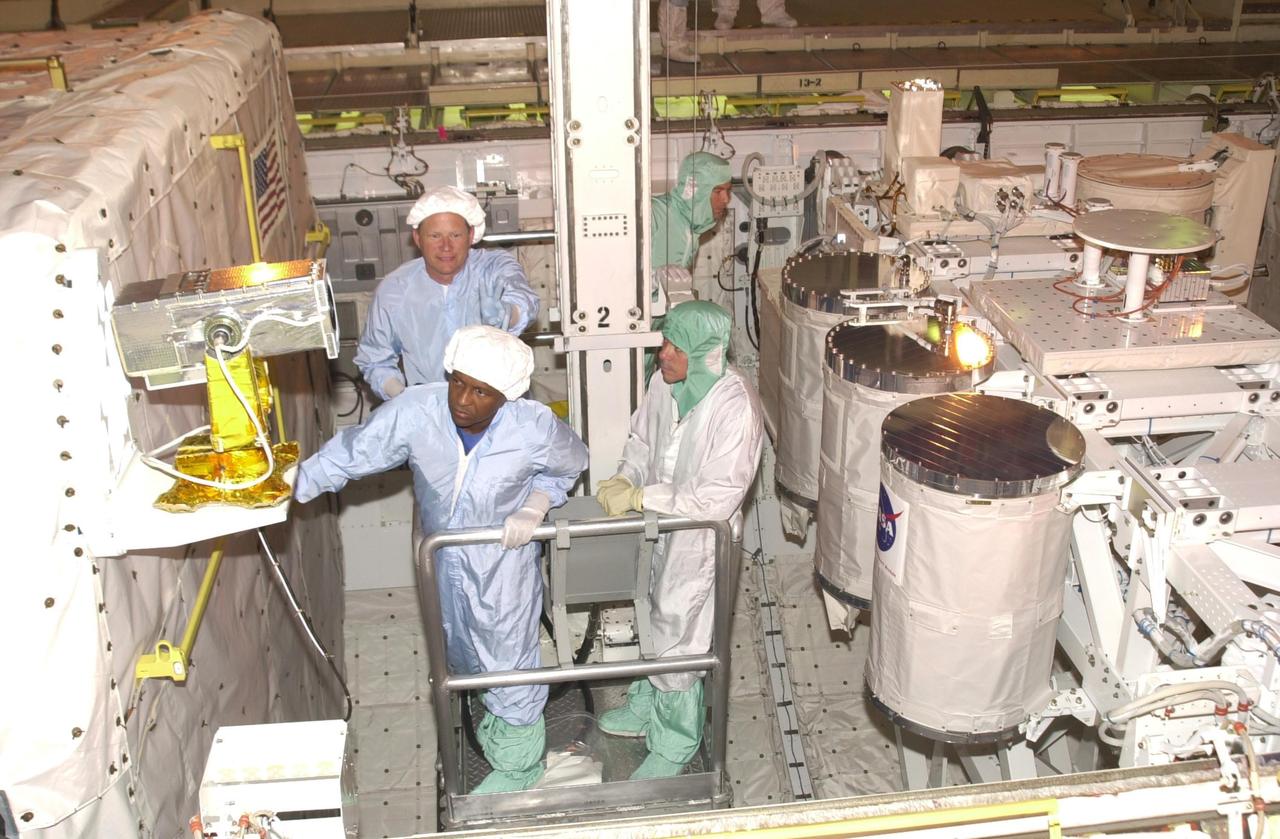
KENNEDY SPACE CENTER, FLA. -- During Crew Equipment Interface Test activities, STS-107 Payload Commander Michael Anderson looks over equipment in the payload bay of Columbia. Behind him is Mission Specialist David Brown. STS-107 is a research mission, with the SHI Research Double Module (SHI/RDM), also known as SPACEHAB, as the primary payload, plus the Fast Reaction Experiments Enabling Science, Technology, Applications and Research (FREESTAR) that incorporates eight high priority secondary attached shuttle experiments. STS-107 is scheduled to launch July 19, 2002
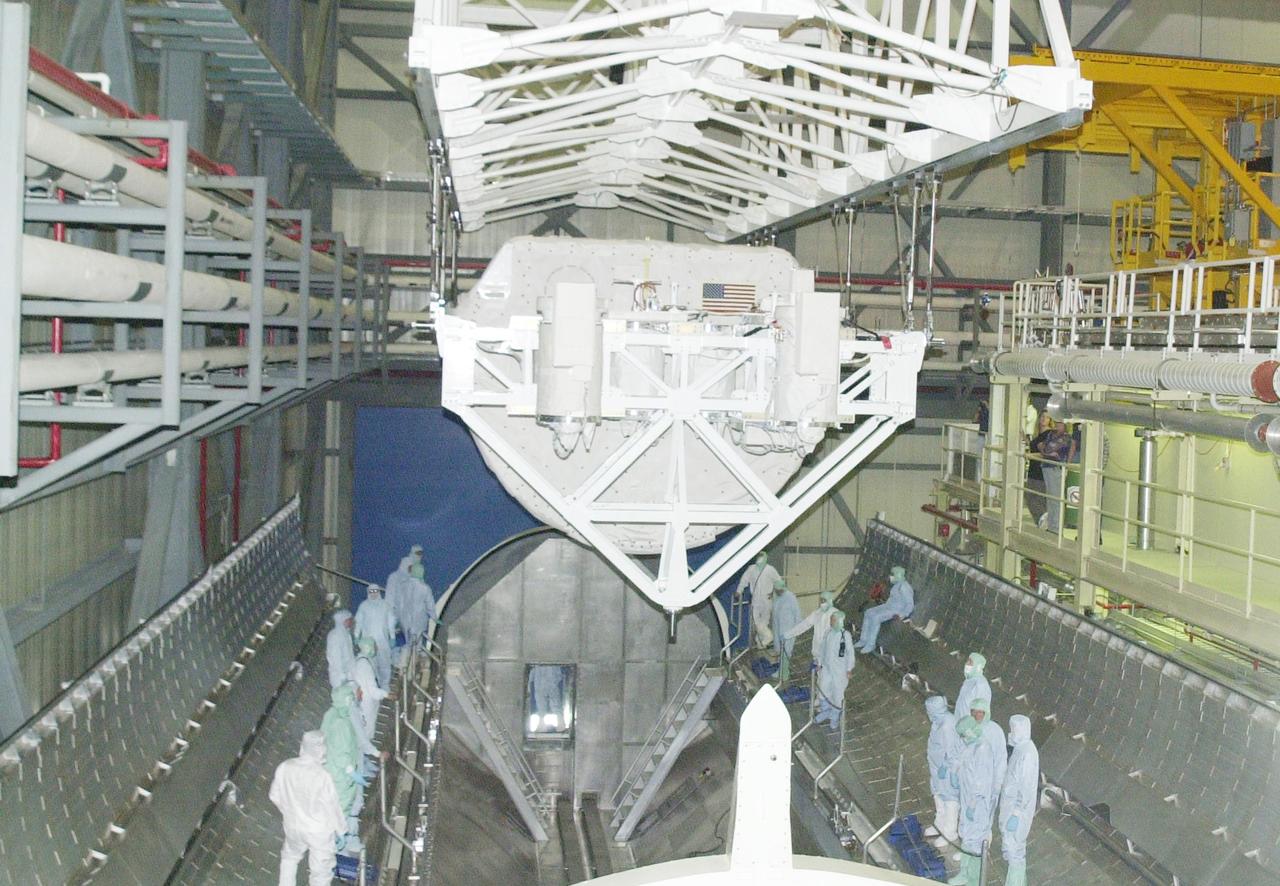
KENNEDY SPACE CENTER, FLA. -- In the Orbiter Processing Facility, the SHI Research Double Module (SHI/RDM) and Hitchhiker Carrier behind it are suspended by an overhead crane during their move to Columbia's payload bay. SHI/RDM is the primary payload of the STS-107 research mission, with experiments ranging from material sciences to life sciences (many rats). Also, the Fast Reaction Experiments Enabling Science, Technology, Applications and Research (FREESTAR) that is on the Hitchhiker Carrier incorporates eight high priority secondary attached shuttle experiments. STS-107 is scheduled to launch July 19, 2002
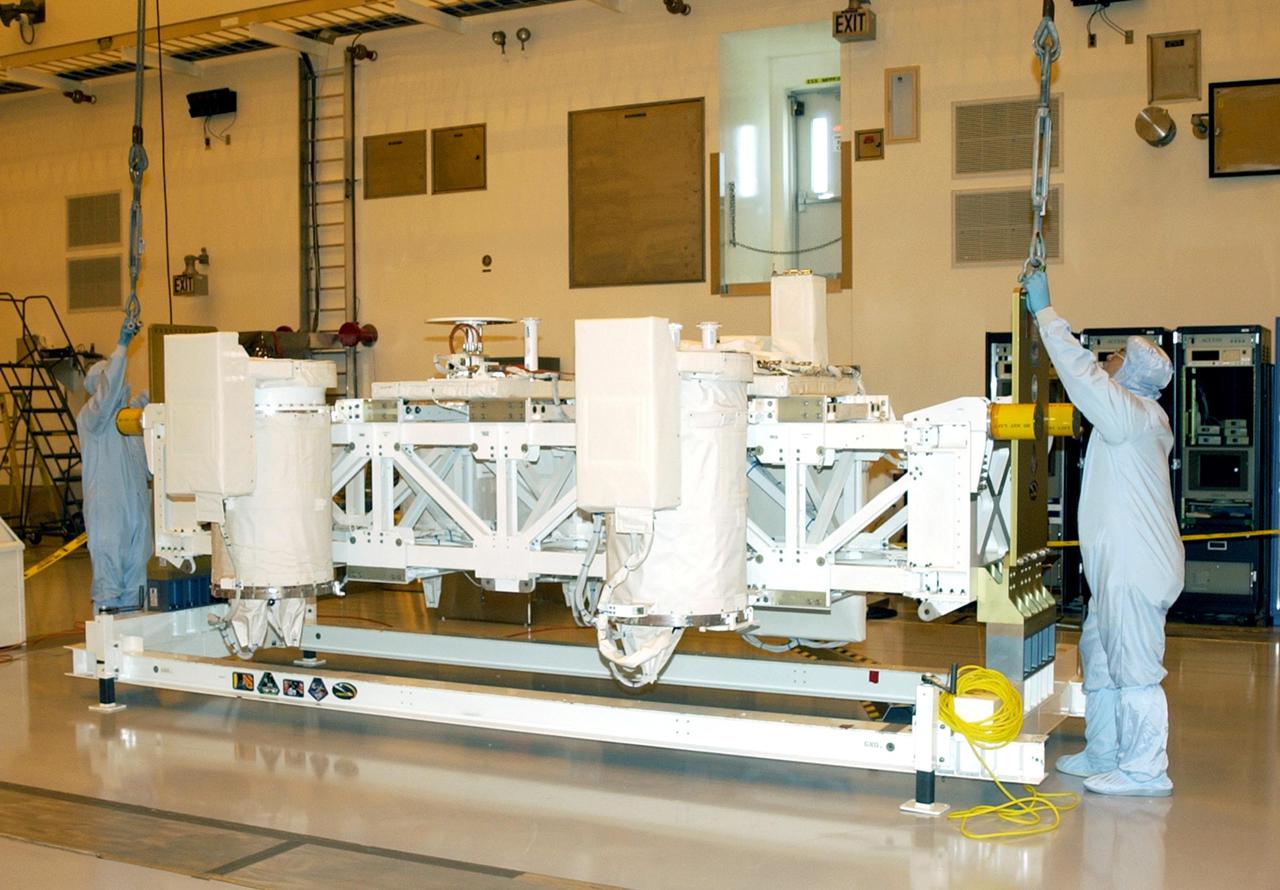
KENNEDY SPACE CENTER, FLA. -- In the Multi-Payload Processing Facility (MPPF), workers attach a crane to the Hitchhiker Bridge that holds several Get-Away Special canisters (GAS cans) for mission ST-107. The bridge is being moved to a workstand in the MPPF. The bridge is a carrier for the Fast Reaction Experiments Enabling Science, Technology, Applications and Research (FREESTAR) that incorporates eight high priority secondary attached shuttle experiments on mission STS-107. A research mission, the primary payload is the first flight of the SHI Research Double Module (SHI_RDM), also known as SPACEHAB. The experiments range from material sciences to life sciences. STS-107 is scheduled to launch July 11, 2002
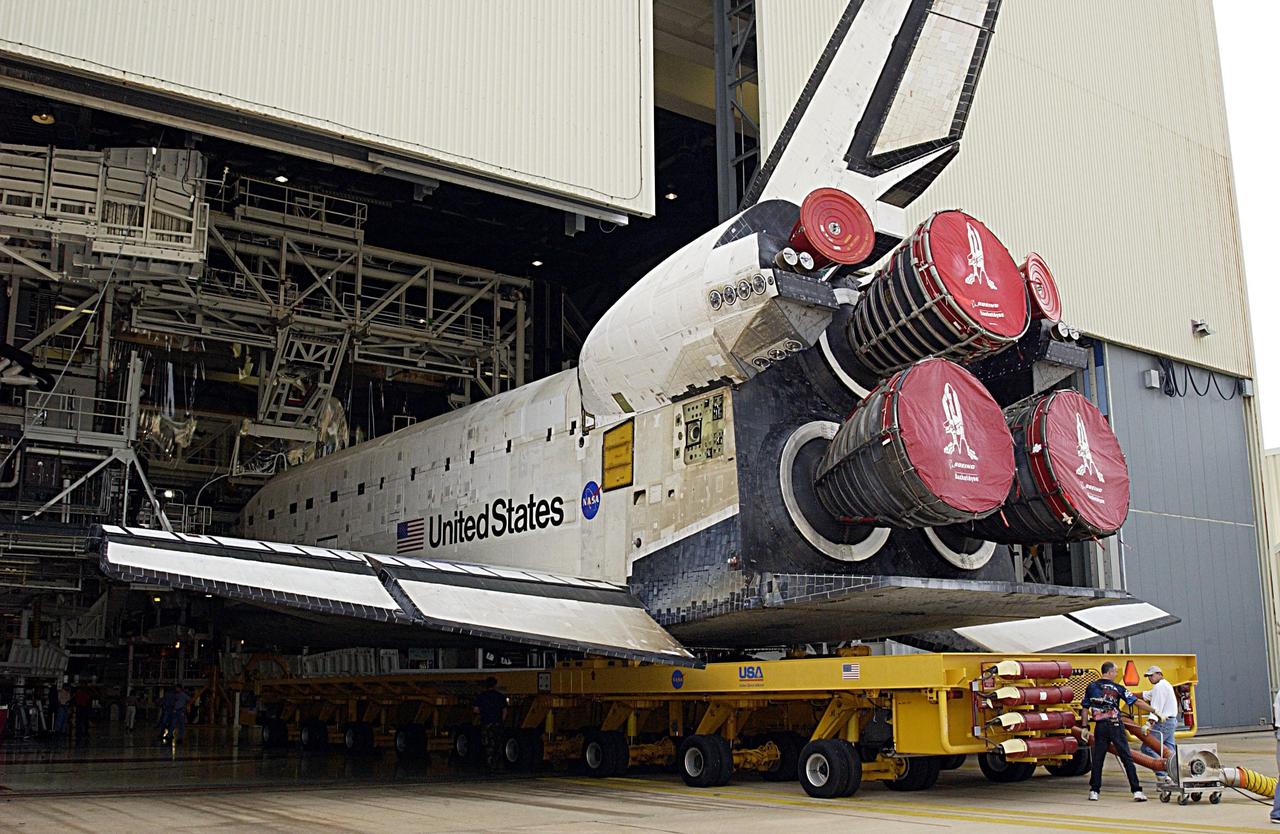
KENNEDY SPACE CENTER, FLA. -- Space Shuttle Columbia is backed out of its Orbiter Processing Facility bay as it starts its move to the Vehicle Assembly Building. The orbiter is being prepared to fly on mission STS-107 now targeted for no earlier than Jan. 16, 2003. The STS-107 mission will be dedicated to microgravity research. The payloads include the Hitchhiker Bridge, a carrier for the Fast Reaction Experiments Enabling Science, Technology, Applications and Research (FREESTAR) incorporating eight high priority secondary attached Shuttle experiments, and the SHI Research Double Module (SHI/RDM), also known as SPACEHAB.
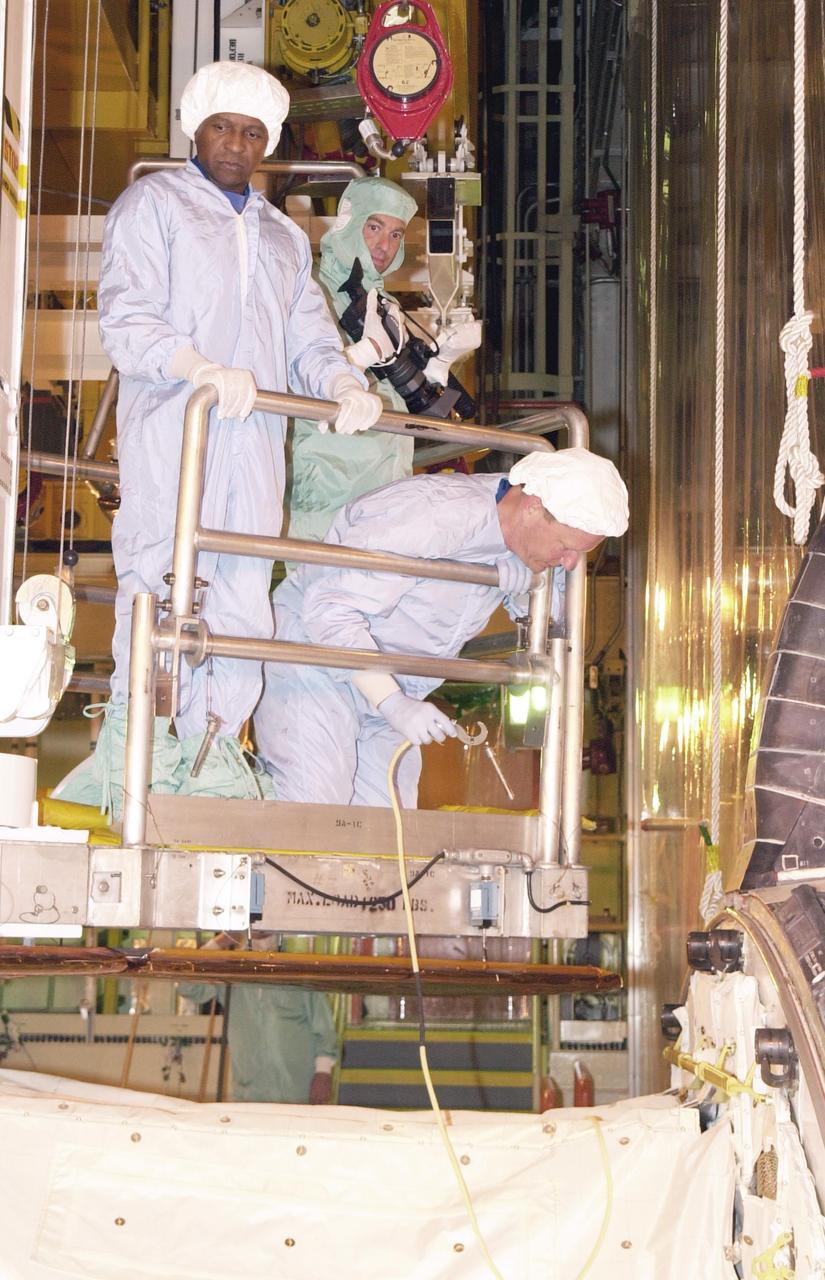
KENNEDY SPACE CENTER, FLA. -- - During Crew Equipment Interface Test activities, STS-107 Mission Specialist David Brown checks equipment in the payload bay of Columbia. At left is Payload Commander Michael Anderson. A technician holds a camera. STS-107 is a research mission, with the SHI Research Double Module (SHI/RDM), also known as SPACEHAB, as the primary payload, plus the Fast Reaction Experiments Enabling Science, Technology, Applications and Research (FREESTAR) that incorporates eight high priority secondary attached shuttle experiments. STS-107 is scheduled to launch July 19, 2002
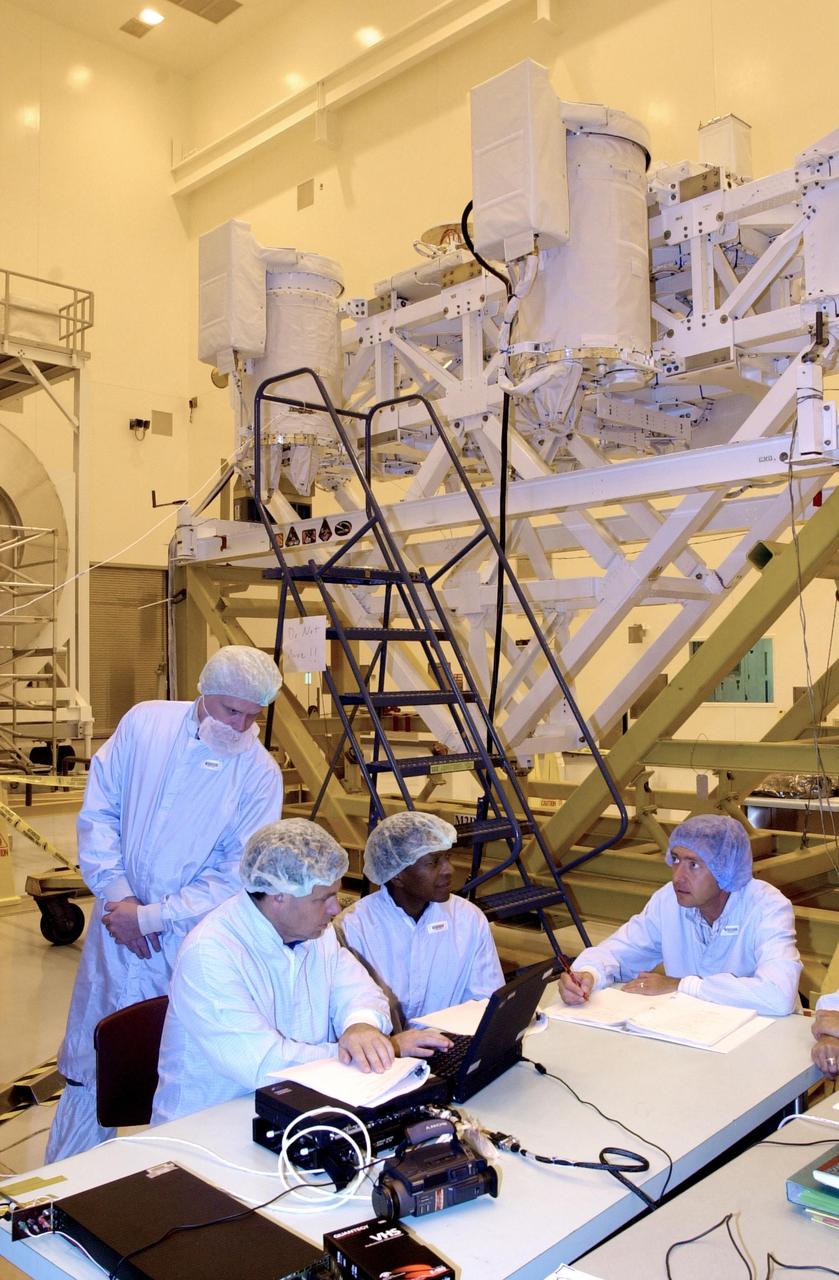
KENNEDY SPACE CENTER, FLA. -- In the Multi-Payload Processing Facility, STS-107 crew members review test results on the Fast Reaction Experiments Enabling Science, Technology, Applications and Research (FREESTAR) experiments, part of the payload on their mission. A research mission, the primary payload is the first flight of the SHI Research Double Module (SHI/RDM), also known as SPACEHAB. The experiments range from material sciences to life sciences (many rats). STS-107 is scheduled to launch July 11, 2002. In the background, on the stand, are some of the experiments going on the mission
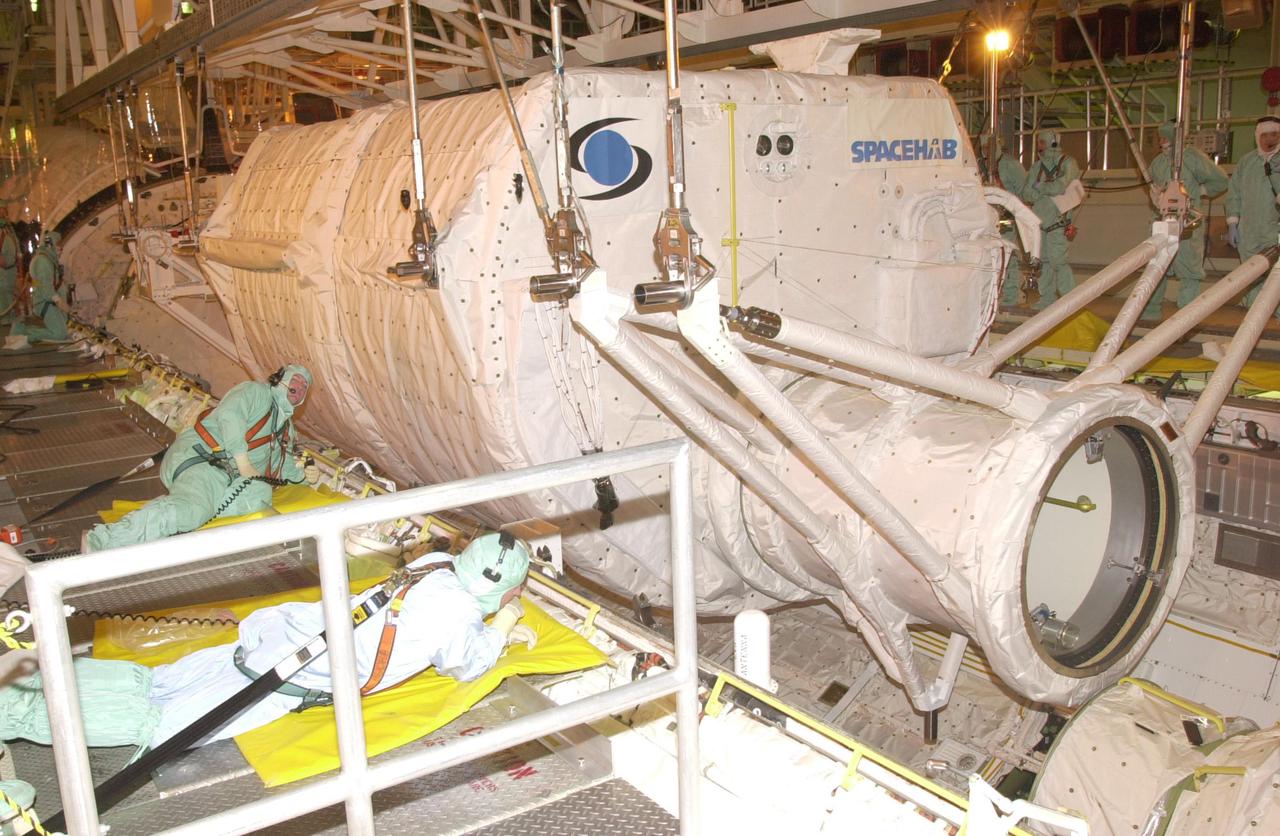
KENNEDY SPACE CENTER, FLA. - Workers in the Orbiter Processing Facility keep watch as the SHI Research Double Module (SHI_RDM) (right) and Hitchhiker Carrier (left) are lowered into Columbia's payload bay for mission STS-107, a research mission. SHI_RDM is the primary payload, with experiments ranging from material sciences to life sciences (many rats). Also, the Fast Reaction Experiments Enabling Science, Technology, Applications and Research (FREESTAR) that is on the Hitchhiker Carrier incorporates eight high priority secondary attached shuttle experiments. STS-107 is scheduled to launch July 19, 2002
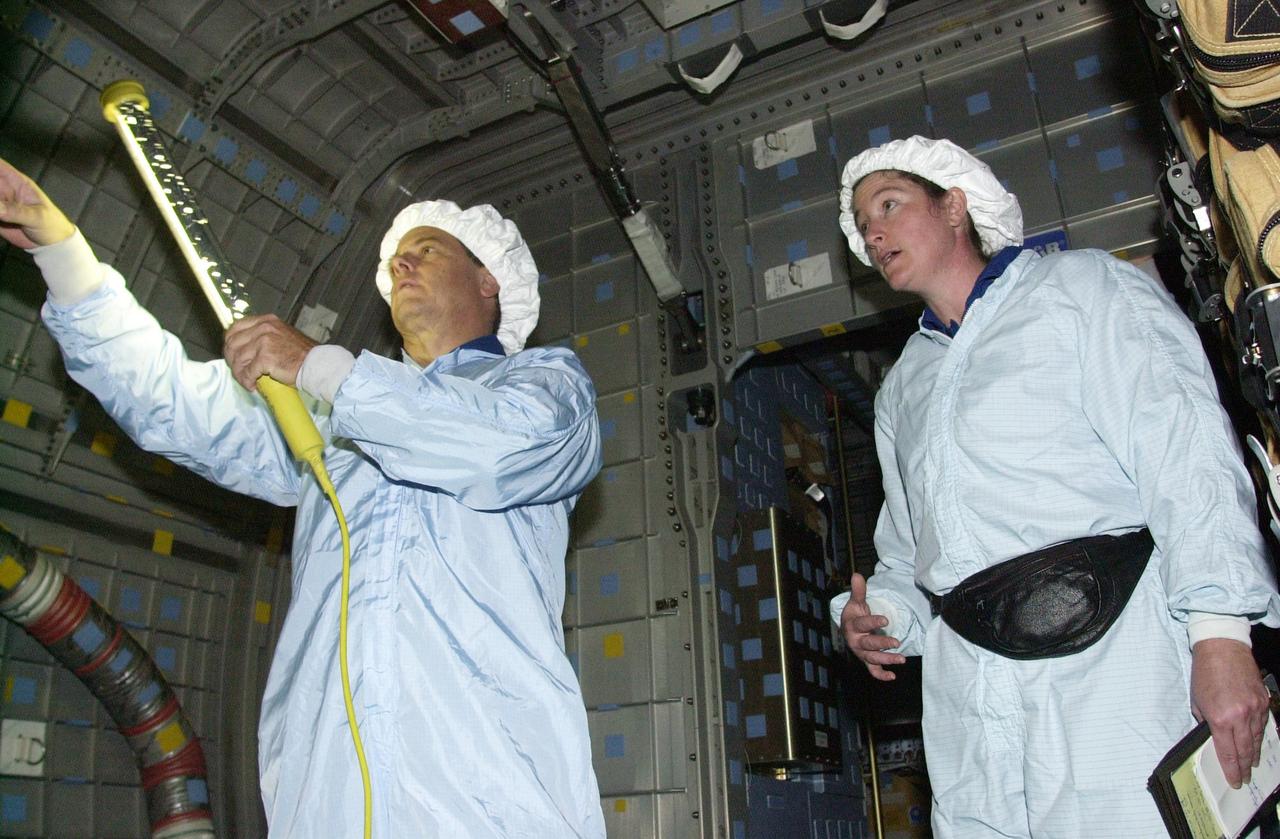
KENNEDY SPACE CENTER, FLA. - STS-107 Mission Specialists Ilan Ramon, with the Israeli Space Agency, and Laurel Clark check out equipment in the SHI Research Double Module (SHI/RDM), part of the payload on the mission. They are taking part in Crew Equipment Interface Test activities, which include equipment and payload familiarization. A research mission, STS-107 also will carry the Fast Reaction Experiments Enabling Science, Technology, Applications and Research (FREESTAR) that incorporates eight high priority secondary attached shuttle experiments. STS-107 is scheduled to launch July 19, 2002
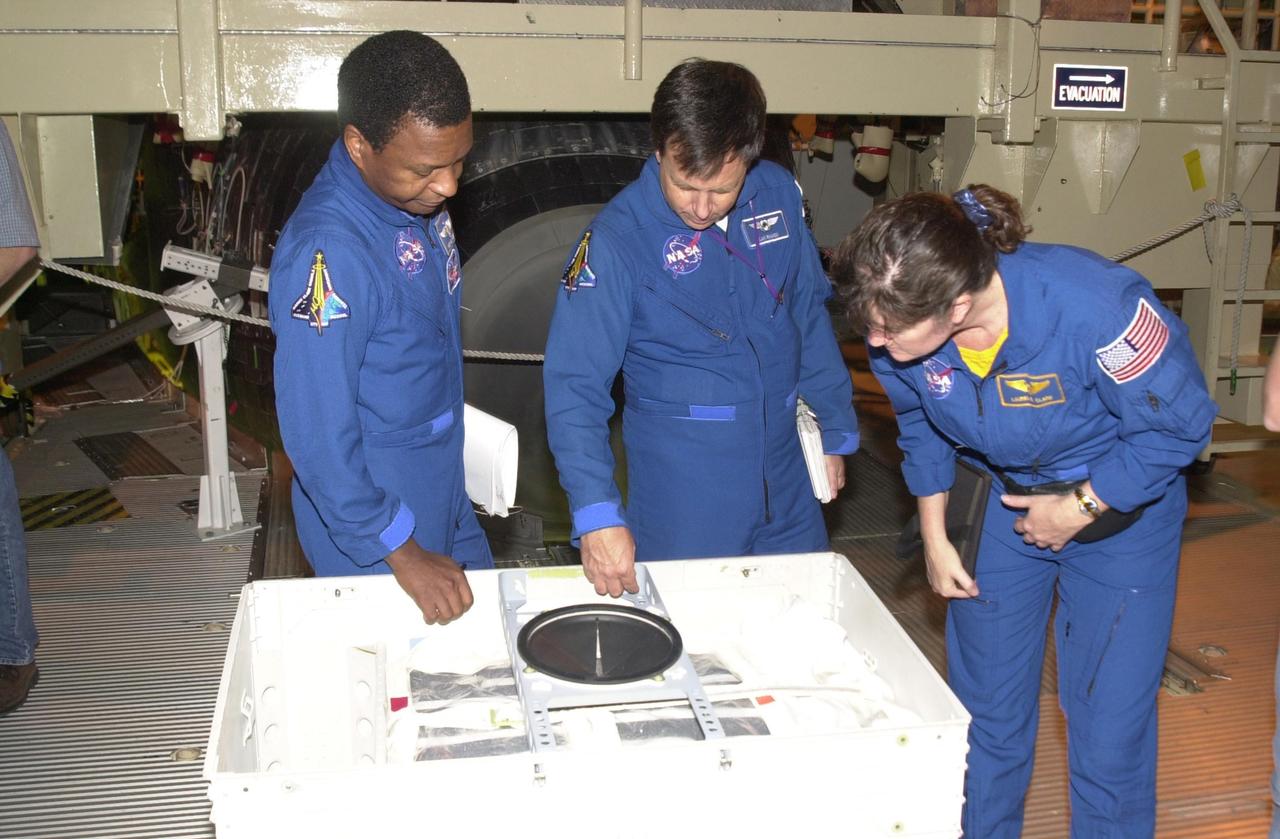
KENNEDY SPACE CENTER, FLA. -- During Crew Equipment Interface Test activities, the STS-107 crew looks at flight equipment in the Orbiter Processing Facility. From left are Payload Commander Michael Anderson, Payload Specialist Ilan Ramon (with the Israeli Space Agency), and Mission Specialist Laurel Clark. STS-107 is a research mission, with the SHI Research Double Module (SHI/RDM), also known as SPACEHAB, as the primary payload, plus the Fast Reaction Experiments Enabling Science, Technology, Applications and Research (FREESTAR) that incorporates eight high priority secondary attached shuttle experiments. STS-107 is scheduled to launch July 19, 2002
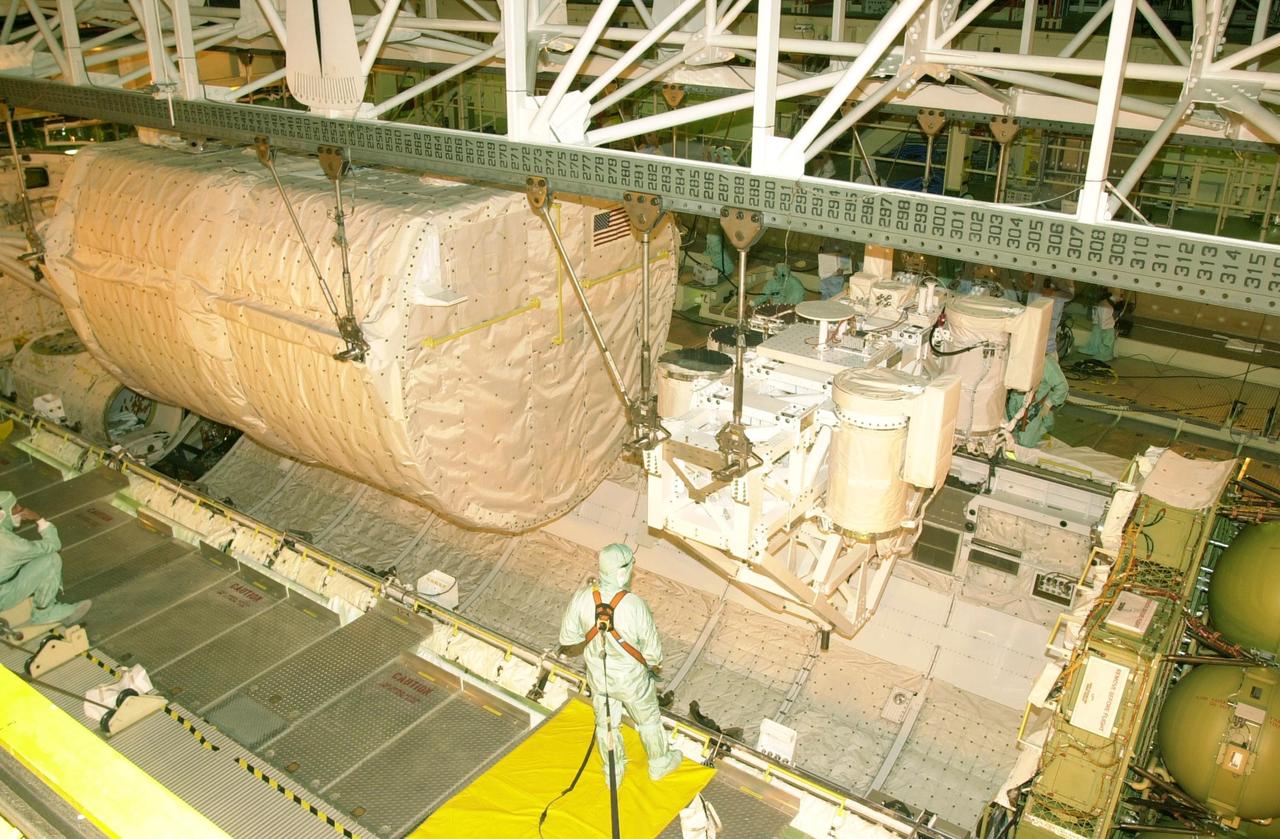
KENNEDY SPACE CENTER, FLA. -- The SHI Research Double Module (SHI/RDM) (left) and Hitchhiker Carrier (right) are lowered toward Columbia's payload bay. The two payloads will be installed in the payload bay for mission STS-107, a research mission. SHI/RDM is the primary payload, with experiments ranging from material sciences to life sciences (many rats). Also, the Fast Reaction Experiments Enabling Science, Technology, Applications and Research (FREESTAR) that is on the Hitchhiker Carrier incorporates eight high priority secondary attached shuttle experiments. STS-107 is scheduled to launch July 19, 2002
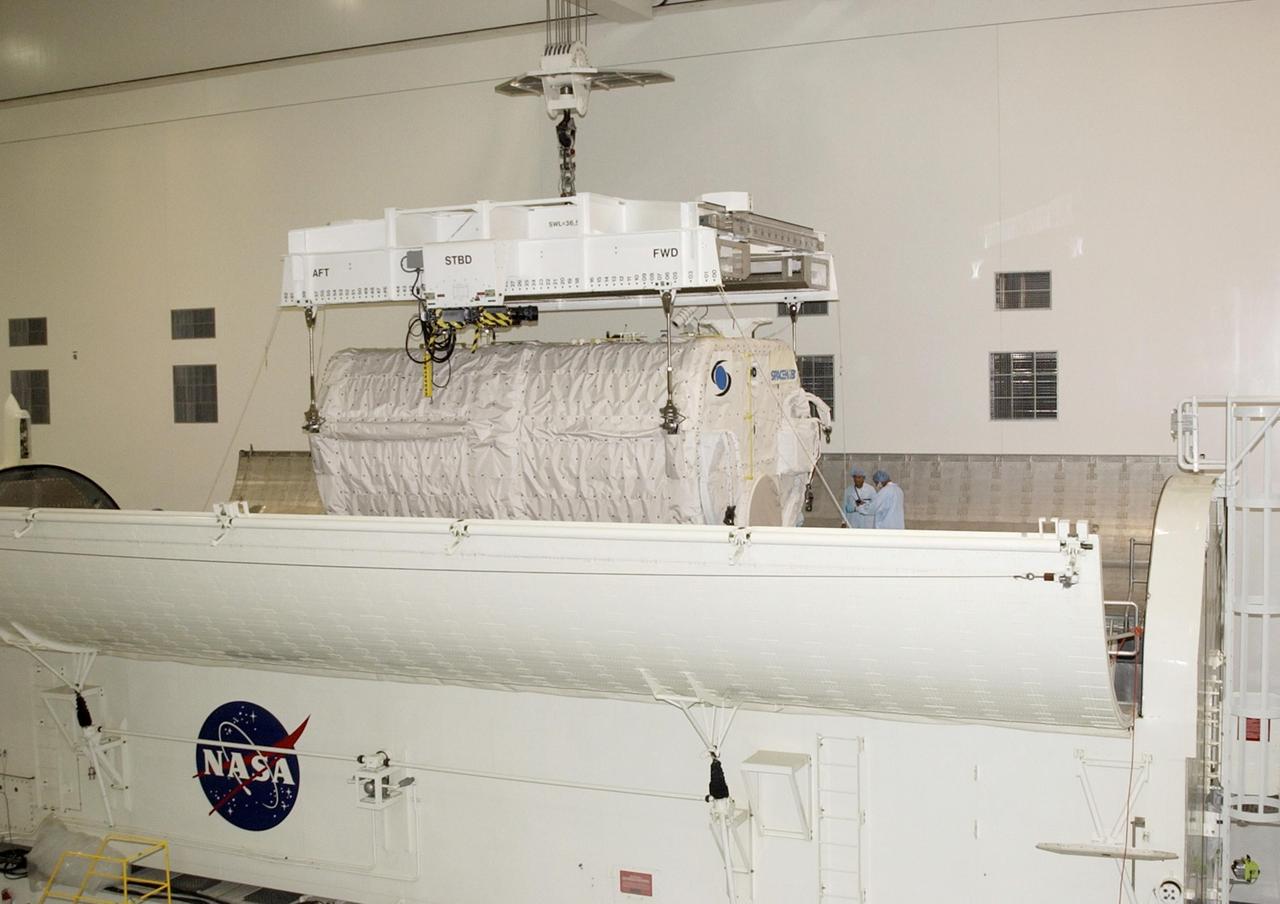
KENNEDY SPACE CENTER, FLA. -- In the Space Station Processing Facility, the overhead crane lowers the SHI Research Double Module (SHI/RDM) into the payload canister. The canister will transport it to the Orbiter Processing Facility where it will be installed in Columbia's payload bay for mission STS-107. SHI/RDM is the primary payload of the research mission, with experiments ranging from material sciences to life sciences (many rats). Also part of the payload is the Fast Reaction Experiments Enabling Science, Technology, Applications and Research (FREESTAR) that incorporates eight high priority secondary attached shuttle experiments. STS-107 is scheduled to launch July 19, 2002
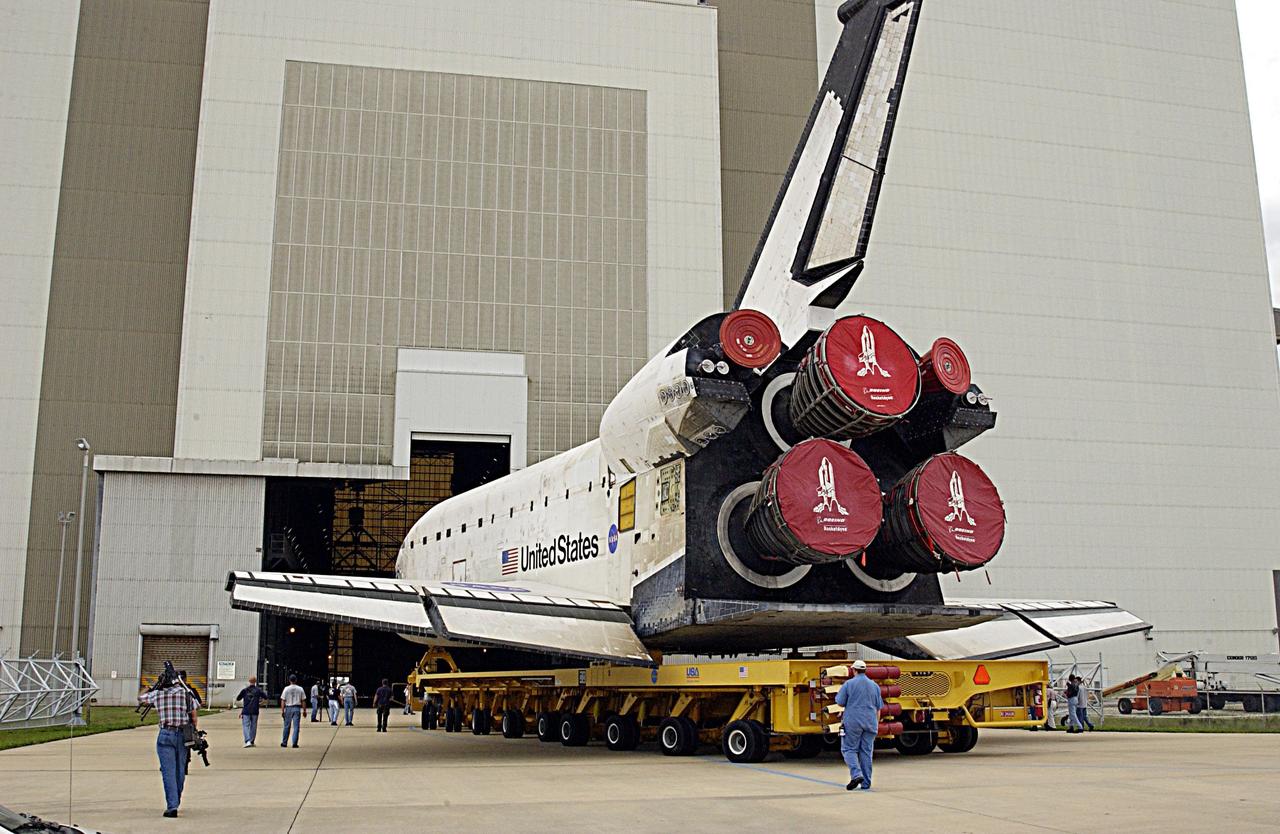
KENNEDY SPACE CENTER, FLA. -- KSC workers accompany Space Shuttle Columbia as it is moved inside the Vehicle Assembly Building where processing will continue for the flight of mission STS-107. Launch is now targeted for no earlier than Jan. 16, 2003. The STS-107 mission will be dedicated to microgravity research. The payloads include the Hitchhiker Bridge, a carrier for the Fast Reaction Experiments Enabling Science, Technology, Applications and Research (FREESTAR) incorporating eight high priority secondary attached Shuttle experiments, and the SHI Research Double Module (SHI/RDM), also known as SPACEHAB.
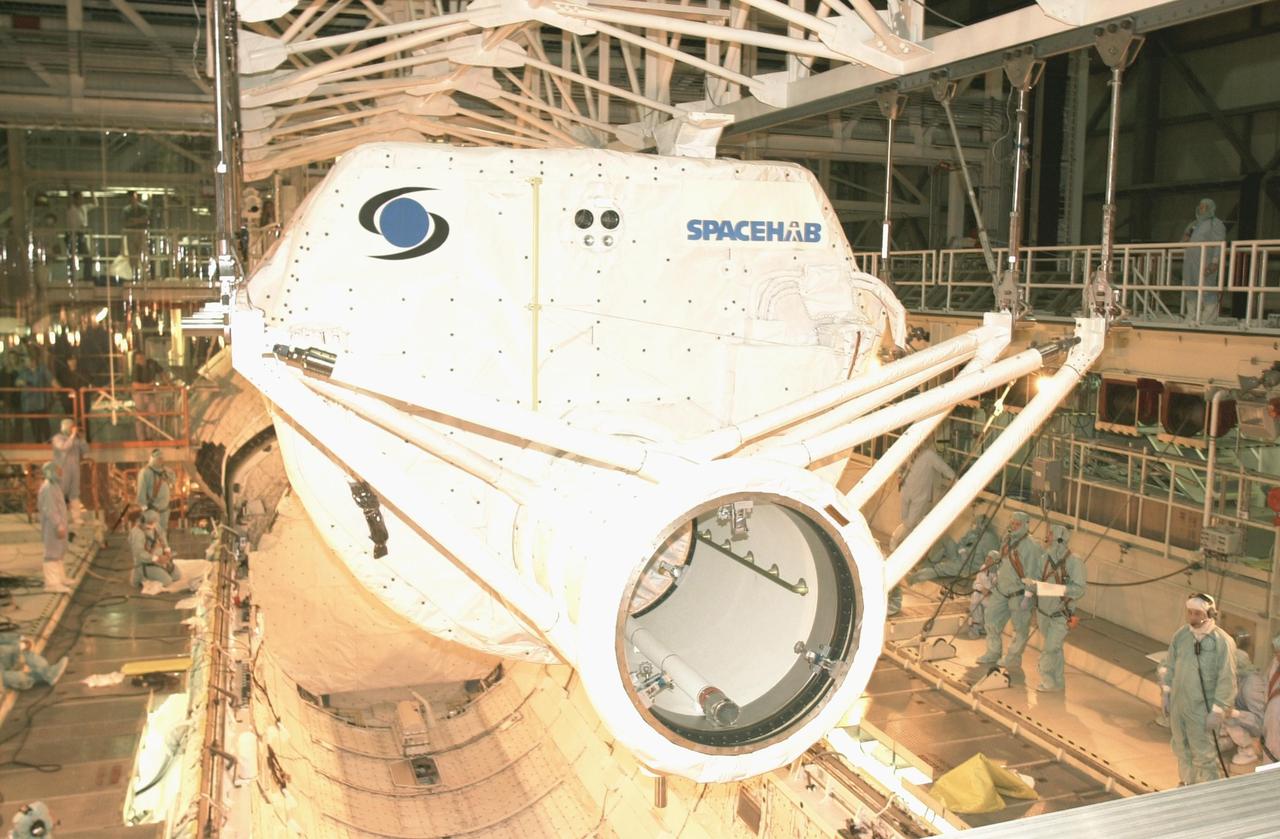
KENNEDY SPACE CENTER, FLA. -- The SHI Research Double Module (SHI/RDM) (right) and Hitchhiker Carrier (left) are lowered toward Columbia's payload bay. The two payloads will be installed in the payload bay for mission STS-107, a research mission. SHI/RDM is the primary payload, with experiments ranging from material sciences to life sciences (many rats). Also, the Fast Reaction Experiments Enabling Science, Technology, Applications and Research (FREESTAR) that is on the Hitchhiker Carrier incorporates eight high priority secondary attached shuttle experiments. STS-107 is scheduled to launch July 19, 2002
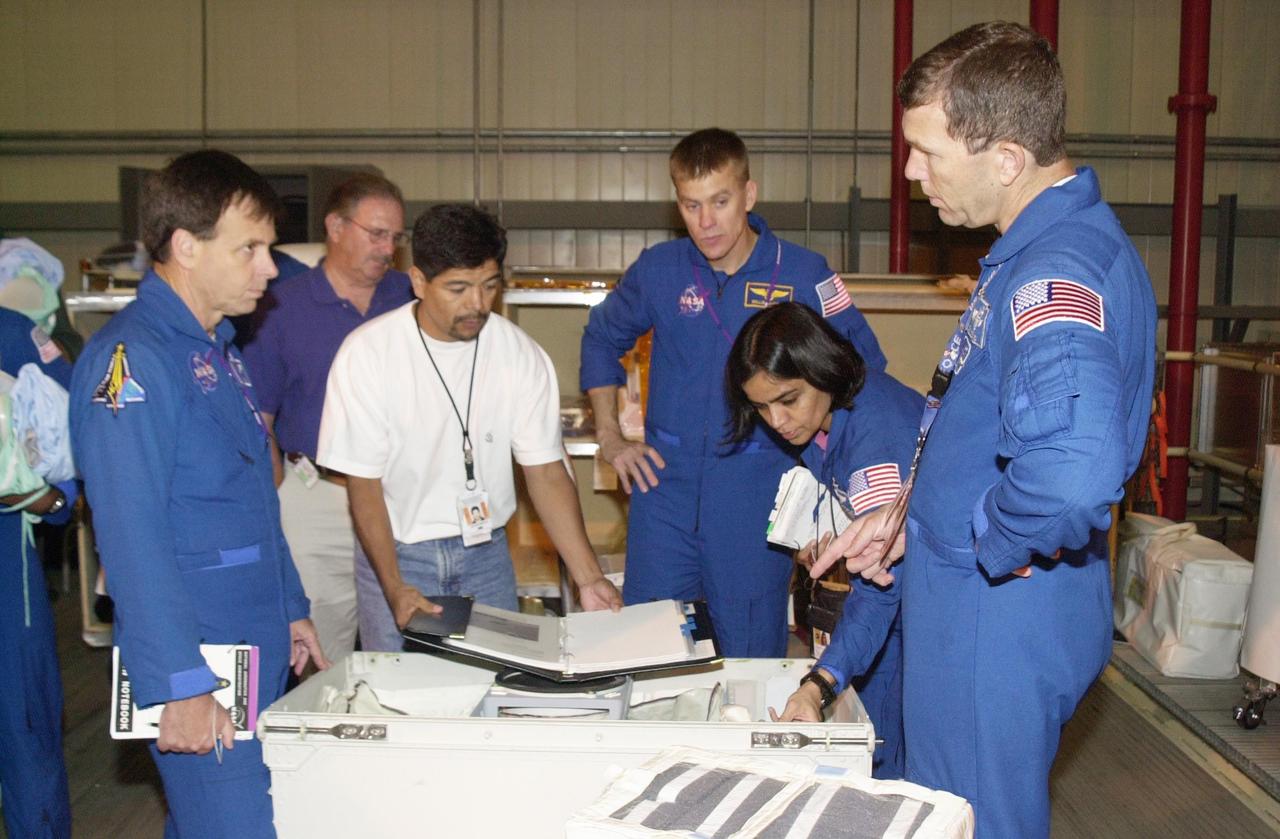
KENNEDY SPACE CENTER, FLA. -- During Crew Equipment Interface Test activities, the STS-107 crew looks at flight equipment in the Orbiter Processing Facility. From left are Payload Specialist Ilan Ramon (with the Israeli Space Agency), Pilot William "Willie" McCool (center), Mission Specialist Kalpana Chawla and Commander Rick Husband. STS-107 is a research mission, with the SHI Research Double Module (SHI/RDM), also known as SPACEHAB, as the primary payload, plus the Fast Reaction Experiments Enabling Science, Technology, Applications and Research (FREESTAR) that incorporates eight high priority secondary attached shuttle experiments. STS-107 is scheduled to launch July 19, 2002
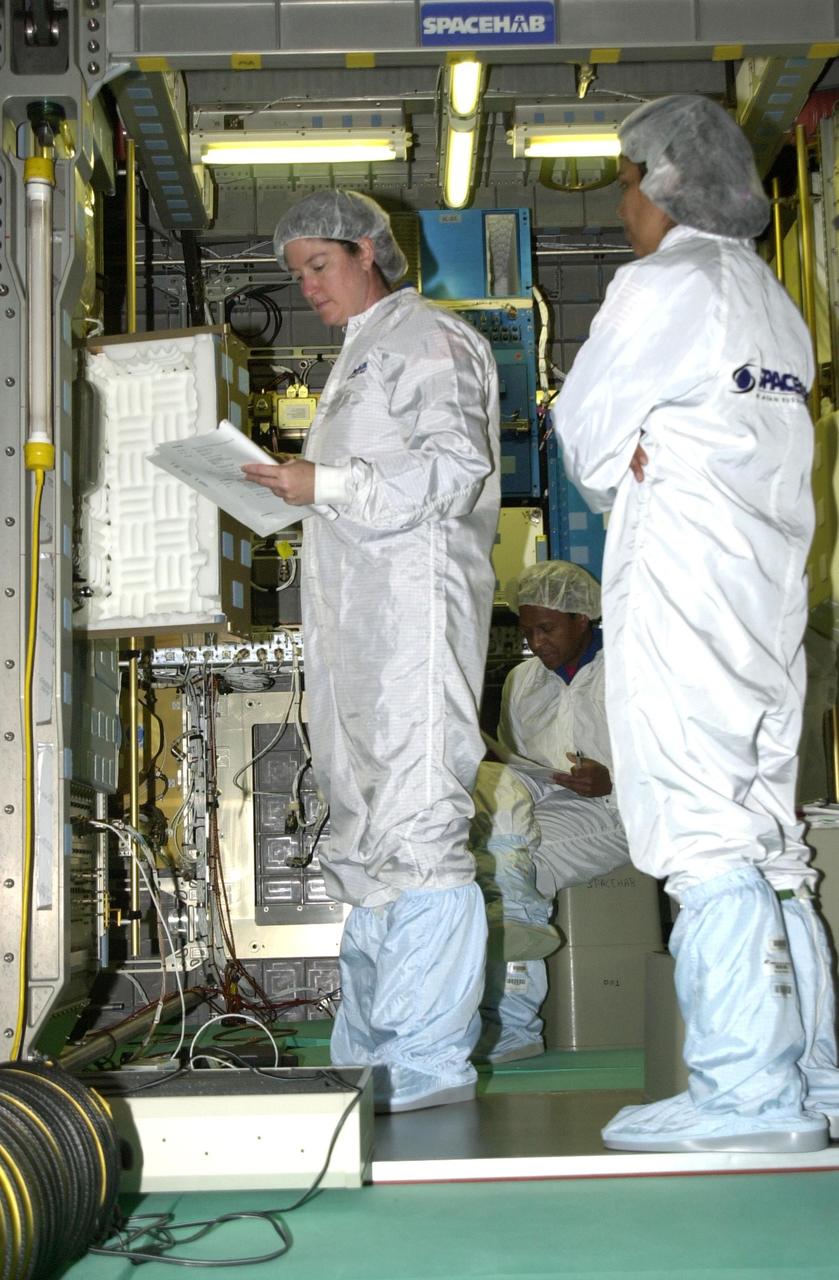
KENNEDY SPACE CENTER, FLA. -- At SPACEHAB, STS-107 crew members check equipment for their mission. From left are Mission Specialist Laurel Clark, Payload Commander Michael Anderson (seated) and Mission Specialist Kalpana Chawla. STS-107 is a research mission. The primary payload is the first flight of the SHI Research Double Module (SHI/RDM). The experiments range from material sciences to life sciences (many rats). Also part of the payload is the Fast Reaction Experiments Enabling Science, Technology, Applications and Research (FREESTAR) that incorporates eight high priority secondary attached shuttle experiments. STS-107 is scheduled to launch July 11, 2002
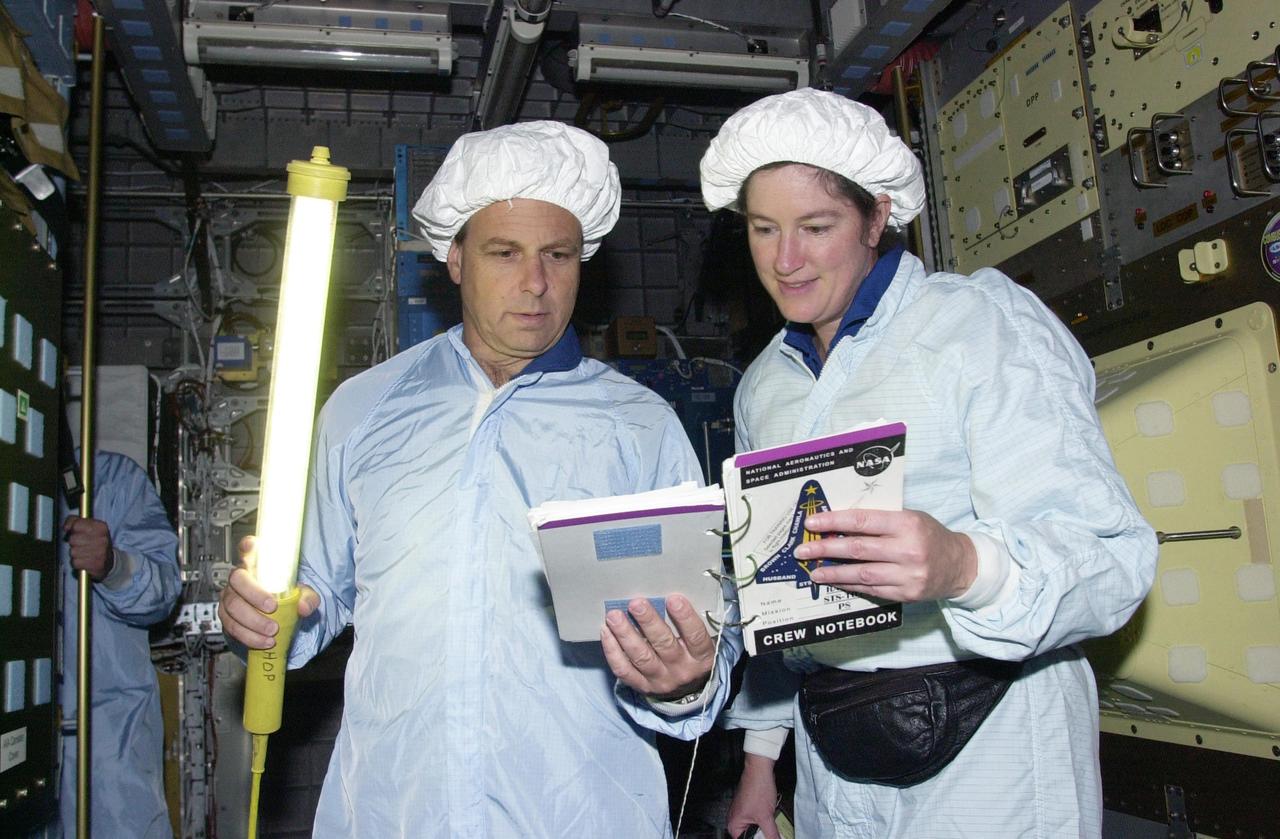
KENNEDY SPACE CENTER, FLA. -- STS-107 Mission Specialists Ilan Ramon, with the Israeli Space Agency, holds a light wand while he and Laurel Clark check out data for equipment in the SHI Research Double Module (SHI/RDM), part of the payload on the mission. They are taking part in Crew Equipment Interface Test activities, which include equipment and payload familiarization. A research mission, STS-107 also will carry the Fast Reaction Experiments Enabling Science, Technology, Applications and Research (FREESTAR) that incorporates eight high priority secondary attached shuttle experiments. STS-107 is scheduled to launch July 19, 2002
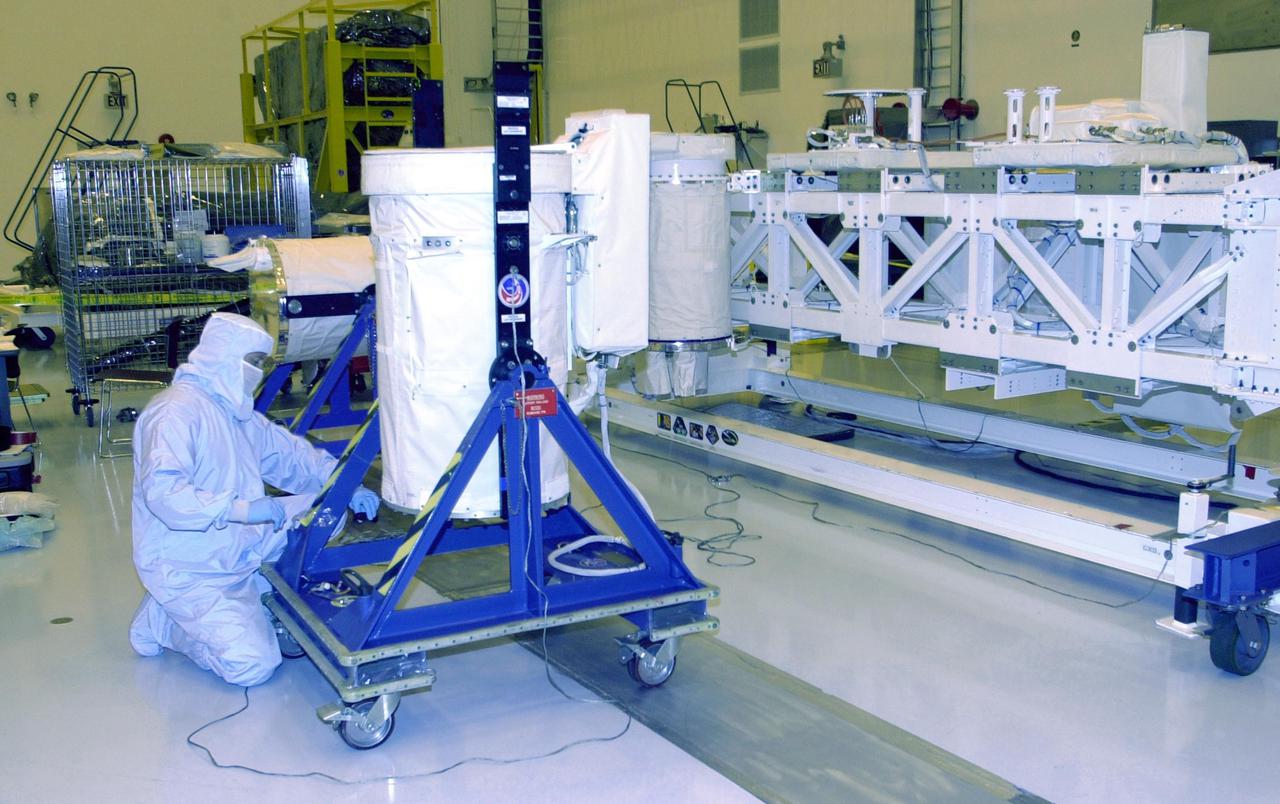
KENNEDY SPACE CENTER, FLA. -- A worker in the Multi-Payload Processing Facility prepares a GetAway Special canister (GAS can) for a move to the Hitchhiker Bridge. The bridge is a carrier for the Fast Reaction Experiments Enabling Science, Technology, Applications and Research (FREESTAR) that incorporates eight high priority secondary attached shuttle experiments on mission STS-107. A research mission, the primary payload is the first flight of the SHI Research Double Module (SHI_RDM), also known as SPACEHAB. The experiments range from material sciences to life sciences (many rats). STS-107 is scheduled to launch July 11, 2002

KENNEDY SPACE CENTER, FLA. -- The SHI Research Double Module (SHI_RDM) (right) and Hitchhiker Carrier (left) are ready to be lowered into Columbia's payload bay. The two payloads will be installed in the payload bay for mission STS-107, a research mission. SHI_RDM is the primary payload, with experiments ranging from material sciences to life sciences (many rats). Also, the Fast Reaction Experiments Enabling Science, Technology, Applications and Research (FREESTAR) that is on the Hitchhiker Carrier incorporates eight high priority secondary attached shuttle experiments. STS-107 is scheduled to launch July 19, 2002
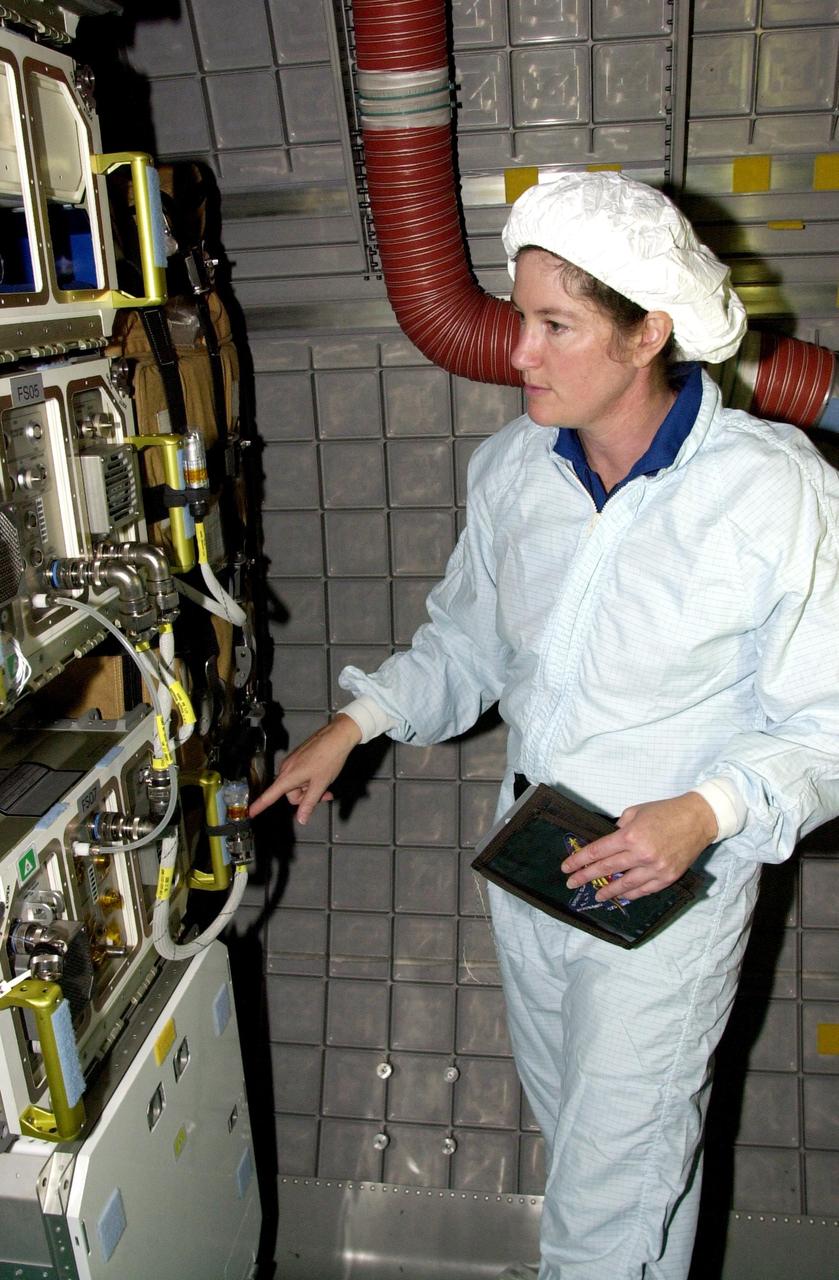
KENNEDY SPACE CENTER, FLA. - STS-107 Mission Specialist Laurel Clark looks over experiments equipment in the SHI Research Double Module (SHI/RDM), part of the payload on the mission. The crew is taking part in Crew Equipment Interface Test activities, which include equipment and payload familiarization. A research mission, STS-107 also will carry the Fast Reaction Experiments Enabling Science, Technology, Applications and Research (FREESTAR) that incorporates eight high priority secondary attached shuttle experiments. STS-107 is scheduled to launch July 19, 2002
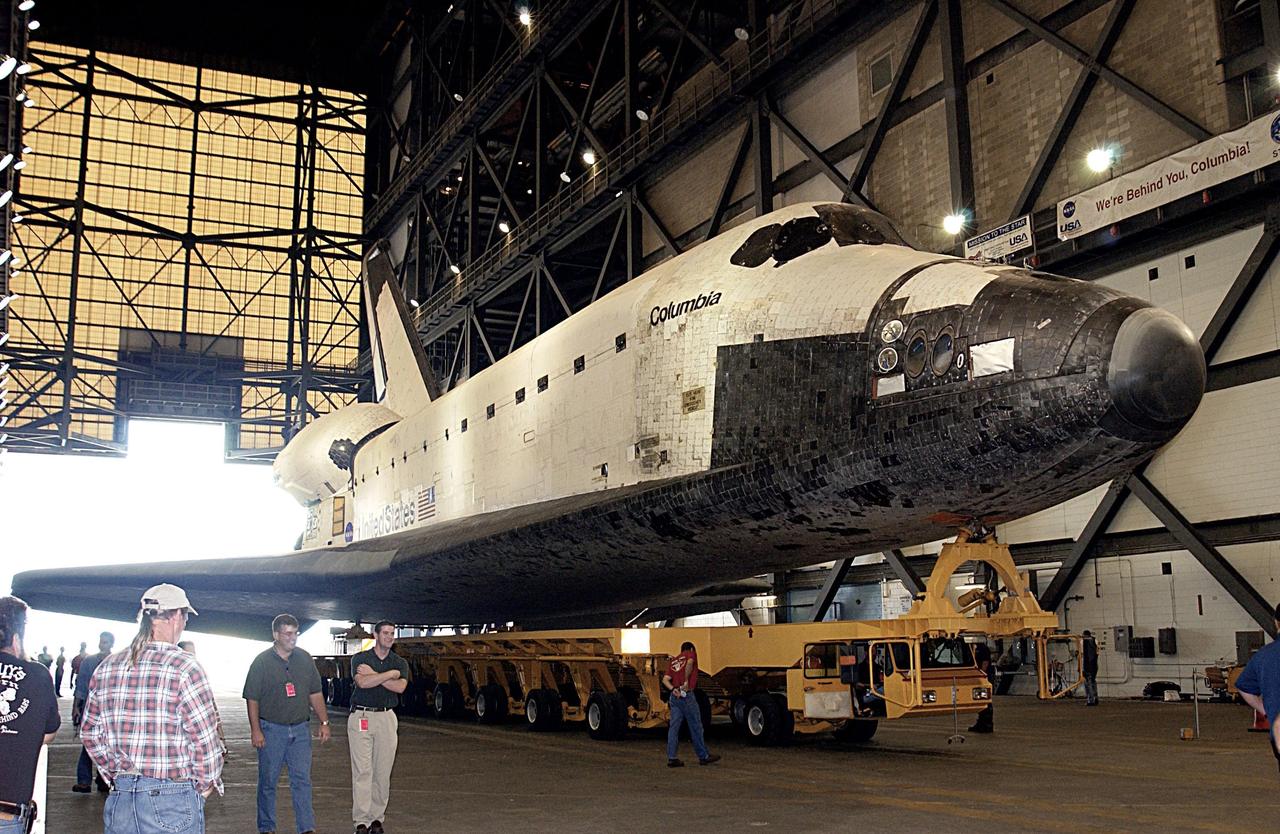
KENNEDY SPACE CENTER, FLA. -- Space Shuttle Columbia sits atop its transporter in the transfer aisle of the Vehicle Assembly Building awaiting further processing for the flight of mission STS-107. Launch is now targeted for no earlier than Jan. 16, 2003. The STS-107 mission will be dedicated to microgravity research. The payloads include the Hitchhiker Bridge, a carrier for the Fast Reaction Experiments Enabling Science, Technology, Applications and Research (FREESTAR) incorporating eight high priority secondary attached Shuttle experiments, and the SHI Research Double Module (SHI/RDM), also known as SPACEHAB.
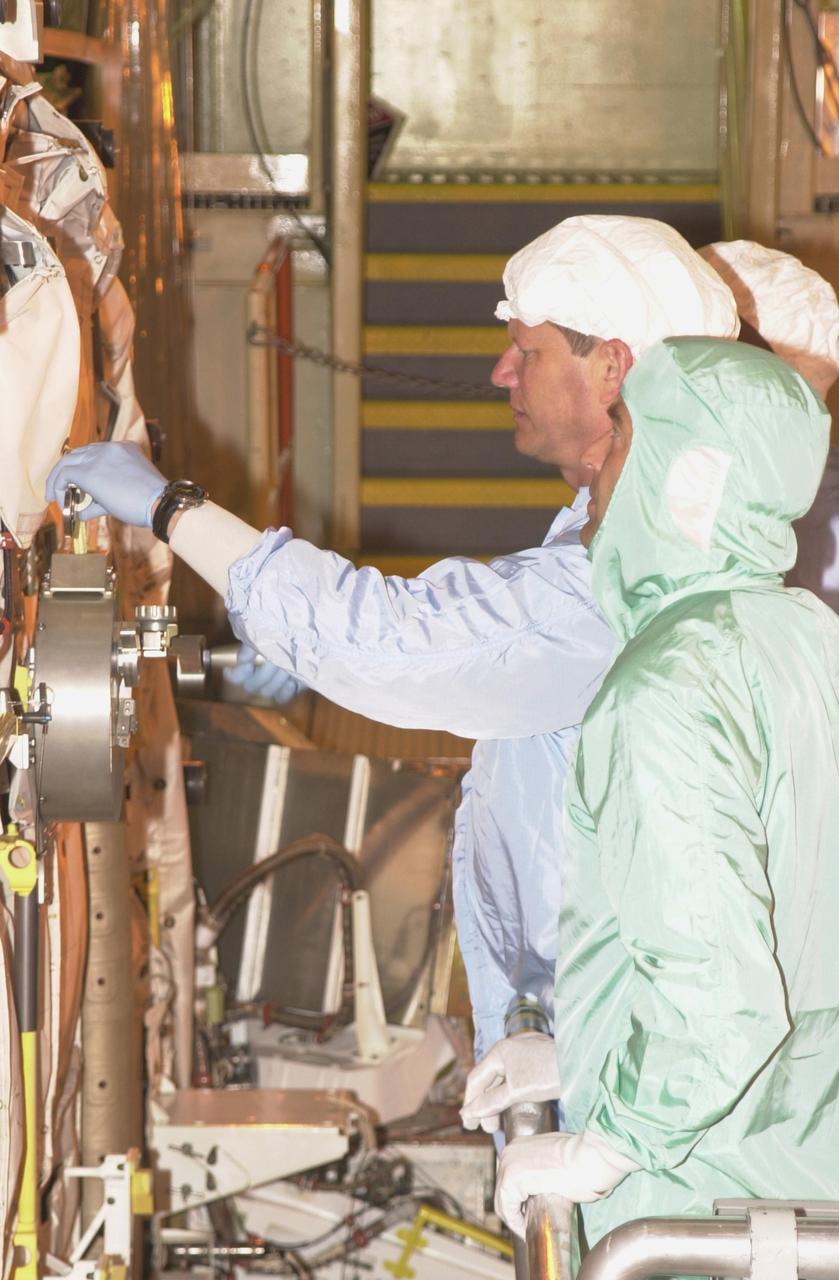
KENNEDY SPACE CENTER, FLA. - During Crew Equipment Interface Test activities, STS-107 Mission Specialist David Brown checks equipment in the payload bay of Columbia while a technician looks on. Behind Brown is Payload Commander Michael Anderson. STS-107 is a research mission, with the SHI Research Double Module (SHI/RDM), also known as SPACEHAB, as the primary payload, plus the Fast Reaction Experiments Enabling Science, Technology, Applications and Research (FREESTAR) that incorporates eight high priority secondary attached shuttle experiments. STS-107 is scheduled to launch July 19, 2002
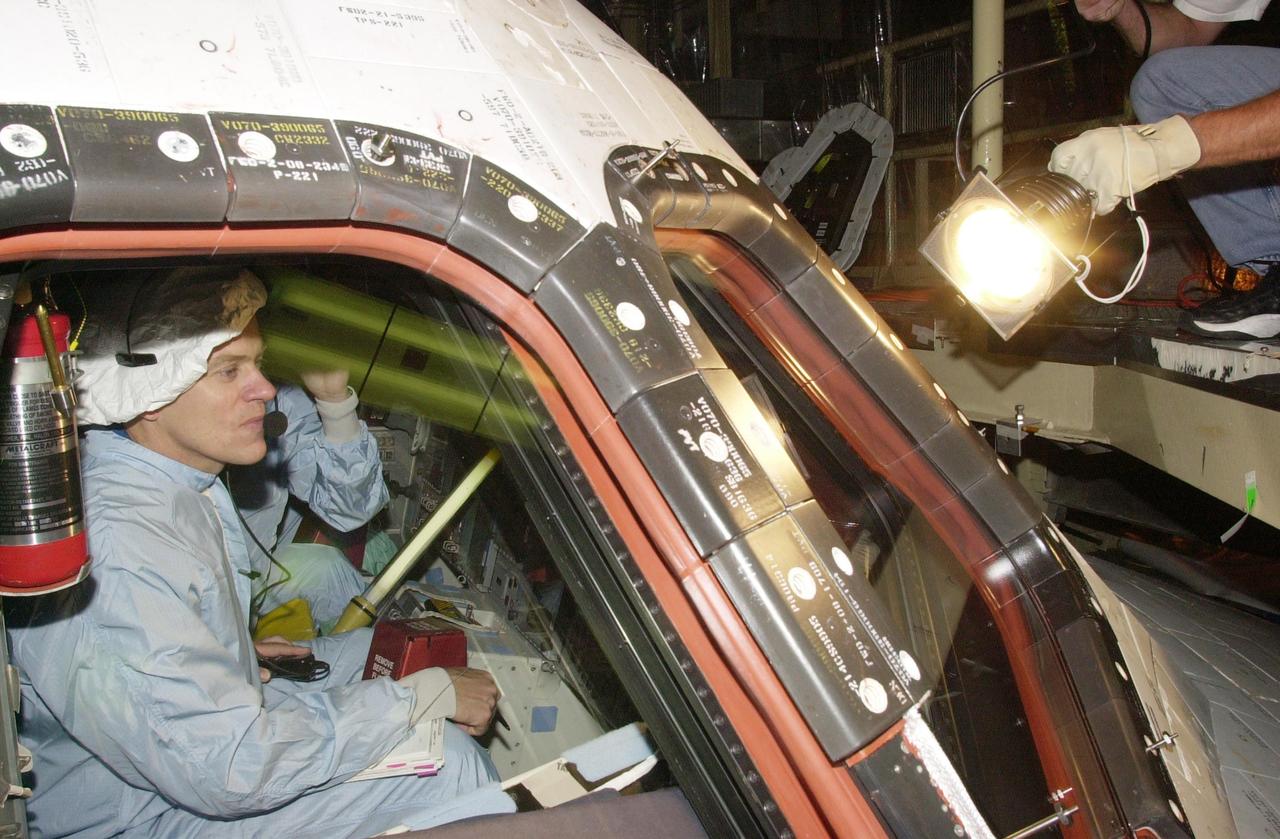
KENNEDY SPACE CENTER, FLA. - STS-107 Pilot William "Willie" McCool checks the window in Columbia during Crew Equipment Interface Test activities at KSC. The CEIT includes equipment and payload familiarization. STS-107 is a research mission, with the SHI Research Double Module (SHI/RDM), also known as SPACEHAB, as the primary payload, plus the Fast Reaction Experiments Enabling Science, Technology, Applications and Research (FREESTAR) that incorporates eight high priority secondary attached shuttle experiments. STS-107 is scheduled to launch July 19, 2002
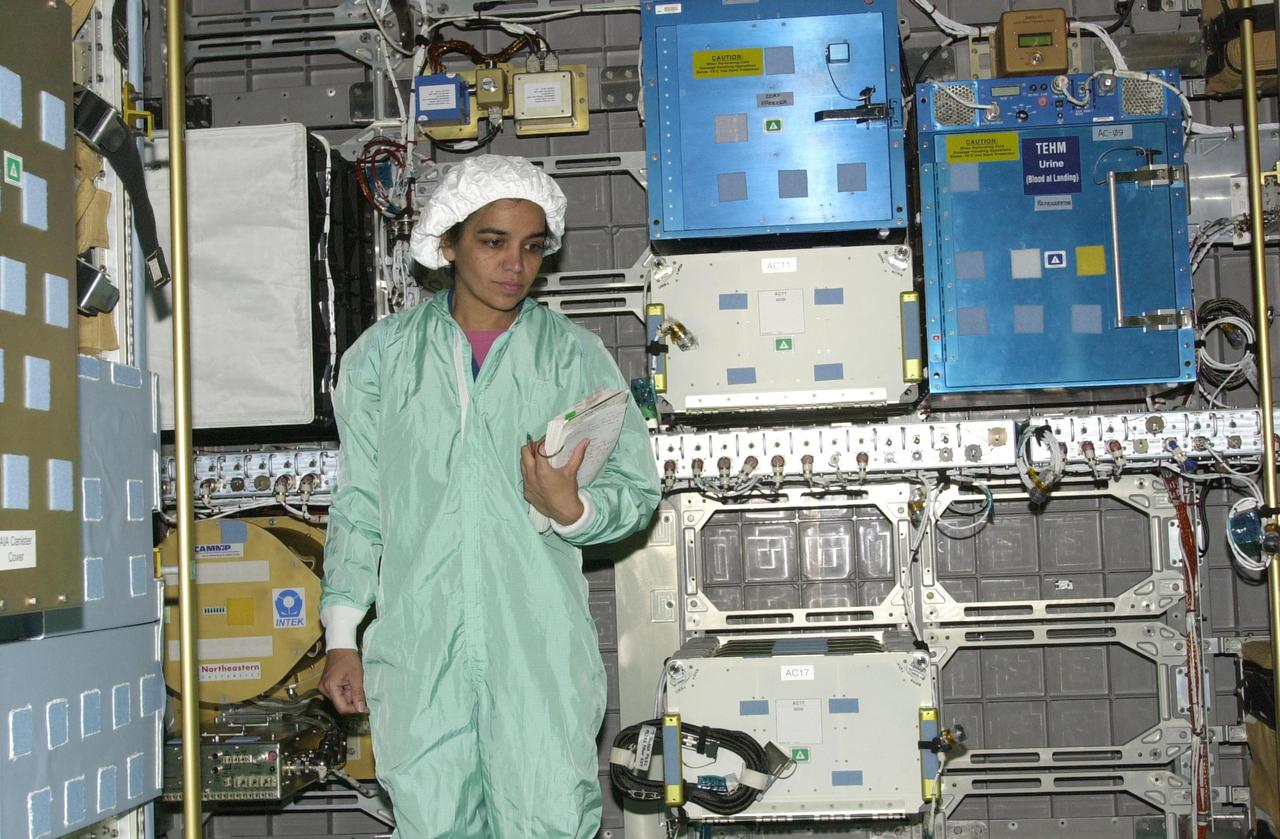
KENNEDY SPACE CENTER, FLA. - STS-107 Mission Specialist Kalpana Chawla looks at equipment inside the SHI Research Double Module (SHI/RDM), part of the payload on the mission. The crew is taking part in Crew Equipment Interface Test activities, which include equipment and payload familiarization. A research mission, STS-107 also will carry the Fast Reaction Experiments Enabling Science, Technology, Applications and Research (FREESTAR) that incorporates eight high priority secondary attached shuttle experiments. STS-107 is scheduled to launch July 19, 2002
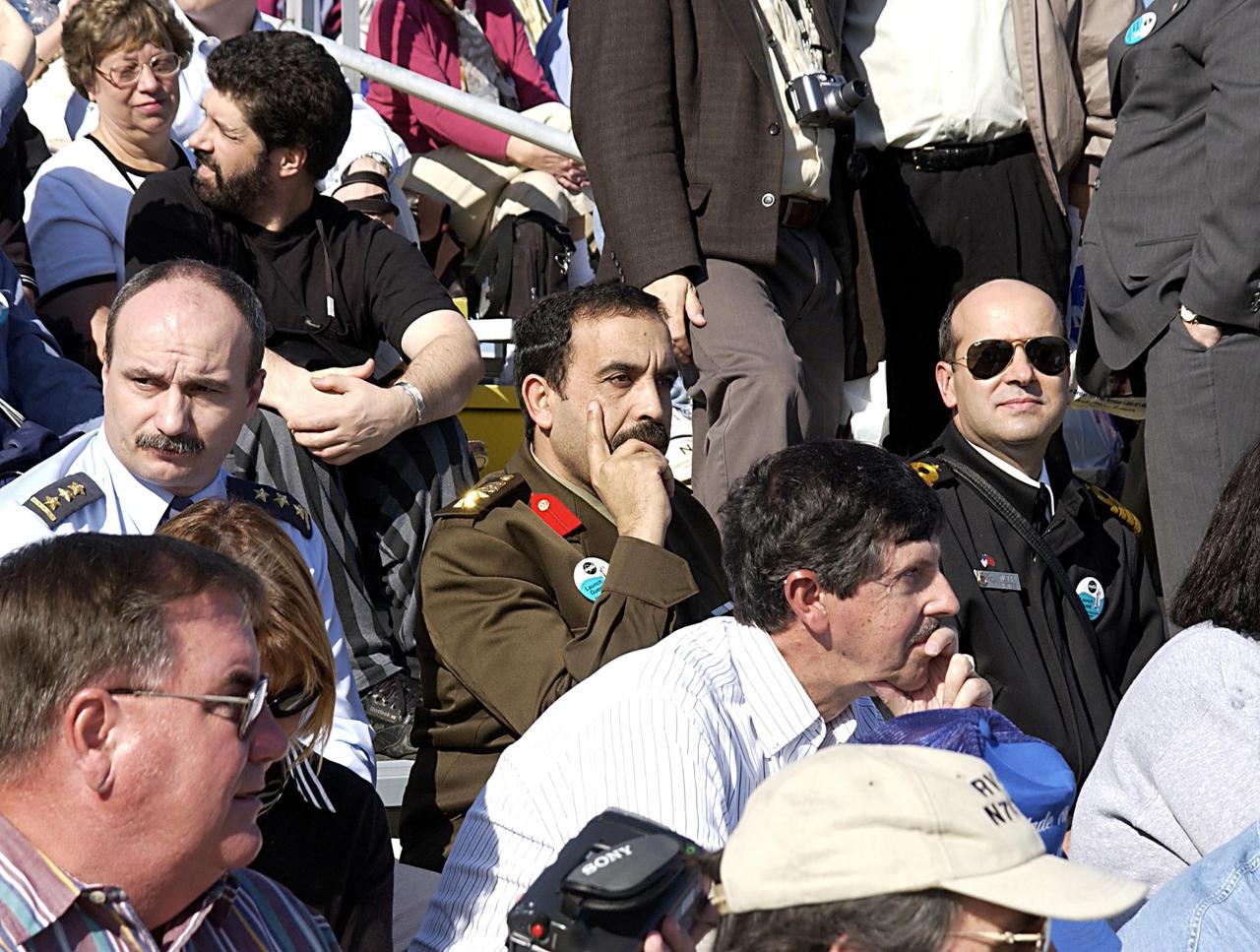
KENNEDY SPACE CENTER, FLA. - From the VIP stands at KSC, members of the Israeli military watch the launch of Space Shuttle Columbia on mission STS-107. A member of the Shuttle crew is Payload Specialist Ilan Ramon, who is a colonel in the Israel Air Force. He is the first Israeli astronaut to fly on a Shuttle. The 16-day research mission will include FREESTAR (Fast Reaction Experiments Enabling Science, Technology, Applications and Research) and the SHI Research Double Module (SHI/RDM), known as SPACEHAB. Experiments on the module range from material sciences to life sciences. Ramon will take part in some of the research on the mission. Landing of Columbia is scheduled at about 8:53 a.m. EST on Saturday, Feb. 1. This mission is the first Shuttle mission of 2003. Mission STS-107 is the 28th flight of the orbiter Columbia and the 113th flight overall in NASA's Space Shuttle program.
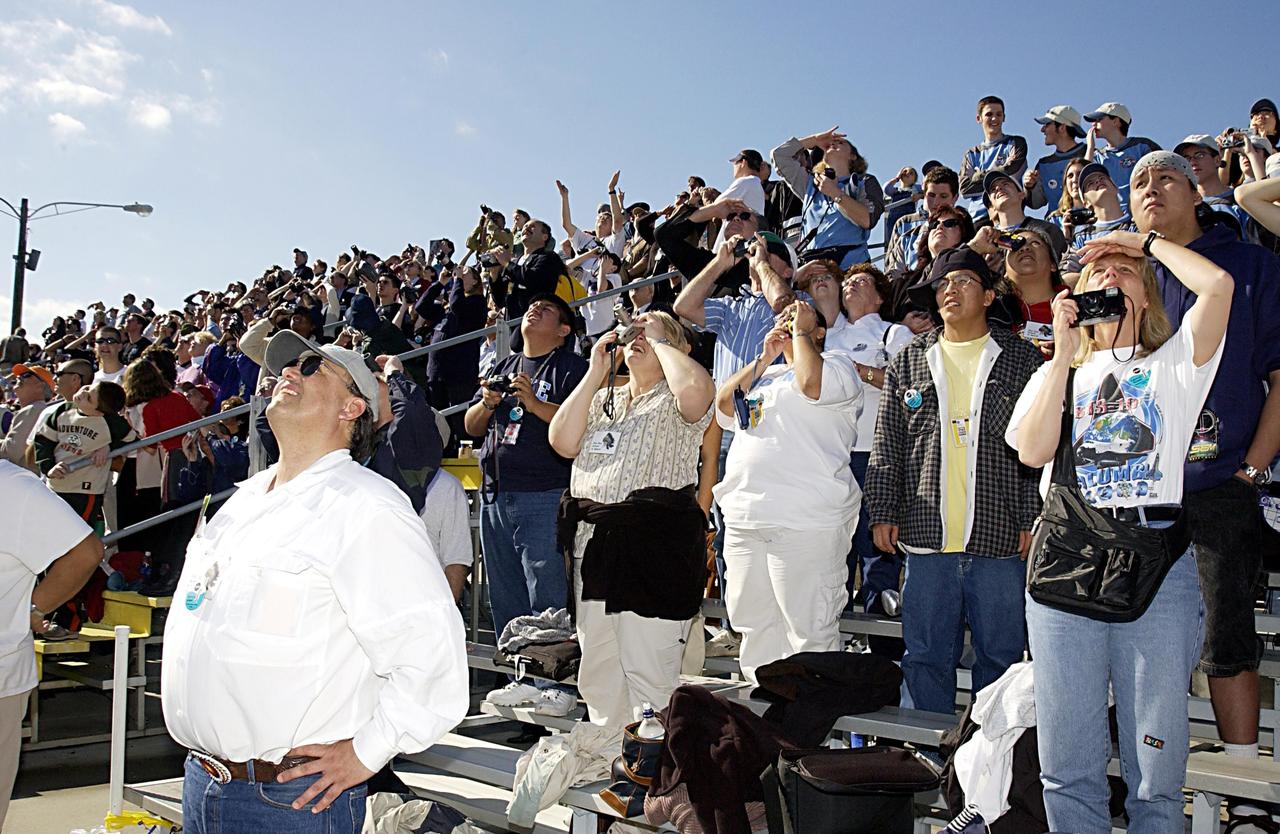
KENNEDY SPACE CENTER, FLA. - The VIP stand at KSC is filled with not only friends and families of the astronauts, but also representatives of Israel who came to support the first Israeli to fly on a Shuttle, Ilan Ramon. As a payload specialist, Ramon will take part in some of the research on the mission. He is also a colonel in the Israel Air Force. The 16-day research mission will include FREESTAR (Fast Reaction Experiments Enabling Science, Technology, Applications and Research) and the SHI Research Double Module (SHI/RDM), known as SPACEHAB. Experiments on the module range from material sciences to life sciences. This mission is the first Shuttle mission of 2003. Mission STS-107 is the 28th flight of the orbiter Columbia and the 113th flight overall in NASA's Space Shuttle program.
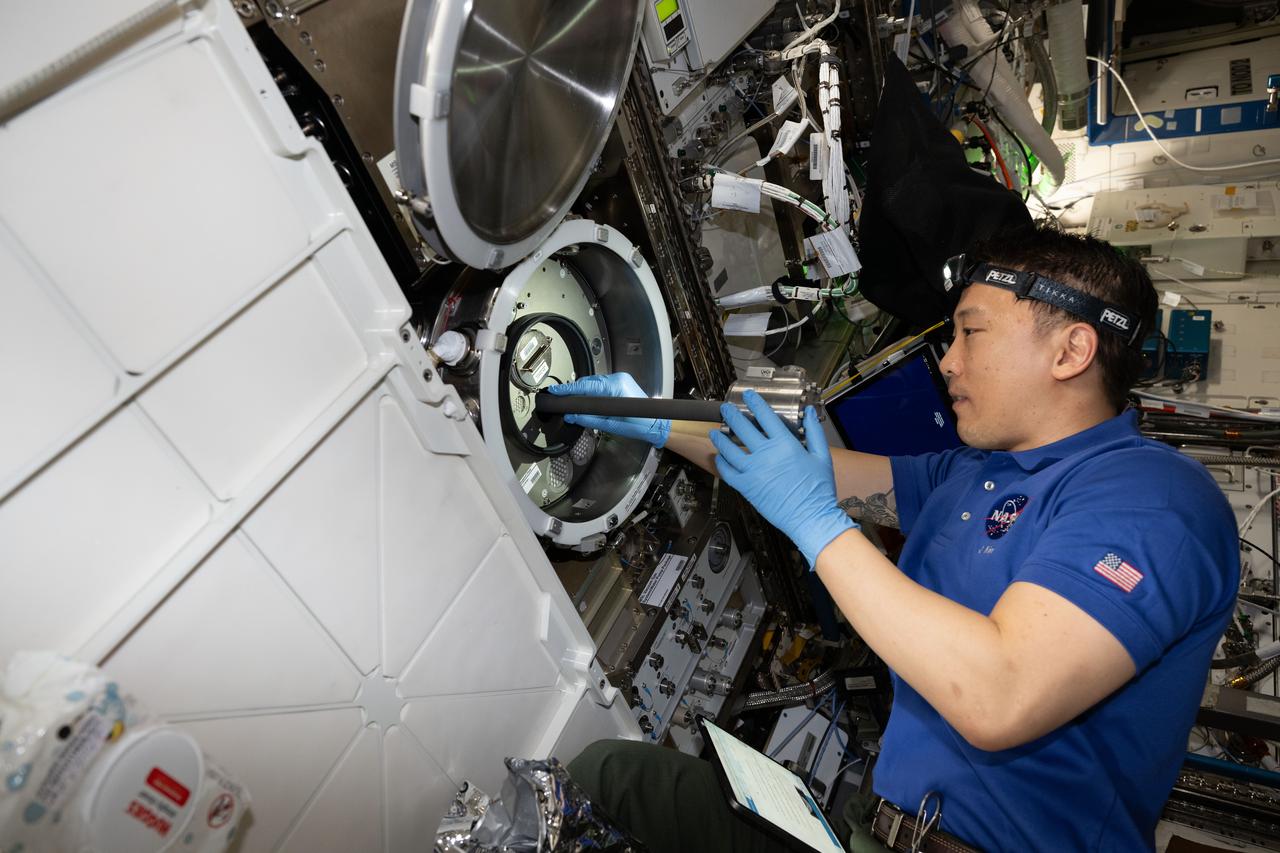
iss073e0222456 (June 27, 2025) --- NASA astronaut and Expedition 73 Flight Engineer Jonny Kim removes research hardware from inside the Materials Science Laboratory (MSL) located inside the International Space Station's Destiny laboratory module. The MSL uses two different furnaces that operate one at a time to discover new applications for existing materials, such as metals, alloys, polymers, and new or improved materials.
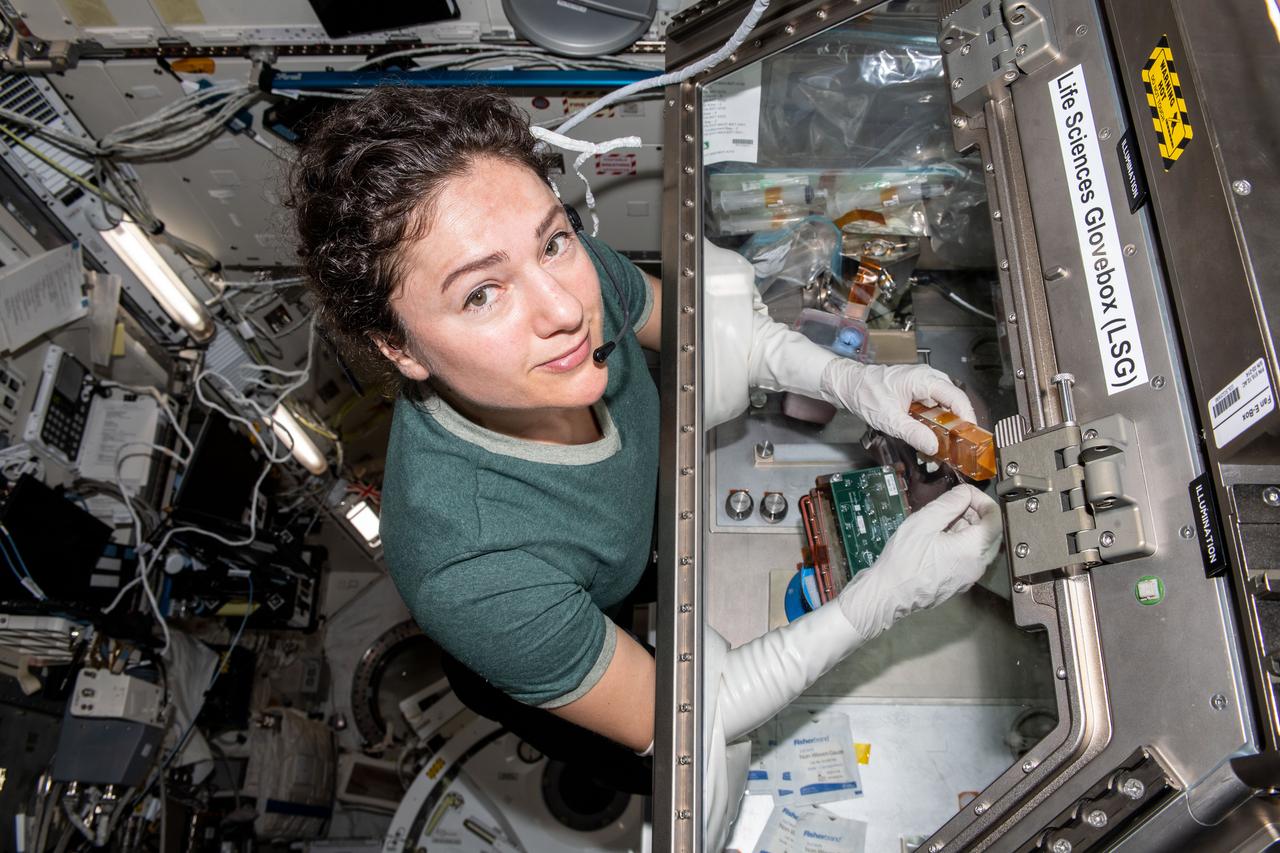
iss062e120658 (April 2, 2020) --- NASA astronaut and Expedition 62 Flight Engineer conducts cardiac research in the Life Sciences Glovebox located in the Japanese Kibo laboratory module. The Engineered Heart Tissues investigation could promote a better understanding of cardiac function in microgravity which would be useful for drug development and other applications related to heart conditions on Earth.
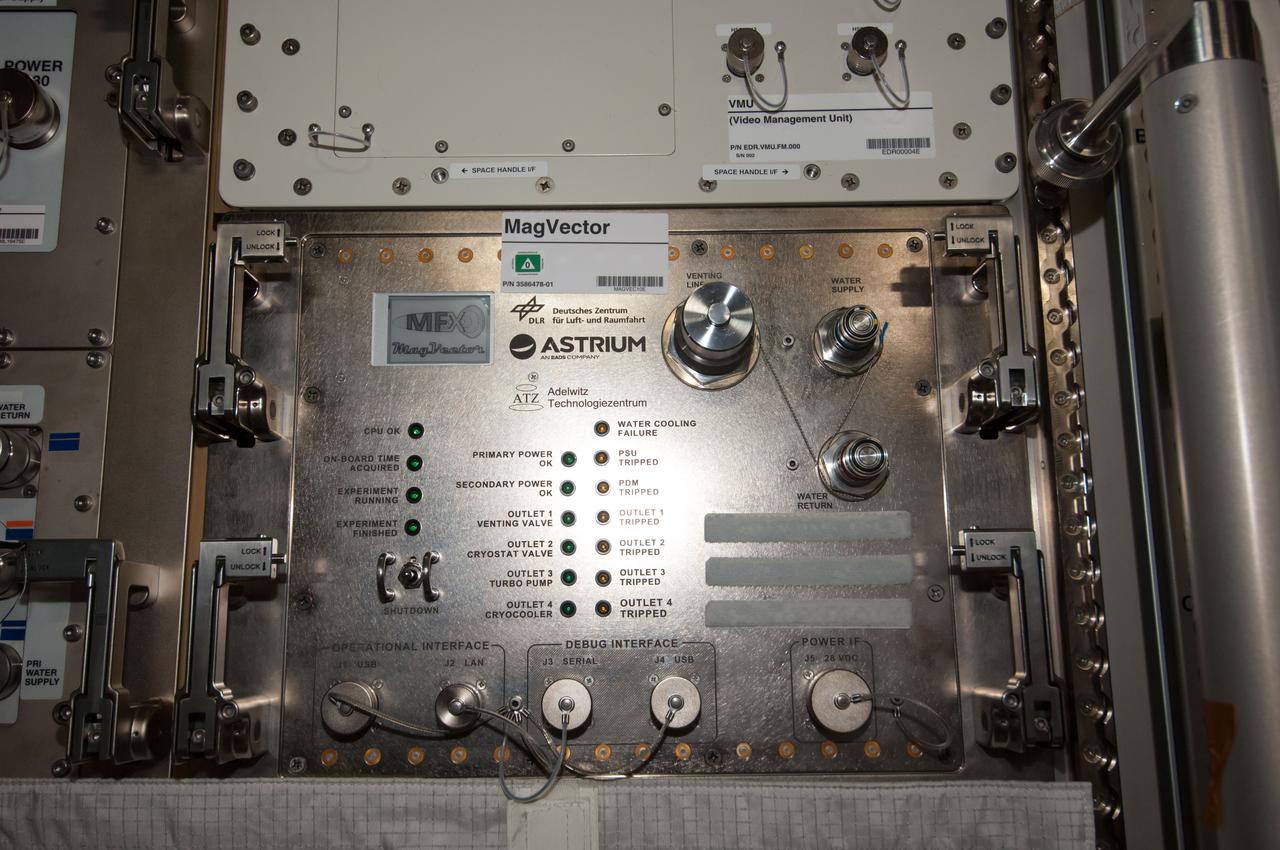
iss040e108291 (8/26/2014) --- Photographic documentation of final installation of MAGVECTOR hardware in the Columbus module aboard the International Space Station (ISS). MAGVECTOR qualitatively investigates the interaction between a moving magnetic field and an electrical conductor. The set up will provide initial insights regarding the principal feasibility on board the ISS,future improvements and phenomenological trends and dependencies. The expected changes in the magnetic field structure on the Ram and Wake side of the electrical conductor are of interest for technical applications as well as for astrophysical research.
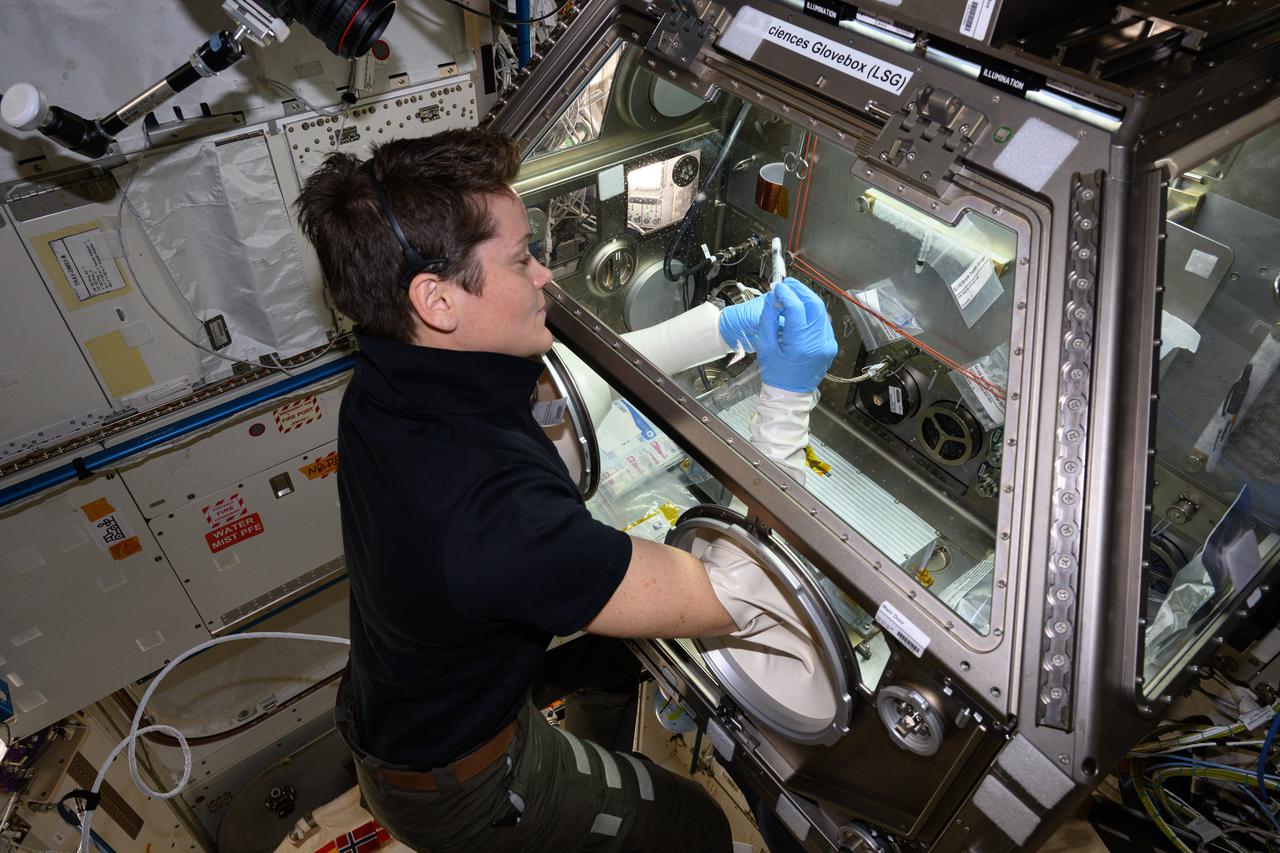
iss073e0027808 (May 10, 2025) --- NASA astronaut and Expedition 73 Flight Engineer Anne McClain works in the Kibo laboratory module's Life Sciences Glovebox processing bacteria samples before viewing them inside a 3D imaging microscope called the Extant Life Volumetric Imaging System, or ELVIS. The technology demonstration may enable applications for monitoring water quality, detecting infectious organisms on spacecraft, and researching colloids (suspensions of particles in a liquid) and microorganisms in microgravity.
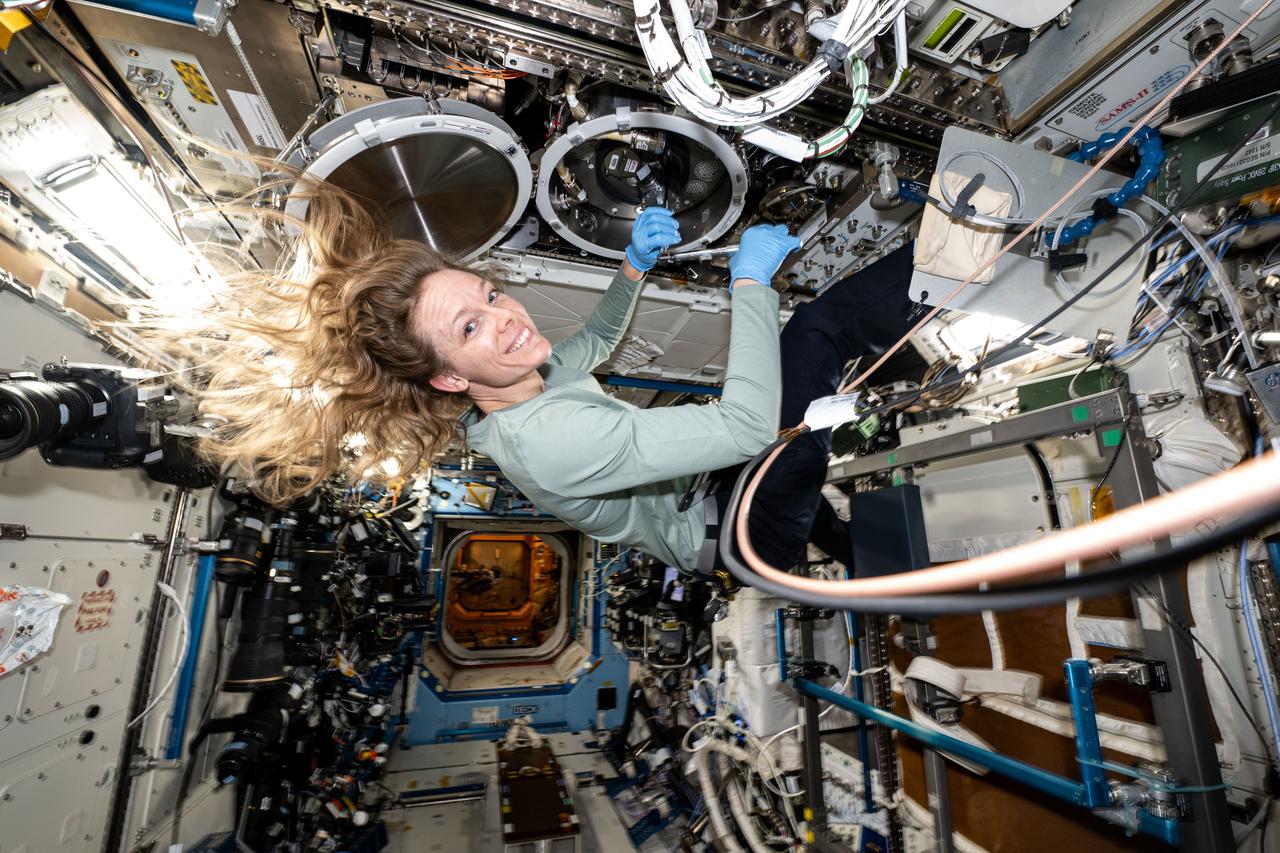
iss073e0071487 (May 15, 2025) --- NASA astronaut and Expedition 73 Flight Engineer Nichole Ayers swaps sample cartridges inside the Material Science Laboratory (MSL) that supports high temperature space physics research using furnaces aboard the International Space Station's Destiny laboratory module. The properties of many types of materials such as metals, alloys, polymers, semiconductors, ceramics, crystals, and glasses, can be studied in the MSL to discover new applications for existing materials and new or improved materials.
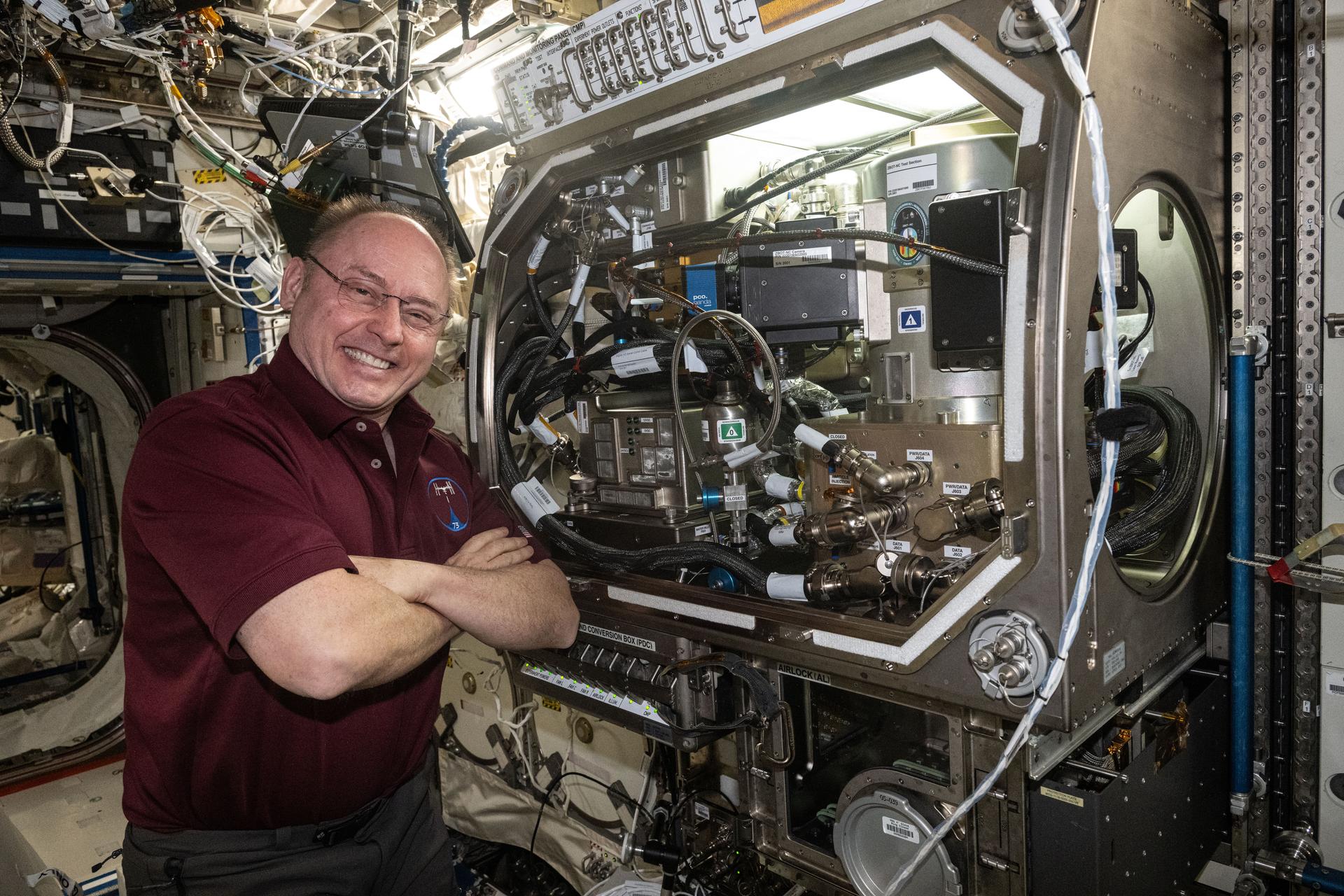
iss073e0982894 (Oct. 28, 2025) --- NASA astronaut and Expedition 73 Flight Engineer Mike Fincke poses for a portrait next to the Microgravity Science Glovebox aboard the International Space Station’s Destiny laboratory module. Fincke had just completed configuring research hardware for the Zero Boil-Off Tank physics investigation, which explores methods for storing cryogenic fluids. The experiment supports advancements in spacecraft propulsion and life support systems, as well as biotechnological, medical, and industrial applications on Earth.

iss073e0027806 (May 10, 2025) --- NASA astronaut and Expedition 73 Flight Engineer Anne McClain works in the Kibo laboratory module's Life Sciences Glovebox processing bacteria samples before viewing them inside a 3D imaging microscope called Extant Life Volumetric Imaging System, or ELVIS. The technology demonstration may enable applications for monitoring water quality, detecting infectious organisms on spacecraft, and researching colloids (suspensions of particles in a liquid) and microorganisms in microgravity.
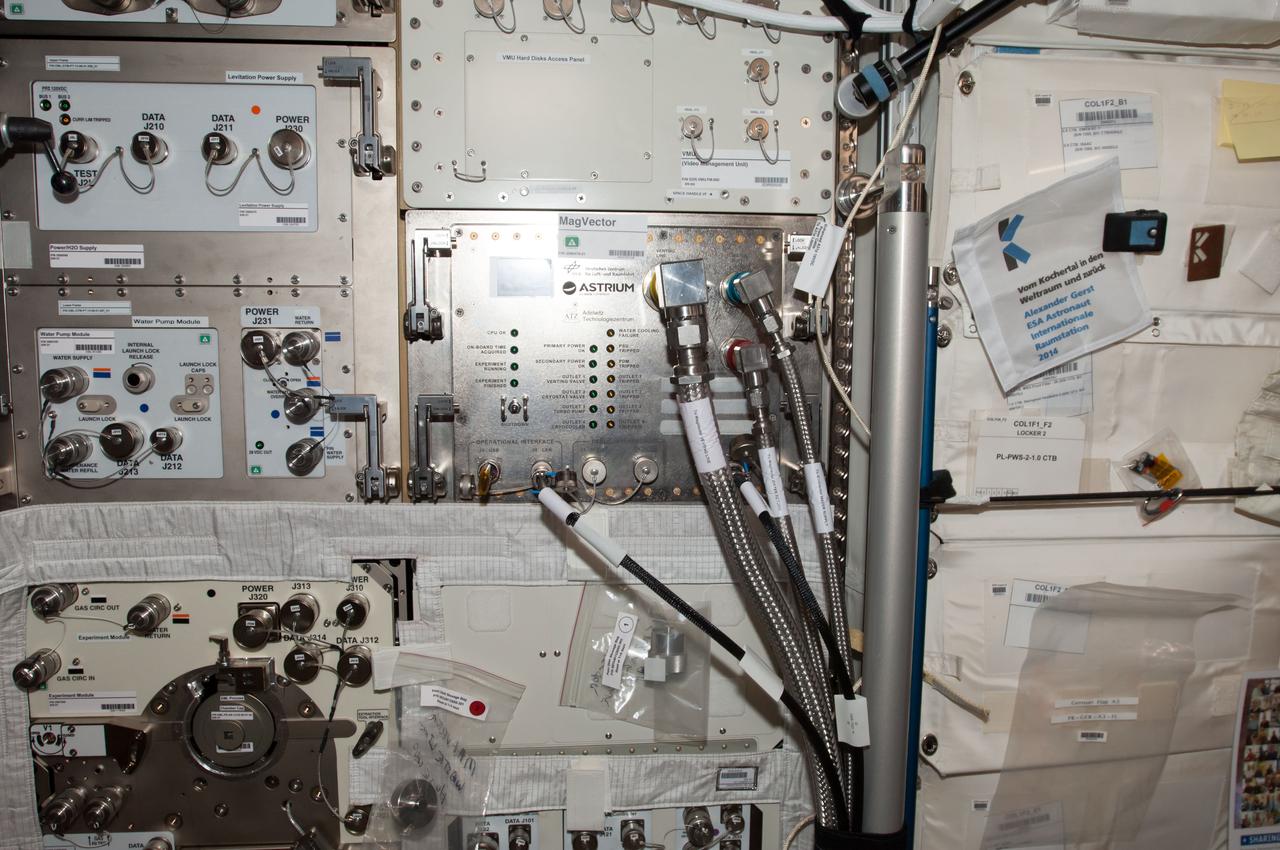
iss040e123621 (9/4/2014) --- Photographic documentation of final installation of MAGVECTOR hardware in the Columbus module aboard the International Space Station (ISS). MAGVECTOR qualitatively investigates the interaction between a moving magnetic field and an electrical conductor. The set up will provide initial insights regarding the principal feasibility on board the ISS,future improvements and phenomenological trends and dependencies. The expected changes in the magnetic field structure on the Ram and Wake side of the electrical conductor are of interest for technical applications as well as for astrophysical research.
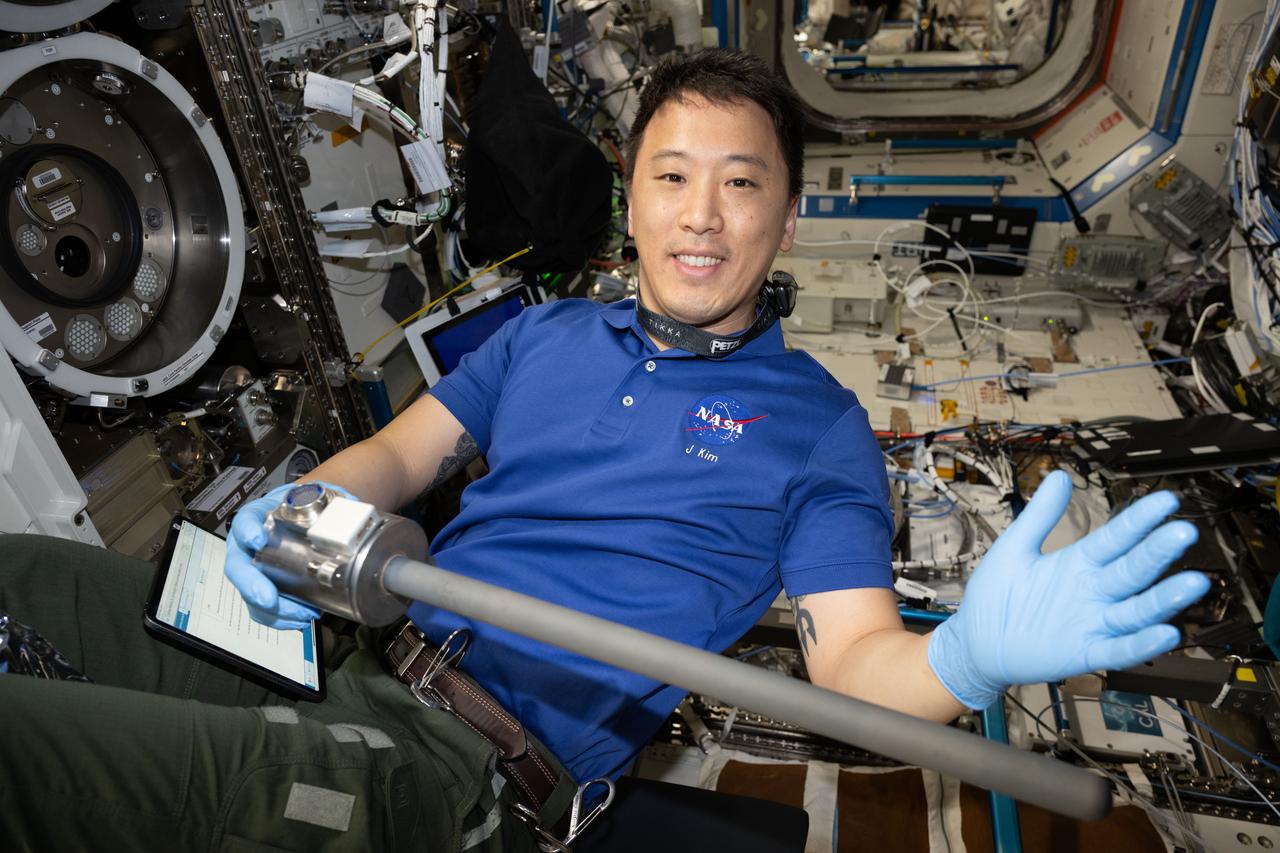
iss073e0222463 (June 16, 2025) --- NASA astronaut and Expedition 73 Flight Engineer Jonny Kim waves for a portrait while removing research hardware from inside the Materials Science Laboratory (MSL) located inside the International Space Station's Destiny laboratory module. The MSL uses two different furnaces that operate one at a time to discover new applications for existing materials, such as metals, alloys, polymers, and new or improved materials.
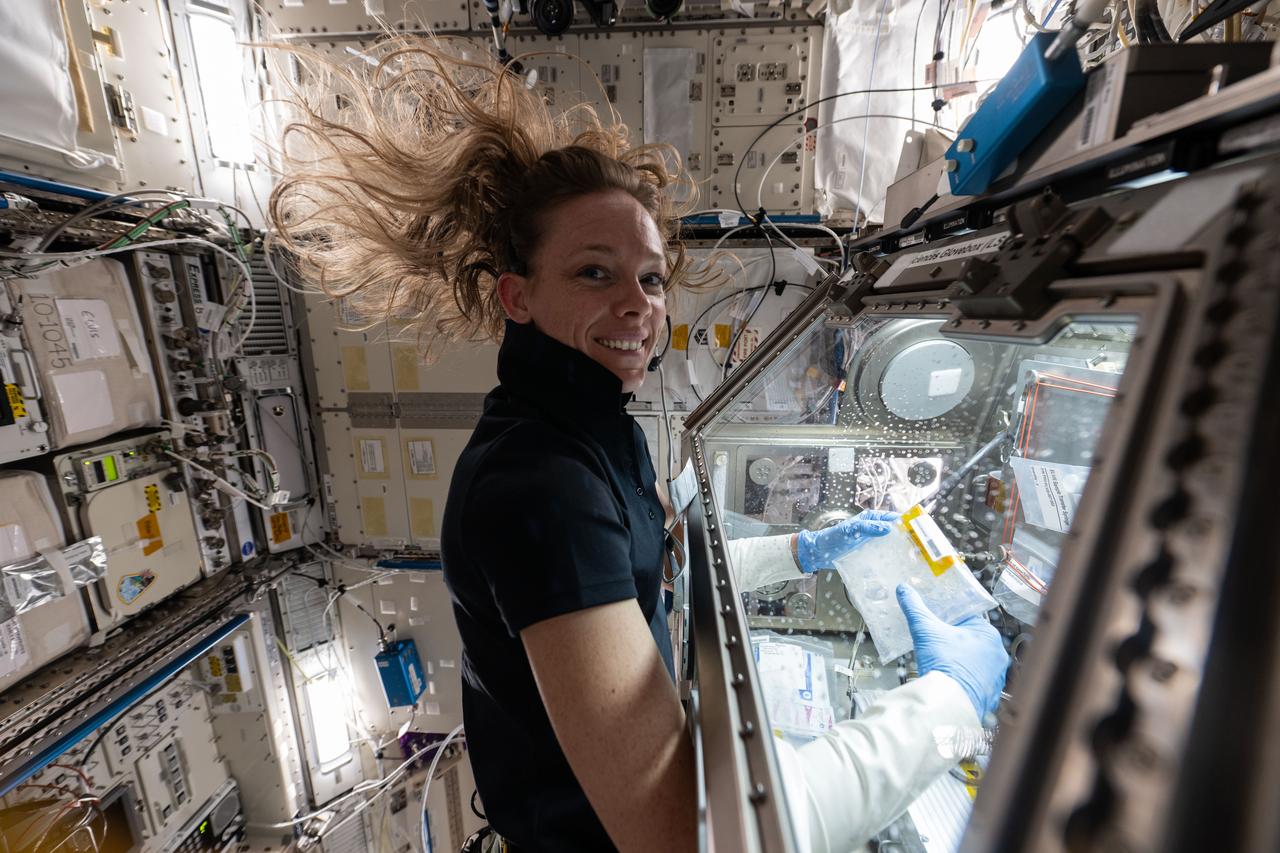
iss073e0025978 (May 9, 2025) --- NASA astronaut and Expedition 73 Flight Engineer Nichole Ayers works in the Kibo laboratory module's Life Sciences Glovebox processing bacteria samples before viewing them inside a 3D imaging microscope called Extant Life Volumetric Imaging System, or ELVIS. The technology demonstration may enable applications for monitoring water quality, detecting infectious organisms on spacecraft, and researching colloids (suspensions of particles in a liquid) and microorganisms in microgravity.
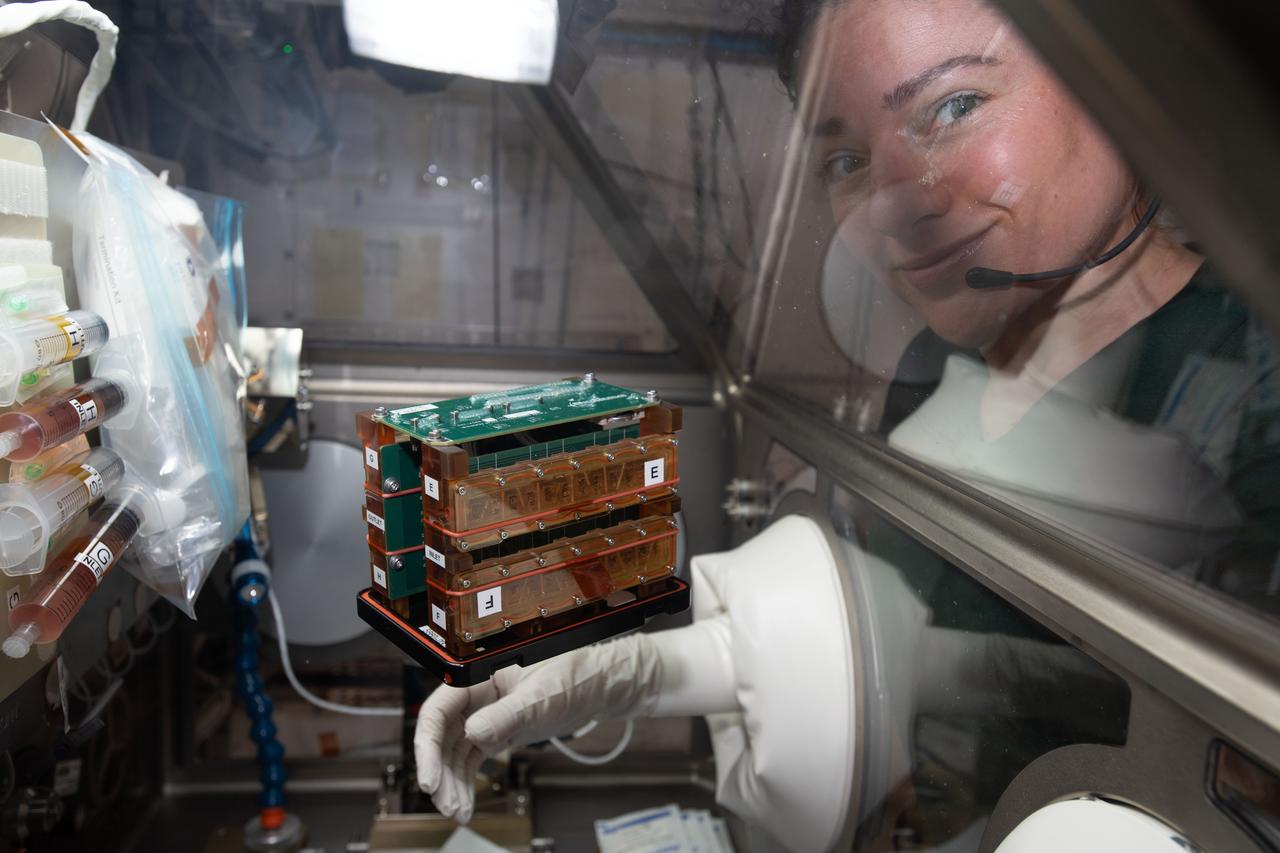
iss062e115369 (March 26, 2020) --- NASA astronaut and Expedition 62 Flight Engineer Jessica Meir conducts cardiac research in the Life Sciences Glovebox located in the Japanese Kibo laboratory module. The Engineered Heart Tissues investigation could promote a better understanding of cardiac function in microgravity which would be useful for drug development and other applications related to heart conditions on Earth.
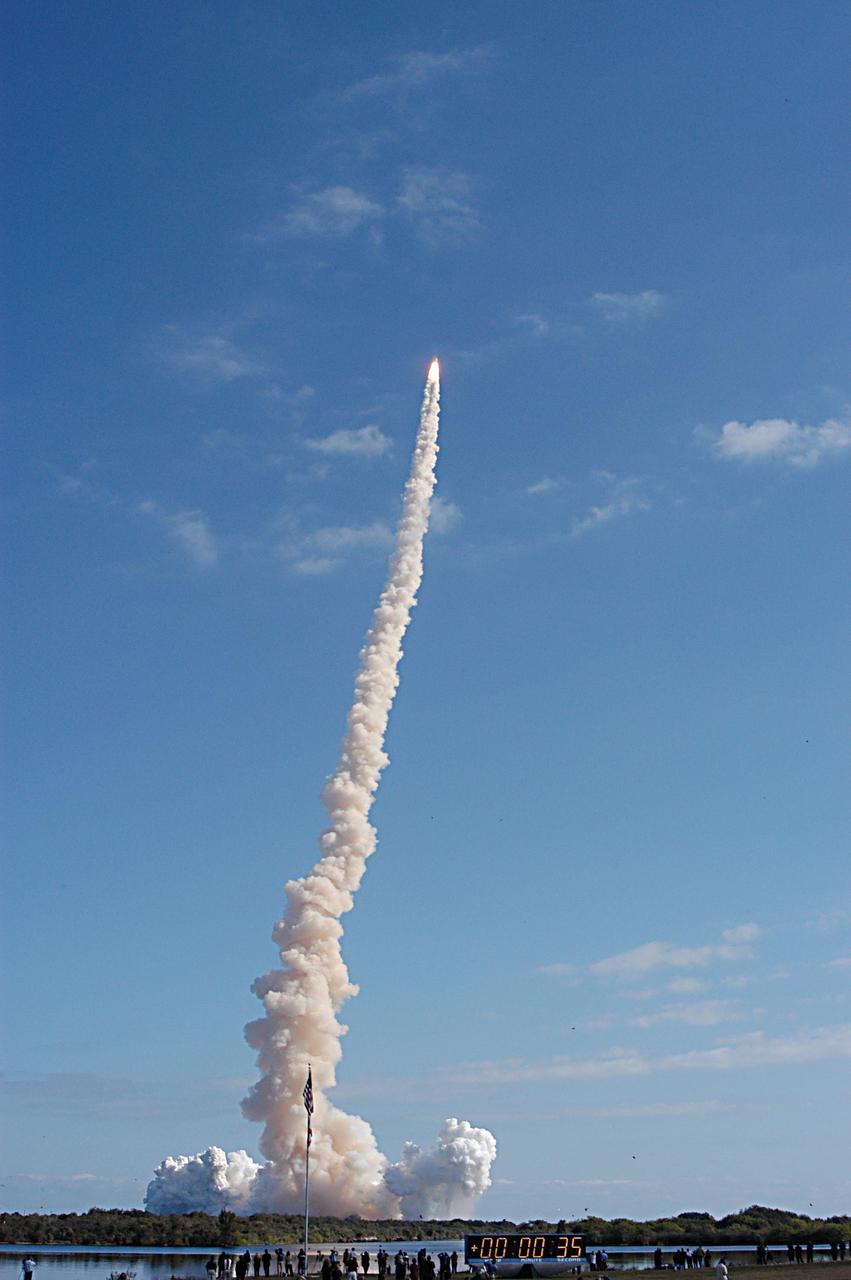
KENNEDY SPACE CENTER, FLA. -- Seconds after launch, Space Shuttle Columbia appears as a flaming tip of the smoke column it trails. Following a flawless and uneventful countdown, liftoff occurred on-time at 10:39 a.m. EST. The 16-day research mission will include FREESTAR (Fast Reaction Experiments Enabling Science, Technology, Applications and Research) and the SHI Research Double Module (SHI/RDM), known as SPACEHAB. Experiments on the module range from material sciences to life sciences. Landing is scheduled at about 8:53 a.m. EST on Saturday, Feb. 1. This mission is the first Shuttle mission of 2003. Mission STS-107 is the 28th flight of the orbiter Columbia and the 113th flight overall in NASA's Space Shuttle program.

KENNEDY SPACE CENTER, FLA. -- A twisting column of smoke points the way to Space Shuttle Columbia at its tip as the Shuttle hurtles toward space on mission STS-107. Following a flawless and uneventful countdown, liftoff occurred on-time at 10:39 a.m. EST. The 16-day research mission will include FREESTAR (Fast Reaction Experiments Enabling Science, Technology, Applications and Research) and the SHI Research Double Module (SHI/RDM), known as SPACEHAB. Experiments on the module range from material sciences to life sciences. Landing is scheduled at about 8:53 a.m. EST on Saturday, Feb. 1. This mission is the first Shuttle mission of 2003. Mission STS-107 is the 28th flight of the orbiter Columbia and the 113th flight overall in NASA's Space Shuttle program.
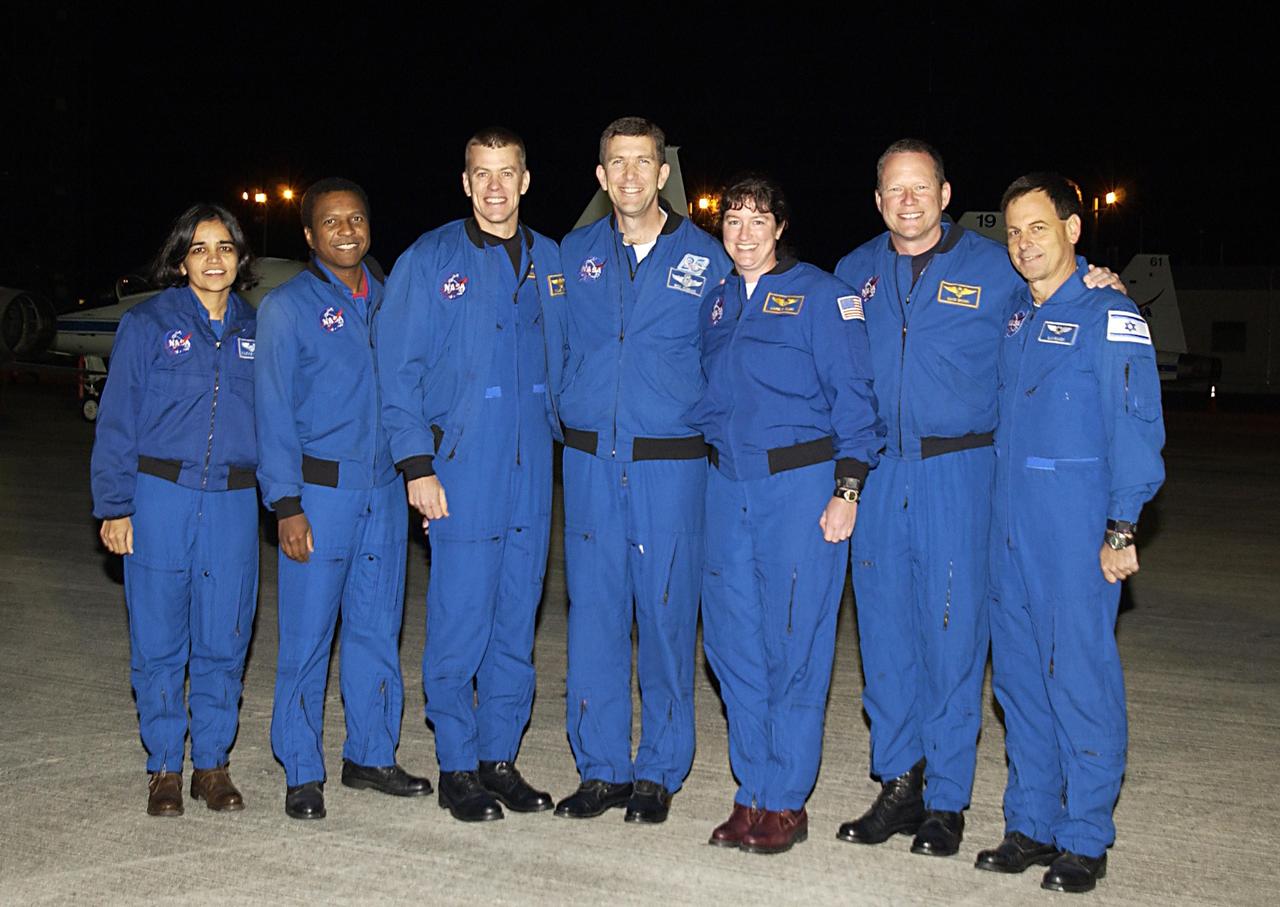
KENNEDY SPACE CENTER, FLA. - The STS-107 crew pose for a photo after their arrival at KSC for pre-launch preparations. Standing from left to right are Mission Specialist Kalpana Chawla, Payload Commander Michael Anderson, Pilot William "Willie" McCool, Commander Rick Husband, Mission Specialists Laurel Clark and David Brown, and Payload Specialist Ilan Ramon, who is the first Israeli astronaut to fly on a Shuttle mission. STS-107 is a mission devoted to research and will include more than 80 experiments that will study Earth and space science, advanced technology development, and astronaut health and safety. The payload on Space Shuttle Columbia includes FREESTAR (Fast Reaction Experiments Enabling Science, Technology, Applications and Research) and the SHI Research Double Module (SHI/RDM), known as SPACEHAB. Experiments on the module range from material sciences to life sciences. Launch of Columbia is targeted for Jan. 16 between 10 a.m. and 2 p.m.
![KENNEDY SPACE CENTER, FLA. -- Spewing flames and billowing clouds of smoke across Launch Pad 39A, Space Shuttle Columbia roars toward space on mission STS-107. Following a flawless and uneventful countdown, liftoff occurred on-time at 10:39 a.m. EST. The 16-day research mission will include FREESTAR (Fast Reaction Experiments Enabling Science, Technology, Applications and Research) and the SHI Research Double Module (SHI/RDM), known as SPACEHAB. Experiments on the module range from material sciences to life sciences.. Landing of Columbia is scheduled at about 8:53 a.m. EST on Saturday, Feb. 1. This mission is the first Shuttle mission of 2003. Mission STS-107 is the 28th flight of the orbiter Columbia and the 113th flight overall in NASA's Space Shuttle program. [Photo courtesy of Scott Andrews]](https://images-assets.nasa.gov/image/KSC-03pd0136/KSC-03pd0136~medium.jpg)
KENNEDY SPACE CENTER, FLA. -- Spewing flames and billowing clouds of smoke across Launch Pad 39A, Space Shuttle Columbia roars toward space on mission STS-107. Following a flawless and uneventful countdown, liftoff occurred on-time at 10:39 a.m. EST. The 16-day research mission will include FREESTAR (Fast Reaction Experiments Enabling Science, Technology, Applications and Research) and the SHI Research Double Module (SHI/RDM), known as SPACEHAB. Experiments on the module range from material sciences to life sciences.. Landing of Columbia is scheduled at about 8:53 a.m. EST on Saturday, Feb. 1. This mission is the first Shuttle mission of 2003. Mission STS-107 is the 28th flight of the orbiter Columbia and the 113th flight overall in NASA's Space Shuttle program. [Photo courtesy of Scott Andrews]
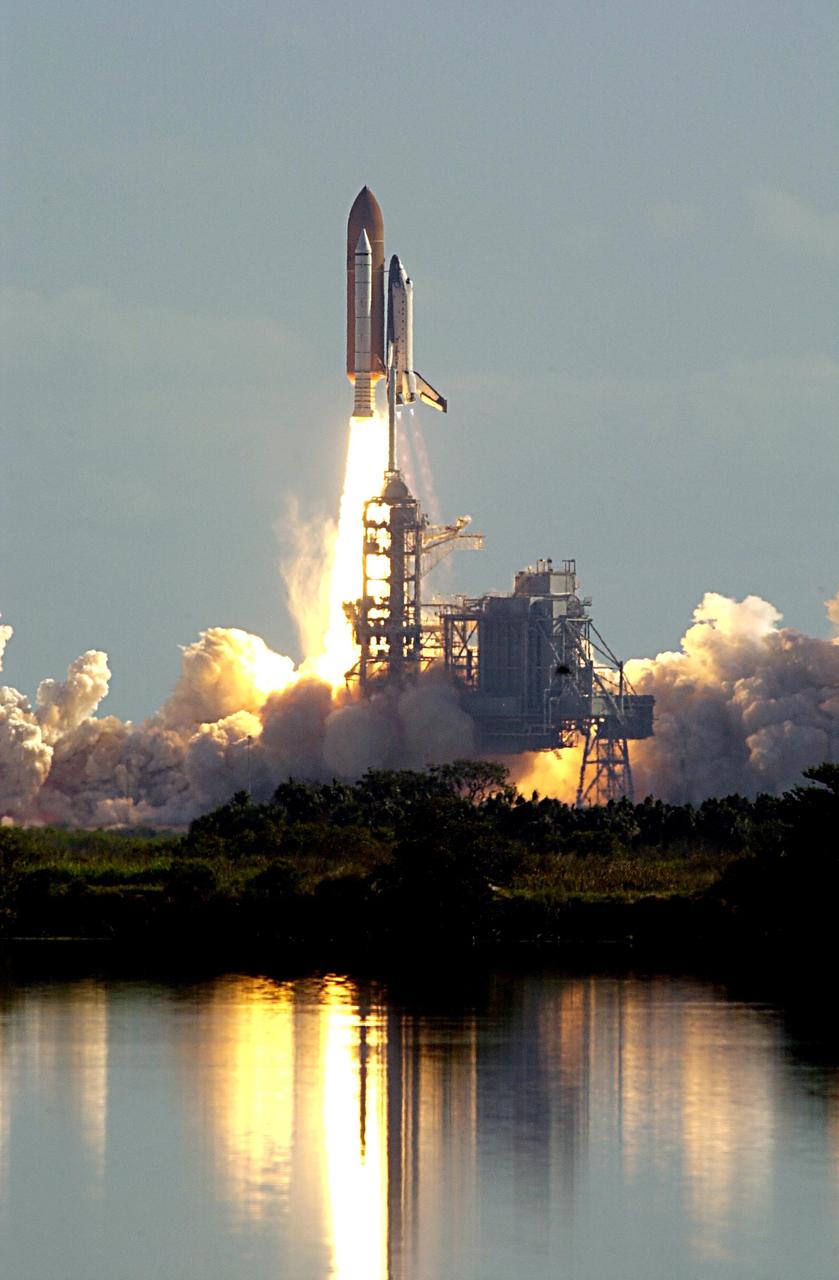
KENNEDY SPACE CENTER, FLA. -- As billows of smoke and steam roll across the landscape, the fiery launch of Space Shuttle Columbia on mission STS-107 is reflected in nearby water. Following a flawless and uneventful countdown, liftoff occurred on-time at 10:39 a.m. EST. The 16-day research mission will include FREESTAR (Fast Reaction Experiments Enabling Science, Technology, Applications and Research) and the SHI Research Double Module (SHI/RDM), known as SPACEHAB. Experiments on the module range from material sciences to life sciences. Landing is scheduled at about 8:53 a.m. EST on Saturday, Feb. 1. This mission is the first Shuttle mission of 2003. Mission STS-107 is the 28th flight of the orbiter Columbia and the 113th flight overall in NASA's Space Shuttle program.

KENNEDY SPACE CENTER, FLA. -- Space Shuttle Columbia hurtles through a perfect blue Florida sky following a flawless and uneventful countdown. Liftoff of Columbia on mission STS-107 occurred on-time at 10:39 a.m. EST. The 16-day research mission will include FREESTAR (Fast Reaction Experiments Enabling Science, Technology, Applications and Research) and the SHI Research Double Module (SHI/RDM), known as SPACEHAB. Experiments on the module range from material sciences to life sciences. Landing is scheduled at about 8:53 a.m. EST on Saturday, Feb. 1. This mission is the first Shuttle mission of 2003. Mission STS-107 is the 28th flight of the orbiter Columbia and the 113th flight overall in NASA's Space Shuttle program