
A scaled-down 24-inch version of the Space Shuttle's Reusable Solid Rocket Motor was successfully fired for 21 seconds at a Marshall Space Flight Center (MSFC) Test Stand. The motor was tested to ensure a replacement material called Lycocel would meet the criteria set by the Shuttle's Solid Motor Project Office. The current material is a heat-resistant, rayon-based, carbon-cloth phenolic used as an insulating material for the motor's nozzle. Lycocel, a brand name for Tencel, is a cousin to rayon and is an exceptionally strong fiber made of wood pulp produced by a special "solvent-spirning" process using a nontoxic solvent. It will also be impregnated with a phenolic resin. This new material is expected to perform better under the high temperatures experienced during launch. The next step will be to test the material on a 48-inch solid rocket motor. The test, which replicates launch conditions, is part of Shuttle's ongoing verification of components, materials, and manufacturing processes required by MSFC, which oversees the Reusable Solid Rocket Motor project. Manufactured by the ATK Thiokol Propulsion Division in Promontory, California, the Reusable Solid Rocket Motor measures 126 feet (38.4 meters) long and 12 feet (3.6 meters) in diameter. It is the largest solid rocket motor ever flown and the first designed for reuse. During its two-minute burn at liftoff, each motor generates an average thrust of 2.6 million pounds (1.2 million kilograms).
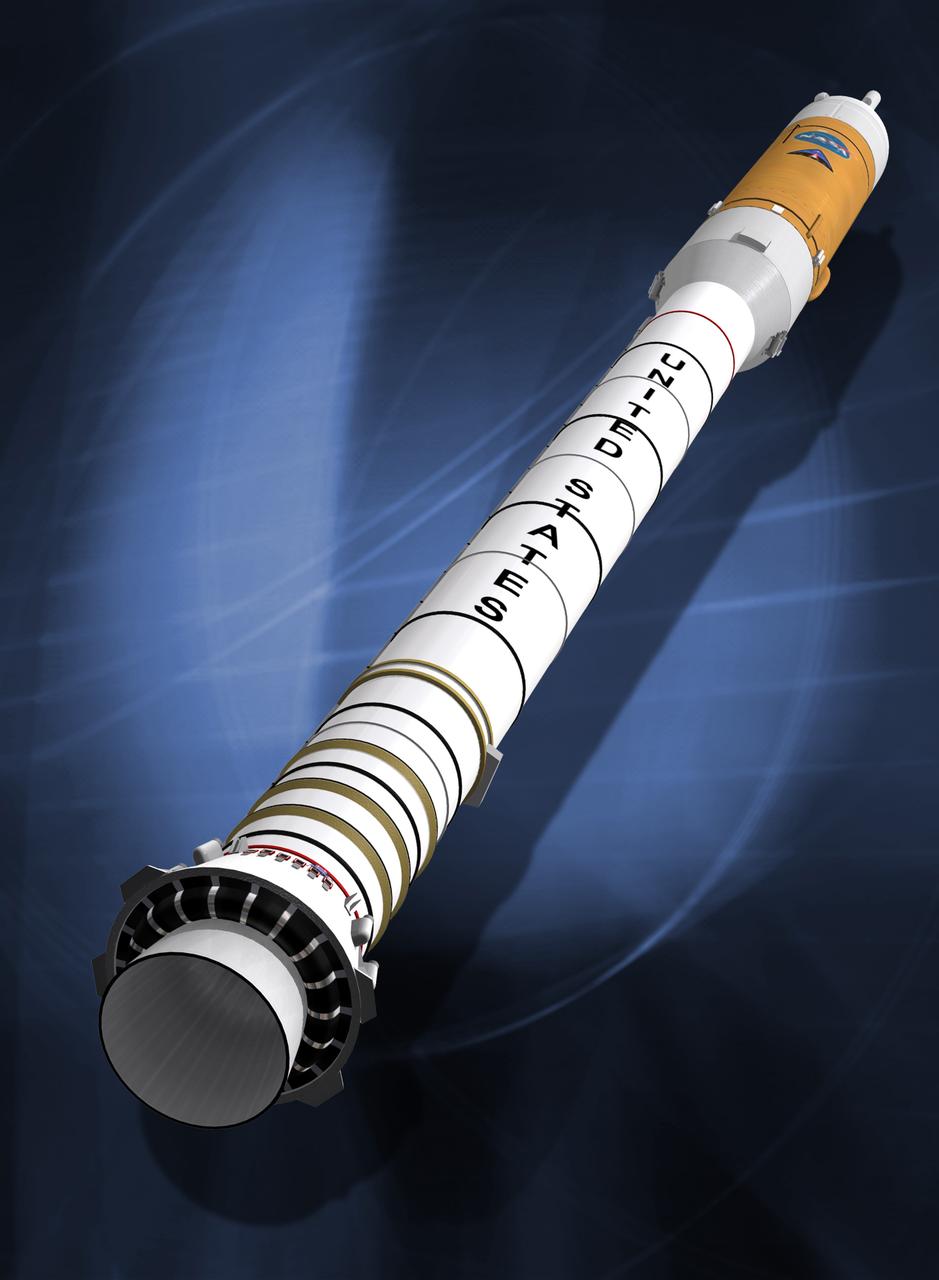
Shown is an illustration of the Ares I concept. The first stage will be a single, five-segment solid rocket booster derived from the space shuttle programs reusable solid rocket motor. The first stage is managed by NASA's Marshall Space Flight Center in Huntsville, Alabama for NASA's Constellation program.
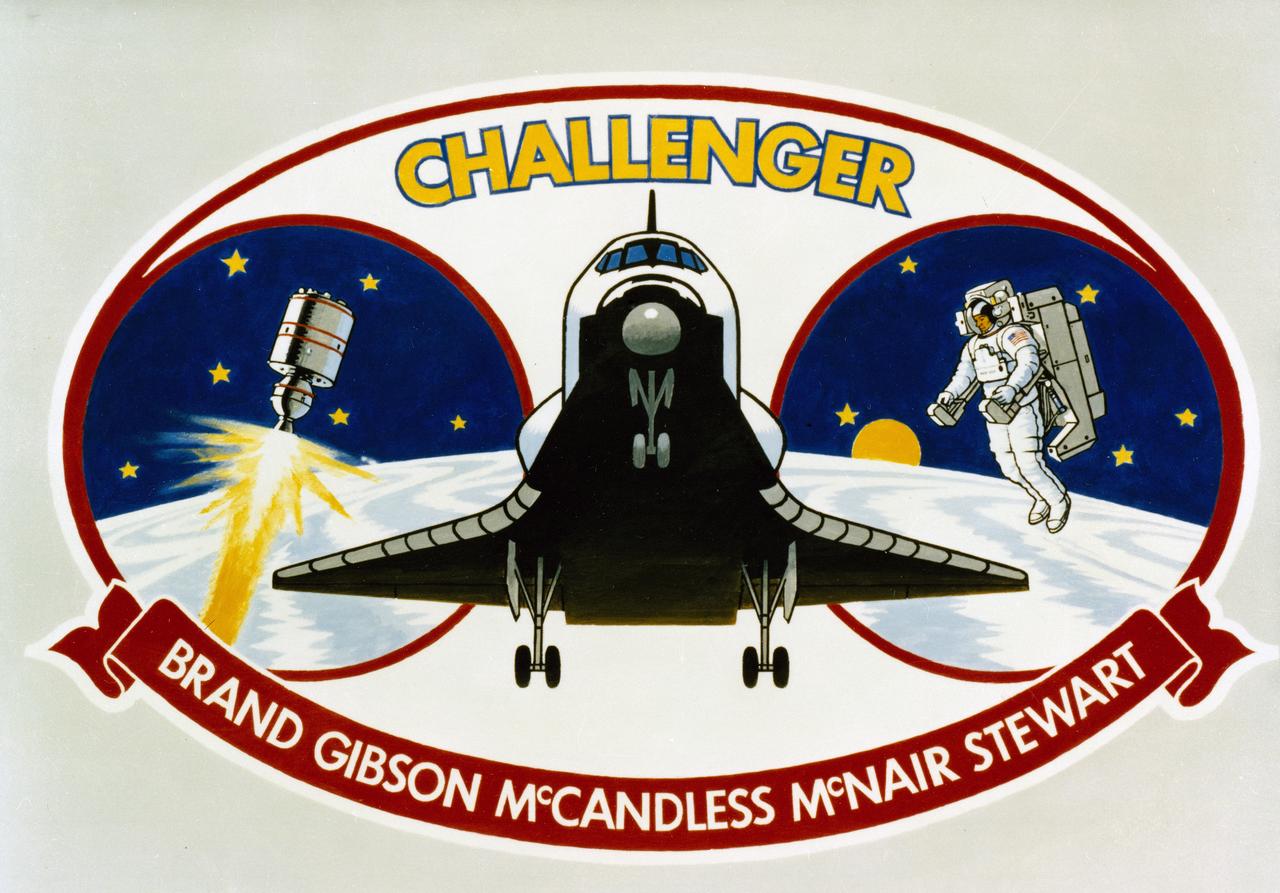
The Space Shuttle Challenger, making its fourth space flight, highlights the 41B insignia. The reusable vehicle is flanked in the oval by an illustration of a Payload Assist Module-D solid rocket motor (PAM-D) for assisted satellite deployment; an astronaut making the first non-tethered extravehicular activity (EVA); and eleven stars.
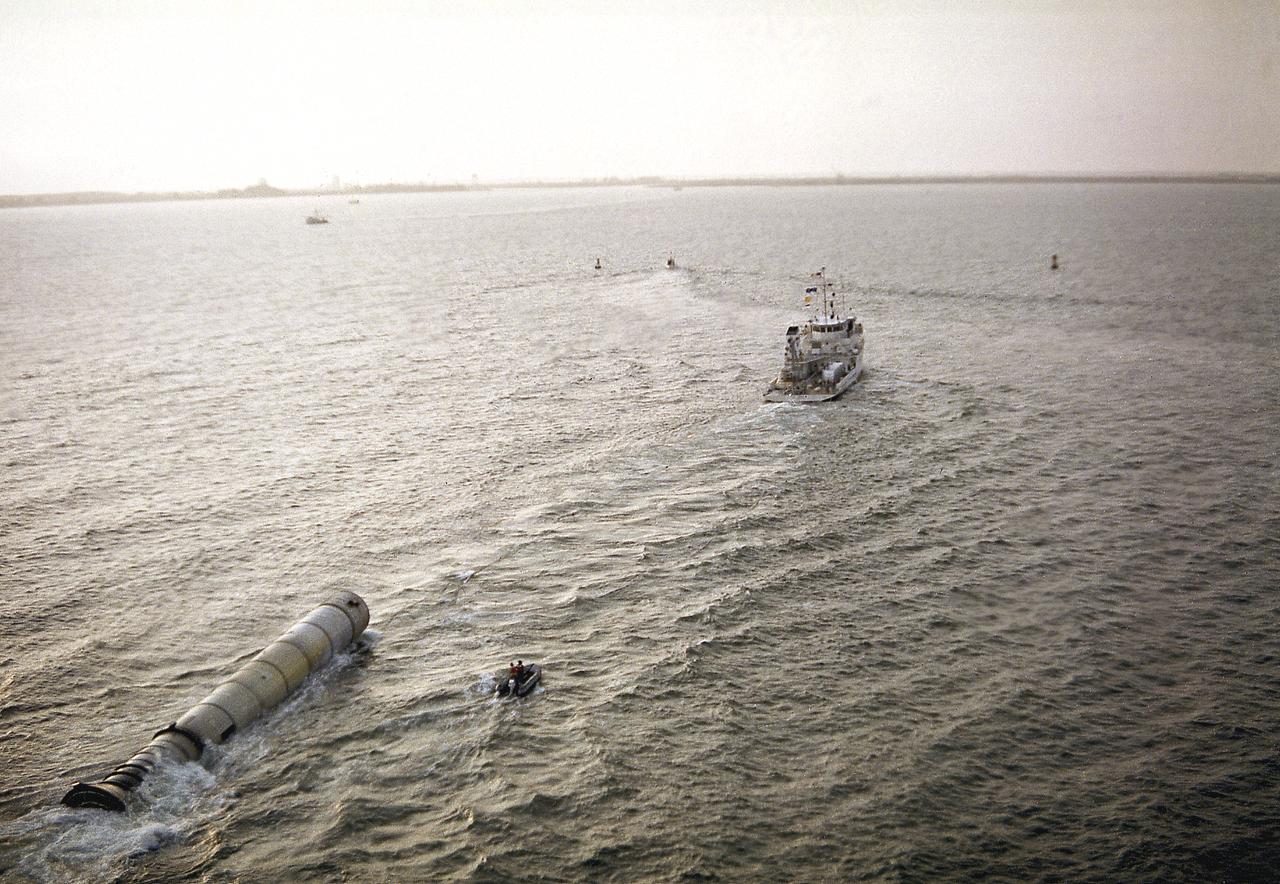
The towing ship, Liberty, towed a recovered solid rocket booster (SRB) for the STS-3 mission to Port Canaveral, Florida. The recovered SRB would be inspected and refurbished for reuse. The Shuttle's SRB's and solid rocket motors (SRM's) are the largest ever built and the first designed for refurbishment and reuse. Standing nearly 150-feet high, the twin boosters provide the majority of thrust for the first two minutes of flight, about 5.8 million pounds. The requirement for reusability dictated durable materials and construction to preclude corrosion of the hardware exposed to the harsh seawater environment. The SRB contains a complete recovery subsystem that includes parachutes, beacons, lights, and tow fixture.
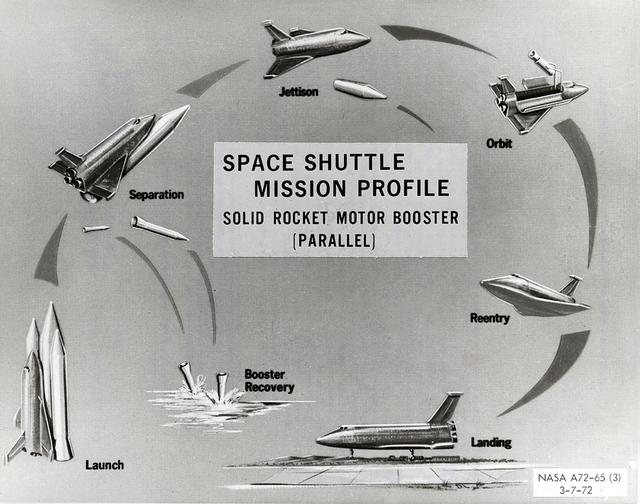
This early chart conceptualizes the use of two parallel Solid Rocket Motor Boosters in conjunction with three main engines to launch the proposed Space Shuttle to orbit. At approximately twenty-five miles altitude, the boosters would detach from the Orbiter and parachute back to Earth where they would be recovered and refurbished for future use. The Shuttle was designed as NASA's first reusable space vehicle, launching vertically like a spacecraft and landing on runways like conventional aircraft. Marshall Space Flight Center had management responsibility for the Shuttle's propulsion elements, including the Solid Rocket Boosters.
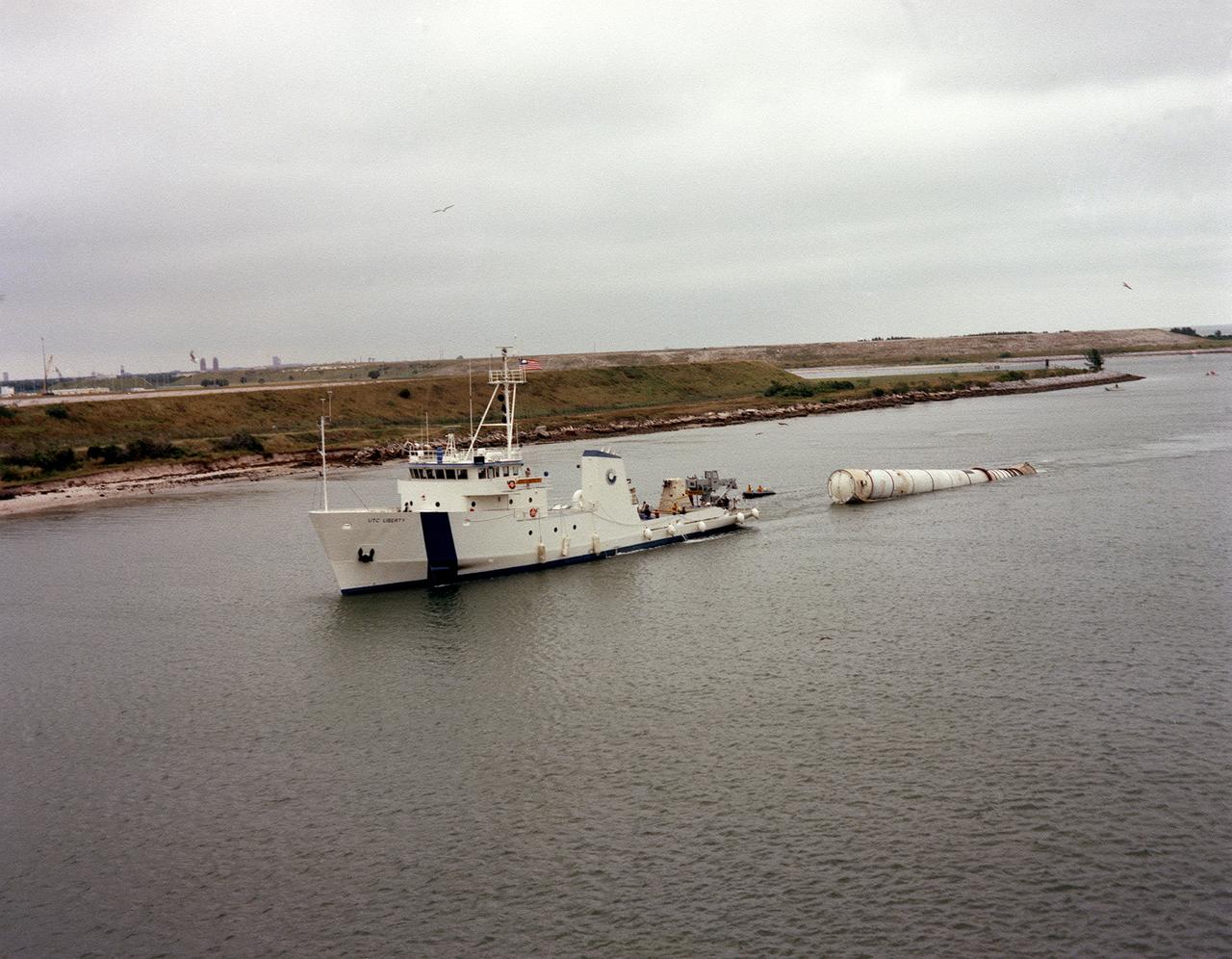
The towing ship, Liberty, towed a recovered solid rocket booster (SRB) for the STS-5 mission to Port Canaveral, Florida. The recovered SRB would be inspected and refurbished for reuse. The Shuttle's SRB's and solid rocket motors (SRM's) are the largest ever built and the first designed for refurbishment and reuse. Standing nearly 150-feet high, the twin boosters provide the majority of thrust for the first two minutes of flight, about 5.8 million pounds. The requirement for reusability dictated durable materials and construction to preclude corrosion of the hardware exposed to the harsh seawater environment. The SRB contains a complete recovery subsystem that includes parachutes, beacons, lights, and tow fixture.

KENNEDY SPACE CENTER, FLA. -- A train carrying space shuttle reusable solid rocket motor segments from the ATK Launch Systems manufacturing site in Brigham City,Utah, to NASA’s Kennedy Space Center in Florida was derailed May 2. At the site of the train mishap involving eight NASA solid rocket booster segment cars, a handling fixture has been attached to a box car being used as a spacer between the segment cars so that it can be removed from the rails. The solid rocket booster cars can be seen behind it. The train was traveling over the Meridian & Bigbee railroad near Pennington, Ala., at the time of the mishap.. The hardware was intended for use on shuttle Discovery's STS-120 mission in October and shuttle Atlantis's STS-122 mission in December. These segments are interchangeable, and ATK Launch Systems has replacement units that could be used for the shuttle flights, if necessary.

CAPE CANAVERAL, Fla. – ATK and NASA officials accompanied the Florida East Coast Railroad train carrying the booster segments for the Ares I-X test rocket on its route to NASA's Kennedy Space Center in Florida from Jacksonville, Fla. Seen here in the passenger car are, from left NASA KSC Shuttle Launch Director Mike Leinbach, a Florida East Coast Railroad representative, ATK Ares I First Stage program Director Fred Brasfield, a Florida East Coast Railroad representative, ATK Vice President Space Launch Systems Charlie Precourt, a Florida East Coast Railroad representative, and NASA Marshall Space Flight Center Reusable Solid Rocket Booster Integration Lead Roy Worthy. The four reusable motor segments and the nozzle exit cone, manufactured by the Ares I first-stage prime contractor Alliant Techsystems Inc., or ATK, departed Utah March 12 on the seven-day, cross-country trip to Florida. The segments will be delivered to the Rotation, Processing and Surge Facility for final processing and integration. The booster used for the Ares I-X launch is being modified by adding new forward structures and a fifth segment simulator. The motor is the final hardware needed for the rocket's upcoming test flight this summer. The stacking operations are scheduled to begin in the Vehicle Assembly Building in April. Photo credit: NASA/Kim Shiflett

The Space Shuttle represented an entirely new generation of space vehicle, the world's first reusable spacecraft. Unlike earlier expendable rockets, the Shuttle was designed to be launched over and over again and would serve as a system for ferrying payloads and persornel to and from Earth orbit. The Shuttle's major components are the orbiter spacecraft; the three main engines, with a combined thrust of more than 1.2 million pounds; the huge external tank (ET) that feeds the liquid hydrogen fuel and liquid oxygen oxidizer to the three main engines; and the two solid rocket boosters (SRB's), with their combined thrust of some 5.8 million pounds. The SRB's provide most of the power for the first two minutes of flight. Crucially involved with the Space Shuttle program virtually from its inception, the Marshall Space Flight Center (MSFC) played a leading role in the design, development, testing, and fabrication of many major Shuttle propulsion components. The MSFC was assigned responsibility for developing the Shuttle orbiter's high-performance main engines, the most complex rocket engines ever built. The MSFC was also responsible for developing the Shuttle's massive ET and the solid rocket motors and boosters.

The Space Shuttle represented an entirely new generation of space vehicles, the world's first reusable spacecraft. Unlike earlier expendable rockets, the Shuttle was designed to be launched over and over again and would serve as a system for ferrying payloads and persornel to and from Earth orbit. The Shuttle's major components are the orbiter spacecraft; the three main engines, with a combined thrust of more than 1.2 million pounds; the huge external tank (ET) that feeds the liquid hydrogen fuel and liquid oxygen oxidizer to the three main engines; and the two solid rocket boosters (SRB's), with their combined thrust of some 5.8 million pounds, that provide most of the power for the first two minutes of flight. Crucially involved with the Space Shuttle program virtually from its inception, the Marshall Space Flight Center (MSFC) played a leading role in the design, development, testing, and fabrication of many major Shuttle propulsion components. The MSFC was assigned responsibility for developing the Shuttle orbiter's high-performance main engines, the most complex rocket engines ever built. The MSFC was also responsible for developing the Shuttle's massive ET and the solid rocket motors and boosters.
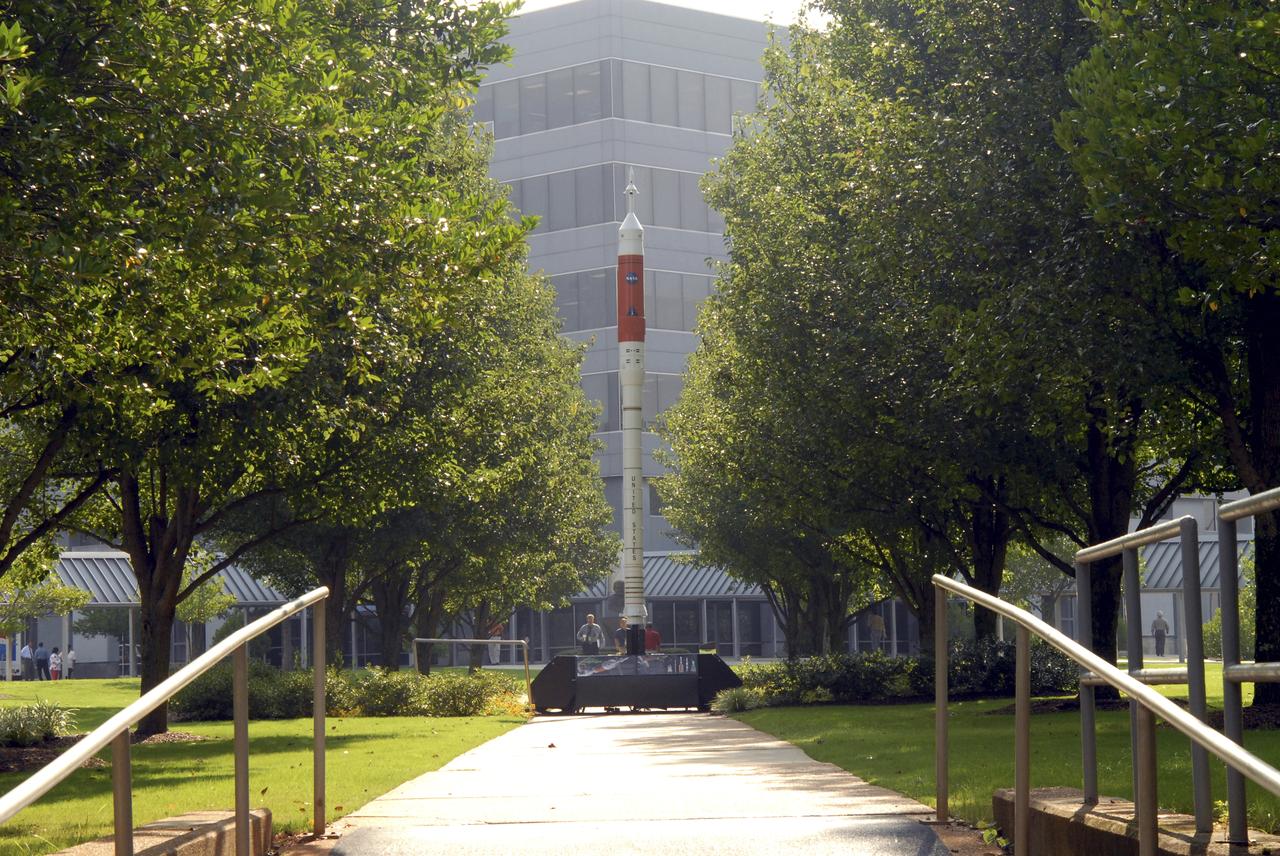
A model of the new Aries I crew launch vehicle, for which NASA is designing, testing and evaluating hardware and related systems, is seen here on display at the Marshall Space Fight Center (MSFC), in Huntsville, Alabama. The Ares I crew launch vehicle is the rocket that will carry a new generation of space explorers into orbit. Under the goals of the Vision for Space Exploration, Ares I is a chief component of the cost-effective space transportation infrastructure being developed by NASA’s Constellation Program. These transportation systems will safely and reliably carry human explorers back to the moon, and then onward to Mars and other destinations in the solar system. The Ares I effort includes multiple project element teams at NASA centers and contract organizations around the nation, and is led by the Exploration Launch Projects Office at NASA’s MFSC. Together, these teams are developing vehicle hardware, evolving proven technologies, and testing components and systems. Their work builds on powerful, reliable space shuttle propulsion elements and nearly a half-century of NASA space flight experience and technological advances. Ares I is an inline, two-stage rocket configuration topped by the Crew Exploration Vehicle, its service module and a launch abort system. The launch vehicle’s first stage is a single, five-segment reusable solid rocket booster derived from the Space Shuttle Program’s reusable solid rocket motor that burns a specially formulated and shaped solid propellant called polybutadiene acrylonitrile (PBAN). The second or upper stage will be propelled by a J-2X main engine fueled with liquid oxygen and liquid hydrogen. In addition to its primary mission of carrying crews of four to six astronauts to Earth orbit, the launch vehicle’s 25-ton payload capacity might be used for delivering cargo to space, bringing resources and supplies to the International Space Station or dropping payloads off in orbit for retrieval and transport to exploration teams on the moon. Crew transportation to the space station is planned to begin no later than 2014. The first lunar excursion is scheduled for the 2020 timeframe.
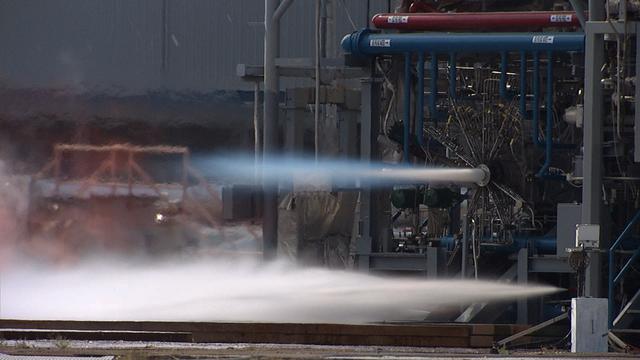
Under the goals of the Vision for Space Exploration, Ares I is a chief component of the cost-effective space transportation infrastructure being developed by NASA's Constellation Program. This transportation system will safely and reliably carry human explorers back to the moon, and then onward to Mars and other destinations in the solar system. The Ares I effort includes multiple project element teams at NASA centers and contract organizations around the nation, and is managed by the Exploration Launch Projects Office at NASA's Marshall Space Flight Center (MFSC). ATK Launch Systems near Brigham City, Utah, is the prime contractor for the first stage booster. ATK's subcontractor, United Space Alliance of Houston, is designing, developing and testing the parachutes at its facilities at NASA's Kennedy Space Center in Florida. NASA's Johnson Space Center in Houston hosts the Constellation Program and Orion Crew Capsule Project Office and provides test instrumentation and support personnel. Together, these teams are developing vehicle hardware, evolving proven technologies, and testing components and systems. Their work builds on powerful, reliable space shuttle propulsion elements and nearly a half-century of NASA space flight experience and technological advances. Ares I is an inline, two-stage rocket configuration topped by the Crew Exploration Vehicle, its service module, and a launch abort system. The launch vehicle's first stage is a single, five-segment reusable solid rocket booster derived from the Space Shuttle Program's reusable solid rocket motor that burns a specially formulated and shaped solid propellant called polybutadiene acrylonitrile (PBAN). The second or upper stage will be propelled by a J-2X main engine fueled with liquid oxygen and liquid hydrogen. This HD video image depicts a test firing of a 40k subscale J2X injector at MSFC's test stand 115. (Highest resolution available)
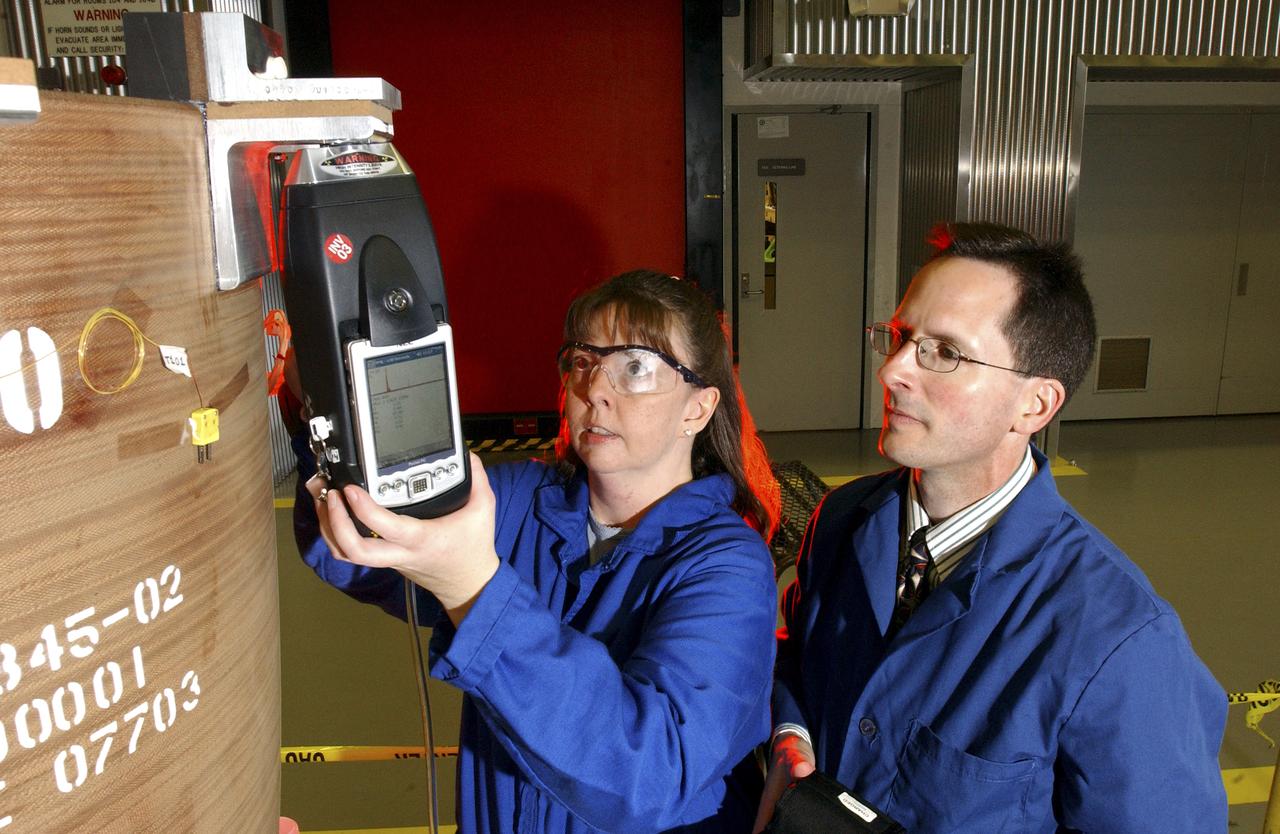
Teamed with KeyMaster Technologies, Kennewick, Washington, the Marshall Space Flight Center engineers have developed a portable vacuum analyzer that performs on-the-spot chemical analyses under field conditions— a task previously only possible in a chemical laboratory. The new capability is important not only to the aerospace industry, but holds potential for broad applications in any industry that depends on materials analysis, such as the automotive and pharmaceutical industries. Weighing in at a mere 4 pounds, the newly developed handheld vacuum X-ray fluorescent analyzer can identify and characterize a wide range of elements, and is capable of detecting chemical elements with low atomic numbers, such as sodium, aluminum and silicon. It is the only handheld product on the market with that capability. Aluminum alloy verification is of particular interest to NASA because vast amounts of high-strength aluminum alloys are used in the Space Shuttle propulsion system such as the External Tank, Main Engine, and Solid Rocket Boosters. This capability promises to be a boom to the aerospace community because of unique requirements, for instance, the need to analyze Space Shuttle propulsion systems on the launch pad. Those systems provide the awe-inspiring rocket power that propels the Space Shuttle from Earth into orbit in mere minutes. The scanner development also marks a major improvement in the quality assurance field, because screws, nuts, bolts, fasteners, and other items can now be evaluated upon receipt and rejected if found to be substandard. The same holds true for aluminum weld rods. The ability to validate the integrity of raw materials and partially finished products before adding value to them in the manufacturing process will be of benefit not only to businesses, but also to the consumer, who will have access to a higher value product at a cheaper price. Three vacuum X-ray scanners are already being used in the Space Shuttle Program. The External Tank Project Office is using one for aluminum alloy analysis, while a Marshall contractor is evaluating alloys with another unit purchased for the Space Shuttle Main Engine Office. The Reusable Solid Rocket Motor Project Office has obtained a scanner that is being used to test hardware and analyze materials. In this photograph, Wanda Hudson, left, ATK Thiokol, and Richard Booth, Marshall Engineering Directorate, use an enhanced vacuum X-ray fluorescent scanner to evaluate Reusable Solid Rocket Motor hardware.
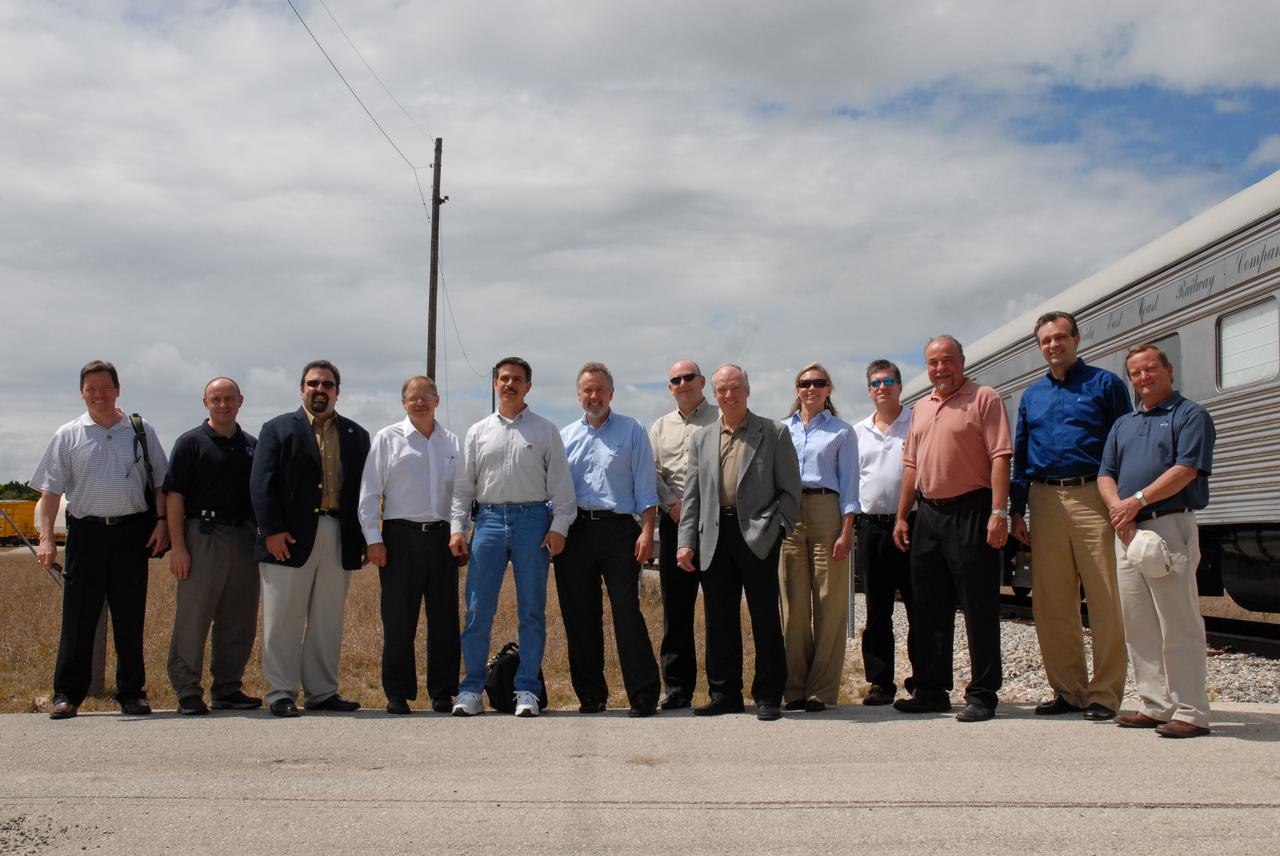
CAPE CANAVERAL, Fla. – The booster segments for the Ares I-X test rocket were delivered to NASA's Kennedy Space Center in Florida by the Florida East Coast Railroad and the NASA Railroad. Accompanying the train on its route from Jacksonville, Fla., were NASA and ATK officials. Standing here, from left, are ATK Ares I Flight Tests Program Director Joe Oliva, ATK Ares I-X Florida Program Manager Russ Page, NASA Ares Program Manager Steve Cook, ATK Deputy Site Director in Florida Ted Shaffner, NASA KSC Ares I-X Deputy Mission Manager Jon Cowart, ATK Vice President of Space Launch Propulson Cary Ralston, ATK Ares I First Stage program Director Fred Brasfield, ATK Vice President Space Launch Systems Charlie Precourt, ATK Ares I Flight Tests Deputy Program Director Kathy Philpot, NASA Marshall Space Flight Center Reusable Solid Rocket Booster Integration Lead Roy Worthy, ATK Florida Site Director Bob Herman, NASA Res First Stage Project Manager Alex Priskos and NASA KSC Shuttle Launch Director Mike Leinbach. The four reusable motor segments and the nozzle exit cone, manufactured by the Ares I first-stage prime contractor Alliant Techsystems Inc., or ATK, departed Utah March 12 on the seven-day, cross-country trip to Florida. The segments will be delivered to the Rotation, Processing and Surge Facility for final processing and integration. The booster used for the Ares I-X launch is being modified by adding new forward structures and a fifth segment simulator. The motor is the final hardware needed for the rocket's upcoming test flight this summer. The stacking operations are scheduled to begin in the Vehicle Assembly Building in April. Photo credit: NASA/Kim Shiflett
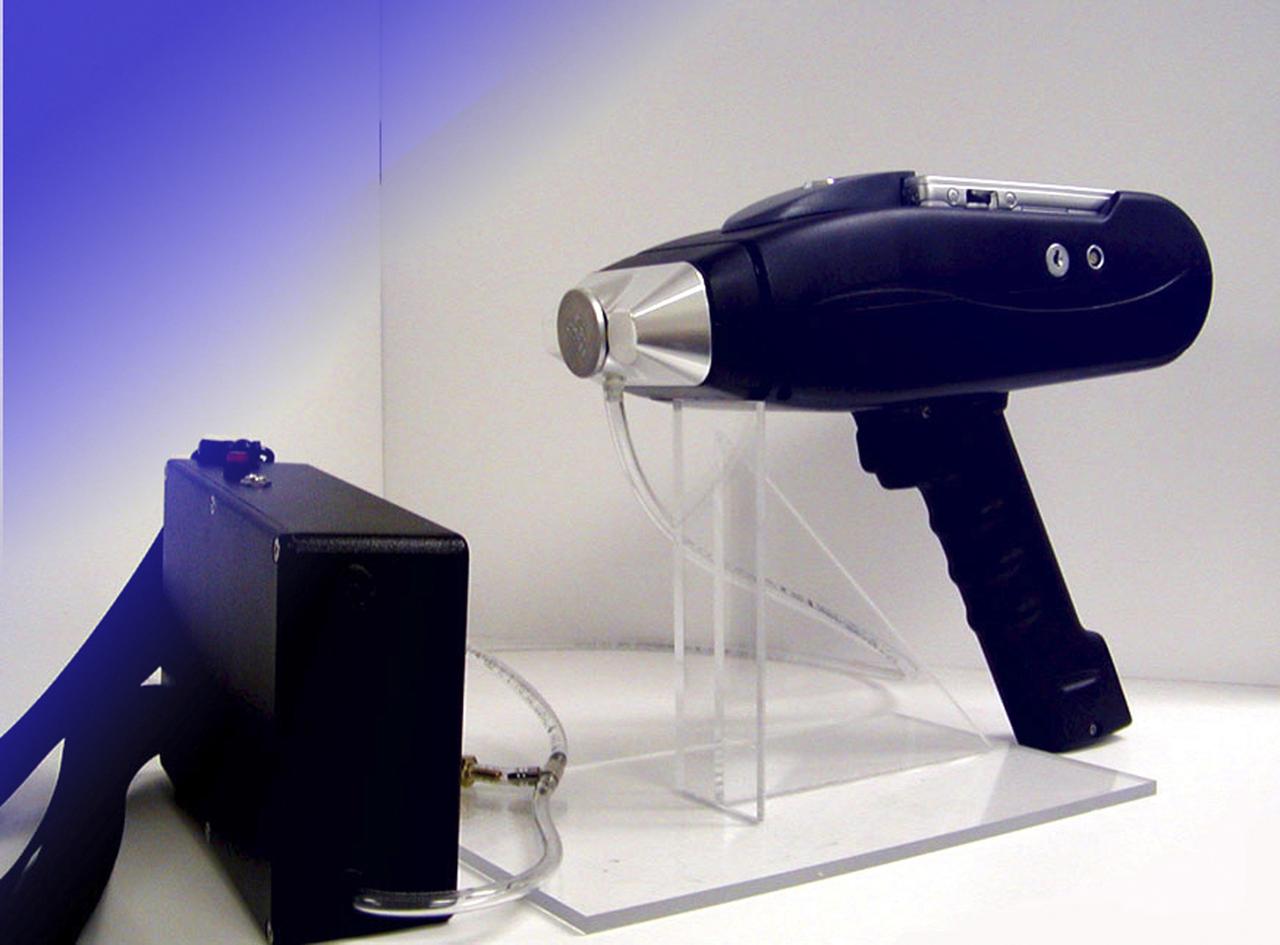
Marshall Space Flight Center engineers have teamed with KeyMaster Technologies, Kennewick, Washington, to develop a portable vacuum analyzer that performs on-the-spot chemical analyses under field conditions, a task previously only possible in a chemical laboratory. The new capability is important not only to the aerospace industry, but holds potential for broad applications in any industry that depends on materials analysis, such as the automotive and pharmaceutical industries. Weighing in at a mere 4 pounds, the newly developed handheld vacuum X-ray fluorescent analyzer can identify and characterize a wide range of elements, and is capable of detecting chemical elements with low atomic numbers, such as sodium, aluminum and silicon. It is the only handheld product on the market with that capability. Aluminum alloy verification is of particular interest to NASA because vast amounts of high-strength aluminum alloys are used in the Space Shuttle propulsion system such as the External Tank, Main Engine, and Solid Rocket Boosters. This capability promises to be a boom to the aerospace community because of unique requirements, for instance, the need to analyze Space Shuttle propulsion systems on the launch pad. Those systems provide the awe-inspiring rocket power that propels the Space Shuttle from Earth into orbit in mere minutes. The scanner development also marks a major improvement in the quality assurance field, because screws, nuts, bolts, fasteners, and other items can now be evaluated upon receipt and rejected if found to be substandard. The same holds true for aluminum weld rods. The ability to validate the integrity of raw materials and partially finished products before adding value to them in the manufacturing process will be of benefit not only to businesses, but also to the consumer, who will have access to a higher value product at a cheaper price. Three vacuum X-ray scanners are already being used in the Space Shuttle Program. The External Tank Project Office is using one for aluminum alloy analysis, while a Marshall contractor is evaluating alloys with another unit purchased for the Space Shuttle Main Engine Office. The Reusable Solid Rocket Motor Project Office has obtained a scanner that is being used to test hardware and analyze materials.
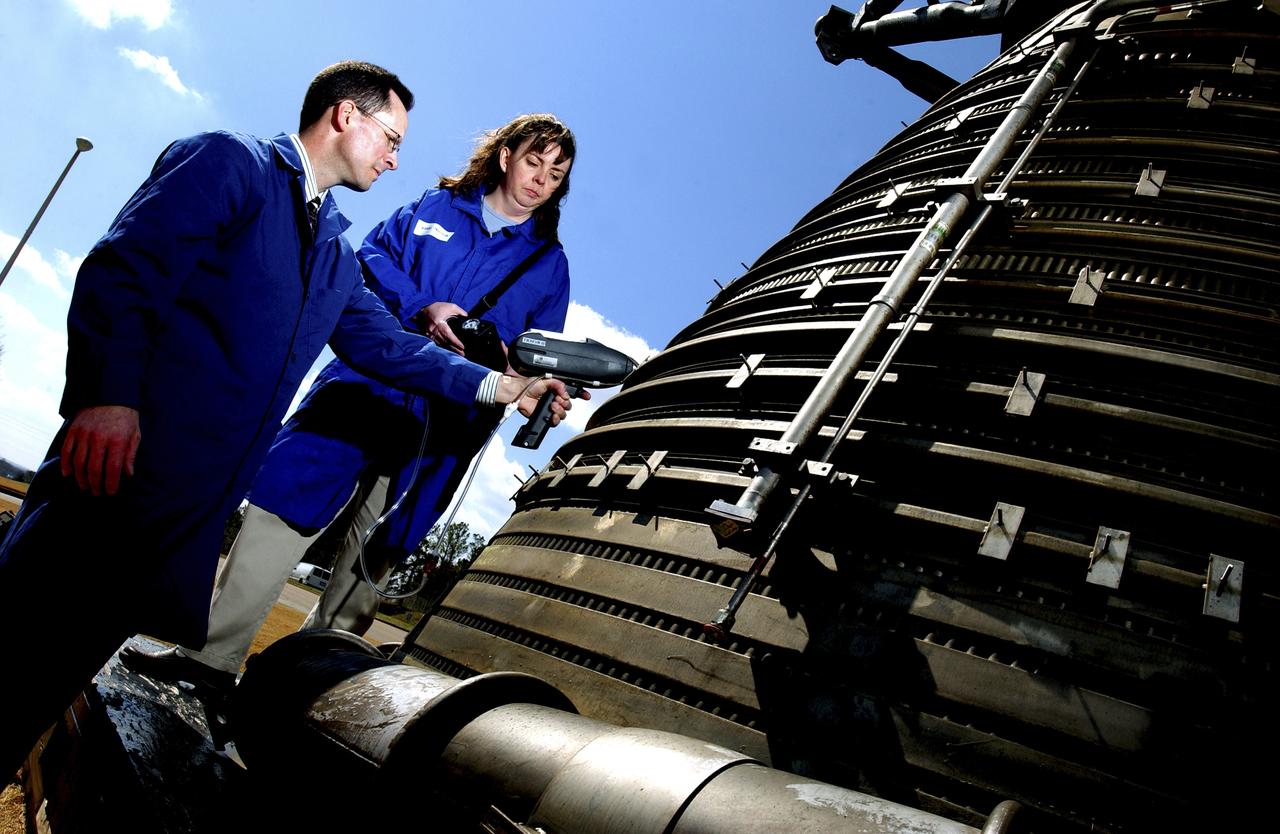
Teamed with KeyMaster Technologies, Kennewick, Washington, the Marshall Space Flight Center engineers have developed a portable vacuum analyzer that performs on-the-spot chemical analyses under field conditions— a task previously only possible in a chemical laboratory. The new capability is important not only to the aerospace industry, but holds potential for broad applications in any industry that depends on materials analysis, such as the automotive and pharmaceutical industries. Weighing in at a mere 4 pounds, the newly developed handheld vacuum X-ray fluorescent analyzer can identify and characterize a wide range of elements, and is capable of detecting chemical elements with low atomic numbers, such as sodium, aluminum and silicon. It is the only handheld product on the market with that capability. Aluminum alloy verification is of particular interest to NASA because vast amounts of high-strength aluminum alloys are used in the Space Shuttle propulsion system such as the External Tank, Main Engine, and Solid Rocket Boosters. This capability promises to be a boom to the aerospace community because of unique requirements, for instance, the need to analyze Space Shuttle propulsion systems on the launch pad. Those systems provide the awe-inspiring rocket power that propels the Space Shuttle from Earth into orbit in mere minutes. The scanner development also marks a major improvement in the quality assurance field, because screws, nuts, bolts, fasteners, and other items can now be evaluated upon receipt and rejected if found to be substandard. The same holds true for aluminum weld rods. The ability to validate the integrity of raw materials and partially finished products before adding value to them in the manufacturing process will be of benefit not only to businesses, but also to the consumer, who will have access to a higher value product at a cheaper price. Three vacuum X-ray scanners are already being used in the Space Shuttle Program. The External Tank Project Office is using one for aluminum alloy analysis, while a Marshall contractor is evaluating alloys with another unit purchased for the Space Shuttle Main Engine Office. The Reusable Solid Rocket Motor Project Office has obtained a scanner that is being used to test hardware and analyze materials. In this photograph, Richard Booth, Marshall Engineering Directorate, and Wanda Hudson, ATK Thiokol, use an enhanced vacuum X-ray fluorescent scanner to analyze materials in an F-1 engine, which was used to boost the Saturn V rocket from Earth’s orbit that carried astronauts to the moon in the 1960s.